Skip to content
Sunday

4 August 2013

Dated photos
164
Source pages
1
Media
2
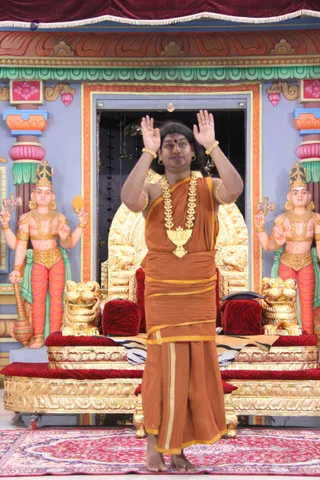
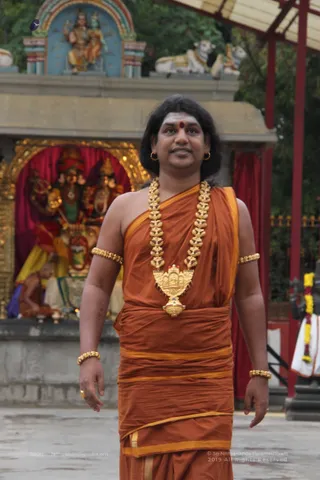
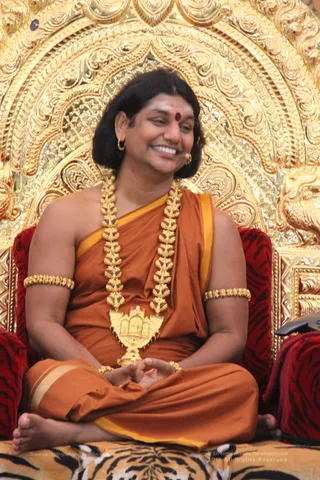
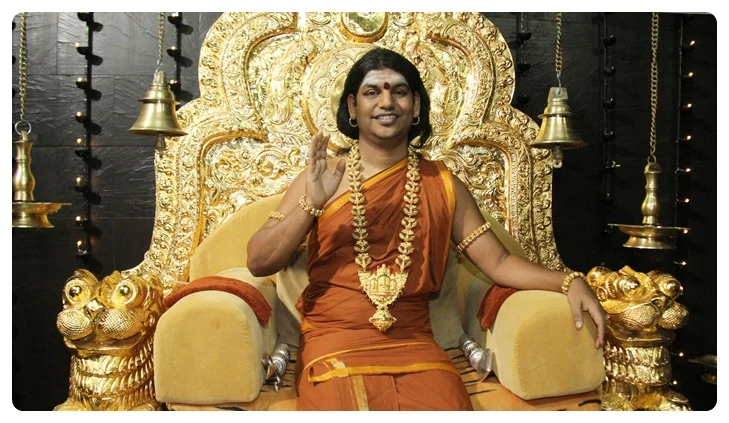
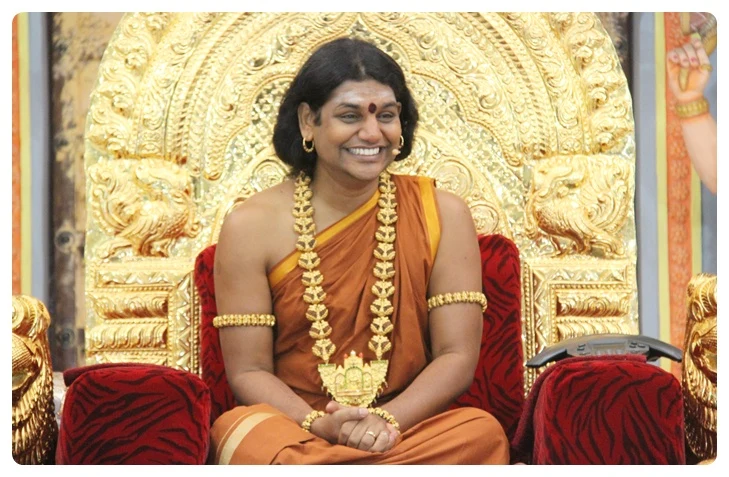
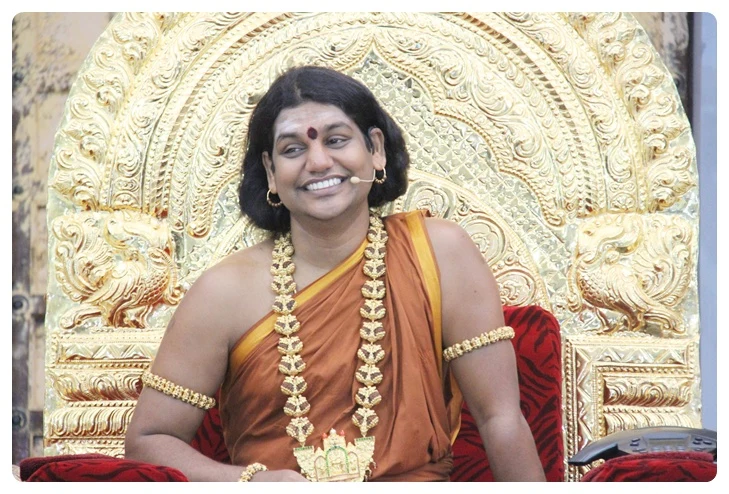
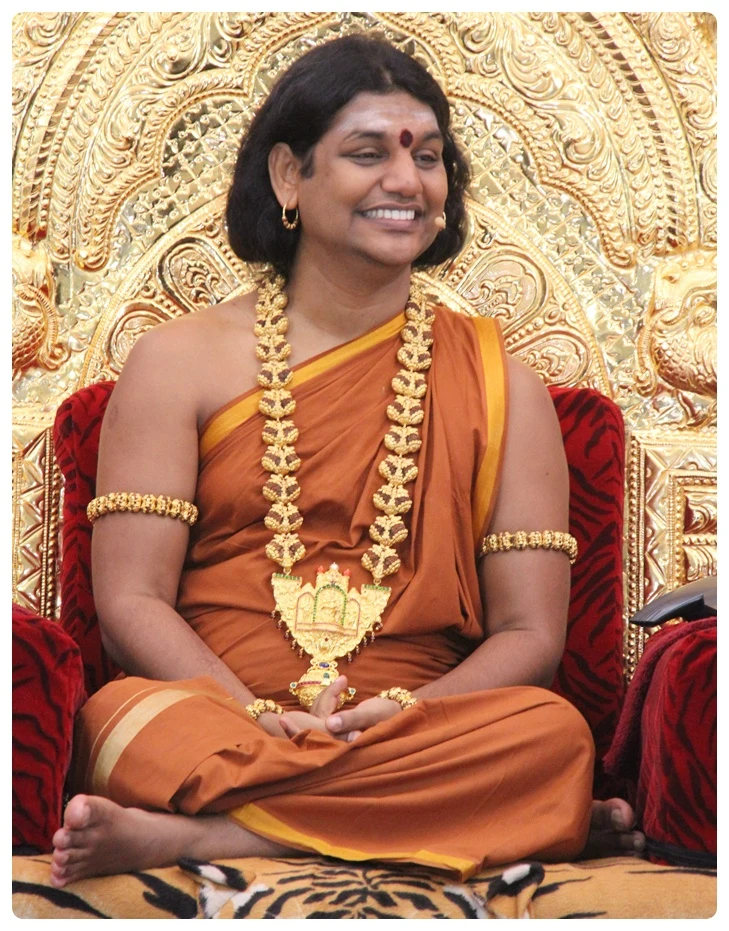
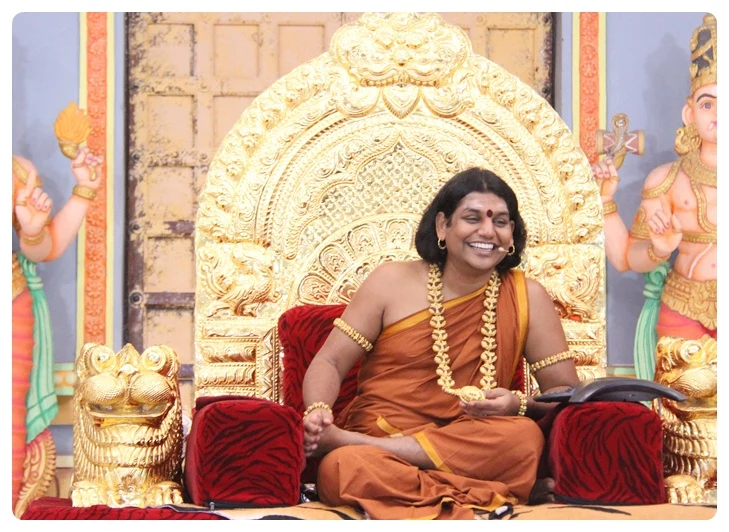
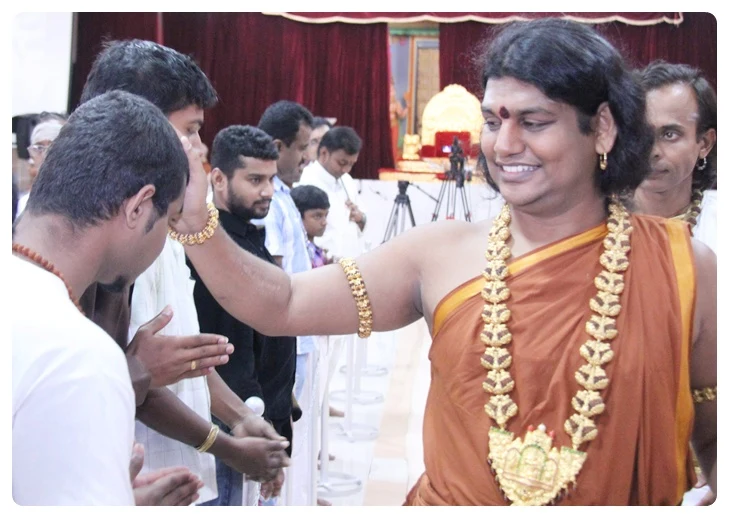
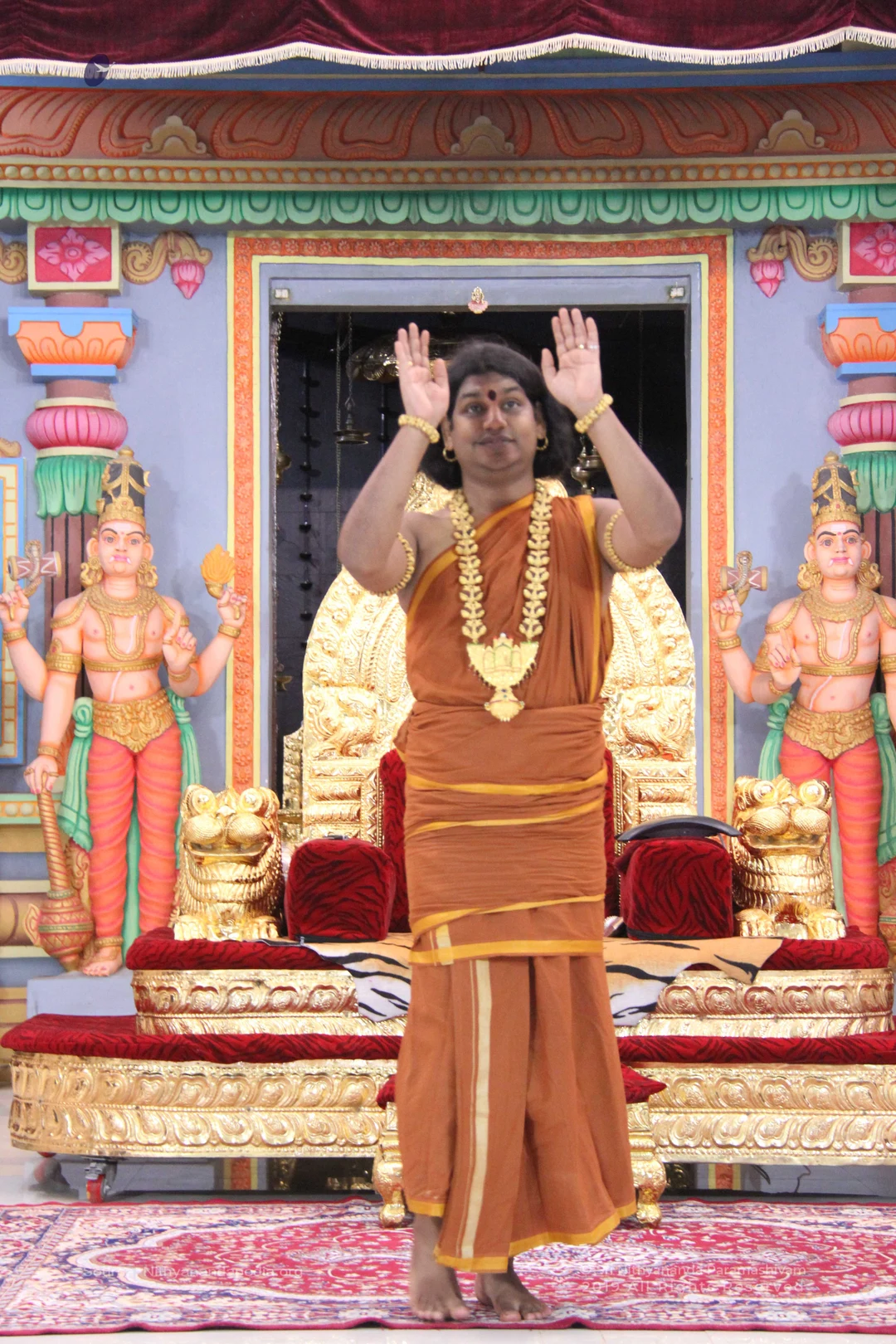
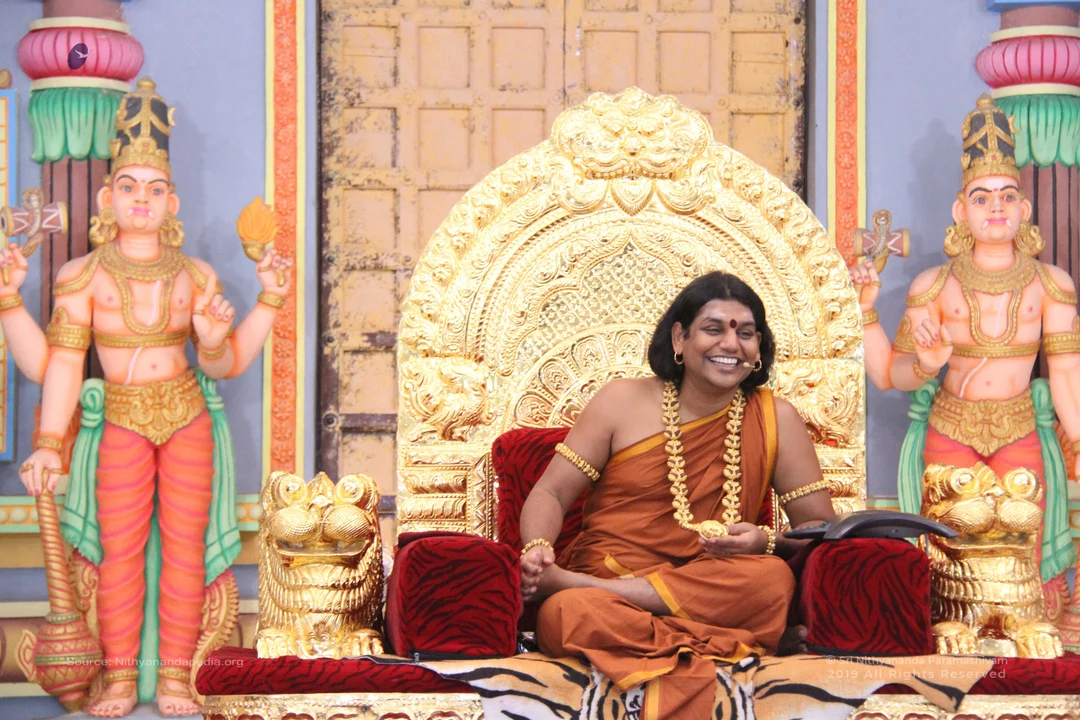
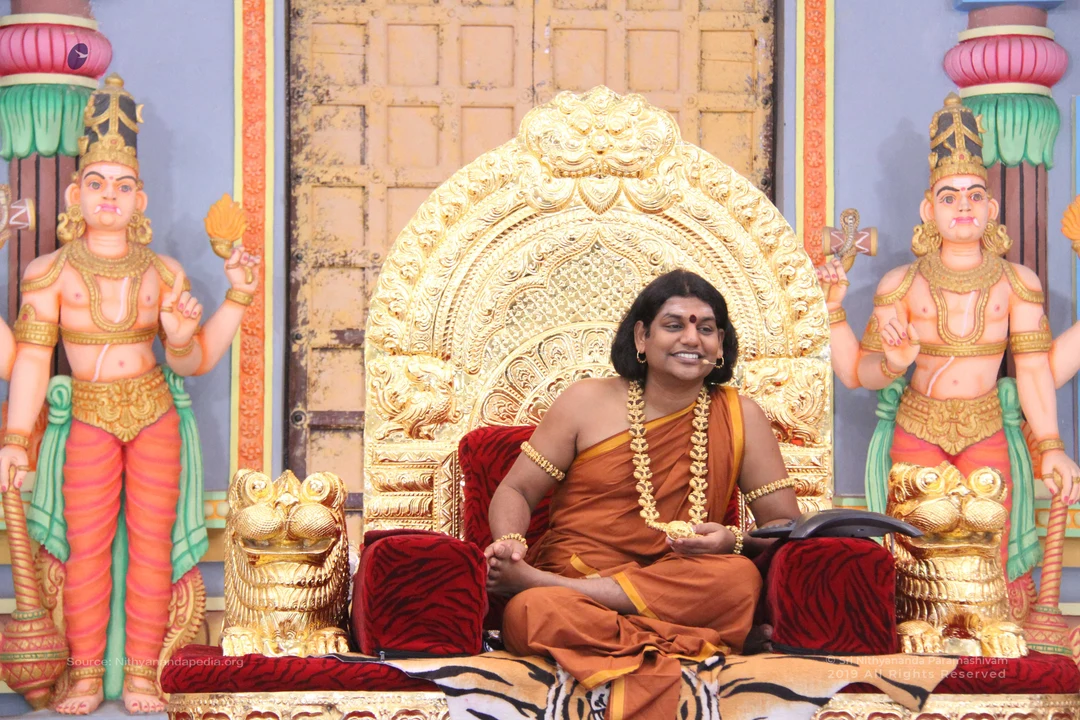
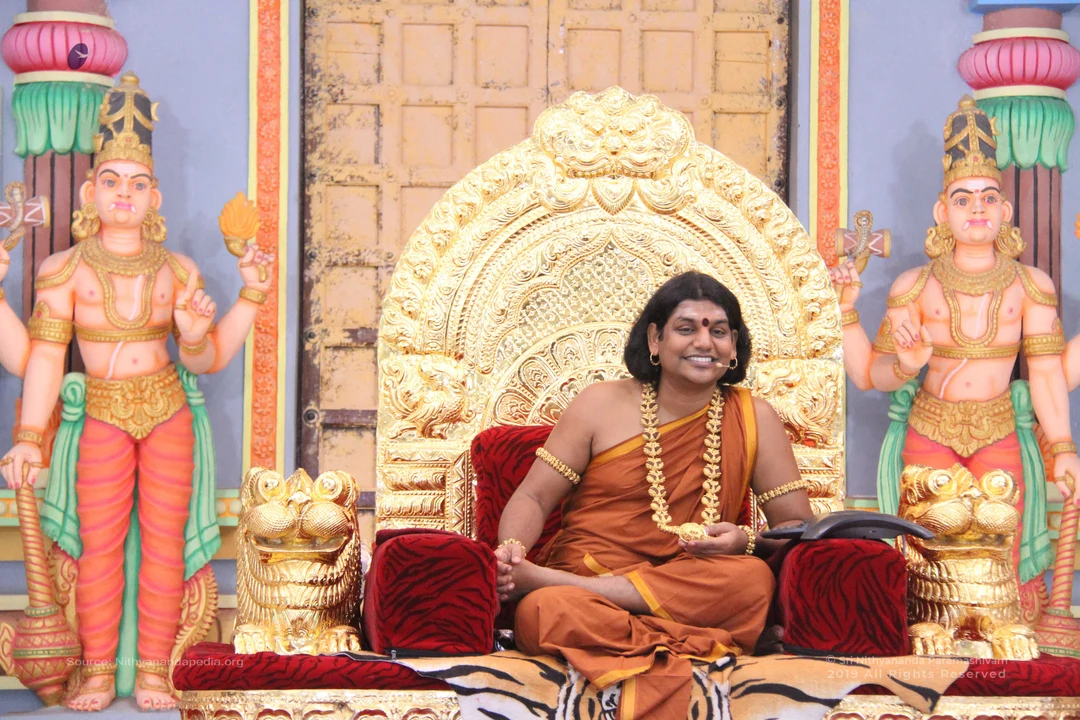
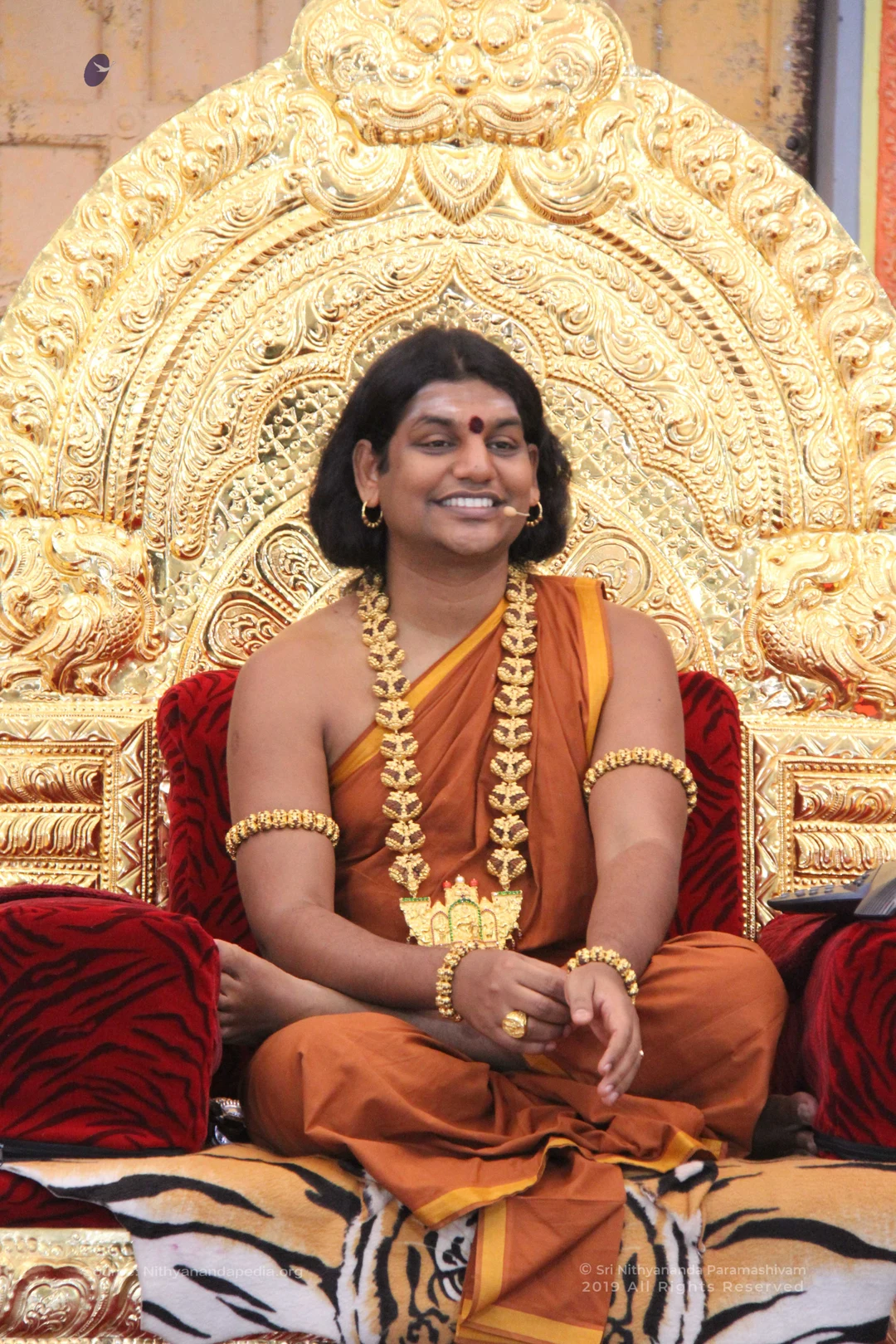
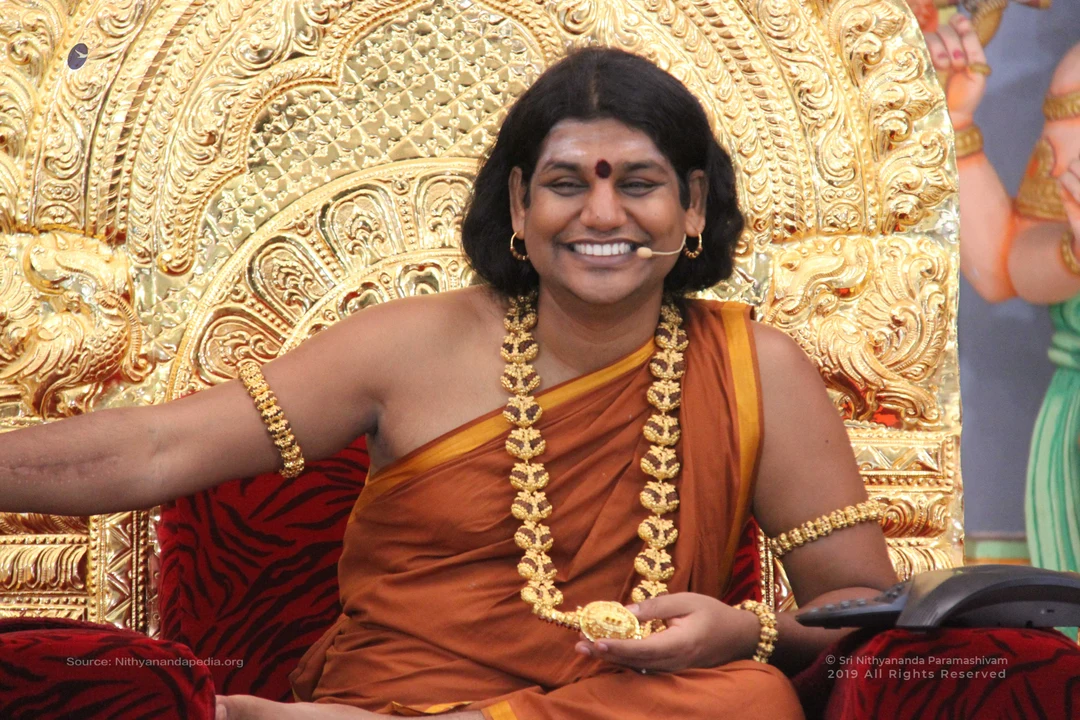
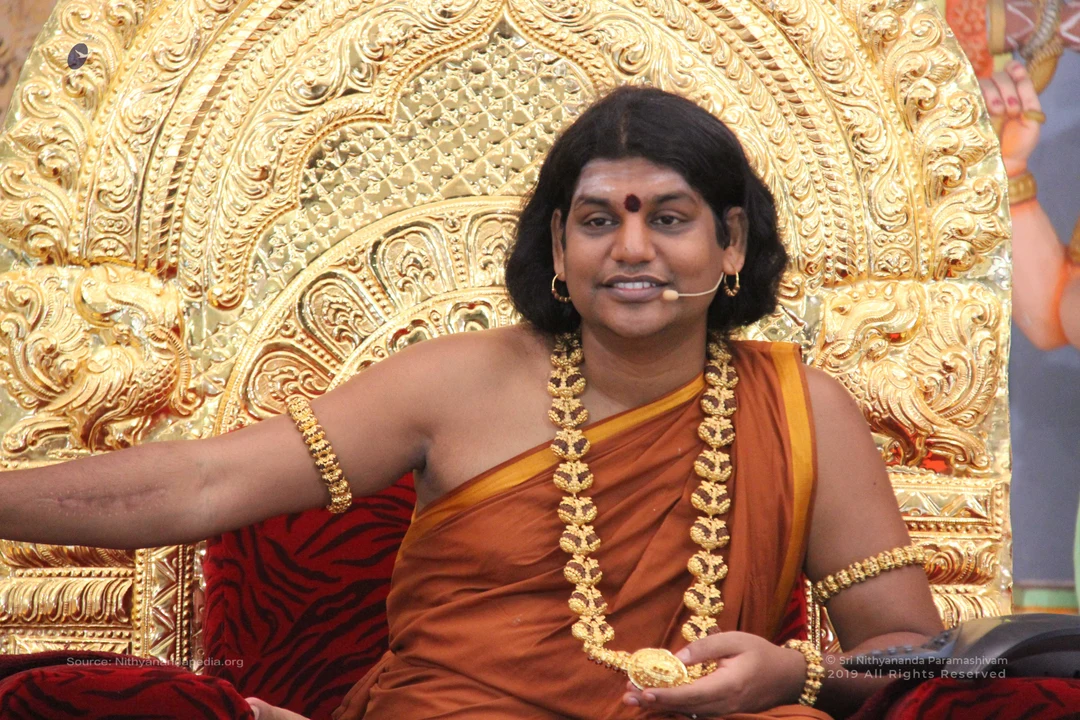
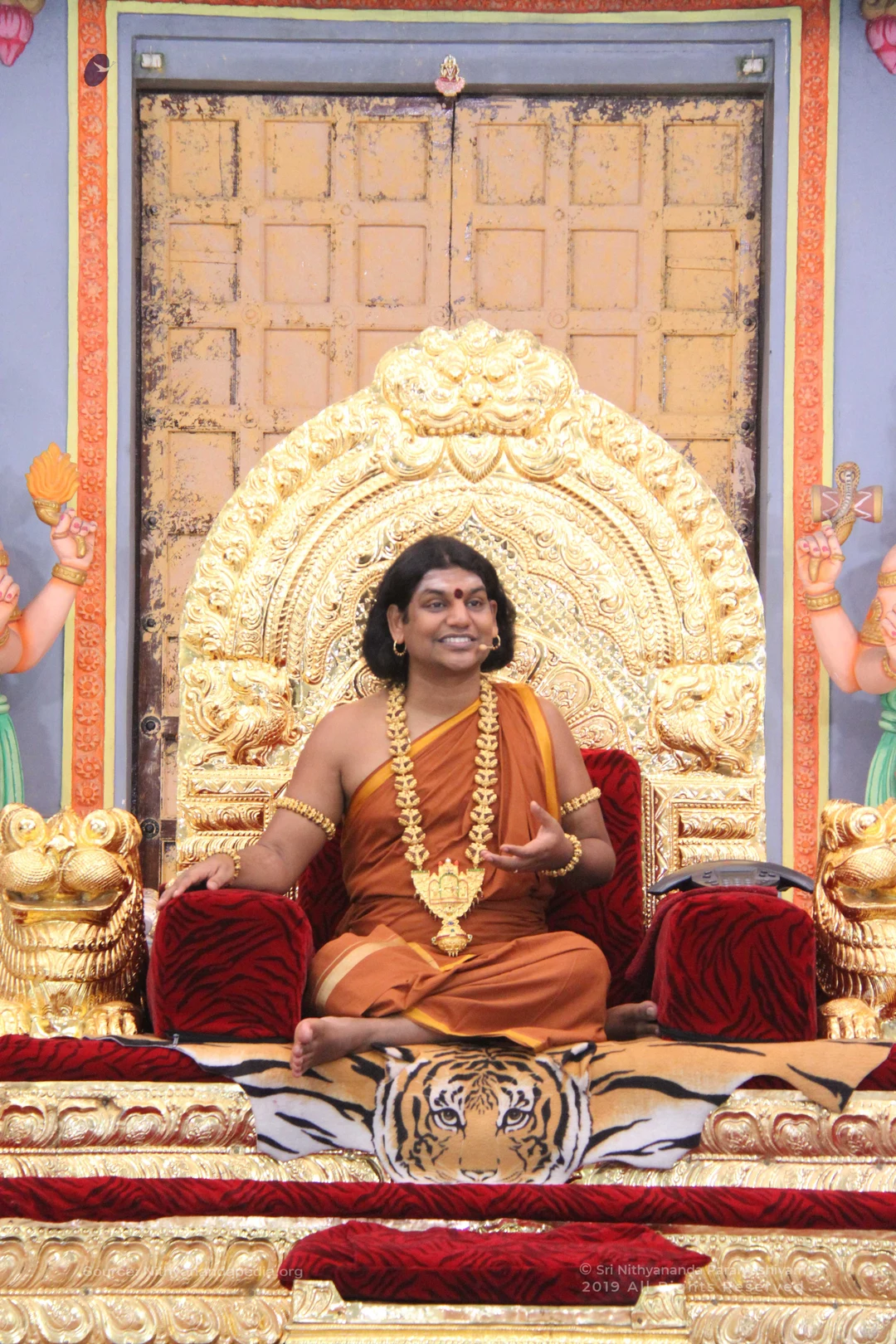
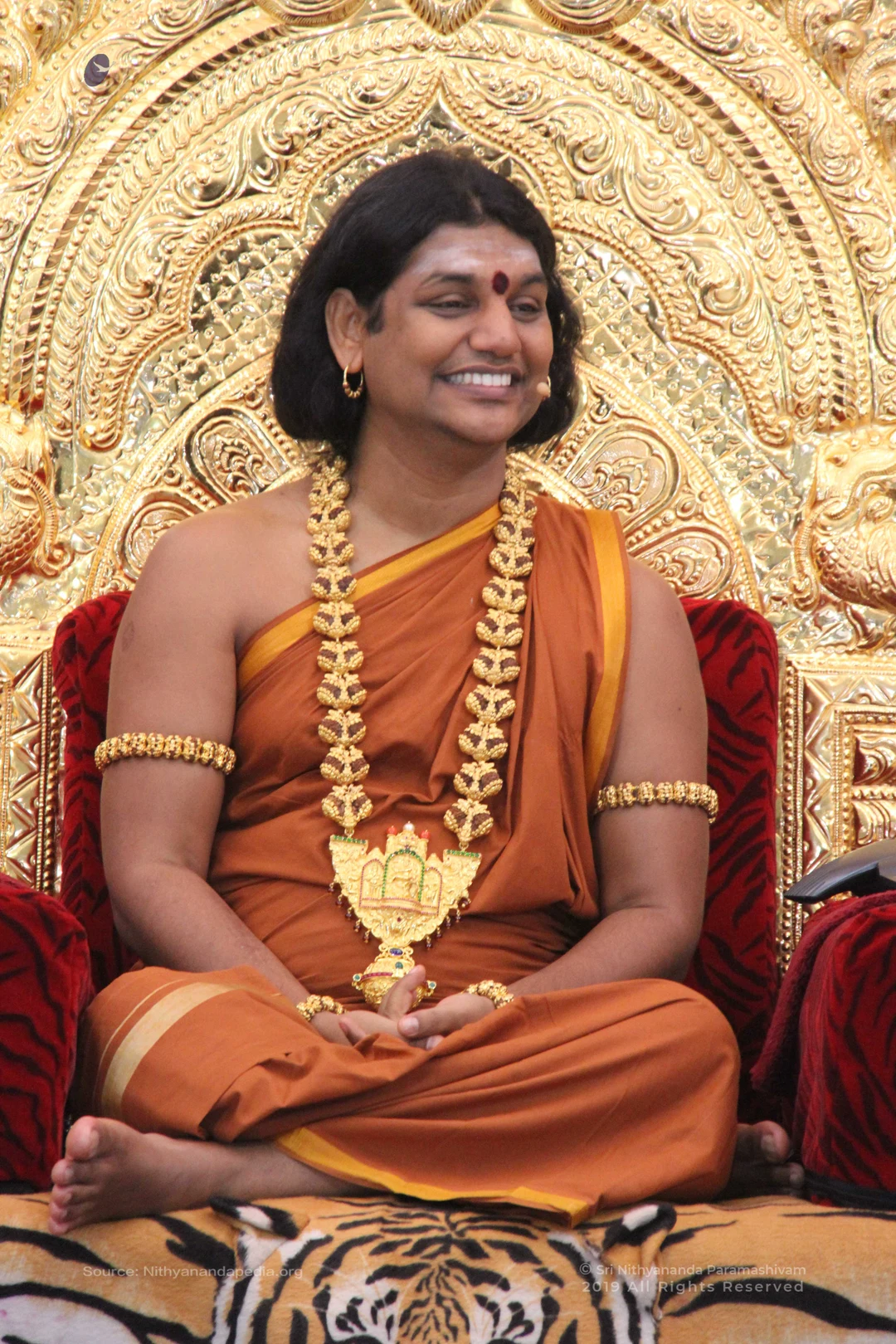
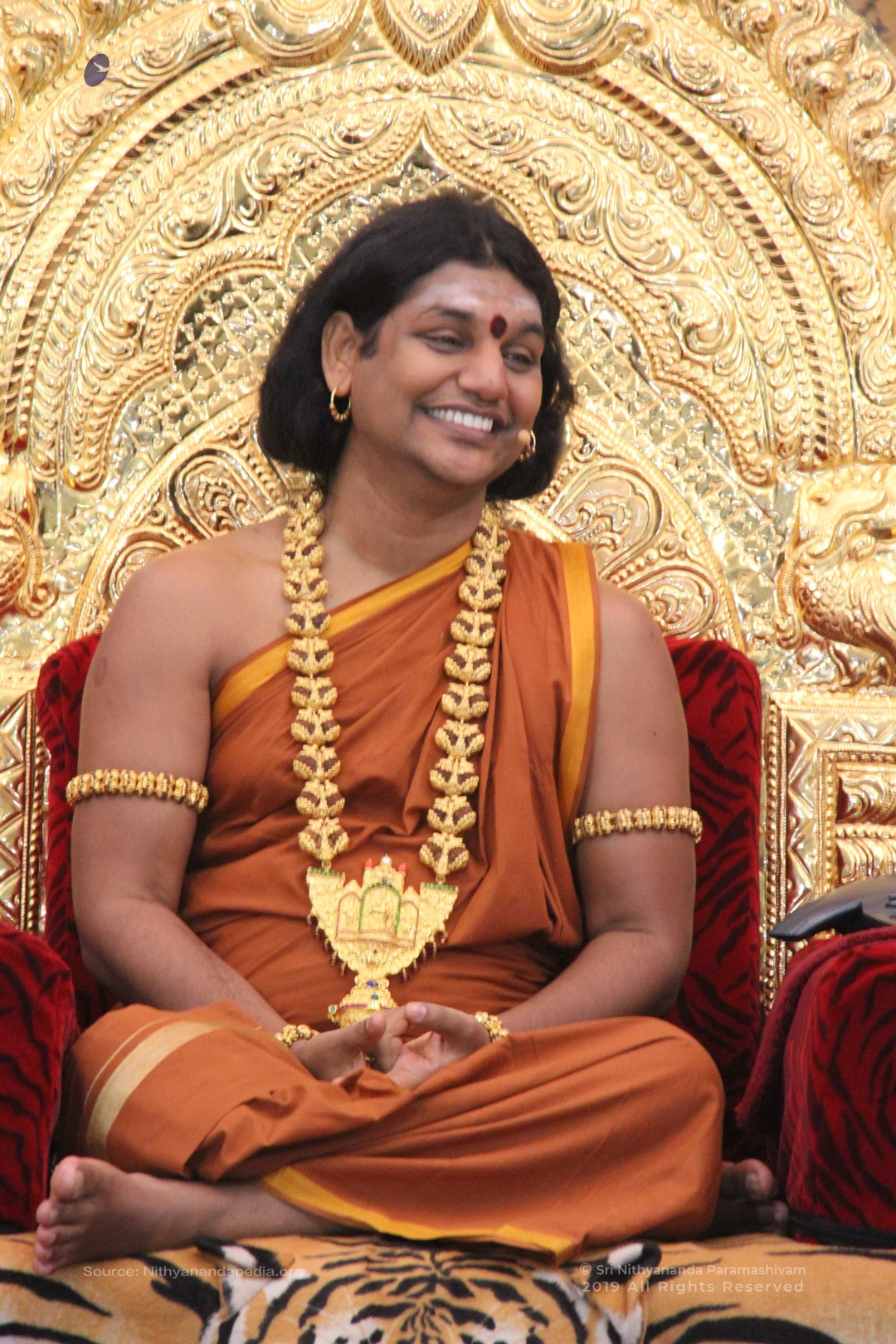
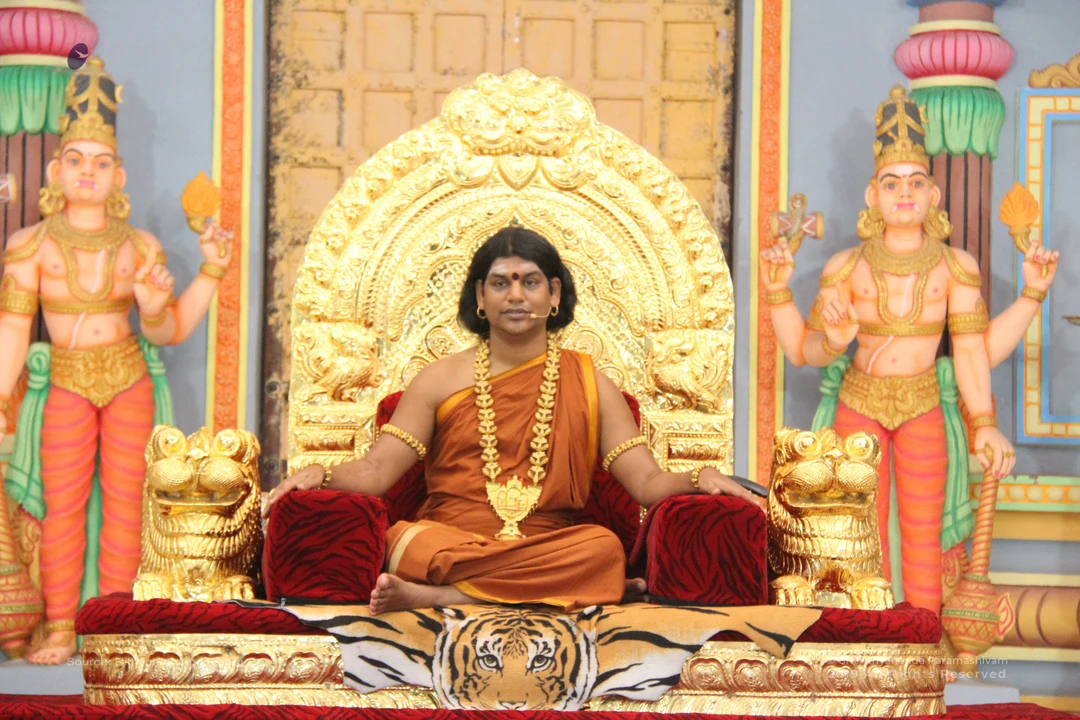
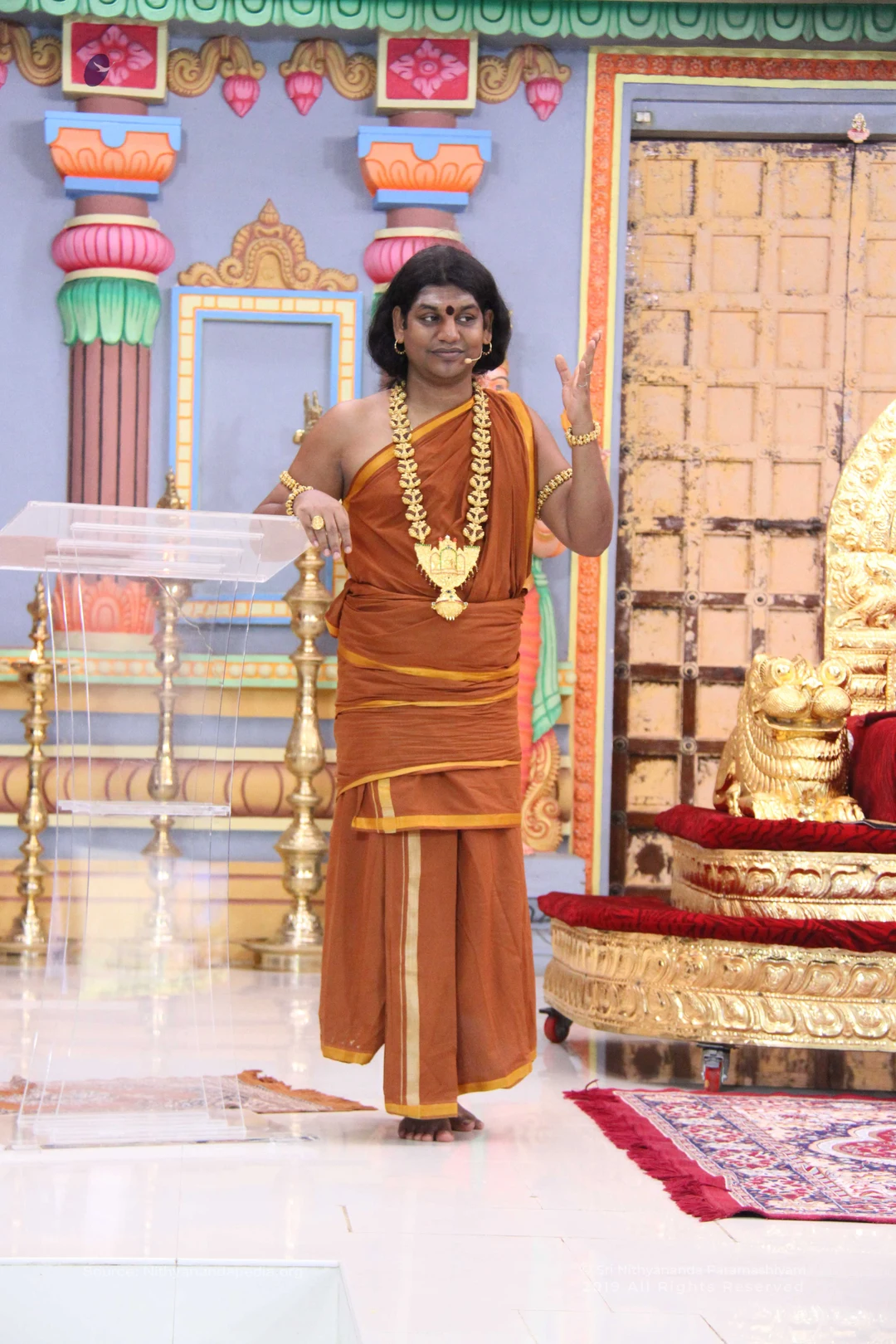
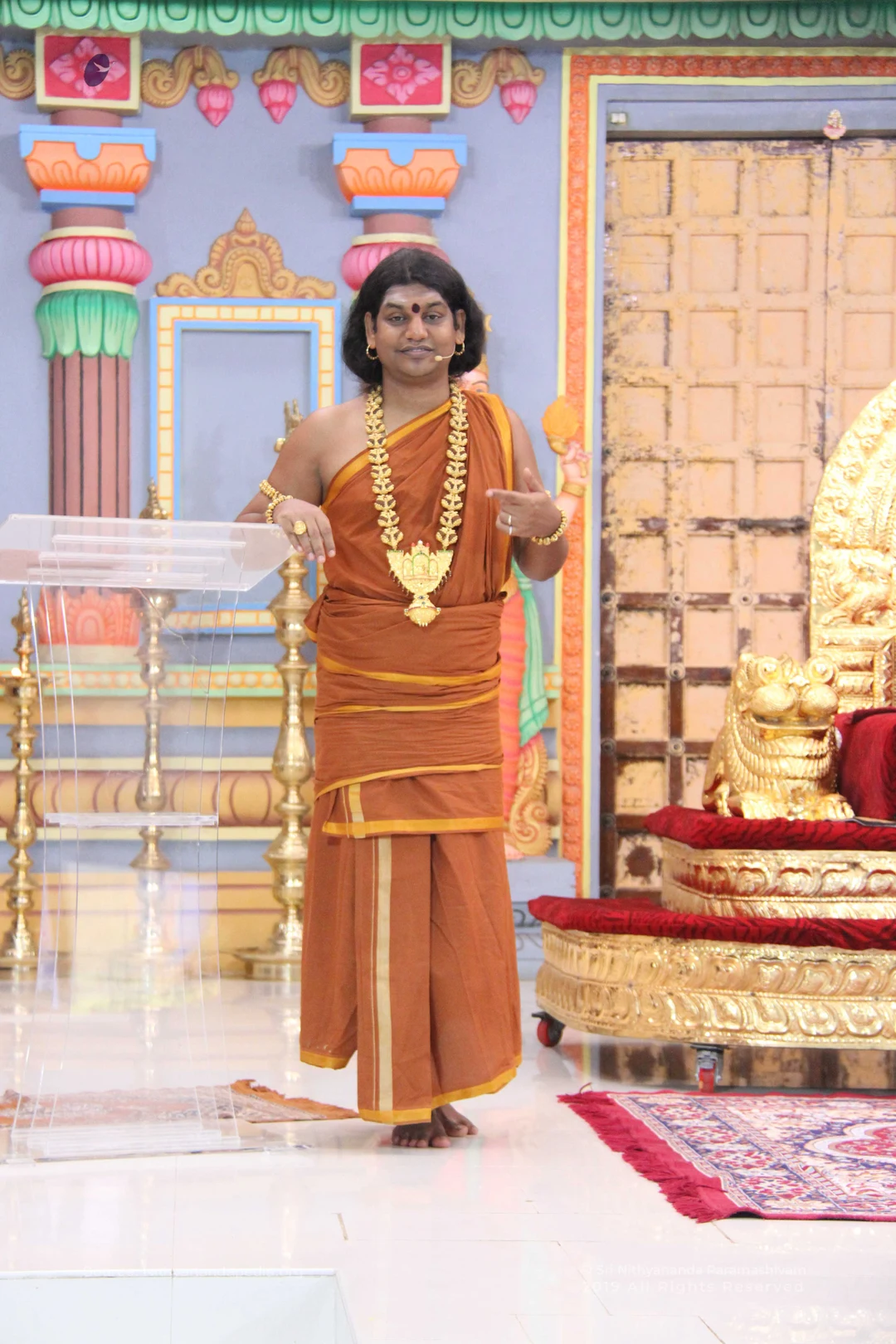
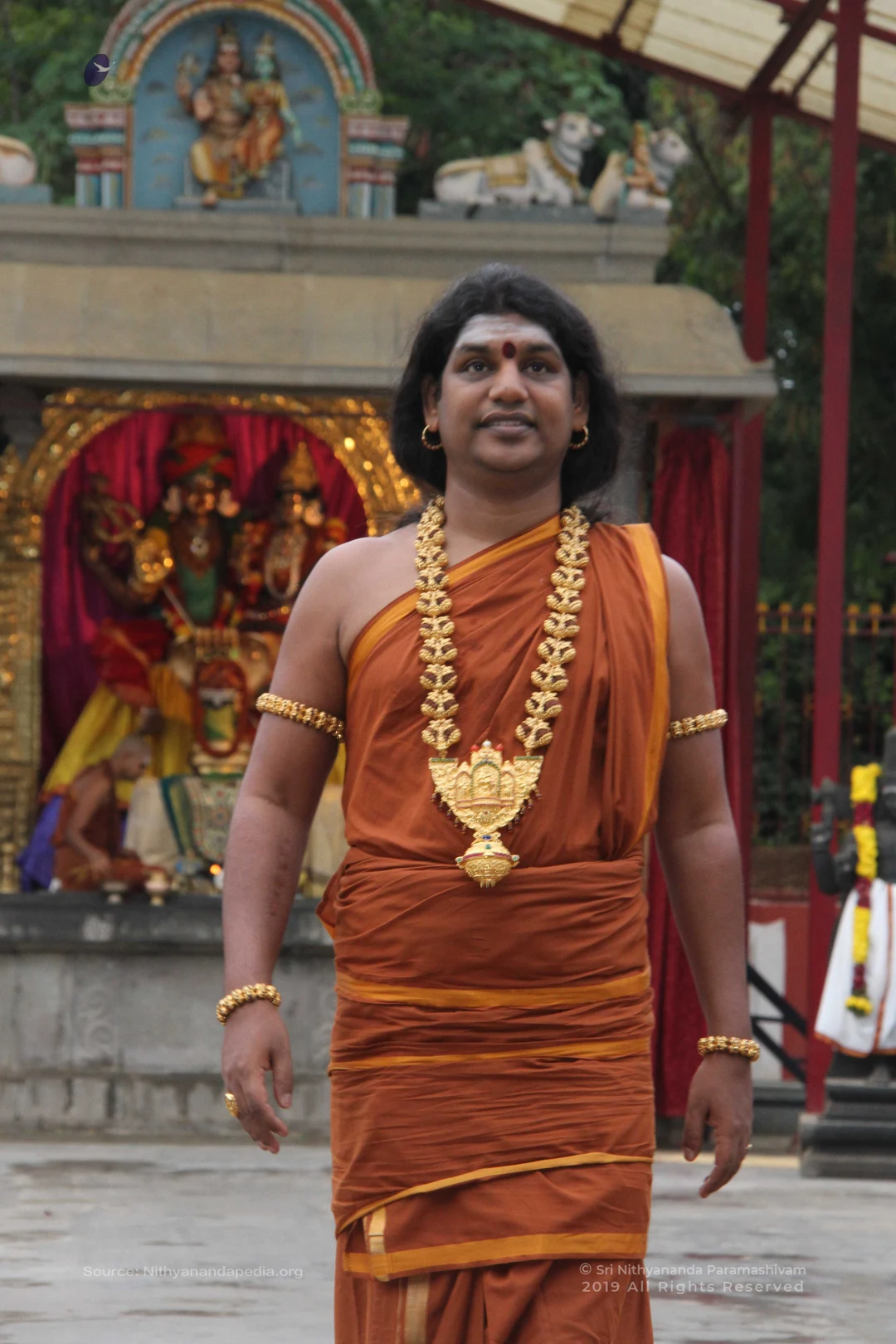
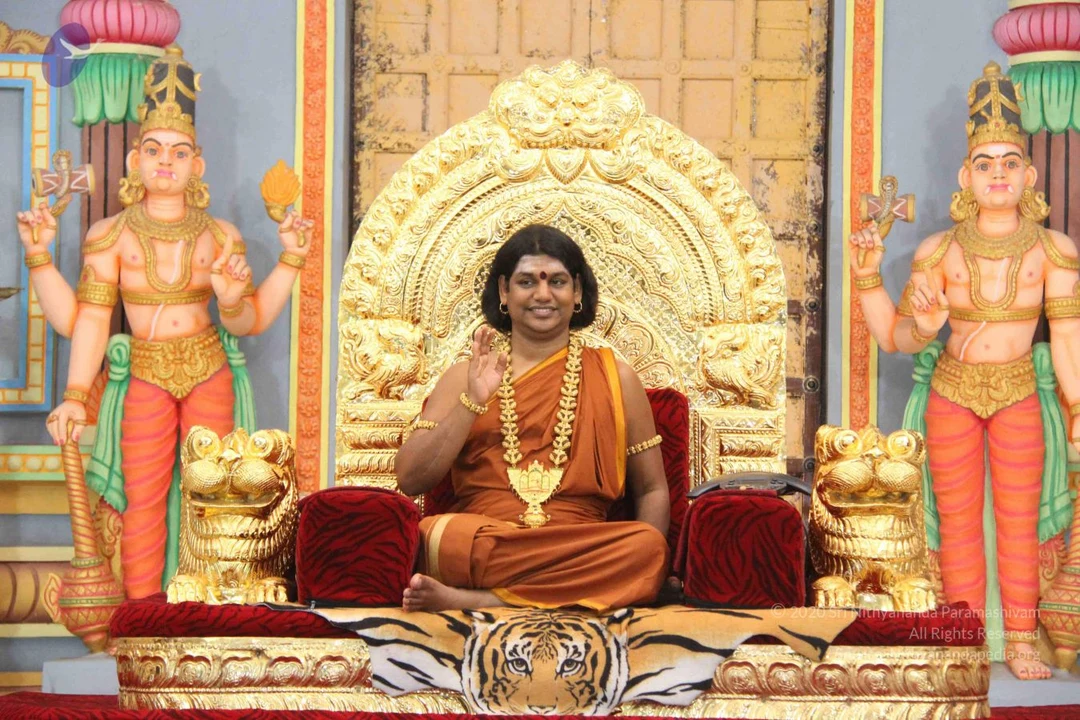
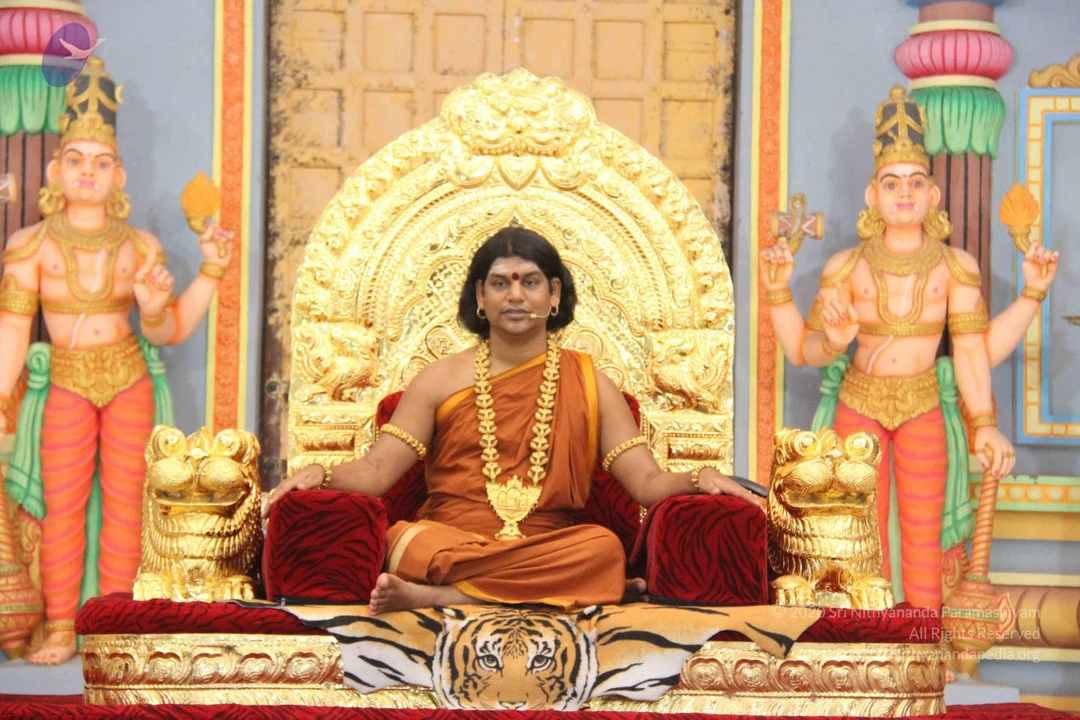
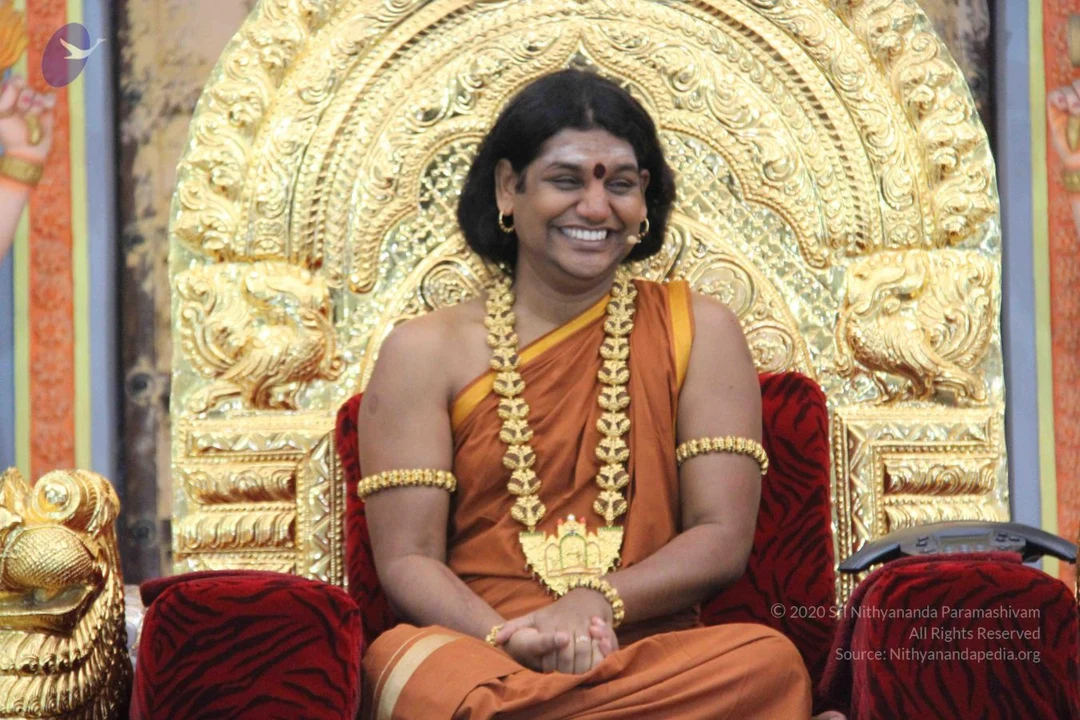
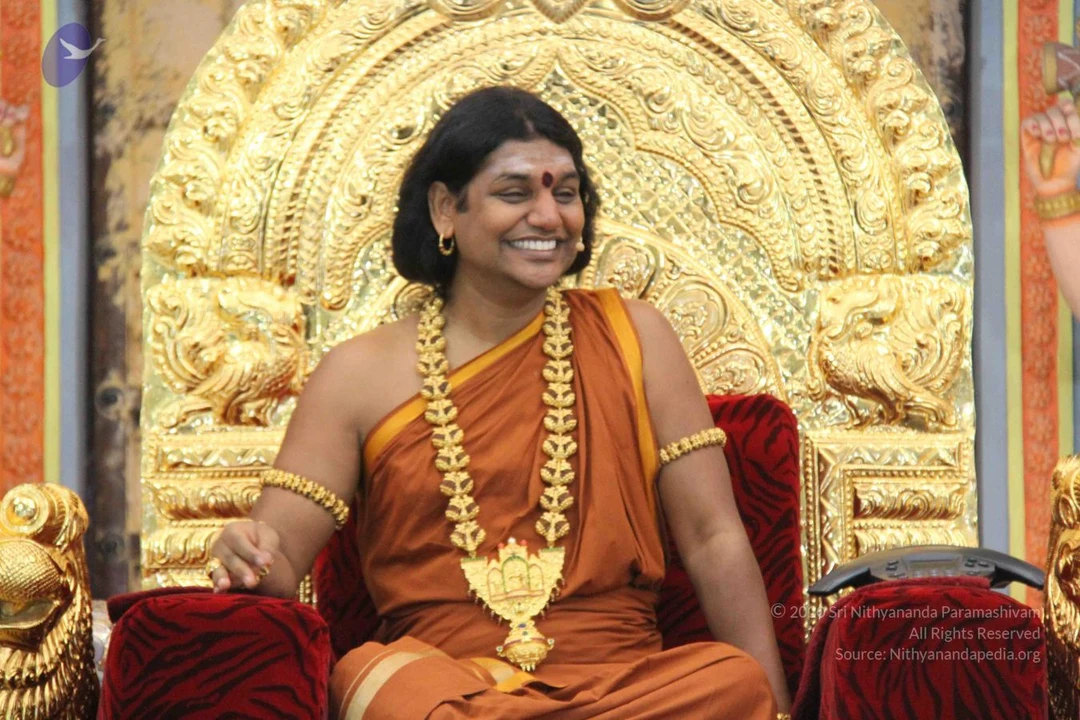
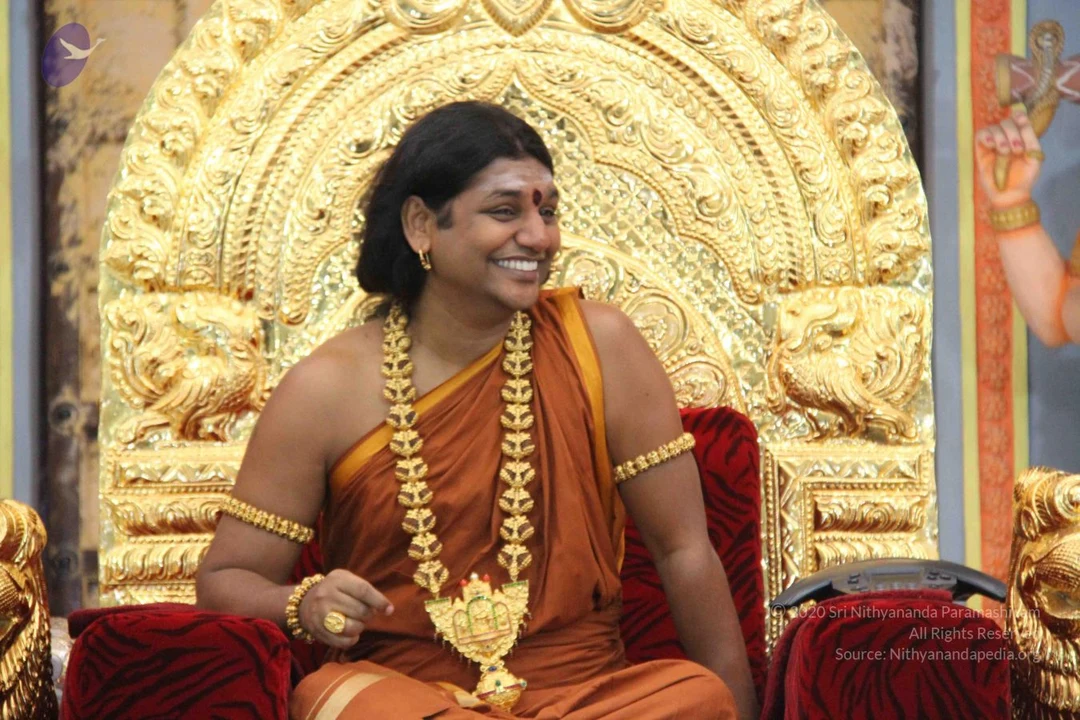
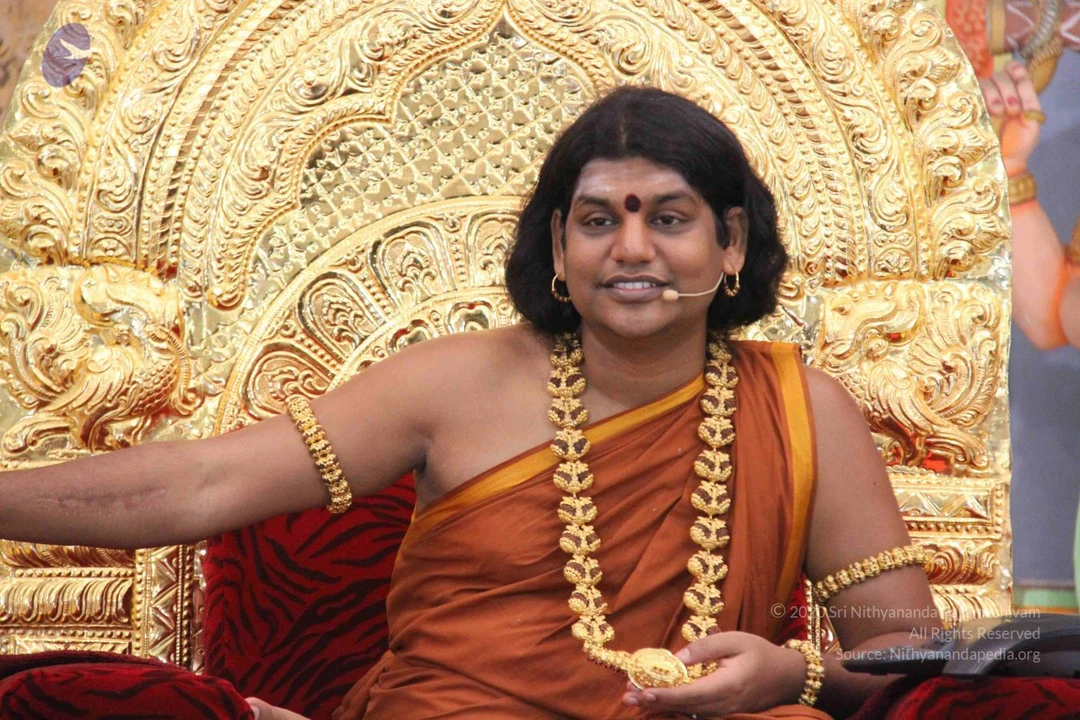
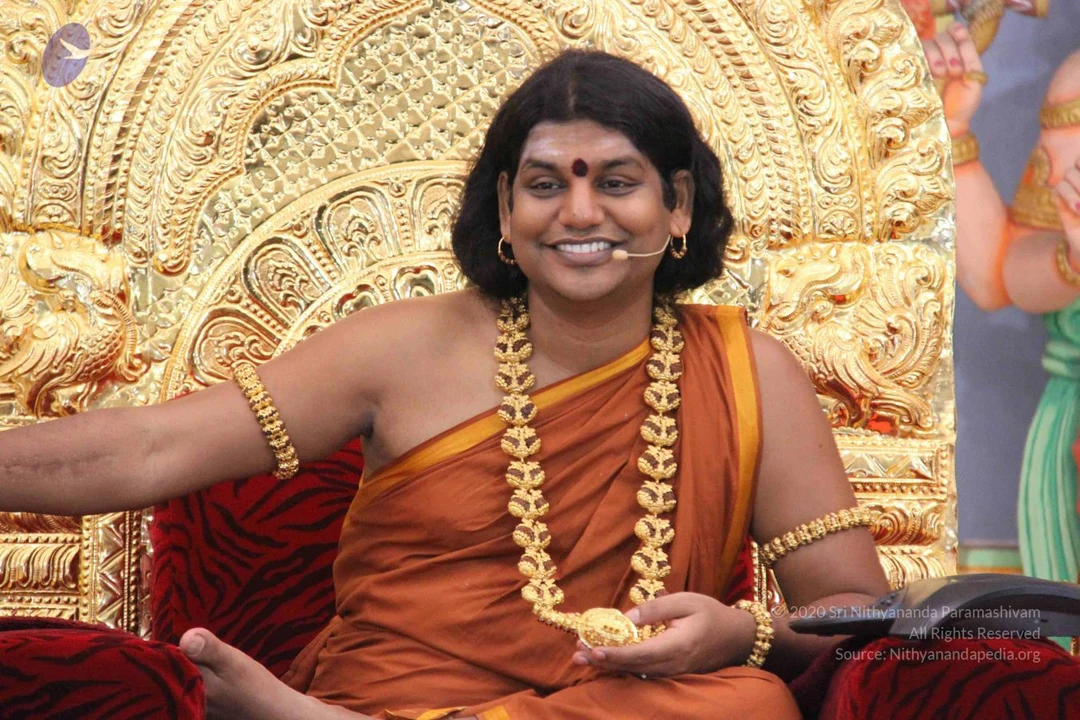
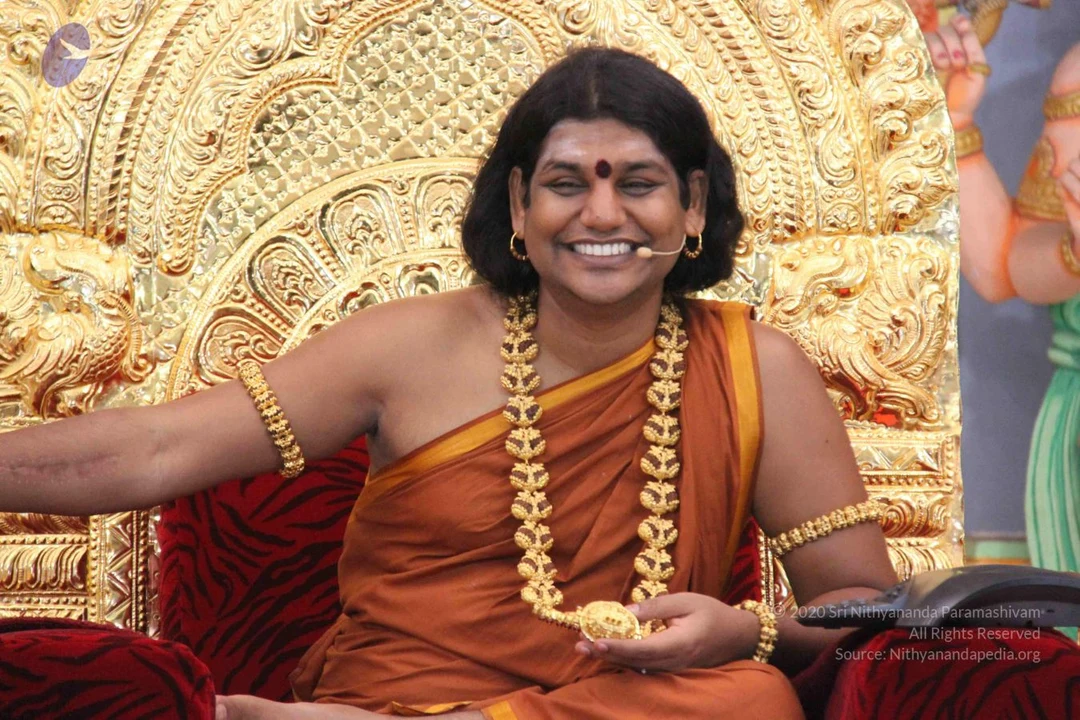
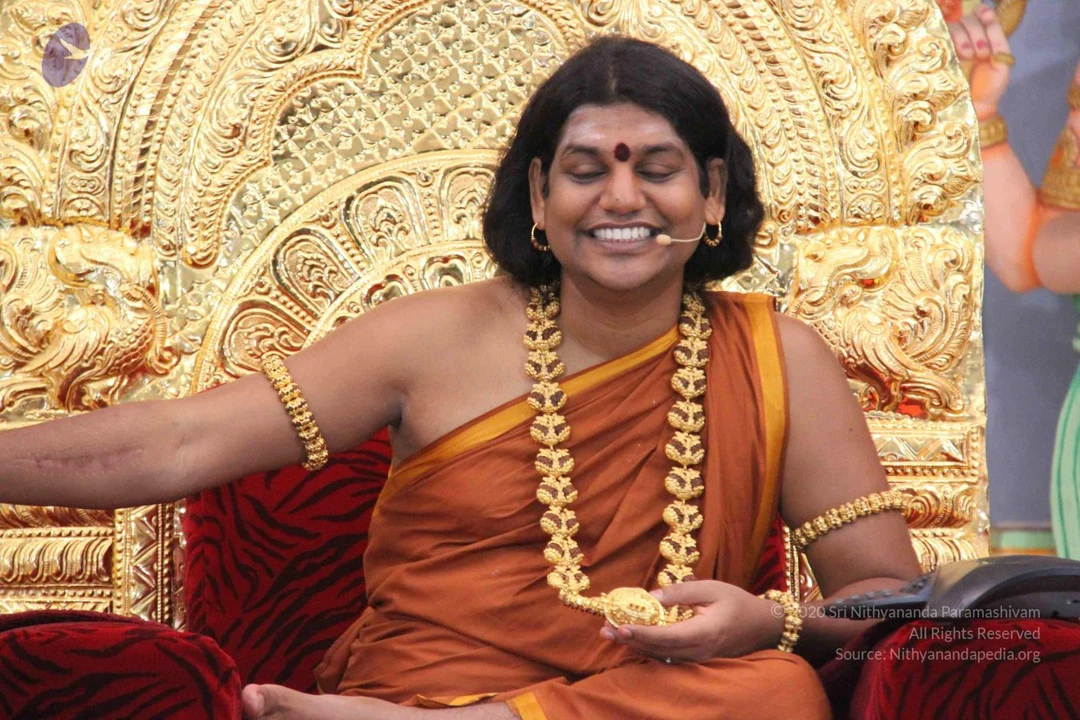
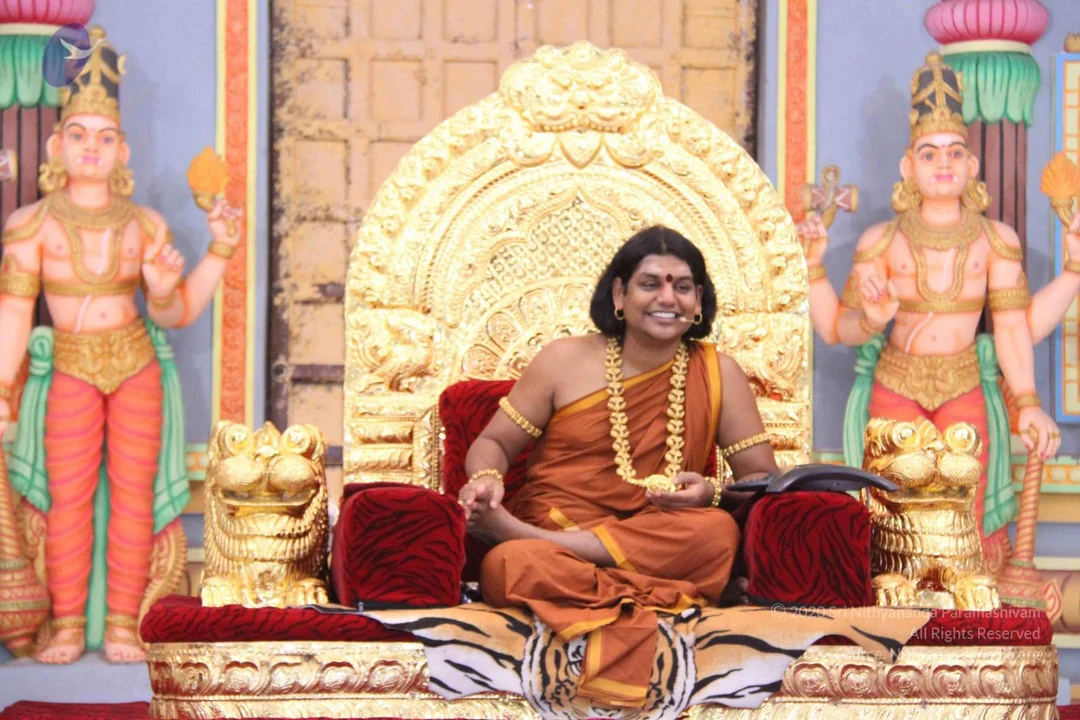
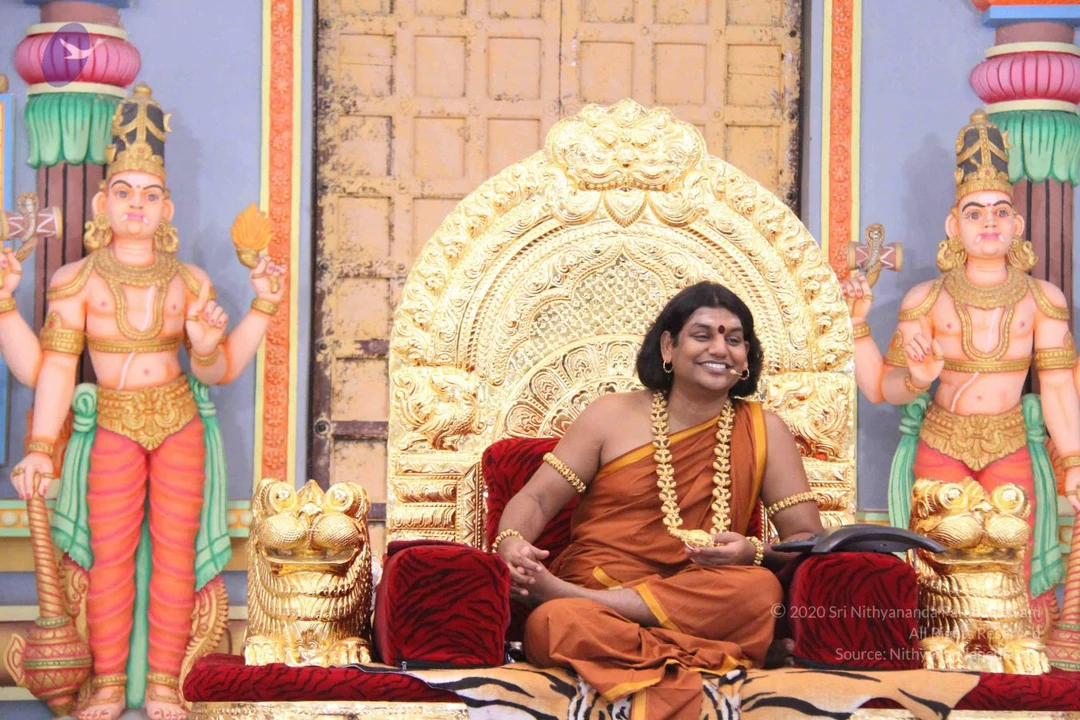
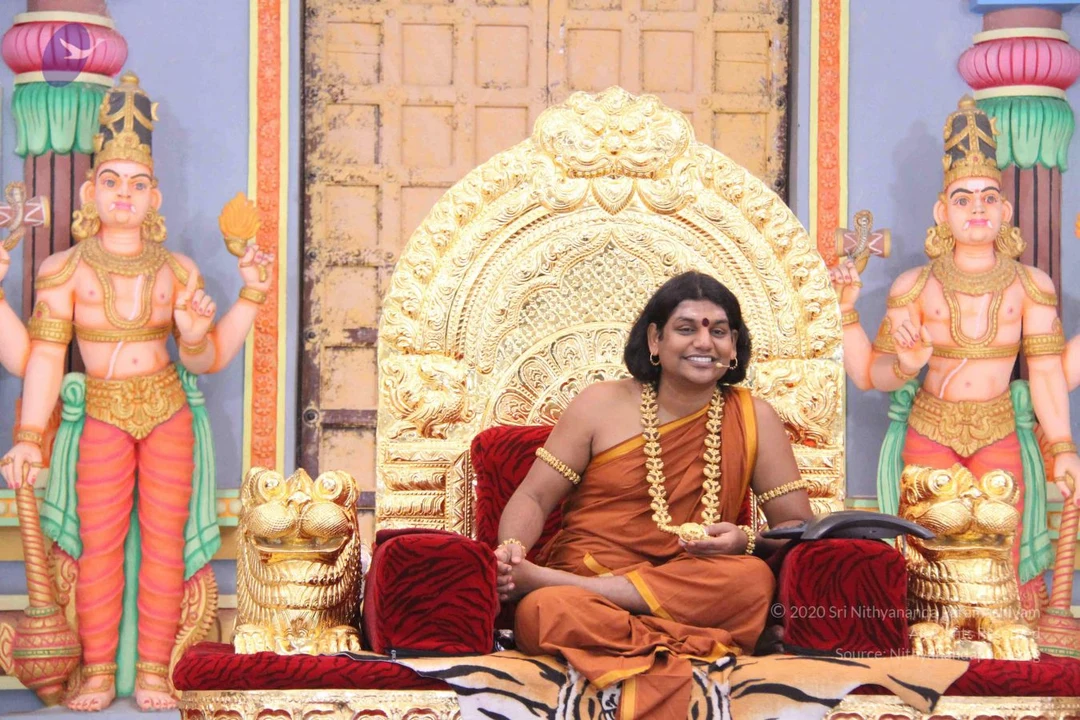
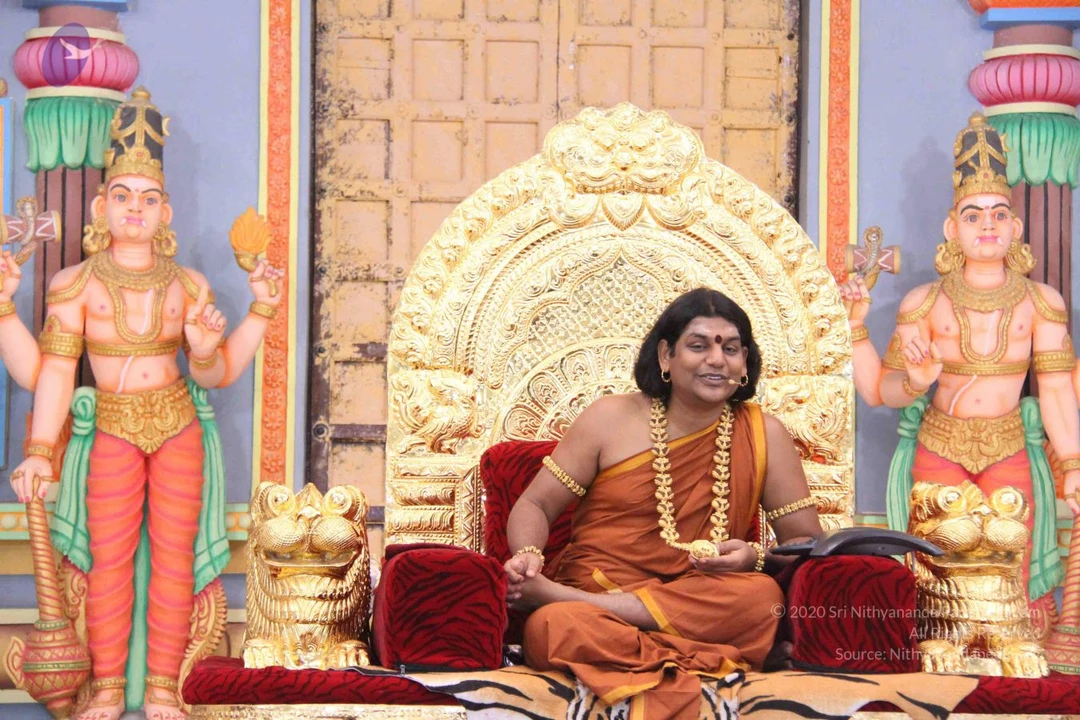
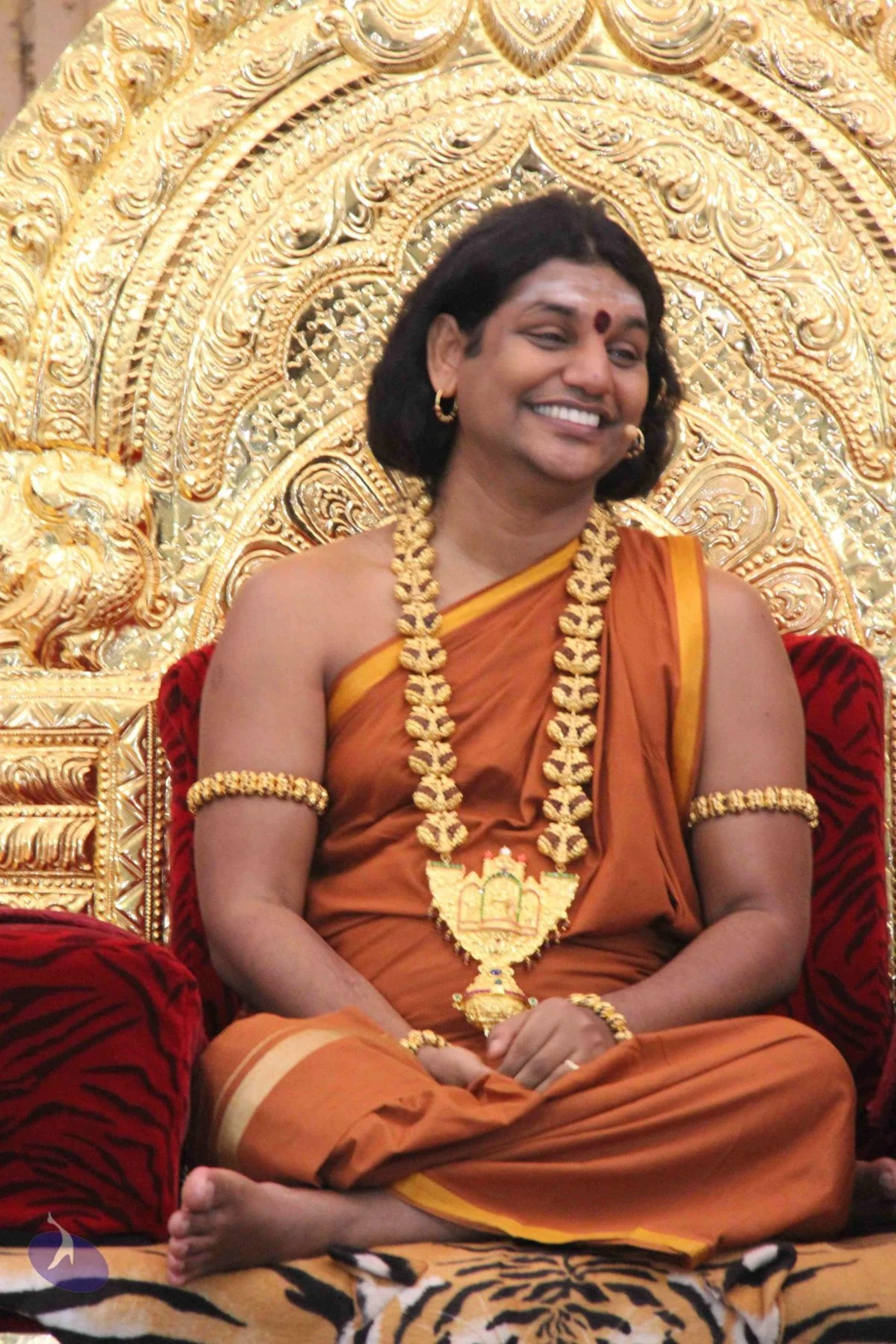
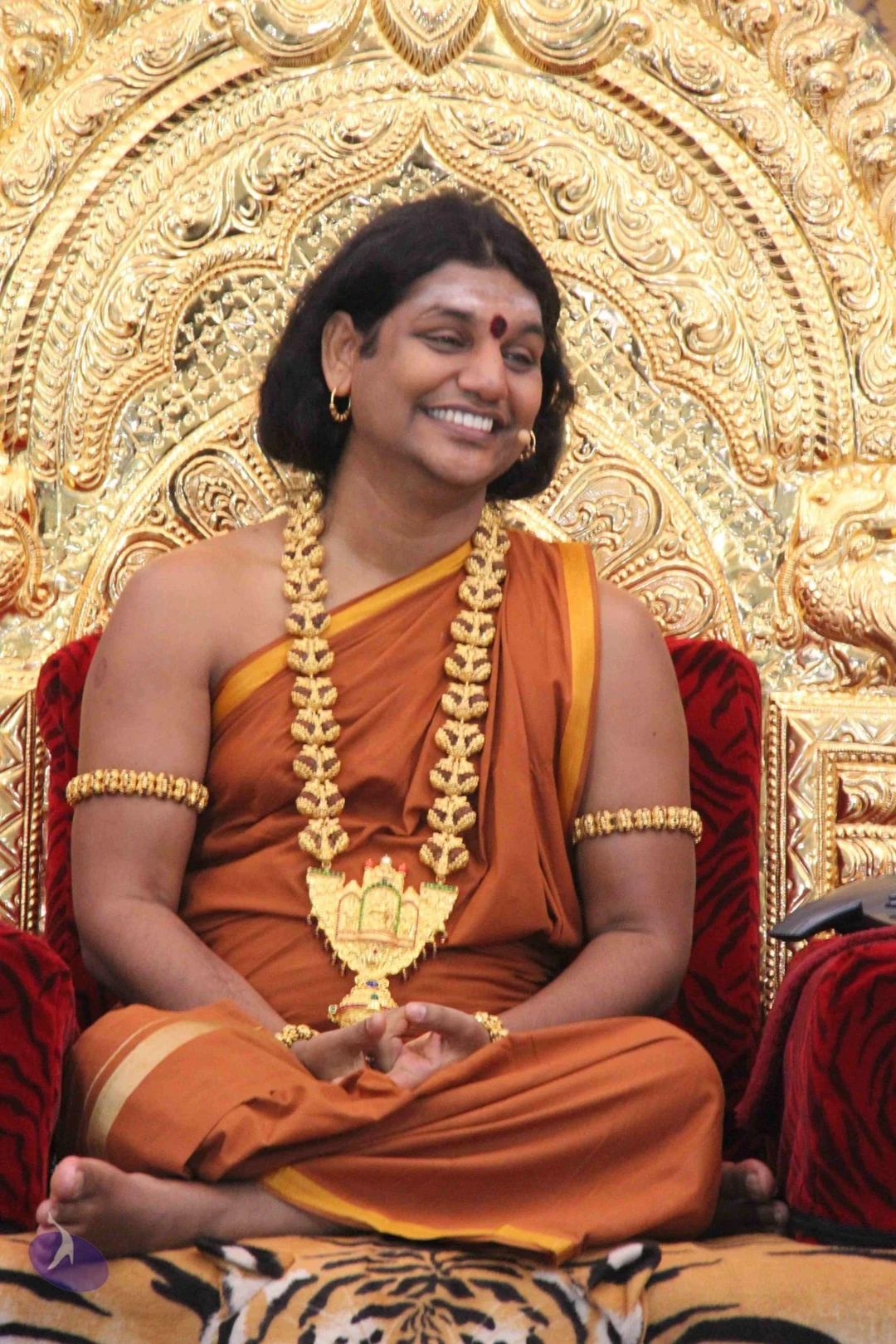
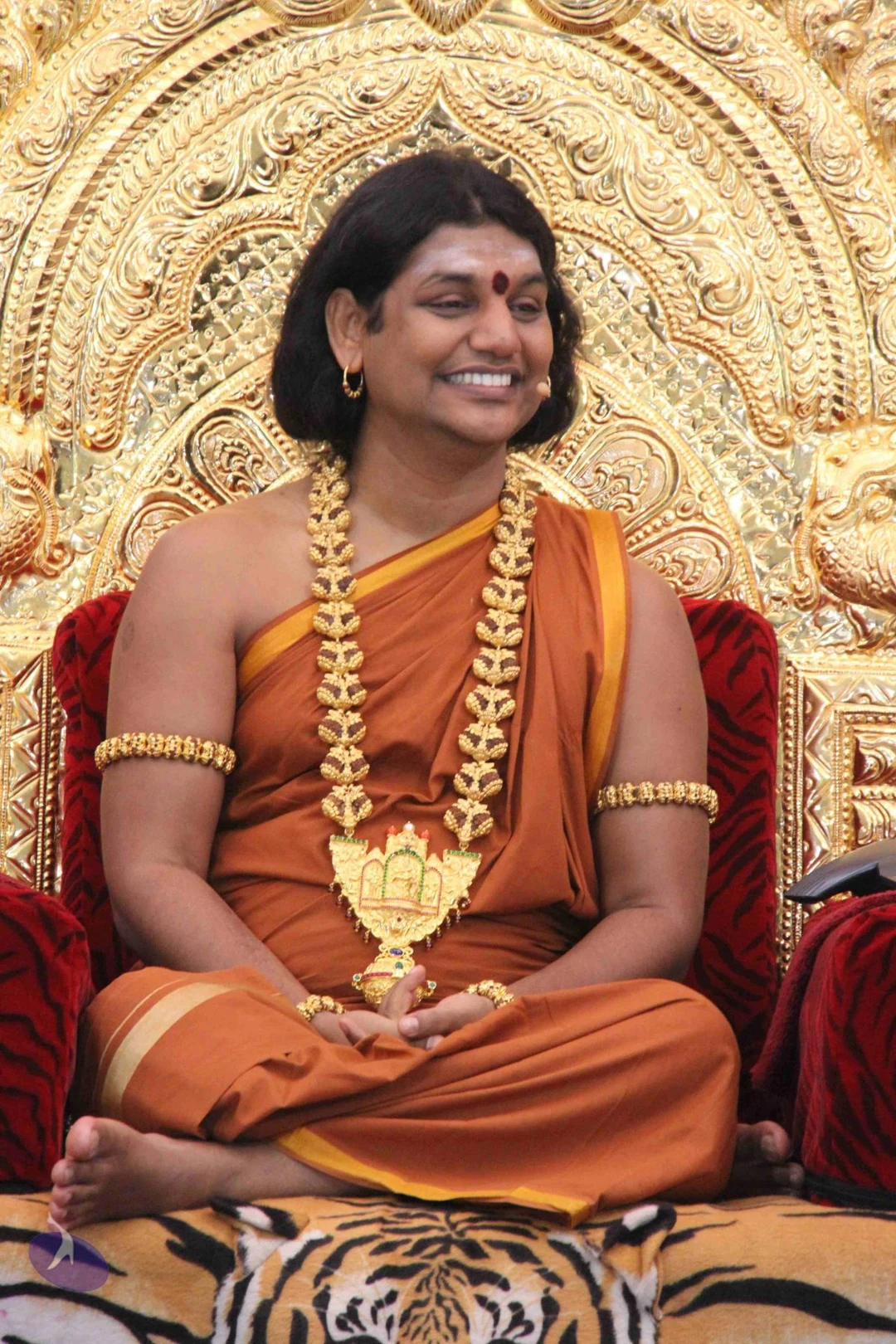
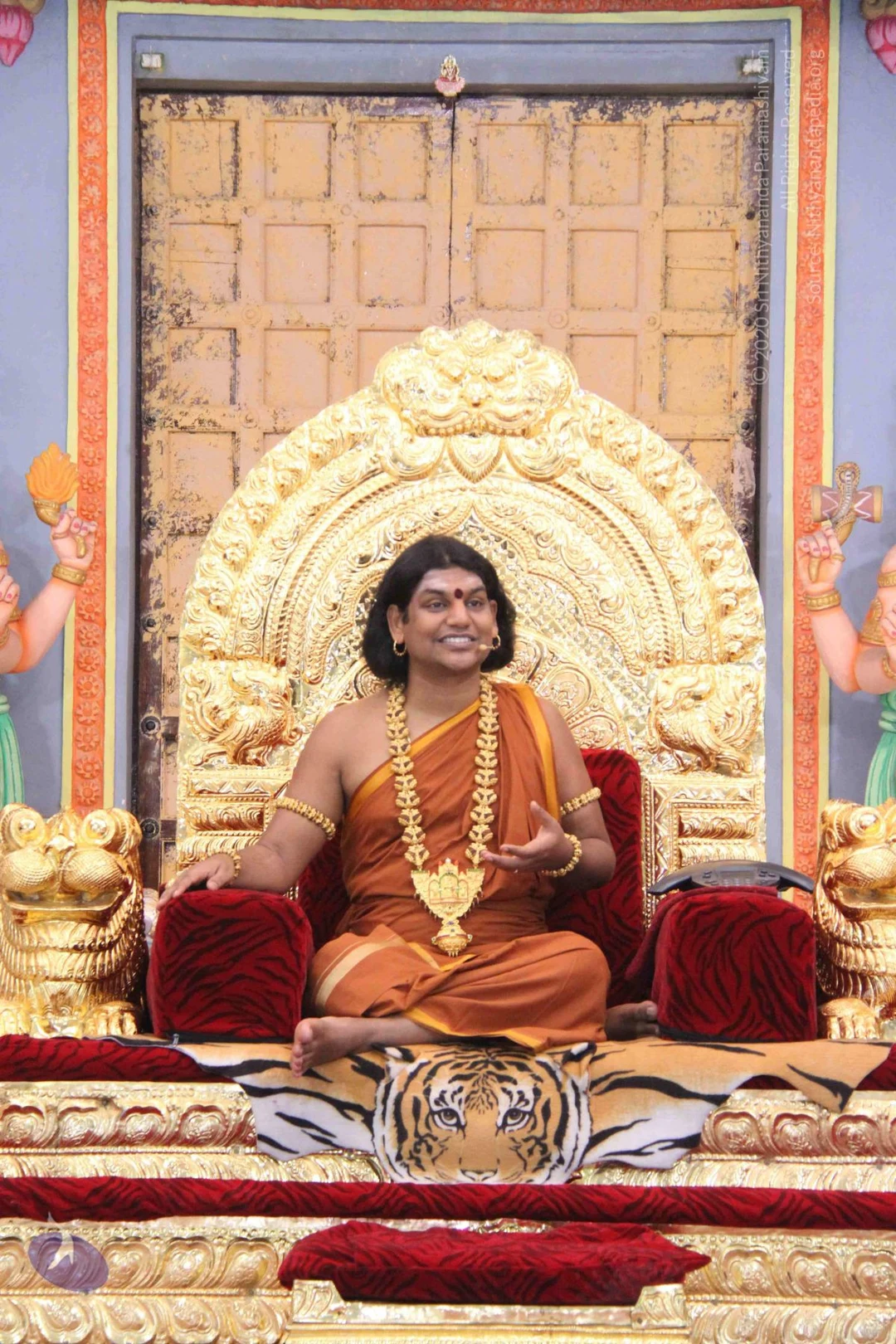
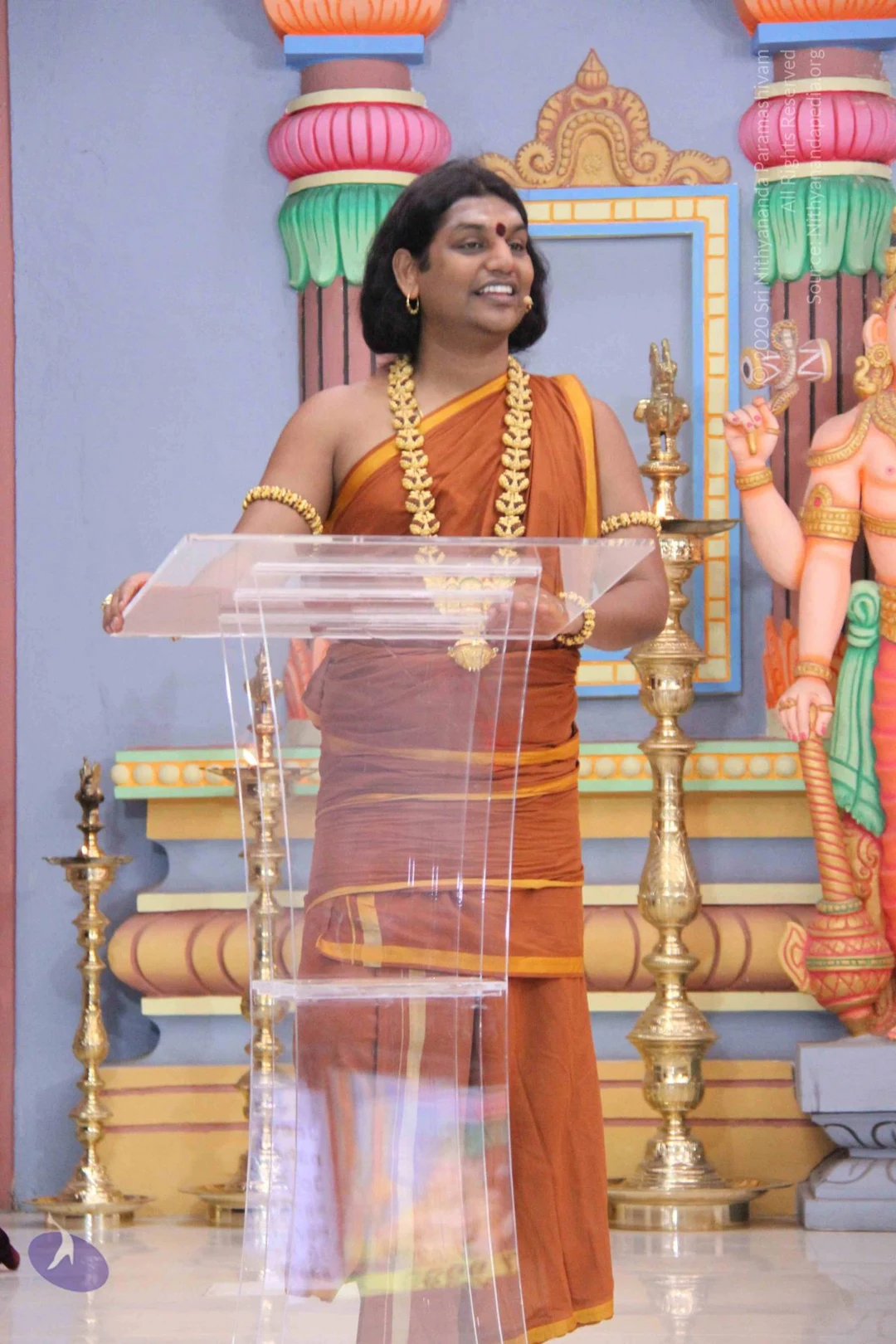
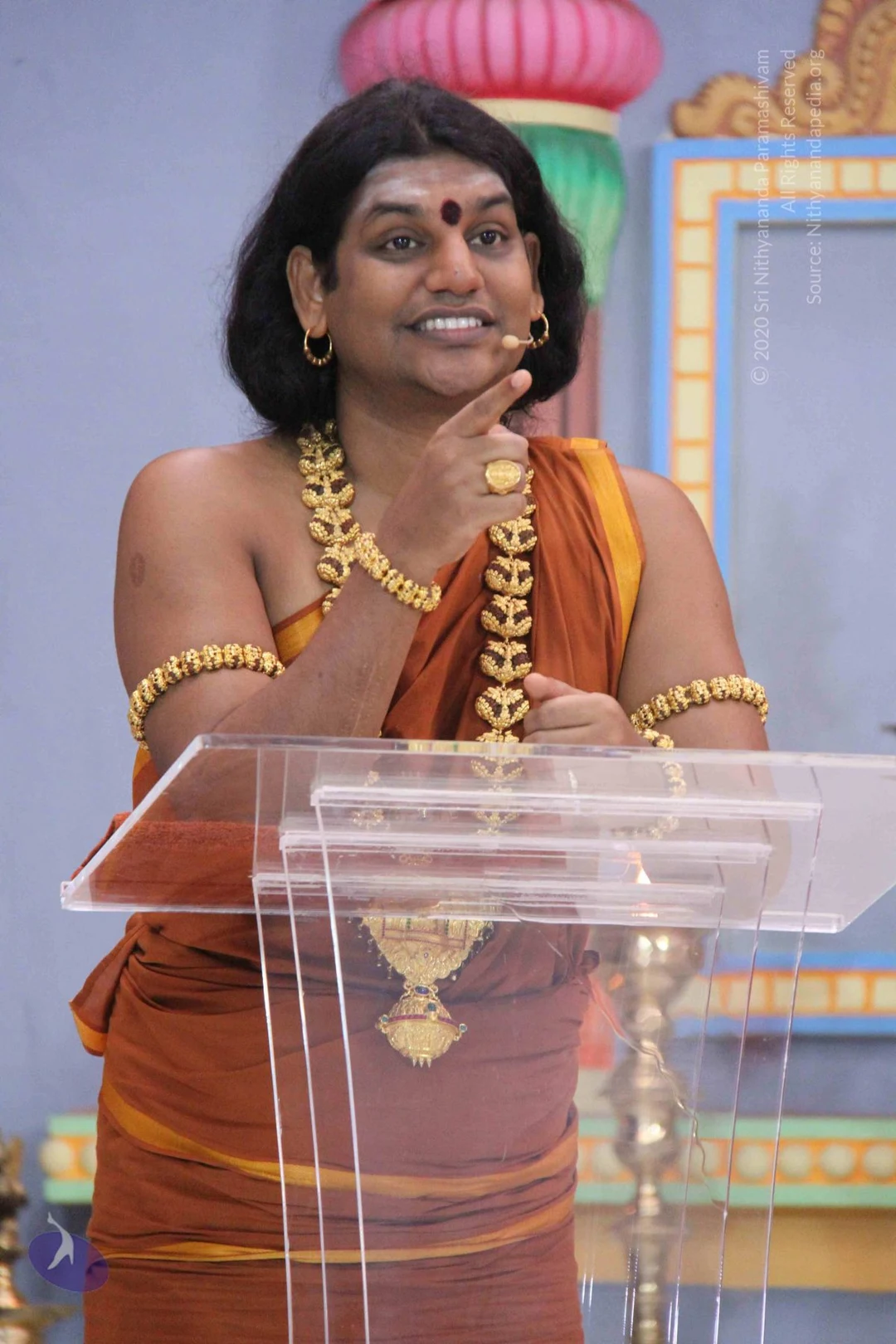
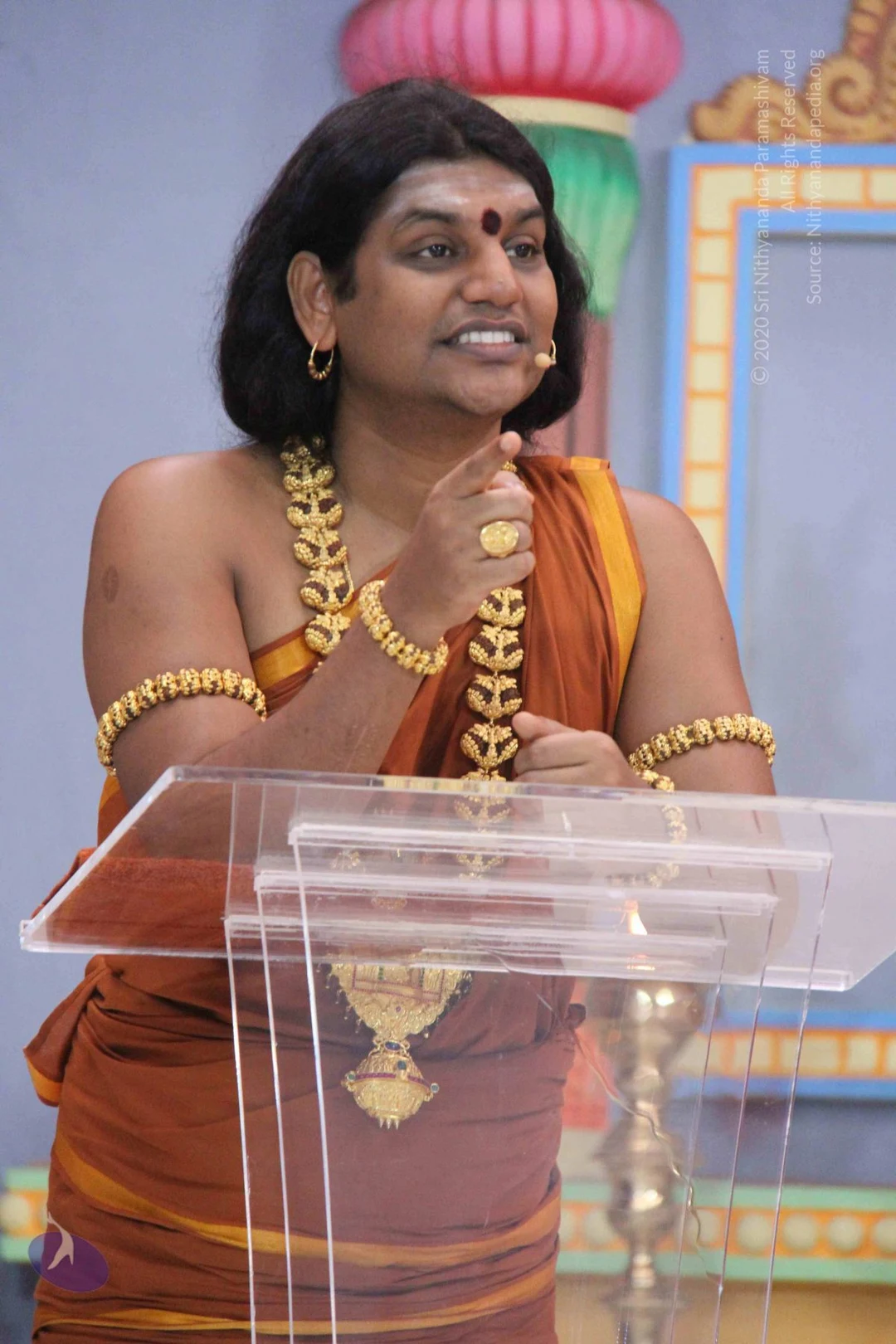
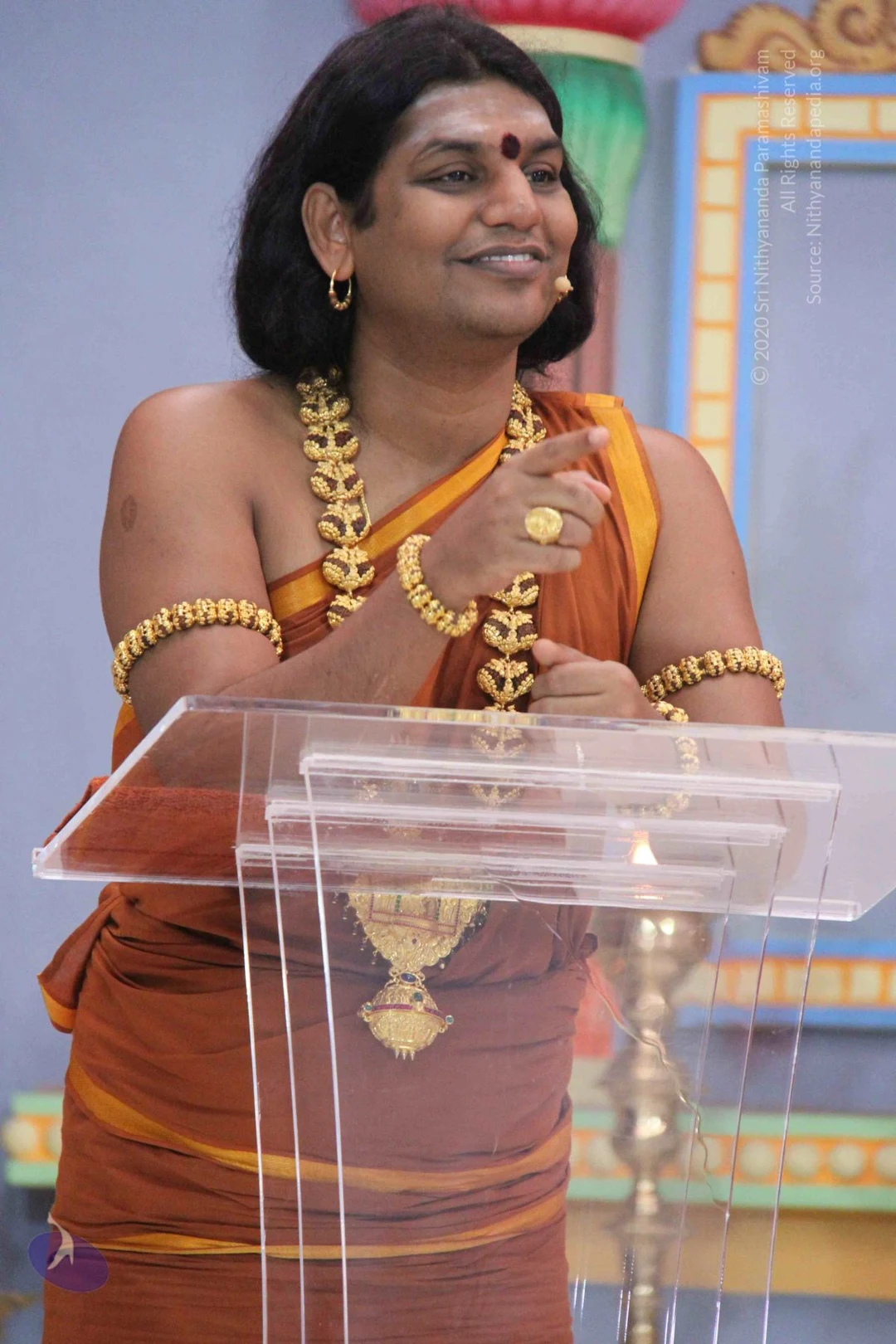
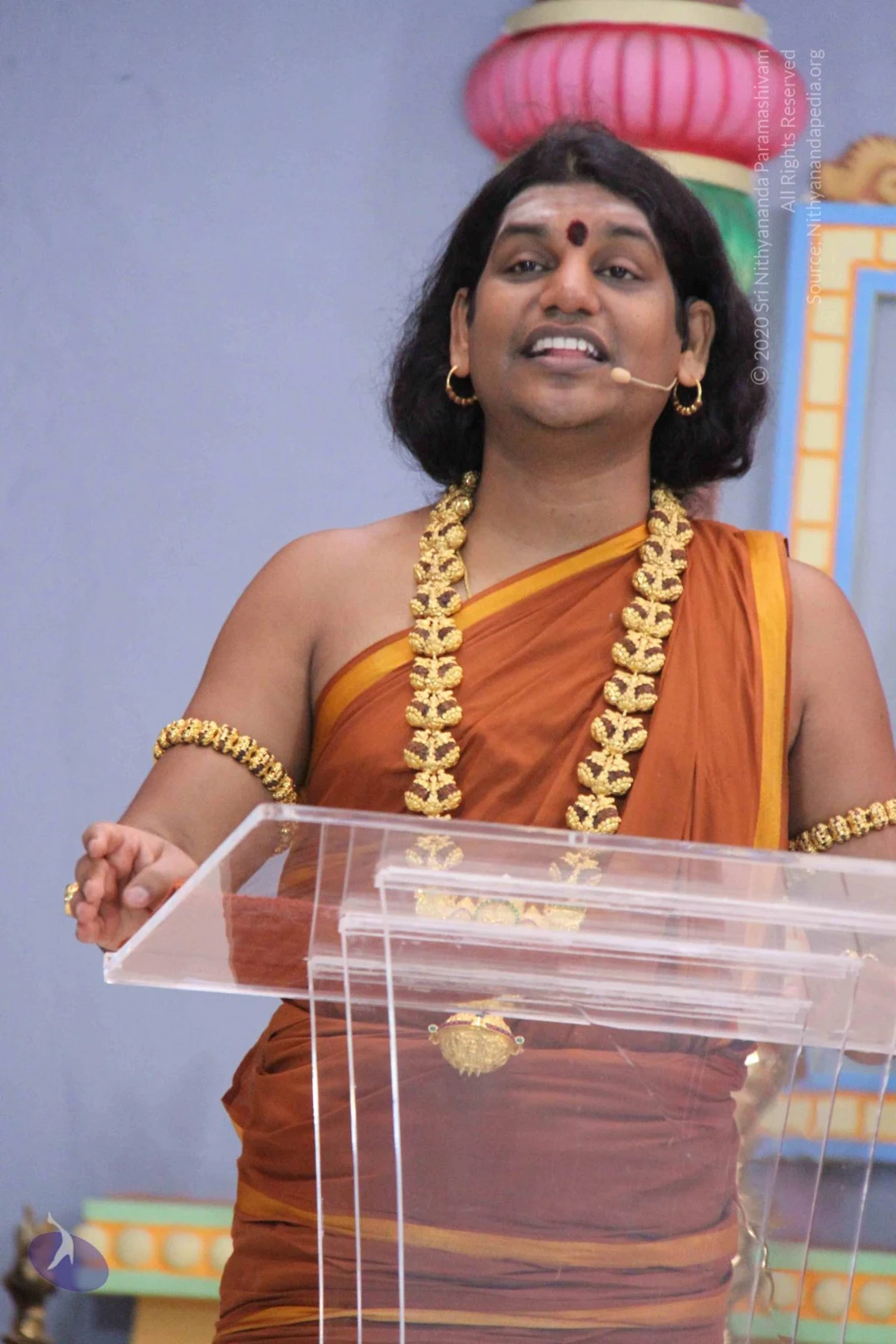
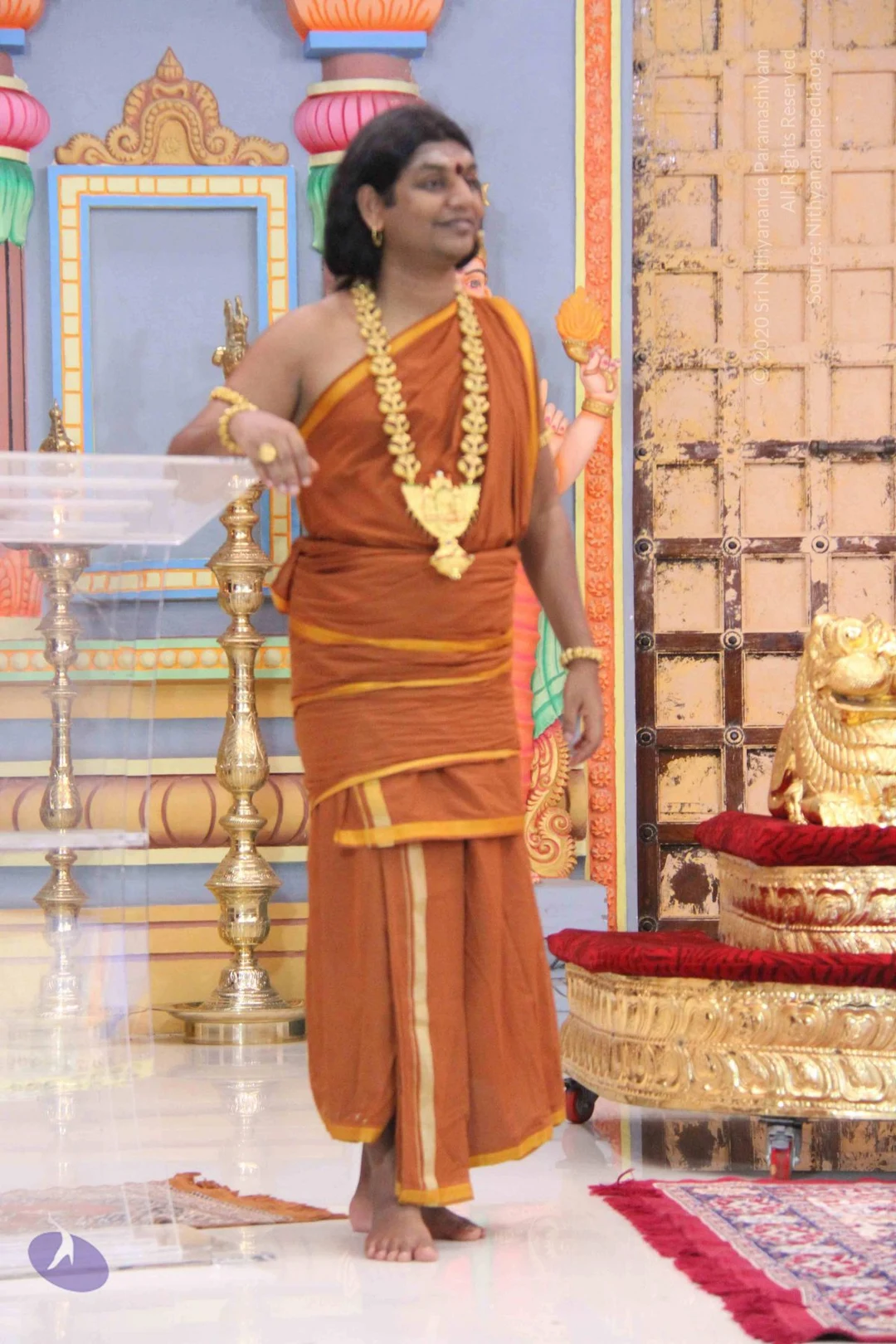
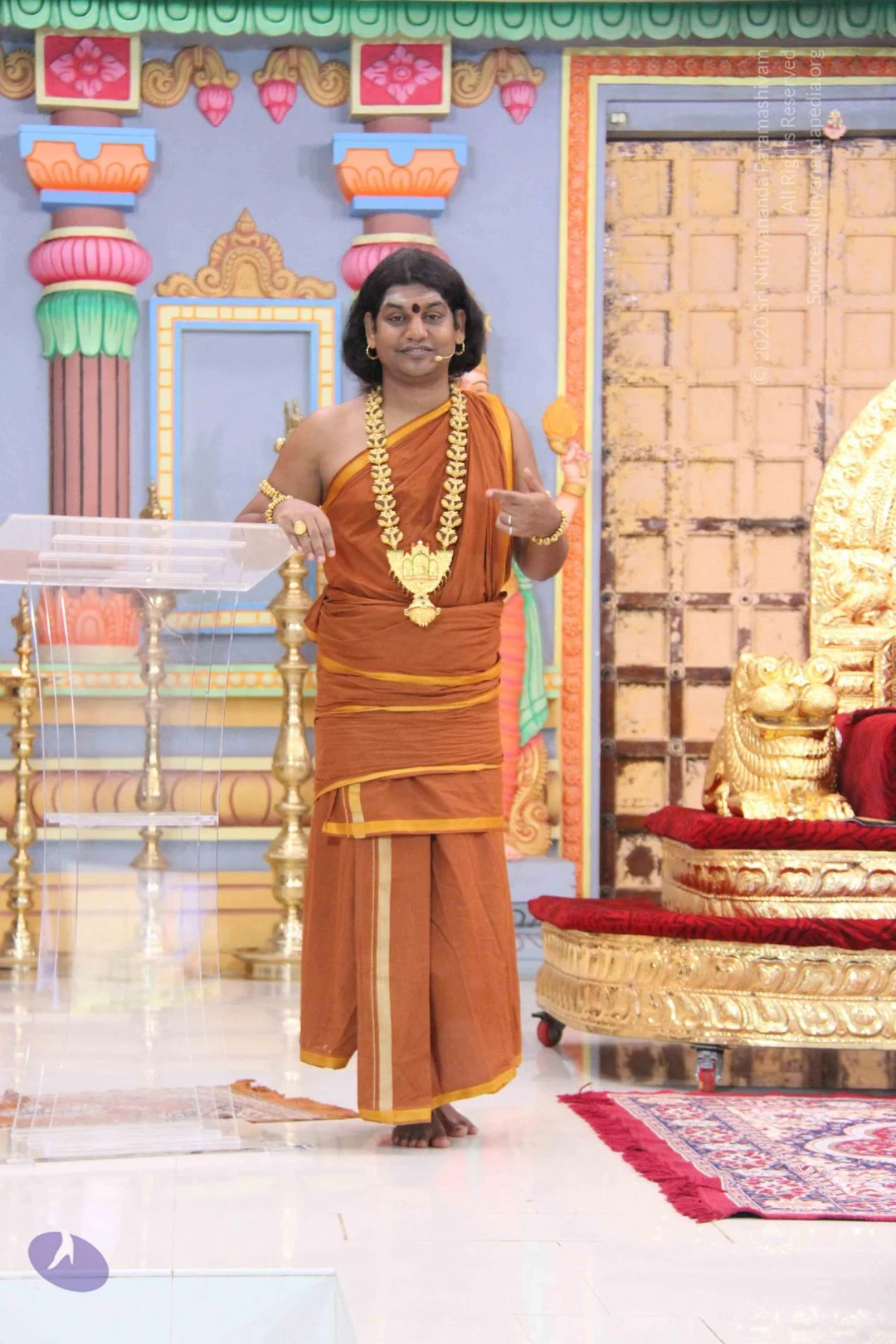
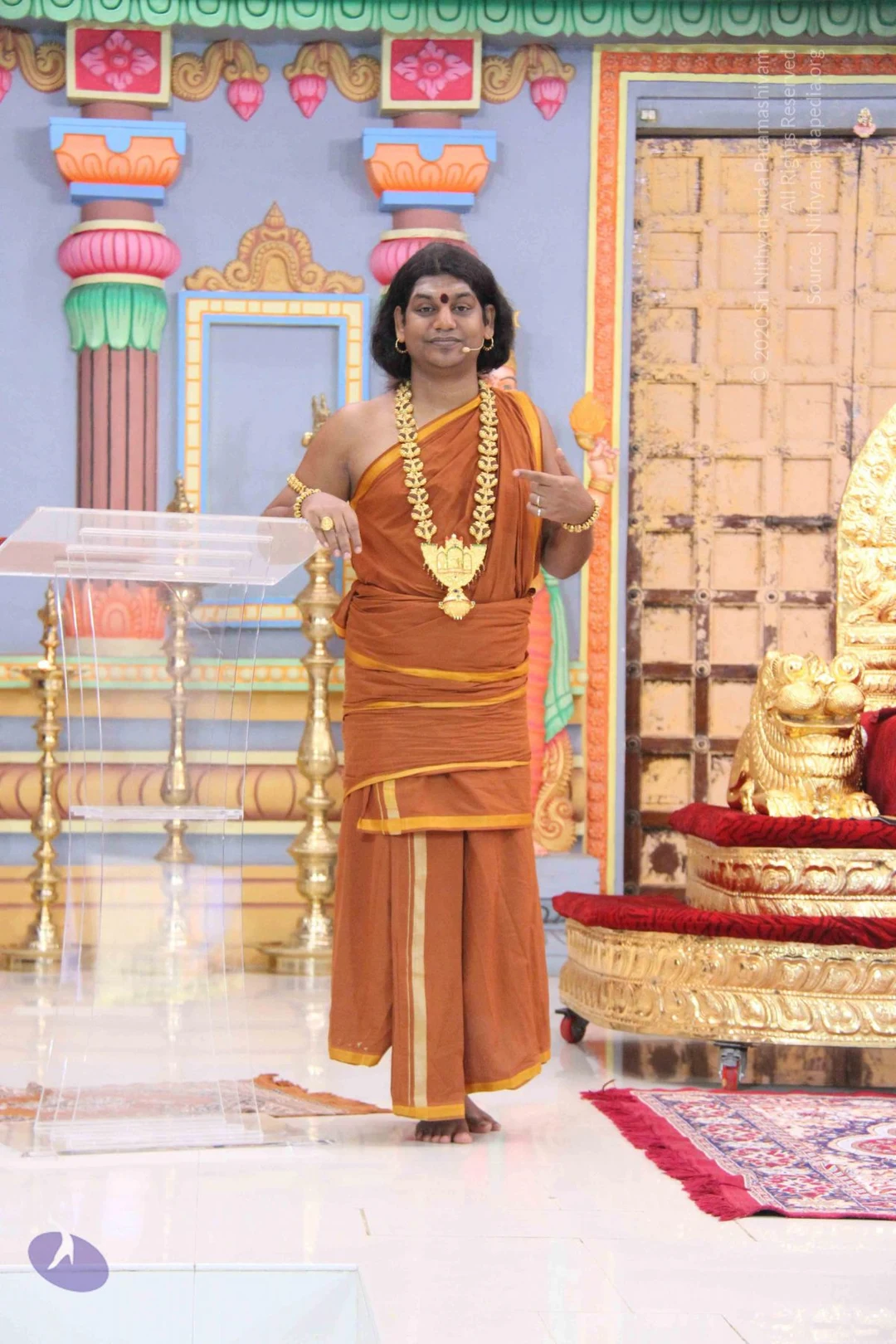
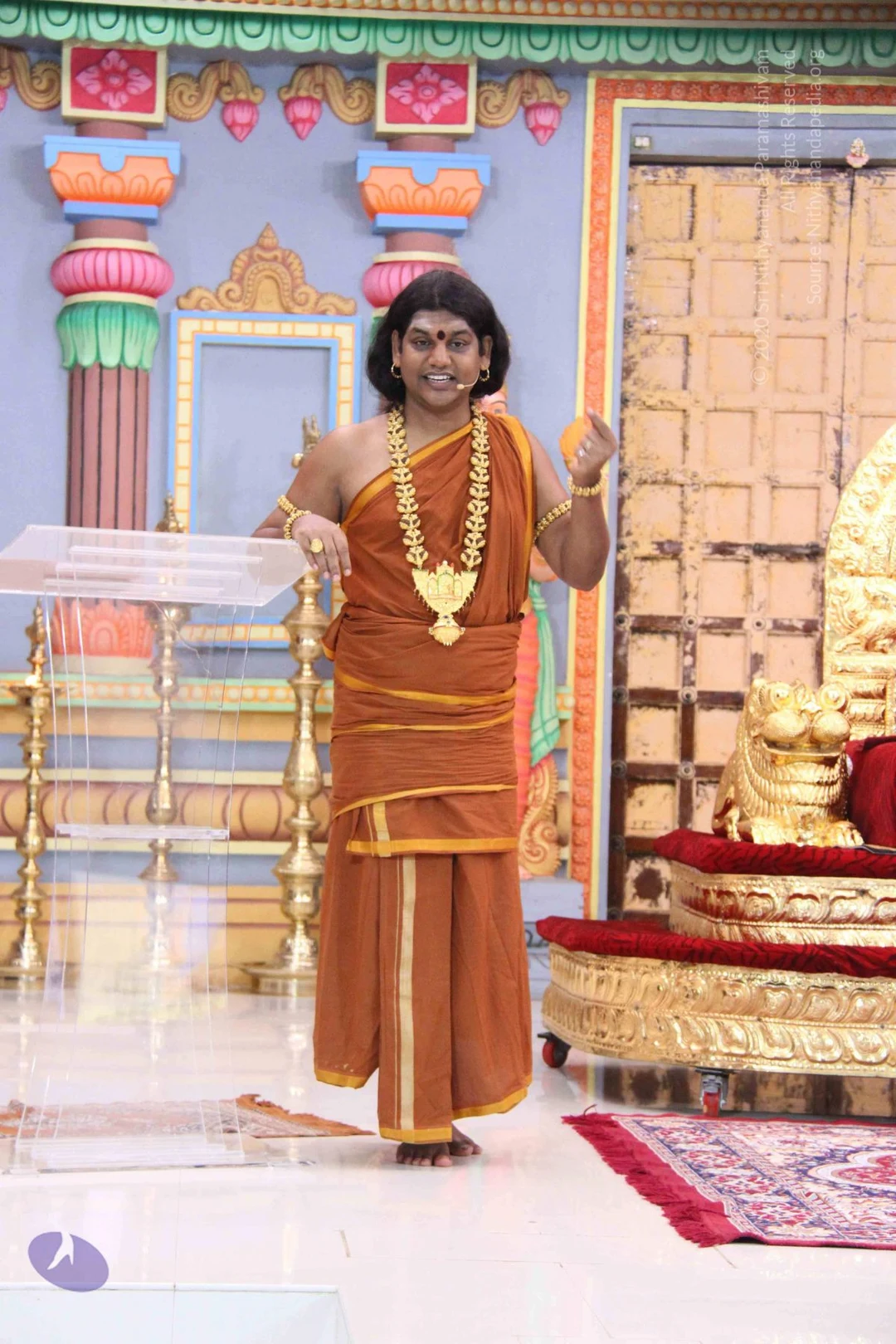
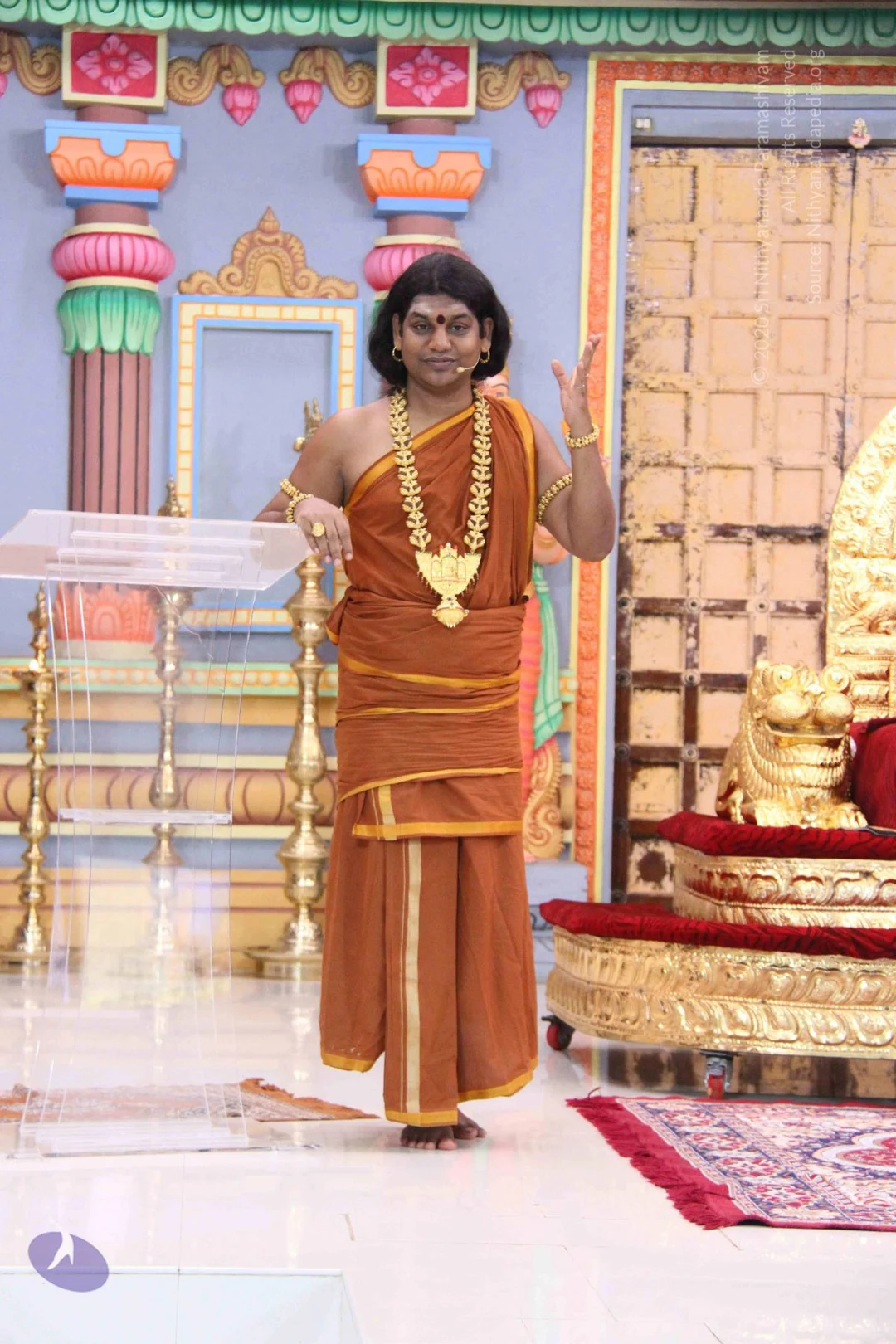
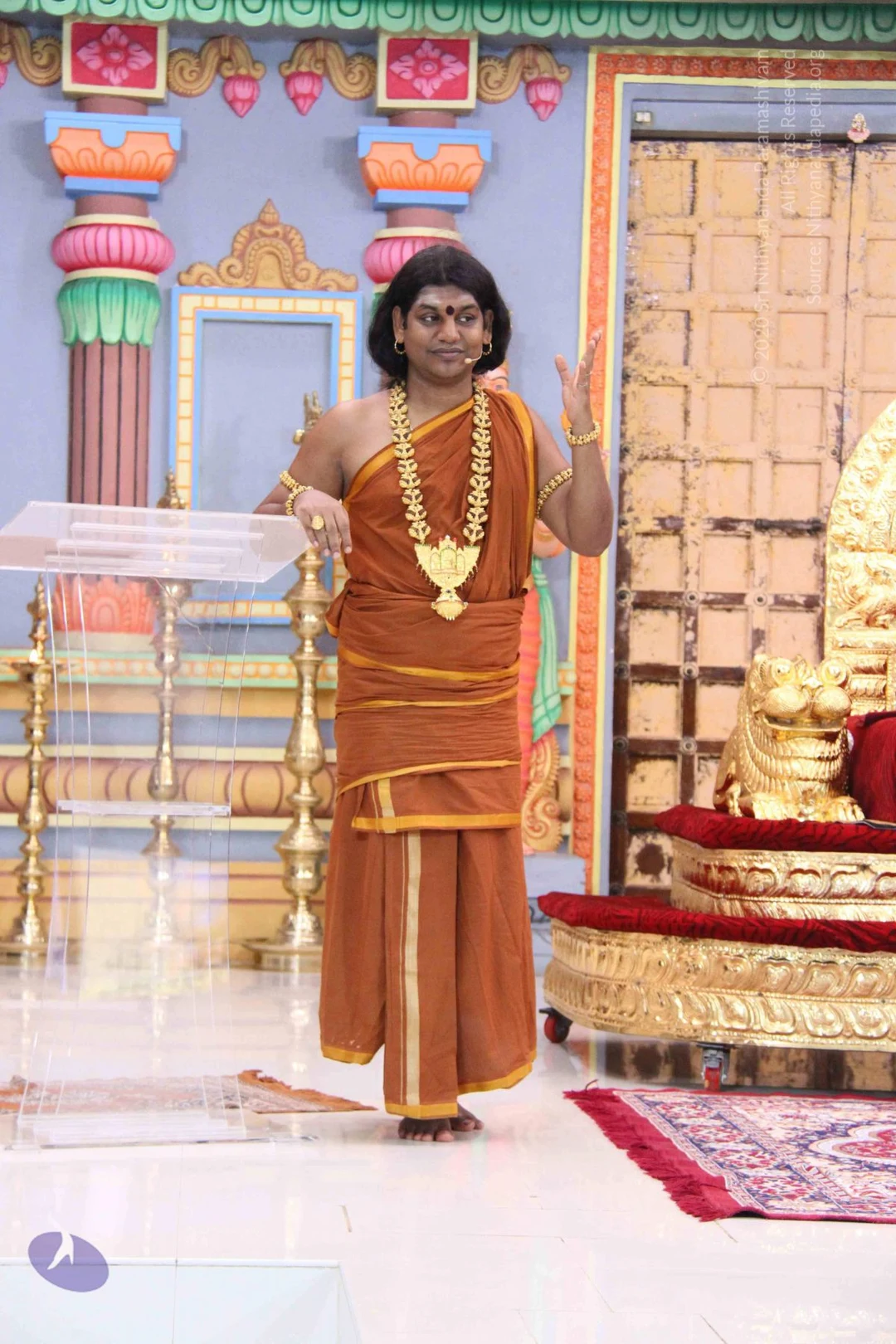
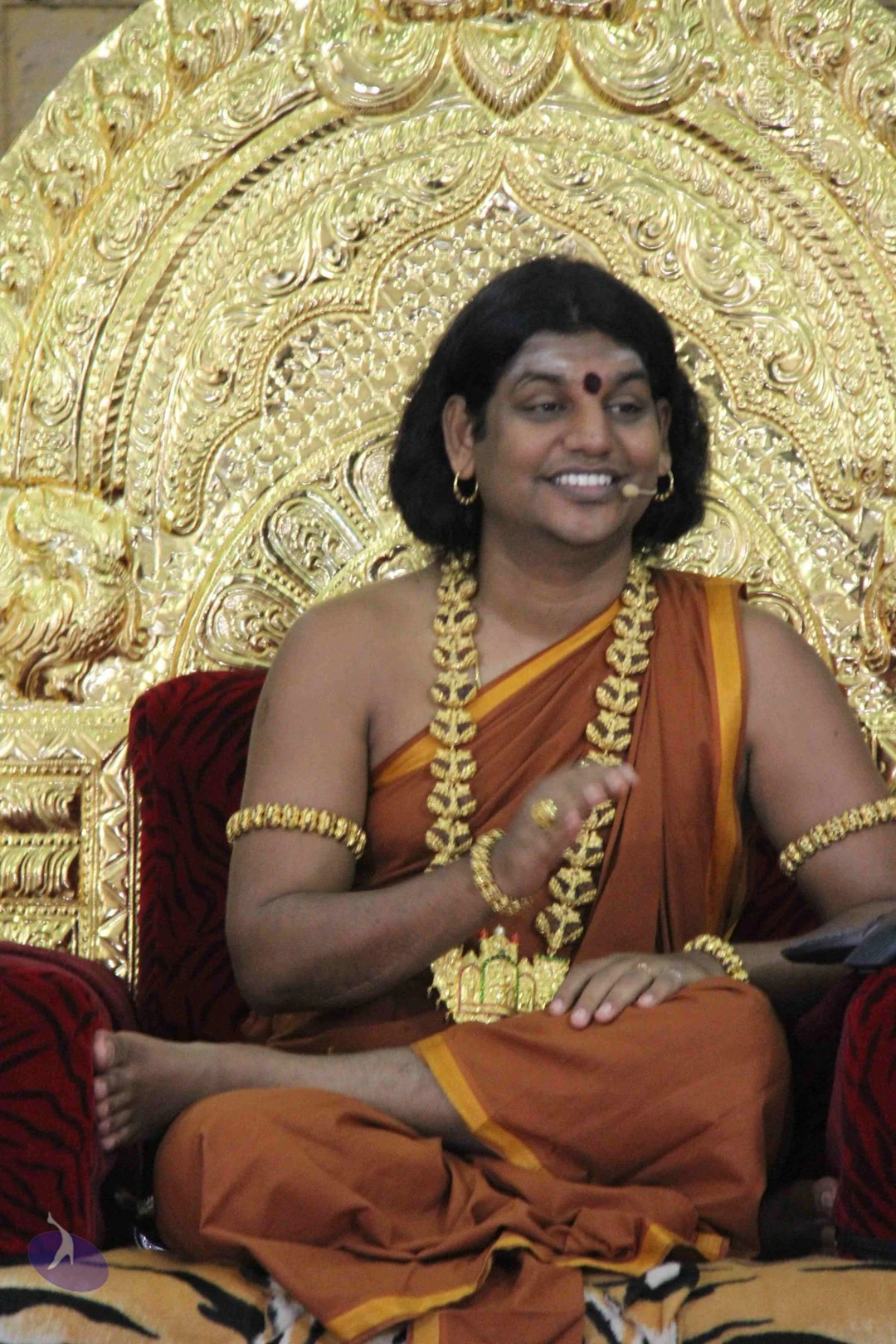
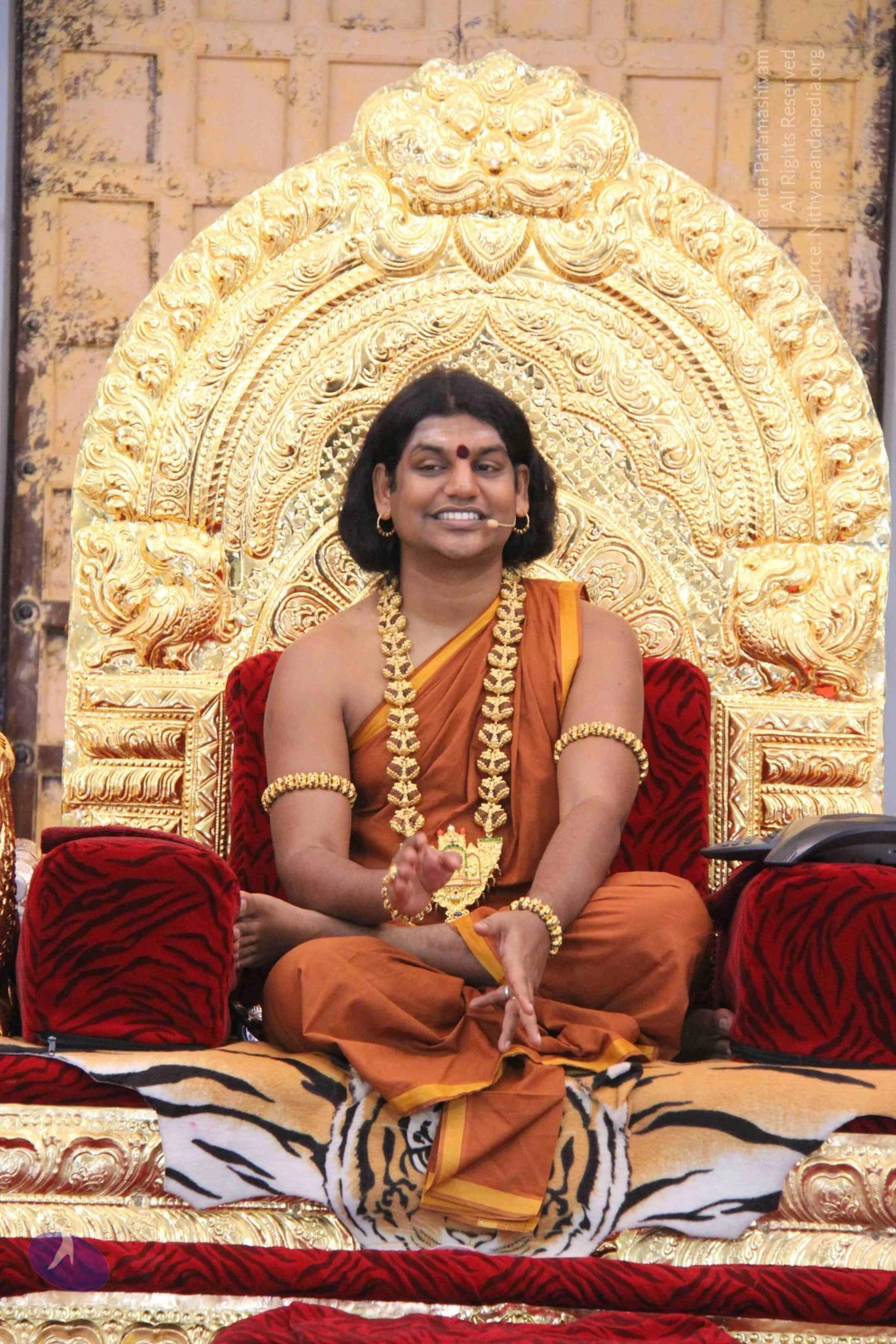
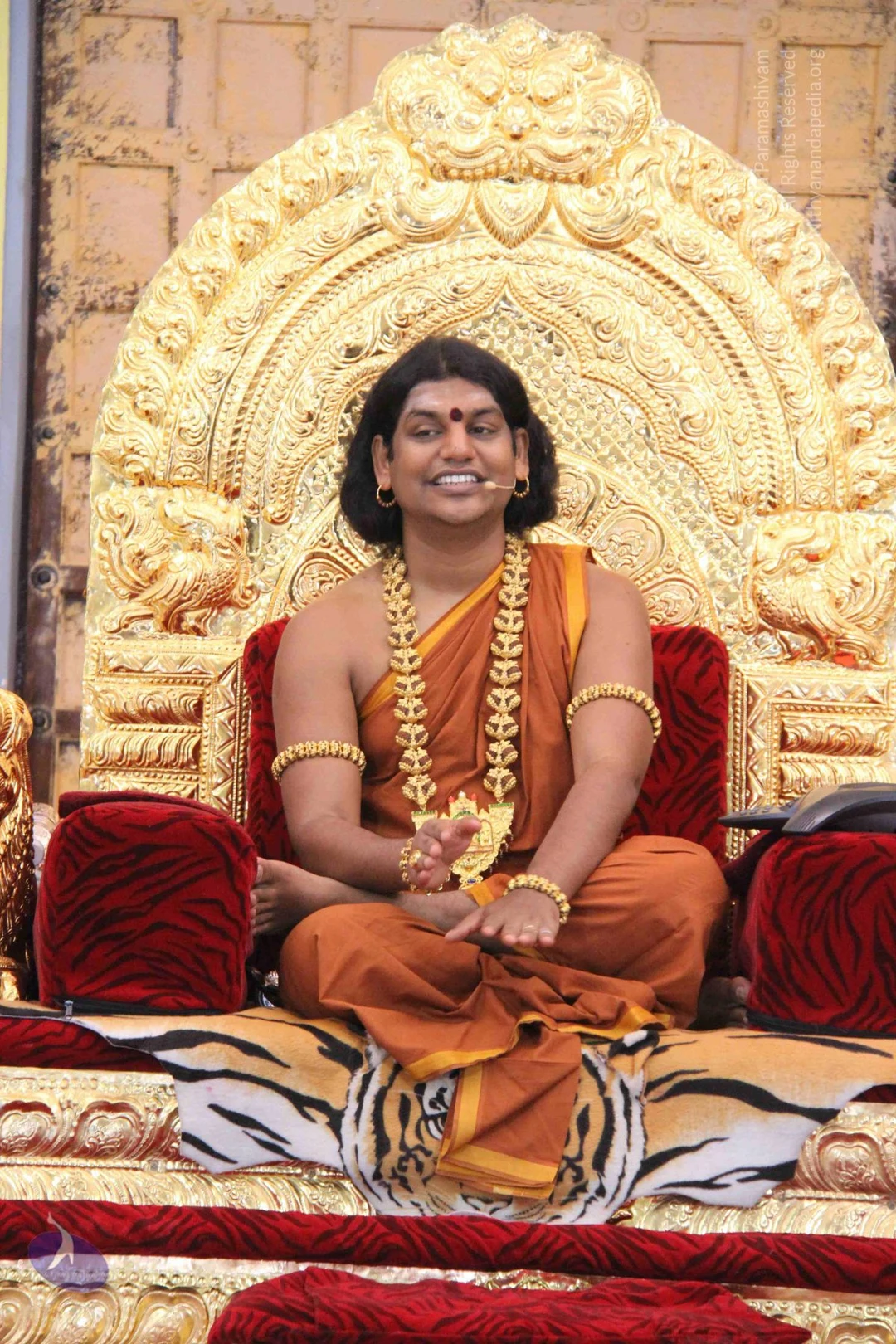
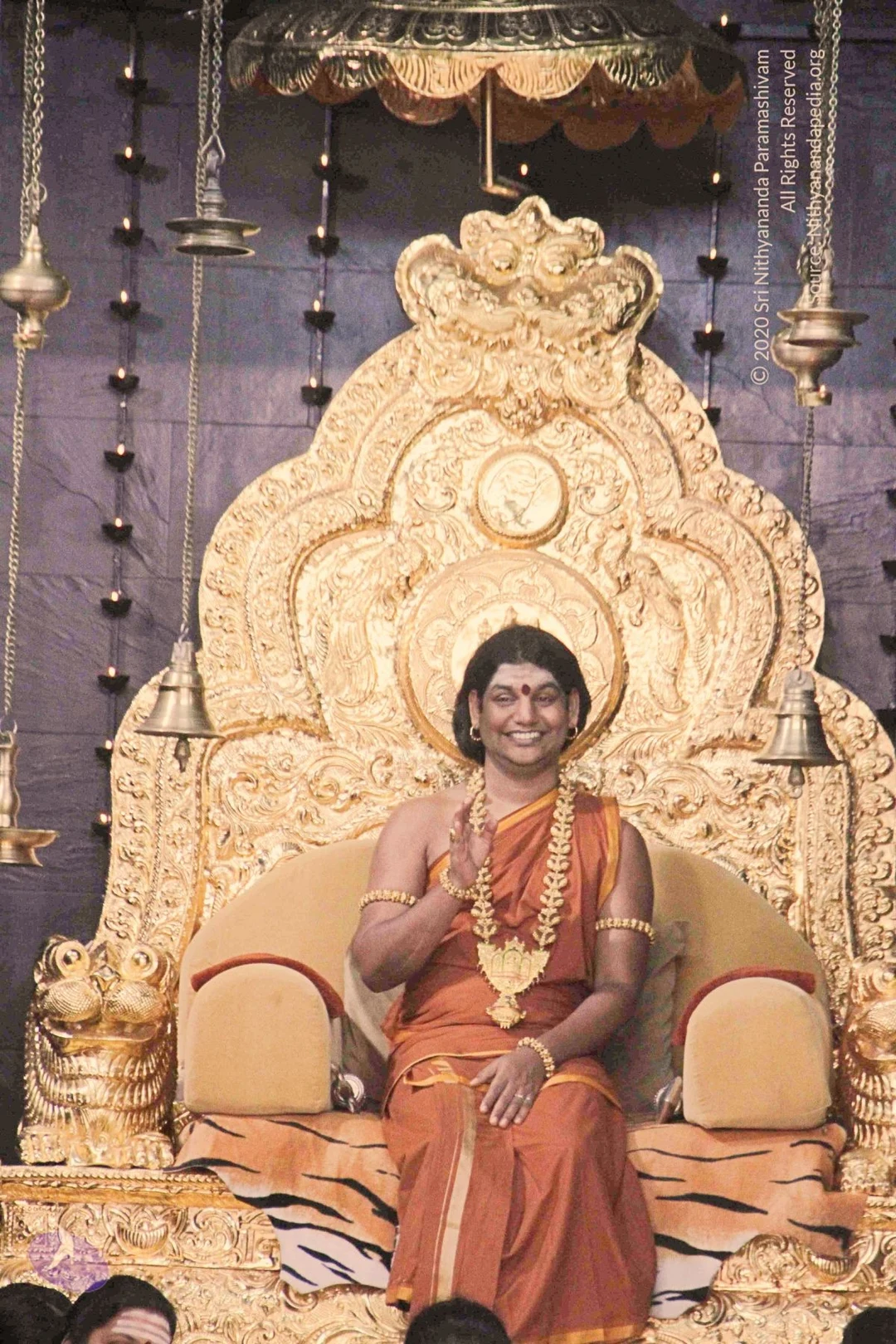
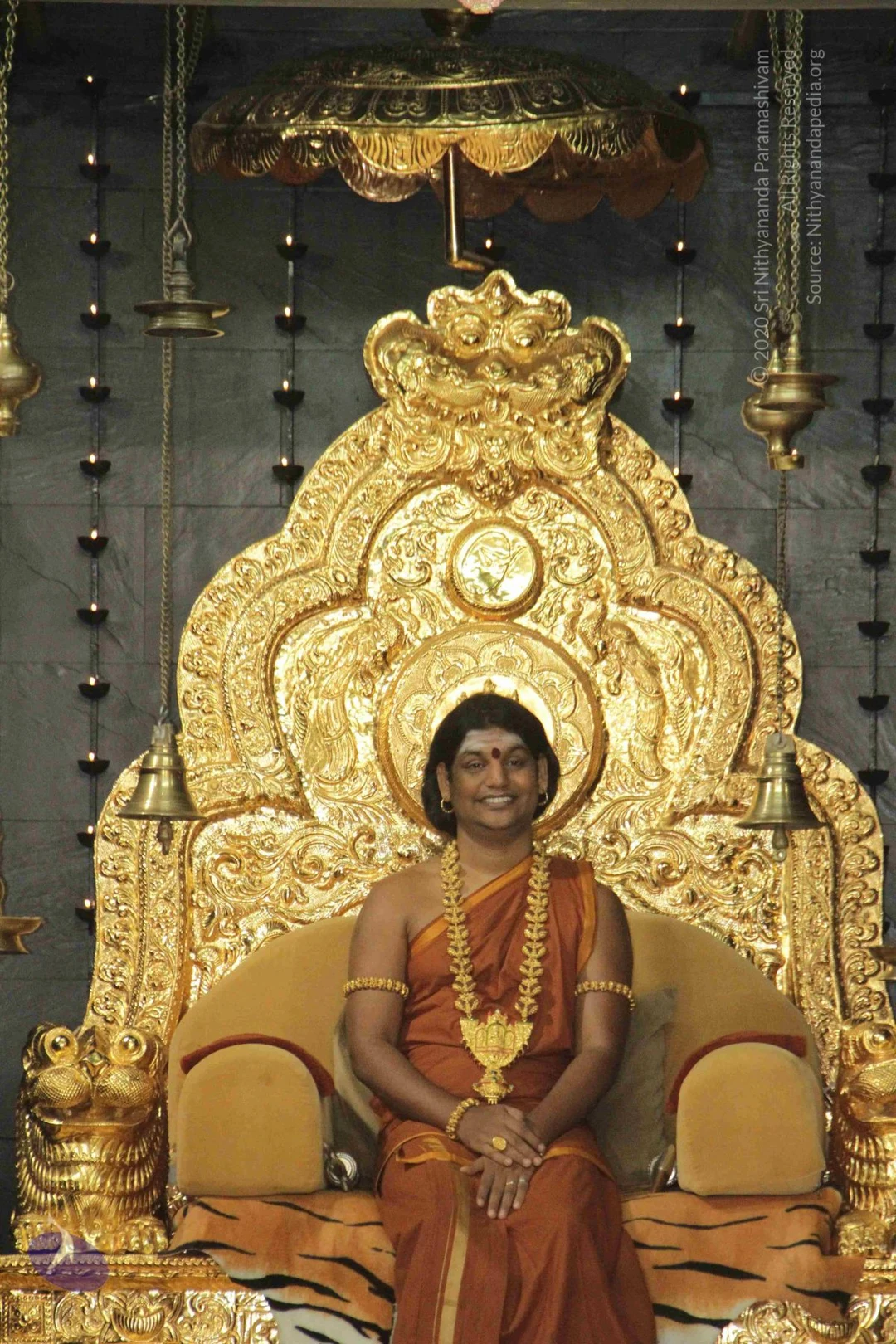
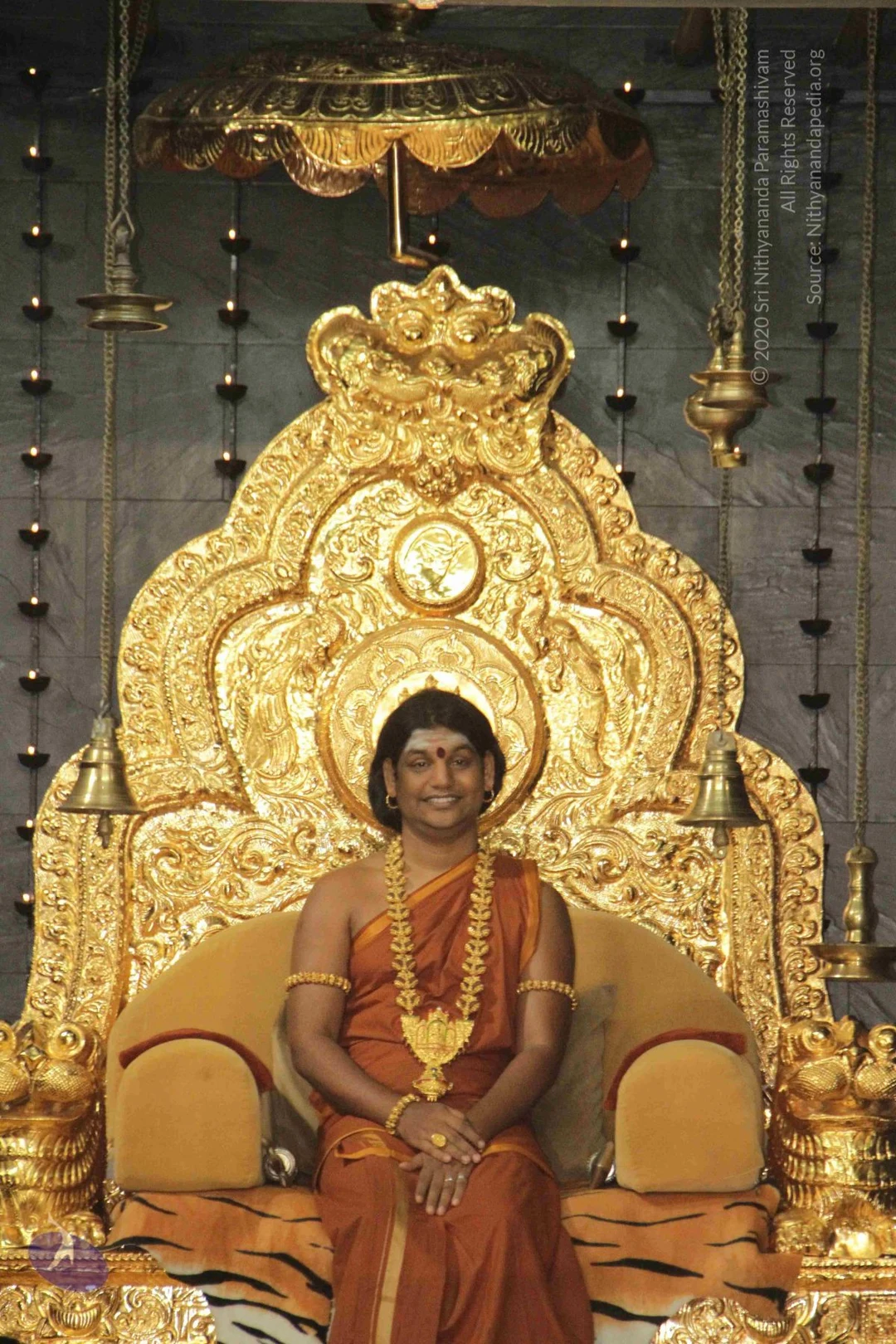
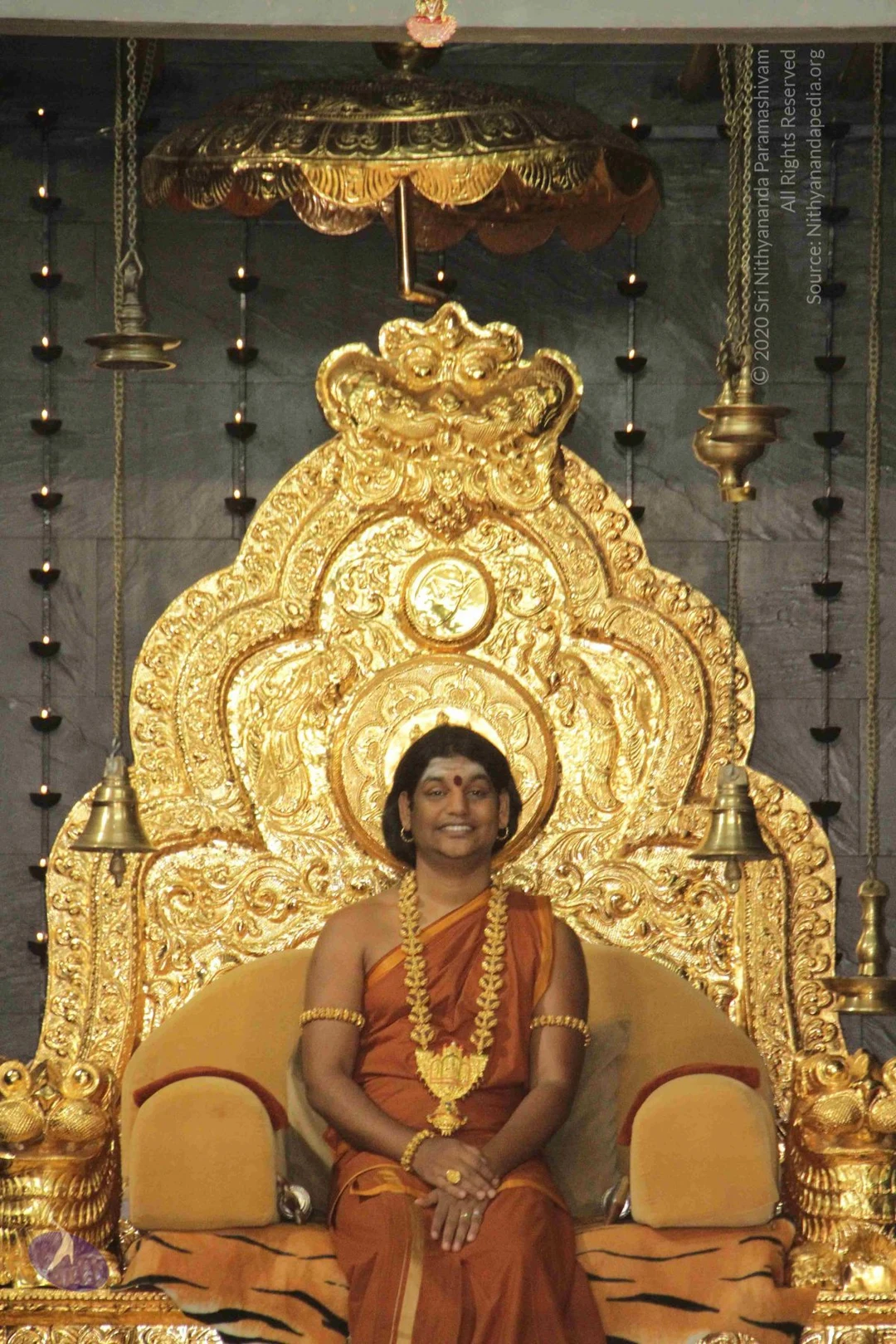
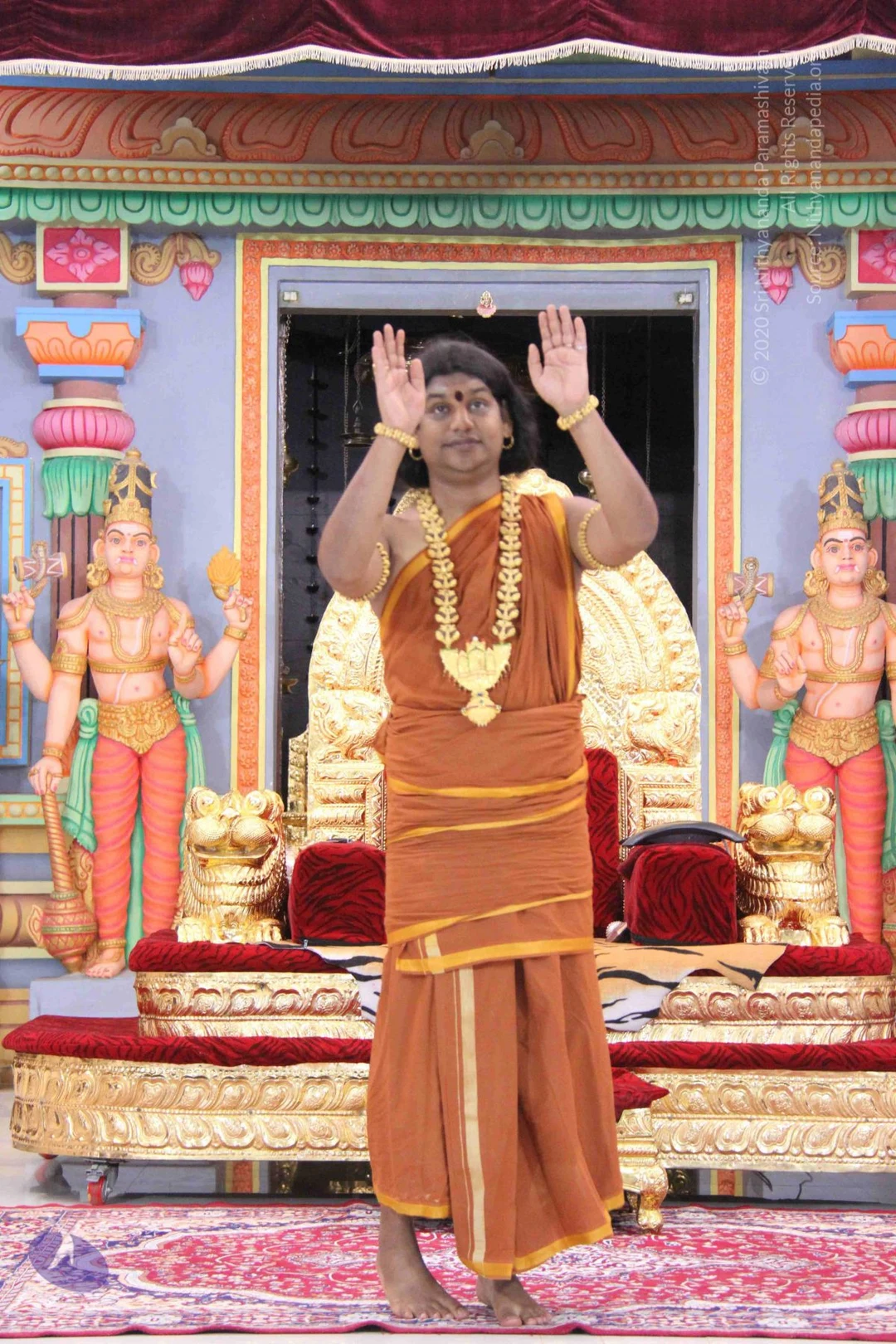
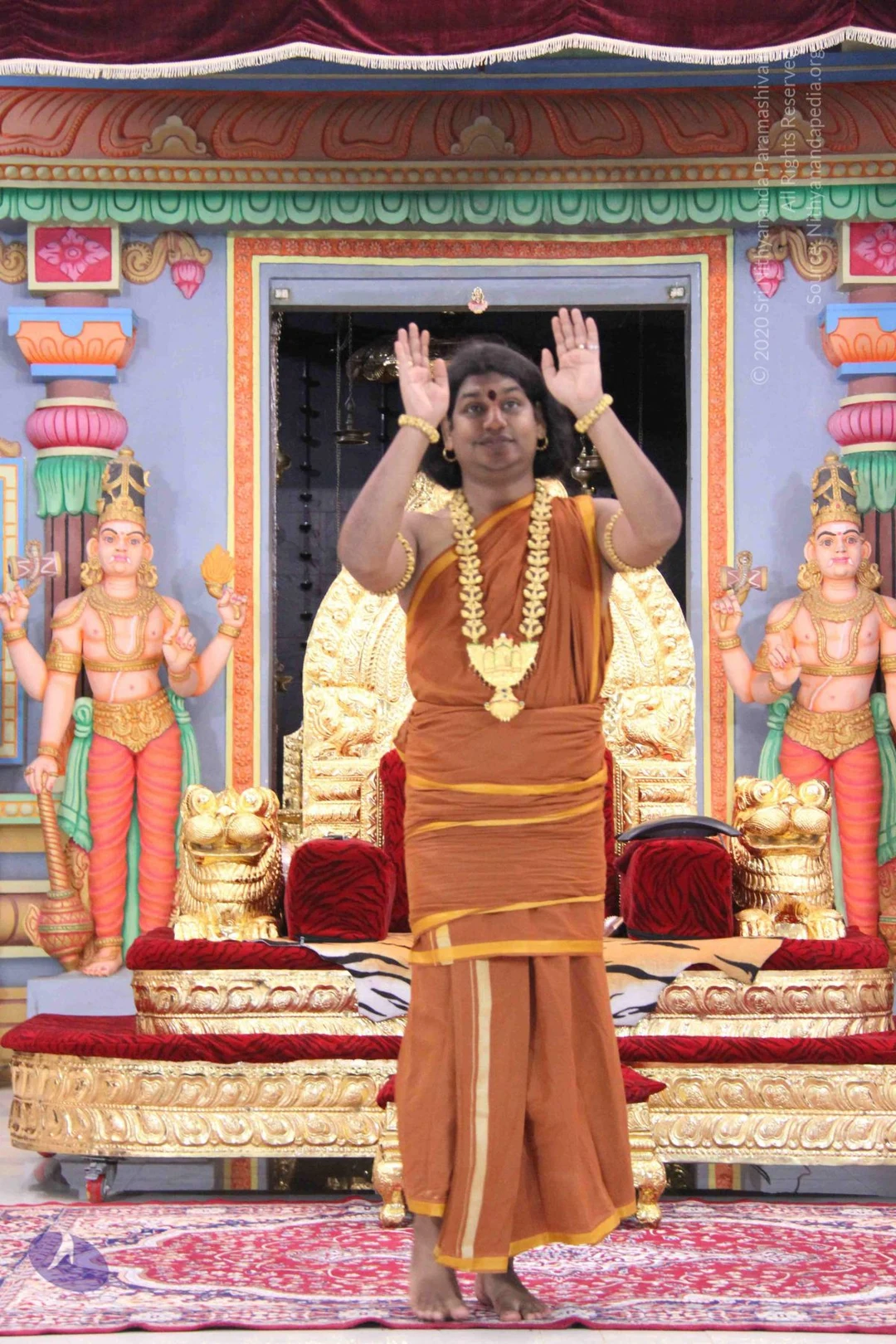
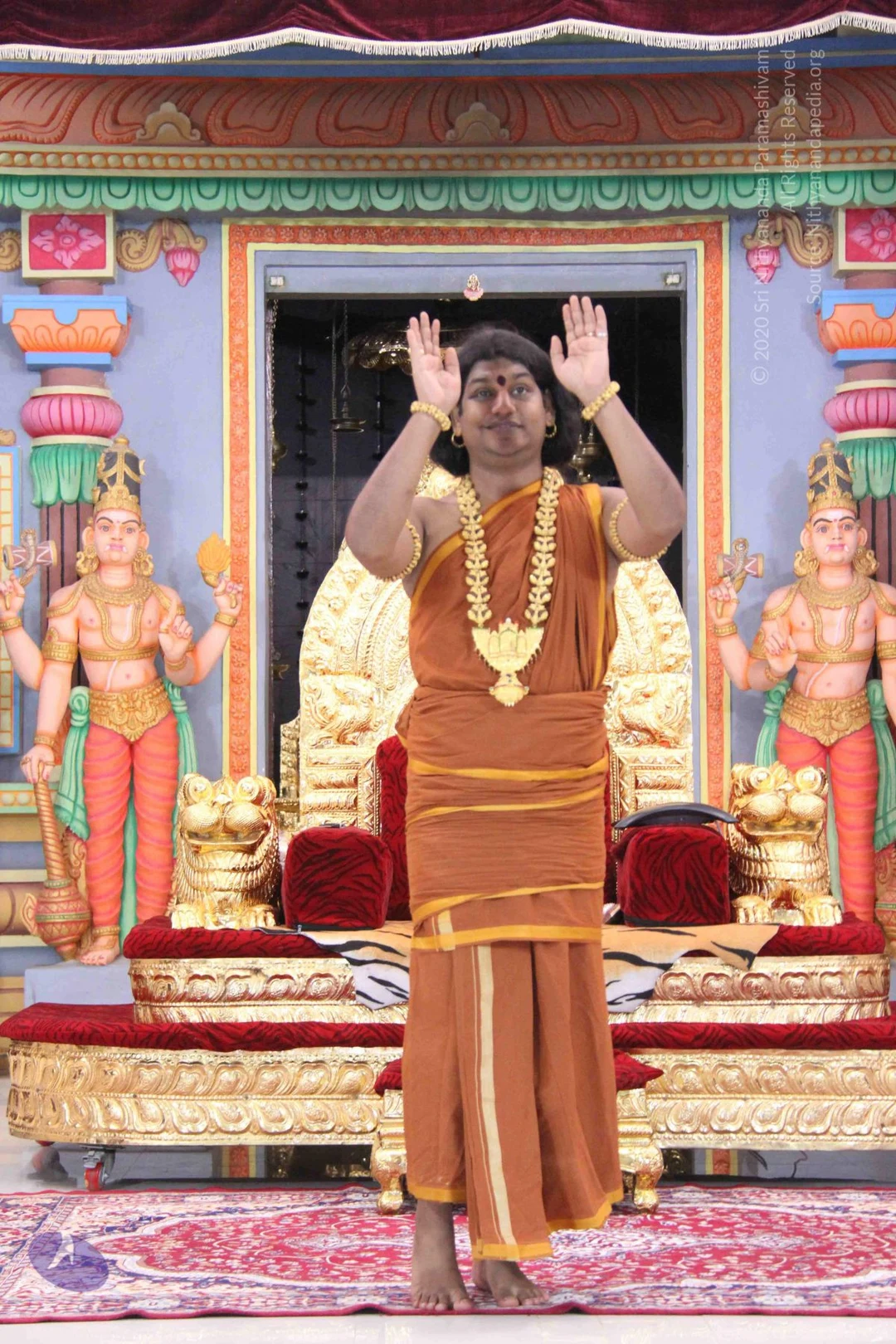
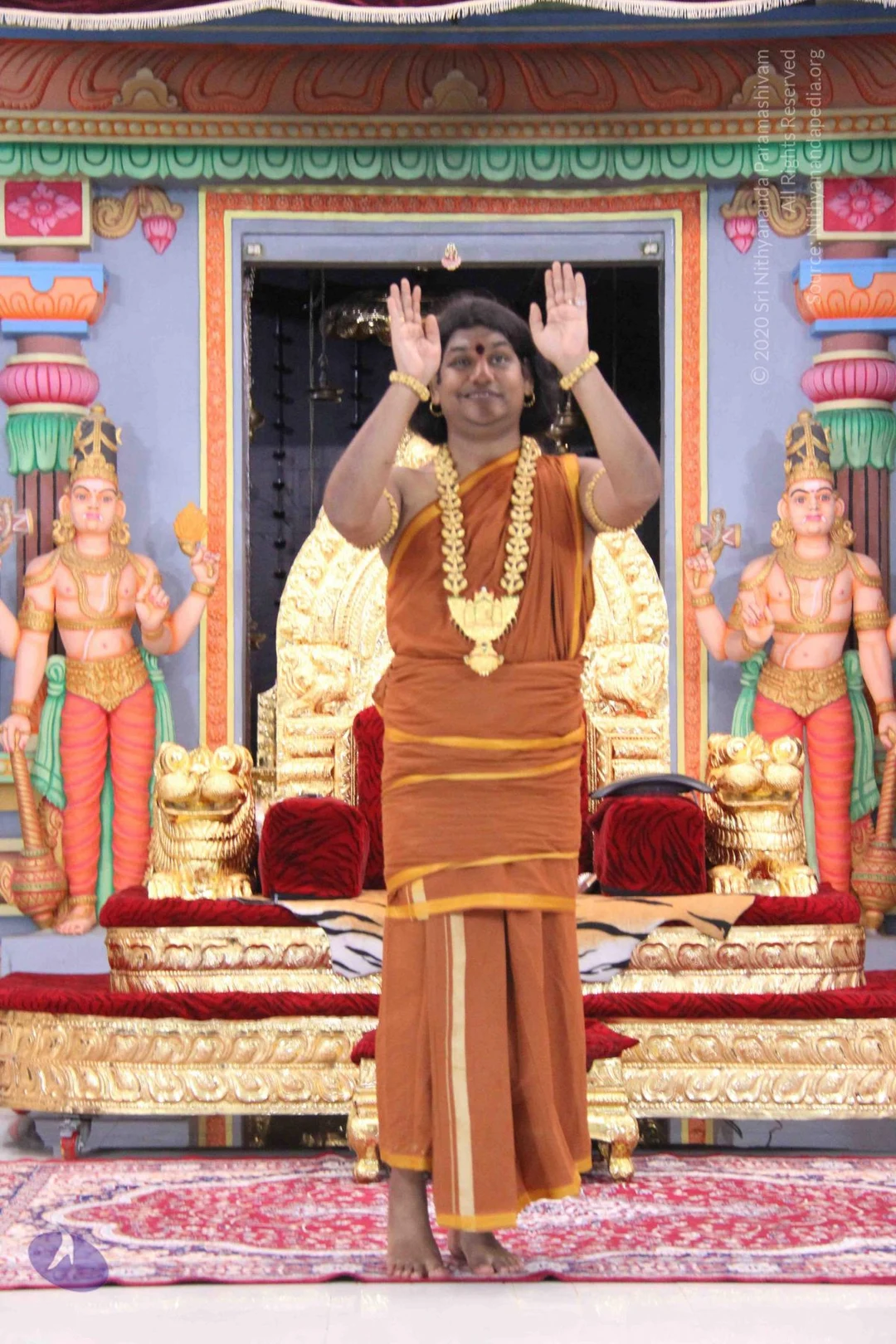
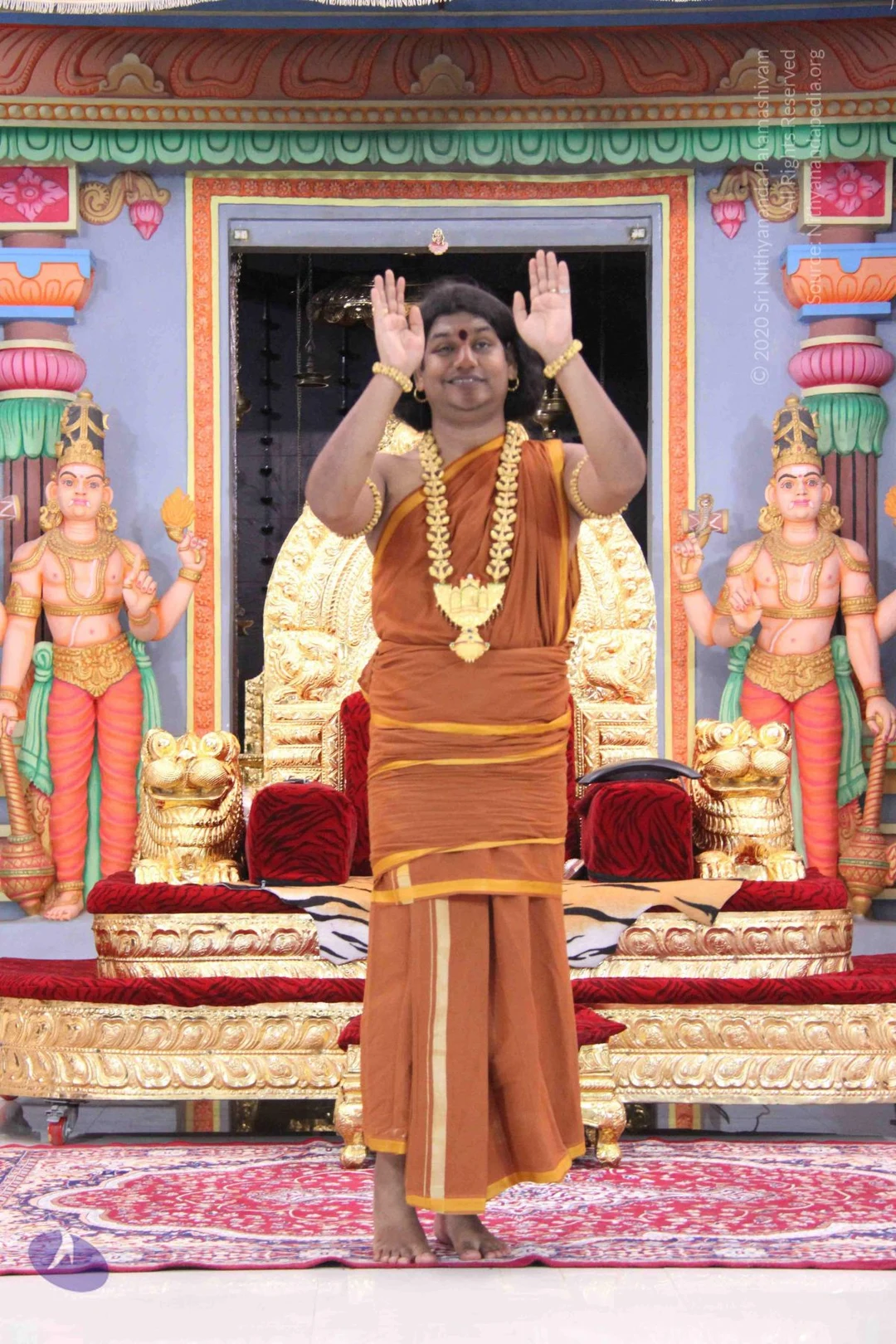
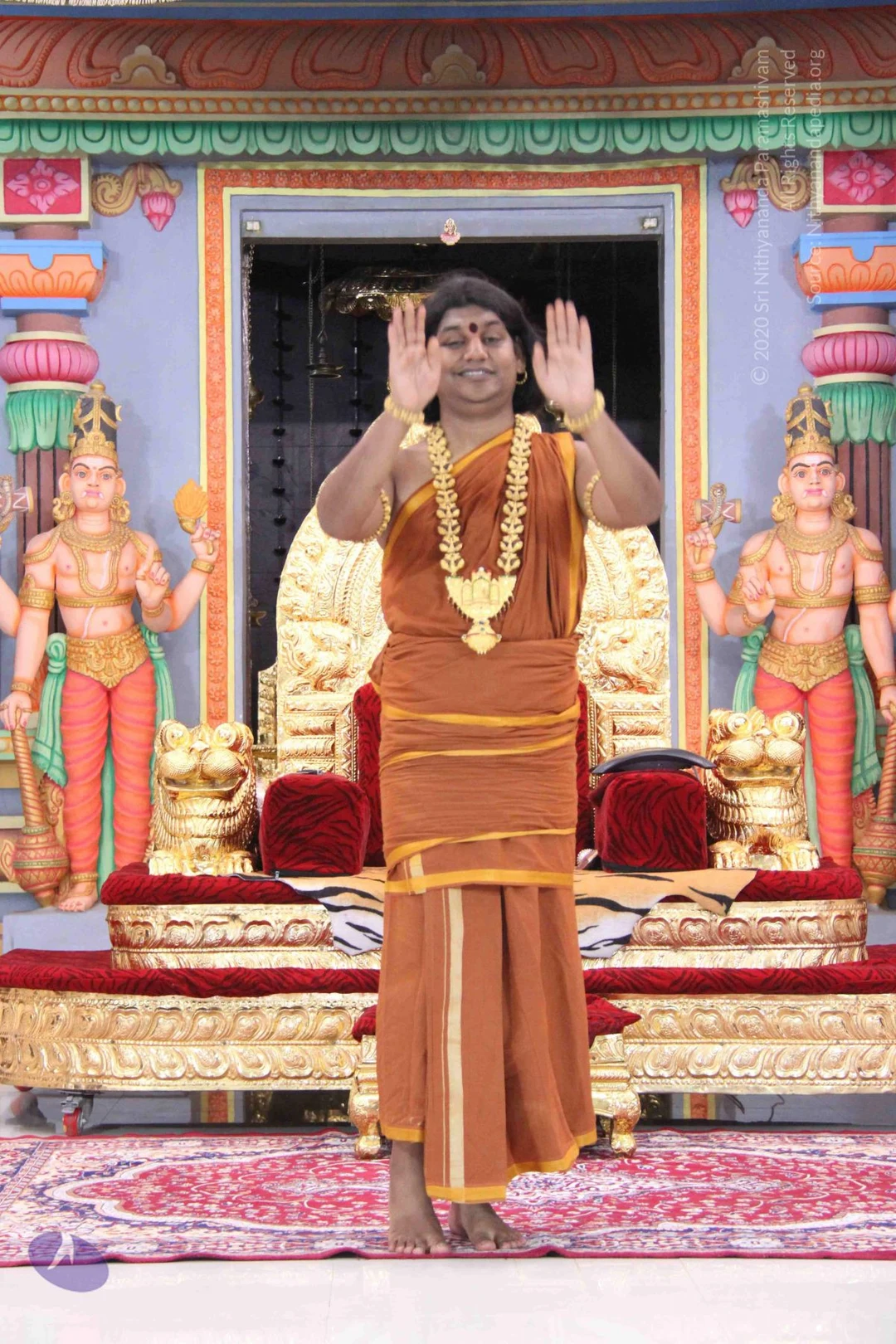
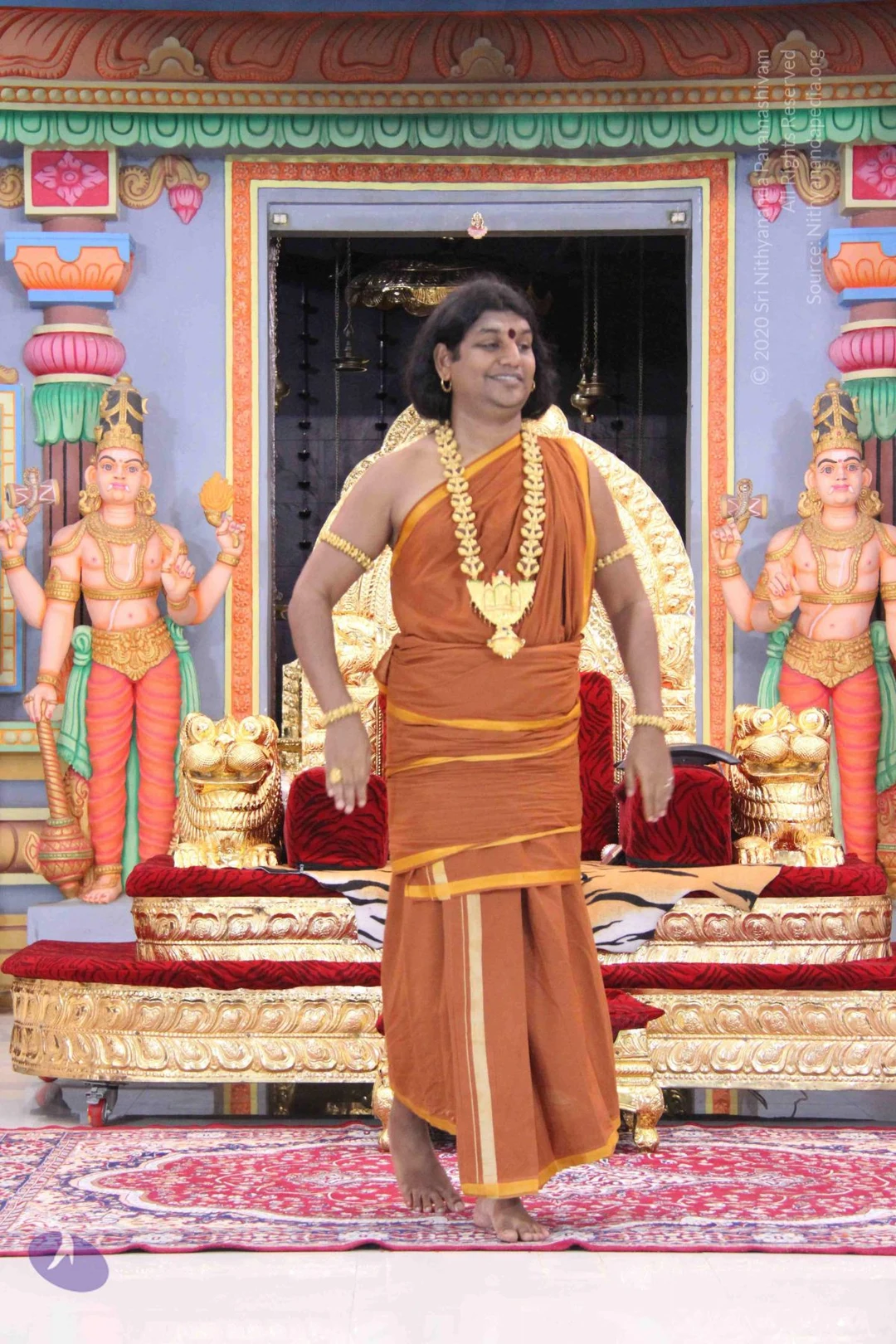
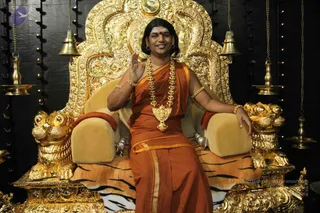
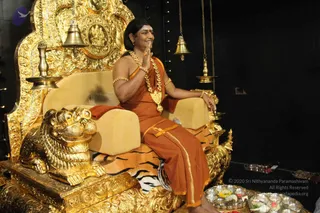
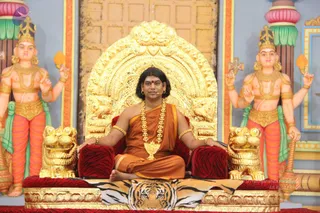
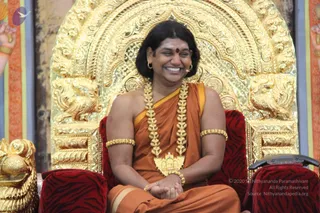
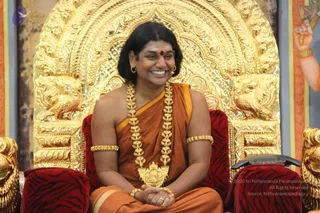
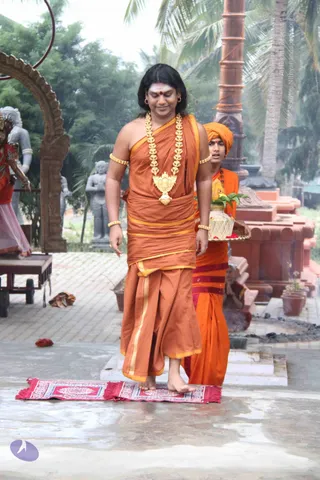
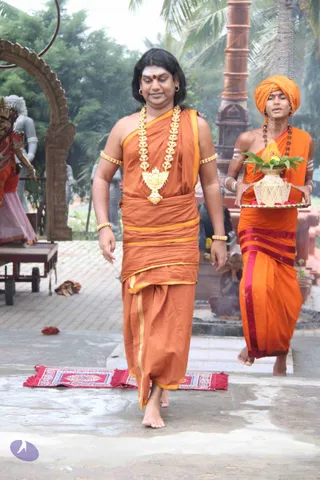
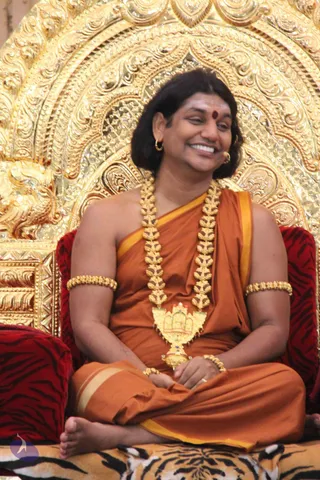
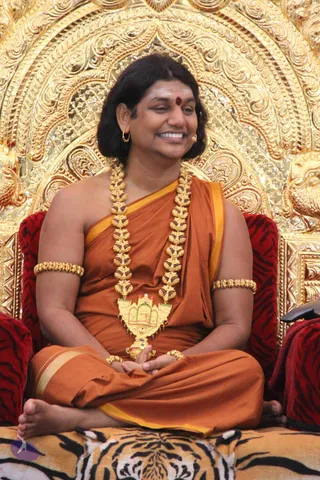
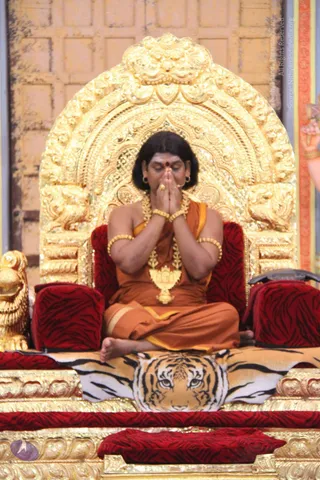
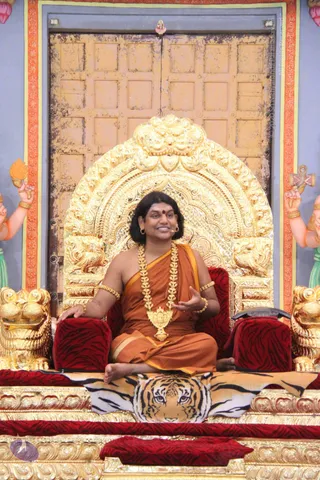
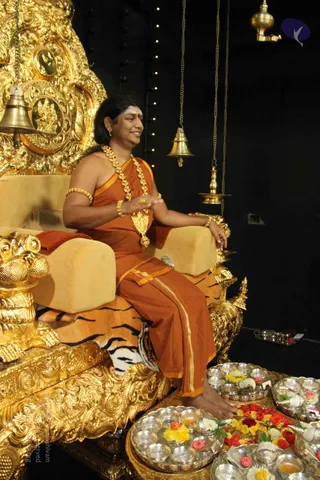
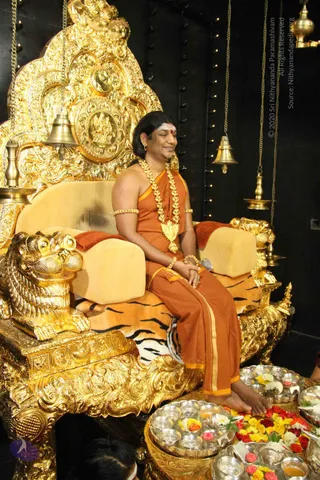
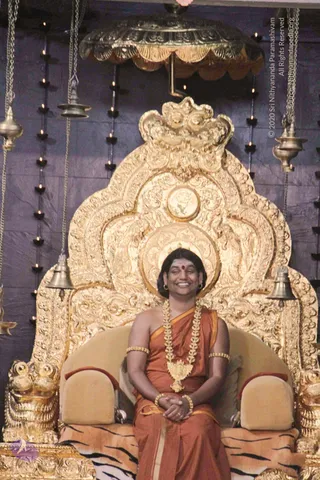
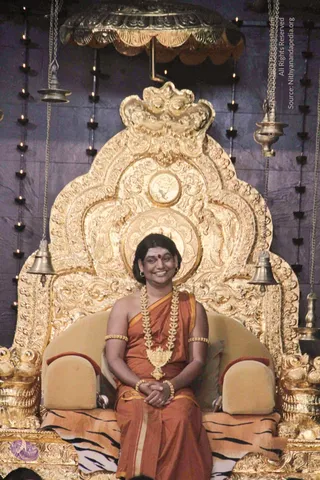
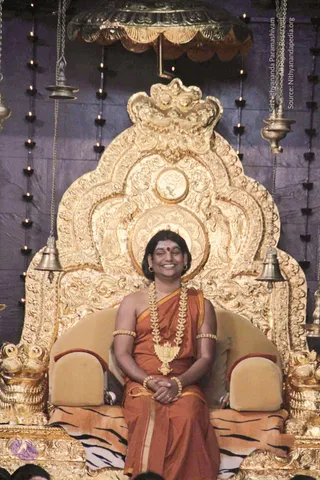
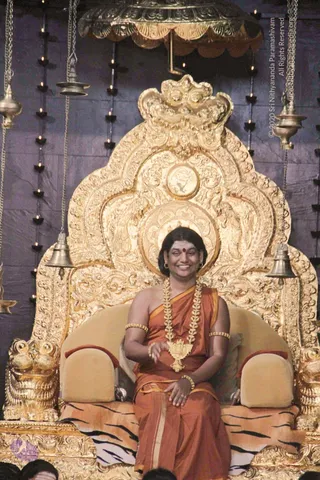
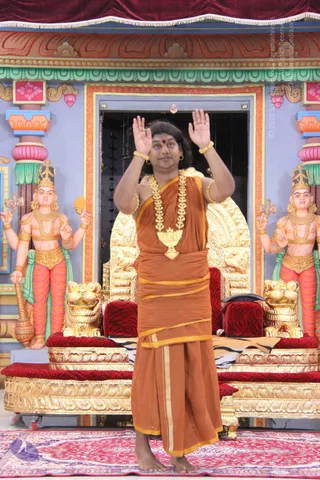
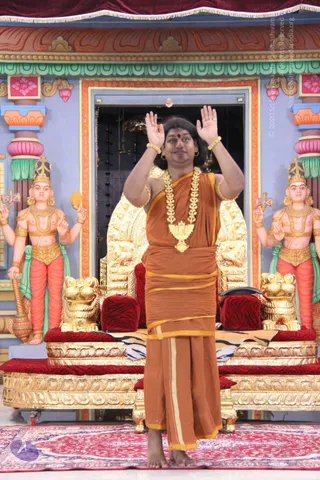
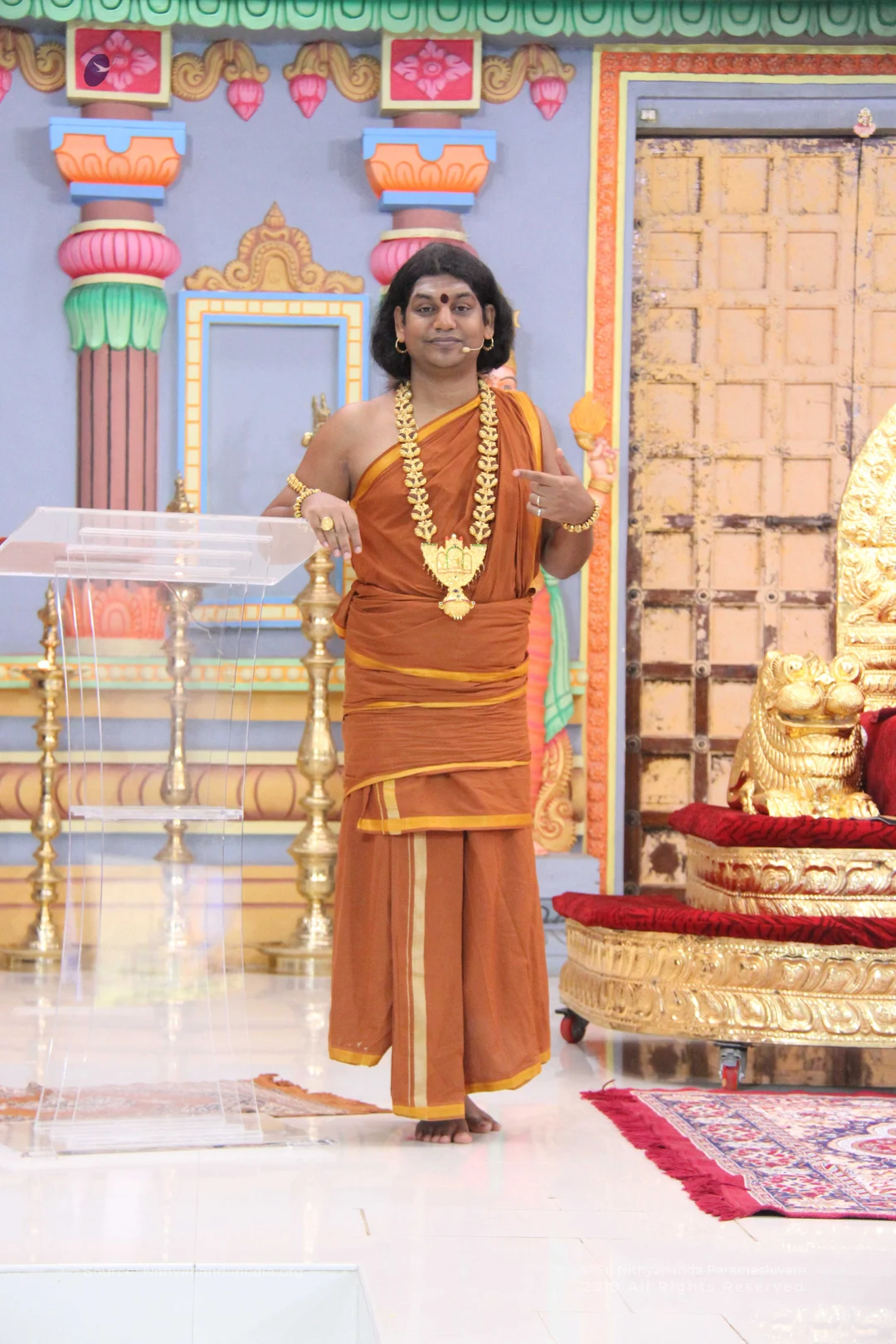
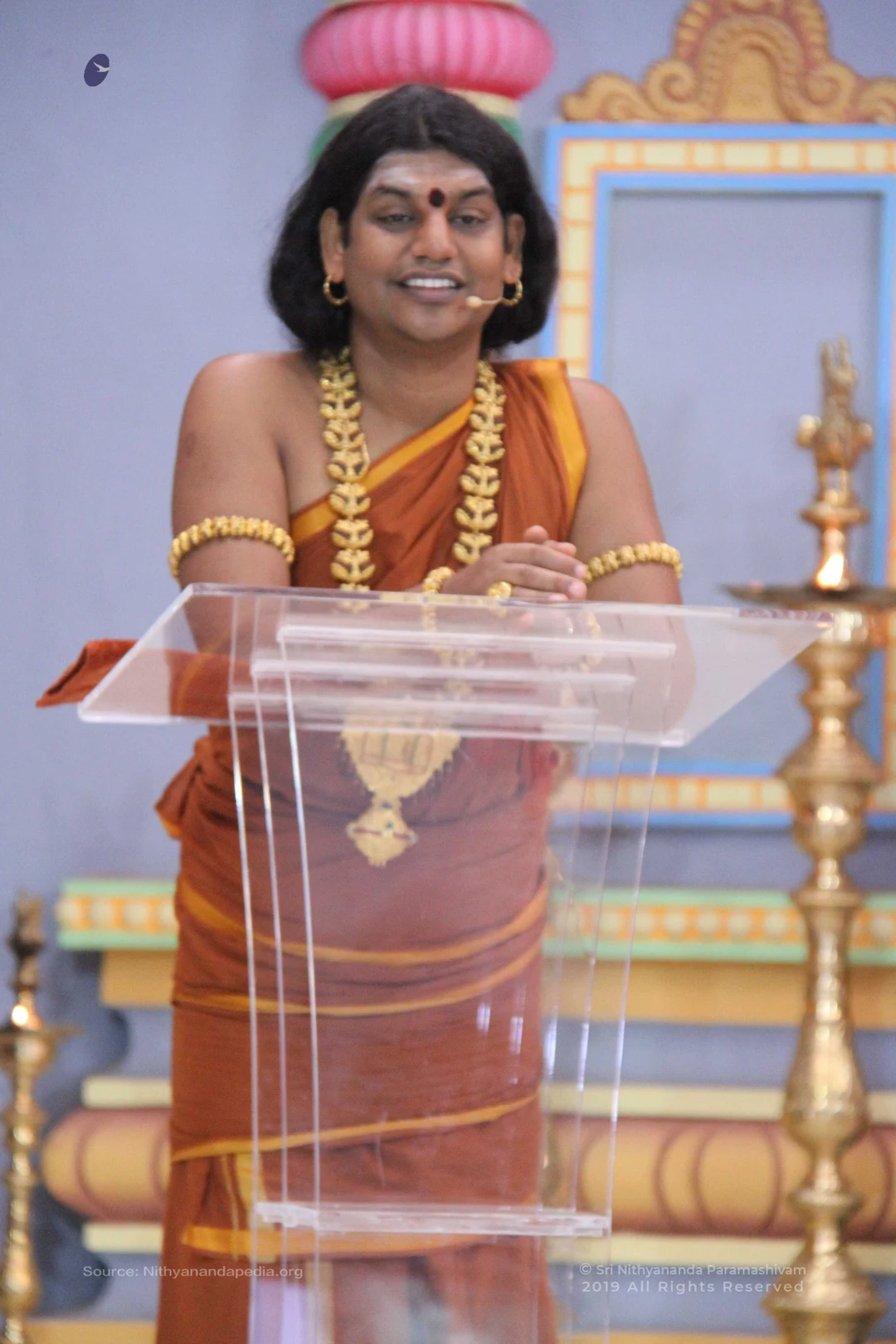
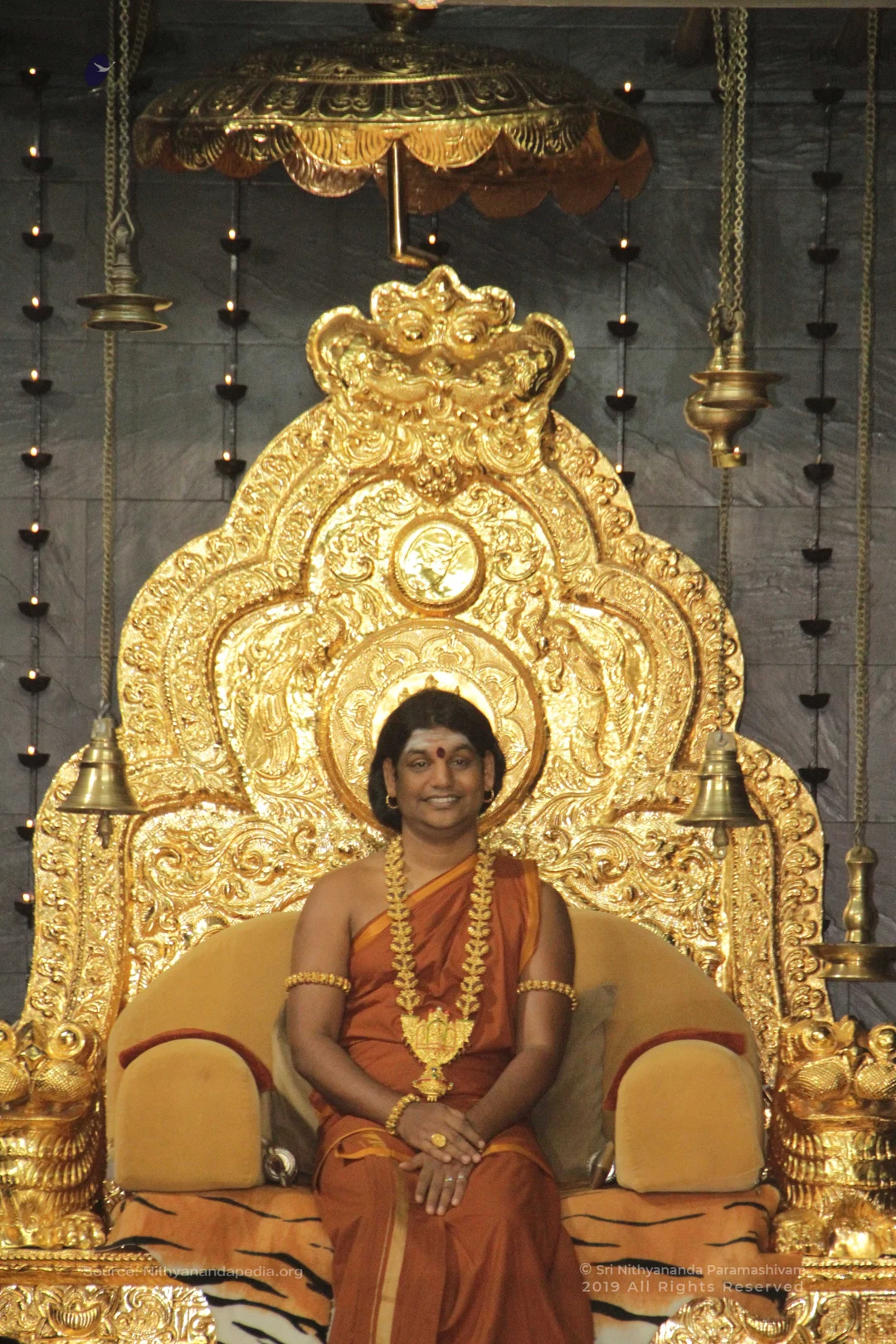
A man stands barefoot on a red patterned rug before an ornate golden throne with red velvet cushions and gold lion-head armrests. He wears a saffron-orange robe with gold borders, a heavy gold garland with a large gold pendant, gold bangles, earrings and a red bindi, and raises both palms overhead in a blessing gesture. Behind him, painted sculptures of two multi-armed deities with tall crowns and gold waist adornments flank a doorway hung with bells. Such ornate clothing and a central raised pose with distinctive long swept-back hair and gold adornment give probable identification as Swamiji (probable), shown in person giving a discourse or blessing.A standing man in an orange-saffron dhoti and shawl with a thin golden border, wearing a heavy gold necklace with a large ornate pendant, gold armlets and gold bangles, and a red bindi with a wide white forehead mark. Behind him is an ornate shrine with a deity murti under a red curtain and gilded arch, a bull statue above, and a figure in white seated at the shrine. The outdoor courtyard has a red-pillared canopy and a garlanded pole at the right edge. Appearance-based candidate: Swamiji (probable), identified by long swept-back hair, saffron clothing, rudraksha-style ceremonial gold necklace and gold armlets; no printed name is visible in the frame.A seated man in orange-saffron robes with gold-embroidered border sits cross-legged on a red and black tiger-striped cushion before an ornate gold throne with repoussé scrollwork. He wears a long gold necklace with a large gold pendant, gold armbands, gold hoop earrings and a red bindi, and holds his hands in a mudra on his lap while smiling. Probable Swamiji by appearance: long swept-back dark hair, saffron robes, ornate gold necklace and a gilded throne. A watermarked photo credit is at the bottom, which is omitted from the text.

August 04 2013

Original wiki page
Contents

Title

Discover the right reason to live

Description:

In today’s morning Satsang, Paramahamsa Nithyananda expands on Mahadeva’s sacred completion process. When we make completions as part of our lifestyle, like brushing our teeth, we develop adequate reasons for the actions we perform, destroying our self-doubting patterns. Our consciousness becomes unwound; then we are living enlightenment! Completion becomes part of our being making us authentic, integrated, responsible, and an enricher of lives. Let us be in completion and enrich others, because the biggest gift you can give another person is a reason to live. Share the science of completion with everyone you know!

VideoAudio

Transcript:

Nithyanandeshwara Samaarambhaam Nithyanandeshwari Madhyamaam | Asmadaachaarya Paryanthaam Vande Guru Paramparaam ||

I welcome all the devotees, disciples, samajis, satsangis sitting with us around the world through Nithyananda TV, Sadhana TV, Lotus TV, and two-way video-conference all over the world.

I welcome you all with my love and blessings.

In today’s Nithya Satsang, I will continue to expand on the “COMPLETION’S DEFINITION BY MAHADEVA”.

Yesterday, I expanded the definition of Completion by Mahadeva. So, from today again, I’ll continue to expand on the definition of Completion by Mahadeva. Now I will expand on what Mahadeva defines as Completion.

First understand, I wanted all my followers and disciples to take a vow that whoever you relate with in your life, make them all complete beings! If they are not complete, do not relate with them. Listen! If they are not complete, even if you think they are great friends, they sacrifice anything for you, even if they do puja to you, don’t accept! I tell you, if you receive puja from incomplete beings, you will suffer like me! I have allowed incomplete beings to worship me. The incomplete fellows are demons. They will take revenge on the same person whom they worshipped because their reason for worshipping is wrong! When the reason for worship is wrong, they will be bound to get frustrated. When they are frustrated, they will pull the same leg which they were touching and worshipping.

Don’t allow incompletion as part of your life. Do not allow incompletion as part of your life. Do not allow incompletion in any form. Whether it is your brother, or father, or mother, or spouse, or friend, or employee, or boss, don’t allow incompletion. Don’t relate with incomplete people. Incomplete people are dangerous in the long run. They may look good, positive in the beginning, but they are dangerous in the long run. So, don’t, don’t relate with them.

Incomplete fellows, first symptom of incomplete fellows, they will have wrong reasons for their actions, constant doubt about their actions. Wrong reasons are insufficient reasons. Listen! Wrong reasons and insufficient reasons, wrong reasons and insufficient reasons, when you function with wrong reasons or insufficient reasons, you will always have self-doubt. Listen! Listen to this definition! When there is a fire, you take your hands off. You don’t touch the fire. Even if your hand touches the fire by mistake, you take your hands off. Do you have self-doubt about that action? Because you have enough reasons to remove your hands from the fire! If you have the right reason and enough reason, you will not have self-doubt. All self-doubt is “not having right reason or adequate reasons”. People who don’t have right reason or adequate reasons for their actions will carry constantly self-doubt and doubting others. They go on doubting others. I tell you, the fellow who doubts himself and doubts others is already in Hell! Hell is sponsored by people who doubt themselves and others.

Humanity is made out of the material called “Trust”. Enmity is made out of the material called “Doubting the self and others”.

Listen! Humanity is made out of “Trust”. Enmity is made out of “Doubting others and the Self”.

I have a story:

One guy comes to Australia and goes to a grocery store in Australia. He finds cat food sold at a very special price, cheap. He picks a dozen cans of cat food and goes to check out.

The manager of the shop gets suspicious. He thinks that this guy cannot have so many cats; may be, probably, he is feeding the cat food to his kids. So, he asks the guy, ‘bring your cat, show me your cat, only then I will give you the cat food!’

This guy goes to his house and returns with the cat. Then he was allowed to buy the cat food. He gets to buy the cat food.

Next week, again the customer comes back, and finds dog food at a special price. He picks up a dozen cans of dog food and goes to check out

The manager again doubts him, gets suspicious, he thinks that, ‘this guy has a cat, no, no, no, no, this guy may have cats but not dog! He may be, probably, feeding the dog food to his kids!’ So, the manager again asks the customer, ‘bring and show your dog to me before I give you the dog food.’

So, the customer, that guy goes to the house, comes back with the dog. He gets to buy the dog food.

Next week, the customer comes to the shop and Swamiji laughs:

HAHAHAHAHAHAHAHAHAHAHAHAHAHAHAHAHAHAHAHAHAHAHAHAHAH: D: D: D: D!!!! The guy comes with a big bag and tells the manager, ‘Put your hand in this bag.’

The manager puts his hand in the bag……..and immediately takes it out and shouts at the guy, ‘What the shit is this? This is SHIT!’

And, the customer calmly replies, ‘Yes, because I want toilet paper!’

If you are always doubting yourself and constantly doubting others, I think this is the answer! This is where you land!

I tell you, living with incomplete people is Hell! One incomplete fellow is enough to create hell for everyone, because they do not have the right reason or adequate reason for their actions. When they do not find the right reason or adequate reasons for their actions, they create hell for themselves and others. They create hell for themselves and others!

Understand, just like every morning you wake up, clean yourself, wash yourself – if you are not going to that same shop, brush your teeth, take bath, same way, every night you should do completion. Every night completion should be part of your being, part of your life, because completion integrates you, completion makes you authentic, completion makes you responsible, completion makes you enriching!

Continuously do completion, because completion leads you to the unwinding of your consciousness. When your consciousness is unwound, it becomes super-consciousness! If the water is heated, it becomes steam; if it is allowed to become cool, it becomes ice. Same way, if your consciousness is allowed to get winded…..wound, wound, wound…..it becomes unconscious. If your consciousness is unwound, it becomes super-consciousness.

Completion! Completion! Understand, the impact of the past enters as a perverted, inadequate in your present and destroys your future. Listen! The impact of the past, inadequate cognition of the past, enters your present, perverts your present, destroys your future! That is why Mahadeva is so clear. All the forms, the memories of your forms you carry about your past should be dissolved. Once they are dissolved; once they are dissolved, I tell you, you become enlightened! You get enlightened! Once they are dissolved, you live this life. Once they are dissolved, you are transformed, you live the life of Jeevan Mukthi!

Understand, no other technique is so immediately powerful like completion. No other process leaves you with such a long time permanent effect and impact and transformed consciousness like completion!

Completion, the completion process, completion energy, completion experience, is life. I tell you, completion makes you Integrated, completion makes you Authentic, completion makes you Responsible completion makes you Enriching. Completion makes you enrich yourself and others.

Bhagawan is clearly describing completion, defining completion. The twenty-second sutra of Shiva Sutras, Vijnana Bhairava Tantra, Chapter twenty-two:

“Allow the reliving of the past happen with attention, but be unclutched. Look at your past, disidentified; let your attention be at a place where you are seeing some past happening; and even your form, having lost its present characteristics, is transformed!”

“Look at your past unclutched; let your attention be at a place where you are seeing some past happening and even your form, having lost its present characteristics, is transformed!”

Listen! If you want to know whether you are complete or not, Bhagawan is giving you the scale: If you relive some incident, your old form will not have impact on you; it would have melted down. The fundamental foundation of the four tattvas is Completion!

Integrity is established in completion. Authenticity starts with completion. Responsibility grows in completion. Only when you are complete, only when you are in completion, you will Enrich you and others.

Continuously, continuously allow completion to be with you, to be in you. Continuously allow completion as your life, completion as your form, completion as your lifestyle. Sit every night in front of the mirror. Let attention be in your inner space where you are seeing the past happening, unclutched. Even your form, having lost its present characteristics, is transformed!

The science of Completion! Life cannot be lived with inadequate reasons. Life cannot be lived with not having enough or inadequate reasons. Please understand, man with adequate reasons lives life. Person with inadequate reasons completely destroys his life and others’ life. So, come to the space of adequate reasons. Don’t be stuck with inadequate reasons. Inadequate reasons is, unfortunately, a huge suffering. Inadequate reasons is, unfortunately, stagnation.

I have a story for you guys:

Once, three friends decided to go on a picnic. They got to the picnic spot. Then they realized that they have forgotten the soda. So, the youngest friend said he would go home and get the soda if the others promised not to eat the food until he got back. All of them agreed. One hour passed. Two hours over. Whole day went by. Now the friends were very hungry. Finally, one of the friends said, ‘oh, come on, he’s not going to come back, let us eat the food’. The moment they opened the food, suddenly, the youngest friend jumped out from behind a rock and said, ‘If you do, I will not go! If you do this, I won’t go!’

Understand, with inadequate reasons or wrong reasons you can’t live life. Completion will show you the right reasons. The biggest gift you can give to a man is giving them the reason to live! I tell you, the most violent terrorist activity on Planet Earth is taking away the person’s reason to live! I tell you, the consumeristic society, this consumeristic lifestyle, the westernization consumerism is doing that to people; it is taking away their reason to live! Atheism takes away the reason for people to live. I tell you, atheism is the worst terrorism! If you see an atheist and a snake, I’ll say, the atheist is more dangerous than the snake! Because, the fellows who preach atheism, they take away the reason to live from people, which is most dangerous!

People are left as orphans not when the families die, or friends die, or the parents die; even if your parents are dead, you can go to some place, create an ideological family; you can develop a new family, new father, new mother; you can develop new relationships. Man is an orphan, when the reason to live is taken away from him!

I tell you, all incompletions takes away the reason to live, because it puts so much of self-doubt in you, you live with the wrong reason or inadequate reason. Giving you the right reason and adequate reason to live is giving life! I sincerely request all my followers, visitors, television viewers, at least for the next two months, every night before going to sleep, spend half-an-hour to forty minutes doing completion.

Learn the process of completion. Do completion! Learn the process of completion and do completion. I tell you, you will learn, you will experience the right reason and adequate reason to live! Have the right reason to live, adequate reason to live! You will live enlightenment!

So, the essence of today’s satsang is:

Do completion and develop the right reason and adequate reasons for your every action. In your life, you will be living enlightenment!

With this, I will move to the next segment – Nirahara Samyama.

All the people who already have problems with their BMI ratio (Body Mass Index ratio), who are underweight, malnourished, you should not be doing this Samyama. Others can do this Samyama.

This Samyama mainly aims at reducing the food which you eat due to psychological reasons, not physiological reasons.

So, thousands of people have joined from all over the world to do this Nirahara Samyama!

Understand, Nirahara Samyama is mainly to awaken your intelligence.

The first effect will be, you will stop eating psychologically. You will eat only what is required for the body. You have two types of eating: physiological eating and psychological eating. Just because of the psychological reasons you start eating. That will be stopped. That is the first effect.

The second effect is, your bio-memory will be awakened to the extreme and extent where, please listen, you will start producing food directly from space! It is possible!

I bless you all with my Integrity, Authenticity, Responsibility and Enriching! Let you all experience Kundalini awakening and create energy directly from space, live enlightenment, health and bliss!

Namah Shivaya!

I bless you all! Let you all radiate with Integrity, Authenticity, Responsibility and Enriching, with eternal bliss, Nithyananda! Thank you!

Photos
Photos Of The Day:
temple-visit

Prathyaksha-Pada-Pooja

Nithya-satsang

SarvaDarshan

Photos Of The Day:
Temple-Swamiji

KramaKids-Listening

NithyaSatsang

PratyakshaPadaPuja

SarvaDarshan

Photos Of The Day:
Temple-Swamiji

NithyaSatsang

PratyakshaPadaPuja

SarvaDarshan

Final-Blessing

Photos from this day
View all 164 photos
Photos
23 photosSource gallery
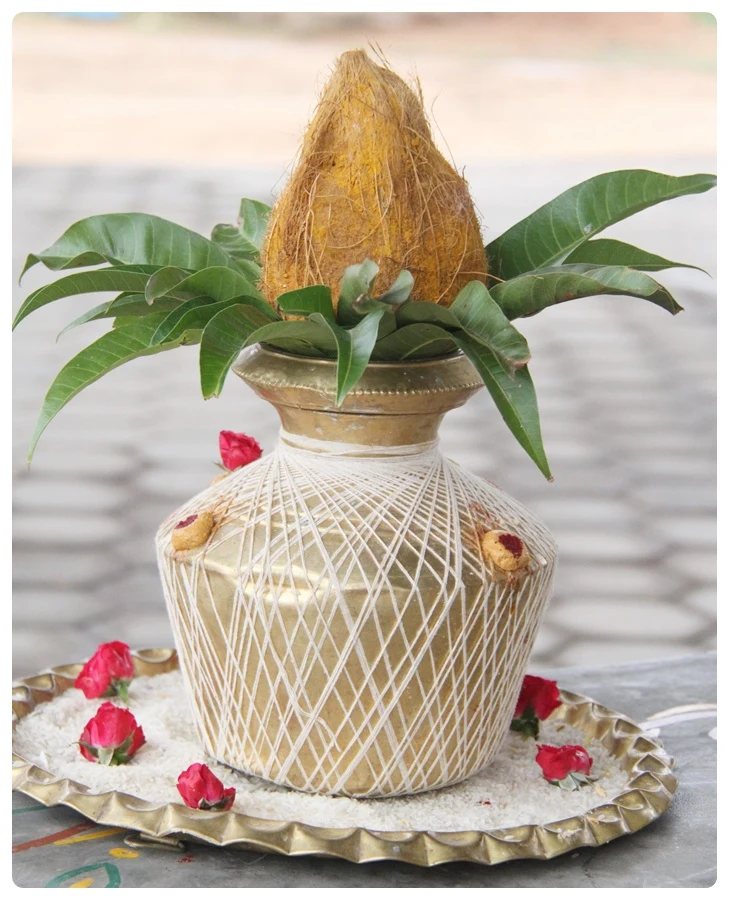
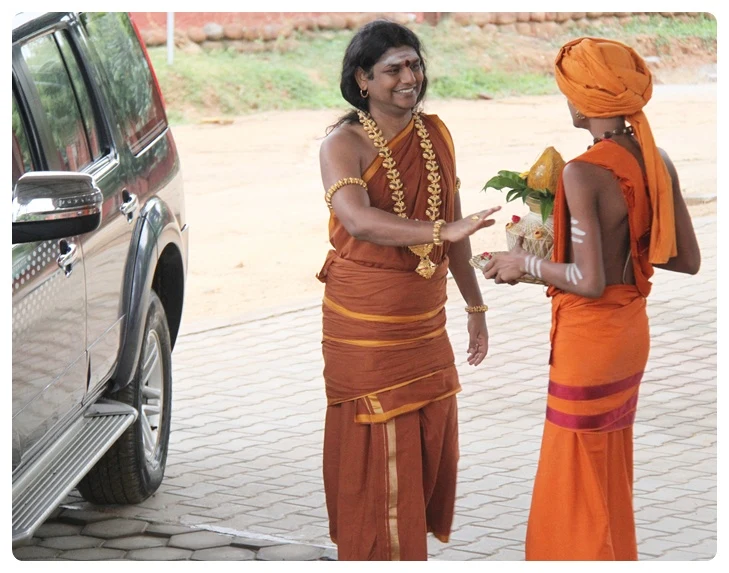
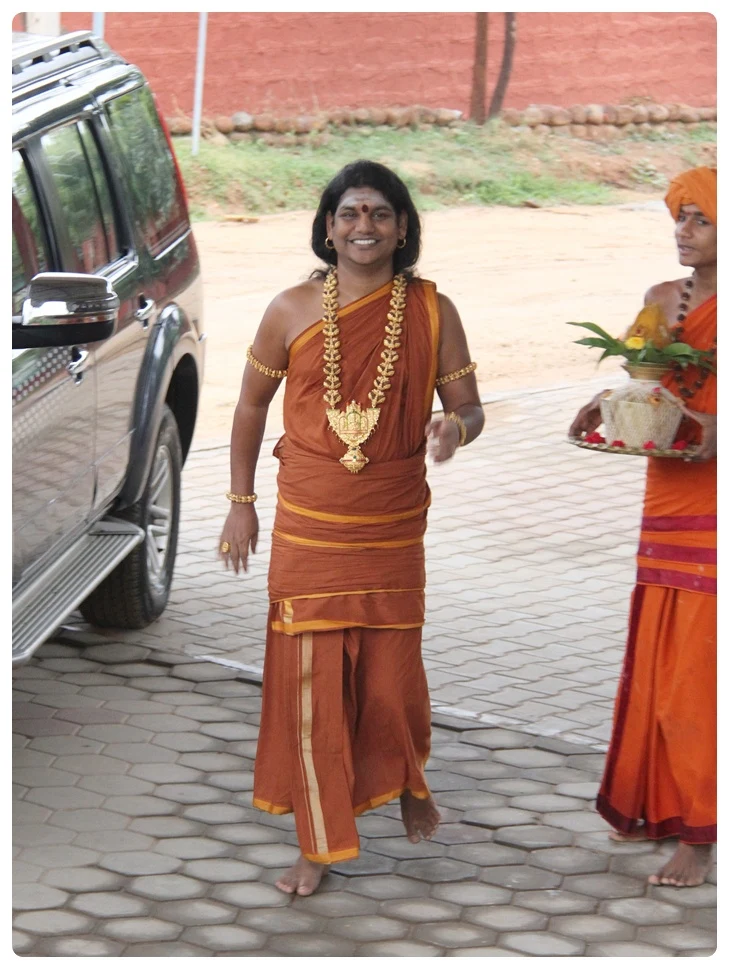
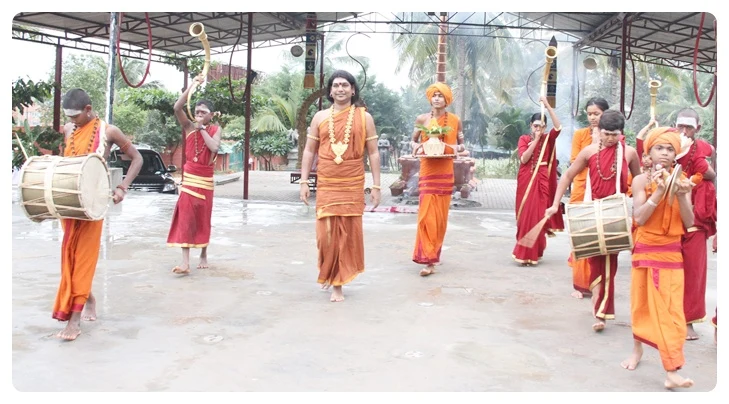
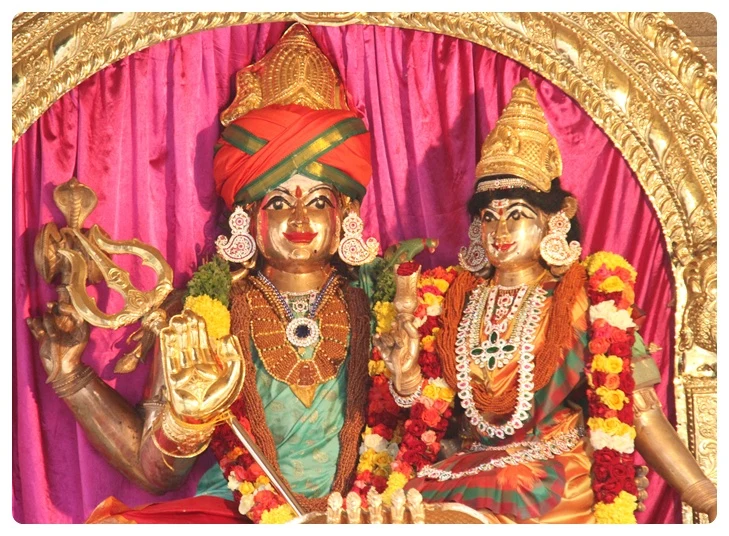
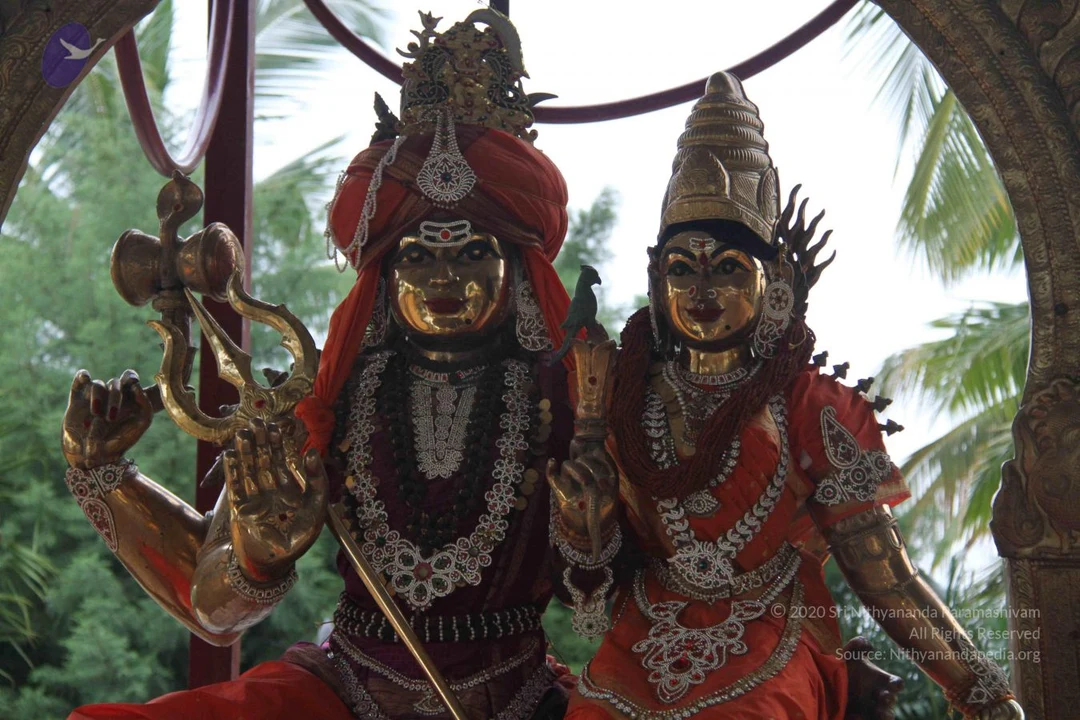
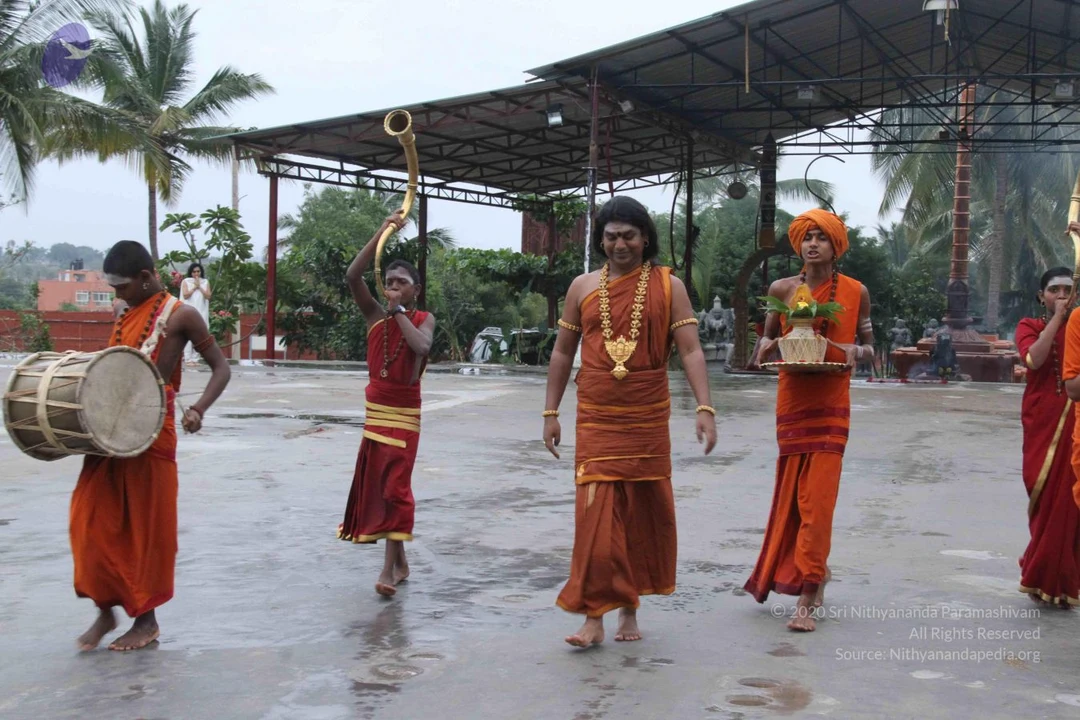
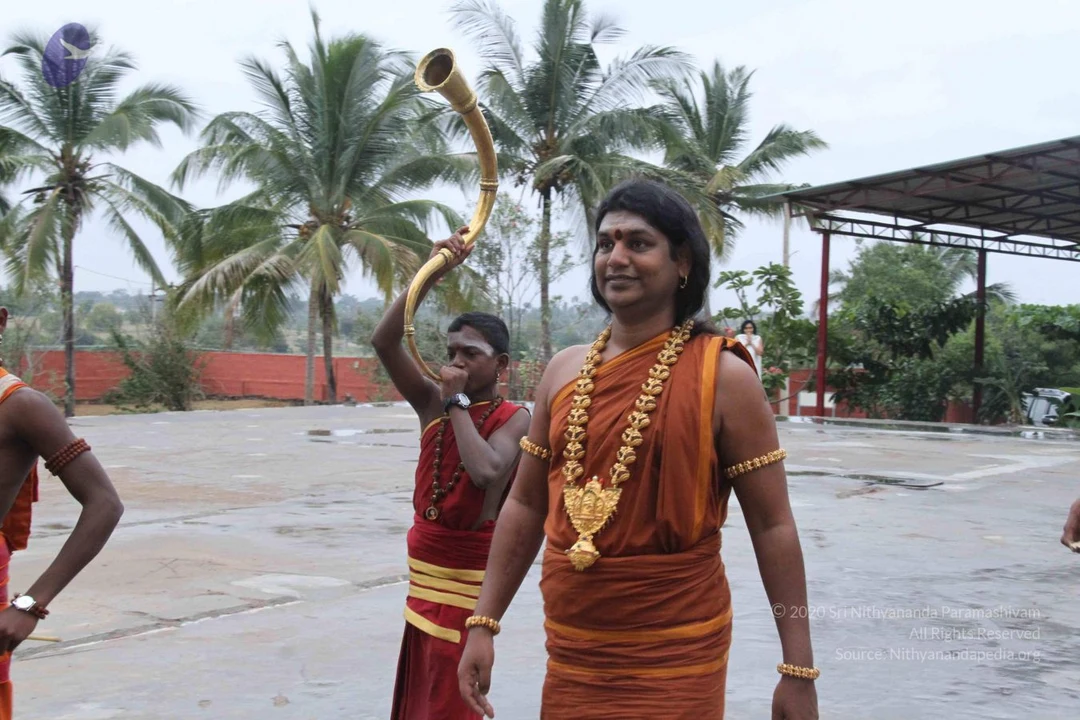
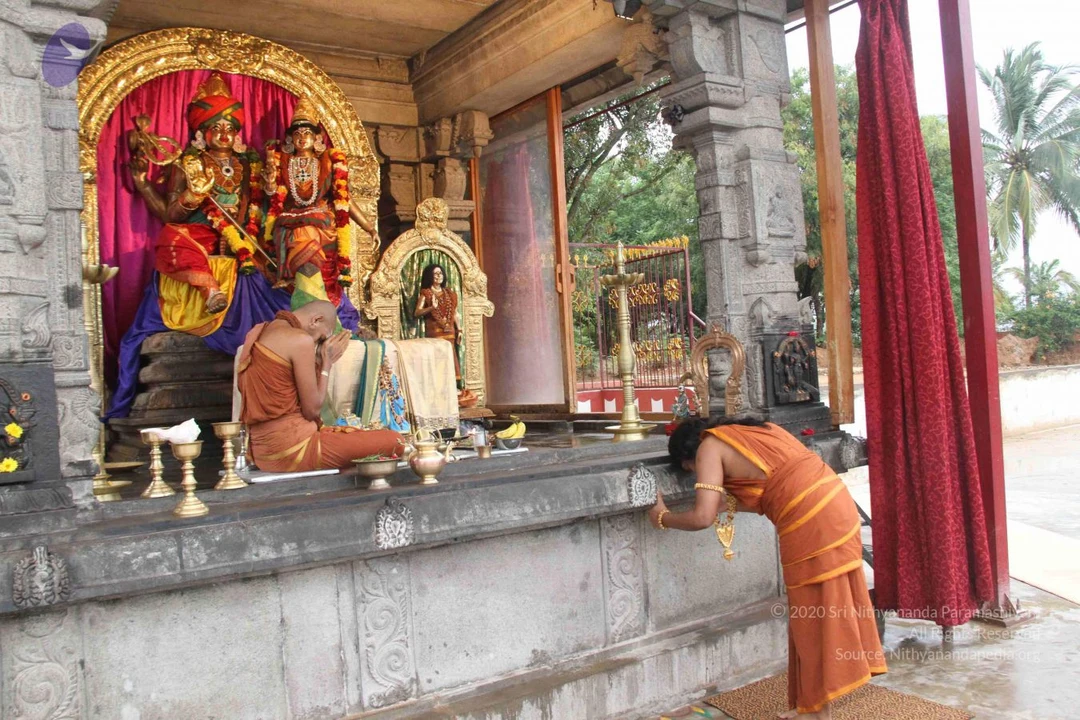
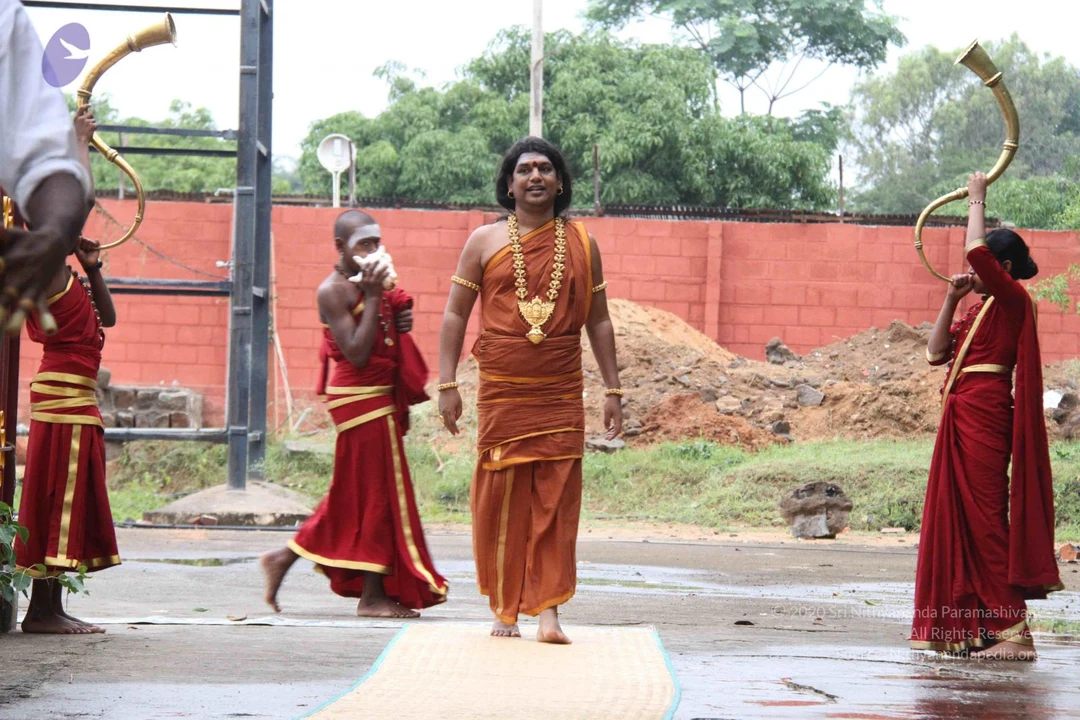
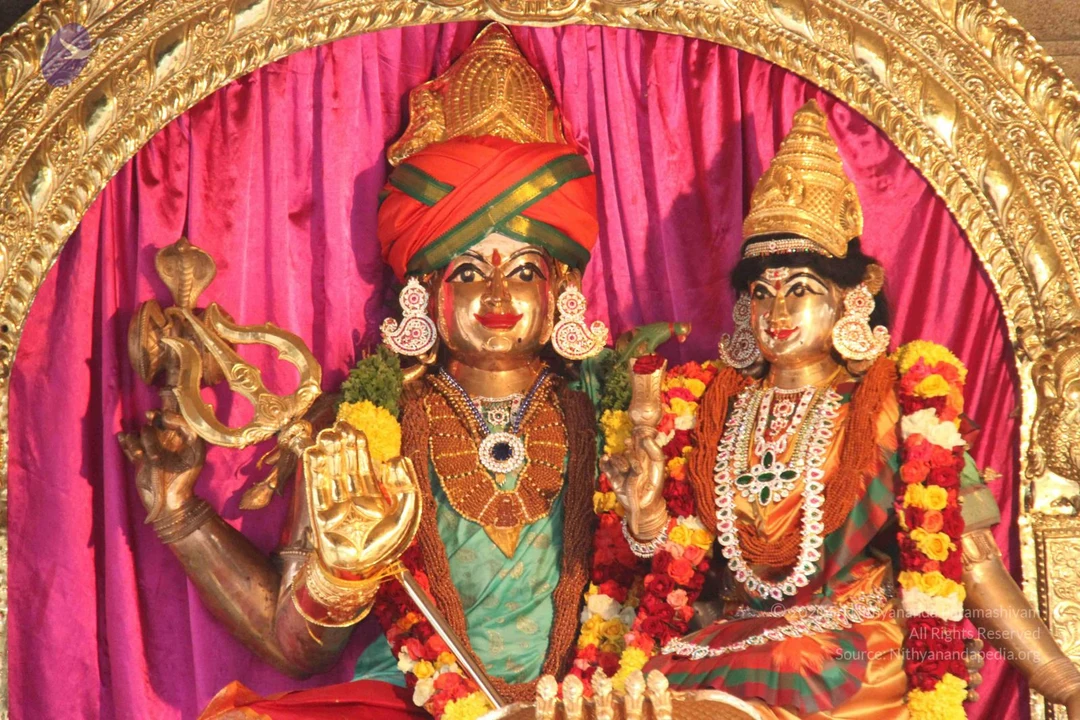
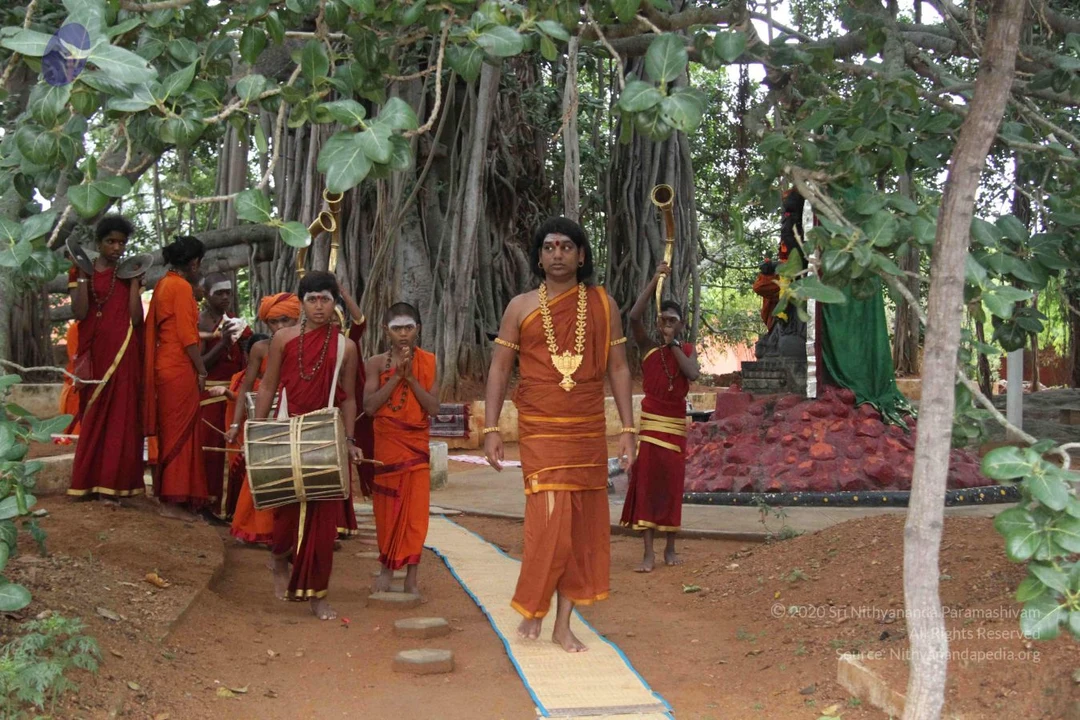
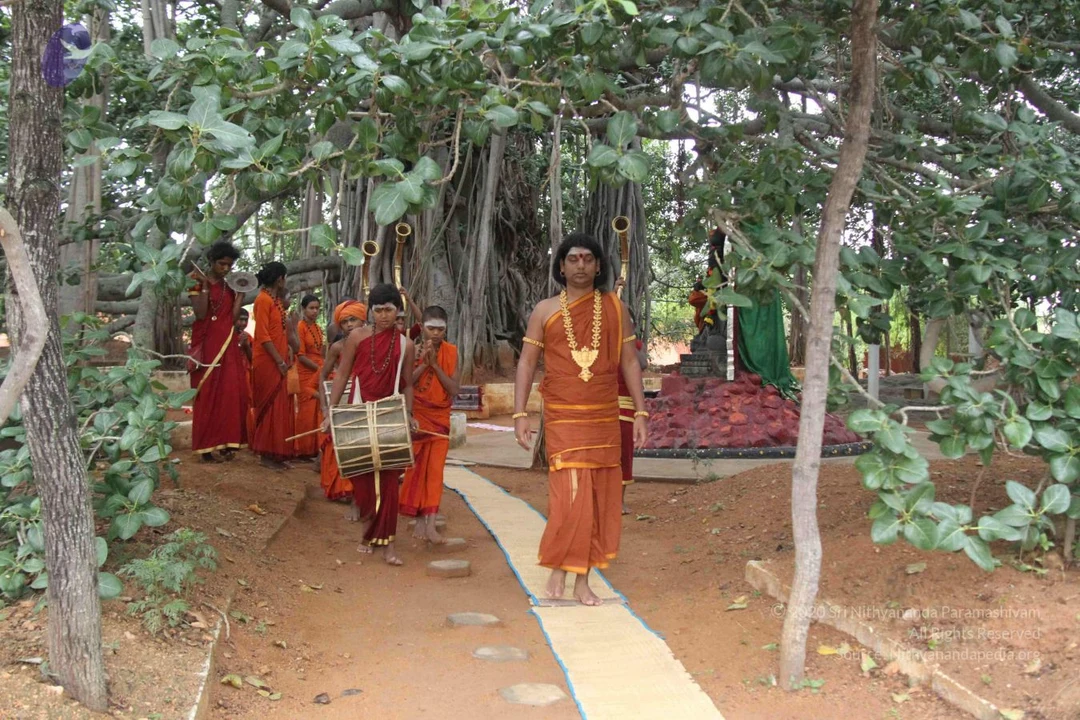
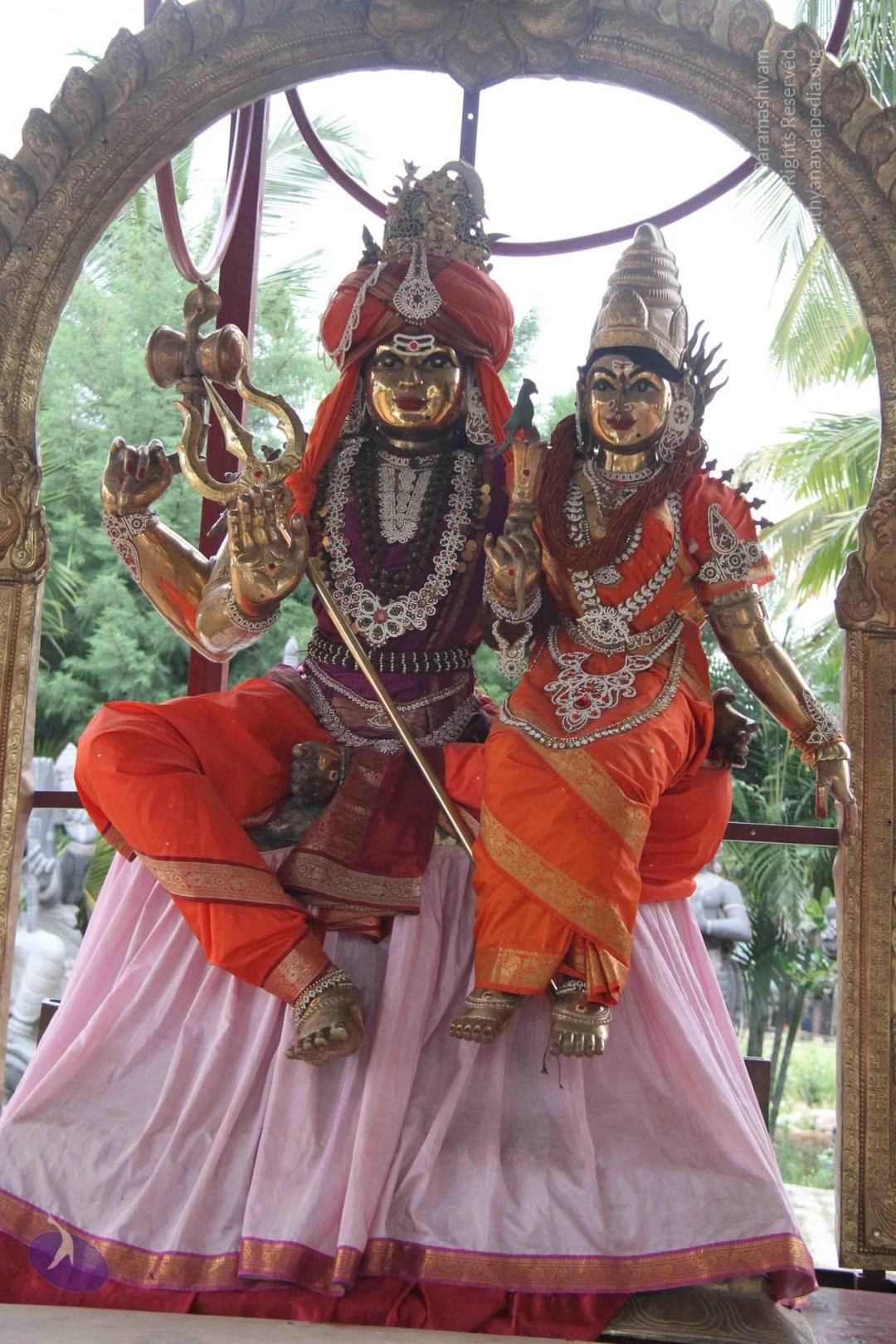
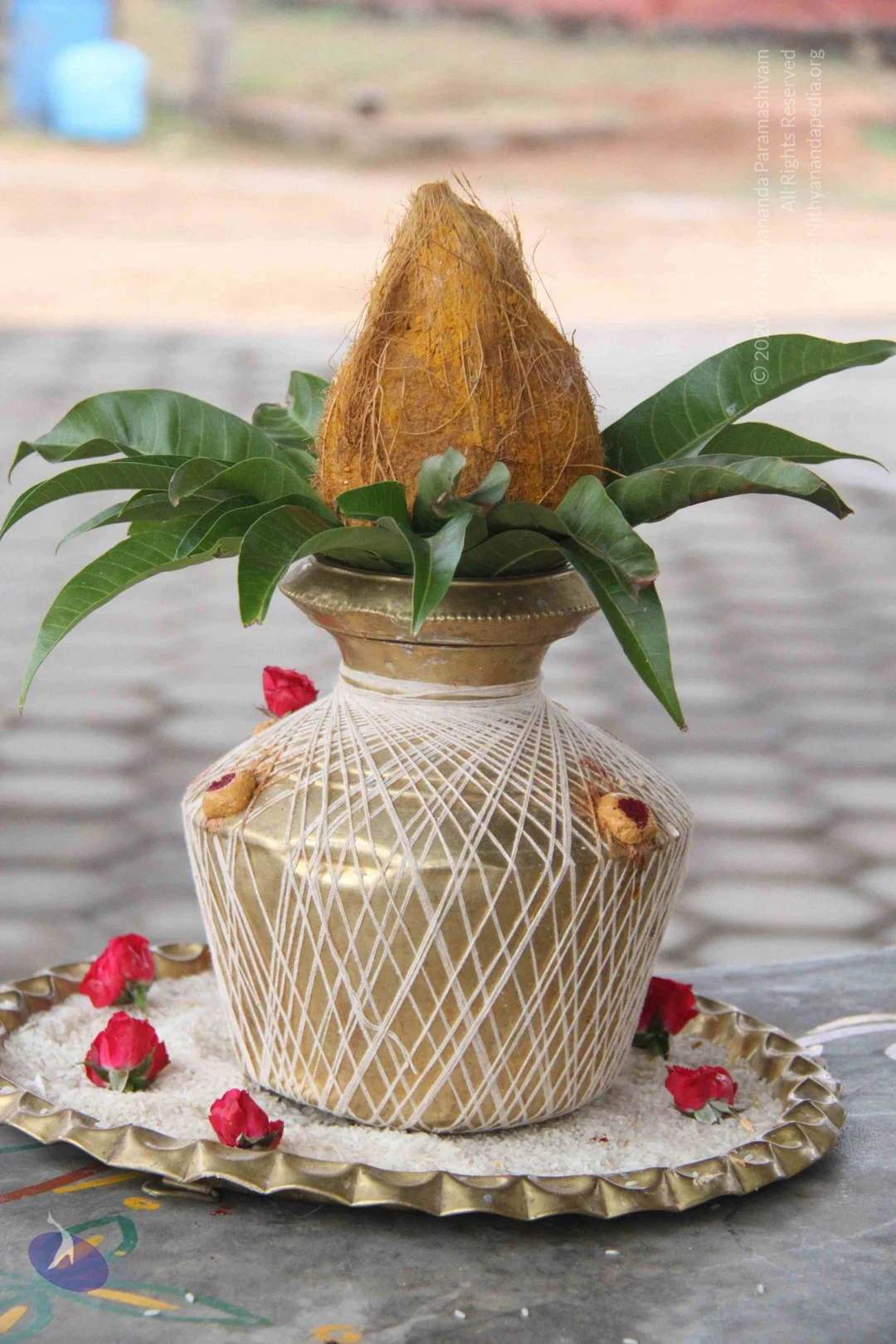
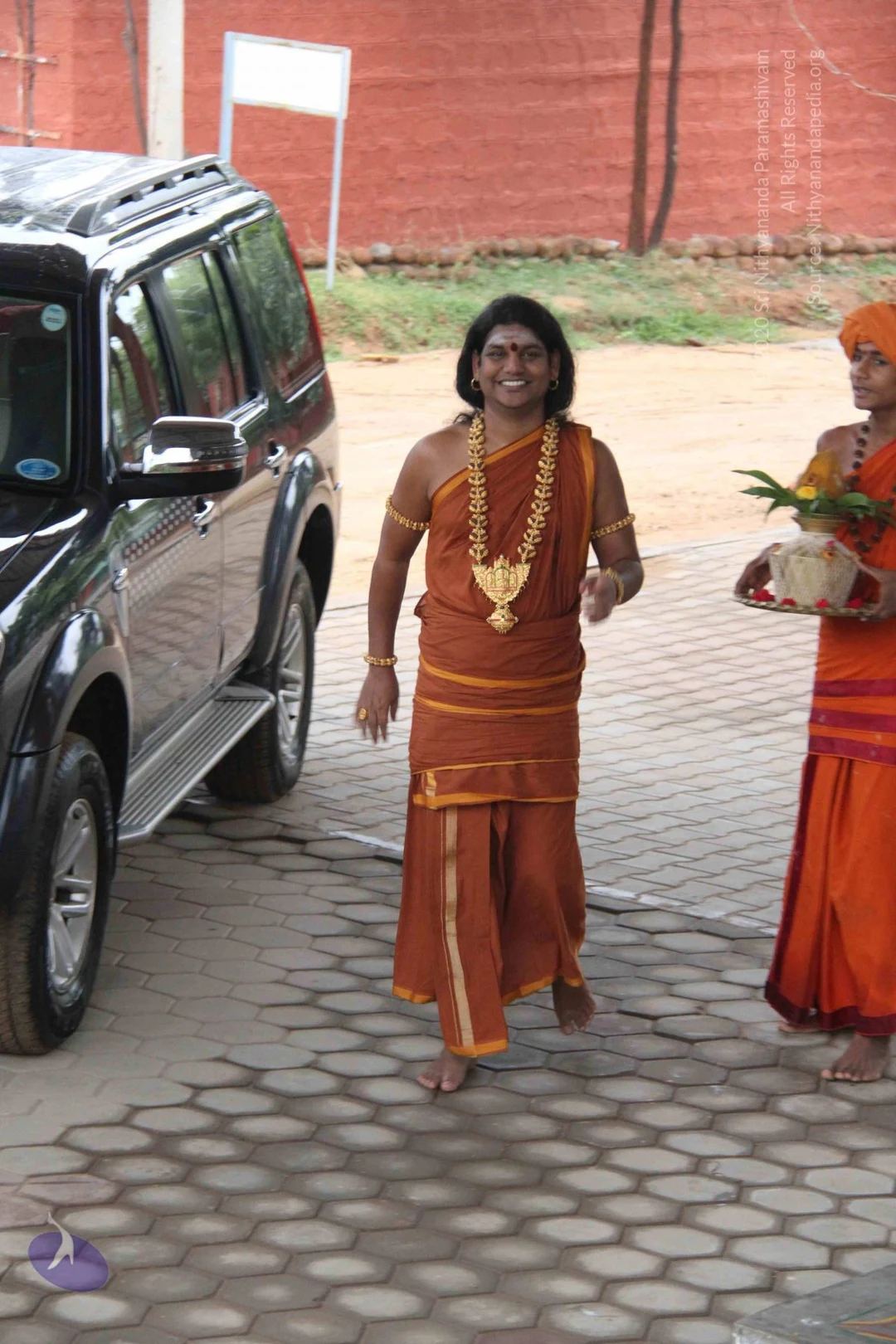
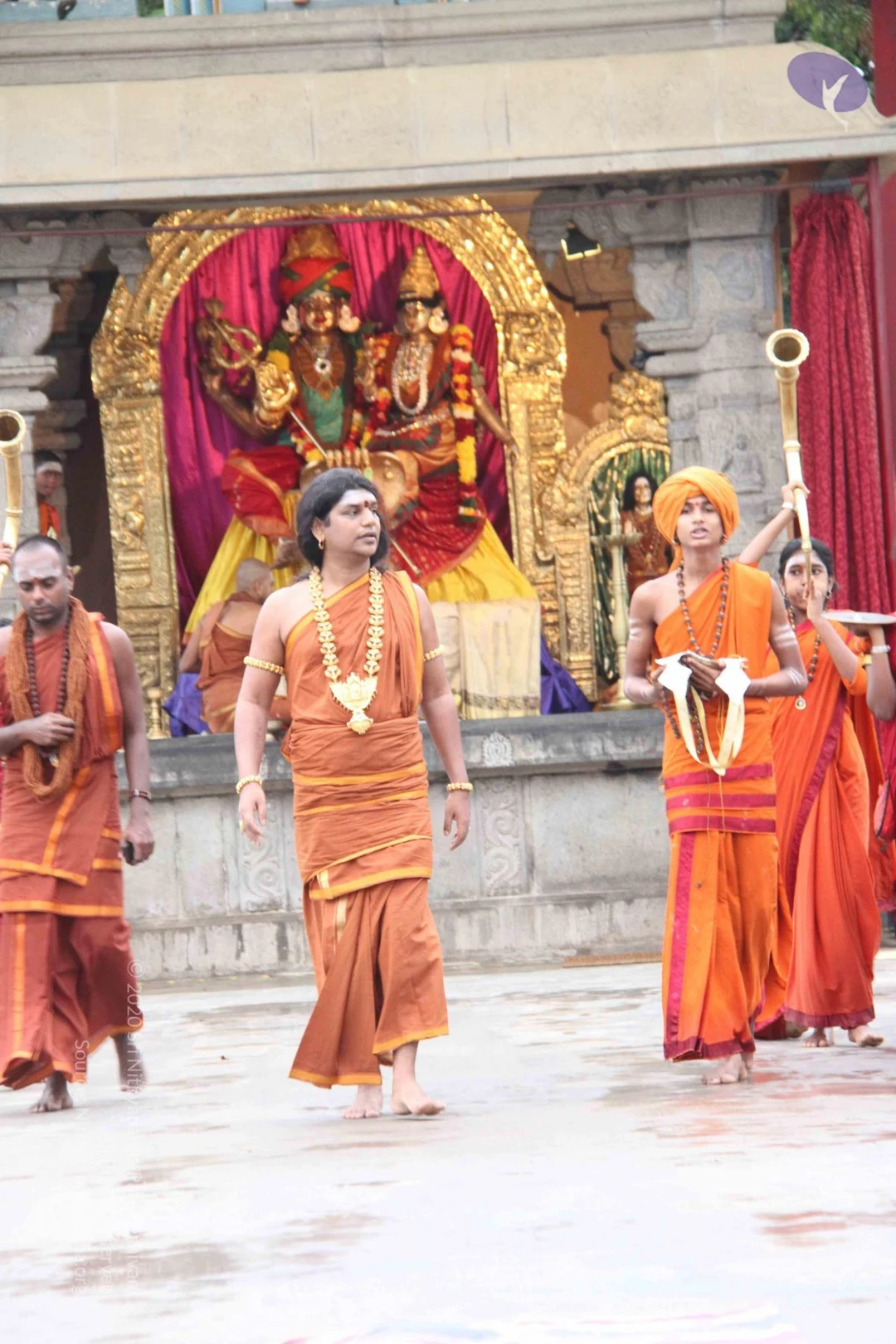
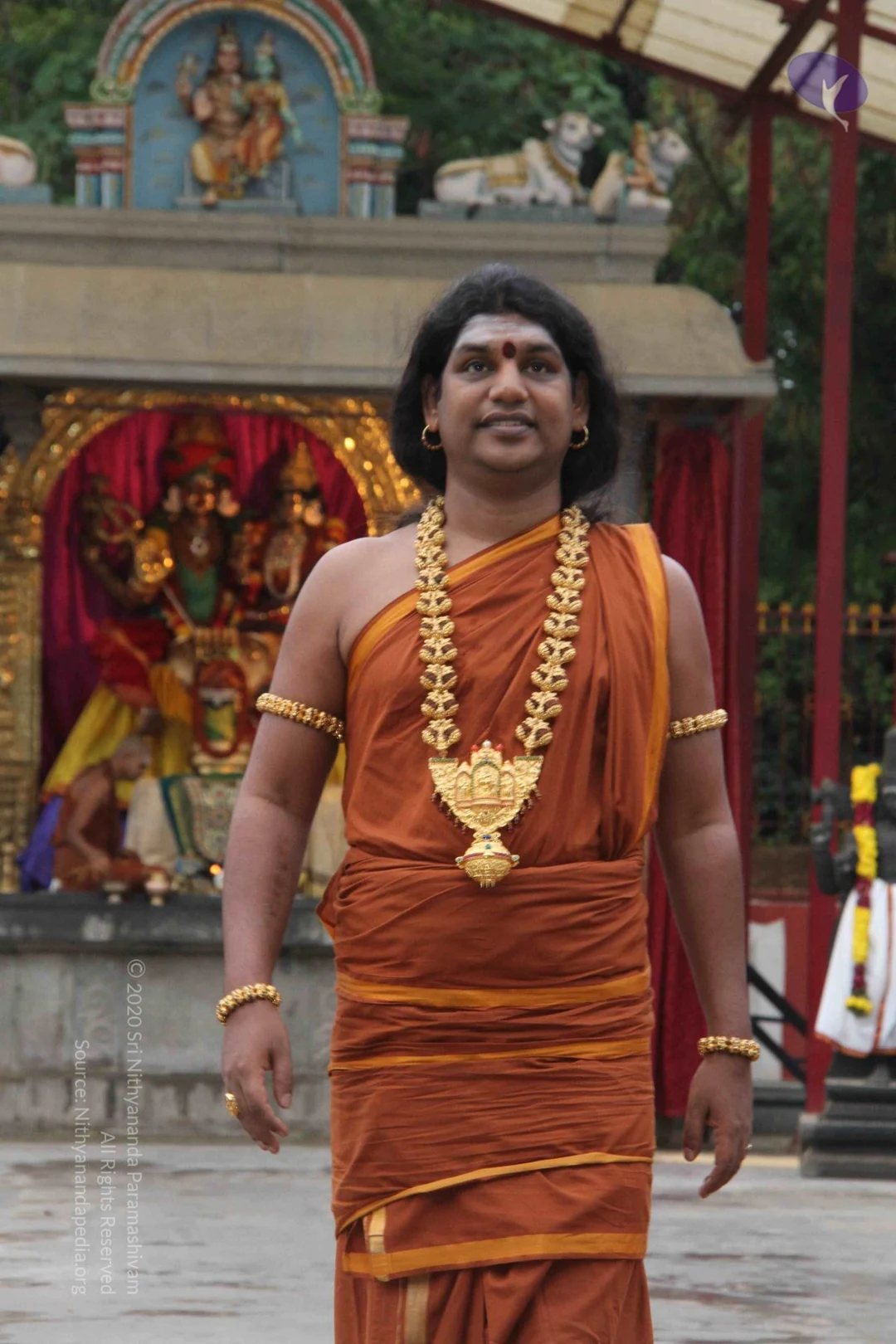
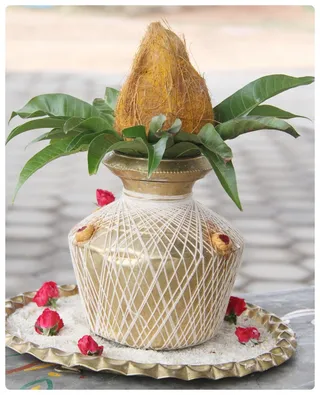
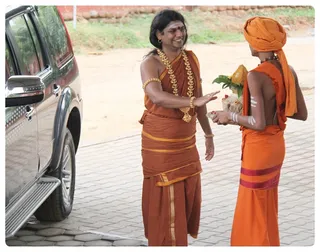
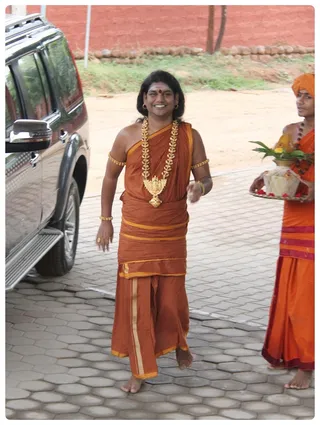
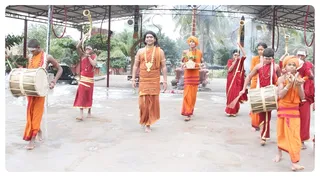
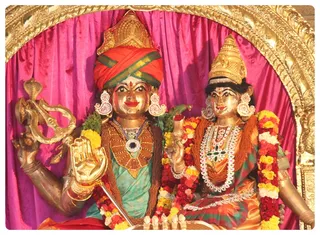
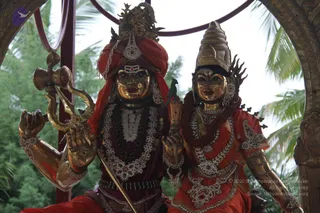
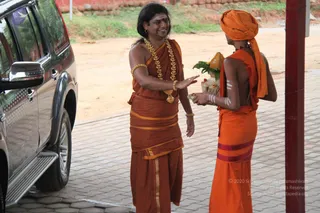
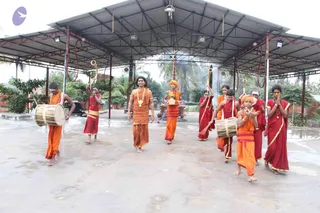
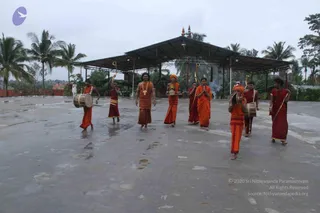
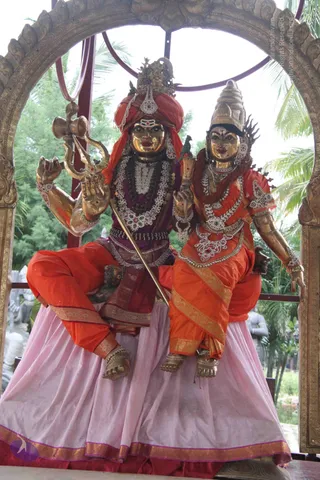
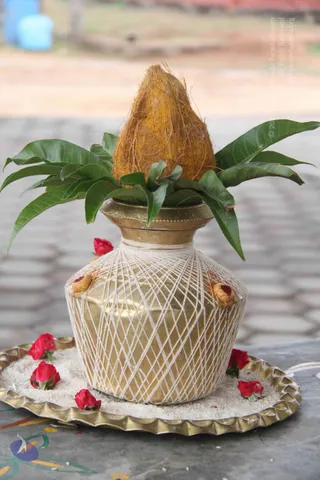
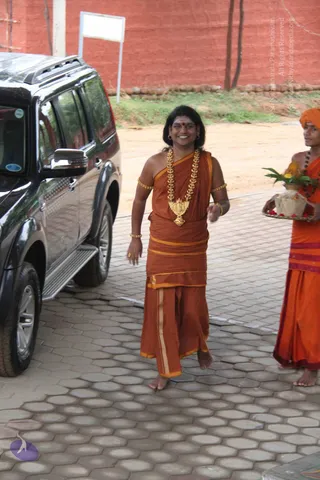
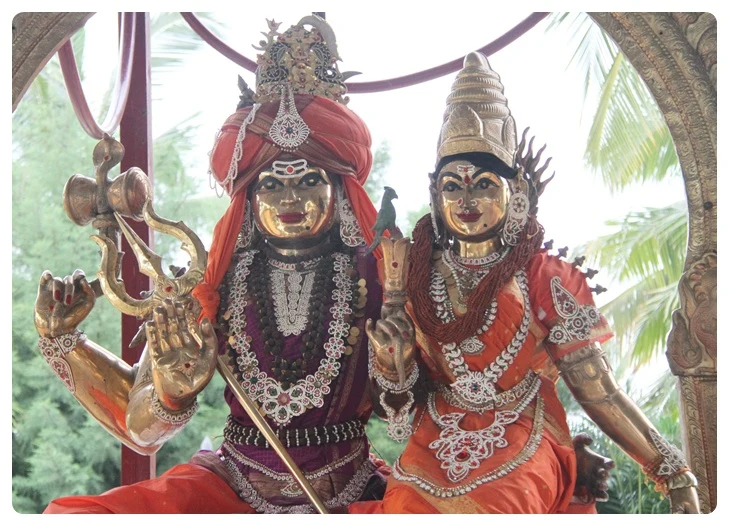
A photograph of a pair of golden deity murtis seated side by side in an arched outdoor setting with palm fronds behind them. The figure on the left wears a red turban and a crown-like headpiece, holds a trident in one hand, and is adorned with white floral garlands, rudraksha beads and a red-and-white brocade garment. The figure on the right wears a tall gold headdress, orange garments with white embroidery, a red beaded necklace, and holds a small bird-like object near the shoulder. Both figures have gold faces with red lips and painted forehead marks. No physical people are visible.A brass kalasha pot wrapped in white cotton thread stands on a brass tray covered with white rice or grain. A whole coconut wrapped in yellow turmeric-stained cloth sits on top, surrounded by fresh green mango leaves. Small red rosebuds and red-dotted dough discs decorate the base and tray. Paved ground is visible behind. No people are present.Outdoor photograph beside a parked silver SUV on a paved courtyard. A smiling man with long dark hair, wearing orange-saffron dhoti and shawl, a gold necklace with pendant, gold bangles and a red bindi, gestures with an open hand toward a second person. That person, shown from behind, wears an orange turban, an orange garment with maroon-striped border, and white painted markings on the back, and holds a tray with flowers, fruit and a coconut or offering. Two people are visible. Appearance-based candidate for a person: the smiling man with long hair, gold necklace and saffron clothing.A smiling man with swept-back shoulder-length dark hair and a red bindi walks barefoot across a paved courtyard beside a silver SUV. He wears a saffron-orange shawl draped over one shoulder and a matching orange dhoti with a gold border, with gold armlets, bangles and a heavy gold necklace with a large ornate pendant and a garland of gold beads. Behind him on the right, a second person in an orange robe and orange turban carries a silver tray with flowers, a lamp and a kalasha-style vessel. The background shows a red-washed wall and a dirt area with greenery.A procession on a wet paved courtyard under a open-sided pavilion roof with red-and-green trim, palm trees and a parked vehicle behind. A central man with long swept-back dark hair wears a saffron-orange dhoti and shawl and a gold necklace and walks barefoot in front. Around him, sannyasi-style attendants in saffron and orange robes and orange turbans play large drums and long brass horns (trumpets). One attendant beside the drummers holds a horn raised over the shoulder. a person is the central figure, who appears to be the processional leader. Image shows a procession with drummers and horn players in ceremonial dress.Golden murti of a Shiva-Parvati pair on a seated dais against a magenta velvet drape within a gilded arch. The male figure wears an orange and green turban, a red tilak, teal garment, a heavy gold necklace with a blue gem, and holds a trident and a serpent. The female figure wears a gold crown, white and red beaded necklaces, a green and gold sari, and holds a lotus stem. Both are adorned with red, yellow and white flower garlands and paisley-shaped earrings. No physical people are visible.
temple-visit

19 photosSource gallery
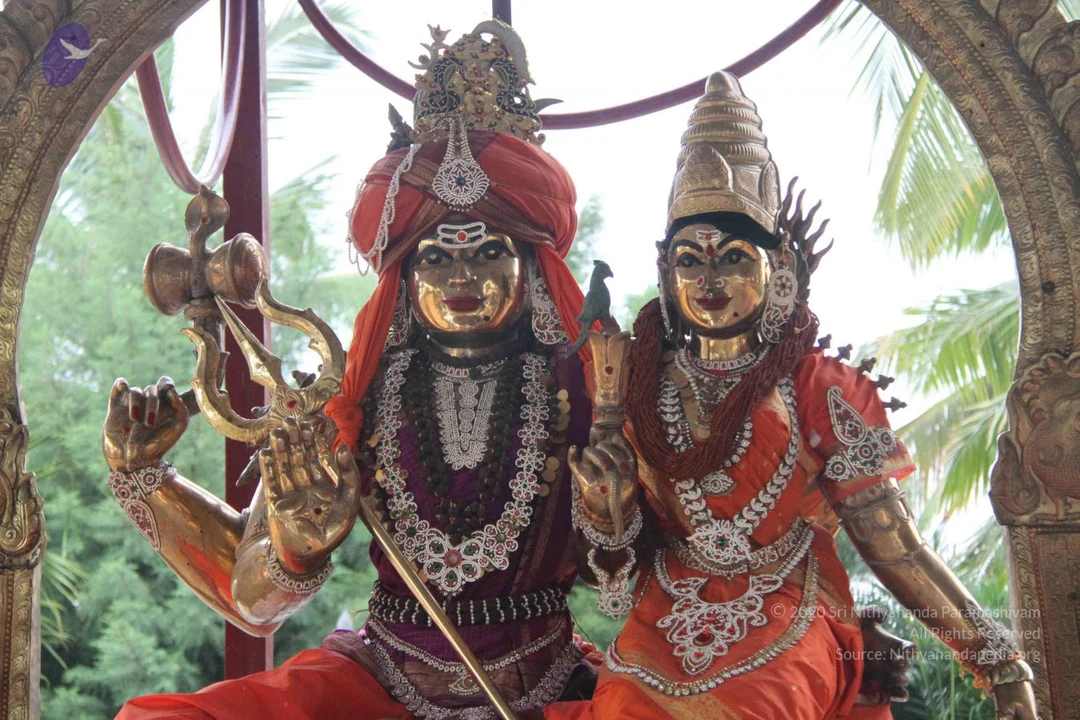
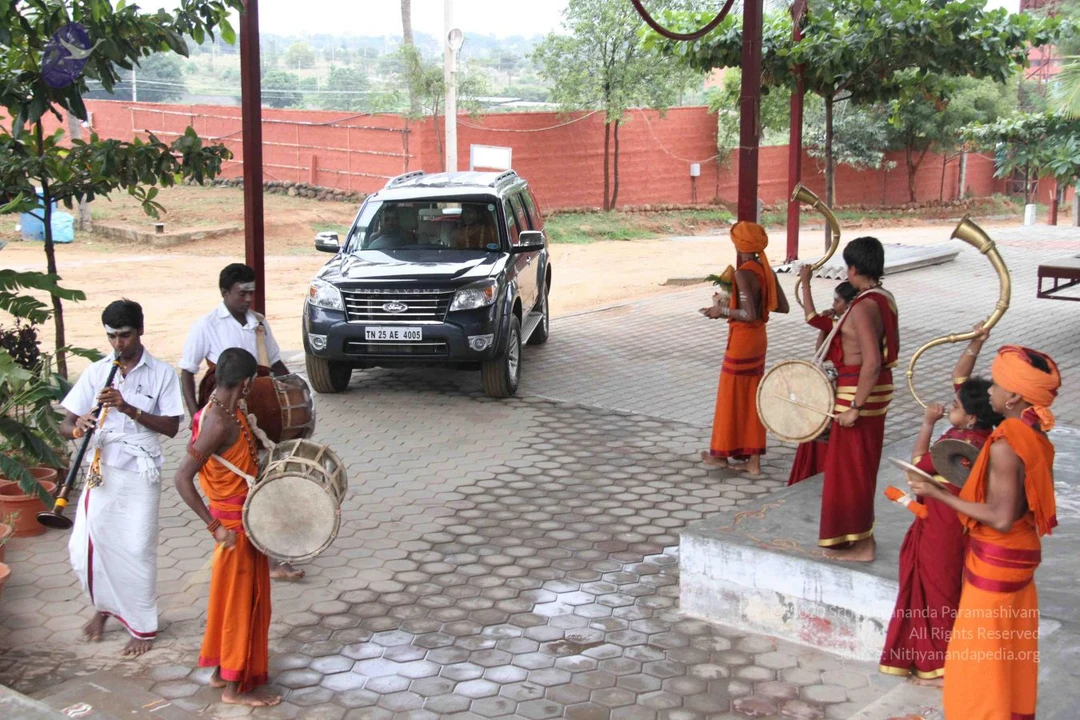
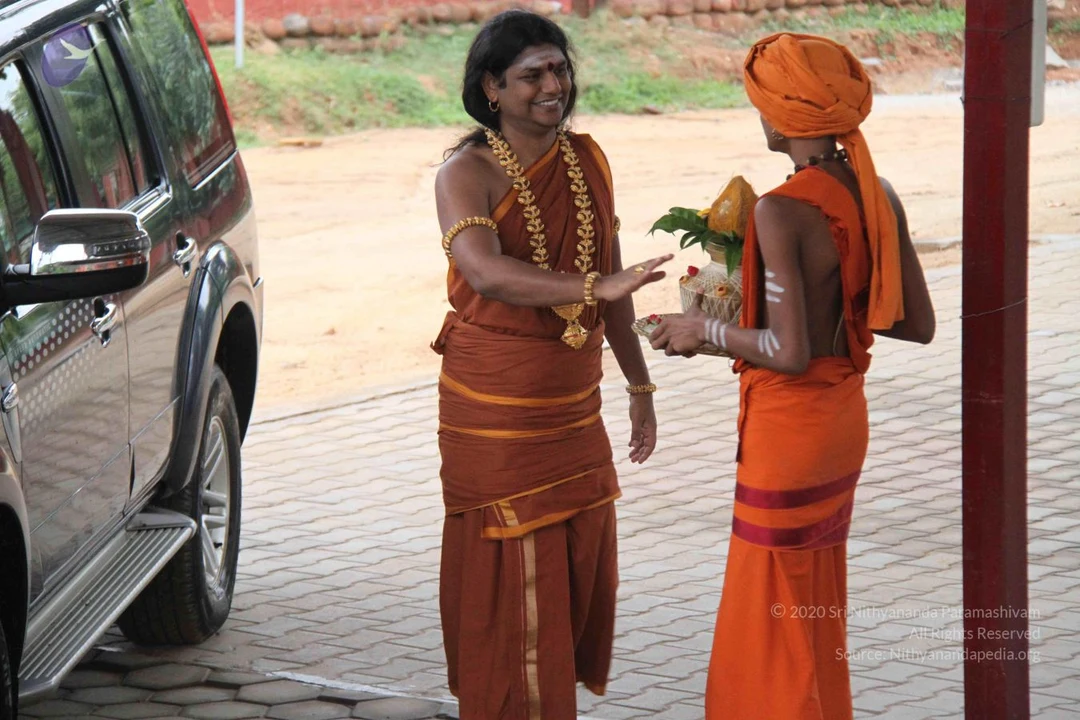
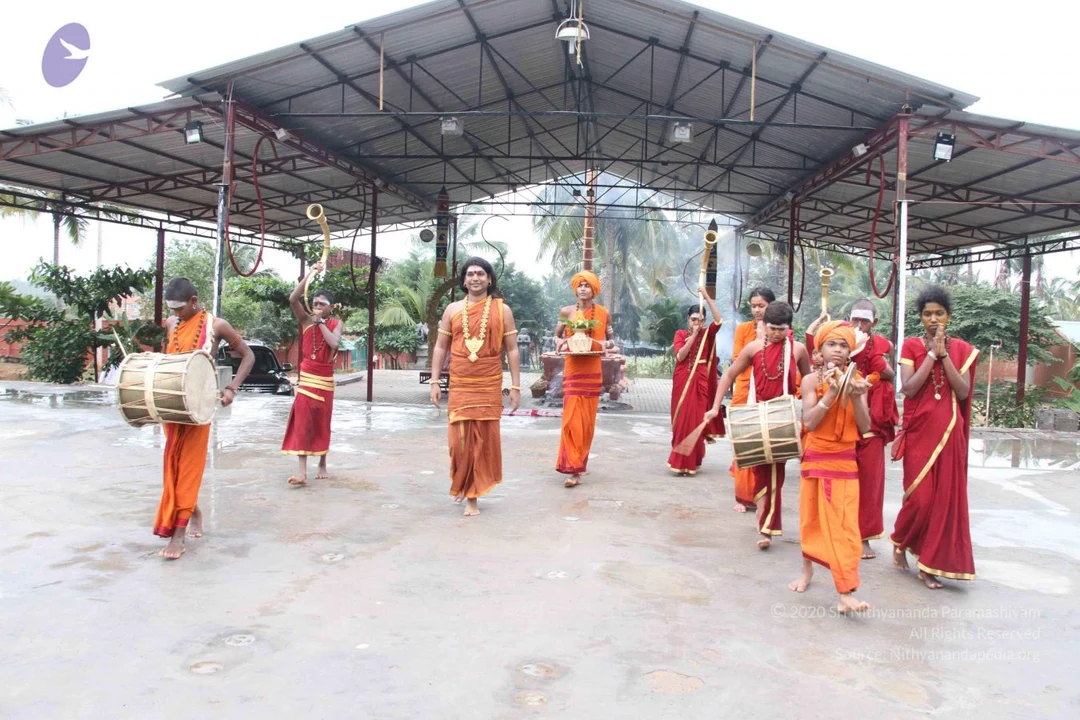
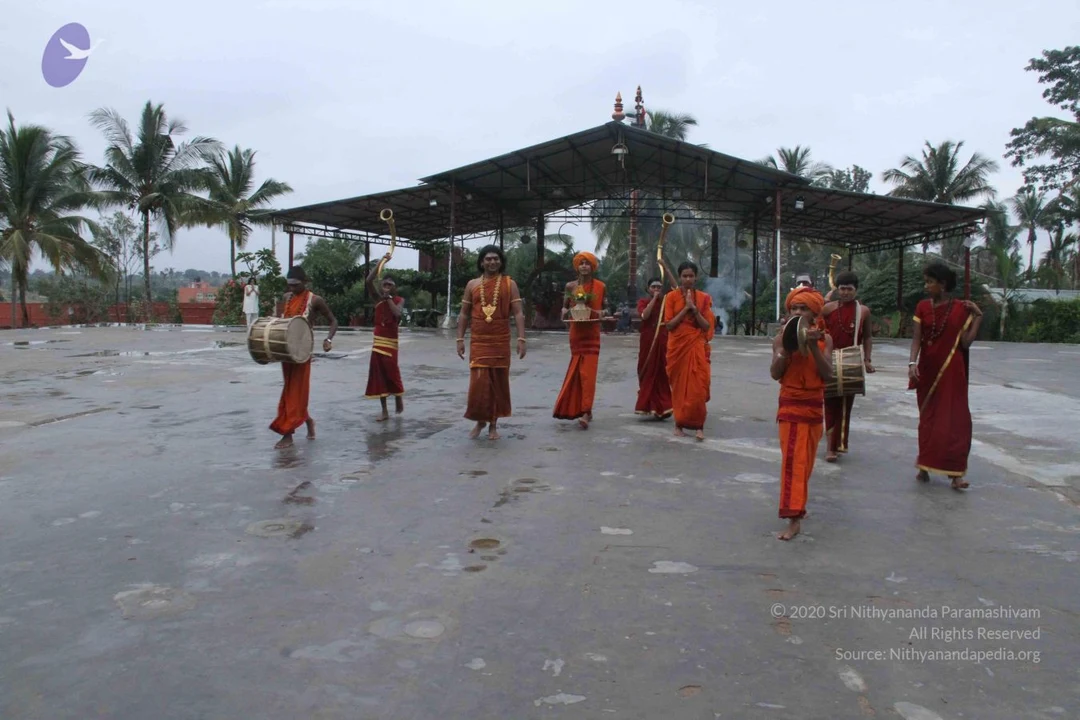
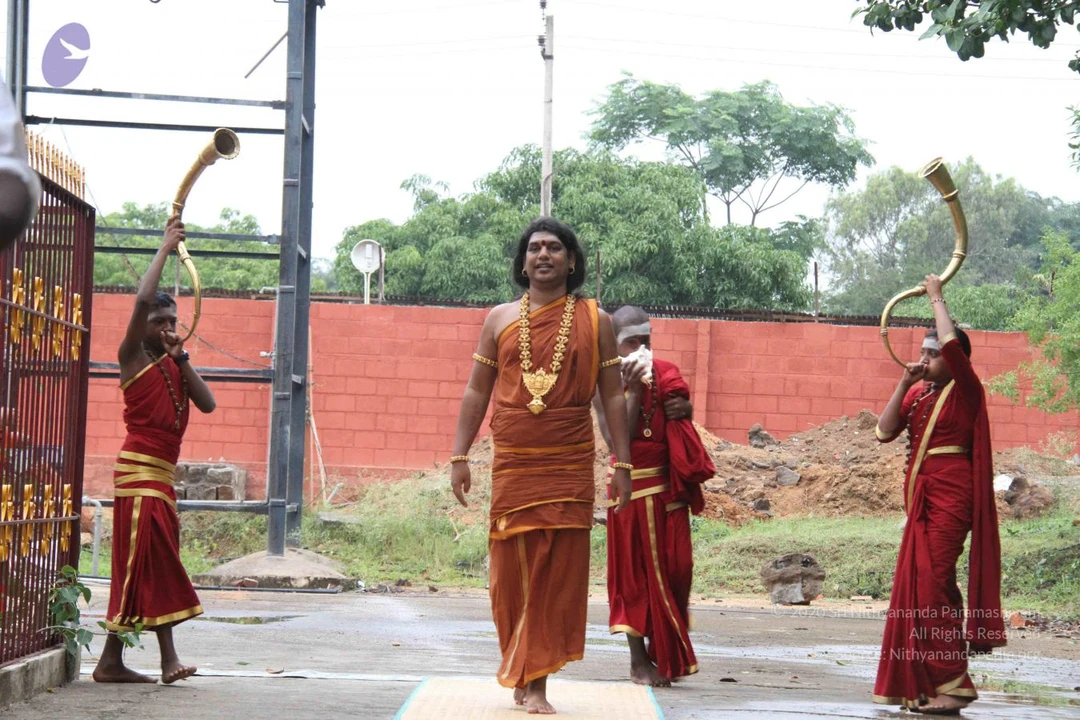
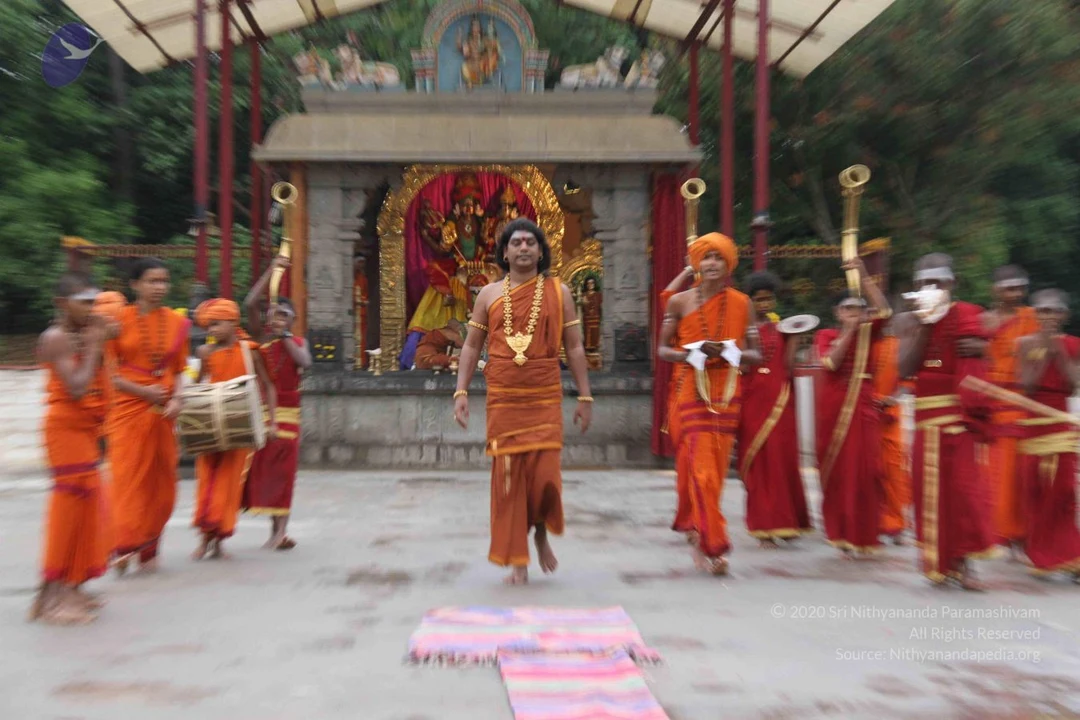
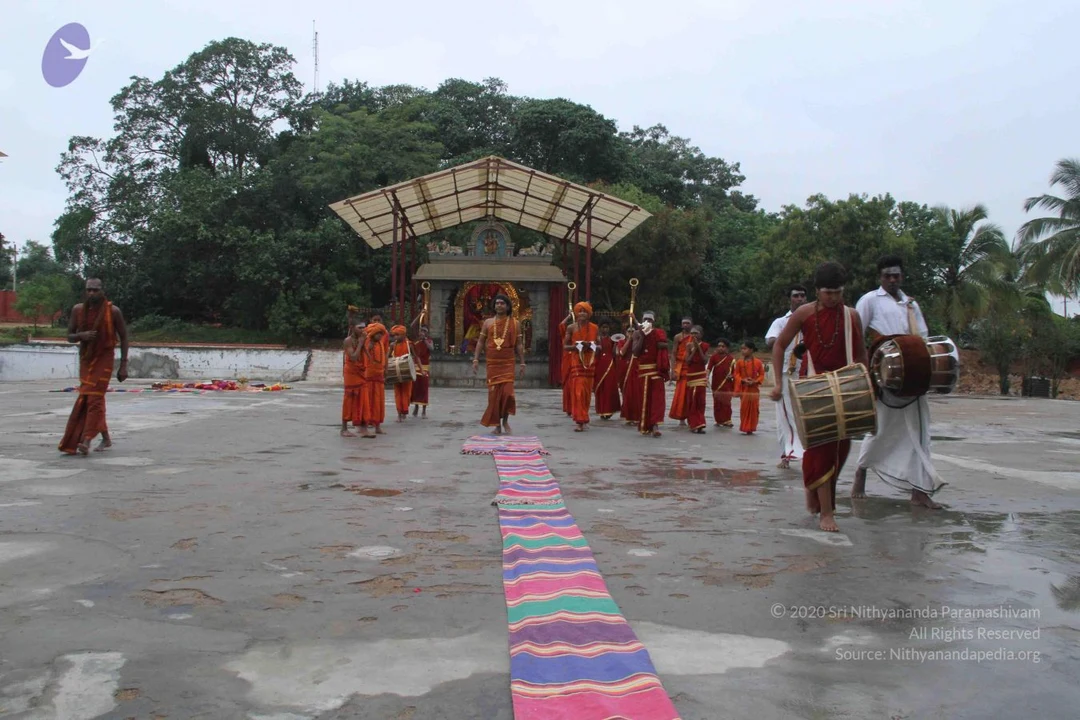
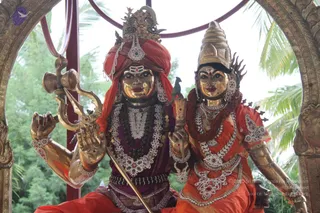
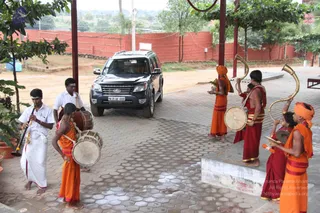
A photograph of two golden processional murti of Shiva and Parvati seated on a palanquin under a curved arch with palm fronds behind. The Shiva figure, on the left, wears a red turban, rudraksha mala, a crown and a silver necklace, and holds a trident in one hand. The Parvati figure, on the right, wears an orange-red sari with silver jewellery and a golden crown. Both faces are gold-painted with red and white tilaka markings. A small bird perches near the centre. No physical people are visible.A photograph of a golden-faced deity murti pair seated in an ornate arched frame outdoors, with palm fronds and greenery behind. The figure on the left wears a red turban, a purple garment with a rudraksha mala, layered white beaded and gem necklaces, and holds a trident in one hand while the other hand is raised in blessing. The figure on the right wears a gold crown, an orange sari with silver-beaded ornaments and a red beaded necklace, and holds a small kalasha-like object. A small green bird perches between them. No physical people are visible; the figures are statues.Outdoor courtyard arrival with a dark grey Ford SUV pulling up under a covered walkway with red pillars and a red brick wall behind. Musicians perform on the paved floor: a man in white dhoti and shirt plays a long wooden pipe (nadaswaram-style), another in white plays a double-headed drum, and several young men in saffron-orange dhotis and turbans play large drums and long brass horns (kompu/ceremonial trumpets). A bare-chested drummer in red-and-saffron cloth stands near the steps. The scene resembles a traditional welcome procession for an arriving vehicle. A visible figure in orange near the vehicle may be a sannyasi but no clear identifying cues are present. Trees and a low wall frame the background.Outdoors beside a parked dark SUV on a paved courtyard, a smiling person in orange-saffron robes with a gold multi-strand necklace, gold bangles, a red forehead dot and long hair gestures with an open hand toward a second person. That second person, seen from behind, wears an orange turban and orange robe with a red border and holds a tray of flowers, fruit and offerings, with white markings on the arm. a person candidate is the figure in orange with the gold necklace and bangles, shown with long hair and ornate gold adornments. Pillars and a dirt ground surround them.A procession under a metal-roofed open pavilion with a wet concrete floor. A central man in an orange dhoti and orange shawl, wearing a long gold-toned pendant and a beaded garland, walks forward with a bare chest and long swept-back hair. Around him, young and adult attendants in orange and red robes play drums and long brass horns, and one attendant in an orange turban carries a brass tray or kalasha with flowers near the centre. Palm trees and a parked black car stand in the background.A procession of people in saffron and orange clothing walks barefoot across a wet concrete courtyard under a large open-sided metal-roofed pavilion lined with palm trees. Several men in orange dhotis and saffron turbans play drums, and one carries a long curved brass horn. Two women in deep red sarees walk among them, one carrying a drum and another holding a small object. A man in the centre wears a rudraksha-style mala and a gold pendant, with hands folded. Ritual torches or horns and a red-and-gold pillar stand near the structure, and a smoky fire glows in the background. Puddles and footprints mark the wet ground.

Prathyaksha-Pada-Pooja
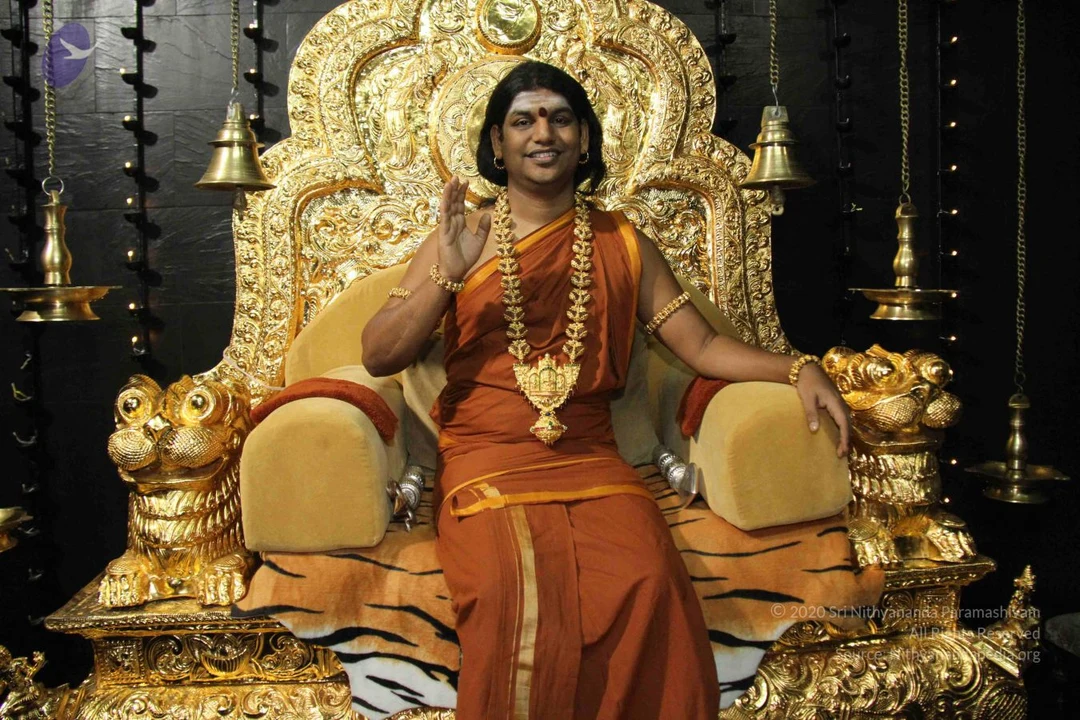
19 photosSource gallery
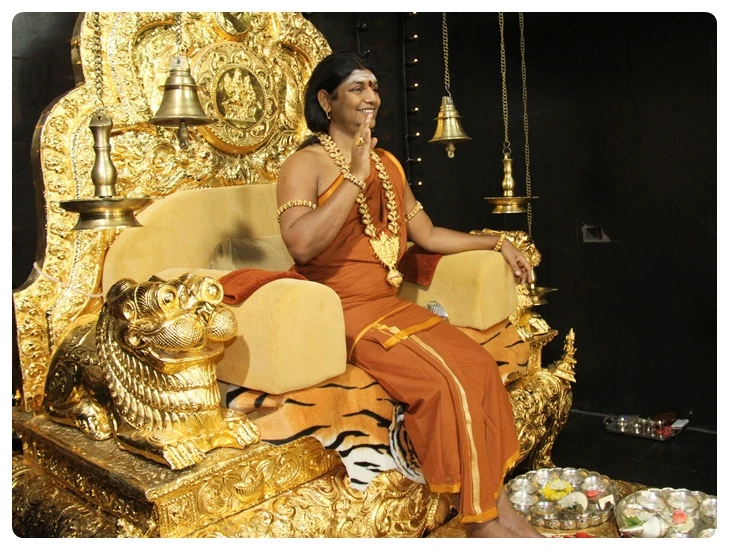
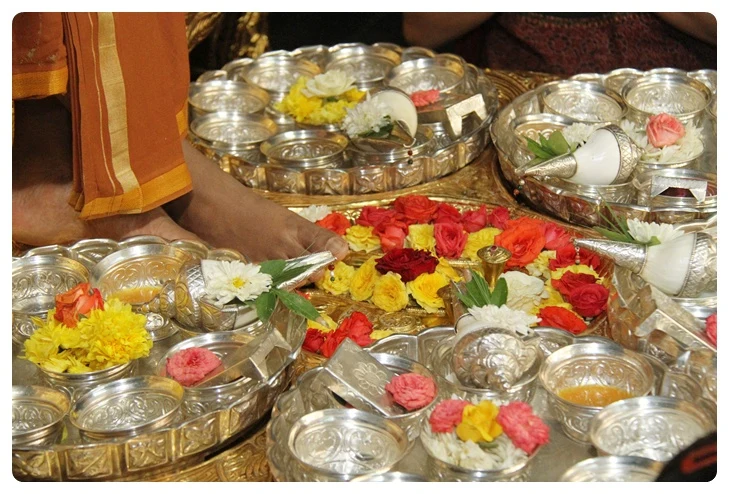
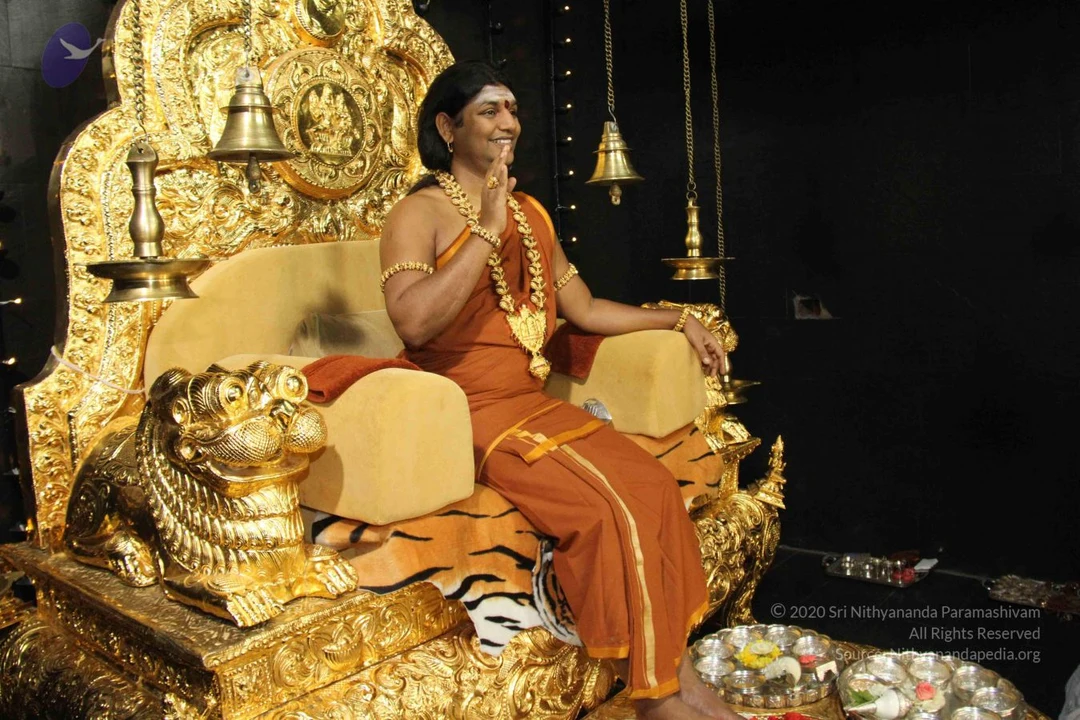
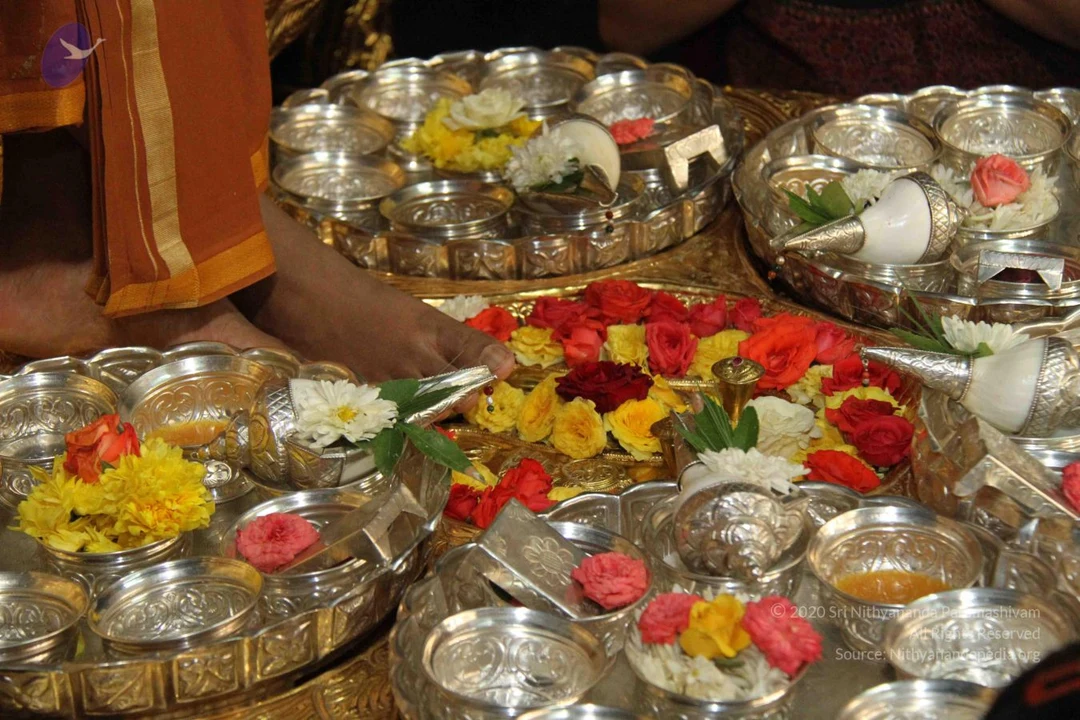
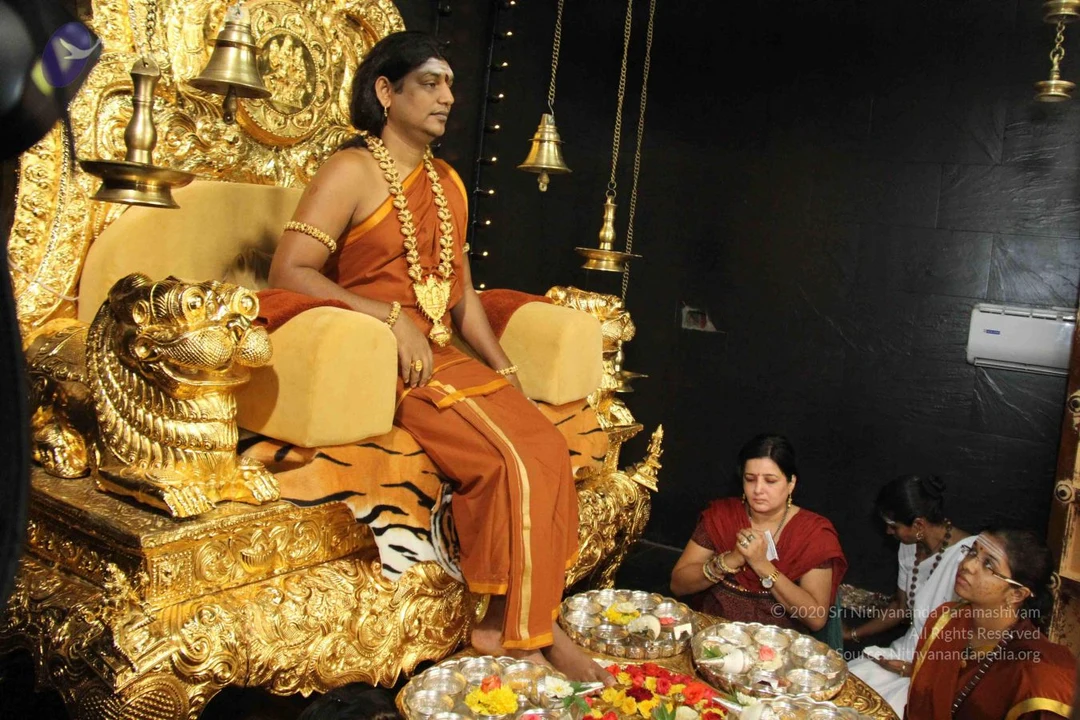
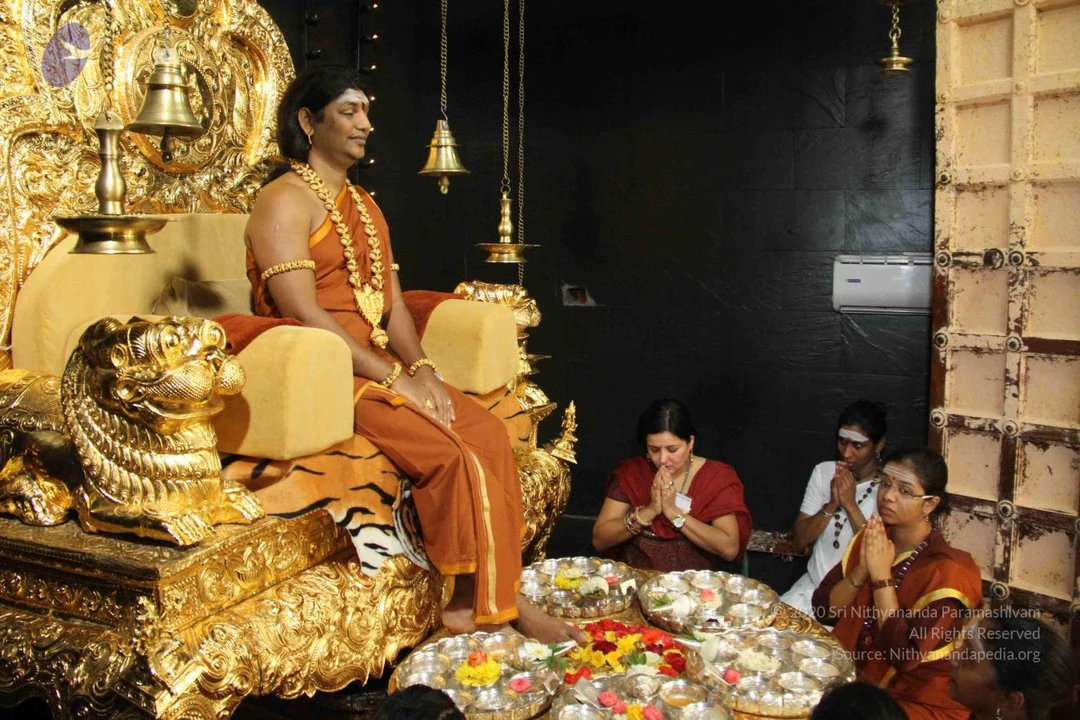
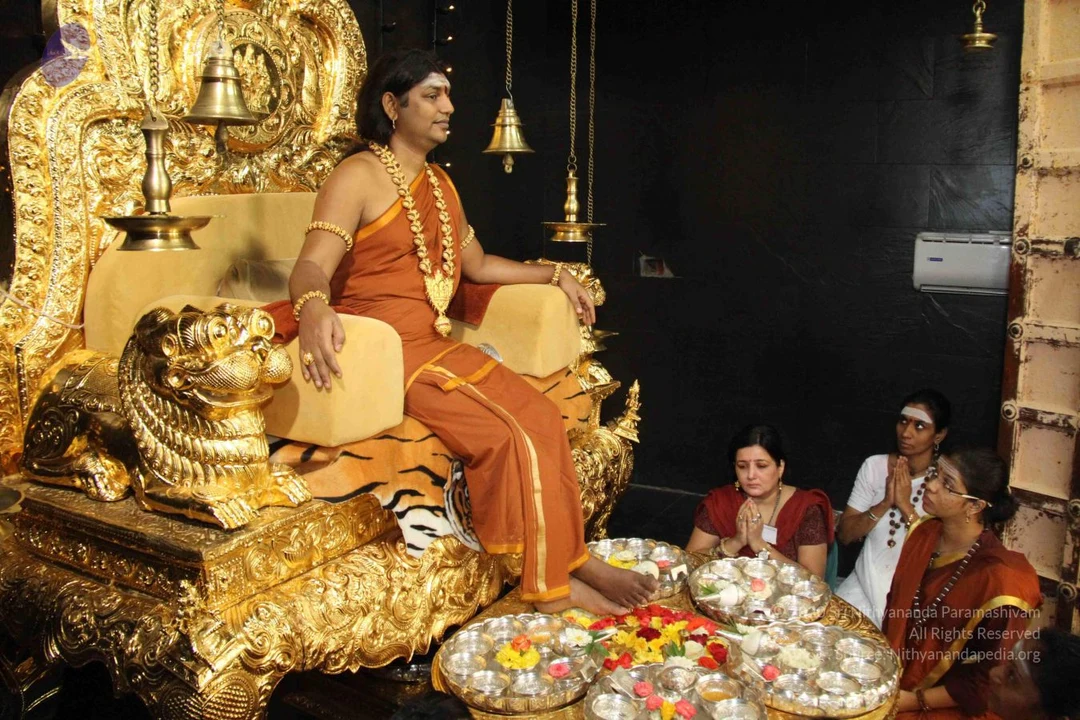
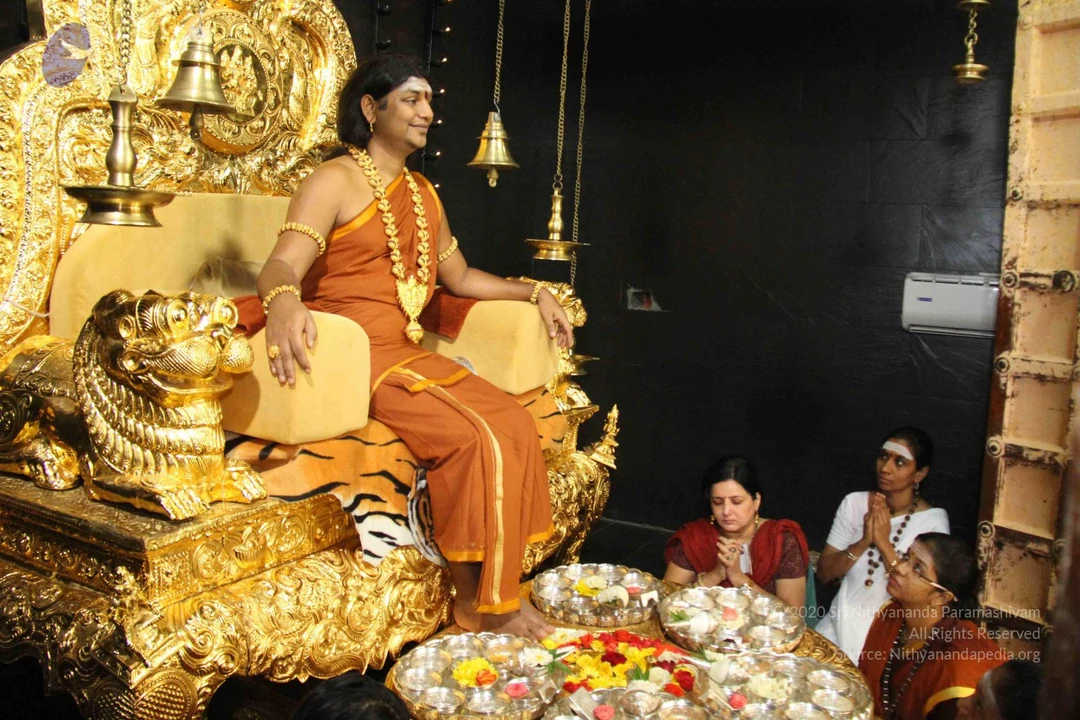
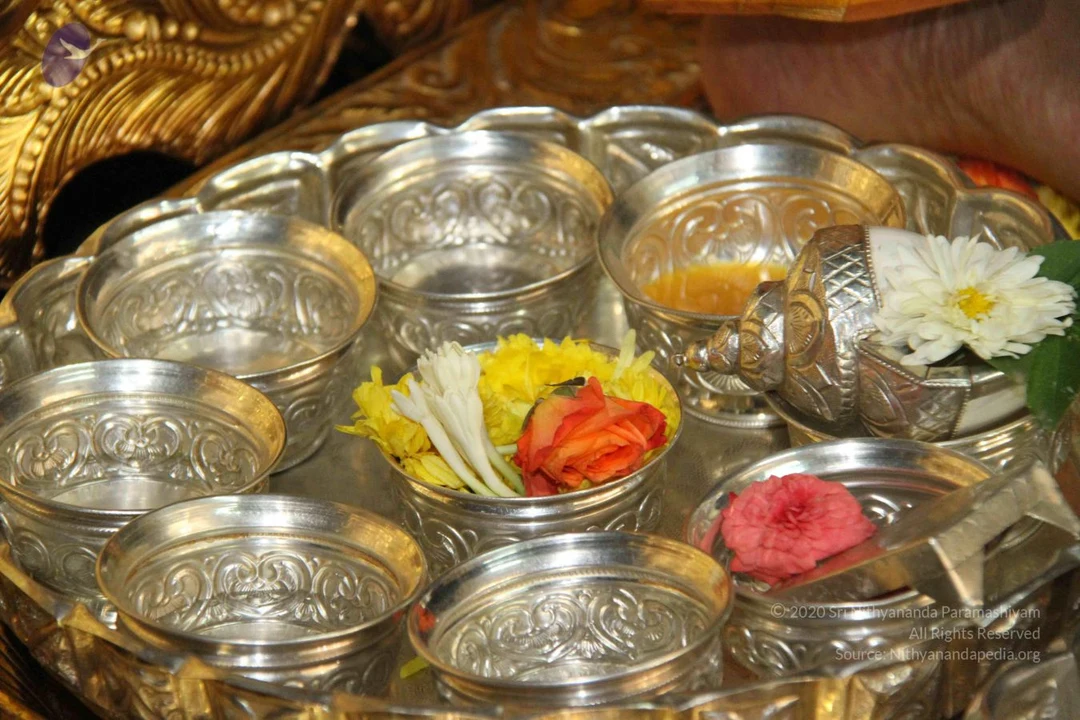
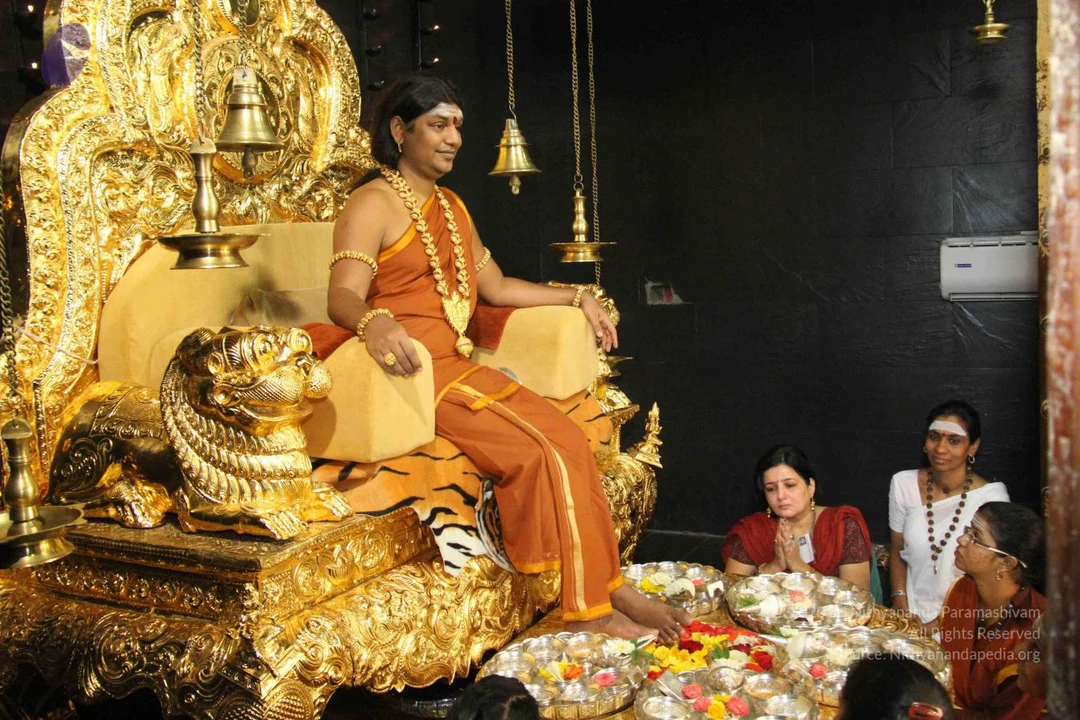
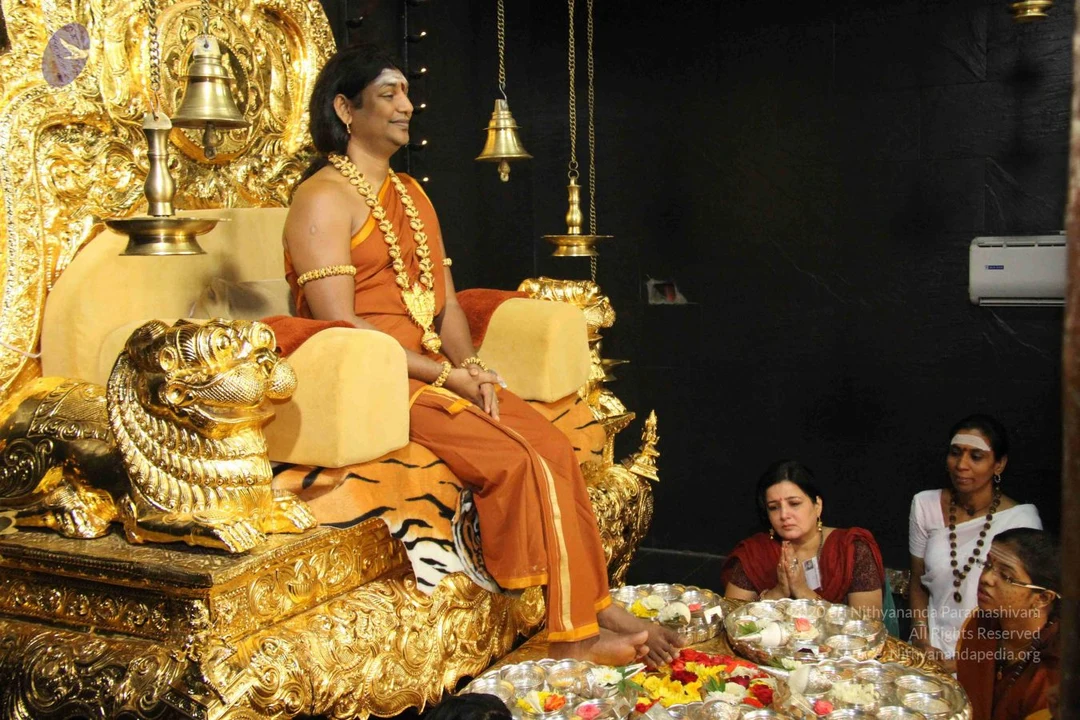
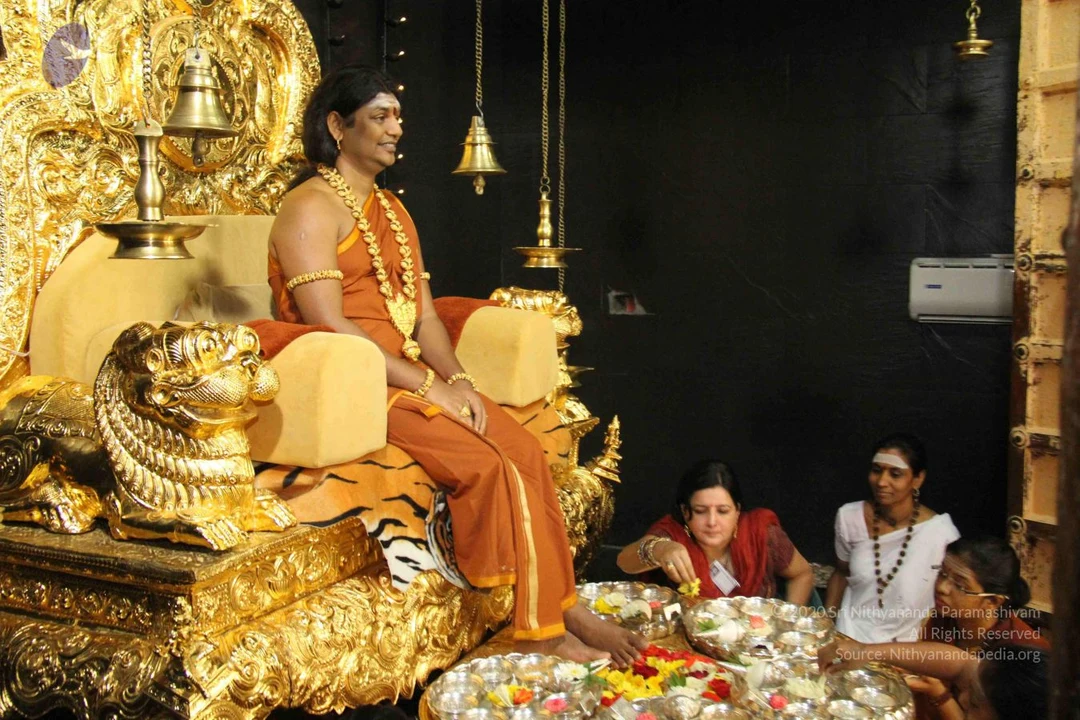
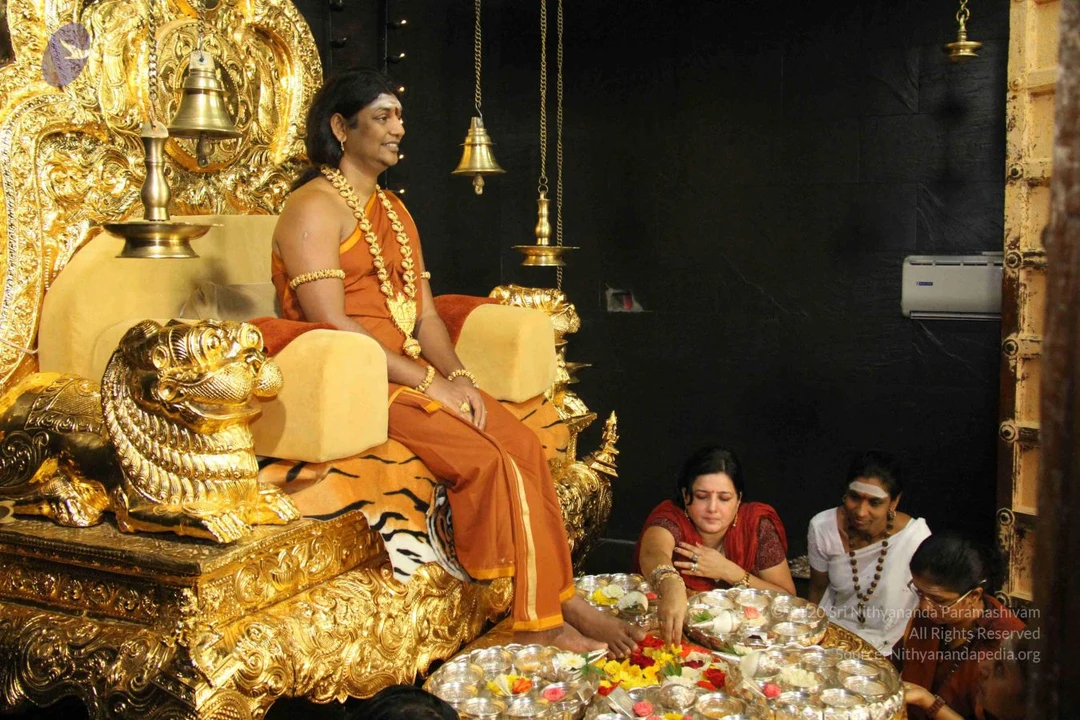
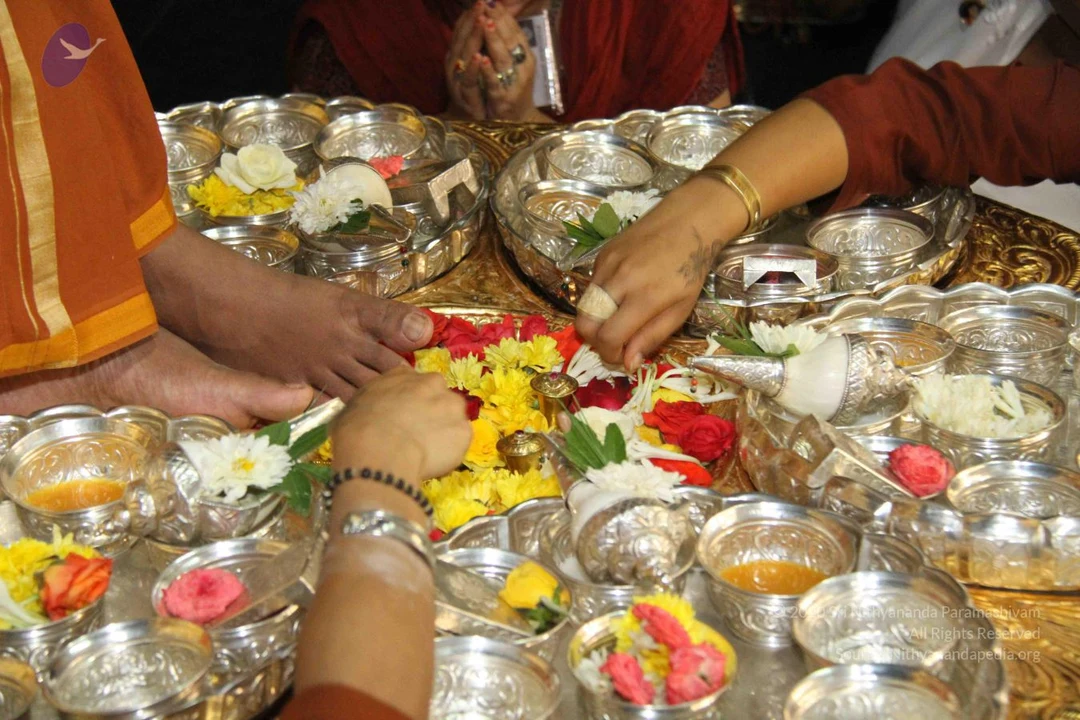
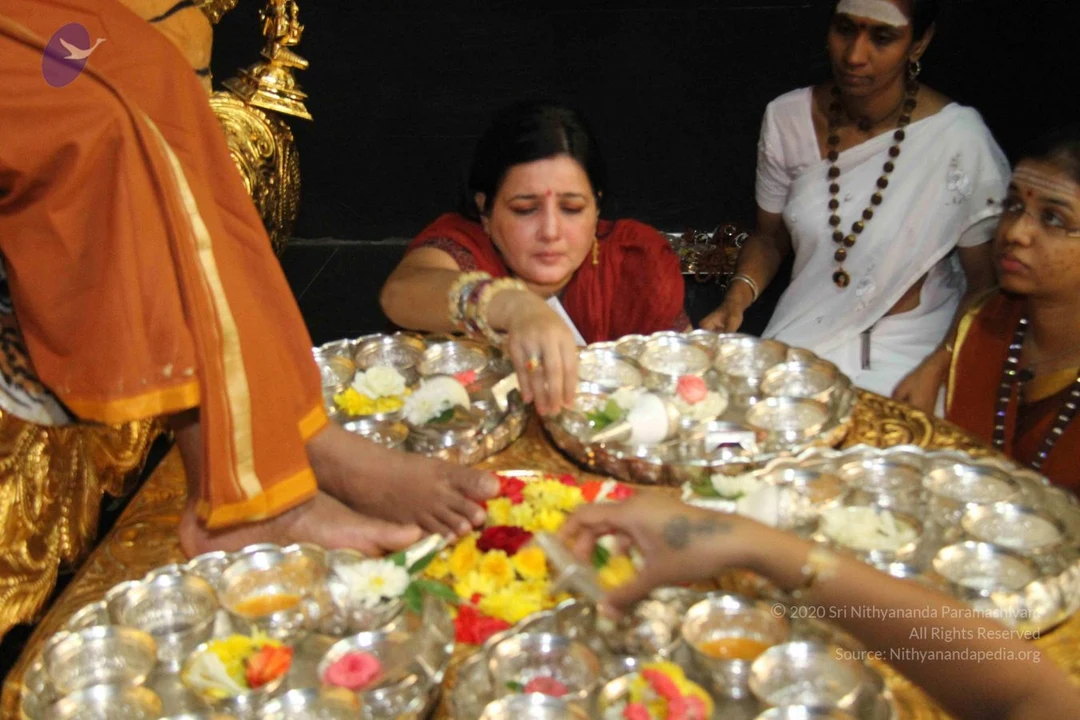
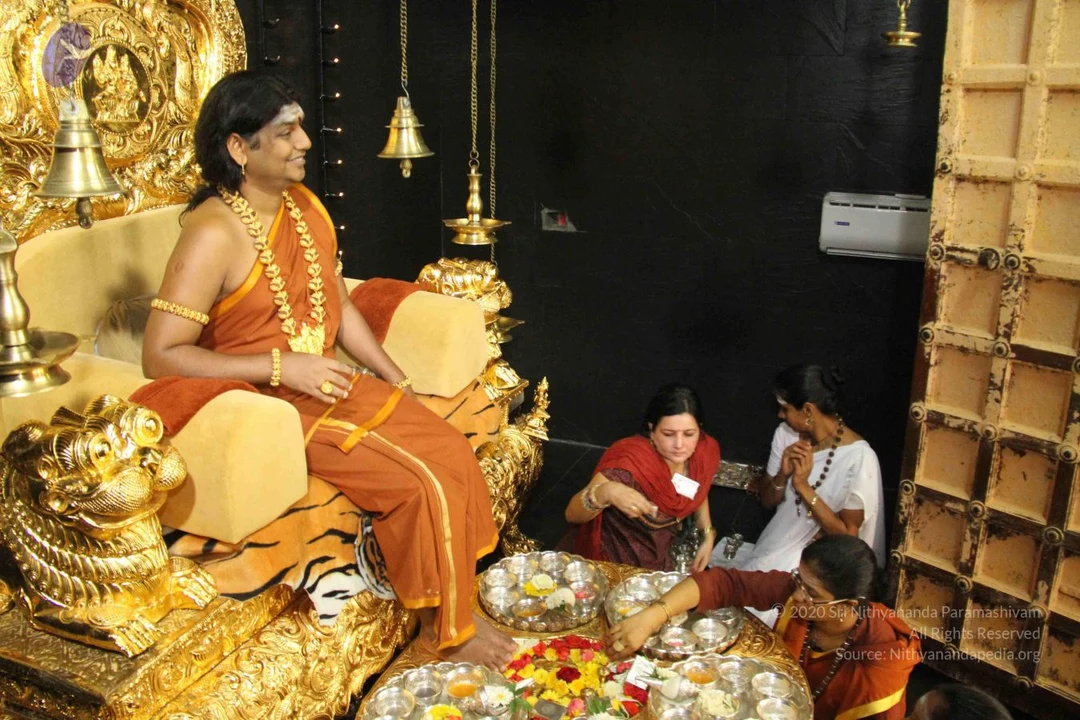
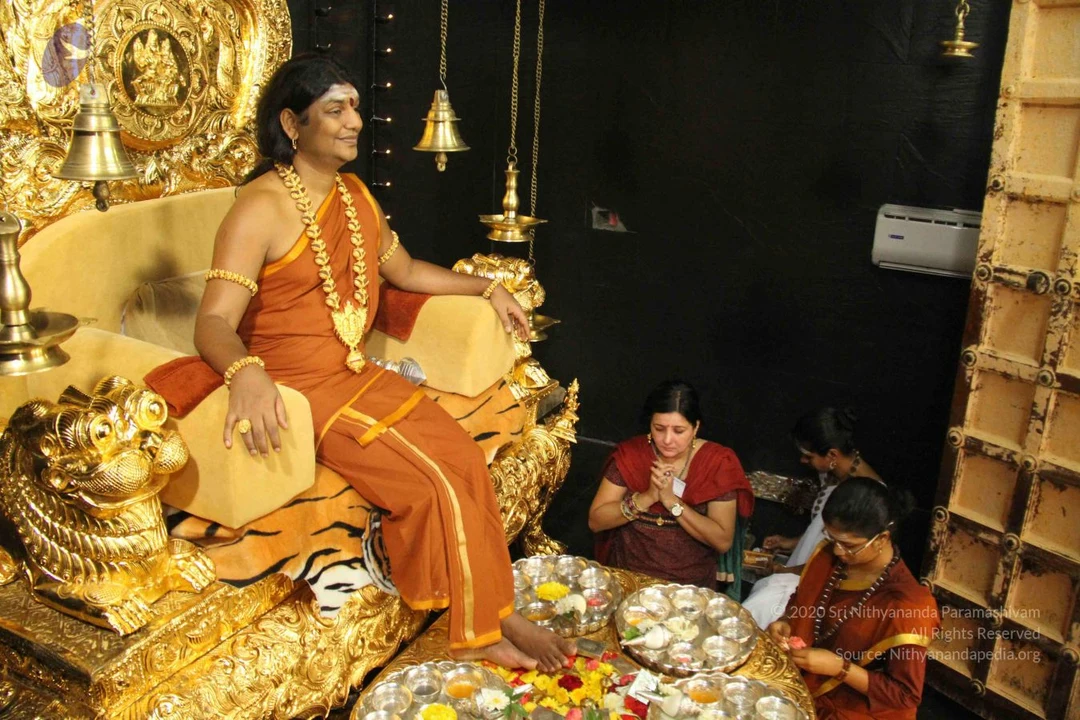
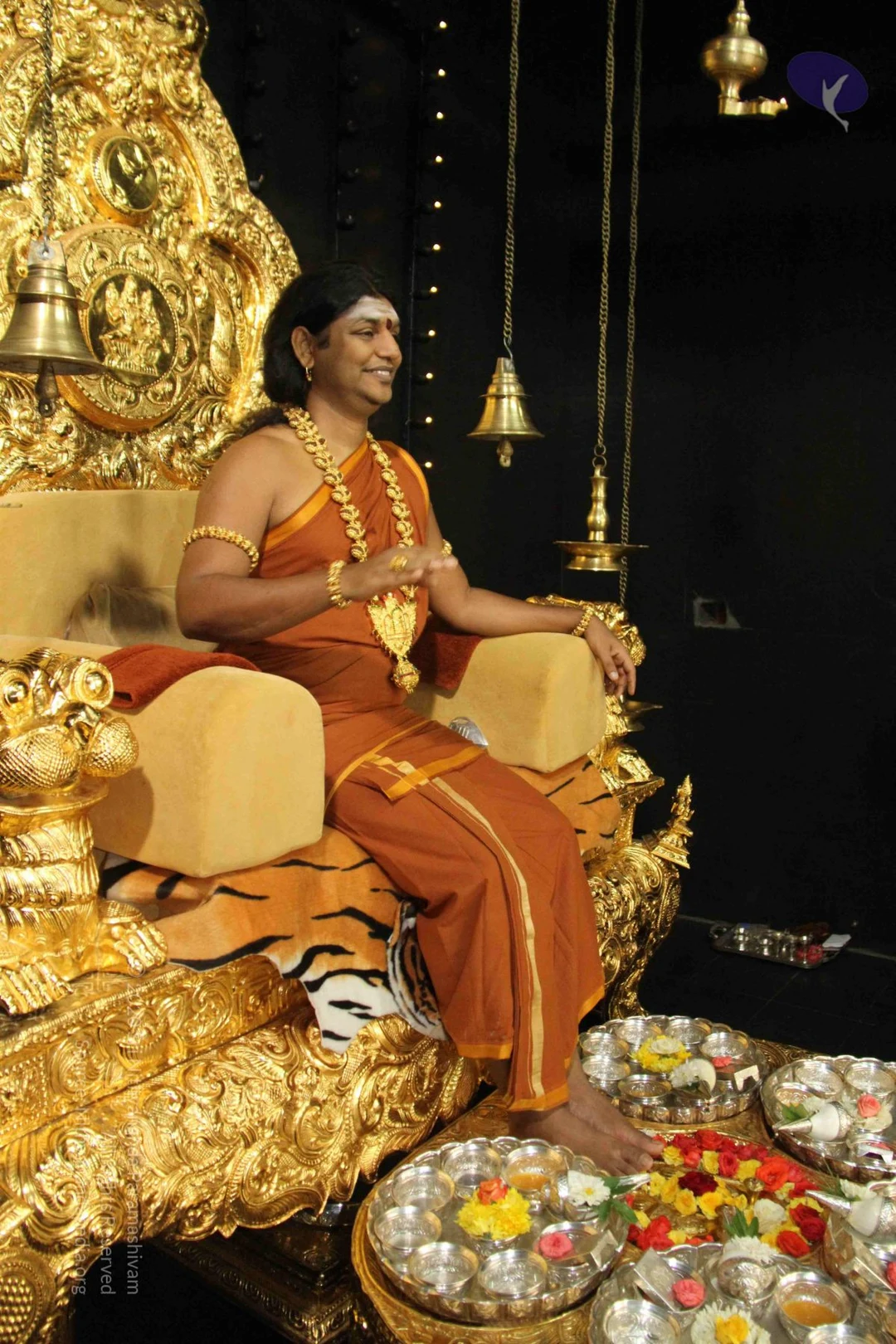
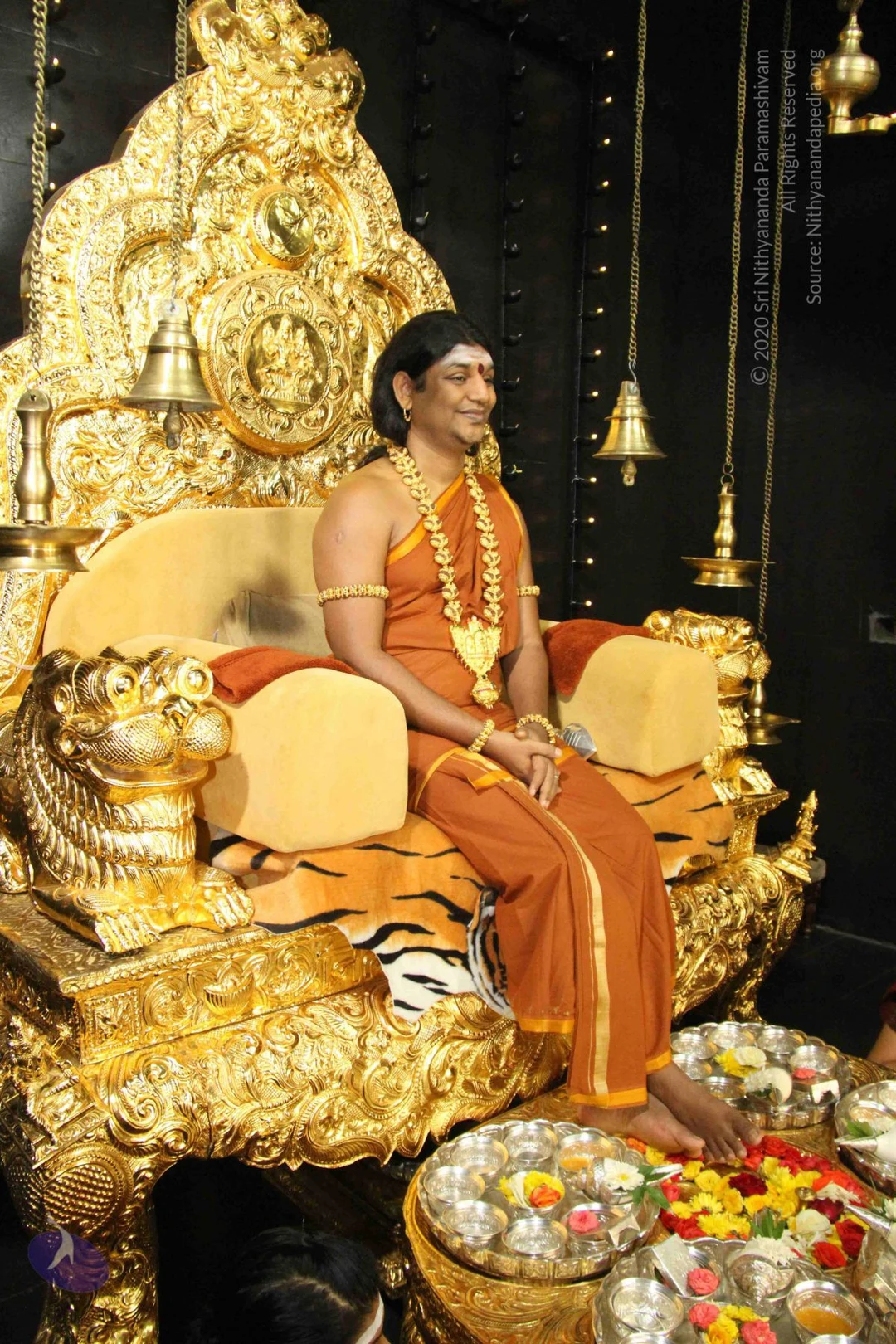
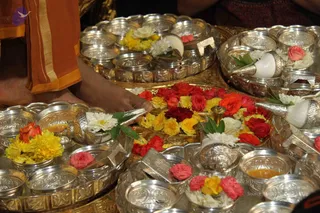
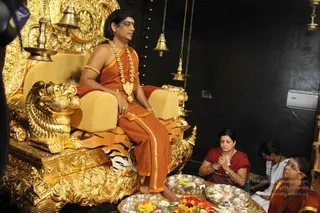
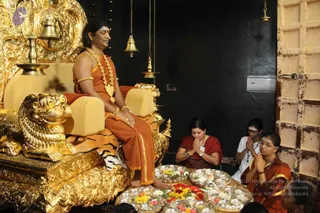
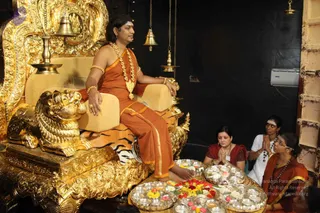
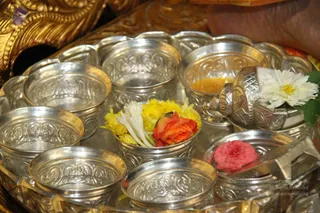
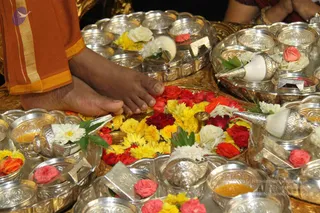
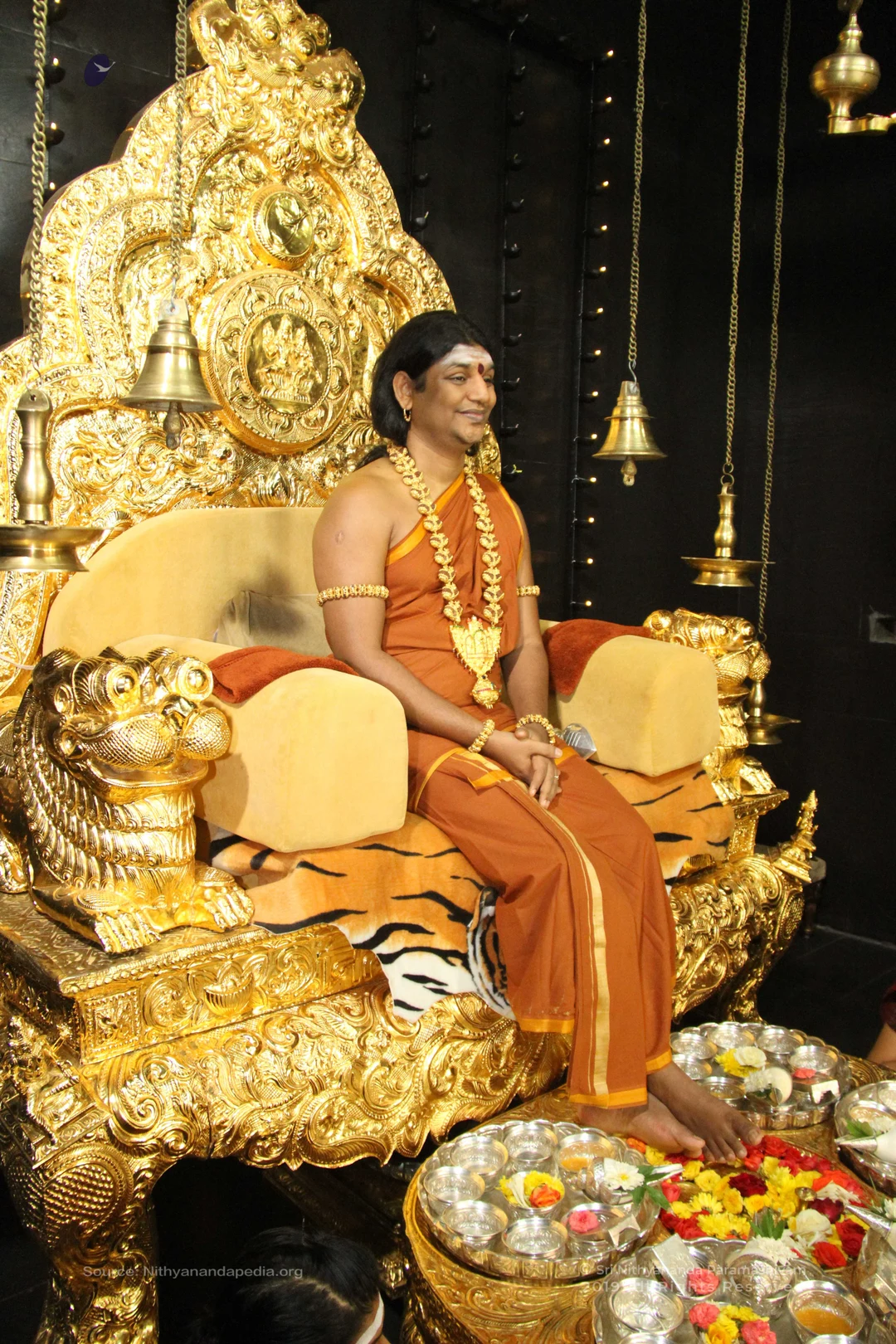
A man with shoulder-length swept-back hair sits on an ornate gold throne with carved lion-head arms, draped in a tiger-striped cloth. He wears saffron-orange robes with a gold-bordered cloth, a large gold ceremonial necklace with a temple pendant, rudraksha-style bangles and gold armlets, and raises one hand in greeting. Gold oil lamps hang beside him from chains against a dark wall. The appearance matches a person, seated in a ceremonial setting.A seated man in an ornate gilded throne, its carved backrest and golden lion-head armrest prominent, draped with a tiger-striped cloth. He wears saffron-orange robes with a gold-bordered dhoti, a thick gold necklace with a large pendant, a rudraksha-style garland, gold armlets and bangles, and a red tilak. He holds one hand raised near his chin in a gesture, smiling. Brass hanging bells and oil lamps hang above the throne, and brass thali plates with flowers and offerings sit at the lower right. A distinctive ceremonial appearance with long swept-back hair and gold adornments makes this a person appearance in person.Close view of a ritual offering arrangement on ornate silver and gilt trays. Silver bowls and small silver cups hold yellow and orange marigolds, red roses, white flowers and green leaves, with a small brass vessel and a bowl of golden liquid. A bare foot in the upper left, with an orange-and-cream-striped cloth, suggests a seated priest or devotee nearby. Scattered petals and a water vessel complete the puja setup.A seated man in orange-saffron robes sits on an ornate golden throne carved with lion heads and draped with a striped tiger-skin cloth, wearing a long garland of gold-toned beads and a large gold pendant. He has long swept-back hair, gold bangles and an upper-arm band, and is seated in a dark-walled room with hanging brass bells and oil lamps. Three women in front of him: one in a red sari with hands folded in prayer, and two in white and red garments sitting beside brass and silver trays of flowers, fruit and offerings. Strong candidate for a person given the saffron robe, long hair, gold necklace and throne, but identity is uncertain.A photograph of a seated man on an ornate gold throne with carved lion and tiger motifs, wearing an orange-saffron dhoti and shawl, a gold necklace, gold armlets and bangles, and a rudraksha-style garland, with long swept-back hair and a tilak. Before him, several women and a man sit on the floor with palms pressed together in namaskar, one in a red saree and others in white and orange-red garments. In front are silver thali trays heaped with white flowers, marigold petals and offerings, with brass oil lamps and hanging bells above. Black wall, white wall-mounted air conditioner and a carved wooden door complete the setting. Five physical people are visible.A seated man in an ornate gold throne with a golden lion-head armrest and a tiger-striped cushion, dressed in saffron-orange robe with an orange shawl and a long ceremonial gold necklace, bangles and armlets. Hair is long and swept back. Two women kneel before him with palms joined in namaskar: one in a maroon sari with a bindi, the other in an orange sari with glasses. A woman in white with a tilak and a mala stands nearby with hands folded. Brass oil lamps and hanging bells surround the throne, and silver-and-gold thalis with flower petals, marigolds and rose petals sit on the floor in front of the devotees.

Nithya-satsang
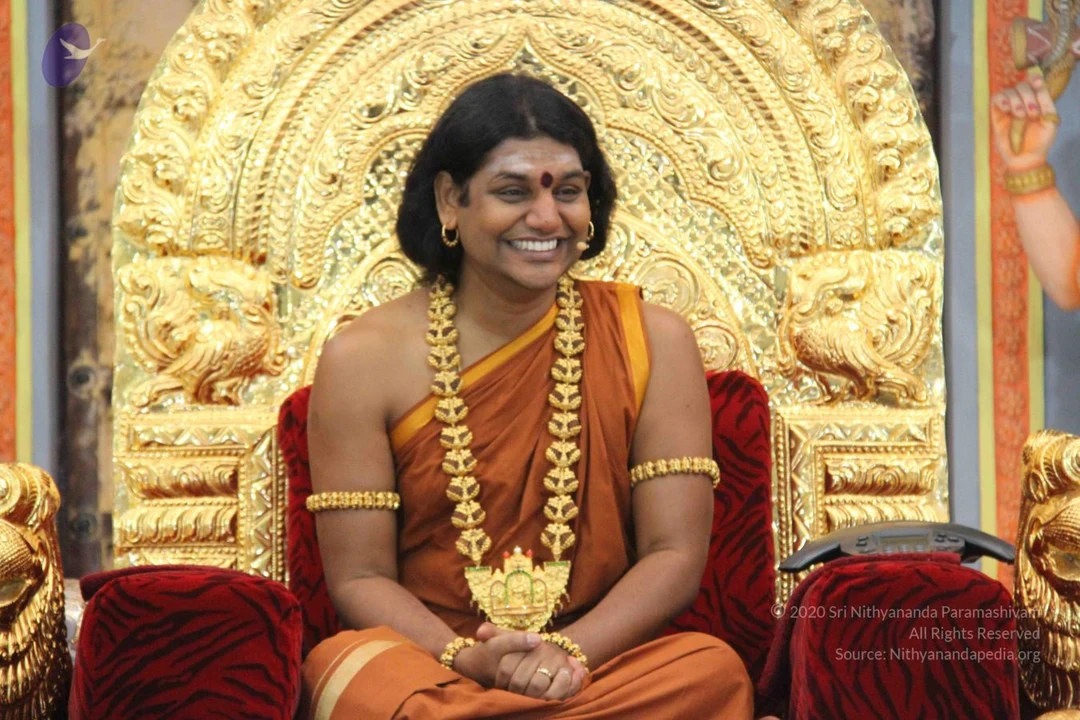
22 photosSource gallery
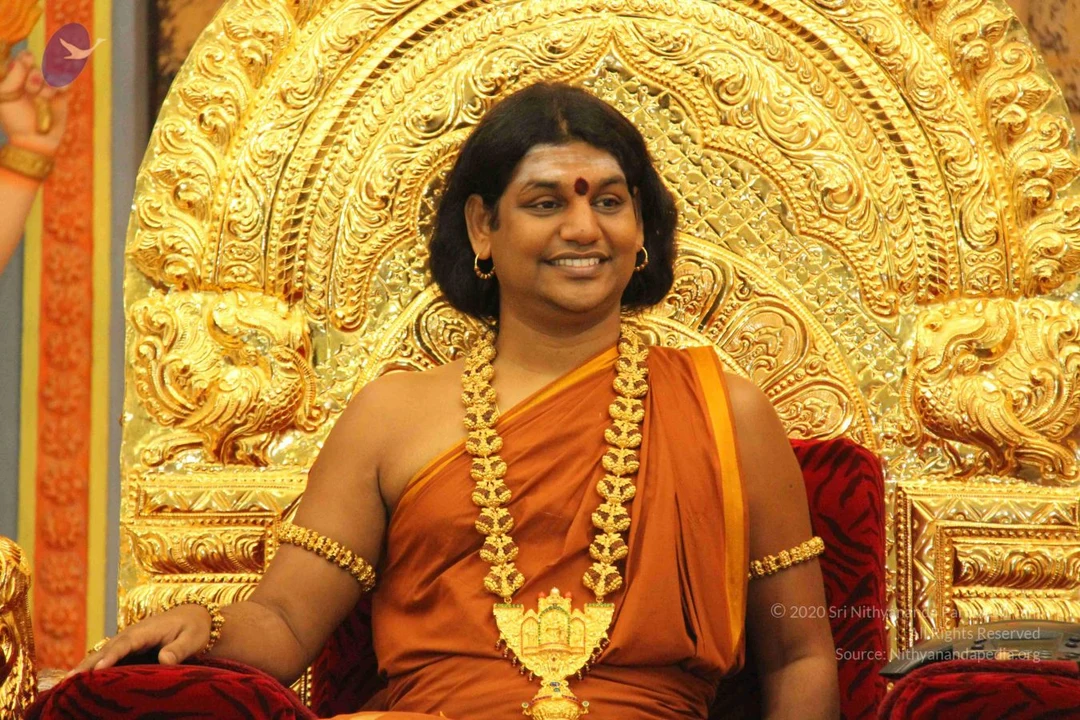
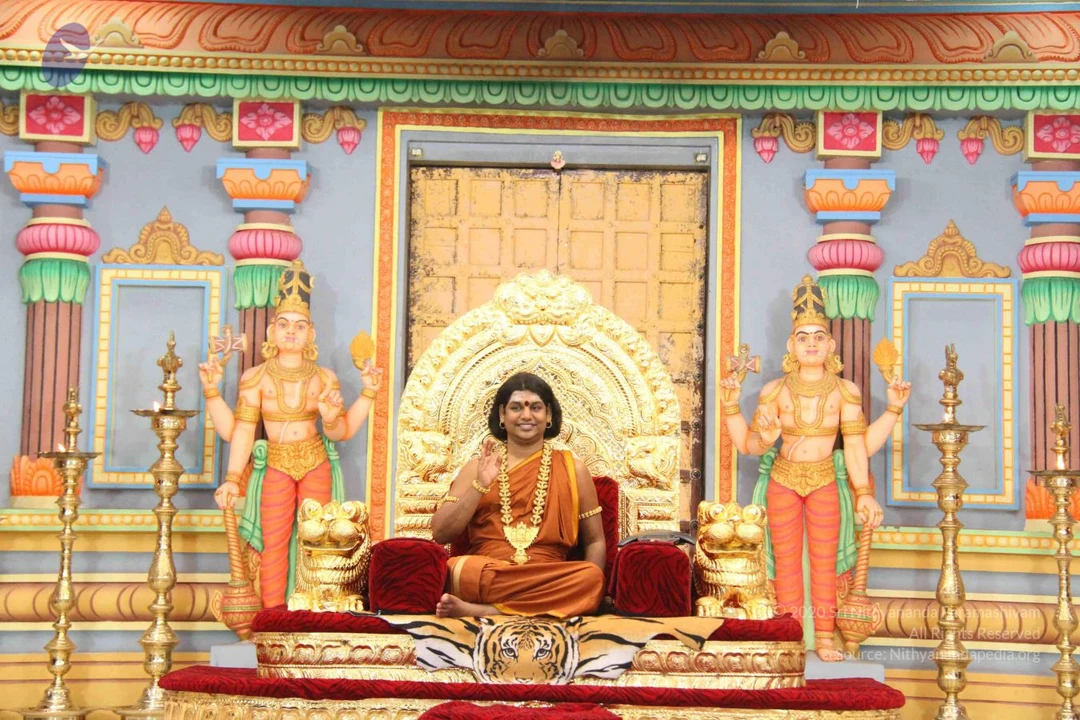
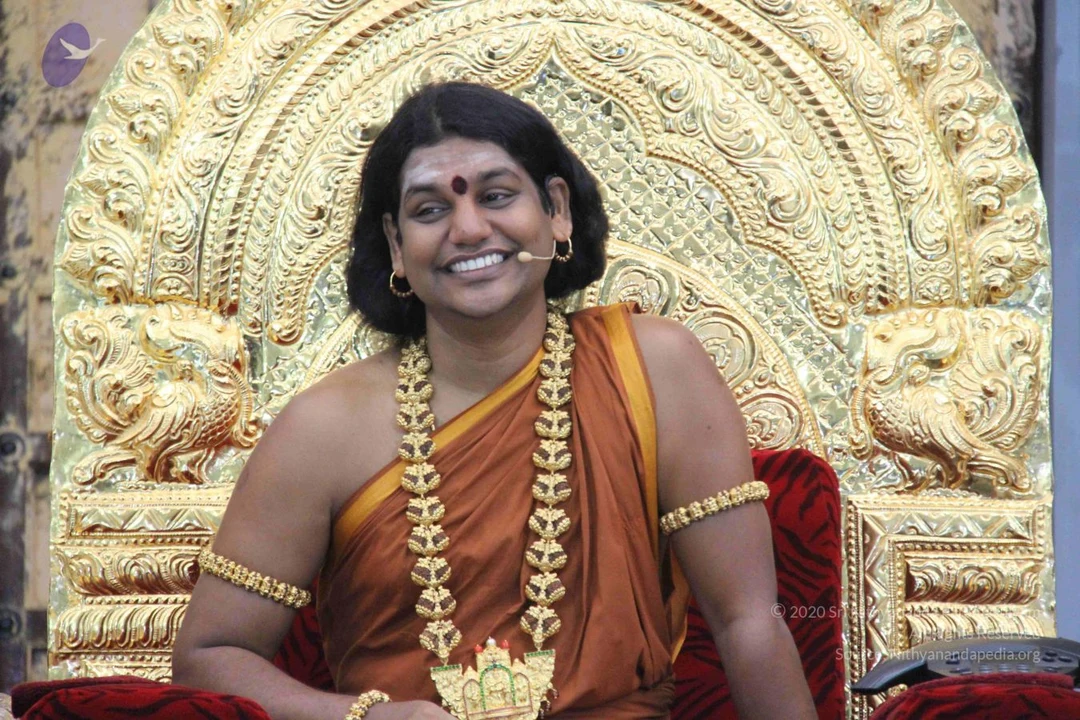
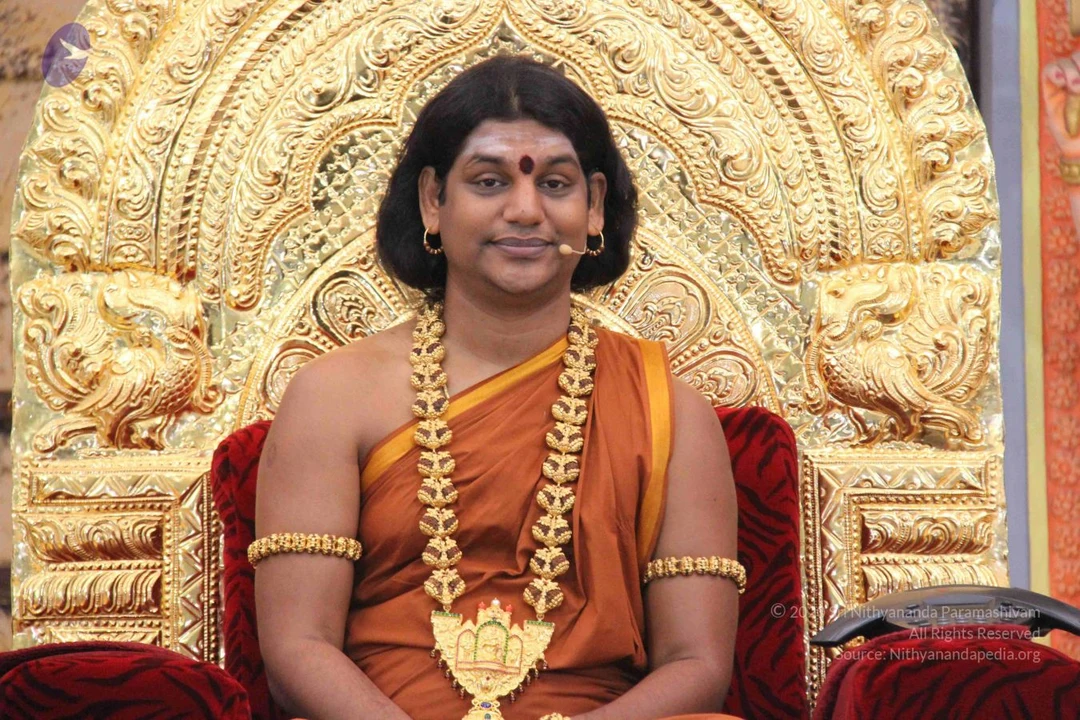
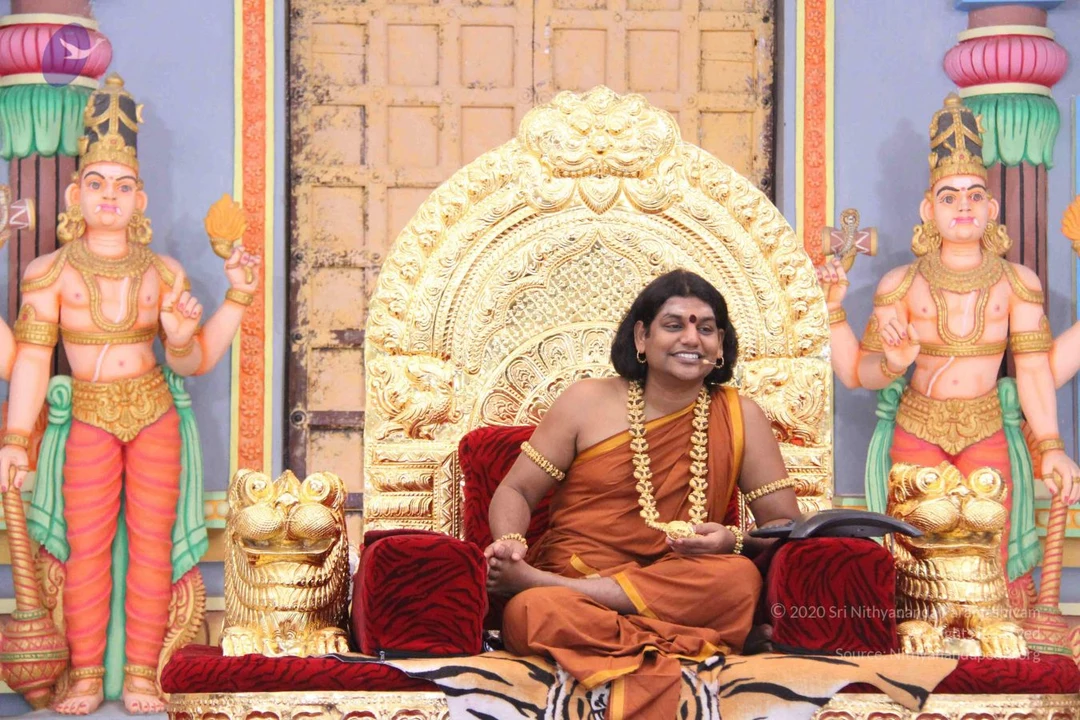
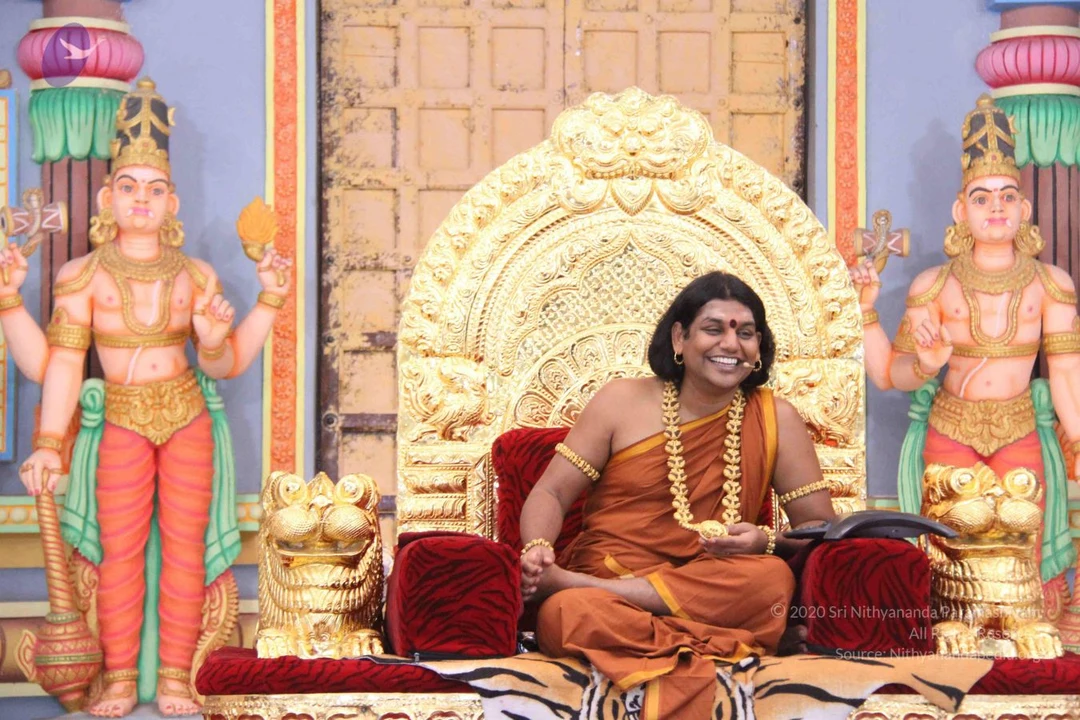
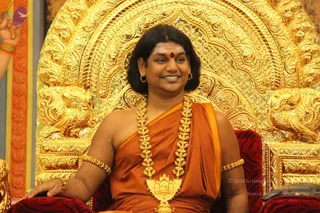
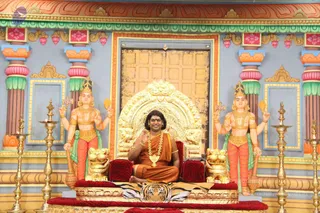
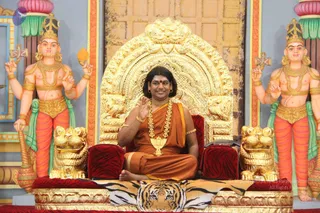
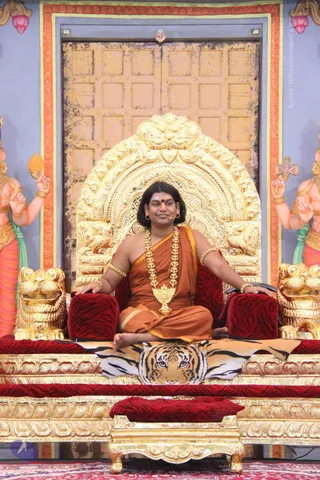
A smiling man with swept-back dark hair and a red bindi sits on an ornate gold throne with carved lion-like motifs and a red velvet cushion. He wears an orange-saffron shawl draped over bare shoulders, a long gold ceremonial necklace with a large gold pendant, and gold armlets. His right hand rests on the armrest. Swamiji (probable): the person matches the swept-back hair, saffron clothing, gold necklace and gold armlets pattern, seated on a golden peetha. The background shows a gold-leaf arch and red and orange drapery at the left edge.A seated figure in saffron-orange robes and a long rudraksha-style mala sits cross-legged on a golden throne draped with a tiger-skin cloth and red cushions, raising one hand in blessing. Two gilded deity murti flank the throne, each with four arms holding ritual objects and a green-and-orange lower garment. Brass oil lamps stand on both sides of the throne in front of a painted temple backdrop with decorated pillars and a golden wooden door. The scene reads as a satsang dais in an ashram hall. The figure has long swept-back hair and a ceremonial gold necklace, cues consistent with Swamiji (probable), seated in a teaching-throne role.A seated man in saffron-orange robes waves a hand in blessing on a golden ornate throne with a lion-carved back, set on a red velvet cushion above a tiger-striped rug. He wears a long garland of beads, a golden pendant, bangles and an armband, with a red bindi on his forehead. Two large painted deity murti statues flank him, each with four arms, crowns, gold necklaces and orange-pink dhotis, holding objects in their hands. Behind is a carved wooden door. The seated figure is a person candidate: short dark hair, saffron garb, rudraksha-style mala and ceremonial gold pendant, delivering a satsang-style blessing.A seated man in orange-saffron robes sits cross-legged on a red velvet throne with a golden arched backrest, flanked by golden lion heads, atop a tiger-skin rug. He wears a long garland of white flowers with a gold pendant, gold bangles and a red bindi, with his hair swept back. Two tall golden-crowned guardian statues with raised arms stand on either side in front of a blue-grey wall with a golden doorway behind.A photograph of a smiling person seated on an ornate gilded throne with carved lion-like side motifs, upholstered in red tiger-striped cushions. The person wears saffron-orange clothing with a yellow-edged drape over the shoulder, a long gold necklace of leaf-shaped links with a gold pendant, gold armlets and bangles, gold hoop earrings, and a red bindi. Hands are folded in the lap. a person is seated in a ceremonial posture, identified by the saffron clothing, ornate gold necklace and throne setting; the identification is appearance-based. A partially visible gilded lion-form figure and orange-patterned hangings frame the scene.A smiling person sits on an ornate golden throne with lion-carved armrests and a tiger-striped red velvet cushion. The seated person wears a saffron-orange garment draped over one shoulder with a yellow border, a long gold leaf-pattern necklace with a central gold pendant, gold armlets, and a red tilak on the forehead. Hands are folded in the lap, and a gold-framed backdrop with a painted figure appears at the right edge.

SarvaDarshan
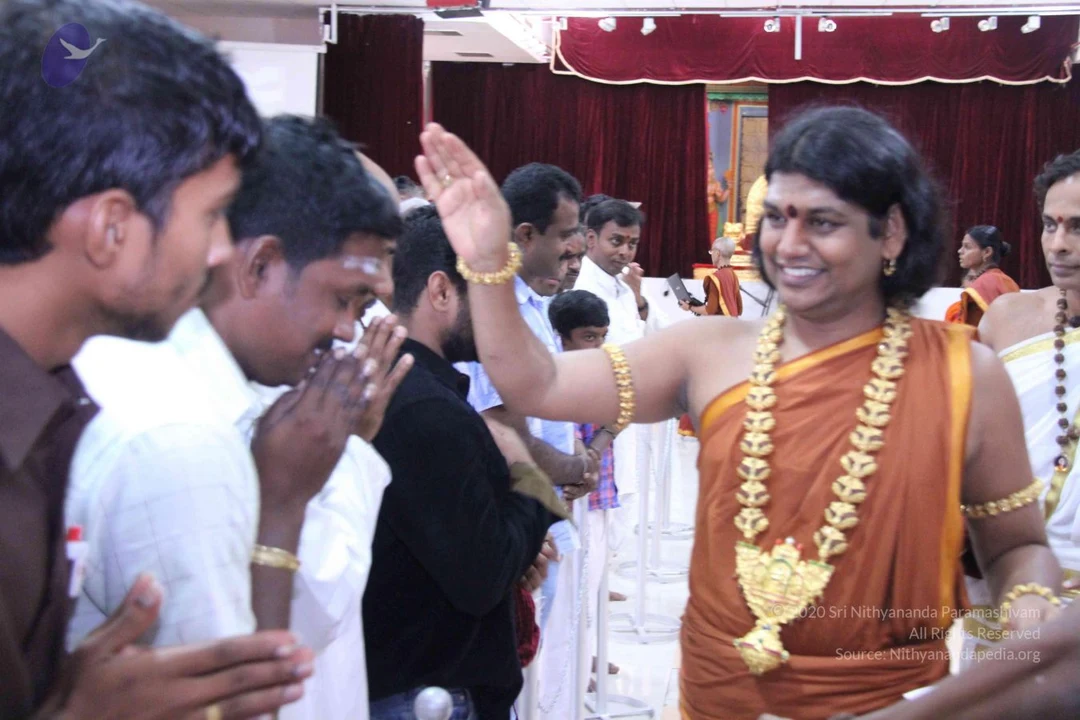
16 photosSource gallery
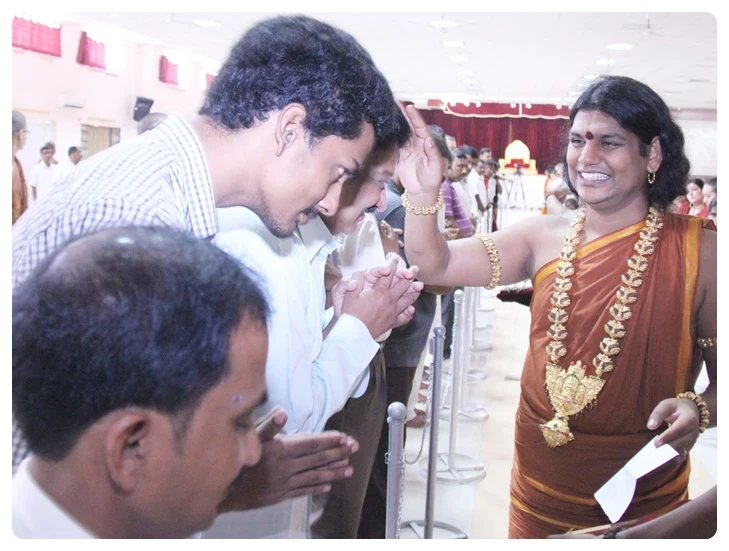
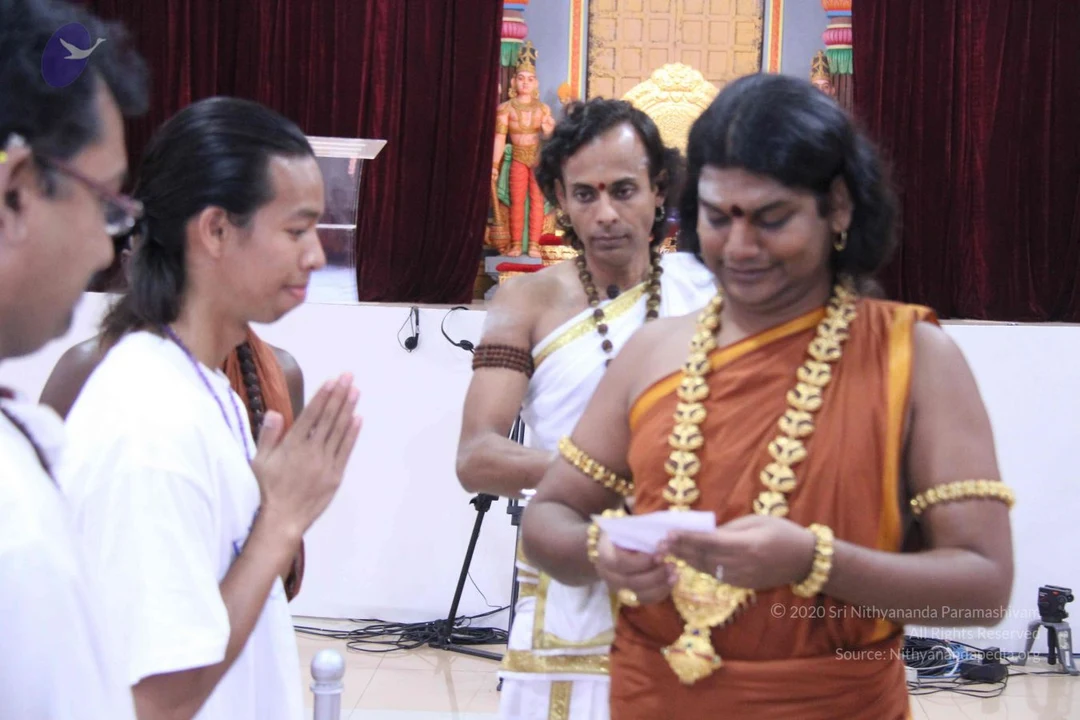
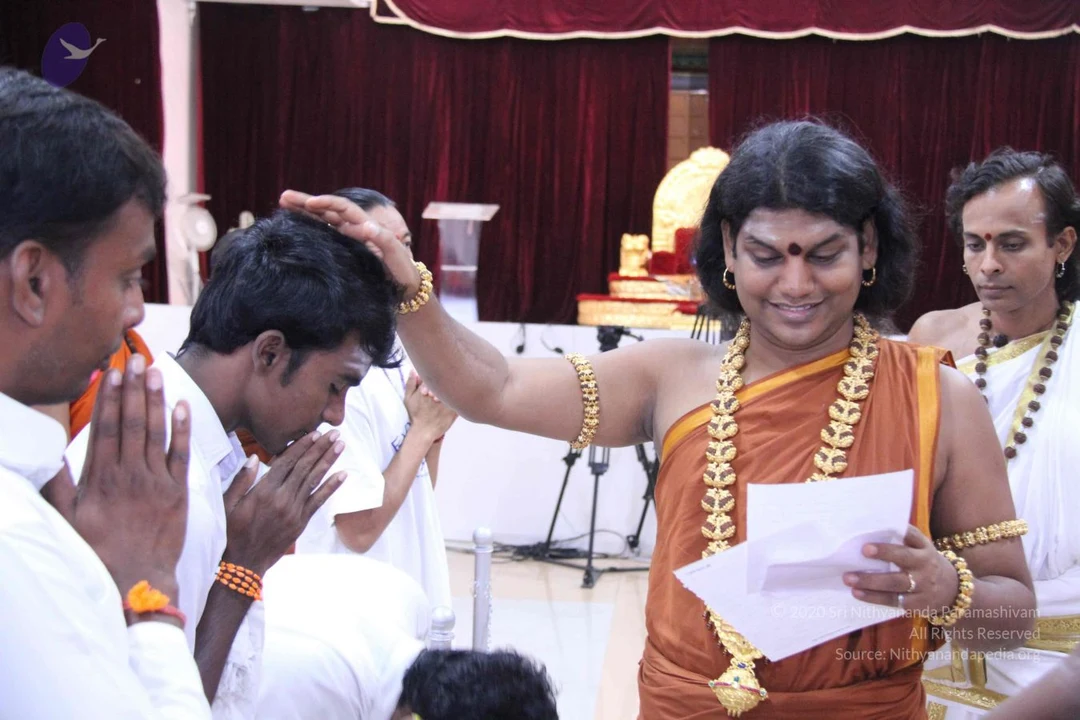
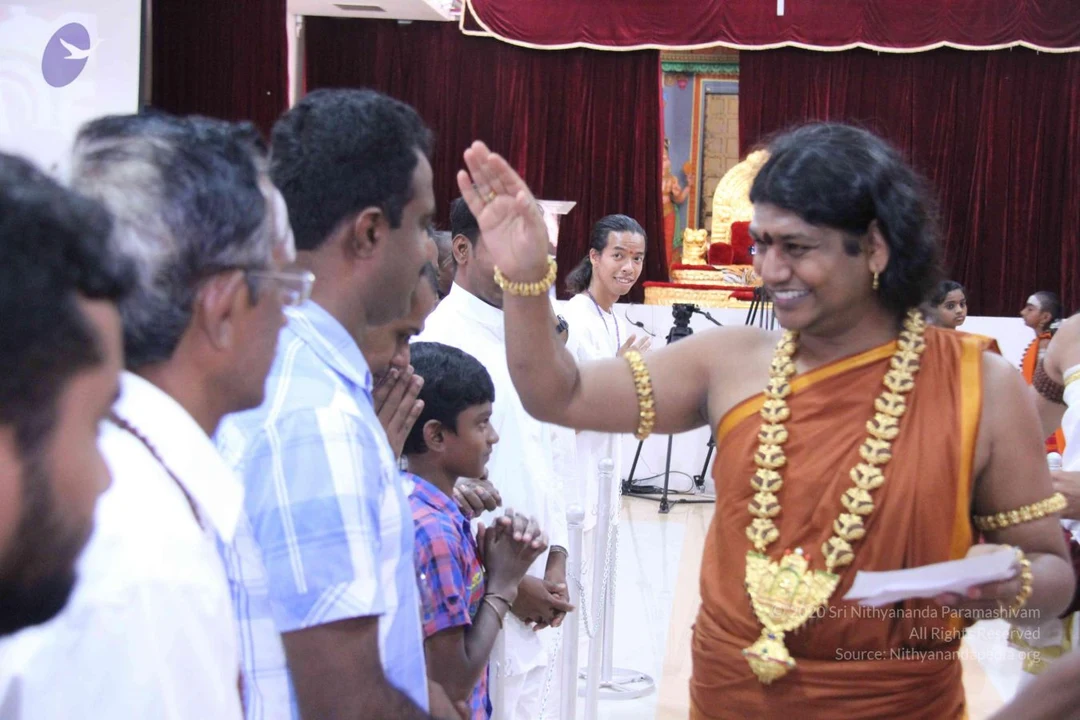
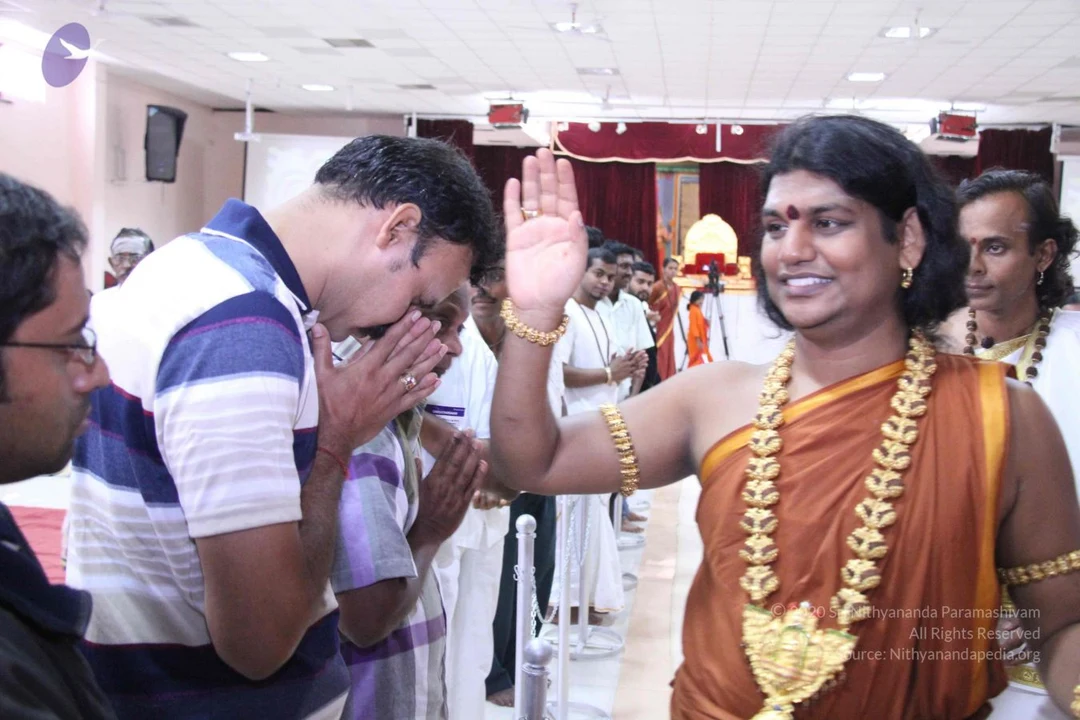
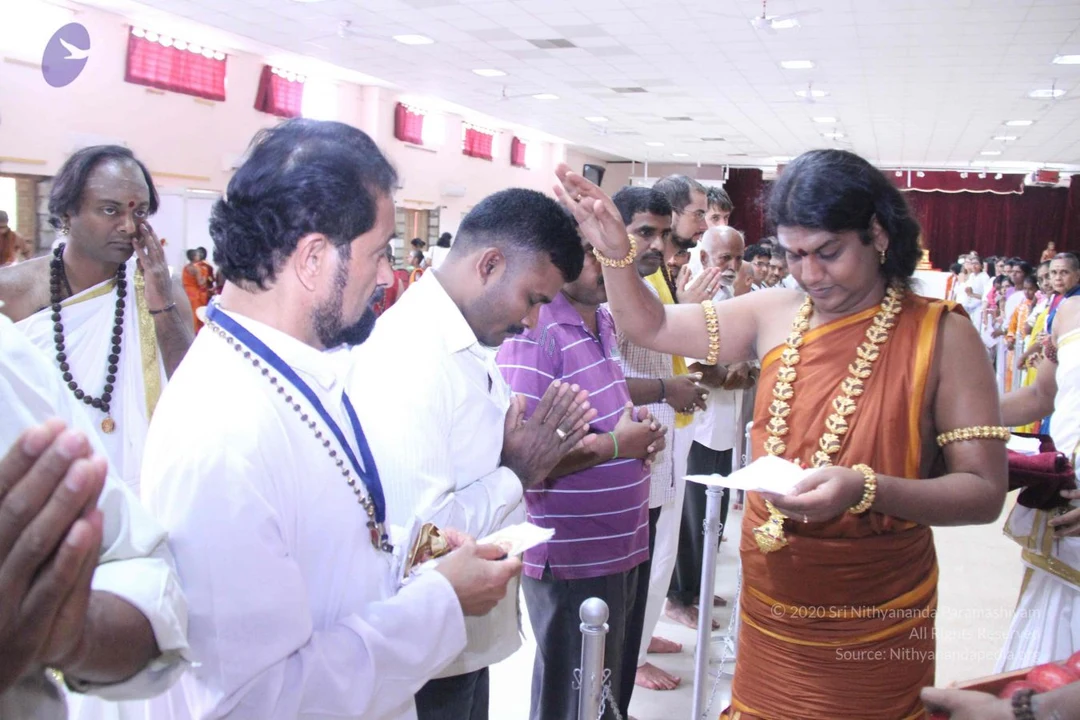
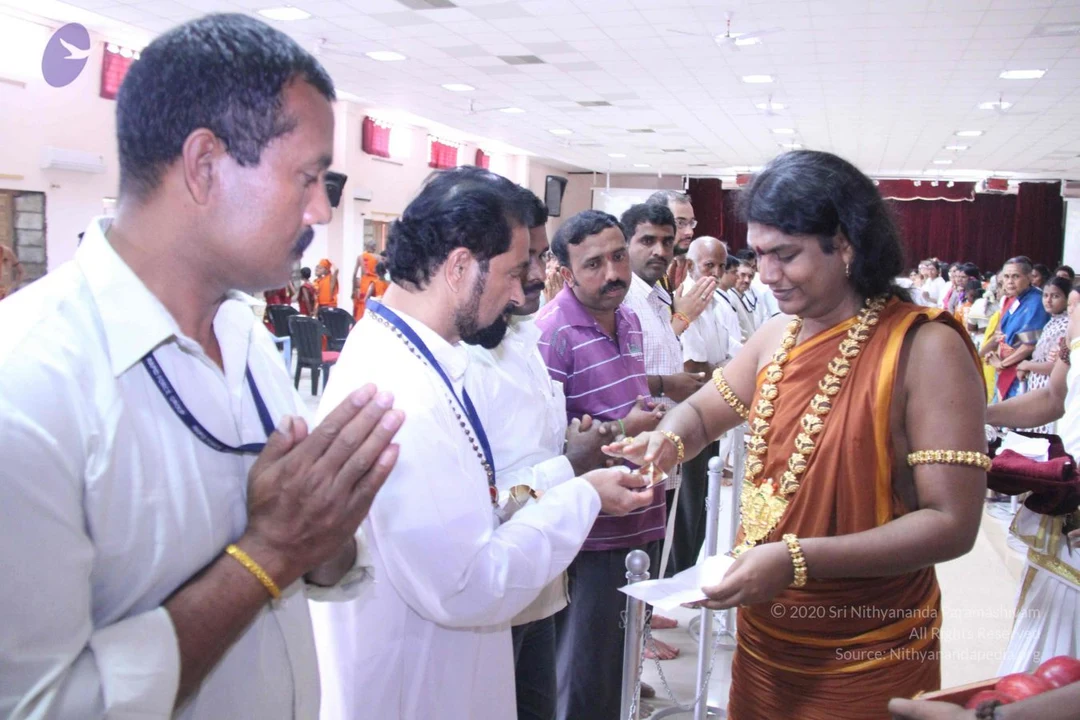
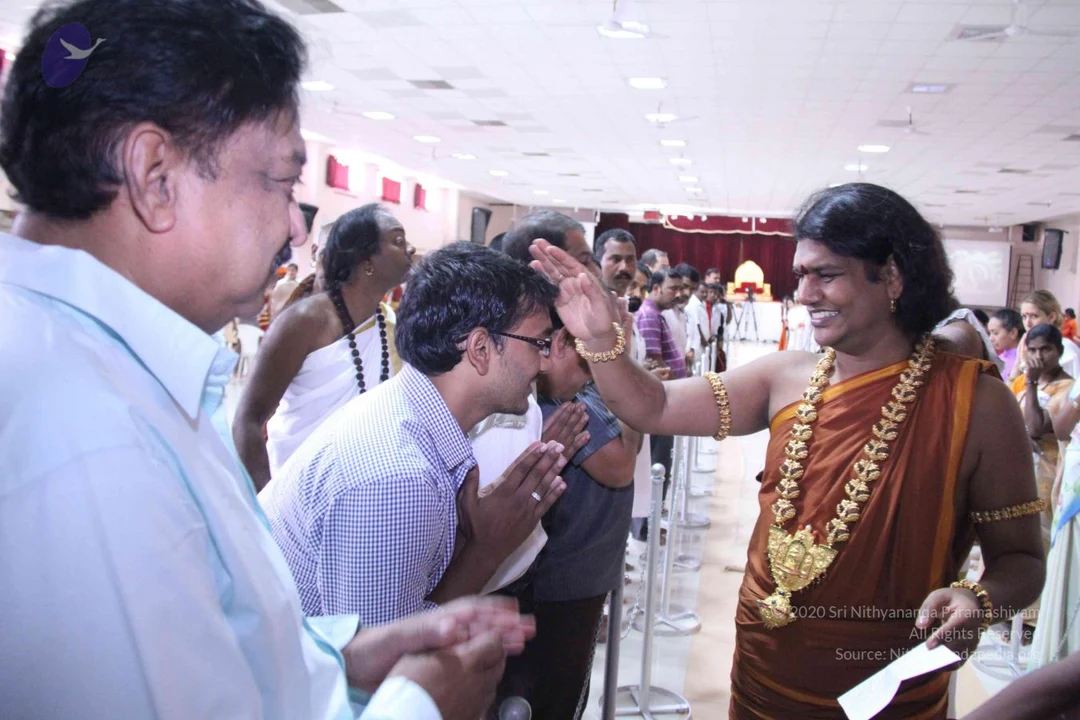
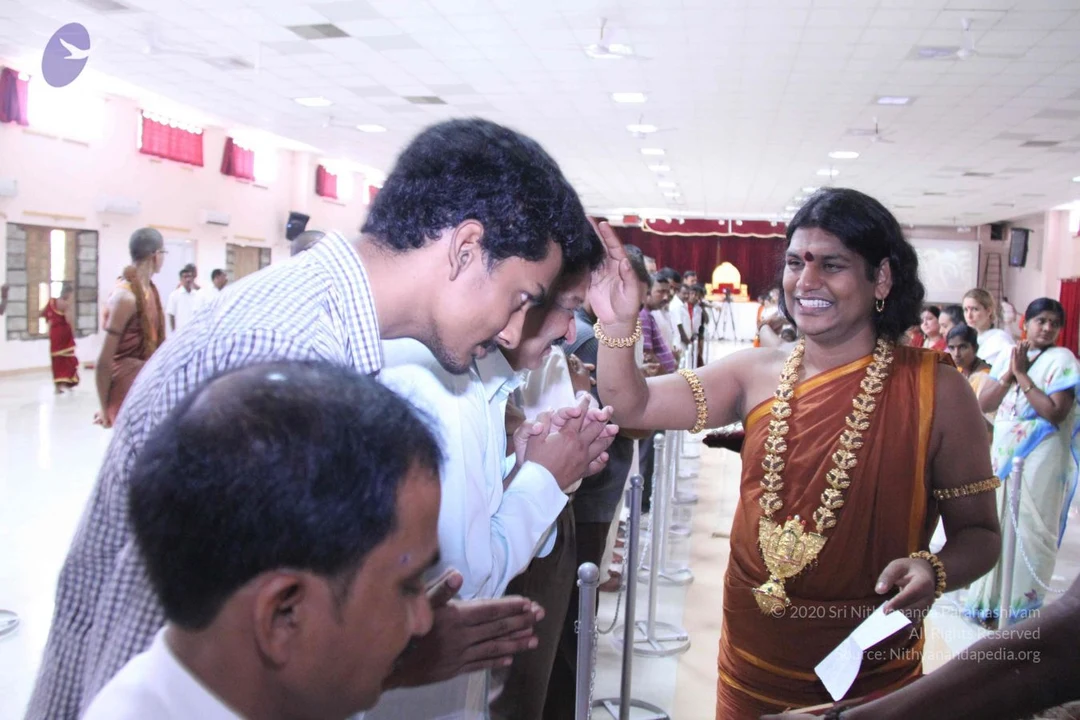
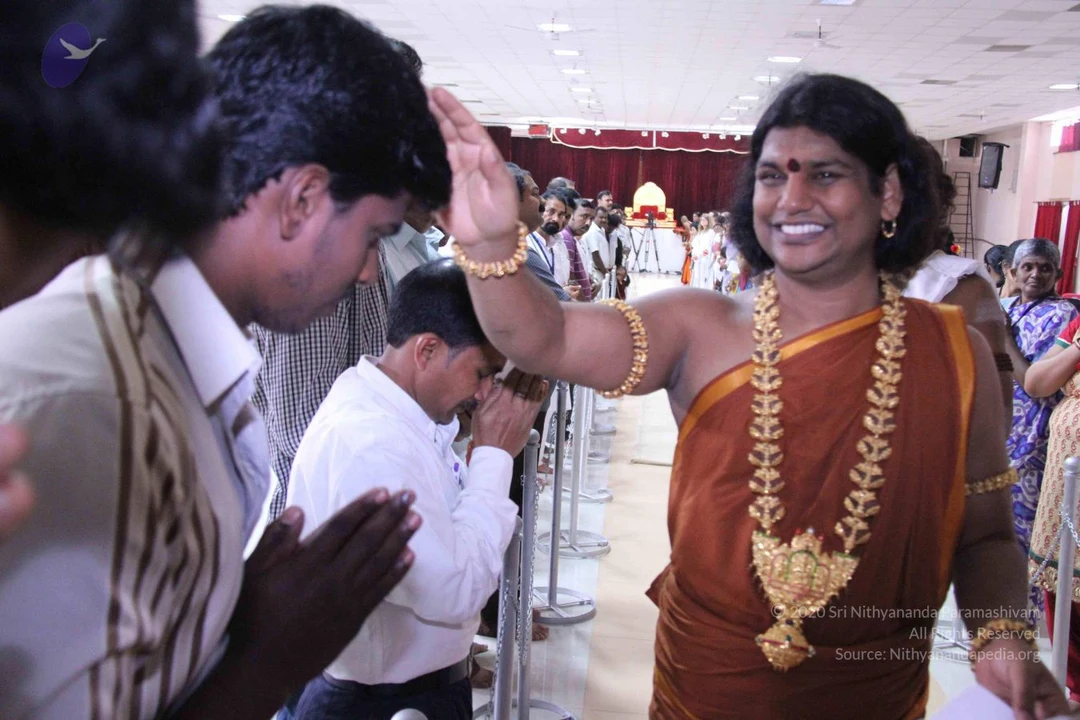
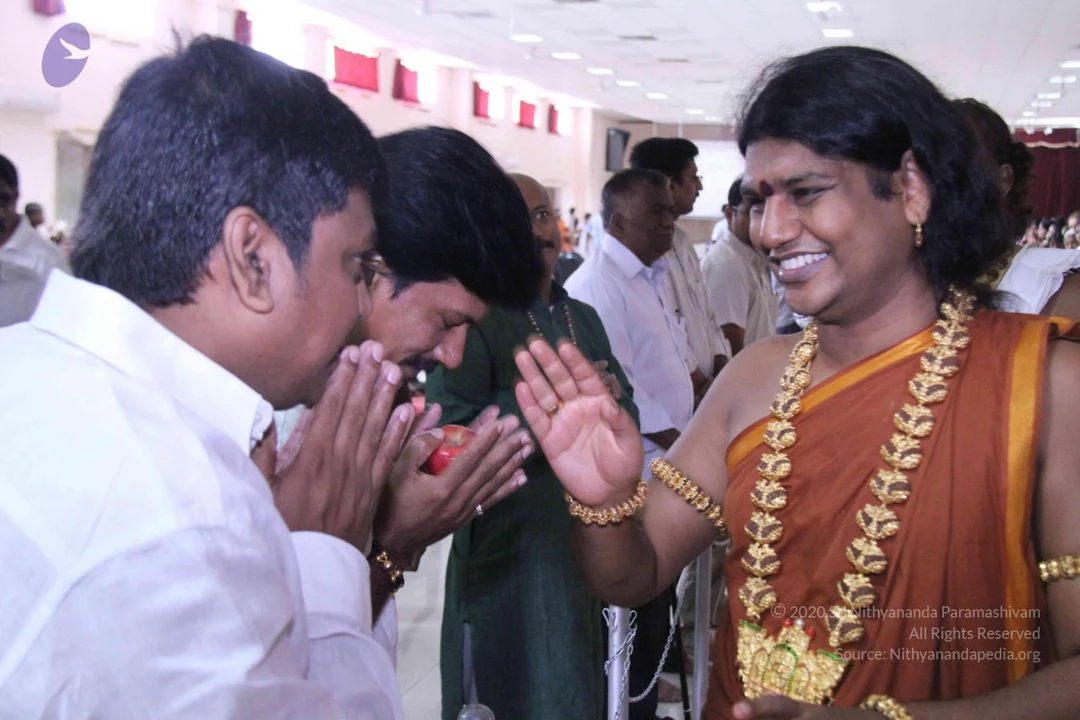
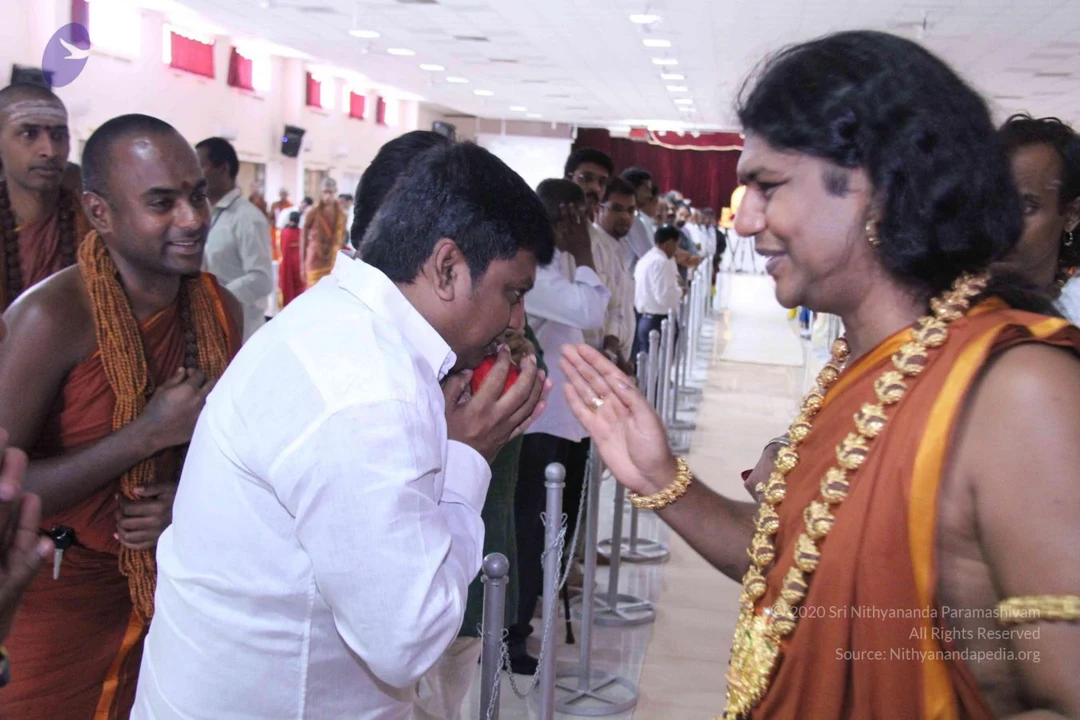
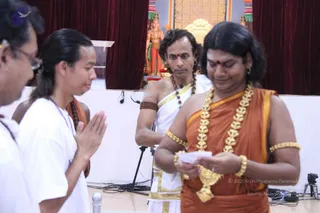
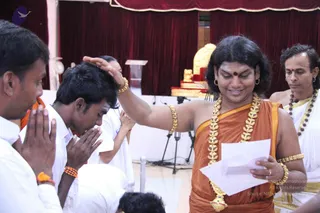
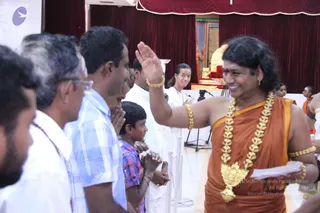
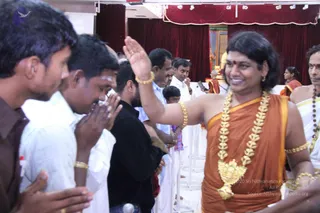
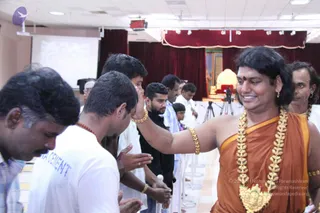
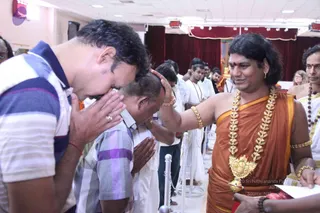
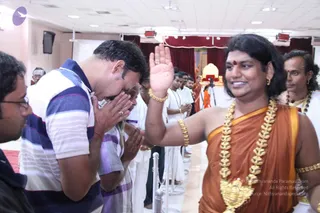
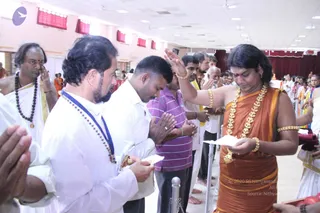
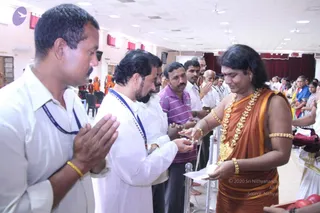
Indoor temple hall with red velvet drapes and a golden shrine backdrop, a deity murti in the upper background. In the foreground, a figure in an orange saffron garment with heavy gold ceremonial necklaces and gold armlets holds a small white paper and looks down at it, with a red tilak on the forehead and dark hair swept back. Beside him stands a man in white dhoti and shawl with gold border, rudraksha mala and beaded bracelet, watching. On the left, a person in white shirt with palms pressed together in anjali, and a partially visible person at the edge. Microphones on stands and cables on the floor are visible. a person: the orange-robed figure with gold necklaces and swept-back hair matches the expected presentation, but the face cannot be confirmed, so identity is uncertain.A photo of a devotional blessing in a hall with red velvet drapes and a gold throne-like seat behind. A central figure with long swept-back dark hair, a red bindi, gold hoop earrings, a gold necklace and armlets, and an orange-saffron shawl over the shoulders holds a sheet of paper while placing a hand on the head of a young man who bows with palms pressed together. Probable Swamiji: the central figure's long hair, saffron clothing, gold ornaments and ceremonial stance match the cues for this teacher, and the blessing is being given in a satsang-style setting. Other people nearby wear white and join hands in prayer, including a man on the left and a figure at right wearing rudraksha beads and gold jewellery. A microphone stand and a lectern appear in the background.A man with long dark hair and a large gold ornamental necklace, wearing an orange saffron-coloured wrap and multiple gold bangles, raises his right hand in blessing while smiling toward a line of devotees. Men in white shirts and a man in a blue plaid shirt stand with palms pressed together, and a young boy in a checked shirt folds his hands. Behind them a woman in white stands near a golden throne with red cushions and a red velvet backdrop, with a deity murti visible on the left.A photograph of a satsang crowd at an ashram hall with red velvet drapes. In the foreground, a man in an orange saffron dhoti and shawl, wearing a heavy gold ceremonial necklace and gold armbands, raises one hand in blessing and smiles. Nearby, men in white shirts and dark clothing stand with hands pressed in anjali namaskar, one with a white vibhuti mark on his forehead. Behind them, a white-clad figure and a woman in orange attend a gold-and-red altar area with a deity murti. The man in orange is an appearance-based a person candidate with distinctive saffron clothing and gold ornaments, described in the scene as a person giving blessings.A photo of a smiling man in an orange-saffron shawl and ornate gold necklace with a gold pendant, a red bindi on his forehead and long swept-back hair, placing his hand on the head of a devotee who bows with palms joined. Several other people in white shirts, dark shirts and plaid shirts stand or bow behind them in a hall with maroon curtains, a projection screen and a gold-decorated throne with a red cushion at the back. Gold bangles and a red thread on a wrist are visible. a person is shown in person blessing a devotee in a satsang setting.A photograph of a blessing moment at an indoor hall with red curtains and stage lighting. A man in a blue and white striped polo bows deeply with palms pressed together, while a second man in a lavender checked shirt bends forward with folded hands. A person in an orange-saffron dhoti-style wrap and a heavy gold necklace of ornate leaf-shaped pendants, with gold armbands and bangles, extends a hand in blessing onto the bowing man's head. He has long swept-back dark hair and a red bindi, and wears gold earrings. Other white-clad devotees stand behind, a woman in the background and a stanchion railing in front. Some a person cues: long swept hair, saffron wrap and ornate gold necklace.

Temple-Swamiji

19 photosSource gallery
A photograph of two golden processional murti of Shiva and Parvati seated on a palanquin under a curved arch with palm fronds behind. The Shiva figure, on the left, wears a red turban, rudraksha mala, a crown and a silver necklace, and holds a trident in one hand. The Parvati figure, on the right, wears an orange-red sari with silver jewellery and a golden crown. Both faces are gold-painted with red and white tilaka markings. A small bird perches near the centre. No physical people are visible.A photograph of a golden-faced deity murti pair seated in an ornate arched frame outdoors, with palm fronds and greenery behind. The figure on the left wears a red turban, a purple garment with a rudraksha mala, layered white beaded and gem necklaces, and holds a trident in one hand while the other hand is raised in blessing. The figure on the right wears a gold crown, an orange sari with silver-beaded ornaments and a red beaded necklace, and holds a small kalasha-like object. A small green bird perches between them. No physical people are visible; the figures are statues.Outdoor courtyard arrival with a dark grey Ford SUV pulling up under a covered walkway with red pillars and a red brick wall behind. Musicians perform on the paved floor: a man in white dhoti and shirt plays a long wooden pipe (nadaswaram-style), another in white plays a double-headed drum, and several young men in saffron-orange dhotis and turbans play large drums and long brass horns (kompu/ceremonial trumpets). A bare-chested drummer in red-and-saffron cloth stands near the steps. The scene resembles a traditional welcome procession for an arriving vehicle. A visible figure in orange near the vehicle may be a sannyasi but no clear identifying cues are present. Trees and a low wall frame the background.Outdoors beside a parked dark SUV on a paved courtyard, a smiling person in orange-saffron robes with a gold multi-strand necklace, gold bangles, a red forehead dot and long hair gestures with an open hand toward a second person. That second person, seen from behind, wears an orange turban and orange robe with a red border and holds a tray of flowers, fruit and offerings, with white markings on the arm. a person candidate is the figure in orange with the gold necklace and bangles, shown with long hair and ornate gold adornments. Pillars and a dirt ground surround them.A procession under a metal-roofed open pavilion with a wet concrete floor. A central man in an orange dhoti and orange shawl, wearing a long gold-toned pendant and a beaded garland, walks forward with a bare chest and long swept-back hair. Around him, young and adult attendants in orange and red robes play drums and long brass horns, and one attendant in an orange turban carries a brass tray or kalasha with flowers near the centre. Palm trees and a parked black car stand in the background.A procession of people in saffron and orange clothing walks barefoot across a wet concrete courtyard under a large open-sided metal-roofed pavilion lined with palm trees. Several men in orange dhotis and saffron turbans play drums, and one carries a long curved brass horn. Two women in deep red sarees walk among them, one carrying a drum and another holding a small object. A man in the centre wears a rudraksha-style mala and a gold pendant, with hands folded. Ritual torches or horns and a red-and-gold pillar stand near the structure, and a smoky fire glows in the background. Puddles and footprints mark the wet ground.

KramaKids-Listening

6 photosSource gallery
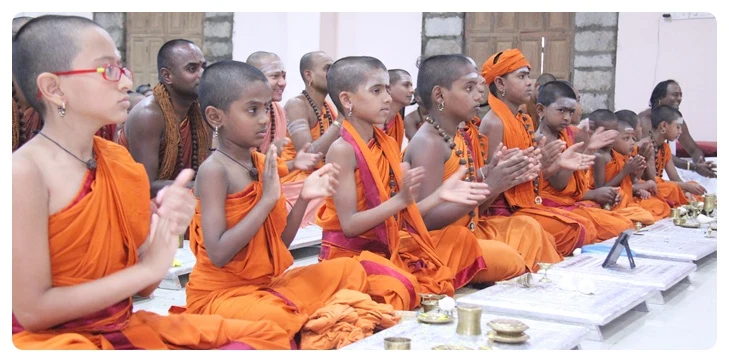
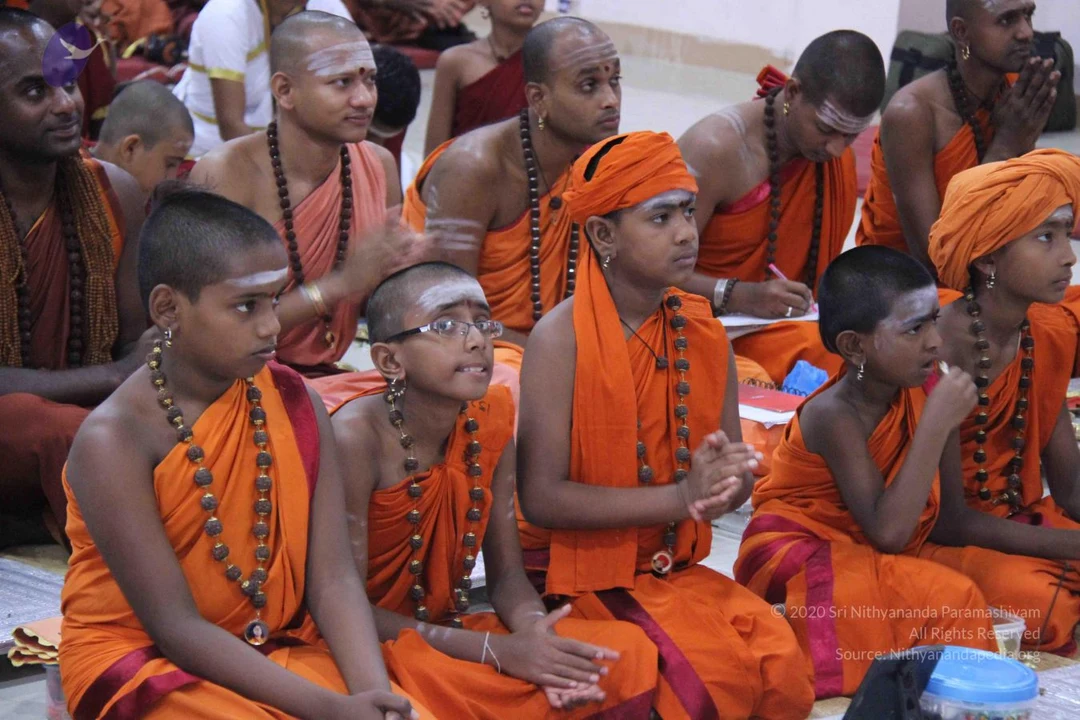
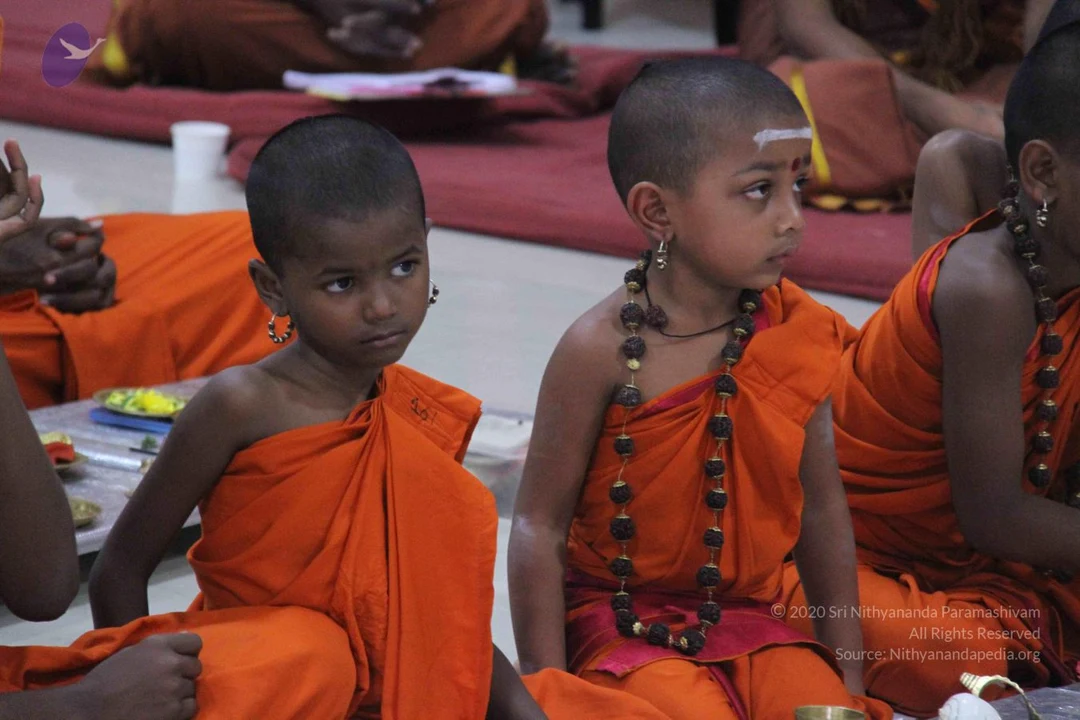
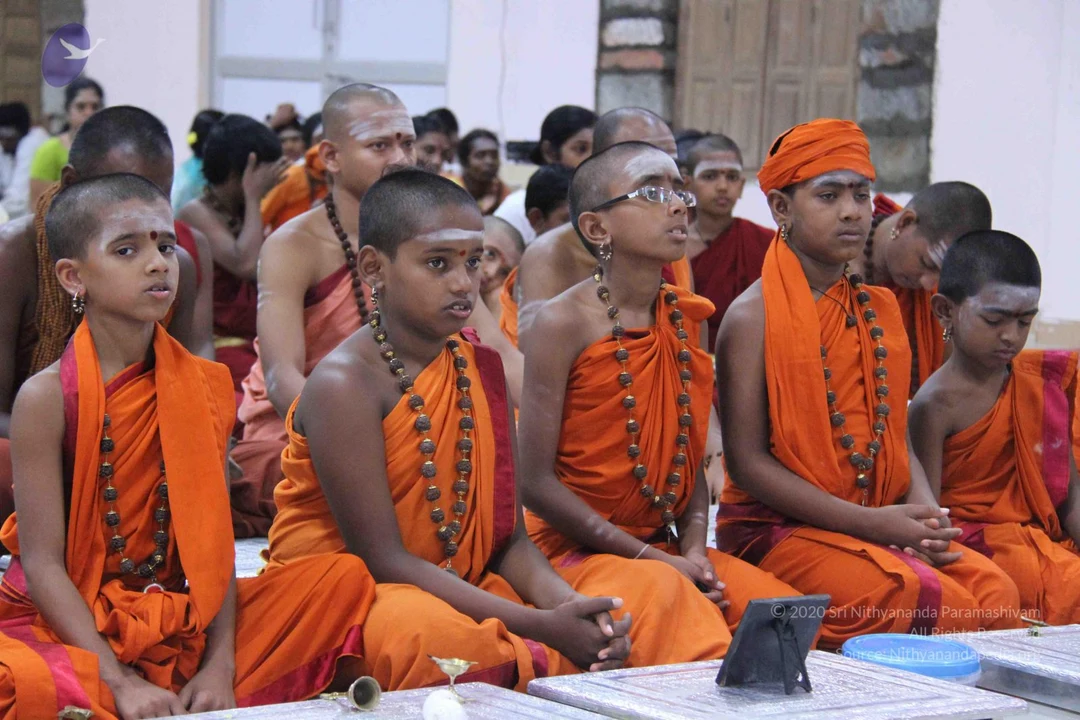
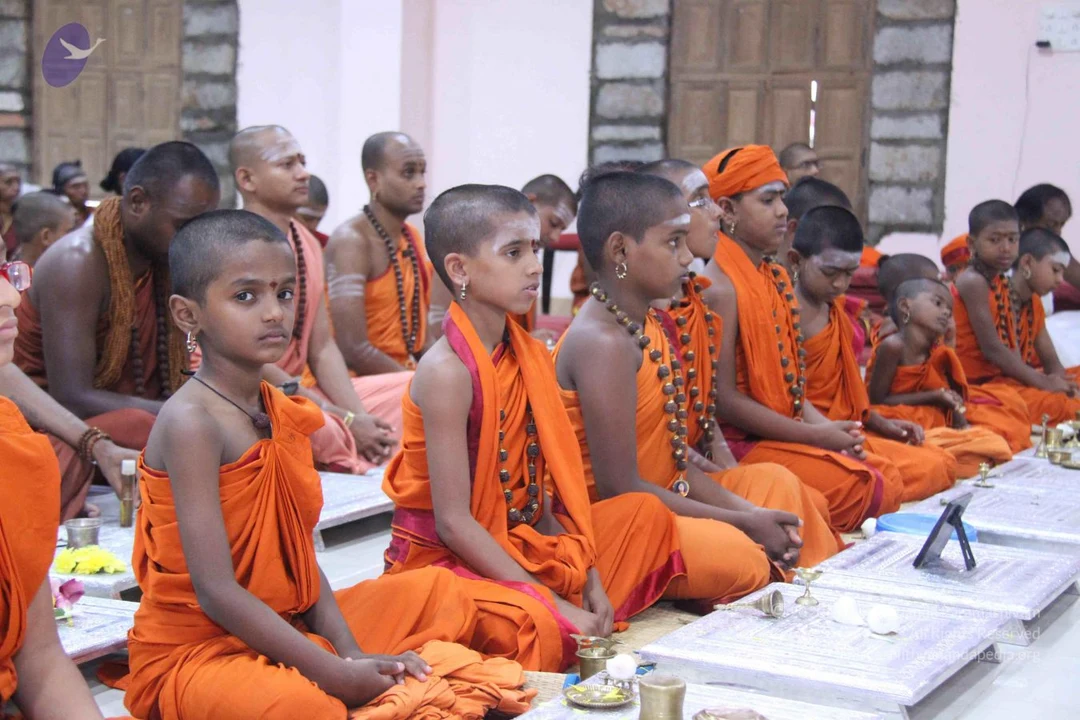
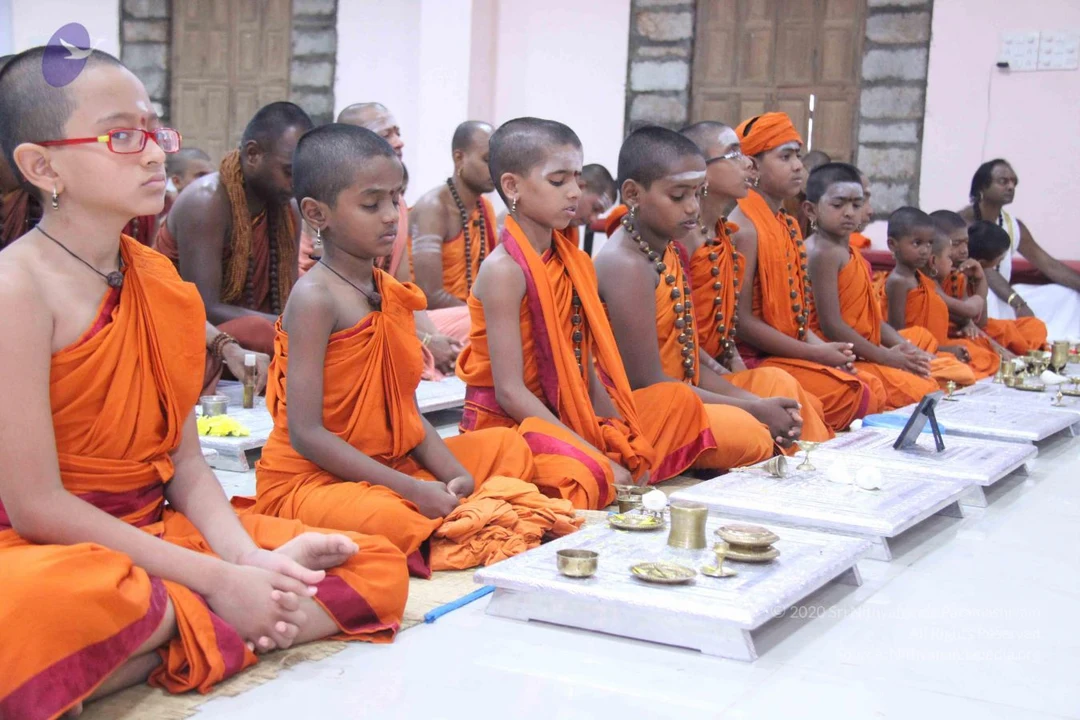
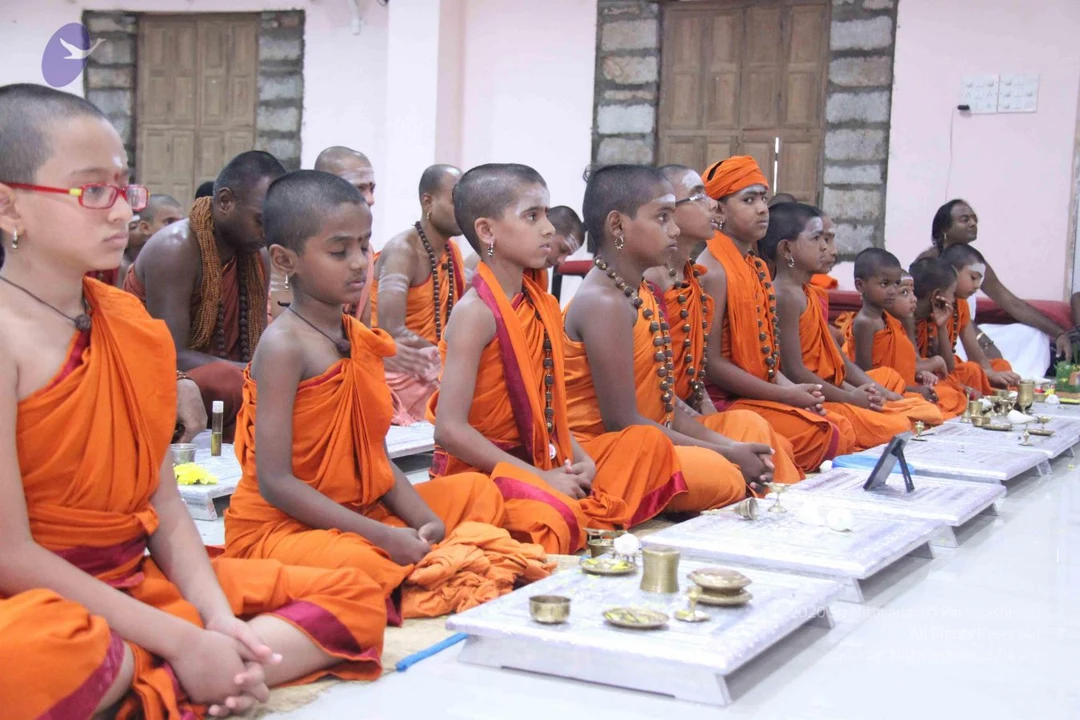
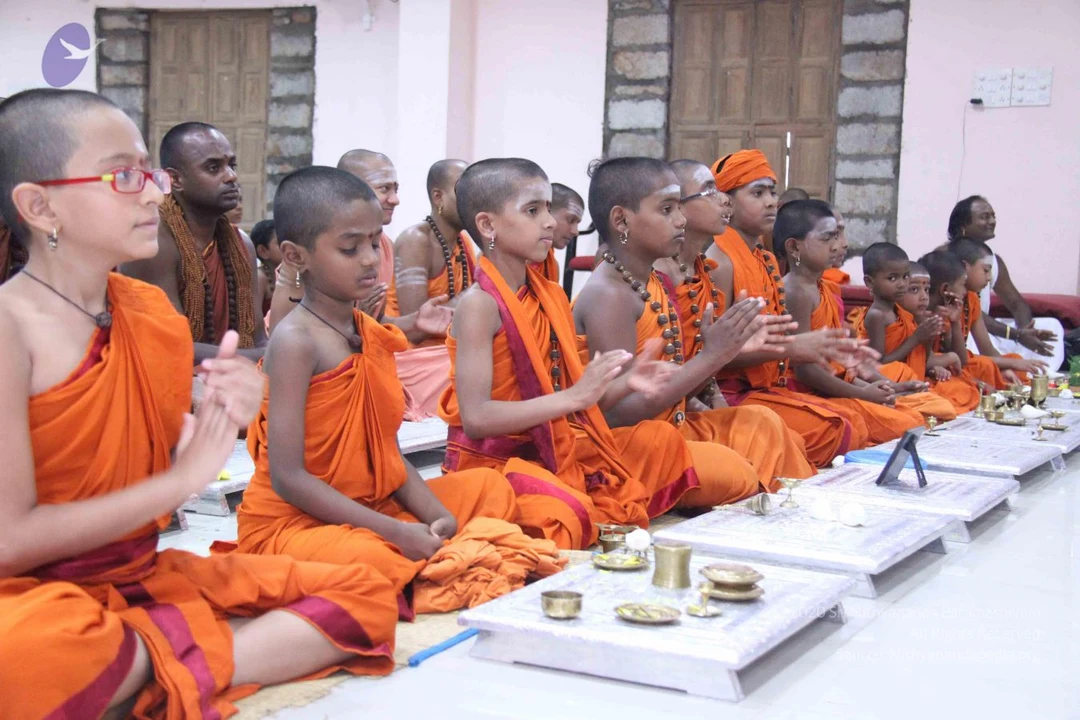
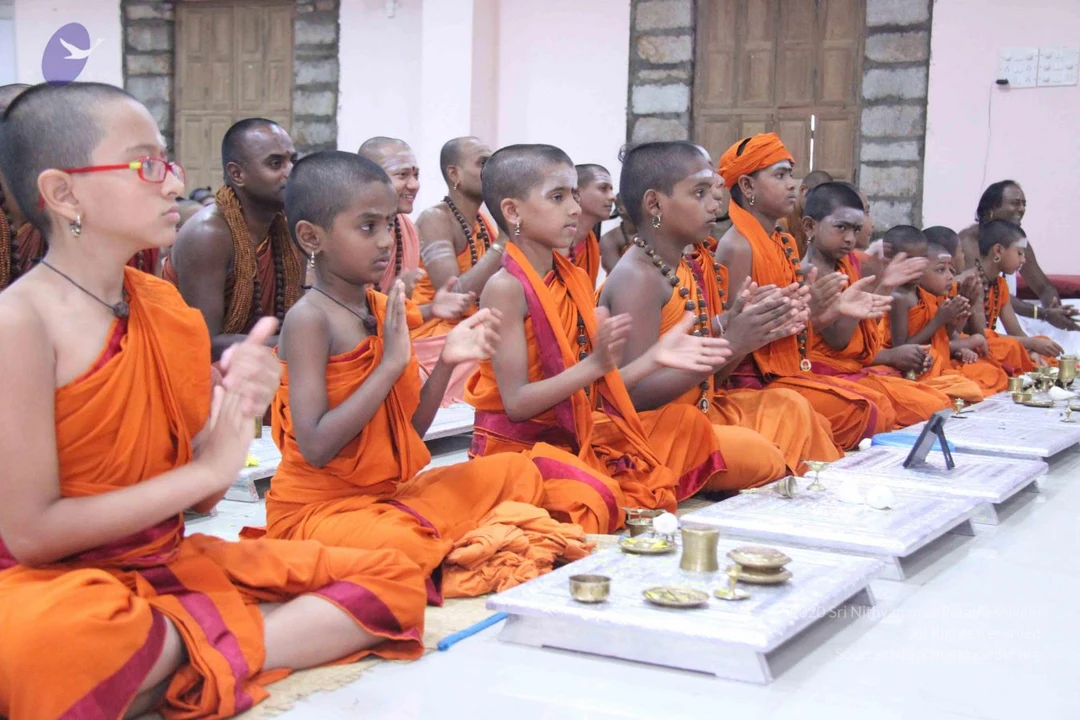
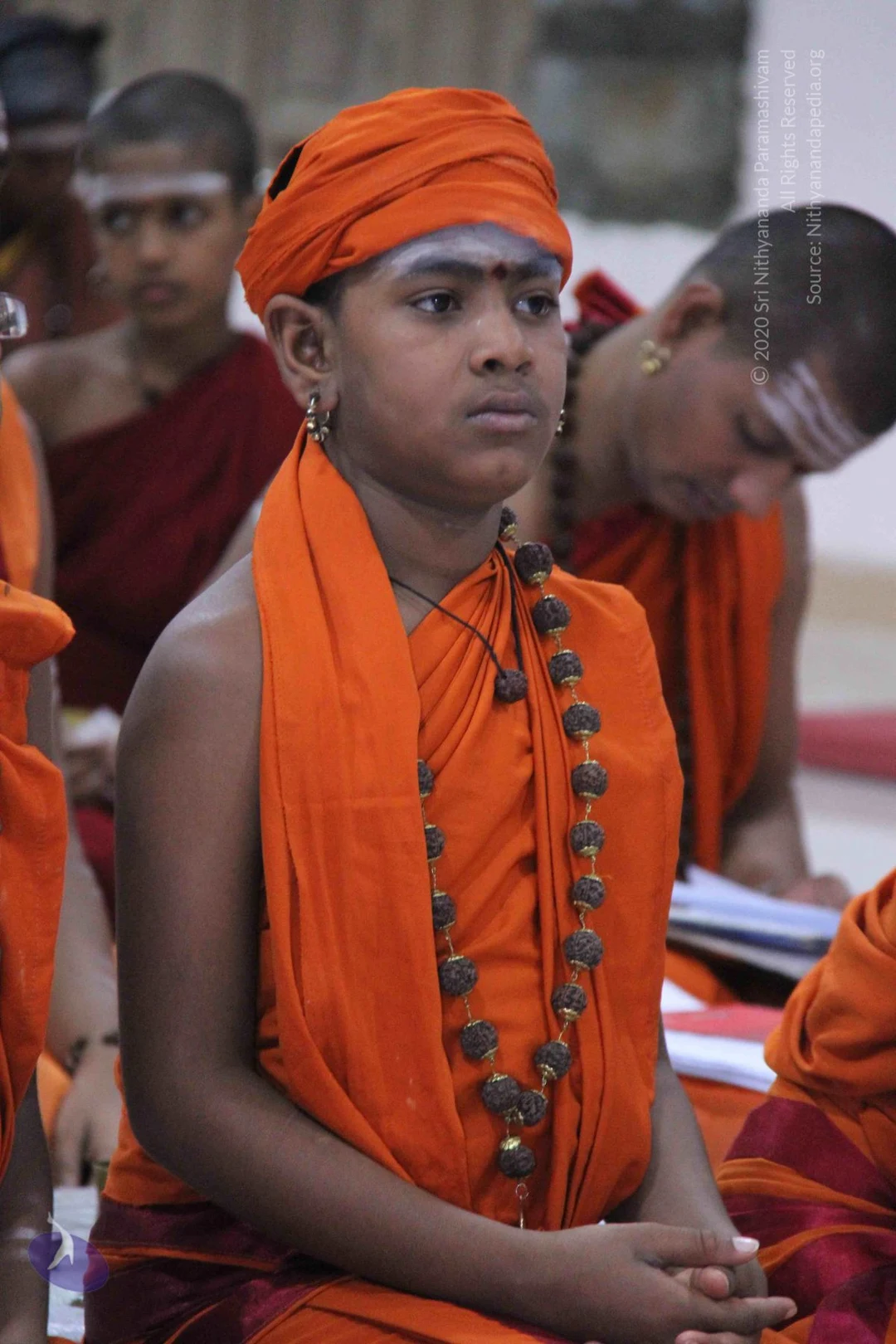
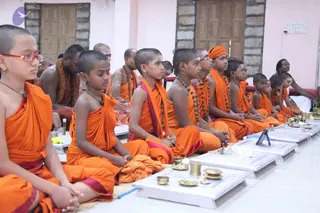
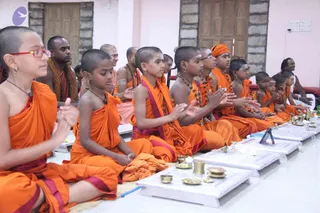
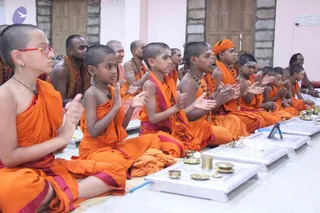
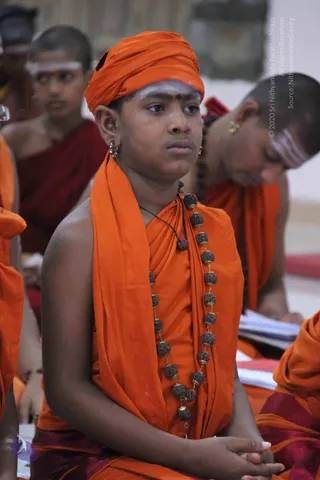
A seated group of young boys and a few adult men in saffron-orange sannyasi robes sit on the floor of an indoor hall, many with shaved heads and white vertical tilak marks on their foreheads. Several boys wear rudraksha mala necklaces, and one wears large dangling earrings and a saffron turban. Behind them, more people in orange and maroon clothing sit in rows. In the foreground, a small dark photo frame and a silver plate with a brass lamp are set on a silver-covered table.A photograph of a seated group of young and adult sannyasis in saffron orange robes, many wearing rudraksha malas and forehead vibhuti markings, sitting cross-legged in rows on a floor before silver-topped low tables. In the foreground a young boy with shaved head and gold earrings looks forward; a girl in orange with a rudraksha mala sits beside him. Brass lamps, a small brass vessel, flower petals and a small framed picture sit on the silver tables. A pink-walled hall with wooden doors forms the background. Several people are visible, including partially cropped figures at the edges.A row of young boys with shaved heads sits cross-legged on a floor in a bright hall, wearing saffron-orange dhoti-style cloth with maroon borders and orange shawls draped over their shoulders. Several wear rudraksha malas, and one boy on the left wears red-framed glasses and a dark pendant cord. Small brass bowls, a brass kalasha-style vessel and plates of offerings sit on low white wooden stools in front of them. Behind them, older men in orange robes and rudraksha malas sit in meditation, and a man in white clothes sits at the far right. A white-framed doorway and a tiled wall form the background.A seated row of young boys and a few adults in saffron-orange robes sit cross-legged on a white floor in a pink-walled hall during a ritual. Many shave their heads; some wear rudraksha malas, and one boy on the right wears an orange headwrap with rudraksha beads and red glasses on the left. In front of each sits a white-tiled puja seat holding brass plates, bowls, a small lamp and a kalasha-like vessel with flowers. Wooden doors and stone-block walls appear in the background. No candidate for a person is clearly visible in the frame.A photograph of a row of young shaven-headed boys and young men in saffron-orange robes sitting cross-legged on white floor platforms with brass puja vessels, bowls and small lamps before them. Several have hands pressed in anjali or raised in gesture, and a few have eyes closed in meditation. Rudraksha malas hang on their chests and some wear ochre sashes; one boy wears a saffron turban and another has red-rimmed glasses. Behind them, older monks in orange and a man in ochre garments sit against a pink wall with wooden doors and stone framing.A row of young saffron-robed boys and a few adult men sit cross-legged on a white floor during a ritual, palms pressed together in namaste. The foreground boy in orange wears red-rimmed glasses and a dark cord necklace; others wear rudraksha malas and one has an orange turban. Silver-topped wooden seats hold small brass vessels and bowls with white flowers in front of them. Behind them stand plain brick walls and a pale pink wall. An adult in orange with long hair sits at the far right edge.

NithyaSatsang

20 photosSource gallery
A smiling man with swept-back dark hair and a red bindi sits on an ornate gold throne with carved lion-like motifs and a red velvet cushion. He wears an orange-saffron shawl draped over bare shoulders, a long gold ceremonial necklace with a large gold pendant, and gold armlets. His right hand rests on the armrest. Swamiji (probable): the person matches the swept-back hair, saffron clothing, gold necklace and gold armlets pattern, seated on a golden peetha. The background shows a gold-leaf arch and red and orange drapery at the left edge.A seated figure in saffron-orange robes and a long rudraksha-style mala sits cross-legged on a golden throne draped with a tiger-skin cloth and red cushions, raising one hand in blessing. Two gilded deity murti flank the throne, each with four arms holding ritual objects and a green-and-orange lower garment. Brass oil lamps stand on both sides of the throne in front of a painted temple backdrop with decorated pillars and a golden wooden door. The scene reads as a satsang dais in an ashram hall. The figure has long swept-back hair and a ceremonial gold necklace, cues consistent with Swamiji (probable), seated in a teaching-throne role.A seated man in saffron-orange robes waves a hand in blessing on a golden ornate throne with a lion-carved back, set on a red velvet cushion above a tiger-striped rug. He wears a long garland of beads, a golden pendant, bangles and an armband, with a red bindi on his forehead. Two large painted deity murti statues flank him, each with four arms, crowns, gold necklaces and orange-pink dhotis, holding objects in their hands. Behind is a carved wooden door. The seated figure is a person candidate: short dark hair, saffron garb, rudraksha-style mala and ceremonial gold pendant, delivering a satsang-style blessing.A seated man in orange-saffron robes sits cross-legged on a red velvet throne with a golden arched backrest, flanked by golden lion heads, atop a tiger-skin rug. He wears a long garland of white flowers with a gold pendant, gold bangles and a red bindi, with his hair swept back. Two tall golden-crowned guardian statues with raised arms stand on either side in front of a blue-grey wall with a golden doorway behind.A photograph of a smiling person seated on an ornate gilded throne with carved lion-like side motifs, upholstered in red tiger-striped cushions. The person wears saffron-orange clothing with a yellow-edged drape over the shoulder, a long gold necklace of leaf-shaped links with a gold pendant, gold armlets and bangles, gold hoop earrings, and a red bindi. Hands are folded in the lap. a person is seated in a ceremonial posture, identified by the saffron clothing, ornate gold necklace and throne setting; the identification is appearance-based. A partially visible gilded lion-form figure and orange-patterned hangings frame the scene.A smiling person sits on an ornate golden throne with lion-carved armrests and a tiger-striped red velvet cushion. The seated person wears a saffron-orange garment draped over one shoulder with a yellow border, a long gold leaf-pattern necklace with a central gold pendant, gold armlets, and a red tilak on the forehead. Hands are folded in the lap, and a gold-framed backdrop with a painted figure appears at the right edge.

PratyakshaPadaPuja

7 photosSource gallery
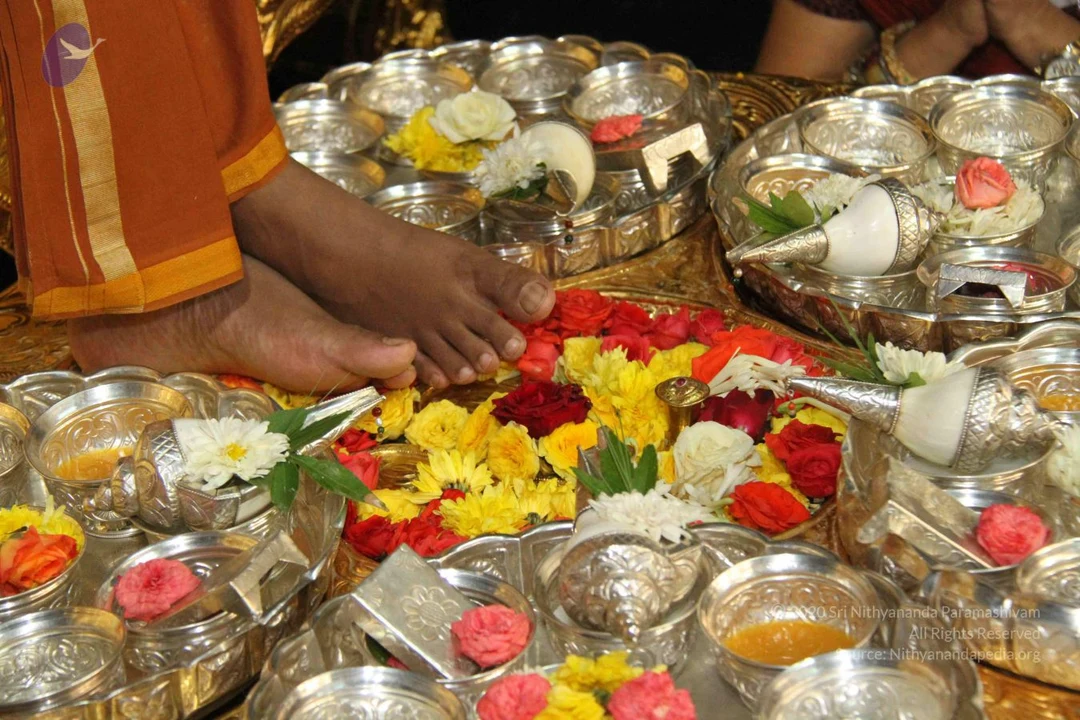
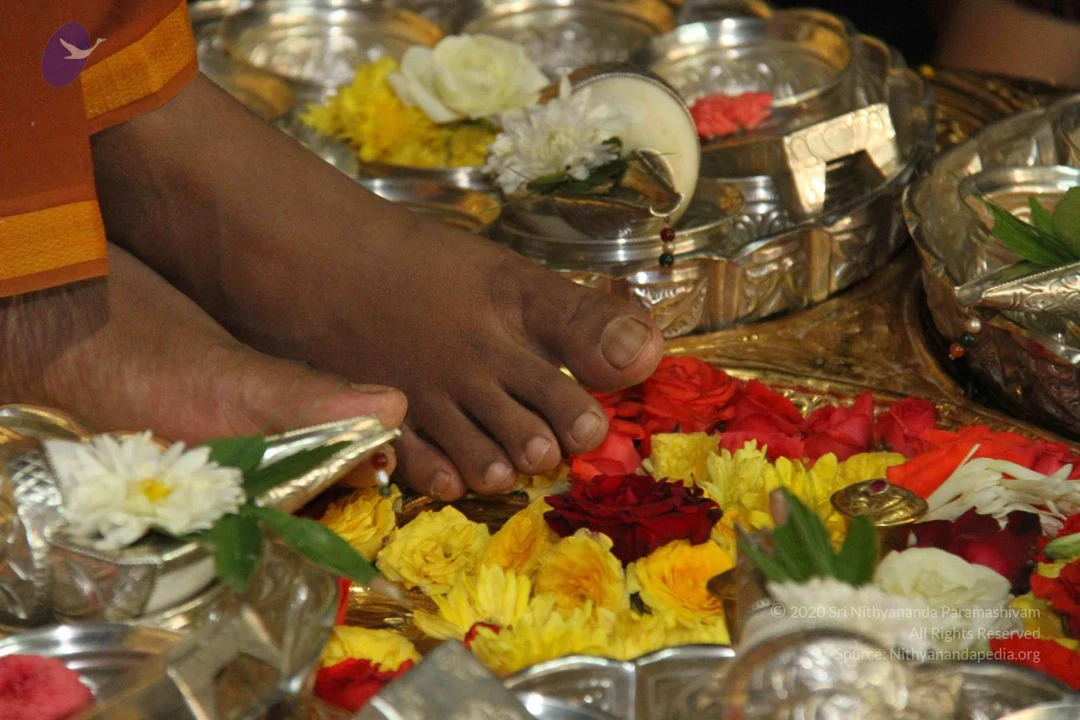
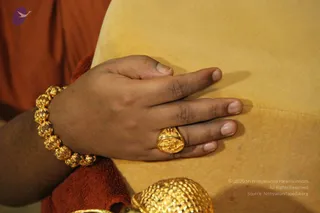
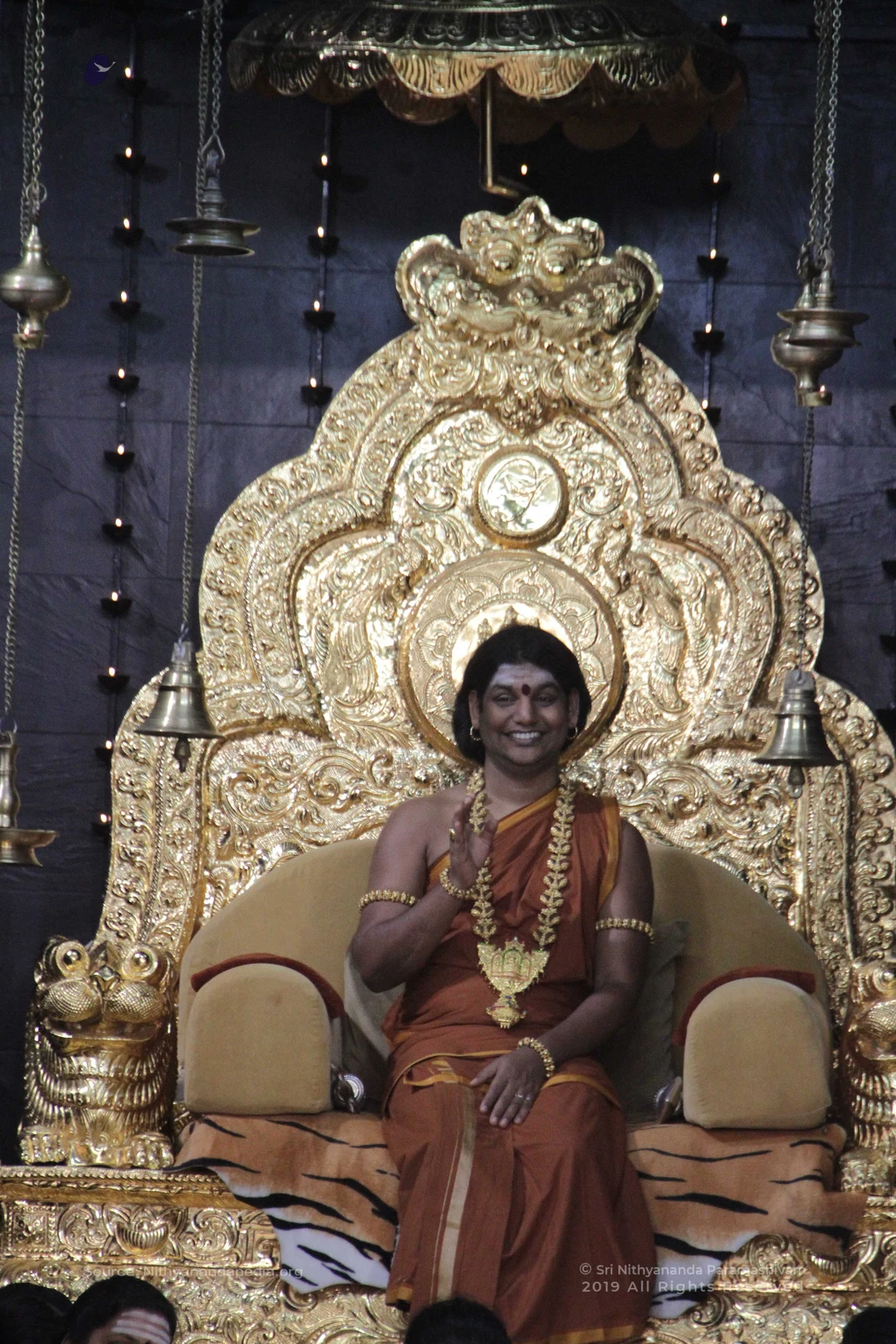
A man with shoulder-length swept-back hair sits on an ornate gold throne with carved lion-head arms, draped in a tiger-striped cloth. He wears saffron-orange robes with a gold-bordered cloth, a large gold ceremonial necklace with a temple pendant, rudraksha-style bangles and gold armlets, and raises one hand in greeting. Gold oil lamps hang beside him from chains against a dark wall. The appearance matches a person, seated in a ceremonial setting.A seated man in an ornate gilded throne, its carved backrest and golden lion-head armrest prominent, draped with a tiger-striped cloth. He wears saffron-orange robes with a gold-bordered dhoti, a thick gold necklace with a large pendant, a rudraksha-style garland, gold armlets and bangles, and a red tilak. He holds one hand raised near his chin in a gesture, smiling. Brass hanging bells and oil lamps hang above the throne, and brass thali plates with flowers and offerings sit at the lower right. A distinctive ceremonial appearance with long swept-back hair and gold adornments makes this a person appearance in person.Close view of a ritual offering arrangement on ornate silver and gilt trays. Silver bowls and small silver cups hold yellow and orange marigolds, red roses, white flowers and green leaves, with a small brass vessel and a bowl of golden liquid. A bare foot in the upper left, with an orange-and-cream-striped cloth, suggests a seated priest or devotee nearby. Scattered petals and a water vessel complete the puja setup.Close-up photograph of a man's right hand resting on a yellow cushion or sofa, fingers relaxed. He wears a chunky gold ring with a carved deity or figure design and a gold bead bracelet, with a rust-orange cloth sleeve visible at the wrist. Gold ornaments are partly visible at the bottom edge. Only the hand and forearm are shown, with no face visible.Close photograph of a large ornate silver puja tray with embossed floral scrollwork, holding several small silver bowls. One bowl contains yellow and white flowers including marigolds and jasmine, another holds an orange rose and a pink flower, and a bowl near the top holds a golden liquid. A silver vessel with a white chrysanthemum sits at the right edge. Blurred gold ornamental carving appears in the background. No people are visible.Close-up photograph of bare feet in an orange-bordered saffron garment stepping onto a bed of red, yellow and white flowers arranged on a golden tray. Surrounding the flowers are polished silver bowls, conch-shaped vessels, a silver spoon and small cups holding orange liquid and rose petals, typical of a padapuja or abhishekam offering. A few other people in red and maroon clothing are partly visible at the top edge, seated with hands folded. A large silver-toned plate and tray fill the frame, with a watermarked copyright line visible in the corner.

SarvaDarshan
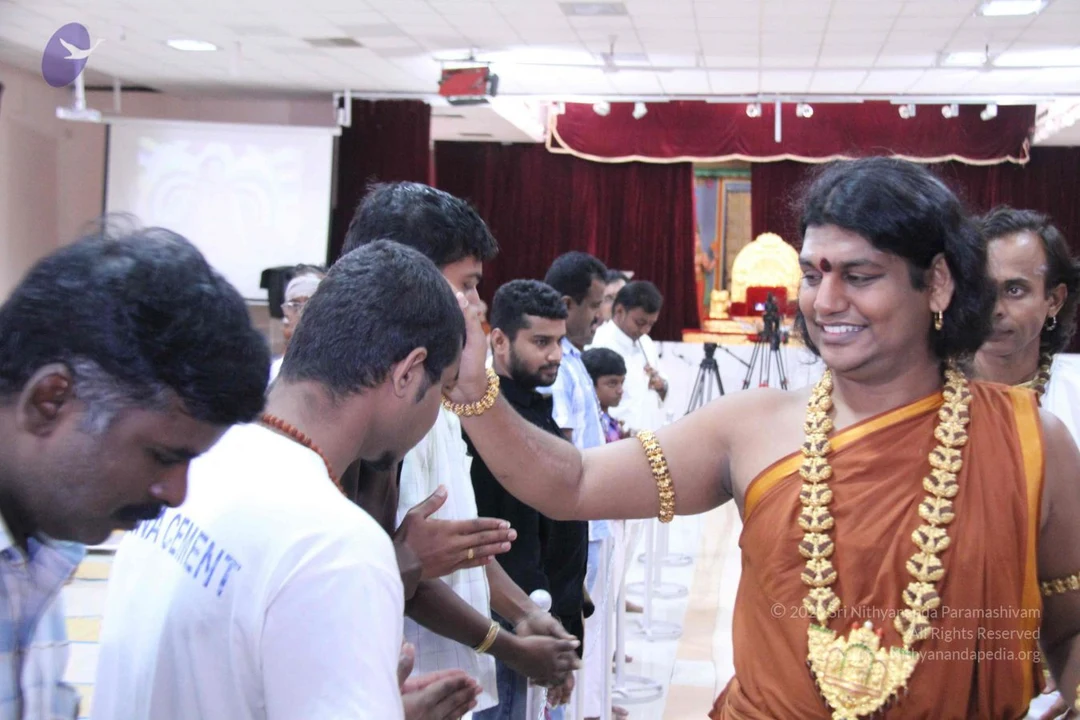
13 photosSource gallery
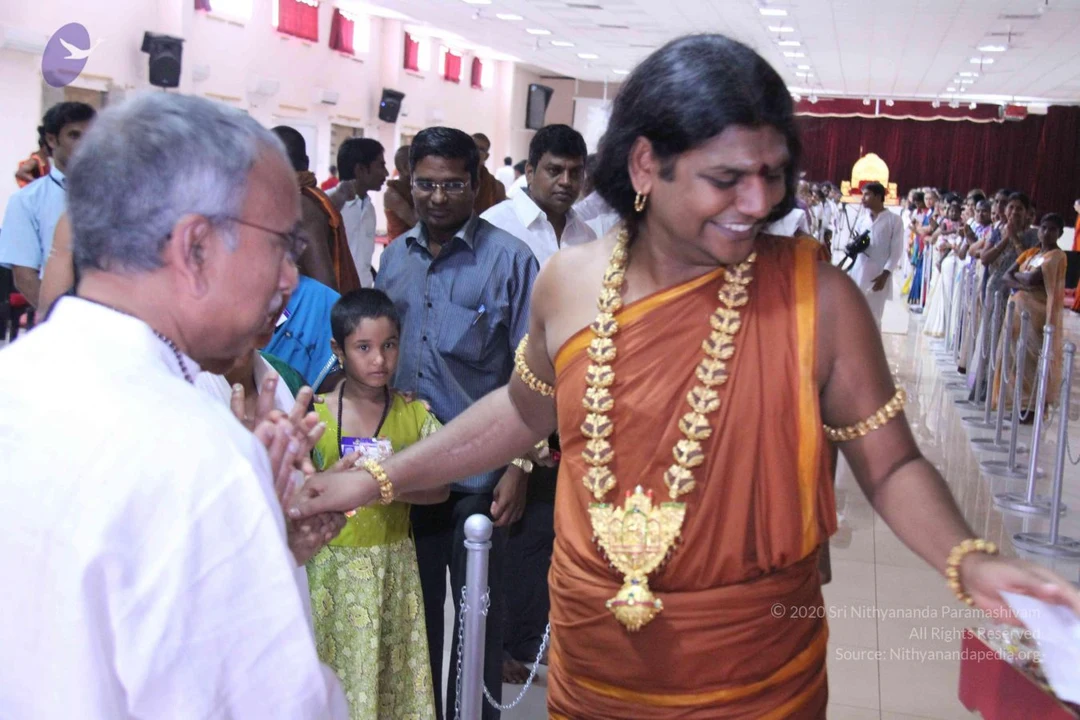
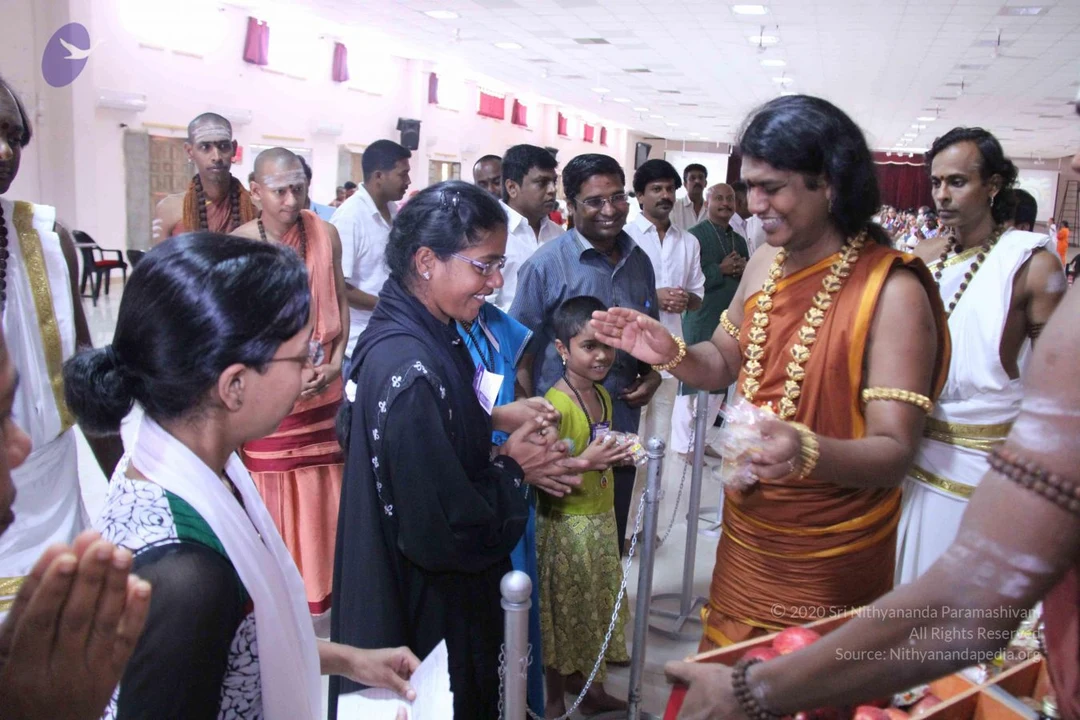
Indoor temple hall with red velvet drapes and a golden shrine backdrop, a deity murti in the upper background. In the foreground, a figure in an orange saffron garment with heavy gold ceremonial necklaces and gold armlets holds a small white paper and looks down at it, with a red tilak on the forehead and dark hair swept back. Beside him stands a man in white dhoti and shawl with gold border, rudraksha mala and beaded bracelet, watching. On the left, a person in white shirt with palms pressed together in anjali, and a partially visible person at the edge. Microphones on stands and cables on the floor are visible. a person: the orange-robed figure with gold necklaces and swept-back hair matches the expected presentation, but the face cannot be confirmed, so identity is uncertain.A man with long dark hair and a large gold ornamental necklace, wearing an orange saffron-coloured wrap and multiple gold bangles, raises his right hand in blessing while smiling toward a line of devotees. Men in white shirts and a man in a blue plaid shirt stand with palms pressed together, and a young boy in a checked shirt folds his hands. Behind them a woman in white stands near a golden throne with red cushions and a red velvet backdrop, with a deity murti visible on the left.A photograph of a satsang crowd at an ashram hall with red velvet drapes. In the foreground, a man in an orange saffron dhoti and shawl, wearing a heavy gold ceremonial necklace and gold armbands, raises one hand in blessing and smiles. Nearby, men in white shirts and dark clothing stand with hands pressed in anjali namaskar, one with a white vibhuti mark on his forehead. Behind them, a white-clad figure and a woman in orange attend a gold-and-red altar area with a deity murti. The man in orange is an appearance-based a person candidate with distinctive saffron clothing and gold ornaments, described in the scene as a person giving blessings.A photograph in an indoor hall with cream walls and a drop ceiling, red curtains behind, and a gold and red shrine with a golden kalasha-like canopy at the back. On the right, a figure with long swept-back dark hair, a red bindi, gold bangles, a gold armband and a heavy gold ceremonial necklace wears a saffron-orange garment with a yellow border and raises one palm in blessing while smiling. A man in a white-and-blue striped polo shirt bows with hands pressed together in namaskar and head lowered. Beside him, a man in a striped shirt holds his palms together. Further back, men in white dhotis and shirts stand in a line, and a man in orange at the right edge wears gold necklaces and a rudraksha mala.Indoor photo in a hall with white ceiling fans and red curtains. A man in an orange-saffron dhoti with heavy gold necklaces, gold bangles and an upraised right hand stands at right, holding a folded white paper in his left hand; his appearance is a person candidate. Around him devotees stand with palms pressed together in namaskar, including a bearded man in white kurta with a blue lanyard and rudraksha mala, and a man in a purple striped shirt. A man at left in white with a rudraksha mala and red tilak touches his forehead. Behind them a crowd gathers, some in white and saffron clothes, and a red-cloth table holds offerings at lower right.A photograph of an indoor hall with cream walls, a white ceiling and red curtains. In the foreground a person in an orange-saffron dhoti and shawl, wearing a long gold-beaded garland and gold armlets and bangles, takes an offering from the hands of a man in a white shirt holding a folded white cloth. A probable Swamiji is visible with long swept-back dark hair, gold necklace and orange clothing, receiving the offering. To the left a man in a white shirt with a blue lanyard stands with palms pressed together in namaste. Other men and women, some in white and some in saffron, stand behind in a crowd, with a red-draped stage and red bunting on the walls behind them.

Temple-Swamiji

10 photosSource gallery
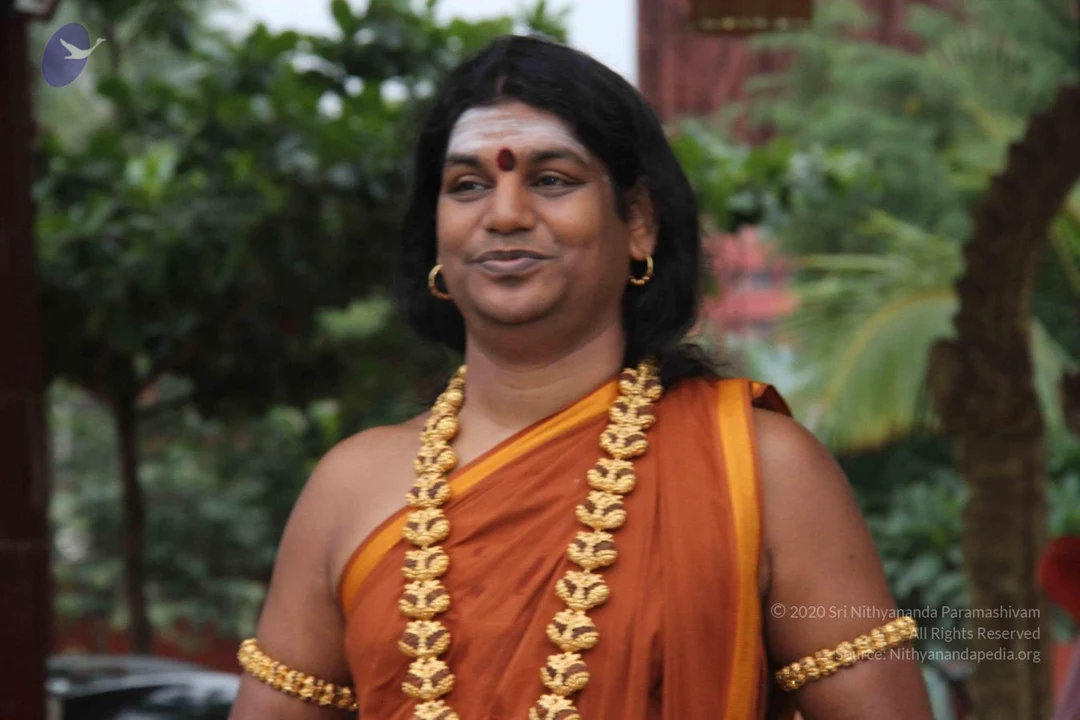
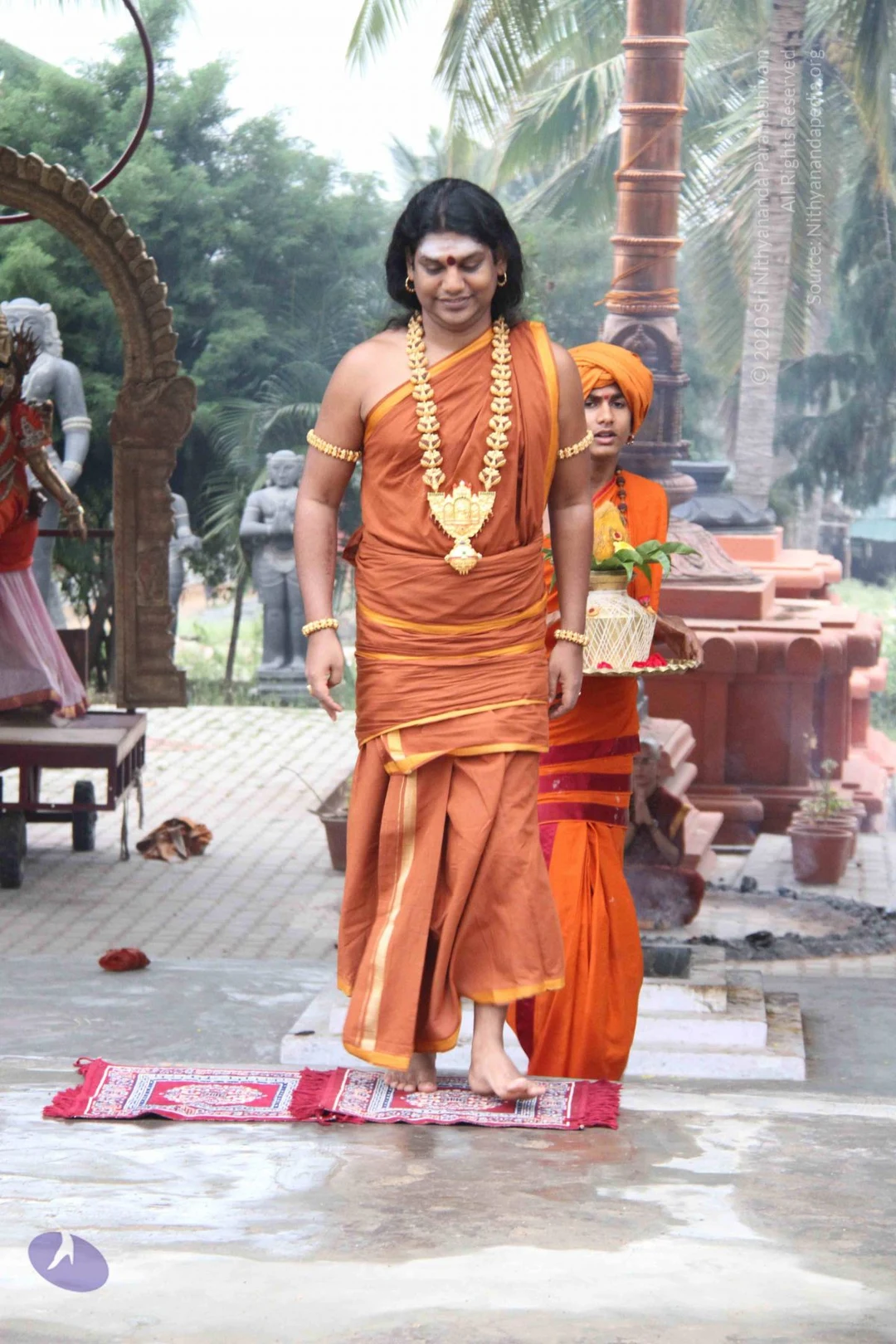
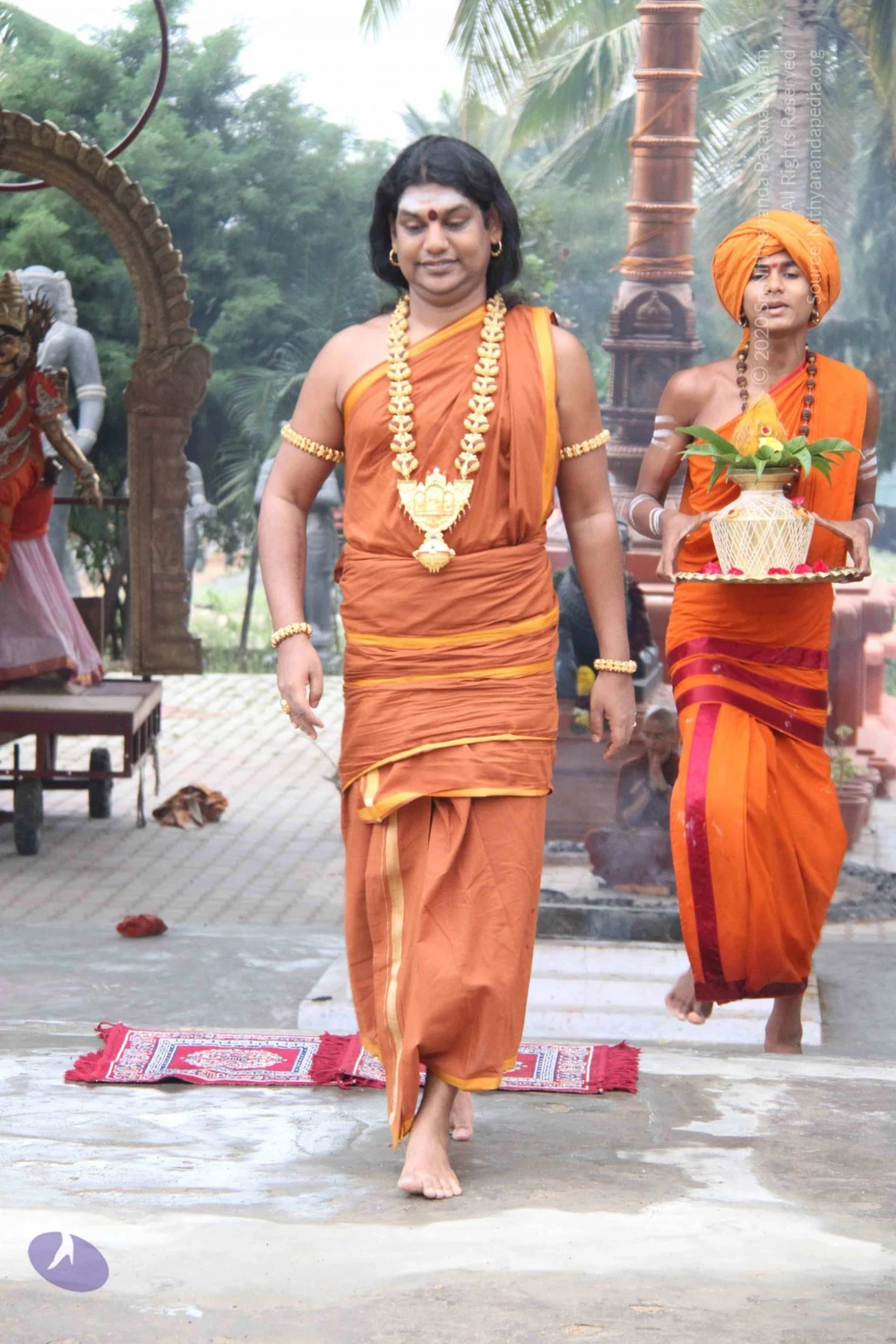
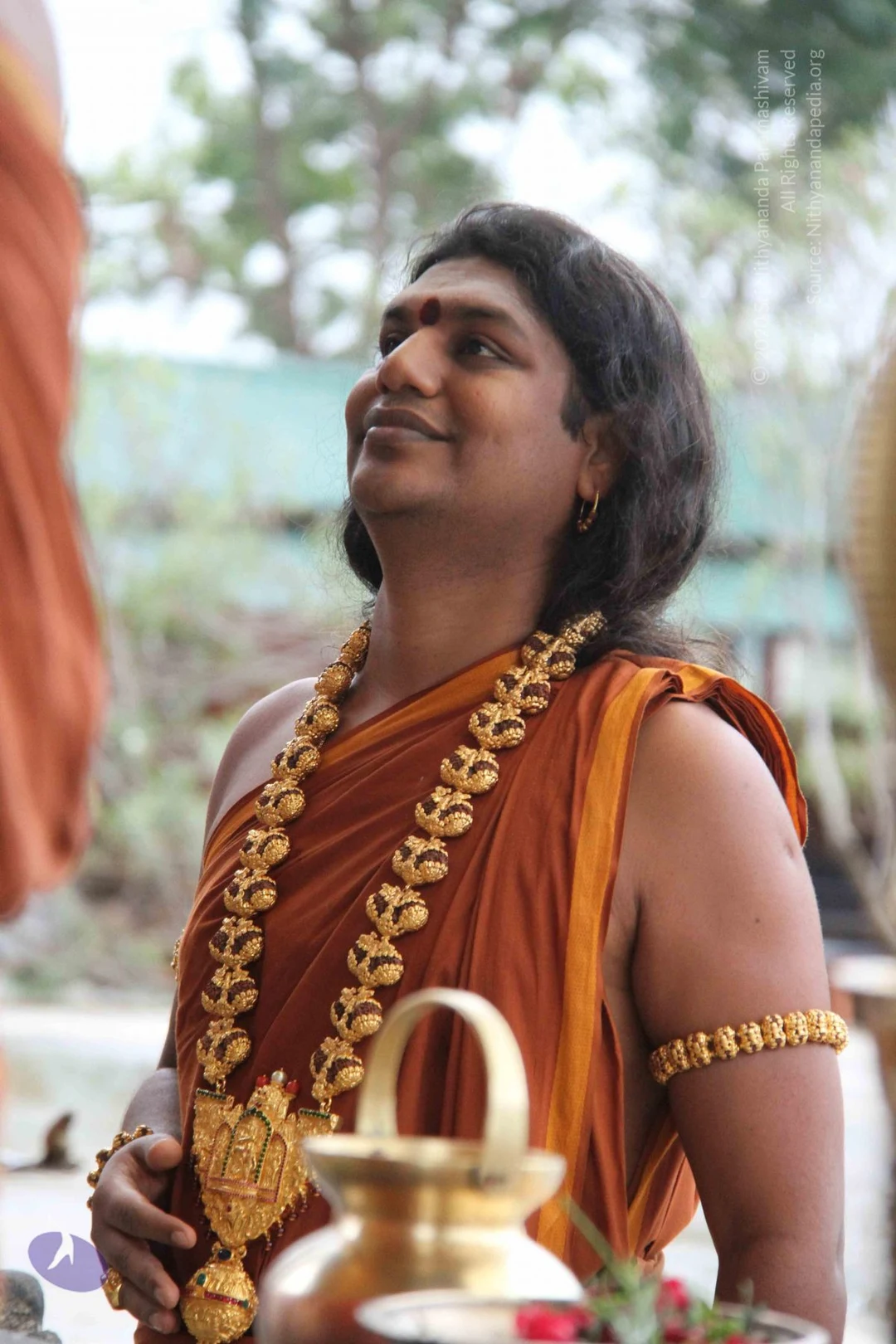
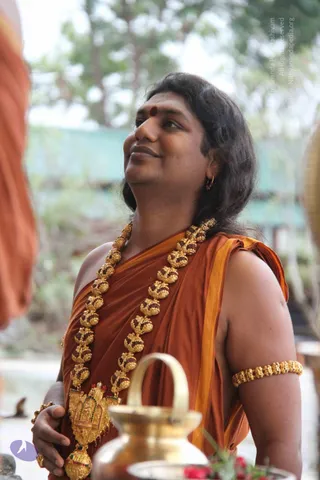
Two gilded statues of a deity couple seated together within an ornate golden arch, set outdoors against palm trees and greenery. The male figure on the left wears a red turban with a jewelled crest, a purple garment, rudraksha mala and layered silver necklaces, and holds a trident. The female figure on the right wears an orange-red sari with gold border, silver necklaces, bangles and a tall golden crown. A small green parrot perches near the female figure's hand. Both statues have golden faces and bare feet, seated on a pink draped cloth. These are statues, not living people. Deity murti, with no visible ritual activity.A brass kalasha pot wrapped in white cotton thread stands on a brass tray covered with white rice and scattered red rose petals. A coconut with its husk is placed on top, surrounded by fresh green mango leaves, a typical ritual kalasha arrangement. No people are visible; the setting is a paved outdoor ground.A smiling person with long dark hair and a red bindi walks barefoot across a paved courtyard beside a dark grey SUV. He wears a saffron-orange shawl and dhoti with gold edging, a heavy gold necklace with a pendant, gold armbands and bangles, and rings on his fingers. Behind him to the right, a younger attendant in orange robes holds a brass tray with flowers, fruit, betel leaves and a basket. A red brick wall stands in the background. Probable Swamiji is visible, with long swept-back hair, ornate gold jewellery and saffron clothing.Outdoor photograph of a man with long swept-back dark hair and a red bindi, wearing a saffron-orange shawl and dhoti with gold borders, a heavy gold temple necklace, gold armlets and bangles, standing barefoot on a red patterned rug on a paved courtyard. Behind him a younger attendant in an orange turban and robe carries a brass-like tray with a kalasha-style pot, green leaves and flower petals. Carved stone statues, palm trees and a copper-clad pillar frame the scene. Given the presentation cues of long swept-back hair, ornate gold necklace and saffron clothing, this may be Swamiji (probable).Outdoor temple-grounds photograph: a long-haired man in saffron-orange dhoti and upper cloth, wearing a heavy gold necklace, gold armlets and bangles, walks barefoot across a paved courtyard past a red-and-white patterned mat. Behind him an attendant in an orange turban and orange garments, with rudraksha beads, carries a brass tray holding a kalasha-style pot with green leaves, a flame and red flowers. Carved stone and copper columns, palms and a sculpted archway frame the scene, with a deity figure at left.A man with long swept-back dark hair and a small red bindi stands outdoors in an orange-brown garment with a yellow border draped over one shoulder, leaving the other arm bare. He wears a heavy gold necklace of rudraksha-style beads with a large gold pendant, a gold armband, and a small gold earring, and gazes upward with a slight smile. In the foreground, a brass pot with a handle and red flowers is visible. The swami is shown in a ceremonial setting with greenery behind him.

NithyaSatsang

28 photosSource gallery
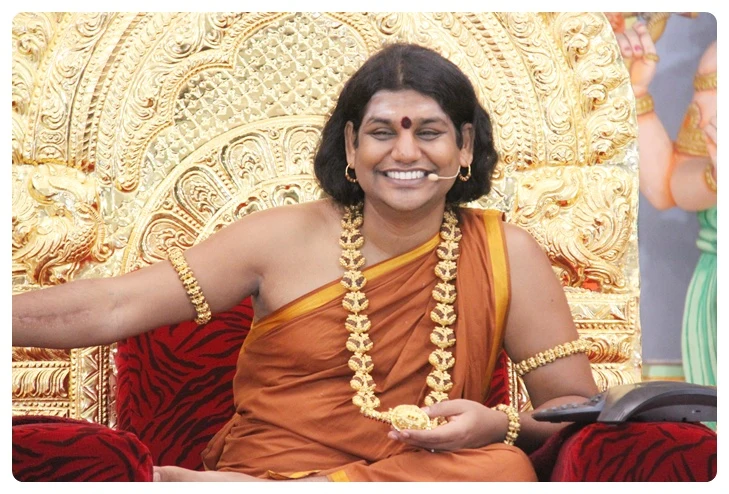
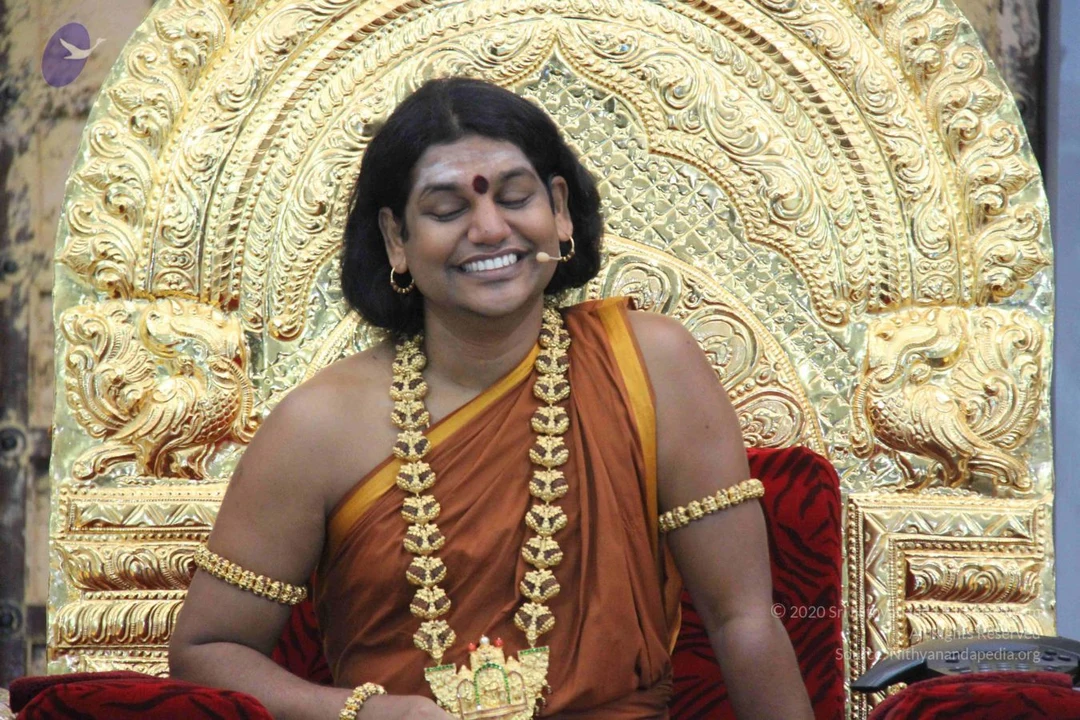
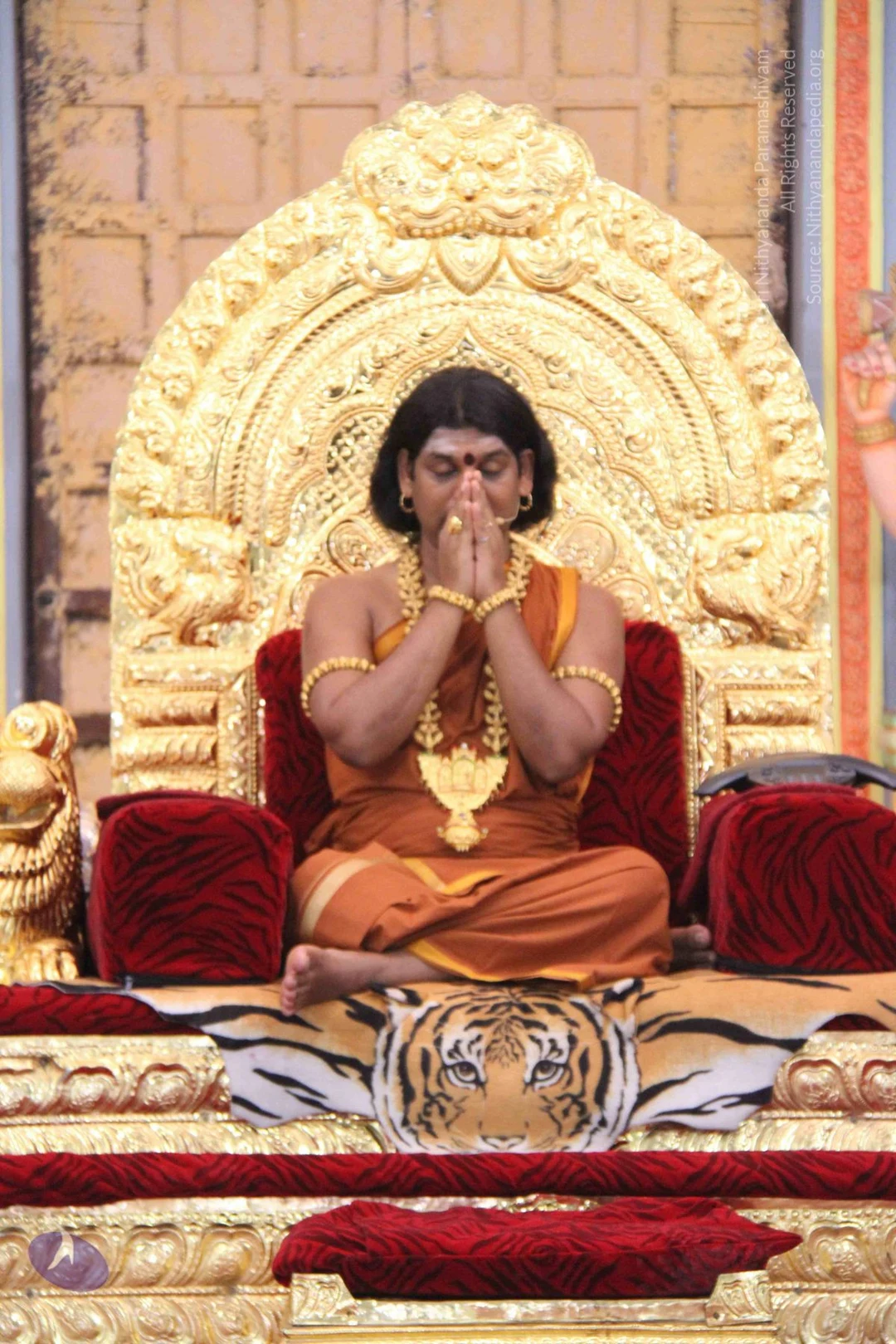
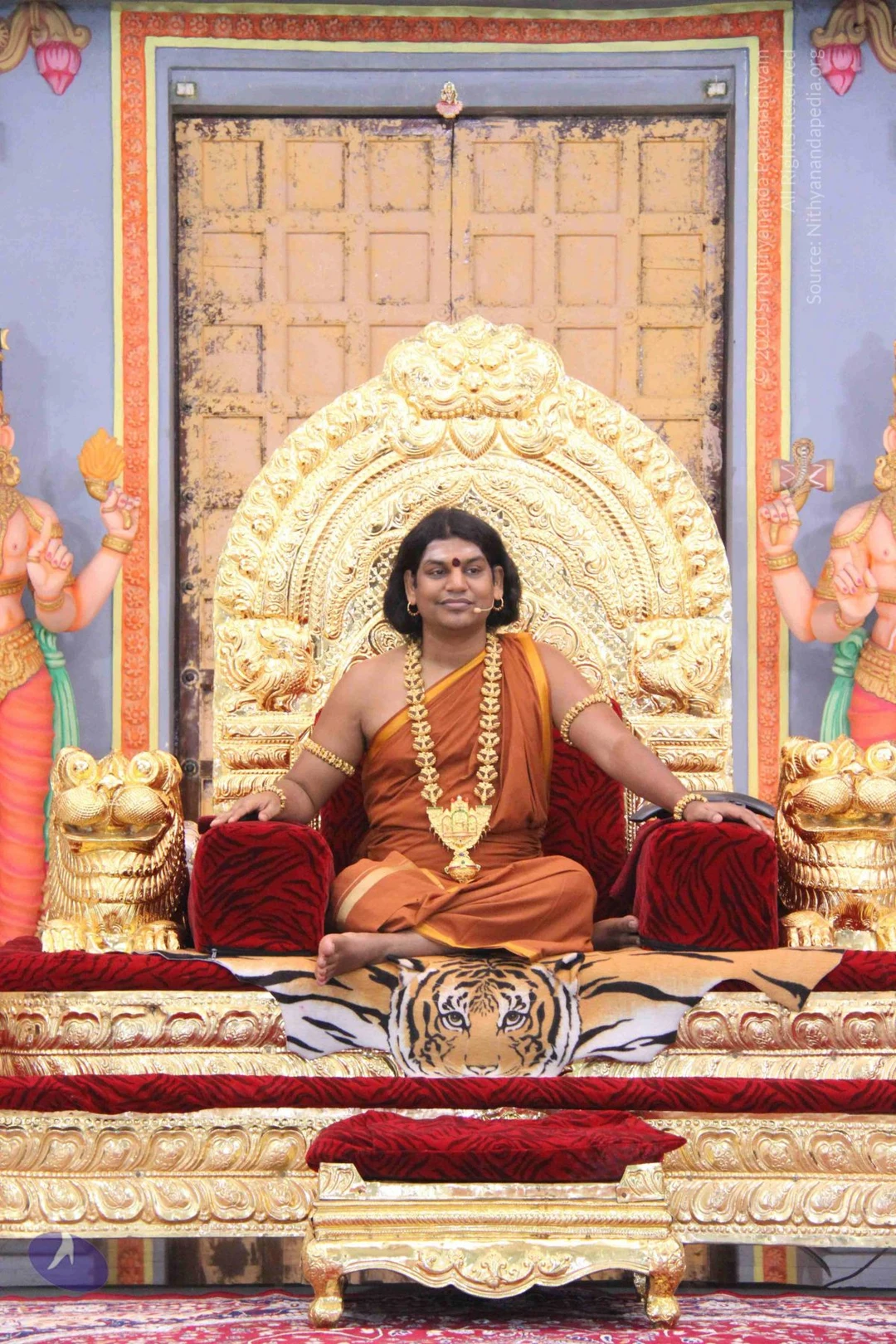
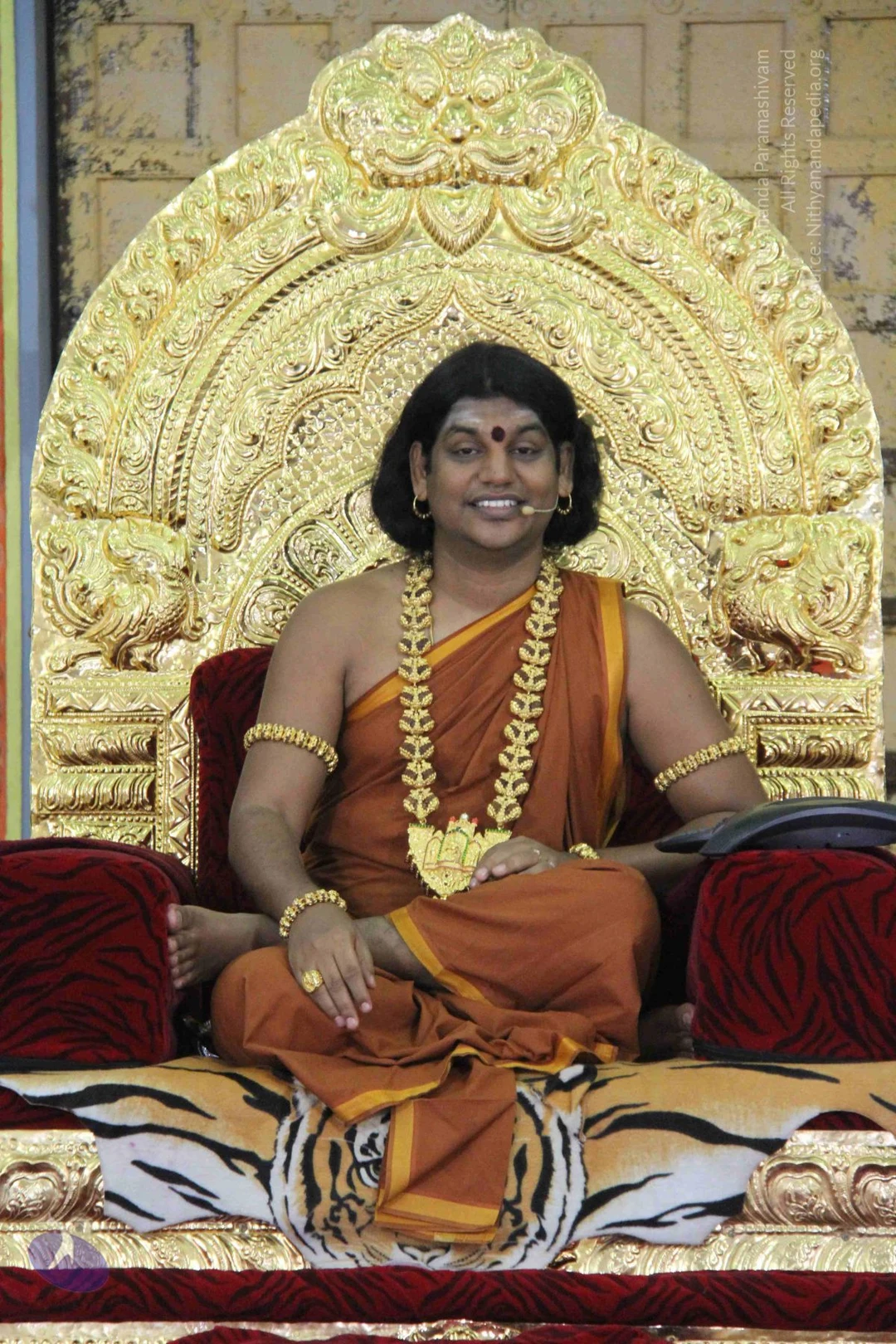
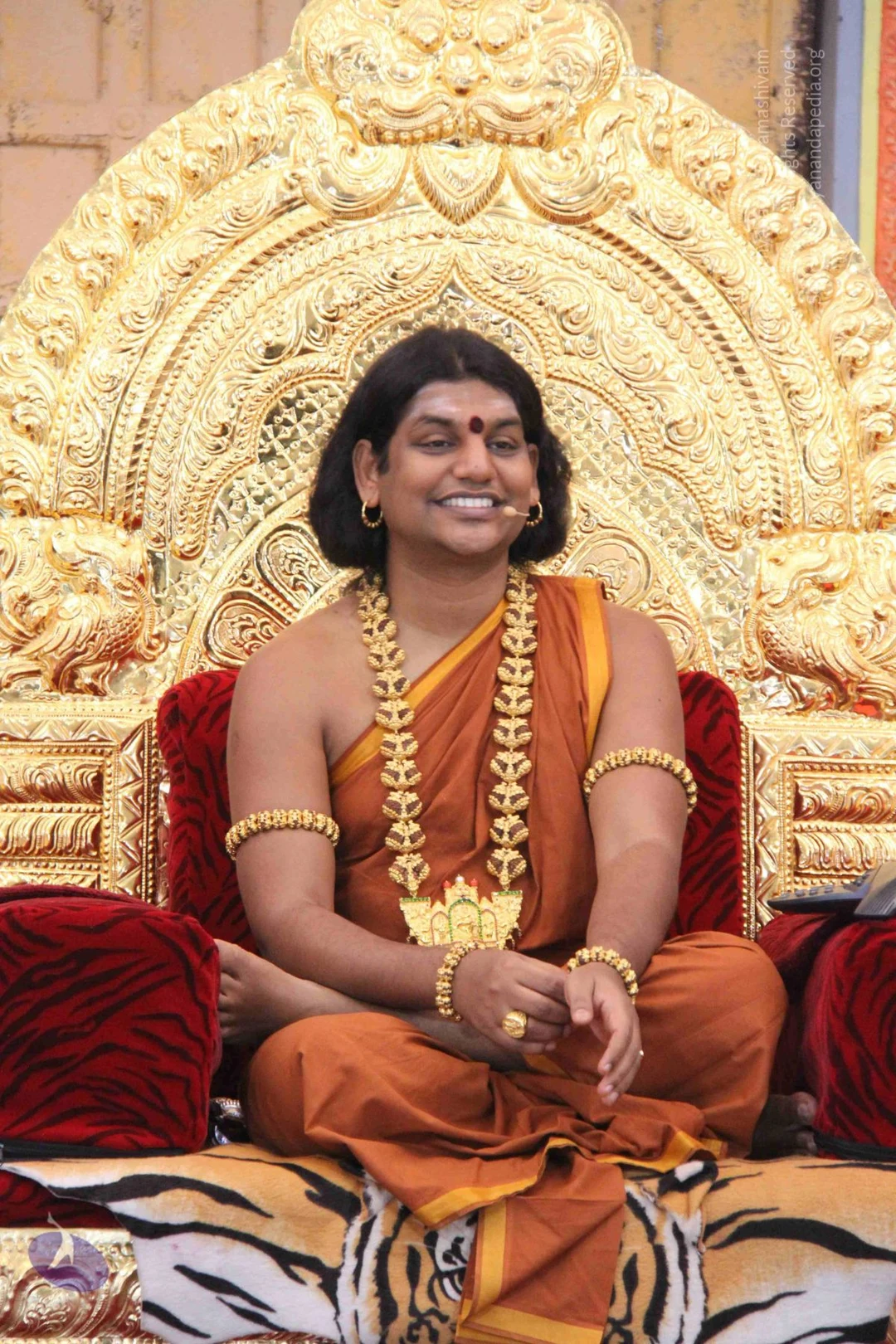
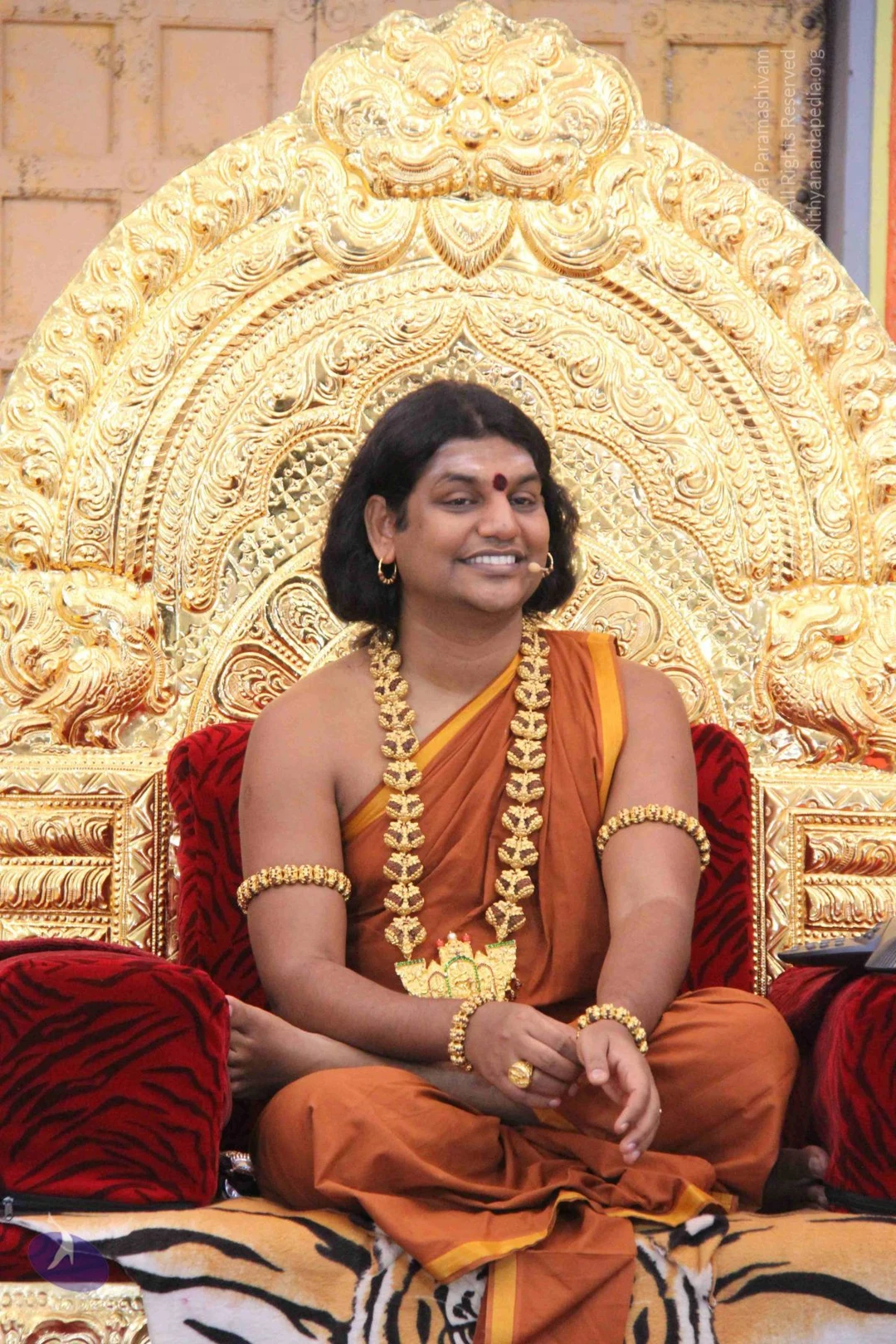
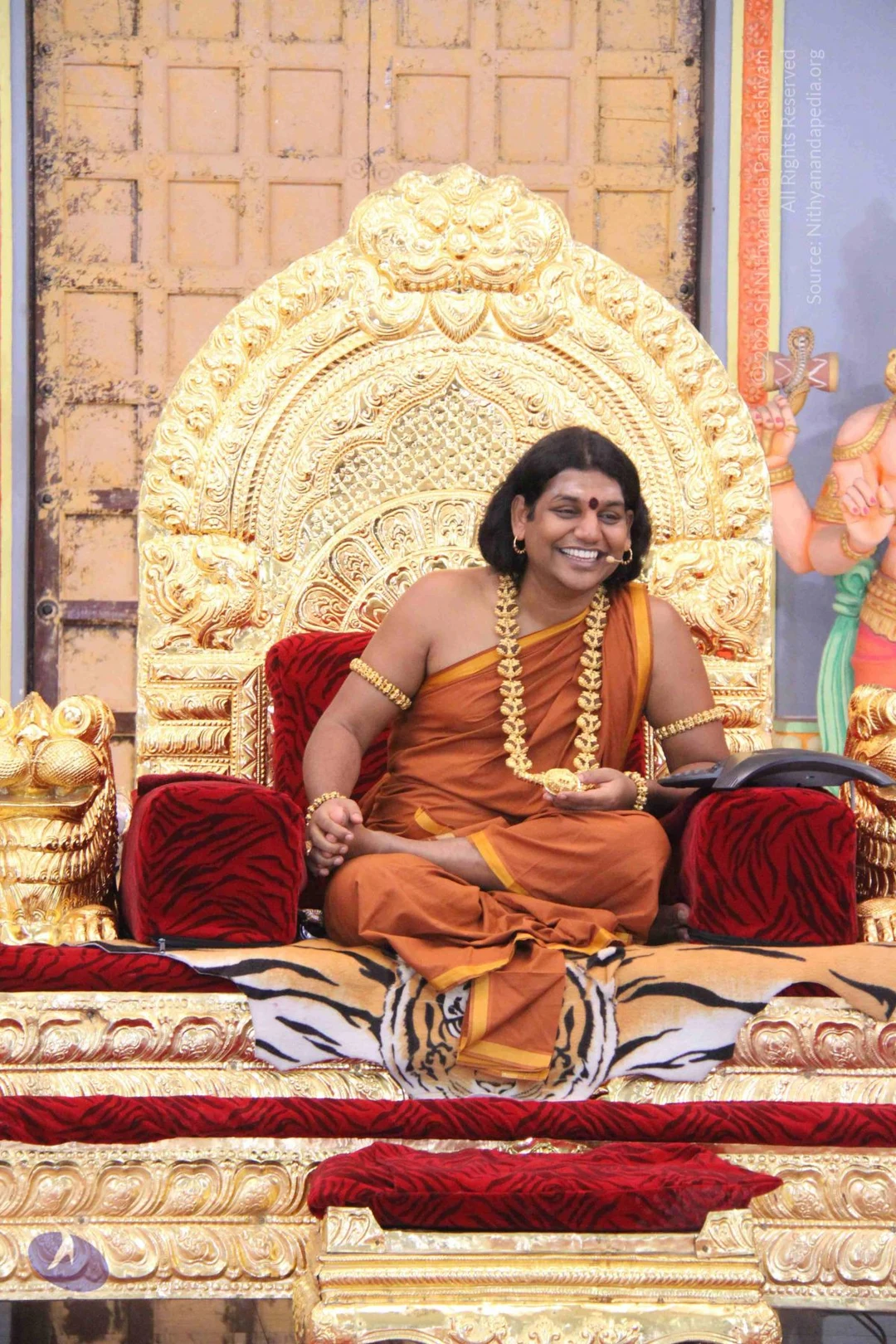
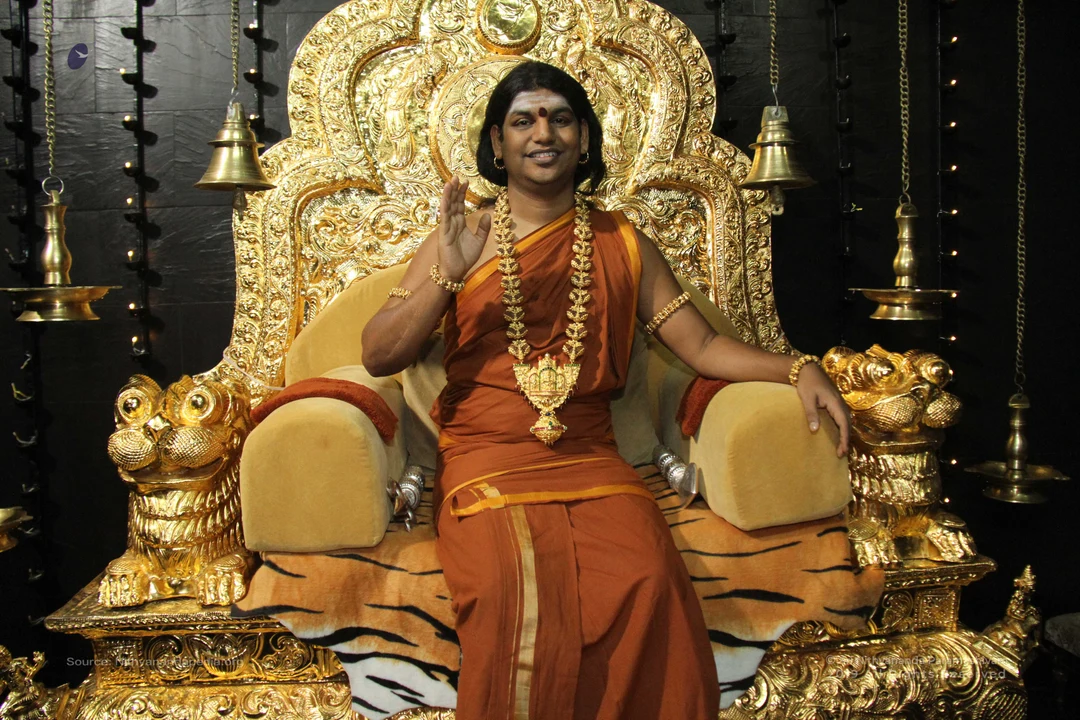
a person sits cross-legged on an ornate gold throne with a red tiger-striped cushion, smiling, in an orange-saffron robe with a yellow border. He wears a heavy gold garland of leaf-shaped links, gold armlets and a gold pendant, a red bindi on the forehead and a small headset microphone. A tiger-striped cloth covers the dais beneath his bare feet.A seated man in an orange-saffron dhoti and shawl sits cross-legged on a red and black tiger-striped cushion before an ornate gold throne with repoussé floral and scrollwork. He wears a long gold-beaded rudraksha-style mala, a large gold pendant, gold armlets and a small red bindi, and smiles while holding his hands in his lap. Swamiji (probable): the long swept-back hair, saffron robes, ornate gold ceremonial necklaces and throne setting are consistent with the page's claim, though the face is not used for identification. One person is physically present.A seated man with shoulder-length dark hair sits with palms pressed together in prayer, eyes closed, on an ornate gold throne with a carved arched back and red velvet cushions. He wears saffron-orange robes, a heavy gold necklace with a pendant, gold armlets and bangles, and a red bindi. The throne rests on a tiger-print cloth. The scene is a stage or hall setting. a person is identifiable by long swept hair, saffron clothing and ornate gold adornments seated on a throne, so this is treated as a candidate in person.A young boy in orange saffron robes and an orange turban sits cross-legged with his hands folded in his lap, wearing a long rudraksha mala with golden spacers and a smaller rudraksha necklace. He has white vibhuti lines and a red kumkum dot on his forehead and wears small gold earrings. Behind him, a shaven-headed man in orange robes with white vibhuti lines sits with his head bowed, and other devotees in orange and maroon robes are visible at the edges of the frame. The setting appears to be a satsang gathering.A seated man in orange saffron robes and a gold ceremonial necklace with a large pendant sits cross-legged on an ornate gold throne with red tiger-striped cushions and lion-head armrests. He has long swept-back dark hair, a red bindi, gold armlets and earrings, and rests his hands on the armrests. A tiger-face rug lies beneath him. Gold deity statues with multiple arms flank the throne, and a large carved wooden door stands behind. Swamiji (probable): the seated man has long swept-back hair, saffron robes, a ceremonial gold necklace and a throne setting, which are the qualifying cues. One person is physically present.A seated man in orange saffron robes sits on an ornate gold throne with a carved arched back decorated with lion heads, draped with a tiger-skin rug and red tiger-striped cushions. He wears a long gold necklace with a pendant, gold armbands and bangles, a red bindi on his forehead, and hoop earrings, and gestures with one hand while speaking. Behind him stand a large wooden panelled door and painted deity figures holding a flaming torch and a trident-like staff. Swamiji (probable) appears in this photograph: long swept-back hair, saffron robes, ornate gold necklace and jewellery on the throne.

PratyakshaPadaPuja

10 photosSource gallery
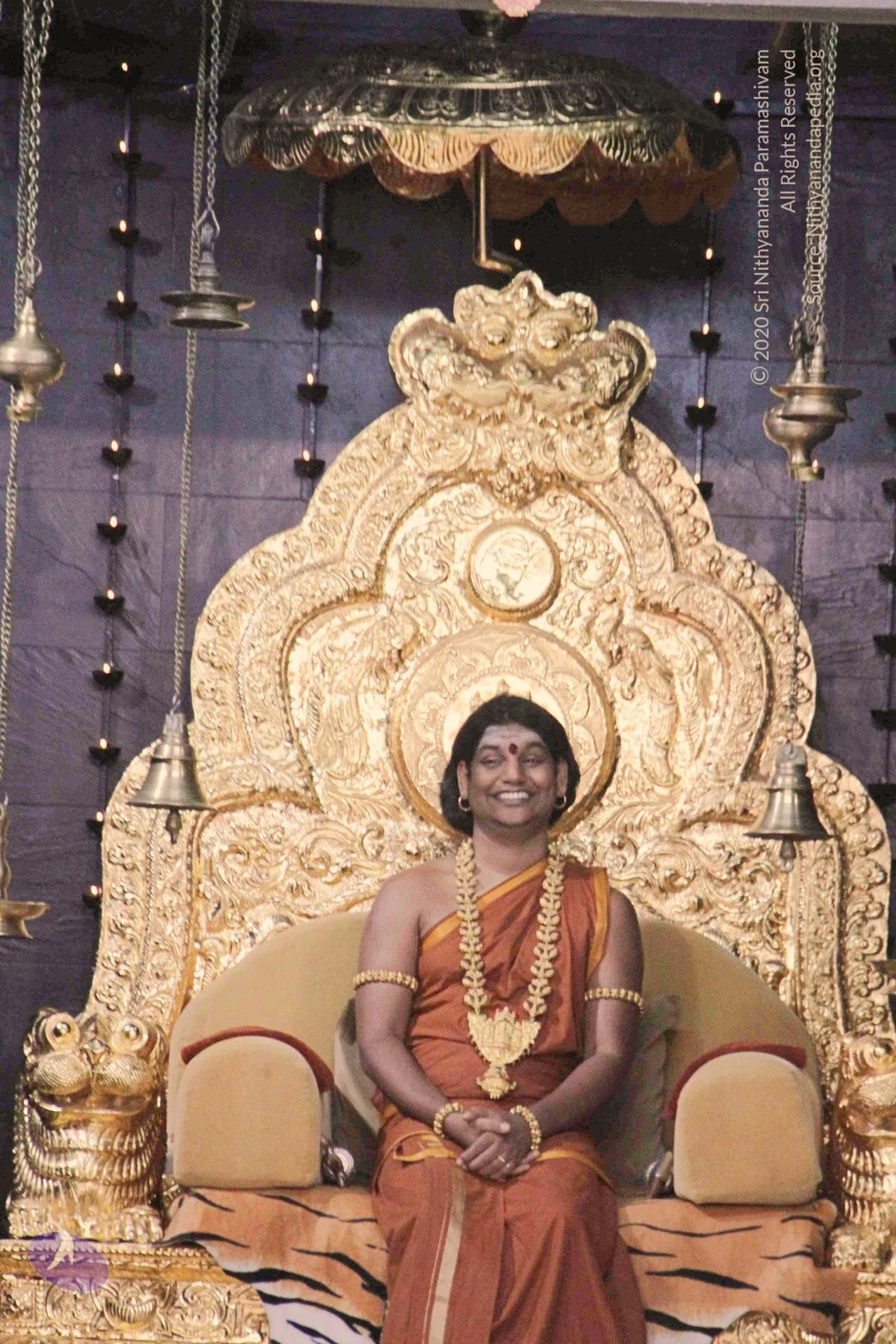
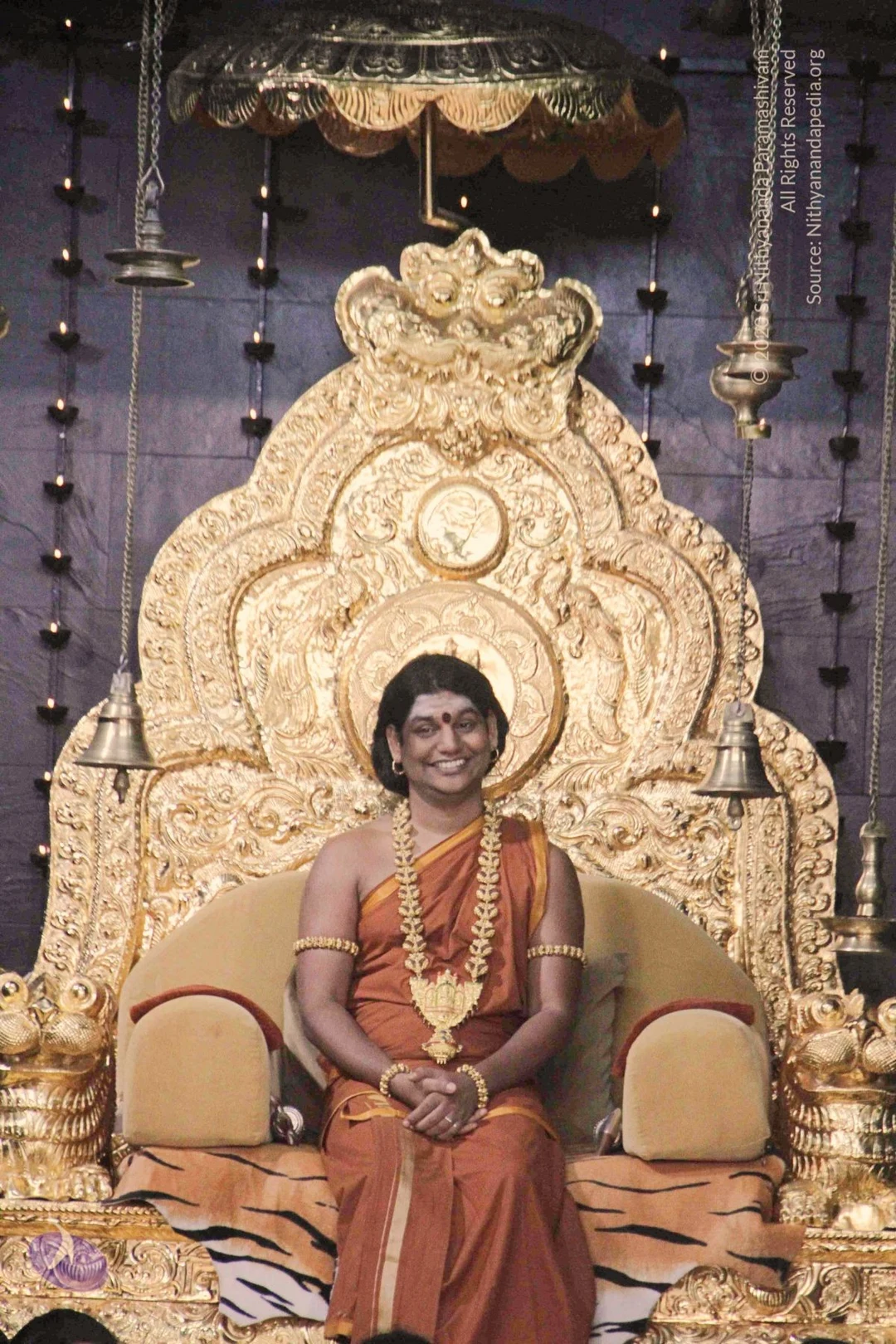
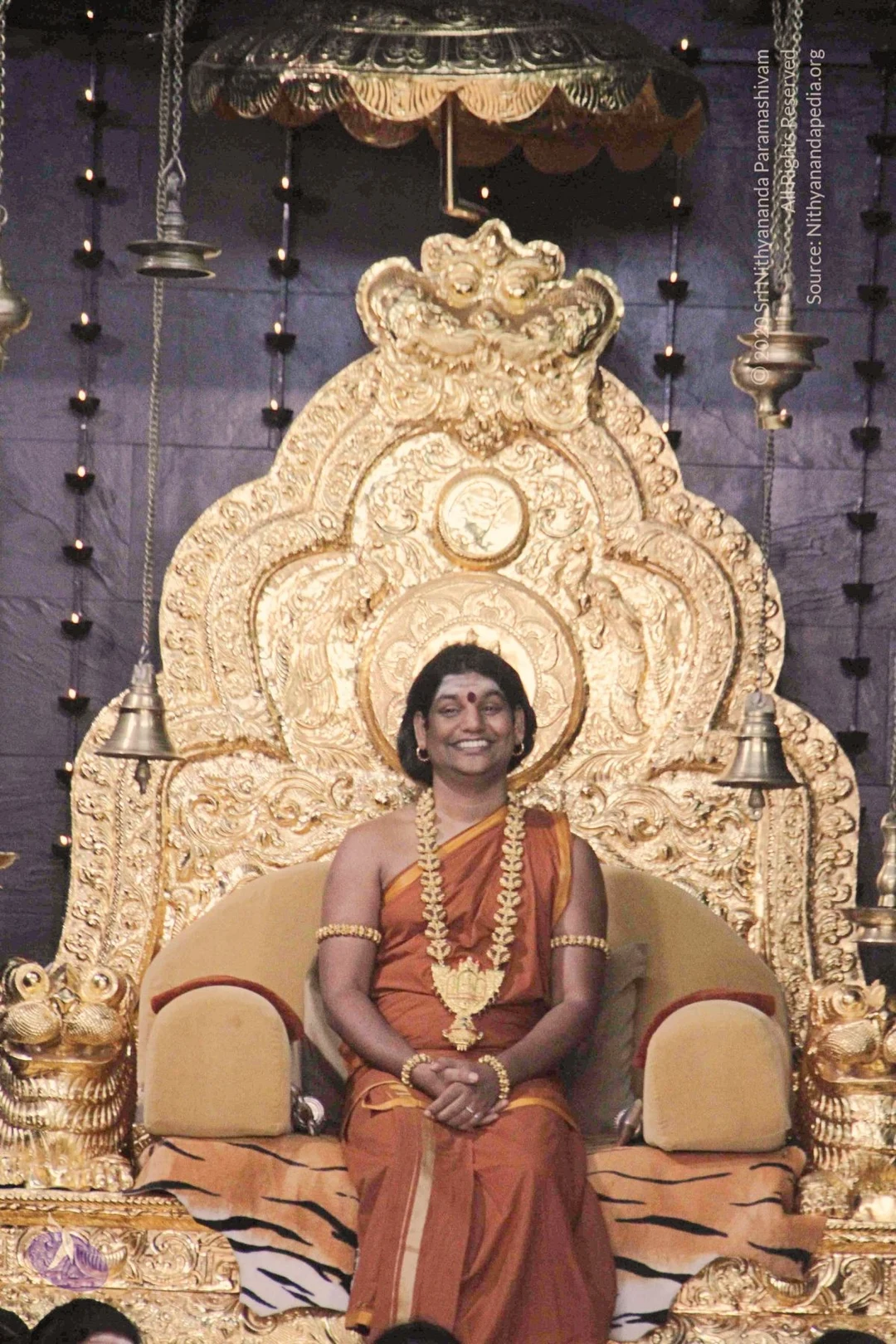
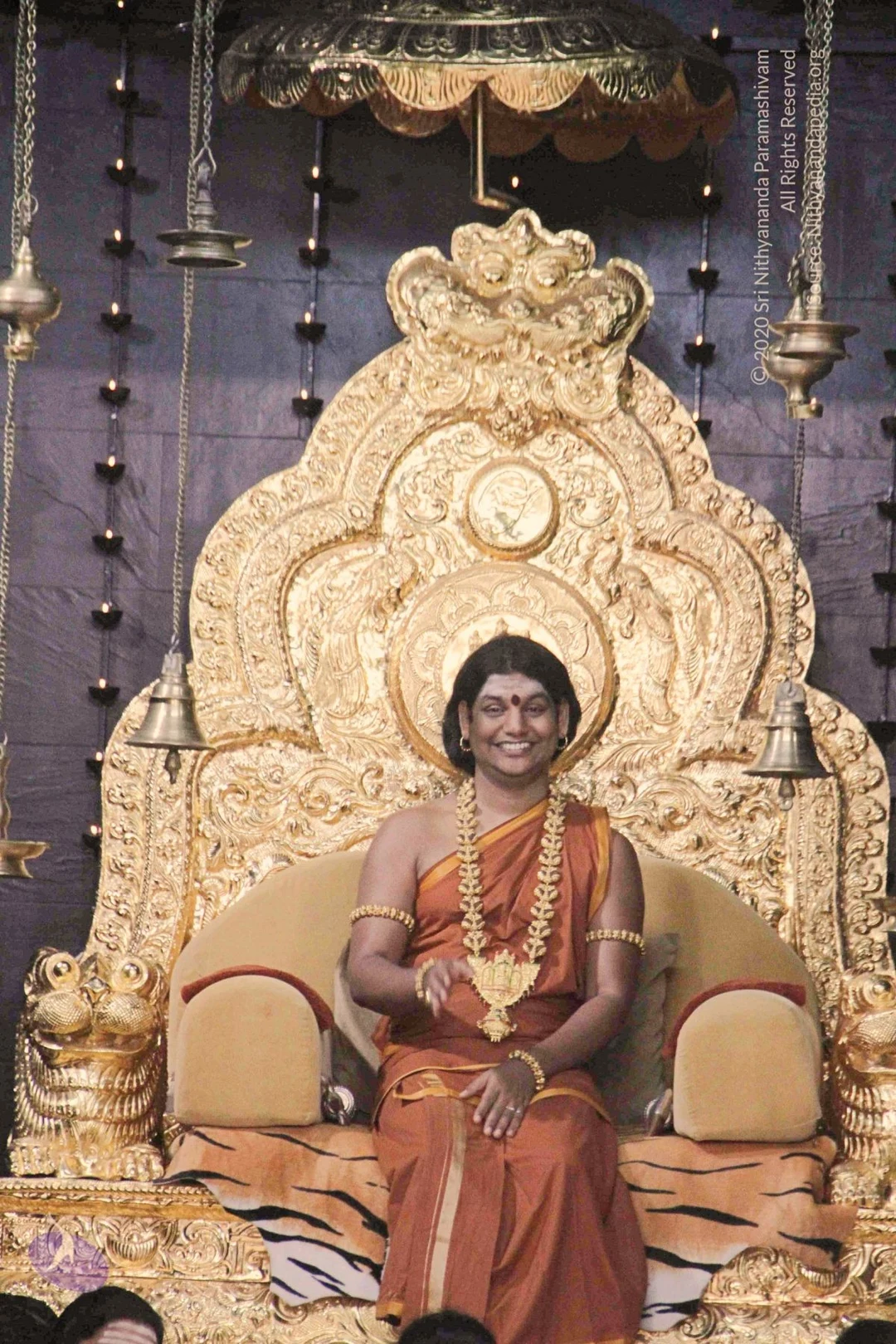
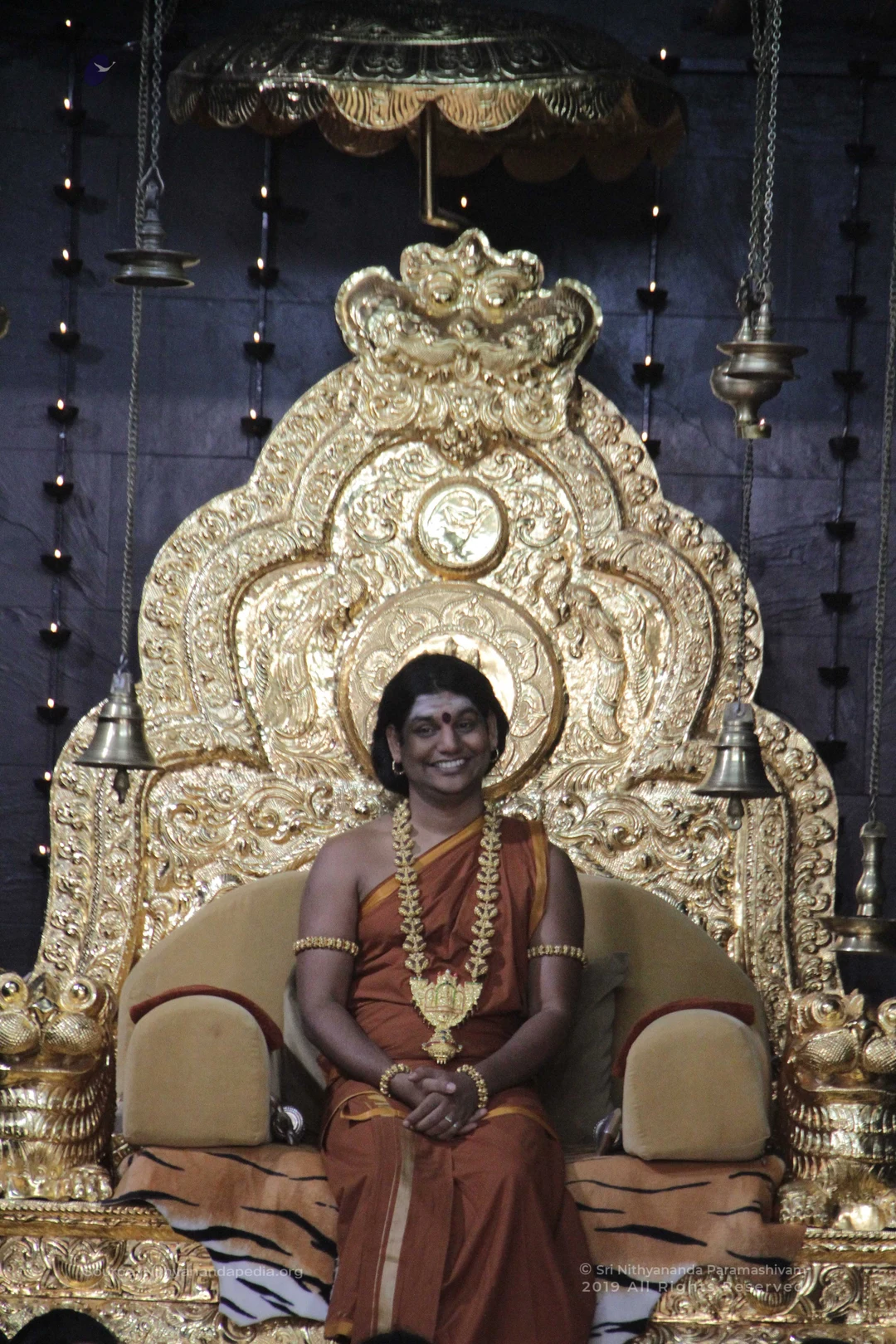
A man seated on an ornate gold throne with a tiger-skin cushion, wearing a saffron-orange dhoti and shawl, a heavy gold necklace with a pendant, gold armbands and bangles, a vibhuti mark and red bindi on his forehead, and long dark hair. He gestures with his hands while smiling. In front of him are silver puja trays holding flower petals, marigolds, red roses, oil lamps and fruit, and hanging brass bells and a brass lamp hang above. Probable Swamiji (appearance-based label): long swept-back hair, saffron clothing, gold necklace and throne setting, with his role as seated teacher giving a satsang. Setting is a dark, ornate hall.A seated man on an ornate gold throne carved with lion heads and a tiger-striped cushion. He wears an orange-saffron cloth draped over one shoulder, a long ornate gold necklace with a pendant, gold armbands, bangles and earrings, a white vibhuti line and red kumkum on his forehead, and long dark hair. A lamp hangs from chains above him. In front, silver plates hold flowers, offerings and small bowls, and his bare feet rest on a bed of red, orange and yellow flowers.A seated man in an ornate gilded throne is the central subject, framed by a golden peetha with carved scrollwork, a circular medallion and lion-form armrests draped with striped tiger-skin cloth. He wears a reddish-orange dhoti and shawl, a gold floral necklace with a central pendant, gold armlets and bangles, and a red bindi on his forehead. His hands are folded in his lap and he smiles. Above him hangs a gold canopy, with brass lamps and lit oil lamps along the purple backdrop.A seated man smiles on an ornate gold throne with a large carved gold backrest and a gold canopy above. He wears an orange-saffron garment with a gold border, a heavy gold multi-strand necklace with a central pendant, gold armlets and bangles, and a red bindi on his forehead. He sits with hands clasped on a tiger-striped cloth draped over the seat. Brass oil lamps hang from chains and small lamps line the dark purple wall behind him. a person seated in the throne, with his gold necklace, armlets and saffron clothing as the qualifying cues. Only one physical person is visible.A seated man in an orange-saffron dhoti and shawl sits on an ornate gold throne with a large gold-carved backrest topped by a crowned makara-style finial. He wears a long gold garland with a pendant, gold armlets and bangles, and a red bindi. His hands rest folded in his lap, and he smiles broadly. The throne has tiger-striped fabric on its seat and carved lion-head arms. Hanging brass oil lamps and rows of small lamps line the dark purple backdrop, and the lower edge shows a few audience heads. a person: the seated man wears a saffron garment, a gold garland and gold armlets on a gold throne. Printed caption reads Sri Nithyananda Paramashivam.A seated man sits on an ornate gilded throne with a large carved gold backrest, a gold lion-faced armrest and a tiger-striped cloth draped over the seat. He wears an orange-saffron cloth over his shoulder, a gold-coloured floral garland, gold armbands and bangles, and a red bindi on his forehead, smiling with hands resting on his lap. Hanging brass lamps and chains surround the throne, with a gold canopy above. Appearance-based label: a person, due to shoulder-length swept hair, saffron clothing, a gold garland and ornate gold adornments on a throne.

SarvaDarshan

4 photosSource gallery
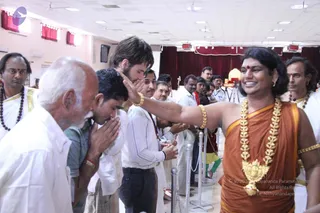
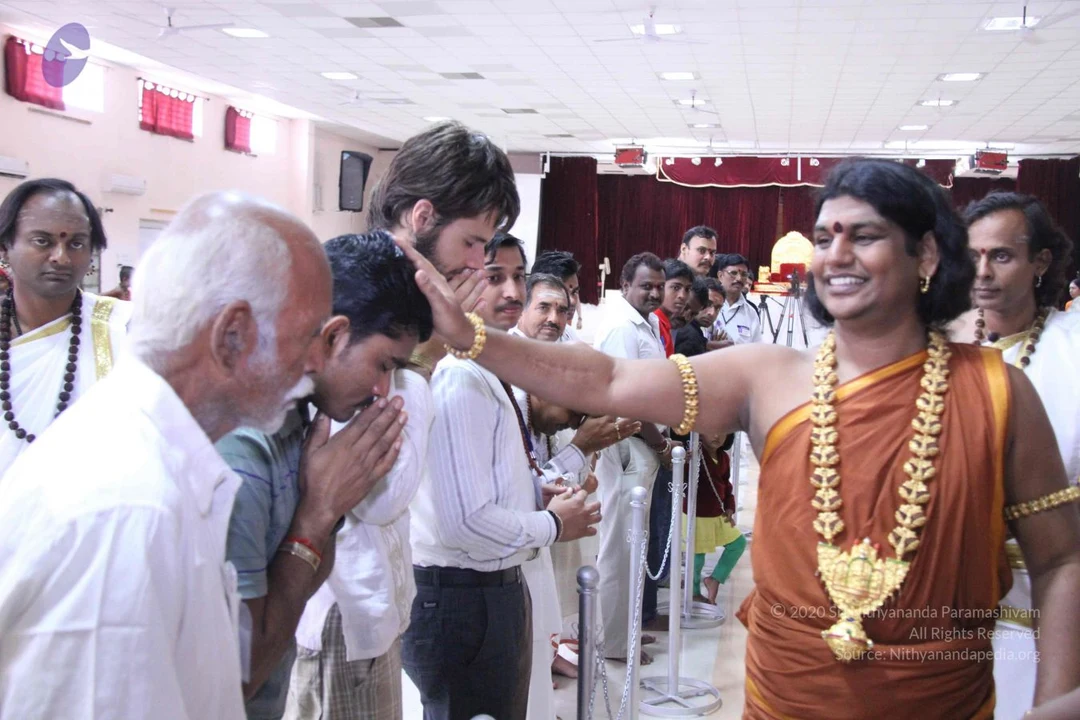
A photo of a devotional blessing in a hall with red velvet drapes and a gold throne-like seat behind. A central figure with long swept-back dark hair, a red bindi, gold hoop earrings, a gold necklace and armlets, and an orange-saffron shawl over the shoulders holds a sheet of paper while placing a hand on the head of a young man who bows with palms pressed together. Probable Swamiji: the central figure's long hair, saffron clothing, gold ornaments and ceremonial stance match the cues for this teacher, and the blessing is being given in a satsang-style setting. Other people nearby wear white and join hands in prayer, including a man on the left and a figure at right wearing rudraksha beads and gold jewellery. A microphone stand and a lectern appear in the background.A photo of a smiling man in an orange-saffron shawl and ornate gold necklace with a gold pendant, a red bindi on his forehead and long swept-back hair, placing his hand on the head of a devotee who bows with palms joined. Several other people in white shirts, dark shirts and plaid shirts stand or bow behind them in a hall with maroon curtains, a projection screen and a gold-decorated throne with a red cushion at the back. Gold bangles and a red thread on a wrist are visible. a person is shown in person blessing a devotee in a satsang setting.A photograph of a blessing moment at an indoor hall with red curtains and stage lighting. A man in a blue and white striped polo bows deeply with palms pressed together, while a second man in a lavender checked shirt bends forward with folded hands. A person in an orange-saffron dhoti-style wrap and a heavy gold necklace of ornate leaf-shaped pendants, with gold armbands and bangles, extends a hand in blessing onto the bowing man's head. He has long swept-back dark hair and a red bindi, and wears gold earrings. Other white-clad devotees stand behind, a woman in the background and a stanchion railing in front. Some a person cues: long swept hair, saffron wrap and ornate gold necklace.A photograph in a hall with red curtains and a white ceiling. A person in an orange saffron garment with a heavy gold necklace and gold bangles extends a hand in blessing toward a line of devotees. A white-bearded elderly man in white clothes and a younger man with hands pressed together bow forward. Behind them, a row of standing men in white and light shirts waits, and a gilded seat is visible in the background. A ceremonial rudraksha-style mala is worn by a figure at the left edge. The blessing line suggests darshan.

Final-Blessing

6 photosSource gallery
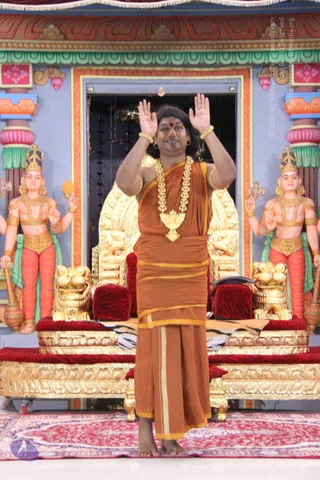
A photograph of a man standing barefoot on a red patterned rug in front of a golden throne flanked by two gilded lion heads and red tiger-striped cushions. He wears a saffron-orange shawl over a matching dhoti with a golden border, a heavy gold necklace with a lotus pendant, gold bangles and a red bindi, and raises both palms open beside his head. Behind him stand two painted, multi-armed deity murti figures with crowns and gold ornaments, and a dark doorway framed by ornate pillars. Shoulder-length dark hair frames his face. Judging by the orange robes, long swept-back hair, ornate gold jewellery and rudraksha-free adornments, this matches the Swamiji (probable) appearance, shown performing a standing gesture in front of the throne.A standing man in an orange-brown saffron-toned dhoti and shawl, wearing a long gold necklace with a large gold pendant, gold bangles and armlets, and a red bindi, raises both palms upward in a blessing gesture. Behind him stand two painted and gilded guardian figures holding ritual objects, flanking a gilded throne with red tiger-striped cushions and golden lion heads. Behind is a dark doorway with hanging lamps, and a red patterned carpet covers the floor. The setting resembles a temple-style hall. The man matches the appearance cues of a probable Swamiji through his saffron clothing, long swept-back hair and gold ornaments, presented in a satsang or blessing role.A standing figure in saffron-orange robes with a gold ceremonial necklace and gold bangles raises both palms overhead, smiling, with a red bindi on the forehead. Long dark hair falls past the shoulders. Behind him, a golden throne with red velvet cushions and golden lion heads stands before a dark doorway, flanked by two painted, multi-armed deity murti figures with crowns and green-and-red garments. A red patterned rug covers the floor. The printed copyright line on the right edge is ignored. Appearance-based identification: a person, with long swept hair, saffron robes and ornate gold necklace, standing in front of a throne.A man stands barefoot on a red patterned rug before a golden throne, raising both palms in a blessing gesture. He wears an orange-saffron shawl draped over the shoulder and a saffron dhoti with gold borders, a gold leaf-shaped pendant on a gold garland, gold bangles and a red bindi, with long dark hair swept back. Behind him stand two painted deity murti figures with golden crowns and orange dhotis, flanking a gilded throne with red velvet cushions and golden lion heads. A golden doorway with hanging bells frames the background. Smiling and speaking to the assembly, he appears to be giving satsang. The appearance-based cues are consistent with the page's a person reference.A standing man in an orange-brown saffron-toned dhoti and shawl with yellow borders raises both palms toward the camera in a blessing gesture, smiling, with a red bindi on his forehead. He wears a large gold ceremonial necklace with a pendant, gold bangles, and stands barefoot on a red patterned rug. Behind him is an ornate golden throne with red velvet cushions and golden lion figures, flanked by two painted deity statues with crowns, gold jewellery and raised arms holding objects. The setting is a colourful temple-style hall with a dark doorway and hanging bells.A man with long swept-back dark hair, a red bindi, gold earrings, and a heavy gold ceremonial necklace with a pendant stands in front of an ornate golden throne with red velvet cushions and golden lion heads. He wears a rust-orange shawl and orange dhoti with cream borders, and gold armlets and bangles, smiling while gesturing with his hands. Two painted deity murti figures with crowns and four arms flank him, and a red patterned carpet covers the floor. The cues are consistent with the Swamiji (probable) candidate, identified from his long hair, orange clothing, and ceremonial gold ornaments, presented in a temple-like setting.