Skip to content
Saturday

20 July 2013

Dated photos
414
Source pages
1
Media
4
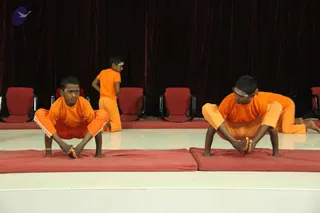
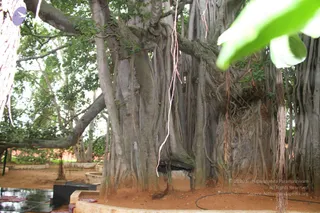
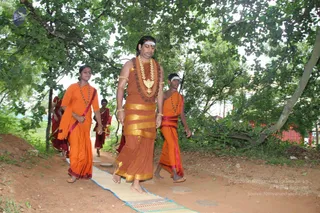
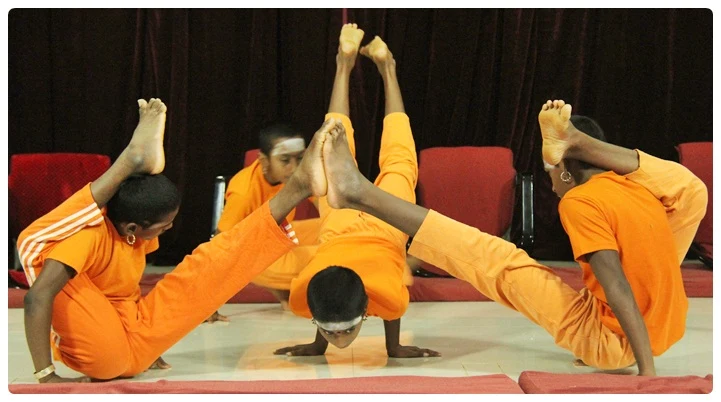
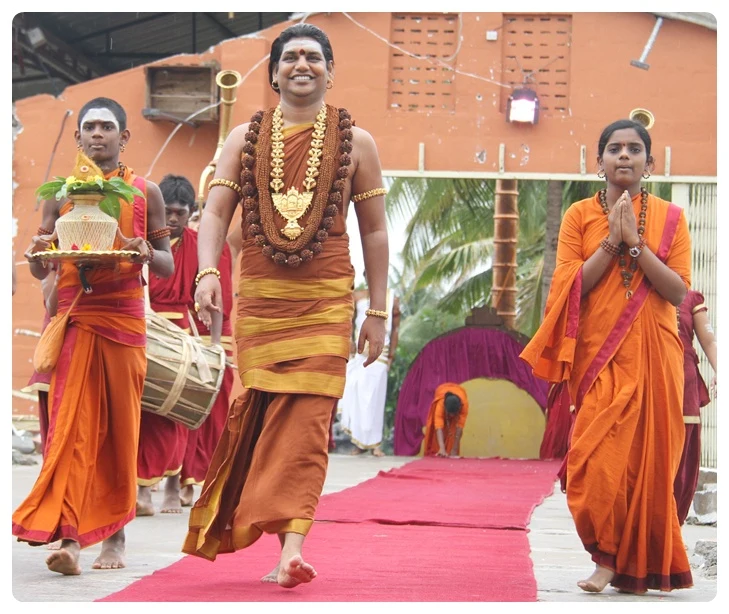
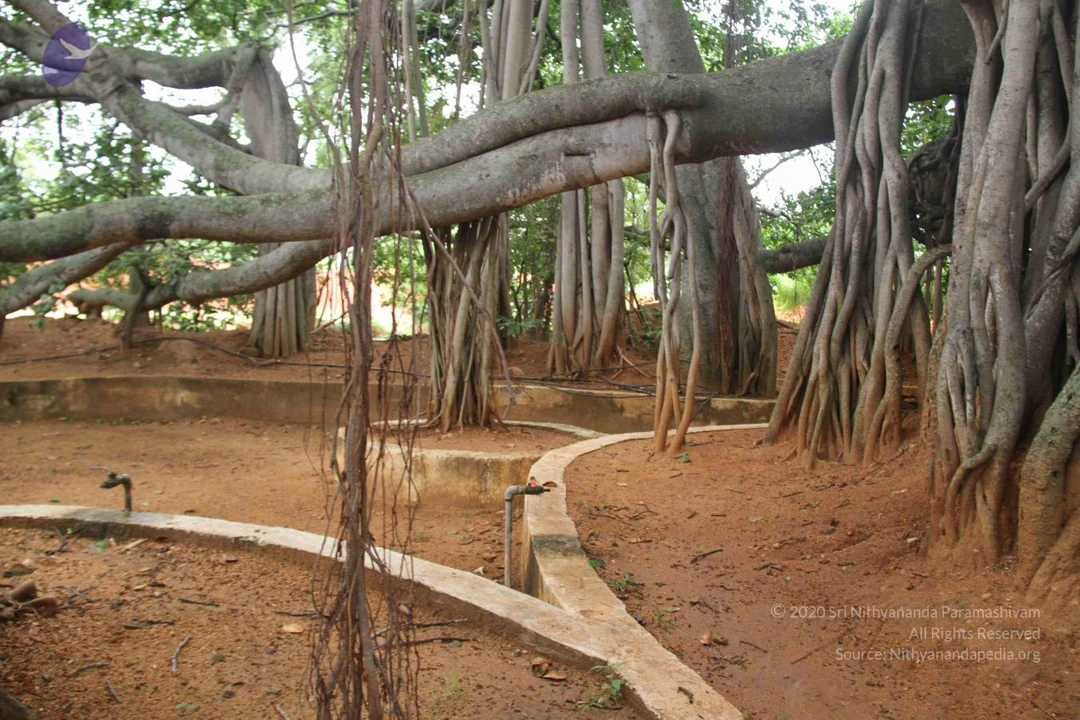
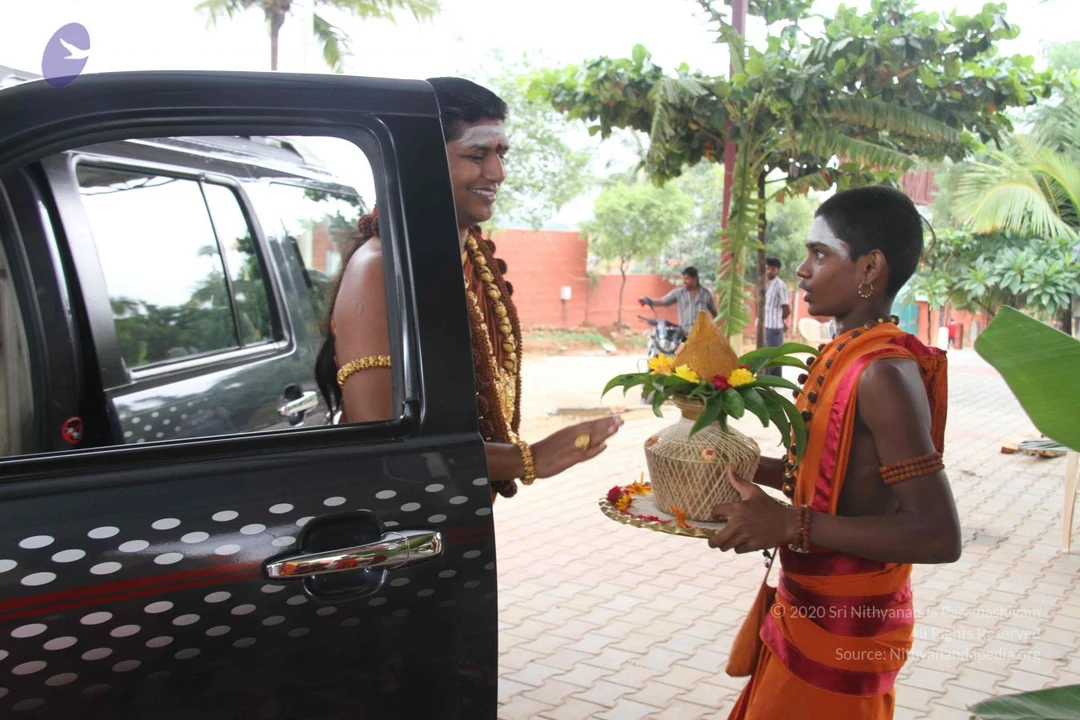
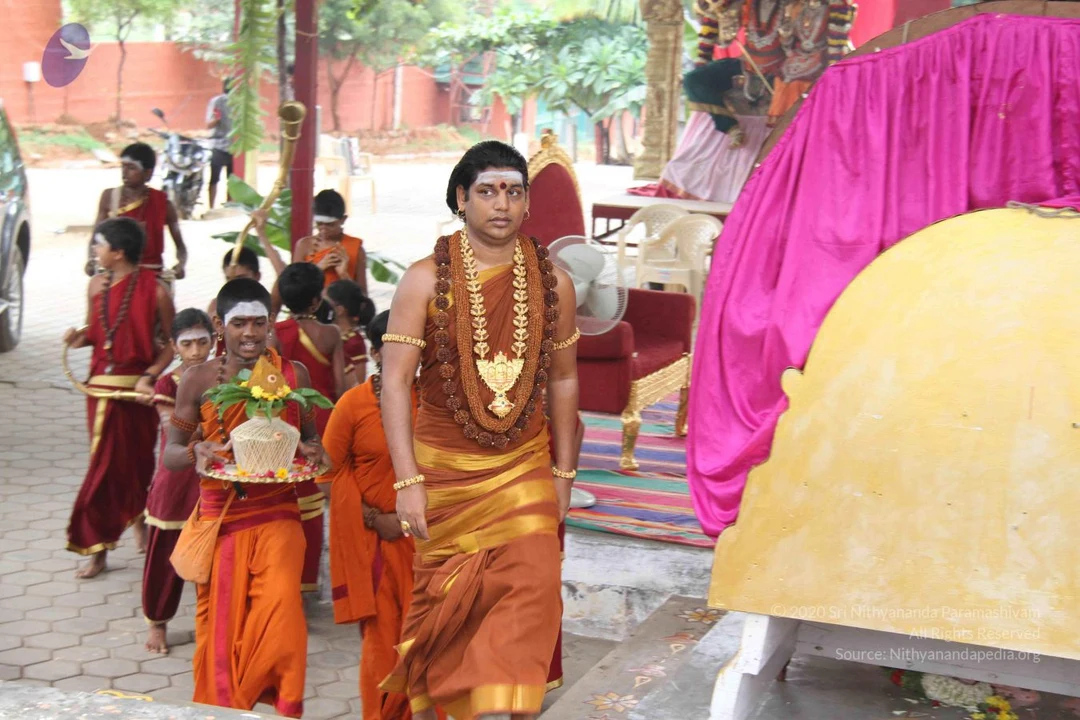
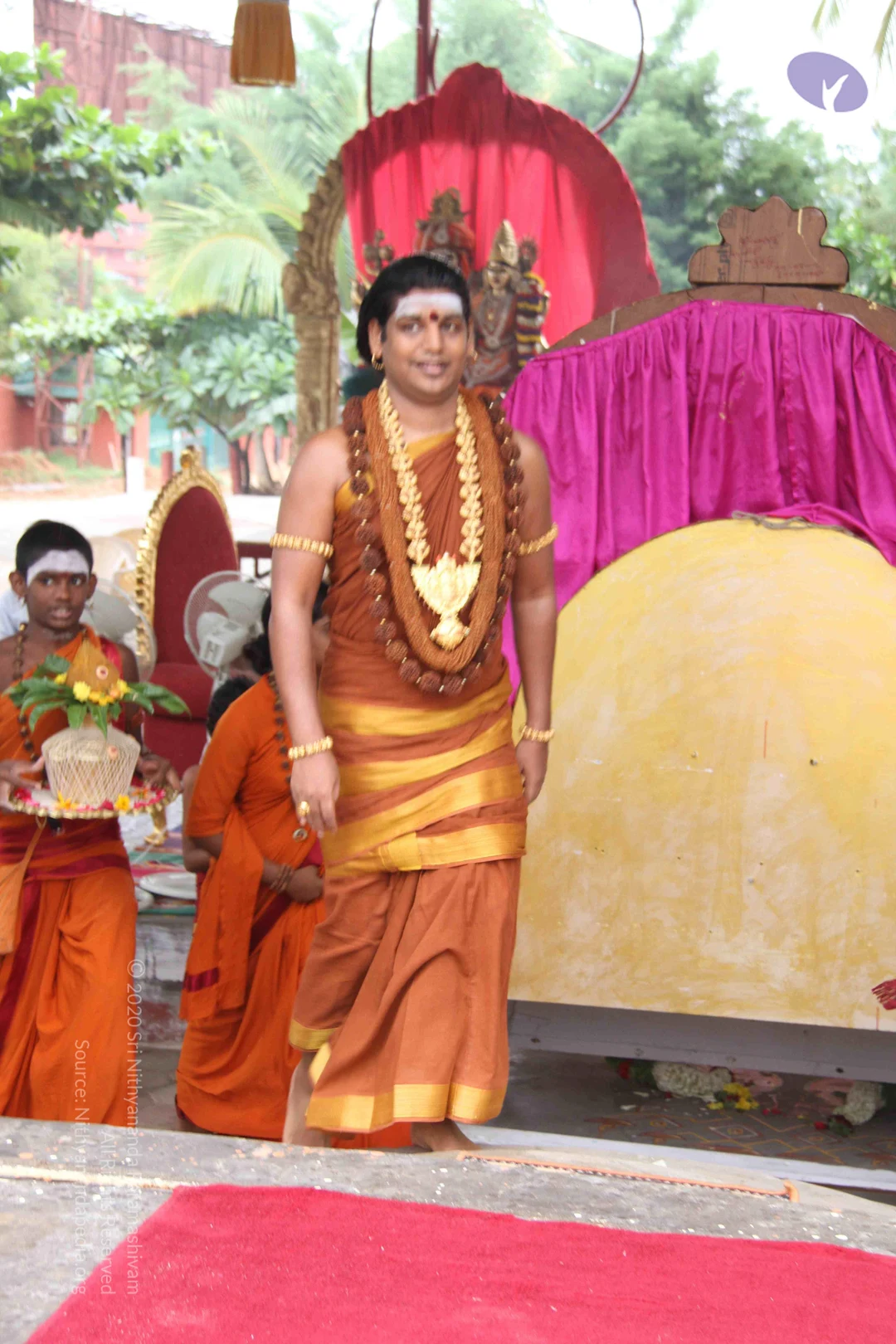
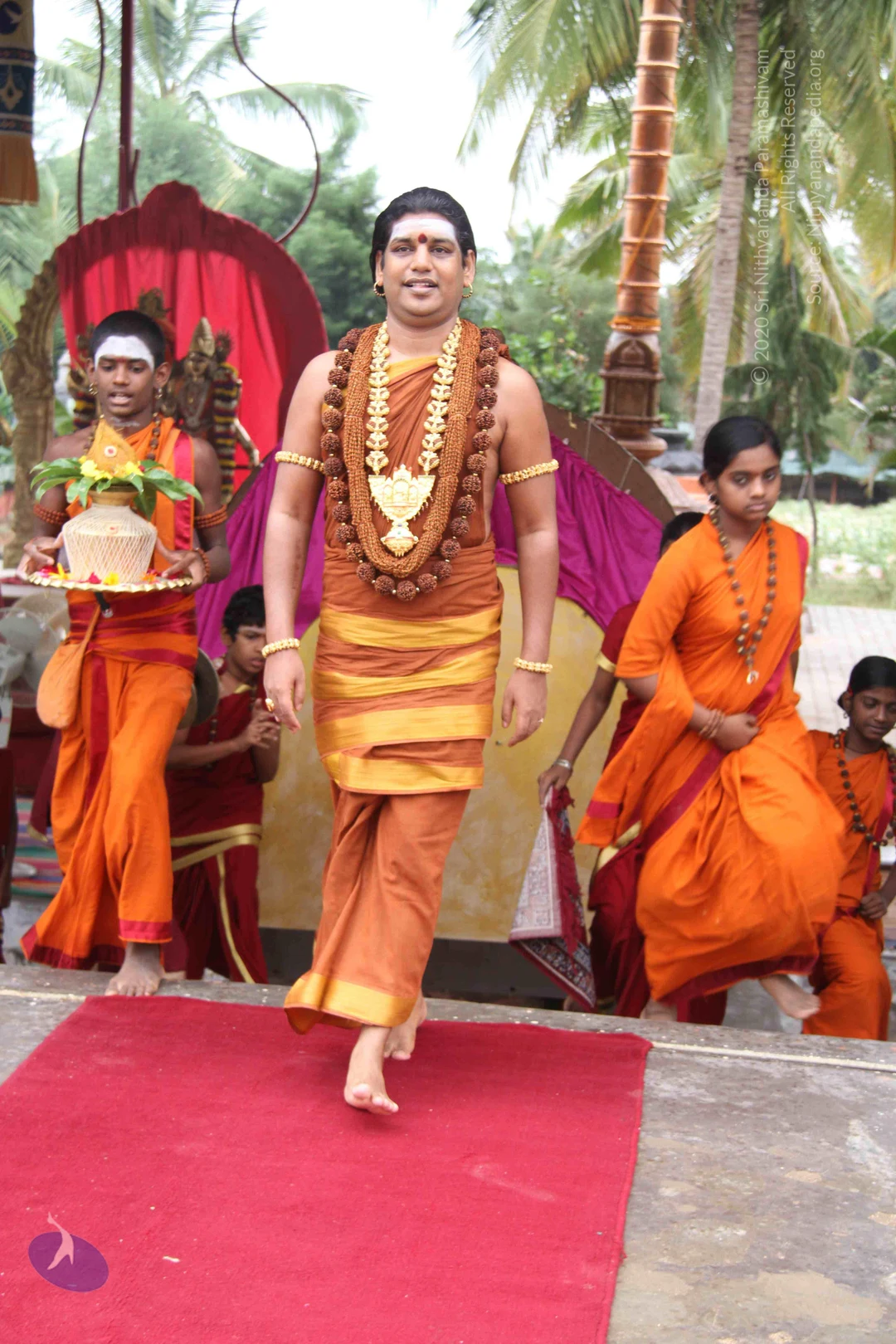
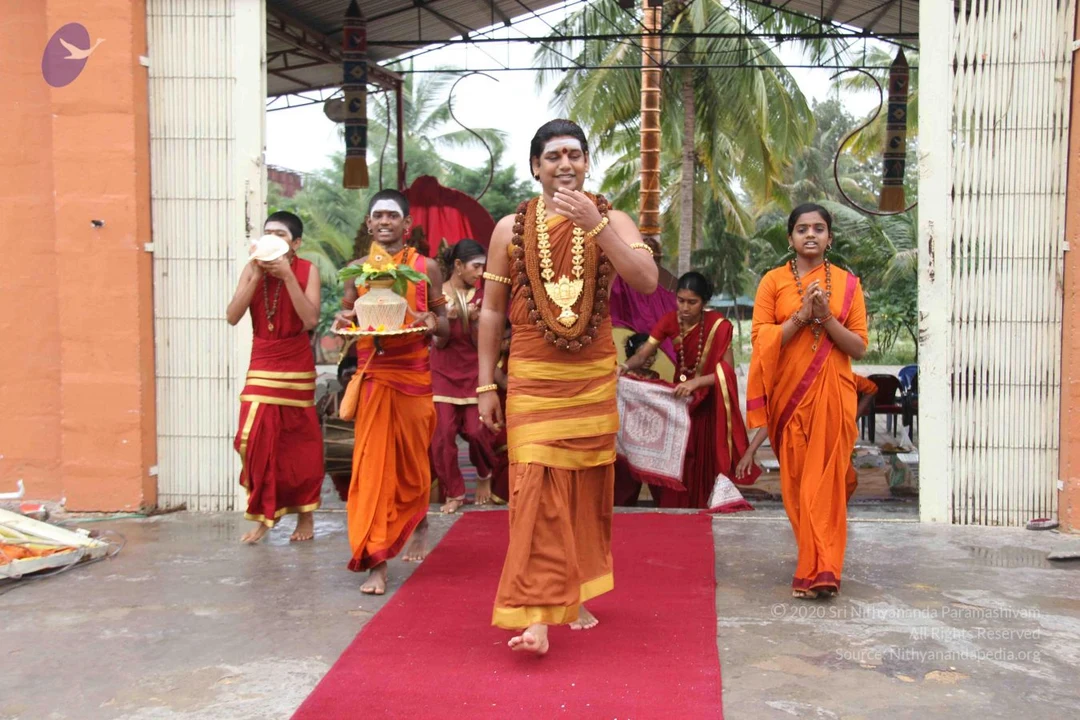
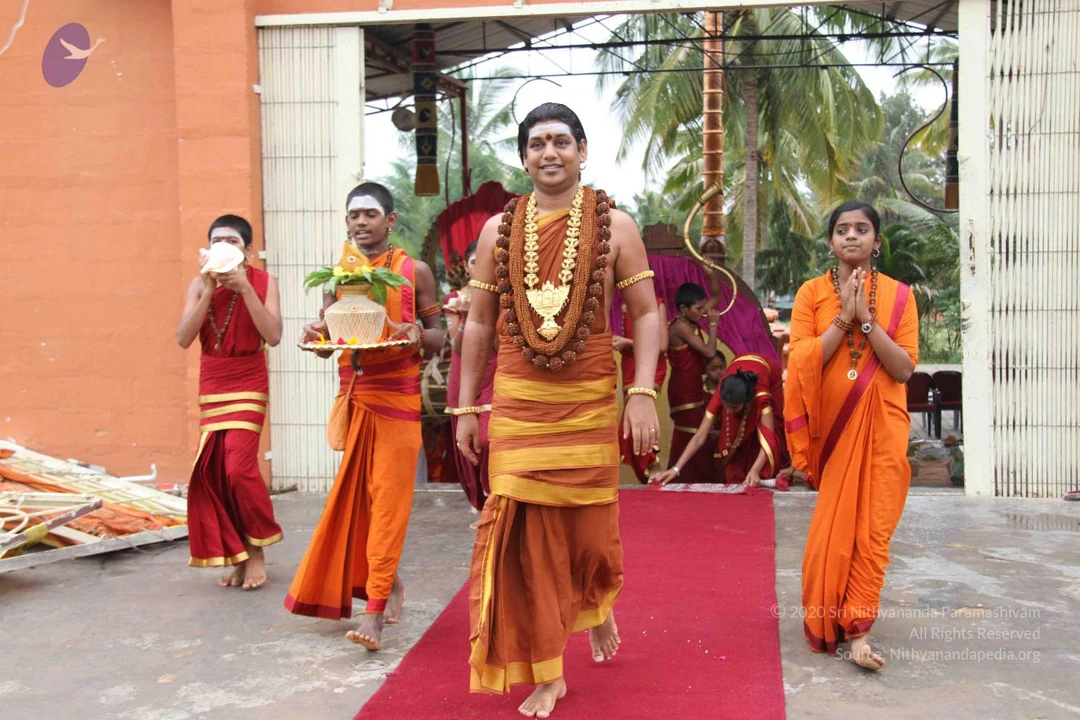
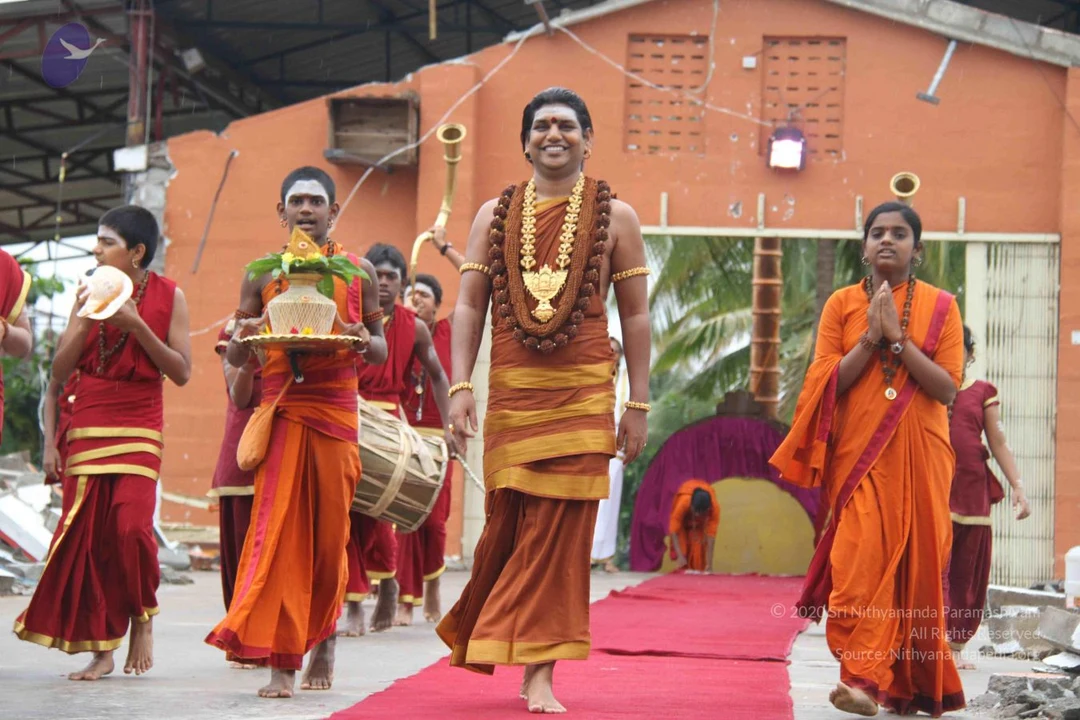
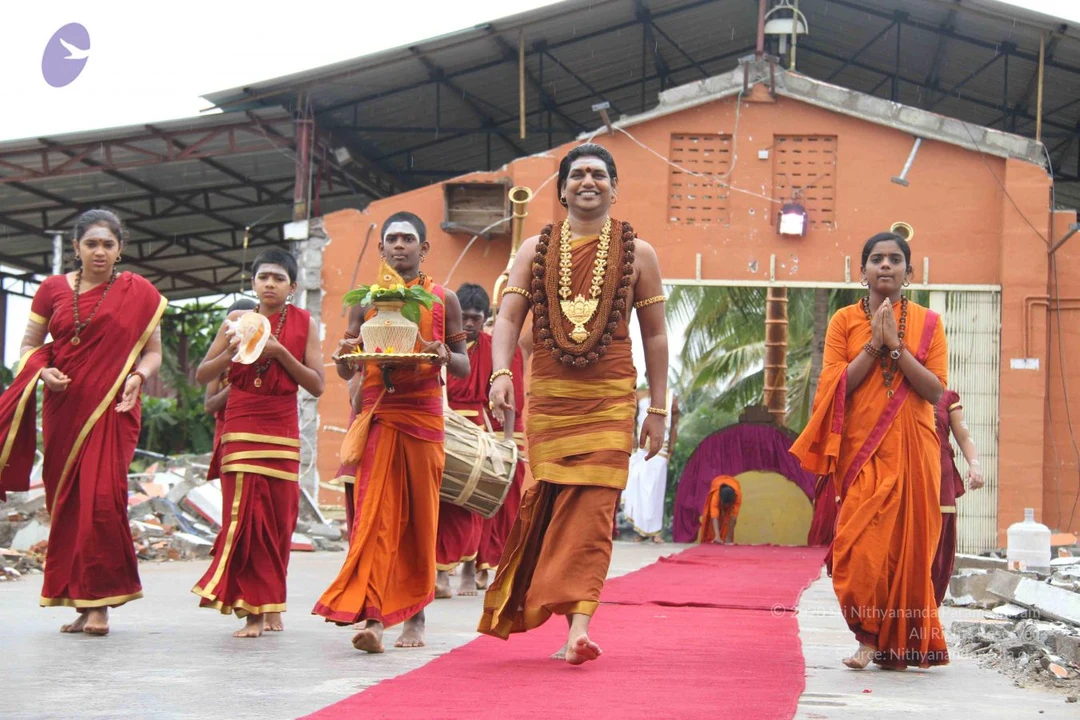
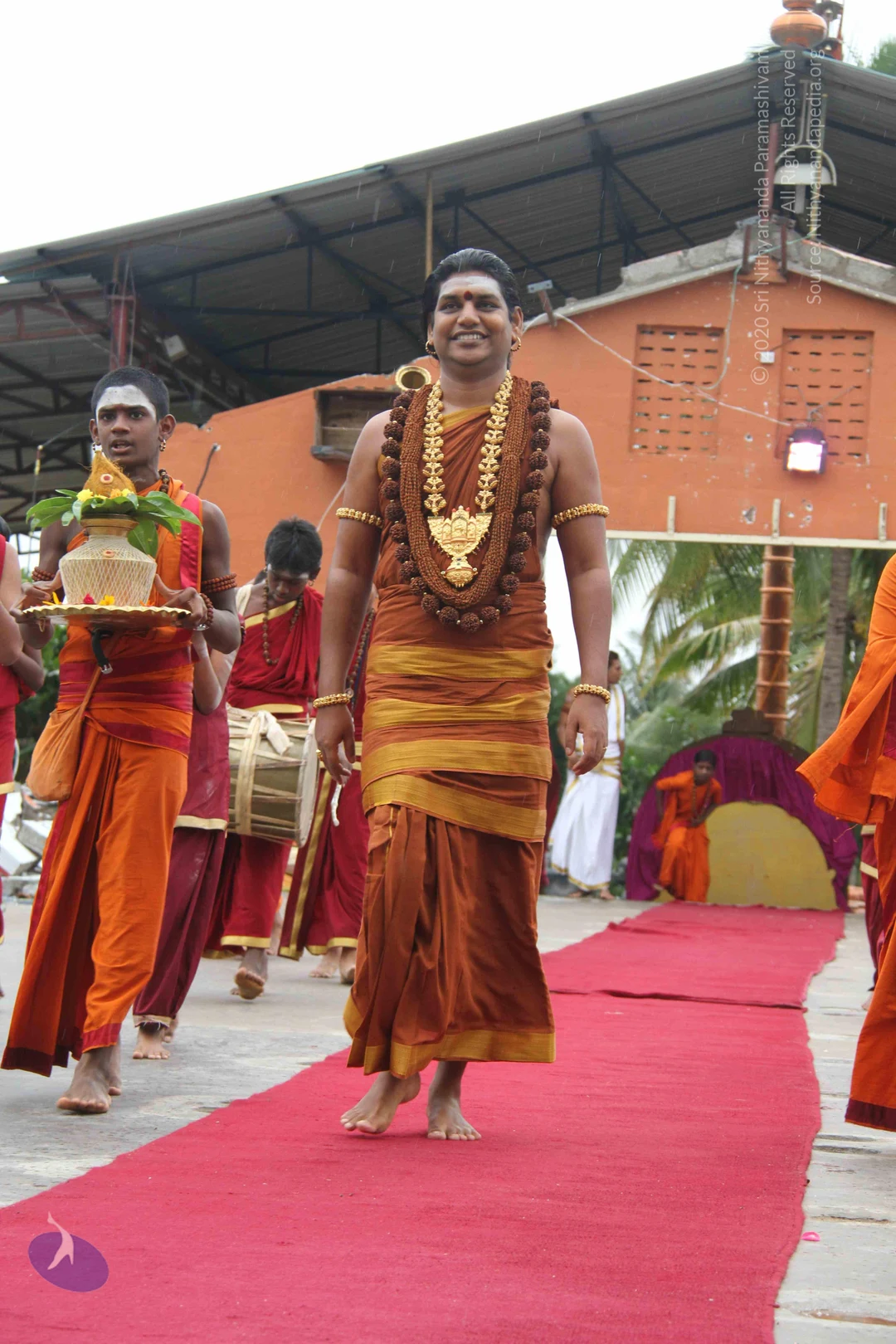
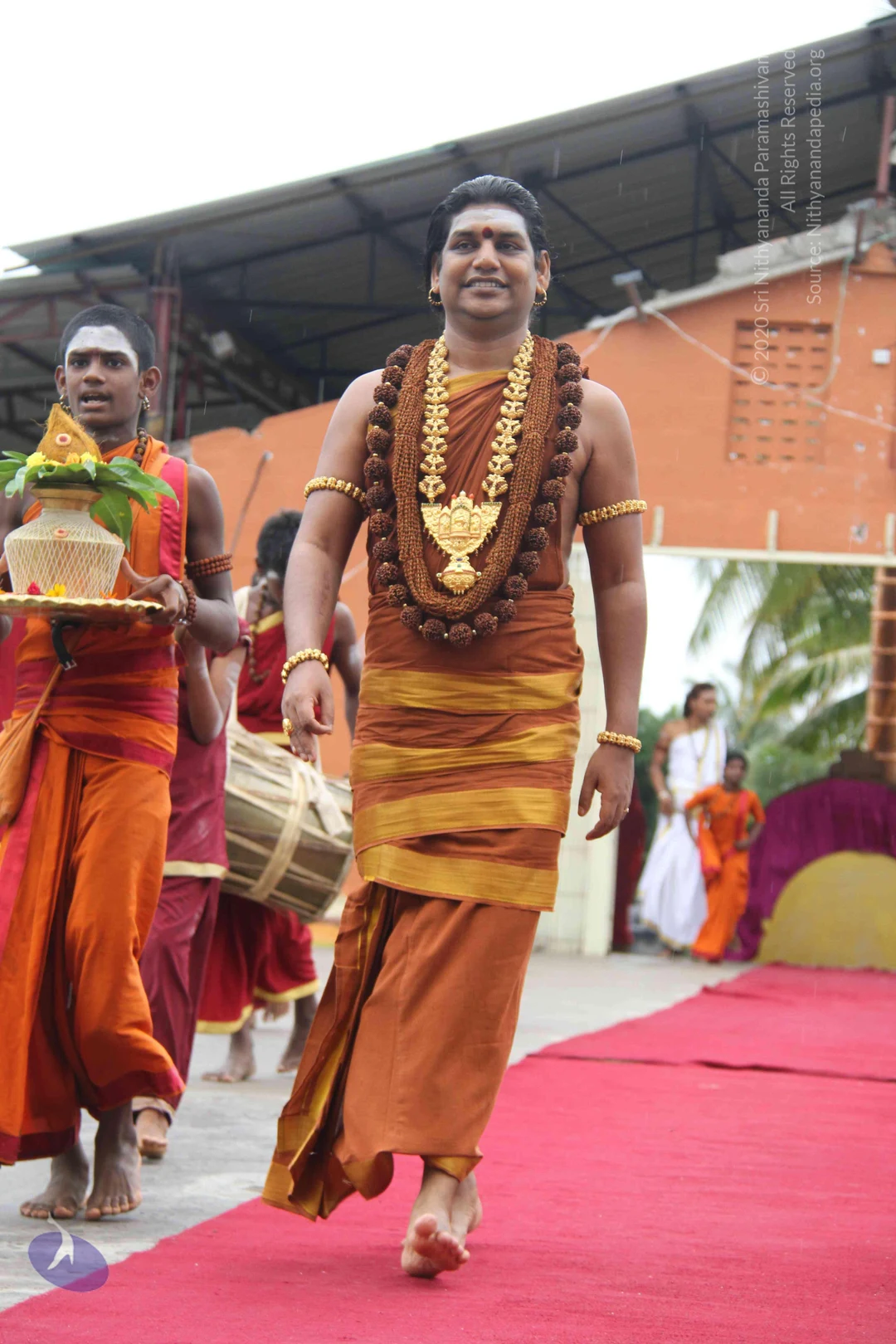
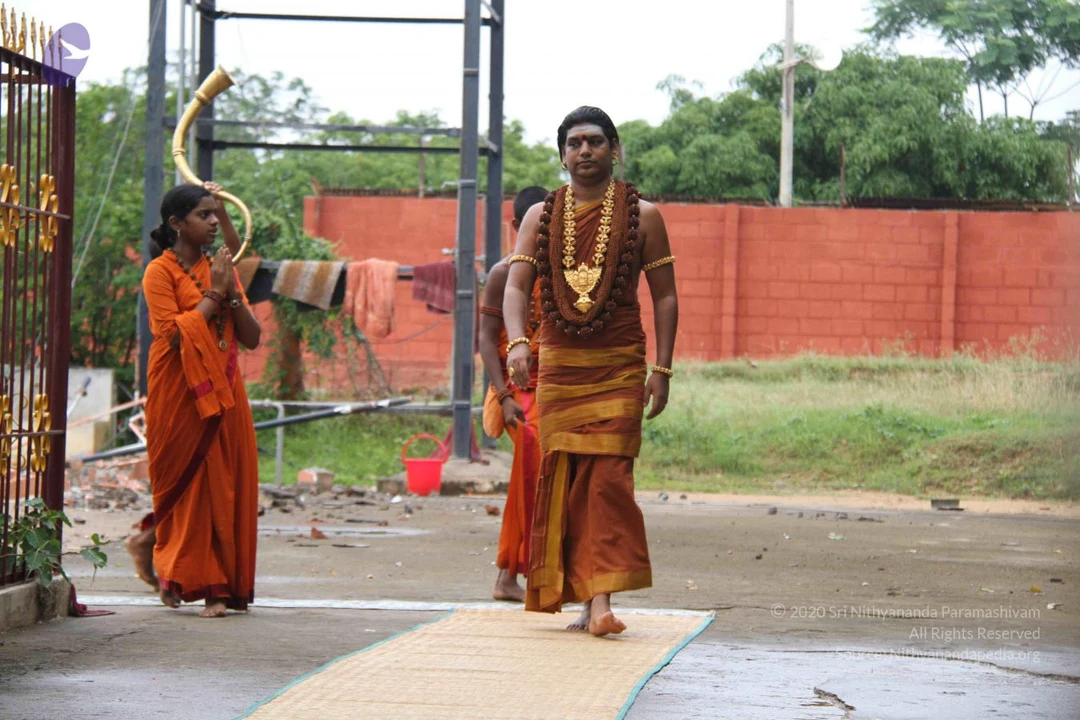
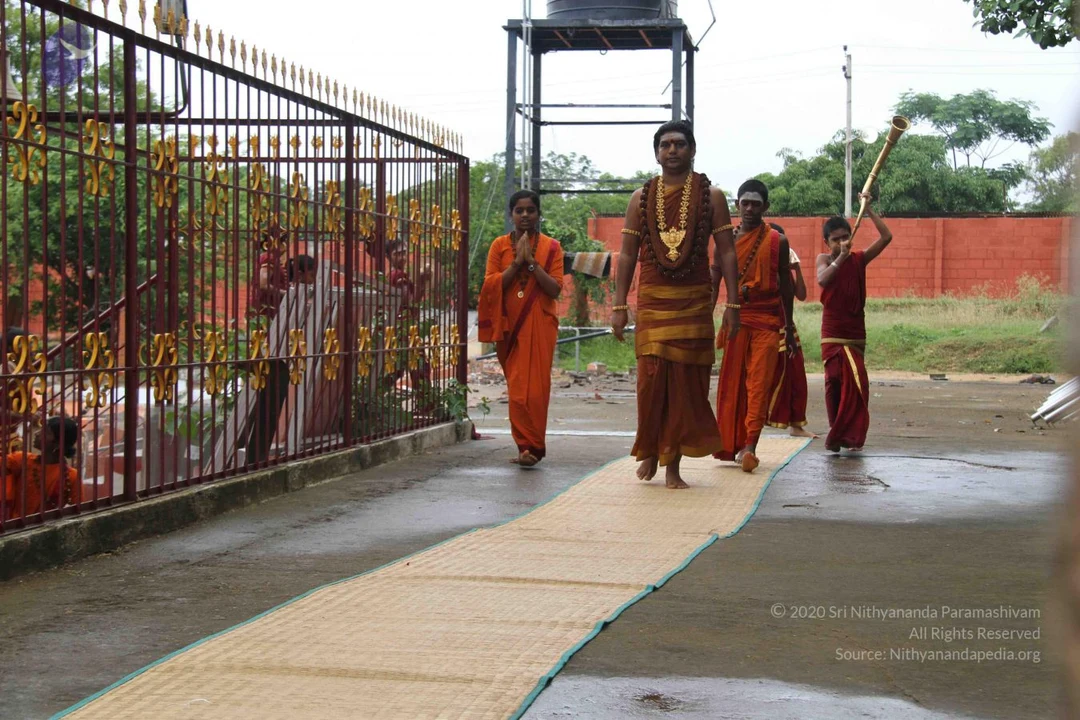
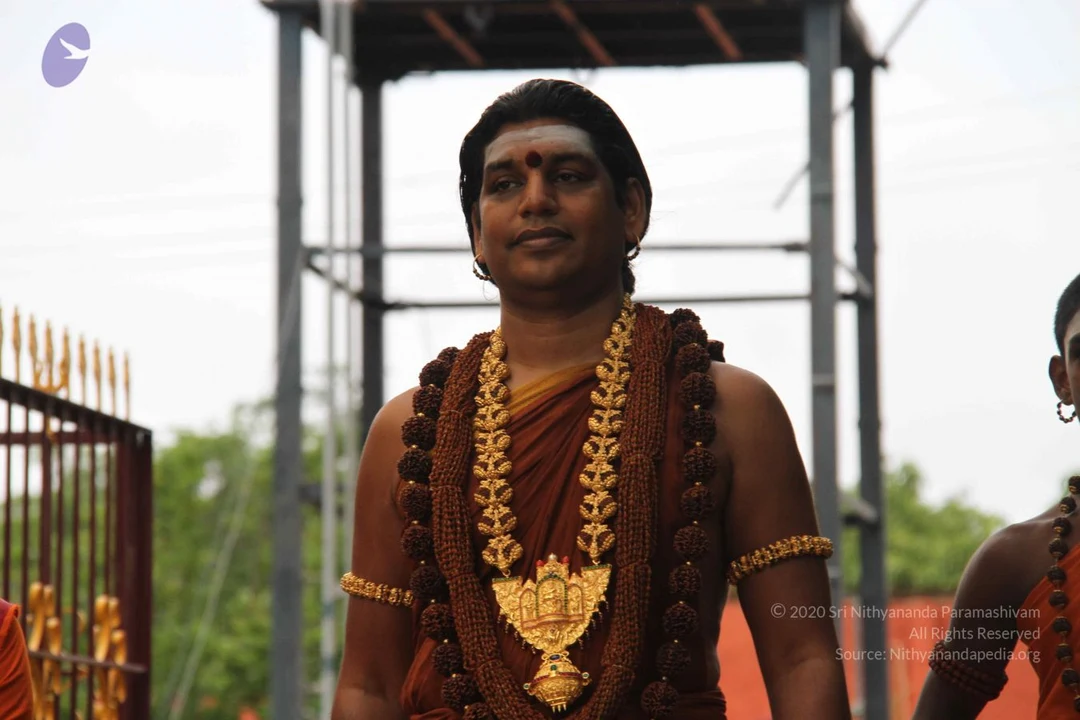
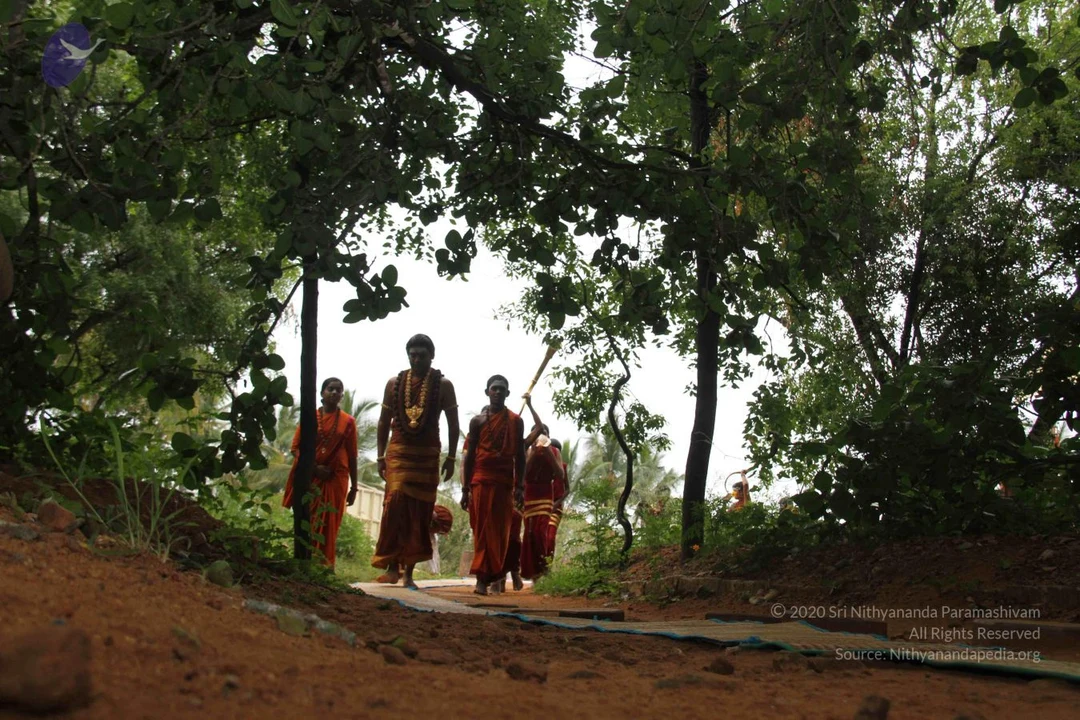
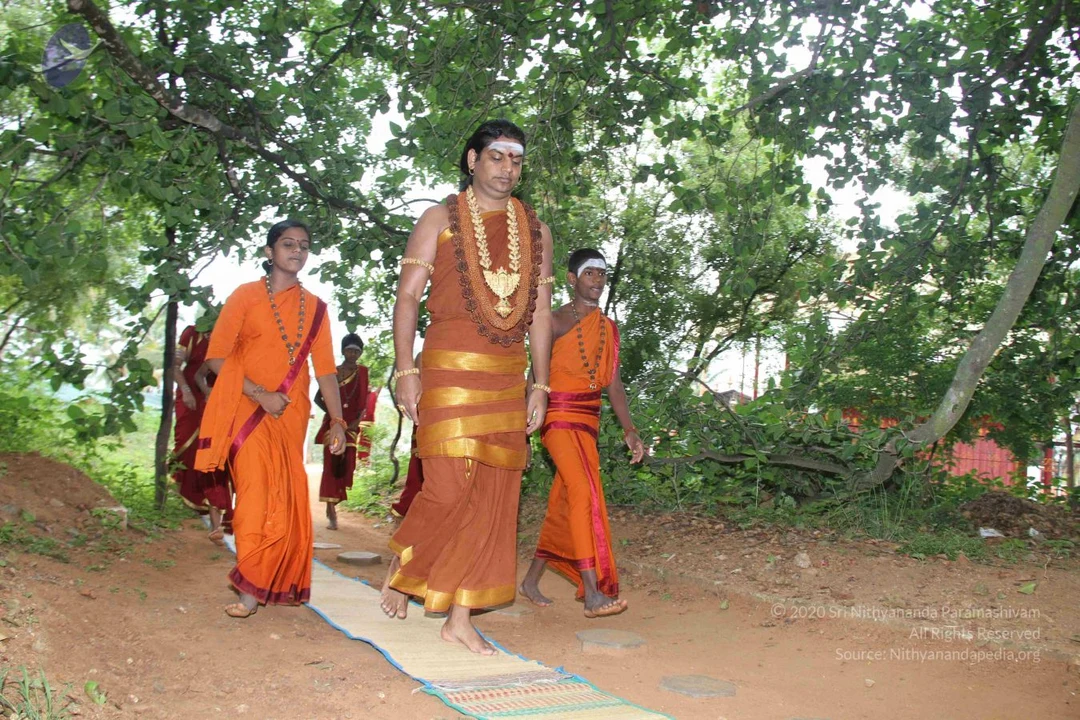
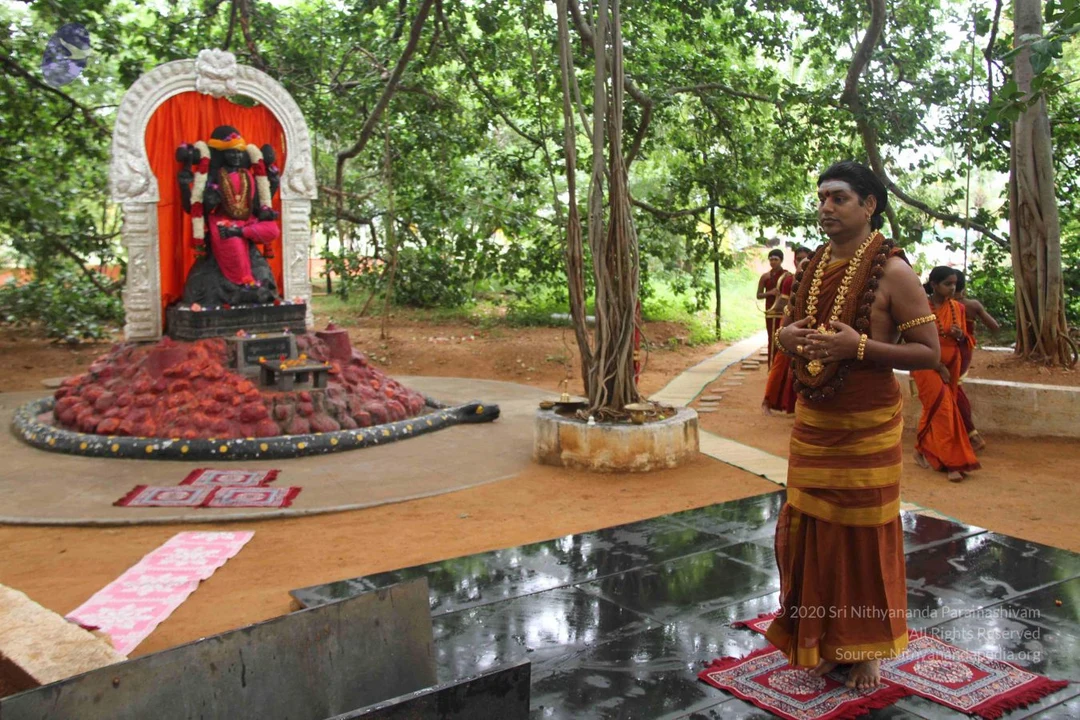
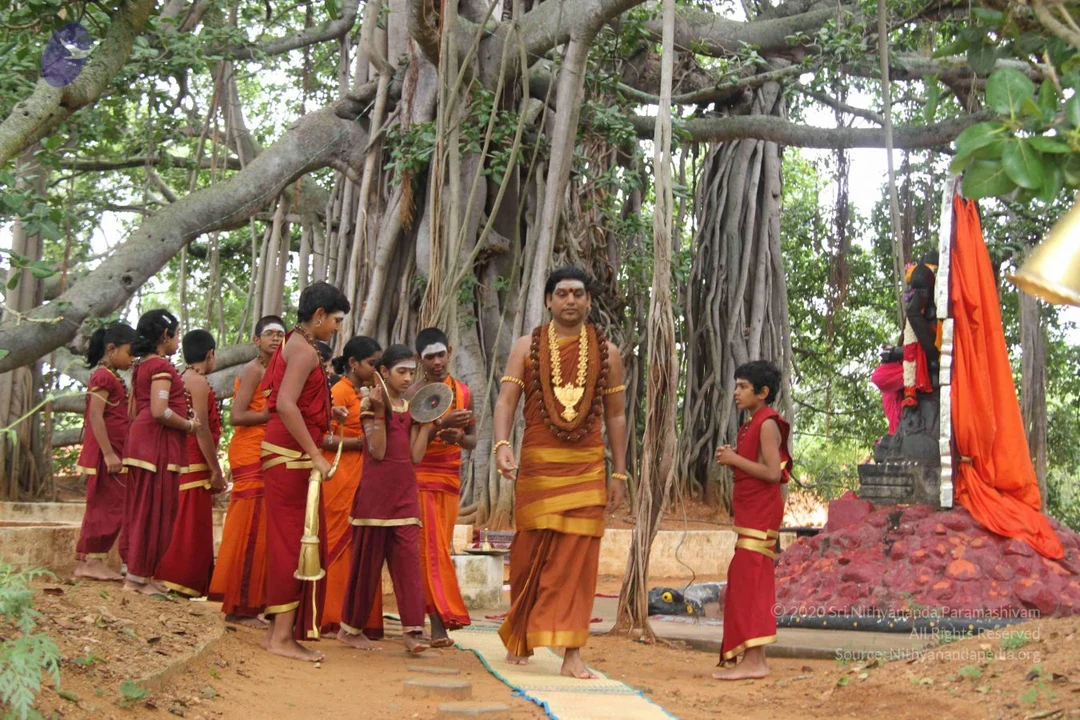
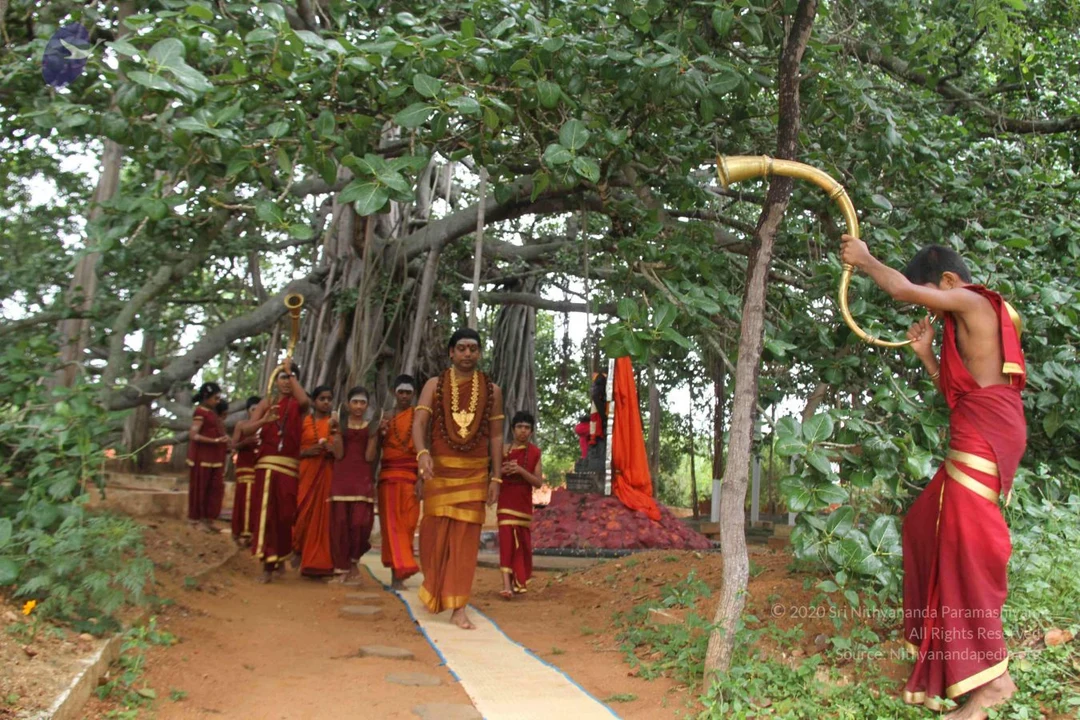
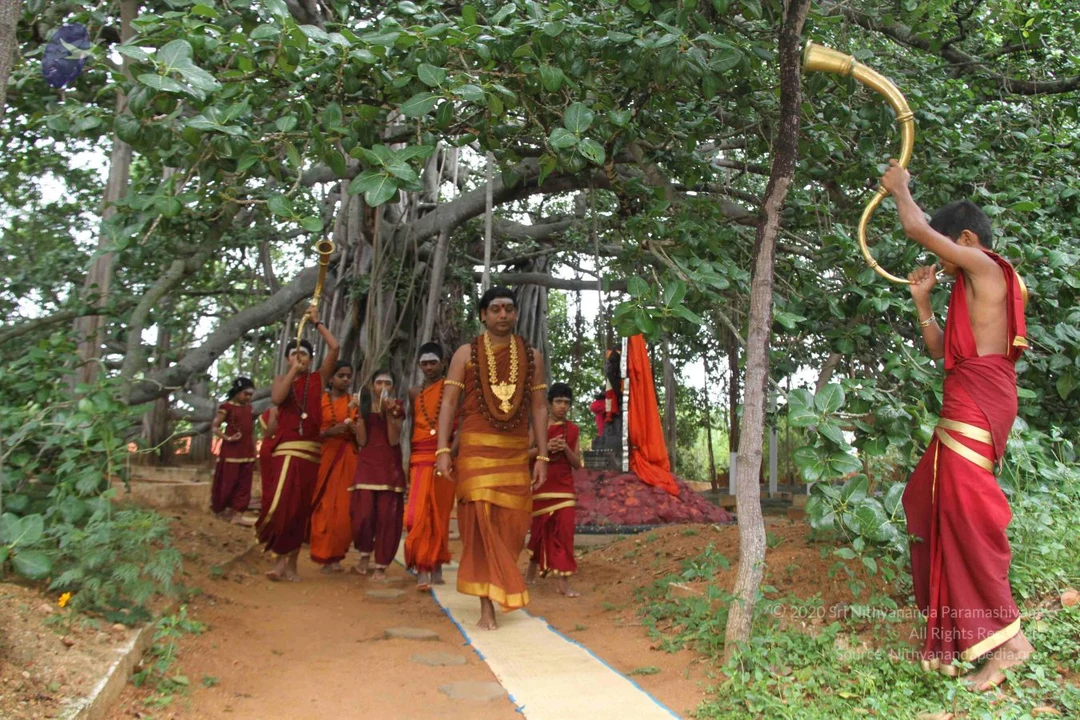
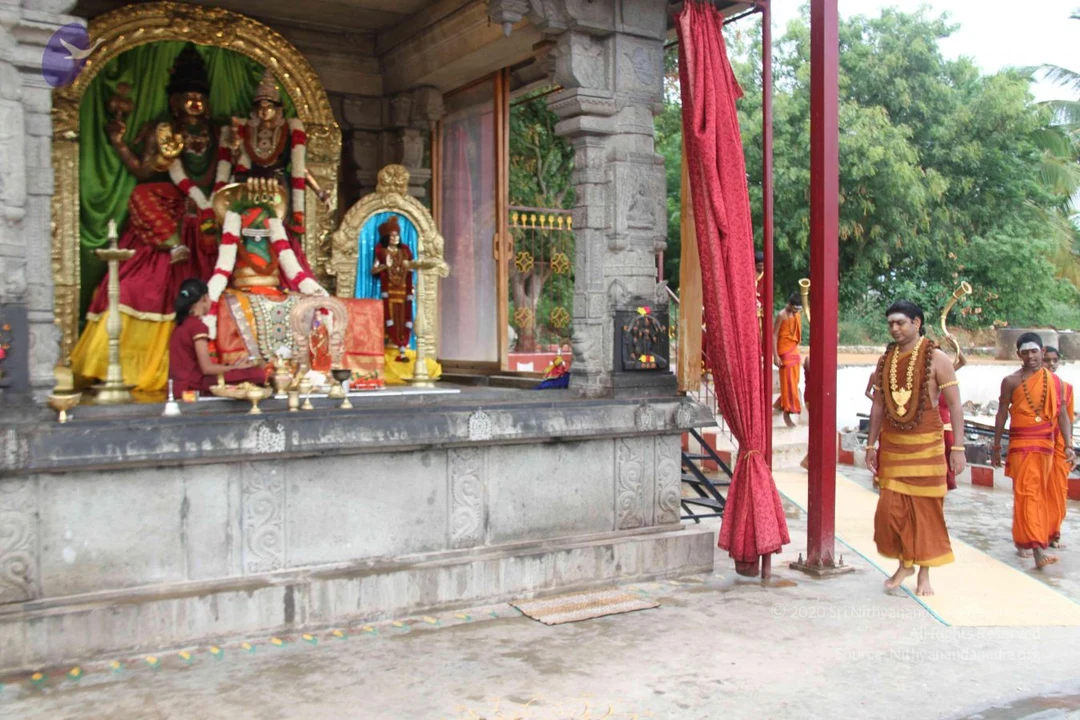
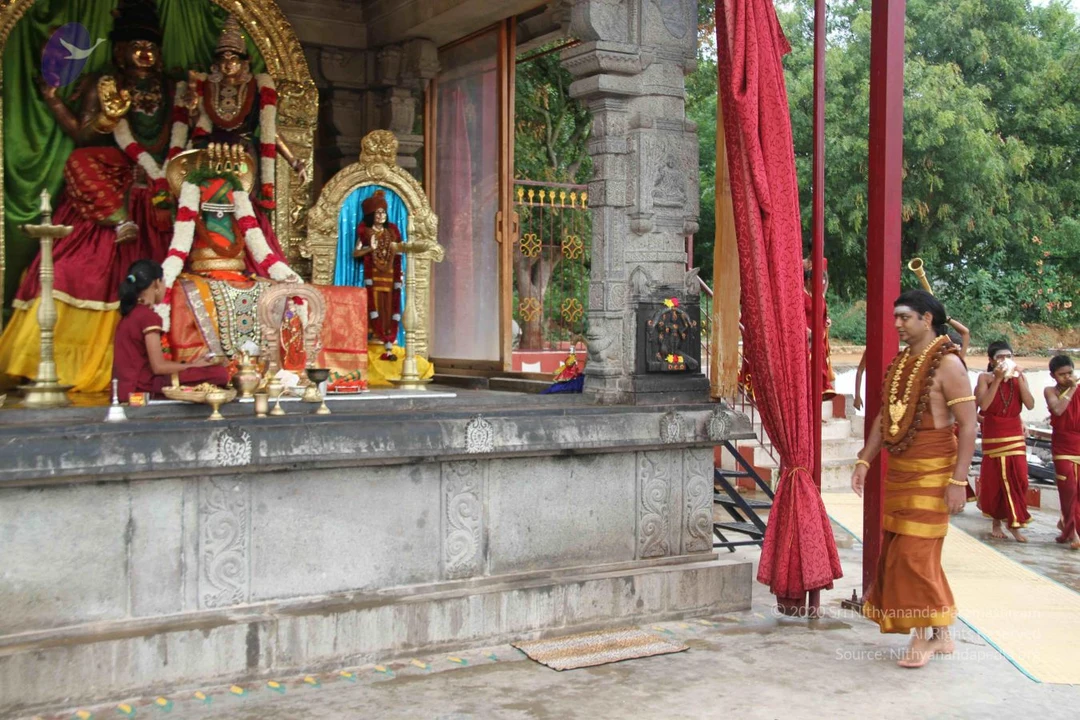
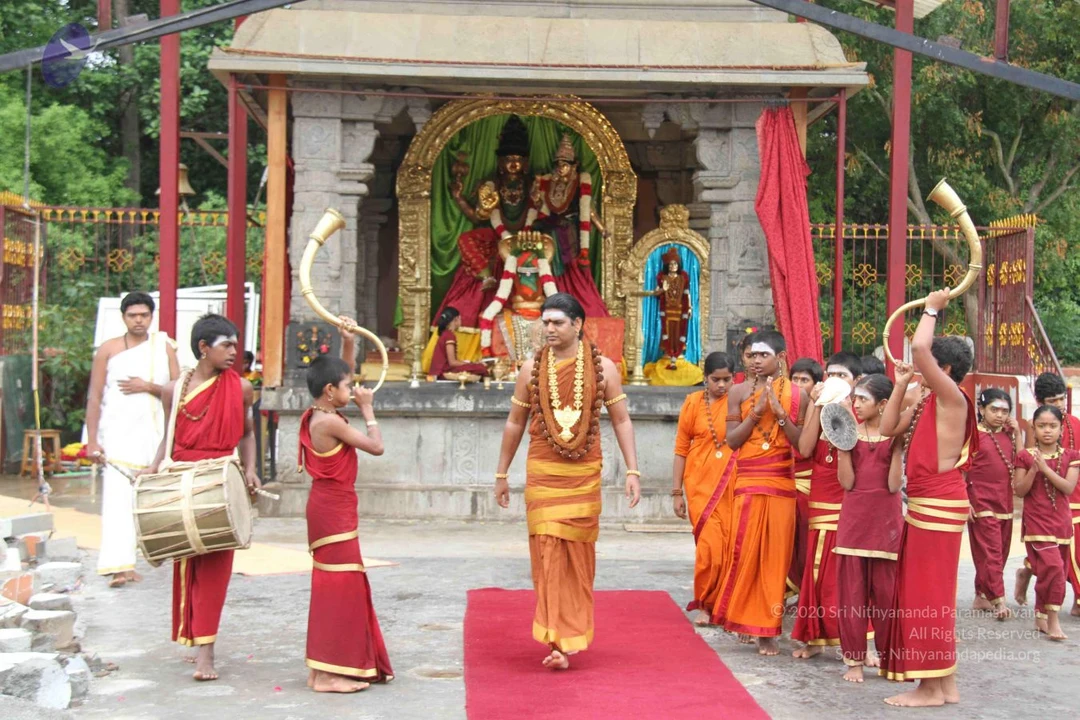
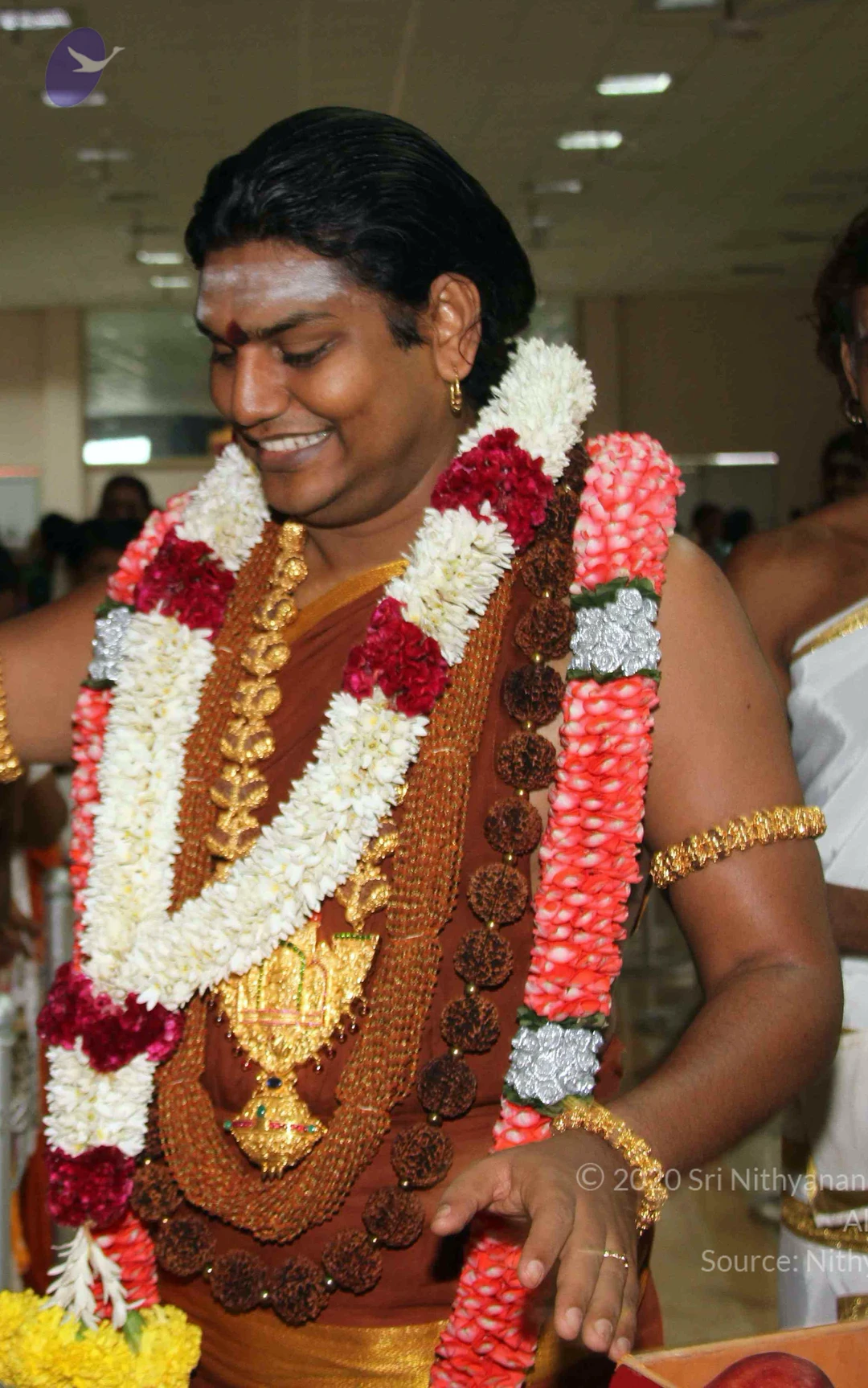
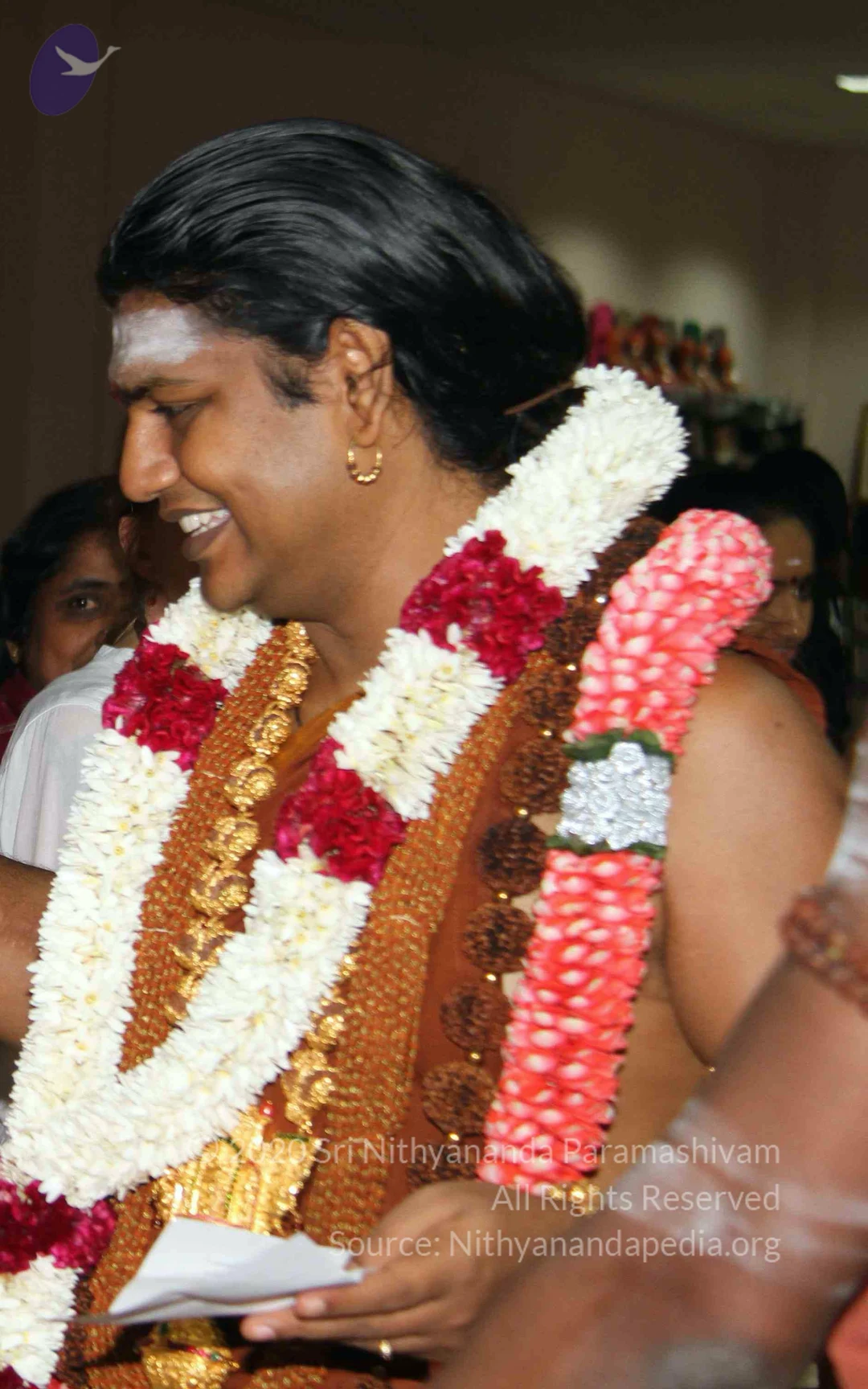
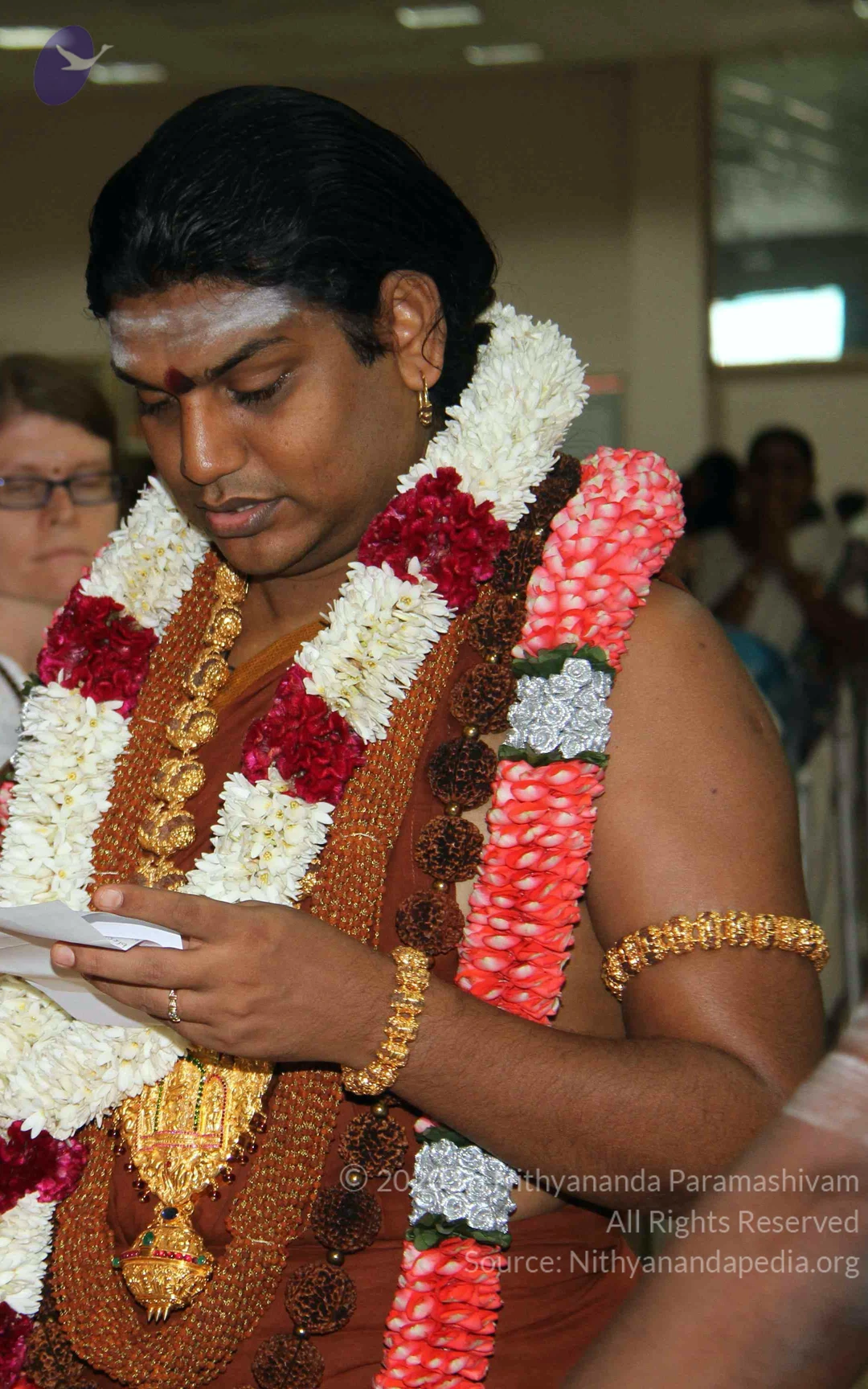
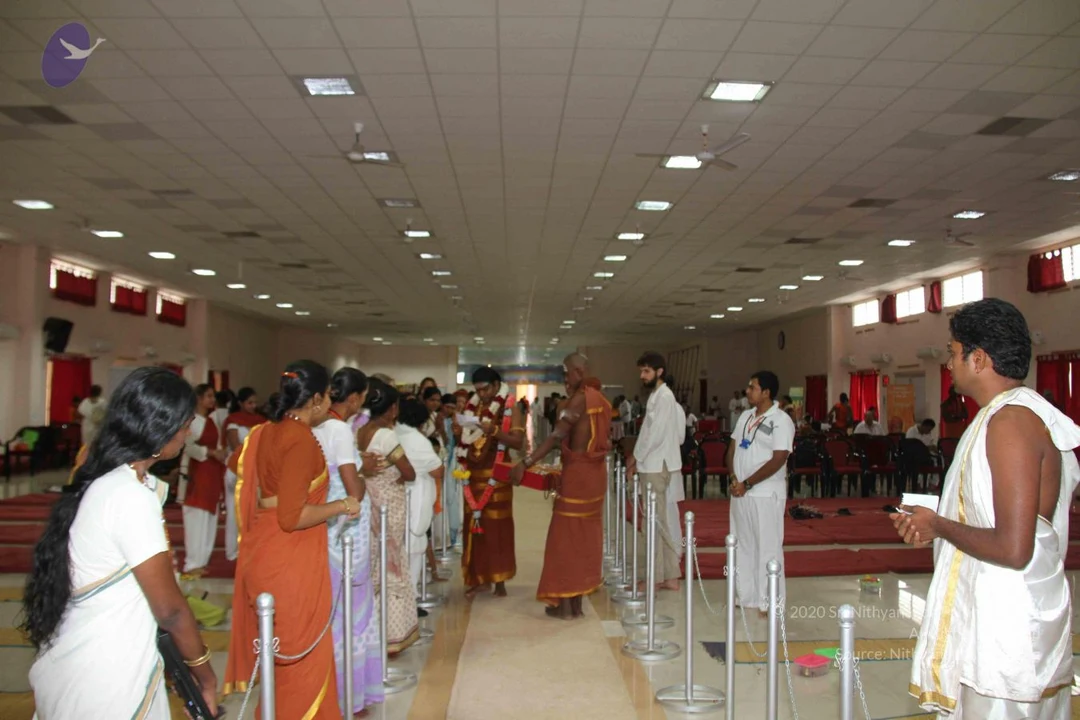
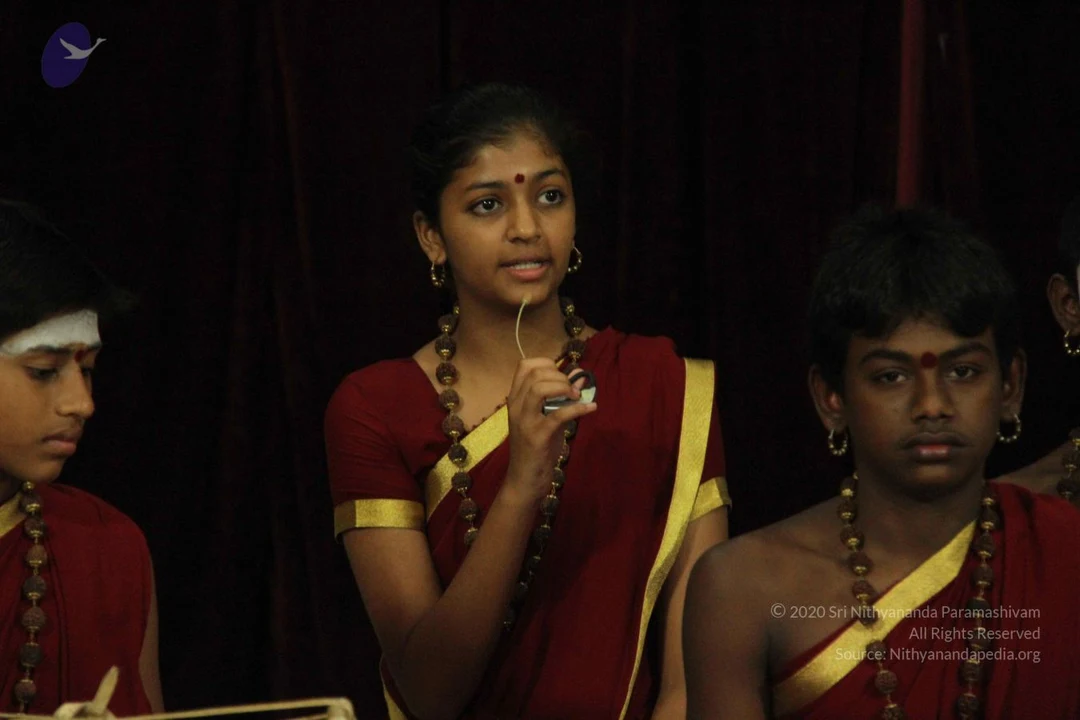
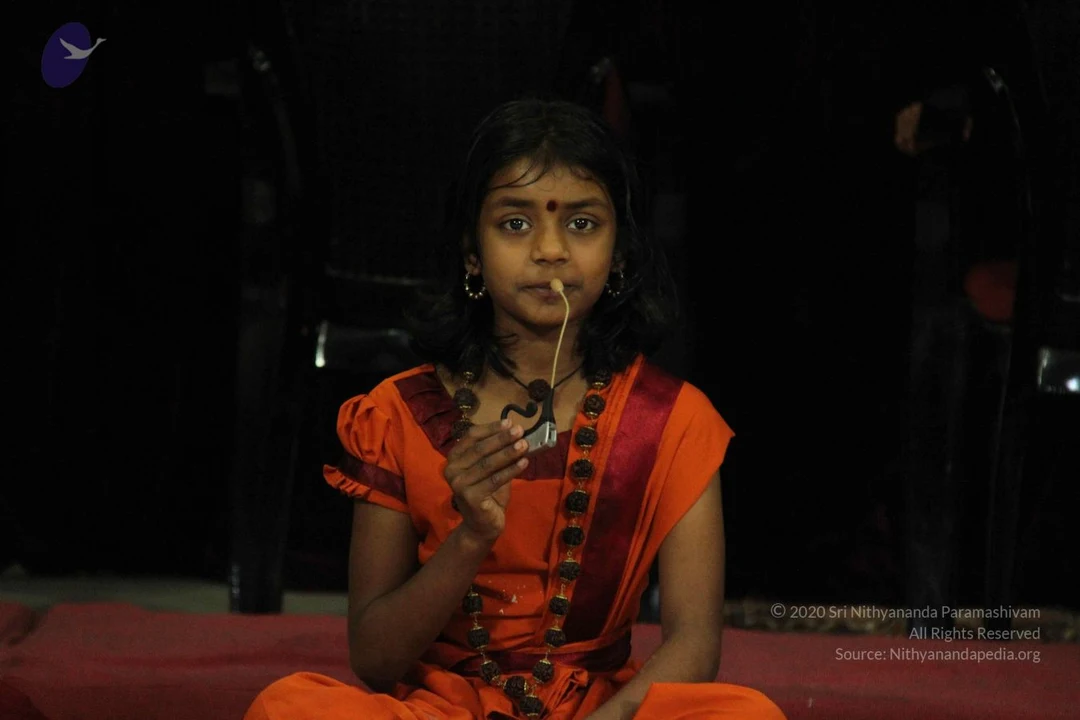
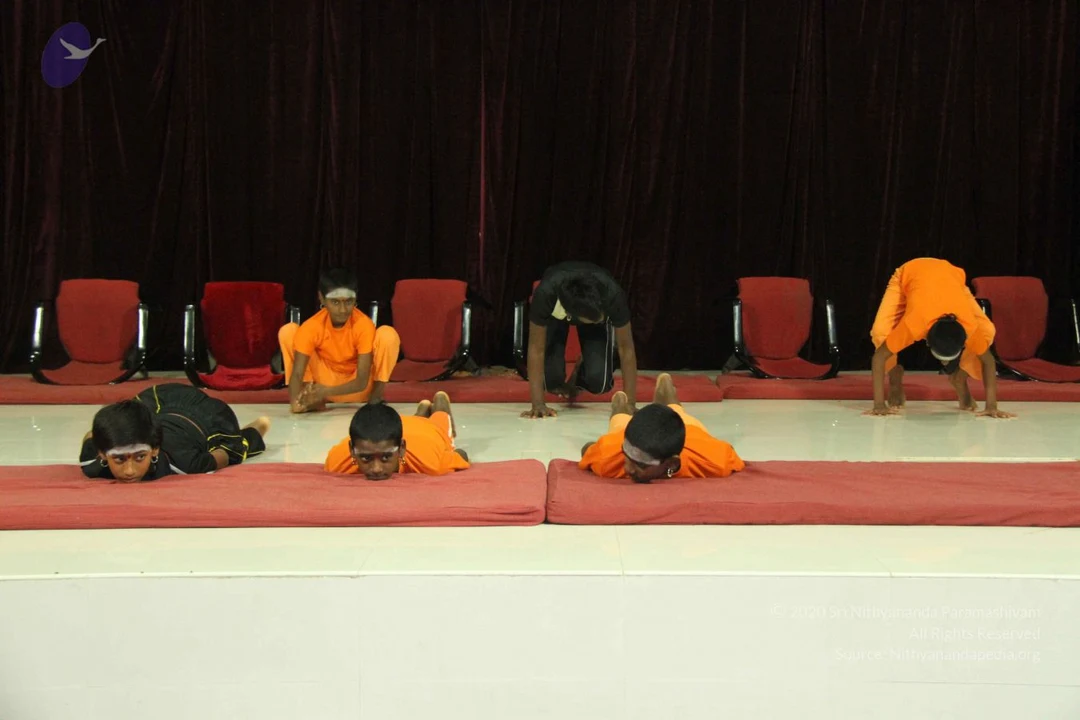
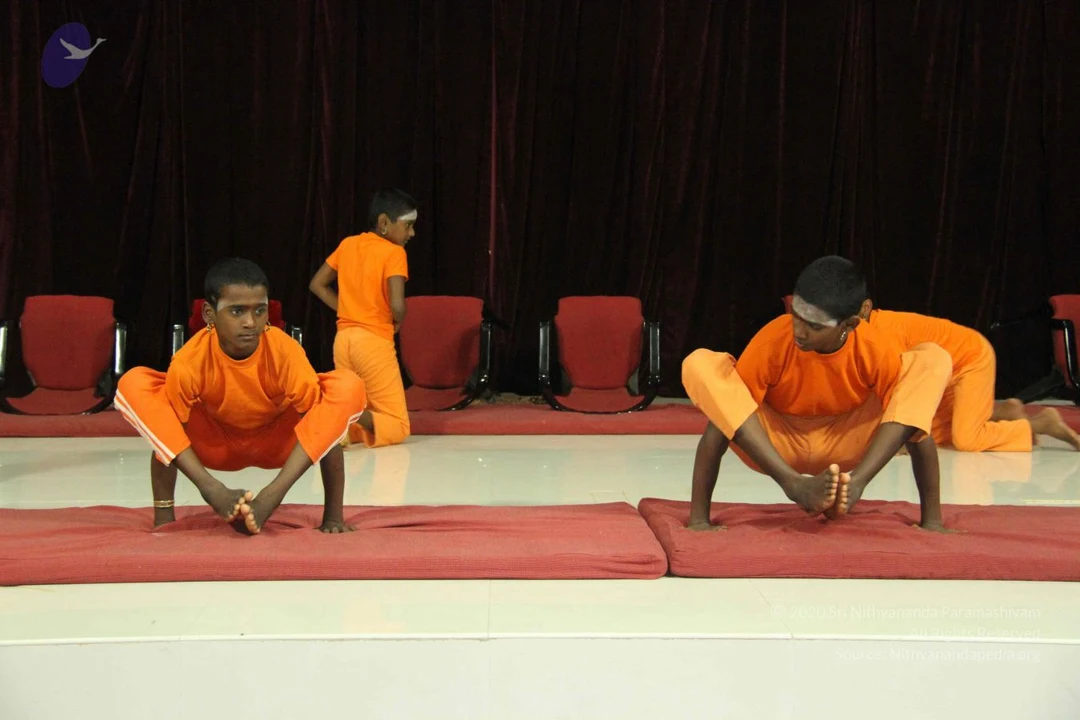
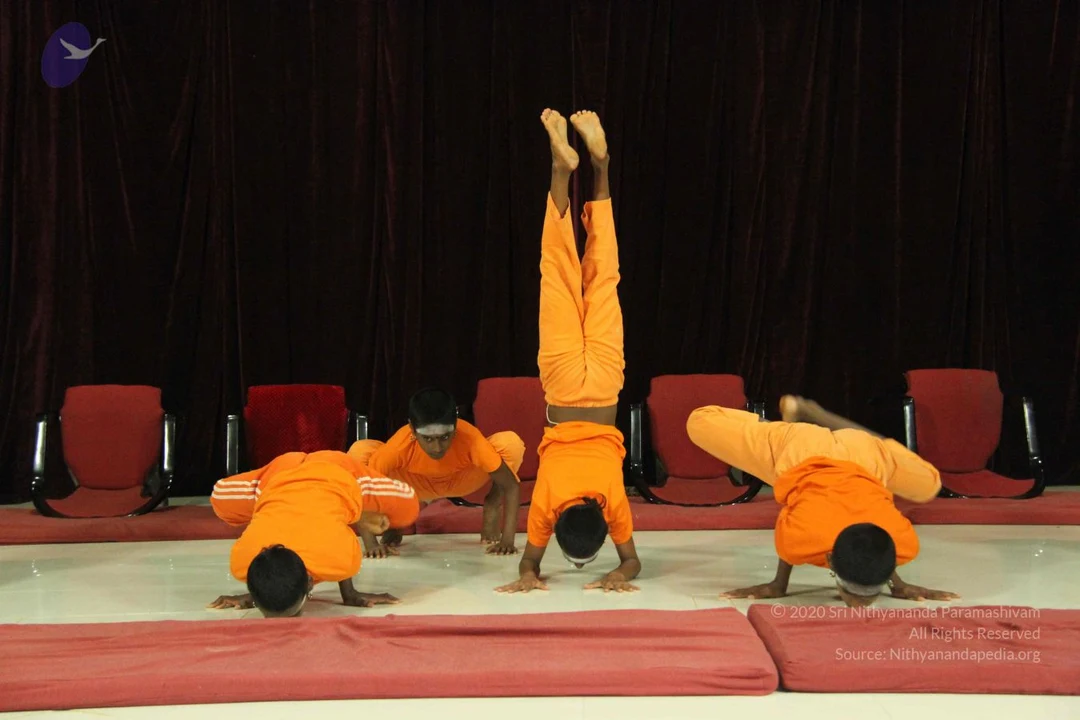
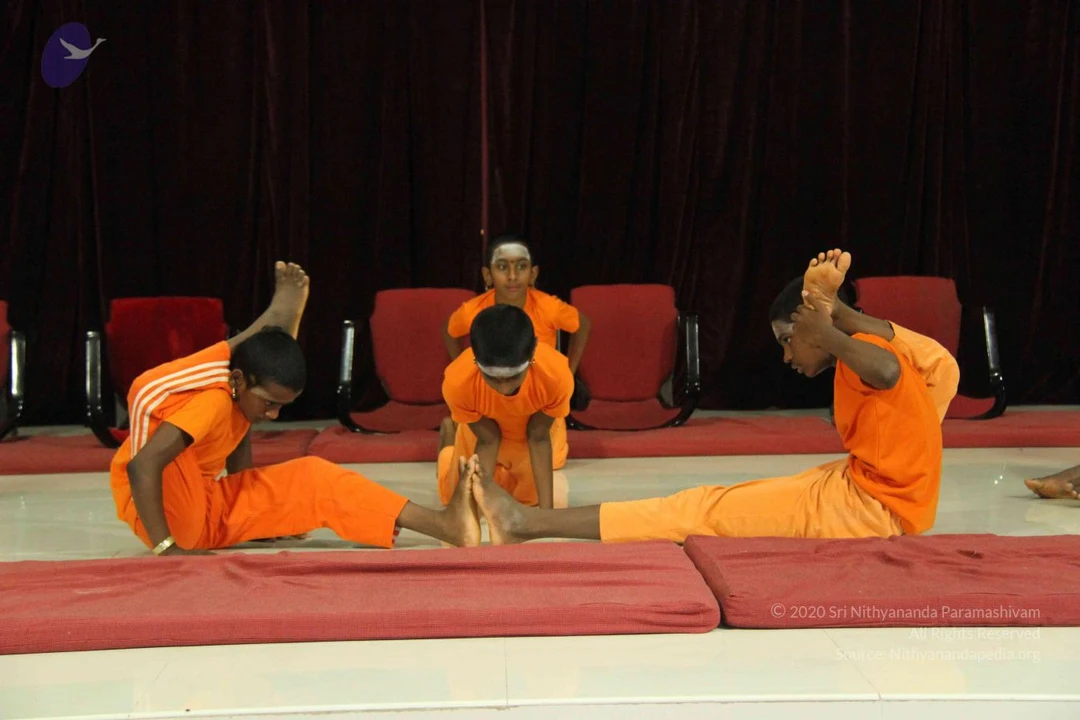
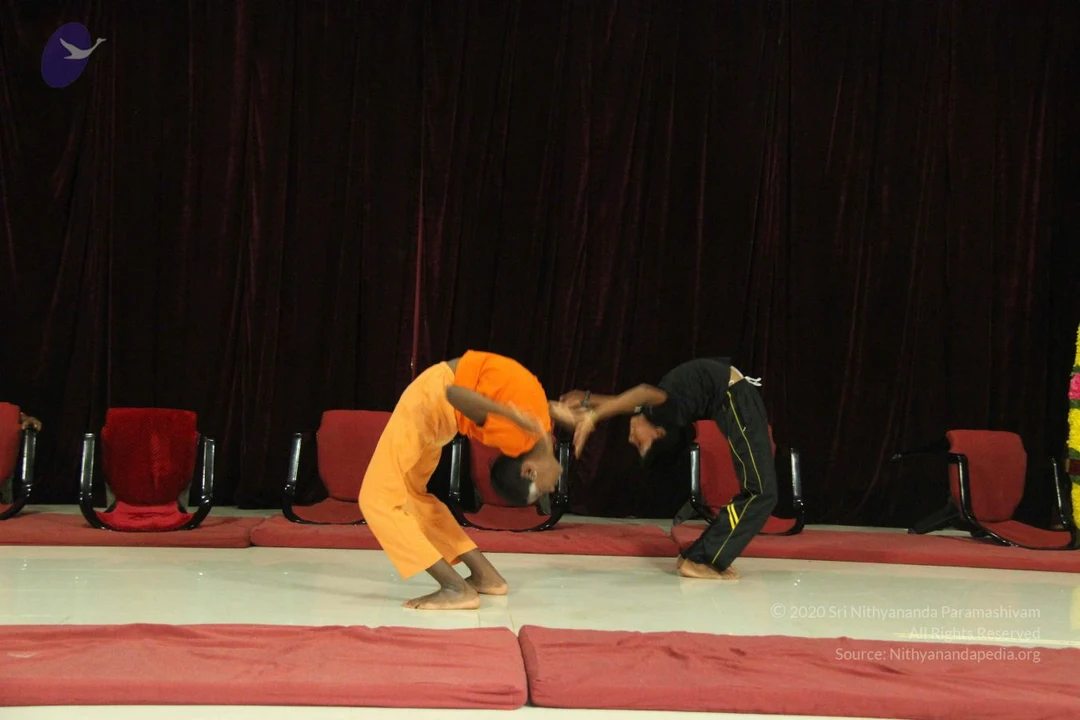
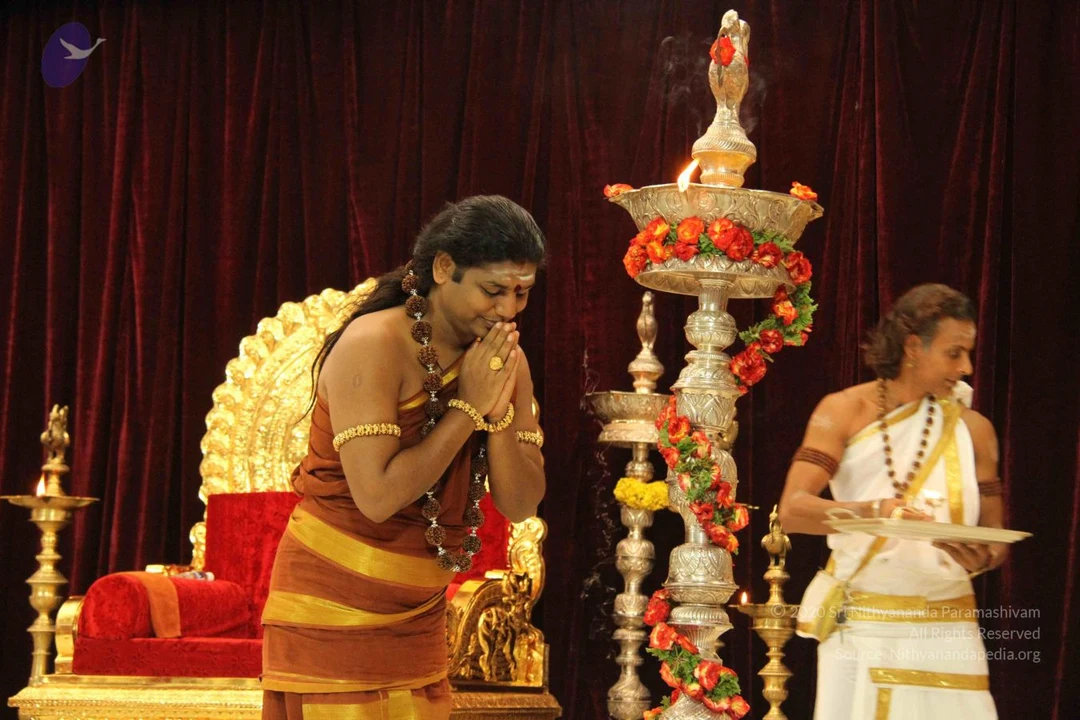
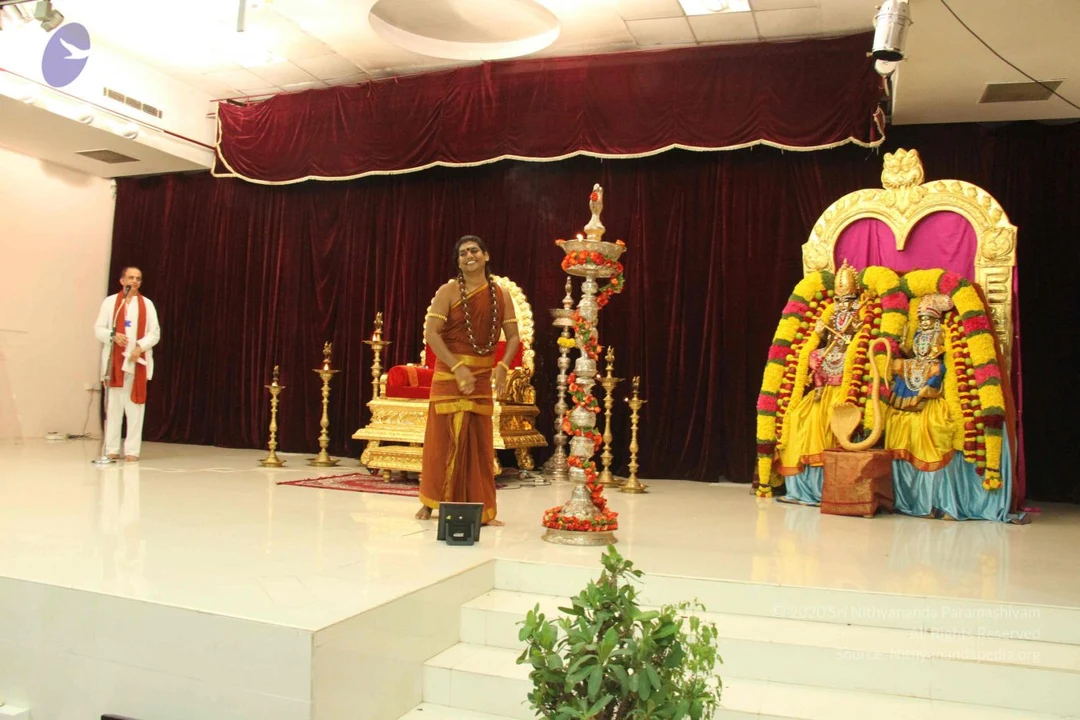
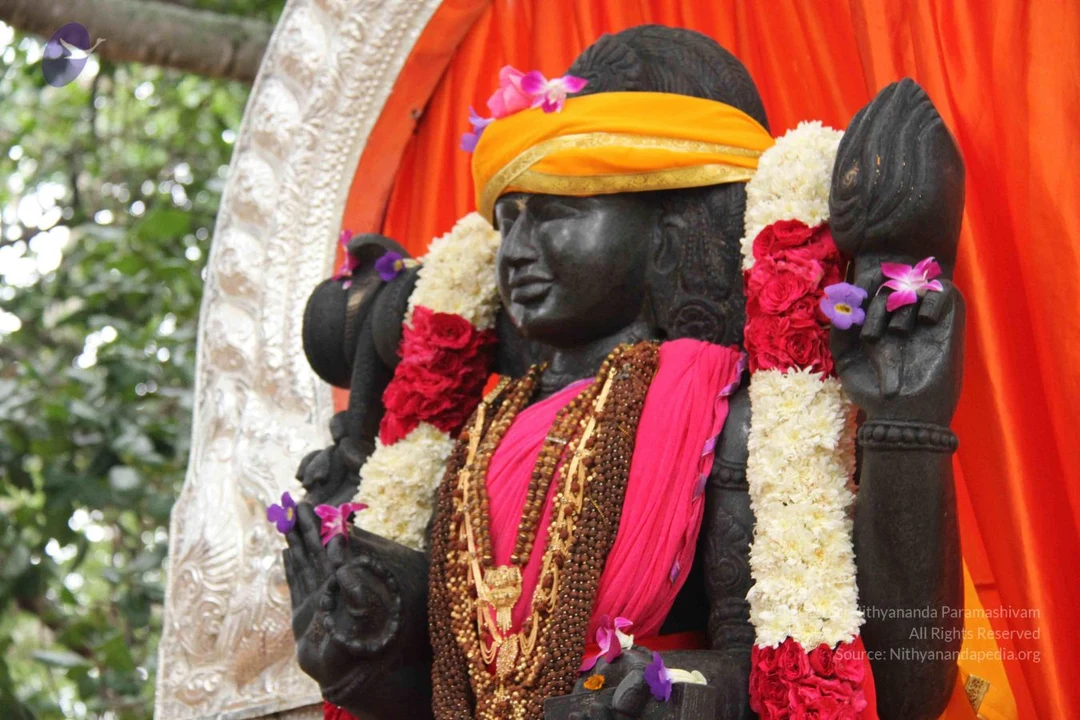
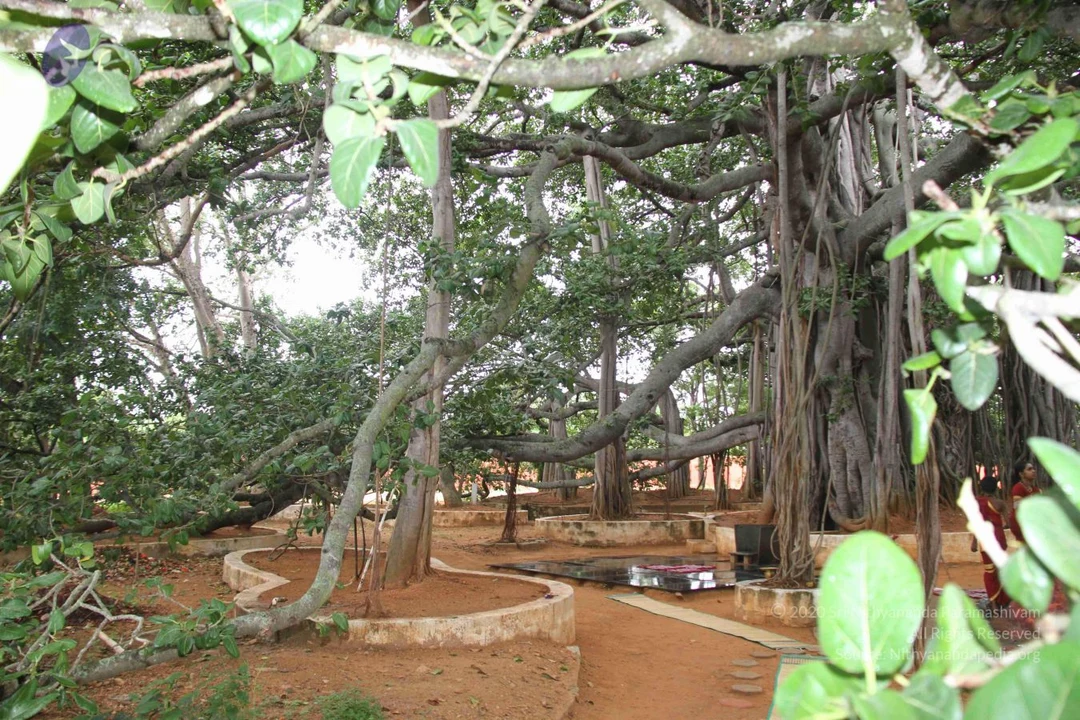
Three young boys in matching orange sleeveless tops and orange pants perform yoga postures on red mats on a white stage in front of maroon velvet curtains. The boy on the left crouches with his feet planted and hands on the mat, the boy on the right sits in a deep forward-folding pose with his feet grasped, and a third boy in the background kneels with hands on his hips. Red-cushioned chairs stand along the back of the stage. A small logo appears in the upper left corner.A large old banyan tree dominates the scene, with a massive trunk and many aerial prop roots hanging and wrapping around the trunk and branches. A raised circular stone platform with a low wall surrounds the base of the tree, and red-brown earth lies beneath it. A small dark stone shrine or seat sits at the base of the trunk. To the left, a wet dark stone surface and red cushions or mats are visible near the platform. A bright green leaf enters from the upper right. No people are present.A barefoot man in a rust-orange dhoti with gold border and bare upper body walks along a woven mat on a dirt path beneath green trees. He wears a heavy rudraksha mala, a large gold pendant necklace, gold armlets, and a white tilak on his forehead. Flanking him are women and young men in orange and saffron robes with red borders, also wearing rudraksha malas, walking in procession. Some are sadhaka-style white-band devotees. A red structure is visible in the background.

July 20 2013

Original wiki page
Contents

Description:

In today’s morning Satsang, Paramahamsa Nithyananda acquaints us with a scale that can help us decide which philosophy to use for our lives. Philosophy can be classified by how it introduces us to ourselves either by encaging, enslaving, engaging, or enriching. For example, the idea of self-doubt is nothing but the gap between our inner and outer image. This idea is falsely taught to us by the enslaving and encaging philosophies which introduce us to ourselves as sinners. Even when we get stuck with the feeling we are removed from the whole, in times of self-doubt, remember, we remain with the whole and are still always Self.

Link to Video:

VideoAudio
VideoAudio

Transcript:

Nithyanandeshwara Samaarambhaam Nithyanandeshwari Madhyamaam | Asmath Aachaarya Paryanthaam Vandhey Guru Paramparaam ||

I welcome all the devotees, disciples, samajis, satsanghis, I welcome all of you with my love and blessings.

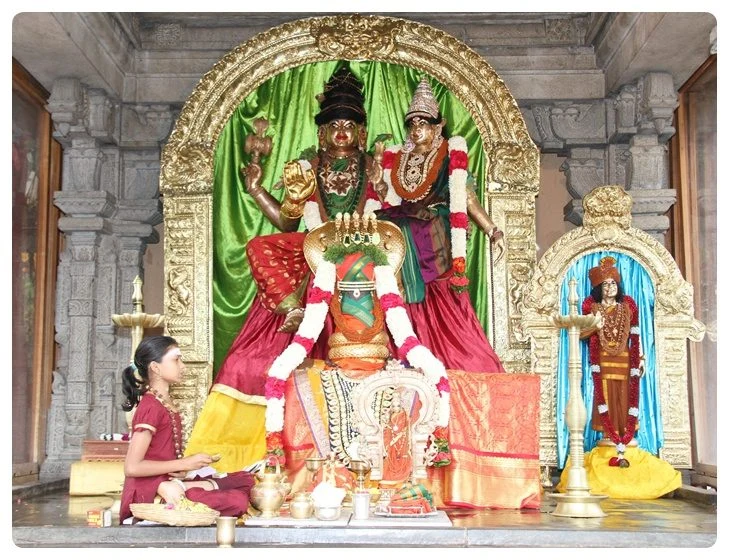
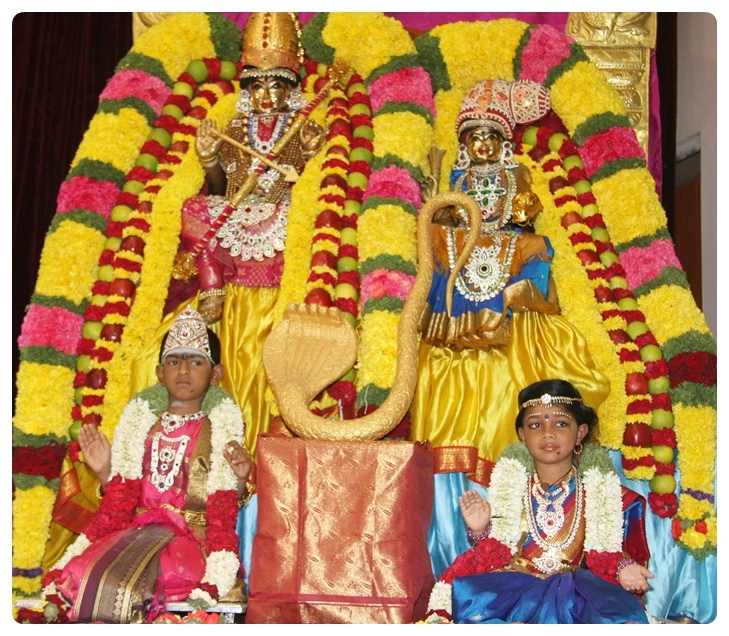
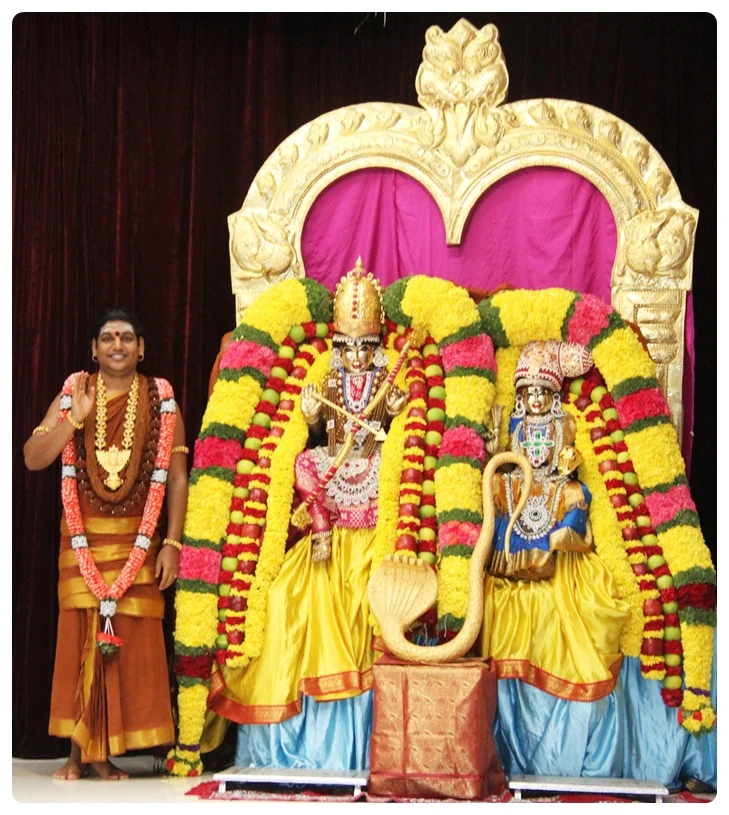
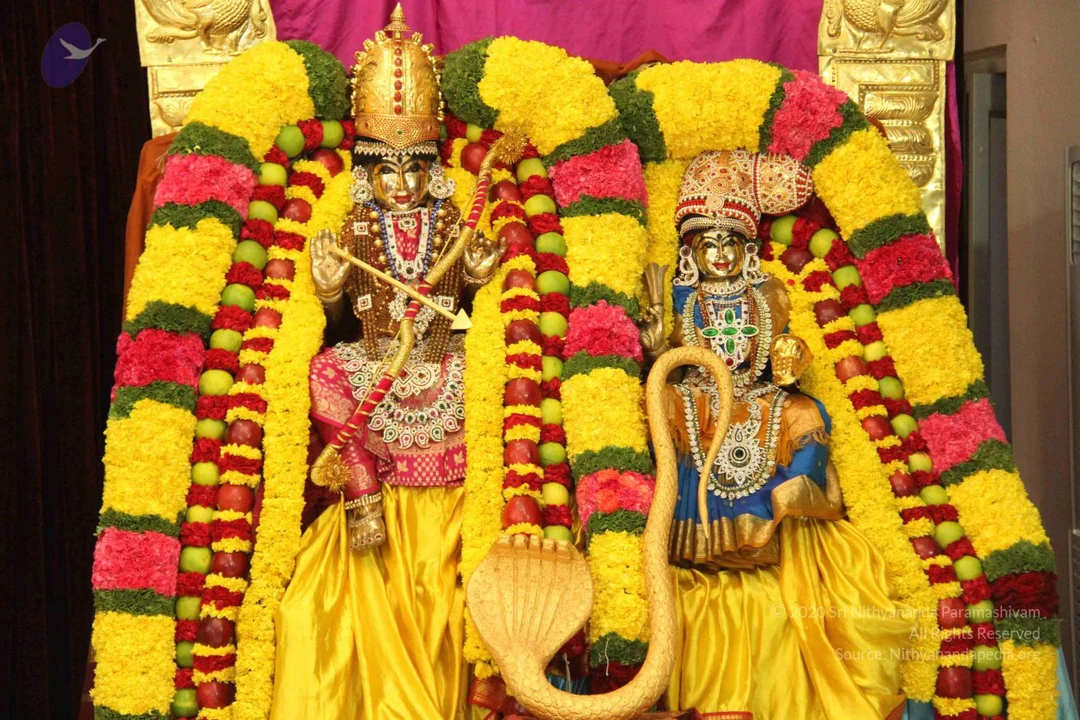
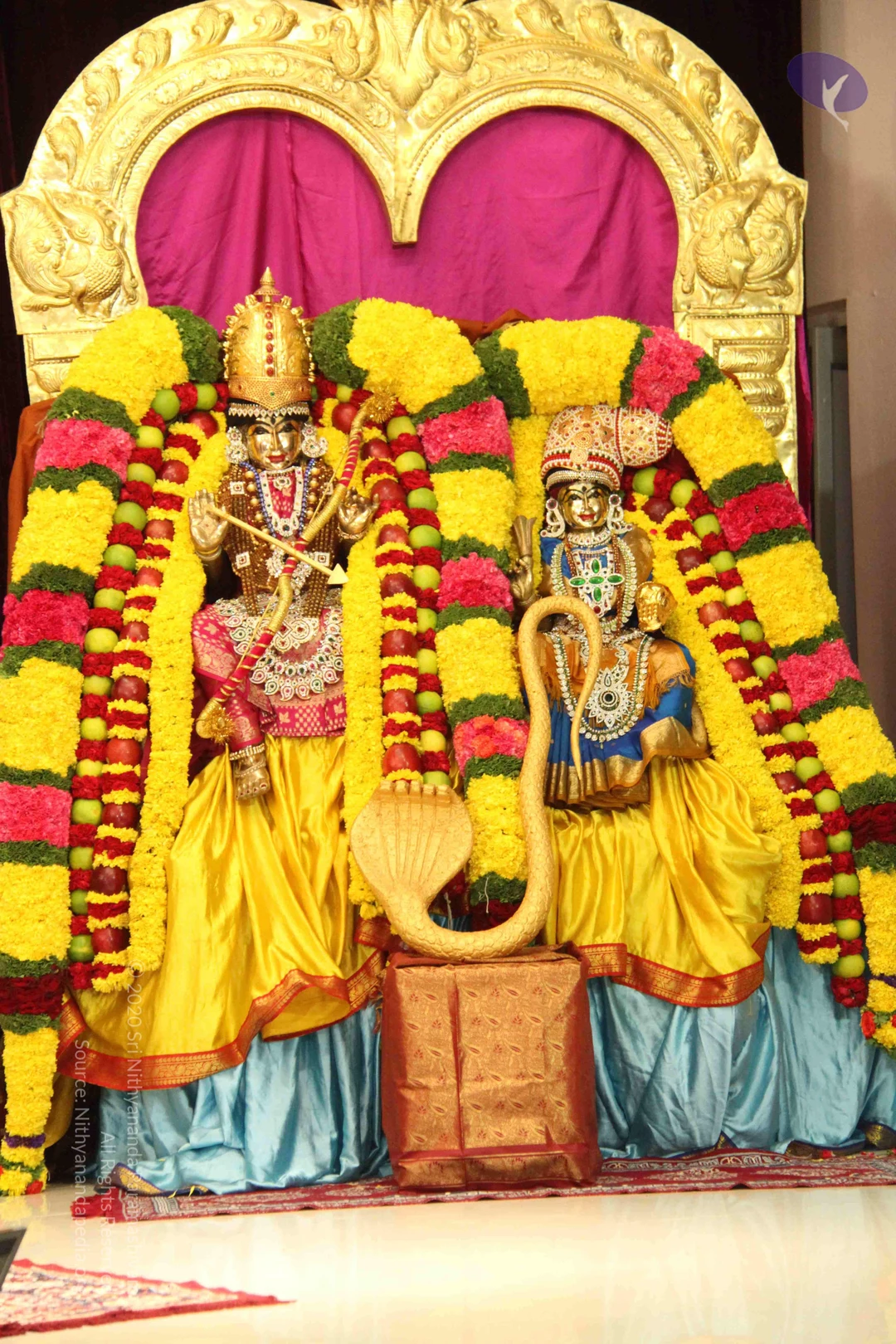
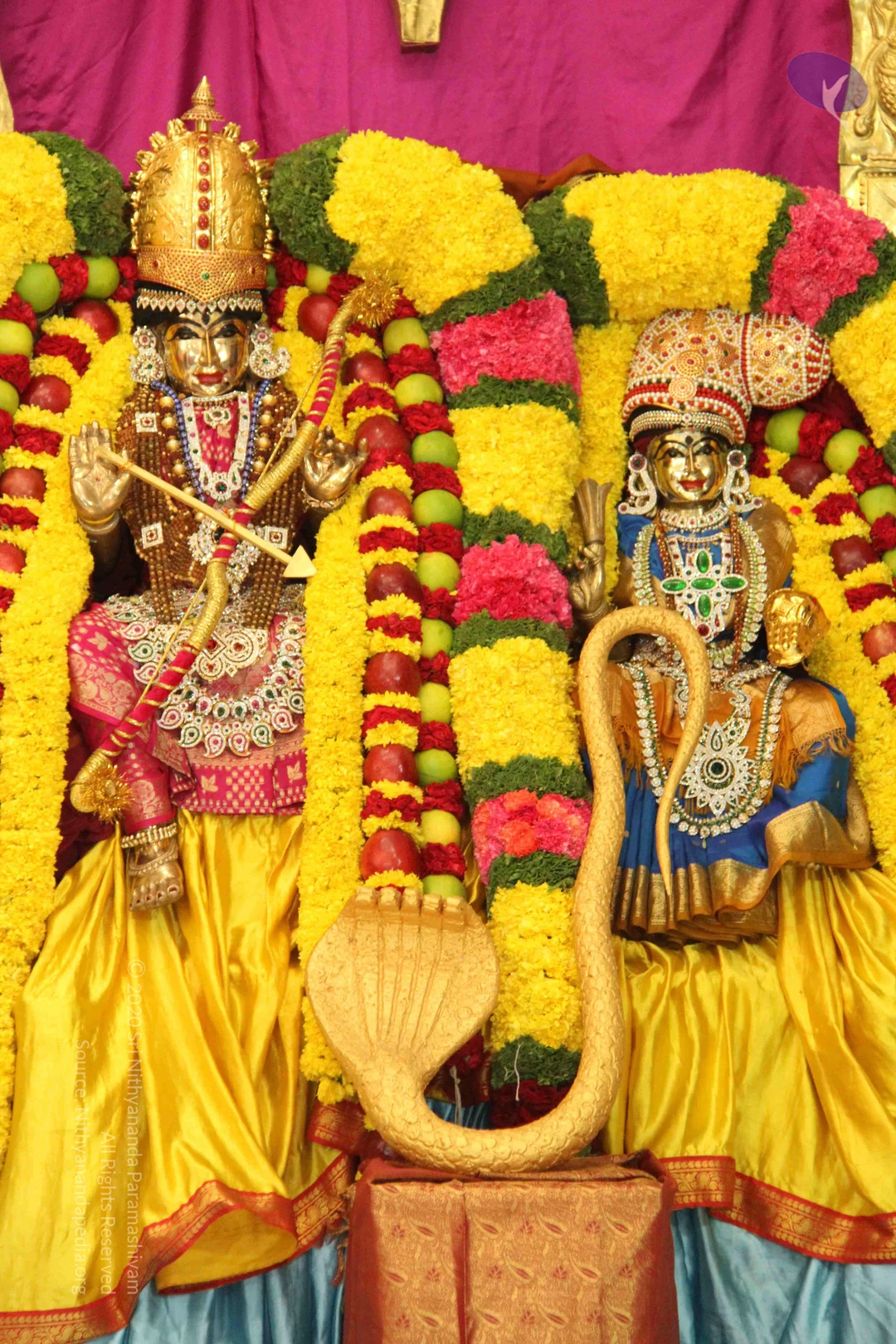
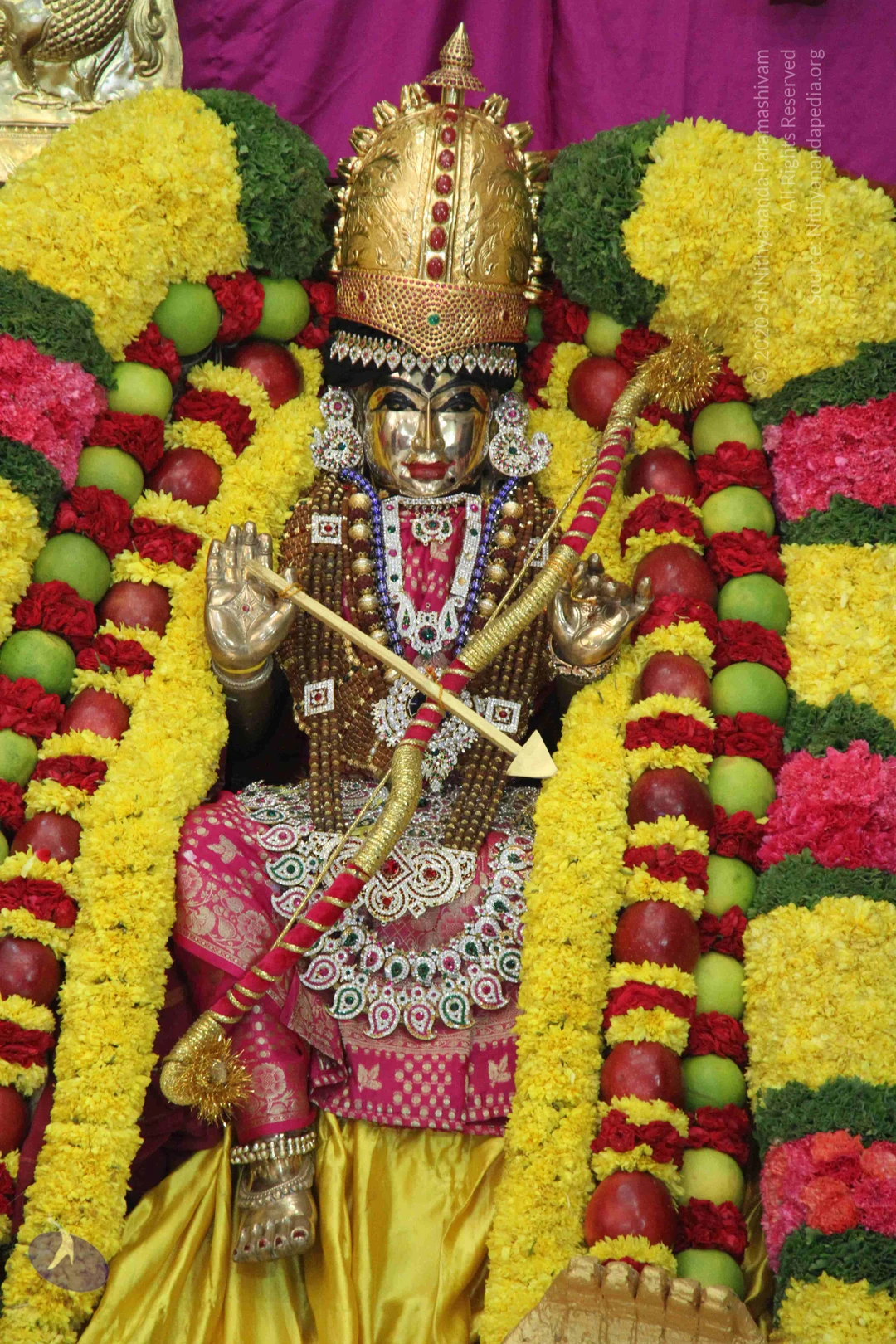
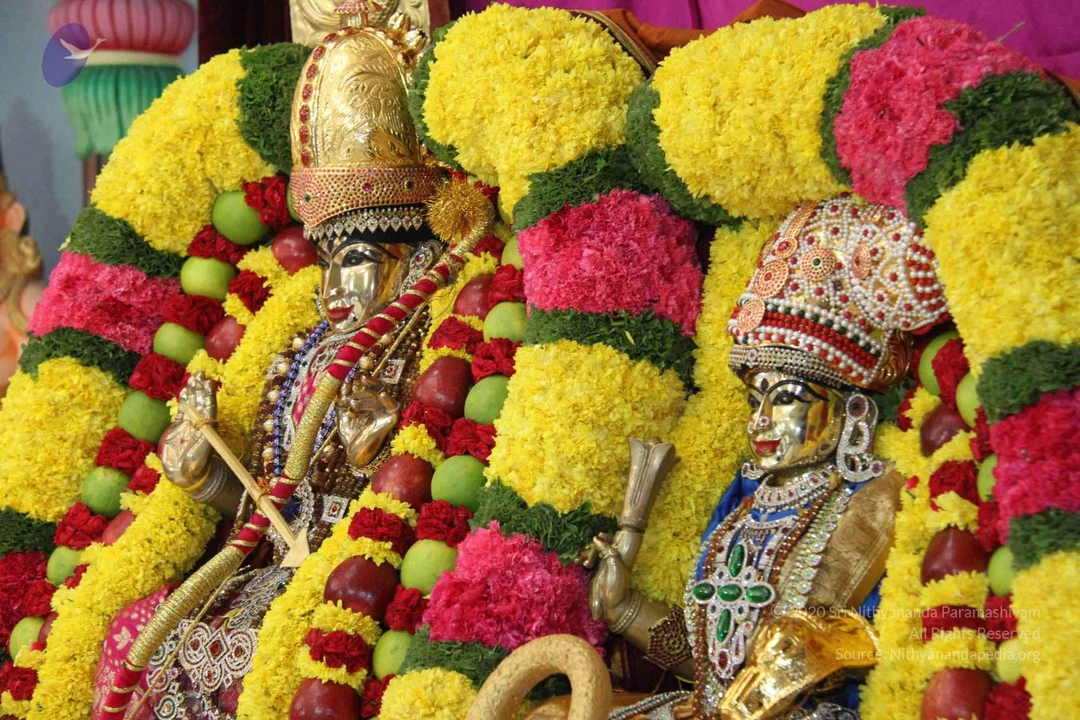
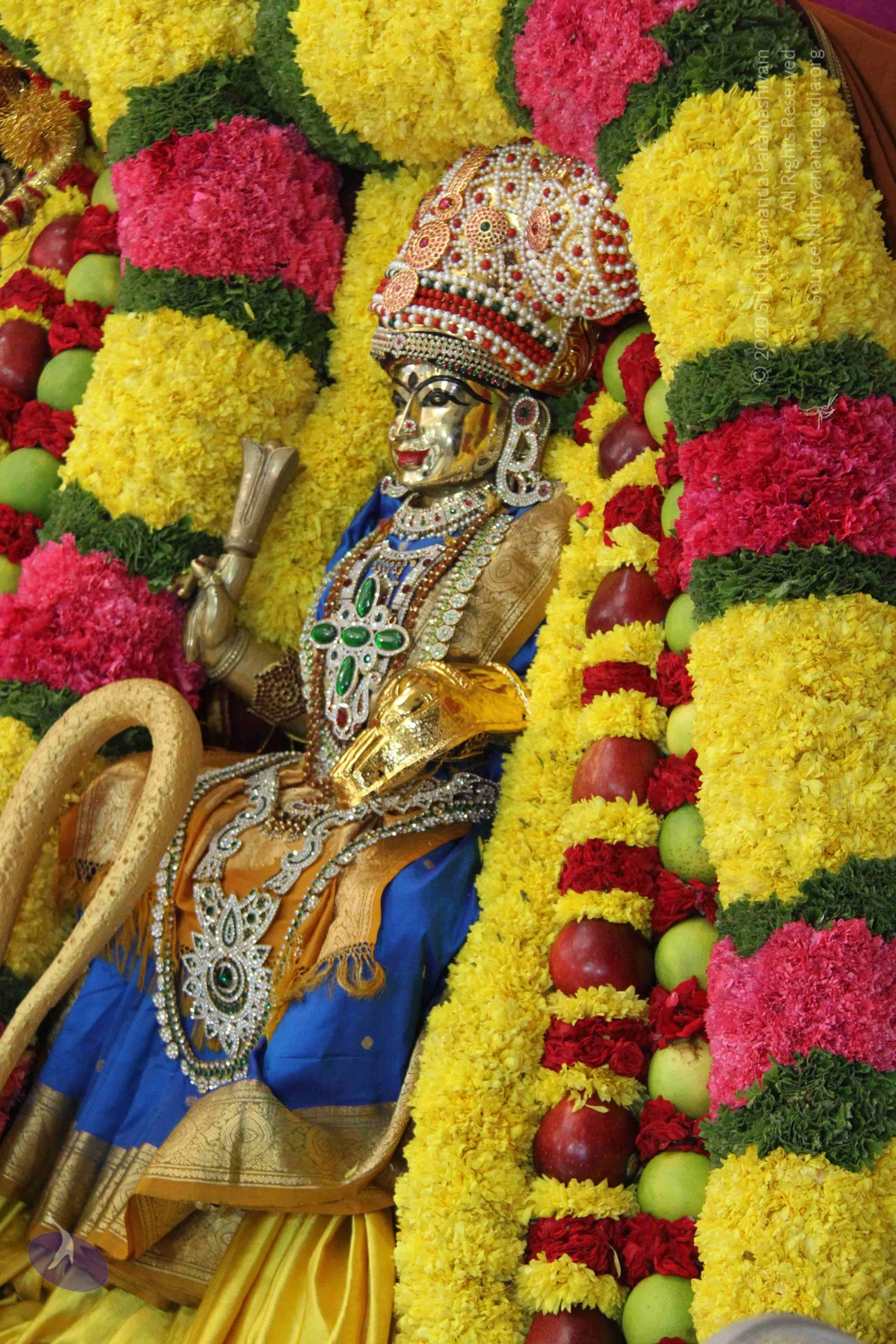
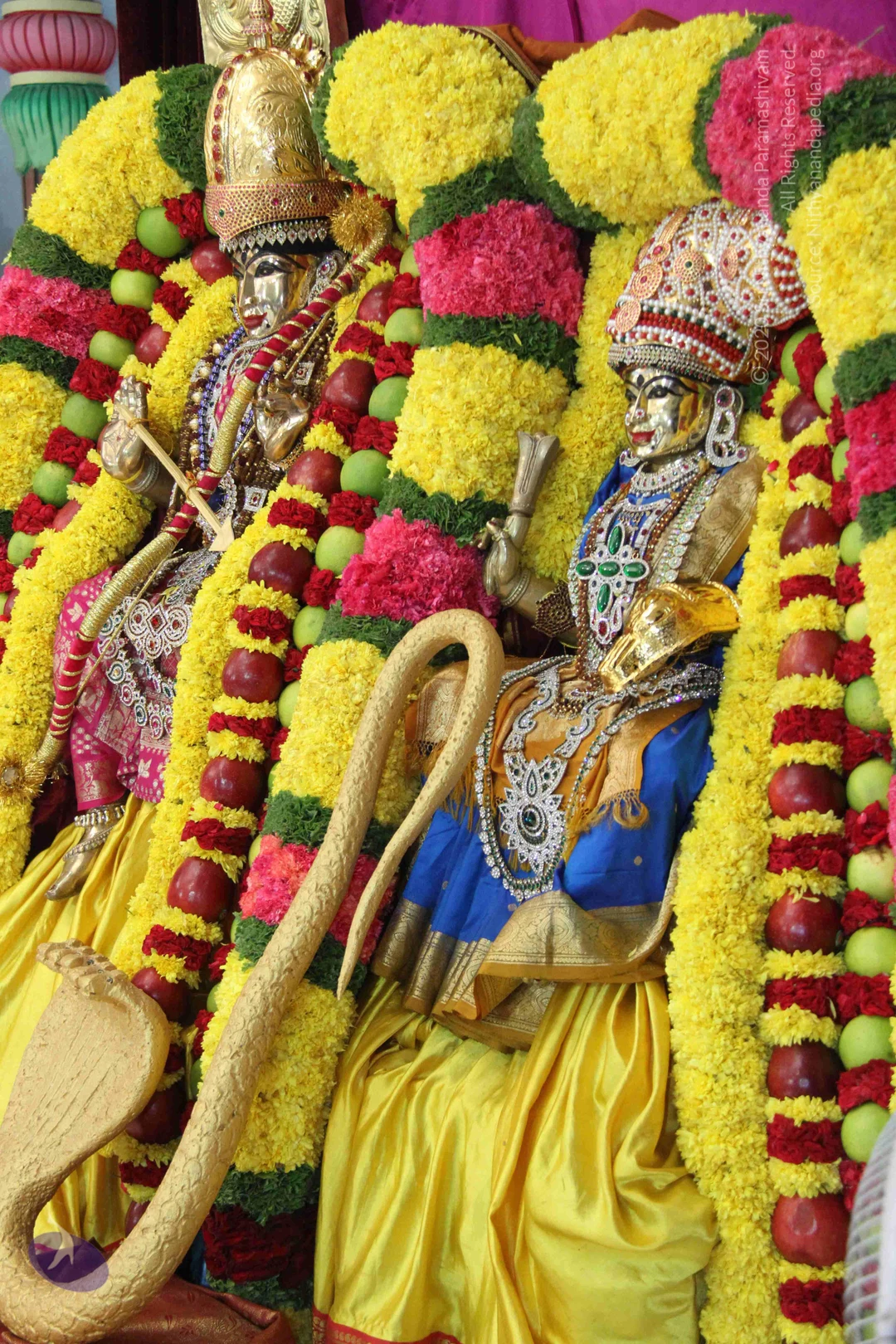
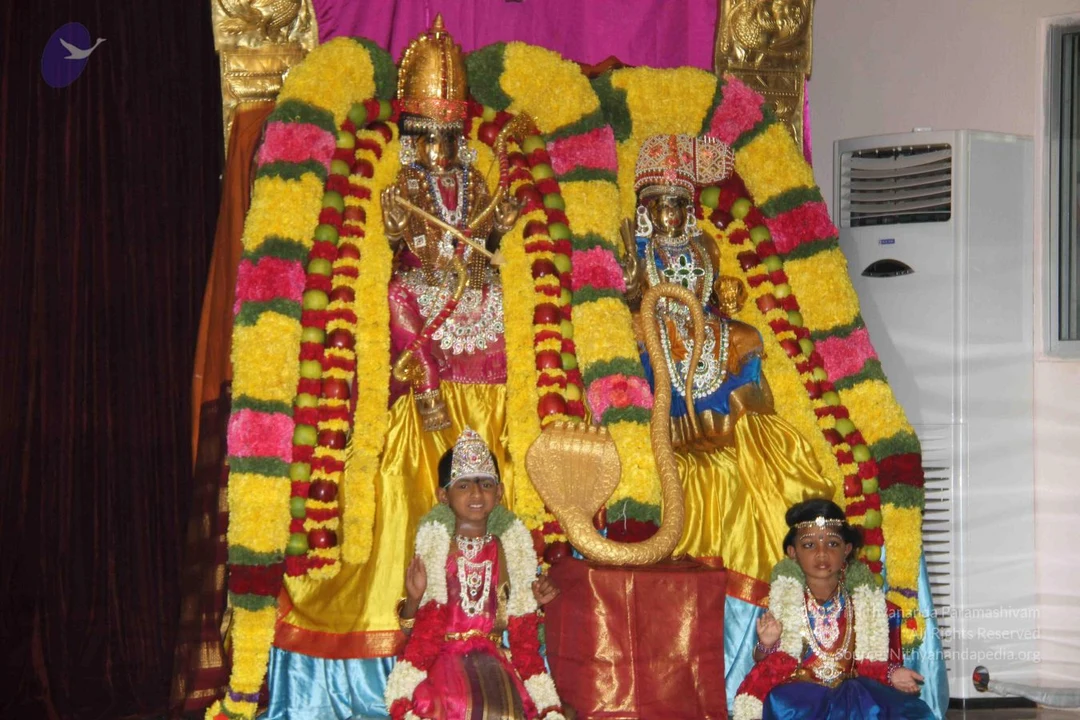
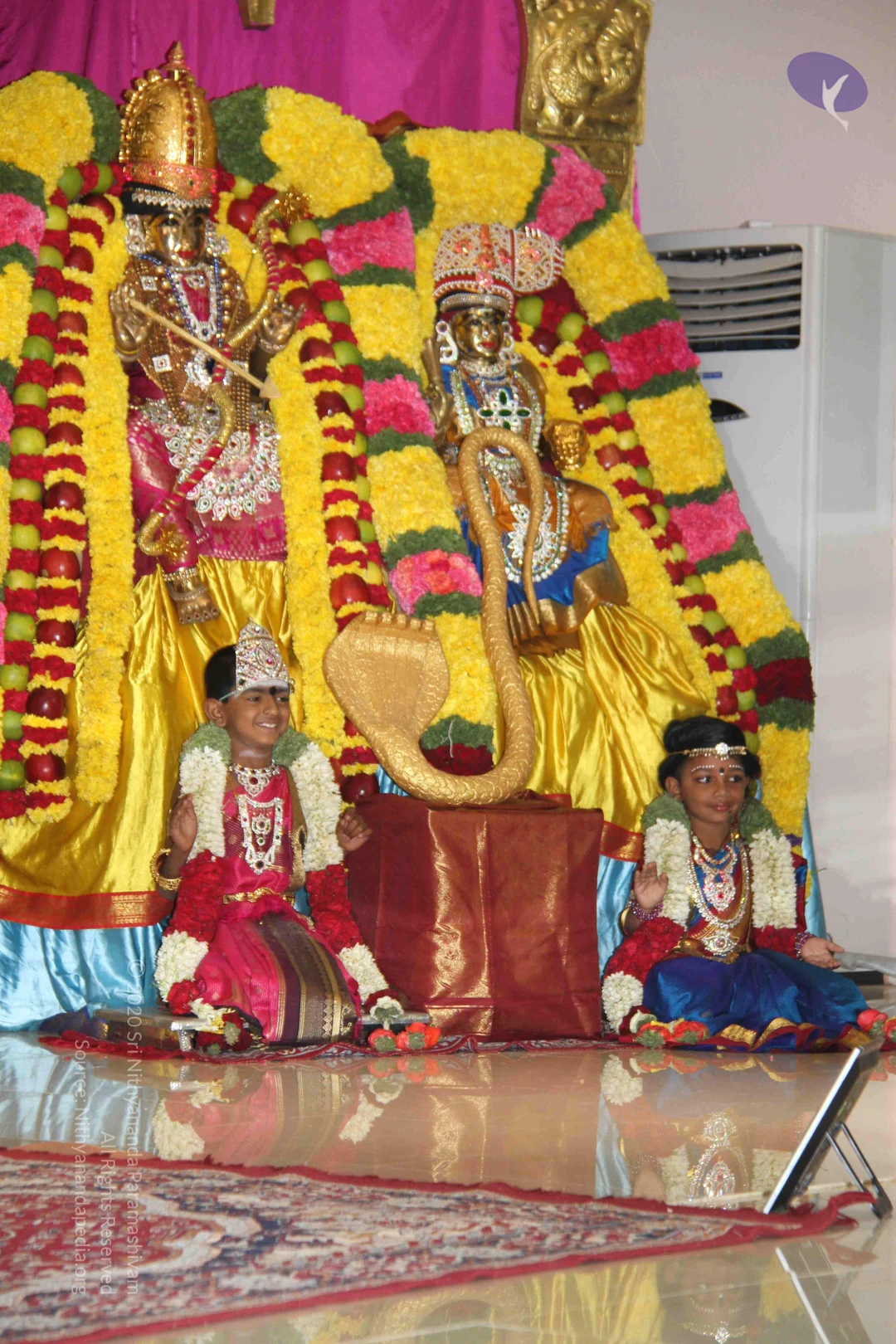
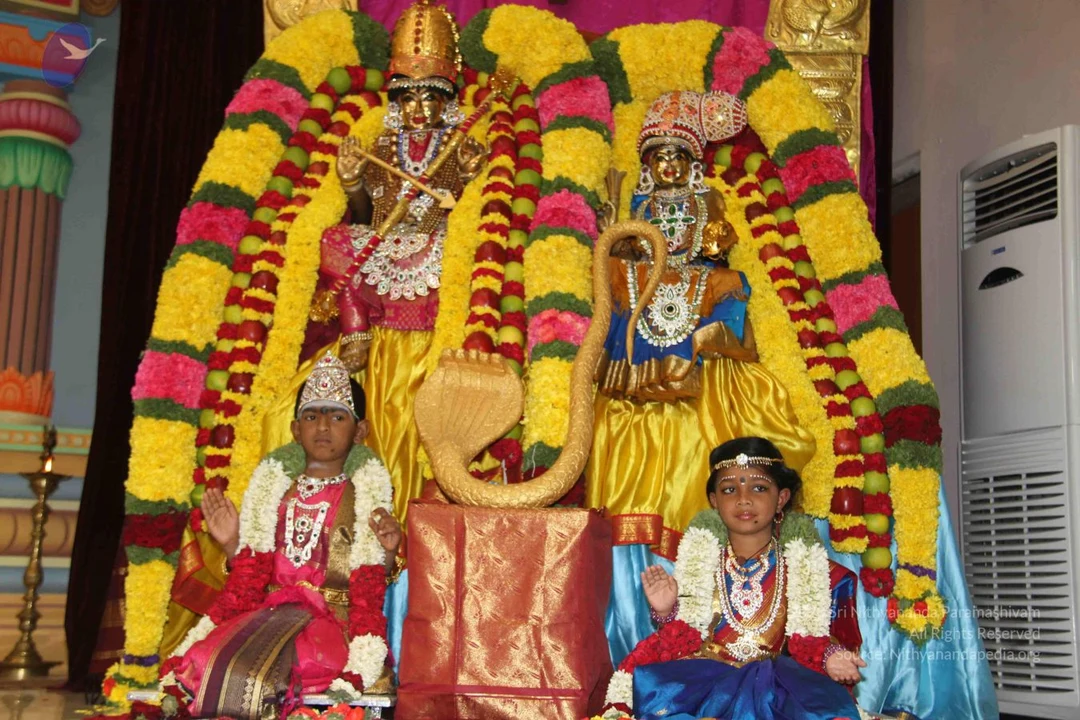
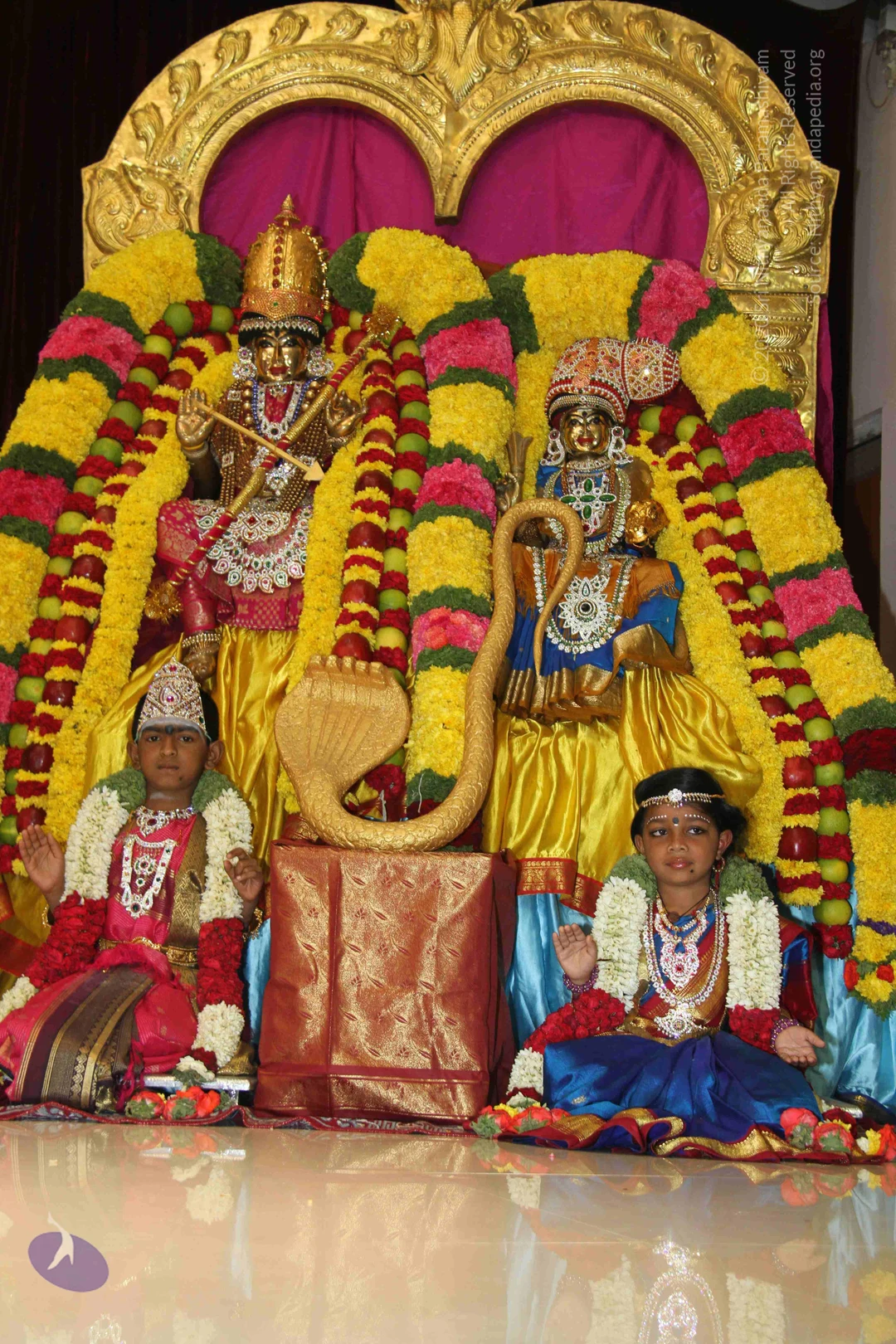
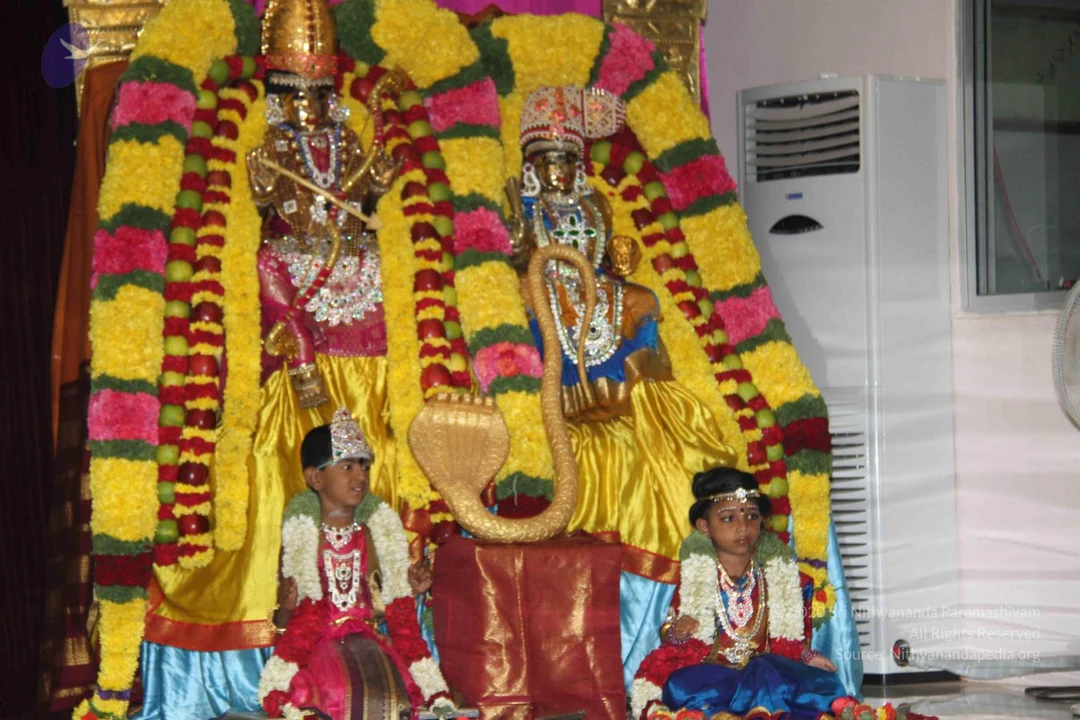
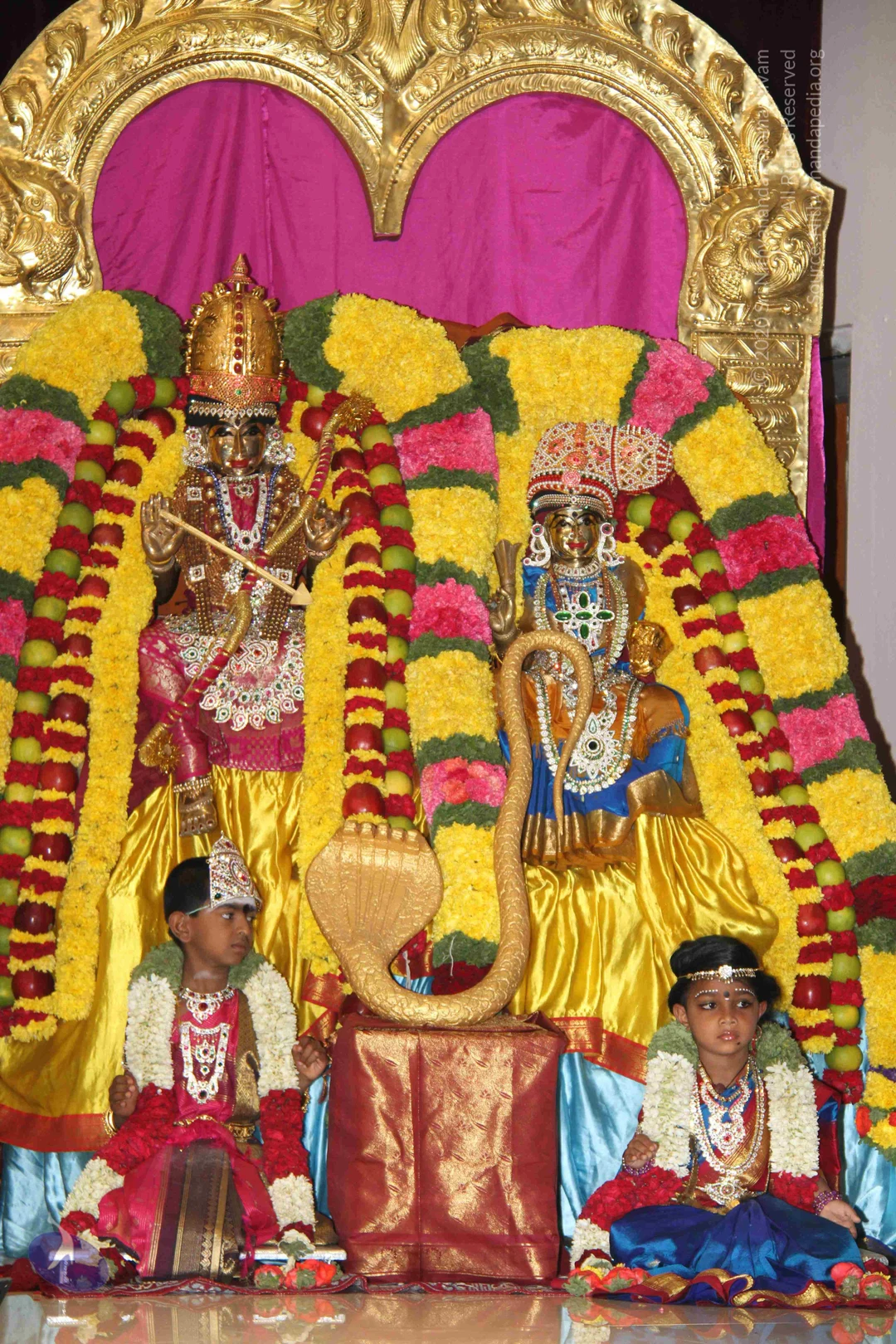
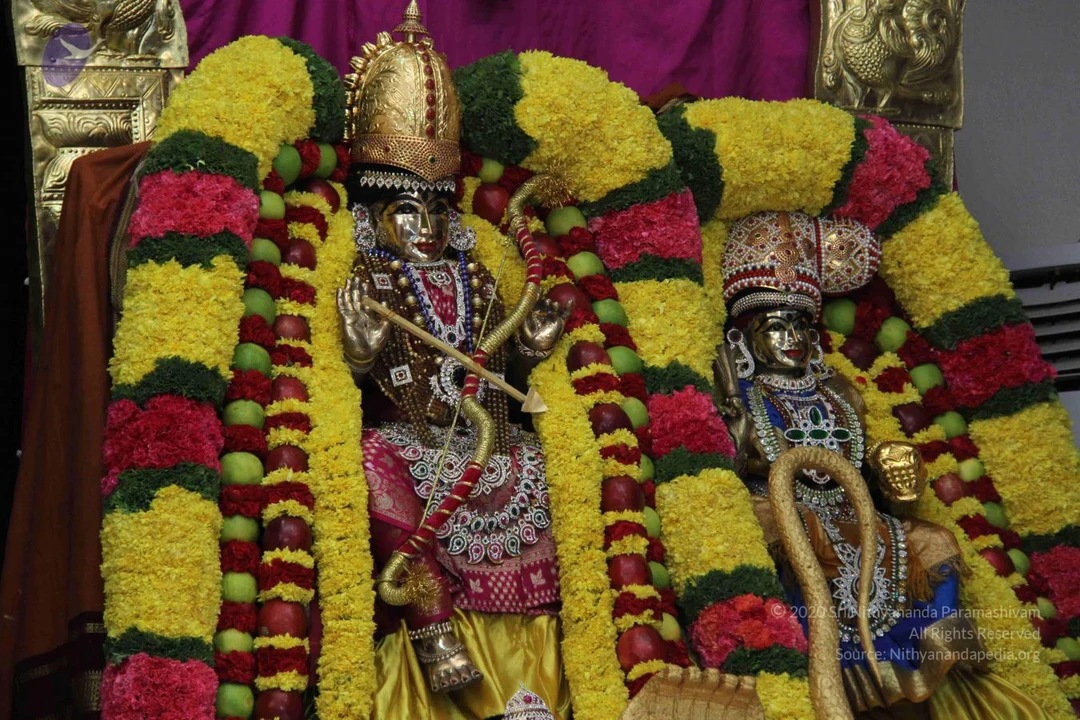
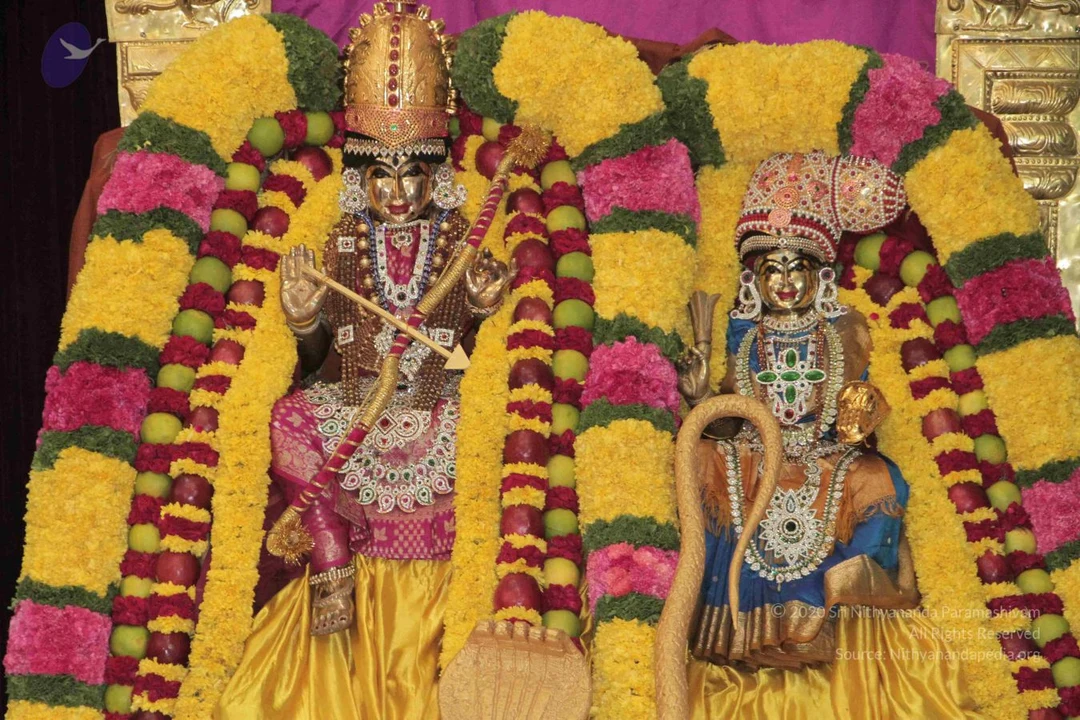
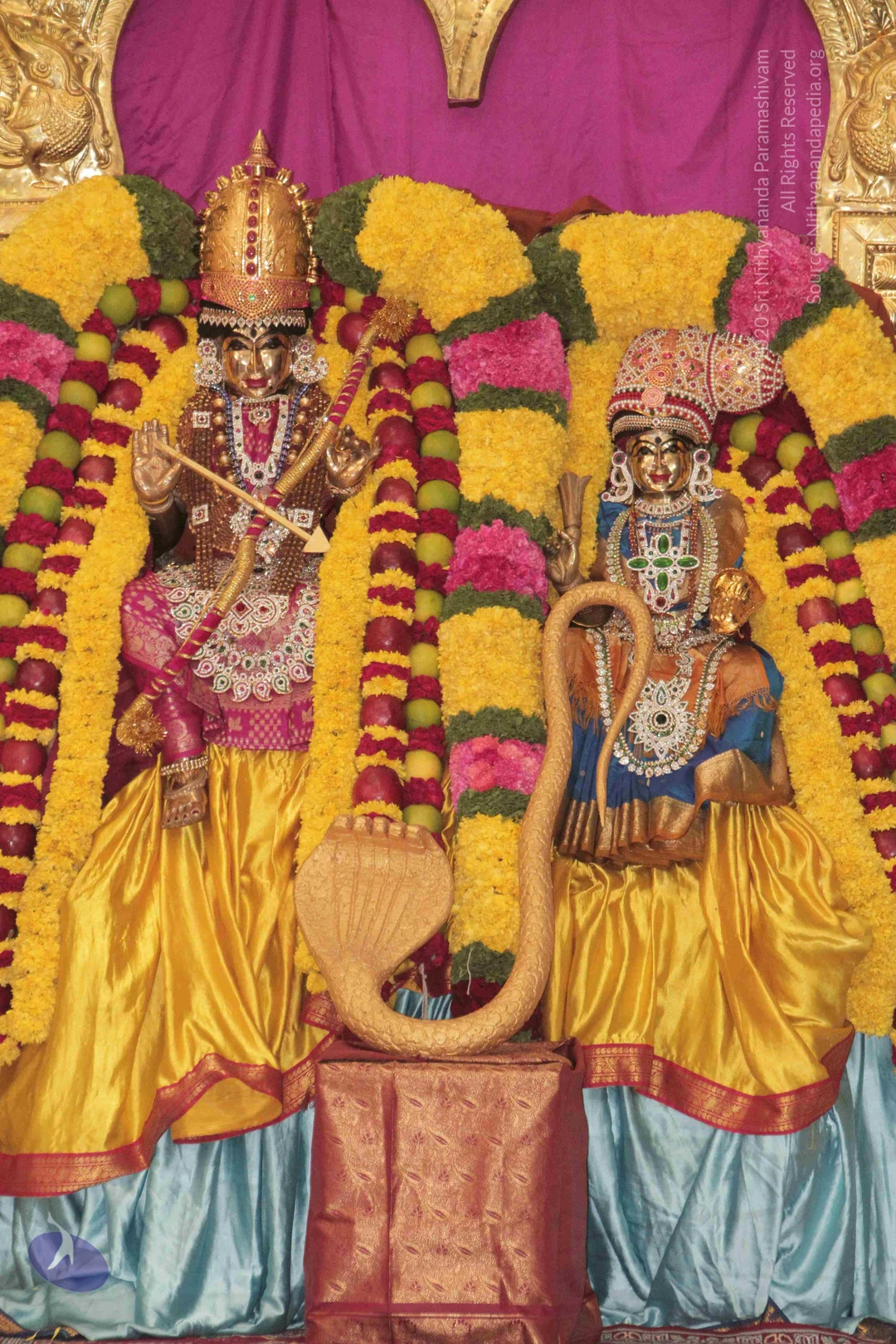
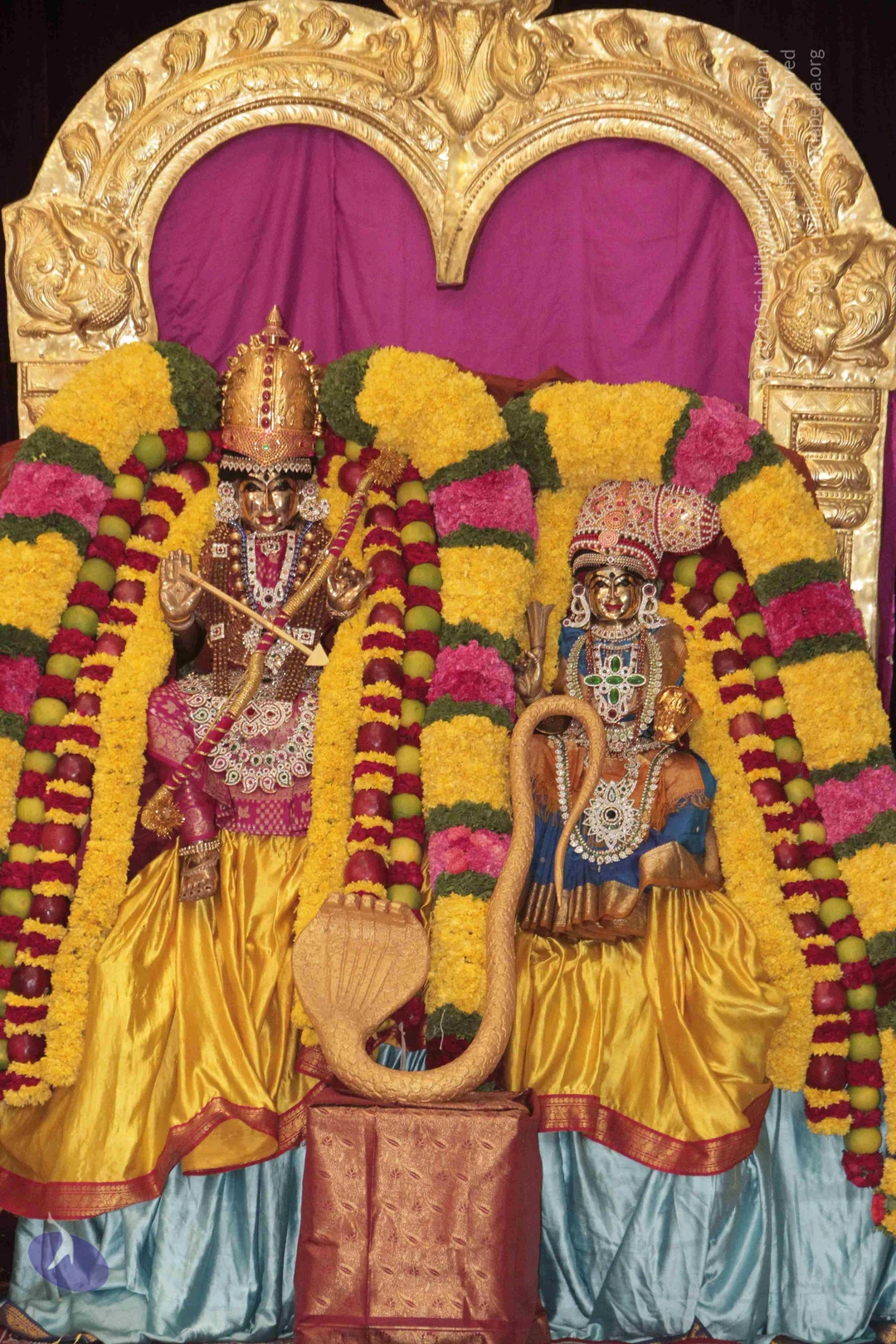
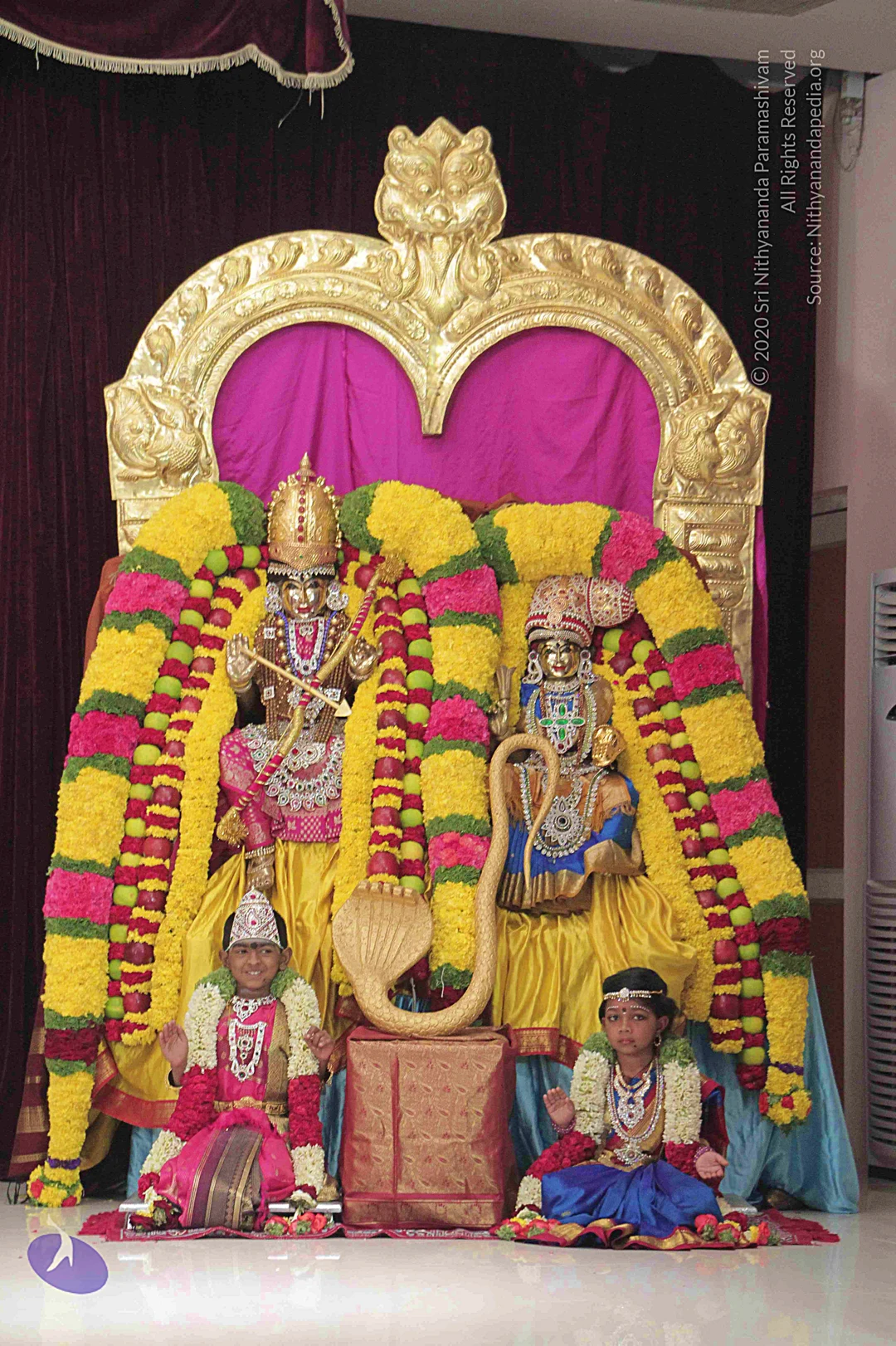
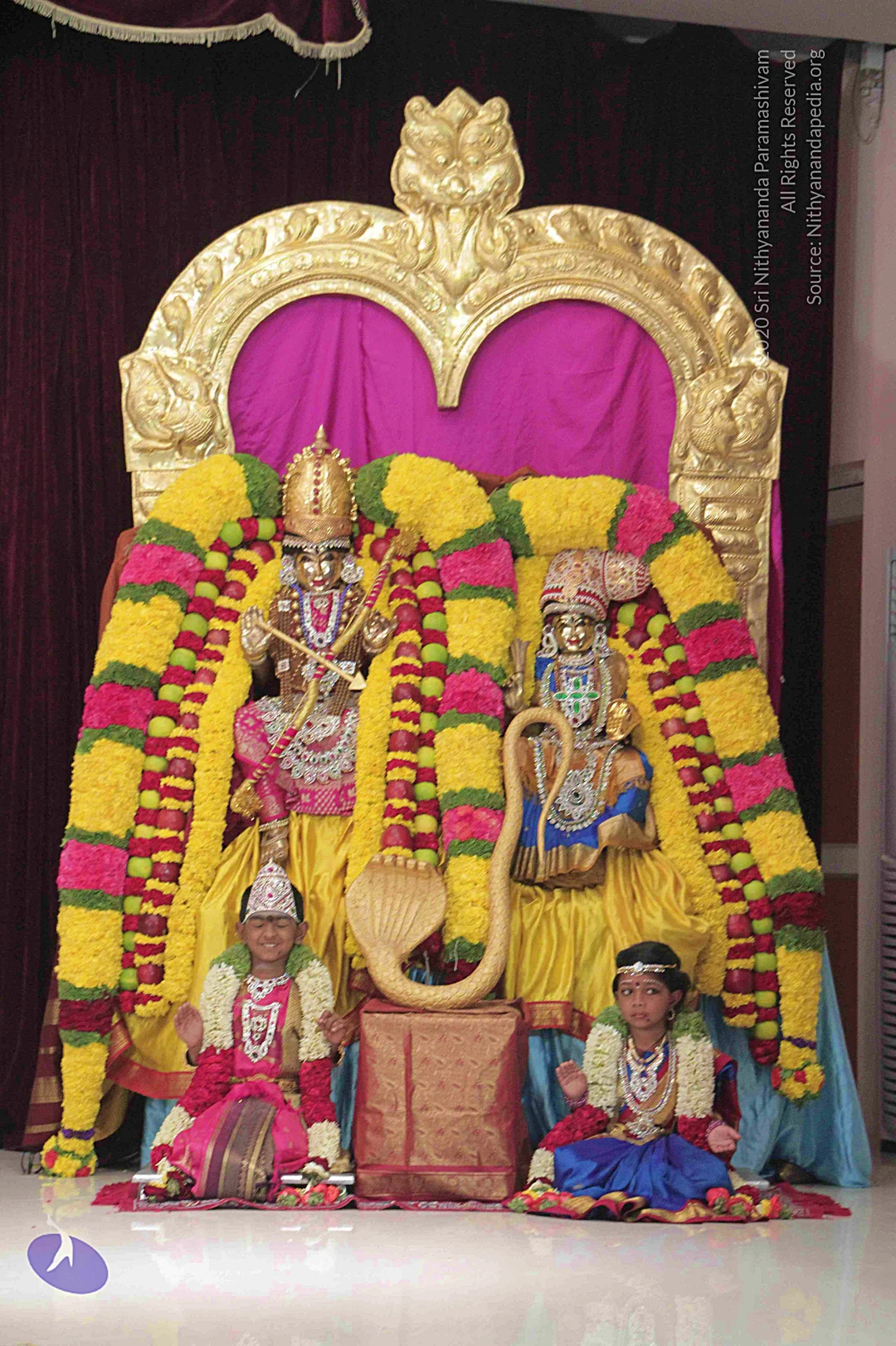
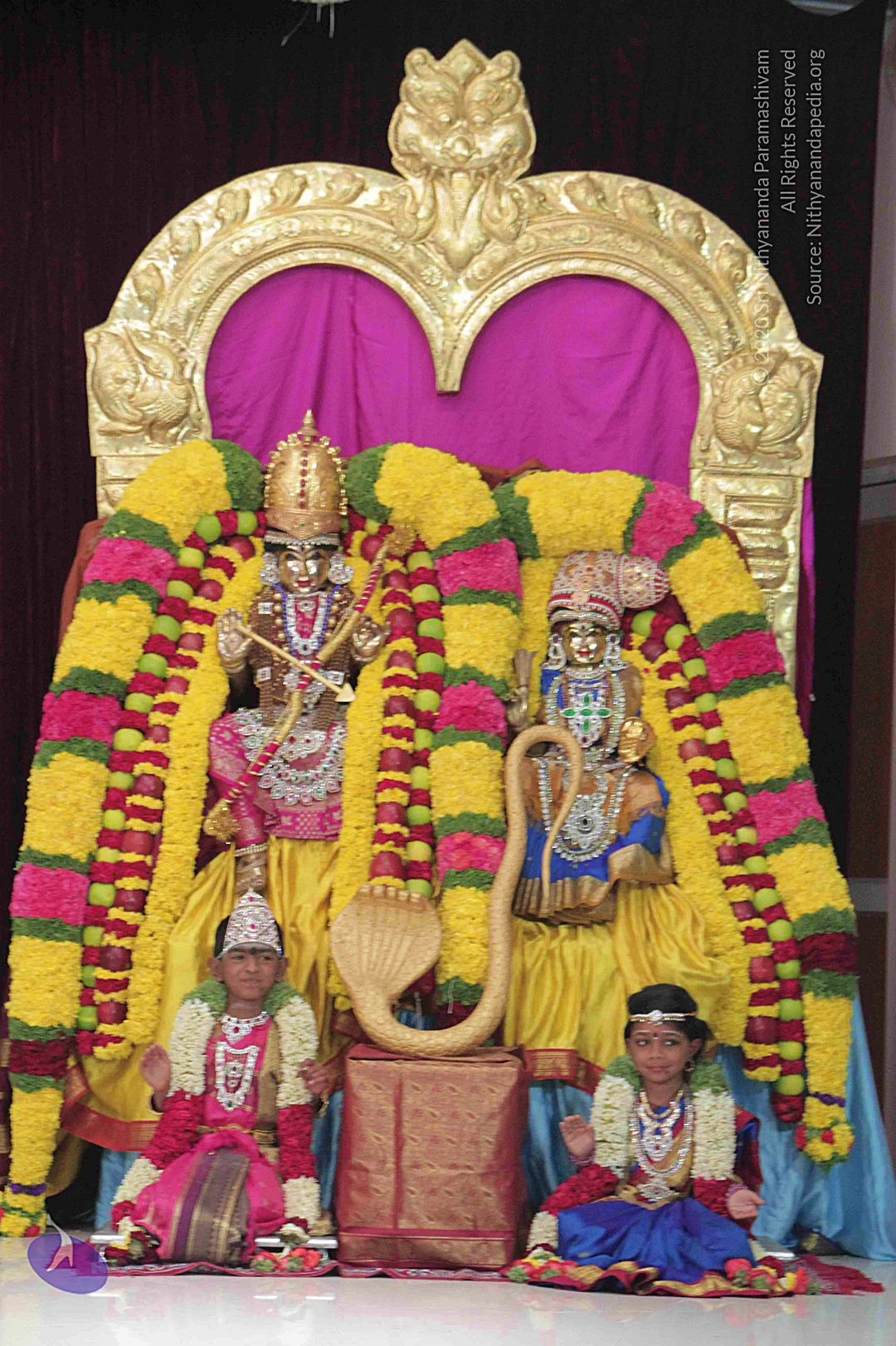
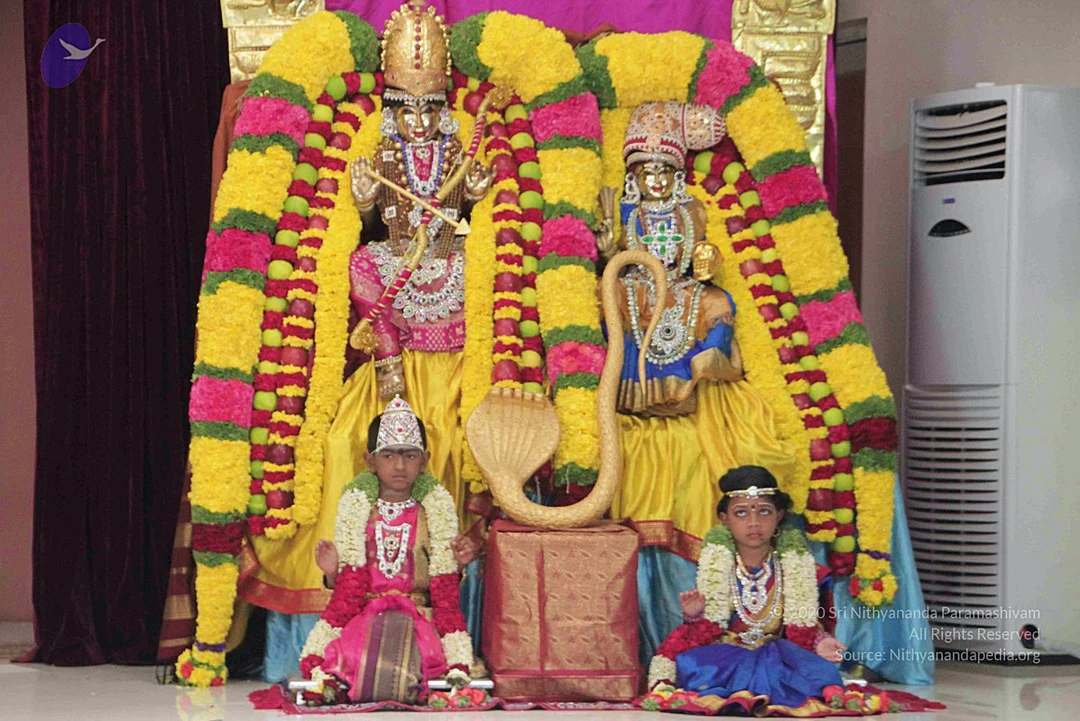
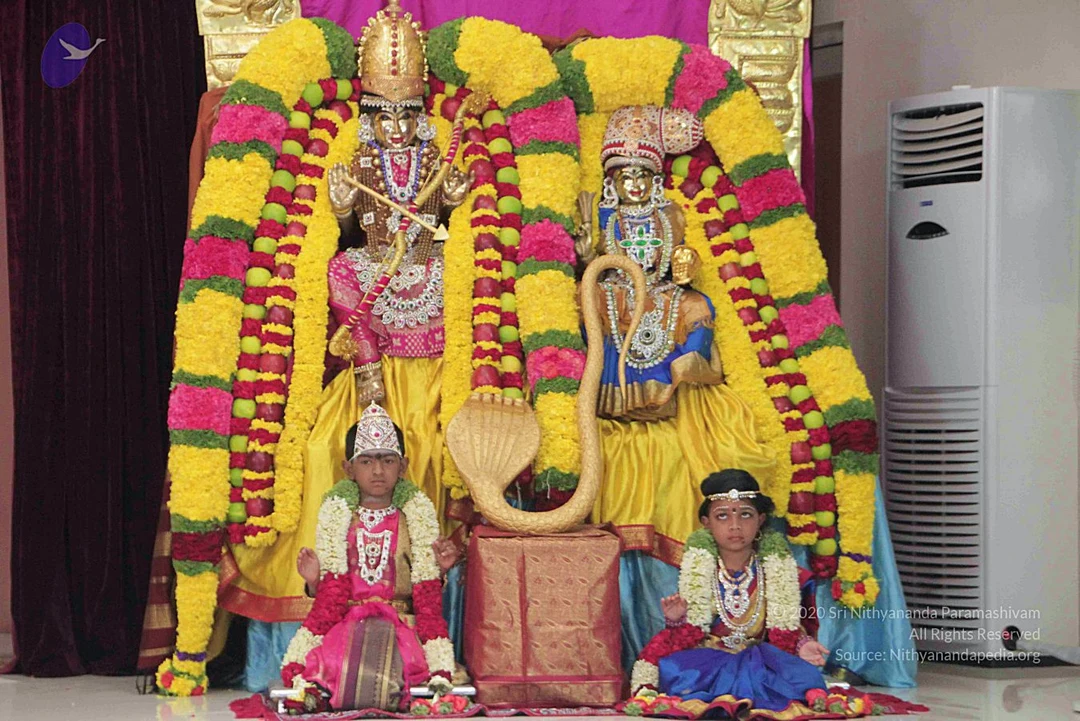
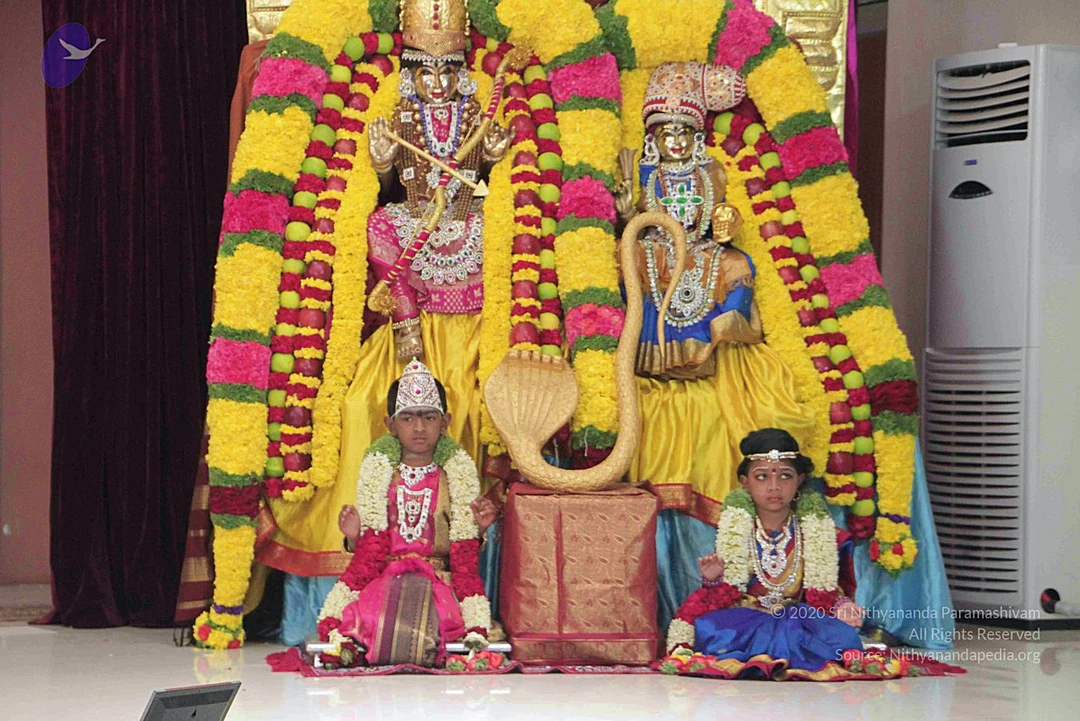
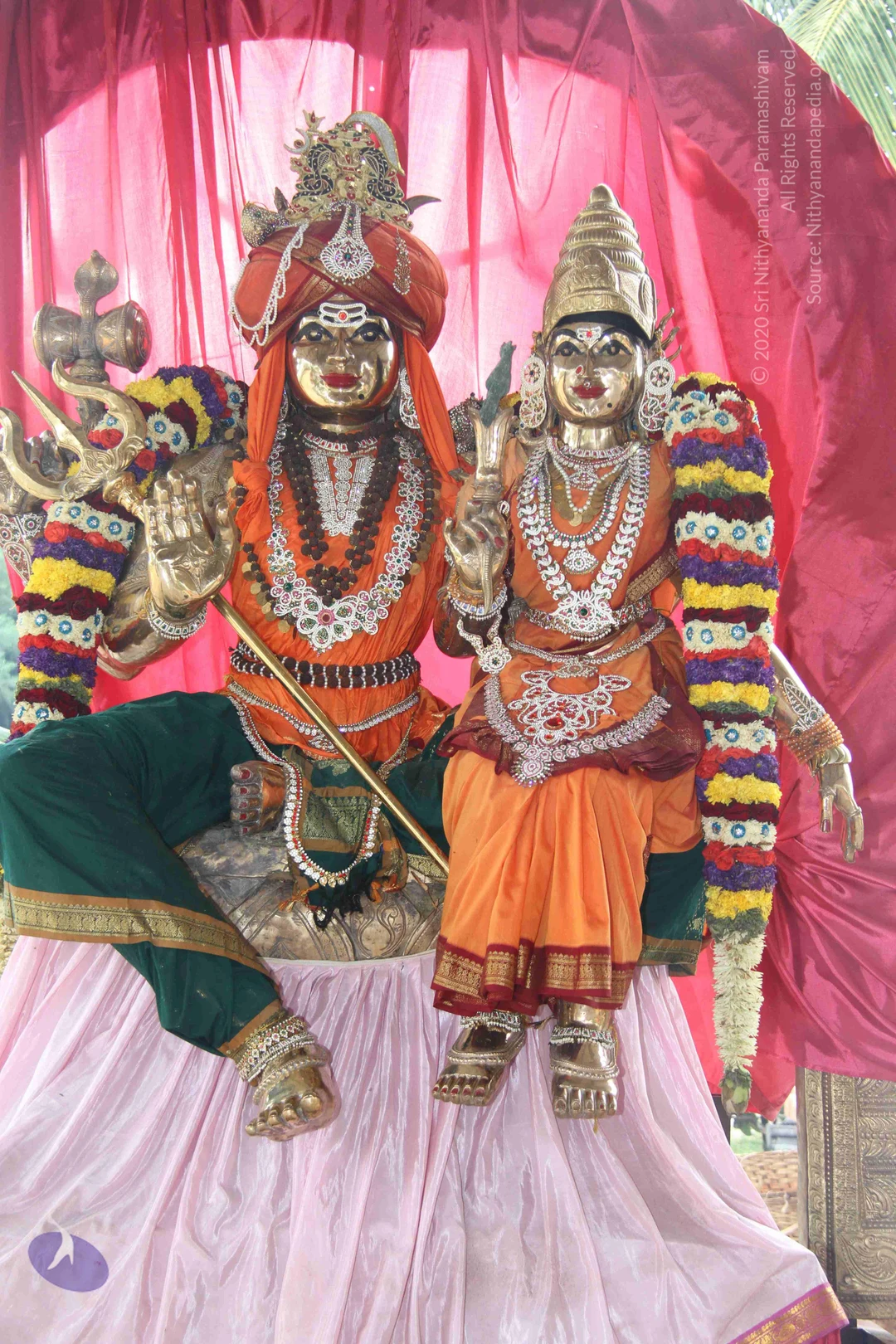
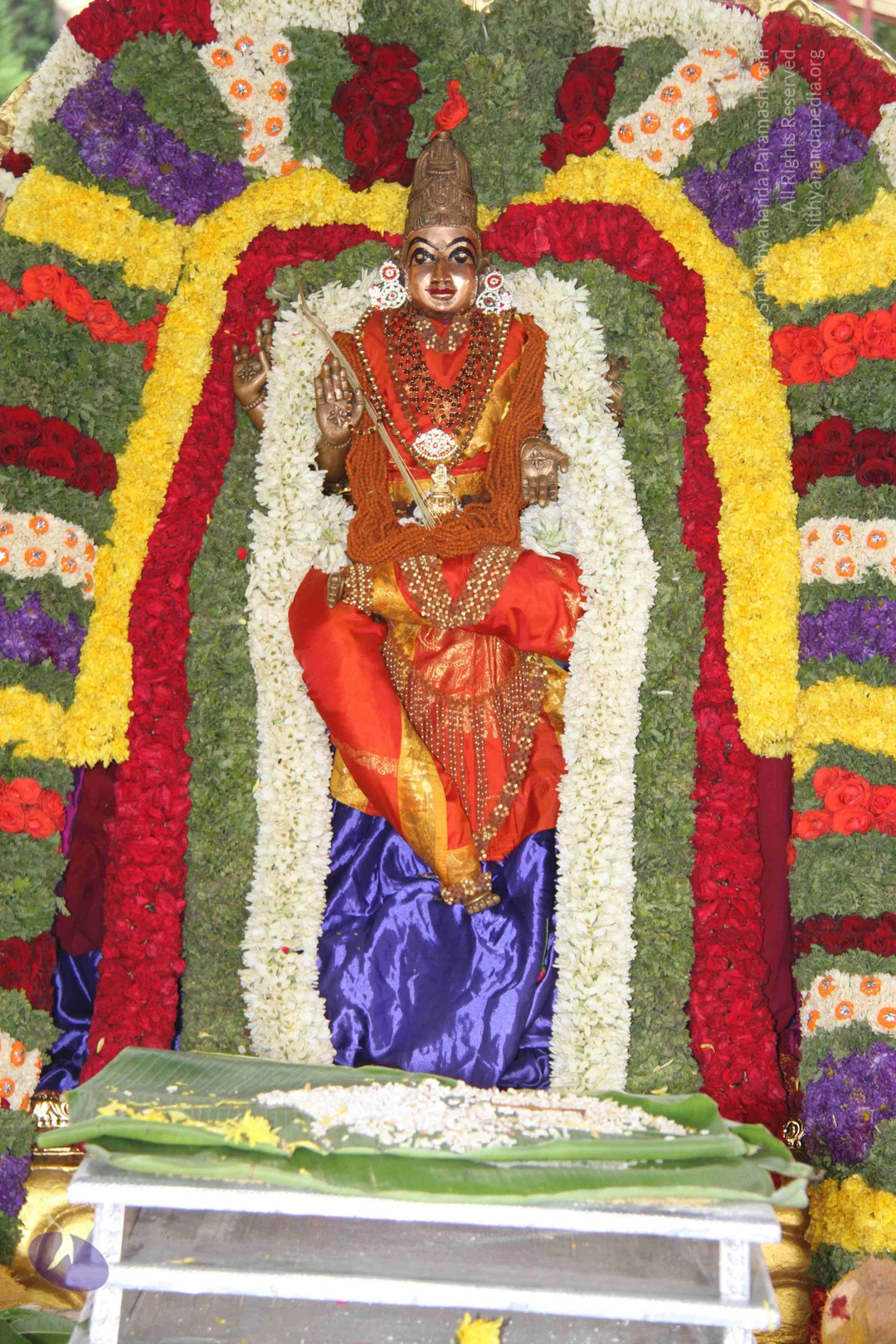
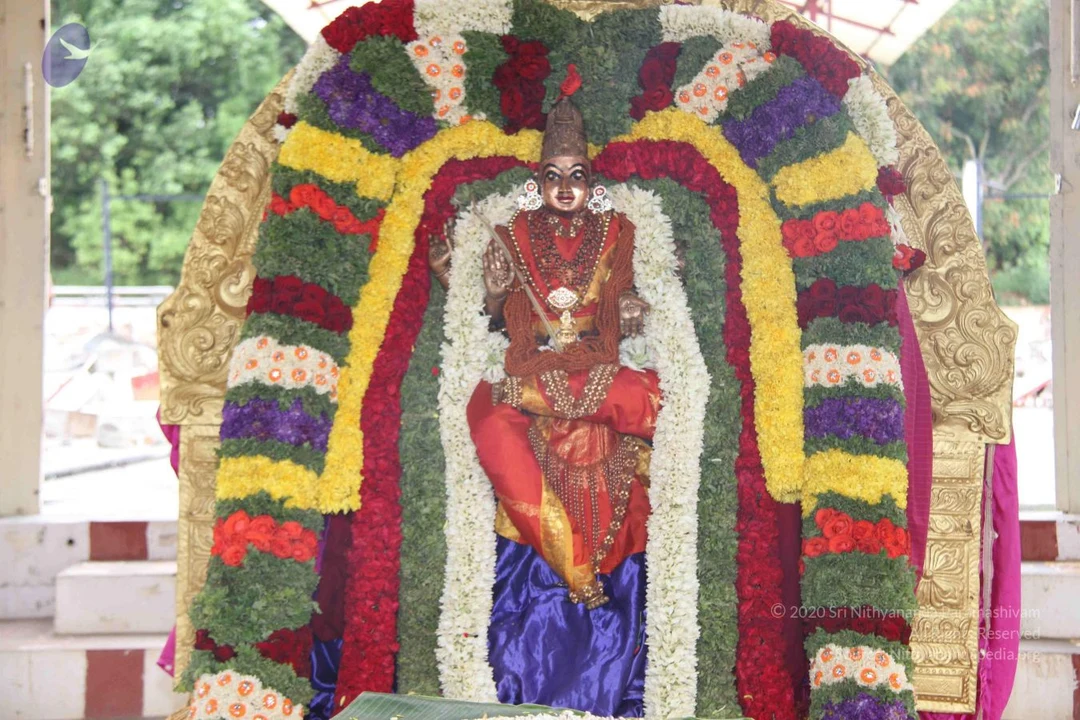
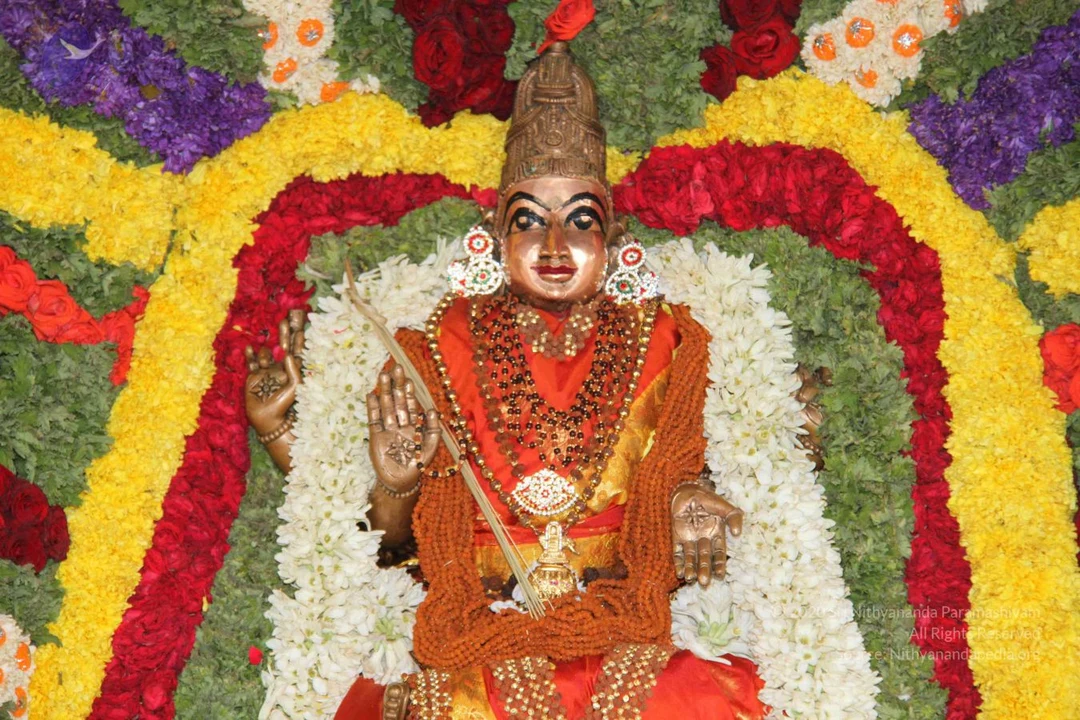
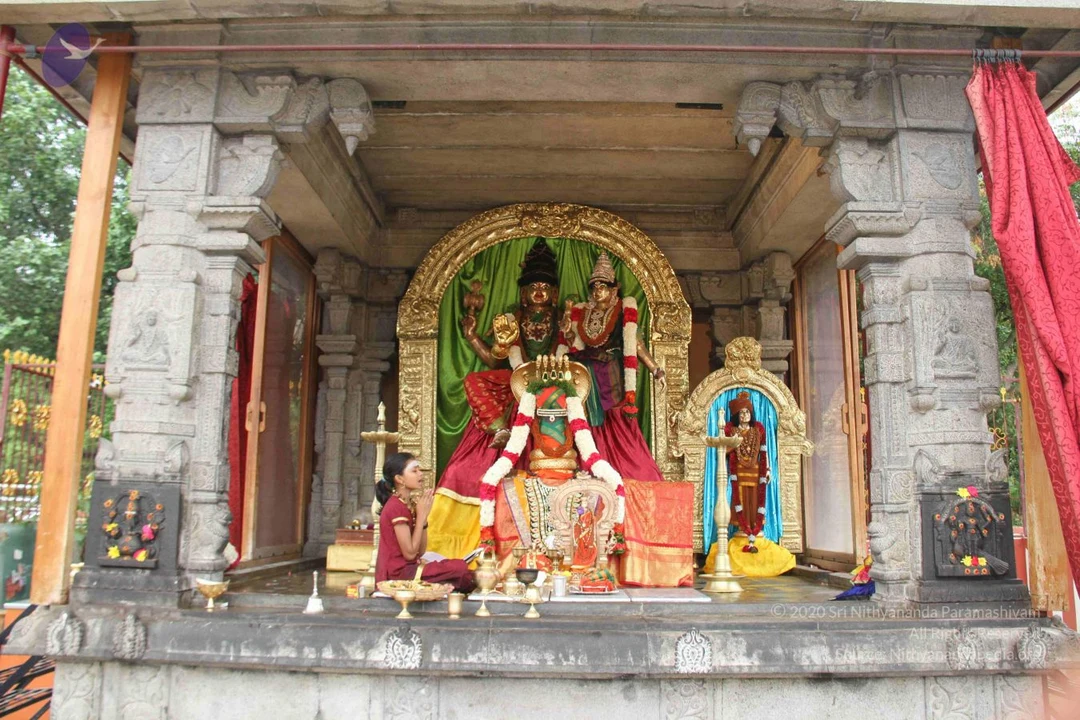
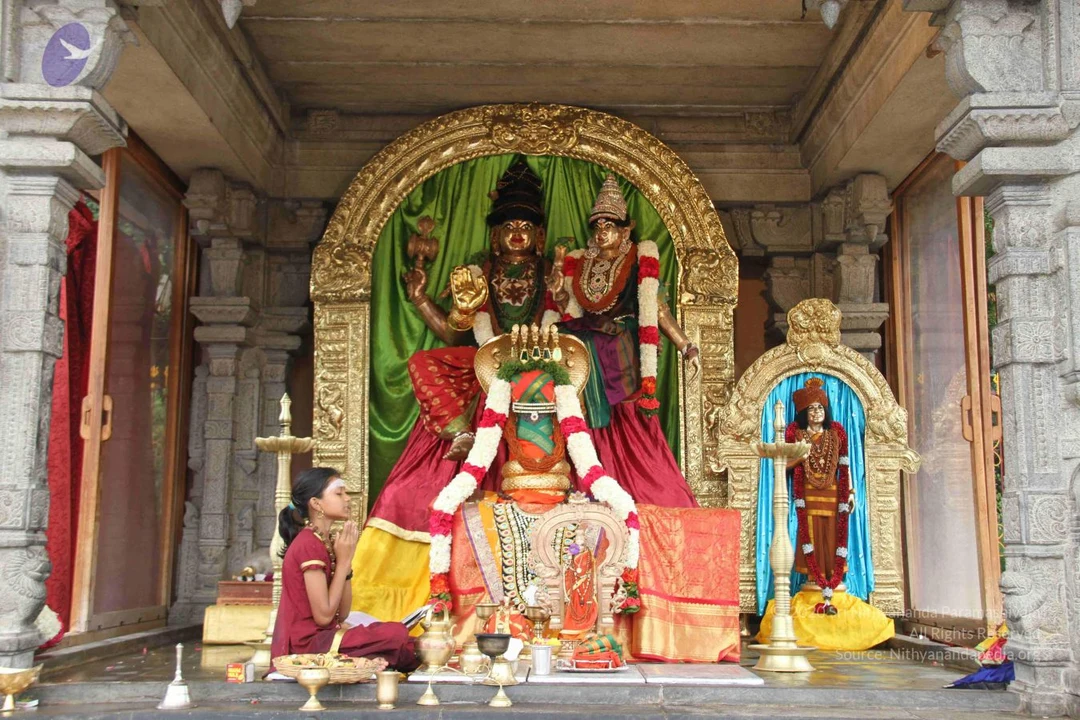
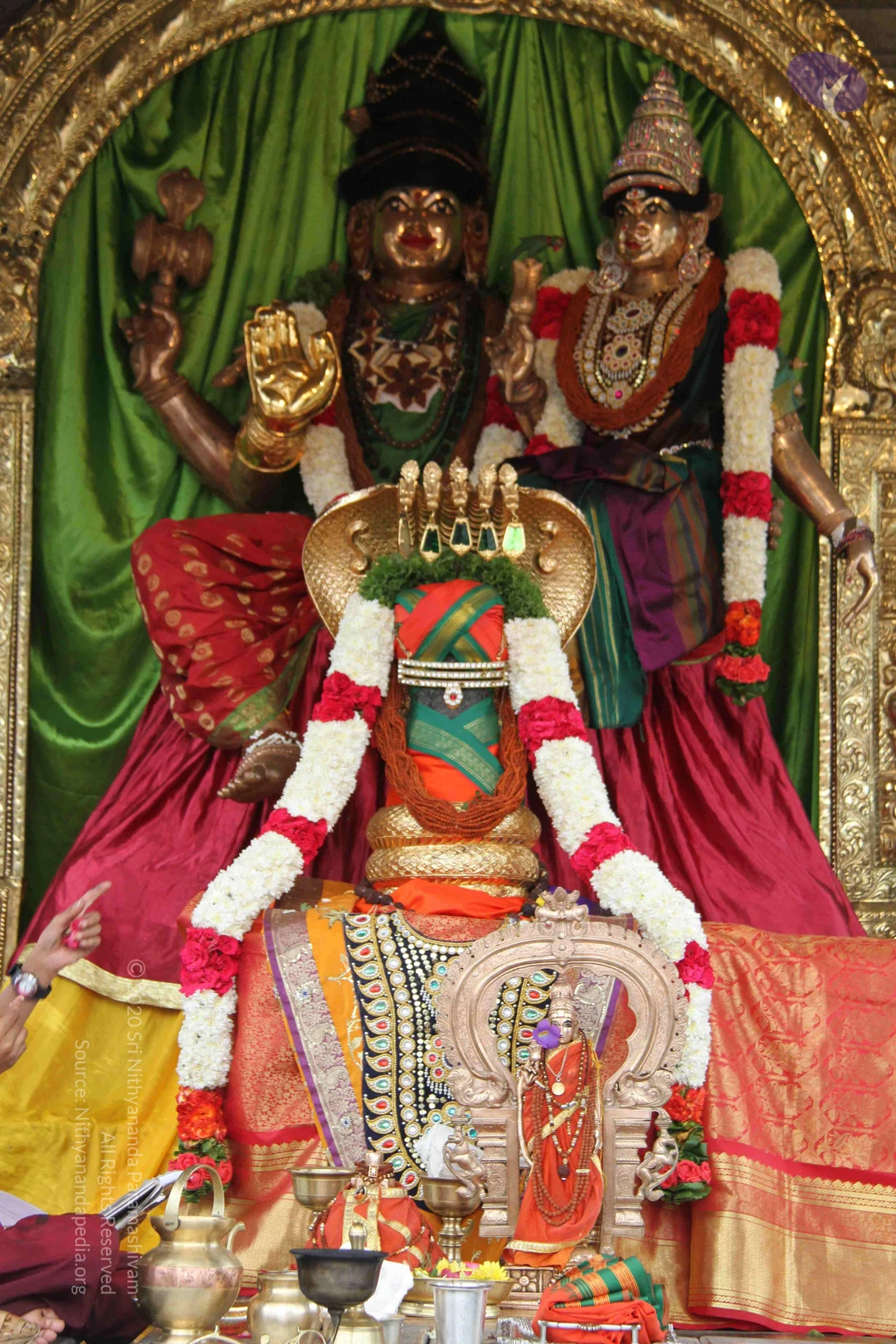
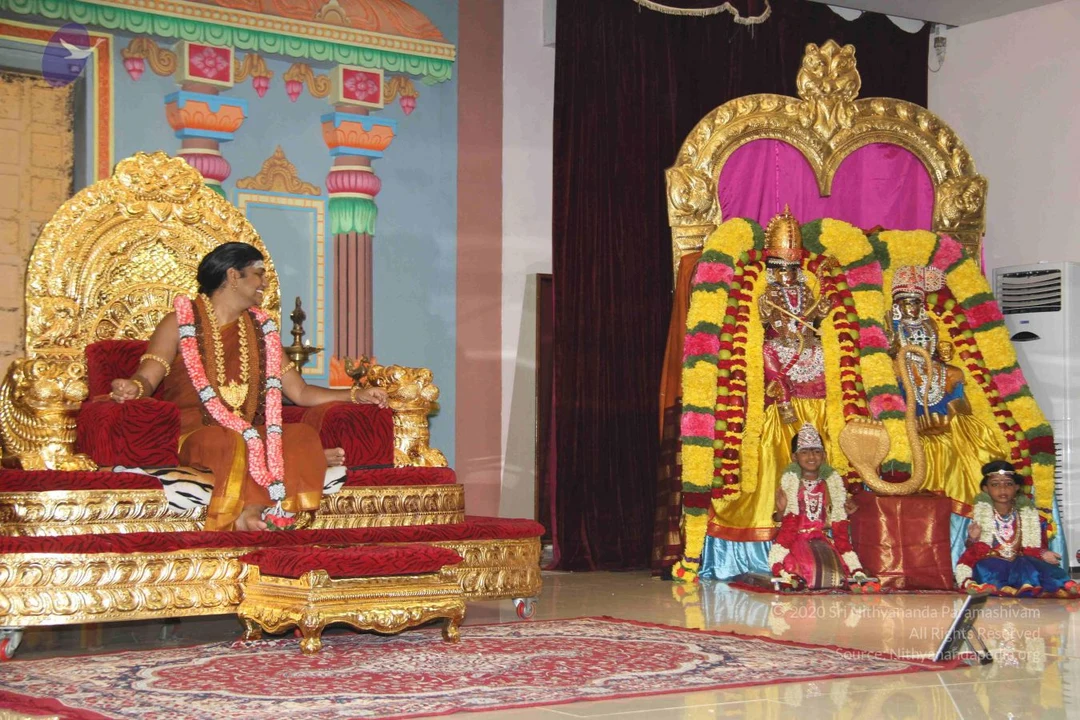
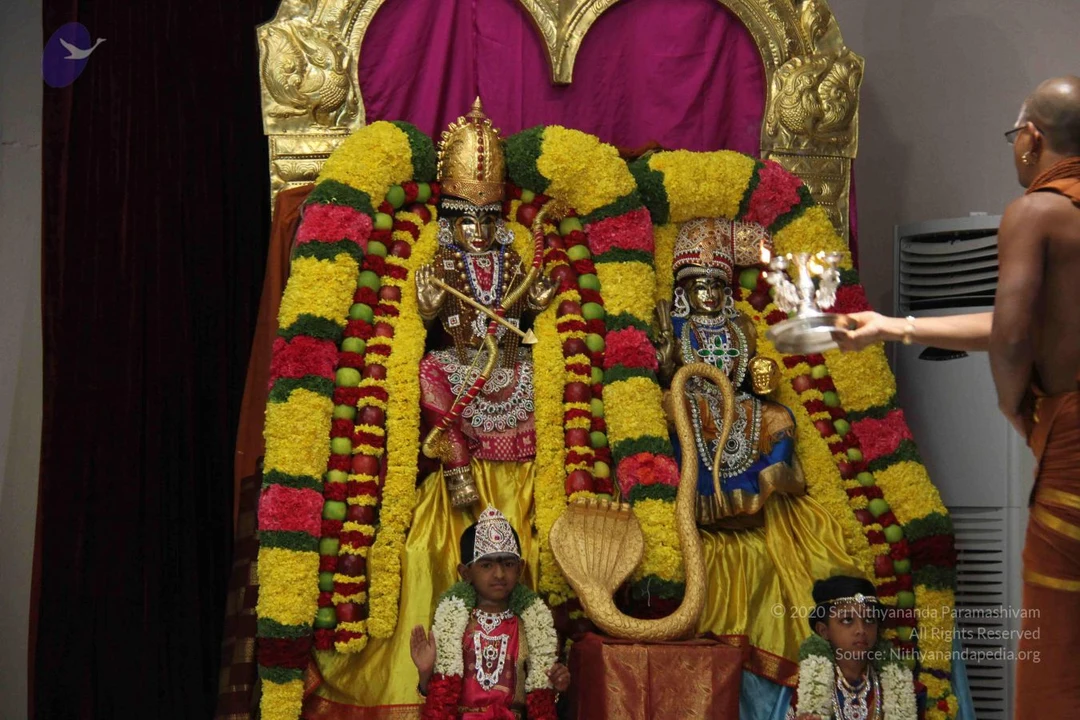
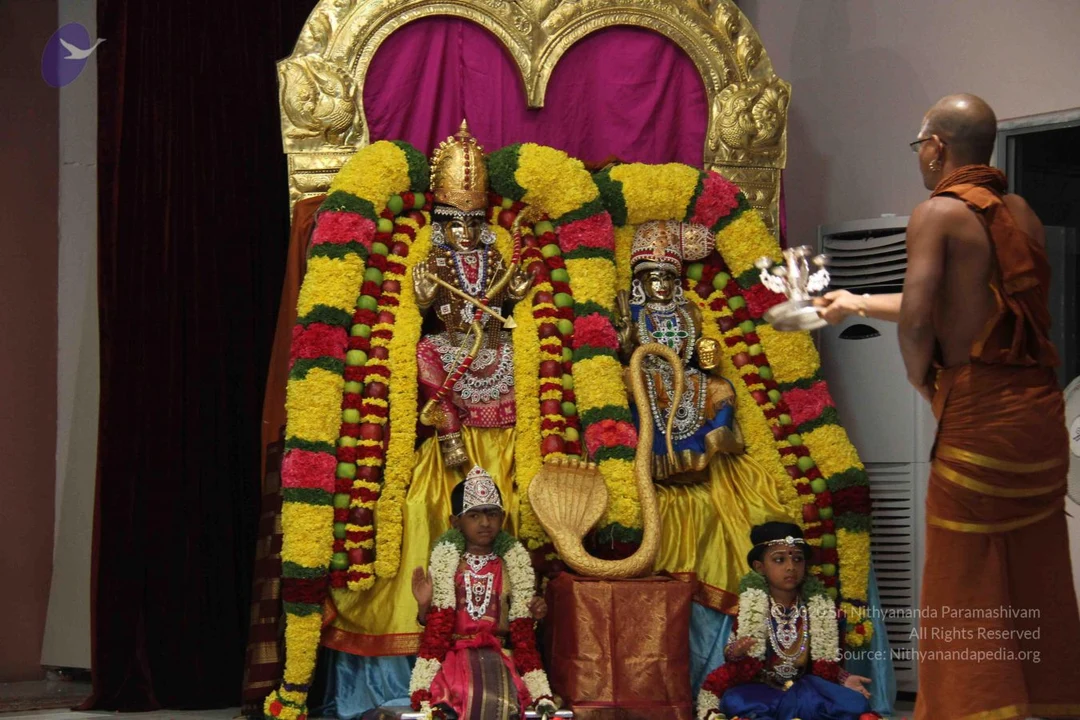
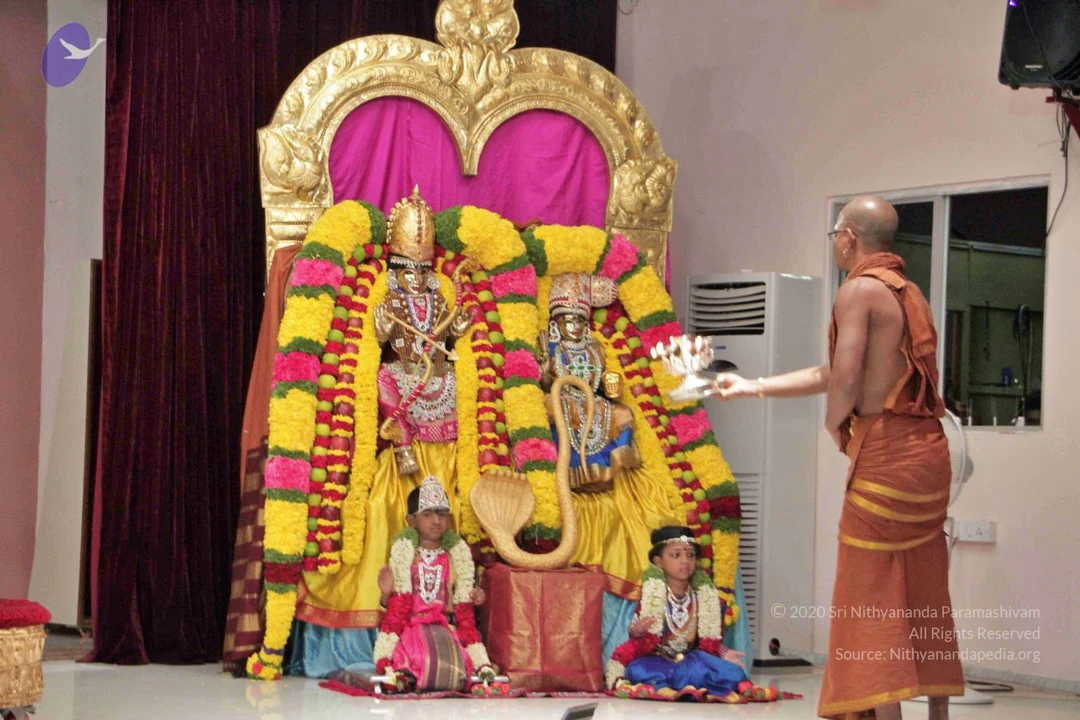
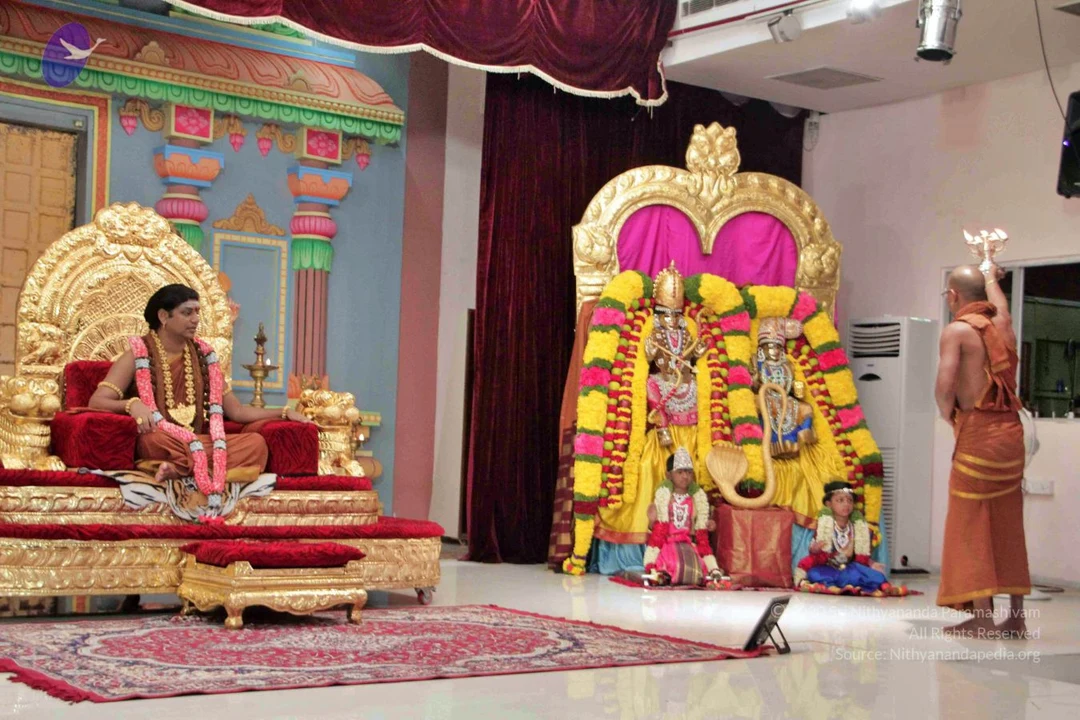
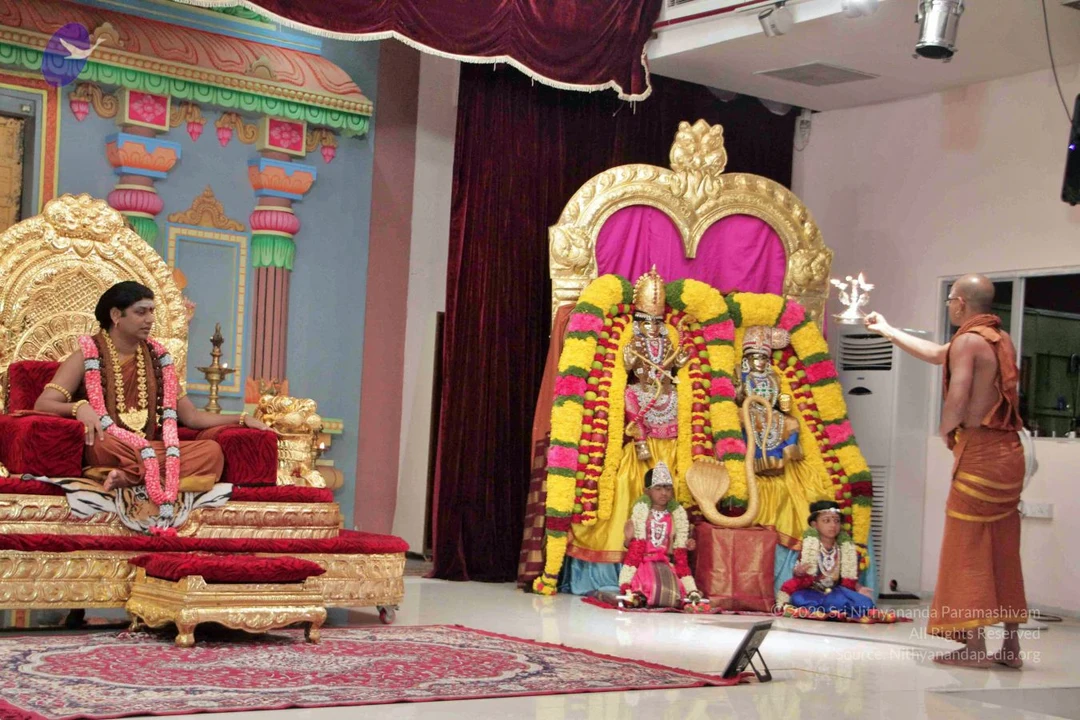
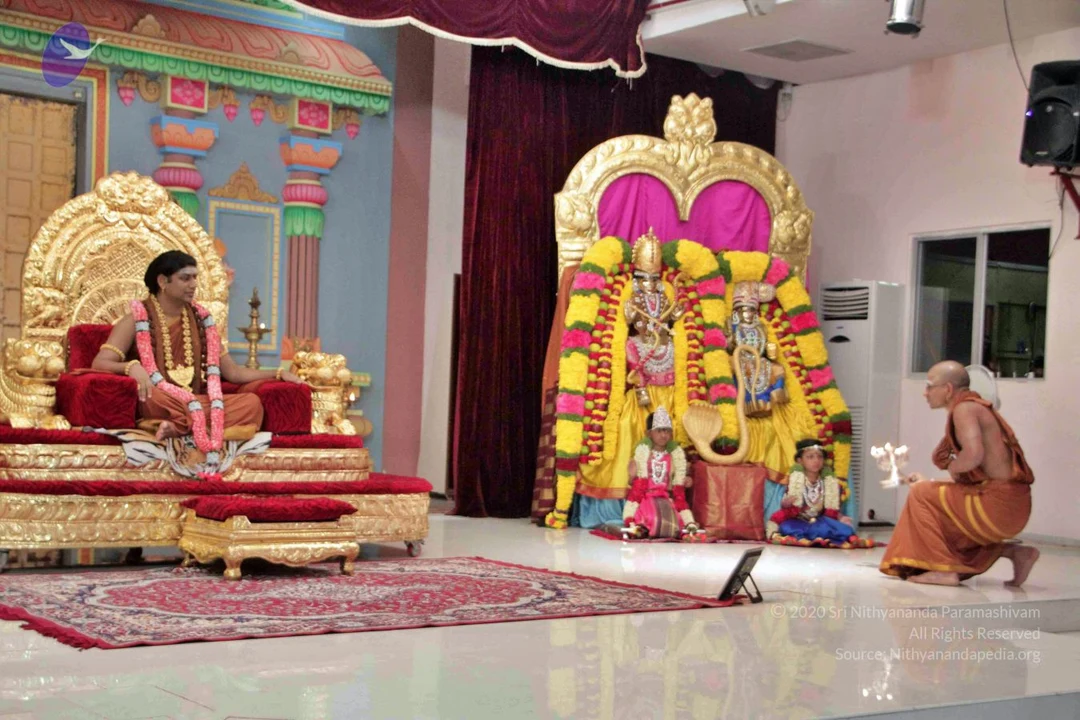
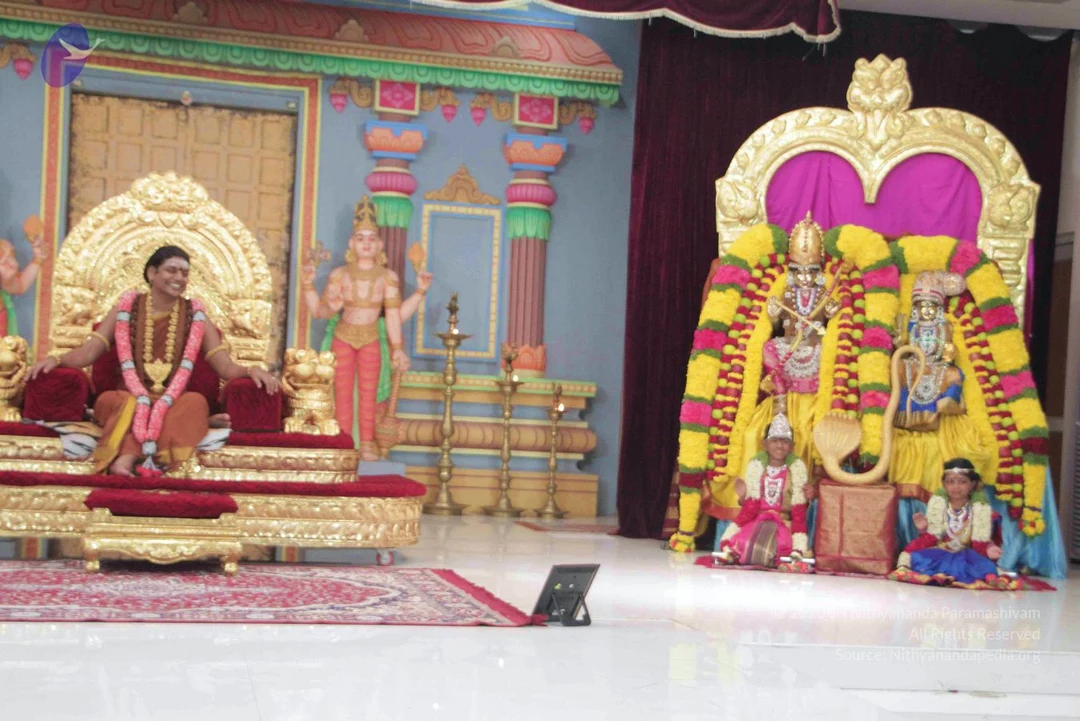
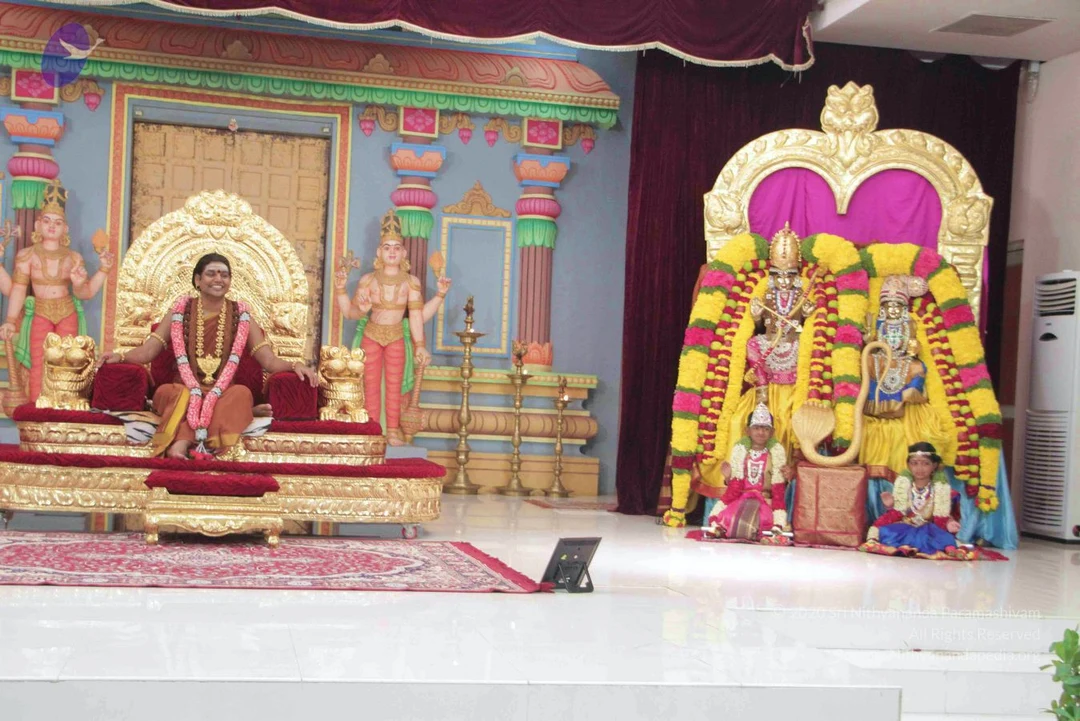
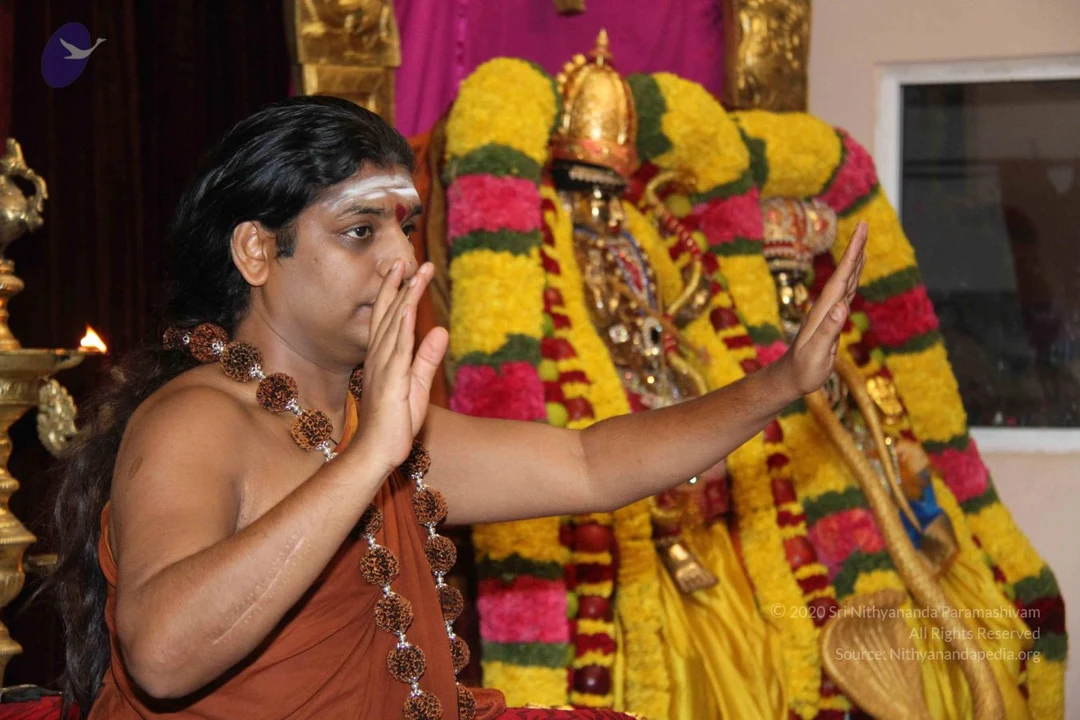
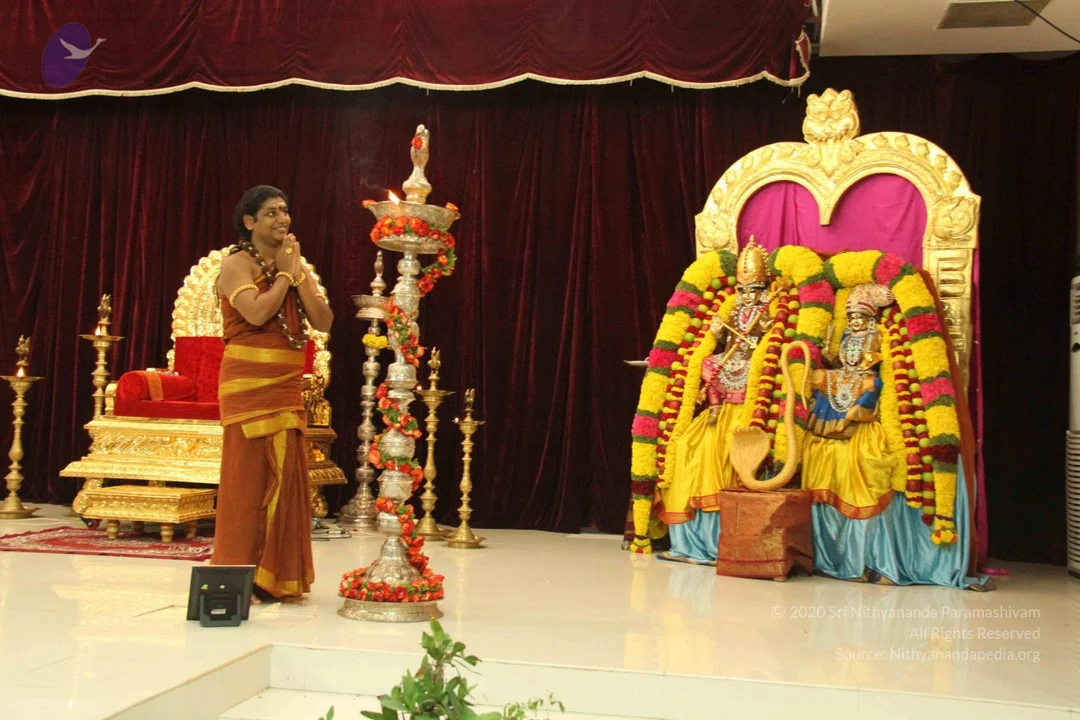
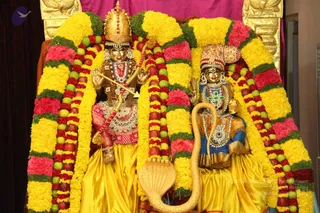
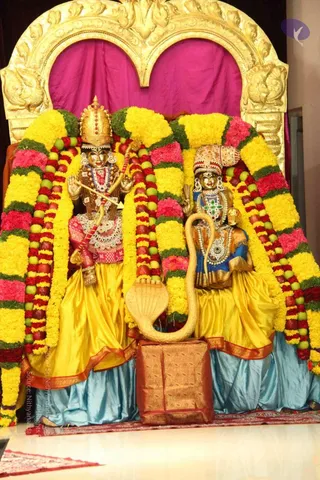
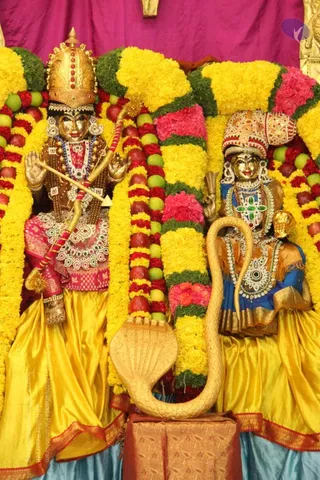
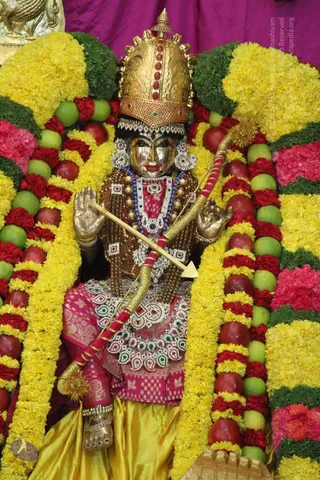
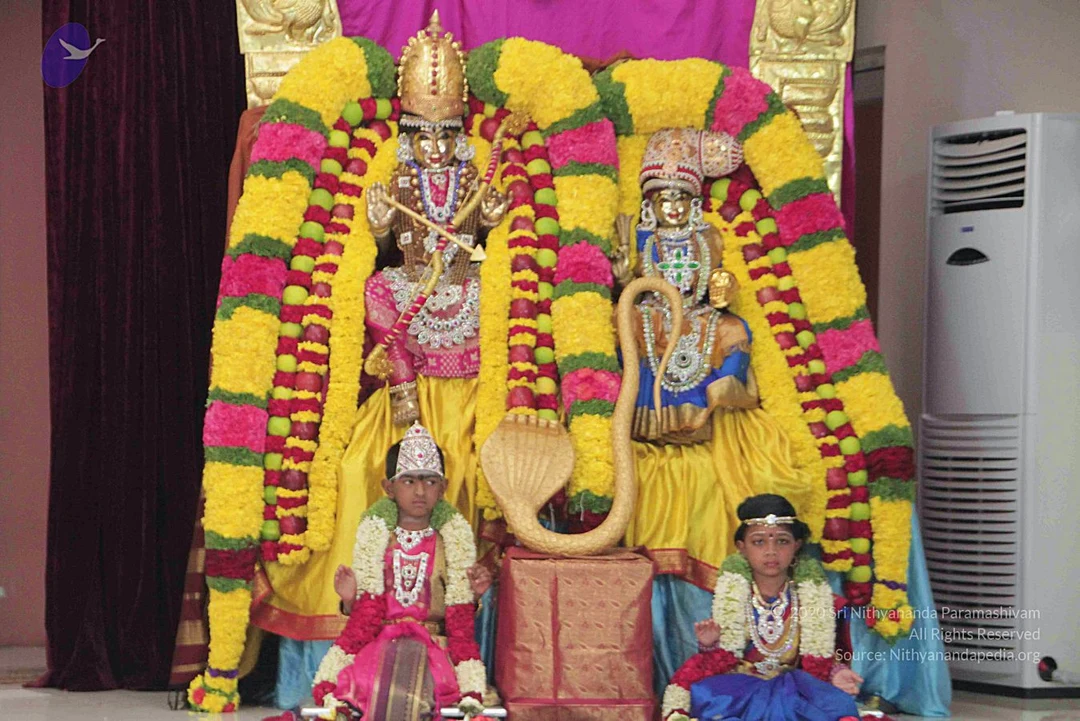
Today, Mahadeva is gracing us in “NAAGAM EIDHA LEELAI”. Means, killing the demonish snake and protecting the kingdom of Madurai, Pandya Kingdom. Mahadeva is gracing us in that leela alankara.

The story is:

There was a king, Ananthaguna Pandya in Madurai. The whole kingdom was following the Shaiva tradition after Jnana Sambandha’s venture.

There was a group of black magicians in the garb of Jain monks. Those black magicians did a ritual and created a demon in the form of a very poisonous snake and sent that snake on Madurai. The snake was directed towards Madurai to destroy the whole kingdom.

Ananthaguna Pandya fought with that snake. He was the king at that time. But, he could not conquer that snake, because it is, the demon.

Finally, he resorted to Lord Sundareshwara. Mahadeva appeared and blessed the Pandya with an energized arrow.

The moment the king shot the arrow, the energized arrow, the snake was killed. But the snake did not die that easily! It vomited venom to destroy the whole Madurai Kingdom.

Then, immediately, Mahadeva sent from the Chandra, the moon, which is in his matted locks, hair he dropped a few drops of nectar from the moon.

Because of the nectar Madurai was saved. Madurai is saved. Again and again he comes down and saves the people in Madurai and Madurai. So this way, Somasundareshwara continuously protected the city of Madurai.

I will start today’s Nithya Satsang.

I will continue with the subject of “COMPLETION AND CREATION”.

Yesterday, I left the satsang with an important question: Why Vivekananda gave the prayaschitha, solution “Do Durga puja and sacrifice thousands and thousands of goats. The blood which flows from the sacrificed animals should make Ganga red!”

We need to study why Swami Vivekananda gave that solution. Understand, I wanted you to know how the morale of Bengal was destroyed, how the cruel capitalist fellows destroyed all our strong financial institutions, and how…….

Please listen! Come to the space of listening!

Actually, Bengal was the richest province in the whole world till 1757. Till 1757 Bengal was the richest province in the whole world.

Now, let me come back to the subject of why Vivekananda gave the solution of sacrificing goats. You can actually go and refer Vivekananda’s biography. You can see the whole incident as I described is there as it is, from some of the reminiscences of close disciples, especially Sister Nivedita, Sarat Chandra Chatterjee. These are some of the close disciples of Vivekananda who were the witnesses for Vivekananda giving this kind of a solution. Obviously, no one can imagine that Vivekananda will give a solution, ‘Cut the goats! Kill the animals! The way you kill the animals, the blood should flow and mix in Ganga and Ganga should become red!’ This is the exact statement! No one can understand. Surely, I will not understand! Fortunately, I did not read this statement in the beginning of my introduction to Vivekananda. By the time I read this statement, incident, I already had developed a lot of respect for Vivekananda. Otherwise, I would have thrown Vivekananda out of my life! For my conditioning, in my house, you cannot even talk about egg! Forget about eating it, you can’t even talk about it! So, any conditioned orthodox South Indian, not even Brahmin, any orthodox South Indian, cannot even imagine a personality like Vivekananda saying, ‘Do animal sacrifice!’ Then, later on, it was Sharada Devi who interfered and stopped the animal sacrifice. And I wanted all of you to know, I stopped the animal sacrifice, personally interfering in my family temple. My family temple is the Devi temple, had the habit of animal sacrifice. I personally got involved in it and stopped it. Even now it is not happening. I stopped it many years before, and it is not happening. But, I don’t want to take pride about it. I am just stating some of the facts.

With this background, even I could not understand why Vivekananda has to go for that solution. Please understand, some of the root-patterns have to be very powerfully completed by reliving it. Understand the science of completion, then you will understand why Vivekananda has to give this solution. And I wanted all of you to know, I wanted to make this statement very clearly, I am not supporting animal sacrifice. I myself have stopped it. In many places, I stopped the animal sacrifice. When the Tamil Nadu Government brought the law banning animal sacrifice, I appreciated it and supported it. There was a time, the Tamil Nadu Government brought a ban on animal sacrifice. I completely appreciated and supported it.

That is the first time I started contemplating, ‘Why this animal sacrifice?’ And I also have to take a stand. My stand. You see, whether you create a controversy around you, whether you accept me or not, now I have become an important entity in Hinduism! May be, a controversial entity, but I am an entity! You cannot deny me! I am an undeniable entity in Hinduism, so I have to take a stand whether to promote animal sacrifice or not. So, just for that, I have to contemplate and come up with a clear decision. So, I started contemplating. Only then I came across with all these traditions, and I studied Ramakrishna’s stand, he is very clear he will not eat, but he very clearly said animal sacrifice should continue in Dakshineshwar Kali temple. He took a very clear stand = it should continue. And Vivekananda takes a stand, ‘Do the animal sacrifice in such a way that the whole Ganga becomes red!’ And near Belur Math, the Ganga is really too big! It is called Hooghly. To make that Ganga red, I don’t know, you may have to kill a million goats or two million goats. And when I was contemplating, I realized a very important truth. Please understand, now you need to have a complete space of listening and understand the truth about completion.

Completion means, consciously reliving the same experience and relieving the powerful impact of the past which makes you powerless in the present. Powerful impact of the past which makes you powerless in the present, it should be relieved from your system. Past should not bind you anymore in the present. Reliving consciously the inadequate powerless cognitions and relieving is Completion.

See, yesterday I was introducing a important principle: What kind of philosophy or religion you should follow. The scale to decide which philosophy I should follow in my life. The scale should be how that philosophy introduces you to you. Please understand, how that philosophy introduces you to you. Based on that, we can very clearly understand.

There are four kinds of philosophies:

· Philosophy encages you.

· Philosophy enslaves you.

· Philosophy engages with you.

· Philosophy enriches you.

The philosophy encages you makes you an animal. You are neither useful to others nor useful to yourself. You are just encaged. What happens to an encaged lion? It becomes violent, terrorist. I tell you, a lion which is free, a tiger which is free, if he is not hungry, he will not attack you. If he is not threatened, he will not attack you. But the lion who is caged, will attack whether he is hungry or not, whether he is feeling threatened or not, he will just attack left and right! When you are encaged, you become a terrorist! All philosophies which makes you a fanatic, which encage you, are terrorist philosophies! Which make you a terrorist are encaging philosophies!

Next comes enslaving philosophies. It does not make you a terrorist, but you become a slave. Ideologically, you cannot have your freedom, independence. You are no more fresh. The religion of dead and religion which worships death, the philosophy of death, and philosophies which worship death. Where you are enslaved, where the introduction about you is completely enslaving.

Then comes the philosophies which engages with you. Dialogue. They tend to convince you. I can give you the example of Buddhists. The whole Buddhism is nothing but engaging with you. The more and more you get engaged, the more and more you get attracted. A very soft converting religion. That is why it appeals so much to the West.

Then comes the philosophies which enriches you. For that, I will give example: the Aghori, the tradition of Aghoris, the tradition of Advaithis, the traditions of Yogis and Siddhas. Yoga, Siddha, Aghori, these philosophies, of course, Vedanta, these philosophies are very powerful, enriching philosophies. Because Vedanta introduces yourself to yourself as “Amrutasya Putraaha” with a beautiful word “Poornamadah Poornamidham Poornaath Poornamudhachyathey, Poornasya Poornamaadhaaya Poornameva Vasishyathey”.

Please understand, human-beings because of the bringing up of the society, suffer a gap between the inner image and outer image. The gap between the inner image and outer image creates a deep self-doubt. So, understand, whenever the gap between the inner image and outer image is established in you, you suffer with self-doubt. The philosophers have started exploiting your self-doubt by introducing yourself to yourself as a sinners. Vedanta is the only honest, integrated, authentic, responsible, enriching philosophy which does not exploit your self-doubt pattern and which reminds you, even when you feel you are removed from the Whole, you remain as Whole. Even when you have self-doubt, understand you are the Self! Even when you have self-doubt, you are Self! Self-doubt is only Self doubt! This should be the scale, the introduction you are given about you to yourself. What kind of an introduction that philosophy gives to you about you, only based on that we can classify that philosophy whether it is encaging, or enslaving, or engaging, or enriching. The whole Vedanta system is all about enriching. Constantly they try to enrich you.

Now comes my doubt. Then why Swami Vivekananda, who is the embodiment of the Vedanta philosophy, says, ‘Give animal sacrifice! Do animal sacrifice!’?

After I contemplated, I understood a very important fact:

The collective root-patterns have to be relived and relieved only by reliving the same actions. Please understand, the collective disempowering root-patterns got developed in the Bengalis’ consciousness. Is the Fear of mass deaths, where thousands die because of the artificial famine. The whole Bengali psyche was destroyed. They lost the morale. They lost the morale of trusting life. At the time of Vivekananda, the whole Bengali consciousness was suffering with the root-pattern of “life is cruel”. Please understand, what you think about you, what you project as you to others, what you think about you is inner image, and what you project about you to others is outer image, what you think about life and others is Swa-Anyakaara, your image about others. The Bengali consciousness about life was “Life is Cruel”. Please understand, the root-pattern which is created in one individual lives till he completes with it. The root-pattern created in the collective consciousness, in the community, lives till the whole generation completes it. And the whole Bengali consciousness at that time was suffering with the root-pattern of Swa-Anyakaara, the others’ image, that “Life is Cruel”. Seeing thousands and thousands of people dying, the pattern of being terrorized has settled into them. “Life is cruel” has become such a strong collective conscious pattern in them. Now they have to relive consciously the mass deaths. Only then, the collective consciousness can get relieved from that pattern, “Life is cruel”. What is the way? You can’t now kill again thousand more people!

Understand, with my Integrity and Authenticity and Responsibility, I am uttering, the words I am uttering. I am not justifying what Vivekananda did; I am not trying to justify what Vivekananda did, or what Vivekananda wanted to do. I am just revealing some of the truths from the cosmic plane, from the plane of superconsciousness. I really feel, if Vivekananda would have lived just twenty more years, the history of India will be different! So why Vivekananda has to give that solution. You may have to wait for tomorrow’s satsang. Its already late, time is up. I wanted to take enough of time and explain why our Master’s do what they do.

We will move to Nirahara Samyama. I request all the Nirahara Samyama participants to sit straight. Close your eyes. Visualize you have become Bidadi Kalpavruksha. Inhale through both the nostrils and the mouth. Hold as long as you can comfortably, and exhale as slowly as you can. And continue this Kriya for the next twenty-one minutes. With Integrity, Authenticity, Responsibility and Enriching, I bless you all. Let you all experience intense Kundalini awakening and live health, bliss and enlightenment. Namah Shivaya!

I bless you all! Let you all Achieve, Experience, Live, Express, Radiate, Share and Explode eternal bliss, Nithyanandam!

Photos From The Day:
Tags:

Paramahamsa Nithyananda, philosophy, encaging, enslaving, engaging, enriching, self-doubt, image, sinners, whole, Self.

Photos Of The Day:

Leela-Alankar

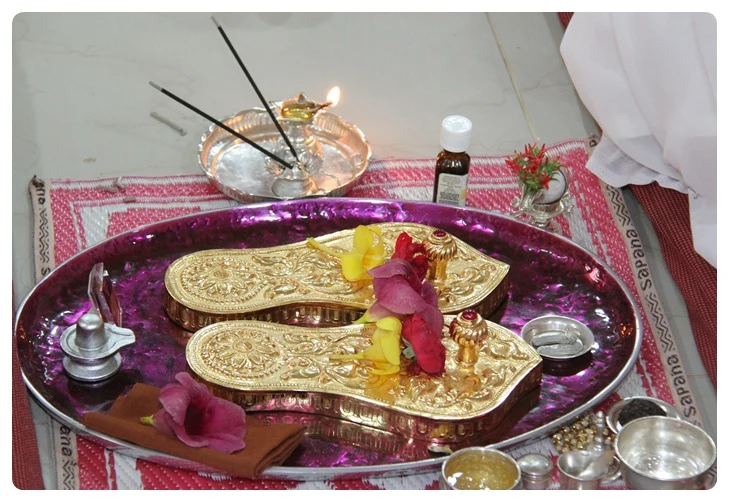
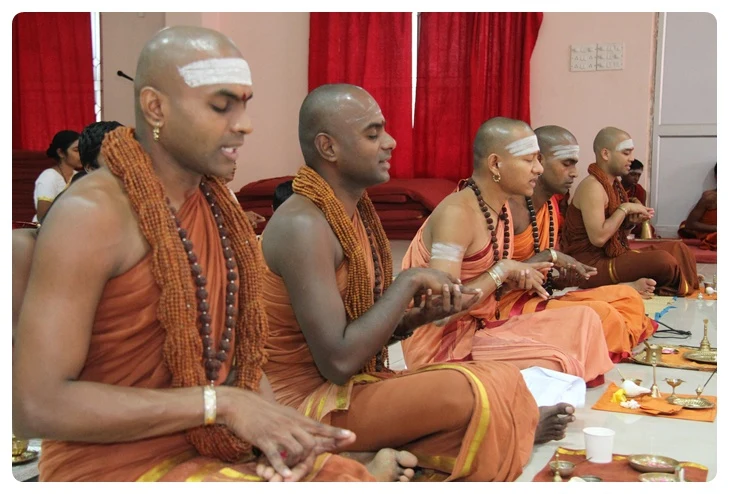
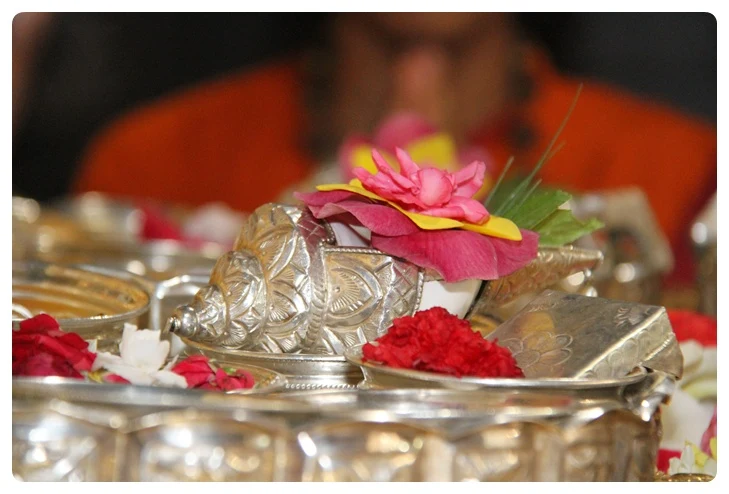
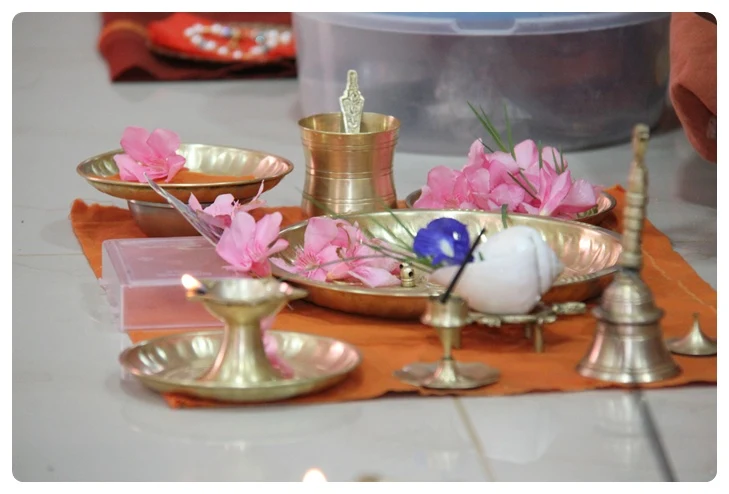
Pada-Puja

Temple-Visit

Deity-Aarti

Nithyananda-Satsang

Sarva-Darshan

IA-Gurukul-Show

IA-Darshan

IA-Lunch

Glimpses-of-my-Inner-Awakening

Photos from this day

View all 414 photos

Photos From The Day:
30 photosSource gallery
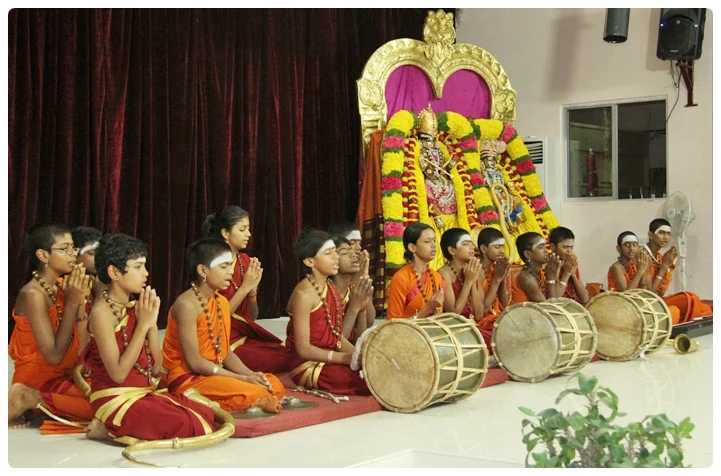
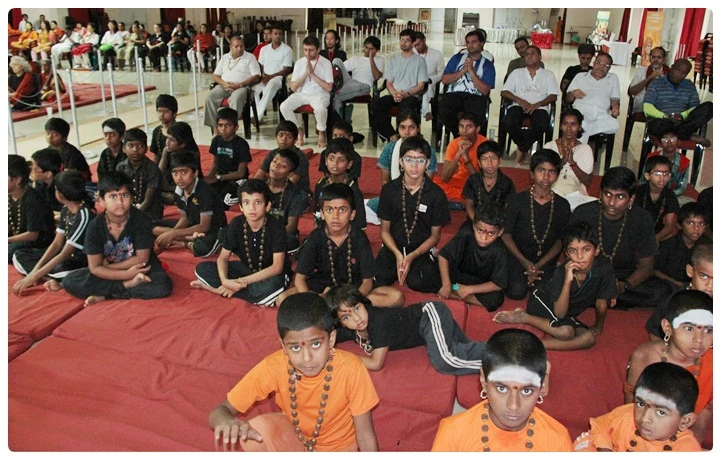
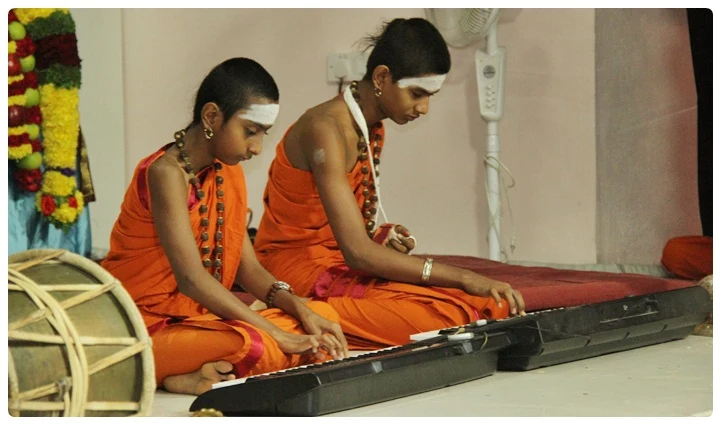
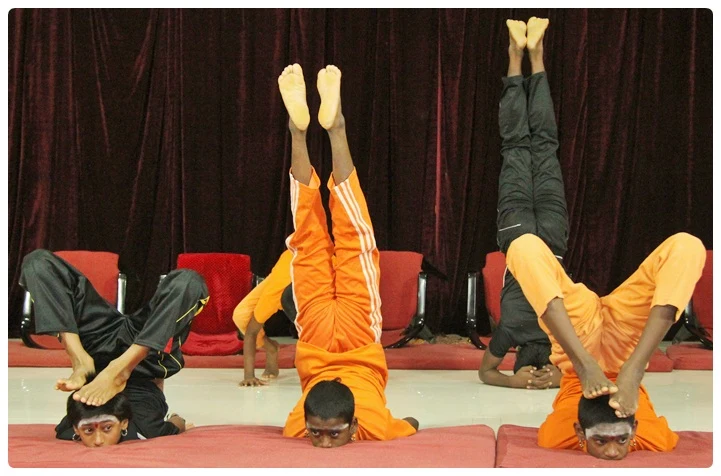
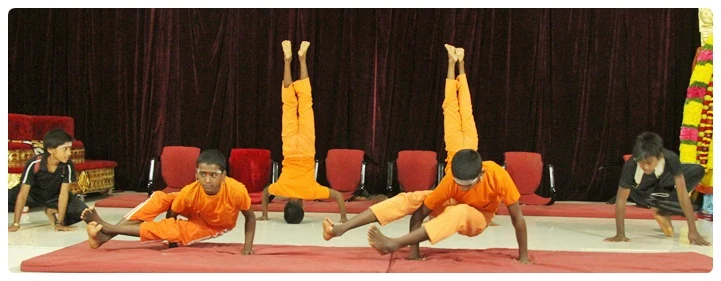
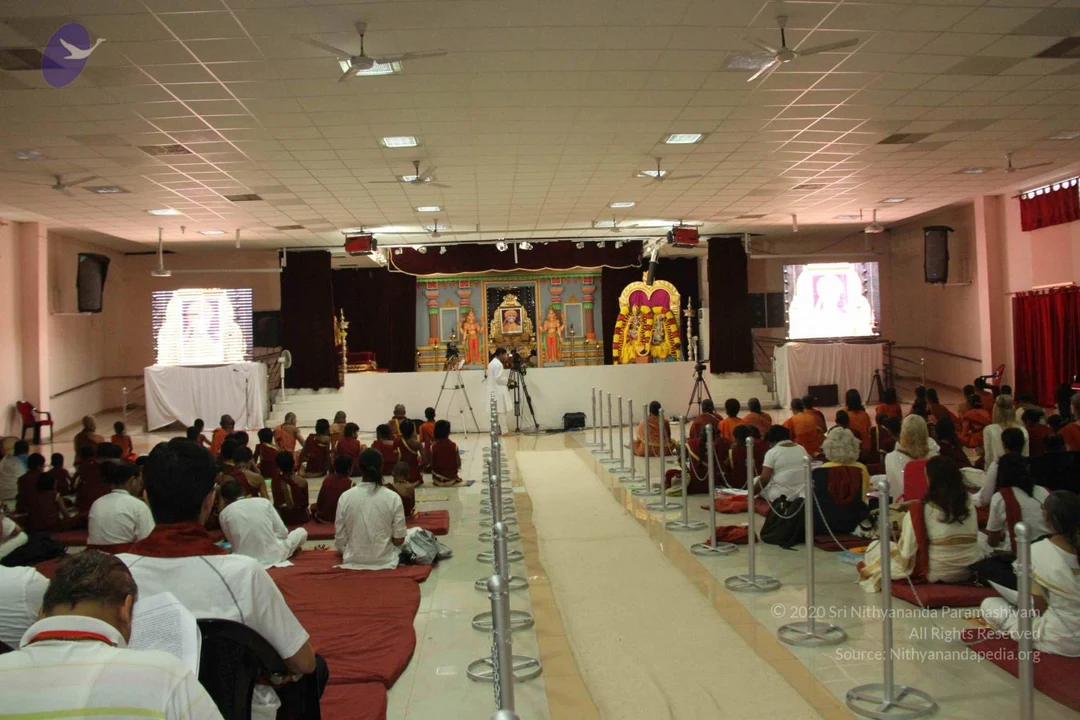
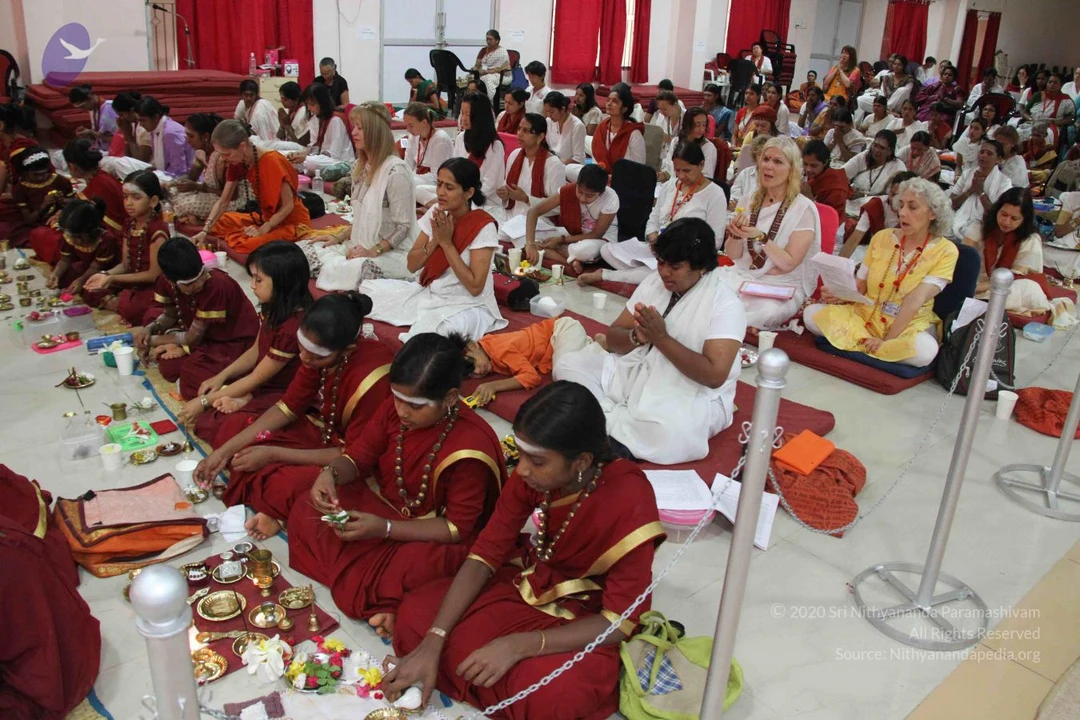
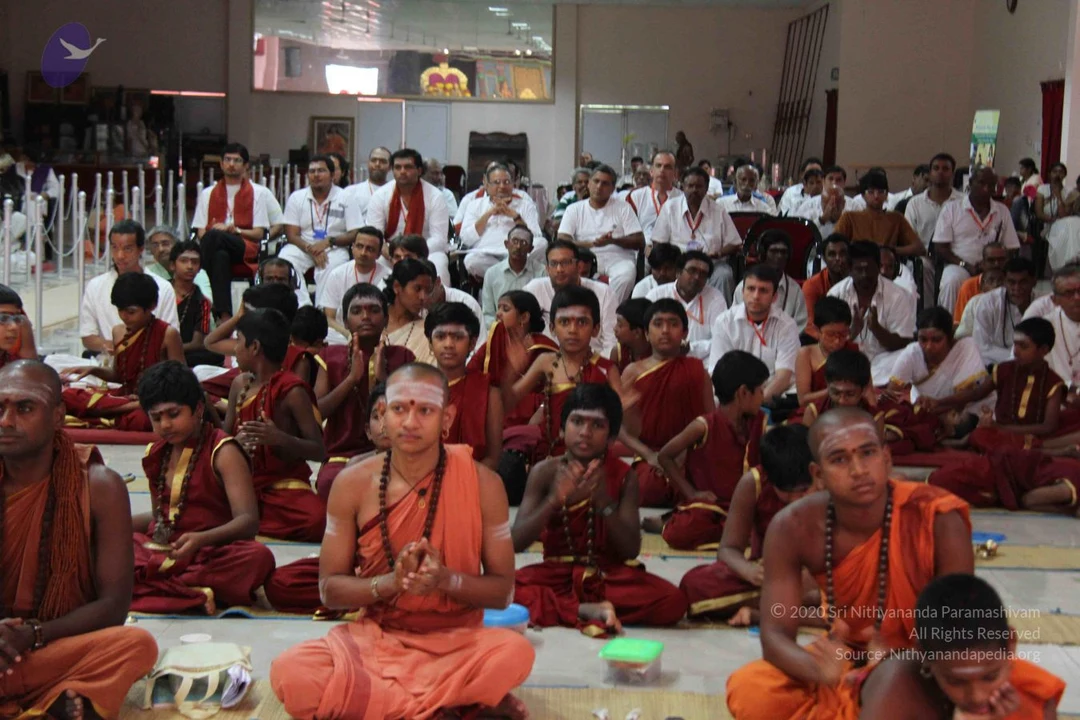
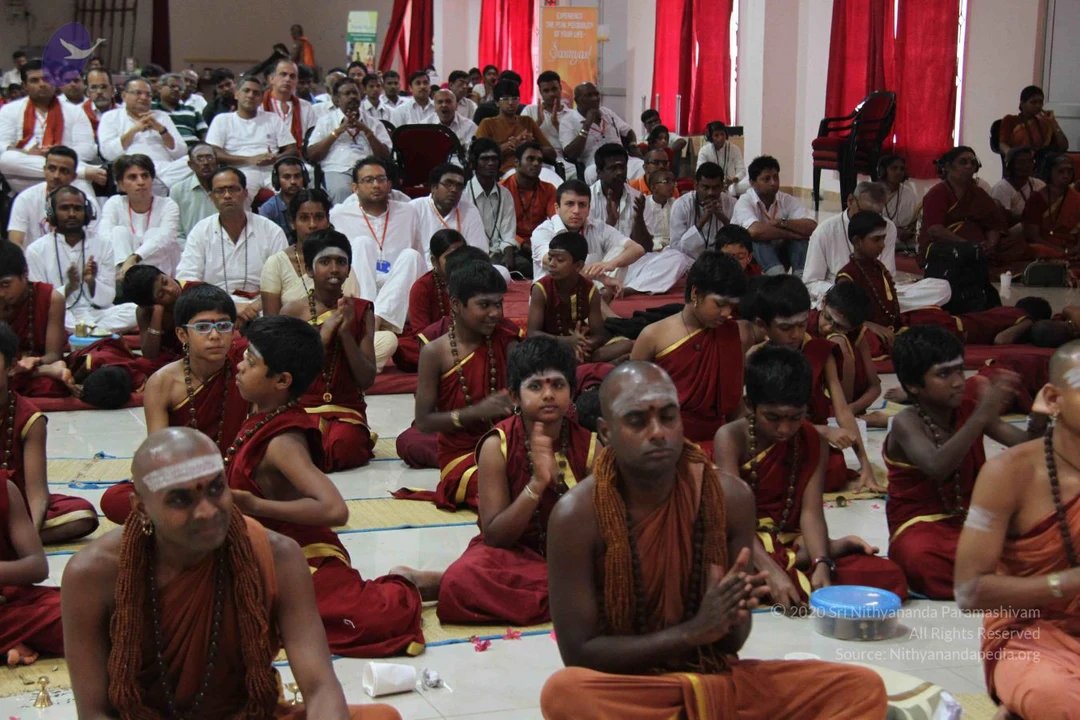
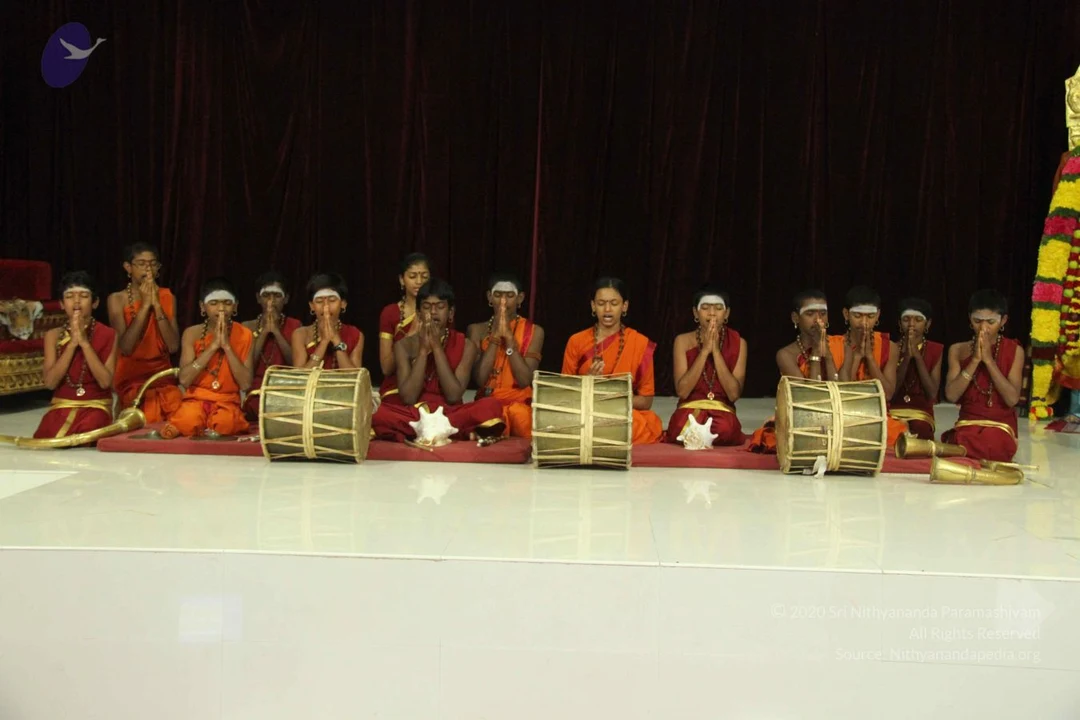
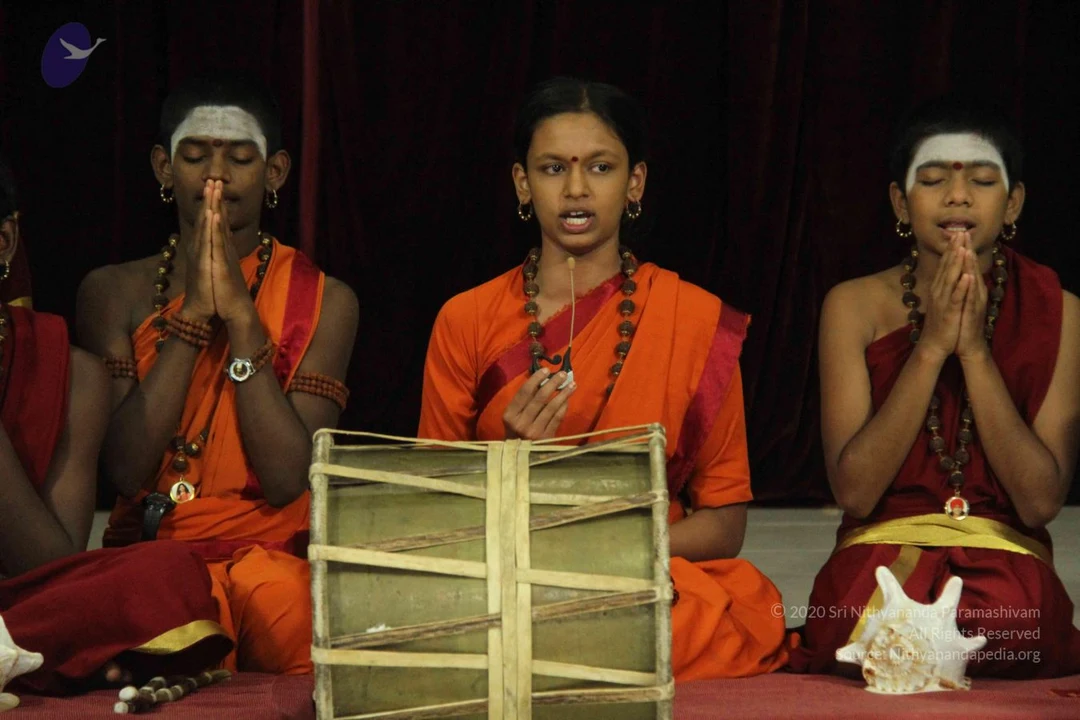
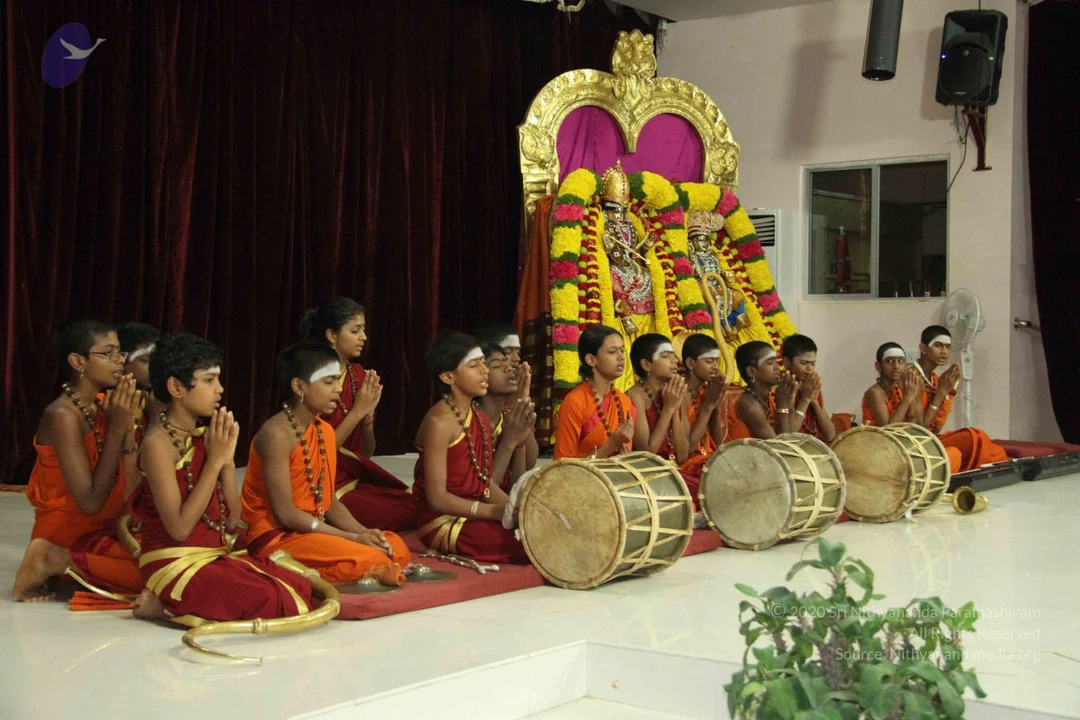
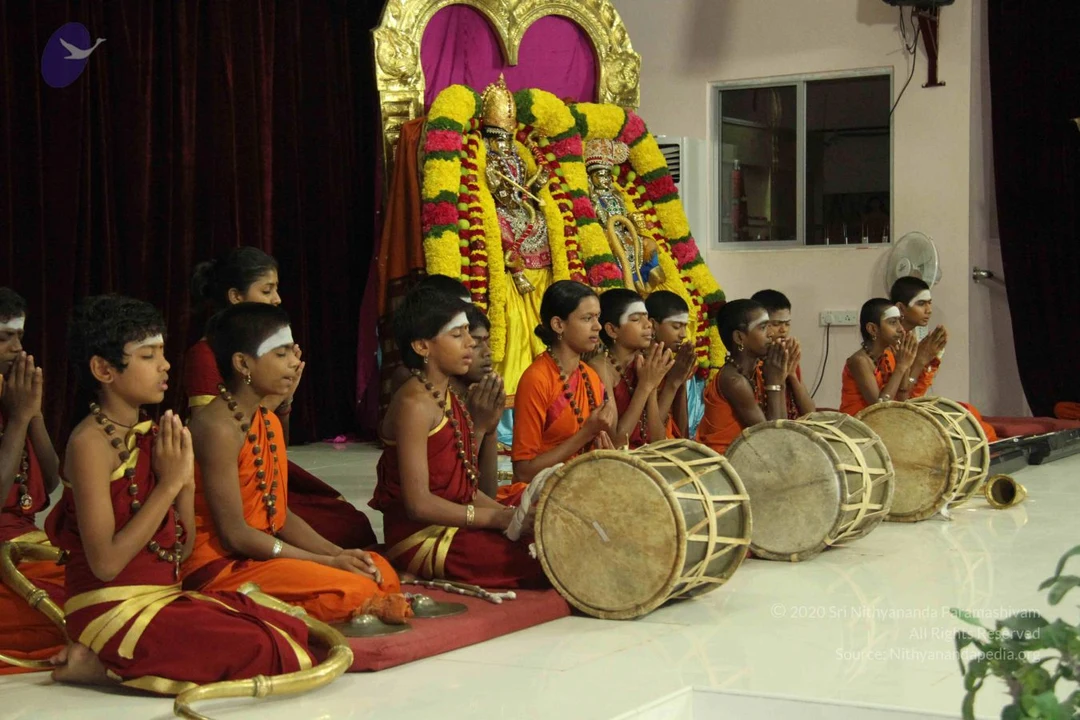
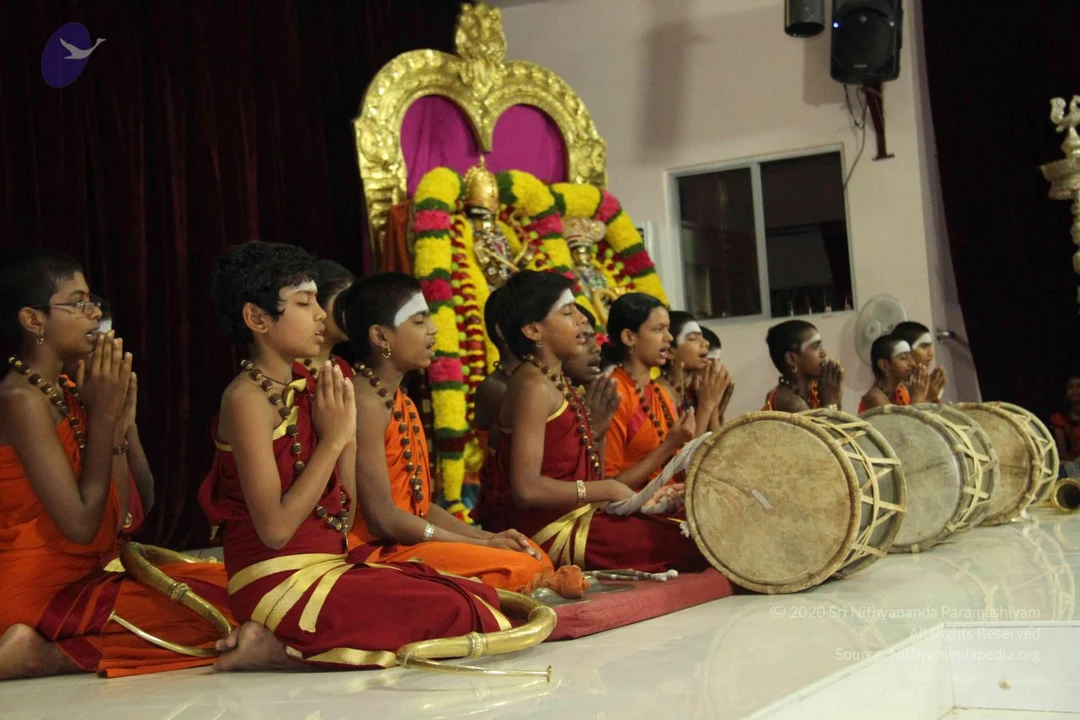
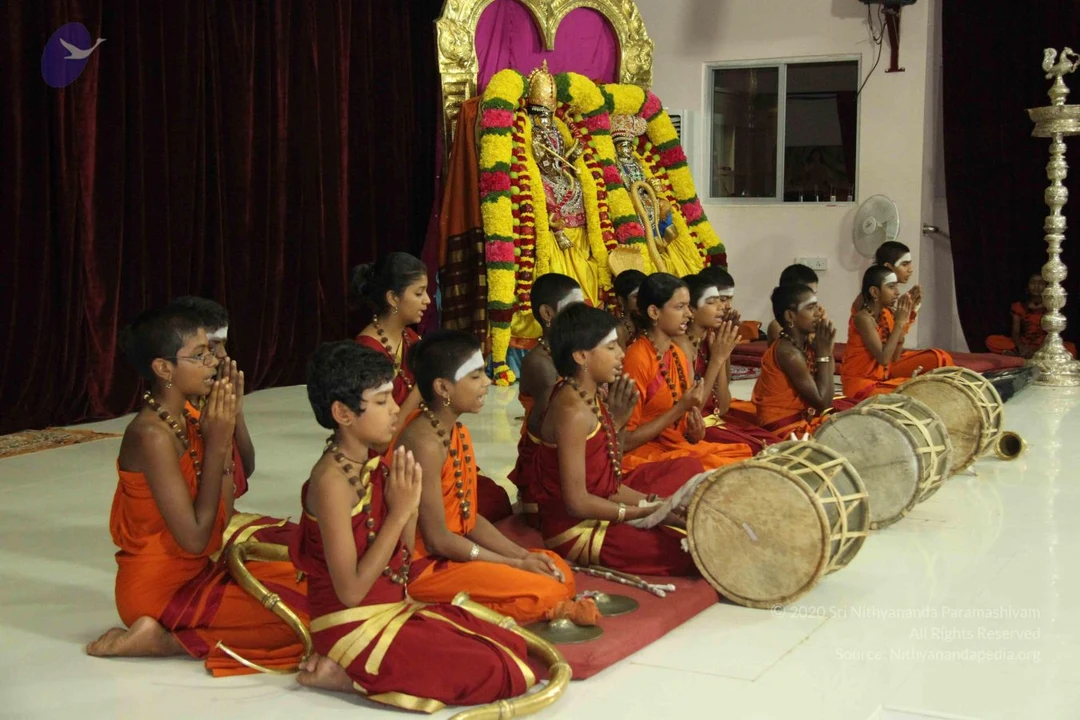
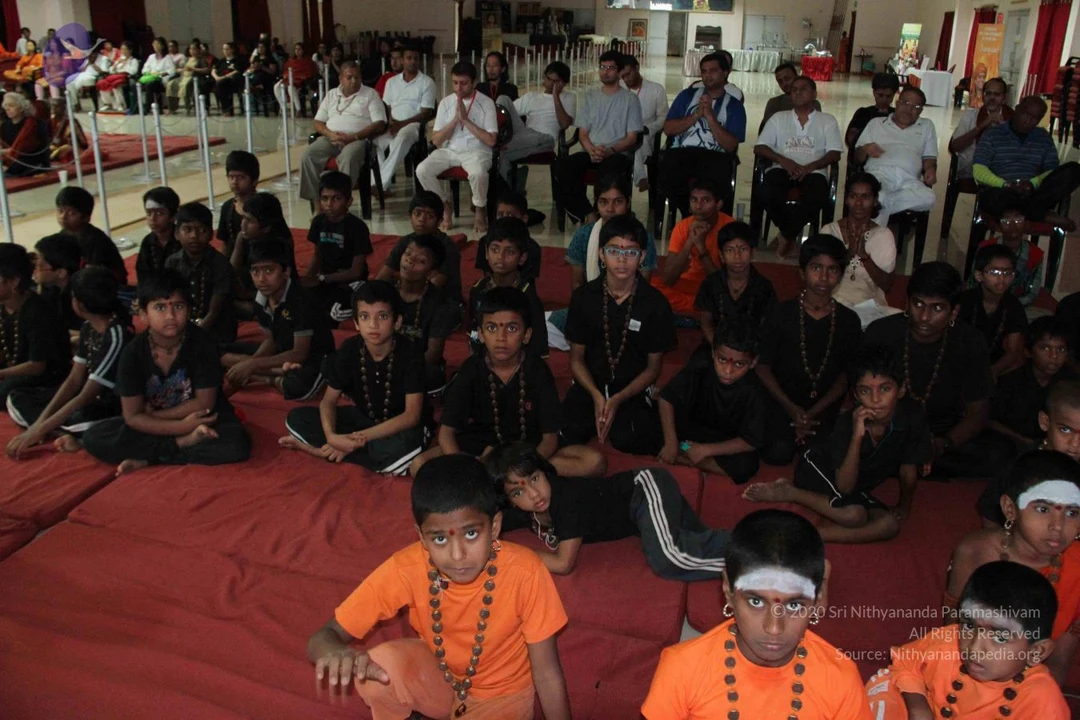
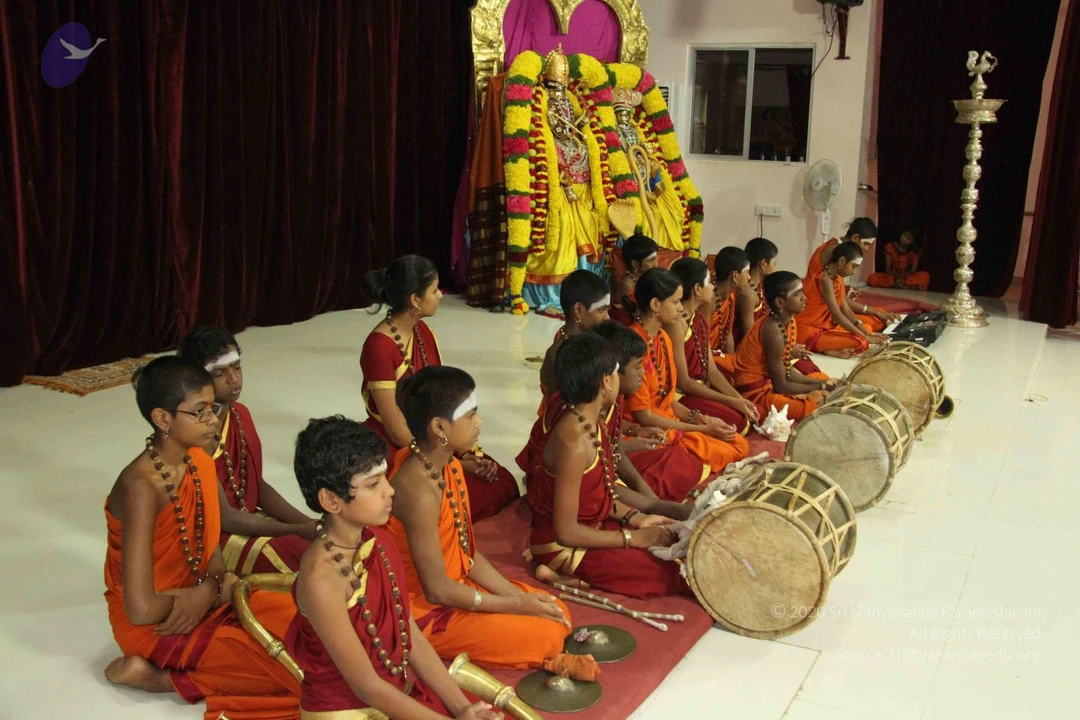
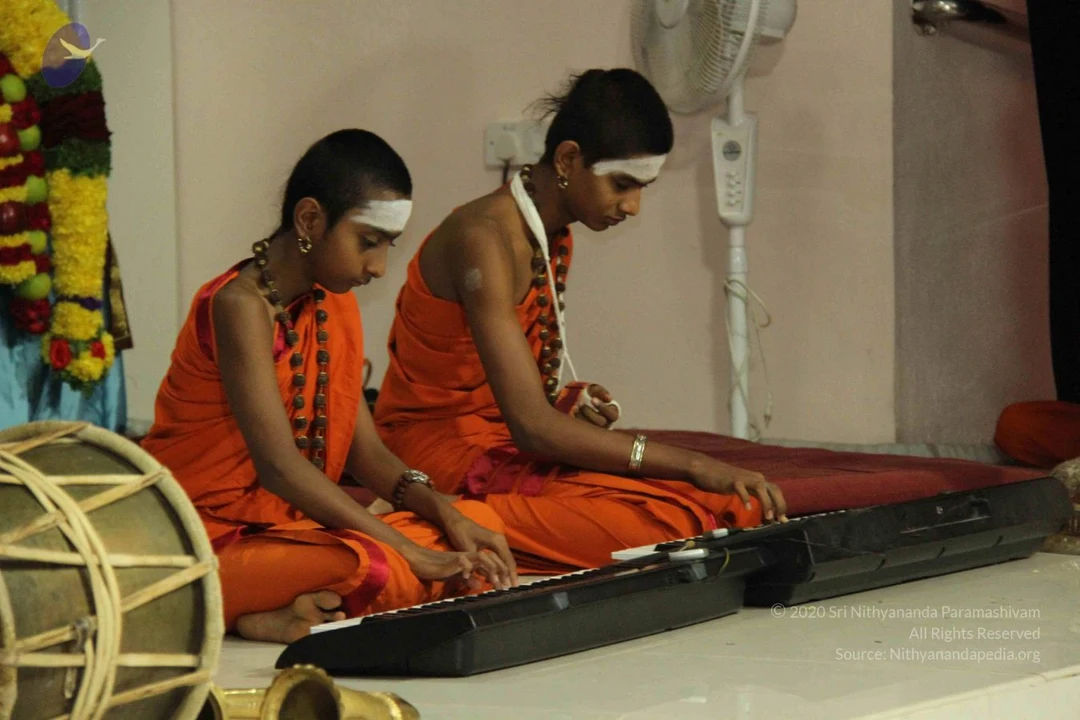
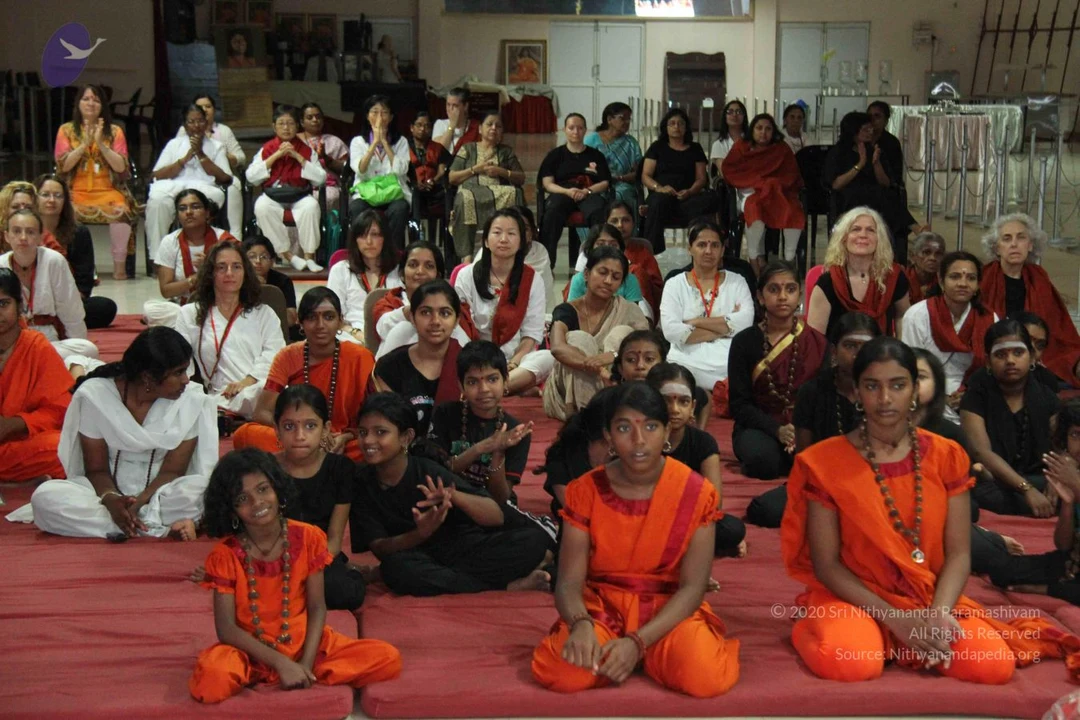
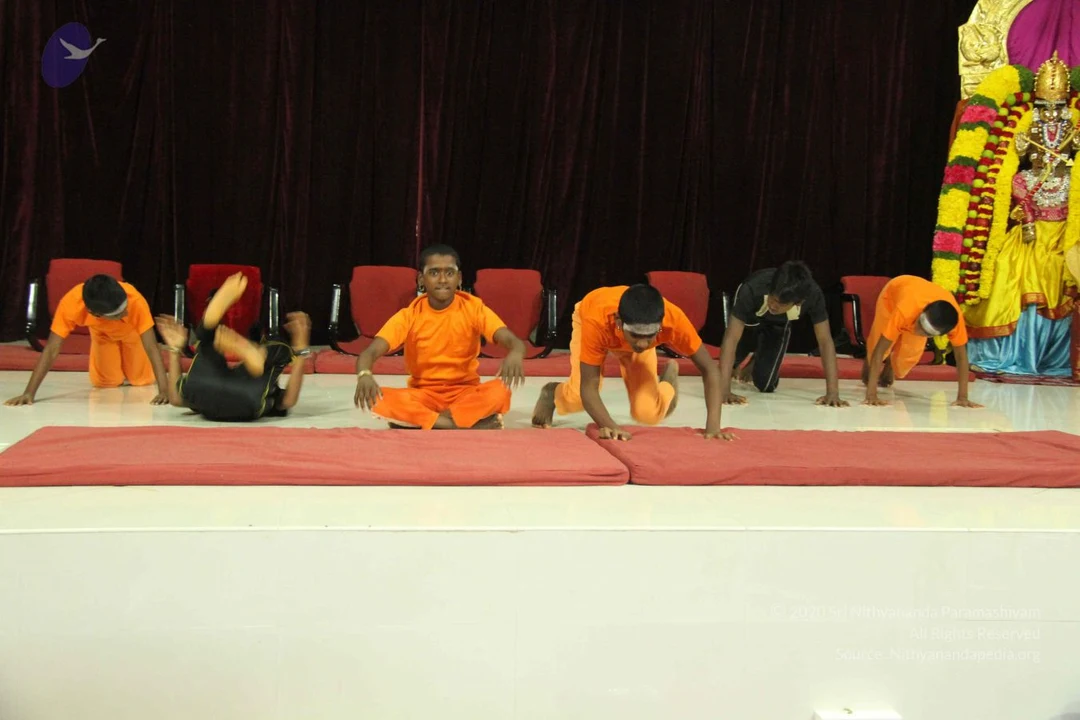
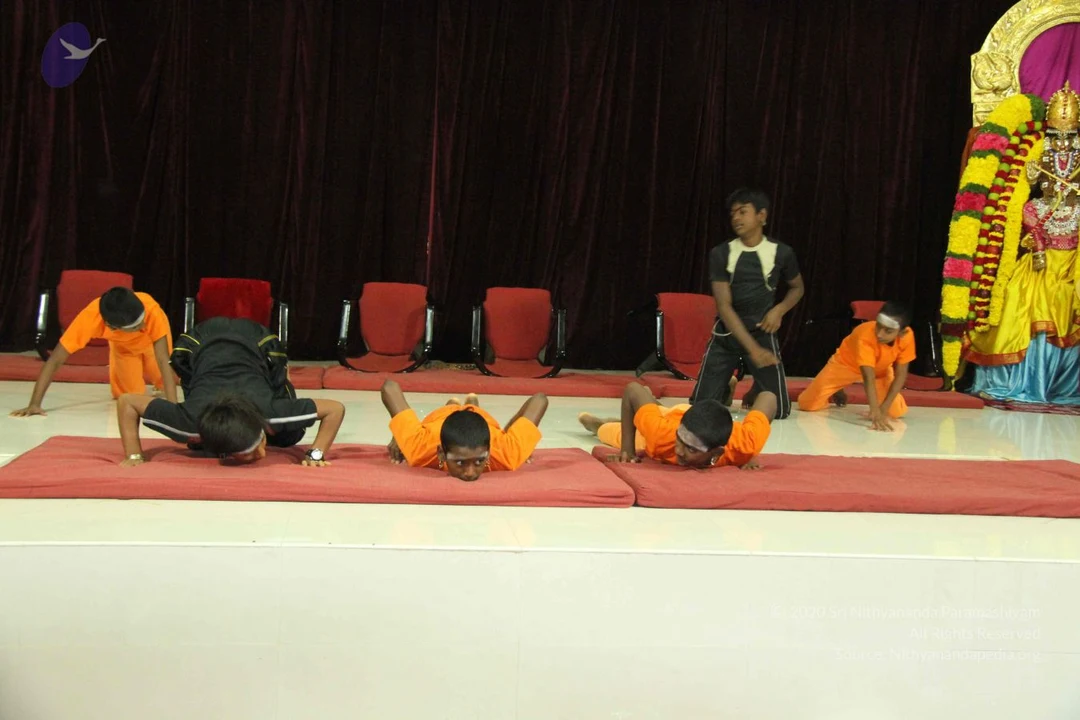
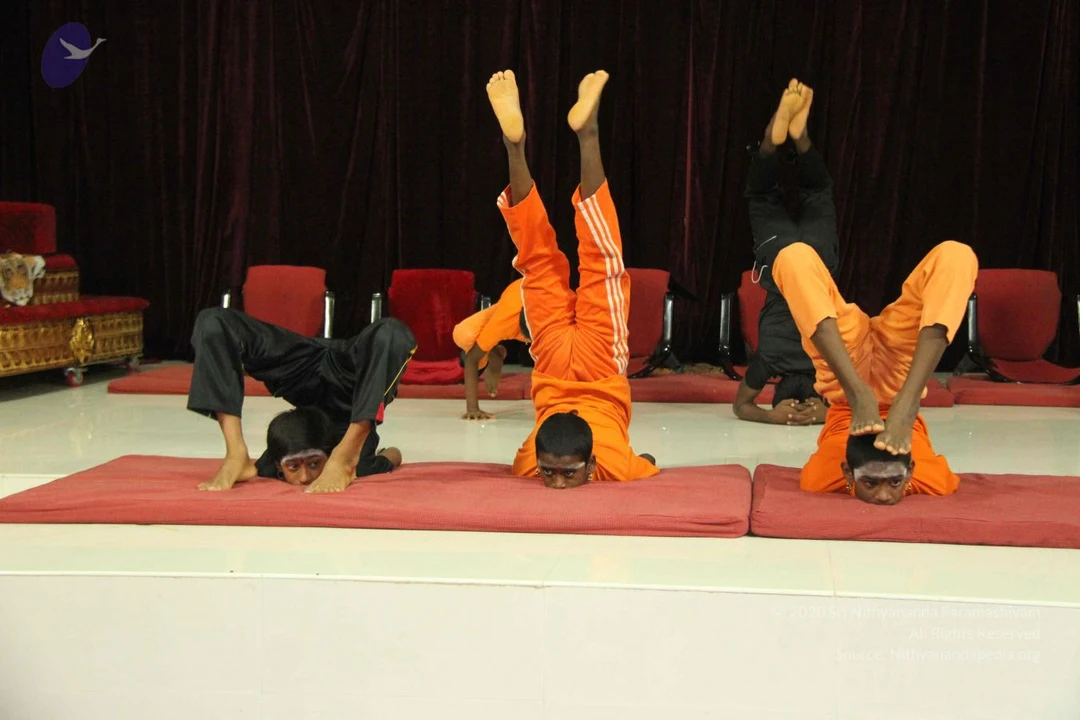
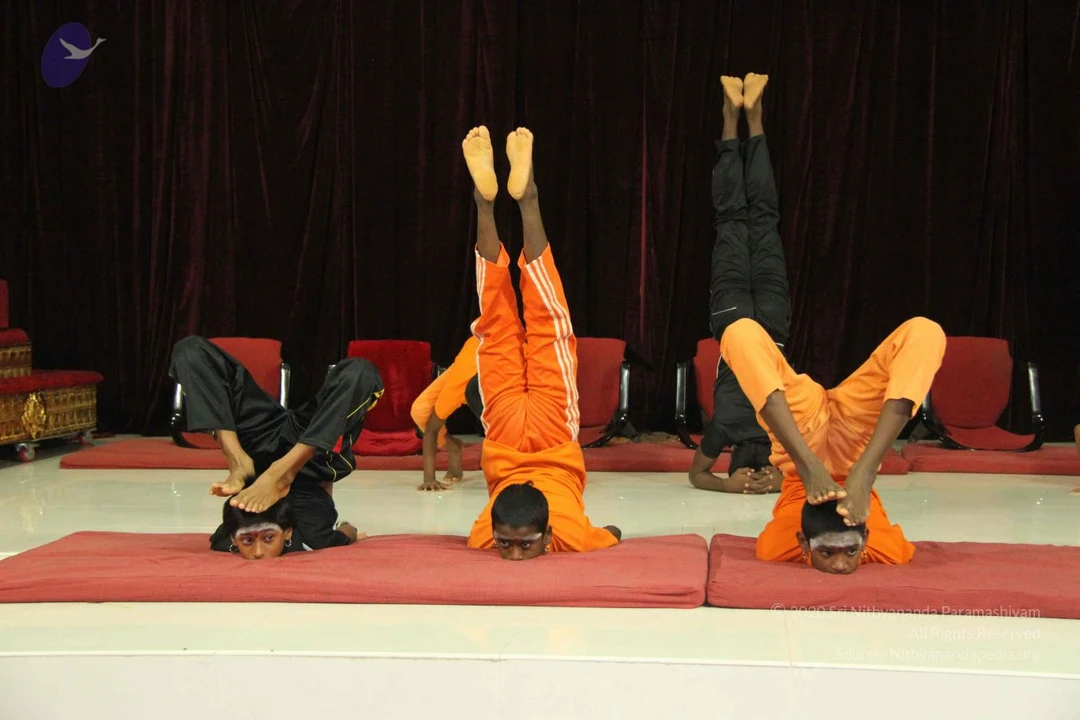
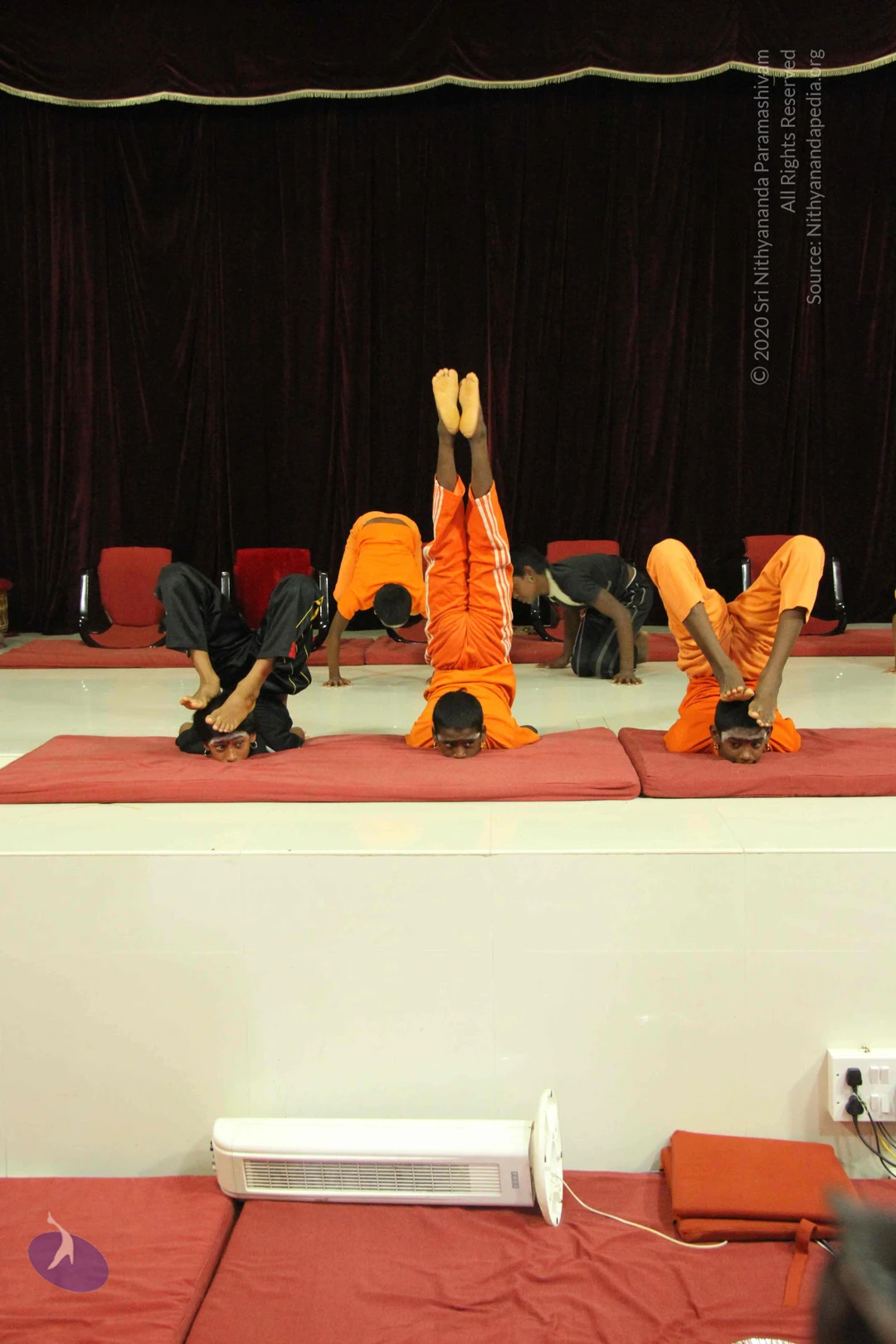
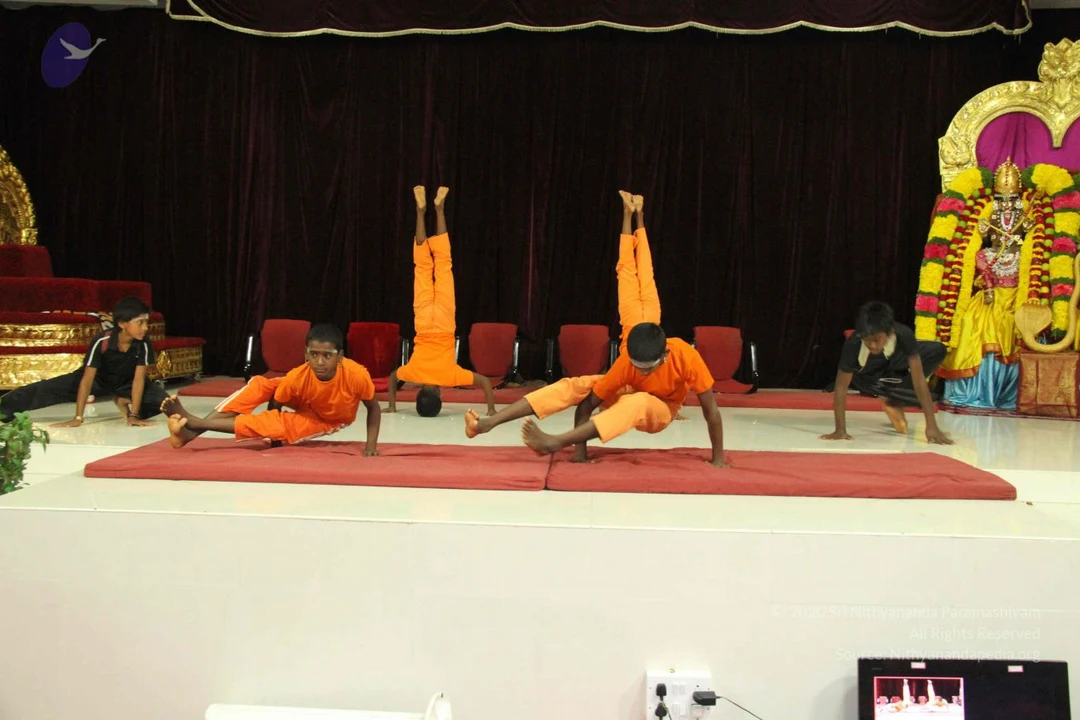
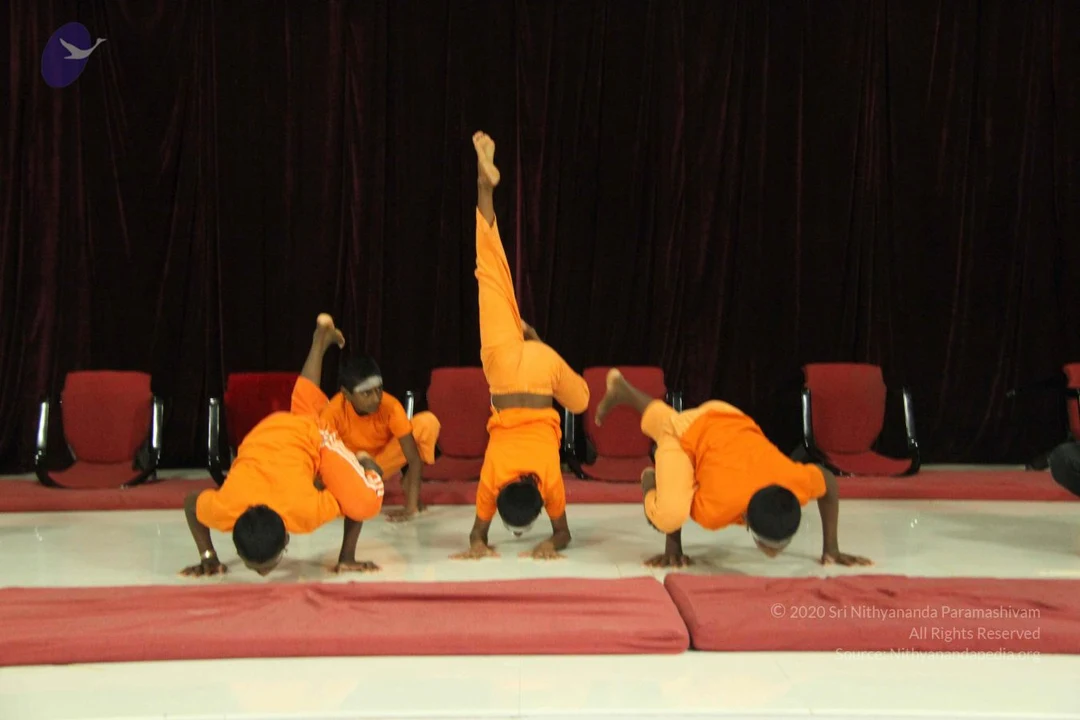
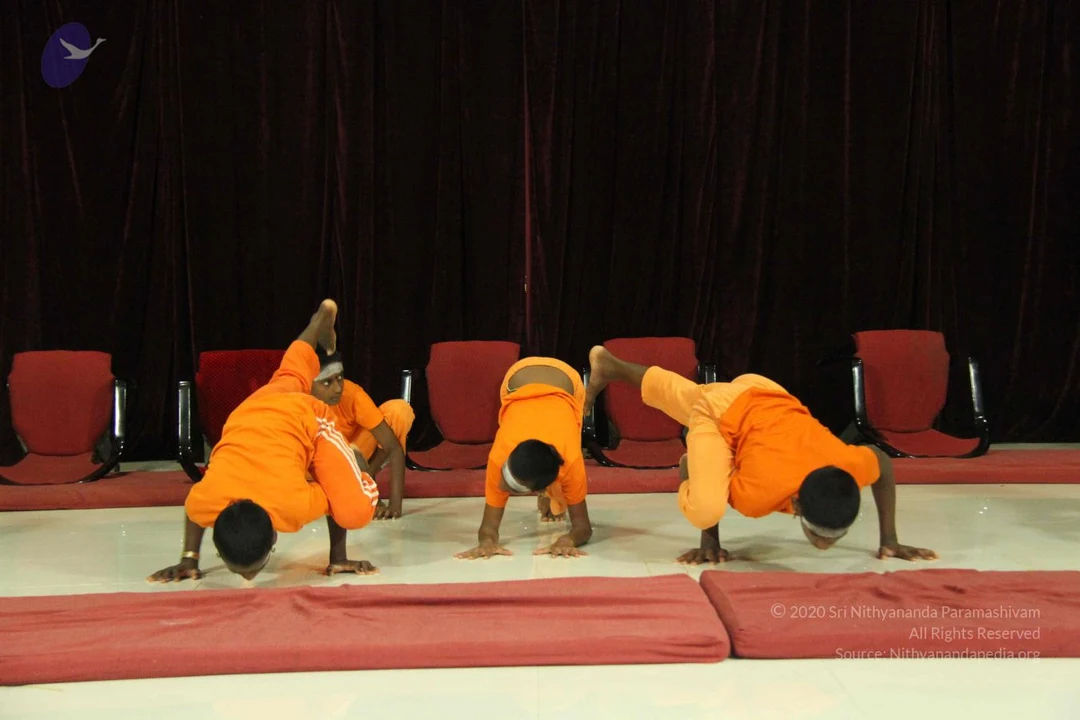
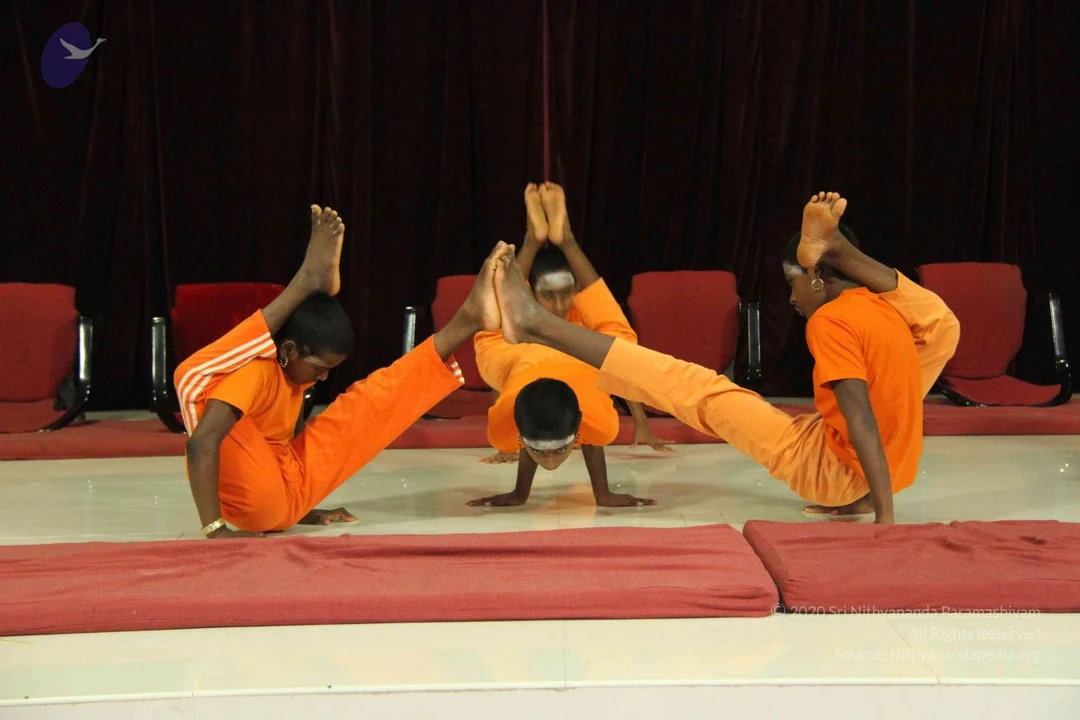
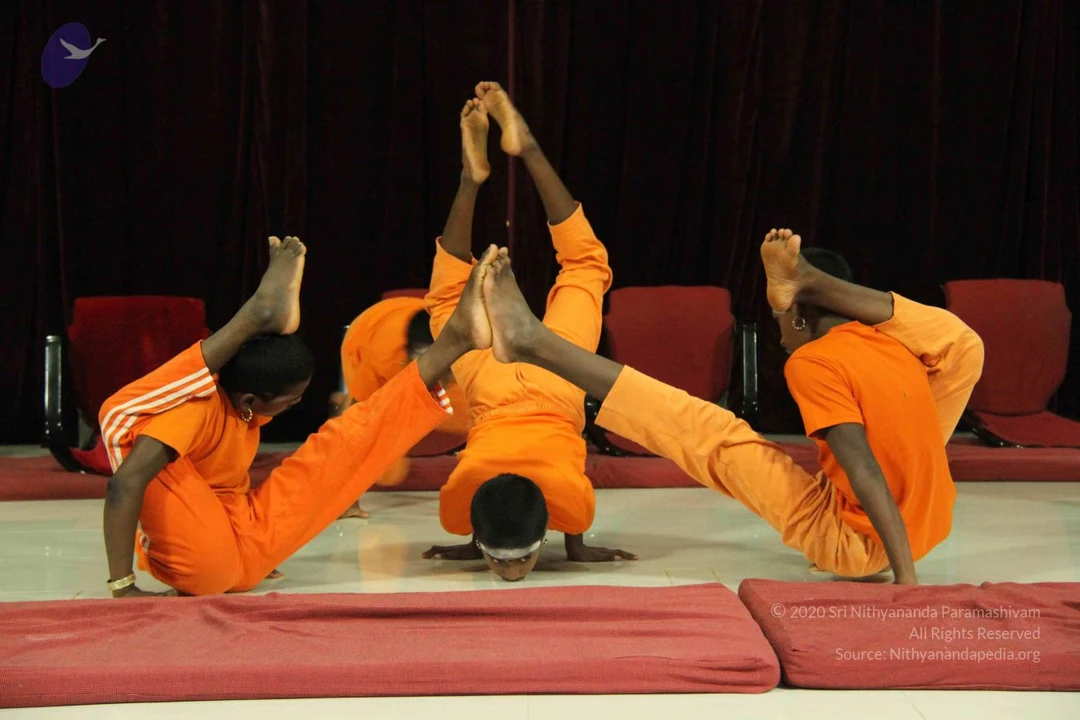
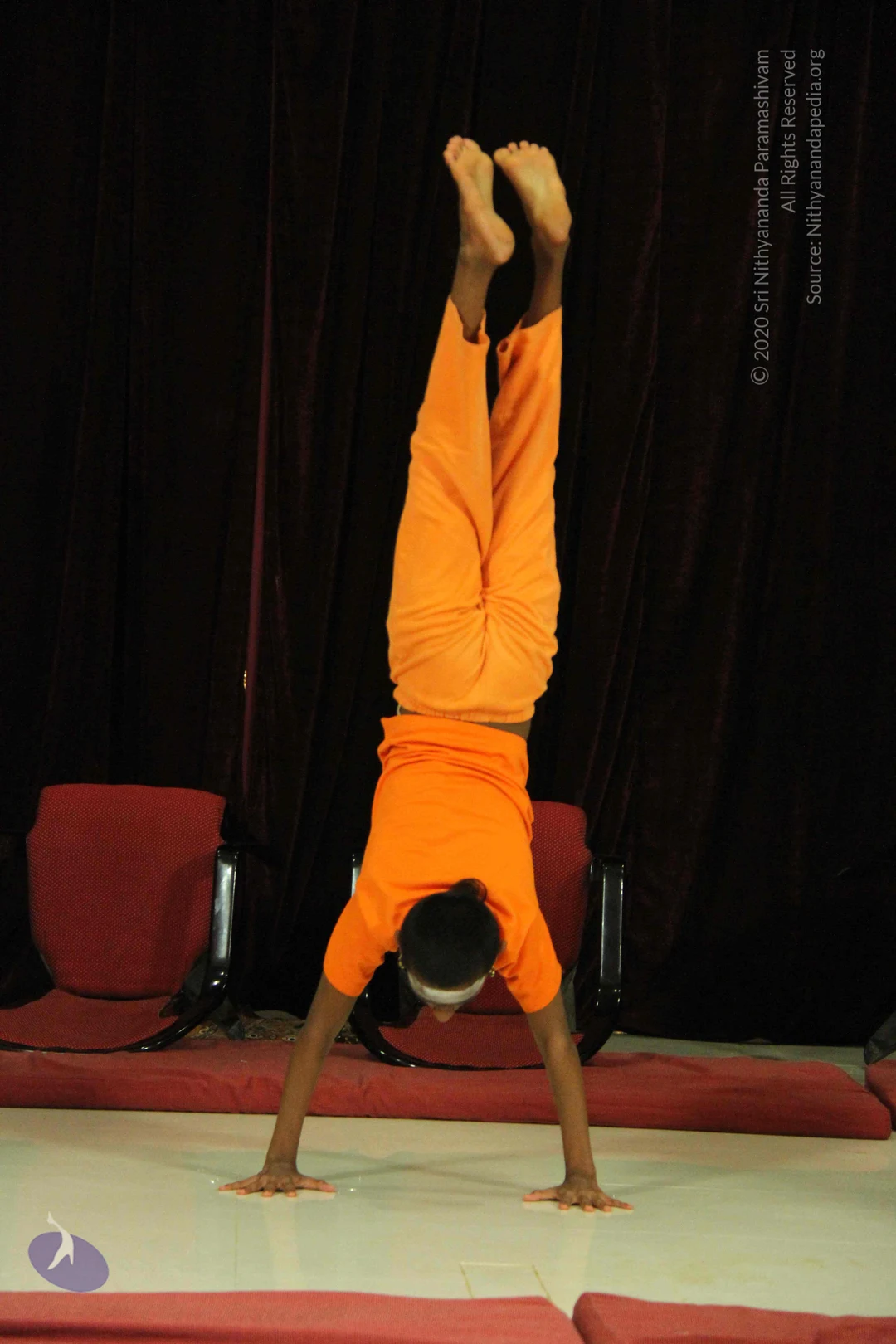
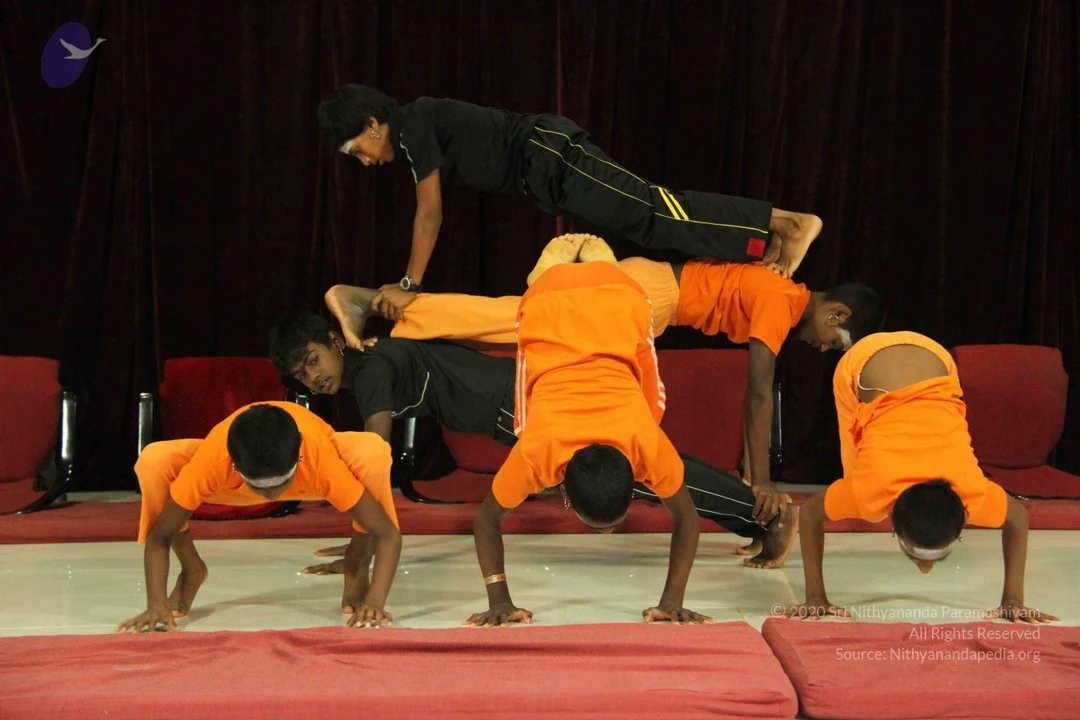
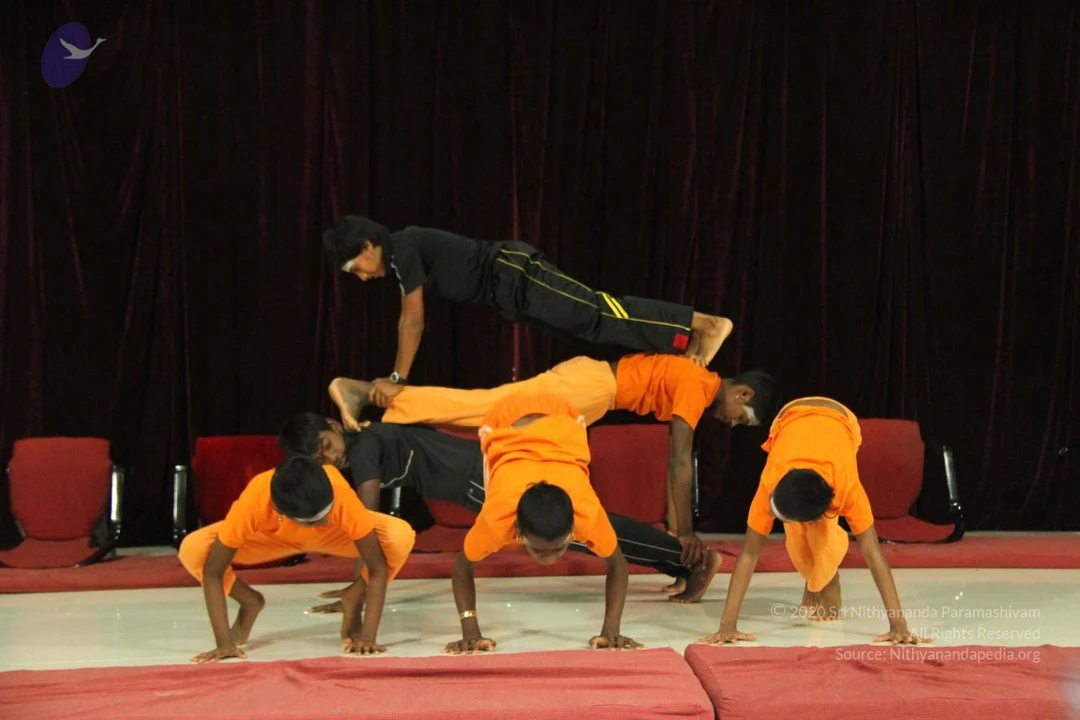
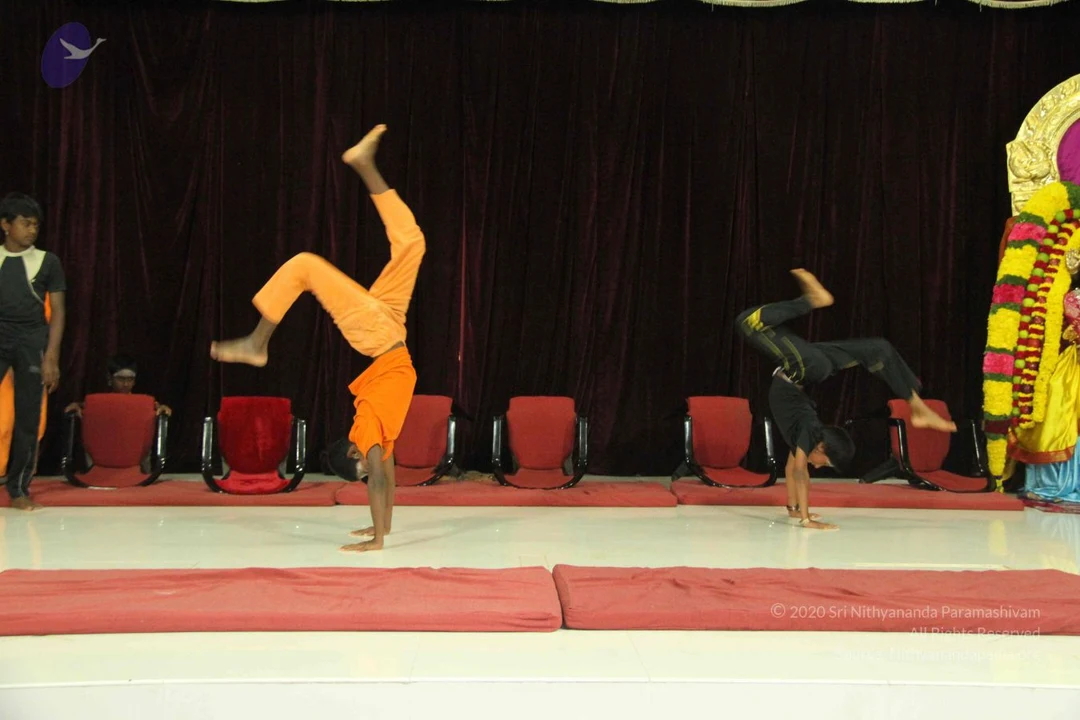
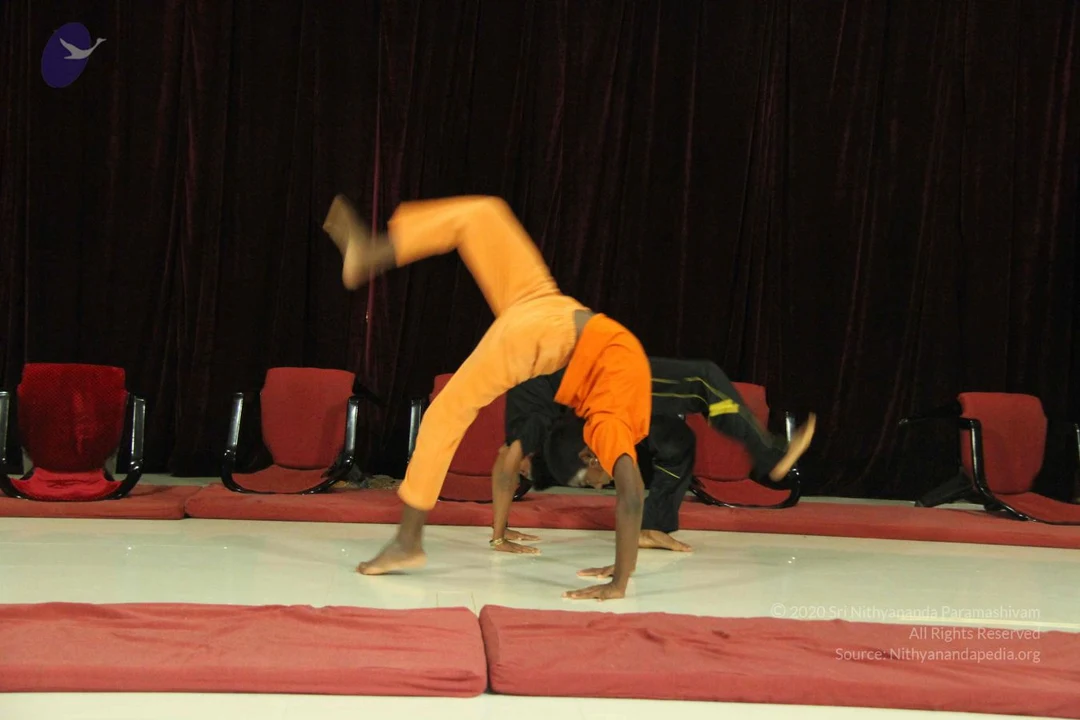
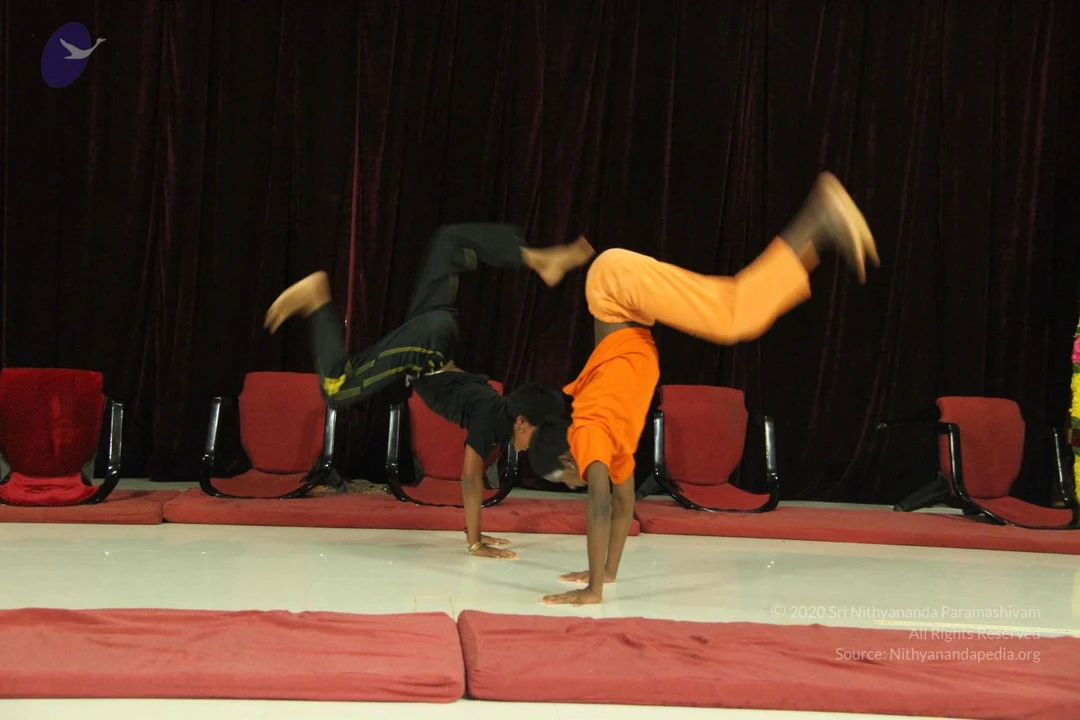
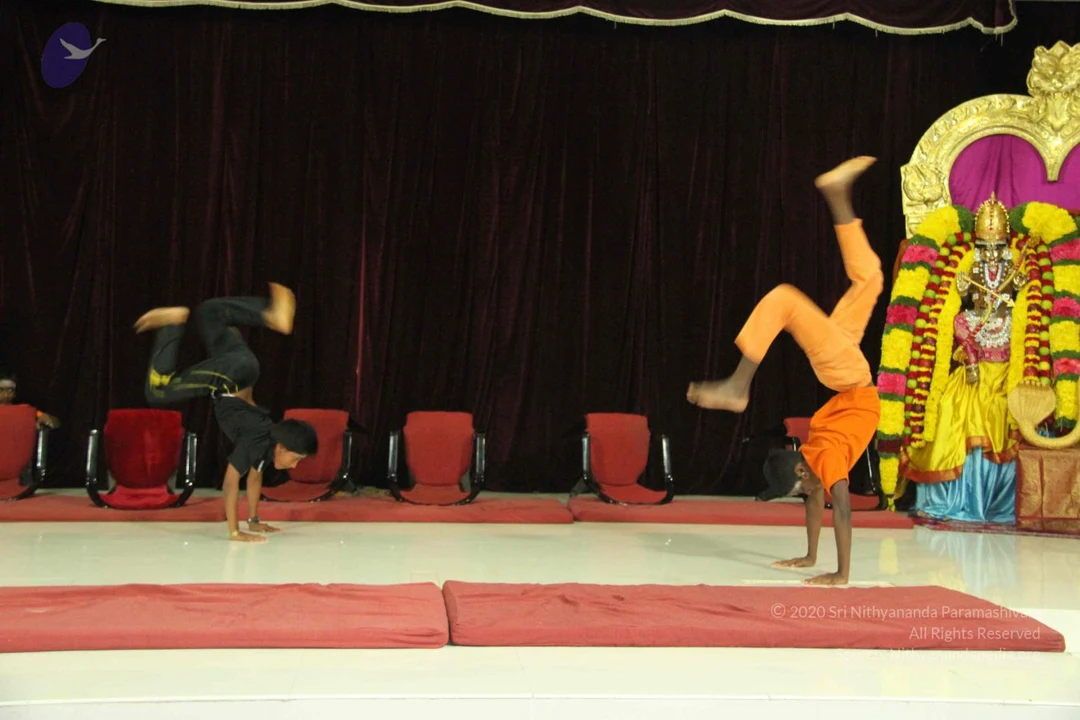
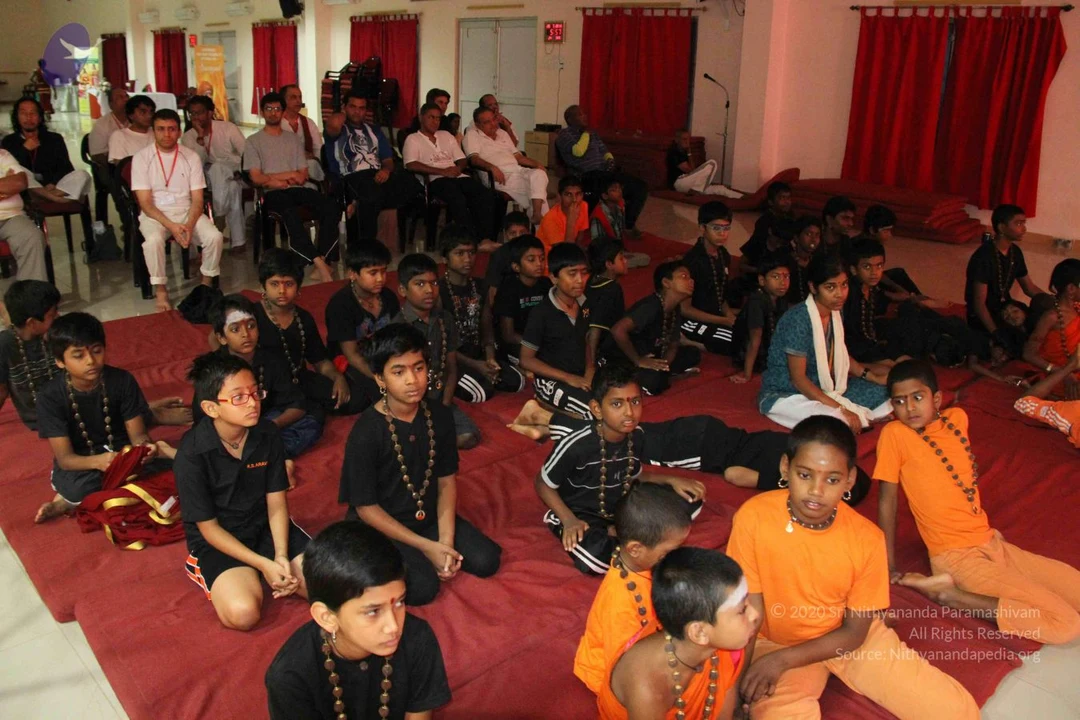
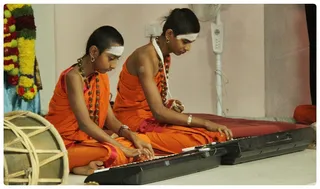
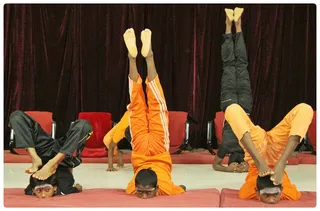
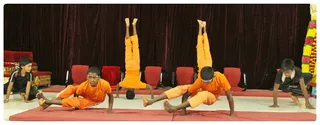
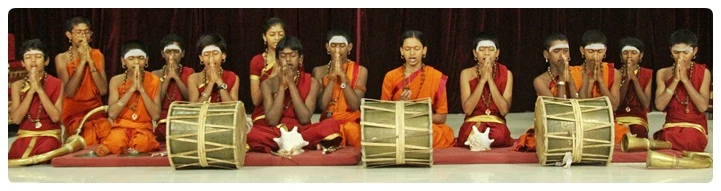
Photograph of a row of young boys seated cross-legged on red mats in a hall with red curtains, hands pressed together in namaste. Several wear orange or saffron dhotis and shawls, and white headbands with ash marks; some wear rudraksha malas and gold waistbands. Several large barrel drums with striped cords sit in front of the seated boys, and a small brass cymbal and a cloth-wrapped lotus flower rest on the mat. The boys appear to be a performing group.A group of about ten young boys and a girl sit cross-legged on a white platform in front of a golden throne-like shrine draped with garlands of pink, red and yellow flowers. Two deity murtis, one with a crown and one adorned with ornaments, sit at the centre under the garlands. The children wear orange and red garments with rudraksha malas, and have white markings on their foreheads. Their hands are joined in namaskar. Several have wooden drums in front of them, and a silver kalasha-like object and small lamp sit nearby. Deep red curtains hang behind the shrine, and a potted plant is in the lower right corner.A photograph of a large indoor hall with a polished floor and red mats. In the foreground, many young boys sit cross-legged on red mats, most wearing black t-shirts and rudraksha malas, with a few in orange shirts and white vibhuti marks on their foreheads. Behind them, several adults sit in white and light-coloured clothes, some on chairs along the back, with a row of men in white shirts and dark trousers and a woman in a white sari. The setting suggests a satsang or class gathering. No identifiable a person figure is clearly visible.Two young boys in saffron-orange robes sit cross-legged on a red mat, playing a harmonium-style keyboard. Both have shaved heads with white vertical tilak marks on their foreheads and wear beaded rudraksha-style malas around their necks. A barrel drum sits to the left, a red-and-yellow flower garland hangs on the wall behind, and a standing fan stands nearby in a plain room with pale walls.Several young men perform headstand yoga on red mats in front of a dark maroon velvet curtain on a stage. The central two wear orange tracksuits with white side stripes and stand upside down on their heads with legs raised; the front-right man also wears orange. Two others in black tracksuits perform similar inverted poses at the left and back. Red velvet chairs are arranged behind them. No a person candidate is visible.Four young boys in matching saffron-orange kurta-style outfits perform acrobatic yoga-like poses on red mats against a deep maroon velvet curtain. In the foreground, one boy balances on his palms with his legs extended, while another behind him stands on his head with legs raised. At the right, a boy in a dark shirt and dark trousers stretches on the floor beside a garland-draped column. At left, a seated boy in dark clothing watches beside red velvet chairs. Red cushioned chairs line the stage.

Leela-Alankar
26 photosSource gallery
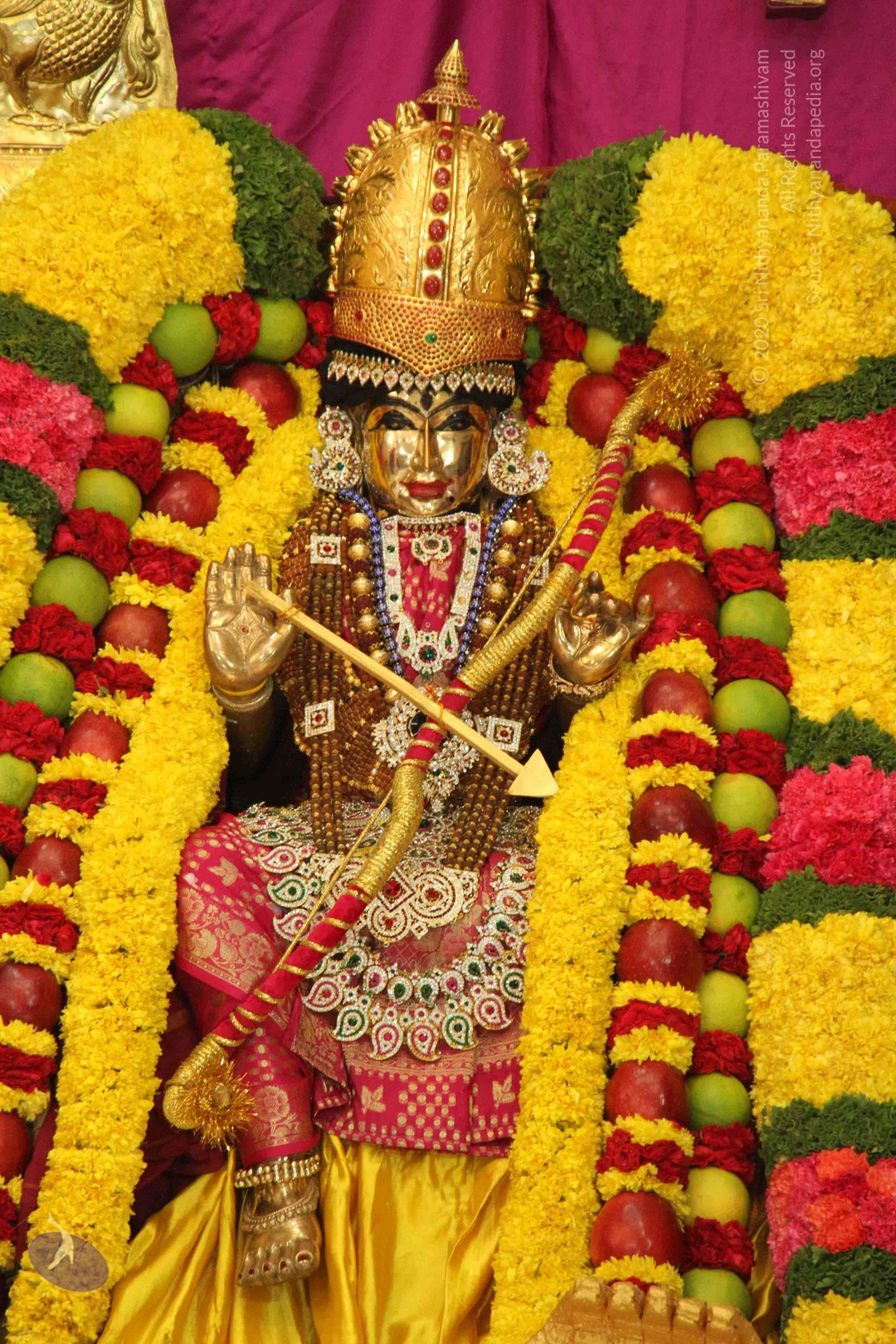
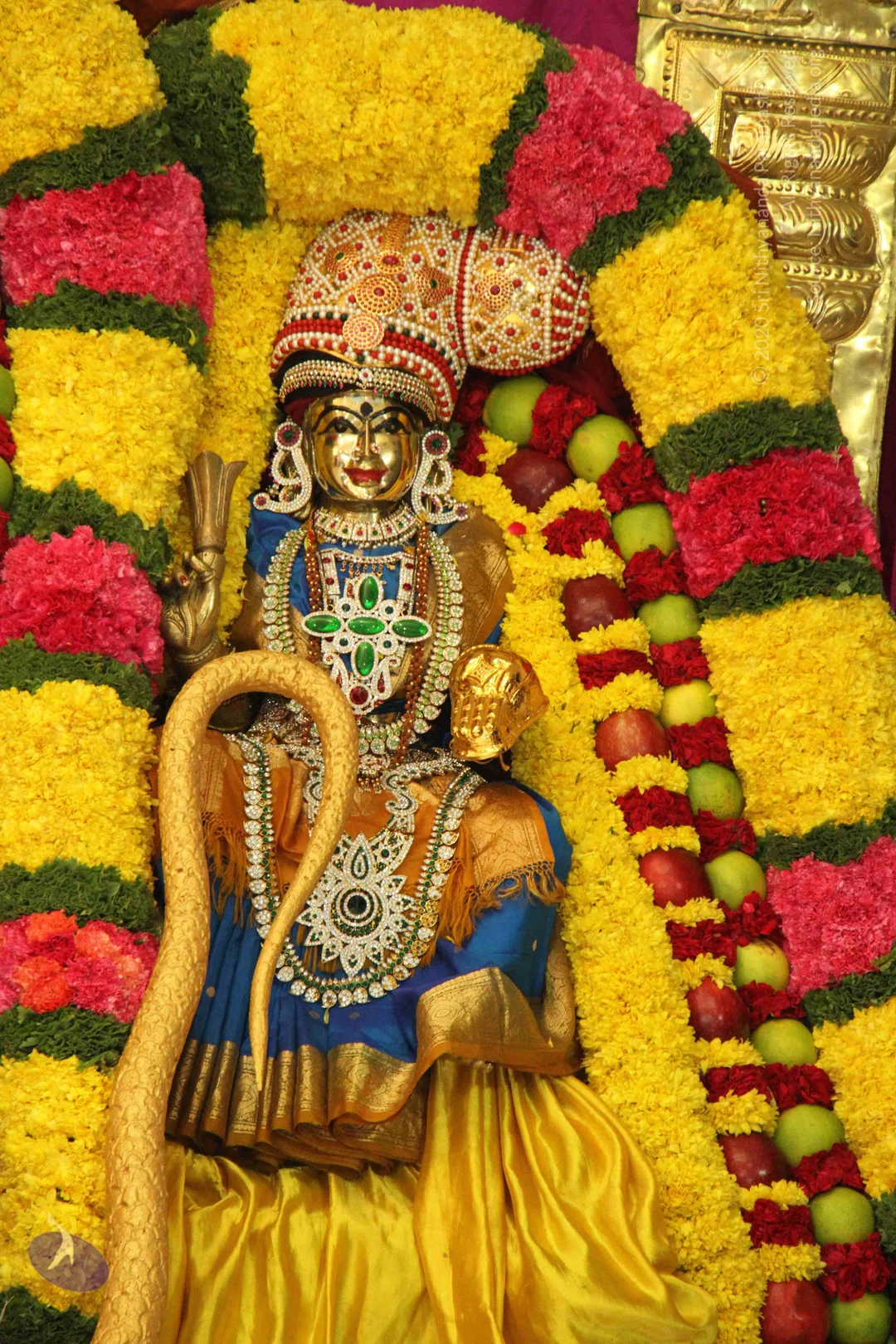
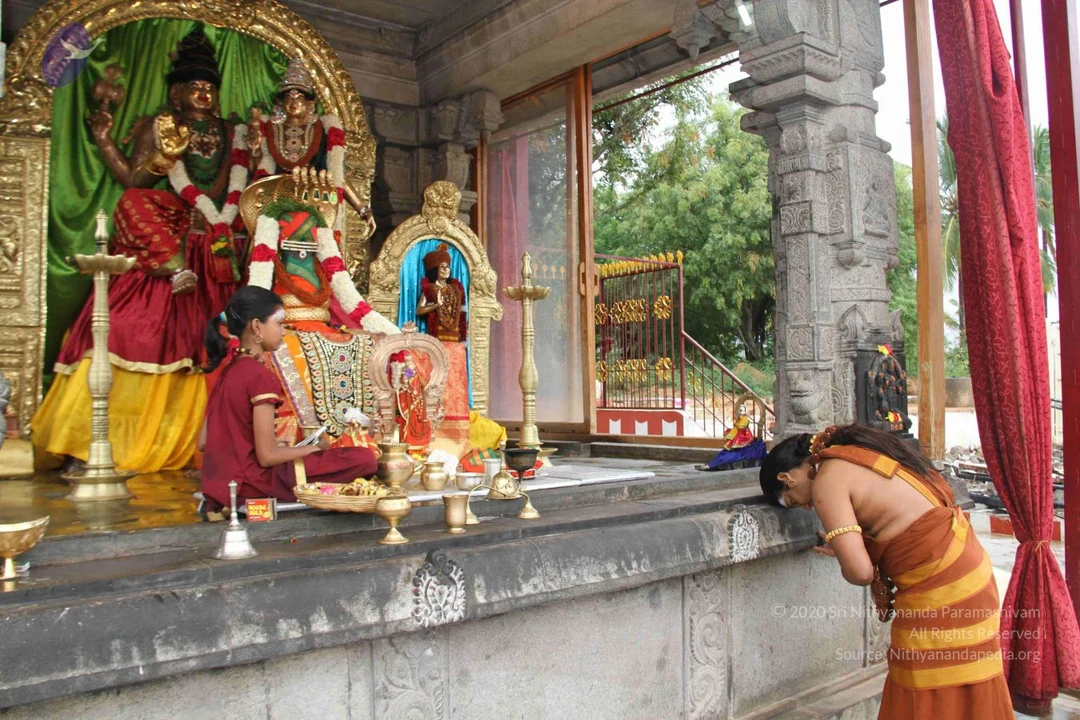
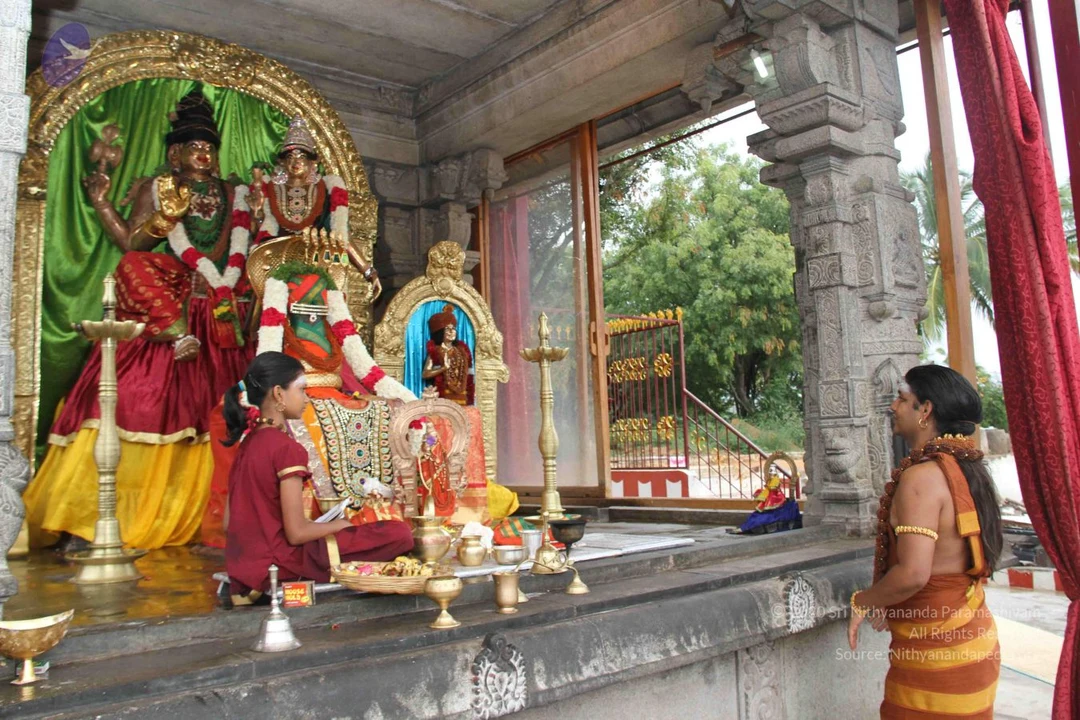
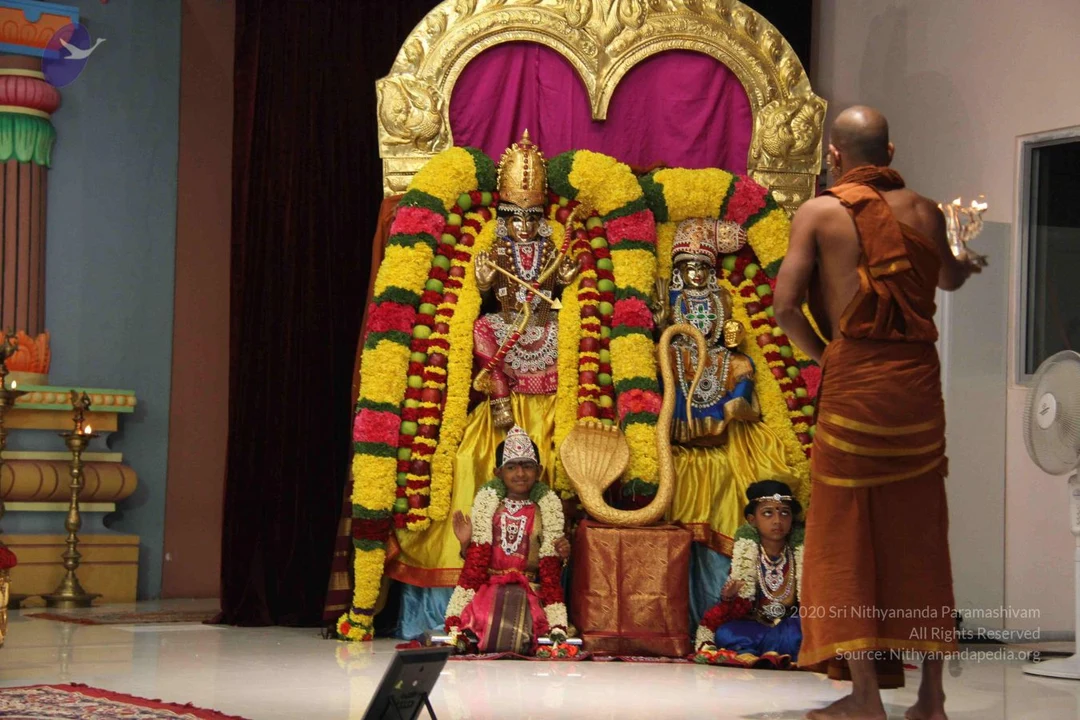
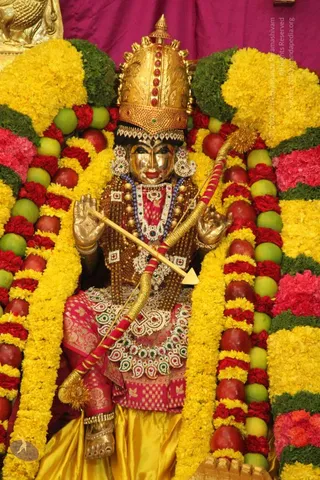
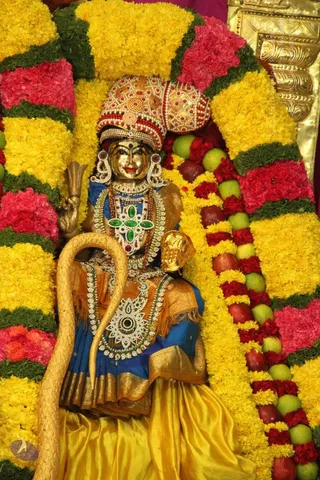
Two golden deity murtis are seated on a raised platform, heavily decorated with yellow and pink marigold garlands and green leaves along arches of flowers. The figure on the left wears a golden crown, a pink and gold garment, a rudraksha-style bead necklace and holds a bow and arrow. The figure on the right wears a pink and gold headdress, a blue and gold garment and a large golden serpent rises beside them. Gold-toned ornamental necklaces and jewelry adorn both statues. A purple backdrop and gilded carvings frame the scene. These are statues, not living people.A photograph of a decorated altar with two golden deity murtis seated side by side before a magenta drape and a gold arched frame. The figure on the left wears a golden crown, pink and gold garment, and holds a bow and arrow; the figure on the right wears a blue and gold garment with a jewelled headdress and holds a sceptre-like object. A large golden cobra with raised hood curls between them, resting on a red brocade cushion. Both are garlanded with yellow marigolds, red flowers, green leaves and red-and-green apples, and a golden floor cloth lies in front. No living people are visible.Photograph of a decorated deity alankara of two gilded murti figures, a male figure on the left wearing a tall golden crown, pink silk dhoti, ornate jewelled necklaces and holding a bow and arrow, beside a female figure on the right in a blue and gold sari with green and white jewelled necklaces and a golden headdress. Between them stands a large golden serpent with a hooded head. Both figures are framed by garlands of yellow marigolds, green leaves, red roses and apples, set against a magenta backdrop. No people are visible.A golden deity murti. The figure wears a tall gold crown set with red stones, a gold-faced visage, layered jewelled necklaces and earrings, and a pink and gold silk garment with a yellow skirt. It holds a gold bow with a red-wrapped string and an arrow in its hands. The murti is framed by yellow marigold garlands, red rose strands, and green and red fruit garlands, with a magenta cloth behind it. No people are visible.A golden deity murti of a seated figure is richly adorned for a festival alankara. It wears a jeweled crown with red and white beadwork, blue and gold silk garments, layered gemstone necklaces with green stones, and large earrings. A golden serpent curves beside the figure, and a raised hand holds a golden object. The murti sits within a dense arrangement of yellow marigold and pink flower garlands, with green leaves and strings of green and red apples draped across the frame. A gold-toned metal panel with engraved patterns stands behind. No physical people are visible.A gilded metal murti of a deity seated and adorned for a ritual alankara, shown in a dense frame of yellow marigold garlands, red flowers and green and red fruit strings. The figure wears a tall golden crown set with red stones, a bead-and-jewel chest covering, pink silk garment with gold-embroidered border, and a gold waist cloth. A bow with a red-wrapped gold handle and an arrow rest across the figure, and a magenta cloth hangs behind. No physical people are visible. Deity murti, decorated for worship.

Pada-Puja
41 photosSource gallery
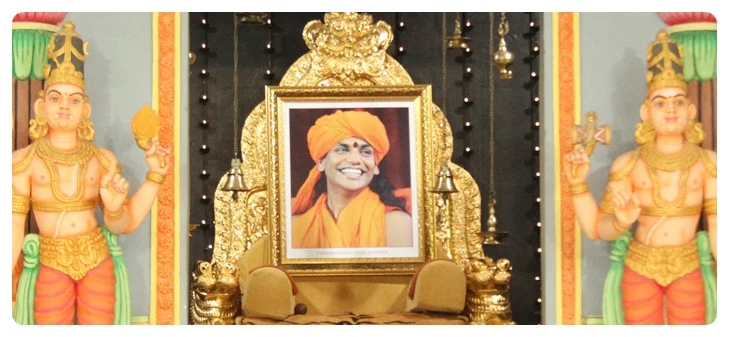
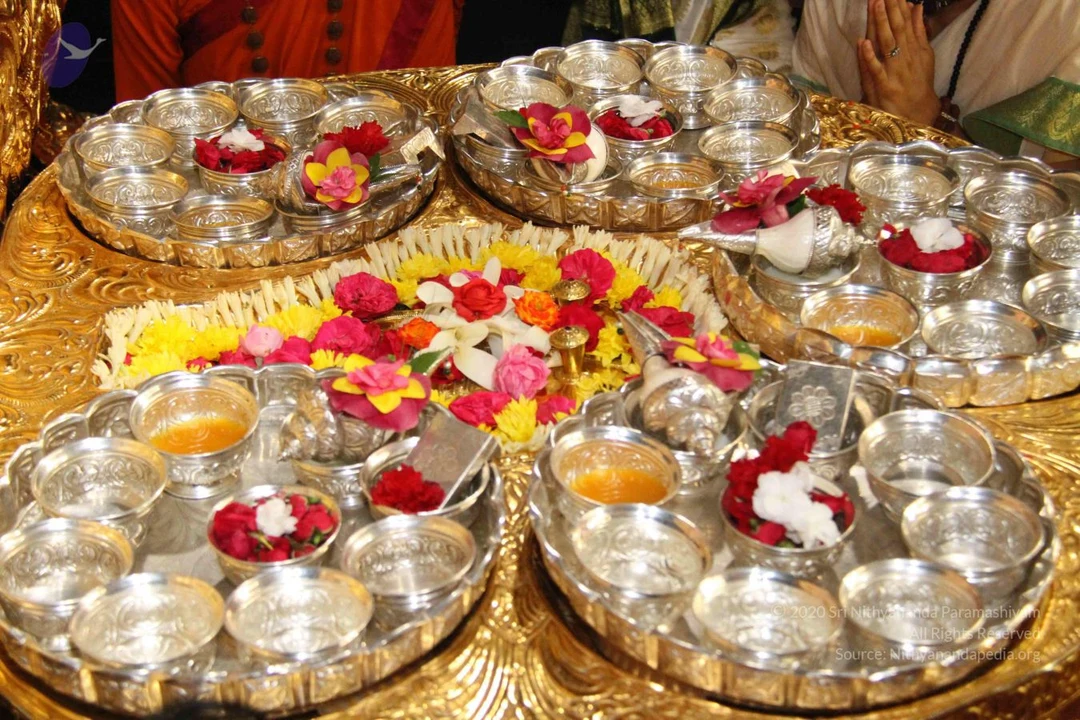
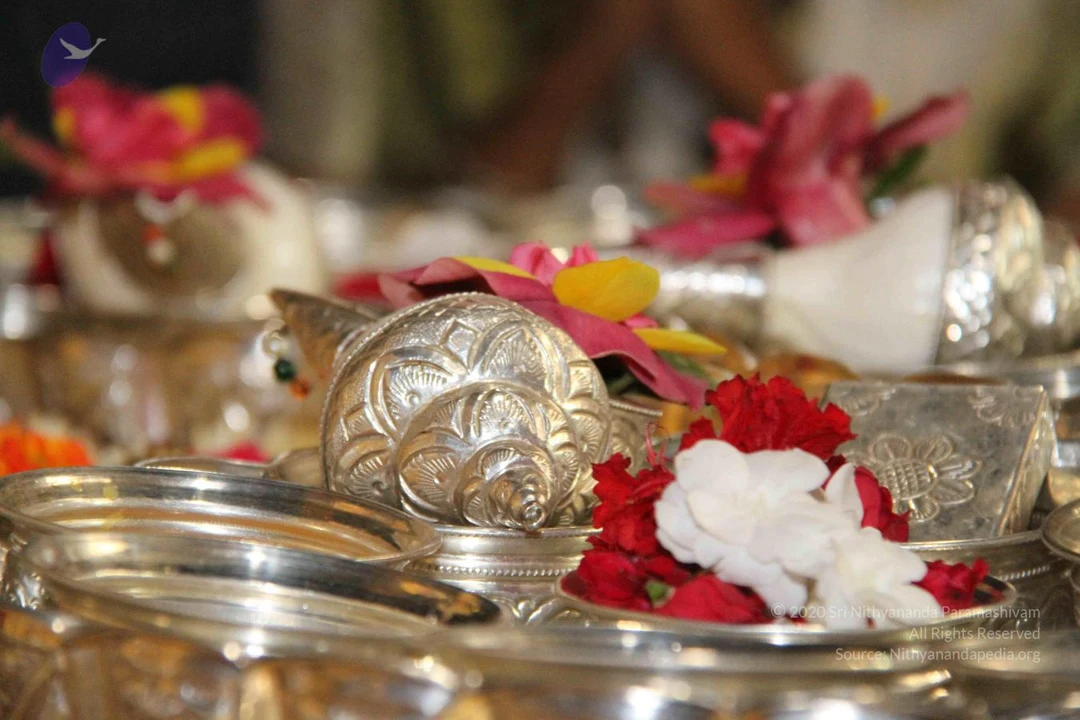
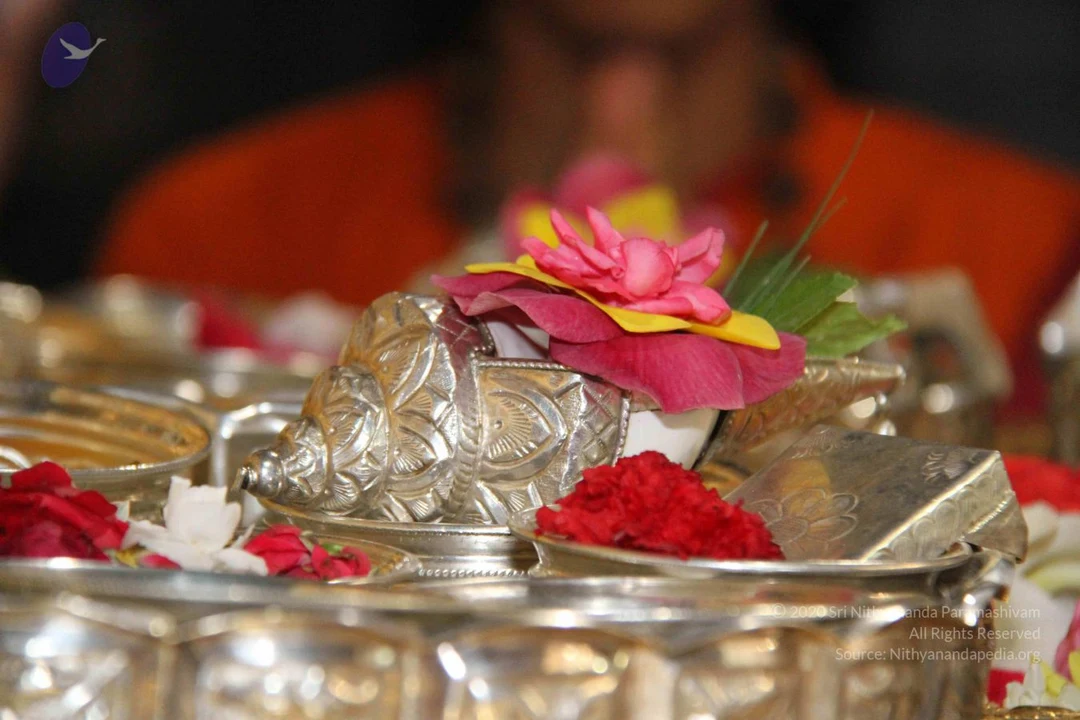
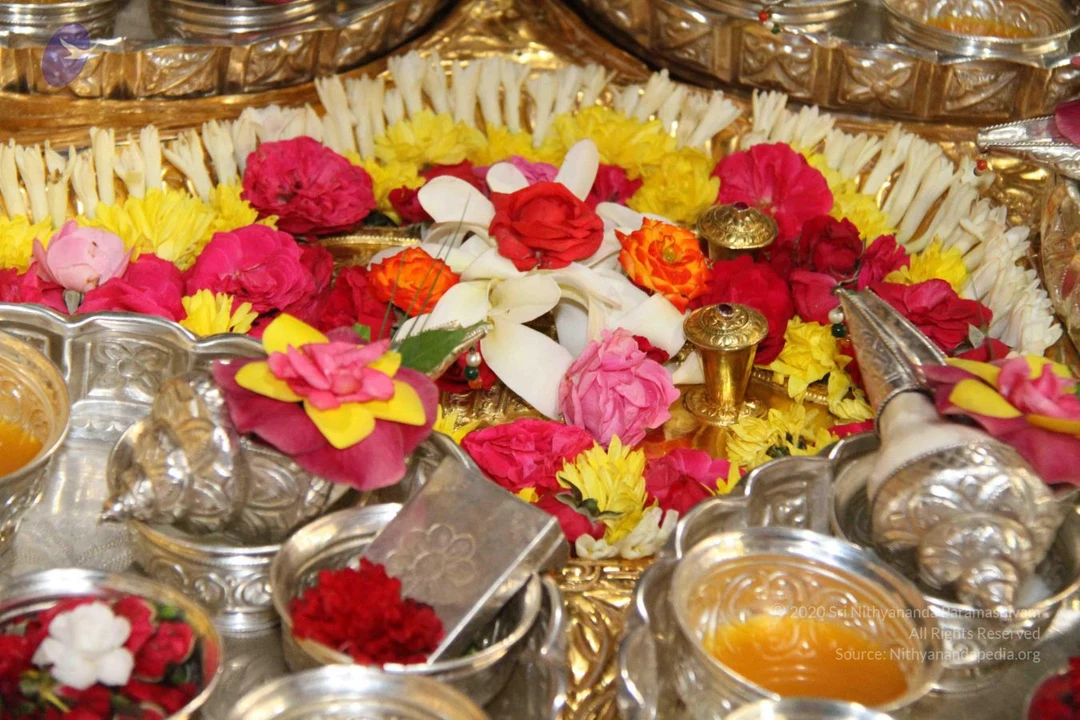
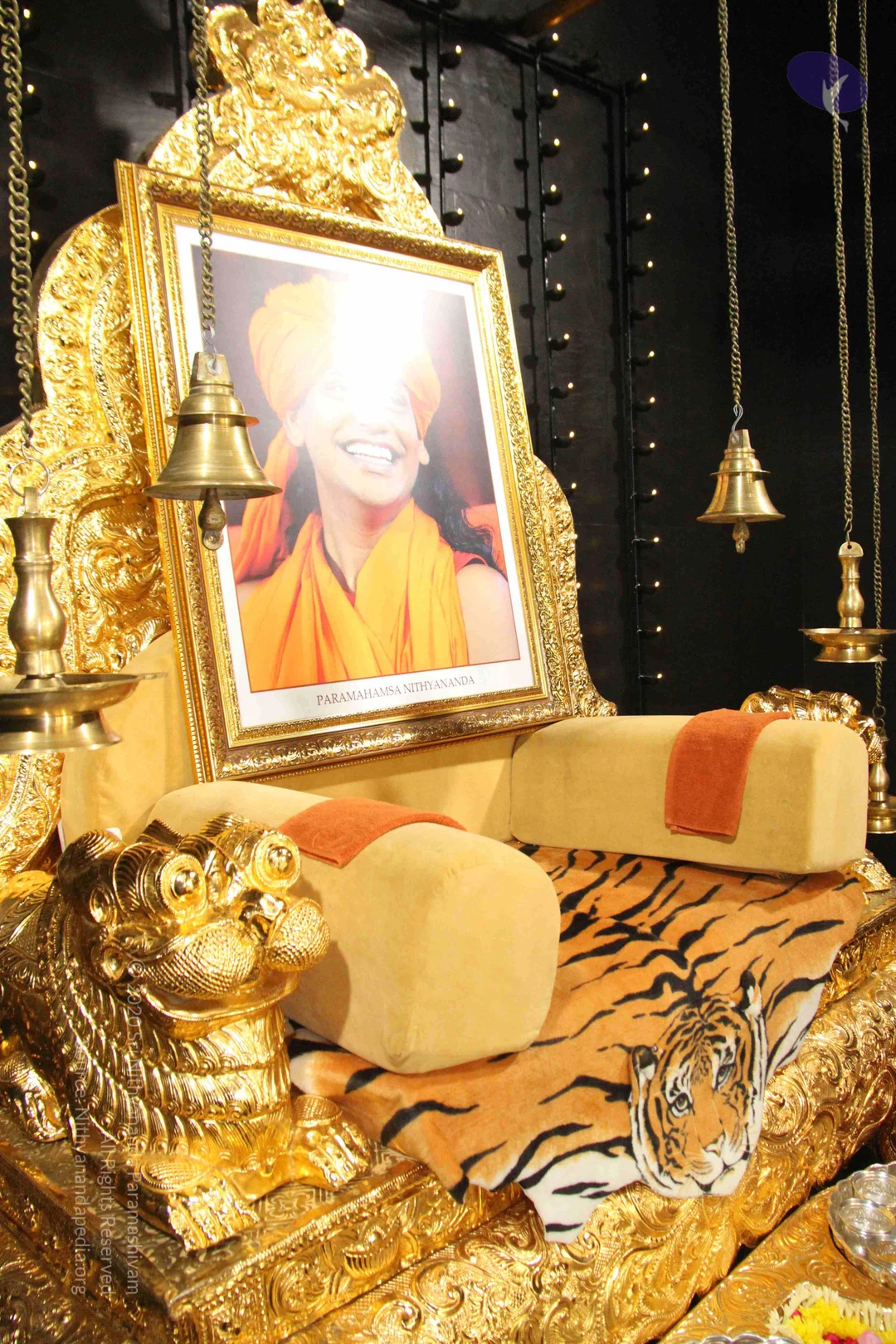
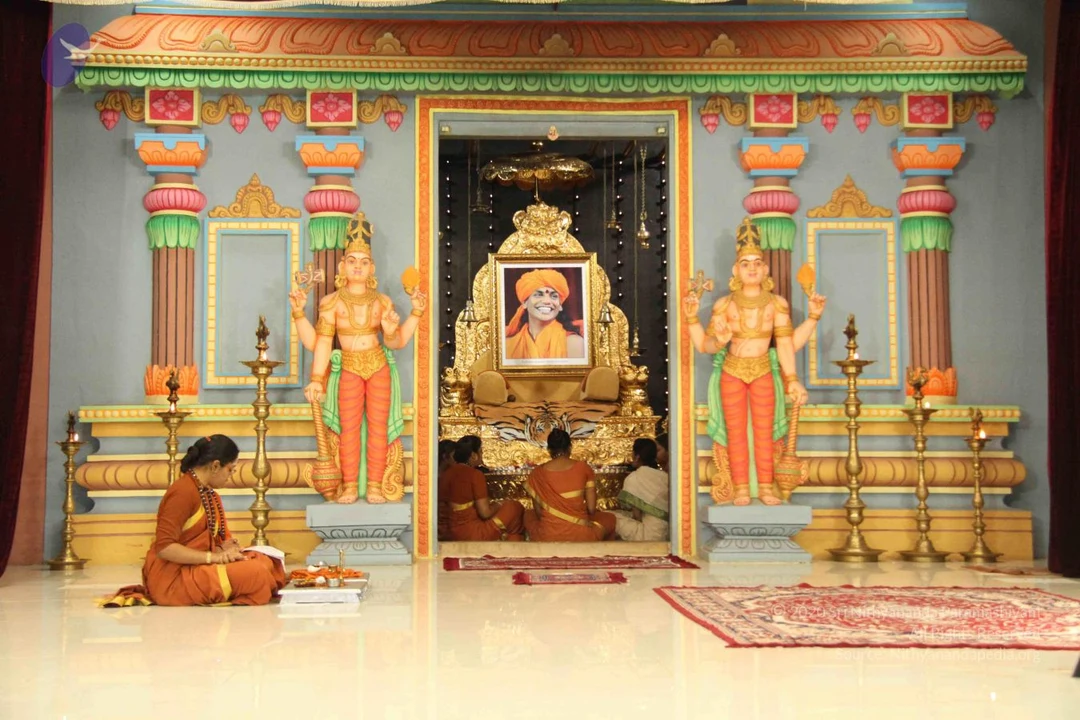
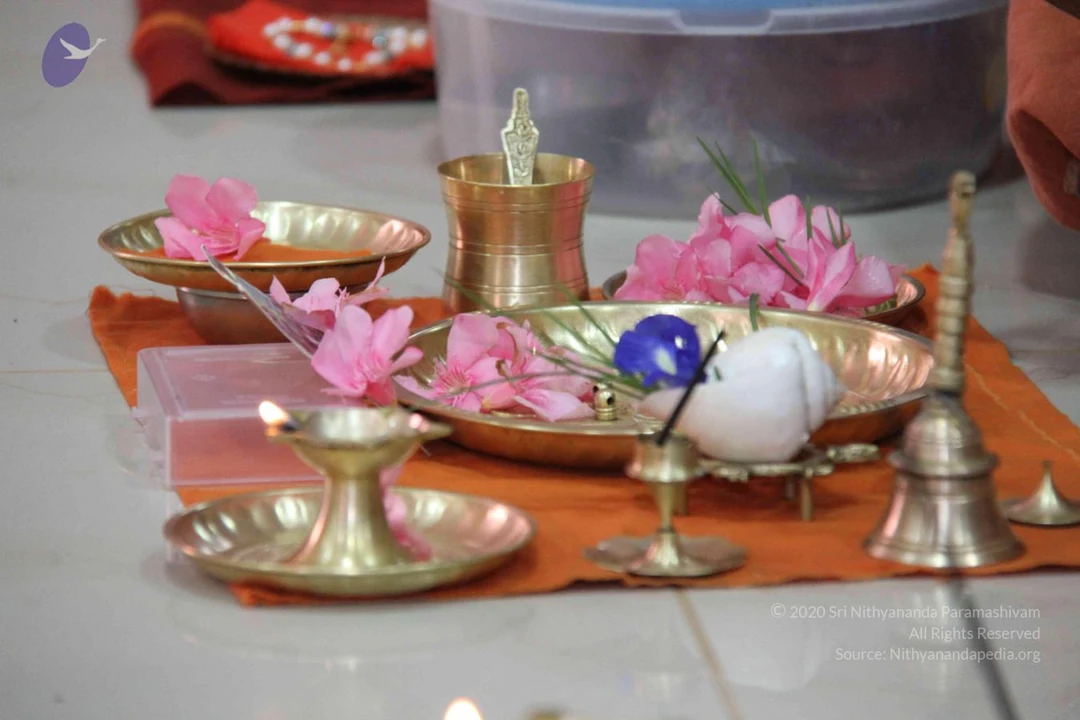
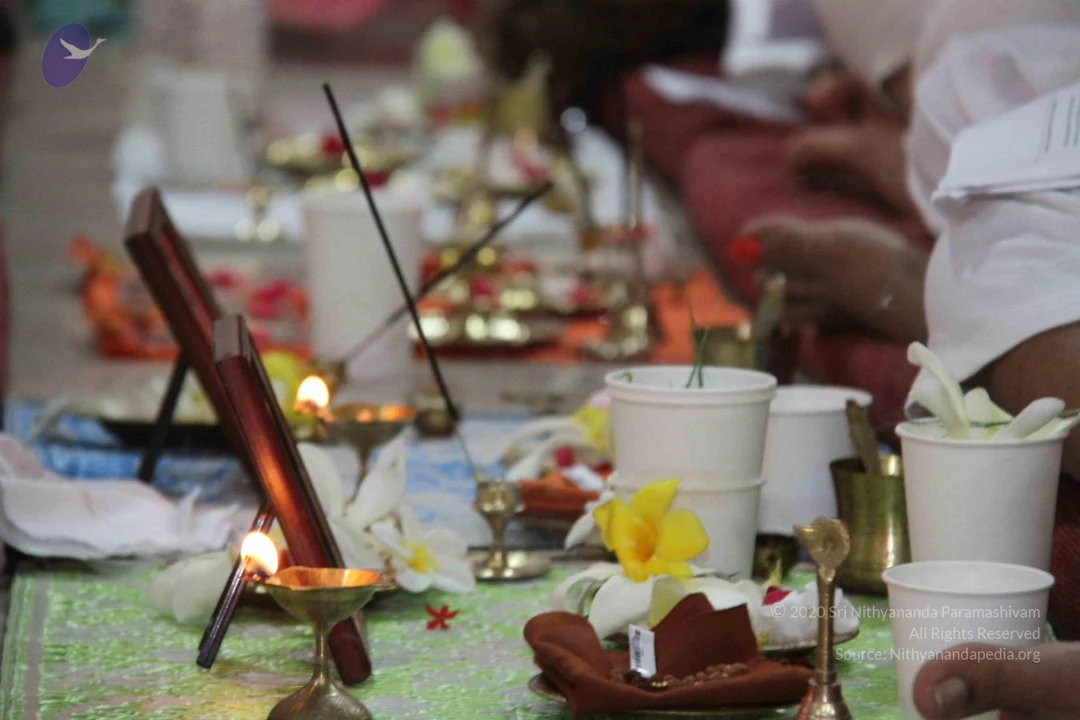
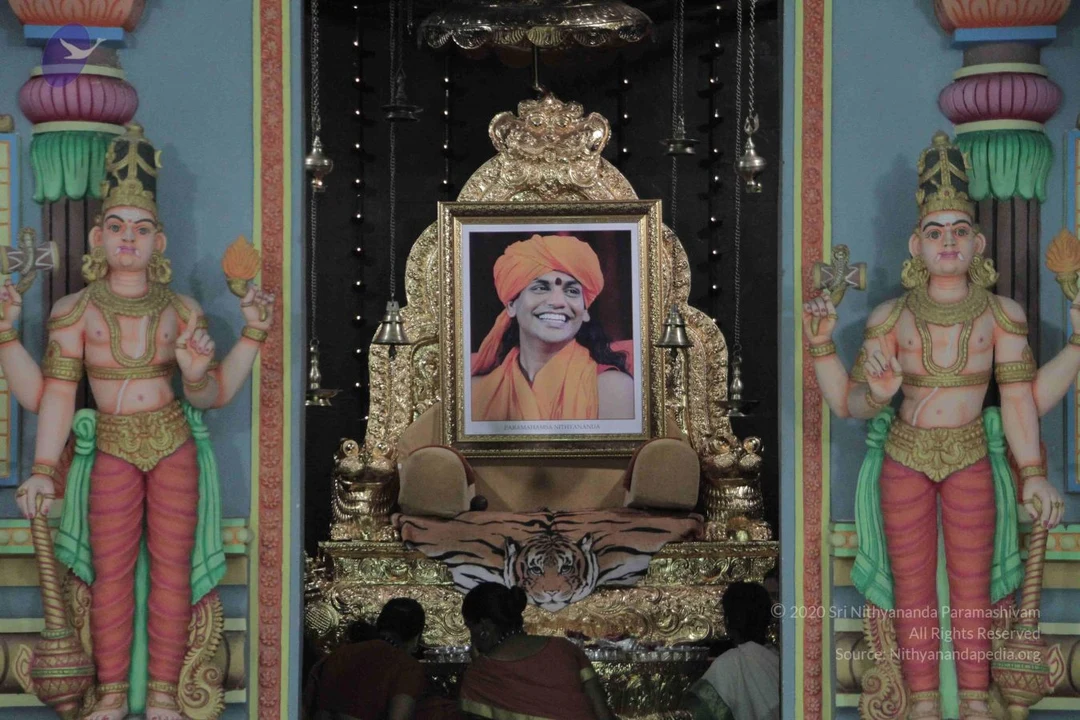
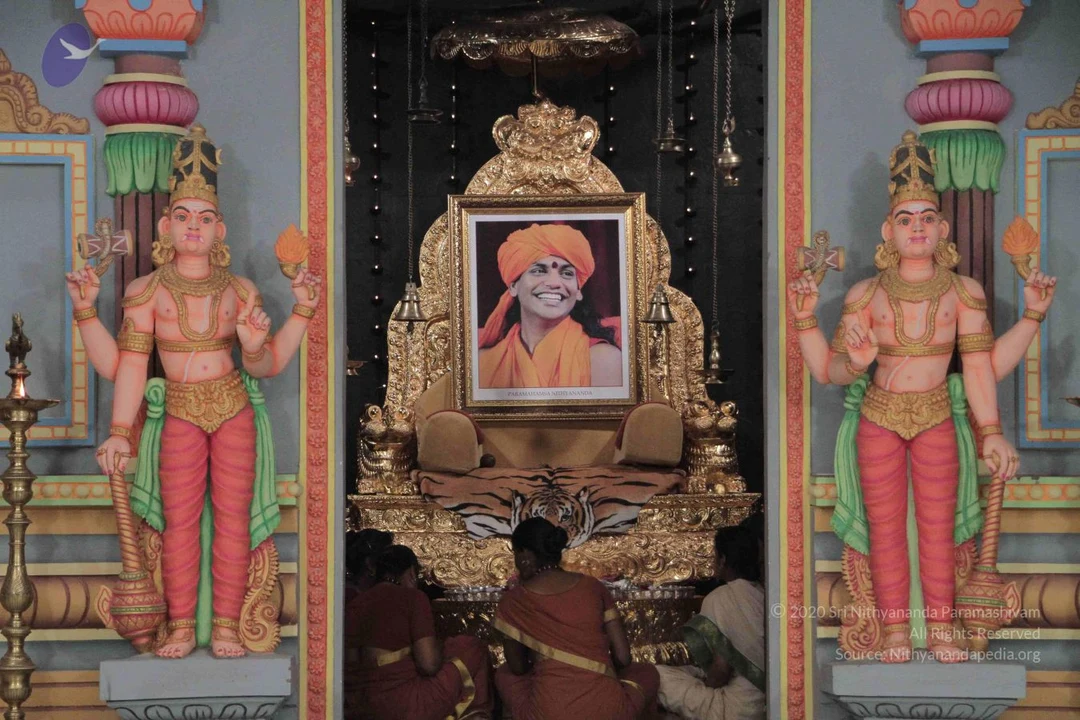
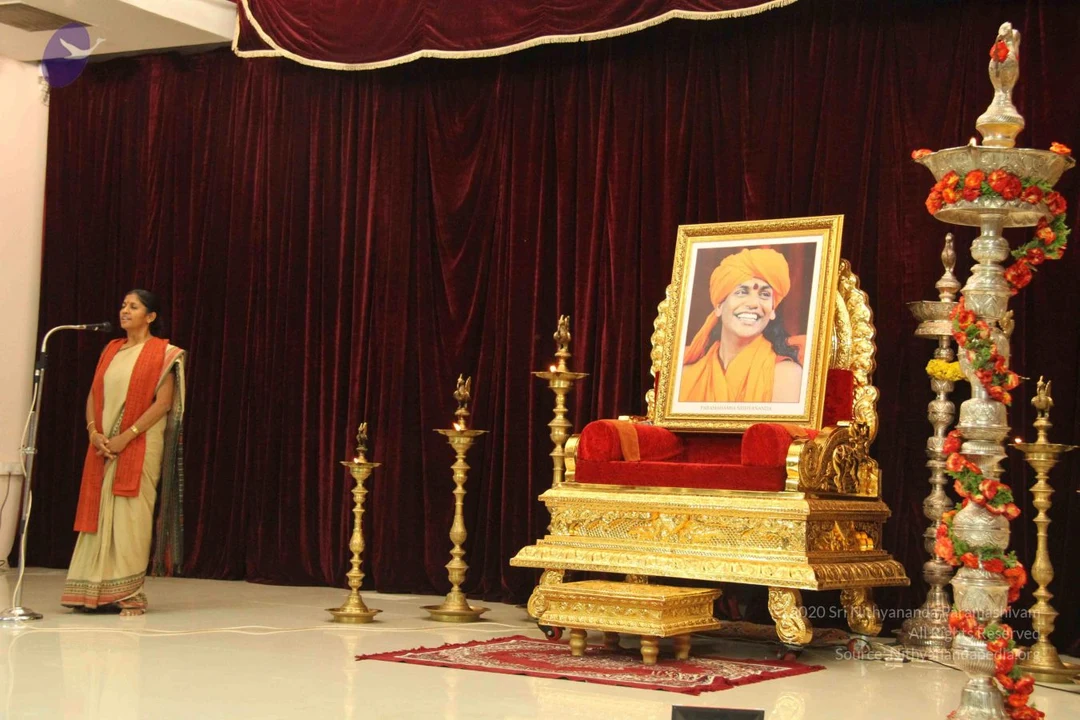
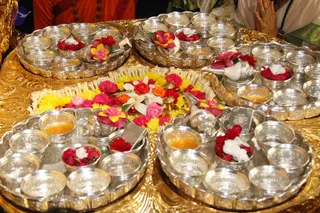
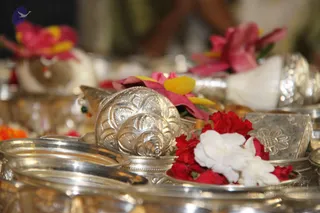
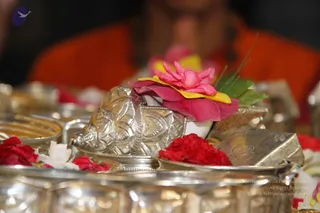
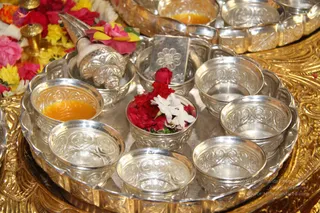
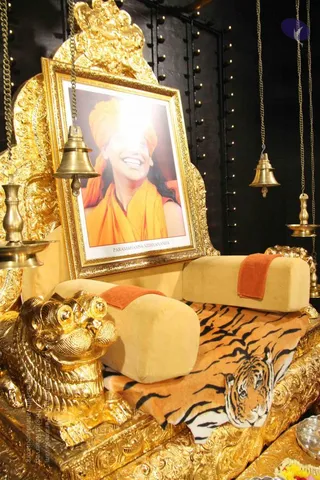
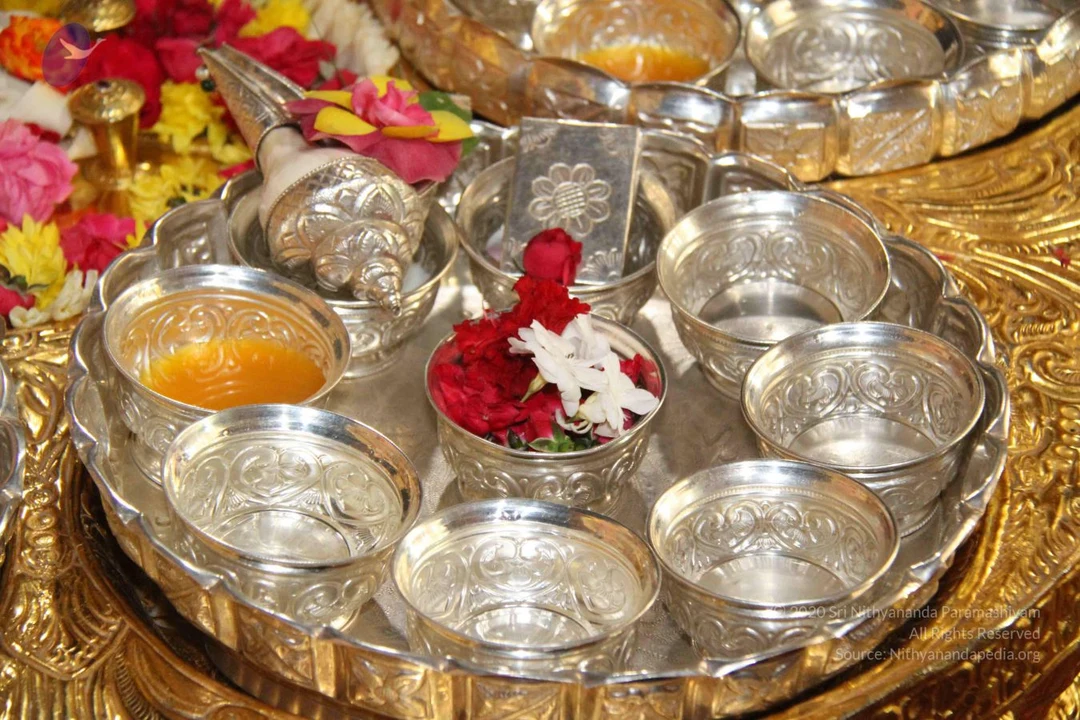
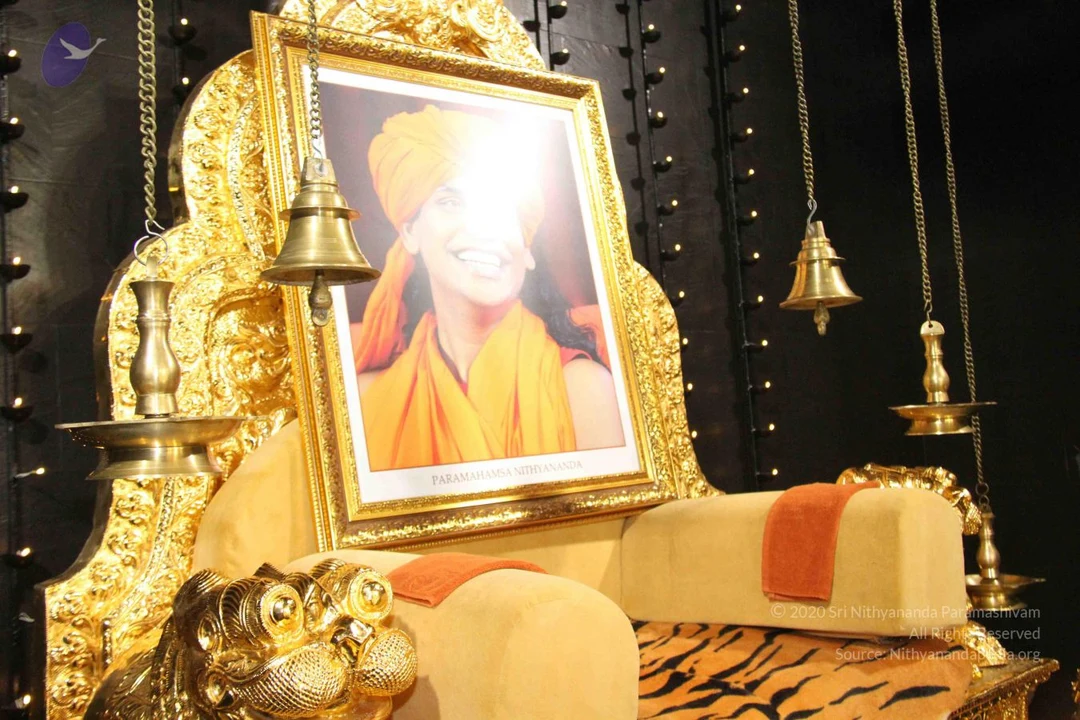
A close view of a golden ritual table set with silver bowls and trays filled with orange liquid, red and pink flowers, yellow marigold garlands and white blossoms arranged around a small brass lamp. Two silver platters of offerings sit on the left and right, and a silver conch-shaped vessel rests among them. At the top edge, the forearms and folded hands of a person in red and green garments are visible in namaskar. The gold table surface is ornately embossed.Close-up photo of silver ritual vessels on a silver tray with fresh flowers. A large embossed silver kalasha-style pot with a conical lid sits centre, flanked by red and white flower garlands and pink and yellow blossoms. Further silver bowls and trays are blurred in the background. No people are visible; the setting suggests a puja or abhishekam preparation.Close-up of an ornate silver puja vessel on a silver tray, decorated with embossed floral patterns and topped with a pink rose and yellow petals. Red flower petals and white petals scatter across the tray in the foreground. Blurred in the background, a figure in orange robes sits with hands pressed together in namaste. No readable names appear in the scene.Close-up photograph of an ornate silver puja tray on a gold-embossed surface. The tray holds several small engraved silver bowls containing saffron-yellow liquid, water, and a central bowl of red roses and white jasmine flowers. A silver conch-shaped vessel with floral engraving and a small rectangular silver plate with a flower motif sit among the bowls. Red, yellow and pink flower petals and garlands appear at the upper left. No people are visible; this is a ritual offering arrangement for puja.Close-up of a ritual arrangement on silver and gilt trays for a puja. Pink, red, orange and yellow flowers, white petals and white lily-like blossoms surround a small brass lamp stand and a silver conch-shaped vessel. Silver bowls hold saffron-yellow turmeric paste and red kumkum, and a silver spoon rests on the right. No people are visible; the scene shows only offerings and ritual objects.A photograph of an empty ornate gold throne (peetha) in a dark setting, with a gilded lion sculpture at its left and a tiger-striped throw draped over the seat. Two cream velvet cushions with orange cloth rest on the seat. Above the throne hangs a framed photograph of a smiling man in an orange turban and orange robe, labelled "PARAMAHAMSA NITHYANANDA" on the frame's print. Two brass bells hang from chains and a brass oil lamp stands to the right. No physical people are visible; the throne is unoccupied and the only person shown is the framed portrait.
Temple-Visit

77 photosSource gallery
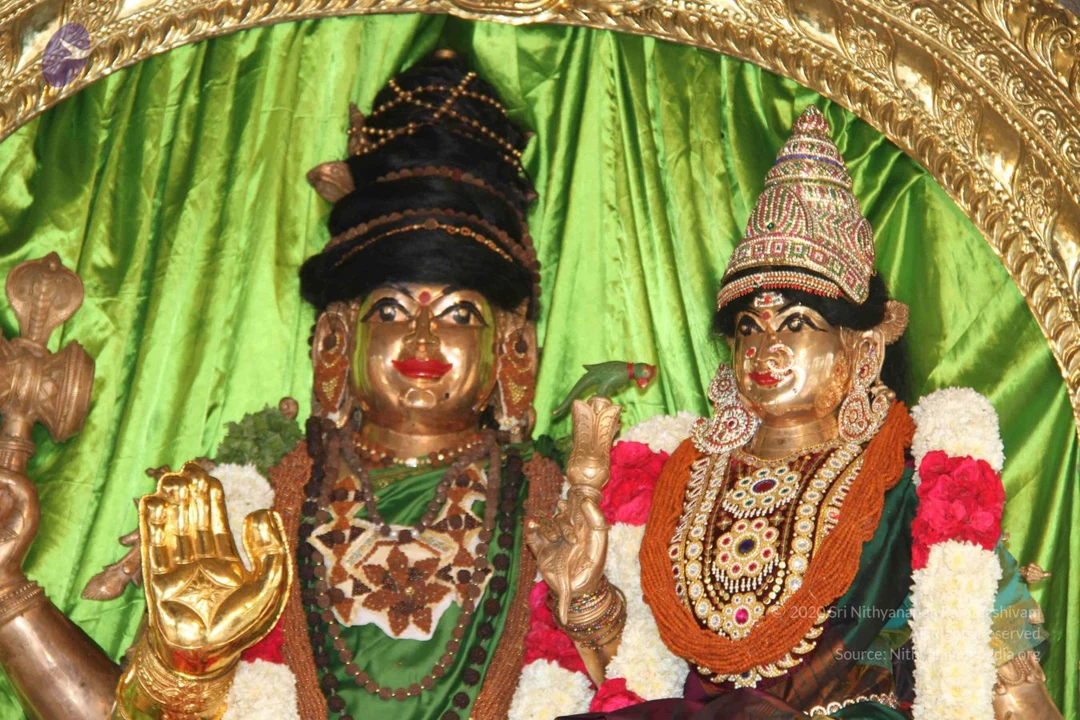
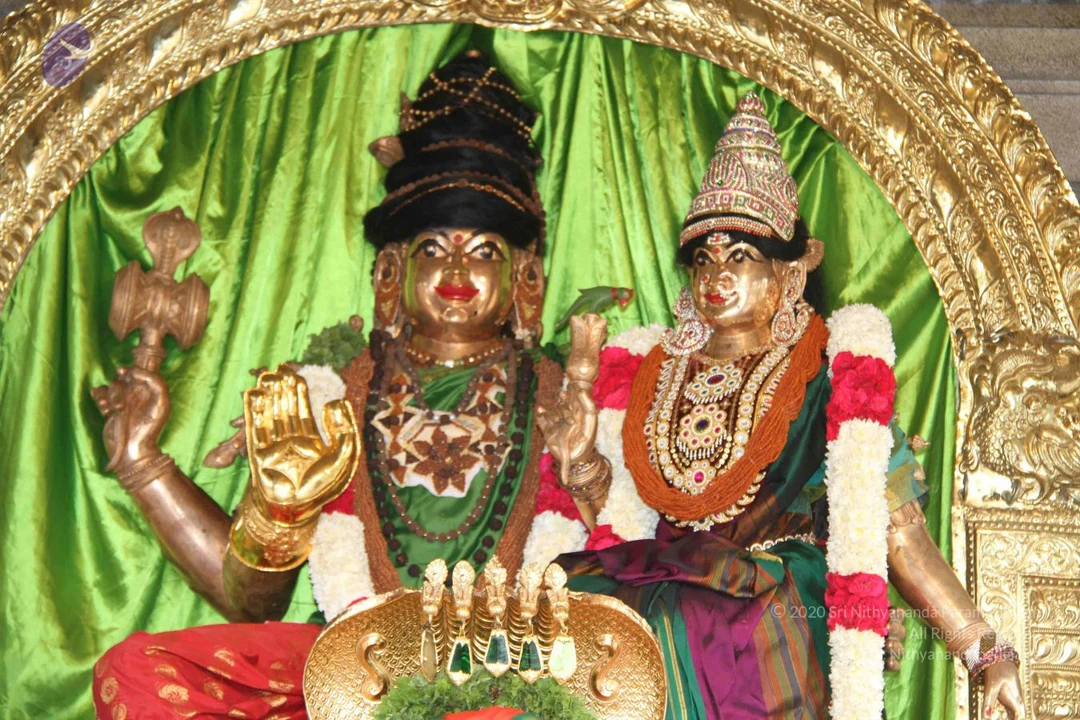
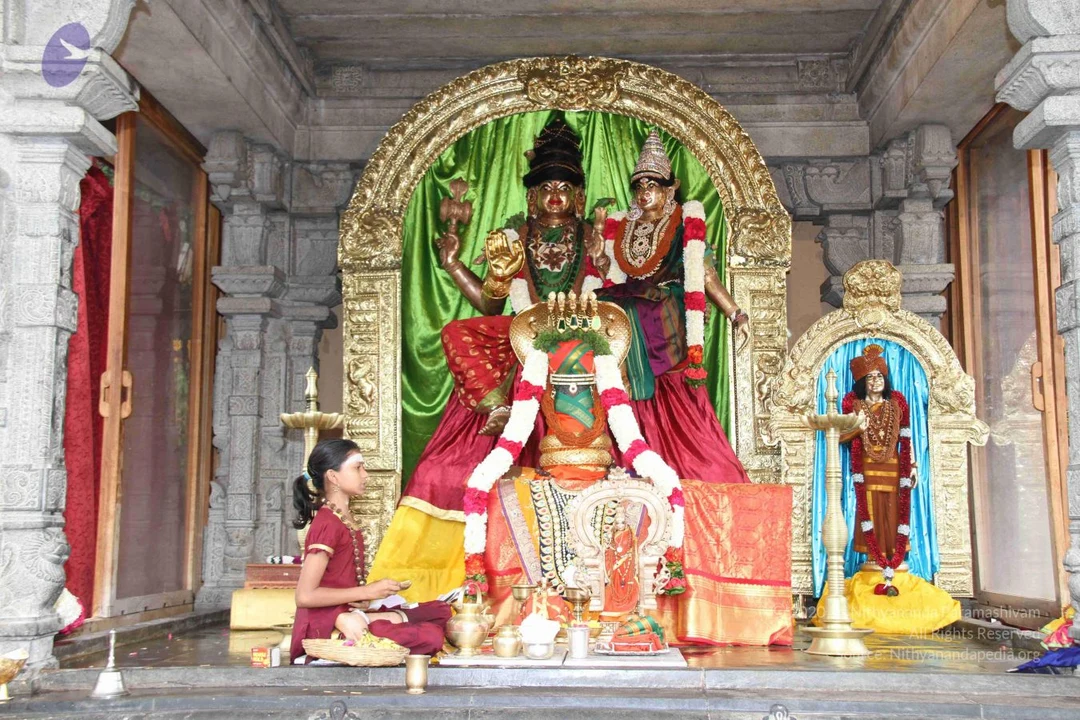
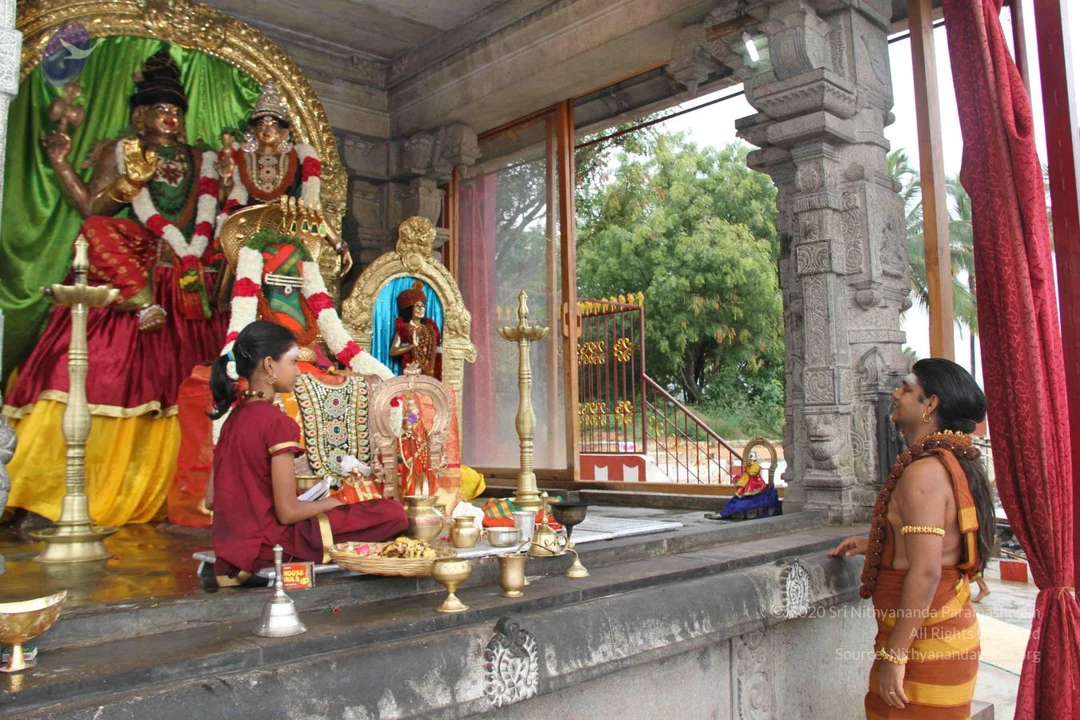
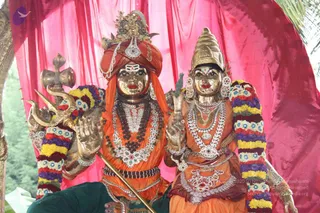
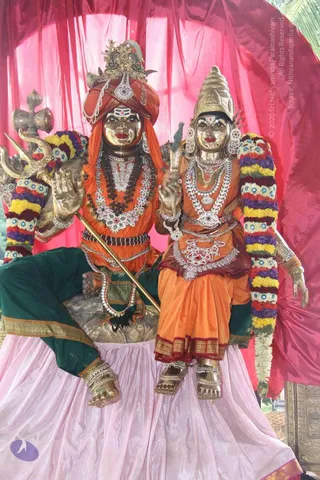
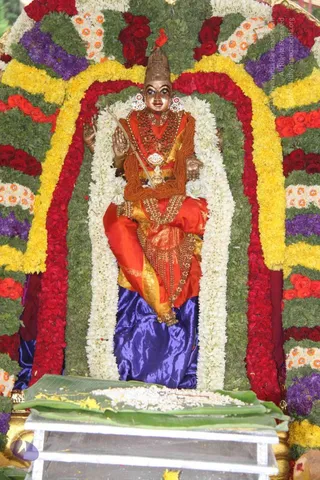
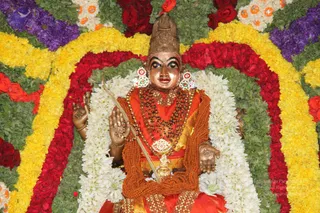
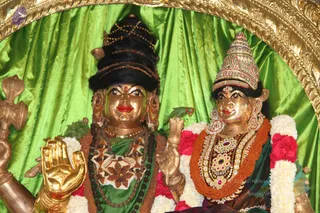
Two golden metal deity murtis seated side by side against a magenta draped backdrop, decorated for a festival alankara. The male figure wears an orange turban, orange garments, a rudraksha mala and silver necklaces, and holds a trident and a damaru-like drum. The female figure wears a tall golden crown, orange-red garment, layered silver and beaded necklaces and large earrings, and holds a staff. Both are garlanded with multicoloured flower strands in yellow, red, purple and white, and each has a vertical tilak on the forehead. Green cloth lies beneath them.Photograph of a pair of polished metal murti statues seated on a pink draped platform in front of a red-pink cloth backdrop. The male figure wears an orange turban and orange garment with a dark green dhoti, multiple rudraksha-style beaded necklaces and silver jewellery, and holds a trident. The female figure wears an orange sari with a red border, silver necklaces and a tall golden crown, and holds a small object in one hand. Both are draped with garlands of yellow, purple, red and white flowers on their arms. No living people are visible. Statues only, so no candidate for a person is present.A photograph of a deity murti seated in a flower-decorated alcove, dressed in an orange-red silk garment with gold border, a blue cloth draped below, and layered rudraksha-style beaded necklaces. The murti wears a tall crown with a red tuft, floral earrings, and holds a sword-like implement in one hand. The arch behind is framed with white jasmine garlands and red, yellow, and purple flowers and green leaves. A banana leaf with rice or grain lies on a white stand in front of the murti.A seated deity murti is decorated for a flower alankara, framed by a large arch of garlands in yellow marigolds, red roses, white jasmine strands, purple blossoms and green leaves. The figure wears a tall crown, large earrings, a red and gold sari with layered necklaces, and holds a staff-like object in one hand while the other hand is raised. It sits on a blue-purple cloth on a raised platform with white and red striped steps. Gold-carved arch panels and pink cloth frame the shrine, and trees appear outside. No physical people are visible.A decorated deity murti of Shiva in a floral alankara. The seated figure has a tall golden crown, large eyes, red lips and white-and-red floral earrings. It wears a red garment, orange shawl, multiple rudraksha-style beaded malas and a gold pendant. One hand holds a wand-like staff and the raised hands show ritual gestures. Behind it, a frame of white jasmine garlands, red roses, yellow marigolds, purple flowers and green leaves surrounds the murti.Two golden metal deity murtis of Shiva and Parvati are seated side by side against a green silk backdrop framed by an ornate gold arch. The figure on the left, with a tall black coiled crown wrapped in rudraksha beads, holds a golden trident and raises a hand in abhaya gesture; a rudraksha mala and a green garment with a patterned bodice adorn it. The figure on the right wears an ornate jeweled crown, a heavy multi-stranded gold and red-stoned necklace, an orange beaded garland and a red-and-white flower garland. A small green parrot perches between them. These are statues, not living people.

Deity-Aarti

17 photosSource gallery
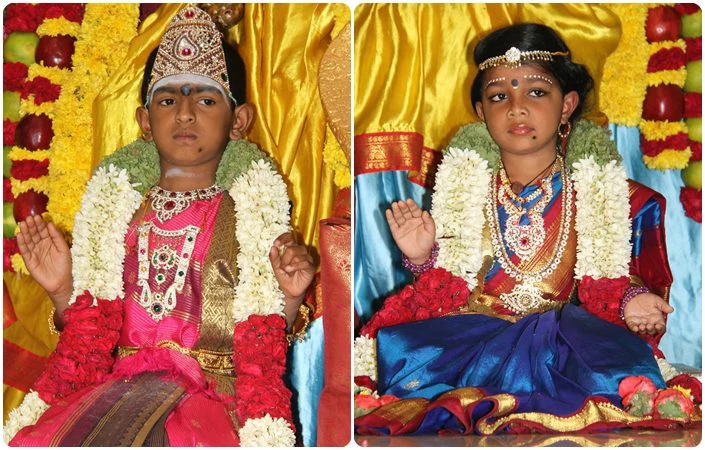
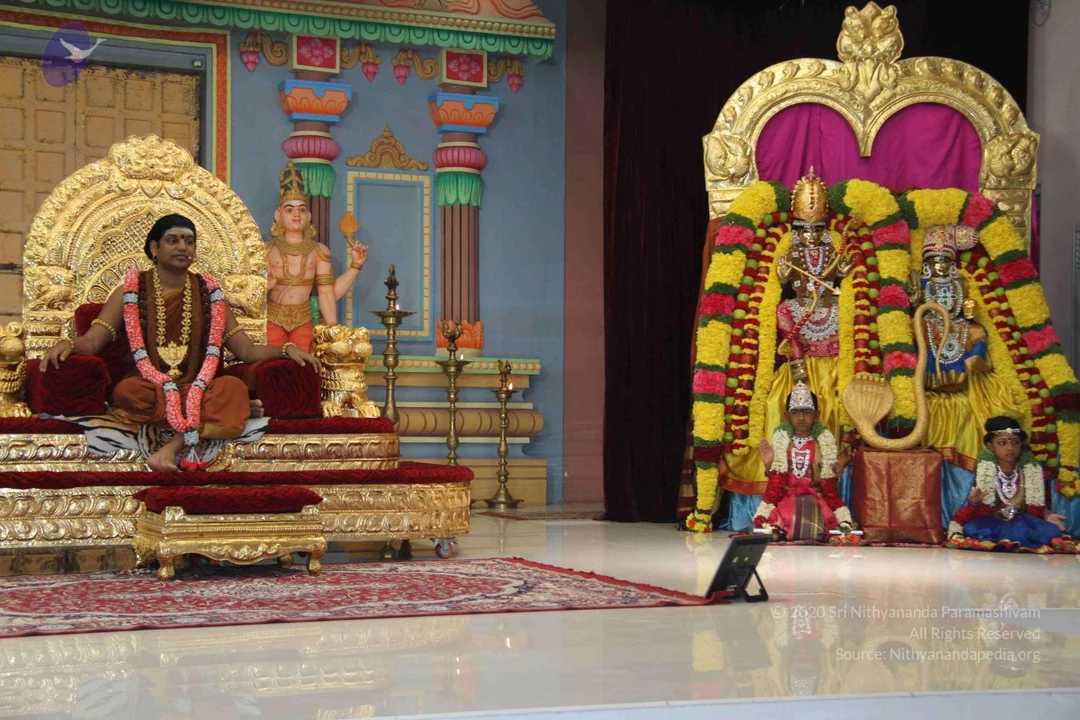
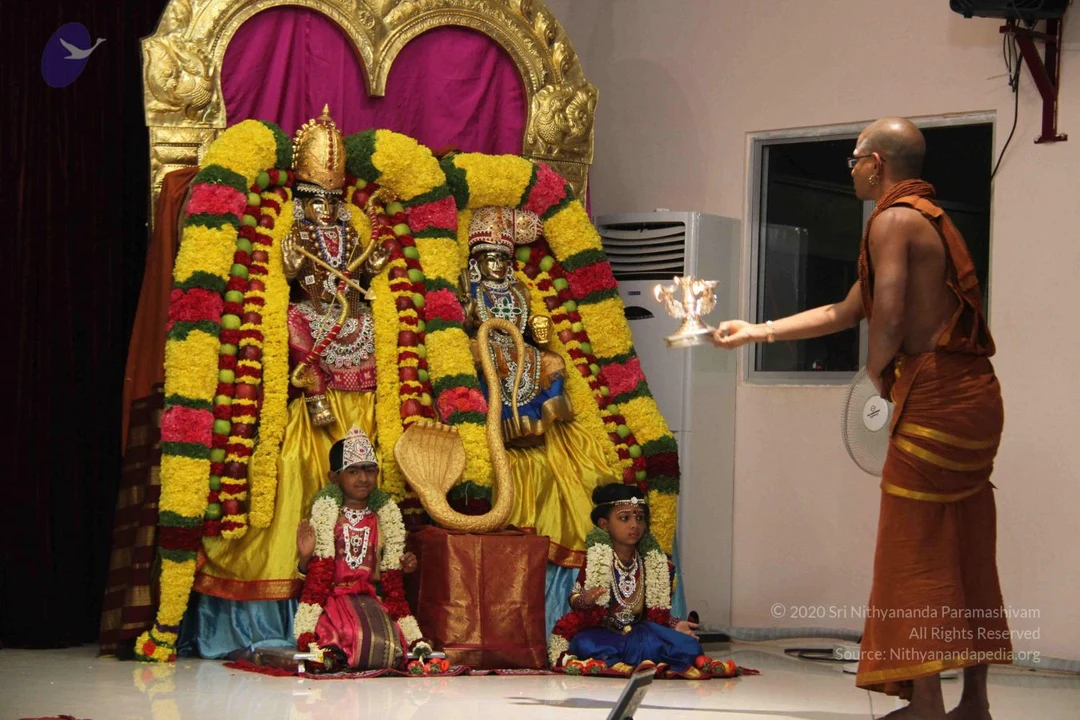
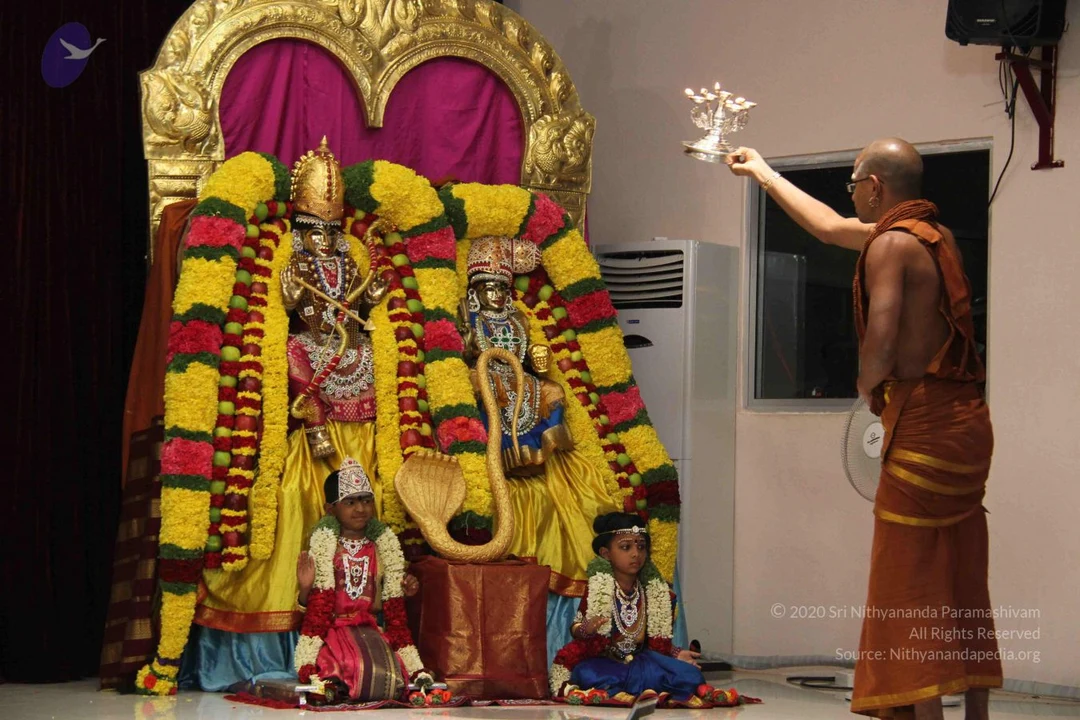
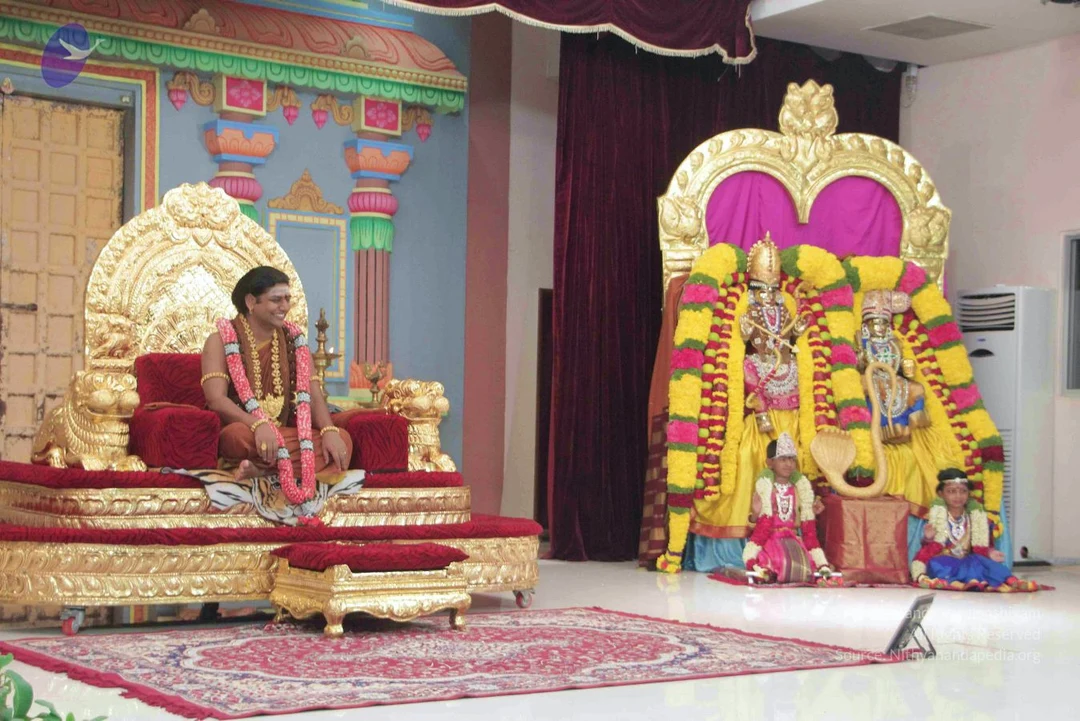
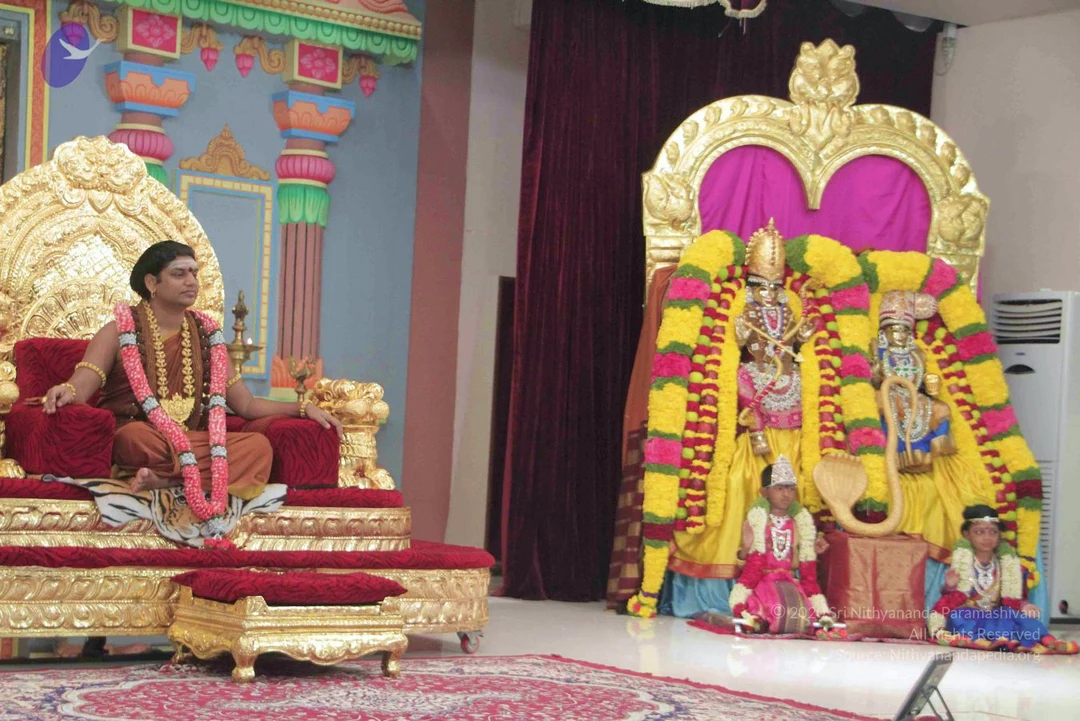
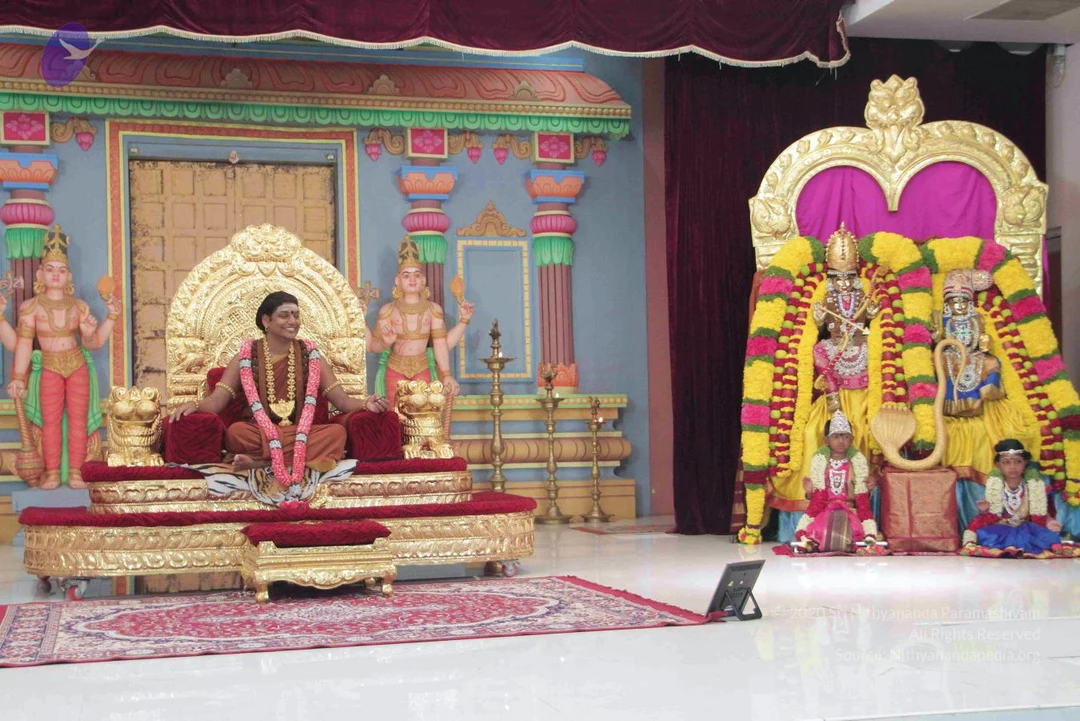
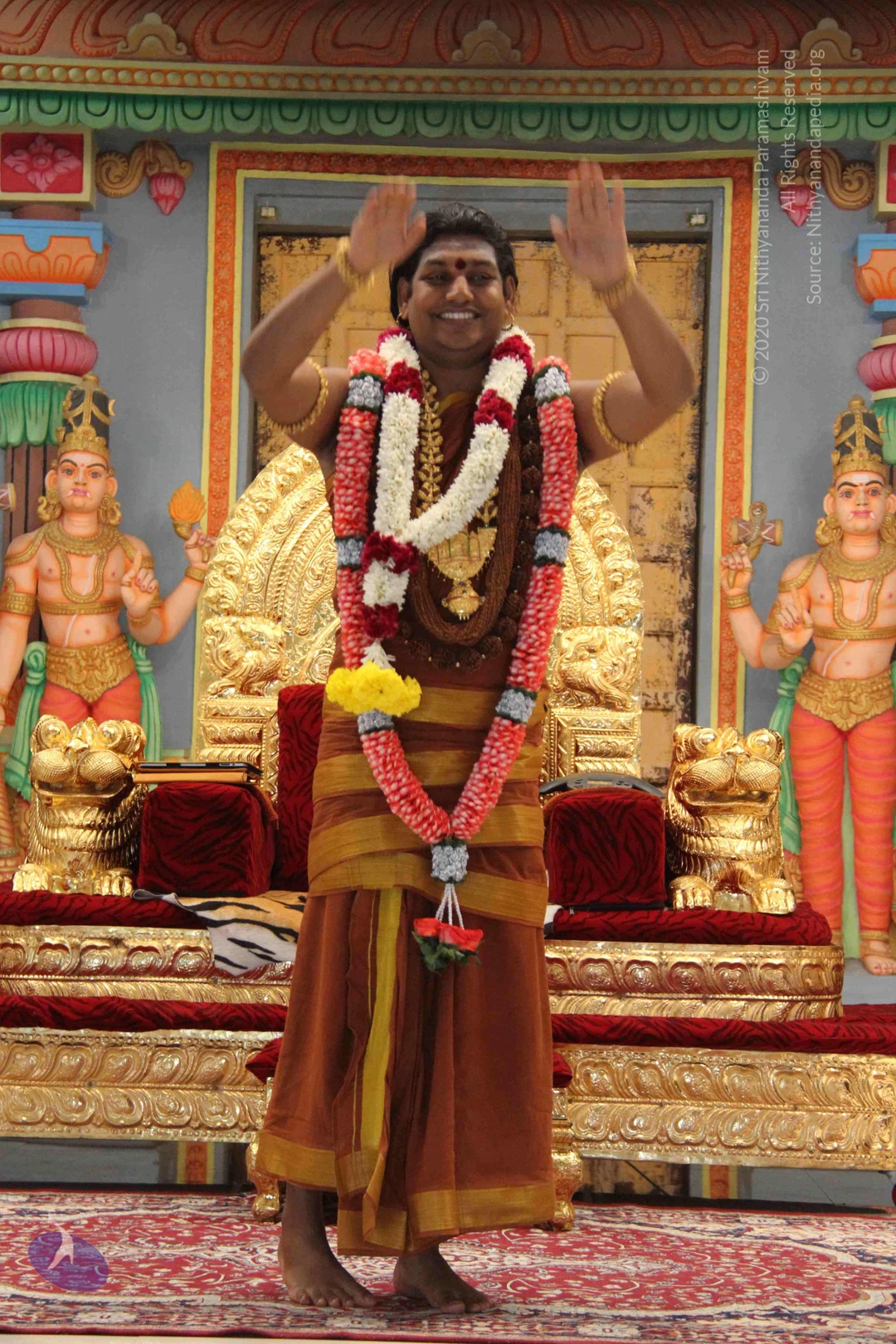
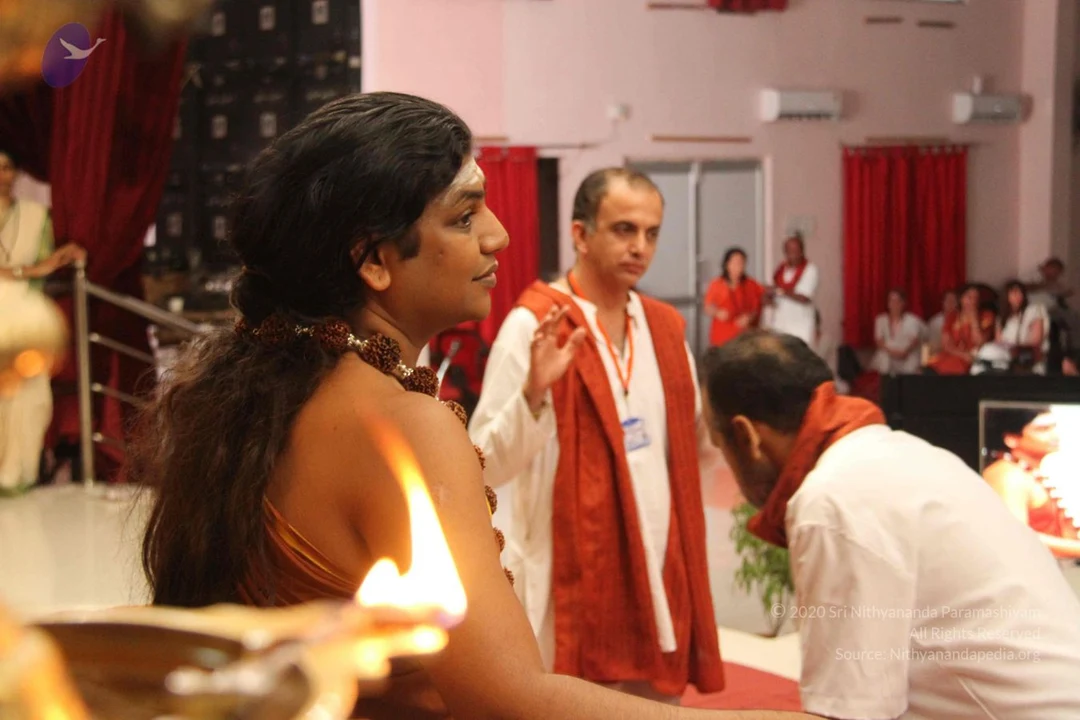
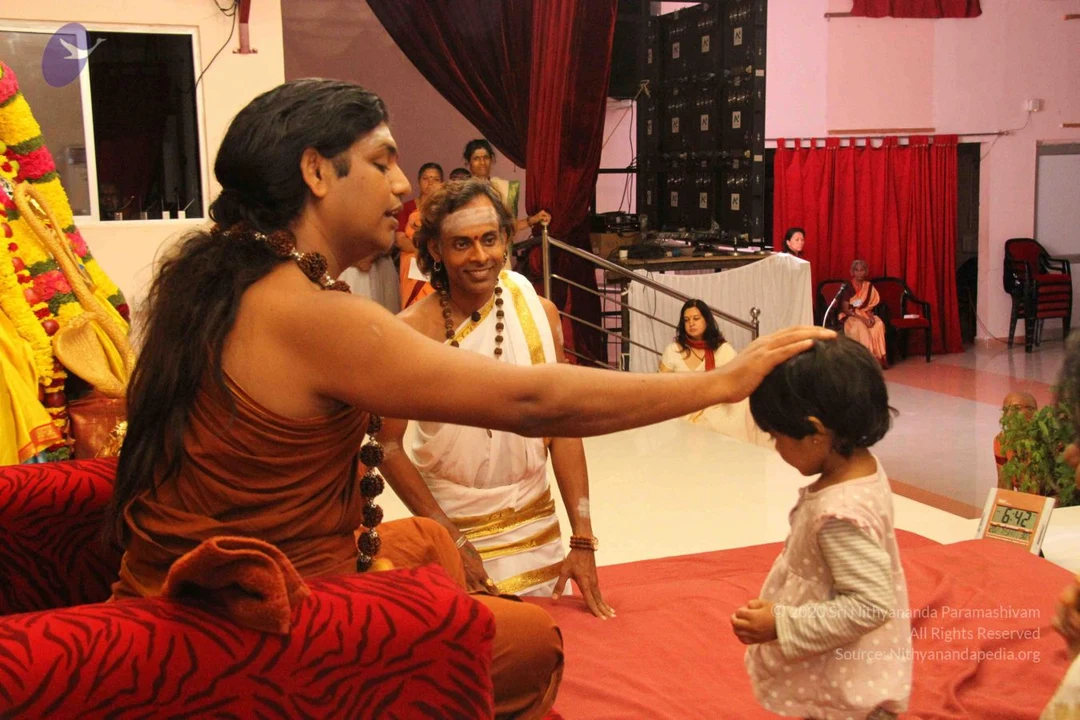
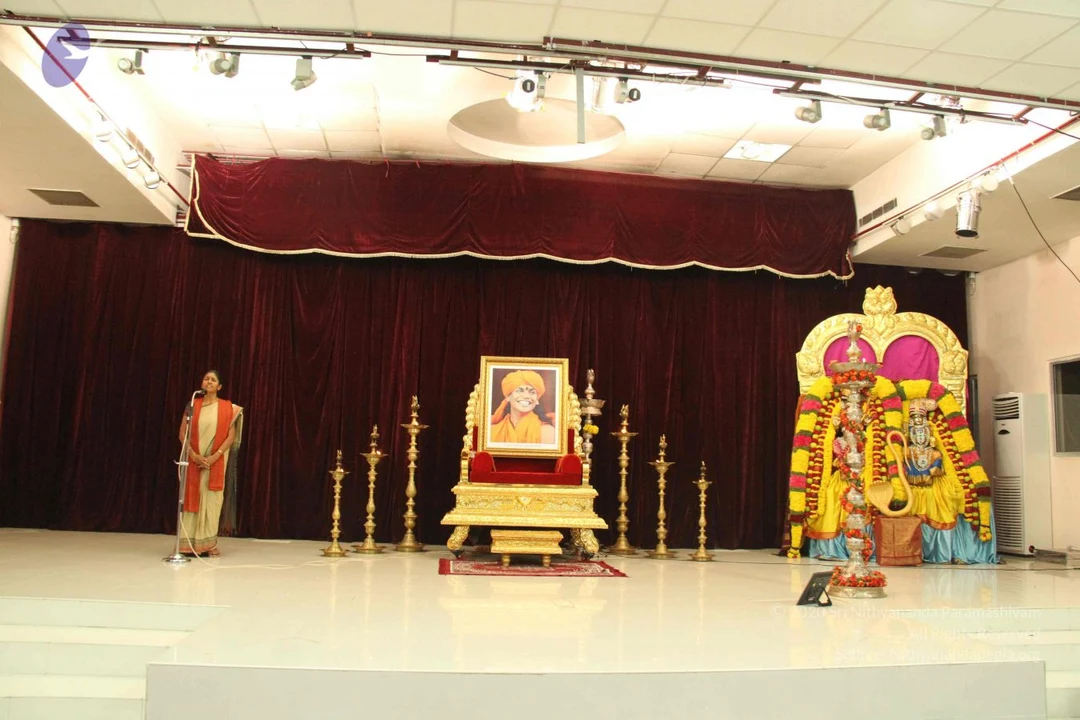
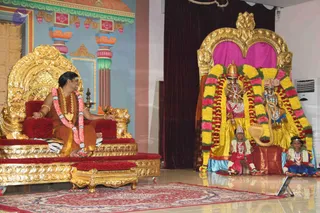
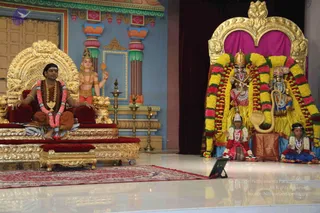
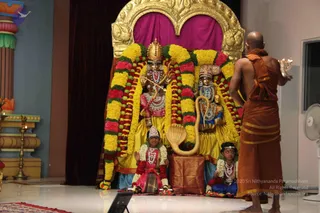
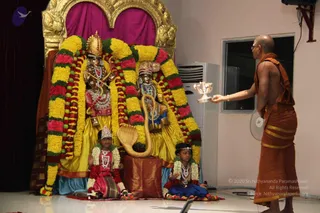
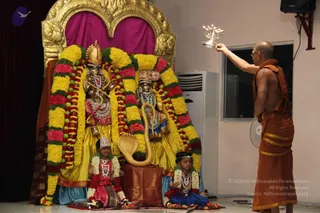
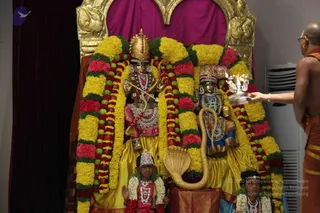
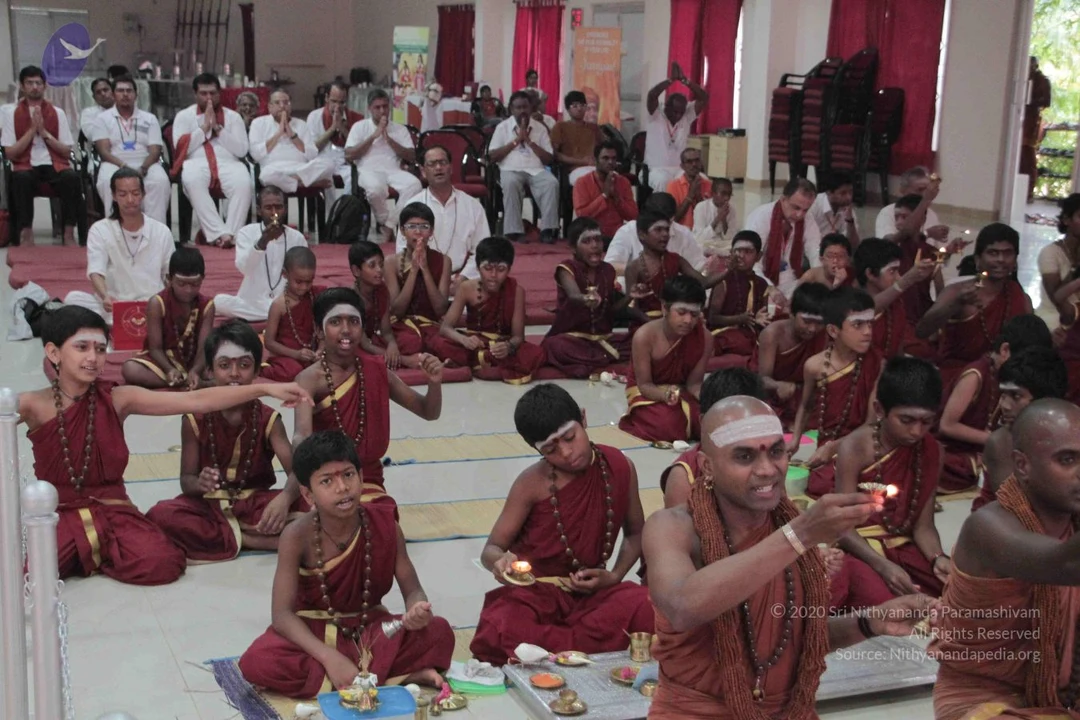
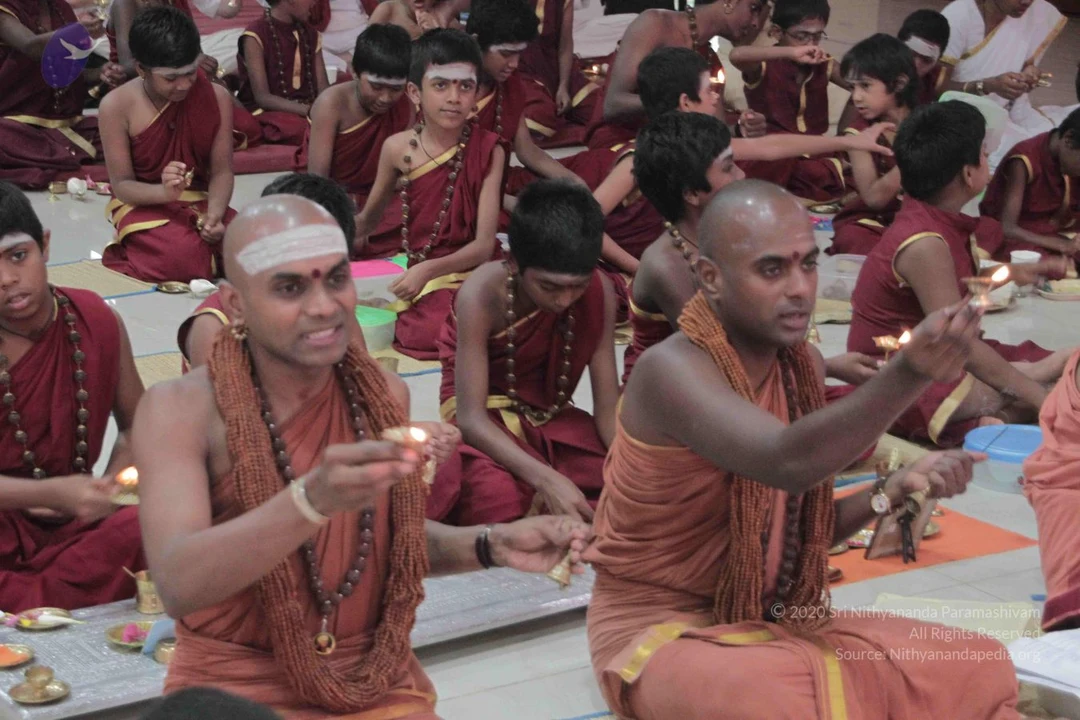
A photograph of a ceremonial scene in a decorated hall. On the left, a seated figure in orange-saffron robes and a long pink-and-white garland sits on an ornate gold throne with red cushions, gesturing toward the right; the figure has long dark hair and gold necklaces and bangles. To the right, a gold-framed throne holds two deity murtis draped in marigold and pink garlands, one wearing a gold crown and the other a pink-and-gold crown with a cobra hood. Two small children in red and white clothing with garlands sit on the floor in front of the murtis. A brass oil lamp stands between the thrones, and a floral-patterned red carpet covers the floor. The appearance-based label is probable Swamiji, identified by long hair, saffron robes and gold necklaces; this is a probable match only.A seated man in orange-saffron robes, a red shawl, a gold necklace and a red-and-white flower garland sits on an ornate gold throne with red cushions in a temple-style stage set. Behind him stands a gilded figure holding a ceremonial fan. To the right, a decorated deity murti pair with a crown, garlanded with yellow and pink flowers, is attended by a large cobra hood. Two young children in red and blue clothing sit in front of the deities with garlands. Brass oil lamps stand between the throne and the deities on a white floor with a red rug. The person on the throne has distinctive long swept-back hair, saffron robes and ceremonial gold necklaces, consistent with the page's Swamiji reference, so the probable label applies. Four people are visible in total.A photograph of a temple alankara scene at a Nithyananda Dhyanapeetam-style hall. Two large deity murtis stand behind a gold arch, draped in dense garlands of yellow, red and green flowers. A large serpent with a hood rises between them, and a deity murti wears a gold crown and holds a bow. Two young children in red and blue ceremonial clothes with garlands sit in front. A bald man in orange-saffron robes, bare-shouldered, stands on the right holding a lit oil lamp in one hand, performing aarti. Brass oil lamps stand at the left edge.A photograph of a ritual alankara of two deity murtis decorated with yellow and pink flower garlands, seated on a gold-and-red dais with a golden cobra beside them. A standing man with a shaved head, wearing a saffron-orange dhoti and shawl, holds a silver oil lamp toward the murtis. Two children sit in front on a red cloth: one in a pink dress with a white garland and crown, the other in blue with a white garland. Background includes a gold arched backdrop, magenta curtain and an air cooler. Three people are visible.A ritual worship scene before a golden arched shrine draped with magenta cloth, where two large deity murti figures are heavily garlanded with yellow marigolds and red flowers. A bronze-coloured cobra form lies at their base on a dark red pedestal. Two young children sit in front wearing red and blue silk with flower garlands and ornaments; one has a small crown. A bald man in an orange-brown dhoti and shawl, bare-chested, raises a silver aarti lamp toward the deities at right, performing a puja. Air conditioning unit and speaker are visible at the edges.A decorated shrine of two deity murti dressed in yellow silk and flower garlands of yellow, red and green blossoms with green leaves. The taller murti on the left wears a gold crown and holds a trident, while the figure on the right wears a golden headdress and stands beside a large golden cobra with a raised hood. A priest in an orange-brown dhoti, bare-chested, holds a silver aarti lamp with lit flames toward the deities at the right edge. Two young children in white and red garlands stand in front of the shrine, one with a small crown and one with a hand raised. Golden peacock-motif arch and magenta curtain frame the scene, and a ceremonial snake-themed alankara is visible.
Nithyananda-Satsang
50 photosSource gallery
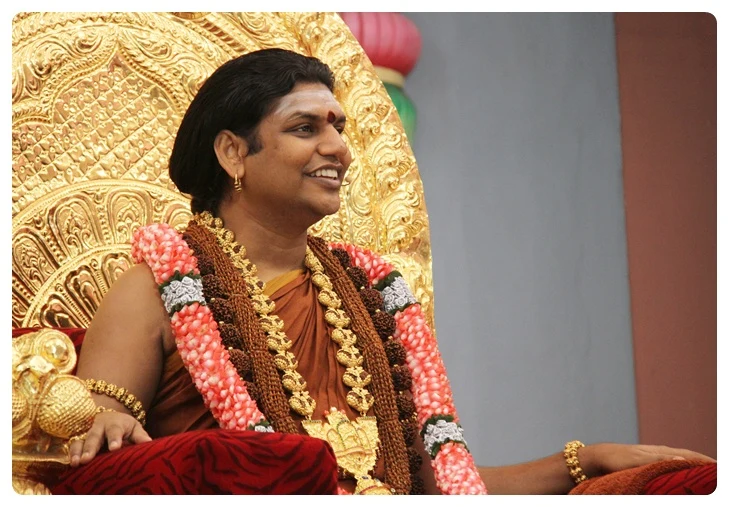
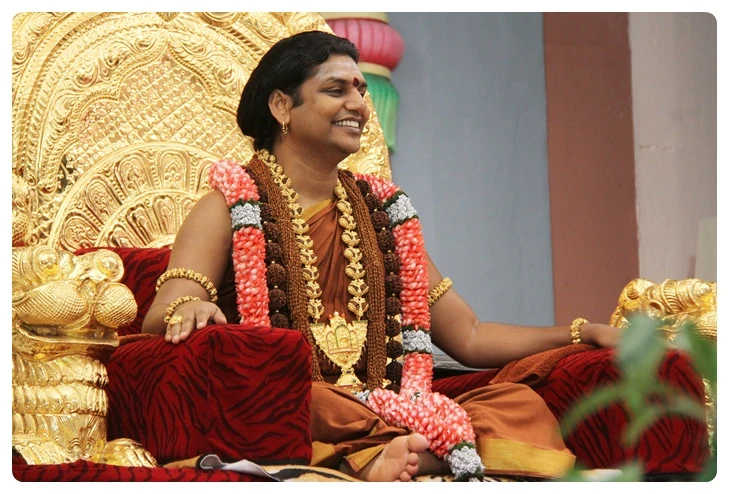
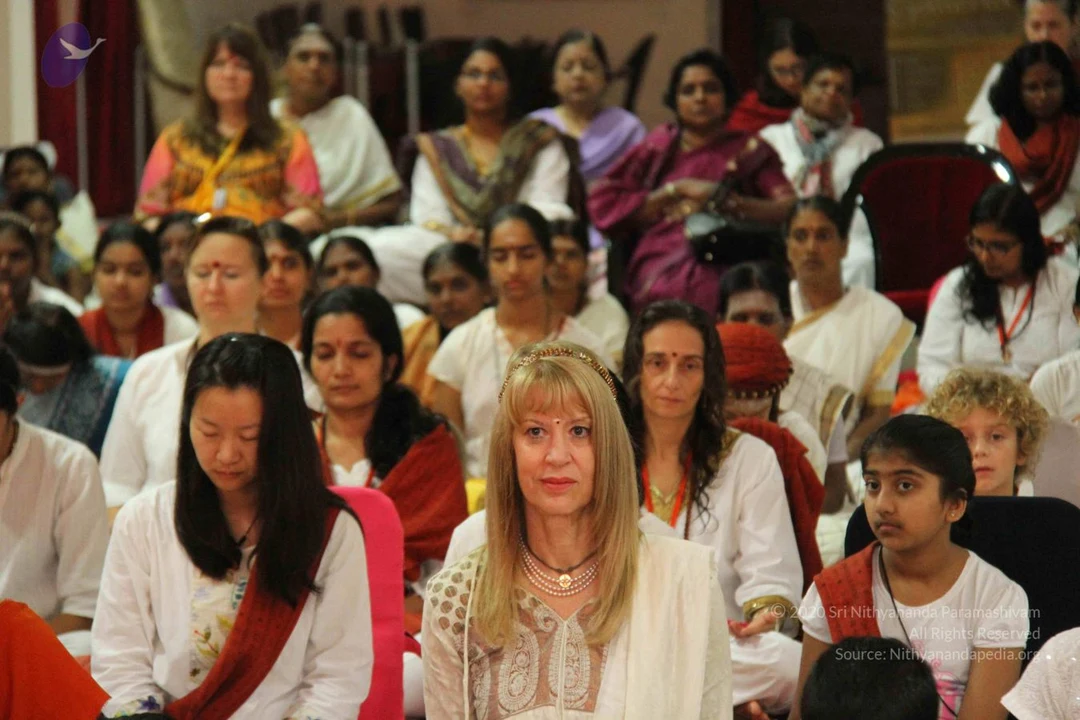
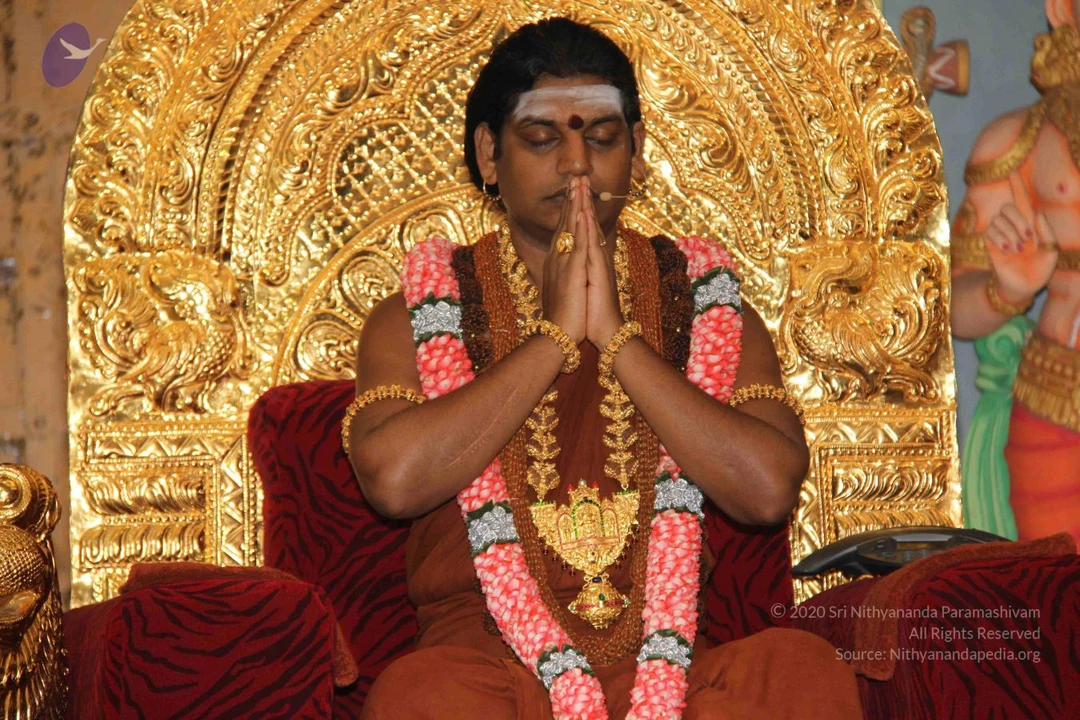
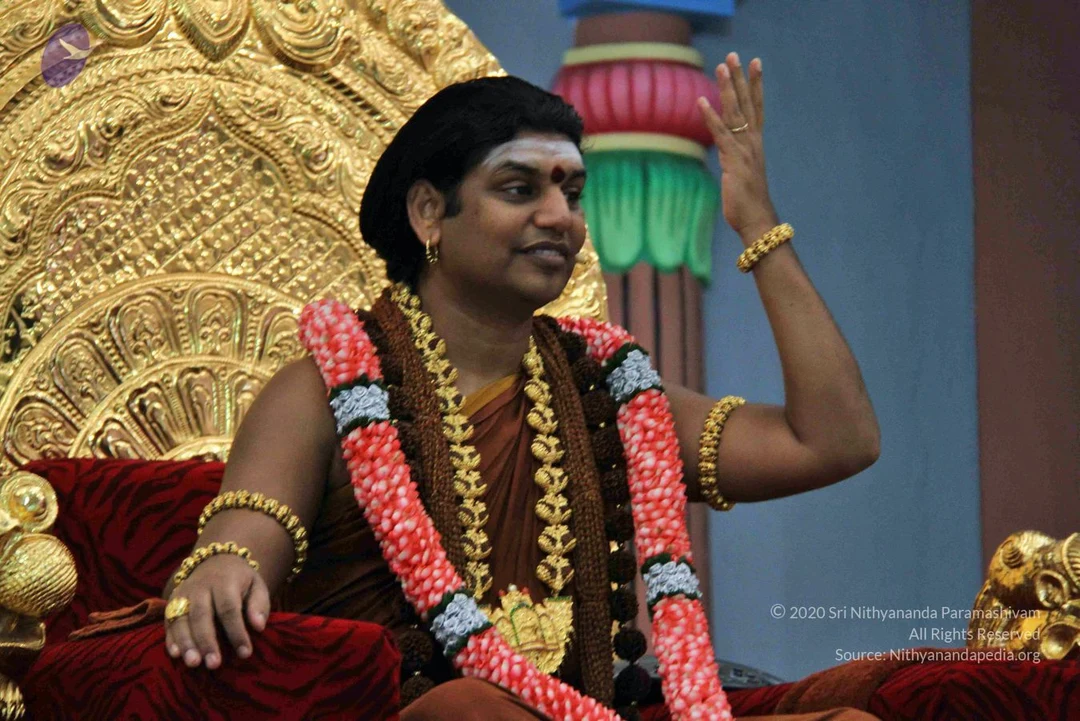
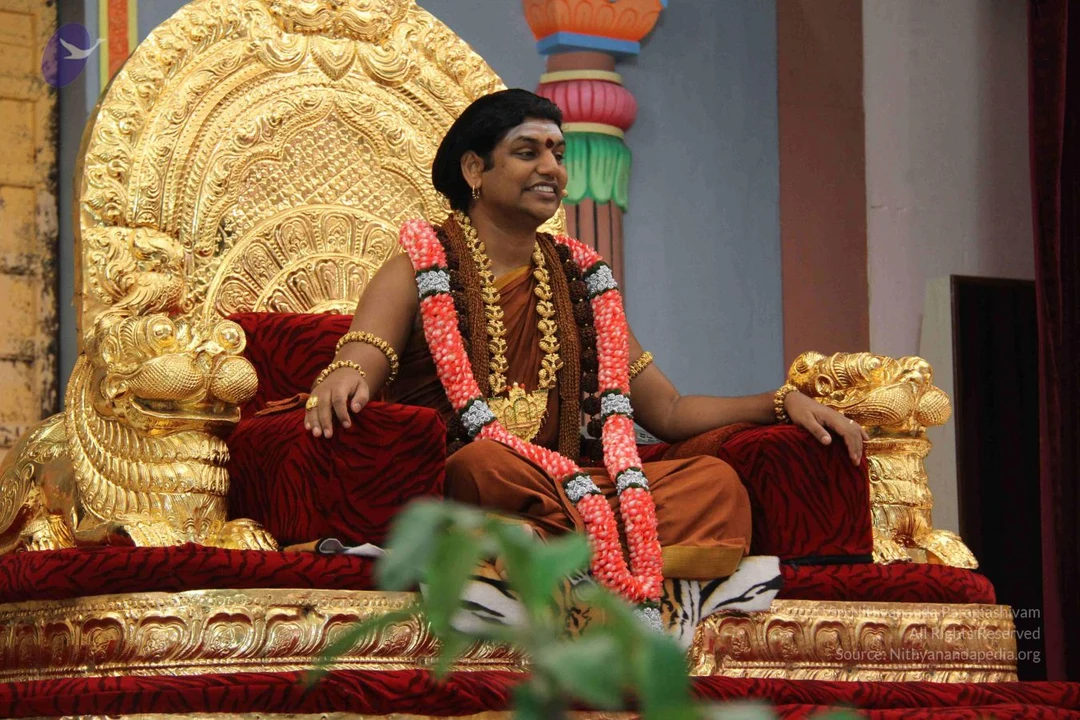
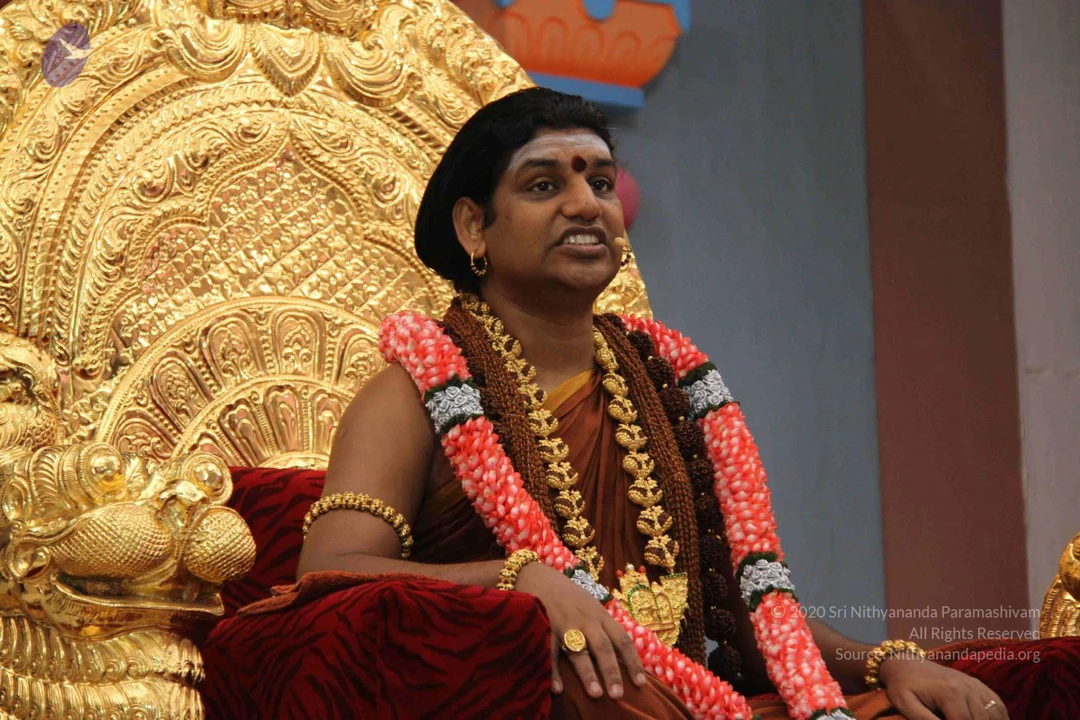
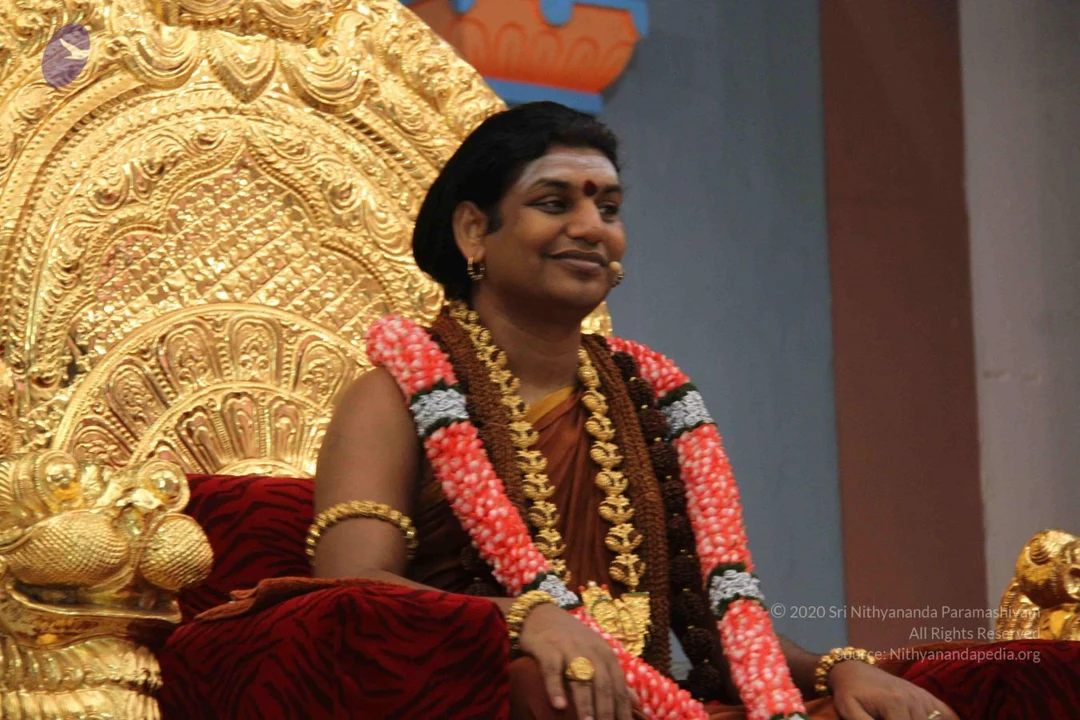
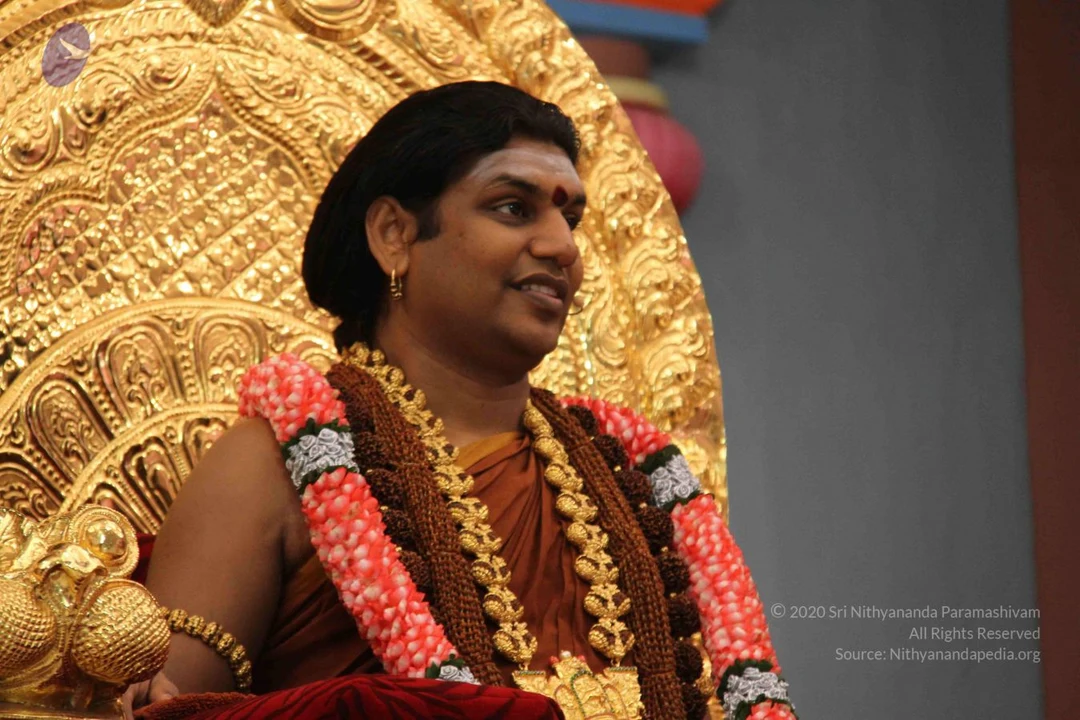
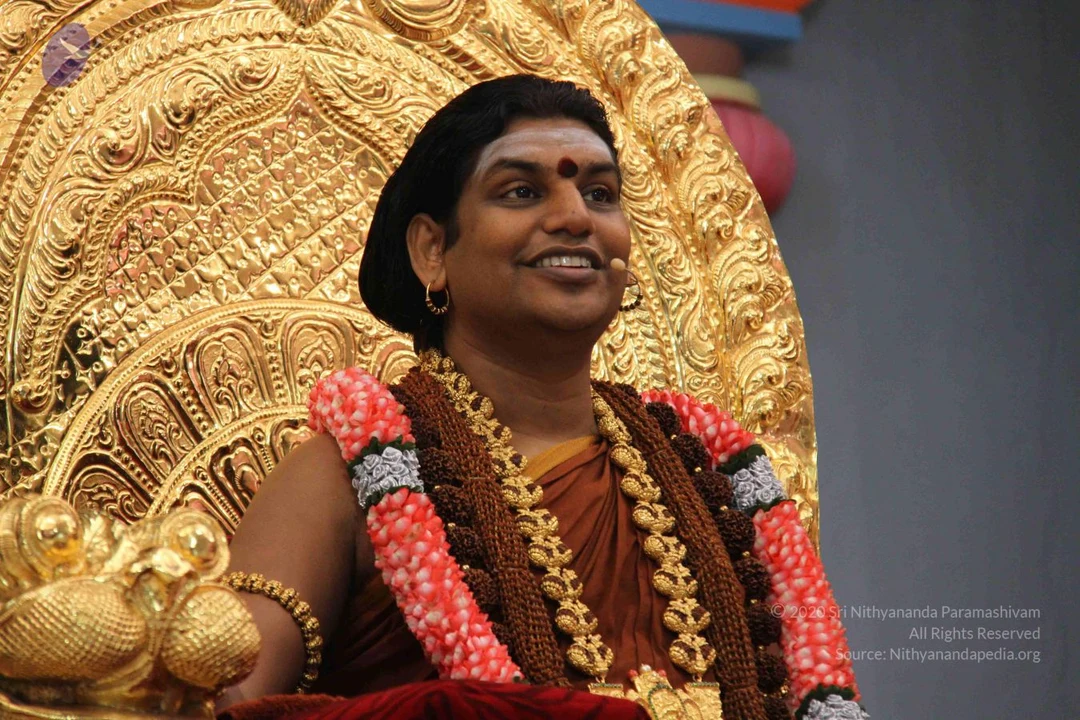
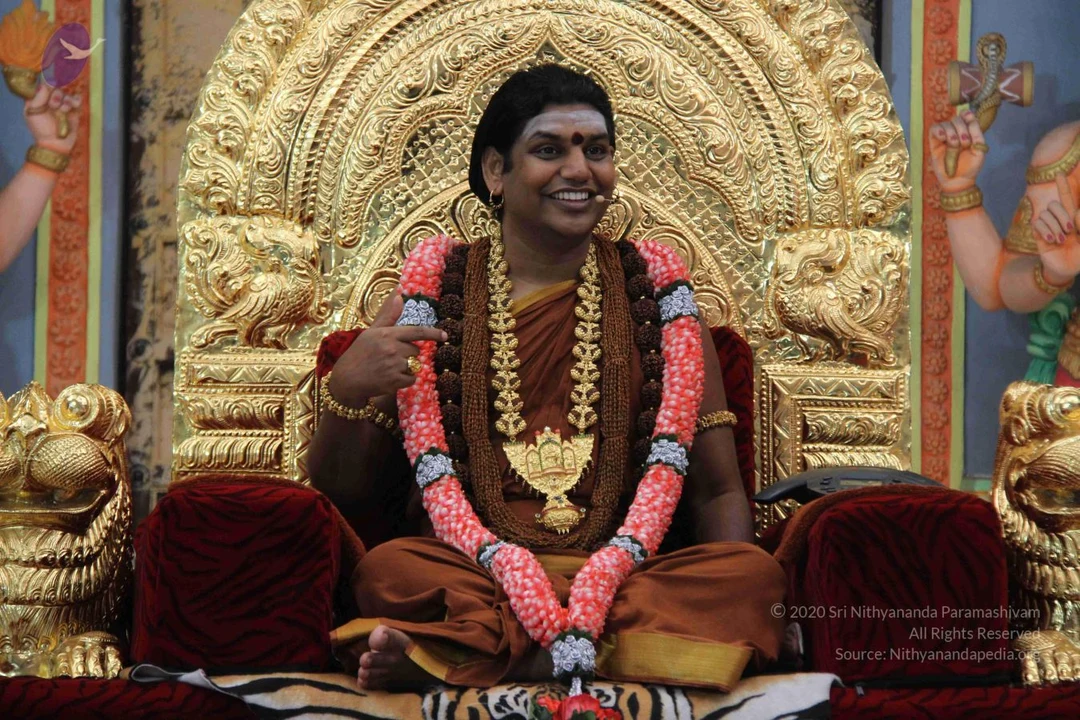
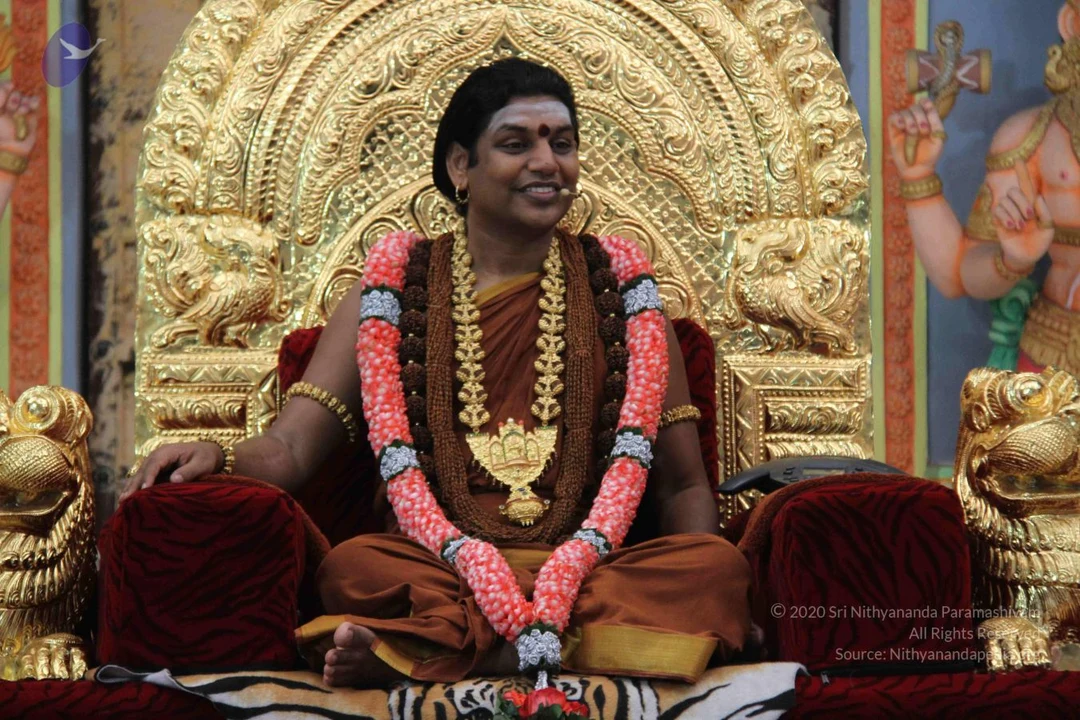
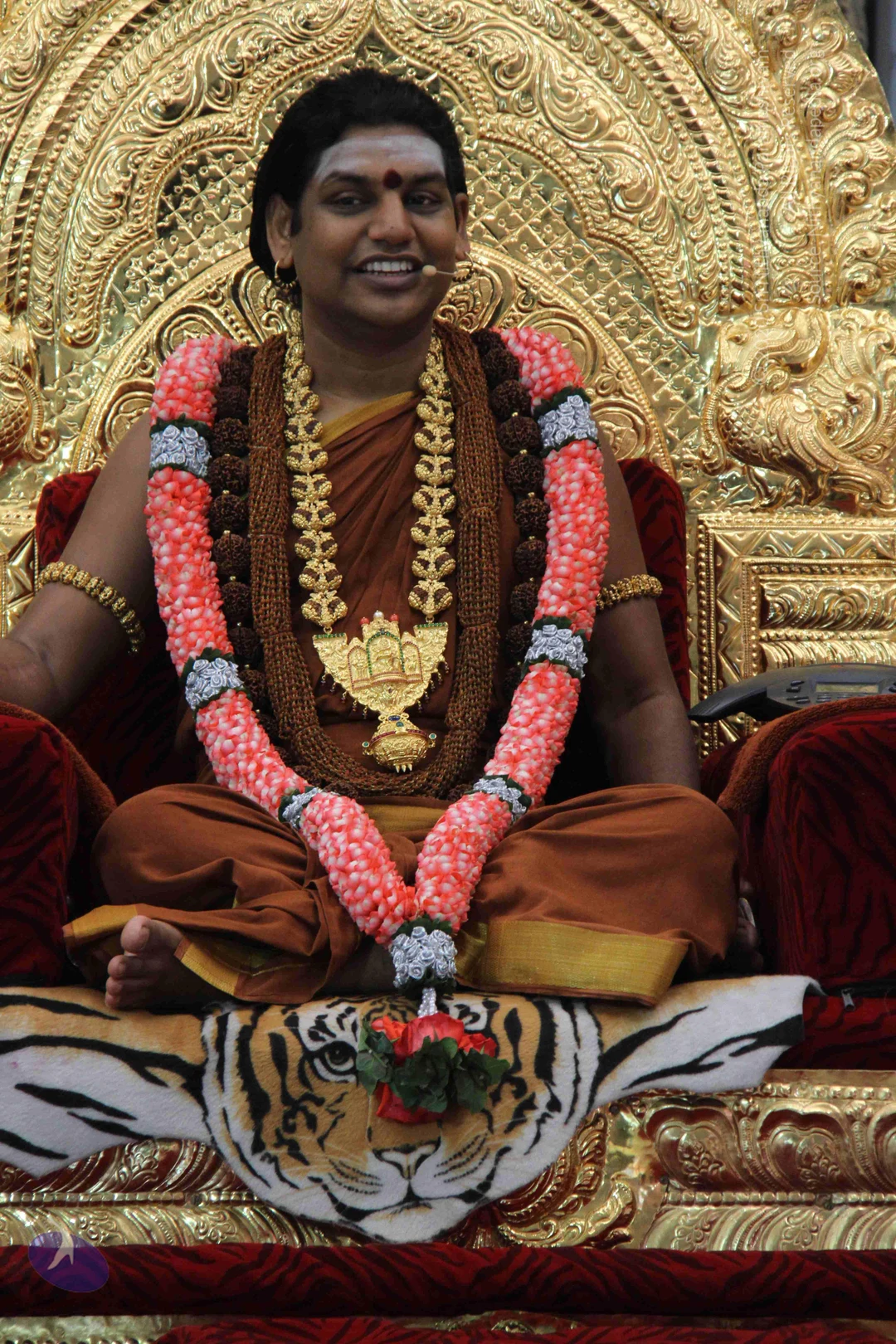
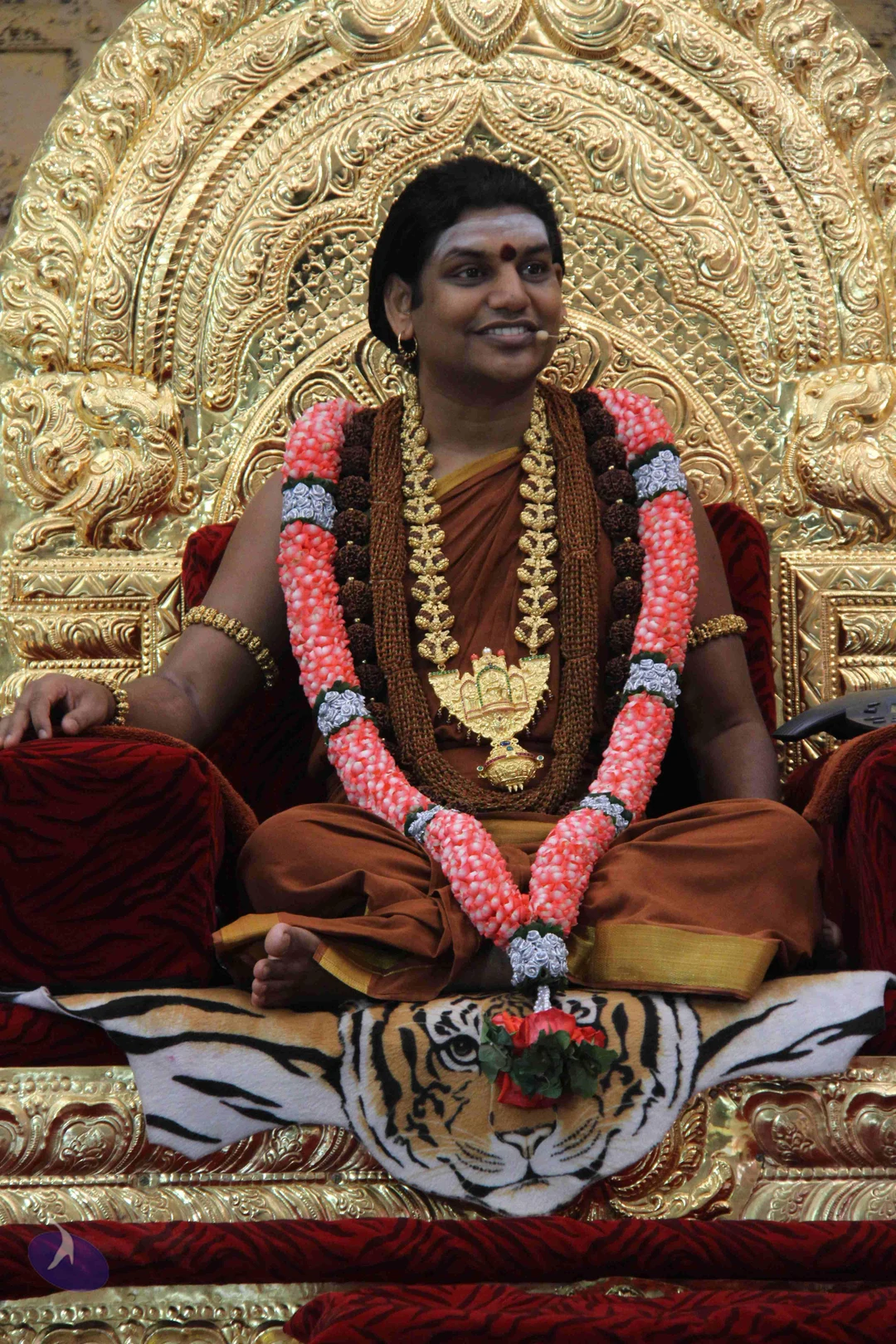
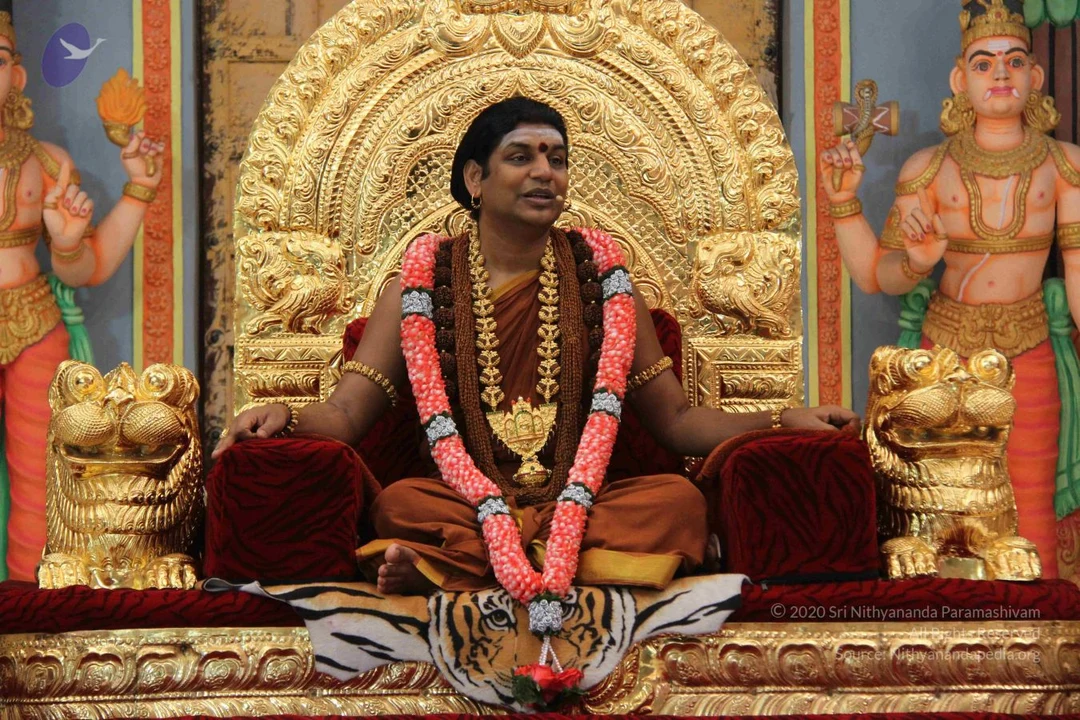
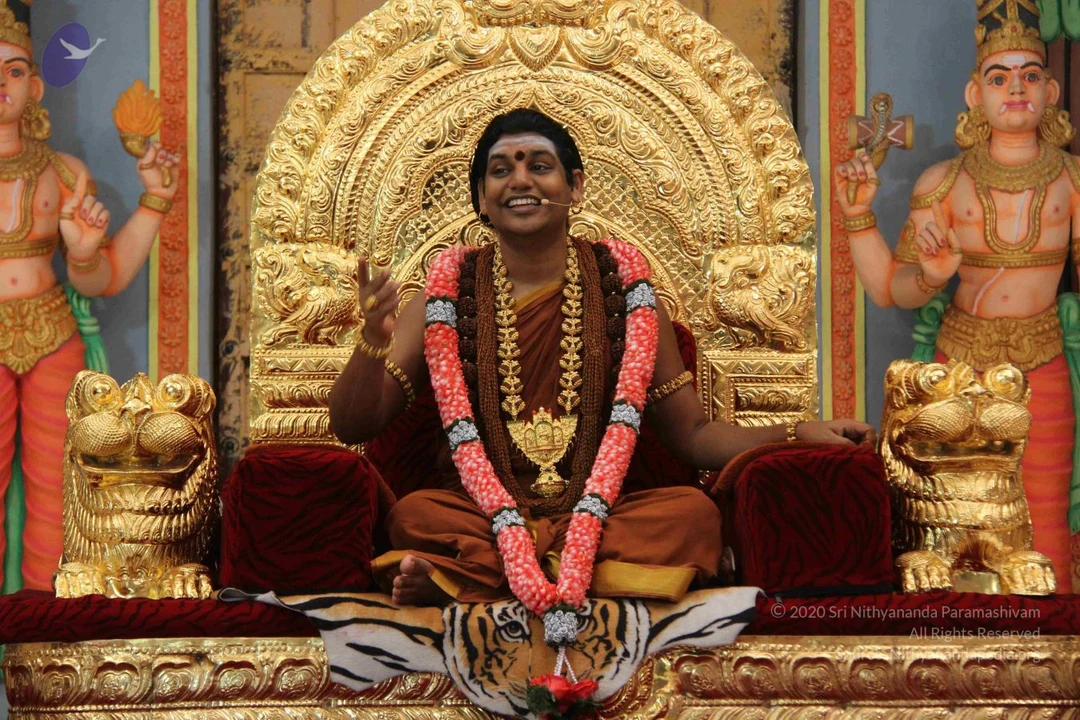
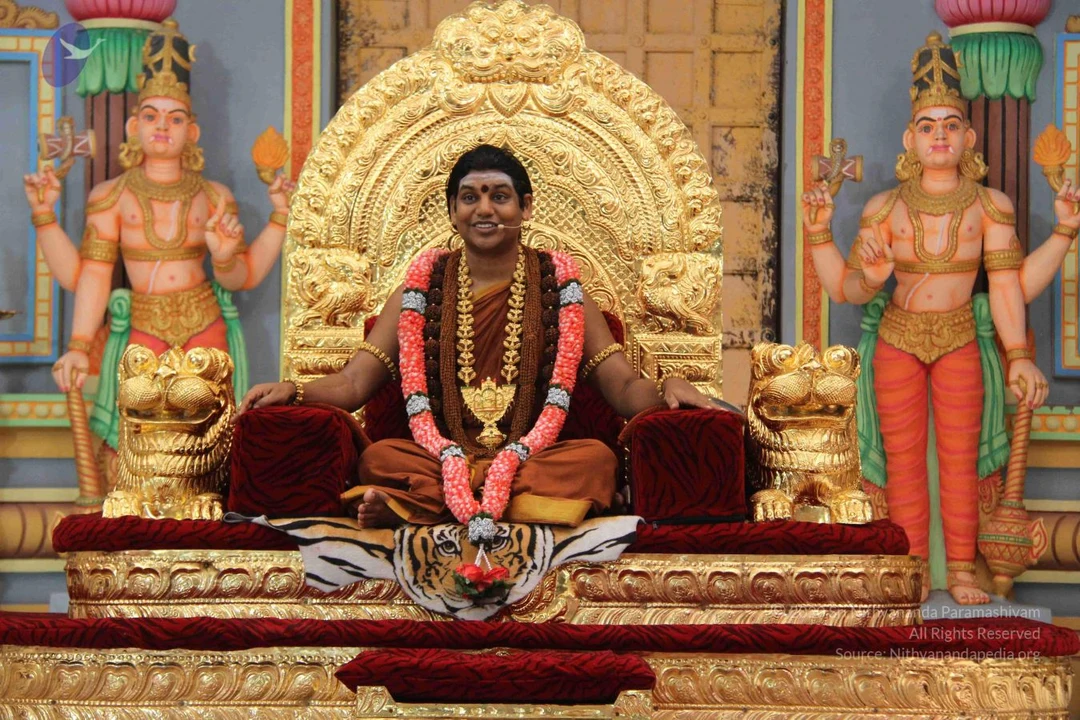
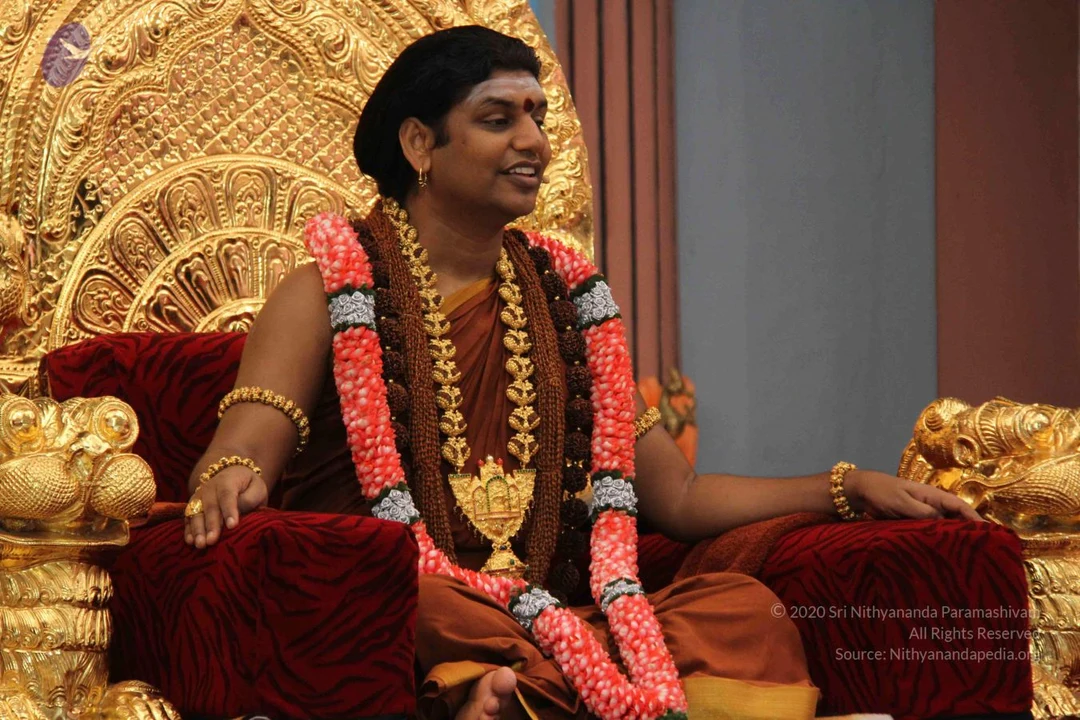
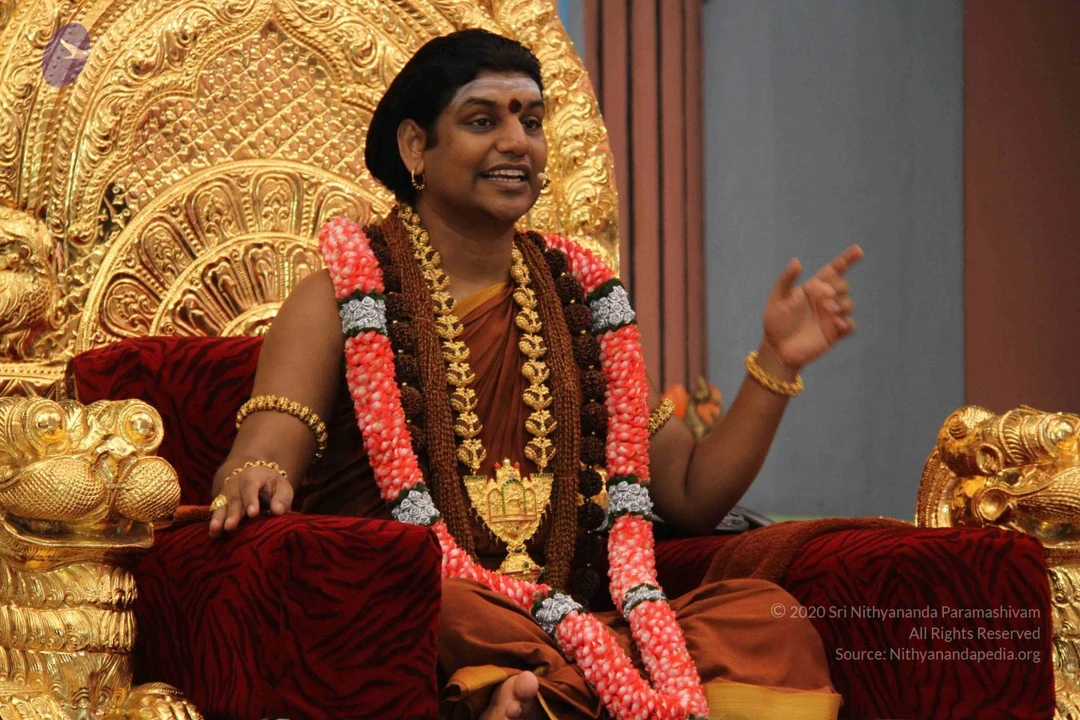
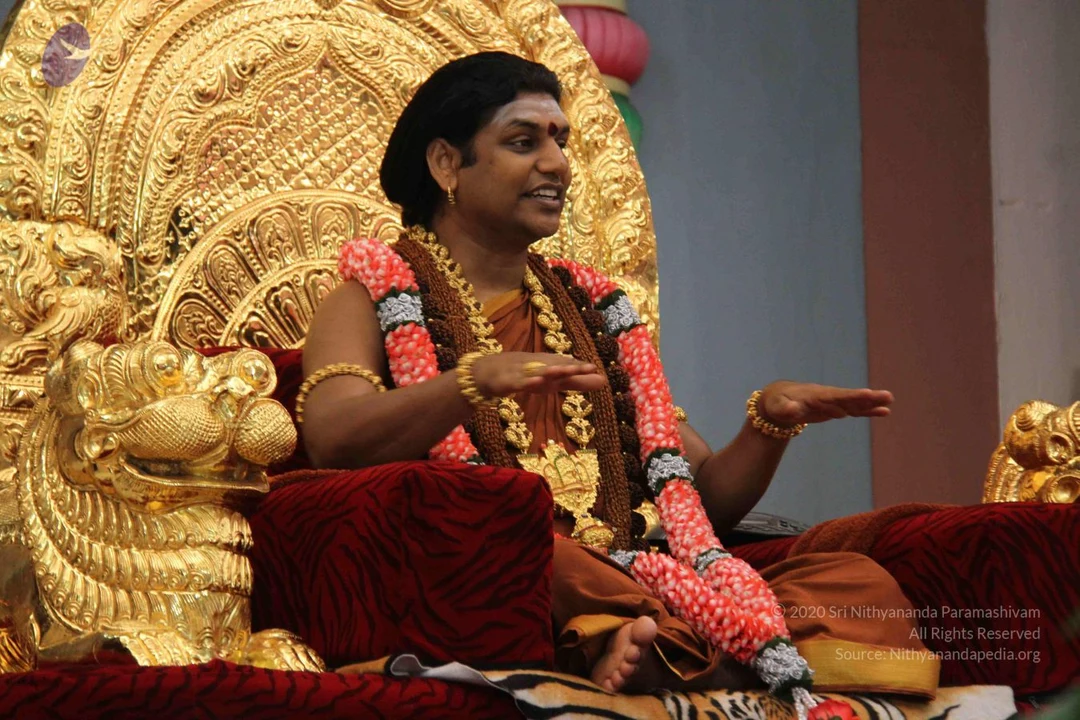
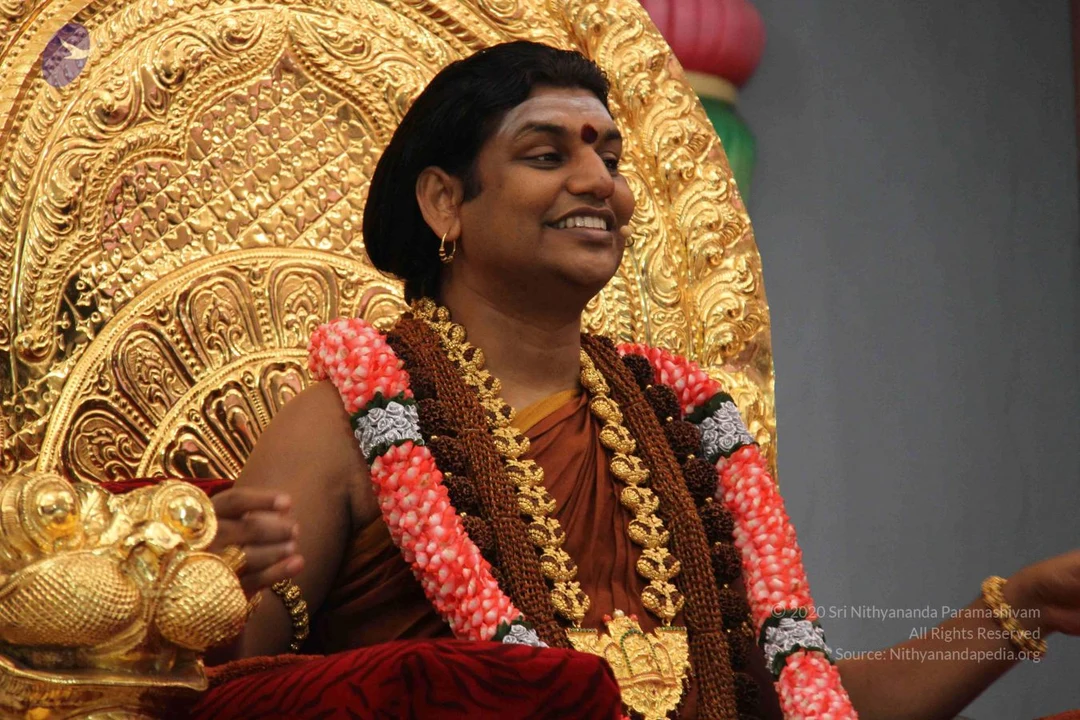
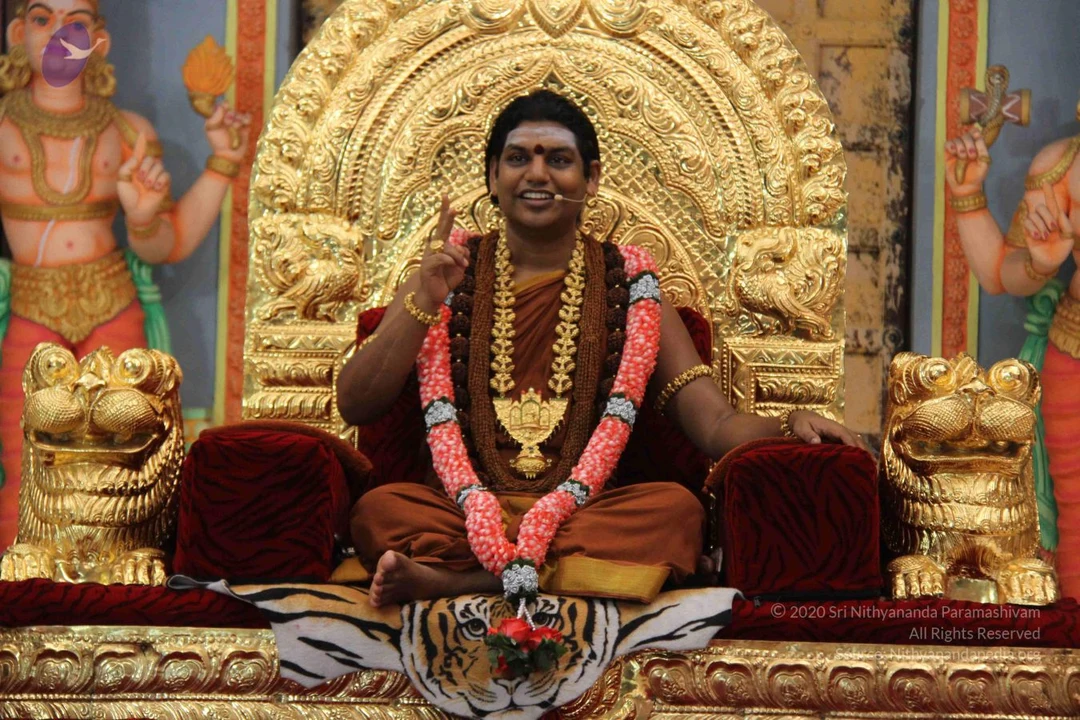
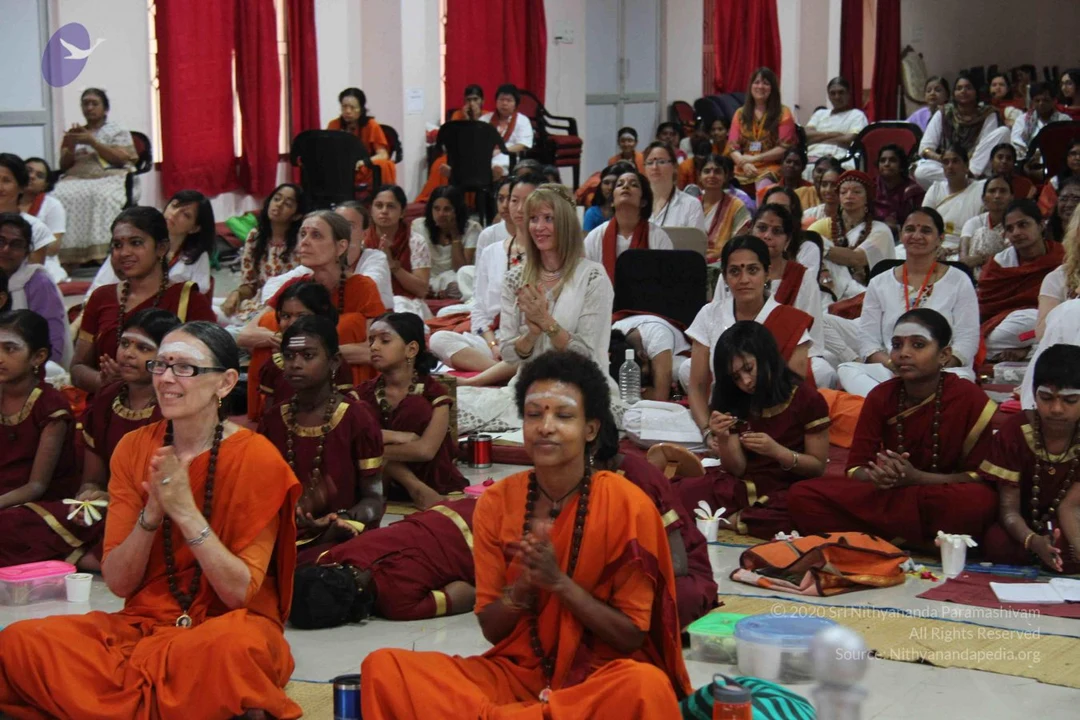
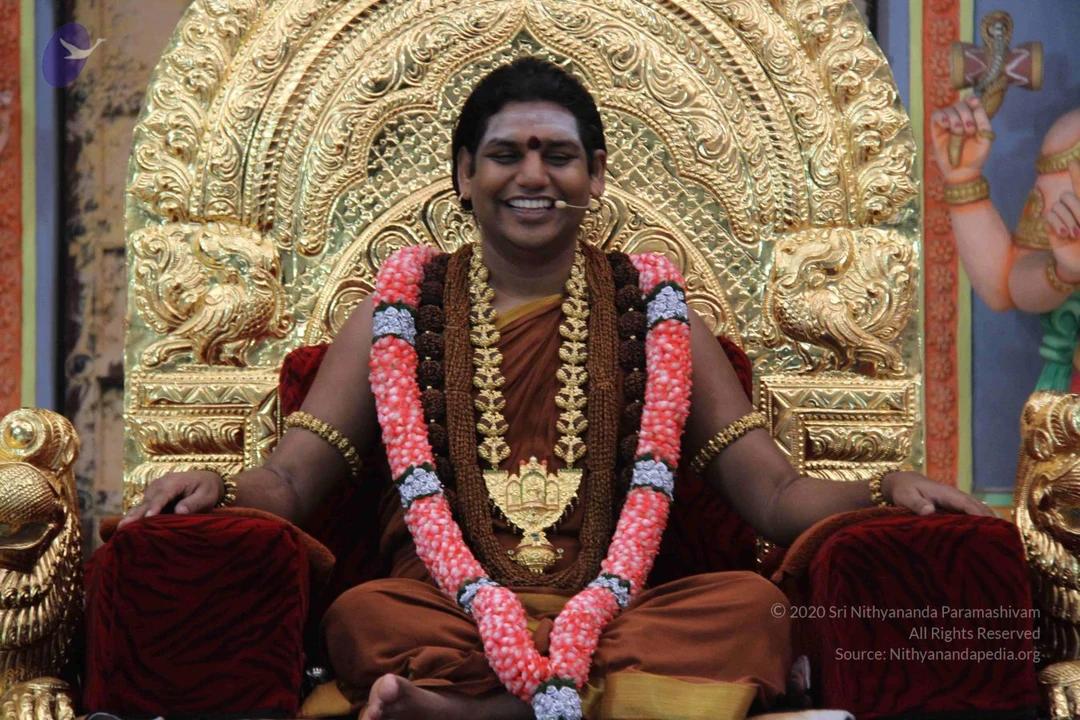
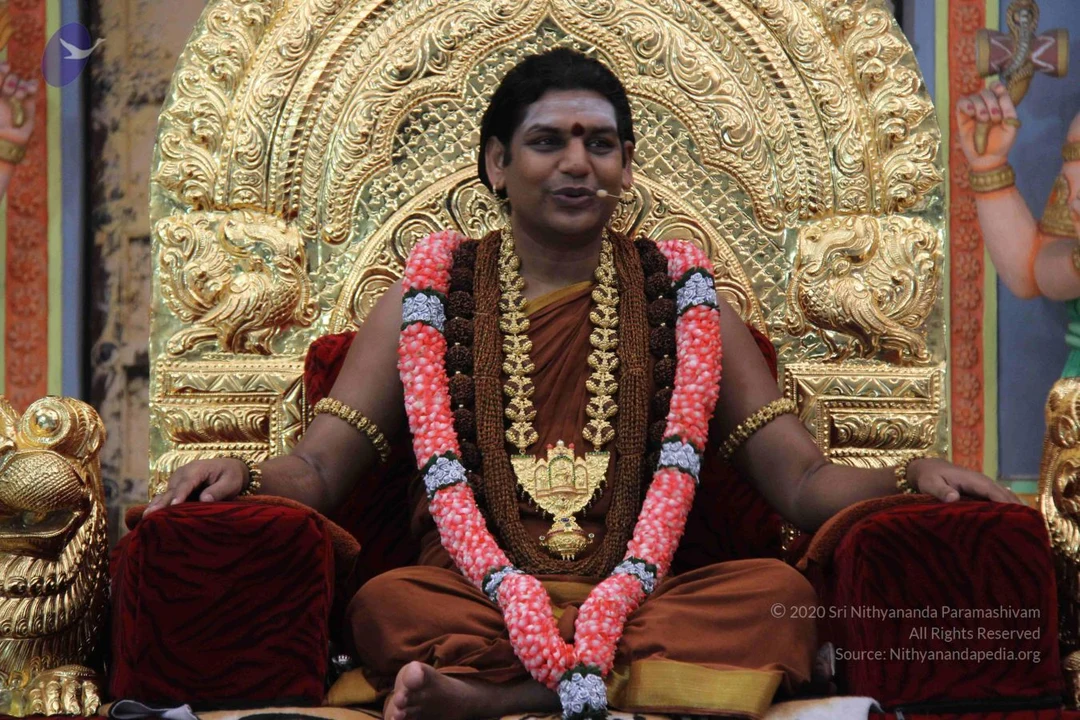
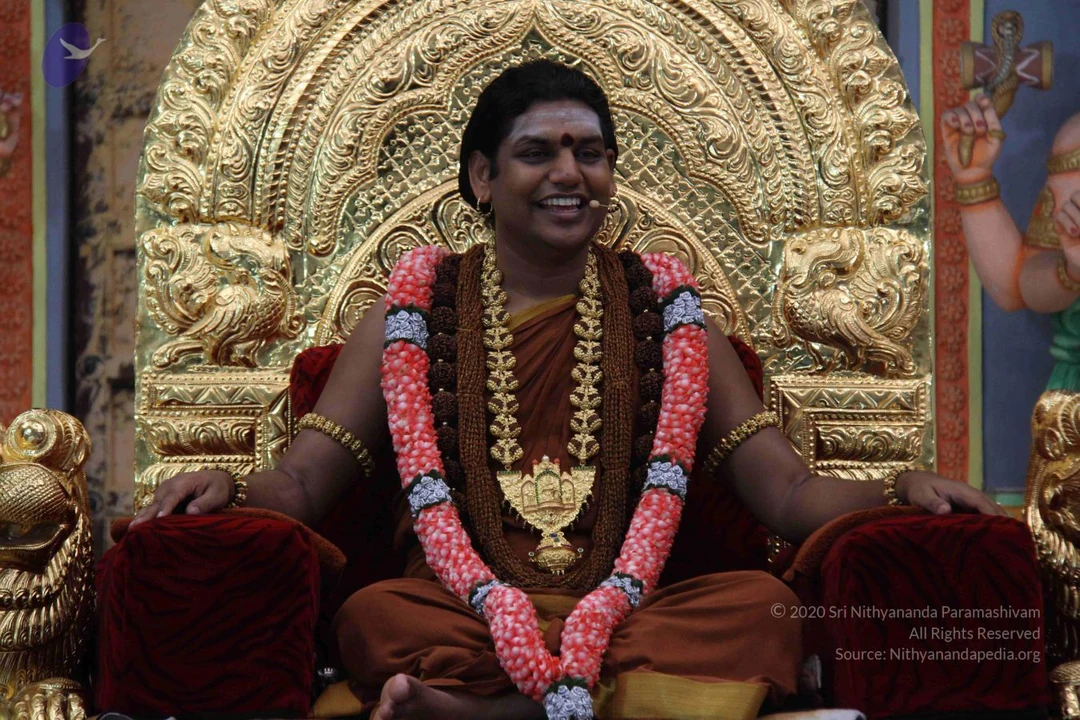
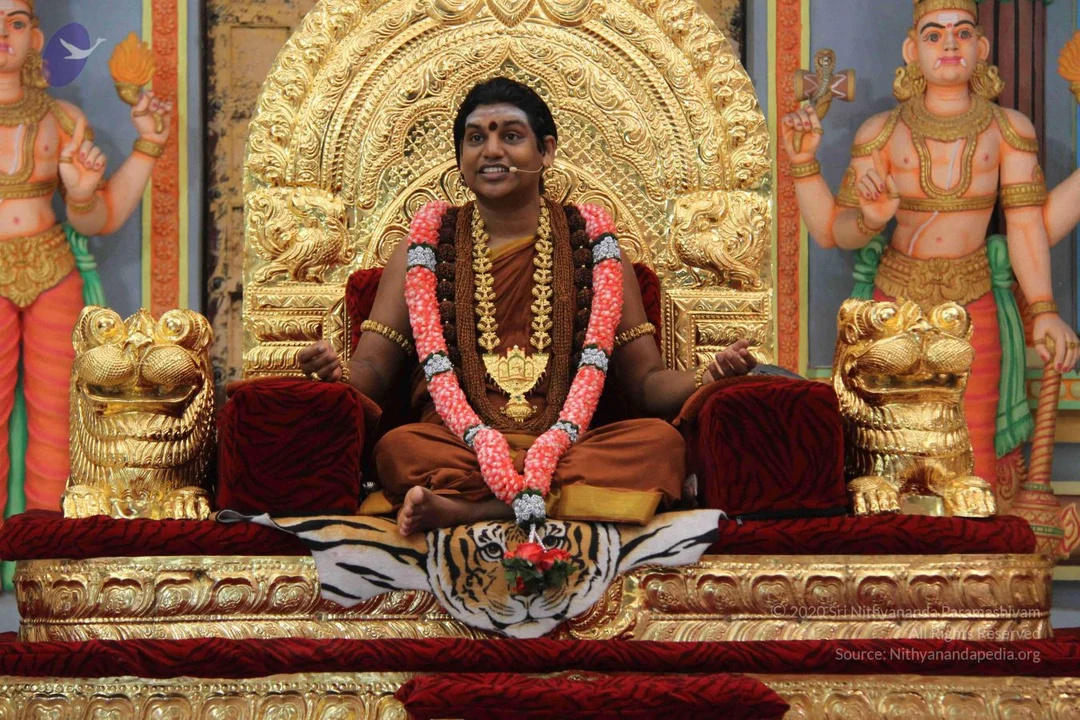
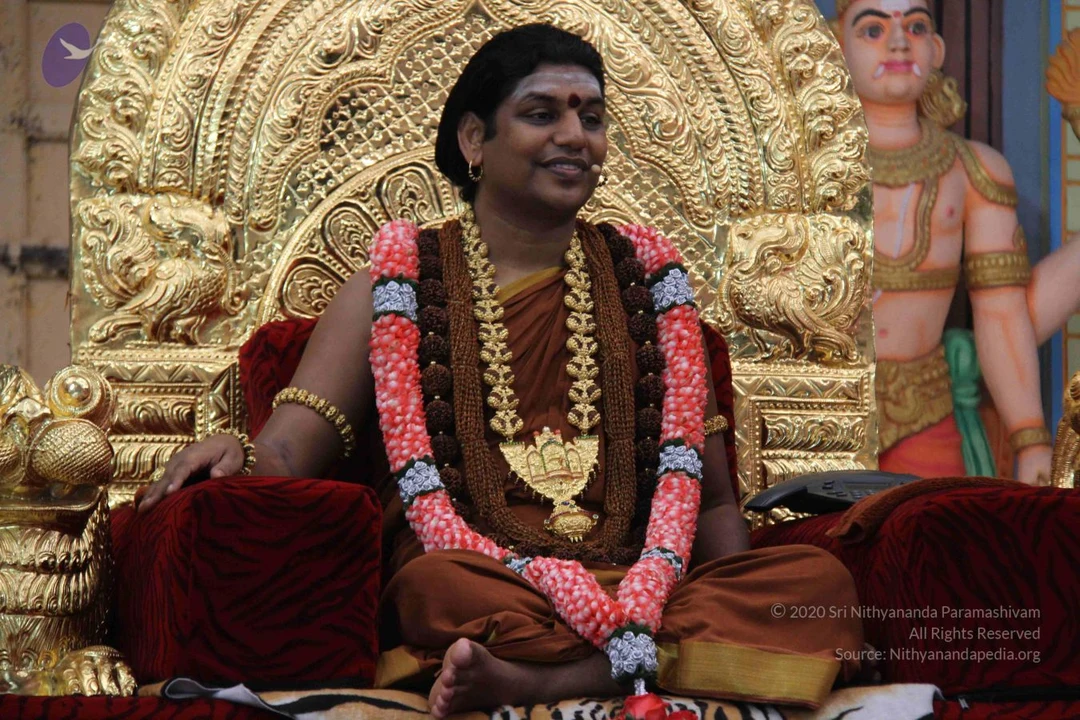
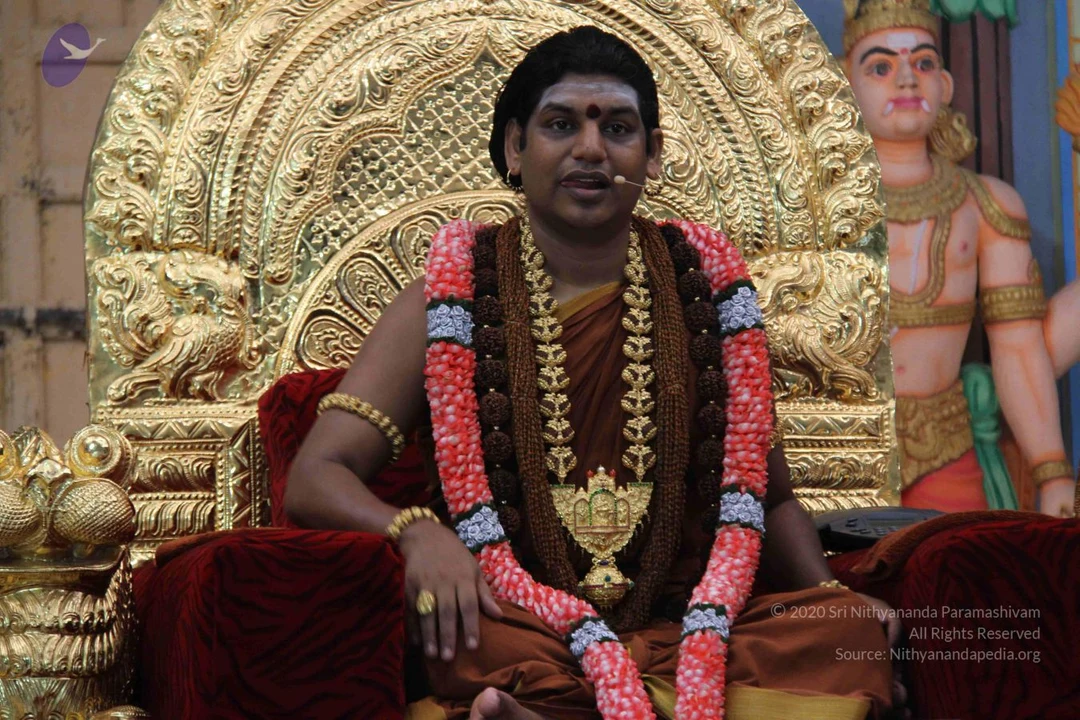
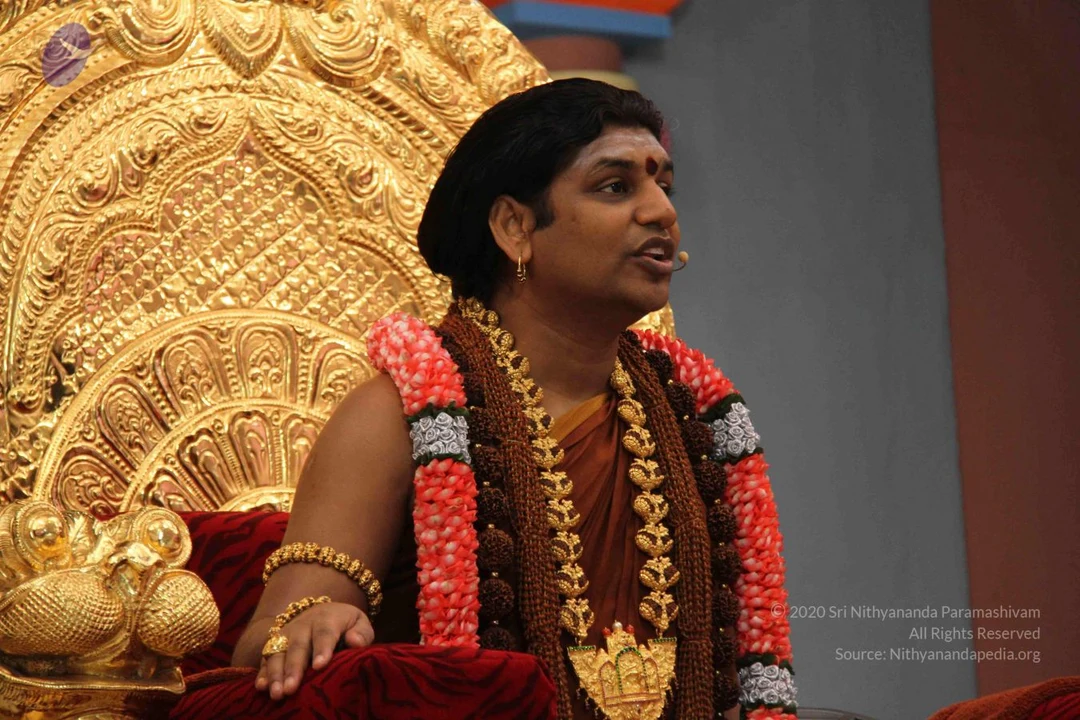
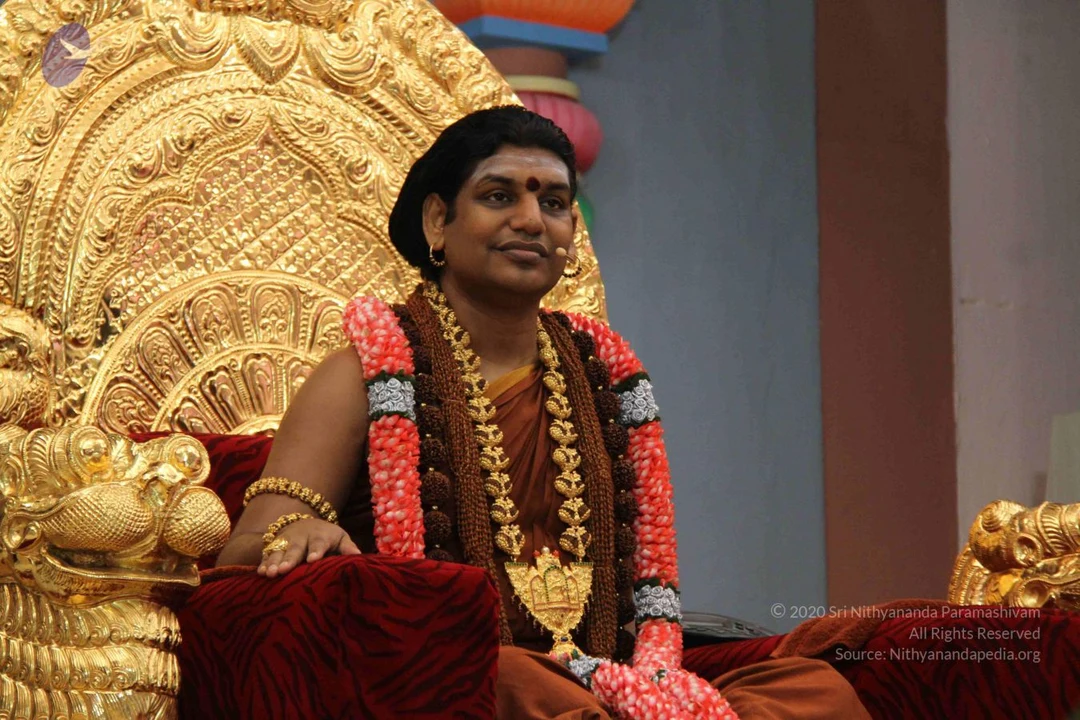
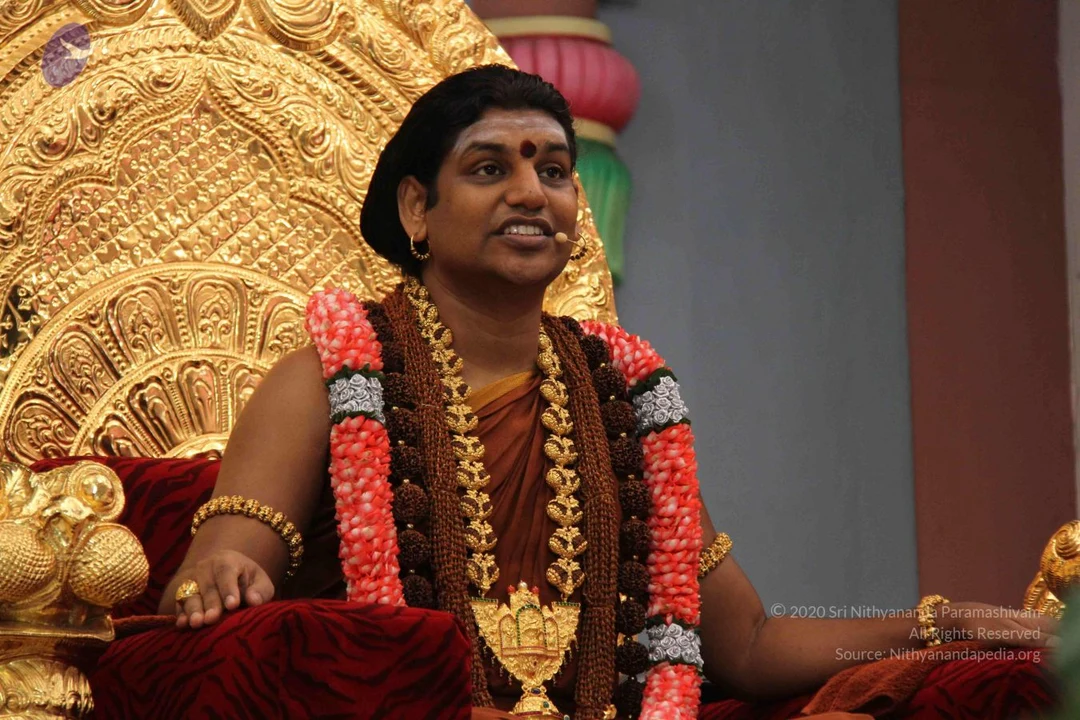
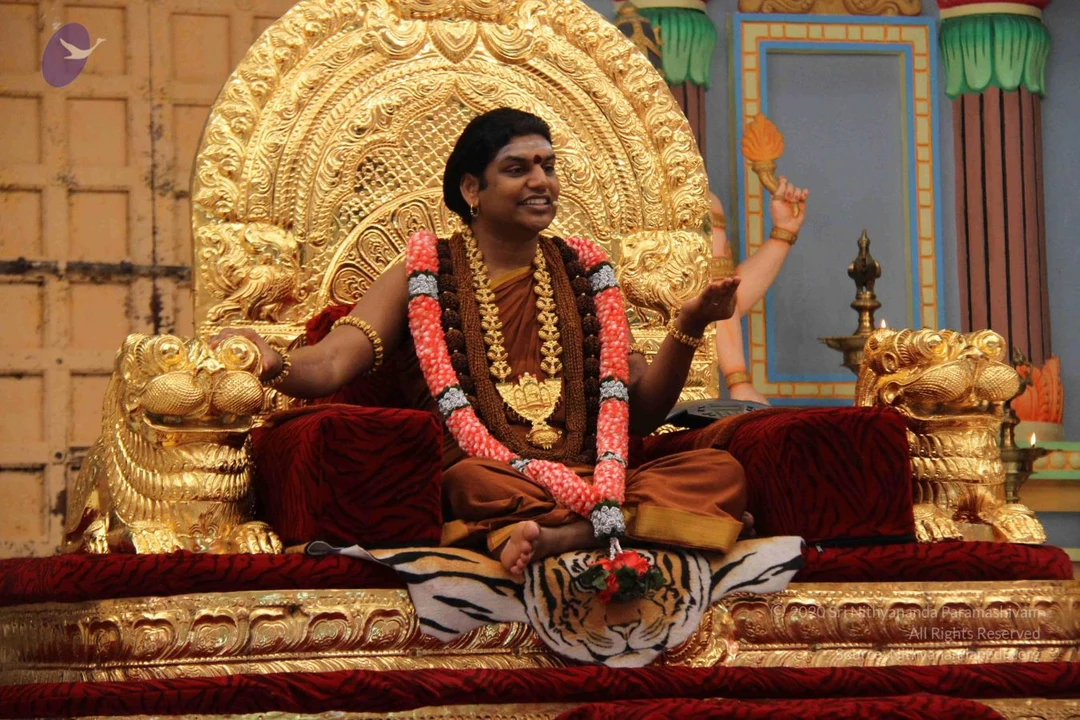
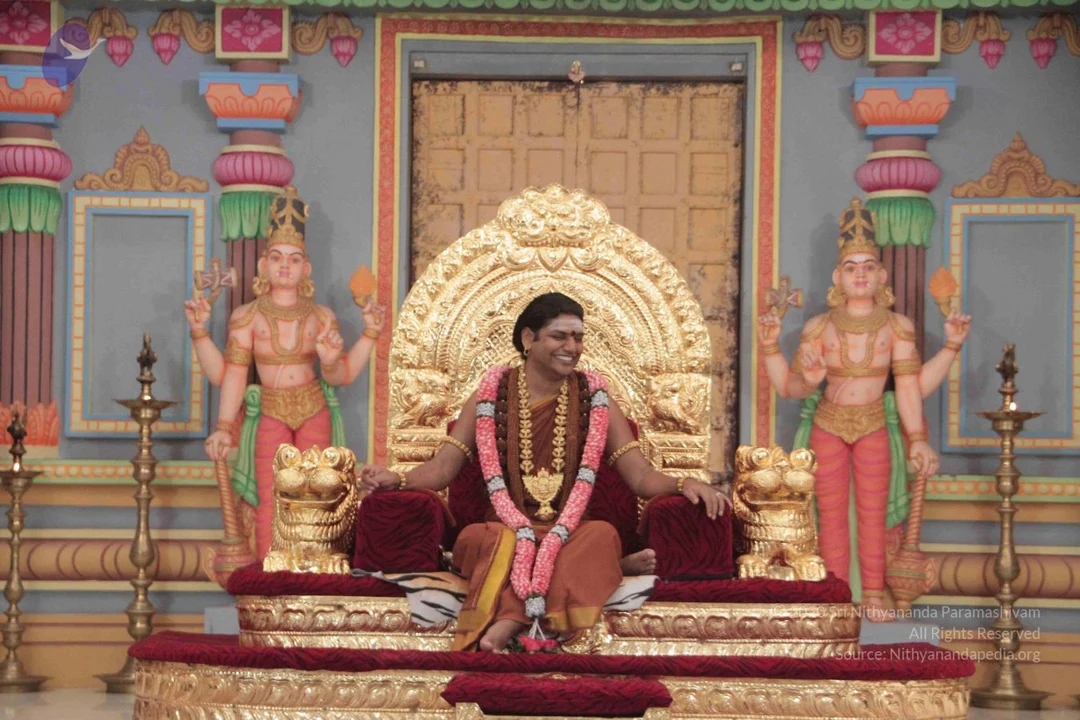
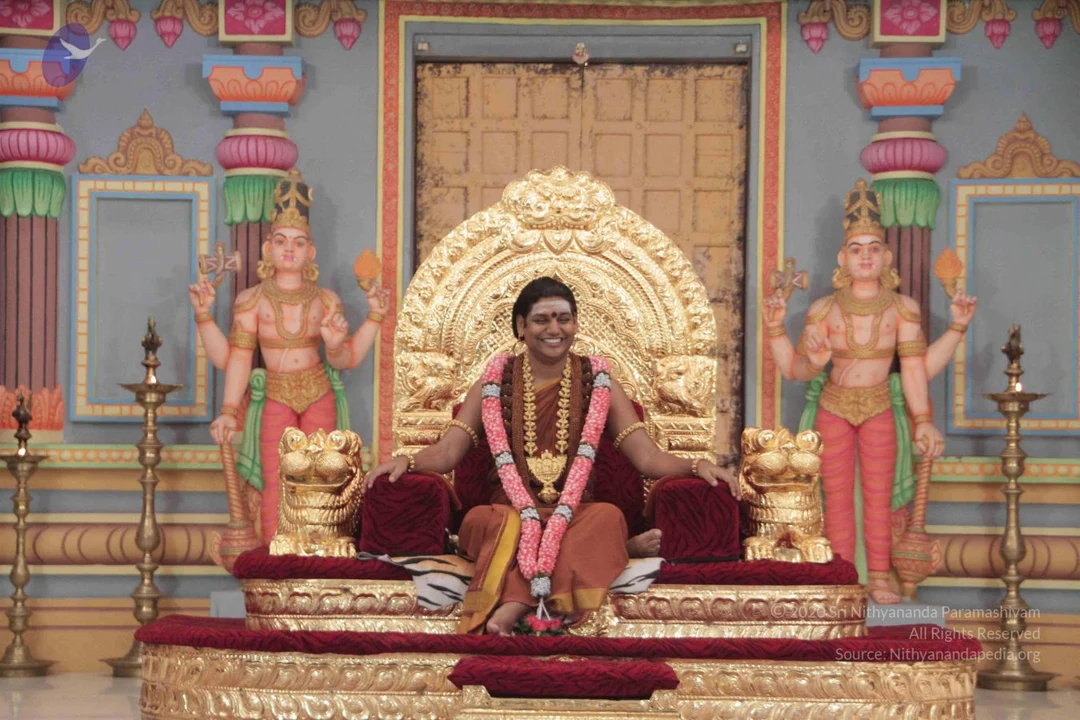
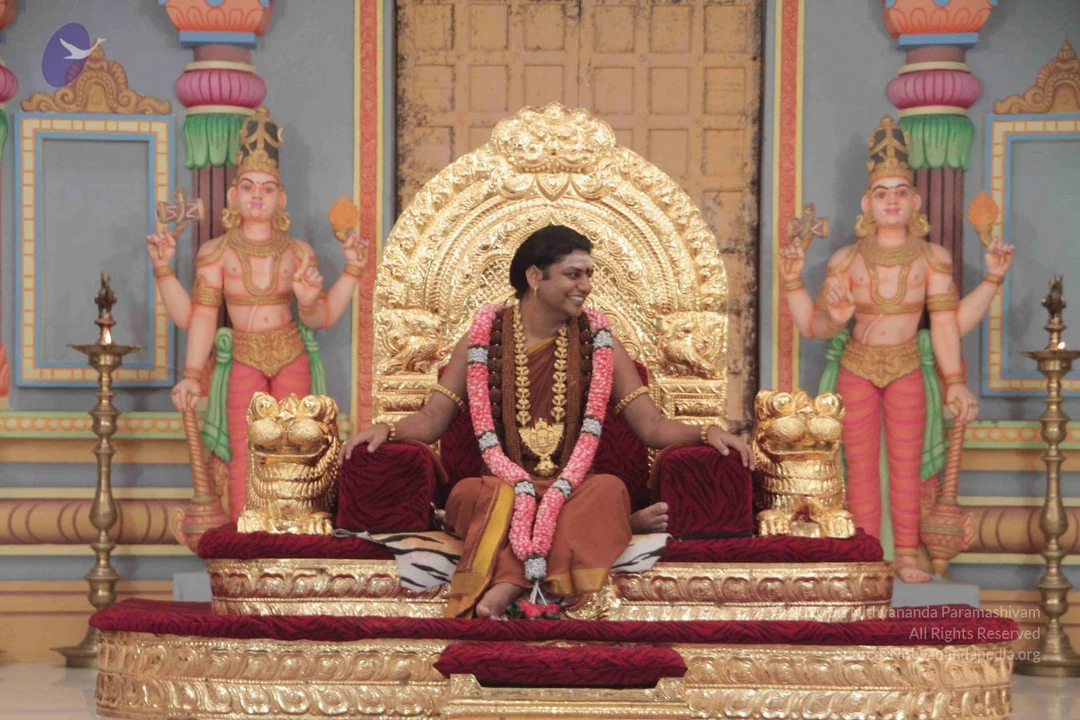
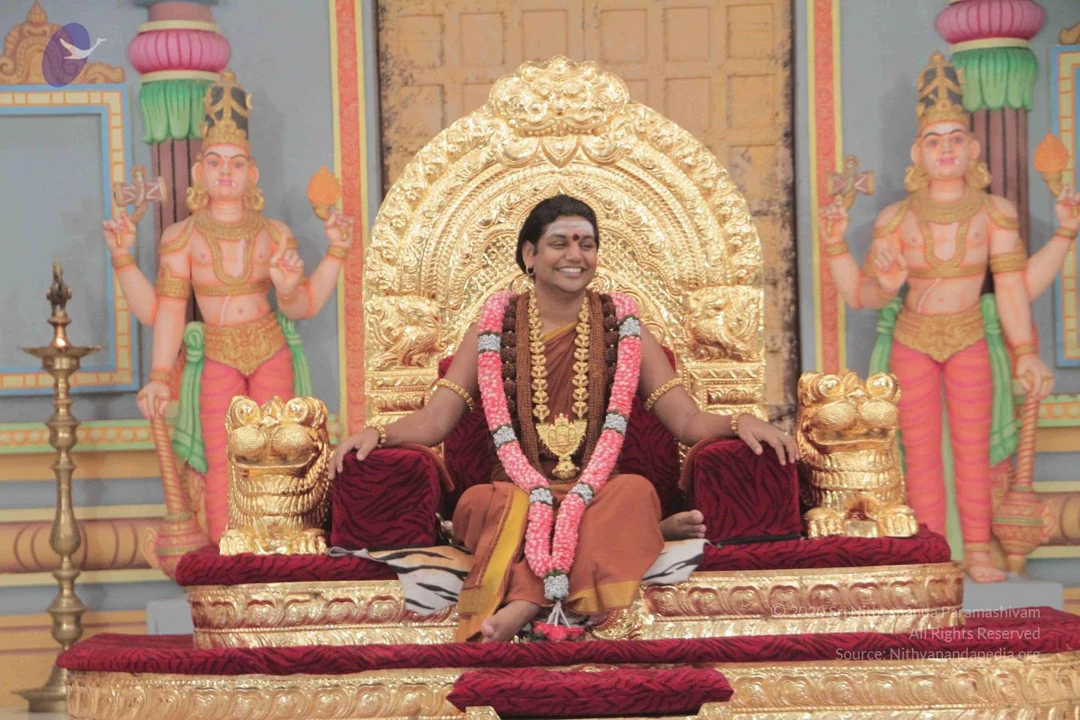
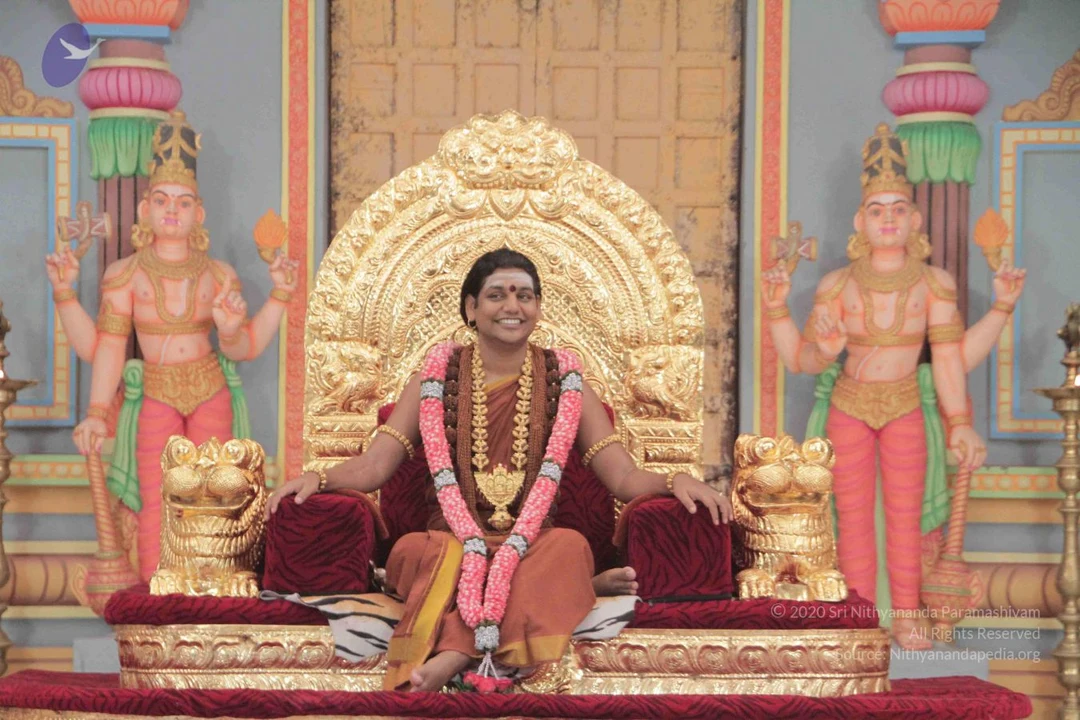
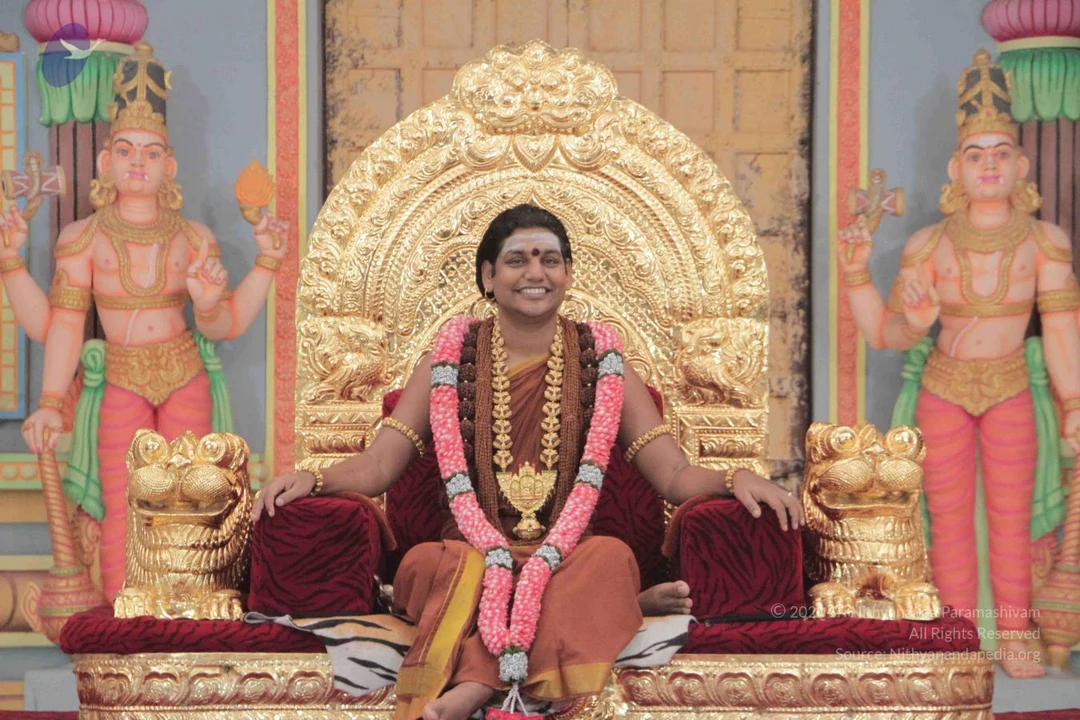
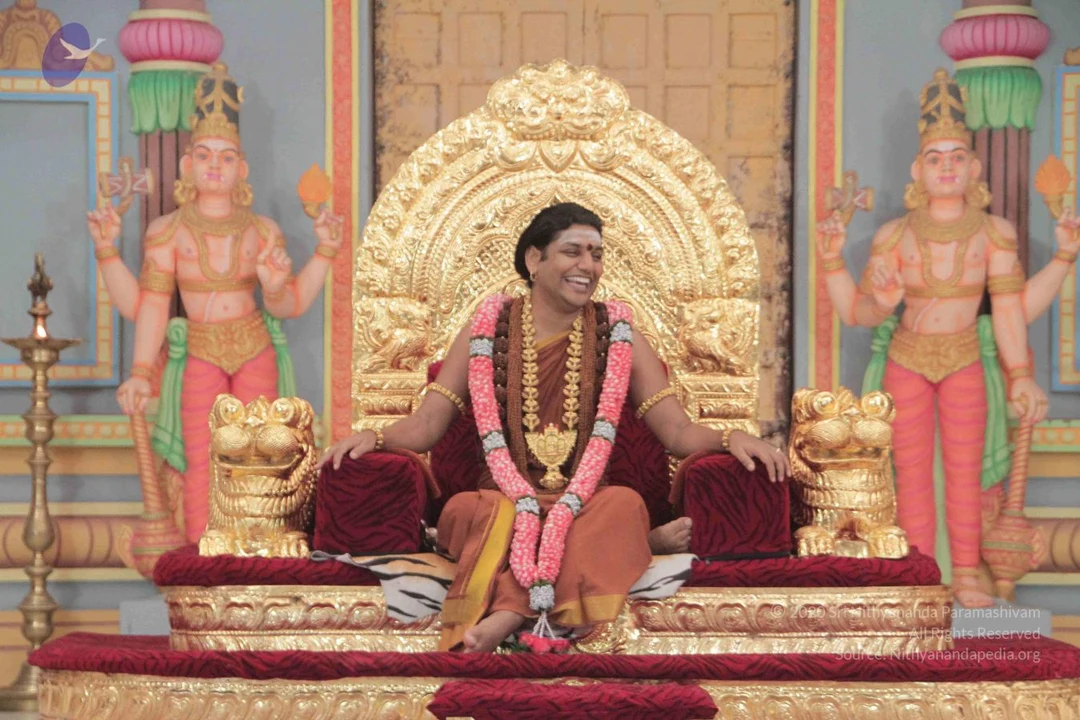
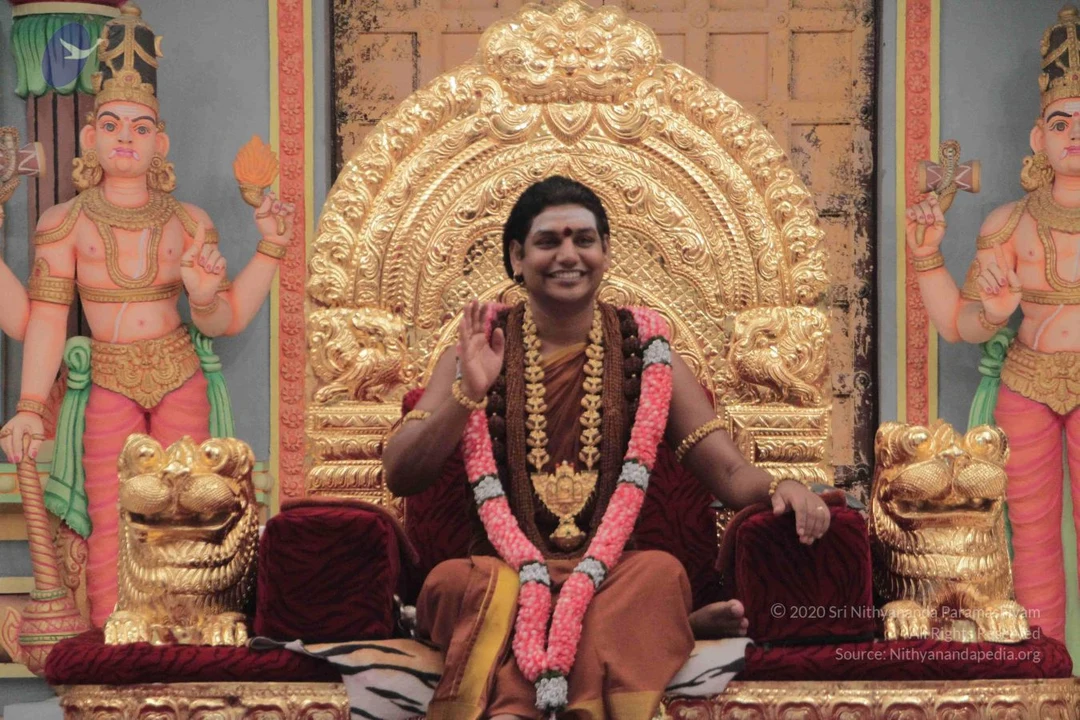
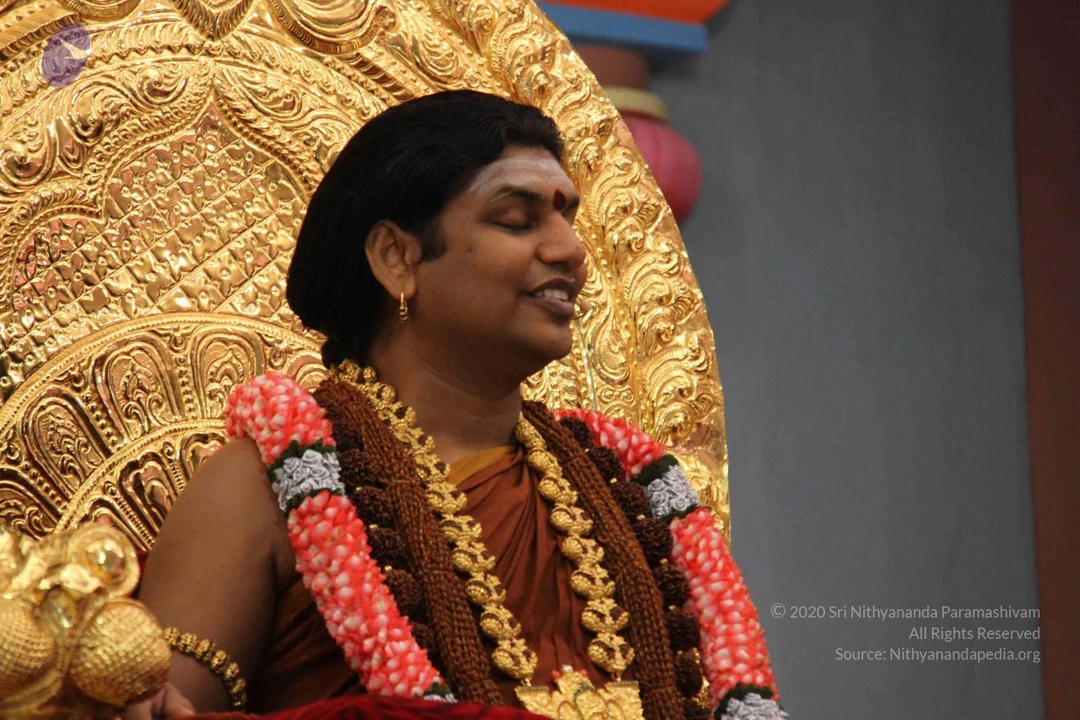
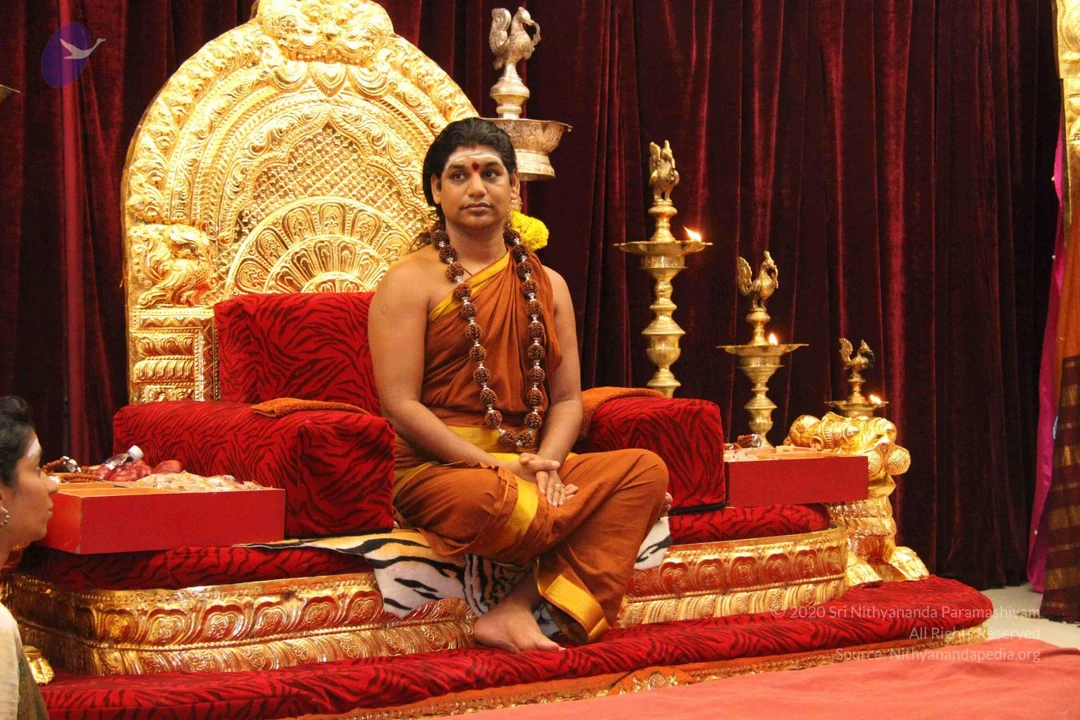
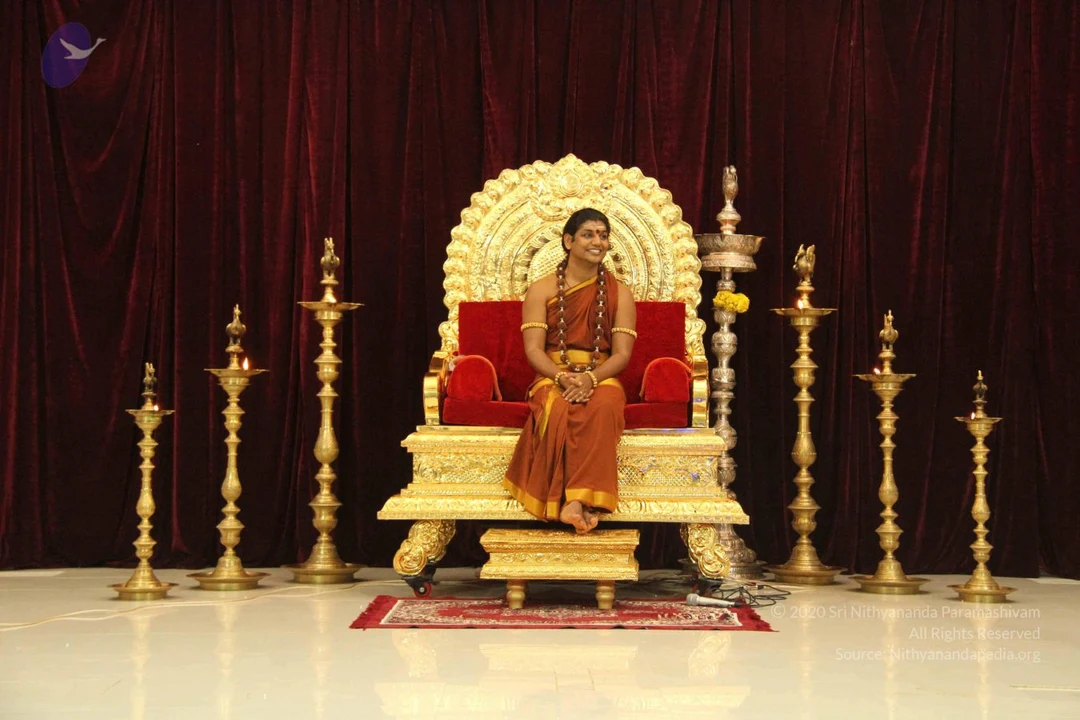
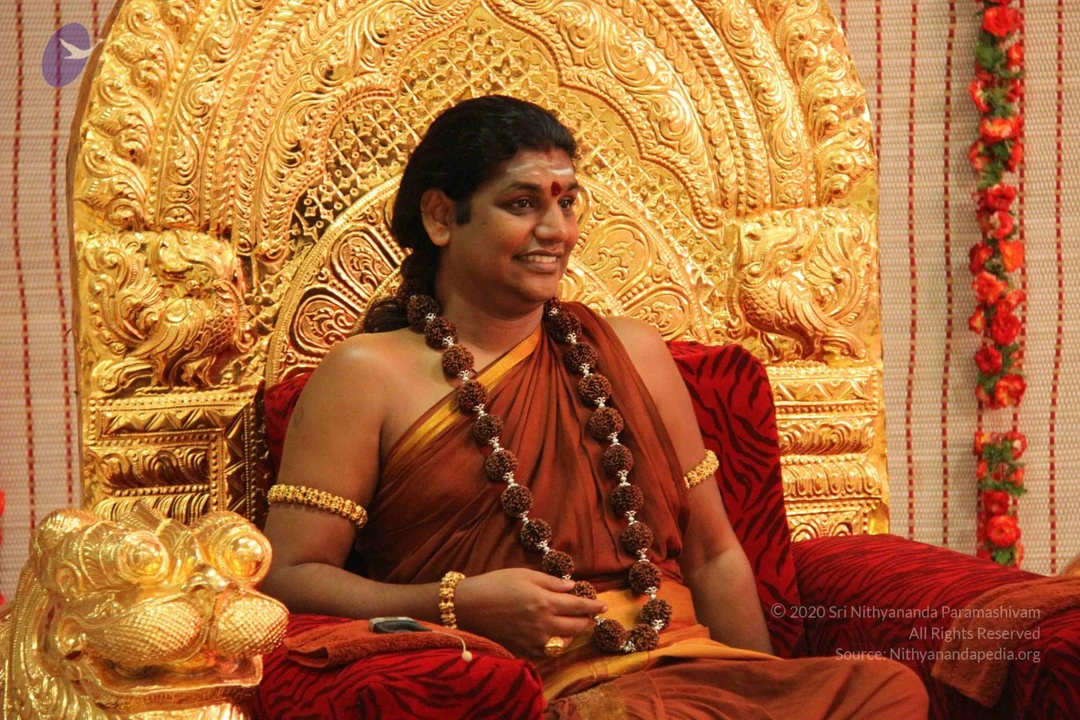
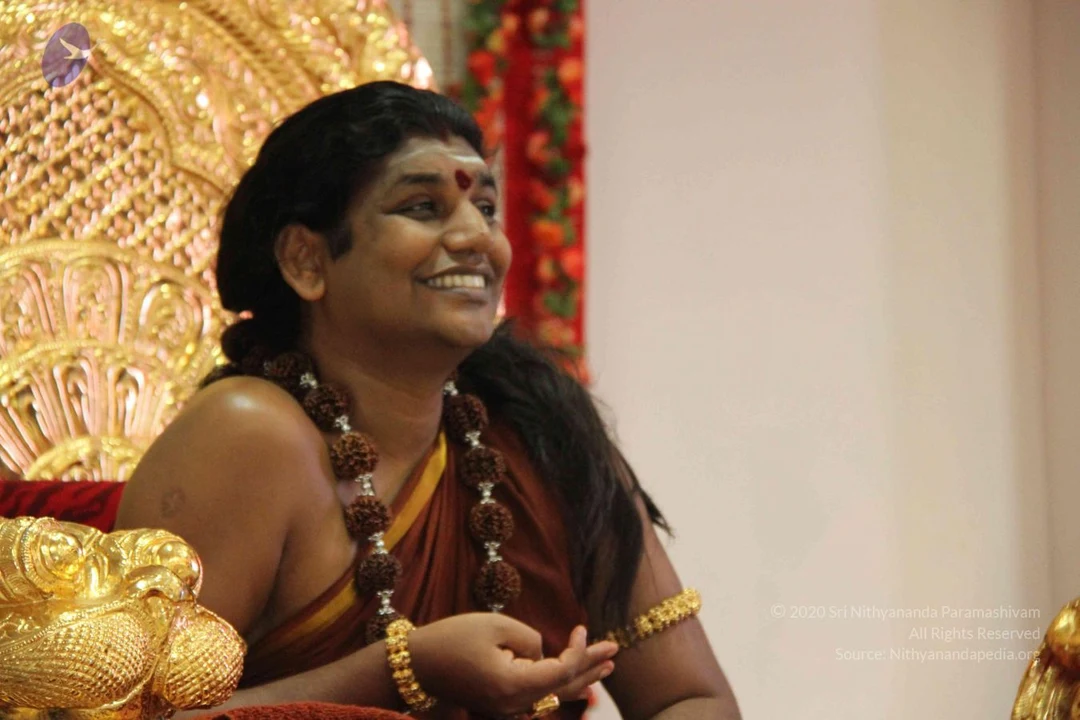
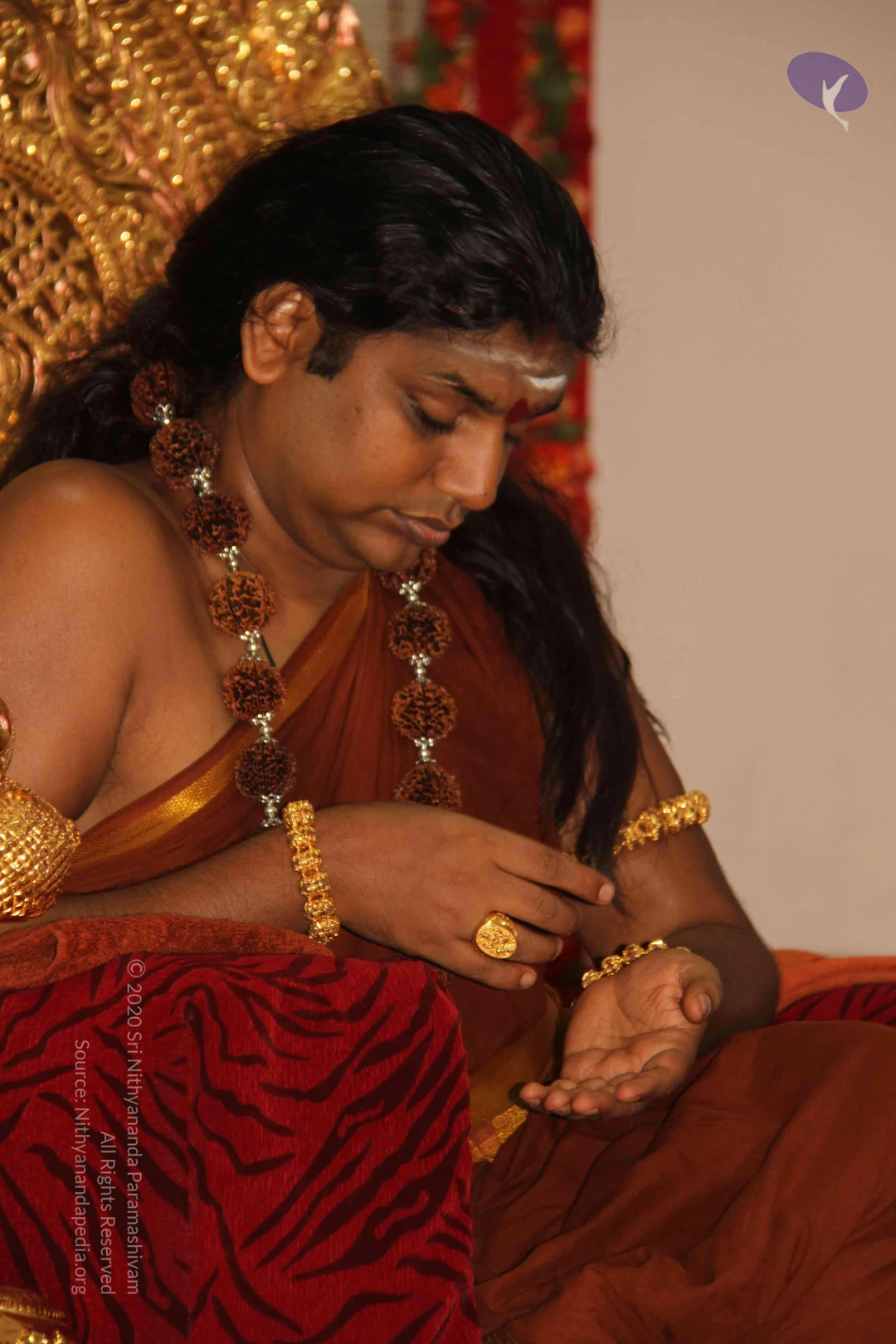
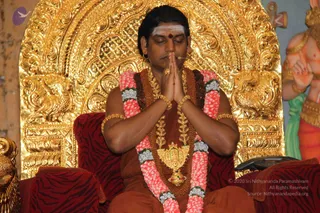
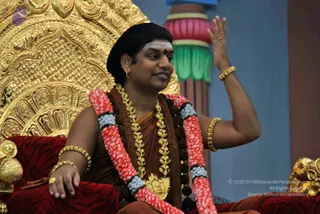
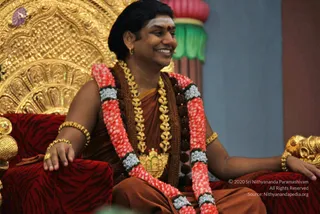
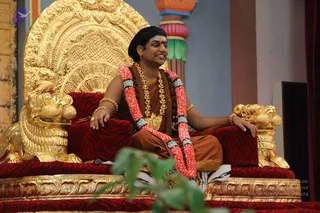
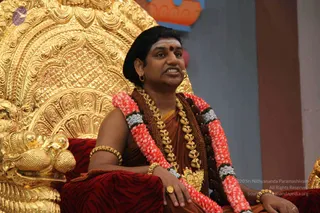
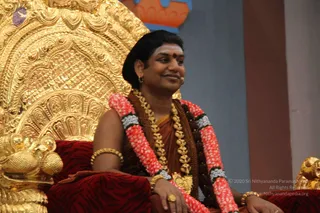
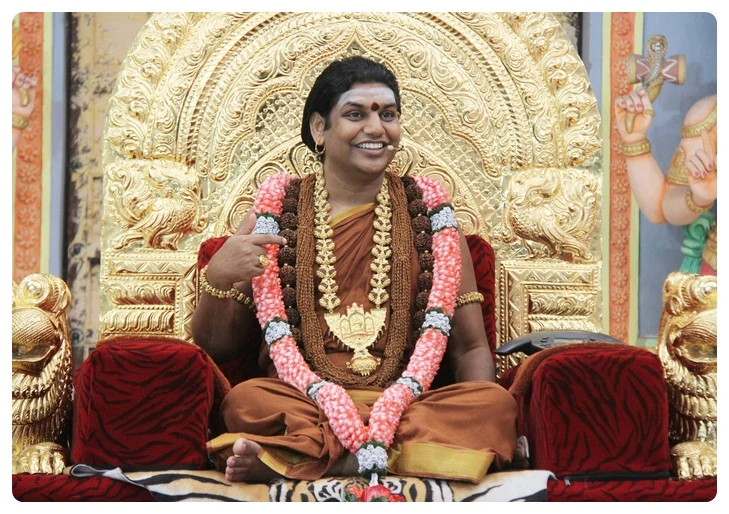
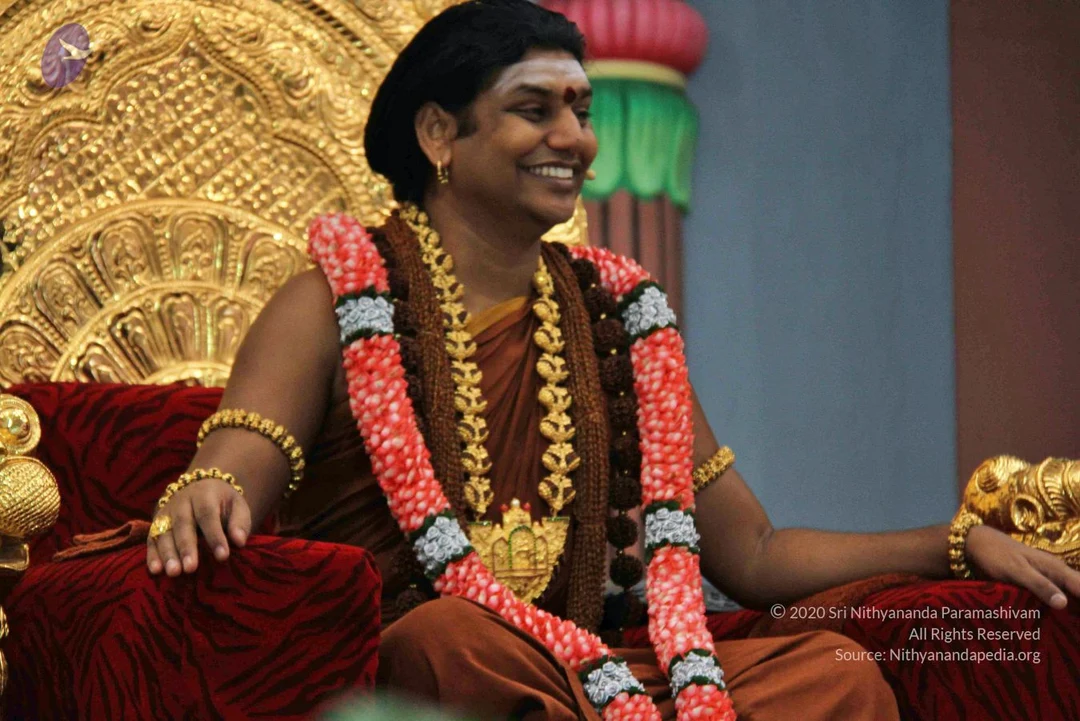
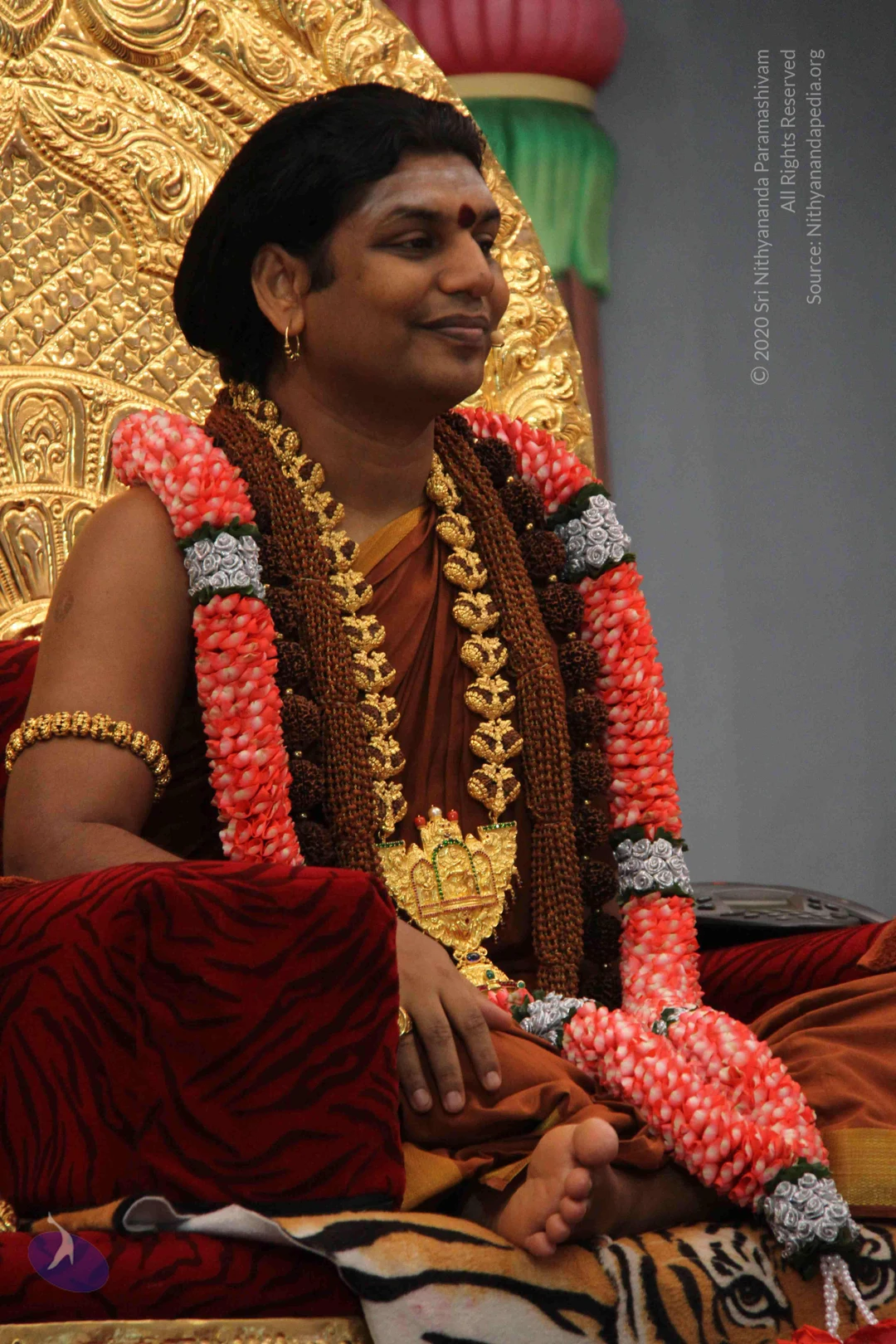
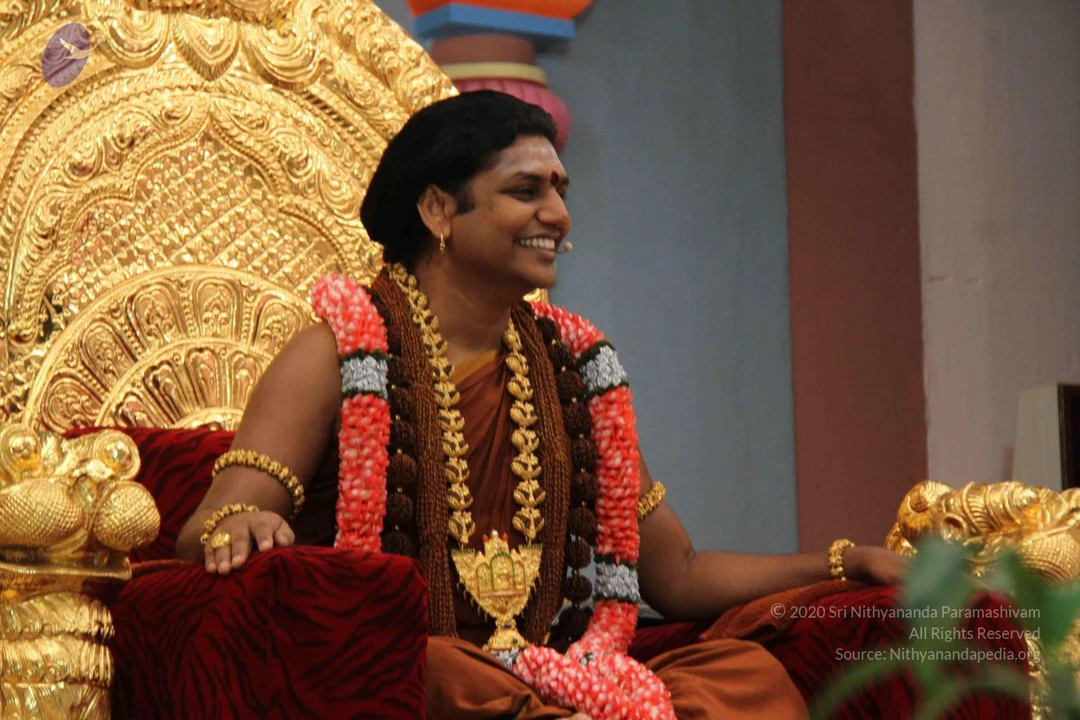
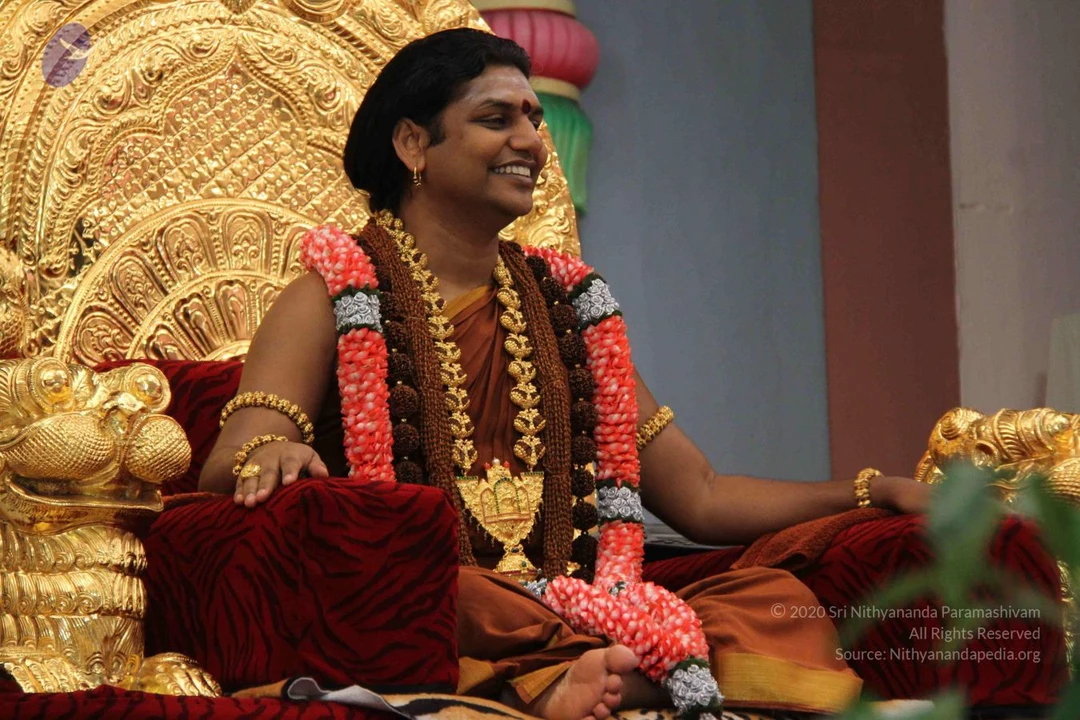
A seated man in rust-orange robes sits with palms pressed together in namaste, eyes closed, before an ornate gold-embossed throne-like backdrop. He wears a garland of pink and white flowers with silver-toned bead accents, a gold ceremonial necklace with a large pendant, rudraksha-style beads, gold armbands and bangles, and a white vibhuti line with a red kumkum dot on his forehead. A small microphone is clipped near his face. Red tiger-striped cushions flank the seat, and a painted deity figure in orange and green stands at the right edge. The appearance is consistent with the page's mention of a person, but the face is not used for identification, so the label is probable.A man seated on an ornate gold throne with a red cushioned seat, raising his right hand in a blessing gesture. He wears a saffron-brown robe, a long gold necklace, a brown rudraksha mala, a pink and white flower garland, gold bangles and a gold ring, with a red bindi on his forehead. Behind him stands a pink and green pillar. a person: the seated man wears a rudraksha mala, ceremonial gold necklaces and saffron clothing on a throne.A smiling man in a rust-orange cloth with rudraksha mala strands and heavy gold ceremonial necklaces sits on a red velvet throne with a gold carved backrest. He wears a flower garland of red and white blooms with silver-toned bead accents, gold bangles, and a ring. Probable Swamiji by appearance cues: long swept-back hair, ornate gold jewelry, and saffron-toned clothing. A green and pink decorative canopy stands behind him.A man in saffron-orange robes sits on an ornate gold throne with carved lion-head arms and red tiger-stripe cushions, smiling and gesturing with his right hand. He wears a gold necklace, a red-and-white flower garland with silver accents, a rudraksha mala, gold bangles and a red tilak on his forehead. A green plant blurs in the foreground and a red-and-gold pillar stands behind him. a person seated on the peetha, the appearance-based candidate showing saffron robes, rudraksha mala, gold ornaments and a flower garland.A man seated on an ornate gilded throne with a carved golden backrest and a lion-head armrest, draped in a red-and-black tiger-striped cushion. He wears saffron-brown robes, a long multi-strand rudraksha-style mala and gold necklaces, bangles and rings, with a red-and-white flower garland over both shoulders and a red bindi on his forehead. He sits with his hand resting on his knee, facing forward mid-discourse. a person is a seated speaker in a satsang setting with a pink wall behind him.A man seated on an ornate golden throne with a carved gilded backrest and red velvet cushioning. He wears a rust-brown robe over one shoulder, a brown rudraksha mala and a long ceremonial gold chain, and is adorned with a garland of pink and white flowers draped across his chest. He has gold bangles on his wrists and rings on his fingers, a red bindi on his forehead and small gold earrings, and smiles gently while looking to the side. a person: the seated figure presents rudraksha malas, a gold necklace and a red-and-white flower garland, consistent with the page's reference to a person. A gilded lion-like carved armrest is visible at the lower left, and a red-and-orange panel is in the background.
Sarva-Darshan

25 photosSource gallery
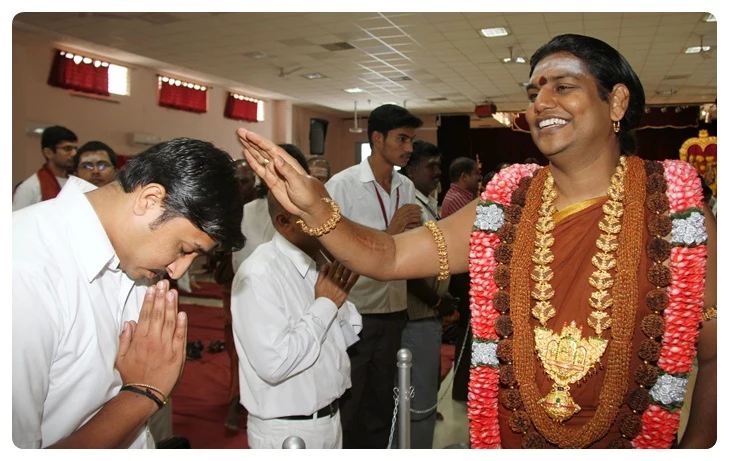
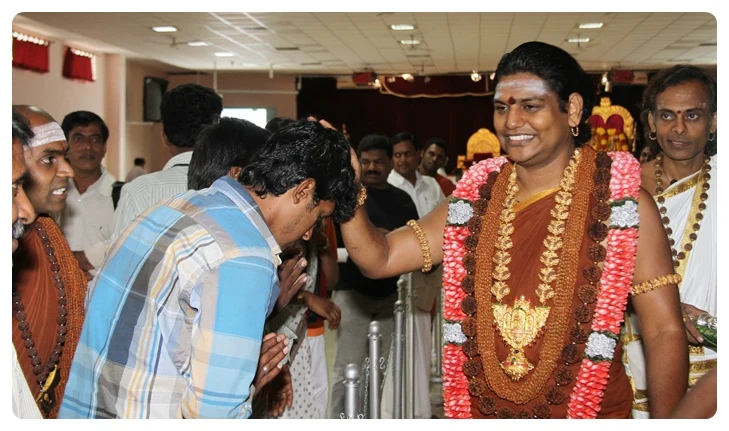
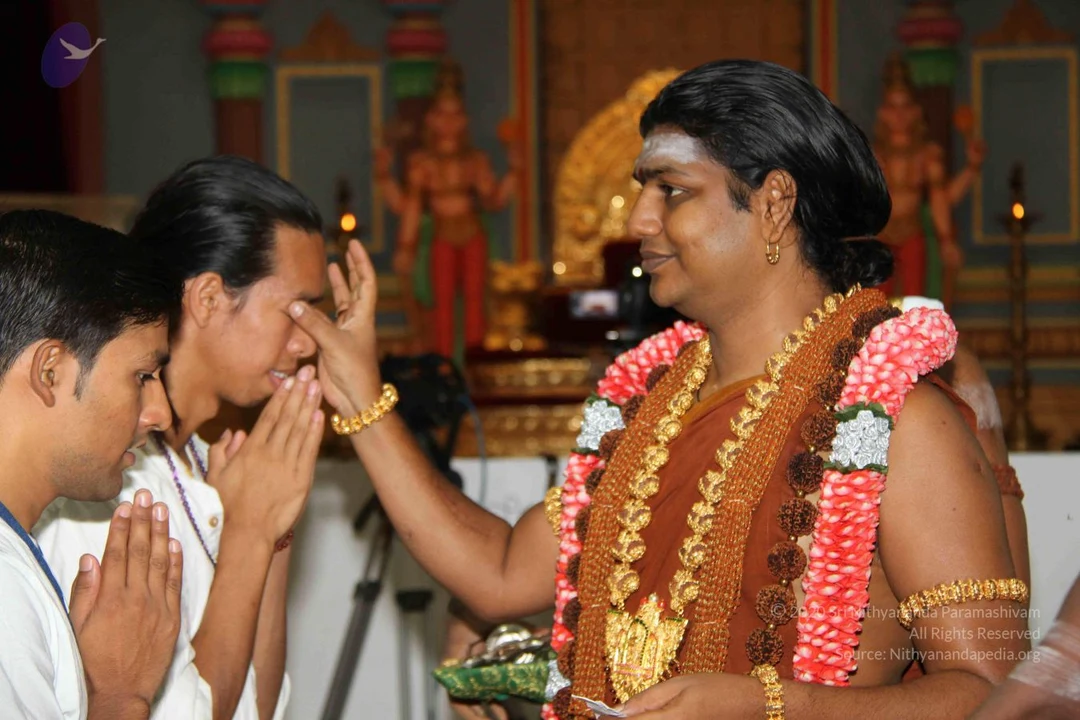
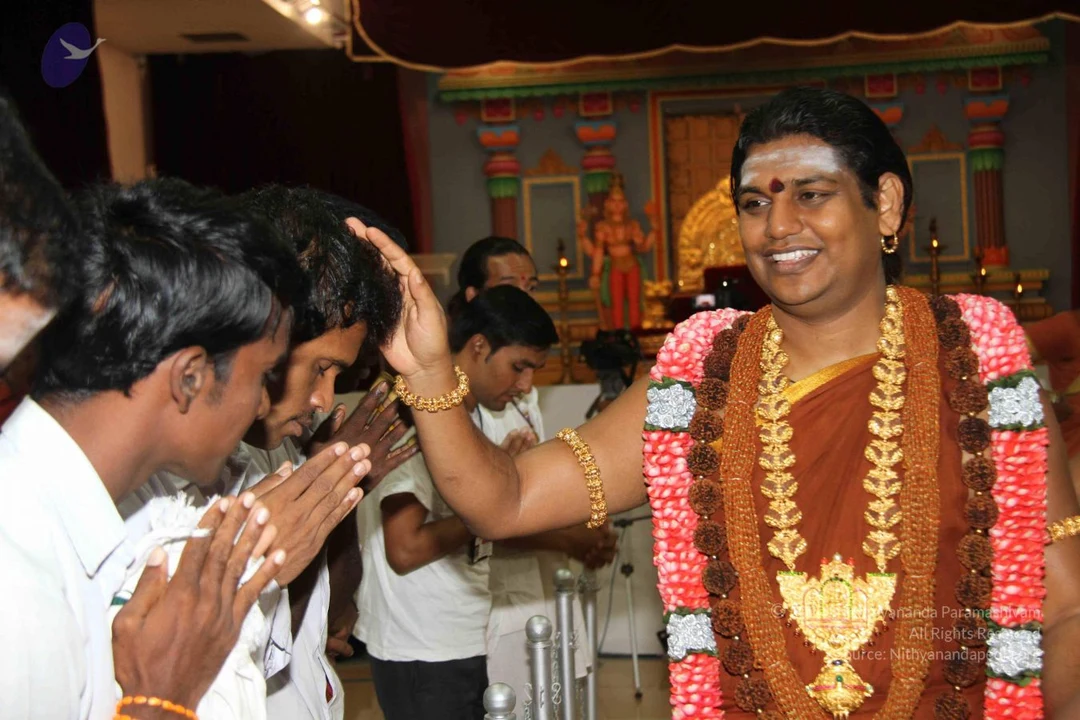
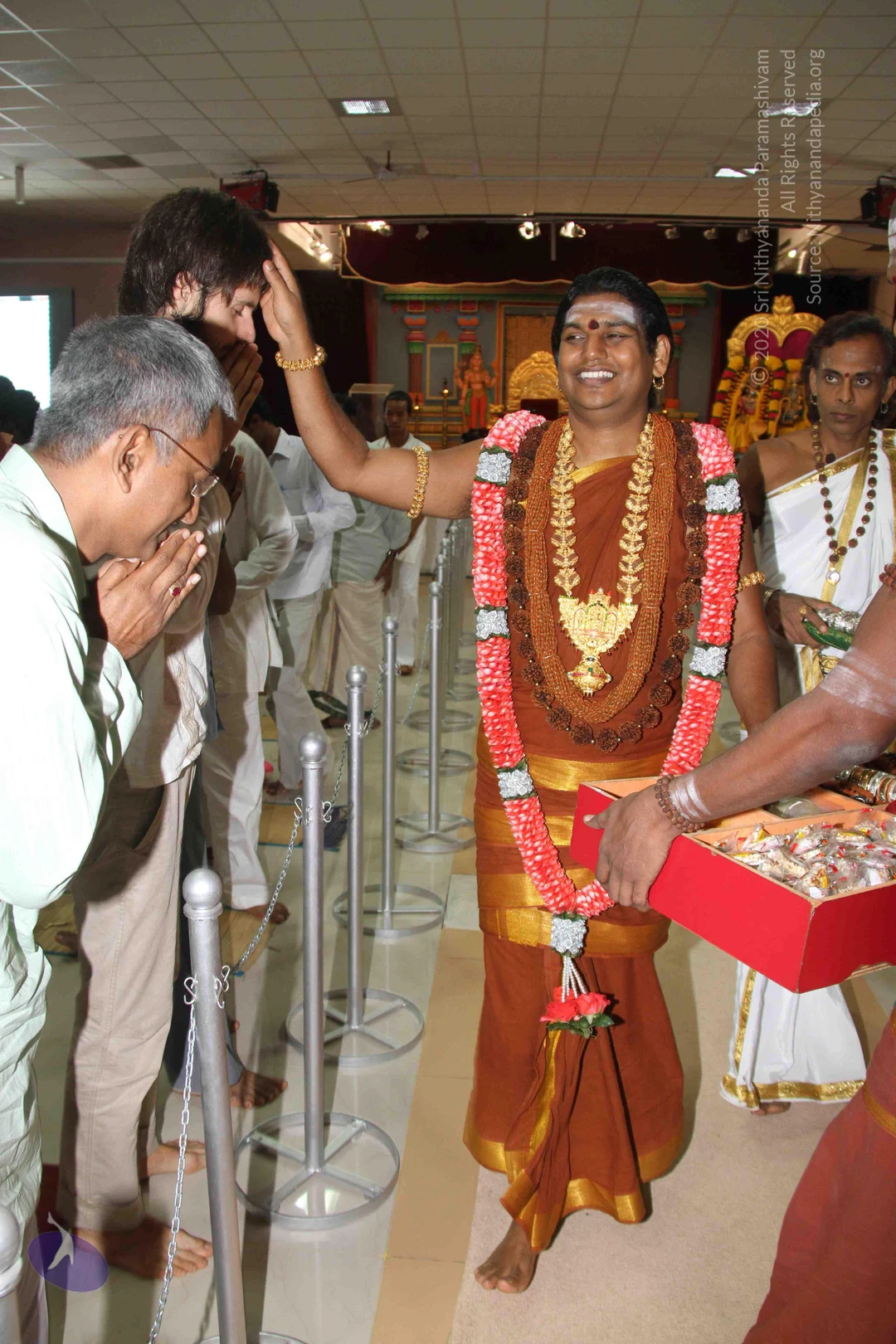
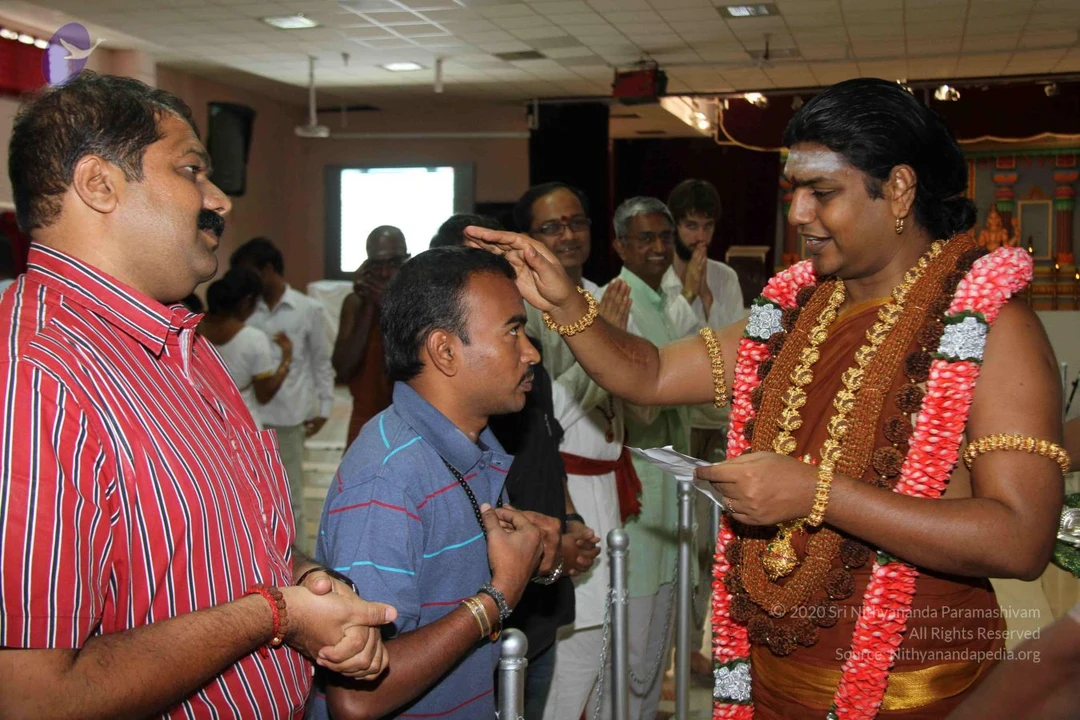
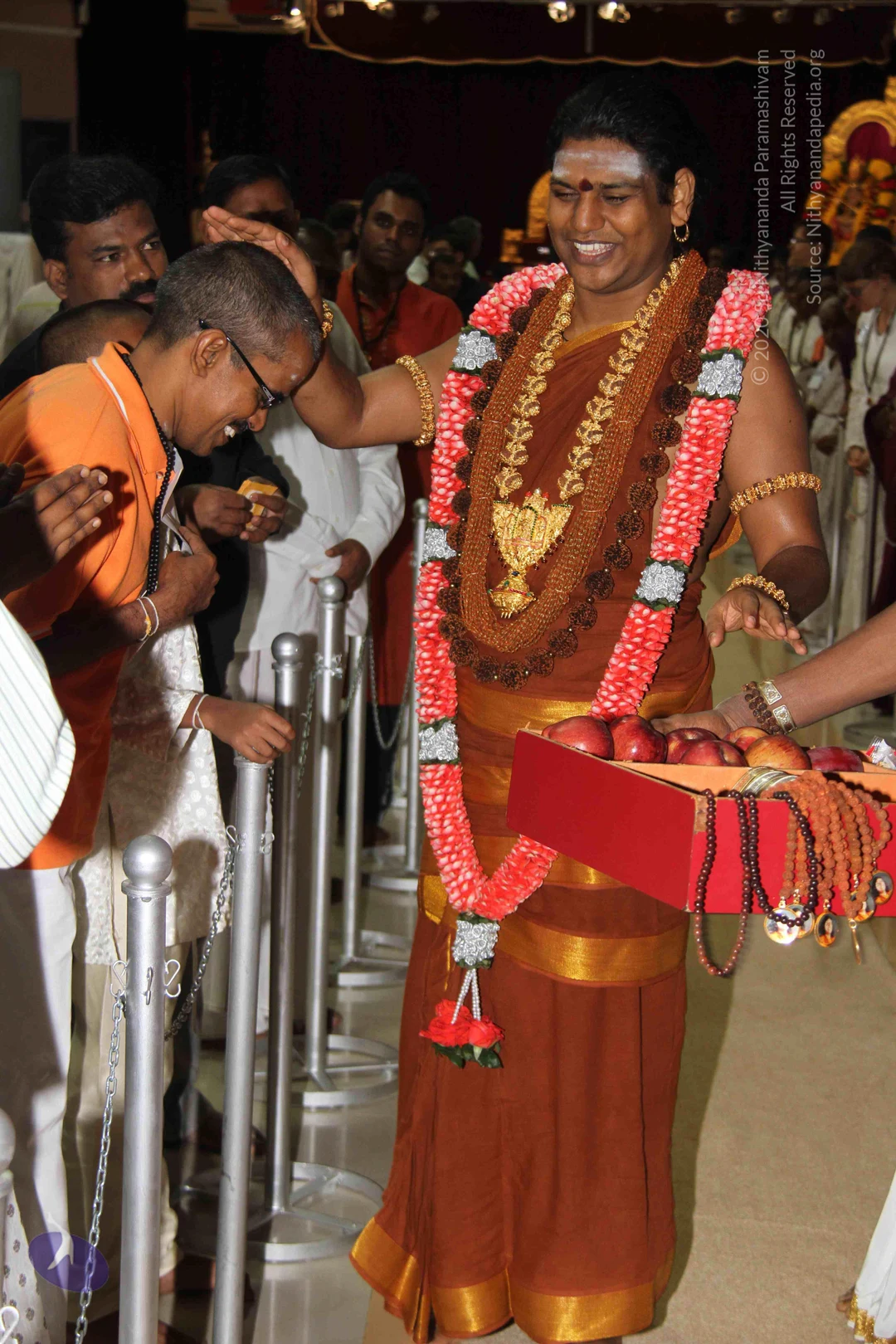
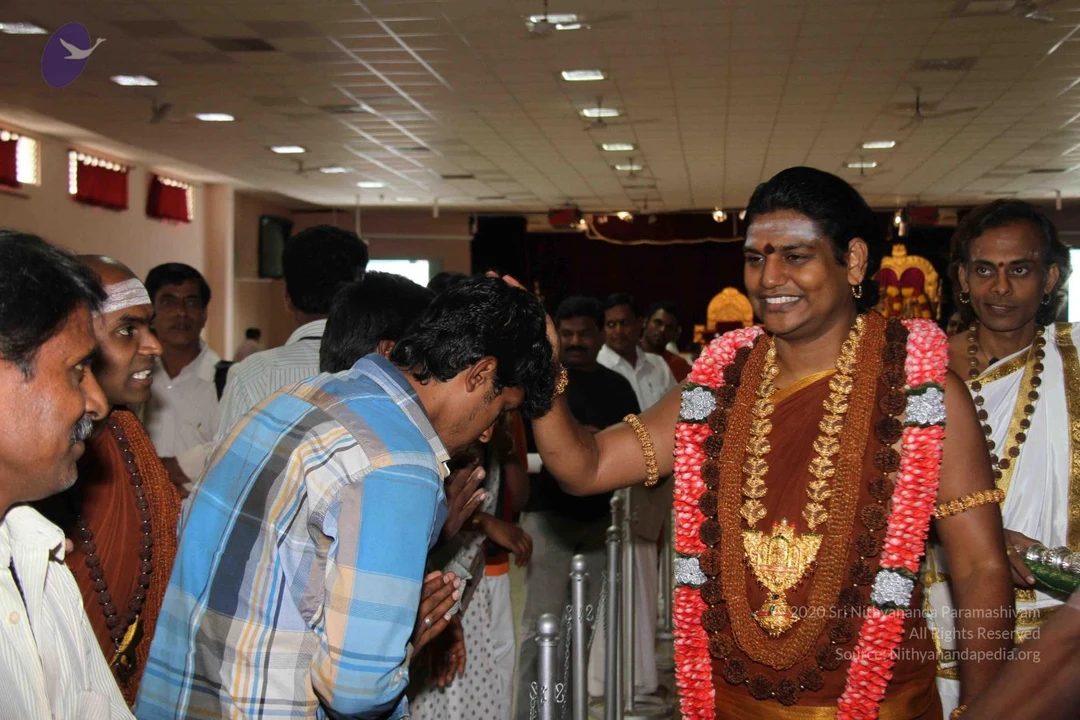
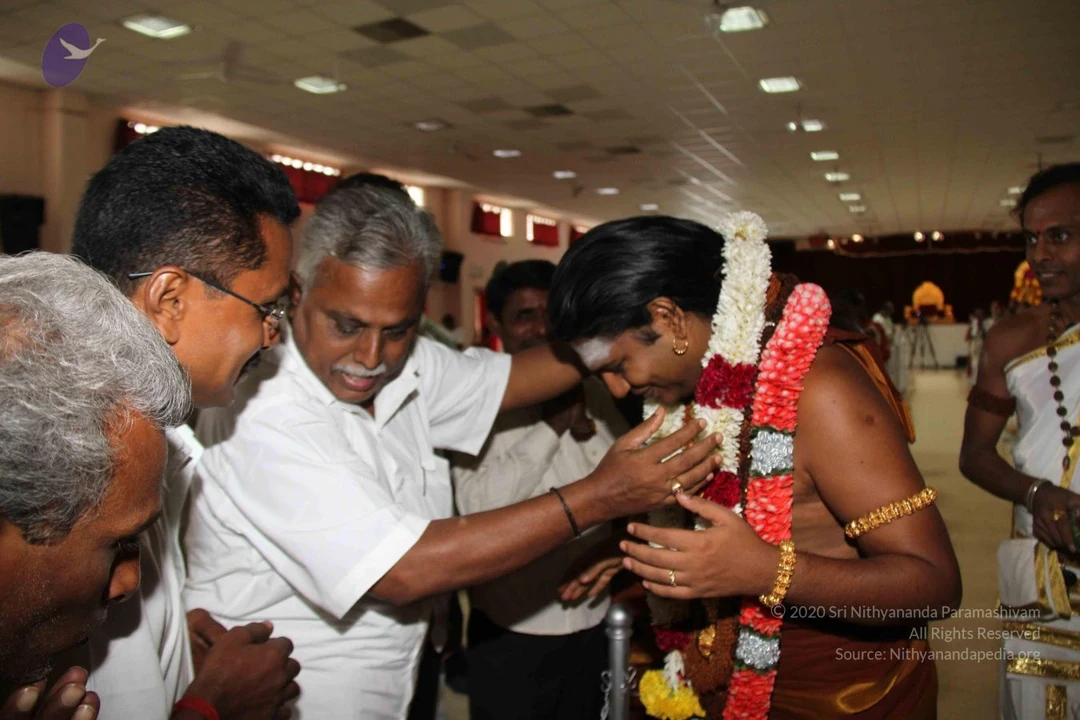
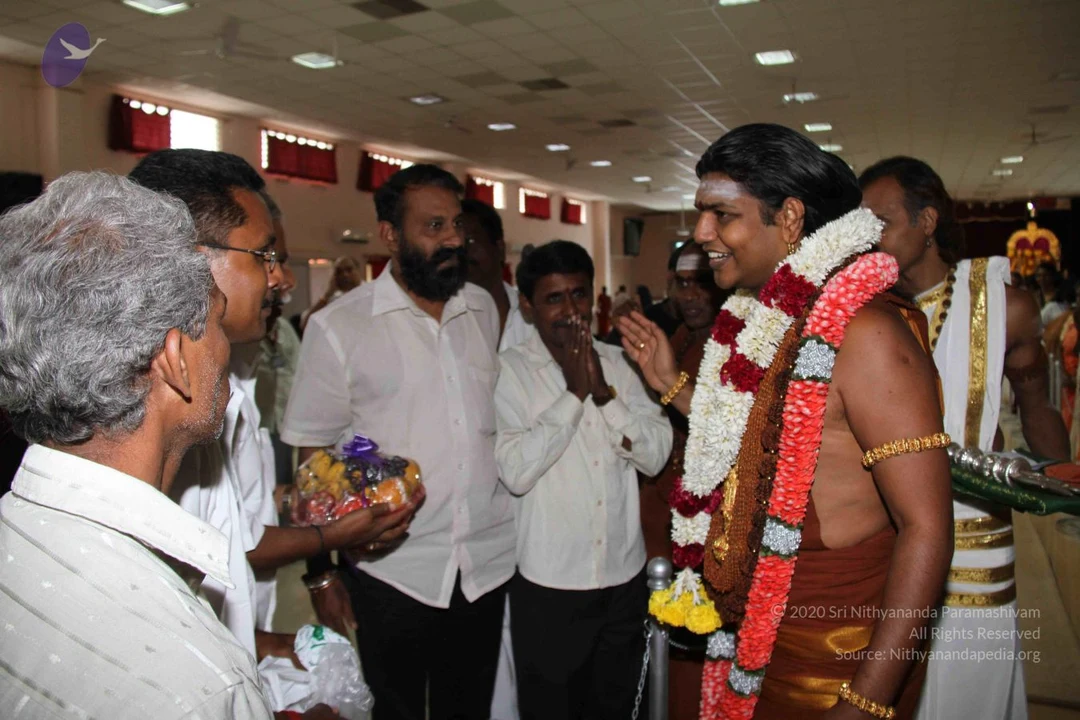
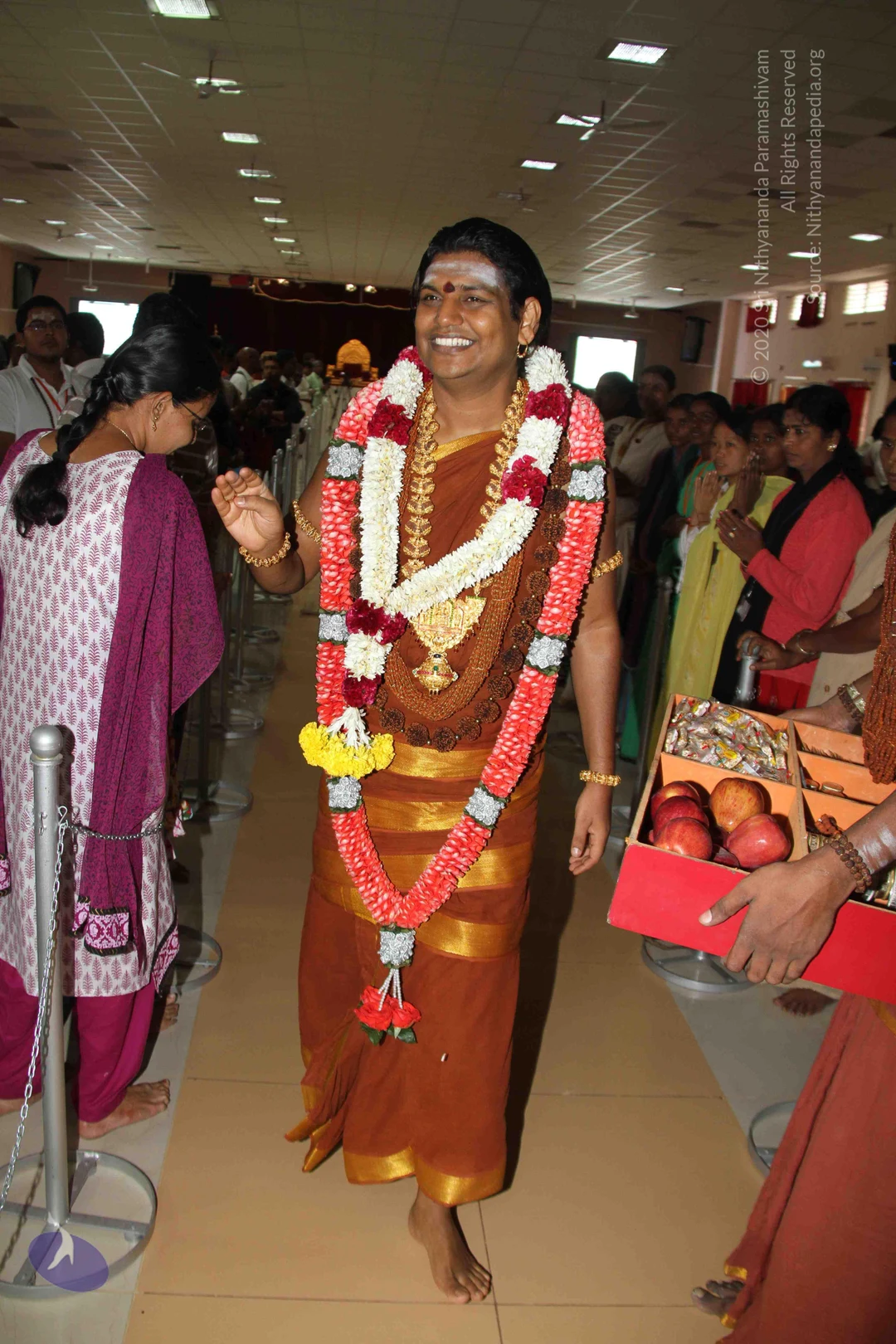
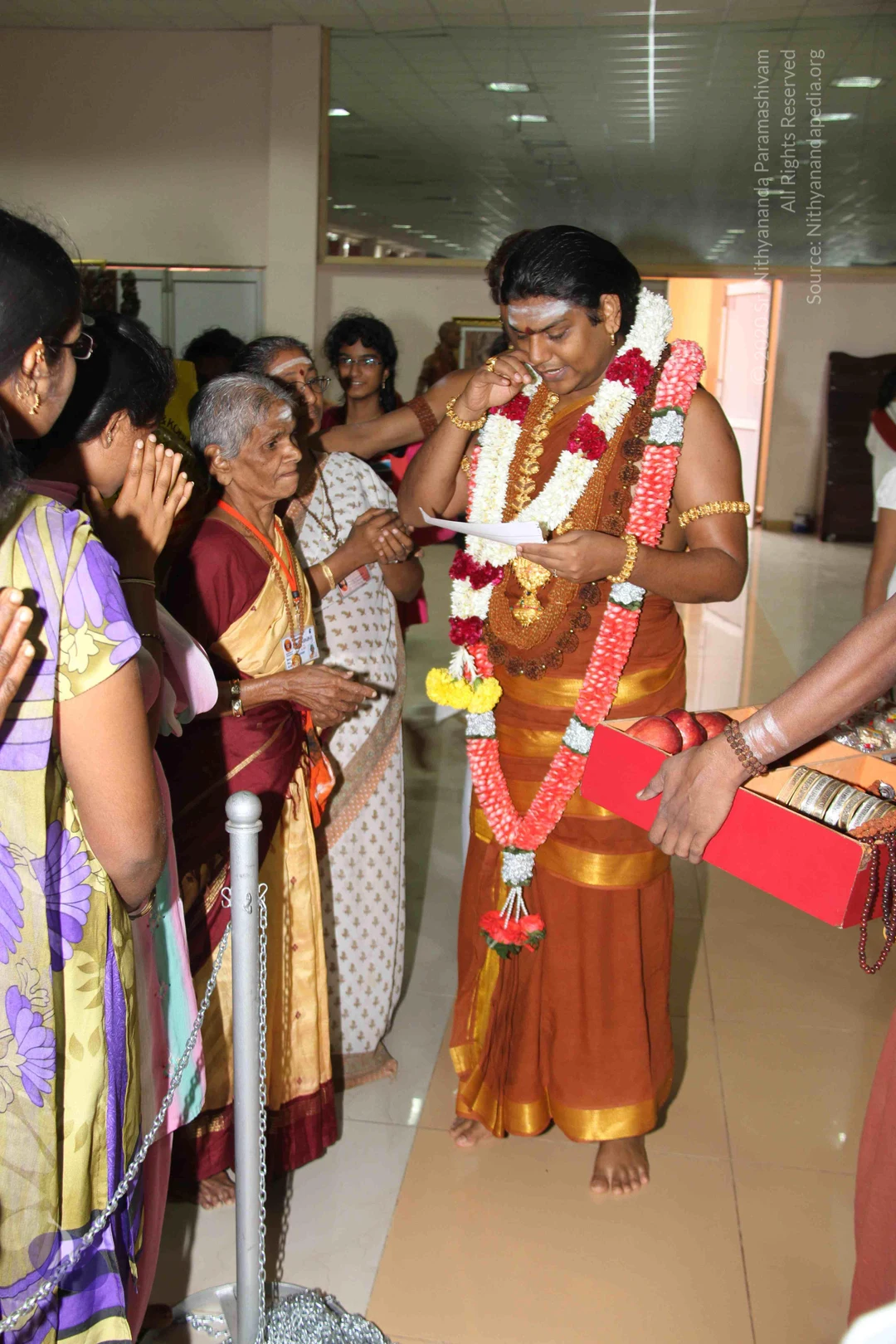
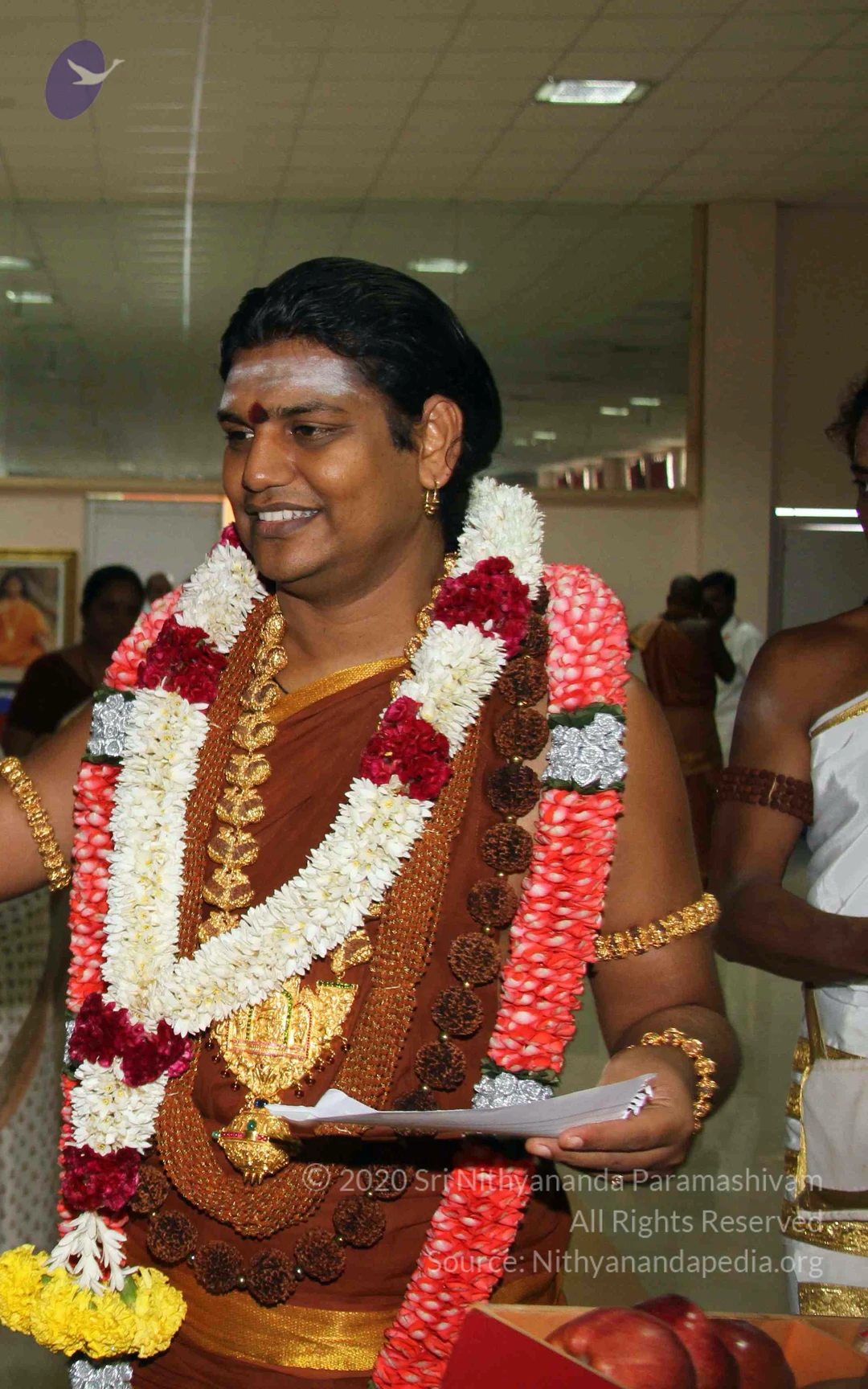
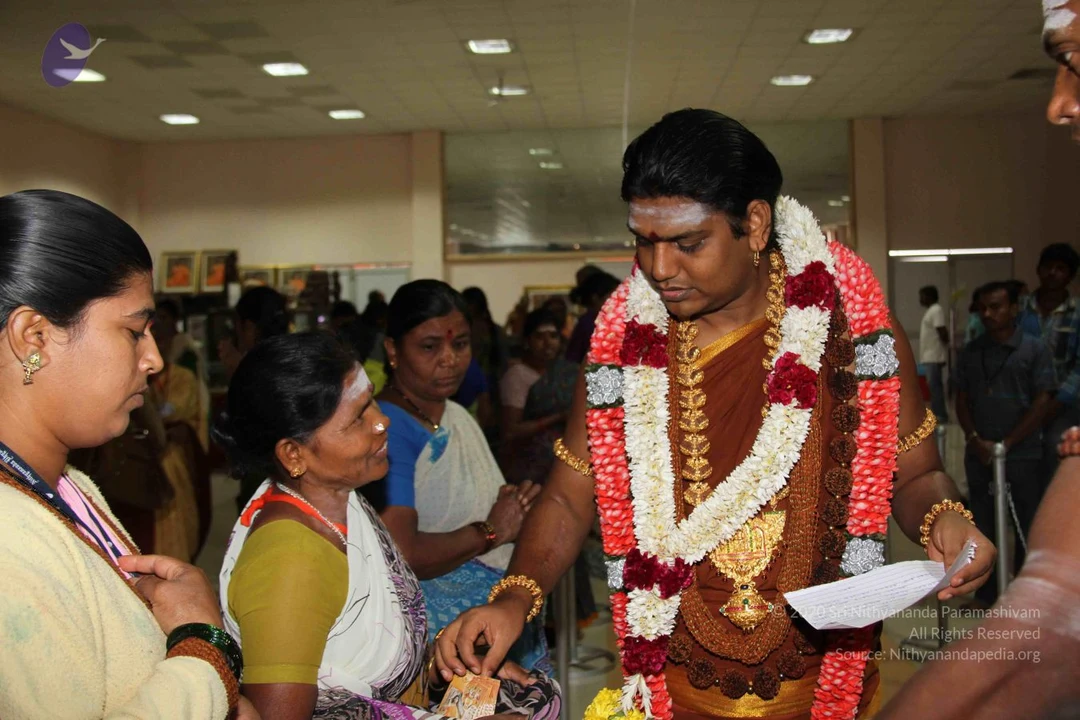
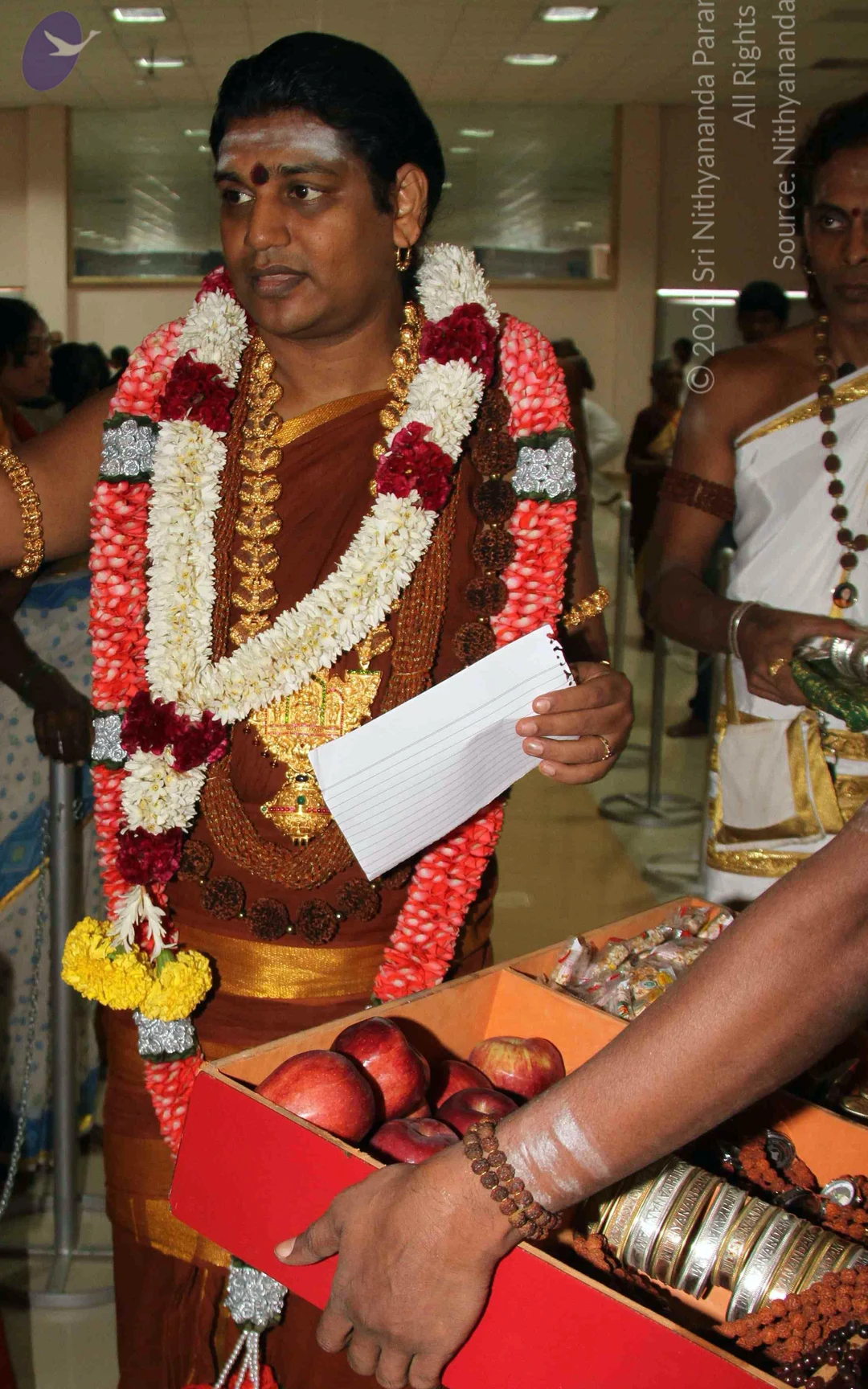
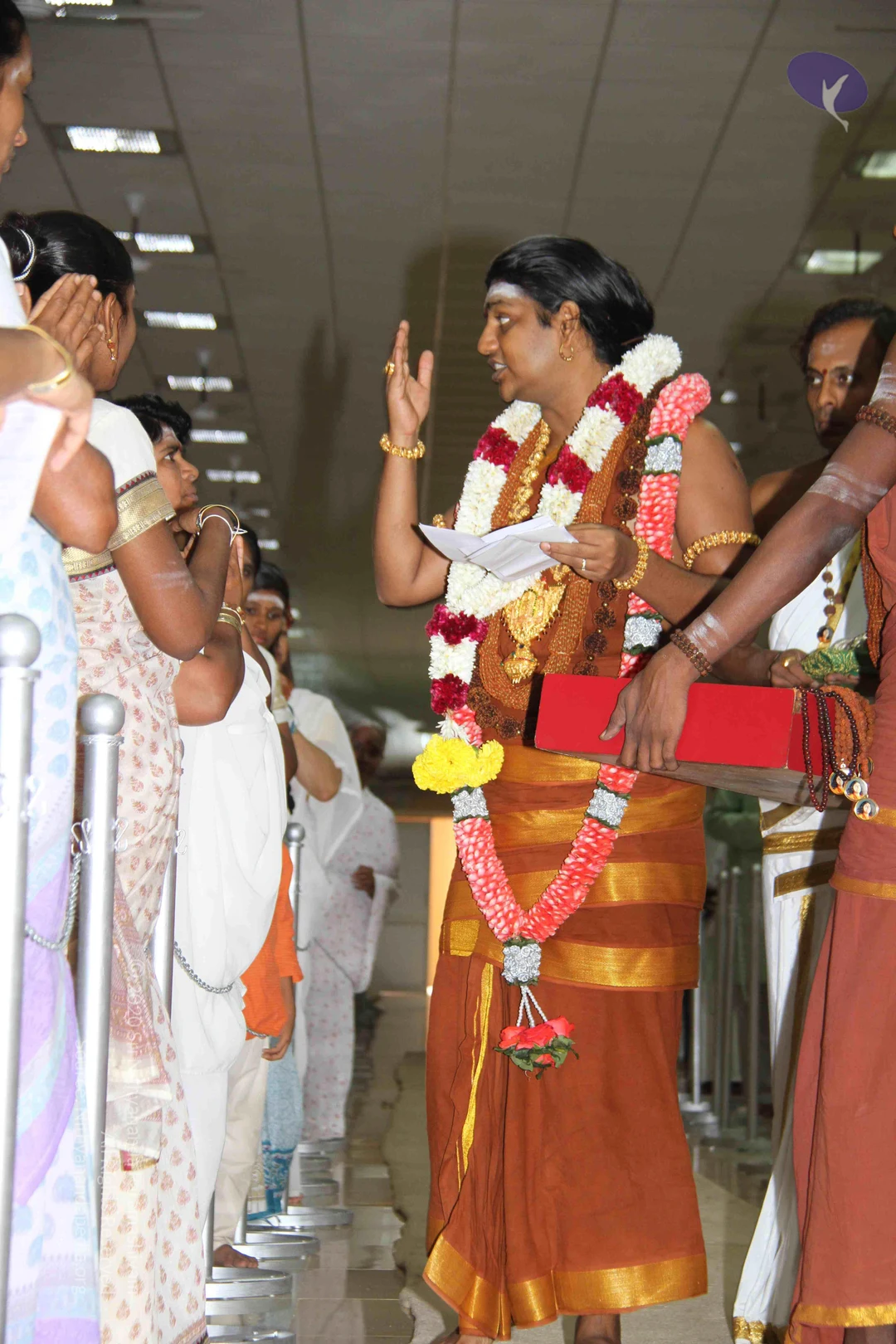
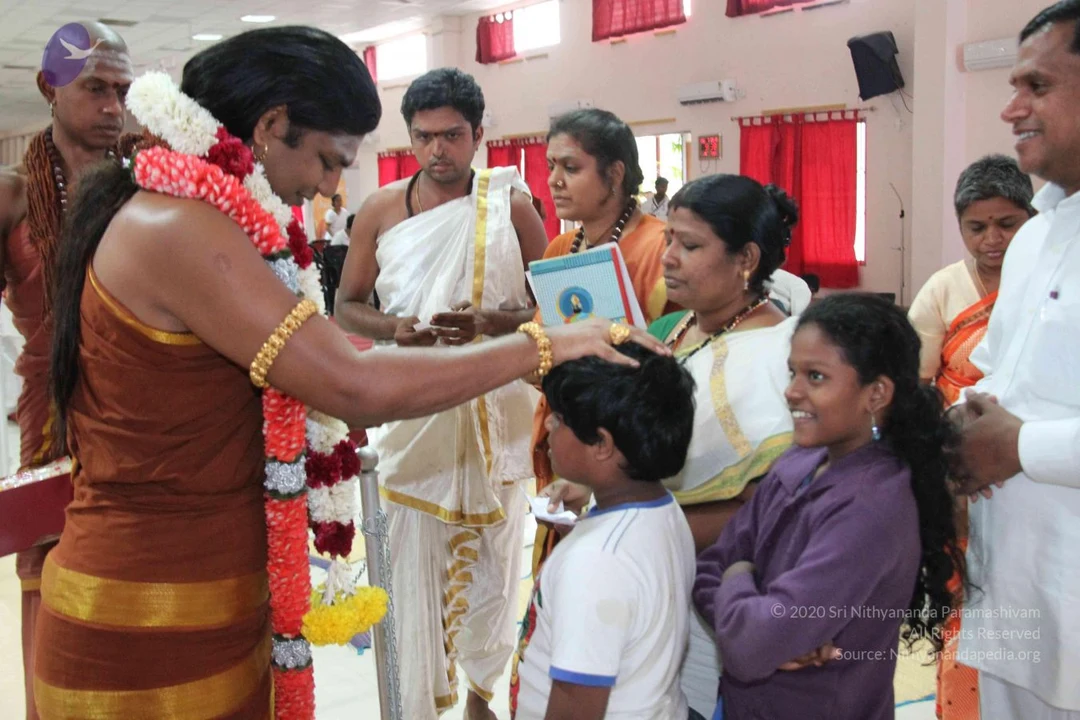
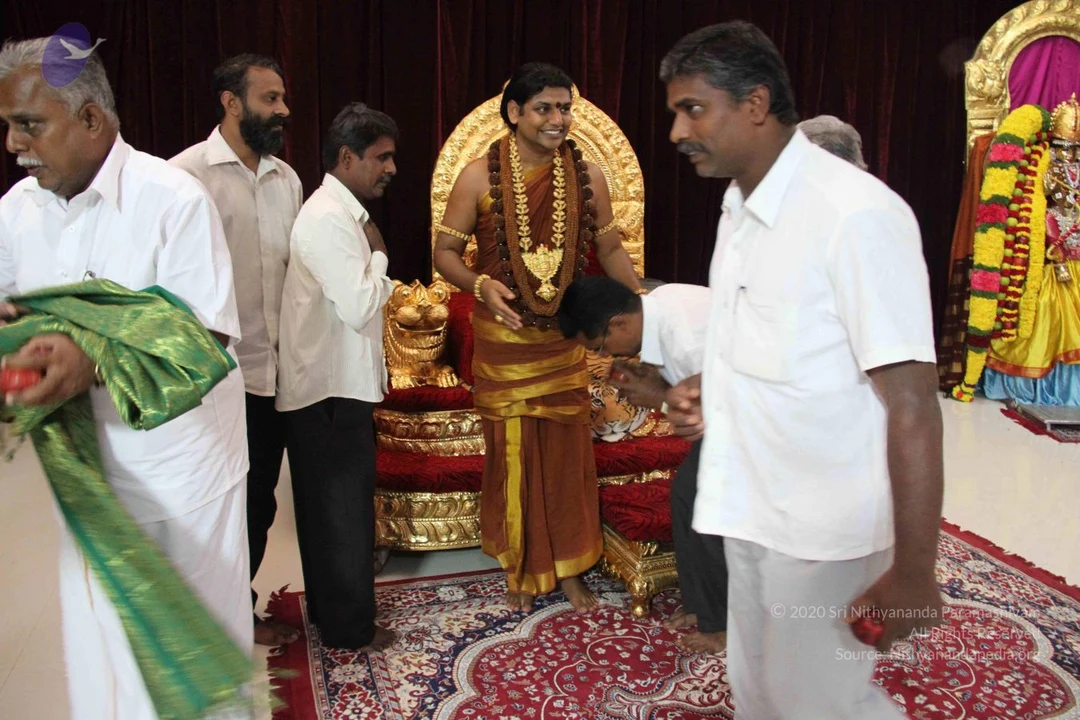
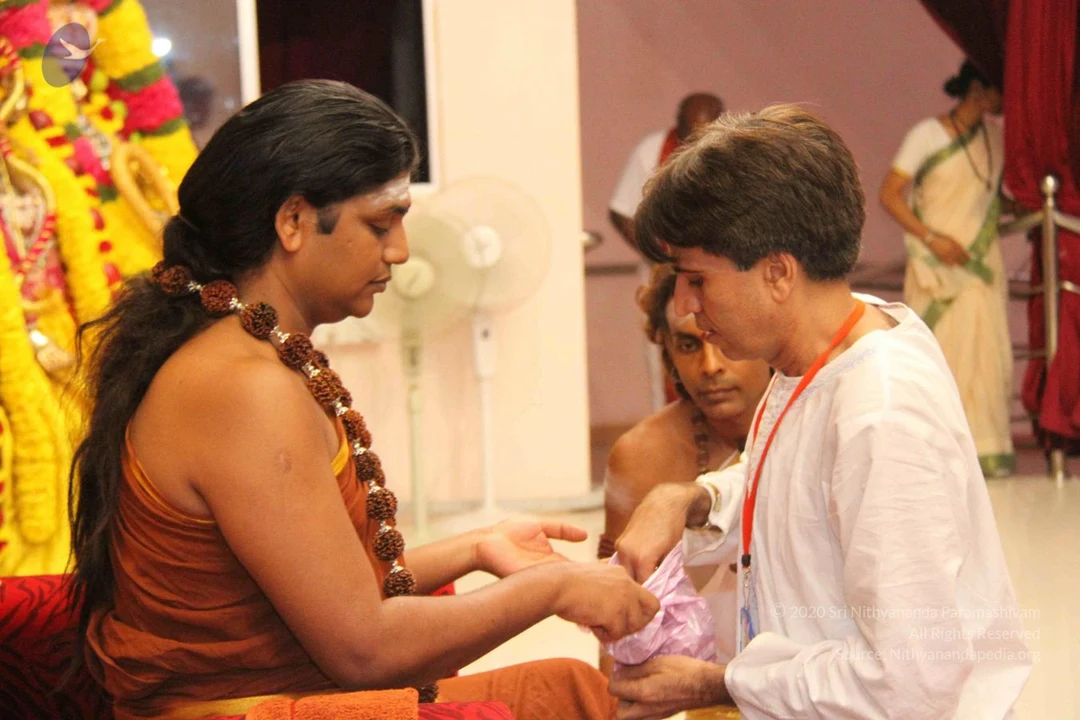
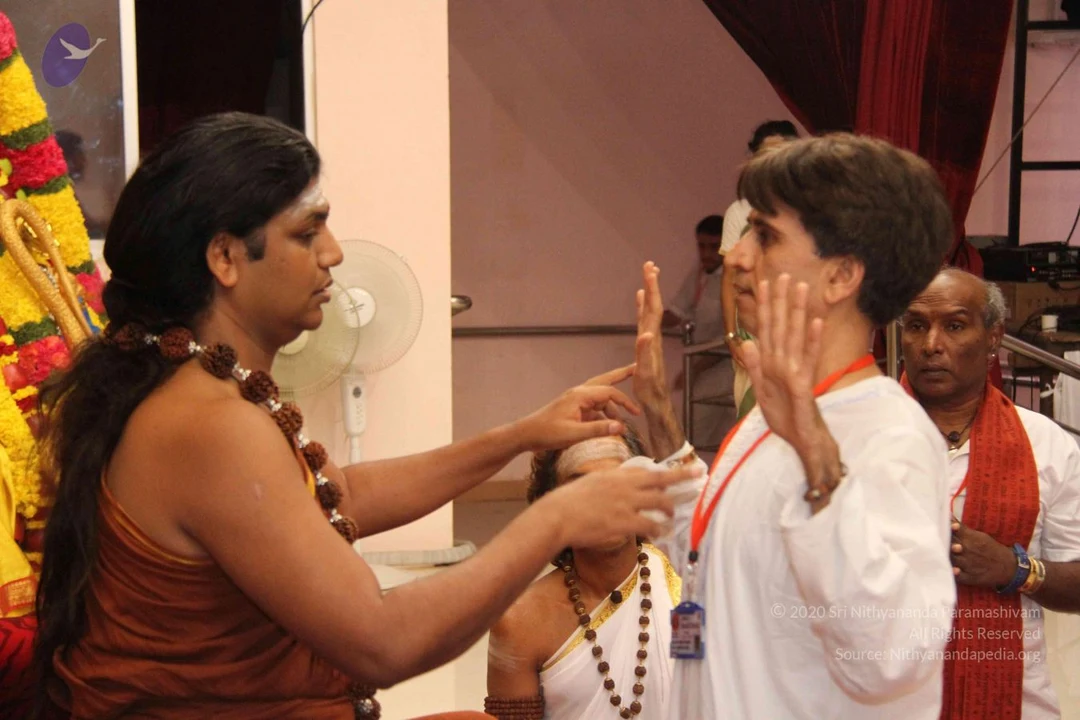
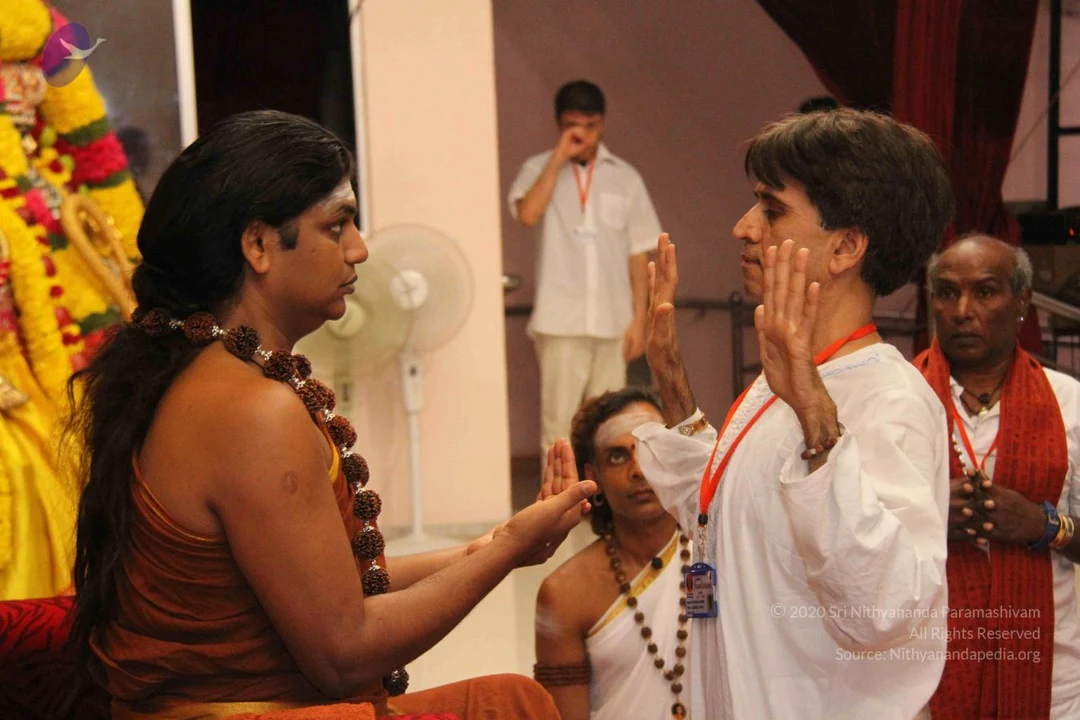
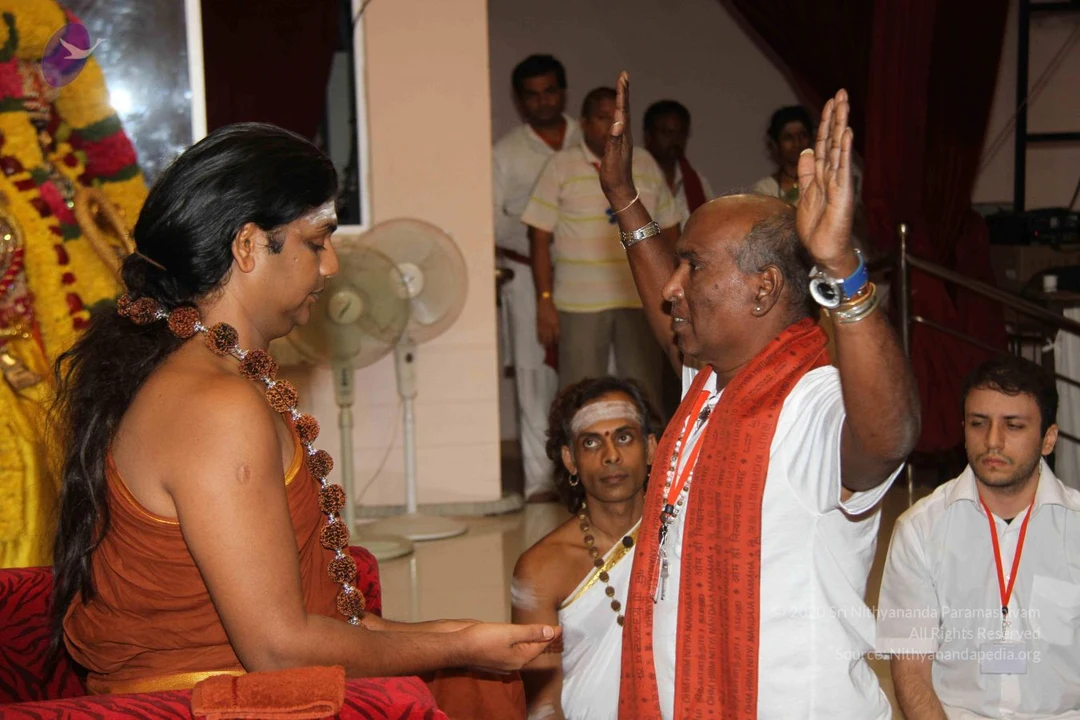
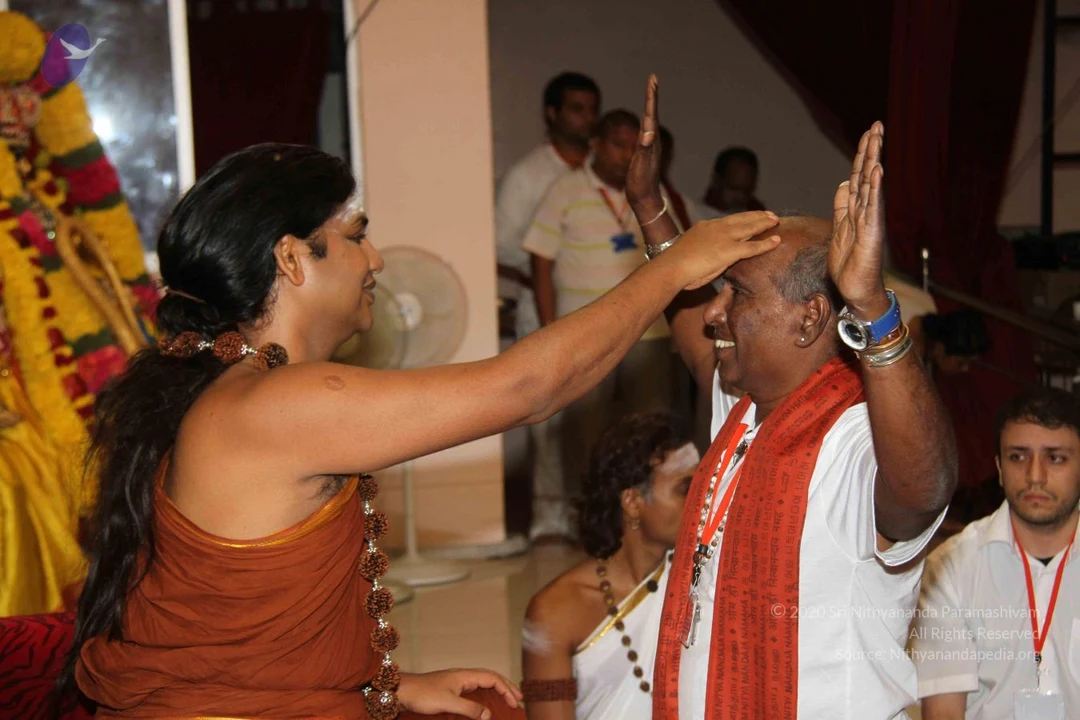
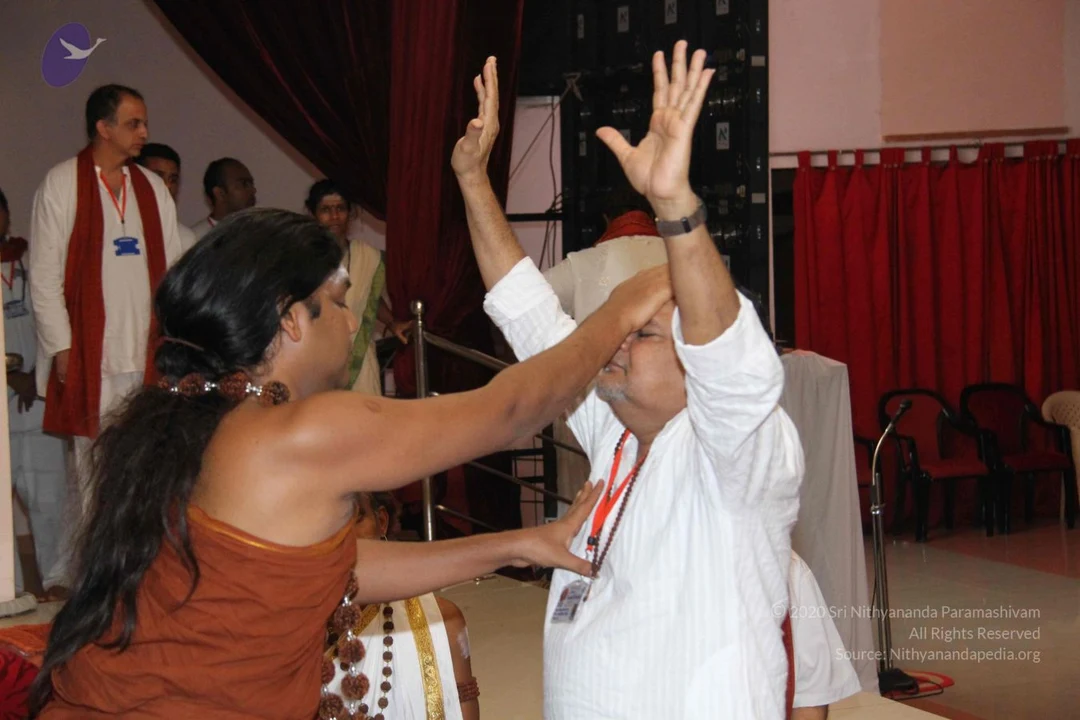
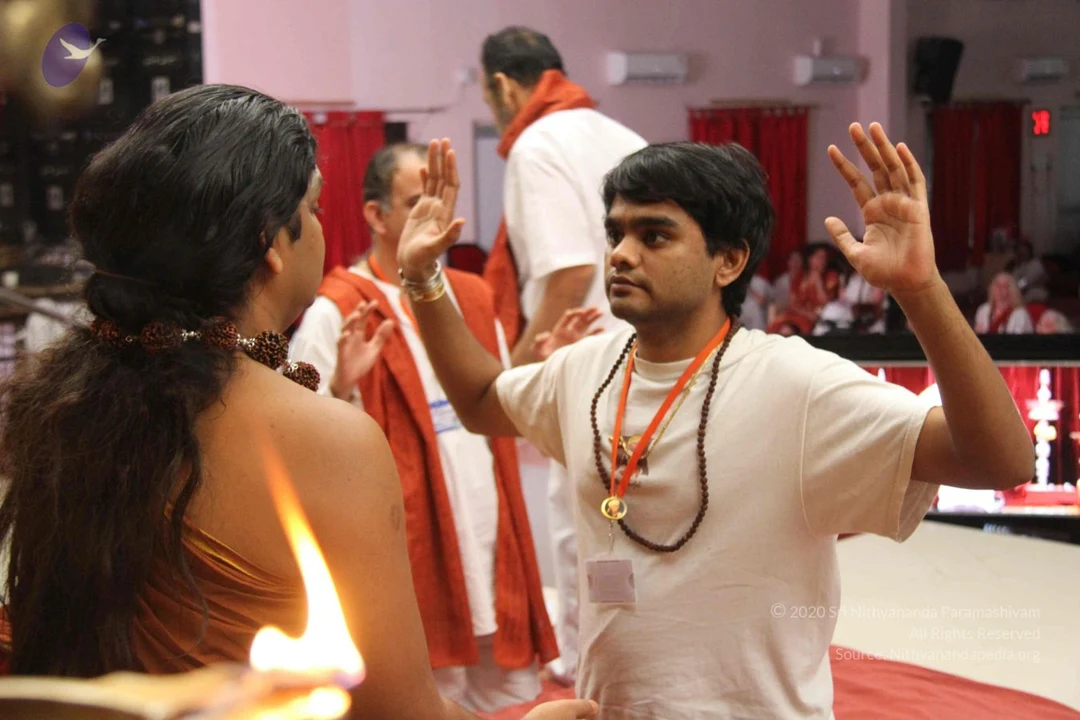
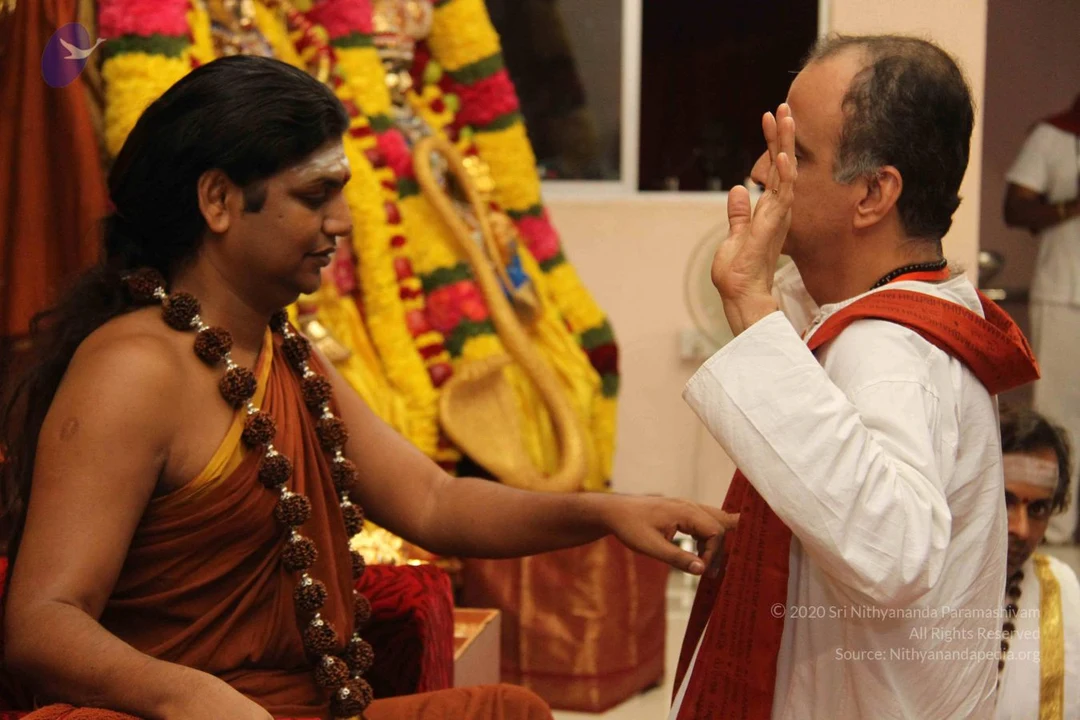
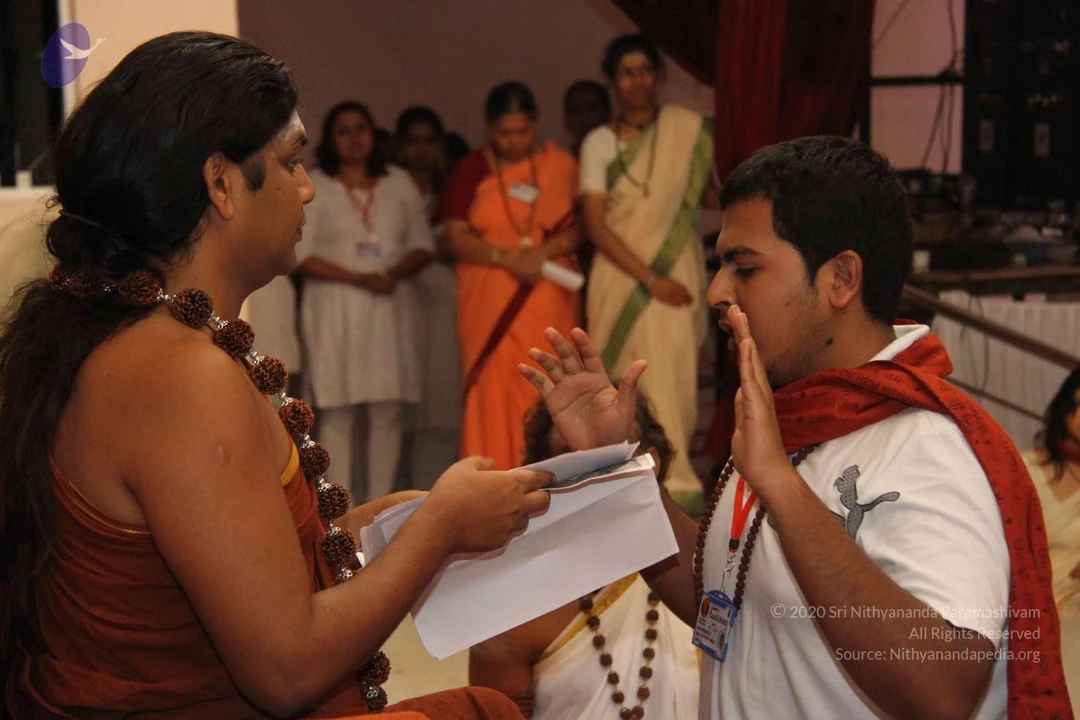
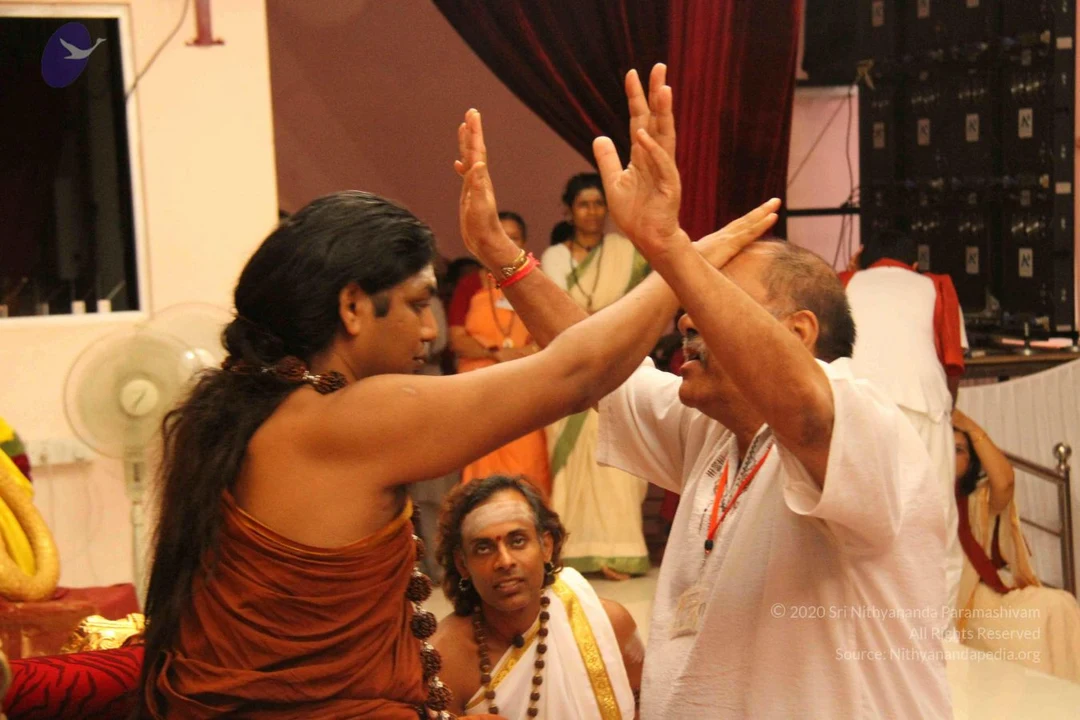
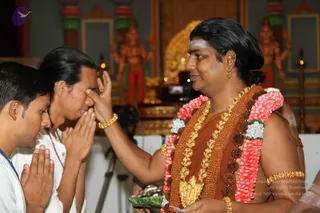
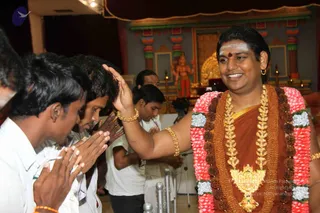
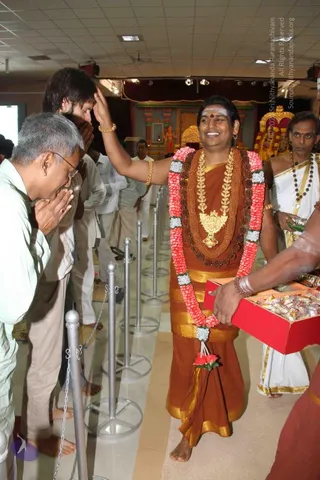
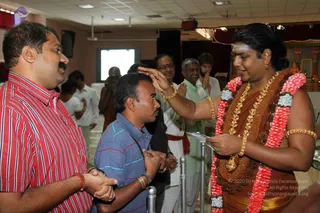
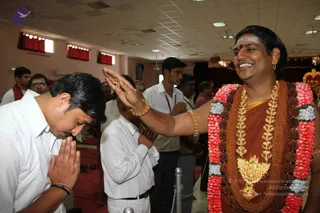
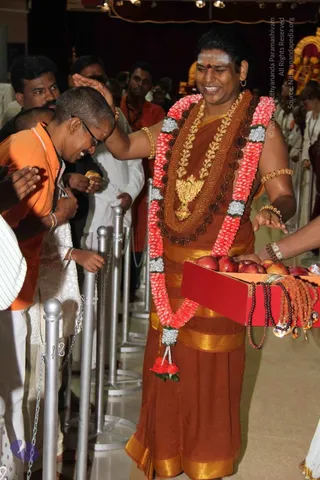
Photograph of a bare-chested man in saffron-orange cloth wearing a long red-and-white flower garland, gold ceremonial necklaces, rudraksha beads and gold bangles, his face marked with white vibhuti. He raises his right hand to touch the forehead of a devotee in white kurta with a purple cord, while two young men in white stand with palms joined in namaskar. Behind them stand deity murtis and lit oil lamps before a golden shrine backdrop. A green plate with offerings is visible at lower left.A man in a saffron-orange robe stands at the right, smiling, with a pink-and-white flower garland over his shoulders, a rudraksha mala with a large ceremonial gold pendant, gold chain necklaces, and gold bangles. He holds his right hand raised over the heads of several young men on the left, who bow with palms pressed together in namaskar; the young men wear white shirts and white cloths. Behind them, another man in white stands near a golden ornate altar with a standing deity murti, a kalasha, and lit oil lamps under a decorated red-and-gold canopy. a person is identified by the saffron robe, layered garlands, rudraksha mala, and gold ornamentation, shown in a blessing act of giving blessings to devotees.A photograph in an indoor hall with a patterned ceiling and rows of silver stanchions with chains. A smiling man in a rust-brown dhoti and shawl with a gold border, wearing a heavy gold necklace with a gold pendant, rudraksha malas and a thick pink-and-white flower garland, is walking forward, with one hand raised and resting on the head of a young man with brown hair who bows with palms joined. A man in a light shirt and glasses on the left also bows with folded hands. On the right, a priest in white dhoti with gold border holds a red box of sweets, and a deity shrine with a gold canopy stands in the background. a person: the smiling man in the rust dhoti wears rudraksha malas, gold ornaments and a garland, matching the candidate's distinctive ceremonial cues.A photograph of a satsang-style gathering in a hall with a shrine and framed deity image at the right. In the foreground, a man in a saffron-brown robe with a gold-trimmed shawl and layered gold necklaces, wearing a white tilak on his forehead and a pink and white flower garland, raises his right hand in blessing toward a devotee while holding a folded paper in his left hand. Before him, a man in a red striped shirt stands at left with hands clasped, and a man in a blue striped polo with a rudraksha mala stands with palms joined. Behind them, several men in white dhotis and kurtas and a man in green stand with hands folded, and a bearded man in white stands at the back.A photograph inside a hall with red curtained windows and a fluorescent ceiling. On the right, a smiling man with a long swept-back hair style, white forehead markings, red-brown ochre clothing and rudraksha malas stands with a raised hand. He wears a large layered gold necklace, gold bangles and a flower garland of red and white blossoms with silver accents. On the left, a young man in a white shirt with his palms joined bows his head in namaskar. Several other people in white shirts and dhotis stand behind, some with hands folded, and a red carpet runs across the floor.A smiling man in a rust-brown dhoti-style garment with a gold zari border stands at a silver barrier line, placing his hand on the head of a devotee in an orange shirt with black rudraksha beads. He wears a long red-and-white flower garland, a gold ornate necklace, rudraksha malas, gold armbands and a white sandal forehead mark with a red dot. In front of him a red tray holds apples and rudraksha malas. Devotees in white and orange stand behind the barriers, and a gold-decorated altar is visible at the upper right.

IA-Gurukul-Show

58 photosSource gallery
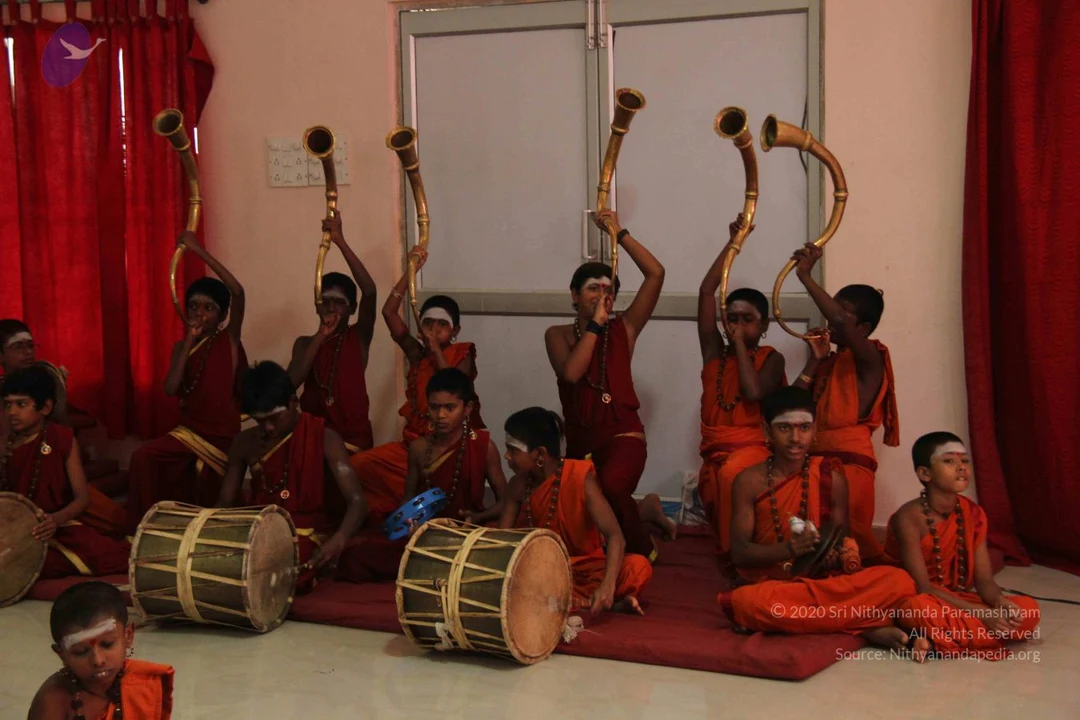
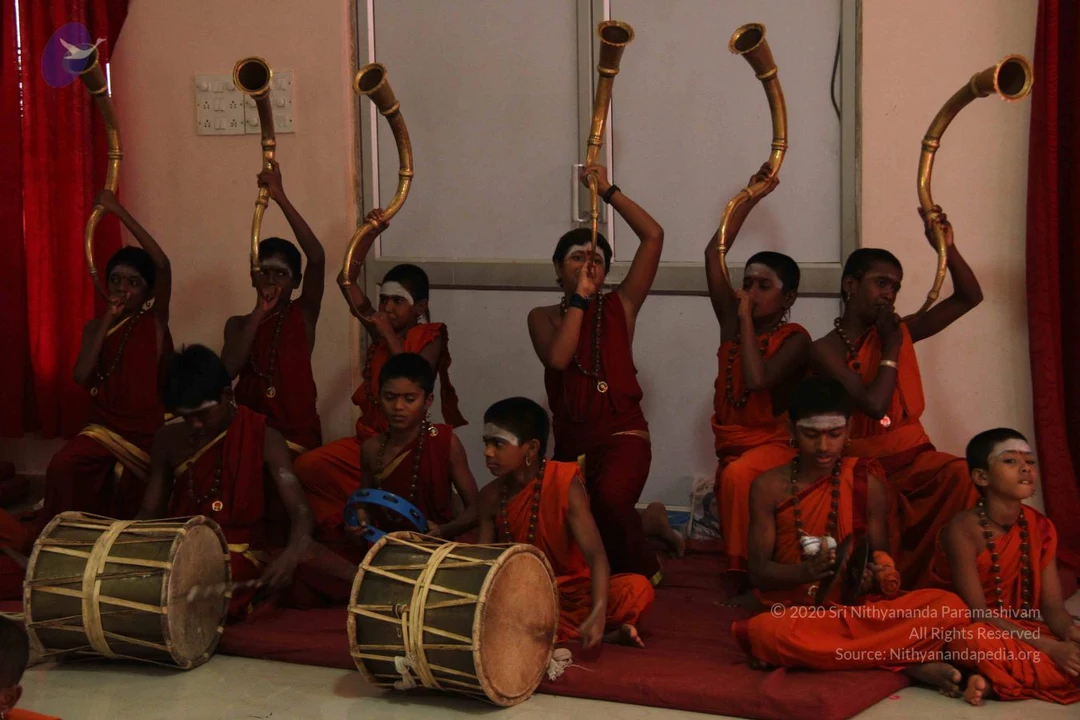
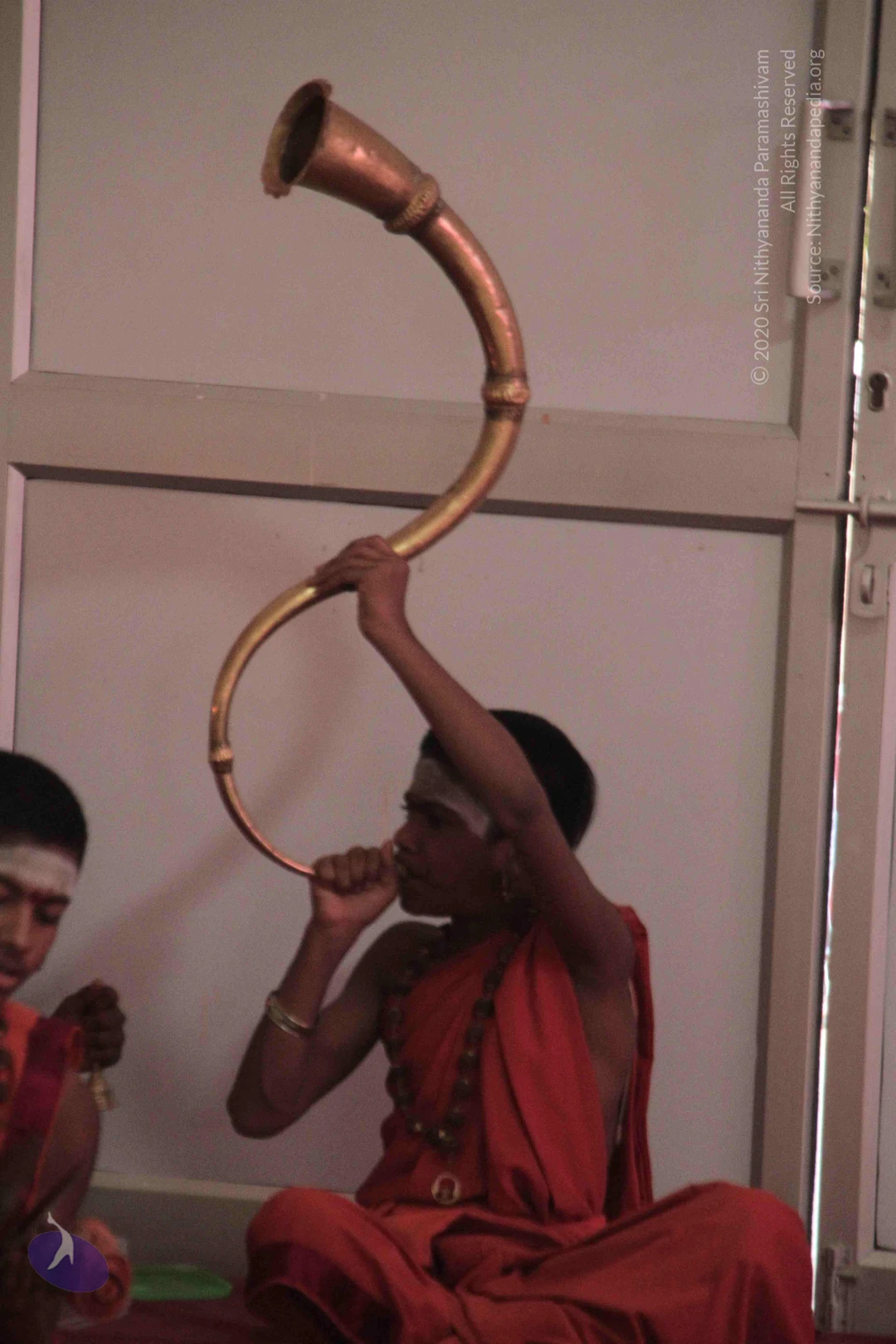
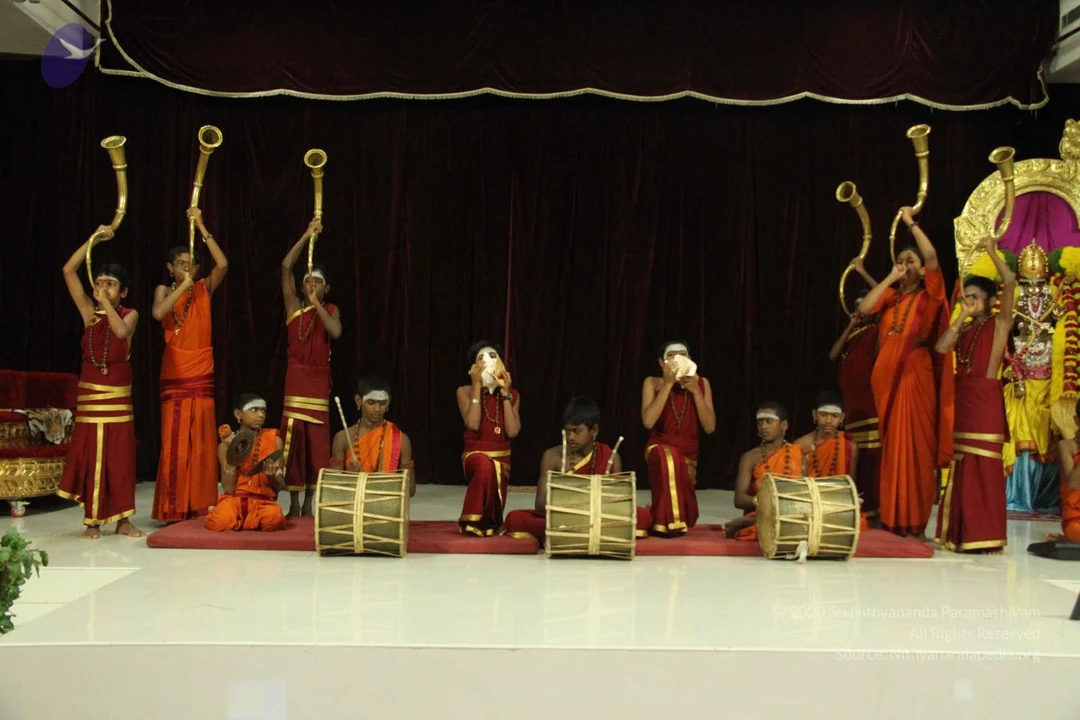
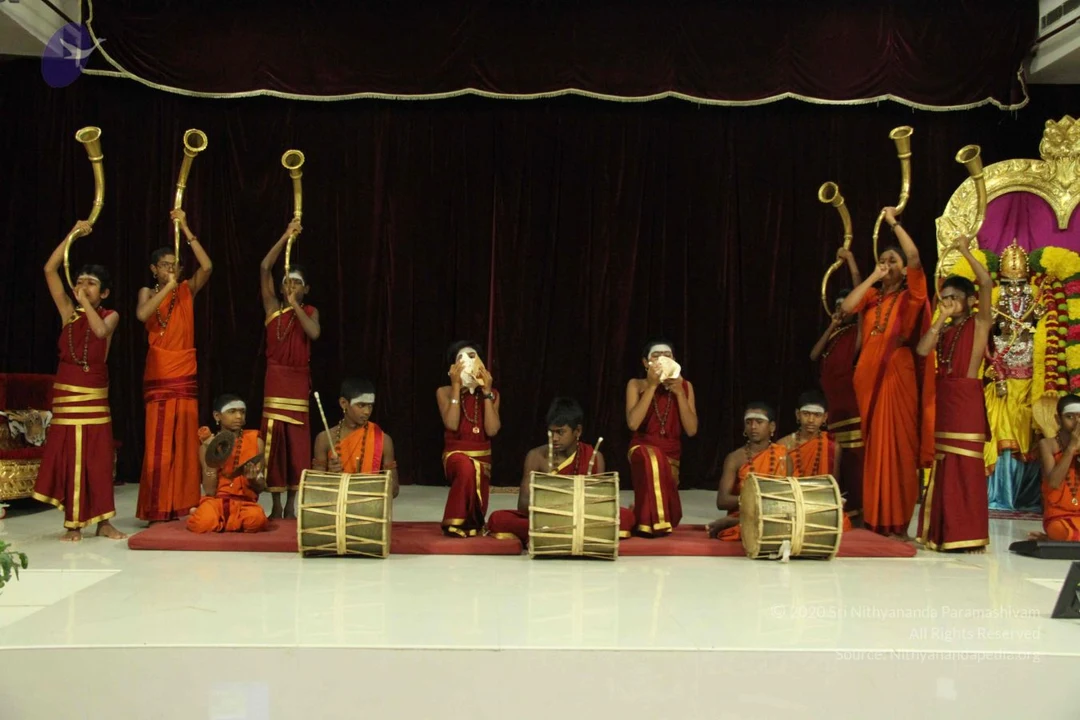
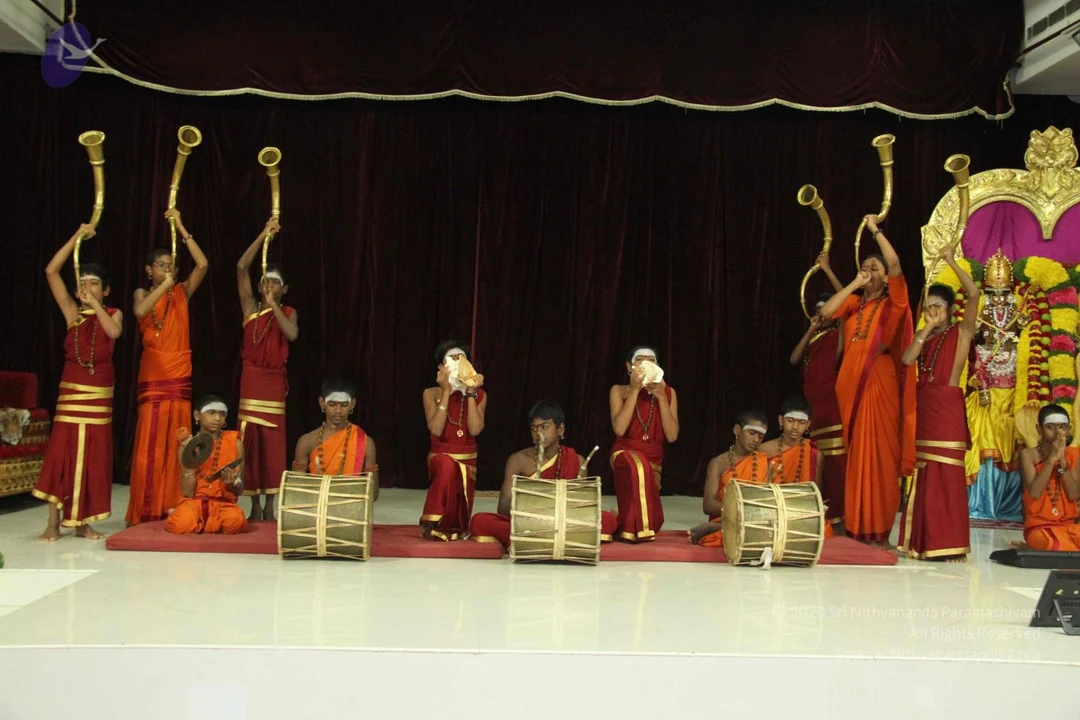
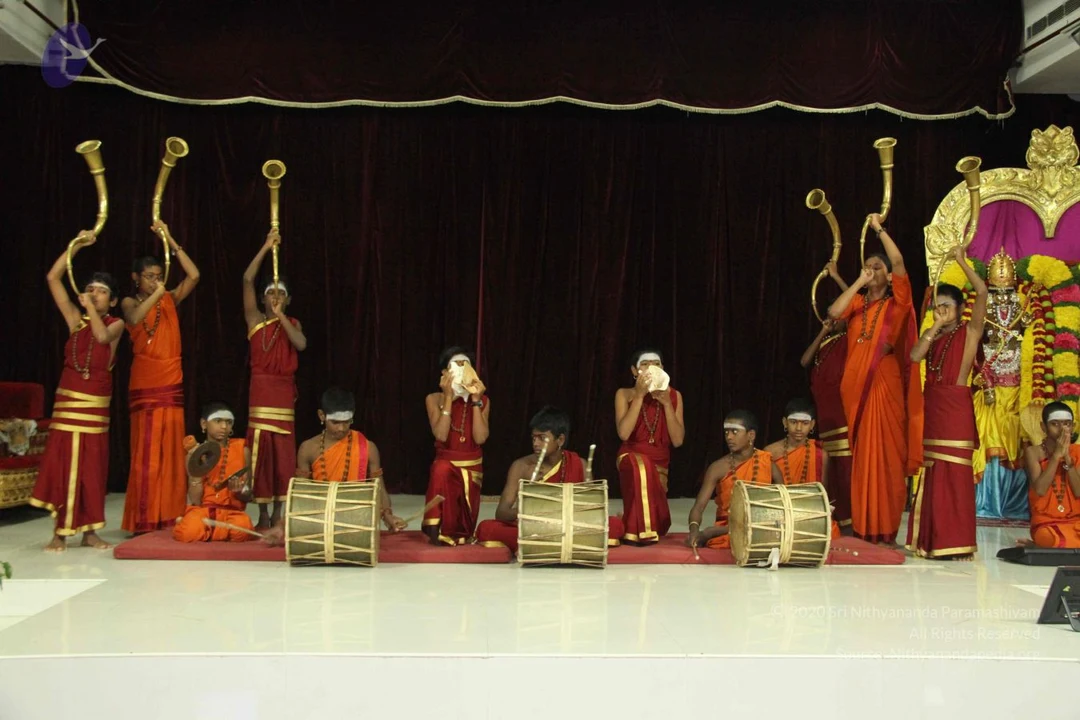
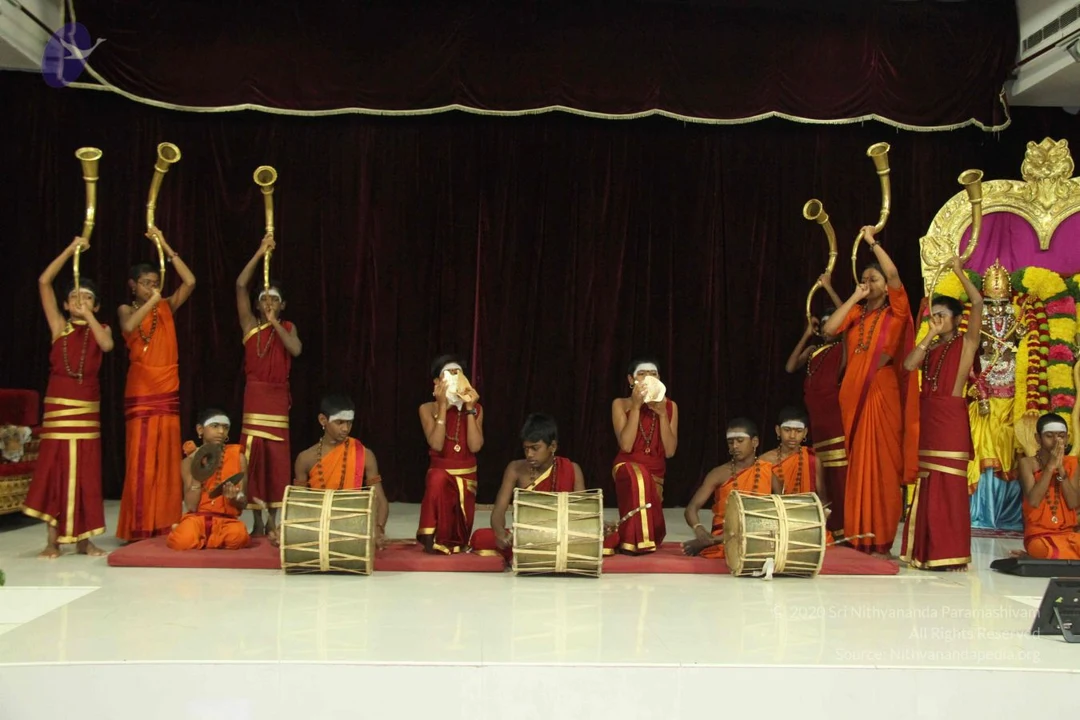
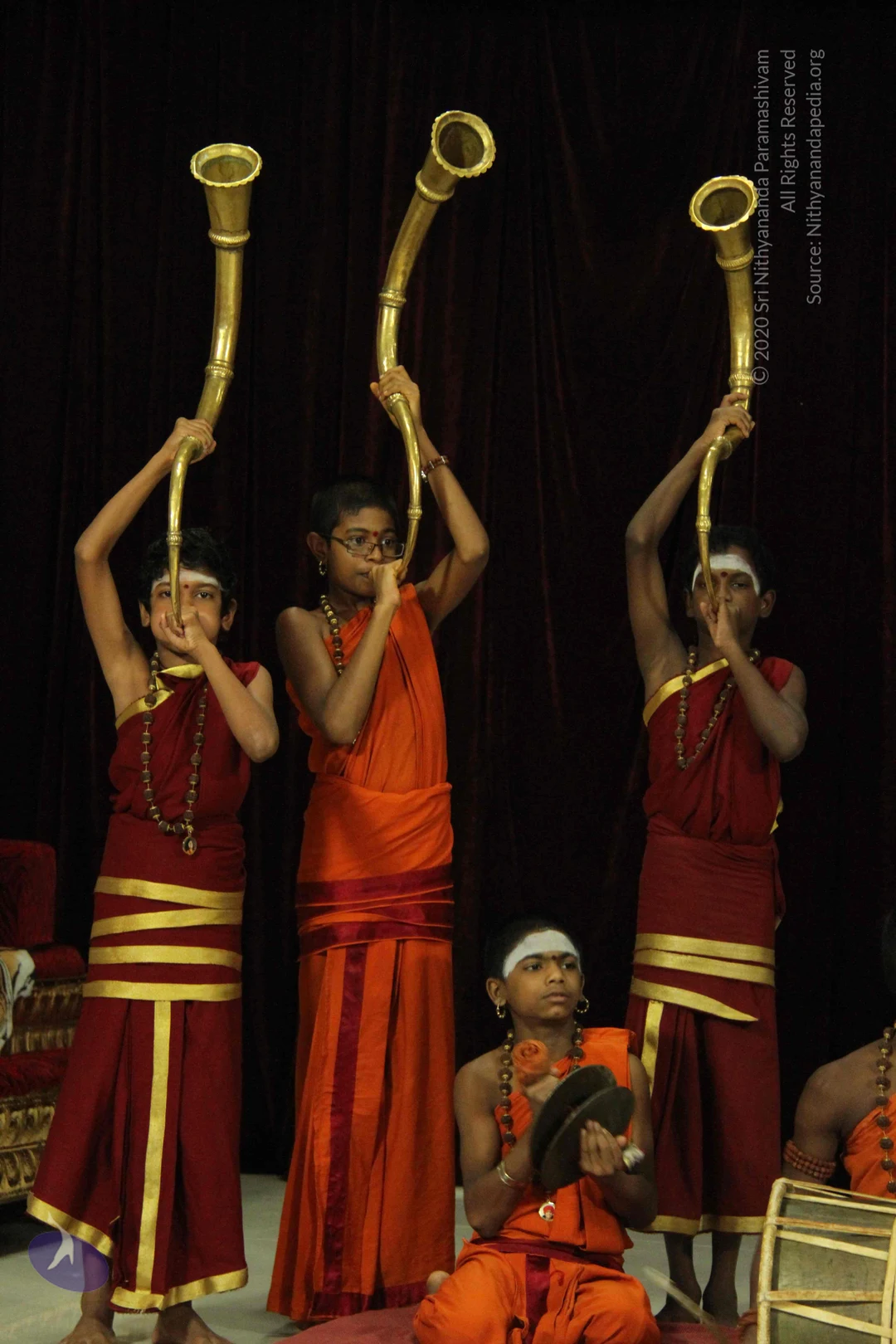
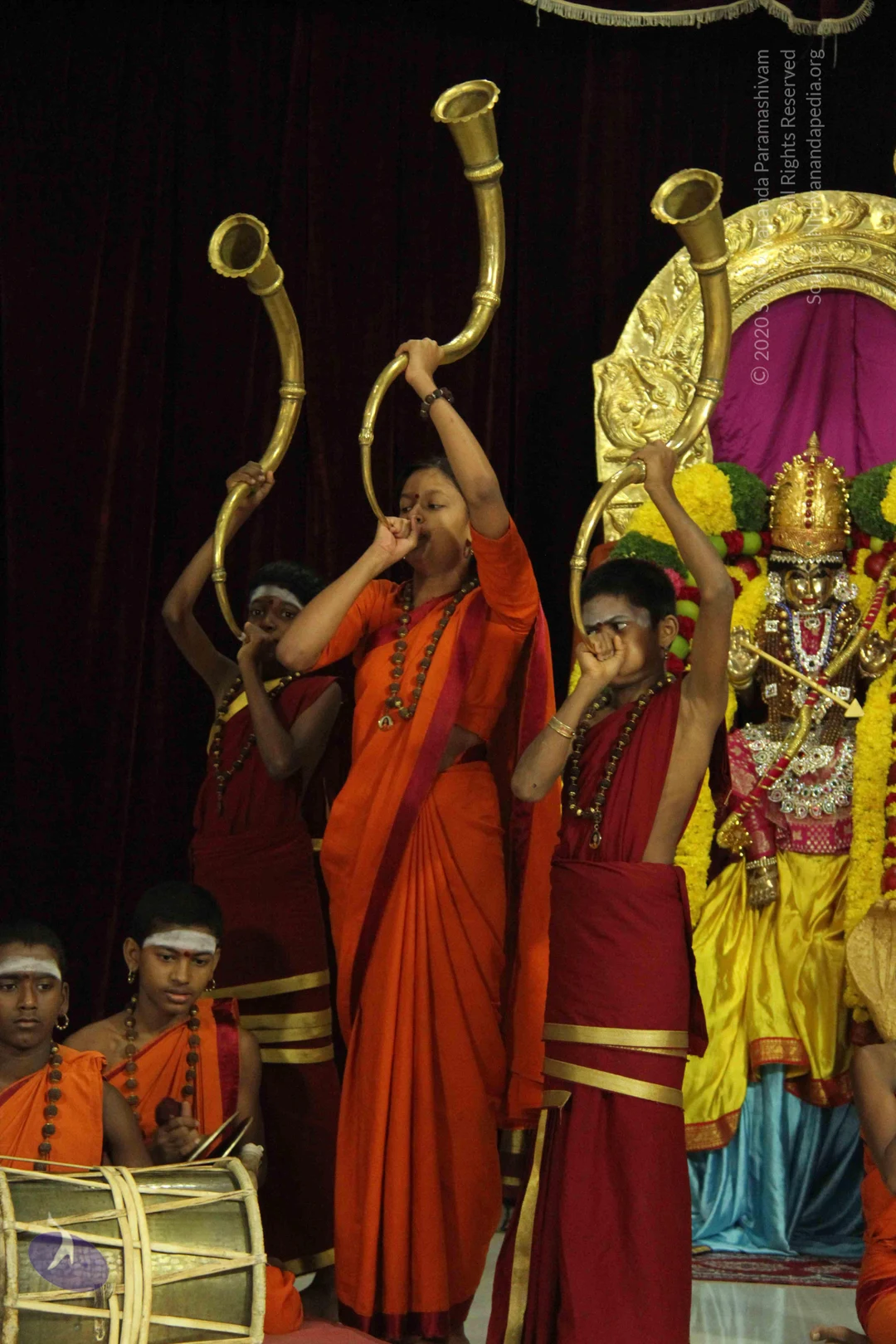
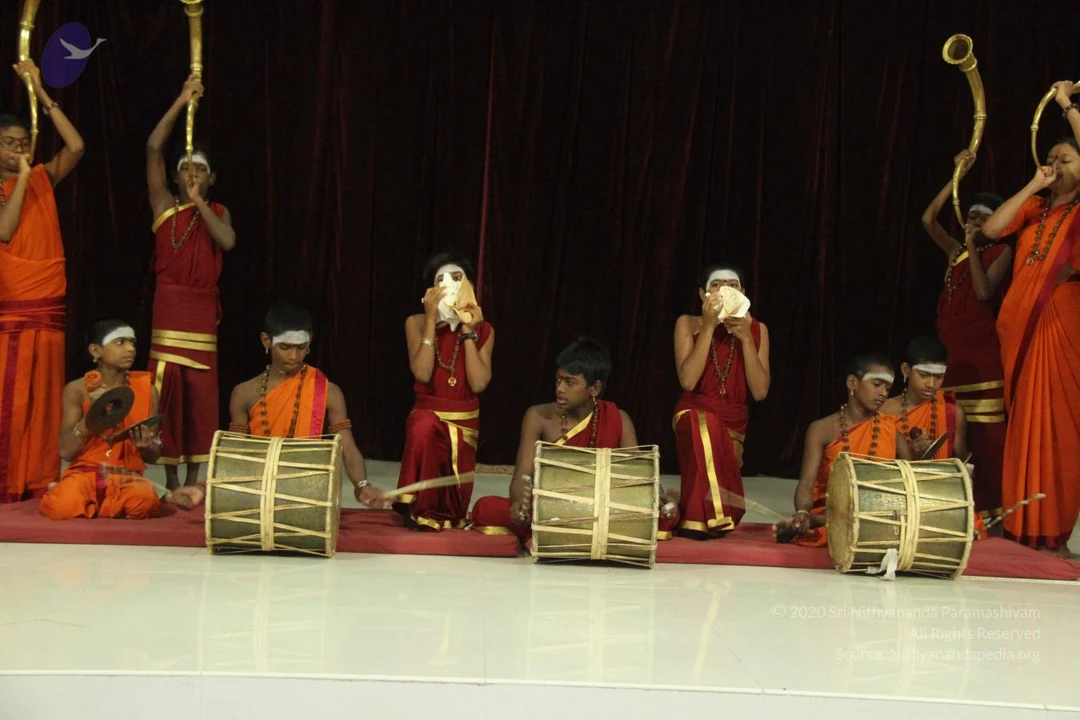
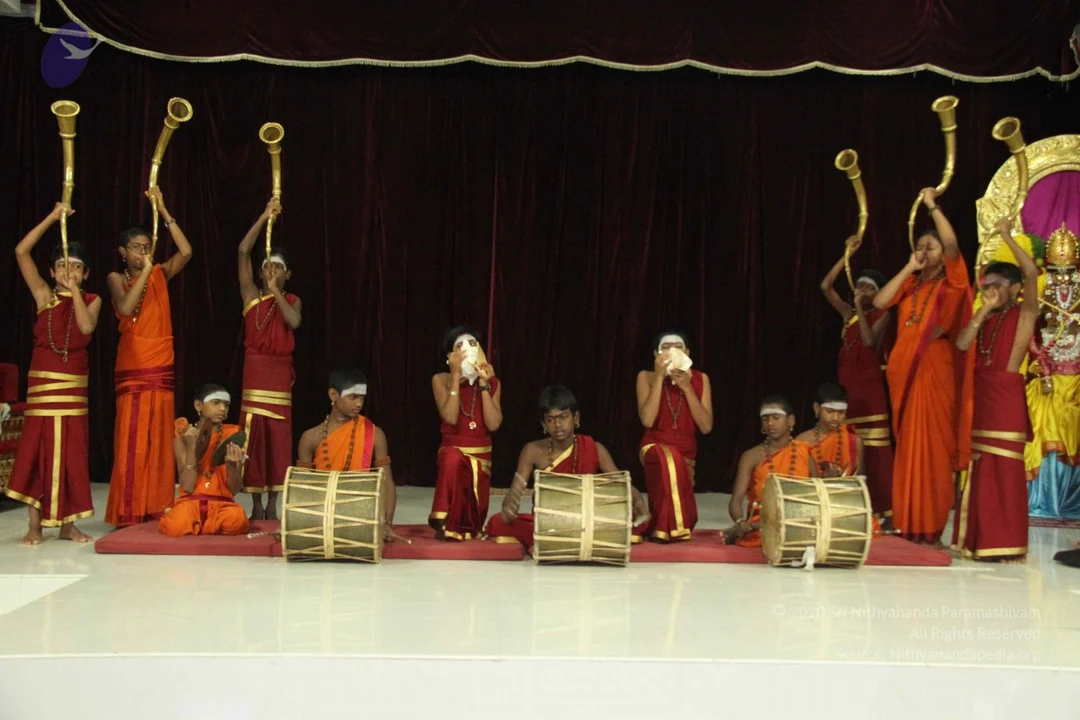
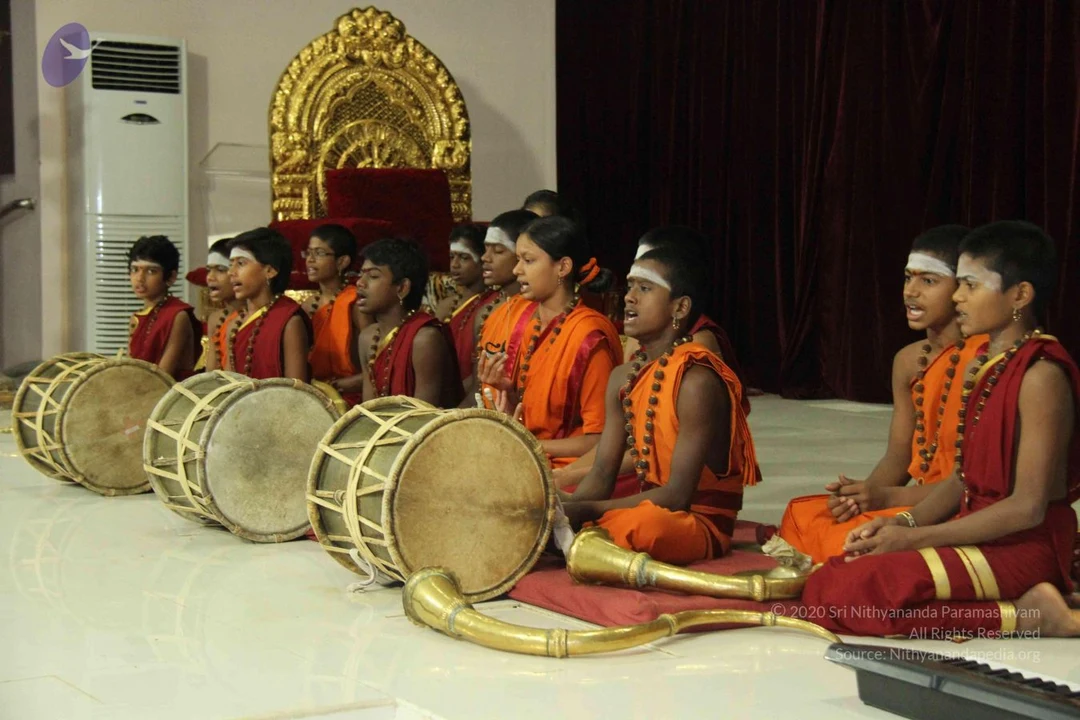
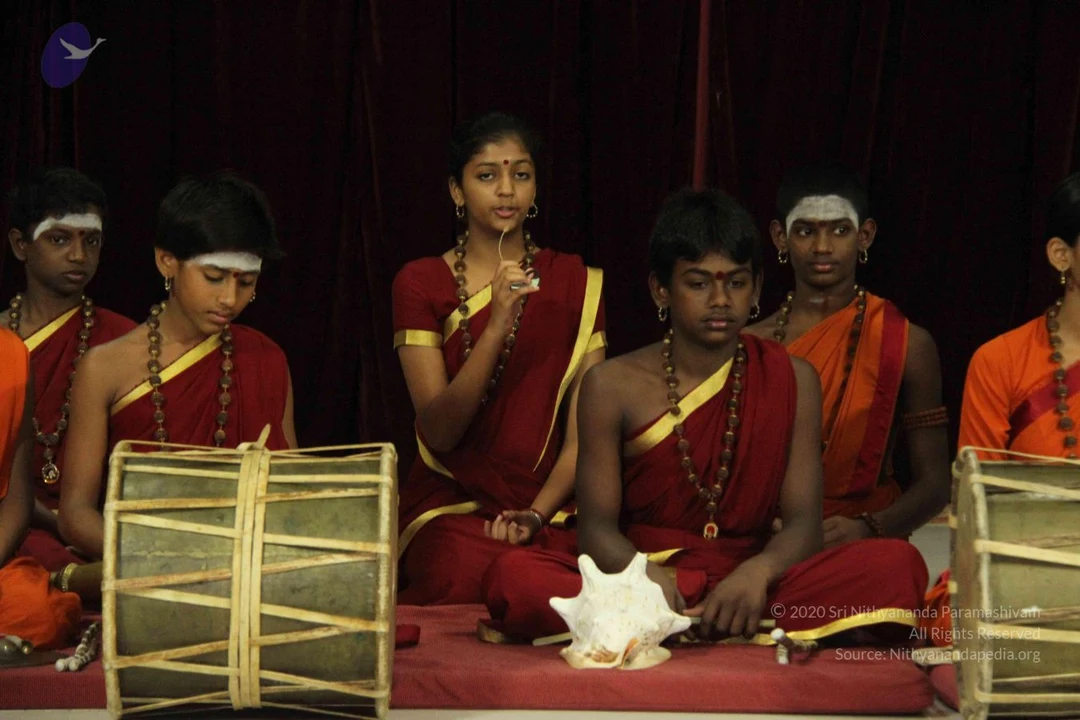
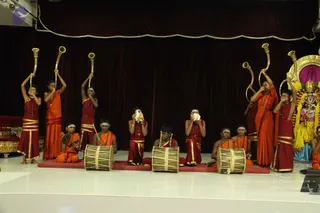
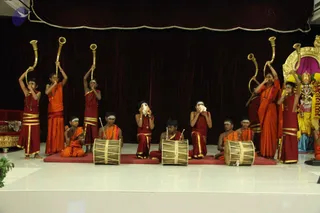
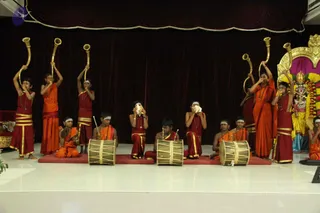
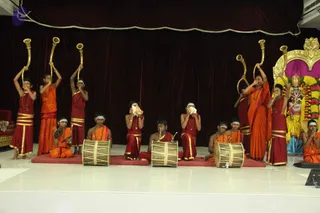
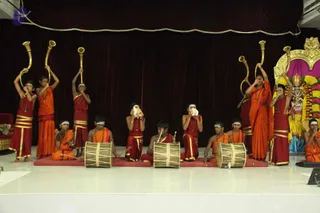
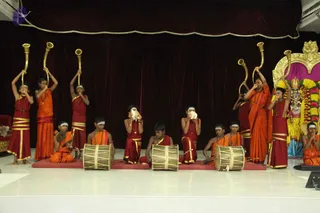
A stage performance by a group of young male musicians in orange and maroon traditional dhotis and shawls with white forehead markings and beaded necklaces. Several players raise long brass horns high overhead, while others blow conch shells and seated drummers beat large barrel drums with sticks. On the right, a deity murti adorned with a crown, garlands and gold jewellery sits on an ornate golden peetha beneath a burgundy velvet curtain. The setting suggests a ceremonial temple-style musical procession.A stage performance by a group of young musicians in red and orange traditional dress with gold-striped borders. Several stand and hold long brass horns raised high, while others seated on red mats play conch shells and drums, and a small hand drum is held by one boy. Some wear white forehead markings and rudraksha-style beads. At right, a gold-framed throne holds a garlanded deity murti with a crown and yellow-green garland, backed by a red-and-gold curtain against dark maroon drapes. The scene is a temple-style musical procession tableau.A stage performance by a group of young musicians in red and orange traditional dress with white forehead markings and rudraksha-style beaded necklaces. Several stand holding long golden horns raised overhead while others play conch shells and drums, two seated players beat large barrel drums, and a seated musician plays a small handheld instrument. Behind them on the right, a large deity murti decorated with yellow garments and flower garlands sits on an ornate golden throne against dark maroon velvet drapes. The stage floor is white with a red carpet mat.A photograph of a stage performance by a group of young musicians in red and orange robes with white forehead markings and rudraksha necklaces. Several stand and raise long golden horns to their lips while others sit on red mats playing large barrel drums with gold trim and a small hand cymbal. Behind them hangs a deep maroon velvet curtain, and on the right a gilded throne-like canopy frames a deity murti draped in a garland of yellow and pink flowers. The stage floor is white.A stage performance of temple musicians in red and saffron costumes with white forehead bands. Standing at left, several performers raise long curved brass horns above their heads while others blow them, and seated players beat large barrel drums and a smaller hand drum in front of a dark red velvet curtain. At right, a golden throne-like canopy with garlands of flowers and a deity murti decorated with jewellery is set up on the stage. The scene reads as a ceremonial musical presentation for a deity.A photograph of a temple-style musical performance on a white stage before a deep maroon velvet curtain. About ten young boys in red and orange-saffron dhotis and shawls, with white head bands and rudraksha-style beaded necklaces, play long curved brass horns raised overhead and wooden drums called chenda-style drums seated on red mats. On the right, a decorated deity murti with a gold crown is adorned with yellow and orange flower garlands beneath an ornate gold arch. A seated boy on the far right holds his hands in anjali. The setting suggests a devotional musical offering.

IA-Darshan

39 photosSource gallery
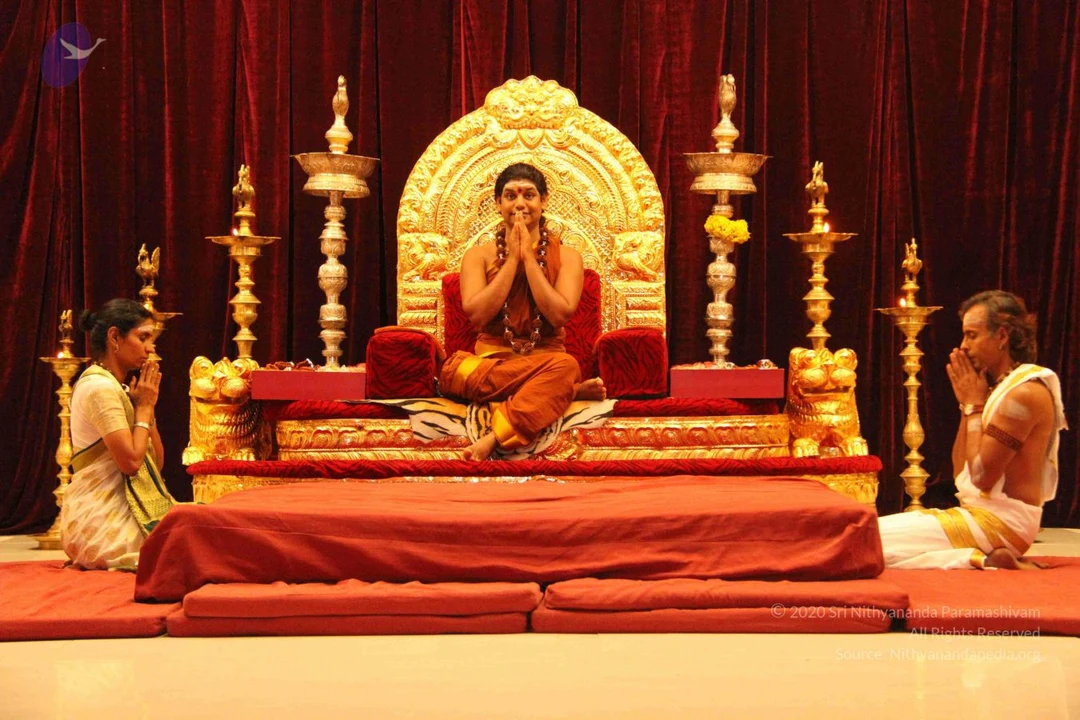
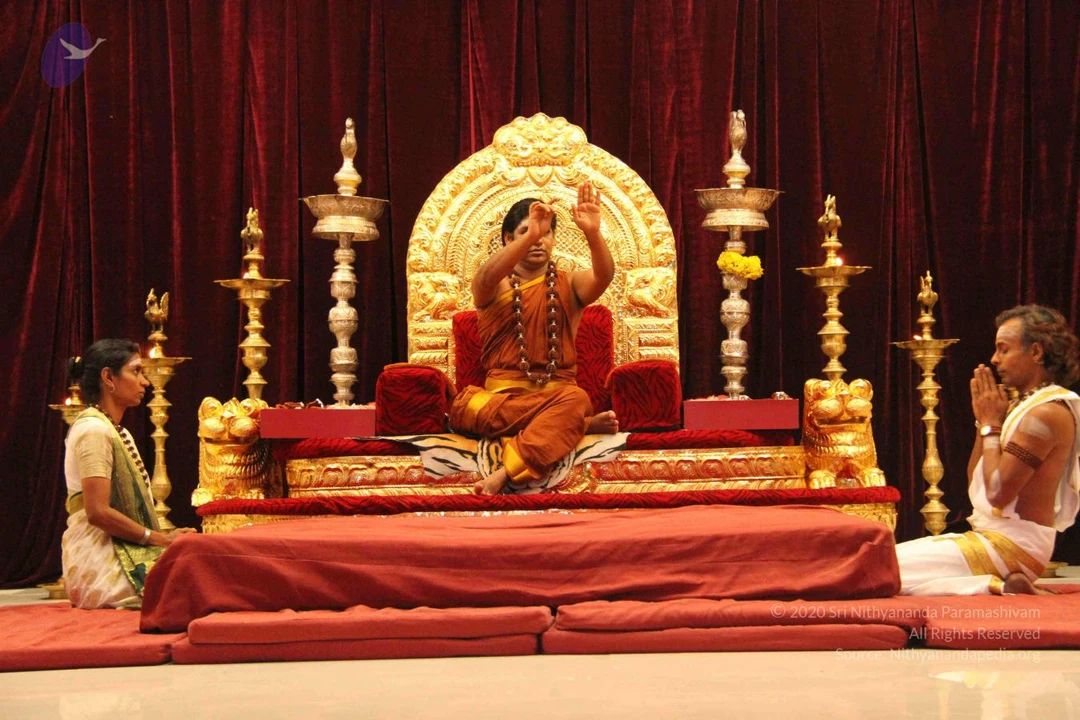
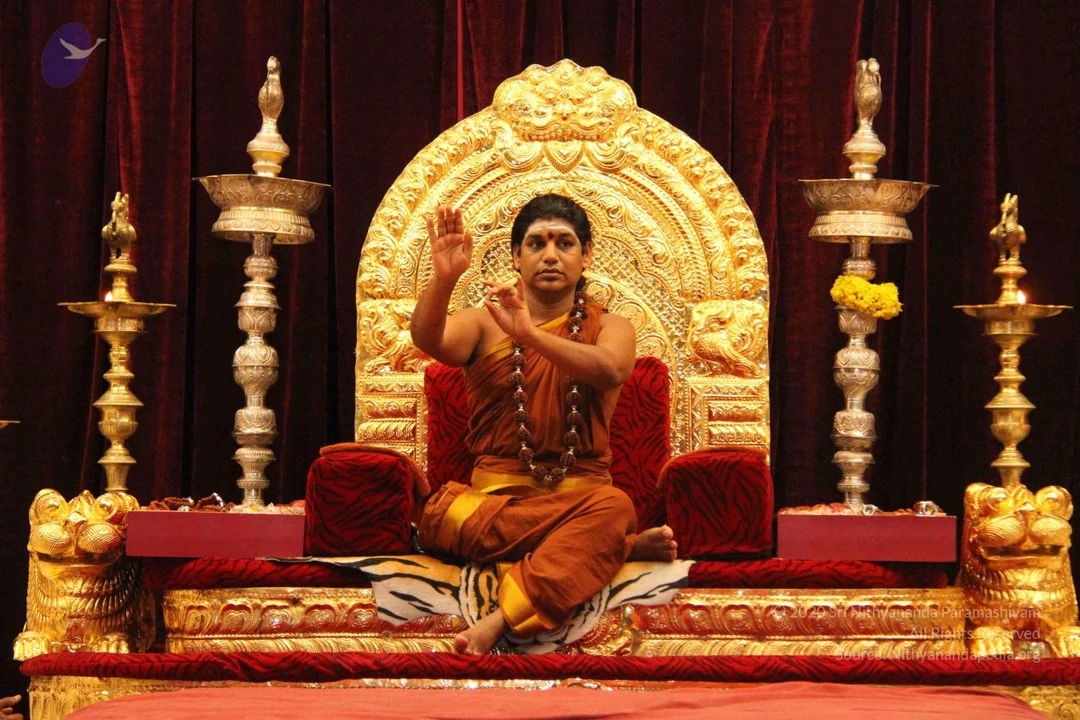
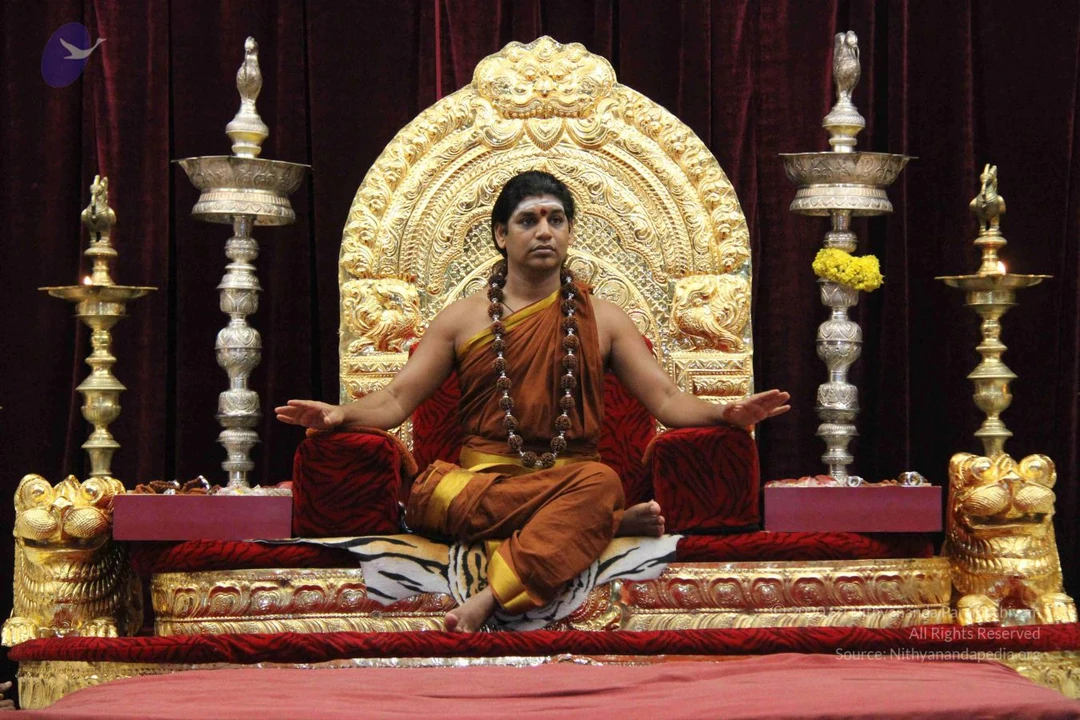
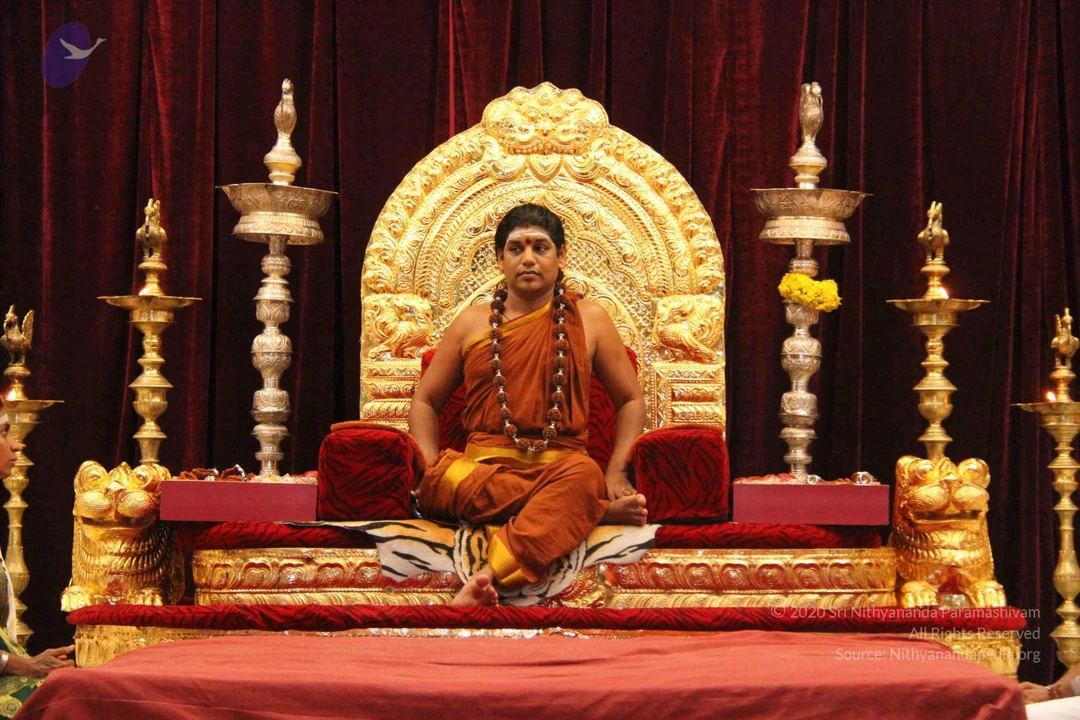
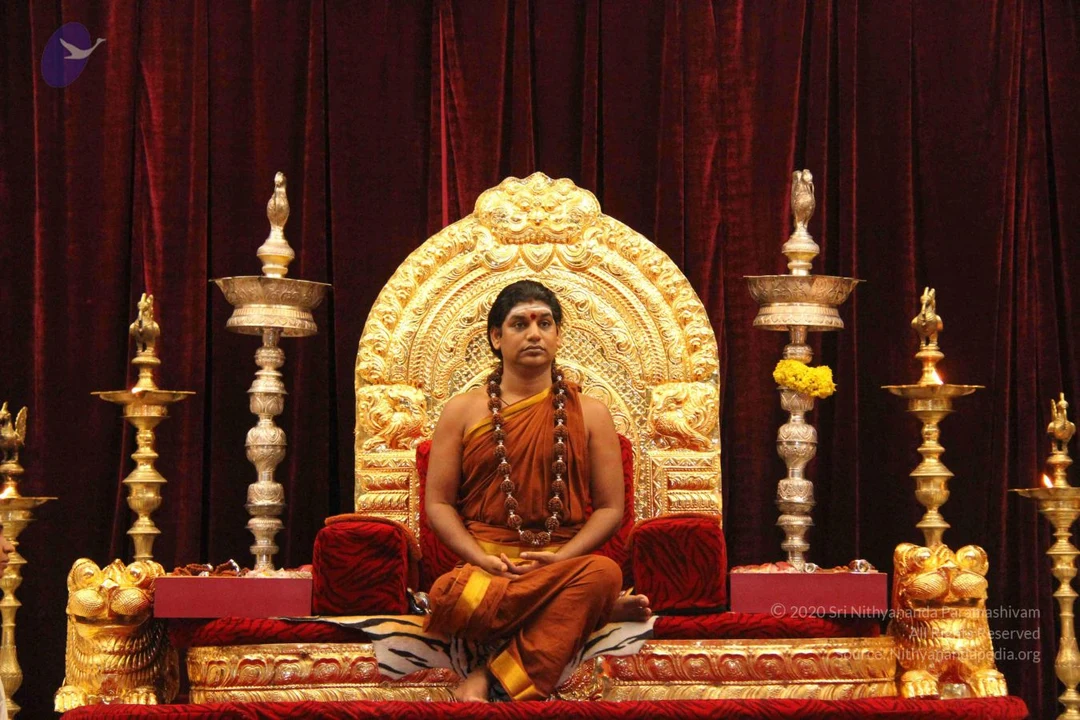
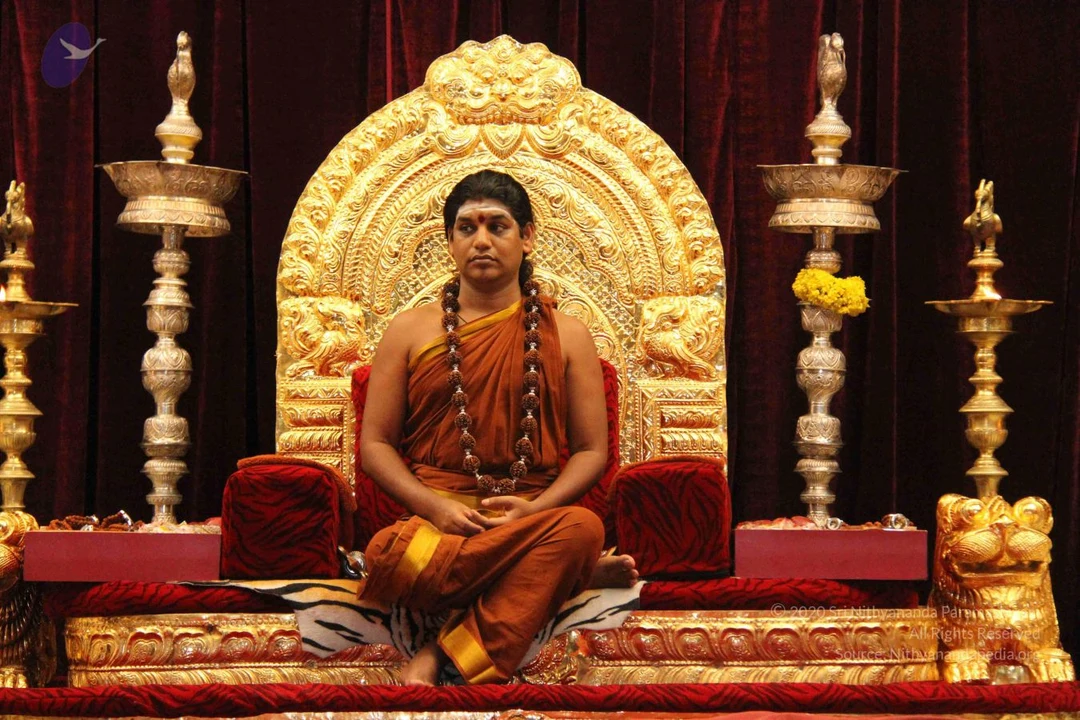
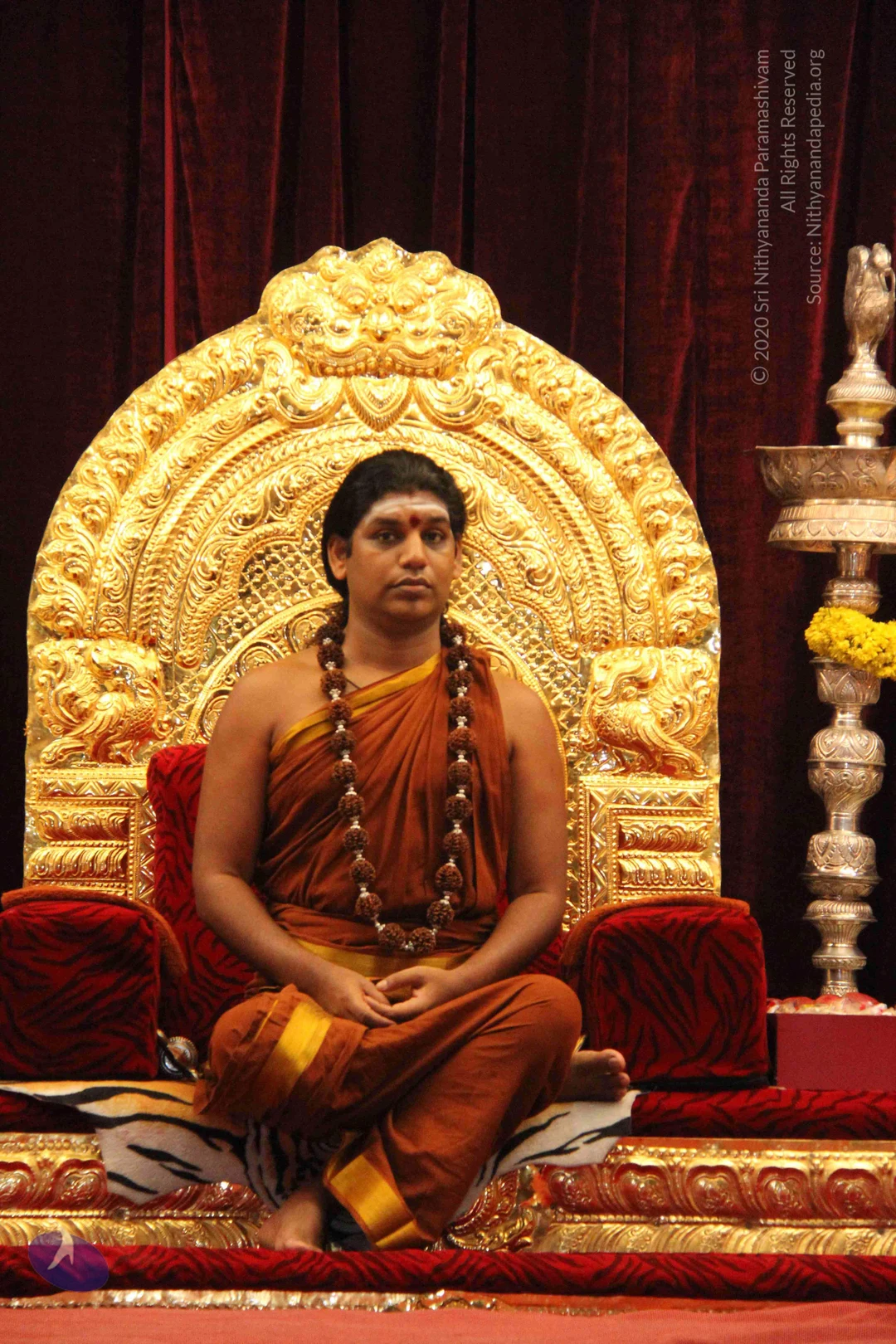
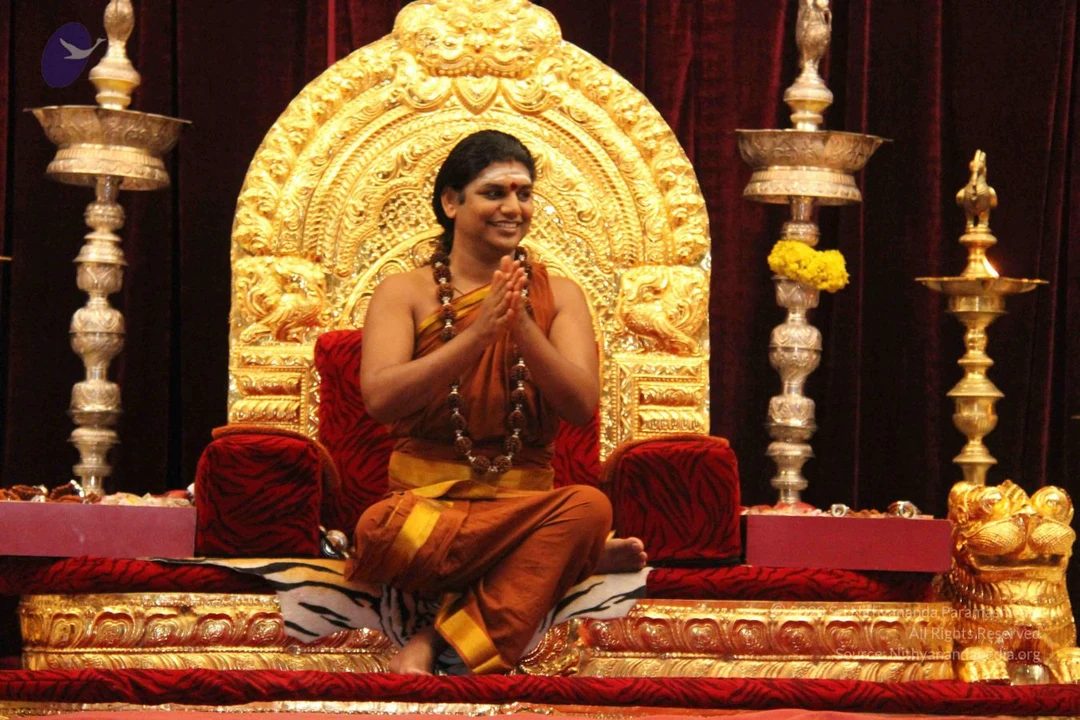
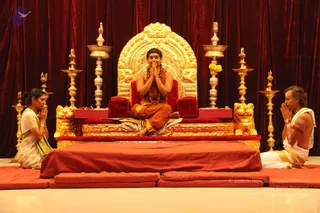
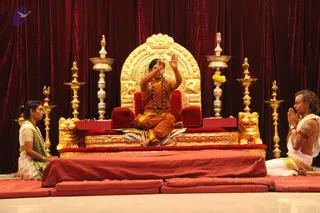
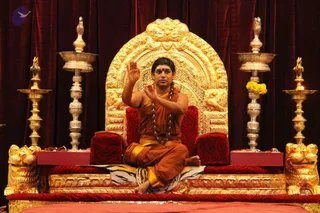
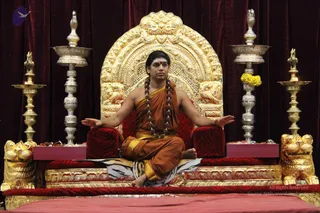
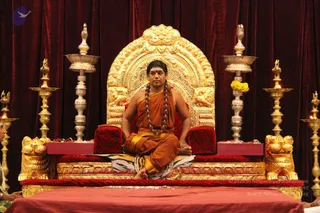
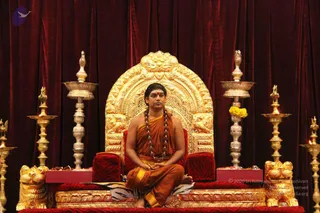
A seated figure in saffron-orange robes with a rudraksha mala and a vertical tilak sits cross-legged on an ornate gold-and-red throne with carved lion armrests, hands folded in namaste. Two devotees kneel in prayer on red cushions at either side: a woman in a white and gold-bordered sari with folded hands on the left, and a man in a white dhoti with gold border and bare upper body, hands joined, on the right. Tall silver and brass oil lamps with lit wicks stand around the dais, one with a yellow flower garland, before red velvet drapes, under a stage setting.A seated figure in saffron-orange robes and a long rudraksha mala sits cross-legged on an ornate gold throne with carved lion-like supports and red cushions, raising both palms in a blessing gesture. Two tall gold oil lamps flank the throne, with a silver lamp stand and a yellow flower garland beside it. A woman in a white sari with green border sits to the left with hands resting, and a man in white dhoti with a white shawl and forehead markings sits at right with palms pressed together in namaskar. Red velvet drapes and a red-covered dais complete the stage setting.A seated man in an ornate gold throne with a tall arched back and lion-head armrests, sitting on a striped tiger-skin cloth over red cushions. He wears an orange-saffron dhoti and shawl, a rudraksha mala, and a red tilak, and raises one hand in a mudra while gesturing with the other during a satsang. Flanking the throne are tall silver-and-gold oil lamps, one lit, and a yellow marigold garland on a stand. Red velvet drapes hang behind. The appearance is consistent with the a person cues of rudraksha, saffron clothing and an enthroned discourse, with the page noting a satsang at this event.A photograph of a seated man in saffron and orange robes on an ornate golden throne (peetha) with a carved gold backrest and lion-form armrests, draped in a tiger-striped cloth. He wears a long rudraksha mala, sits cross-legged with arms spread open, and has a red tilak on his forehead. Tall silver and brass oil lamps (lit) flank the throne, with a marigold garland on one stand, against deep red velvet curtains and a red carpet. The composition suggests a satsang or darshan setting.A seated man in orange and saffron robes sits on an ornate golden throne with lion-carved armrests and a tall arched back, against deep red velvet drapes. He wears a rudraksha mala and a red bindi, with his hands resting on his lap. Tall golden lamps with oil lamps flank the throne, and a small yellow flower garland hangs on one stand. A tiger-striped cloth covers the dais, and a red-draped platform stands below. Swamiji (probable): long dark hair, saffron robes, a rudraksha mala and a gold-rimmed throne indicate the central seated figure. Two people sit at the edges of the frame.A seated man in saffron and orange robes sits cross-legged on an ornate golden throne with a carved arched back and lion-form armrests, draped in a striped tiger-print cloth on a red cushioned platform. He wears a rudraksha mala with a ceremonial gold necklace, a red bindi, and holds his hands in his lap with a calm, meditative gaze. Tall silver and brass oil lamps stand on either side, one hung with a yellow flower garland, and a deep red velvet curtain forms the backdrop. a person is shown in this throne-seated setting, with saffron clothing, rudraksha beads and gold necklace as the qualifying cues.
IA-Lunch

12 photosSource gallery
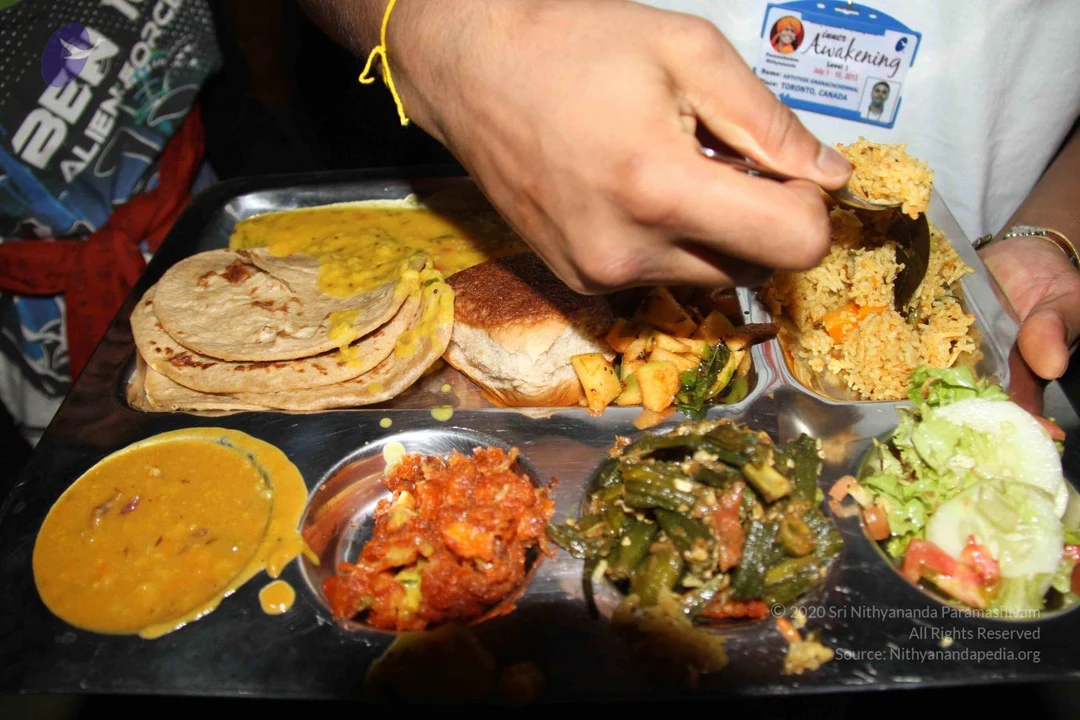
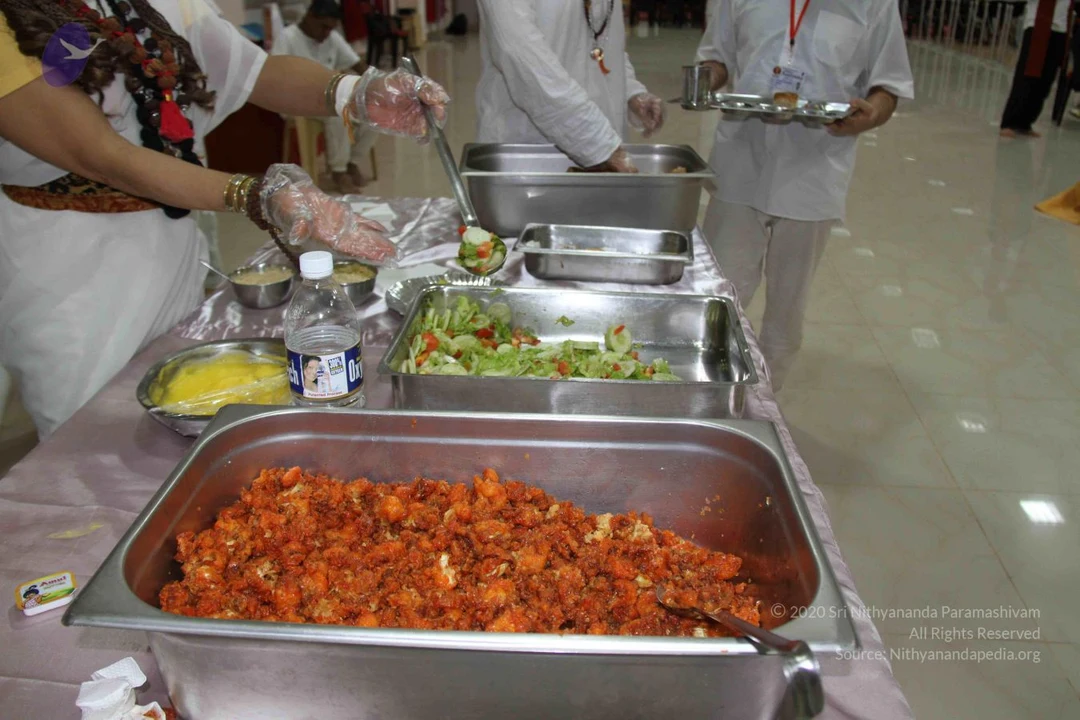
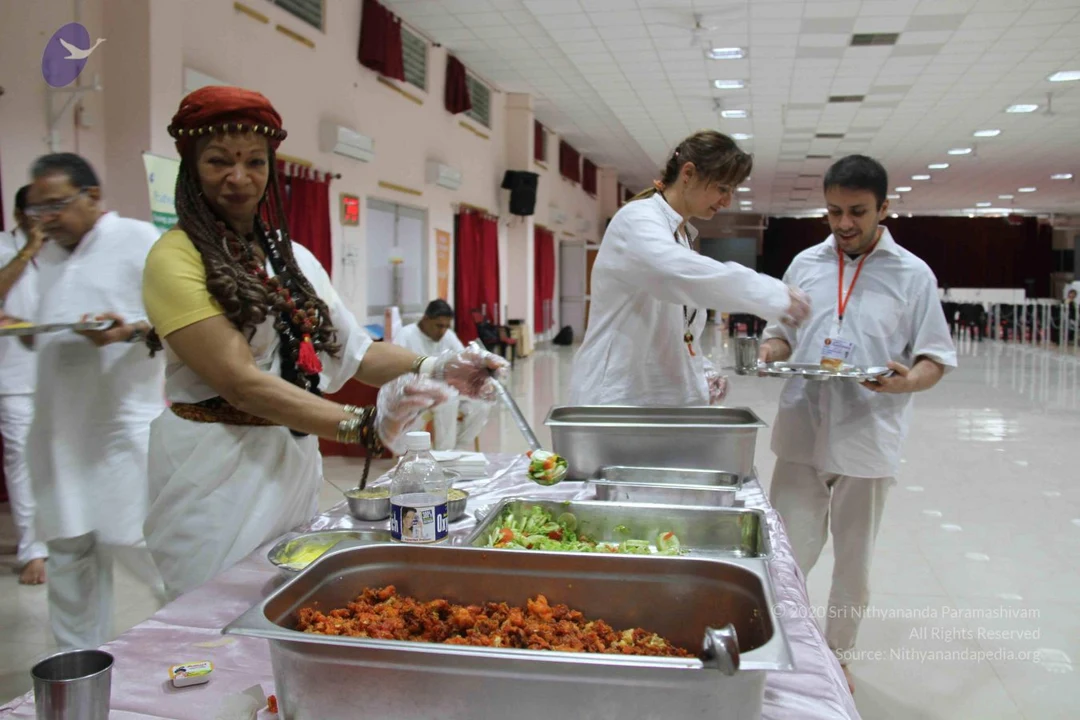
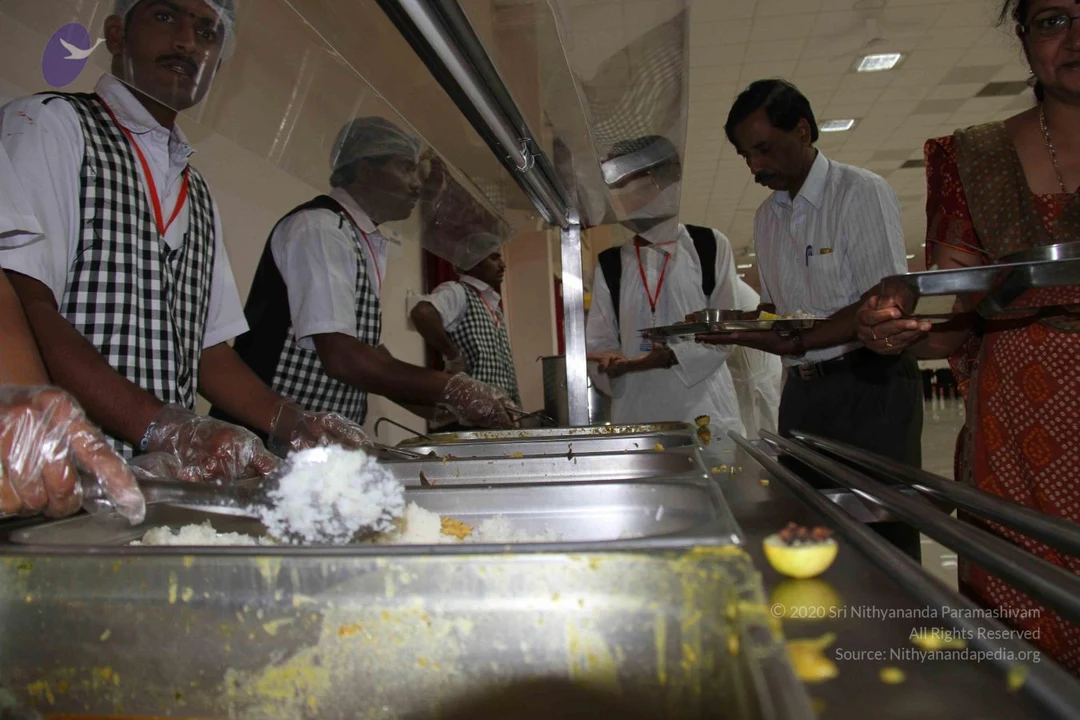
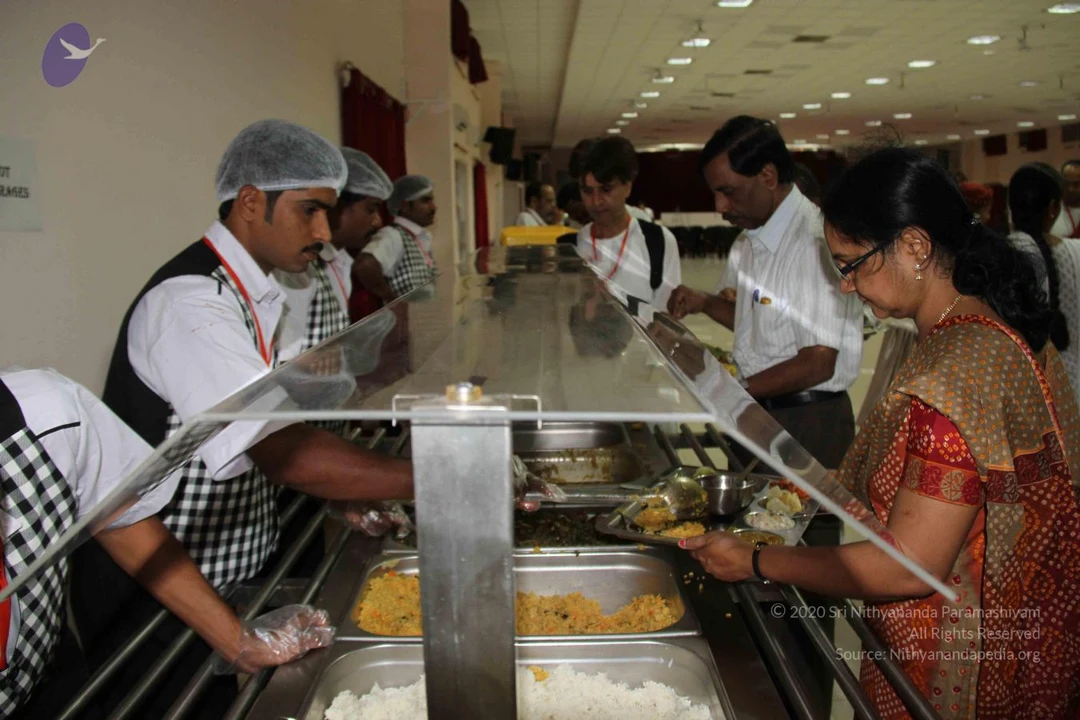
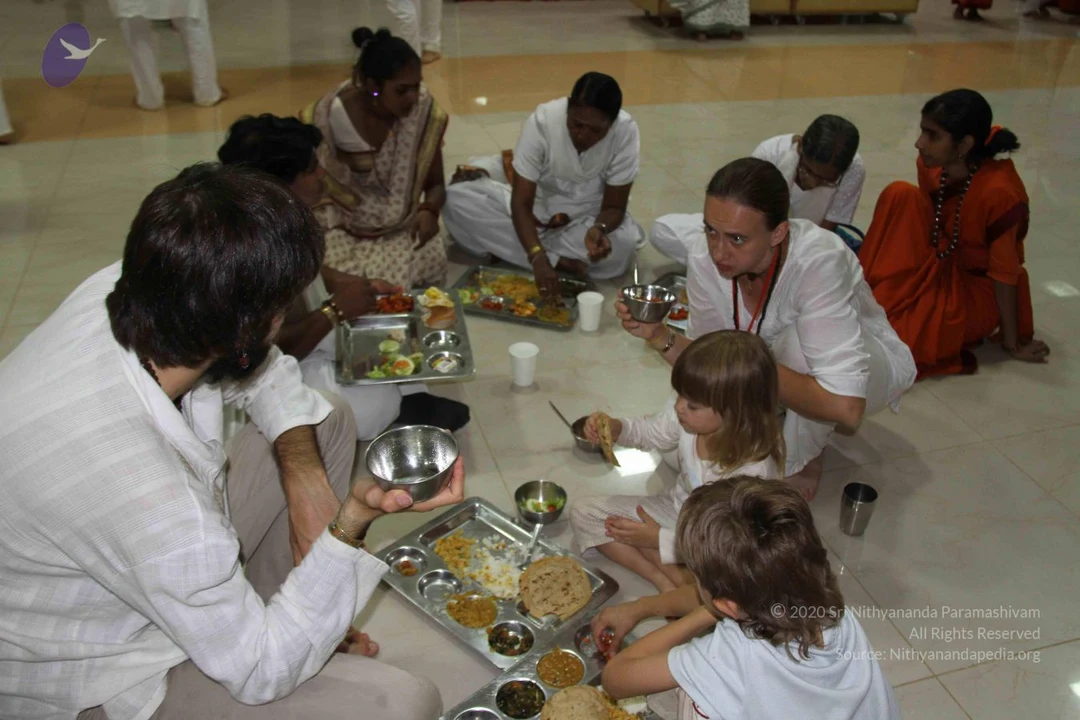
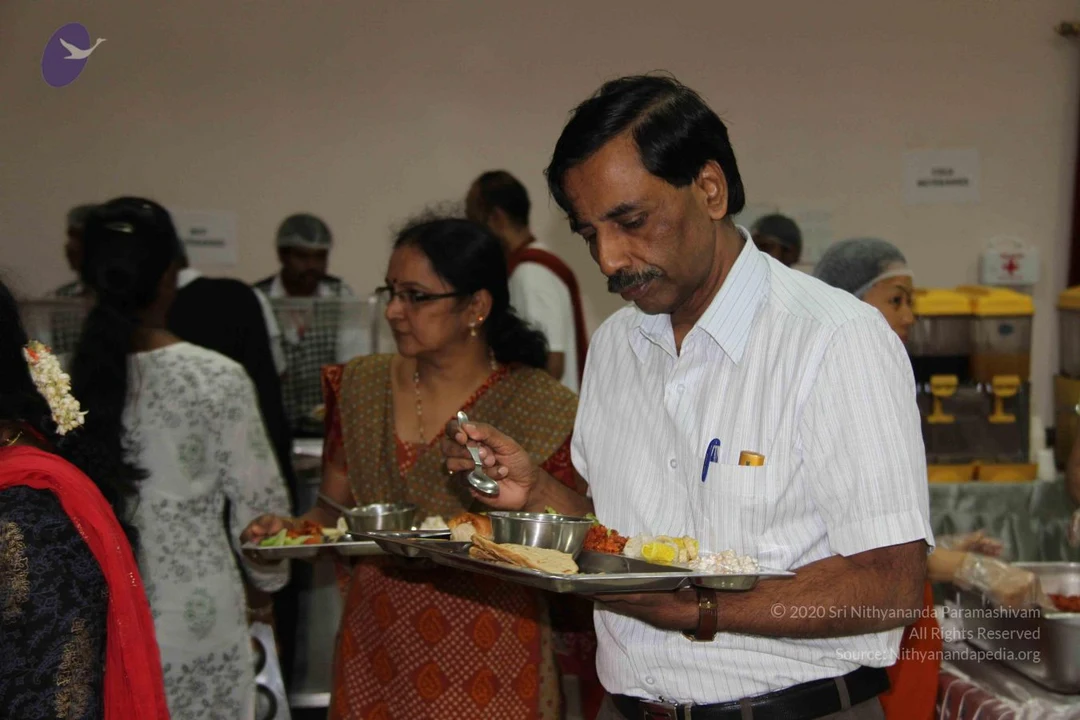
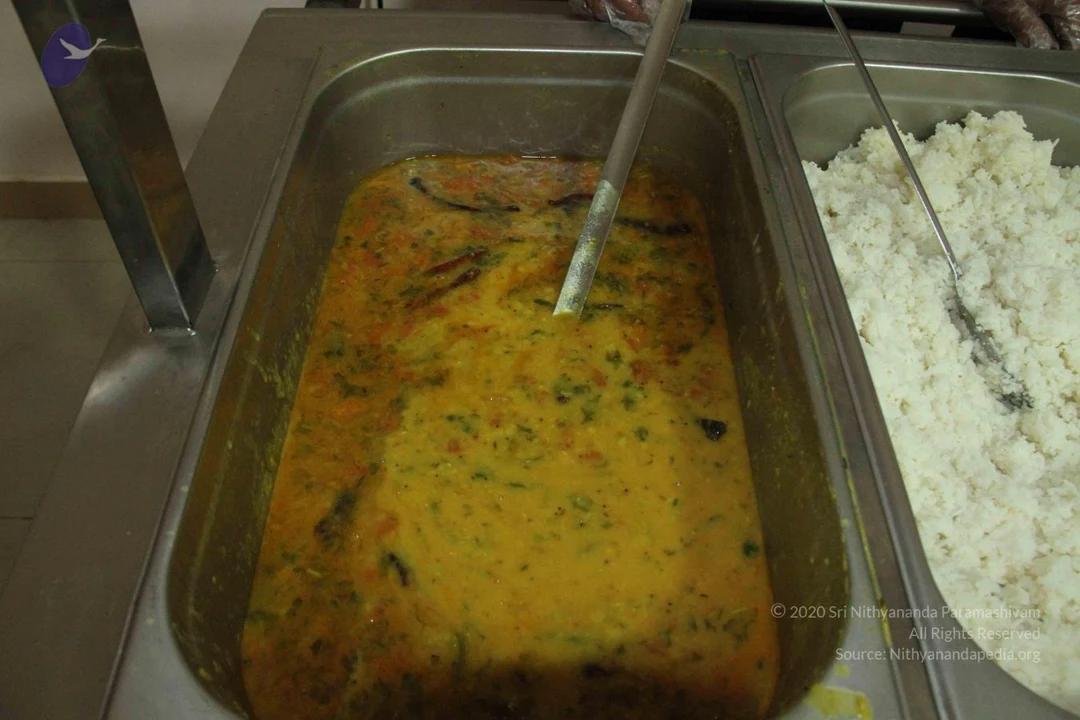
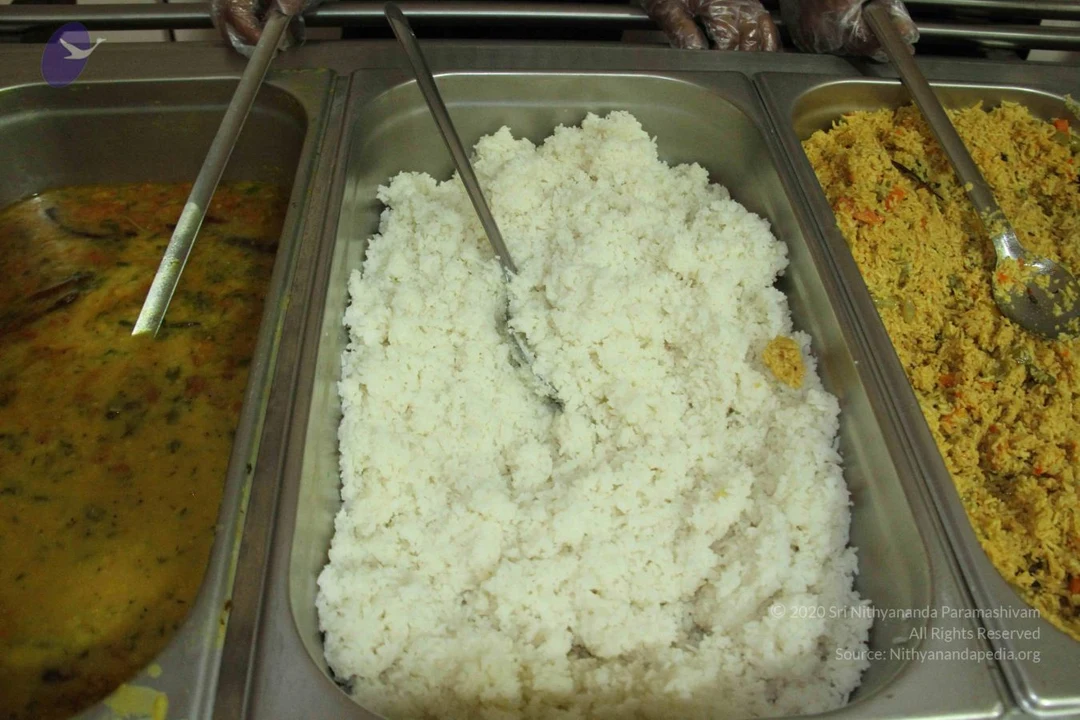
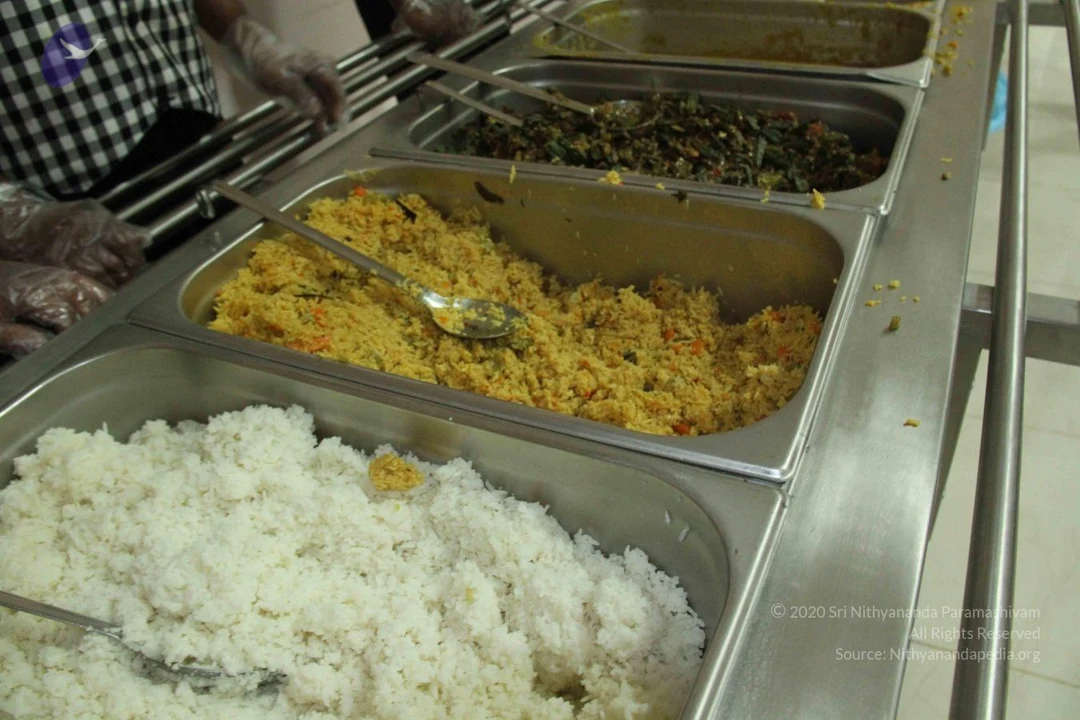
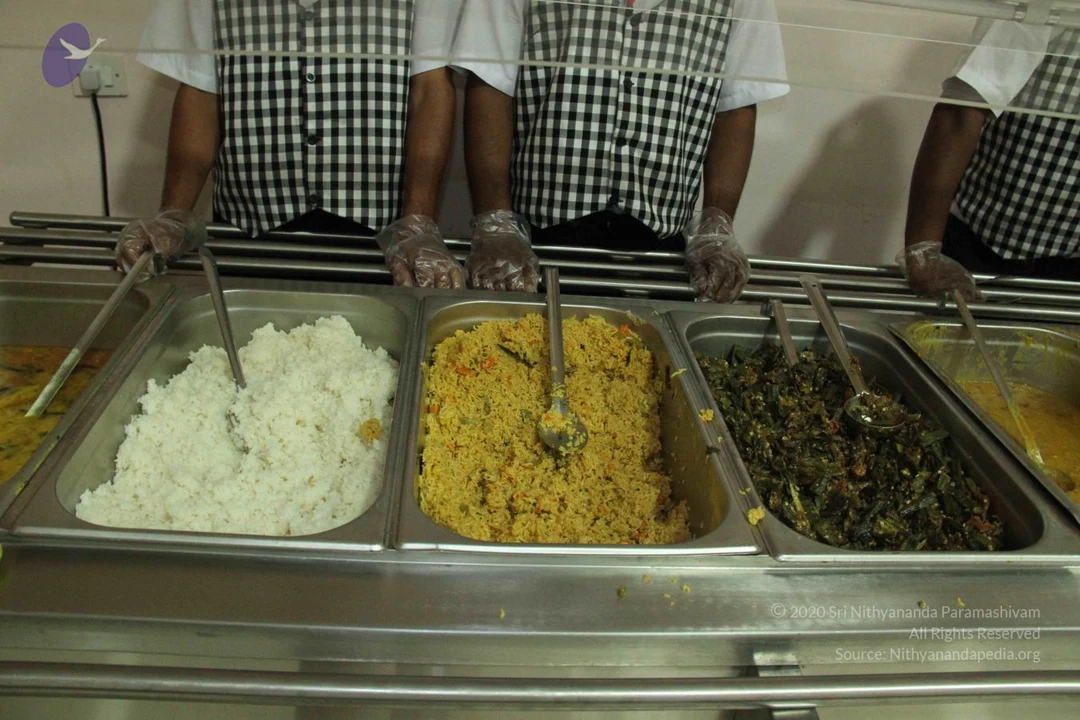
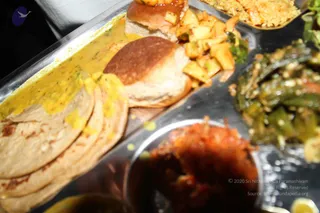
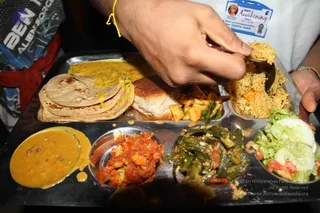
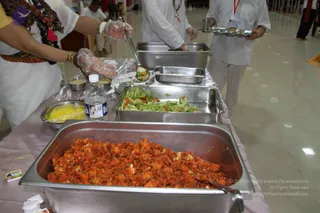
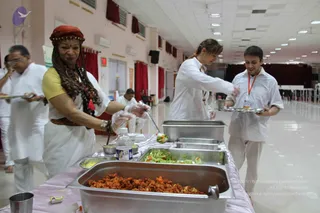
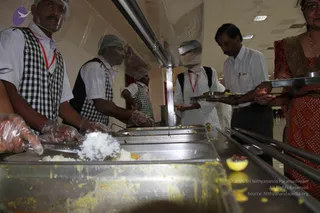
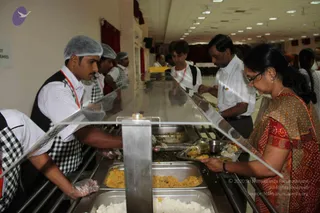
Close-up photograph of a silver steel thali tray holding a meal. Flatbreads (rotis or chapatis) are stacked at left beside a yellow dal or curry. Two soft bread rolls (pav) sit at centre, with a bowl of spiced potato curry and a bowl of orange-red chutney or pickle at the lower right. Okra (bhindi) stir-fry and a portion of rice appear at the right and top right. No people are visible.A stainless steel thali tray of vegetarian food is being served. A hand holding a spoon scoops rice from a compartment at upper right. The tray holds flatbreads, a yellow dal in a bowl, a toasted bread slice, spiced potatoes, bright red chutney, okra stir-fry and a fresh green salad with tomato and cucumber. A person's wrist wears a metal watch and a yellow thread bracelet. A white event t-shirt with a printed badge is visible at upper right, and a colourful shirt with an alien graphic appears at left. No a person candidate is visible.A buffet serving line of stainless steel chafing trays on a pink-draped table. A woman in white with gold bangles and plastic gloves ladles salad from a steel pan, and a man in white with a red lanyard holds a tray. The front tray holds a heap of orange-red spiced food, with a bowl of yellow food, a bottle of water and a salad tray beside it. A tiled floor and white-clad figures in the background suggest annadan food service.A photograph of a communal meal service in a bright, white-tiled hall with red curtains. A woman in a red headwrap, yellow top and white dress wears clear plastic gloves and serves food from steel chafing trays on a table draped with pink cloth. Beside her, a woman in white clothing holds a ladle over a tray of green vegetables, and a young man in white with a lanyard carries a plate. Trays hold red-orange stewed vegetables and salad, and a plastic water bottle stands on the table. Other people in white kurta-style clothes move in the background.Buffet serving line in a bright indoor hall during a communal meal. Servers in white shirts and black-and-white checked aprons, wearing hairnets, face shields and plastic gloves, serve rice and yellow curry from steel chafing trays. Visitors hold steel plates at the counter: a man in a white shirt and dark trousers, a man in a white shirt with a lanyard, and a woman in a red and orange sari with gold necklace. A lemon half sits on the counter. Steel rails run along the foreground.A buffet-style annadan meal service in an indoor hall. Several servers in white shirts, black-and-white checked aprons, hairnets and plastic gloves serve rice and yellow rice dishes from steel trays behind a glass sneeze guard. A woman in an orange and red printed sari and dark-rimmed glasses holds a plate at the counter while a man in a white striped shirt and a man in a white shirt with a red lanyard wait in line. Other attendees with red lanyards stand behind them.

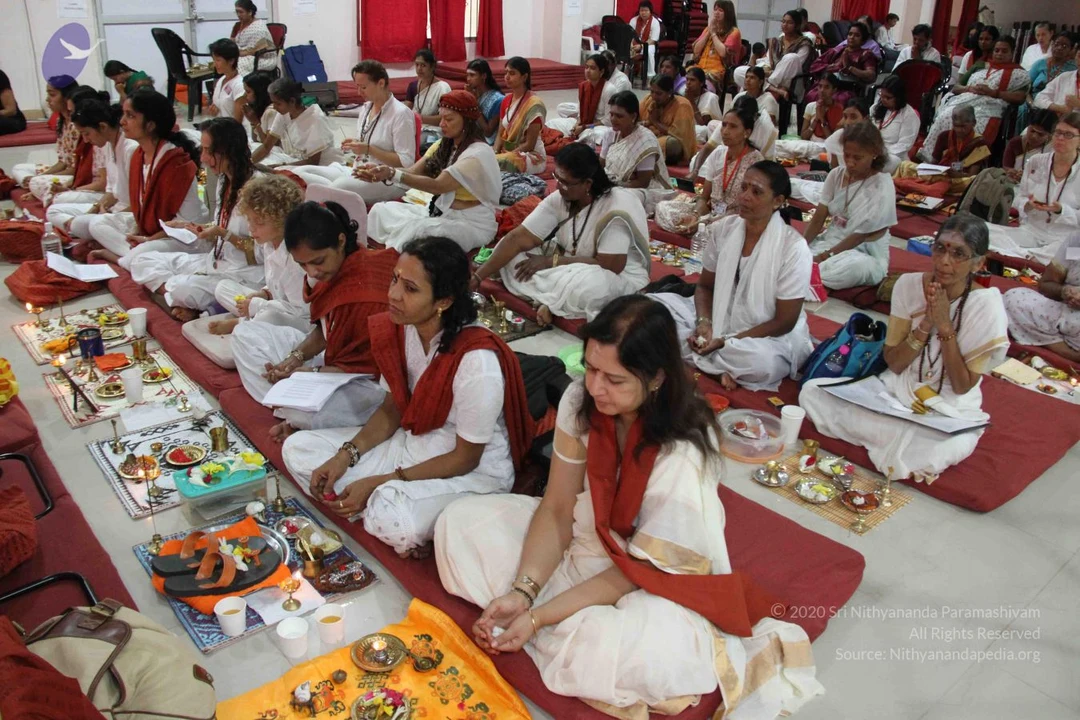
Glimpses-of-my-Inner-Awakening

39 photosSource gallery
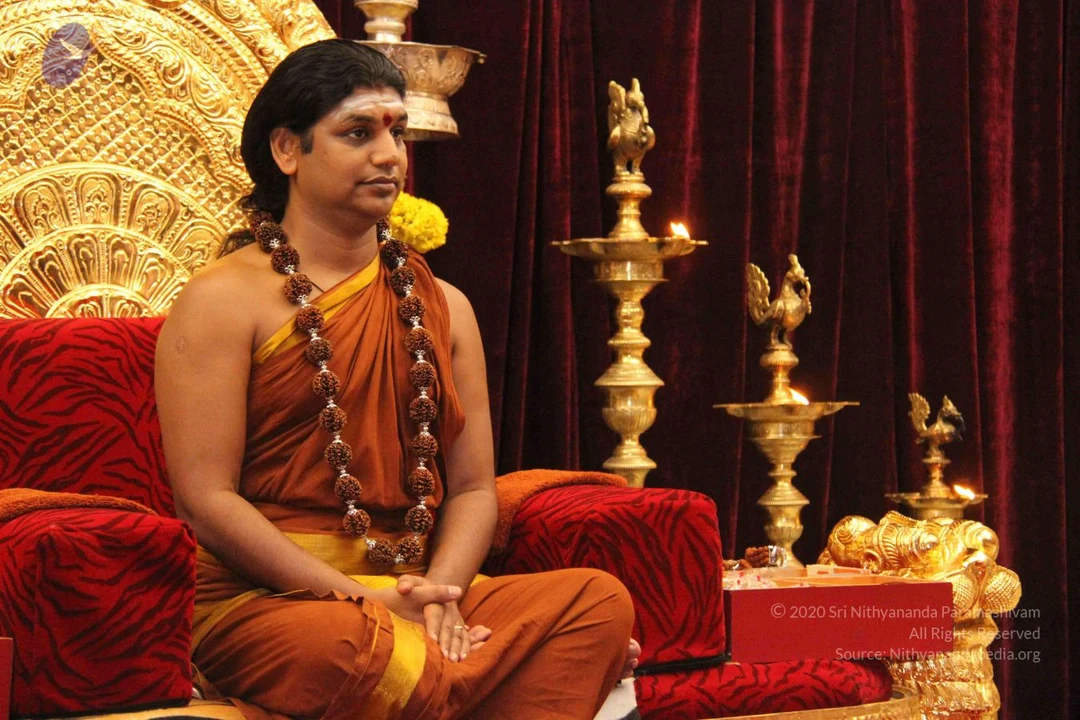
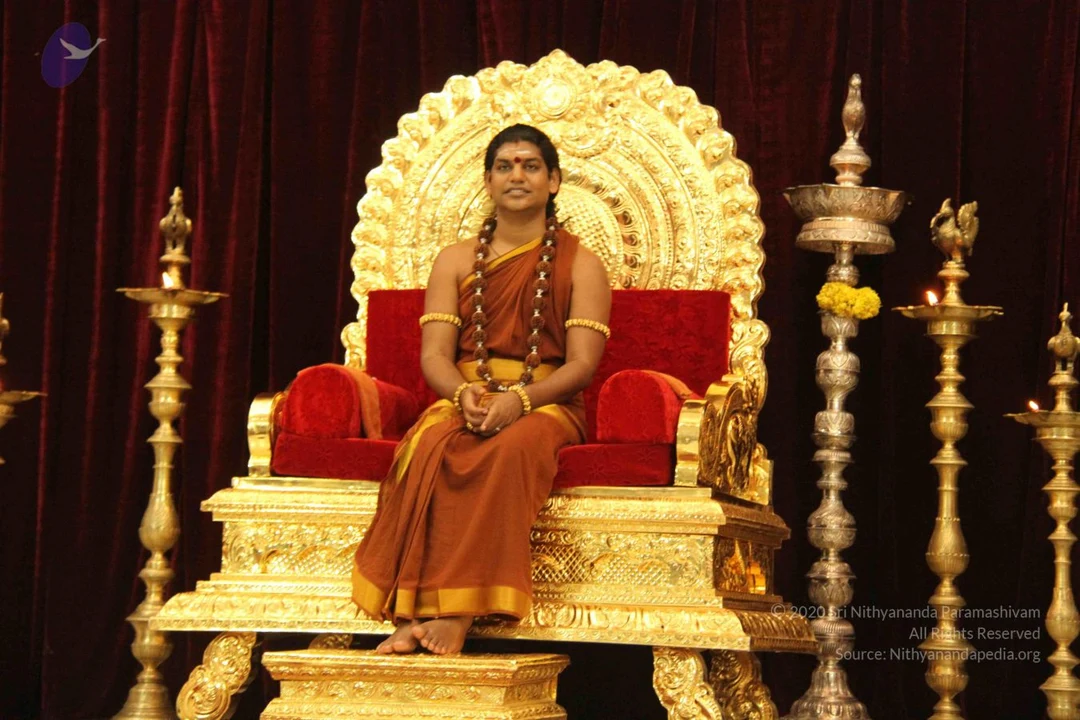
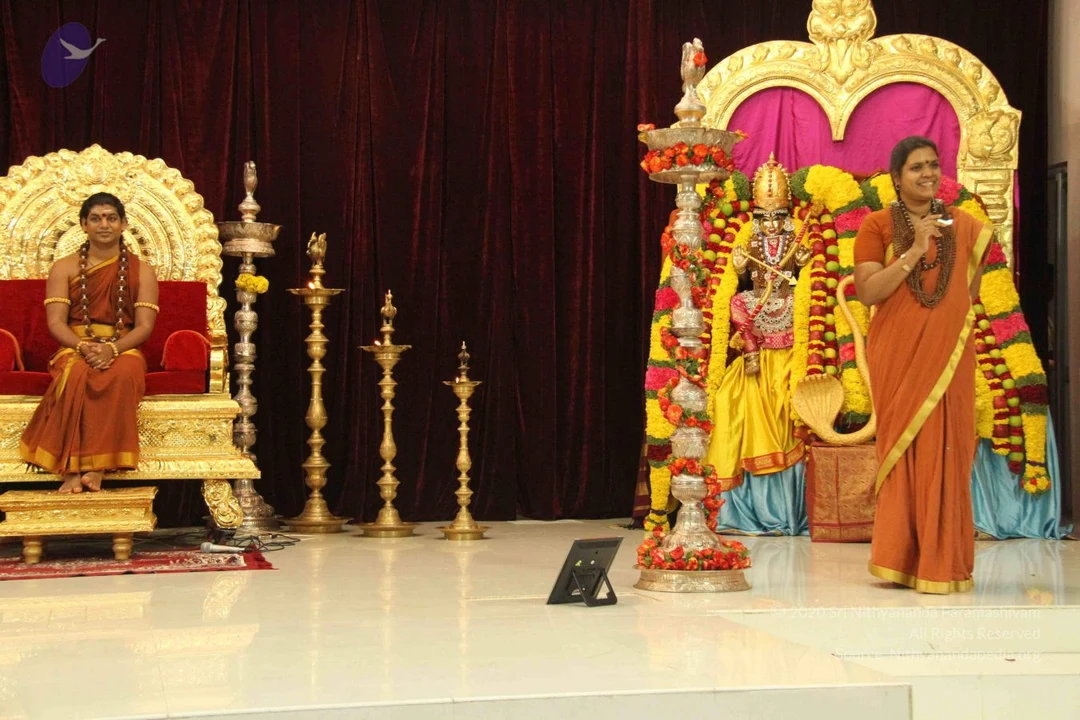
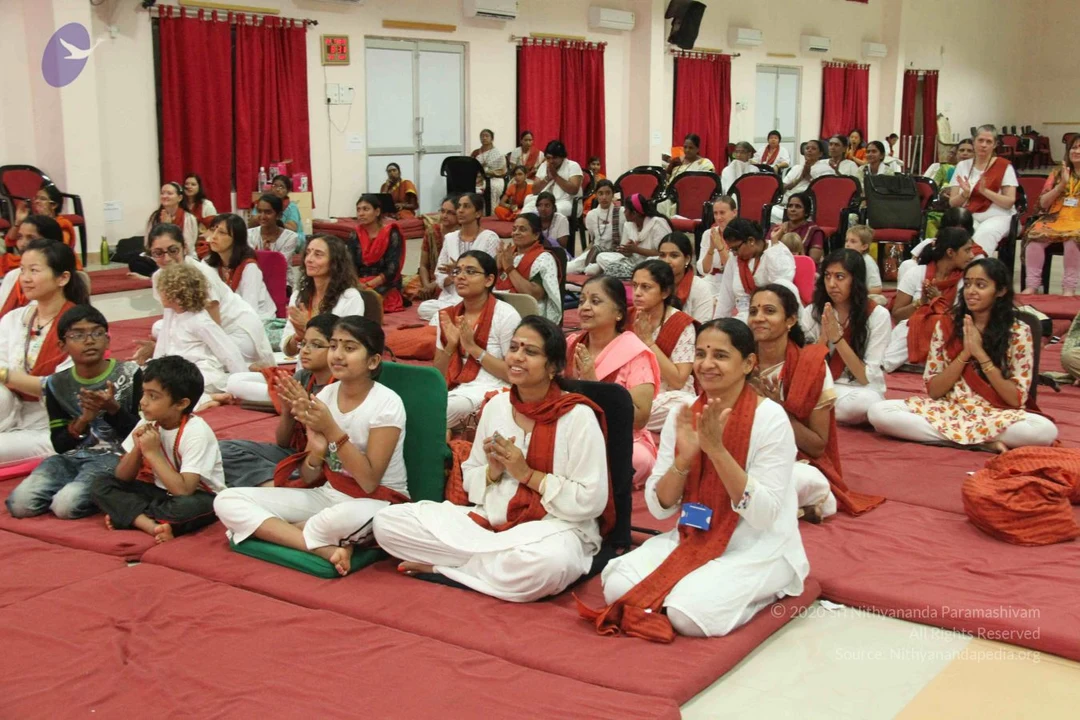
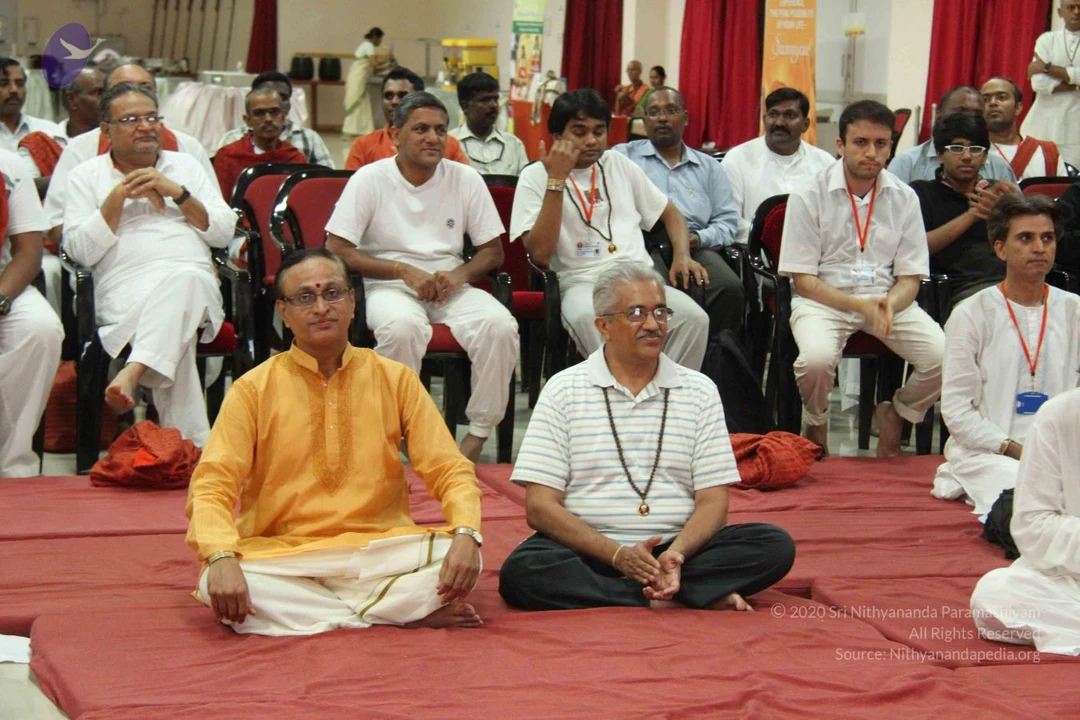
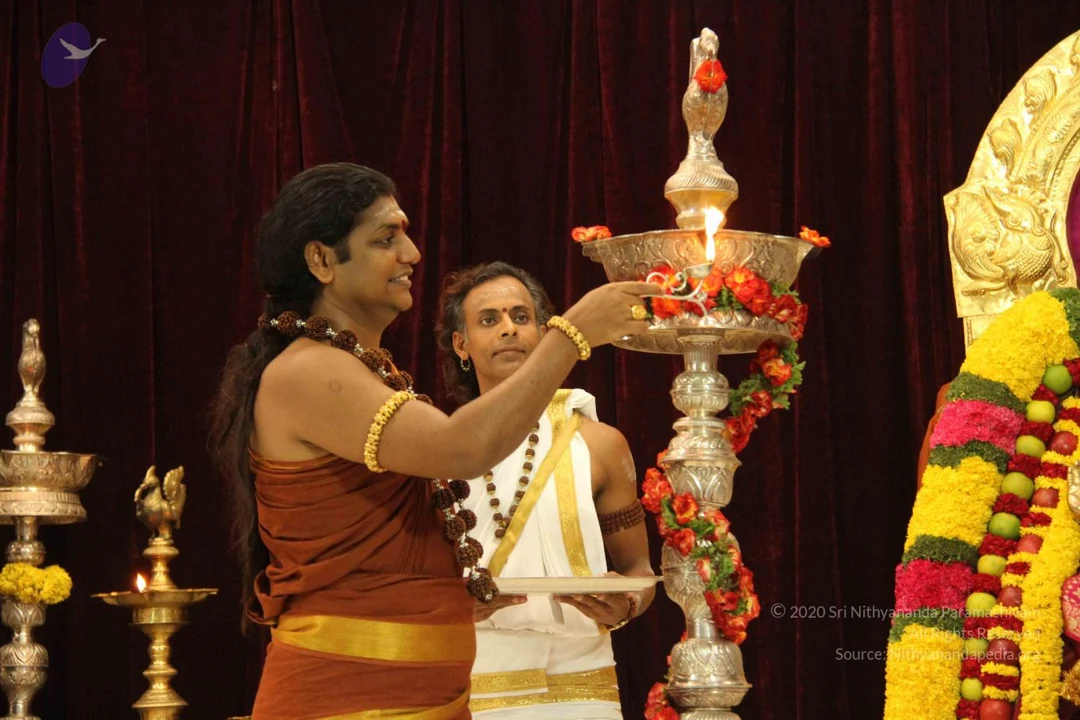
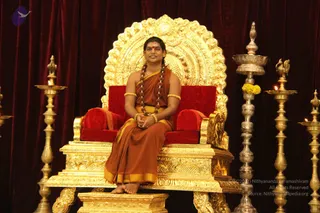
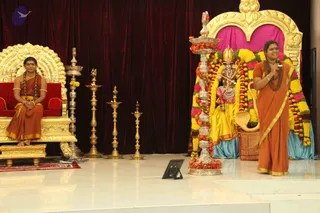
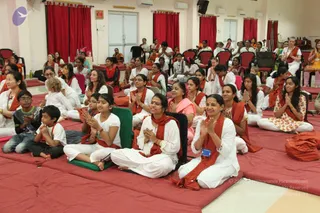
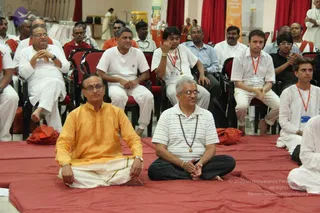
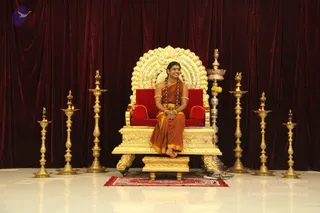
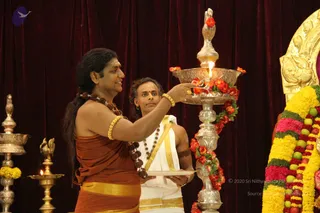
A seated man sits on an ornate gold throne with a deep red velvet seat and backrest, hands folded in his lap, bare feet resting on a gold footstool. He wears an orange-saffron cloth draped over one shoulder with a yellow border, a long rudraksha mala around his neck, gold armlets and bangles, and a red tilak on his forehead. Behind him hang dark red velvet drapes. Brass and silver oil lamps with lit flames stand on either side, and a silver lamp holds a garland of yellow flowers.A stage satsang with a seated man on a golden throne at left, wearing an orange-saffron dhoti and shawl, rudraksha mala, bangles and a gold waist cord, hands folded in his lap. A woman standing at right in an orange saree with gold border, rudraksha mala and bangles holds a microphone and gestures while speaking. Behind them a decorated deity murti in yellow and red garments with a five-hooded naga canopy stands among garlands of marigolds and pink flowers, flanked by brass and silver oil lamps and a silver kalasha-style lamp stand. A red velvet curtain and golden arch frame the stage; a small black monitor sits on the floor.A photograph of a satsang hall with rows of seated devotees on red floor mats and some chairs. Most wear white kurtas or salwars with orange-red shawls draped over their shoulders, and several sit with palms pressed together in anjali. A few younger children and girls in white or floral dresses are among them. Red curtains hang along the walls behind them, and small orange bags rest on the floor. No a person candidate is visible among the seated attendees, and no discourse dais or speaker is in frame. Roughly thirty people are visible, including partial figures at the edges.A seated audience at an indoor satsang hall with red carpets and red-cushioned chairs. In the foreground, a man in a saffron-orange kurta and white dhoti sits cross-legged with hands in lap, and beside him a man in a white-and-grey striped polo with a rudraksha mala sits cross-legged on the red mat. Behind them rows of men in white shirts and kurtas, some wearing orange lanyards, sit attentively, and a woman in a white sari stands near a red curtain in the background.A person with long dark hair sits cross-legged on an ornate gold throne with a red velvet seat and a large gold arched back, on a stage with deep red velvet drapes. The seated person wears an orange-saffron robe with a gold-edged border, a rudraksha mala with a long necklace of beads, gold bangles and a red bindi, and holds hands together in the lap while smiling. Brass oil lamps with lit flames stand on both sides of the throne, and a tall silver lamp stand with a yellow flower garland is to the right. A red patterned rug lies at the foot of the throne with a microphone on the stage. The seated figure matches the Swamiji candidate's appearance with several cues including long hair, saffron clothing and rudraksha mala, though the face is not used for identification. The image is a photograph of a single seated person on a throne.A man with long swept-back dark hair and a rudraksha mala stands in a saffron-orange shawl and bright ceremonial gold-trimmed clothing, holding a tall silver lamp stand with a lit flame over a bowl decorated with red and orange flowers. Beside him, a second man in white dhoti and shawl with a gold border holds a silver tray and wears a rudraksha mala. Maroon velvet drapes, a silver oil lamp and a flower-garlanded gold arch form the background.