Skip to content
Tuesday

4 June 2013

Dated photos
318
Source pages
1
Media
2
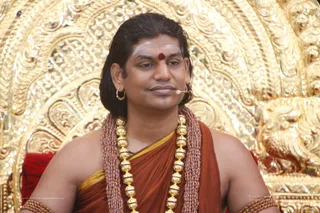
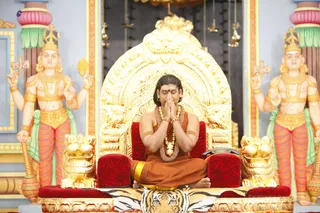
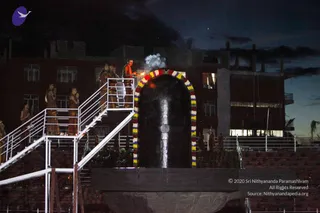
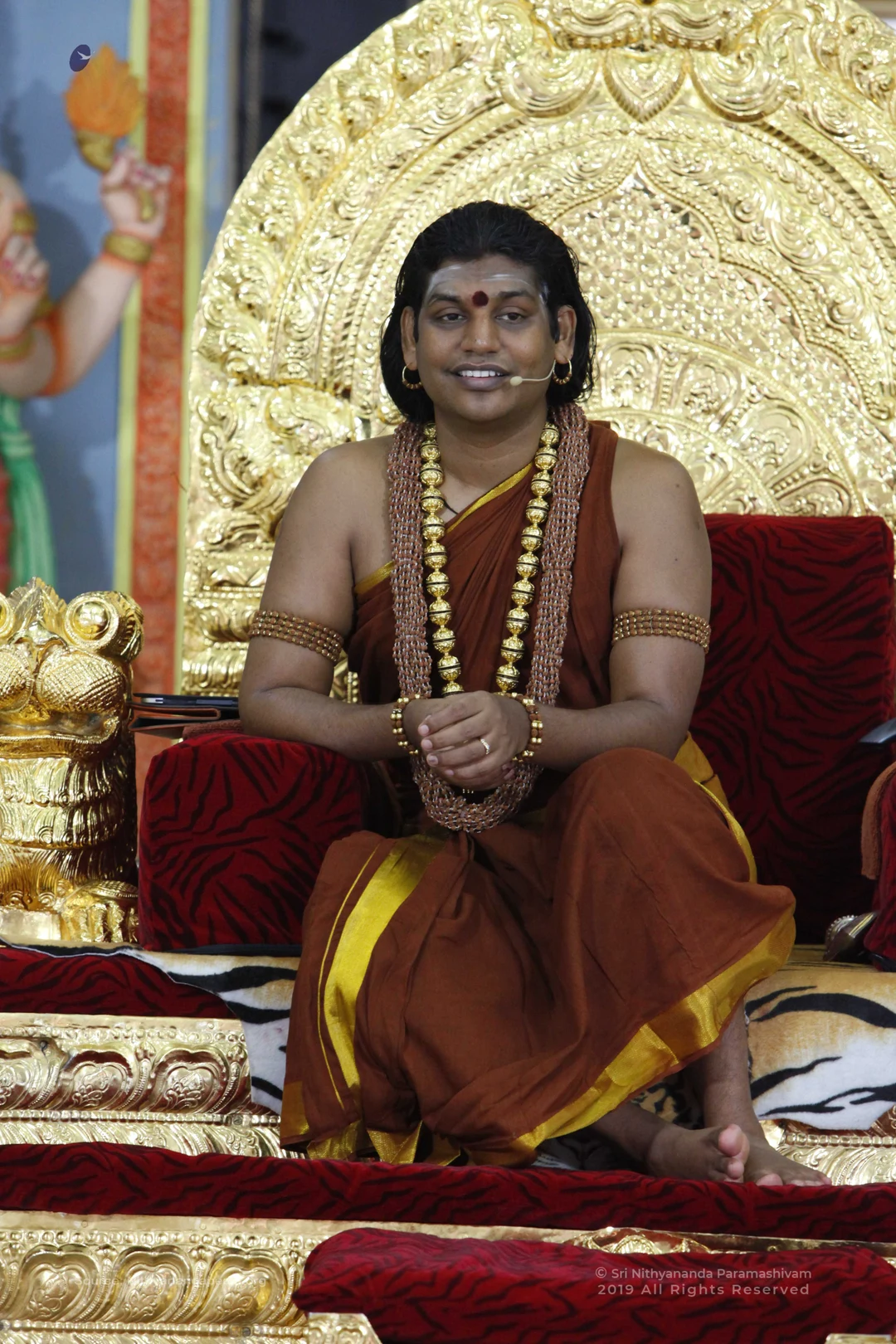
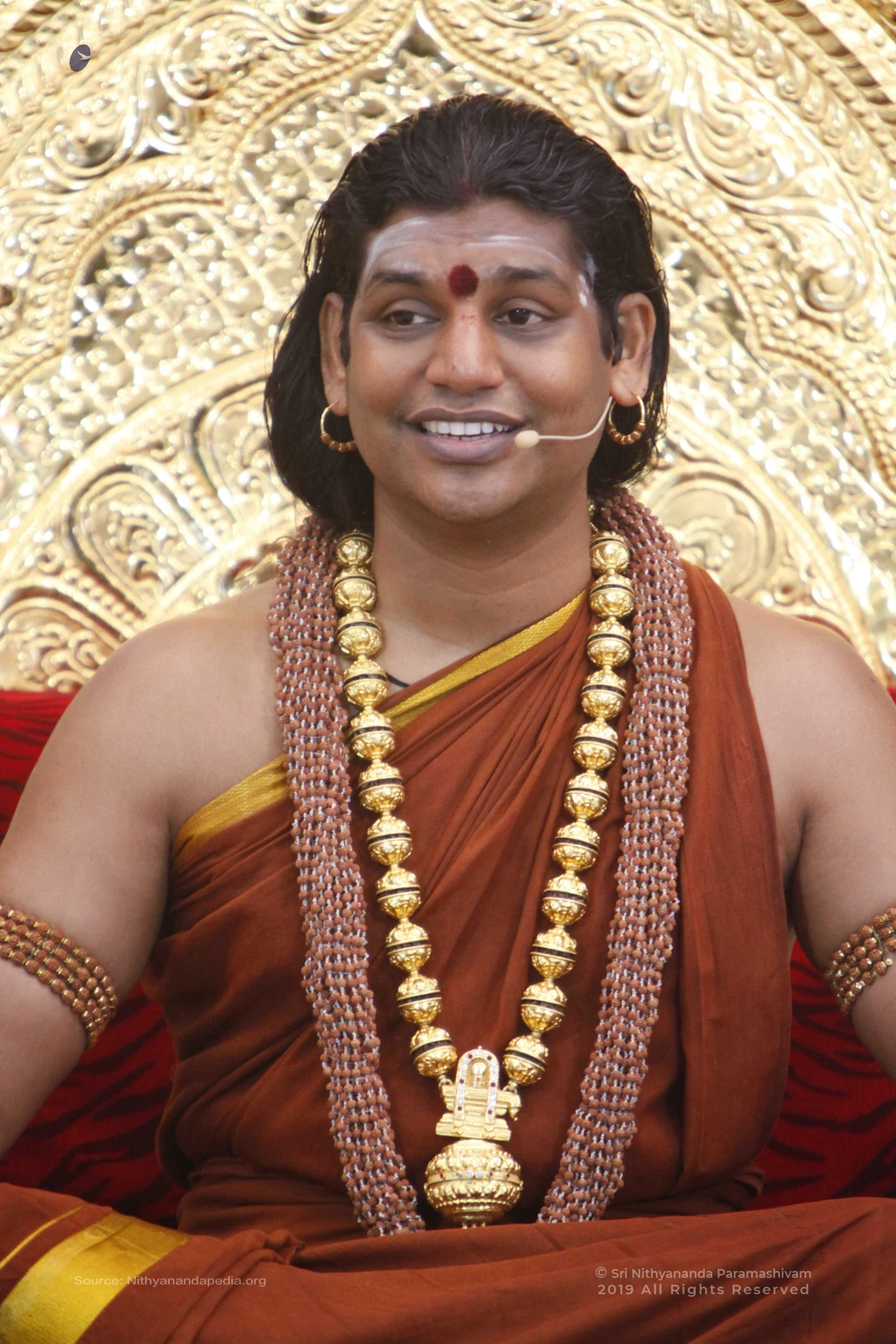
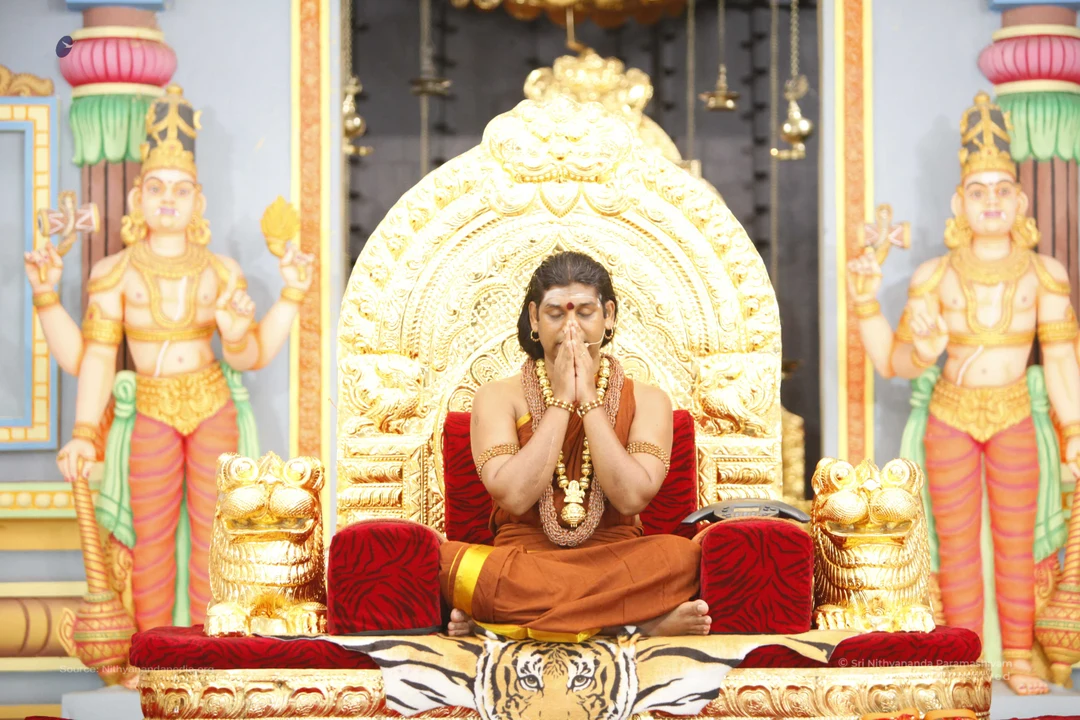
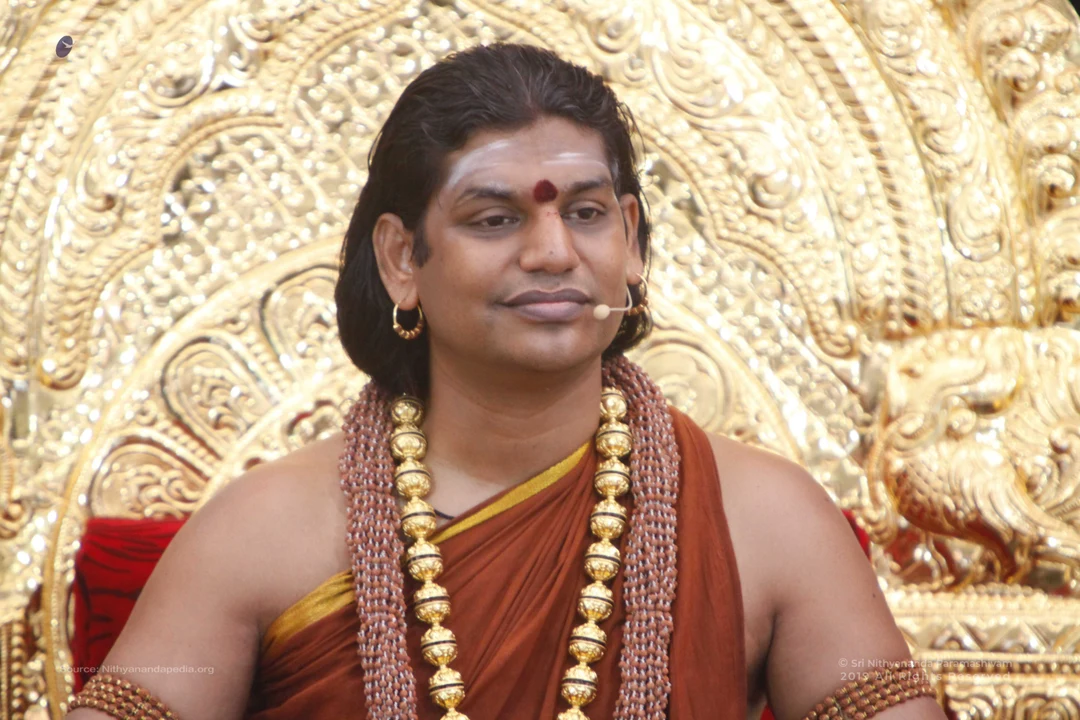
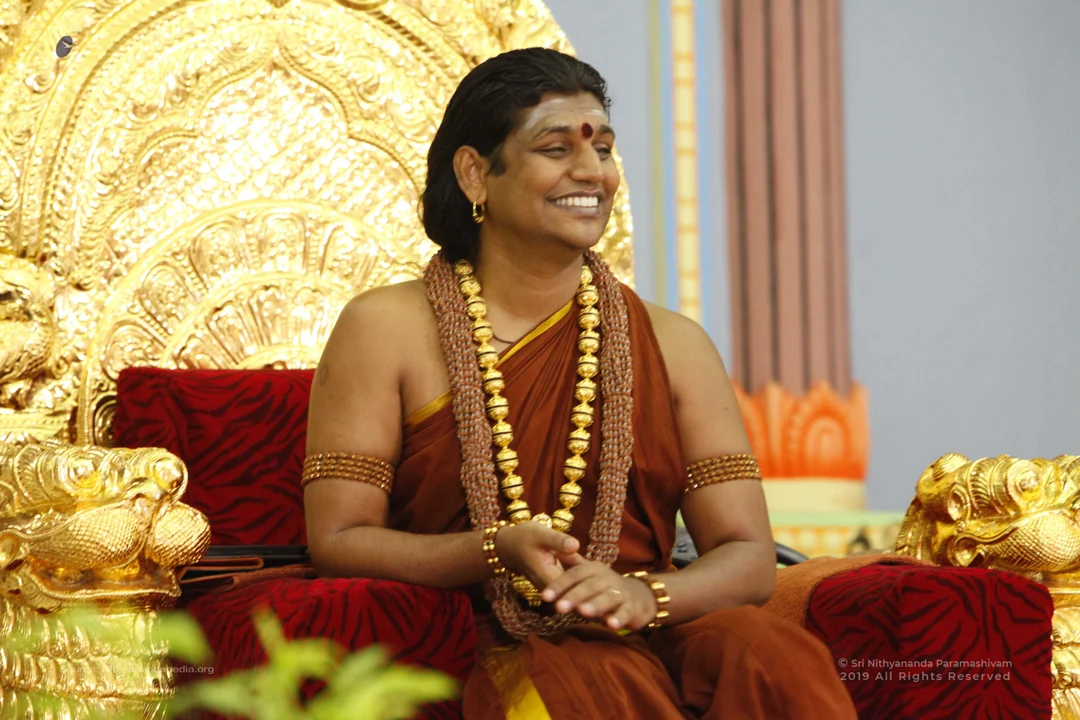
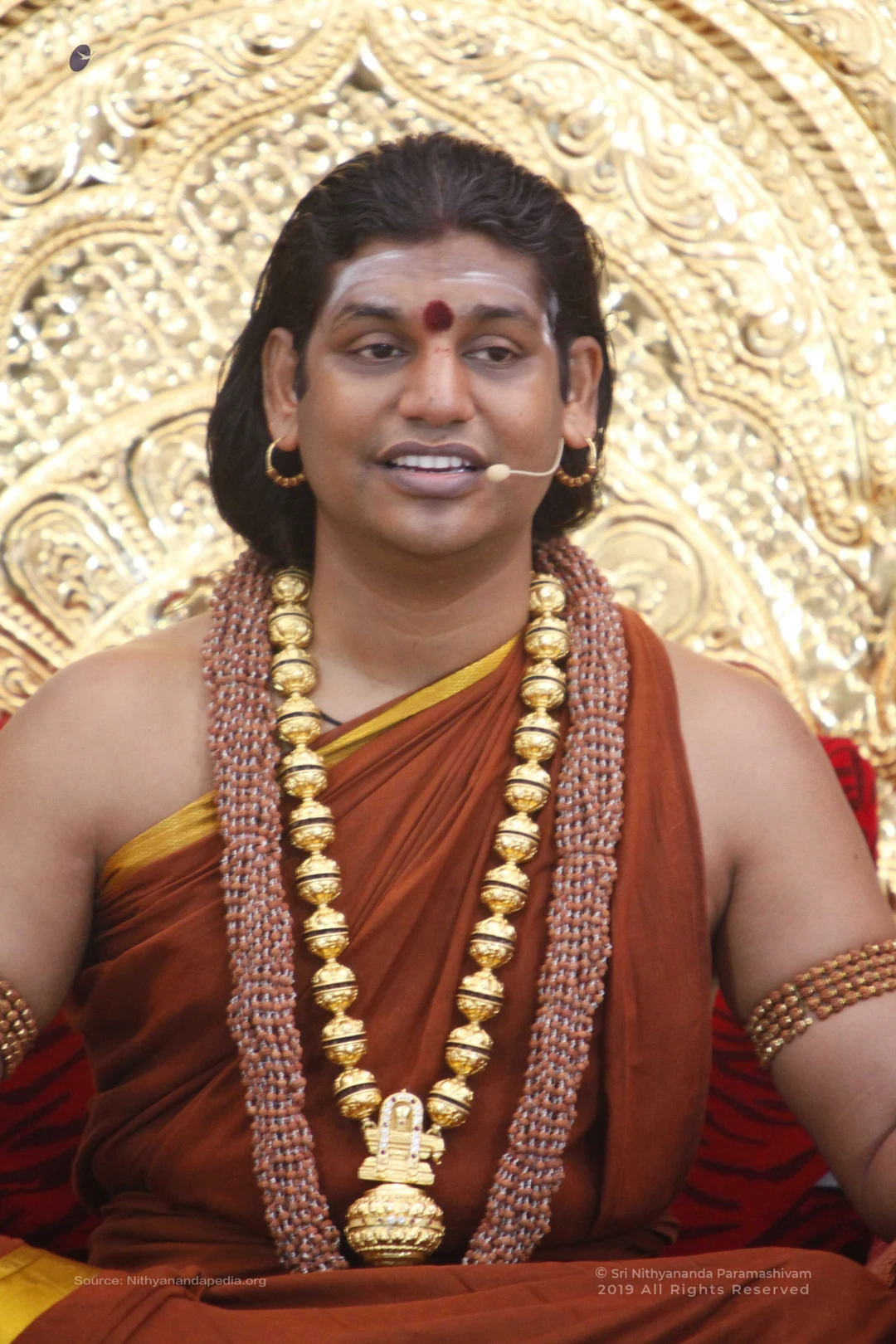
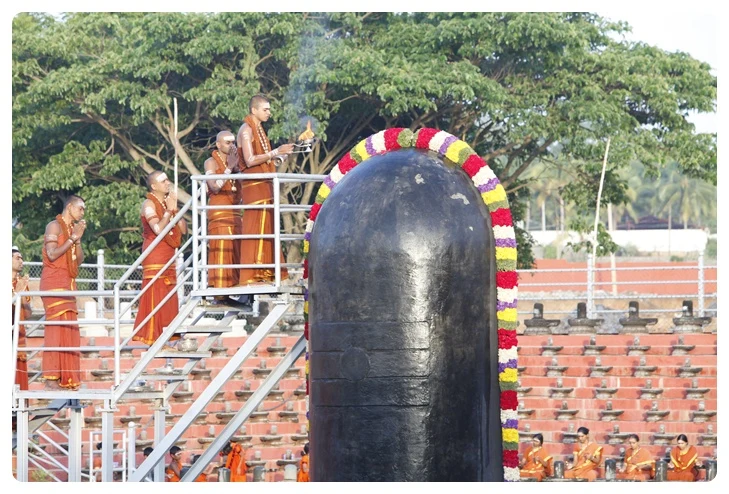
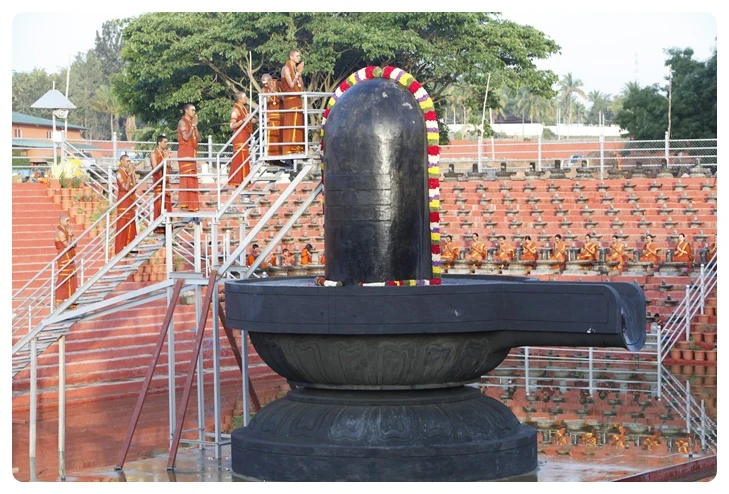
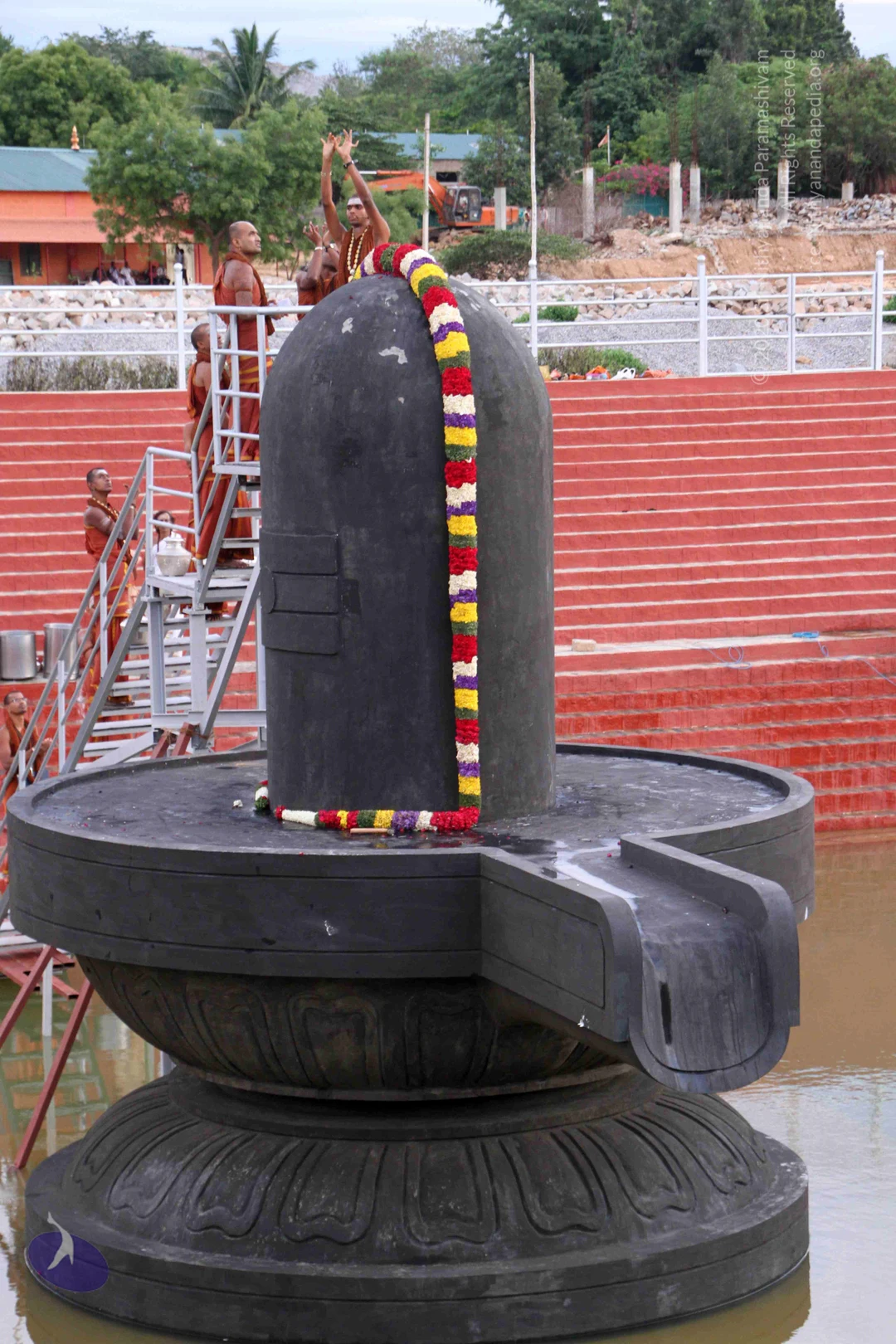
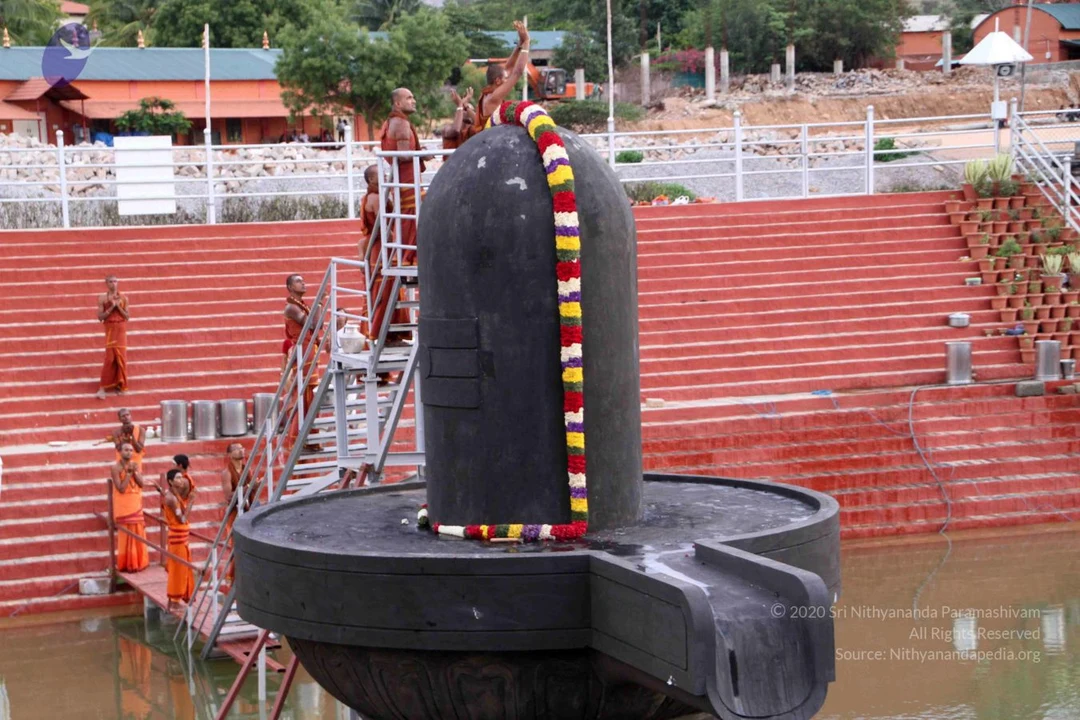
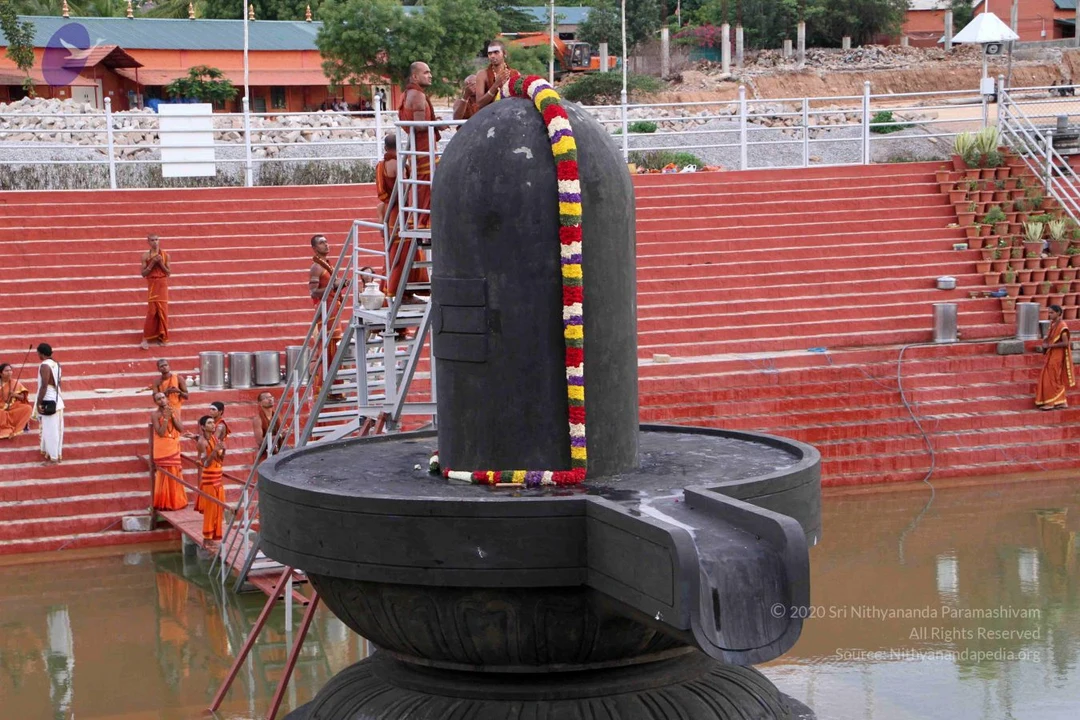
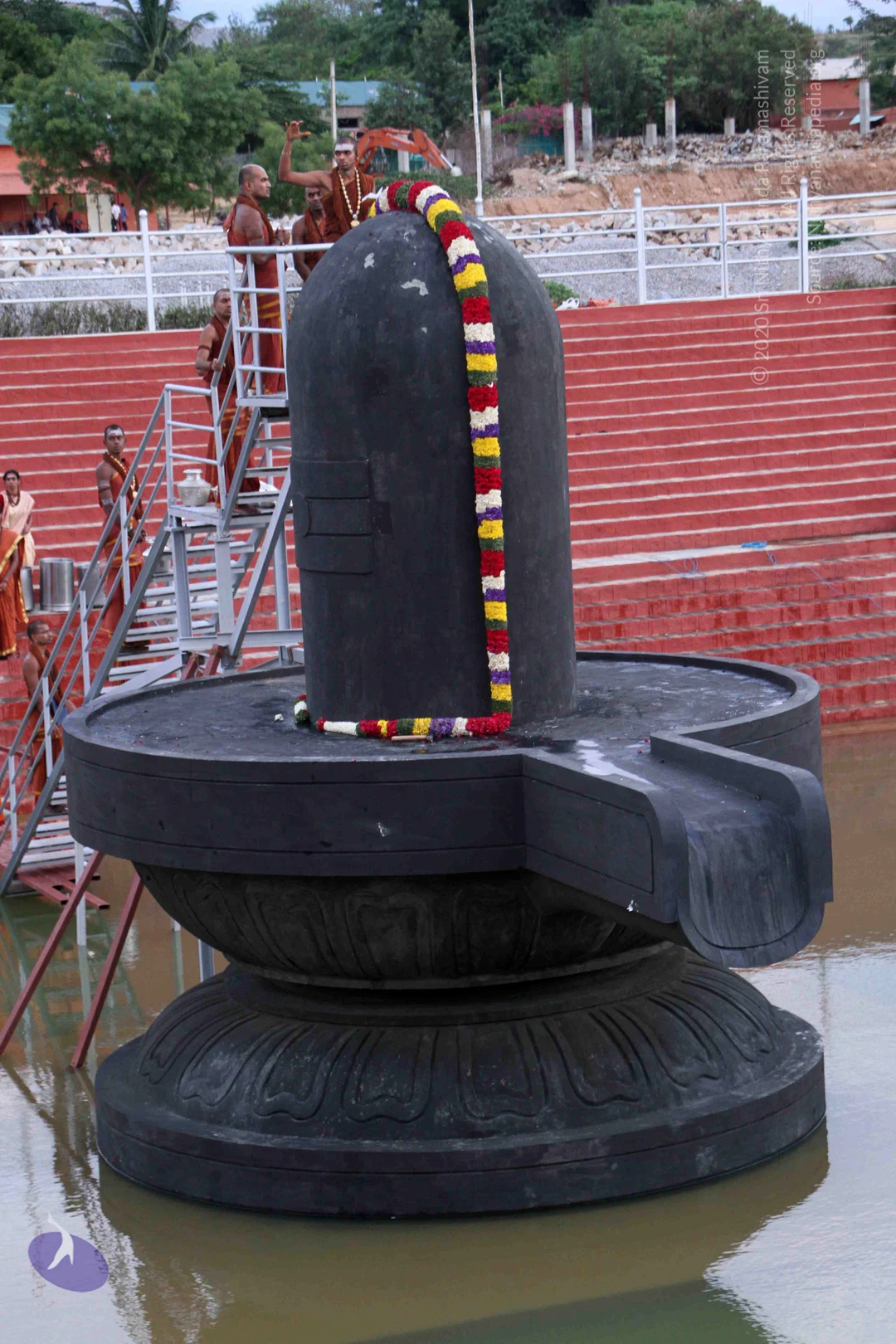
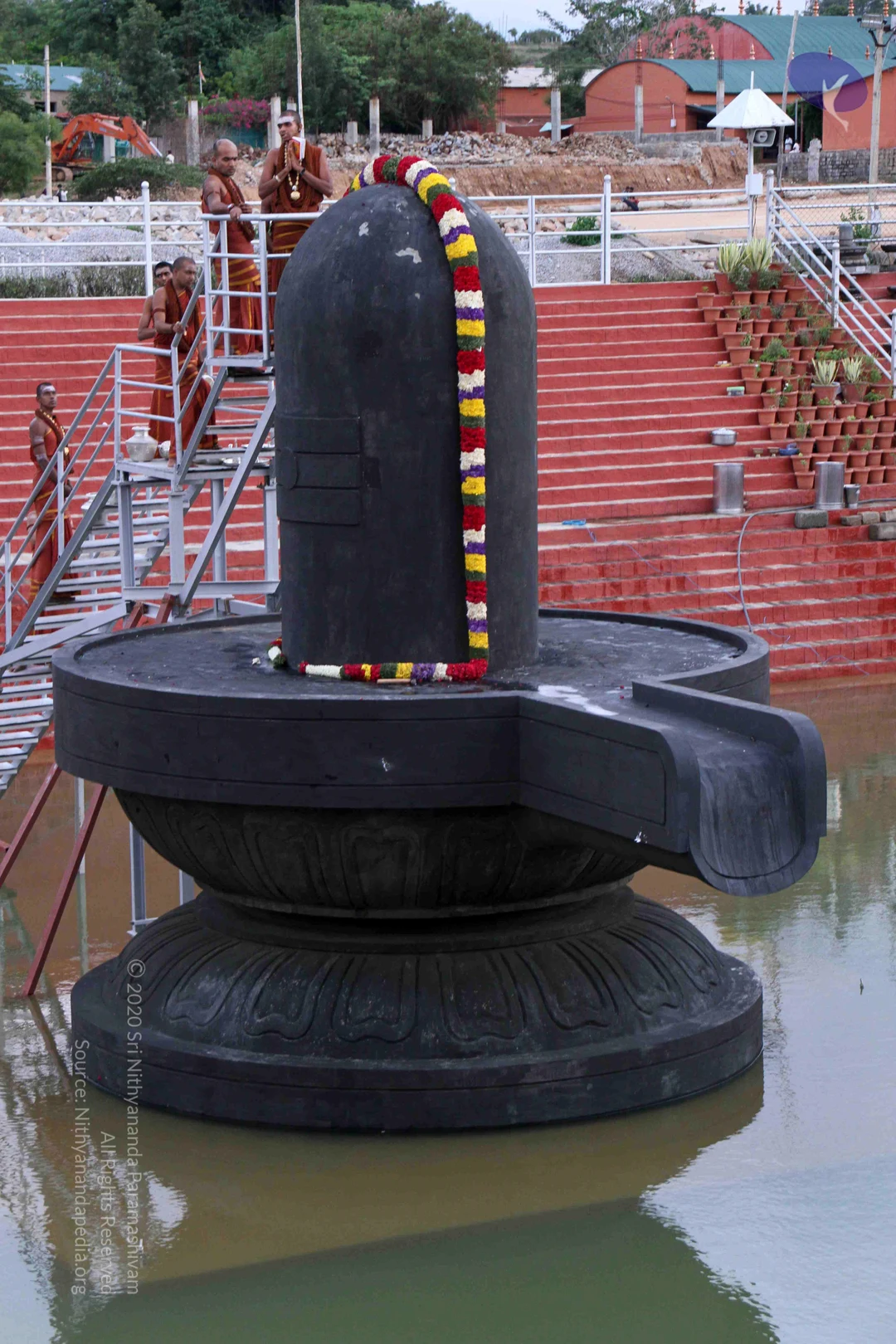
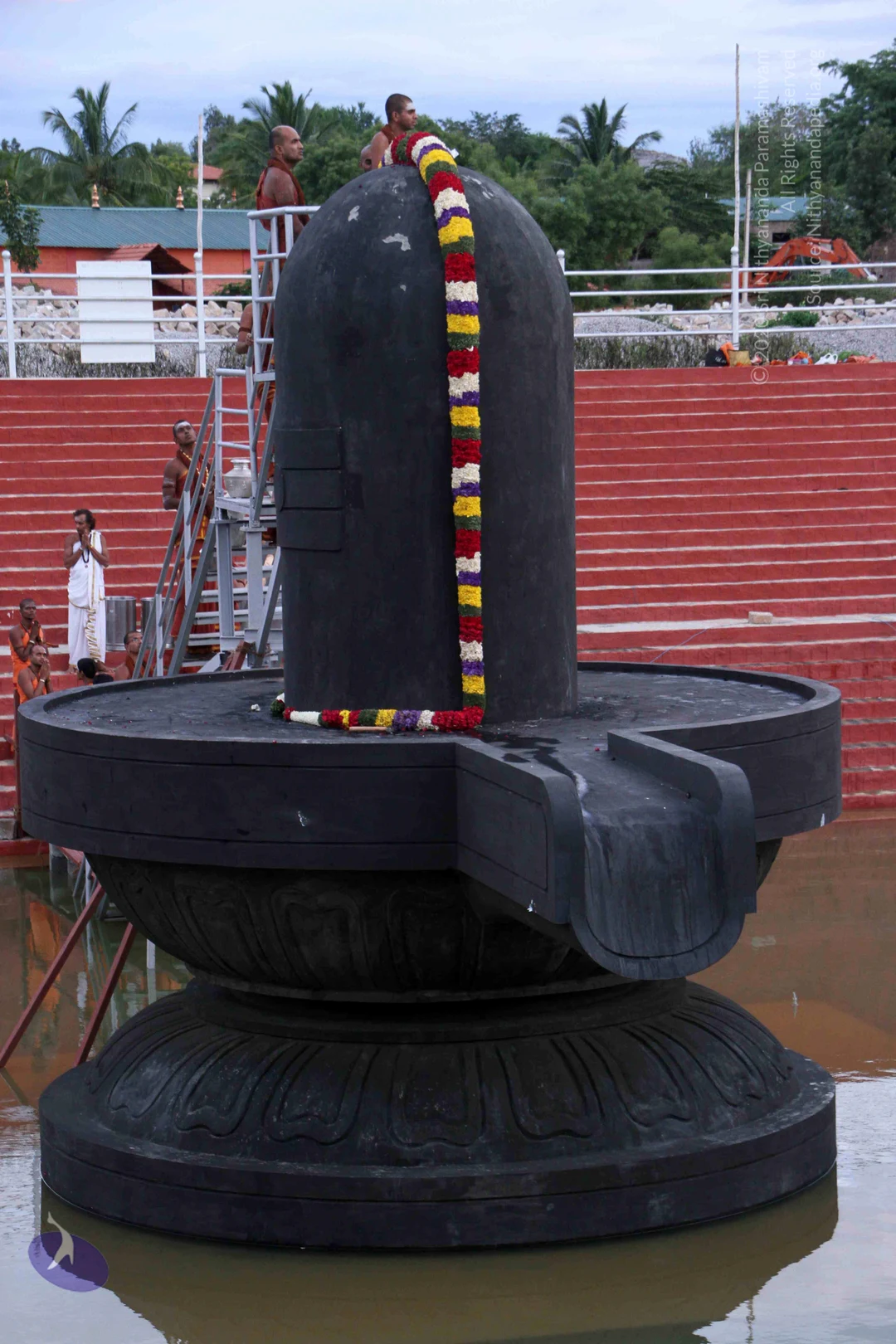
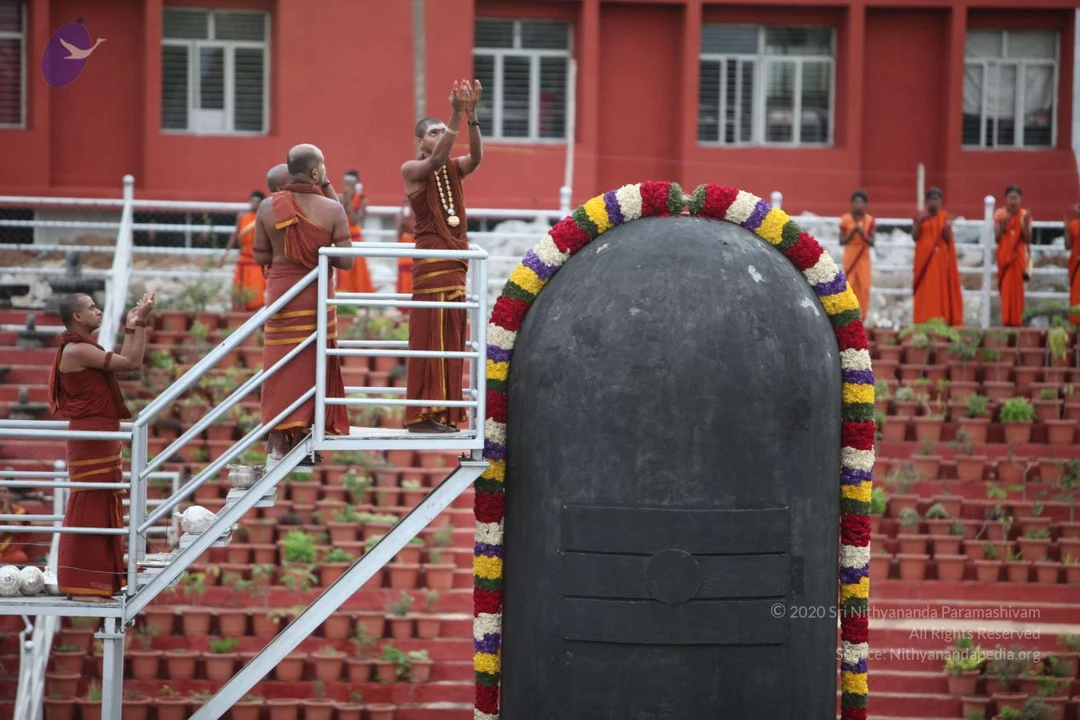
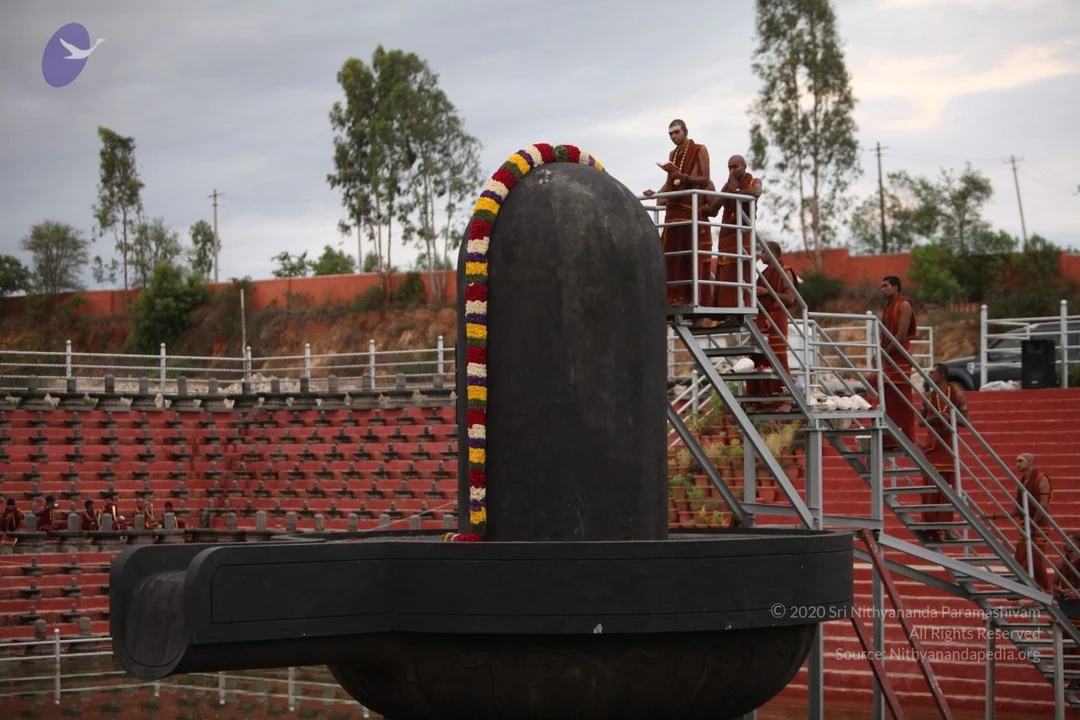
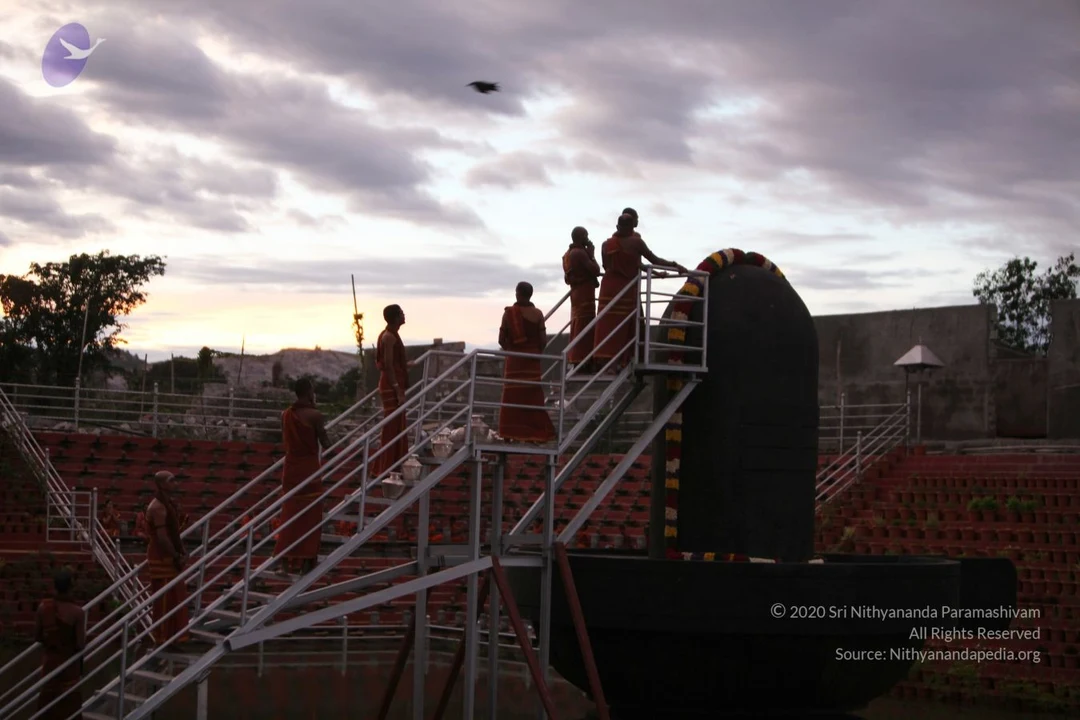
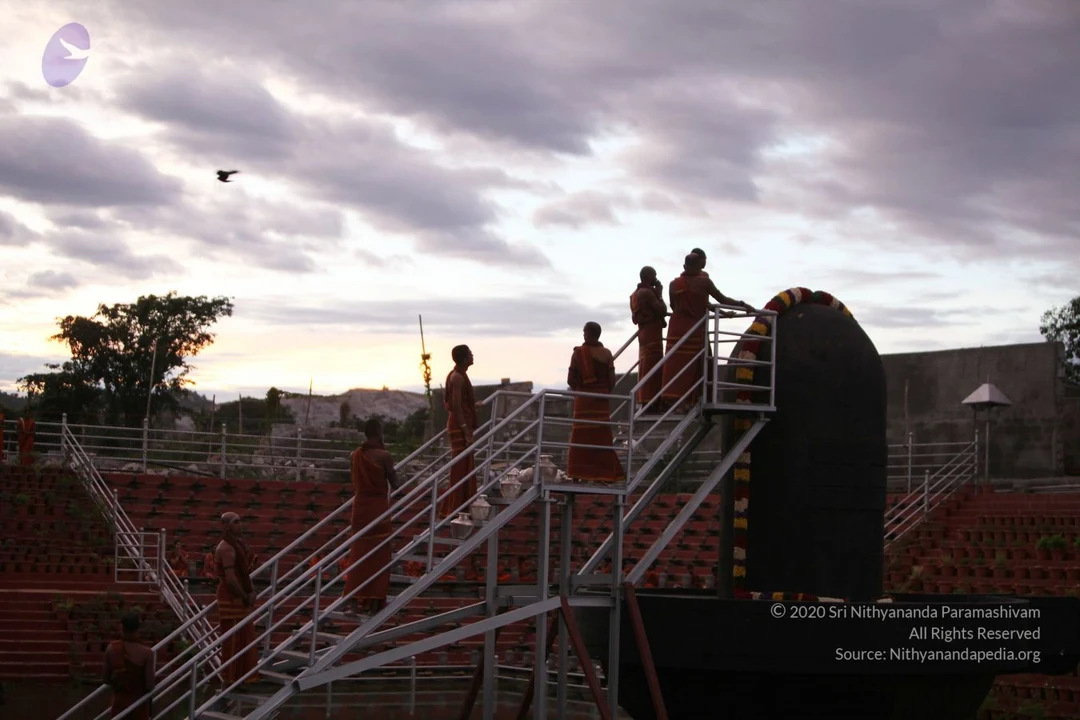
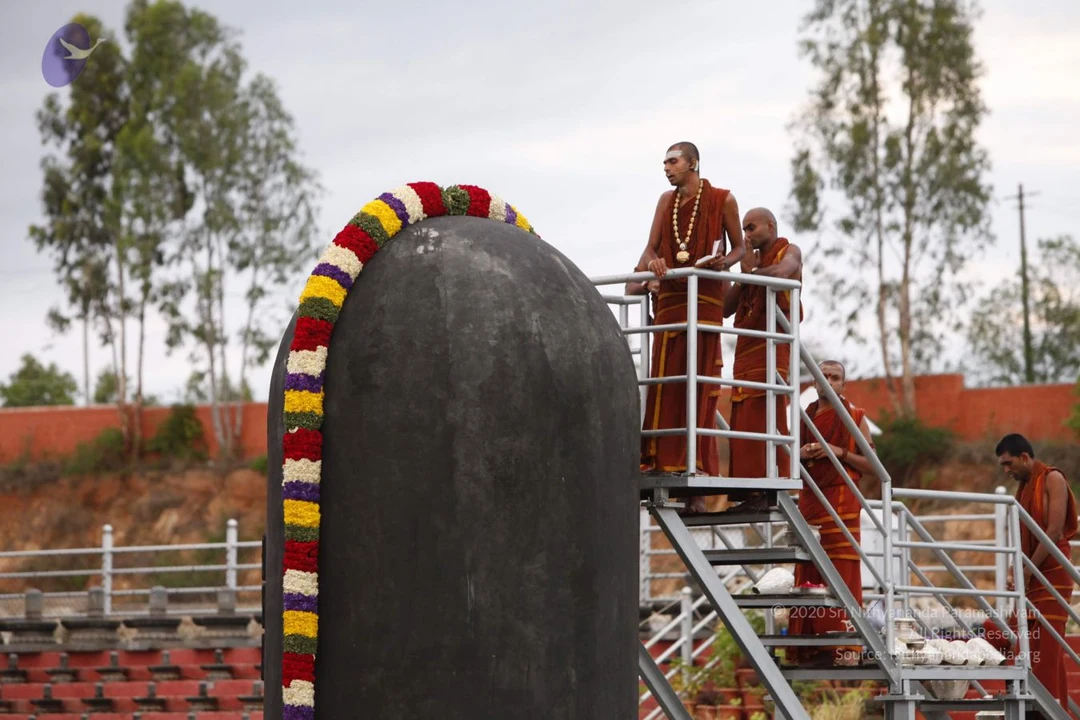
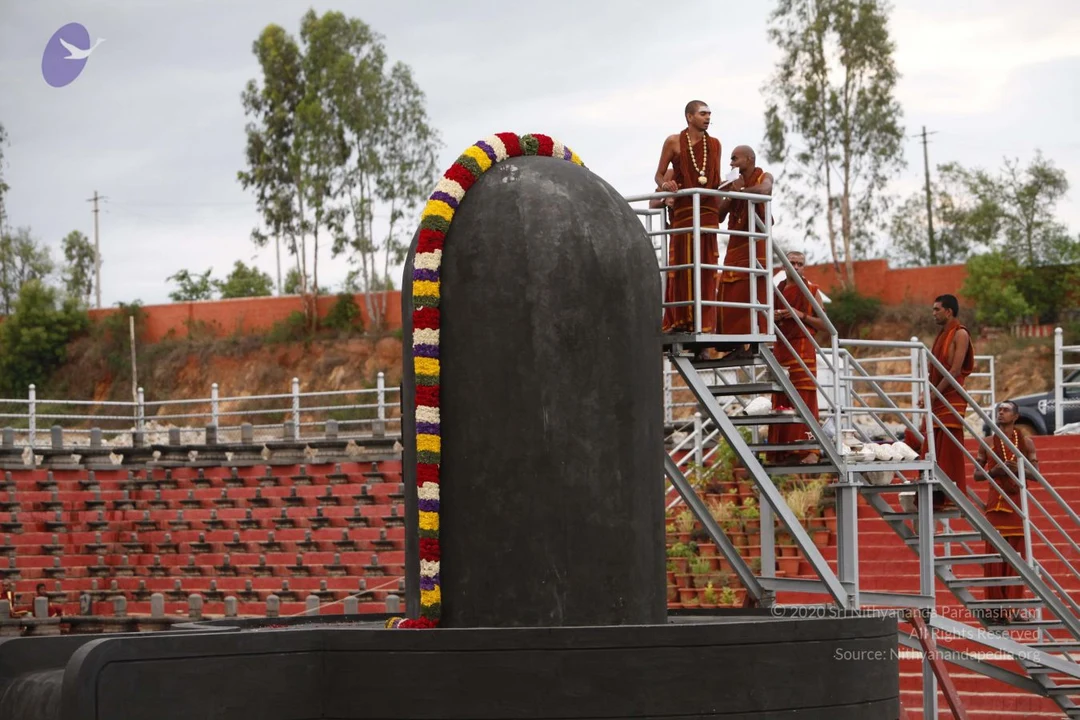
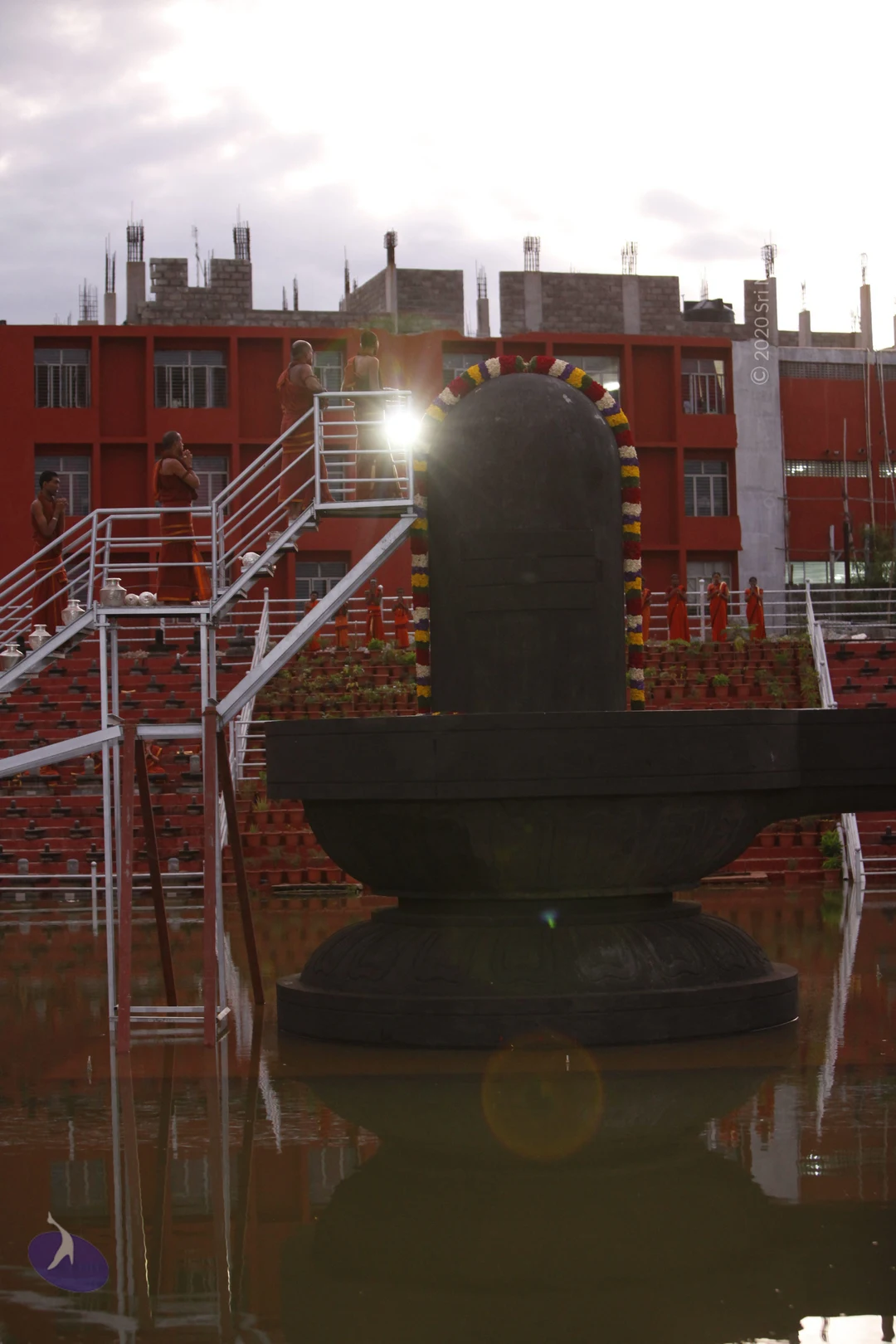
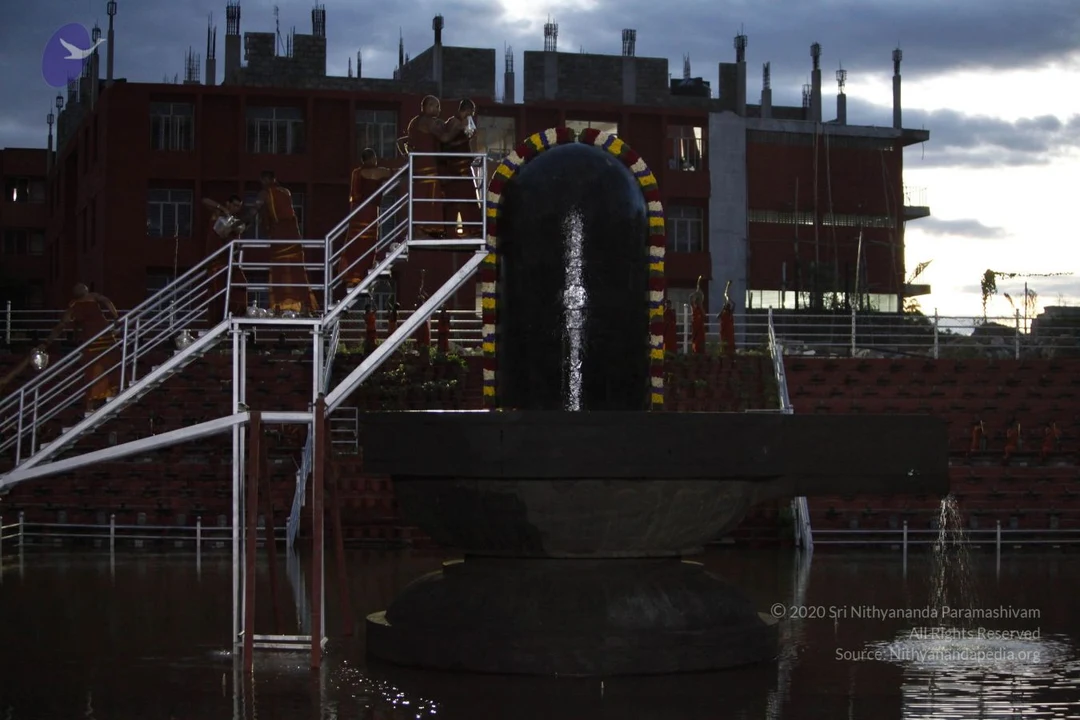
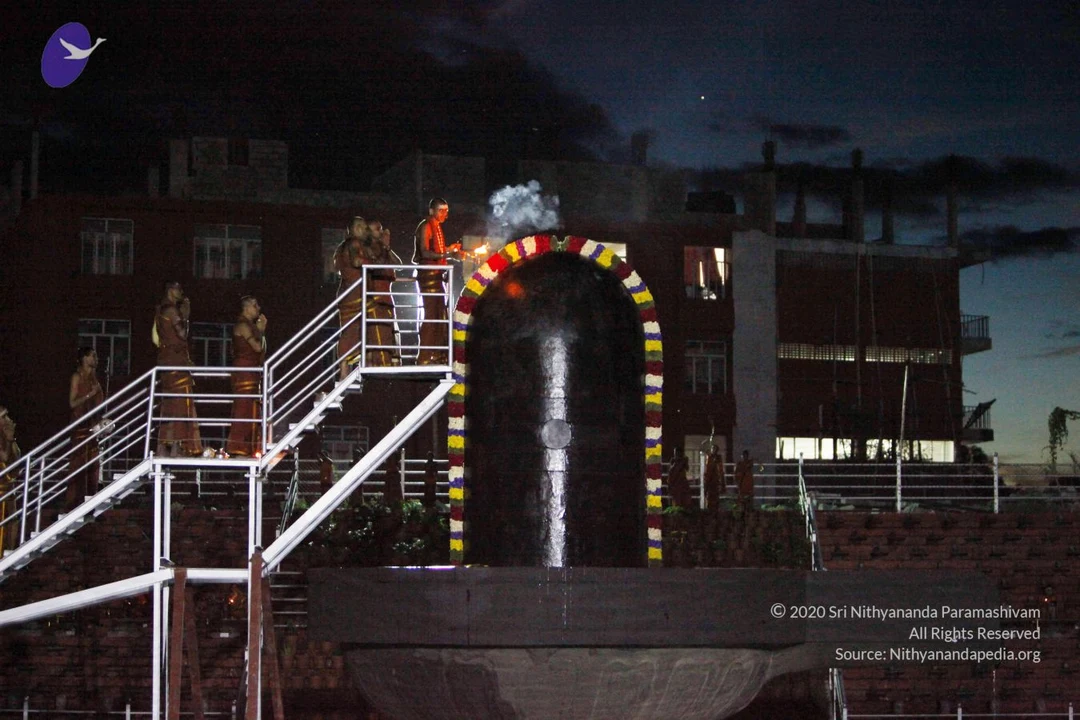
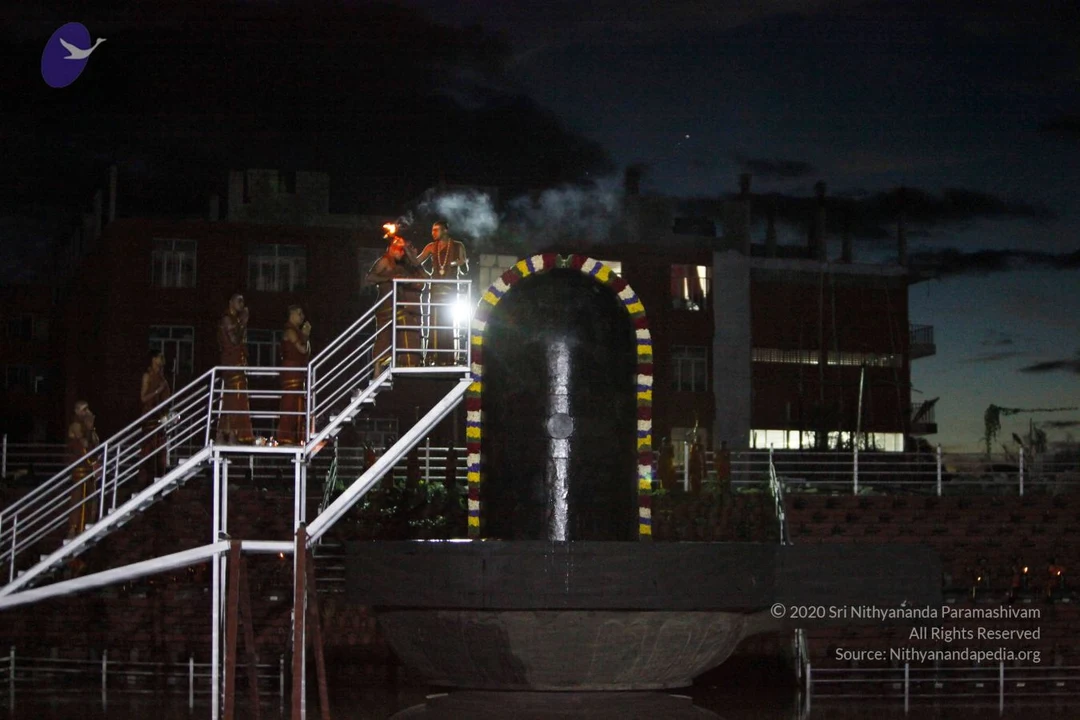
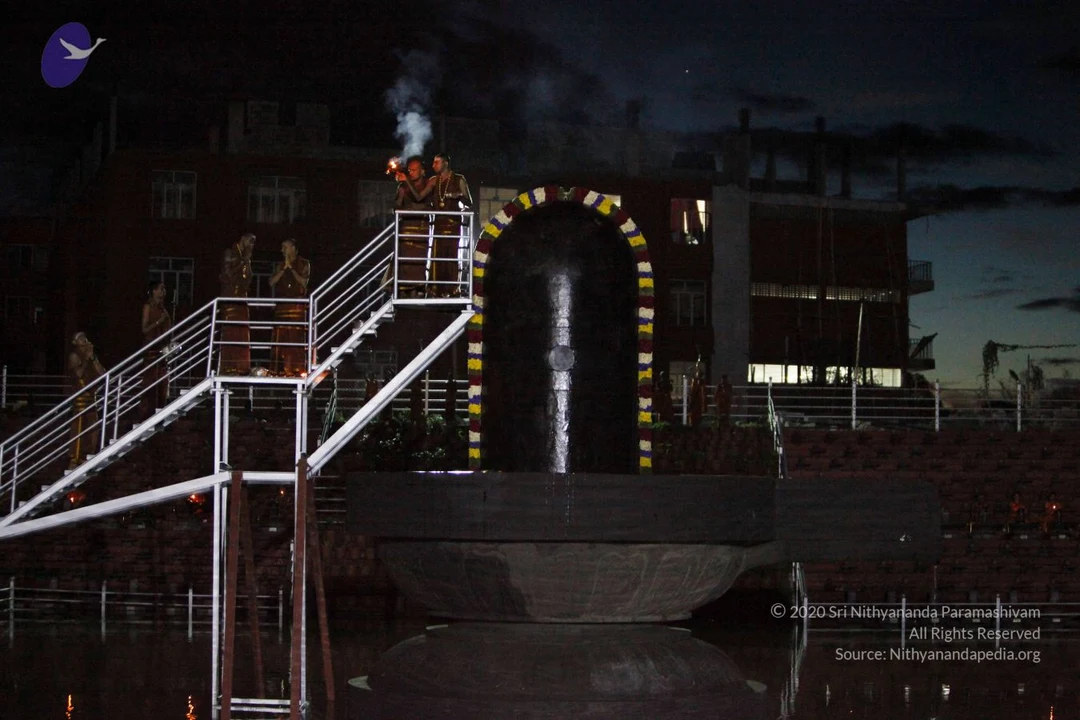
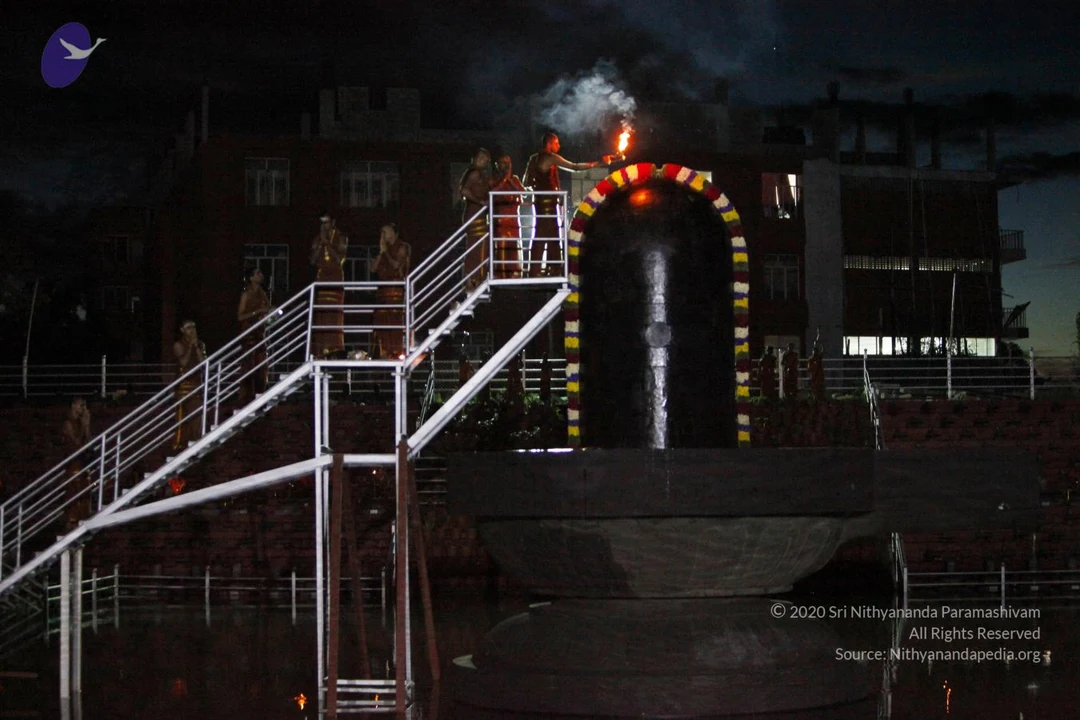
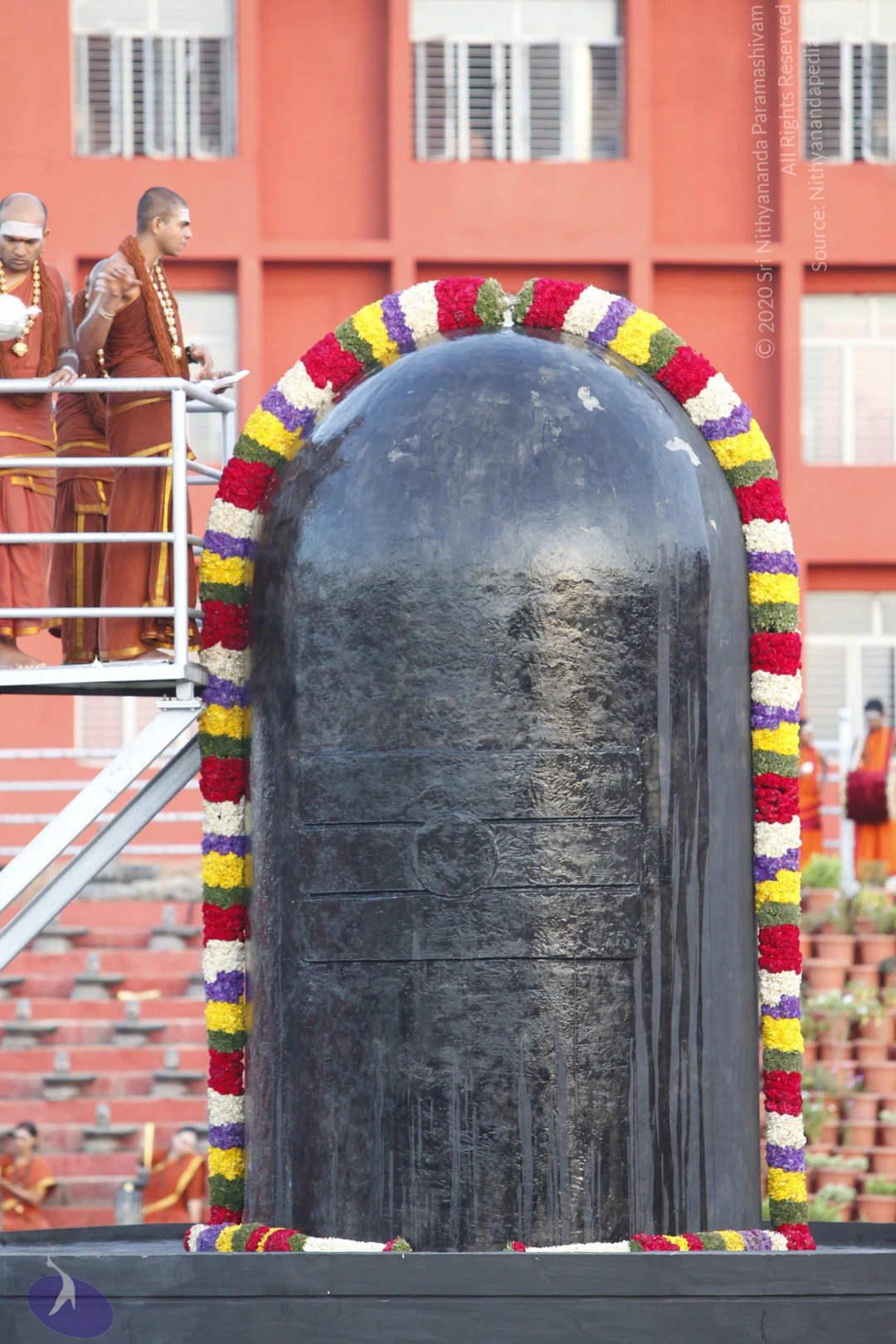
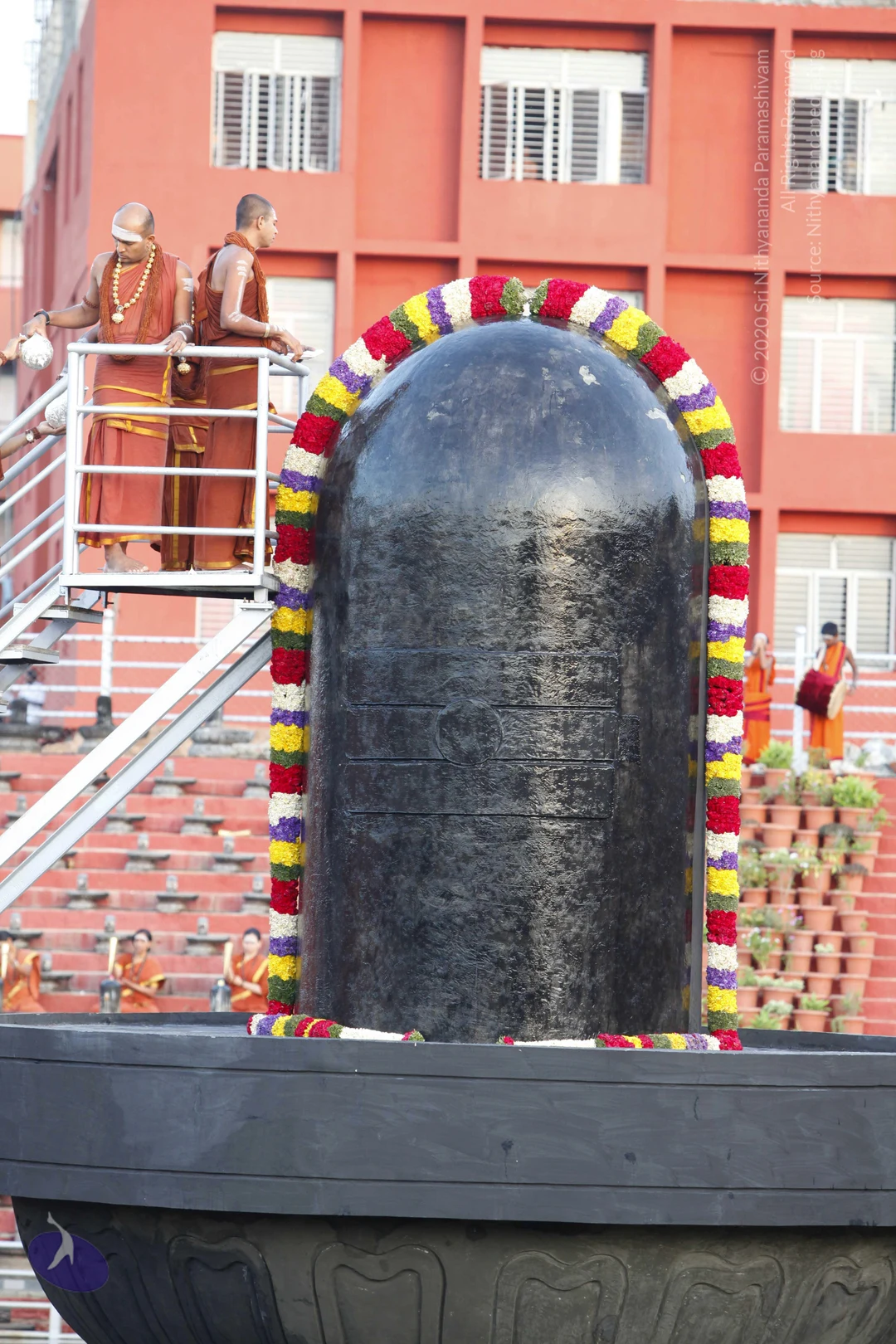
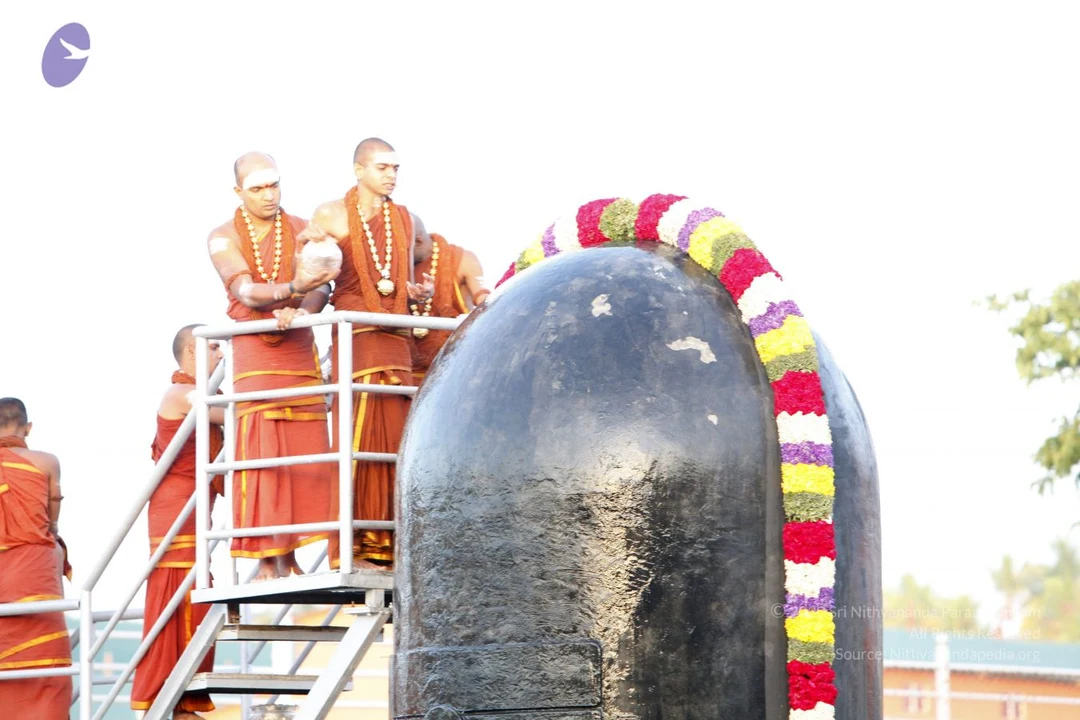
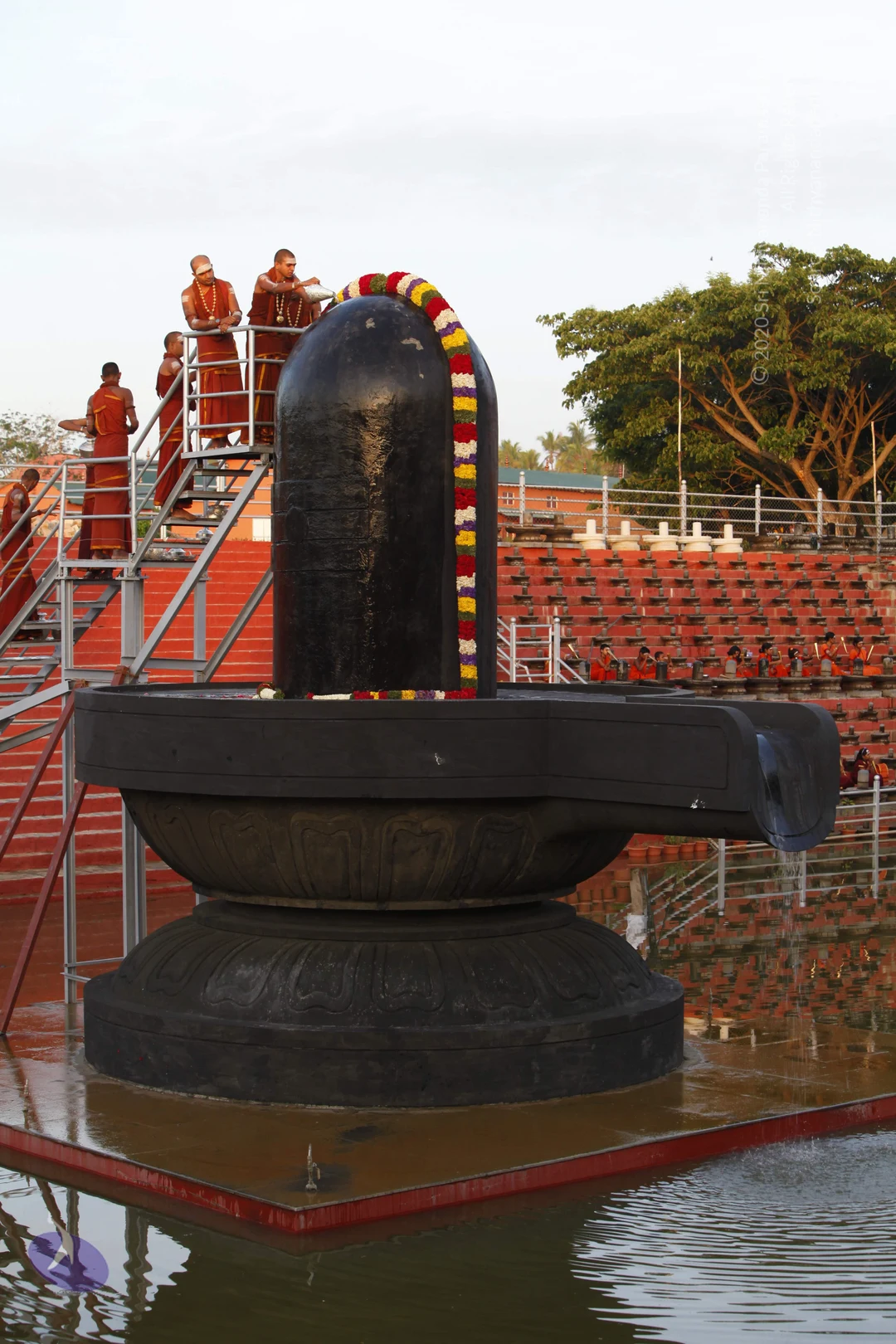
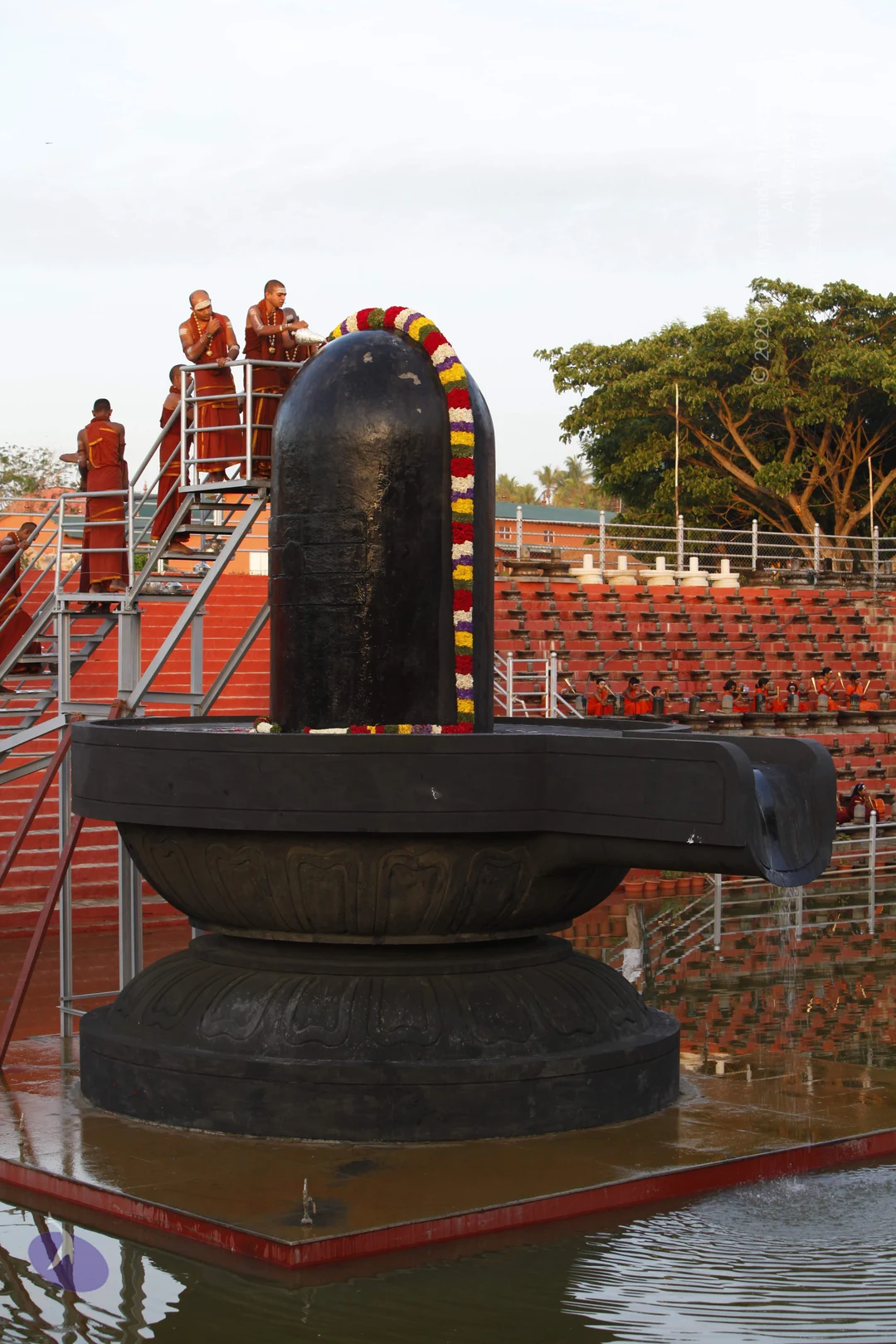
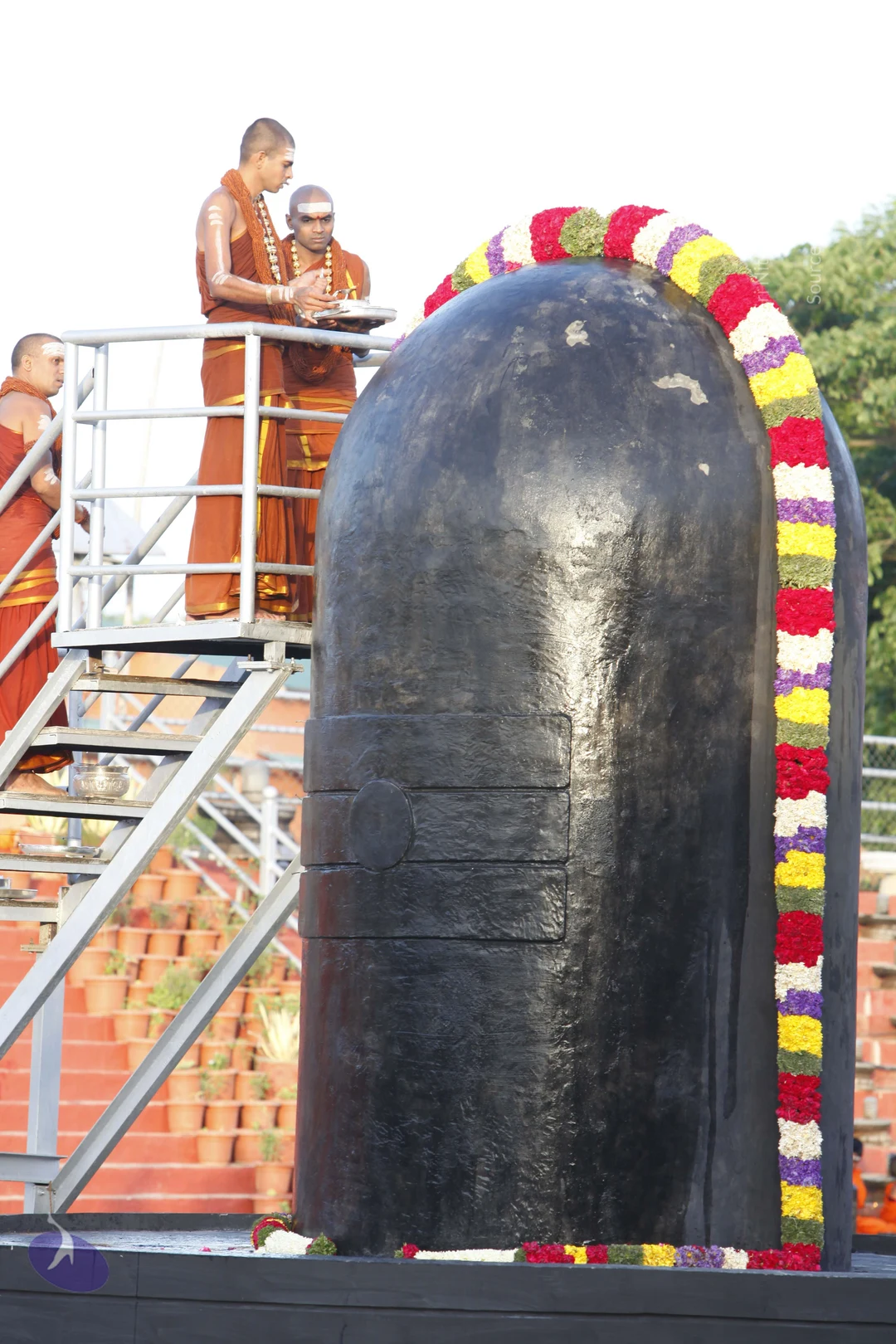
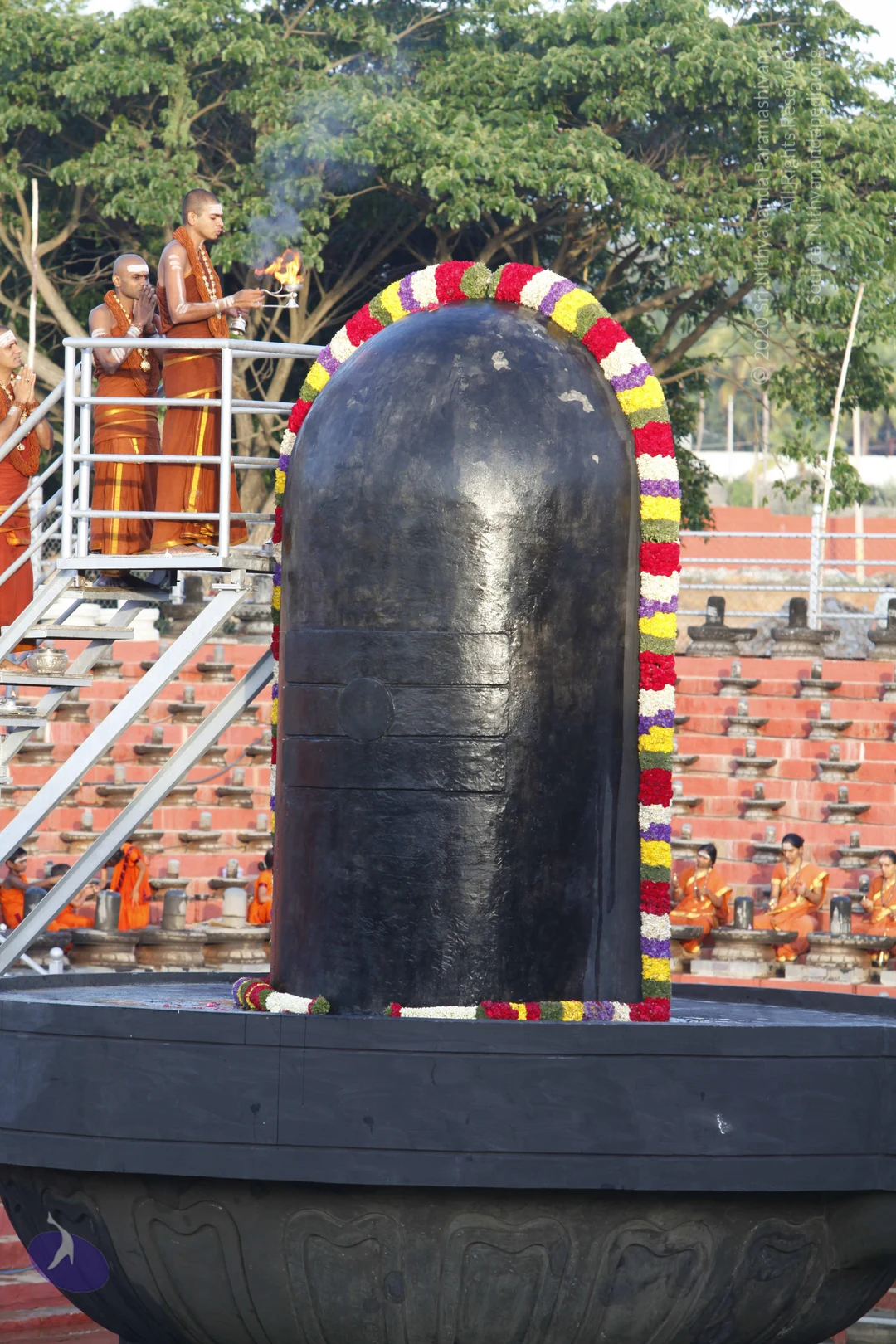
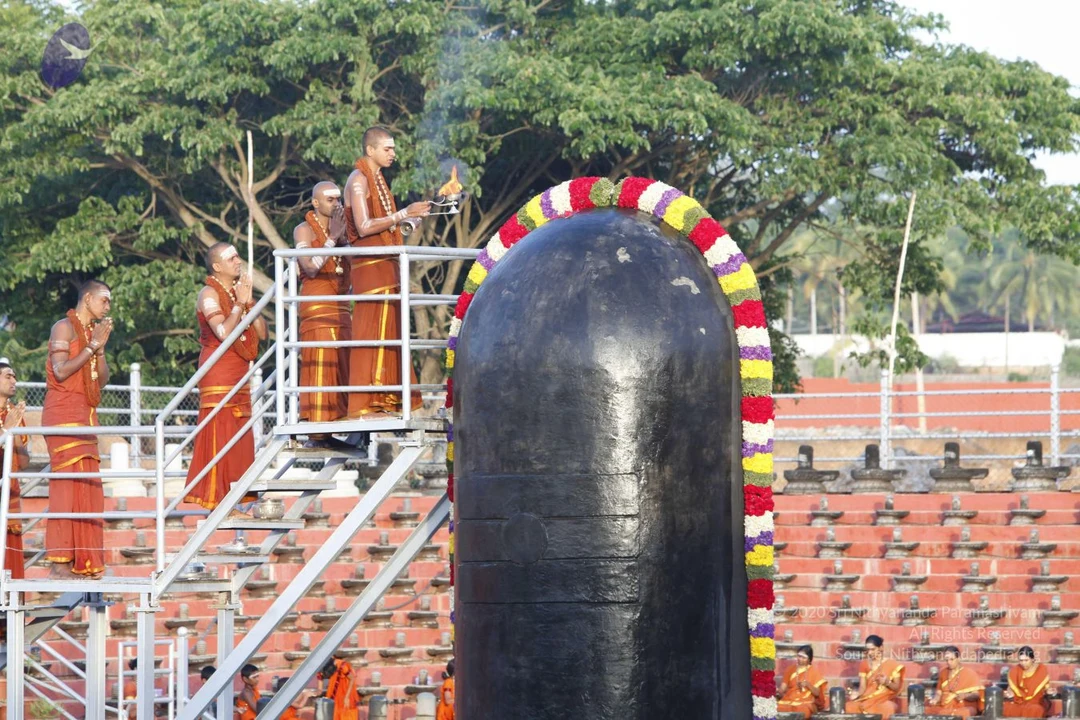
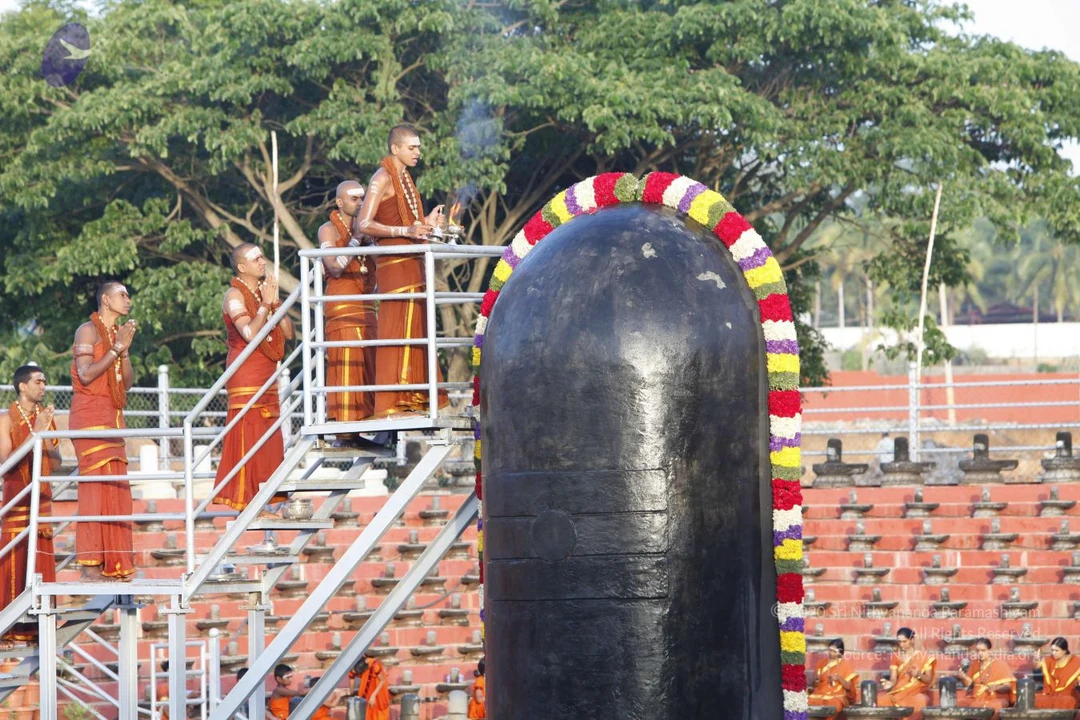
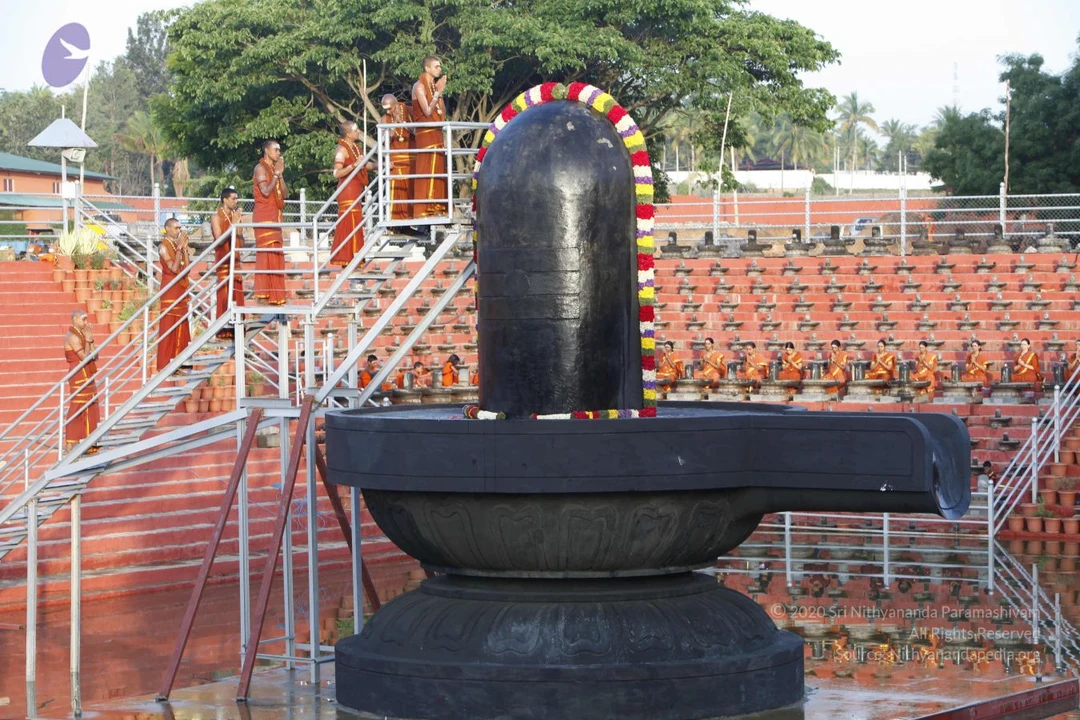
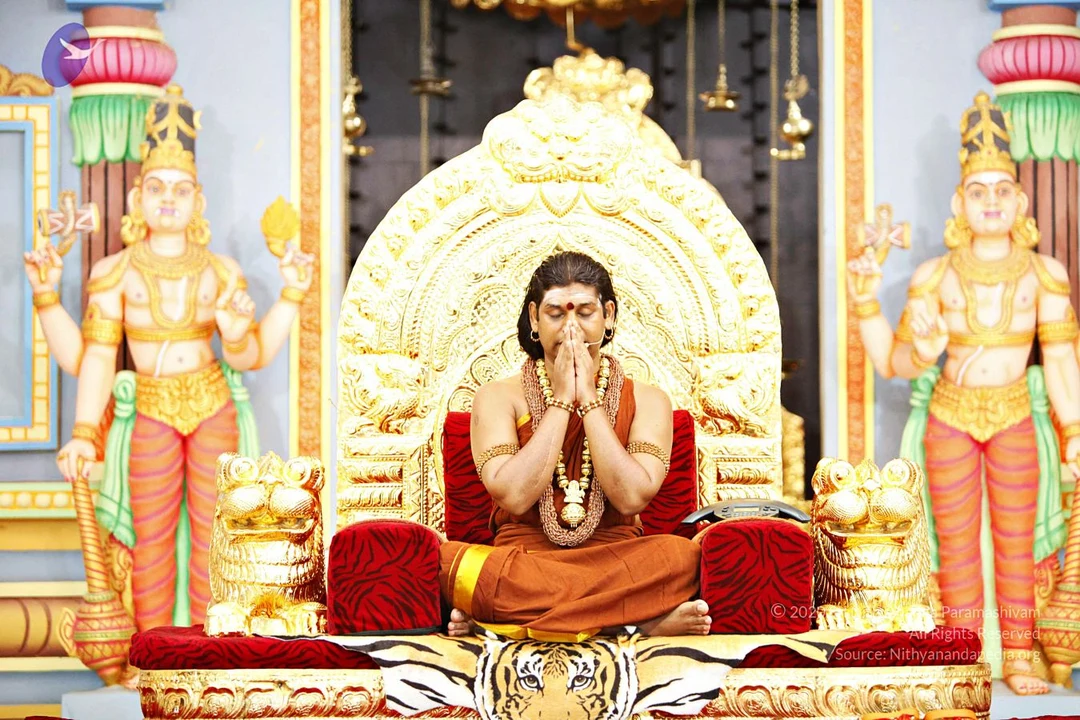
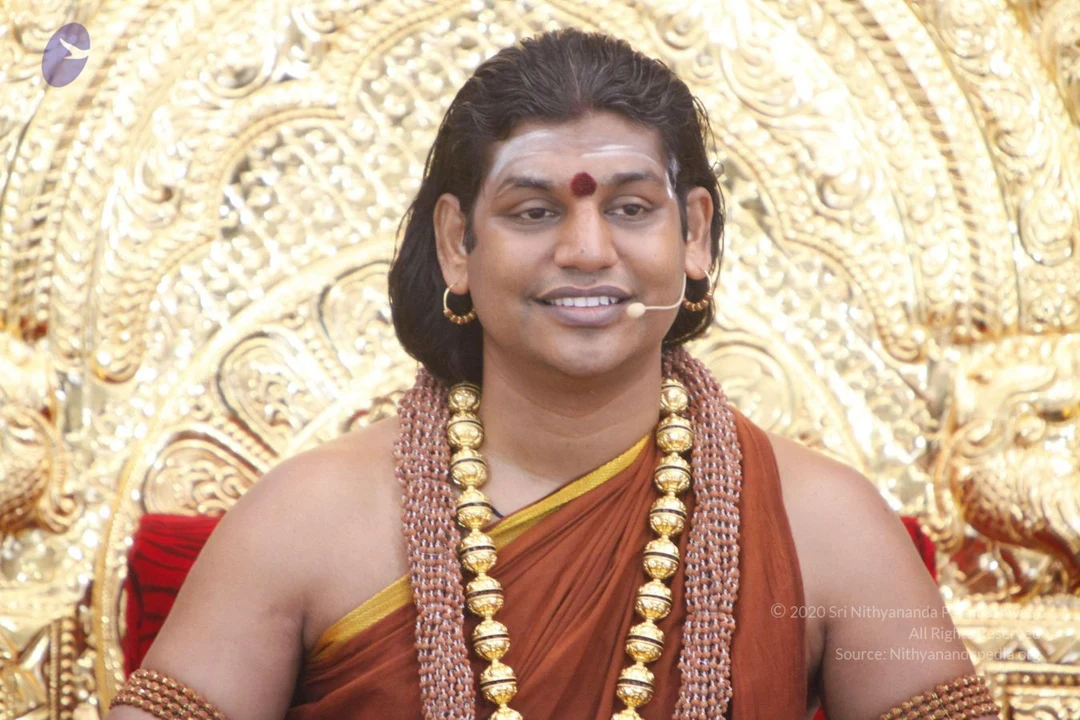
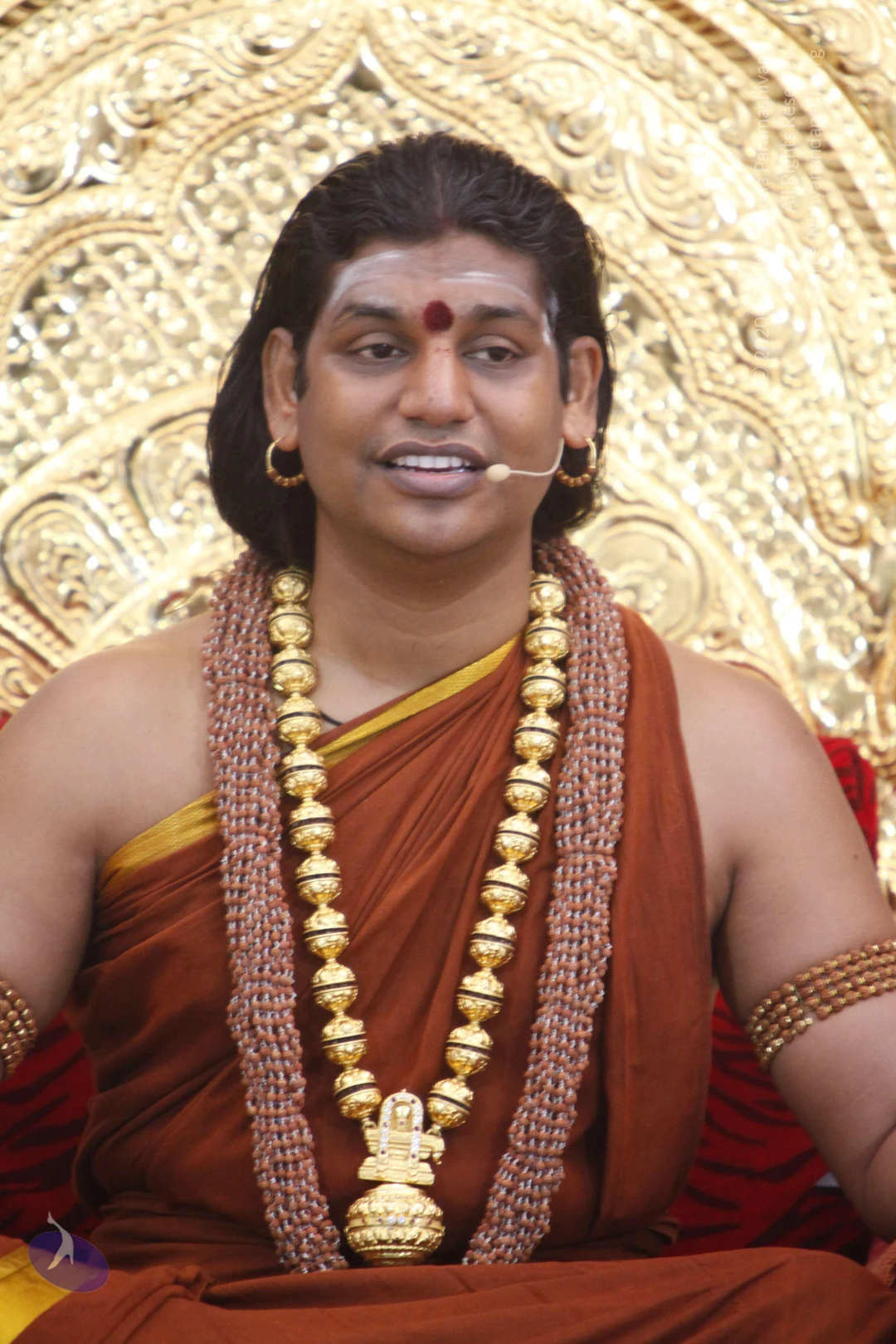
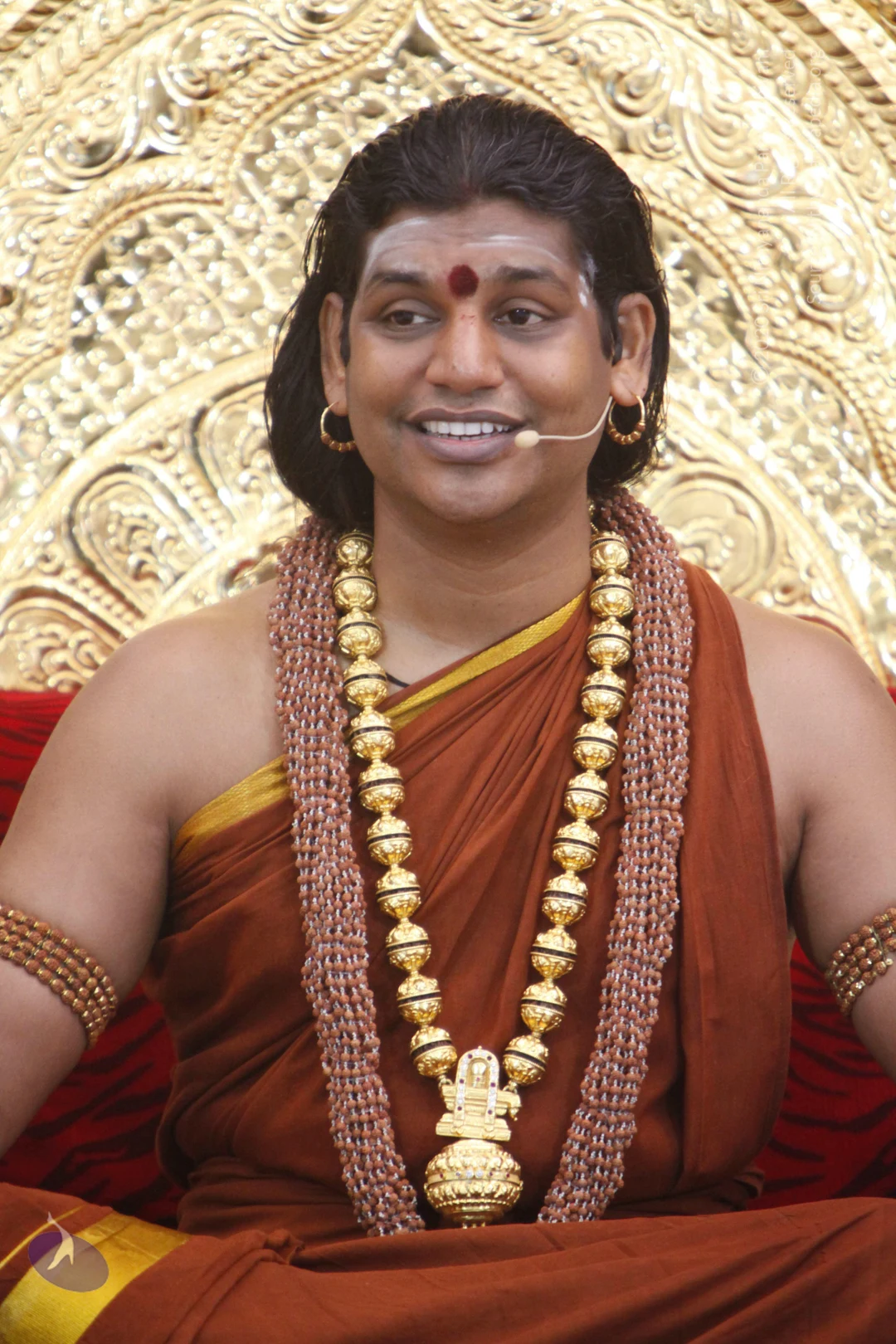
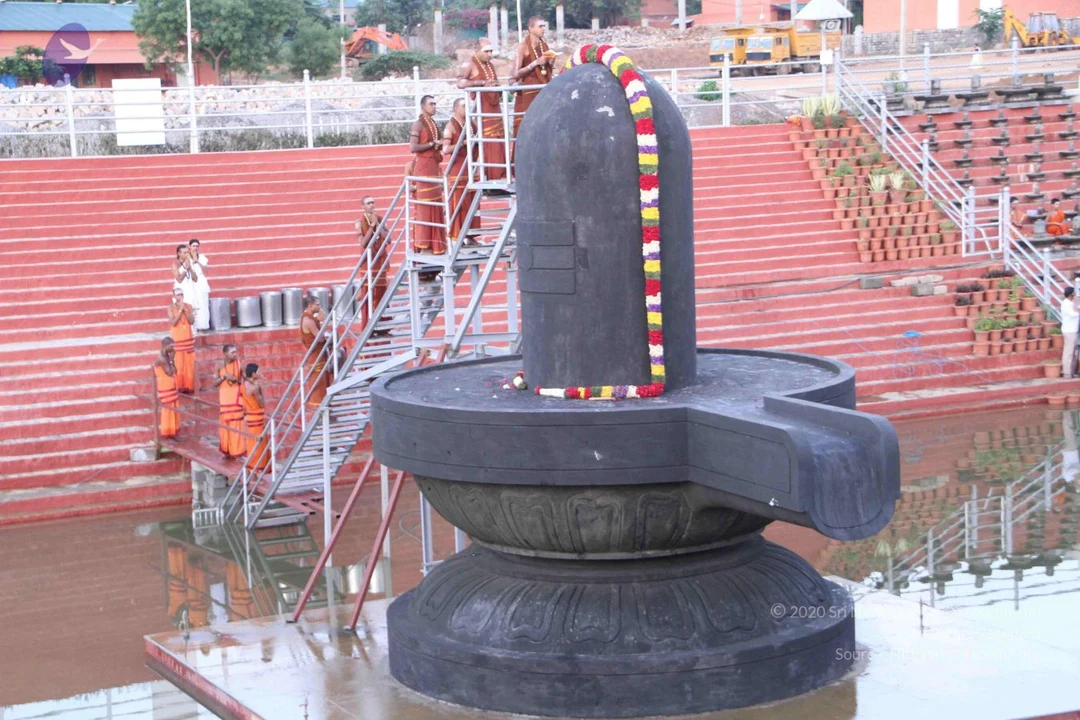
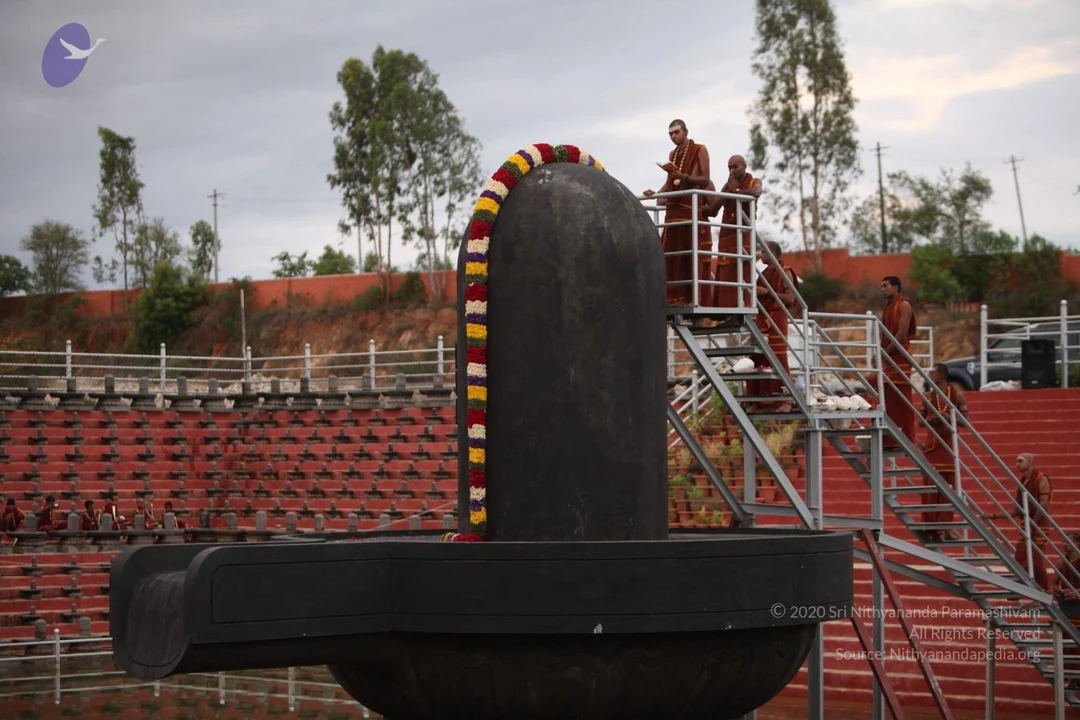
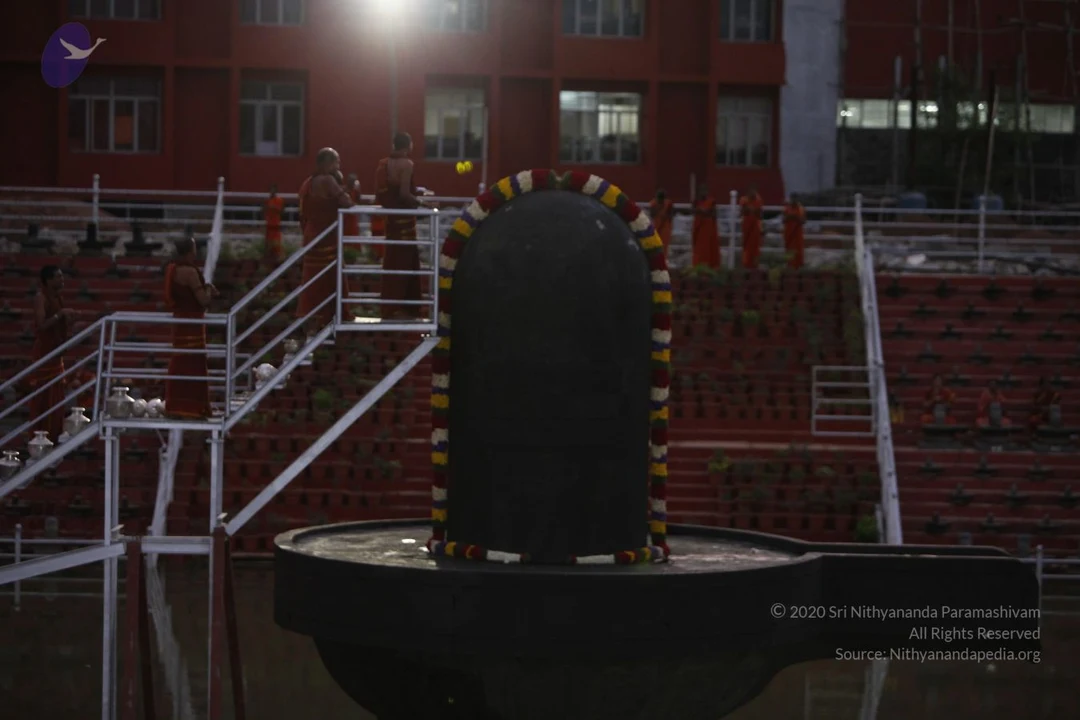
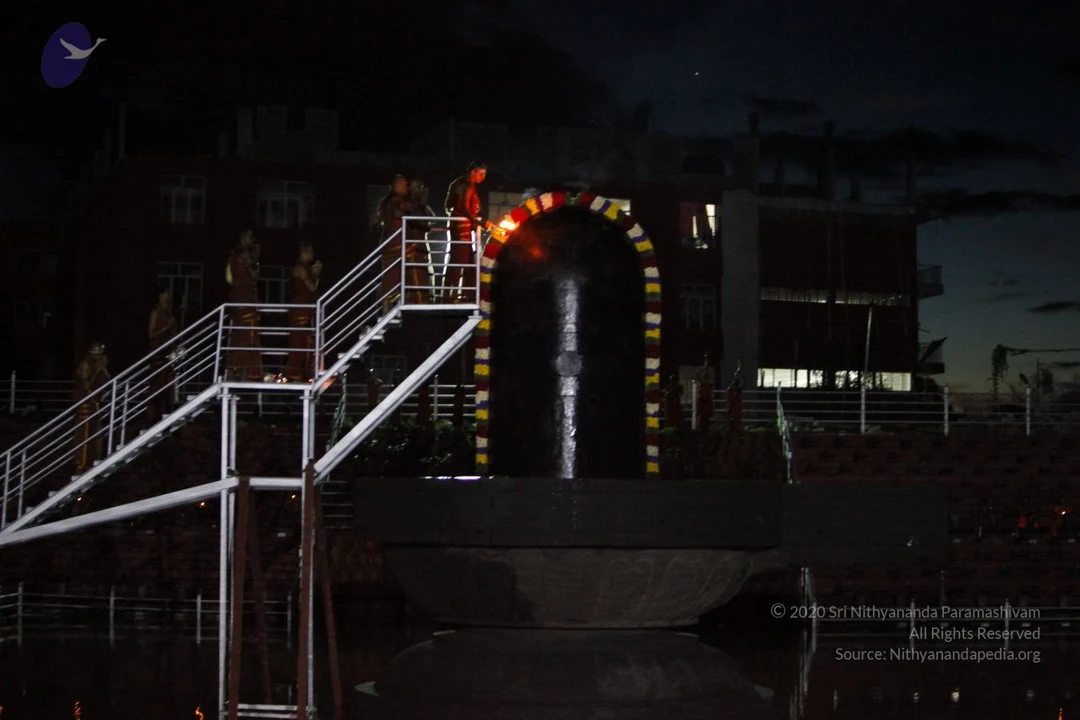
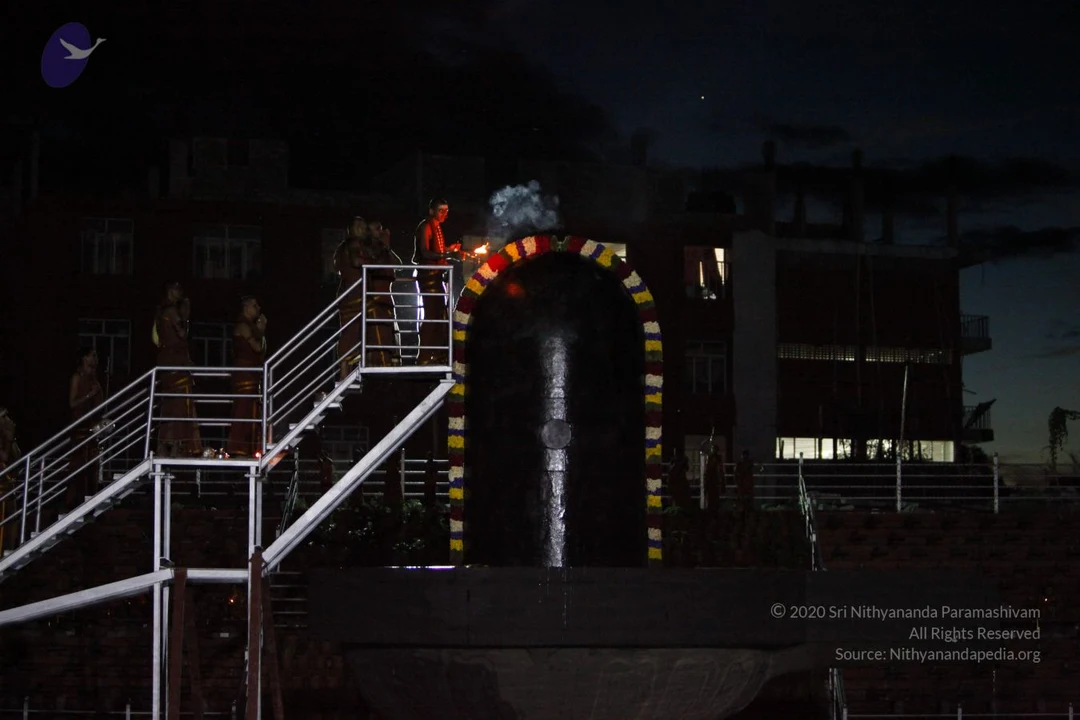
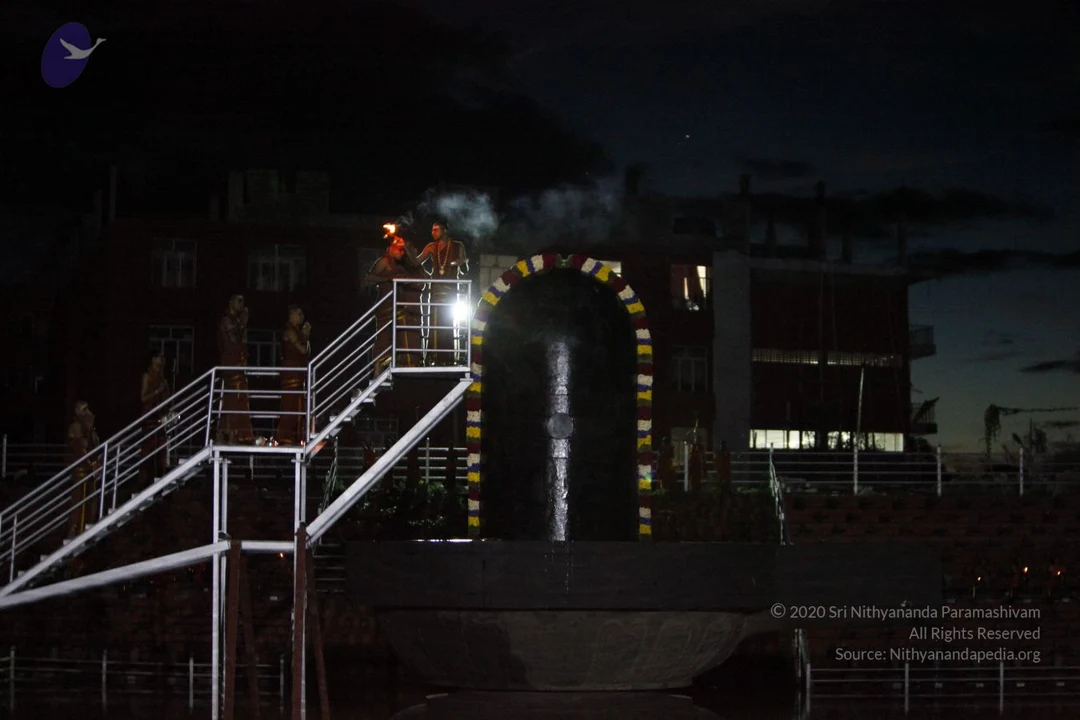
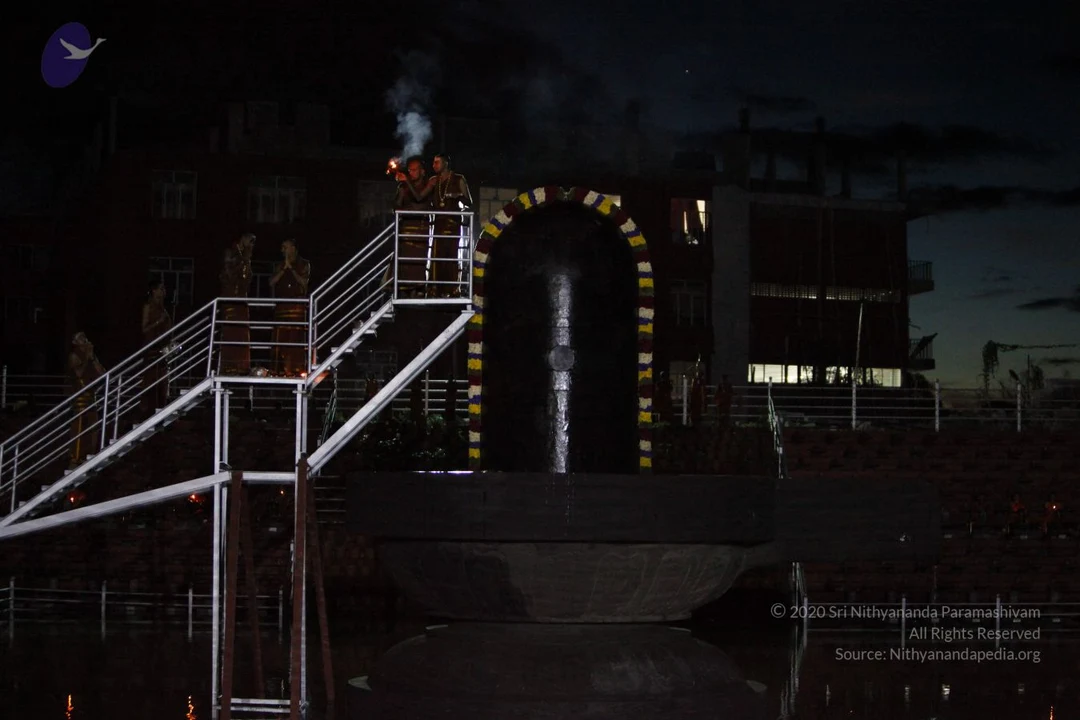
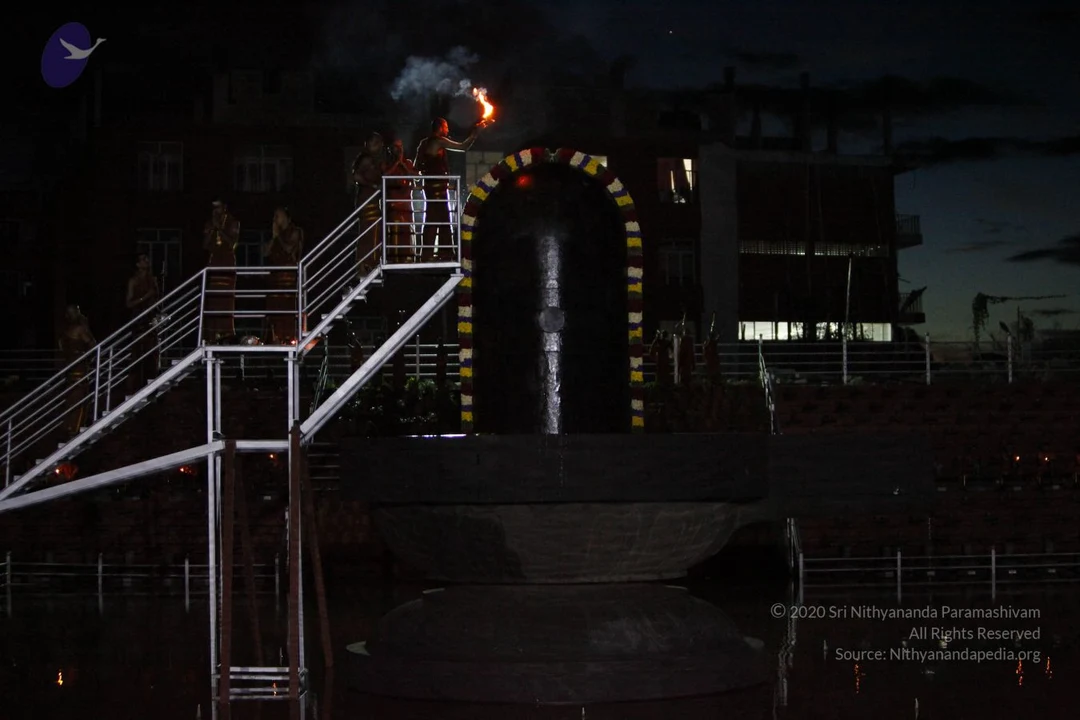
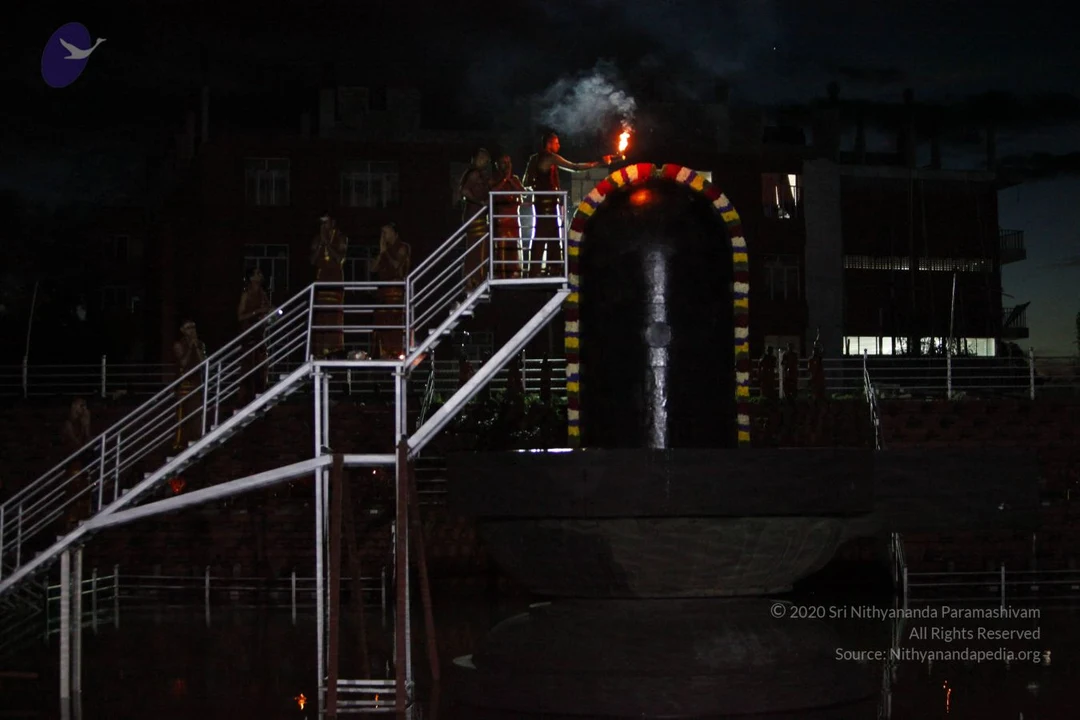
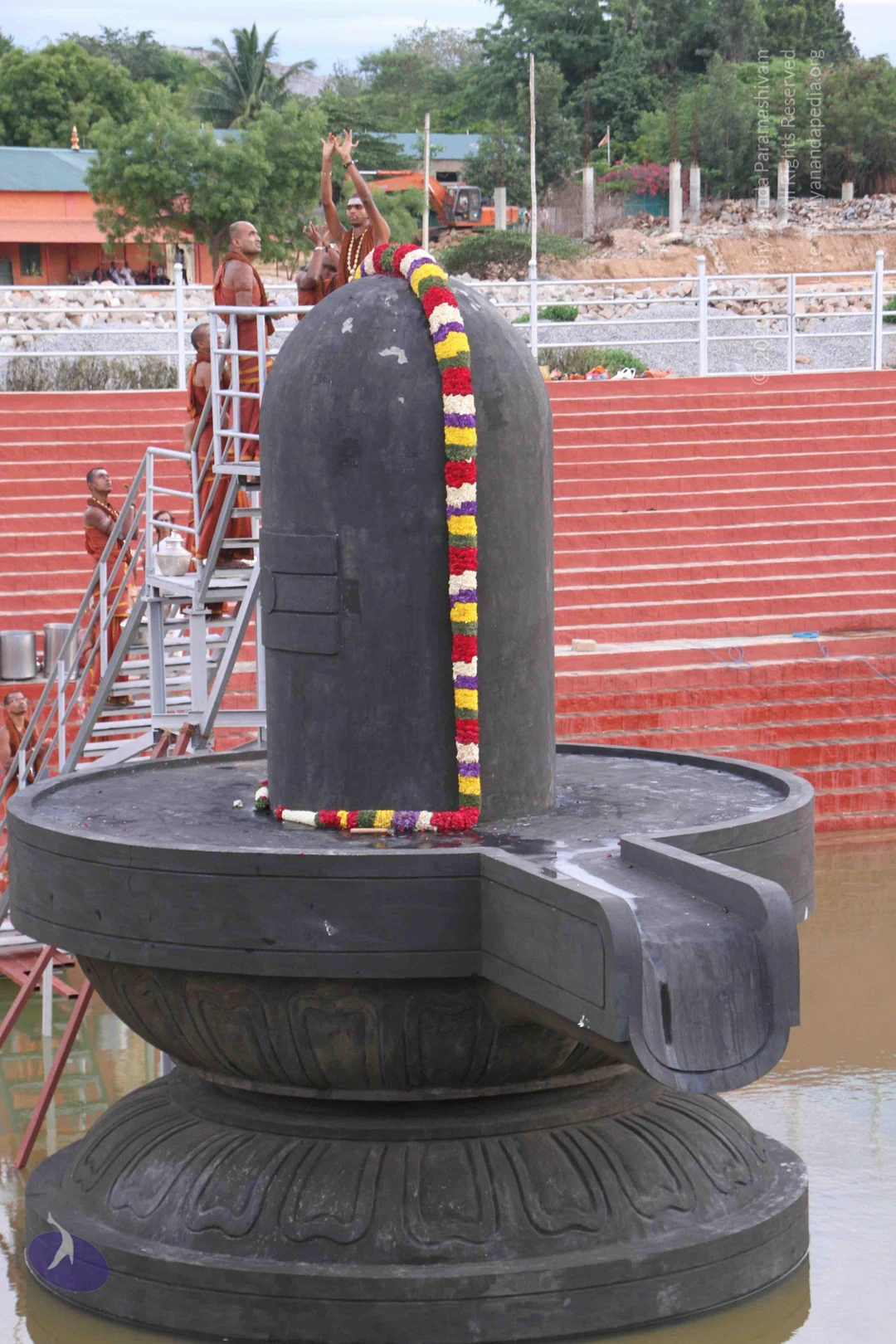
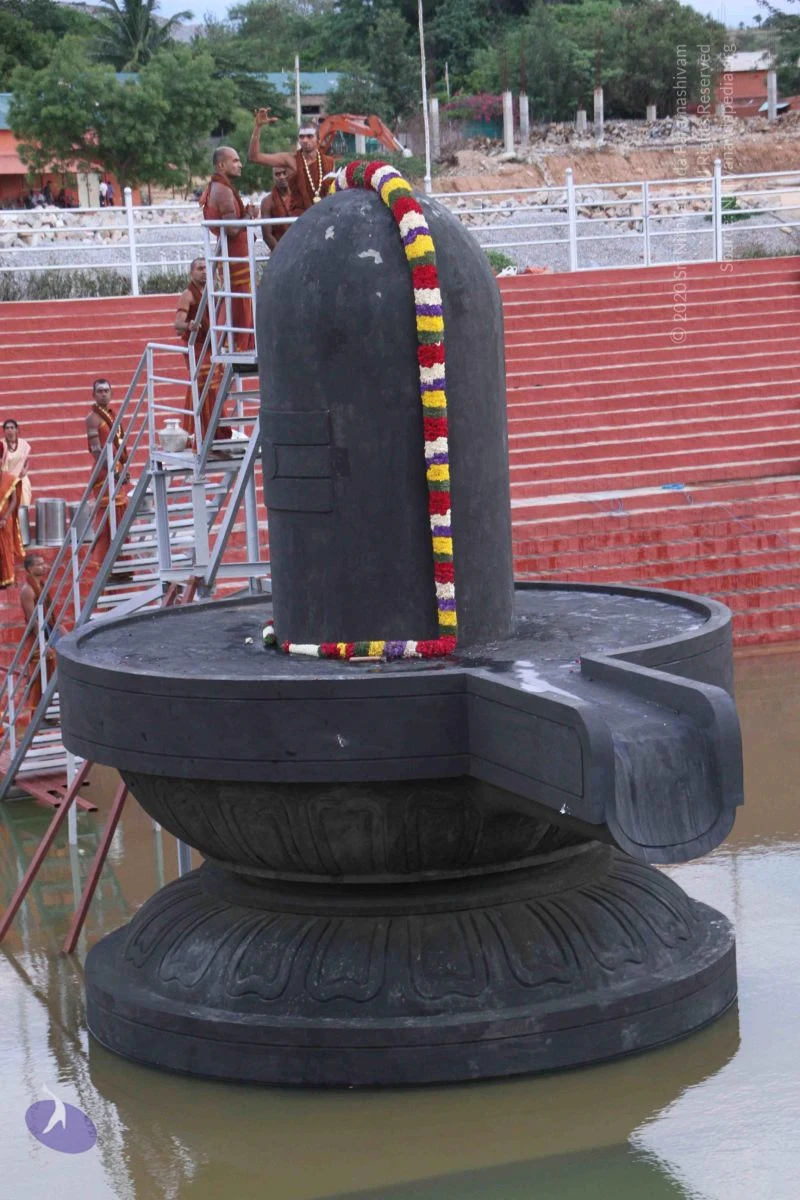
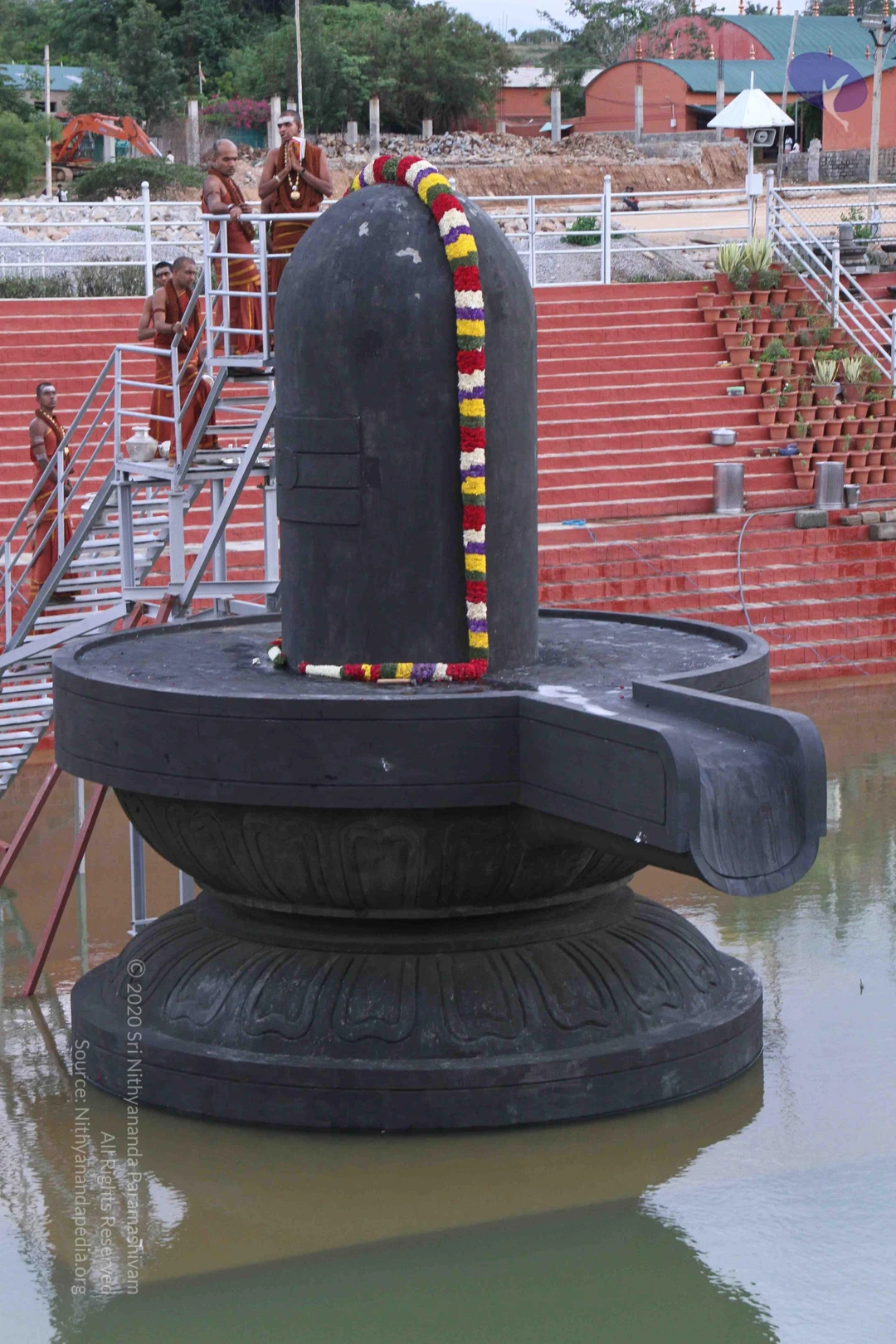
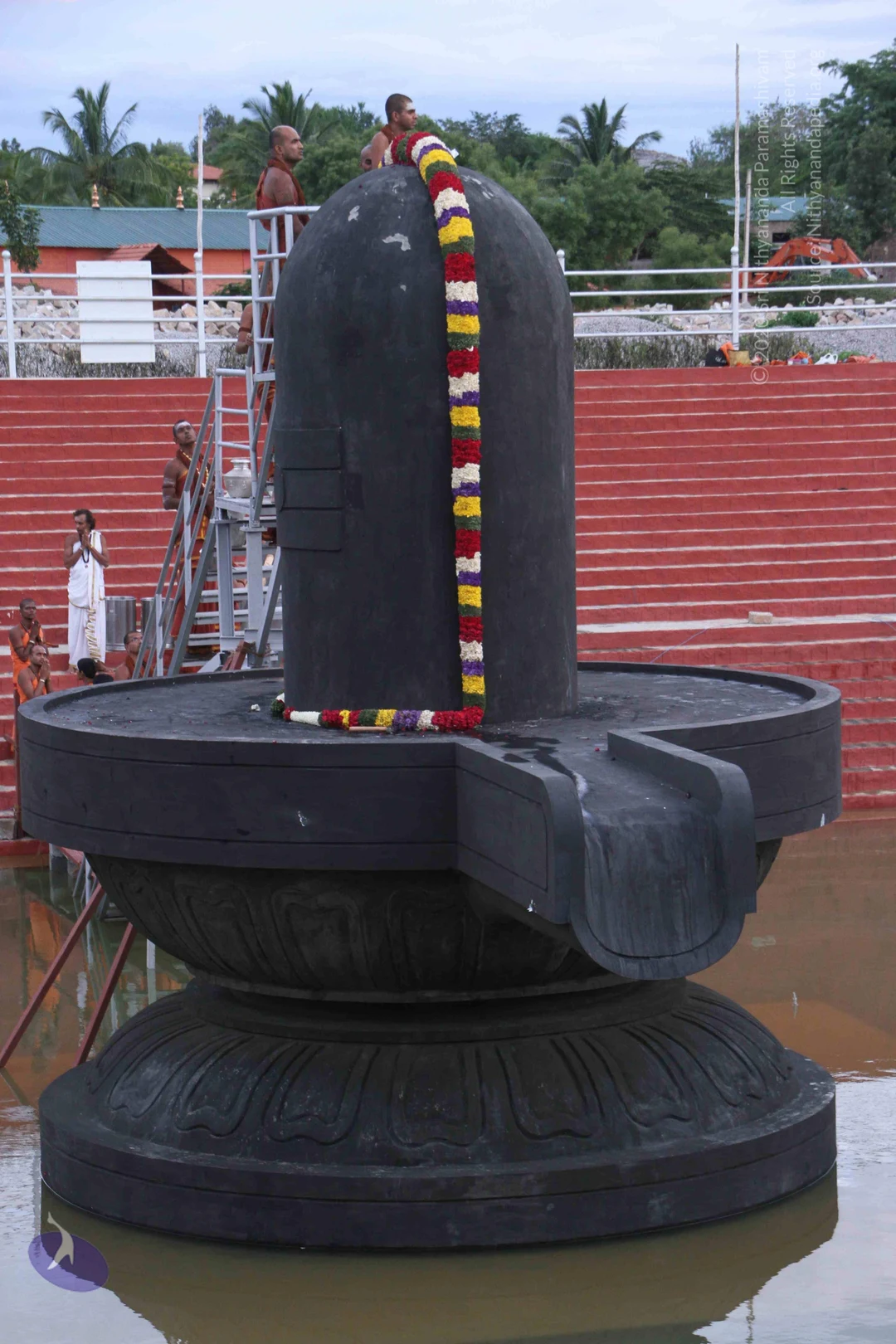
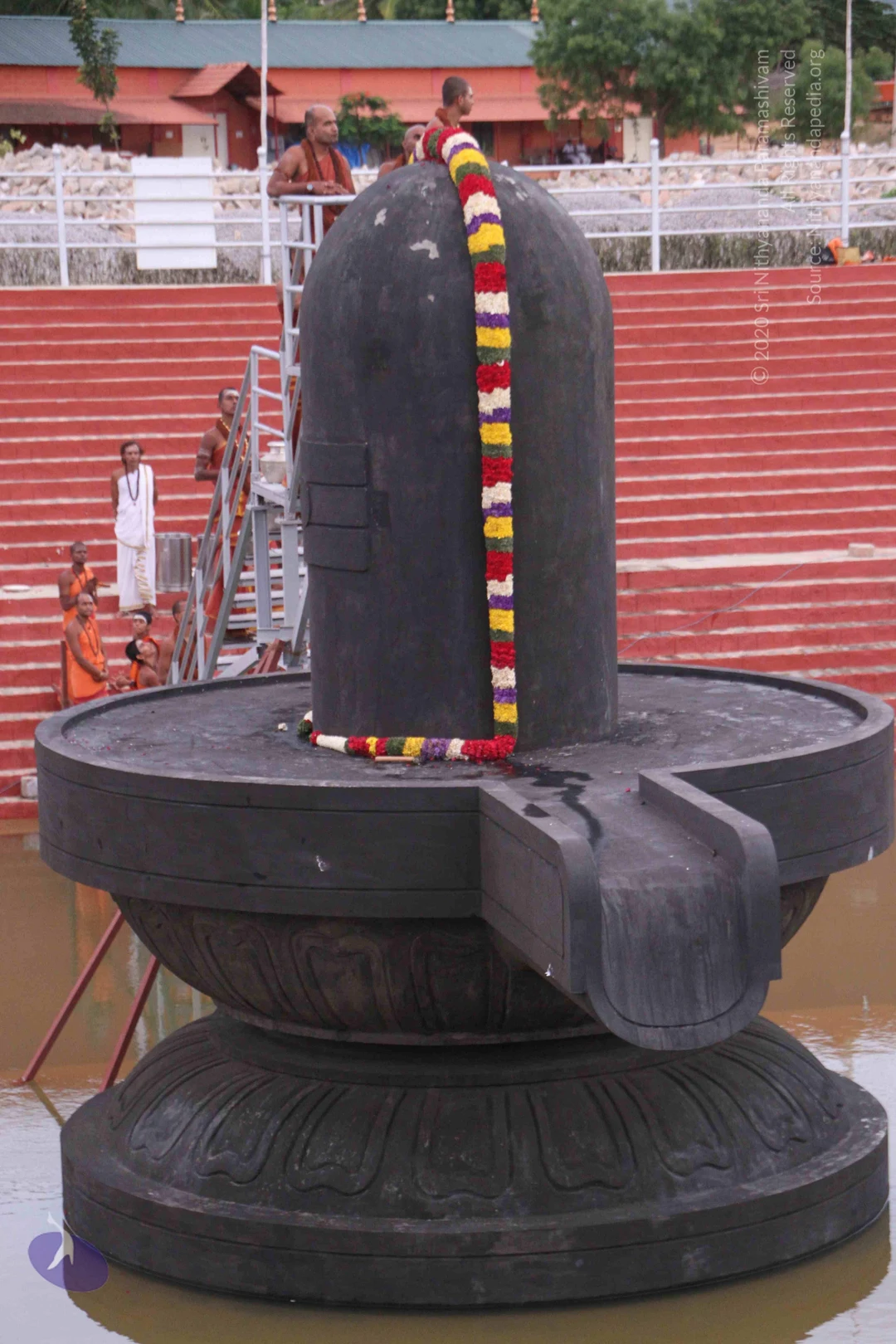
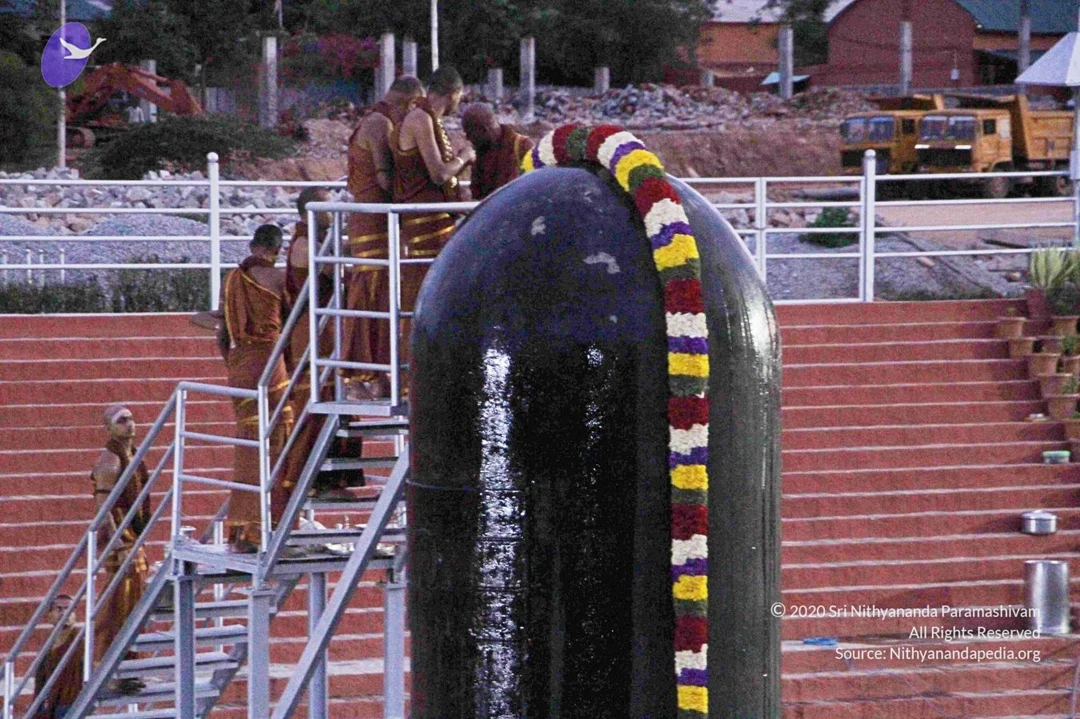
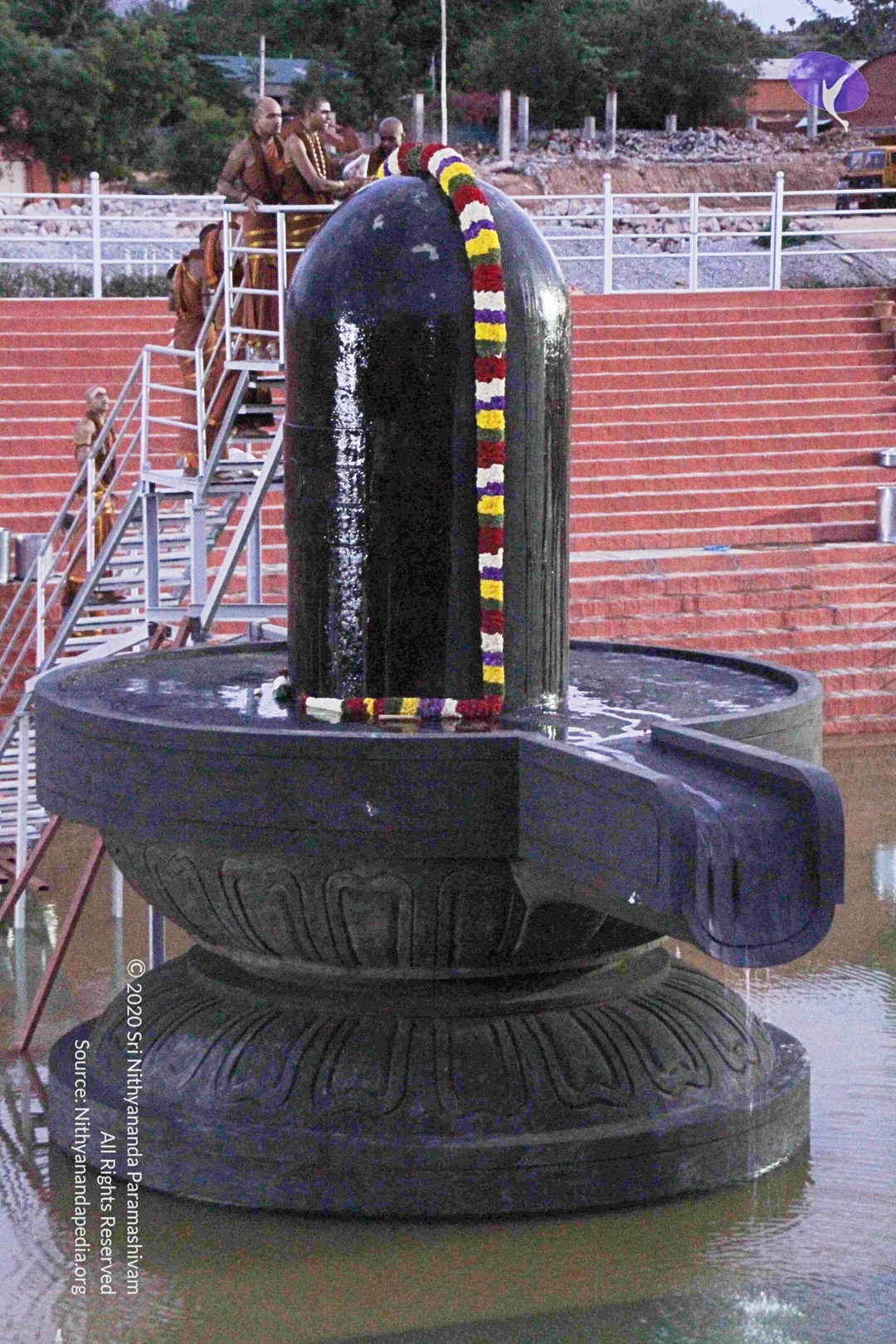
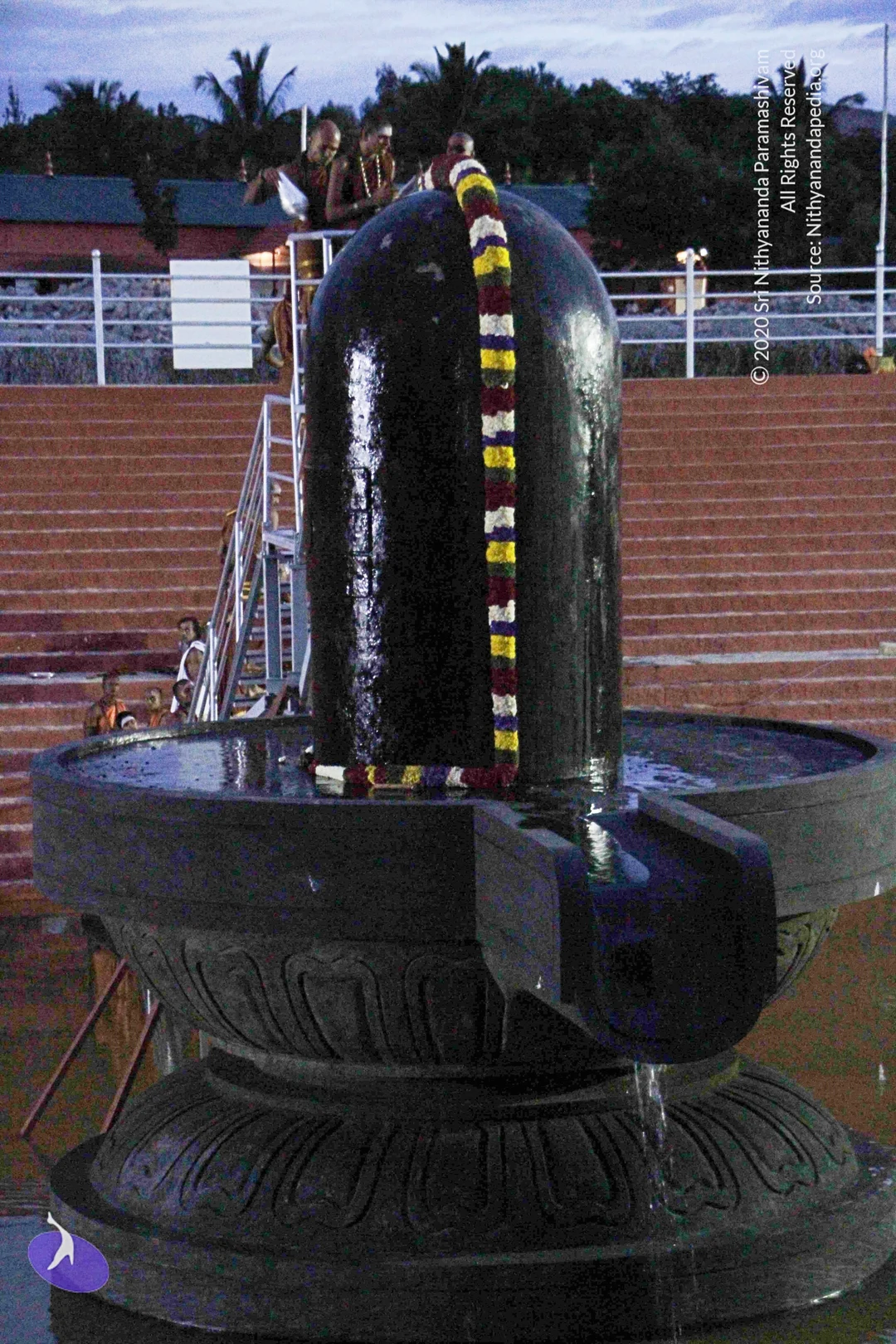
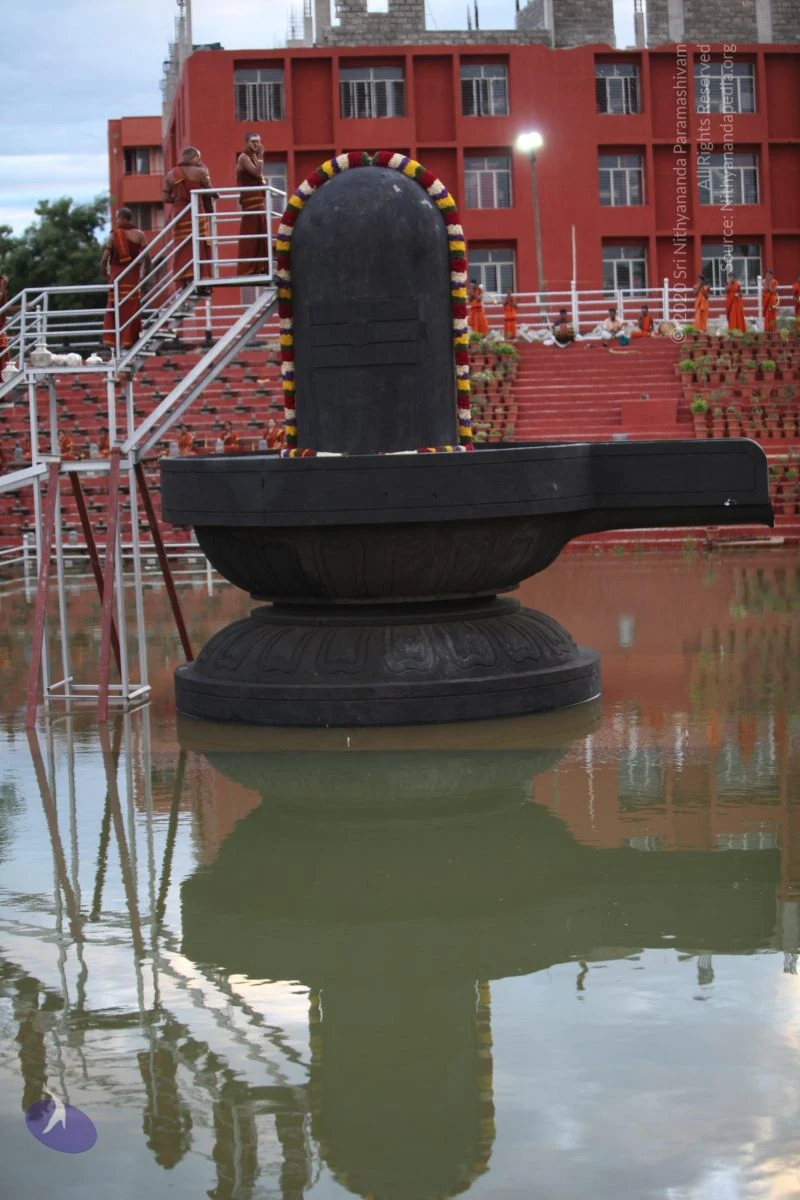
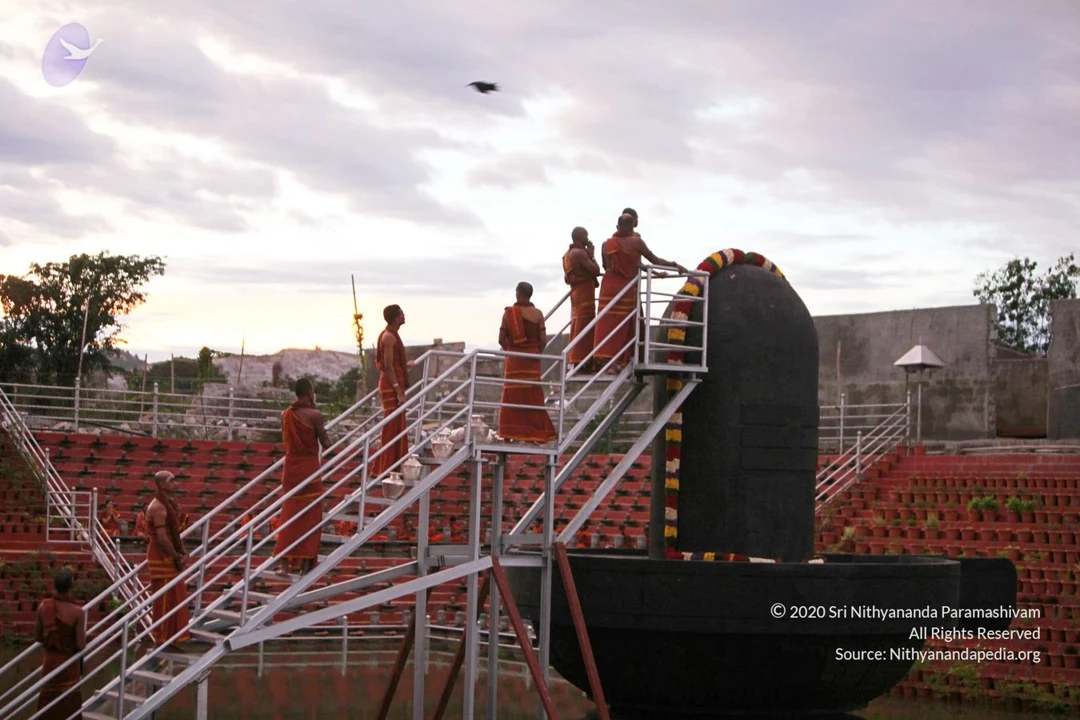
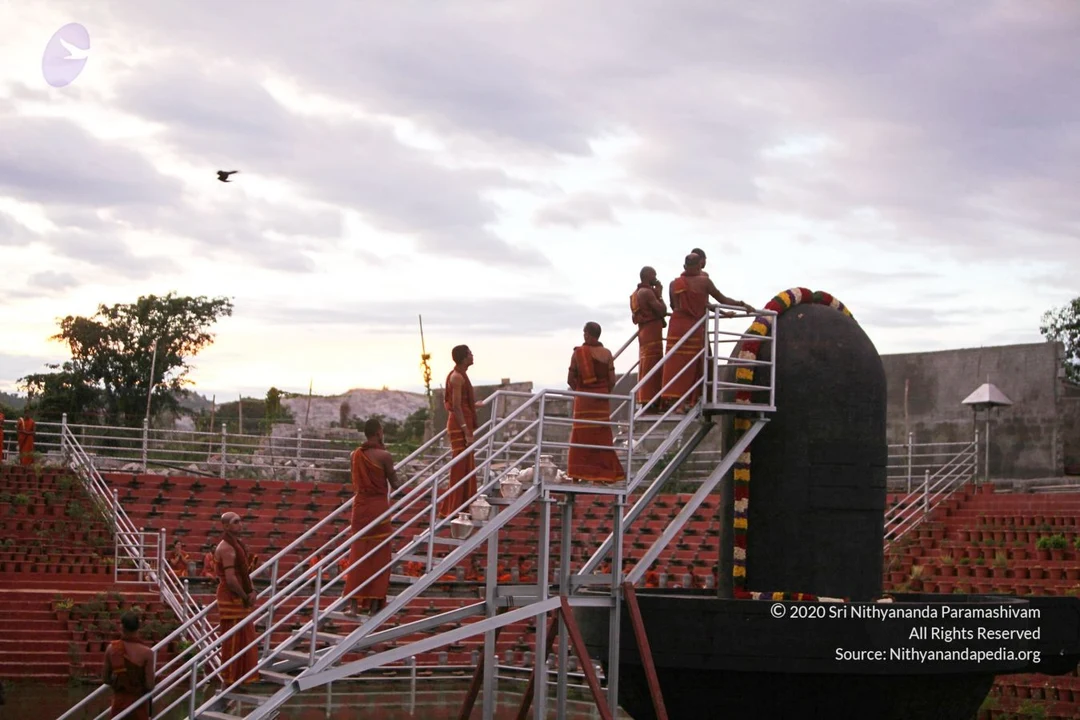
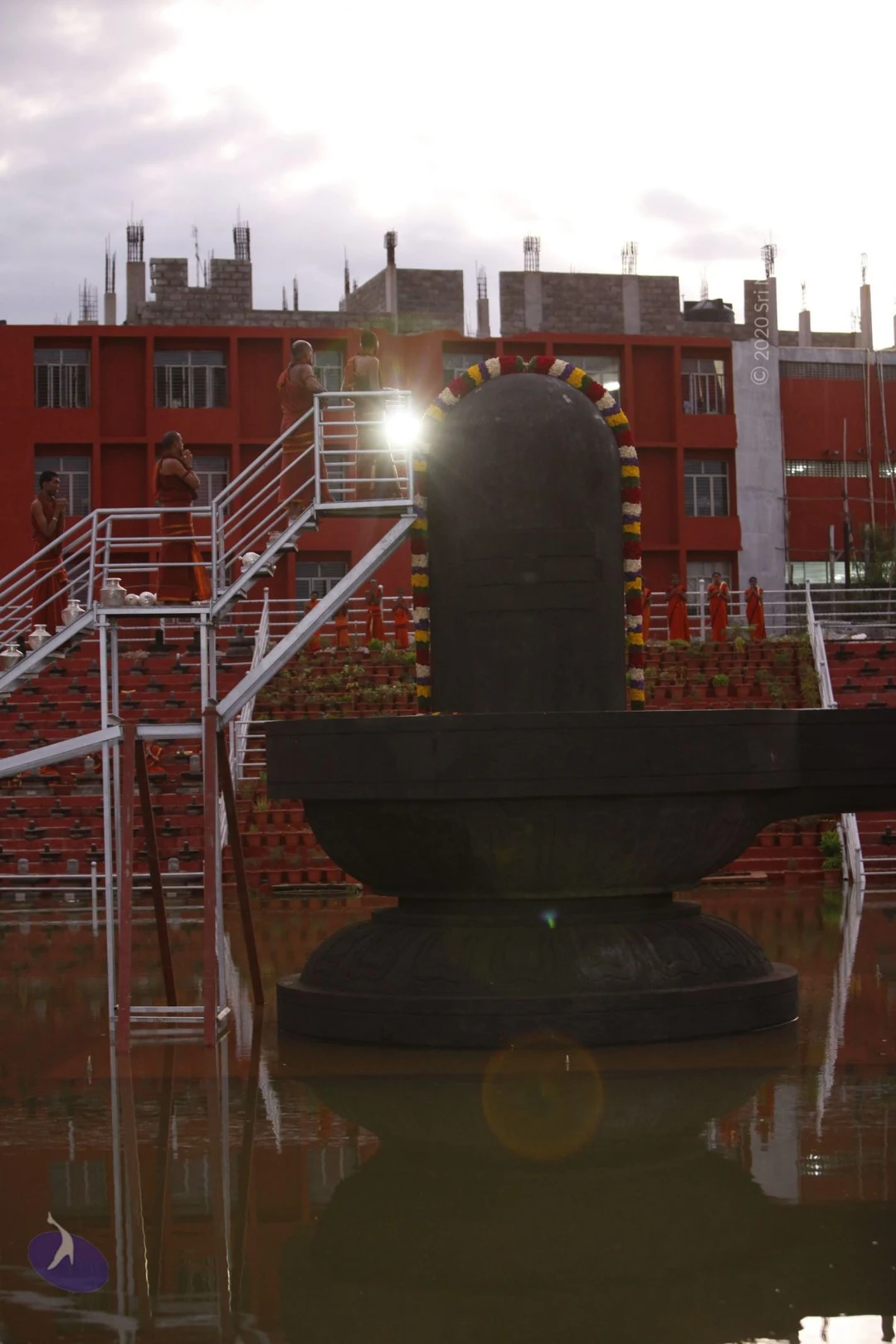
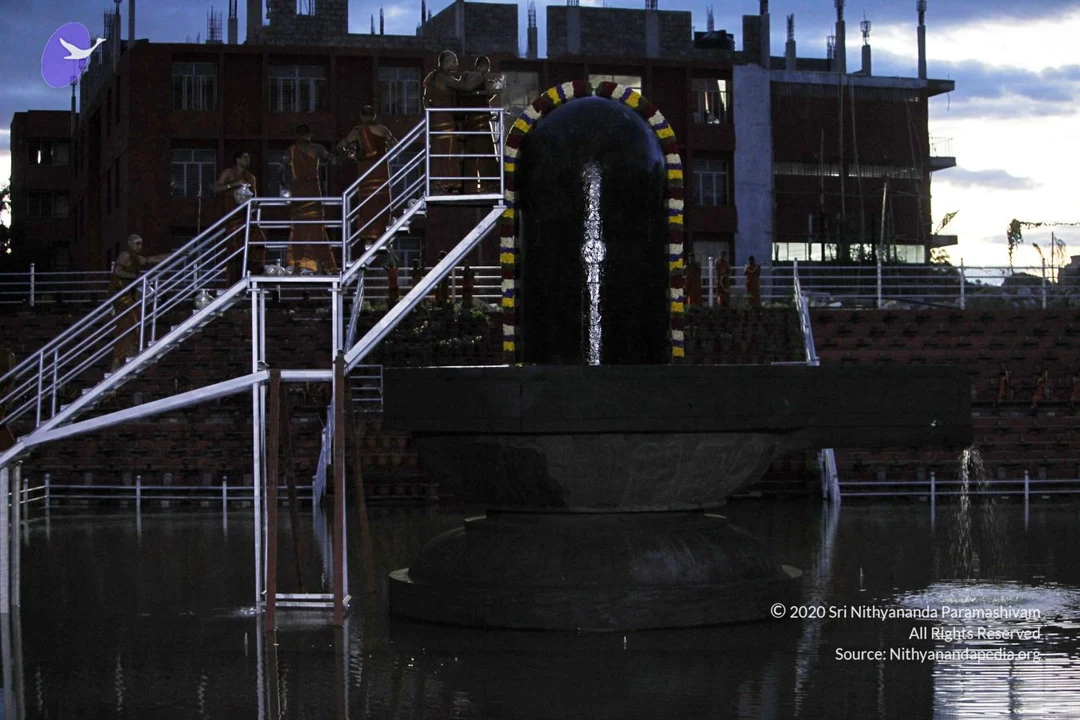
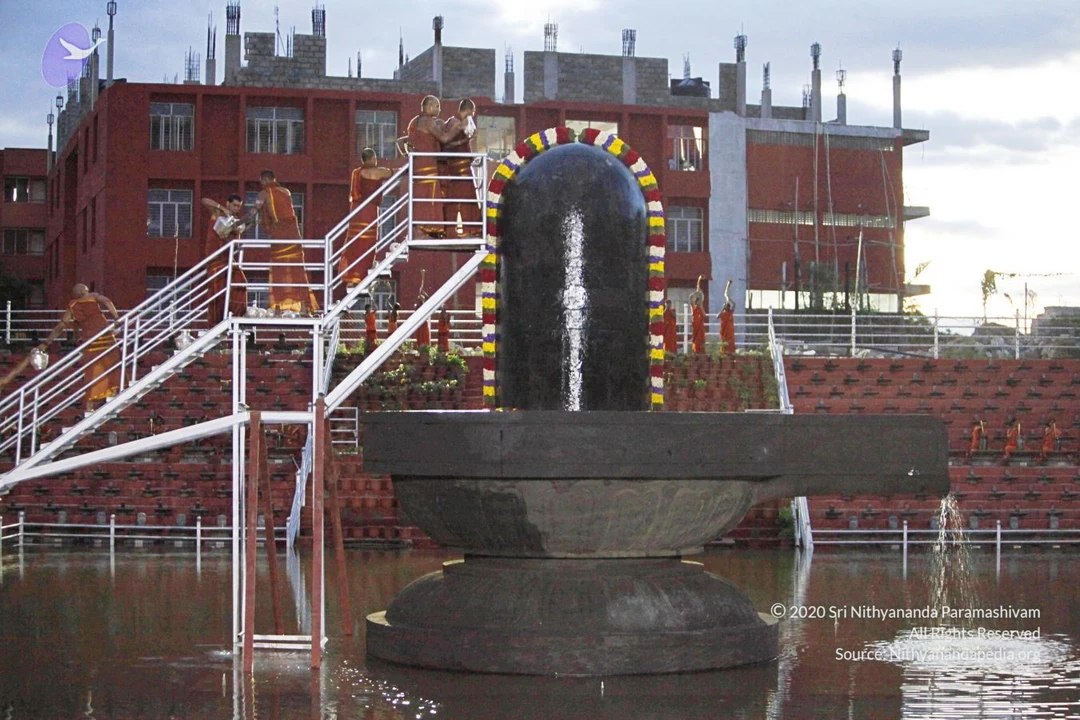
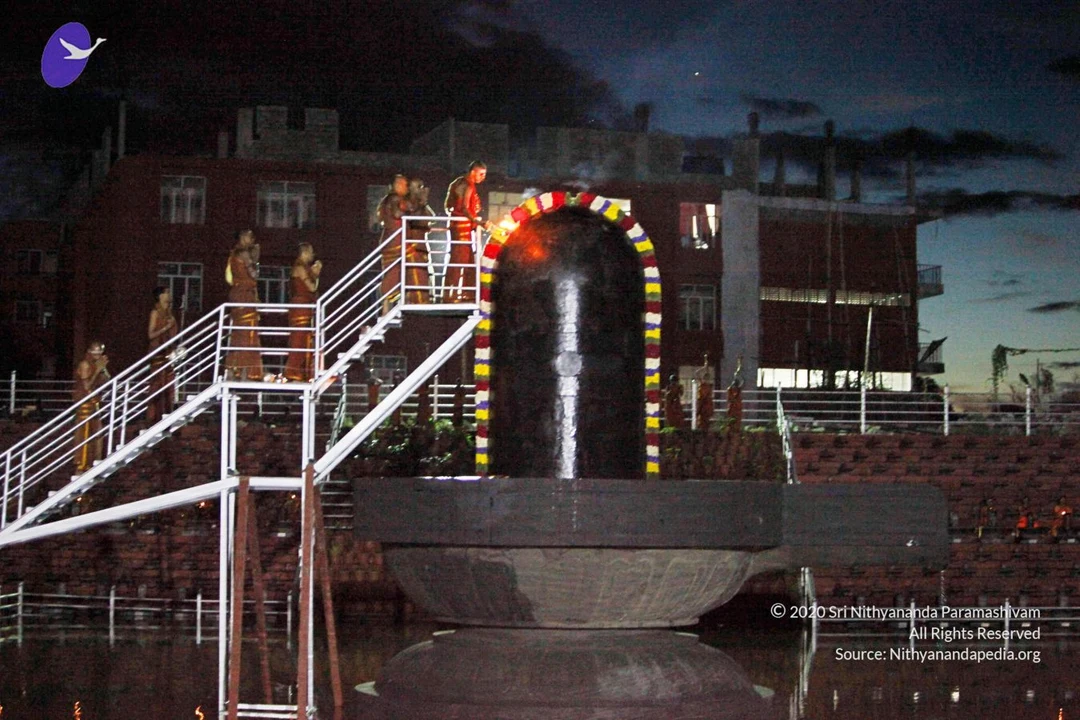
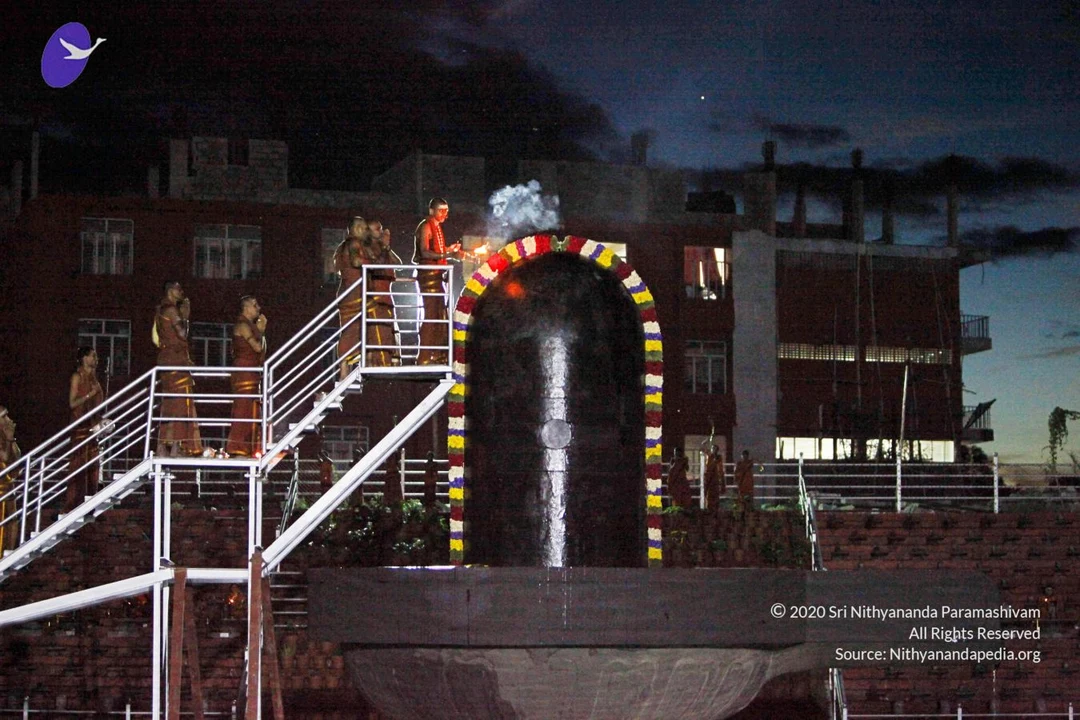
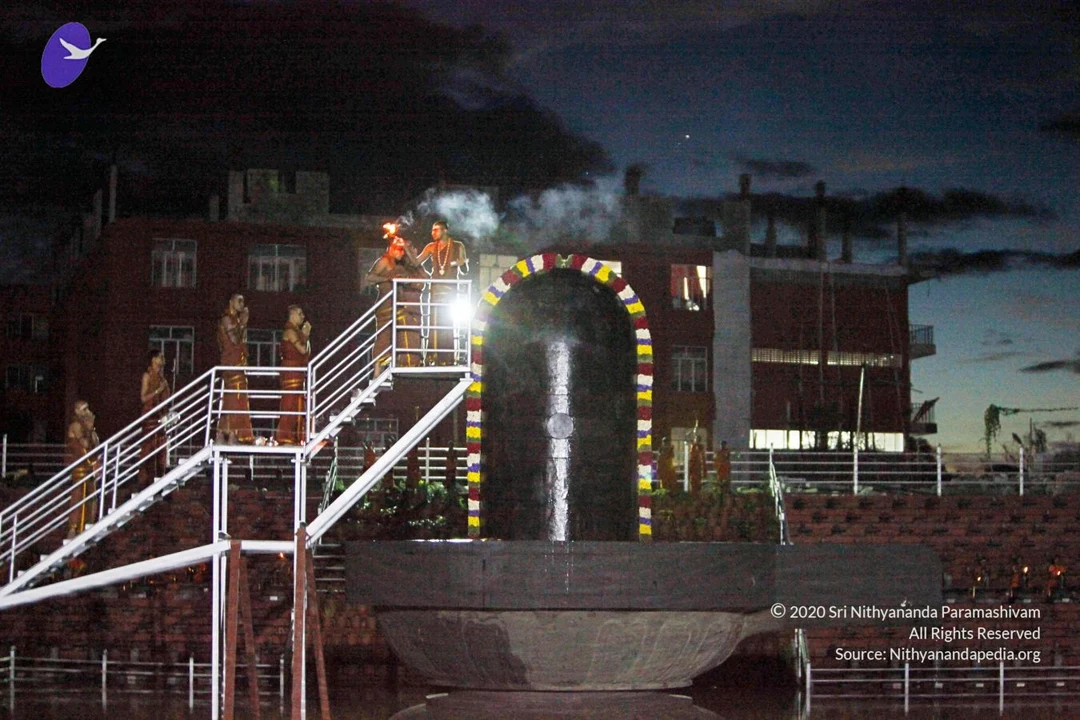
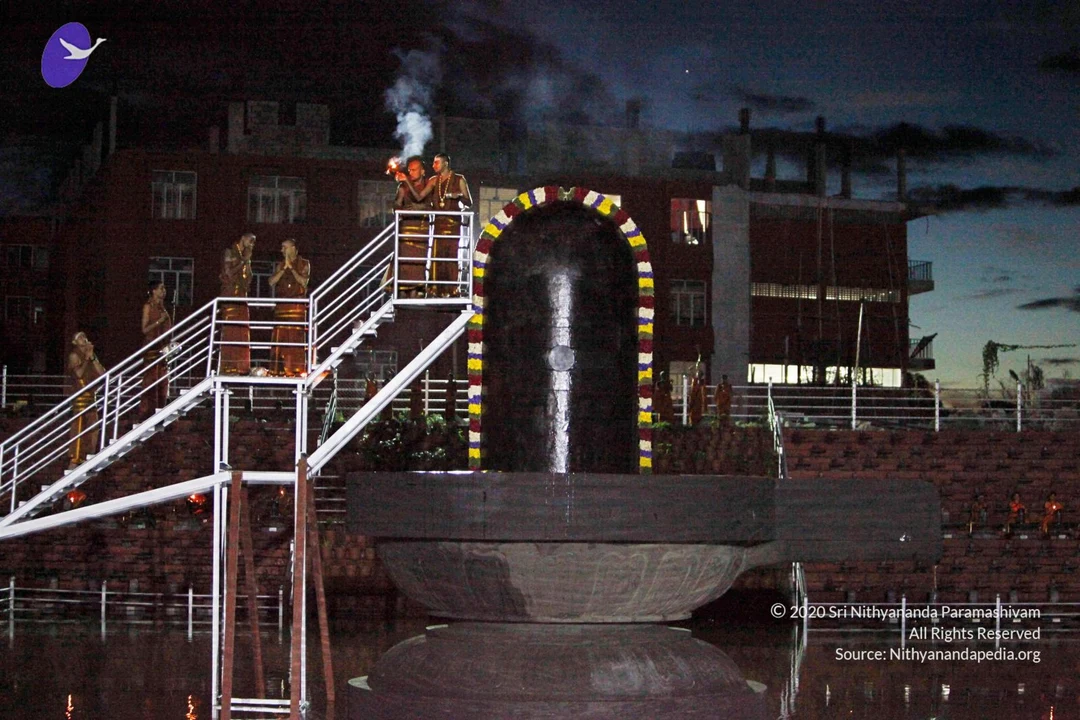
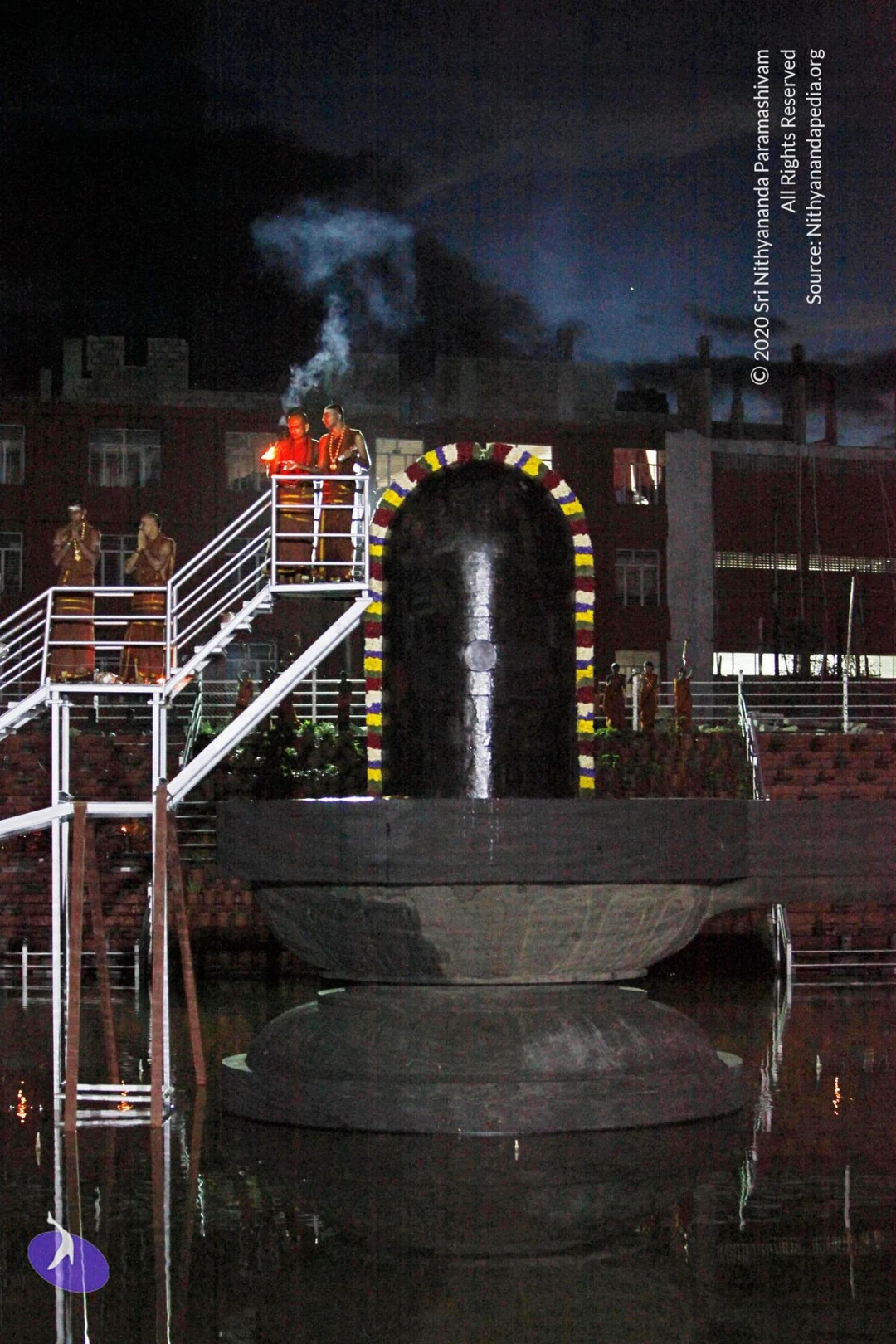
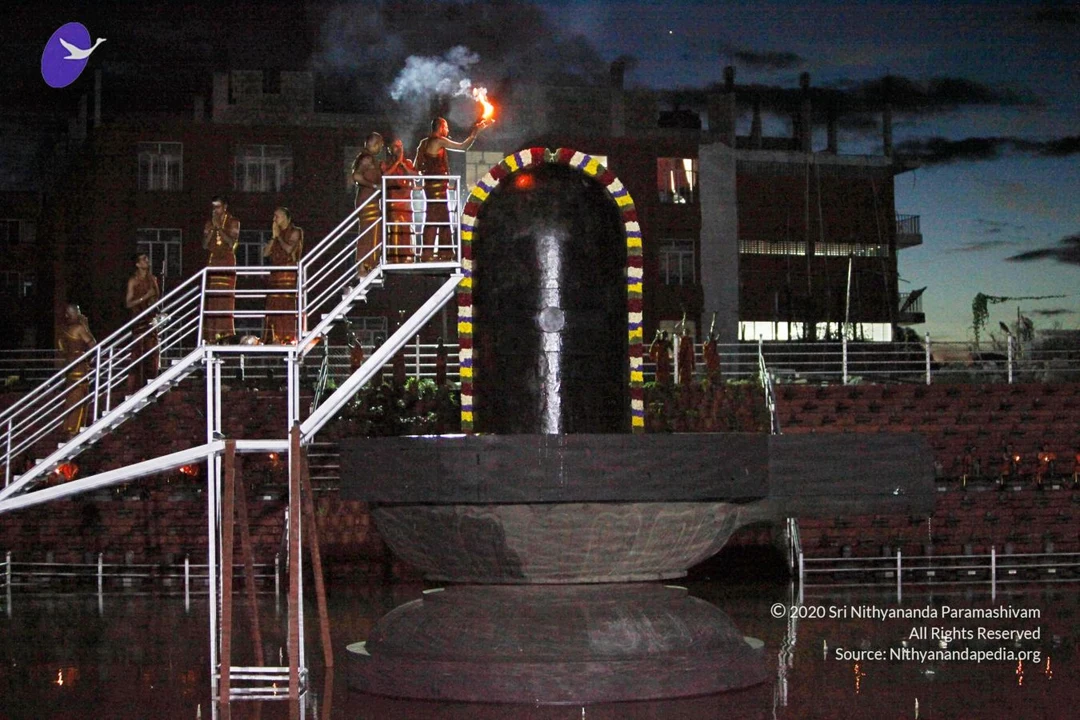
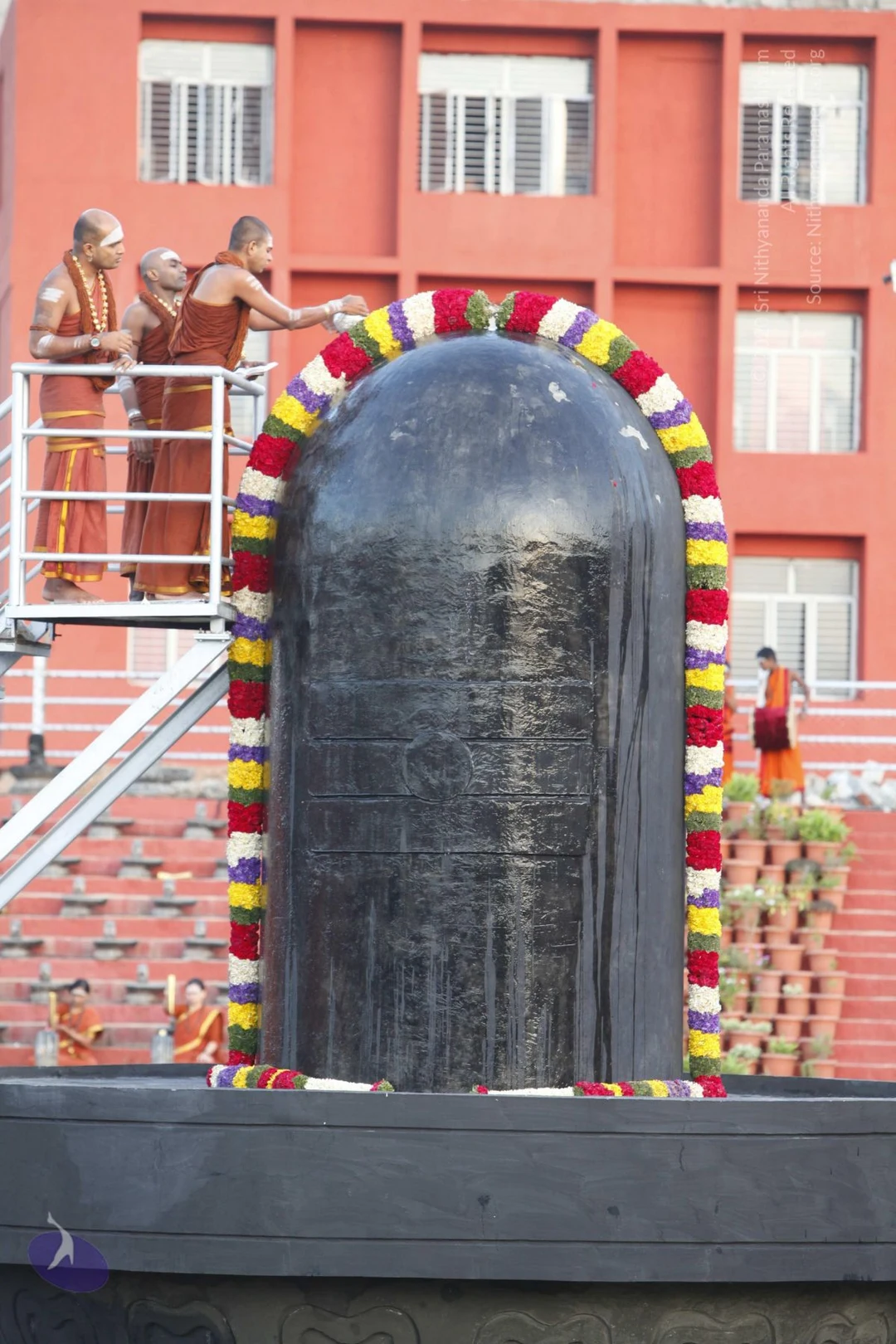
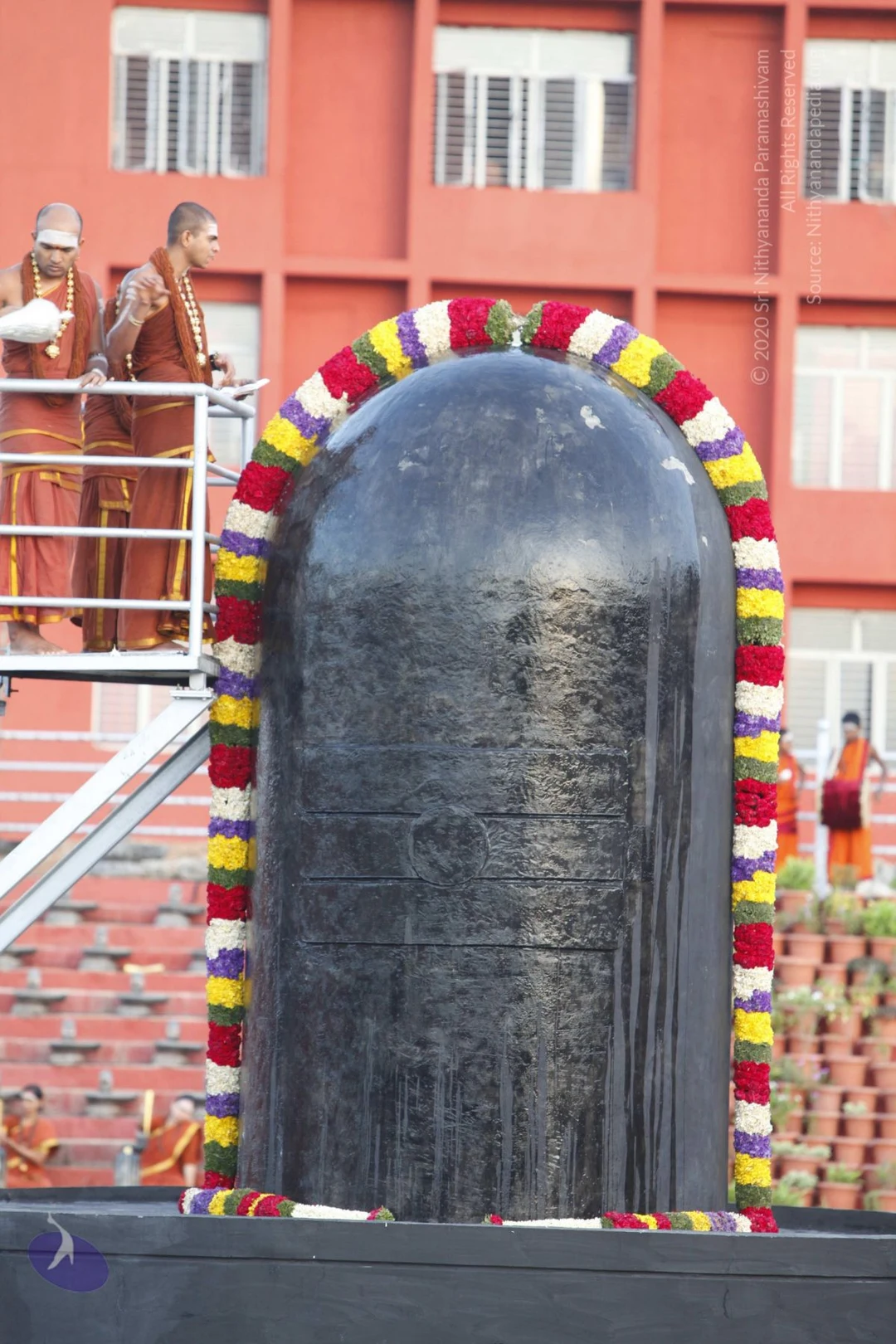
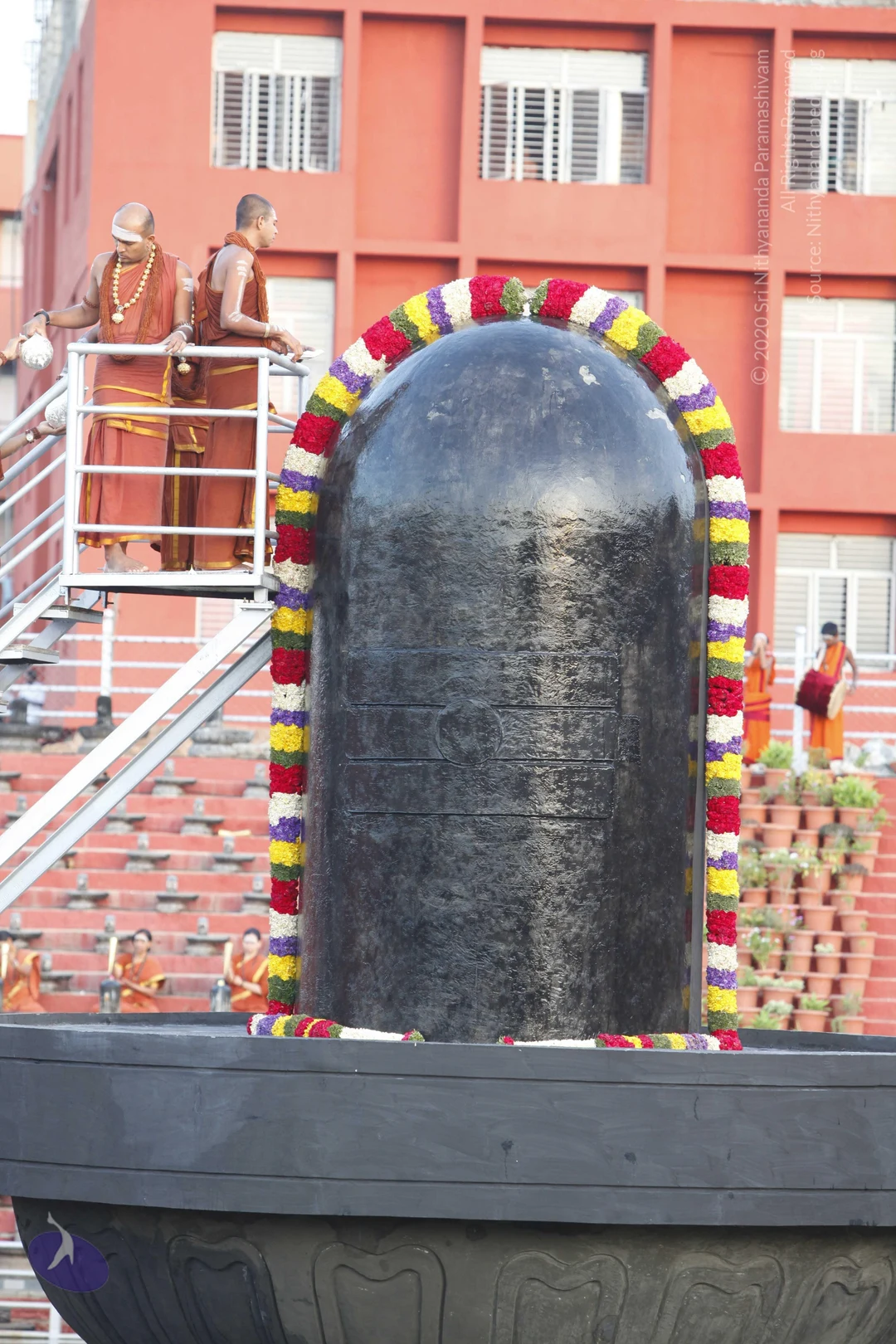
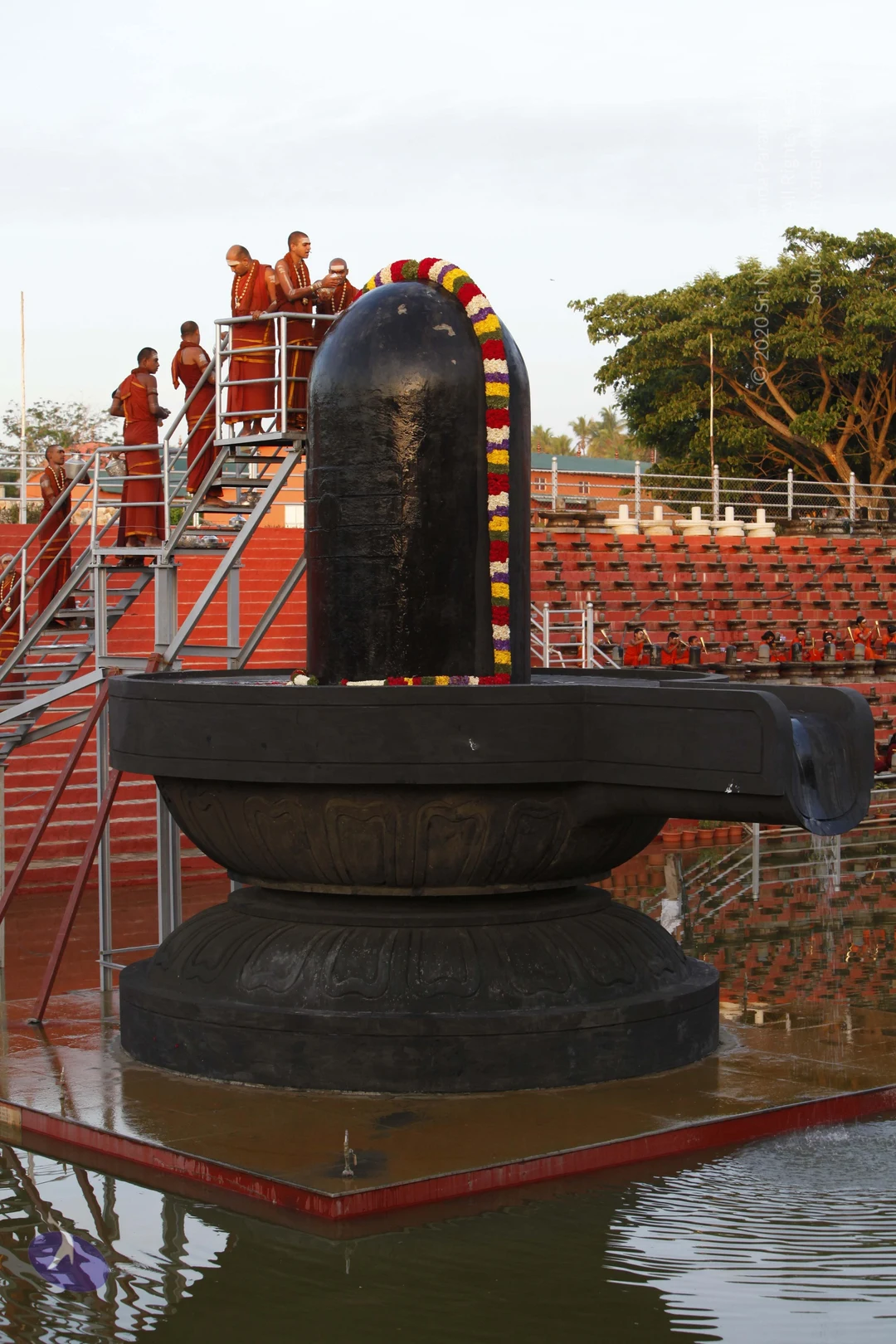
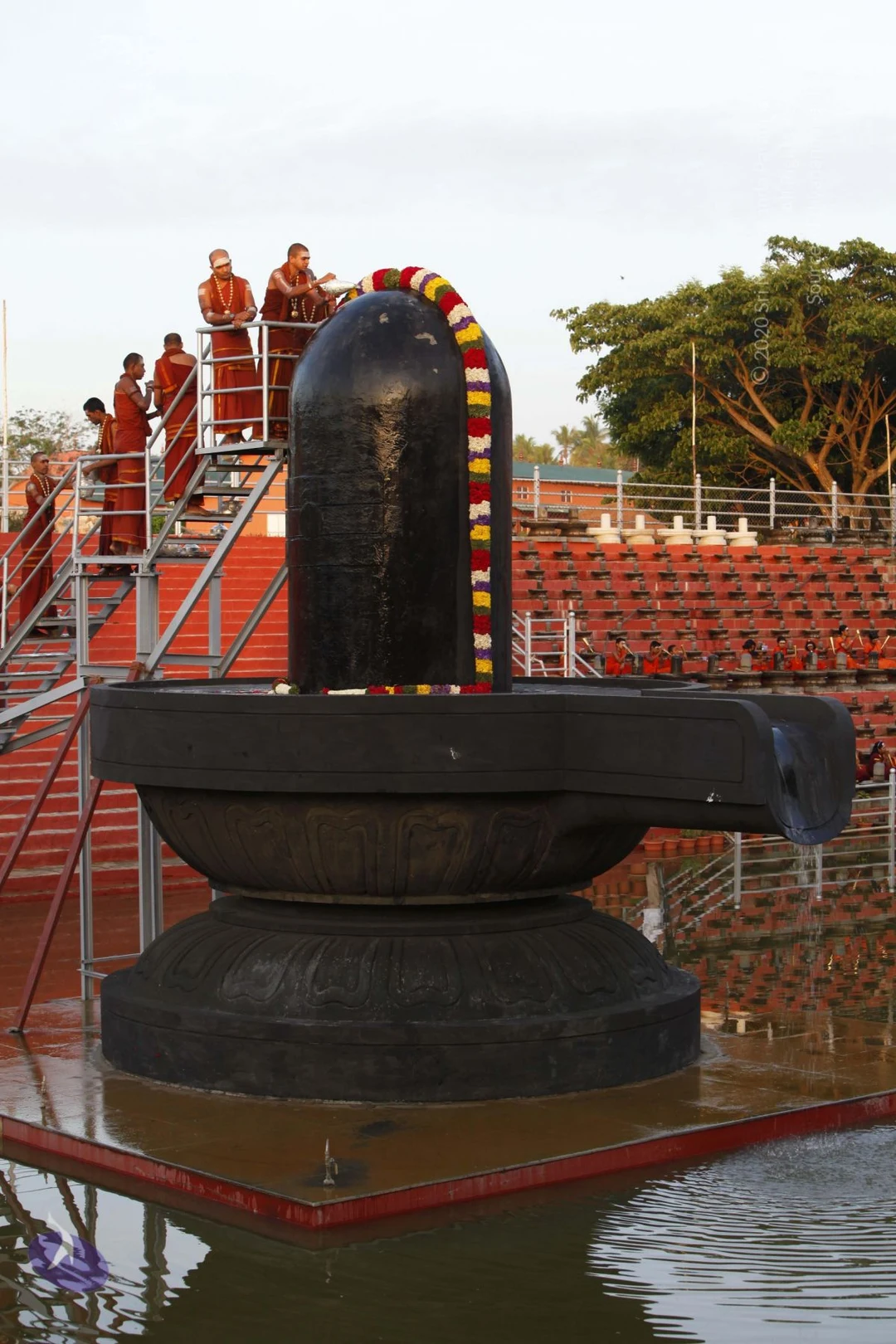
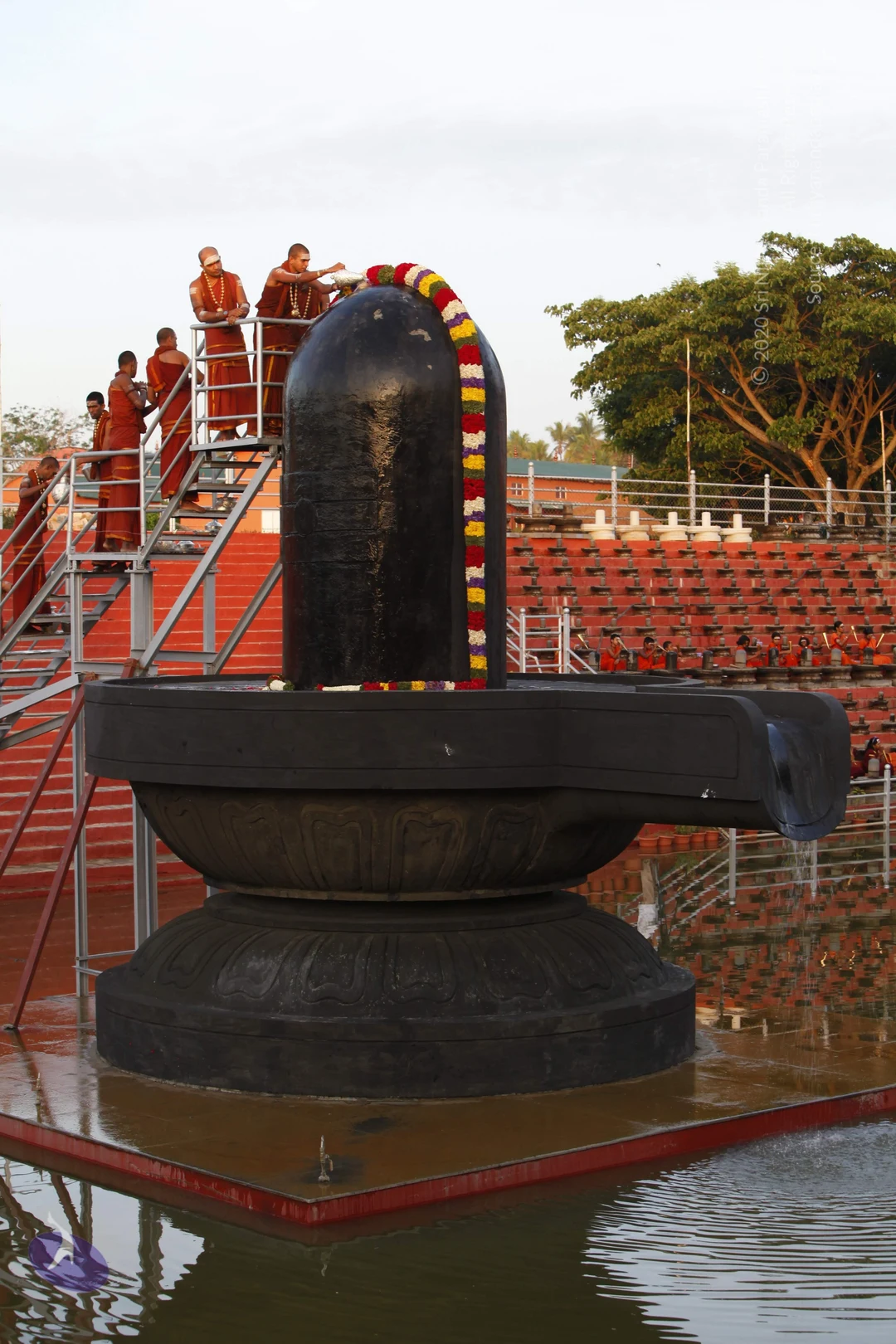
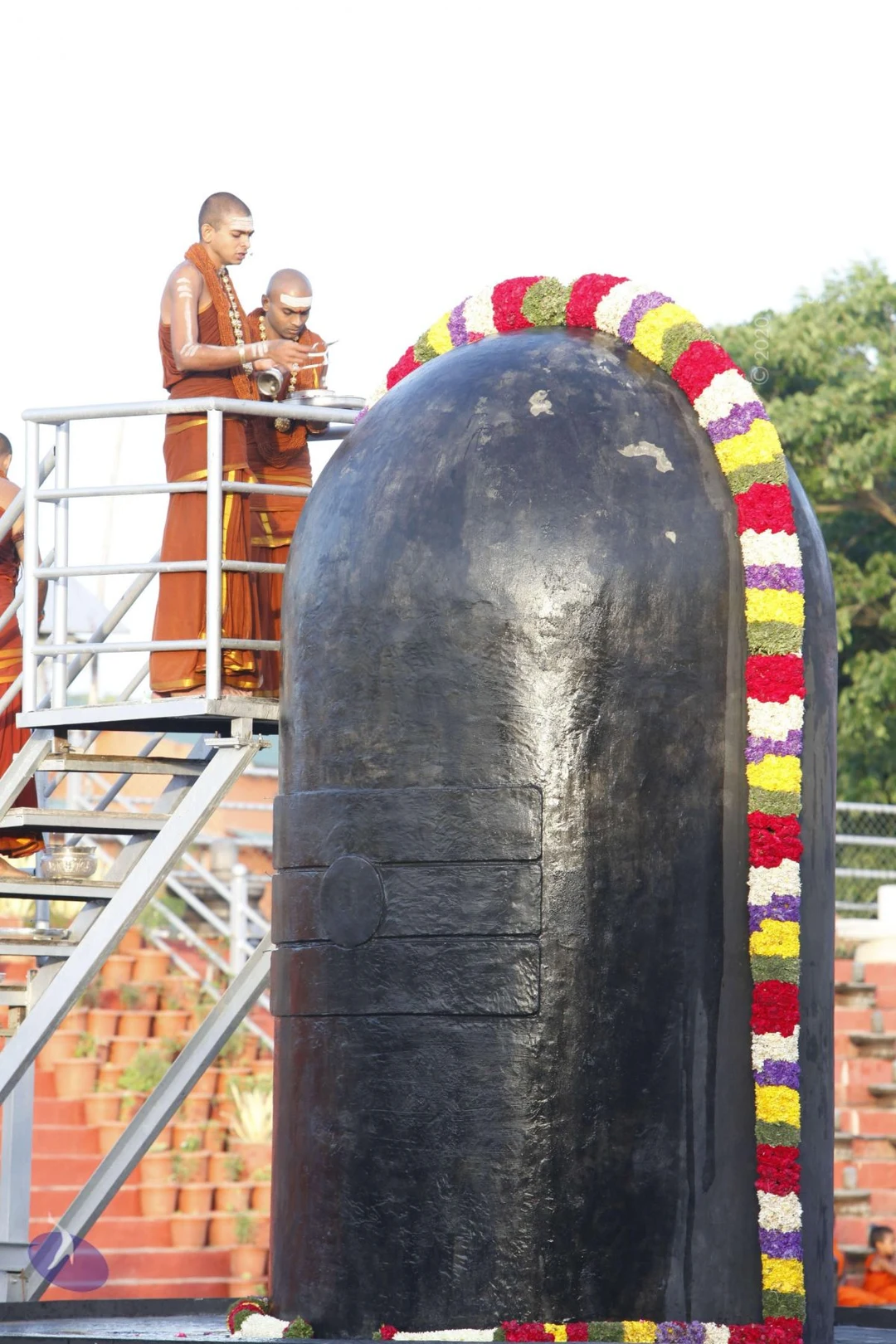
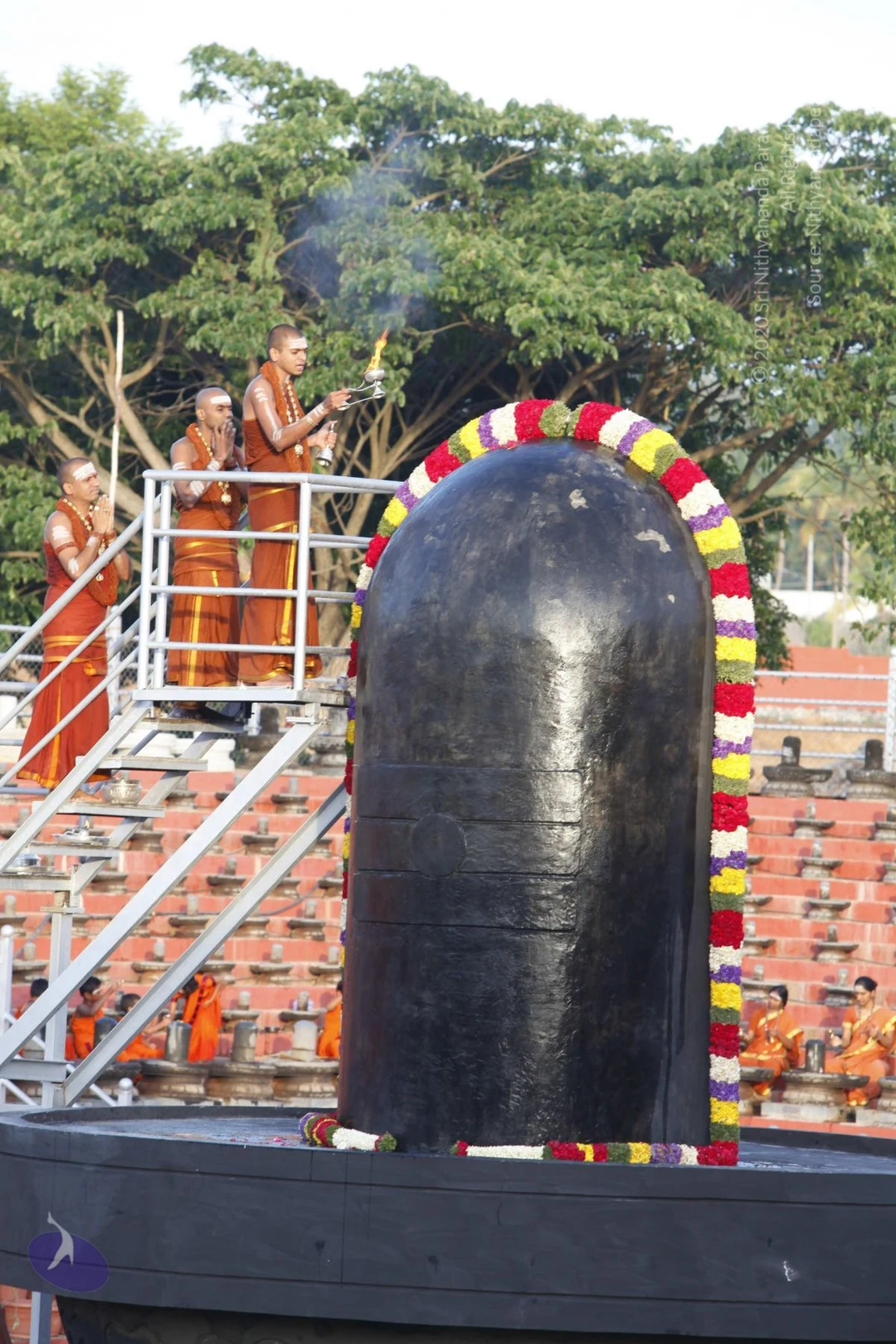
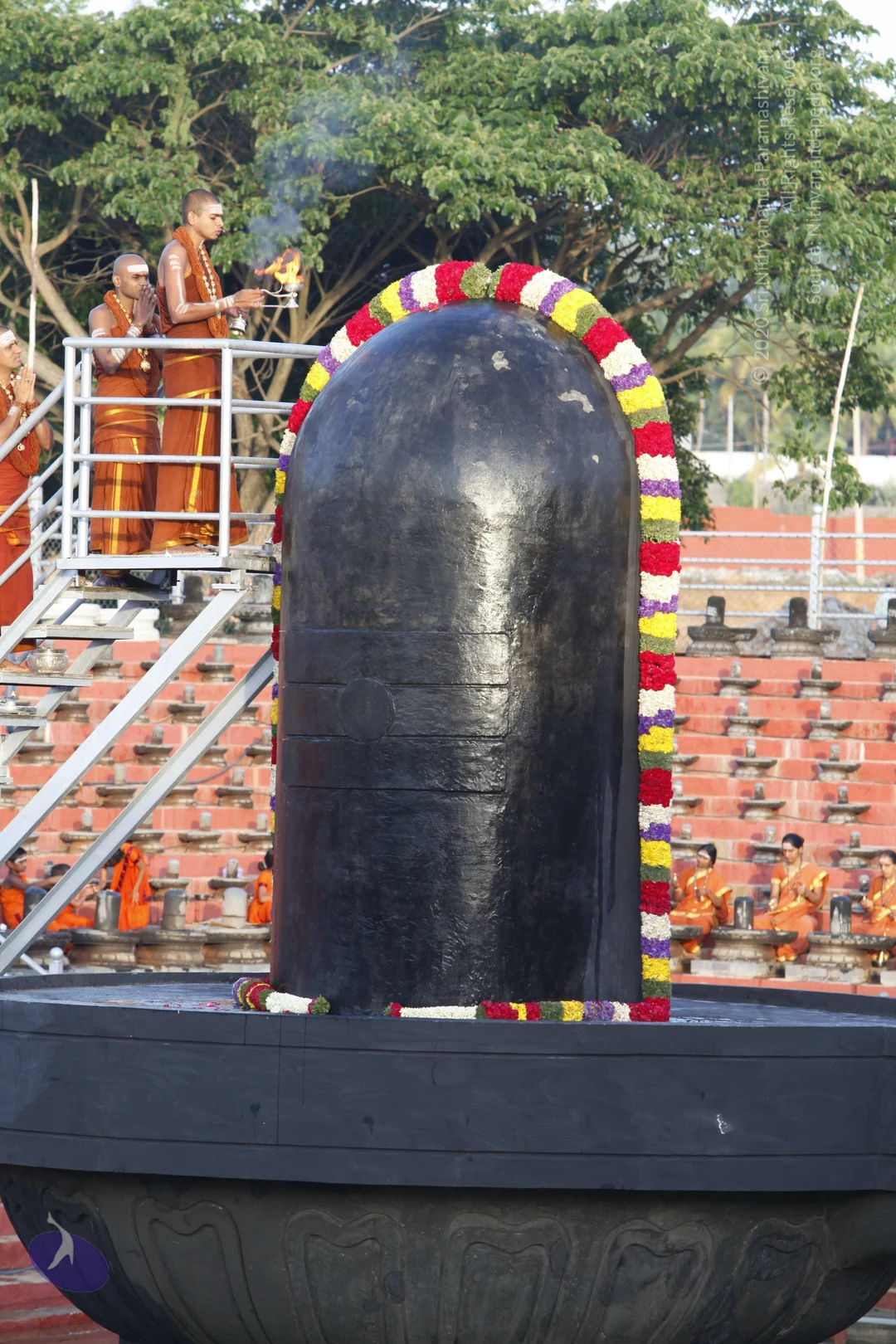
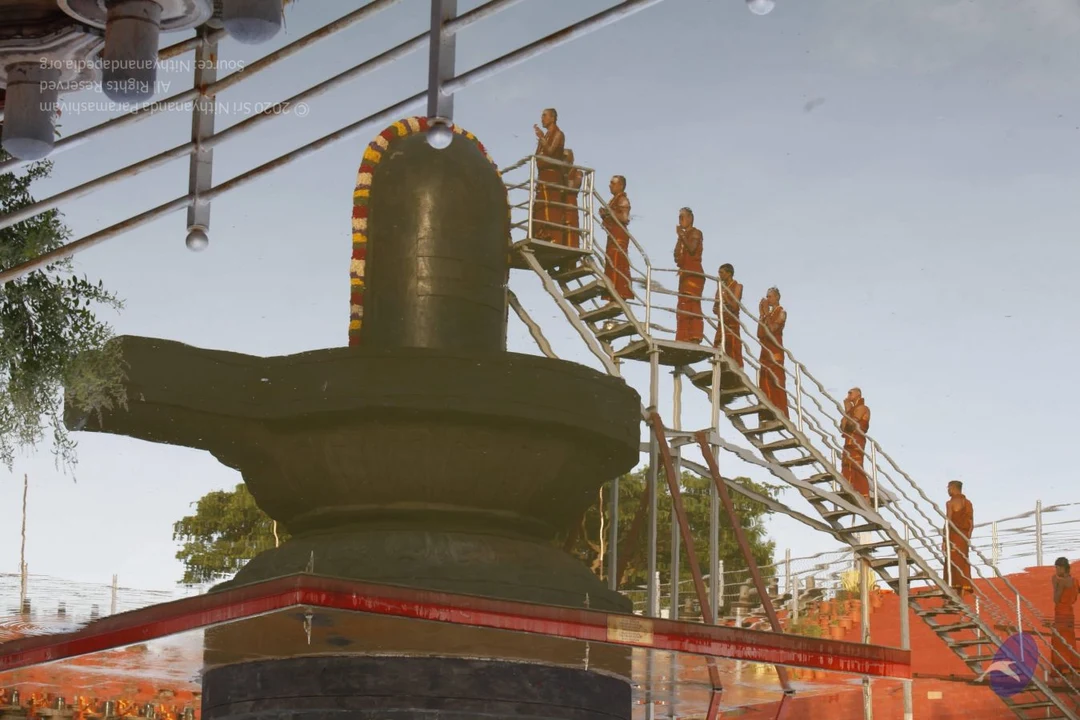
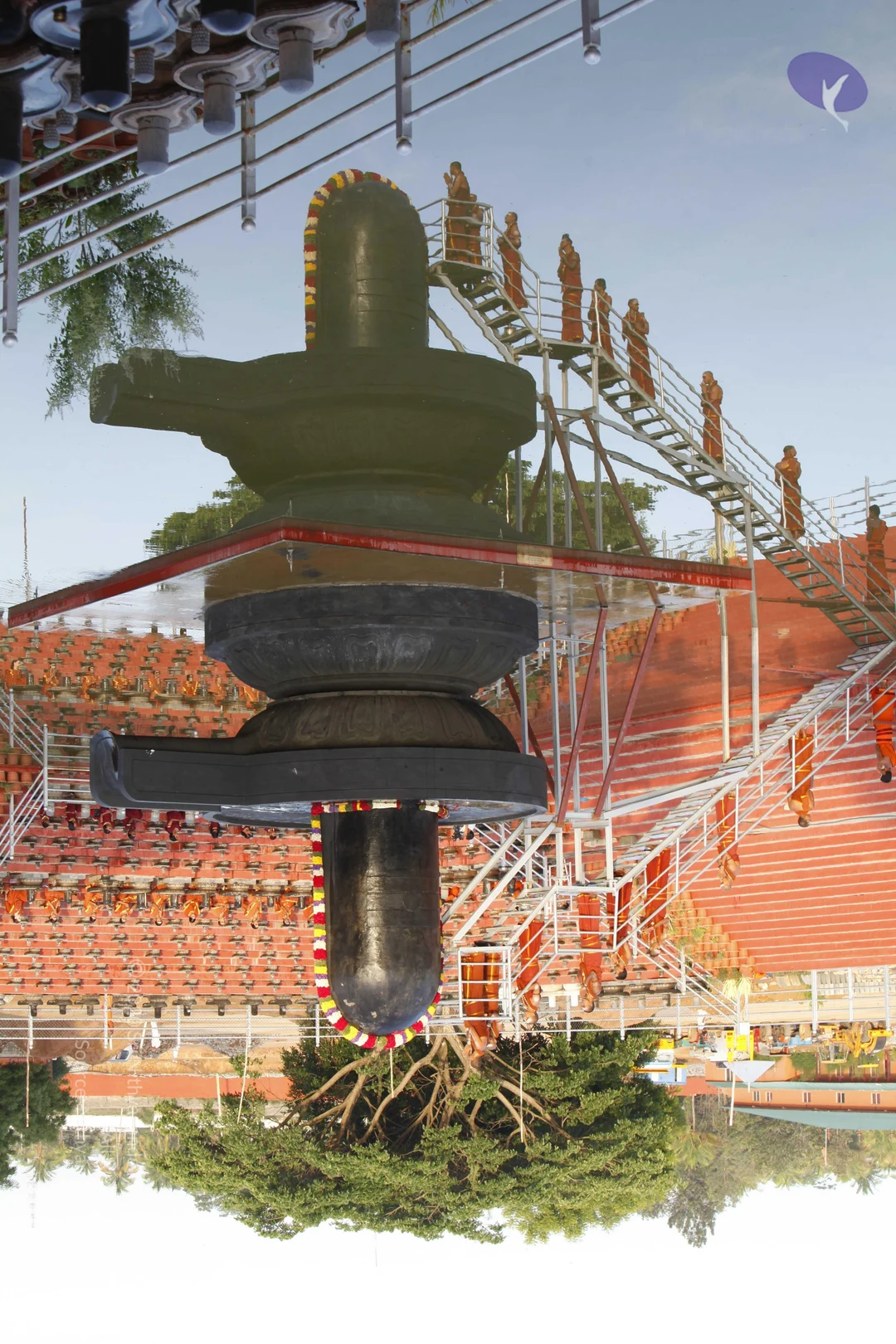
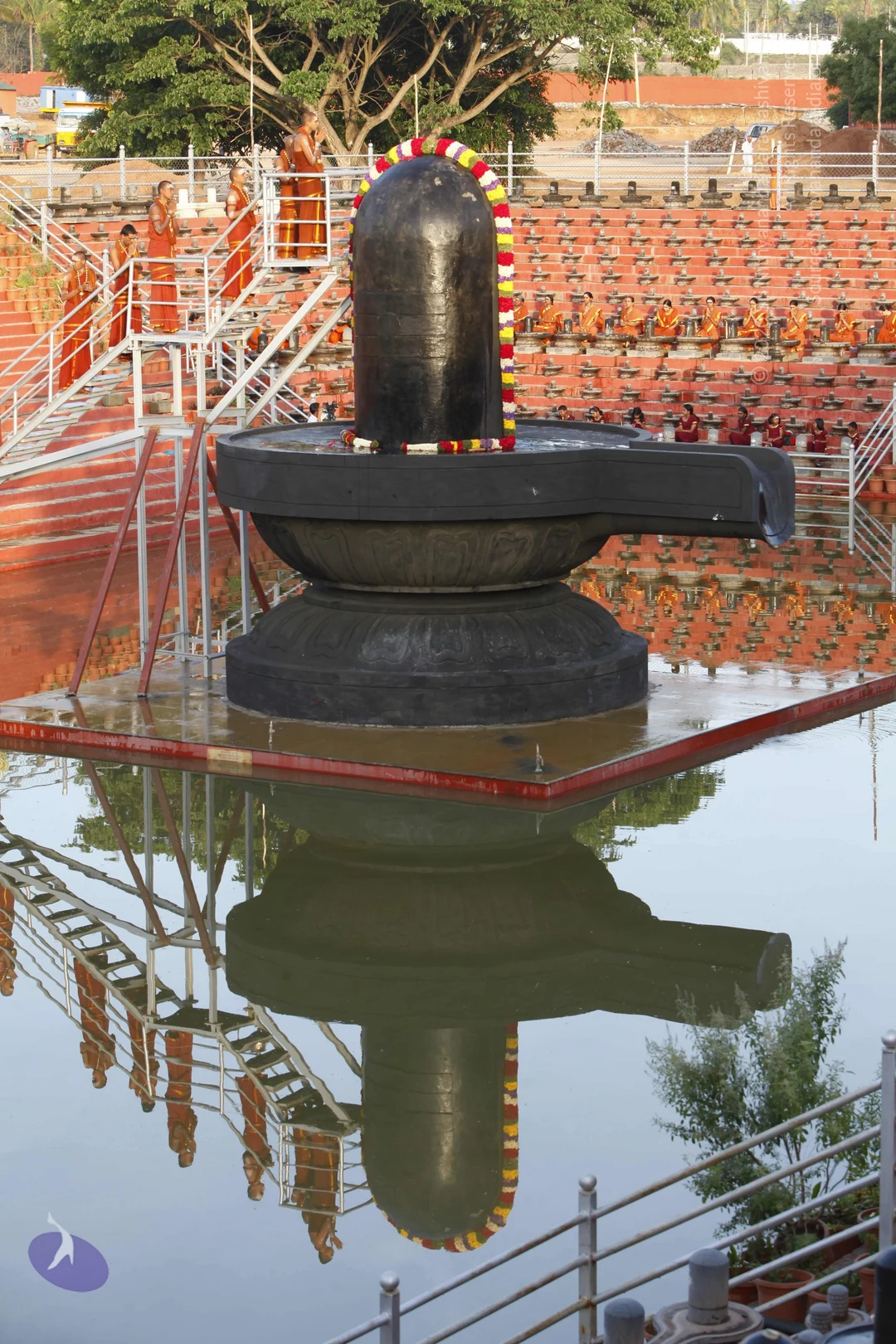
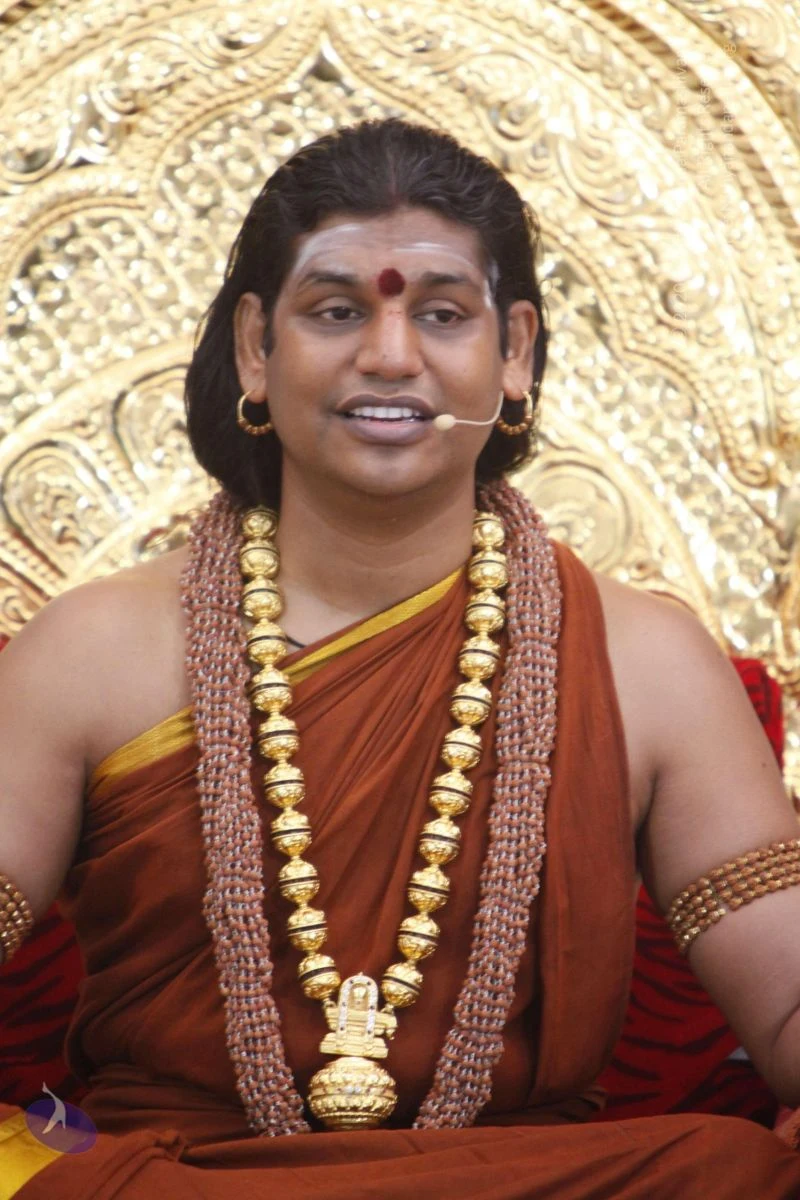
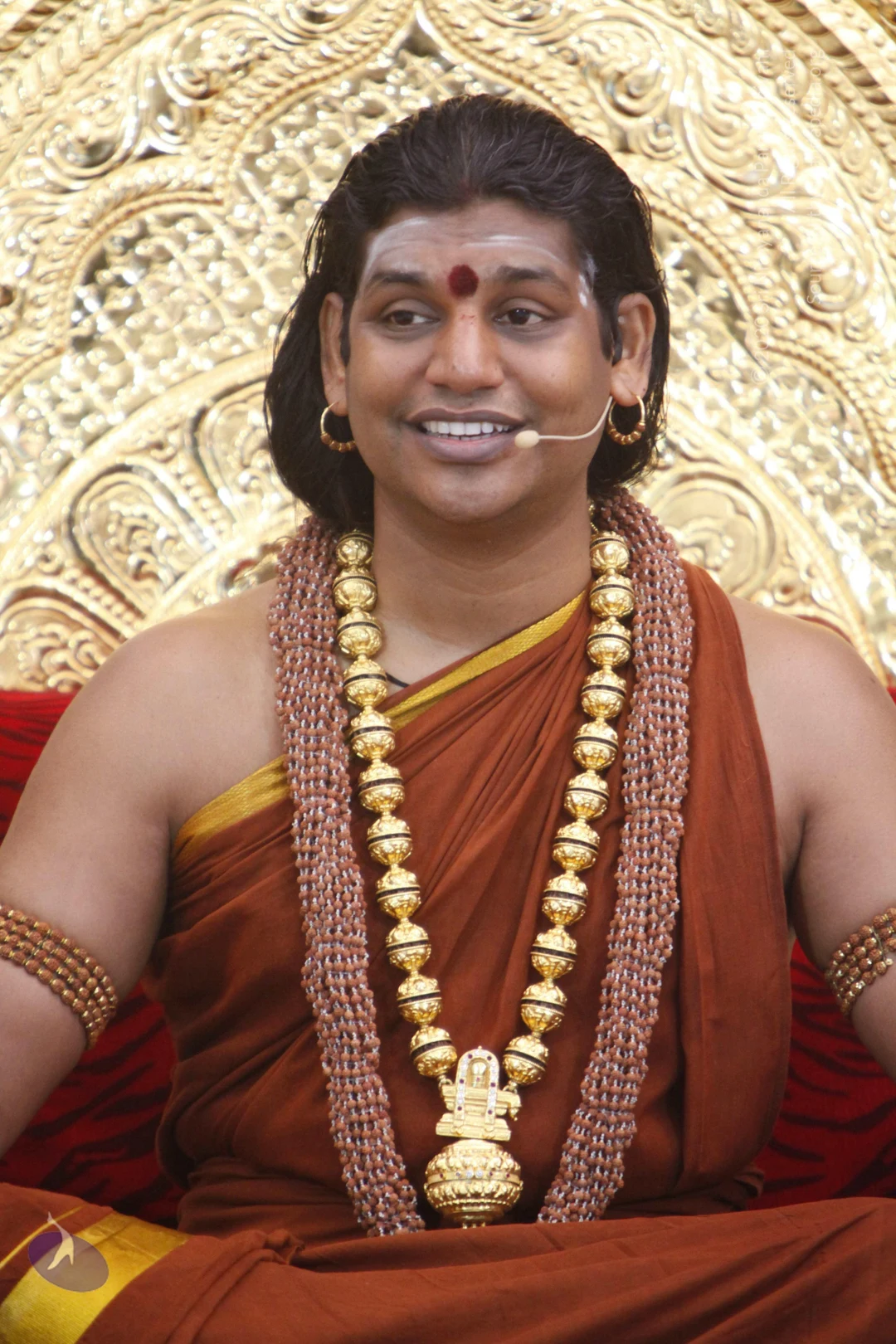
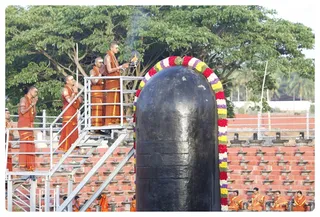
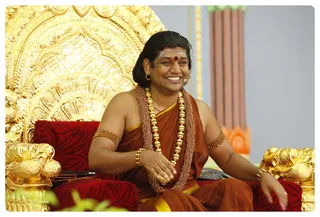
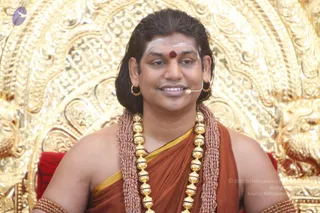
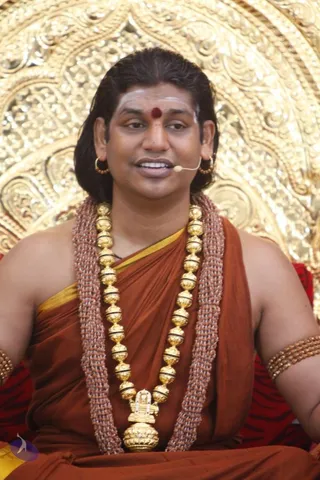
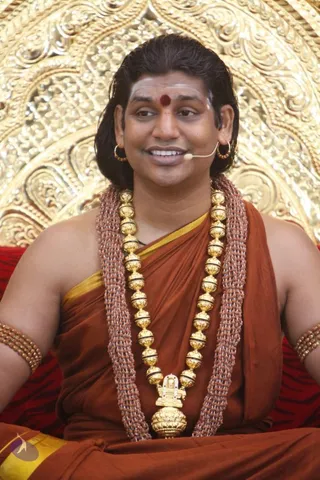
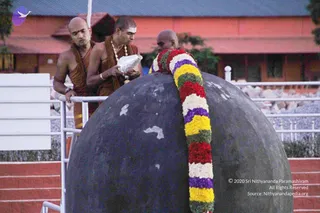
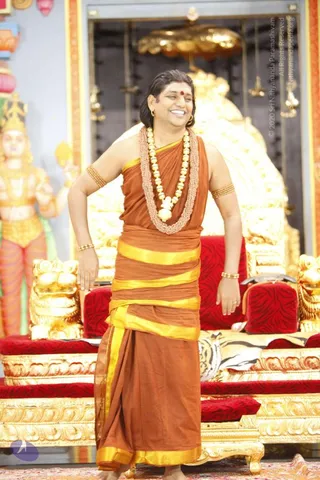
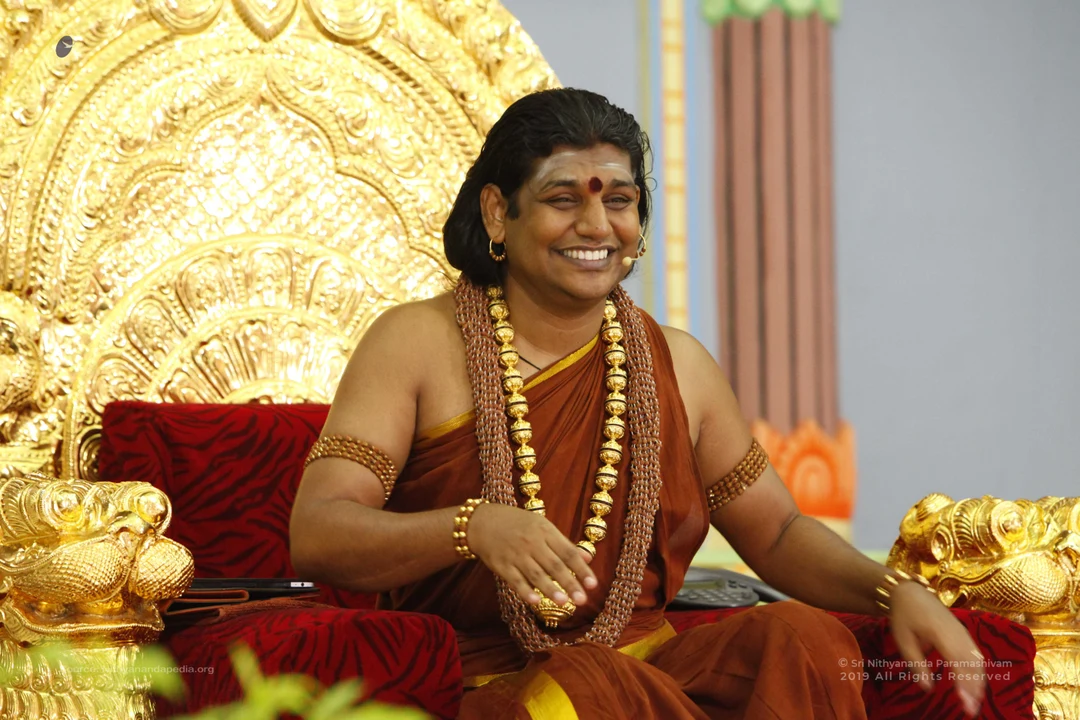
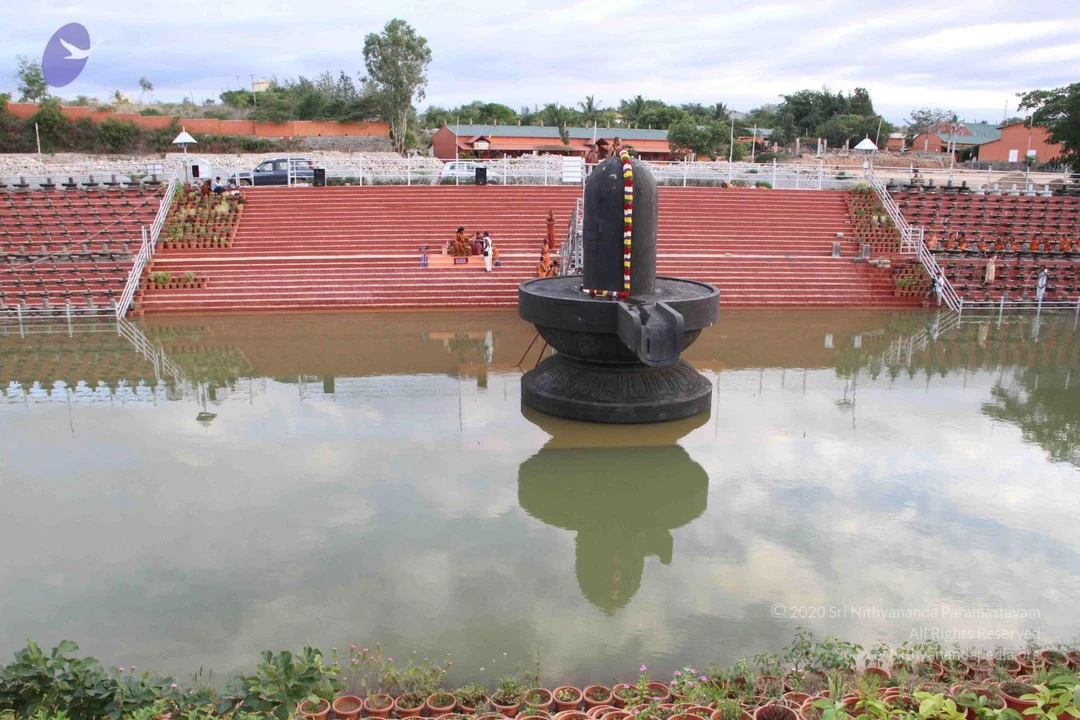
A man seated before an ornate gold-leaf backdrop with carved floral and lion-like relief work. He wears a rust-orange shawl over the shoulder, with a yellow border, and long gold bead necklaces with a braided rudraksha-style mala beneath. Gold armlets are on his upper arms. He has long swept-back hair, white forehead markings and a red bindi, and a small wireless lapel microphone is clipped near his ear. Swamiji (probable): long swept-back hair, saffron-orange shawl, rudraksha mala and ceremonial gold necklaces, seated on a gold throne in a discourse setting.A seated man in saffron-orange dhoti and shawl sits cross-legged with palms pressed together in namaskar and eyes closed, on an ornate golden throne with a red velvet cushion and a tiger-skin rug beneath. He wears a rudraksha mala and a gold necklace, a red tilak on his forehead, and gold armlets. Two large painted deity statues with multiple arms, crowns and gold jewellery flank the throne against a colourful temple backdrop with gold lamps hanging above. a person: the seated figure wears saffron clothing, rudraksha malas and a gold necklace on a golden peetha. Setting suggests a satsang or darshan hall.Dusk photograph of a large black stone Shiva lingam set on a raised square base, encircled by a colourful garland arch of yellow, red, blue and white flowers. Behind it, a white metal staircase with railings climbs to a raised platform where several robed figures in orange and saffron stand, one in a red-orange robe holding a lit lamp or flame while smoke rises above him. Other saffron-clad devotees stand with hands folded in anjali along the stairs, and a brick building with lit windows forms the backdrop. The scene suggests an evening abhishekam or aarti.

June 04 2013

Original wiki page
Contents

Description:

In today’s morning satsang, Paramahamsa Nithyananda delivers an exciting directive to his followers: to be spiritual activists. The core message of Vedic tradition is spiritual knowledge, represented in the Four Life Principles of integrity, authenticity, responsibility and enriching others. It is time for all those inspired by Nithyananda to share this divine wisdom with the world. Spirituality is the key to healing for Planet Earth: there is no need to wait for formal teacher training. We can share our understanding with everyone informally wherever we are. This is jeevan mukti, living enlightenment.

Link to Video:

VideoAudio

Transcript:

(00:19)

|| nithyānandeśvara samārambhām nithyānandeśvari madhyamām | asmat ācārya paryantām vande guru paramparām ||

I welcome you all with My love and respects. is samay hamare saath upastith sabhi darshakon aur bhakton ka mein prem evam ashirvad sahith swagath kartha hun.

(01:08)

Today I will expand on the subject of ‘ACTIVISM IN SPIRITUAL PRACTICE’. Please understand. World has seen enough of different types of activisms: Economical activism, industrial activism, religious activism, ideological activism. Communism is nothing but ideological activism. When they take up that ideology they become so active. Same way, Christianity and Islam; when they take up that ideology they become so active. Capitalism is a economical activism. When they start seeing the money, the money drives them crazy. They might have started with their business with ten crore; now they will be making ten-thousand crore per year turnover. But still they go crazy - Economical activism. There are many types of activism. I tell you, Vedic tradition, Hindu tradition stands for spiritual activism. When you are inspired, impressed by the Vedic tradition, what actually happens - you turn into a spiritual activist. You turn inside towards your depth, towards the being - the spiritual activism. Today, I wanted to expand about this spiritual activism. We were brainstorming for last few days. All My sannyasis, we were trying to create a think-tank for Hinduism, what is exactly the unique point, unique contribution of Hinduism. After a thorough research, I am very clear, this is the unique contribution. Spiritual knowledge, spirituality, spiritual knowledge, spiritual experience, spiritual strength; I think spirituality is the core message of Hinduism, the Vedic tradition. The spiritual activism which makes you internalize these principles, makes you go round and share with the world these great principles. Understand, it is spiritual activism that is the essence of life.

(HINDI) aaj mein adhyatmik abhyas mein sakriyata ke barein mein baat karoonga. vishwa mein anek tarah ki sakriyata dekhi hain. arthik sakriyata jaise …6:02.... dharmik sakriyata jaise christa dharma aur islam dharma, vaicharik sakriyata jaise ….6:13... vaidic sampradaye adhyatmik sakriyata hain. I tell you, Hindu dharma adhyatmik sakriyata ka prateek jain. Hindu vaidic dharma ka mukhya sandesh adhyatmik gyan adhyatmik anubhooti adhyatmikta hain.

(06:44)

I tell you, Me and My Sangha should be known to the world with this one truth of spirituality, spiritual knowledge and experience. Spirituality should be the truth with which, through which Me and My Sangha should be known to the world, because I stand for Spiritual Activism.

(07:38)

Let Me enter into this concept, the truth, Spiritual Activism. Dhyan se suniye, Listen. Mein adhyatmik sakriyata ka prateek hun. dhyan se suniye. Please move to the space of sitting with completion in listening. Understand, sitting in completion with listening is Upanishad. Sitting in completion in the space of listening is Upanishad. So, please move to the space of Upanishad.

(HINDI) poornatva stithi mein sunna upanishad hain. krupaya upanishad ke stithi mein swayam ko laayiye. adhyatmik sakriyata hi aap ko poore vishwa ke saath in mahaan satyon ko baatne ke liye prerith katha hain.

(09:38)

Listen! Sit in Upanishad, in the space of listening, in completion. When you are in completion, you can sit even facing wall for twelve years... which Bodhidharma did! He was facing the wall of the cave sitting twelve years; because he was in completion. When you are in incompletion, even watching a movie, TV, you can’t sit more than ten minutes; you go on changing channels. Sit in Upanishad space, pure listening space to internalize Spiritual Activism.

(10:46)

First law, in any field when you become active, you reach the peak result of that field. The peak of that field is achieved. If you become economically active, you get money. You become politically active, you get power. If you are religiously active, you become religious leader. Please listen, every human being is always active in some field. If you say, ‘No, no, Swamiji, I don’t think I am active in any field because I have not achieved anything.’ You are active in confusionism. Getting caught in your conflicts, contradictions, confusions, you are active. That’s all. But there is nobody who is not active.

(12:01)

I tell you, consciously diverting your energy which is active is Spiritual Activism. Whatever may be the field, if you are active, you will reach the peak of it. I tell you, if you become spiritually active, you reach the peak of all the fields; whether it is money, energy, intelligence, you become active in everything. Spiritual Activism means, continuously, tirelessly enriching you and enriching everyone around you. Sometime I feel this Mala, means Rudraksha, this Tilak - Kumkum, all this not only enriches you, it enriches even the people who see! When they see, they ask you, ‘What is this, this necklace around your neck?’ Then immediately introduction starts. ‘This is energized by my spiritual master, my Guru.’ Nowadays the whole world knows the word ‘Guru’. Guru has become English word. So, the enriching starts. I tell you, become a Spiritual Activist. I tell you, you will have a new life! Go round, continuously talk to people, enrich them, help them to solve their conflicts, find solution from conflicts.

(HINDI) pehli baat yeh hai ki koi bhi kshetra mein jab aap sakriya banenge aap us kshetra mein sarvocha parinaam paayenge. jab adhyatmikta mein sakriya honge tab aap har kshetra mein sarvoccha parinam paayenge chaahe vah dhan sampath ho ya vishwa ko laabhanvith karna. adhyatmik sakriyata vishwa ko laabhanvith karne se aarambh hota hai. har vyakti lagathaar kisi bhi kshetra mein sakriya hota hai. aisa koi bhi vyakti nahi hai jo sakriya nahi hain. sachet roop se aap apni urja ko disha dena hi adhyatmik sakriyatha hain. yadi aap adhyatmik roop se sakriya hain toh aap jeevan ke sabhi kshetra mein sakriya ho jaate hain. adhyatmik sakriyata ka arth hai lagathaar ...16:30… swayam ko aur doosron ko laabhanvith karna

(16:35)

I wanted each one of My disciple to be Spiritually Activist. (HINDI) adhyatmik sakriyatavaadi baniye. lagaathar logon ko unke sangharsh ka samaadhan paane mein sahaaytha kijiye. Understand, if you think you are My disciple, you are My follower, you have to be a Spiritual Activist - means, living spiritual truths actively and teaching spiritual truths actively to as many people as possible. So, ‘Spiritual Activism’.... that’s a right word I will use for describing Me and My people. Spiritual Activist! Continuously, continuously enrich yourself and enrich others with these great spiritual principles. I tell you, most difficult job in the Planet Earth is balancing a teenager. That is the most difficult job in the Planet Earth. You can do anything other than balancing a teenager; because the body is going through a great transformation. A child is becoming adult; that is the age, between 13 and 19, a child is becoming adult. The best way to balance a teenager’s energy is help them to be Spiritual Activists. Means, before 13 they should know all the ideas to apply within them. I have seen eN-Genius kids, even if they are confused, they try to find solution only with four tattvas. I have seen, even My Gurukul kids. Running a Gurukul is not a joke and especially with a new ideology. My Gurukul is the only school, hostel, where no actor’s photo or photograph is there. And I can challenge, none of My kids are fan of any actor. (Gurukul kids start blowing conches)! 😃 I think they are so happy about what I said!!!

(20:32)

No, I tell you, the Spiritual Activism means constantly drilling yourself with the spiritual truths and finding solution for any problem with the spiritual truths. And, I tell you, at the age of 13, you should start analyzing, enriching yourself with the spiritual truths and enriching others with the spiritual truths. If you have a teenage kid and you don’t know how to handle the kid, make him a Spiritual Activist. You will be free. You will be liberated. One, the child will do best thing for himself or herself and for others. Whenever you become a Spiritual Activist, all the childhood tendencies in you gets matured and you become adult. Understand, when a child is turning, becoming adult, you should teach the kid to be Spiritual Activist and I want to make one more statement: Only when you become Spiritual Activist, you turn as adult.

(HINDI) mein chahtha hun ki mere har shishya adhyatmik sakriyatavaadi bane. lagaathar swayam ko aur anya logon ko in adhyatmik siddhantho ke saath laabhanvith karke adhyatmik sakriyata ka abhyaas lagaathar apne samasya ka samaadhan adhyatmik shaktiyon se paaye kijiye. 13 se 19 varsh ke beech ke baalak ko saanthulith karna sabse kathin vishay hai. unko saanthulith banaane ka saral maarg hain unhe adhyatmik sakriyata ka gyan dena. kisi bhi prashna ka samaadhaan keval adhyatmik satyon ke dwara hi khojna adhyatmik sakriyata hai.

(23:58)

Understand, Spiritual Activism will help you to be aware of your whole life. There won’t be a single dark corners in your inner space left unattended. Clearing the conflicts, contradictions in you and in others; especially when you help others to clear their conflicts, contradictions through the spiritual strength, you will have so much of clarity in you. I tell you, constantly help others to resolve their conflict. You can help others only if you listen to others, not just by talking, talking, talking. Helping others starts by listening. It is by listening, helping starts. When you really listen, you will radiate so much of humbleness, you will help so many people. I tell you, when you continuously help others, even in the dream you will be contemplating only about all these solutions. Enriching others, you will enrich you also. You will break thousands and thousands of conflicting patterns in you. If you help others to break laziness and boredom, you will break laziness and boredom. If you help others to break confusion, conflicts, you will break your confusion and conflicts. I want all My disciples to be Spiritual Activist. Just like Healer’s Initiation, I wanted to create one more category of people – Spiritual Activists. I will empower them with Vaak Siddhi. I will really do it. I will do it. I will empower them with Vaak Siddhi.

(HINDI) Dhyan dijiye. Keval jab aap adhyatmik sakriyatavaadi bante hain, tabhi aap baal avastha se vikasit hoke badey ban sakte hain. Lagaathar labhanvith kijiye. Aap doosron ko tabhi laabhanvith kar sakte hain jab aap mein sunne ki shakti ho. anya logon ko aapne baaton se nahin balke aapki apni sunne ki shakti se aap laabhanvith kar sakthe hain.

(28:56)

I tell you, being a Spiritual Activist is what I, this is My Anyakaara to all My disciples. Anybody think they are My follower or disciple, be a Spiritual Activist. Being a Spiritual Activist is My Anyakaara for all you guys. This is what exactly I expect from every one of you. Be a Spiritual Activist. In your cognition, continuously think about these four tattvas. When you relate with others radiate these four tattvas.

(HINDI) Mere sabhi sishyon se mein keval yahi apeksha rakhta hun ki aap abhi ek adhyatmik sakriyatavadi banke jivan jiye.

(30:45)

Wherever you are, whoever is working with you, around you, under you, help them with these spiritual principles. Help them to find their incompletions, root-patterns and complete with it. When you complete with you and others, you become a different being. I tell you, before you do the completion I can’t even tell you after completion what kind of a space you will be in. I can’t even tell you that, because after completion the space you will experience will be so totally different, it can’t be described or you can’t be made to understand it before you do the completion. With completion, you become such complete being; neither you will have a conflict, nor people around you will have a conflict. My Gurukul will be embodiment of Spiritual Activism. Understand, My Gurukul will be embodiment of Spiritual Activism.

(HINDI) aap jahan bhi ho aap jo bhi vyaktitva se kaam kar rahe ho lagaathar apne aas paas sabhi logon ke nakaratmak mool vichaar dhara aur ….33:47…pehachaanne mein aur unke saath poornatva stutji ko laane mein unki sahaanytha ki jiye.

(33:56)

I always wanted the Spiritual Activism to happen. Please understand, I always wanted the Spiritual Activism should get solidified as My Sangha. My purpose on the advent on the Planet Earth is to make people Spiritual Activists. Understand, now I am seeing it is happening. Especially when people help others to find the root-patterns, I can see it happening. It is happening. Nowadays, hundreds and hundreds of spontaneous classes are happening all over the world by My disciples. There is no organized NDY, NKY, organized Nithya Dhyan Yoga or Nithya Kriya Yoga. Spontaneous classes - in every Reception Room, Welcome Rooms, in every home or even in the buses, trains, cars, taxis. “When you get somebody, that’s it! Either he finds root-pattern; there is no ‘or’; only he finds root-pattern! That’s all! No, I can see so much of Spiritual Activism. But I wanted this to become like a fire, wildfire, spreading all over the world, the Spiritual Activism!

(36:17)

I tell you, organized classes, organized religions, churches, sermons, seminars, programs cannot really be Activism. Nothing organized can be Activism. It is only ‘organized’. But these principles which I am teaching are so powerful, now people don’t wait for organizing a class and all that. And no need to wait also. Even when they go in the taxi, the cab driver, they find the root-pattern for the cab driver. When the journey is over, the driver is liberated from his root-pattern.

(HINDI) mein dekh raha hun bahut saara adhtyatmk sakriyata mere sangh ke kone koneymain ab prachaar go raha hai What I wanted is really starting, but I tell you, I wanted it to become more and more active. Each one of you, each one of my disciple should take a vow that from today he declares himself as a Spiritual Activist. Means, in every possible way, he will go on helping people to live four tattvas. He will go on supporting people to live four tattvas. He will help everyone to find their root-pattern and complete it. I tell you, if you have ten root-pattern, you might have found only one and completed. But start helping others to find their root-patterns and complete. You will see simply you will find your remaining root-patterns and complete it. When you help somebody to find the root-pattern of suffering and complete it, get rid of it, you literally give life to that person, new energy to that person, new intelligence to that person, new leaf of life to that person.

(39:47)

Understand, I want every one of you, every one of you, don’t keep Me in your cupboard. No. Keep Me in your cognition. Don’t keep Me in your cupboard; keep Me in your cognition. If you keep Me in your cupboard, you may just hide Me just for you. Only when you radiate Me, keep Me in your cognition and radiate Me, you will be a Spiritual Activist.

(HINDI) aaj mere sabhi shishya yeh ghoshnakijiye ki aajse aap ek adhyatmik sakriyata vadi hain, aur aap lagaathar doosron ko peeda denewali unki mool vichar dhar ko vinash karne kiye pratibadh hainn.

(41:27)

Commit you will help at least 1,008 people to find root-pattern in next three months; Means, per day 30 persons. Go around and catch people. Listen to them. Help them to find their root-pattern and complete their root-pattern. Let us help humanity to be free from sufferings. This is the purpose of My advent on the Planet Earth. I need at least million Spiritual Activists. Become Spiritual Activists. Spiritual Activism is Jeevan Mukthi, Living Enlightenment. Spiritual Activists are the real beings. Live this Integrity, Authenticity, Responsibility and Enriching. Go on helping people to live this Integrity, Authenticity, Responsibility and Enriching. Continuously find your root-patterns and complete and help people to find their root-patterns and complete.

(HINDI) agle 3 mahinon mein kam se kam 1008 logon ke peedan mool vichar dhaara ko samapth karne ki partibadhdhta ap lijiye. I want every one of you to become Spiritual Activists. Spontaneous classes should happen in every devotee’s house, in your Reception Hall, in your Welcome Room, in your office chairs, in your business office. Everywhere the spontaneous sessions should start. Don’t think, ‘Oh, I can’t do. I am not that intelligent to help people to find their root-pattern.’ No. Then this is the root-pattern for you. Complete it. If you become a Spiritual Activist, that is the only way to save the Planet Earth. Understand, becoming a Spiritual Activist is the only way you will save Planet Earth. It is time we save Planet Earth. Nothing else can save Planet Earth. All My disciples should introduce themself to others as Spiritual Activists: ‘I am so and so. I am a Spiritual Activist.’ Spiritual Activism should infiltrate in every field. World has suffered with enough of media activism, judiciary activism, police excess, economical activism. It is time we heal the world through Spiritual Activism. Spiritual Activism should be our life breath. This is the today’s essence, today’s Satsang’s essence. This is My message. Not only today’s Satsang’s essence, I tell you, this is the essence of all My teachings. This is the essence of all My teachings.

(47:57)

Find your root thought pattern, complete it. Complete with yourself and complete with others. Help everyone to find their root thought pattern, complete with themself and complete with others. Bring Spiritual Activism. Whatever you are doing, bring Spiritual Activism into it. I tell you, being a Spiritual Activist you will continuously, continuously expand in your life in every dimension. ‘Spiritual Seeker’ is not a complete word or right word. For my disciples I give a clear title – ‘SPIRITUAL ACTIVIST’! Don’t use the word ‘Spiritual Seeker’. It is a dirty word. ‘Spiritual Seeker’ is the word used by many Gurujis, Gurus to keep you constantly bound as a slave. When I say ‘Spiritual Activist’, living as Gurus. I want each one of you to be Gurus.

(HINDI) aaj ke satsang ka saaransh hai hamaare dharti ko bachane ke liye keval ek hi maarg hai. har maanav ko aadhyatmik sakriyatavaadi banni chahiye. isliye aaj se sakritayavaadi baniye. swayam ko aur vishwa ko vinash se bachake laabhanvith kijiye. All My Gurukul kids should be Spiritual Activists. All My sannyasis should be Spiritual Activists. All My disciples should be Spiritual Activists. All My followers should be Spiritual Activists. People ask me, ‘Tell me Swamiji, what should I do?’ Now I am telling you, this is what I want you to do: Be a Spiritual Activist. Infiltrate into media, politics, judiciary, officials, executive; into every field fill Spiritual Activism. Let this energy of Spiritual Activism be filled in every field. This is what is My message. Bringing Spiritual Activism in everyone’s life; bringing Spiritual Activism in everyone’s life is Enlightenment! Jnana Sambandhar is one of the greatest Spiritual Activist. Adi Shankara, Jnana Sambandhar, Vivekananda, all of them are Spiritual Activists. I bless you all to become Spiritual Activists!

(54:05)

Sit straight and declare for yourself and to the world, with Integrity, Authenticity, Responsibility and Enriching you will live as Spiritual Activists. Sit straight close your eyes.

(HINDI) mein aap sabhi ko ashirvad deta hun ki aap sabhi adhyatmik sakriyavaadi bane. seedha baith ke aakhe bandh kijiye aur yeh ghoshana kijiye ki mein ek adhyatmik sakriyavadi baney, adhyatmik sakriyavaadi ho.

(55:08)

Photos
https://nithyananda.org/sites/default/files/photo-gallery/Nithyananda_Swami-05-06-13-8.JPG?1370380590

Tags:

Paramahamsa Nithyananda, exciting, spiritual, activist, Vedic tradition, knowledge, responsibility, inspired, share, divine, wisdom, world, healing, Planet Earth, understanding, living enlightenment

Photos Of The Day:

Rudra-Abhishekam
Swasthi-Mantra

Meditation

Nithya-Satsang-Swamiji

Sarva-Darshan

Final-Blessing

Photos Of The Day:

Rudra-Abhishekam
MorningMessage

MorningMessage-Crowd

SarvaDarshan

FinalBlessing

Photos Of The Day:

Rudra-Abhishekam
MorningMessage

FinalBlessing

Photos from this day

View all 318 photos

Photos

4 photosSource gallery
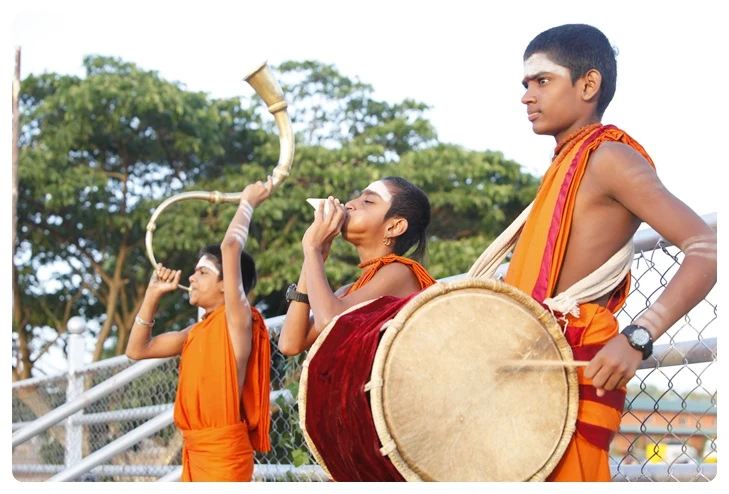
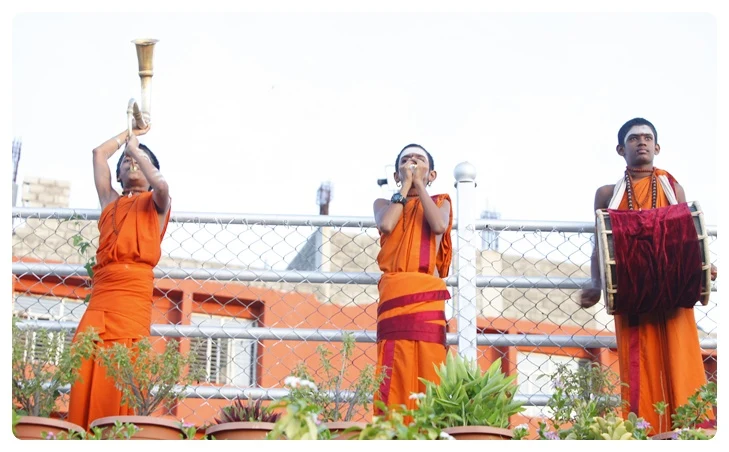
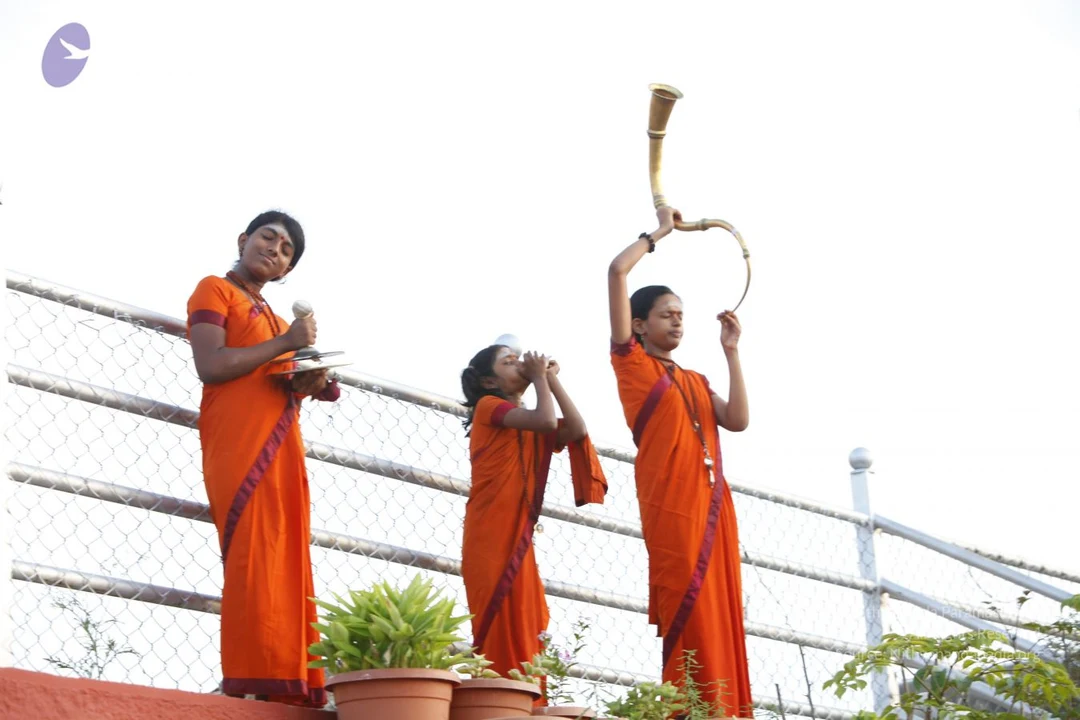
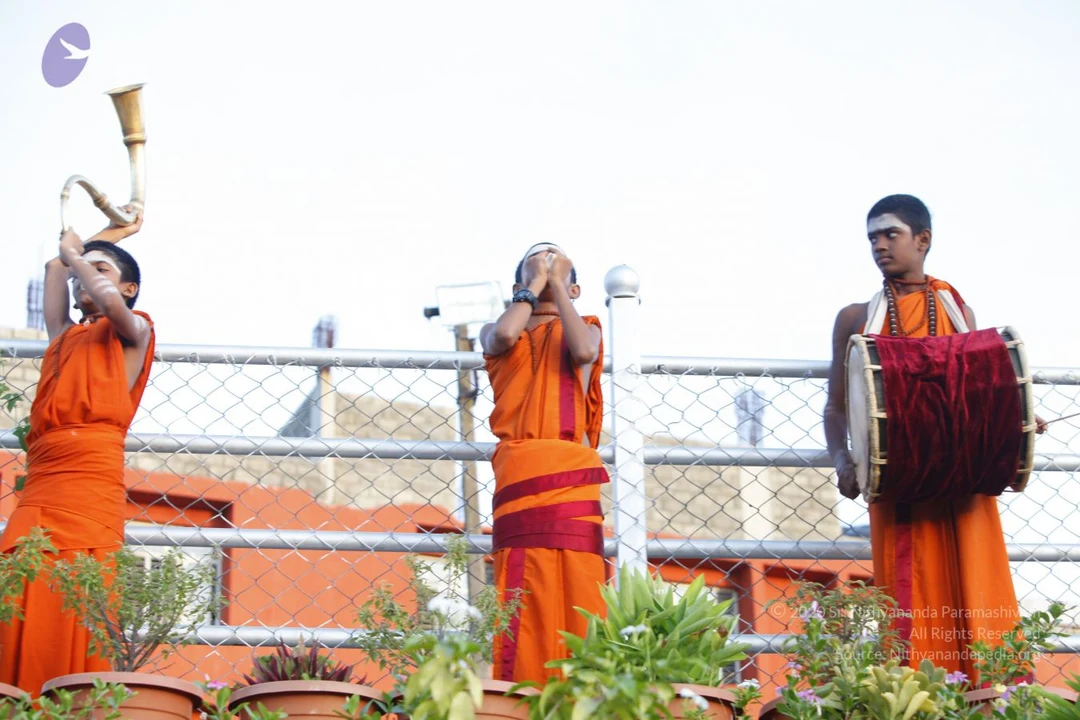
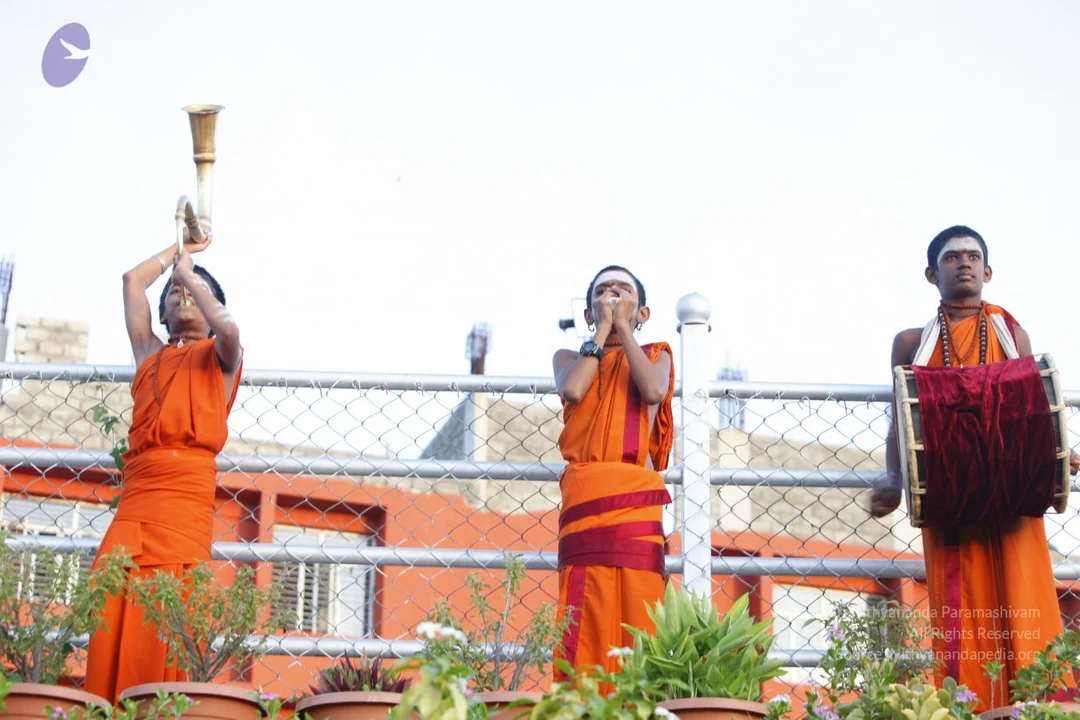
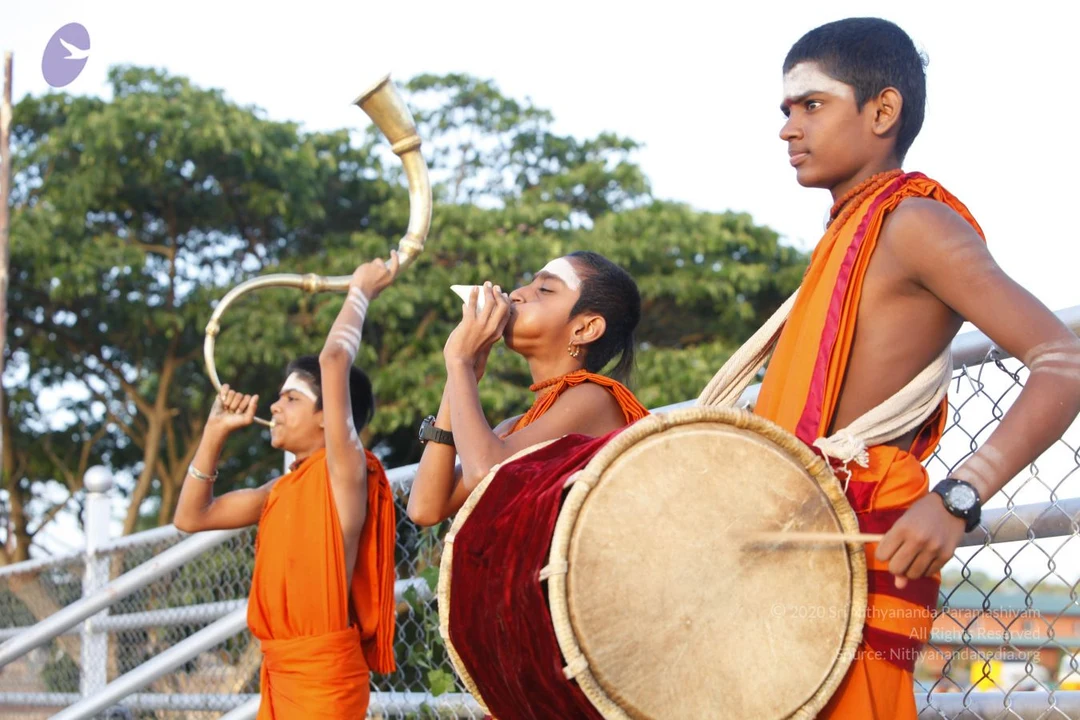
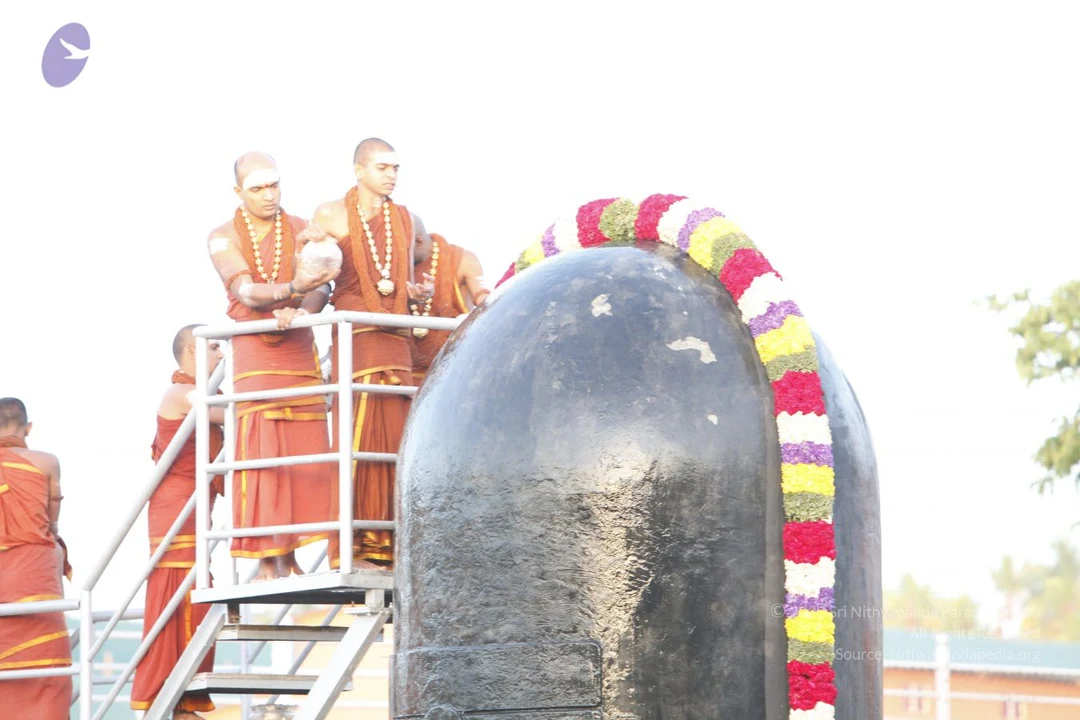
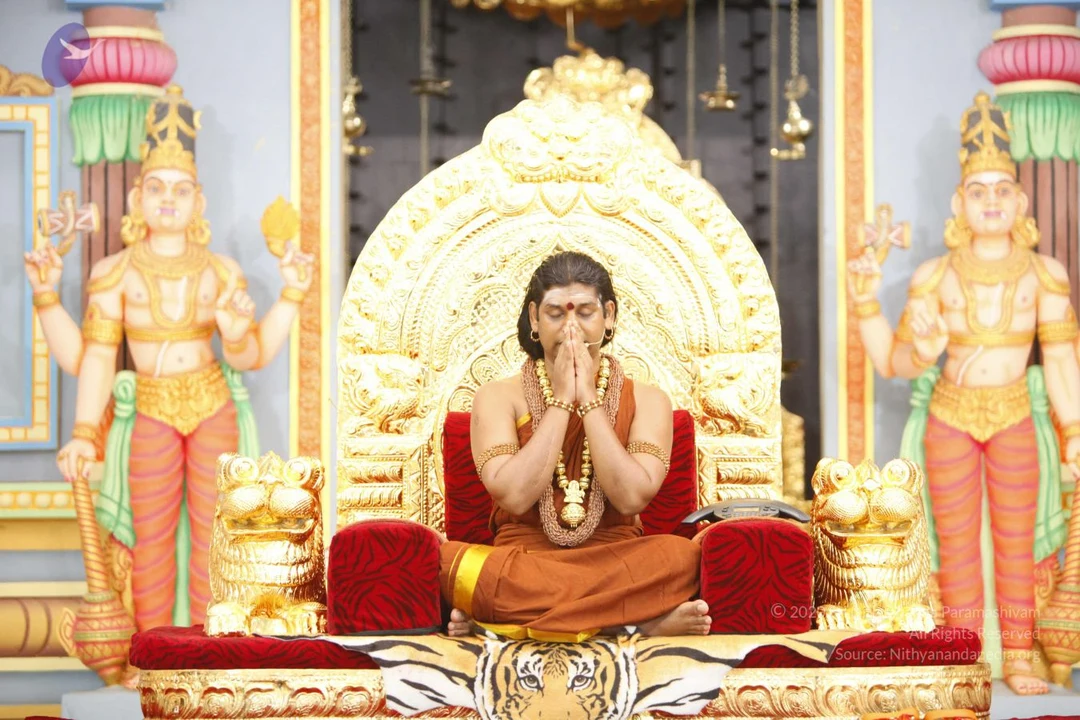
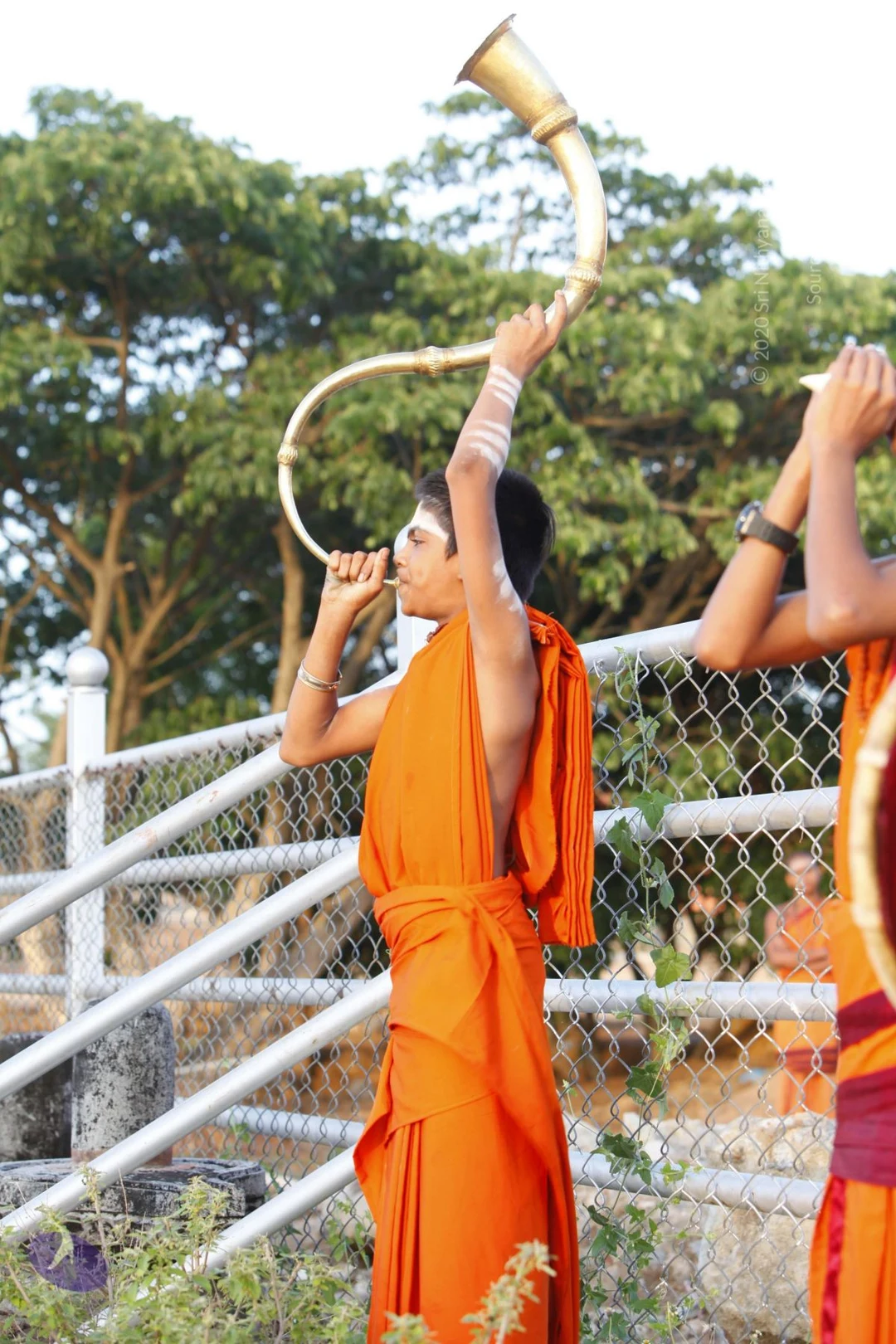
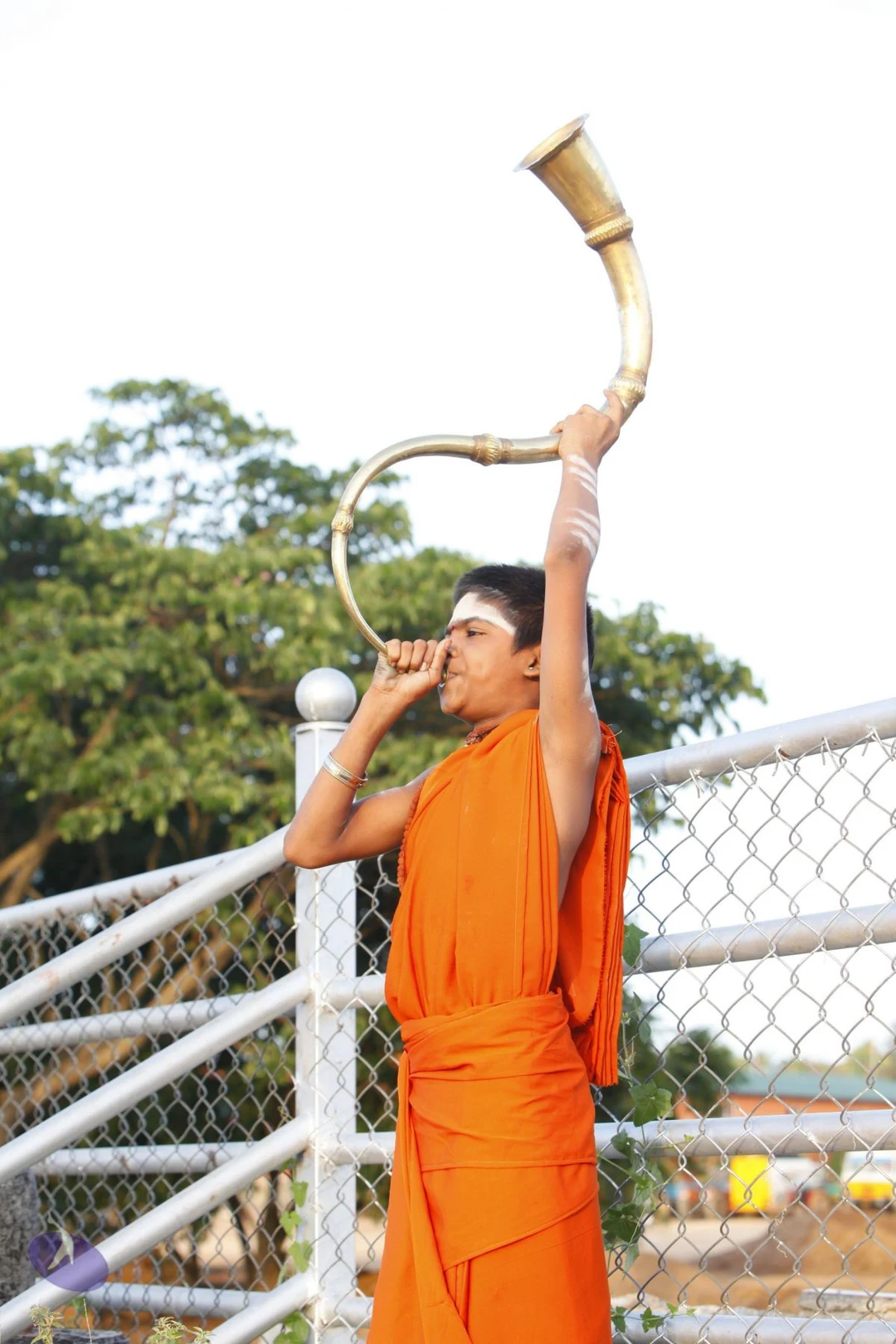
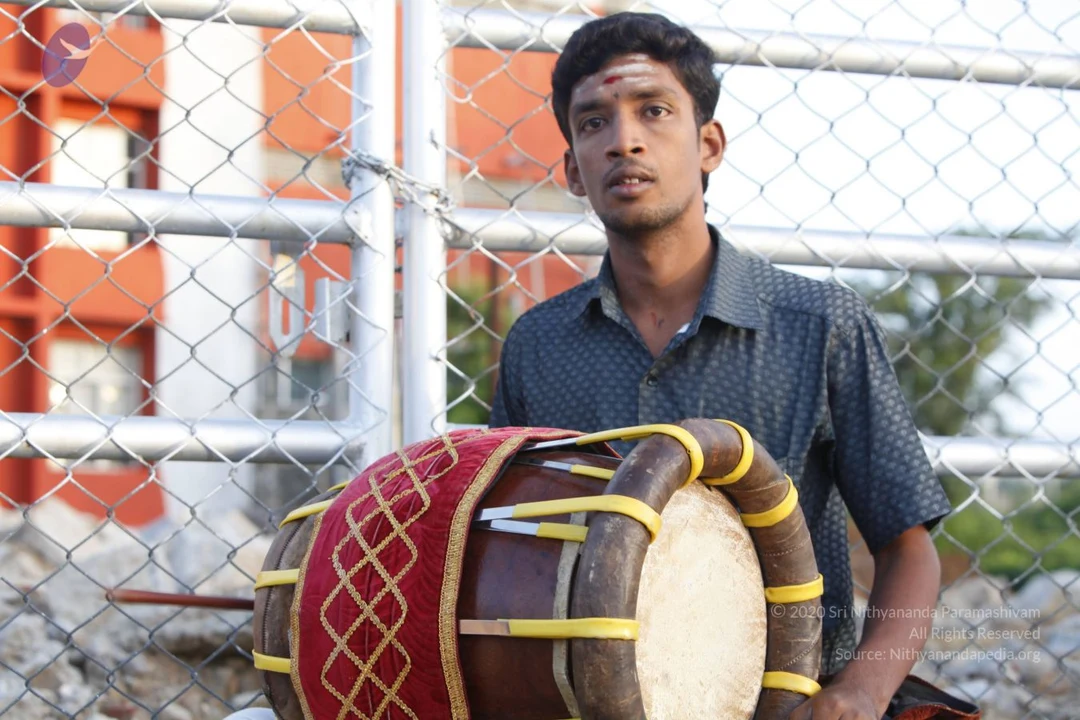
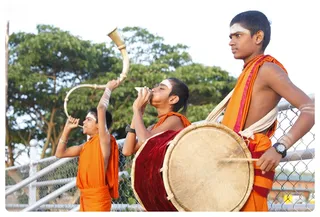
A seated man in saffron-orange dhoti and shawl sits cross-legged with palms pressed together in namaskar and eyes closed, on an ornate golden throne with a red velvet cushion and a tiger-skin rug beneath. He wears a rudraksha mala and a gold necklace, a red tilak on his forehead, and gold armlets. Two large painted deity statues with multiple arms, crowns and gold jewellery flank the throne against a colourful temple backdrop with gold lamps hanging above. a person: the seated figure wears saffron clothing, rudraksha malas and a gold necklace on a golden peetha. Setting suggests a satsang or darshan hall.A man seated before an ornate gold-leaf backdrop with carved floral and lion-like relief work. He wears a rust-orange shawl over the shoulder, with a yellow border, and long gold bead necklaces with a braided rudraksha-style mala beneath. Gold armlets are on his upper arms. He has long swept-back hair, white forehead markings and a red bindi, and a small wireless lapel microphone is clipped near his ear. Swamiji (probable): long swept-back hair, saffron-orange shawl, rudraksha mala and ceremonial gold necklaces, seated on a gold throne in a discourse setting.A large black lingam stands in the foreground, draped with a garland of multicoloured flowers in red, white, yellow, purple and green. On a metal scaffold platform behind it, several priests in saffron-orange robes stand with hands folded in prayer, and one holds a lit lamp or flame aloft. Below, rows of small clay lamps line a brick tiered structure, with saffron-clad devotees seated among them. Palm trees and a green tree frame the open-air ritual ground.Three young male devotees in saffron-orange robes stand outdoors before a chain-link fence and greenery. The two on the left play long curved brass horns, one raising a horn overhead while the other blows into a mouthpiece. The central player also holds a hand drum with a large drumhead and a red velvet body, and the figure on the right stands beside it holding a drumstick, bare-chested with a saffron cloth over the shoulder and a wristwatch. Each wears sandalwood or vibhuti markings on the forehead and beaded bracelets. This appears to be a horn and drum ceremonial performance.

Photos

5 photosSource gallery
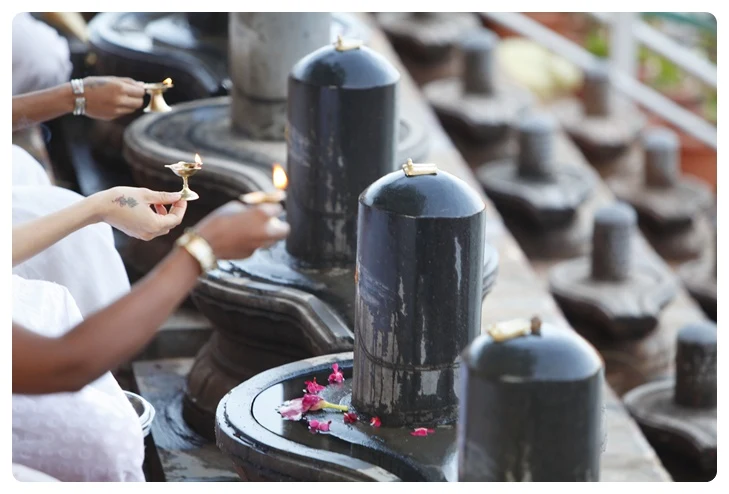
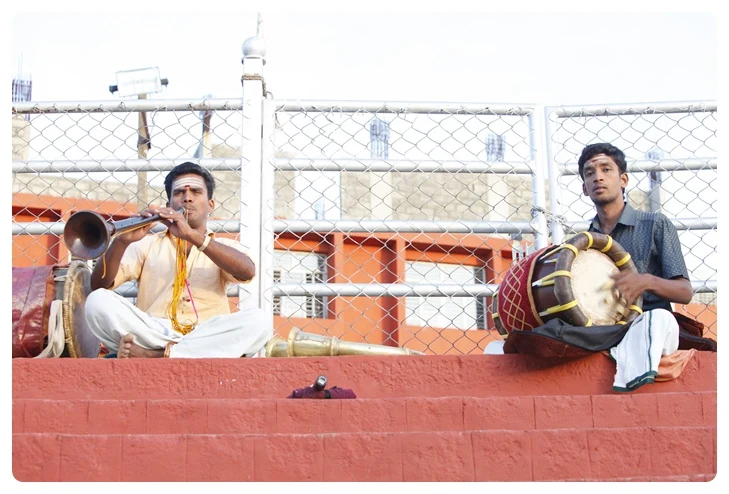
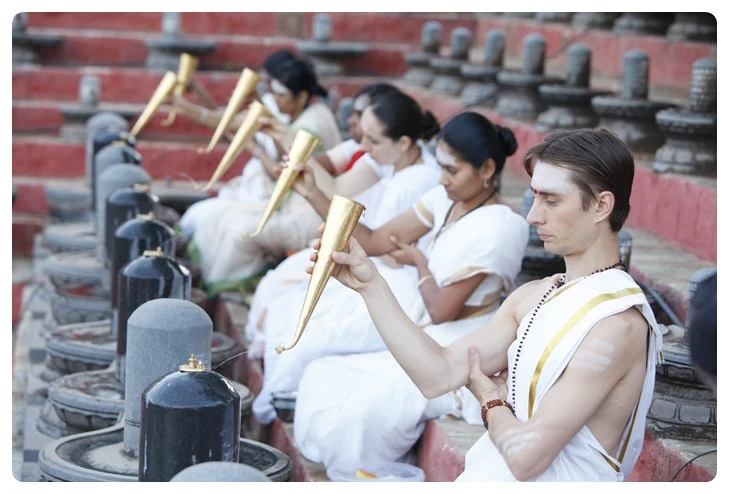
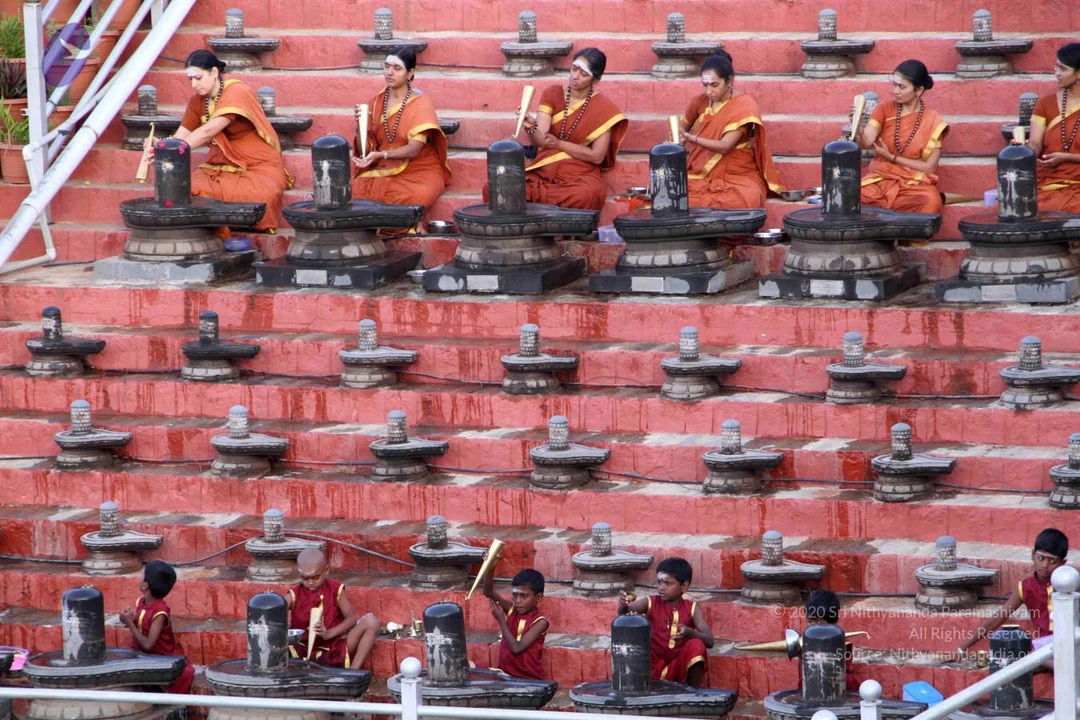
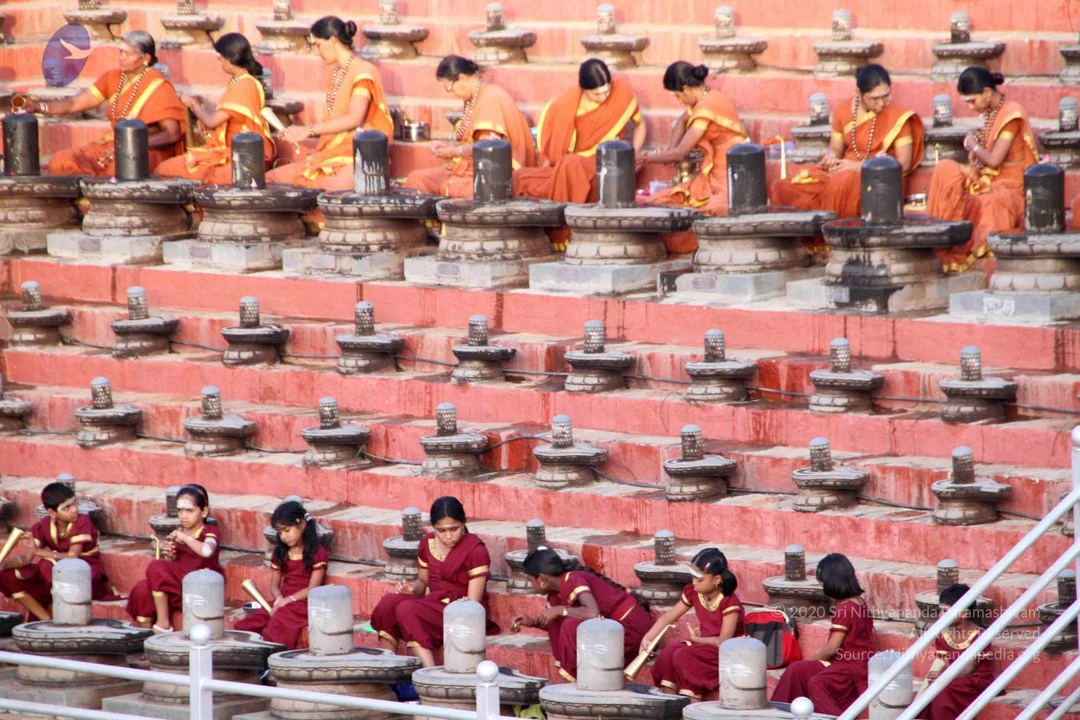
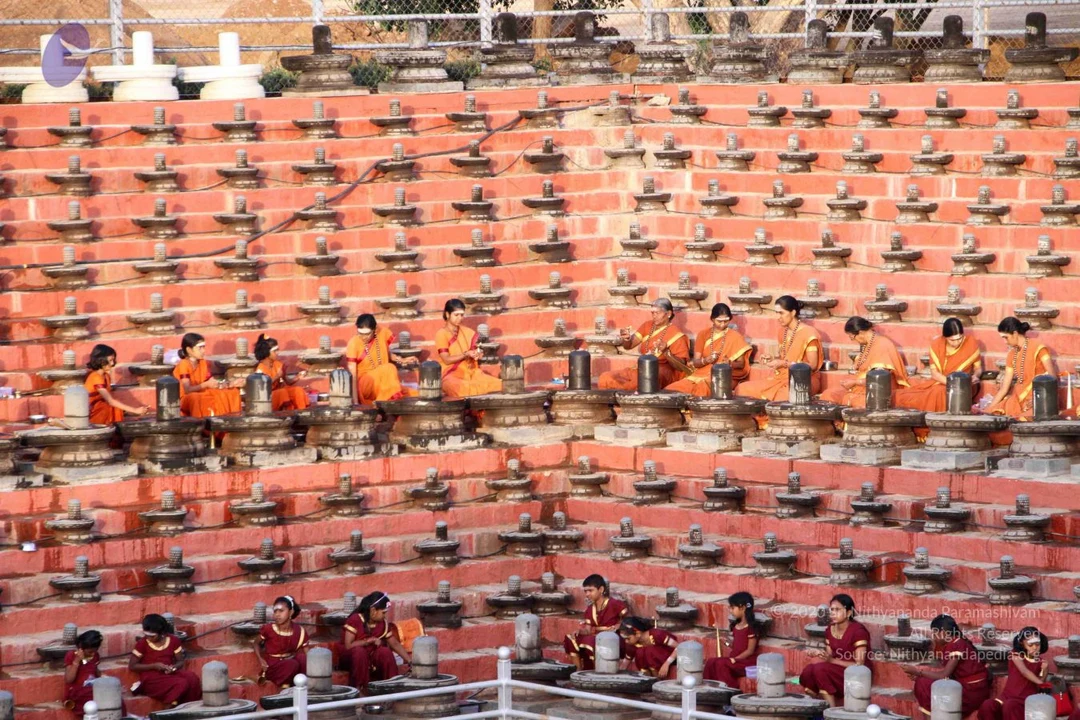
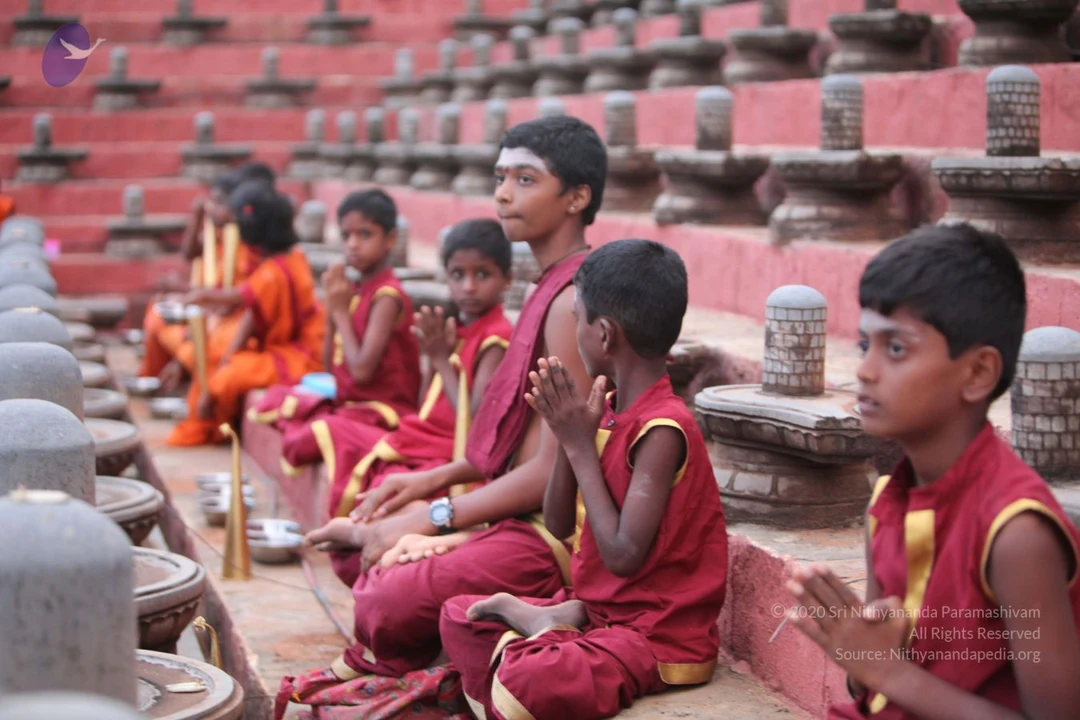
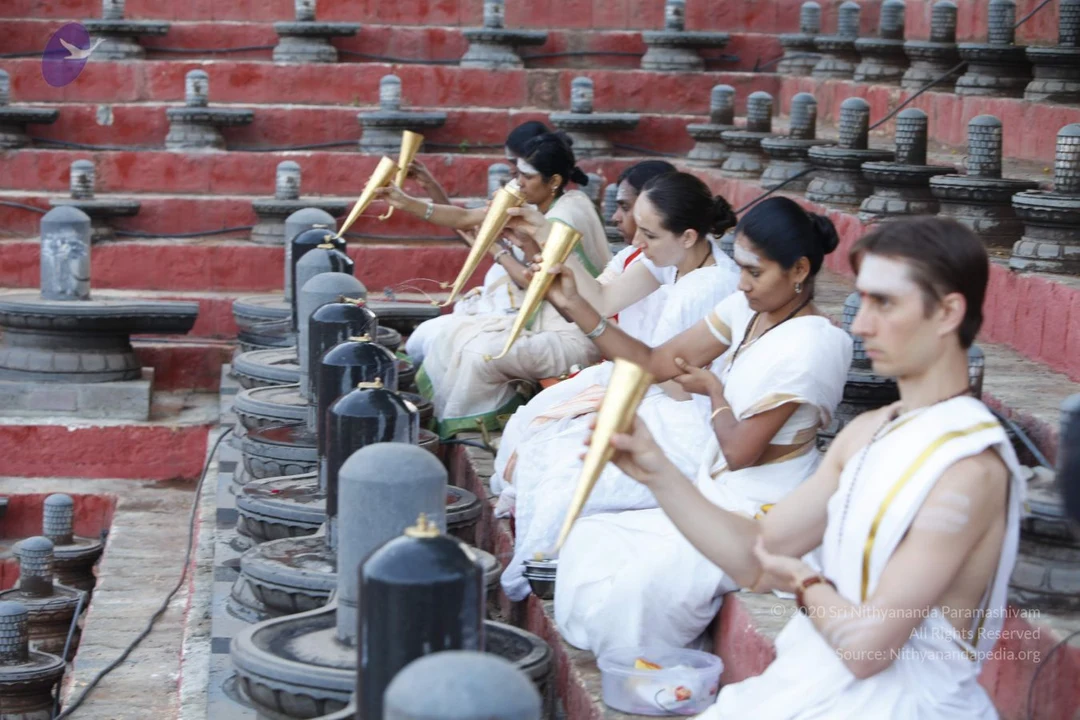
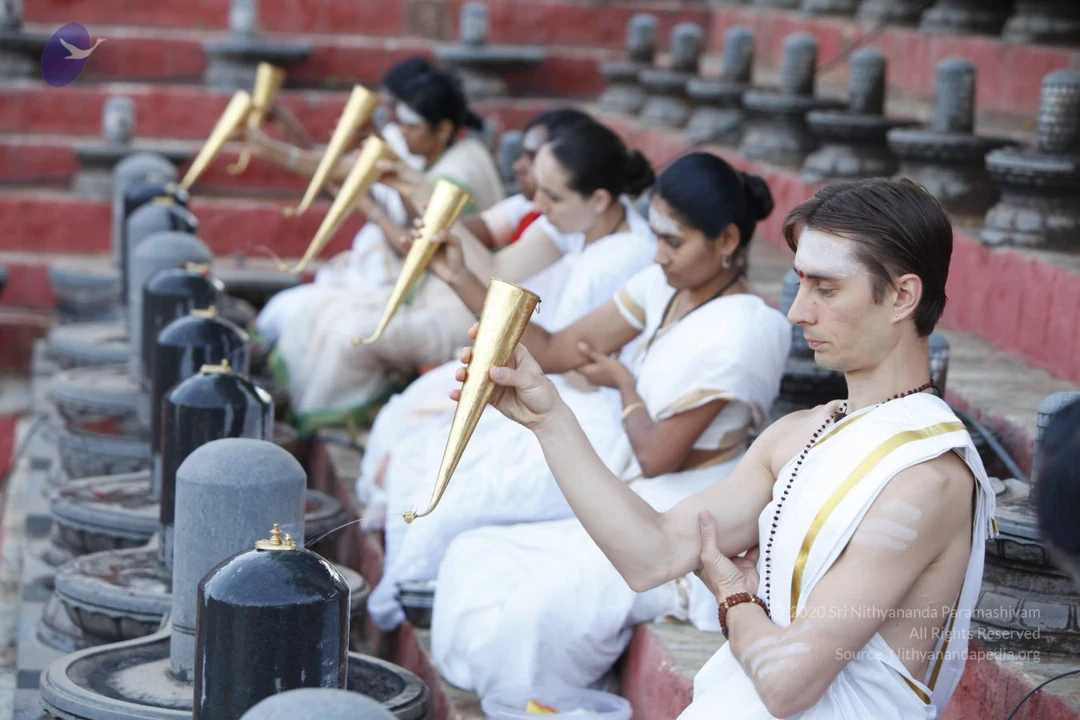
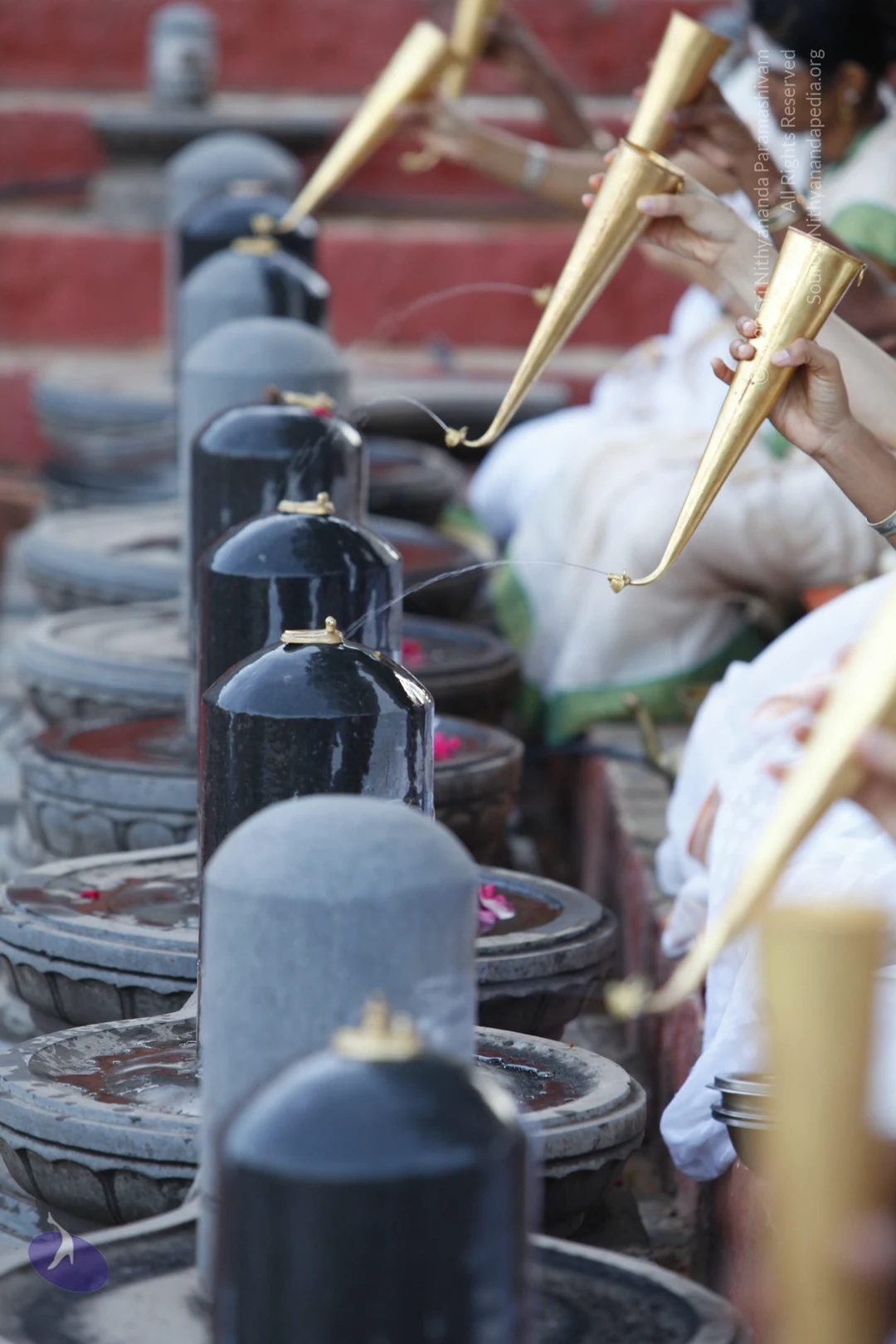
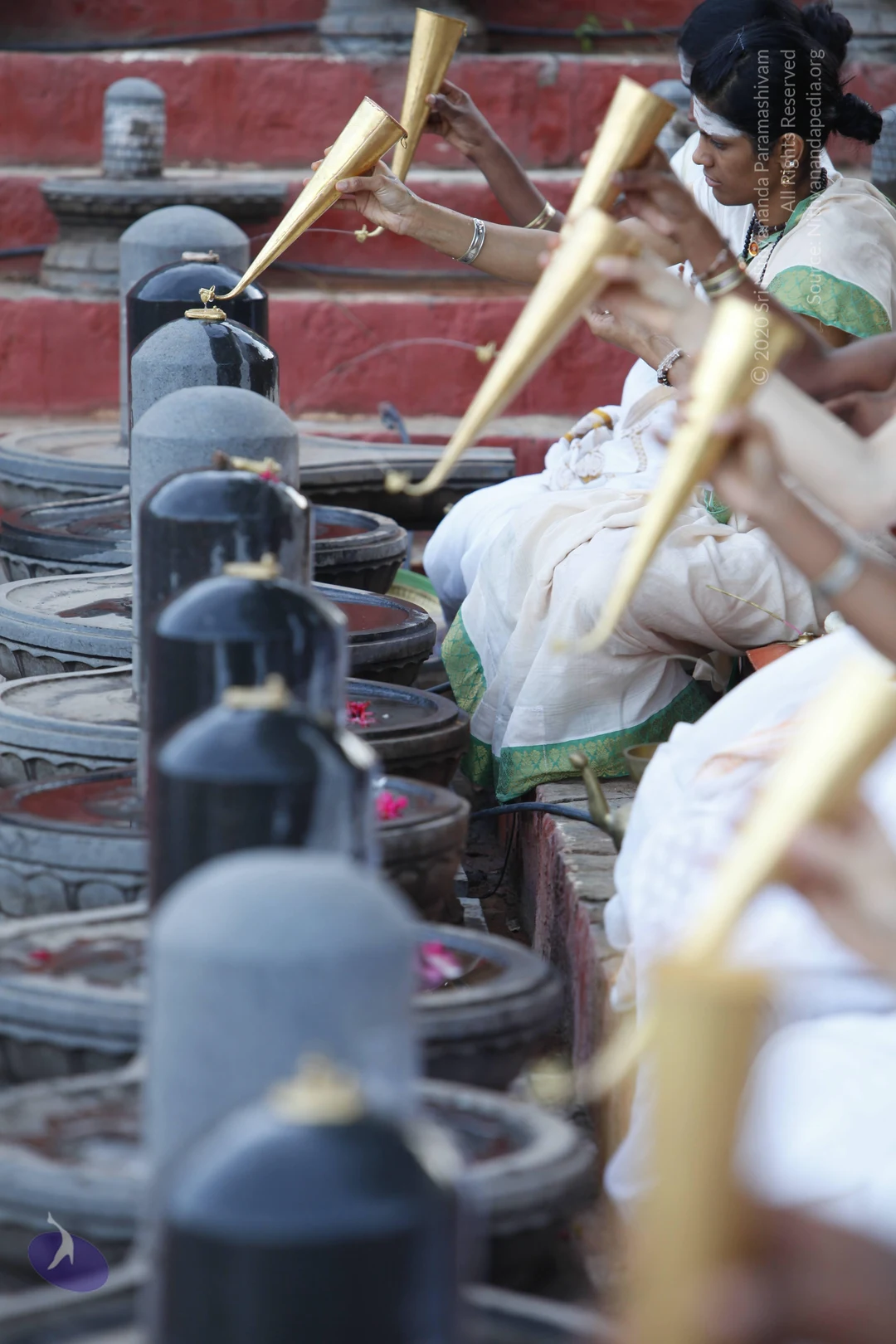
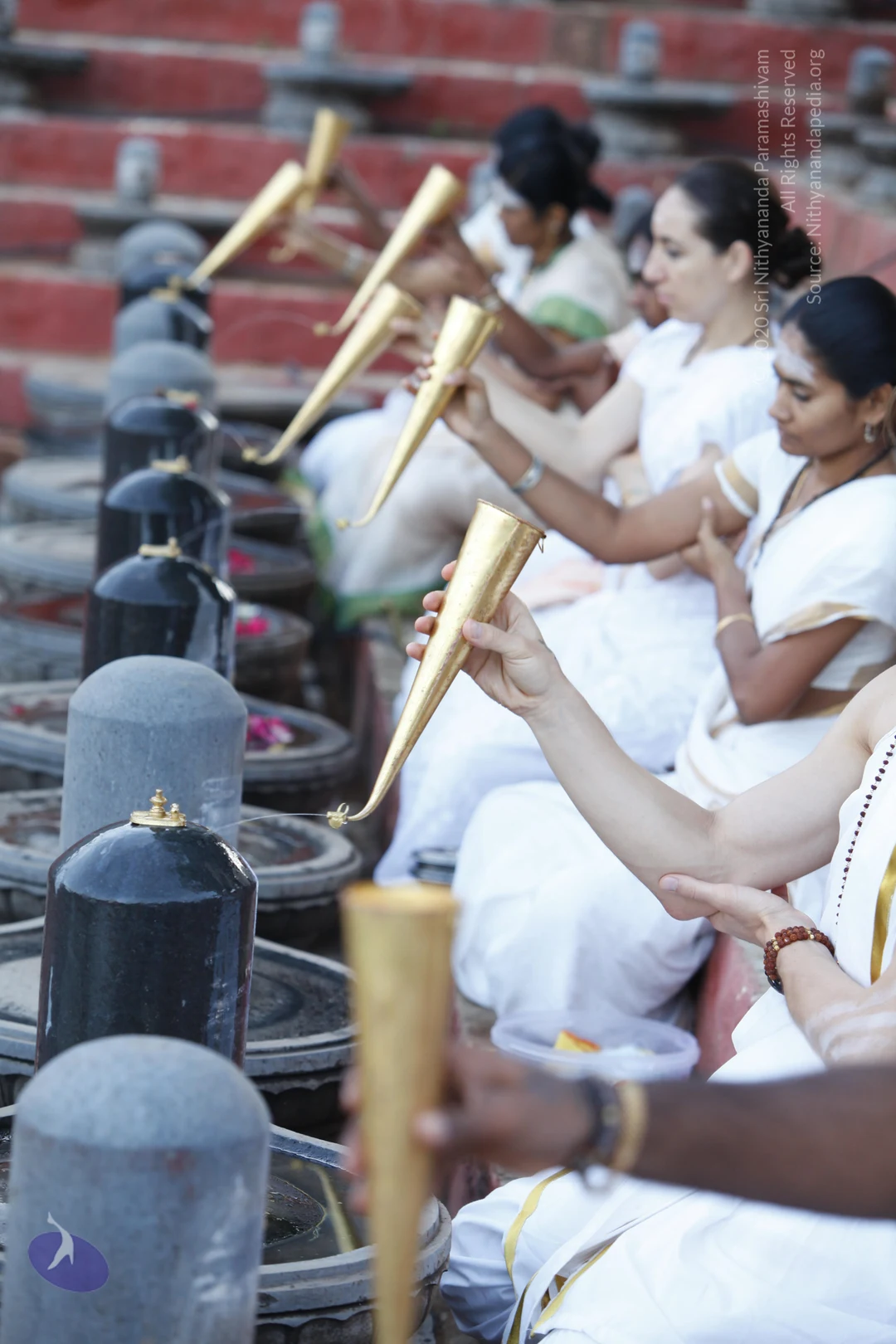
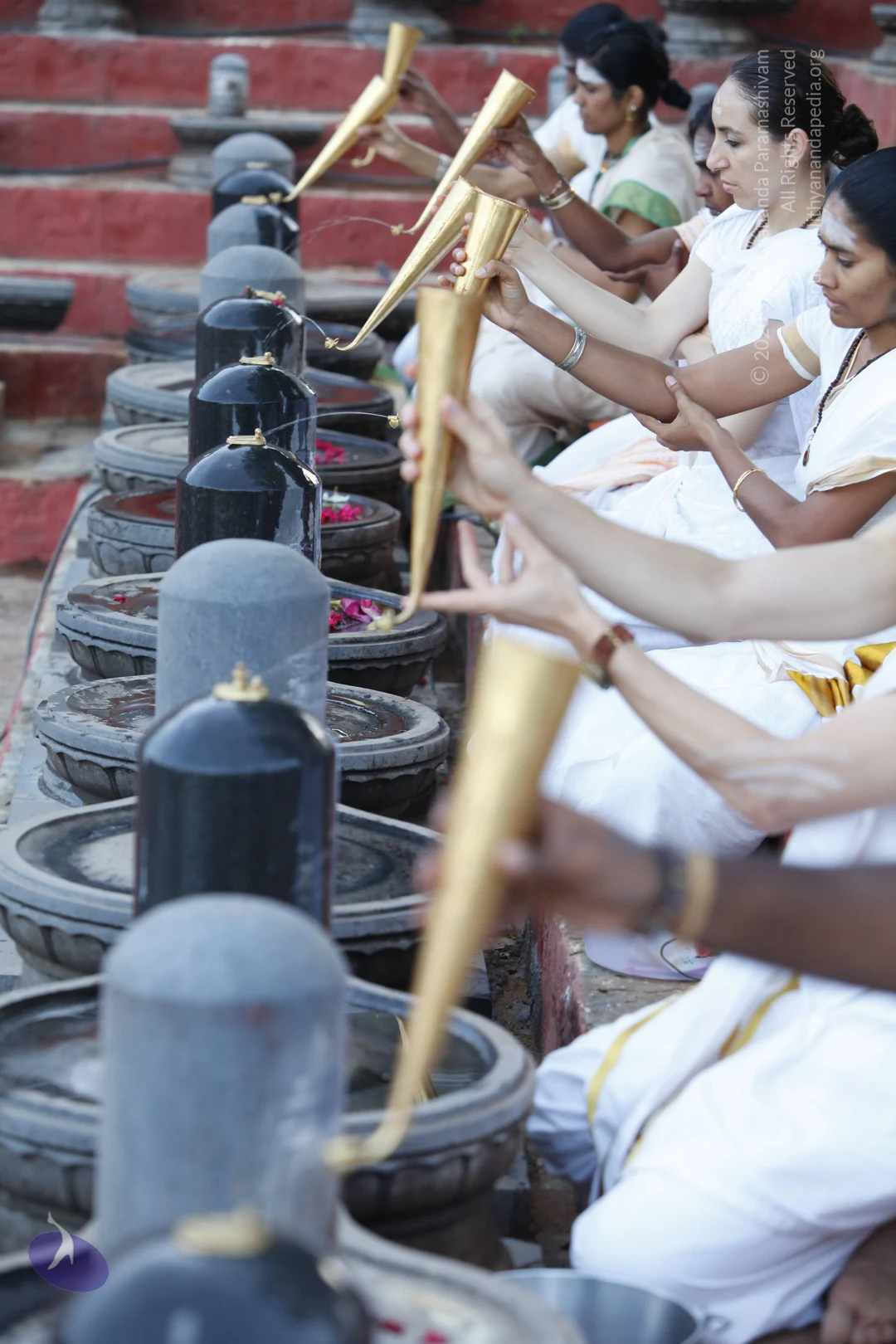
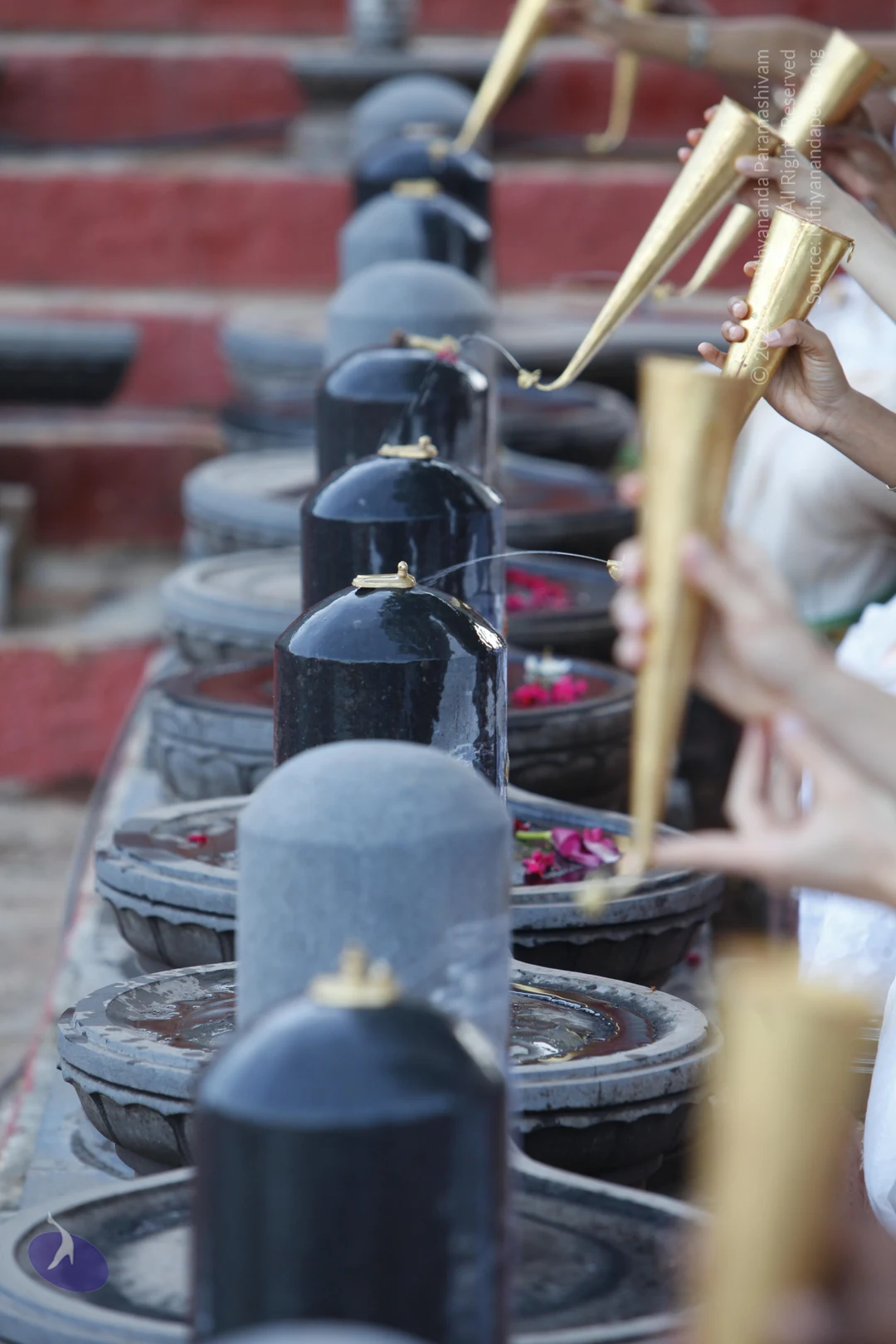
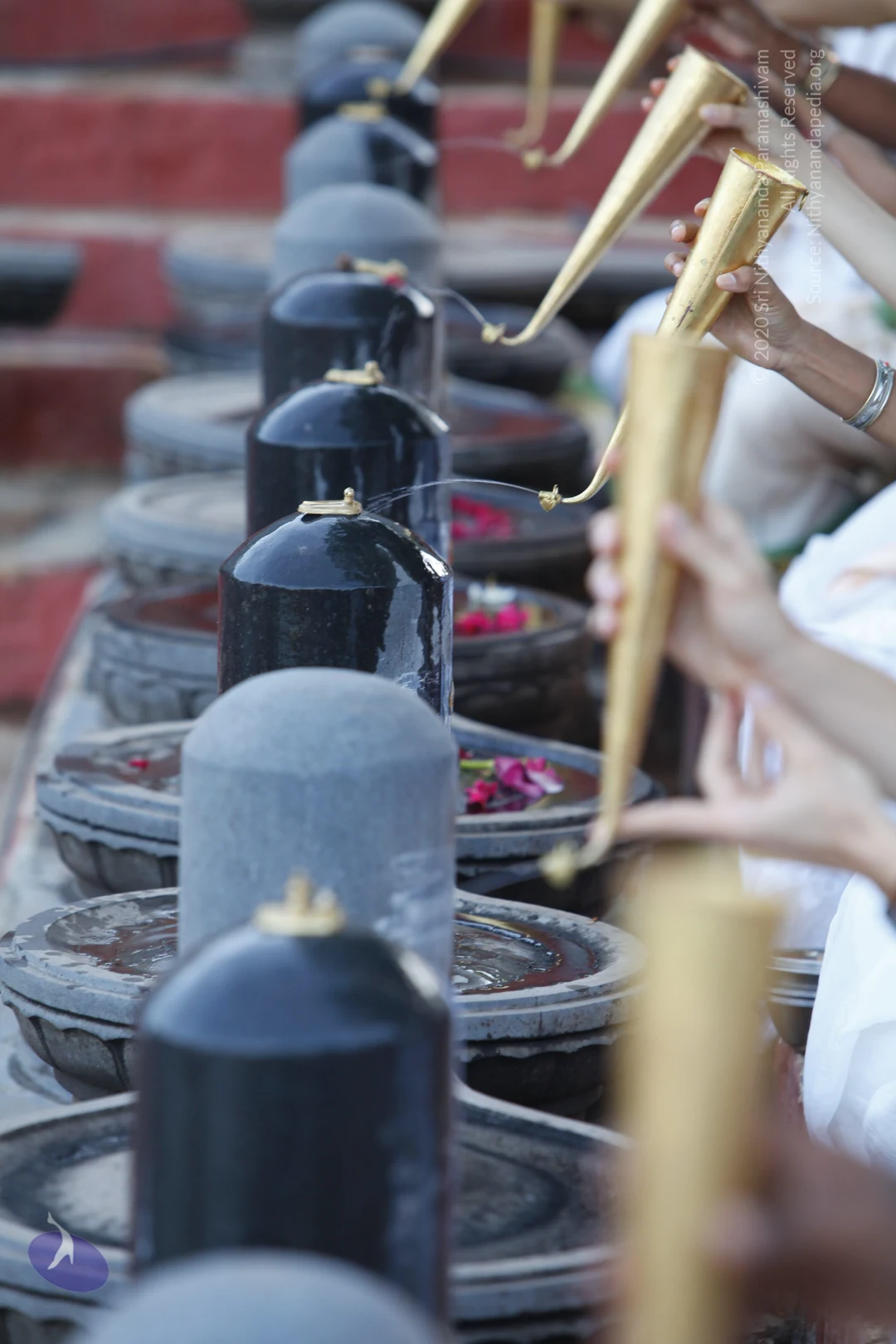
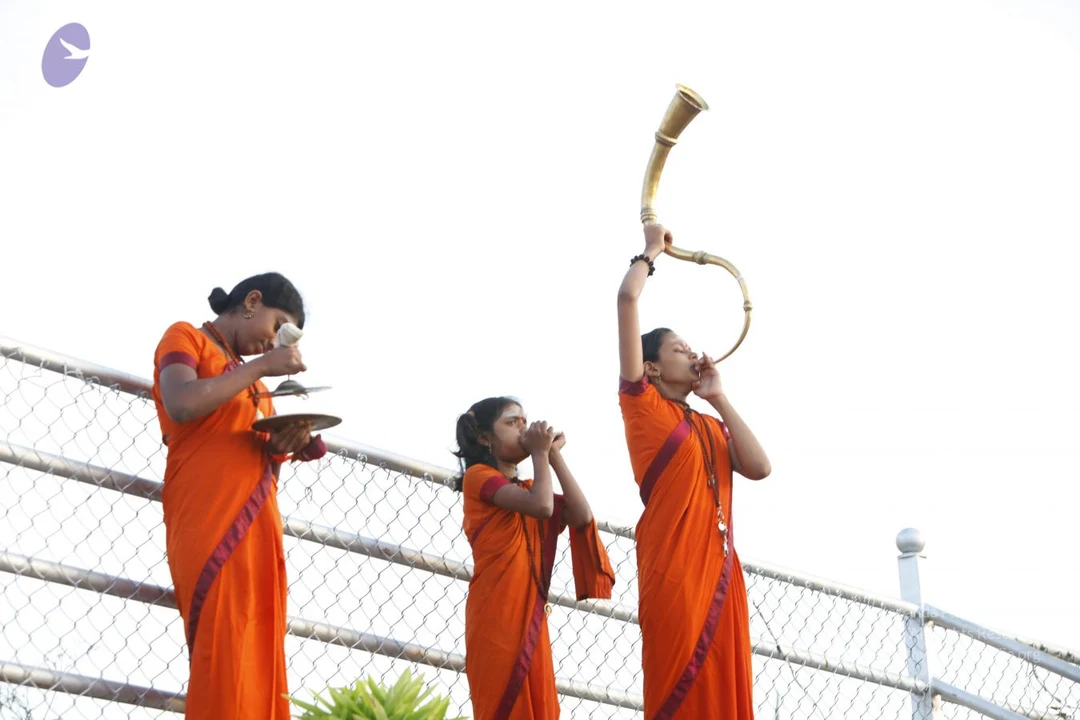
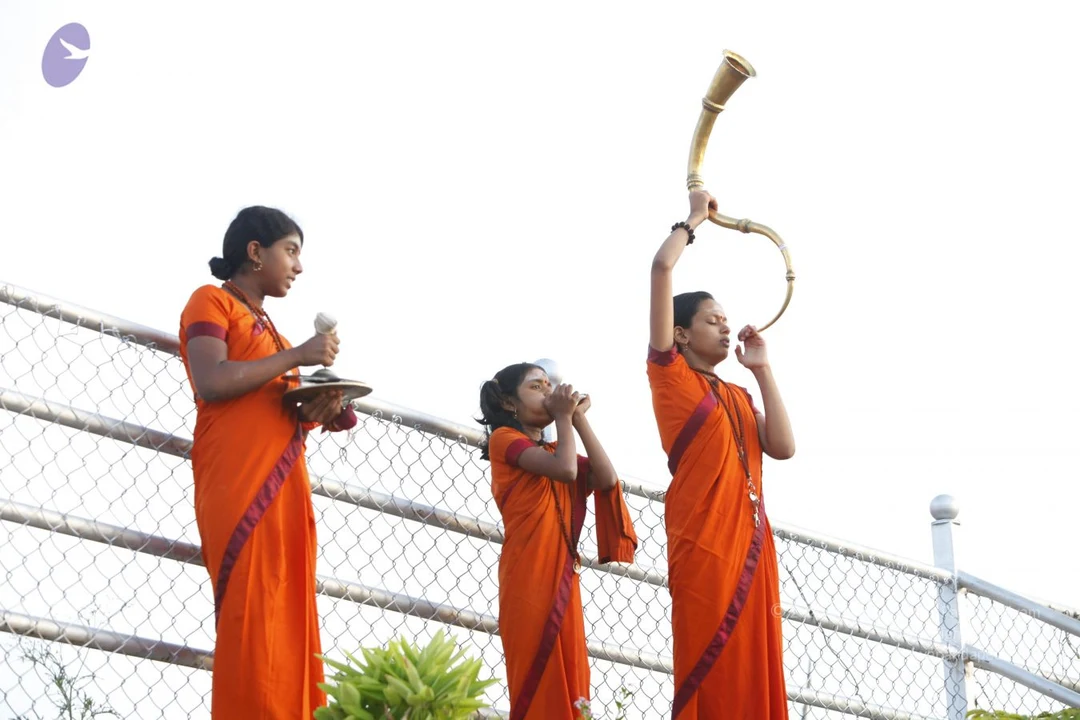
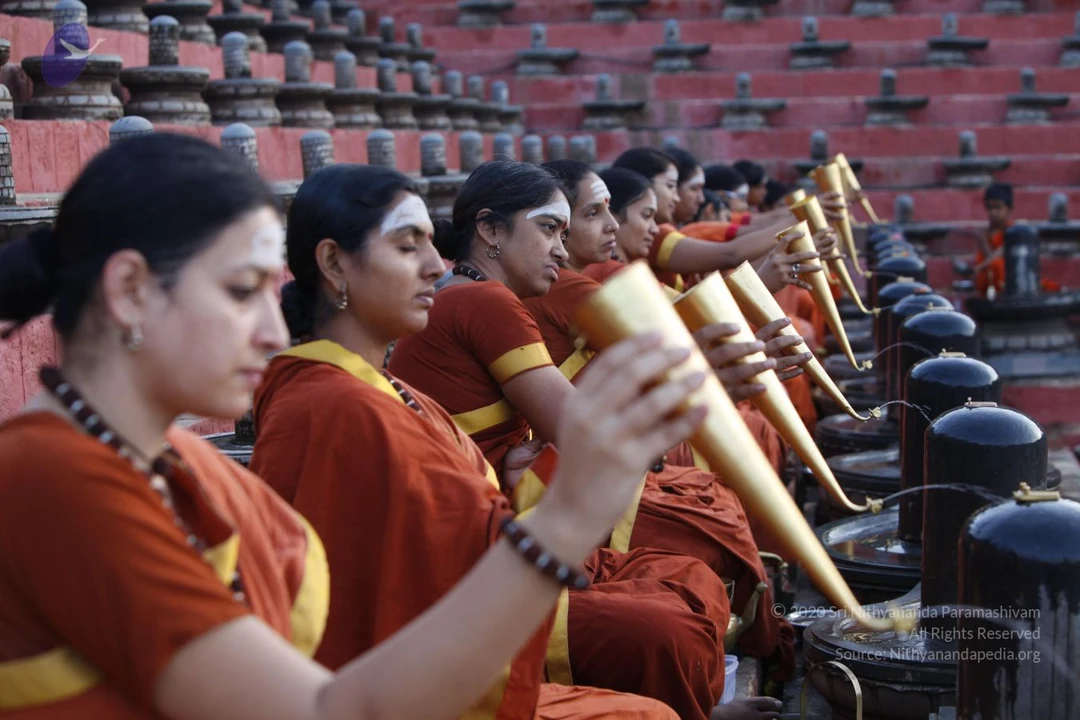
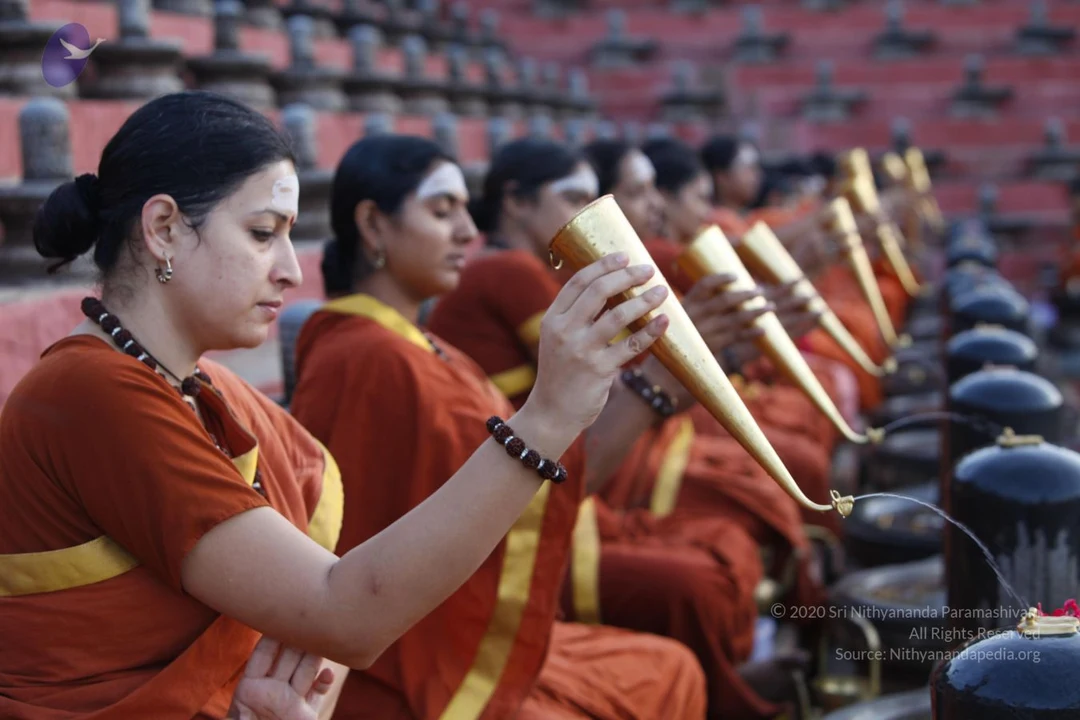
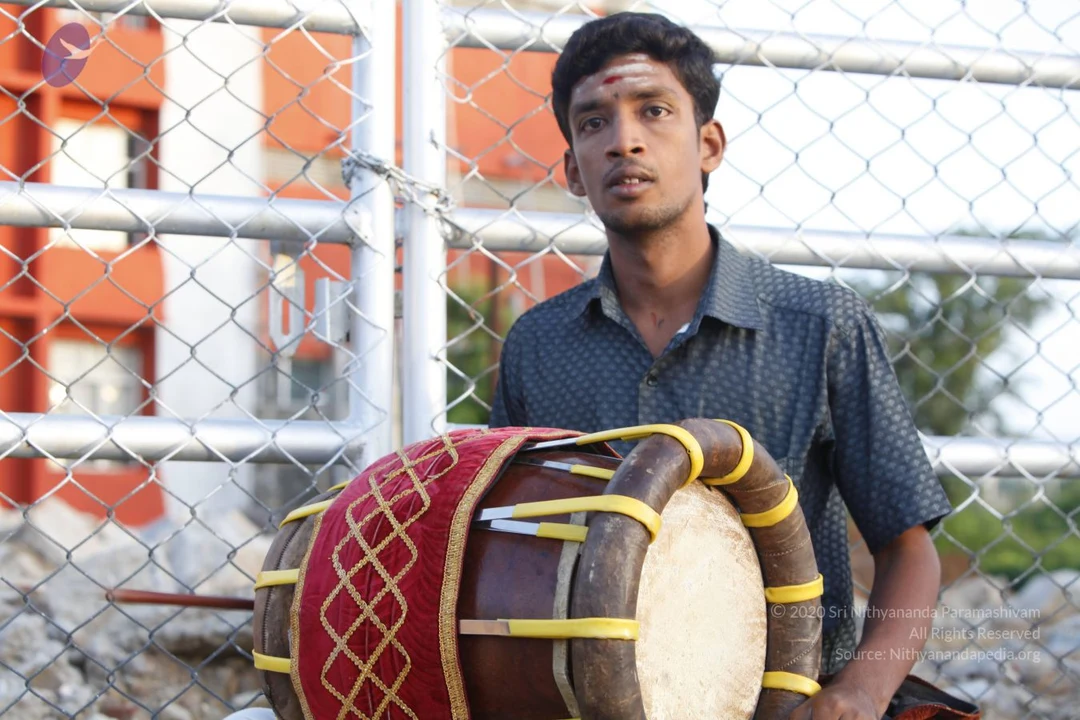
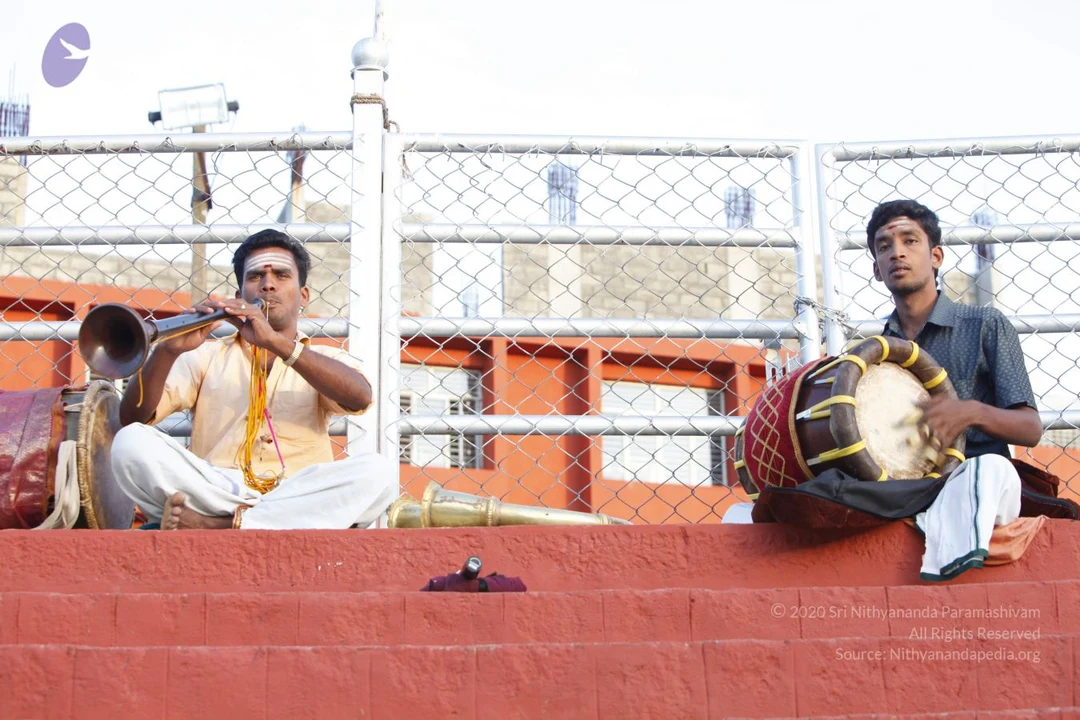
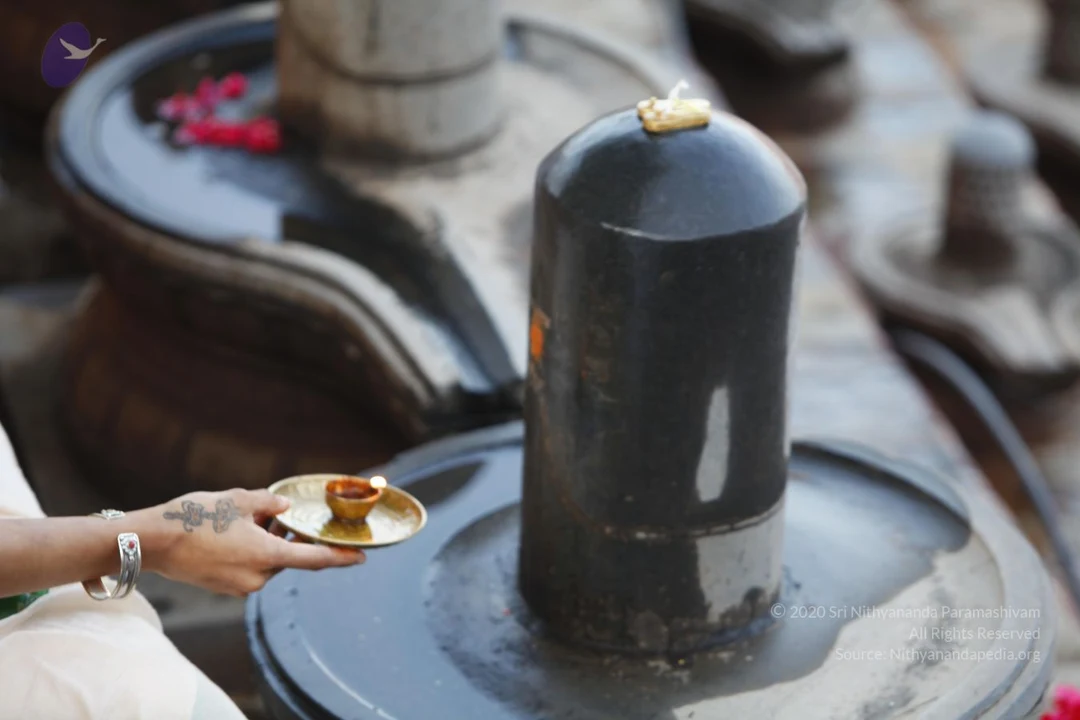
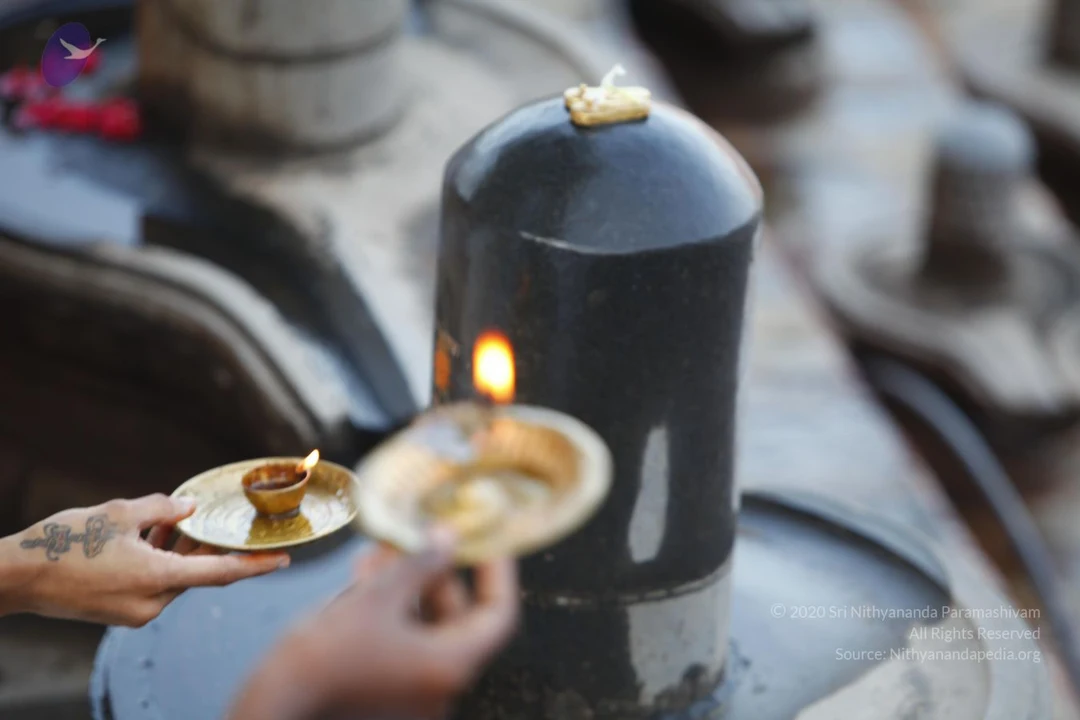
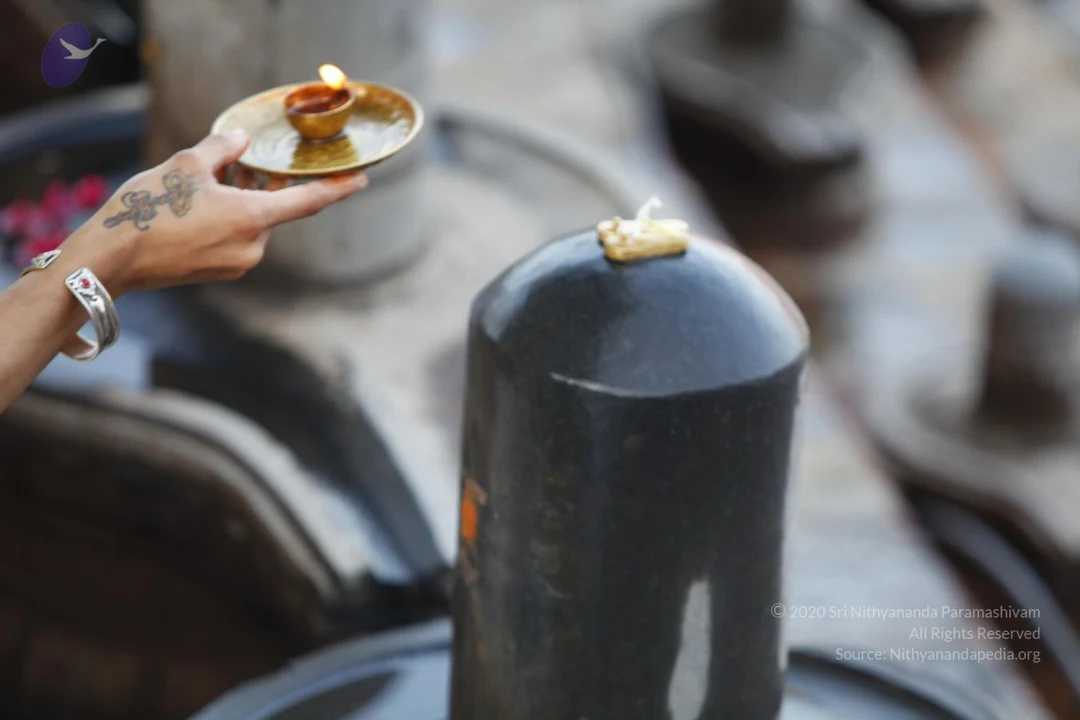
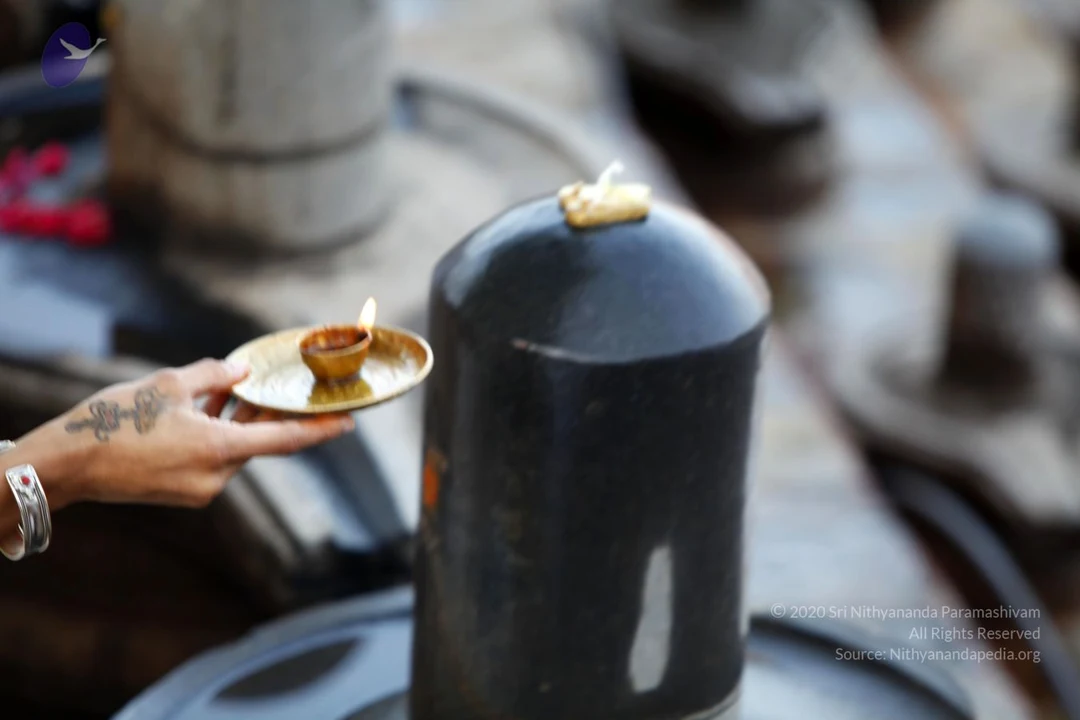
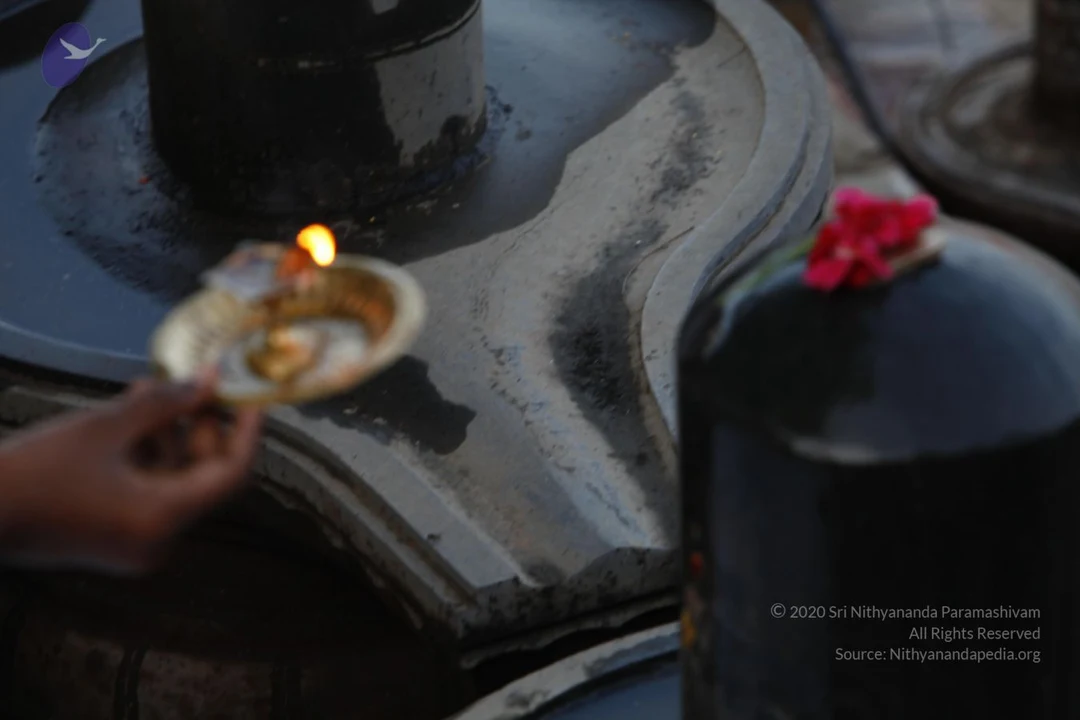
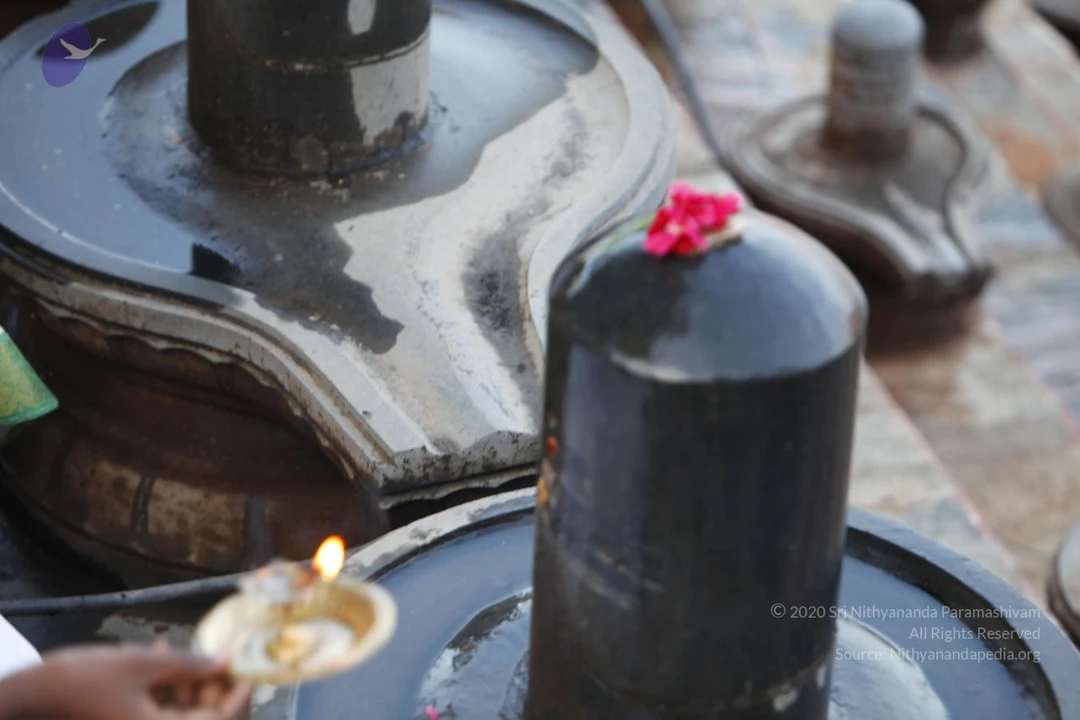
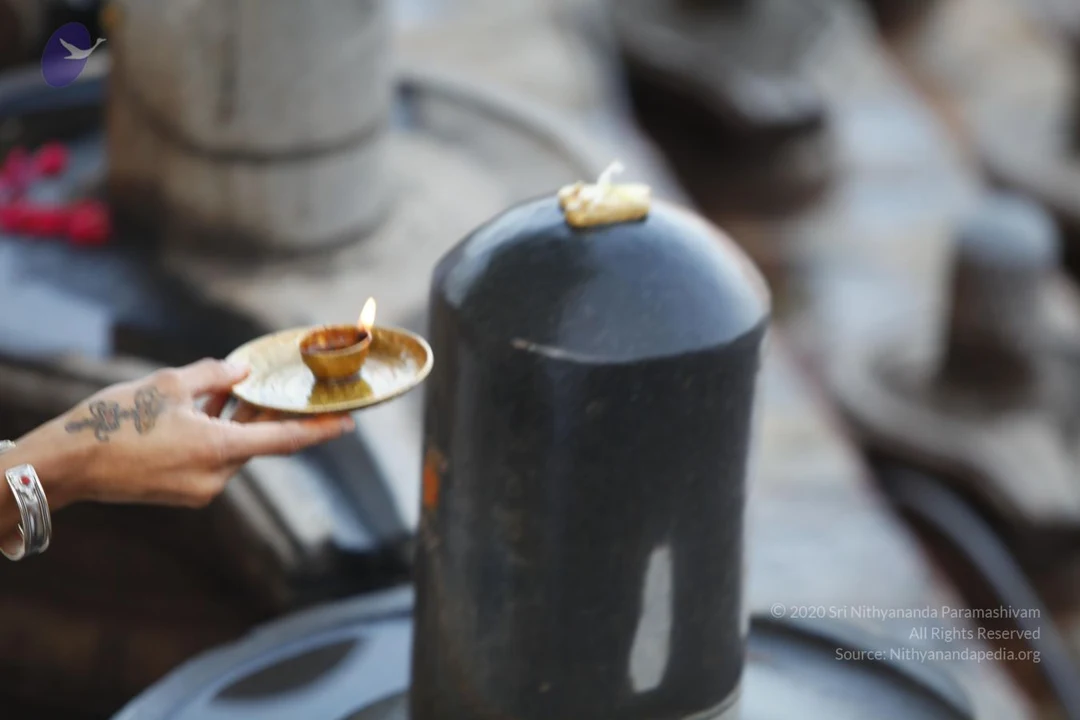
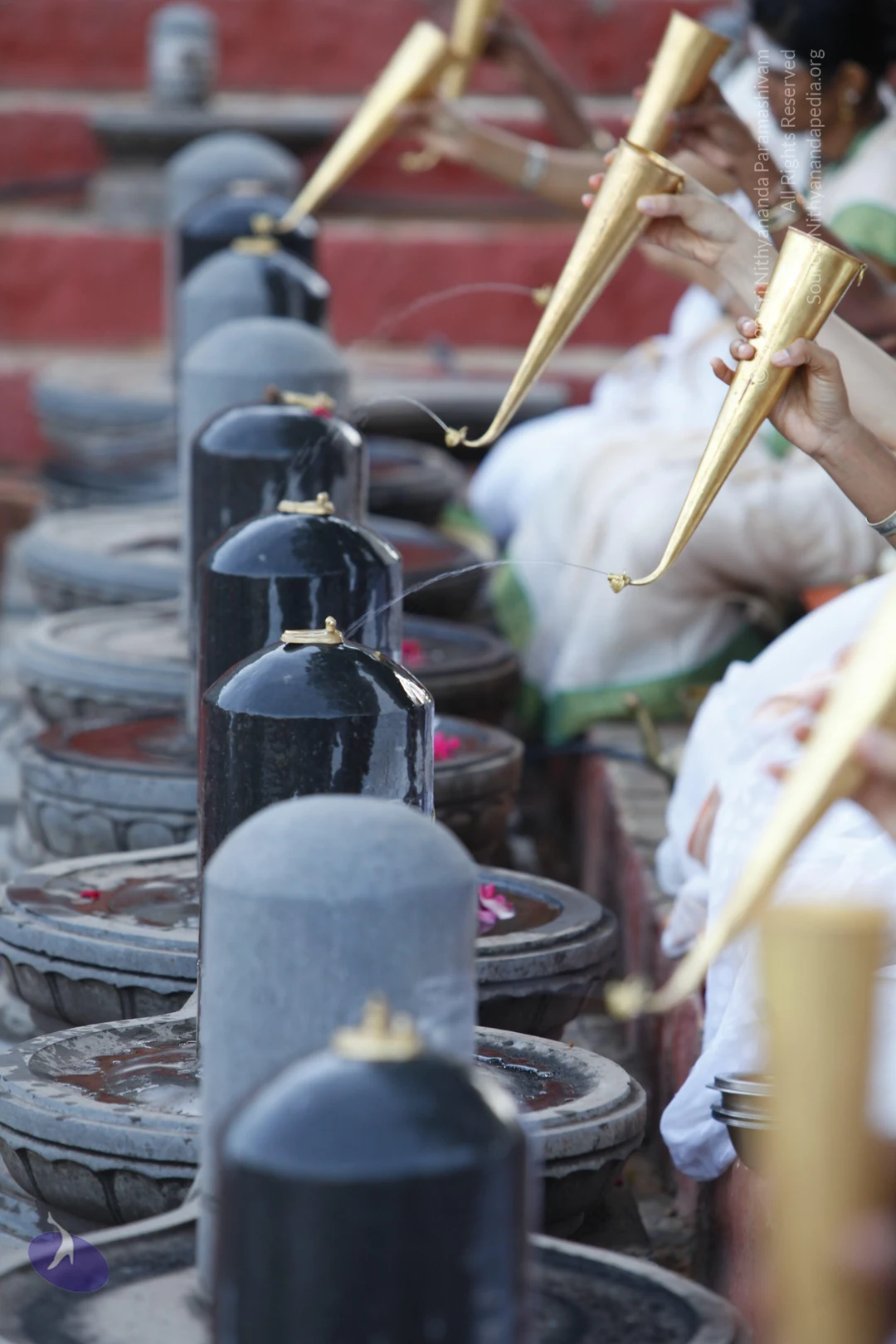
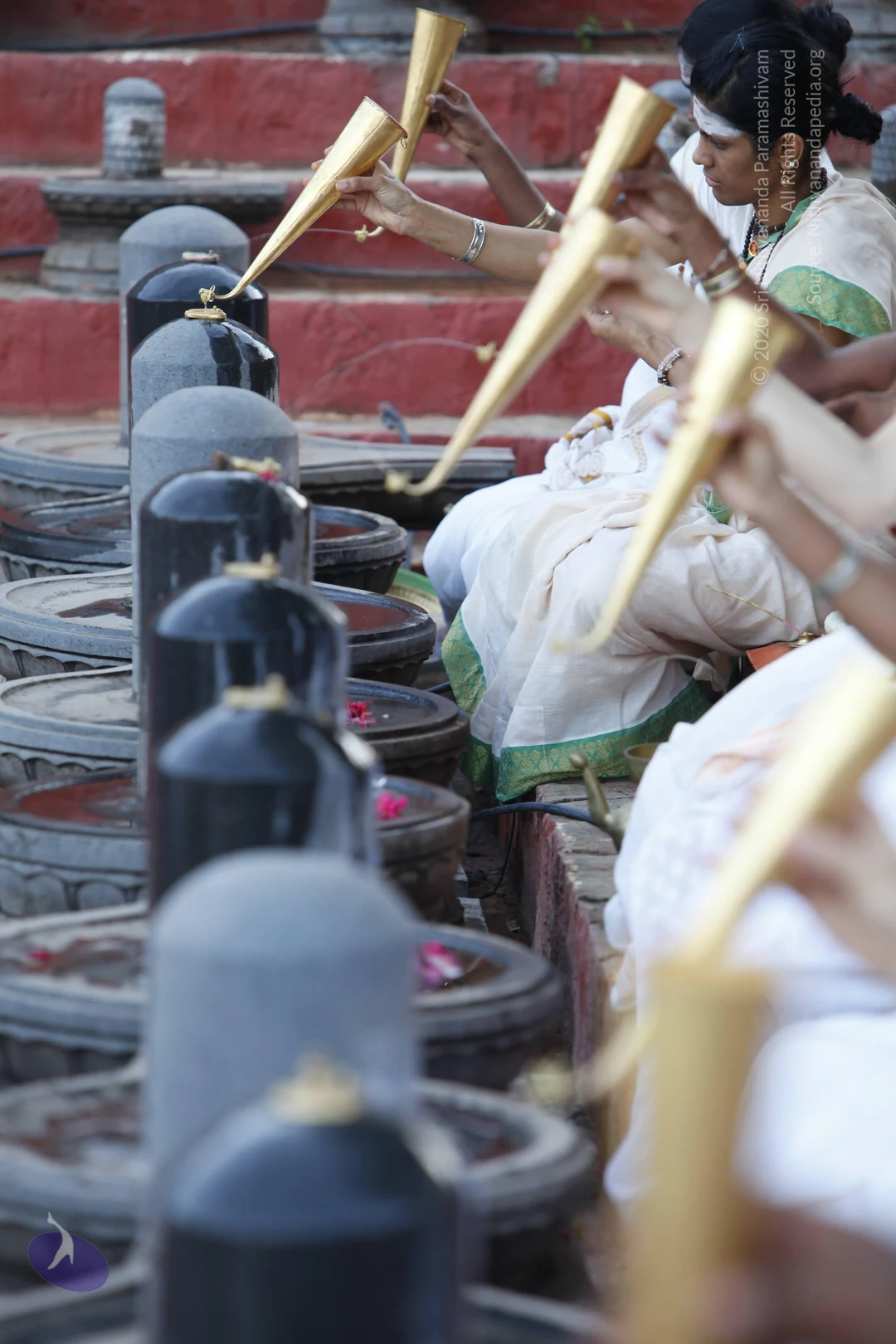
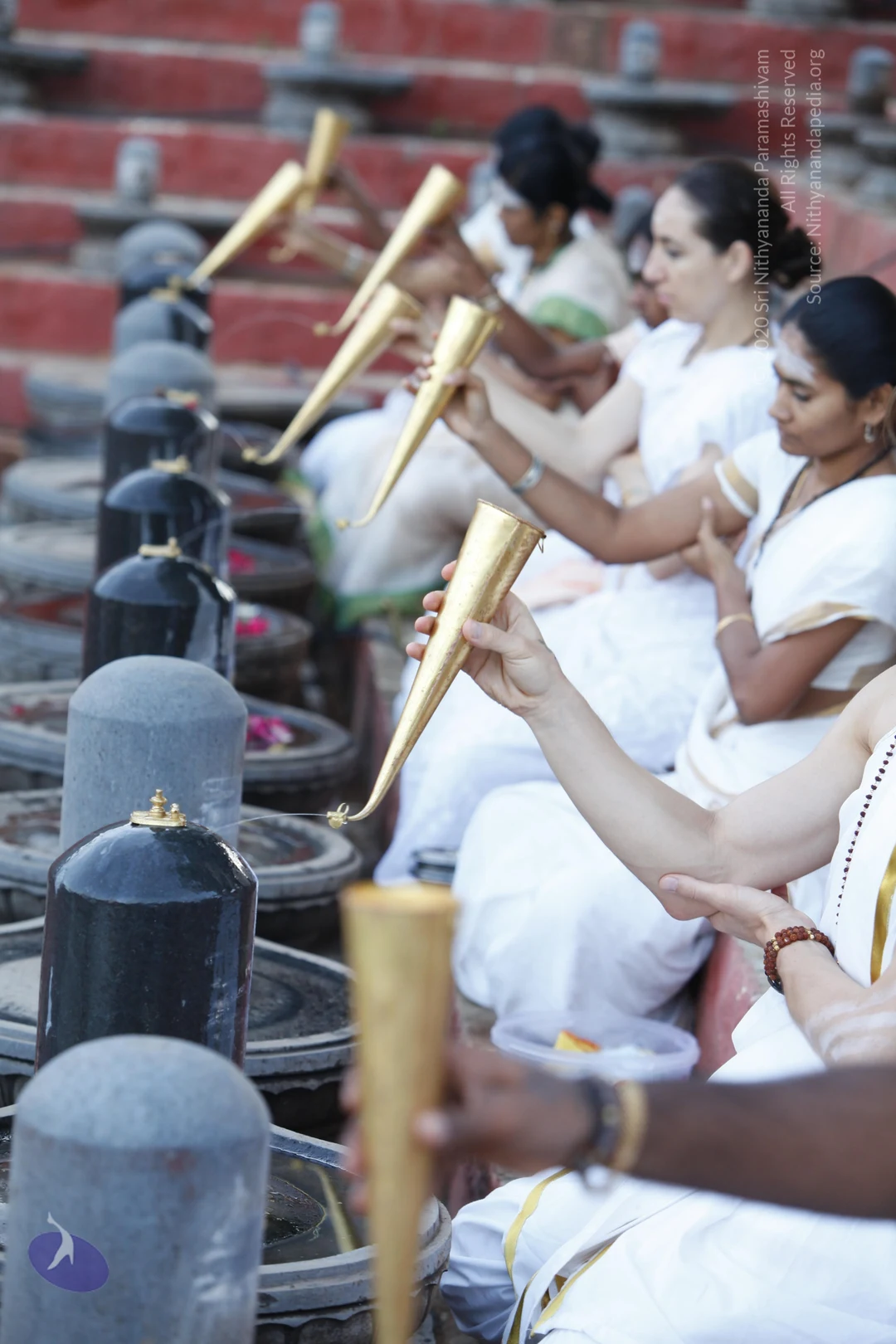
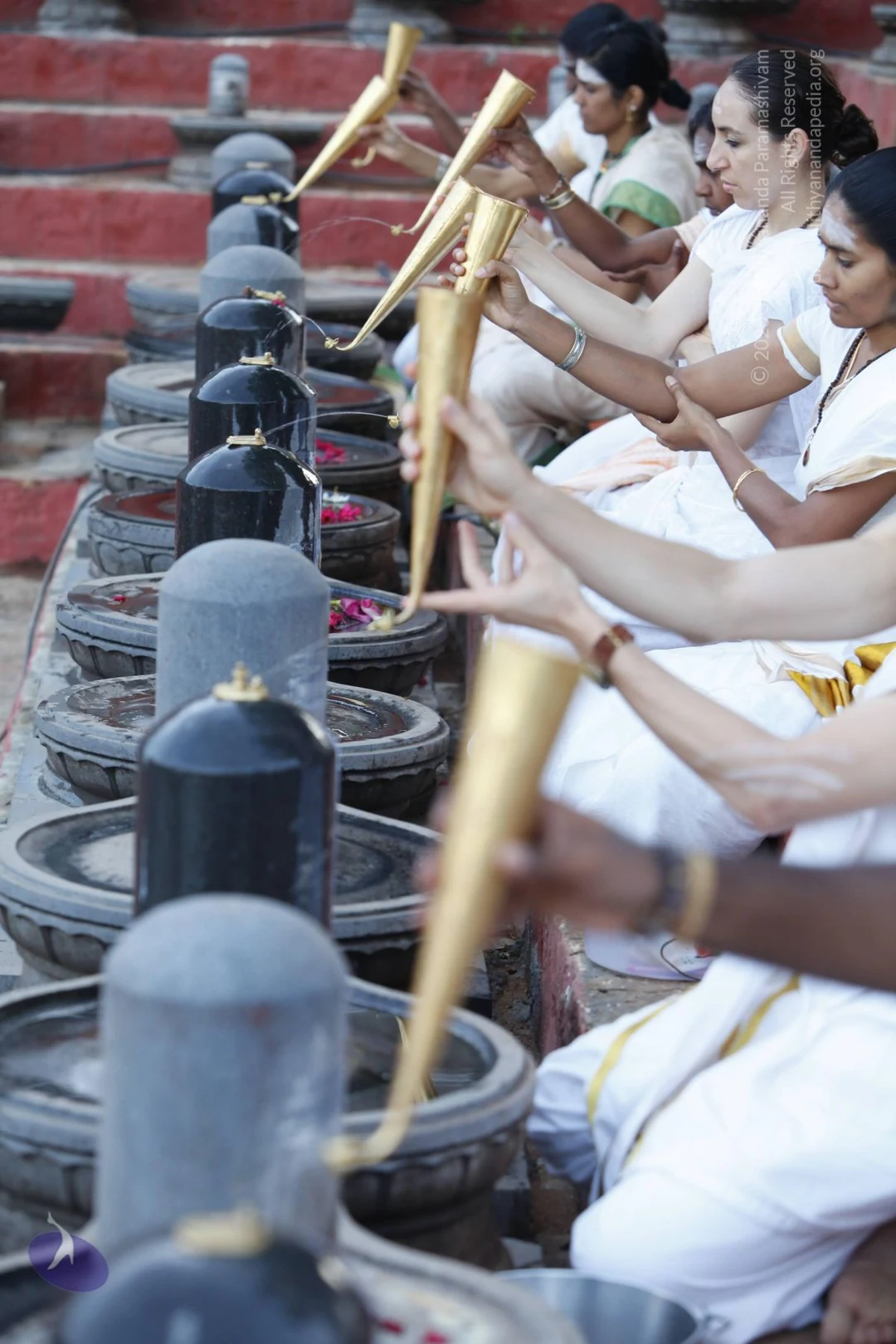
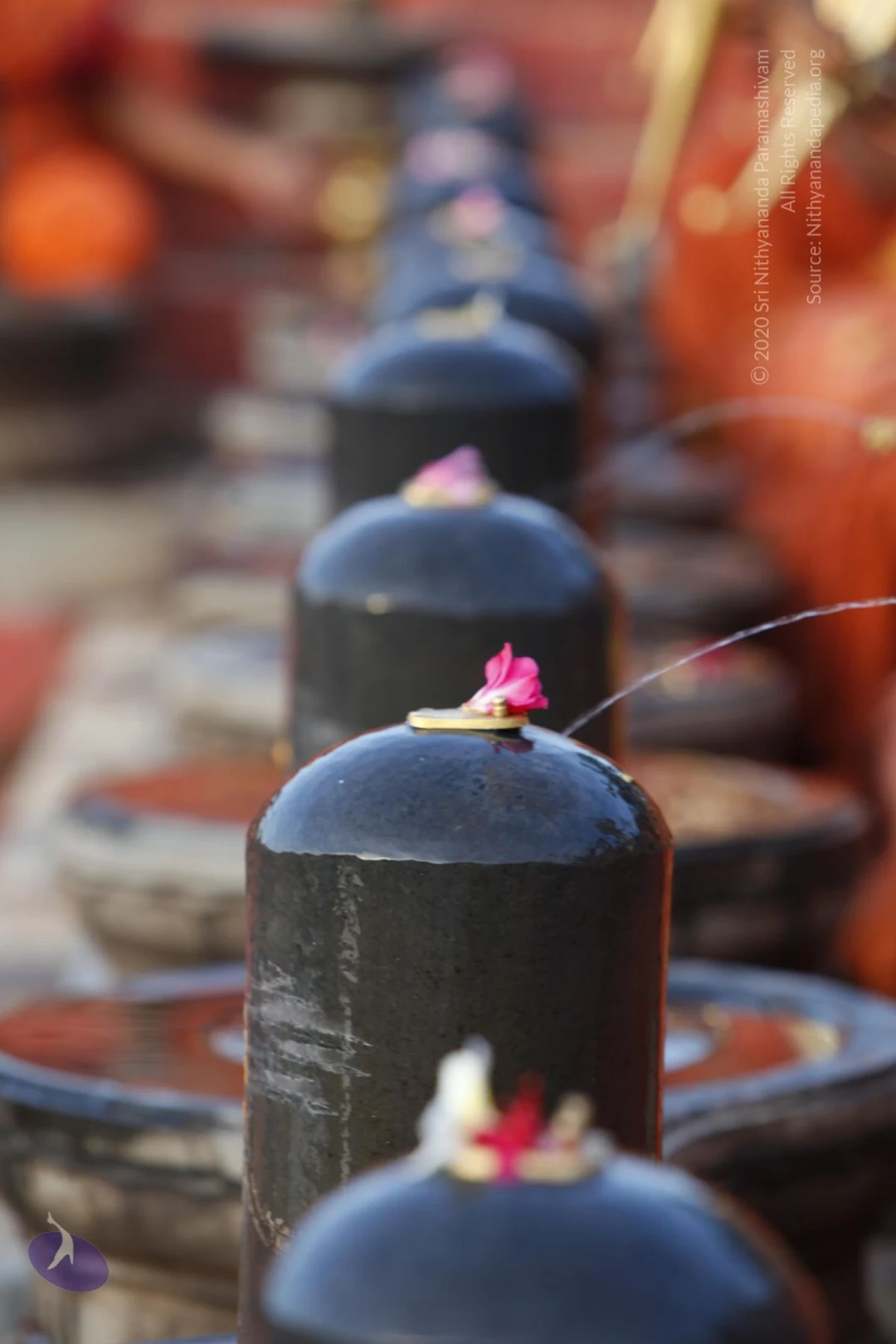
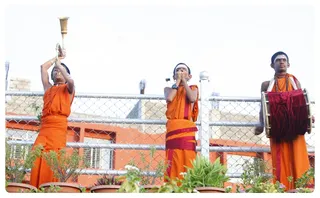
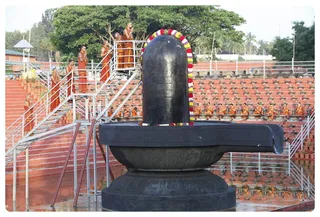
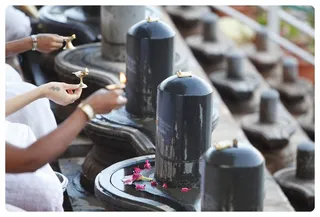
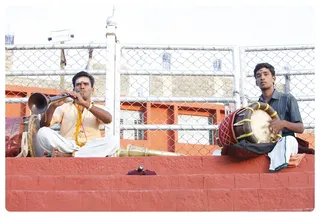
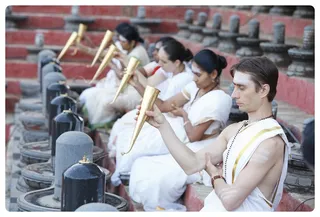
Three young monks in saffron-orange robes stand outdoors behind a chain-link fence with potted plants in front. The monk on the left raises a long brass horn to his lips, the one in the centre blows a conch-style horn held to his mouth, and the monk on the right holds a wrapped drum wrapped in a maroon cloth at his side. Red-orange building walls and a pale sky form the background. Their sacred thread and rudraksha beads are visible at their necks.A large black stone Shiva lingam with a yoni-shaped peetha base stands on a raised platform in an open outdoor courtyard, decorated with a multicolored flower garland arched over its top. Behind it, rows of red-clad monks in orange and saffron robes stand on tiered red steps, and many small clay lamps line the terraced stairs. Several monks are visible standing on a higher level at left, some near metal railings. Green trees and a white building appear in the background. The scene suggests a lingam abhishekam or puja ceremony, though no specific ritual is clearly identifiable.Close view of a row of black stone shivalingams on rounded yoni-shaped bases, each topped with a small brass cap. Two people in white clothing hold small brass oil lamps with lit flames, one lamp tilted toward a lingam. Pink flower petals are scattered on the base of a lingam in the foreground. A wrist watch and a bracelet are visible on one wrist, and a tattoo on the other hand. The scene suggests a Shiva temple worship setting with lamp offerings.Two musicians sit on a red-painted concrete step in front of a chain-link fence. The man on the left, bare-chested with a yellow-orange cloth wrap and white dhoti, plays a long brass horn called a nagaswaram-style trumpet while wearing a rudraksha-style beaded mala and a gold bracelet. The young man on the right, in a dark collared shirt and white dhoti, plays a hand drum with a maroon and gold body and yellow lacing. Brass horn lies on the step, and a dark cloth rests beside them. No a person candidate is visible.Outdoor temple scene with a row of devotees in white dhotis and white garments with gold borders performing abhishekam on black shivalingam stones set on red-painted stepped platforms. In the foreground a young man with a shaved-looking light hairstyle, white tripundra markings on his forehead and arms, and a rudraksha mala holds a golden pouring vessel above a lingam. Several women behind him, also in white, hold similar golden vessels and pour in unison. Stone pillar-like features and a metal bowl sit at the base of the stone steps.

Photos

2 photosSource gallery
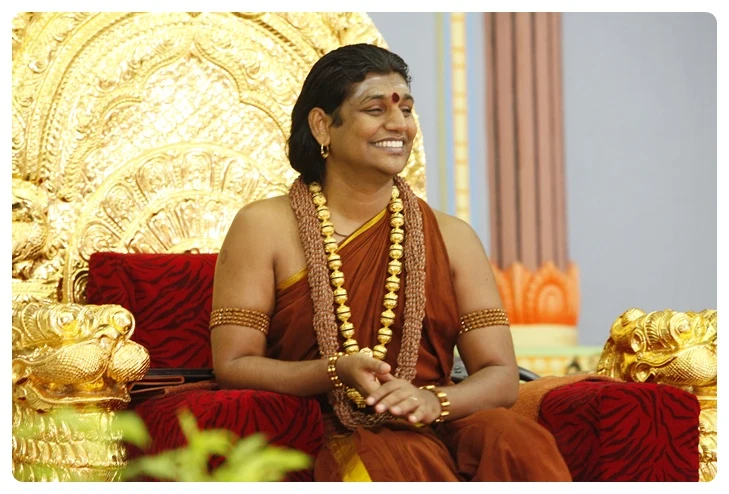
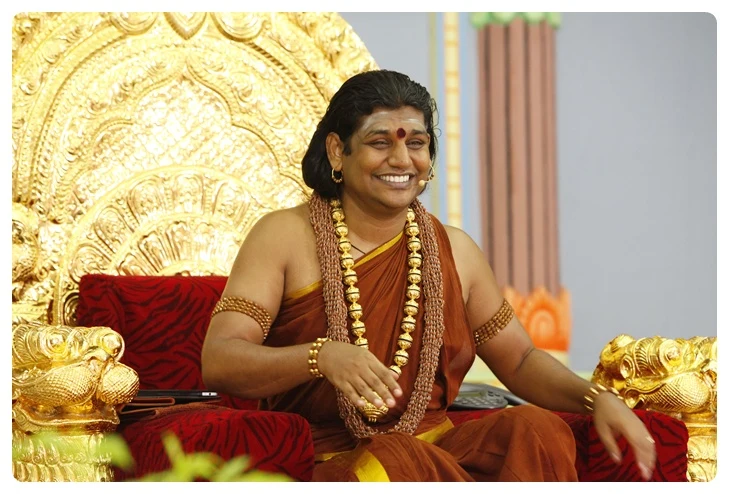
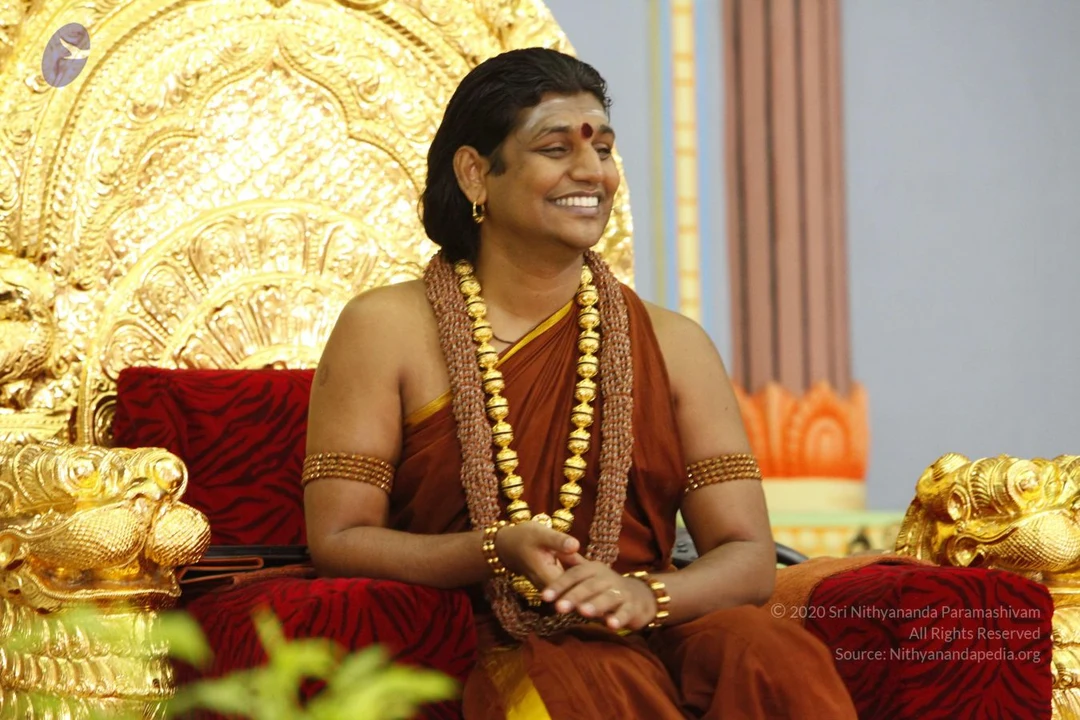
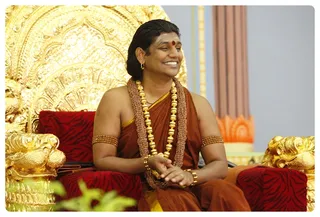
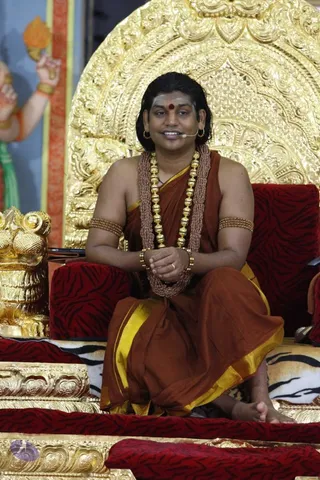
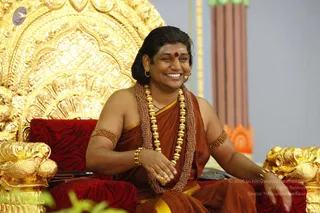
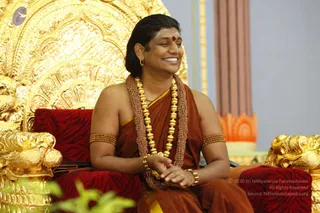
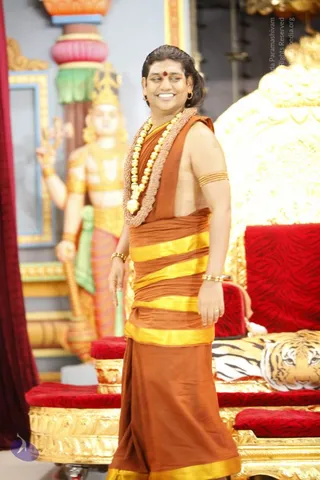
A smiling person with swept-back dark hair and a small red bindi sits on an ornate gold throne with red tiger-striped cushions and gold lion-head armrests. They wear a saffron-orange robe with a yellow border, a long rudraksha mala with large gold beads, gold bangles on the upper arms and wrists, and gold earrings. Hands are folded in the lap. A green plant and draped pink-and-orange curtains are in the background. a person is a candidate based on the rudraksha mala, gold ornaments, saffron robe and throne, with the page stating he is present.A smiling man sits on an ornate gold throne with a large gold backrest and carved gold lion-head armrests, draped in red velvet cushions. He wears an orange-saffron dhoti-style wrap with a gold border, bare upper arms with gold armbands, bracelets, and a long ceremonial mala of rudraksha beads with gold bead accents around his neck. A red bindi marks his forehead. His hands rest on his lap. Behind him are gold and orange pillars and a green plant in the foreground. Appearance-based candidate: Swamiji (probable), seated in person on the throne, with long swept-back hair, ceremonial gold necklace and saffron clothing.

Rudra-Abhishekam
179 photosSource gallery
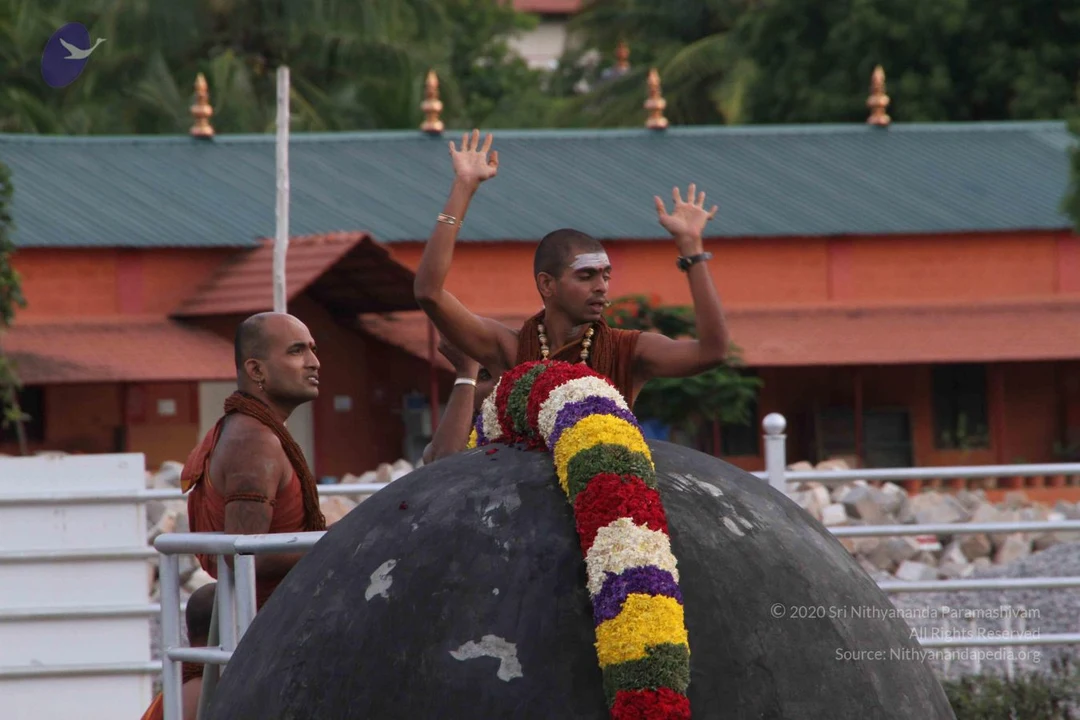
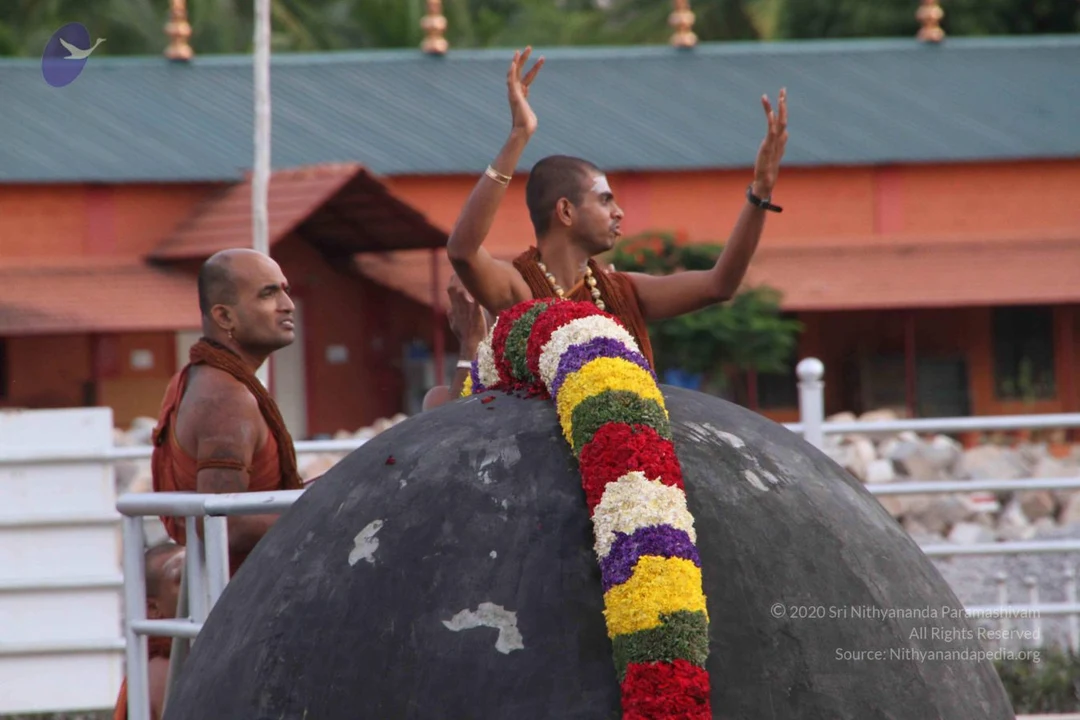
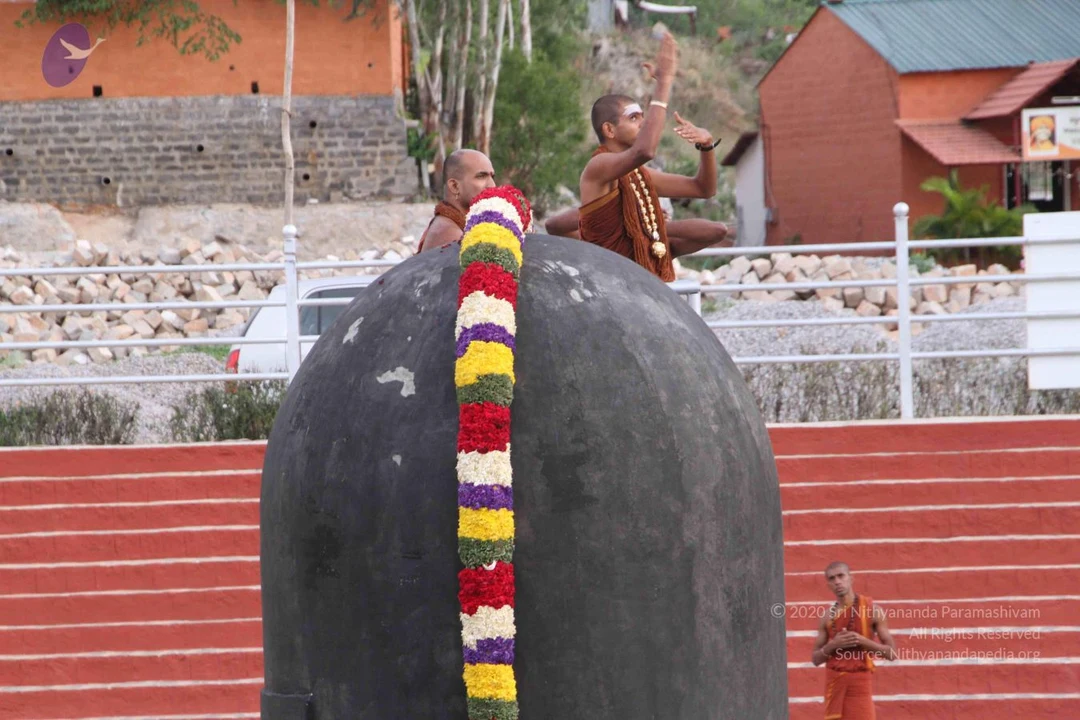
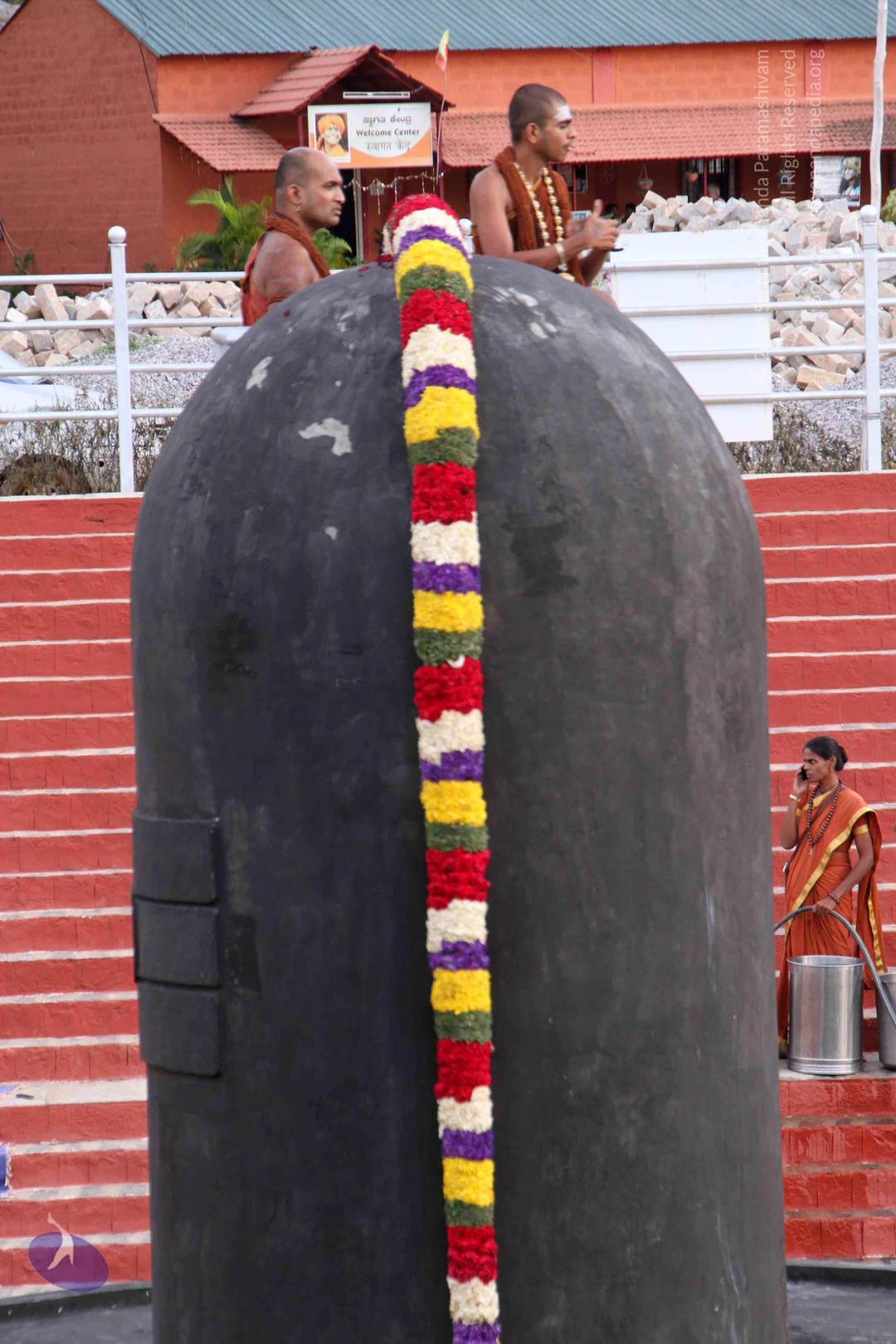
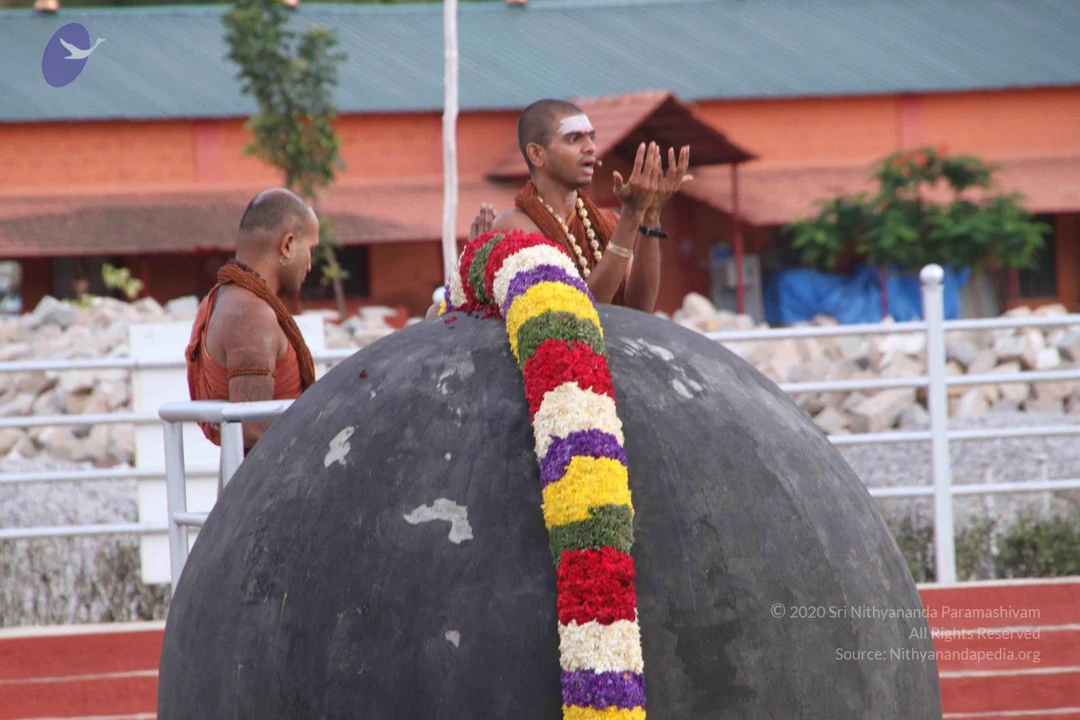
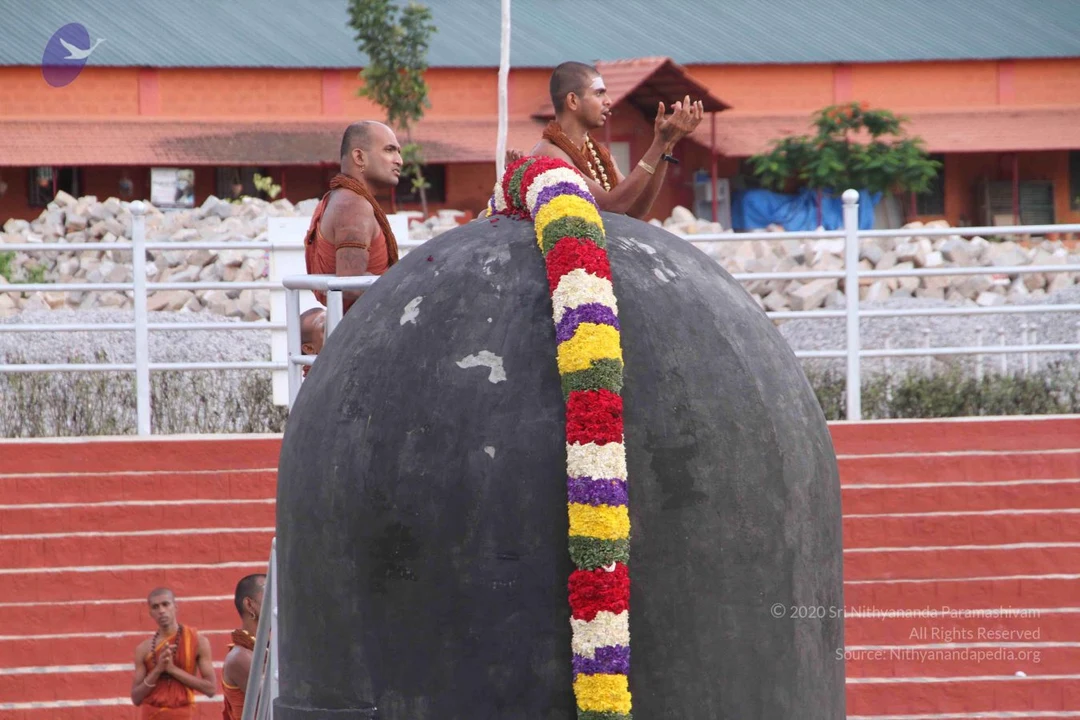
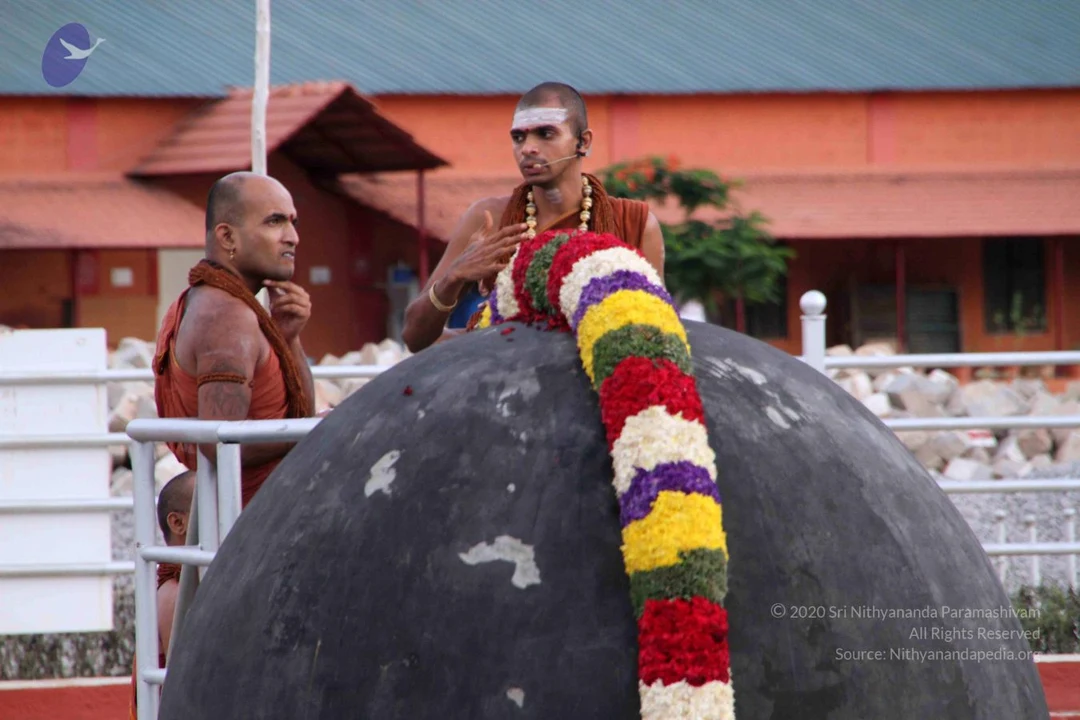
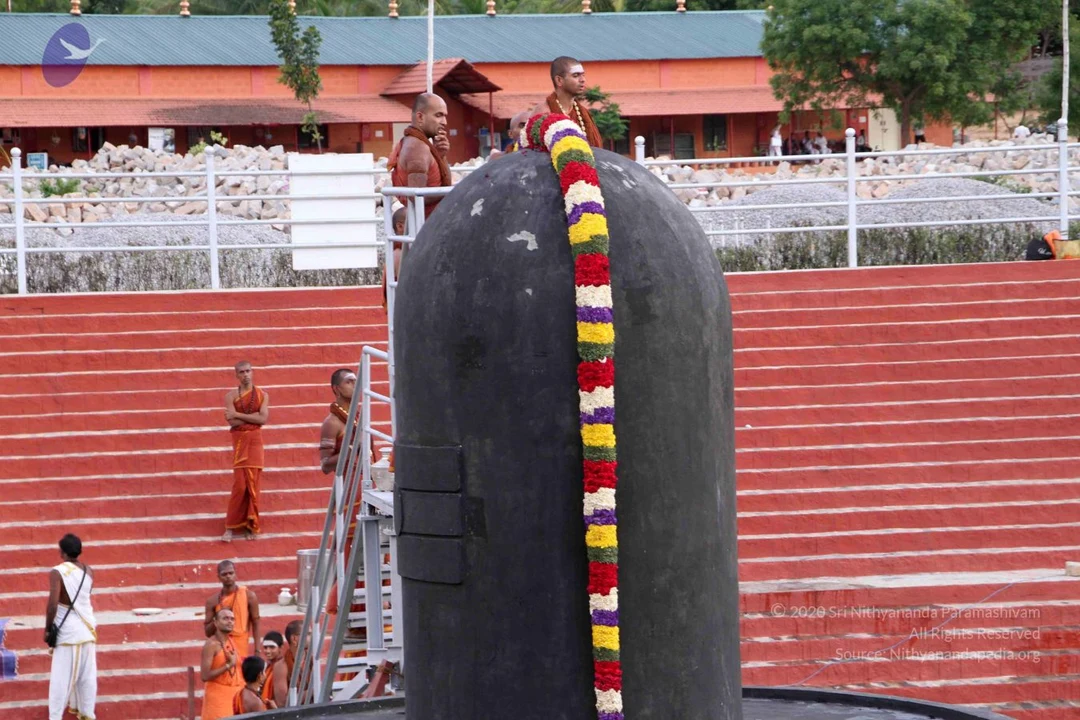
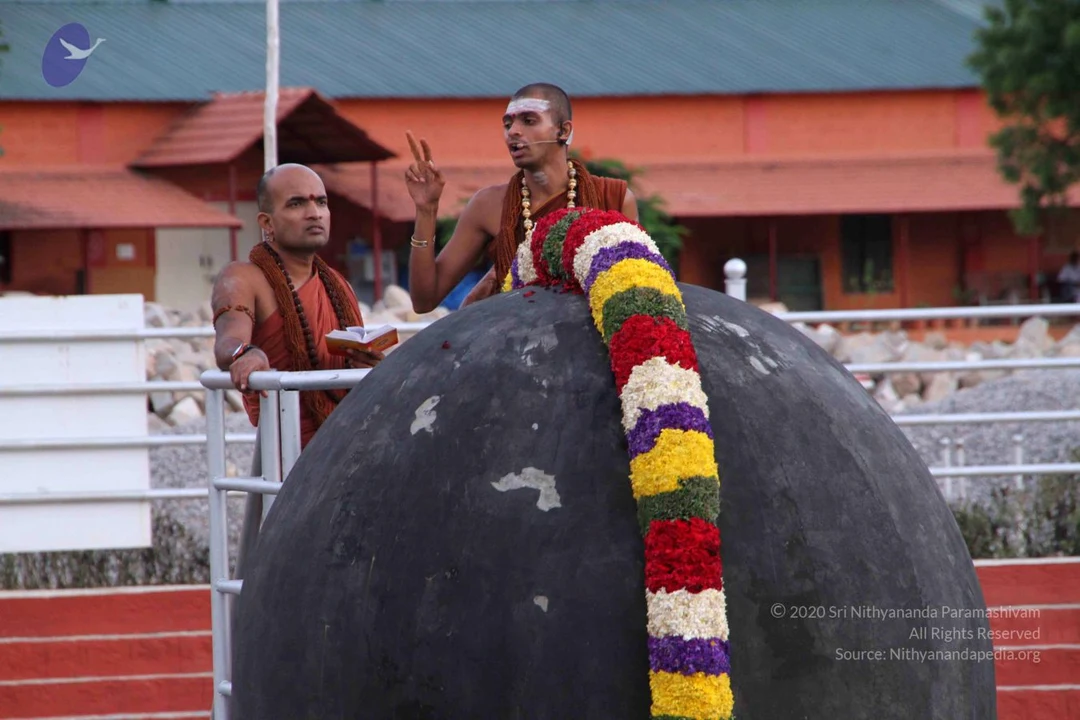
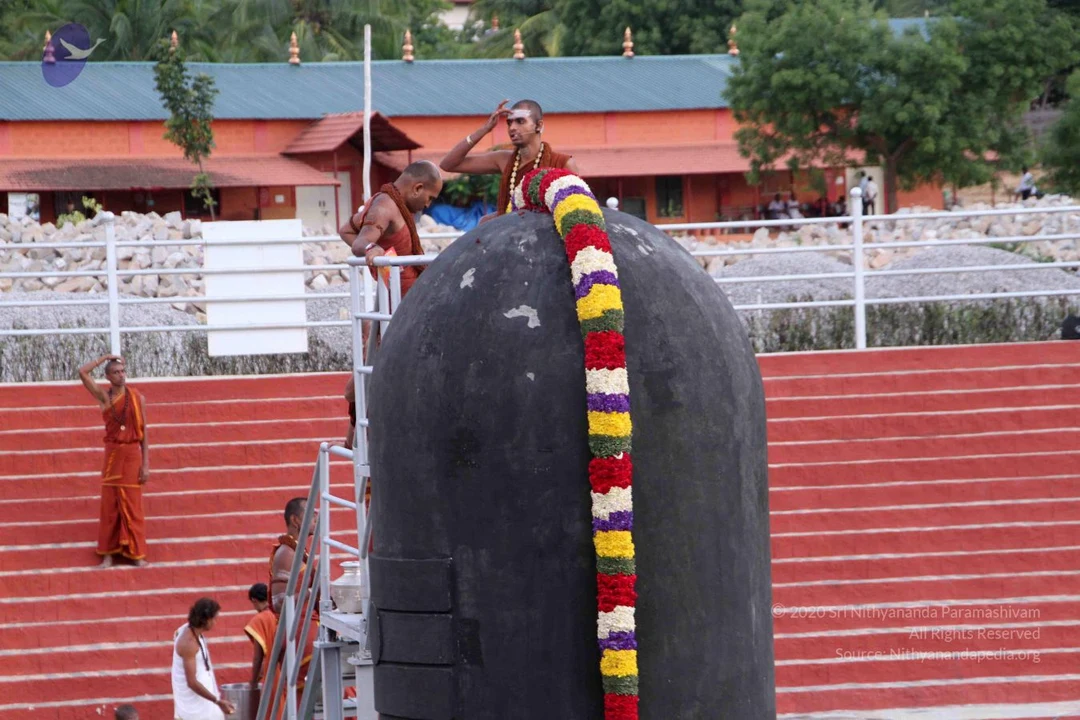
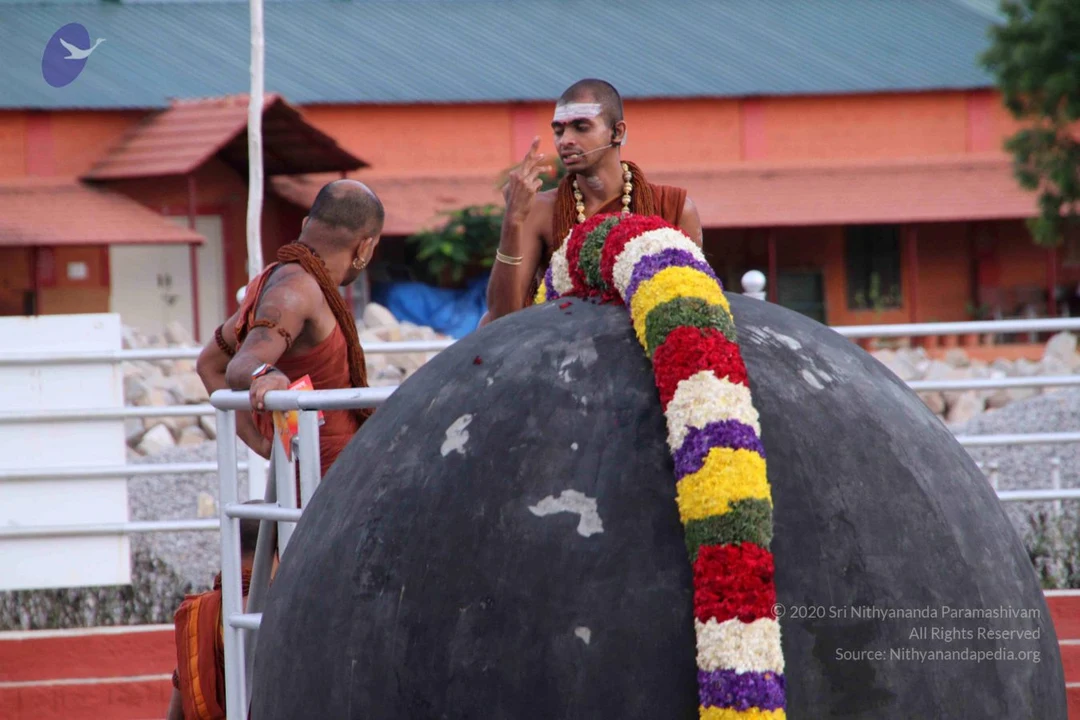
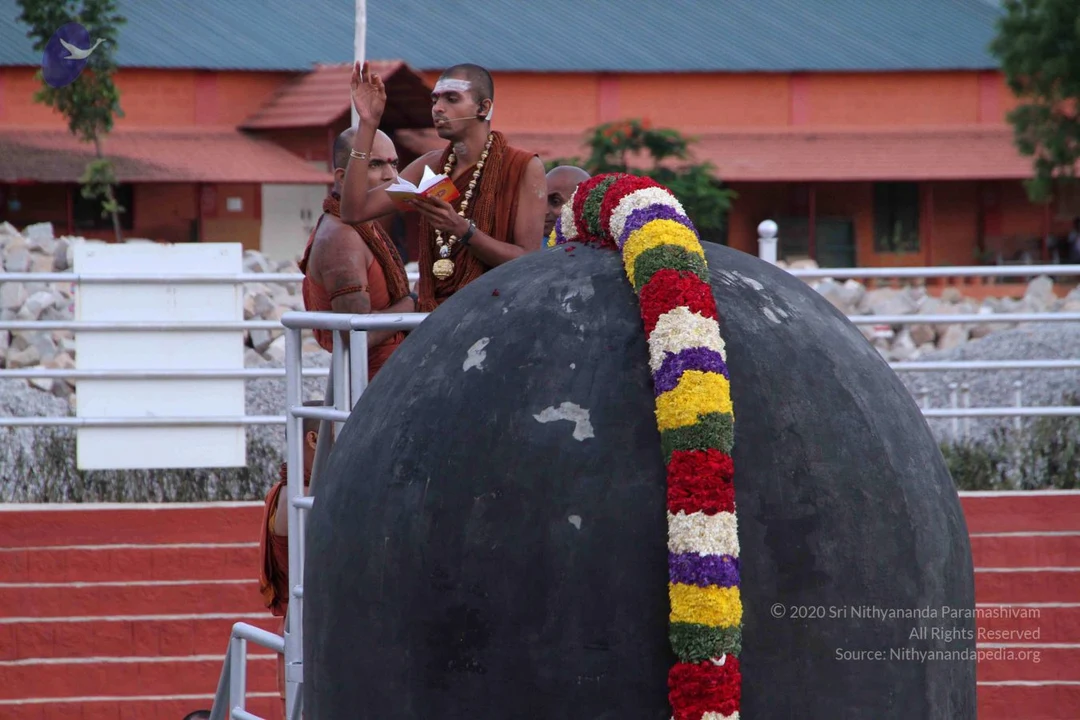
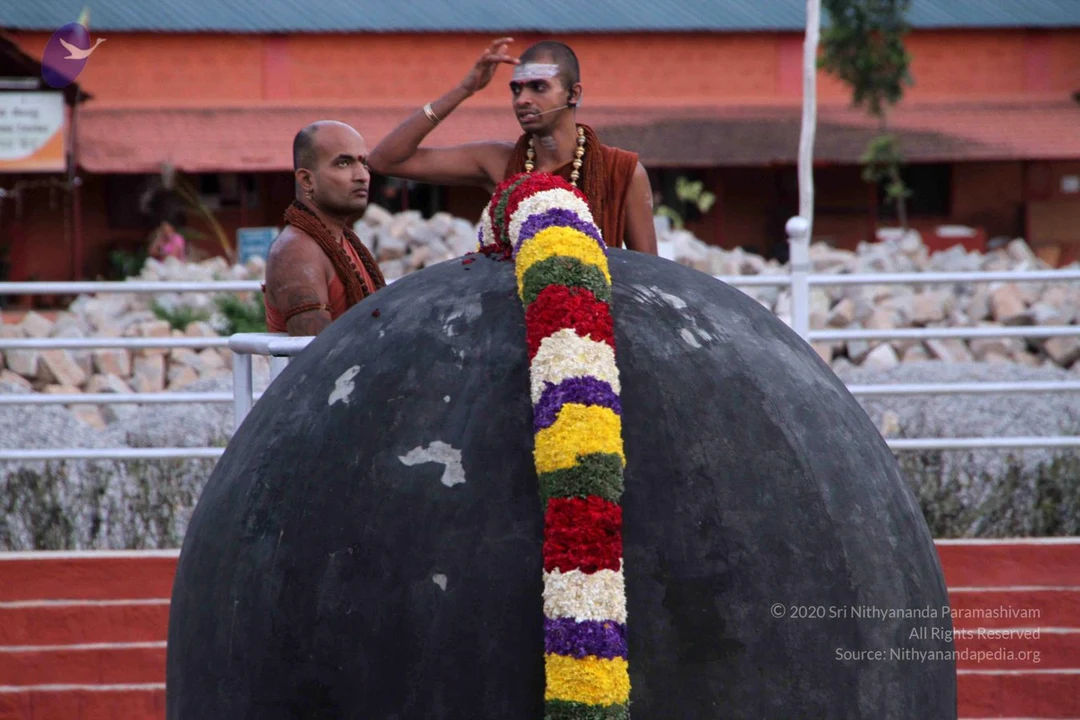
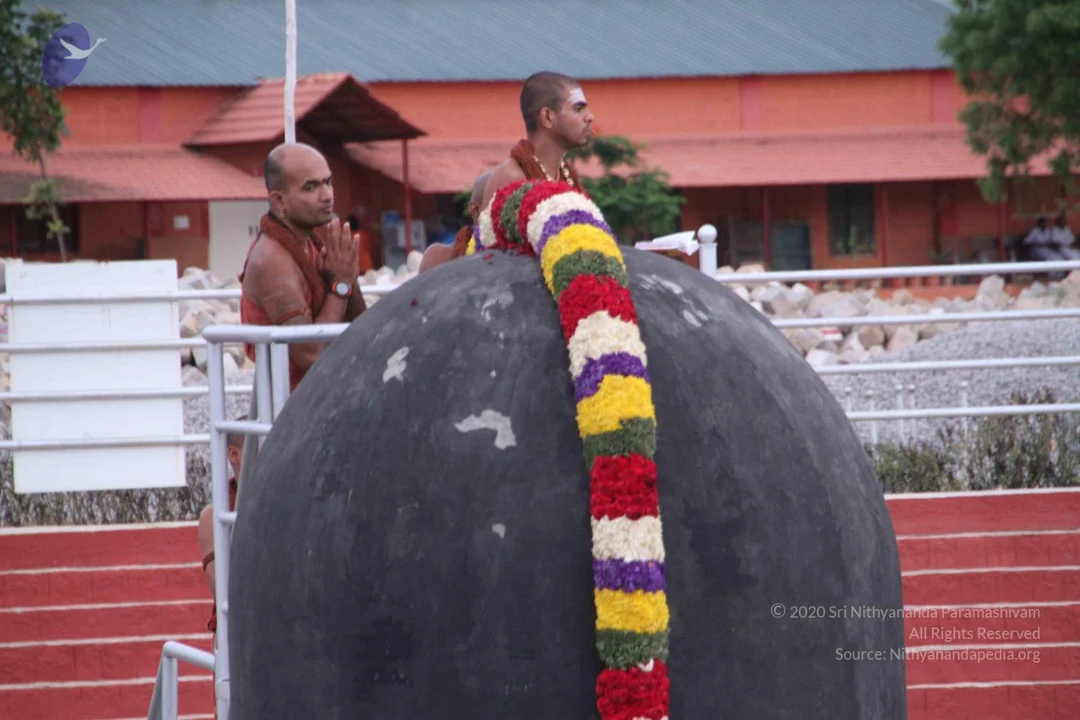
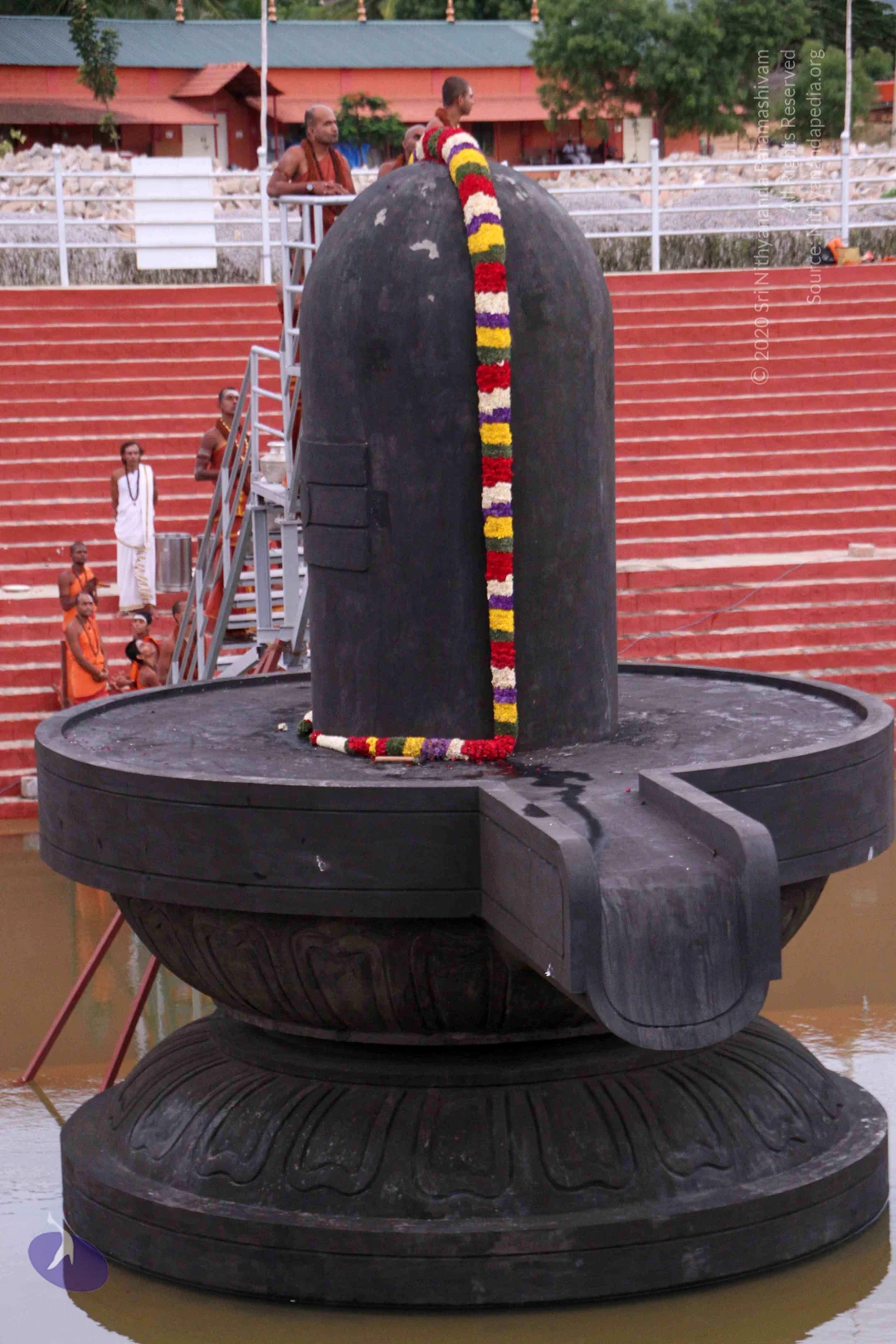
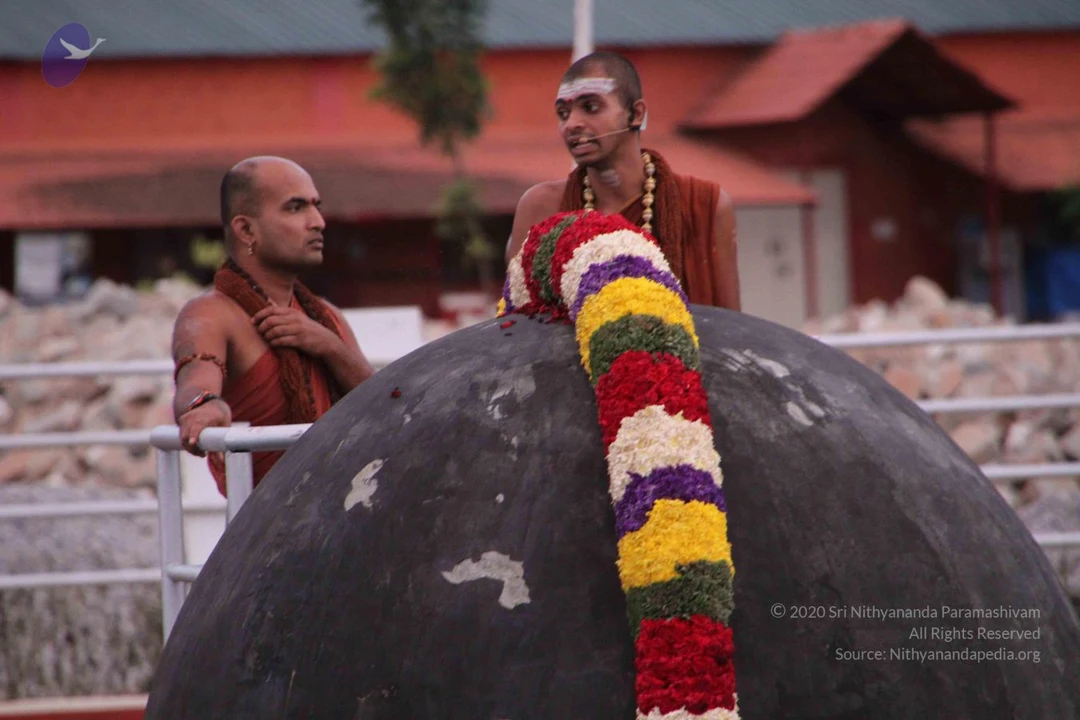
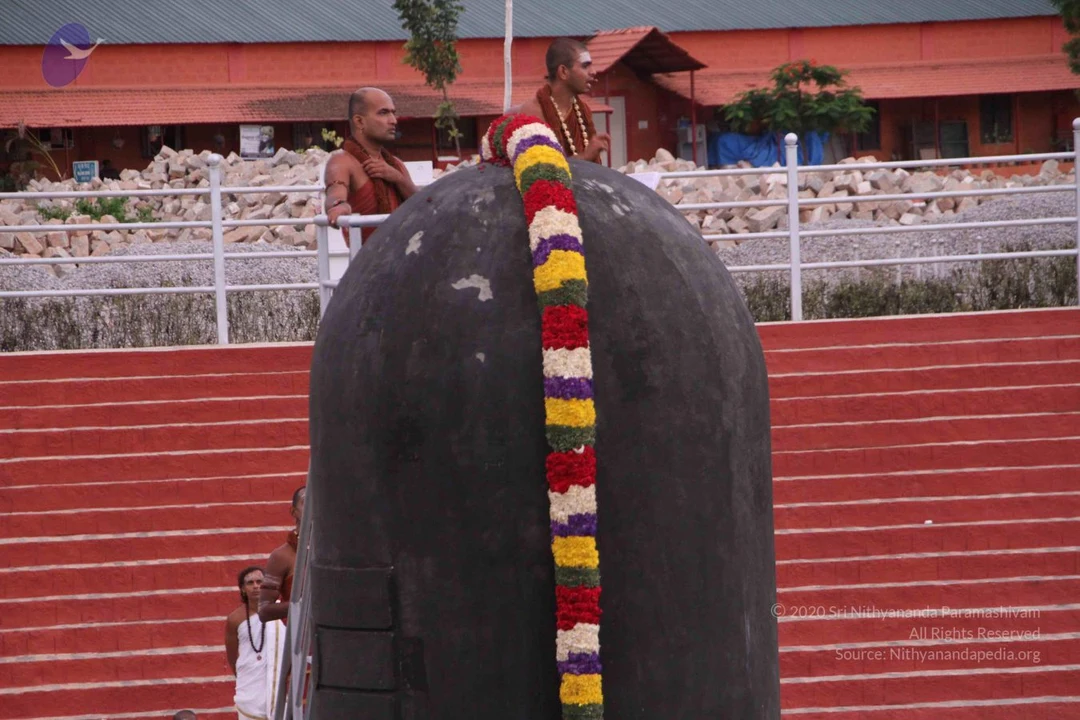
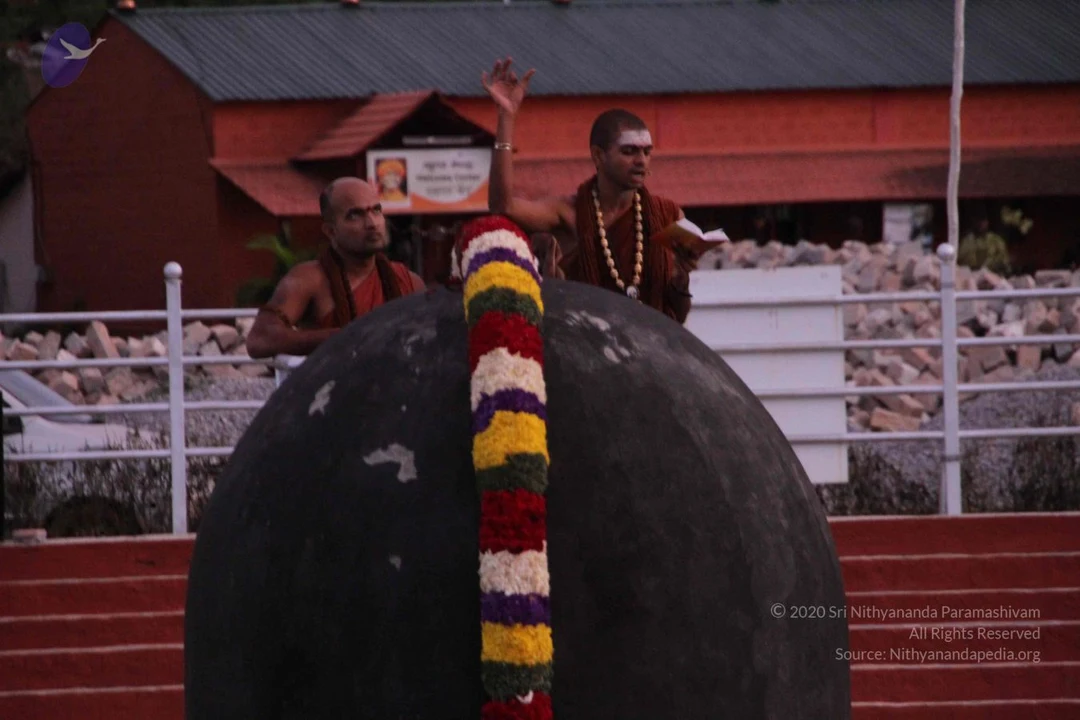
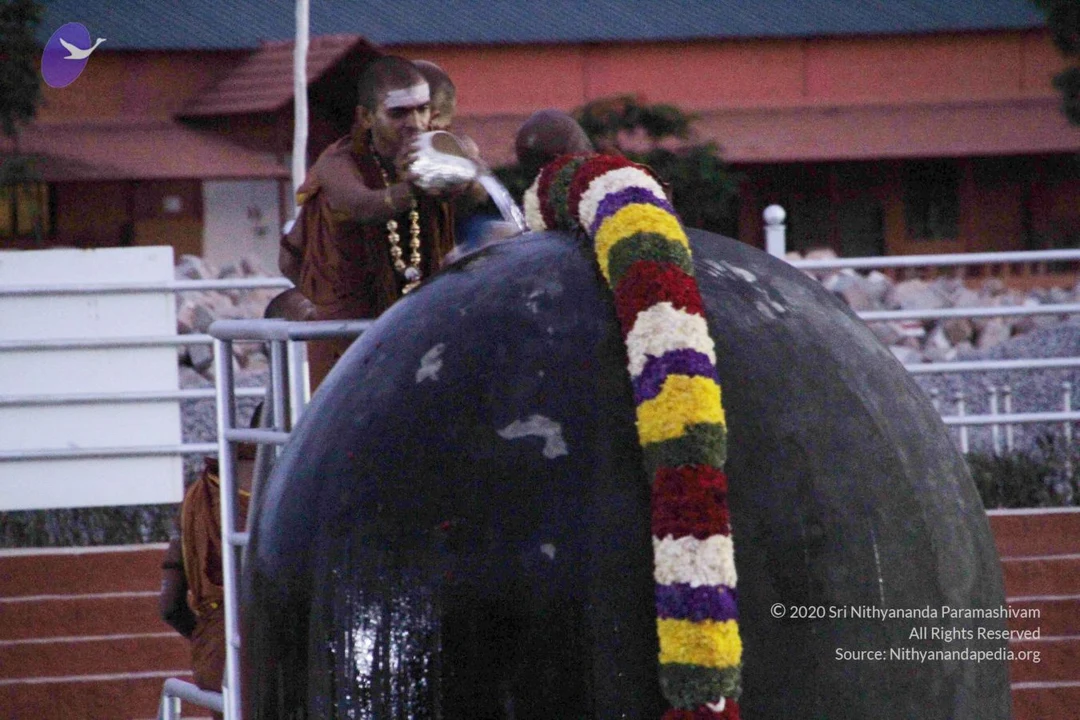
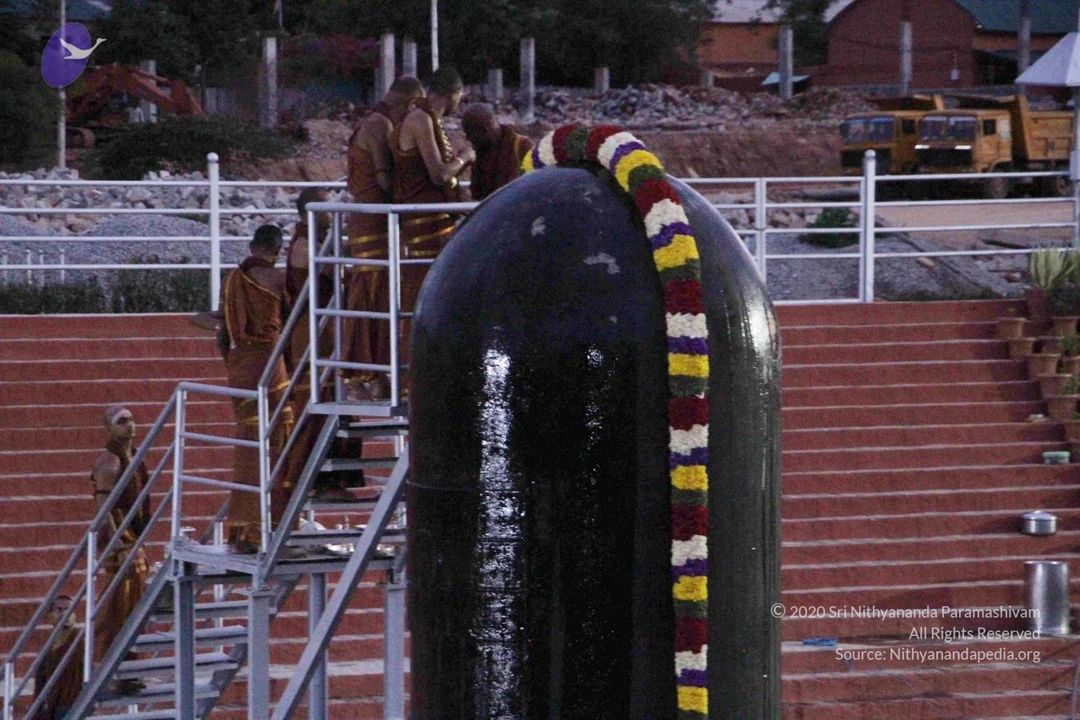
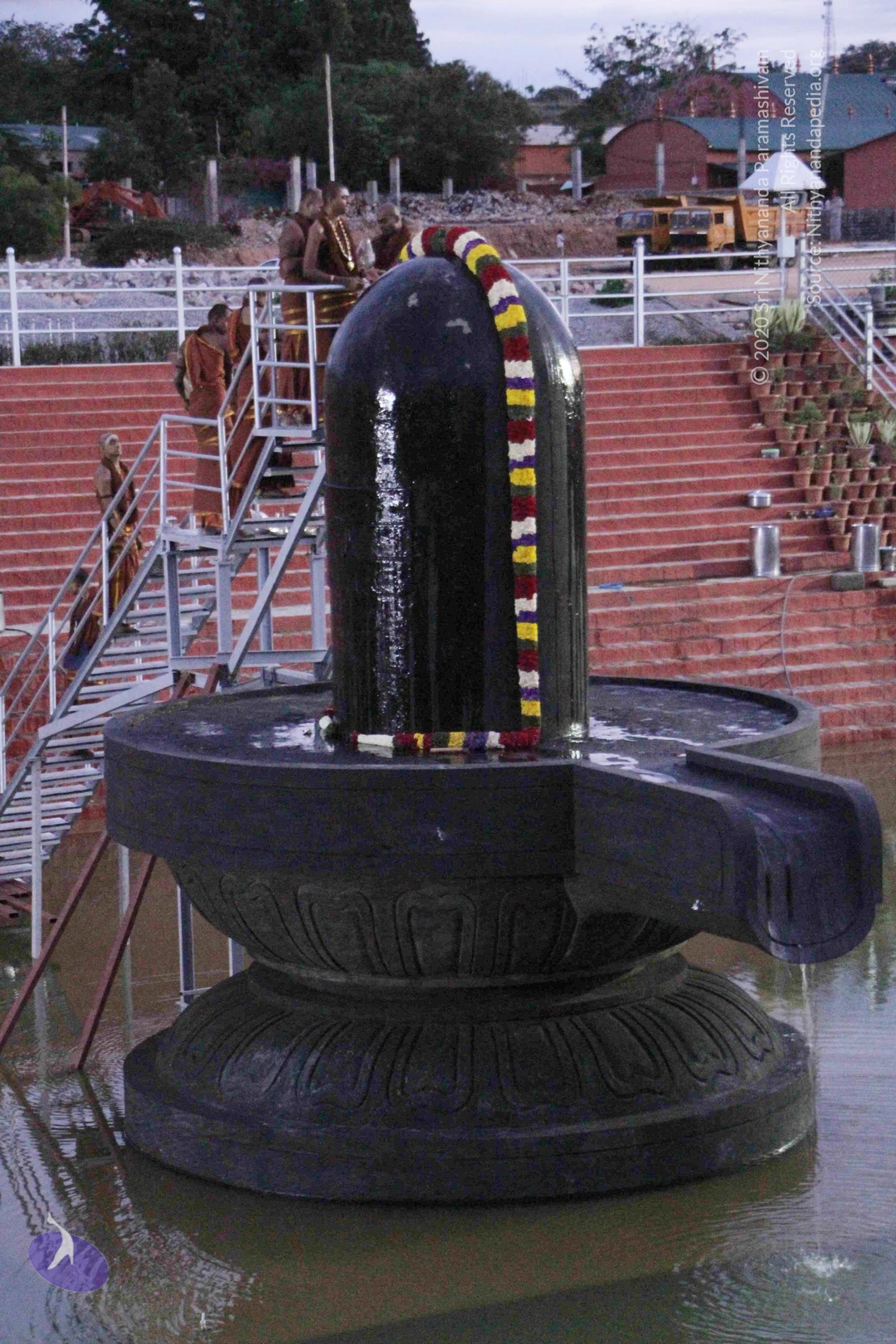
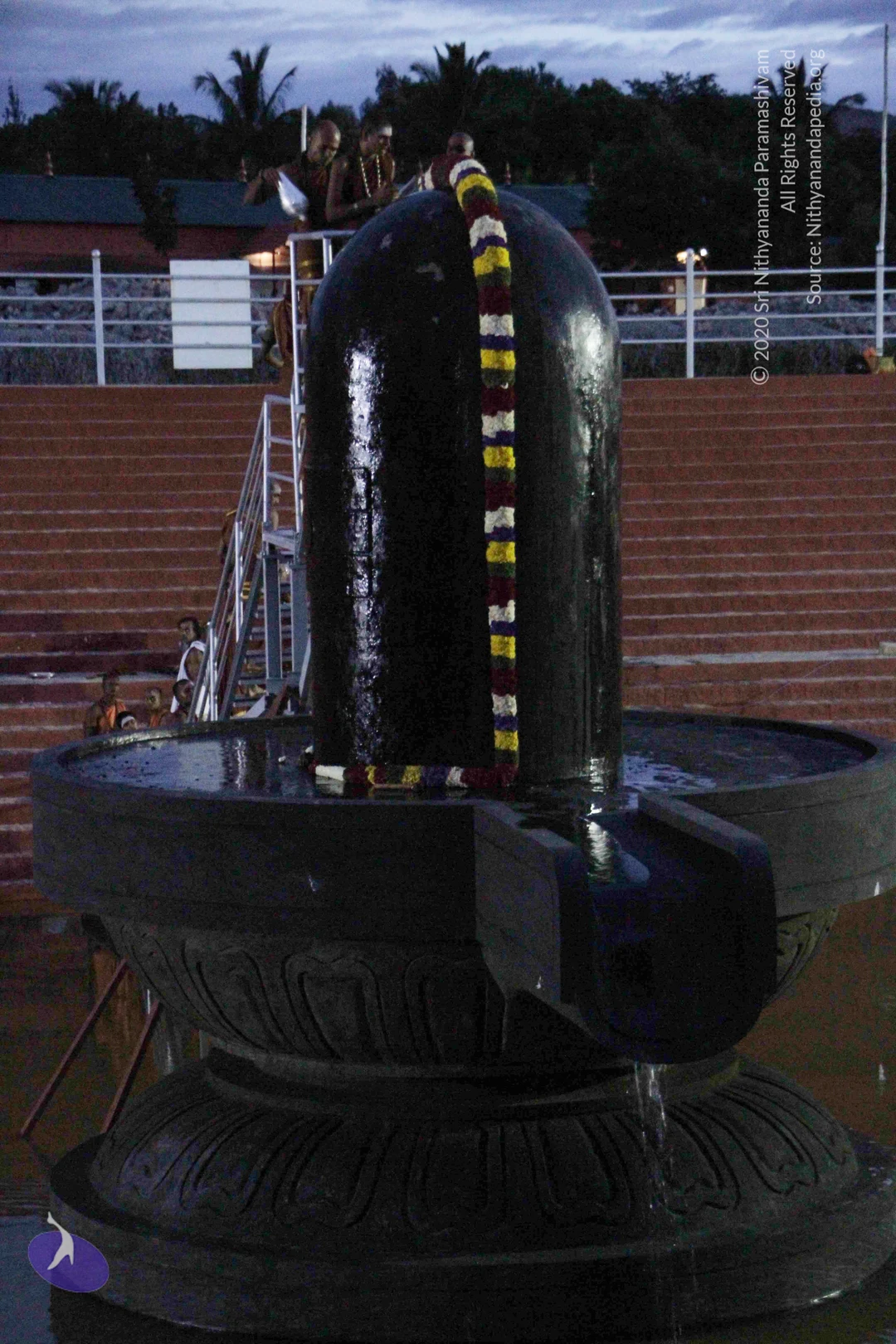
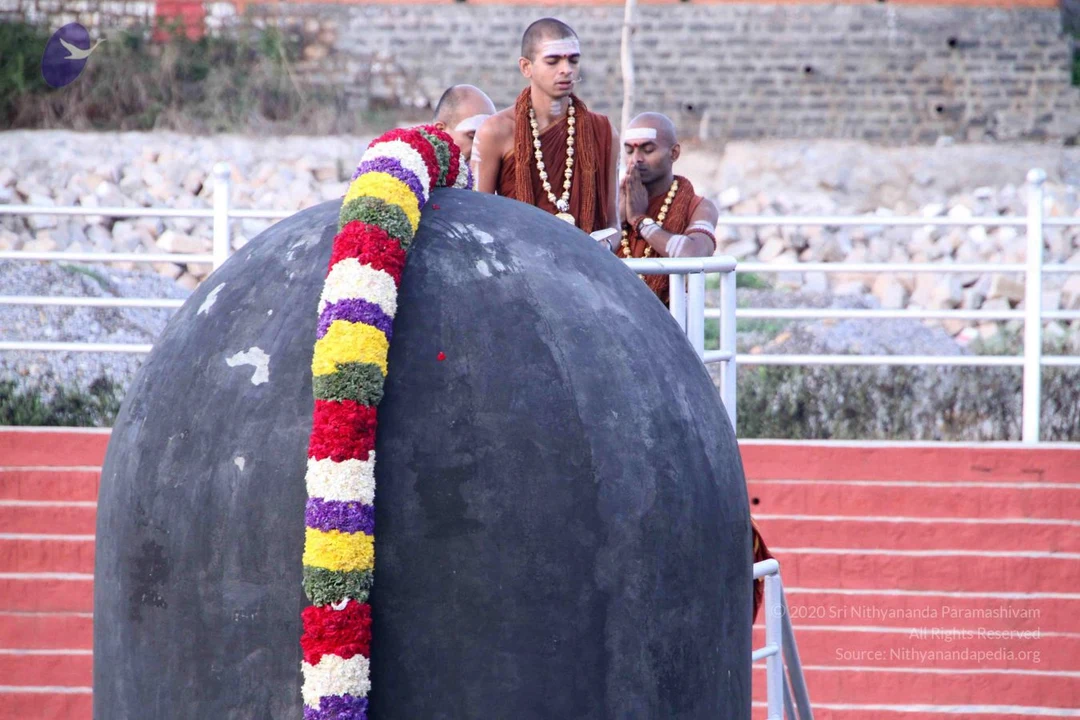
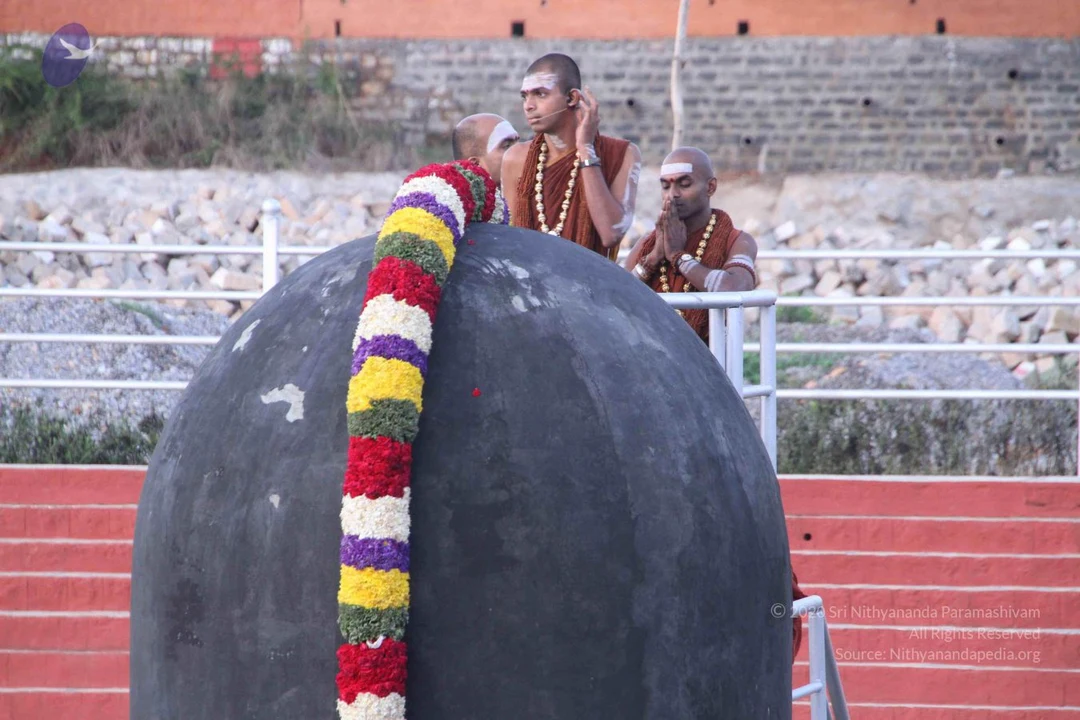
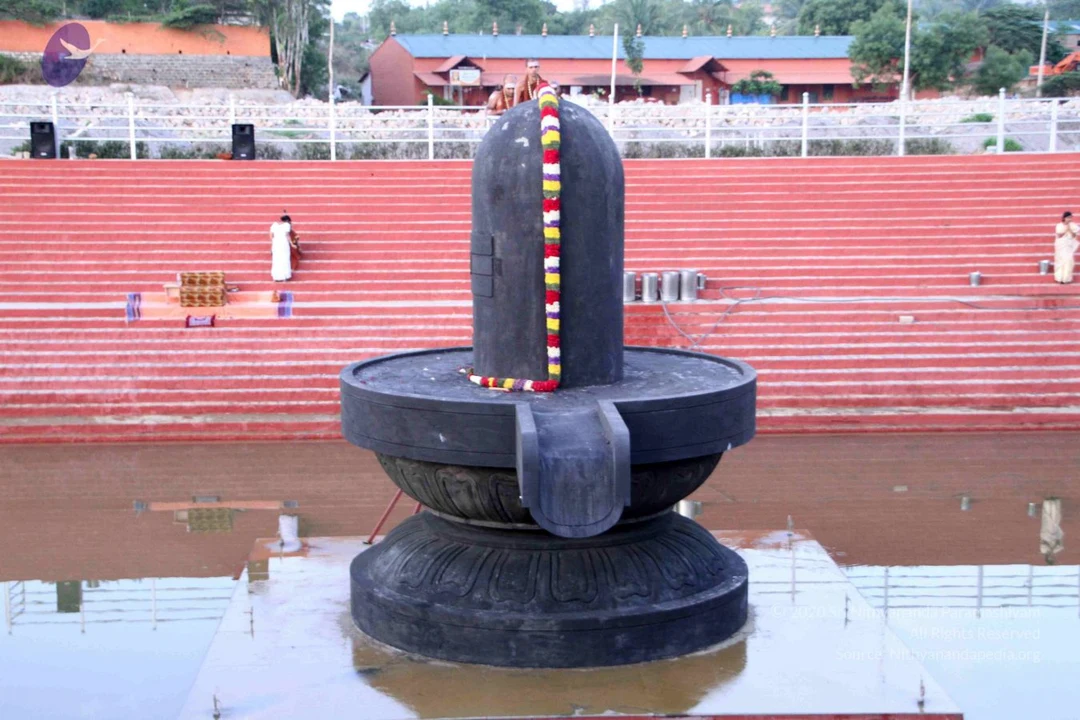
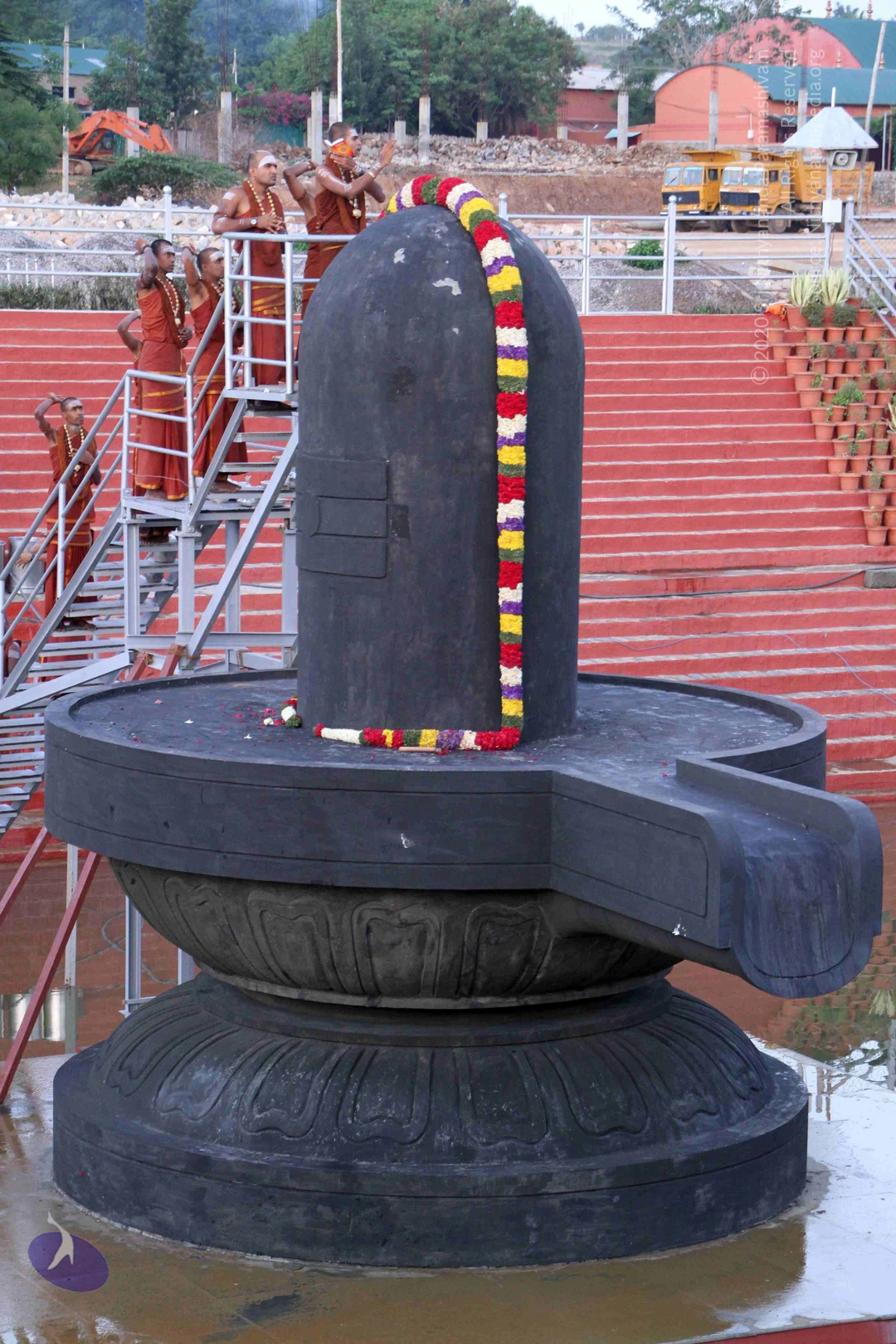
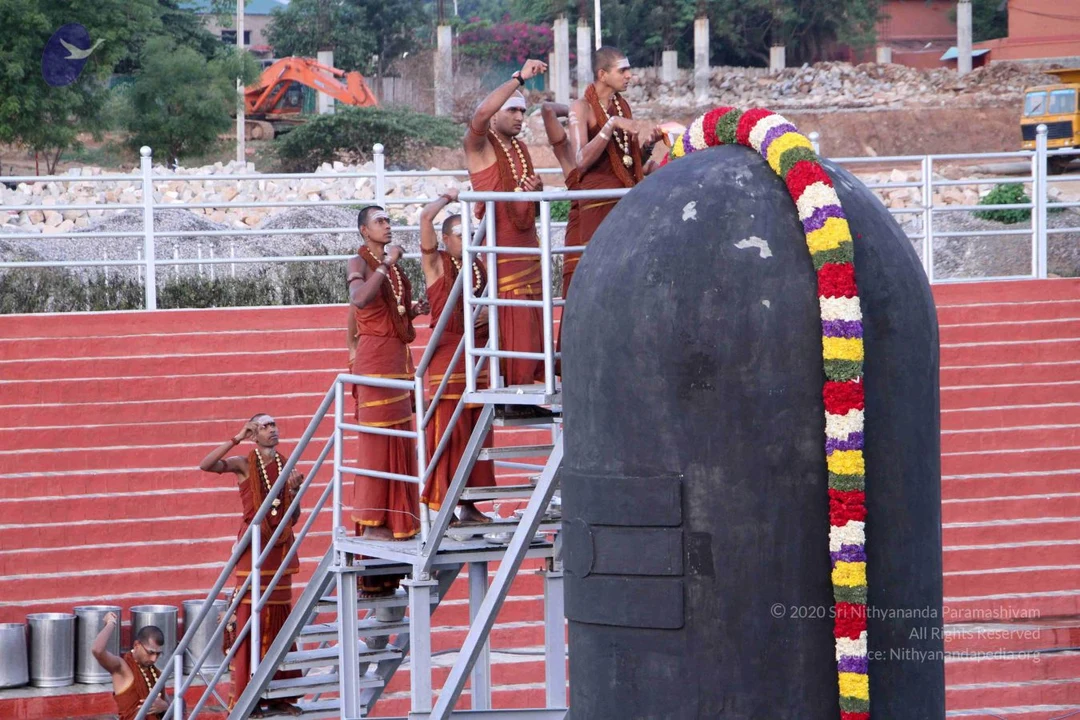
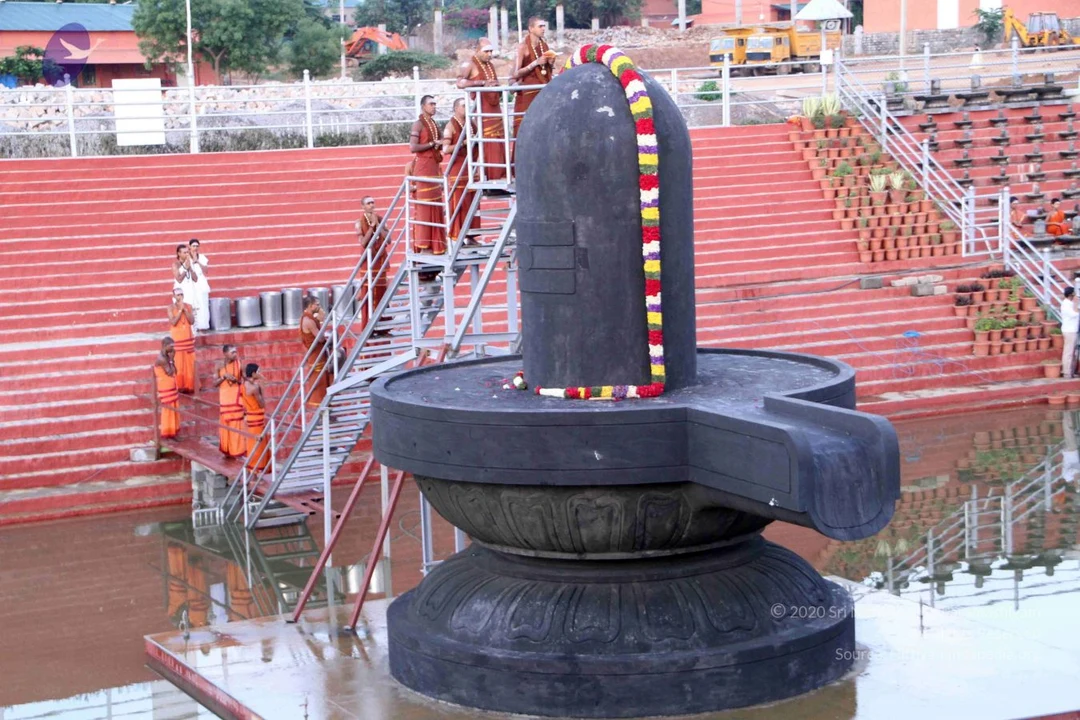
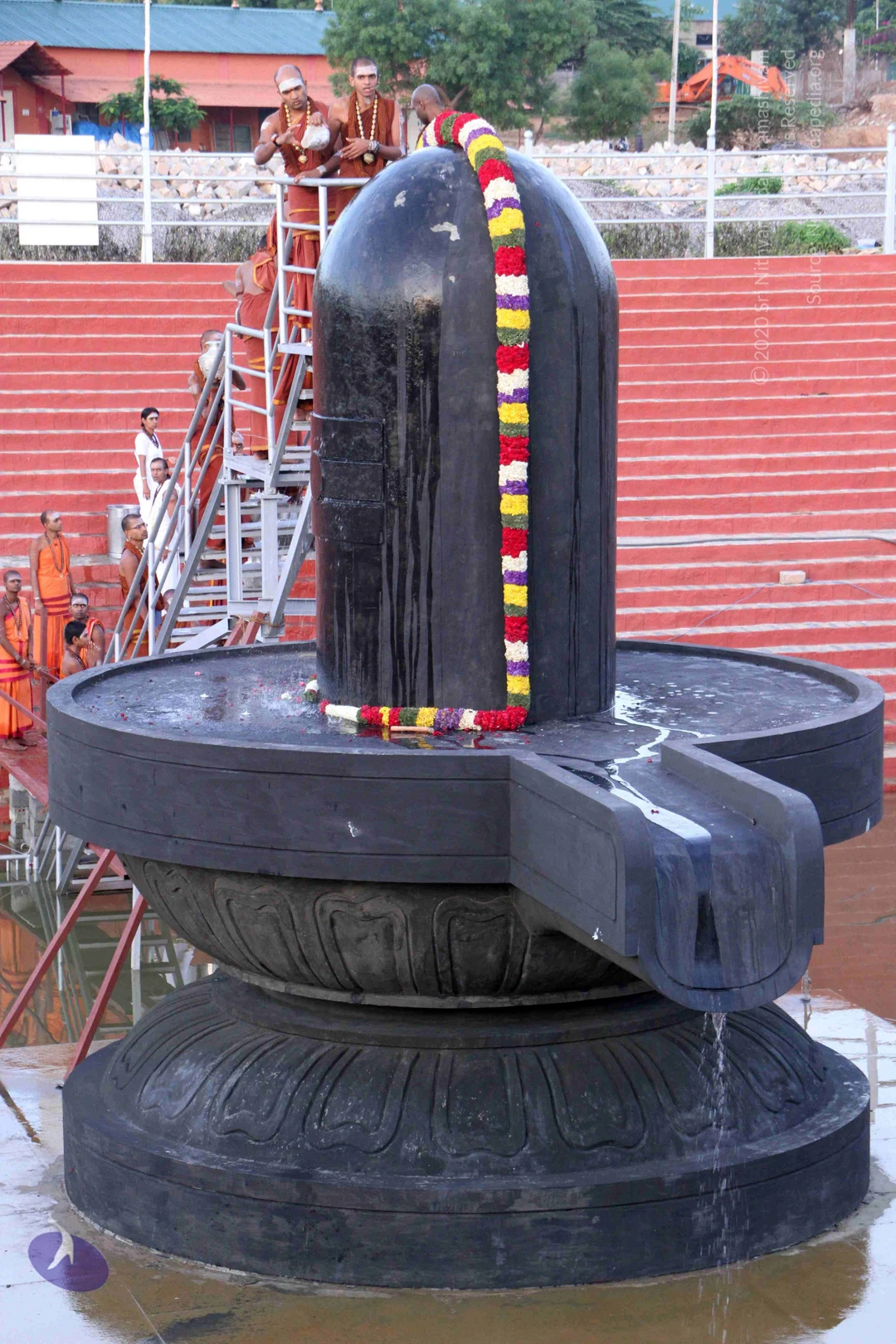
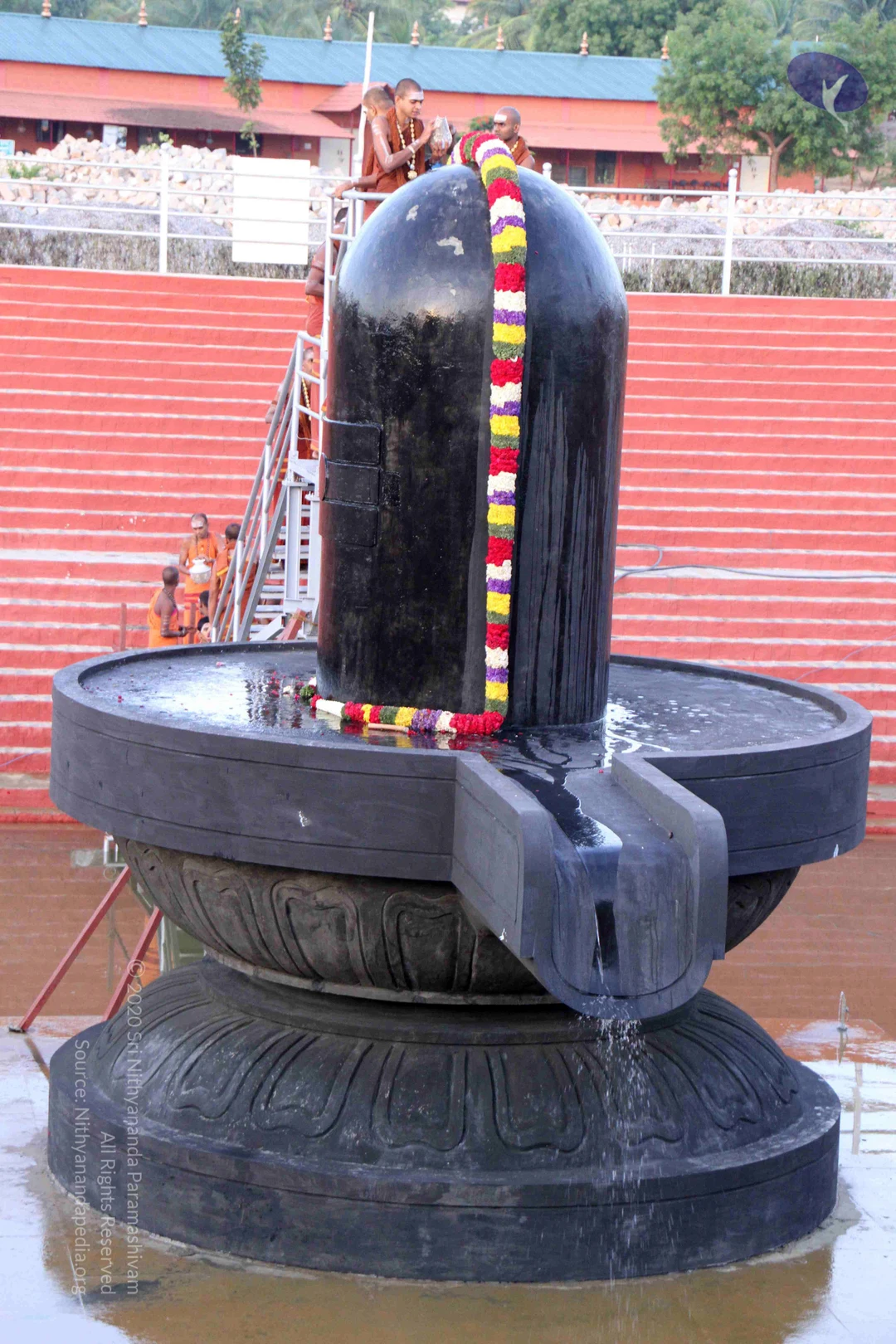
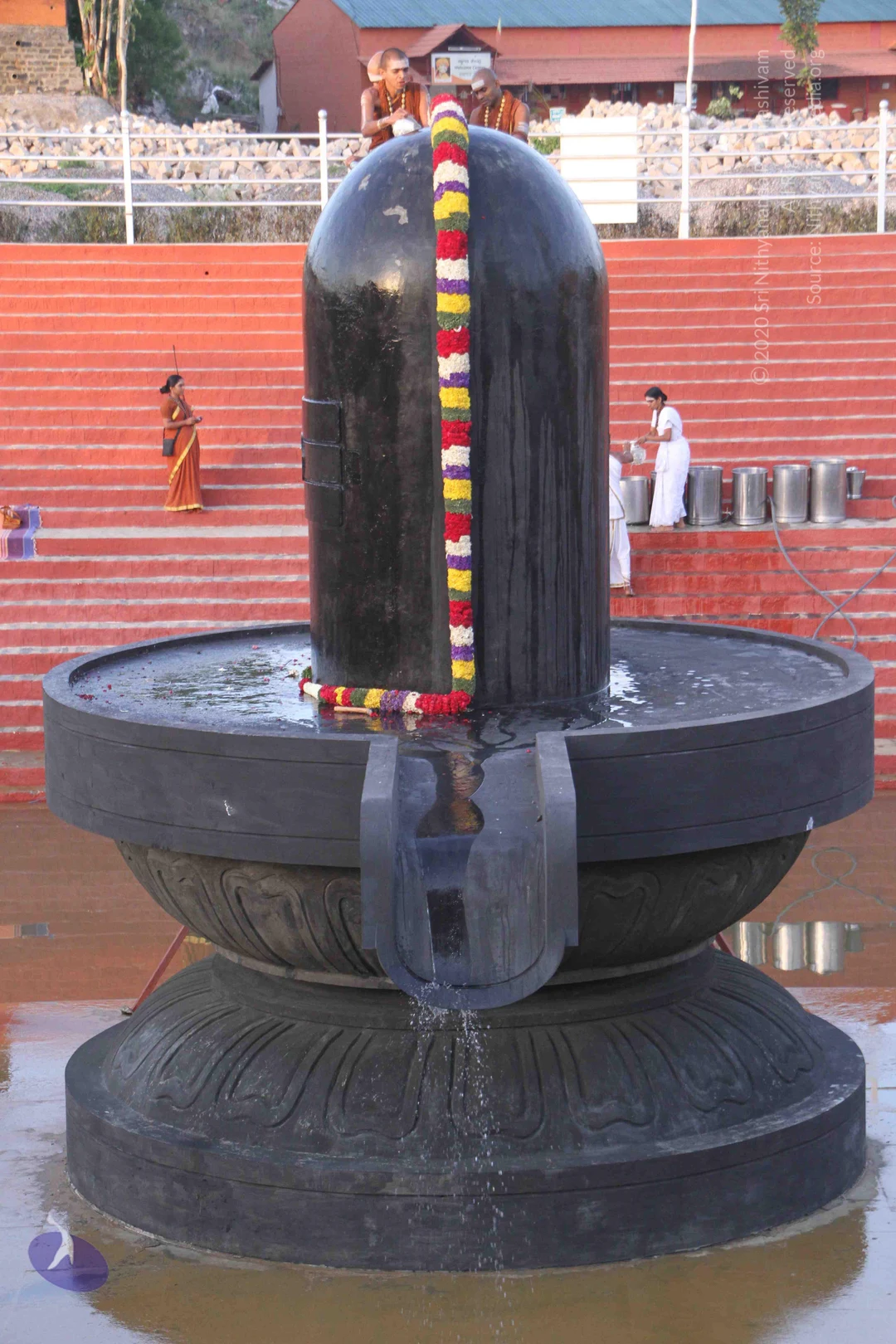
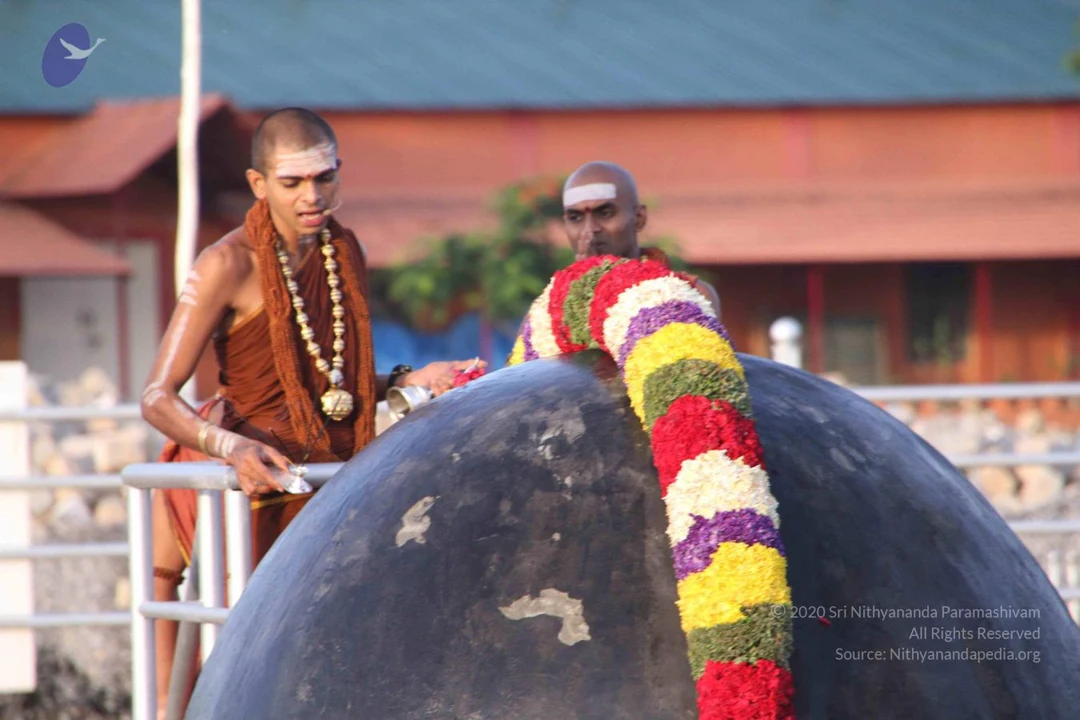
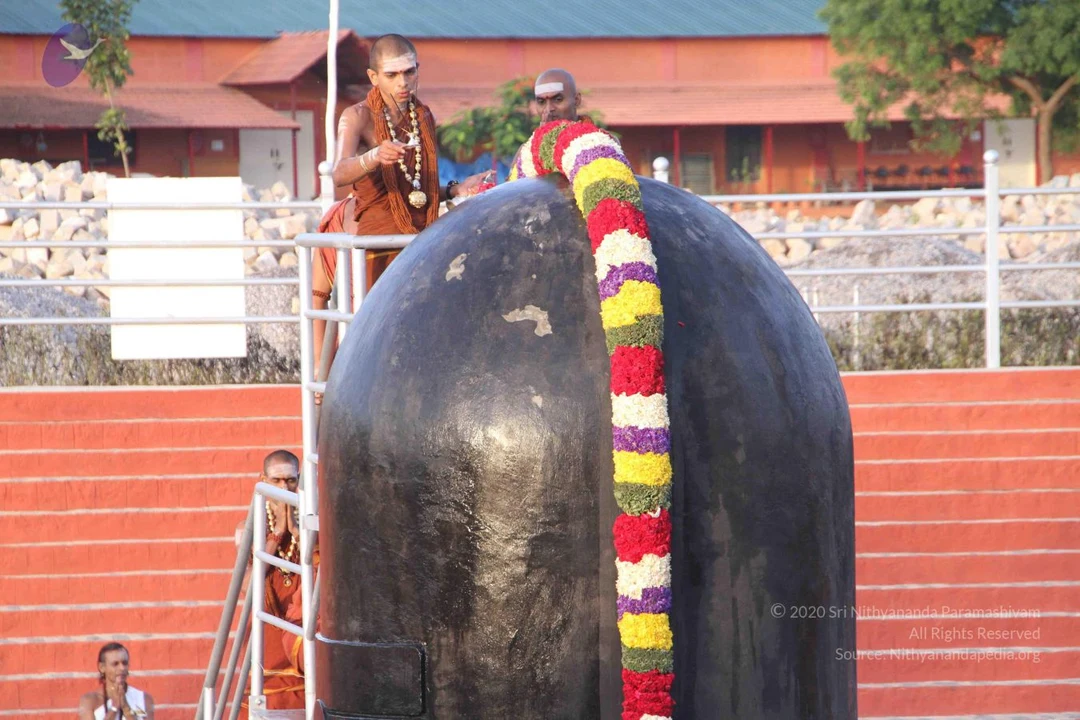
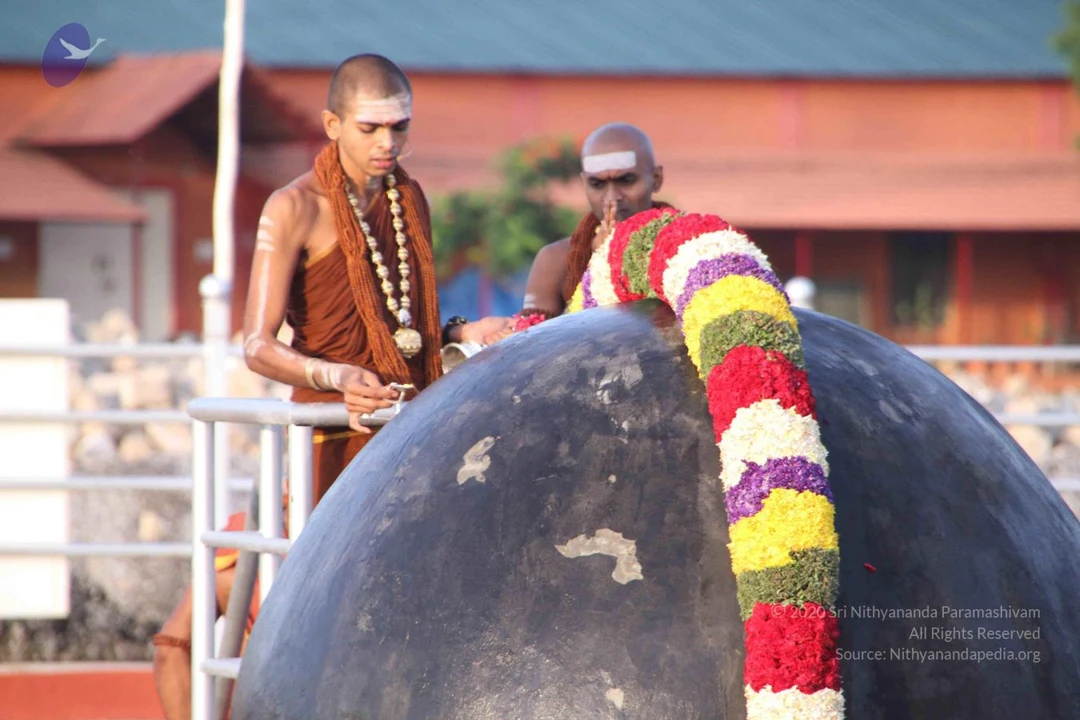
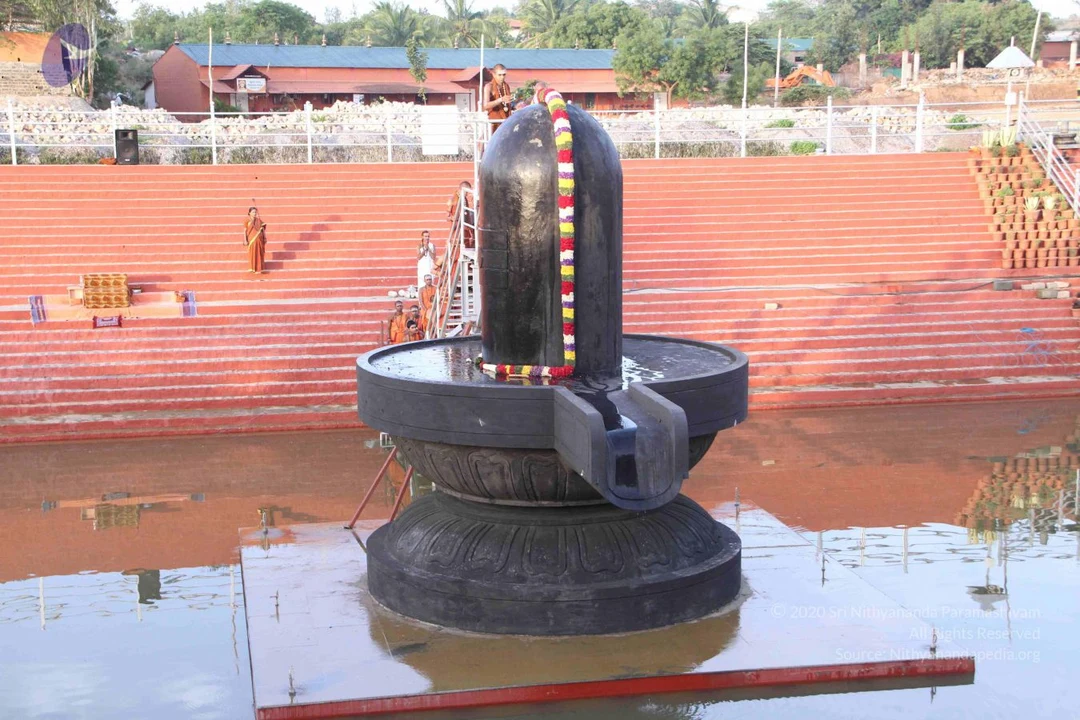
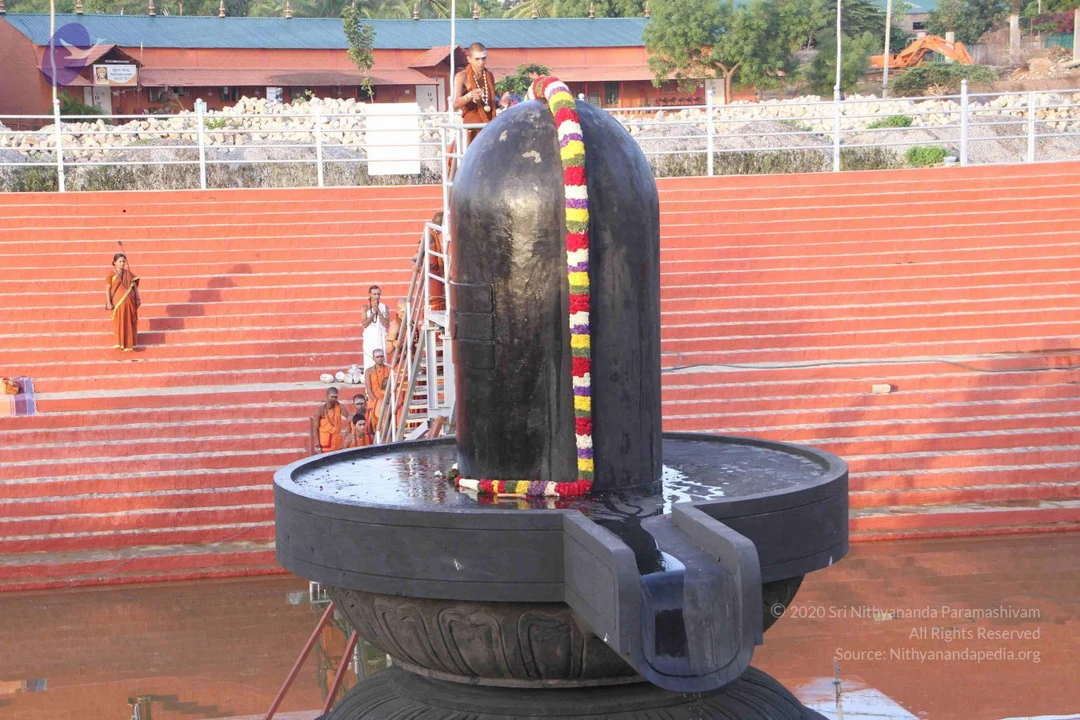
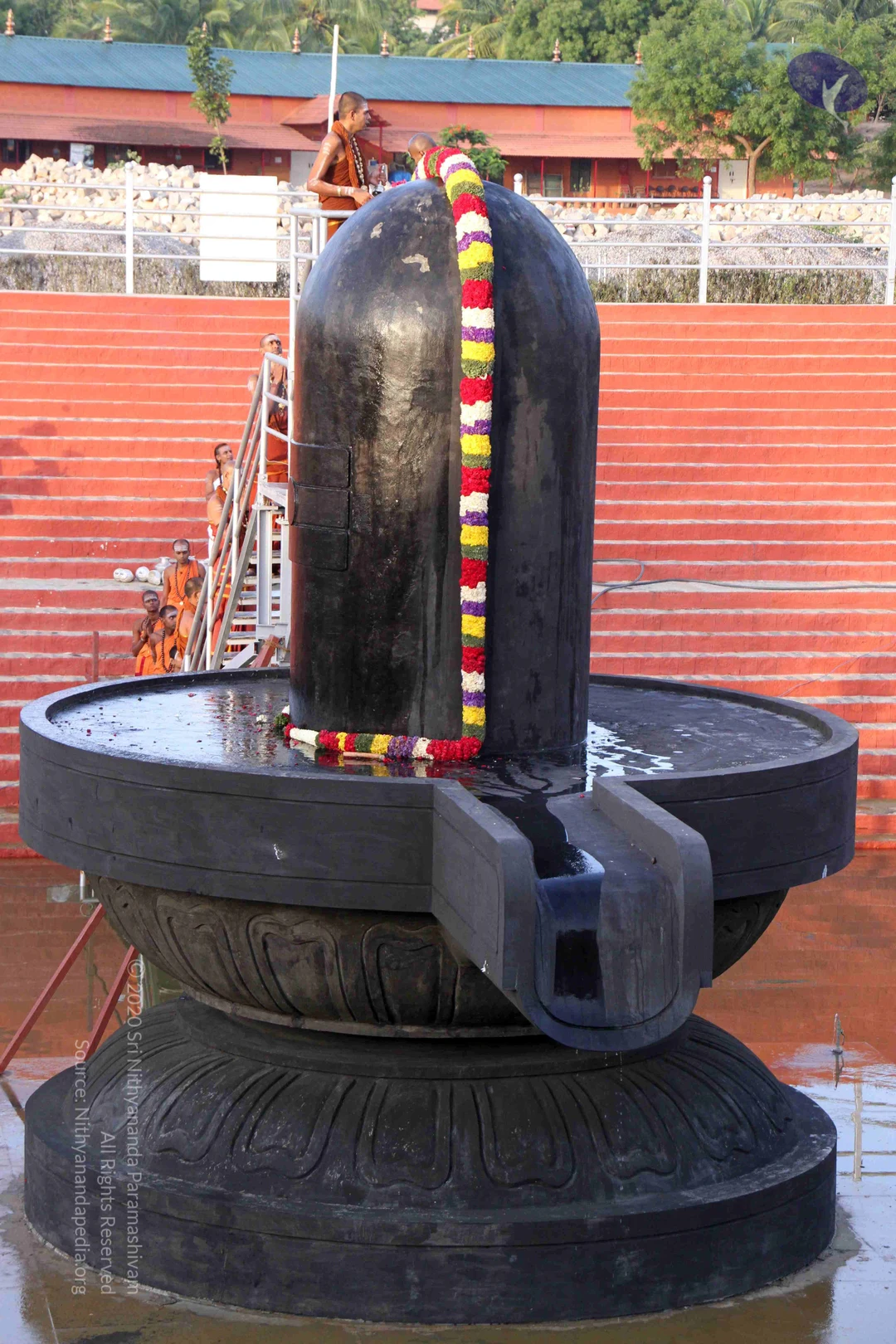
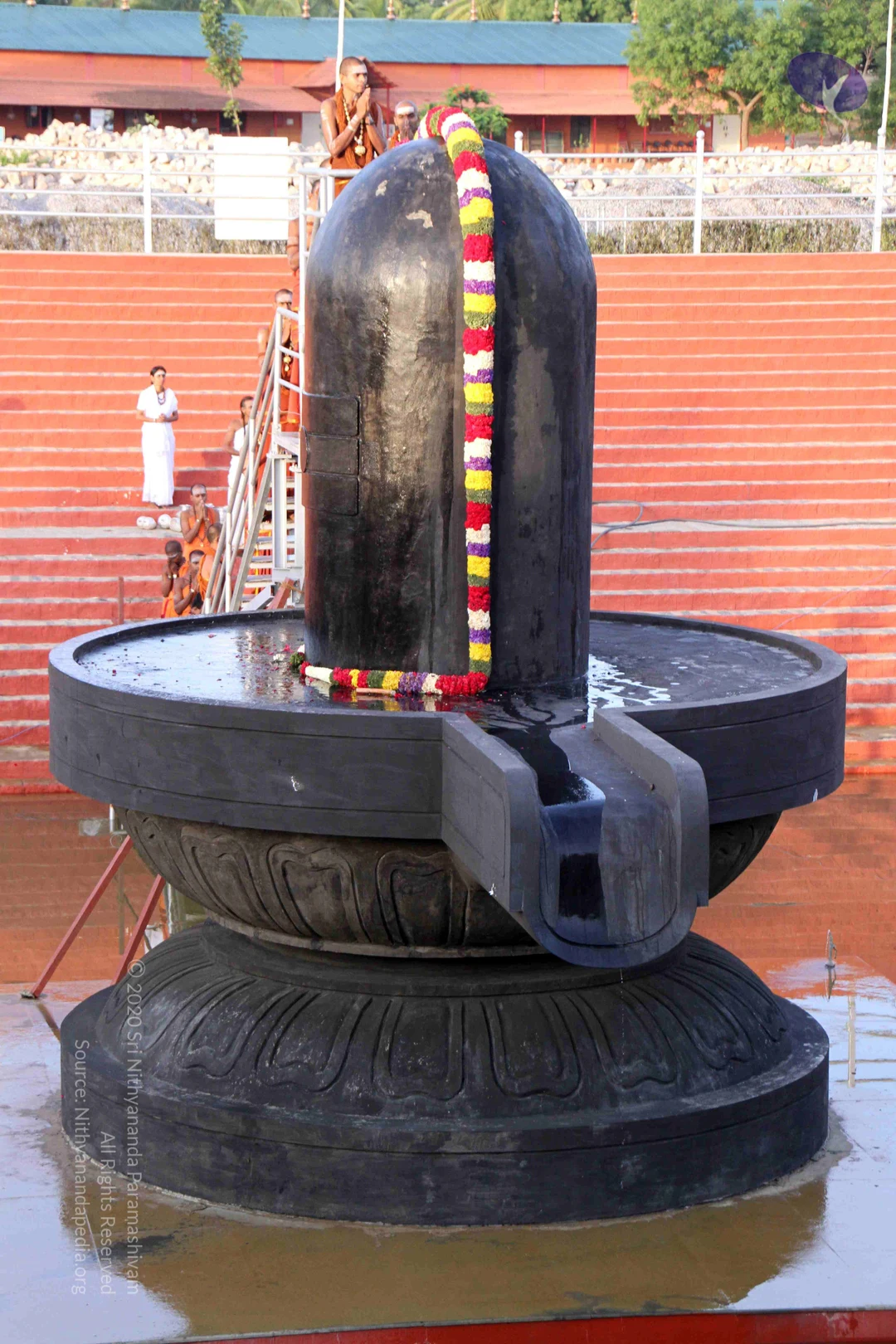
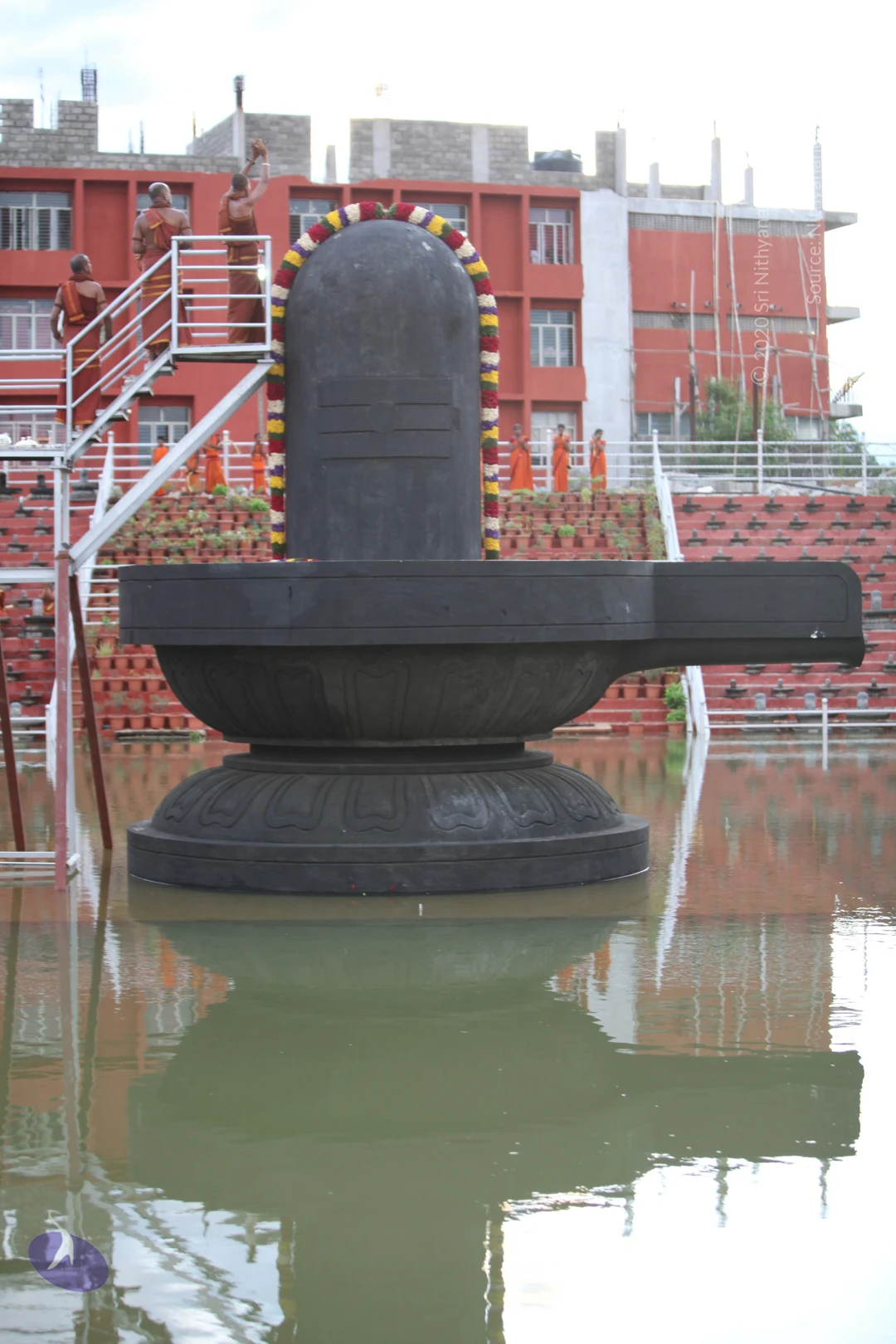
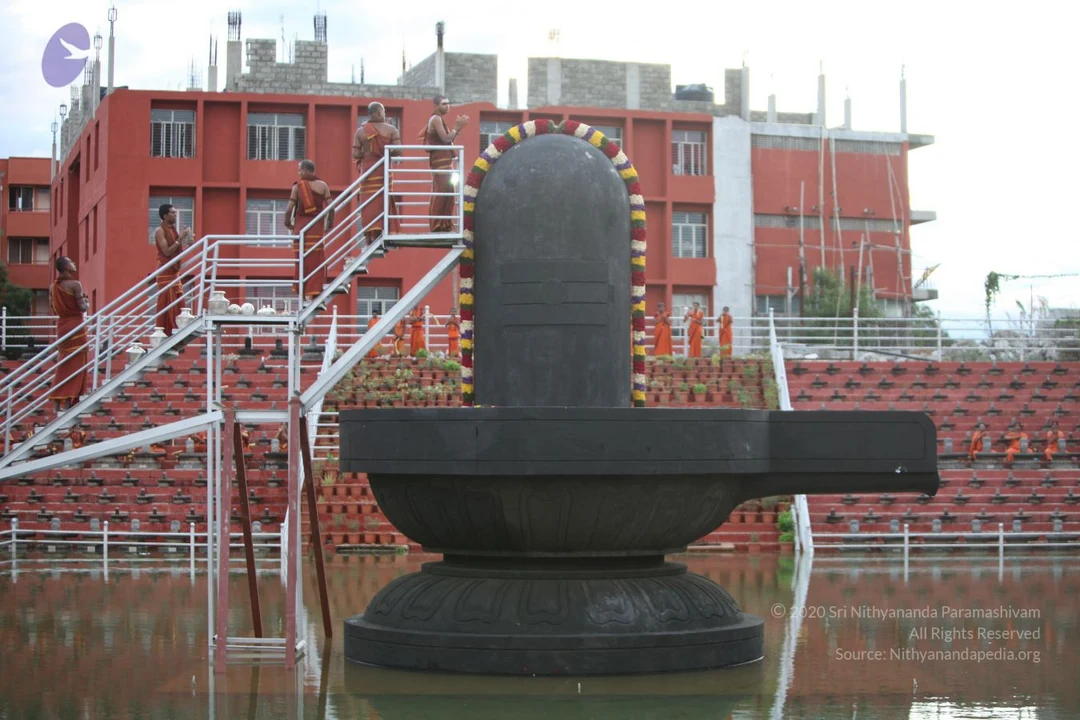
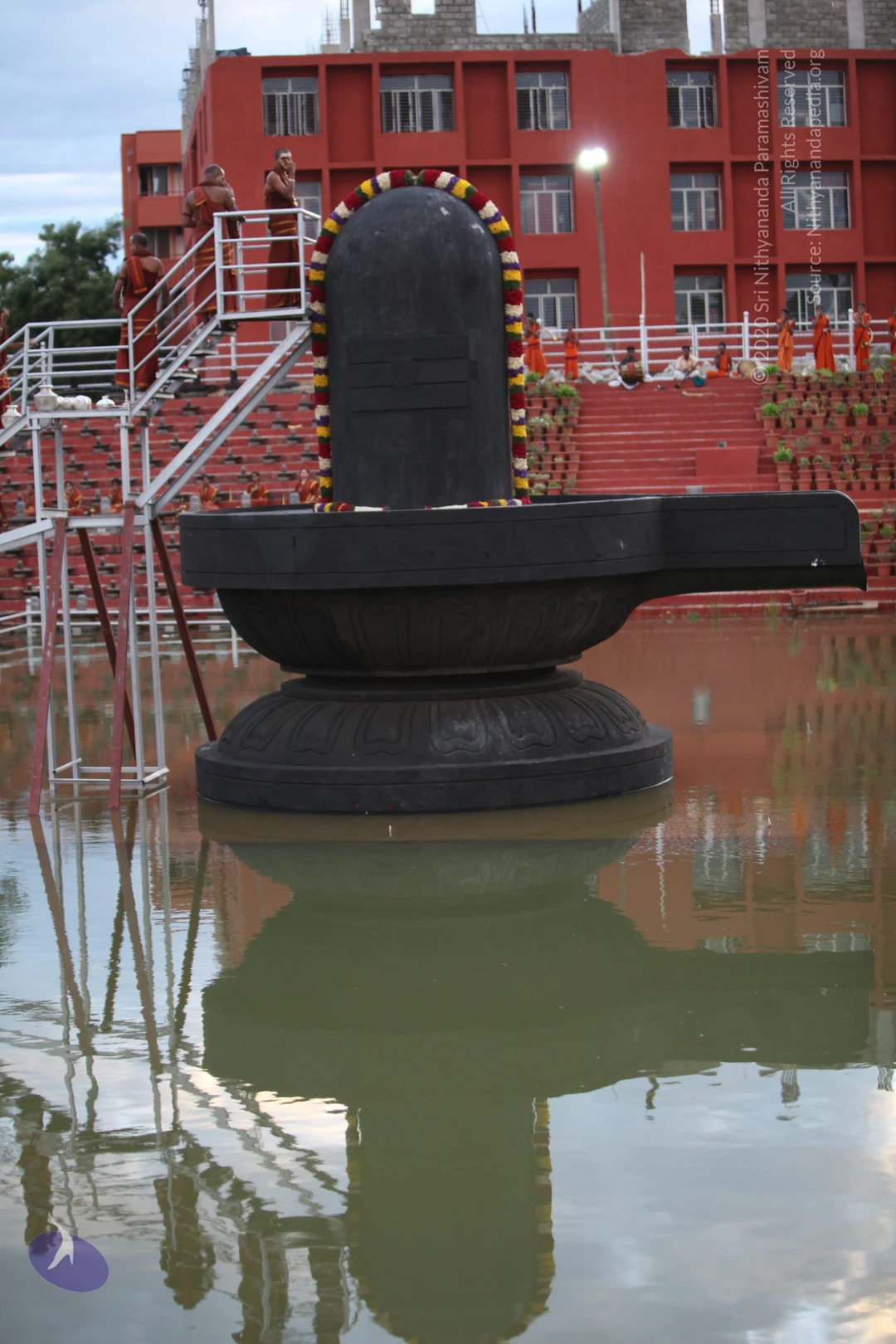
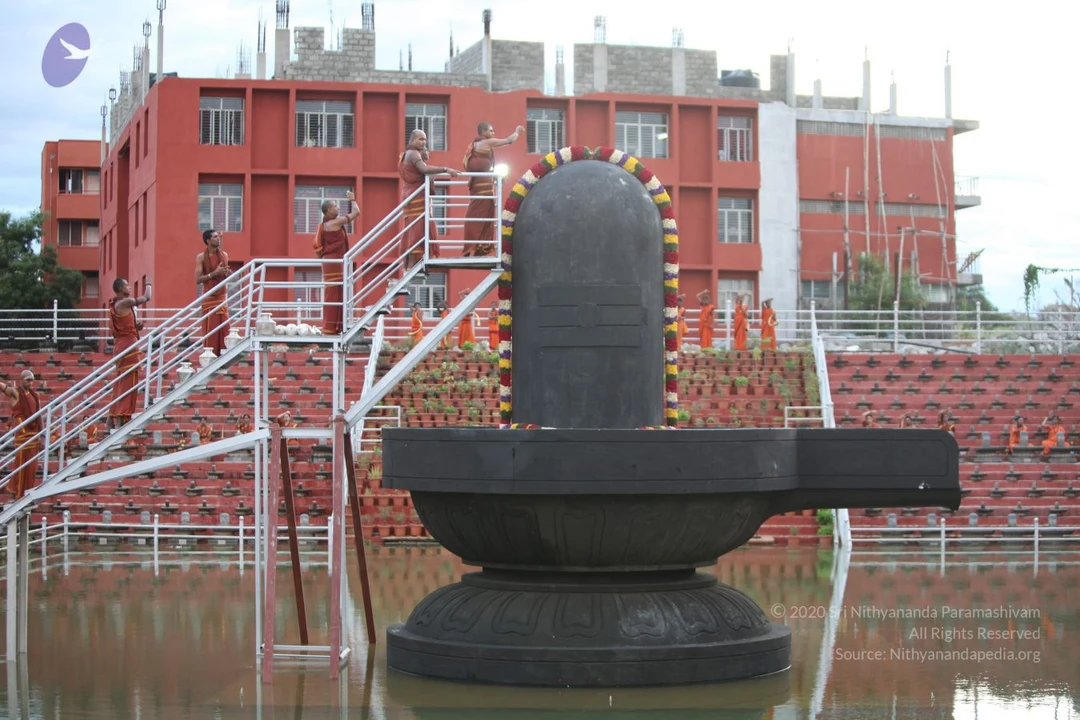
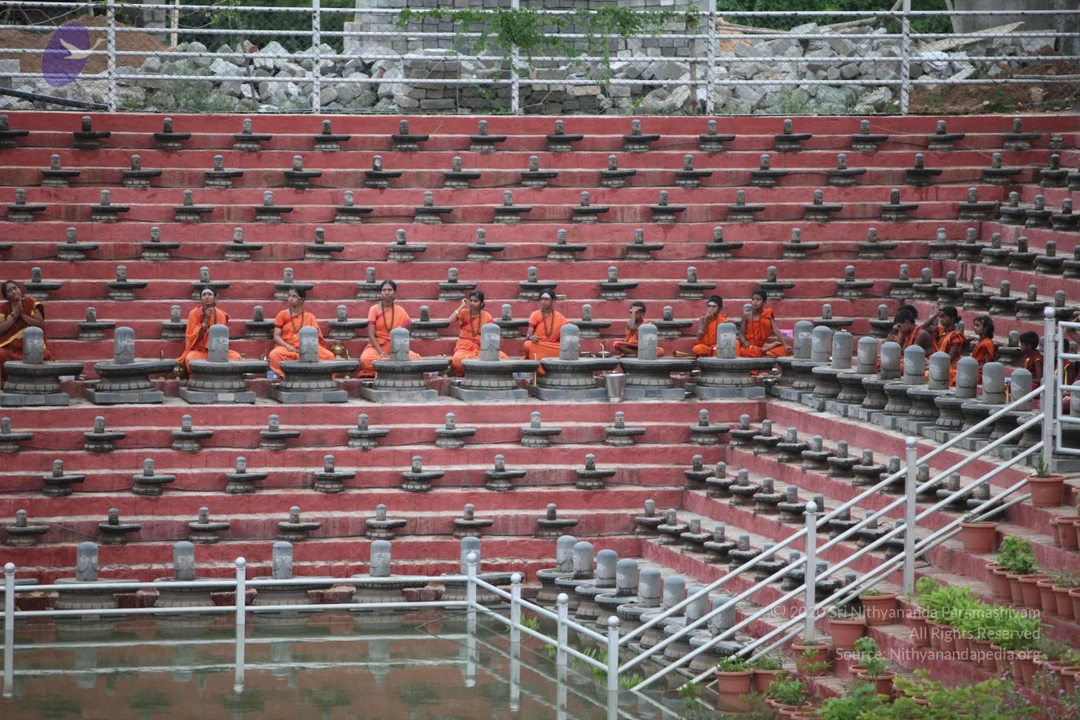
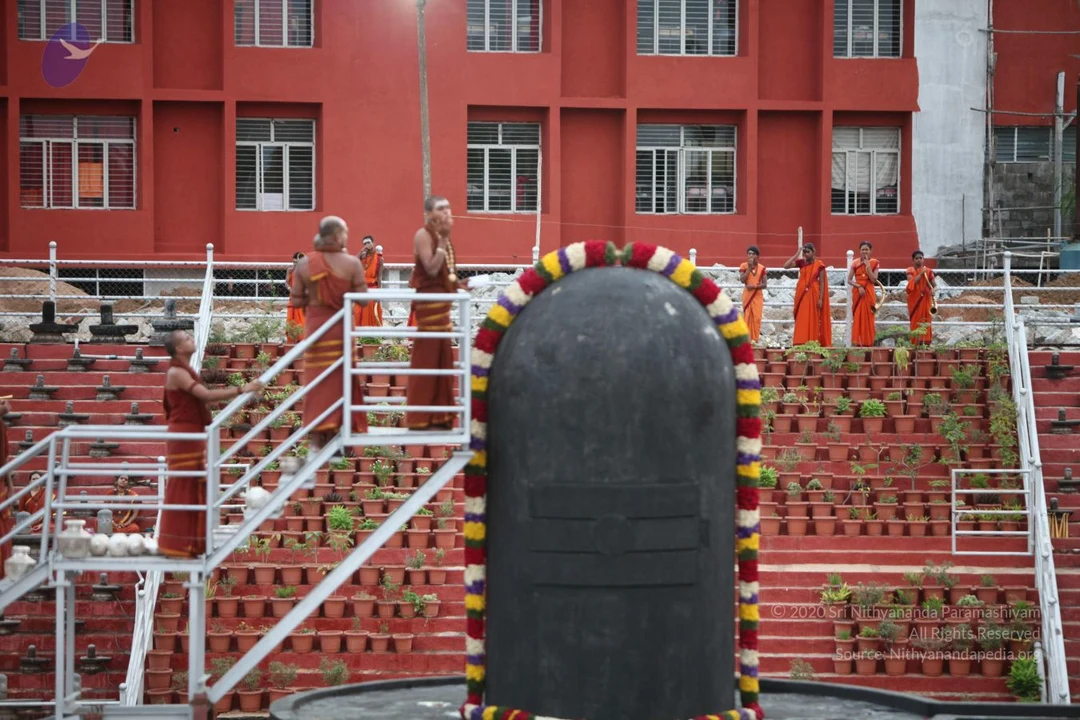
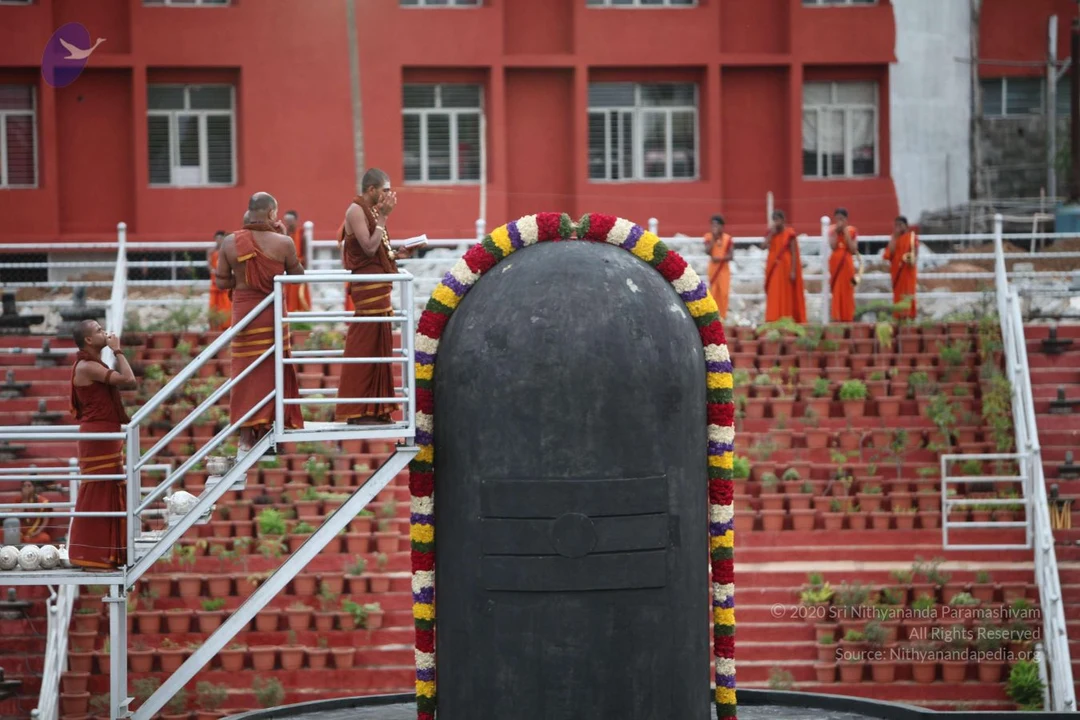
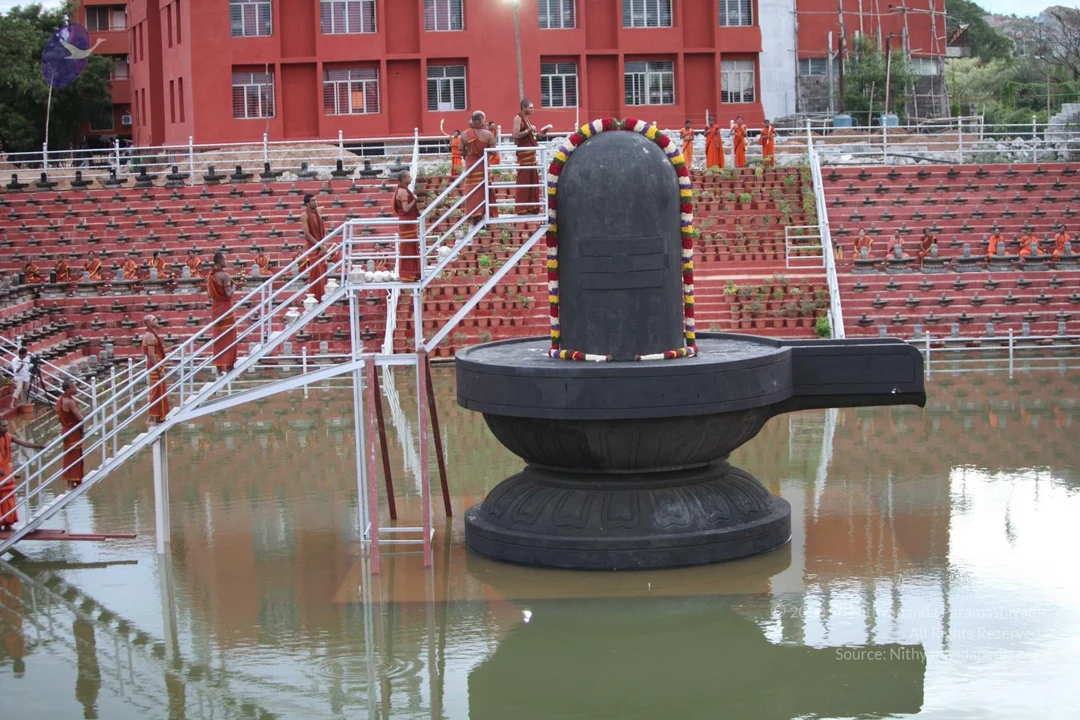
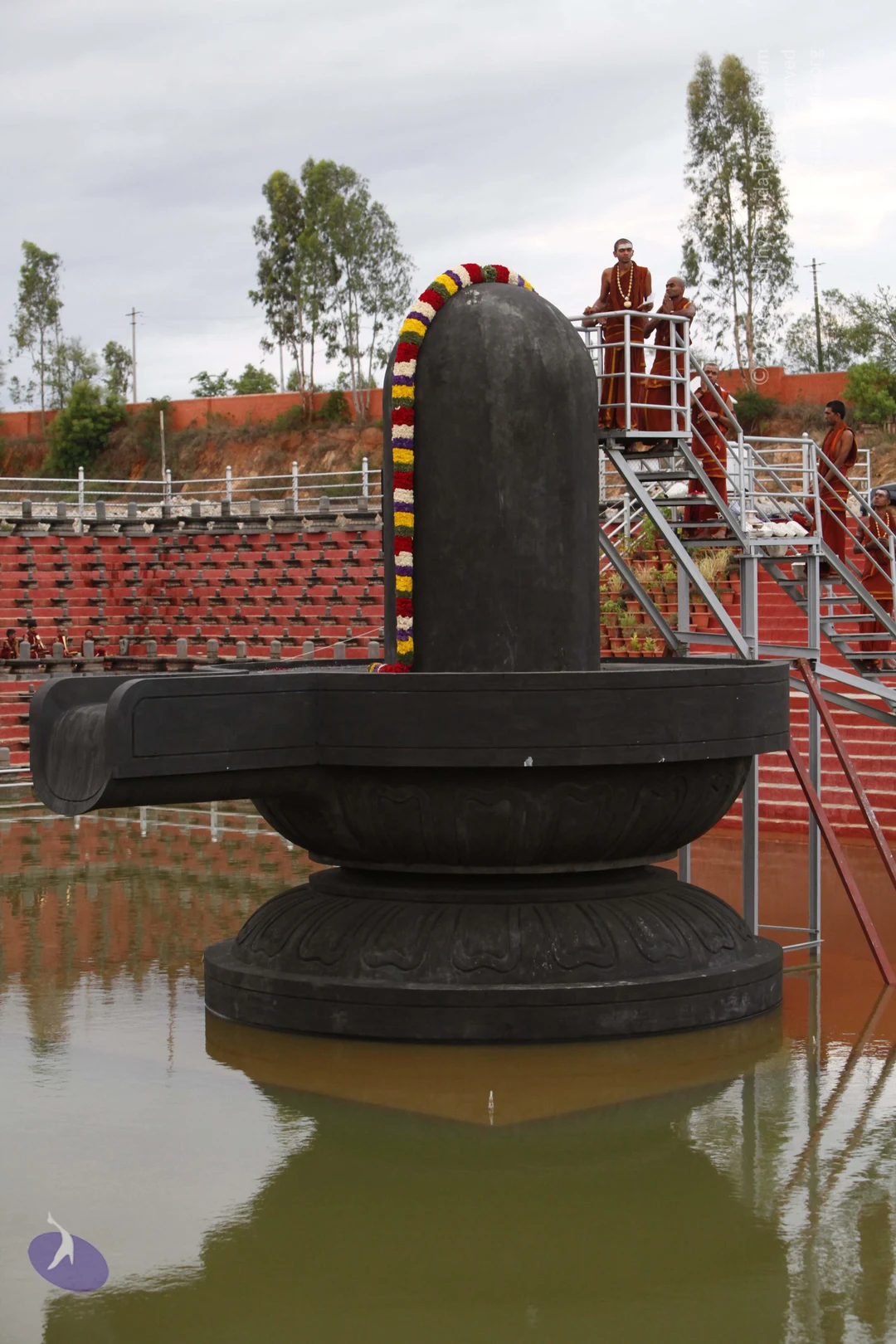
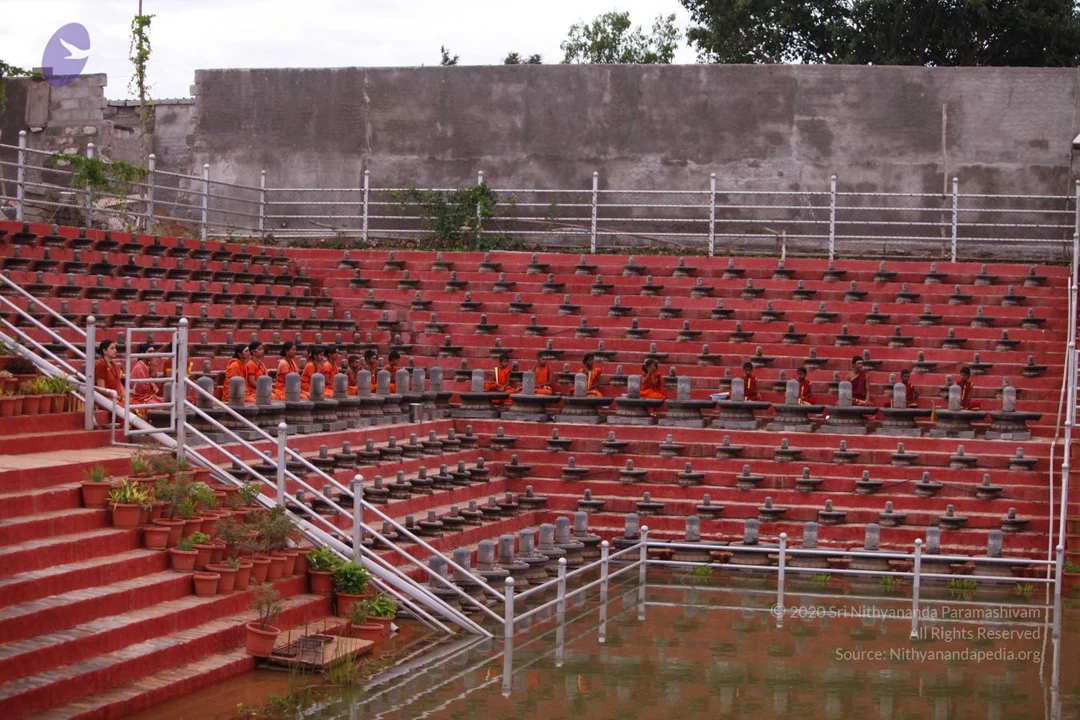
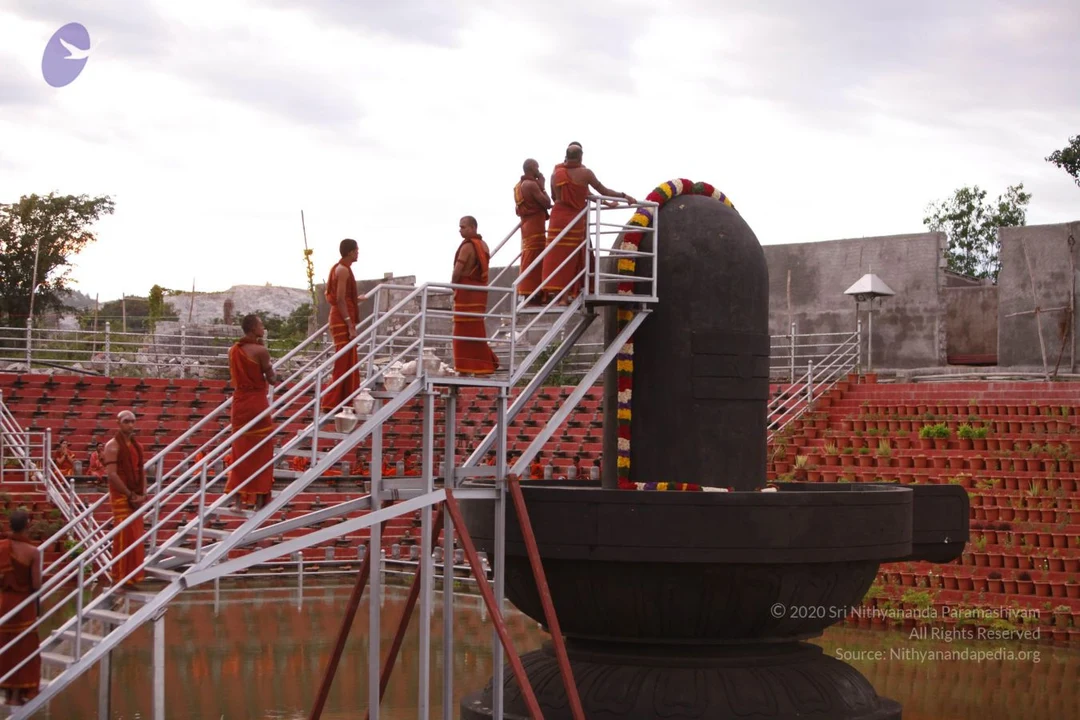
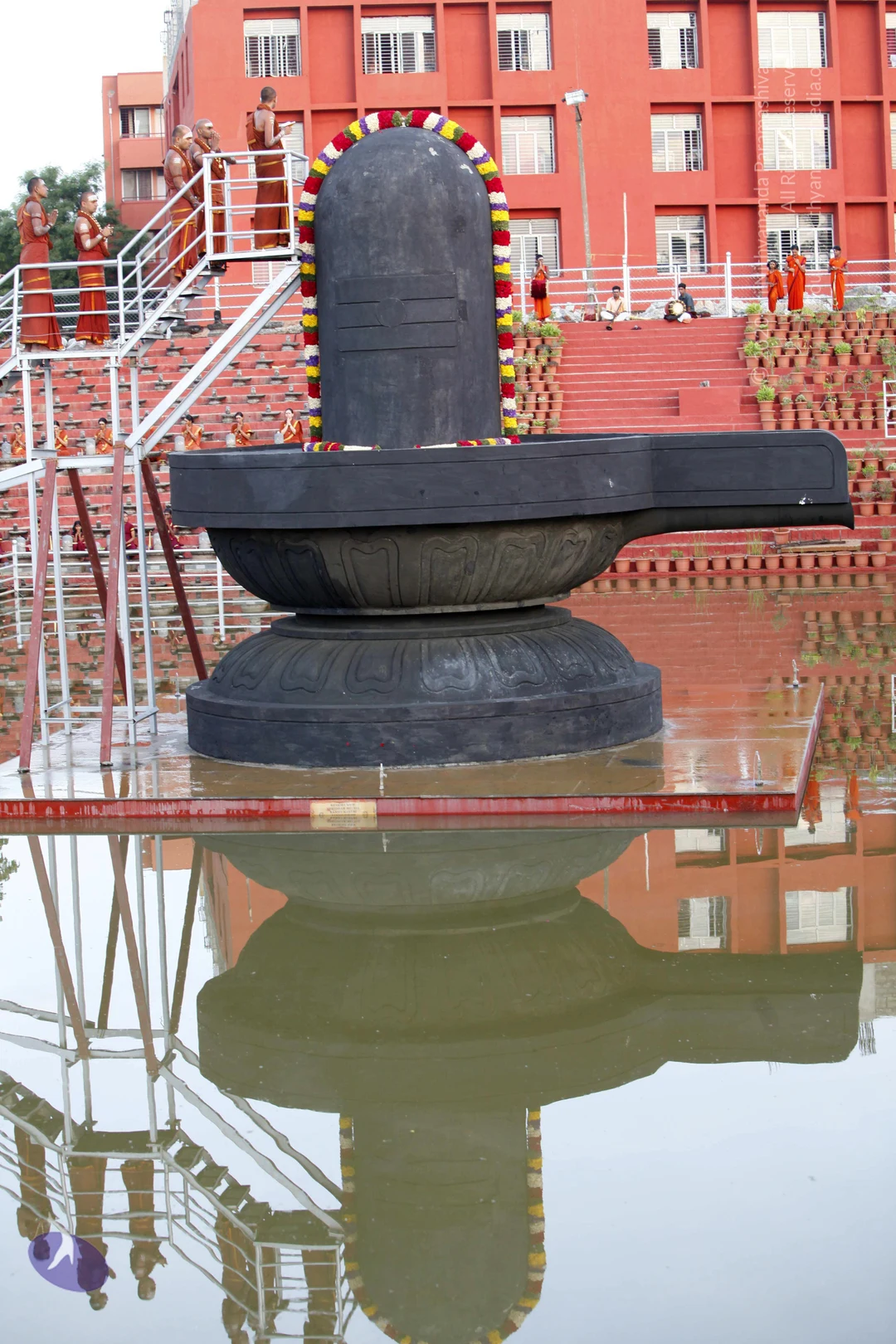
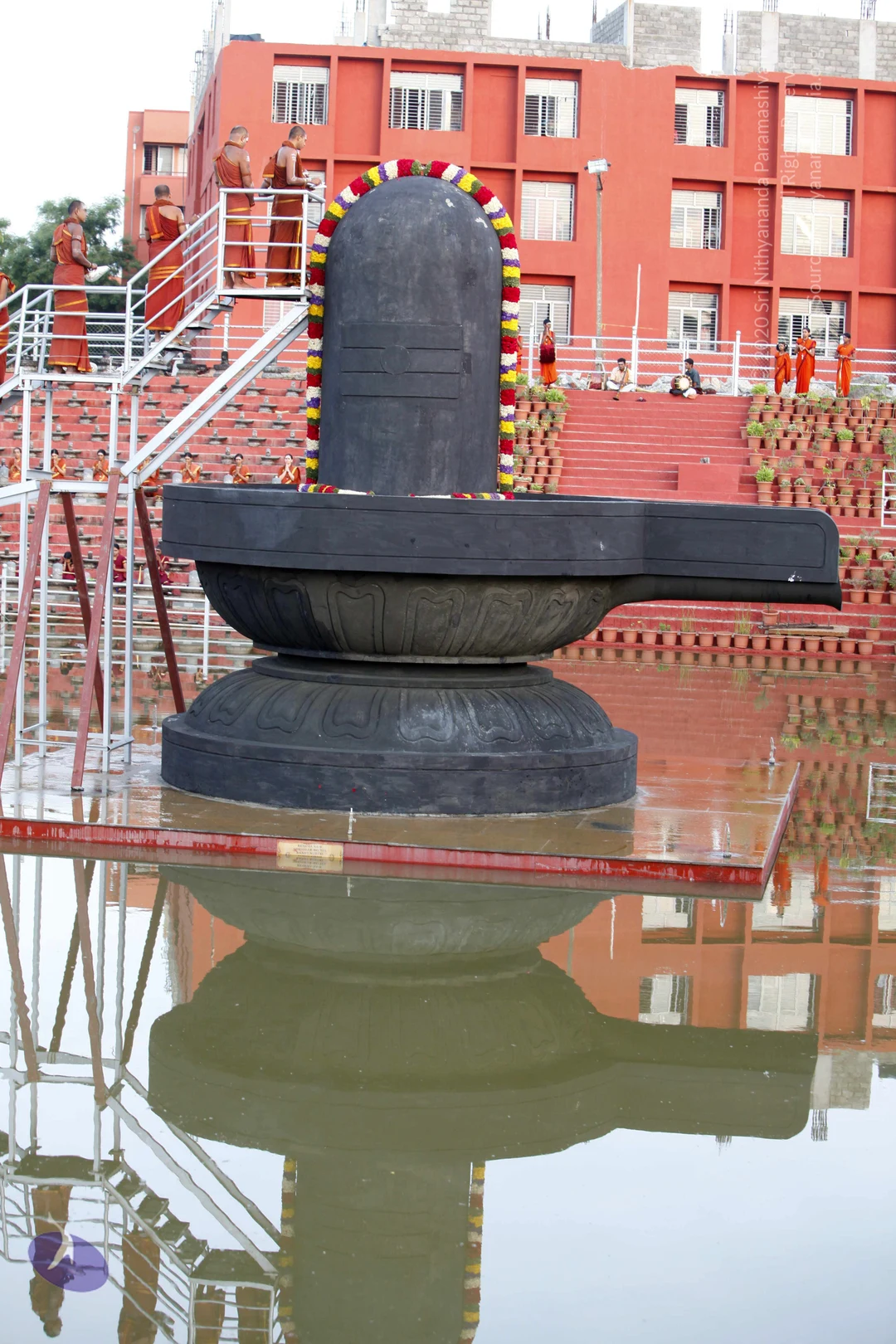
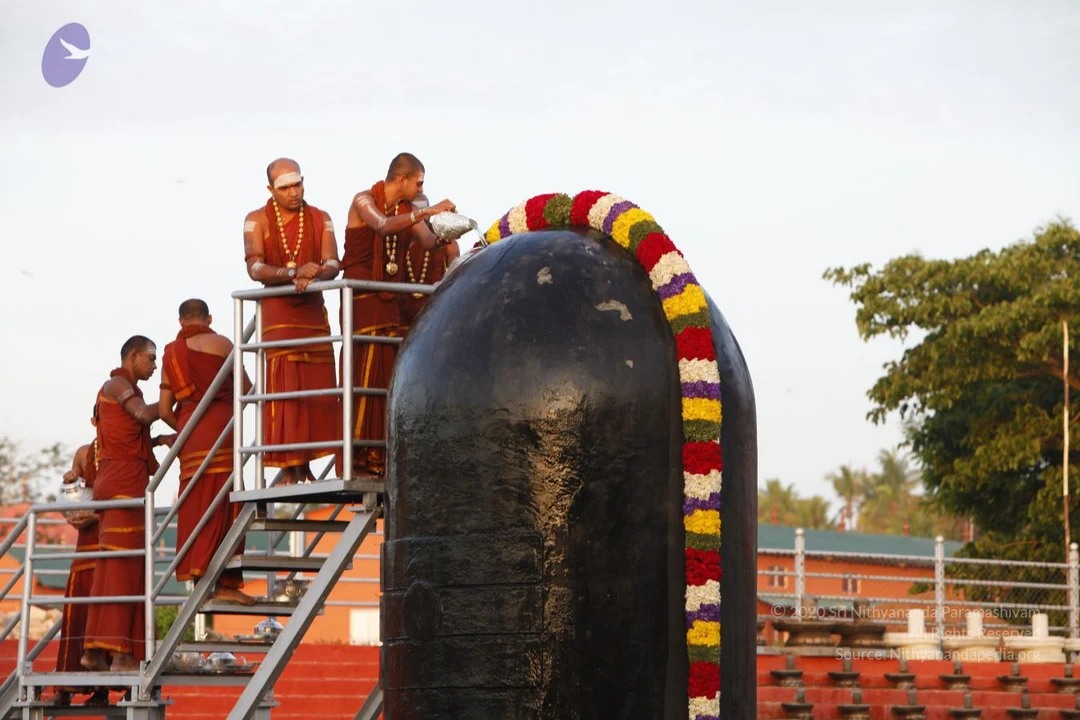
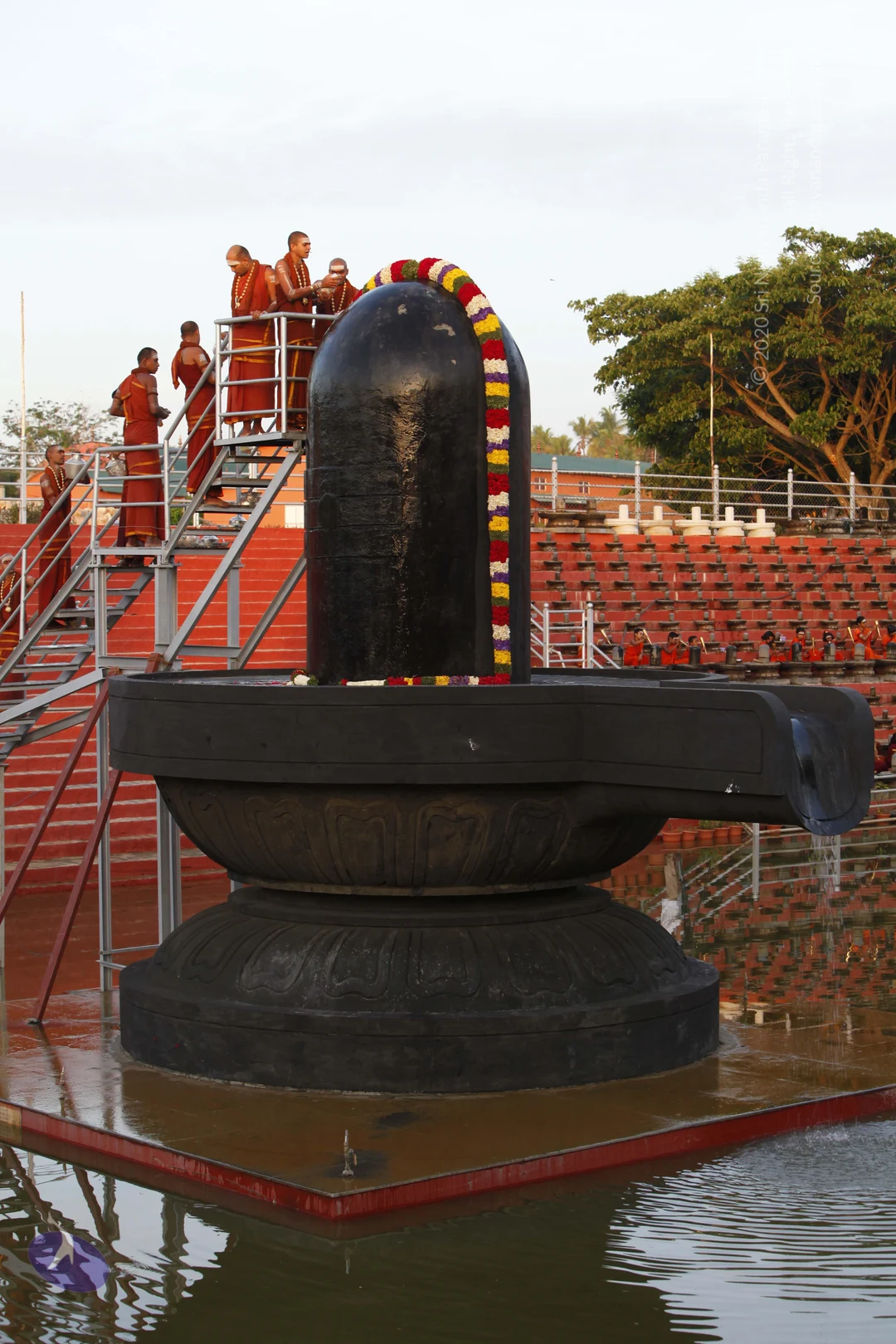
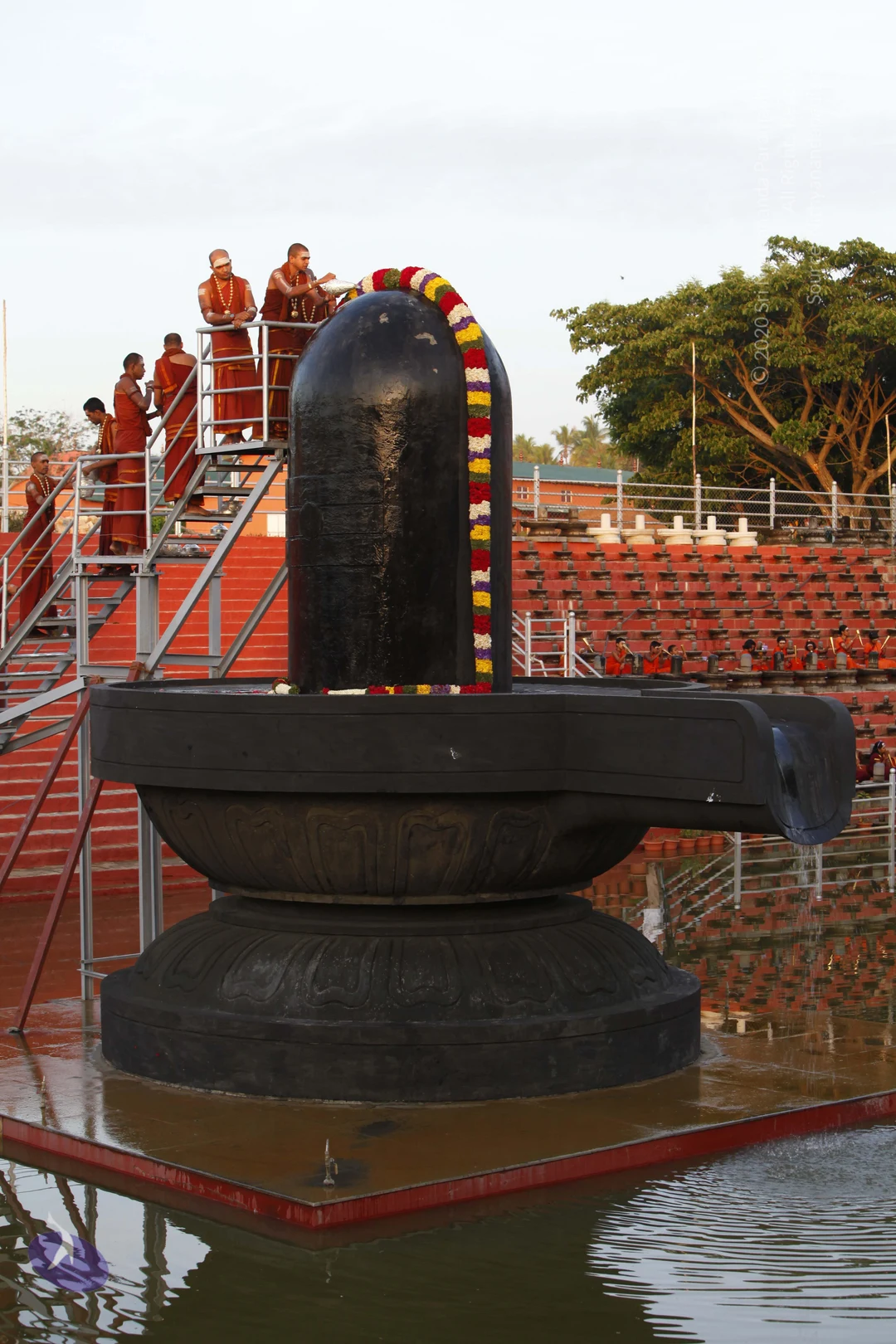
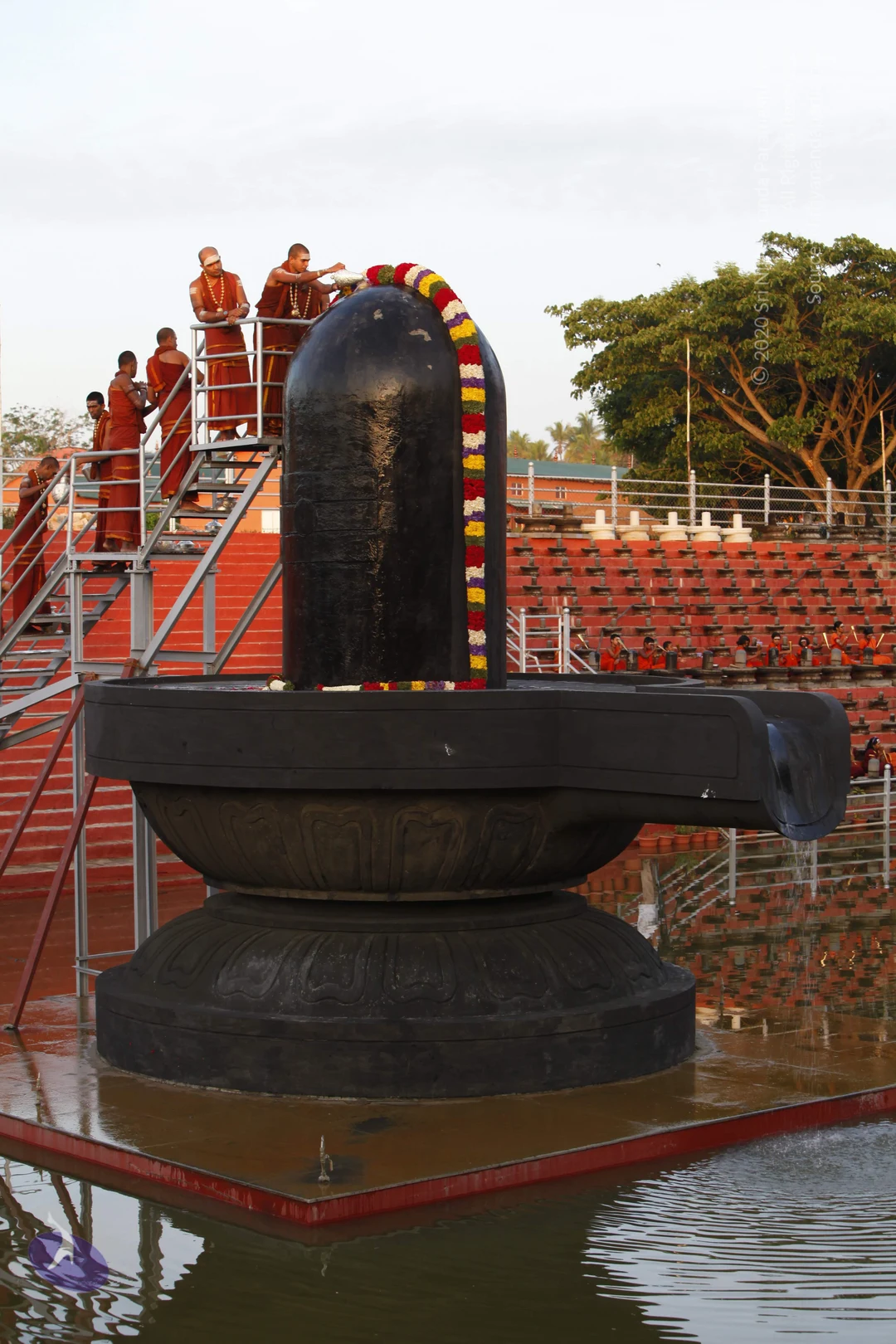
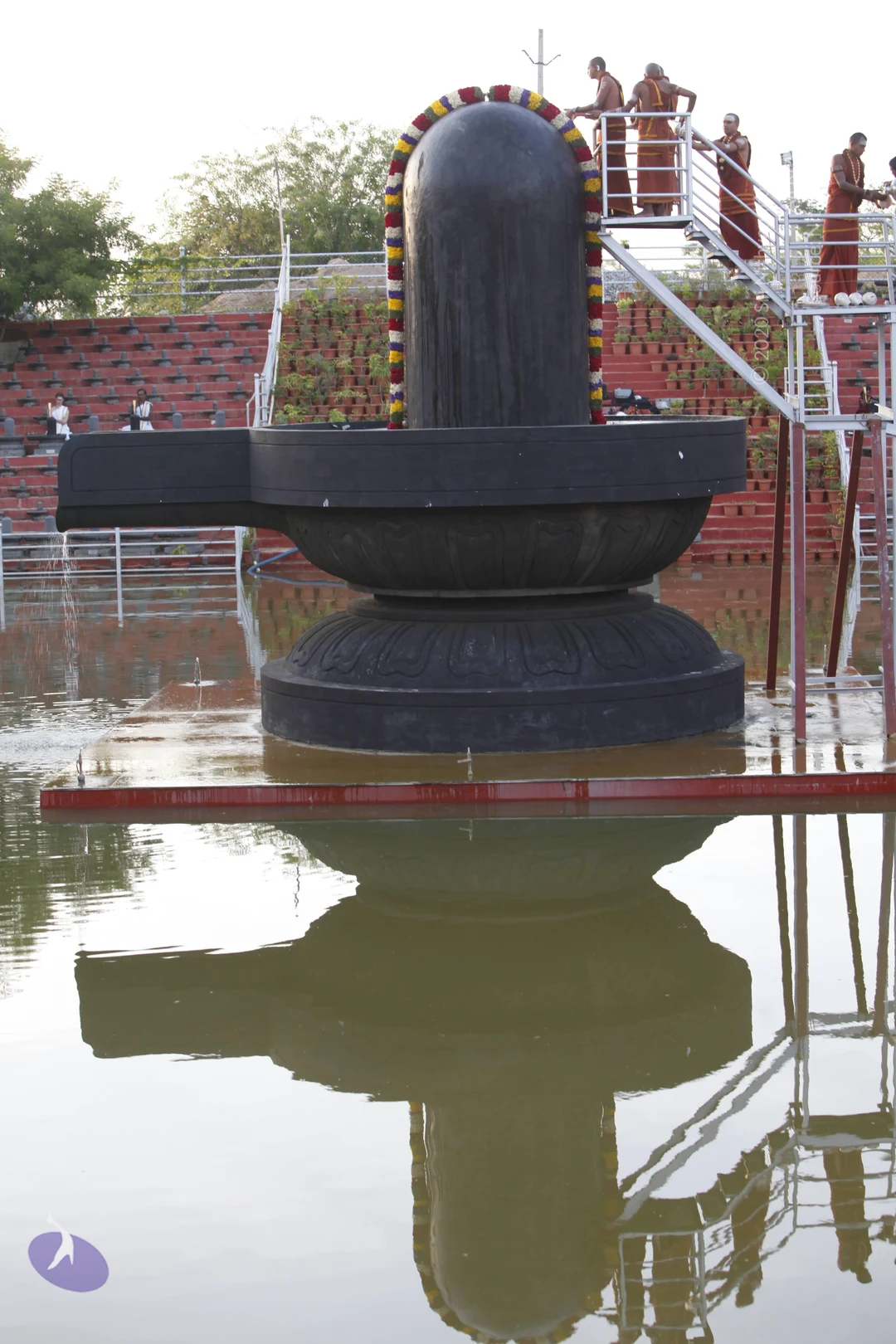
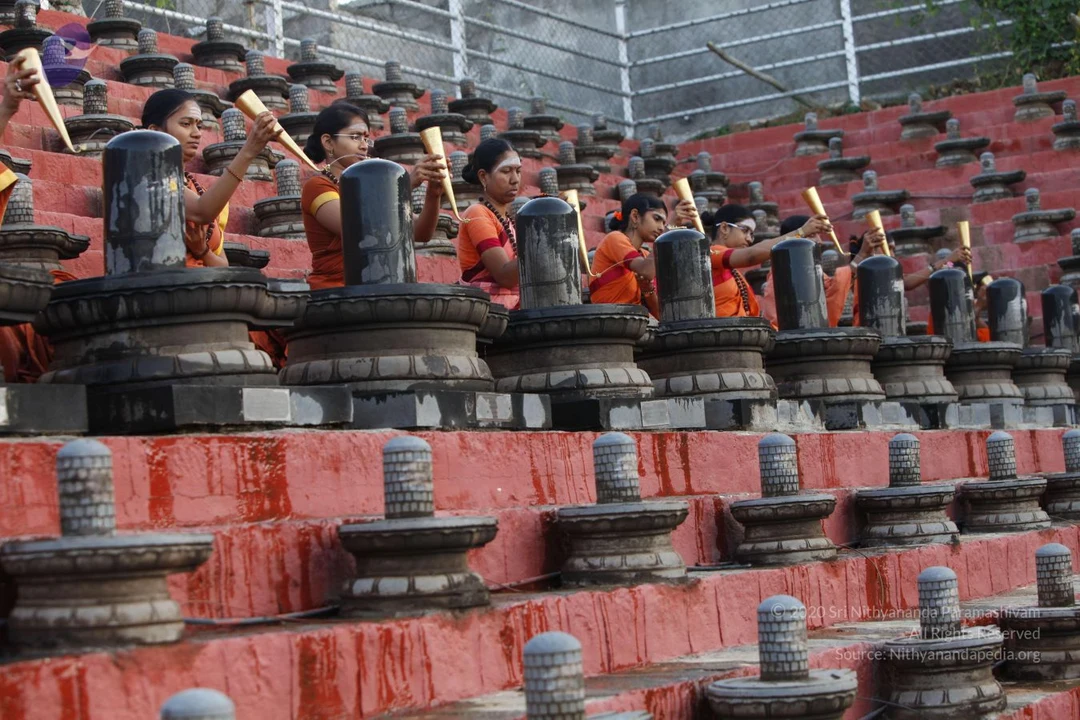
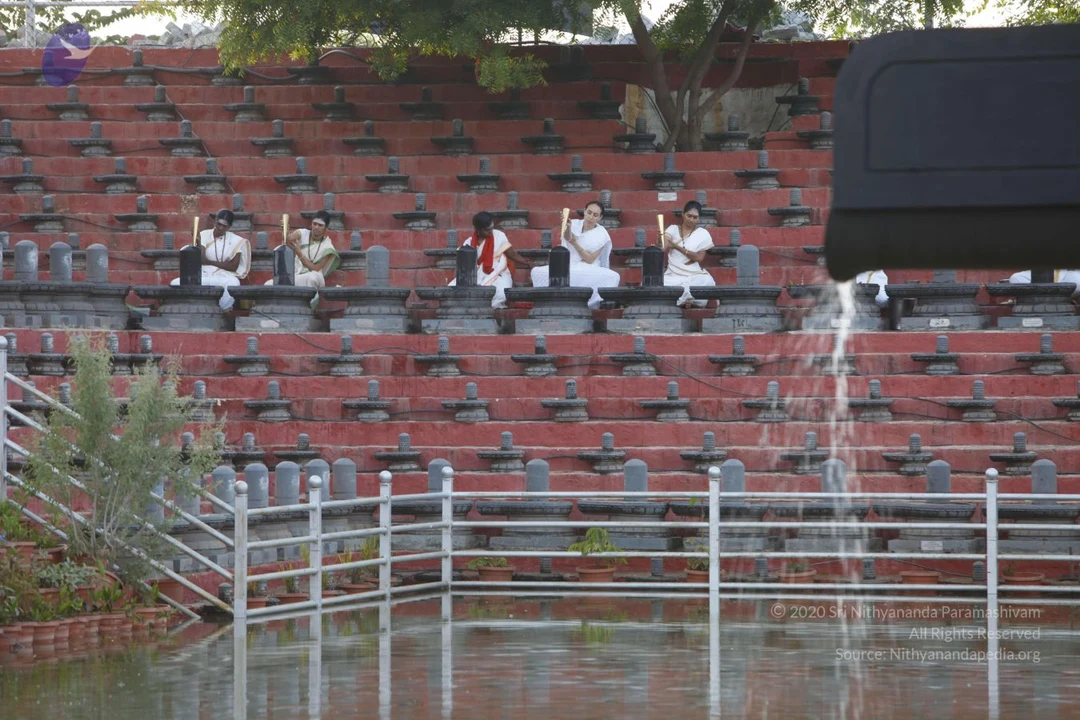
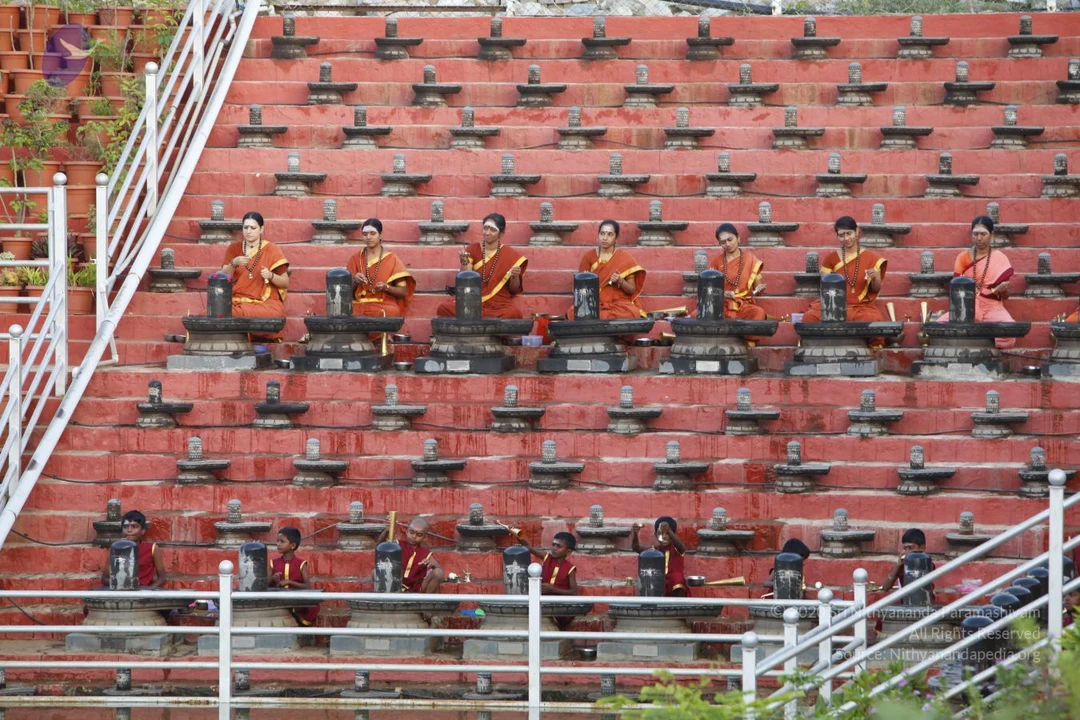
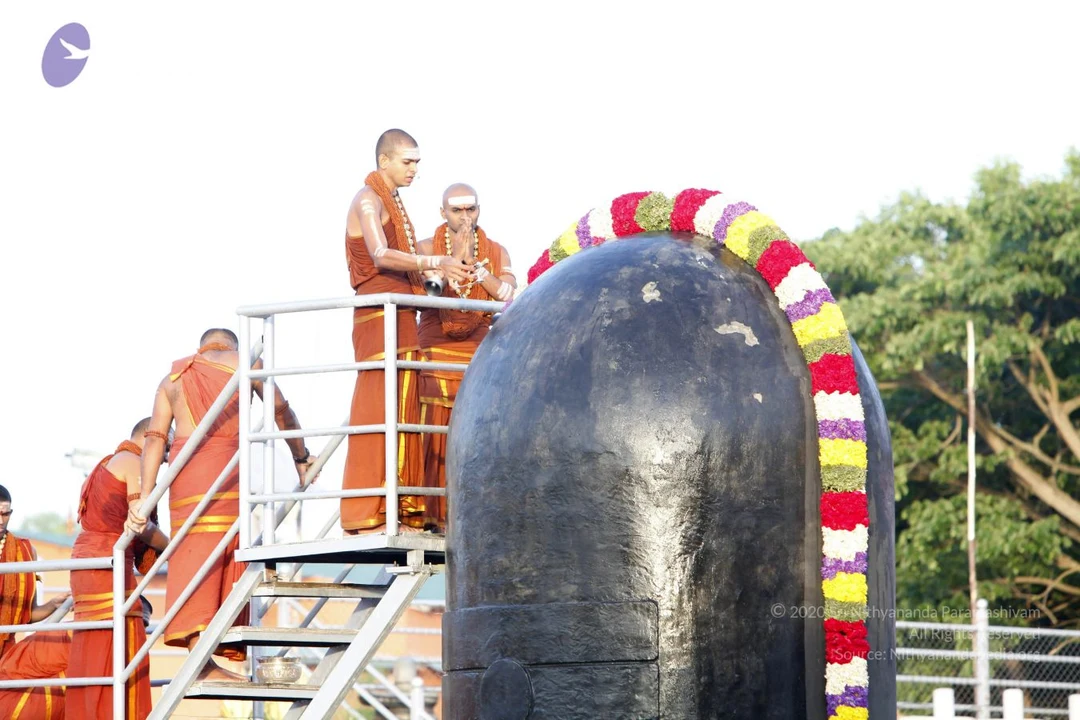
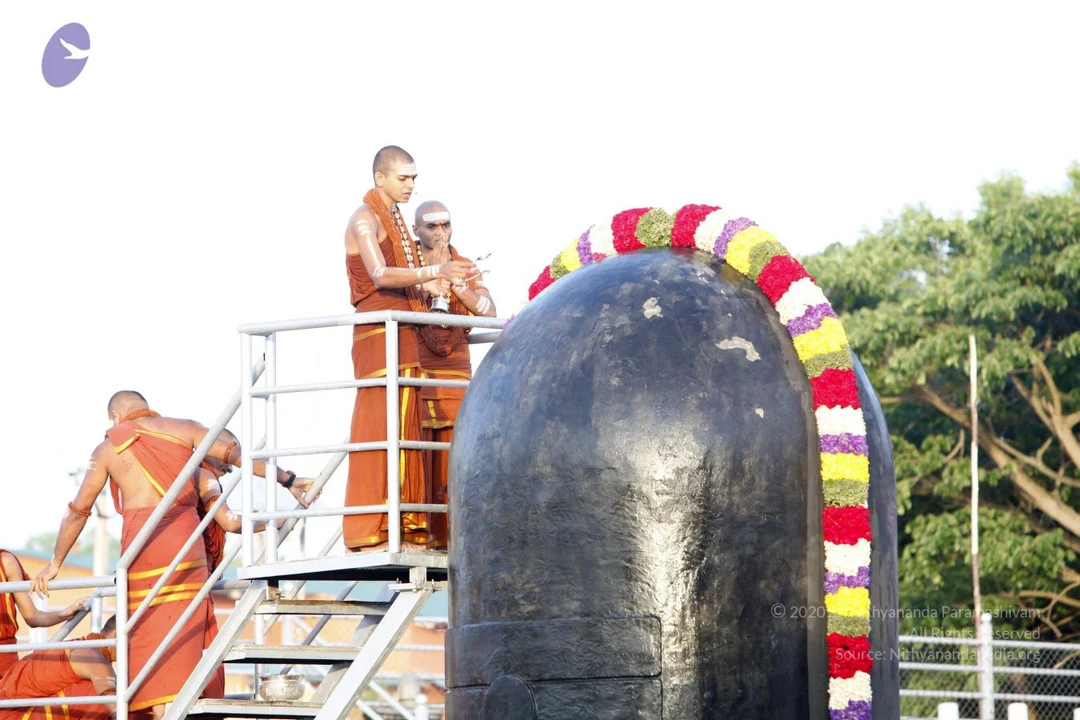
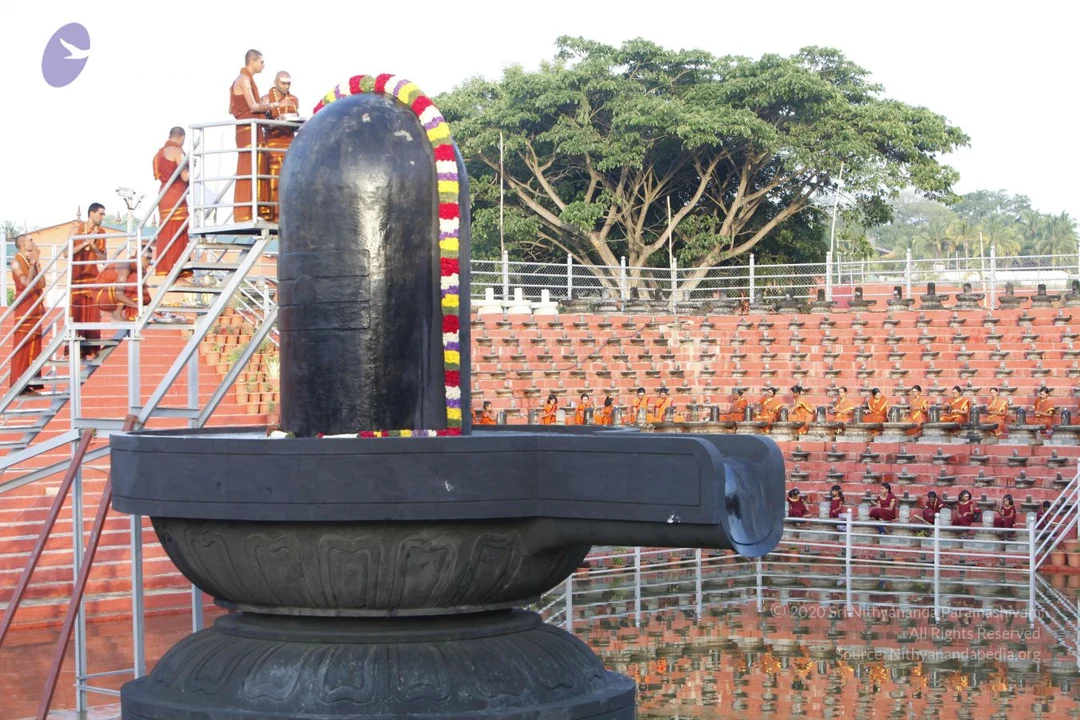
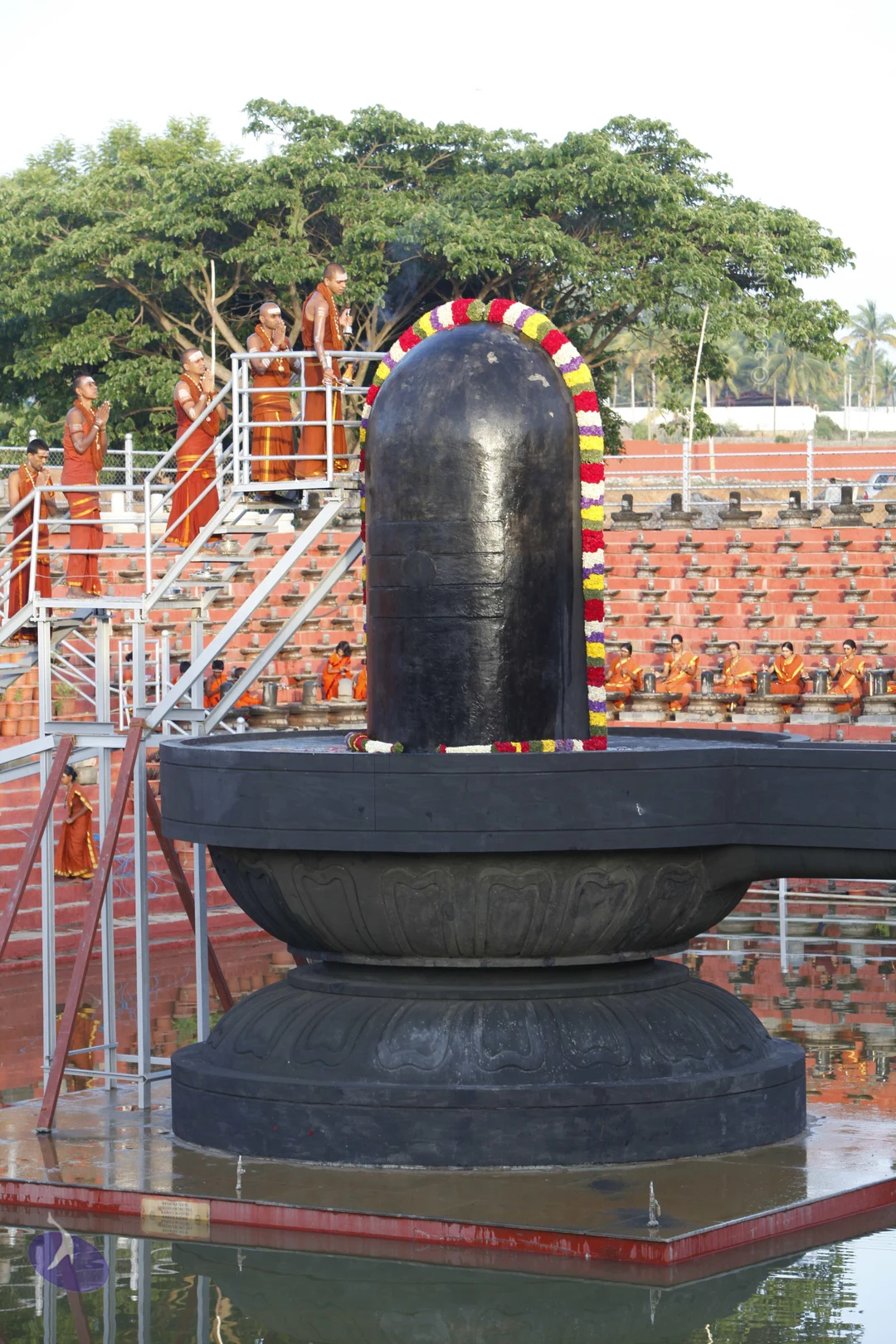
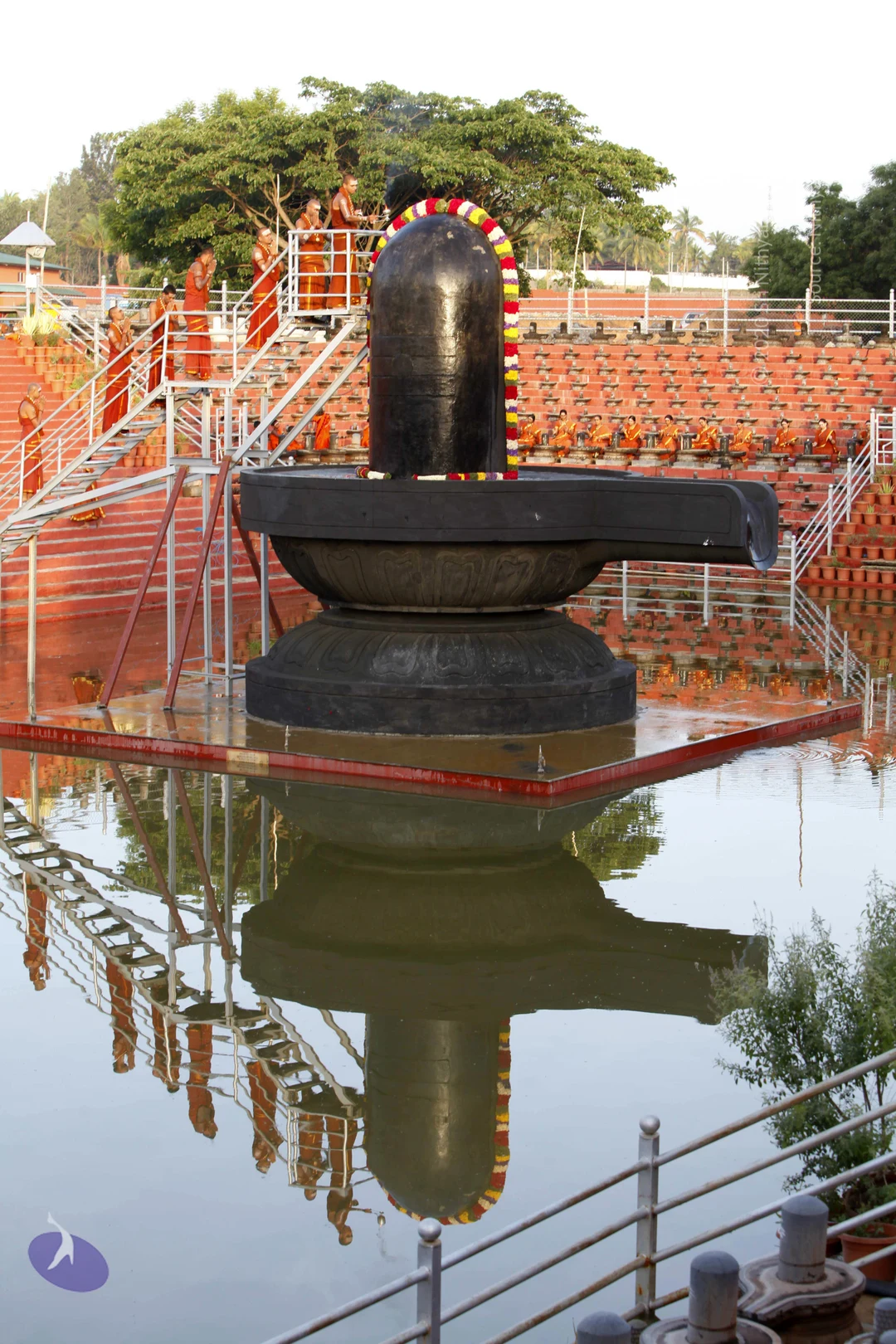
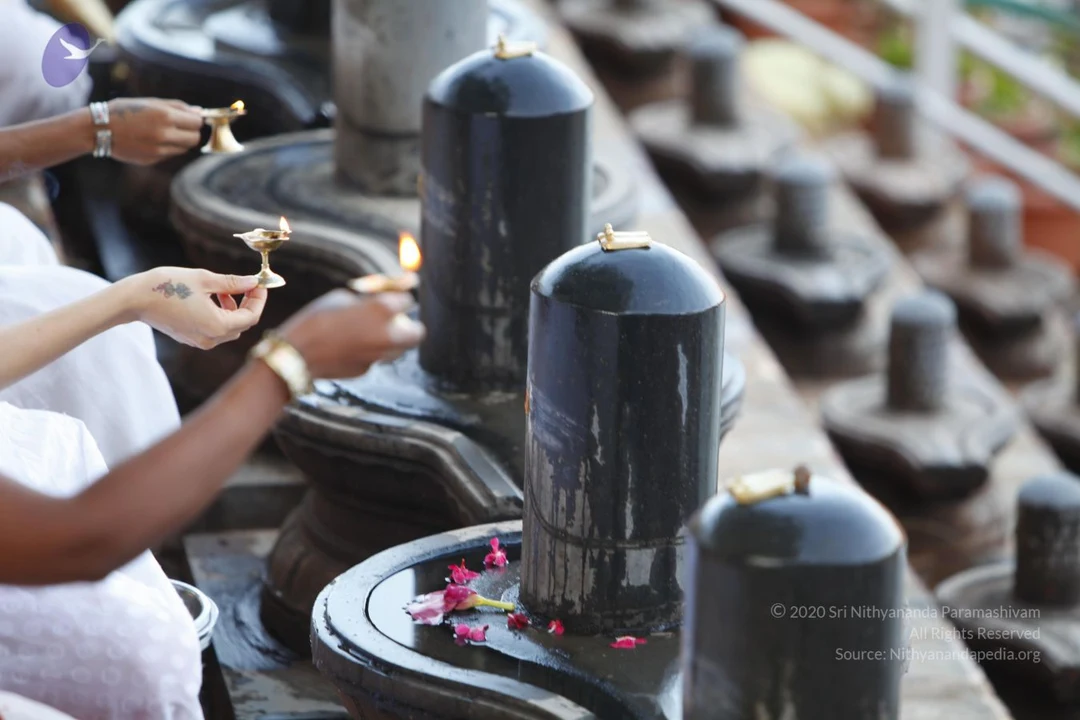
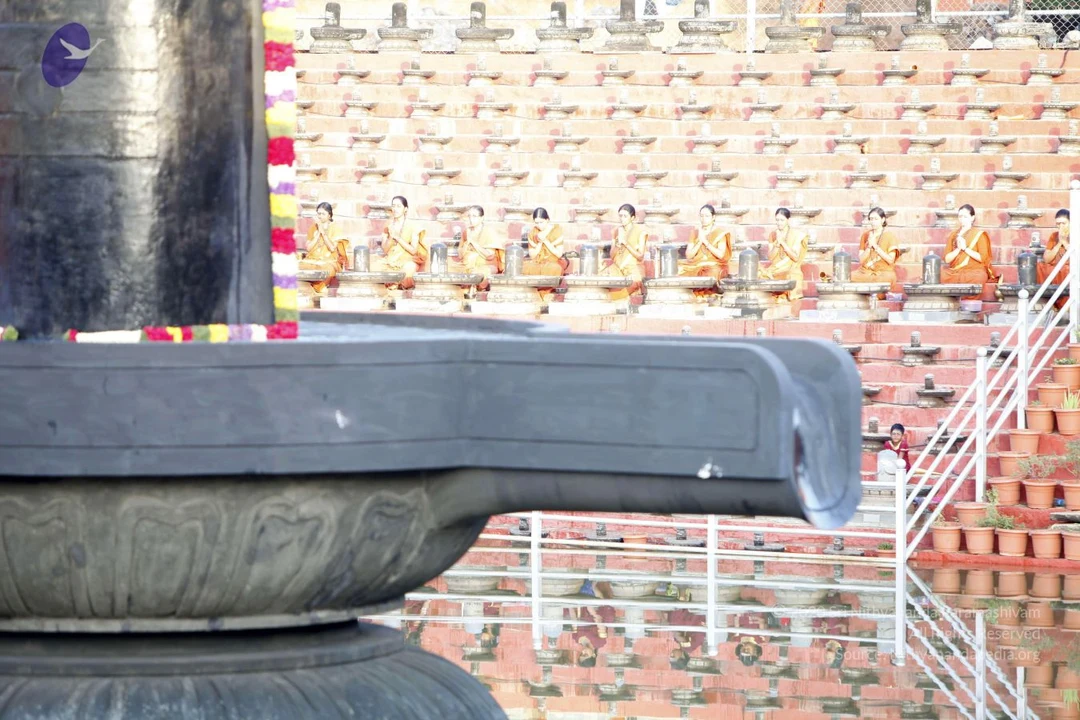
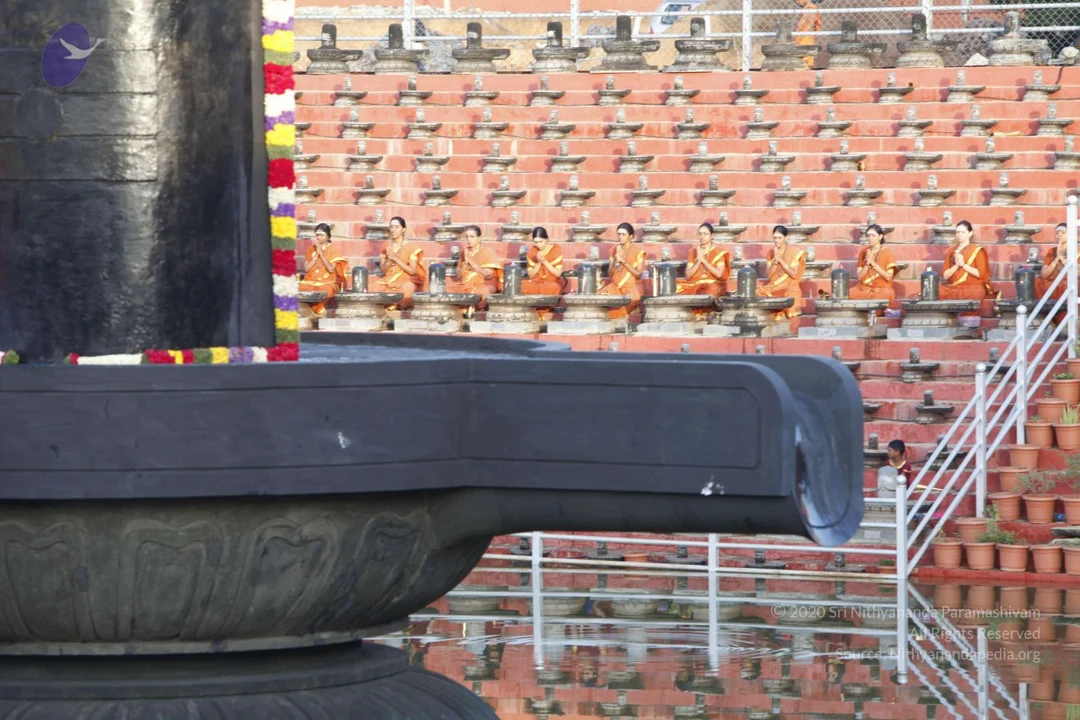
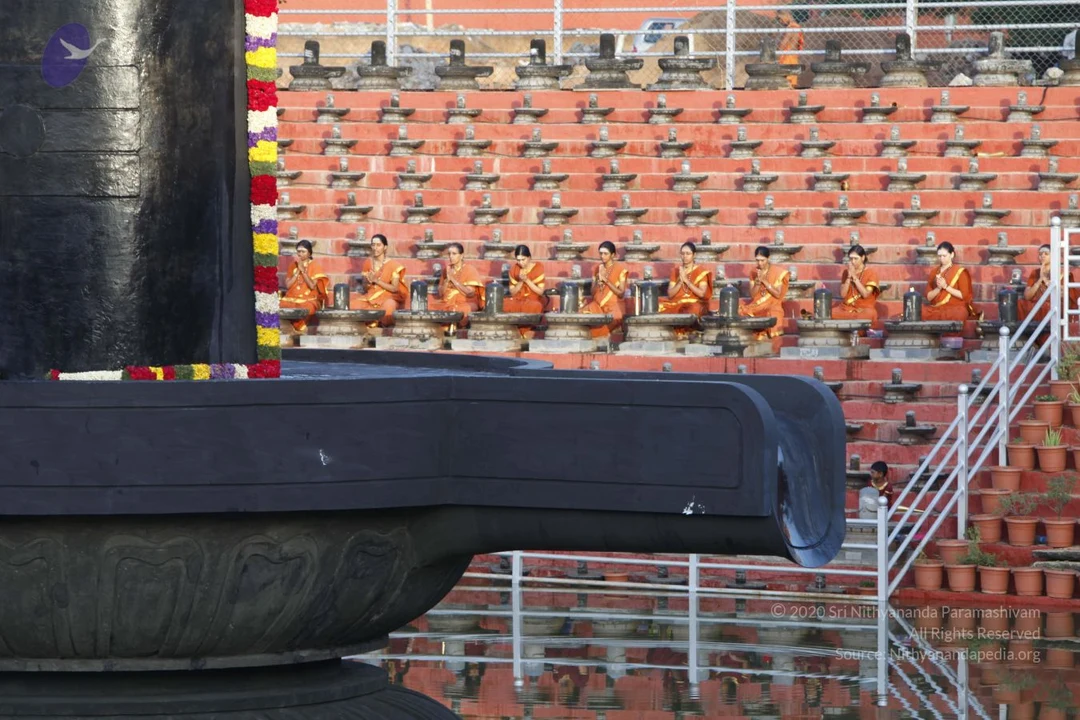
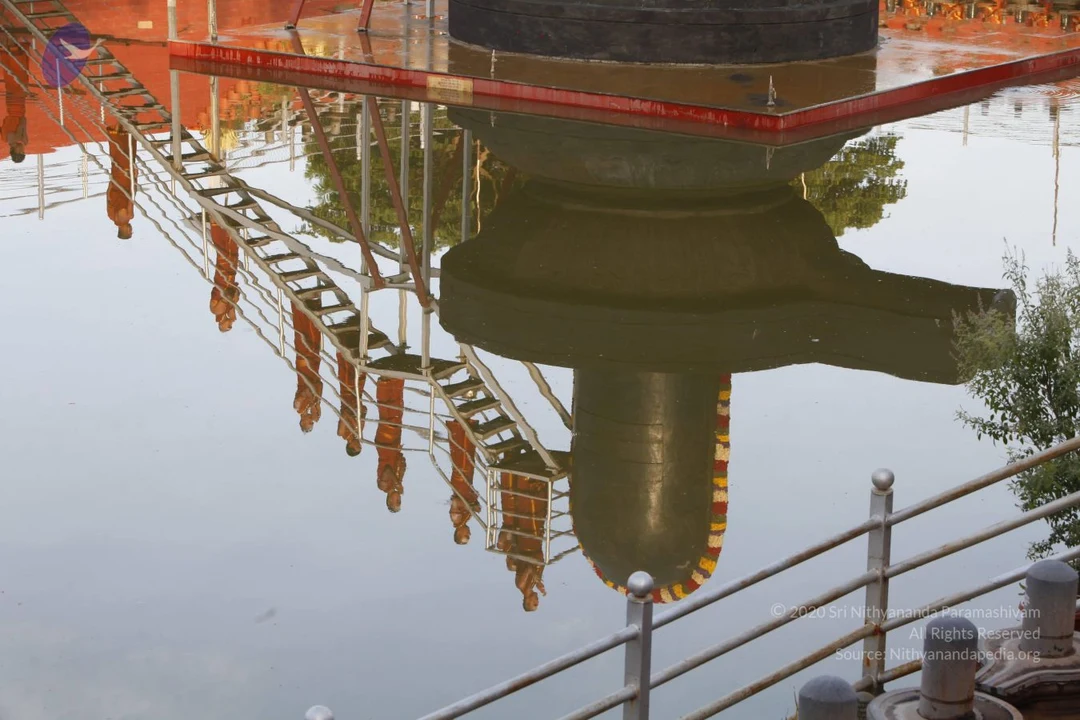
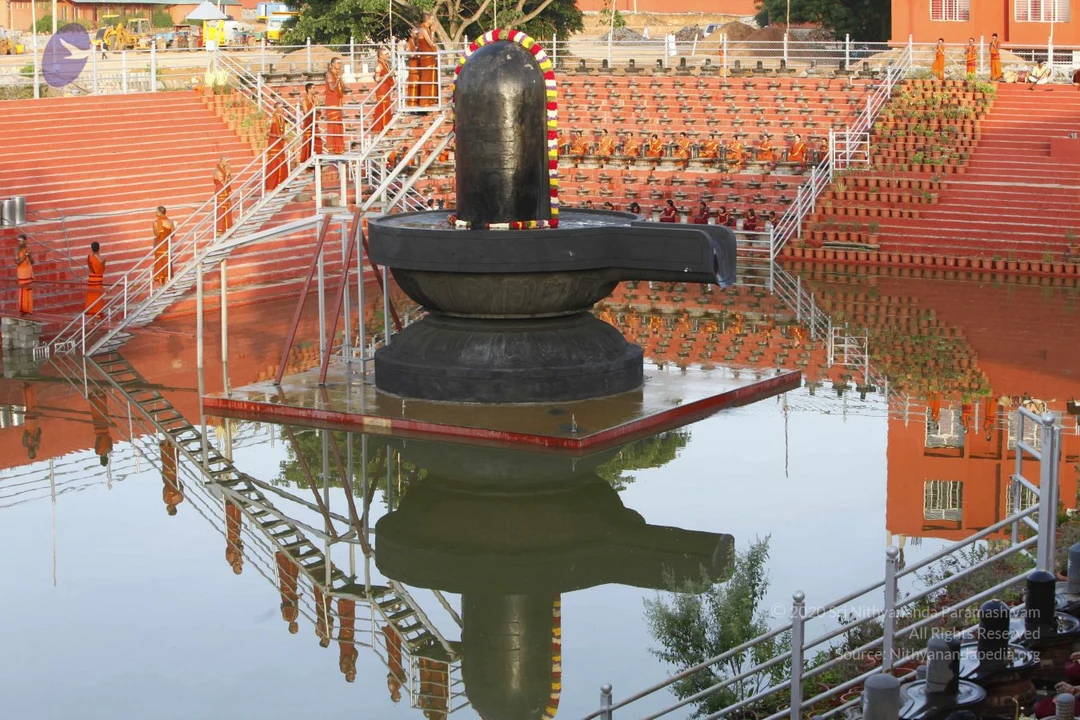
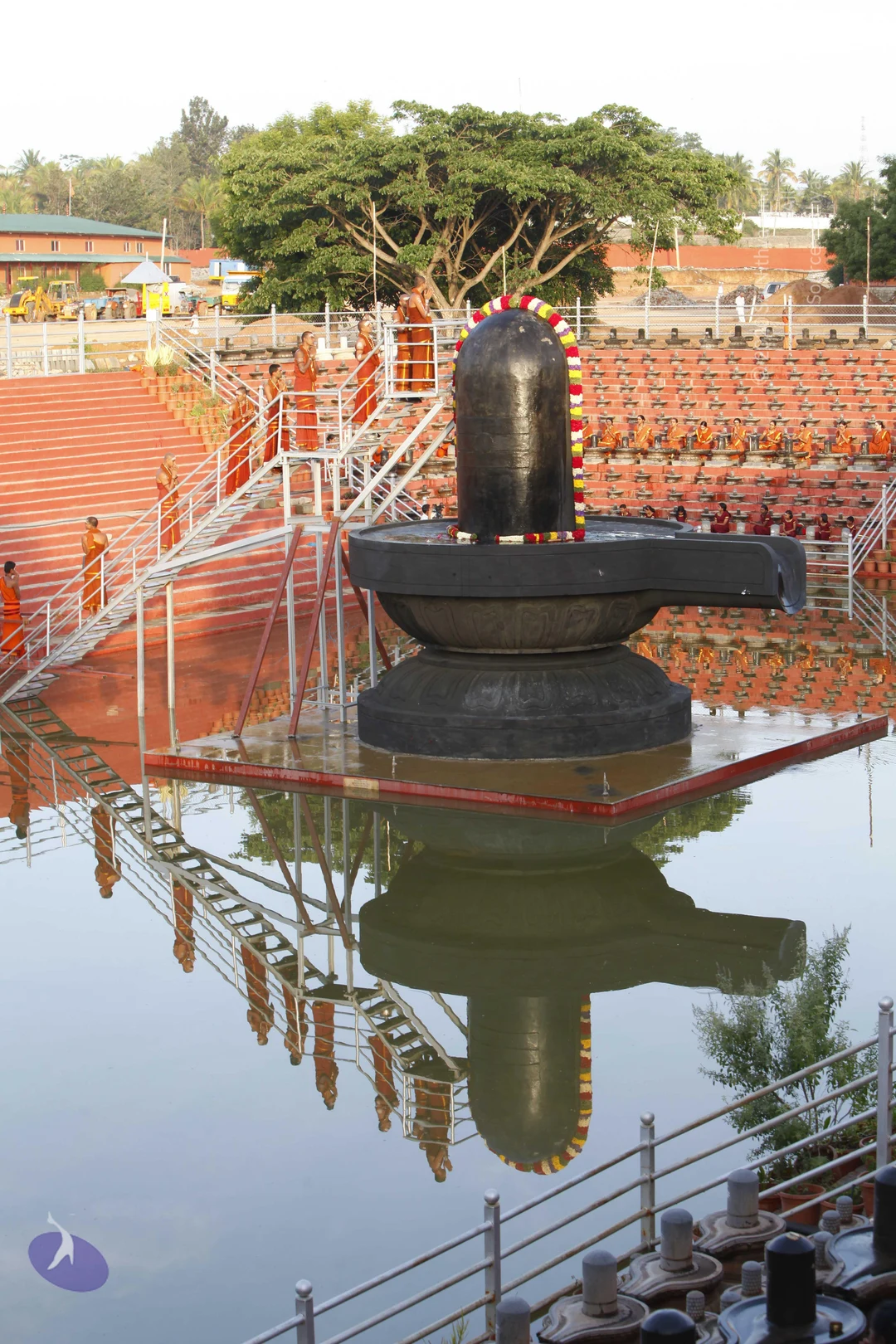
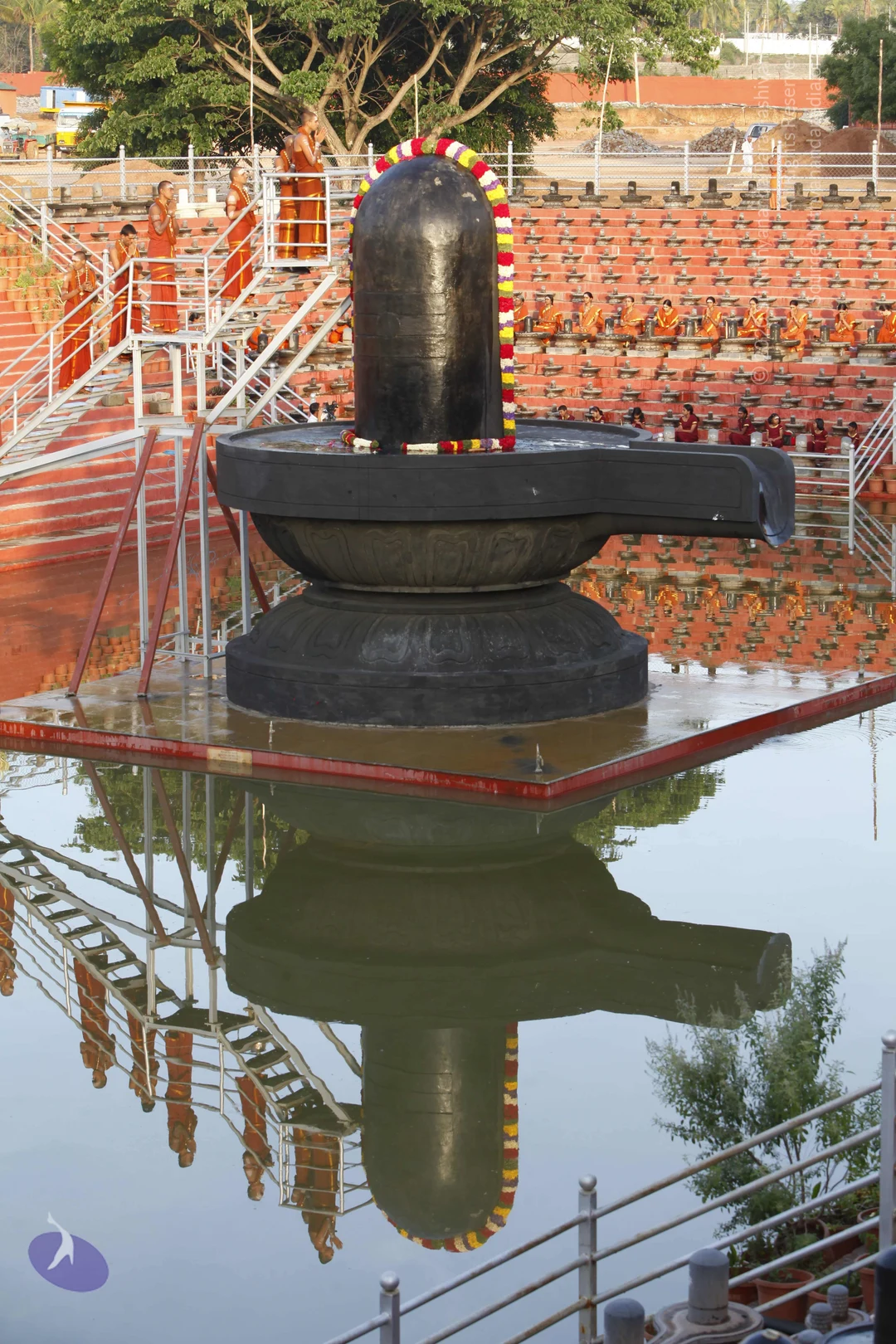
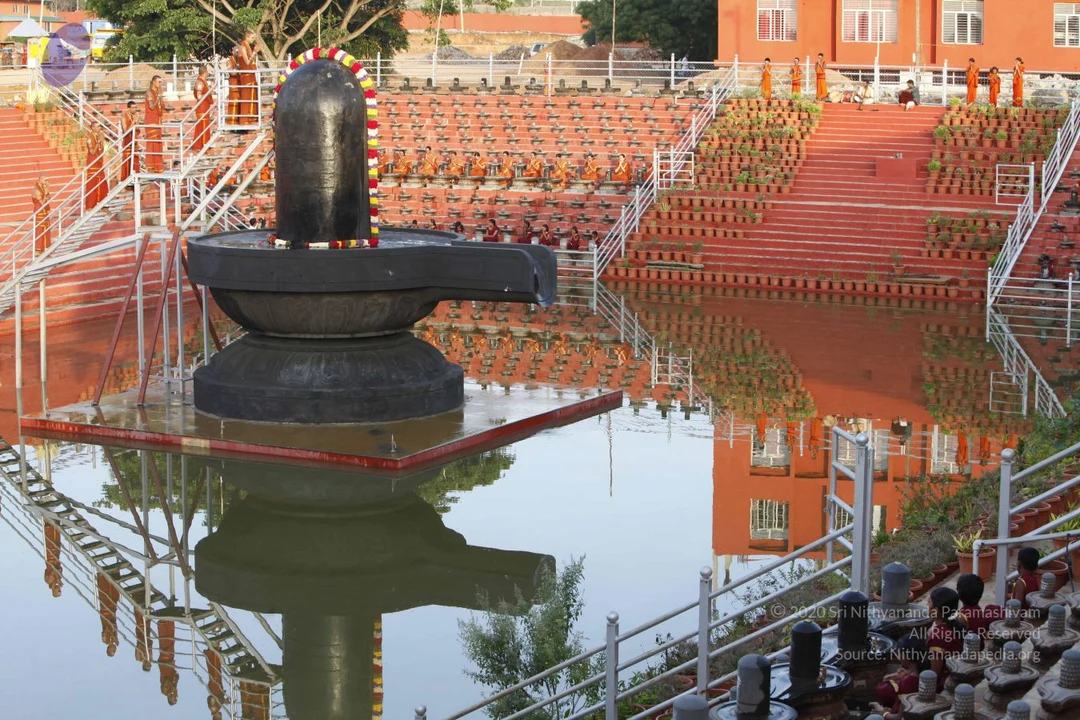
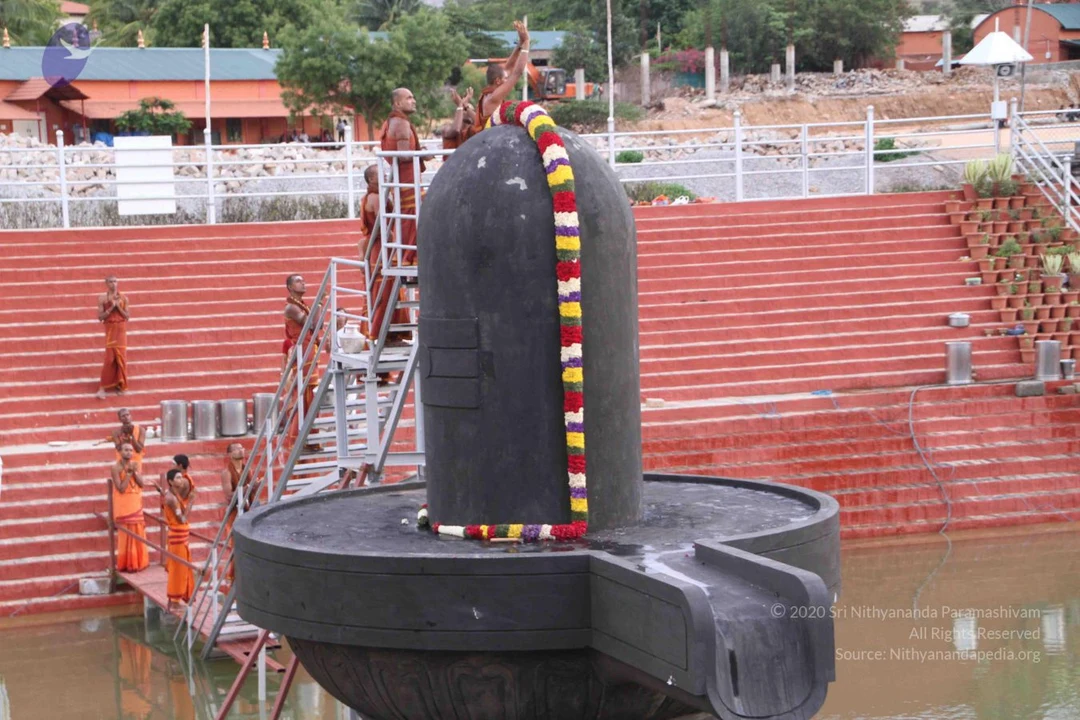
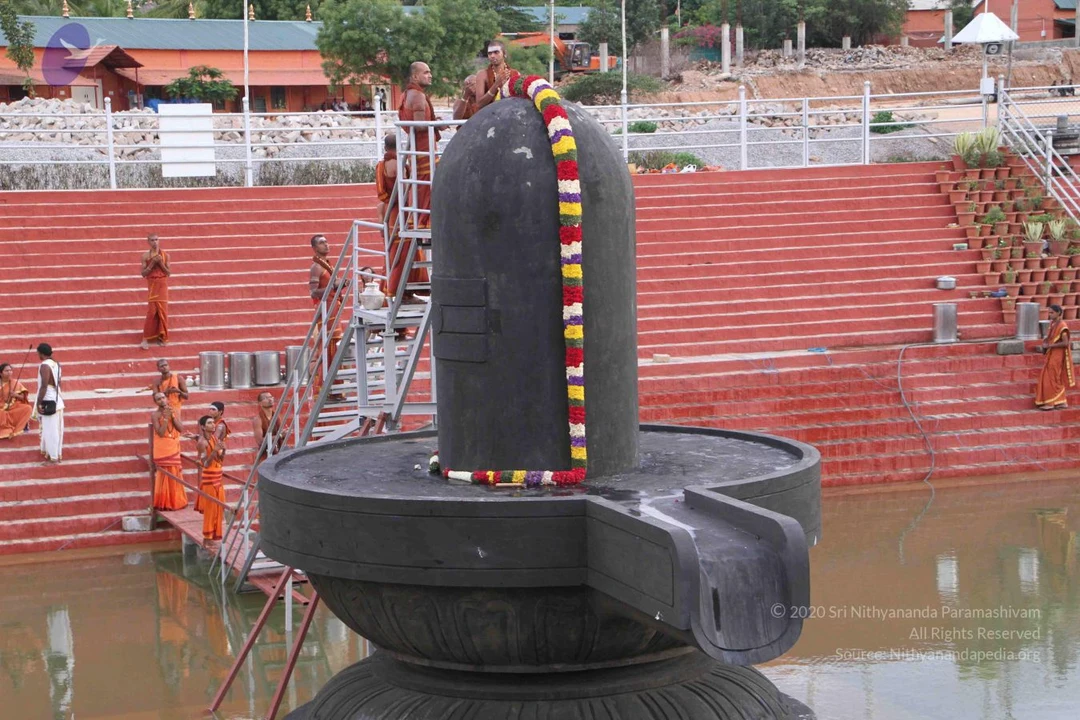
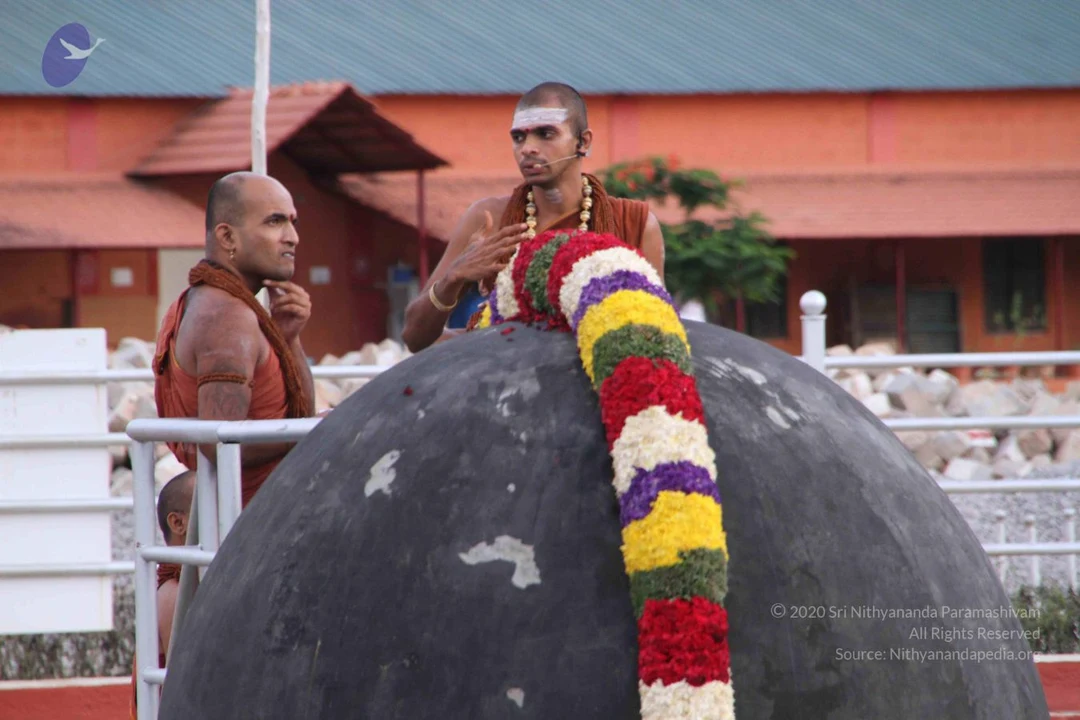
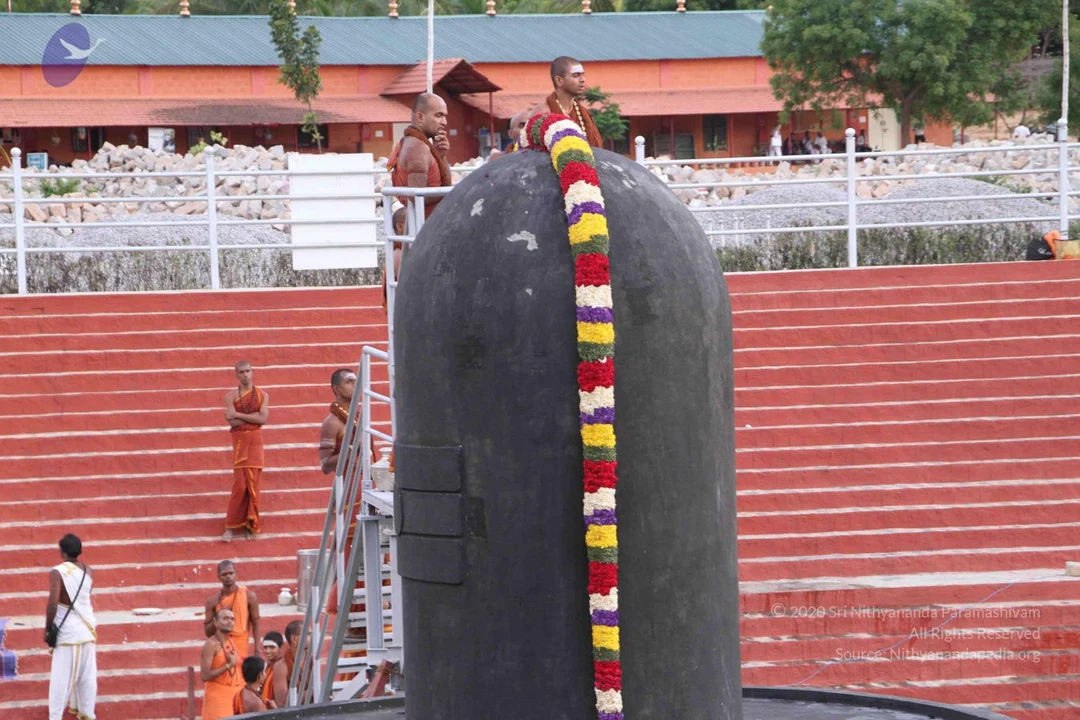
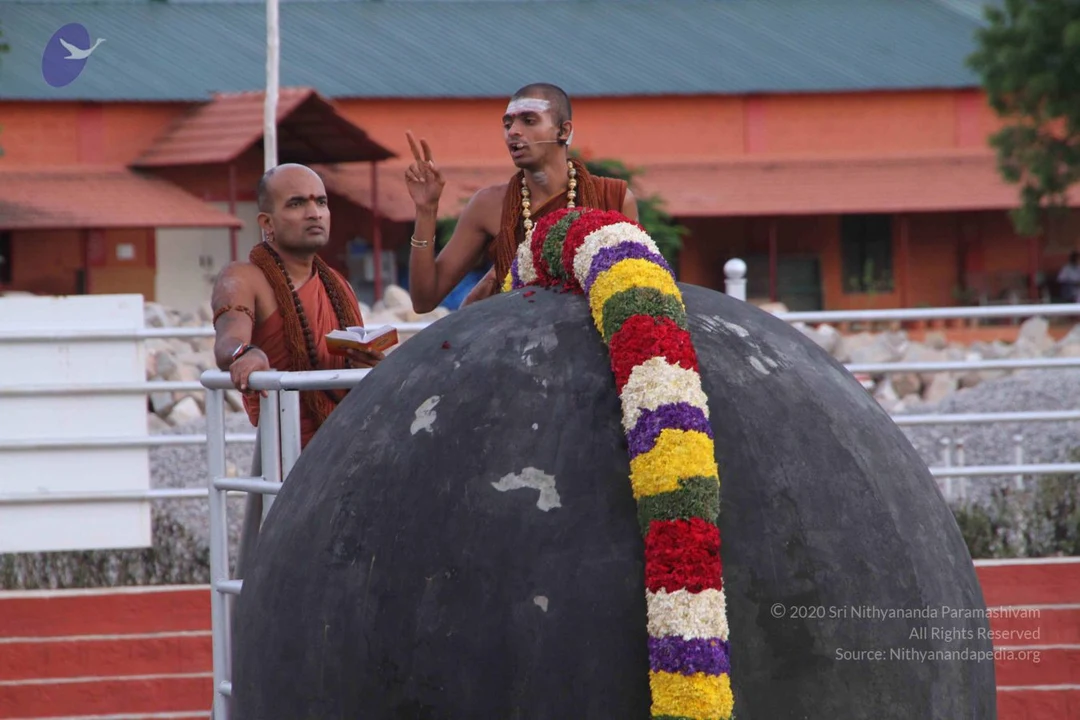
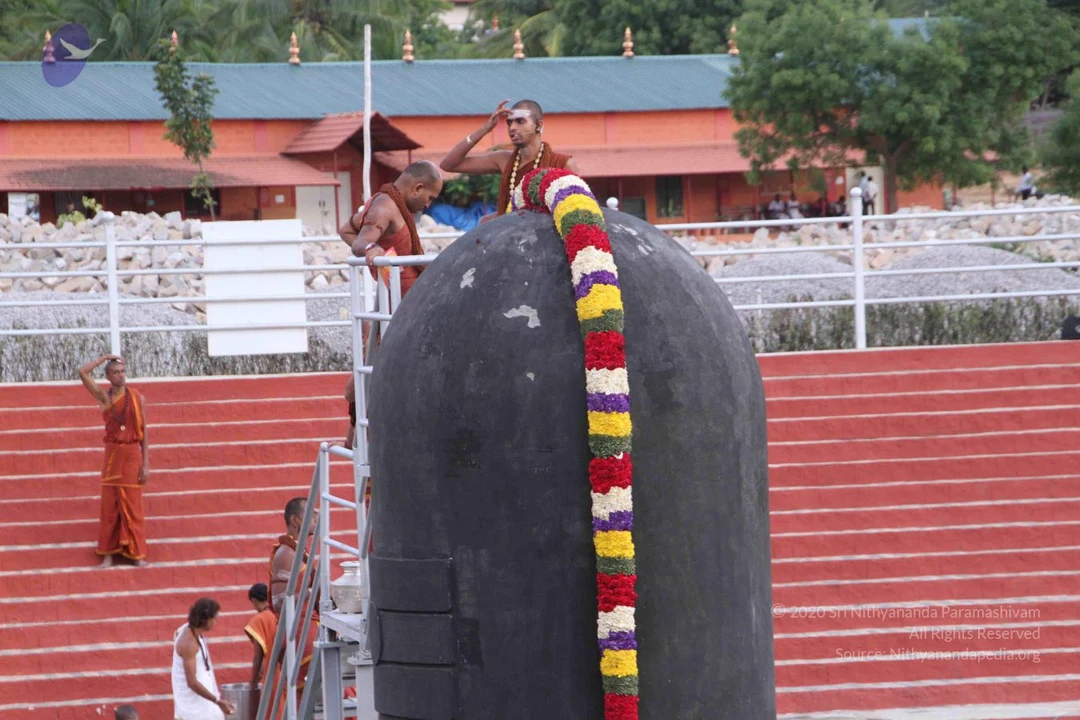
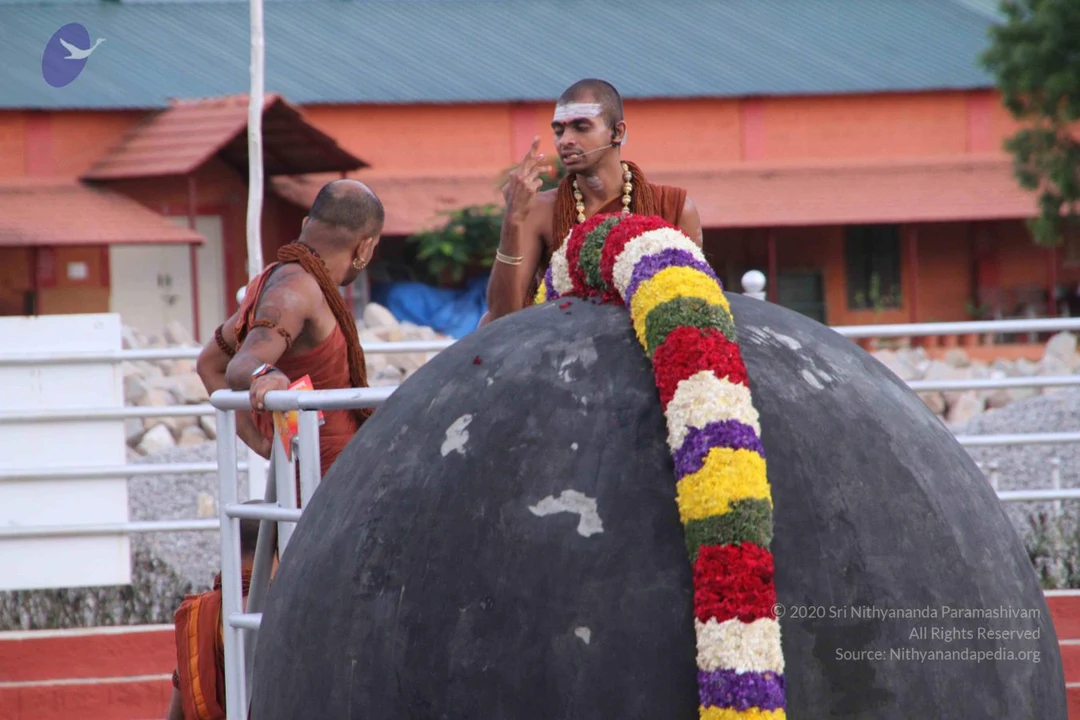
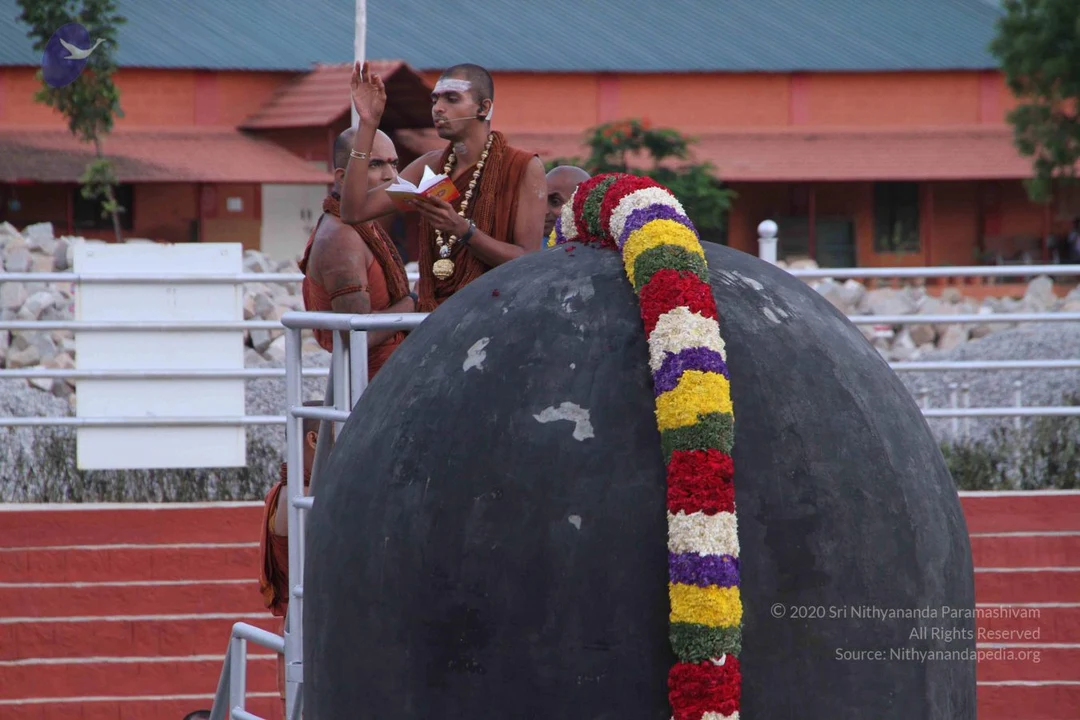
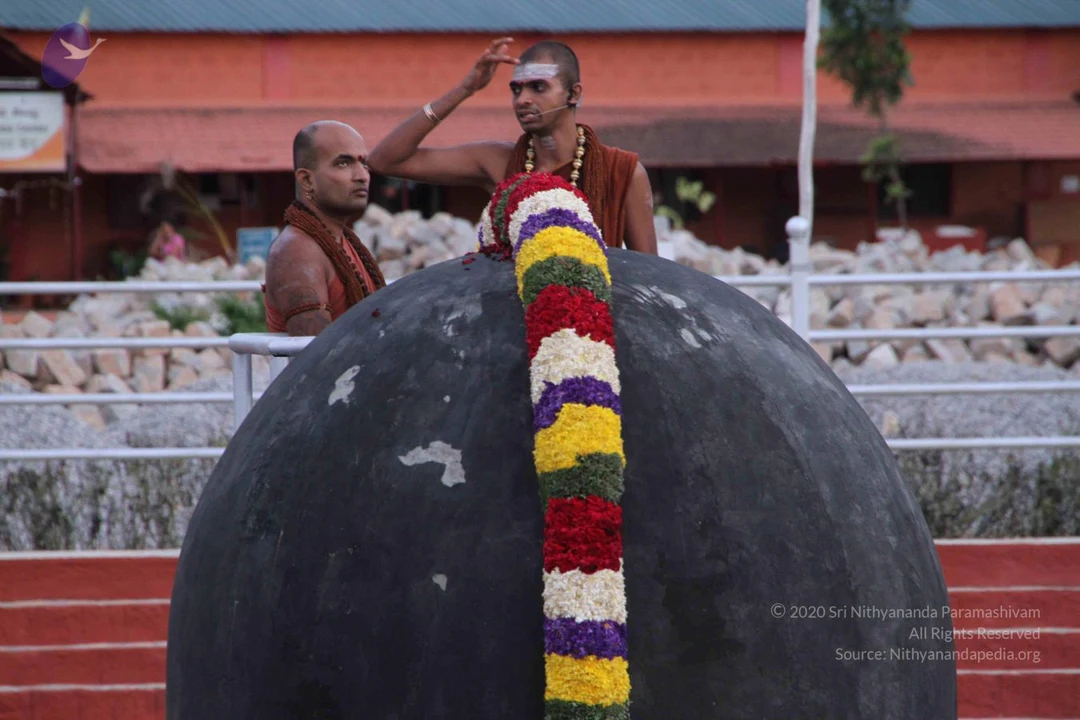
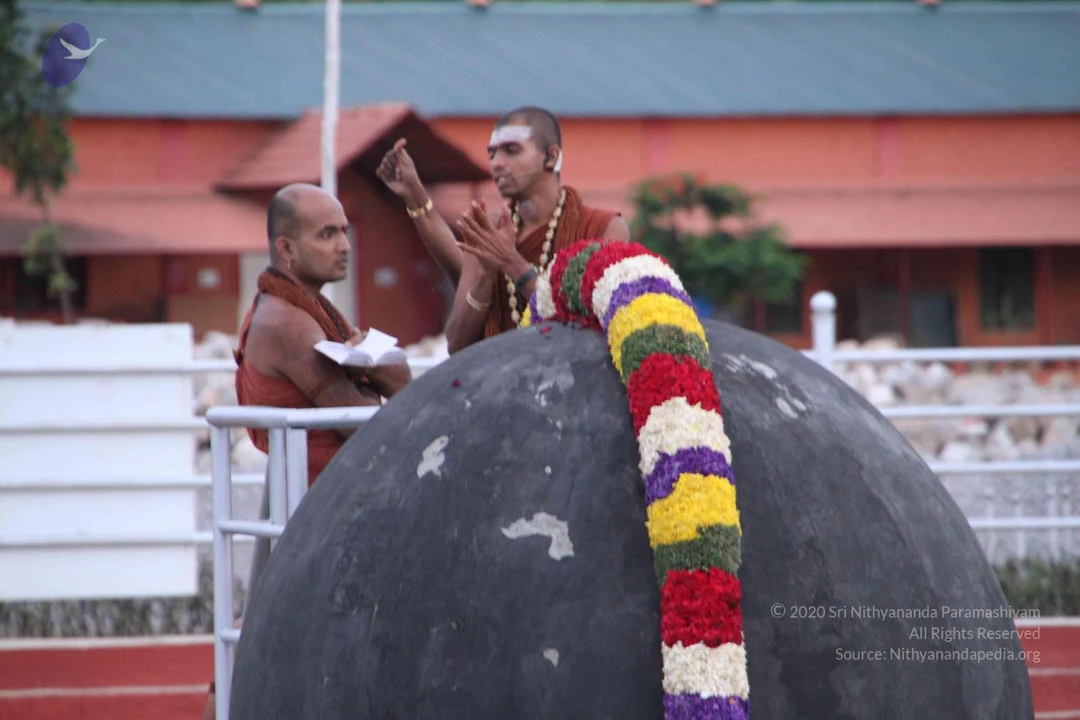
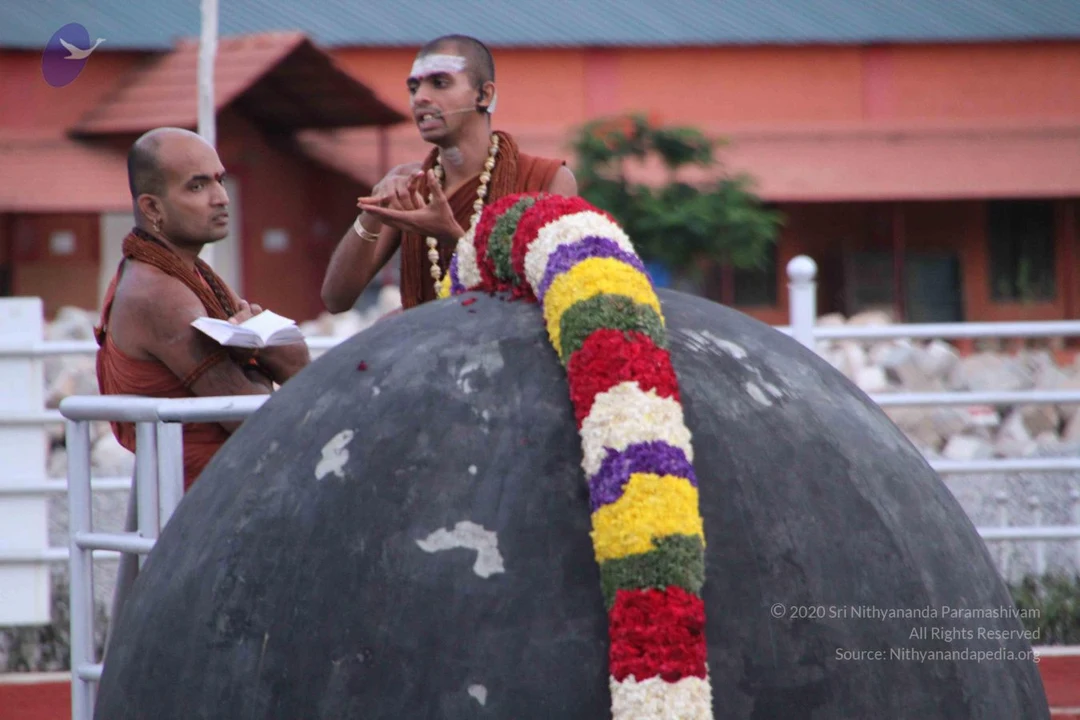
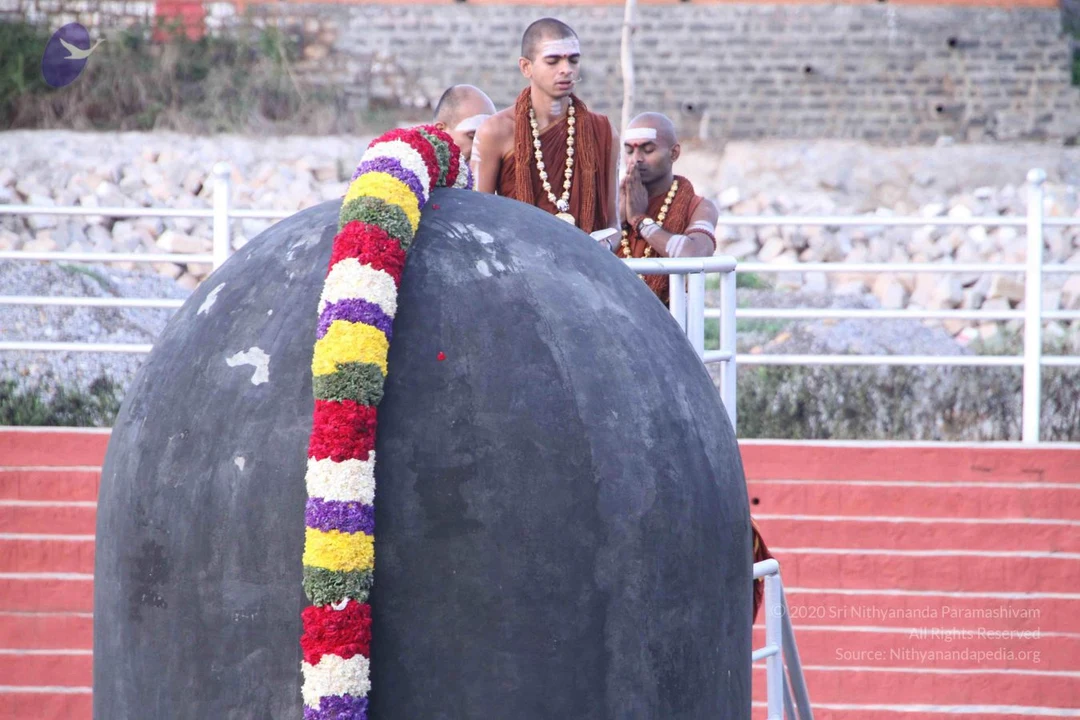
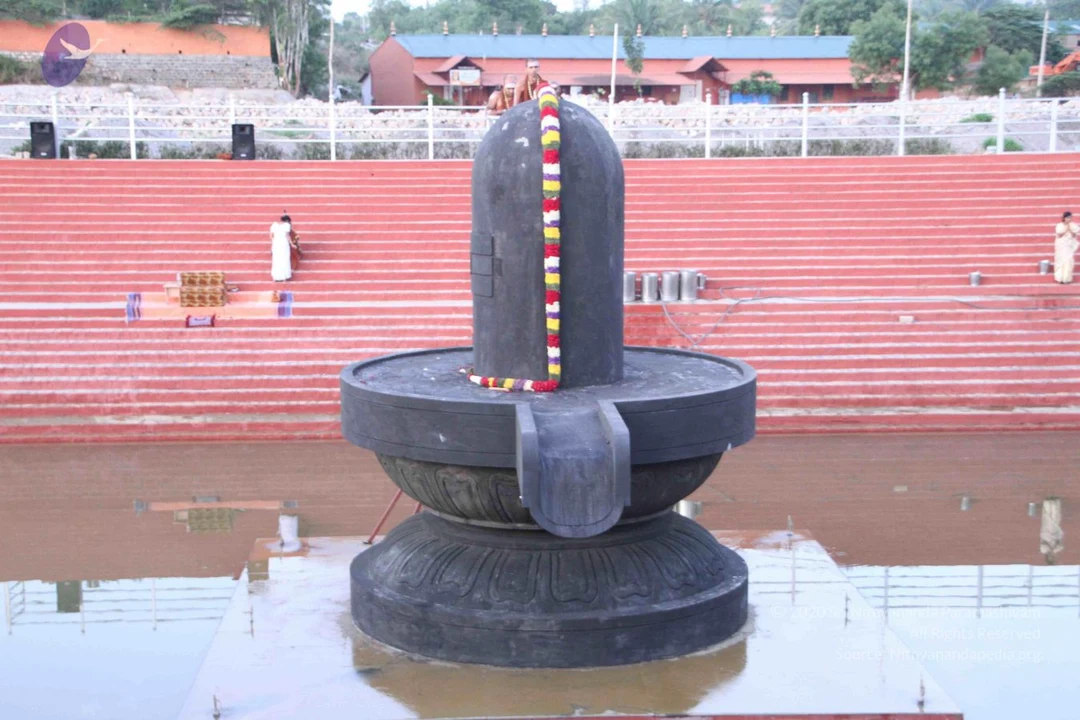
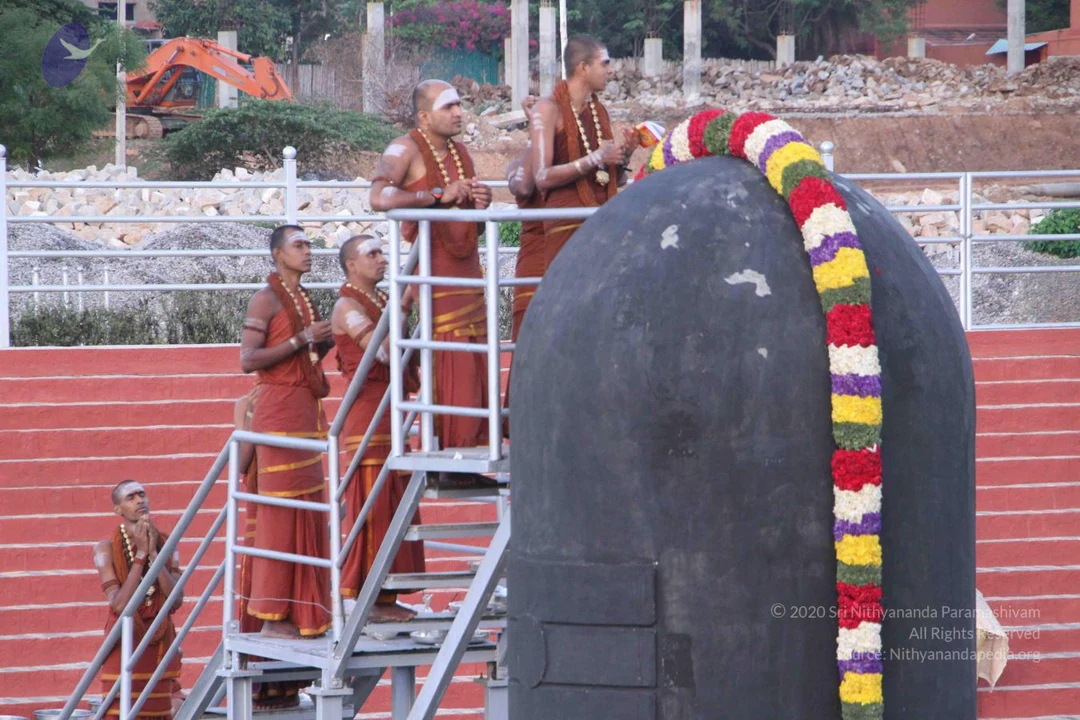
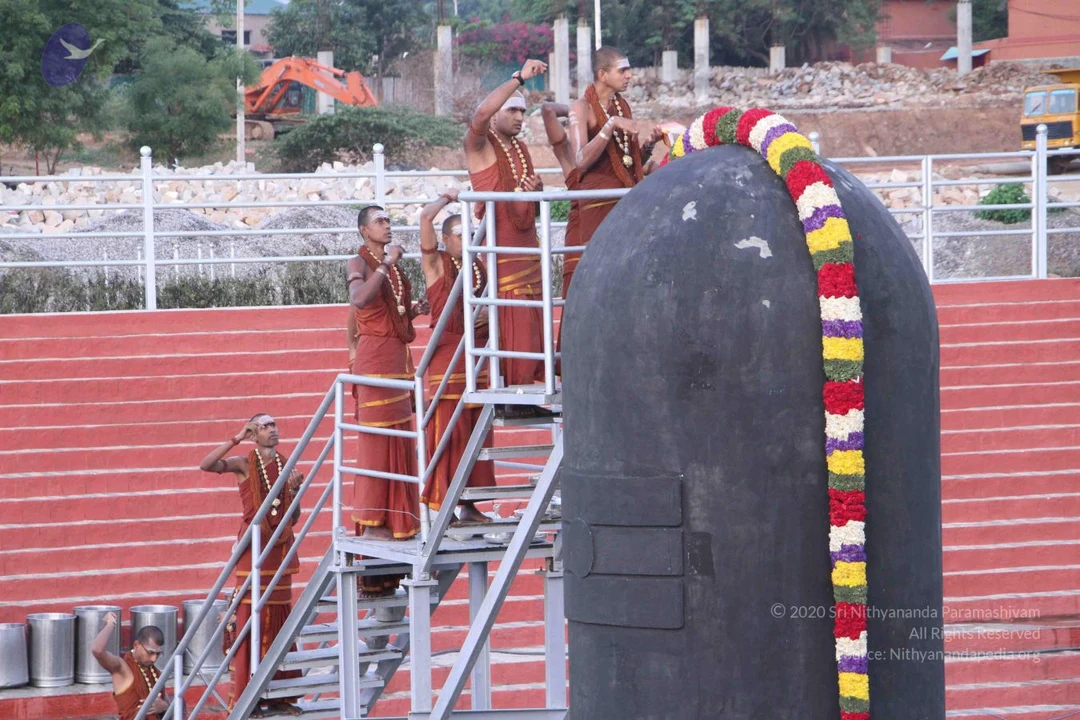
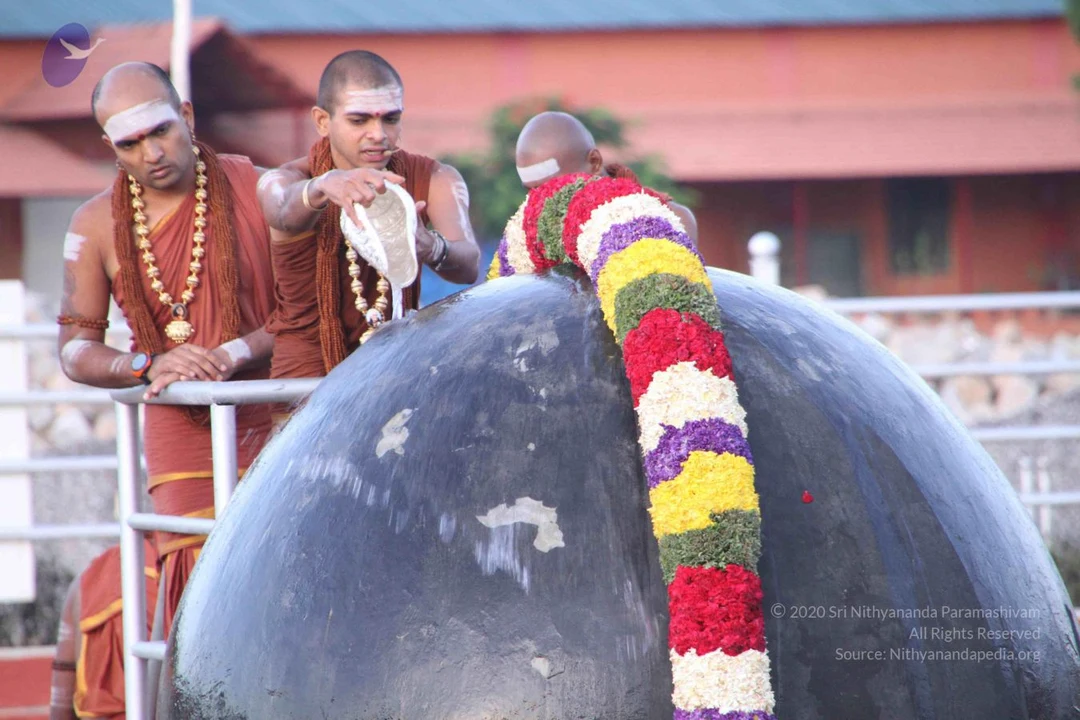
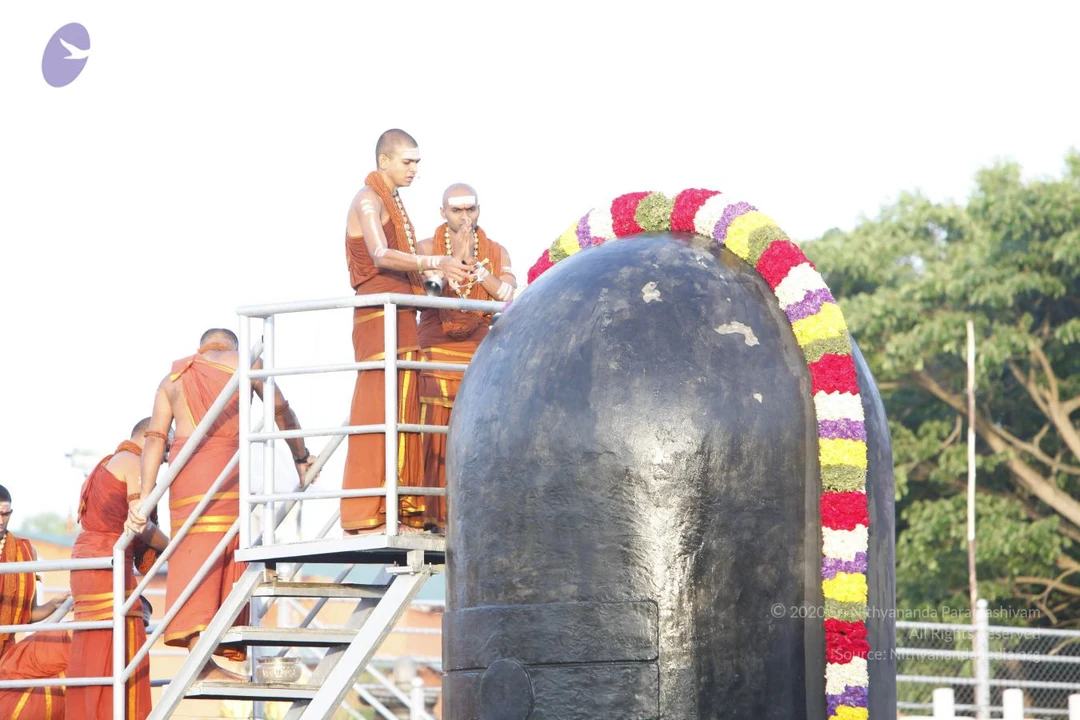
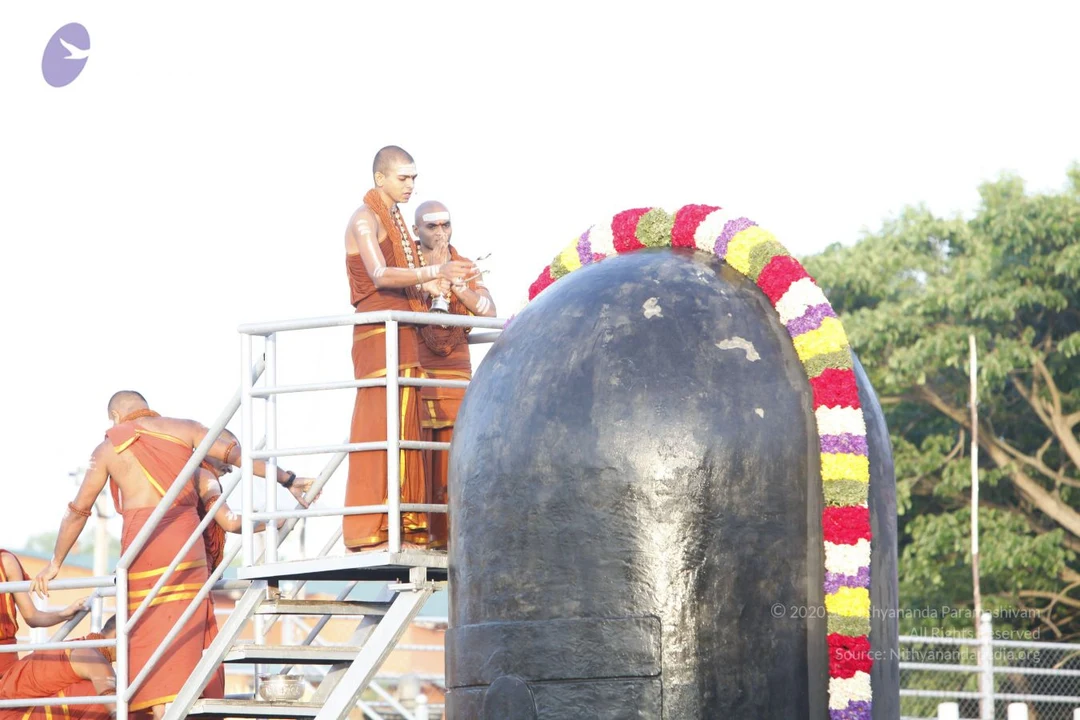
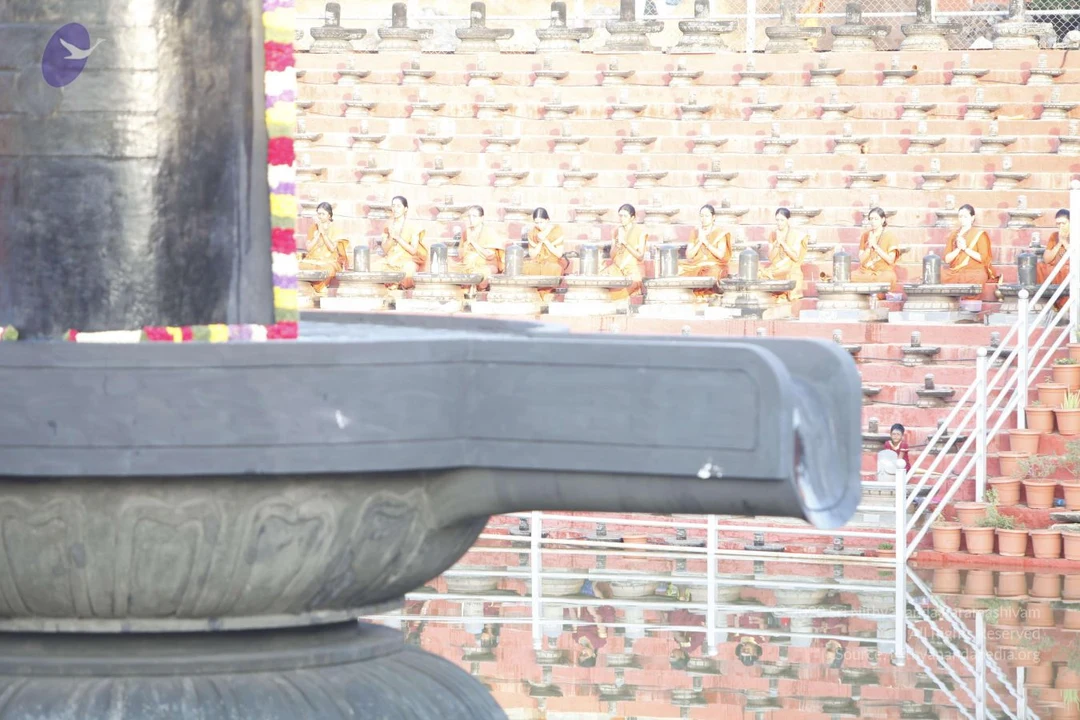
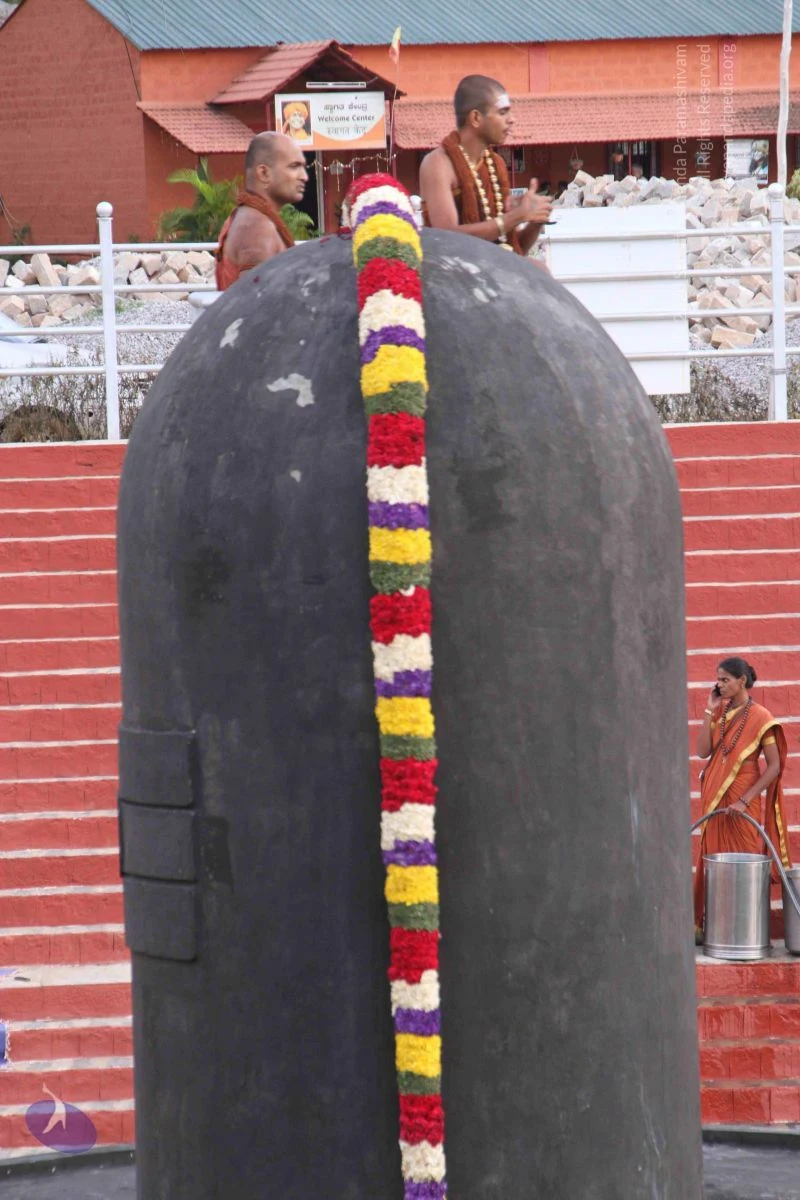
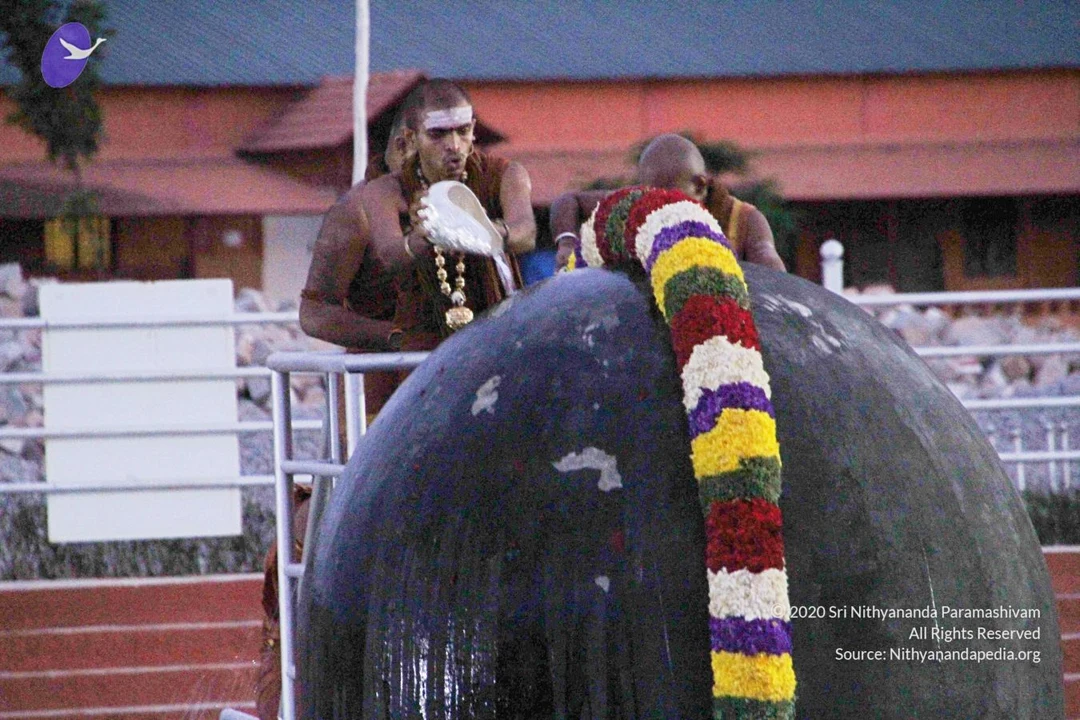
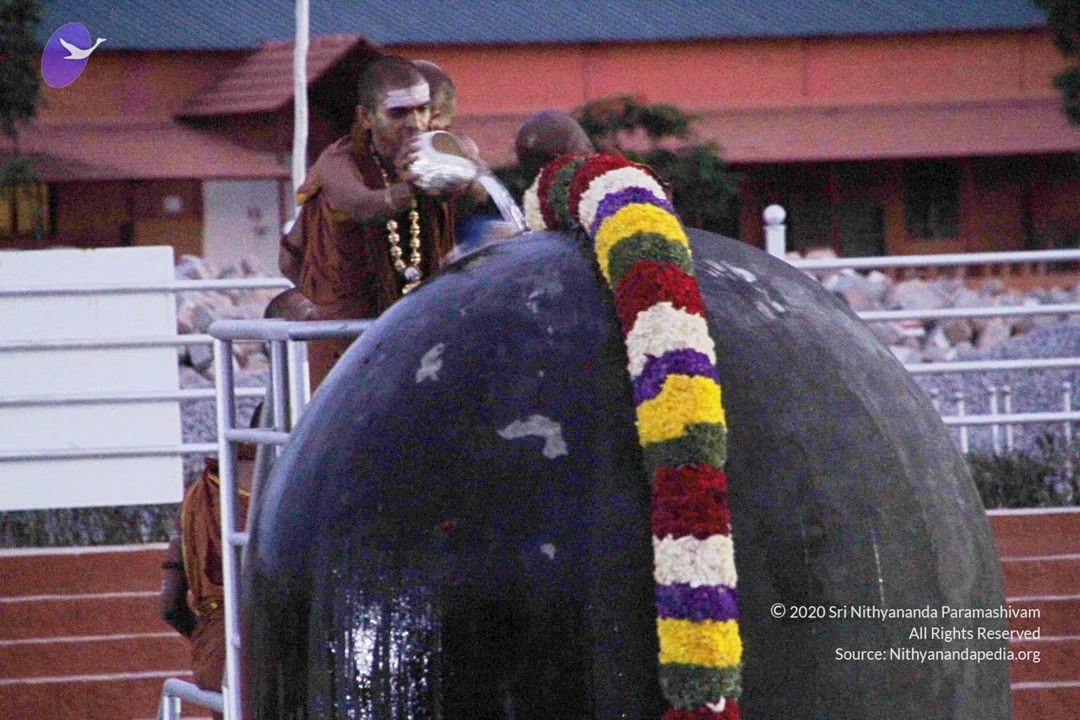
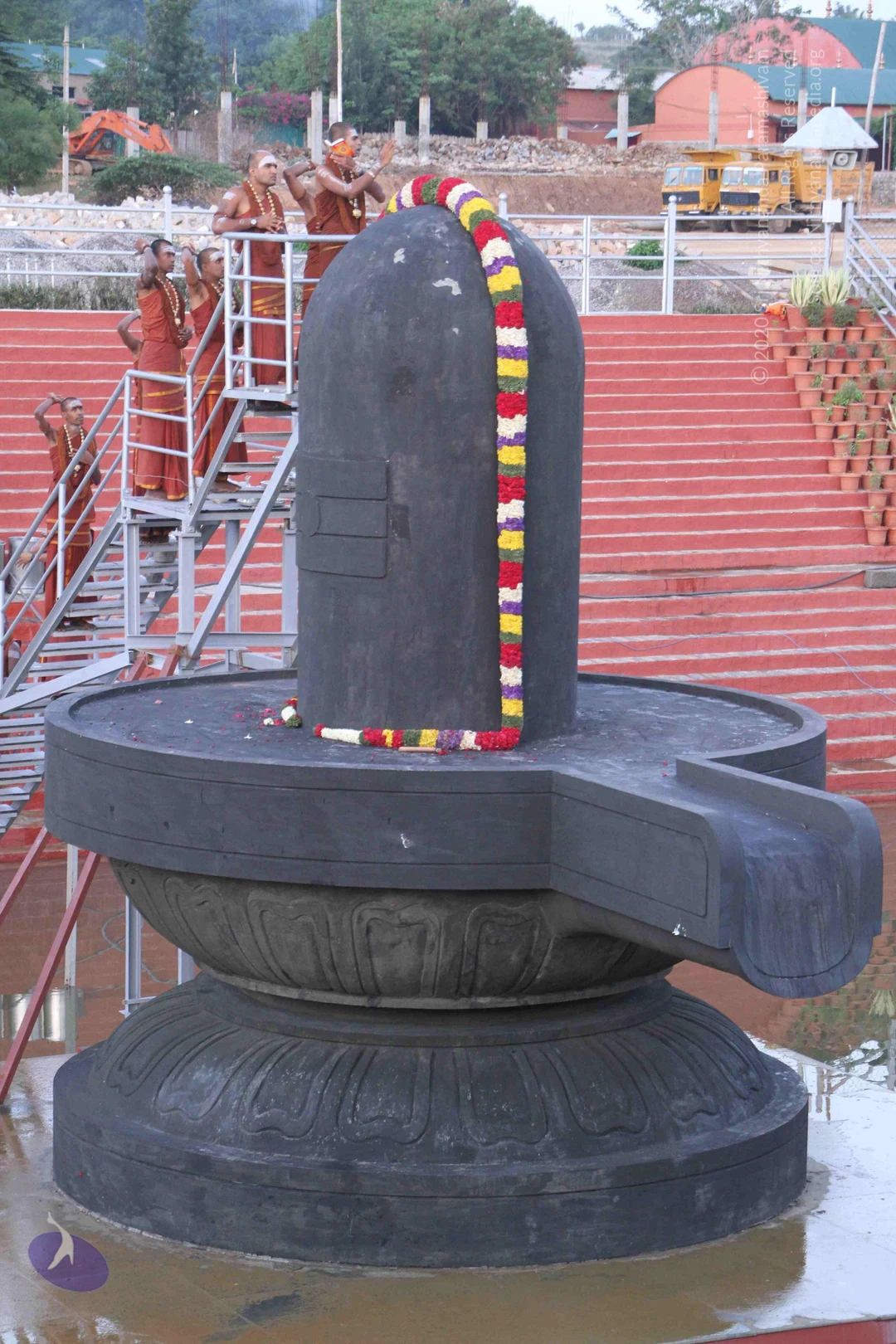
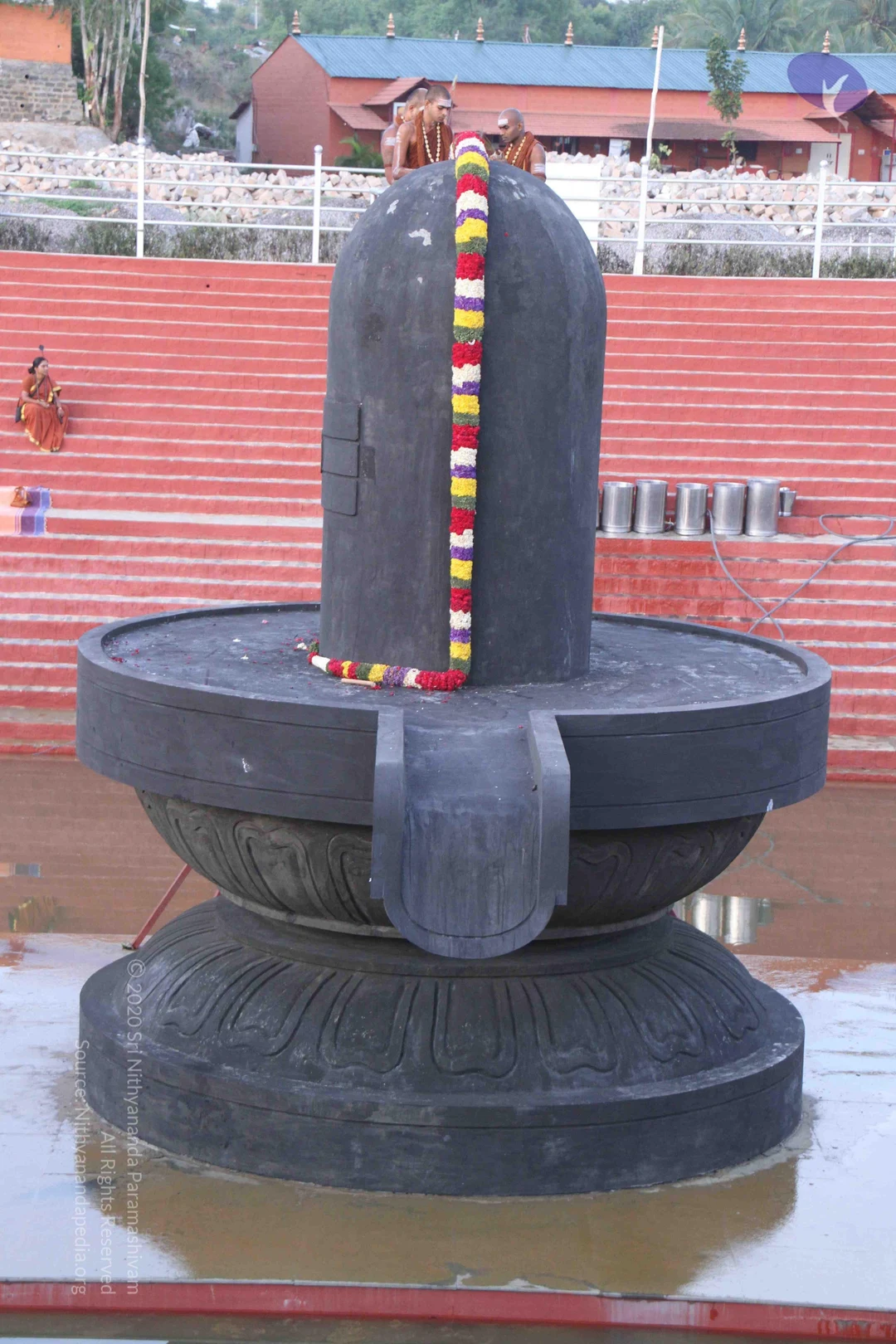
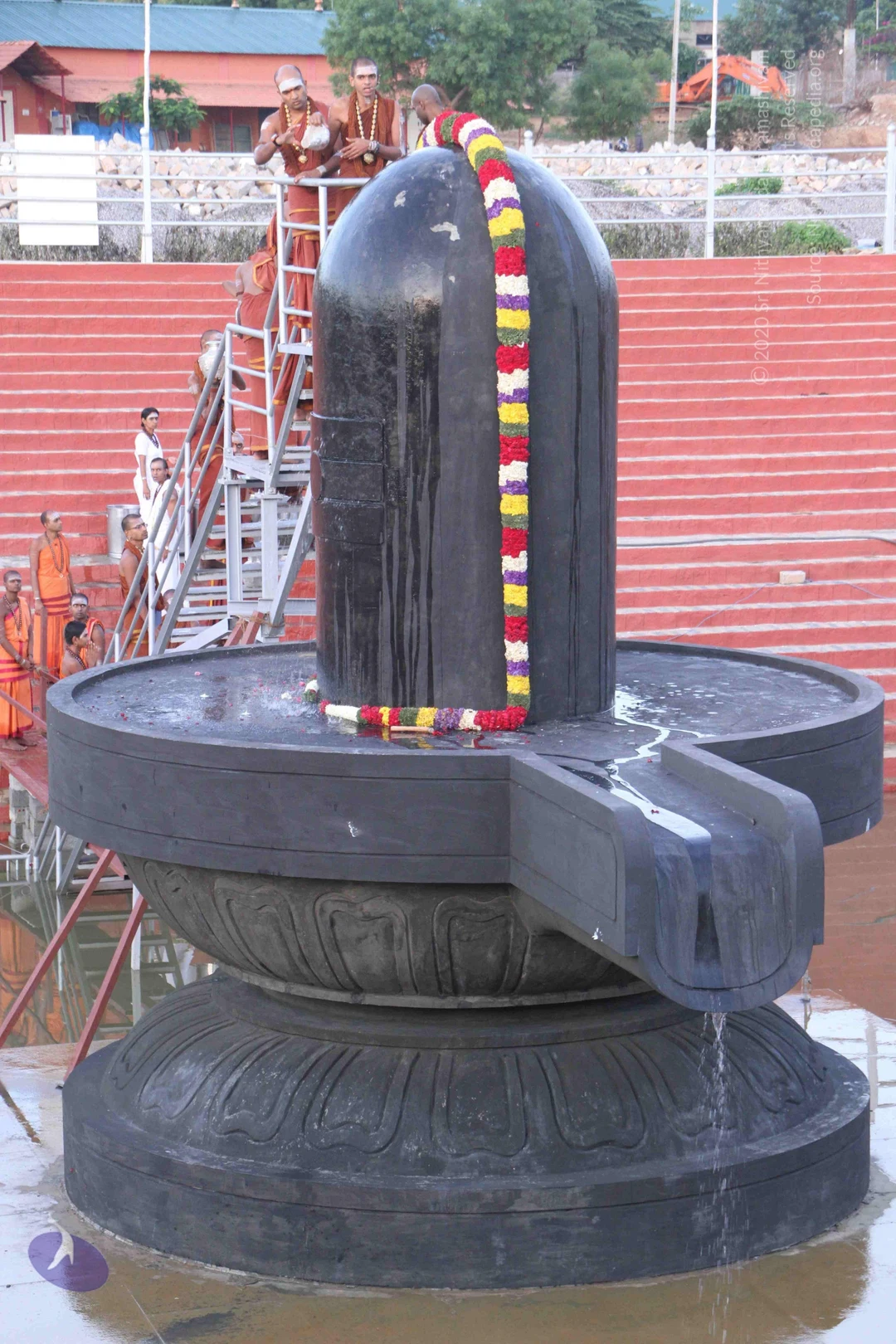
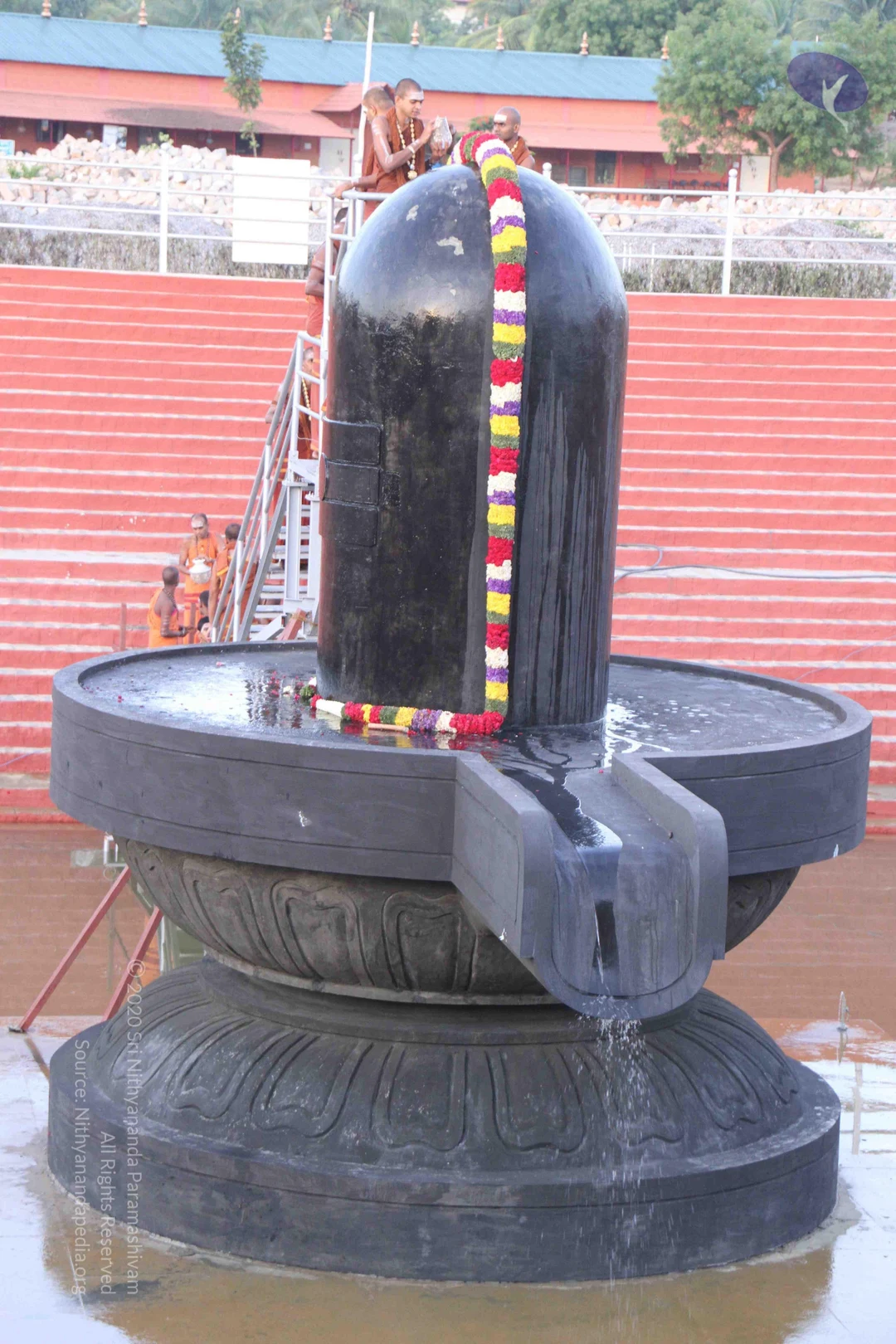
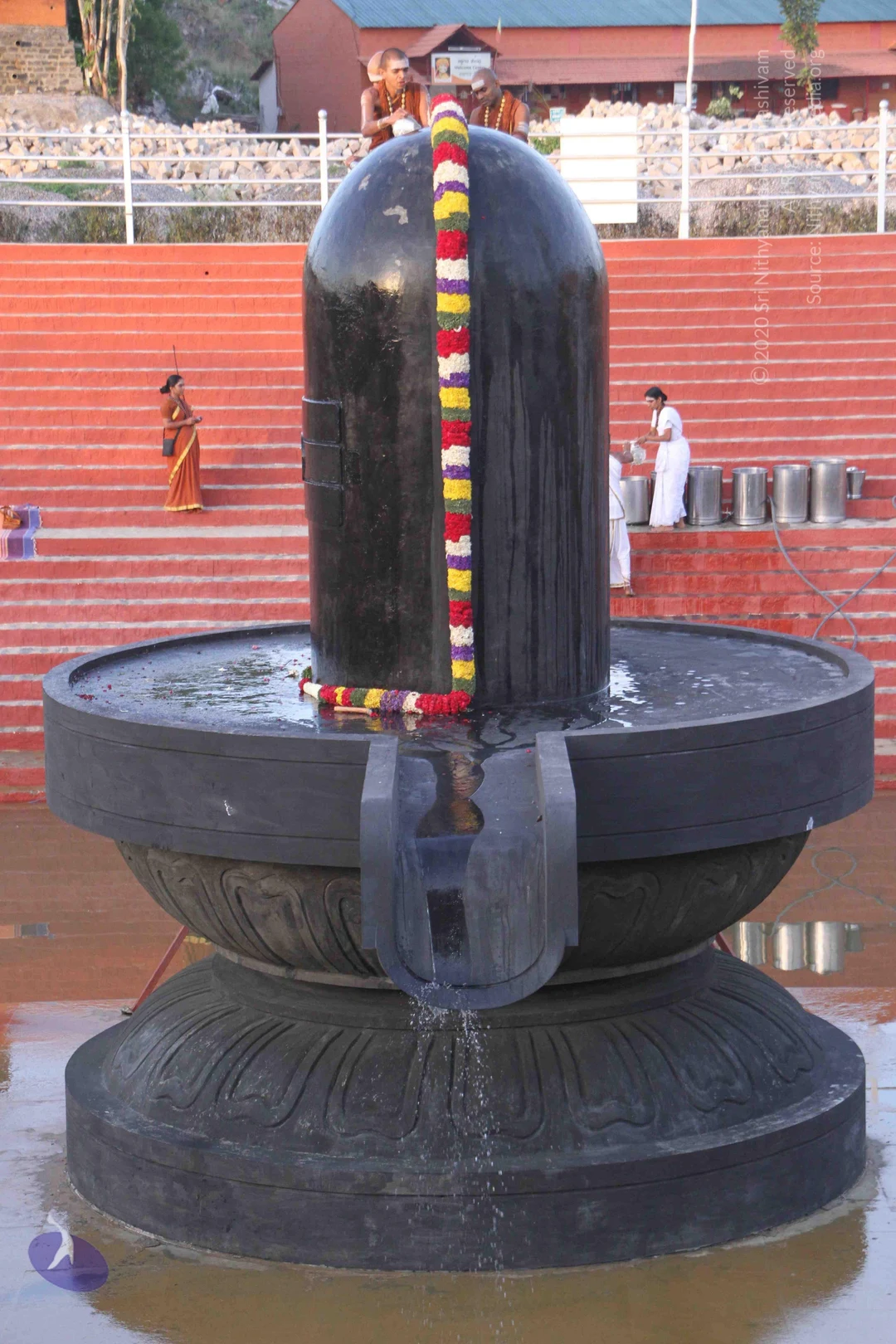
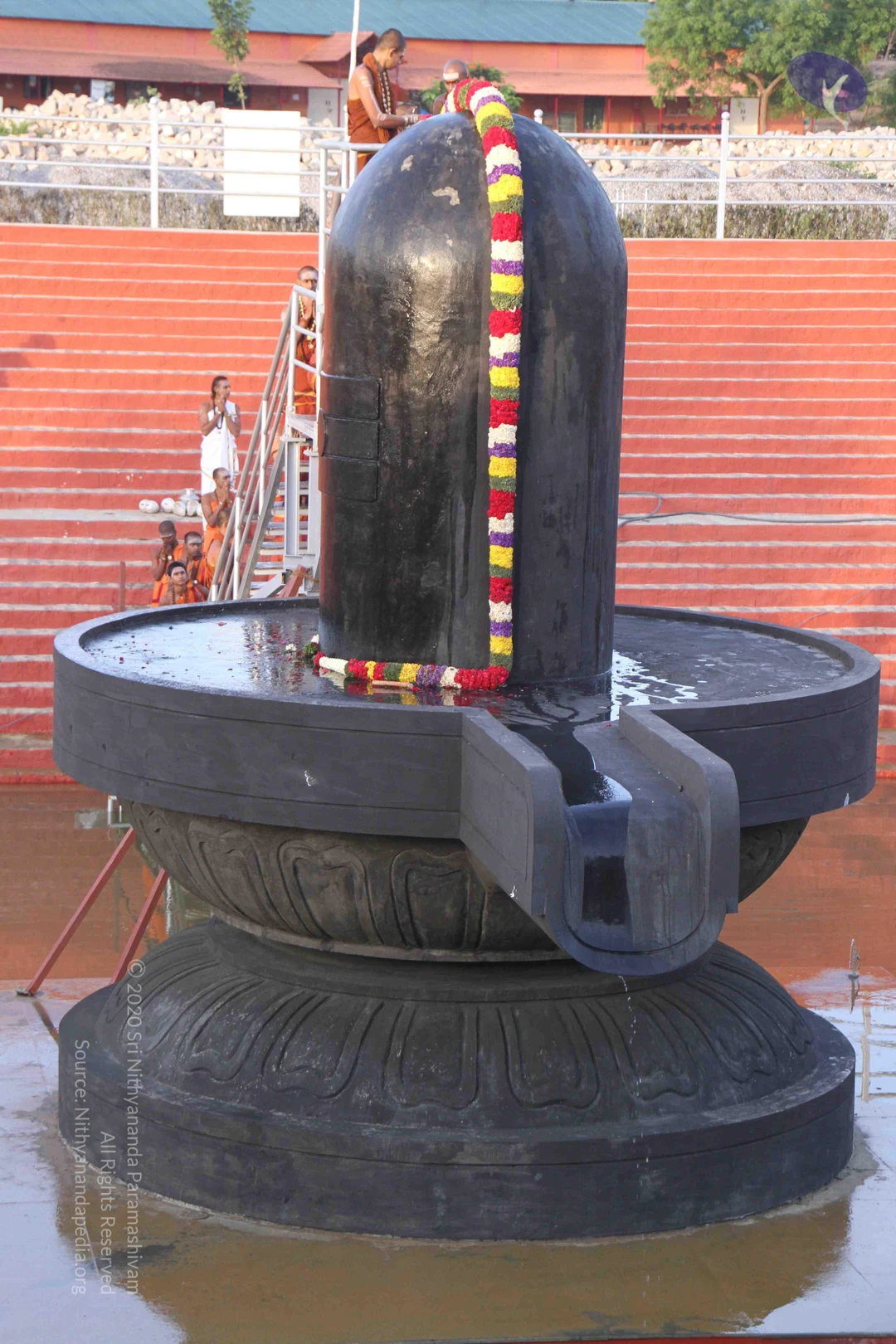
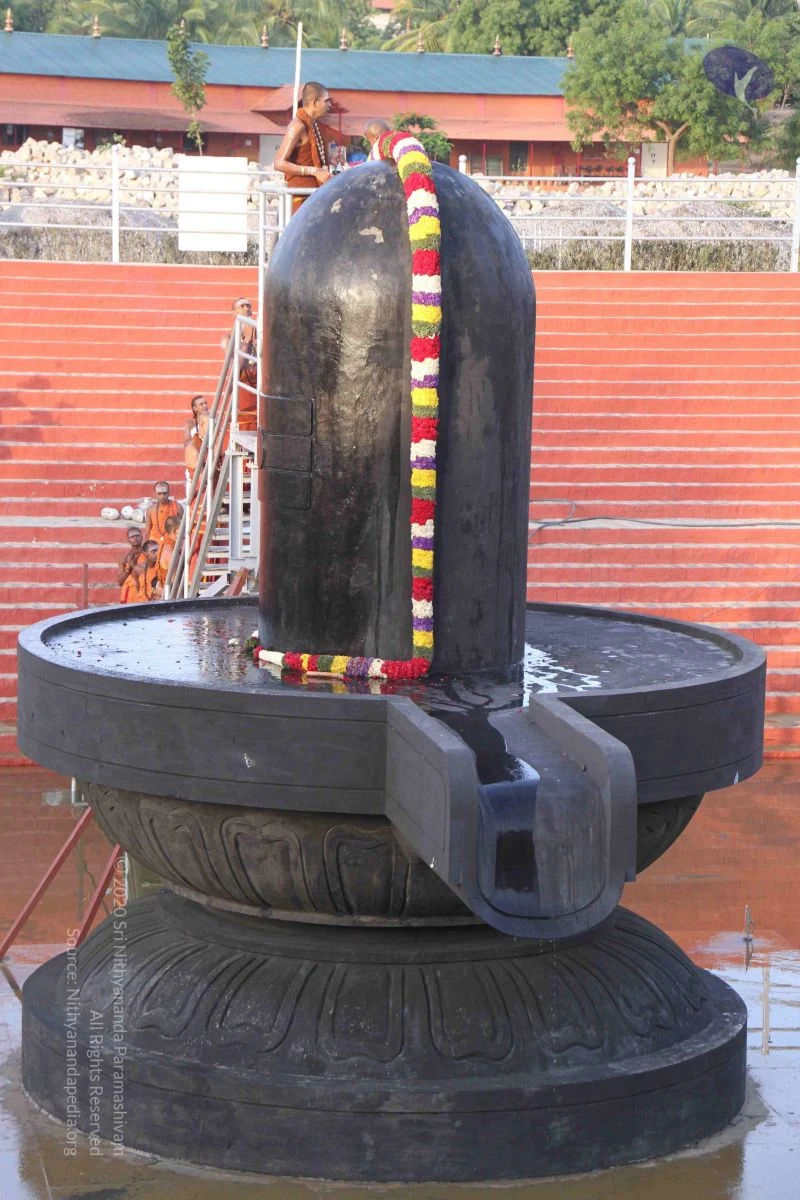
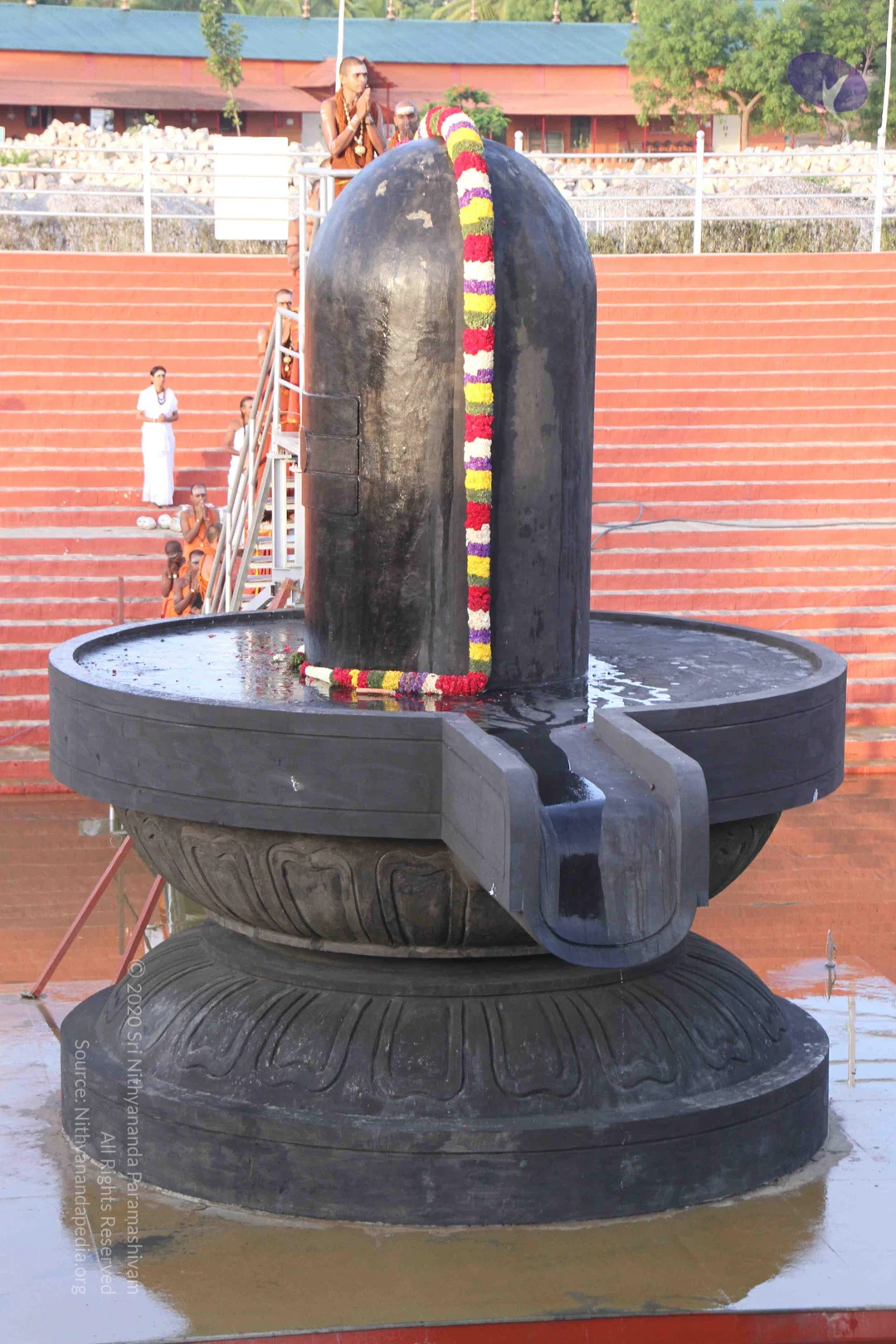
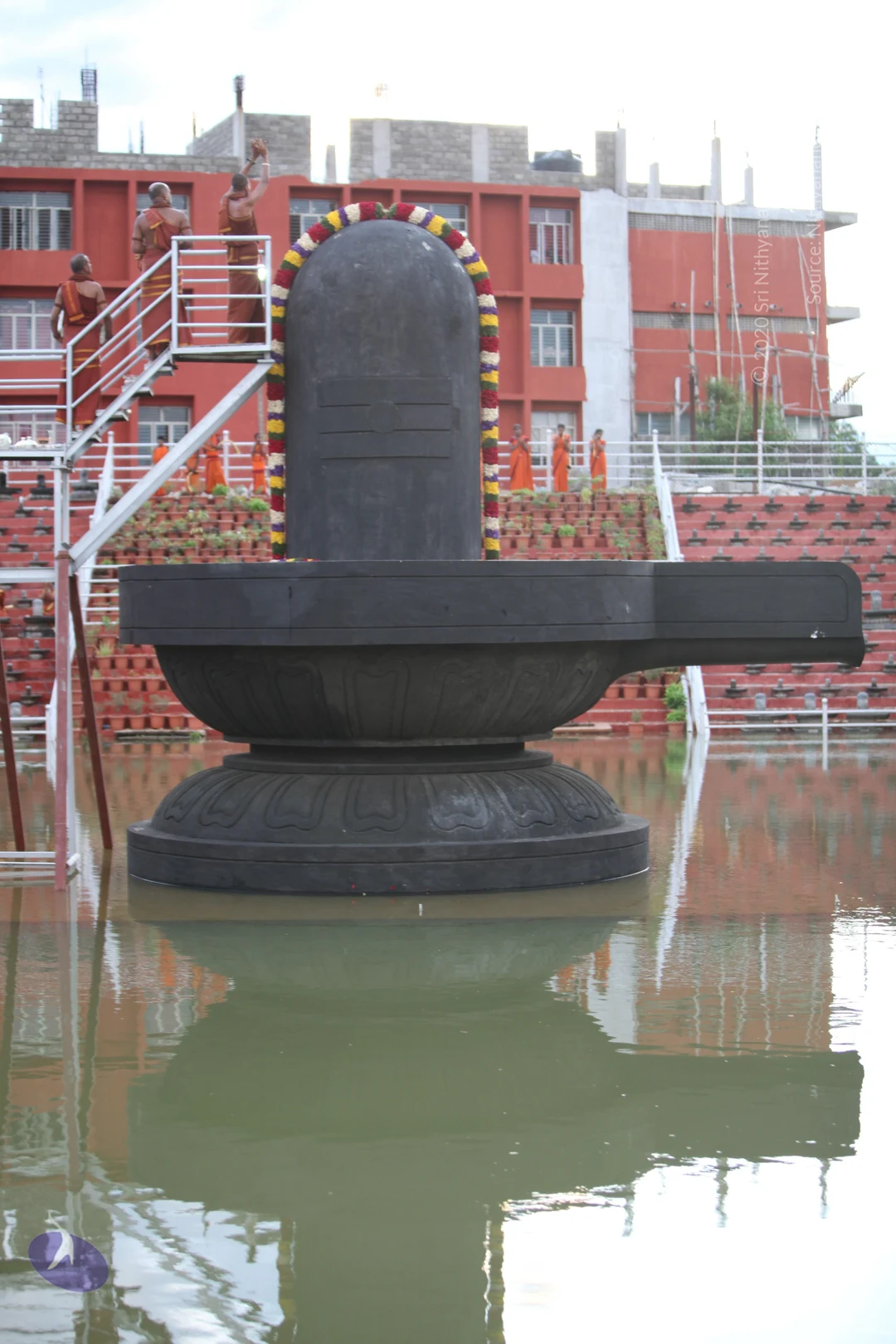
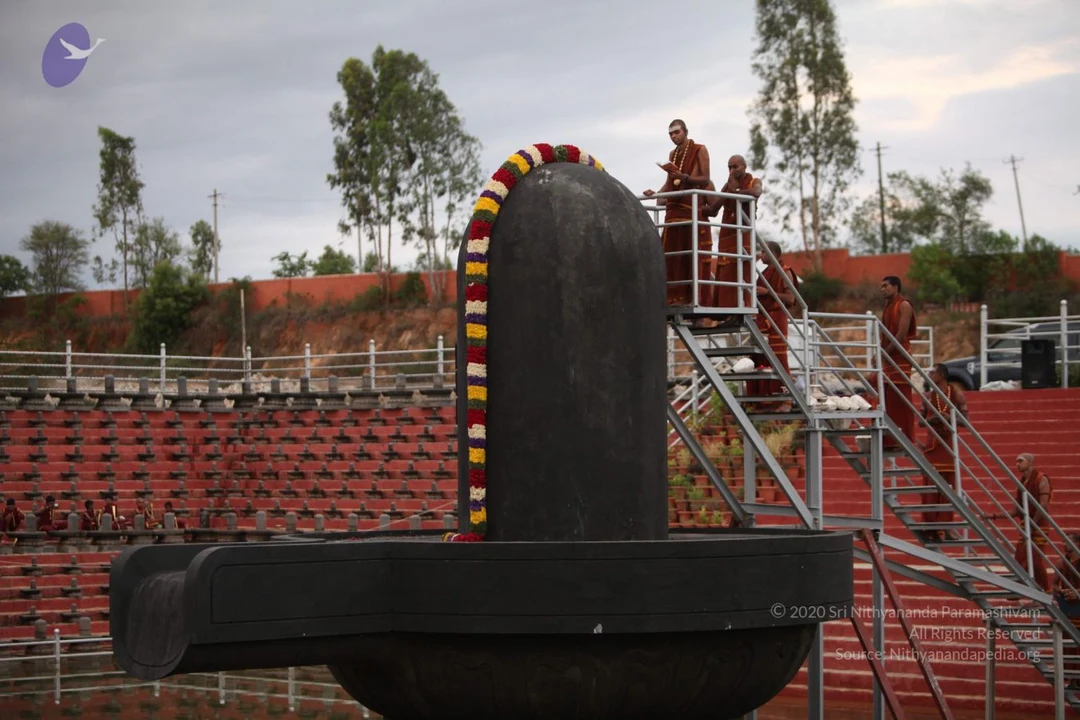
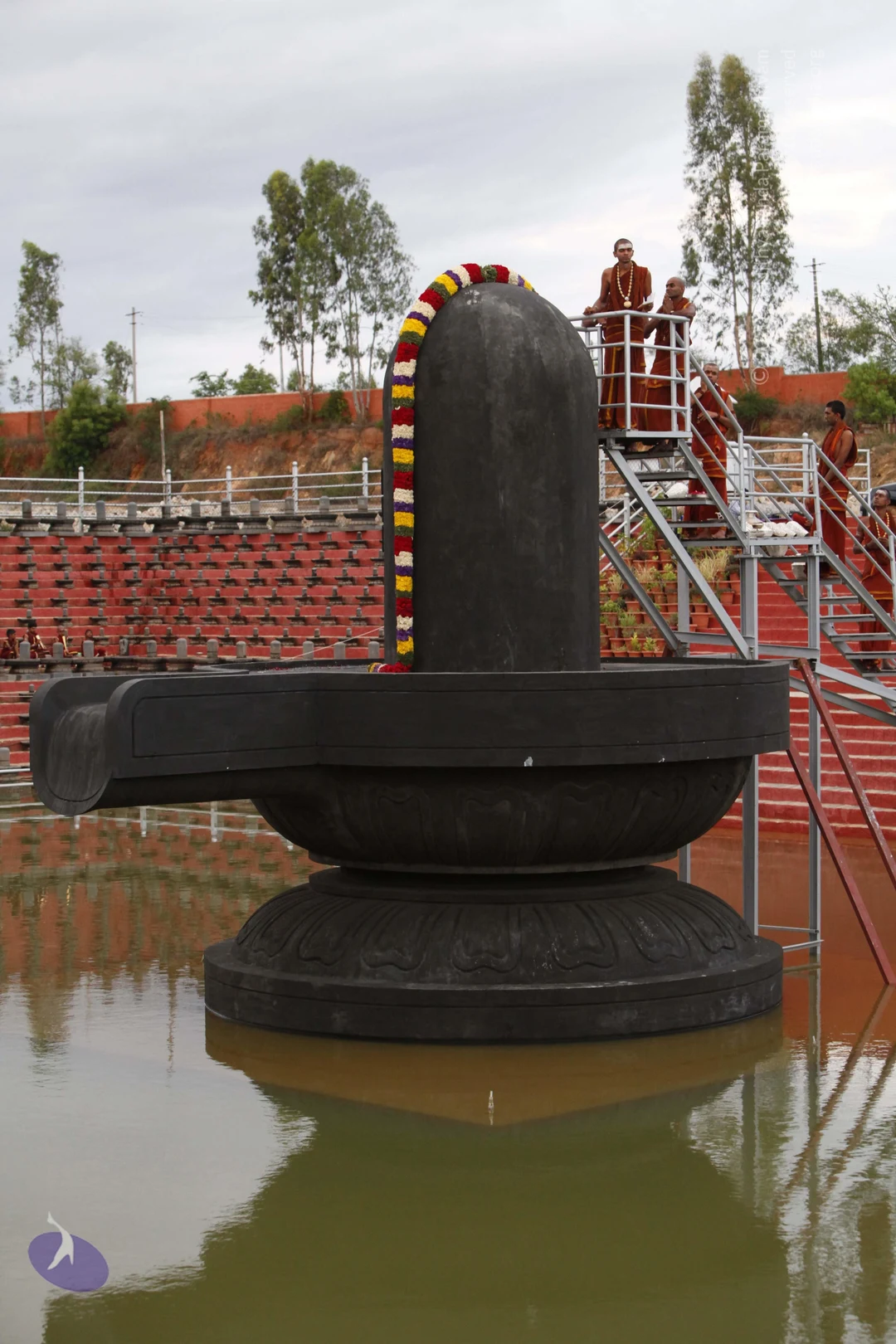
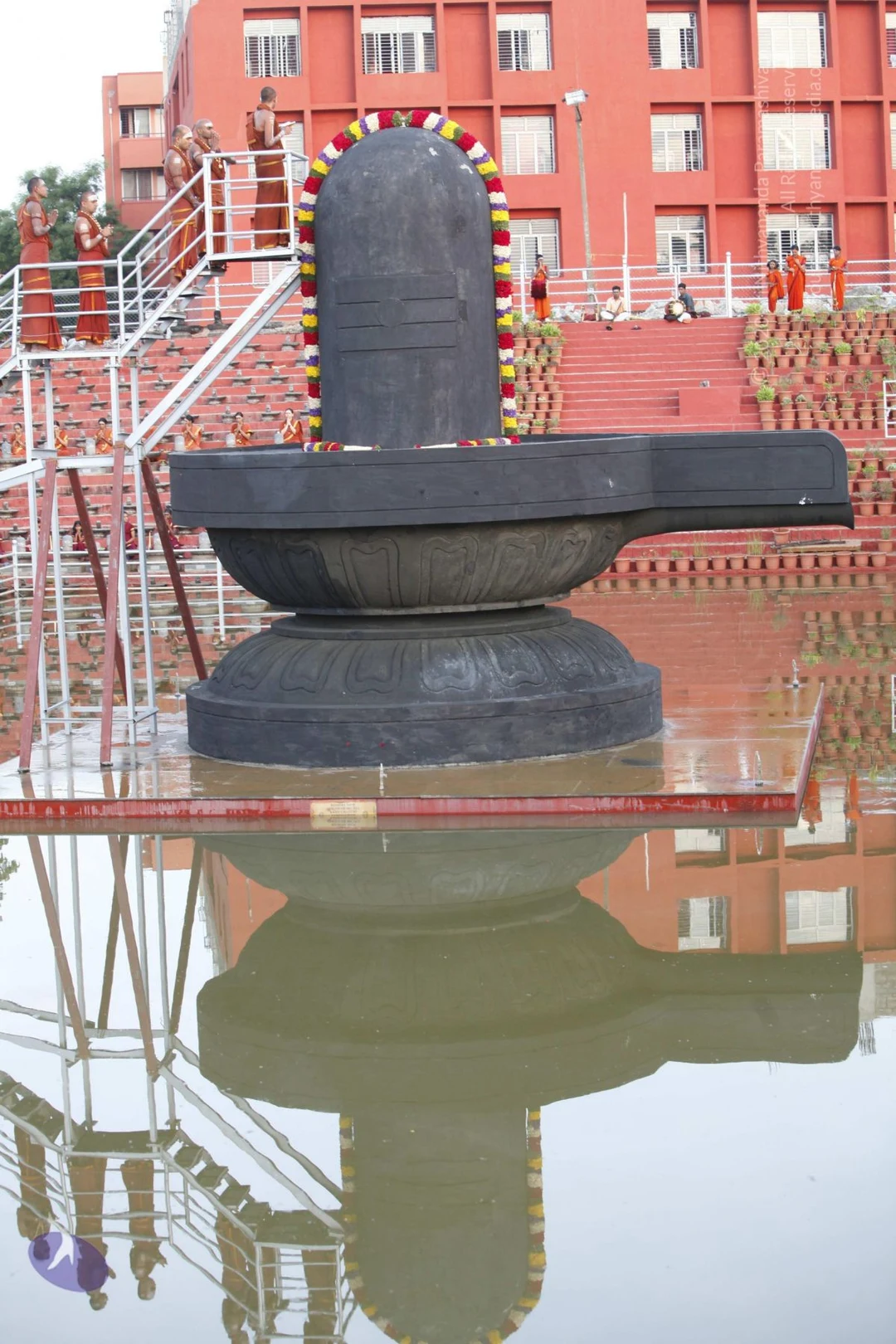
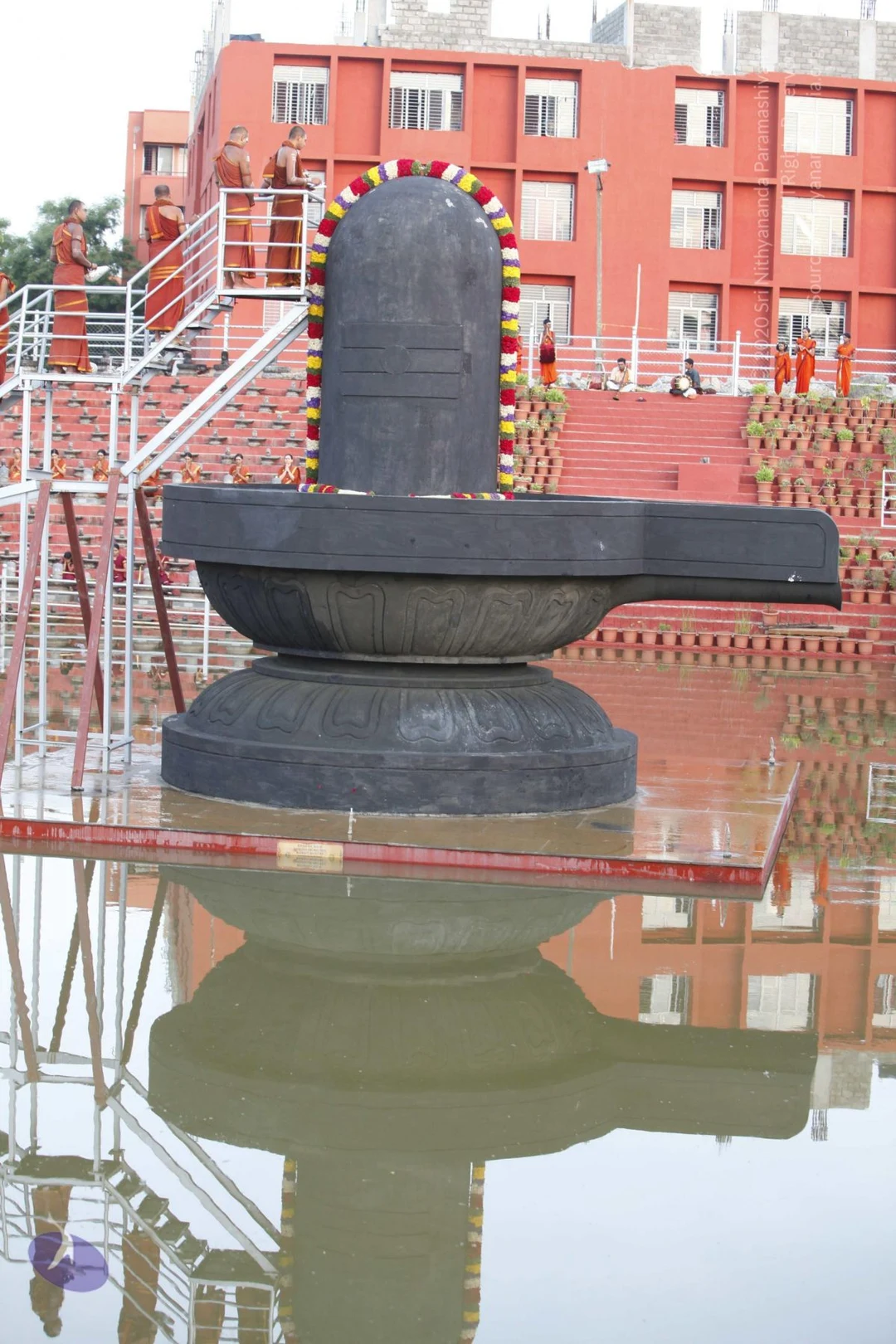
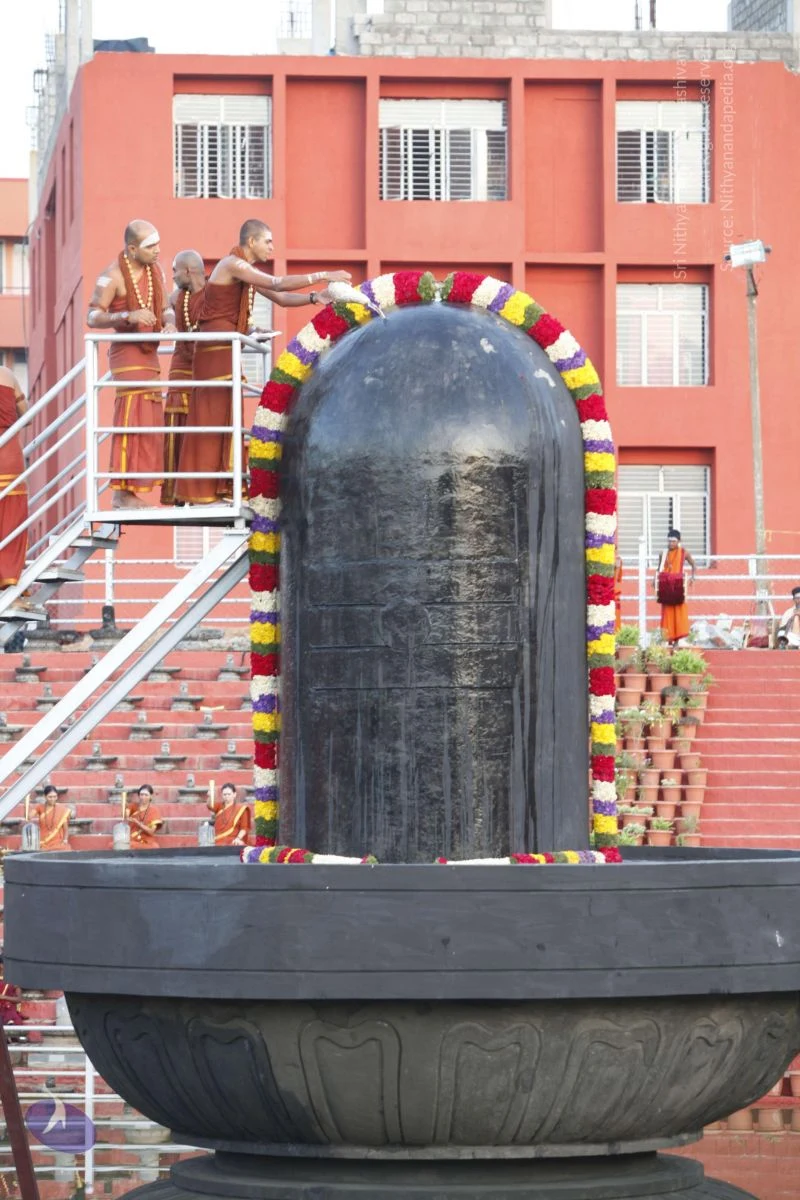
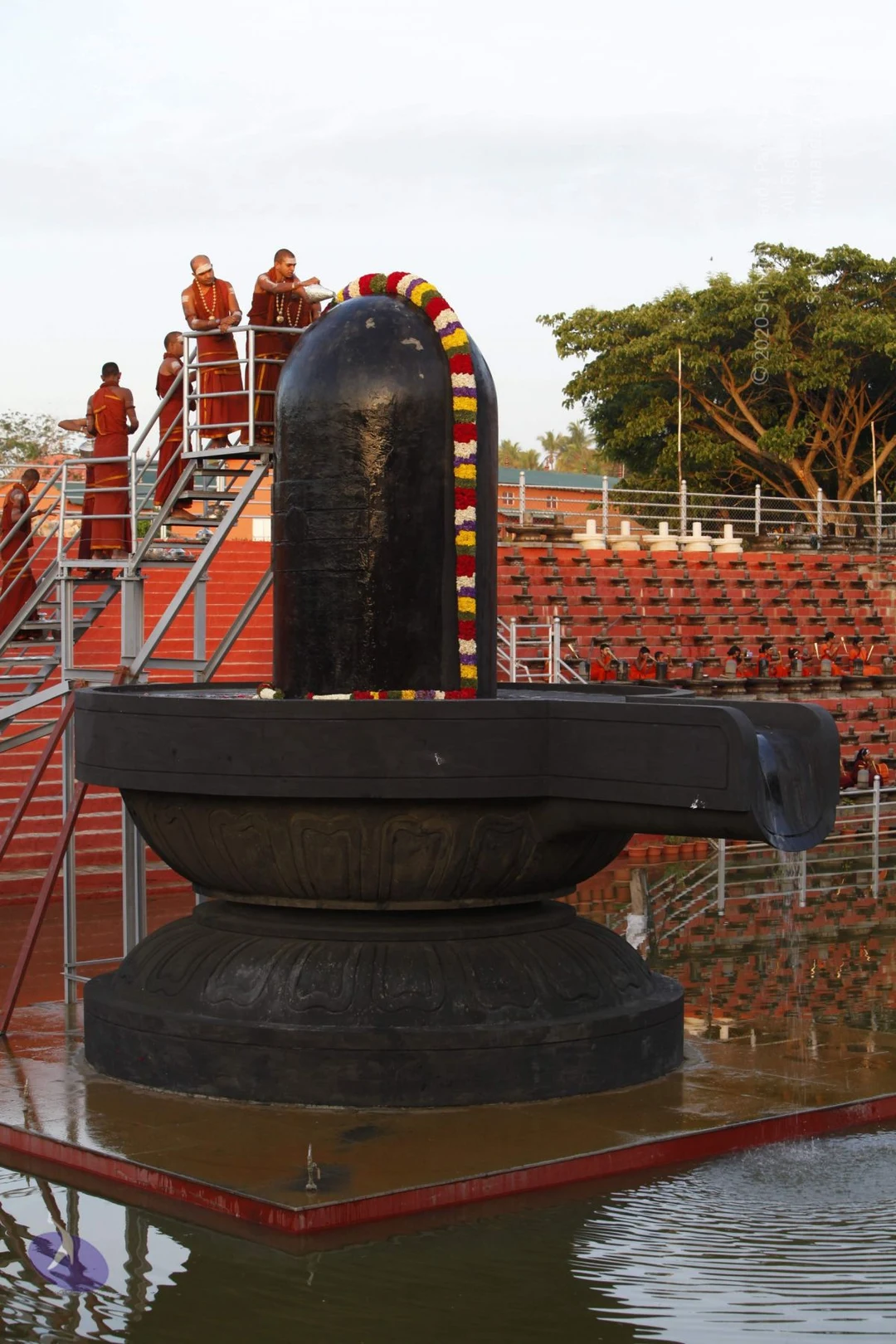
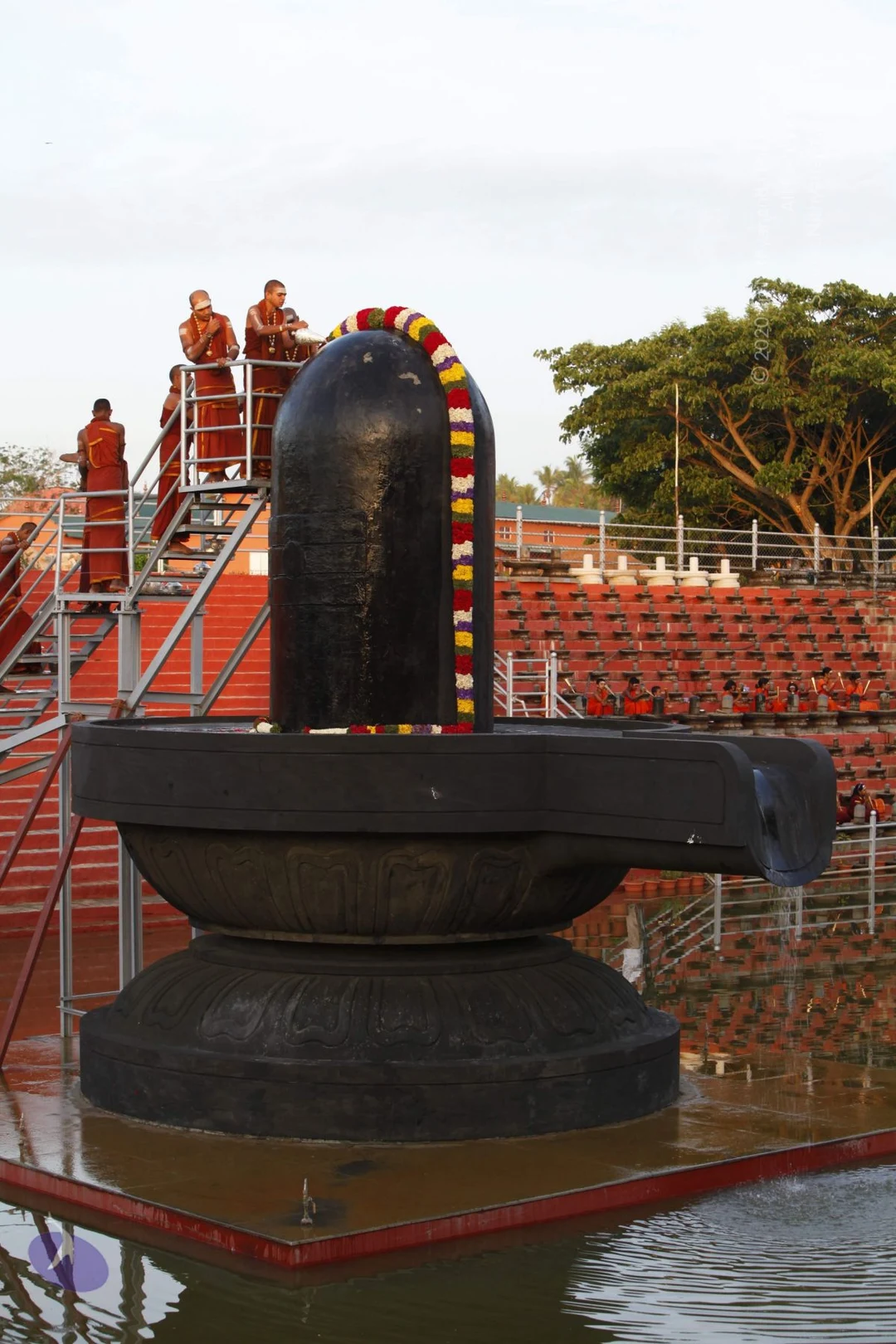
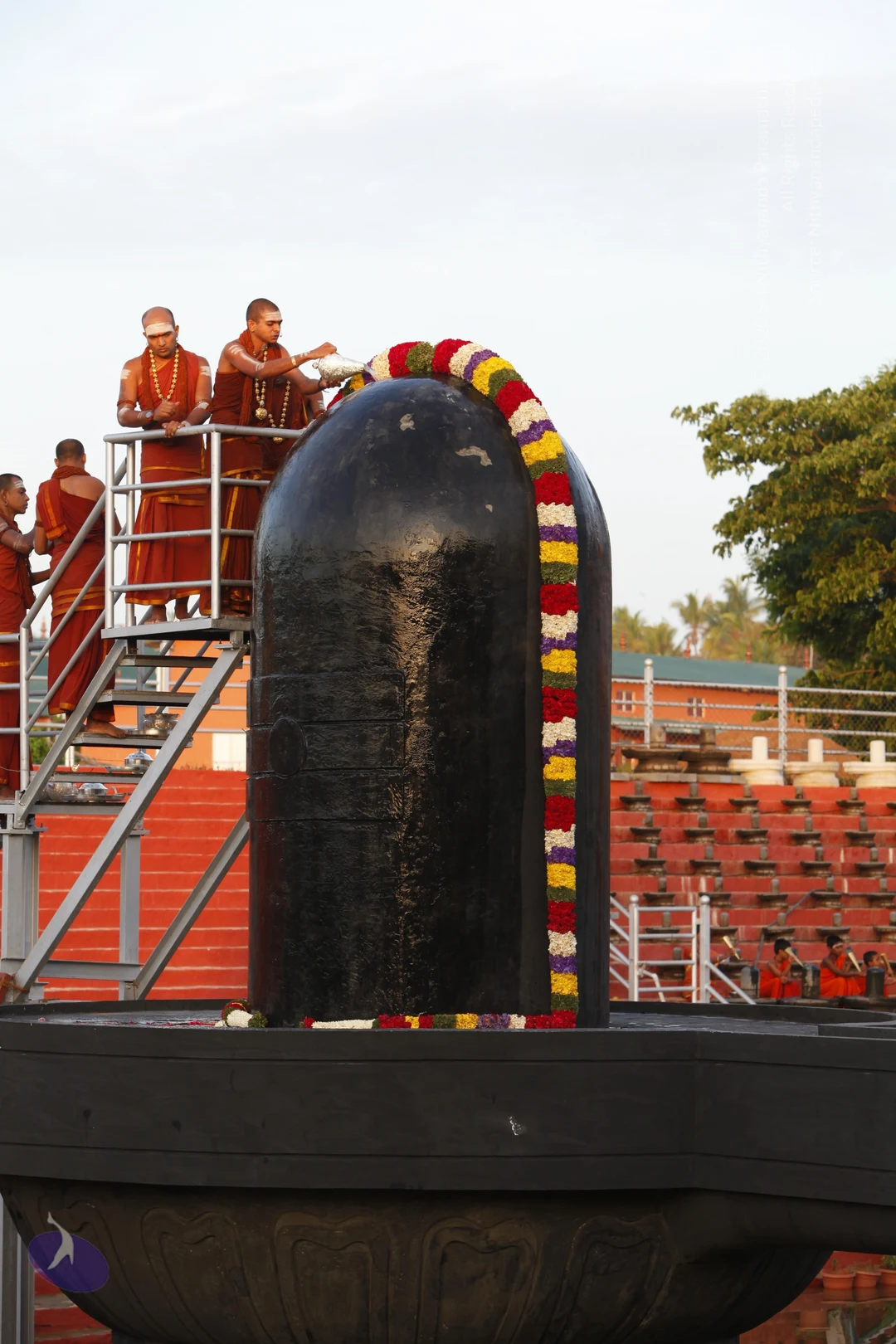
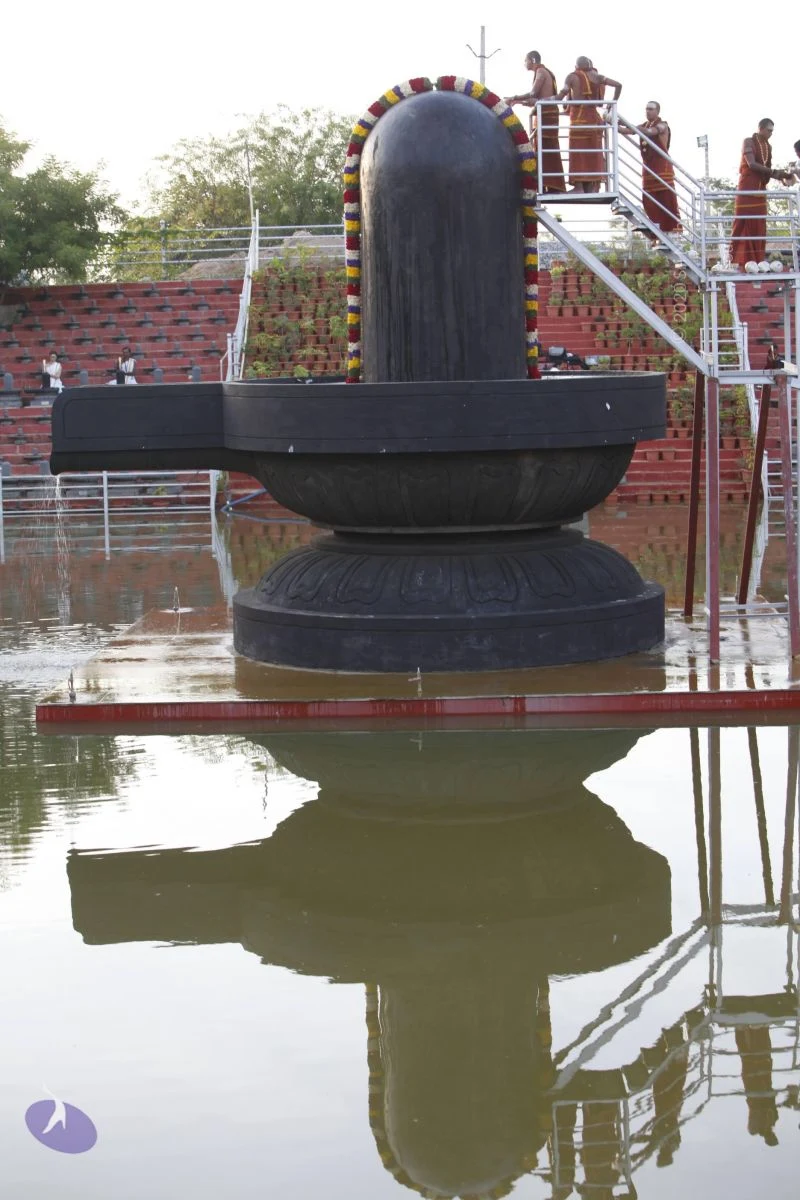
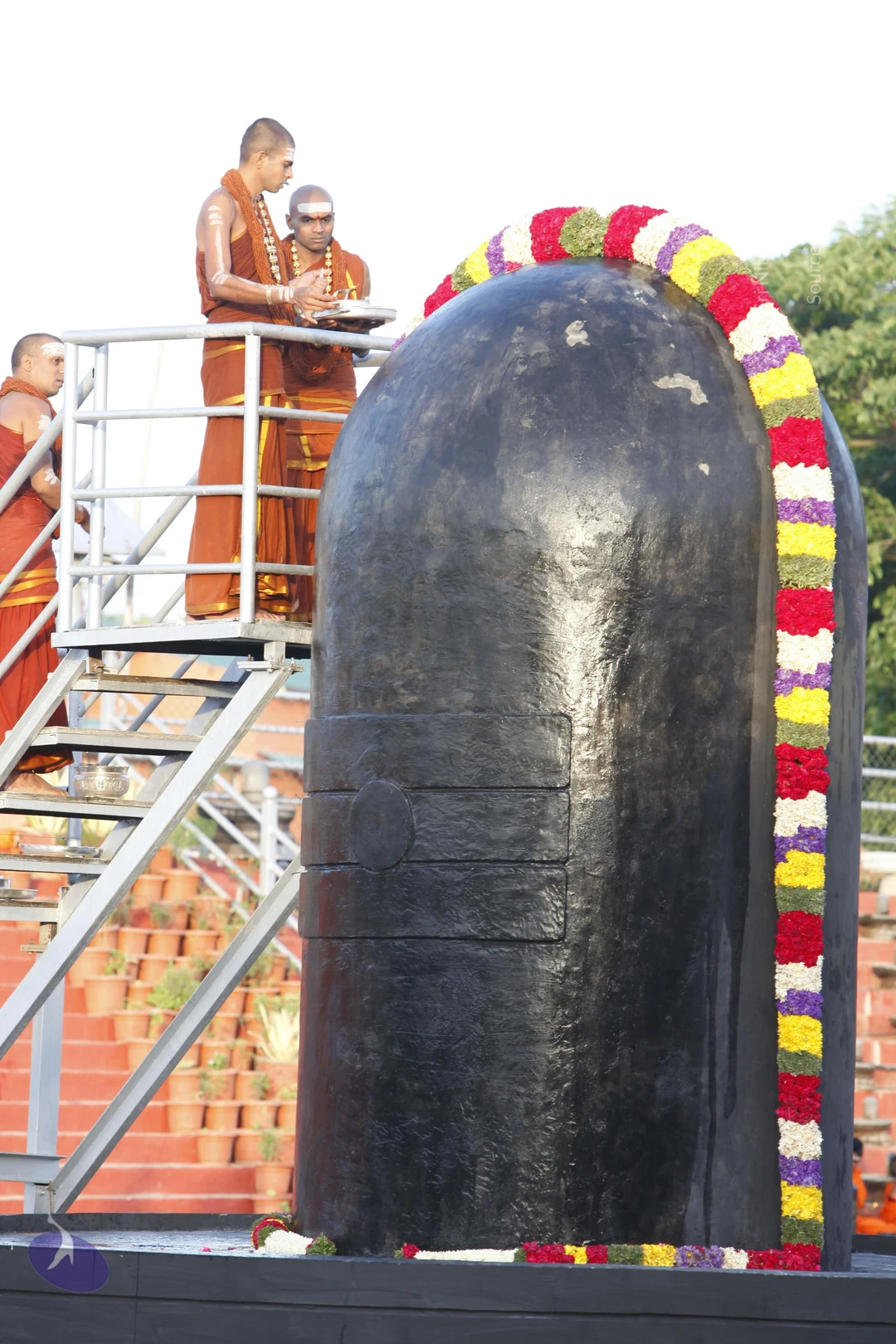
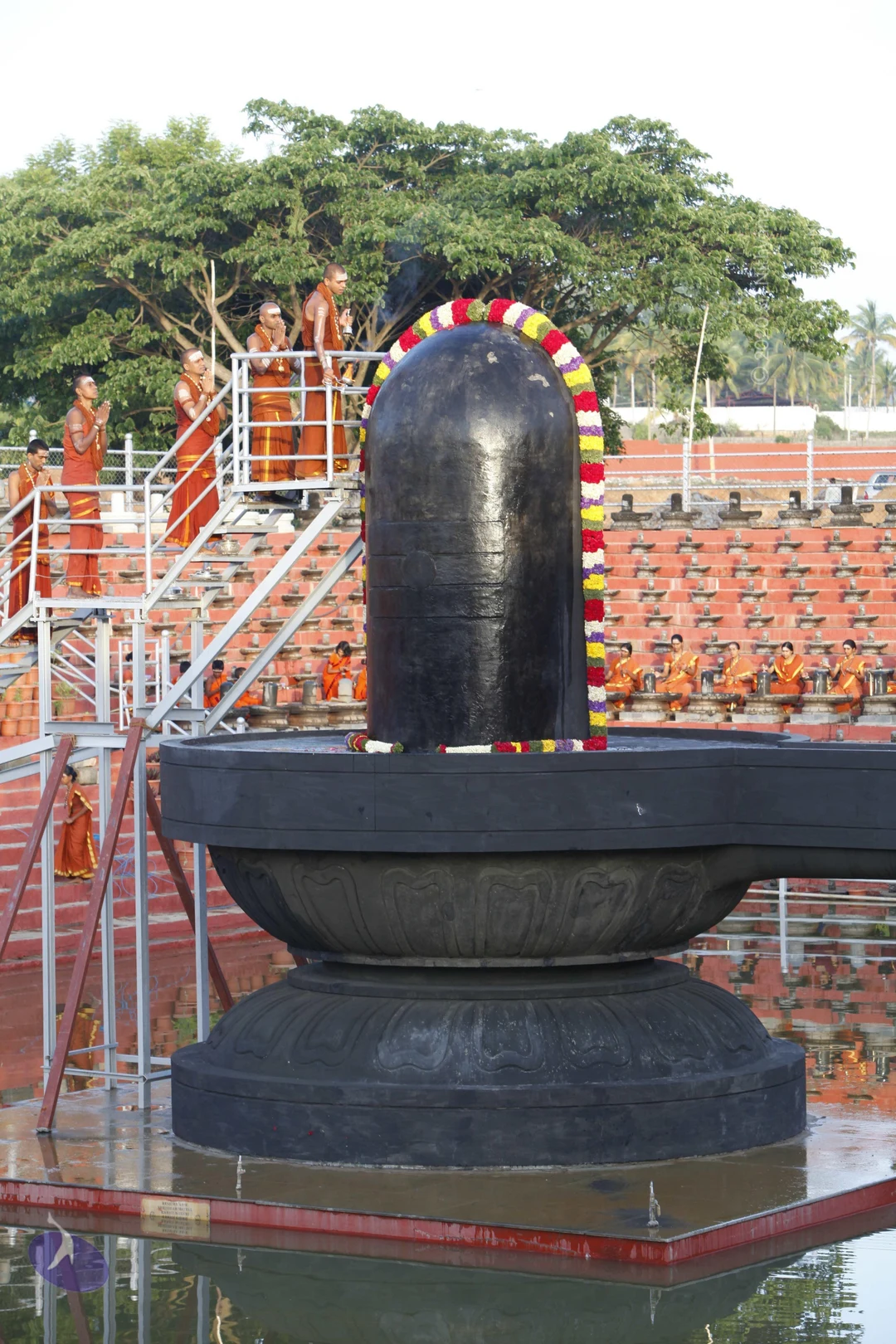
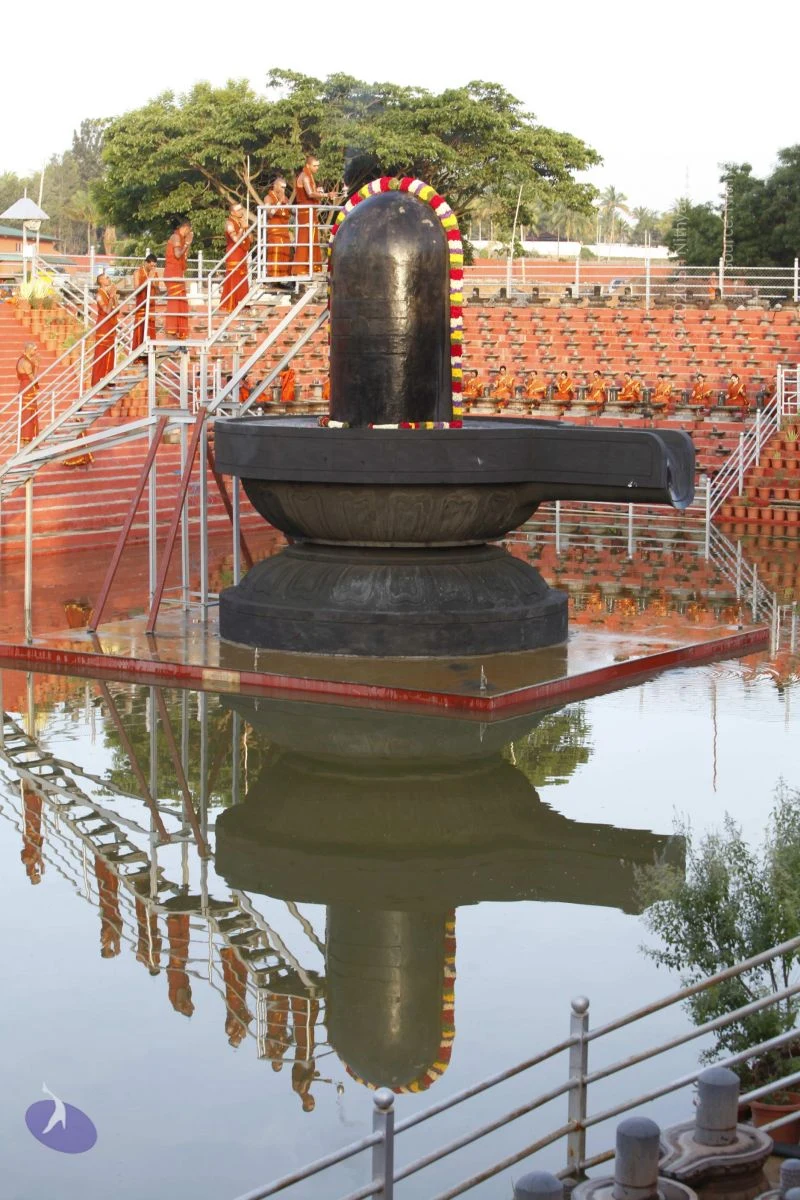
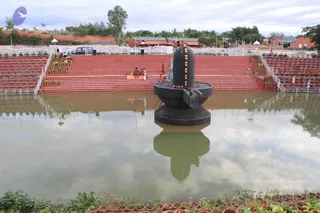
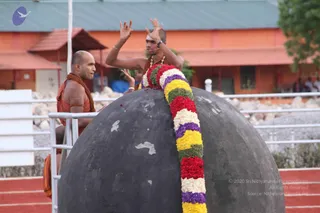
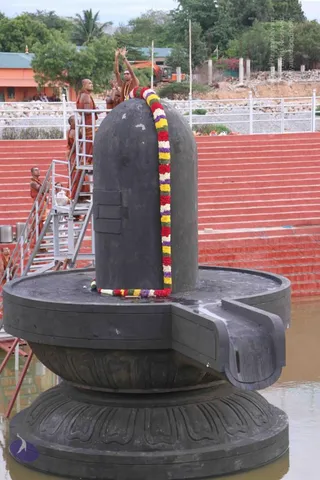
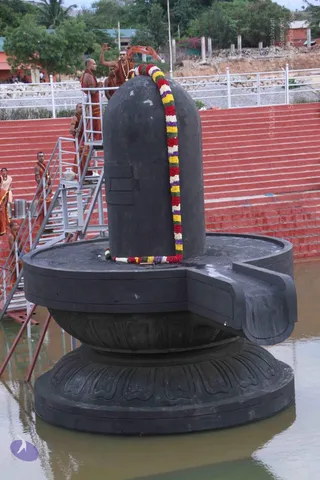
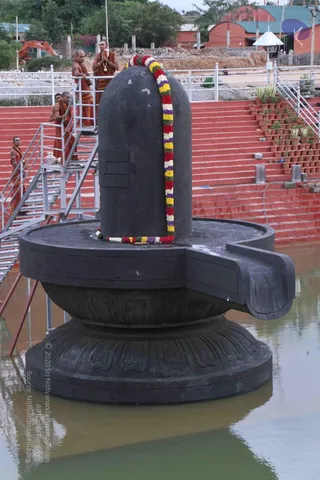
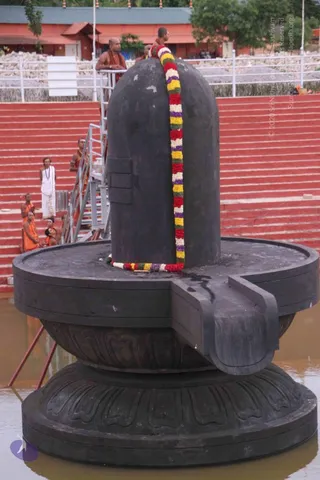
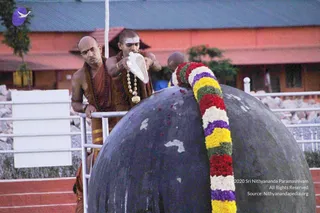
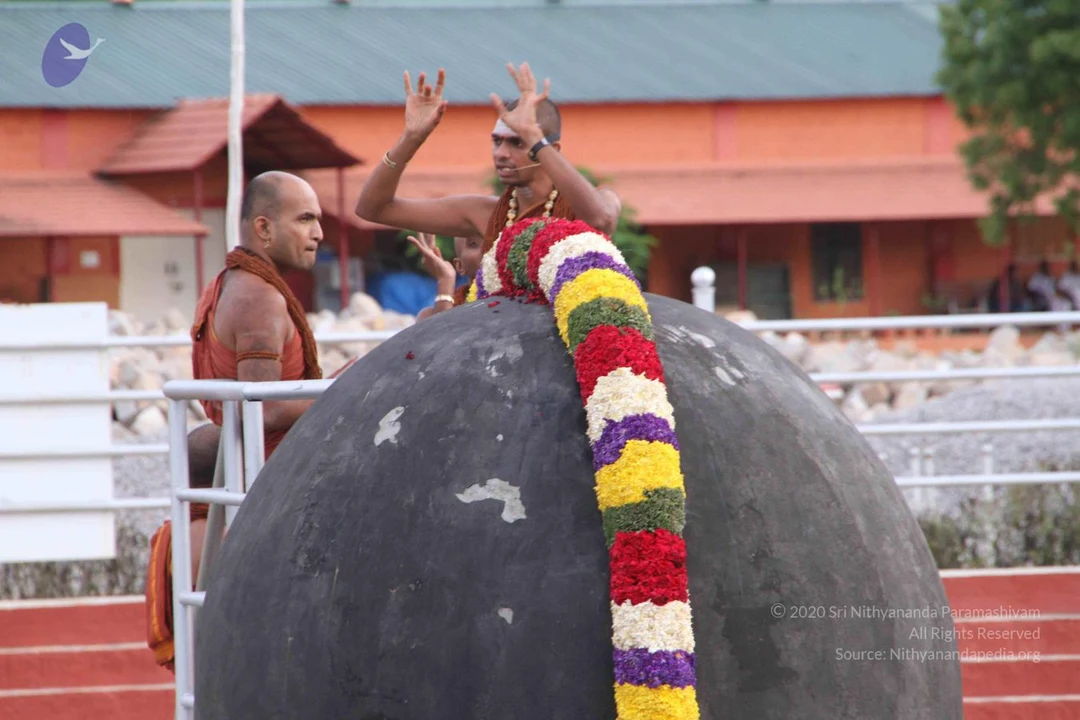
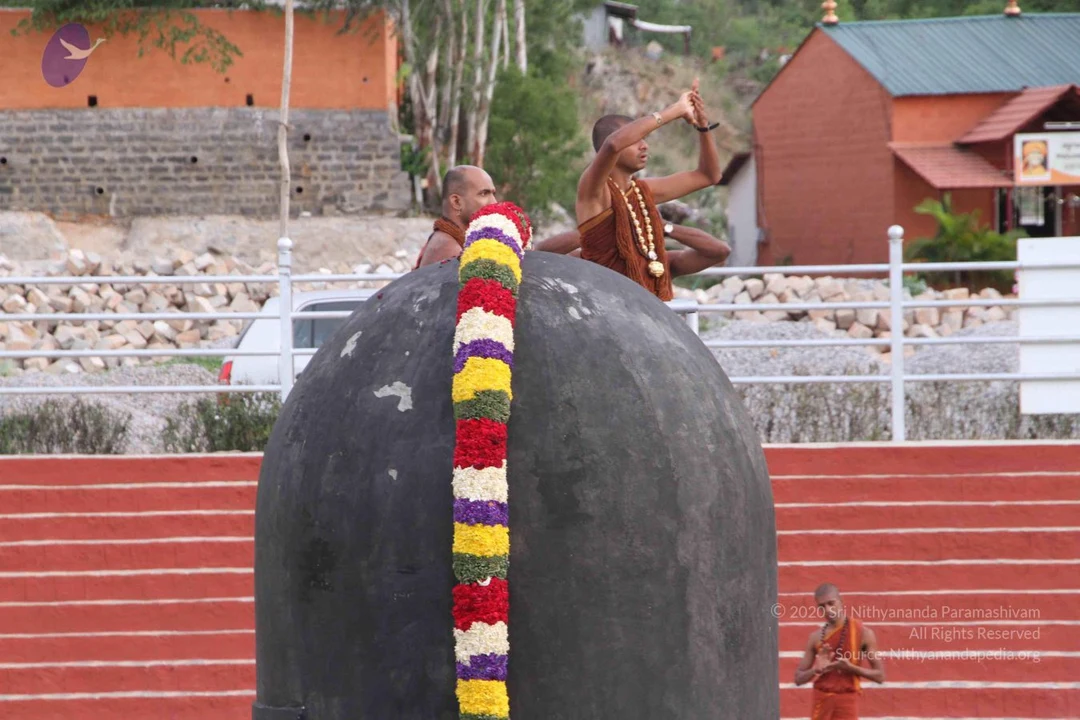
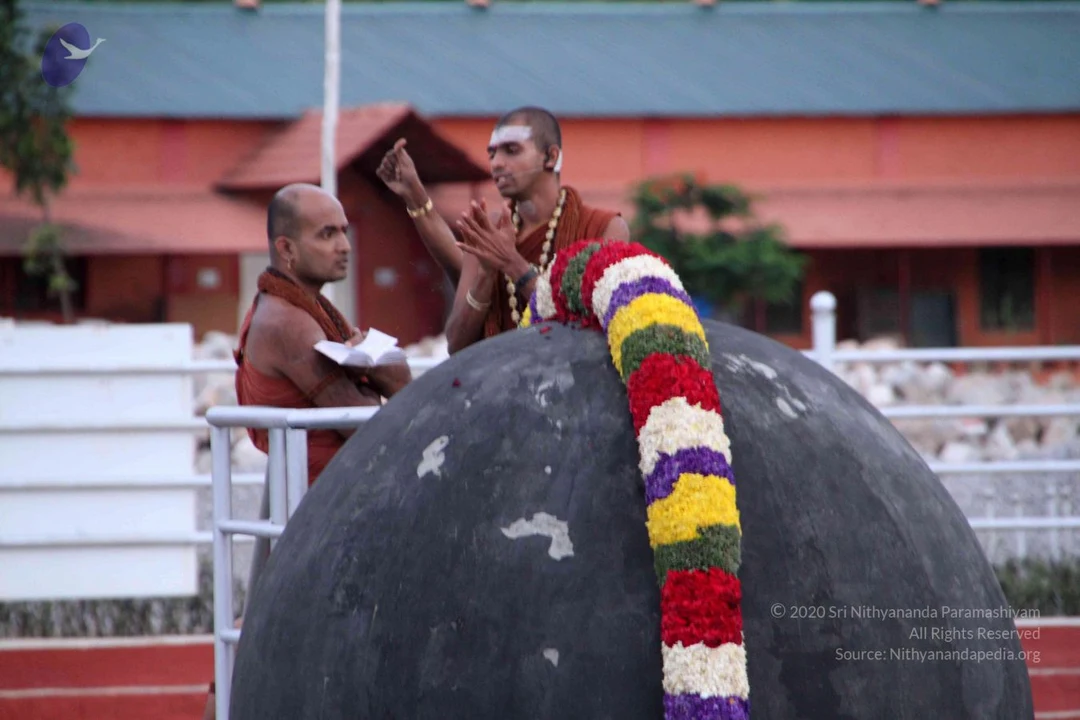
A large black stone Shivling stands in the middle of a rectangular water tank, its base submerged and its reflection visible on the still water. A garland of red and white flowers hangs on its upper part. Behind it, tiered red-painted steps rise with rows of empty seats and potted plants lining the walls. A few small figures in light clothing sit on the steps near the lingam, and two more stand nearby. Low white railings, a parked vehicle, and red-roofed buildings with palm trees appear in the background under a cloudy sky. Rows of potted plants line the foreground edge of the tank.A photograph of a large dark black stone lingam or sculpted dome draped with a long multicolour flower garland in red, white, yellow, purple and green. Two shaved-headed men in saffron-orange robes stand outdoors beside it, with white vertical railings and gravel behind. The man at right, bare-chested under an orange wrap with a rudraksha mala, raises both hands high with palms open, a white tilak on his forehead. The man at left, also in orange with a shawl, watches him. Behind them stands an orange-walled building with a green corrugated roof and gold finials.Outdoor scene at a large dark black stone lingam-shaped monolith wrapped with a long multicolour flower garland in red, white, yellow, purple and green. A man in orange-brown saffron robes with a shawl stands at the stone with both arms raised high, palms open, in an apparent devotional or invocation gesture, wearing a beaded necklace and a wrist band. Beside him to the left, a shaved-headed man in orange-brown robes sits at the railing looking up. Behind them is an orange-brown building with a green roof, and white railings line the platform. Scattered red petals lie on the stone.Outdoor photo of a large dark polished stone lingam, a smooth black dome-shaped form, draped with a long multicoloured flower garland of red, white, yellow, purple and green blooms. Behind it a standing man in saffron-orange robes raises both hands in a gesture of blessing or address, with white tilaka on his forehead, a bead necklace and a wristwatch. To the left a shaved-headed man in orange robes with a saffron shawl sits on a railed platform. Background shows orange-roofed buildings, a green metal roof and rocks along a white railing. Tiles of red brick ground surround the scene.Outdoor photo of a large dark grey dome-shaped black stone lingam on a red-brick stepped platform, draped with a multicoloured flower garland of red, yellow, white and purple blooms. Behind it, two saffron-robed sannyasis stand on top of the lingam's curved surface; one holds his hands raised high in a gesture, the other stands with arms bent. A third saffron-robed monk stands at the lower right on the steps with hands folded in anjali. Background shows an orange-walled building, a green-roofed red-brick building, stone rubble and a white railing. Two men are visible, the rest of the scene has no further people.Outdoor scene at an ashram with a large dark black stone lingam, garlanded with a long multicoloured flower garland of red, yellow, white and purple blooms. Two men in saffron-orange robes are seated atop the lingam; the man on the right, bare-chested with a sacred-thread shawl and a long string of white beads, raises one hand in a blessing gesture. A third person in orange stands on the red-tiered steps at lower right. Red-roofed buildings, a stone wall and white railings surround the area.

Swasthi-Mantra

7 photosSource gallery
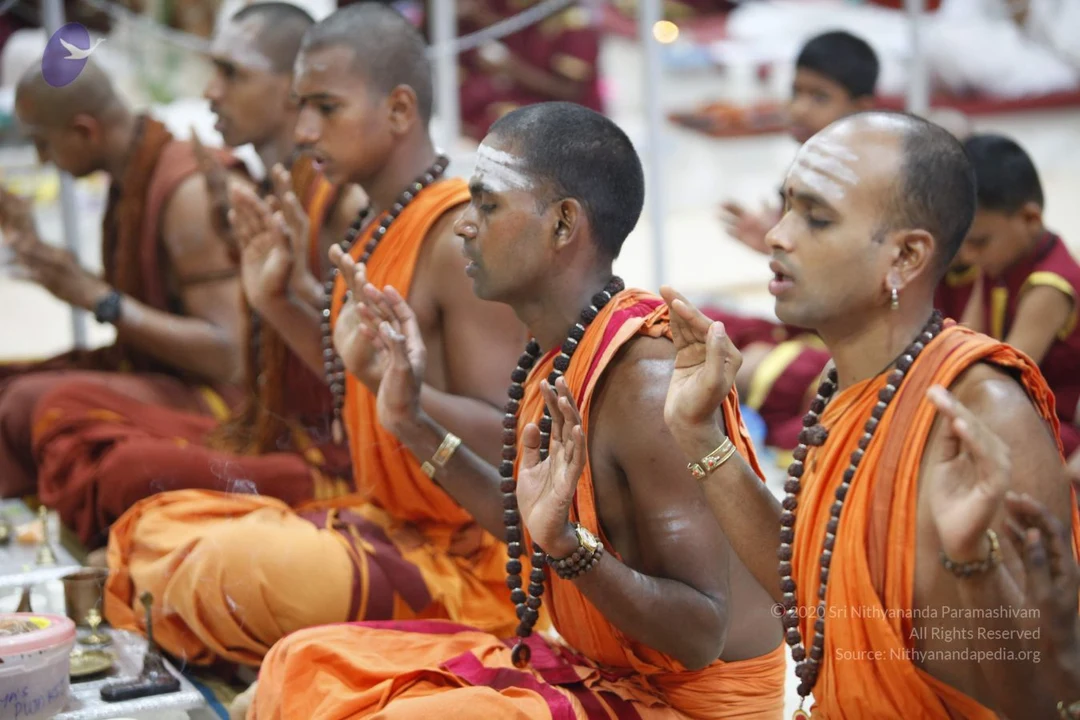
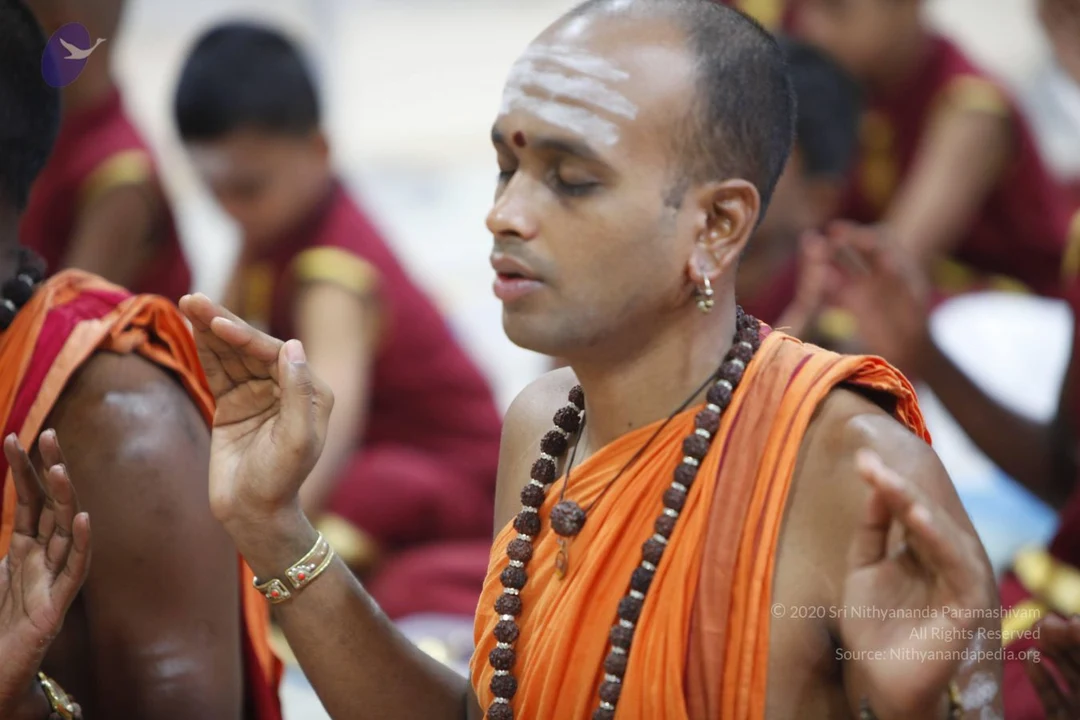
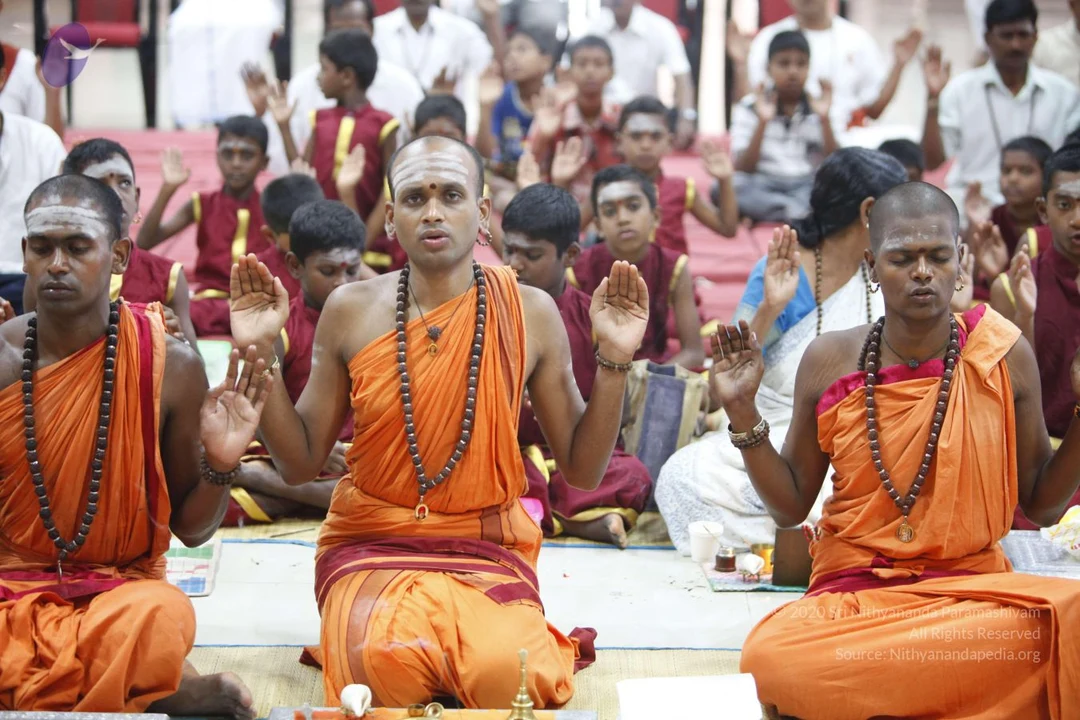
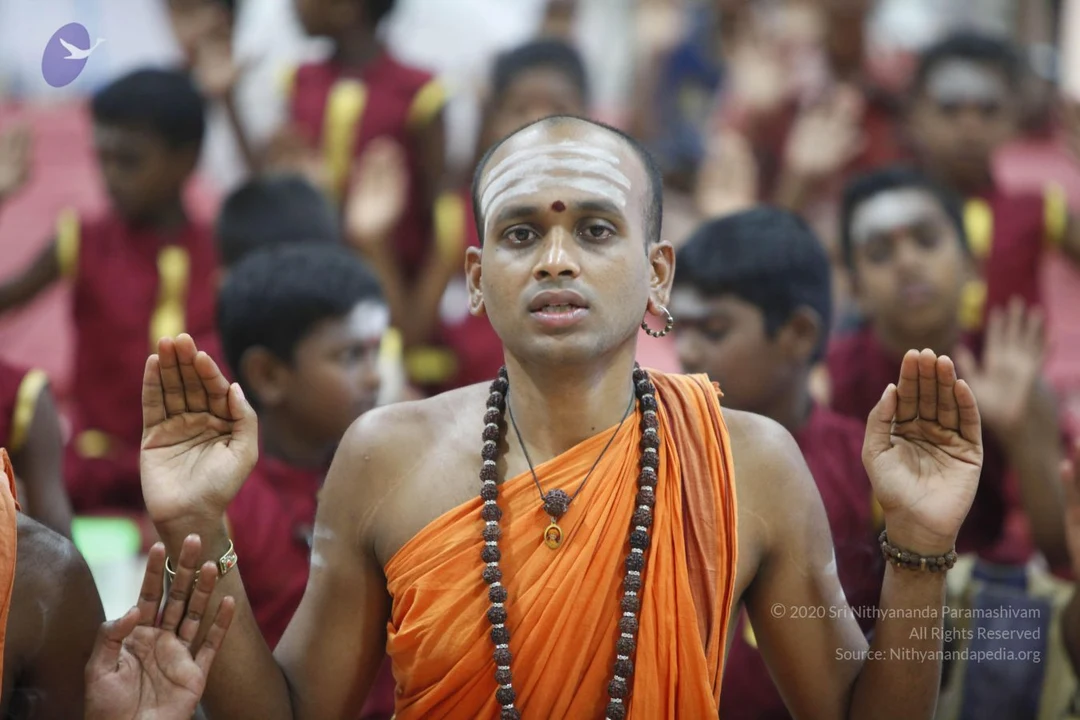
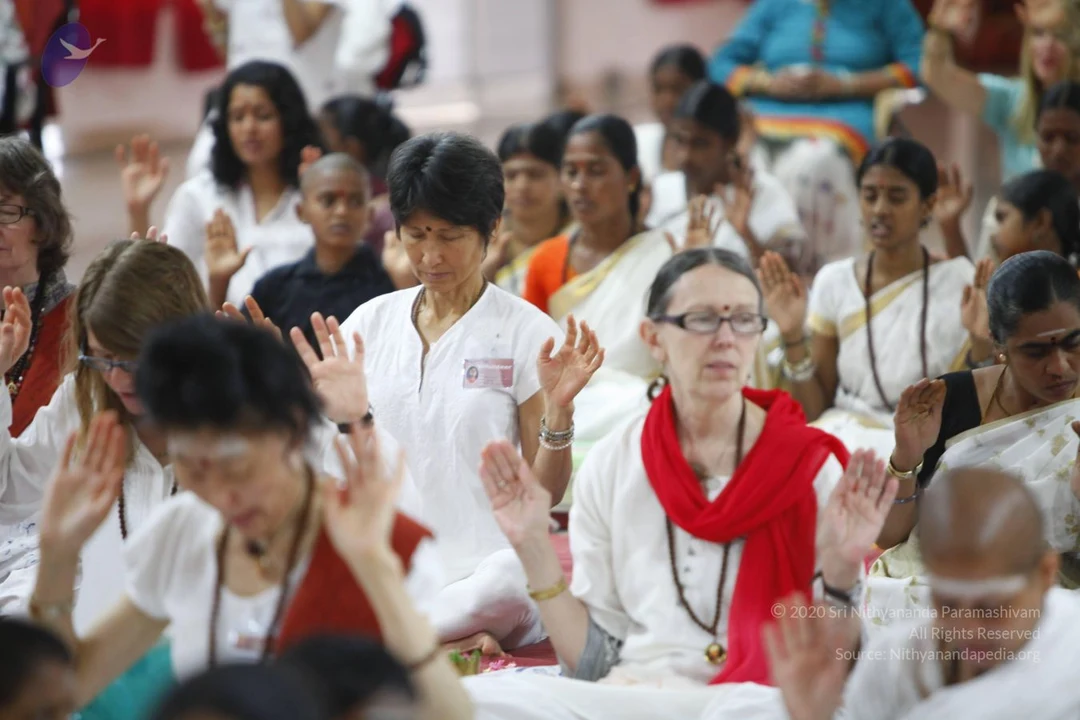
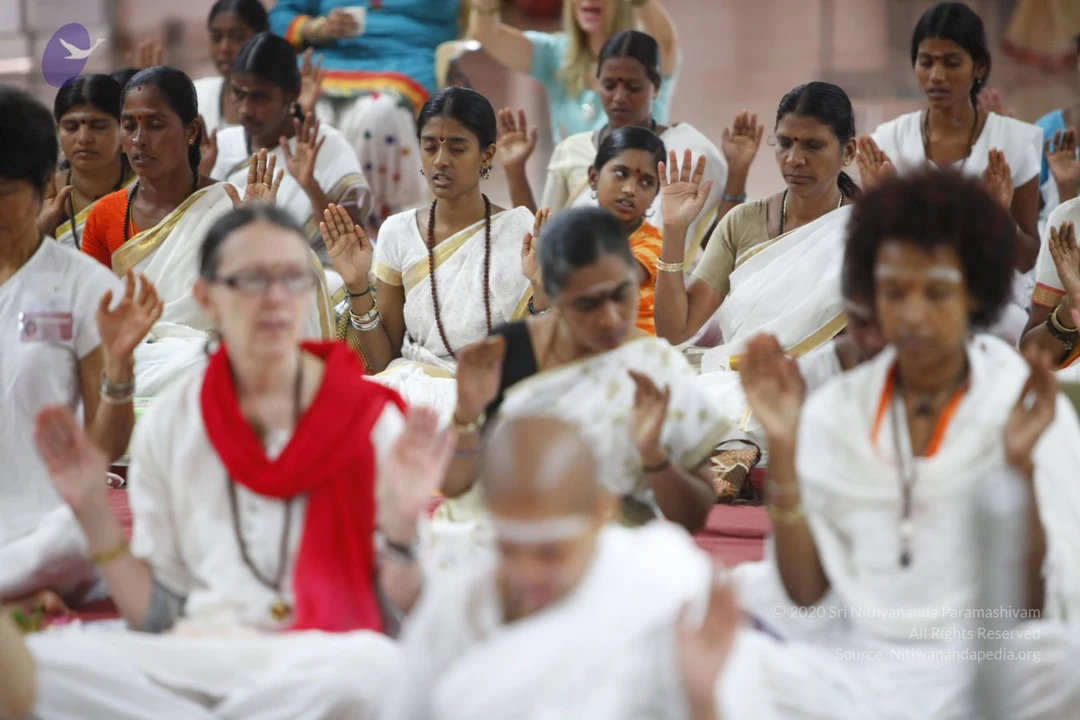
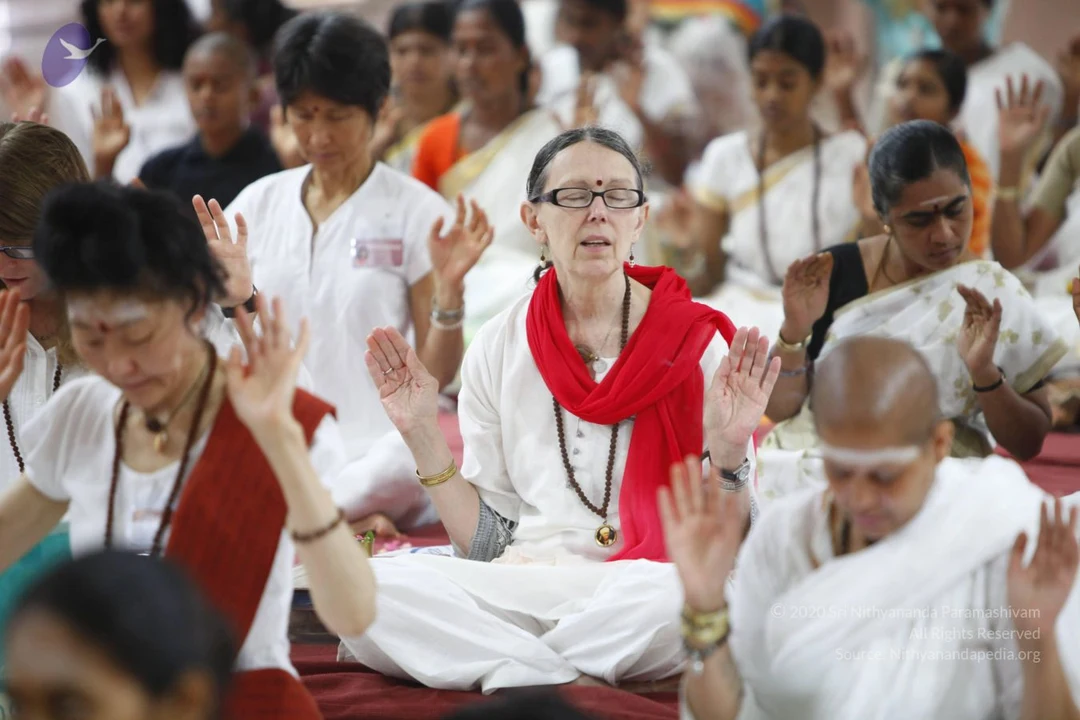
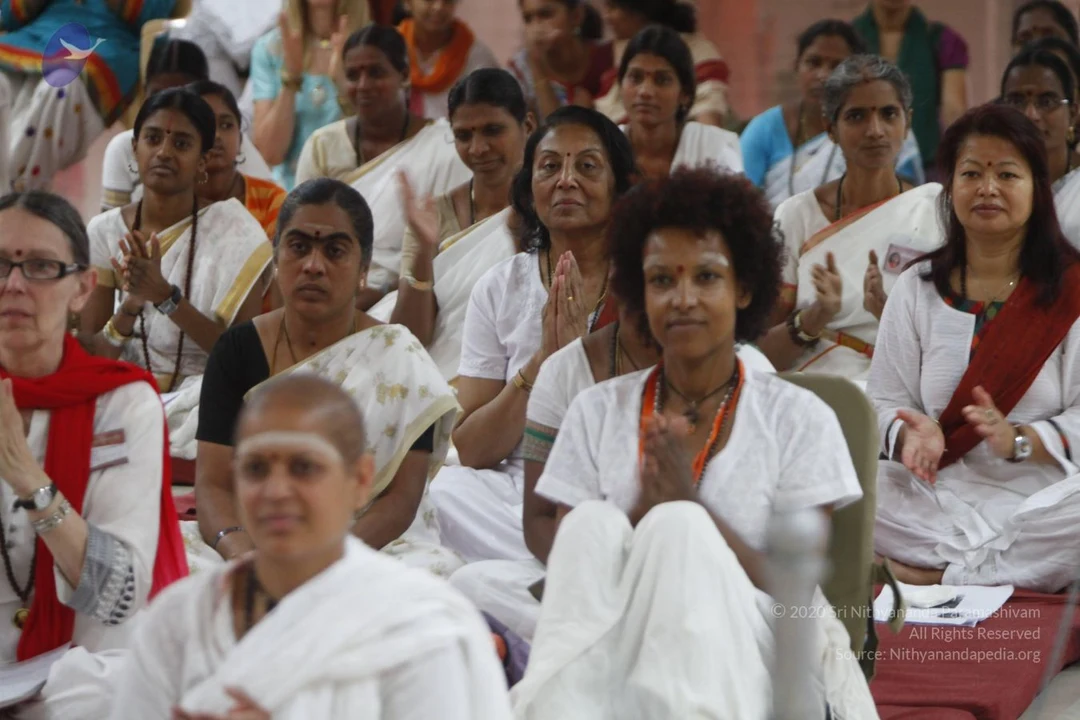
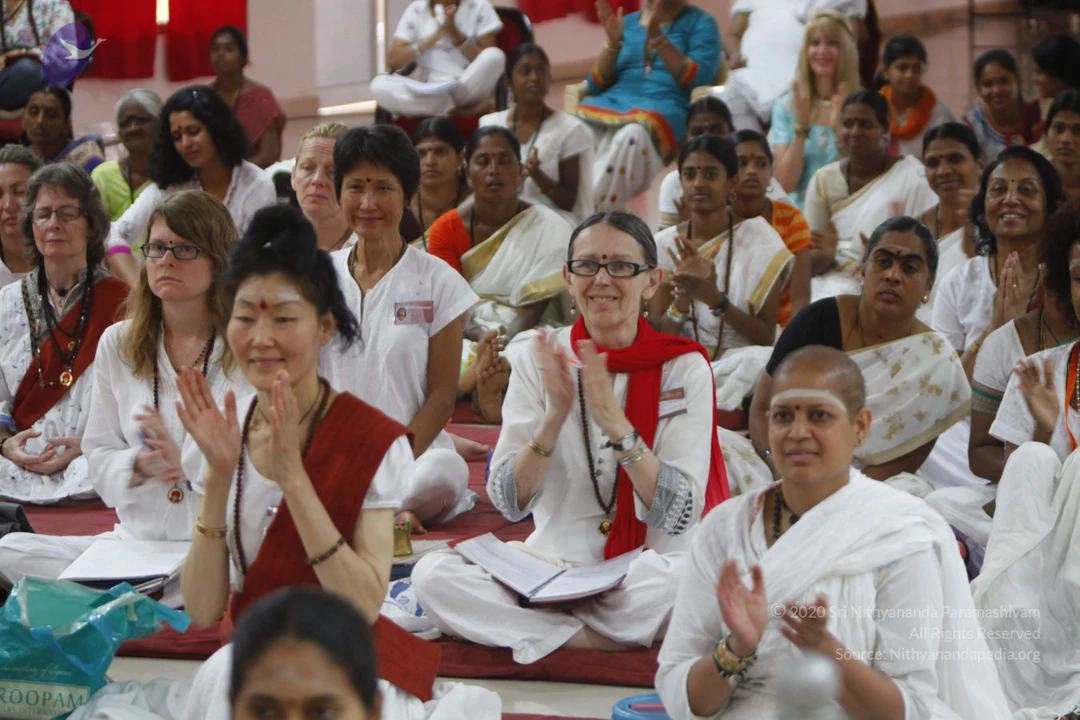
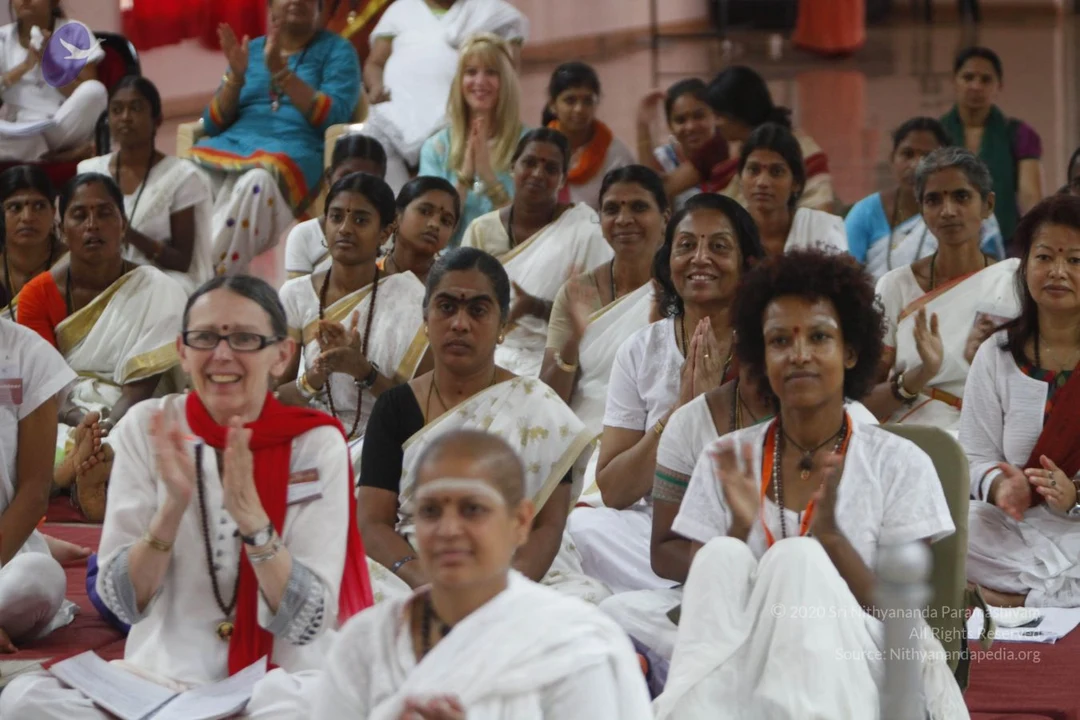
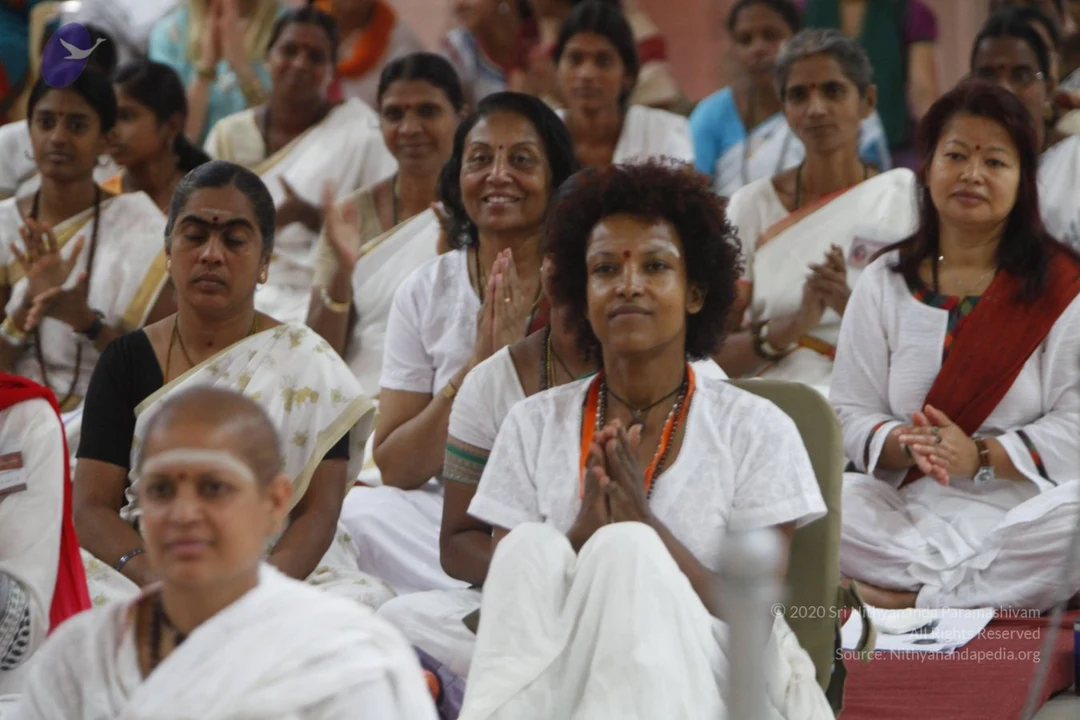
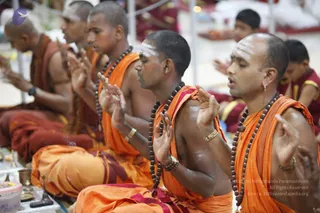
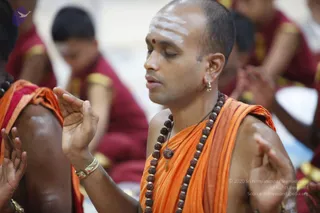
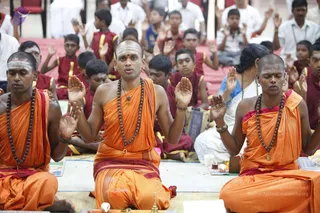
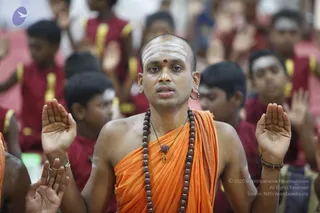
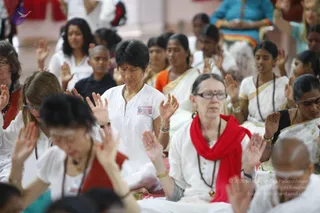
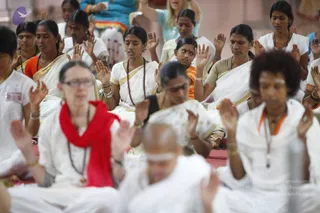
A photograph of a group of devotees seated in a ritual setting, several with bare upper bodies or orange saffron shawls, wearing rudraksha malas. Foreground figures sit with palms pressed together in namaskar, with white vertical tilak marks on their foreheads. Behind them, others in orange and maroon garments also sit with hands raised. Brass vessels, a small kalasha and incense sticks sit on a tray at lower left. No individual is singled out by a throne or central position, and no person is clearly identifiable as a person.A photograph of a shaved-headed sannyasi seated in meditation with eyes closed, wearing an orange saffron shawl over his shoulders and a long rudraksha mala with a pendant. He has white vibhuti horizontal lines and a red kumkum dot on his forehead, a small earring, and bangles on his wrist, and his hands are raised in a mudra. Around him, blurred figures in maroon and gold robes sit in an assembly. The scene suggests a satsang or meditation gathering. a person (appearance-based candidate, seated in a rudraksha mala and saffron shawl) is present in person, while the figures behind are unidentified devotees in maroon robes.Three saffron-robed monastic men sit cross-legged on a mat in a hall, palms raised in prayer or chanting gesture. Each has a horizontal white and vertical sandalwood or ash tilak on the forehead and wears rudraksha malas. Behind them, rows of young boys in maroon and yellow garments and adults in white clothes sit with hands raised. Brass lamps, a small bowl and ritual items lie on the mat in front.A photograph of a shaved-headed man in an orange saffron shawl and rudraksha mala stands in the foreground with both palms raised outward in a blessing or chanting gesture. He wears a red bindi, white horizontal tilak lines across the forehead, a small pendant and a bracelet. Behind him, many young boys in maroon and red-and-yellow garments with white forehead markings stand with hands raised, as if in group chanting or satsang. The background is softly blurred, with a pinkish wall and a hall setting.A large seated gathering of devotees in an ashram hall, many women in white clothing with raised hands in a meditative or satsang posture. In the foreground a woman in white with a red shawl and glasses sits with palms lifted, rudraksha mala beads visible on her chest. Others wear white saris with gold borders, orange and teal tones appear among the crowd, and a bald man in white is seen at the bottom edge. No a person candidate is clearly visible.A photograph of a large seated congregation in white clothing, many with palms raised in a devotional gesture. Most women wear white saris with gold or cream borders; one woman in the foreground wears a red shawl and eyeglasses, another front-right wears white with an orange cord and a bead necklace. A young girl in an orange top sits among them. A blurred bald figure in white with a white forehead mark appears in the lower centre. Some people wear rudraksha-style beads, bangles and forehead markings. The photograph carries a visible copyright overlay.

Meditation

15 photosSource gallery
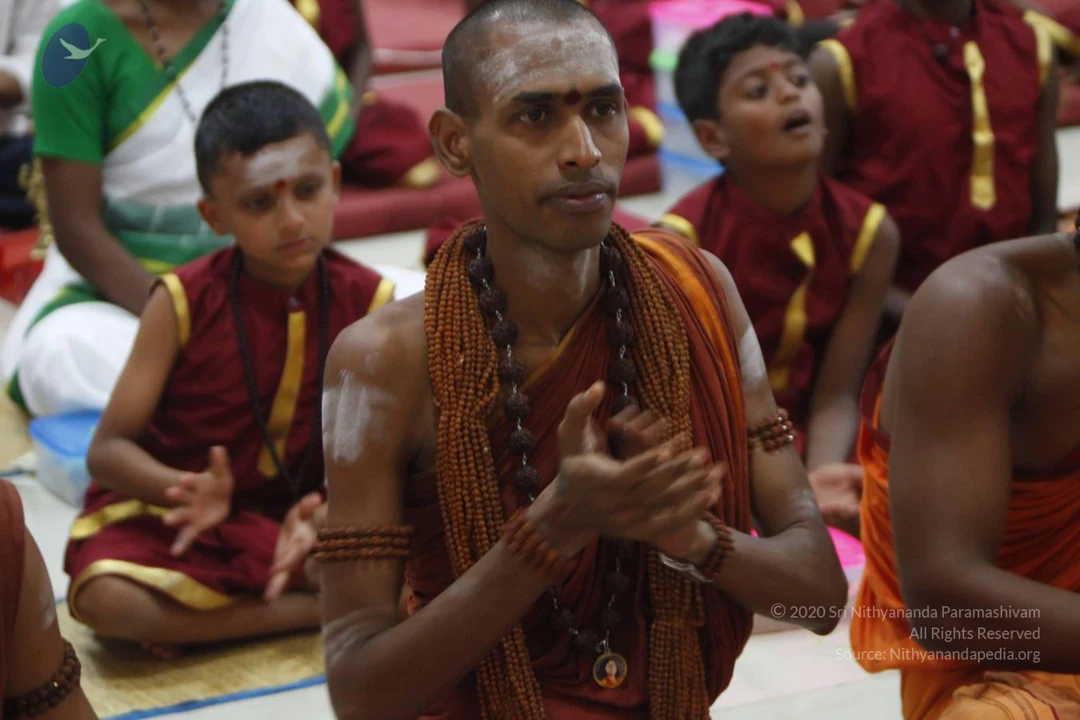
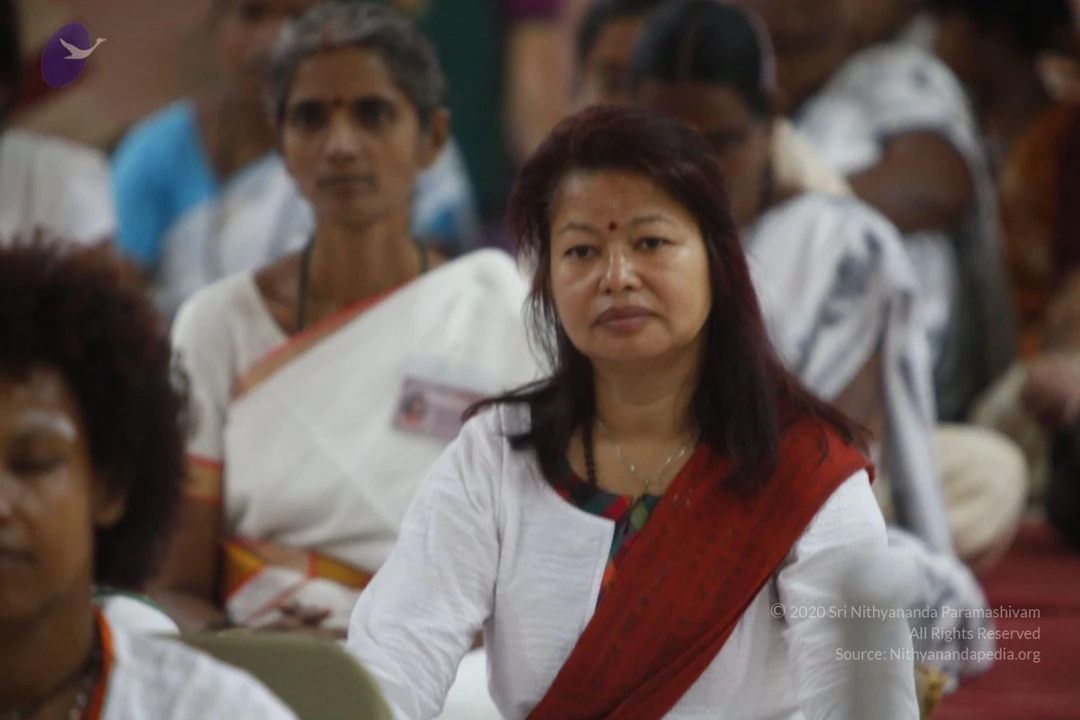
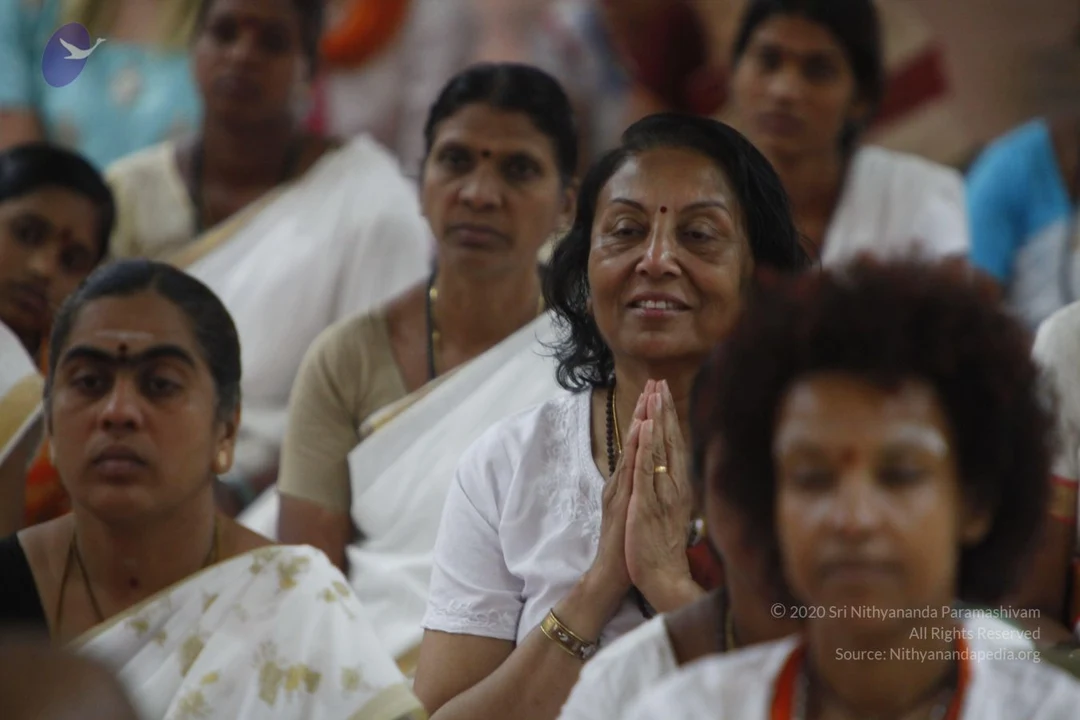
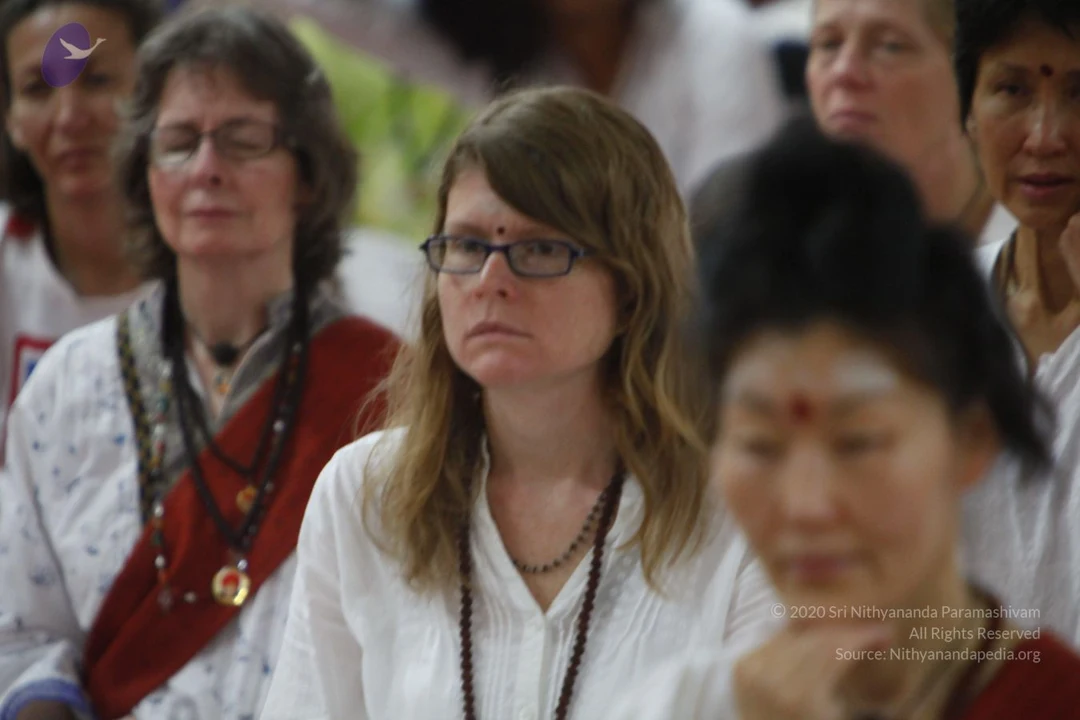
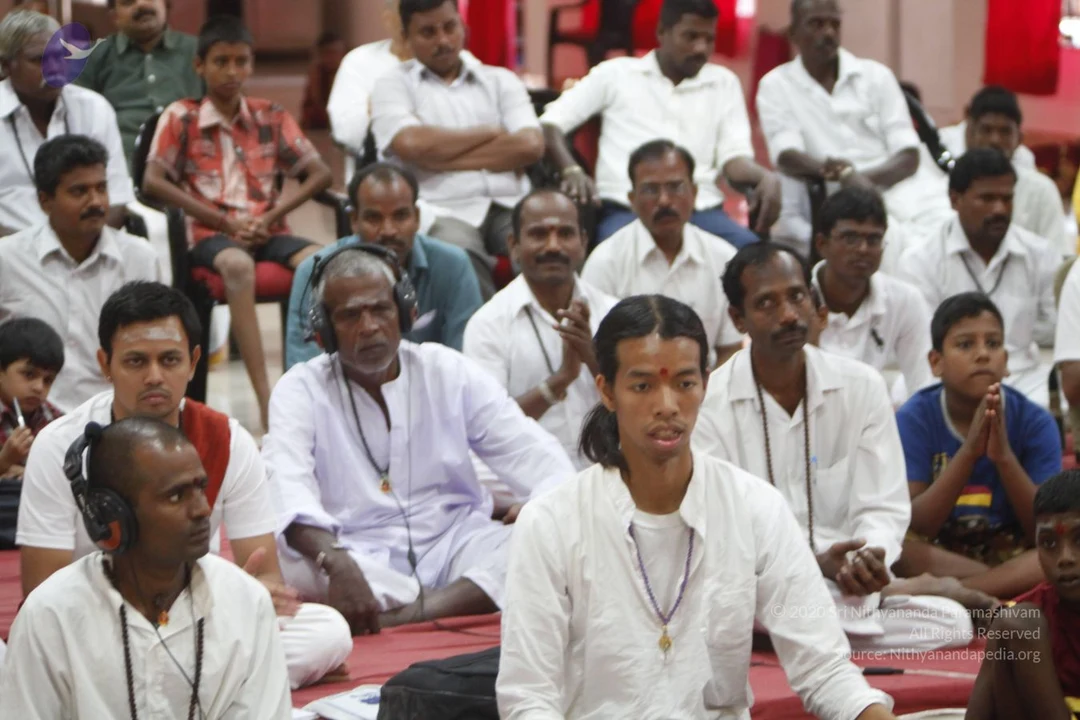
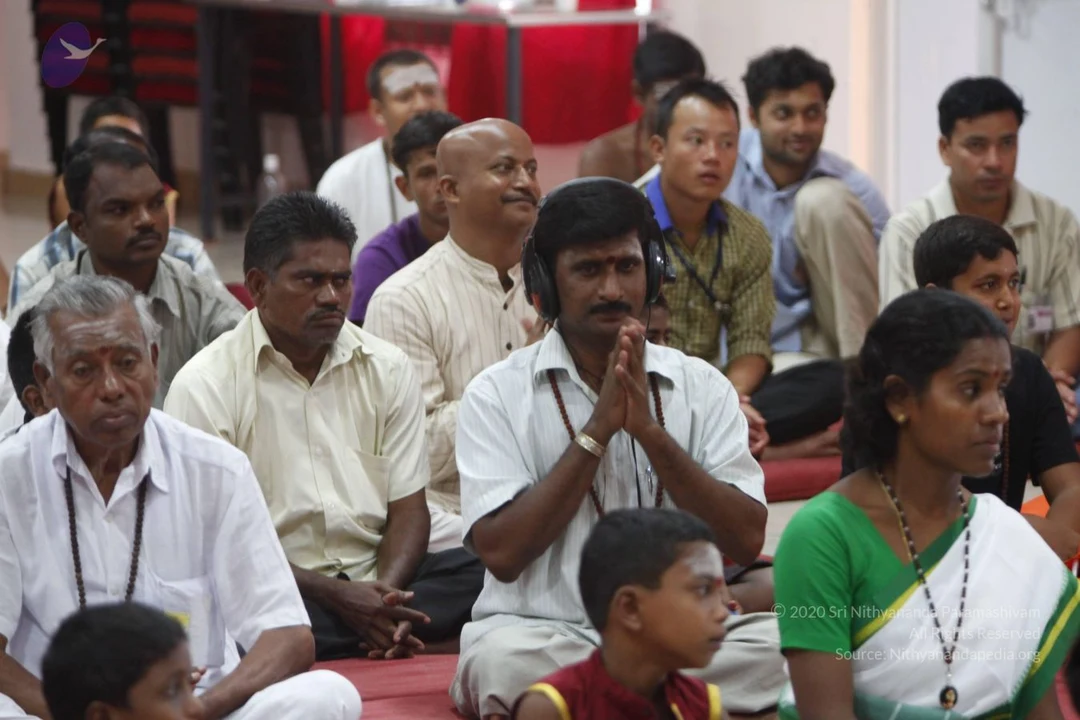
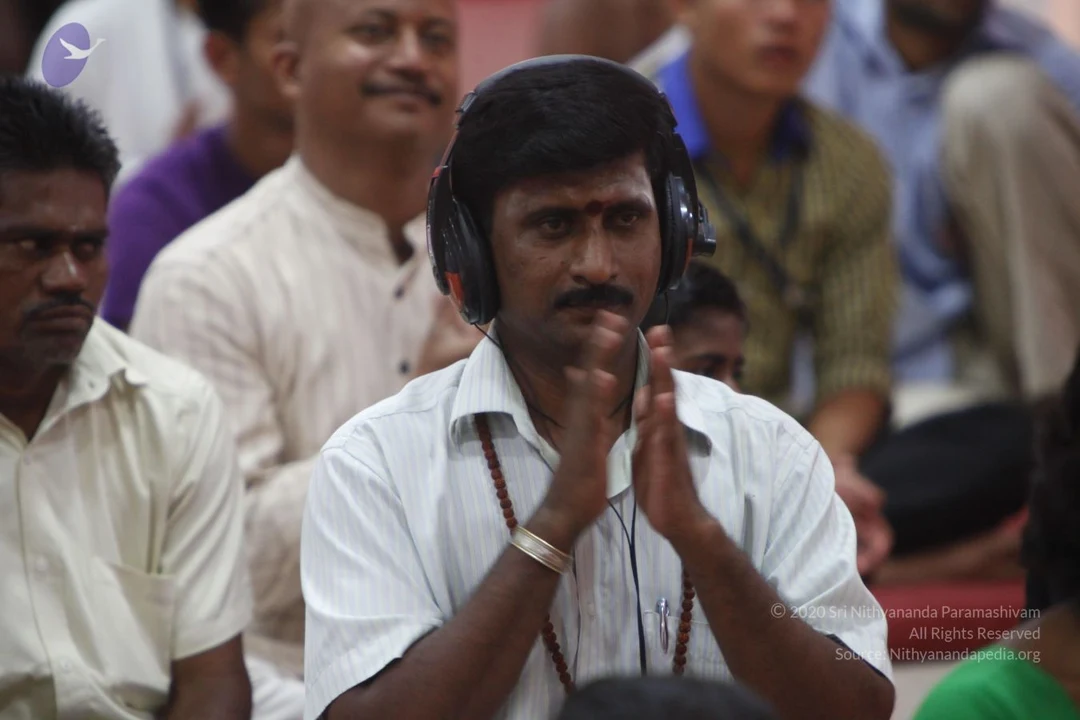
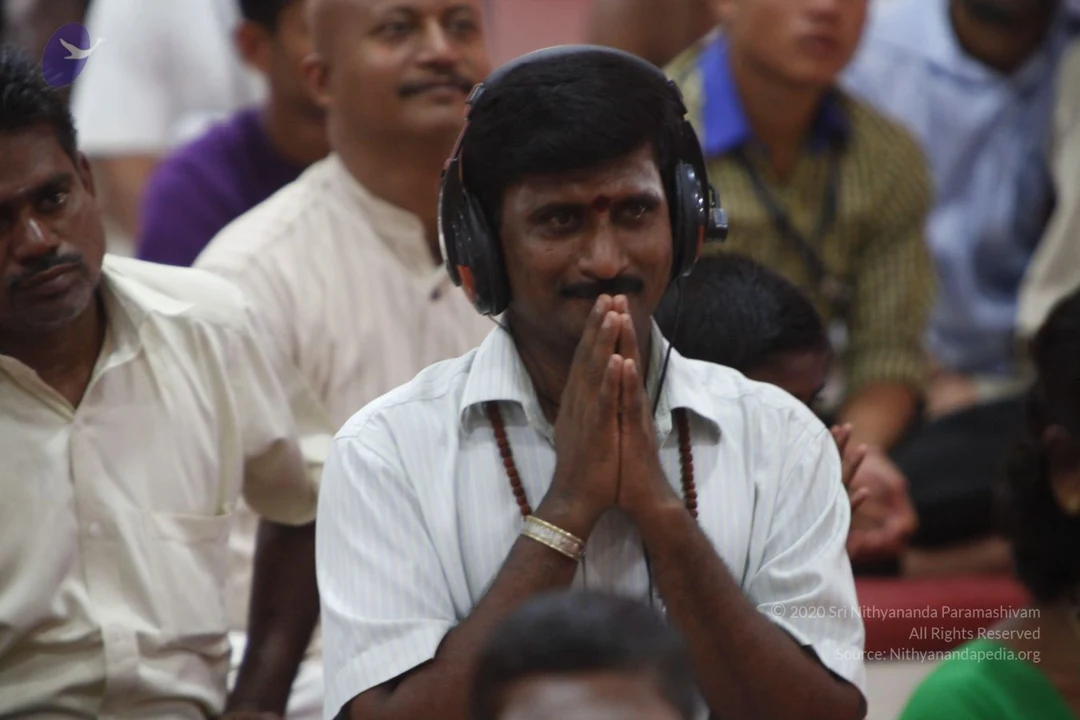
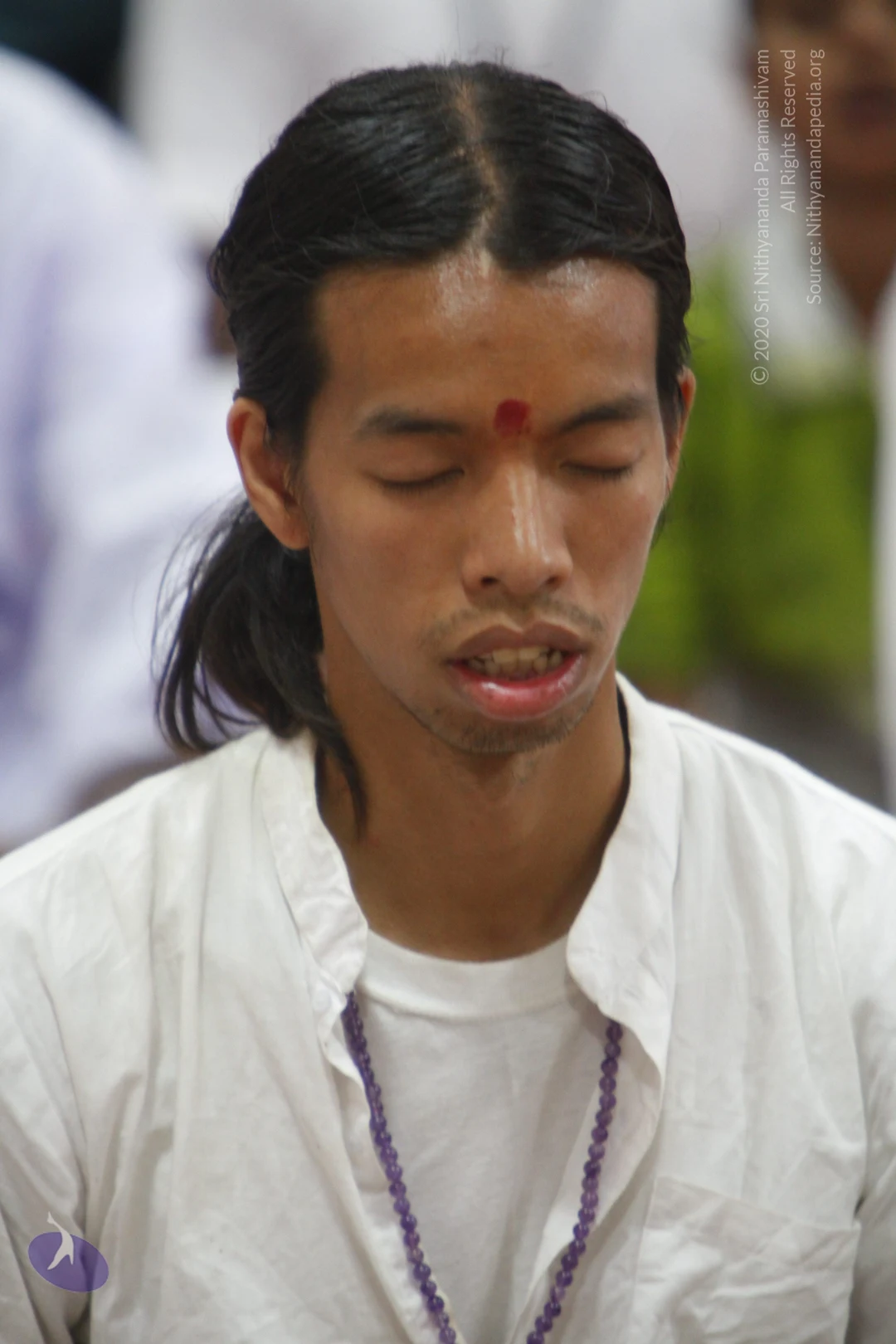
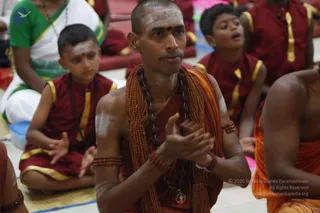
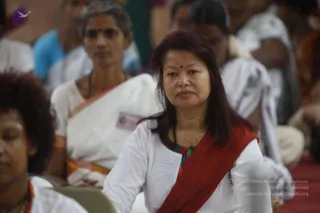
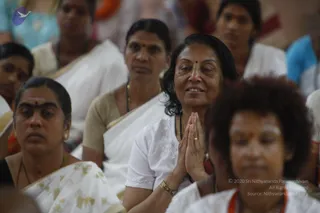
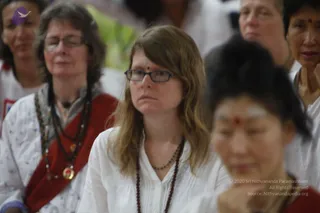
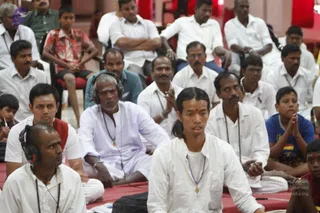
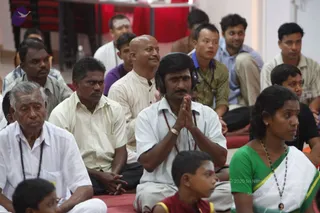
A photo from a satsang session showing a shaved-headed man seated with hands pressed together in anjali, wearing a saffron-orange draped cloth over one shoulder, layered rudraksha malas around his neck and wrists, and a white sandalwood-like marking on his forehead and arms. Behind him, young boys in maroon tunics with gold trim sit on mats, one with a red bindi-like mark and white markings on his forehead, while a woman in a green and white sari sits at left and another person in orange robes sits at right. The setting is an indoor hall with pink and red floor mats.Seated devotees in white clothing at a satsang gathering. In the foreground, a woman with shoulder-length dark reddish hair and a small red bindi wears a white top and a red shawl draped over one shoulder, looking toward the camera. Behind her, other women in white saris with orange and red borders sit in rows, and a shaved-headed devotee with white tilak marks is partially visible at the left edge. The background is soft and blurred, with a red floor covering visible below.A seated audience of women at a satsang, many in white or cream saris and churidar-style white tops. Centre, a smiling woman with short dark hair and a small red bindi presses her palms together in anjali mudra, wearing a thin black beaded mala, a gold bangle and a gold ring. To her left, a woman in a beige and cream sari with a dark mala looks forward; further left, a woman with a white-and-gold sari and a tilak on her forehead sits with a calm expression. In the foreground right, a blurred woman with curly hair and an orange-red vibhuti mark on her forehead. No a person candidate is visible; the scene shows devotees only.Photo of a seated audience at a satsang, with several women in white clothing and rudraksha malas. In the centre, a woman with light brown hair and dark-framed glasses wears a white top and a long brown mala and sits attentively. To the left, a woman in white with a red shawl and layered beaded necklaces sits beside her. At the lower right, a blurred woman with a dark bun and a red bindi is in the foreground. Behind them are more seated devotees in white. No figure matching the a person depiction criteria is visible.A seated crowd of devotees in a hall with red carpeting listens to a satsang discourse. Most men wear white shirts and white dhotis, several with rudraksha malas. A man in the foreground left wears headphones, another older man in white also wears headphones, and a young man with a ponytail, purple mala and white shirt sits centre-front with hands in lap. Boys in colourful shirts sit at the edges, and one boy in the lower right holds his palms joined in anjali. Red curtains hang in the background.A seated audience at a satsang hall listens to a teaching, with attendees on red mats and chairs. In the foreground, a bald man in a white kurta sits with his palms pressed together in namaste, wearing a headset and a rudraksha mala. To the left, an older man in a white shirt and mala sits with eyes closed. A woman in a green and white saree with a mala sits at the right edge, and children sit in the lower foreground. A man in a light shirt and a young man in a green-checked shirt sit in the background.

Nithya-Satsang-Swamiji

6 photosSource gallery
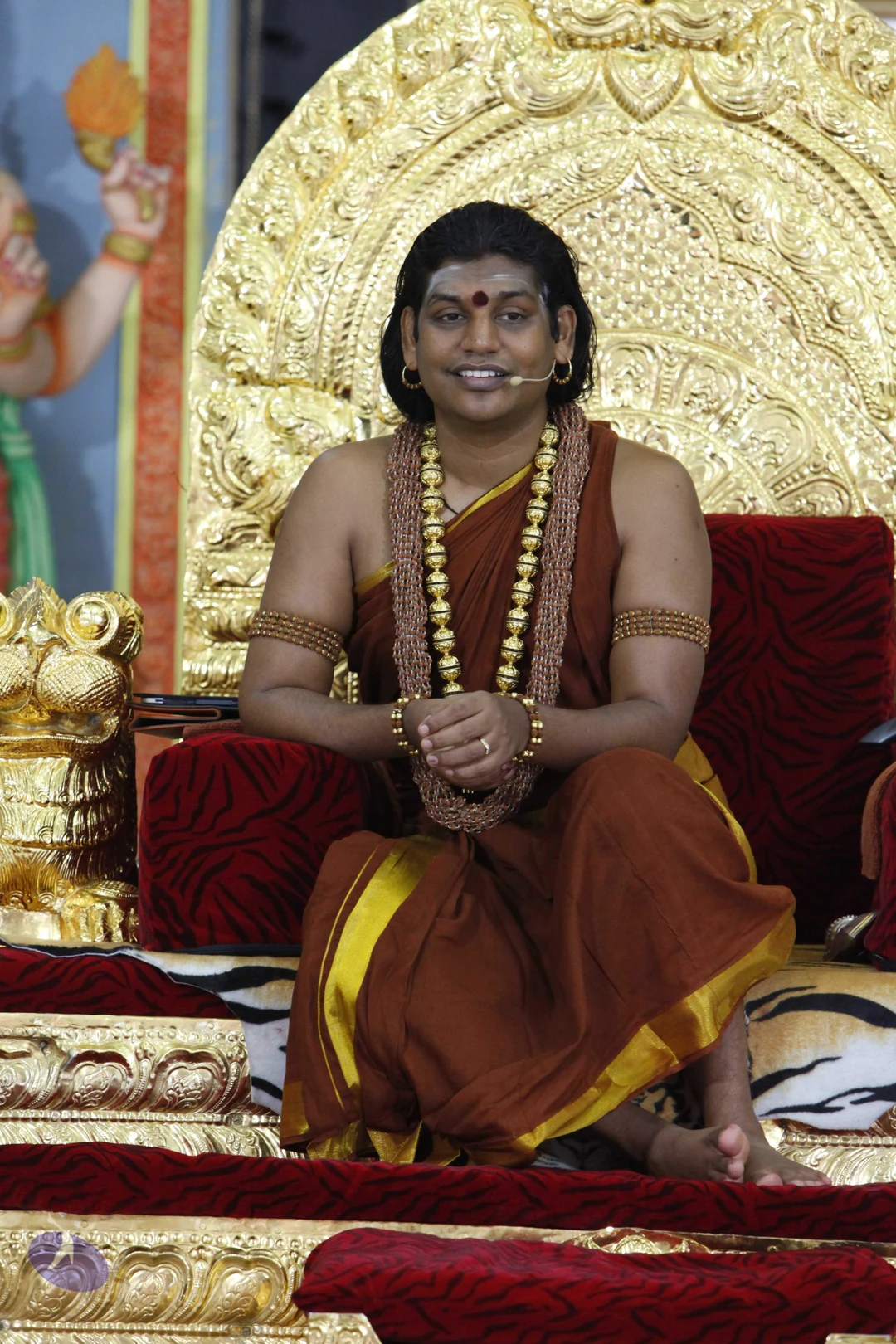
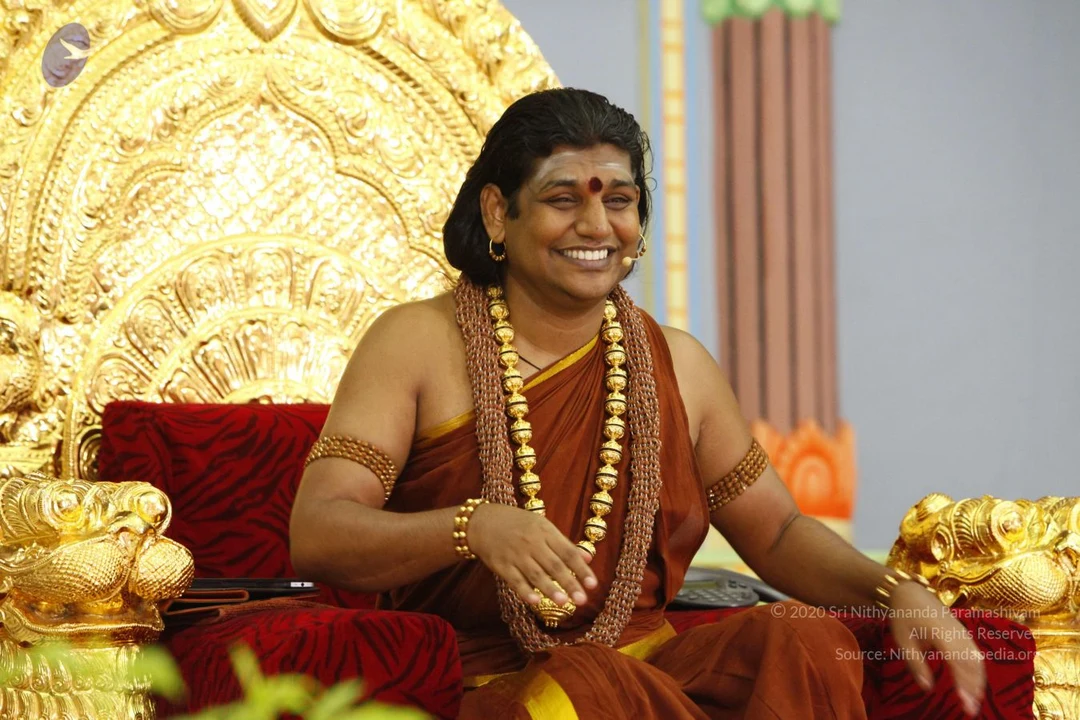
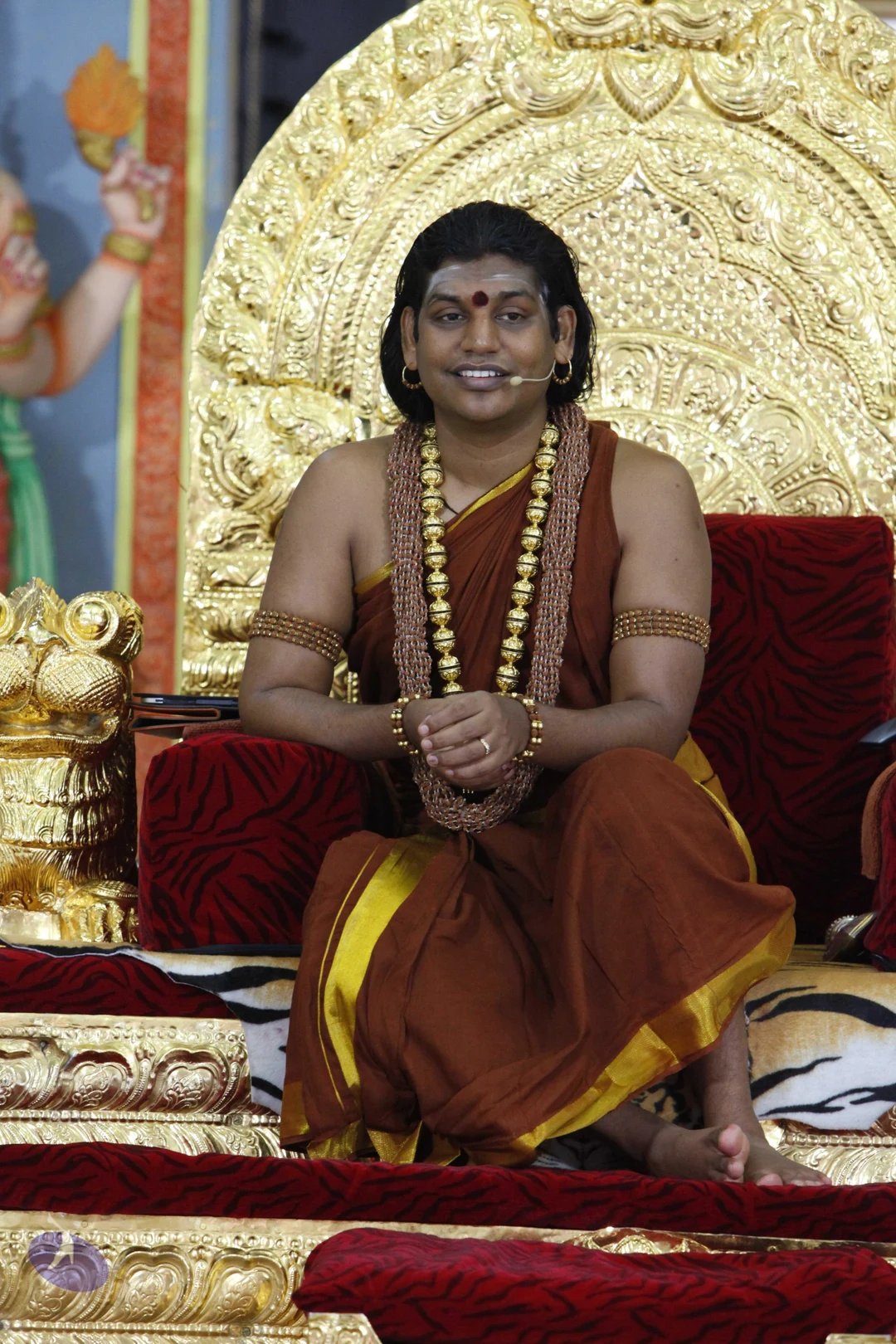
A man sits in front of an ornate gold repoussé backdrop with a red cushioned seat visible at his side. He wears a saffron-orange garment with a gold edge, a rudraksha mala and a long ceremonial gold bead necklace, gold hoop earrings, a red bindi and a headset microphone. He has long swept-back dark hair and gold armbands and smiles while speaking. Probable Swamiji is the seated speaker, identified by long swept-back hair, saffron clothing and ceremonial gold necklace cues.A man seated in front of an ornate gold repoussé backdrop speaks into a small headset microphone. He has long swept-back dark hair, a red bindi and white vertical tilak, gold hoop earrings, and wears a rust-orange wrap over the shoulder with a gold-bordered edge. Heavy gold beaded necklaces and a rudraksha mala hang on his chest, with a gold pendant bearing a small shiva lingam, and a braided gold armband is on one arm.A seated man with long swept-back dark hair, a red bindi and white tilak marks, wears an orange-brown saffron-style shawl with a gold border and gold hoop earrings. He has a headset microphone, rudraksha bead malas across his chest and shoulders, a heavy gold bead necklace with a gold pendant, and rudraksha armlets. He is smiling and speaking in front of an ornate gold repoussé backdrop with a red cushioned seat. Appearance cues match a person, seated and speaking as the satsang teacher.A seated man in a rust-brown robe with a gold-bordered cloth wraps his torso, wearing a long gold bead and rudraksha-style mala and gold armlets. He sits on an ornate gold throne with red-and-black tiger-striped cushions and a golden lion-head armrest, with a red bindi and white marks on his forehead and a small microphone at his cheek. Behind him a decorated gold arch and a painted deity figure with raised hands. a person is seated on the throne, speaking to an audience during satsang.A smiling man in a rust-orange saffron robe sits on an ornate gold throne with red velvet cushions and gold lion-head armrests. He wears a red bindi, gold hoop earrings, a thick rudraksha mala with heavy gold bead necklace, gold armlets and bangles. A microphone is clipped near his face, indicating a discourse setting. Behind him are gold-carved backdrop panels and a pillar in orange and maroon. Appearance-based label: Swamiji (probable), seated speaker giving satsang discourse, with long swept-back hair, rudraksha mala and ceremonial gold necklace cues.A smiling man with long dark hair and a red bindi sits on an ornate gilded throne with carved golden lion-head armrests and red velvet cushions. He wears a rust-orange shawl over a bare shoulder, a rudraksha mala with ceremonial gold beads, gold armlets and gold bangles, and small gold earrings. His hands are folded in his lap. A plant sits in the lower left foreground and a pink-orange pillar stands behind him. Swamiji (probable): the appearance cues are long swept-back hair, saffron-orange shawl, rudraksha and gold necklace, and the page names Swamiji for this satsang, so the candidate is seated present on the throne.

Sarva-Darshan

1 photoSource gallery
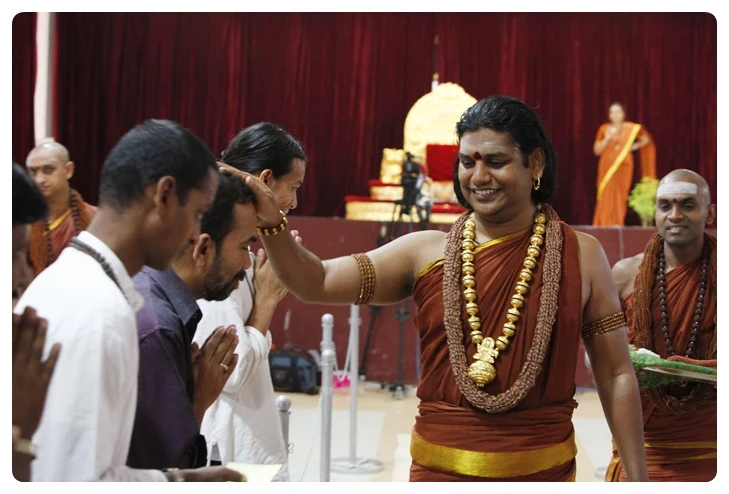
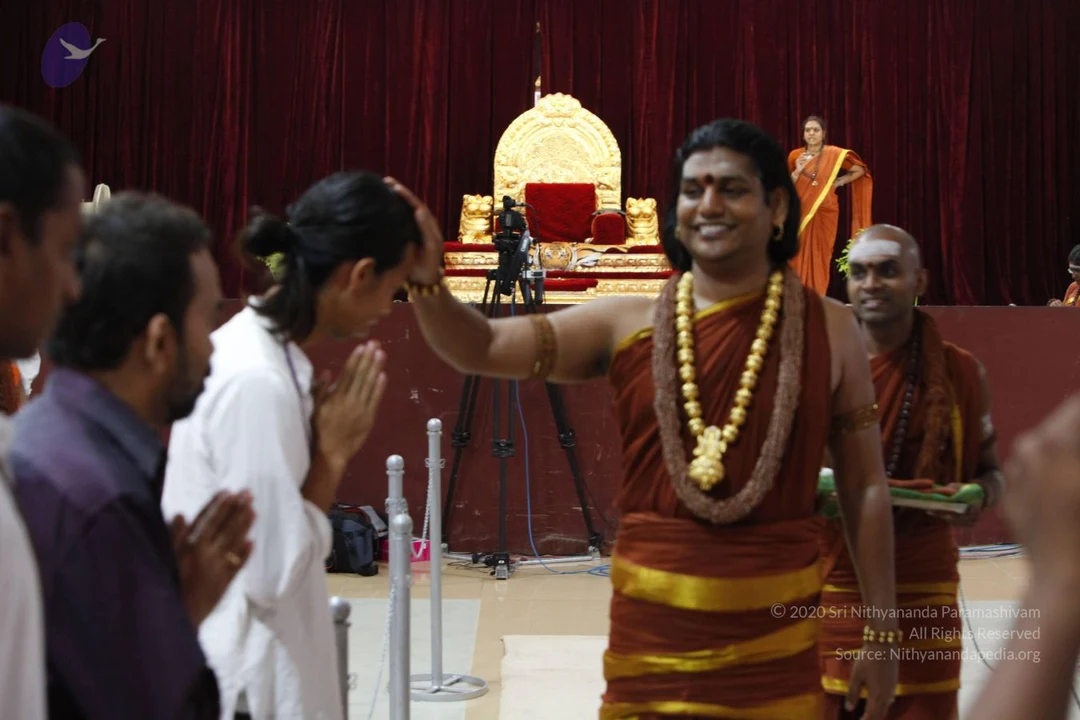
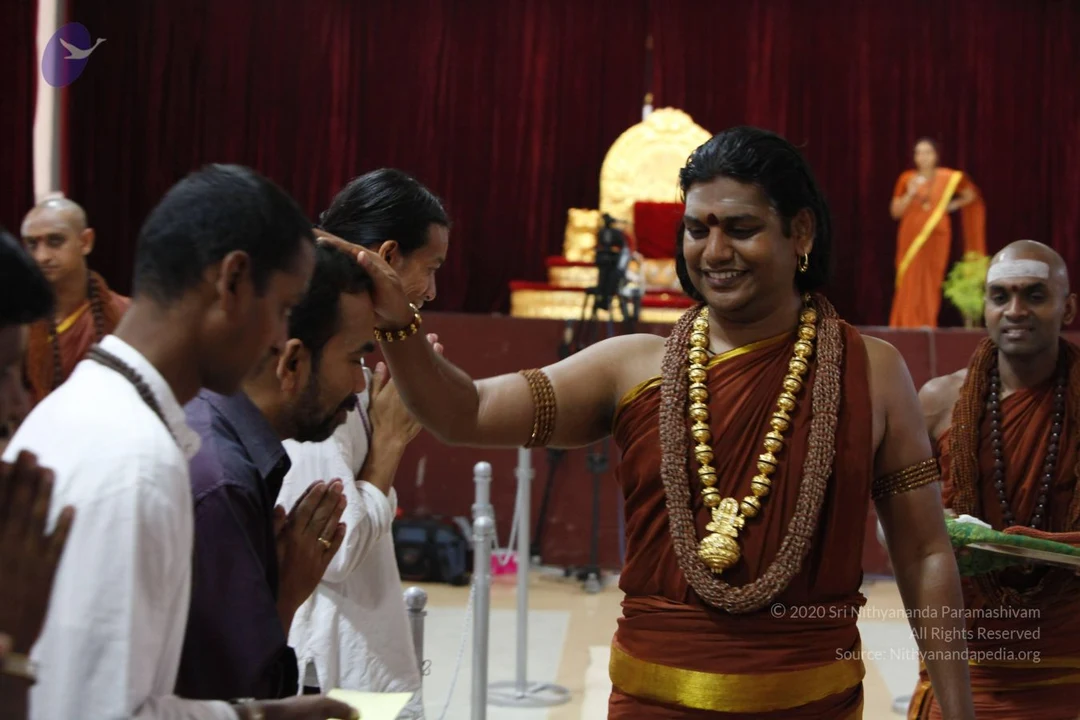
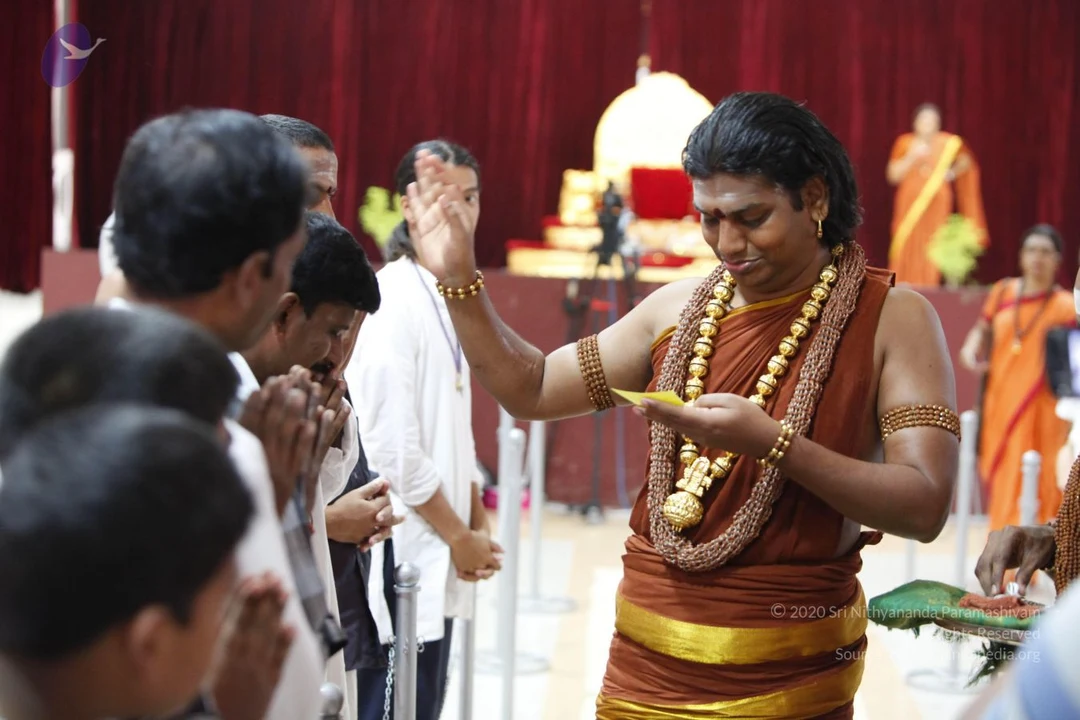
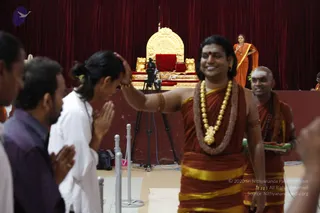
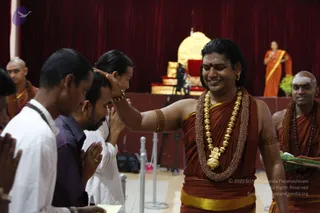
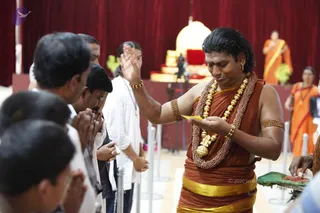
A photograph inside a hall with red velvet drapes and an ornate gold throne with a red cushion in the background. In the foreground, a man in an orange-red dhoti with a gold waist band and a long gold-beaded necklace with a large gold pendant smiles and raises his hand to bless a woman in a white top with her hands pressed together in namaskar. Two men with folded hands stand to the left. Behind, a man with a shaved head and white tilak, wearing an orange cloth and rudraksha mala, carries a tray, and a woman in an orange sari stands near the stage. A camera on a tripod and cables are visible. The scene suggests a darshan or blessing line. The man giving the blessing has long swept-back hair, gold ornaments and an orange-red garment, a distinctive appearance consistent with a person, though this is uncertain.

Final-Blessing

3 photosSource gallery
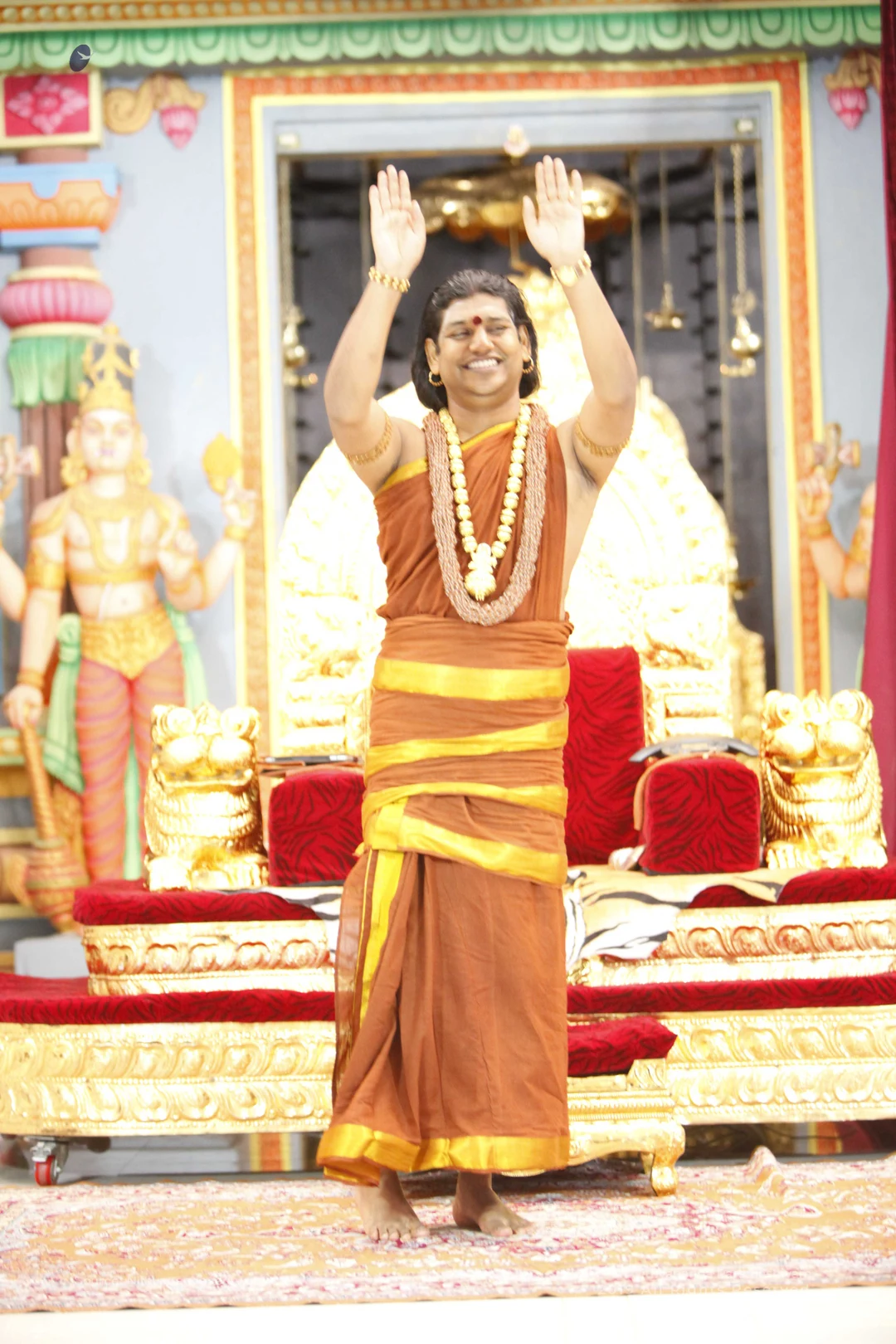
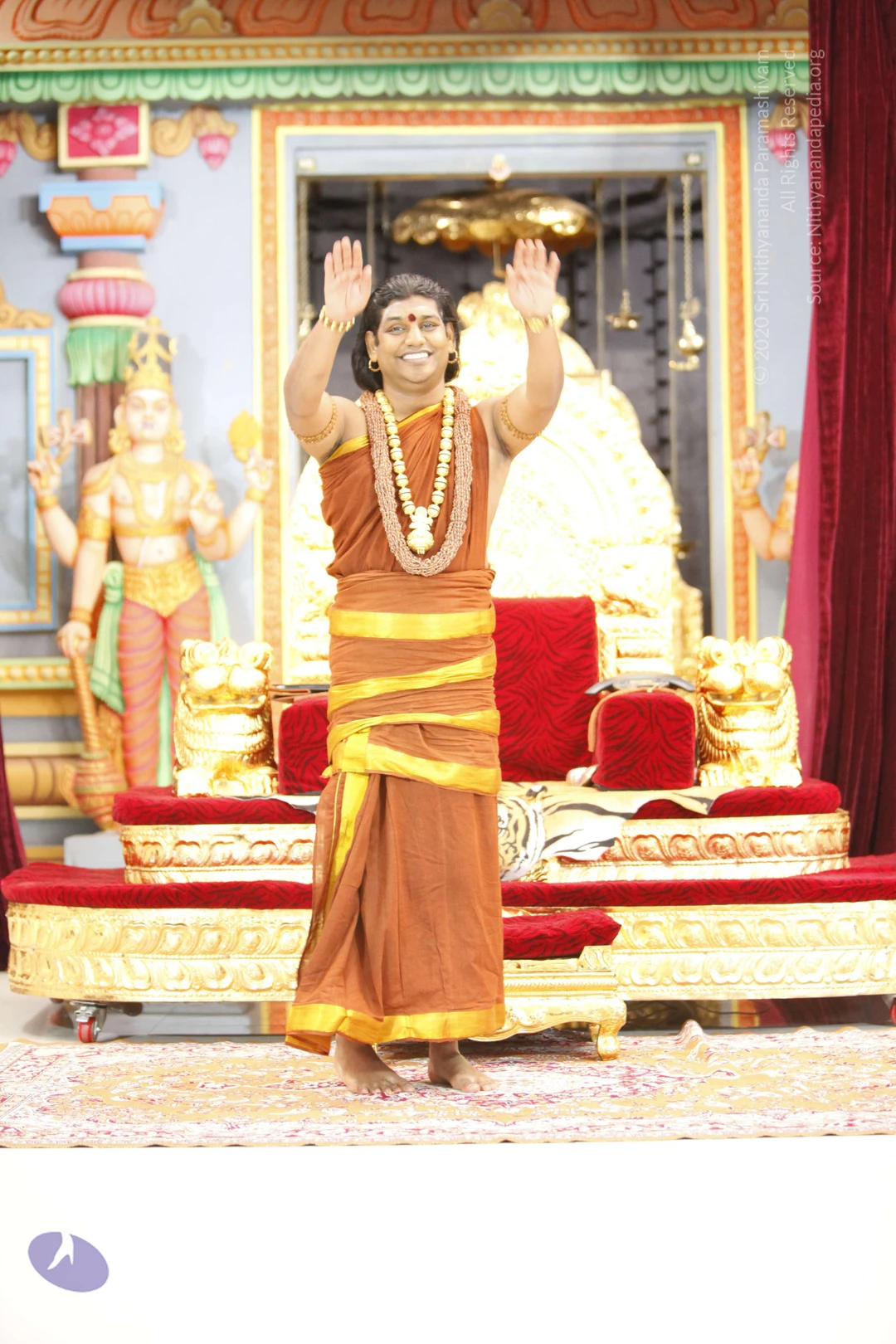
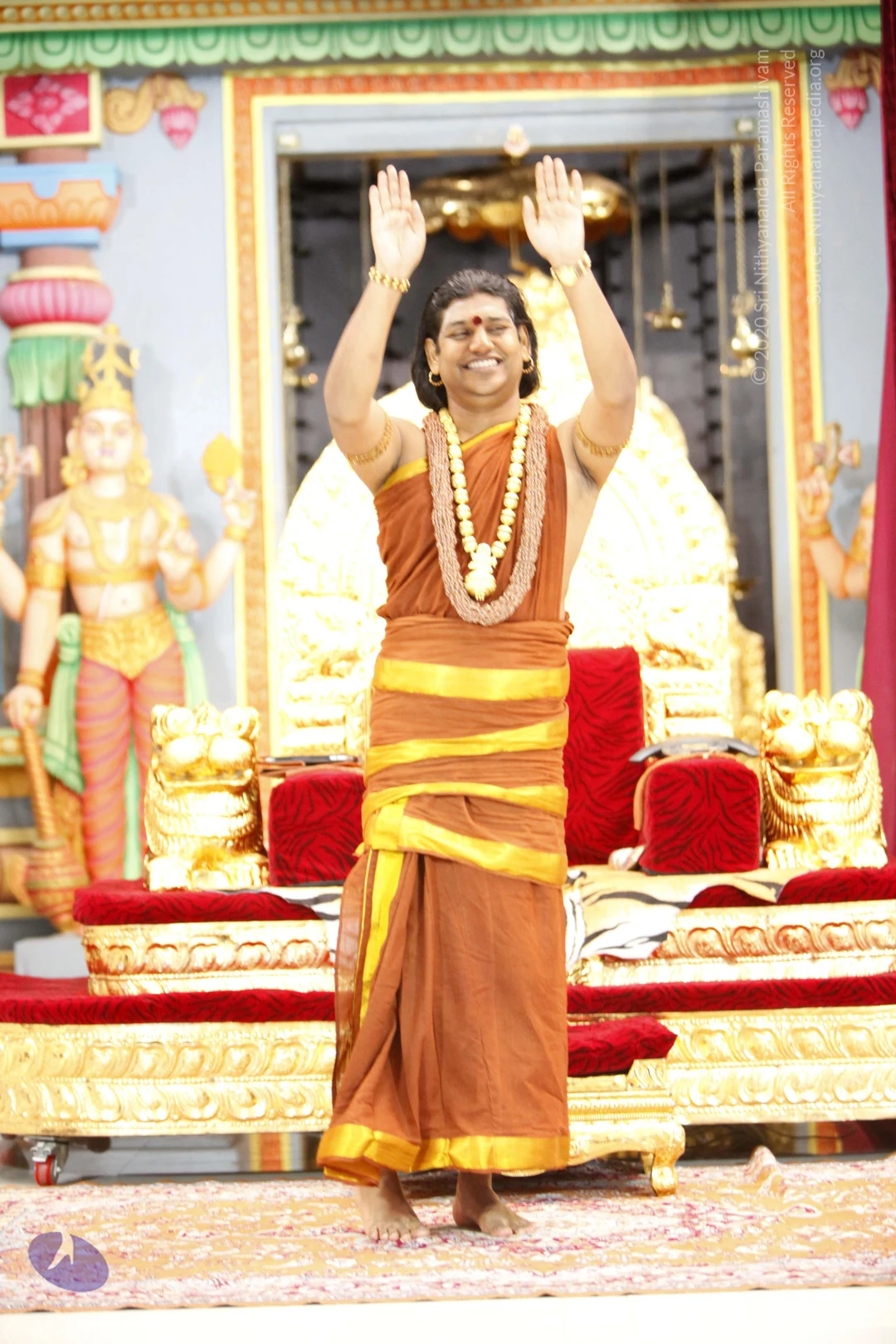
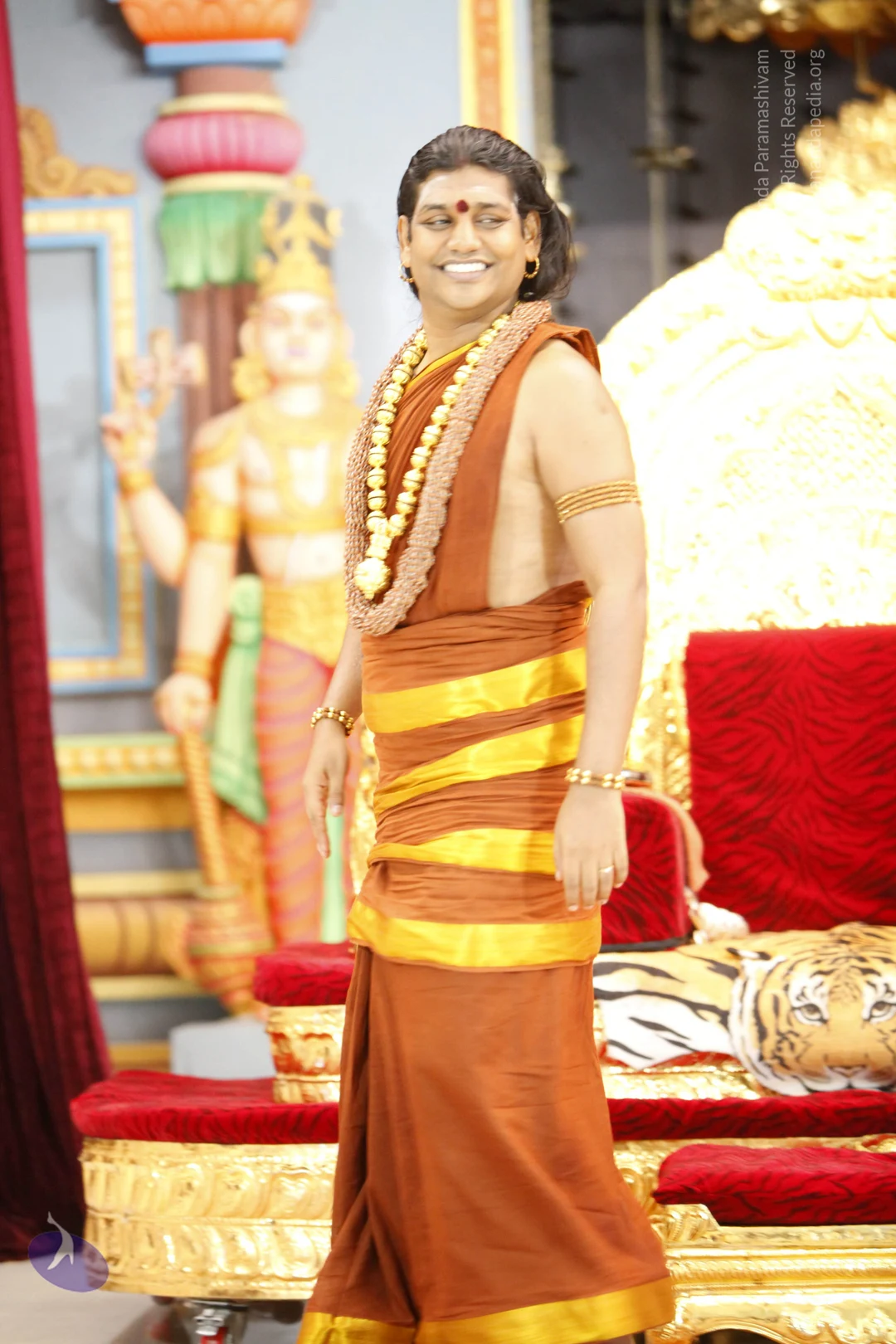
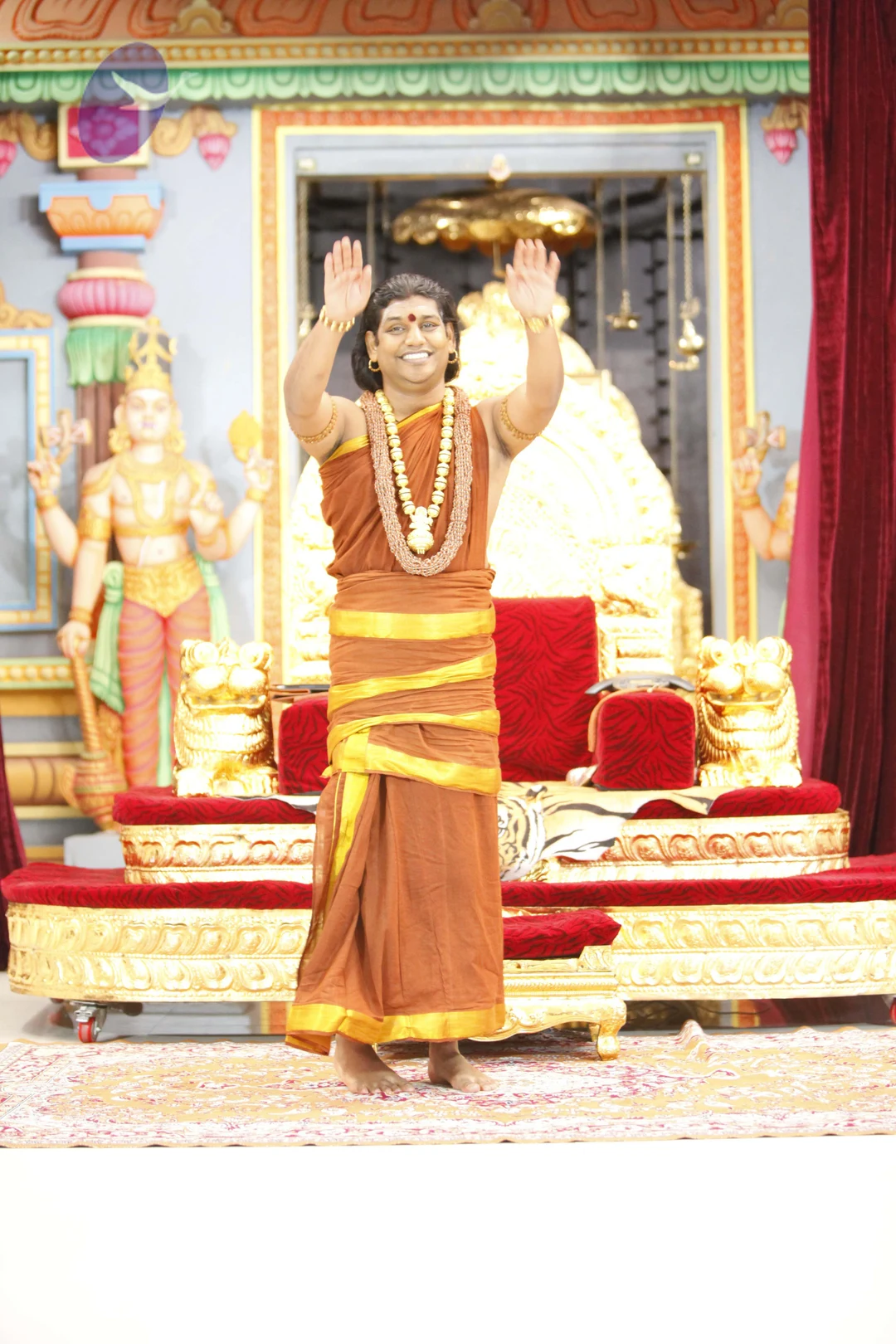
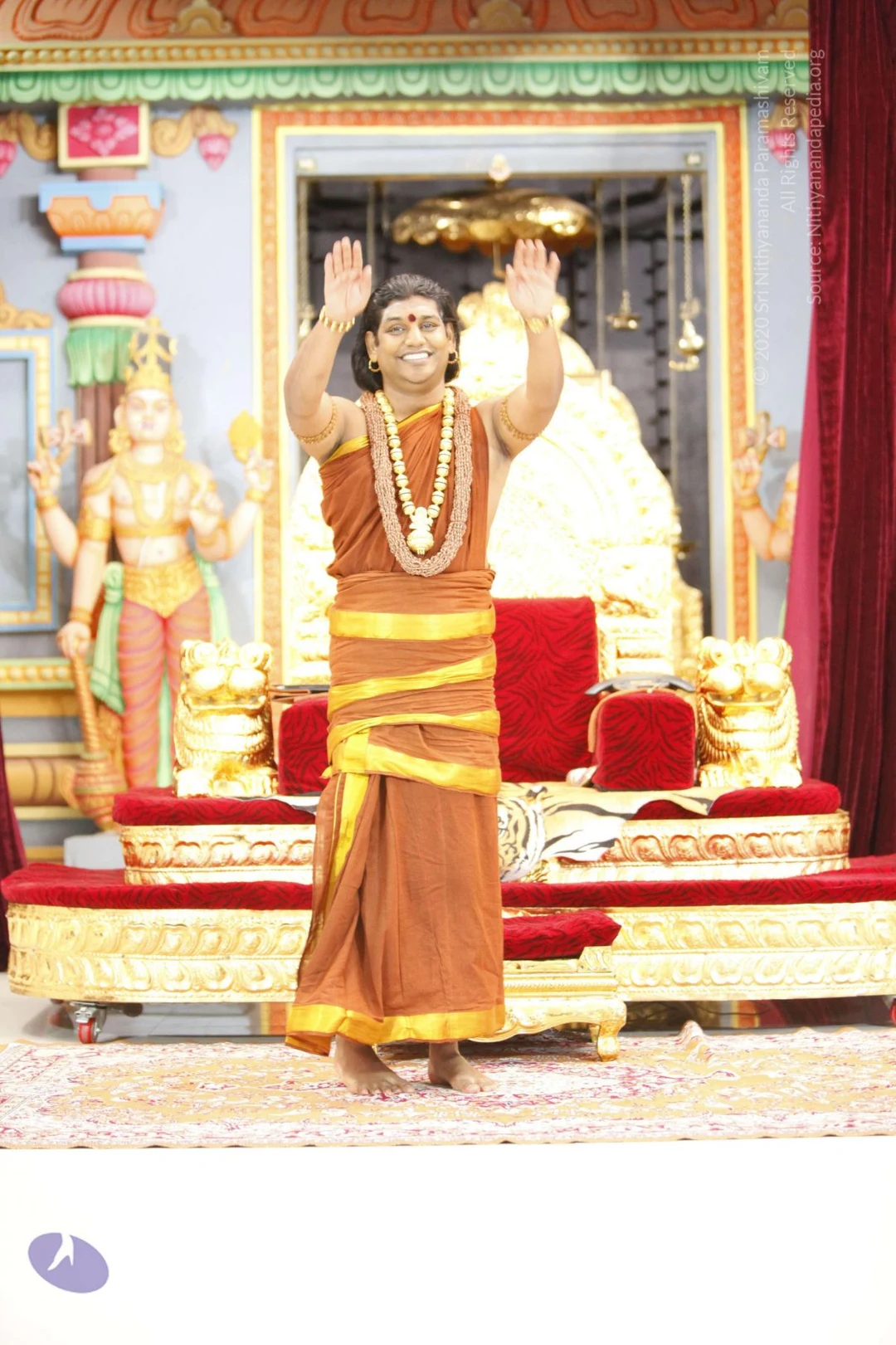
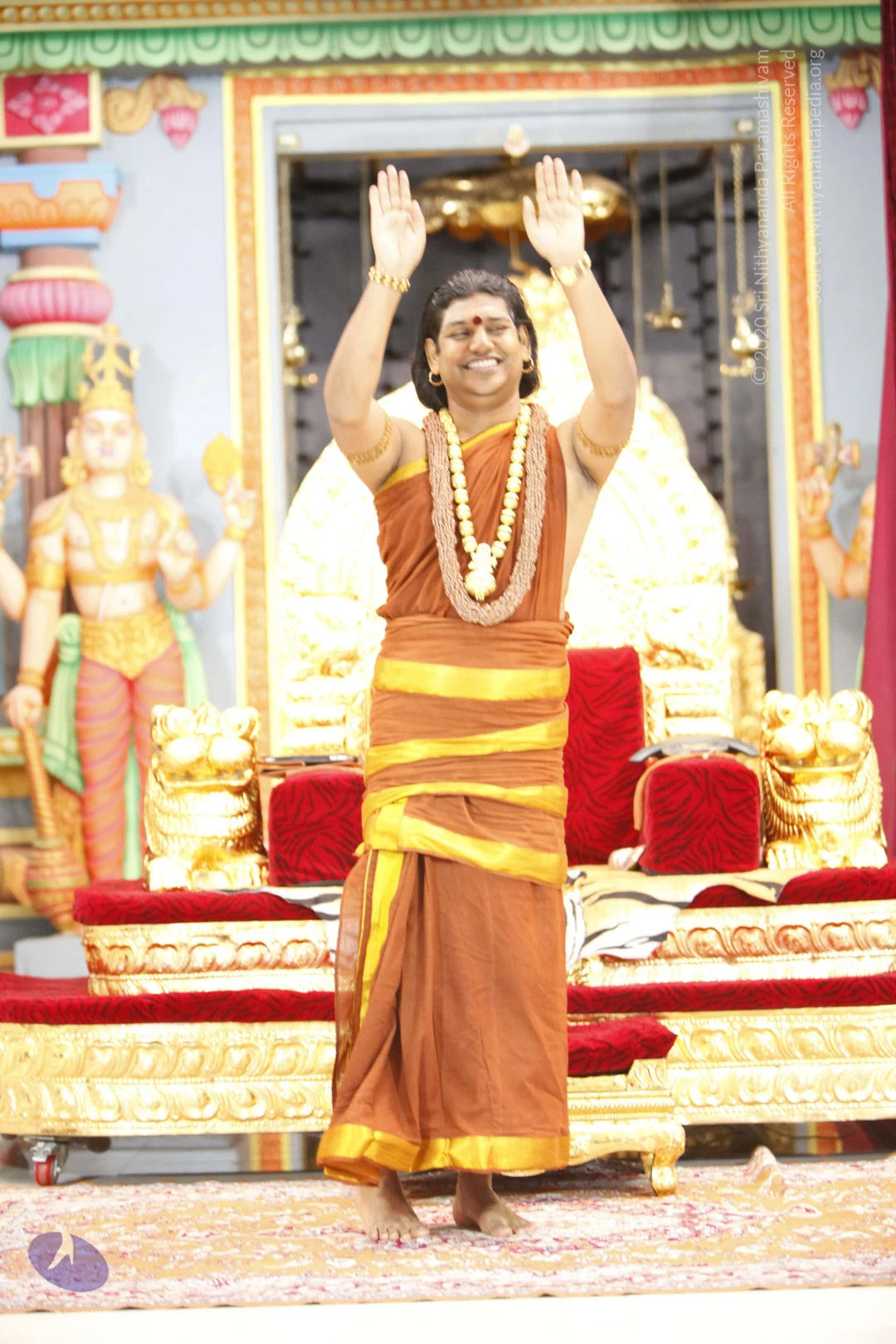
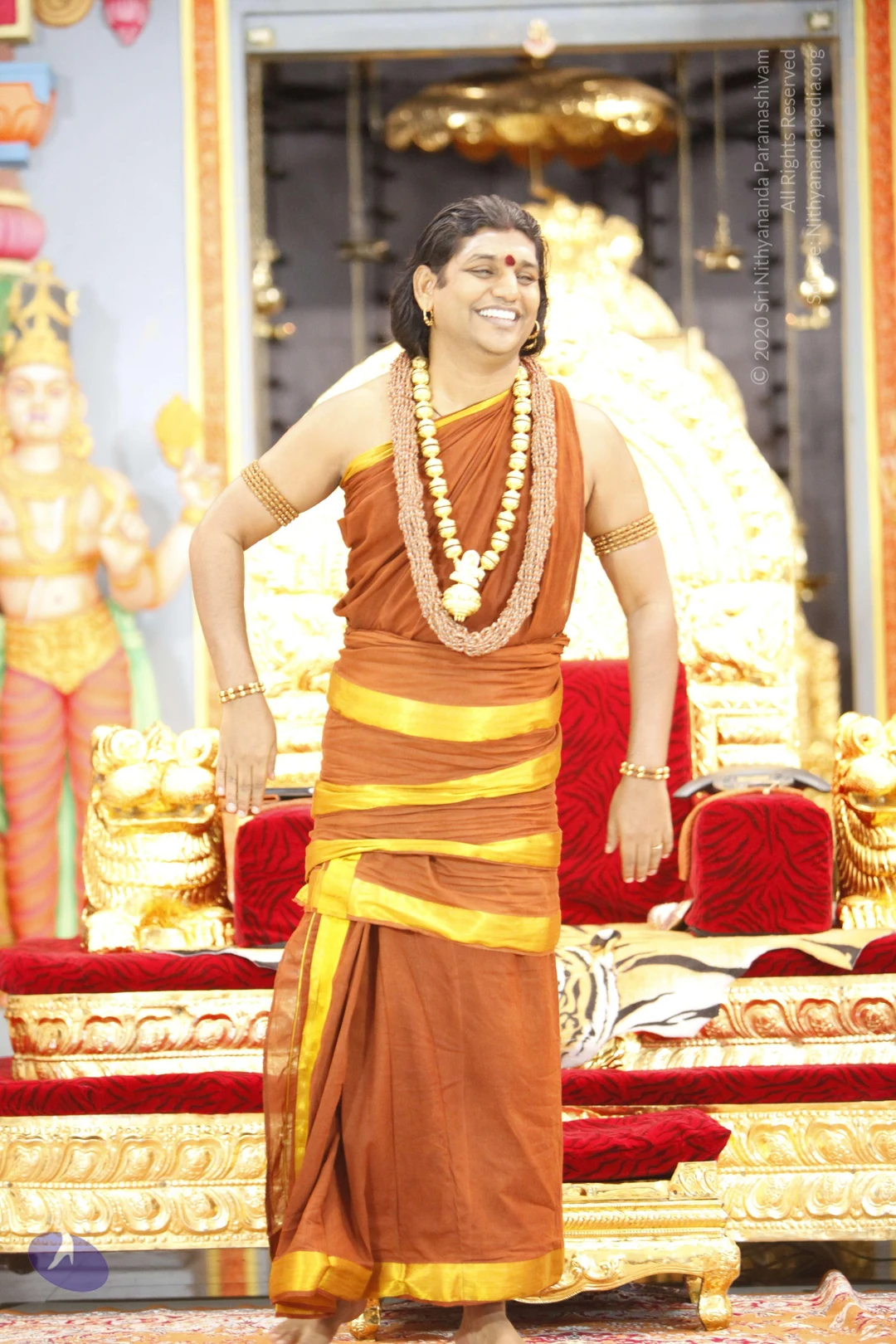
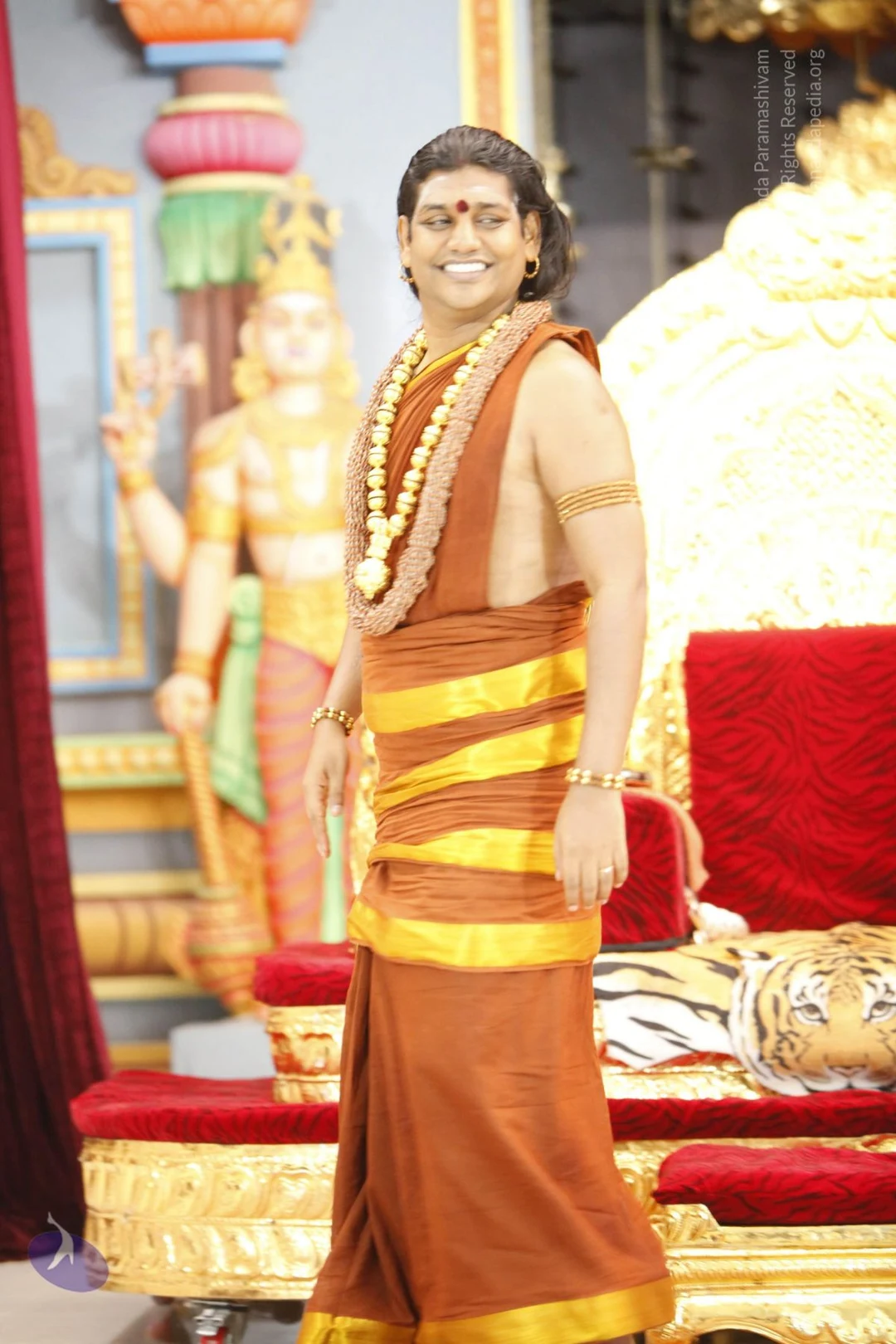
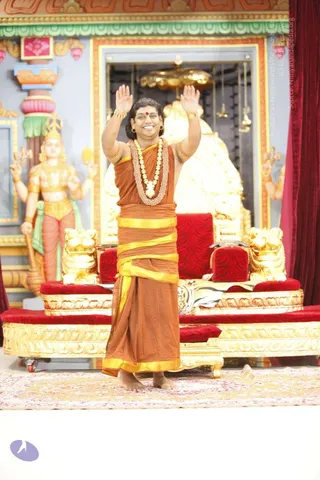
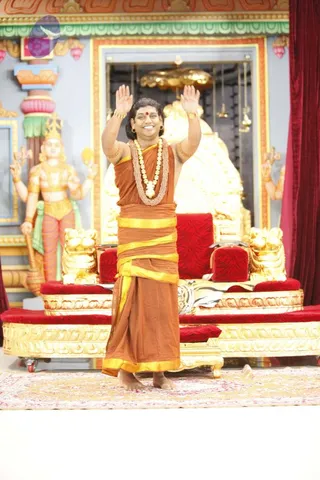
A man in a saffron-brown dhoti and wrap with gold borders stands barefoot on an ornate carpet, both palms raised in greeting and smiling. He wears a red bindi, gold bangles, a long rudraksha mala with a gold pendant, and earrings. Behind him is a large gold-and-red throne with a tiger-skin cloth and golden lion armrests, a red velvet curtain at right, and a painted gold deity murti with multiple arms on the left. Swamiji (probable): the long swept-back hair, saffron clothing, rudraksha mala and ceremonial gold ornaments match the visible cues, and this appears to be a satsang stage setting.A smiling man stands barefoot on a patterned rug with both arms raised, palms open, in front of a richly decorated gold and red stage. He wears a rust-orange ochre cloth wrapped with gold-bordered yellow bands, a long white and gold beaded garland, gold bangles and an upper-arm band, and a red bindi on his forehead. Behind him stands a painted deity figure with gold ornaments and a crown, beside gold lion-shaped armrests on red velvet seats and a gilded backdrop. Swamiji (probable): long swept-back hair, ornate gold jewellery, saffron-toned robe and a ceremonial garland, standing on the stage before the throne.A smiling man with swept-back dark hair and a red bindi stands sideways in a temple-like hall, wearing a saffron-brown garment with gold-yellow borders wrapped over one shoulder and waist, a gold bead and rudraksha-style necklace, gold armlets and bangles. Behind him is a golden throne with red velvet cushions and a tiger-skin cover, and a painted deity murti with a crown and raised hand stands at left. Swamiji (probable): the figure shows long swept-back hair, ceremonial gold necklace, saffron clothing and ornaments, matching the page's Swamiji claim.

Rudra-Abhishekam
150 photosSource gallery
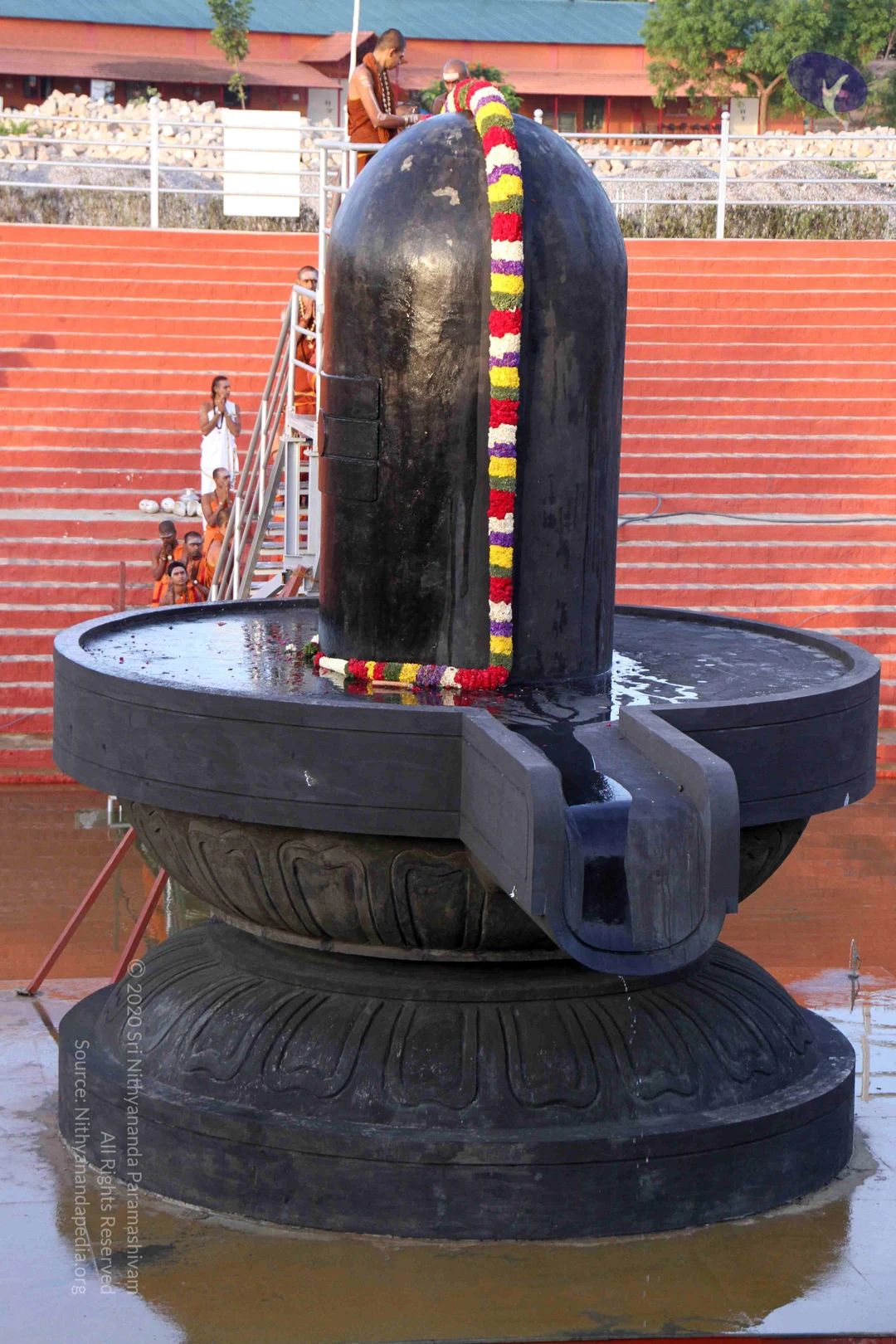
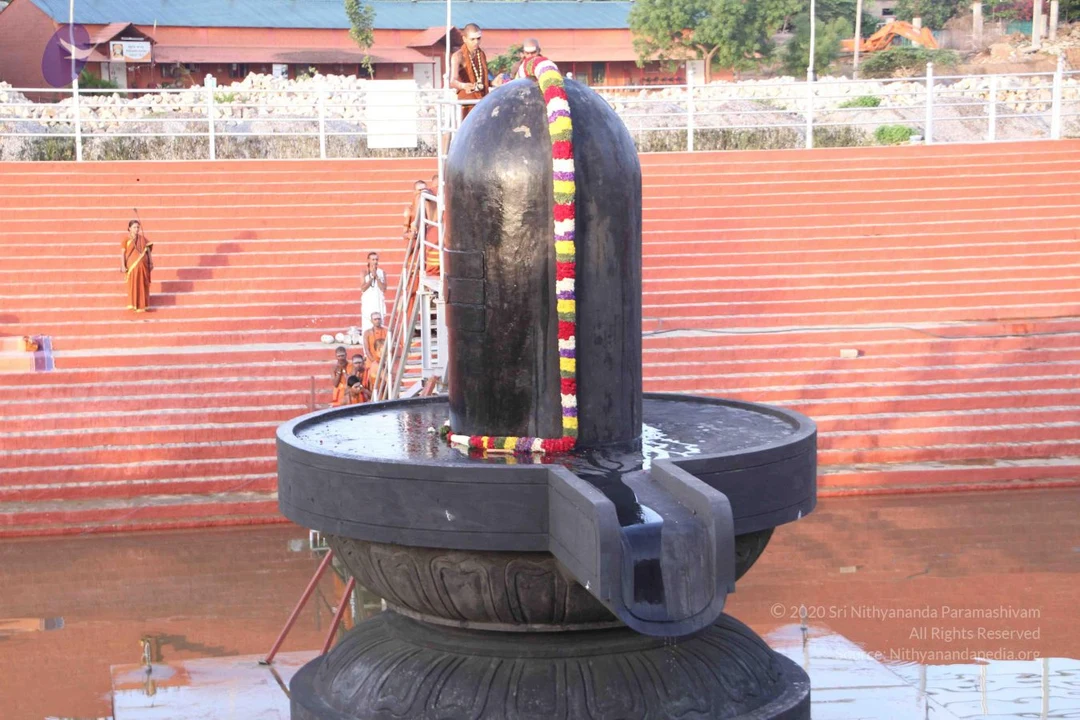
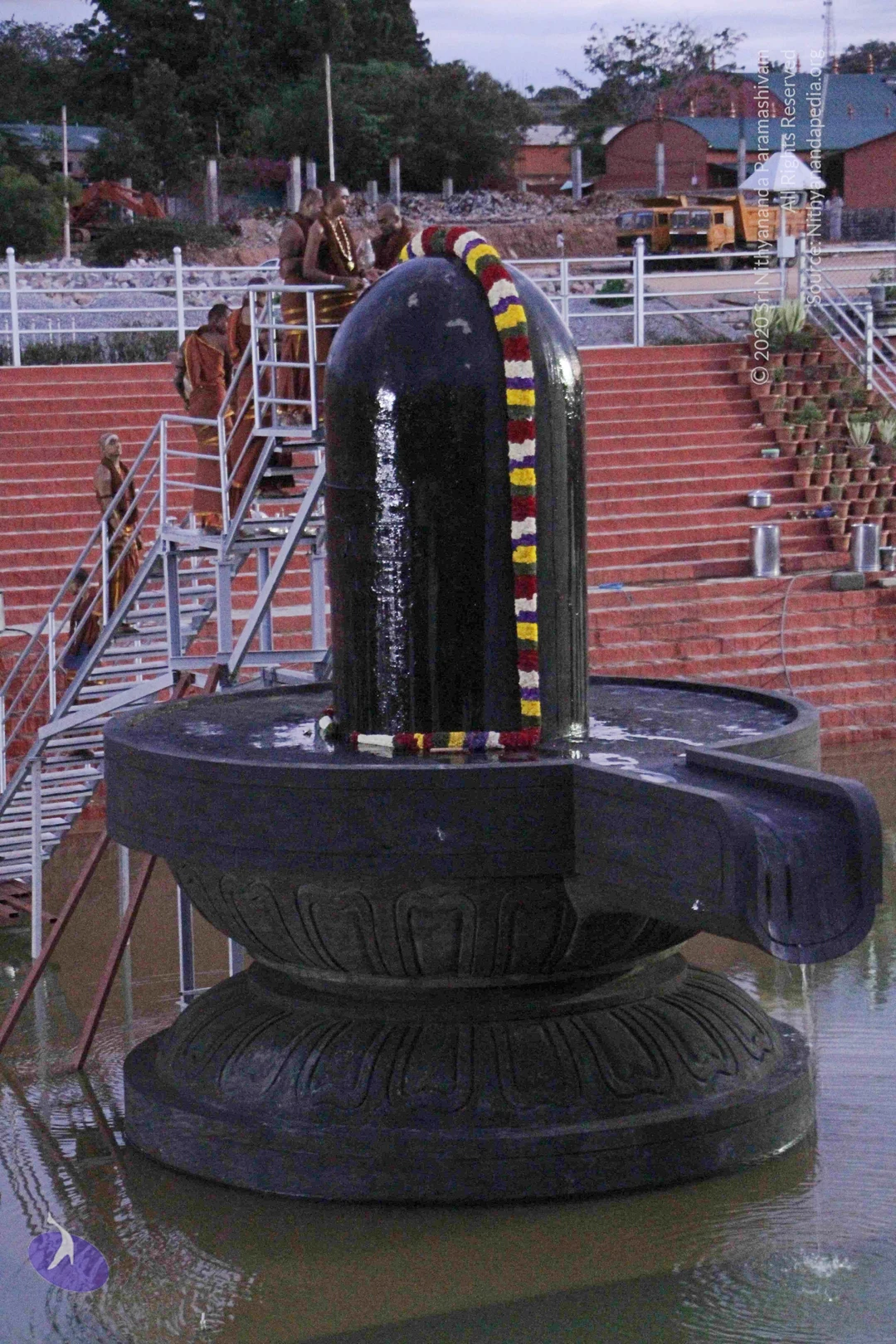
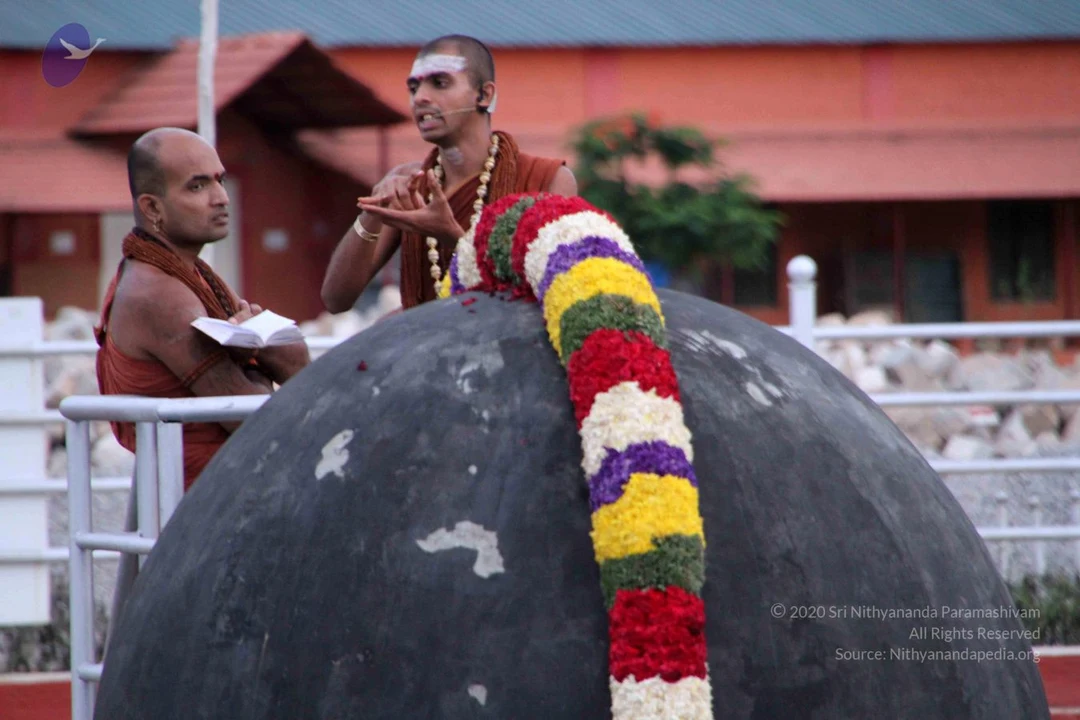
A large black stone Shivling stands in the middle of a rectangular water tank, its base submerged and its reflection visible on the still water. A garland of red and white flowers hangs on its upper part. Behind it, tiered red-painted steps rise with rows of empty seats and potted plants lining the walls. A few small figures in light clothing sit on the steps near the lingam, and two more stand nearby. Low white railings, a parked vehicle, and red-roofed buildings with palm trees appear in the background under a cloudy sky. Rows of potted plants line the foreground edge of the tank.A photograph of a large dark black stone lingam or sculpted dome draped with a long multicolour flower garland in red, white, yellow, purple and green. Two shaved-headed men in saffron-orange robes stand outdoors beside it, with white vertical railings and gravel behind. The man at right, bare-chested under an orange wrap with a rudraksha mala, raises both hands high with palms open, a white tilak on his forehead. The man at left, also in orange with a shawl, watches him. Behind them stands an orange-walled building with a green corrugated roof and gold finials.Outdoor scene at a large dark black stone lingam-shaped monolith wrapped with a long multicolour flower garland in red, white, yellow, purple and green. A man in orange-brown saffron robes with a shawl stands at the stone with both arms raised high, palms open, in an apparent devotional or invocation gesture, wearing a beaded necklace and a wrist band. Beside him to the left, a shaved-headed man in orange-brown robes sits at the railing looking up. Behind them is an orange-brown building with a green roof, and white railings line the platform. Scattered red petals lie on the stone.Outdoor photo of a large dark polished stone lingam, a smooth black dome-shaped form, draped with a long multicoloured flower garland of red, white, yellow, purple and green blooms. Behind it a standing man in saffron-orange robes raises both hands in a gesture of blessing or address, with white tilaka on his forehead, a bead necklace and a wristwatch. To the left a shaved-headed man in orange robes with a saffron shawl sits on a railed platform. Background shows orange-roofed buildings, a green metal roof and rocks along a white railing. Tiles of red brick ground surround the scene.Outdoor photo of a large dark grey dome-shaped black stone lingam on a red-brick stepped platform, draped with a multicoloured flower garland of red, yellow, white and purple blooms. Behind it, two saffron-robed sannyasis stand on top of the lingam's curved surface; one holds his hands raised high in a gesture, the other stands with arms bent. A third saffron-robed monk stands at the lower right on the steps with hands folded in anjali. Background shows an orange-walled building, a green-roofed red-brick building, stone rubble and a white railing. Two men are visible, the rest of the scene has no further people.Outdoor scene at an ashram with a large dark black stone lingam, garlanded with a long multicoloured flower garland of red, yellow, white and purple blooms. Two men in saffron-orange robes are seated atop the lingam; the man on the right, bare-chested with a sacred-thread shawl and a long string of white beads, raises one hand in a blessing gesture. A third person in orange stands on the red-tiered steps at lower right. Red-roofed buildings, a stone wall and white railings surround the area.

MorningMessage

10 photosSource gallery
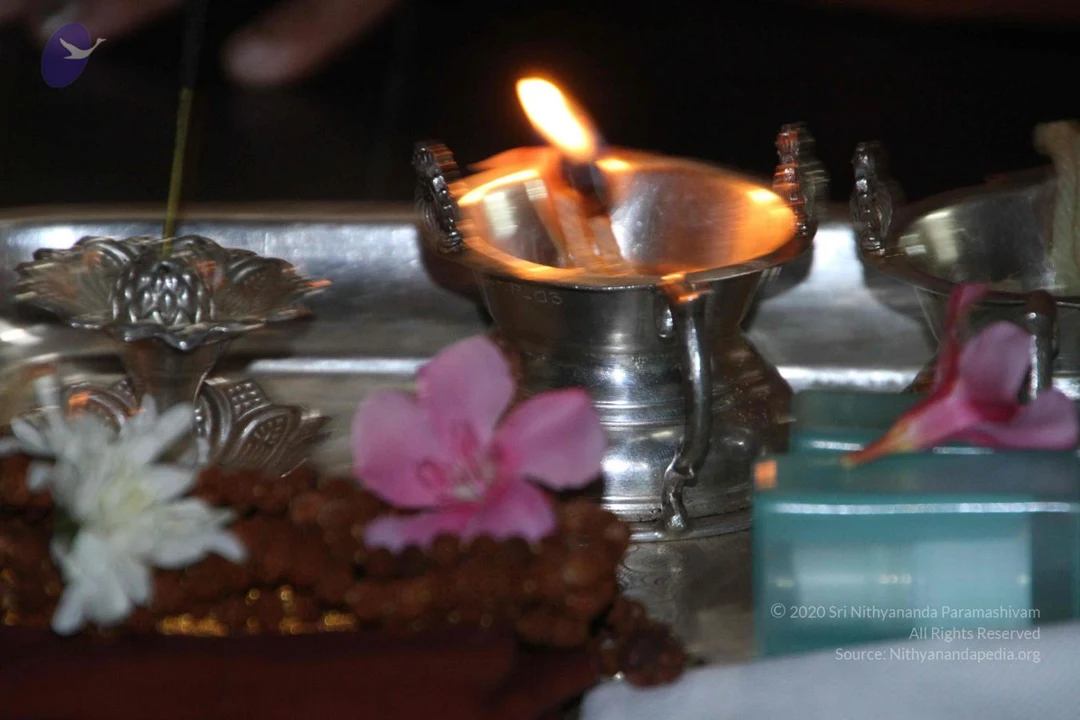
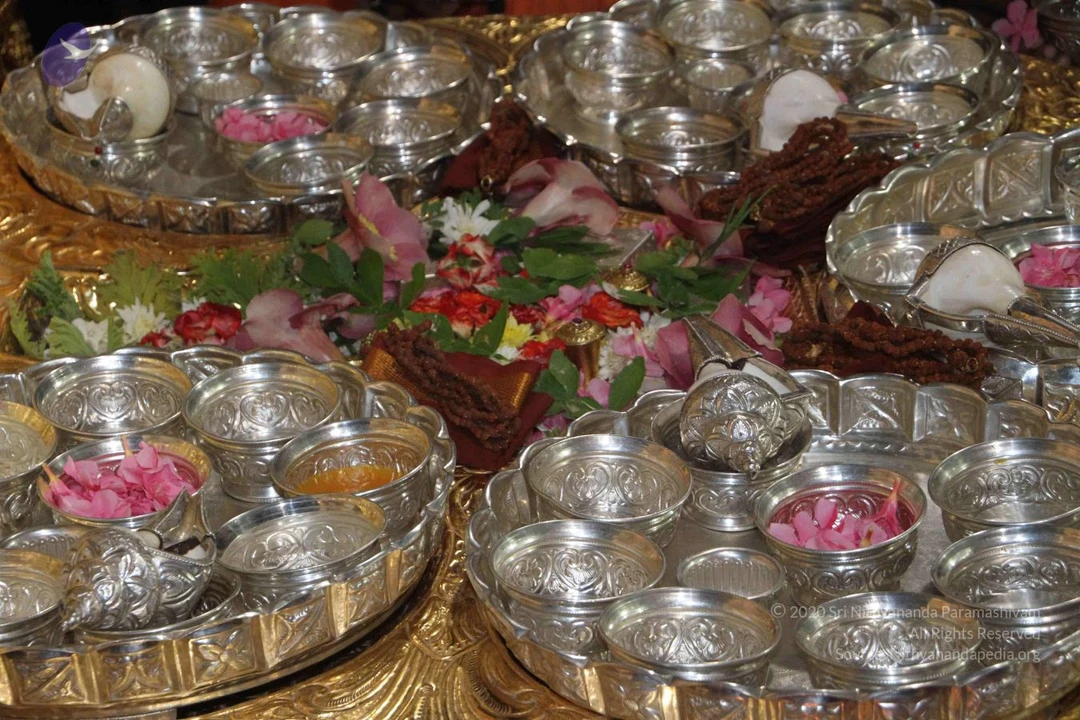
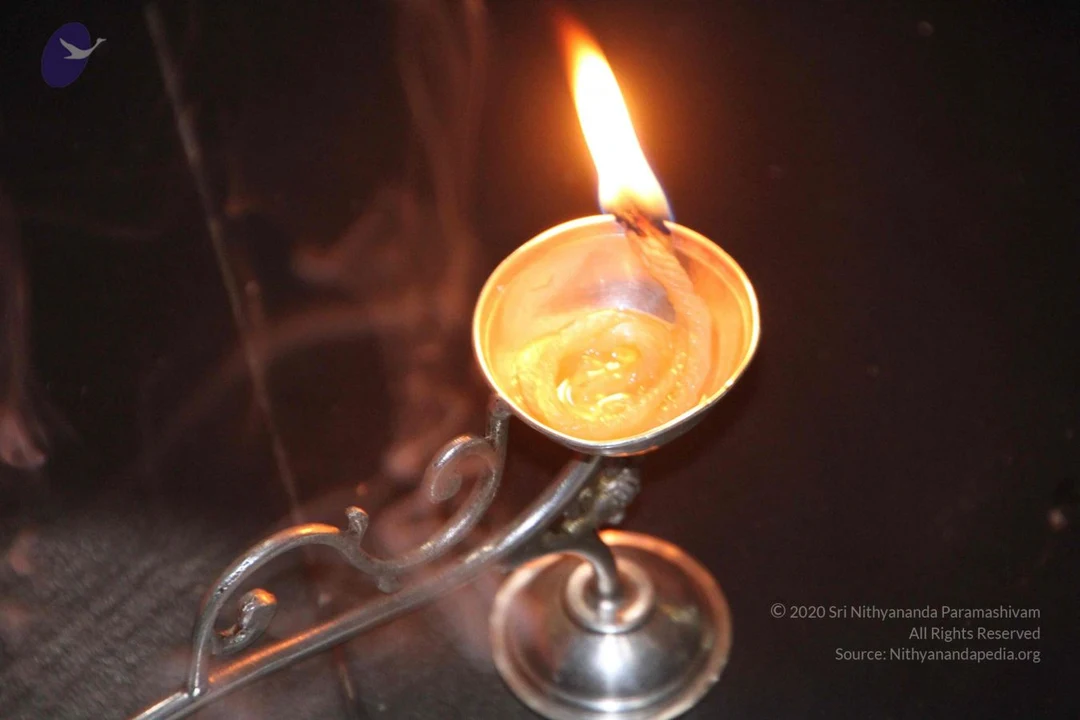
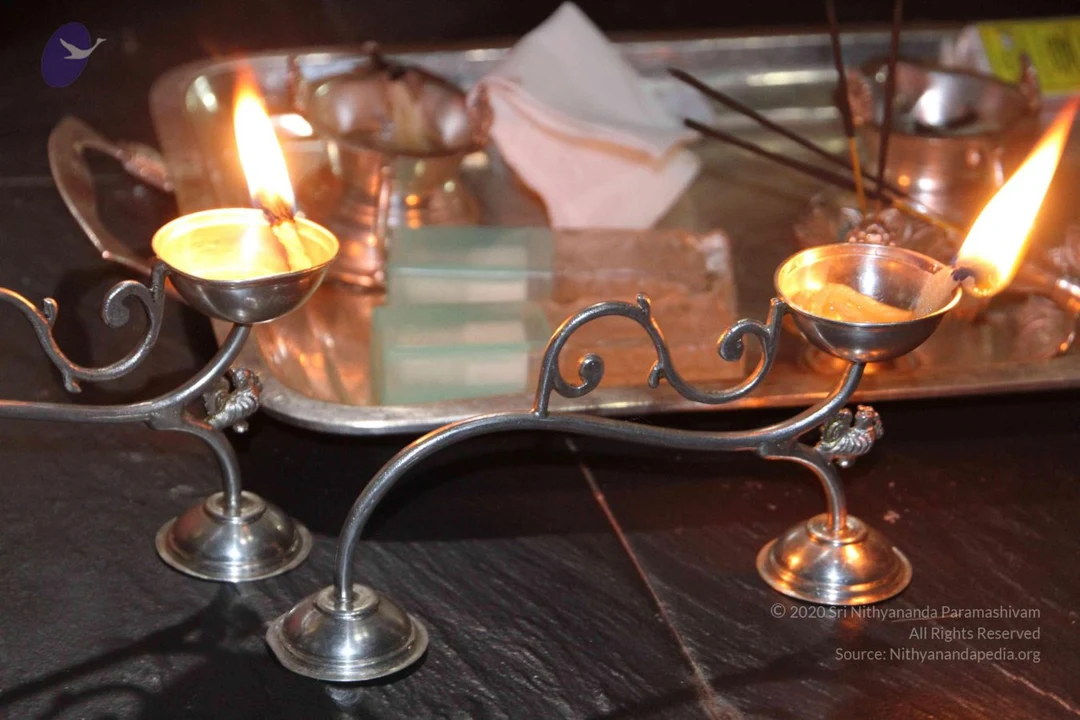
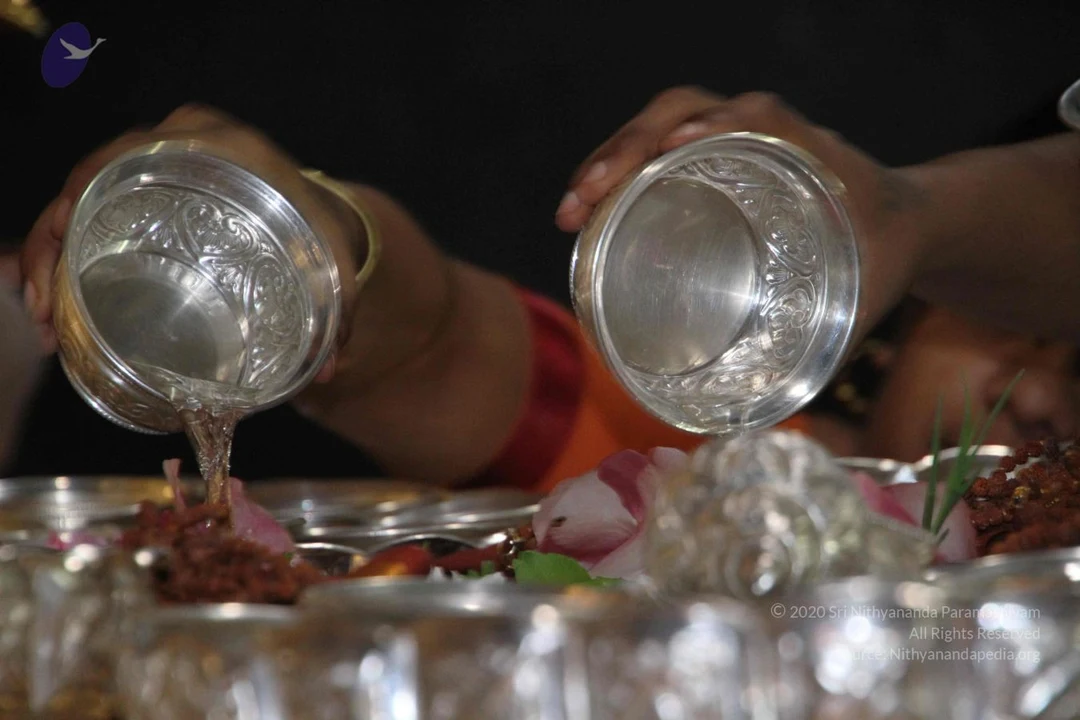
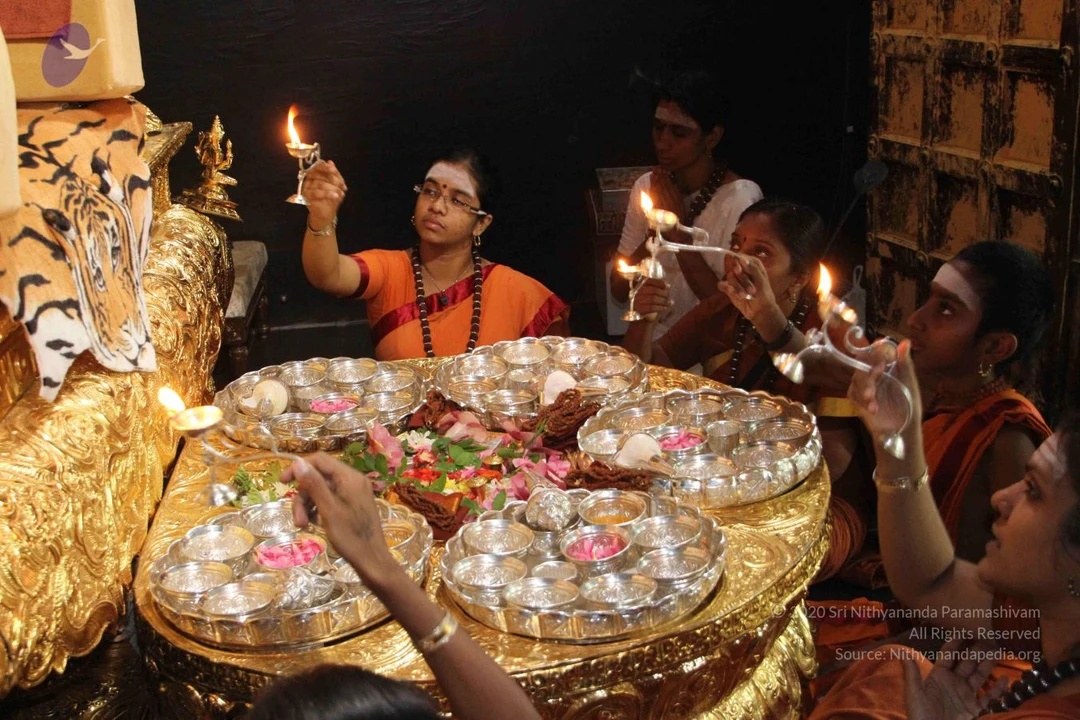
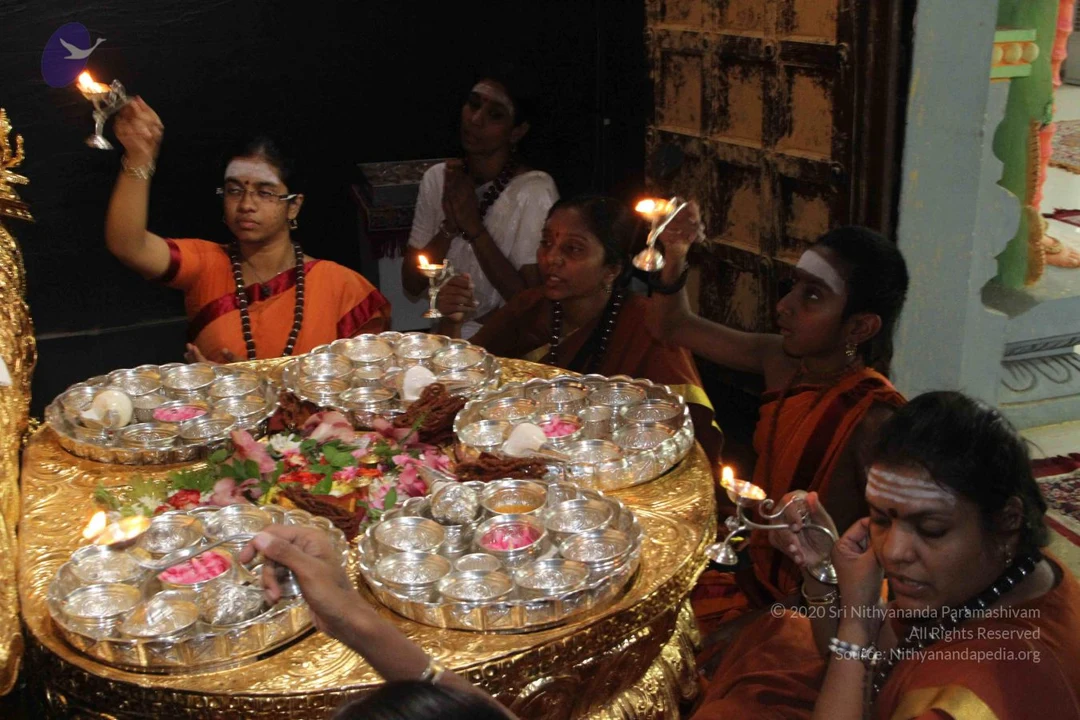
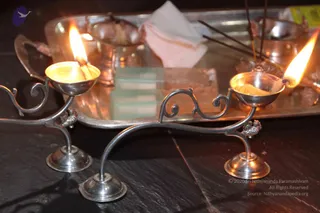
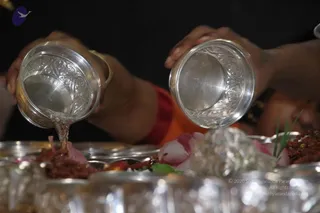
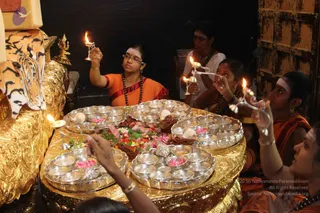
Close-up photograph of a silver puja setup with a lit oil lamp in a silver cup, its flame glowing warmly. A lit incense stick rises from a small silver stand on the left. Pink and white flowers, including a pink hibiscus-like bloom and white blossoms, rest on a bed of rudraksha beads, and another pink flower lies on a clear glass box at right. No people are visible.Close view of an elaborate puja setup on ornate gold and silver trays. Many engraved silver bowls hold pink and red flower petals, orange paste or liquid, and offerings. Rudraksha malas rest on maroon cloth among fresh pink, red and white flowers and green leaves. Silver spoons and a small silver vessel sit among white conch shells. No people are visible. The arrangement suggests ritual offering preparation at a temple or ashram.Close-up photograph of a single lit oil lamp on an ornate silver-coloured stand with scrolled arms and a round base. A steady flame rises from a shallow silver-rimmed cup filled with clear oil or ghee, and faint smoke curls upward against a dark background. No people are visible.Close-up photograph of a silver two-flame oil lamp stand on a dark slate surface. Two lit oil lamps sit in shallow cups on curled arms, with a flat silver tray behind them holding a small silver bowl, a folded white cloth and incense sticks. No people are visible.Close-up photo of two hands pouring water from ornately engraved silver cups over a tray of offerings. The tray holds pink rose petals, a green leaf, reddish-brown powder or grain, and cut glass or crystal items. A bare arm wears a gold bangle and a red-orange cloth is visible behind. The background is dark.A photograph of a ritual aarti offering in a temple-like setting. Several women in orange and saffron saris with rudraksha malas hold lit oil lamps (aarti lamps) and gesture over ornate silver plates arranged on a gold-finished stand. The plates hold pink flower petals, rose-like flowers, betel leaves and small silver bowls. A gold tiger-striped cloth or carved tiger motif and a small golden deity figure appear at the left edge against a dark background. A woman in white with a shaved or tied head stands behind the group. Several women with white forehead markings and saffron attire participate in the offering.

MorningMessage-Crowd

21 photosSource gallery
A photograph of a group of devotees seated in a ritual setting, several with bare upper bodies or orange saffron shawls, wearing rudraksha malas. Foreground figures sit with palms pressed together in namaskar, with white vertical tilak marks on their foreheads. Behind them, others in orange and maroon garments also sit with hands raised. Brass vessels, a small kalasha and incense sticks sit on a tray at lower left. No individual is singled out by a throne or central position, and no person is clearly identifiable as a person.A photograph of a shaved-headed sannyasi seated in meditation with eyes closed, wearing an orange saffron shawl over his shoulders and a long rudraksha mala with a pendant. He has white vibhuti horizontal lines and a red kumkum dot on his forehead, a small earring, and bangles on his wrist, and his hands are raised in a mudra. Around him, blurred figures in maroon and gold robes sit in an assembly. The scene suggests a satsang or meditation gathering. a person (appearance-based candidate, seated in a rudraksha mala and saffron shawl) is present in person, while the figures behind are unidentified devotees in maroon robes.Three saffron-robed monastic men sit cross-legged on a mat in a hall, palms raised in prayer or chanting gesture. Each has a horizontal white and vertical sandalwood or ash tilak on the forehead and wears rudraksha malas. Behind them, rows of young boys in maroon and yellow garments and adults in white clothes sit with hands raised. Brass lamps, a small bowl and ritual items lie on the mat in front.A photograph of a shaved-headed man in an orange saffron shawl and rudraksha mala stands in the foreground with both palms raised outward in a blessing or chanting gesture. He wears a red bindi, white horizontal tilak lines across the forehead, a small pendant and a bracelet. Behind him, many young boys in maroon and red-and-yellow garments with white forehead markings stand with hands raised, as if in group chanting or satsang. The background is softly blurred, with a pinkish wall and a hall setting.A large seated gathering of devotees in an ashram hall, many women in white clothing with raised hands in a meditative or satsang posture. In the foreground a woman in white with a red shawl and glasses sits with palms lifted, rudraksha mala beads visible on her chest. Others wear white saris with gold borders, orange and teal tones appear among the crowd, and a bald man in white is seen at the bottom edge. No a person candidate is clearly visible.A photograph of a large seated congregation in white clothing, many with palms raised in a devotional gesture. Most women wear white saris with gold or cream borders; one woman in the foreground wears a red shawl and eyeglasses, another front-right wears white with an orange cord and a bead necklace. A young girl in an orange top sits among them. A blurred bald figure in white with a white forehead mark appears in the lower centre. Some people wear rudraksha-style beads, bangles and forehead markings. The photograph carries a visible copyright overlay.

SarvaDarshan

5 photosSource gallery
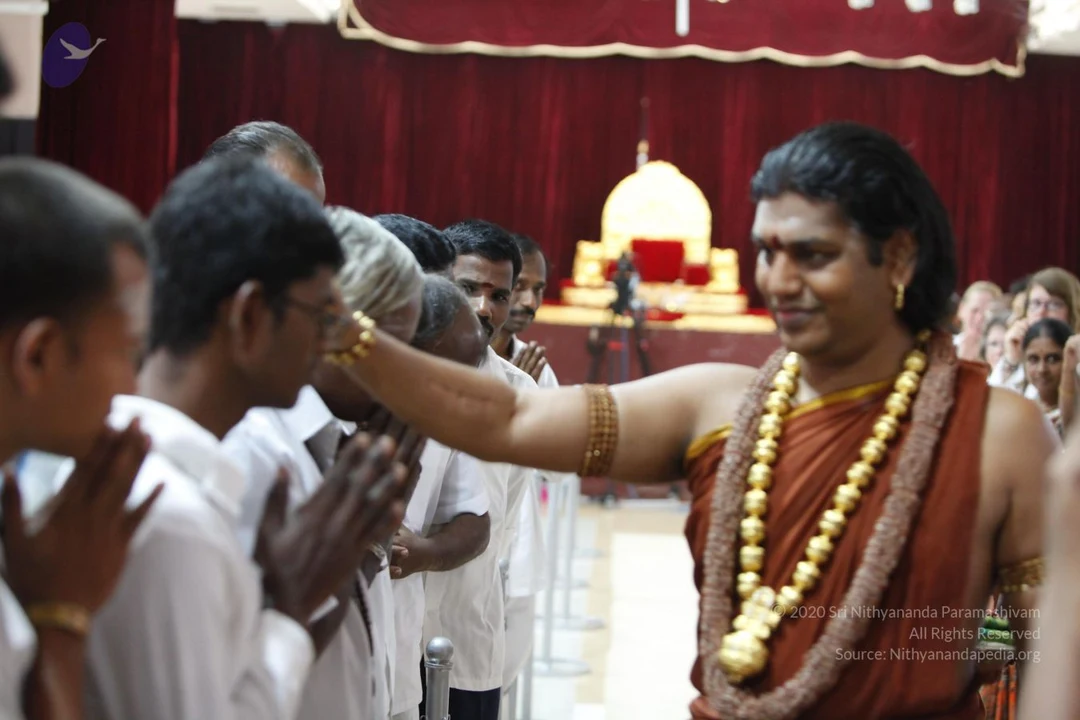
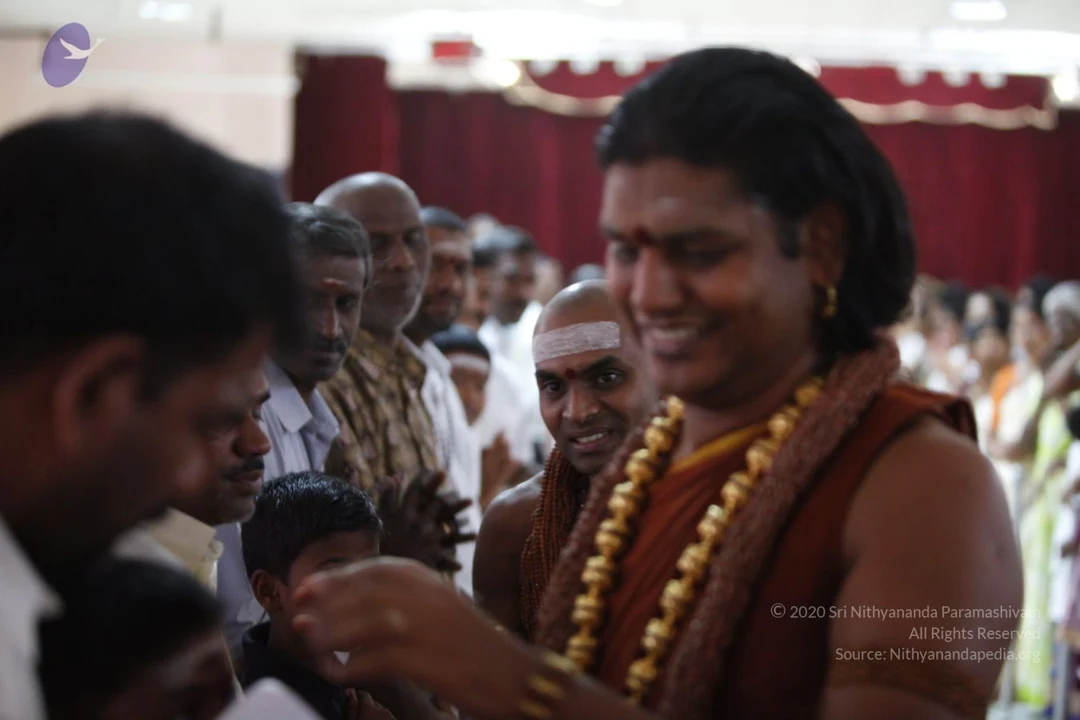
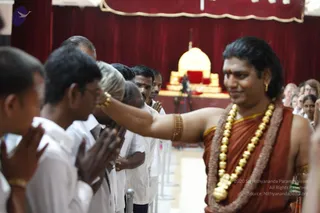
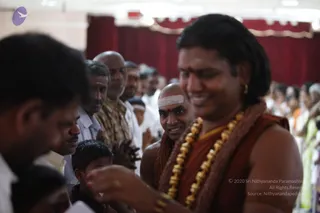
A photograph inside a hall with red velvet drapes and an ornate gold throne with a red cushion in the background. In the foreground, a man in an orange-red dhoti with a gold waist band and a long gold-beaded necklace with a large gold pendant smiles and raises his hand to bless a woman in a white top with her hands pressed together in namaskar. Two men with folded hands stand to the left. Behind, a man with a shaved head and white tilak, wearing an orange cloth and rudraksha mala, carries a tray, and a woman in an orange sari stands near the stage. A camera on a tripod and cables are visible. The scene suggests a darshan or blessing line. The man giving the blessing has long swept-back hair, gold ornaments and an orange-red garment, a distinctive appearance consistent with a person, though this is uncertain.A man in an orange-saffron dhoti with a gold-toned ceremonial necklace and rudraksha-style beads smiles while a hand touches his head in blessing, apparently giving a darshan. He wears a red kumkum/vibhuti-style mark on his forehead, gold armbands and a gold earring. Around him, devotees in white and dark shirts stand with palms pressed together in namaste. A second orange-robed figure with a white tilak and rudraksha mala stands at right holding a tray, and a bald man in orange stands at left. Behind them, a golden throne-like seat sits before deep red drapes, with a camera on a tripod and a woman in orange robes at upper right.A photograph of a ceremonial event in a hall with red draped curtains. A man with swept-back dark hair and a small red tilak wears a saffron-orange dhoti with a gold border, a heavy gold and rudraksha-style bead garland, gold armlets and bangles, and raises one hand in blessing while holding a folded yellow paper or small packet over a green leaf plate. Several people with folded hands or bowed heads stand in a row at left, wearing white and dark clothes. Behind him, a woman in orange sari stands near a gold-and-red throne-like dais with a golden canopy and a flower garland. a person's appearance includes swept-back long hair, saffron clothing, rudraksha-style mala and gold necklace, consistent with a ceremonial presiding role.A photograph of a man in a rust-orange saffron-toned robe with a thick gold necklace and a rudraksha-style mala, long swept-back dark hair, and a red tilak on his forehead, extending his arm to touch the hands of a line of people. A group of men in white shirts and dhotis stand with palms pressed together in namaste, one with a white head covering. Behind them, a gold and red ornate throne-like seat (peetha) stands in front of a deep red velvet curtain, with a few women in the background on the right. The scene resembles a satsang or darshan line. The man in orange appears to be Swamiji (probable), based on his long swept-back hair, saffron-orange robe, and ornate gold necklace, and is positioned as the central figure.A candid photograph of a satsang gathering in a hall with a deep red curtain behind. In the right foreground, a smiling man with swept-back long dark hair wears an orange-saffron cloth draped over his shoulders, a large gold necklace of ornate beads, a rudraksha mala with brown beads, a gold earring and a red bindi. He reaches toward a young boy in a dark shirt at the lower left. Behind him, a shaved-headed man wearing white tripundra markings and a rudraksha mala smiles. Several men in white shirts and a man in a patterned brown shirt stand among devotees, with women in pale saris and older attendees in the background.

FinalBlessing

1 photoSource gallery
A smiling man in a rust-brown dhoti and shawl with gold borders stands barefoot on an ornate patterned rug, both palms raised in greeting. He wears a long gold-and-beaded necklace, a red bindi, gold bangles and gold earrings. Behind him is a large gold-and-red throne with lion-shaped armrests and a striped cloth draped over it, and a painted deity figure with multiple arms and a crown stands to the left beside a red velvet curtain. The setting appears to be a stage-like satsang hall.

Rudra-Abhishekam
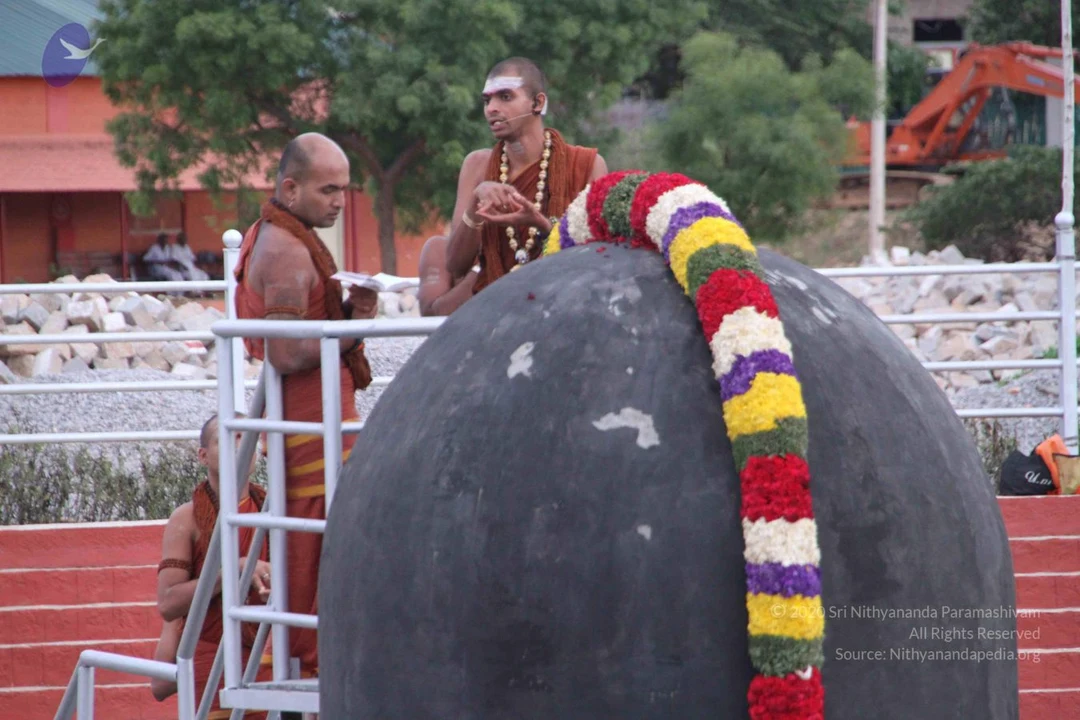
150 photosSource gallery
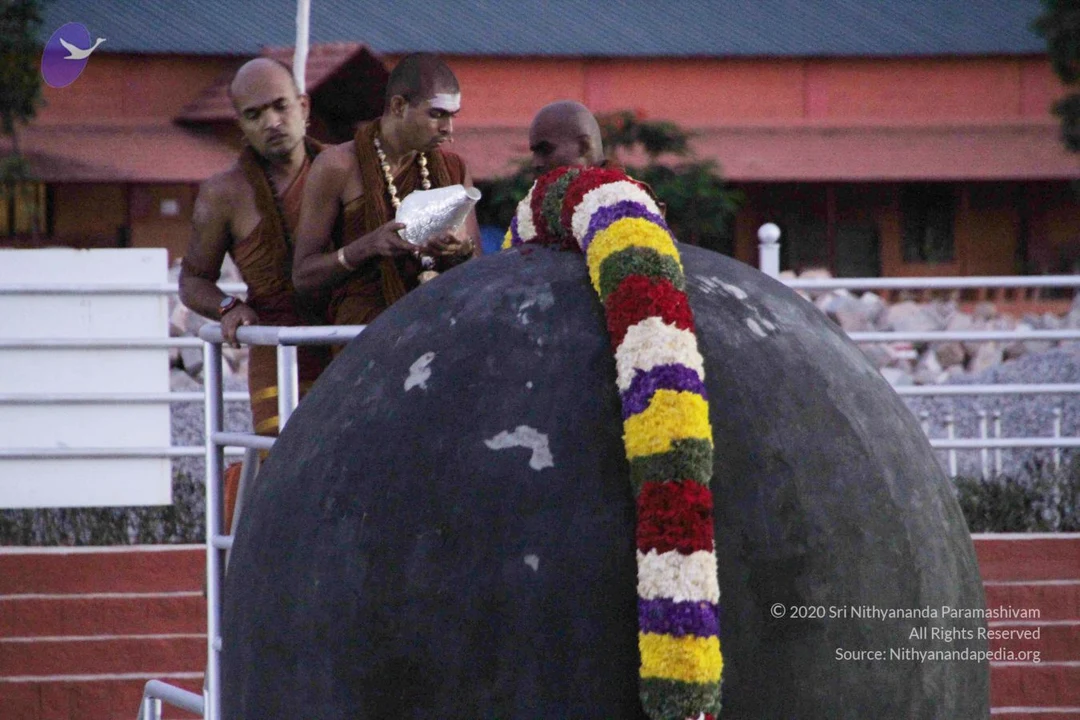
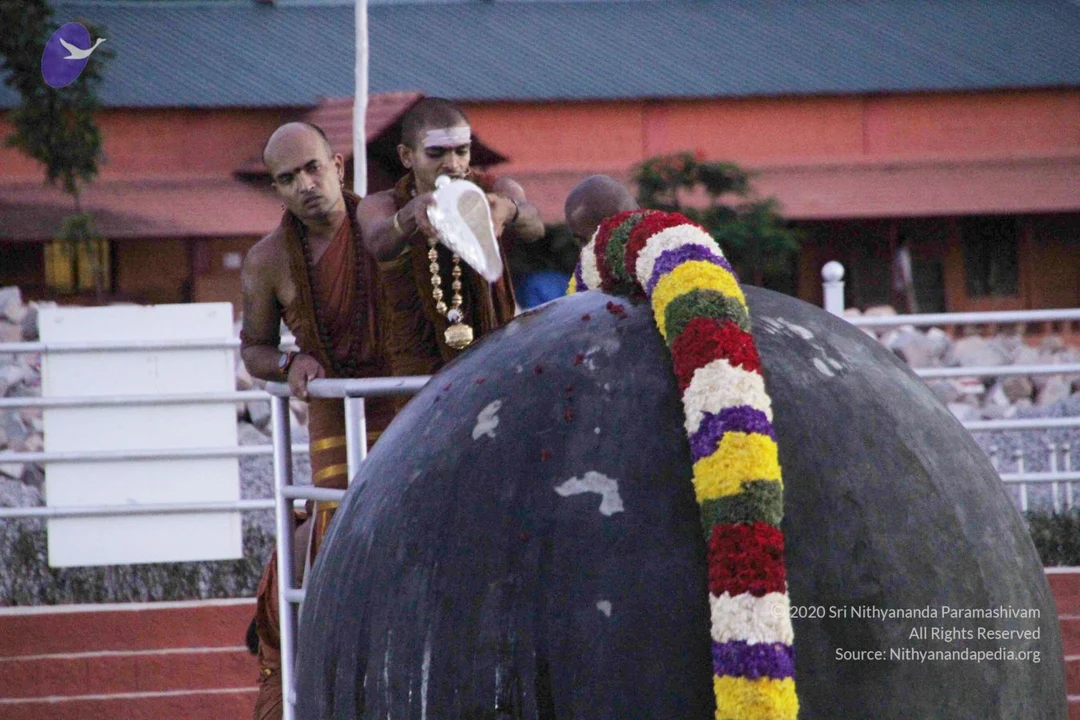
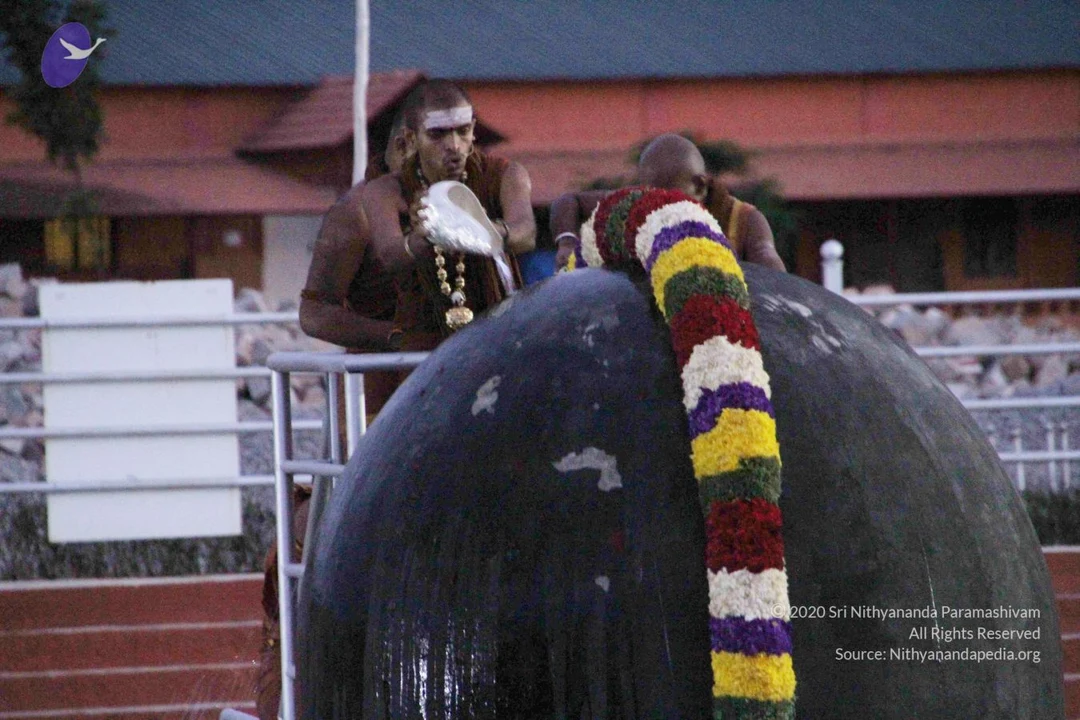
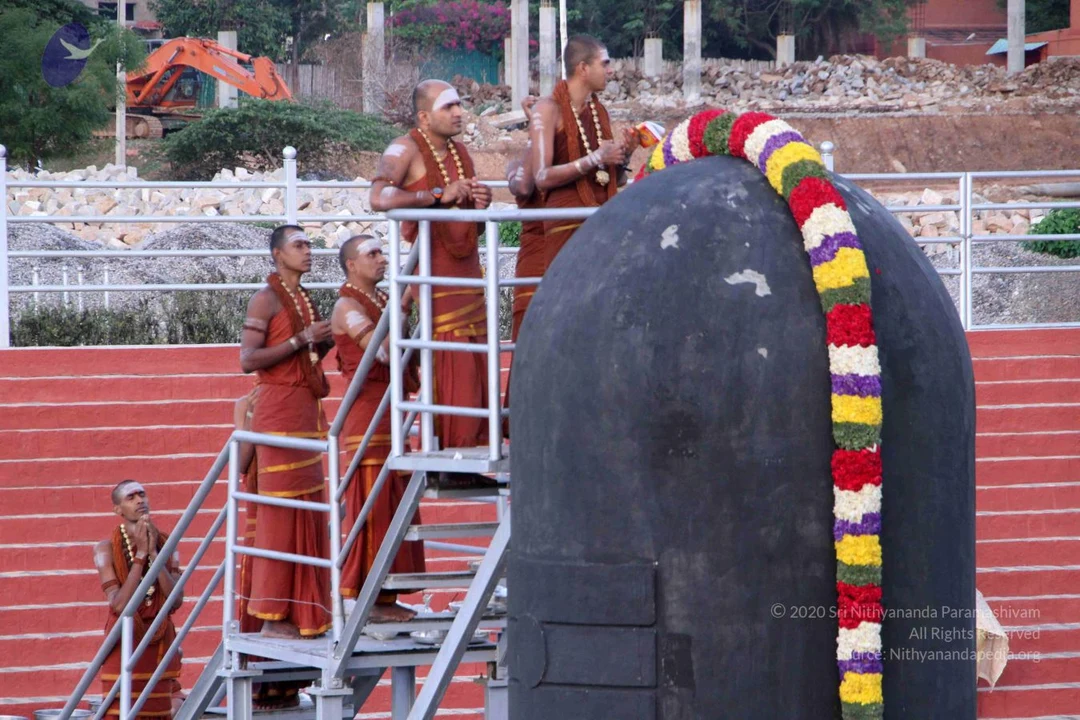
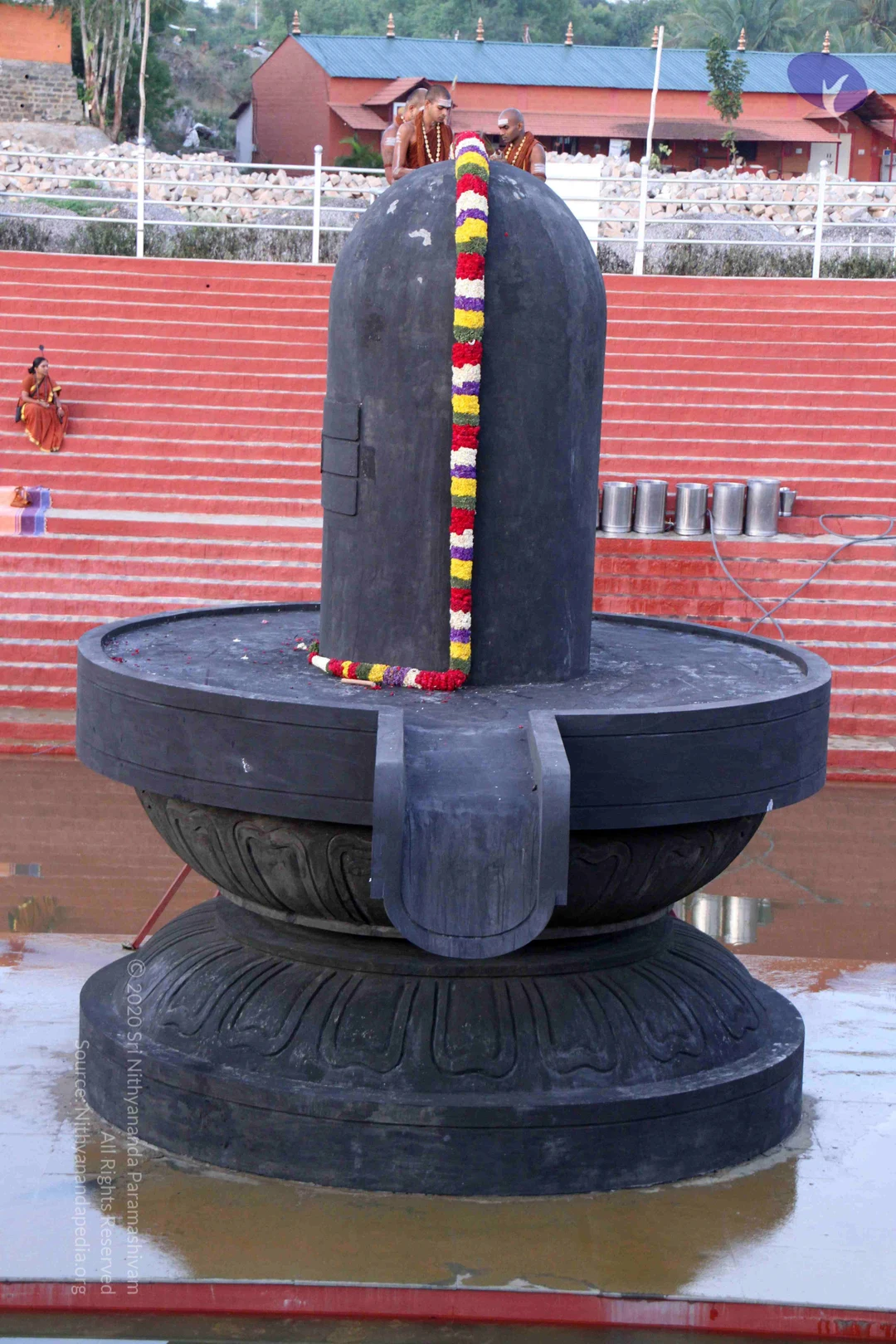
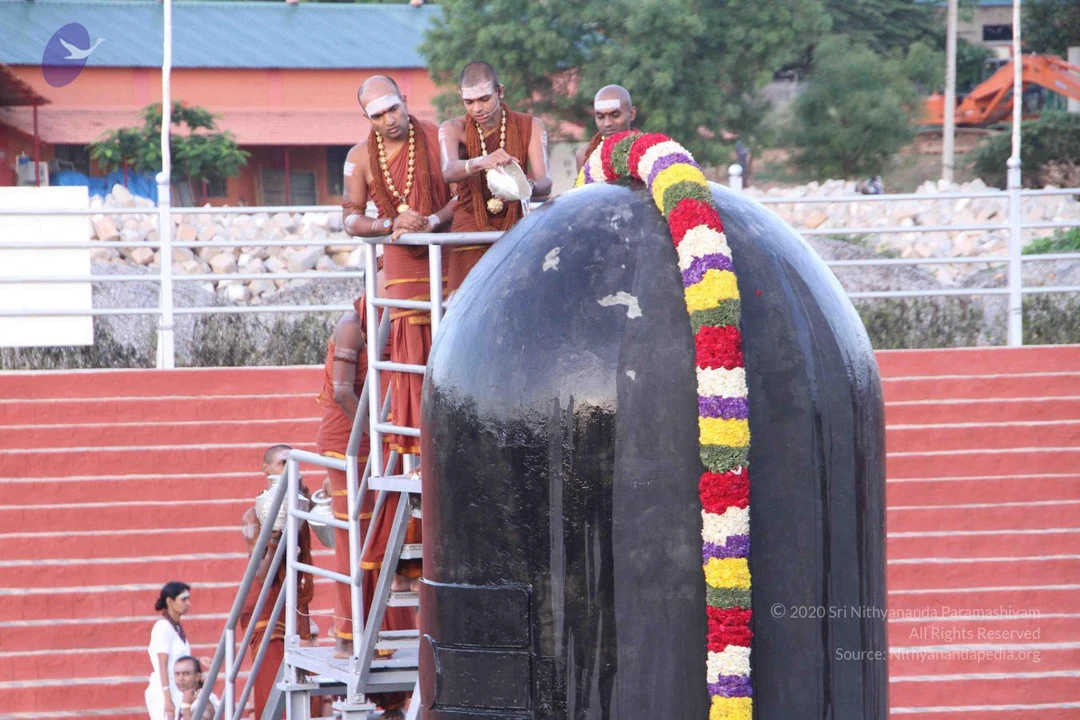
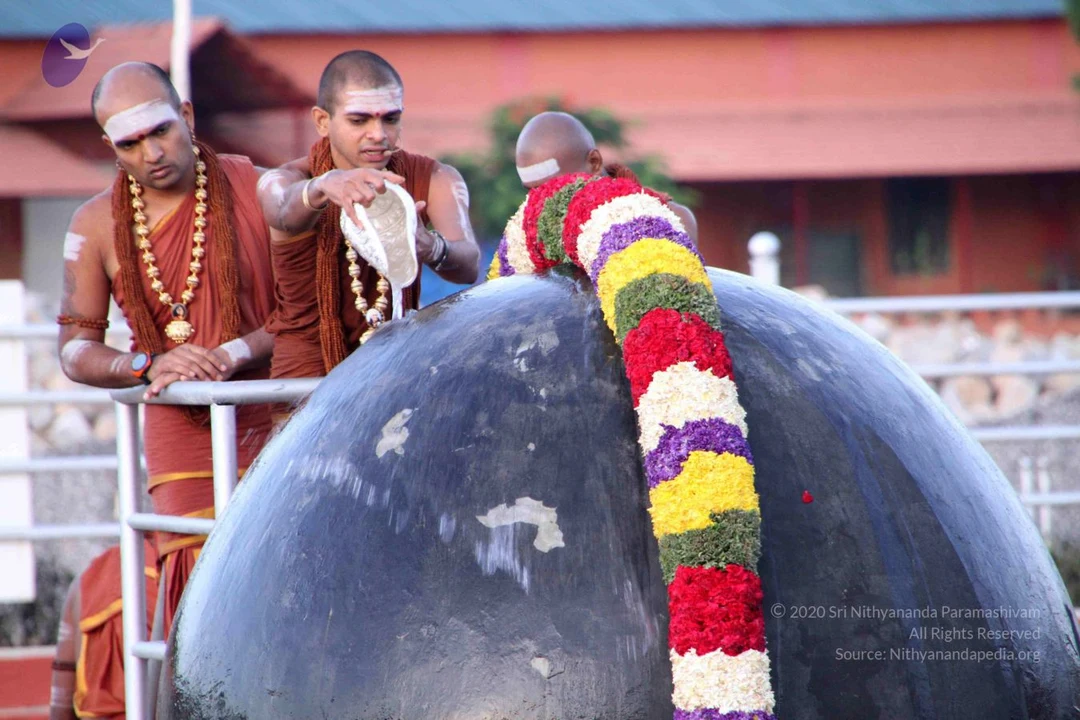
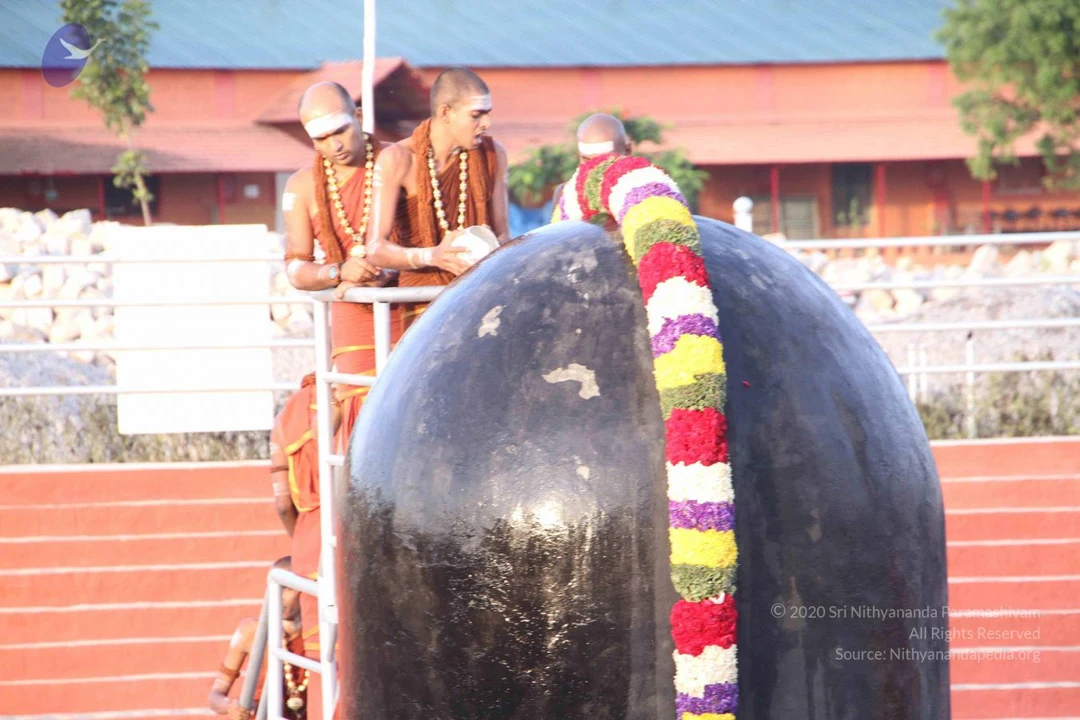
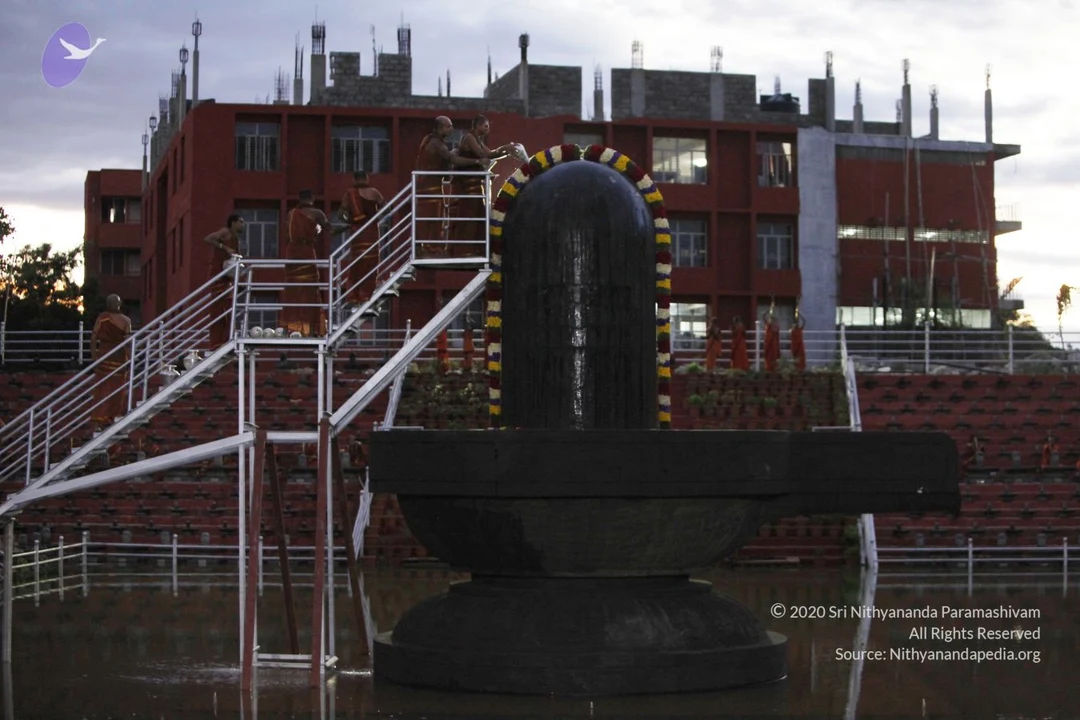
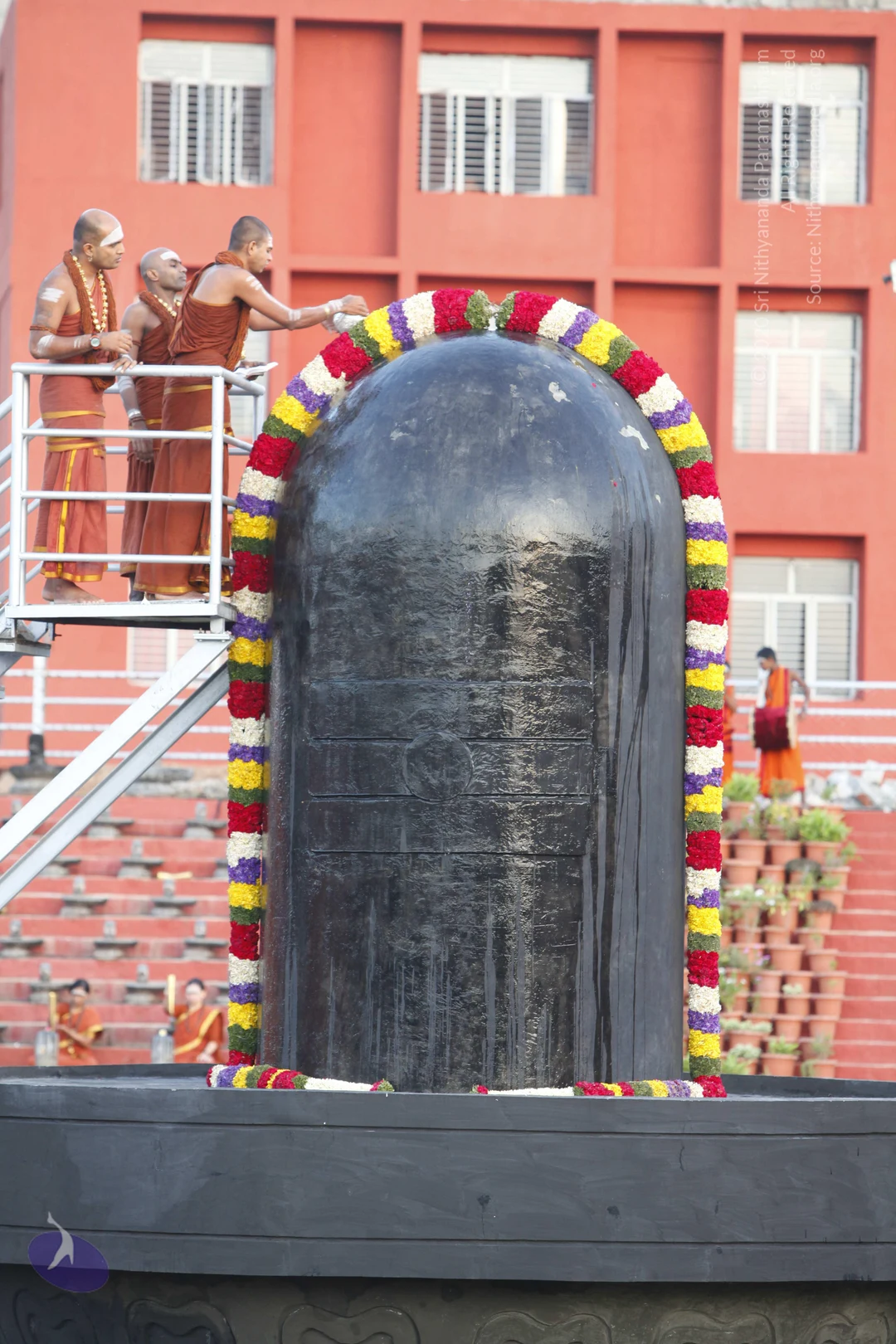
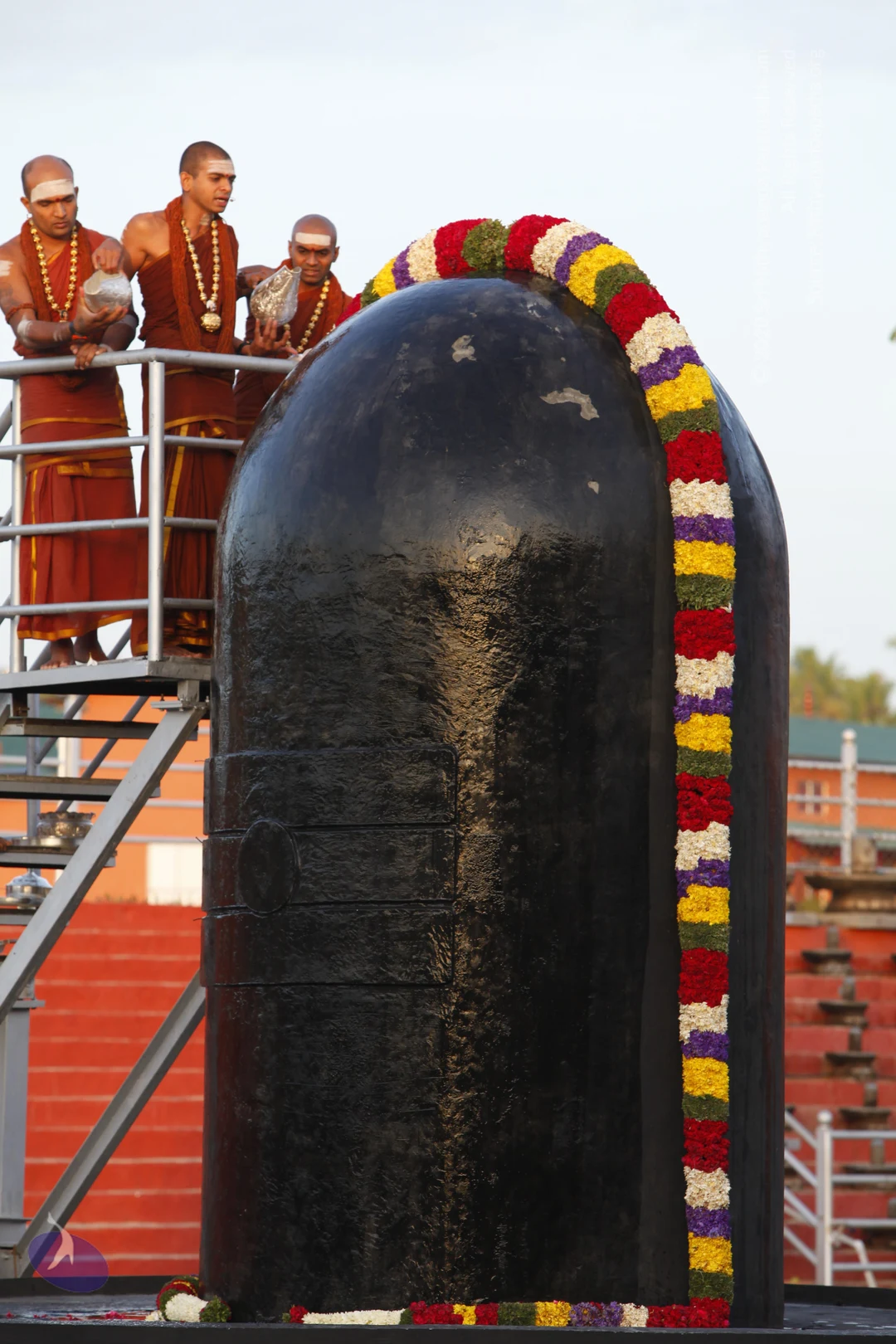
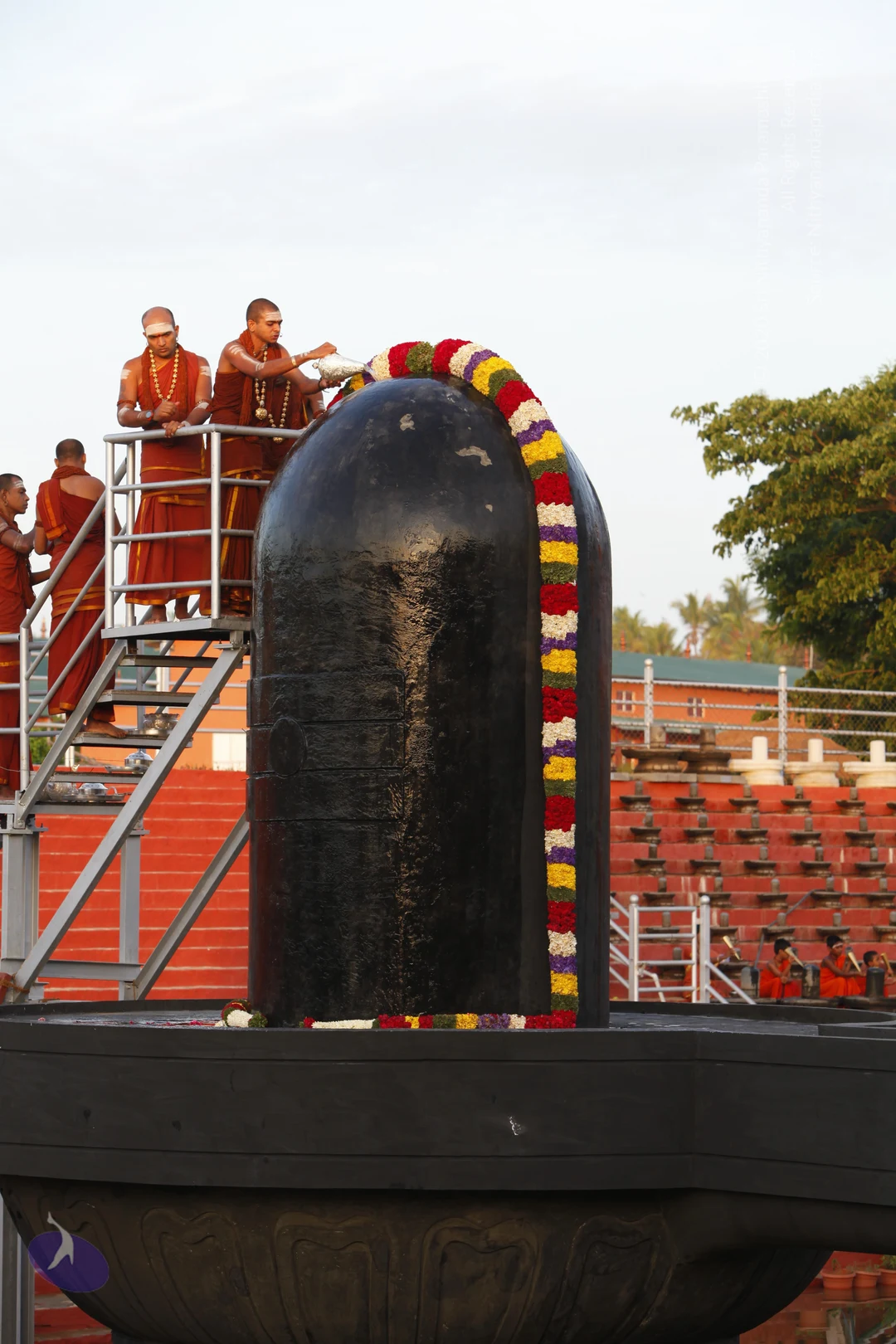
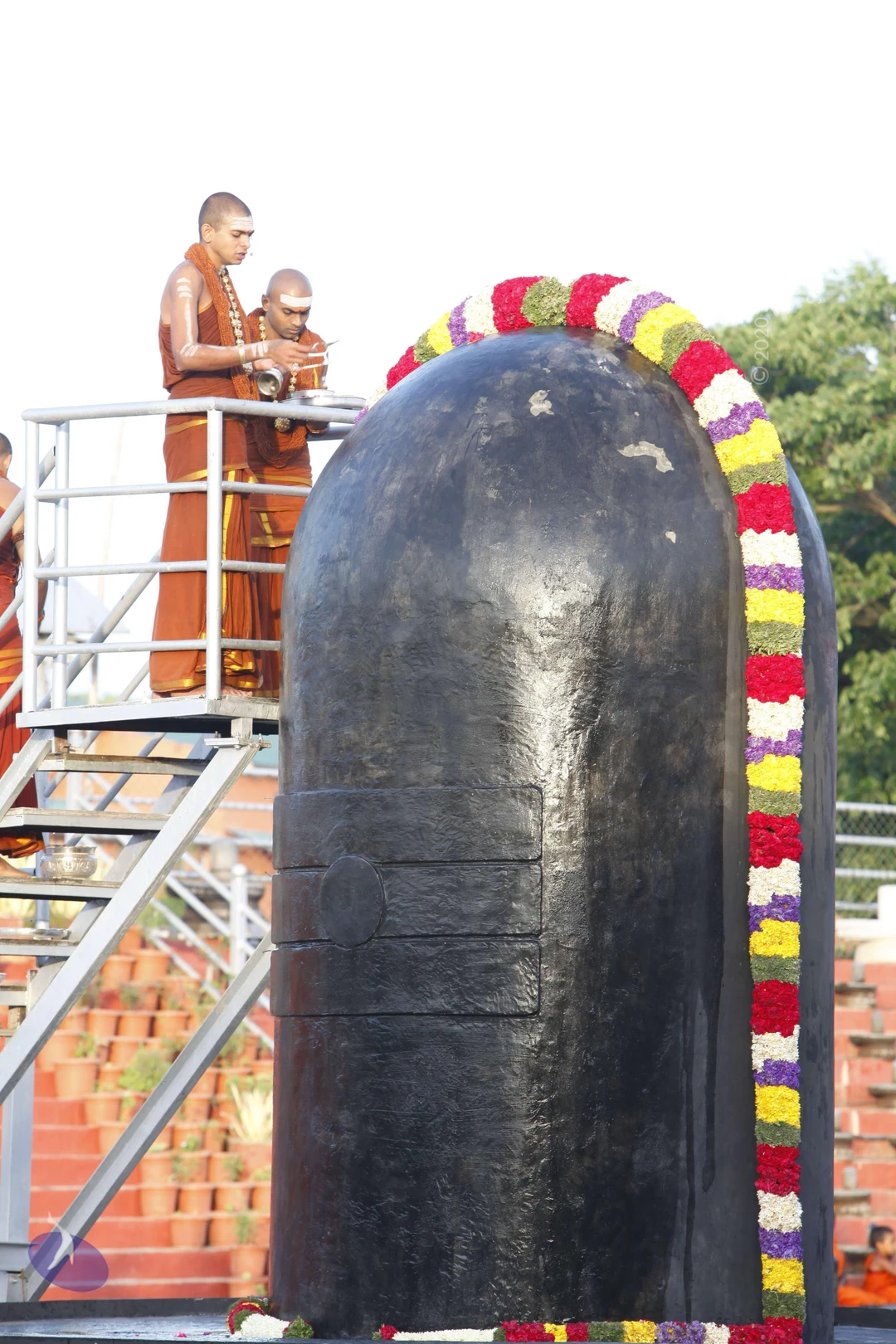
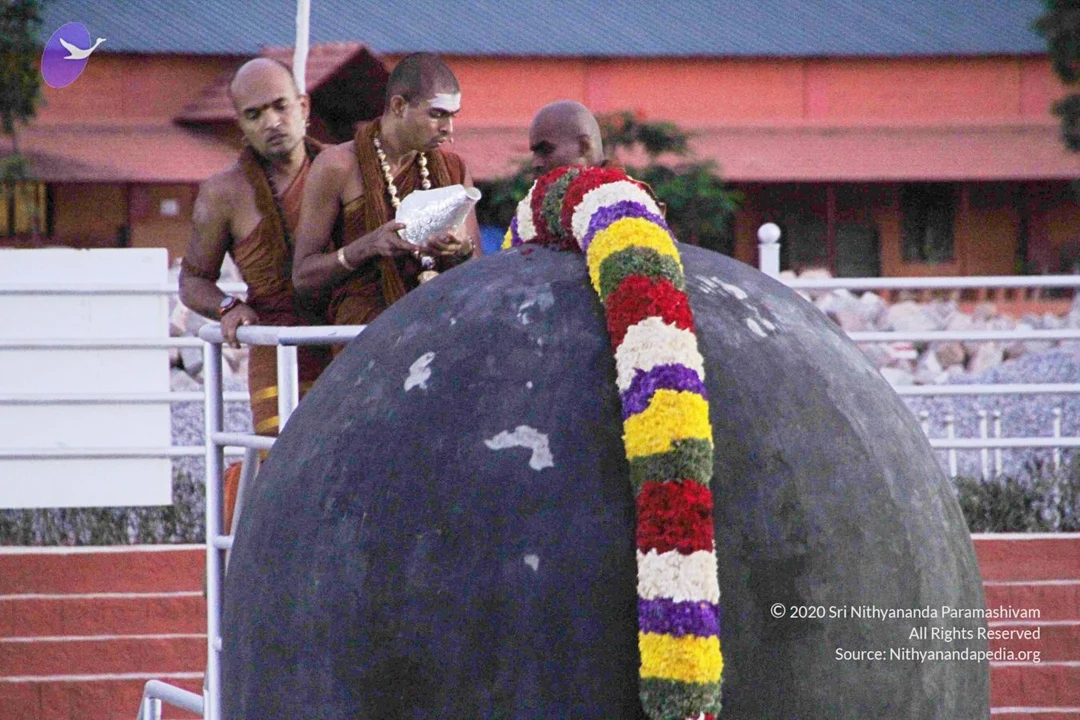
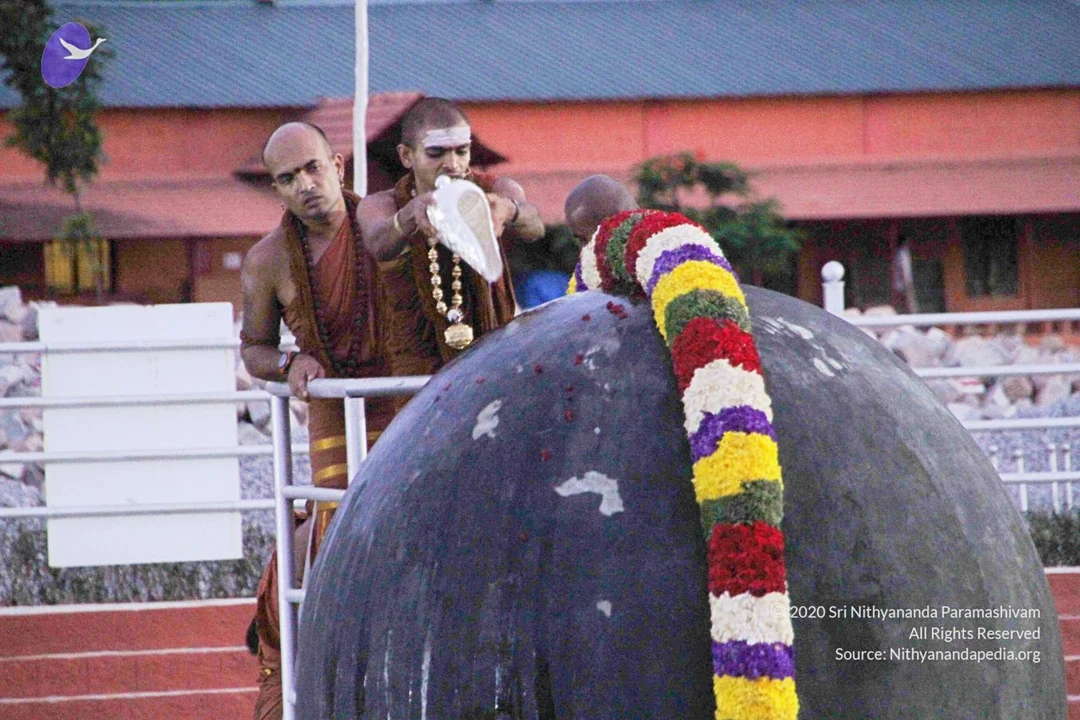
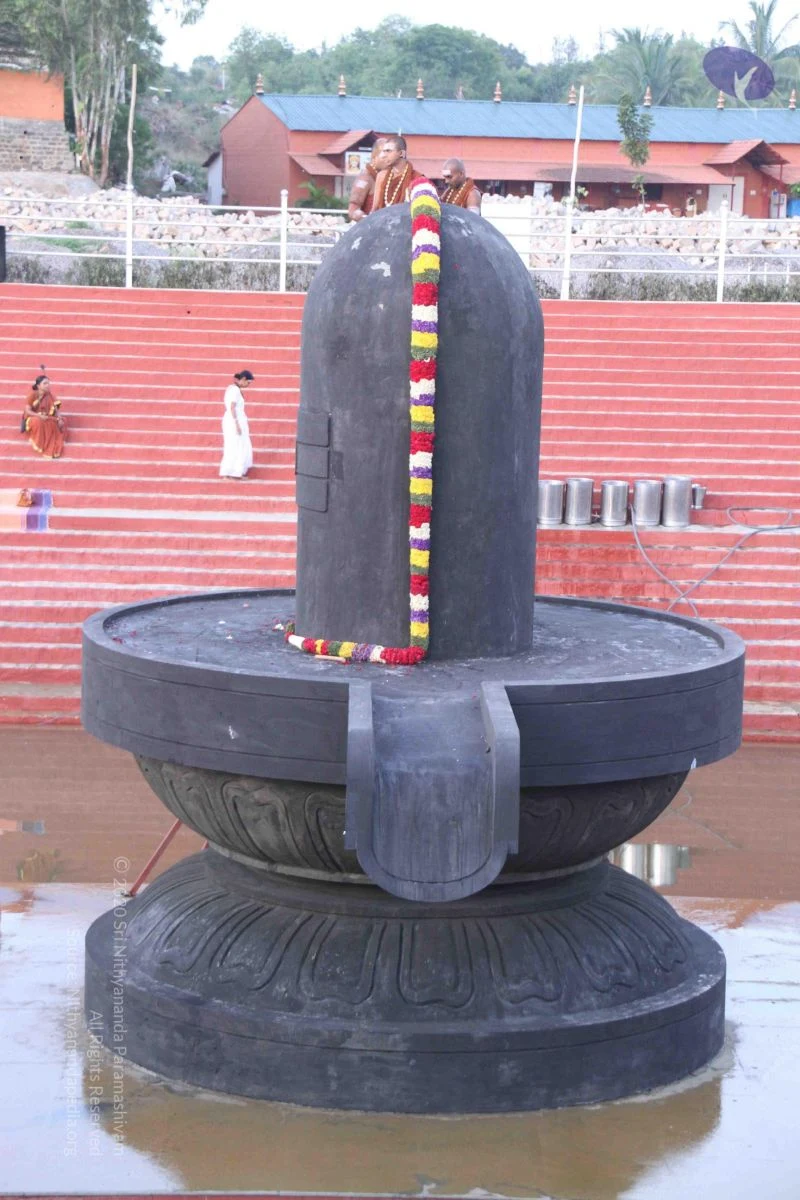
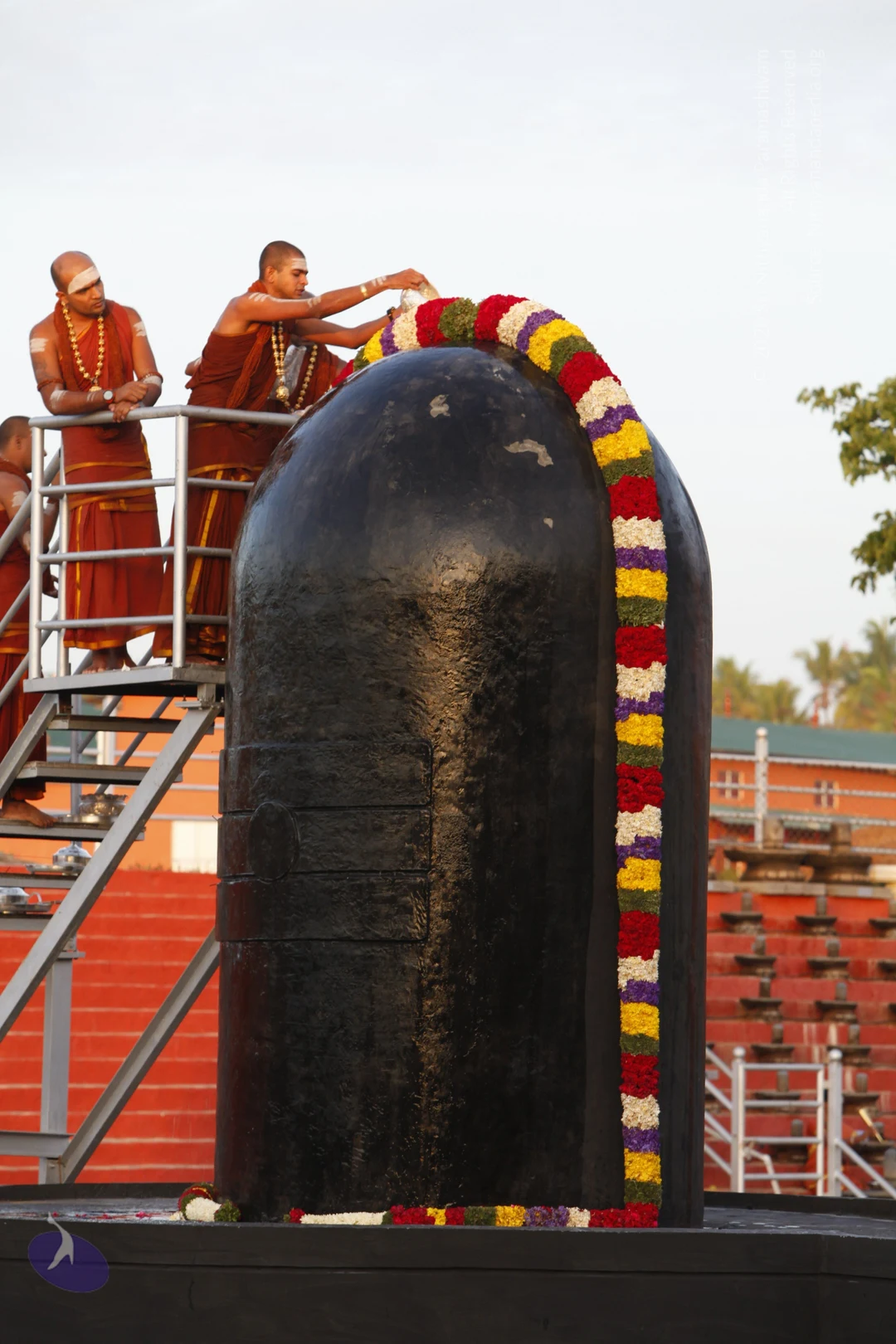
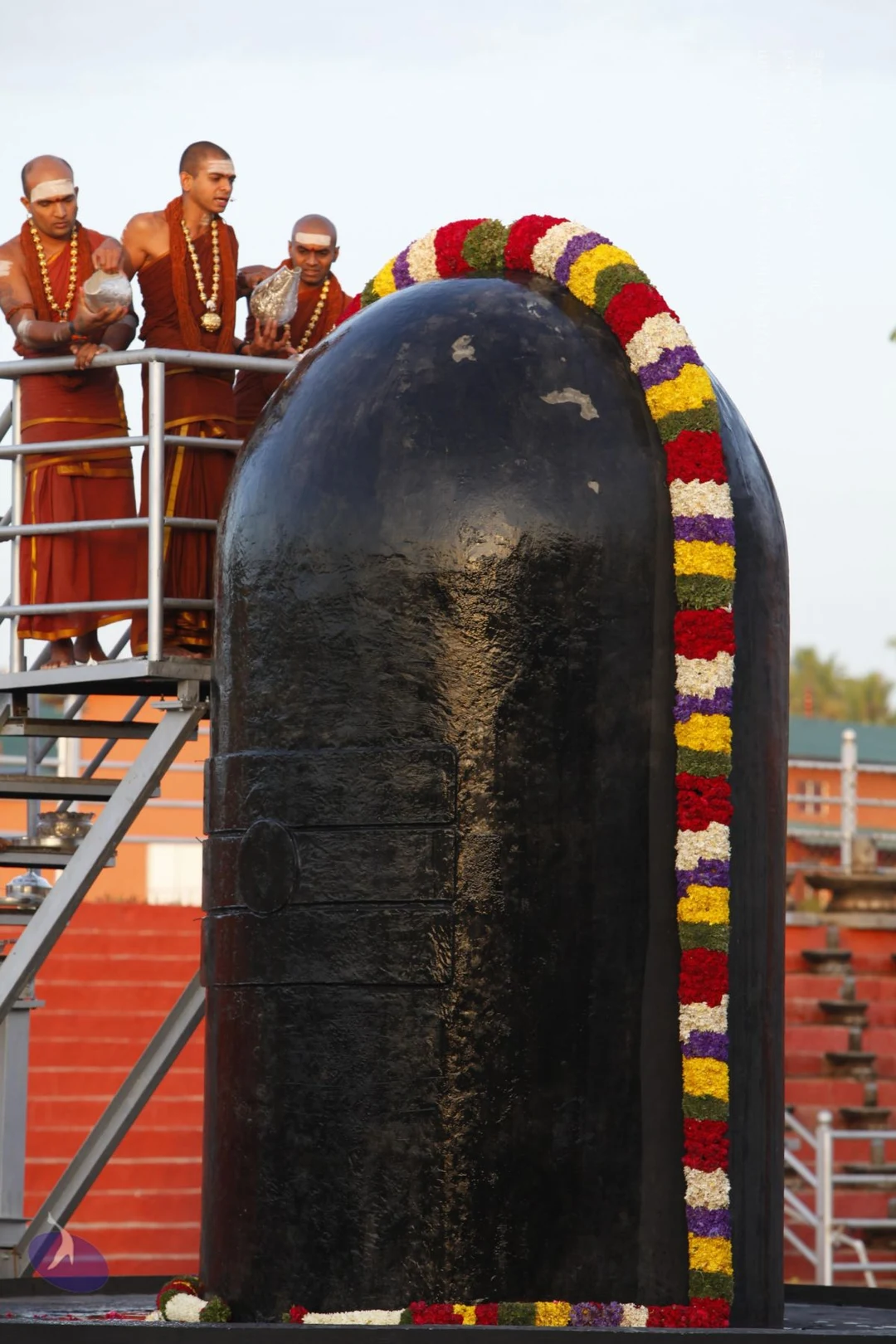
Outdoor temple scene at a large dark polished black stone lingam, wrapped with a multicoloured garland of red, white, yellow, green and purple flowers. Two priests in saffron-orange dhotis and shawls stand at a white railing; the nearer one wears a gold necklace and holds a silver-foil packet or plate, while the other, partly visible at right, is shaved-headed in saffron. A red-tiled building and white railings form the background. This appears to be a lingam abhishekam or puja. No clear visual cues establish the identity of any person, so the priests are described by role only.
MorningMessage

2 photosSource gallery
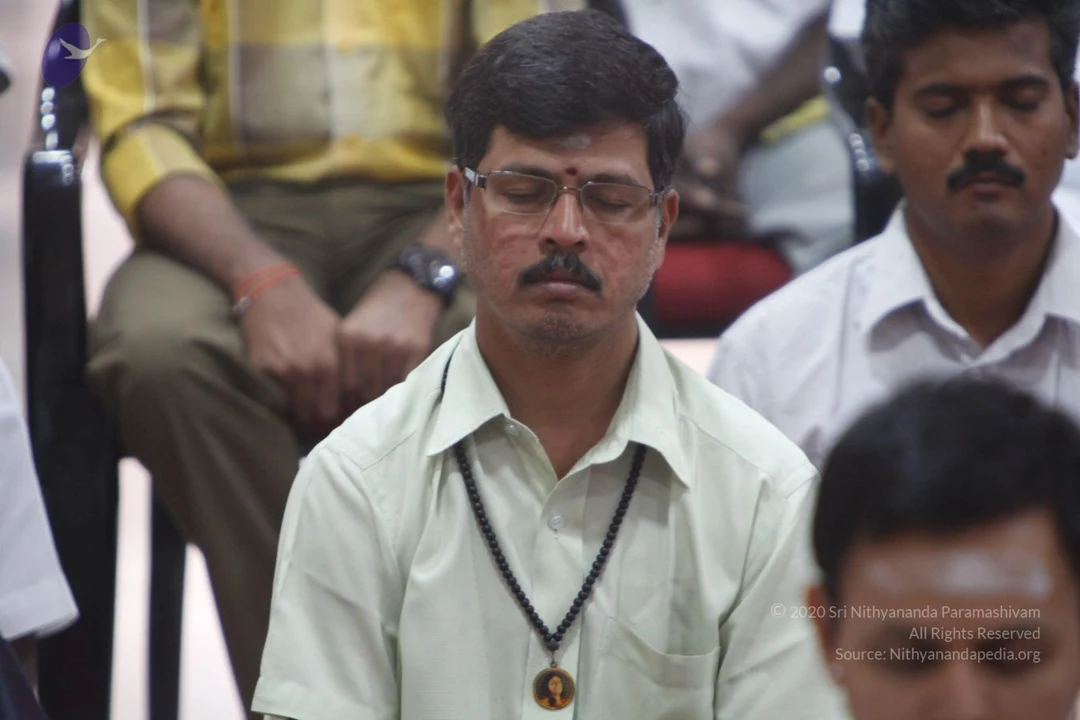
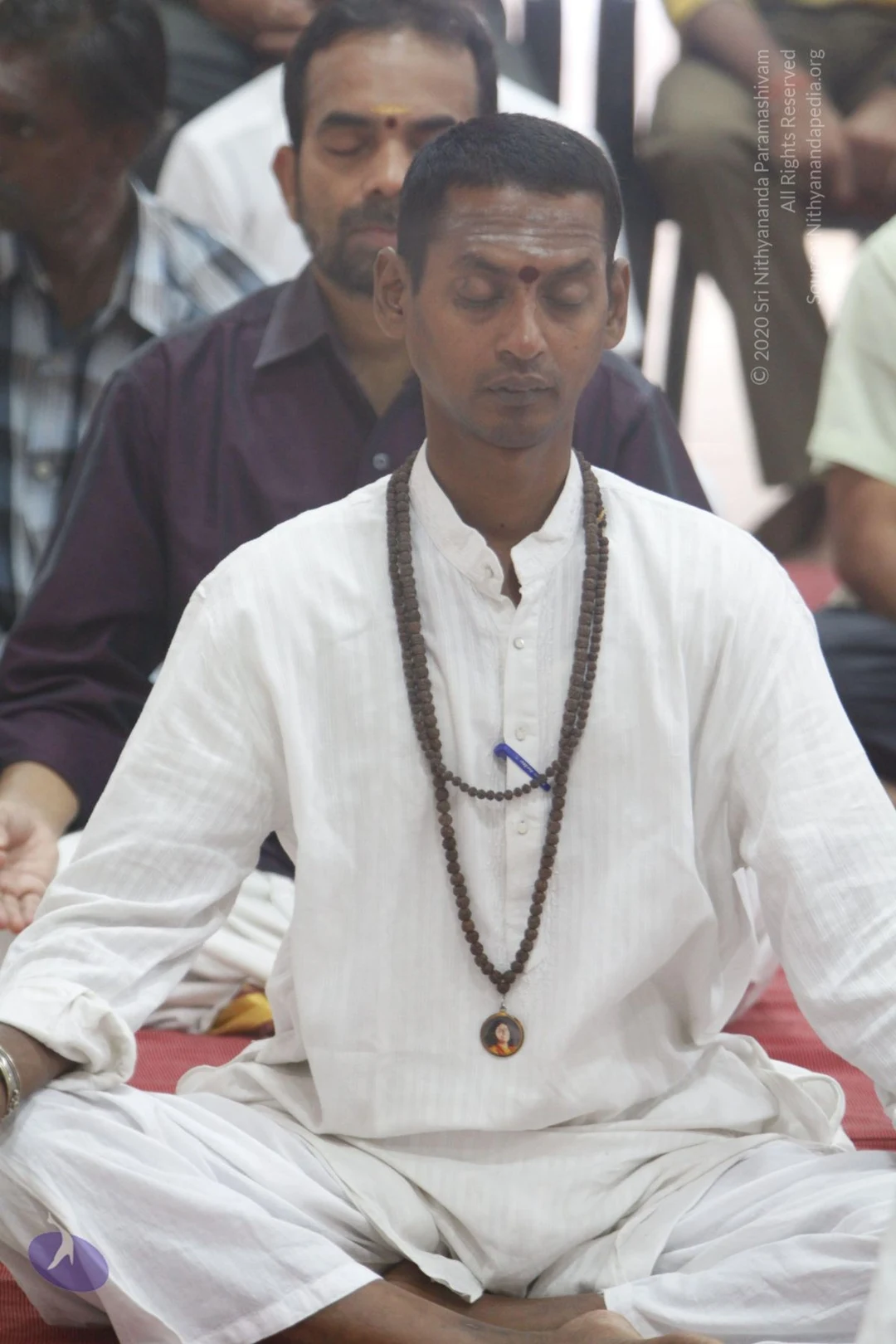
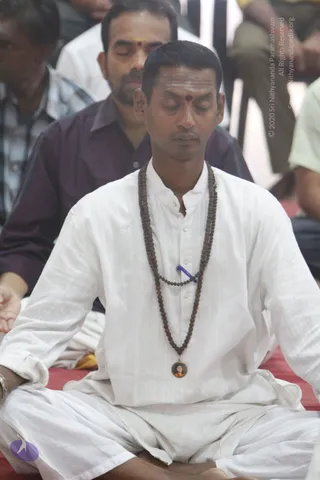
A man with a short haircut and a red bindi sits cross-legged on a red mat with eyes closed in meditation. He wears a white kurta and white dhoti, with a dark rudraksha mala hanging to his chest and a small round pendant showing a portrait. Behind him, other seated devotees in dark and checked shirts also meditate with closed eyes. The setting appears to be a hall during a satsang or meditation session.

FinalBlessing

1 photoSource gallery
A smiling man stands barefoot on a red carpet in a temple-style hall, wearing a rust-brown dhoti-style garment with gold borders wrapped over one shoulder, a rust-brown shawl, a double strand of gold beads and rudraksha-like beads, gold armlets and bangles, and a red bindi on his forehead. He has long dark hair swept back and gold earrings. Behind him are an ornate gold and red-cushioned seat with carved lion-headed arms, a gilded canopy, and a painted statue of a deity with a gold crown on the left.
June 04 2013

1 photoView all
A photograph in a hall with a deep red curtain backdrop and a golden shrine or throne in the background. A bare-chested man in rust-orange robe with a gold waist band and a heavy gold necklace of large beads over rudraksha strands touches the forehead of a devotee with his right hand, while the devotee's hands are folded in prayer. Two men in white and a shaved-headed monk in orange stand to the left, a monk in orange with a white forehead mark holds a tray of offerings at the right edge, and a woman in orange sari stands on the stage behind. The man giving the blessing has long swept-back hair, gold bangles and an ornate gold necklace, cues consistent with Swamiji (probable) performing a blessing.