Skip to content
Wednesday

5 June 2013

Dated photos
224
Source pages
1
Media
2
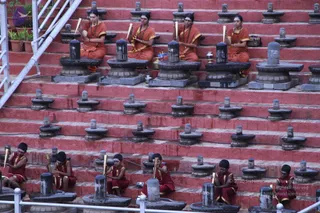
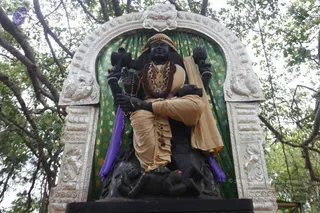
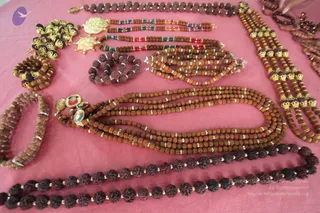
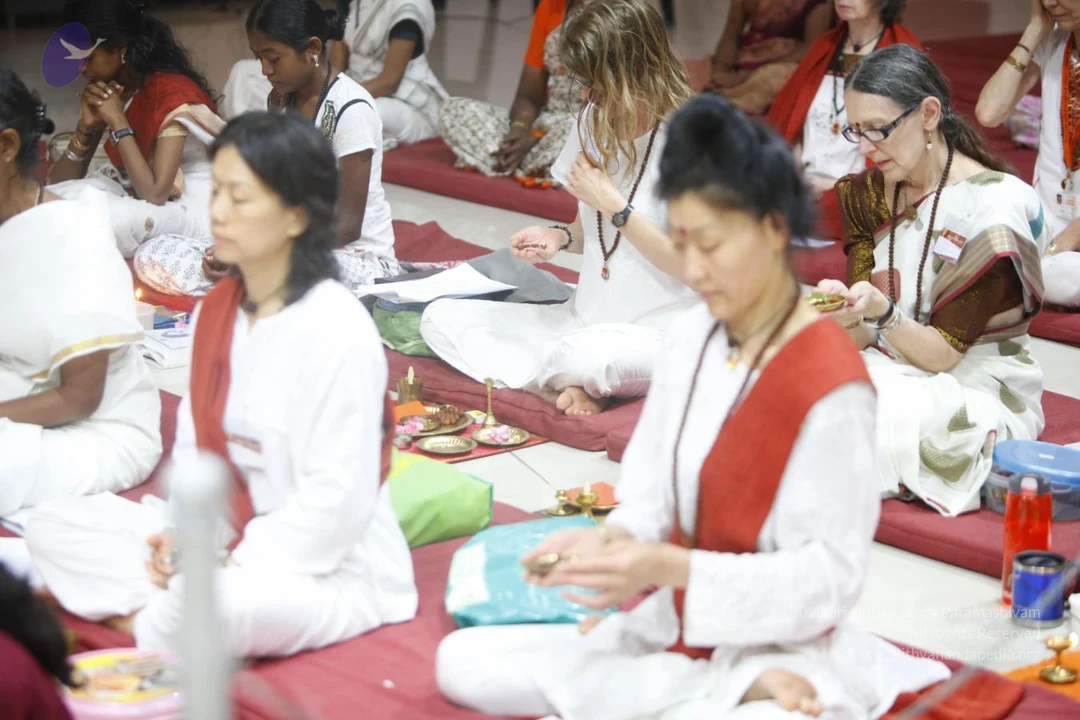
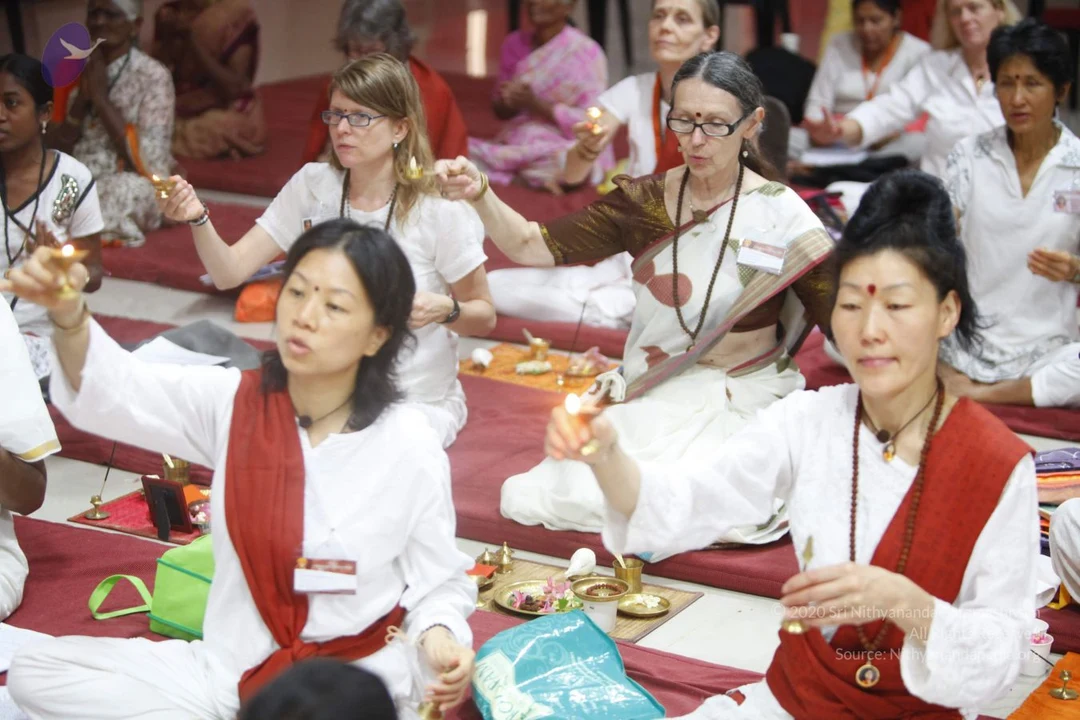
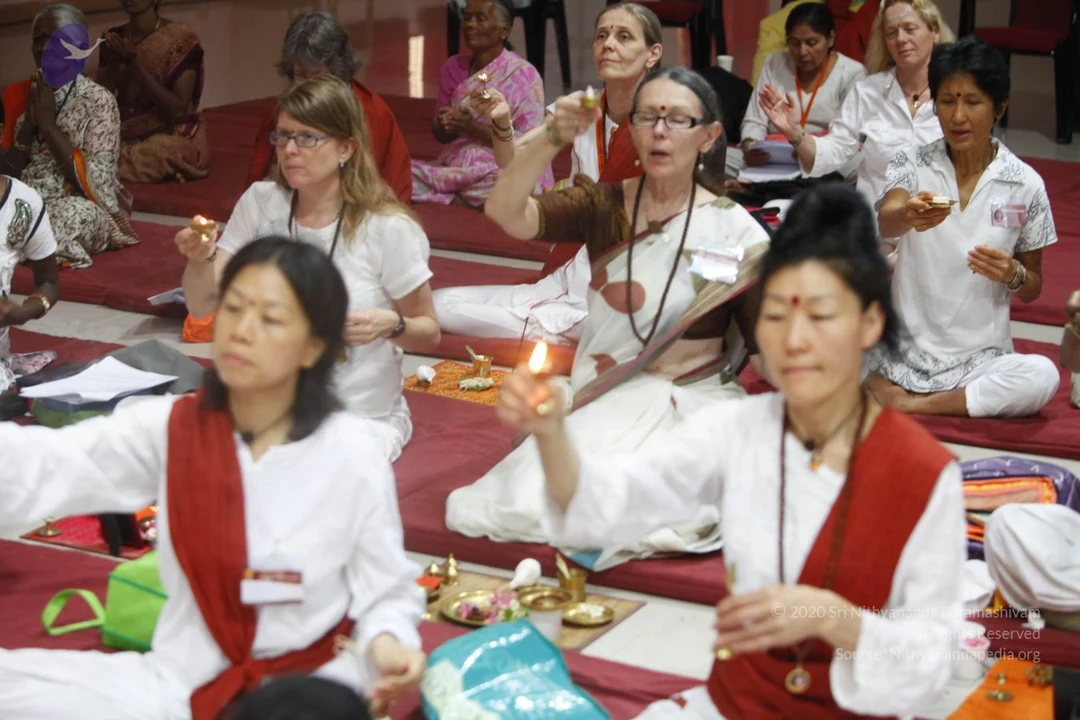
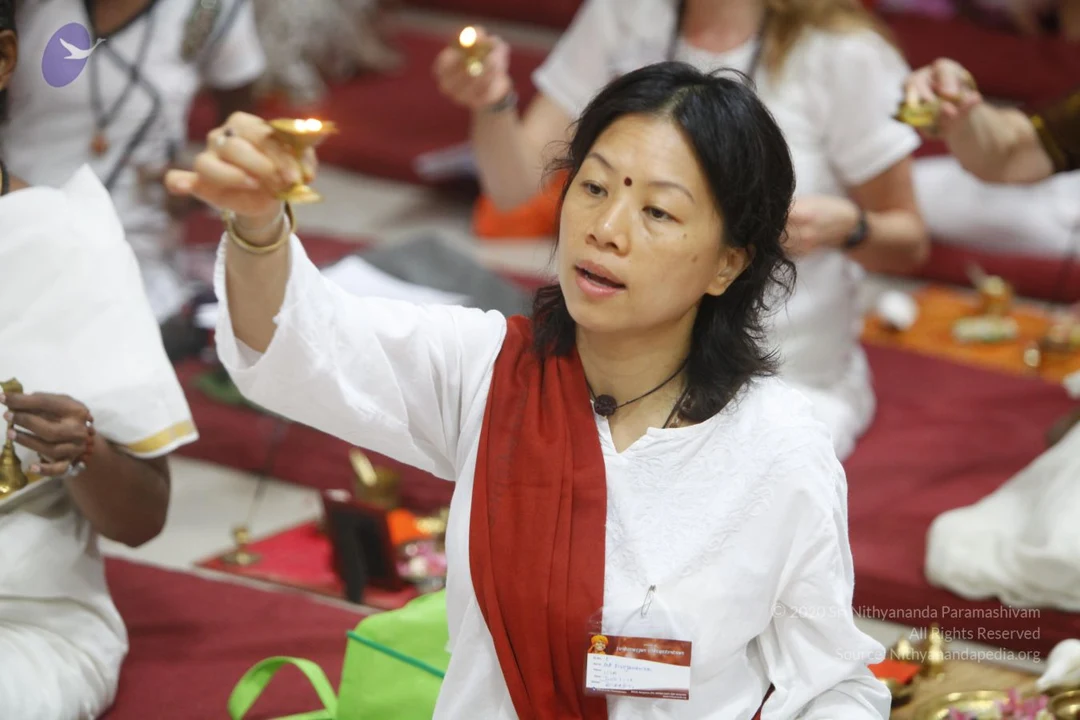
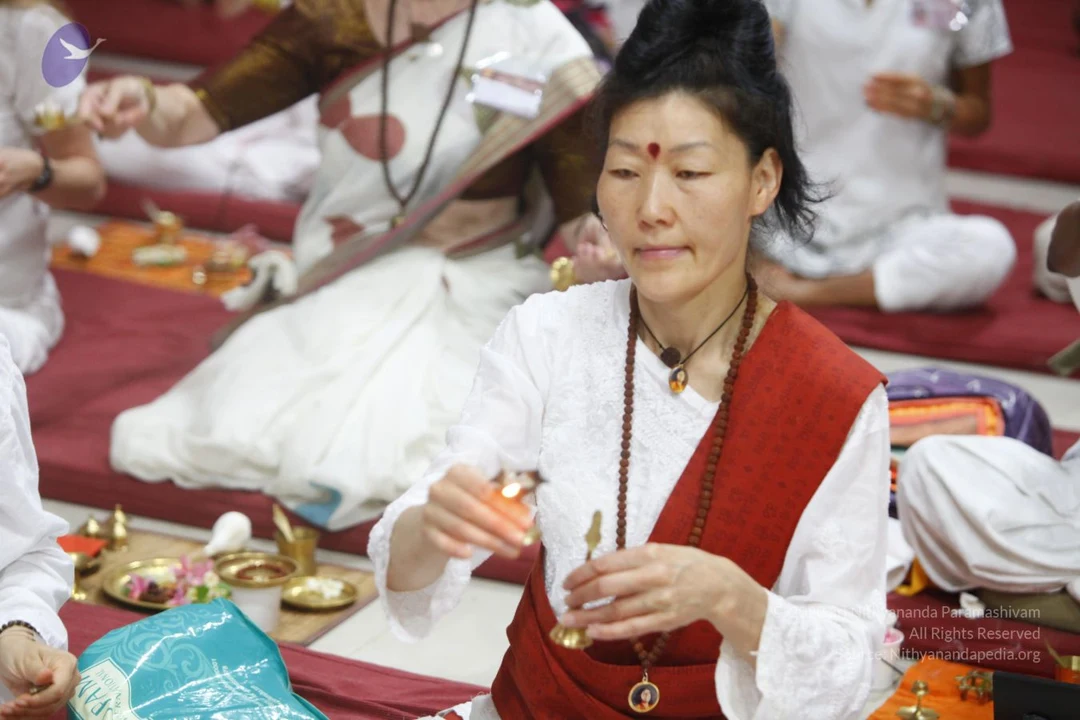
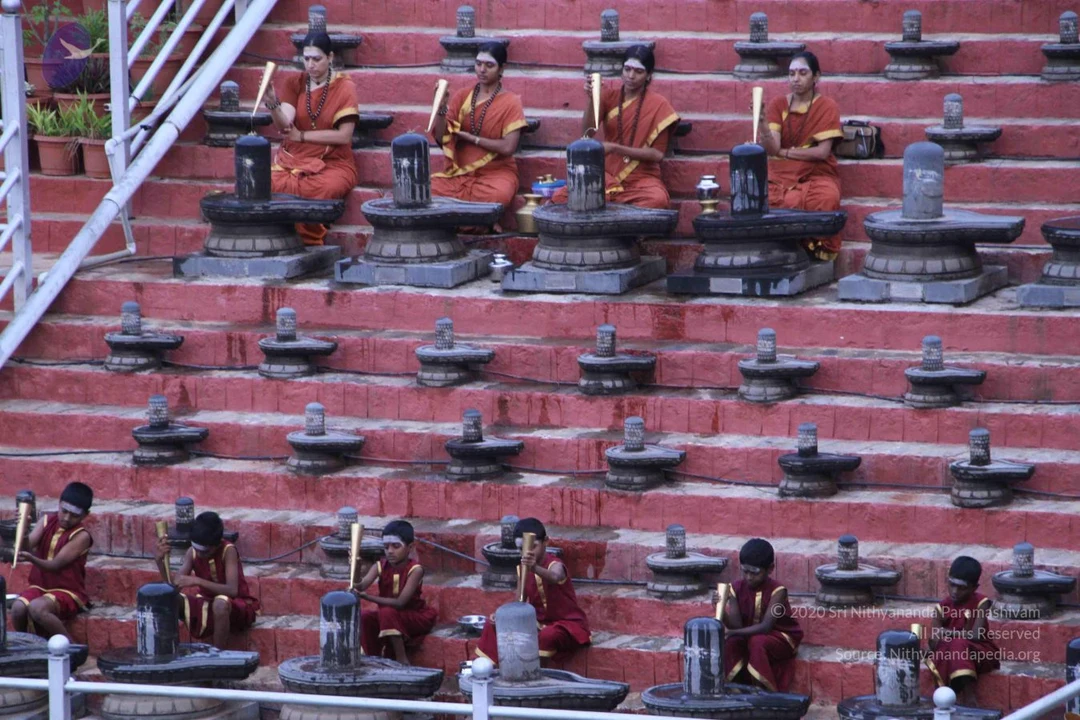
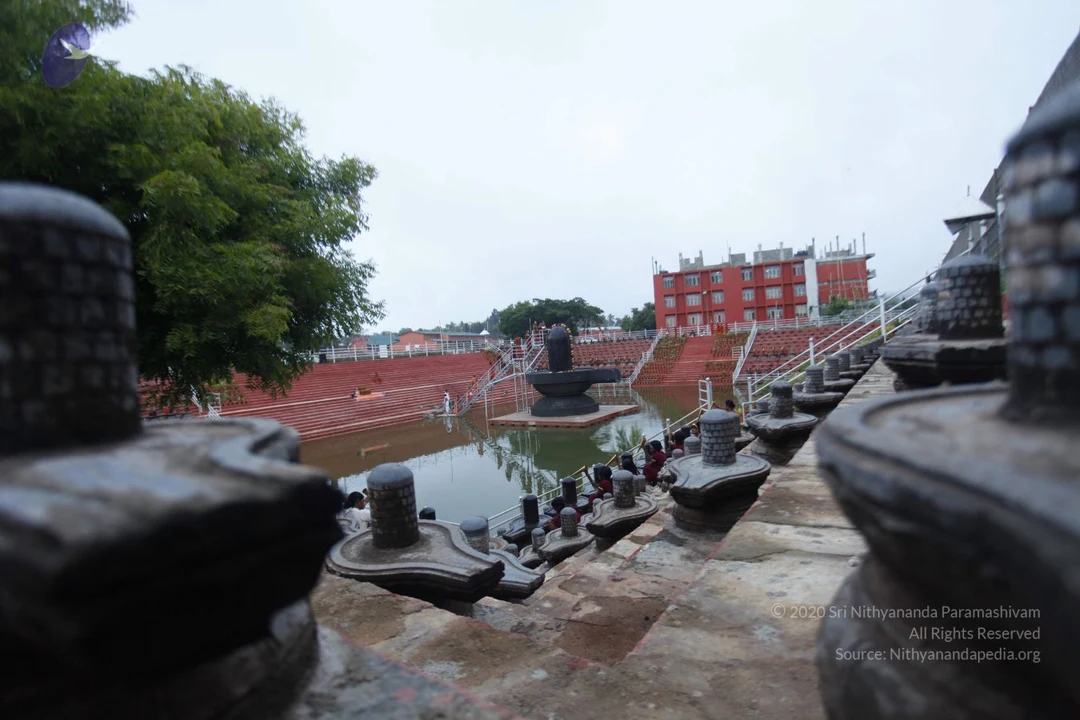
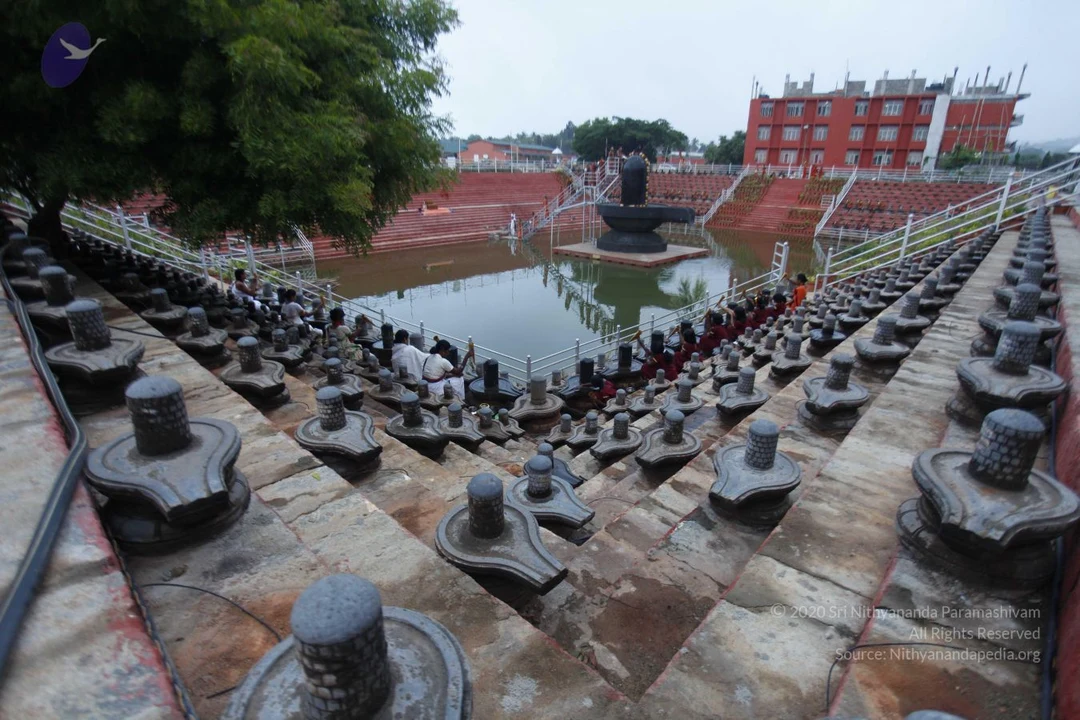
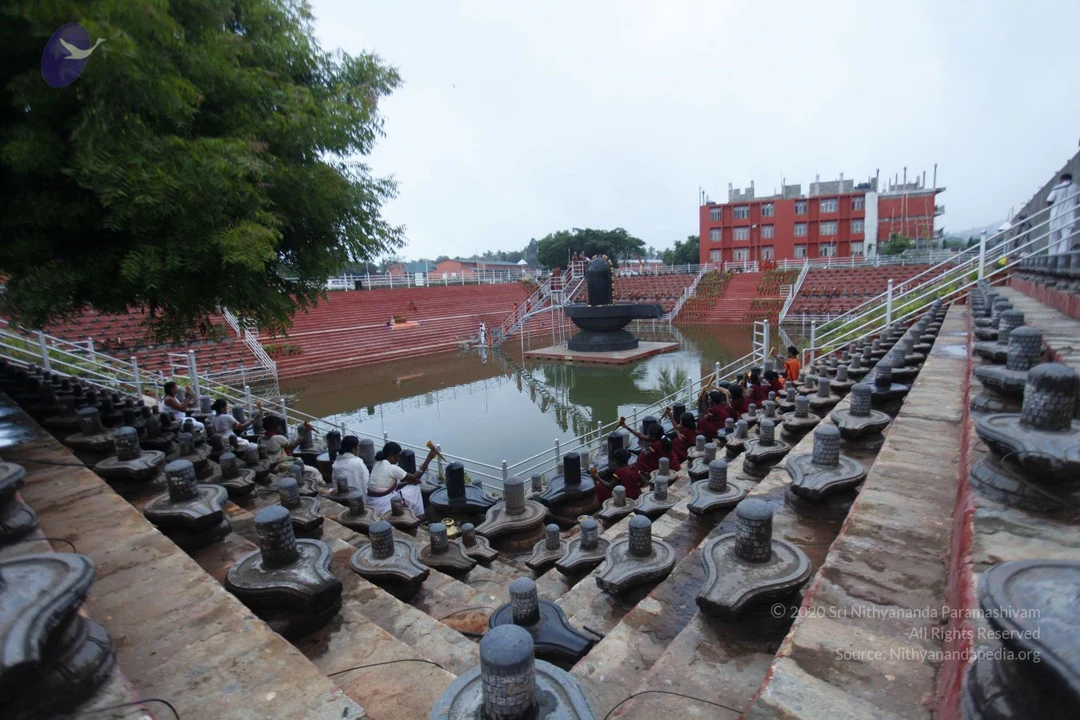
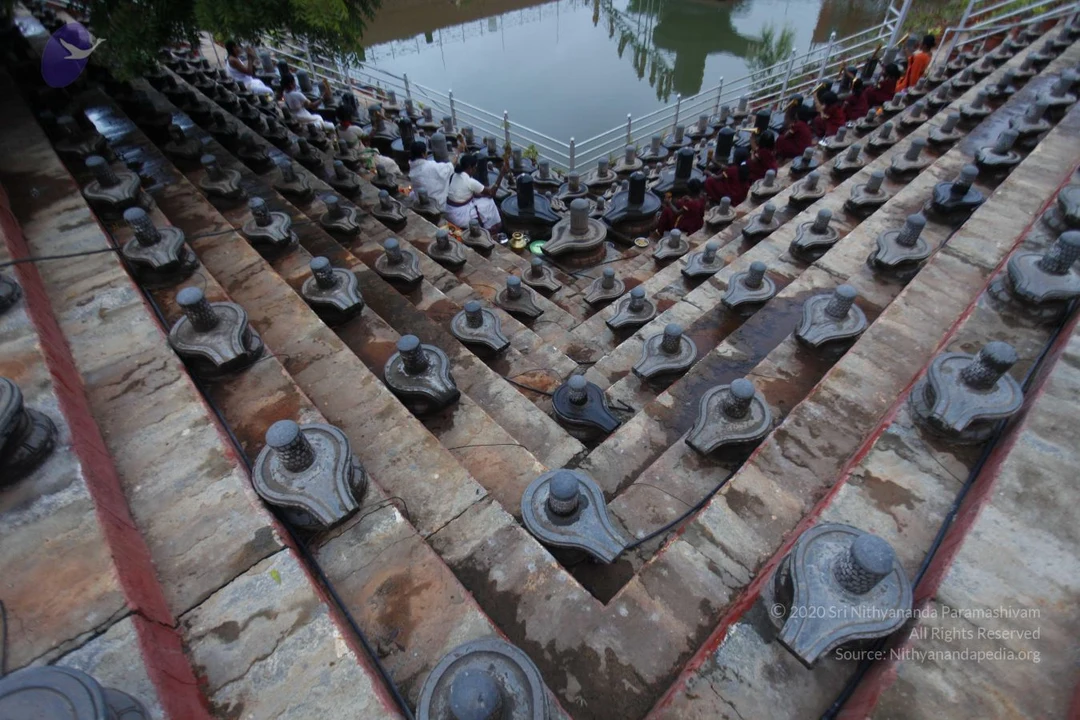
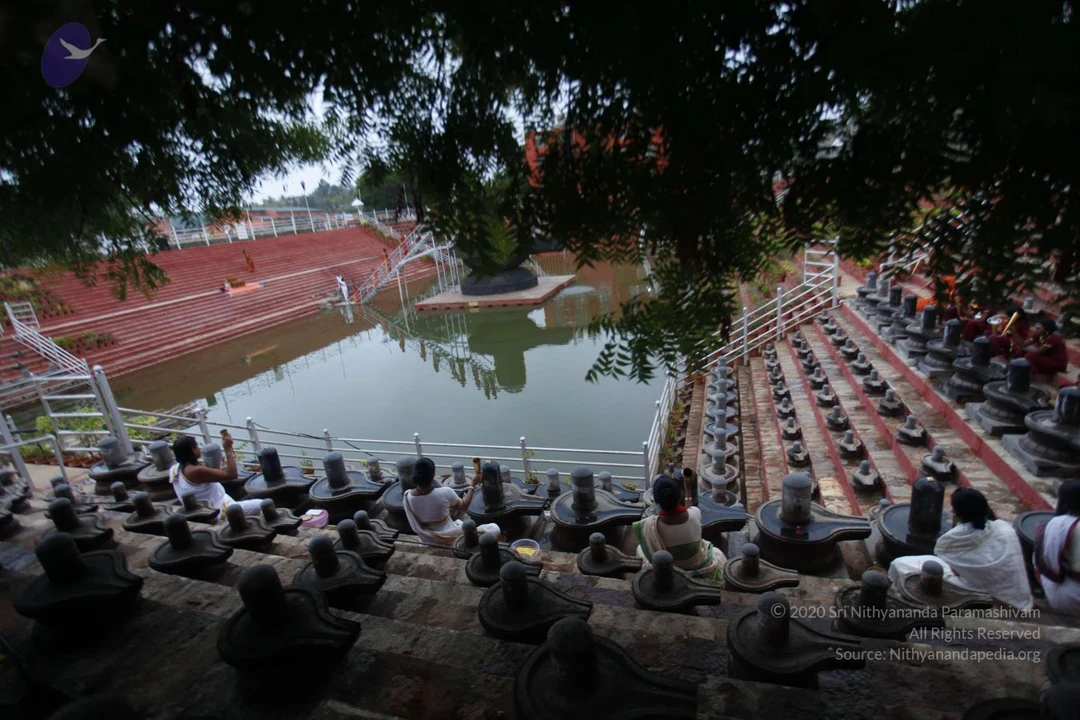
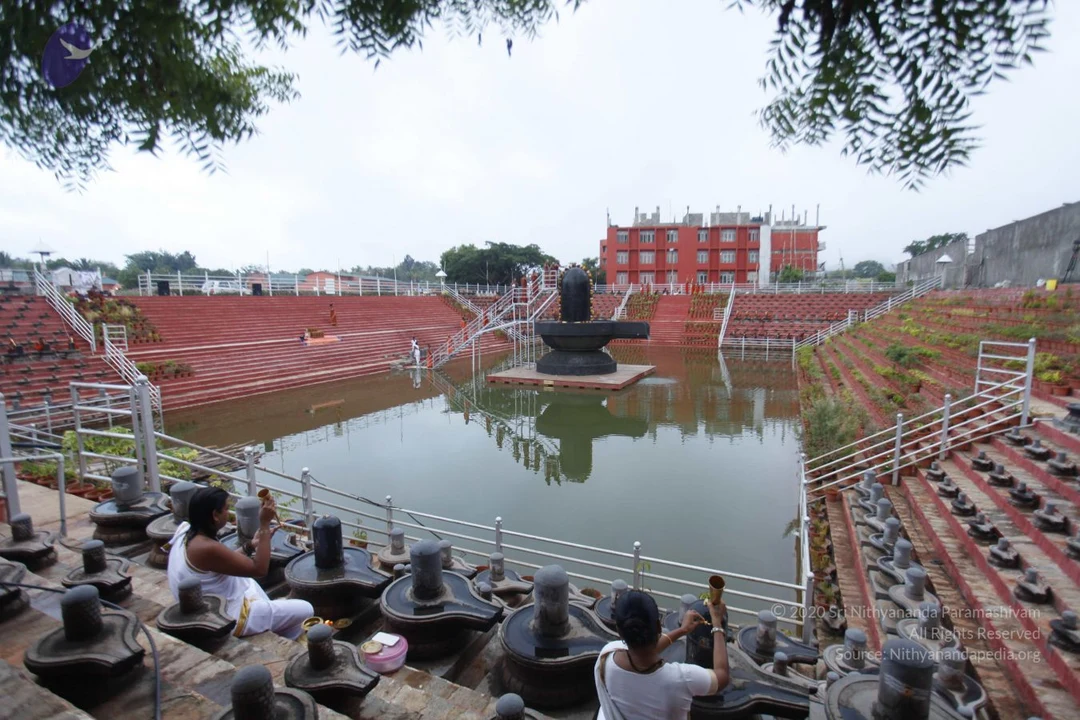
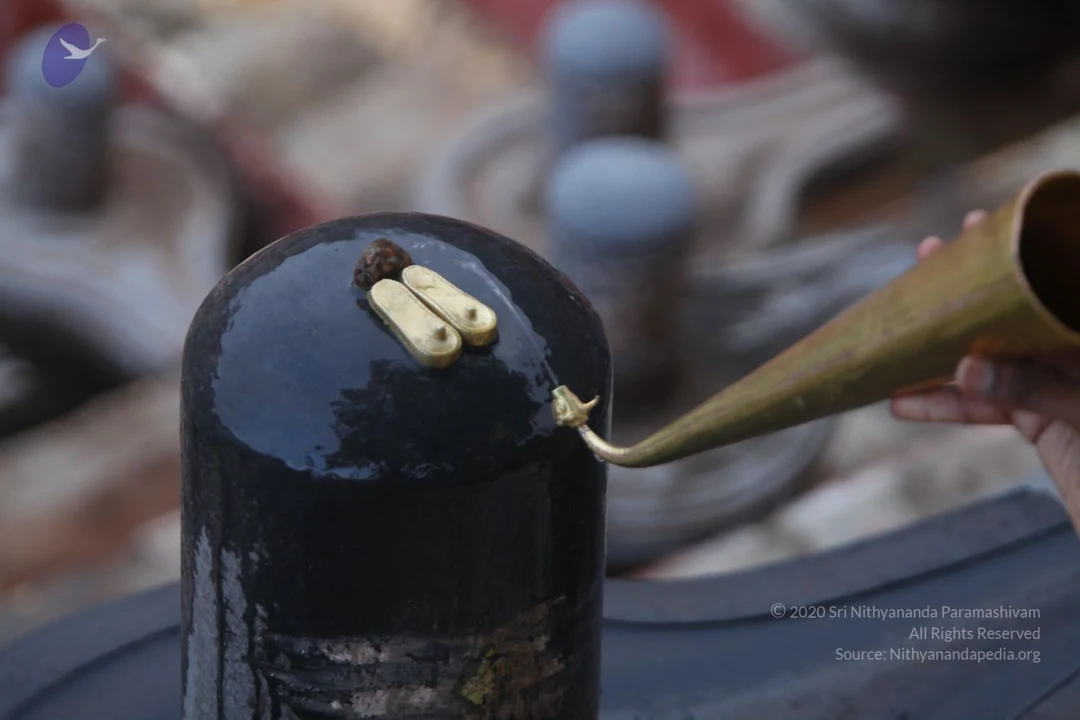
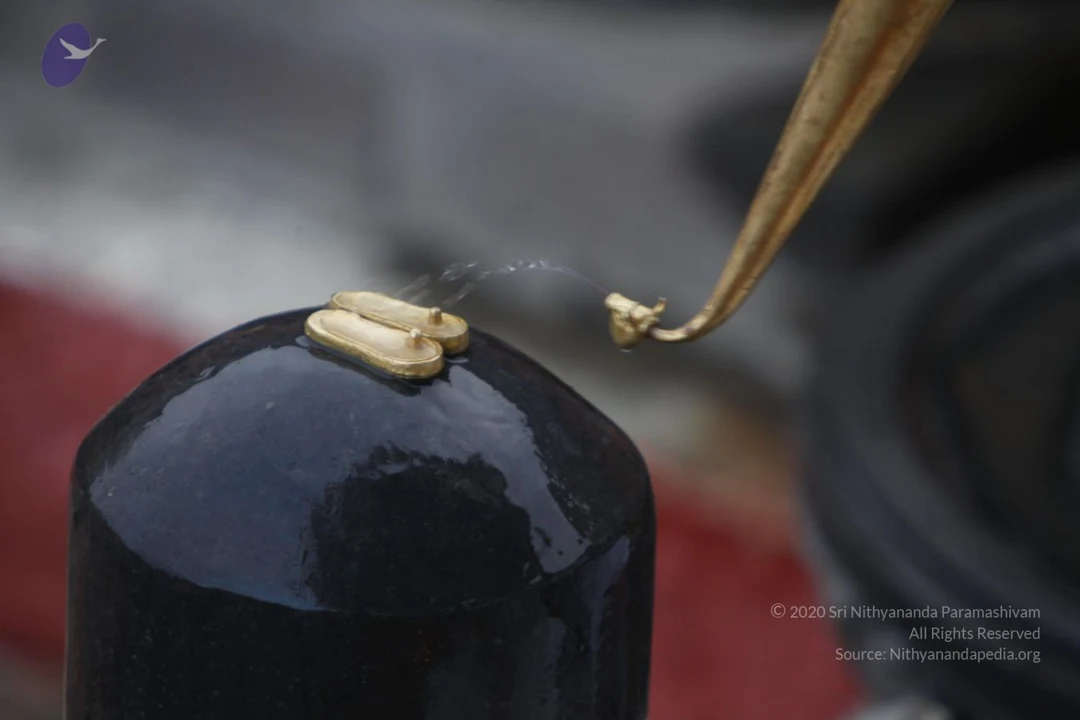
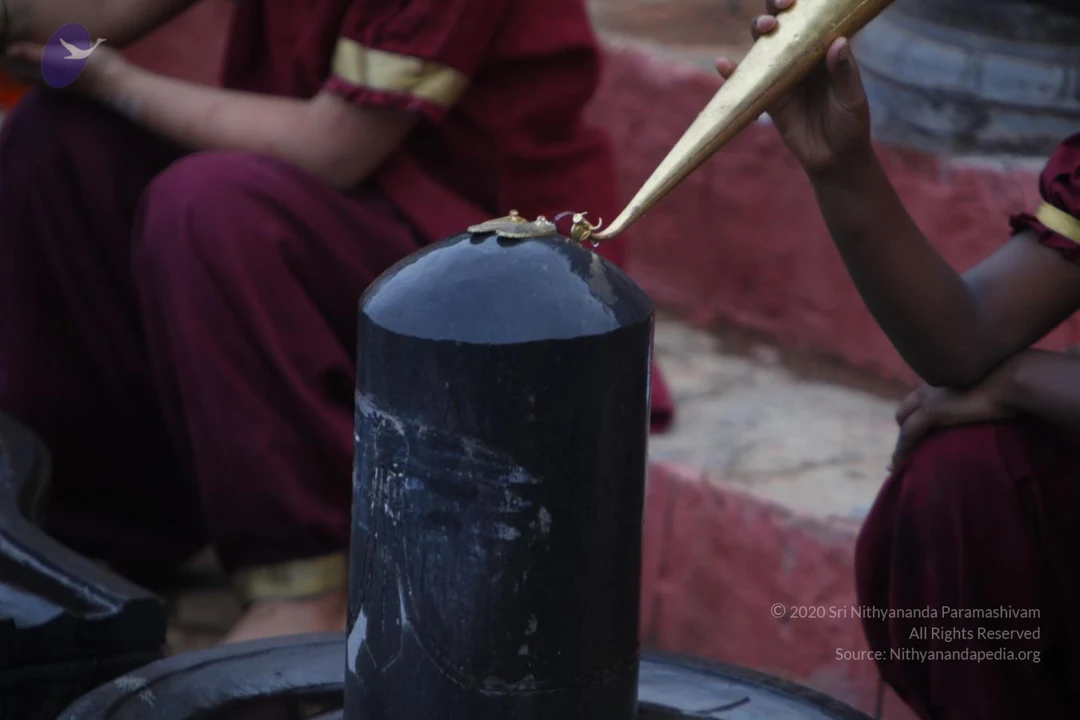
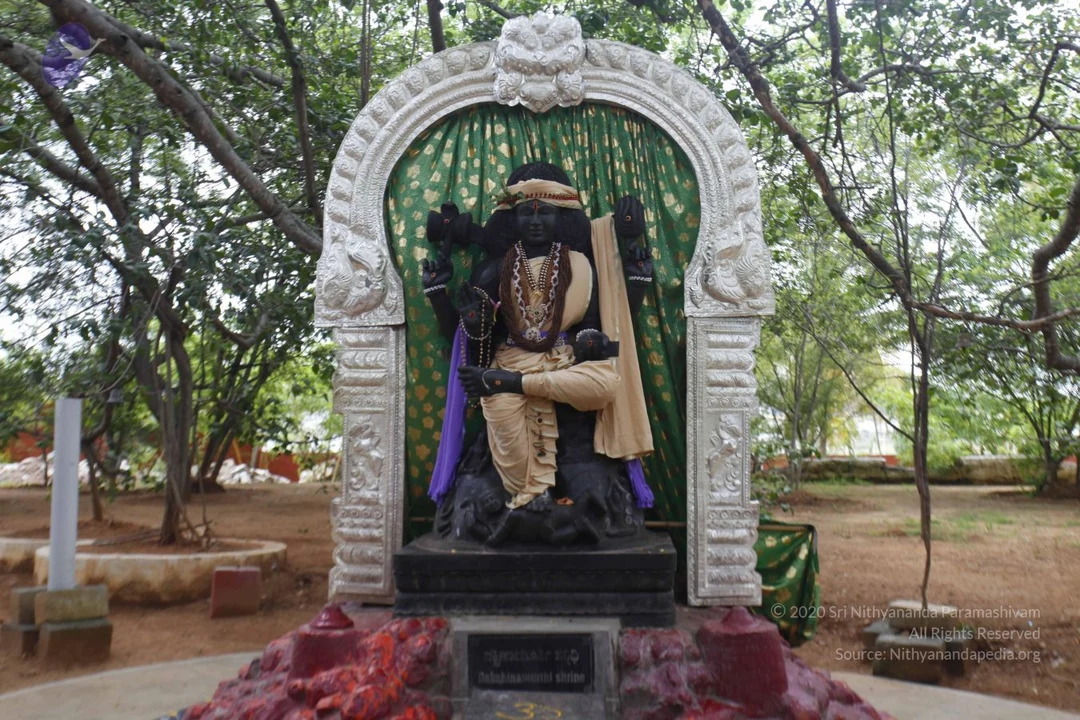
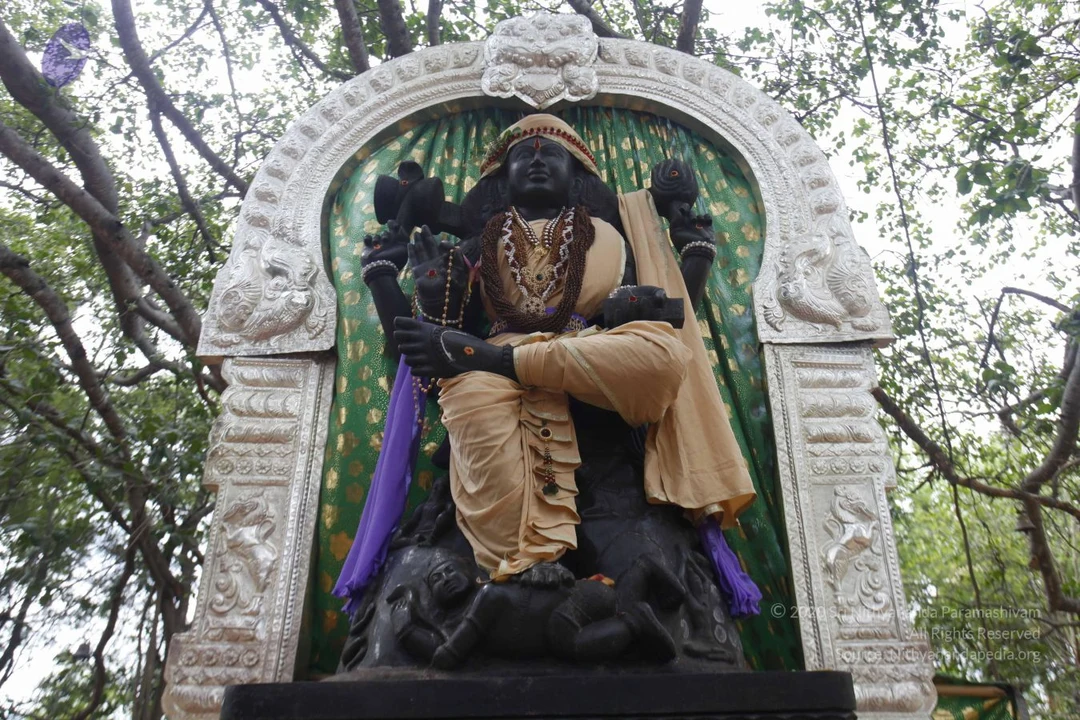
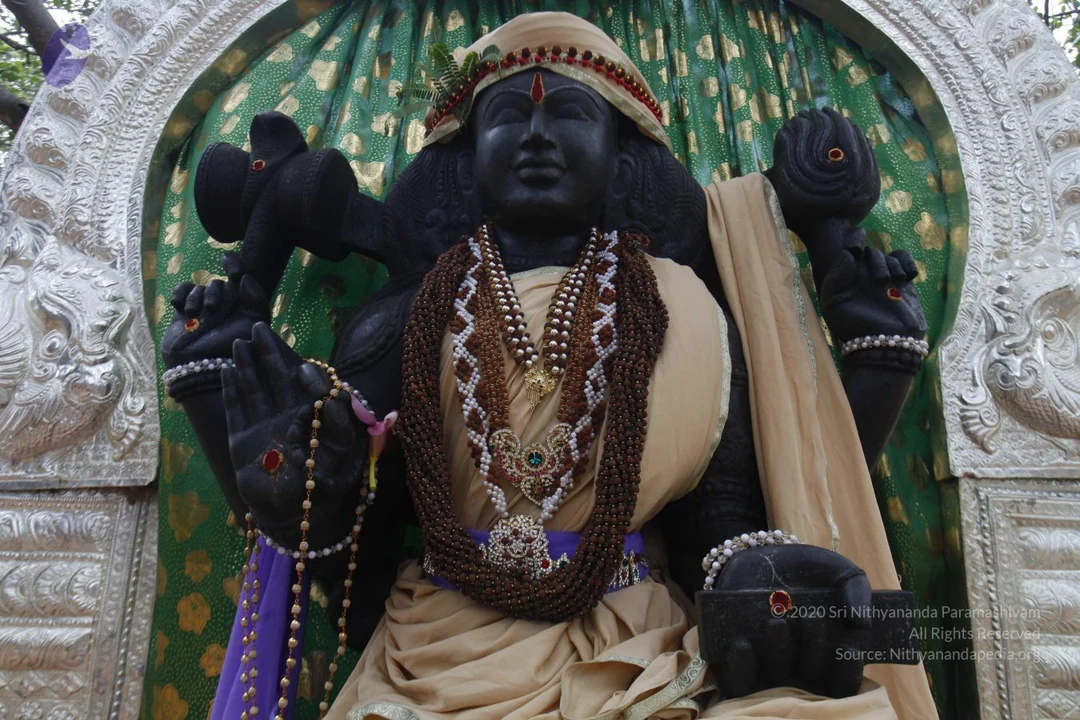
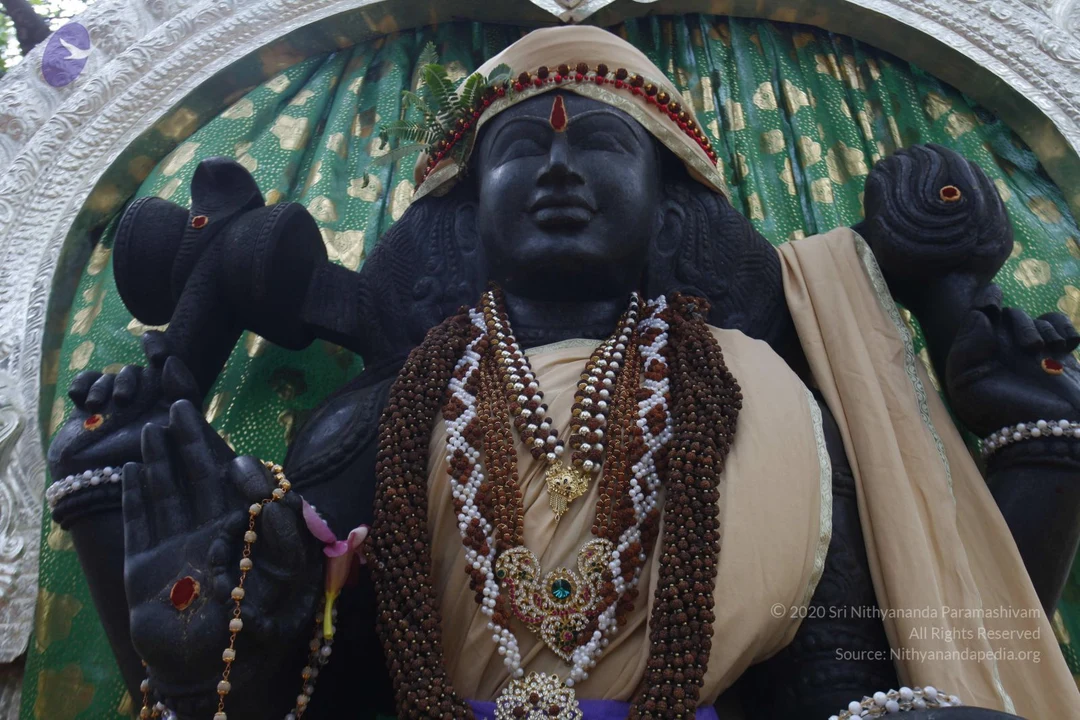
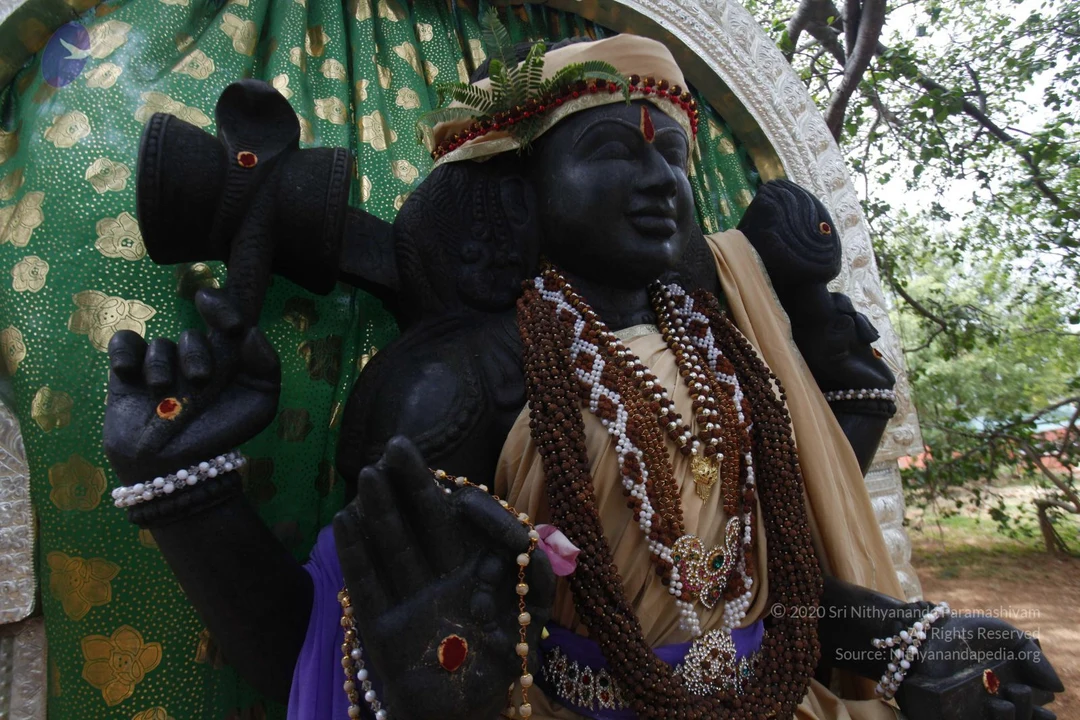
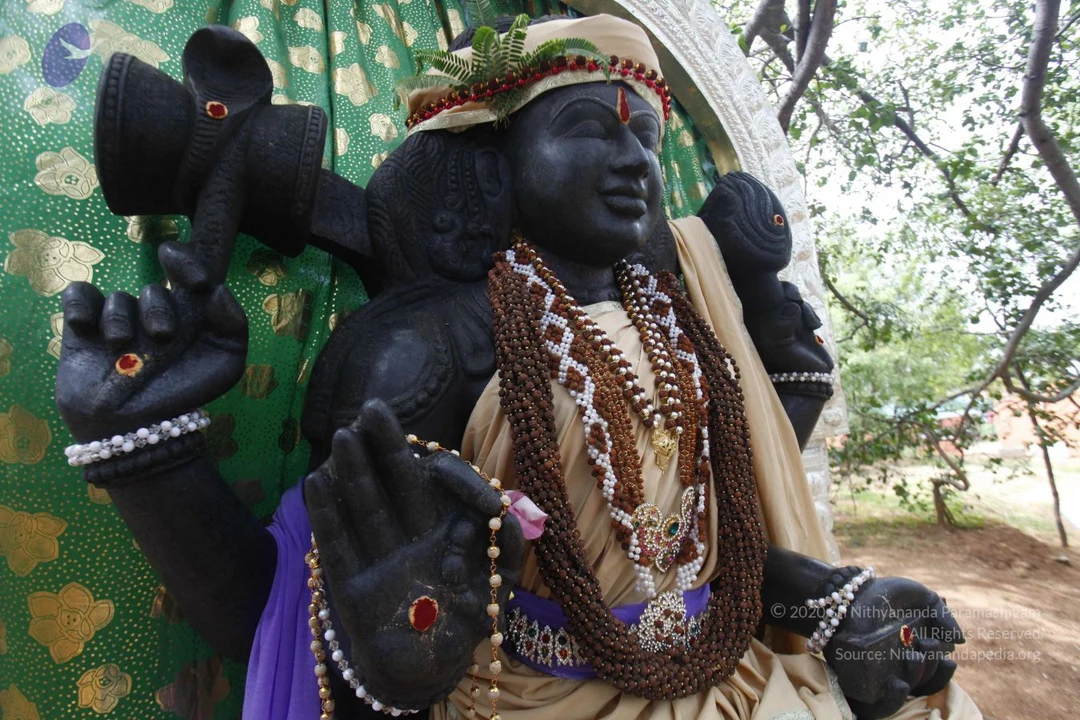
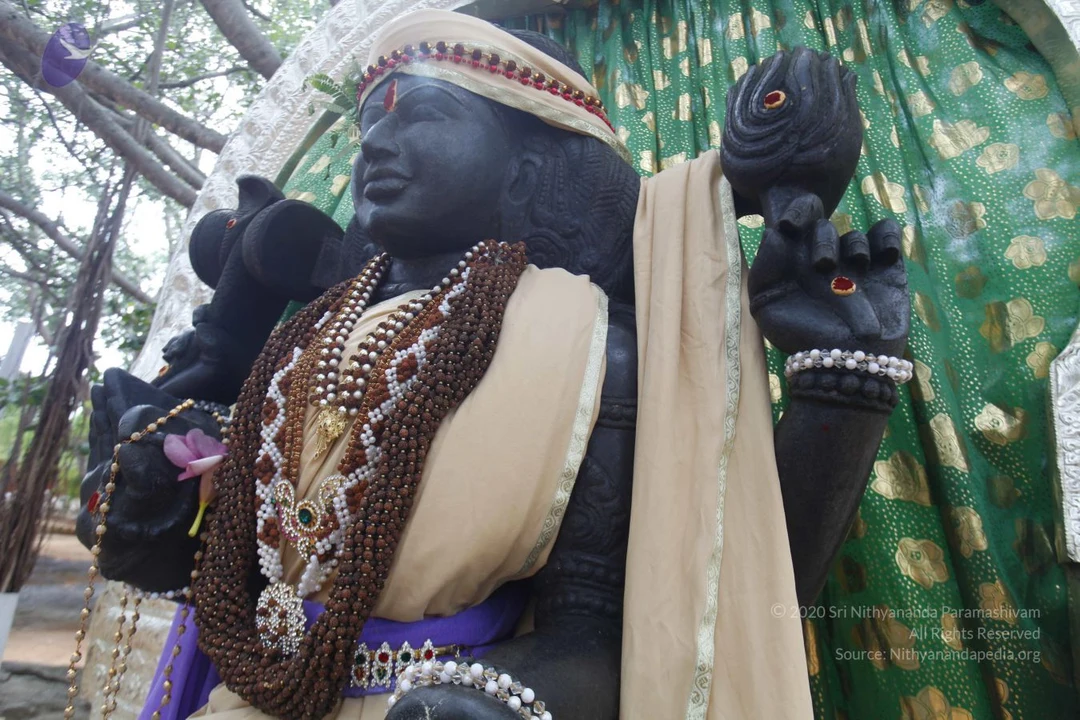
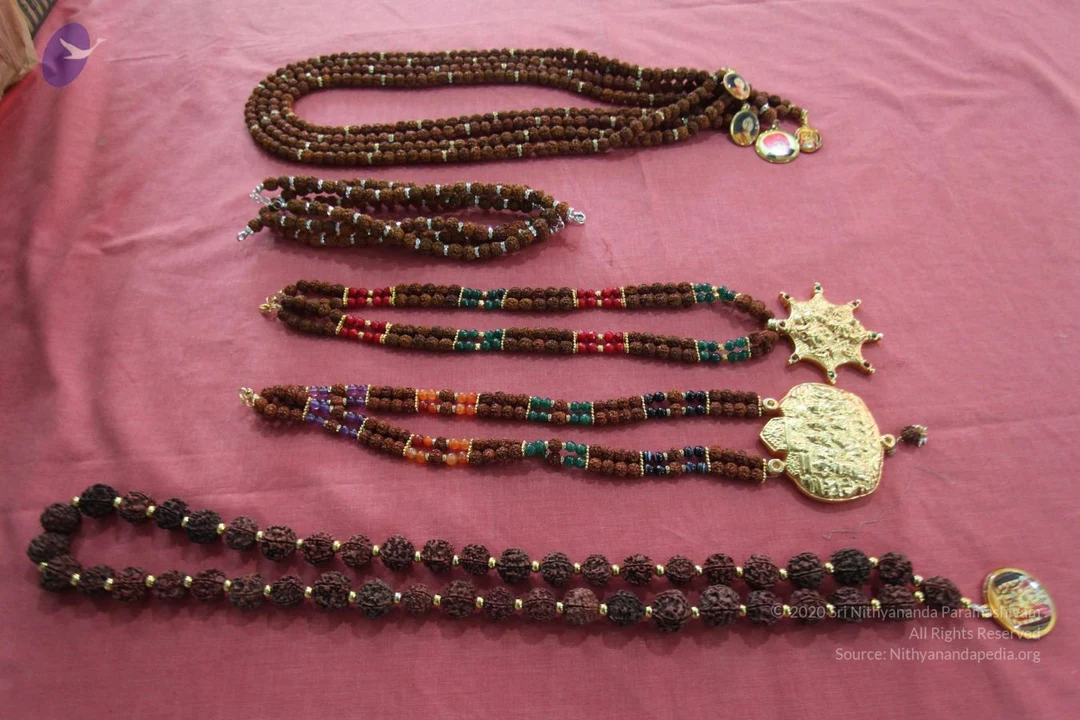
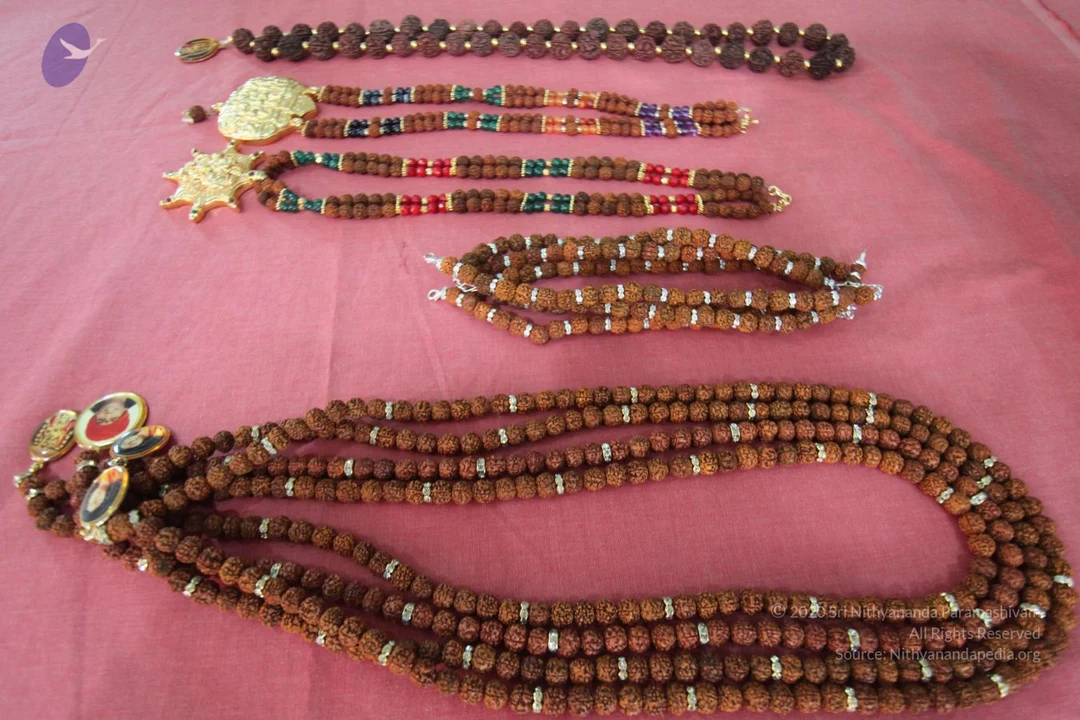
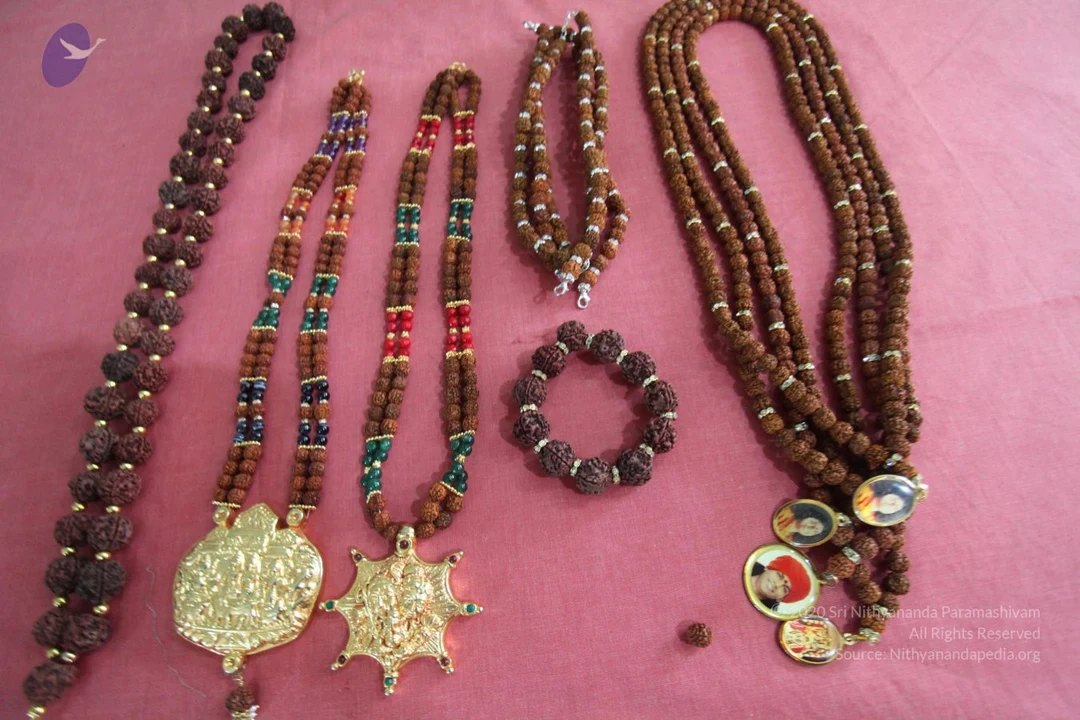
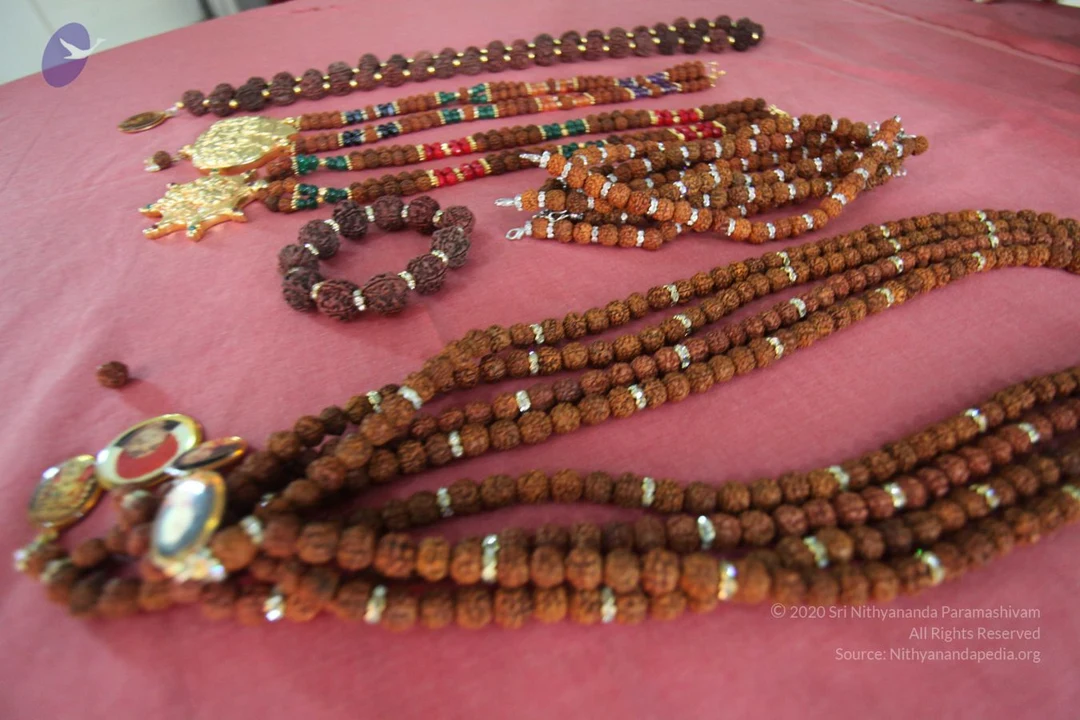
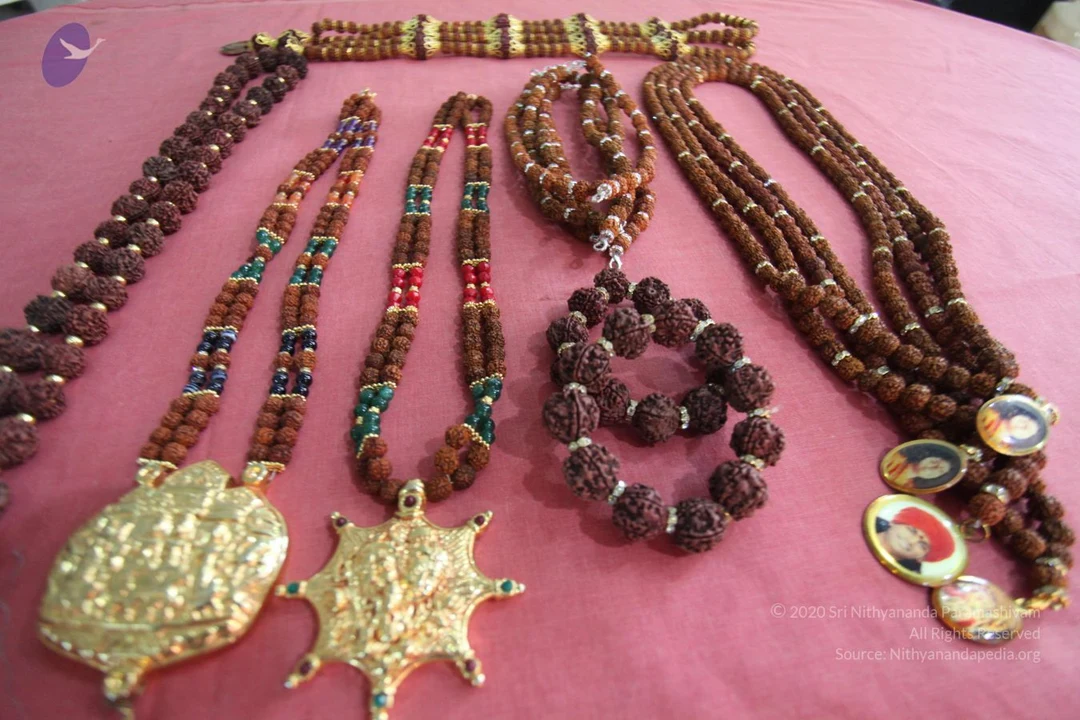
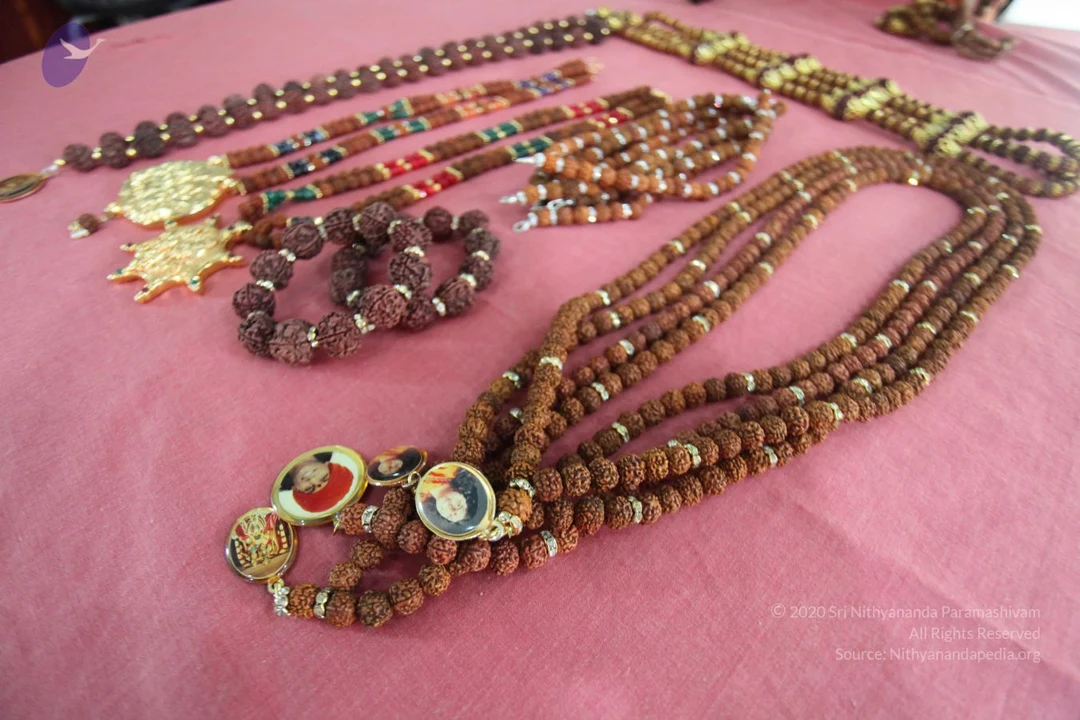
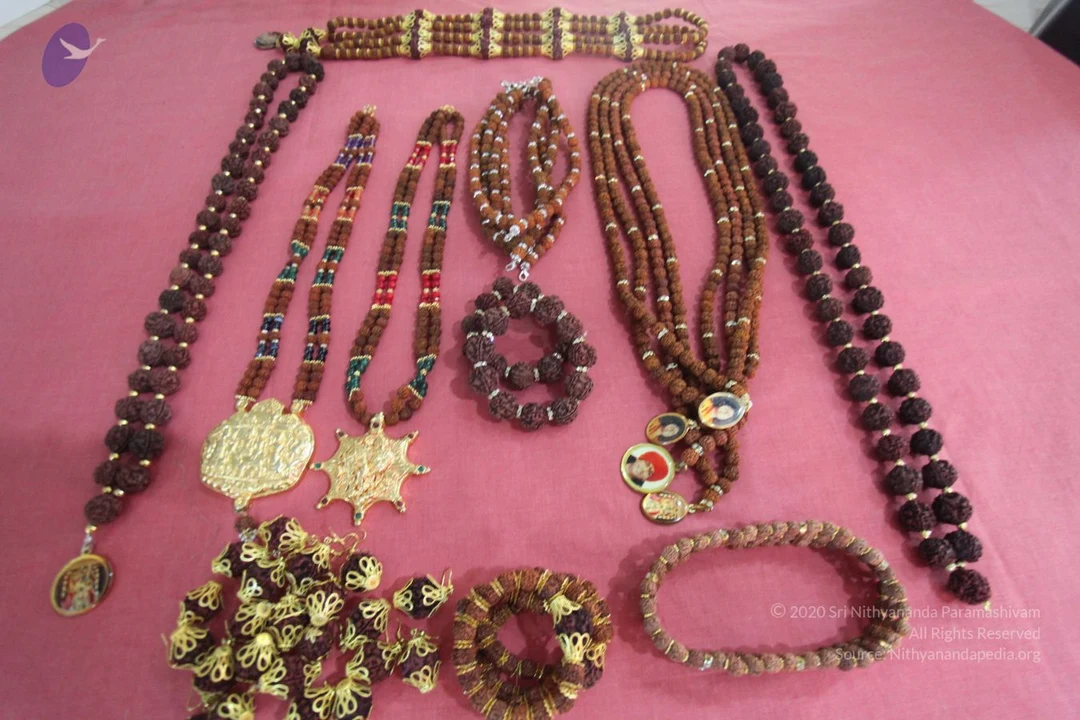
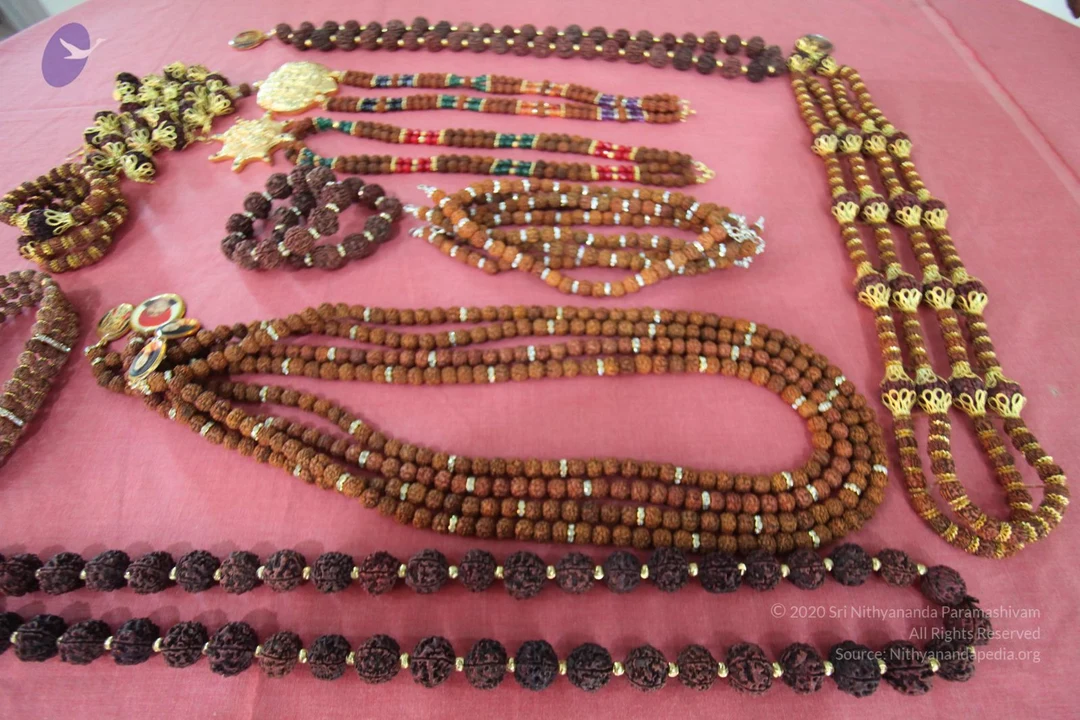
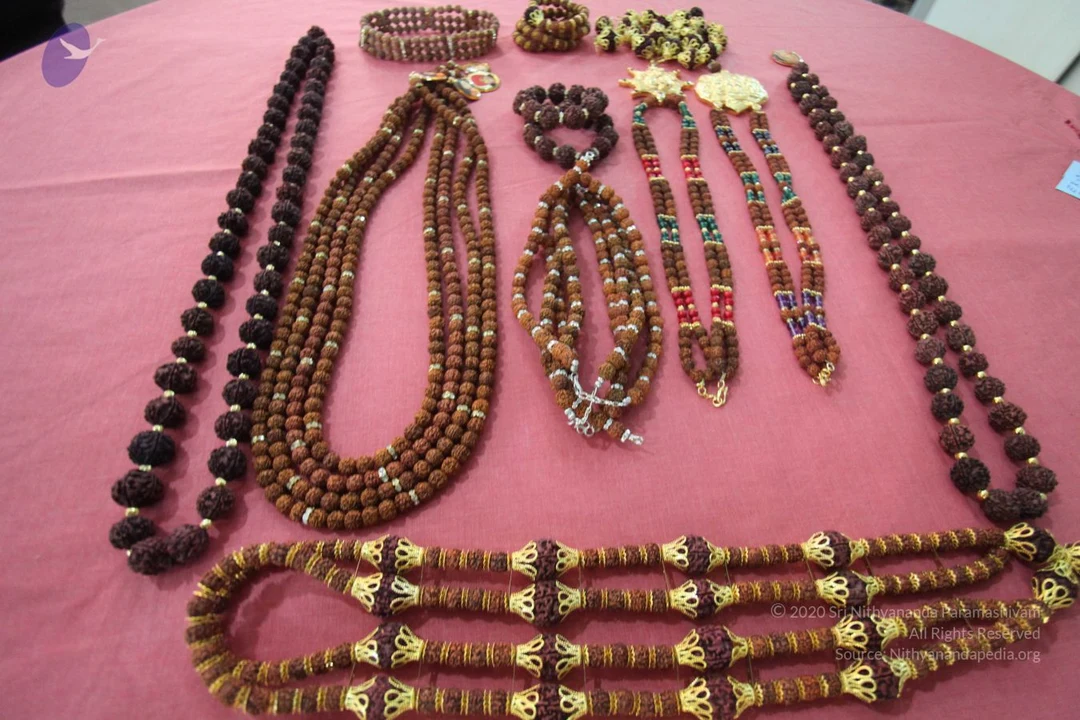
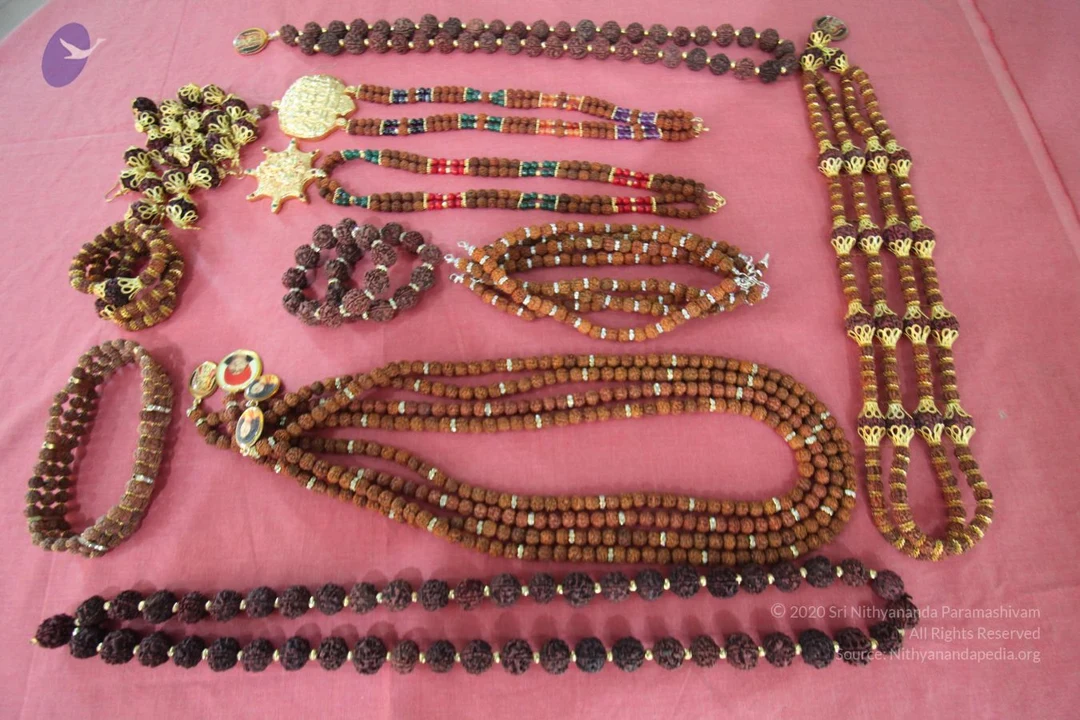
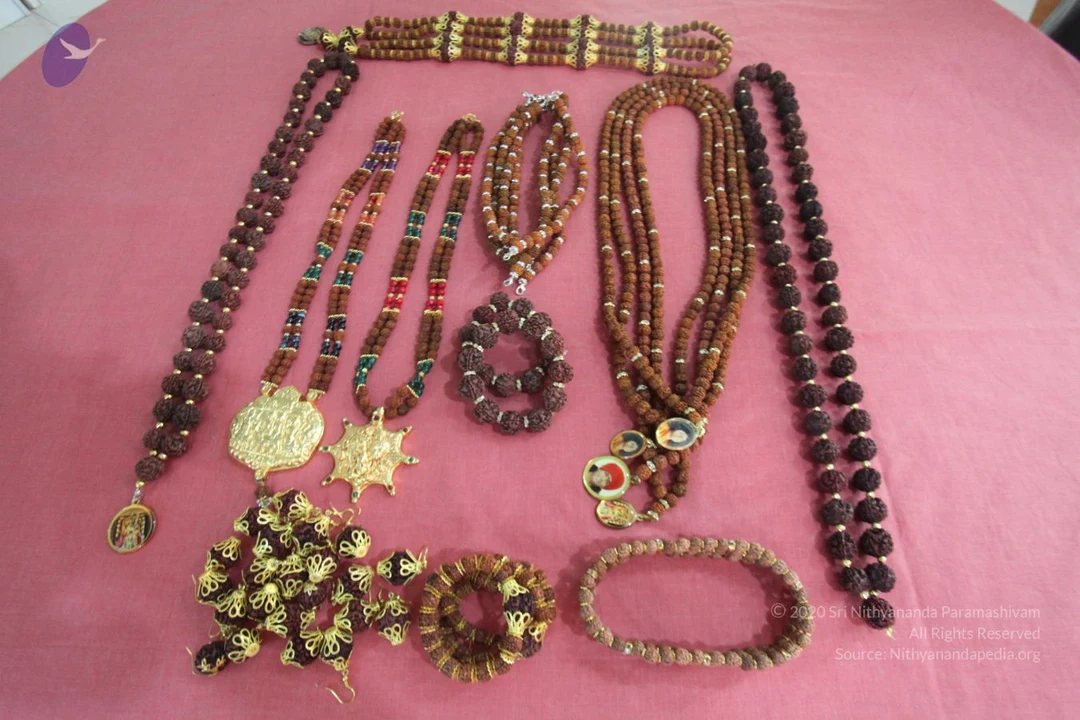
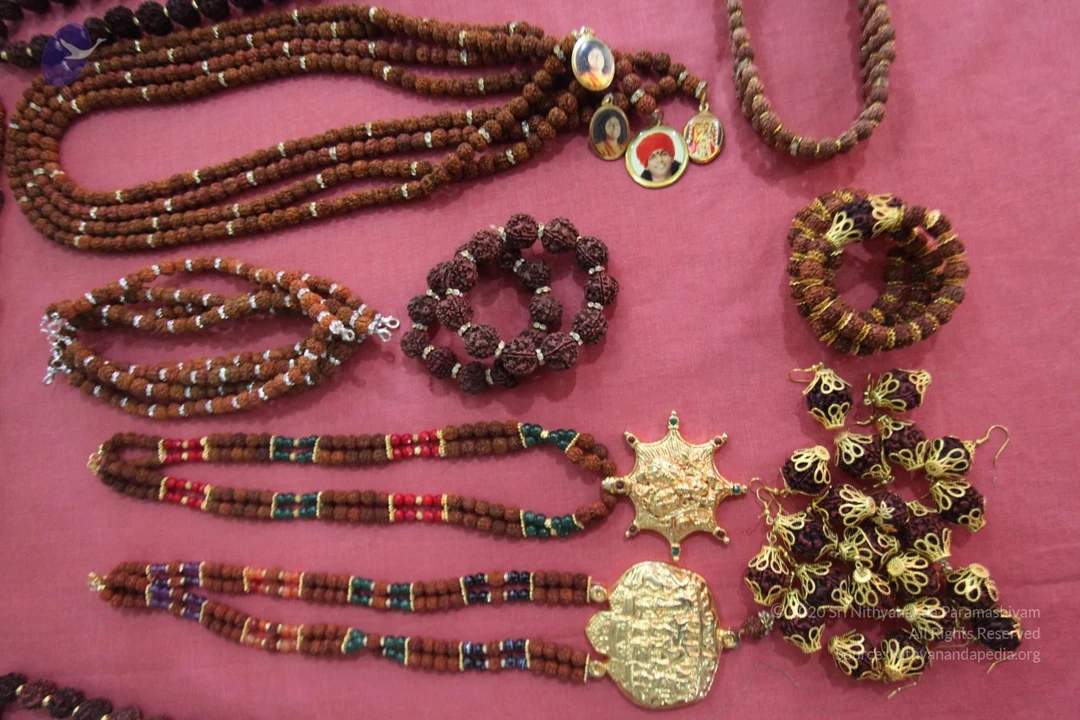
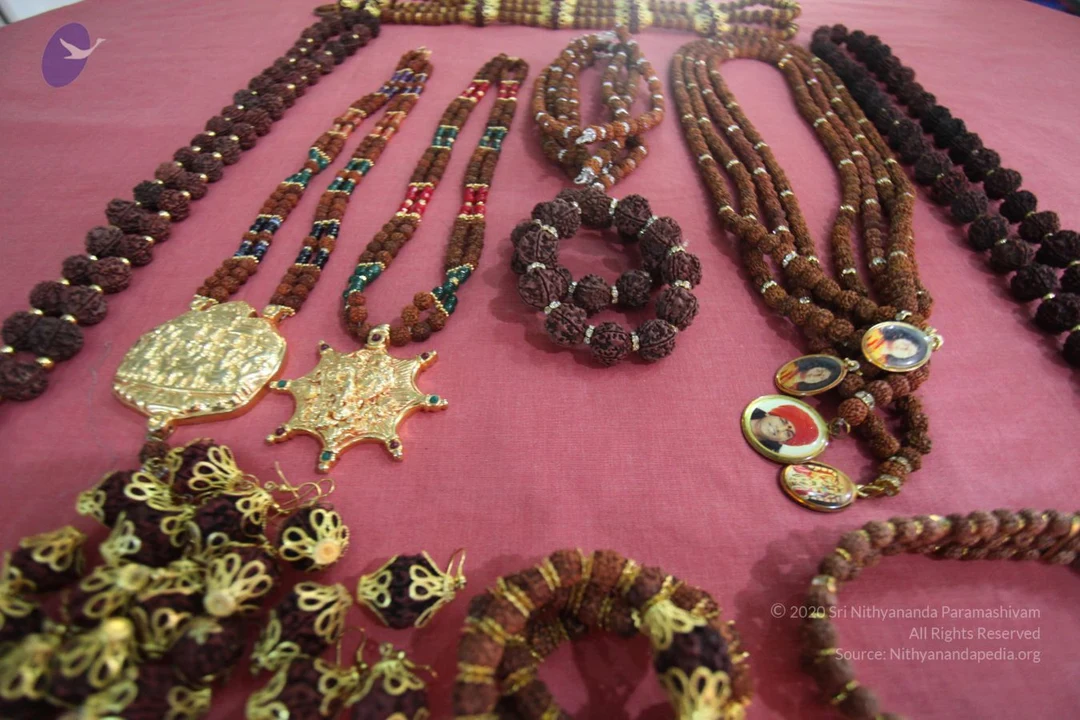
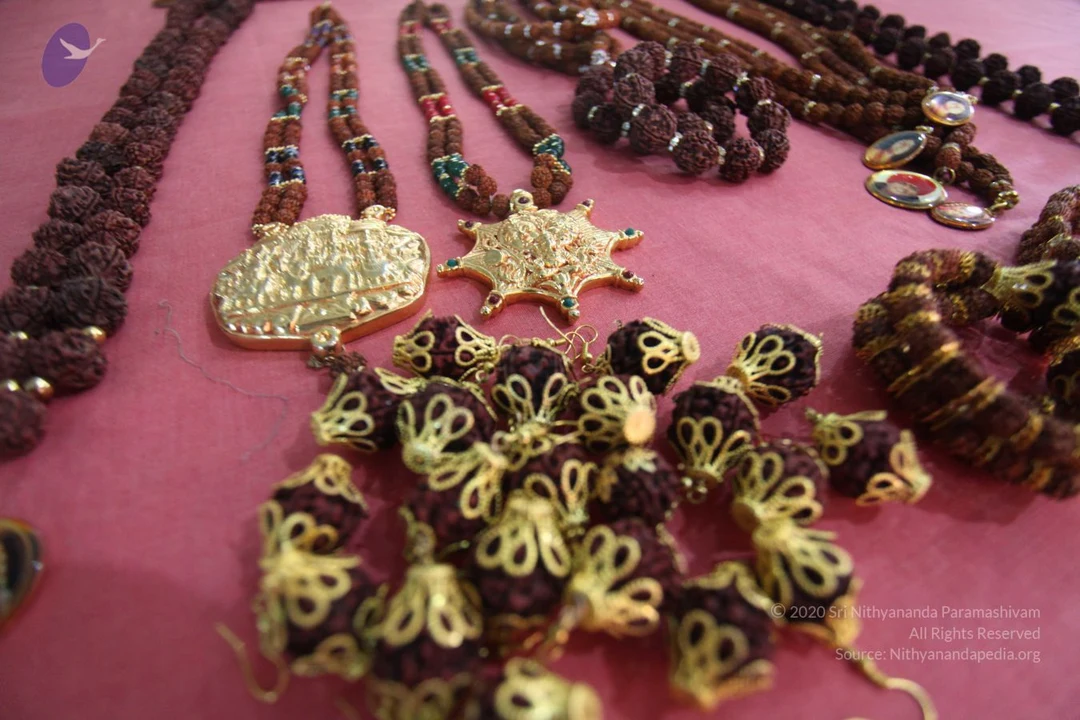
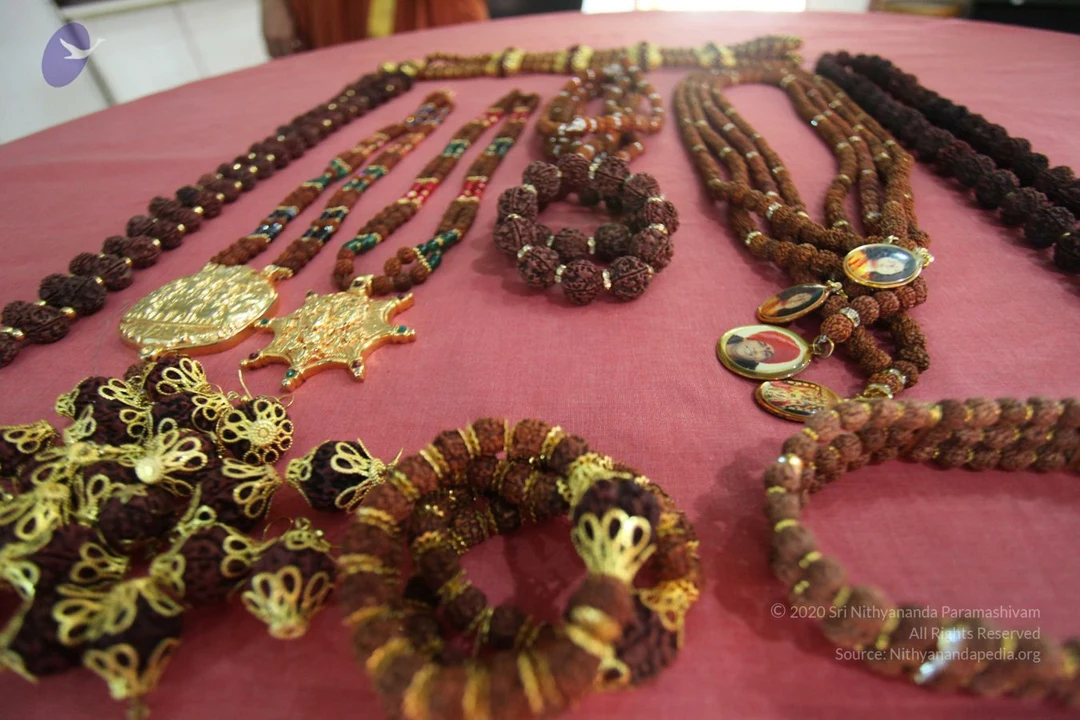
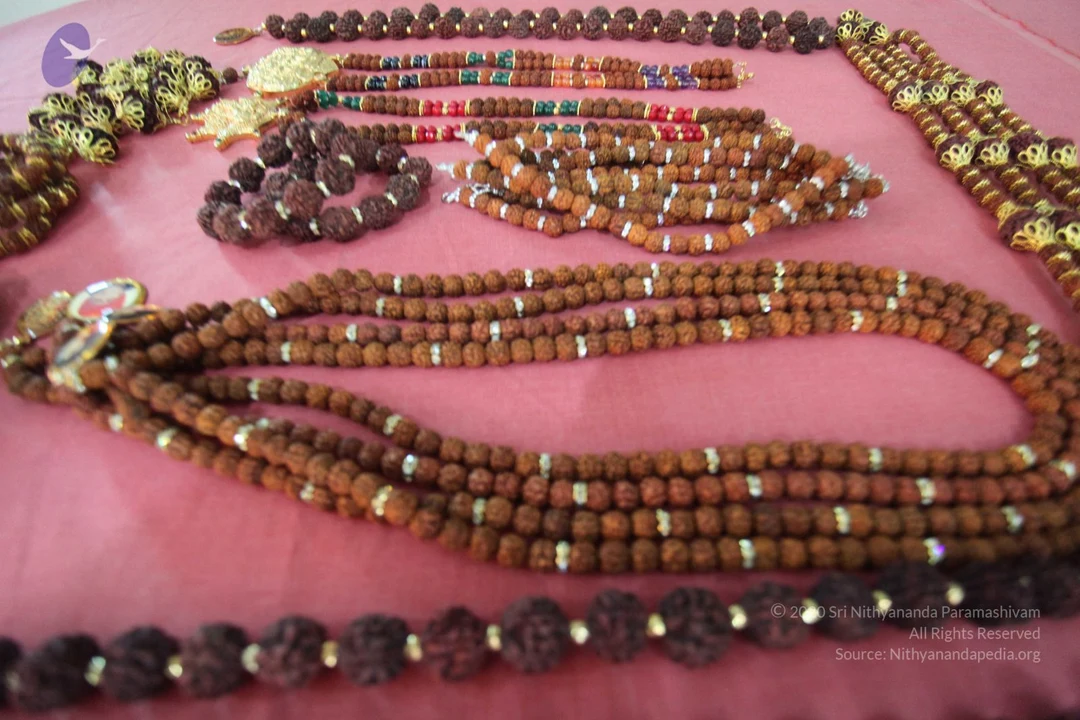
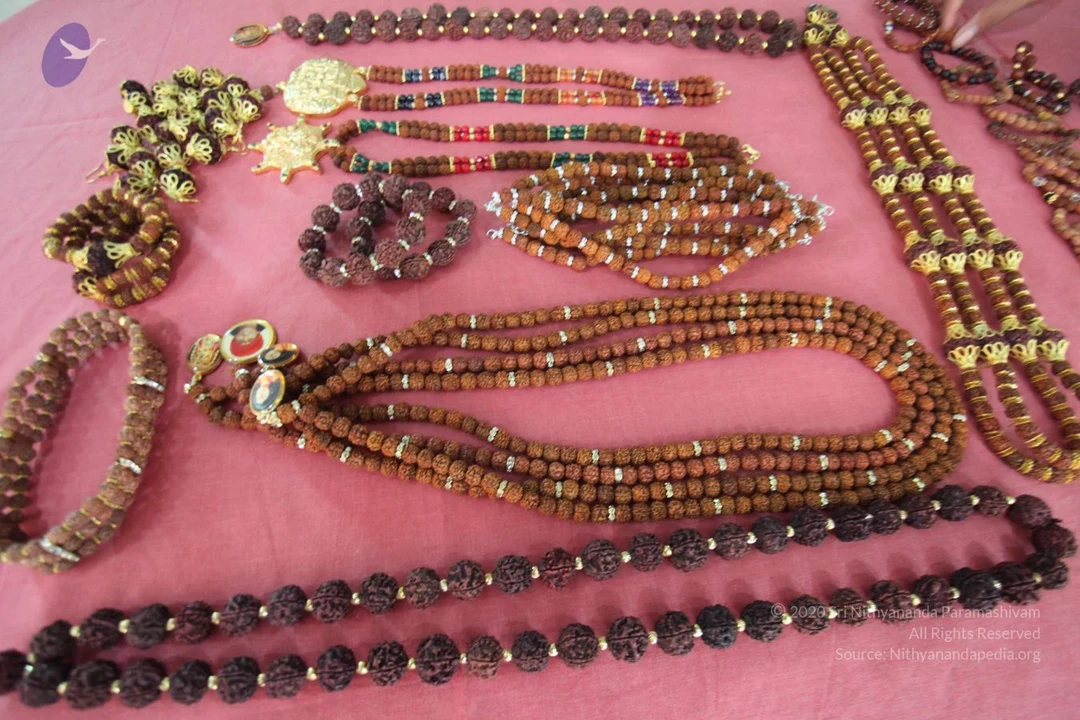
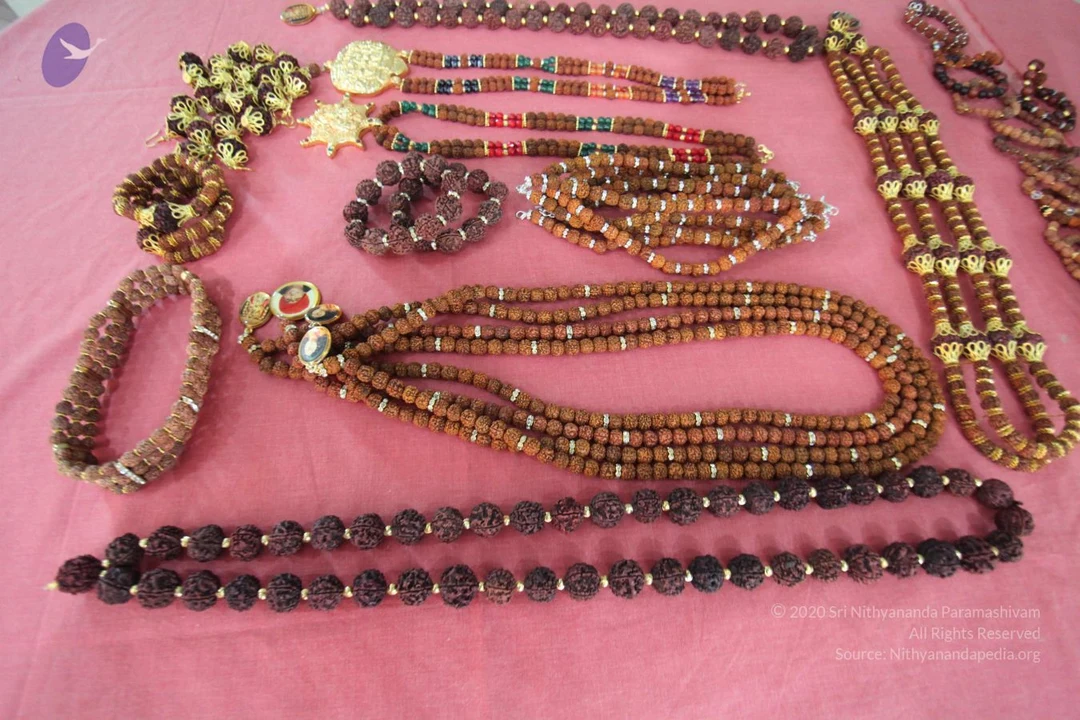
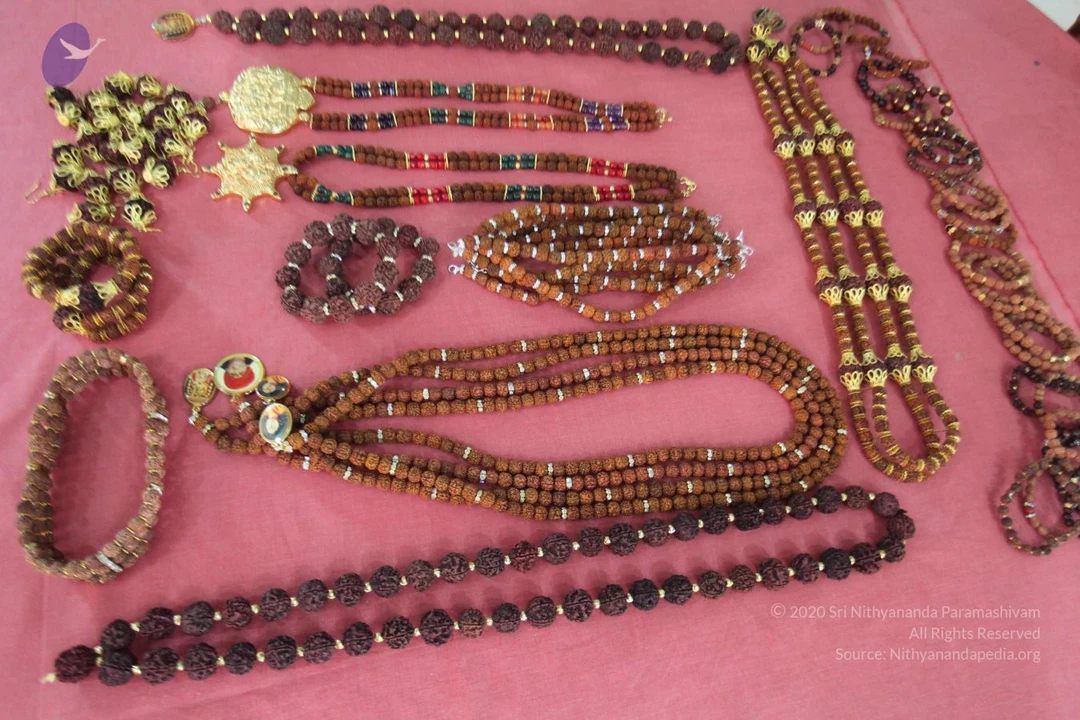
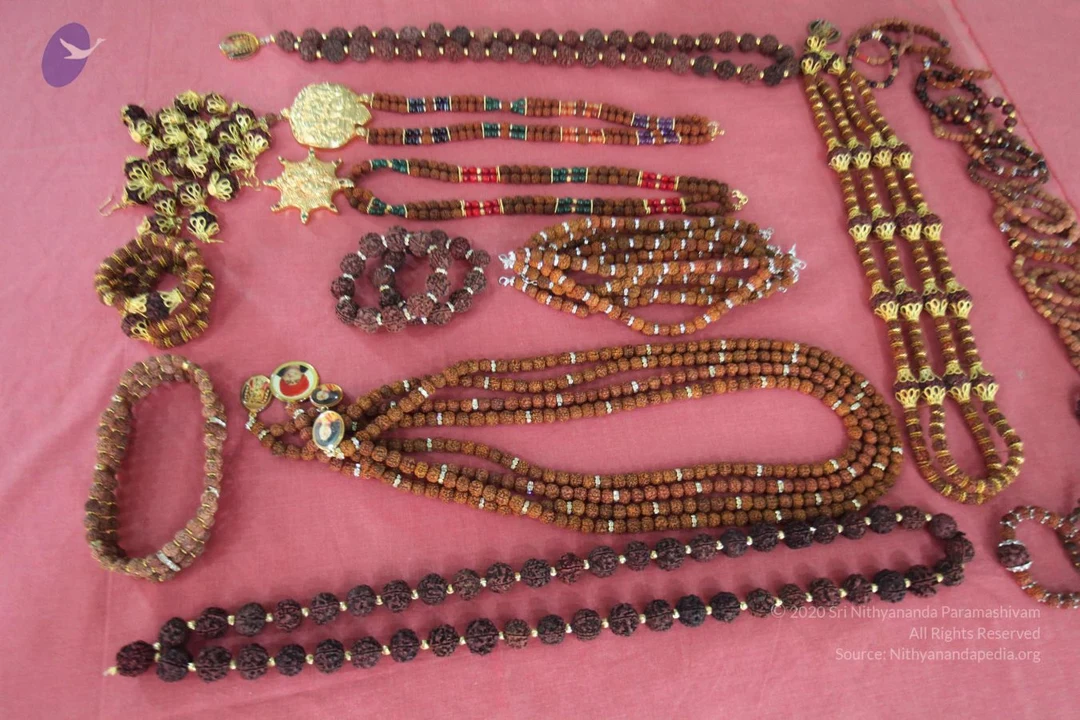
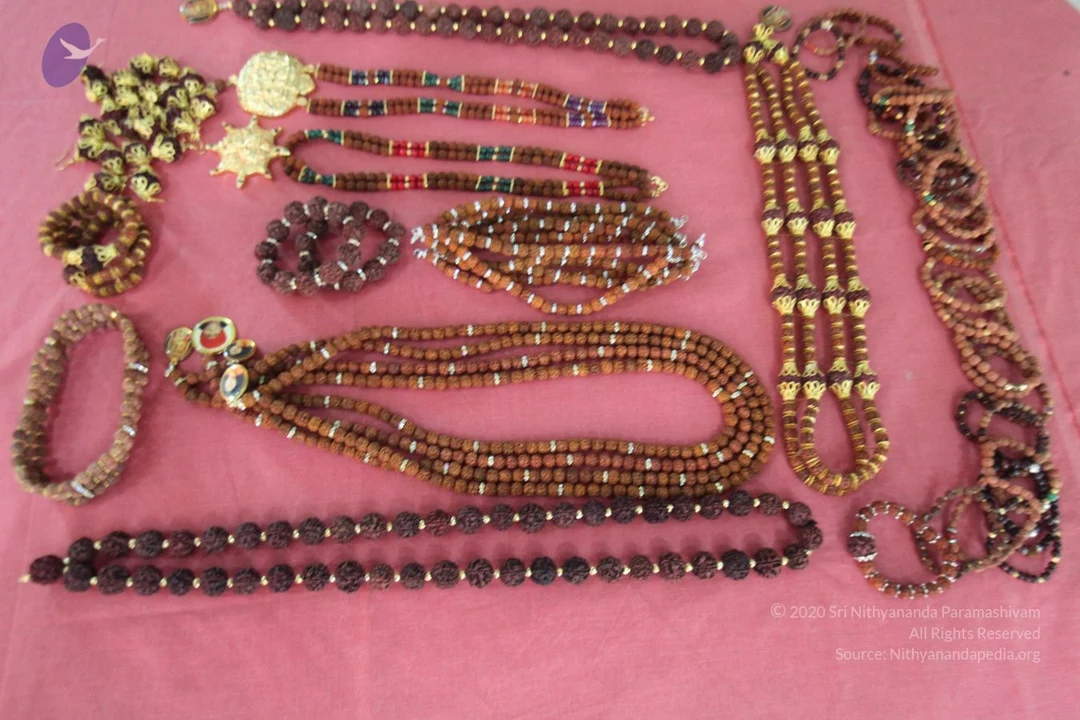
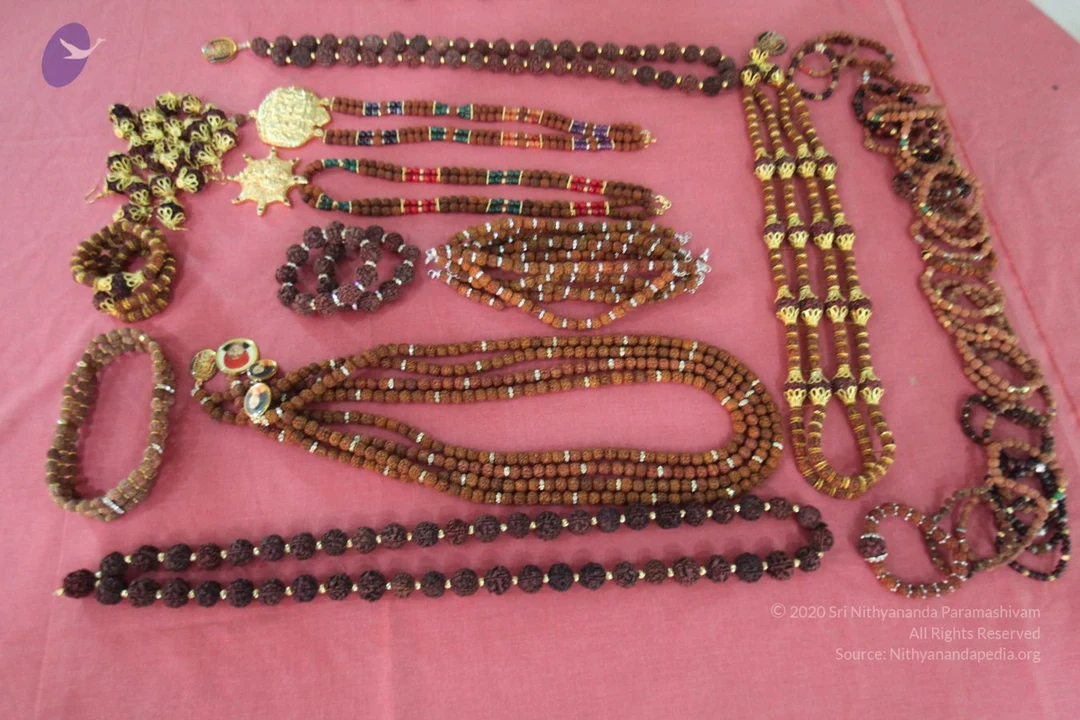
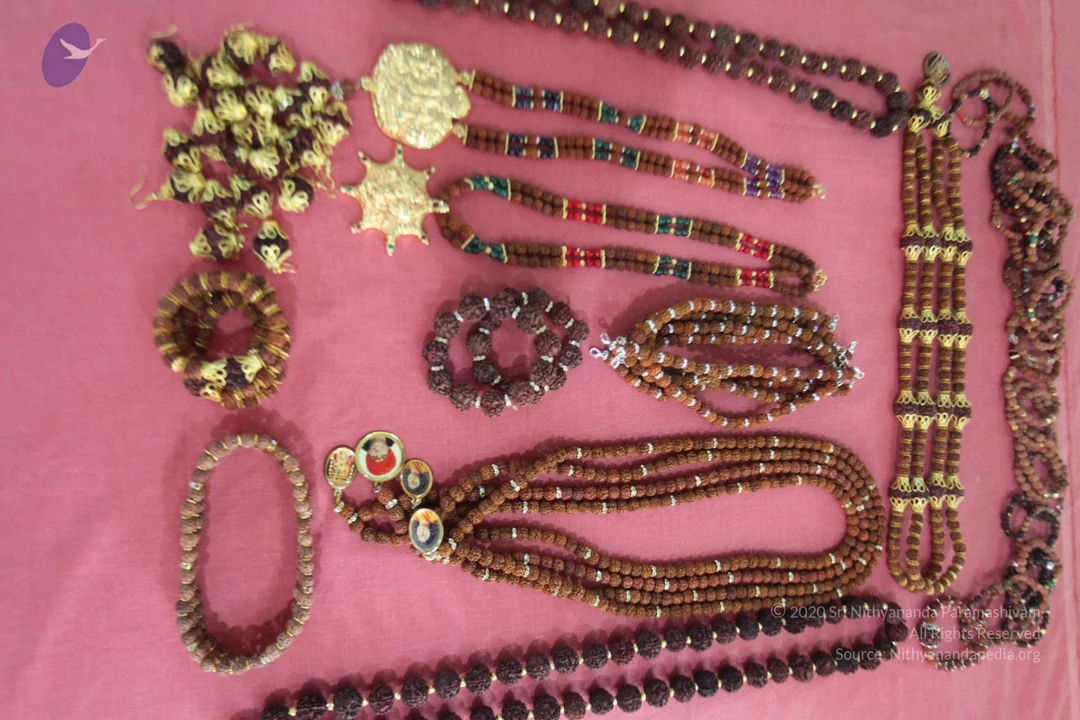
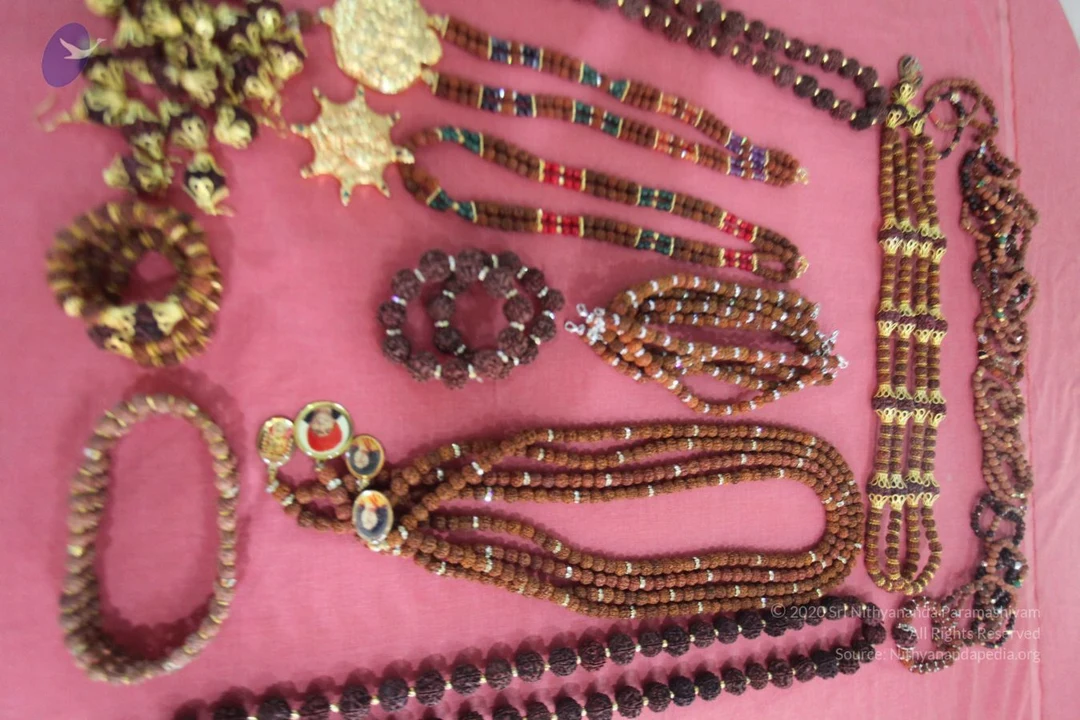
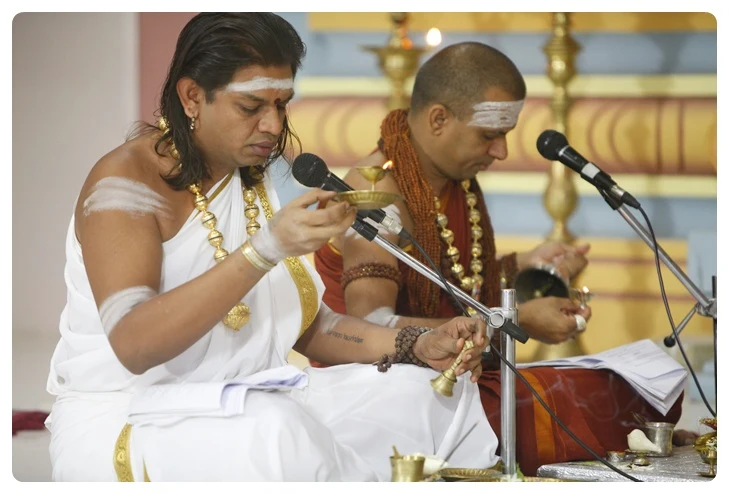
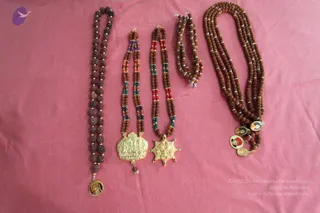
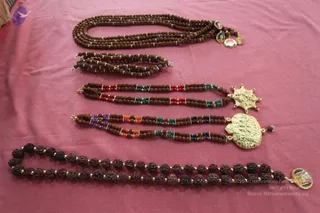
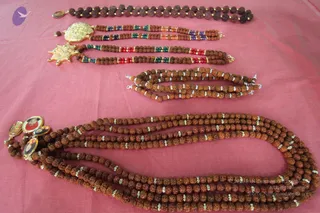
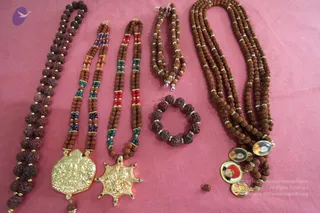
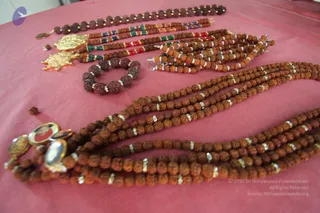
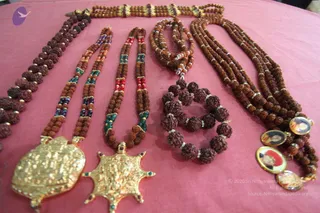
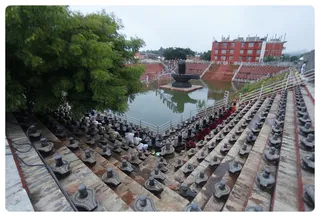
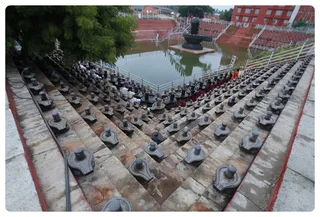
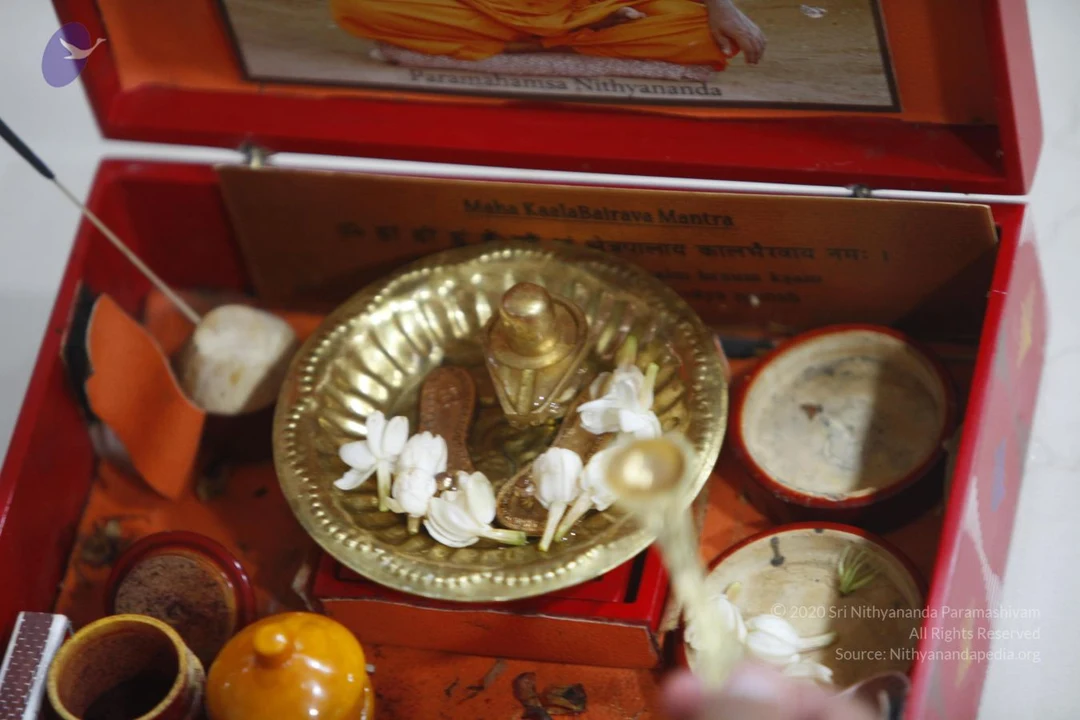
A photograph of many seated people performing a ritual on red stone steps lined with black stone shivalinga on pedestals. In the upper rows, several women in orange and yellow saris with rudraksha malas sit behind lingams, some holding brass items and small lamps. In the lower rows, young boys in maroon dhotis and orange headbands sit beside lingams, holding wooden sticks or cloth. Some lingams are topped with white powder or ash. A white metal railing and a potted plant appear at the left edge.A black stone statue of a seated deity murti sits within an ornate white arched niche carved with lion and floral motifs, backed by green fabric dotted with gold. The figure wears a saffron-cream dhoti and shawl, a rudraksha mala, a layered gold and beaded necklace, and bangles, and holds a trident and a small drum-like object. A purple cloth drapes at its base over a black pedestal, and trees fill the background. The statue is outdoors among foliage.A flat-lay photograph of an assortment of rudraksha malas and beaded ornaments arranged on a pink cloth. Multiple strands of brown and dark rudraksha beads are laid out, some with gold-toned spacer beads and gold filigree caps, one with a gold pendant, and others with small multicoloured accent beads. A pair of small rudraksha bracelets is visible, along with a multi-strand necklace fastened with small pendants bearing a painted image. No people are visible in the scene.

June 05 2013

Original wiki page
Contents

Description:

In today’s morning satsang, Paramahamsa Nithyananda describes the astonishing adventure of rebirth during our lifetime. We have the potential for six types of birth during one human life. Physical birth we have all experienced. Then the obsessive mind is born when we develop our root pattern, the source of our troubles. As we release the root pattern, we take true birth! This is the birth of integrity in us. From that infant integration arises the decision to expand, the awareness of our possibility. That is the birth of authenticity. Once we take responsibility for the world we are born into maturity – the birth of leadership. Ultimately, as we enrich others with our understanding we experience divine birth, from which there is no return to the old life – we are liberated.

Link to Video:

VideoAudio

Transcript:

0:32

Today, I will continue to expand on Spiritual Activism; what I mean by the word ‘Spiritual Activist’. I think, this is the best word which will suit me and this is the best word which will suit all of you, because all of you are reflection of me.

(HINDI)

Let me expand on this one word, ‘Spiritual Activism’. Spiritual Activism means, please understand, actively understanding, analyzing, realizing, cognizing the way you look at the world itself through the spiritual frame. Get it. Get it.

What is birth? Understand with spiritual cognition. What is life? Understand with spiritual cognition. What is death? Understand through the four tattvas. How you need to respond to every situation? Understand everything through the four tattvas. Whether it is birth, life, death, meditation, anger, daana, tapa, vairaagya, maturity, growth, expansion, money, how to achieve money, relationships, what is relationships and how to achieve relationships, what is success and how to achieve success; everything cognize with the four tattvas, with spiritual strength, spiritual understanding.

4:06

For example, birth. The body which you are using, when it fell on to the Planet Earth - that is the first level of birth. One level of birth happened. Listen. When your body fell on the Planet Earth, one level, one kind of birth has happened. When the first actual root-pattern is experienced by you, next birth happened. Unfortunately, the first physical birth started with deep pain. Even the mental birth started with lack of Integrity, because any root-pattern you carry will not be in Integrity with life. That is why you need to complete with it. When you complete the root-pattern, that moment your birth as per the Integrity starts. Integrity is born in you the moment you complete your root-pattern.

Listen. I am describing different types of births.

When your body happens, it is physical birth.

Actual, when your root-pattern starts happening, it is the birth of you.

When you complete the root-pattern the actual conscious birth starts in you. Your conscious birth starts when you complete with your root-patterns.

When you decide to expand, authentic birth happens.

When you start taking the Responsibility, maturity happens.

Each one of these are different levels of births.

When you start Enriching, Enriching others, the divine being in you starts, is given birth.

Listen. Look at the whole thing.

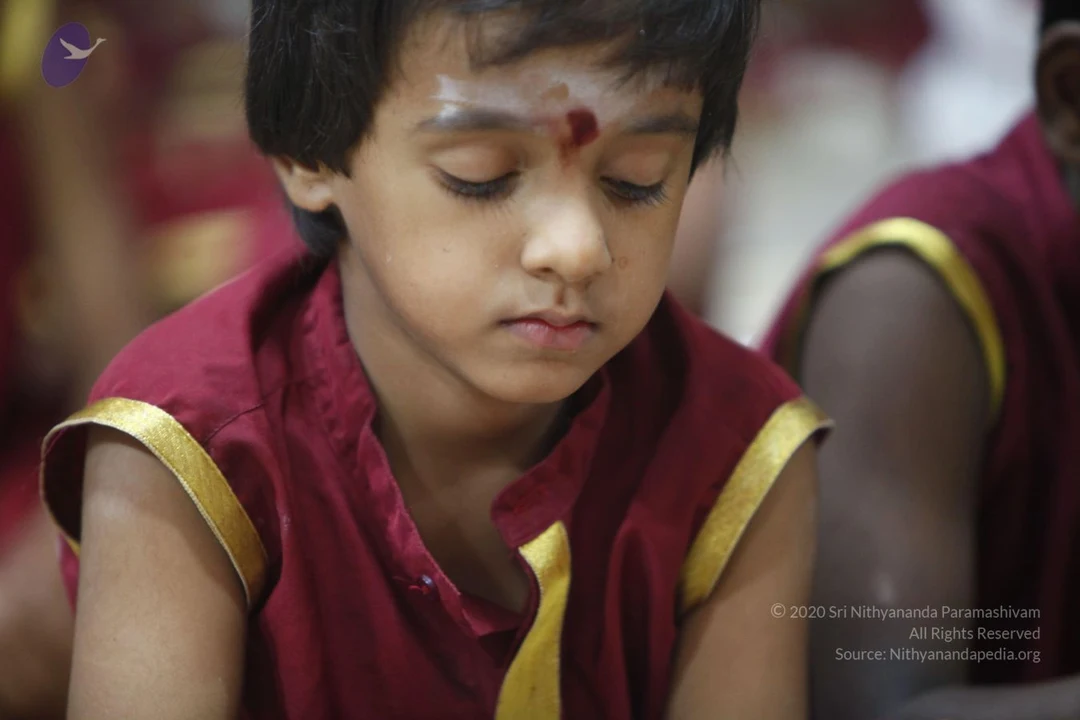
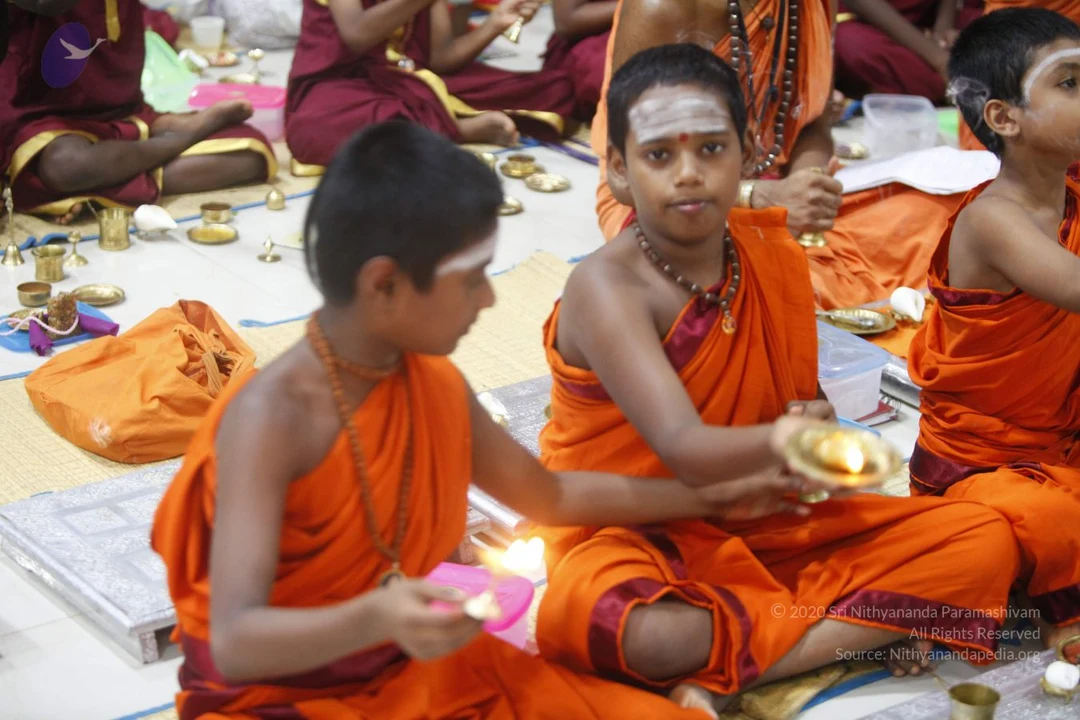
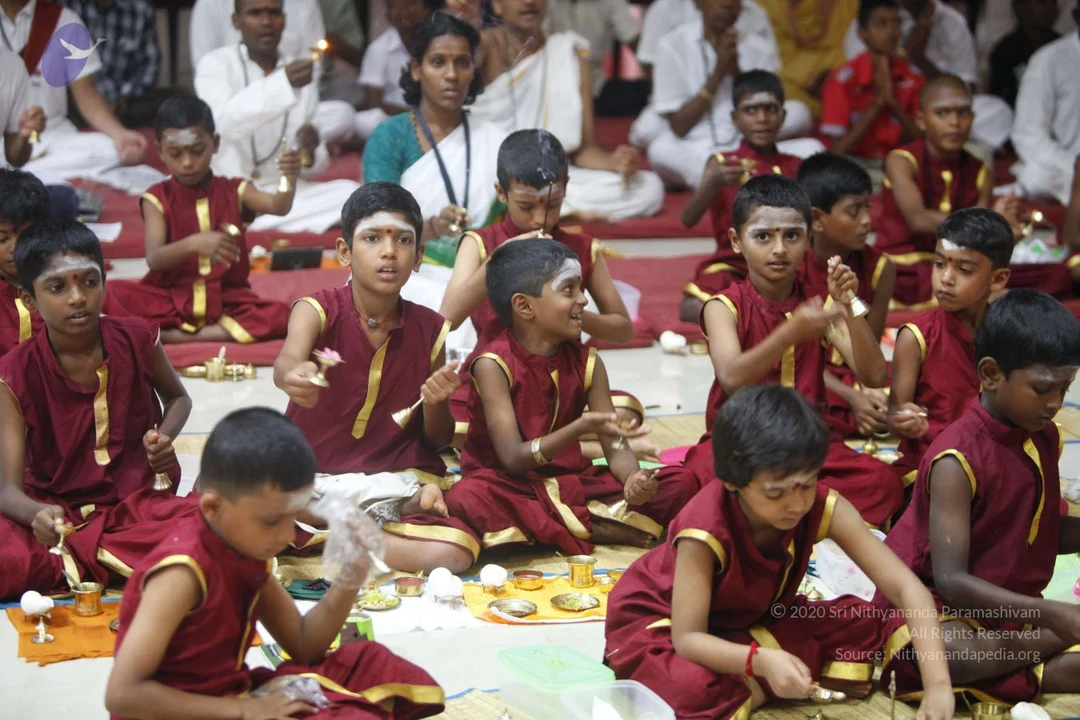
When your body is born, it is just physical birth, biological birth. There are millions, I can say even billions, see only biological birth and biological death; Over. That is why I tell you, blessed are the kids who are in the Gurukul learn in the very young age what is the real birth. Real birth is not just you coming out of your mummy’s tummy. It is physical birth, biological birth. That’s all. That’s all. When your root-pattern starts, your mental birth starts. That is when your birth starts. When you find your root-pattern and complete all the root-patterns, that is when – understand, listen, listen, get it – that is when your real birth, birth in Integrity starts. When you decide to grow, listen, there are some people who die just with the physical birth. There are some people – not some, I can say, one more billion – dies just with the birth of the root-pattern. Billions of people don’t even have the knowledge about their root-pattern; just in that ignorance they die. They die. They die in the ignorance. When you find your root-pattern and complete with it, your conscious birth starts. Only when you complete with the root-pattern, conscious birth starts. Millions die in this level itself. In the conscious birth, Integrity opens up. Understand, when you decide to grow your Authenticity is born. That is your authentic birth.

11:04

1. Physical birth - from mummy’s tummy.

2. Mental birth - when the root-pattern is born.

3. When you complete with the root-pattern, conscious birth.

4. When you decide to expand, authentic birth.

5. When you take the Responsibility for the world, maturity happens in you.

6. When you Enrich others, divine being is born in you, the divine birth happens in you.

I tell you, only the man who has seen all the six births will not have rebirth. Till you see the six births, you will continue to have rebirth. Anybody, anybody wants to go beyond rebirth should see all these six births – Physical Birth, Mental Birth, Conscious Birth, Authentic Birth, Maturity and Divine Birth.

Understand, understand, all these different levels of birth. In the coming Inner Awakening, I will be working on all these births. That will be the unique importance of this Inner Awakening. Only when you have all the six birth, you will not have a rebirth. I have seen some people die with physical birth; some die with mental birth; some die in conscious birth; some die with authentic birth; some die in maturity birth; some die after divine birth. Very few die after divine birth. Anybody dies after divine birth, no rebirth. The space of completion is what I call ‘no rebirth’. Don’t have the life with incompletion. Life in incompletion is hell. Life in completion, life with completion is heaven.

I tell you, in every level looking at the life with four tattvas, living and enriching others, is Spiritual Activism. This is Spiritual Activism. If you are feeling depressed handle it through four tattvas; not with medication, not even with meditation. Even meditation is a kind of accepted medication. No. Even meditation is accepting your defeat, understanding you are powerless and asking for some help. Live with these four tattvas; no question of powerlessness, no powerlessness.

16:00

(HINDI)

18:12

Listen. Right understanding about maturity - I tell you, the maturity my Gurukul kids carry, you can never imagine. In the world, so-called world, maturity is associated only to your cell-phone and cigarette. If you can handle a cell-phone, have a IPAD and smoke or drug, you are considered to be the mature kid. I am shocked, even in Bangalore, high school kids are so freely able to have access to drugs and if you don’t do drug, you are not ‘cool’, you are not modern! Drug is considered, unfortunately, as symbol of maturity. Oh, God! What happened to India? What happened to Bharath? O, Bharat!

Maturity means ability to take the Responsibility. Ability to take Responsibility is maturity. Only my Gurukul kids know the real meaning for maturity. Maturity is becoming adult, a man, a woman, being ready to take the Responsibility. I tell you, when you become physically matured, if you don’t grow and get mentally matured – what is mental maturity? Ability to take the Responsibility for others. If you don’t allow the mental maturity to happen, I guarantee, the physical maturity which happened in you will make you depressed, will put you in depression. It will lead you to so many other perversions, searching here-there, here-there, here-there, expecting different things from different places, finally, you will fall into depression.

(HINDI)

Some people who are not matured enough were complaining, ‘Why our Gurukul kids are taking the Responsibility of other kids?’

The grown-up kids are expected to take Responsibility of another one kid. I tell you - that will make the kids so alive. The kid who is taking Responsibility of other kid will really grow, because he will stop throwing all tantrum. Now he has to take care of another tantrum. When you have to take care of another one tantrum, you become so aware. I tell you, when I started taking care of all my disciples, so much of growth has happened in me, so much of Responsibility has happened in me, life has happened in me.

23:28

Yes, maturity needs new definition. Death needs new understanding. Life needs new understanding. Joy needs new understanding. Success needs new understanding. Continuously, through the Nithya Satsang, I will expand everyday on different subjects and giving a new understanding through the four tattvas.

If your root-pattern starts, see, when the root-pattern starts, that is the moment you feel yourself as a individual identity. If it starts in an accidental moment, your life will be an accident forever. It is a eternal accident. Till you complete with that root-pattern, you will continue to have accidents in your life.

(HINDI)

I tell you, become a Spiritual Activist. Your life has reached its peak. You have realized it. You got it. You got it. Spiritual Activist means, every part of life, about everything, having right understanding through the four tattwas and Enriching the world through the four tattwas.

(HINDI)

Understand about birth. When your body happens, it is only physical birth. It is just physical birth.

When your root-pattern happens, it is only mental birth.

When you complete with your root-pattern, conscious birth starts. Only when you complete with your root-pattern, you can be called as ‘Dwija’ – ‘reborn’. Reborn. Dwija. It is conscious birth.

When you decide to grow, expand, become authentic, your authentic birth starts.

That is not enough. When you are ready to take the Responsibility, Responsibility for life, others, life and others, maturity happens to you.

When you start enriching others, divine birth happens to you.

See clearly, this is exactly the way you have to understand every dimension of life, every dimension of life. Understanding and enriching others is Spiritual Activism. Again and again and again, I request every human-being should become a Spiritual Activist. Living it and enriching others. You living these spiritual truths and understandings and enriching others with these understandings.

30:00

I have seen, many time, when my Gurukul kids, elder kids take the responsibility of younger kids, immediately the amount of maturity, responsibility happens in them; that responsibility brings so much maturity. I tell you, the joyful childhood is matured childhood. You are matured, but you are in that body of a kid. That is a best life.

Listen. Many people write the history of golden childhood, glimpses of a golden childhood or golden childhood. No childhood is golden, because they were immature when they were in the child body. When they are matured they are already in the adult body. I lived a most matured life in a childhood body. I tell you, I have a real golden childhood. Golden childhood is ‘child body, matured being’. When a matured being lives in a child body, that’s a golden childhood. You will be as innocent as kids, as enlightened as more than any adults. Matured being in a child body is a golden childhood.

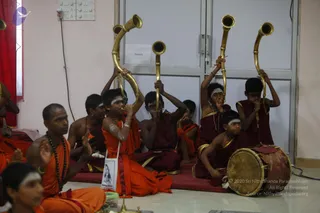
All other idea of golden childhood, look back, actually when you were a child how were you? You were frightened about your teacher. You were frightened about your hostel warden. You were frightened about your classmates. You were frightened about the bullying by other colleagues, sorry other friends or students. Then how can you call that as a golden childhood? And you are pulled and pushed, dragged by the small, small desires like a candy, a toy. You have so much of incompletions when you were a child. How can you call that as a golden childhood? NO. Matured being in a child body is the golden childhood. That is golden childhood. I tell you, I had golden childhood. I am giving the authentic golden childhood to my kids in the Gurukul. (Gurukul kids start blowing the conch.)

(HINDI)

Even if you carry one powerlessness, your life cannot be called as golden. The normal kids have so many powerlessness. If you look back at your childhood, you had so many powerless moments. Then how can you call that as a golden childhood? No. It is only your fantasy. Your childhood becomes real golden childhood when it is full of powerful moments, no powerlessness. And I give this as a command to all my Gurukul kids, understand, no powerlessness any moment of life. Okay? No powerlessness. (Gurukul kids start blowing conch.) Life should be full of energy and powerful.

35:41

I request all the viewers, television viewers and everyone, decide to become Spiritual Activist. Decide to become a Spiritual Activist. No question of having powerless moments in the life. No question of powerless moments in the life. I tell you, we should really do a Spiritual Activism revolution, revolution of Spiritual Activism. I am going to lead, I am leading this revolution. My Sangha is the movement of Spiritual Revolution, Spiritual Activist Revolution.

(HINDI)

The essence of all the spiritual literatures, Gita, Upanishads, Brahmasutras, everything is just one word: Become Spiritual Activist. That is the essence. Become a Spiritual Activist. Become a Spiritual Activist.

(HINDI)

Understand, if I make million people Spiritual Activist, I will feel I have done what I want to do, what for I happened on the Planet Earth.

In everything, in everything, in everything, look at every moment you are powerless through the four tattvas and understand with the spiritual clarity. I tell you, in every taluk, every village of India, we should create a Spiritual Activist community. In each city, town, taluk, village of India, we should gather people who are ready to become Spiritual Activists and create a Sangha, community, people who are really interested in living the spiritual understanding and enrich others with this spiritual understanding. You can be a brahmachari, married - grihastha, or a sannyasi. This should be our goal - Creating Spiritual Activists everywhere. Creating Spiritual Activists everywhere. In different parts of the world, creating Spiritual Activists is my mission. This should be done. This is only one and only priority for all my followers and disciples.

42:55

Understand, I am not saying this is your first priority. This is your ONLY priority. Become a Spiritual Activist. Make more and more people Spiritual Activists. Everywhere we will dedicate our time, talent, treasure, life, everything, to make Spiritual Activists who will live the spiritual truths, who will understand everything through the four principles of Integrity, Authenticity, Responsibility and Enriching, who will live through these four principles, who will enrich everyone through these four principles.

Spiritual Activism is our life breath. Spiritual Activism is our lifestyle. Don’t just go and continue your everyday routine life after listening to satsang. Go and start radiating. Reach out to people. Enrich people. Every day come with new, new methods to enrich people, reach out to people. You wasted your whole life just listening, not moving. It is time MOVE. Unless you move, nothing can be done. This whole country should become Spiritual Activist country. The whole world, every human-being should become Spiritual Activist.

(HINDI)

I am not saying it is first priority to my disciples. I am saying it is ONLY priority to my followers and disciples. Create more and more Spiritual Activists. This is the purpose. This is the purpose. Live these four tattvas, make people live these four tattvas. Live these four tattvas. Make people live these four tattvas. Become a Spiritual Activist.

(HINDI)

47:30

Every village, every town, every taluk, there are so many spiritual places created - not useful to society or nobody is able to run. I request all my disciples, devotees to approach the people who are holding those spiritual places like ashrams, temples, schools, goshalas, request them, partner with them, make all those places active, alive, and make those places as a Center for Spiritual Activism. Enrich people to be Spiritual Activists. Spiritual Activist means, who takes the oath of these four tattvas, four principles, living Integrity, Authenticity, Responsibility and Enriching yourself and others. Whoever takes the oath of living these four principles, is Spiritual Activist.

And let us create thousands of temples, annalayas, goshalas, vidyalayas to spread Spiritual Activism as Spiritual Activist Centers, as Spiritual Activist Centers. Too much of time we spent in spiritual loneliness and aloneness. It is time we all wake up and enter into Spiritual Activism.

(HINDI)

I want every Healer, every disciple to become Spiritual Activist. Every individual in this country should become Spiritual Activist. That is the only way to raise this country. Understand, this country is not going to raise through political revolution. It is not even going to raise like so many fools are imagining if you bring all the black money back the country is going to raise. No. It is not even through the black money, bringing the black money back. The fellows who are screaming about black money, they all built their organizations through black money. It is not even by bringing the black money back or any other socio politico economical revolution. India is going to lead the world only by Spiritual Activism, only by the spiritual revolution, only by spiritual revolution, and Spiritual Activism.

(HINDI)

52:25

Aaj satsang ka saaransh hai (The essence of today’s satsang is)

Become a Spiritual Activist. Understand these four tattvas – Integrity, Authenticity, Responsibility and Enriching. Live them. Radiate them. Be a Spiritual Activist. Enrich others to be a Spiritual Activist.

(HINDI)

Spiritual Activism is the only solution for all the diseases this country is suffering, the citizens of this country is suffering, the world is suffering. Spiritual Activism is the medicine for all the diseases the world is suffering. Understand, life, death, birth, power, energy, money, relationship, everything with this clarity of Spiritual Activism through four principles - live and radiate. That is the only solution.

Photos Of The Day:

Paduka-Puja-Crowd-Individuals
RudraAbhishekam-amba

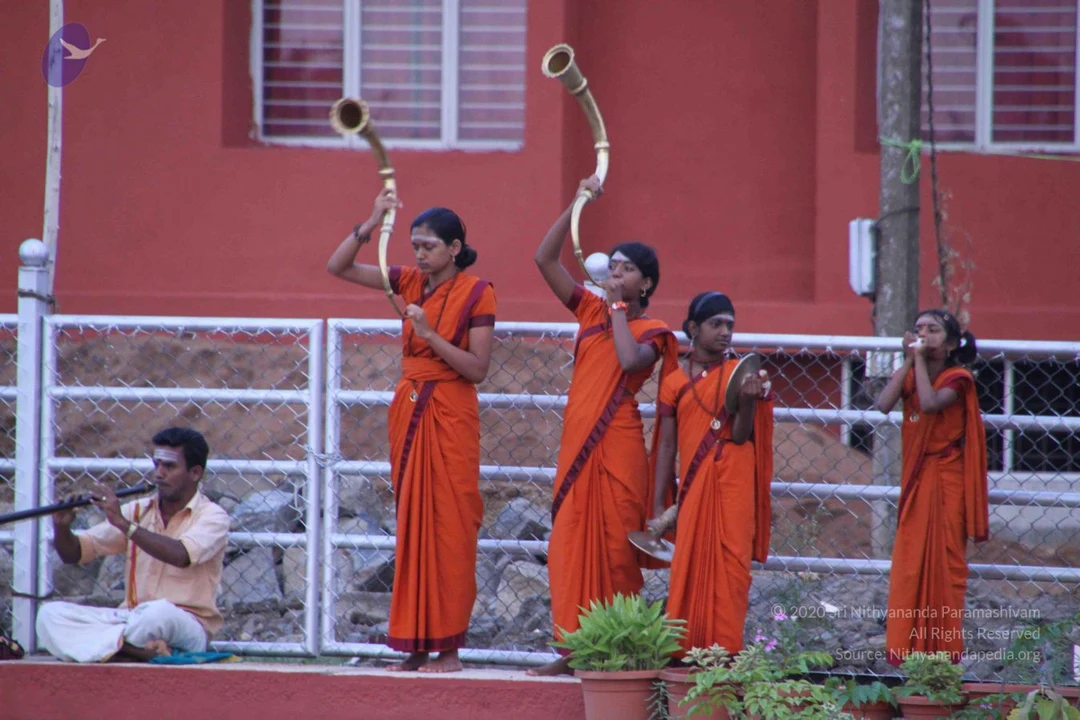
Gurukul-Kids-Instrument

Crowd_Claps

NithyaSatsang_Swamiji

Meditation_shots

SarvaDarshan

Final_Blessing

Temple

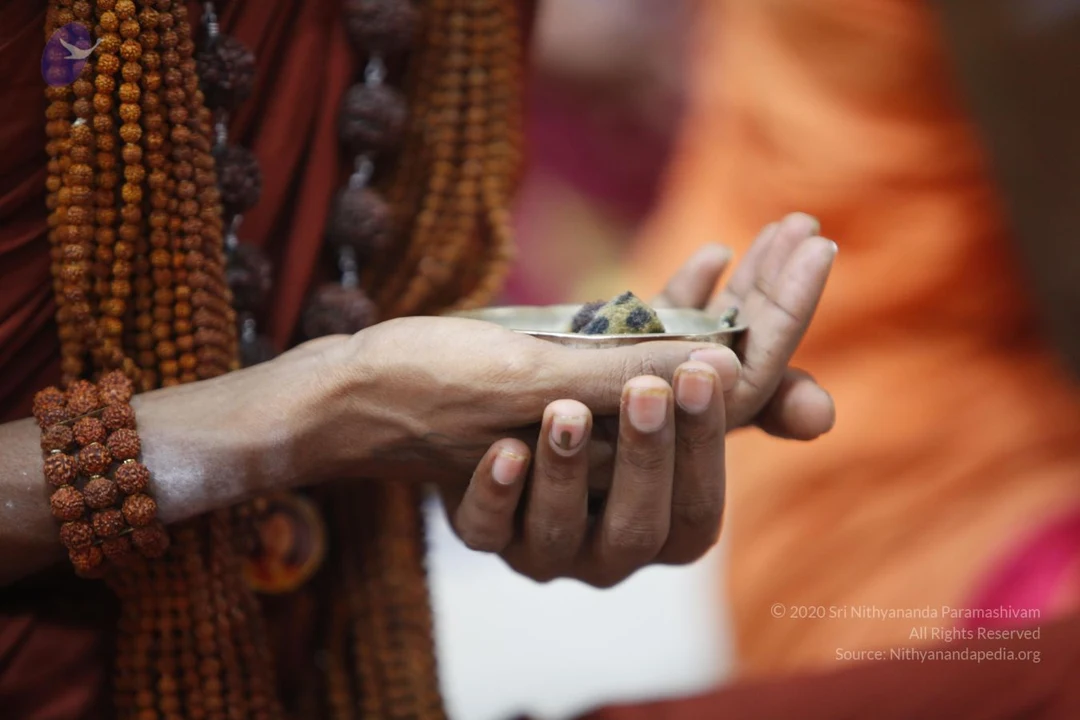
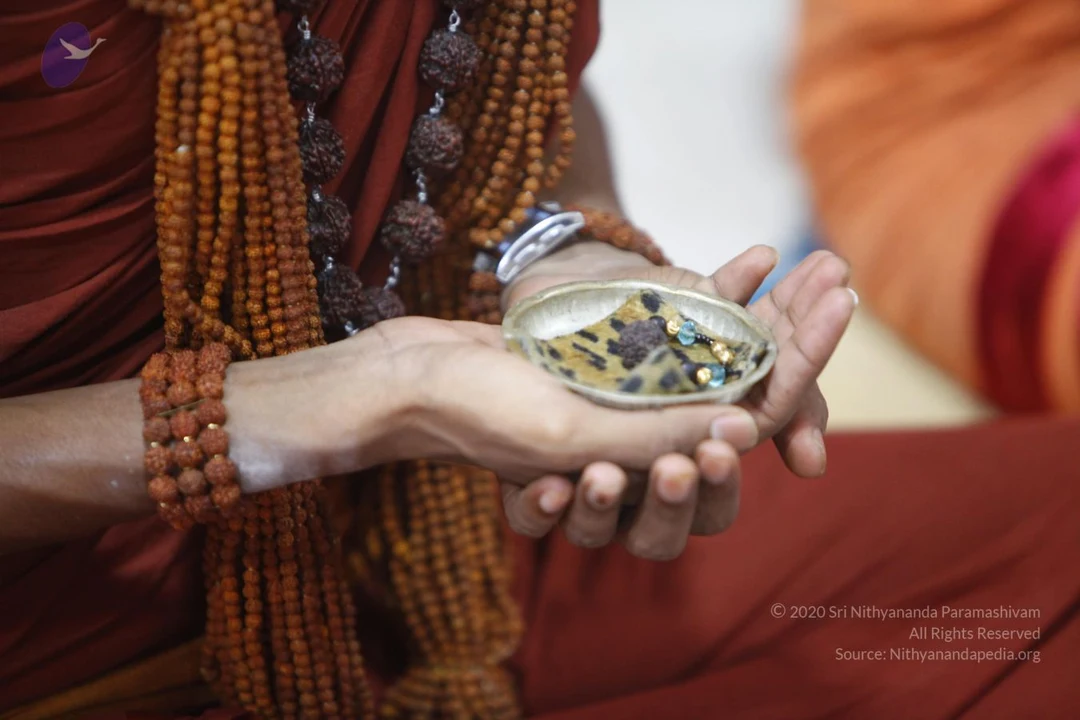
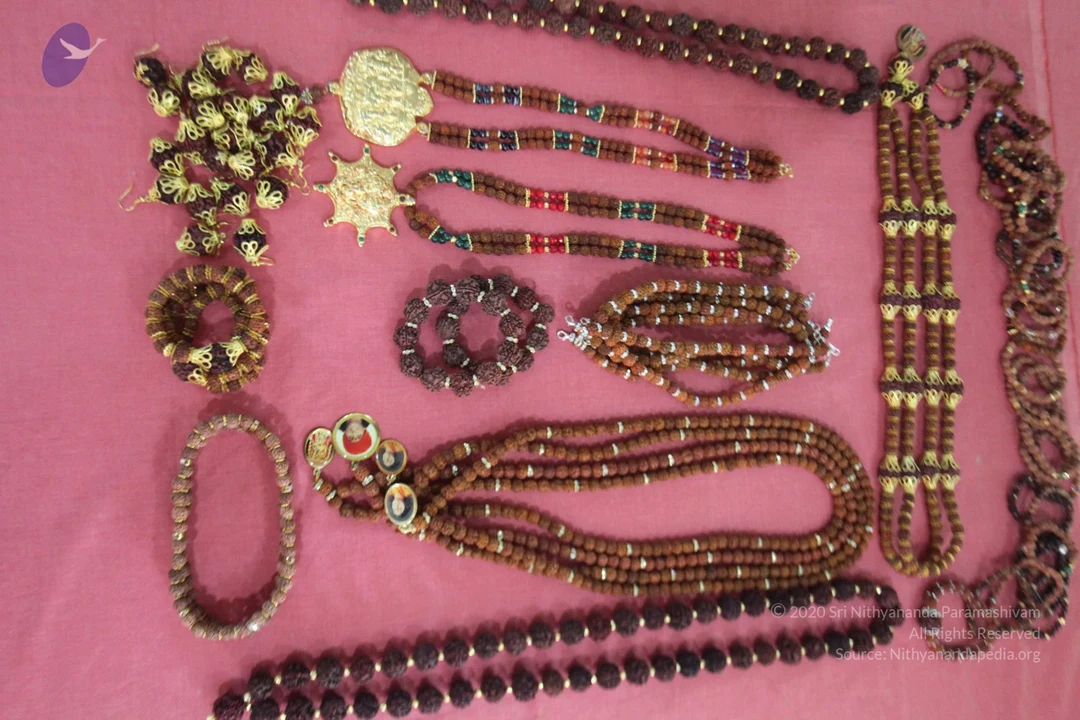
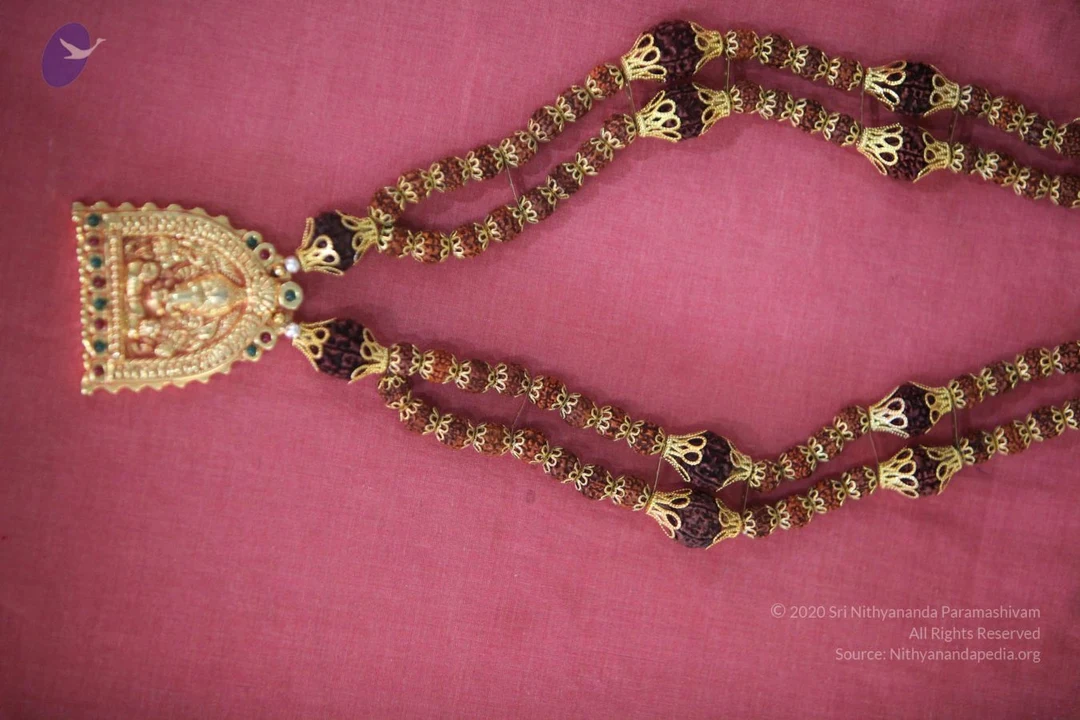
Rudraksha_Jewelry_Photos

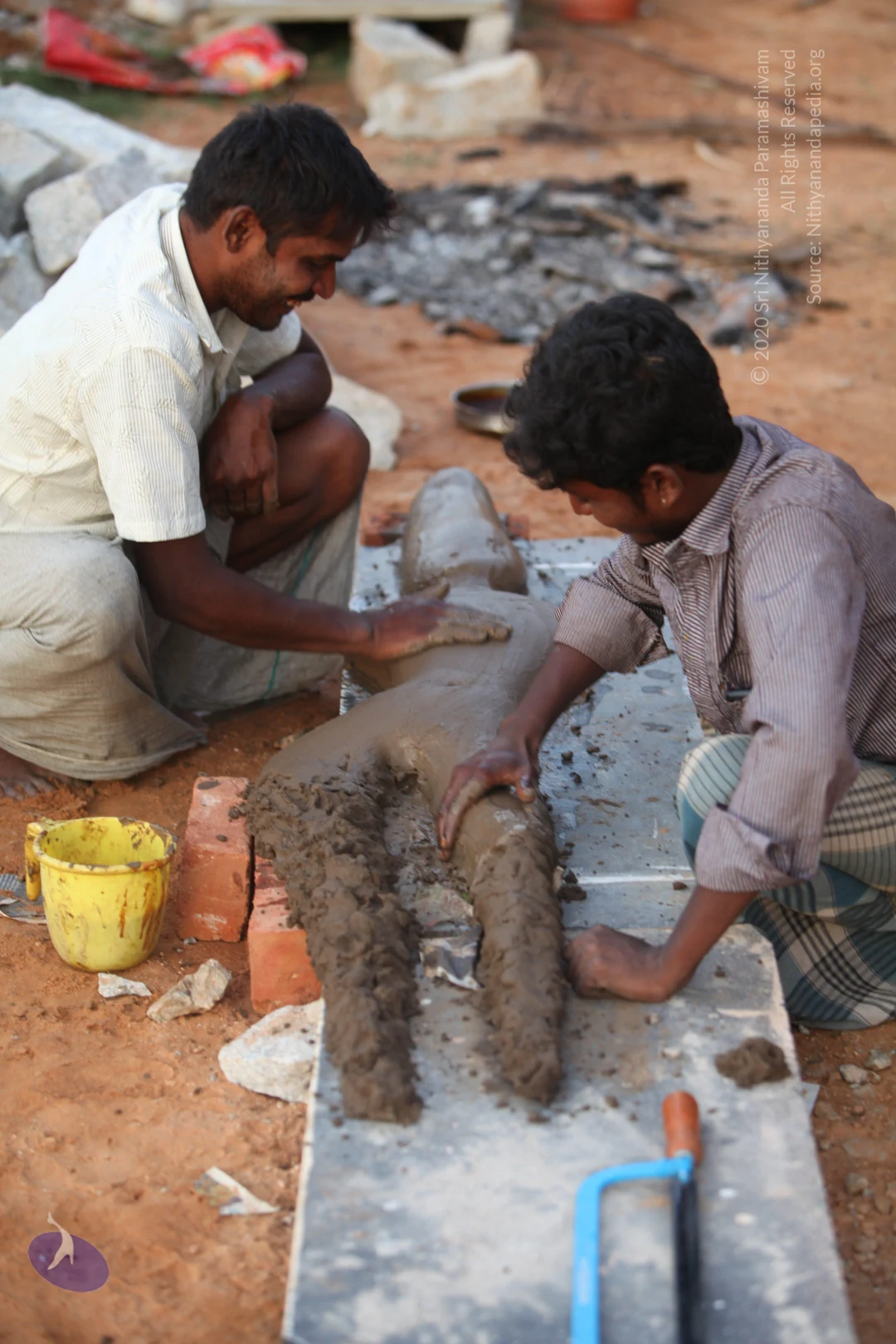
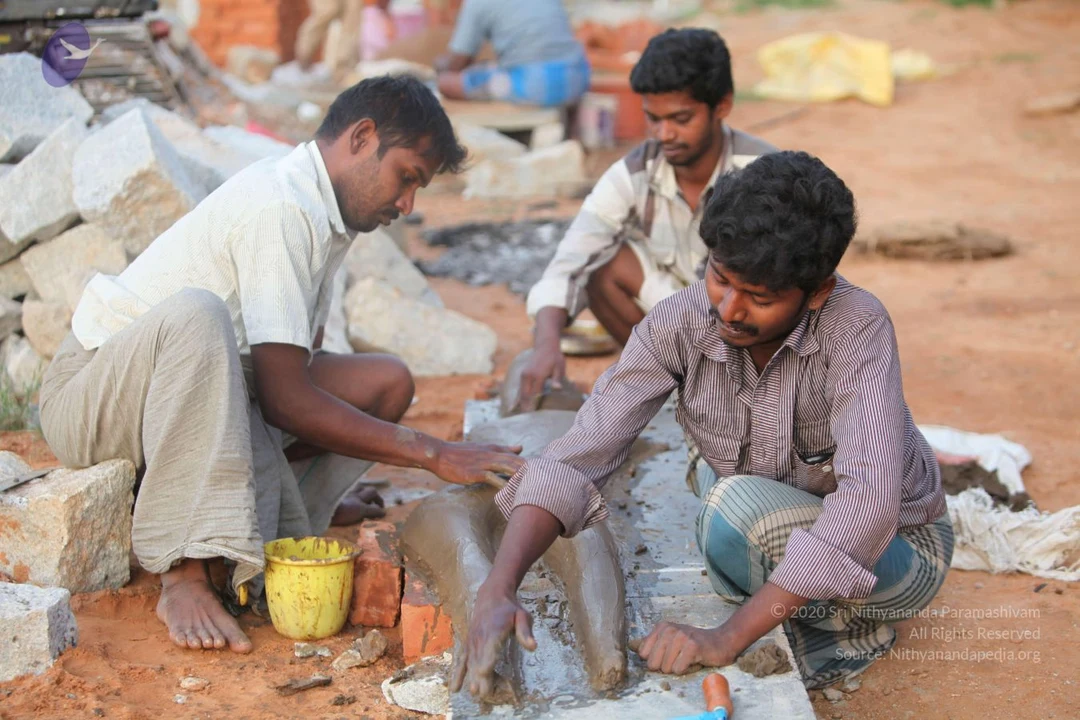
SacredArts_Photos

Photos Of The Day:

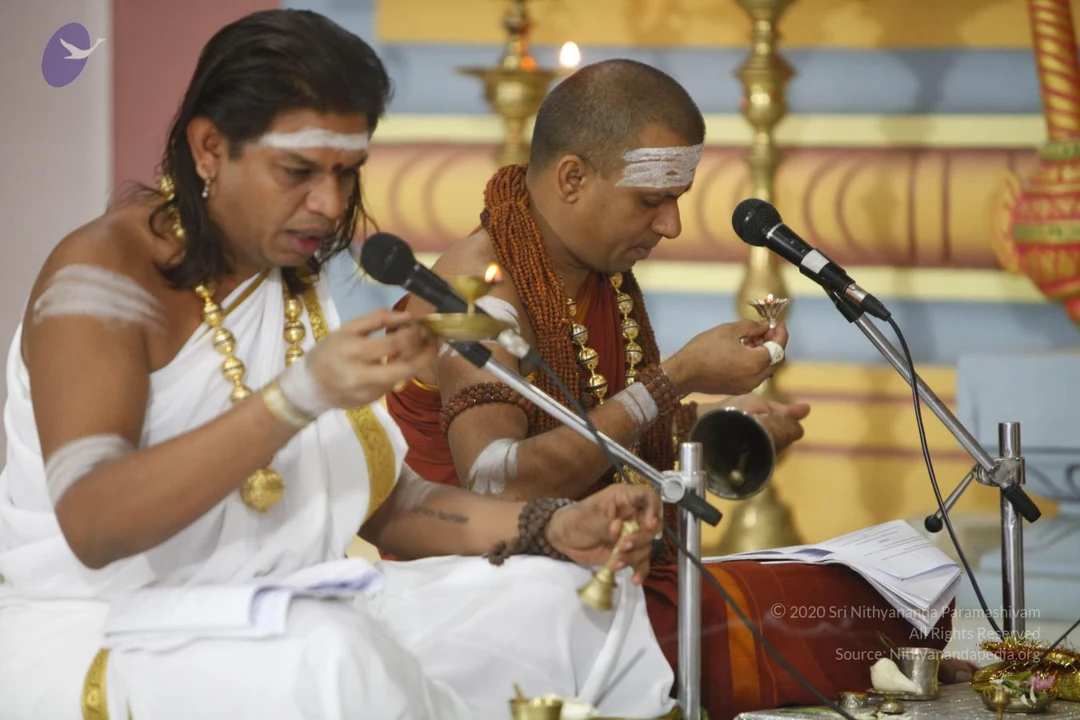
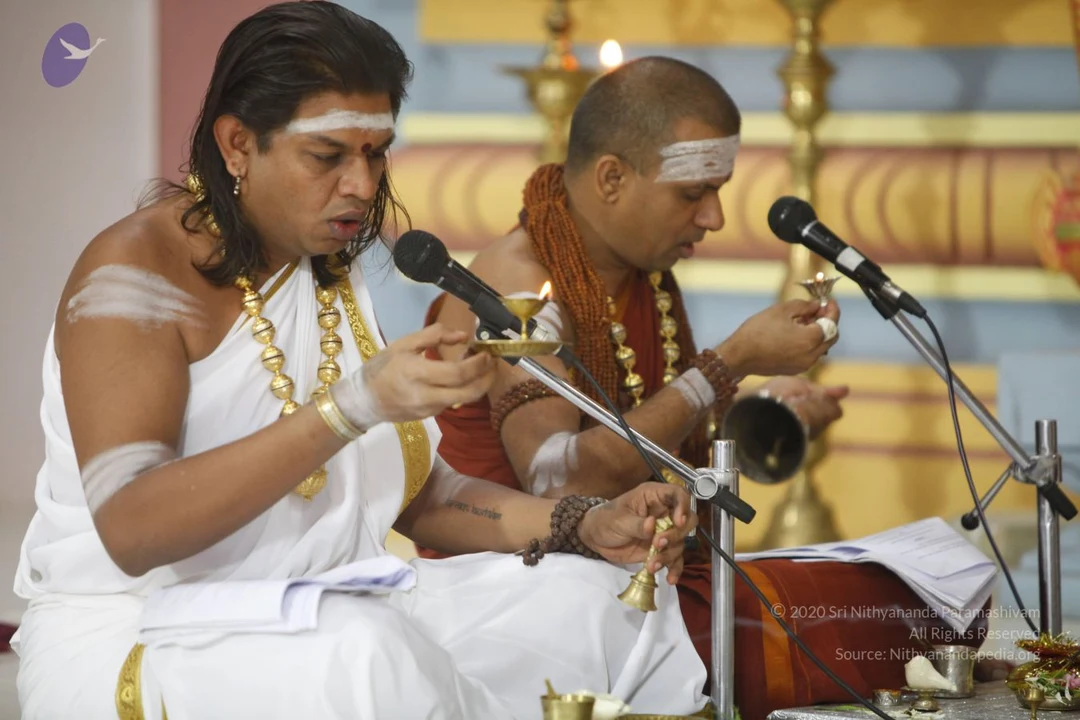
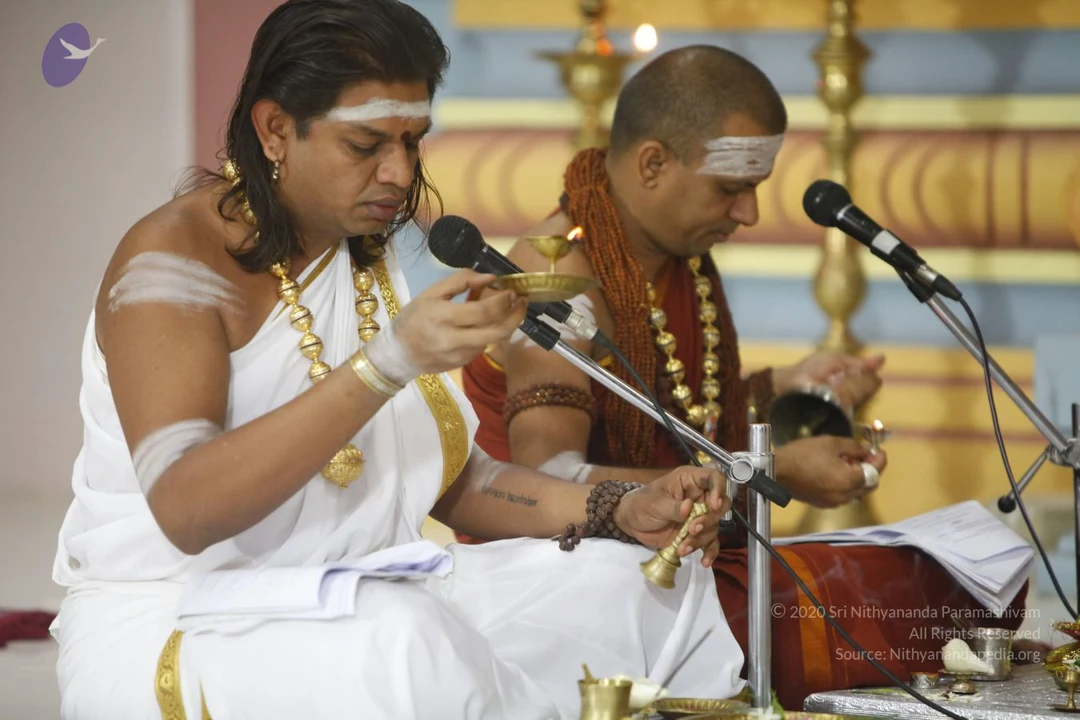
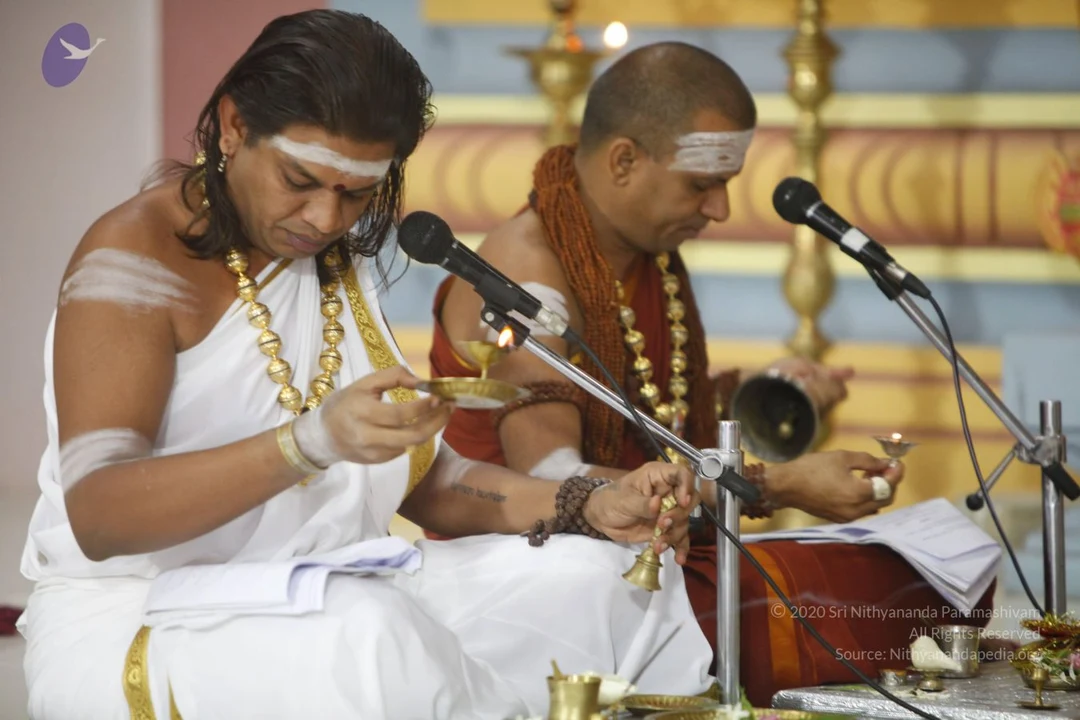
Rudra Abhisekam

Paduka Puja

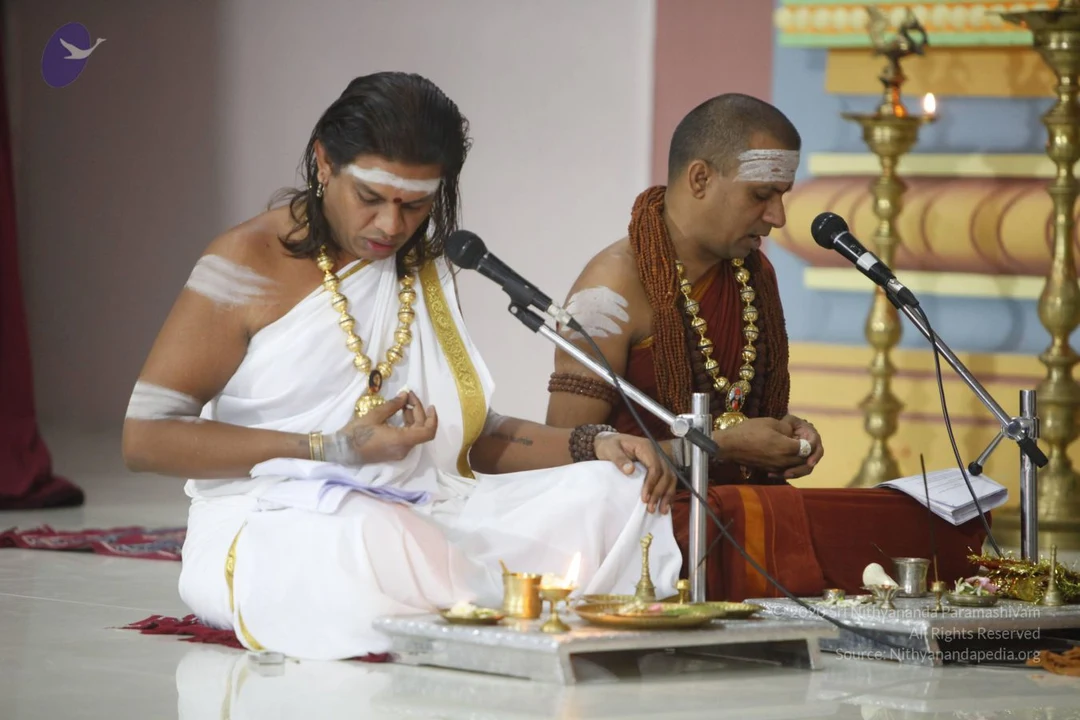
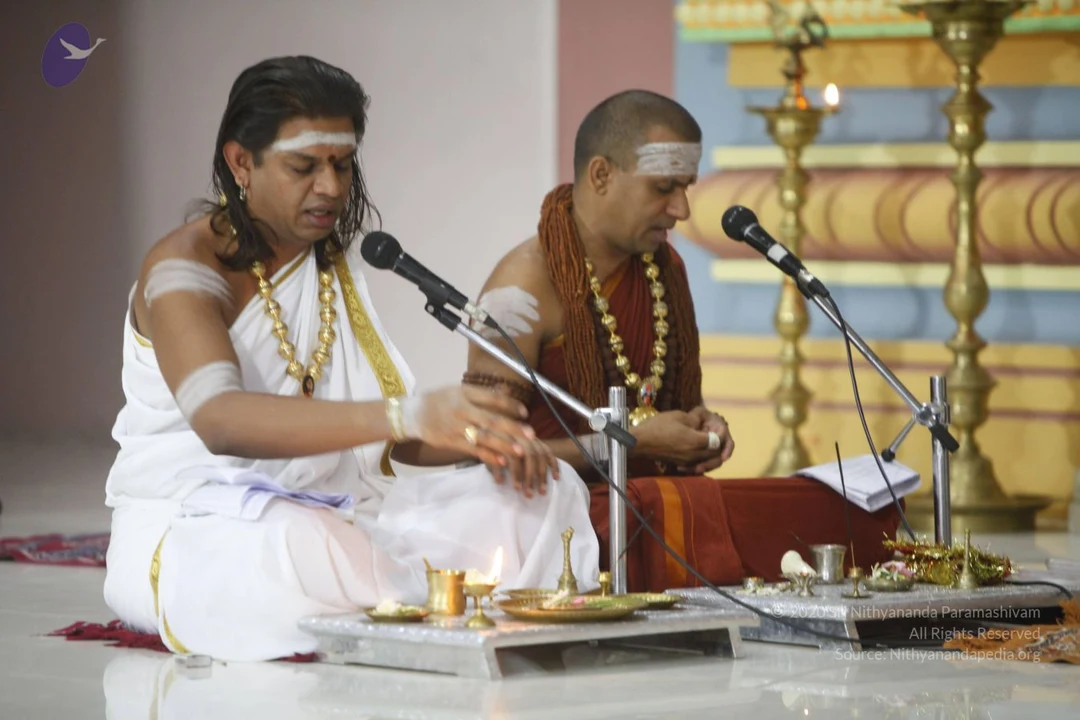
NithyaSatsang

SarvaDarshan

Rudraksha Jewelry

Sacred Arts

Temple

Photos

Tags:

Paramahamsa Nithyananda, accident, adventure, rebirth, lifetime, potential, human, birth, mind, integrity, decision, awareness, responsibility, world, maturity, leadership, understanding, experience, divine, liberated.

Photos from this day

View all 224 photos

Paduka-Puja-Crowd-Individuals
38 photosSource gallery
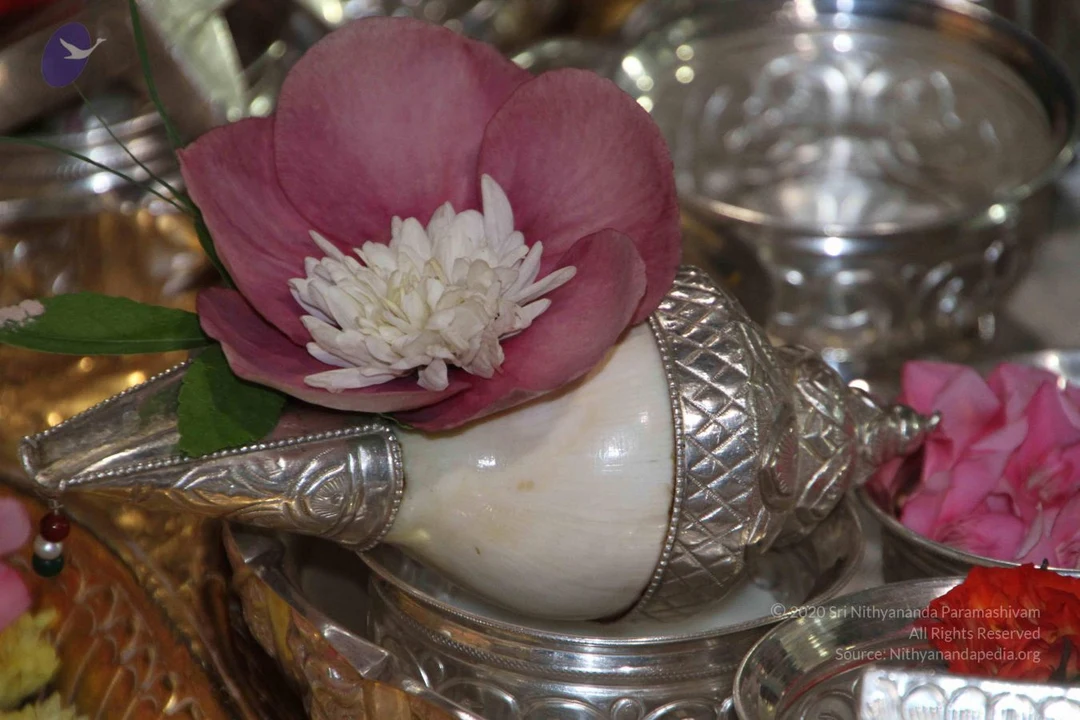
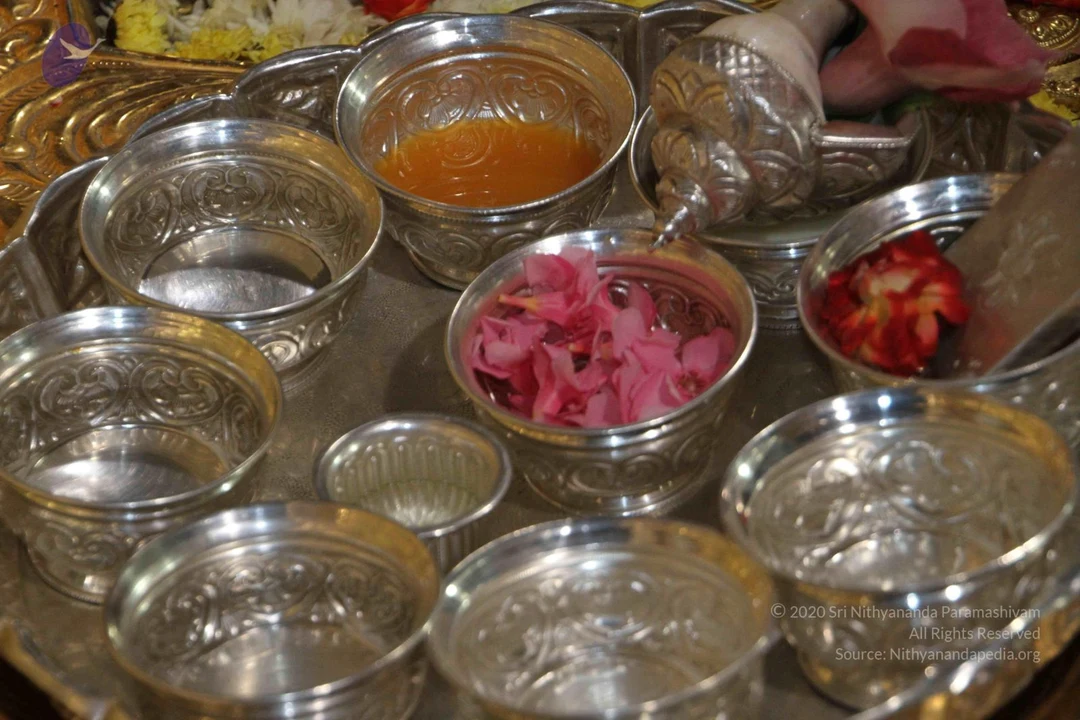
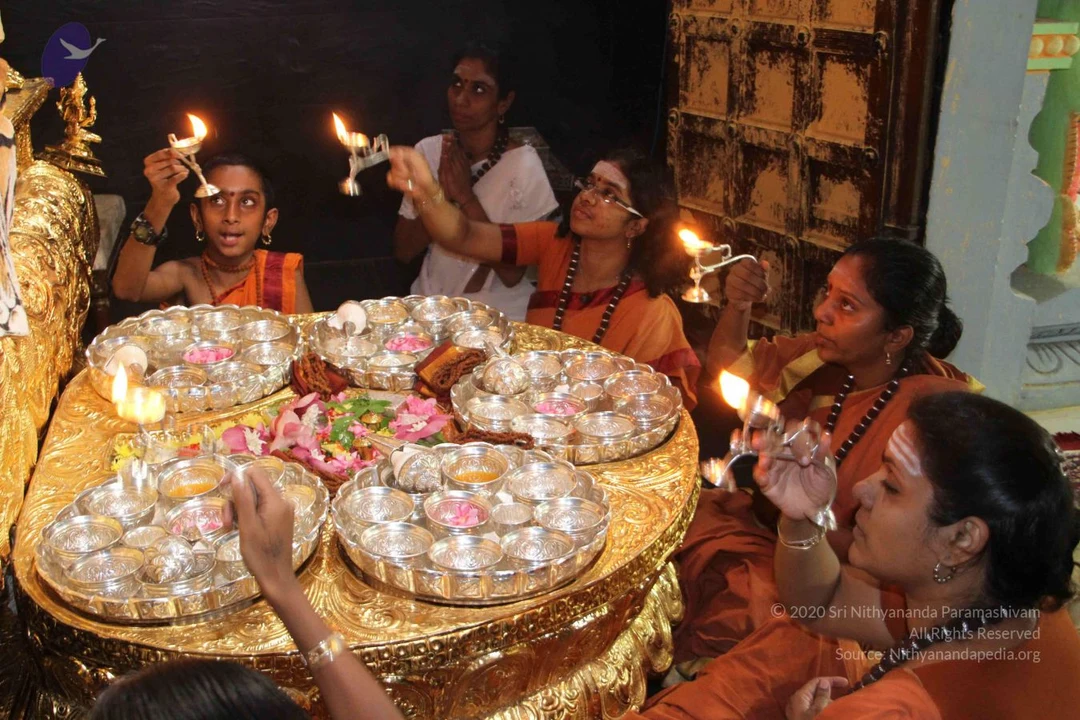
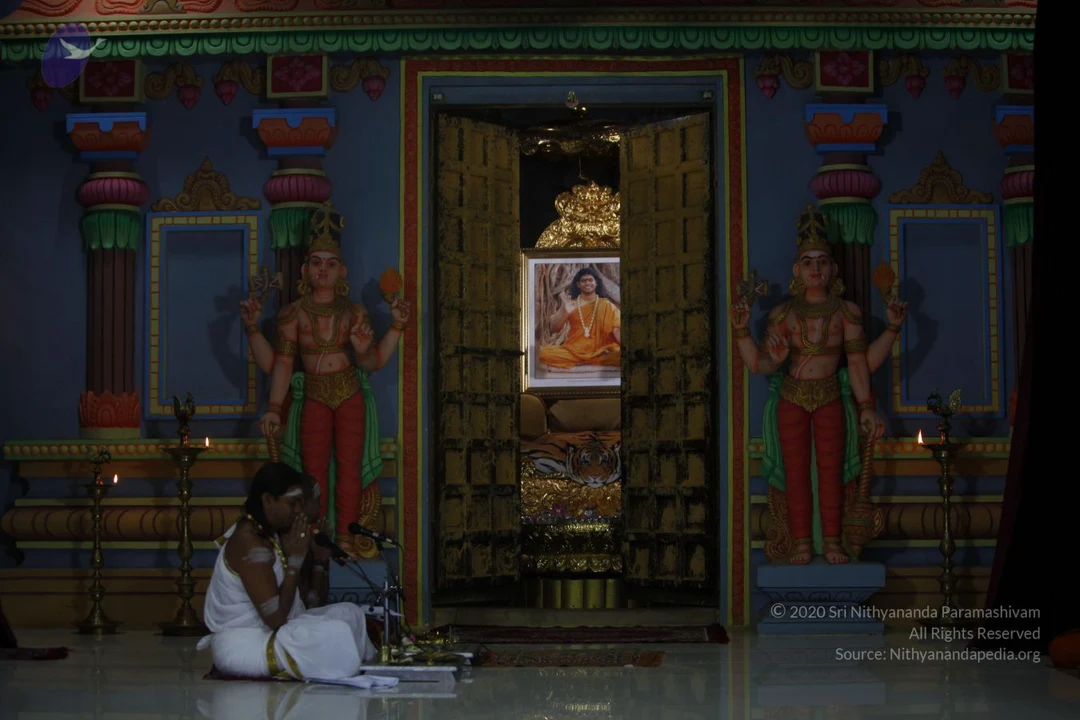
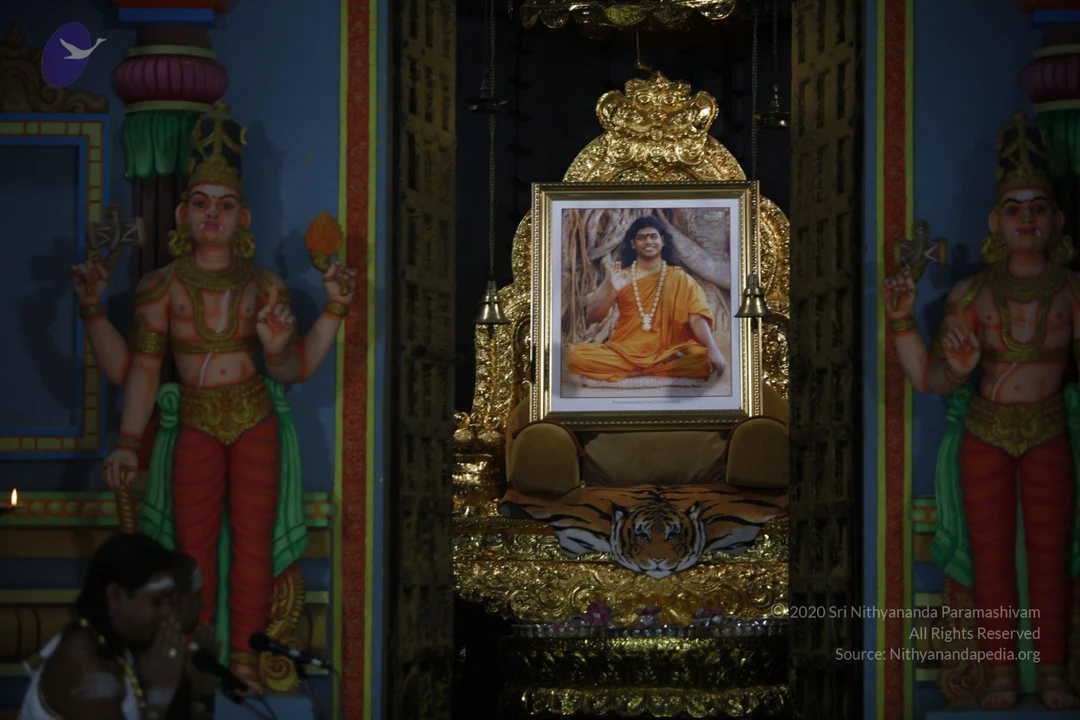
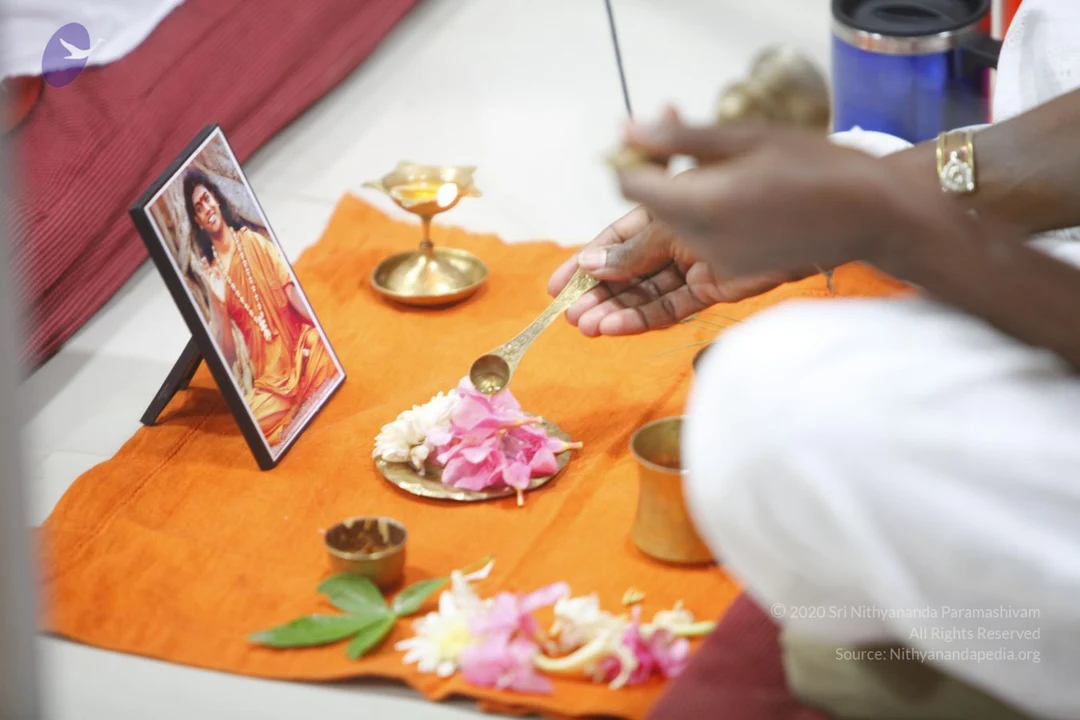
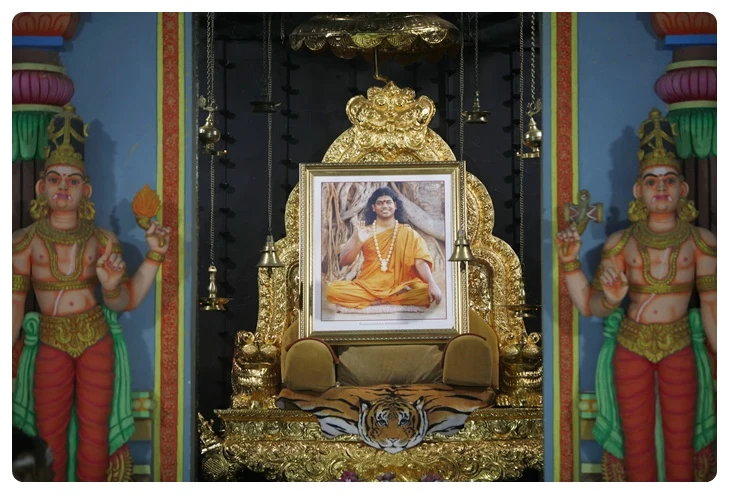
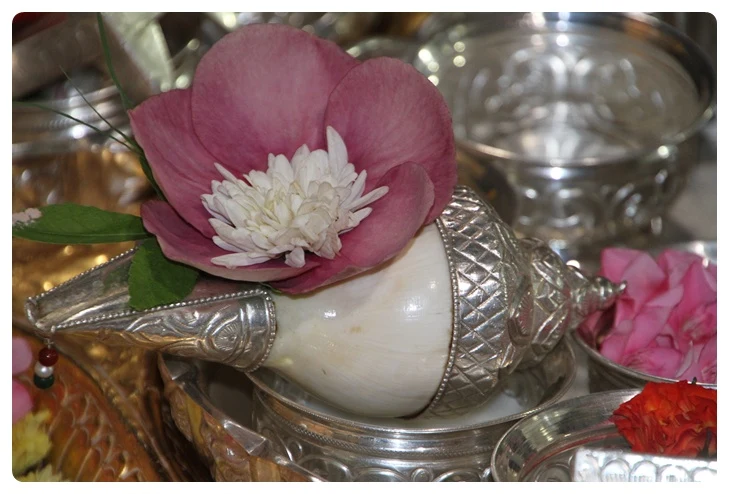
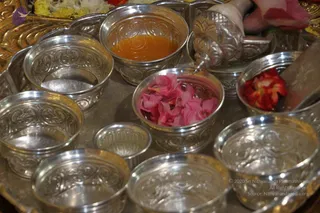
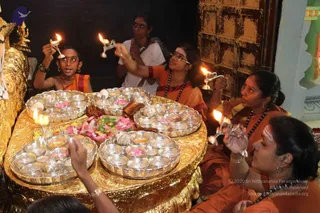
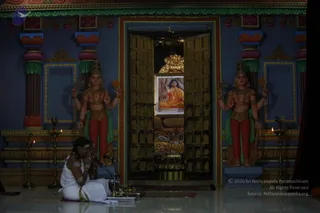
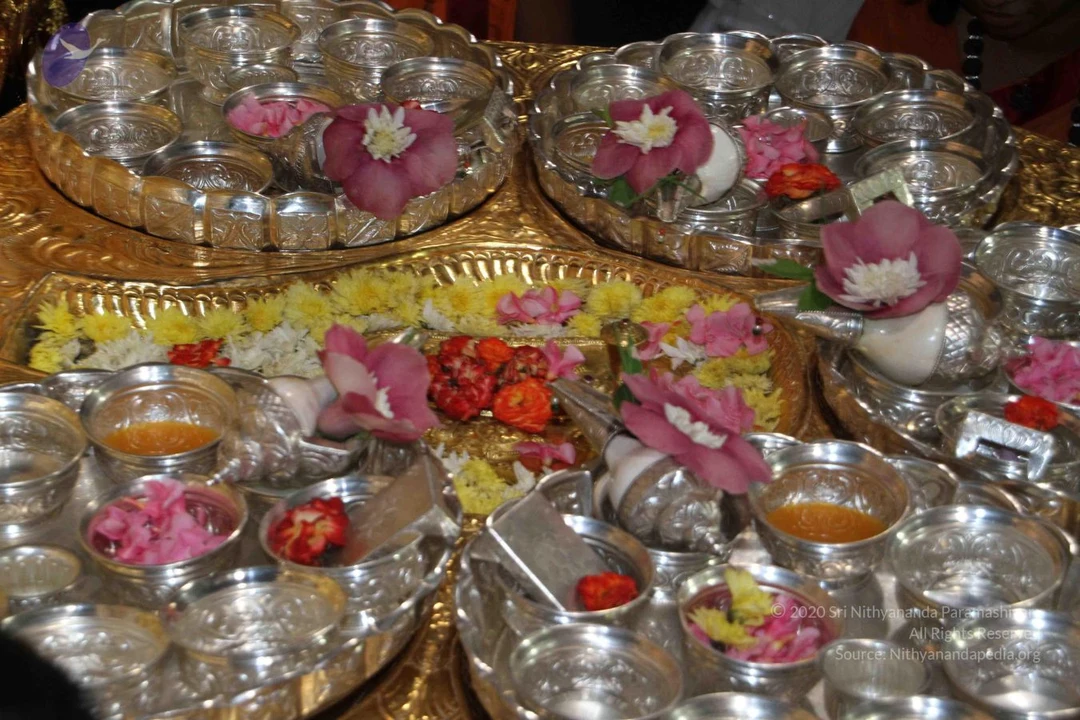
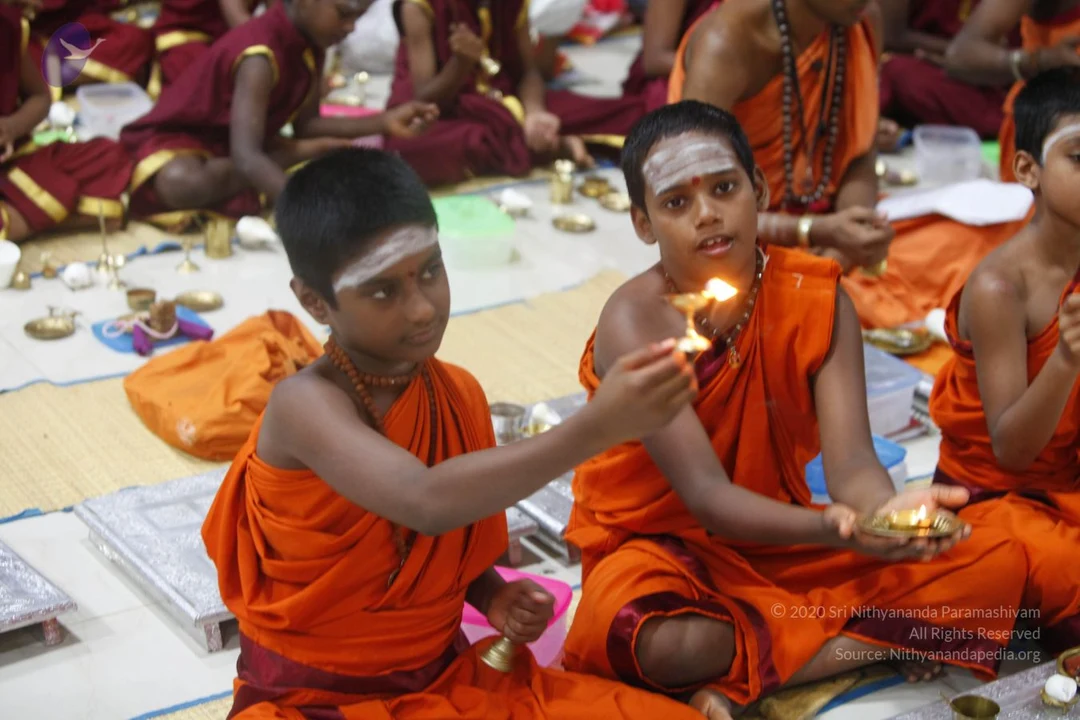
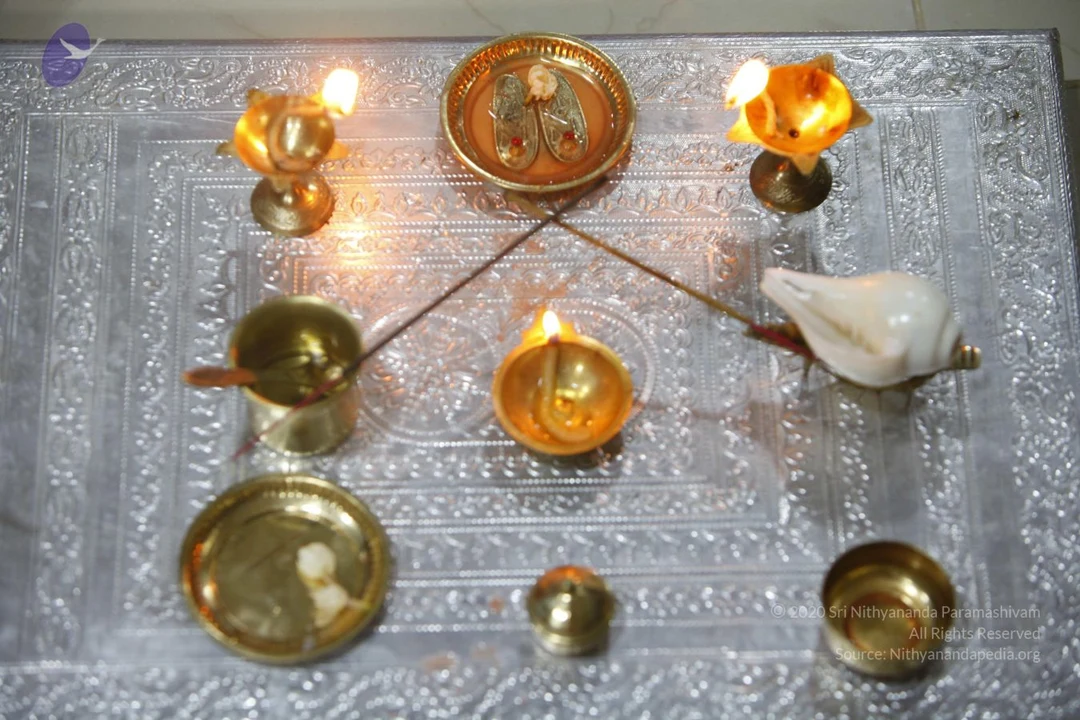
Close view of an offering arrangement on gold-coloured trays for puja. Many small silver bowls and cups hold pink and red flower petals, orange liquid and clear water. Large pink and white flowers, possibly lotus-like blooms, are placed among the bowls, with yellow and white marigold-type flowers and red blossoms heaped in the centre. Silver spouted vessels and ornate silver containers complete the ritual setting. No people are visible.Close-up photograph of a white conch shell (shankha) fitted with silver mounts and chased silver engraving, its wide opening topped with a pink petal flower and white chrysanthemum-like blossom with green leaves. Behind it sits a clear glass bowl, a silver tray and pink flowers in a small silver dish. No people are visible.Close-up of an ornate silver puja tray with several engraved silver bowls holding offerings. One bowl contains pink rose petals in water, another holds red flower petals, a third holds a yellow-orange liquid, and a silver spoon-like ladle rests among them. Flower garlands in yellow, white and pink border the golden tray. No people are visible; the setting suggests abhishekam or puja offerings.Close-up photograph of two small silver oil lamps (deepams) on a polished silver tray, each with a lit wick and a flame rising from the spout. The lamps have looped handles and a plain rounded bowl. The background is dark with a reddish fabric edge at the top right. No people are visible.A photograph of a ritual in a temple setting with a golden ornate platform holding many silver bowls filled with flowers, pink petals, and offerings. Several women and a young boy hold lit oil lamps (aarti) aloft. A young boy at left in saffron clothing and a rudraksha mala raises a lamp. A woman in saffron with a rudraksha mala and forehead vibhuti holds a lamp at center-right. Another woman in white with folded hands stands behind them. A woman in orange sari with vibhuti on her forehead holds a lamp at right. A dark wooden door with brass fittings forms the background.A seated priest in white ritual clothes with a bare upper body and white sacred markings on his forehead and arms sits cross-legged on a white floor with palms joined in namaste before a microphone. Behind him, two painted guardian figures with four arms, red dhotis, green sashes and ornate crowns flank a temple-style shrine with tall golden double doors standing open. Within the doorway hangs a framed portrait of a figure in orange robes and a beaded necklace, seated before a tiger-skin cushion and golden decorations. Oil lamps stand on brass stands along the blue and green painted walls. The scene is a satsang setting with a decorated shrine.
RudraAbhishekam-amba
75 photosSource gallery
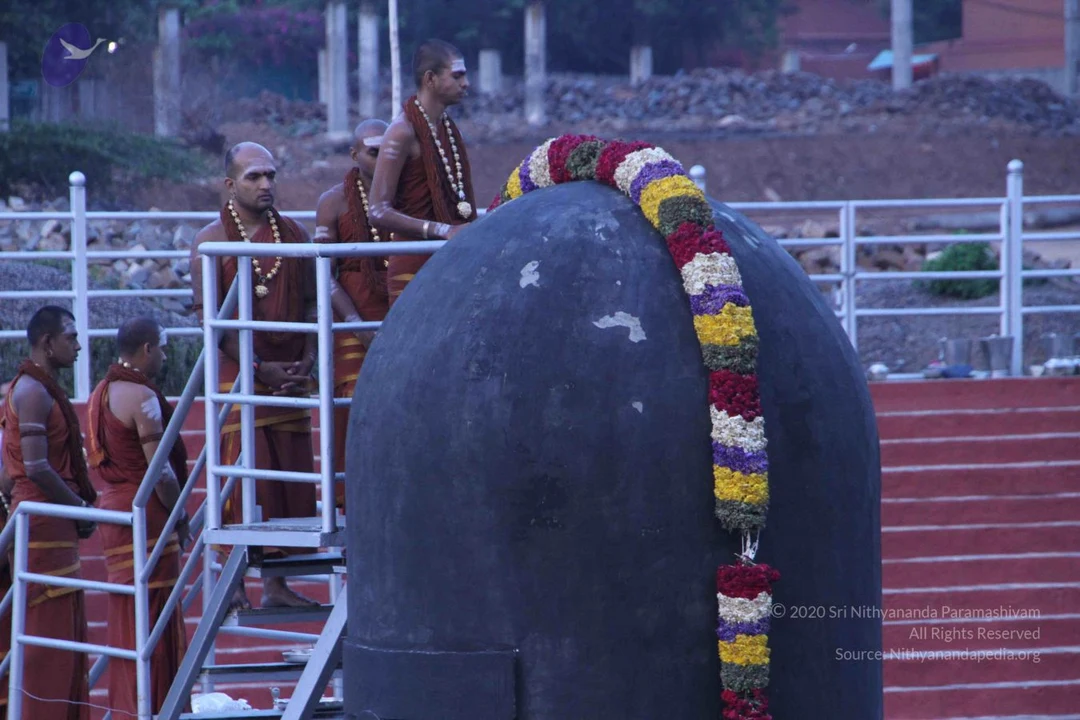
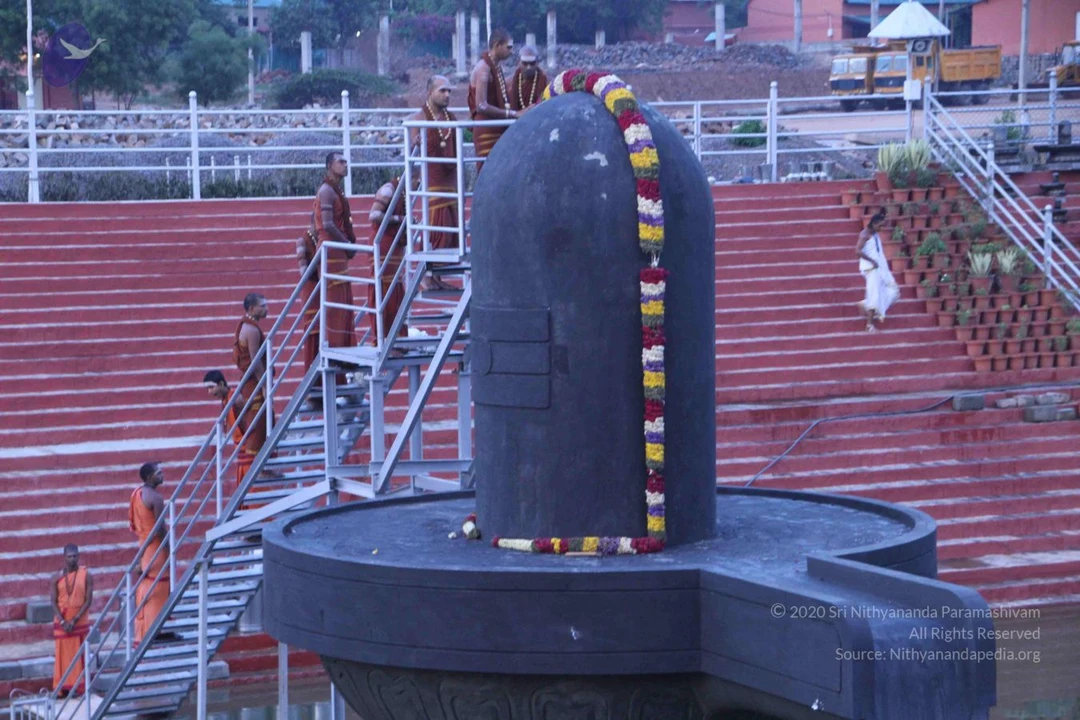
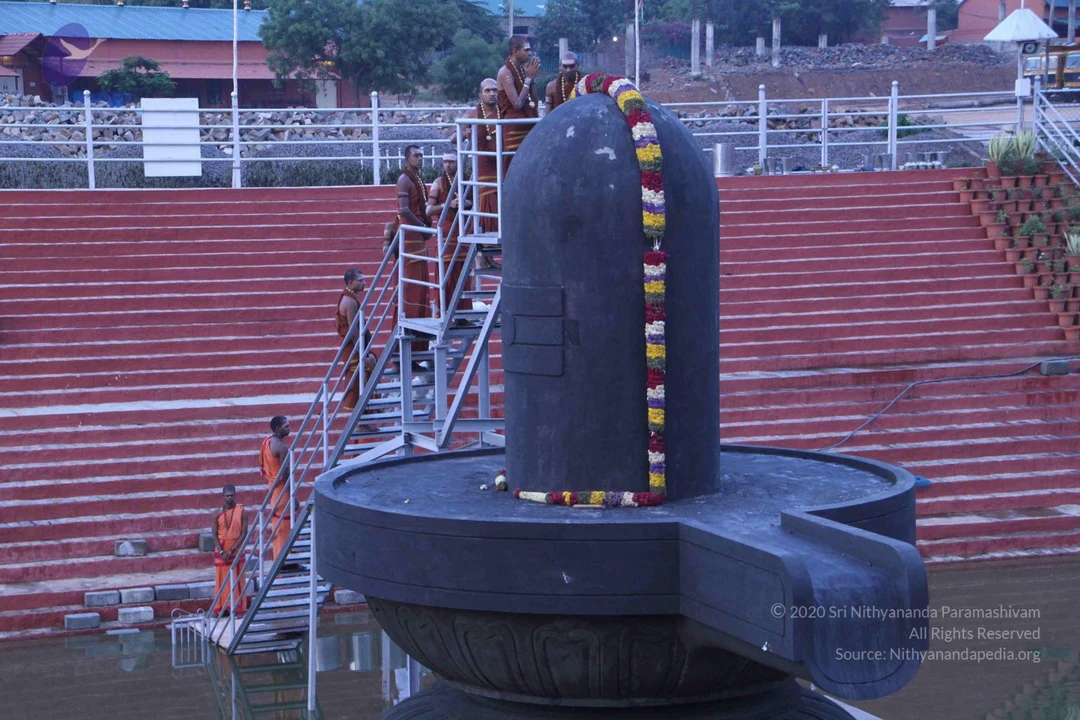
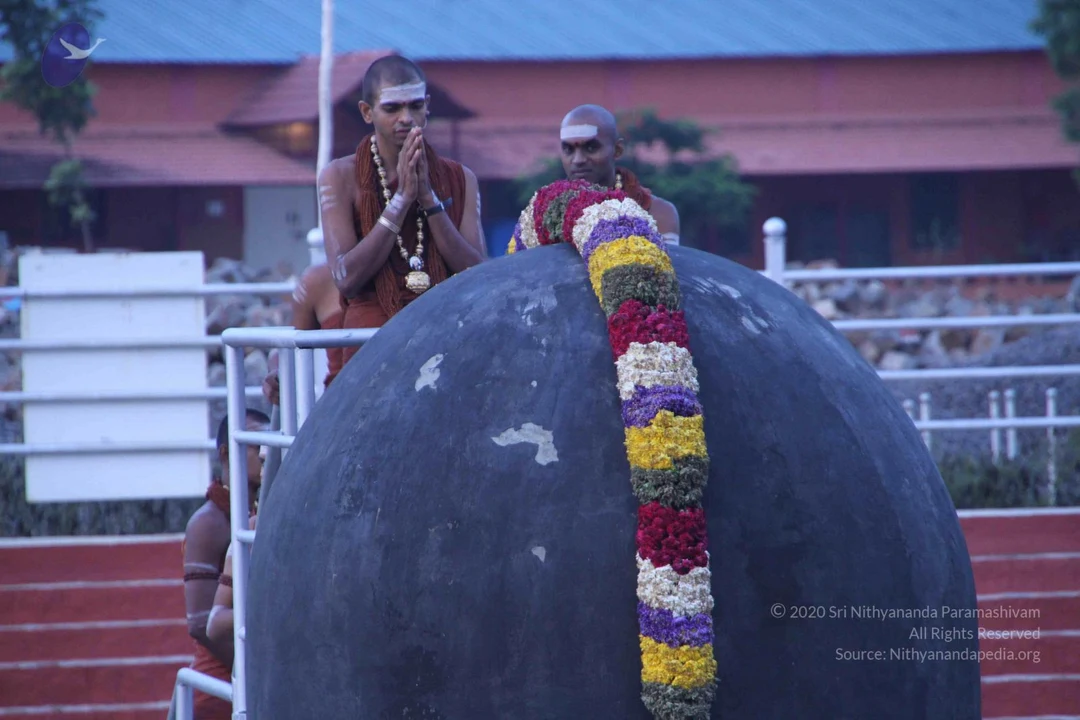
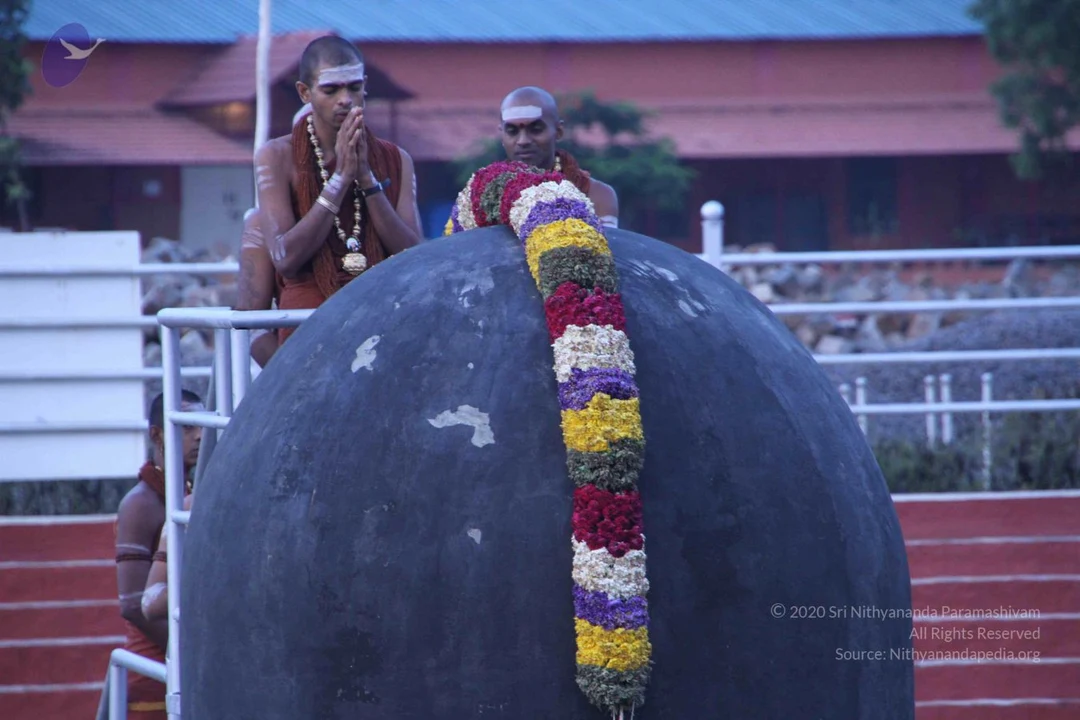
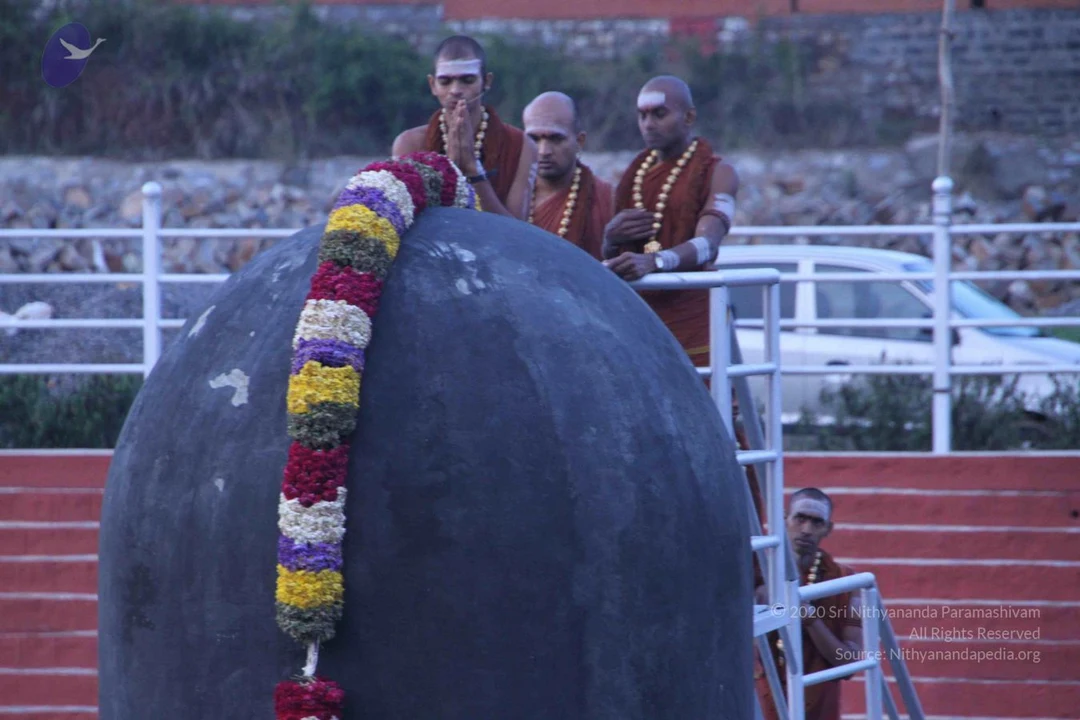
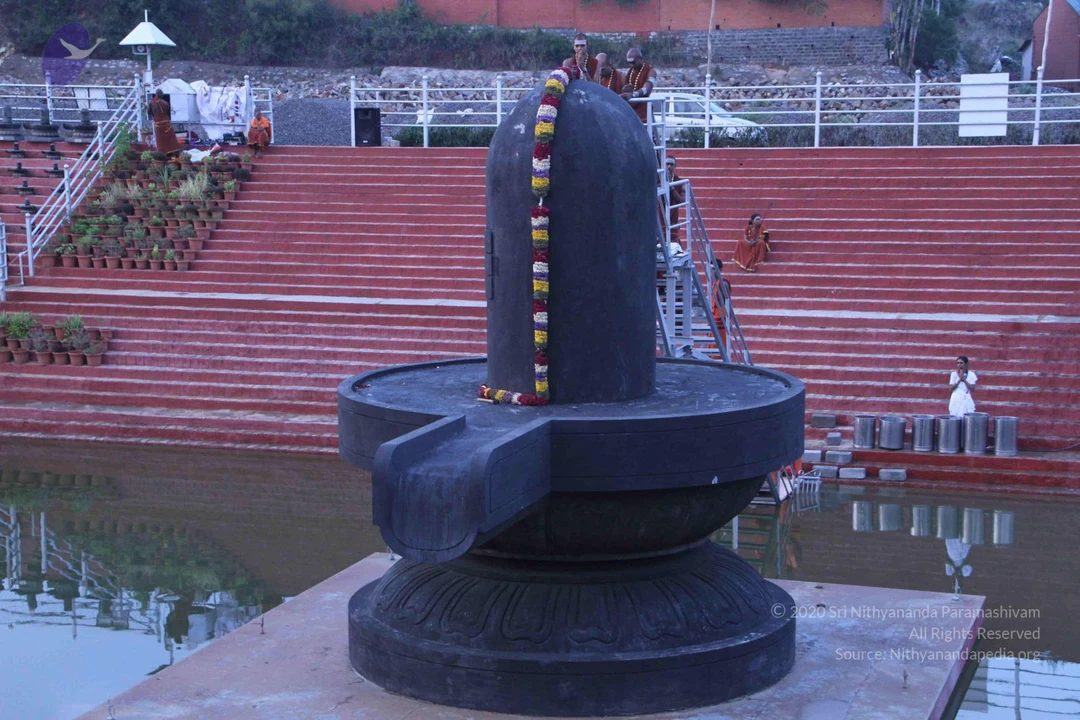
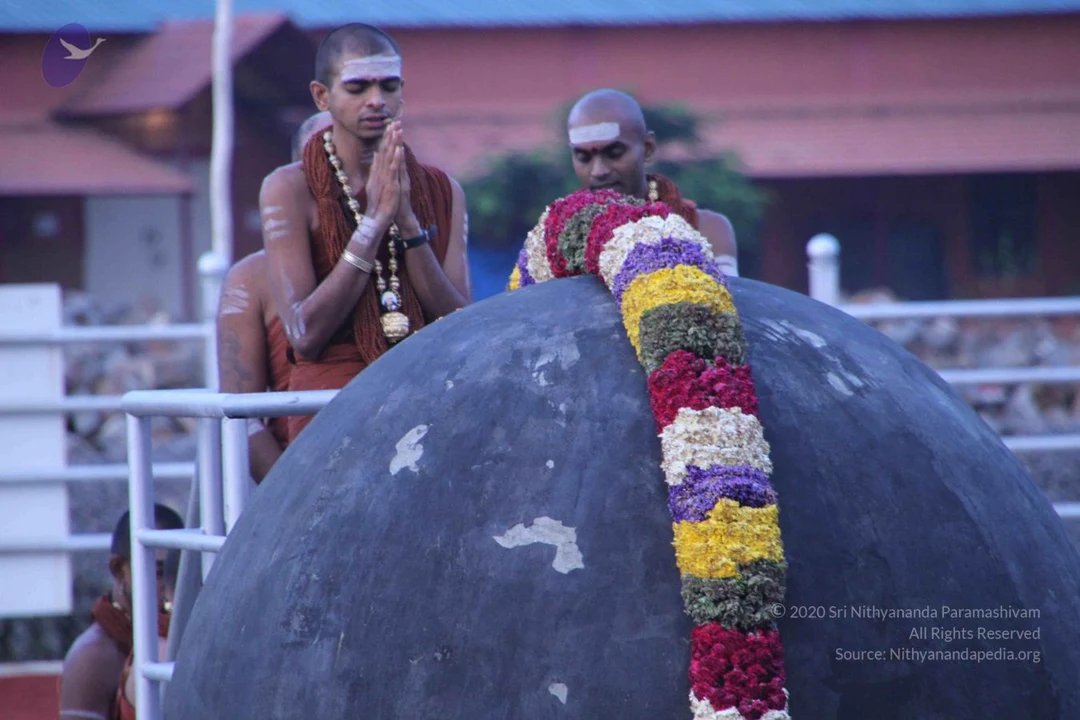
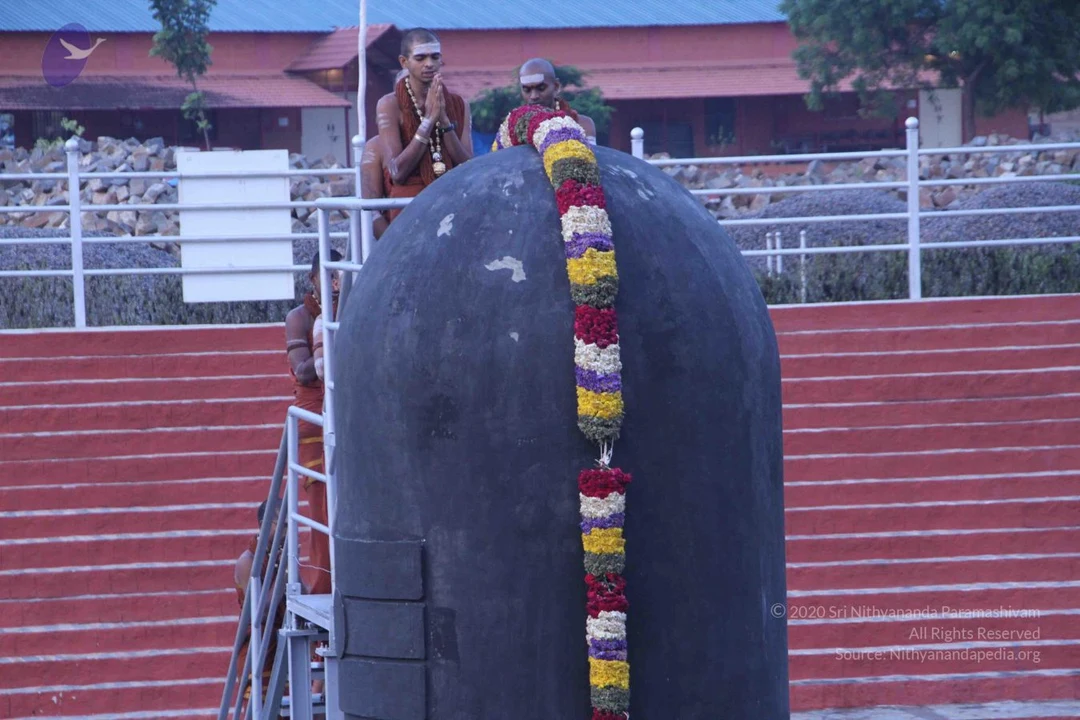
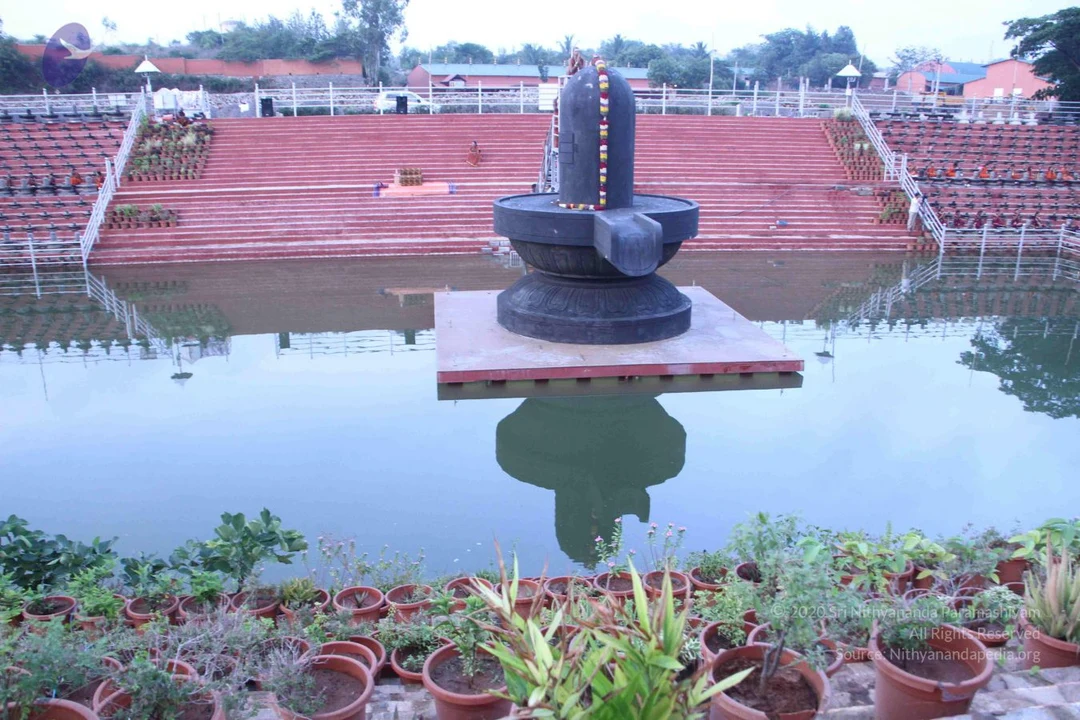
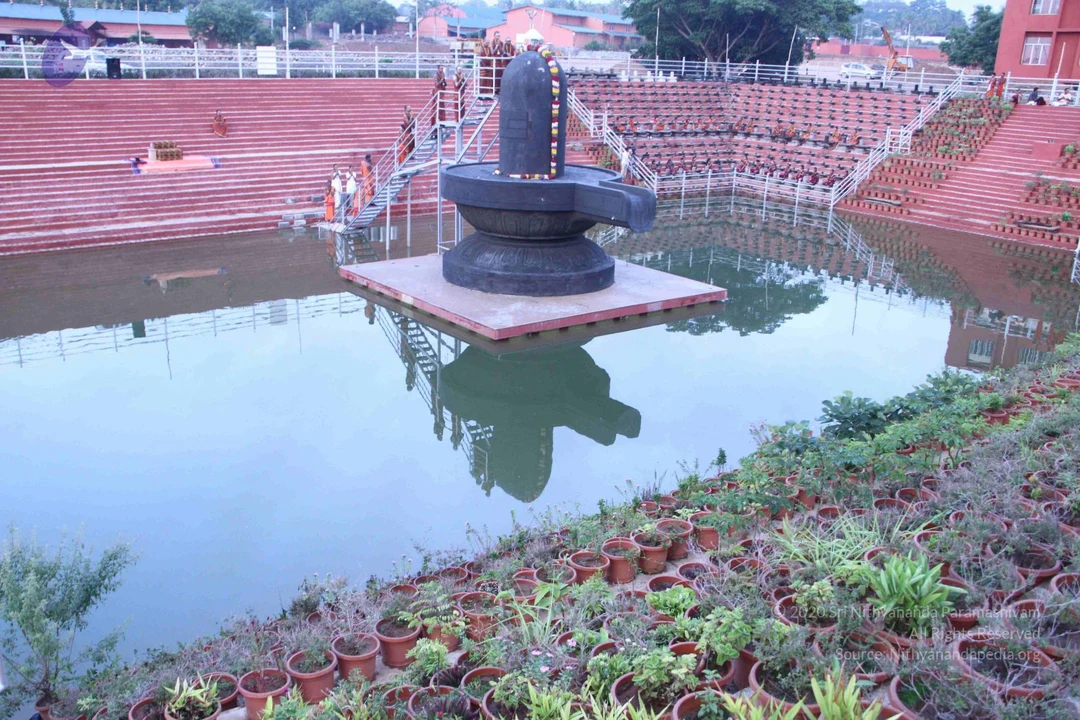
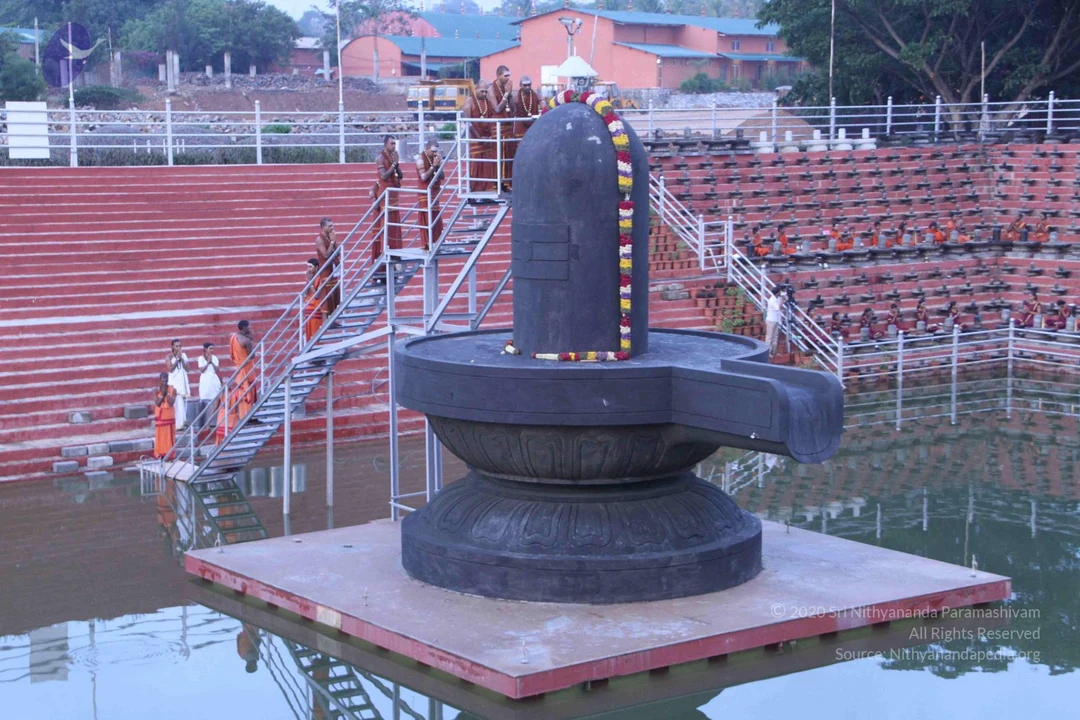
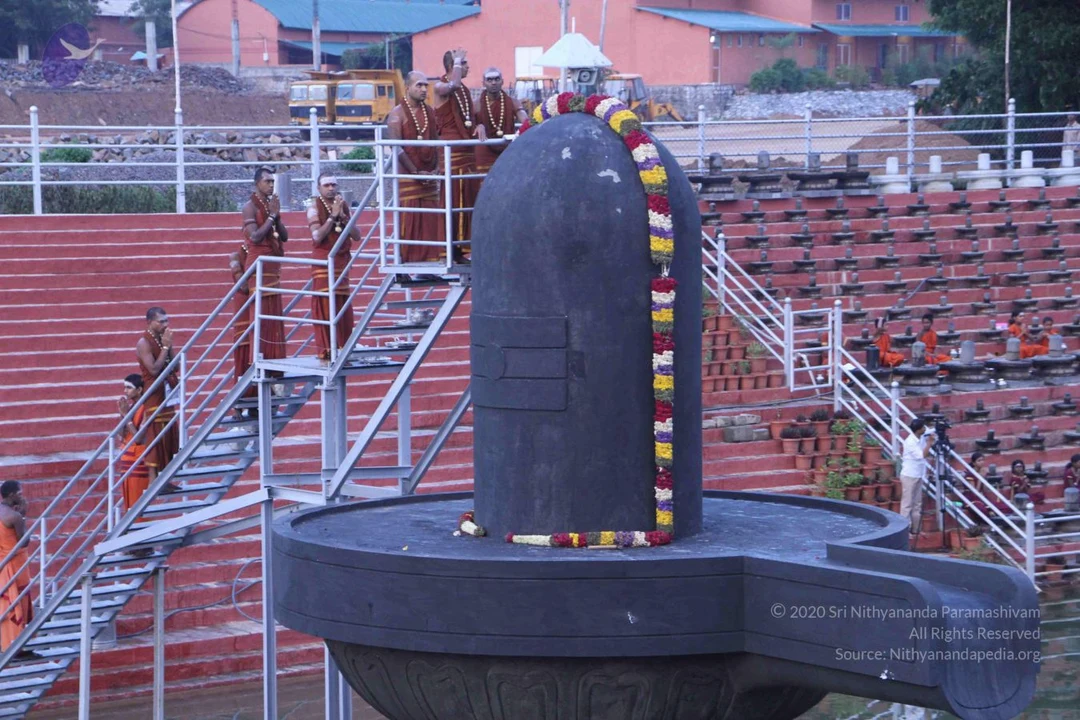
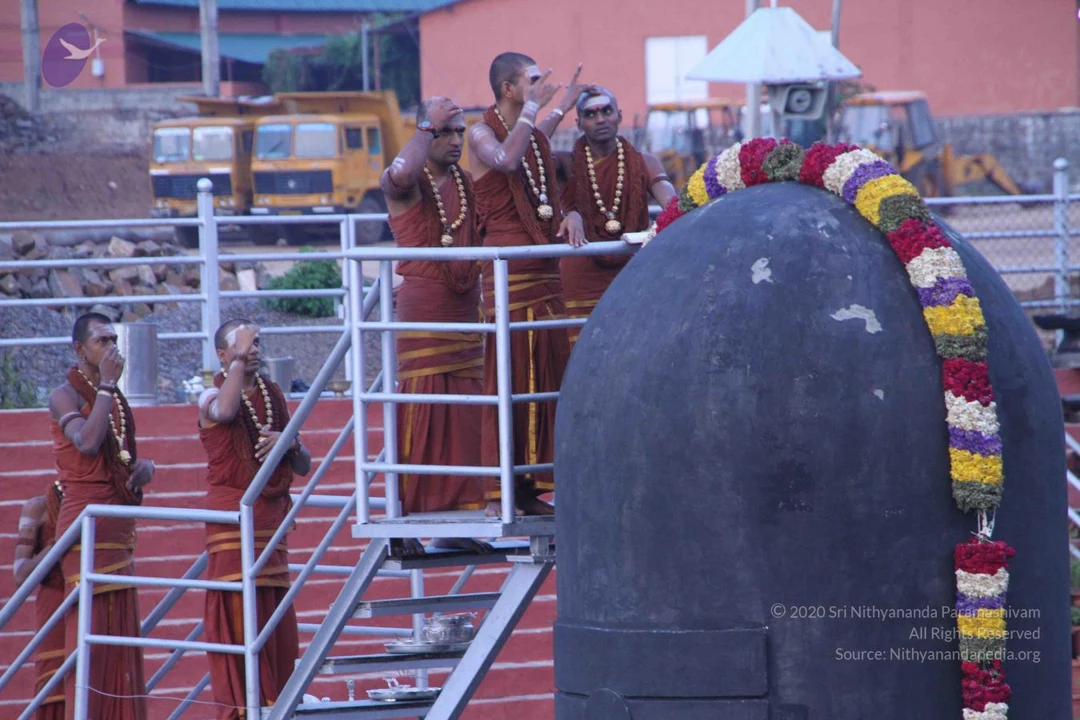
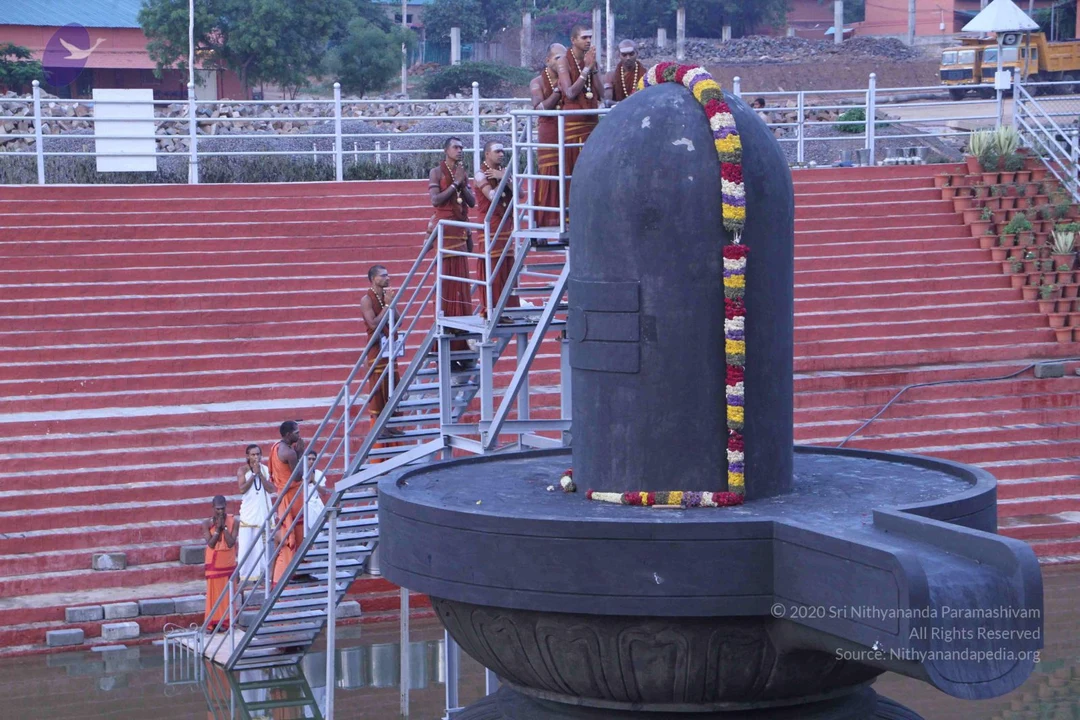
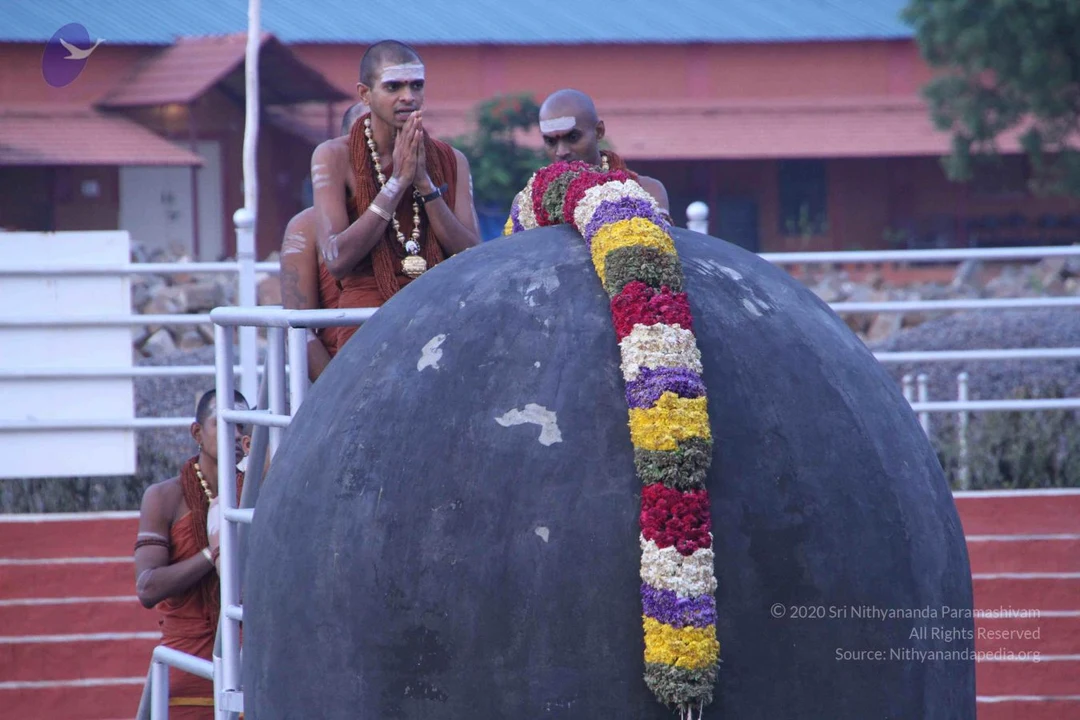
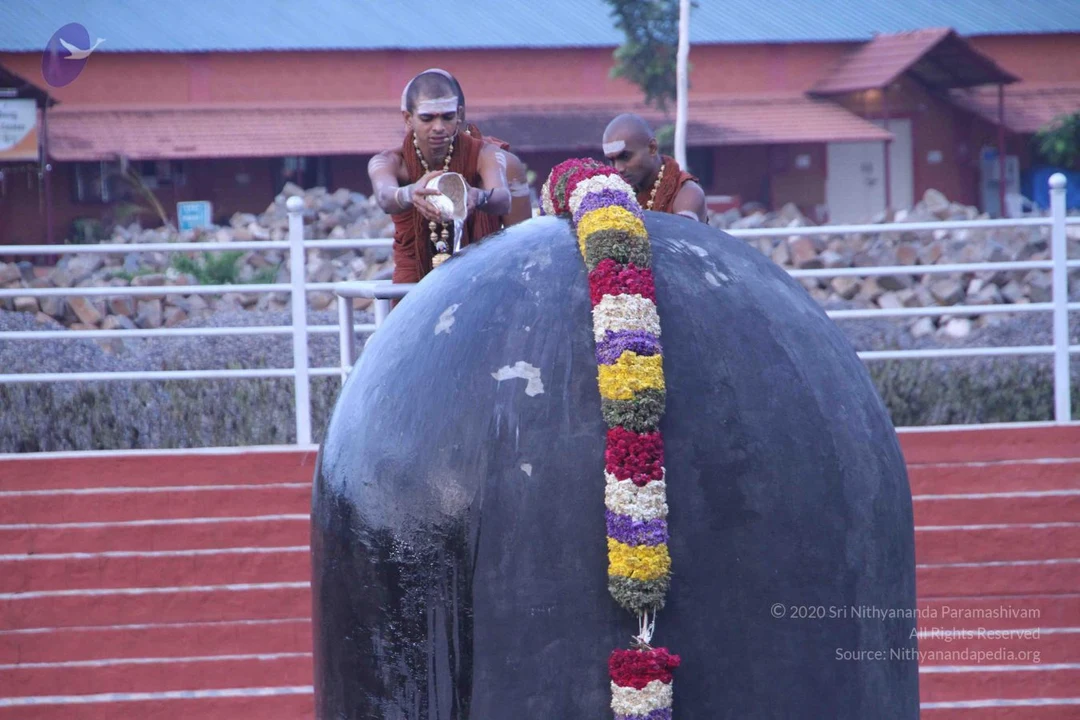
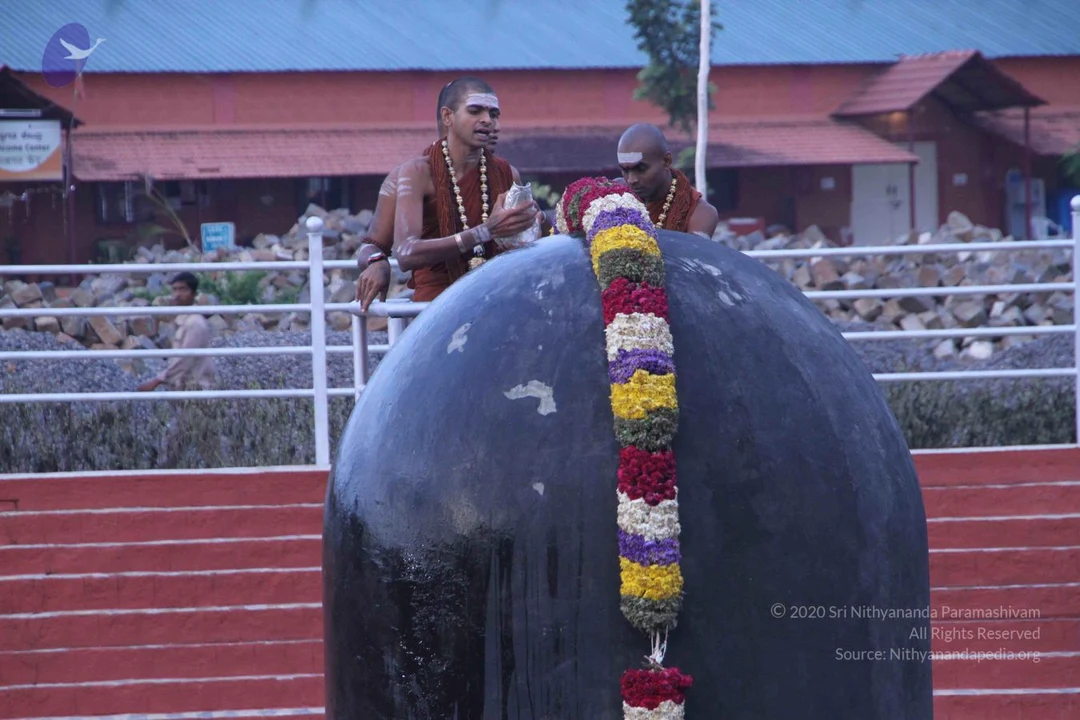
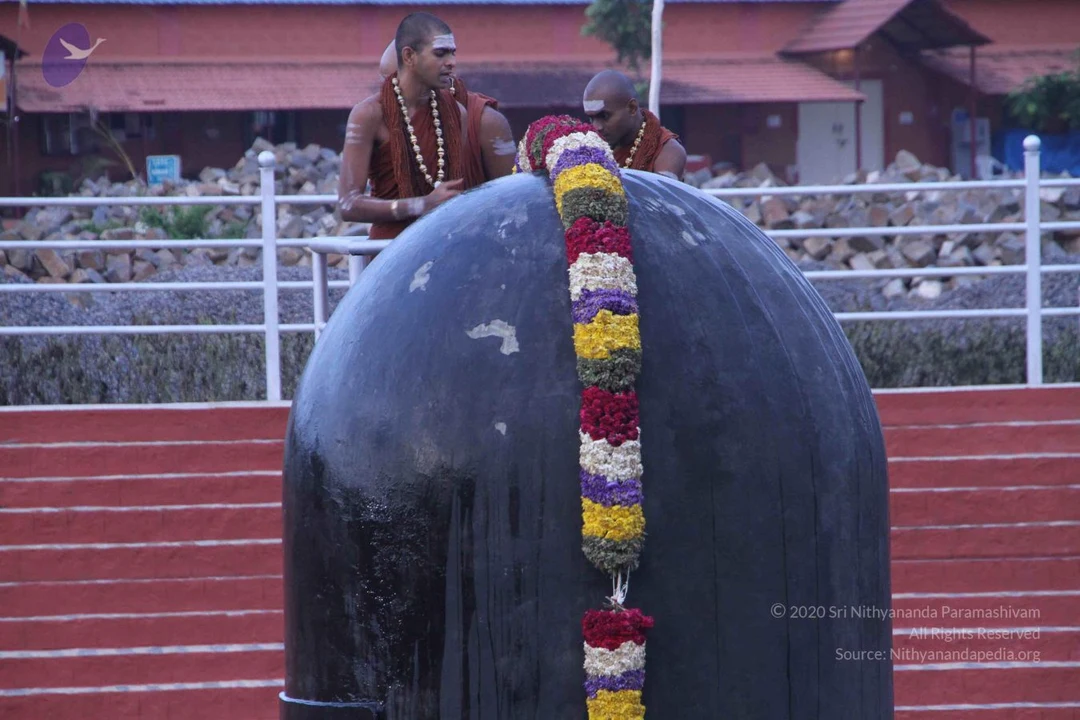
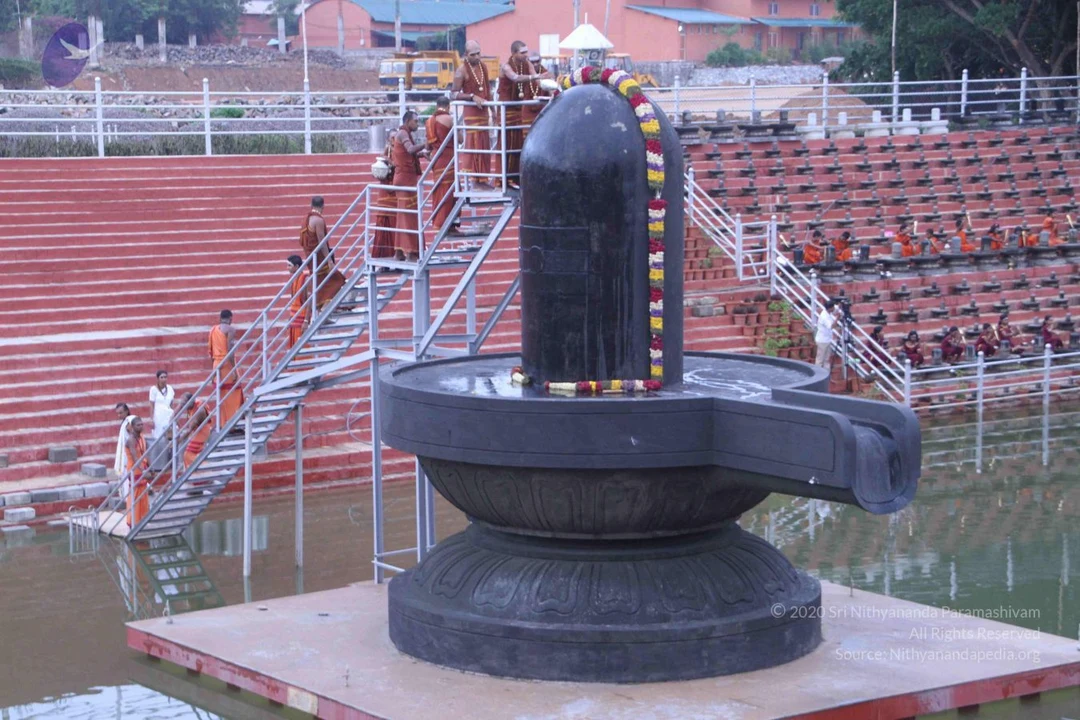
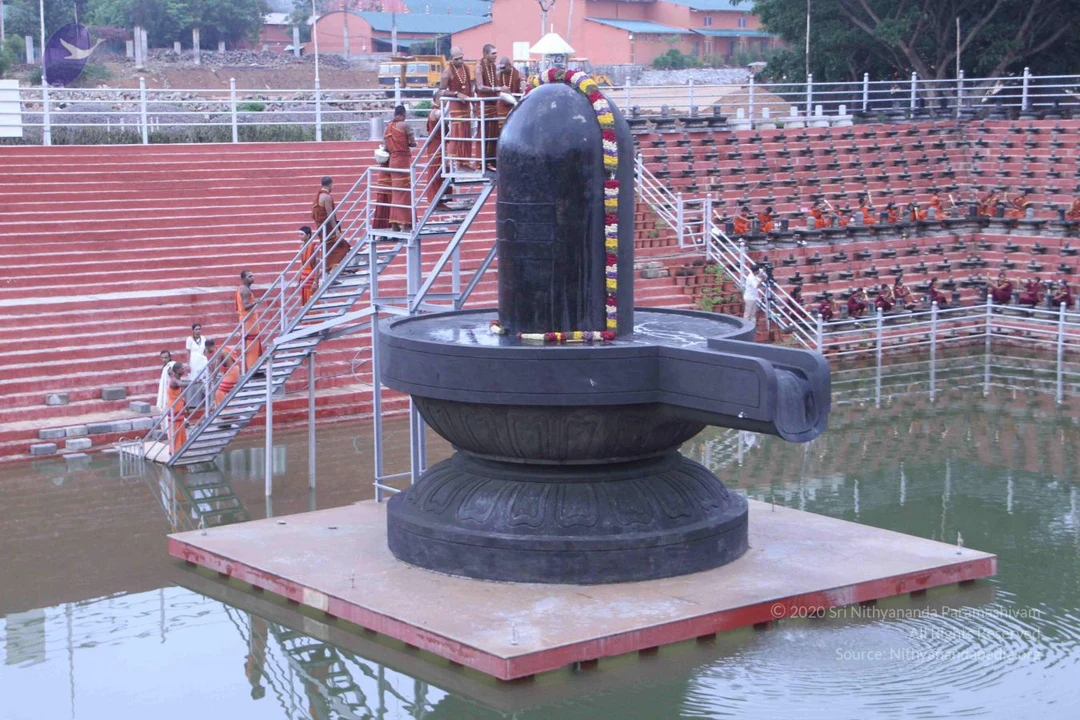
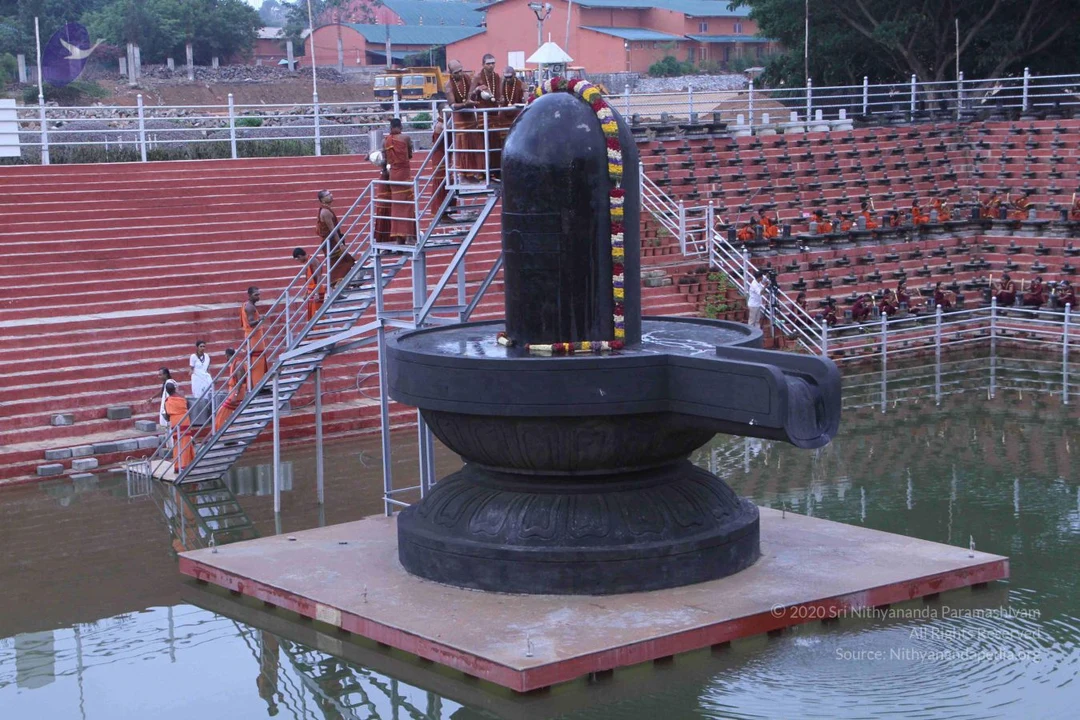
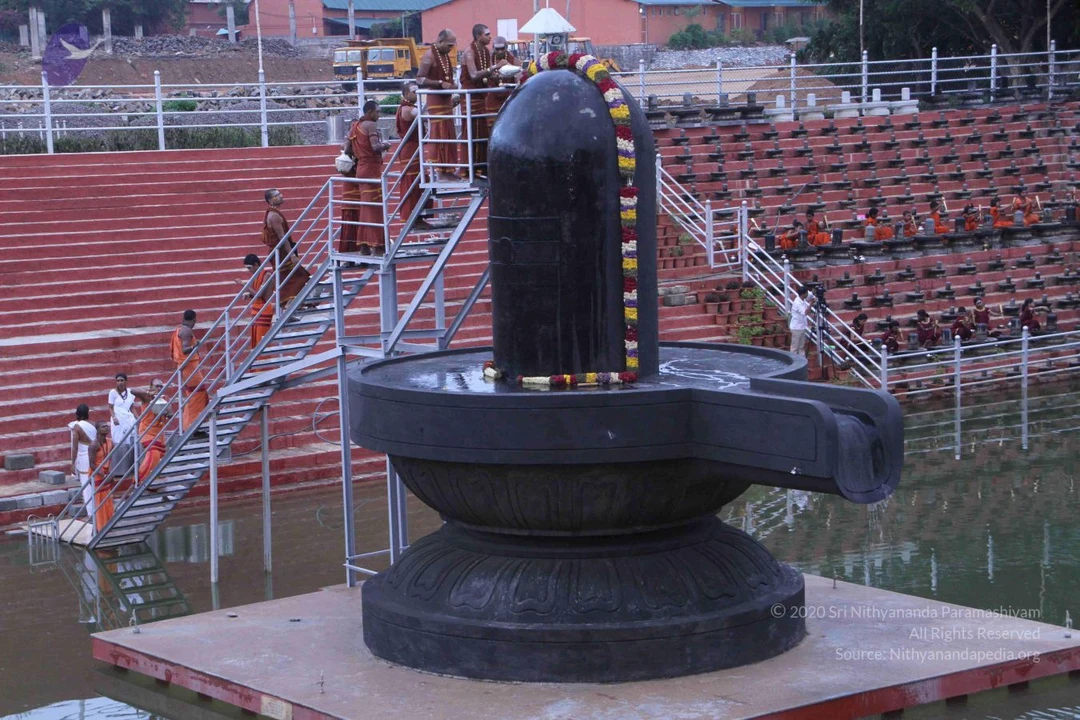
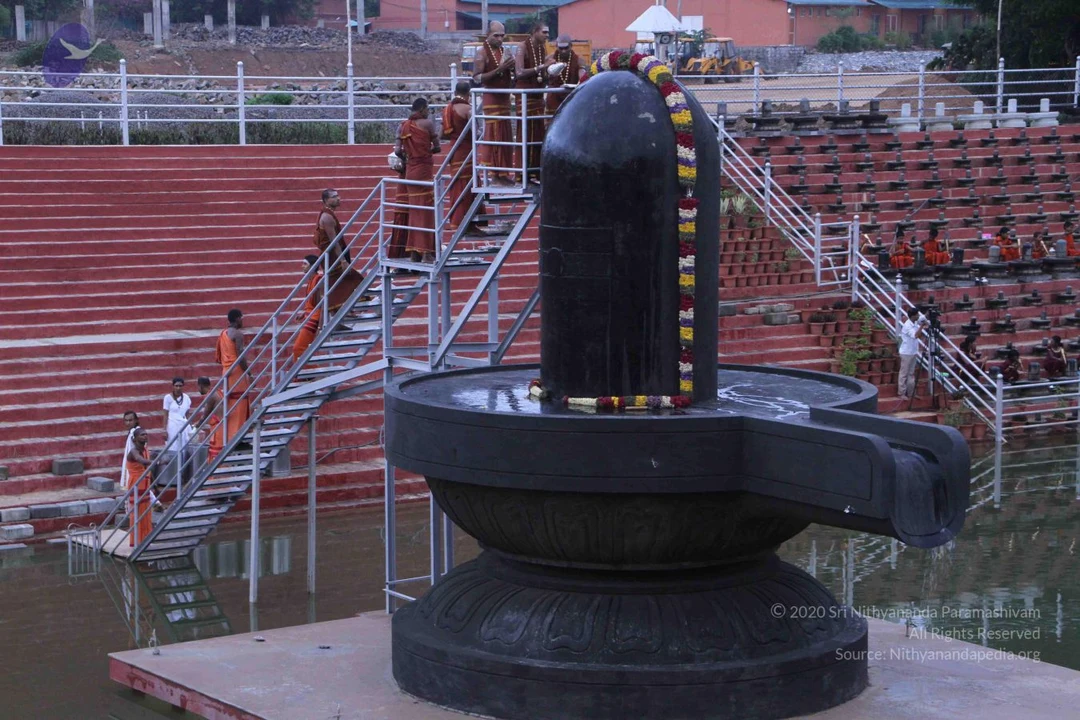
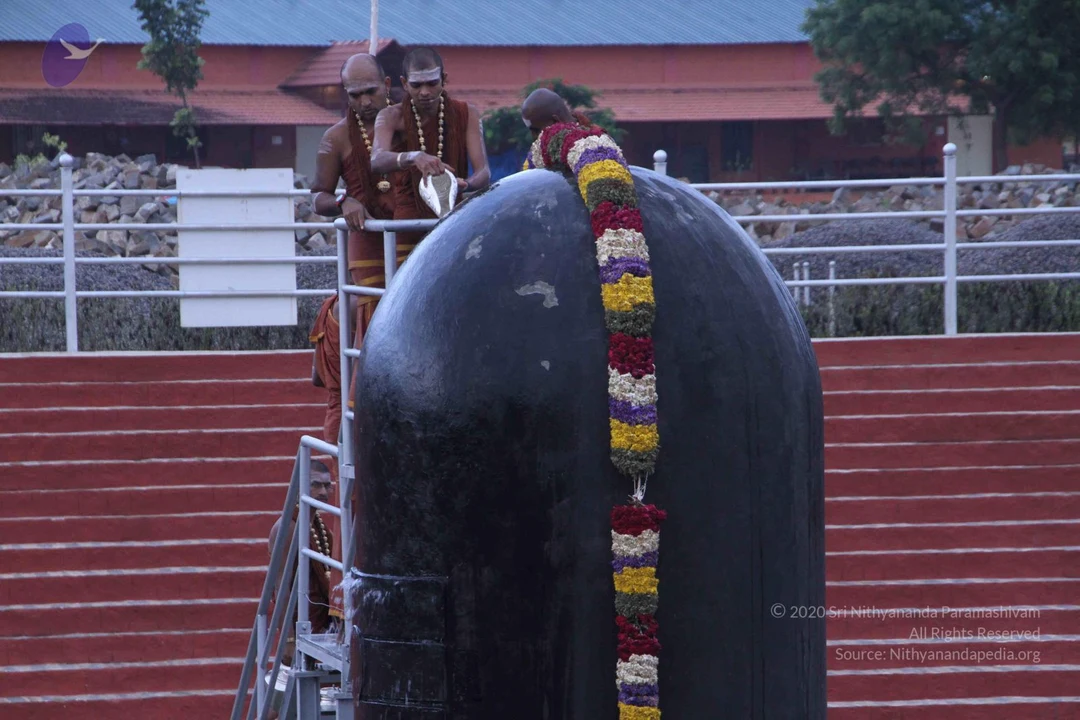
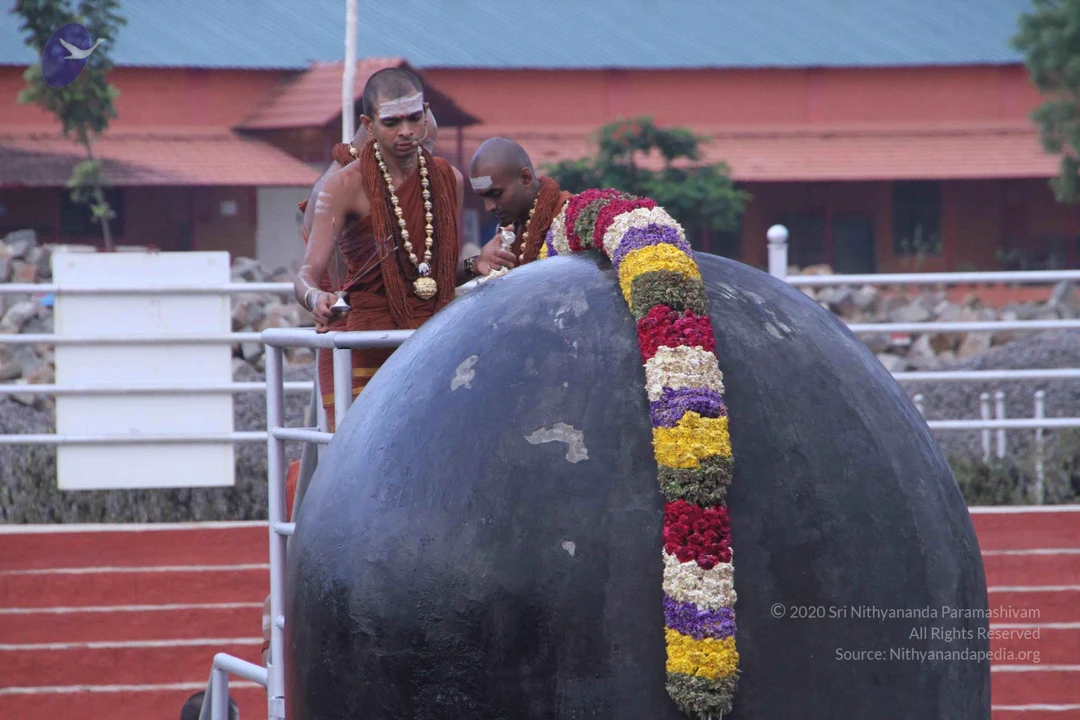
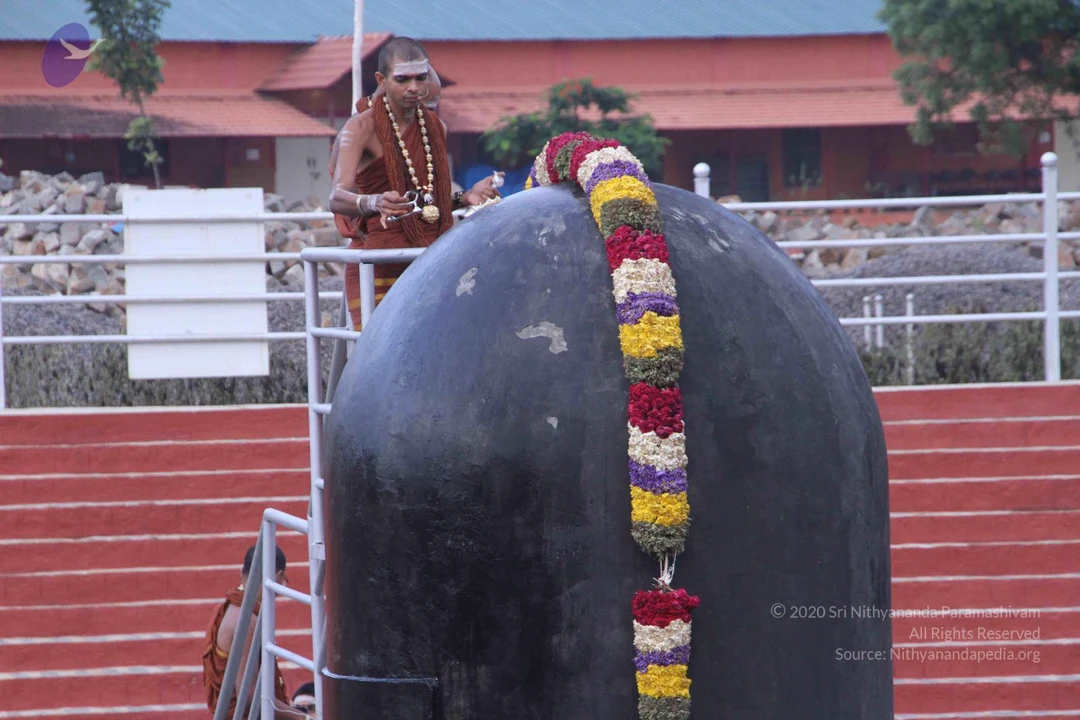
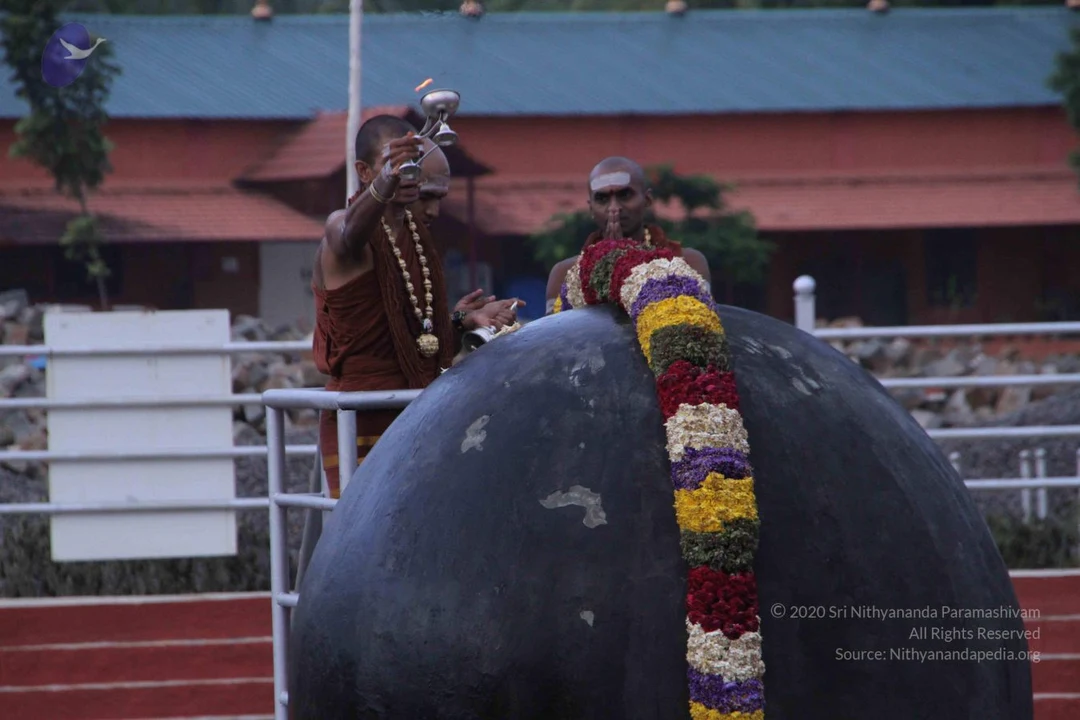
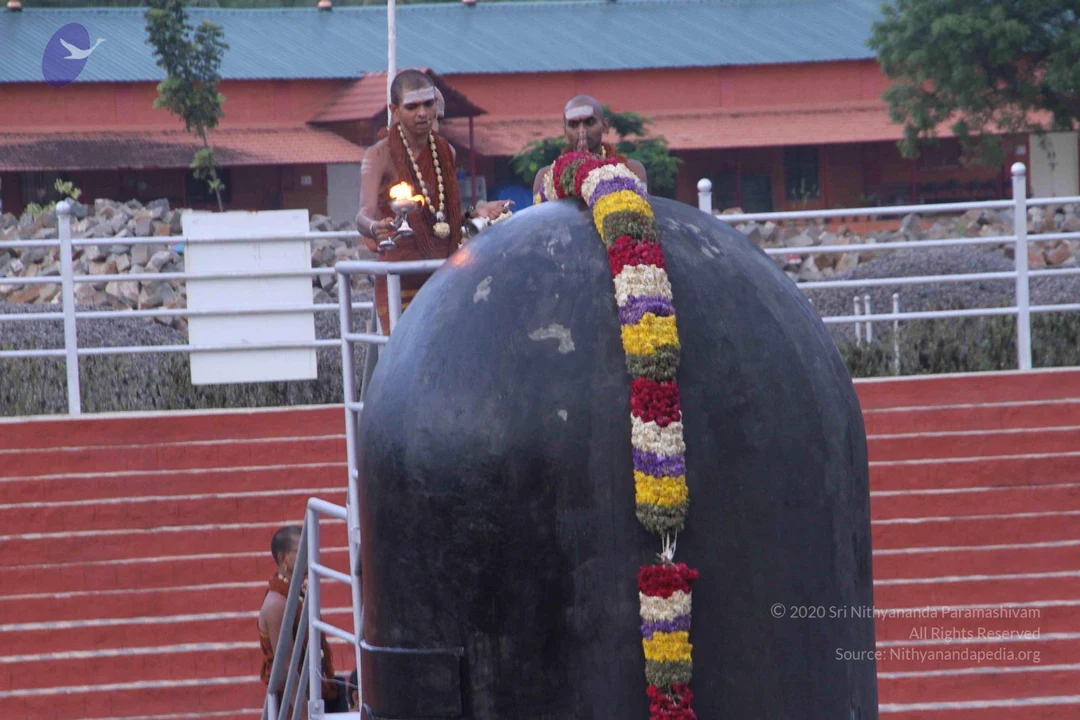
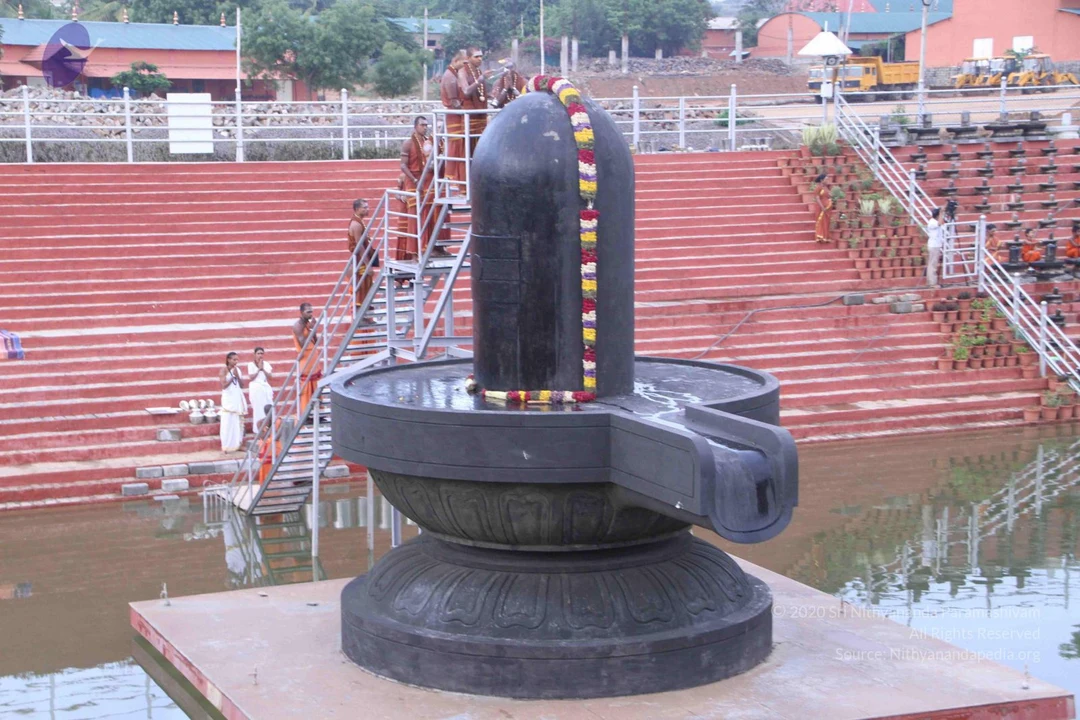
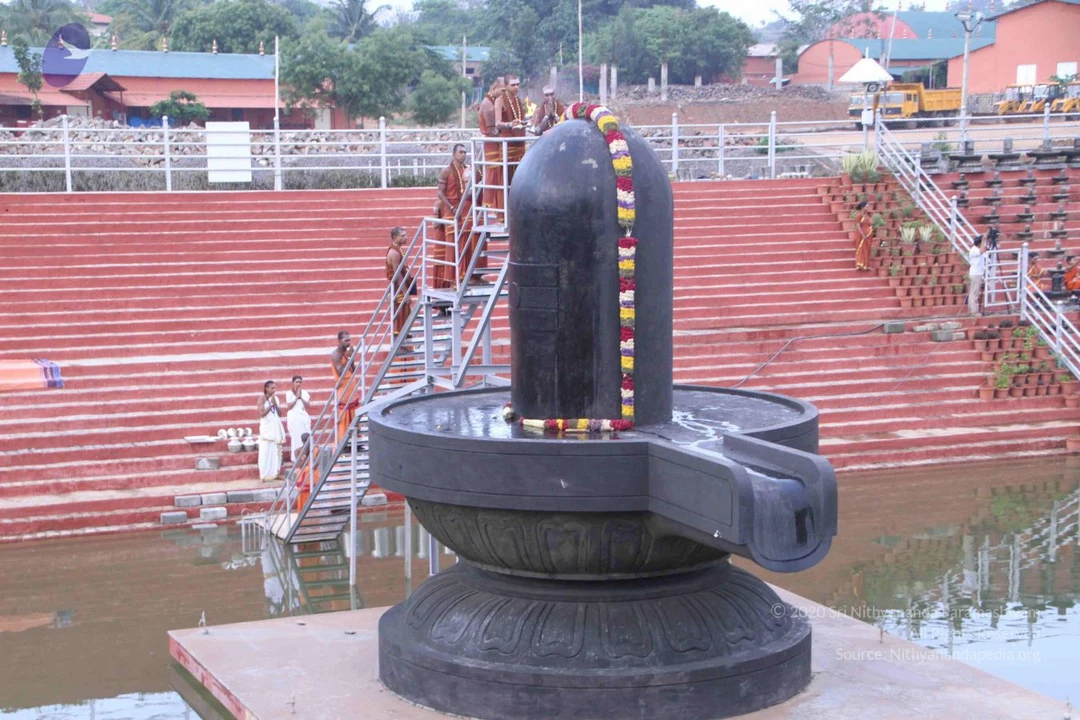
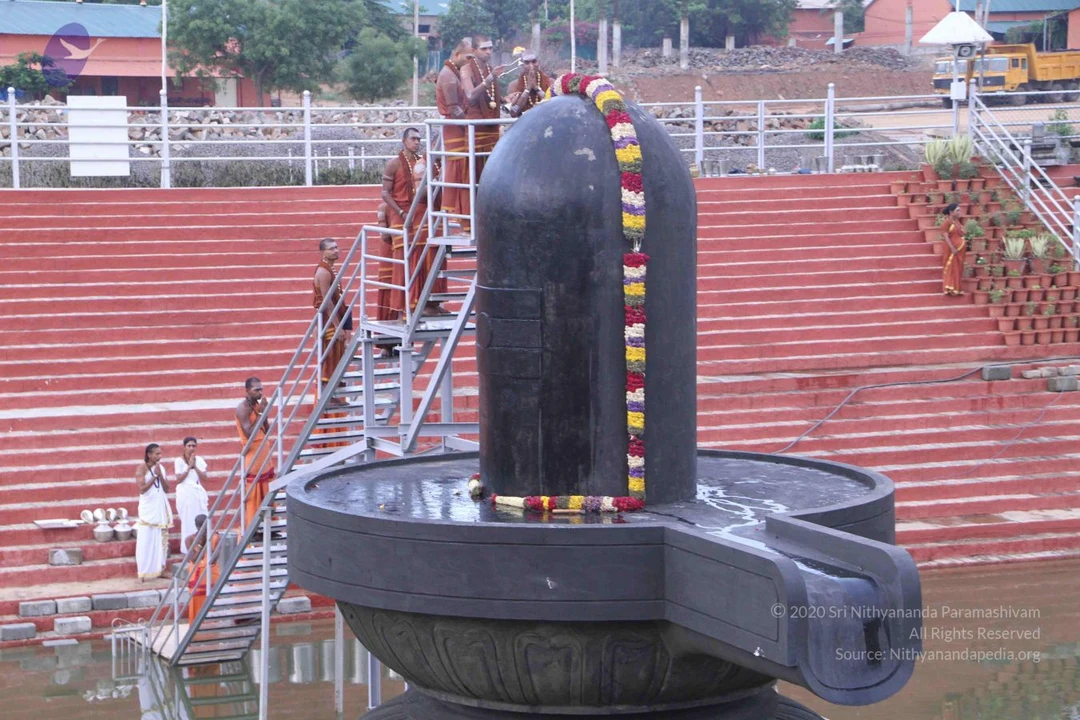
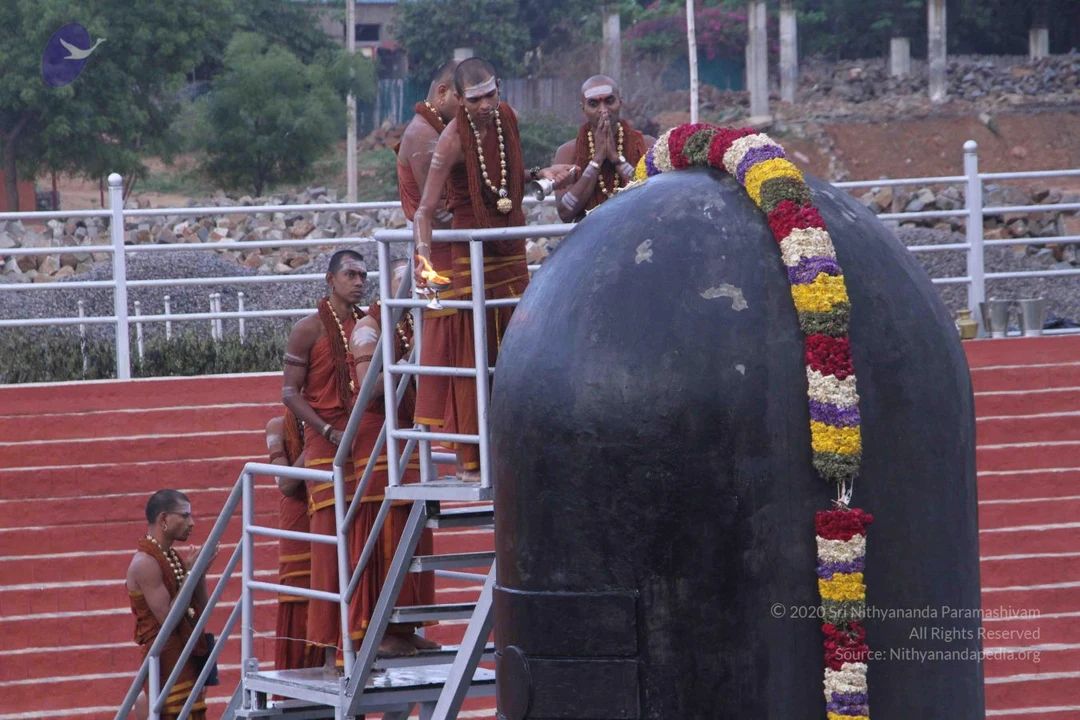
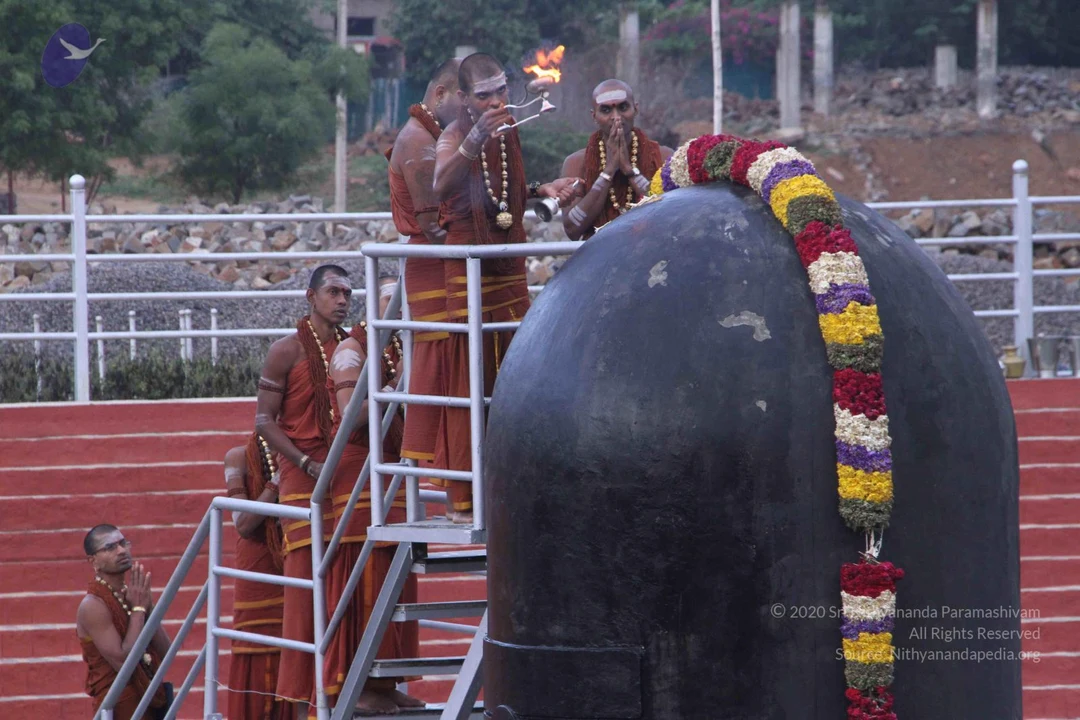
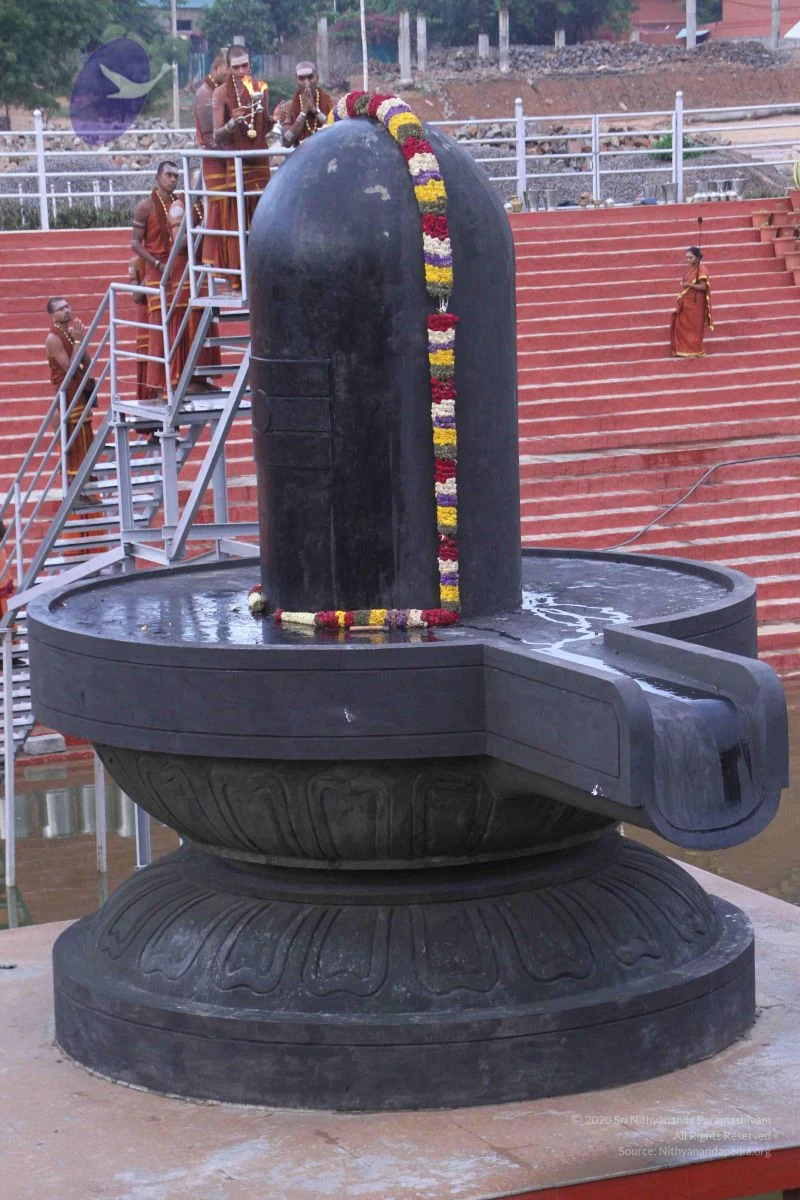
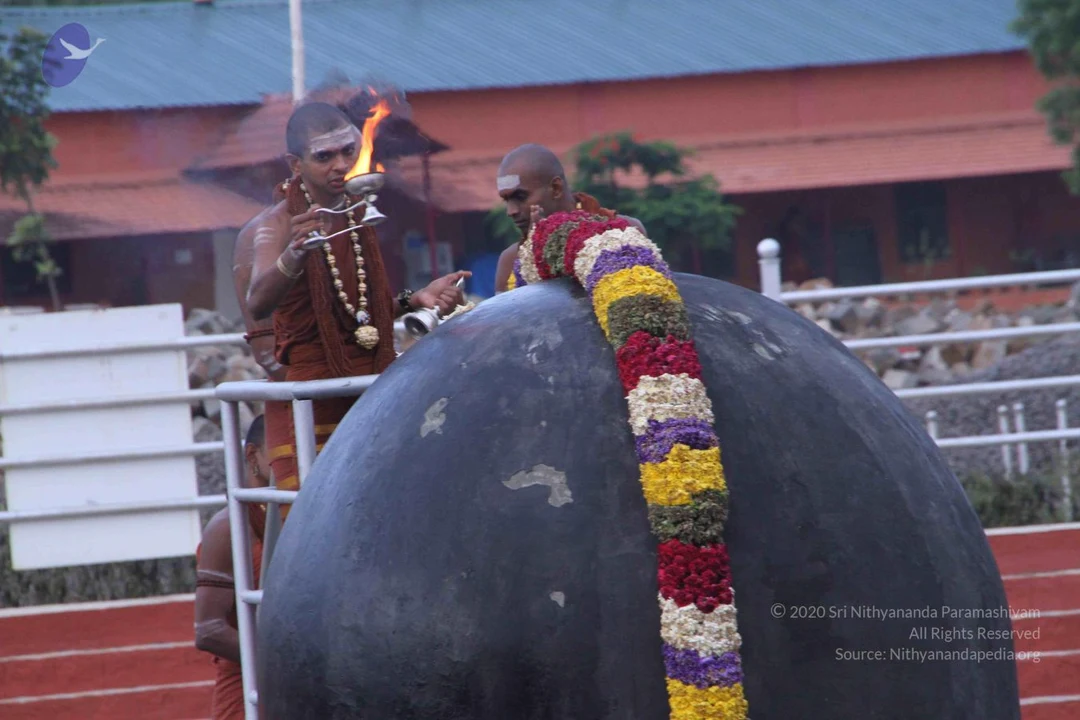
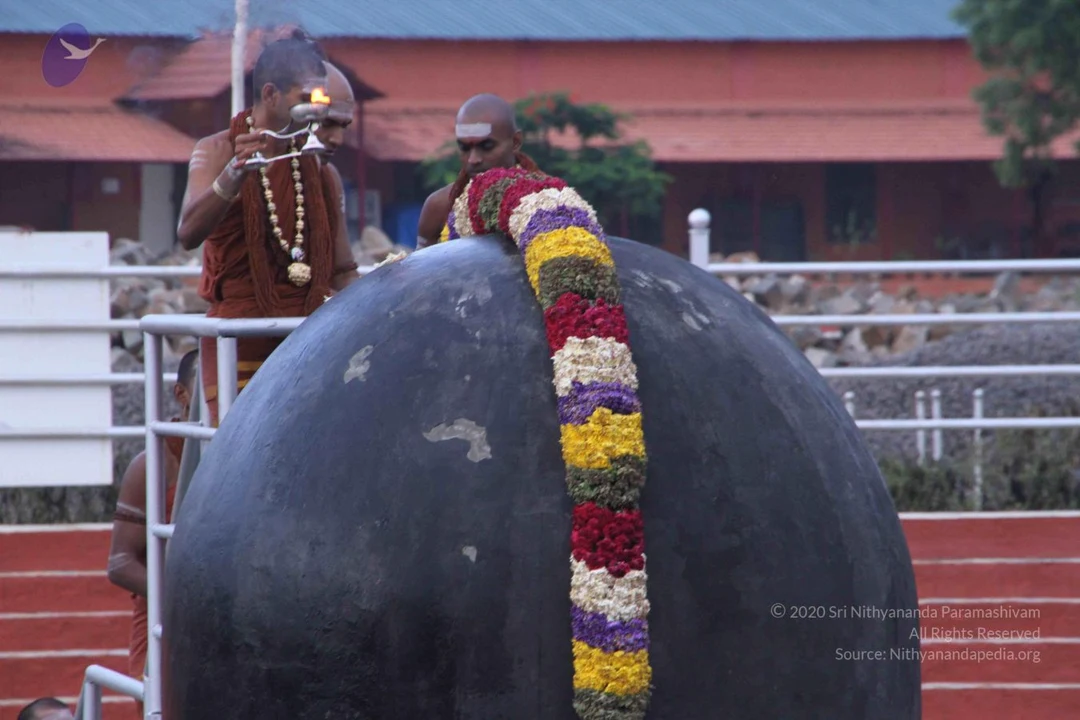
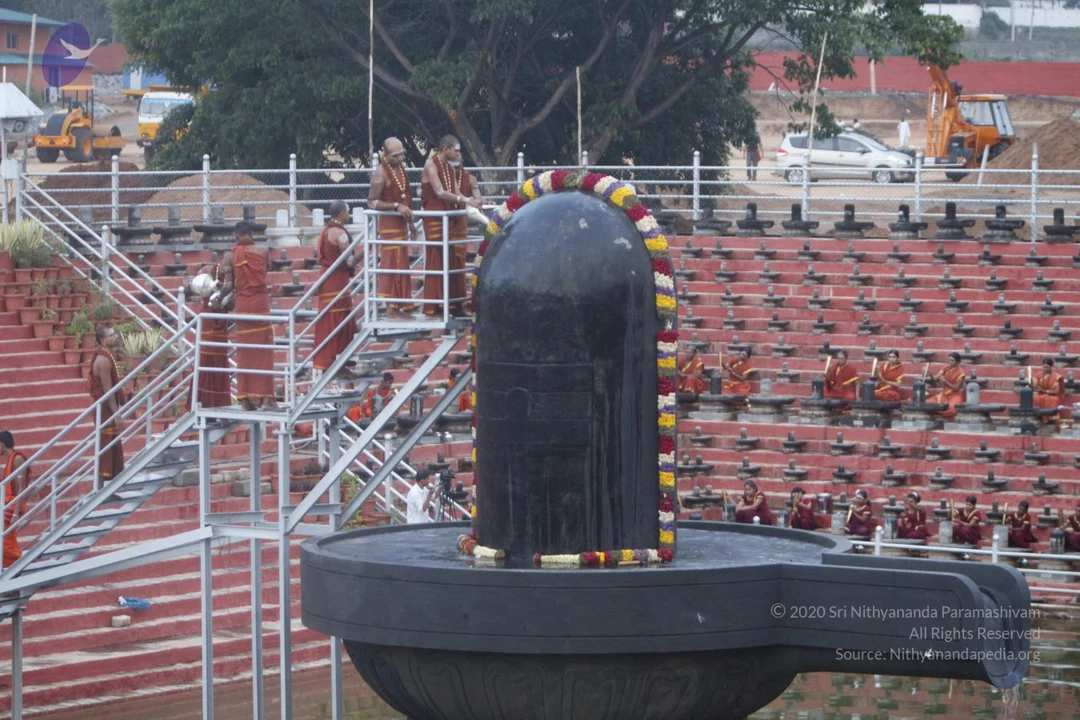
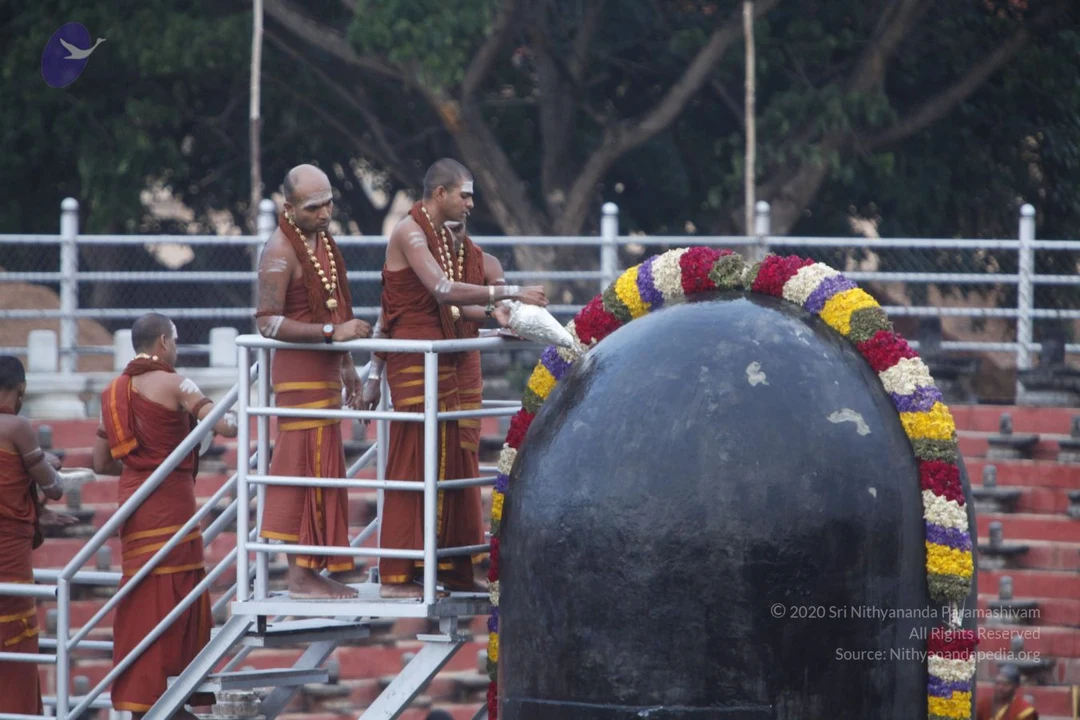
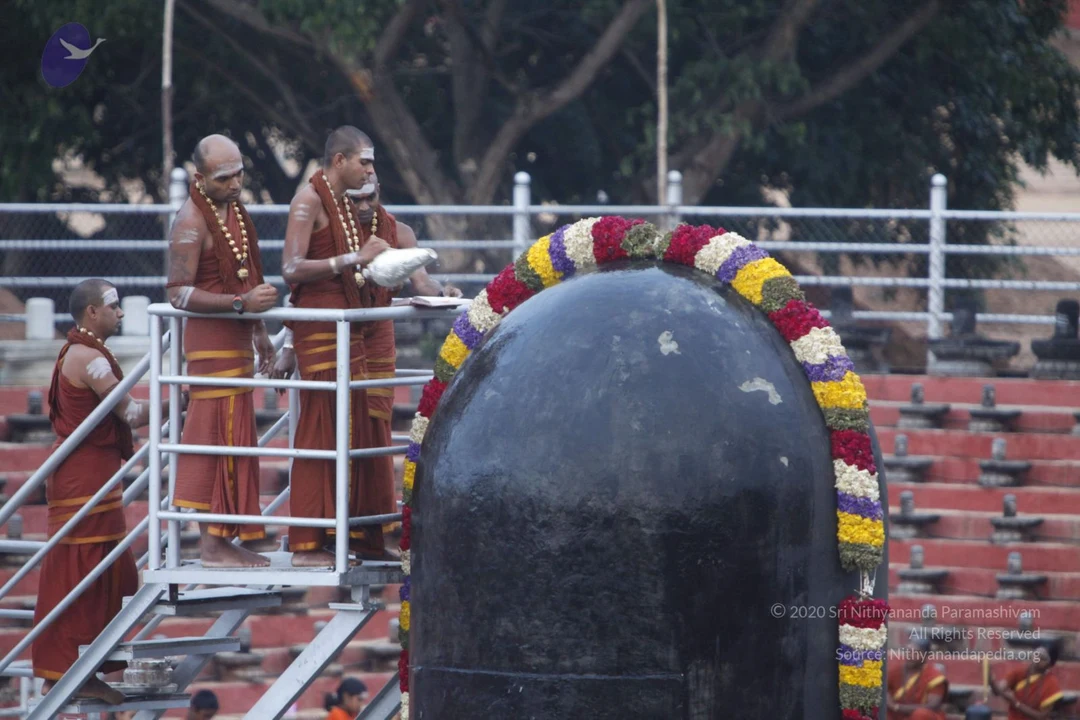
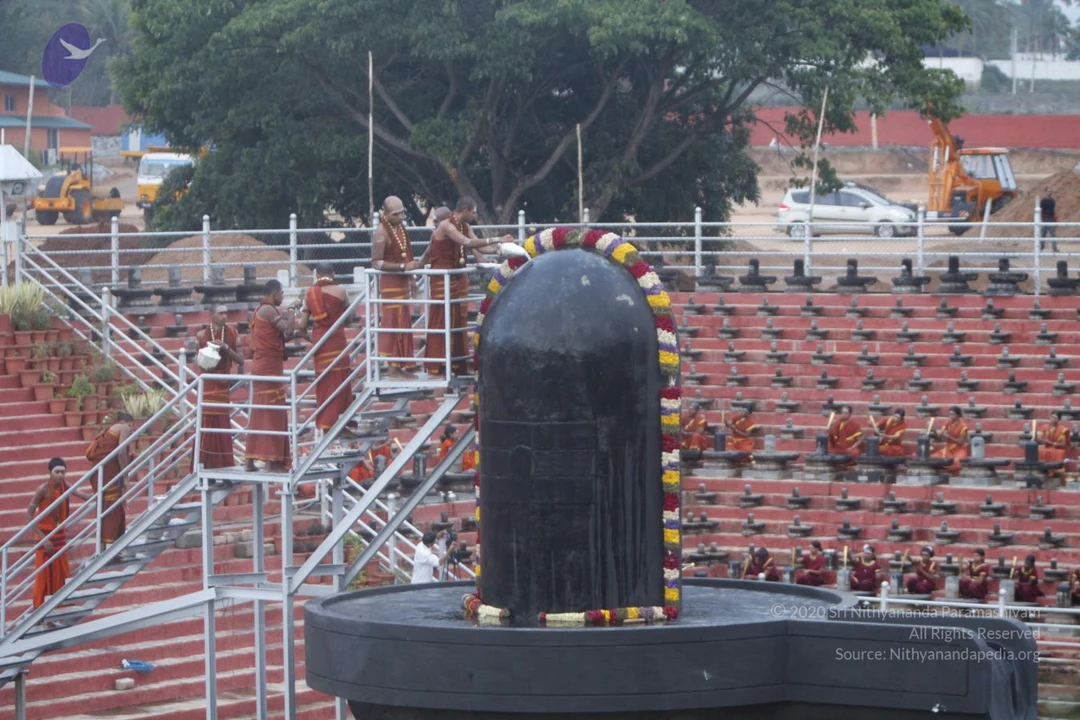
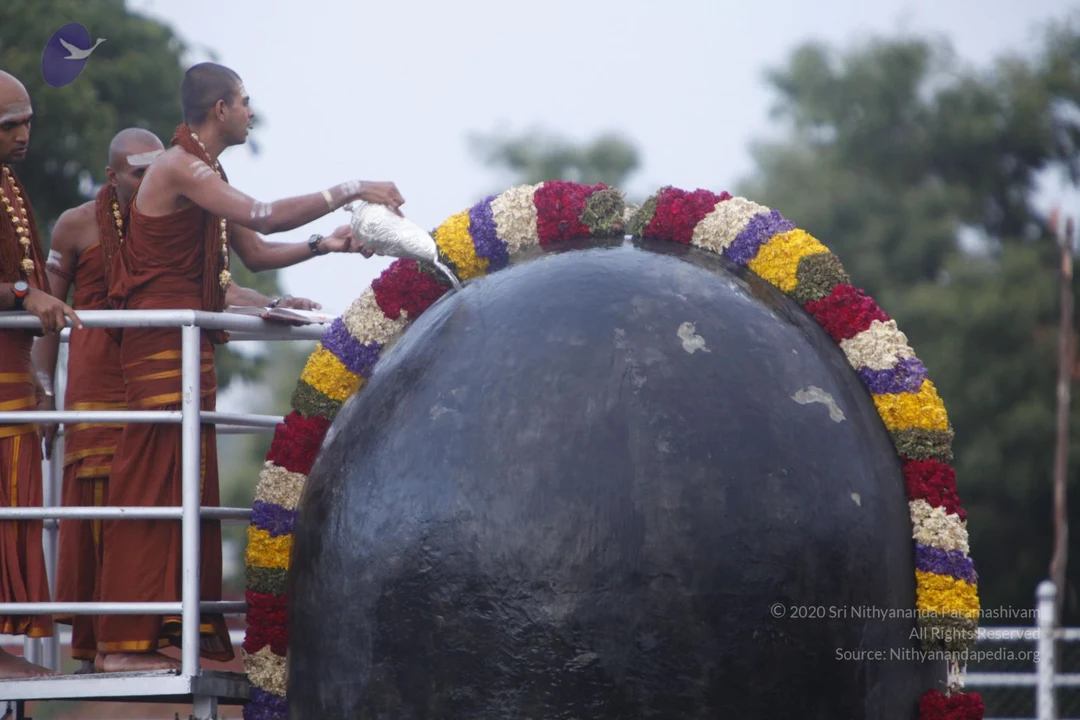
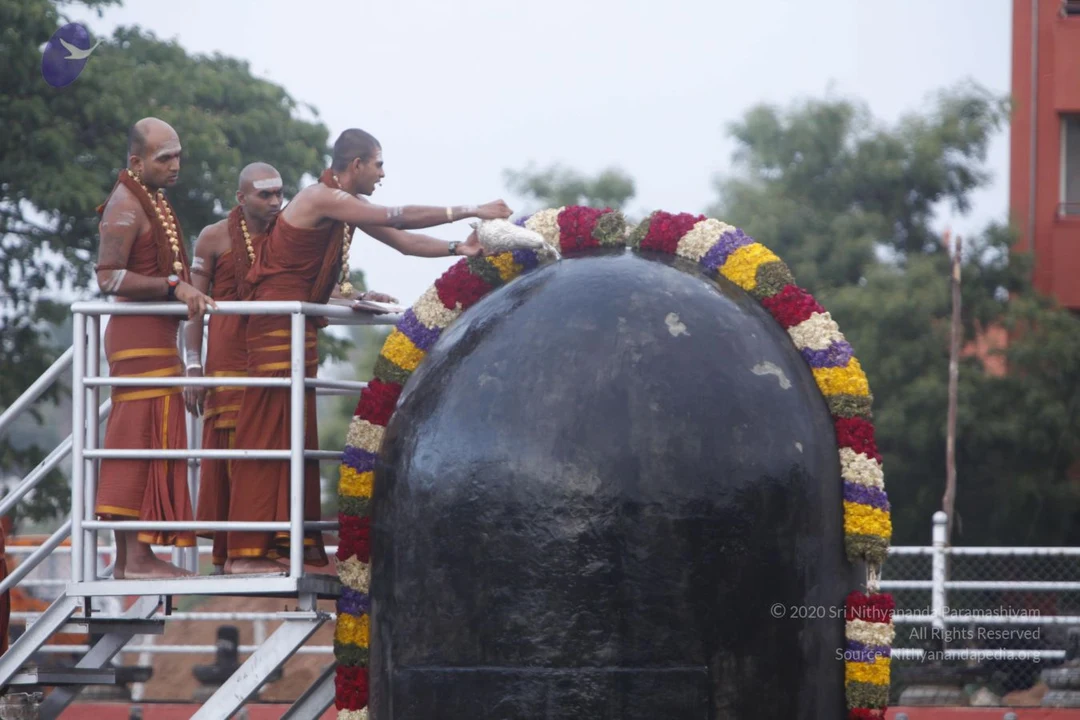
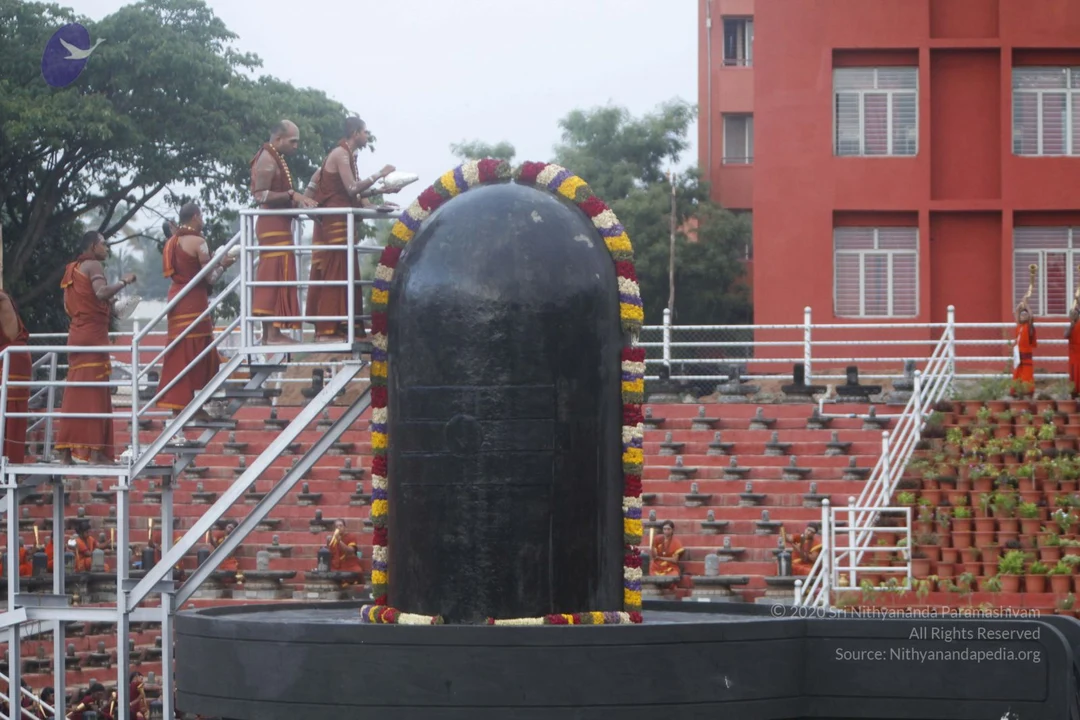
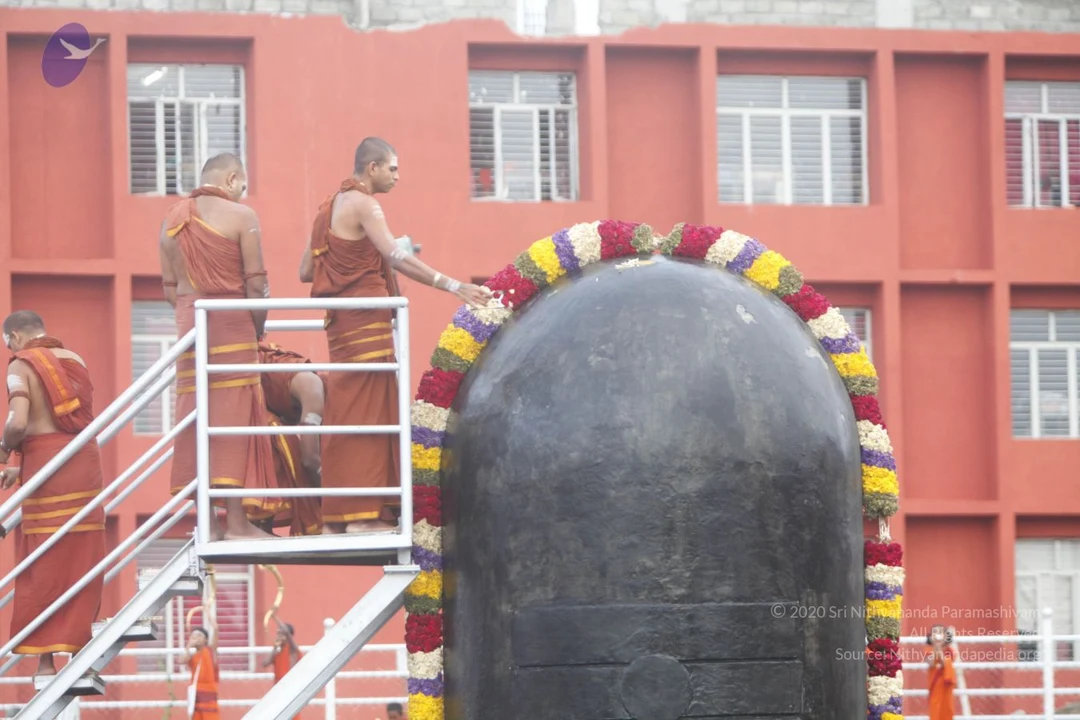
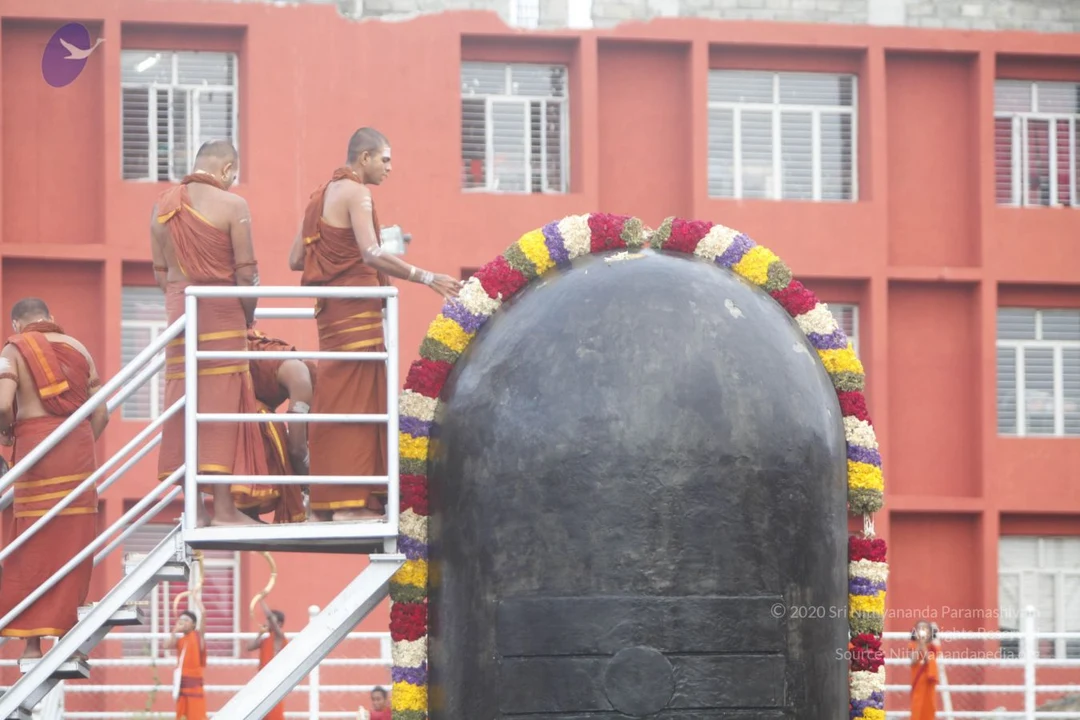
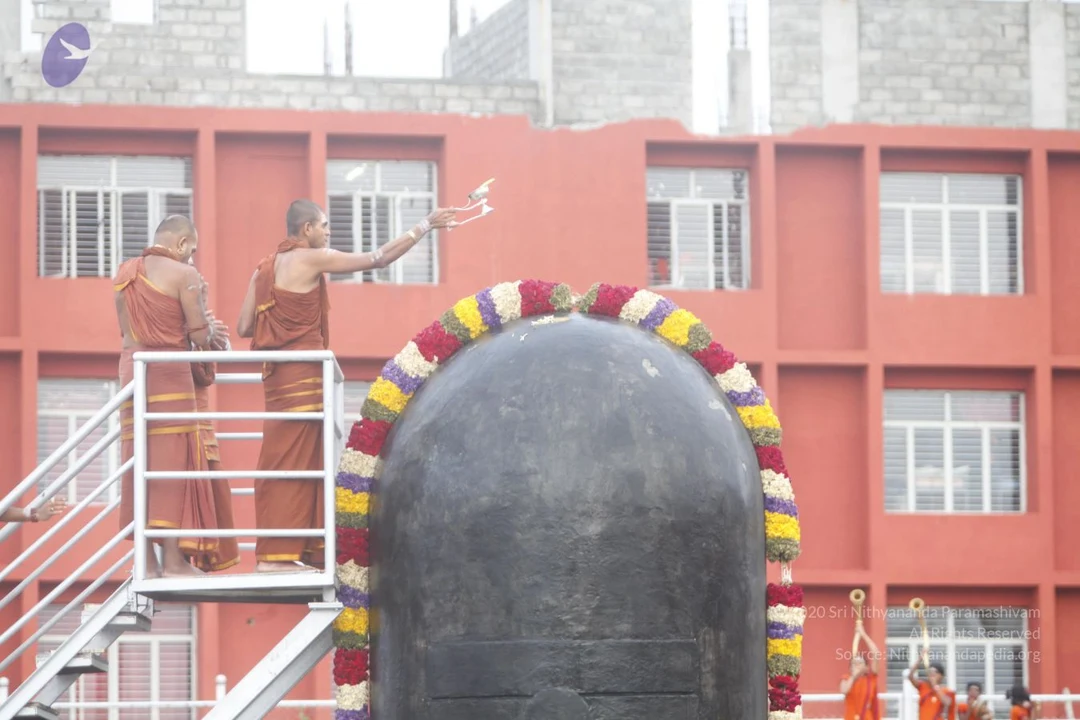
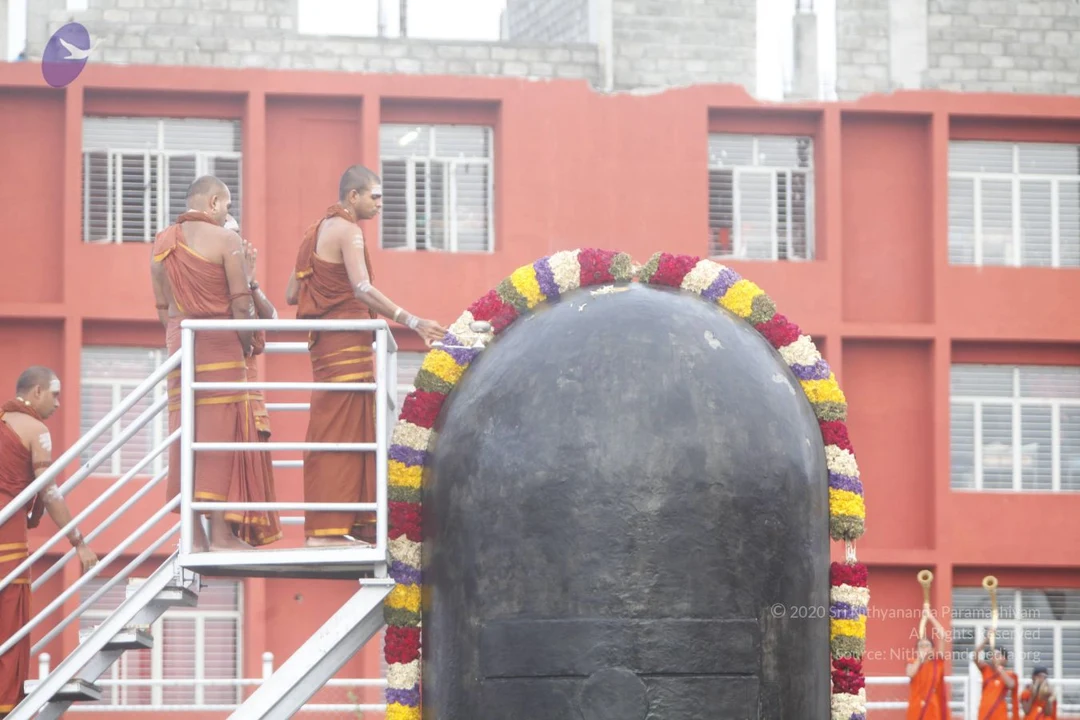
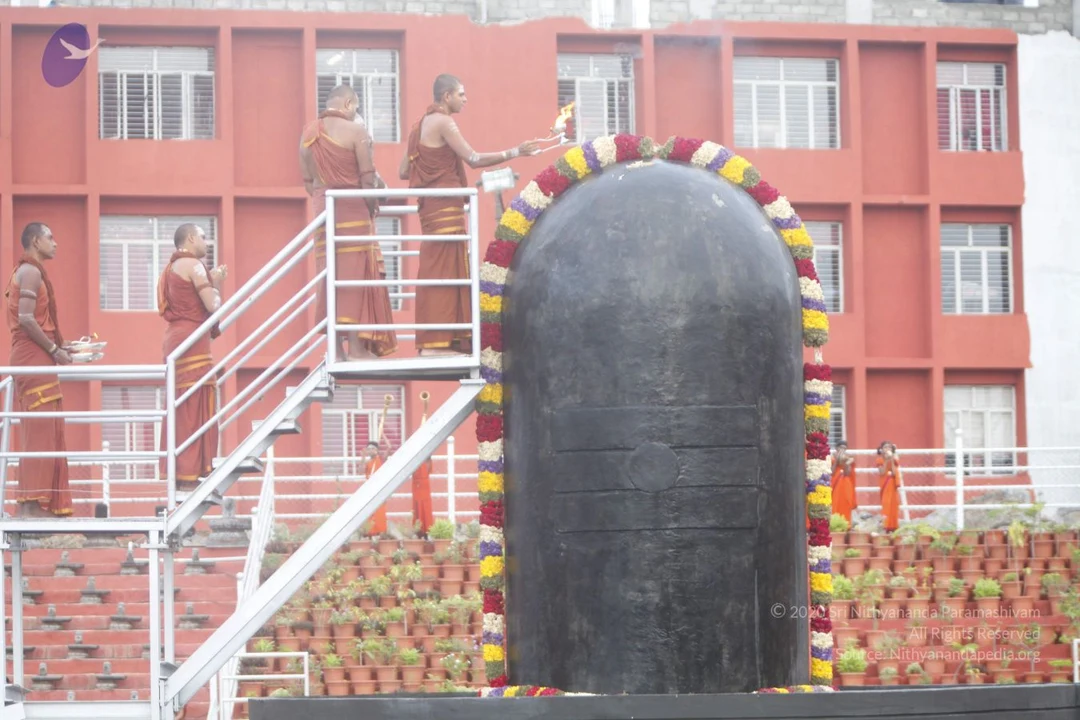
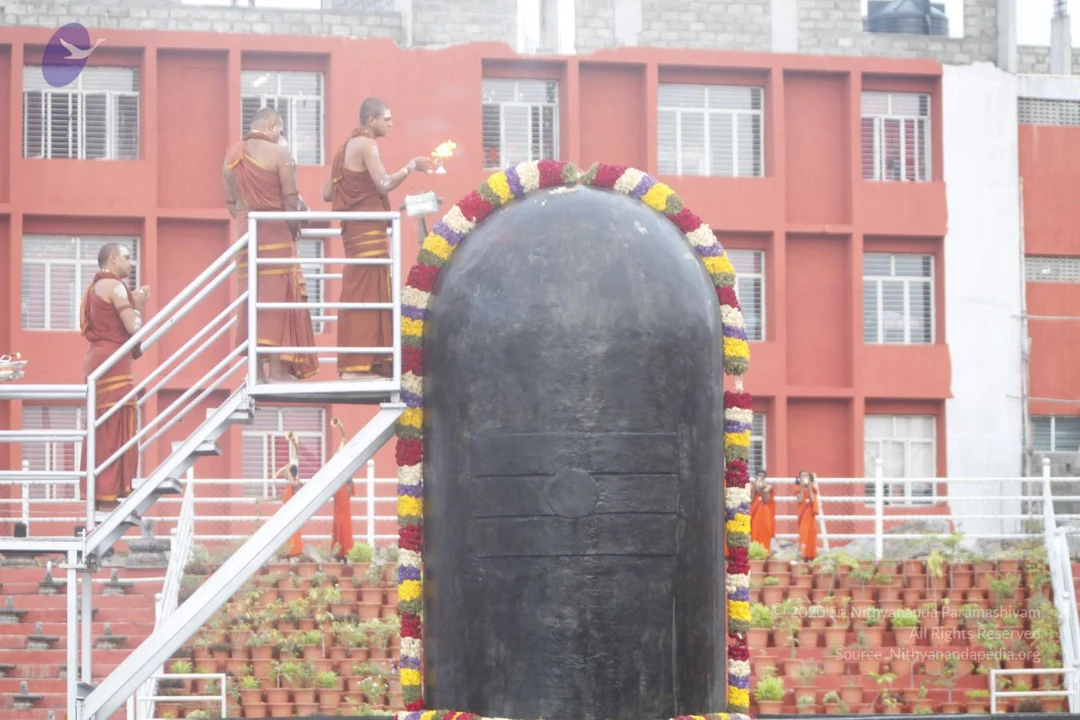
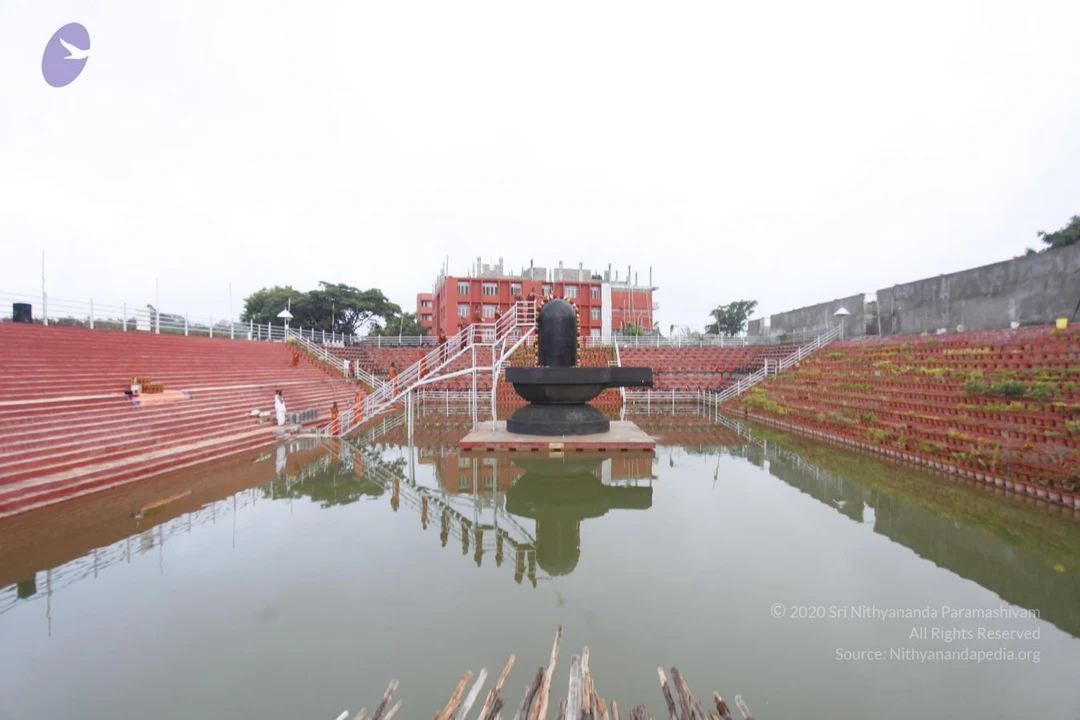
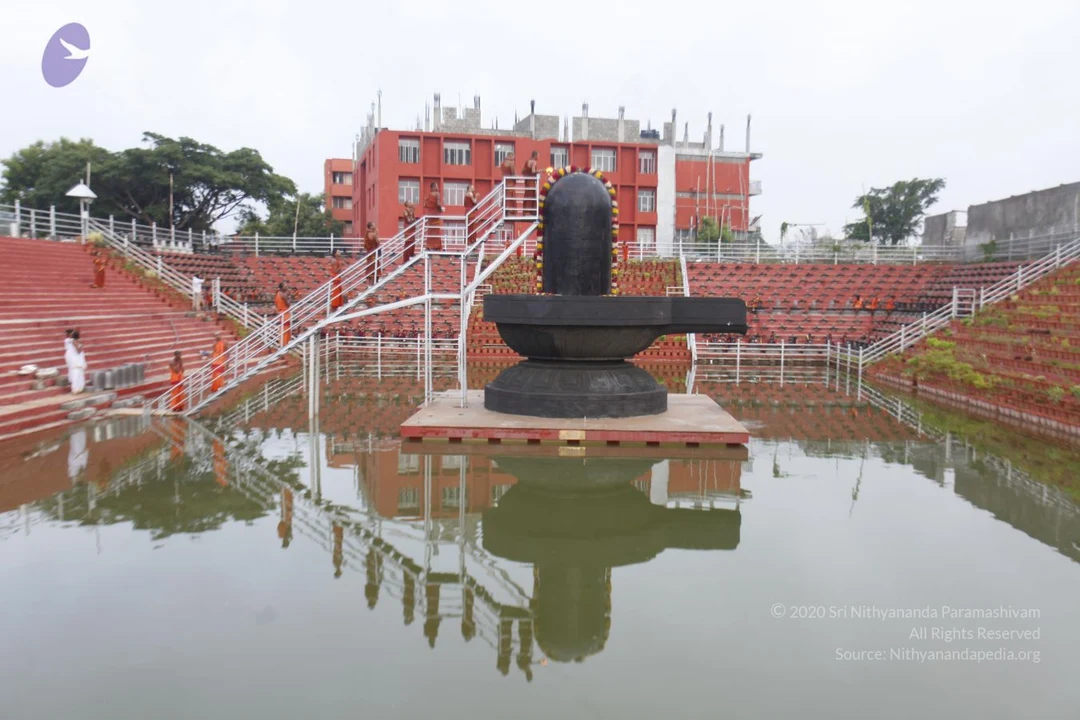
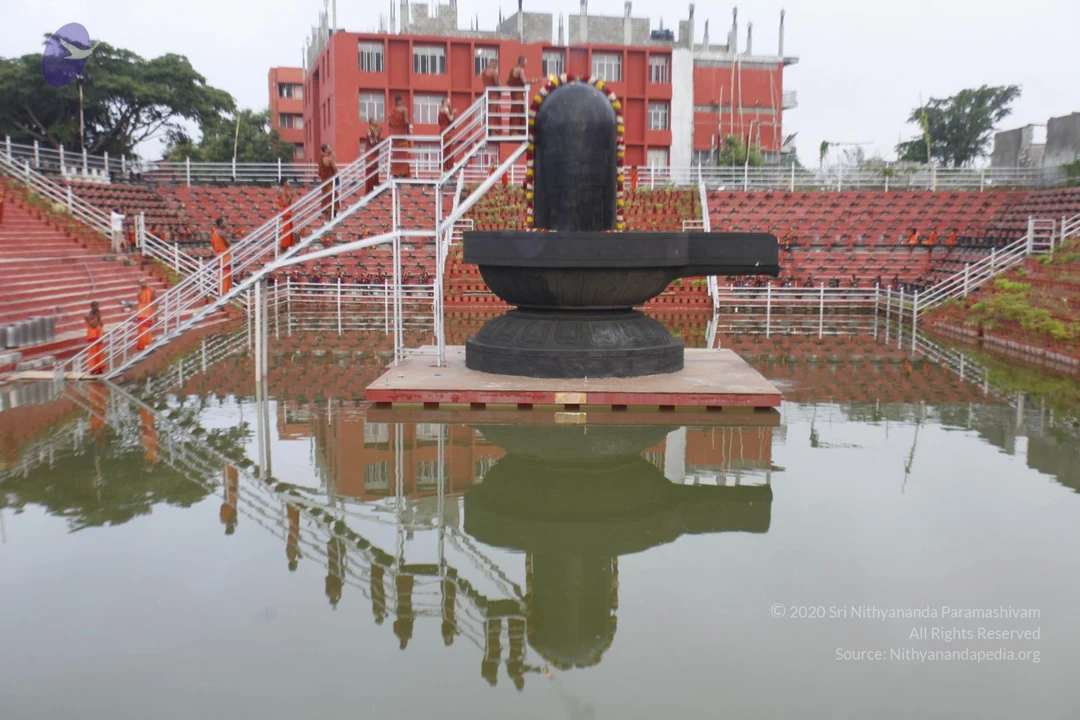
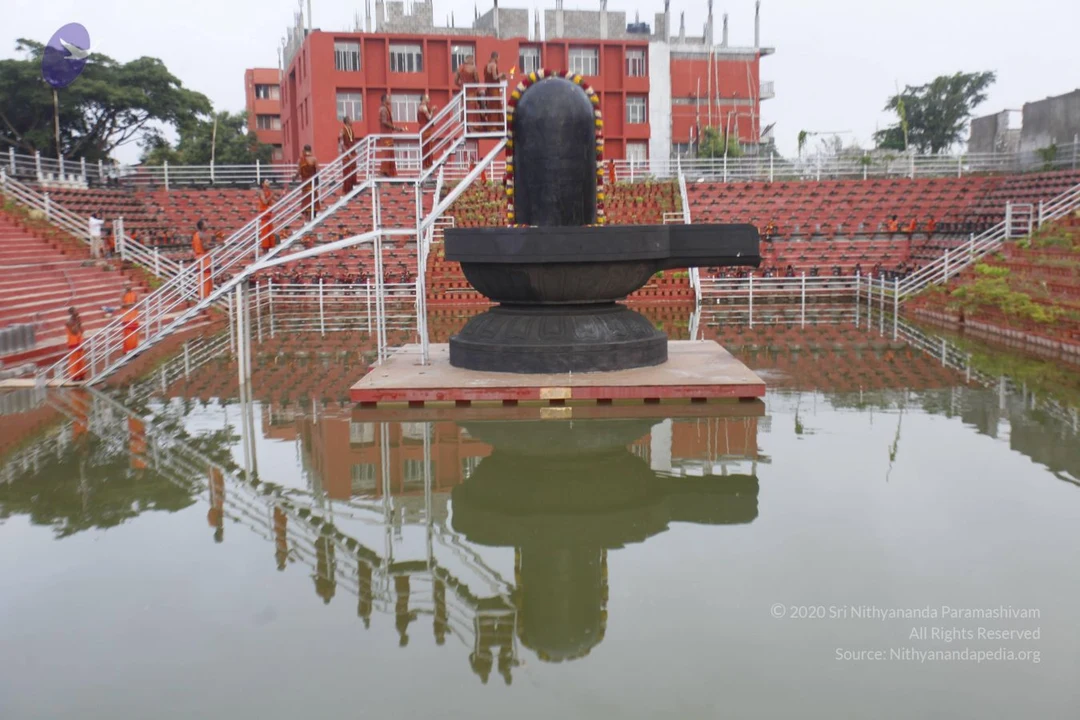
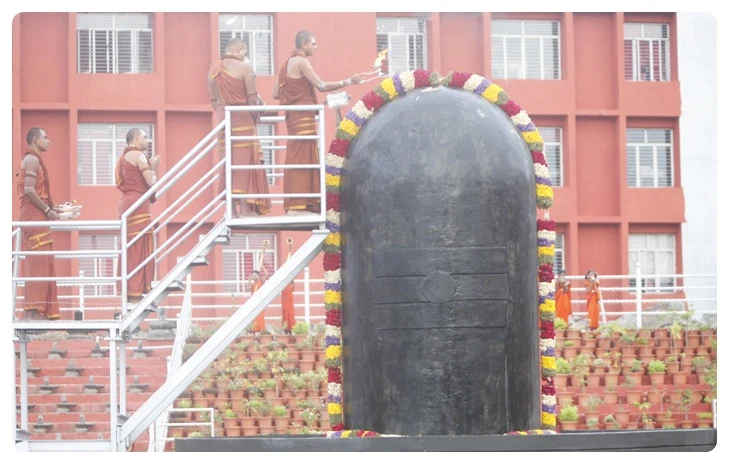
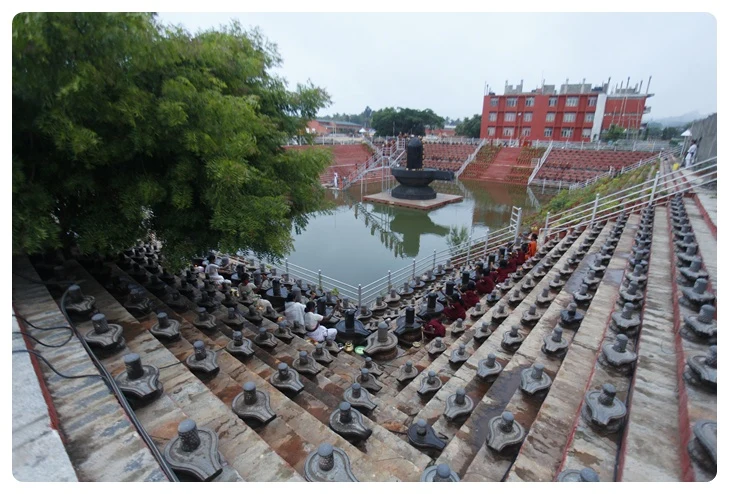
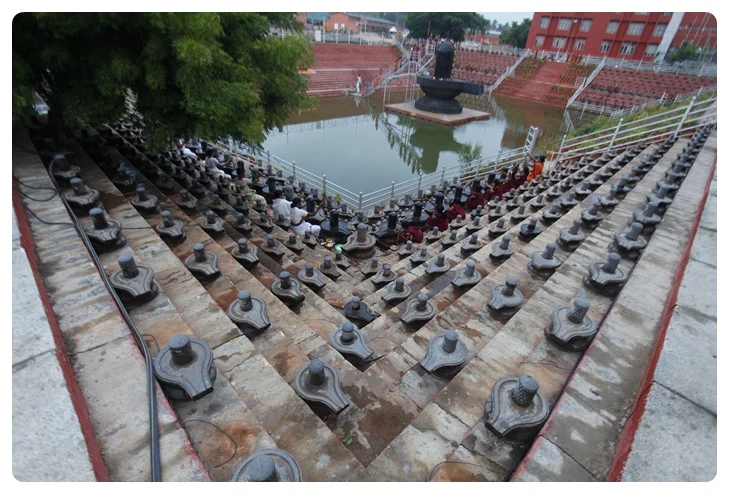
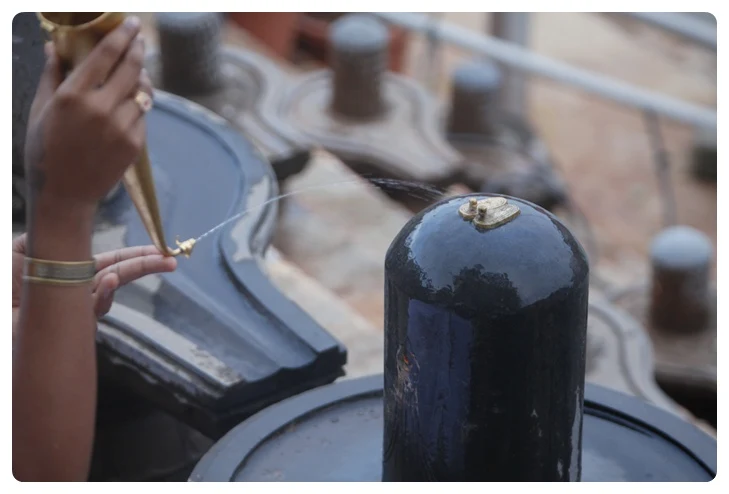
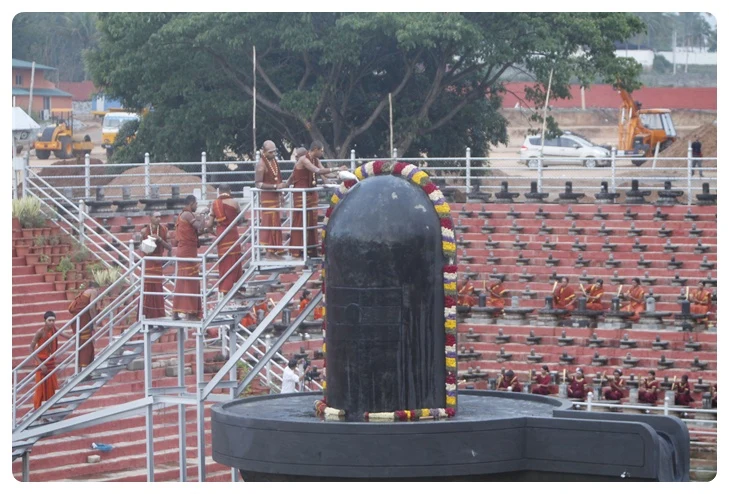
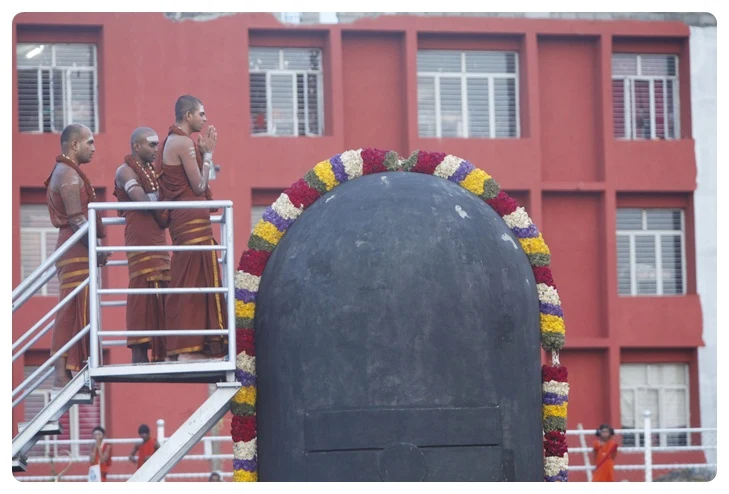
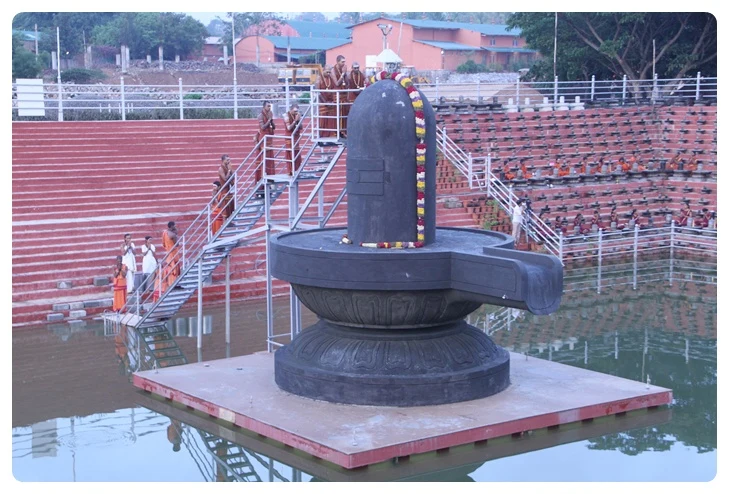
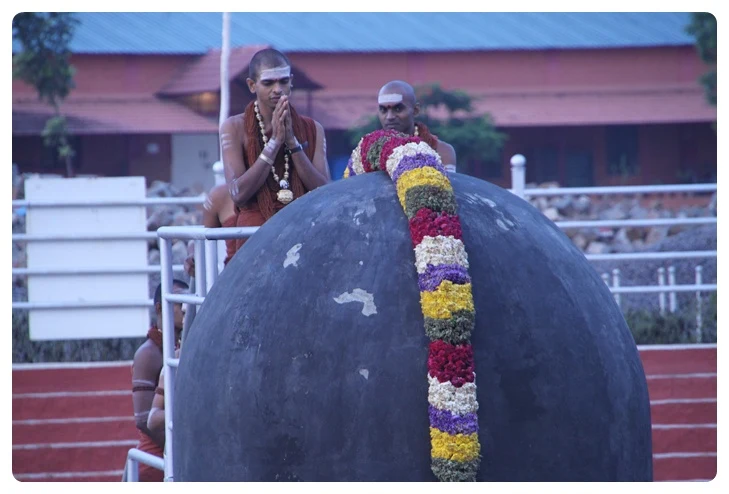
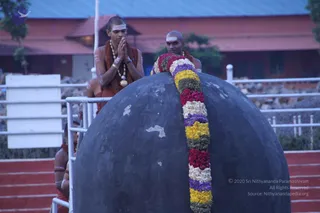
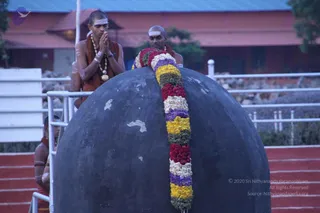
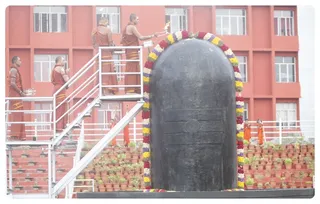
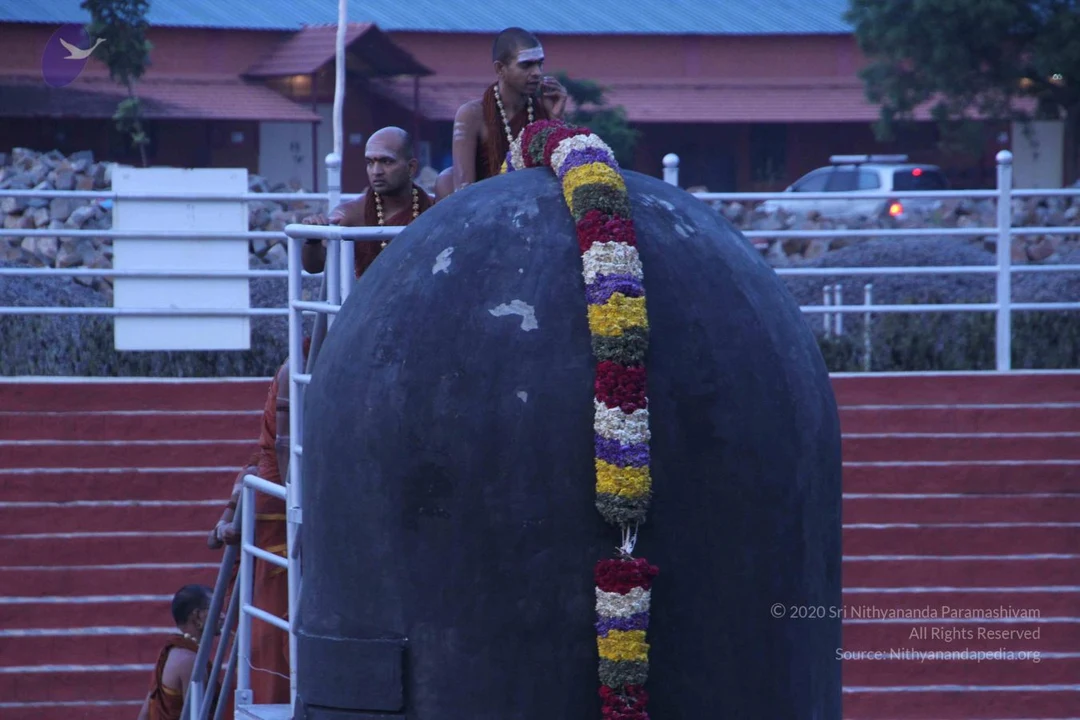
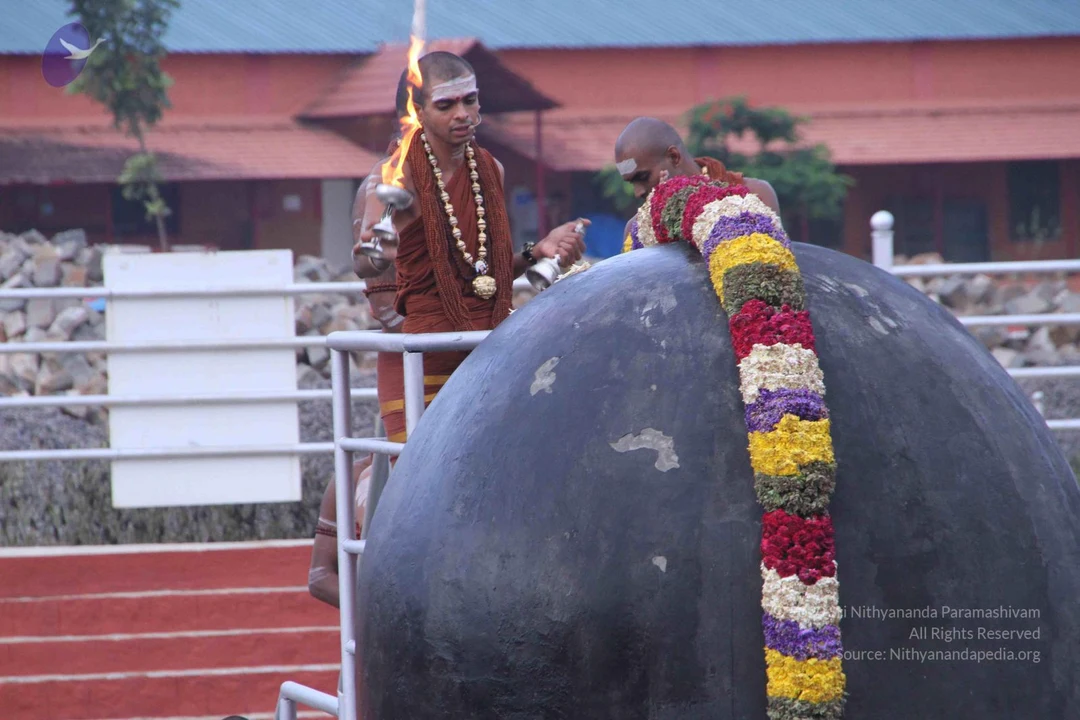
Outdoor photograph of a large polished black stone Shiva linga, a dome-shaped form, draped with a long multicoloured garland of marigold-like flowers in yellow, red, purple and white. Behind it on red steps stand several men in saffron-orange robes: one shaved-headed man in orange is at the left railing, another in orange with a white forehead marking and beaded necklaces stands higher on the linga's top edge, and a seated figure in orange sits at lower left. Red-tiled roofed buildings, stone rubble, white railings and a parked white vehicle form the background, with a dusk-blue sky tone.Several saffron-robed priests stand on a metal staircase beside a large dark grey dome-shaped stone lingam draped with a long garland of marigolds and red, white, yellow and purple flowers. Priests wear rudraksha malas and white vibhuti or tilak marks on their foreheads and arms. A white railing surrounds the platform and red-carpeted steps lead up beside the lingam, with construction rubble and bushes behind. The scene suggests abhishekam or puja preparations at an outdoor shrine. No individual is clearly identifiable as a person from appearance.A large black stone Shivalinga sits on a circular dark granite platform, draped with a long garland of marigolds and multicoloured flowers. Several saffron-robed swamis and priests stand on a metal staircase and platform at the left and upper area, some with rudraksha malas and bare upper bodies. A woman in white clothing stands at the right by steps lined with potted plants. Red stepped bathing ghats and a white railing lie behind, with a yellow truck visible in the background. The scene suggests an outdoor abhishekam or puja at a shivalinga.A large dark grey stone Shivalingam rises from a circular black base in a water tank, decorated with a garland of orange, white, yellow and purple flowers draped down its side. A metal staircase railing leads up to its platform, where several men in orange and saffron robes stand with hands folded in prayer. Other saffron-clad men stand on the steps and at the base. Red-brown stone steps line the tank behind, with potted plants at the right edge and a small building and railing in the background.Outdoor photo of a large black stone lingam, draped with a long garland of marigolds and red, white and purple flowers. A shaved-headed young man in saffron-orange cloth with white vibhuti on his forehead stands with palms pressed together in namaste, a rudraksha mala around his neck. Behind him another shaved-headed man with white tilak stands near the lingam. Red-roofed buildings, white railings and a red-tiled floor surround the scene. Two more people in orange are partly visible at left.A large dark black stone lingam, smooth and rounded, is draped with a long garland of marigolds and roses in red, yellow, white, purple and green. Behind it, a young man with a shaved head and white tripundra markings on his forehead stands with palms pressed together in prayer, wearing a saffron-orange shawl and a beaded necklace. Beside him, another man with a shaved head and white forehead markings stands in a similar orange garment. Partly visible on the left is a third person in orange clothing. The setting shows a red tiled-roof building, white railings and a red-paved platform, consistent with a ritual abhishekam or puja at an ashram ground.
Gurukul-Kids-Instrument
1 photoSource gallery
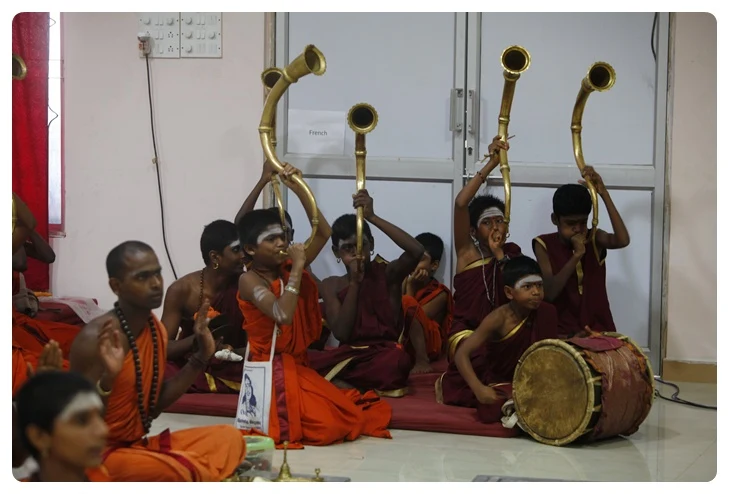
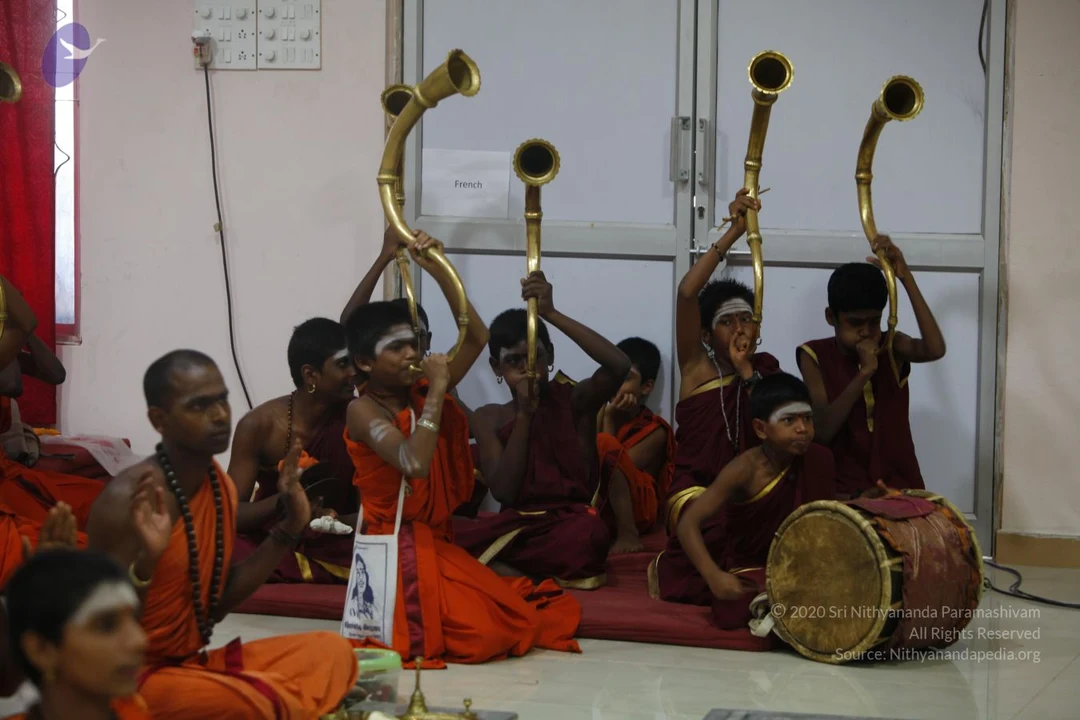
A photograph of a group of young musicians seated on a floor mat in a plain room with white walls and a glass door. Several boys play long curved gold-coloured brass horns, raising them and blowing into them, while one boy in a maroon robe beats a large wooden frame drum. Some wear orange robes, one holds a rudraksha mala, and several have white ash marks on their foreheads and faces. A sign on the door reads French. A red curtain hangs at the left edge. The people are seated, with no visible a person candidate.

Crowd_Claps

1 photoSource gallery
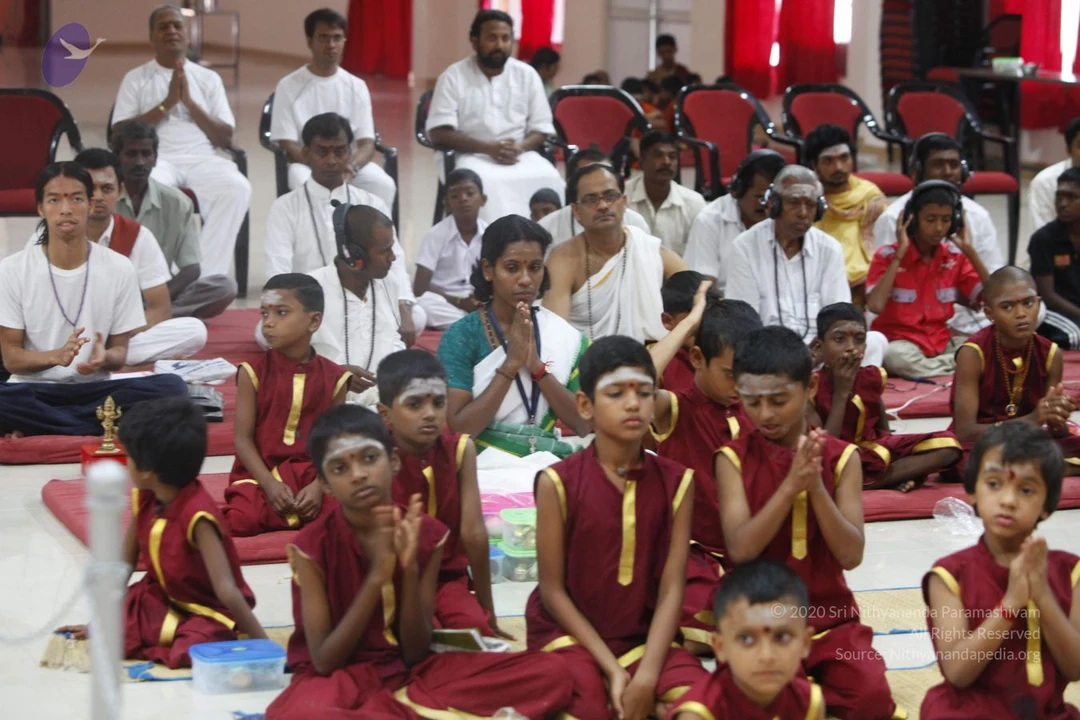
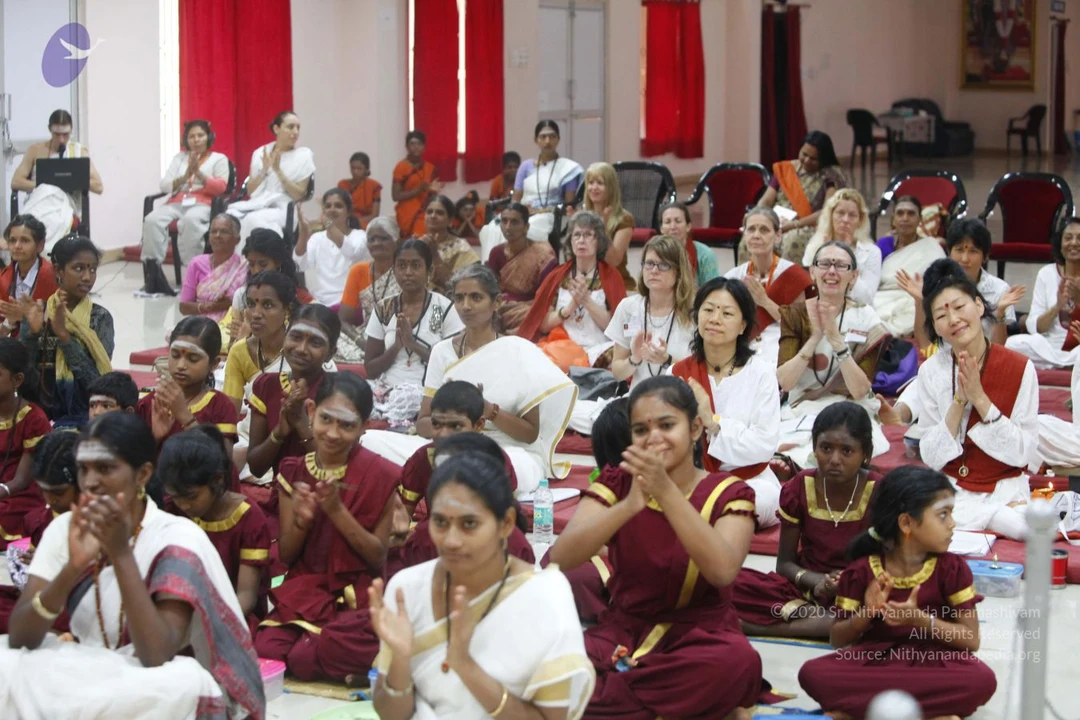
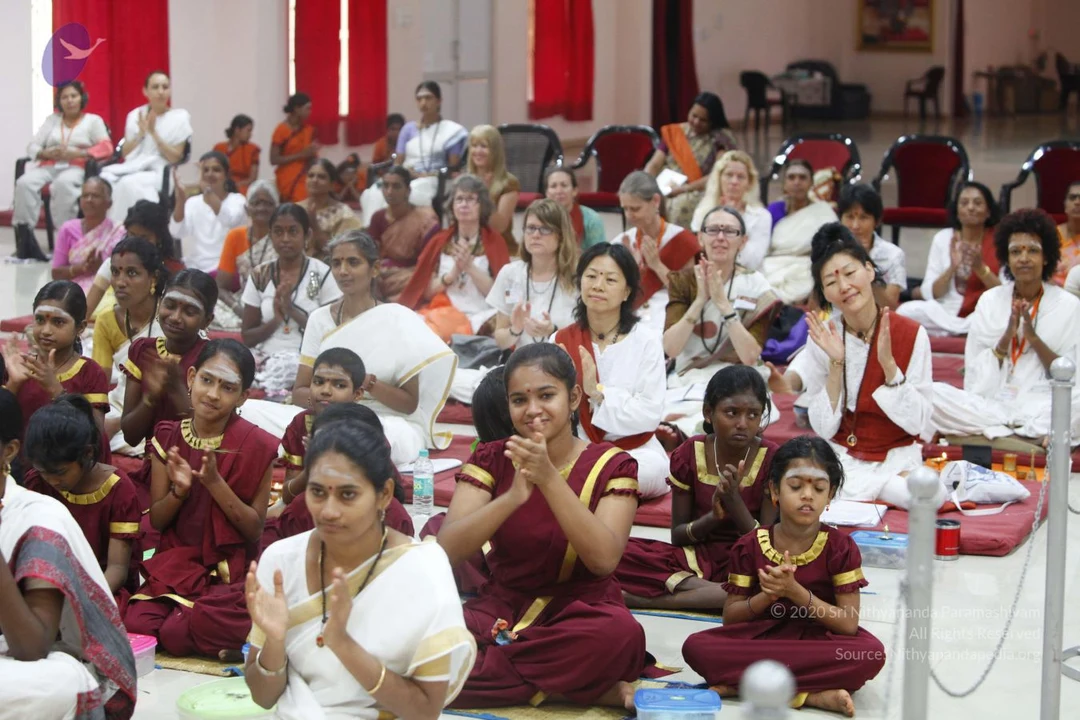
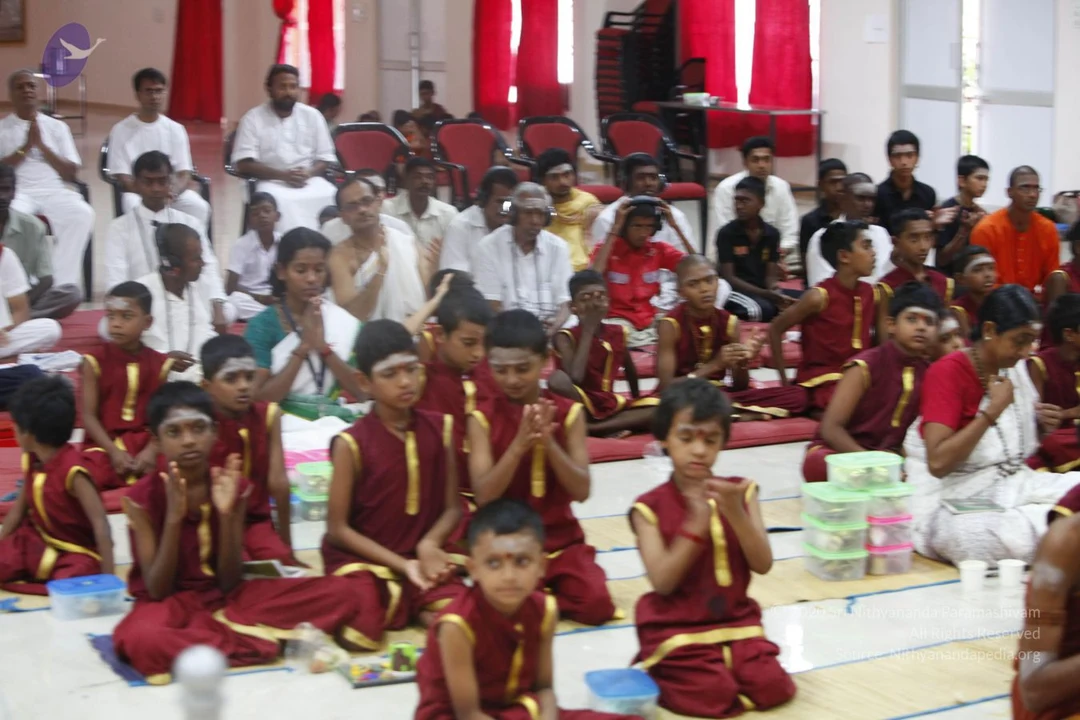
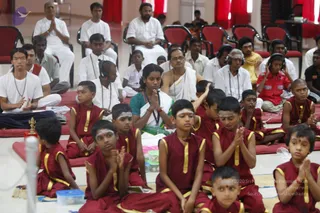
A photograph of a seated group at a satsang in a hall with red curtains and red chairs. In the foreground, boys in maroon tunics with gold trim sit on red mats with hands pressed in anjali, several with white forehead marks. A woman in a green and white sari with a blue lanyard sits centrally with palms together. Behind them, adults in white clothing and some in white shawls sit on chairs, many wearing headphones. A man in white with a rudraksha-style mala sits at the back, while a figure in white at the left shows folded hands. A small brass lamp sits at the lower left. Visible people number roughly 20 to 30.

NithyaSatsang_Swamiji

7 photosSource gallery
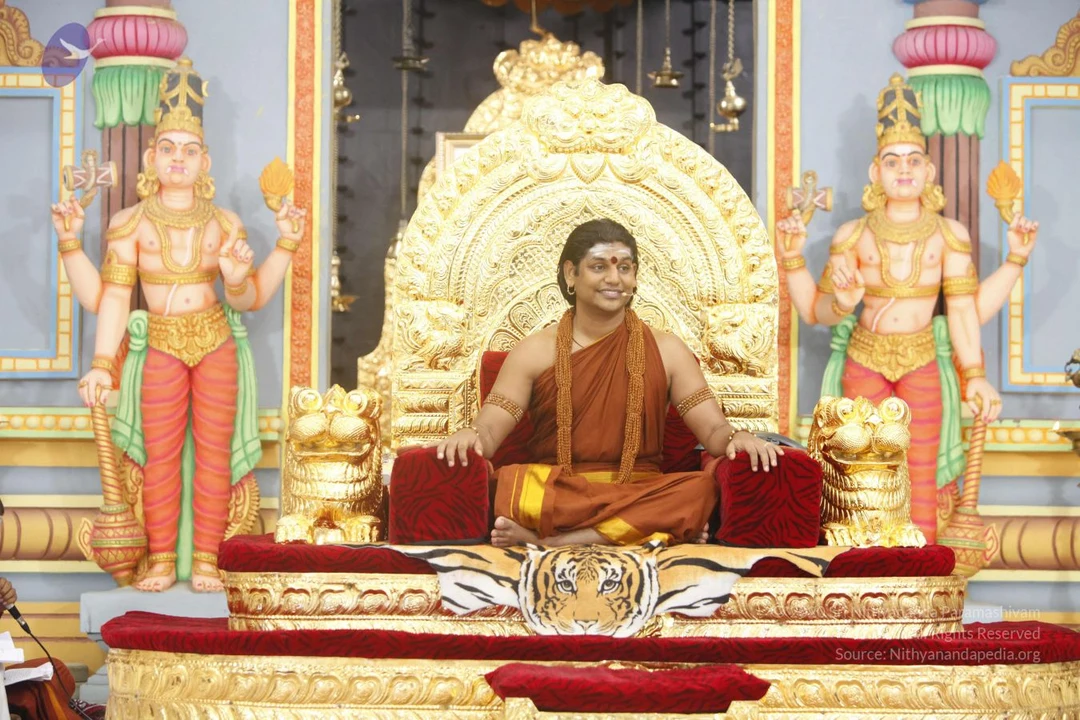
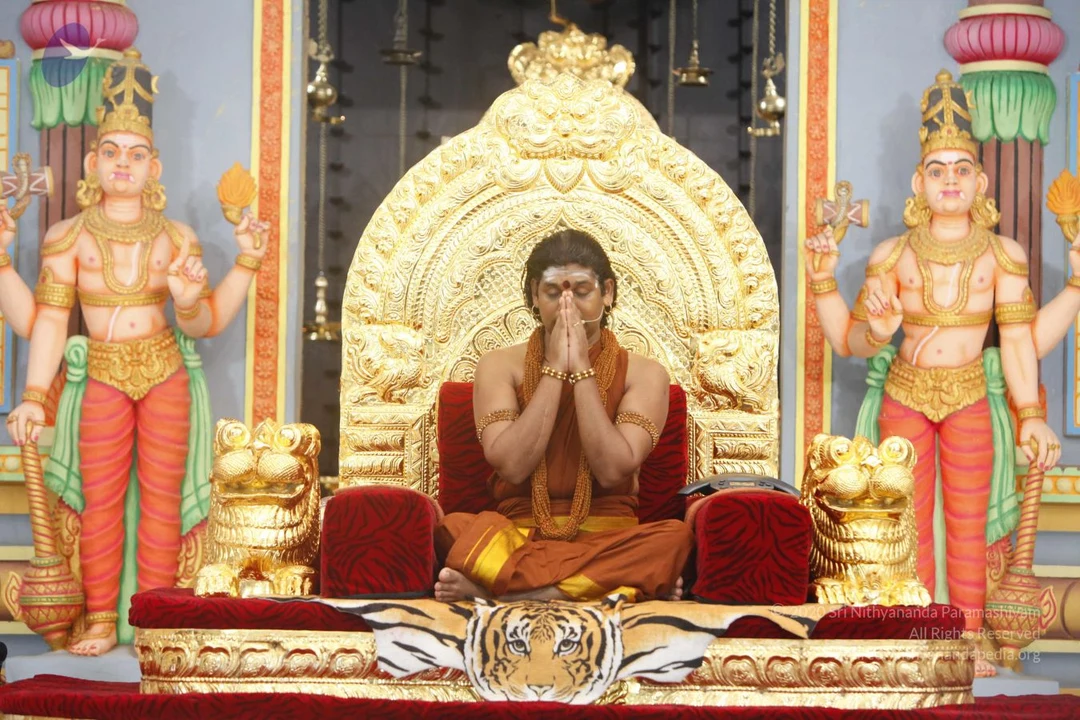
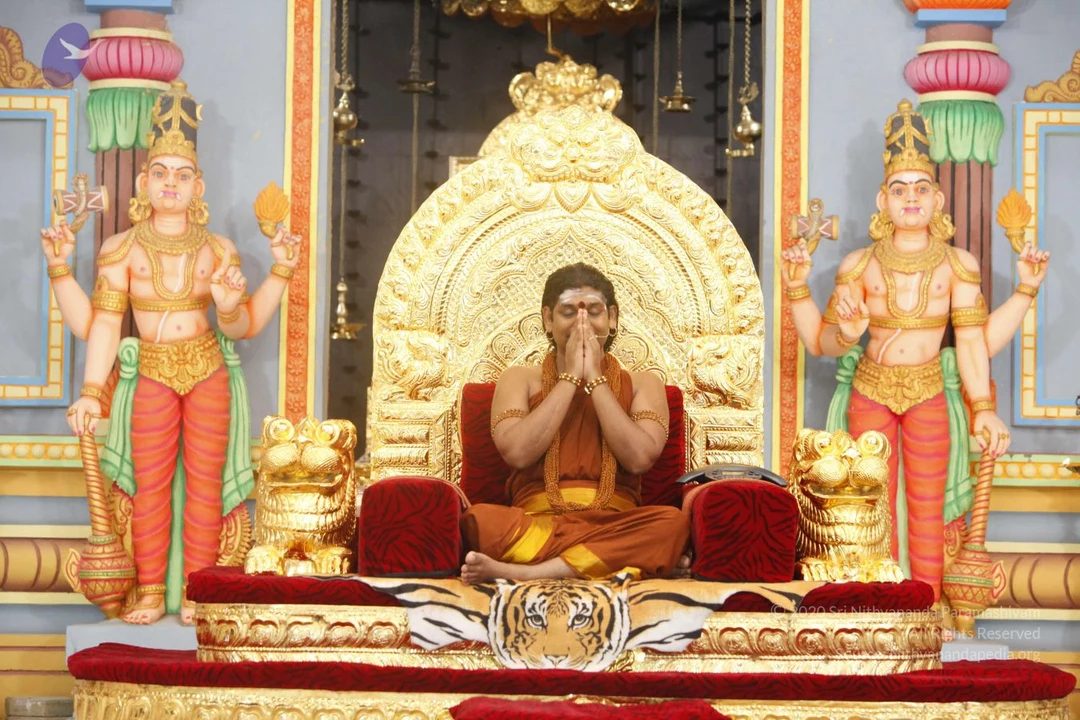
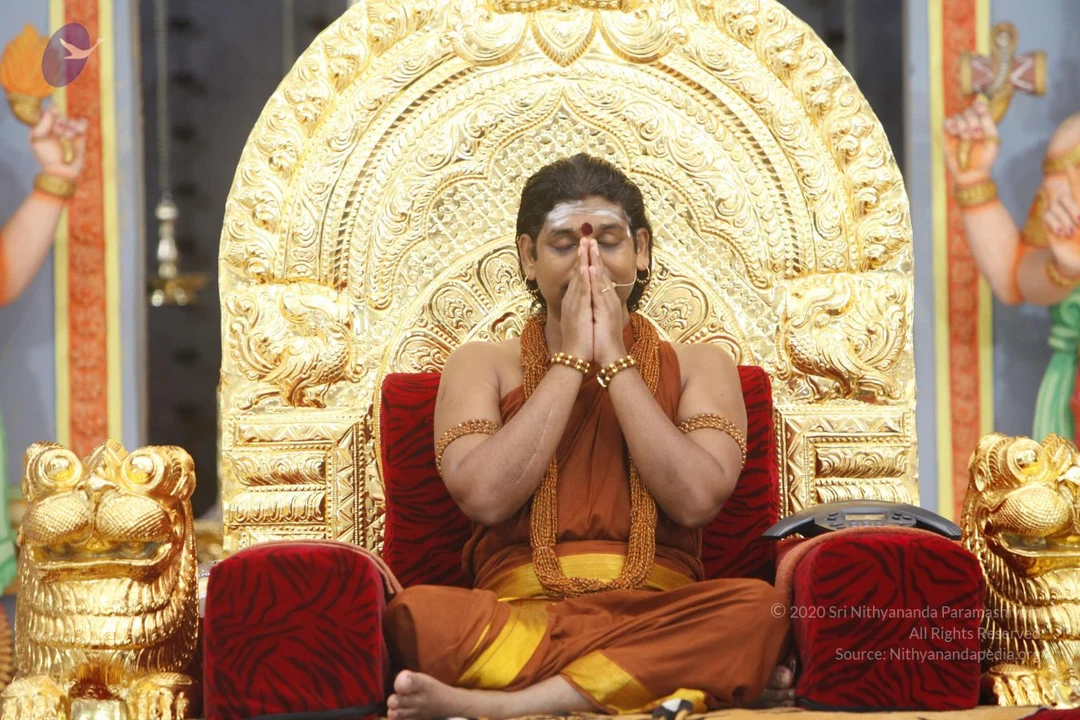
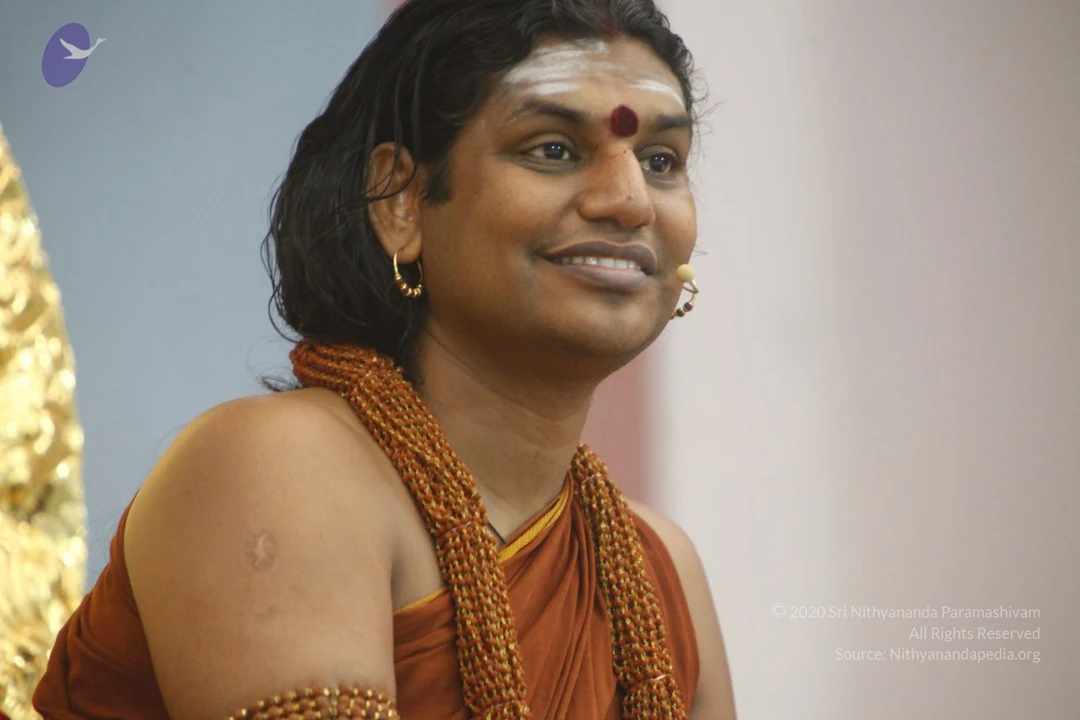
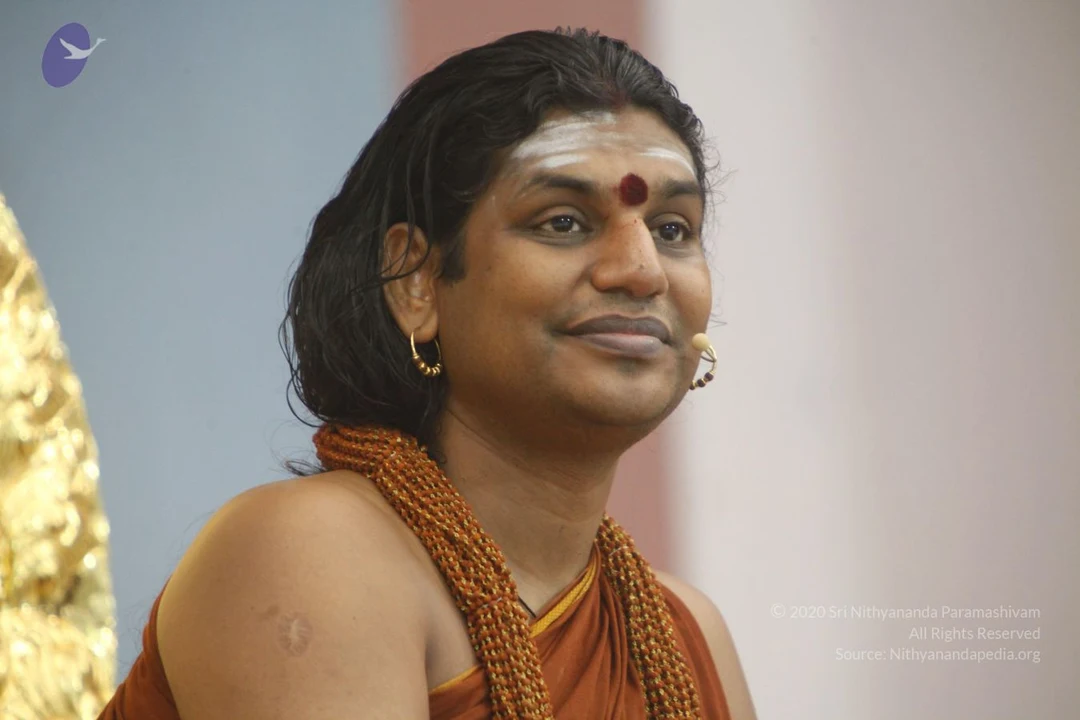
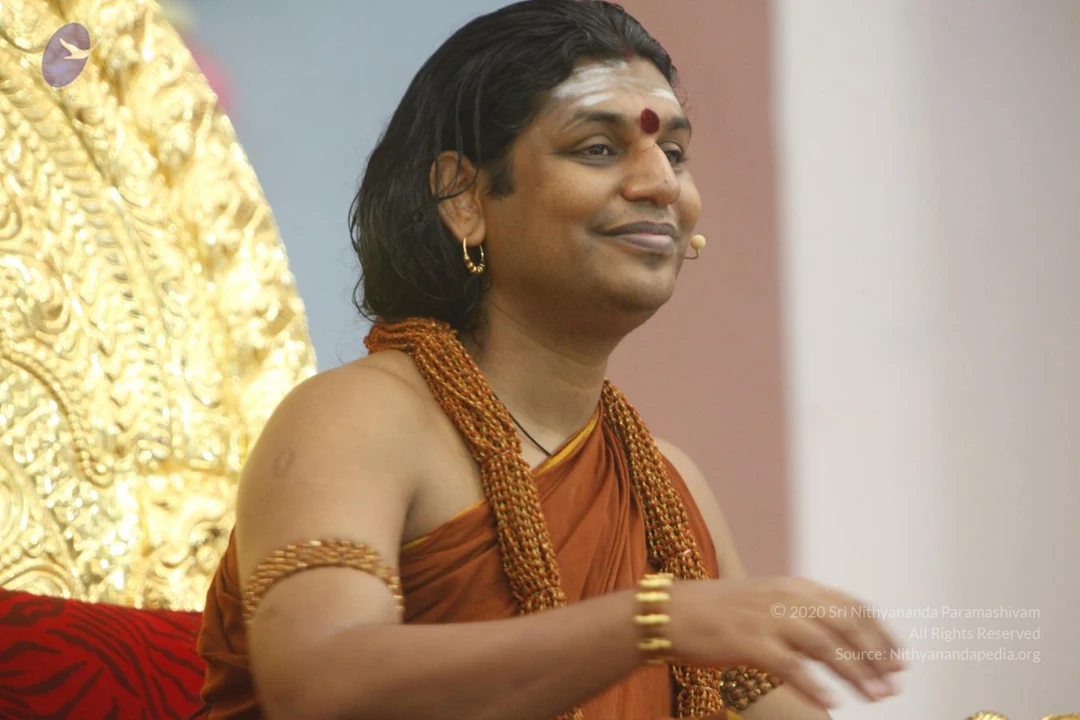
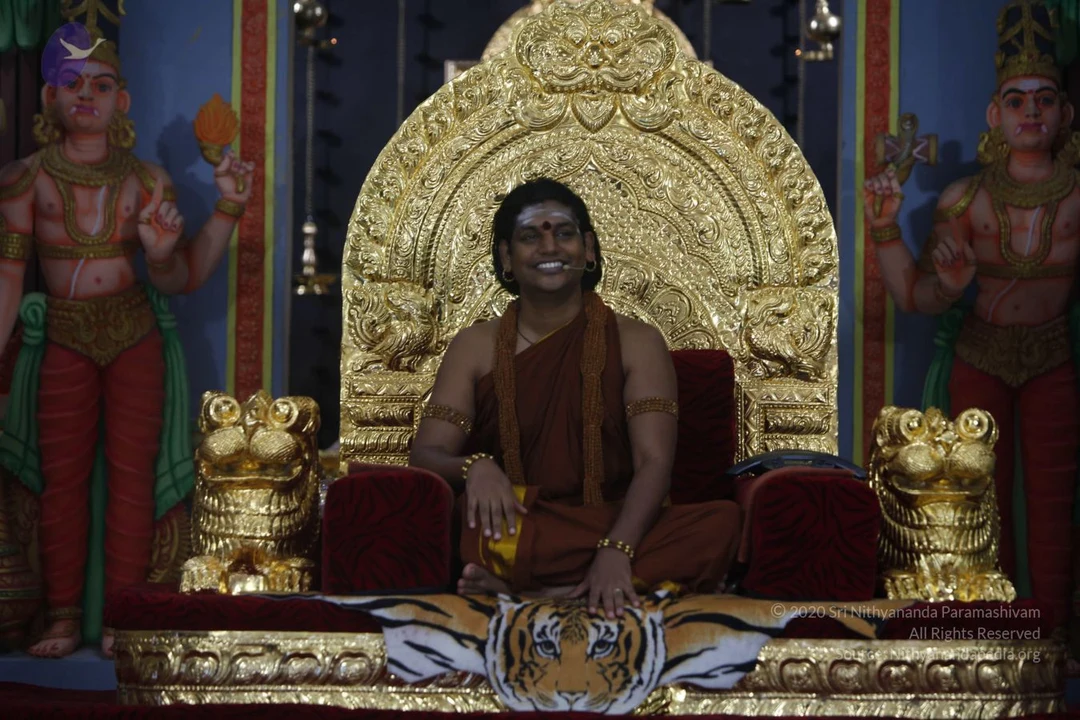
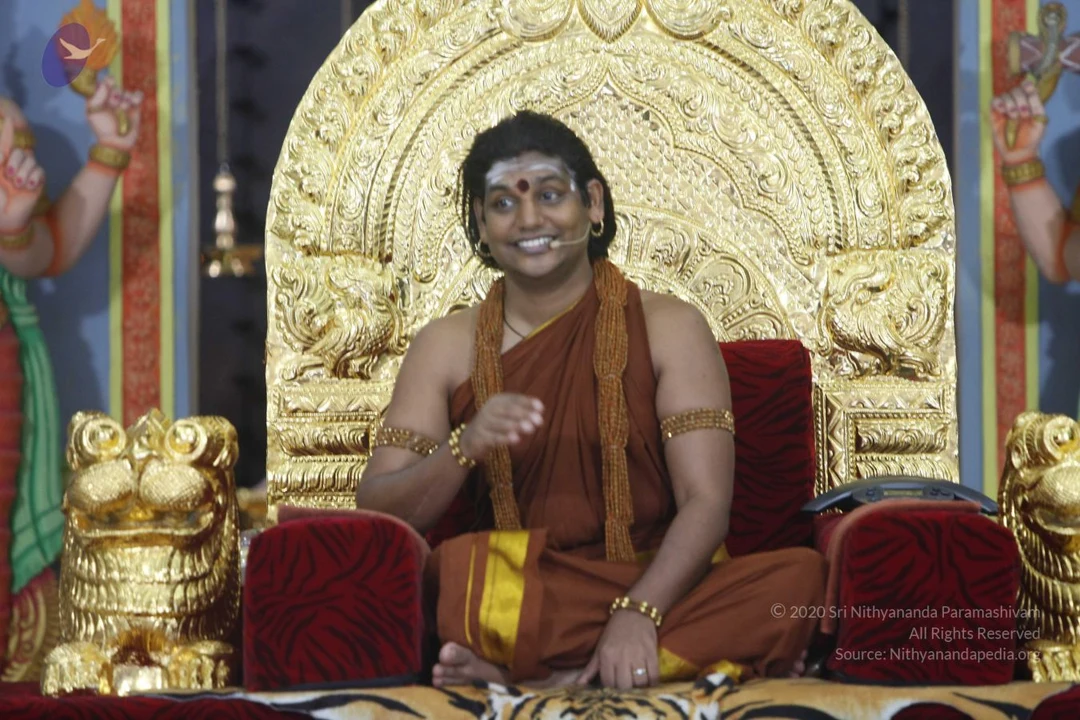
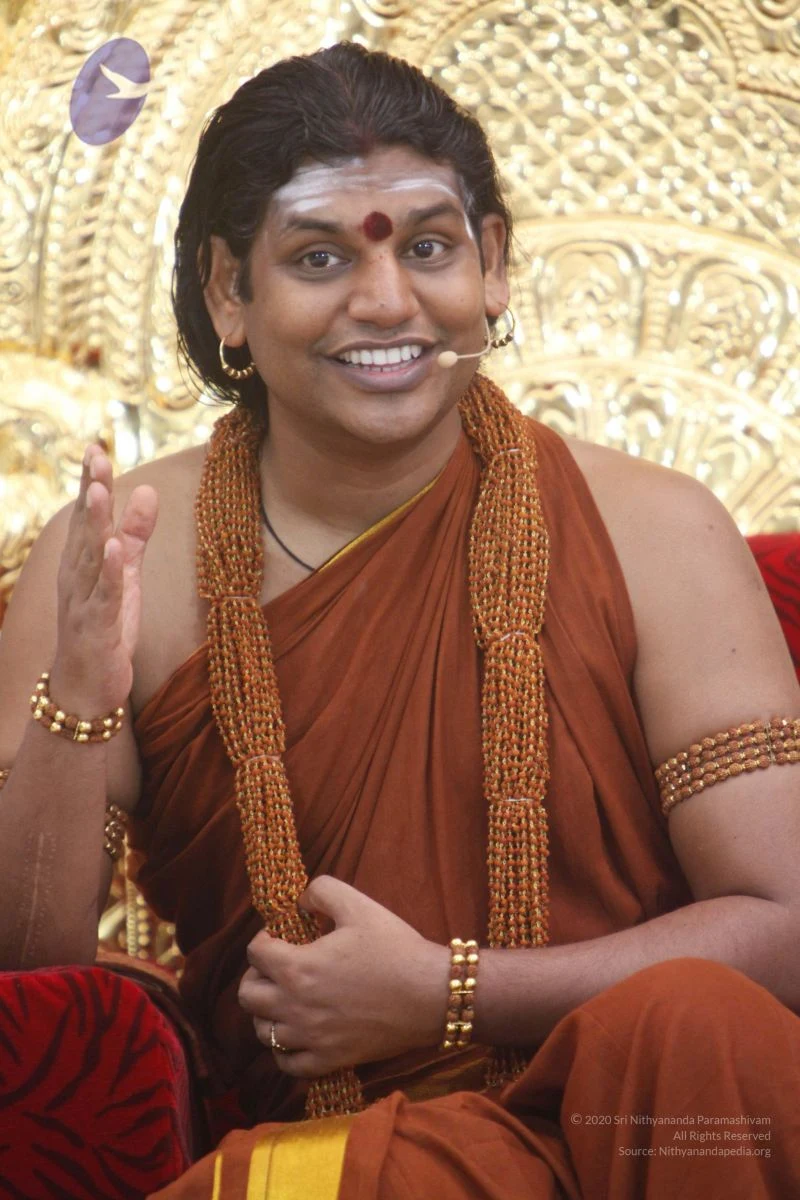
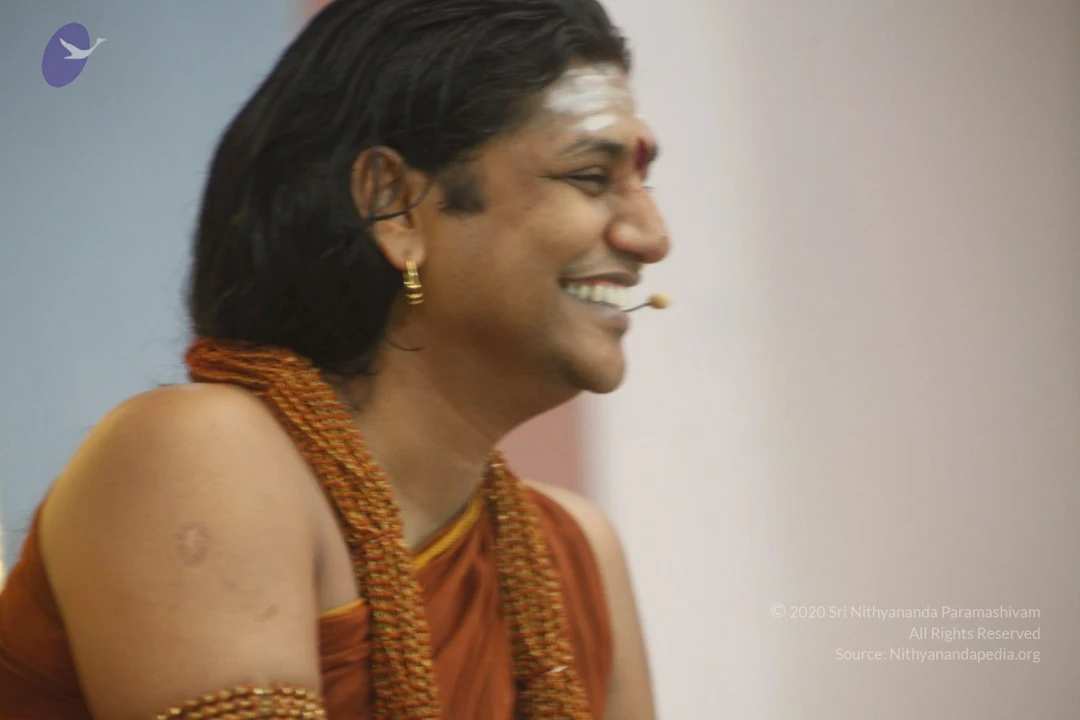
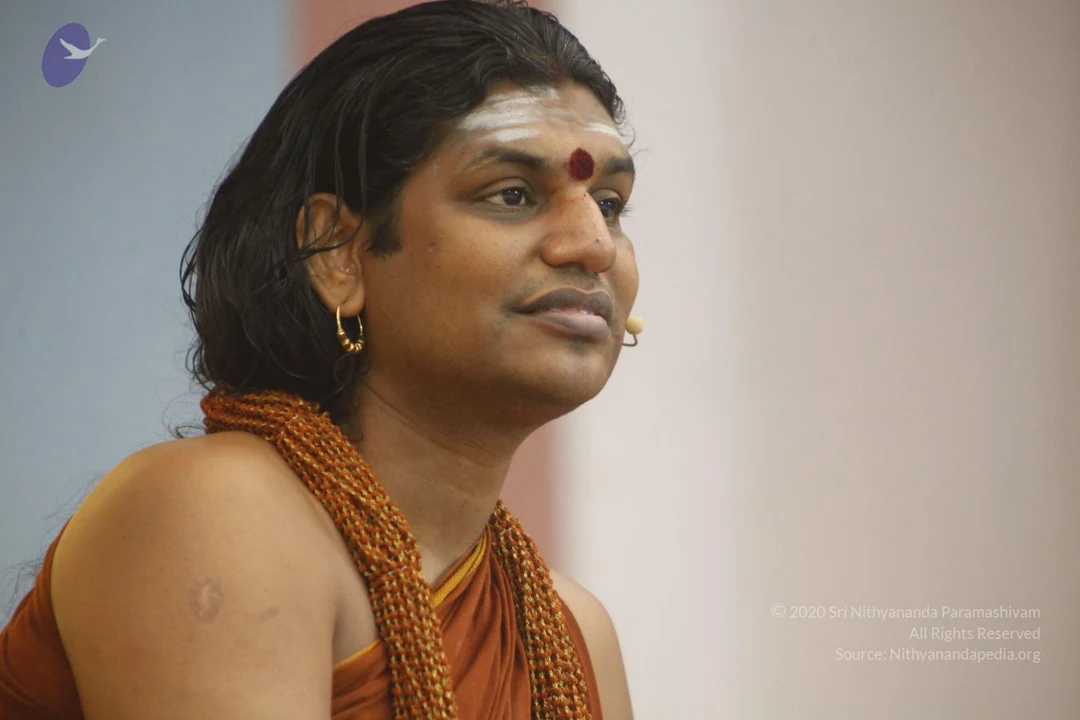
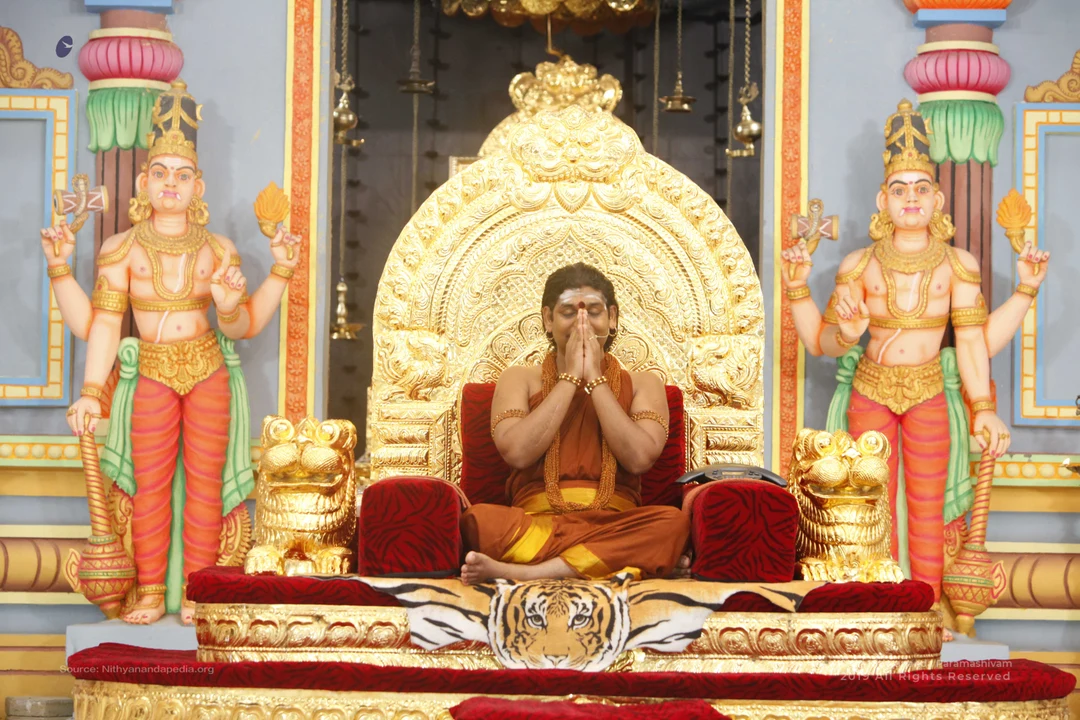
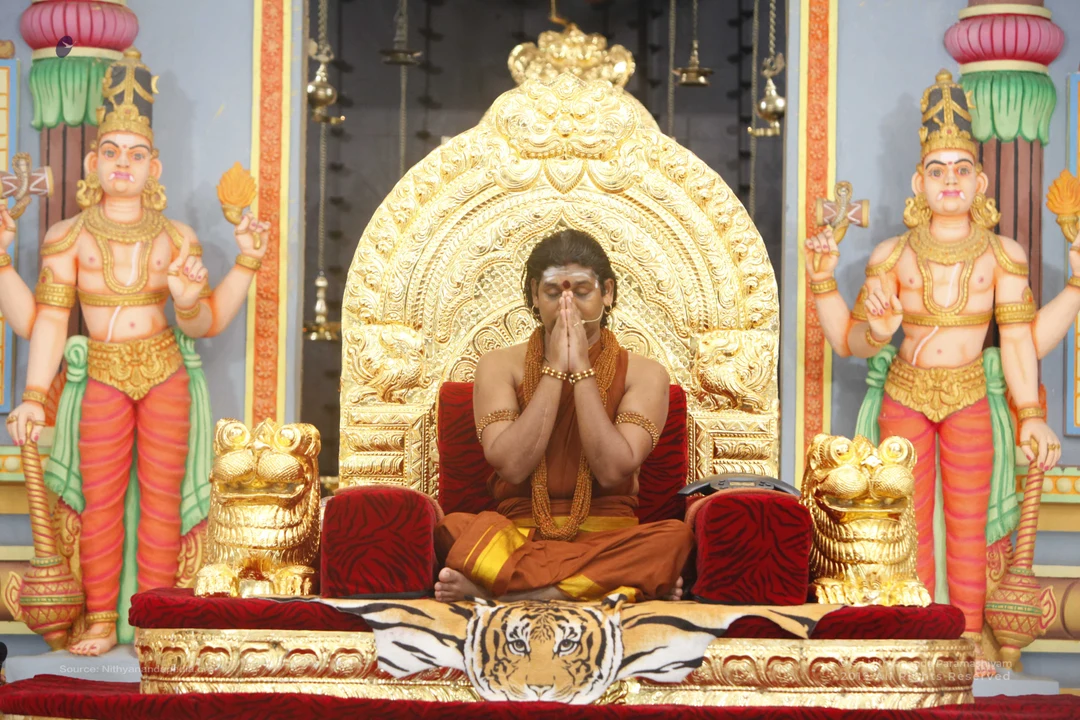
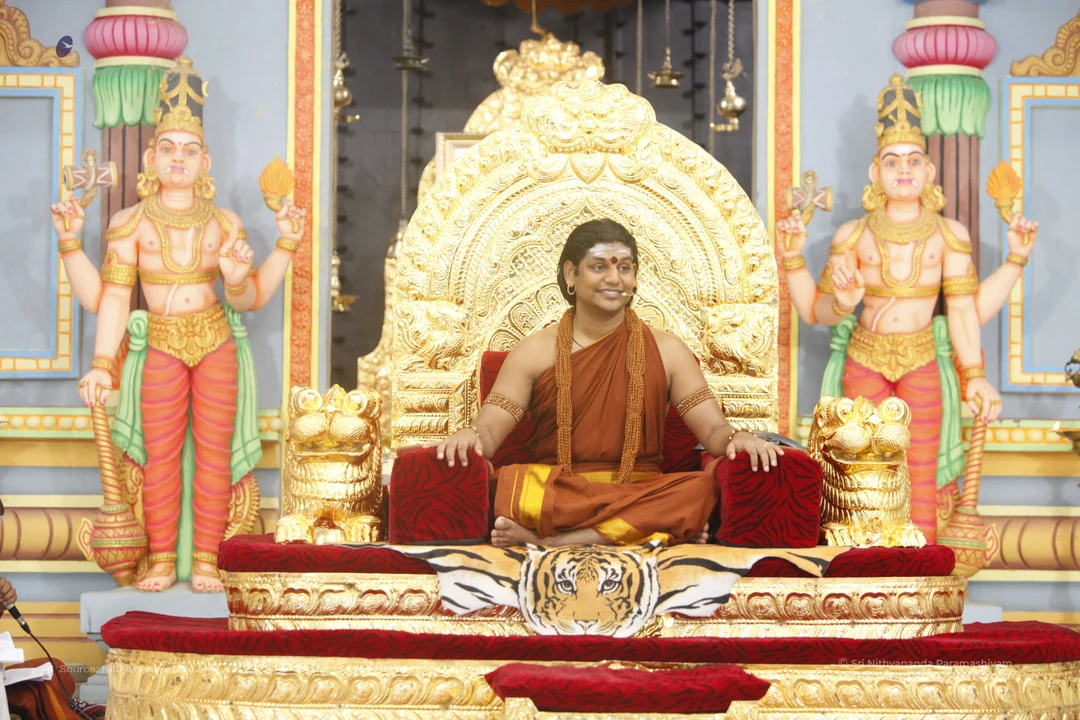
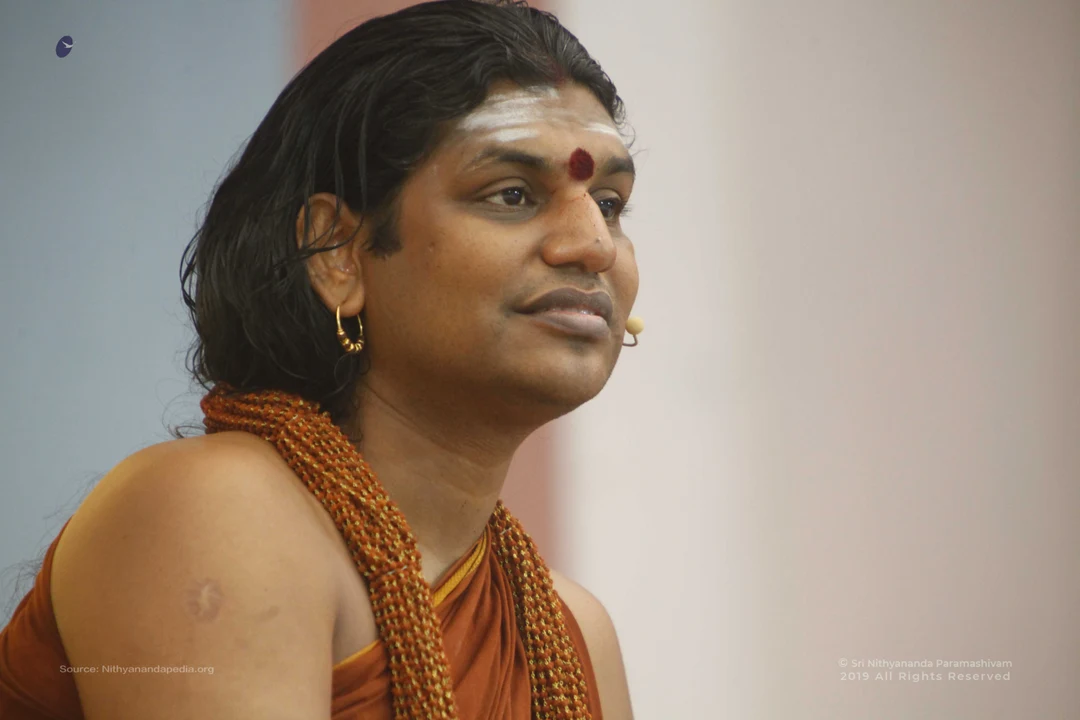
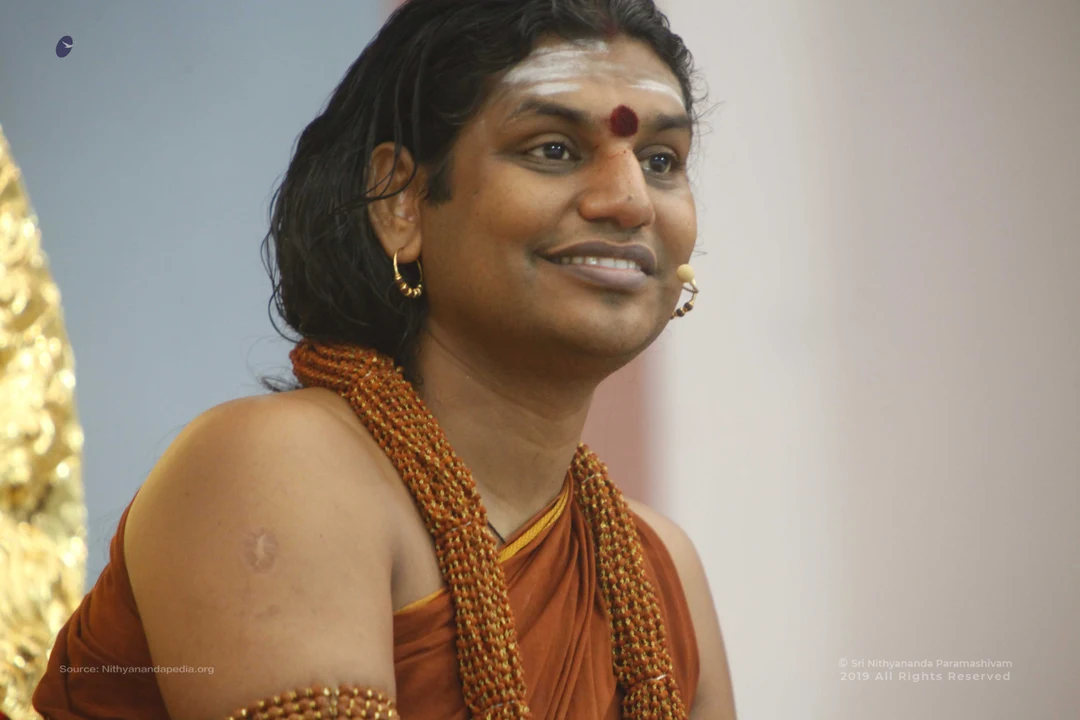
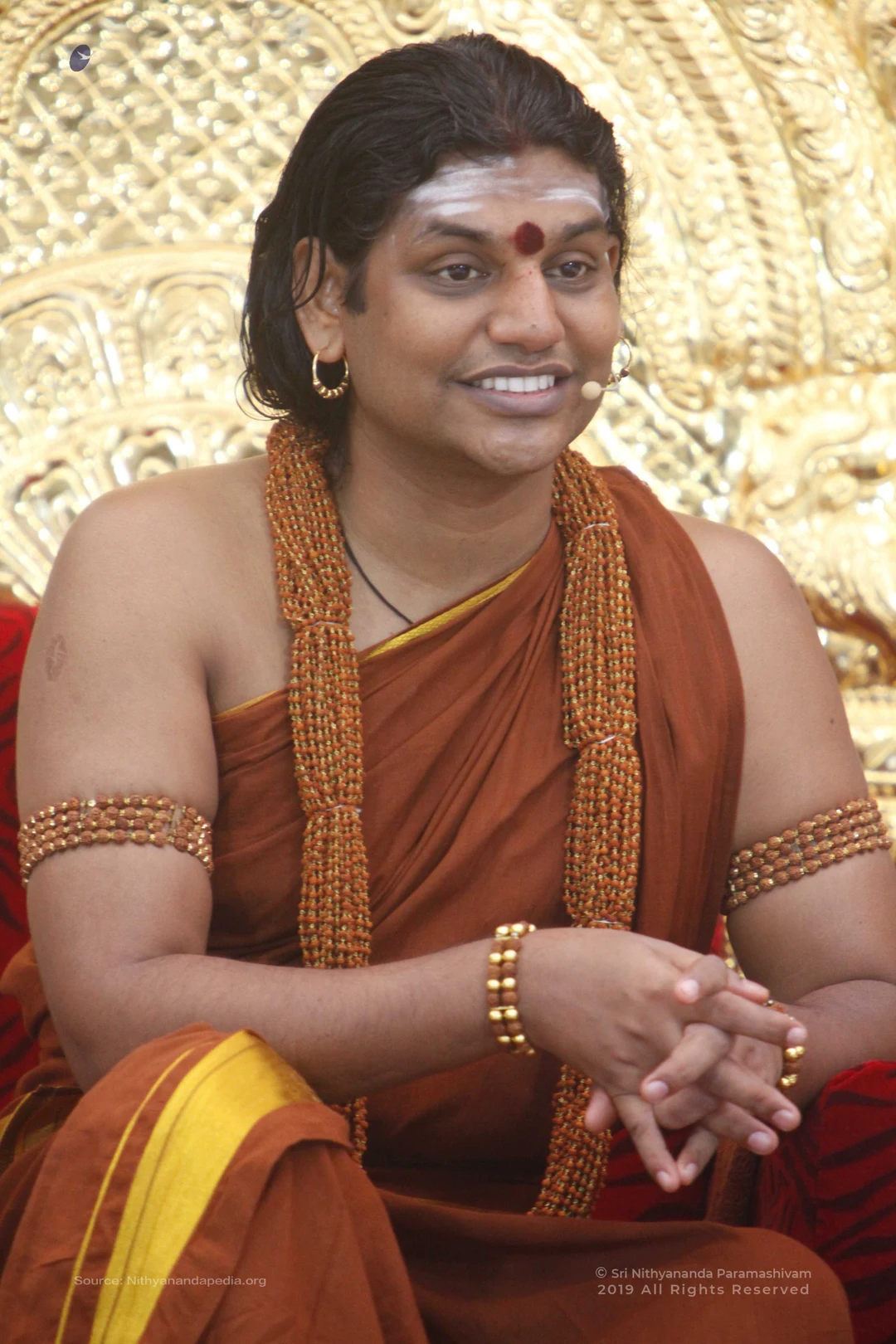
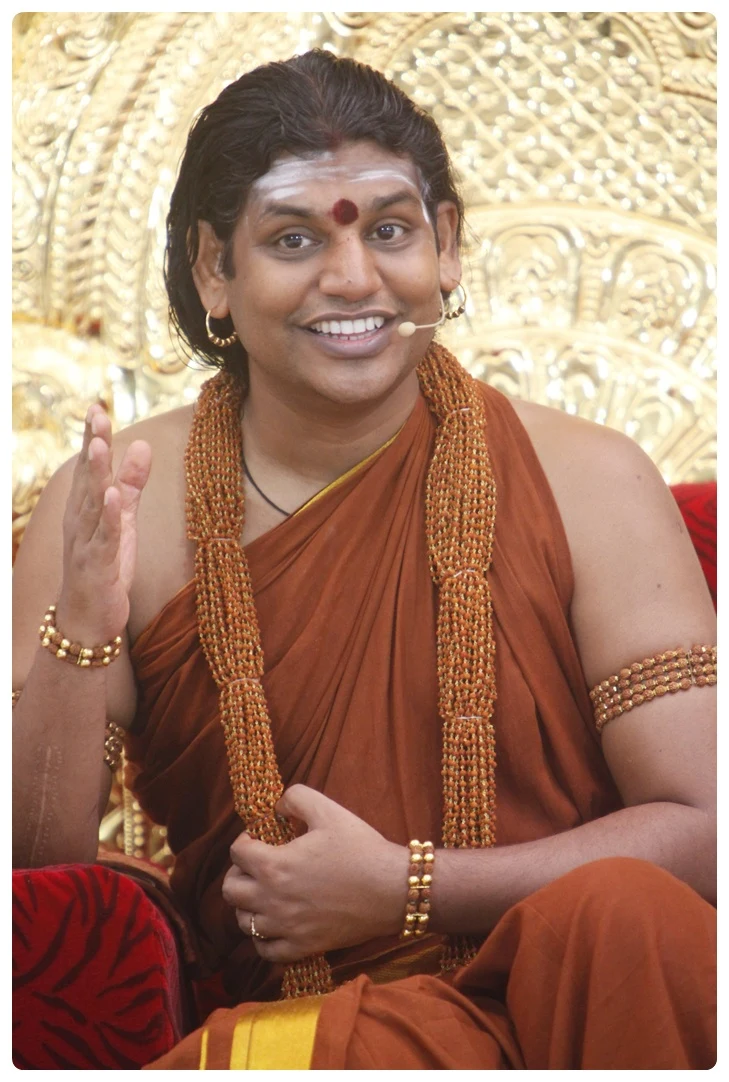
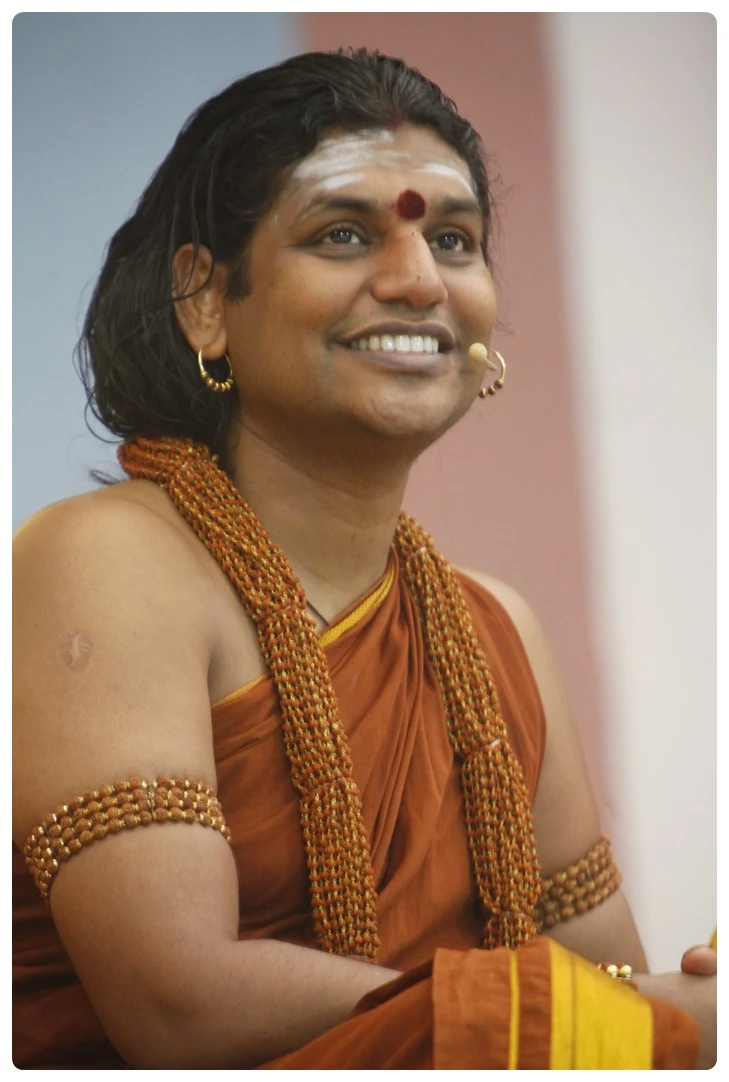
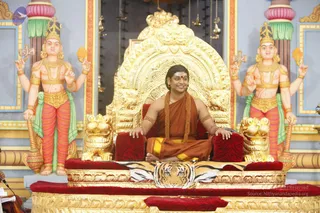
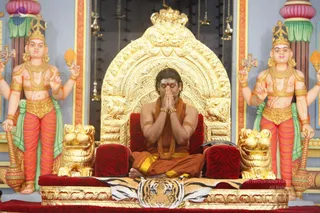
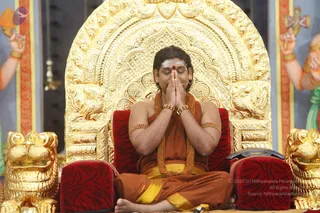
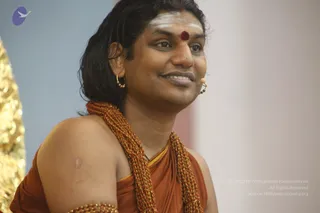
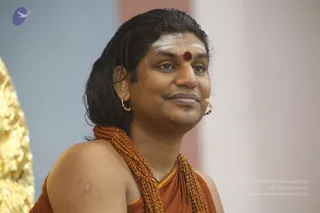
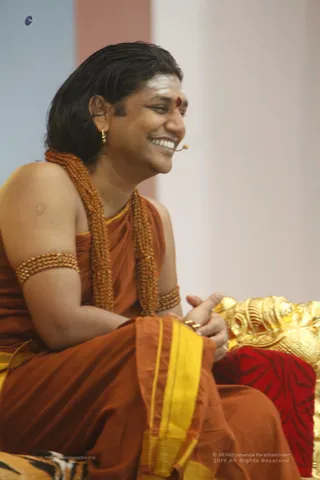
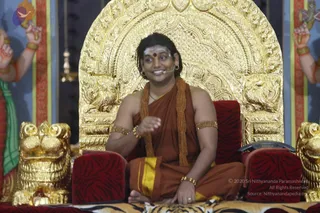
A seated man in saffron-orange robes and a rudraksha mala sits on an ornate golden throne with lion-head armrests, draped with a tiger-skin cloth, in front of two large painted deity murti figures with multiple arms holding ritual objects. Gold and red decor fills the background, with hanging bells above. The man has long swept-back dark hair, gold armbands and a kumkum mark on his forehead, and rests his hands on red cushions. The appearance matches the Swamiji (probable) profile of a long-haired figure in saffron with a rudraksha mala and ceremonial gold ornaments, seated on a throne as a teacher. Two deity statues stand on either side, and a microphone is visible at the lower left.A seated man with a shaved-back dark hair and a red bindi-like tilak on his forehead sits in padmasana on an ornate gold throne with a carved arched back and gold lion heads at the armrests, draped in a red velvet cushion and a tiger-skin mat. He wears an orange-saffron robe with a yellow dhoti border, layered rudraksha malas and gold bangles, palms pressed together in namaste with eyes closed. Flanking him are two tall gold-and-green painted dvarapala-style guardian figures holding ceremonial objects, with hanging brass bells and lamps above and a pink-and-gold pillar behind.A seated man in saffron-orange robes sits cross-legged on an ornate gold throne with red velvet cushions, palms pressed together in namaste with eyes closed. He wears a gold-beaded necklace, bangles and a red tilak on his forehead. A tiger-skin cloth covers the throne base, flanked by golden lion heads. Two tall, multi-armed gold-crowned deity murti statues in red and green dhoti stand on either side, holding ritual objects, while hanging brass bells and lamps hang above the golden arched backdrop.A man seated cross-legged on a red velvet cushioned seat in front of an ornate gold throne with carved floral and scrollwork backrest, flanked by gold lion-head armrests. He sits with palms pressed together in namaste, eyes closed, wearing an orange-saffron dhoti and shawl with gold border, a long gold-beaded necklace, gold bangles and armlets, and a red tilak with white vibhuti on his forehead. Painted deity figures with raised hands stand at the edges of the frame.Close photograph of a man seated indoors, smiling and looking to the right, wearing a headset microphone near his cheek. He has long dark hair swept back, white vertical tilak marks on his forehead and a red bindi between his brows. He wears an orange-brown shawl draped over bare shoulders, a multi-strand rudraksha-style mala with bead strands in brown and gold tones, a gold hoop earring, and a beaded bracelet on the upper arm. A blurred gold ornate object is visible at the left edge. Wall in soft blue and pink tones behind him.Close-up photo of a man seated in profile against a pale blue and pink backdrop, with a gold ornamental edge at the left. He has long dark hair swept back, white vertical tilak marks on the forehead with a red dot at the centre, gold hoop earrings, and a small headset microphone near his right ear. He wears a saffron-orange garment over the shoulder and a thick orange-and-gold beaded rudraksha-style mala with gold necklace elements. He smiles slightly while looking to the side. Appearance-based label: a person, seated speaker at a satsang discourse.

Meditation_shots

7 photosSource gallery
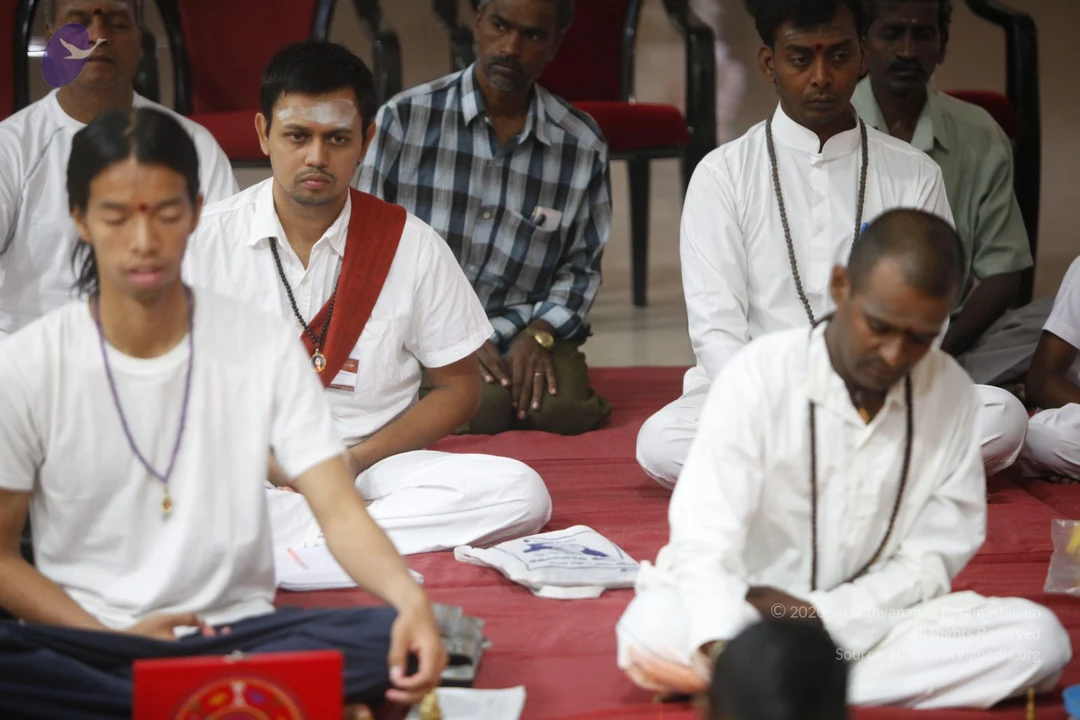
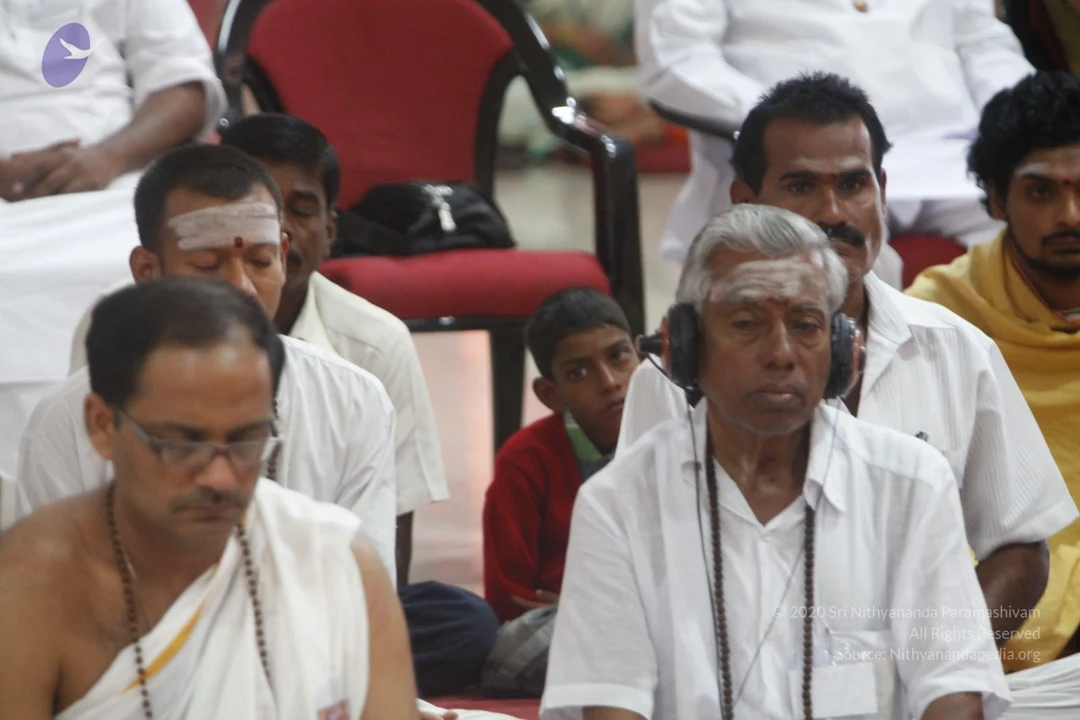
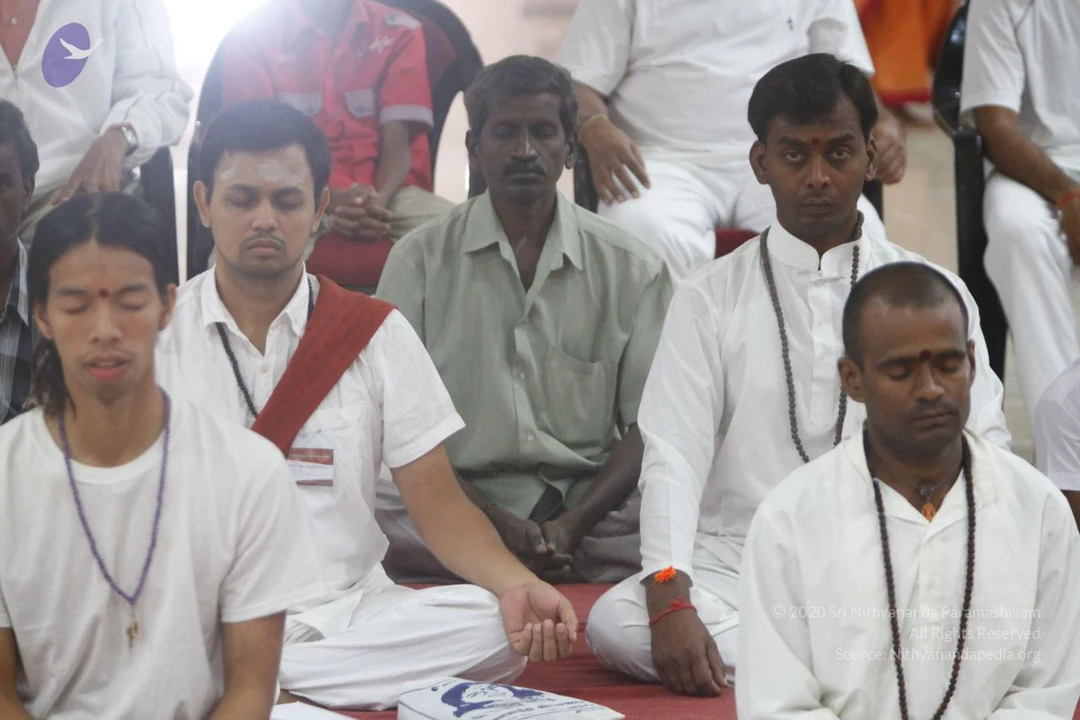
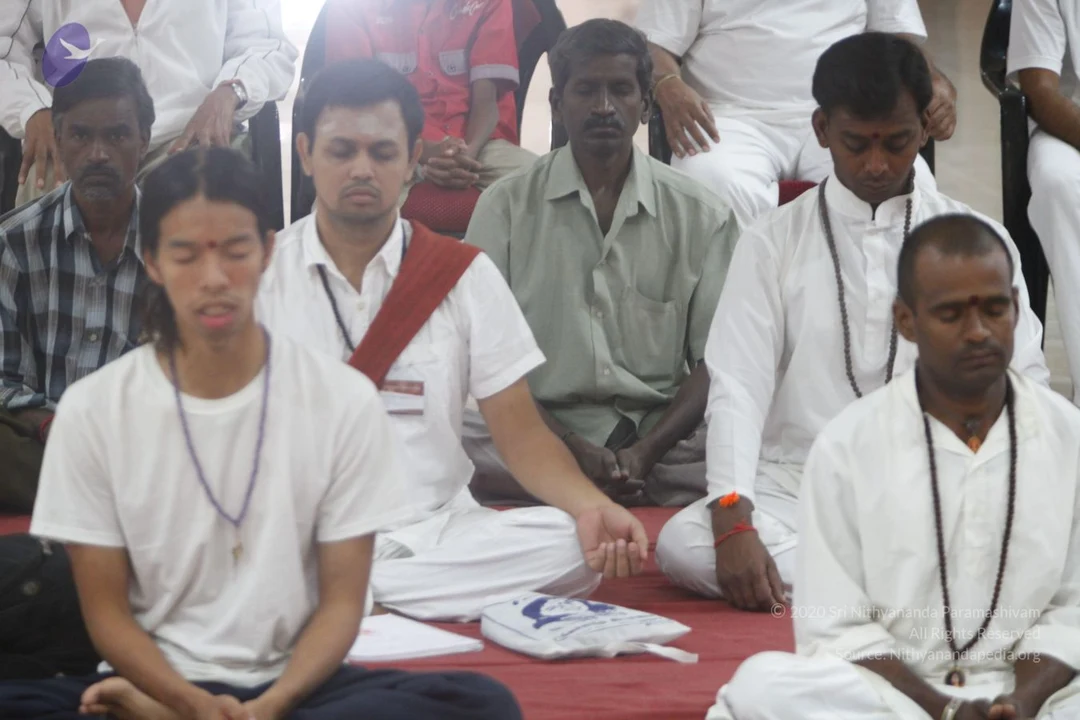
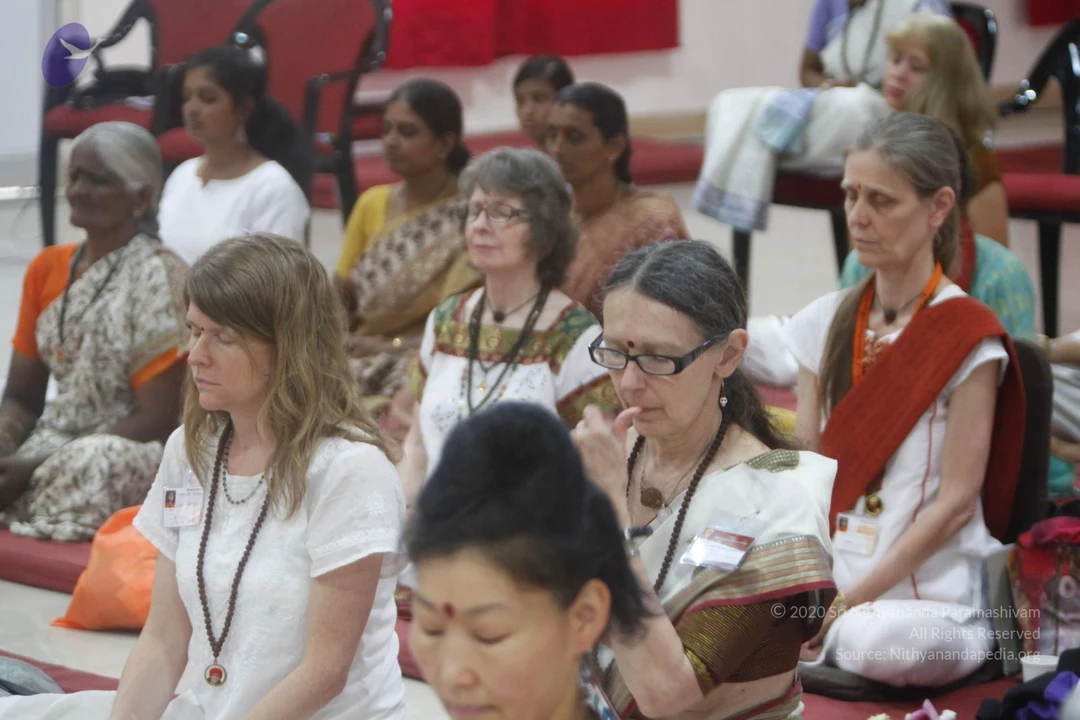
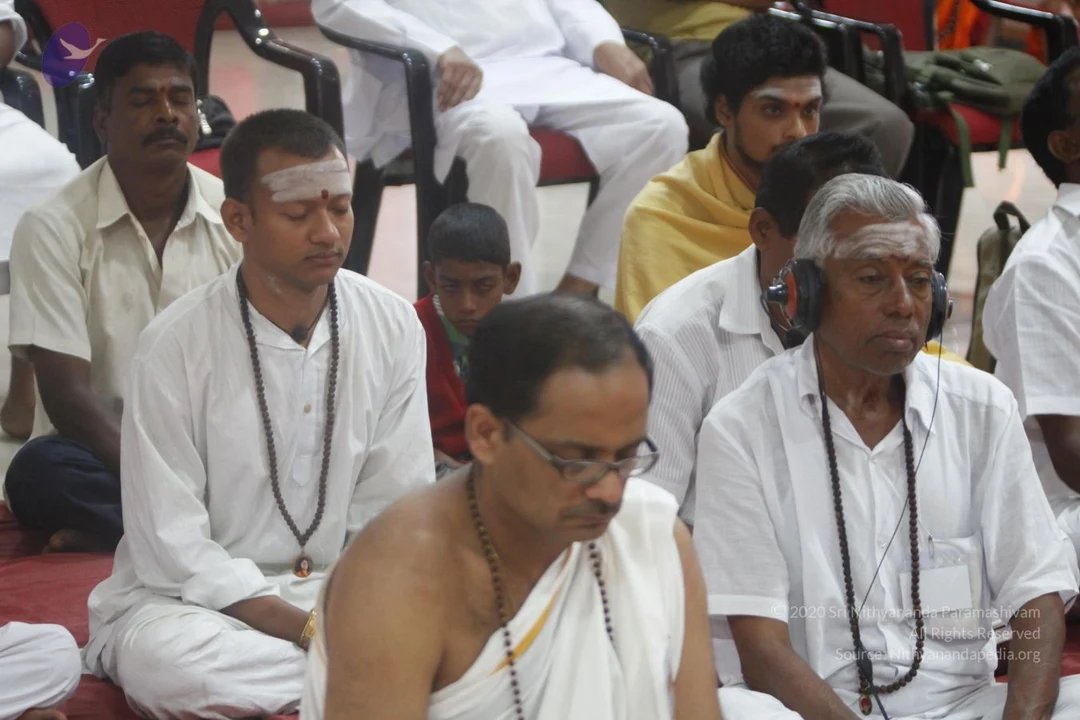
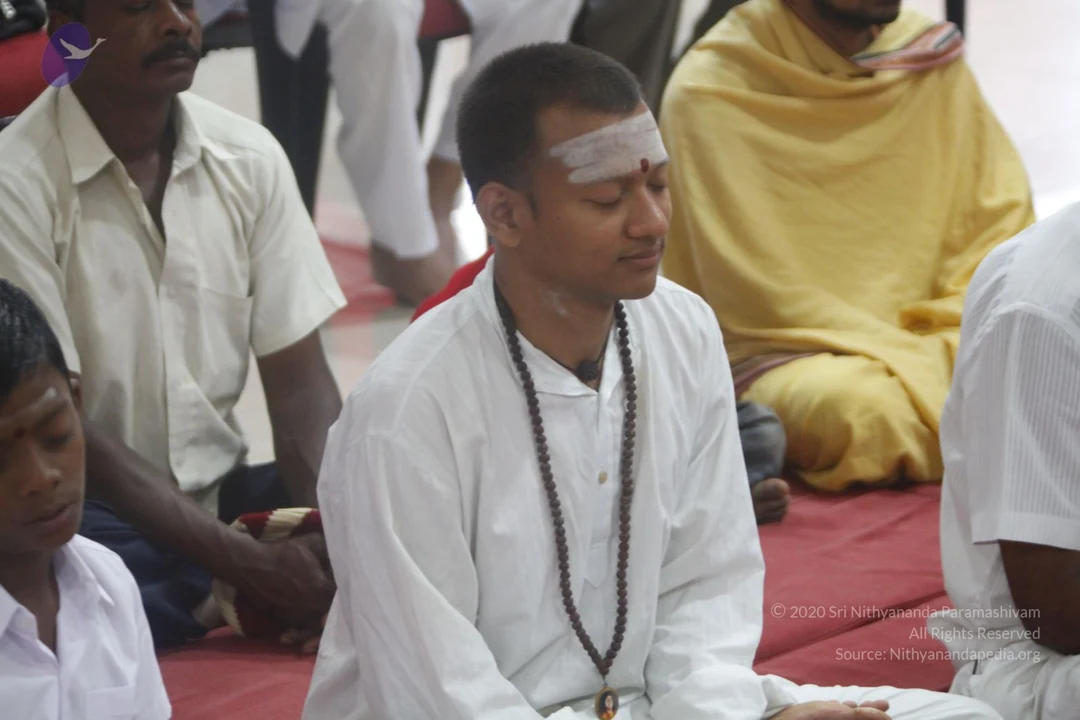
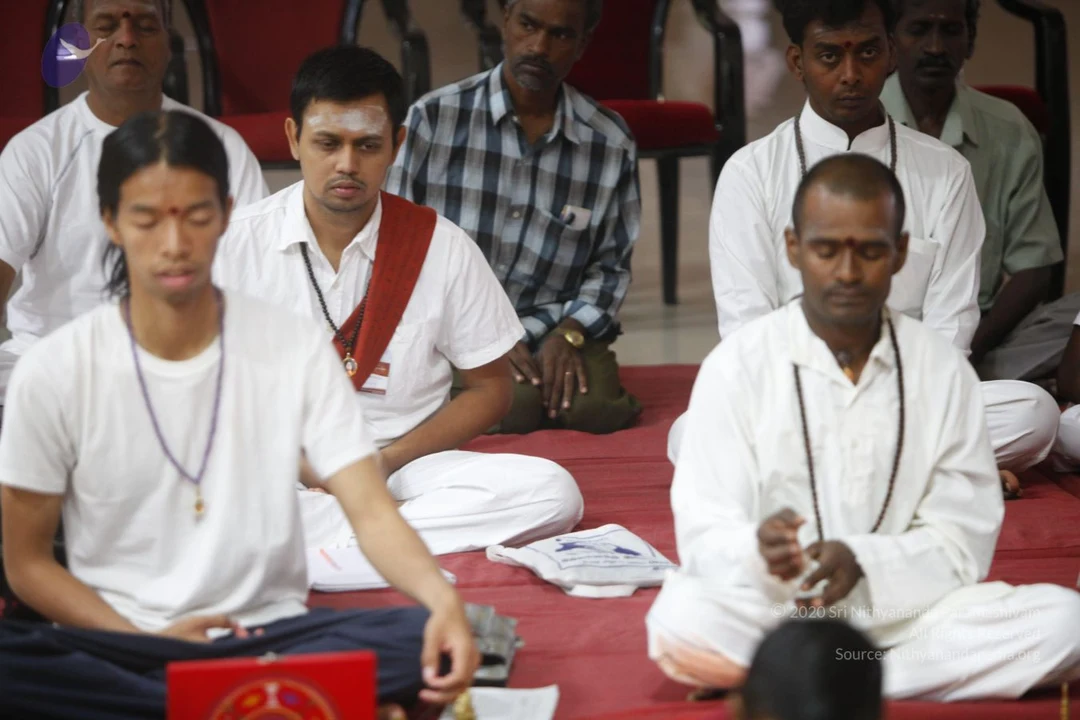
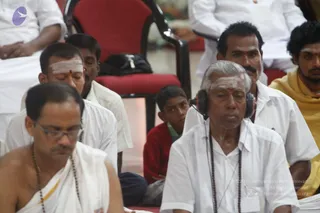
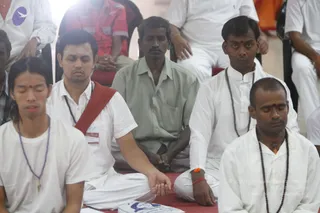
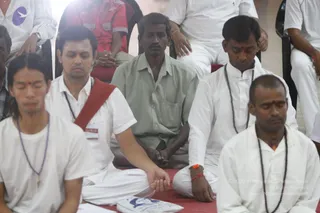
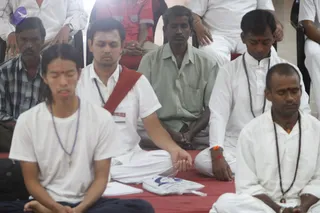
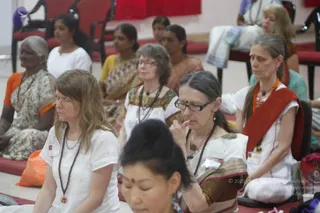
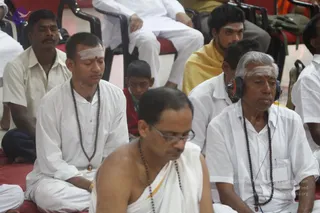
A seated audience at a satsang, viewed from the front rows. In the foreground, a man in white dhoti with rudraksha mala and wire-rimmed glasses sits with eyes lowered. Beside him, an older man with grey hair, white vibhuti on his forehead, white shirt and rudraksha mala wears headphones for translation. Behind them, men in white shirts and red and yellow garments sit on red-cushioned chairs, one with a tilak and another with a yellow shawl, while a young boy in a red sweater watches. No one is clearly identifiable as a person in this crowd, so no candidate is marked. The scene shows a attentive gathering during a discourse.Photograph of a seated group of devotees with eyes closed in meditation during a satsang hall gathering. In the foreground, a young man with long hair, a red bindi and a purple rudraksha mala wears a white t-shirt. Beside him, a man in a white kurta with a red-and-white sash and a name badge sits with one hand open on his knee. Center, a man in a light green shirt sits with hands folded. At right, a man in a white kurta wears a dark rudraksha mala and an orange flower at his wrist; beside him, a bald man in white with a red tilak and dark rudraksha beads sits in meditation. Behind them, more people in white and red clothing sit in rows. No a person candidate is clearly identifiable in the frame.A seated group meditation in a hall with people sitting on red floor mats with eyes closed. In the foreground, a man in white with a purple beaded necklace and red tilak sits with hands resting; beside him a man in white with a red sash and an ID badge sits with an open palm. A man in a green collared shirt sits with hands clasped, and a shaved-headed man in white wears a rudraksha mala and a vermilion tilak. Chairs and other seated people in white clothing are visible behind them, and a white plastic bag lies on the mat. No identifiable a person figure is visible in the scene.Seated meditation or satsang in an indoor hall with a red mat underneath. In the foreground a young man with long dark hair and a red bindi wears a white t-shirt and a purple beaded mala with a small pendant. Beside him a man in a white shirt with a red shoulder cloth and an ID badge sits with eyes closed, one hand extended. Behind them a man in a sage-green shirt and a grey-haired man in a checked shirt sit with eyes closed. On the right, a shaved-headed man in white kurta with a rudraksha mala and vibhuti marks sits with closed eyes, and another man in white with a red thread on his wrist sits beside him. Chairs and seated people fill the background.A photo of a seated meditation or satsang audience inside a hall with red-cushioned chairs and mats. Rows of devotees sit with eyes closed. In the foreground a woman in a white top with rudraksha-style beads and a pendant has her eyes closed, and beside her a woman in glasses wears a cream sari with gold-striped border and a long beaded mala, her hand raised near her face. A woman in a white top and red-orange shawl with an orange mala sits at right. Other women in saris and salwar, one in orange, sit behind. A woman with a red bindi sits in the lower foreground. Some attendees wear name badges.Devotees sit cross-legged on a red mat during a satsang, eyes closed in meditation. In the foreground a man in a white dhoti and shawl wears rudraksha malas and has white vibhuti lines on his forehead. Beside him a young man in white with a sacred thread and a pendant sits upright. A man in a white shirt wears over-ear headphones for translation, a rudraksha mala and a white forehead mark. Other seated people in white and a man in a yellow shawl appear behind, with a boy in red in the middle. Chairs and a bag are visible at the back. The setting is a hall with a plain wall.

SarvaDarshan

1 photoSource gallery
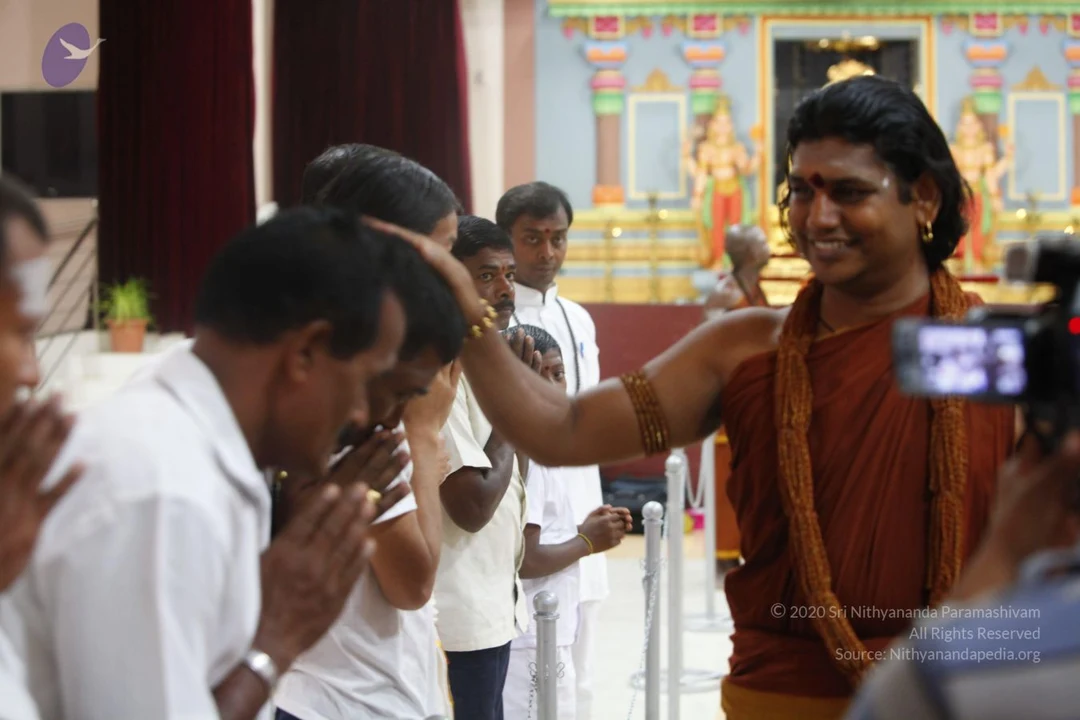
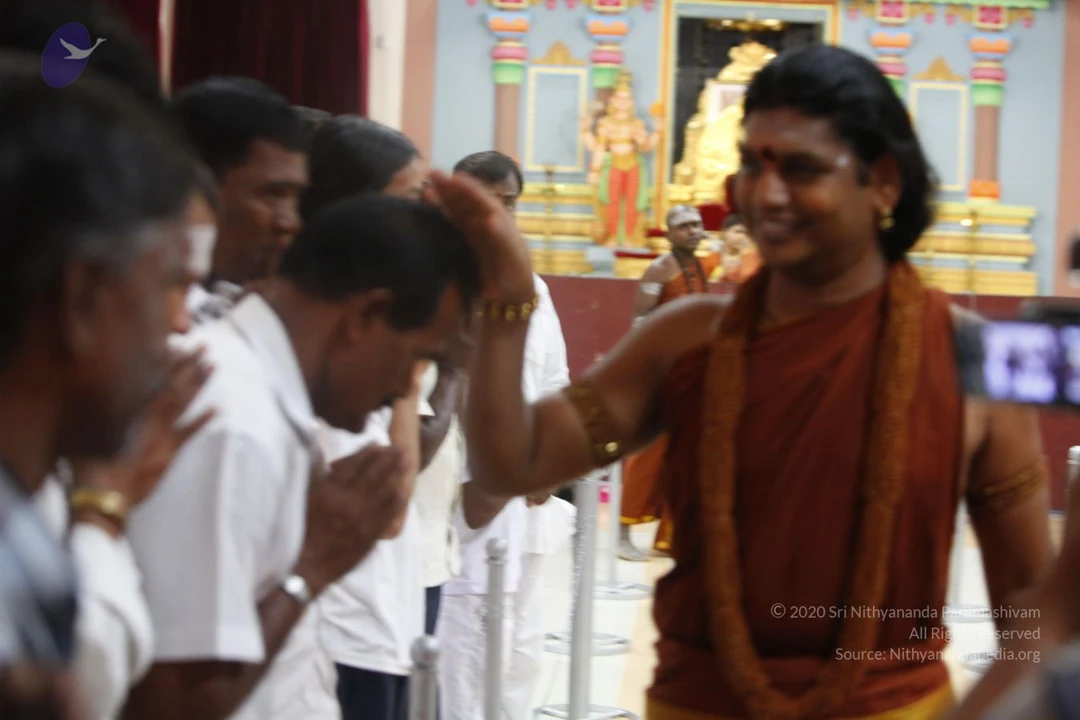
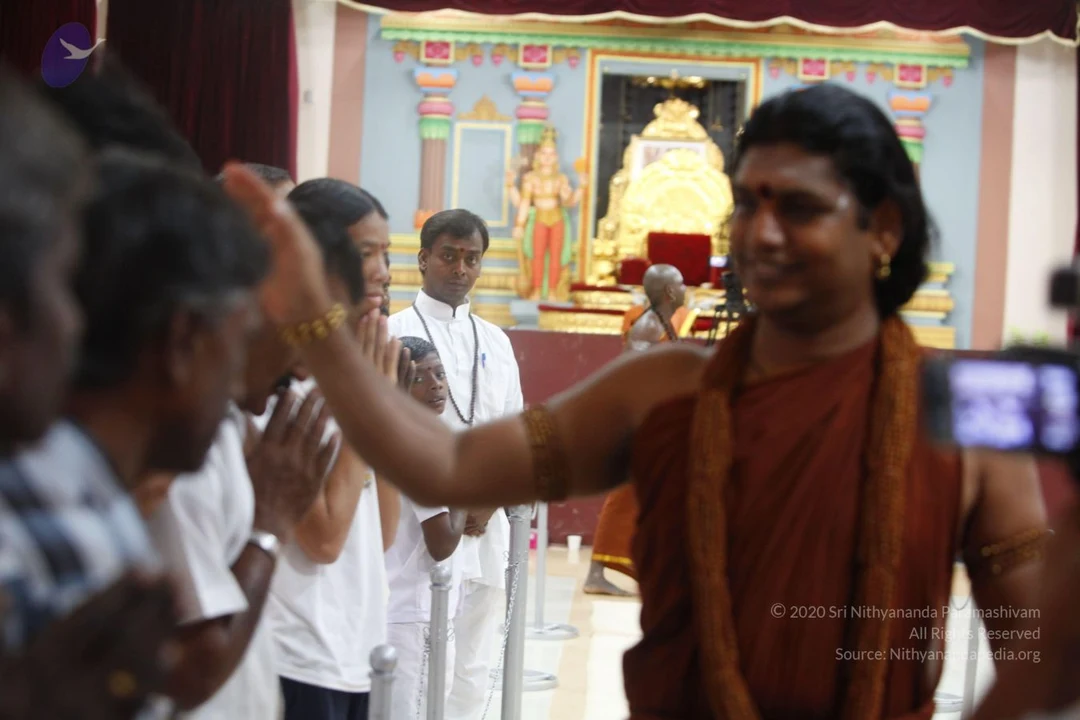
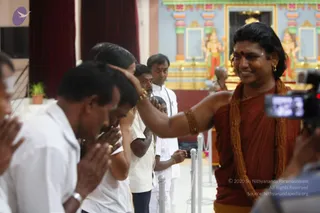
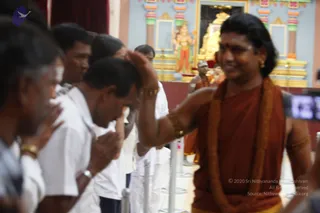
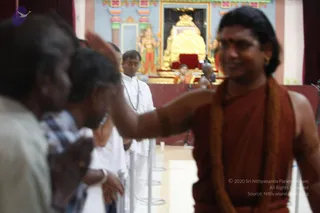
A person in a rust-orange saffron wrap and matching shawl, with a rudraksha mala draped over the shoulders and a red tilak on the forehead, stands at right smiling while extending a hand to bless devotees. Several devotees in white and cream shirts kneel or bow with palms pressed together and heads lowered toward him, one receiving a touch on the head. A man in white ritual clothes stands behind. Behind them is a temple-style backdrop with painted pillars and deity figures in orange and green. A camera operator is visible at right. Stainless steel barrier posts line the floor.

Final_Blessing

1 photoSource gallery
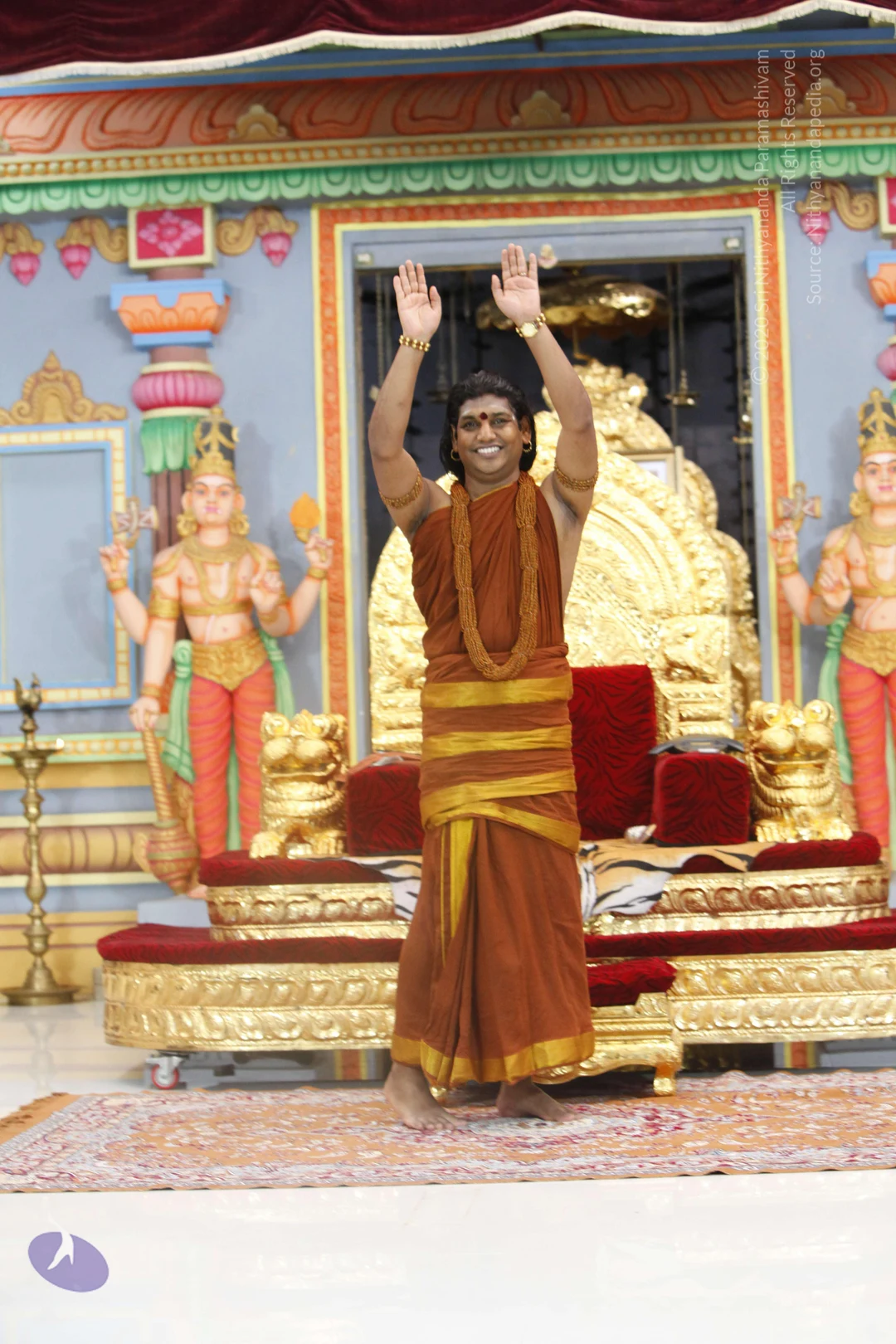
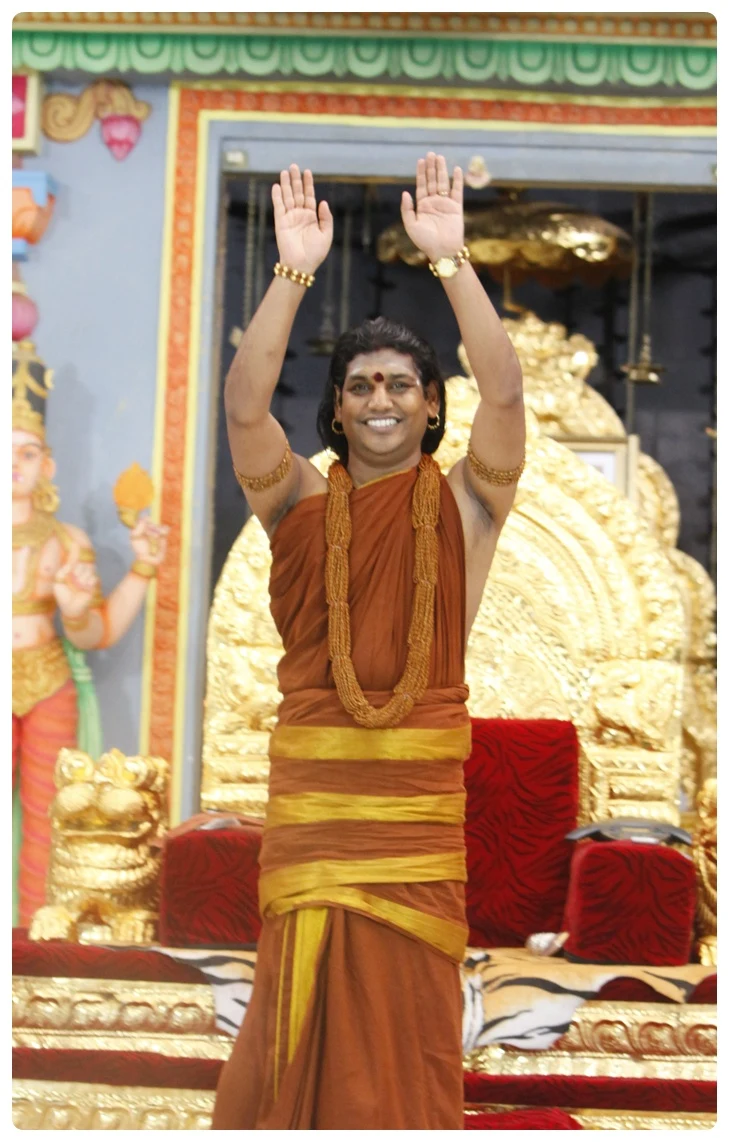
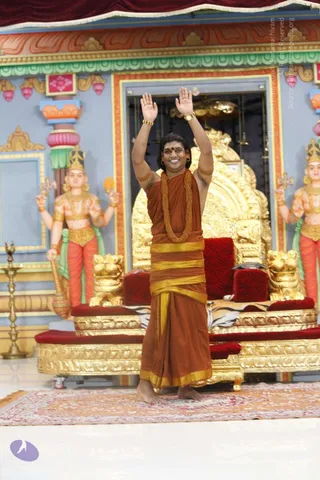
A man stands barefoot on a patterned carpet before a gilded throne with red cushions and a tiger-skin draped seat, arms raised in greeting and smiling broadly. He wears rust-orange robes wrapped with gold-bordered cloth, a rudraksha mala necklace, gold bangles and armbands, a red bindi, and a gold wristwatch. Behind him are painted figures of deities with crowns and multiple arms, and a brass oil lamp stands at the left edge.

Temple

22 photosSource gallery
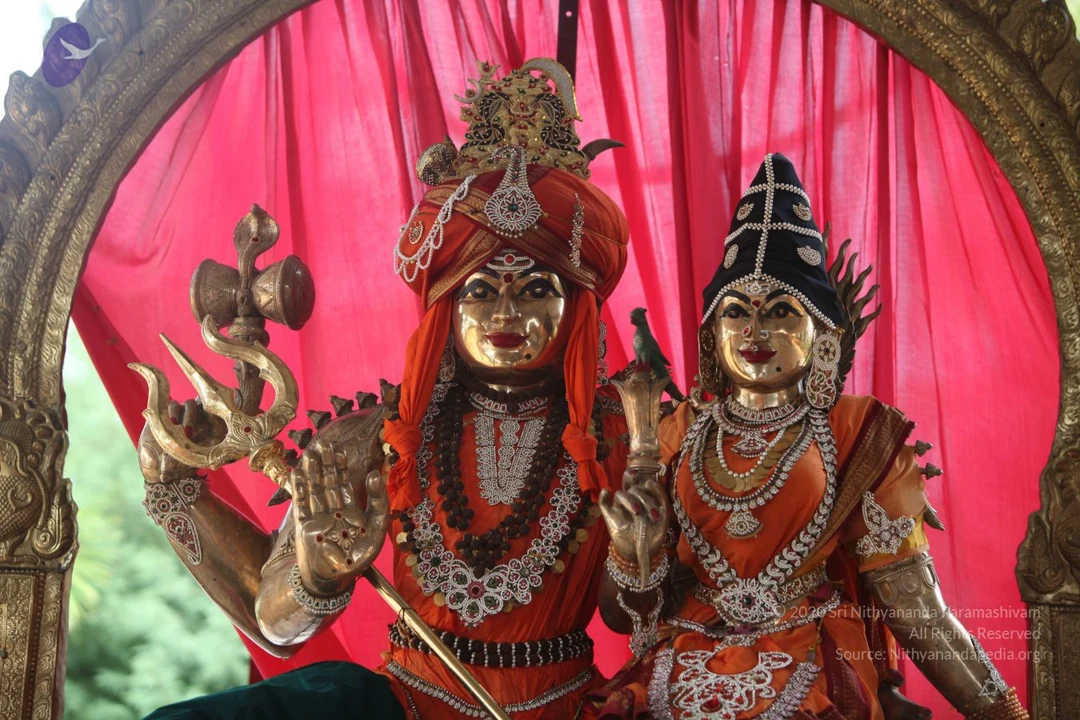
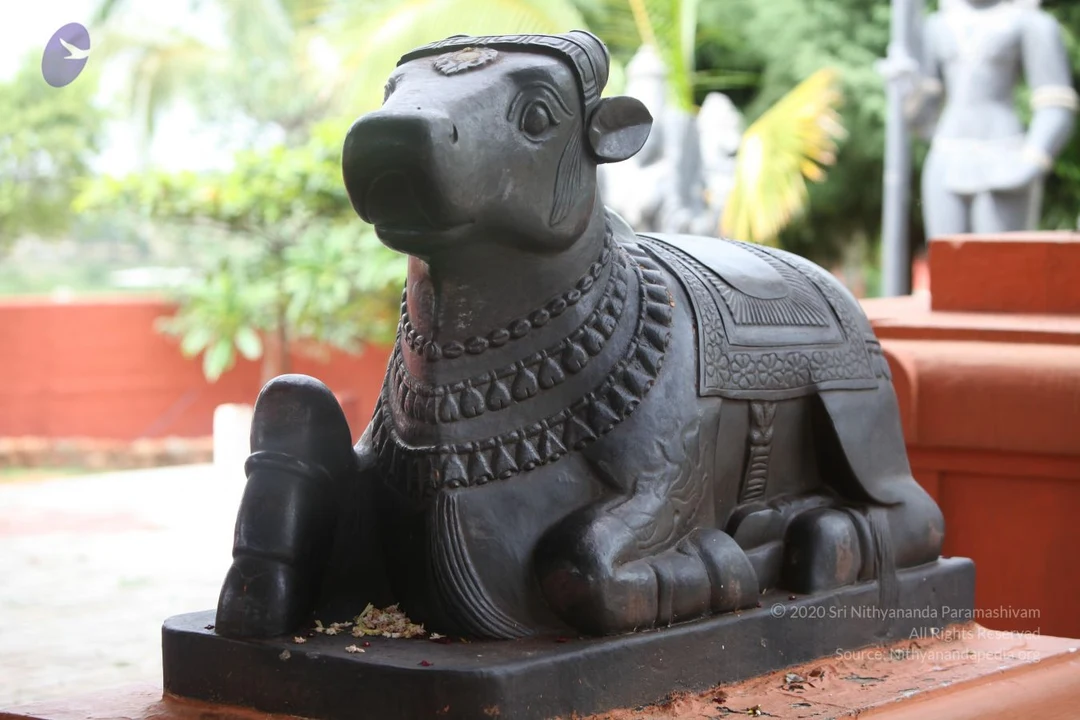
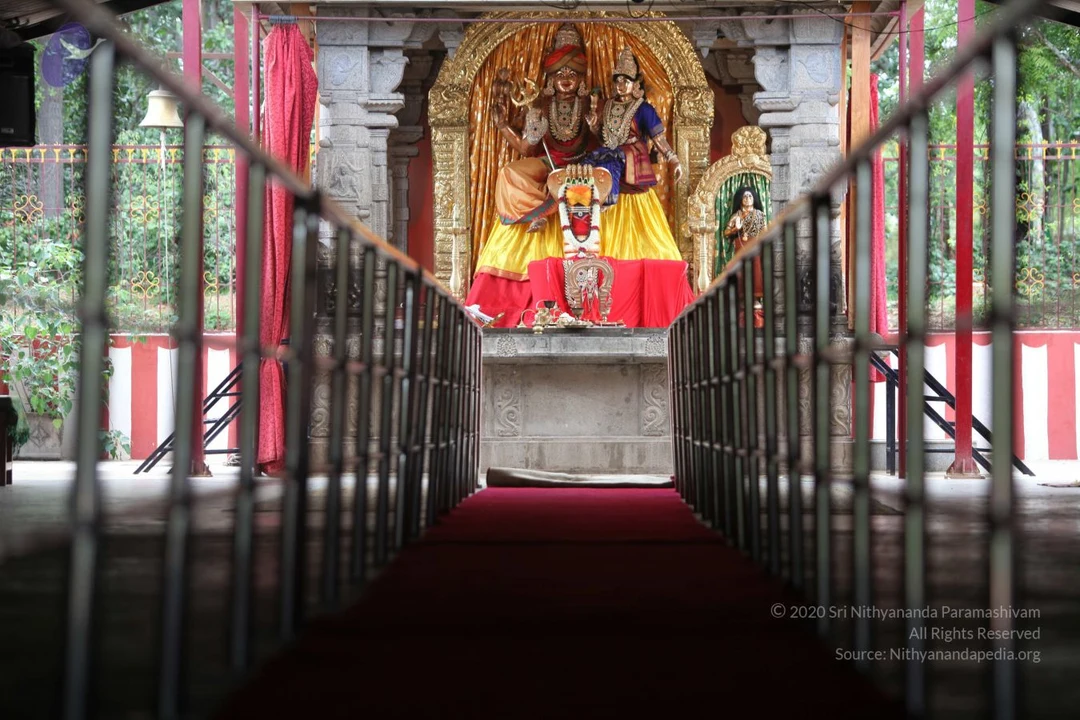
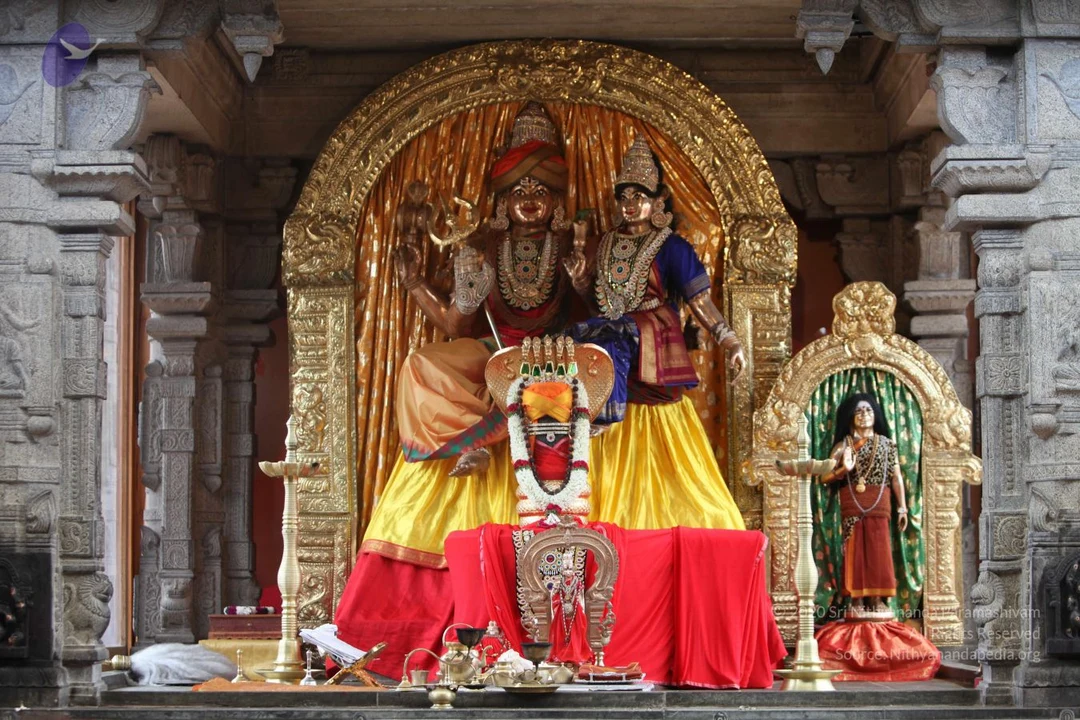
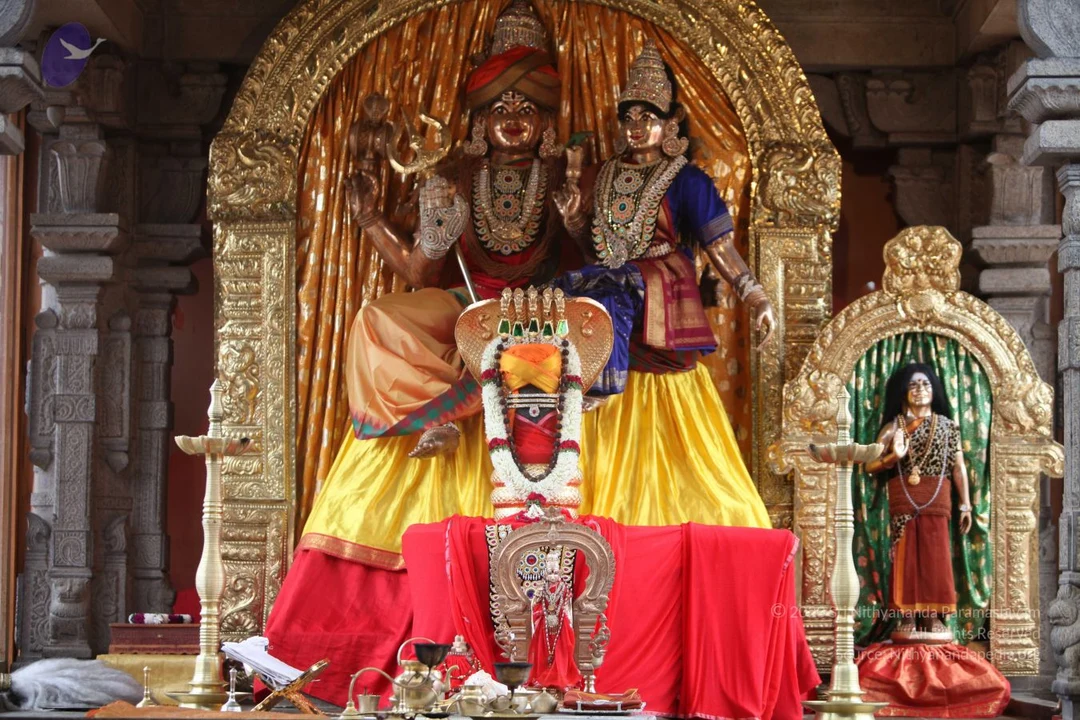
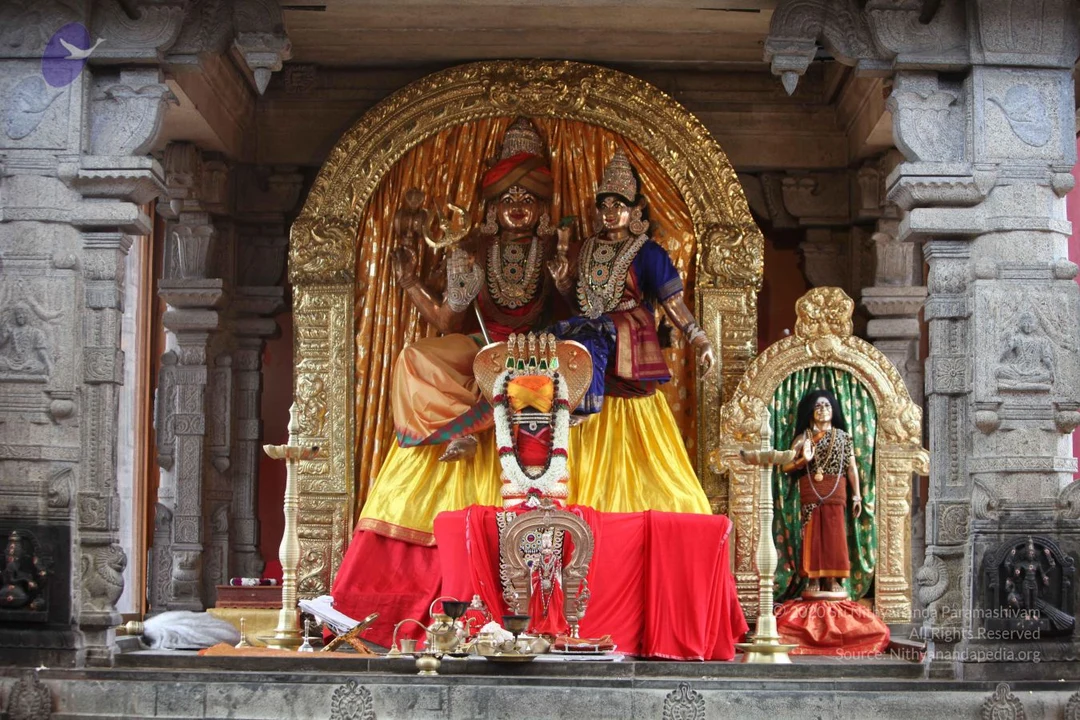
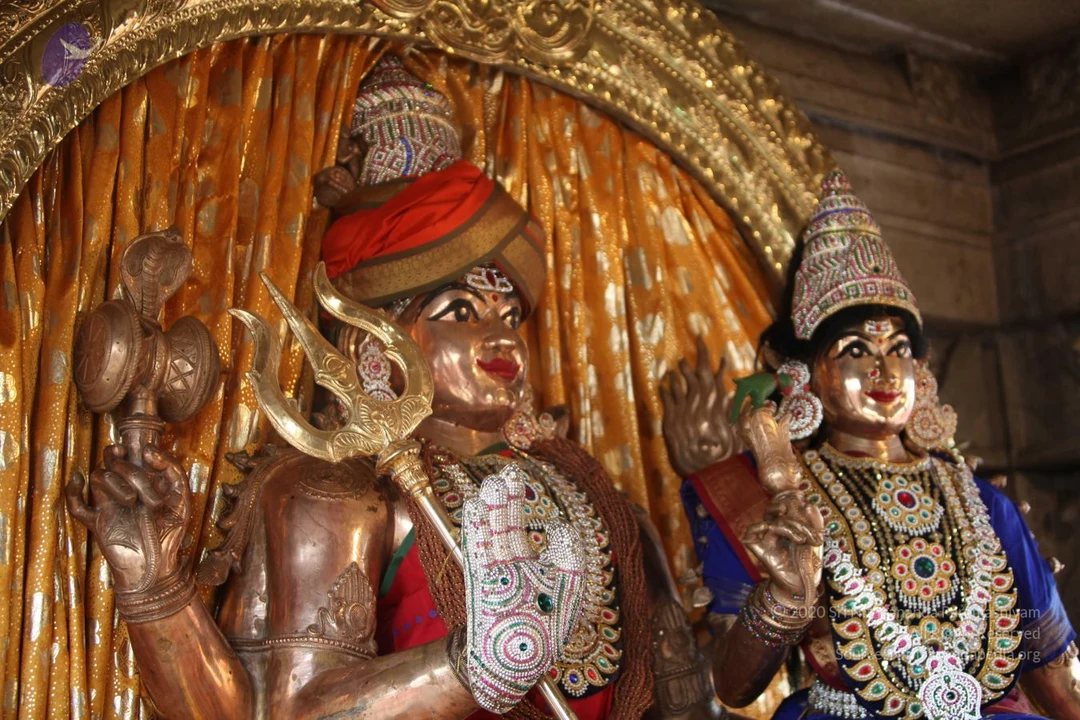
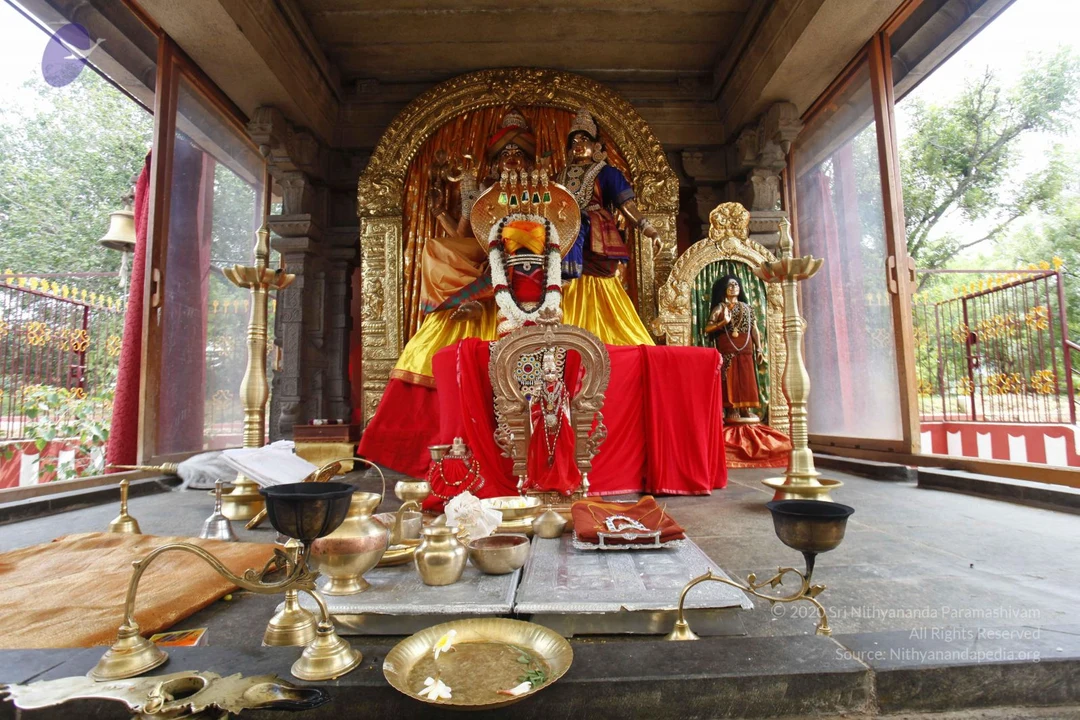
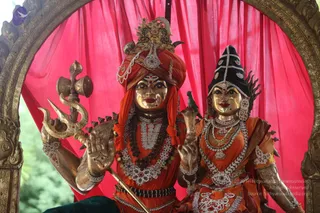
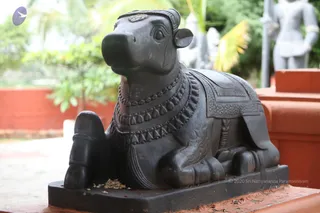
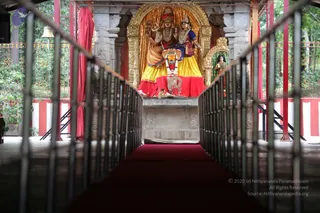
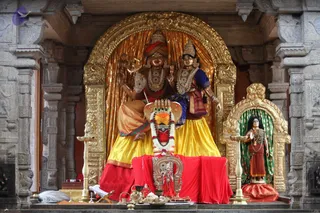
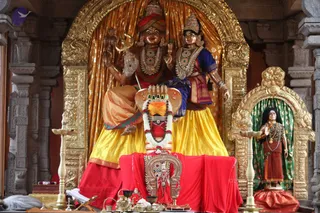
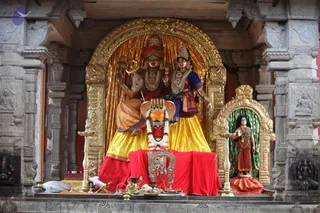
Two gilded statues of a deity couple sit beneath an ornate golden arch against a red draped cloth. The male figure wears an orange turban with a gold crown, rudraksha and white beaded garlands, and orange dhoti-style clothing, holding a trident and a damaru-like drum. The female figure wears an orange sari, layered silver and gold necklaces, a dark crown and a bird perches near her hand. Both have painted faces and jewelled ornaments. Foliage is visible at the left edge. The statues are depictions, not physical people.A dark grey stone Nandi bull statue sits on a raised black plinth, facing left, with a carved garland-like necklace of bells and tassels, a decorated saddle cloth with floral motifs, and a forehead ornament. Small scattered offerings lie on the plinth. Behind it, blurred grey statues of standing deities and green palms and foliage fill the background, with an orange-red wall at right. No people are visible.A photograph of an empty temple shrine viewed down a narrow corridor lined with metal railings and a red carpet runway. At the far end stands a sculpted deity murti of a seated couple, with a red-faced figure wearing a crown and a second figure in a blue-and-purple garment, set against gold and orange drapery and a golden arched niche. In front of the murti is a stone platform with a garland and small brass lamps and offerings. Red and white striped walls, a red cloth hanging, and green foliage surround the shrine. No people are visible.A shrine inside a stone temple with gold-framed arch and orange curtain. Two large seated deity murti, one in orange and red with a red turban and trident, the other in yellow and blue with a crown and jewelled necklaces, sit behind a central lingam-like form draped in red, garlanded with white flowers and set on a red-covered pedestal with a silver seat. Brass oil lamps and ritual vessels stand on the platform. To the right, a standing figure in saffron-red clothing with a rudraksha-style necklace stands in a green-curtained niche; this is a statue, not a physical person. No physical people are present.Inside a richly gilded temple shrine, a large sculpted deity pair sits on a golden-curtained dais: the male figure wears a red turban, a multi-strand gold-and-red bead necklace and holds a trident, while the female figure wears a crown, green-and-white bead garland and a blue-and-gold sari. Between them stands a red-clothed stone idol decorated with a white flower garland and a gold-and-green crown-like headdress, set before a red cloth draped throne and surrounded by brass lamps, kalasha pots and puja vessels. On the right, a smaller gilded niche holds a standing statue of a saint in saffron-orange dhoti, rudraksha-style beads and a shawl, with green drapery behind. Shown as a photograph of an empty shrine with no physical people.A photograph of a temple shrine with carved stone pillars and an ornate gold arch framing two large painted deity murtis seated on a red-draped platform. The central figure wears an orange-and-red turban and rudraksha-style beaded necklaces, while the figure beside it wears a blue and gold sari, jewelled necklaces and a tall crown. Garlands hang over a red-and-orange ceremonial object in front, with brass oil lamps, a brass kalasha and puja vessels arranged on the platform. To the right, a smaller figure in orange-and-brown dress stands beneath a green curtained niche.

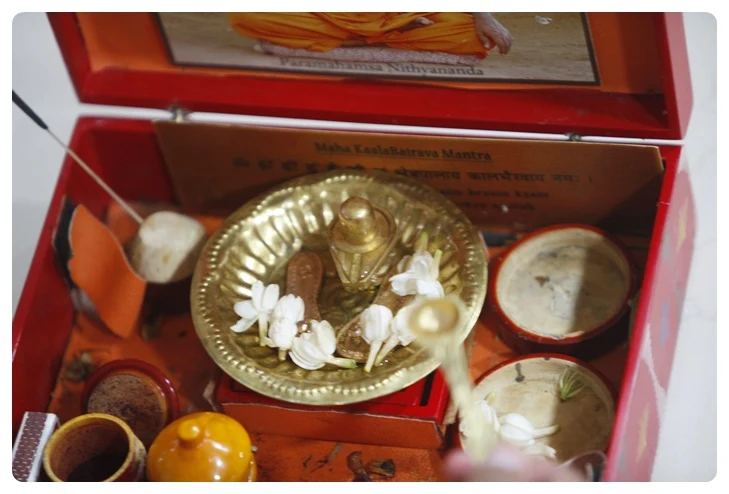
Rudraksha_Jewelry_Photos
27 photosSource gallery
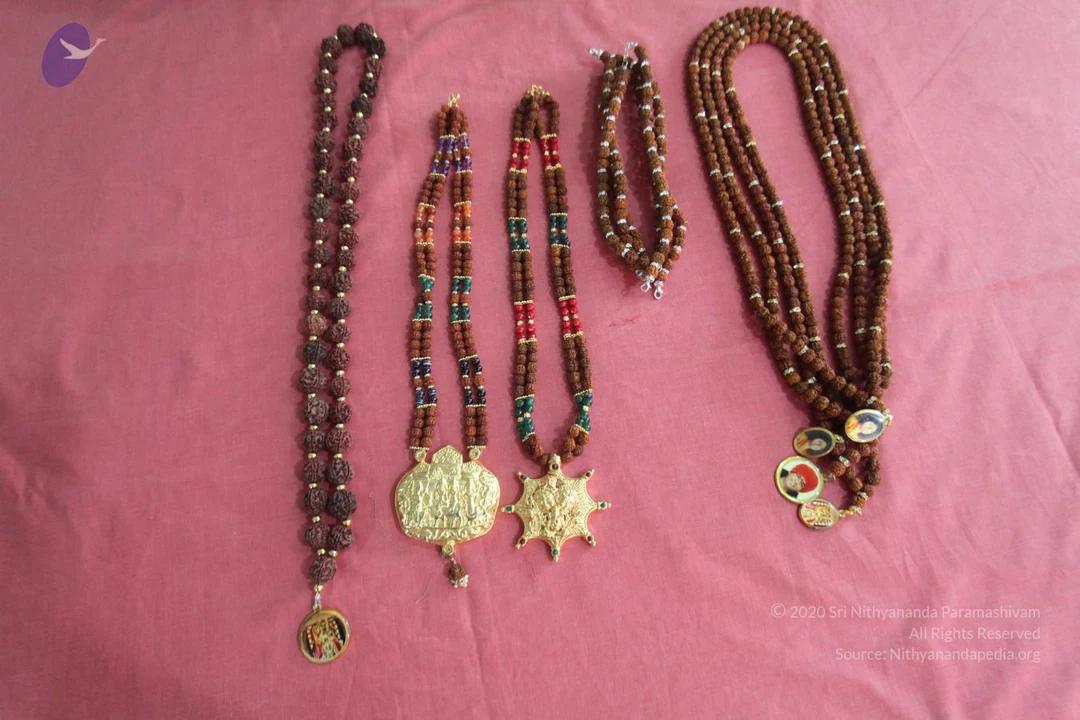
Several rudraksha bead malas laid flat on a pink cloth. The left mala has dark brown beads with gold spacers and a round pendant showing a colourful deity image. Two middle malas have multicolour thread bands and large gold pendants, one depicting a figure group and the other a star-shaped medallion with a deity form. The right-hand mala has multiple strands with small silver spacers and round photo pendants showing small portraits. A thin bracelet-style mala lies at the top. No people are visible.A flat-lay photograph on a pink cloth showing several rudraksha mala necklaces and bracelets arranged in rows. Brown rudraksha beads are strung with gold spacer beads, and some strands include red, green, purple, orange and blue accent beads. Gold pendants include an ornate eight-pointed star pendant and a large engraved gold medallion, and smaller gold clasps with round stone or enamel charms. No people are visible in the scene.A flat-lay photograph of several rudraksha mala necklaces arranged on a rose-pink cloth. The beads are brown and textured, with silver spacers on some strands and coloured accent beads of green, red, purple and blue on others. Two gold ornate pendants hang from the upper strands. The longest multi-strand mala at the bottom has small oval medallions with printed portraits at its clasp. No people are visible; the mala are objects laid out for display.A flat-lay photograph on a pink cloth showing several rudraksha mala necklaces and a bracelet. On the left, a dark rudraksha mala with gold spacer beads. In the centre, two gold pendants on beaded malas: one a large rectangular gold plaque with a relief scene of figures, the other a gold star-shaped pendant with a deity relief and green stones, strung with coloured beads in blue, green and red. Right of centre, a small rudraksha bracelet and a stretch bracelet of rudraksha beads. On the far right, a multi-strand rudraksha mala with silver spacers ends in round locket frames holding small printed portrait photographs. No physical people are visible.Close view of several rudraksha mala necklaces and bracelets laid out on a pink cloth. Multi-strand brown rudraksha beads are interspersed with small silver spacers on the foreground necklace. Other strands include rudraksha beads alternated with colourful red, green and blue beads, and gold-toned pendant ornaments with decorative engraving. A single rudraksha bead rests on the cloth to the left. No people are visible.A photograph of several rudraksha malas and ornaments laid out on a pink cloth. Multiple strands of brown rudraksha beads are arranged across the frame, some with gold spacer beads, others with interspersed green, red and blue beads. A large gold pendant in a textured, shield-like shape sits at the lower left, next to a gold star-shaped pendant set with small red and green stones. A cluster of rudraksha beads forms a loose ring in the centre. On the right, a long rudraksha mala has three round oval medallions containing small printed portraits in gold frames. No people are visible.

SacredArts_Photos
5 photosSource gallery
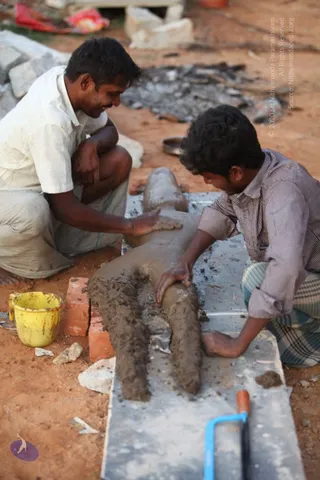
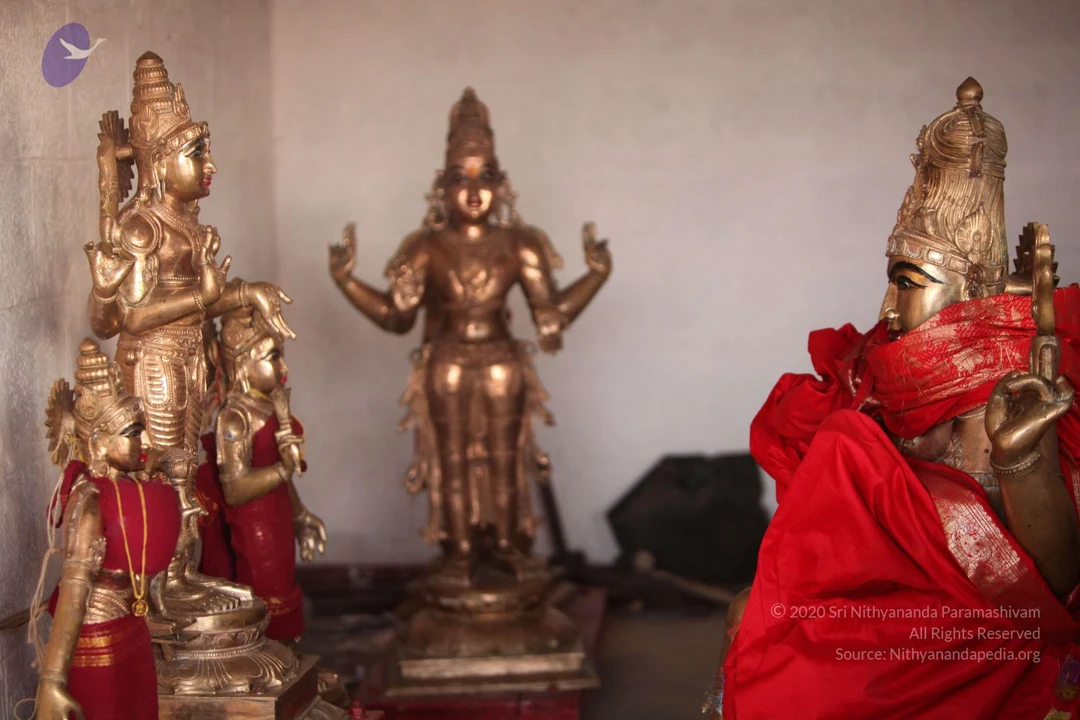
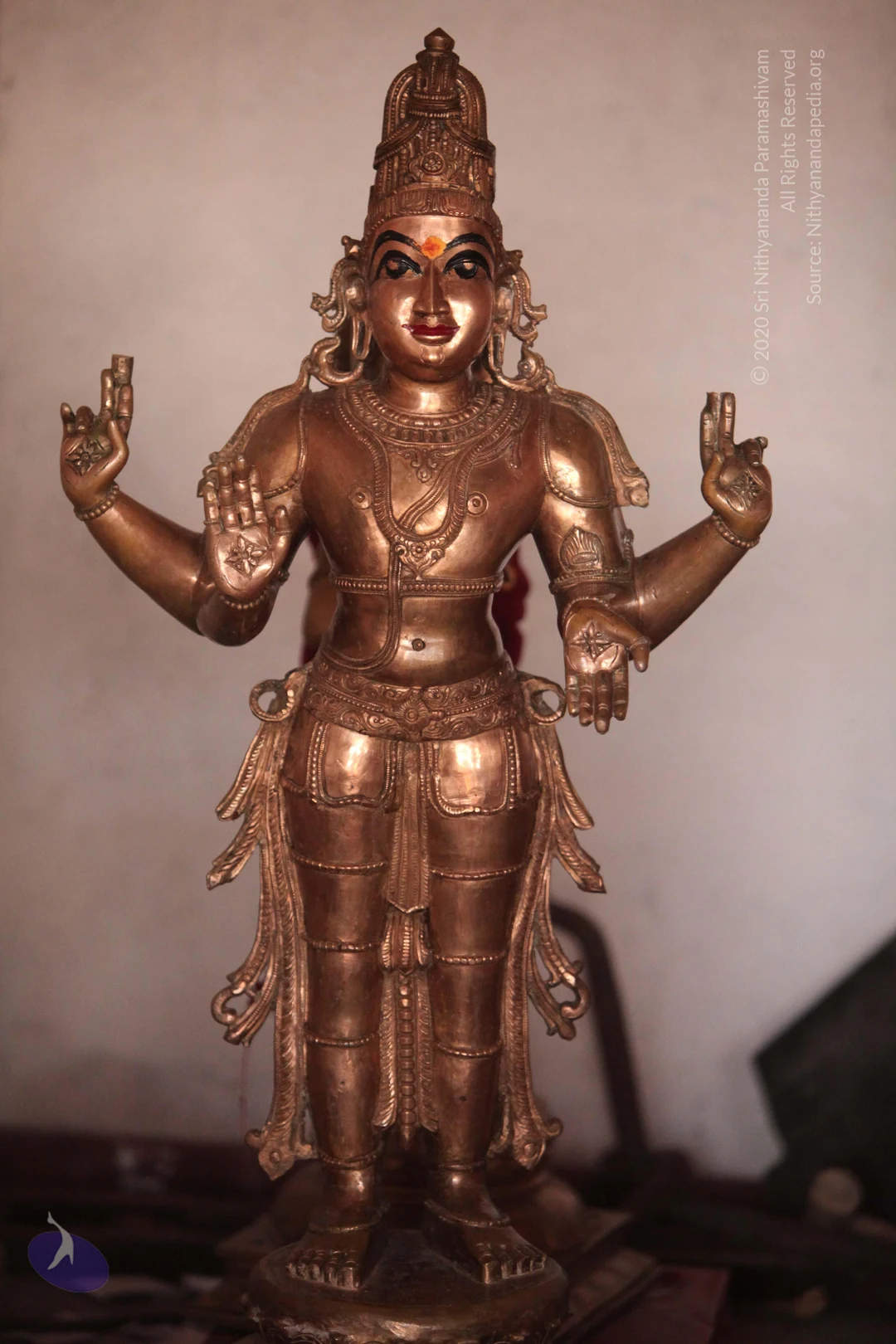
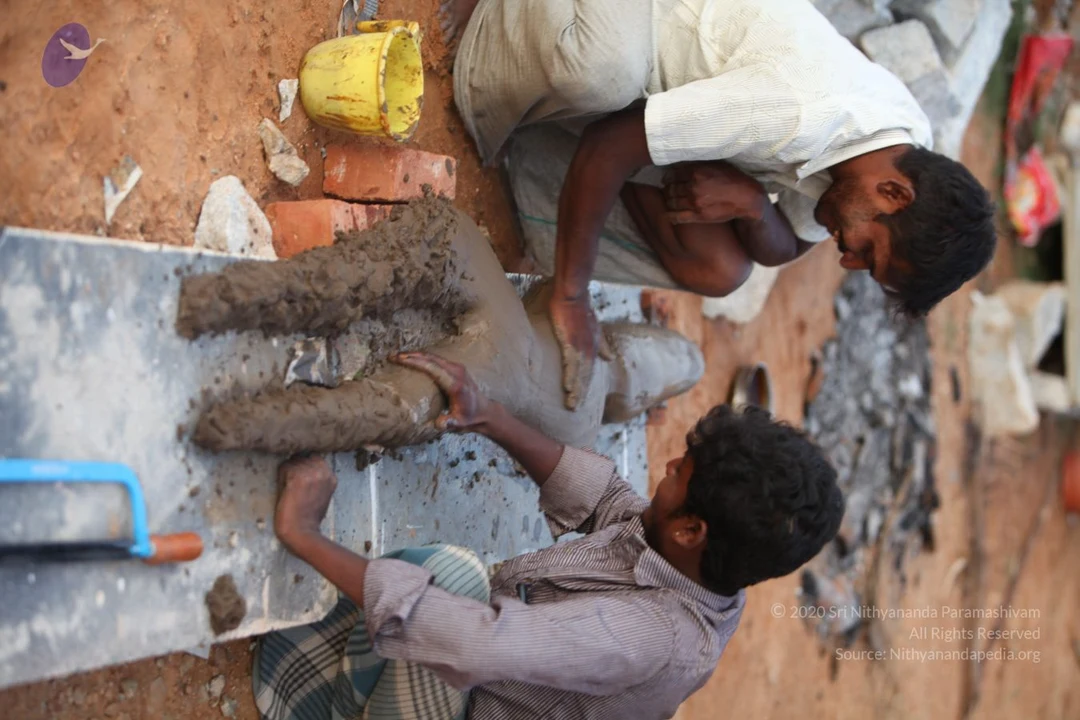
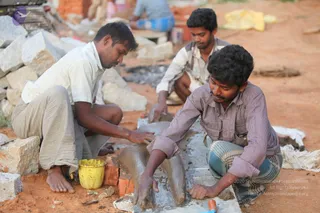
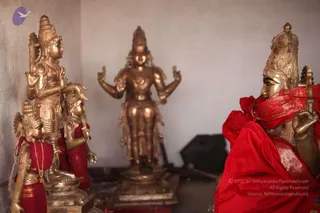
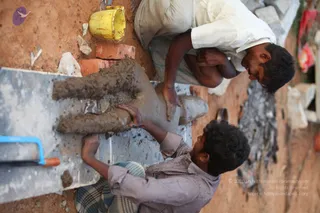
Two men crouch on bare red earth shaping wet grey clay on a long metal slab. The man on the left wears a white shirt and grey lungi and works with both hands over a clay form. The man on the right wears a striped collared shirt and checked lungi and smiles while pressing the clay. Behind them stand grey broken granite blocks, a small pile of ash and a brass plate. Clay figure modelling appears to be underway, but no deity or a person depiction is visible.Two men kneel on dusty red earth shaping a long mud or clay form laid on a grey concrete slab. The man on the left wears a white striped shirt and light trousers and presses clay with his hand. The younger man on the right wears a grey striped shirt and checked lungi and smooths the clay along its length. A yellow bucket, red bricks, a blue-handled hacksaw and scattered stone chips lie nearby, with rubble and a small fire residue in the background. No deity or a person depiction is visibly identifiable in the scene, and the pictured activity is sculpting work rather than satsang or ritual.Three young men work outdoors on bare red earth beside a pile of rough grey granite blocks. The man on the left, in a white short-sleeved shirt and light grey trousers, crouches barefoot while pressing wet grey material. The man on the right, in a striped shirt and checked lungi-style cloth, shapes a curved wet clay form on a concrete base. A third man in a white shirt crouches behind them. A yellow bucket sits on the ground, with broken red bricks and scattered stones around. No ritual or festival activity is visible, and no recognizable a person figure appears in the scene.Golden-bronze metal statues in a temple-like niche. Centre stands a multi-armed deity murti with a tall crown and ornate jewellery. Left, a figure with a tall crown and raised hand is seated beside smaller figures in red cloth. Right, a seated figure in a red shawl and crown raises a hand in blessing. Statues, not living people; the setting is a plain wall and shrine area.A photograph of a standing bronze or copper-toned deity statue with four arms, a tall tiered crown, a red tilak on the forehead, large earrings and an ornate necklace and belt. The murti stands on a round base against a plain pale wall, with a dim wooden surface at the bottom edge.

Rudra Abhisekam

73 photosSource gallery
Several saffron-robed priests stand on a metal staircase beside a large dark grey dome-shaped stone lingam draped with a long garland of marigolds and red, white, yellow and purple flowers. Priests wear rudraksha malas and white vibhuti or tilak marks on their foreheads and arms. A white railing surrounds the platform and red-carpeted steps lead up beside the lingam, with construction rubble and bushes behind. The scene suggests abhishekam or puja preparations at an outdoor shrine. No individual is clearly identifiable as a person from appearance.A large black stone Shivalinga sits on a circular dark granite platform, draped with a long garland of marigolds and multicoloured flowers. Several saffron-robed swamis and priests stand on a metal staircase and platform at the left and upper area, some with rudraksha malas and bare upper bodies. A woman in white clothing stands at the right by steps lined with potted plants. Red stepped bathing ghats and a white railing lie behind, with a yellow truck visible in the background. The scene suggests an outdoor abhishekam or puja at a shivalinga.A large dark grey stone Shivalingam rises from a circular black base in a water tank, decorated with a garland of orange, white, yellow and purple flowers draped down its side. A metal staircase railing leads up to its platform, where several men in orange and saffron robes stand with hands folded in prayer. Other saffron-clad men stand on the steps and at the base. Red-brown stone steps line the tank behind, with potted plants at the right edge and a small building and railing in the background.Outdoor photo of a large black stone lingam, draped with a long garland of marigolds and red, white and purple flowers. A shaved-headed young man in saffron-orange cloth with white vibhuti on his forehead stands with palms pressed together in namaste, a rudraksha mala around his neck. Behind him another shaved-headed man with white tilak stands near the lingam. Red-roofed buildings, white railings and a red-tiled floor surround the scene. Two more people in orange are partly visible at left.A large dark black stone lingam, smooth and rounded, is draped with a long garland of marigolds and roses in red, yellow, white, purple and green. Behind it, a young man with a shaved head and white tripundra markings on his forehead stands with palms pressed together in prayer, wearing a saffron-orange shawl and a beaded necklace. Beside him, another man with a shaved head and white forehead markings stands in a similar orange garment. Partly visible on the left is a third person in orange clothing. The setting shows a red tiled-roof building, white railings and a red-paved platform, consistent with a ritual abhishekam or puja at an ashram ground.A photograph of a large dark grey stone lingam, decorated with a long garland of red, white, yellow, purple and green flowers draped down its side. Four sannyasi men in saffron-orange robes stand on a white metal railing platform beside it, with white tilak marks on their foreheads and rudraksha-style beaded necklaces. The central figure has his palms pressed together in anjali, while others rest their hands on the railing. A white car and red stadium-style steps appear in the background, with a stone wall behind.

Paduka Puja

29 photosSource gallery
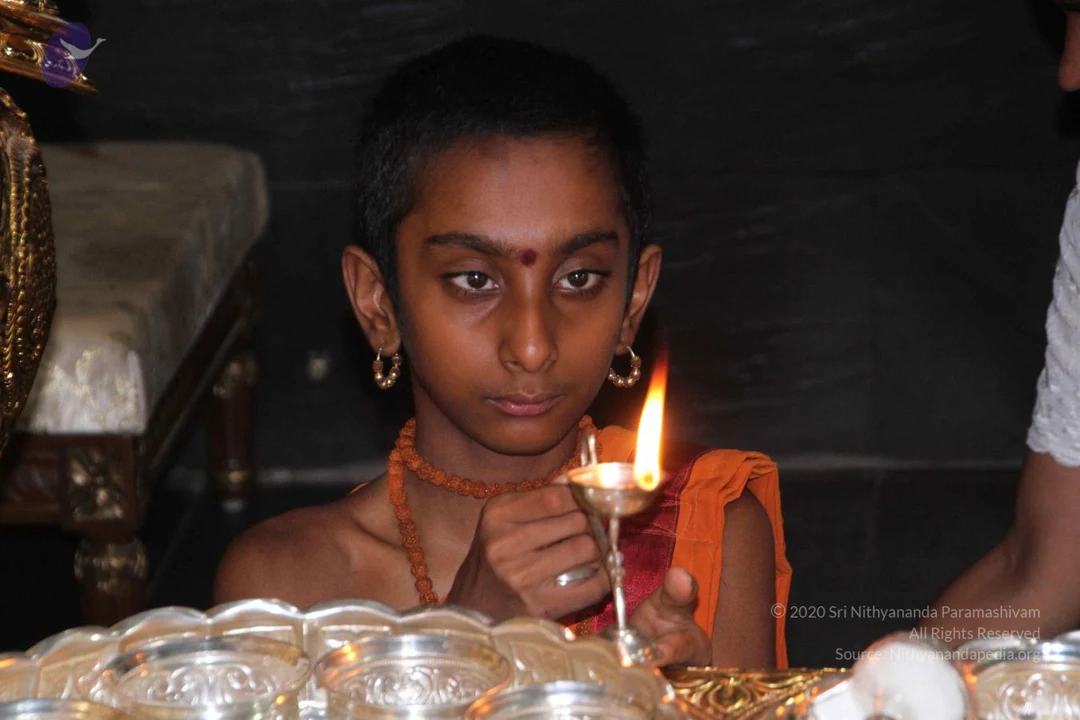
Close view of an offering arrangement on gold-coloured trays for puja. Many small silver bowls and cups hold pink and red flower petals, orange liquid and clear water. Large pink and white flowers, possibly lotus-like blooms, are placed among the bowls, with yellow and white marigold-type flowers and red blossoms heaped in the centre. Silver spouted vessels and ornate silver containers complete the ritual setting. No people are visible.Close-up photograph of a white conch shell (shankha) fitted with silver mounts and chased silver engraving, its wide opening topped with a pink petal flower and white chrysanthemum-like blossom with green leaves. Behind it sits a clear glass bowl, a silver tray and pink flowers in a small silver dish. No people are visible.Close-up of an ornate silver puja tray with several engraved silver bowls holding offerings. One bowl contains pink rose petals in water, another holds red flower petals, a third holds a yellow-orange liquid, and a silver spoon-like ladle rests among them. Flower garlands in yellow, white and pink border the golden tray. No people are visible; the setting suggests abhishekam or puja offerings.Close-up photograph of two small silver oil lamps (deepams) on a polished silver tray, each with a lit wick and a flame rising from the spout. The lamps have looped handles and a plain rounded bowl. The background is dark with a reddish fabric edge at the top right. No people are visible.A young boy with short dark hair, a red bindi and gold hoop earrings holds a lit oil lamp with a flame in his right hand. He wears an orange cloth draped over his bare shoulder and a rudraksha mala around his neck. Silver bowls with scalloped rims sit in the foreground, and a gilded ornament is visible at the left edge. Dark background.A photograph of a ritual in a temple setting with a golden ornate platform holding many silver bowls filled with flowers, pink petals, and offerings. Several women and a young boy hold lit oil lamps (aarti) aloft. A young boy at left in saffron clothing and a rudraksha mala raises a lamp. A woman in saffron with a rudraksha mala and forehead vibhuti holds a lamp at center-right. Another woman in white with folded hands stands behind them. A woman in orange sari with vibhuti on her forehead holds a lamp at right. A dark wooden door with brass fittings forms the background.

NithyaSatsang

25 photosSource gallery
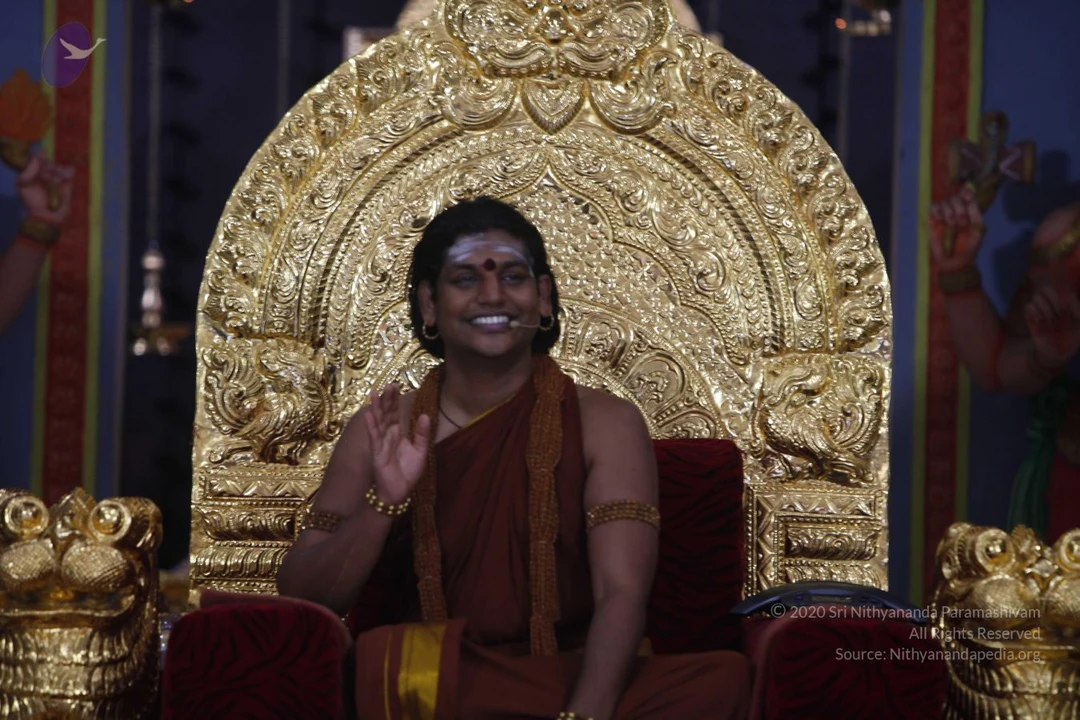
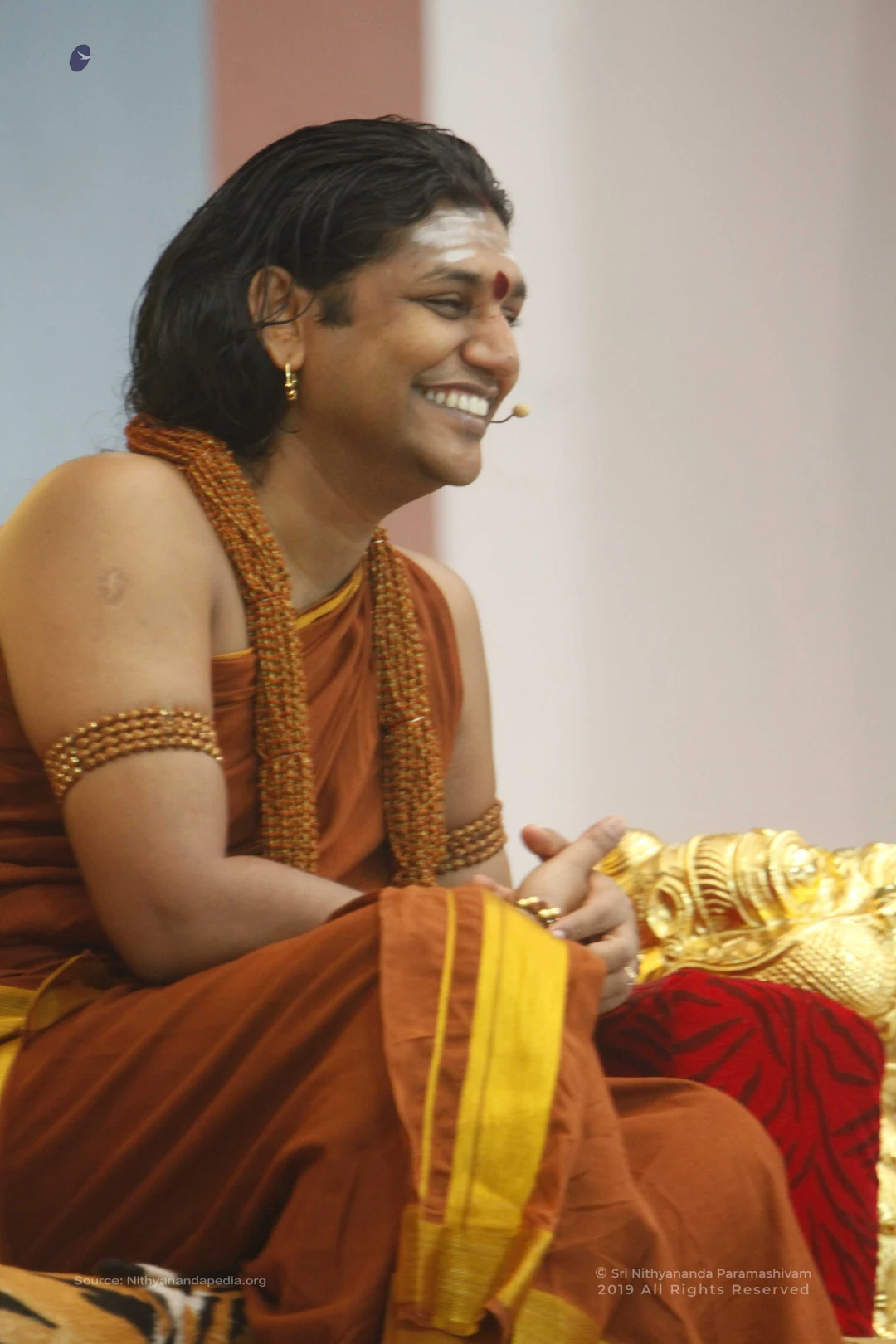
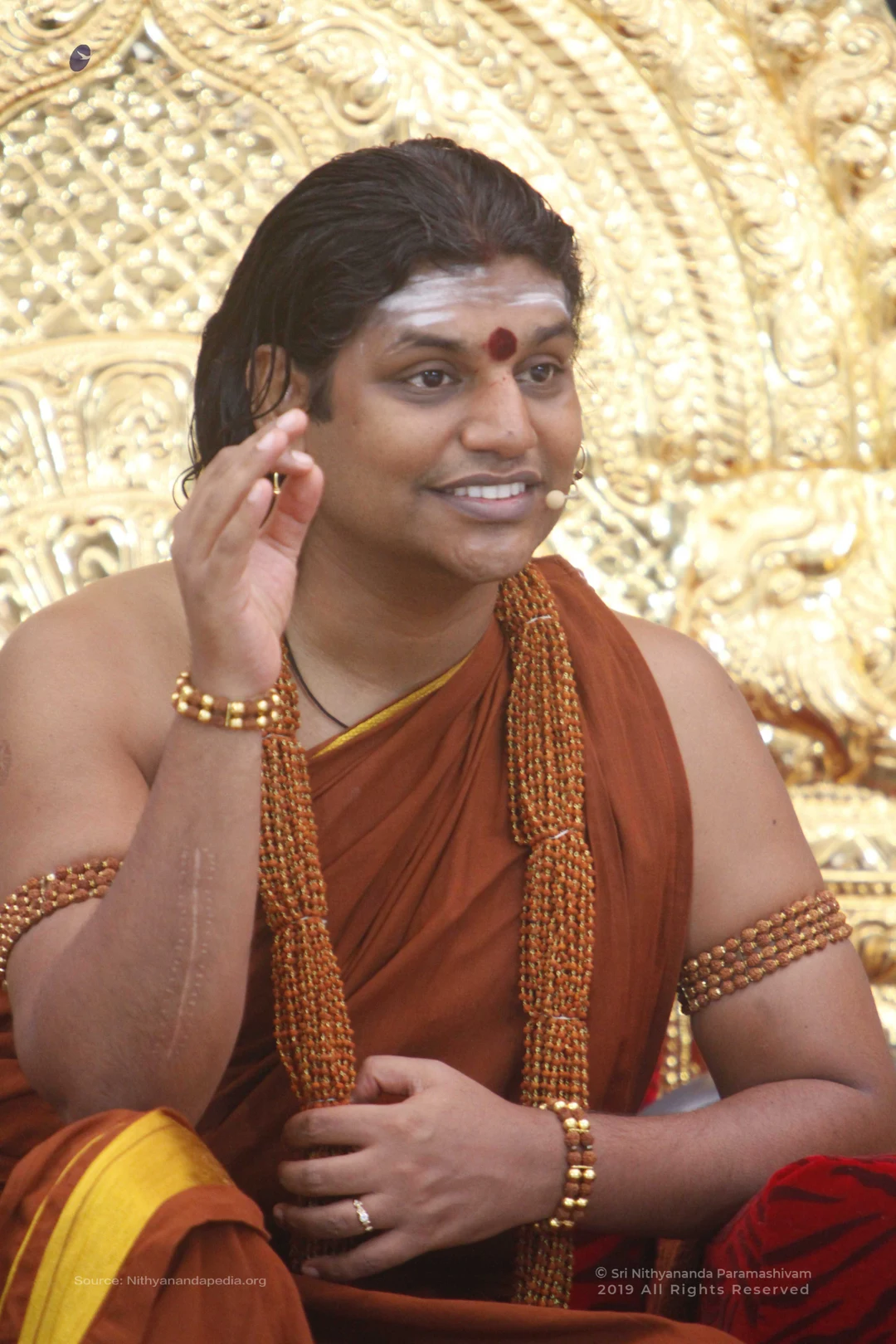
A photograph of a group of young musicians seated on a floor mat in a plain room with white walls and a glass door. Several boys play long curved gold-coloured brass horns, raising them and blowing into them, while one boy in a maroon robe beats a large wooden frame drum. Some wear orange robes, one holds a rudraksha mala, and several have white ash marks on their foreheads and faces. A sign on the door reads French. A red curtain hangs at the left edge. The people are seated, with no visible a person candidate.A smiling man seated on an ornate gold-carved throne with lion-head armrests, raising one hand in a greeting or blessing. He wears a maroon-red robe, a gold-coloured yellow-edged cloth draped at the waist, a long beaded rudraksha-style mala and gold bangles on his upper arm, with a red bindi and white tripundra marks on his forehead. A small microphone is clipped near his face. Behind him are red and green draped side panels and a blue backdrop, with the blurred hand of another person at the left and right edges.A seated man in a golden ornate throne, dressed in a rust-red robe with a saffron-yellow waist cloth, rudraksha mala draped over the shoulders, gold armbands and bangles, and a red-and-white tilak on the forehead, smiles while sitting cross-legged on a red cushion over a tiger-skin rug. A small microphone is attached near his face. Two painted deity statues flank him, one holding a flame and the other raising a hand, and two golden lion-like sculptures stand at the base of the throne. a person is seated centrally; the figure's role is the speaker giving the satsang.A seated man in a rust-orange robe with a gold-edged yellow dhoti and a long rudraksha mala draped over his shoulders sits cross-legged on an ornate gold throne with carved lion-like finials and red velvet cushions. He wears a white vibhuti horizontal mark with a red kumkum dot on his forehead, gold armlets and bangles, and a small headset microphone, and gestures with his right hand while smiling. Gilded lion-head armrests and a striped tiger-skin cloth surround the seat, and painted deity arms with gold bangles appear at the left and right edges. Physical people visible: one.A seated man in saffron-orange robes and a rudraksha mala sits on an ornate golden throne with lion-head armrests, draped with a tiger-skin cloth, in front of two large painted deity murti figures with multiple arms holding ritual objects. Gold and red decor fills the background, with hanging bells above. The man has long swept-back dark hair, gold armbands and a kumkum mark on his forehead, and rests his hands on red cushions. The appearance matches the Swamiji (probable) profile of a long-haired figure in saffron with a rudraksha mala and ceremonial gold ornaments, seated on a throne as a teacher. Two deity statues stand on either side, and a microphone is visible at the lower left.A seated man with a shaved-back dark hair and a red bindi-like tilak on his forehead sits in padmasana on an ornate gold throne with a carved arched back and gold lion heads at the armrests, draped in a red velvet cushion and a tiger-skin mat. He wears an orange-saffron robe with a yellow dhoti border, layered rudraksha malas and gold bangles, palms pressed together in namaste with eyes closed. Flanking him are two tall gold-and-green painted dvarapala-style guardian figures holding ceremonial objects, with hanging brass bells and lamps above and a pink-and-gold pillar behind.

SarvaDarshan

6 photosSource gallery
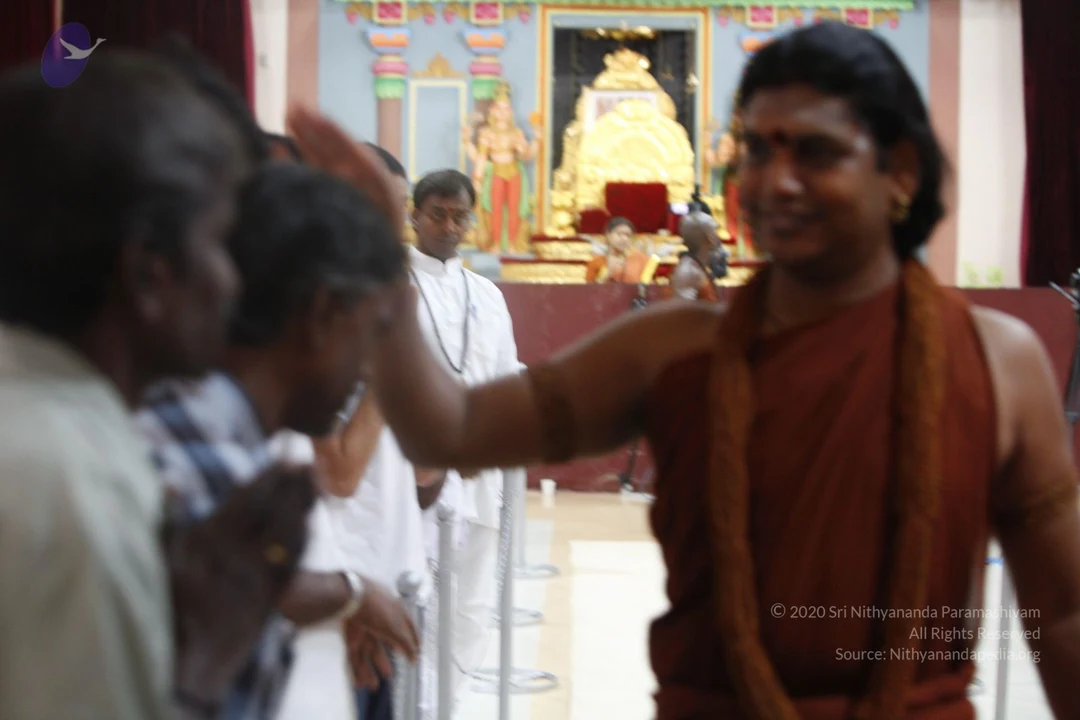
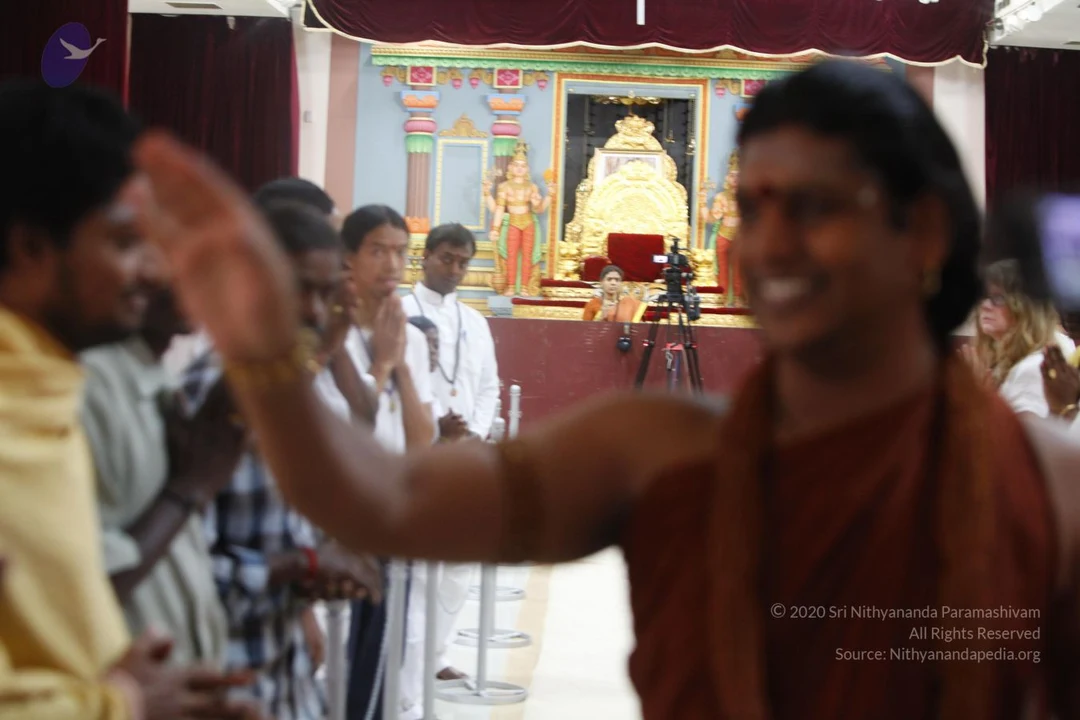
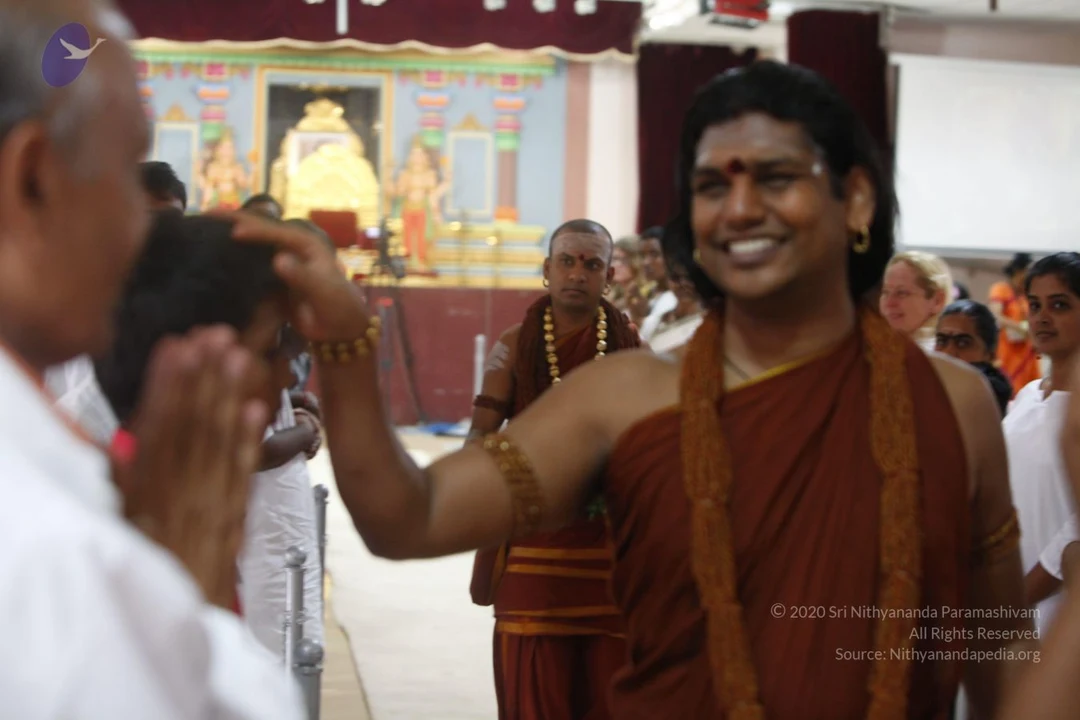
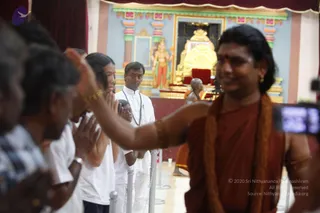
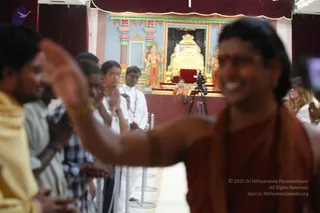
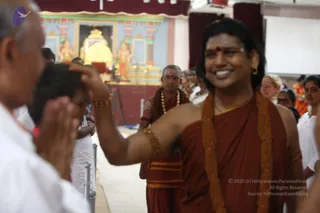
A person in a rust-orange saffron wrap and matching shawl, with a rudraksha mala draped over the shoulders and a red tilak on the forehead, stands at right smiling while extending a hand to bless devotees. Several devotees in white and cream shirts kneel or bow with palms pressed together and heads lowered toward him, one receiving a touch on the head. A man in white ritual clothes stands behind. Behind them is a temple-style backdrop with painted pillars and deity figures in orange and green. A camera operator is visible at right. Stainless steel barrier posts line the floor.A man in an orange-brown sleeveless robe with a long rudraksha-style bead mala and gold bangles stands at right, smiling and raising his hand to bless a line of devotees. Several devotees in white shirts and dhotis stand with palms pressed together and heads bowed on the left. Behind them a golden deity murti in an orange-and-gold ornate shrine with colourful pillars and a seated priest in orange robes appear. The blurred foreground is a photograph of people receiving blessings, with a camera monitor visible at right.A photograph inside a temple hall with a painted backdrop of a deity figure holding a staff beside a golden throne with red cushion. In the right foreground a woman in a rust-orange saffron-style sari with a long orange shawl, a red bindi and gold bangles reaches out with her arm extended, smiling. To the left, several people in white clothing stand with palms pressed together in namaste. A young boy with a tilak stands behind them in white. A man in white shirt and rudraksha-style mala stands in the background. A bare-chested figure with adornments stands near the throne area, and a camera is visible at the right edge. No person is clearly identified as a person from appearance here.A photograph in a temple-style hall shows a man in an orange-red saffron wrap and a long rudraksha-style beaded garland, with a bindi on his forehead, extending his right hand toward a blurred crowd at left. He has long swept-back hair and gold earrings and appears to be blessing or greeting devotees. Behind him stands a man in white shirt and dhoti with a mala, and a gilded throne with a red cushion sits beneath painted deity figures on a blue and gold backdrop. Several seated and standing devotees and a metal barrier rail are visible.A photograph of an event hall with a golden ornate throne-like seat (peetha) backed by a painted mural of two guardian figures in orange and green with columns. In the foreground a man in an orange-brown robe and a red tilak on his forehead raises his hand in greeting, smiling, while people on the left in yellow, grey and checked shirts stand along a barrier with hands pressed together in anjali. Behind them, men in white kurta-style clothing stand with palms joined. A figure in orange seated near the throne-side stage is partly visible, with a camera on a tripod nearby. Several people in the background are visible, with a woman in a white top at the right edge.Photograph of a satsang-style gathering in a hall with a gold-and-blue shrine behind, showing deity murti and a golden throne-like seat. In the foreground, a man with long dark hair, a red bindi, gold earrings, an orange-brown robe and a long gold-coloured garland smiles while extending his right hand, adorned with gold bangles, to touch the head of a devotee who stands with palms joined in anjali. A second man in a red-brown robe, wearing a beaded necklace and a red-brown shawl, stands behind, and other people in white clothes are visible at the sides. Several women in white and saffron-coloured clothing are seated or standing to the right. A barrier rail is visible in front of the shrine area.

Rudraksha Jewelry

27 photosSource gallery
Several rudraksha bead malas laid flat on a pink cloth. The left mala has dark brown beads with gold spacers and a round pendant showing a colourful deity image. Two middle malas have multicolour thread bands and large gold pendants, one depicting a figure group and the other a star-shaped medallion with a deity form. The right-hand mala has multiple strands with small silver spacers and round photo pendants showing small portraits. A thin bracelet-style mala lies at the top. No people are visible.A flat-lay photograph on a pink cloth showing several rudraksha mala necklaces and bracelets arranged in rows. Brown rudraksha beads are strung with gold spacer beads, and some strands include red, green, purple, orange and blue accent beads. Gold pendants include an ornate eight-pointed star pendant and a large engraved gold medallion, and smaller gold clasps with round stone or enamel charms. No people are visible in the scene.A flat-lay photograph of several rudraksha mala necklaces arranged on a rose-pink cloth. The beads are brown and textured, with silver spacers on some strands and coloured accent beads of green, red, purple and blue on others. Two gold ornate pendants hang from the upper strands. The longest multi-strand mala at the bottom has small oval medallions with printed portraits at its clasp. No people are visible; the mala are objects laid out for display.A flat-lay photograph on a pink cloth showing several rudraksha mala necklaces and a bracelet. On the left, a dark rudraksha mala with gold spacer beads. In the centre, two gold pendants on beaded malas: one a large rectangular gold plaque with a relief scene of figures, the other a gold star-shaped pendant with a deity relief and green stones, strung with coloured beads in blue, green and red. Right of centre, a small rudraksha bracelet and a stretch bracelet of rudraksha beads. On the far right, a multi-strand rudraksha mala with silver spacers ends in round locket frames holding small printed portrait photographs. No physical people are visible.Close view of several rudraksha mala necklaces and bracelets laid out on a pink cloth. Multi-strand brown rudraksha beads are interspersed with small silver spacers on the foreground necklace. Other strands include rudraksha beads alternated with colourful red, green and blue beads, and gold-toned pendant ornaments with decorative engraving. A single rudraksha bead rests on the cloth to the left. No people are visible.A photograph of several rudraksha malas and ornaments laid out on a pink cloth. Multiple strands of brown rudraksha beads are arranged across the frame, some with gold spacer beads, others with interspersed green, red and blue beads. A large gold pendant in a textured, shield-like shape sits at the lower left, next to a gold star-shaped pendant set with small red and green stones. A cluster of rudraksha beads forms a loose ring in the centre. On the right, a long rudraksha mala has three round oval medallions containing small printed portraits in gold frames. No people are visible.

Sacred Arts

4 photosSource gallery
Two men crouch on bare red earth shaping wet grey clay on a long metal slab. The man on the left wears a white shirt and grey lungi and works with both hands over a clay form. The man on the right wears a striped collared shirt and checked lungi and smiles while pressing the clay. Behind them stand grey broken granite blocks, a small pile of ash and a brass plate. Clay figure modelling appears to be underway, but no deity or a person depiction is visible.Two men work on a construction site, shaping wet mud or cement on a flat metal sheet. The man at upper right wears a white shirt and crouches over the mud, while a younger man in a striped shirt and plaid lungi kneels at lower left, pressing the material with his hands. Scattered bricks, rubble, a yellow bucket and a blue-handled trowel lie on the reddish earth. No ritual, discourse or a person is visible.Three young men work outdoors on bare red earth beside a pile of rough grey granite blocks. The man on the left, in a white short-sleeved shirt and light grey trousers, crouches barefoot while pressing wet grey material. The man on the right, in a striped shirt and checked lungi-style cloth, shapes a curved wet clay form on a concrete base. A third man in a white shirt crouches behind them. A yellow bucket sits on the ground, with broken red bricks and scattered stones around. No ritual or festival activity is visible, and no recognizable a person figure appears in the scene.Golden-bronze metal statues in a temple-like niche. Centre stands a multi-armed deity murti with a tall crown and ornate jewellery. Left, a figure with a tall crown and raised hand is seated beside smaller figures in red cloth. Right, a seated figure in a red shawl and crown raises a hand in blessing. Statues, not living people; the setting is a plain wall and shrine area.

Temple

22 photosSource gallery
Two gilded statues of a deity couple sit beneath an ornate golden arch against a red draped cloth. The male figure wears an orange turban with a gold crown, rudraksha and white beaded garlands, and orange dhoti-style clothing, holding a trident and a damaru-like drum. The female figure wears an orange sari, layered silver and gold necklaces, a dark crown and a bird perches near her hand. Both have painted faces and jewelled ornaments. Foliage is visible at the left edge. The statues are depictions, not physical people.A dark grey stone Nandi bull statue sits on a raised black plinth, facing left, with a carved garland-like necklace of bells and tassels, a decorated saddle cloth with floral motifs, and a forehead ornament. Small scattered offerings lie on the plinth. Behind it, blurred grey statues of standing deities and green palms and foliage fill the background, with an orange-red wall at right. No people are visible.A photograph of an empty temple shrine viewed down a narrow corridor lined with metal railings and a red carpet runway. At the far end stands a sculpted deity murti of a seated couple, with a red-faced figure wearing a crown and a second figure in a blue-and-purple garment, set against gold and orange drapery and a golden arched niche. In front of the murti is a stone platform with a garland and small brass lamps and offerings. Red and white striped walls, a red cloth hanging, and green foliage surround the shrine. No people are visible.A shrine inside a stone temple with gold-framed arch and orange curtain. Two large seated deity murti, one in orange and red with a red turban and trident, the other in yellow and blue with a crown and jewelled necklaces, sit behind a central lingam-like form draped in red, garlanded with white flowers and set on a red-covered pedestal with a silver seat. Brass oil lamps and ritual vessels stand on the platform. To the right, a standing figure in saffron-red clothing with a rudraksha-style necklace stands in a green-curtained niche; this is a statue, not a physical person. No physical people are present.Inside a richly gilded temple shrine, a large sculpted deity pair sits on a golden-curtained dais: the male figure wears a red turban, a multi-strand gold-and-red bead necklace and holds a trident, while the female figure wears a crown, green-and-white bead garland and a blue-and-gold sari. Between them stands a red-clothed stone idol decorated with a white flower garland and a gold-and-green crown-like headdress, set before a red cloth draped throne and surrounded by brass lamps, kalasha pots and puja vessels. On the right, a smaller gilded niche holds a standing statue of a saint in saffron-orange dhoti, rudraksha-style beads and a shawl, with green drapery behind. Shown as a photograph of an empty shrine with no physical people.A photograph of a temple shrine with carved stone pillars and an ornate gold arch framing two large painted deity murtis seated on a red-draped platform. The central figure wears an orange-and-red turban and rudraksha-style beaded necklaces, while the figure beside it wears a blue and gold sari, jewelled necklaces and a tall crown. Garlands hang over a red-and-orange ceremonial object in front, with brass oil lamps, a brass kalasha and puja vessels arranged on the platform. To the right, a smaller figure in orange-and-brown dress stands beneath a green curtained niche.

Photos

20 photosSource gallery
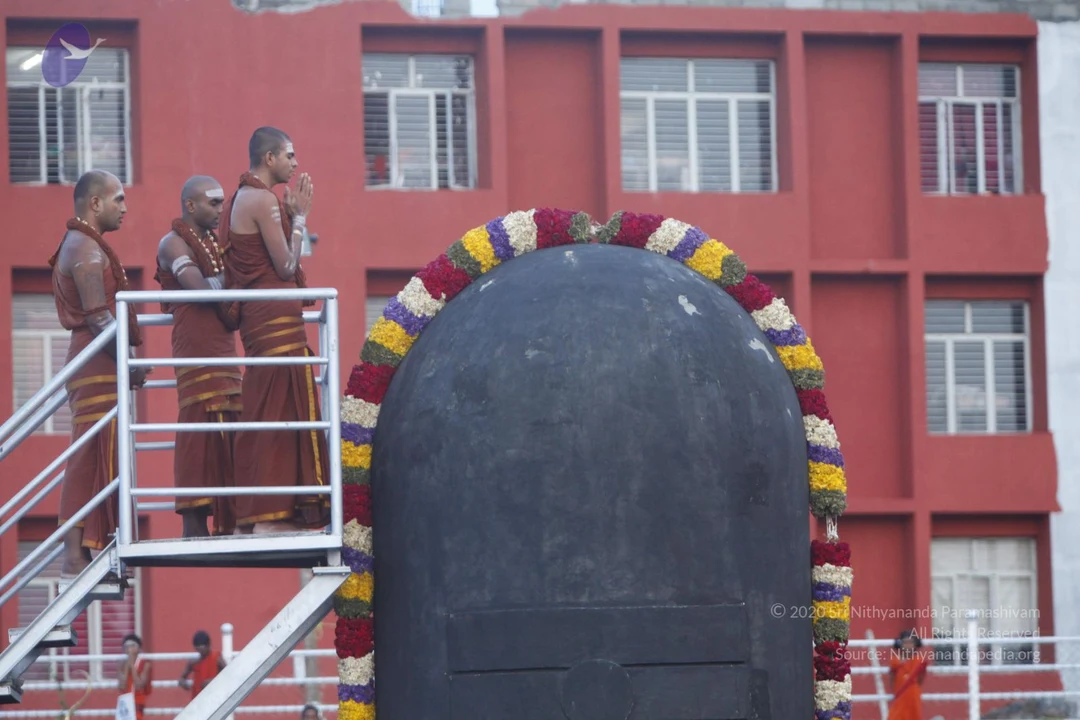
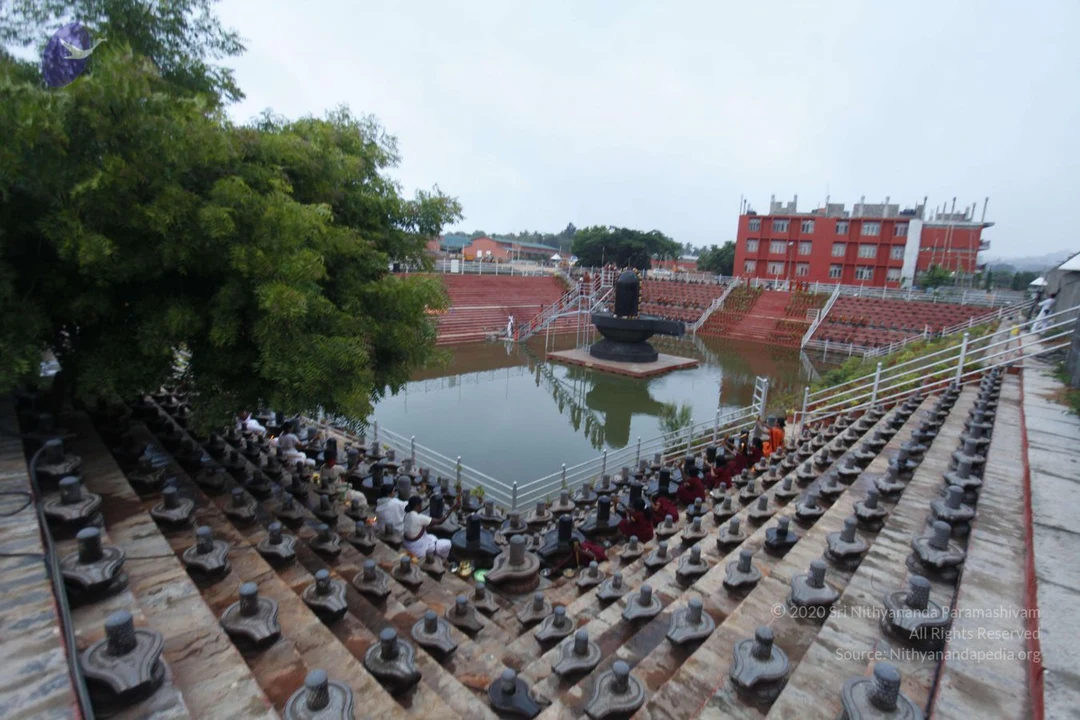
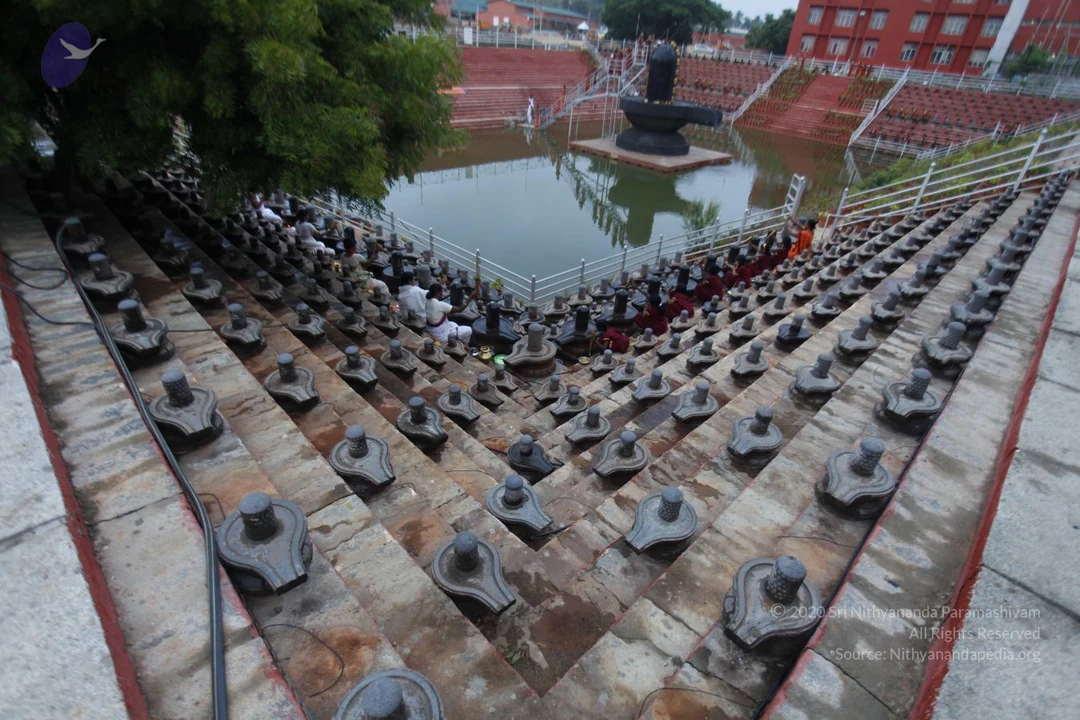
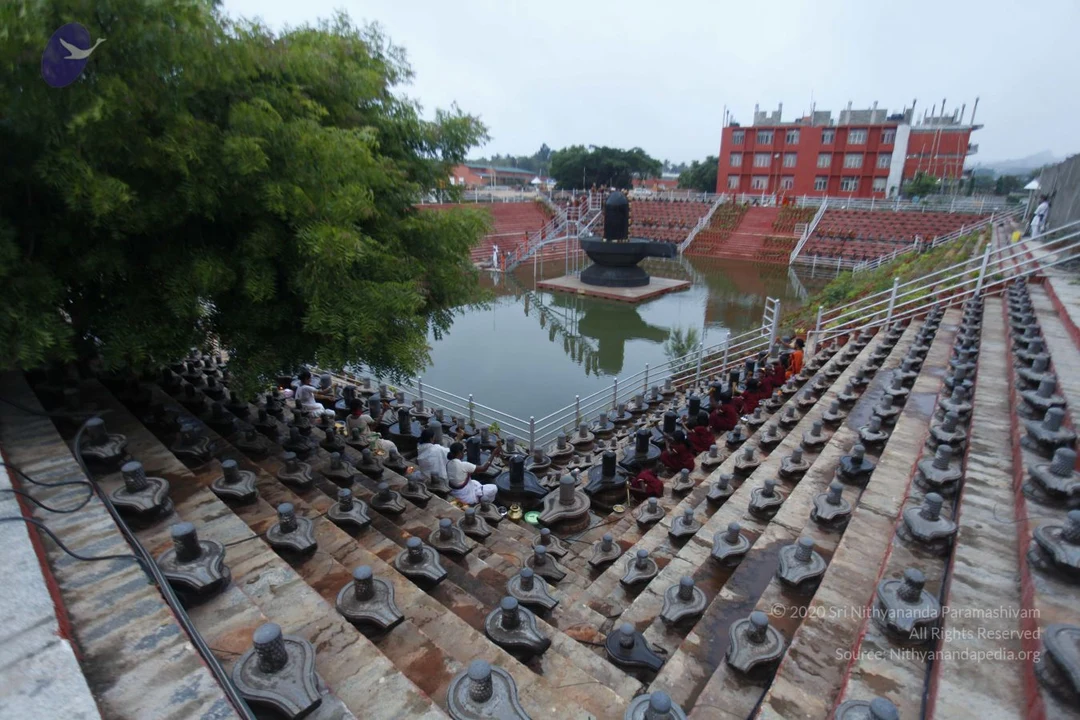
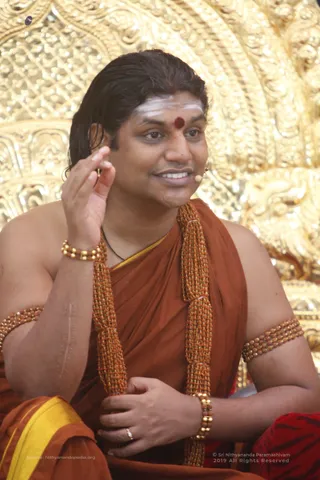
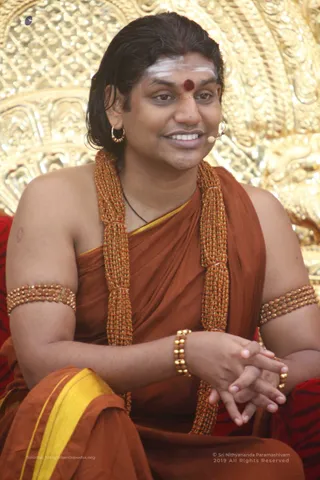
A smiling man with long swept-back dark hair sits on an ornate gold throne with a red patterned cushion, wearing an orange-saffron robe with a yellow border, a multi-strand saffron-and-gold rudraksha-style mala around his neck, gold armlets and a gold earring. He has white and red tilak marks on his forehead and a small clip microphone near his face, his hands resting in his lap. A tiger-striped cloth is visible at the lower left. Swamiji (probable) is seated in a satsang setting; the cues are his long swept-back hair, saffron robe, ornate mala and gold throne. Background is a plain pink and grey wall.Swamiji (probable) seated and speaking in front of an ornate gold-embossed backdrop. He wears an orange-saffron cloth draped over the body with a yellow border, long rudraksha mala strands across the chest, rudraksha bracelets on the upper arms and wrist, and a gold bracelet. He has long swept-back dark hair, white vertical tilak with a red dot on the forehead, and a small headset microphone. His right hand is raised mid-gesture while the left rests on his lap, showing a gold ring. A small Nithyanandapedia source mark and a copyright line appear on the image.A man with swept-back dark hair sits in front of an ornate gold-embossed backdrop, smiling and speaking into a small headset microphone. He wears a rust-orange shawl over the shoulder and bare upper torso, a yellow-bordered orange dhoti, a long double-strand orange rudraksha mala, rudraksha armlets, a gold-and-rudraksha bracelet, a white horizontal forehead marking with a red dot, and gold hoop earrings. His hands are clasped in his lap. The photo appears to be from a satsang setting, and the visible person is an appearance-based a person candidate.Photograph of a large black stone lingam, framed by an arch of flower garlands in red, yellow, orange and purple, set on a raised platform before a red brick building with white-framed windows. Several saffron-robed men stand on a white metal staircase and platform at left; one holds a small plate or offering and another extends an arm toward the lingam, as if performing puja or abhishekam. Other robed attendants stand at the lower right. Rows of potted green plants line the base of the platform.Wide photo of a large outdoor temple tank with a tiered stone-and-concrete ghat. A tall black Shiva linga stands in the water at the centre, with a green tree at the left edge and a red multi-storey building behind. Rows of small stone and brass lamp-stands in the foreground line the steps. Dozens of people sit in rows on the steps to the right, several in white and some in reddish-maroon garments, with others standing near the water. White ritual or devotee clothing is visible among the crowd, and the scene suggests a puja or satsang gathering at the tank.A wide elevated photograph of a stepped stone embankment beside a rectangular water tank. Rows of identical dark stone lingams with round bases sit on each tread, and a group of people in white and red clothing sits among them at the lower steps. At the far end of the tank a large black Shiva lingam stands on a raised platform, and a red-brick building and green trees frame the background.