Skip to content
Wednesday

2 August 2017

The Life And Beings In Kailasa Sadashiva Abode

Dated photos
628
Source pages
1
Media
9
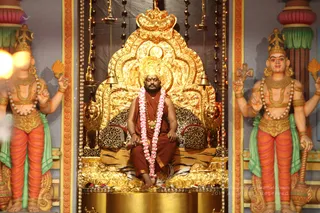
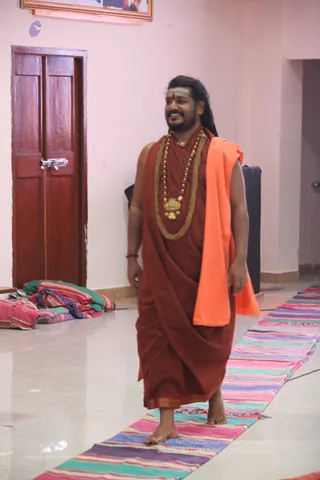
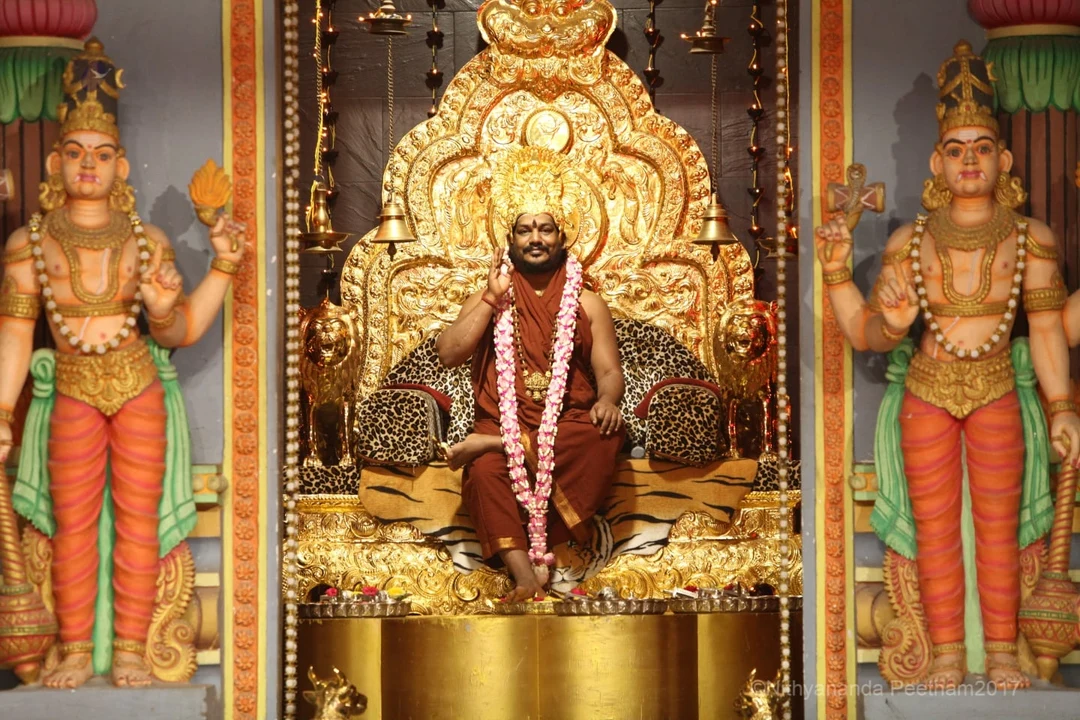
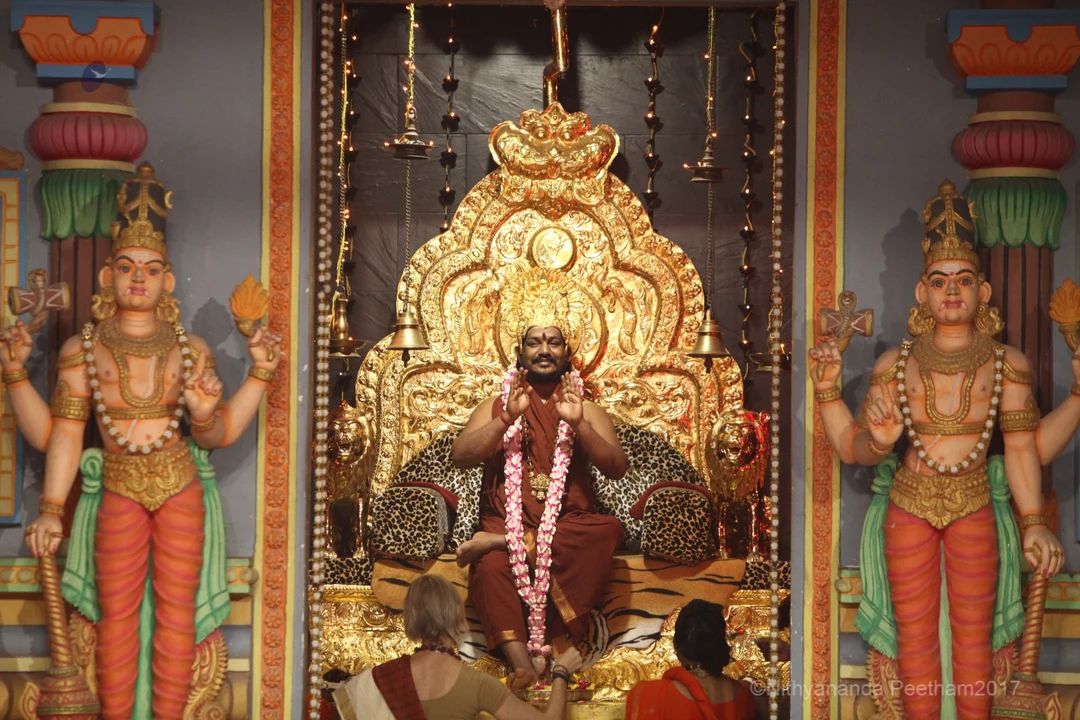
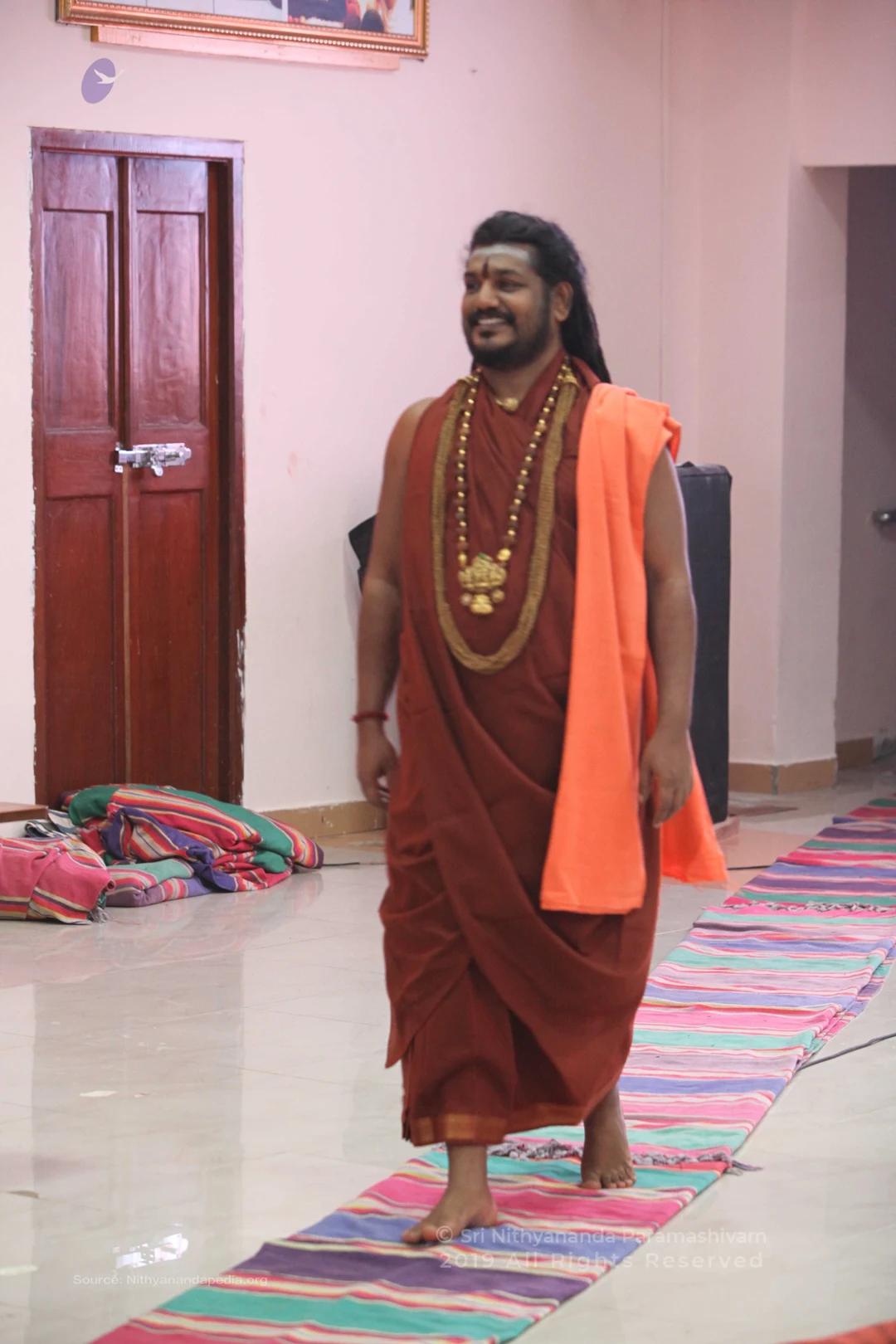
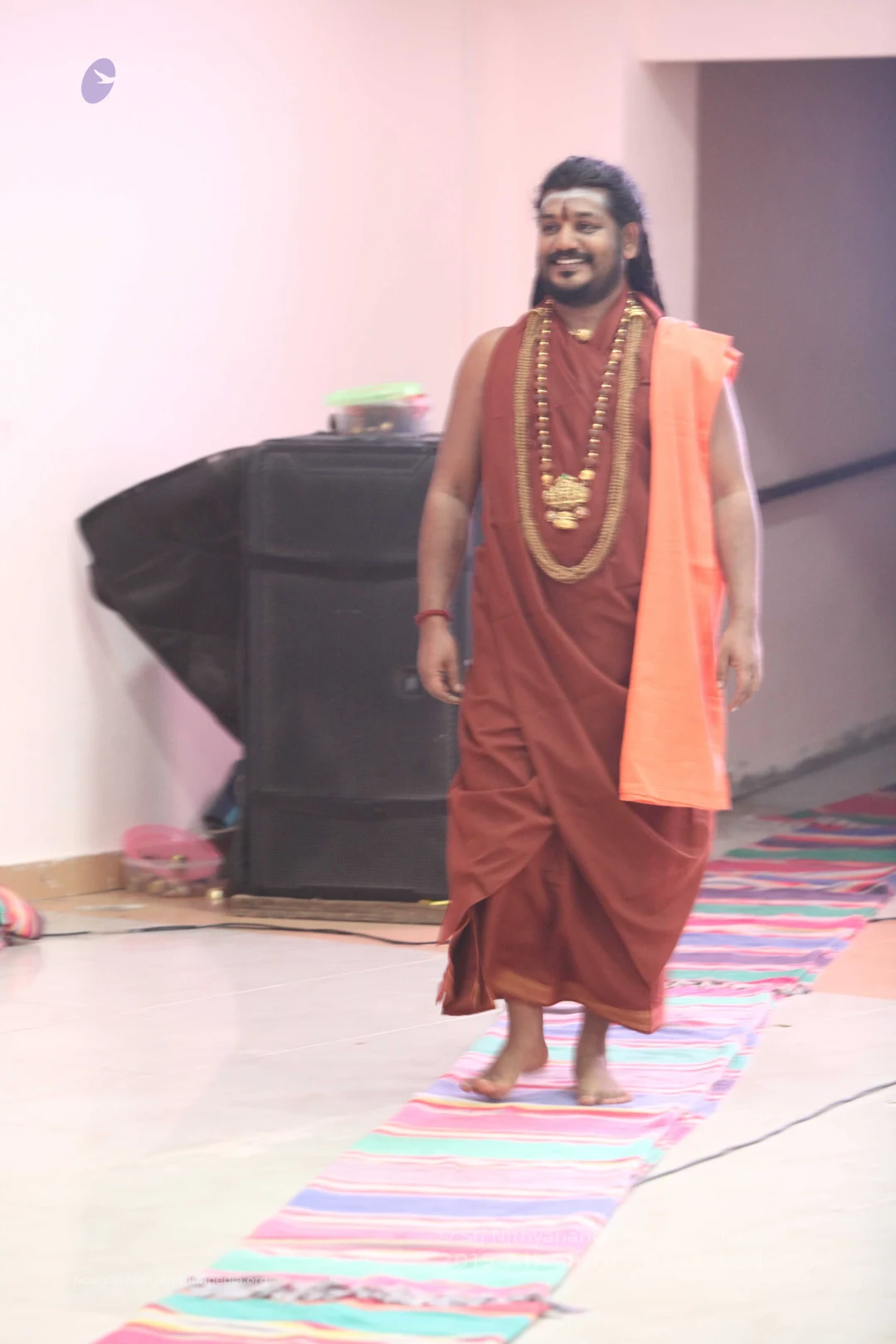
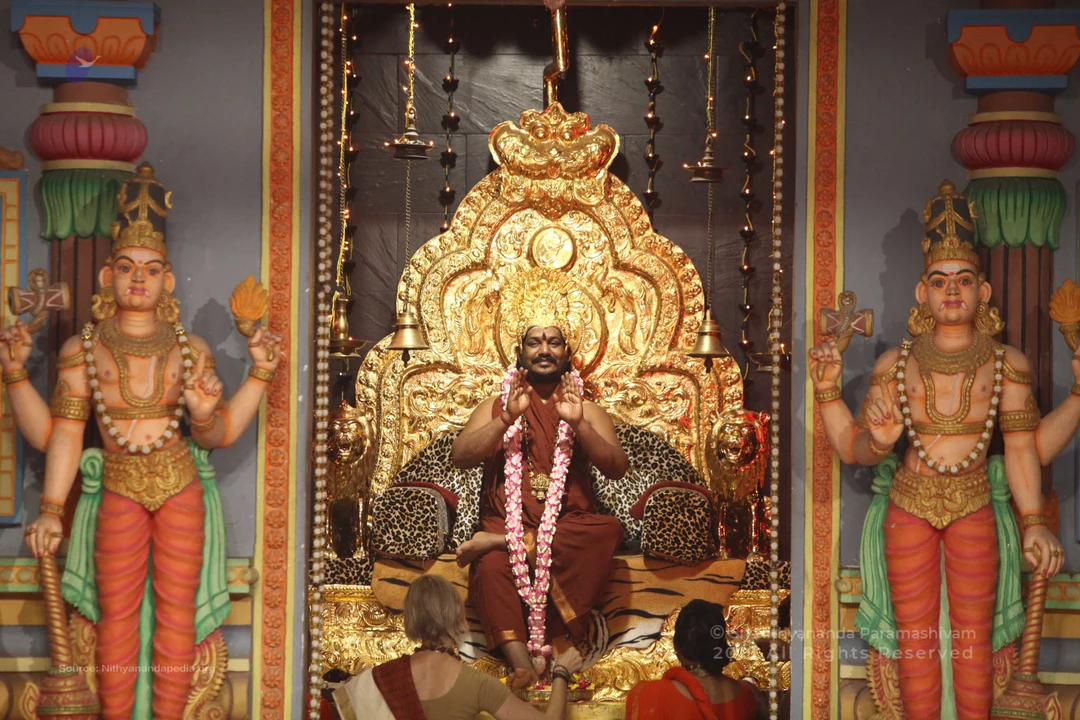
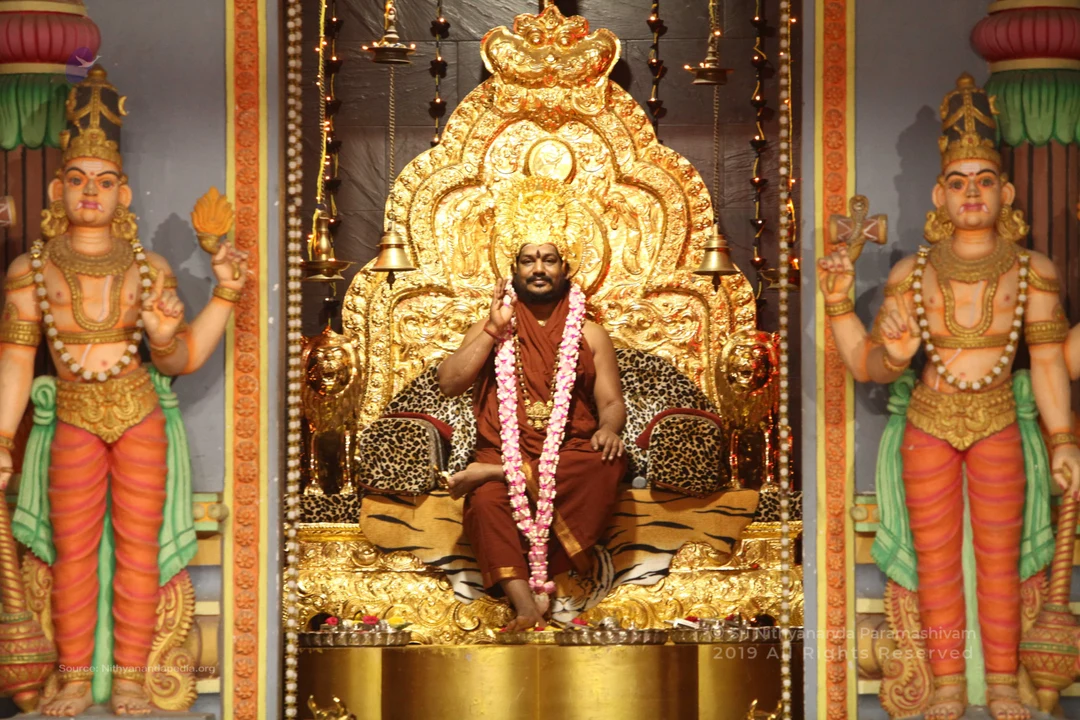
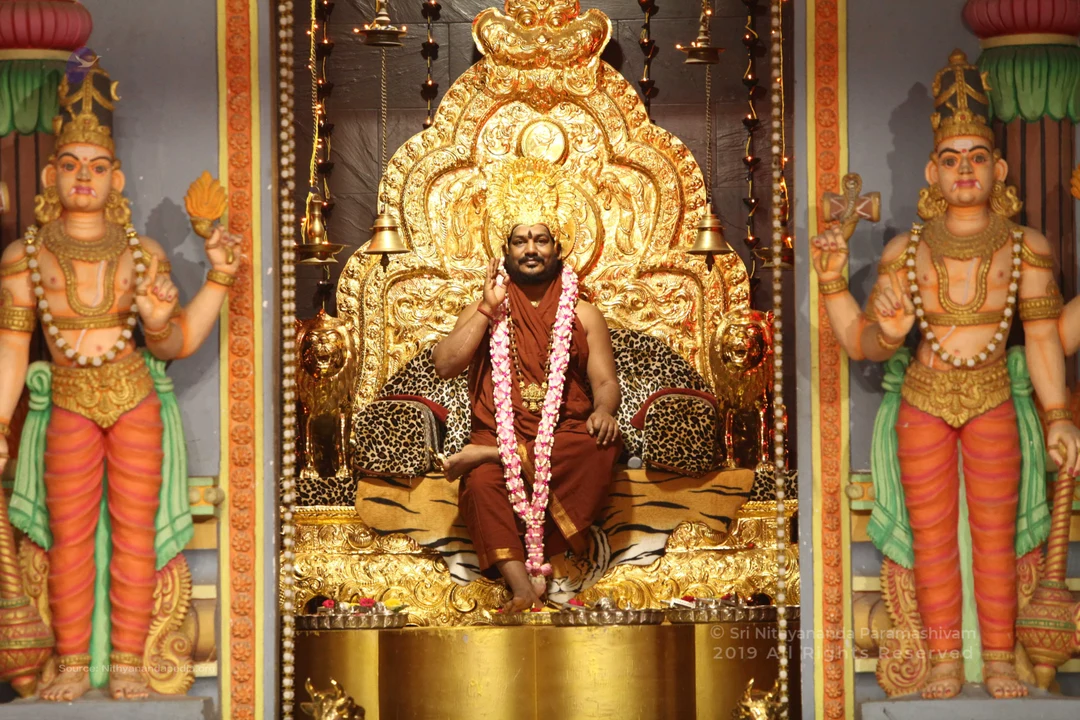
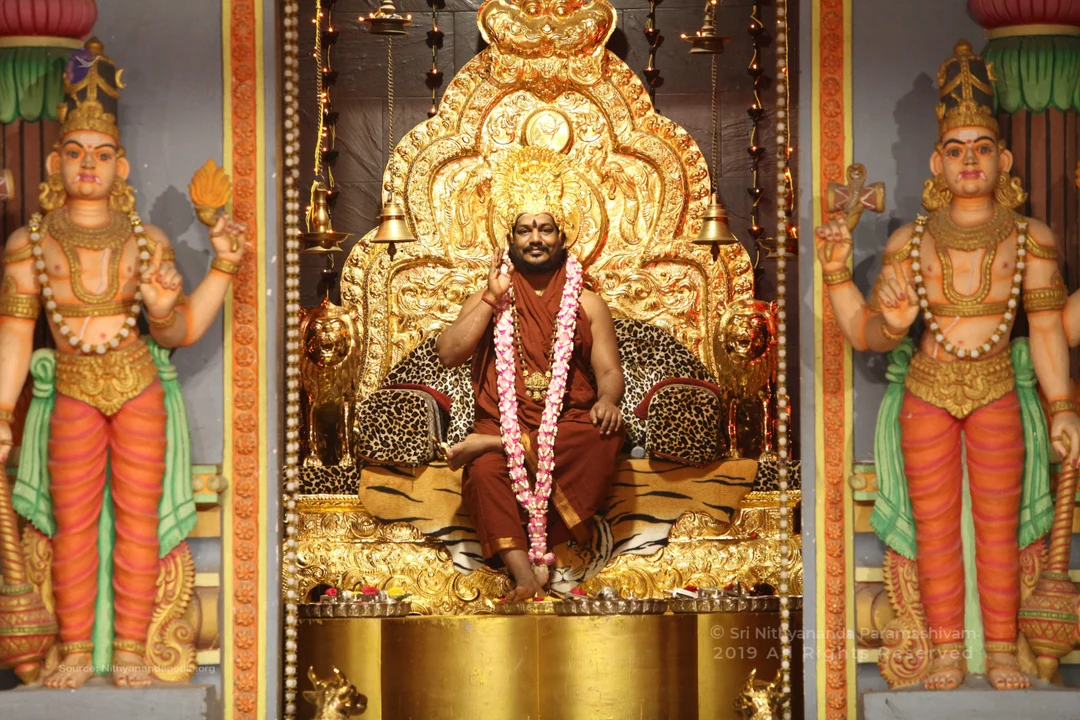
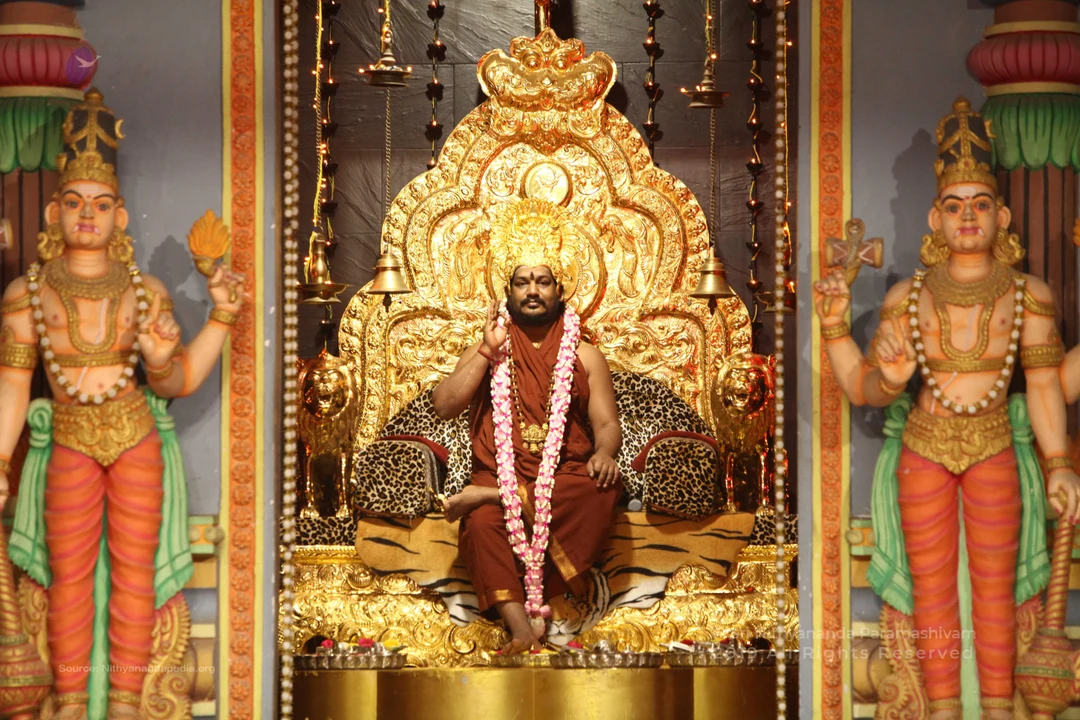
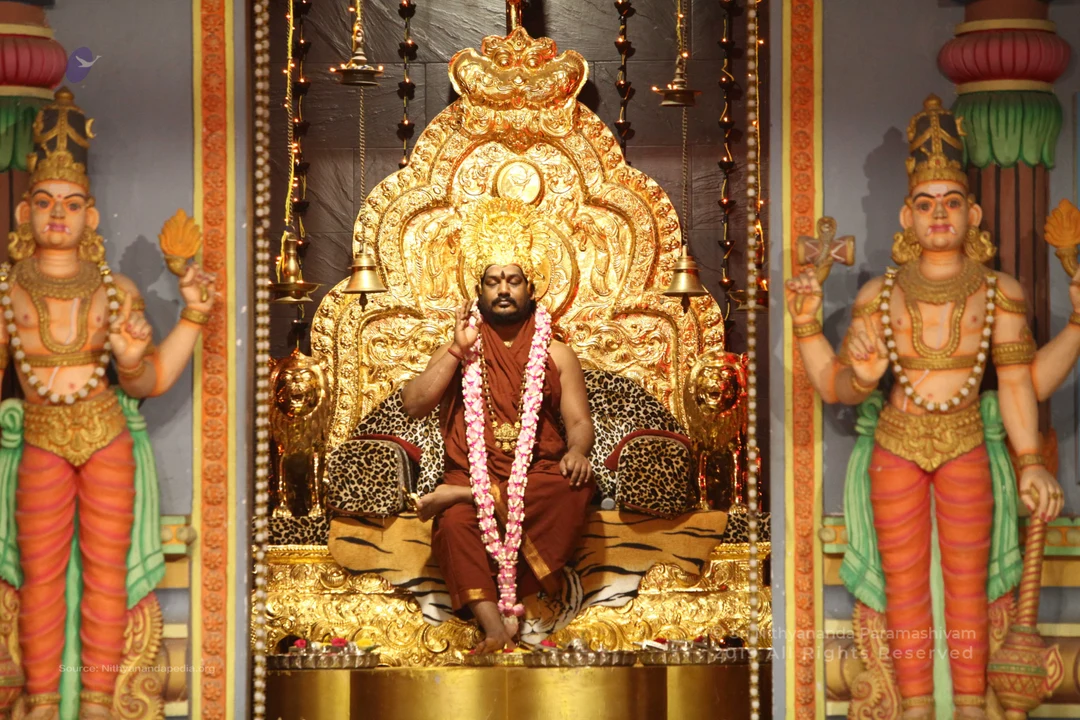
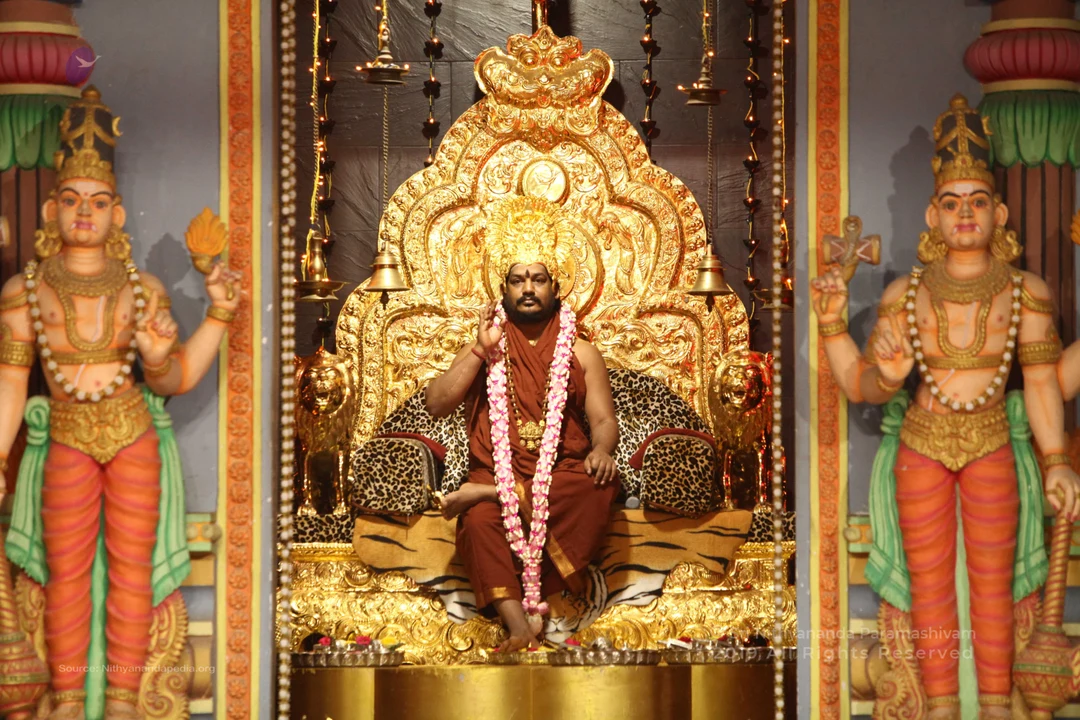
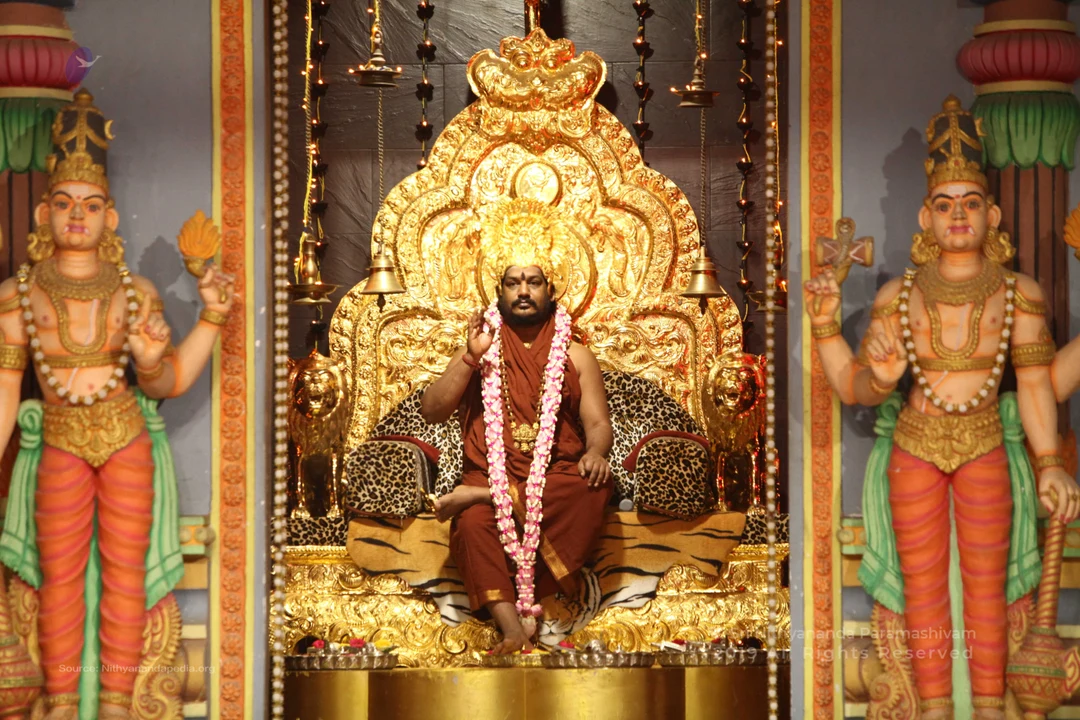
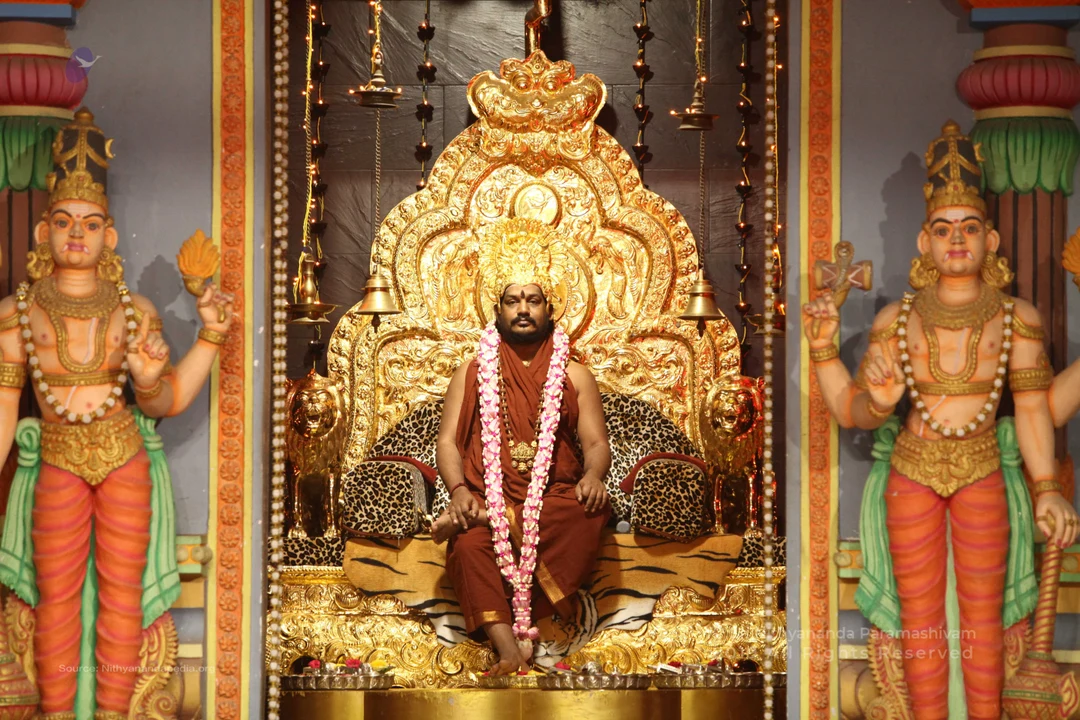
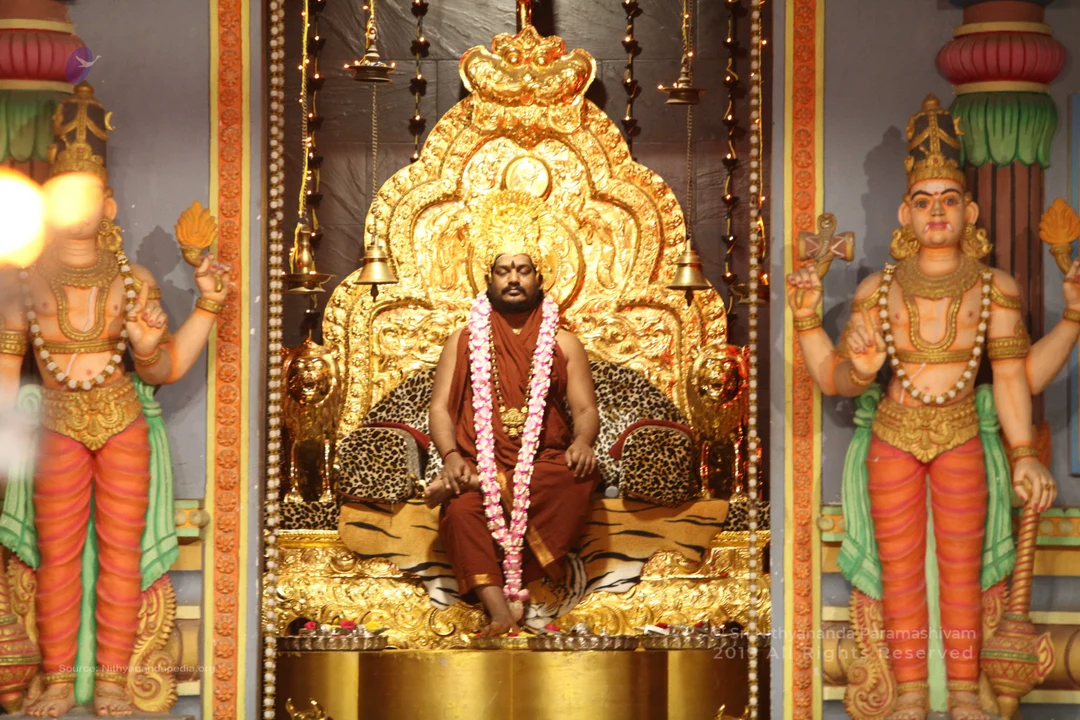
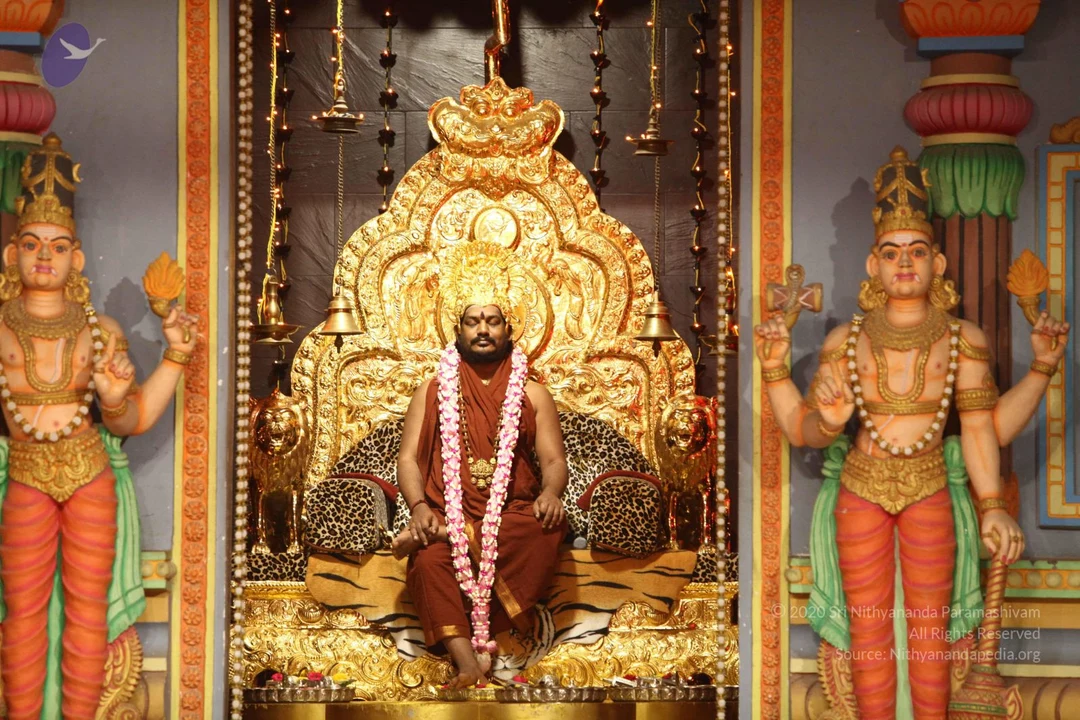
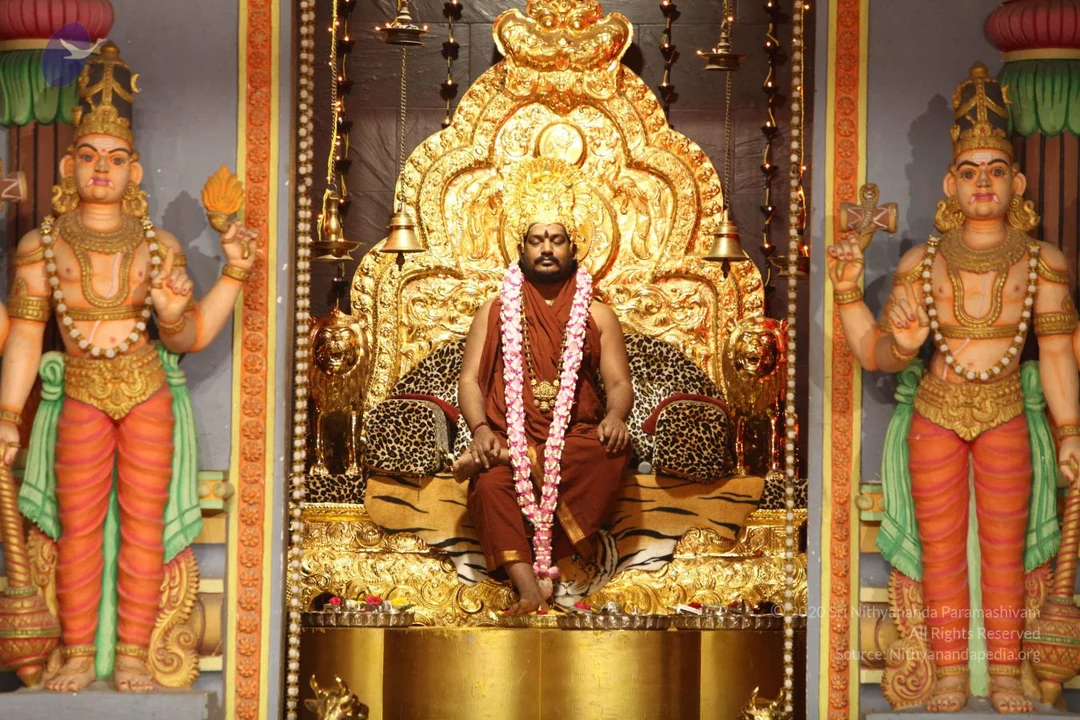
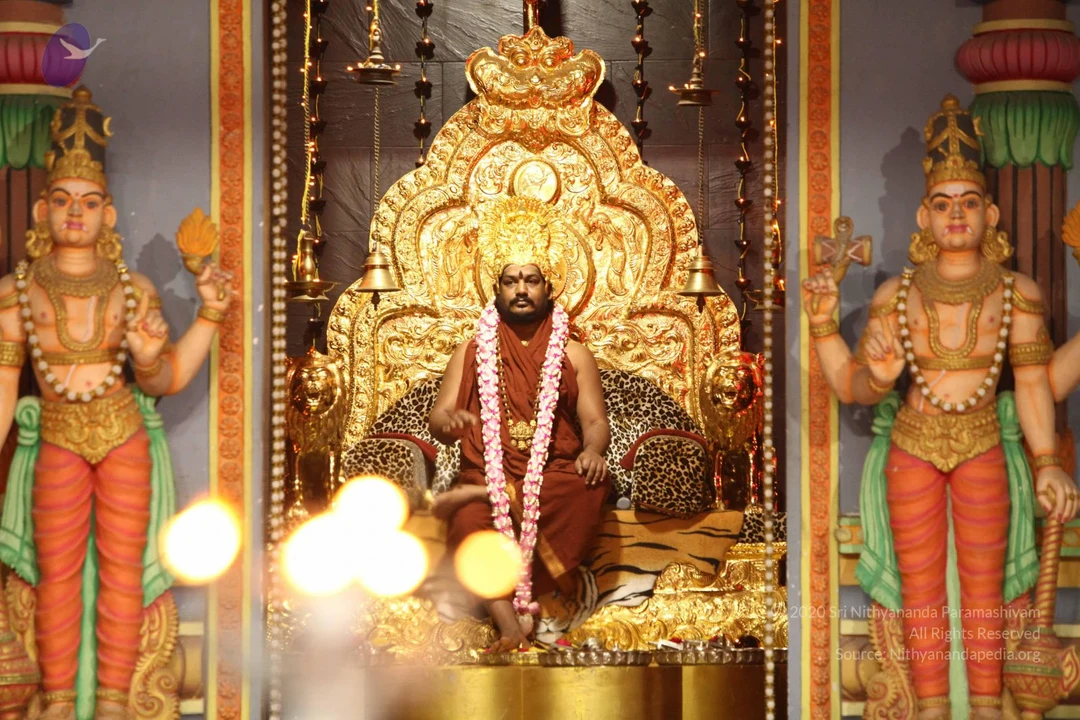
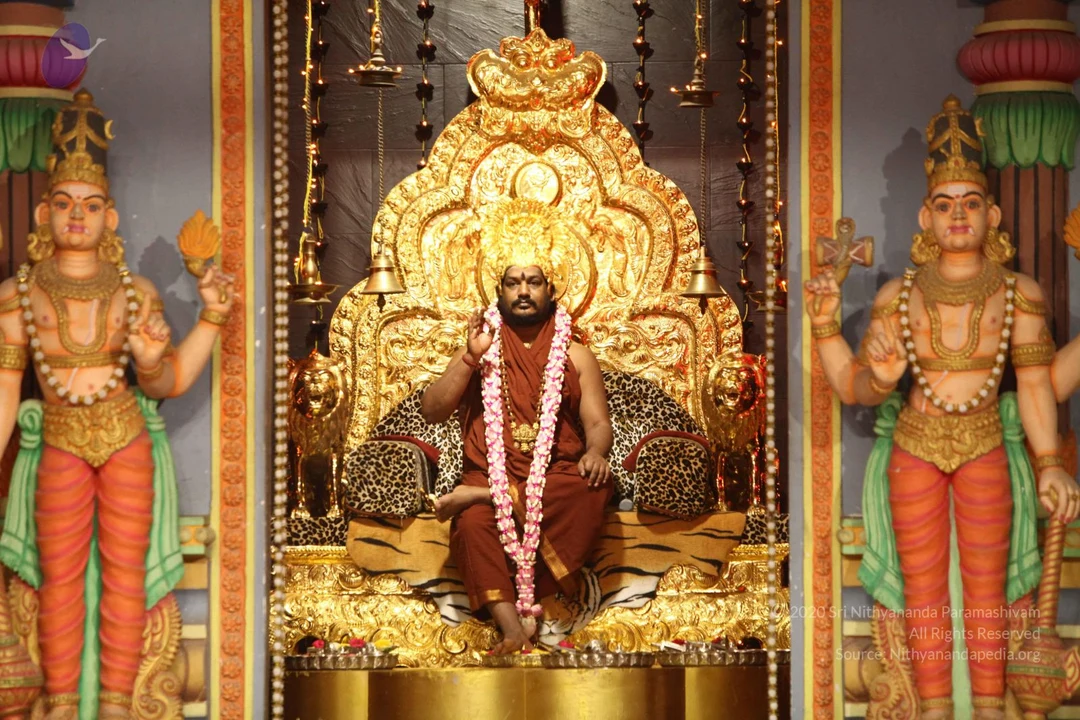
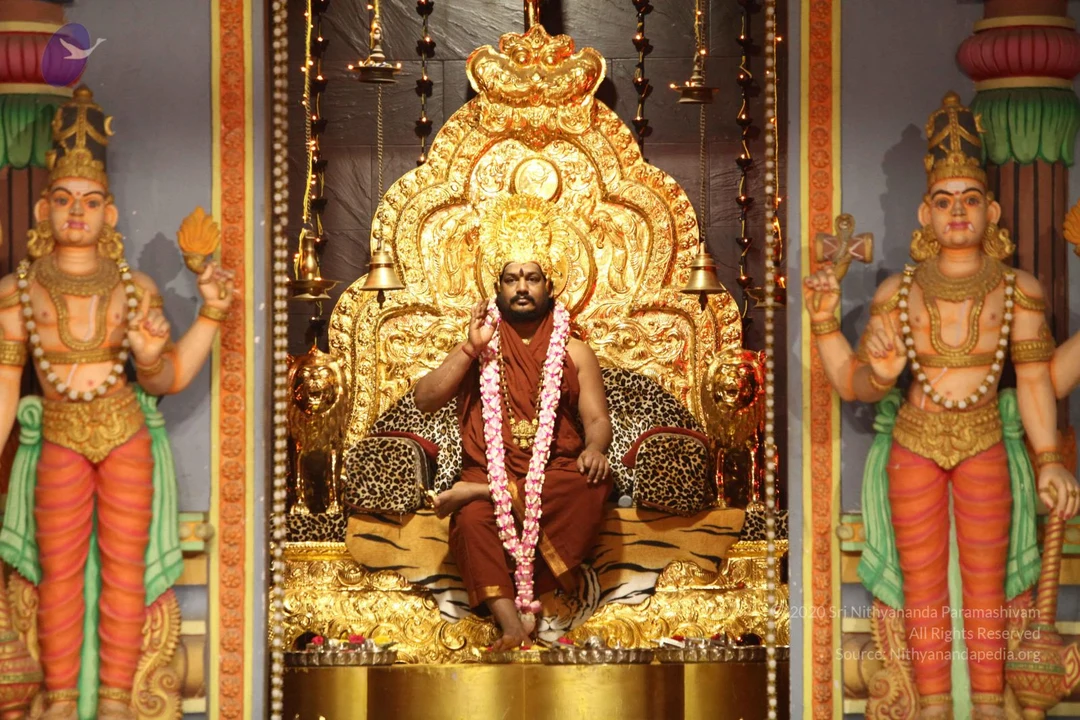
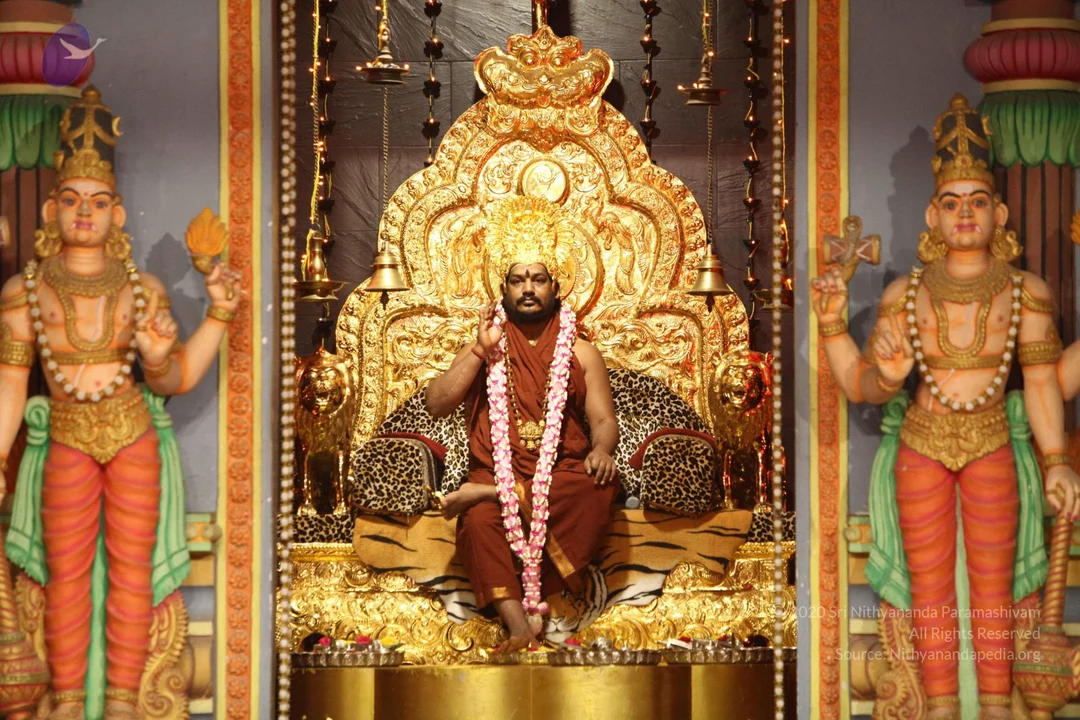
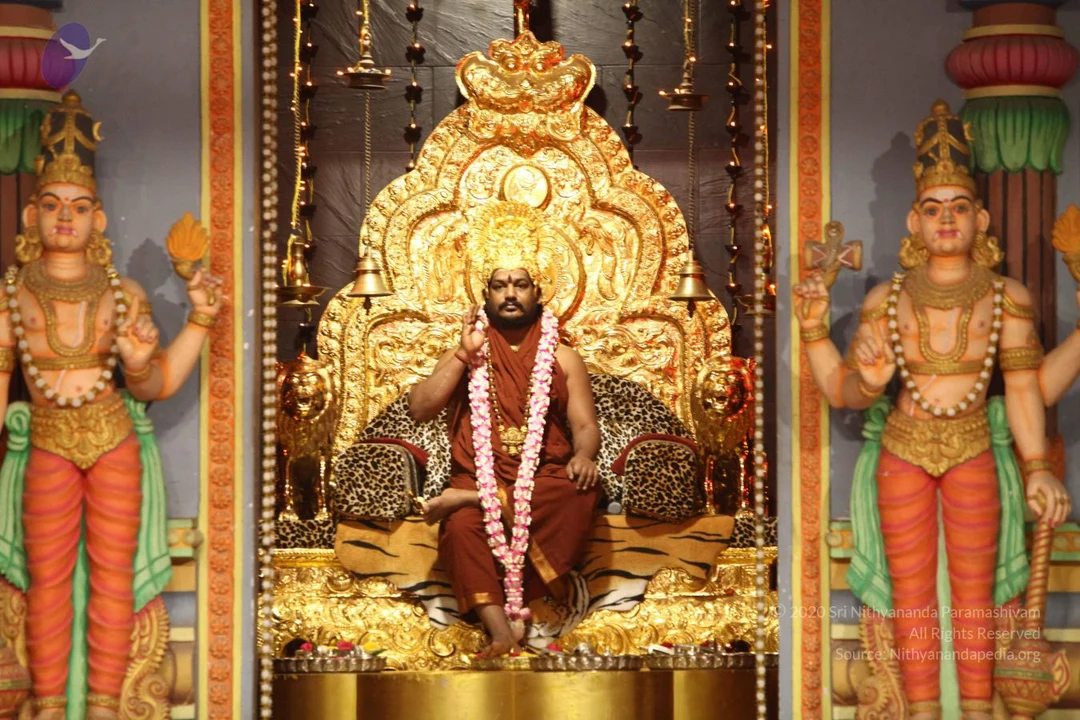
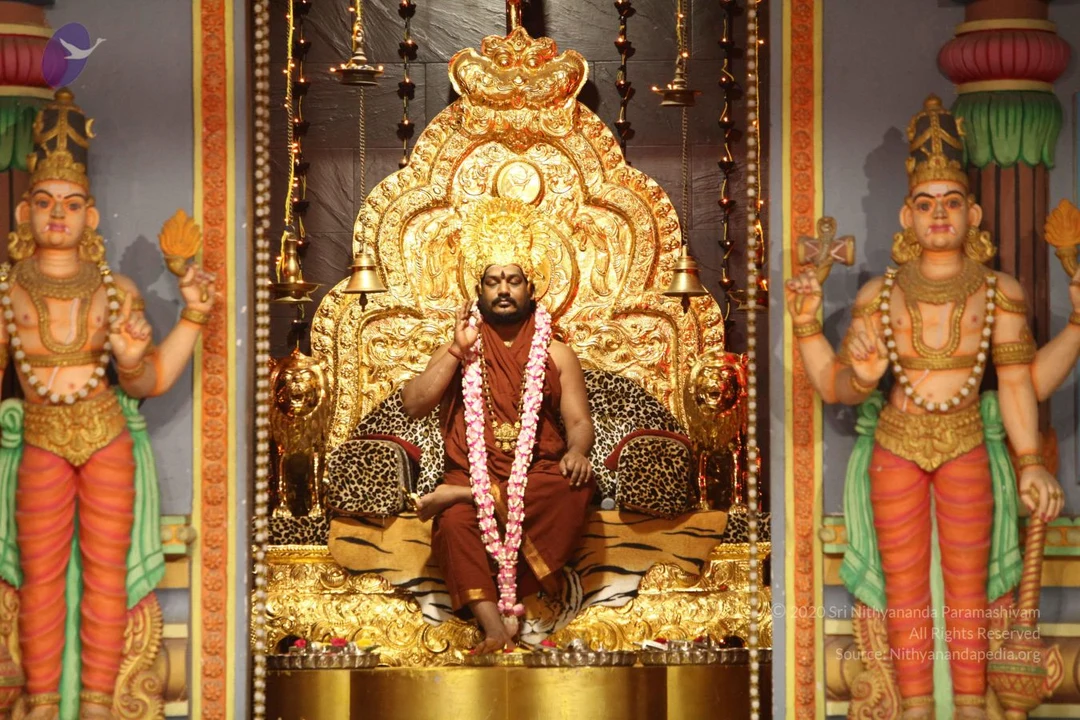
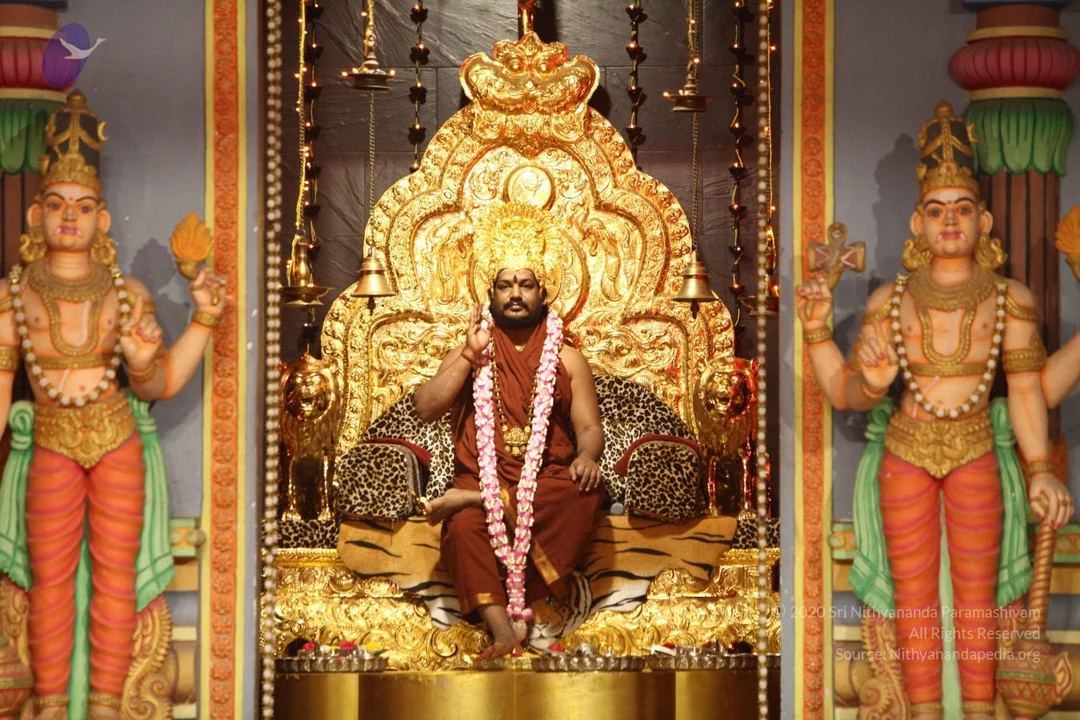
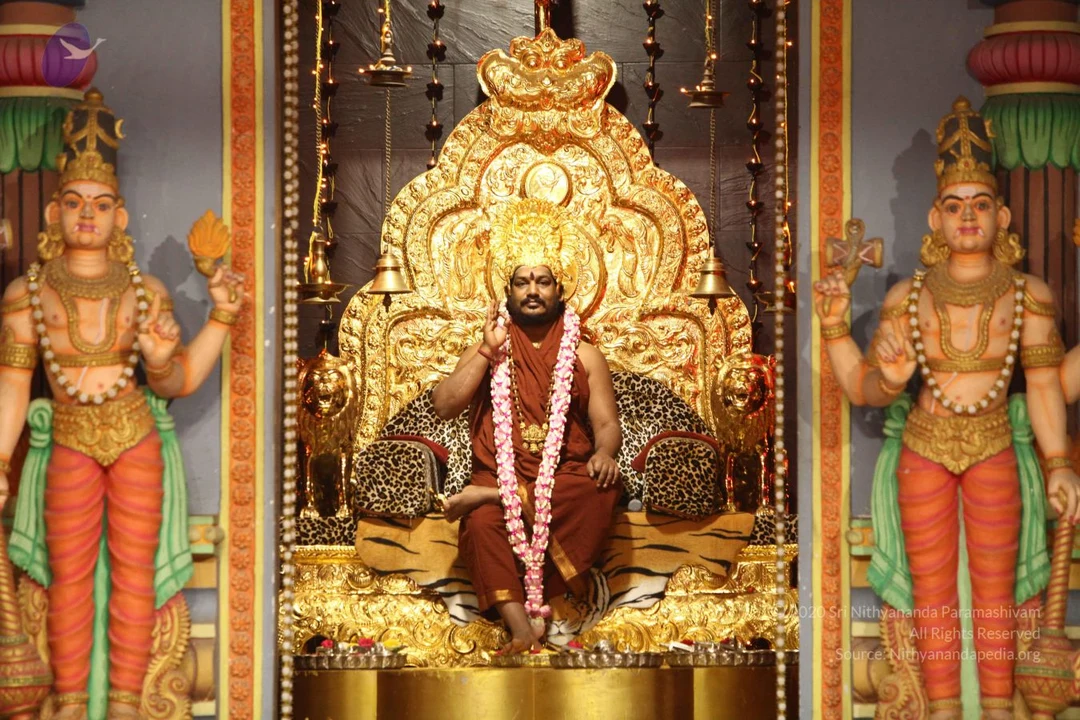
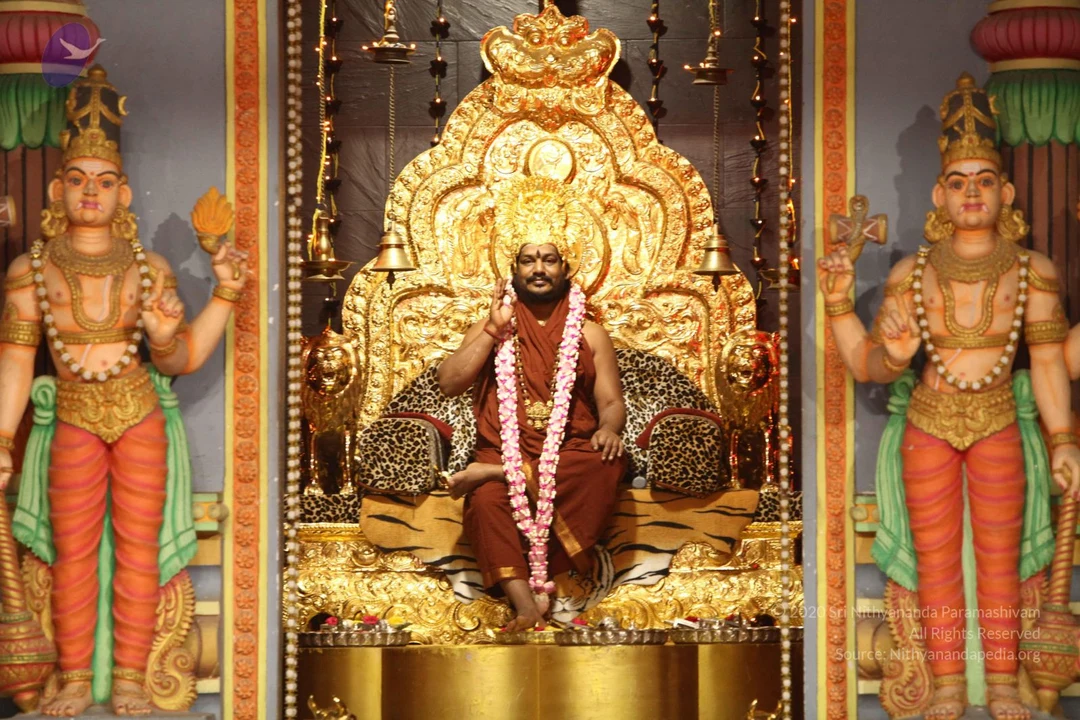
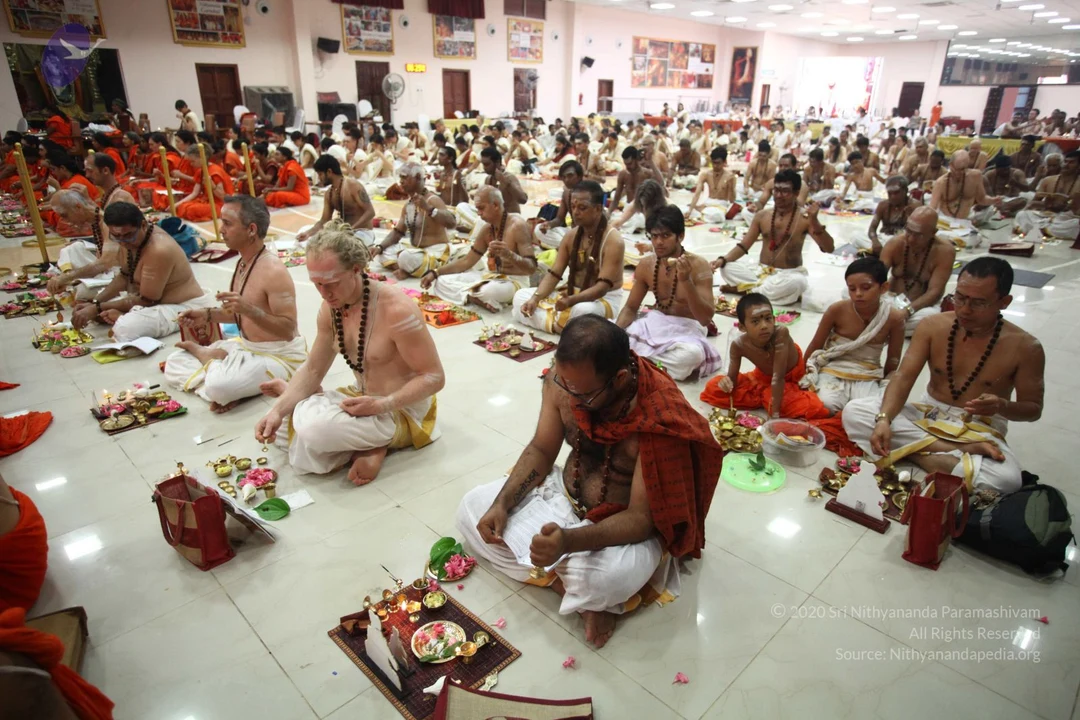
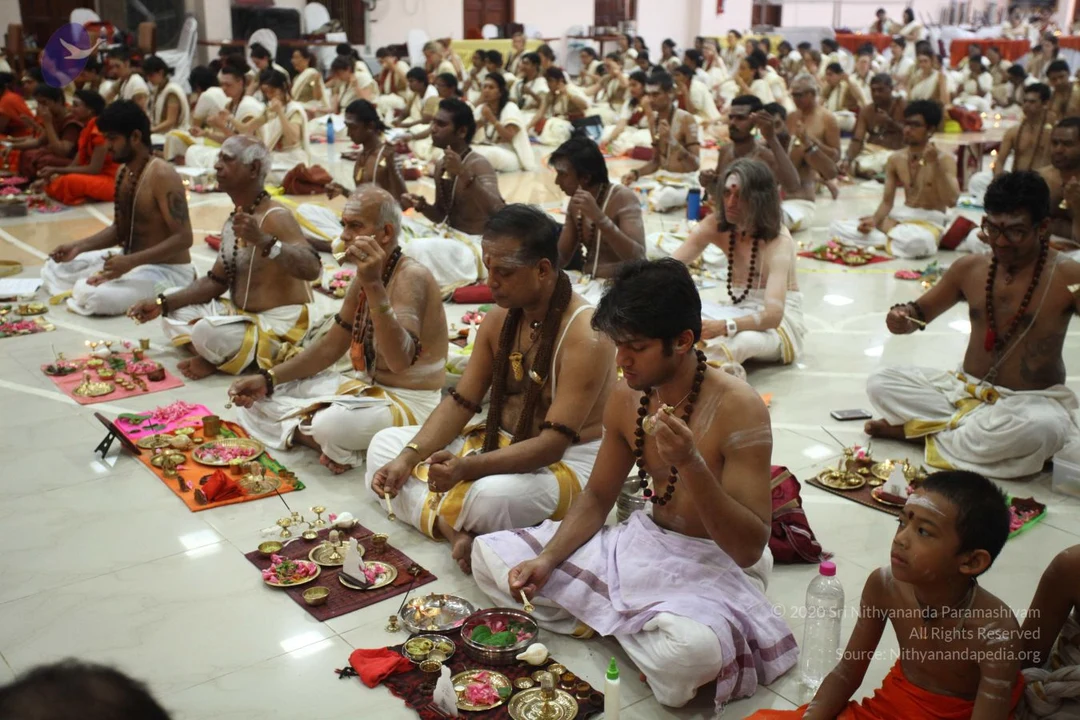
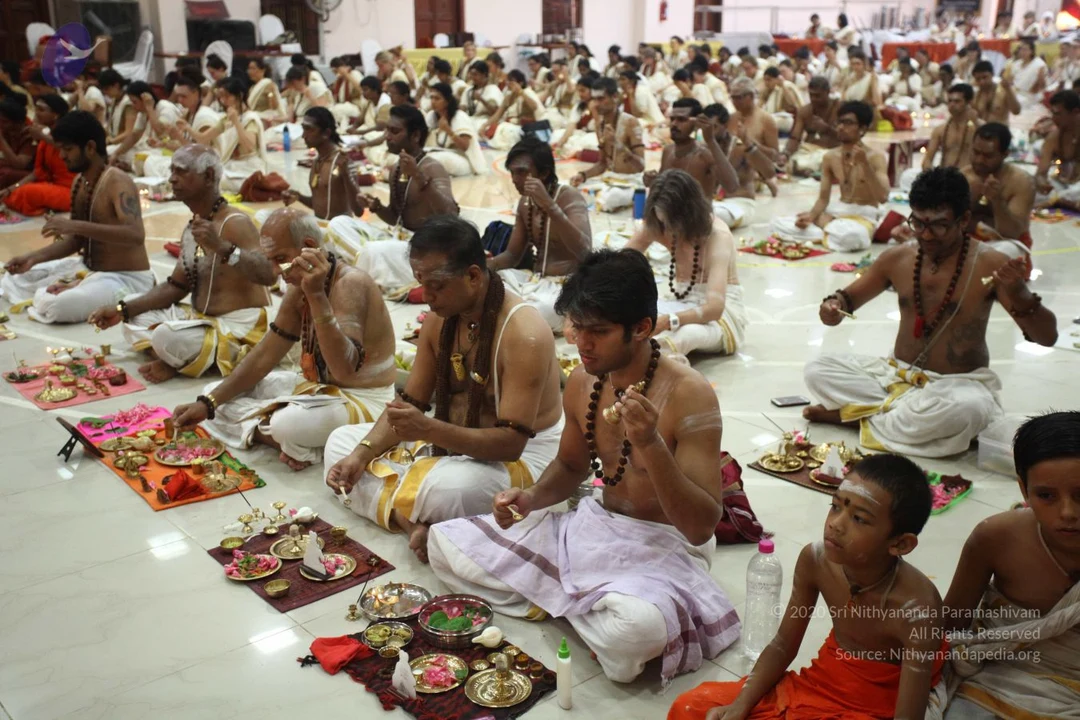
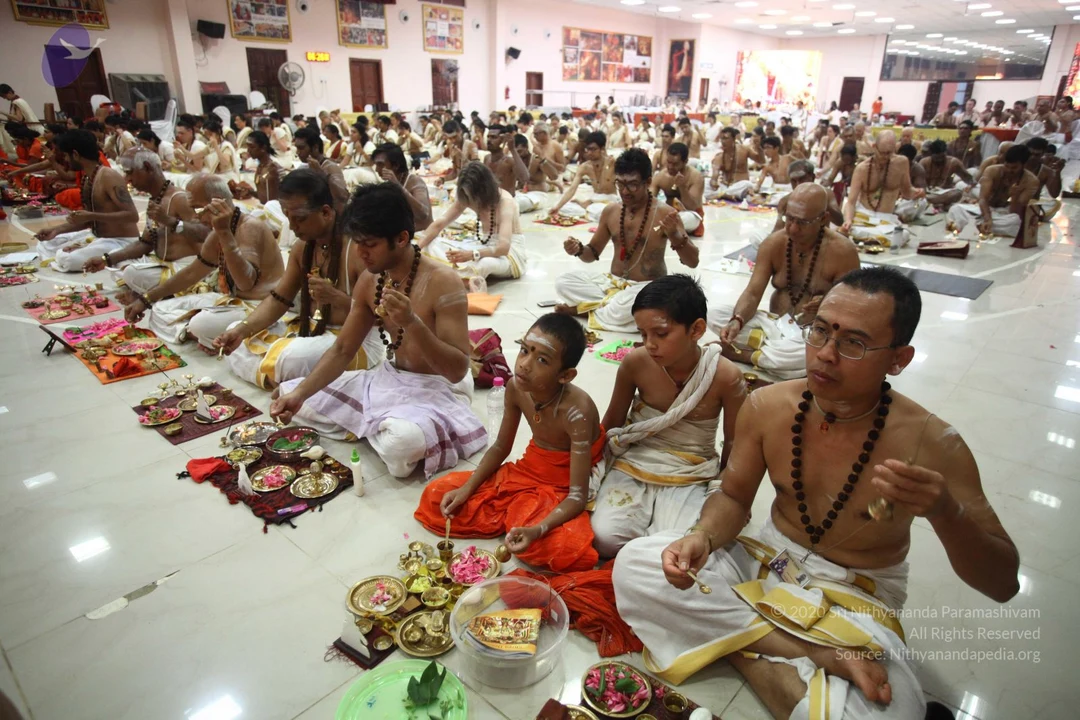
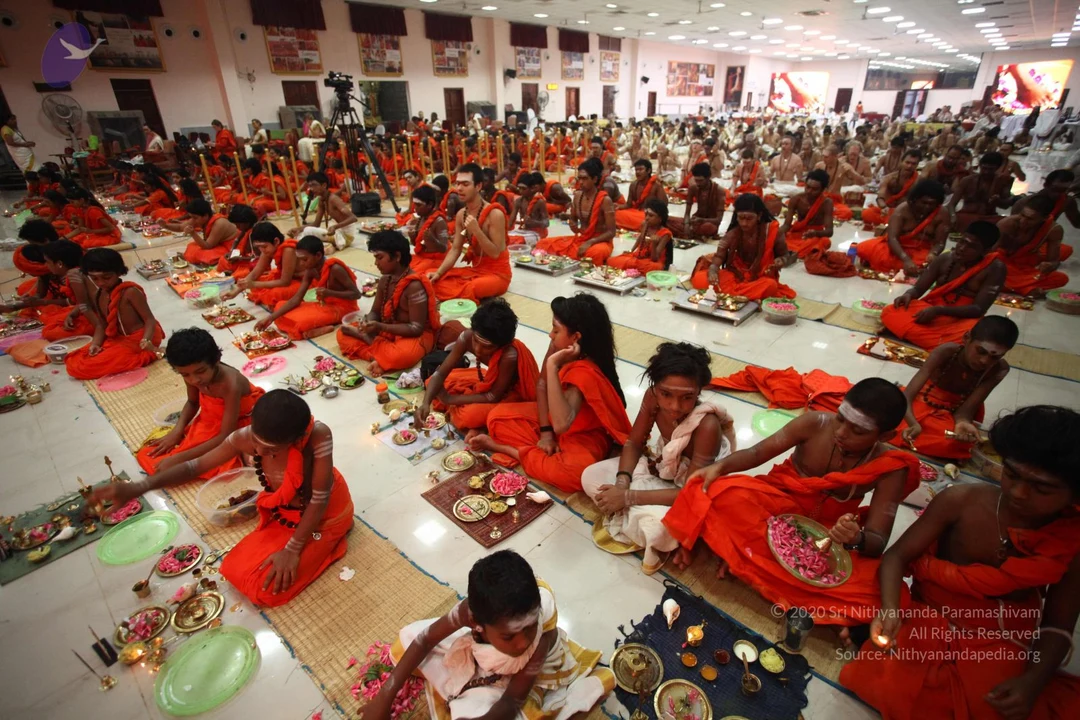
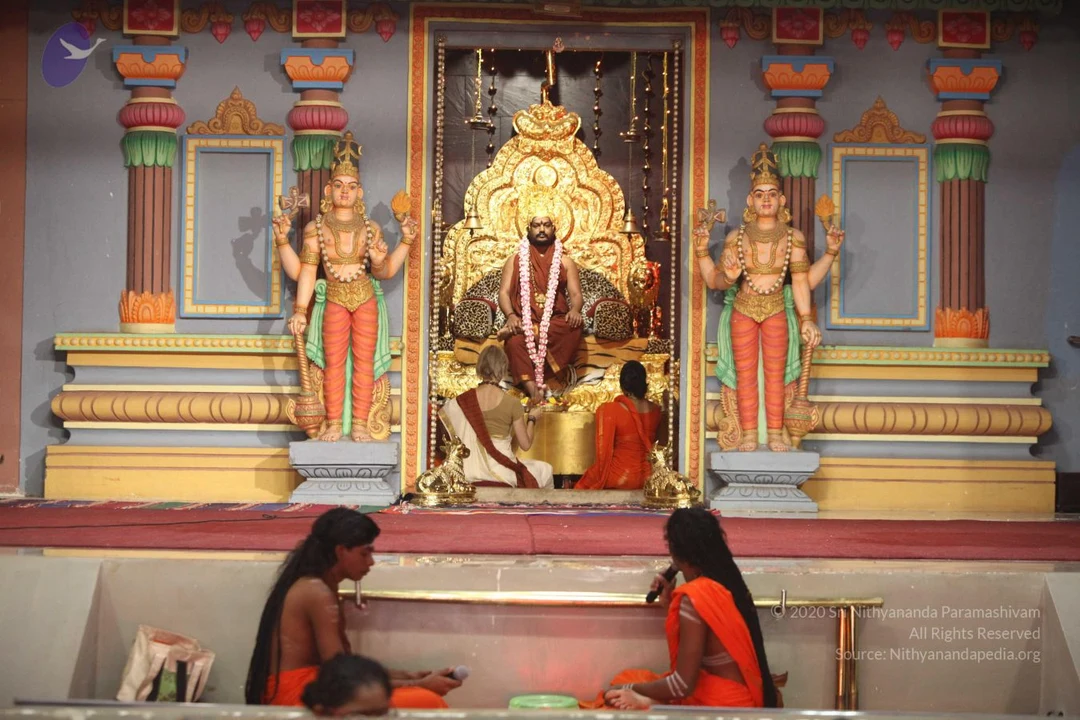
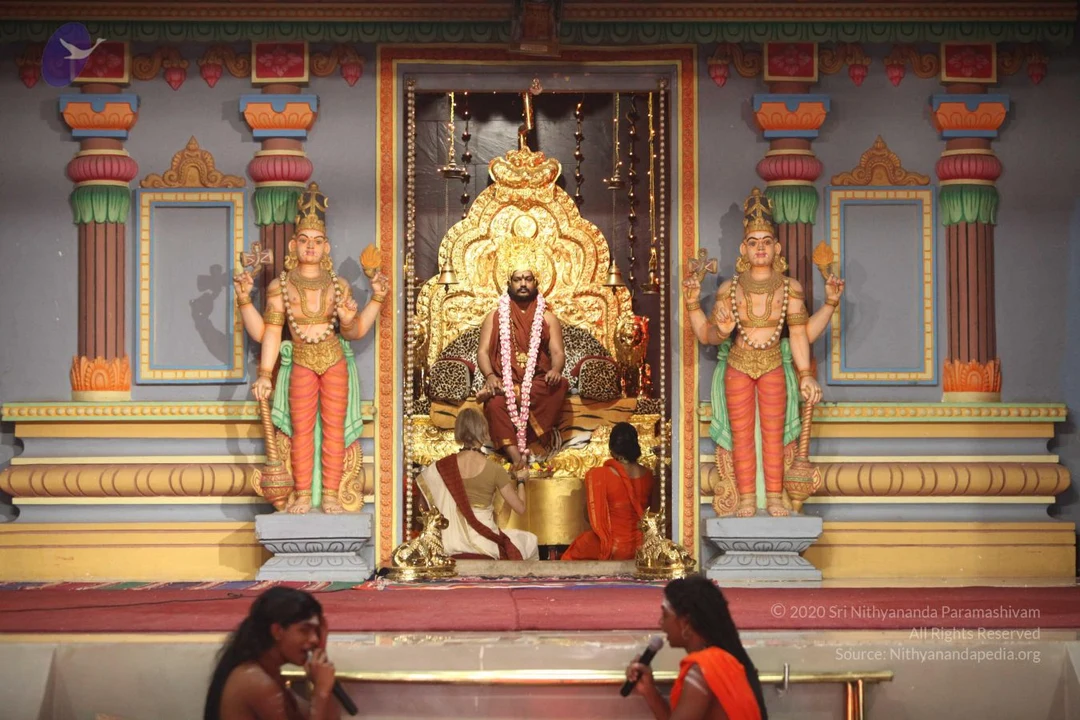
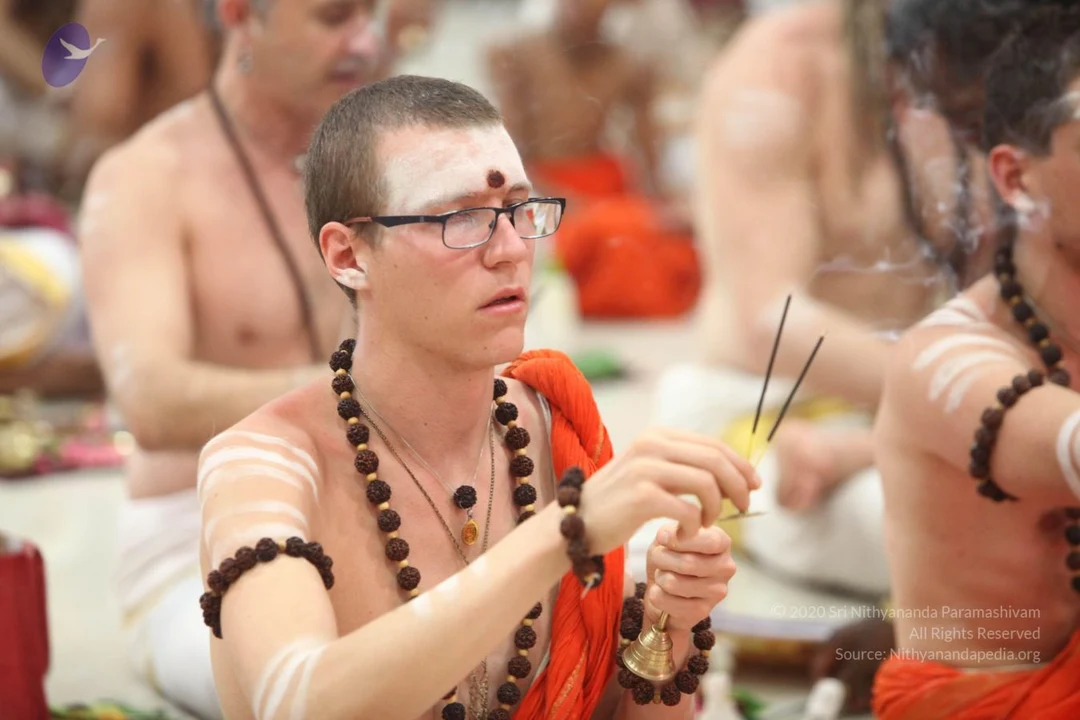
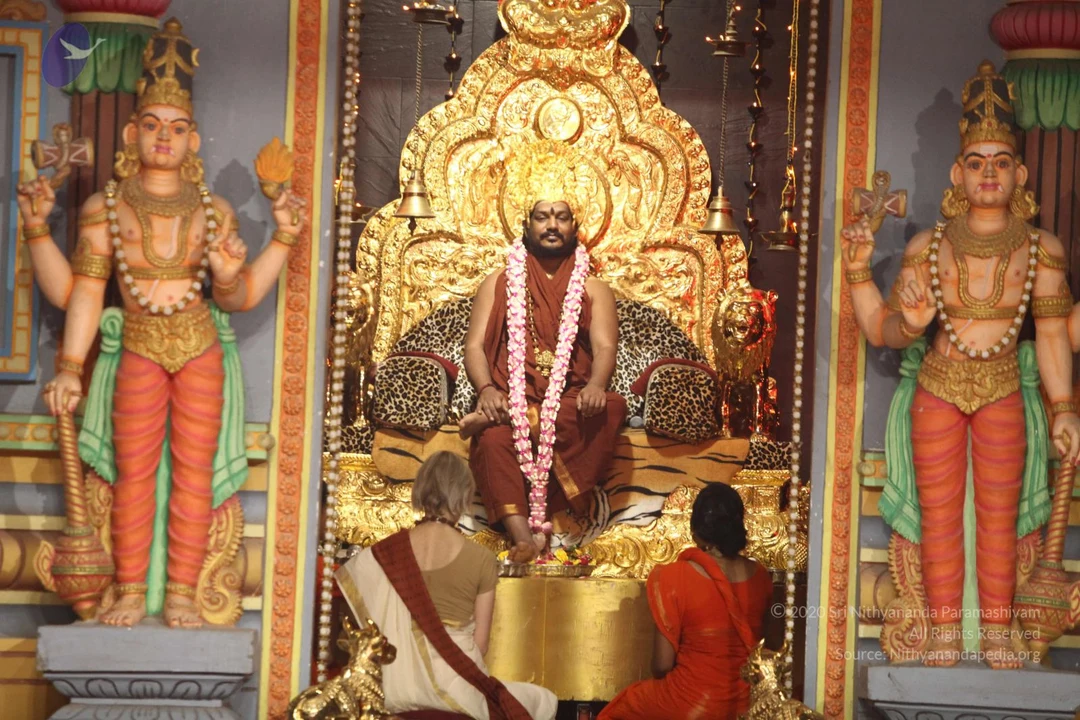
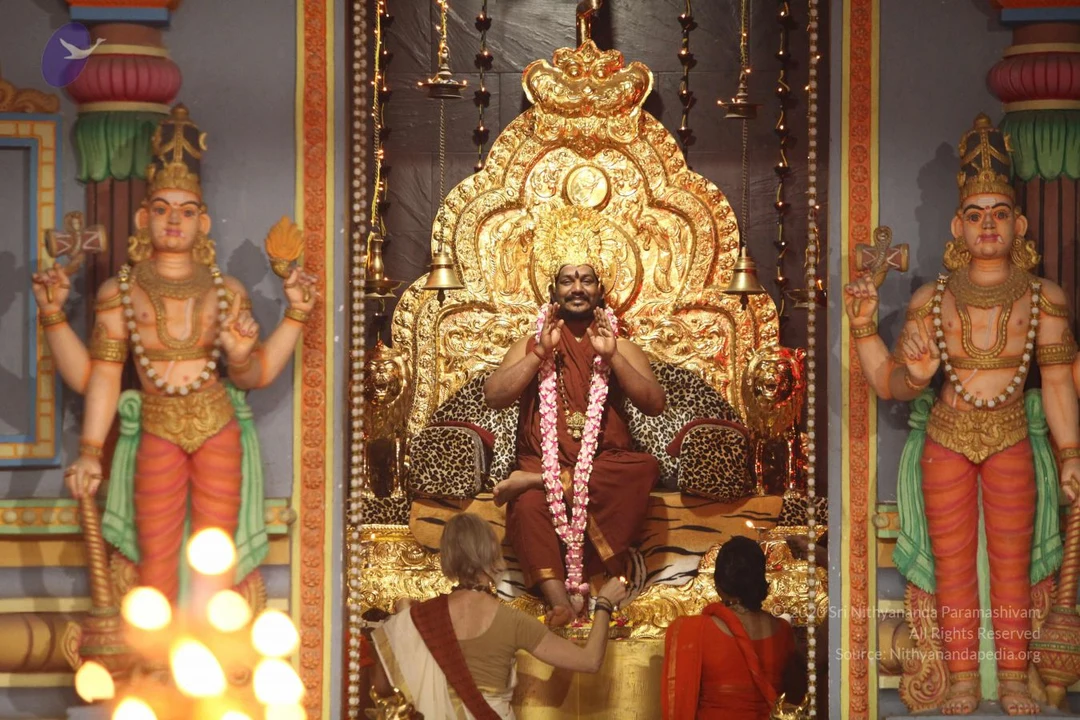
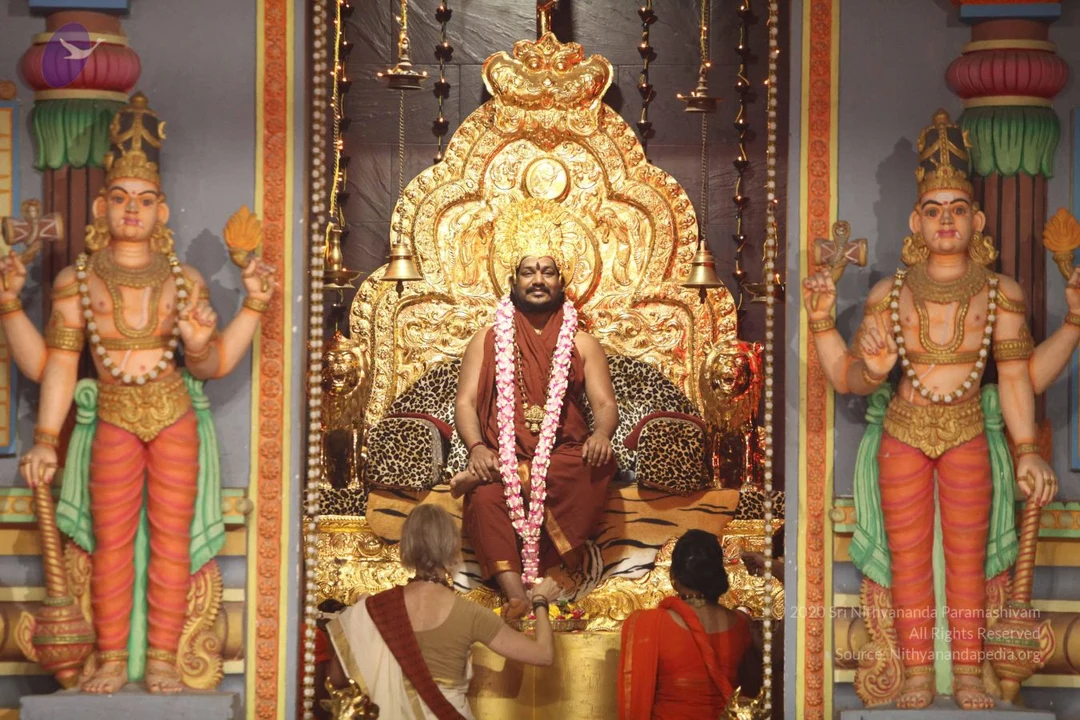
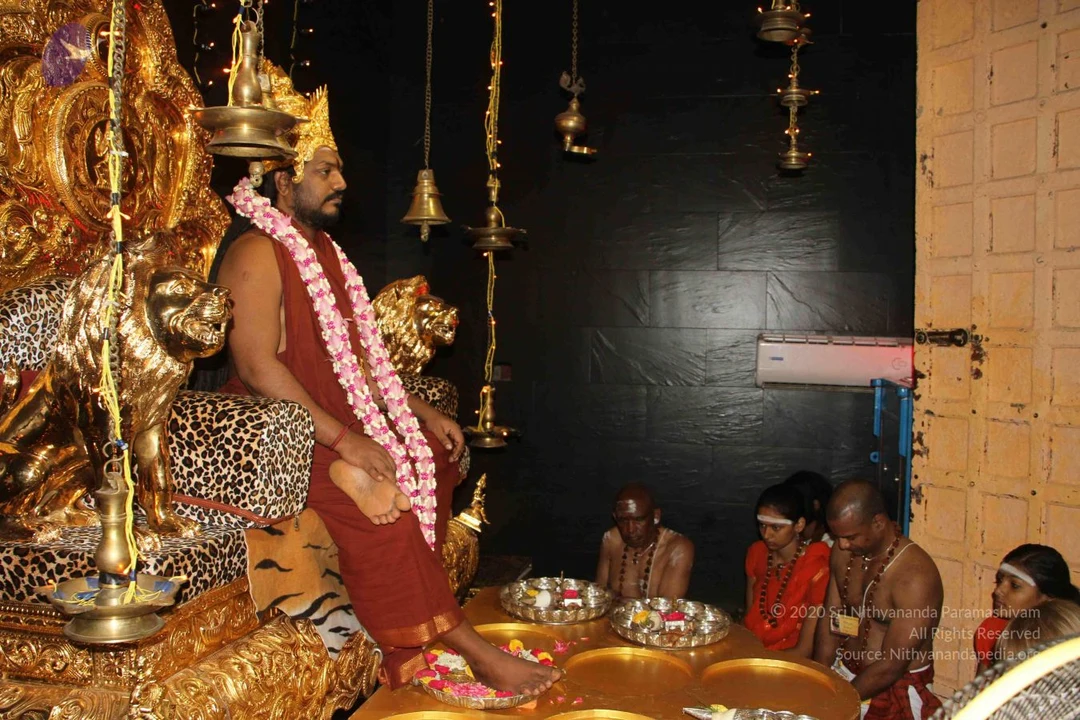
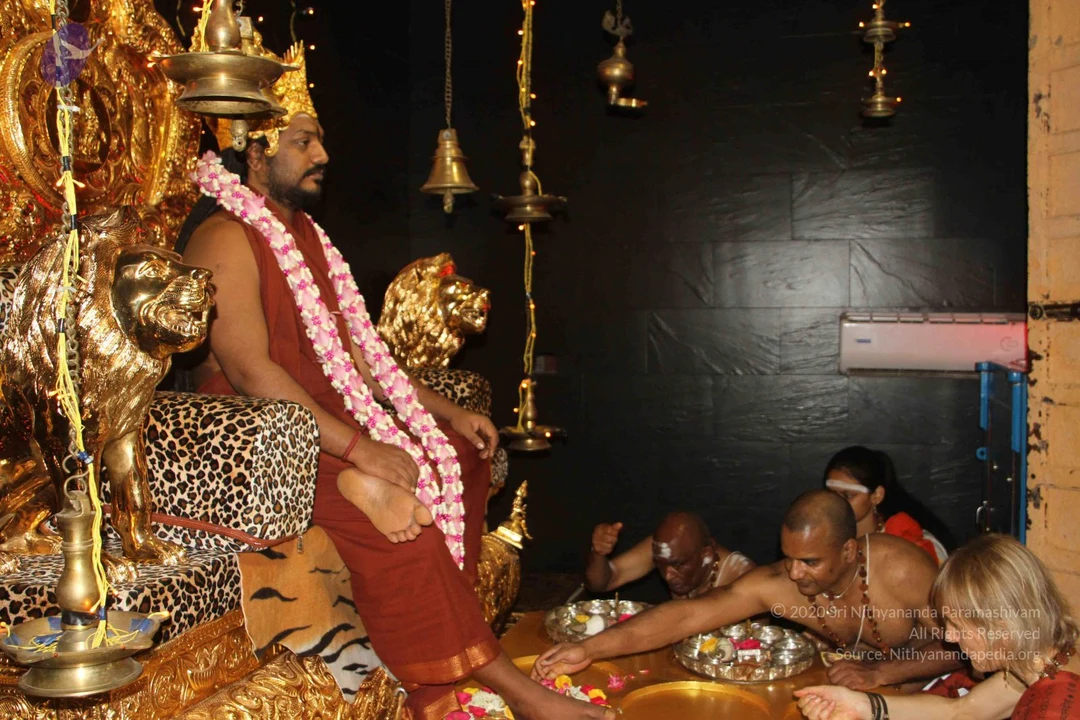
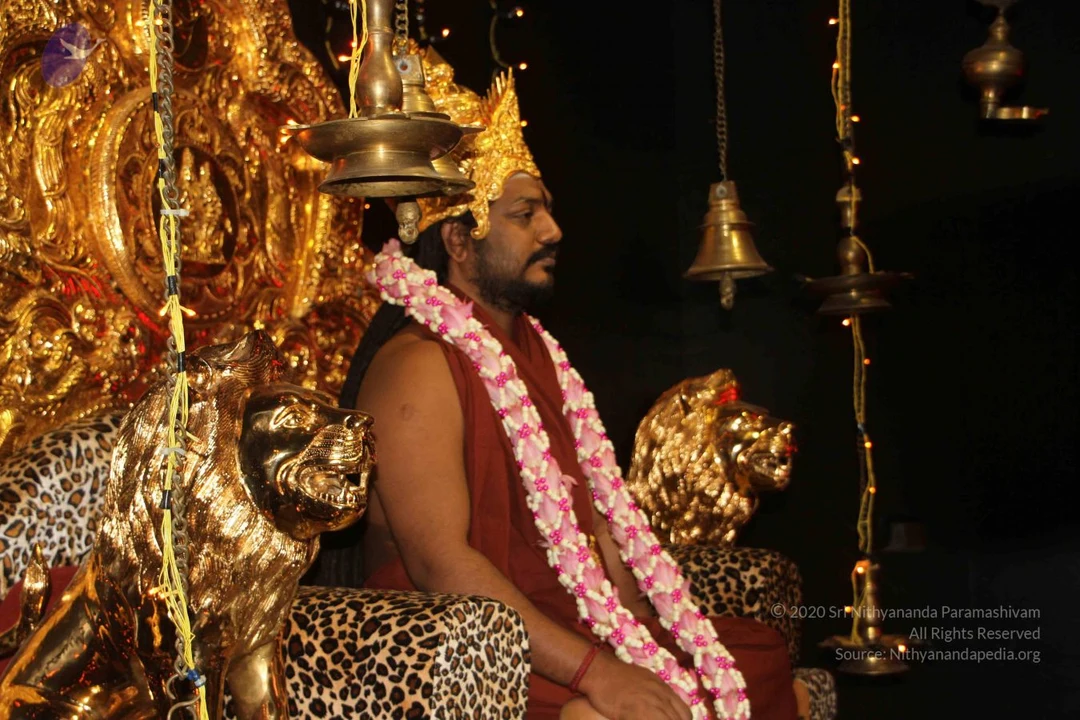
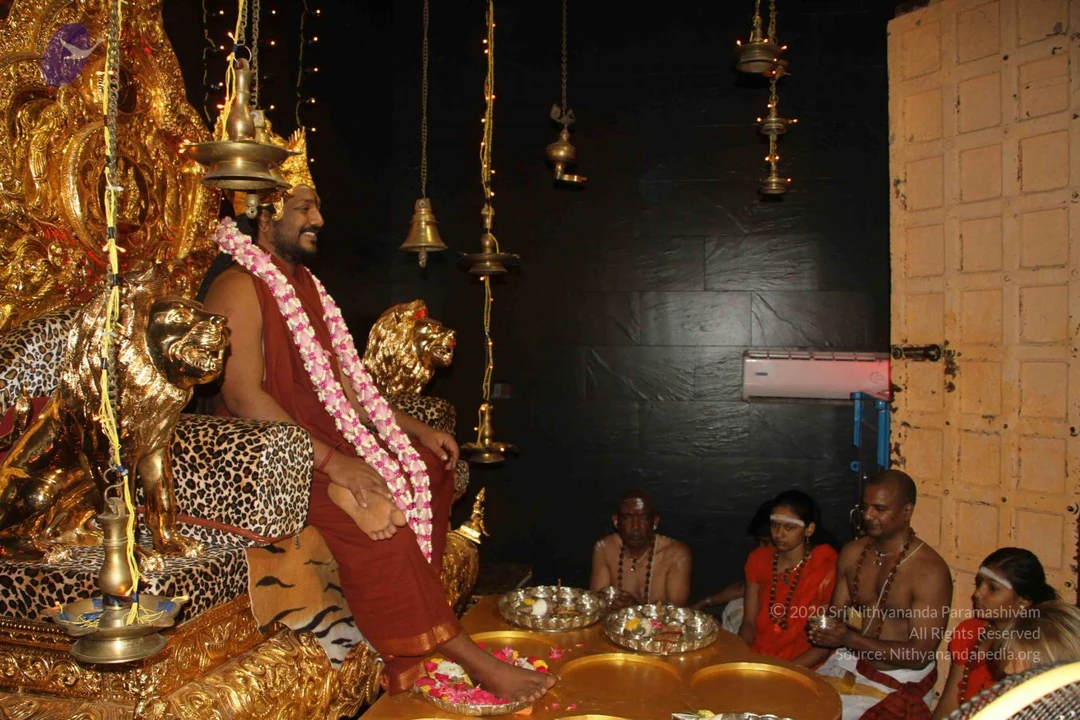
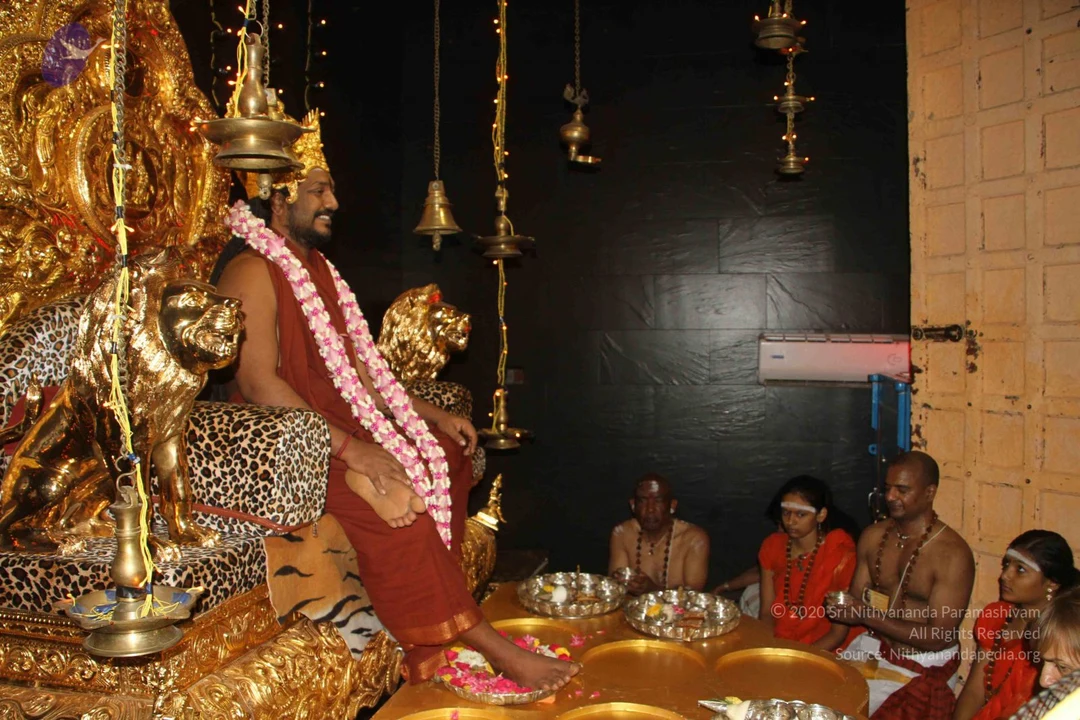
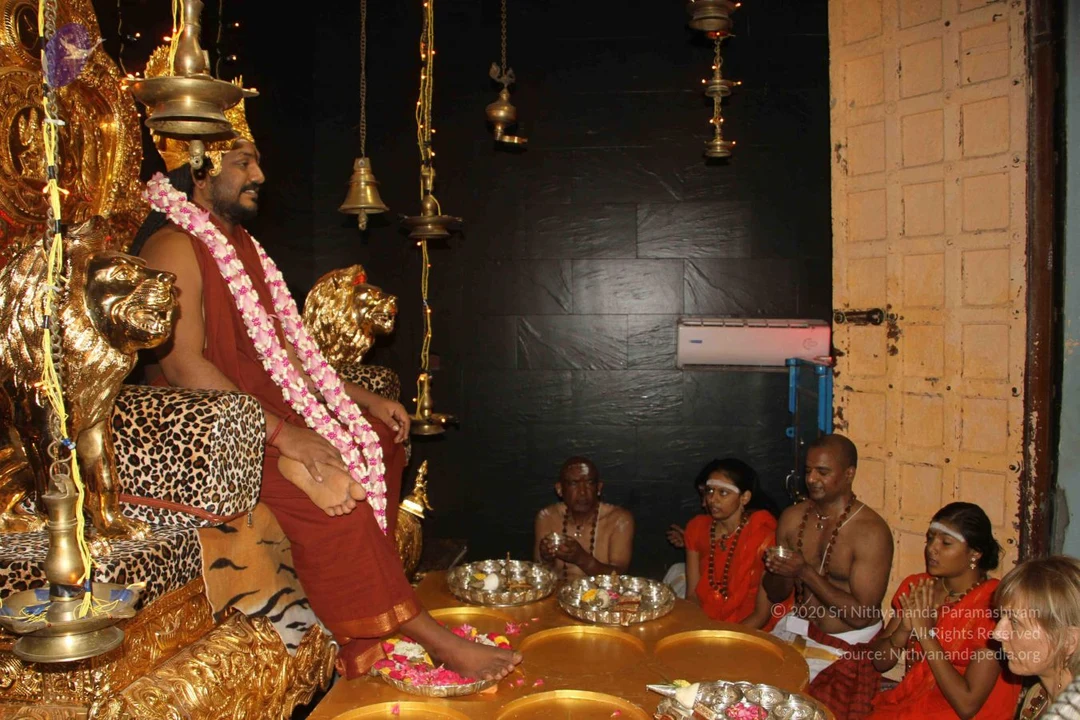
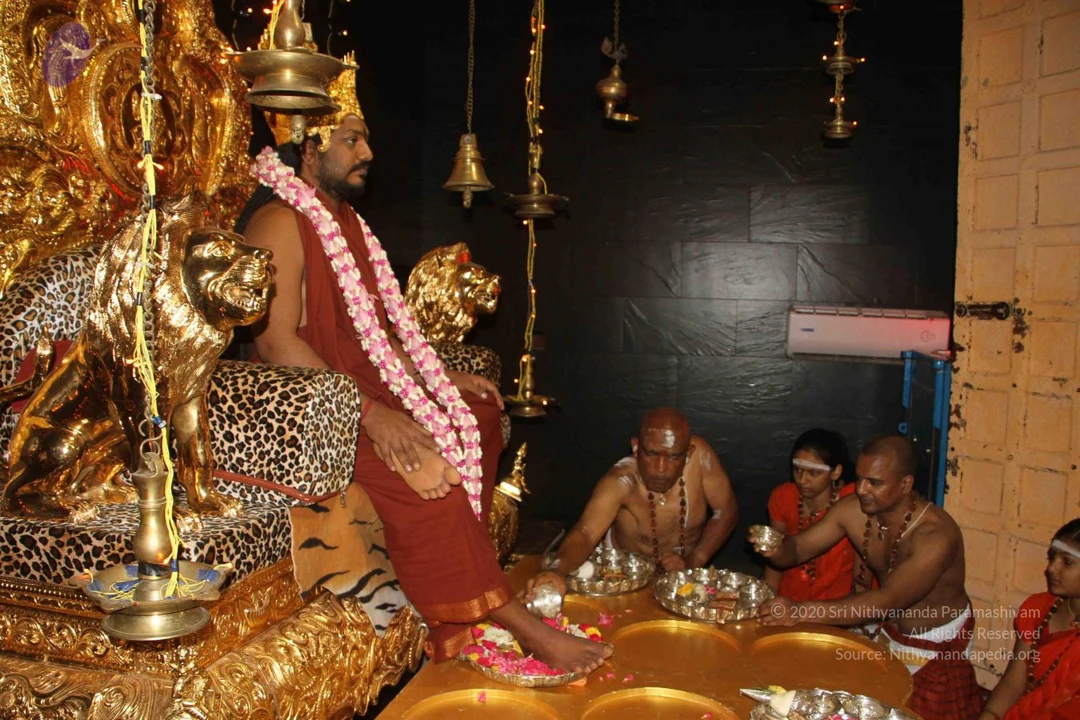
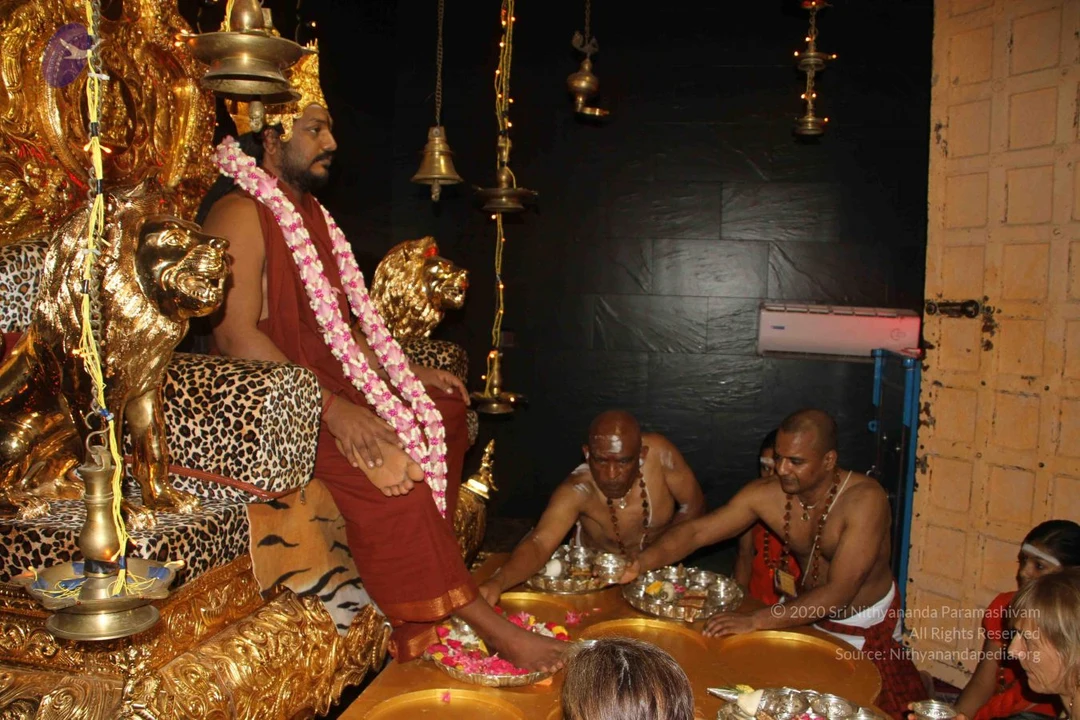
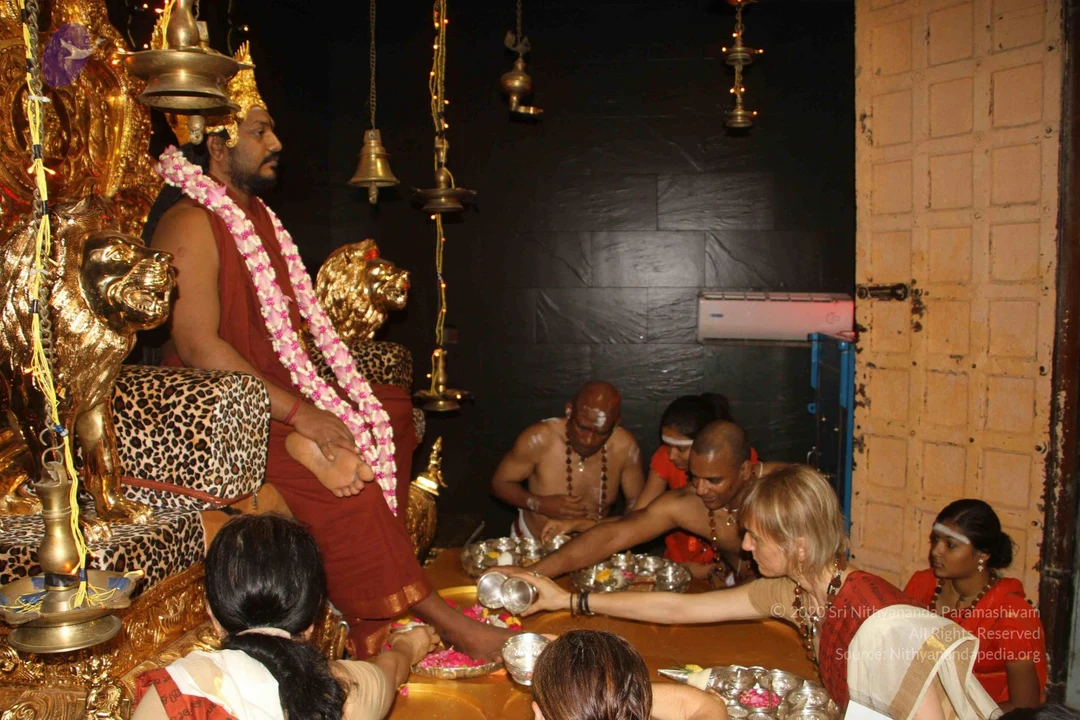
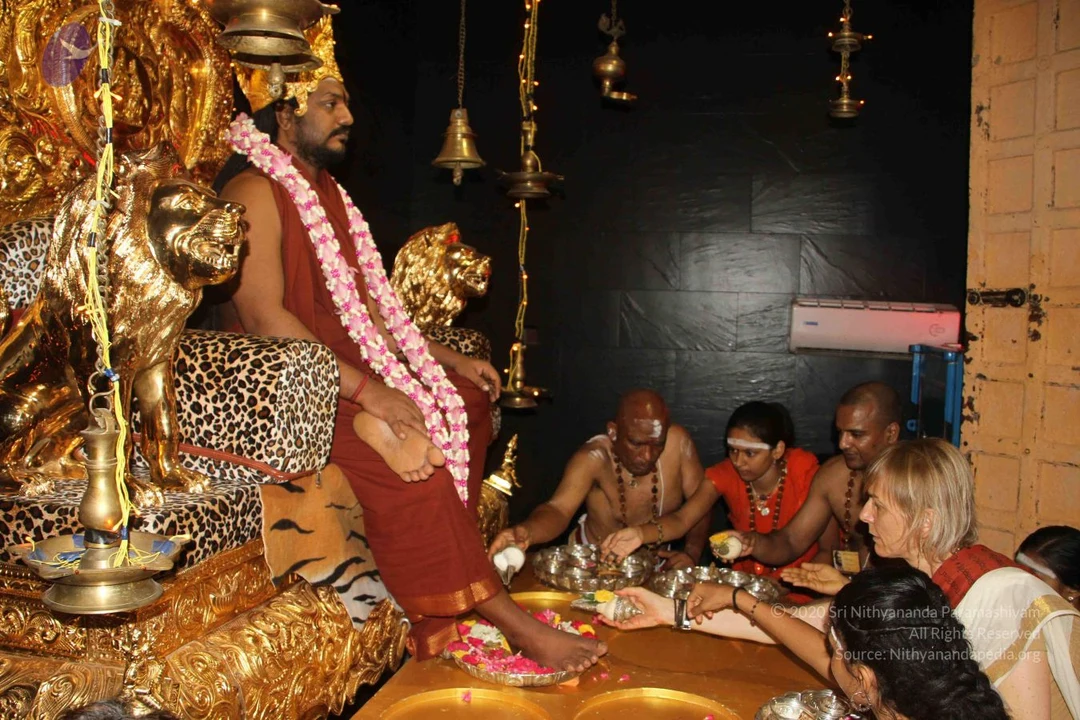
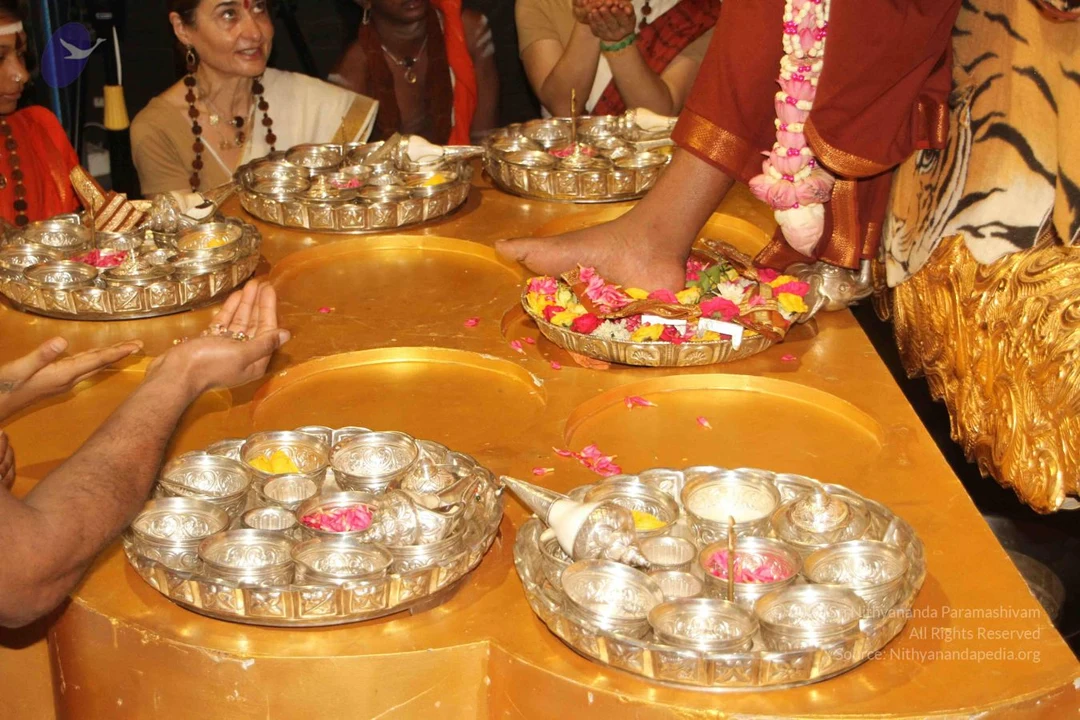
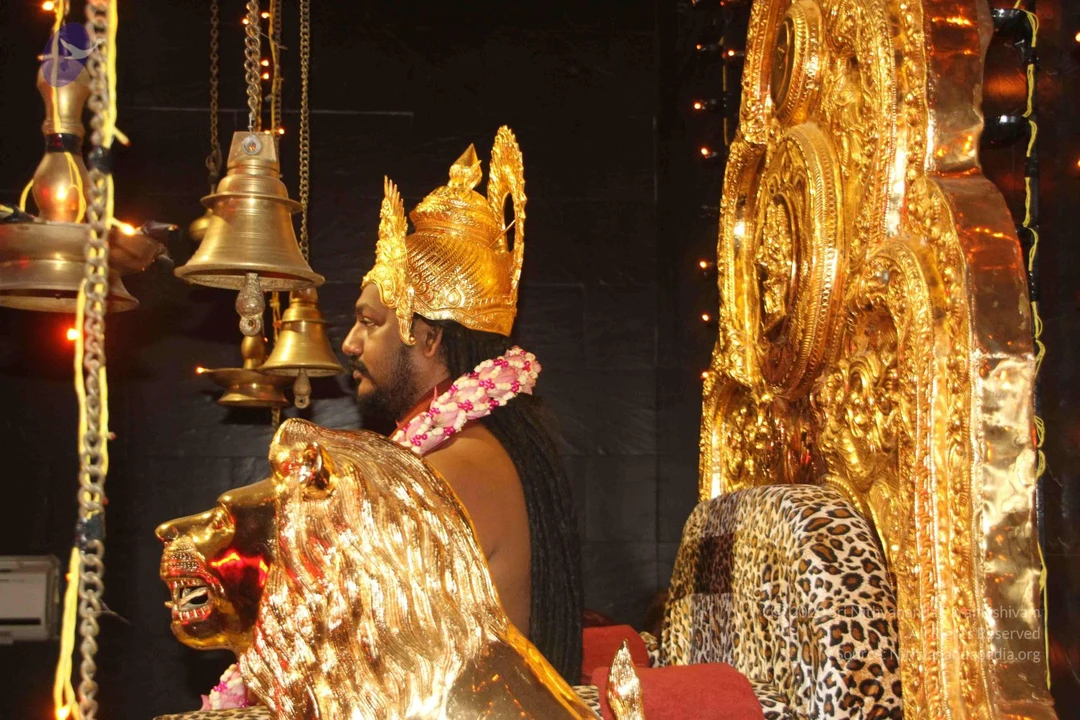
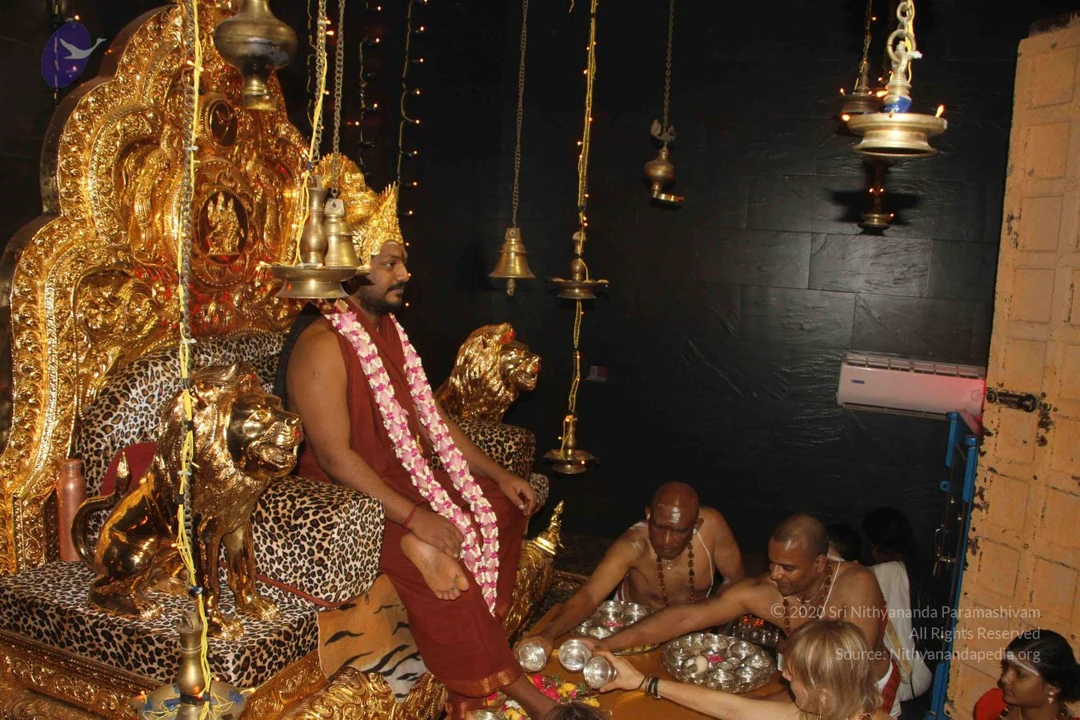
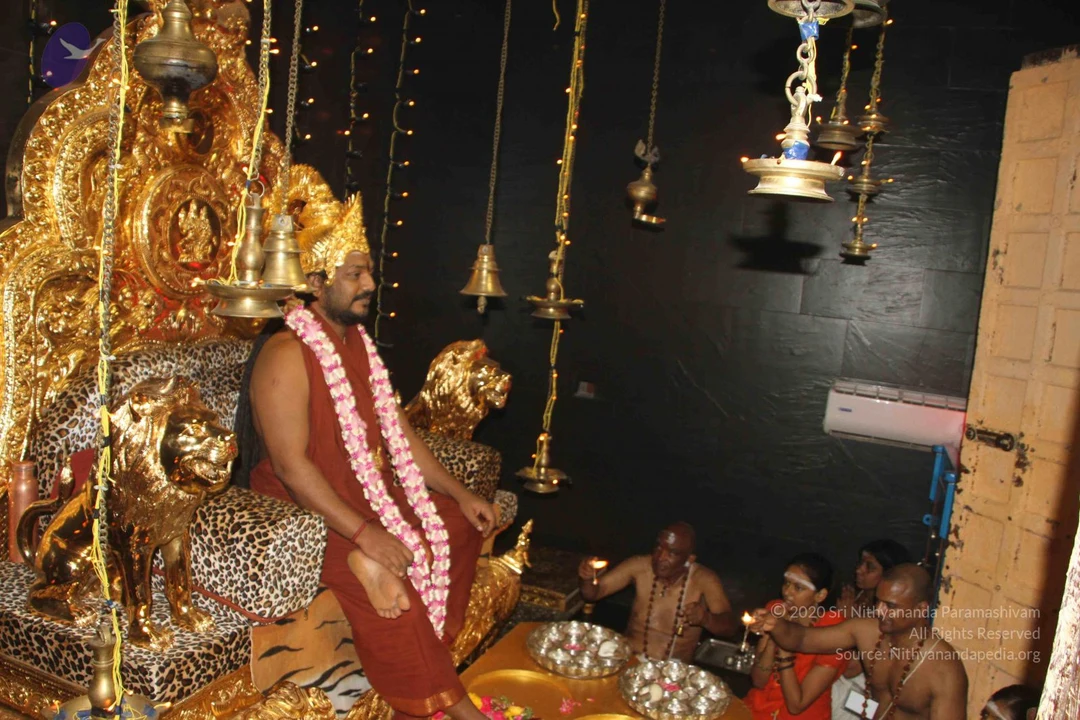
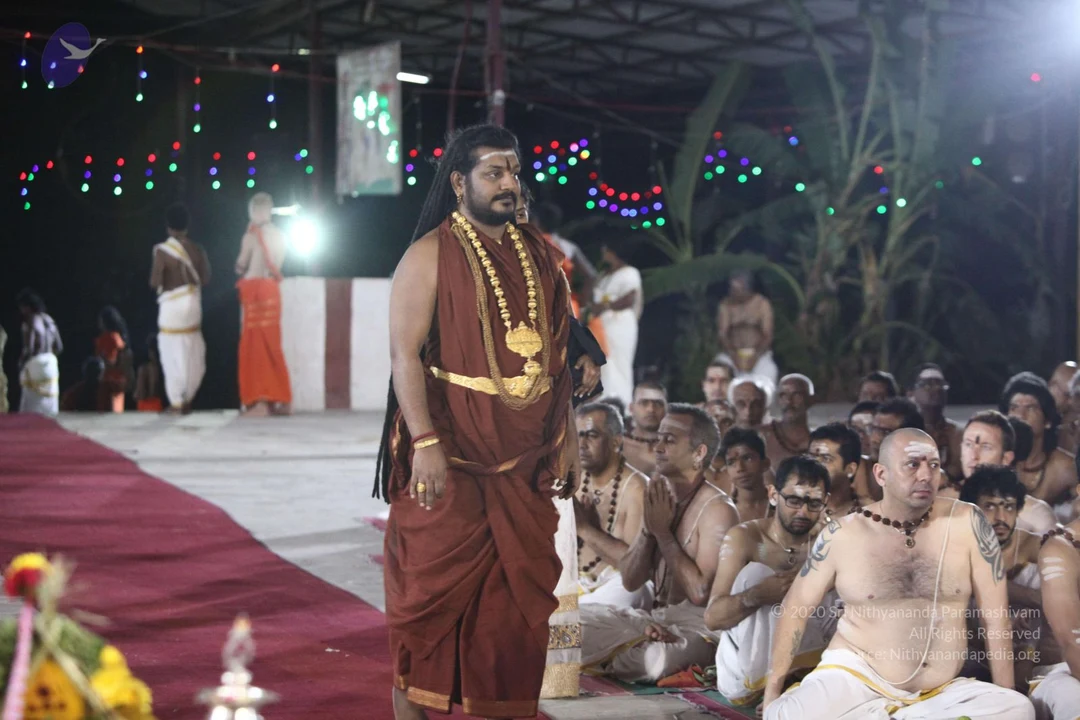
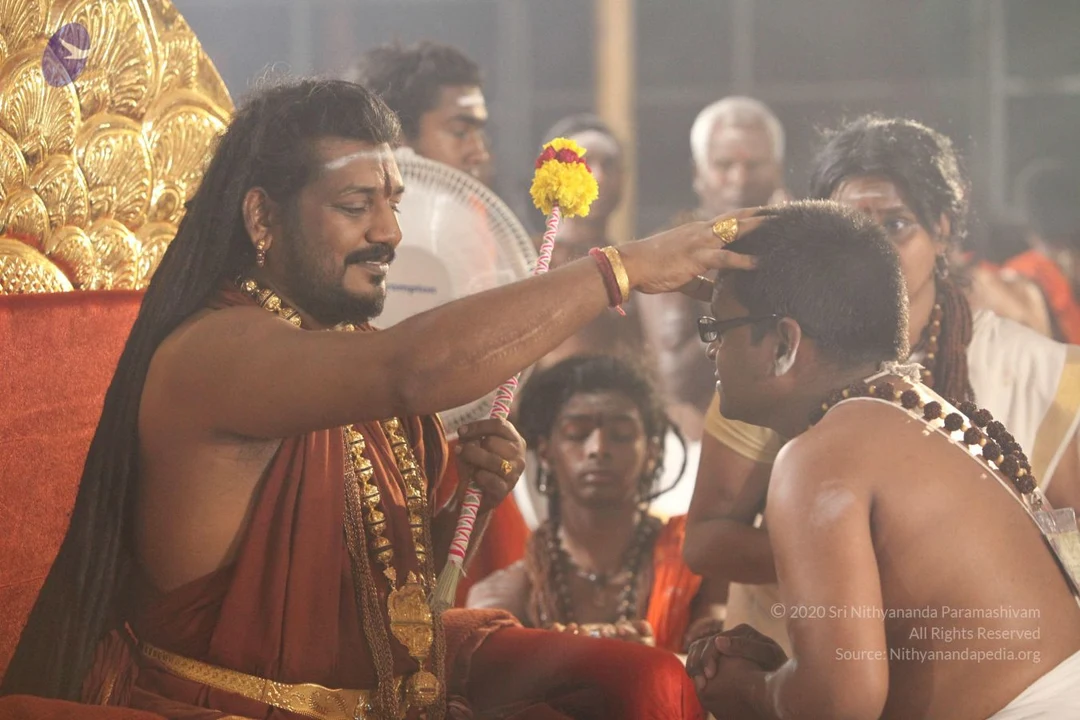
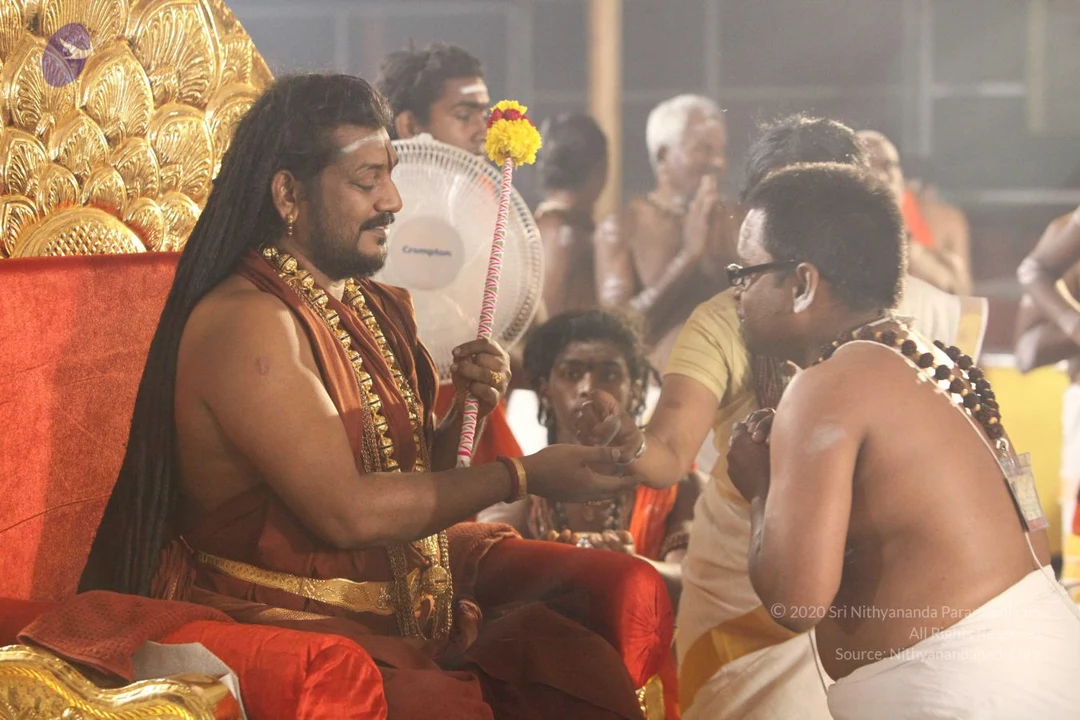
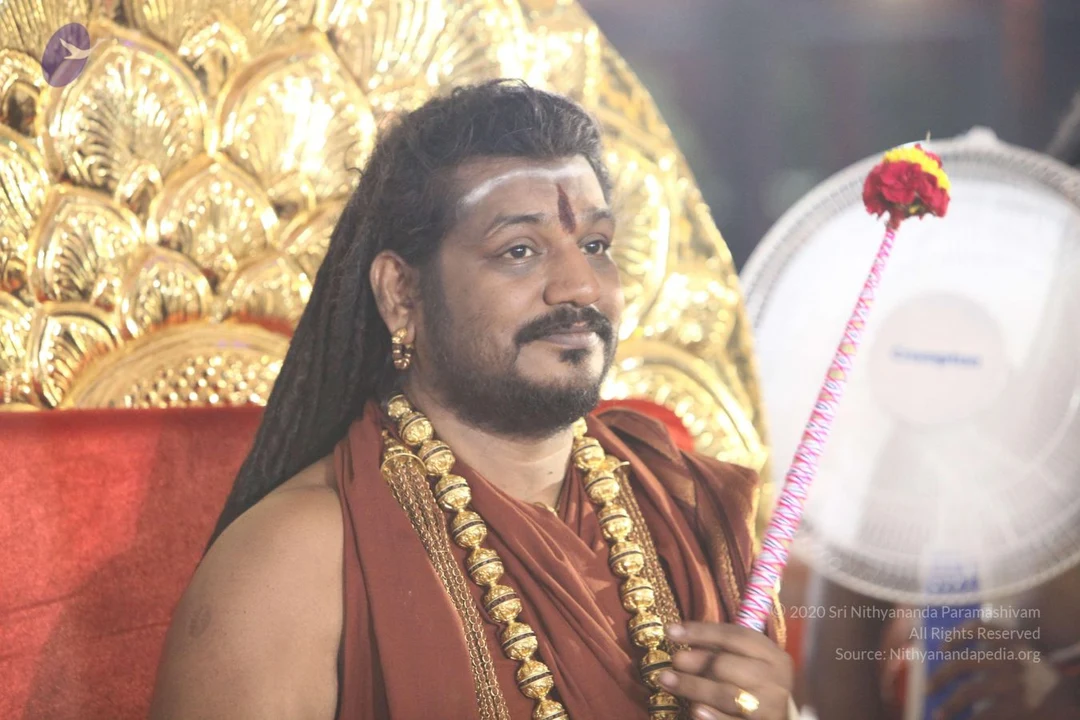
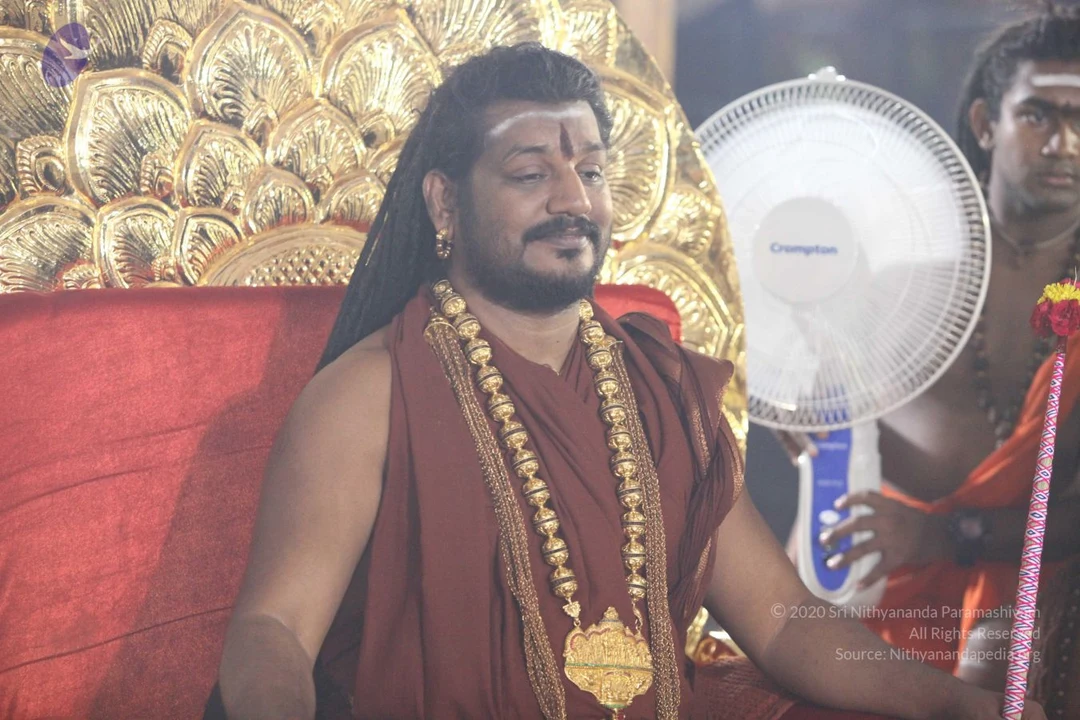
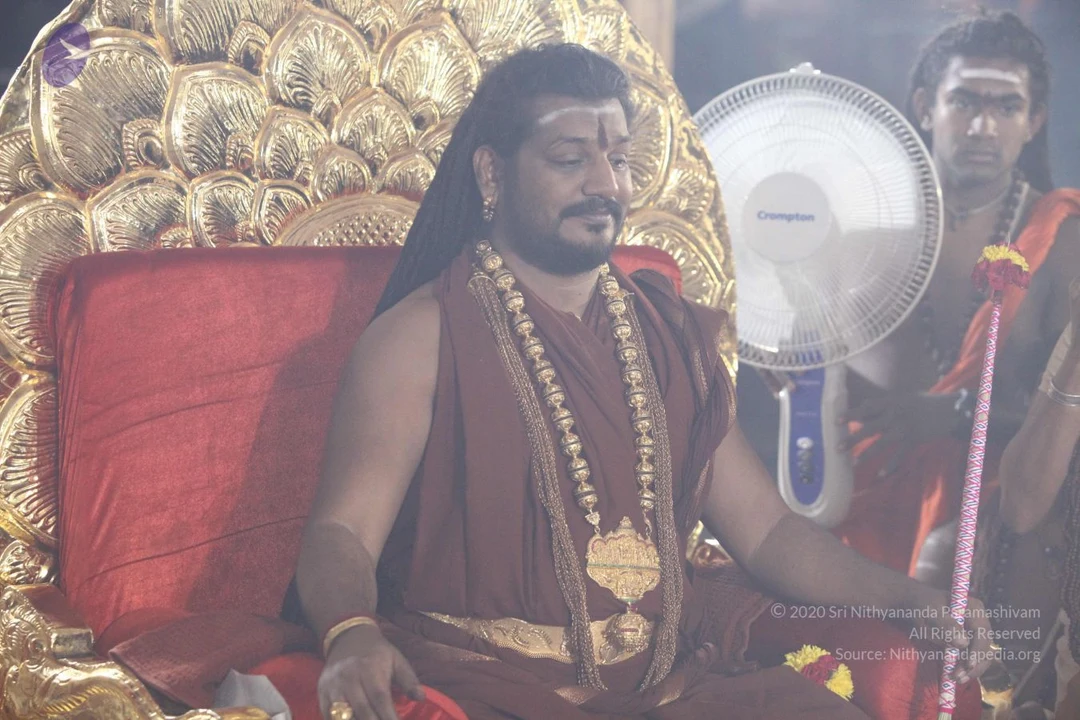
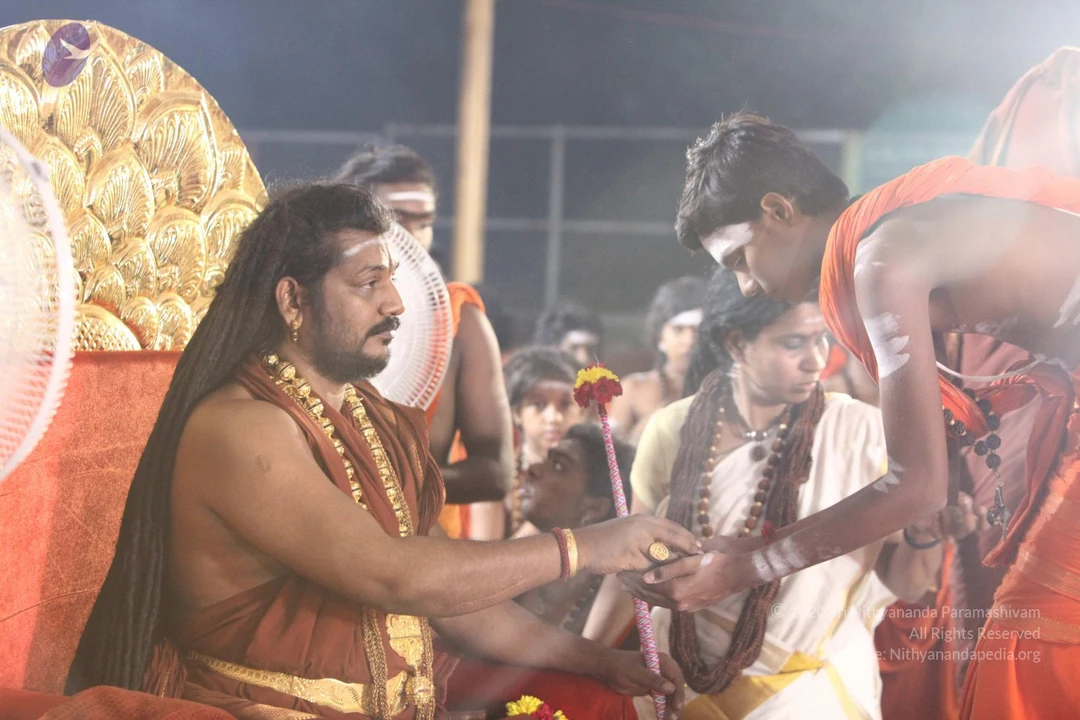
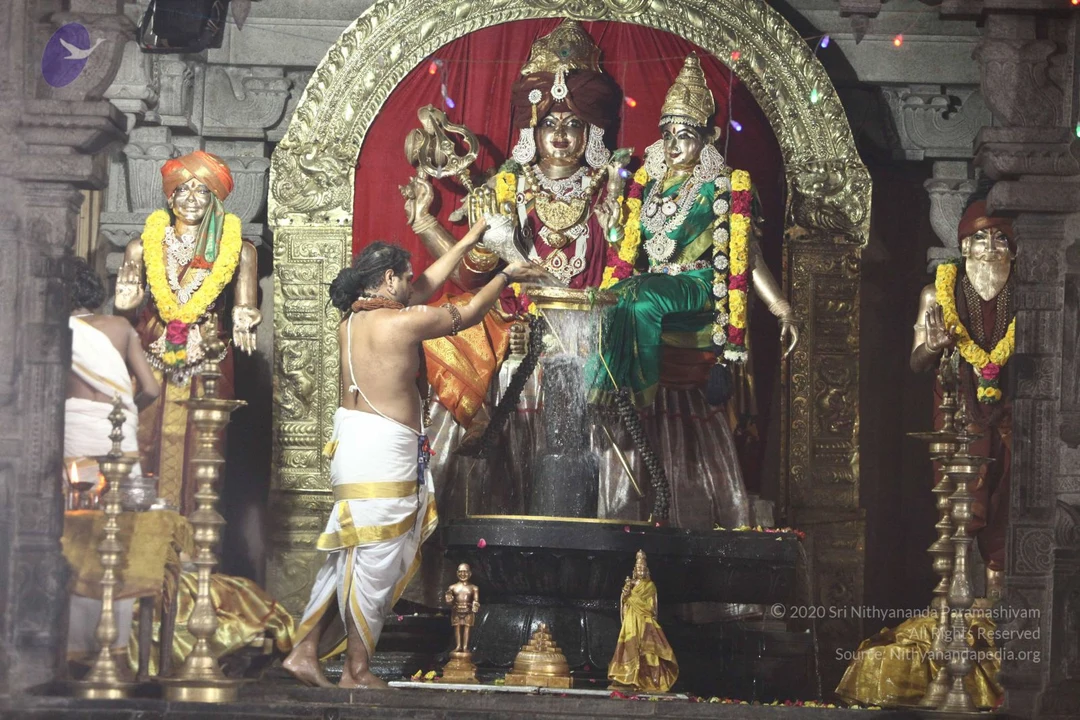
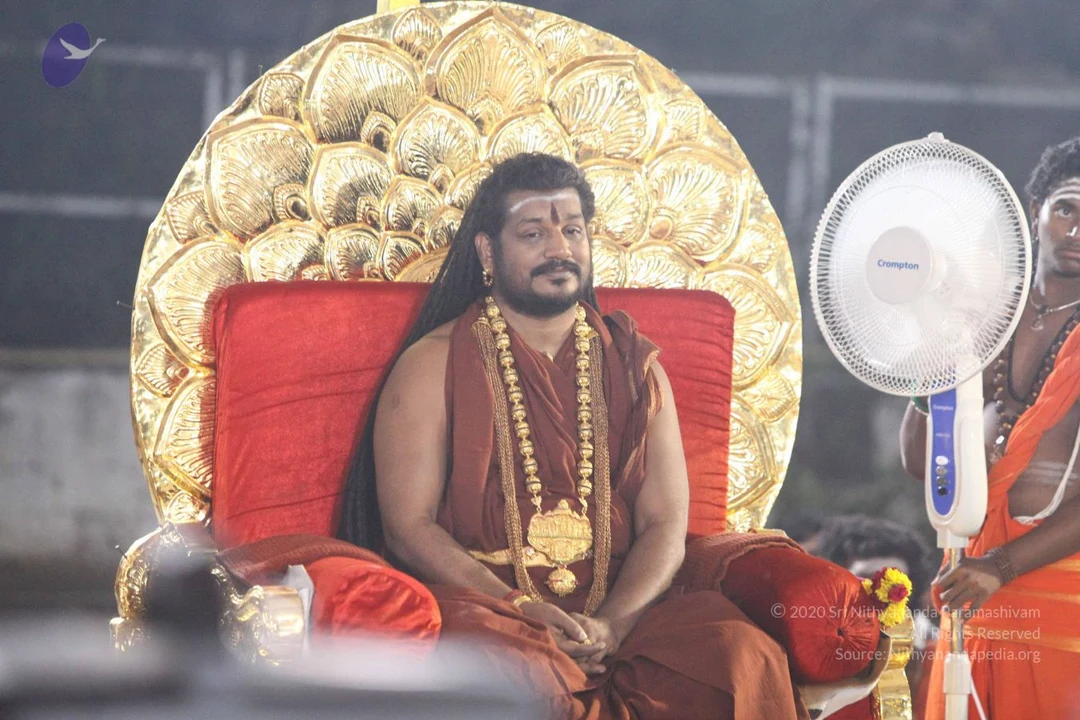
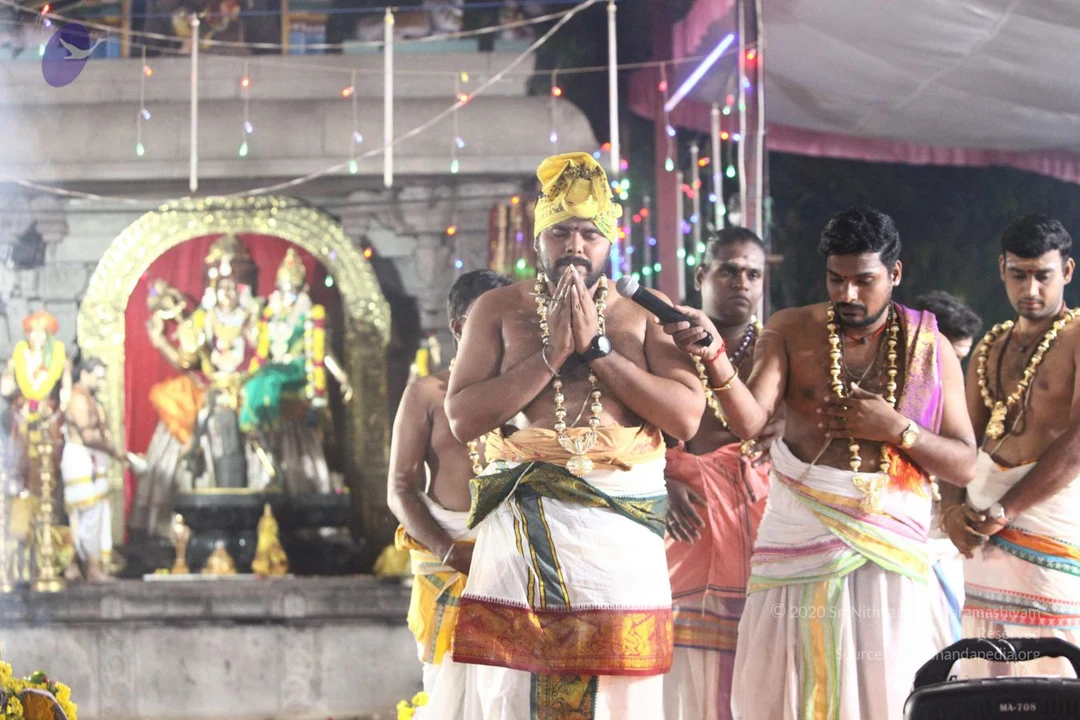
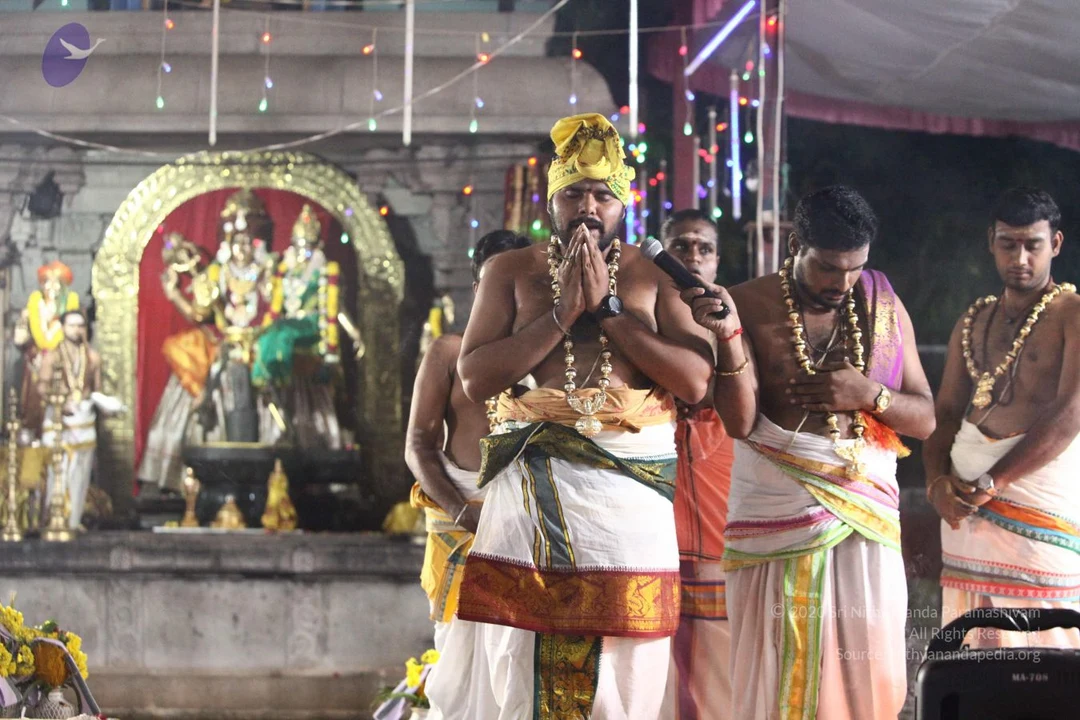
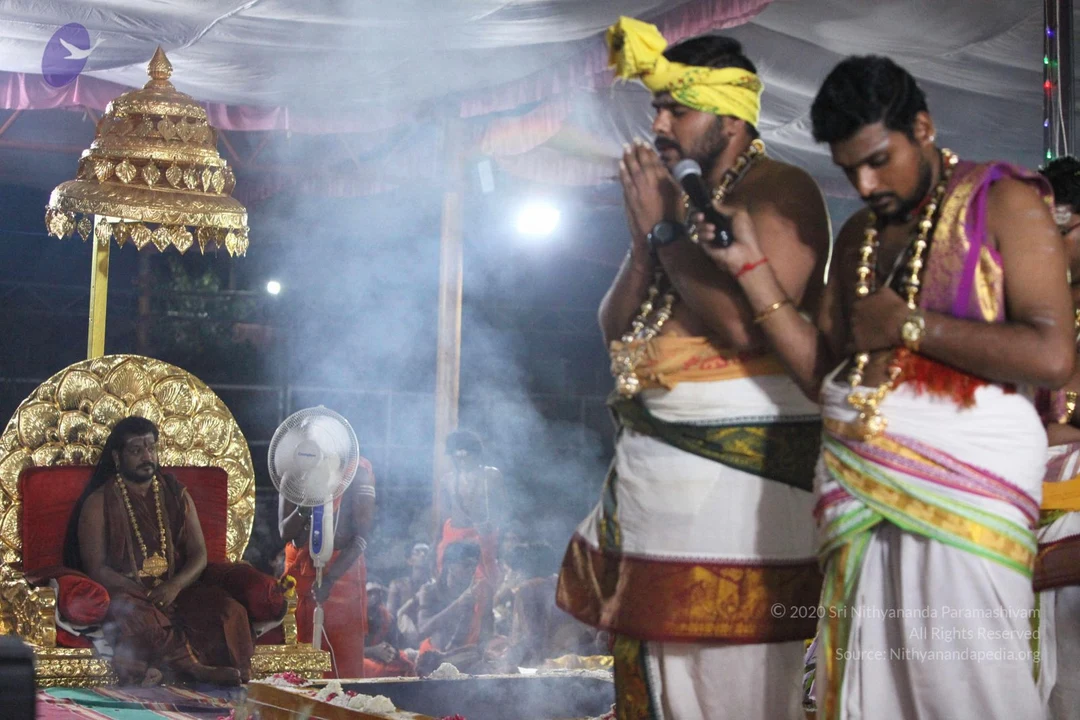
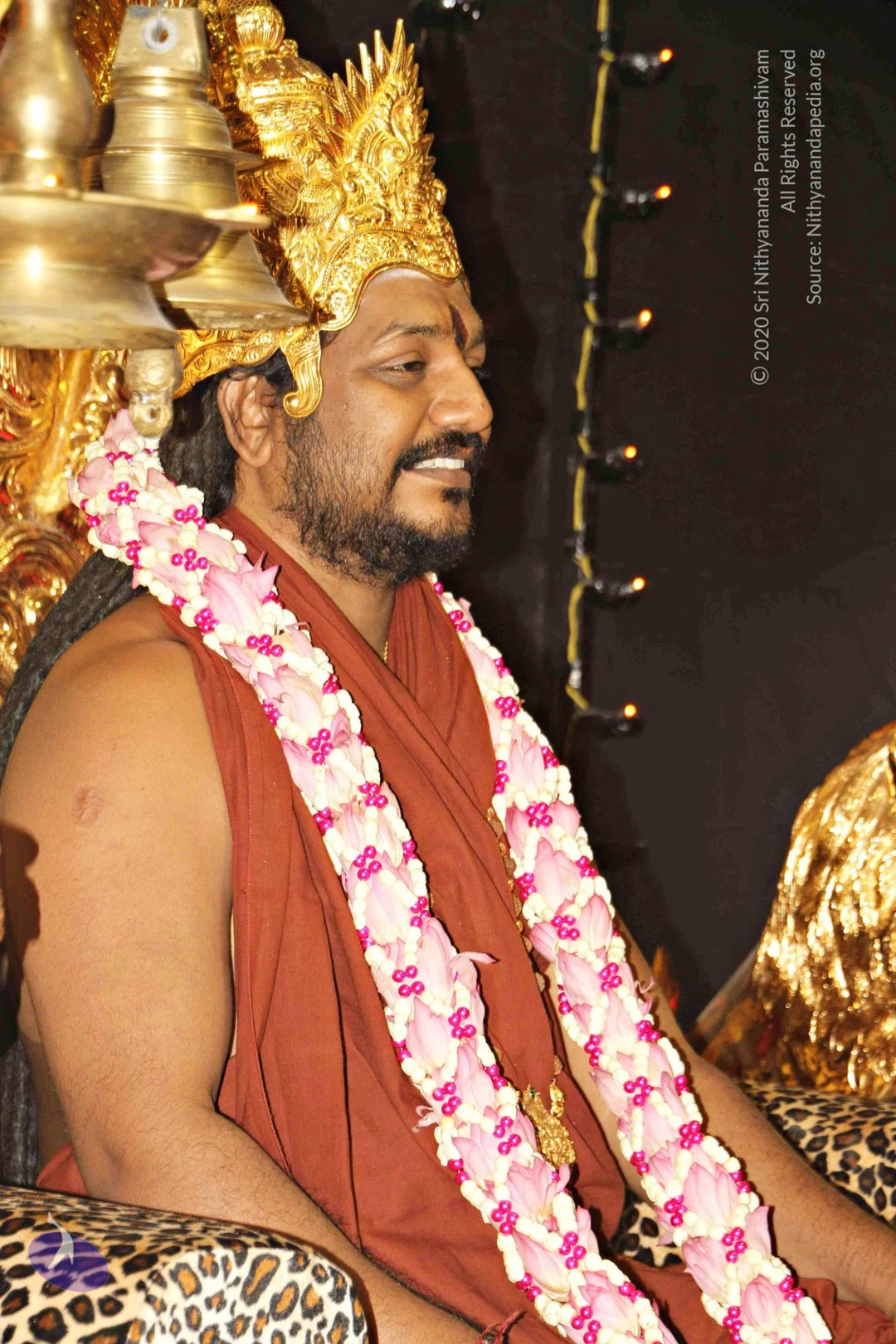
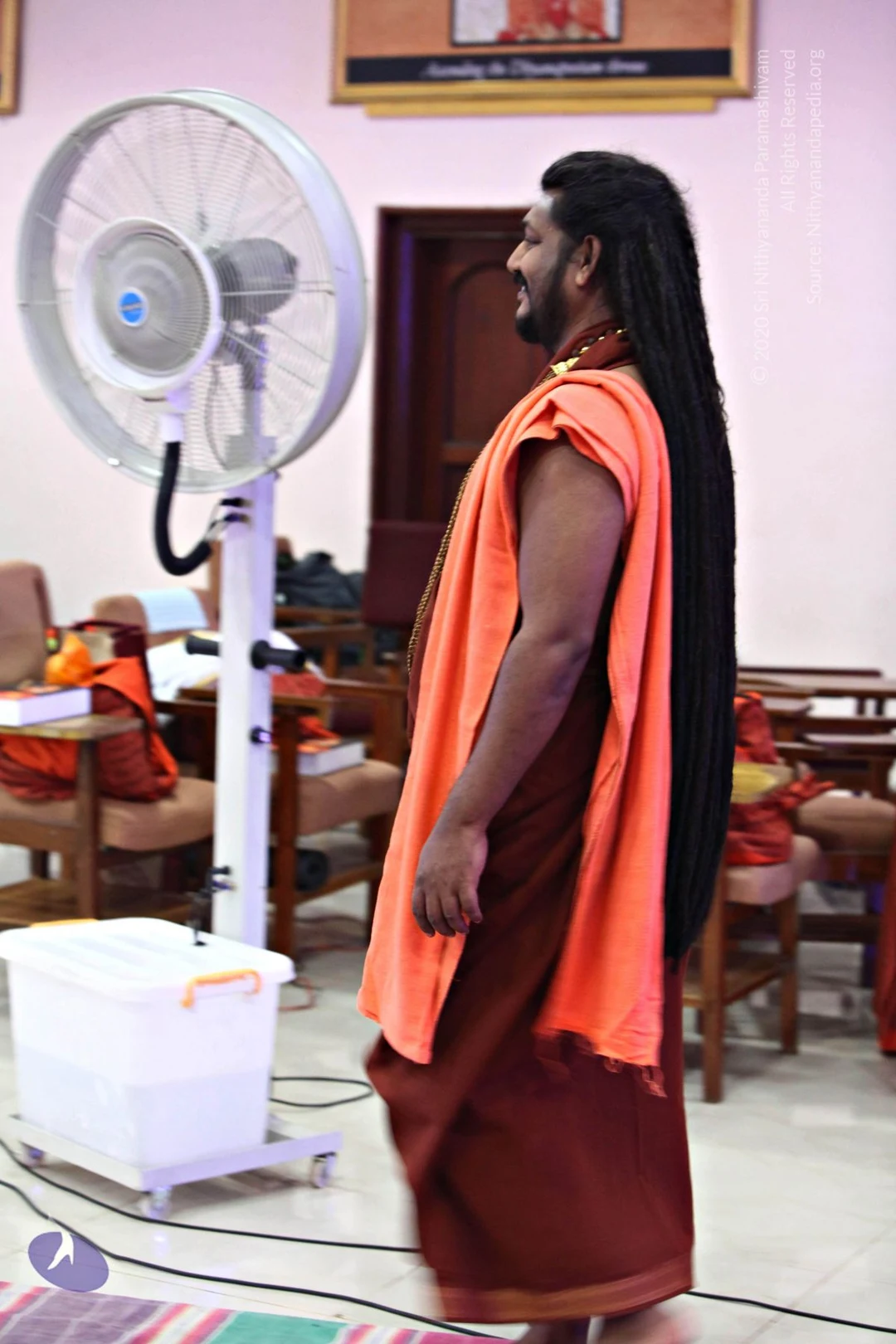
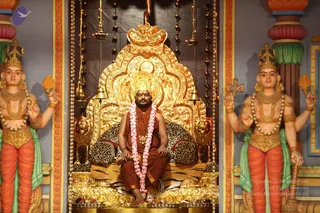
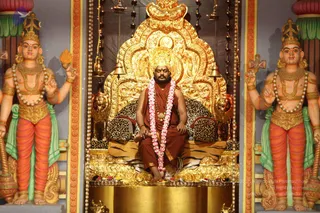
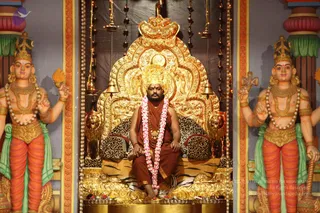
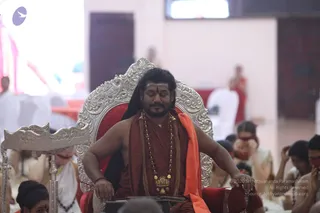
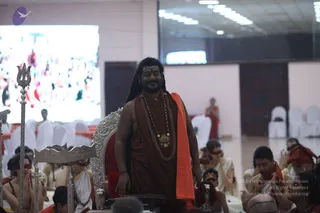
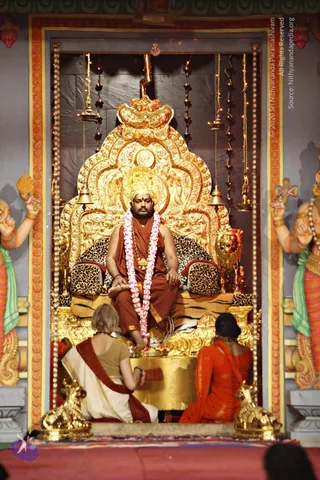
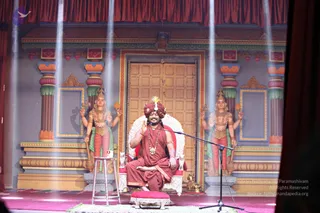
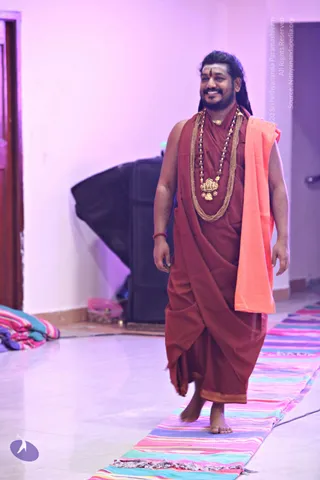
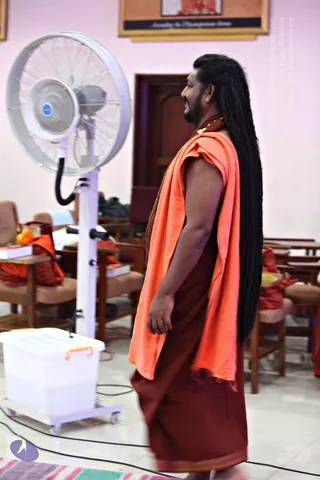
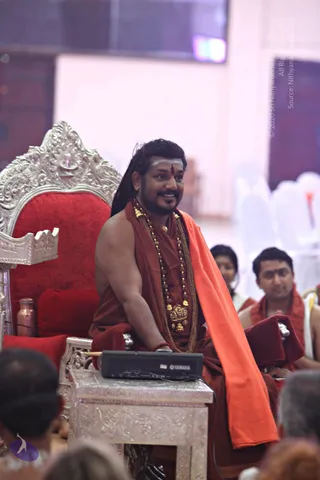
A seated man in a rust-red sannyasi robe sits centrally on an ornate gold throne with a leopard-print cushion and a tiger-skin draped over its base. A pink and white flower garland hangs around his neck, with a rudraksha-style mala and gold pendant visible. Behind the throne, gold bells hang from chains. Flanking the throne are two large painted guardian statues with multiple arms, gold crowns, gold jewellery and orange-red and green garments, holding ritual objects. Brass oil lamps and offerings sit at the base of the dais. The scene reads as a temple-style shrine setting.A man stands barefoot on a striped multicoloured runner in a pink-walled room, smiling and looking off to the side. He wears a rust-red draped garment, an orange shawl over one shoulder, and a long gold-beaded necklace with a gold pendant. His hair is long and swept back, and he has a white forehead mark with a red dot. A wooden panelled door and folded striped blankets are behind him, and a framed picture hangs on the wall above. a person is described by these appearance cues: long swept-back hair, orange shawl and ornate gold necklace, standing as the central figure.A seated group of devotees in a large hall performs a ritual with hands joined in anjali. In the foreground, two young men with shaved heads wear saffron-orange shawls over bare shoulders, rudraksha malas around their necks and wrists, and white ash lines marked on their faces and arms. Beside them a bare-chested man in a rudraksha mala and a bead bracelet presses his palms together. Behind them many other participants sit in white dhotis and white and red garments, some with white paste on their foreheads, with oil lamps and brass vessels on the floor. No individual in the frame is clearly identifiable as a person, and the scene shows a group puja or satsang setting.

August 02 2017

Original wiki page
Contents

Title

The Life And Beings In Kailasa Sadashiva Abode

Narration

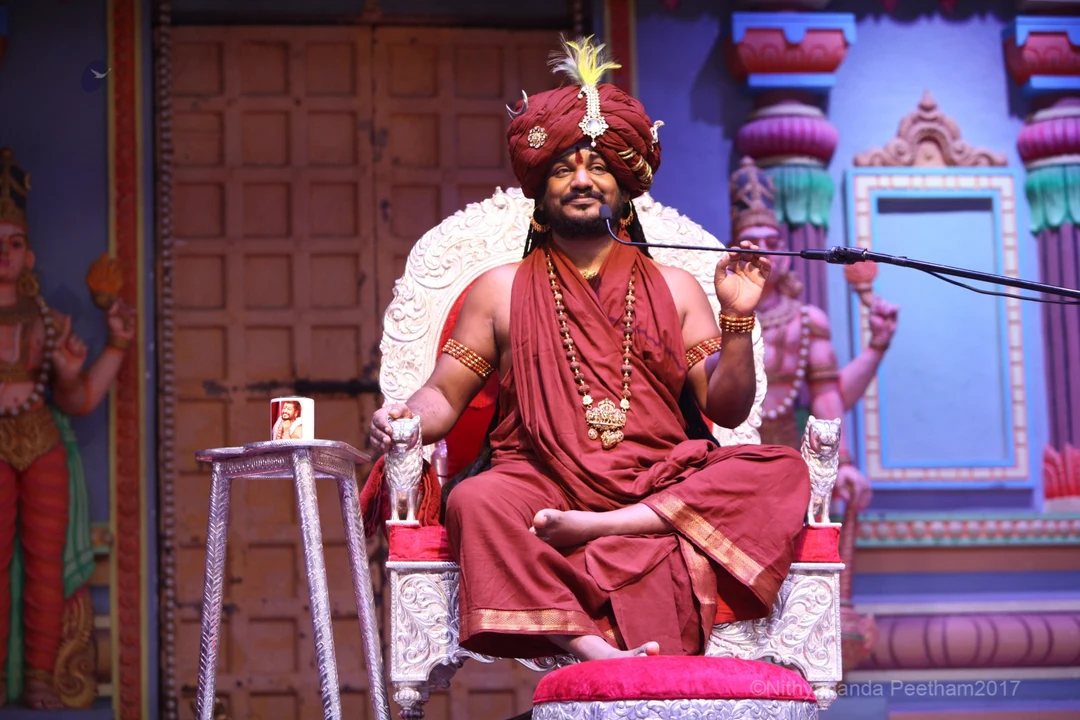
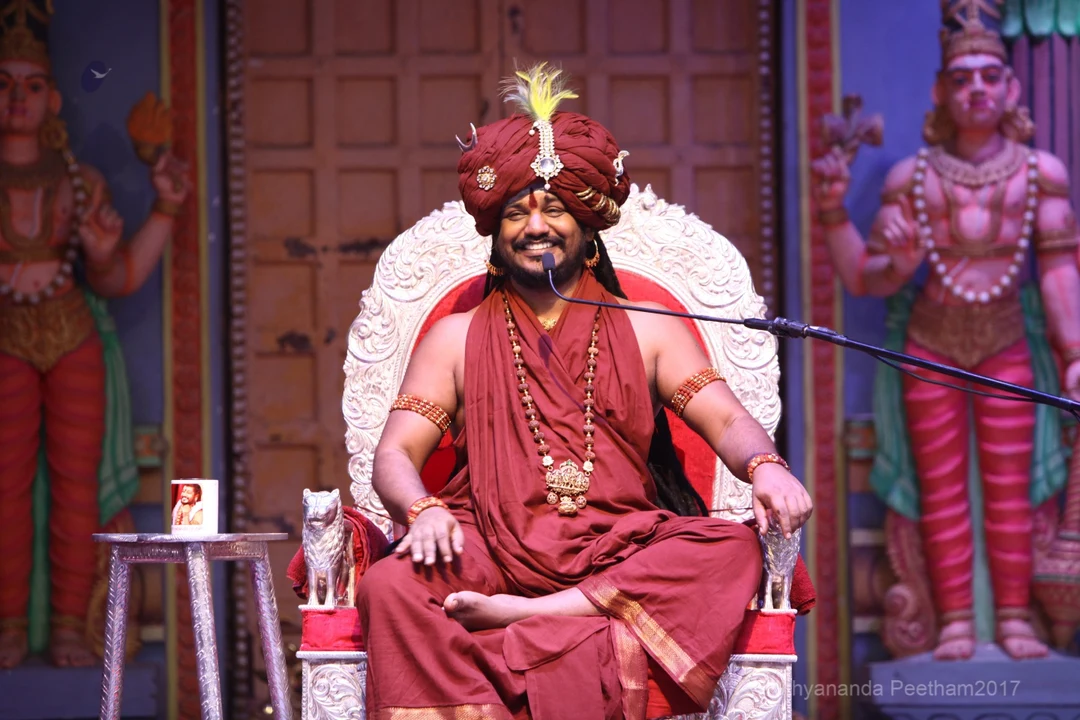
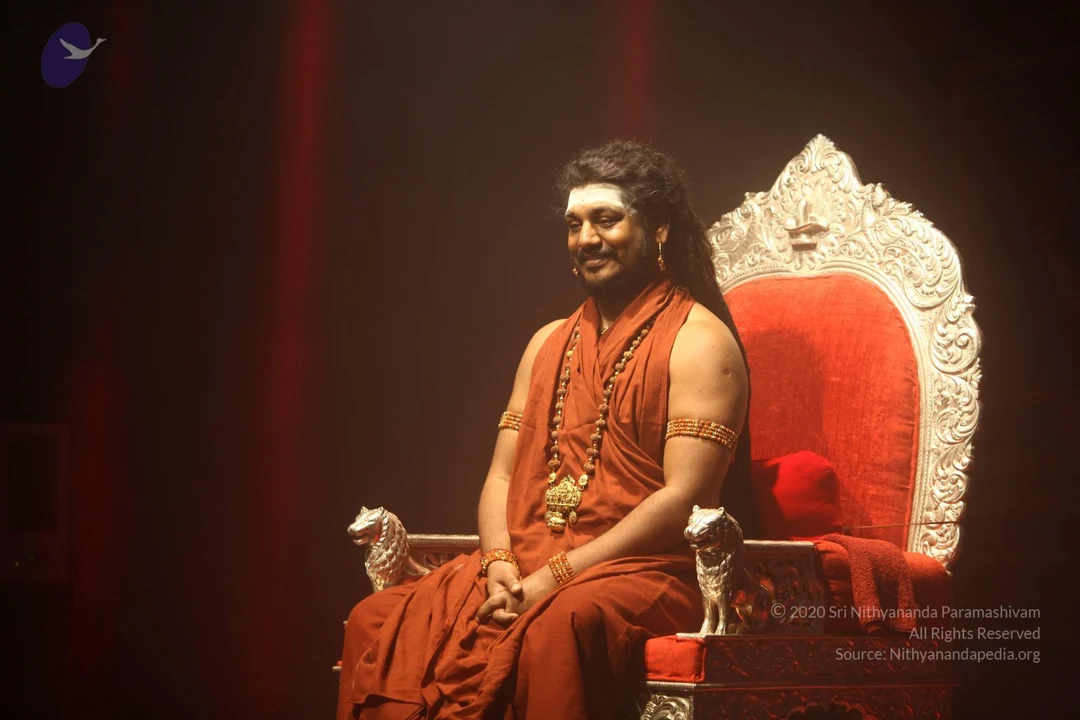
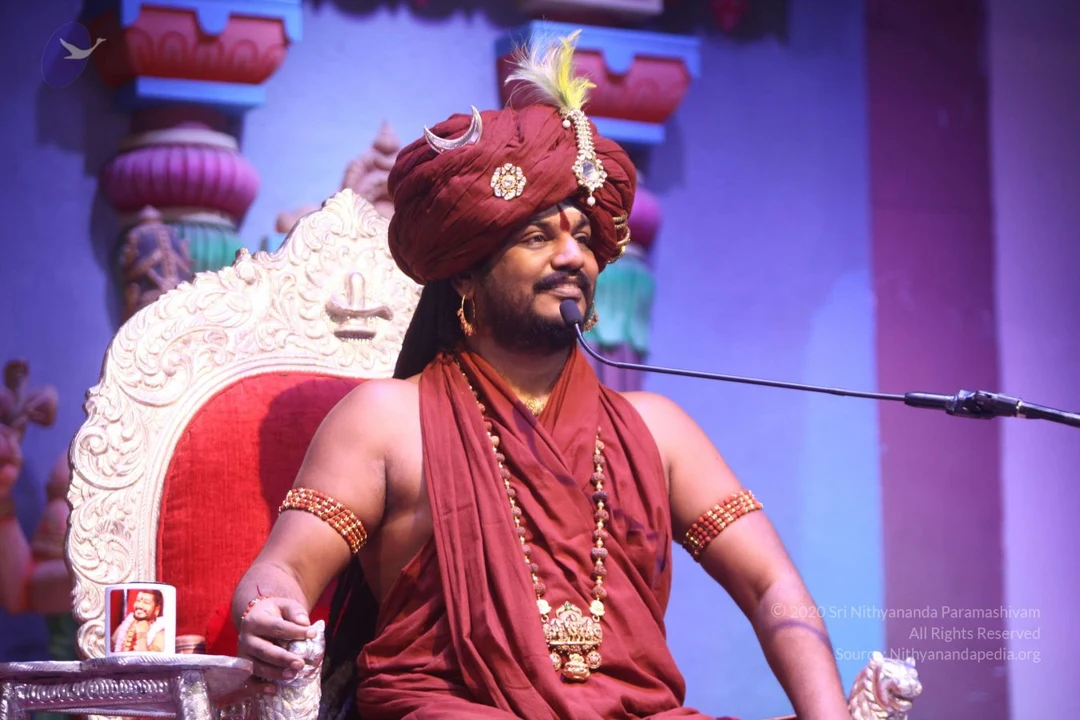
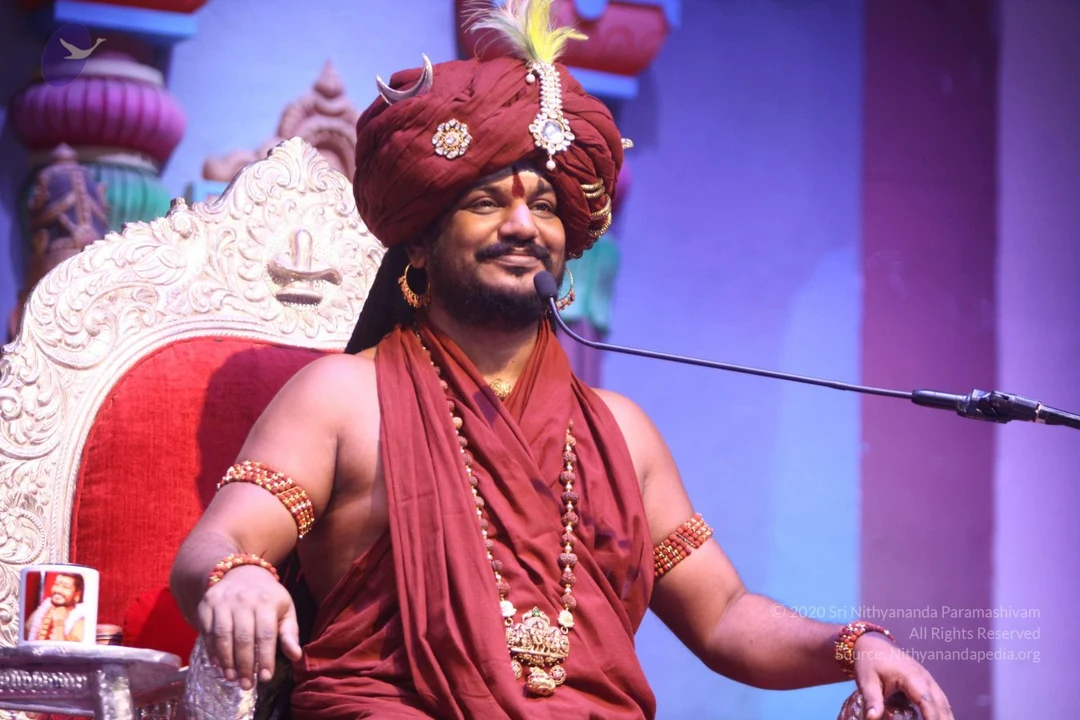
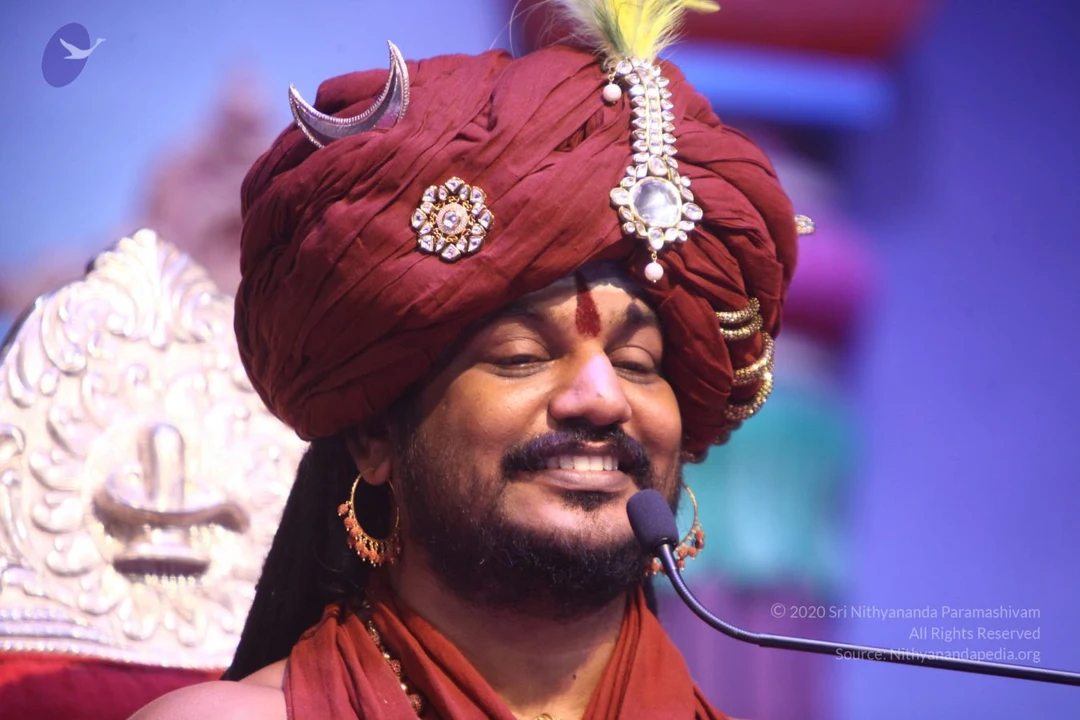
Today is Day 9 of Inner Awakening. In today's Live Satsang, Supreme Pontiff of Hinduism HDH Bhagvan Sri Nithyananda Paramashivam continues to expand on the Adheenam Chalo series. He speaks on what it takes to be an adheenavasi in the Kailasa. When it comes to Kailasa, absolute integrity is not enough, you need to be engaged with responsibility of enriching.

Video

The Life And Beings In Kailasa Sadashiva Abode

VideoAudio

Transcript

(0:09)

nithyānandeśvara sadāshiva samārambhām

nithyānandeśvari adīshakti madhyamām |

asmat āchārya paryantām vande guru paramparām ||

(0:45)

I welcome all of you with My love and respects. I welcome all the Devotees, Disciples, Samajis, Satsangis, Sri Mahants, Mahants, Thanedar, Kotharis, Devotees, Disciples, Visitors, Viewers, YouTube Subscribers and everyone sitting with us through Nithyananda TV and Facebook Live and 100s of Aadheenavasis channels, YouTube Live and through 2-way Video Conferencing, having Nayana Deeksha all over the world. Cities sitting with us in 2-way Video Conferencing, long list….so I welcome all of you with My love and respects.

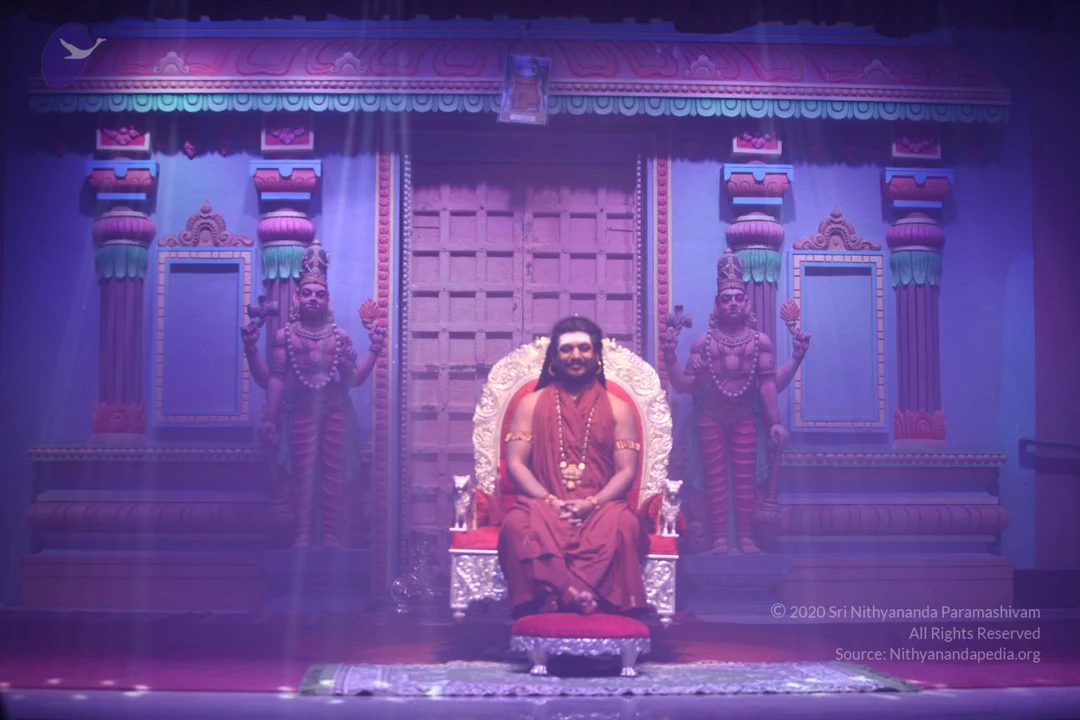
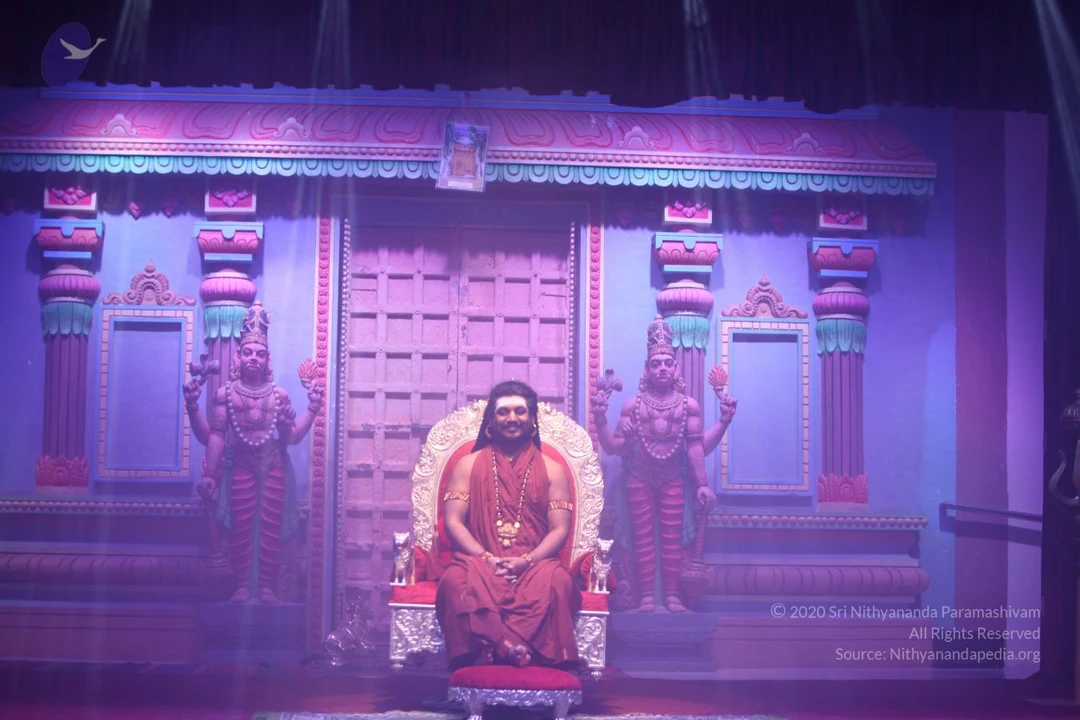
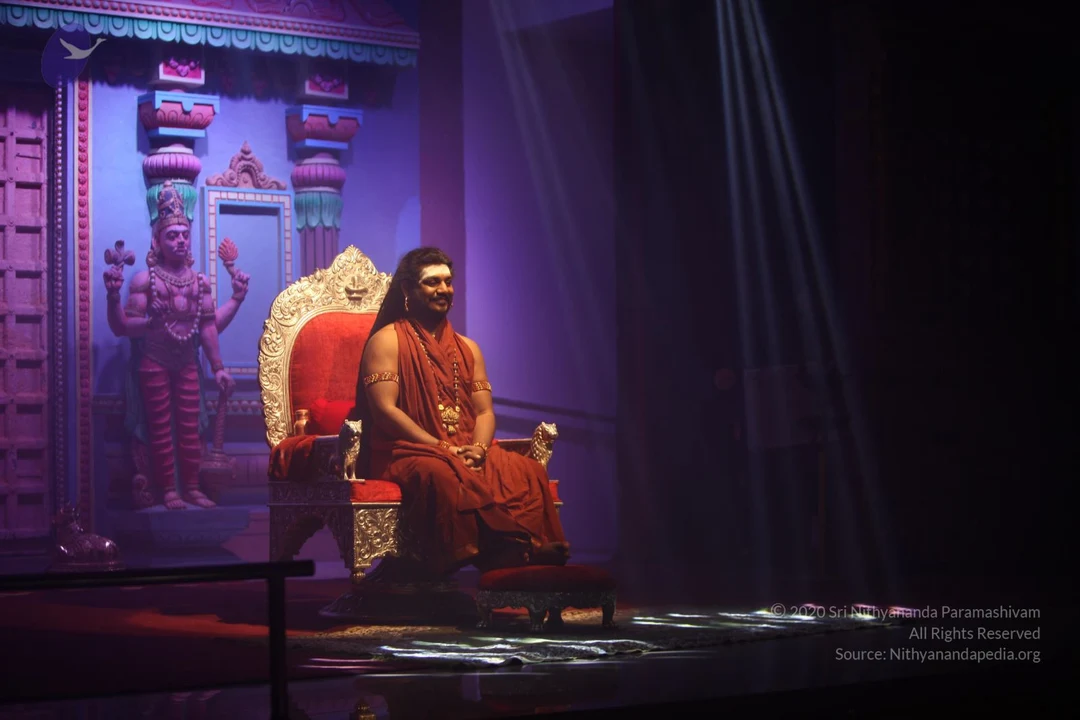
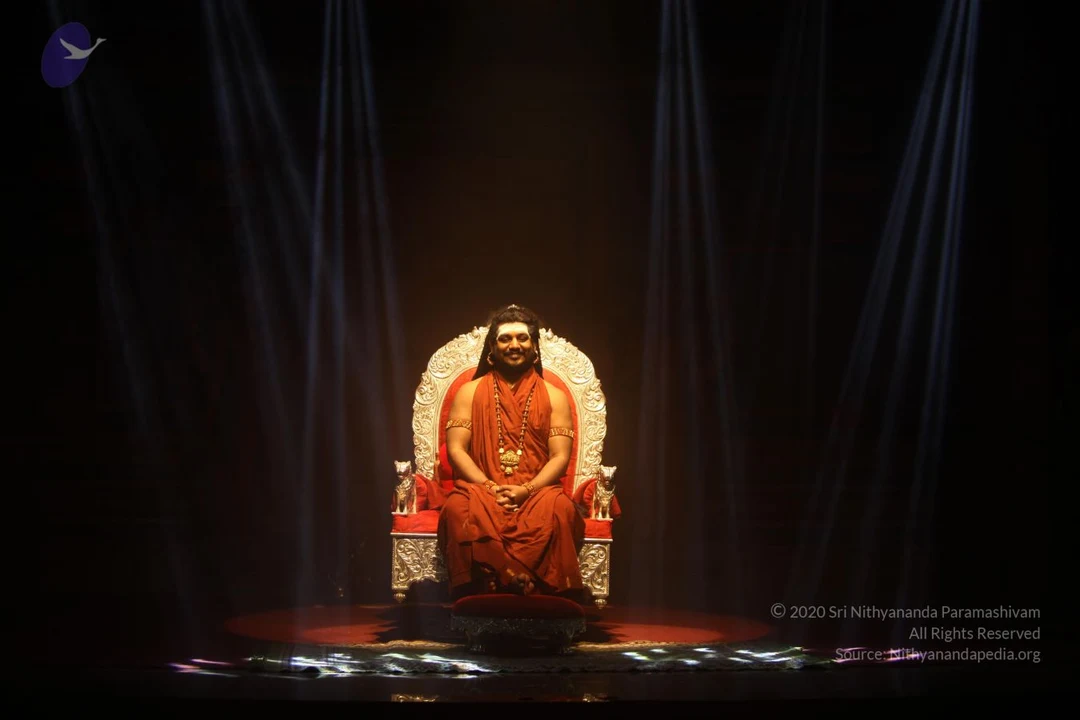
Actually, I am working on a project. Soon, very soon, you will all see Me in 3D in your branch Aadheenams, Ashrams. All the branch Aadheenams, Temples, Universities, Ashrams can see Me in 3 Dimension, using the modern technology. Many things need to be put together. I will continue to expand on ‘Aadheenam Chalo Series’.

(2:12)

Understand. There is a beautiful verse in Bhagavad Gita which is very important… for all the Aadheenavasis; not only to become Aadheenavasis, how to continue - to be. Listen very carefully… not only becoming, how to continue to be. In any Loka, in any space, there will only be two reasons for you to be there.

One - Either you are too integrated to that space – like if you are too integrated to Sadāshiva, you will be in Kailasa. If you are too integrated to Vishnu, you will be in Vaikunta. If you too integrated to Devendra, you will be in Deva Loka. To whichever space, if you are too integrated, you will be there; either absolute integrity to that space or you are engaged with that space.

Understand. When it comes to Kailasa, absolute integrity is not enough, you need to be engaged. With Deva Loka, integrity is more than enough, you don’t need to be engaged. If you are just…. follow whatever Indra says or just jin jil - jin jil for Indra that is enough. Means, if you just praise Indra, if you just fan Indra, or if you just put flowers wherever he is walking, that’s enough. Actually, you don’t even need to be much integrated to Indra. Behind the back, you can plan to dethrone Indra and you can get into the seat. There is nothing to be engaged, there is not much going on in Deva Loka. But Kailasa is not that. Kailasa is a place, where you are continuously expanding, you’ll be on deputation to Tapo Loka, Bhu Loka, Bhuvar Loka, Swarga Loka, in many Lokas to go and spread the science of Sadāshivatva. Understand. For other Lokas, Integrity is more than enough, but with Kailasa, not only Integrity - being engaged!

(5:32)

I want to tell you, all the Aadheenavasis who dropped out, means all of….any one, who came to Kailasa, but left Kailasa and went back to Bhu Loka…. Actually I wanted to put a board. When they enter - “Welcome to Kailasa”, when they leave - “Welcome to Bhu Loka”. Thanks for visiting Kailasa. The other side of gate - “Welcome to Bhu Loka”. People who dropped out went back to Bhu Loka, please understand, because they did not immediately decide to engage. Understand. Engaging with responsibility, is the only entertainment I allowed in this Kailasa. I removed all other entertainments. I have removed all other entertainments. Engaging with responsibility of enriching, understand, if you want to sustain yourself here, learn to be with this fuel. The only fuel allowed in Kailasa - “engaging with responsibility of enriching”. Only that should be the fuel, no other fuel is allowed, no other fuel is available. You don’t get any other fuel here.

Whoever has learnt or decided, to engage with responsibility of enriching, stays back. If you have not decided, then automatically your home will call you, “Let me go and sell home and come back after 6 months.” You know six months, what will happen!! Six months, you would have gone down so much, Kailasa would have gone up so much. The gap will be unbridgeable. Understand. Forget about six months, one week if you are out - you are out! It’s new entry only. After seven days, if you walk into the gate, you are equivalent to new Aadheenavasi. We have to give new entry card. You do not know what is going on here. Maximum period, you can feel, “It is the same place”, is only one week, not more than that. After one week, if you are entering the same….entering our Campus, be very clear - you are a new Aadheenavasi - you do not know, who is in which seat and which department is where and what is the structure now on the current and to whom you are supposed to be reporting, not only what is your department, where is your department?

(8:55)

Understand. It’s a living space, not dead Organization. It is a Sangha, where constantly people who evolve raise themself, people who go down collapse themselves. The structure is not even liquid, it is gas. It is not even liquid structure, gas structure. If you take the responsibility today, you will be in the space of Nandi. If you take the responsibility, you will be in the space of Bringi. If you drop the responsibility, again you will be in the space of ordinary Gana. Understand. Engaging with the responsibility of enriching, makes you successful in Kailasa. Otherwise there will always be many things, pulling you from Bhu Loka. You have not cut all the ropes, you have not burnt all the bridges. Burning all the bridges, cutting all the ropes, is what I call “Sannyasa”.

There are enough ropes, tied in your tail and which is in hands of somebody in Bhu Loka. From there, they can just pull the rope. It’s all one call, nothing more and the rope gets pulled, [swamiji enacts pulling the rope gestures] “No, no, I don’t want to go, I don’t want to go,” but………J There are enough of things, people, if you don’t get engaged with the enriching responsibility, even that tiredness and boredom, even that tiredness and boredom, can make the other things opposite side, can make the things in the Bhu Loka, very heavy, important and pull you, “What is there? Here nothing much is there. Let me at least go there.”

(11:26)

Engaging with the responsibility of enriching, is the best fuel for you to experience Kailasa. Understand. Engaging with the responsibility of enriching, is the best fuel for Kailasa. I tell you, engaging constantly yourself with the Sangha and activities of Sangha - kindles, awakens, life in you. If you think, “Oh, if I take up, everyone will question me, no one will support me.” That is exactly the way, life will respond to you. If you think that, life will just say ‘yes’. If you say, “NO, engaging makes me manifest powers”, understand, if you engage yourself, people may question you, but Sadāshiva will support you. If you don’t engage, people will not question you. Not only people will not question you, you will dump yourself into the garbage, dustbin, of Bhu Loka, not even the dustbin of Kailasa. Non-engaging is the worst sin even in Bhu Loka, what about Kailasa? Non-engaging.

Engaging with enlightening, enriching responsibilities, is the best way to exist in Kailasa. Some of you have entered, some of you are surviving, only very few are existing. Understand, only if you are active, alive, up - not scatter brain. Whole day active but what is done? “We don’t know” In Tamil, there is a proverb - "Naiku velayilla nikka neramilla" - It has no work, but it has no time to stand. Engaging with enriching responsibilities of life - that is the fuel to be in Kailasa.

(15:07)

Understand. Essence of today’s Satsang – “Engage constantly with enriching responsibility.” Engage constantly with the enriching responsibility. Sometimes we wonder, the vendors who come here, the contractors who come here, the workers who come here, if we are not enriching them, then who are we going to enrich? Then what kind of a space are we holding? Our very personality should be enriching. Everyone who comes inside, when he goes back, he should go back with the prasada of Kailasa - being enriched. Everyone should know, they are breathing the space of Sadāshiva, they are dealing with the divine beings of Sadāshiva.

Engage - Engage yourself with intense enriching activities. I tell you, best way to be successful, first take up huge quantity, then the quality will happen. Take up huge quantity of work. Don’t say, “Too much is in my plate.” Fool! It is not in your plate, it is in your head. That is why it feels too much. Anything in the plate, cannot feel too much, because you are not plate; because it is in your head, it feels too much. Either you engage or you are ‘encaged’ with your laziness and boredom.

(17:35)

Today’s hashtag, Satsang hashtag - #Engage. Share the essence of today’s Satsang on Facebook with hashtag #engage and tag Me, to get My feedback, to get My response.

And yesterday, around 590 people, till yesterday night, 590 people, sent a message that I am their visionary and they are in love with Me, asking for My vision.

For many I have responded, still lot more I have not yet responded. I will be responding continuously. If you have not received My response, understand, this is the first line of my vision. See My vision cannot be given in just few words, it has to be shared with you elaborately, the way till you understand and assimilate and cognize. But the first line of My vision – “You becoming Aadheenavasi and manifesting powers is my vision for you.” This is the first line, introduction of My vision to the whole world.

Understand. I saw yesterday, when I send this message to few people, there were saying, “Oh, my daughter is studying, my son is running, my grand-daughter is getting engaged.” My responsibility is only to give vision. Making that as a mission, is your responsibility. It is your priority. If you want to be integrated to your daughter, be integrated, so you will get that result. If you want to be integrated to your father, be integrated, you will get that result, that’s all. I am not interested in organizing your priorities. To whichever you want to be integrated, be integrated to that. I am very clear.

(20:16)

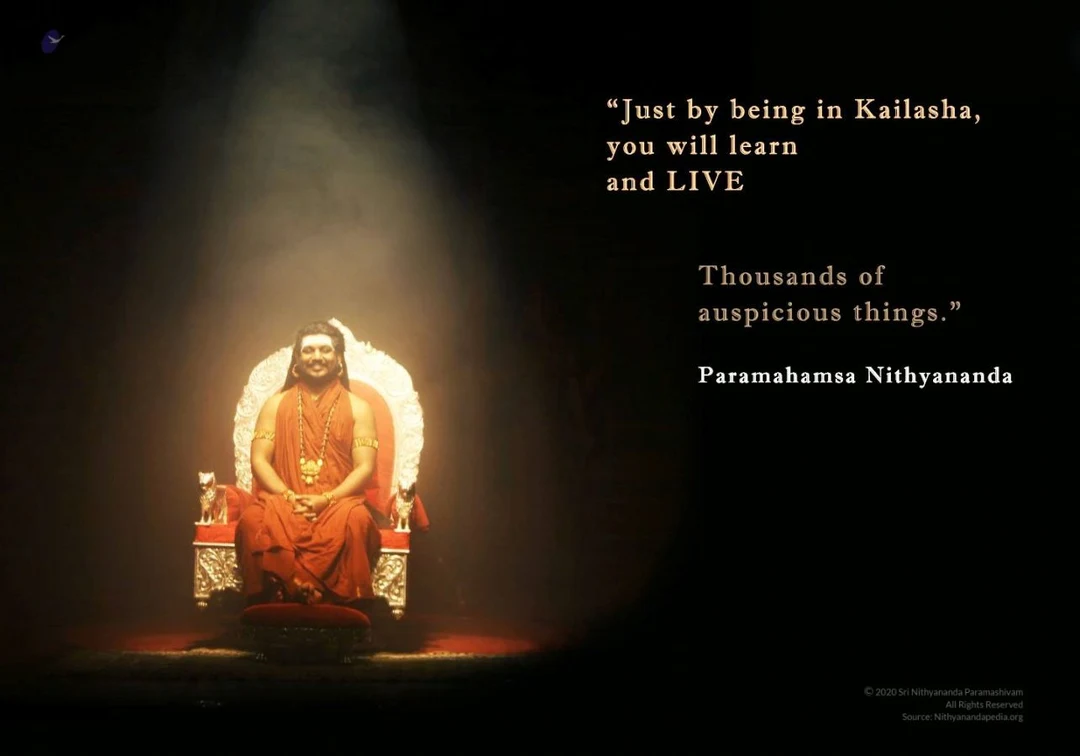
Understand. An Aadheenavasi who is sitting here not doing anything, completely useless, is 1000 times more useful to himself and to the world, than anybody outside this Campus in the Bhu Loka. When I say anybody – A-N-Y-B-O-D-Y, in capital letter red!! Because, just by being here, you learn and live 1000s of auspicious things from inside core – the non-violence, the ultimate truth of life - integrity and constantly working with space of Oneness. I don’t want to say - practicing, manifesting. I don’t want to say the word - practicing, manifesting.

Understand. Only when you manifest Oneness, you will be successful in anything here. The whole software is programmed like that. Only for Oneness password, anything will open. Otherwise it will just show - wrong password, try again. Second time it will show - wrong password, try again. Third time, there is an automatic mechanism to ‘tamaal’ [Swamiji shows a slap gesture] and you will not even know from which direction, because there will not be any hands slapping you. This very land will be slapping you.

Understand. Only with Oneness, you can be successful here and with Oneness, you can do anything you want here. This is the land, where Oneness is the currency. Only Oneness currency works here. Only Oneness currency is valid here. Understand. The space of Oneness, Advaita, is the only currency works here. That’s the only currency valid here.

(22:52)

That is why big, big Microsoft directors, I don’t know what this Microsoft Directors and Nithyananda Sangha…… I have almost dozen Microsoft Directors, ex- Microsoft Directors and present Microsoft Directors also. Maybe because, I am the Macro Software, the Microsoft people are……. But they all prove to be such a bondhus and I don’t know what else to tell further. They learn in corporate world, to make work, not to finish the task - how to make a task into complicated work. It is like writing manual to move this teacup –

“Continue to breathe…. continue to pump your heart… continue to make your lungs work… keep your intestine up and send the command from the brain to the right hand without stopping…. breathing and inhaling and exhaling…. and without shutting your eyes, please move the right hand and assess the distance between you and the teacup roughly…. and the distance can be plus or minus 3% …. right, wrong, because your fingers can handle the 3% distance plus or minus, in a comfortable way. Now instruct your hand to stretch, stretch, stretch …. and don’t forget to breathe during the whole process and keep your lungs active and alive …and do not move the leg, it may move the chair and hit the table and the teacup may fall on the floor ….and please continue to retain the balance of your leg and...and….and….and……” J That’s all. “Unfortunately, program failed because the software did not tell, that you should not be turning back. Because the cup moved due to the accident of the chair turning back, let us plan the project again and get ten assessing officers and call for “quotation”

(26:17)

I tell you, this is too serious instruction. Decision to make it happen and trusting few of us who are here in this team, are interested in making it happen, will remove all procedures. Procedure is because you are not proceeding, and you know……

A company employee went to toilet, as soon as he sat on the seat, on the front wall this was written, “Had you put the same pressure at work, company targets would have been achieved today.”

I am not even going to write this on the wall. “If you have taken Oneness as a Haritaki powder, you don’t need to struggle like this.” That will be in our toilet wall. “If you have taken Oneness as a Haritaki powder, you do not need to struggle like this.” Either you take the Oneness Haritaki powder or your team Lead will give the enema of ‘asking for the report’. But anyhow we will get it out.

Essence of today’s Satsang - “Engage with enriching responsibility - #engage.” With this, “Engaging keeps you Young Age.” “Engage for Young Age.”

(28:29)

With this, I bless you all, let’s all radiate with Integrity, Authenticity, Responsibility, Enriching, Causing, Living Shuddhadvaita Saivam, Sadāshivoham, the Eternal Bliss - Nithyananda.

Thank you.

Be Blissful

(28:49)

Title

You are Deeper than Your Thoughts || Part 1 || IA || 02 Aug 2017

Description

Name Of Convention : Inner Awakening Session on: You are Deeper than Your Thoughts Part 1 Date : 2 August 2017 Venue : Adi Kailasa, Bengaluru, Karnataka, India

In this video, we see the Supreme Pontiff of Hinduism HDH #Nithyananda Paramashivam initiates the delegates with power of unclutching in an intense mandala process. HDH explains that unclutching is the understanding every thought comes from you, and there is a gap were you exist as consciousness. HDH revealed that your are deeper than your thought and gave delegates an experience of unclutching.

The Supreme Pontiff of Hinduism Jagatguru Mahasannidhanam His Divine Holiness Nithyananda Paramashivam (HDH) is the reviver of #KAILASA - the ancient enlightened civilization and the great cosmic borderless Hindu nation. Revered as the incarnation of Paramashiva - the primordial Hindu Divinity, HDH has a following of 2 billion Hindus worldwide with de facto spiritual embassies in over 150 countries. He has worked untiringly for over 26 years for the revival of Kailasa, for global peace and to give super conscious breakthrough to humanity. He has survived the worst persecution of multiple assassination attempts on person and on character by anti-Hindu elements. He is collecting, organising, preserving, time capsuling, decoding, spreading and reviving 20 Million source books of Hinduism and the 64 sacred arts & sciences like Ayurveda, music, dance, sculpting, astrology, vastu and much more. Close to 20,000 hours of HDH’s timeless talks have been recorded till date (Sep 2020), which are a treasure trove of powerful cognitions to solve individual and global problems of any kind.

Link to Video:

Title

You are Deeper than Your Thoughts || Part 2 || IA || 02 Aug 2017

Description

Name Of Convention : Inner Awakening Session on: You are Deeper than Your Thoughts Part 2 Date : 2 August 2017 Venue : Adi Kailasa, Bengaluru, Karnataka, India

In this video, we see the Supreme Pontiff of Hinduism HDH #Nithyananda Paramashivam initiates the delegates with power of unclutching in an intense mandala process. HDH explains that unclutching is the understanding every thought comes from you, and there is a gap were you exist as consciousness. HDH revealed that your are deeper than your thought and gave delegates an experience of unclutching.

The Supreme Pontiff of Hinduism Jagatguru Mahasannidhanam His Divine Holiness Nithyananda Paramashivam (HDH) is the reviver of #KAILASA - the ancient enlightened civilization and the great cosmic borderless Hindu nation. Revered as the incarnation of Paramashiva - the primordial Hindu Divinity, HDH has a following of 2 billion Hindus worldwide with de facto spiritual embassies in over 150 countries. He has worked untiringly for over 26 years for the revival of Kailasa, for global peace and to give super conscious breakthrough to humanity. He has survived the worst persecution of multiple assassination attempts on person and on character by anti-Hindu elements. He is collecting, organising, preserving, time capsuling, decoding, spreading and reviving 20 Million source books of Hinduism and the 64 sacred arts & sciences like Ayurveda, music, dance, sculpting, astrology, vastu and much more. Close to 20,000 hours of HDH’s timeless talks have been recorded till date (Sep 2020), which are a treasure trove of powerful cognitions to solve individual and global problems of any kind.

Link to Video:

Title

You are Deeper than Your Thoughts || Part 3 || IA || 02 Aug 2017

Description

Name Of Convention : Inner Awakening Session on: You are Deeper than Your Thoughts Part 3 Date : 2 August 2017 Venue : Adi Kailasa, Bengaluru, Karnataka, India

In this video, we see the Supreme Pontiff of Hinduism HDH #Nithyananda Paramashivam initiates the delegates with power of unclutching in an intense mandala process. HDH explains that unclutching is the understanding every thought comes from you, and there is a gap were you exist as consciousness. HDH revealed that your are deeper than your thought and gave delegates an experience of unclutching.

The Supreme Pontiff of Hinduism Jagatguru Mahasannidhanam His Divine Holiness Nithyananda Paramashivam (HDH) is the reviver of #KAILASA - the ancient enlightened civilization and the great cosmic borderless Hindu nation. Revered as the incarnation of Paramashiva - the primordial Hindu Divinity, HDH has a following of 2 billion Hindus worldwide with de facto spiritual embassies in over 150 countries. He has worked untiringly for over 26 years for the revival of Kailasa, for global peace and to give super conscious breakthrough to humanity. He has survived the worst persecution of multiple assassination attempts on person and on character by anti-Hindu elements. He is collecting, organising, preserving, time capsuling, decoding, spreading and reviving 20 Million source books of Hinduism and the 64 sacred arts & sciences like Ayurveda, music, dance, sculpting, astrology, vastu and much more. Close to 20,000 hours of HDH’s timeless talks have been recorded till date (Sep 2020), which are a treasure trove of powerful cognitions to solve individual and global problems of any kind.

Link to Video:

Title

You are Deeper than Your Thoughts || Part 4 || IA || 02 Aug 2017

Description

Name Of Convention : Inner Awakening Session on: You are Deeper than Your Thoughts Part 4 Date : 2 August 2017 Venue : Adi Kailasa, Bengaluru, Karnataka, India

In this video, we see the Supreme Pontiff of Hinduism HDH #Nithyananda Paramashivam initiates the delegates with power of unclutching in an intense mandala process. HDH explains that unclutching is the understanding every thought comes from you, and there is a gap were you exist as consciousness. HDH revealed that your are deeper than your thought and gave delegates an experience of unclutching.

The Supreme Pontiff of Hinduism Jagatguru Mahasannidhanam His Divine Holiness Nithyananda Paramashivam (HDH) is the reviver of #KAILASA - the ancient enlightened civilization and the great cosmic borderless Hindu nation. Revered as the incarnation of Paramashiva - the primordial Hindu Divinity, HDH has a following of 2 billion Hindus worldwide with de facto spiritual embassies in over 150 countries. He has worked untiringly for over 26 years for the revival of Kailasa, for global peace and to give super conscious breakthrough to humanity. He has survived the worst persecution of multiple assassination attempts on person and on character by anti-Hindu elements. He is collecting, organising, preserving, time capsuling, decoding, spreading and reviving 20 Million source books of Hinduism and the 64 sacred arts & sciences like Ayurveda, music, dance, sculpting, astrology, vastu and much more. Close to 20,000 hours of HDH’s timeless talks have been recorded till date (Sep 2020), which are a treasure trove of powerful cognitions to solve individual and global problems of any kind.

Link to Video:

Title

You are Deeper than Your Thoughts || Part 5 || IA || 2 Aug 2017

Description

Name Of Convention : Inner Awakening Session on: You are Deeper than Your Thoughts Part 5 Date : 2 August 2017 Venue : Adi Kailasa, Bengaluru, Karnataka, India

In this video, we see the Supreme Pontiff of Hinduism HDH #Nithyananda Paramashivam initiates the delegates with power of unclutching in a intense mandala process. HDH explains that unclutching is the understanding every thought comes from you, and there is a gap where you exist as consciousness. HDH revealed that your are deeper than your thought and gave delegates an experience of unclutching.

The Supreme Pontiff of Hinduism Jagatguru Mahasannidhanam His Divine Holiness Nithyananda Paramashivam (HDH) is the reviver of #KAILASA - the ancient enlightened civilization and the great cosmic borderless Hindu nation. Revered as the incarnation of Paramashiva - the primordial Hindu Divinity, HDH has a following of 2 billion Hindus worldwide with de facto spiritual embassies in over 150 countries. He has worked untiringly for over 26 years for the revival of Kailasa, for global peace and to give super conscious breakthrough to humanity. He has survived the worst persecution of multiple assassination attempts on person and on character by anti-Hindu elements. He is collecting, organising, preserving, time capsuling, decoding, spreading and reviving 20 Million source books of Hinduism and the 64 sacred arts & sciences like Ayurveda, music, dance, sculpting, astrology, vastu and much more. Close to 20,000 hours of HDH’s timeless talks have been recorded till date (Sep 2020), which are a treasure trove of powerful cognitions to solve individual and global problems of any kind.

Link to Video:

Photos

Puja
Satsang
Vishesha Deeksha

Aadheenavasi Sannyas Deeksha

Aadheenavasis and Sannyas initiation

Inner Awakening Sessions

Satsang

Puja

Initiations

Vishesha Deeksha Sannyas Deeksha

Sakshi Pramana

Nithyananda Times Video

Tags

Bhagavan Sri Nithyananda Paramashivam Paramahamsa Nithyananda, Nithyananda, Swamiji, Sadāshiva, Aadheenam Chalo Series, Aadheenavasis, bhagavad gita, kailasa, absolute integrity, deva loka, sadashivatva, space of nandi, sangha, responsibility, #engage, I am their visionary and they are in love with Me, making vision your mission, manifesting powers, space of Oneness, advaita, haritaki powder, engage for young age, tapo loka, bhu loka, bhuvar loka, swarga loka, science of Sadāshivatva, welcome to kailasa, engaging with responsibility of enriching, sannyasa explained, tiredness and boredom, prasada of kailasa, divine beings of Sadāshiva, engaged or encaged, ultimate truth of life - integrity, oneness is the currency, oneness password, making work/finishing task, engaging keeps you young age, decision to make it happen

Links

https://www.facebook.com/ParamahamsaNithyananda/photos/a.321615927926264/1466560413431804/?type=1&theater

https://nithyananda.org/photo-gallery/nithyananda-diary-1st-august-2017-nithyananda-peetham-bengaluru-aadheenam-inner-awaken#gsc.tab=0

https://www.youtube.com/watch?v=J31lXF4APKE

Photos Of The Day:

Padapuja

Nithya-Satsang

IA-Mandala-Process

Vishesh-Deeksha

Aadheenivasi-Brahmcharya-Initiation

More Photos of Padapuja

More Photos of Nithya Satsang
More Photos from IA Mandala Process

More Photos from Vishesha Deeksha

More Photos from Brahmacharya Initiation

Photos Of The Day:

FB-Photos-of-the-Day

Photos from this day

View all 628 photos

Inner Awakening Sessions

1 photoSource gallery
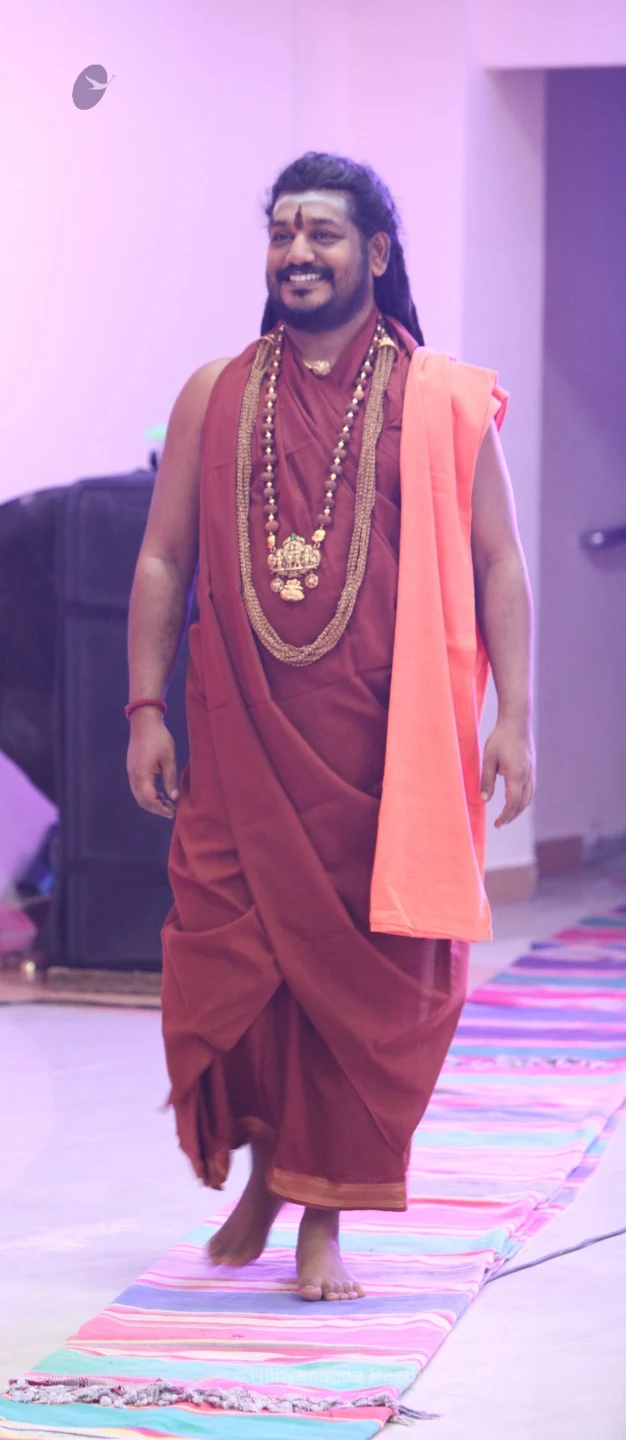
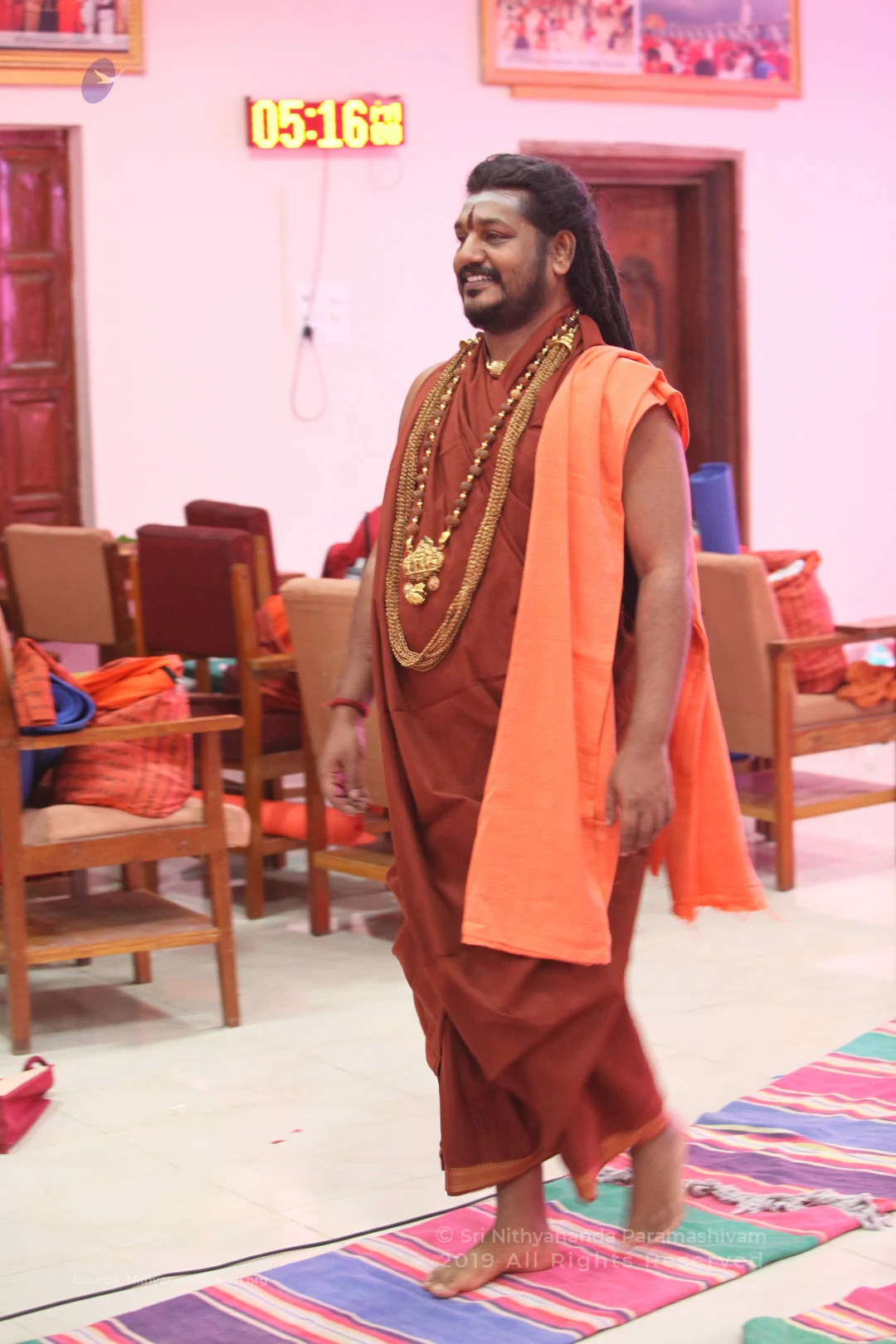
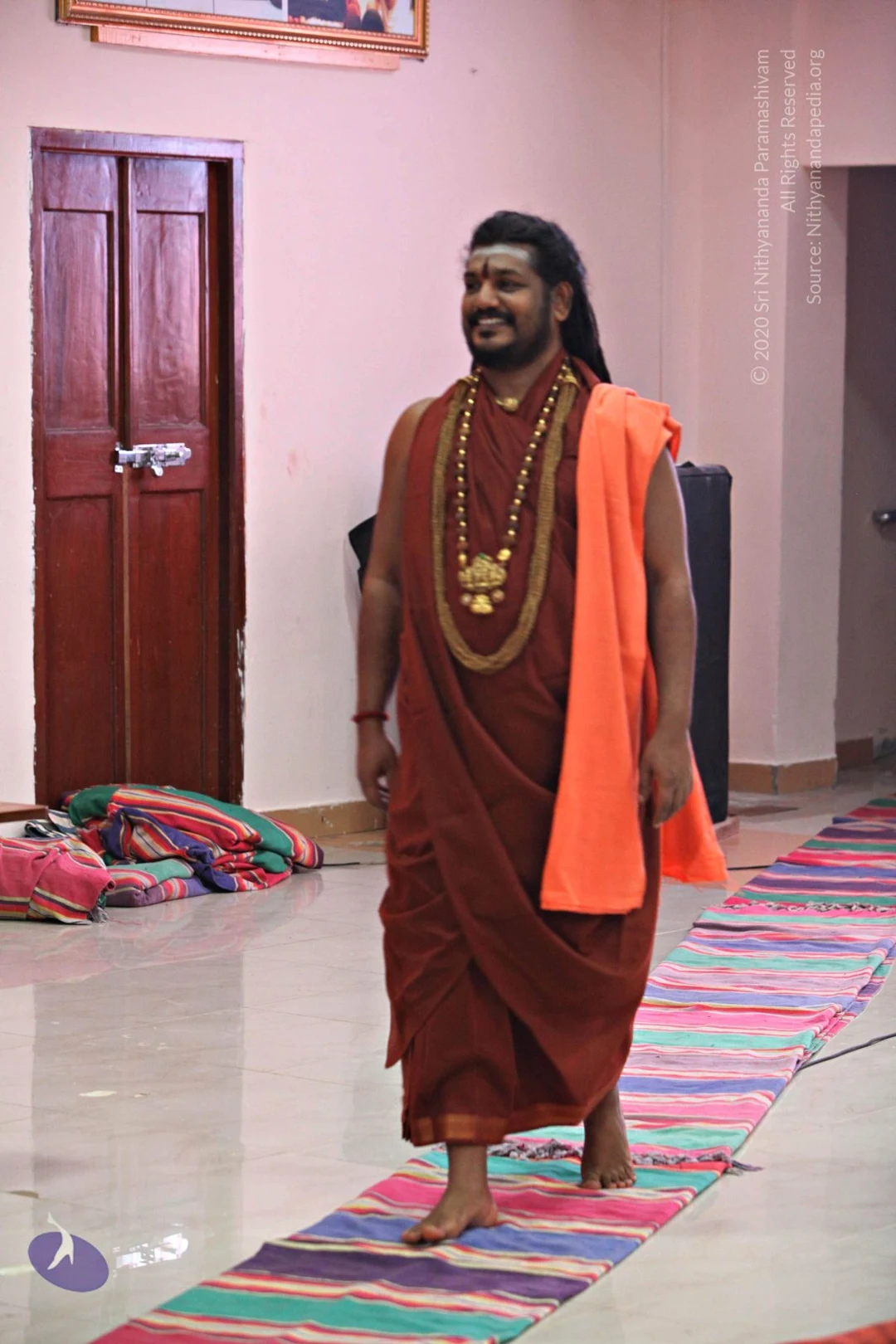
A man stands barefoot on a striped multicoloured runner in a pink-walled room, smiling and looking off to the side. He wears a rust-red draped garment, an orange shawl over one shoulder, and a long gold-beaded necklace with a gold pendant. His hair is long and swept back, and he has a white forehead mark with a red dot. A wooden panelled door and folded striped blankets are behind him, and a framed picture hangs on the wall above. a person is described by these appearance cues: long swept-back hair, orange shawl and ornate gold necklace, standing as the central figure.

Puja

1 photoSource gallery
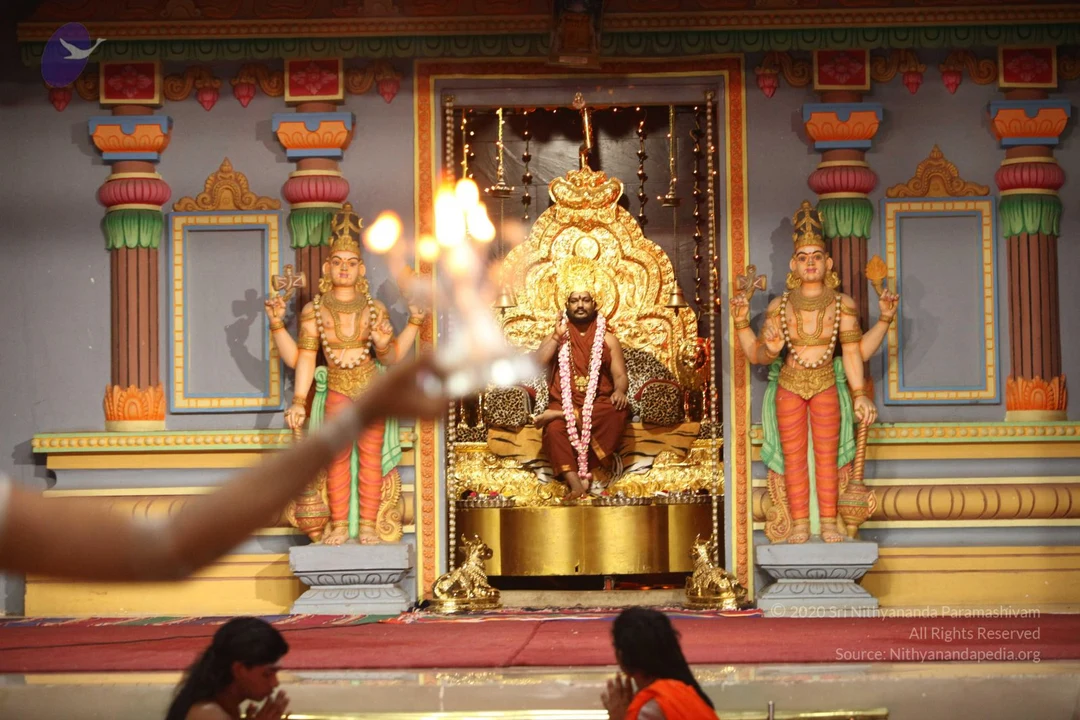
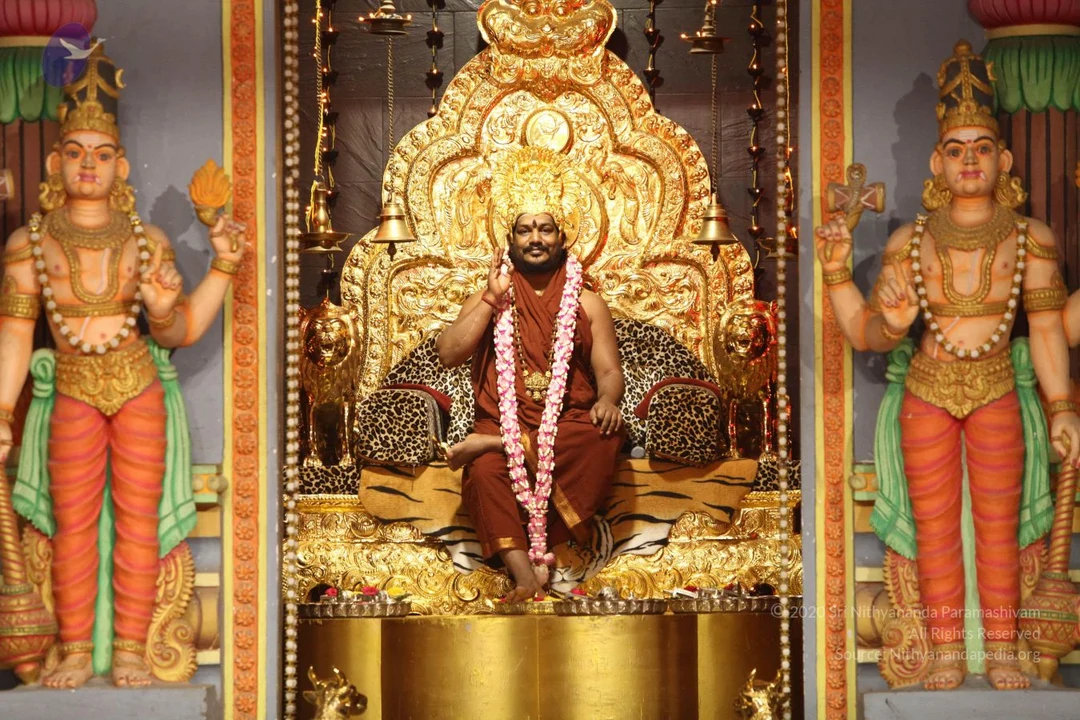
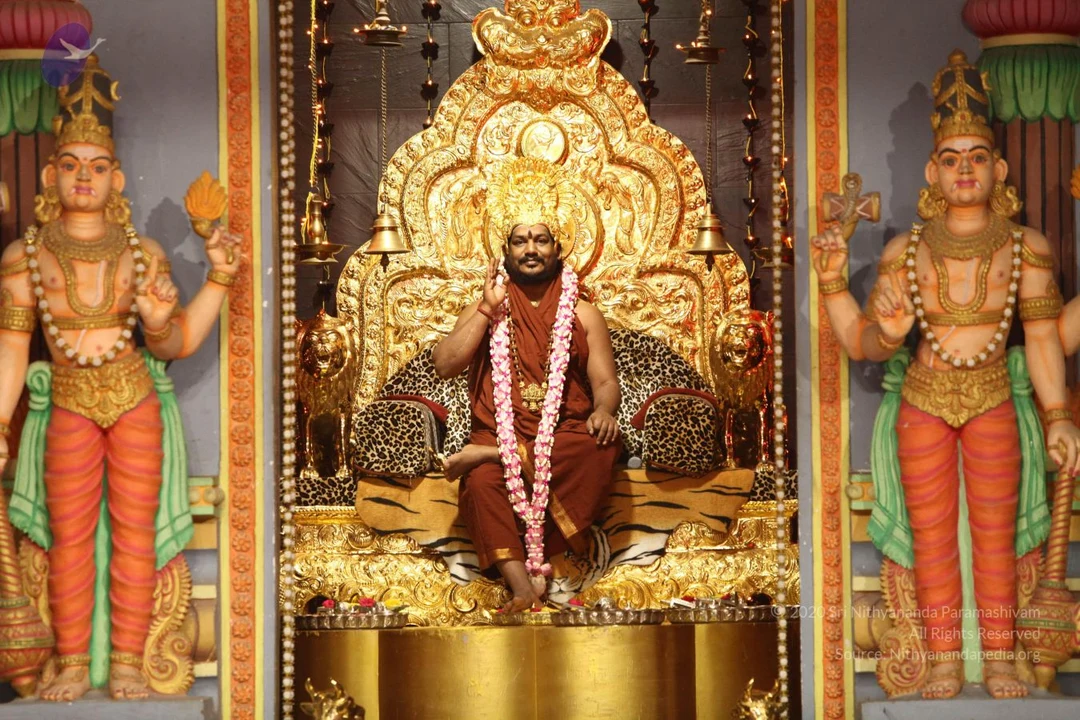
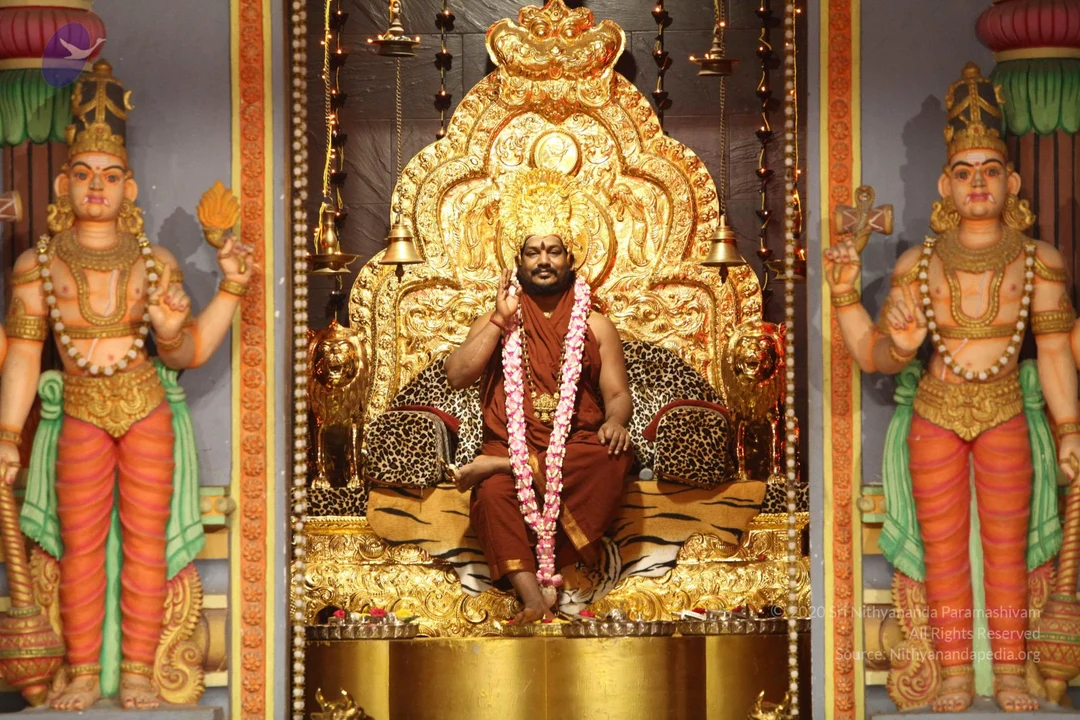
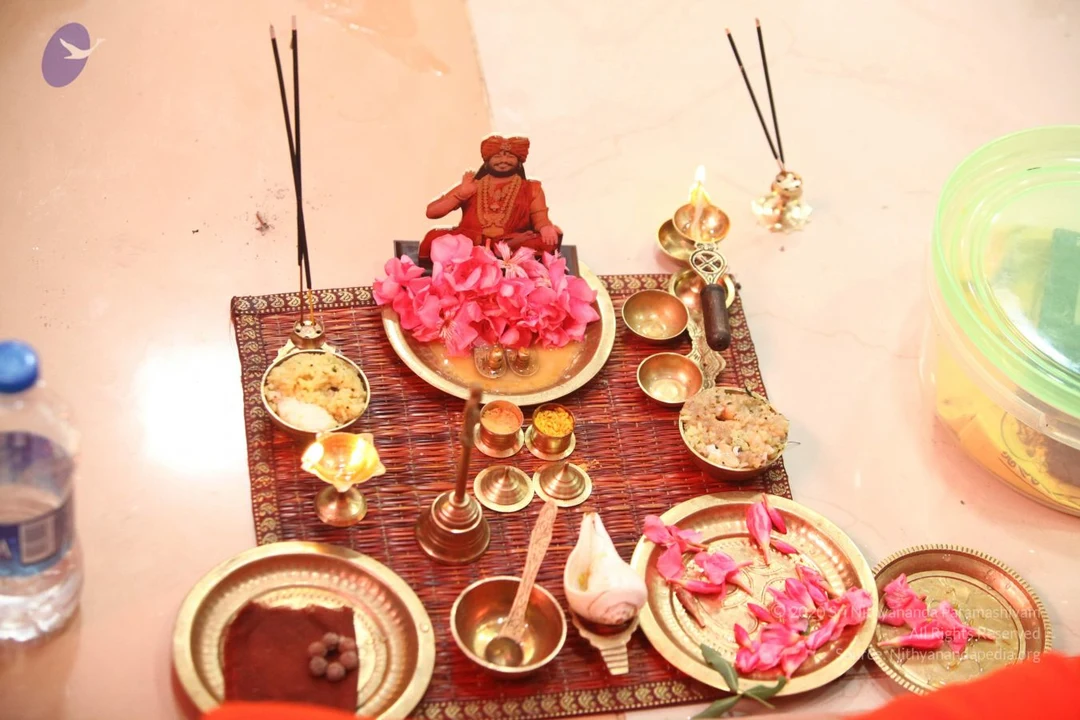
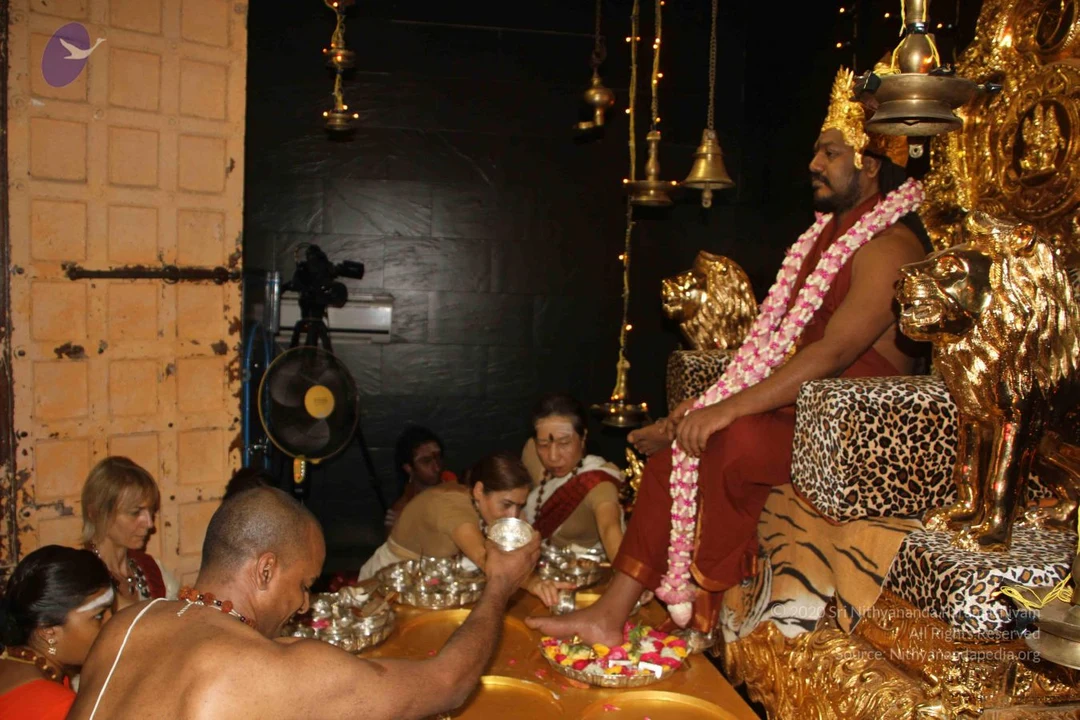
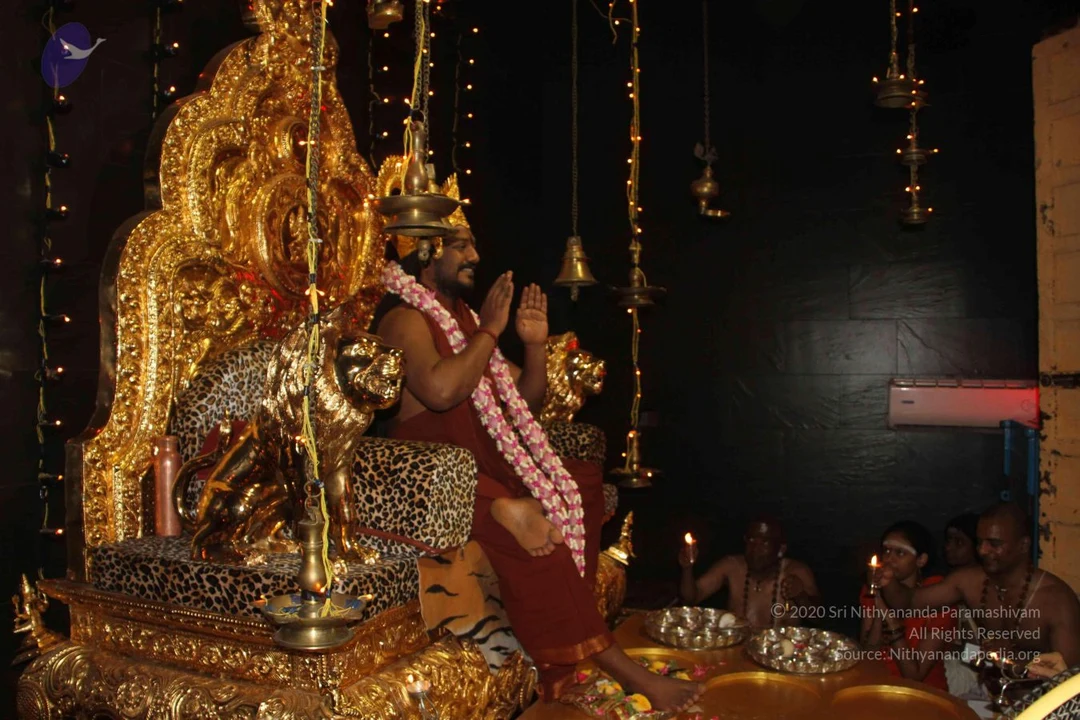
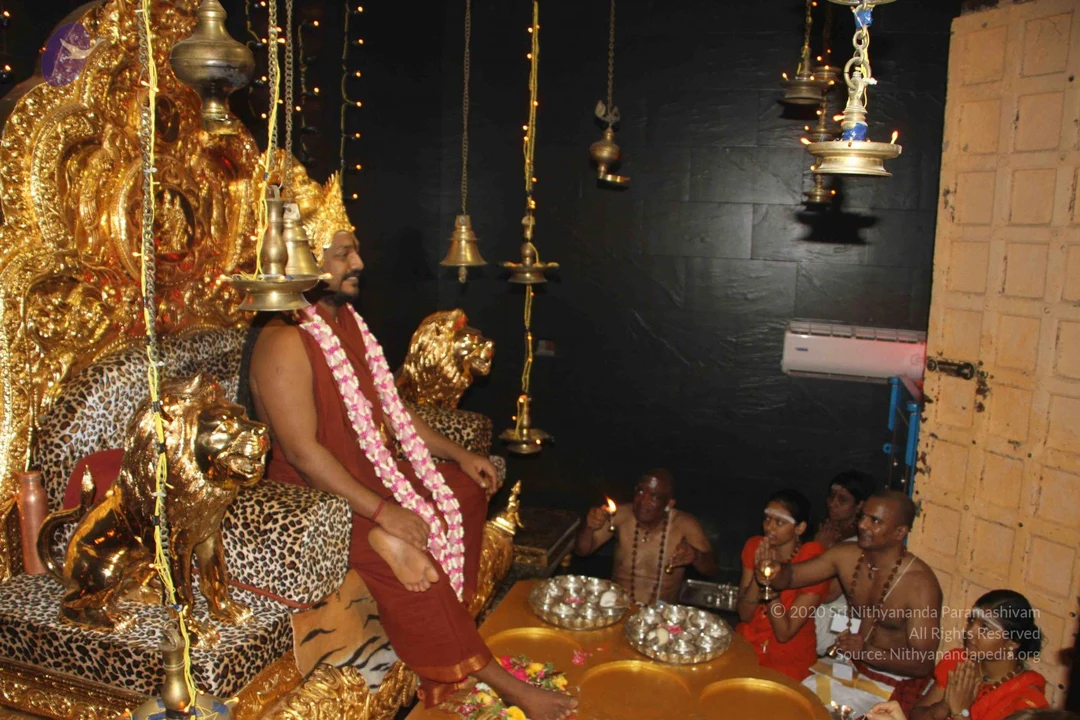
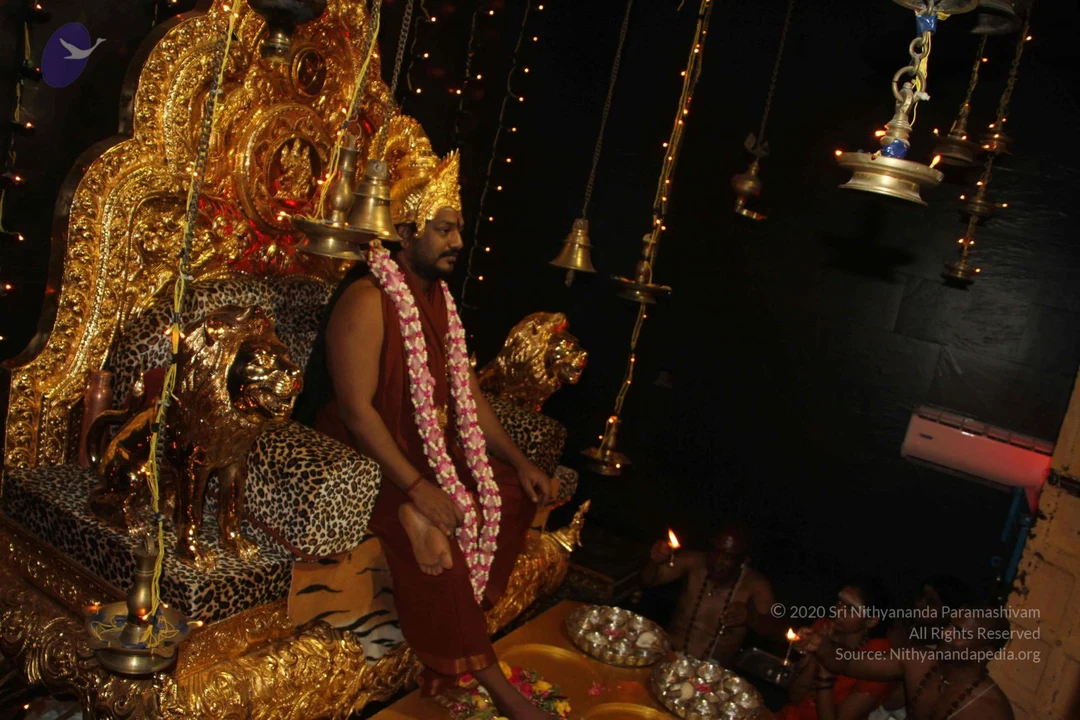
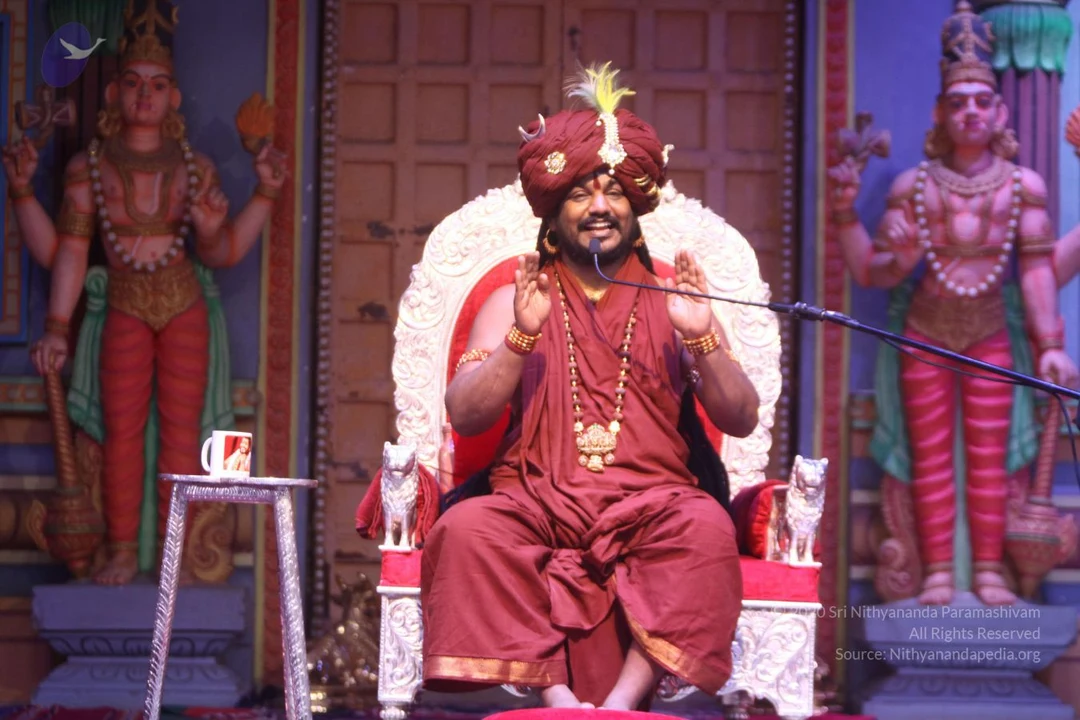
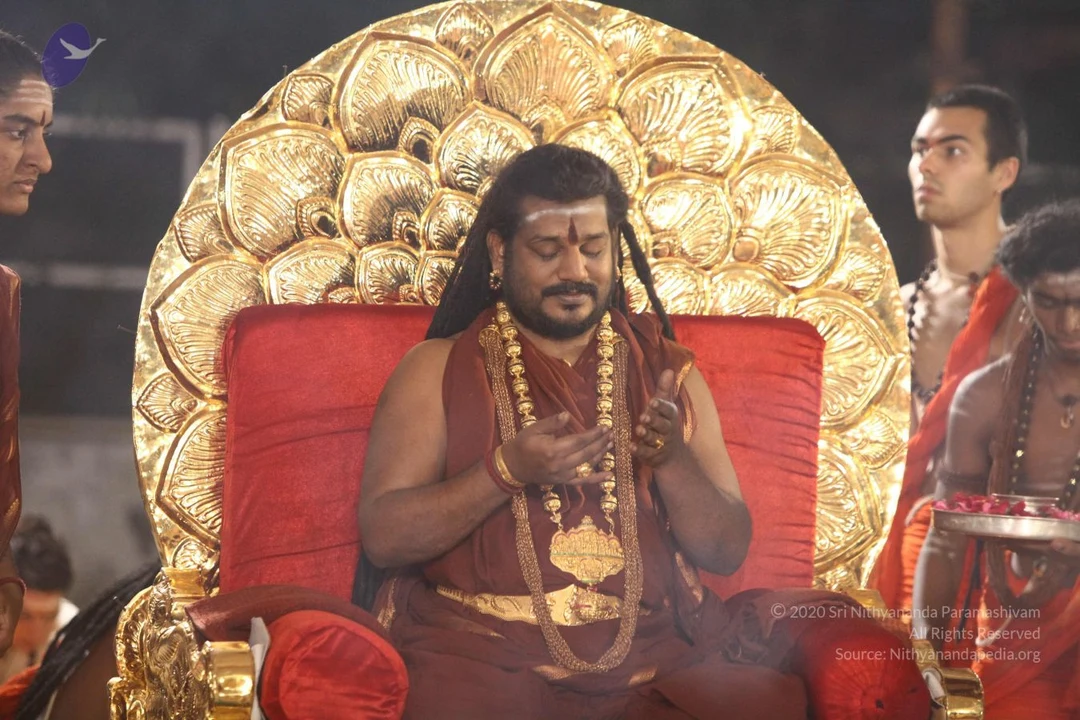
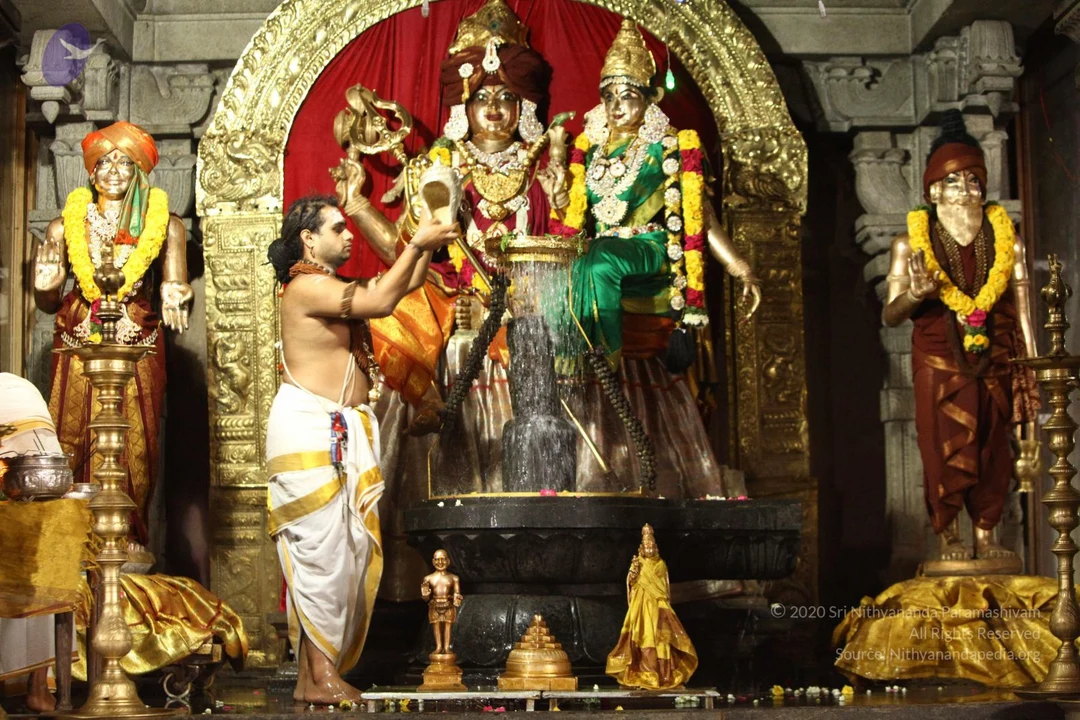
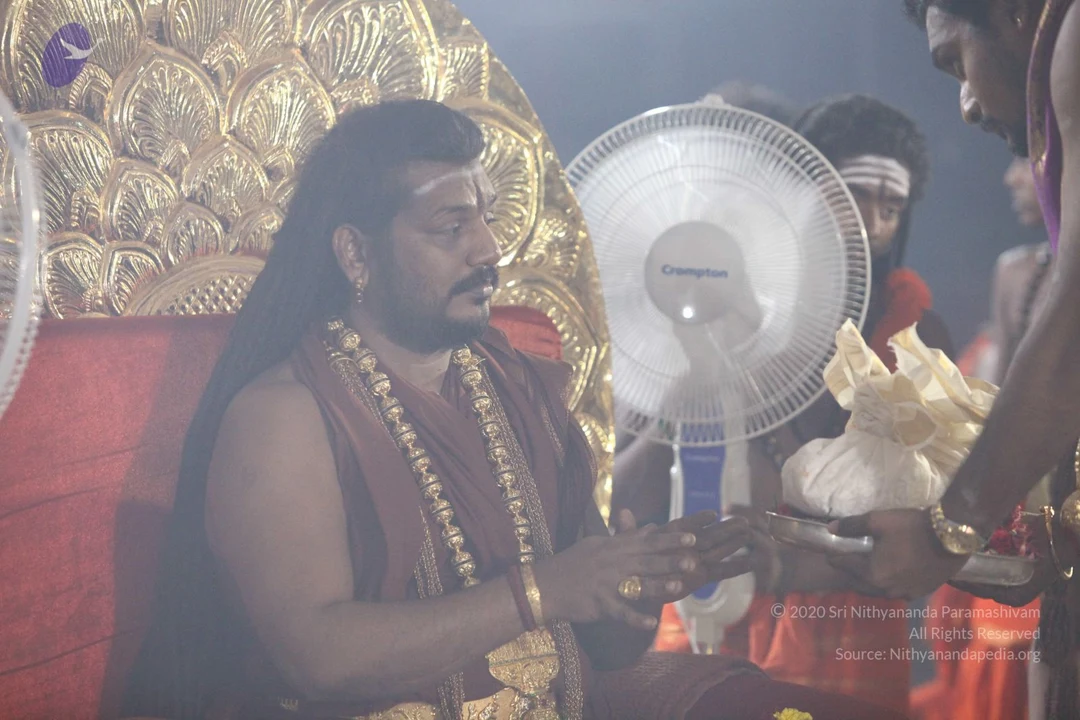
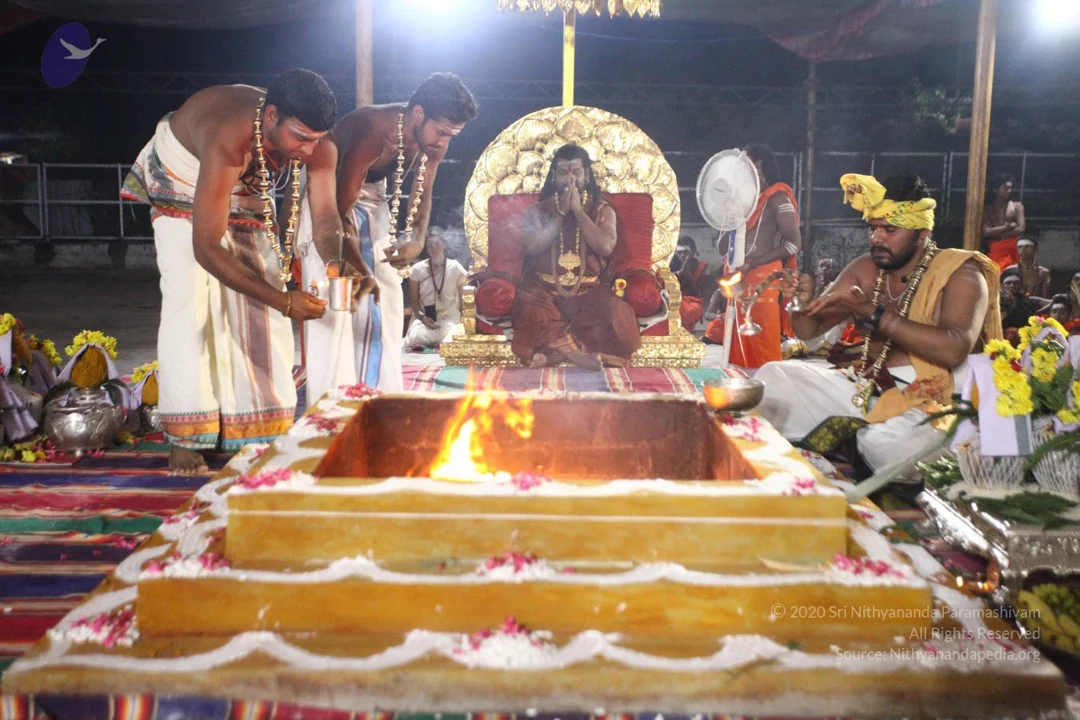
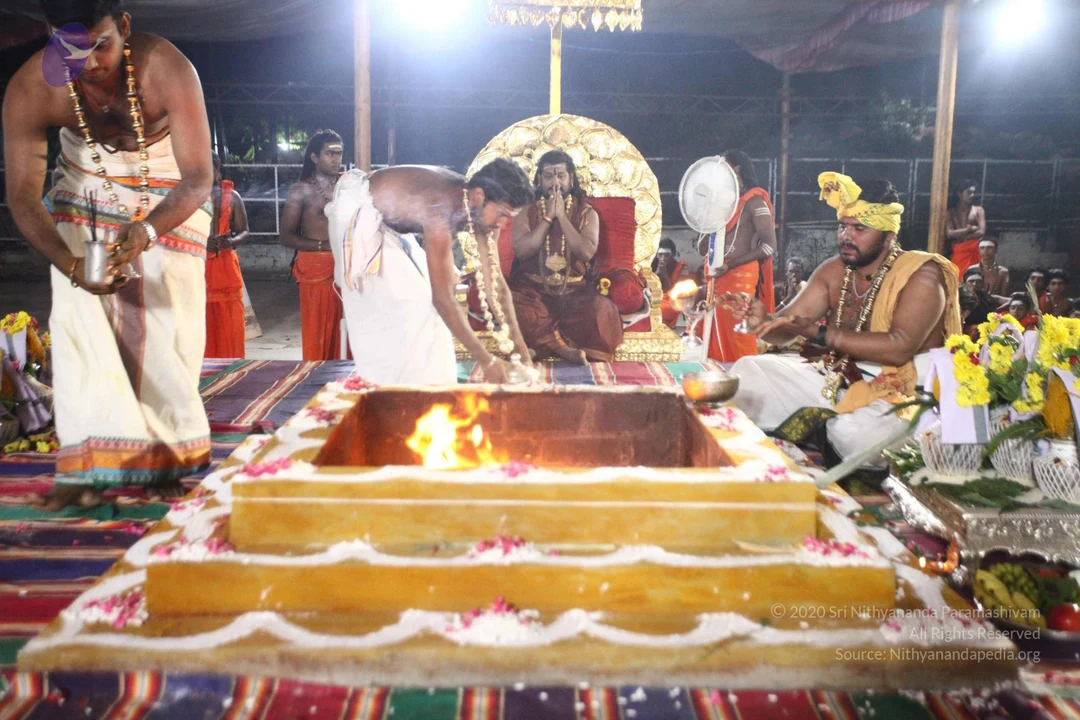
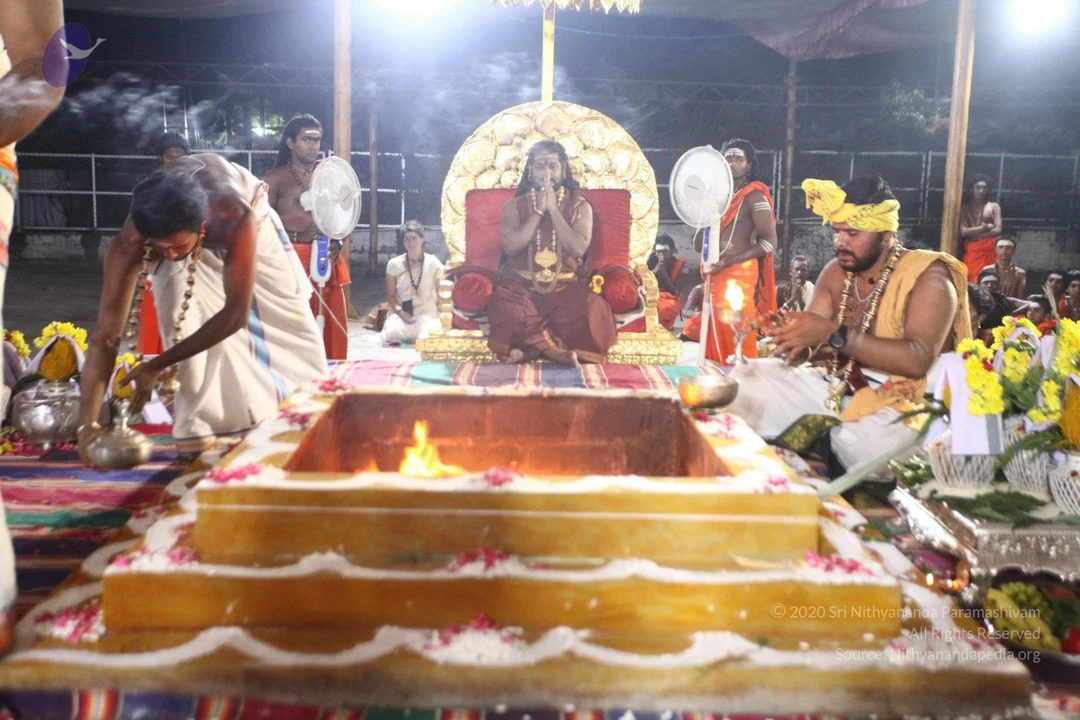
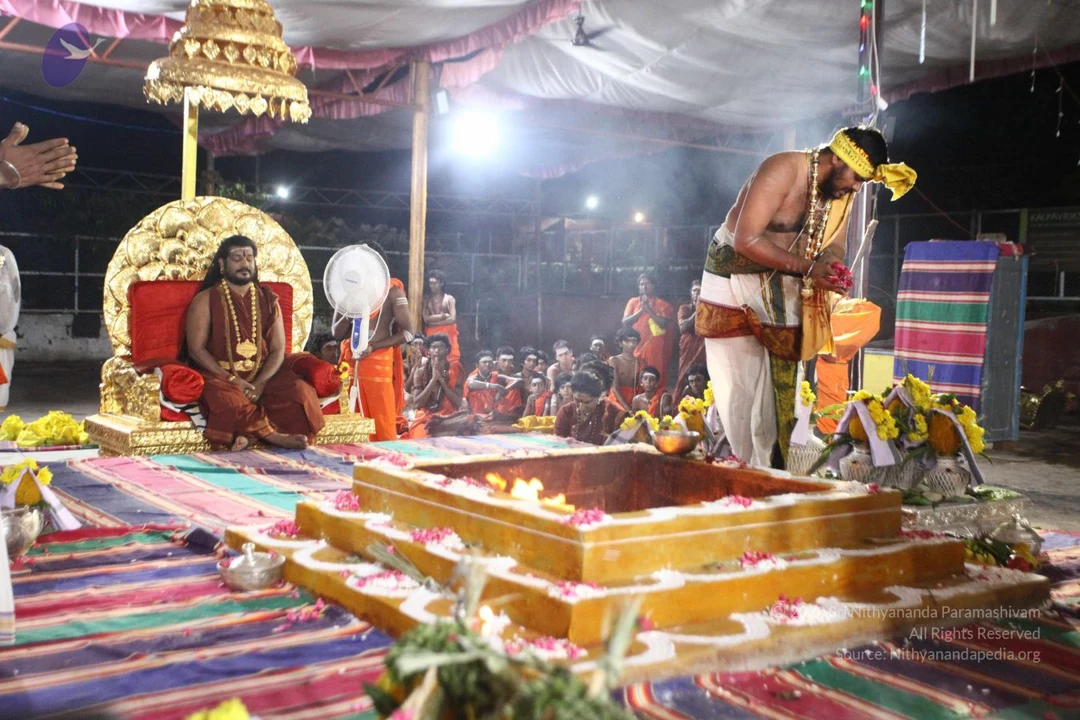
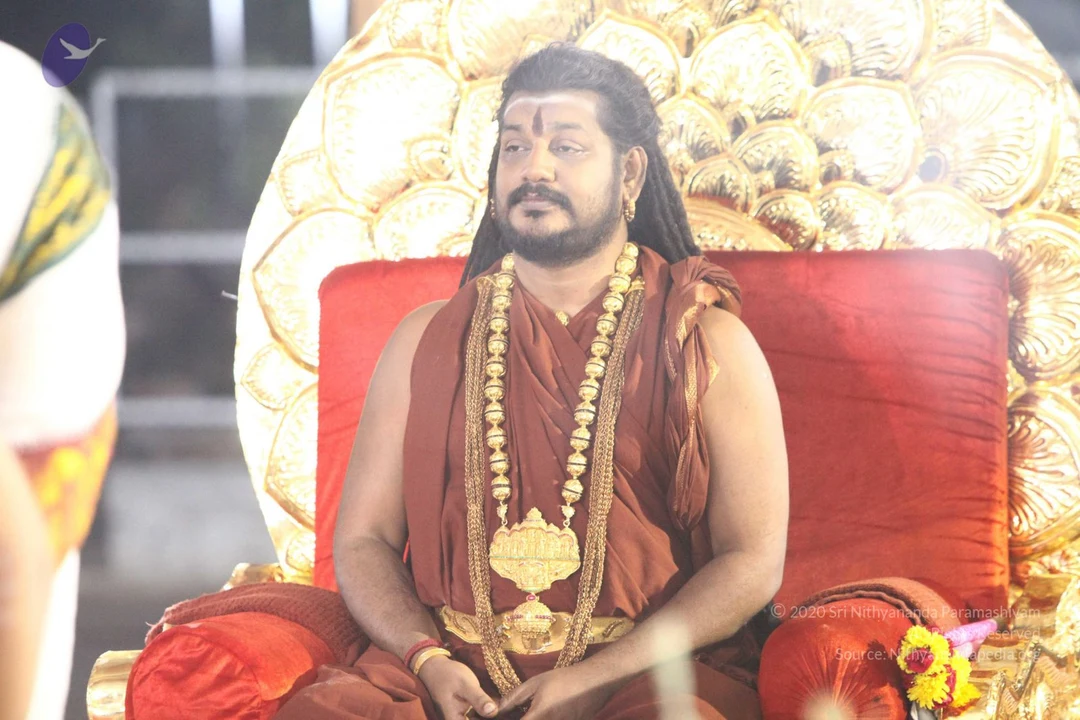
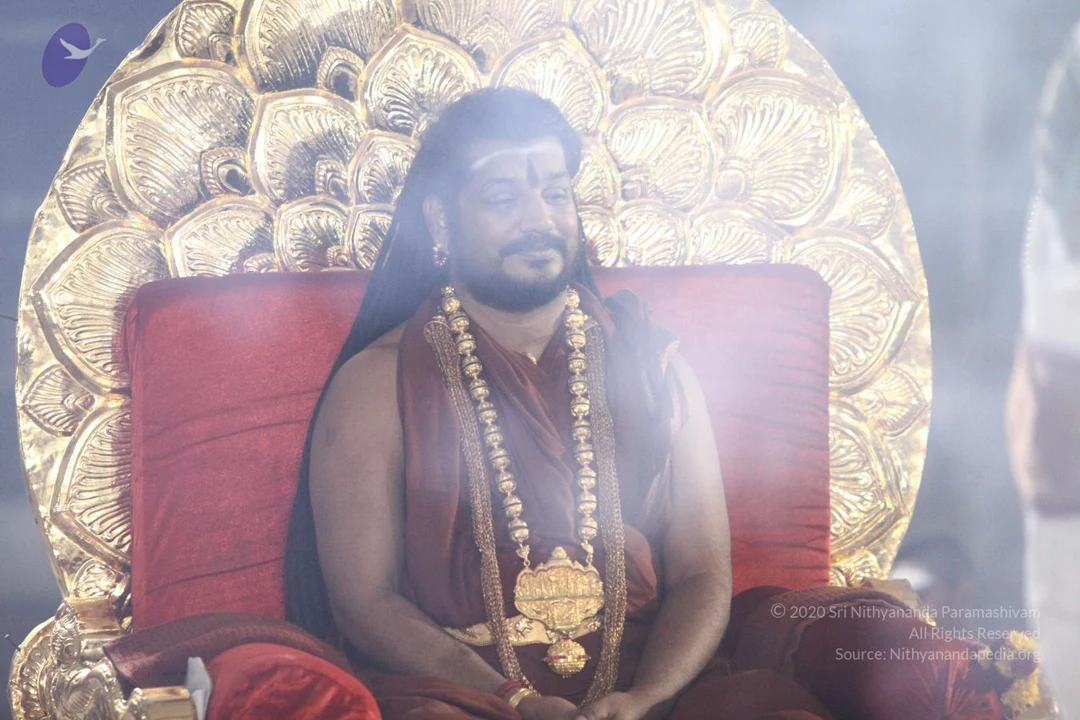
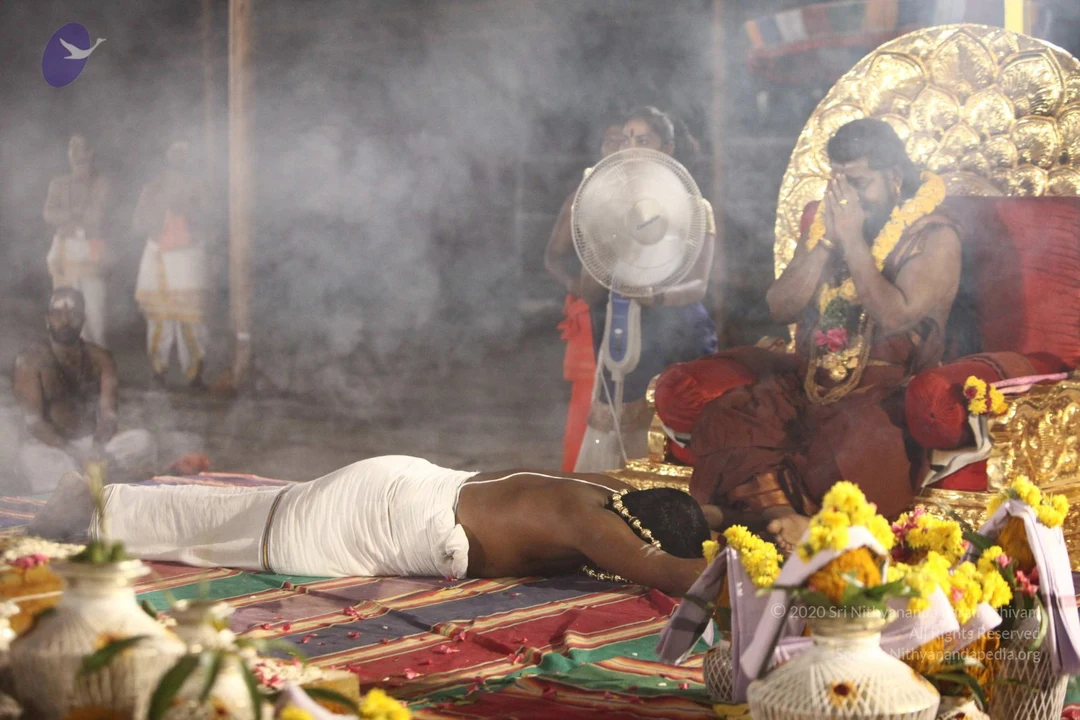
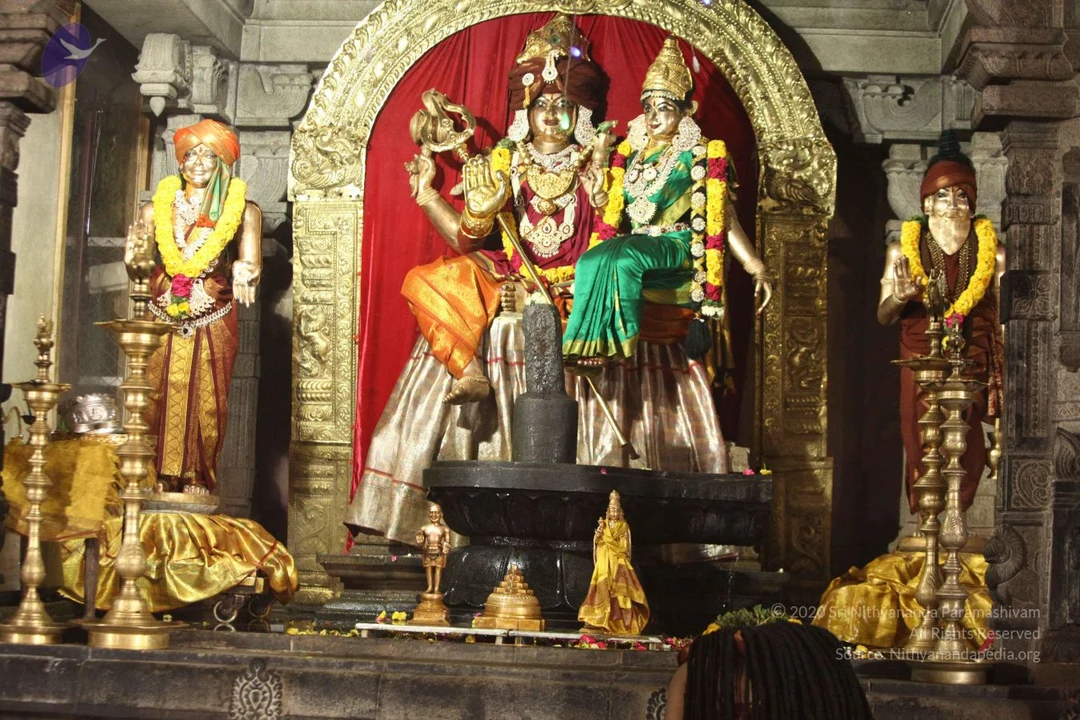
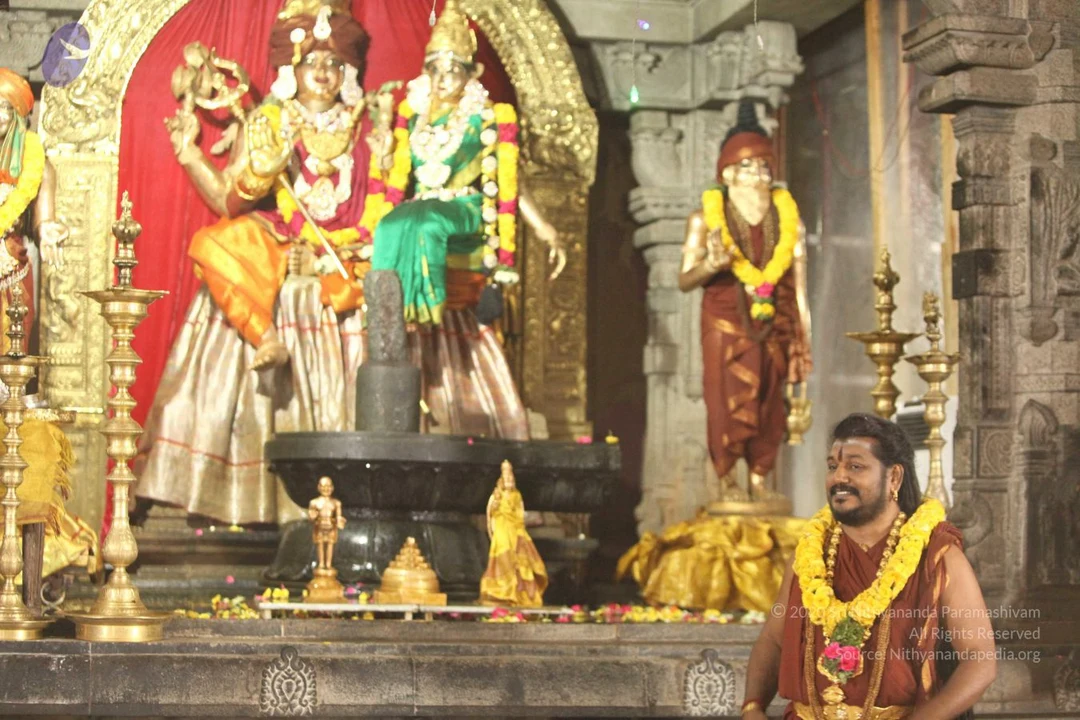
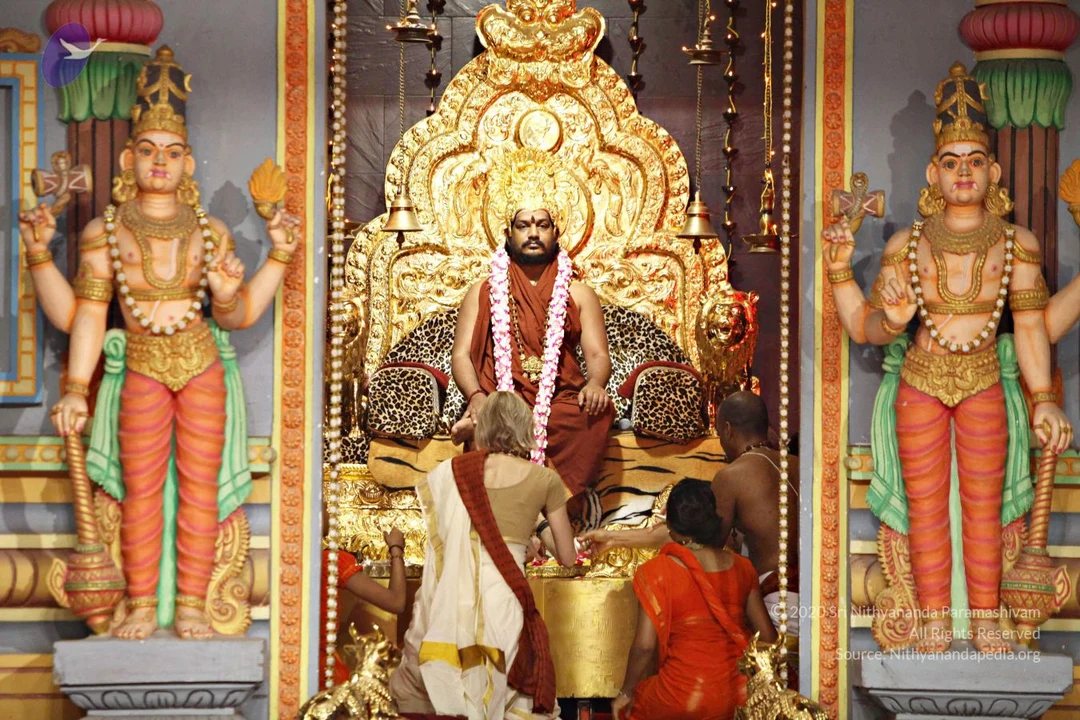
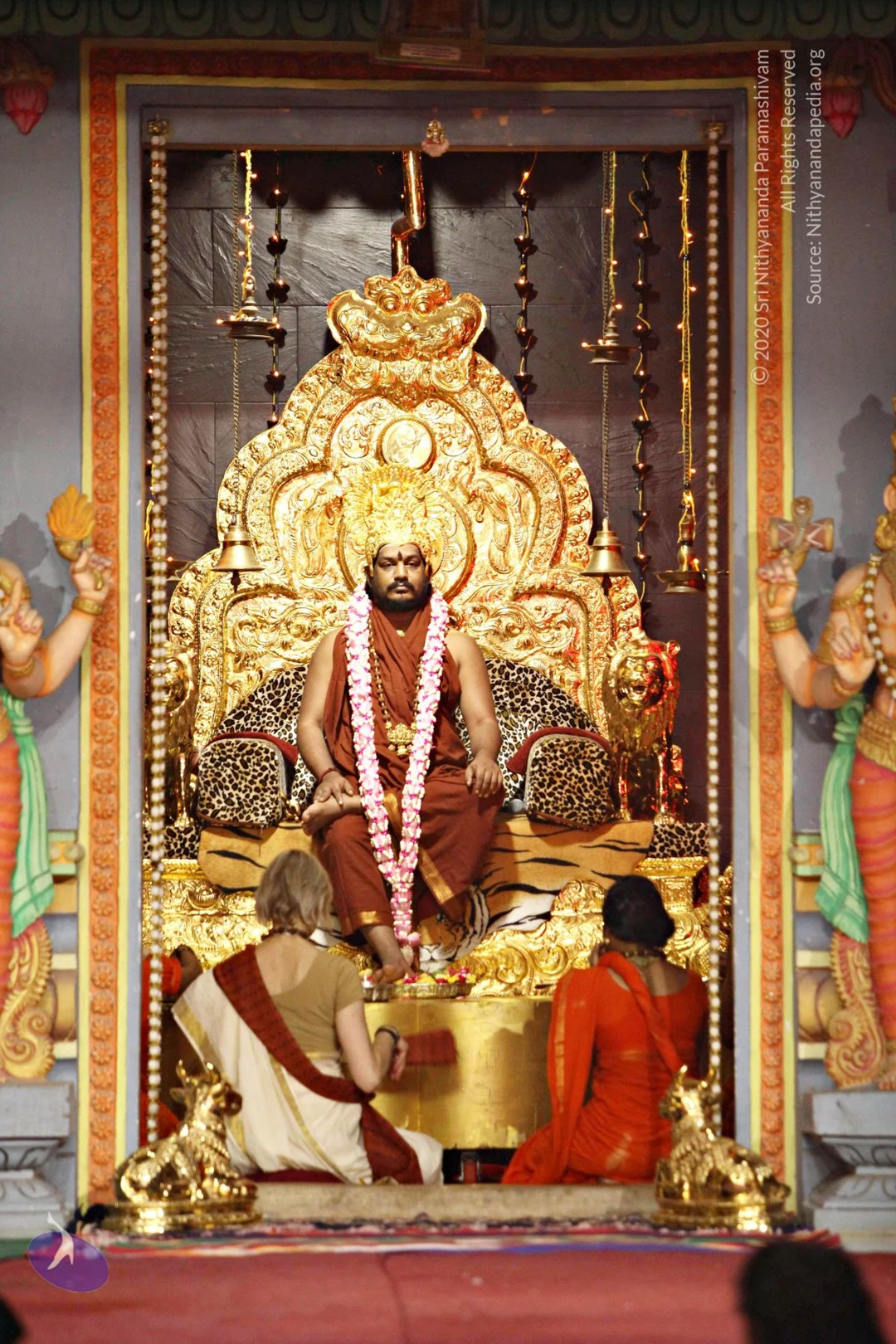
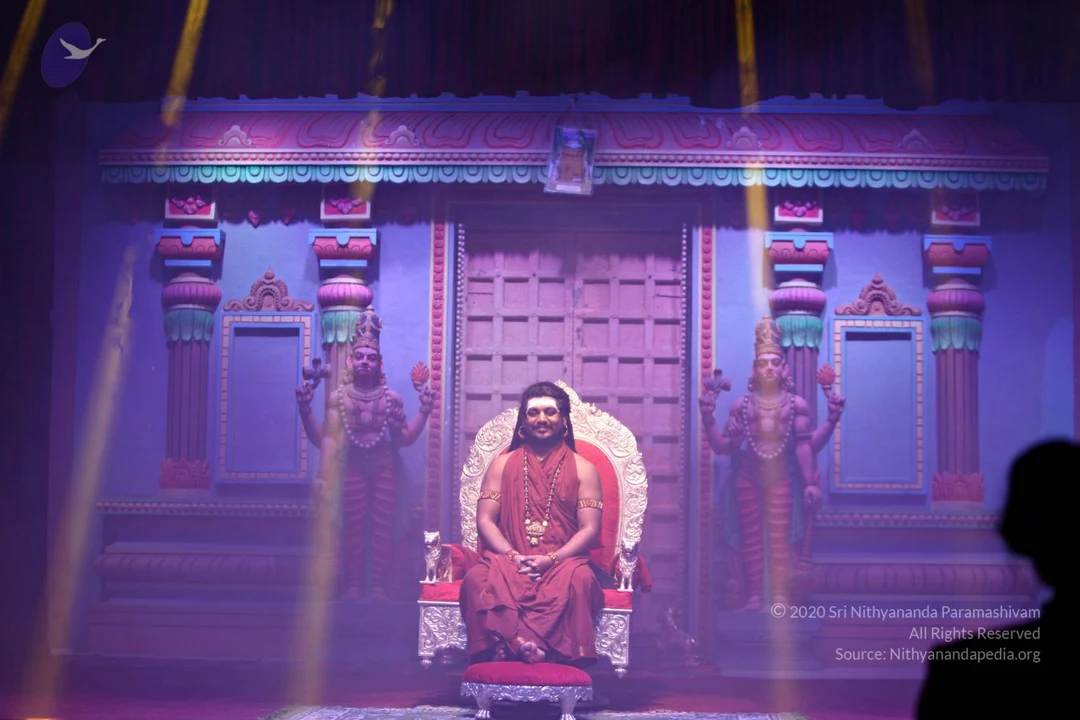
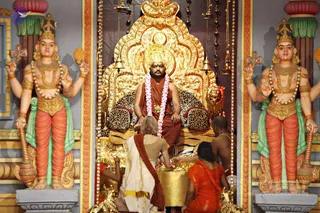
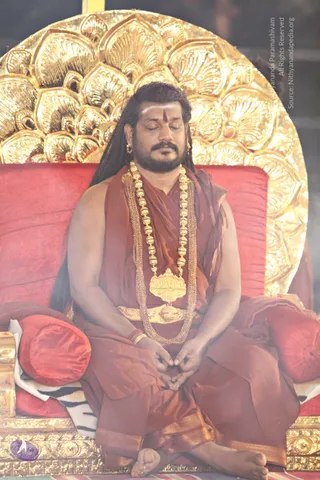
A seated man in a rust-red sannyasi robe sits centrally on an ornate gold throne with a leopard-print cushion and a tiger-skin draped over its base. A pink and white flower garland hangs around his neck, with a rudraksha-style mala and gold pendant visible. Behind the throne, gold bells hang from chains. Flanking the throne are two large painted guardian statues with multiple arms, gold crowns, gold jewellery and orange-red and green garments, holding ritual objects. Brass oil lamps and offerings sit at the base of the dais. The scene reads as a temple-style shrine setting.

Padapuja

70 photosSource gallery
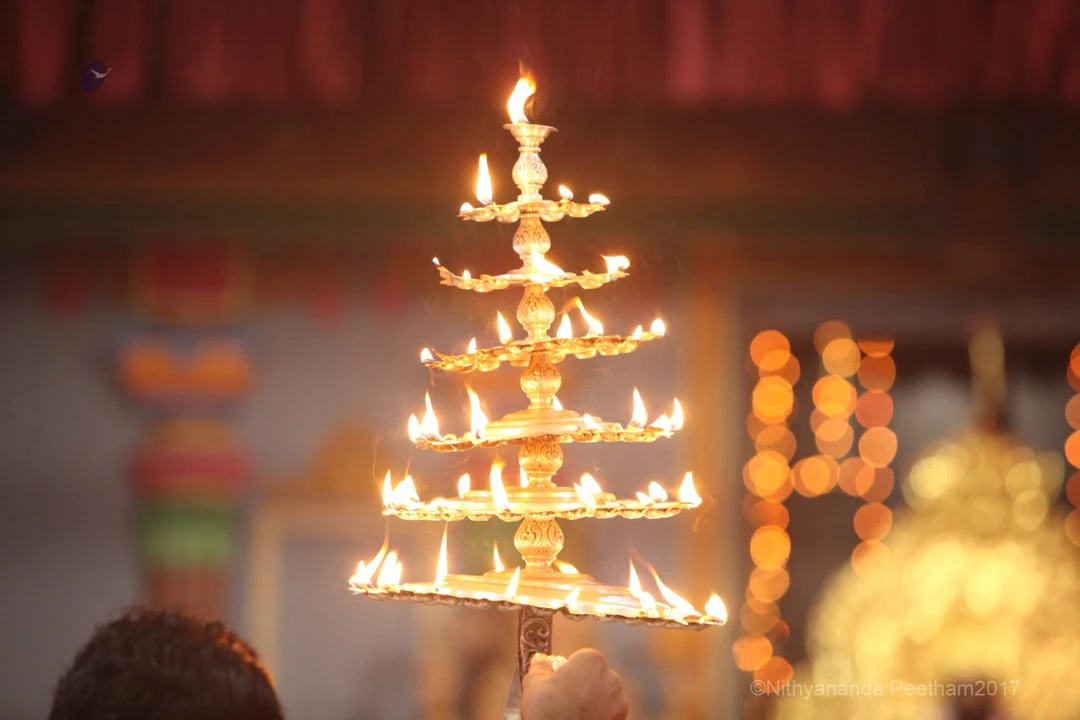
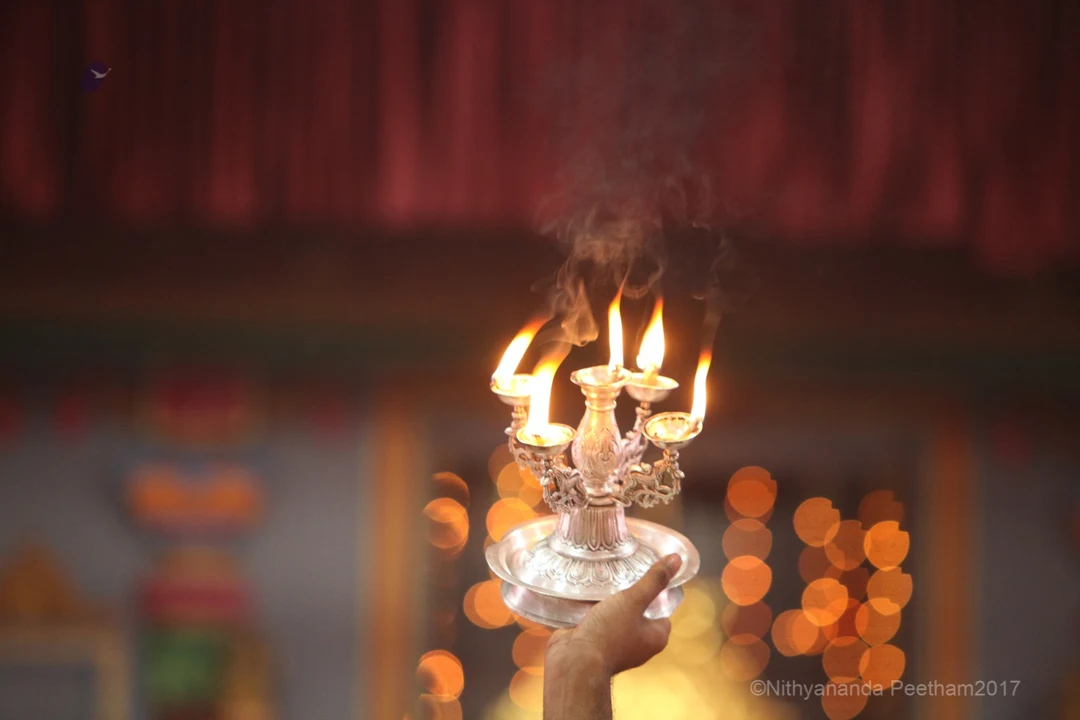
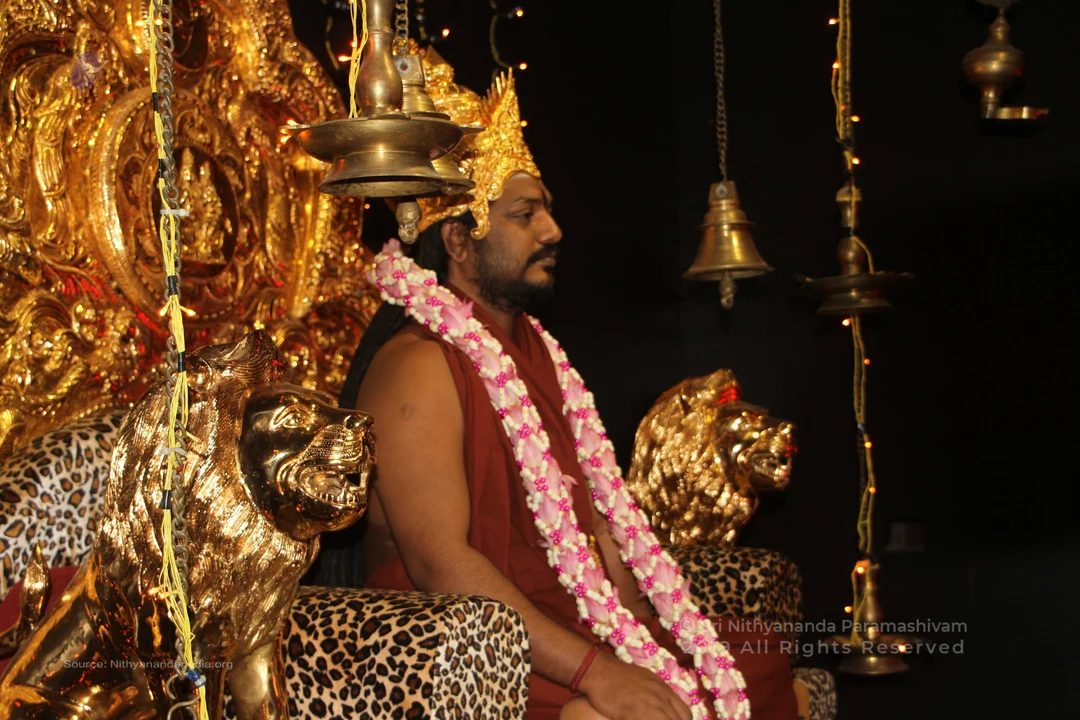
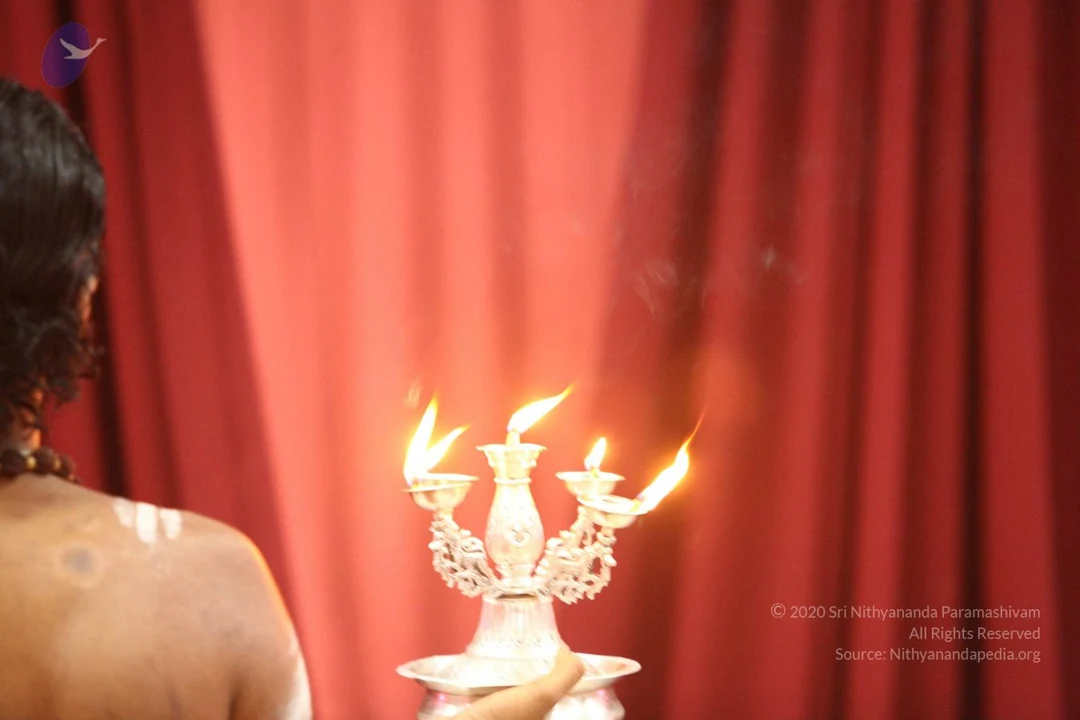
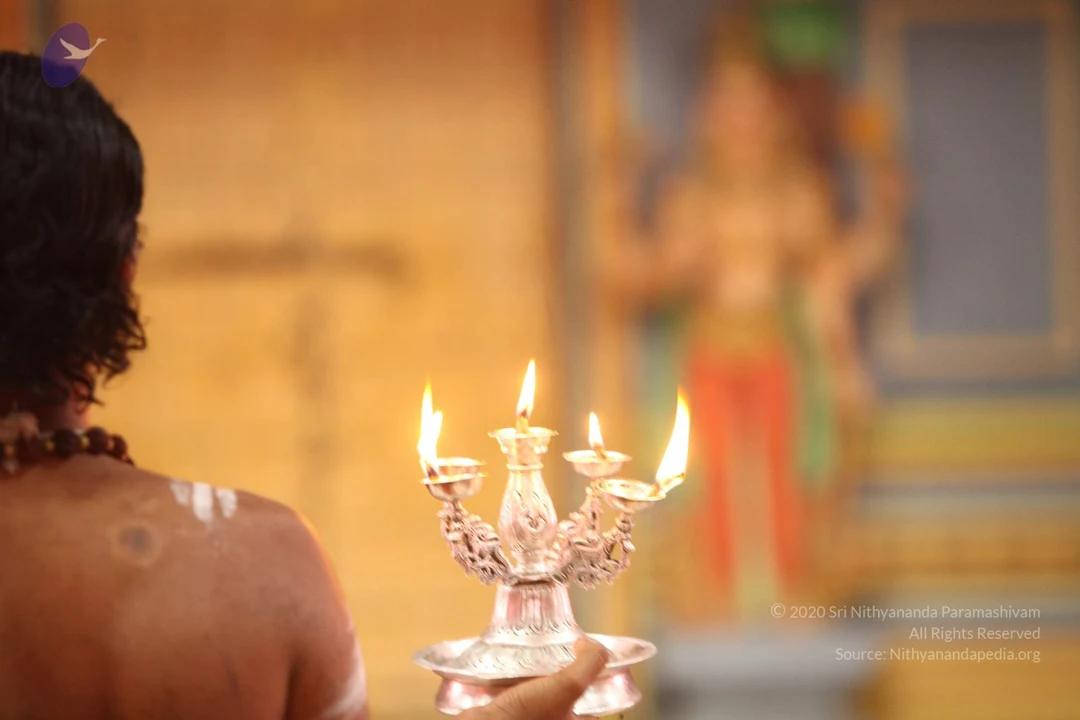
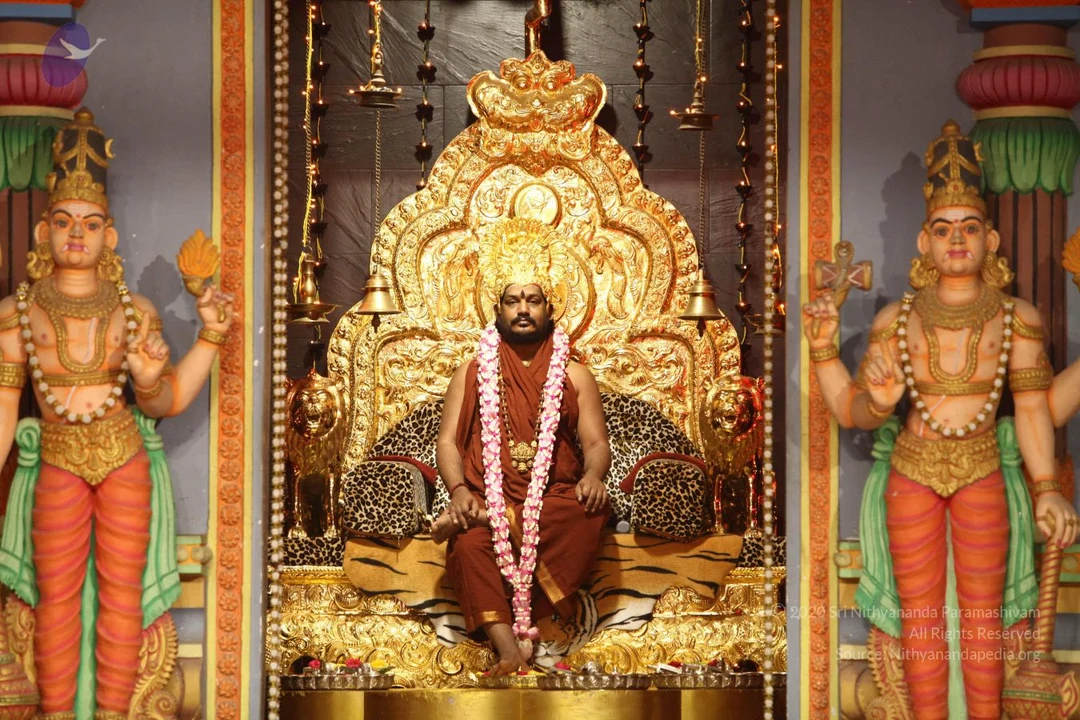
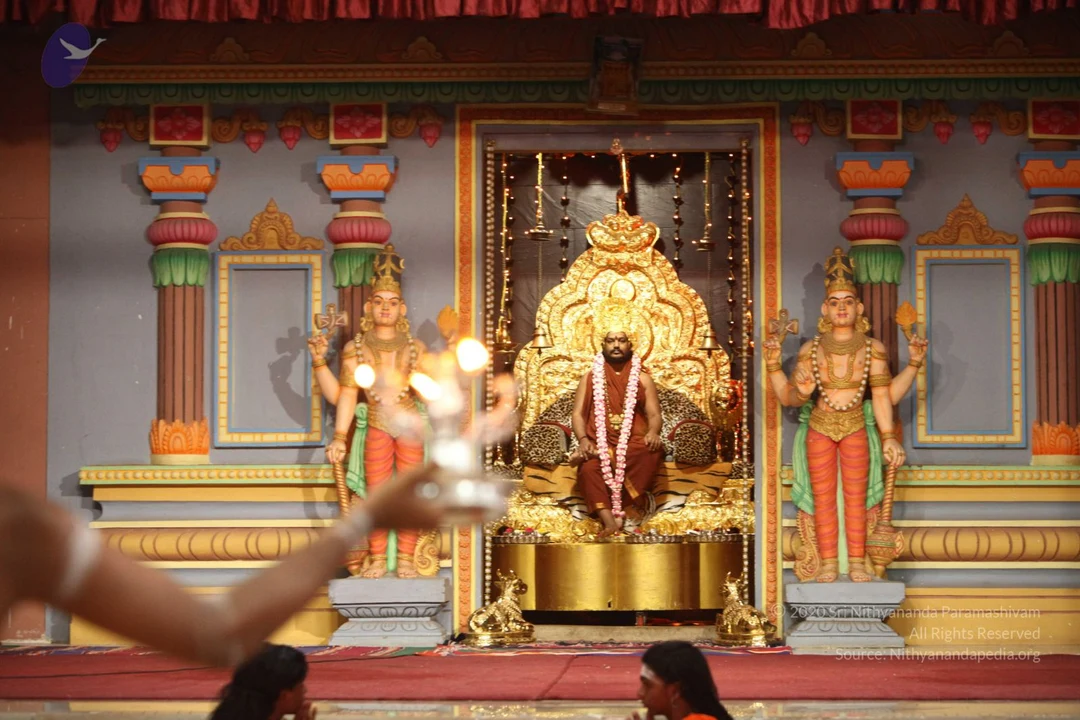
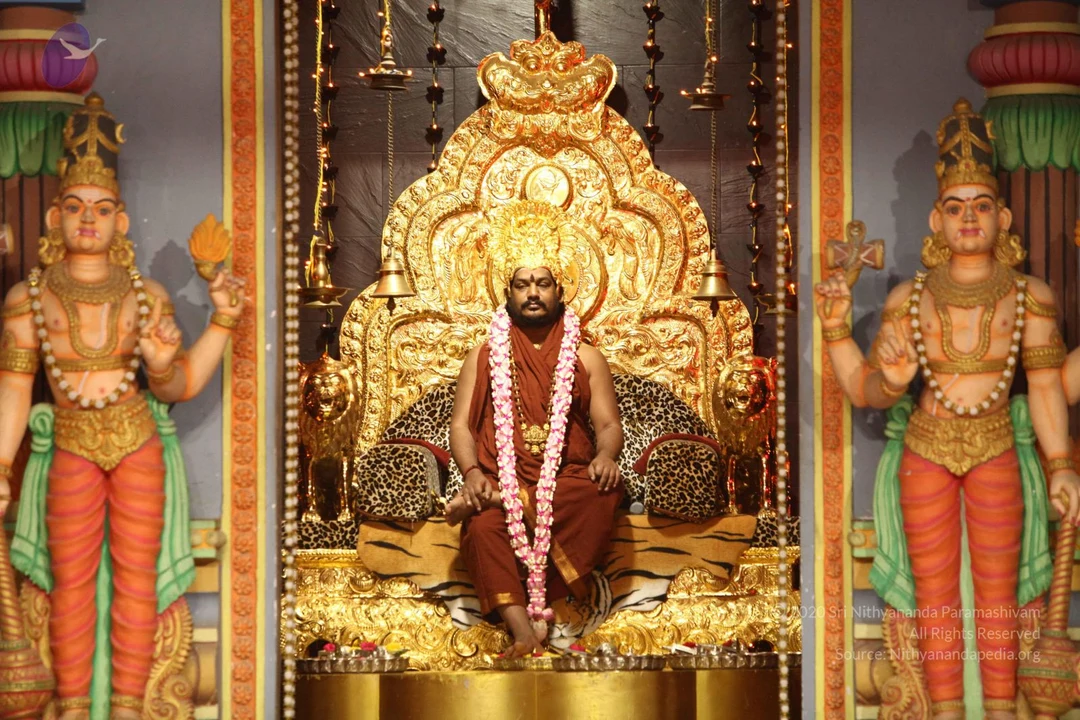
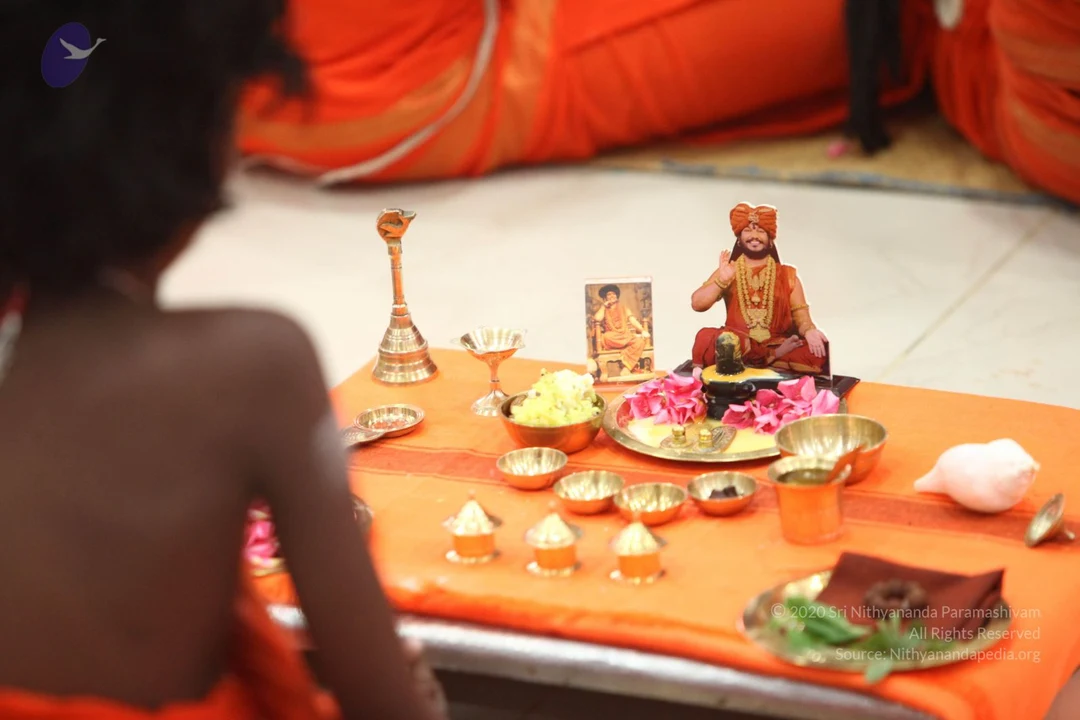
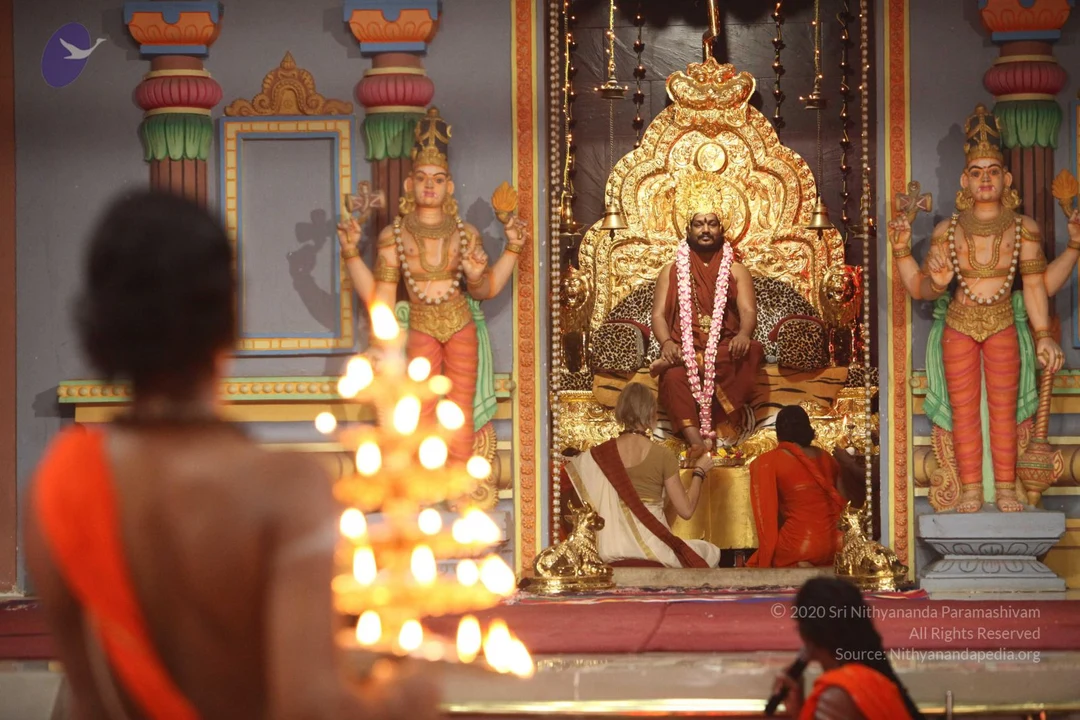
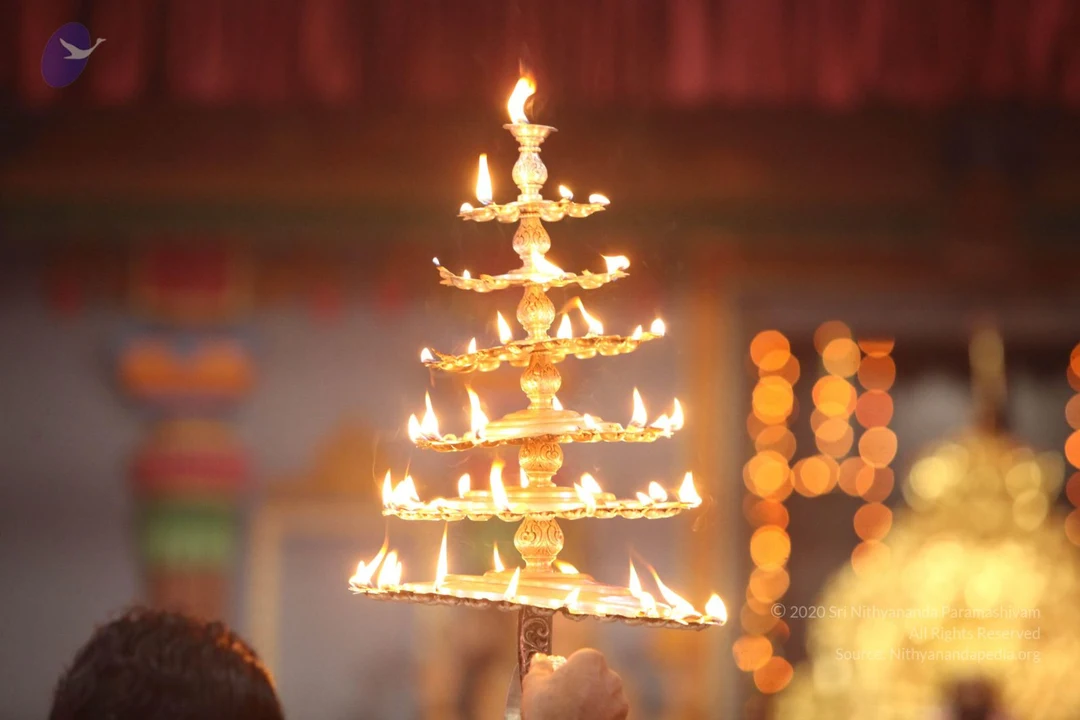
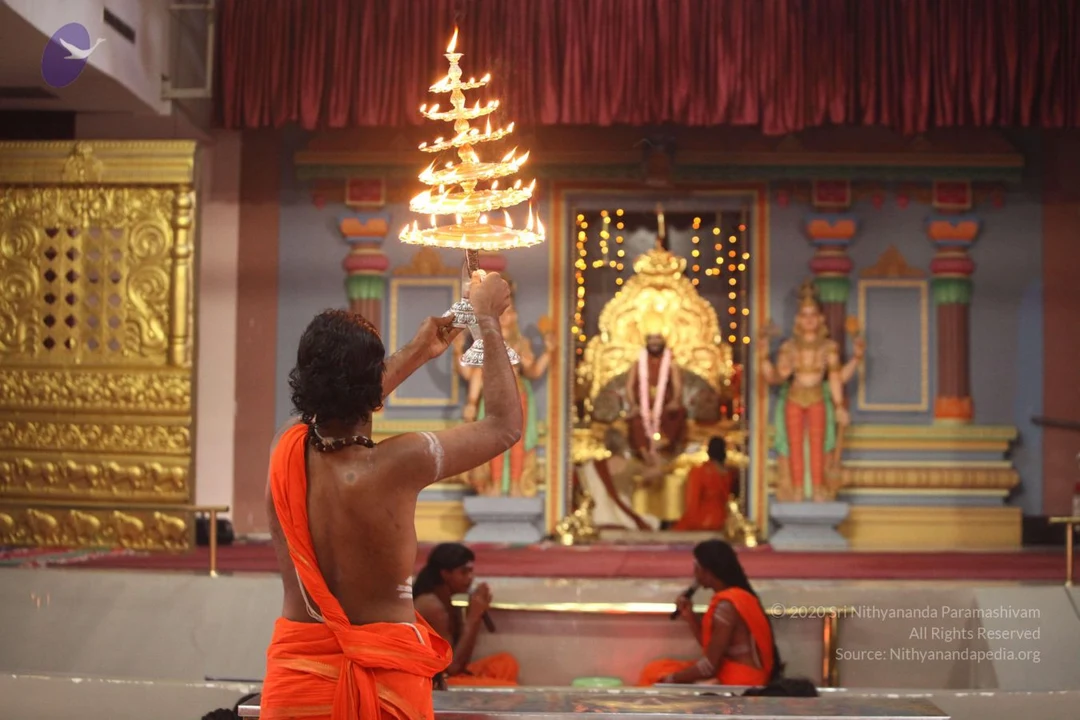
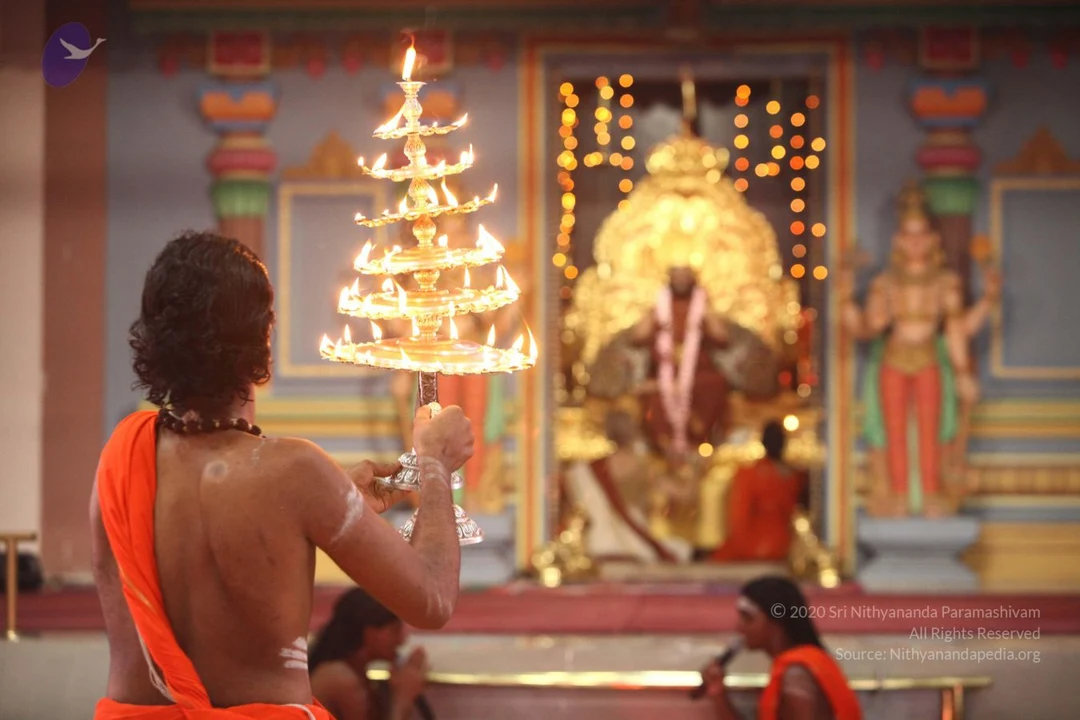
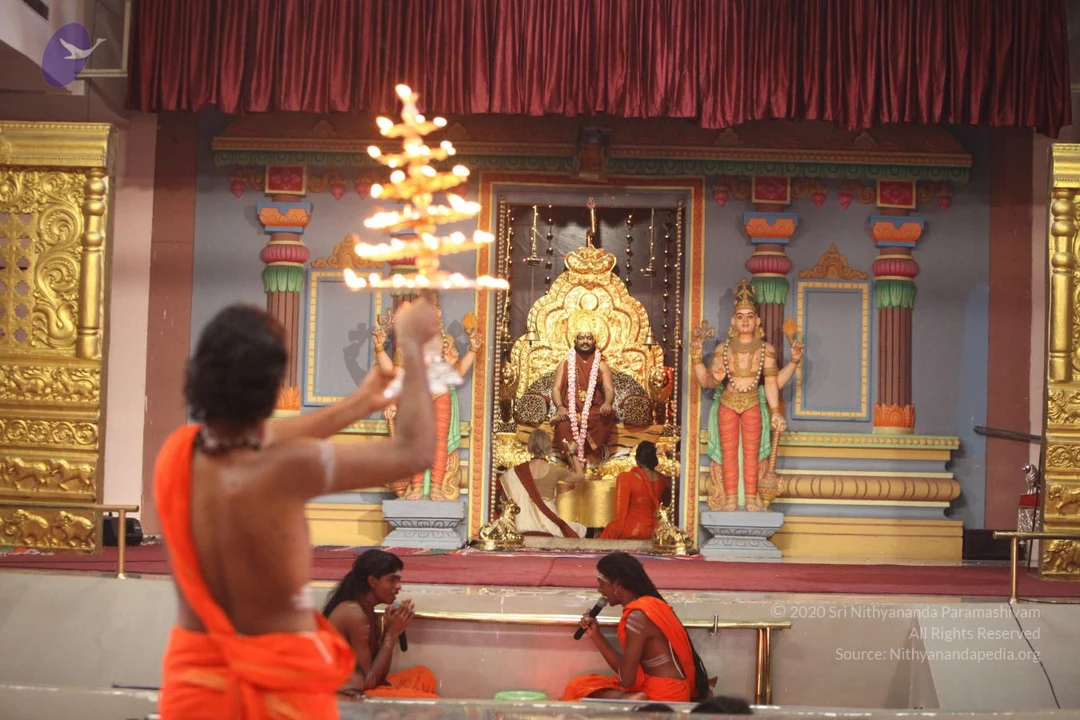
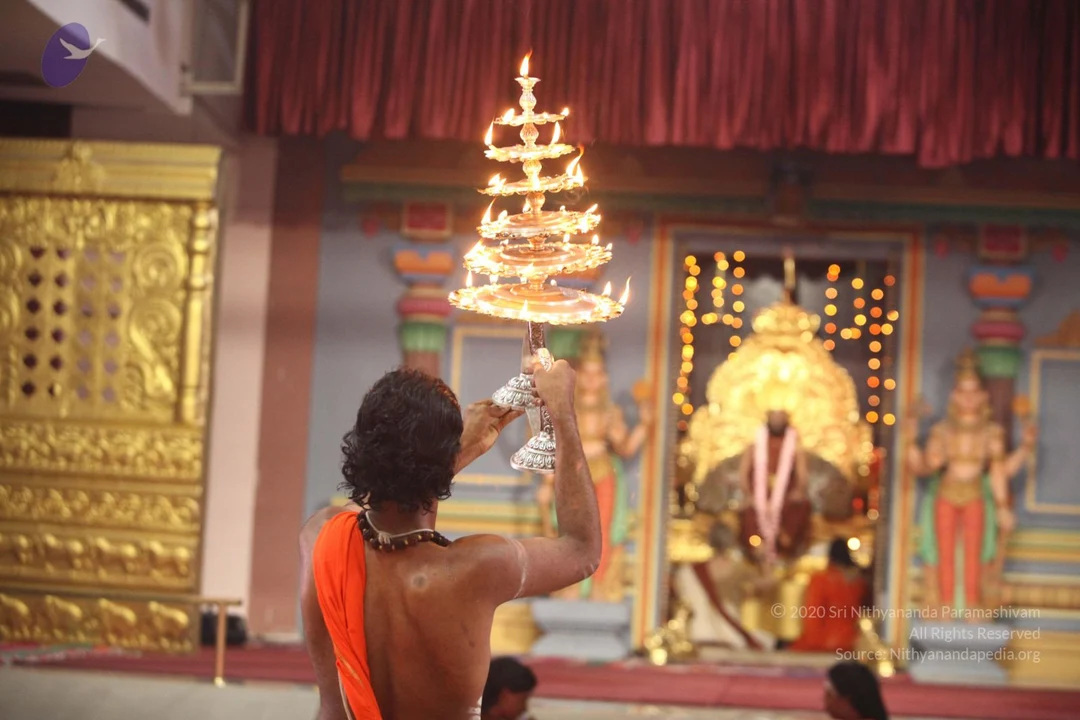
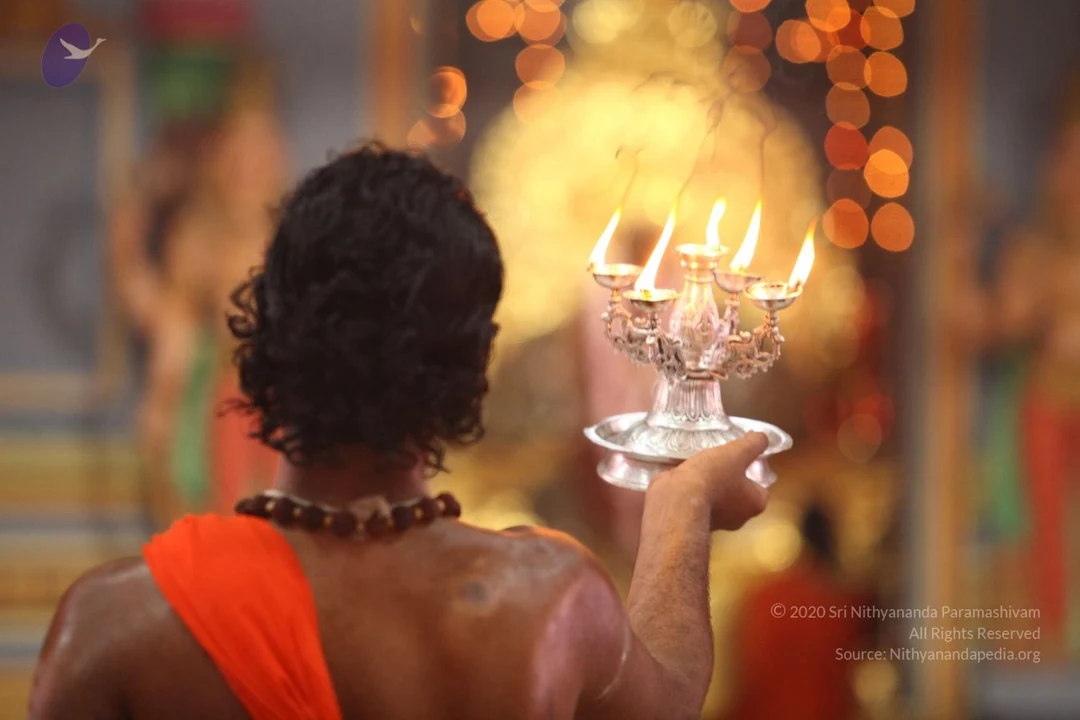
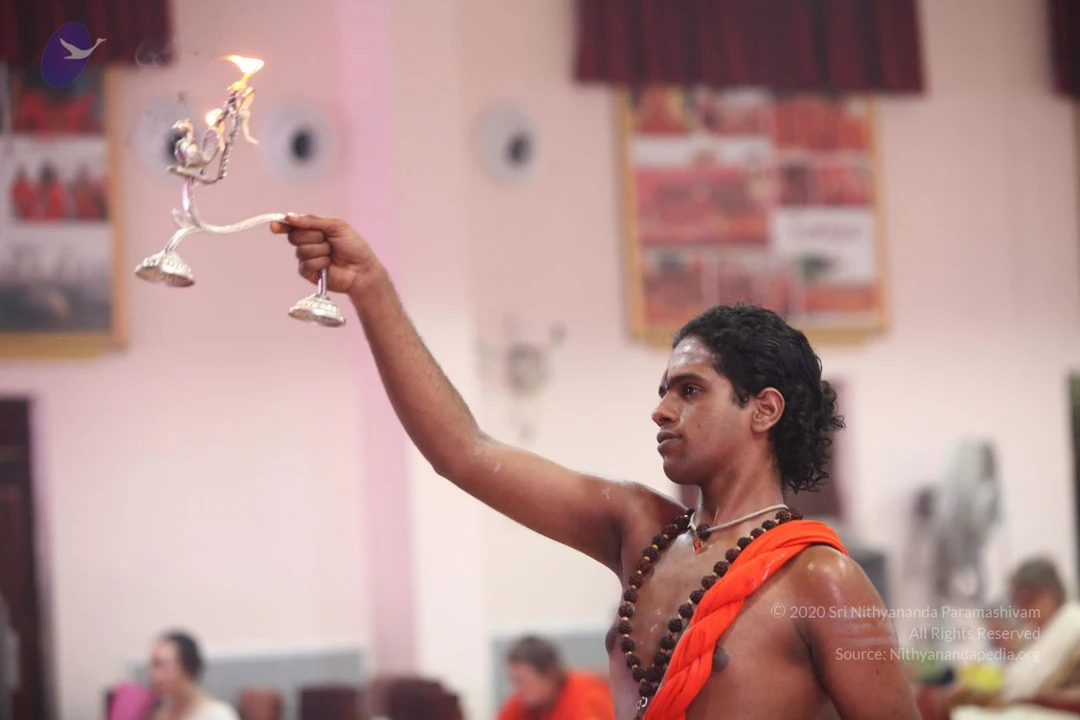
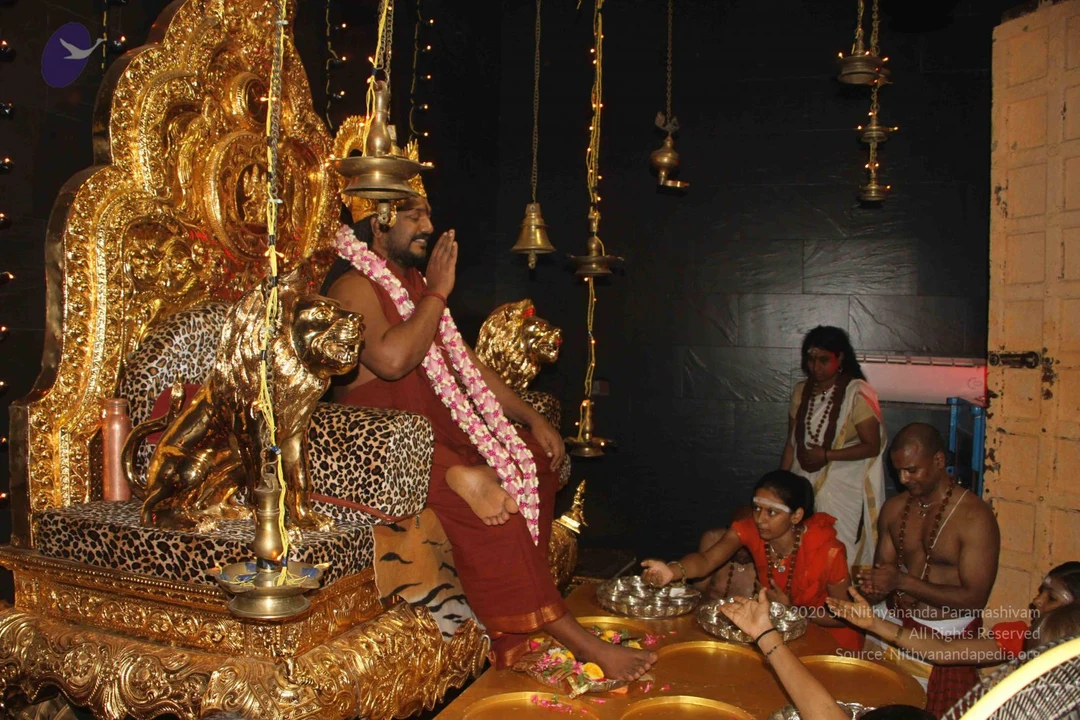
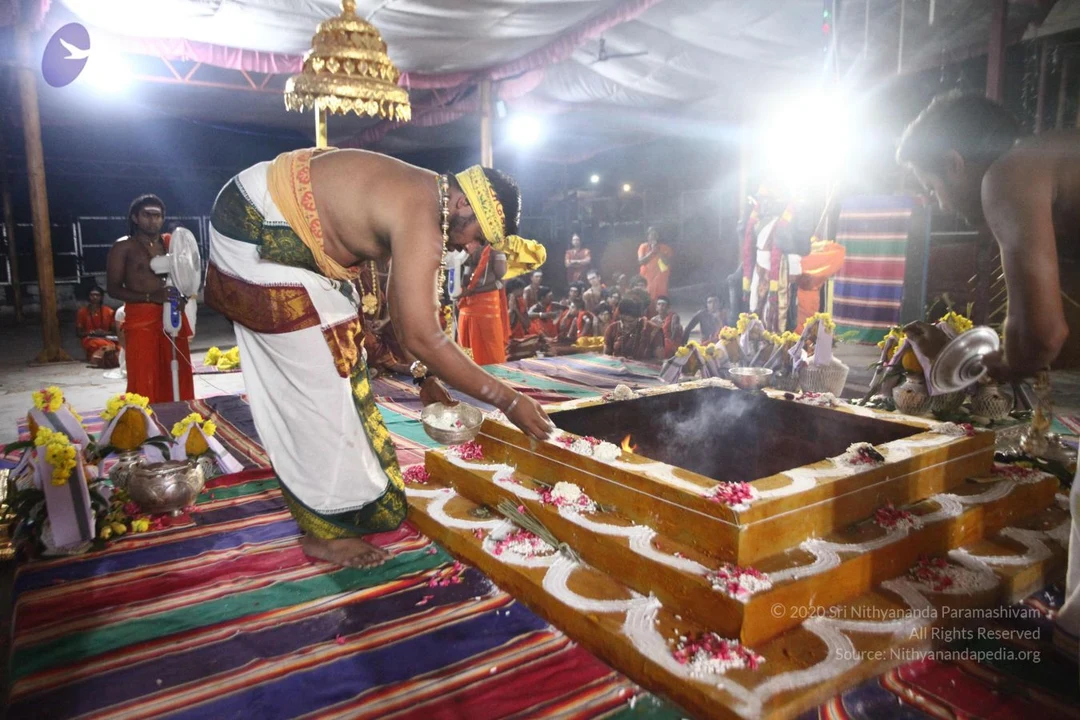
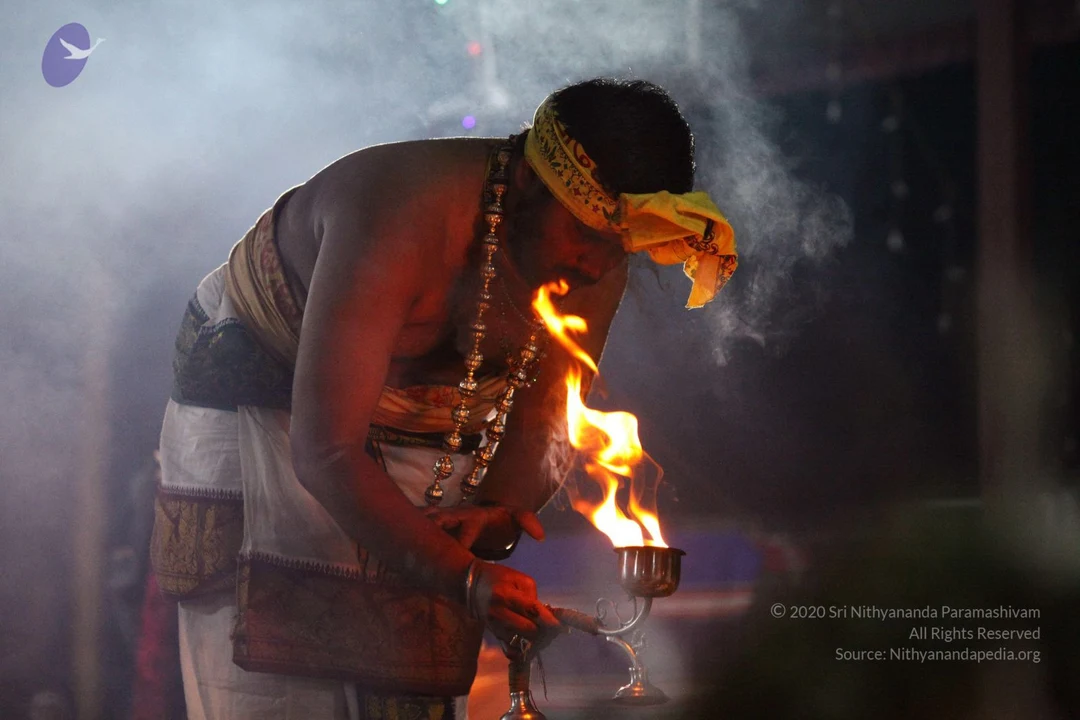
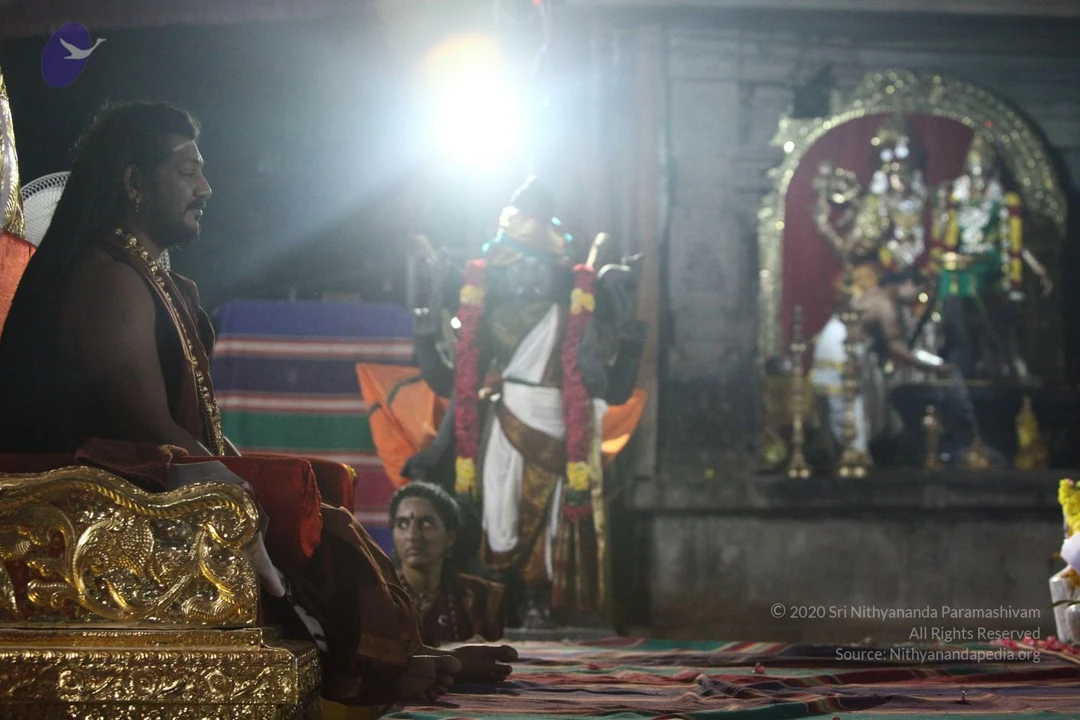
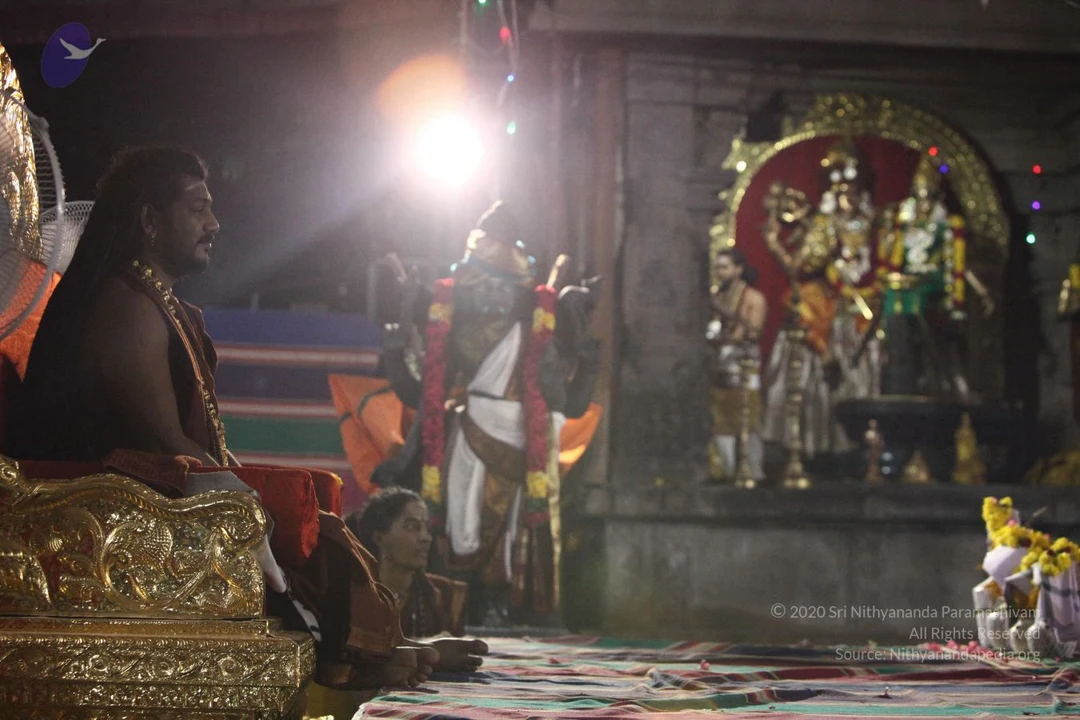
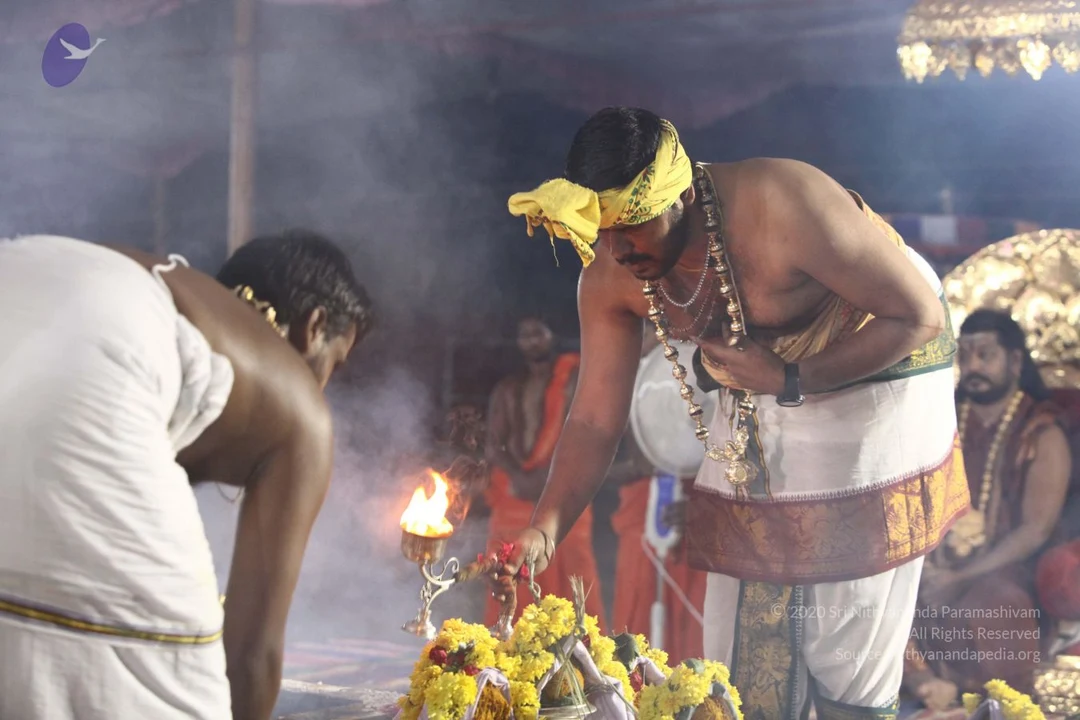
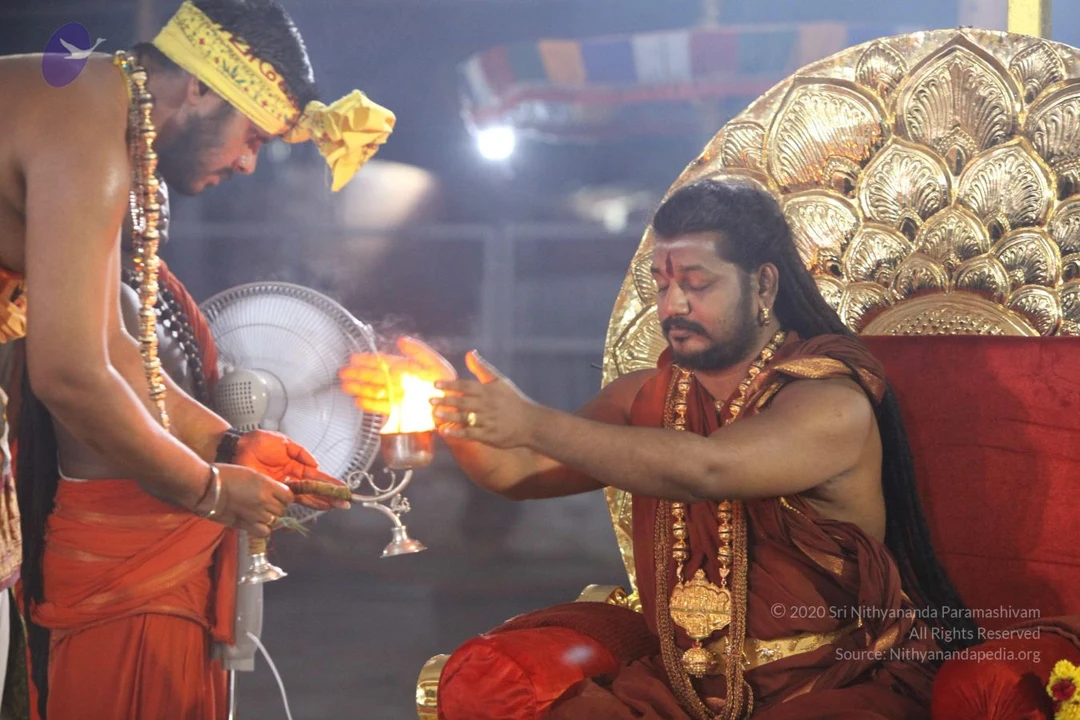
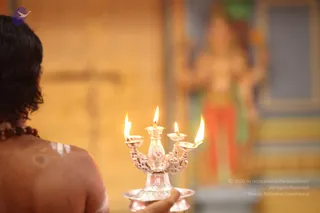
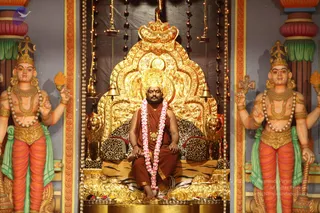
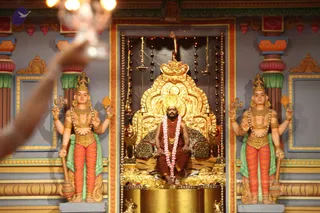
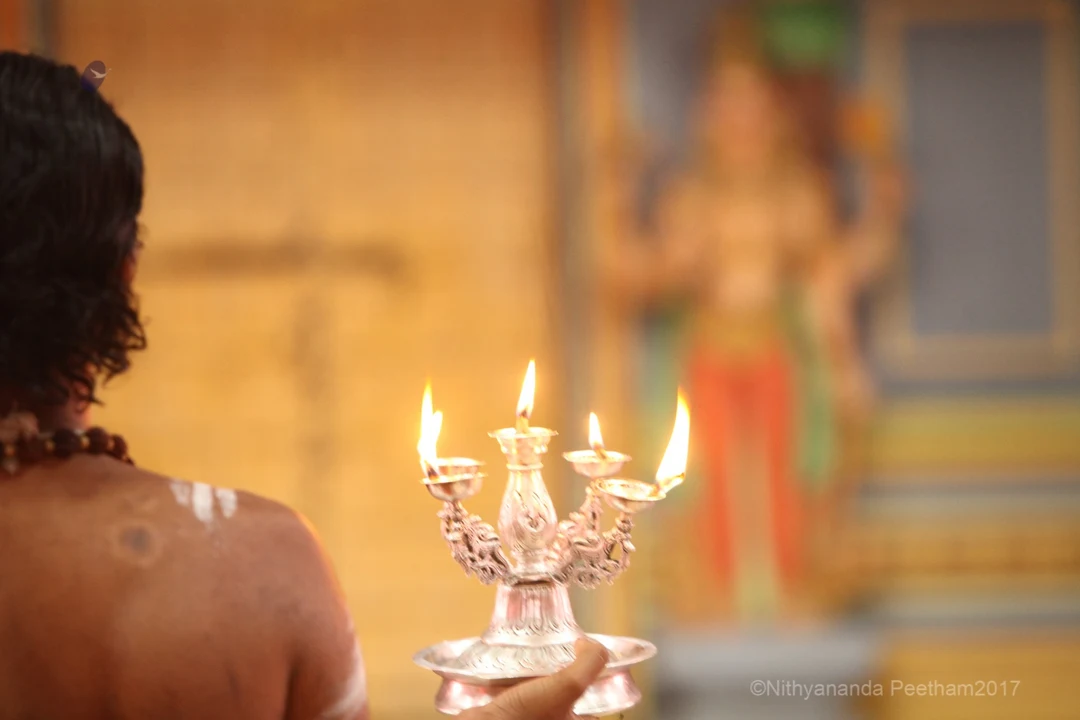
A photograph from behind of a bare-backed man holding a silver multi-branched oil lamp (aarti lamp) with four lit flames in his raised right hand. He has long dark wavy hair and a rudraksha mala around his neck, with white sacred ash marks on his shoulder. The blurred background shows a golden-lit shrine with a deity murti in orange and green draped garments.A seated man in saffron-orange robes sits on an ornate gold throne with carved lion-head armrests, draped with leopard-print and tiger-striped cloths. He wears a pink and white flower garland, a gold pendant and a dark bead mala. Flanking him are two large painted statues of deities in gold crowns and jewellery with raised hands holding lamps and a trident-like staff, and hanging bells and oil lamps frame the throne. Flower offerings and oil lamps rest on the platform.A seated man in a rust-orange ochre robe sits on an ornate gold throne with a tiger-skin and leopard-print cushion, wearing a pink and white flower garland and a gold necklace. Golden lion heads flank the throne, and hanging brass lamps and bells hang above. Two painted, multi-armed deity murti statues stand on either side, wearing gold jewellery, pearl necklaces and green sashes, and holding ritual objects. Small offerings and flowers sit on the gold base. The seated figure is an appearance-based probable Swamiji candidate with long swept-back hair and a distinctive saffron robe and garland, presented on a throne in a temple setting.A photograph of a seated man in a saffron-orange robe, wearing a pink and white flower garland, sitting on an ornate gold throne with a tiger-skin and leopard-print cushion. Two painted guardian figures flank the throne, each with four arms, gold jewellery, orange dhoti and green sash, holding a staff and a lotus-like object. A blurred hand holding an object. The wall is decorated with red, blue and gold ornamental painting, and gold lamps and bells hang above the throne.A seated man in a rust-red ochre robe sits on an ornate gold throne with a tiger-skin and leopard-print cushion, wearing a pink and white flower garland and a gold necklace, with hands resting on his knees in a meditative pose. Flanking him are two painted guardian statues with multiple arms, crowns, rudraksha-style beaded necklaces, gold waistbands and orange-red dhotis. Brass bells and hanging lamps decorate the golden canopy above, and flower offerings lie at the base of the dais. The scene is a temple or ashram hall setting. a person: the seated figure has a shaved head and wears an ochre robe, a flower garland and gold ornaments seated on a throne, but these cues are insufficient to confirm identity.A man in saffron-orange robes sits on an ornate gold throne with a leopard-print and tiger-striped cushion, wearing a pink and white flower garland and a gold pendant. Behind him a gilded halo-shaped backrest is hung with bells and chains. Two painted, gold-jewelled standing deity murti flank the throne, each with multiple arms and holding ceremonial objects, wearing green and orange draped cloths and pearl necklaces. Small flower offerings lie at the base of the throne. a person seated on the peetha in a sanctum-like setting, with the throne and saffron robes as central cues.

Nithya-Satsang

201 photosSource gallery
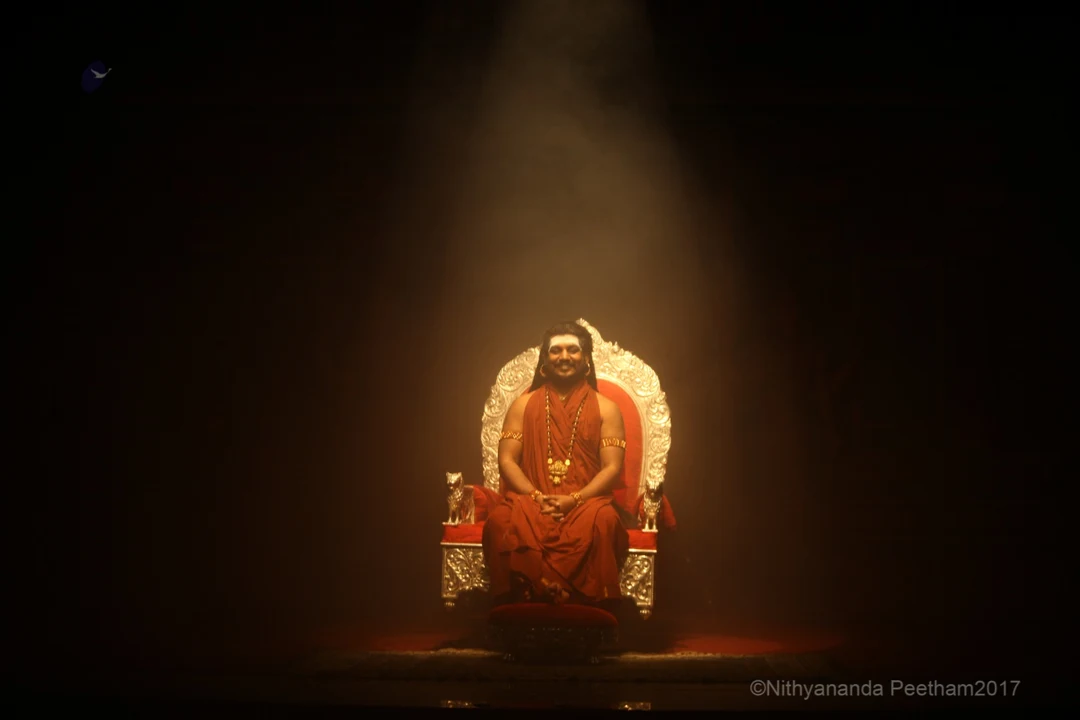
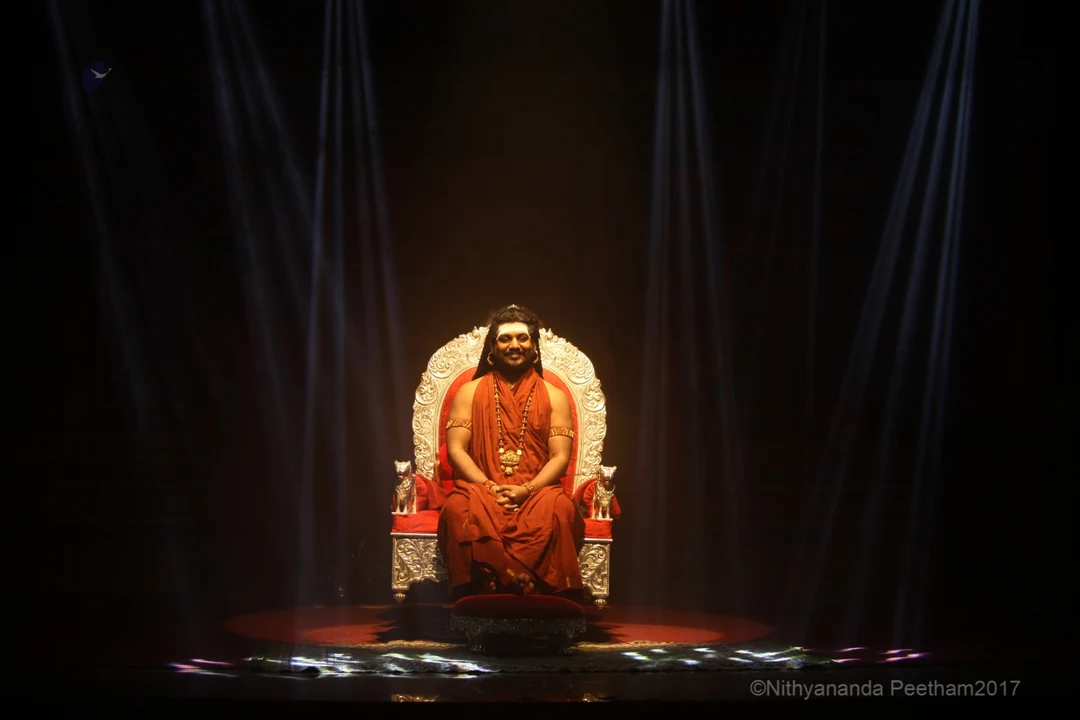
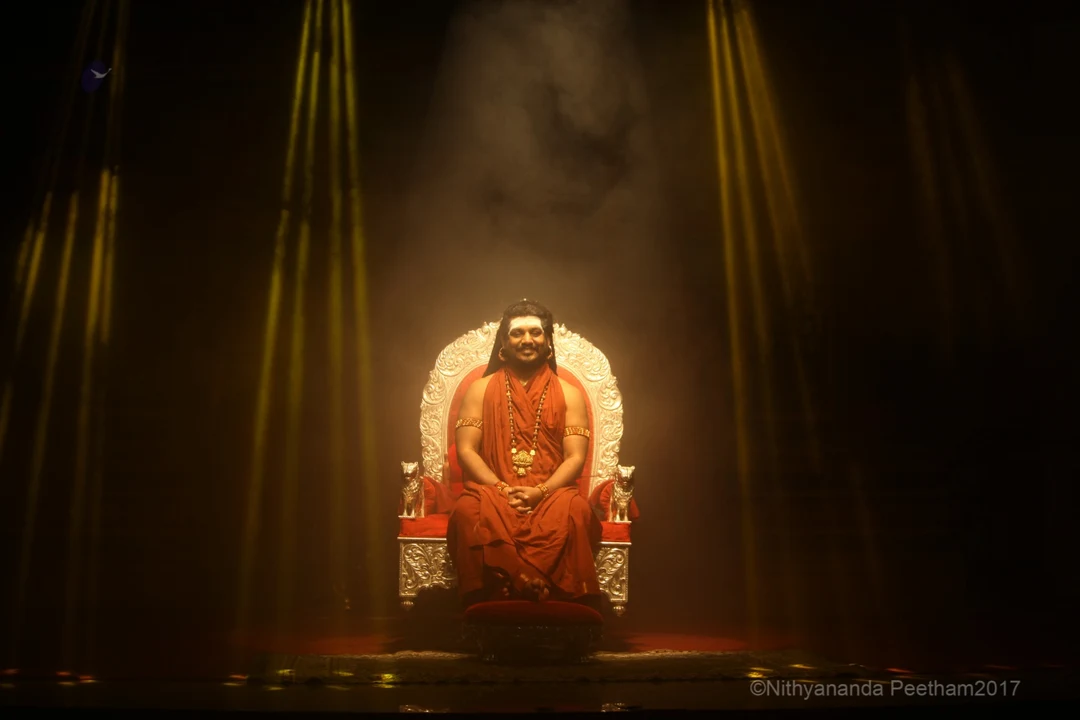
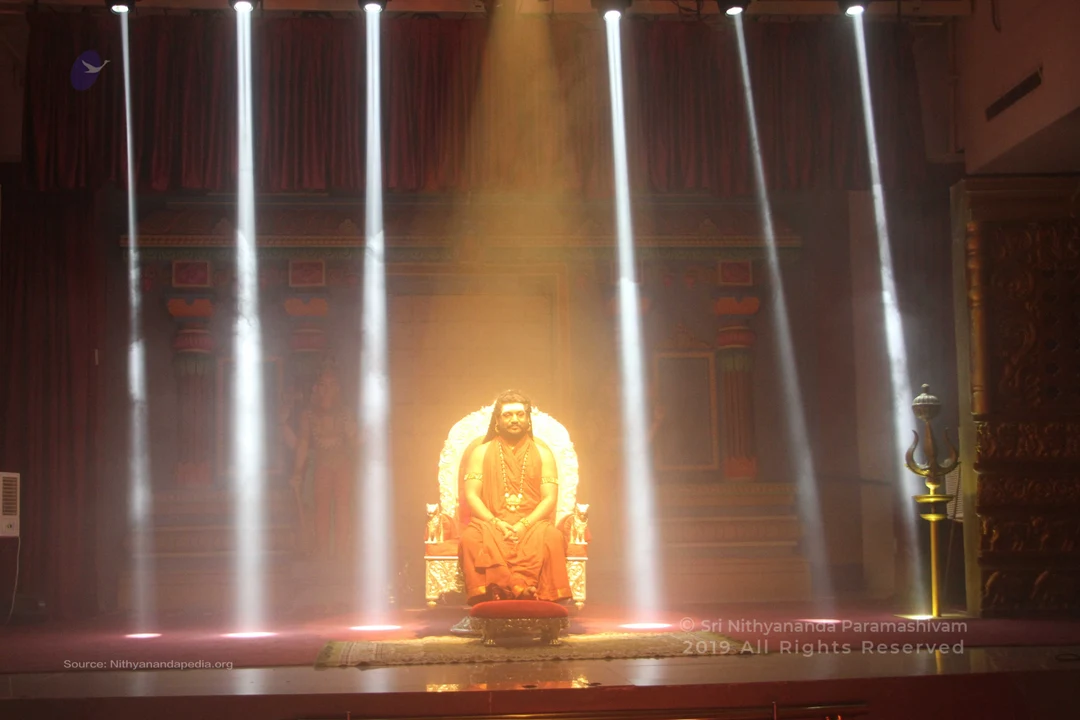
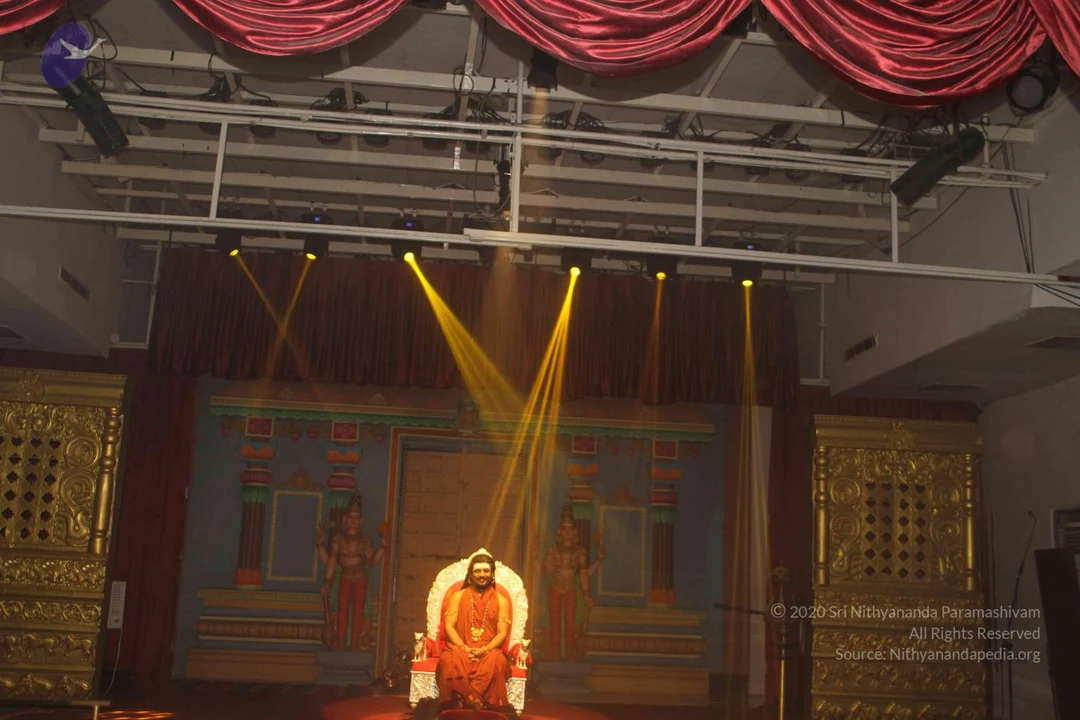
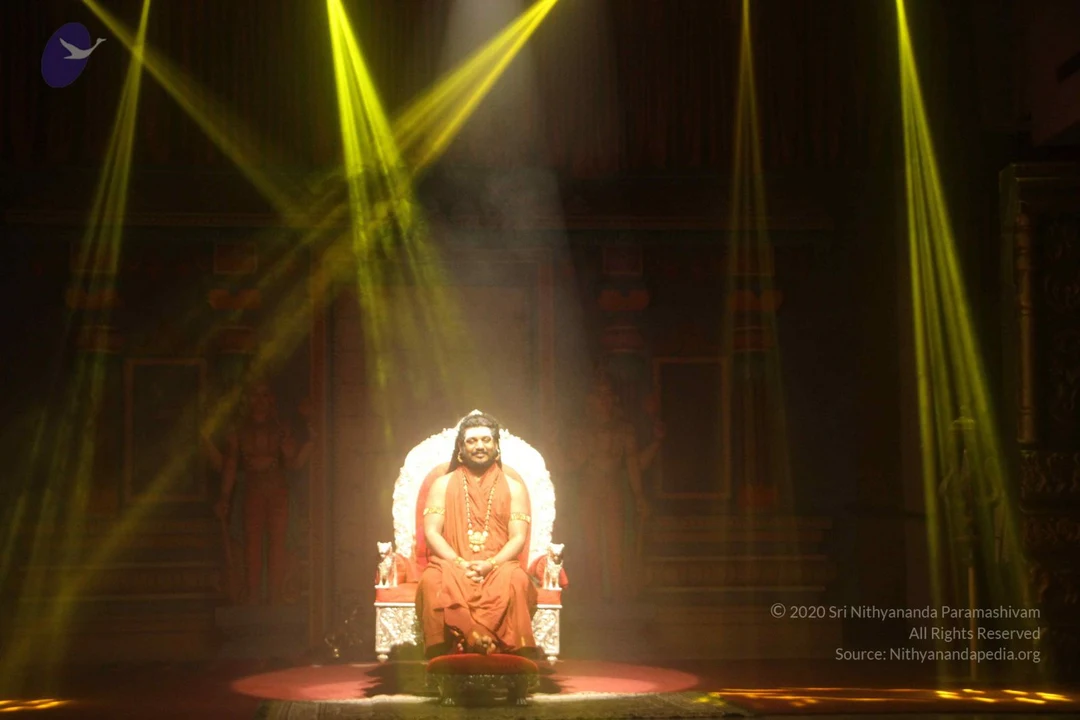
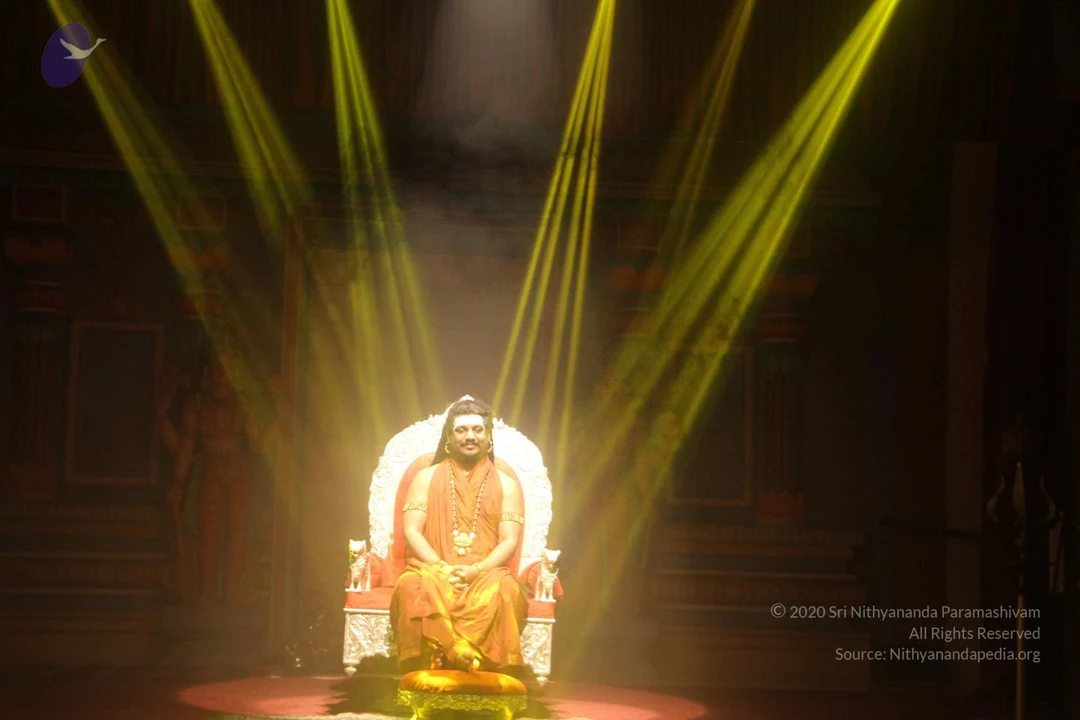
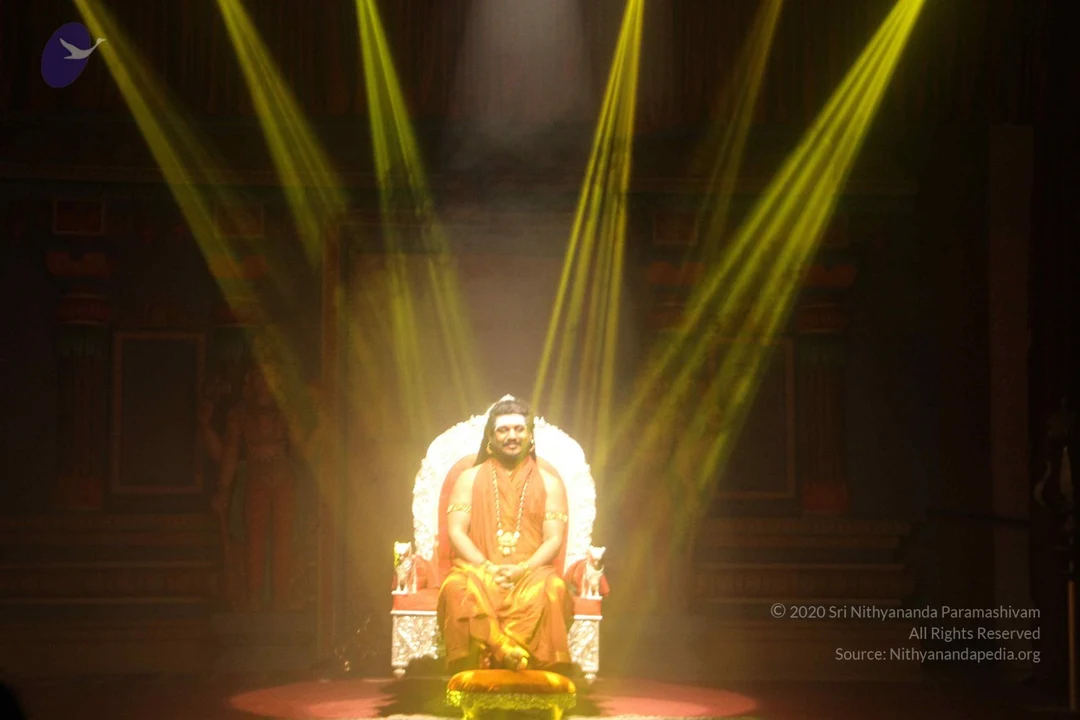
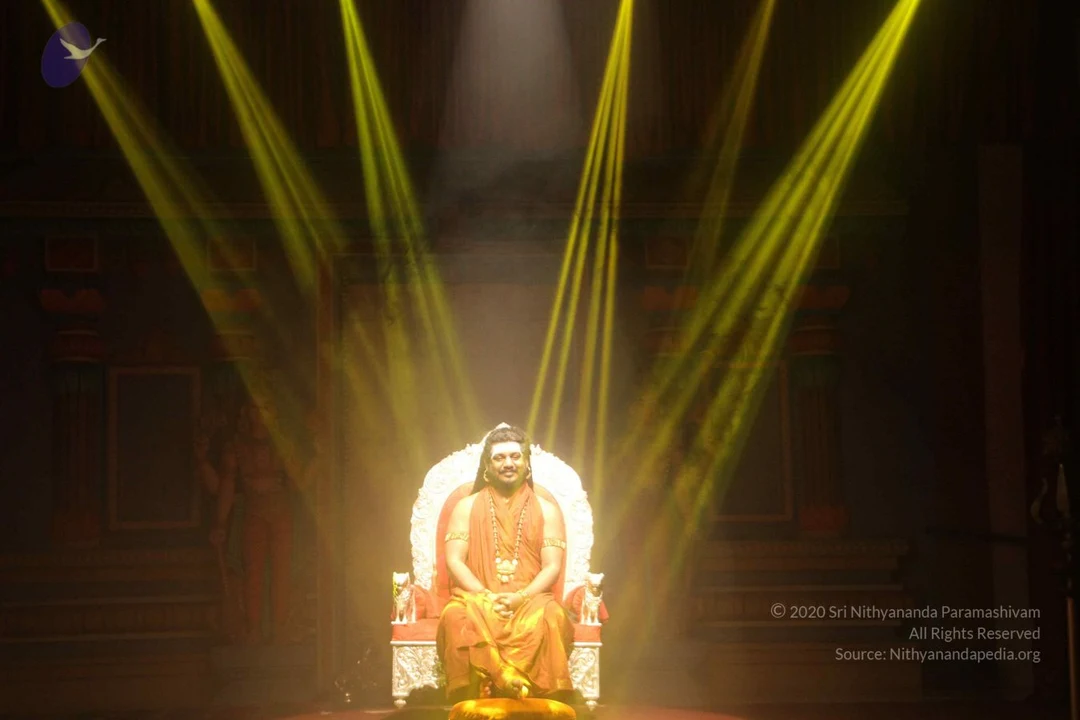
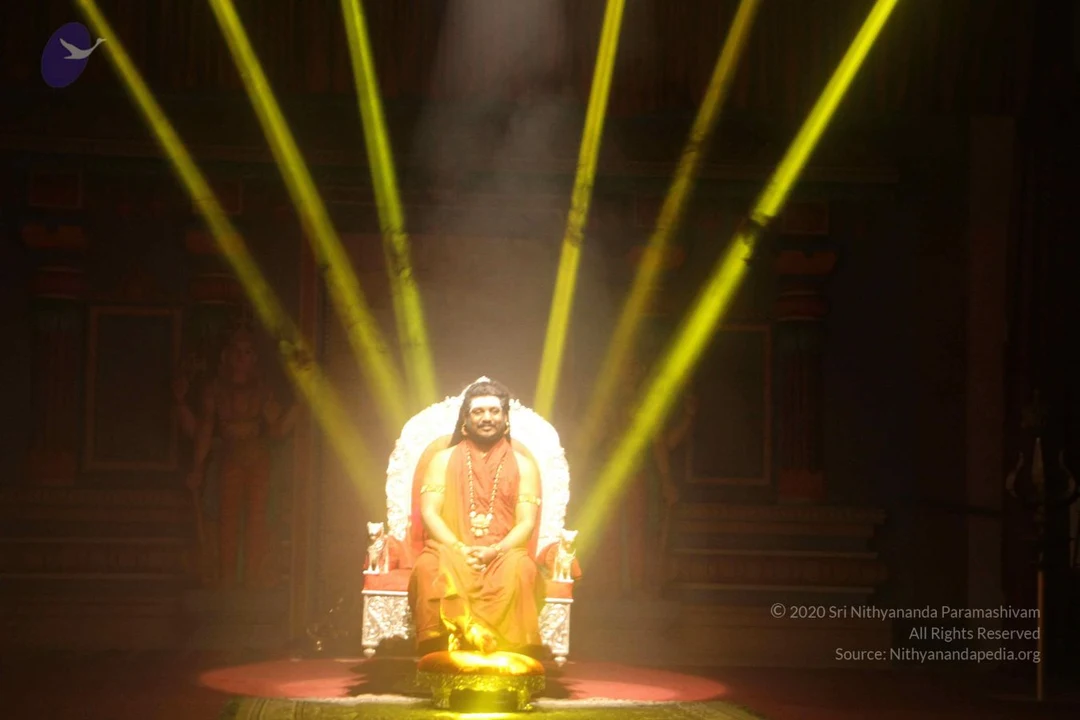
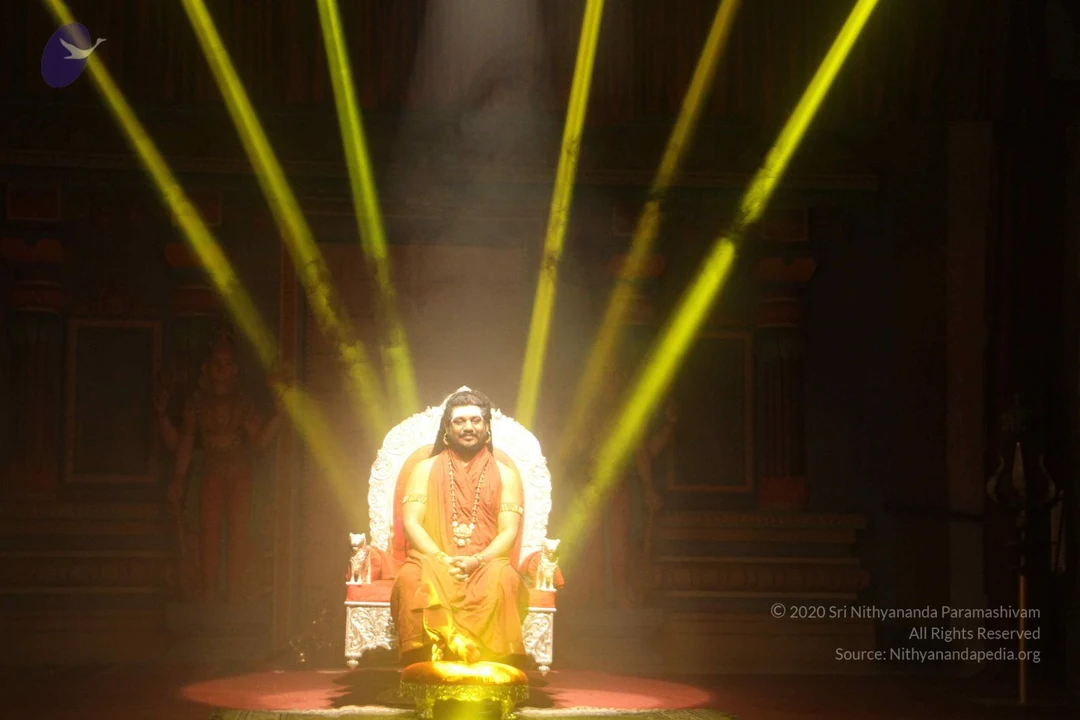
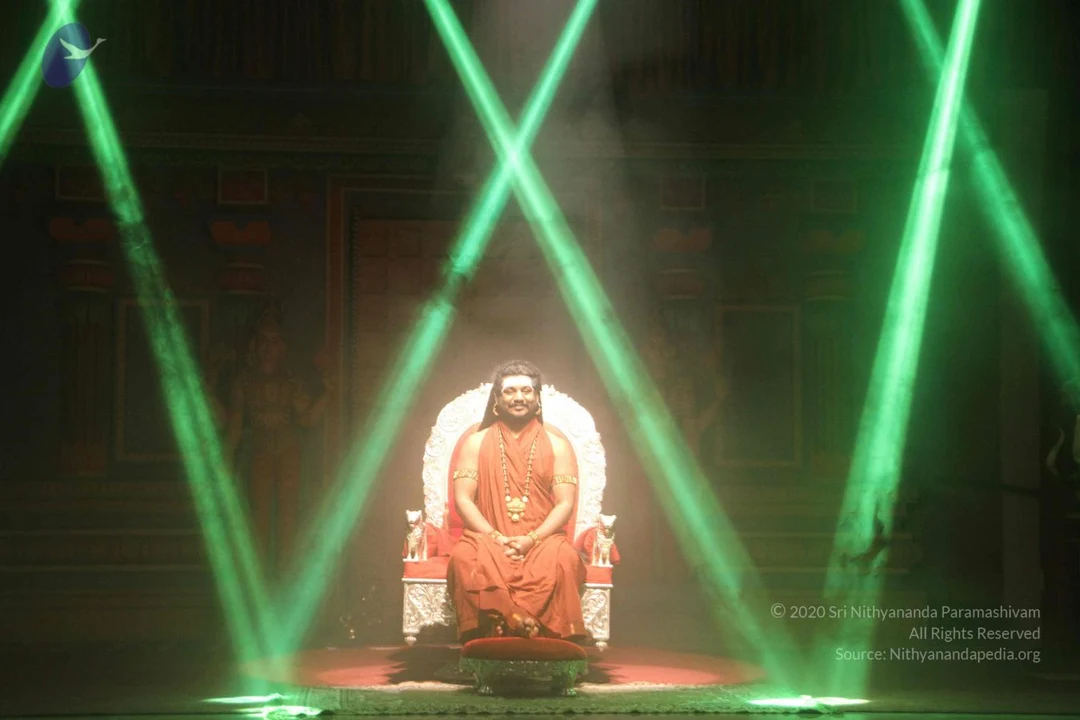
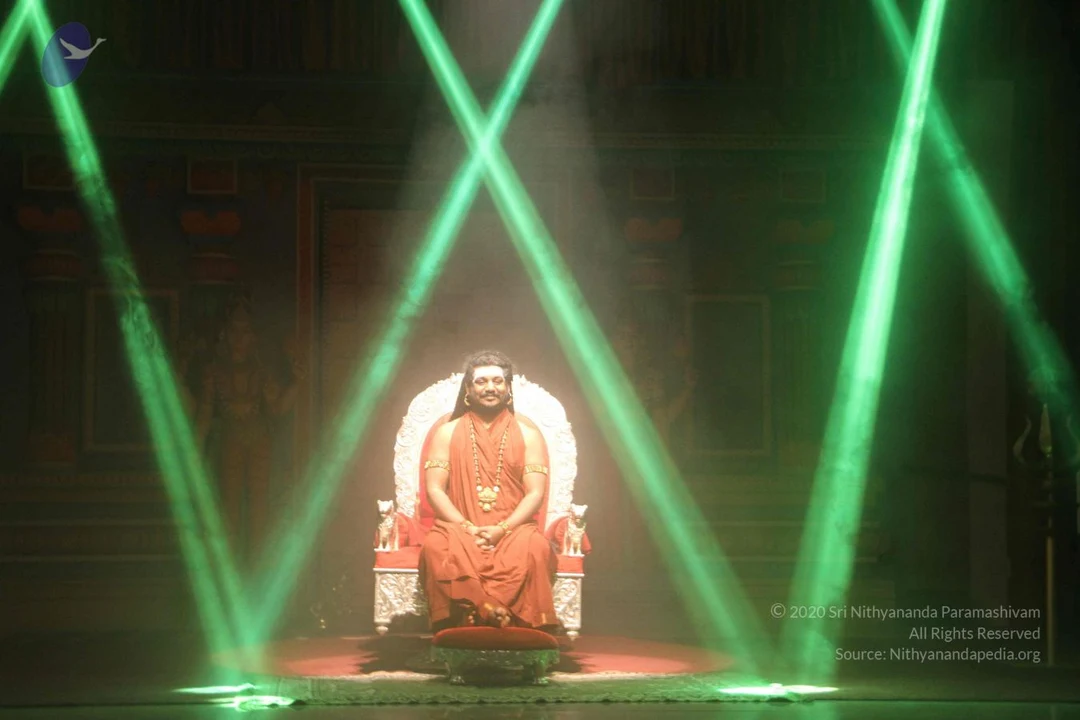
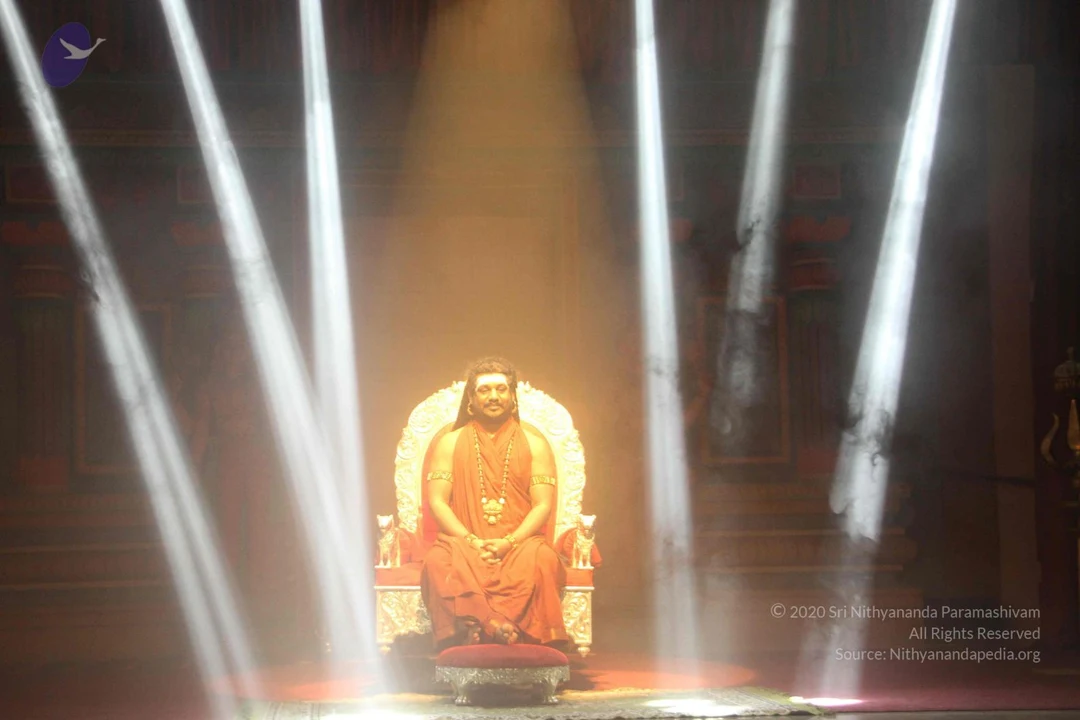
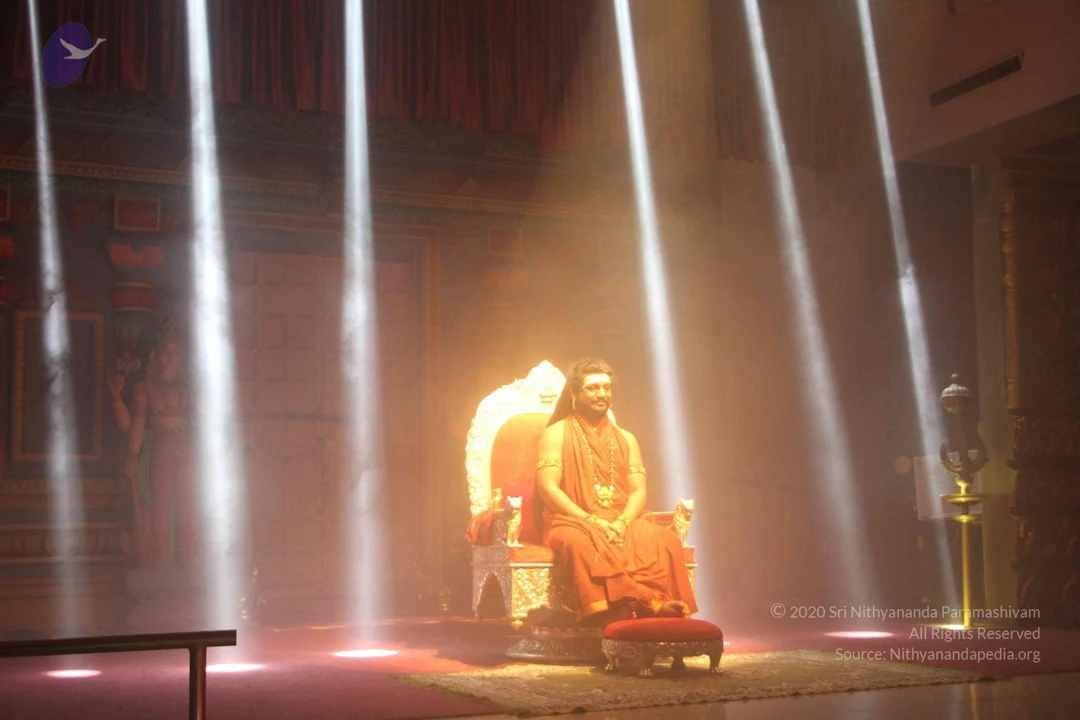
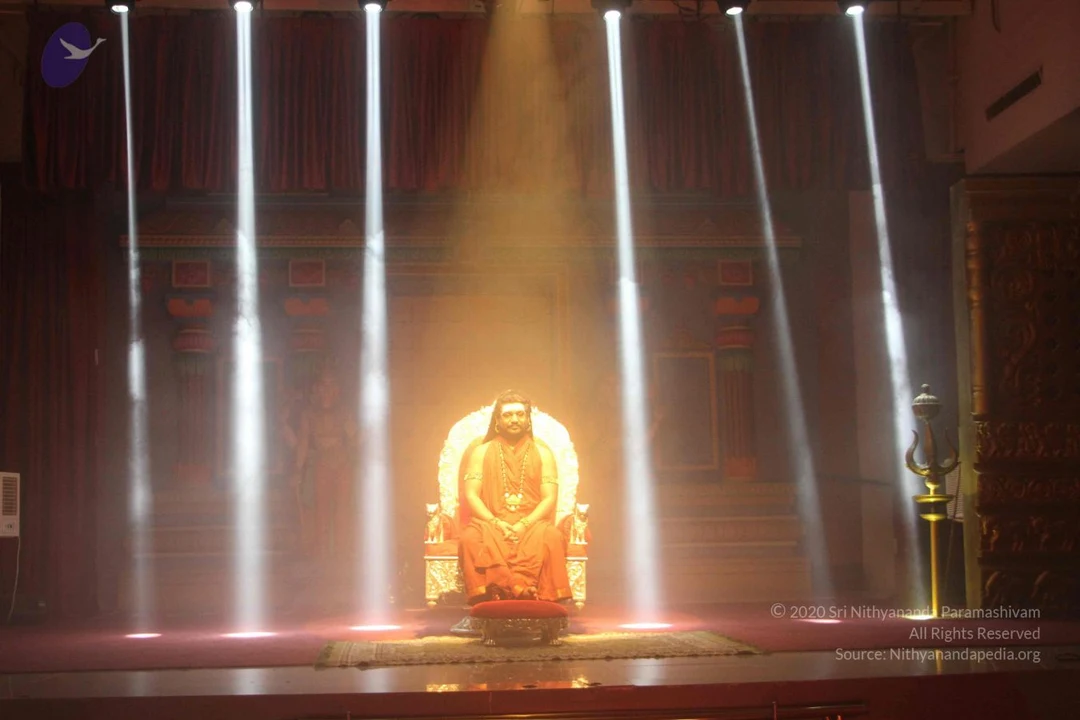
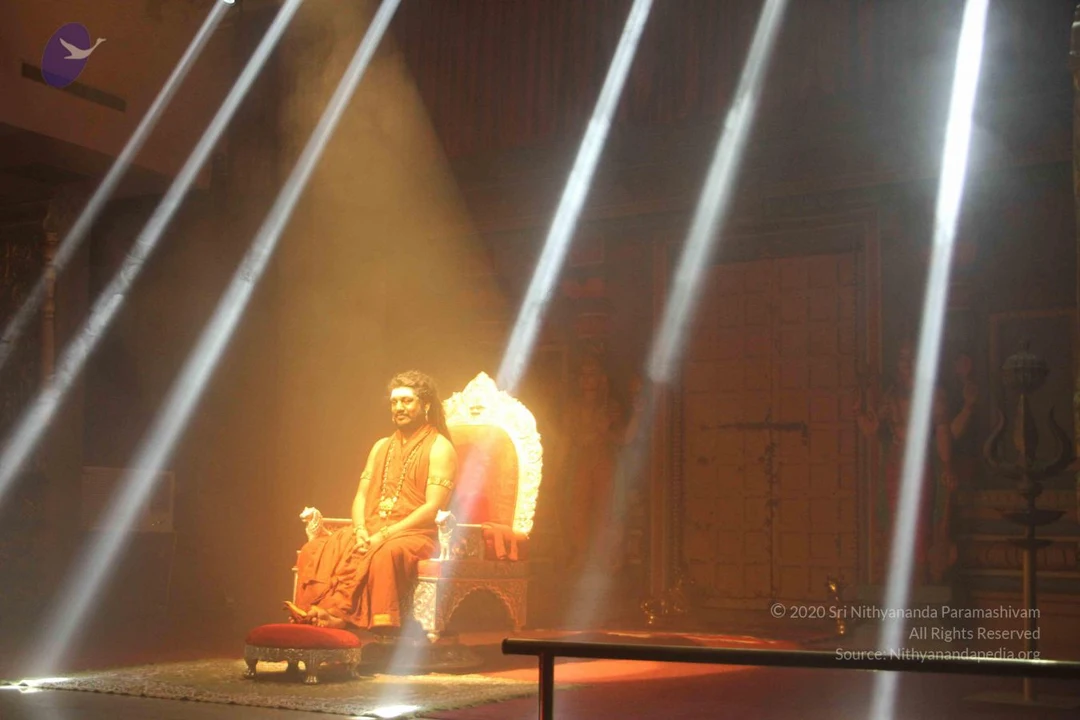
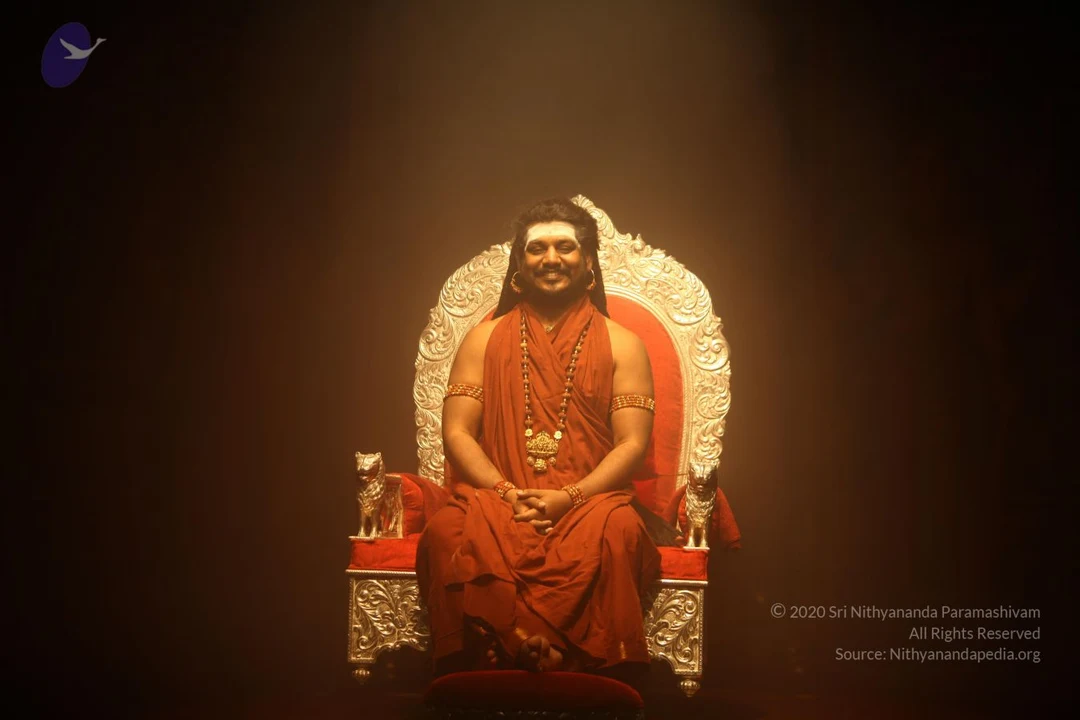
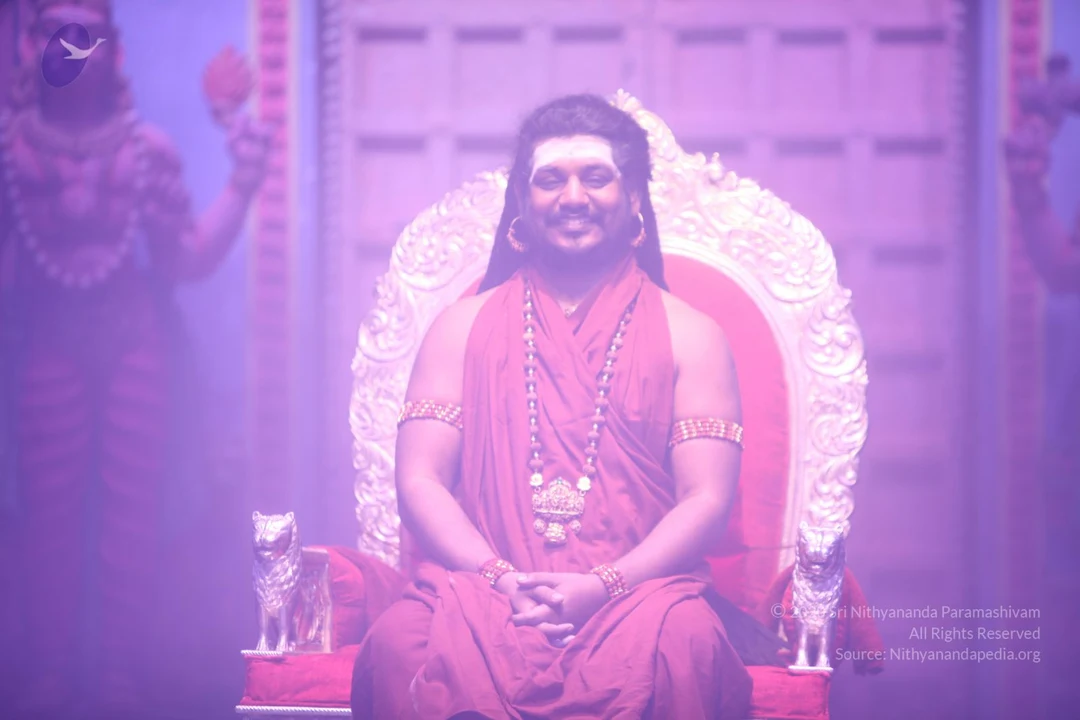
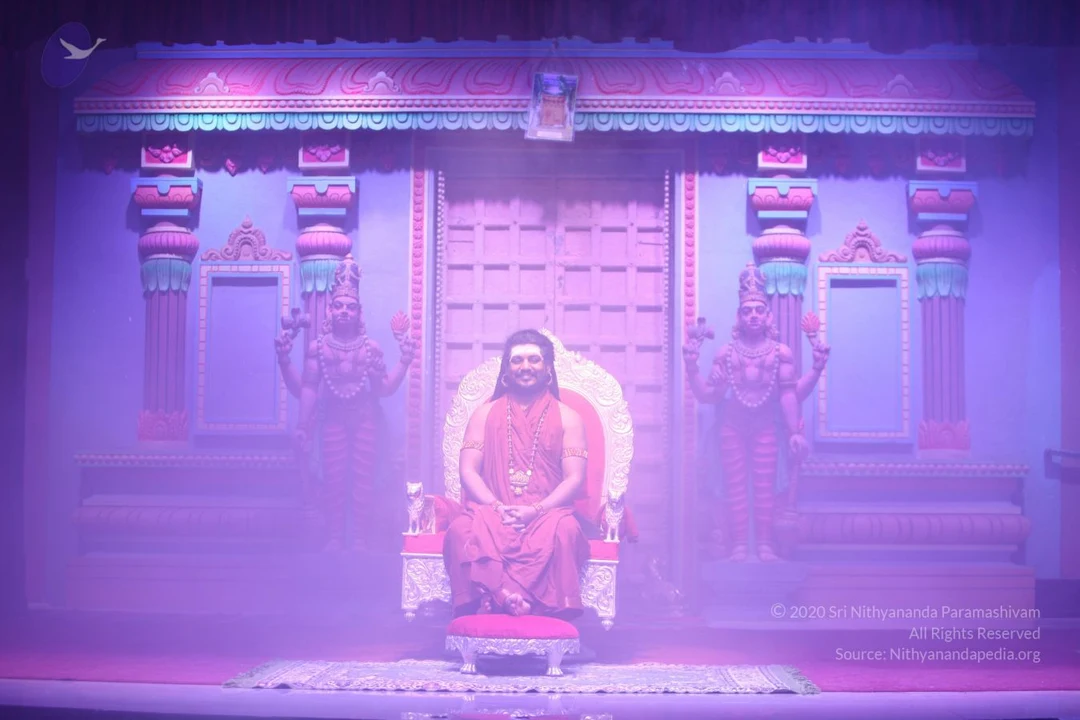
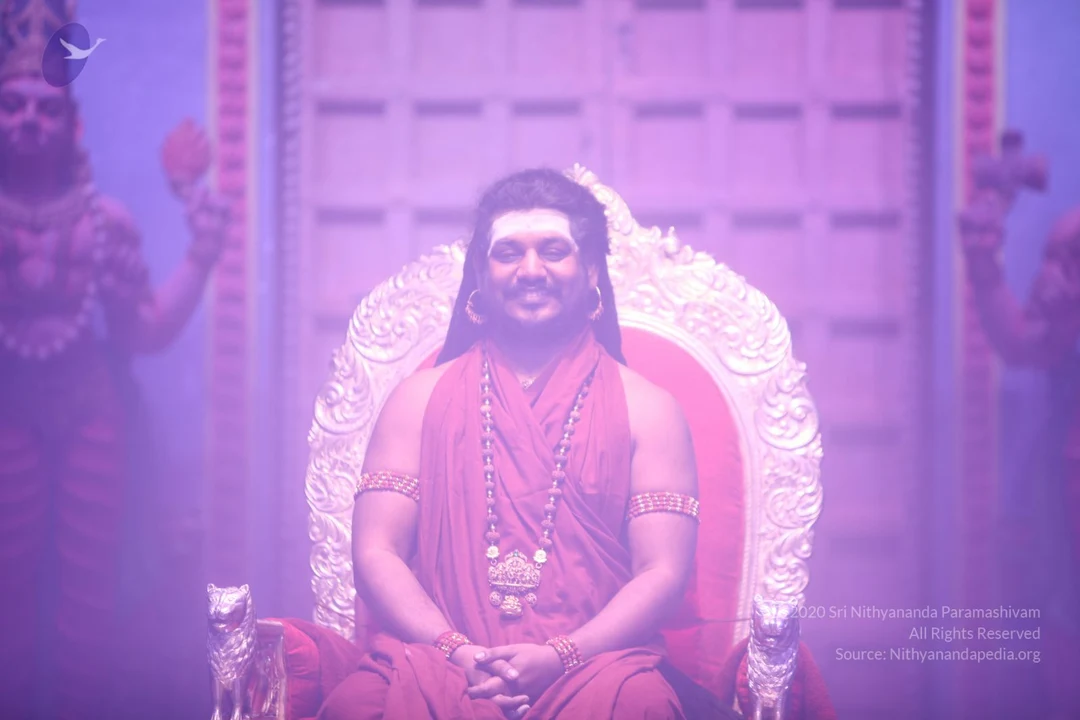
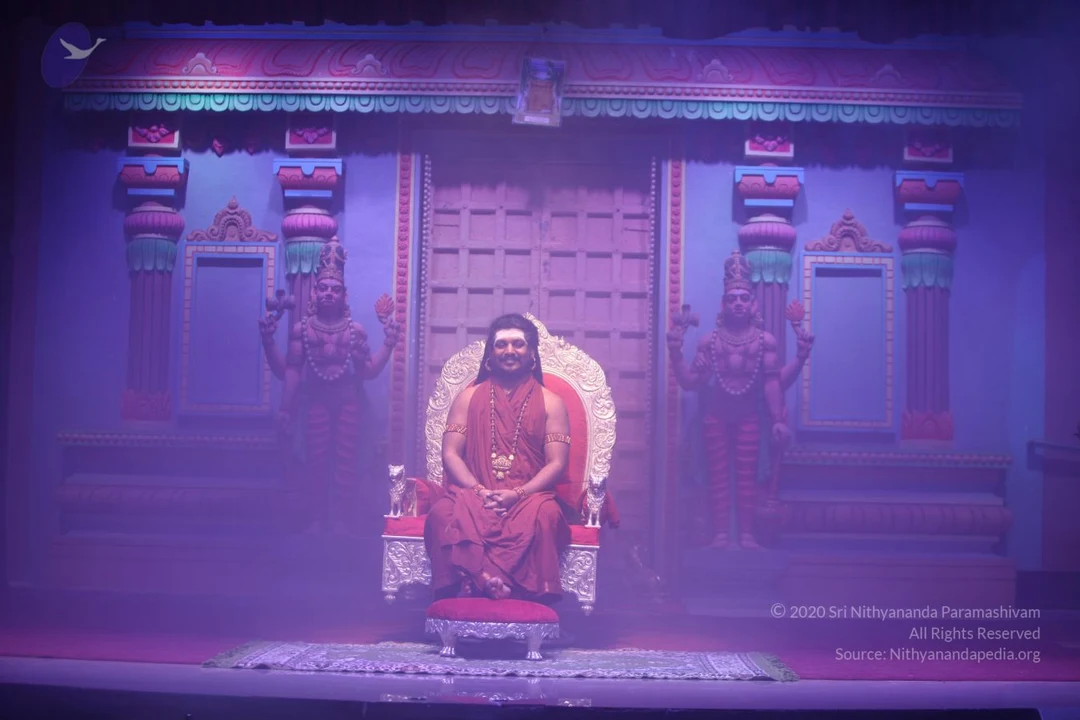
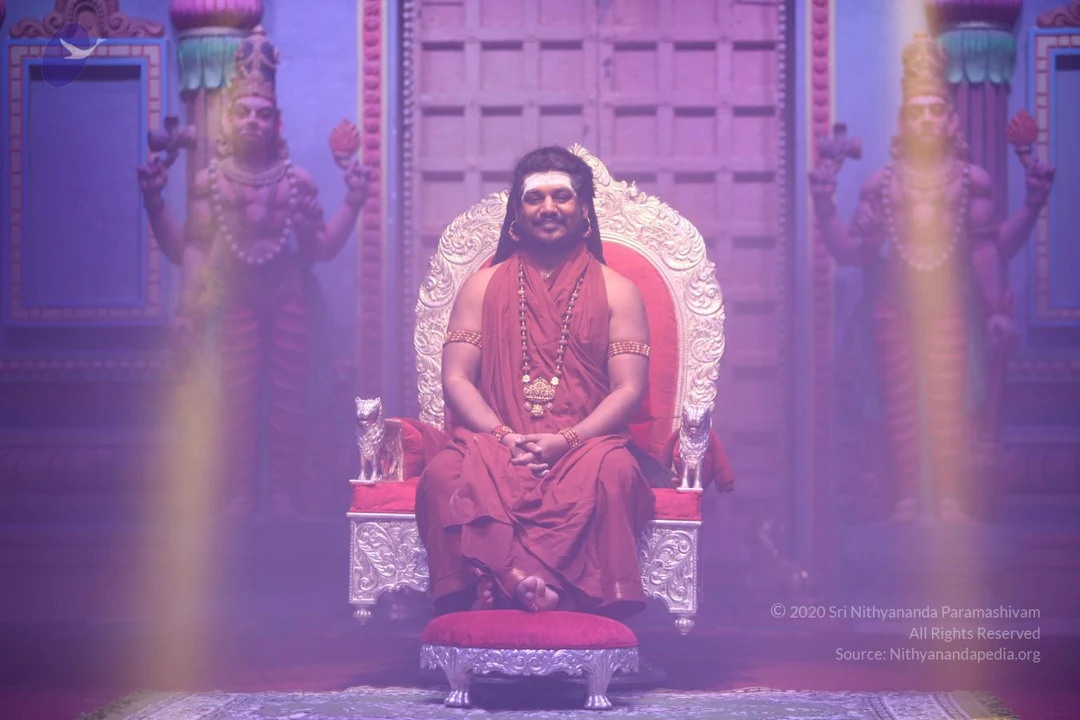
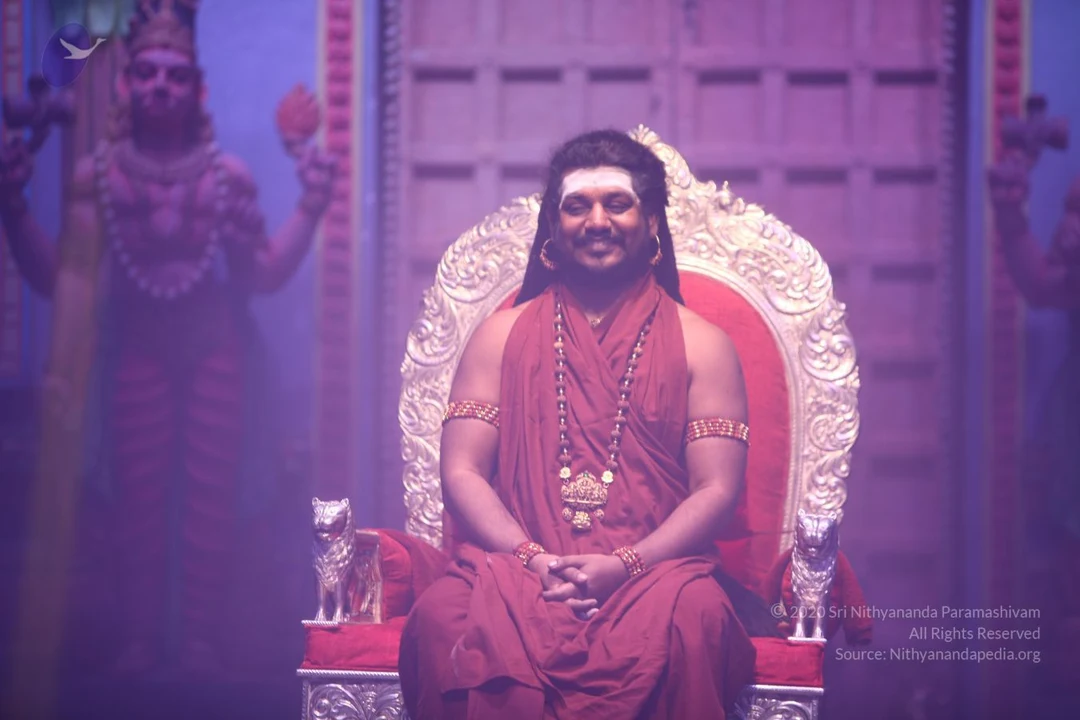
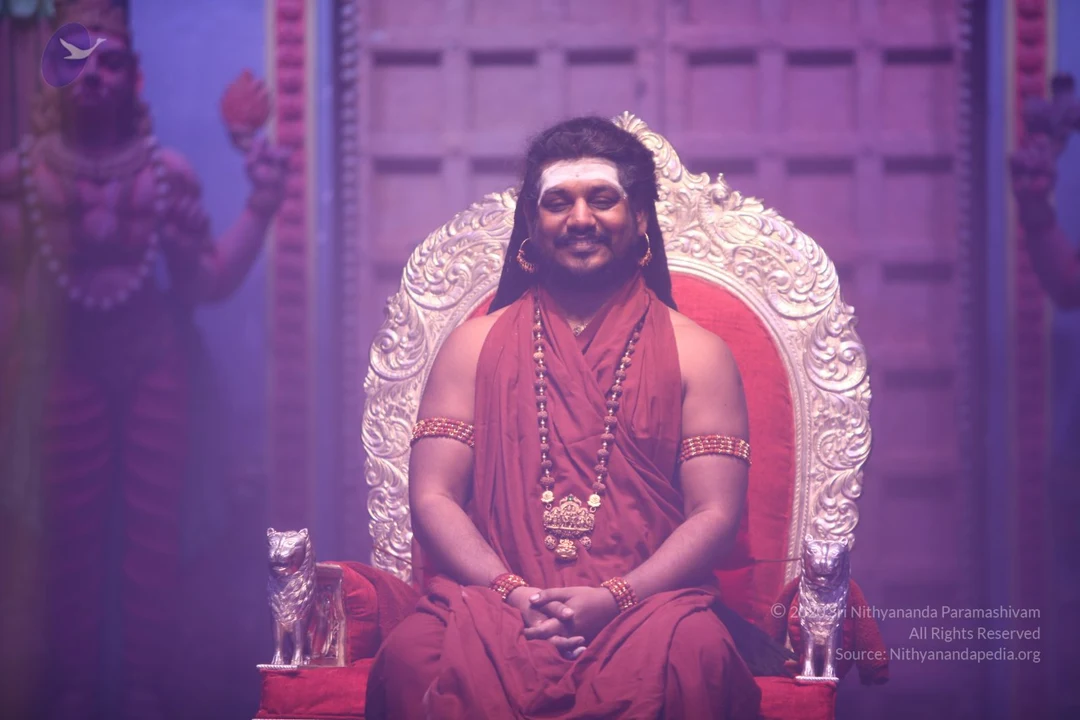
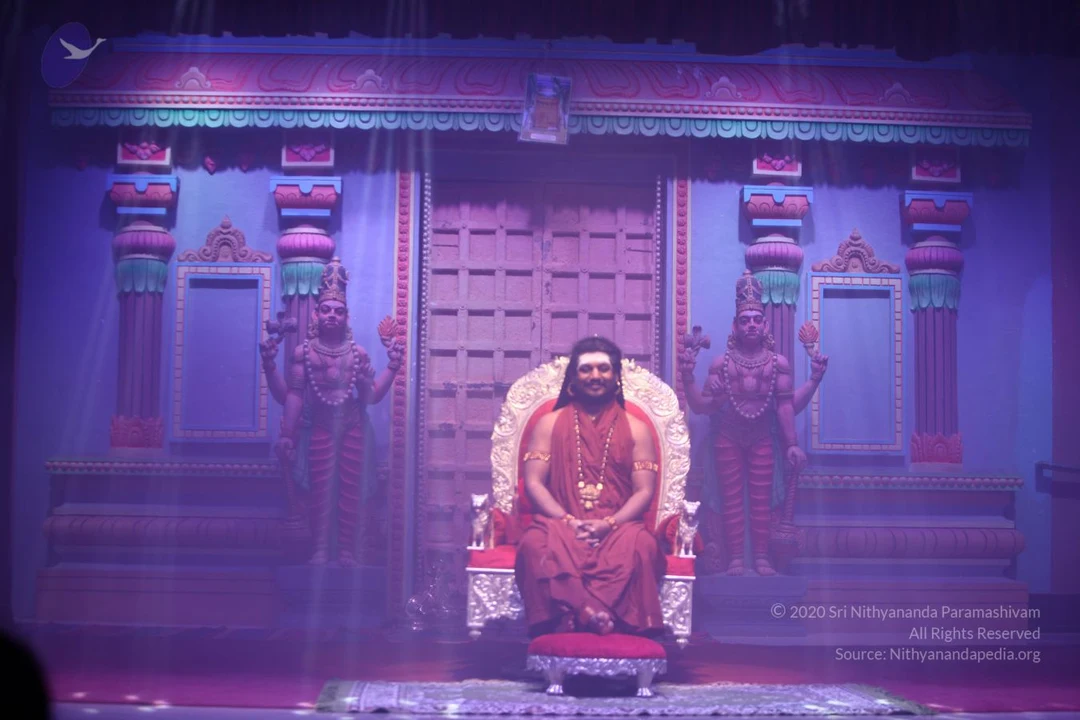
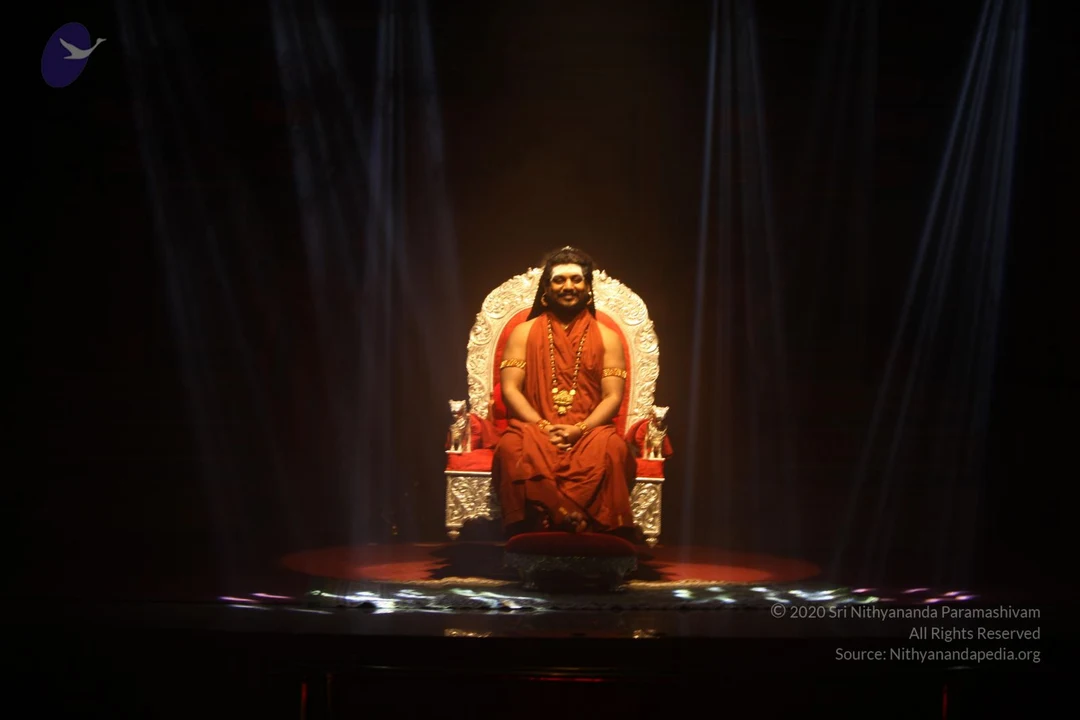
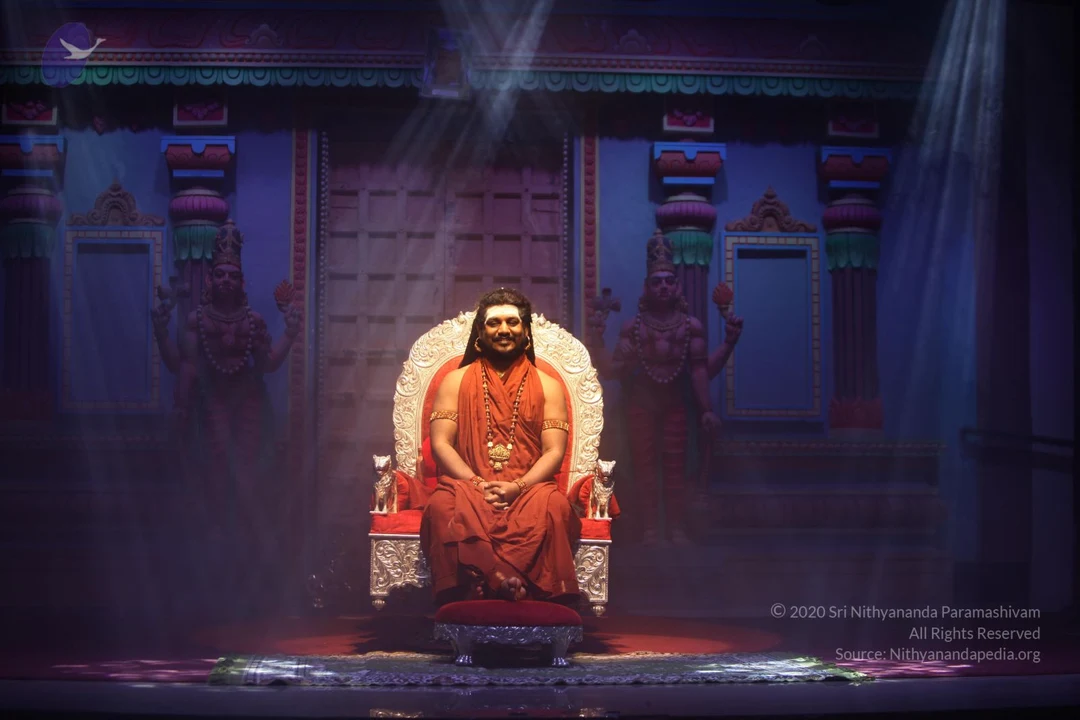
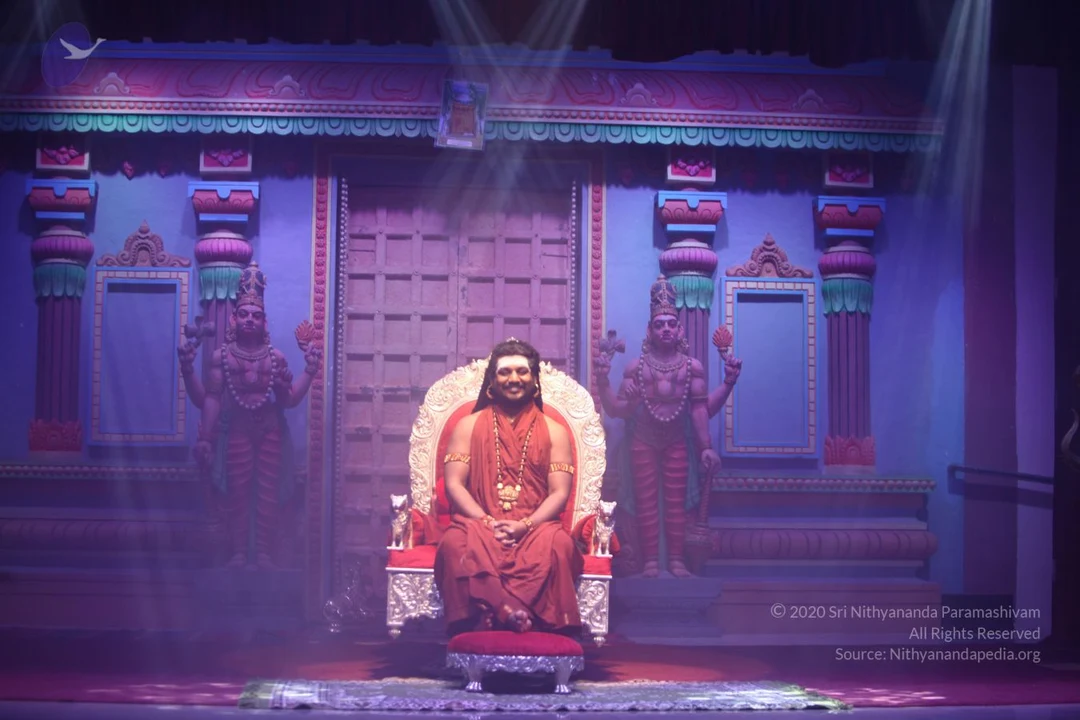
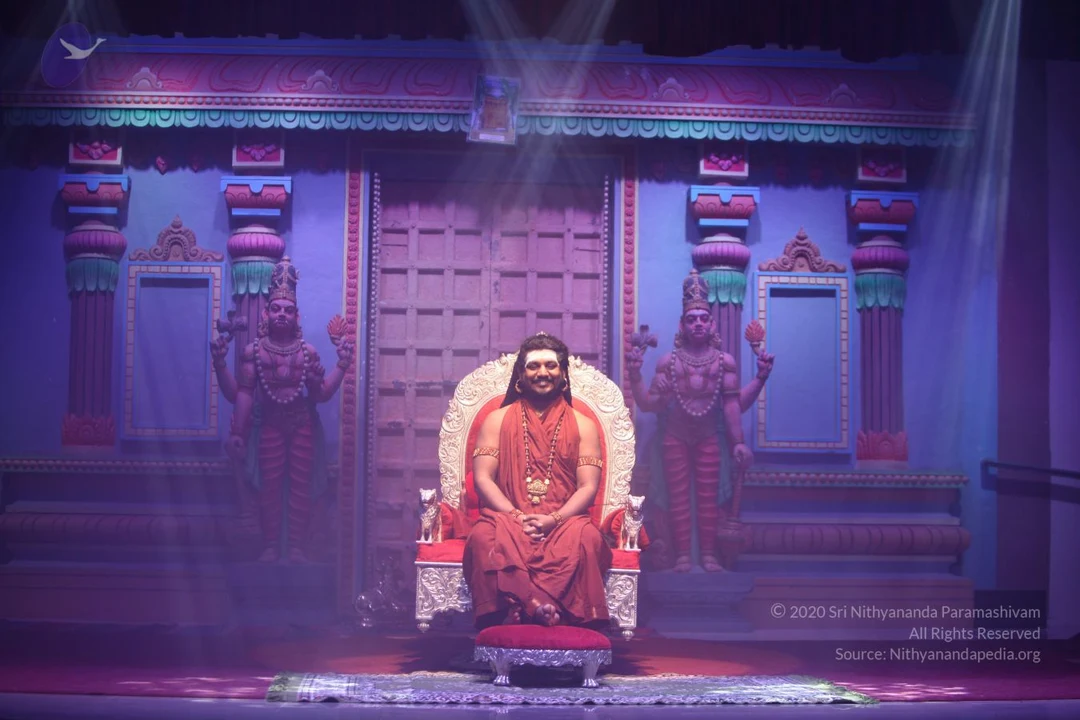
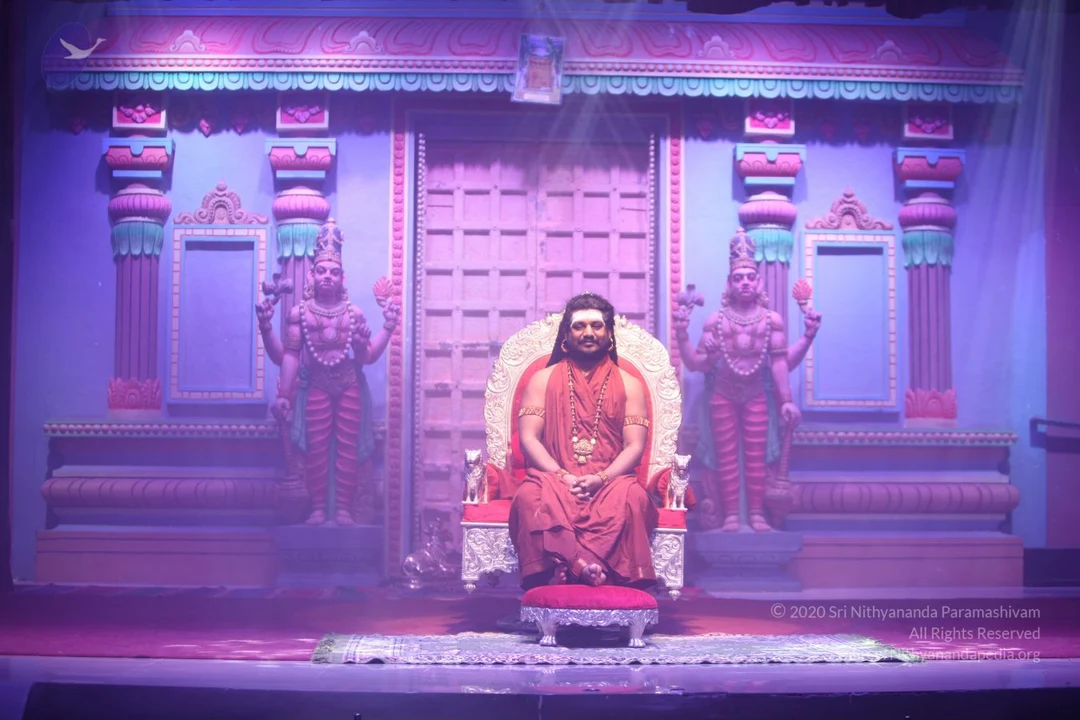
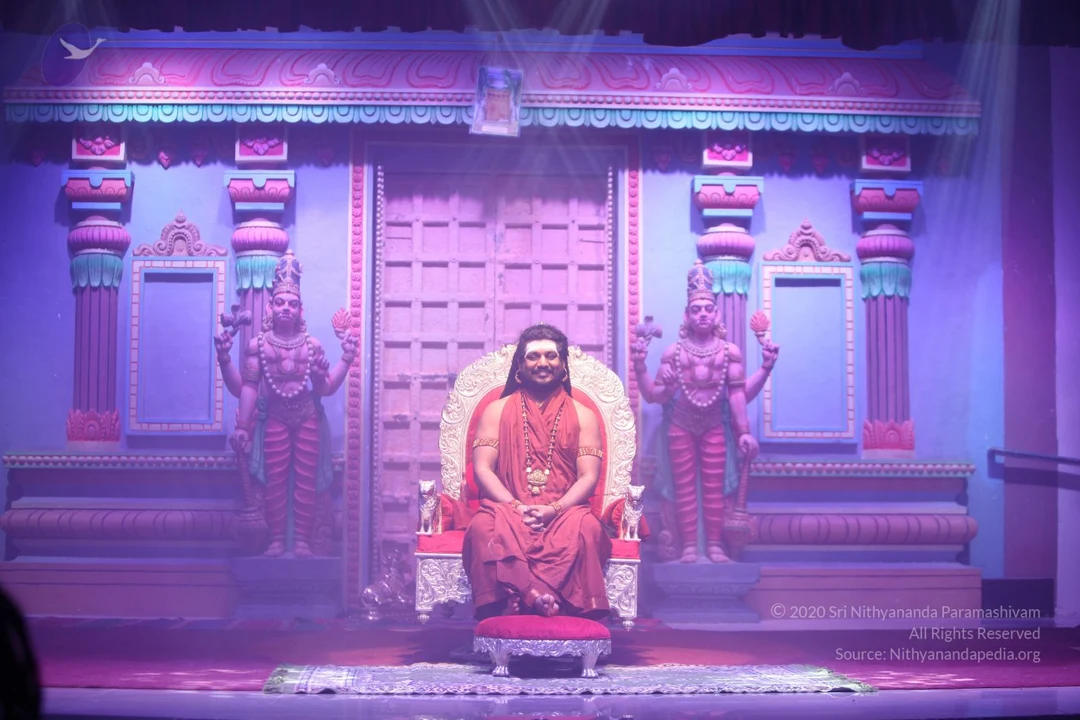
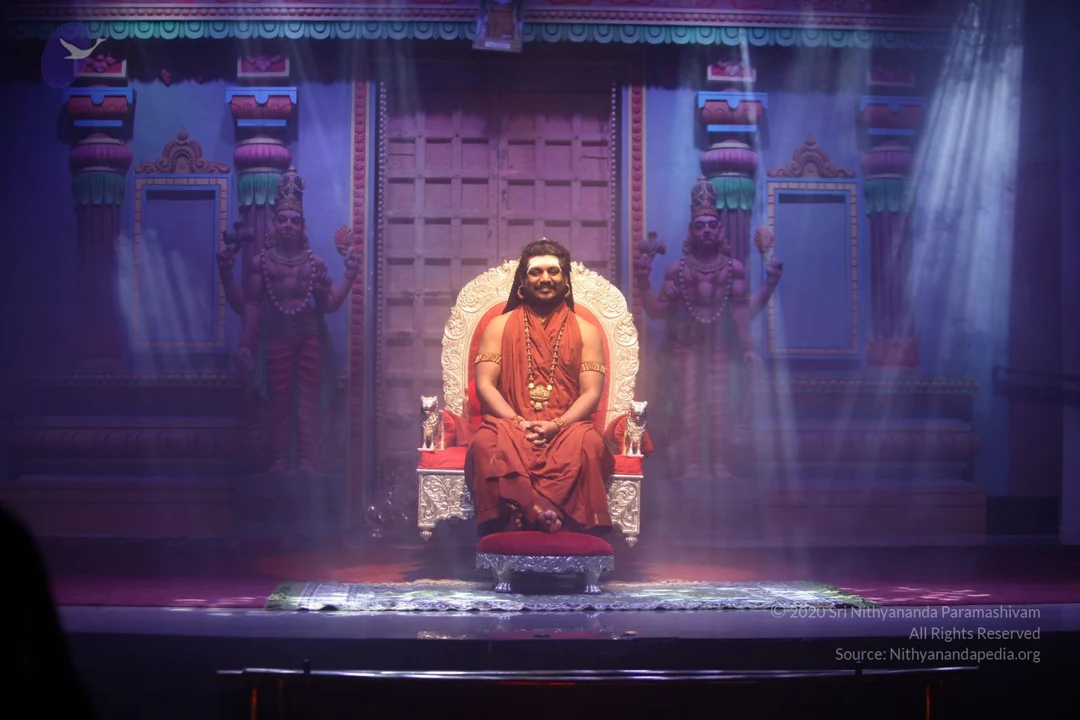
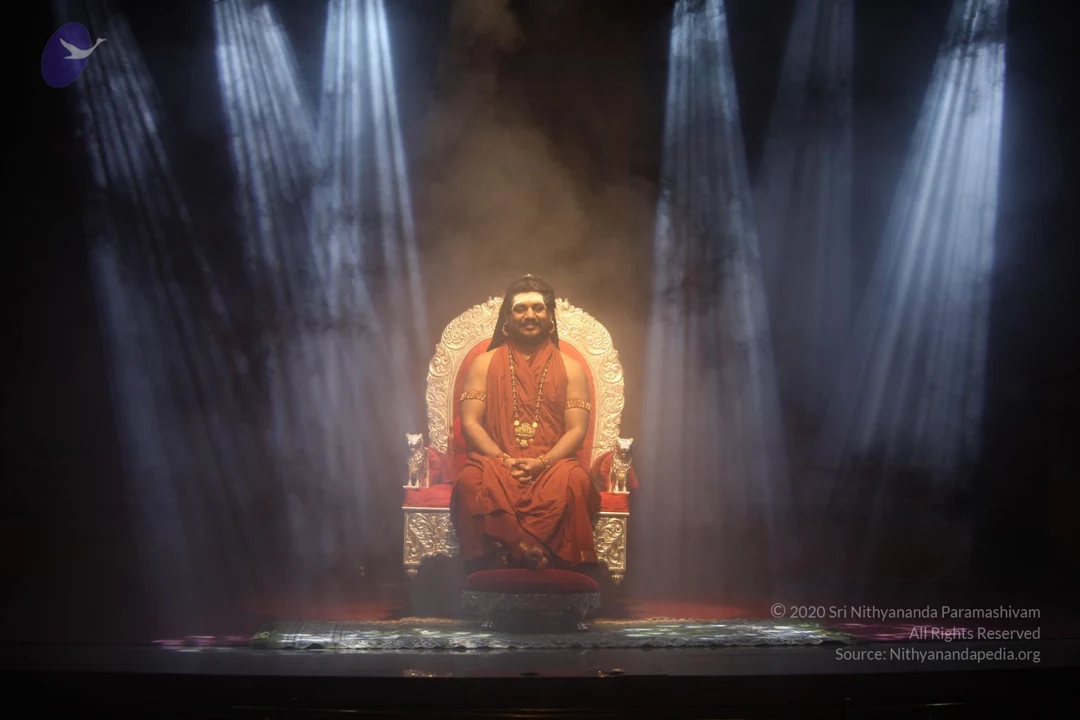
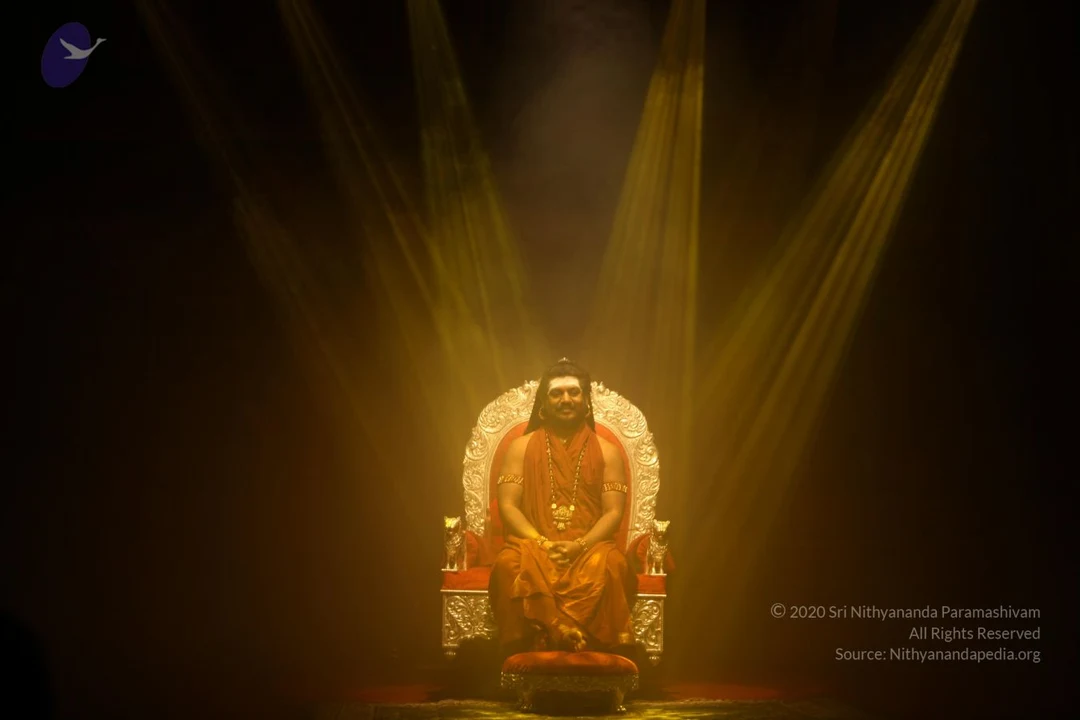
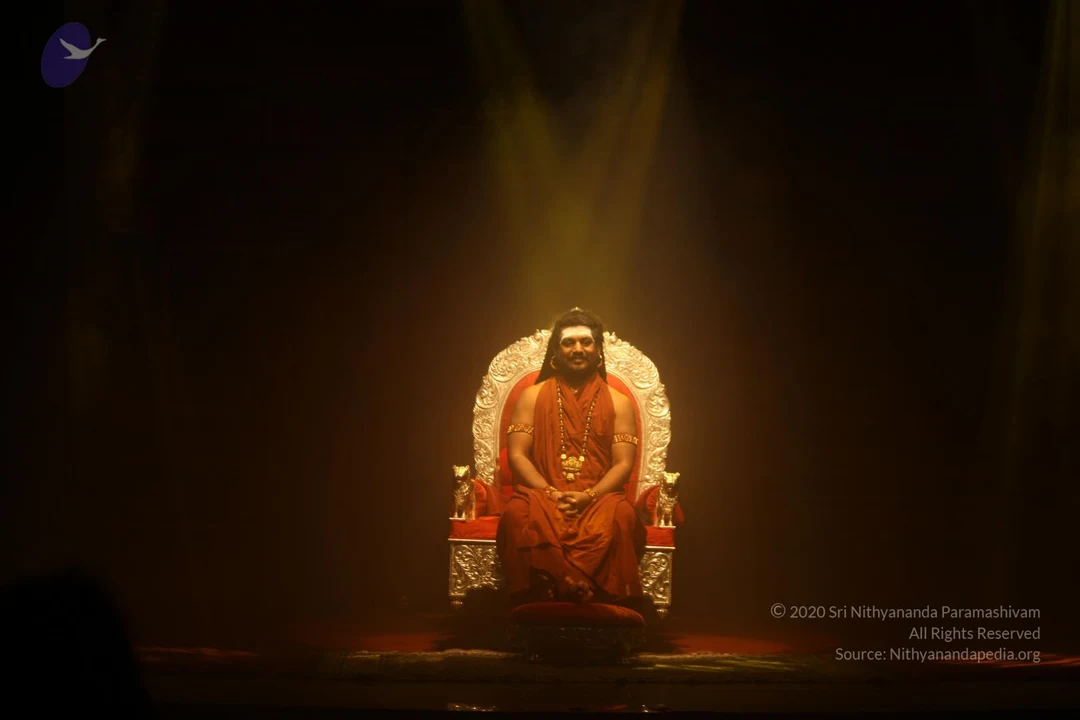
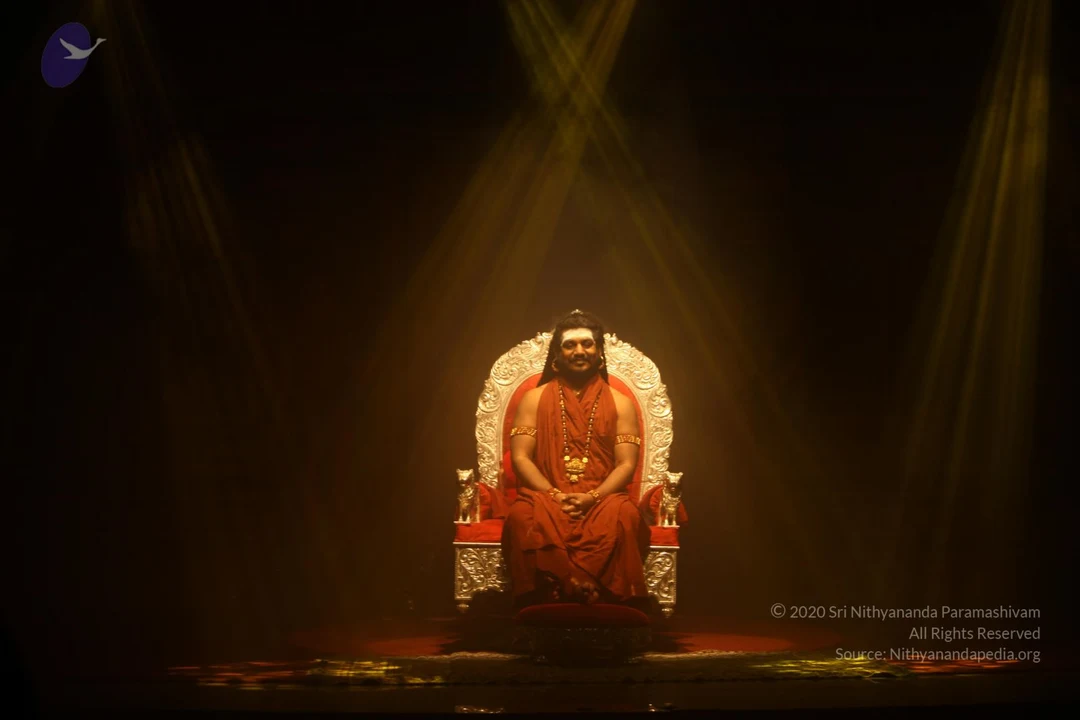
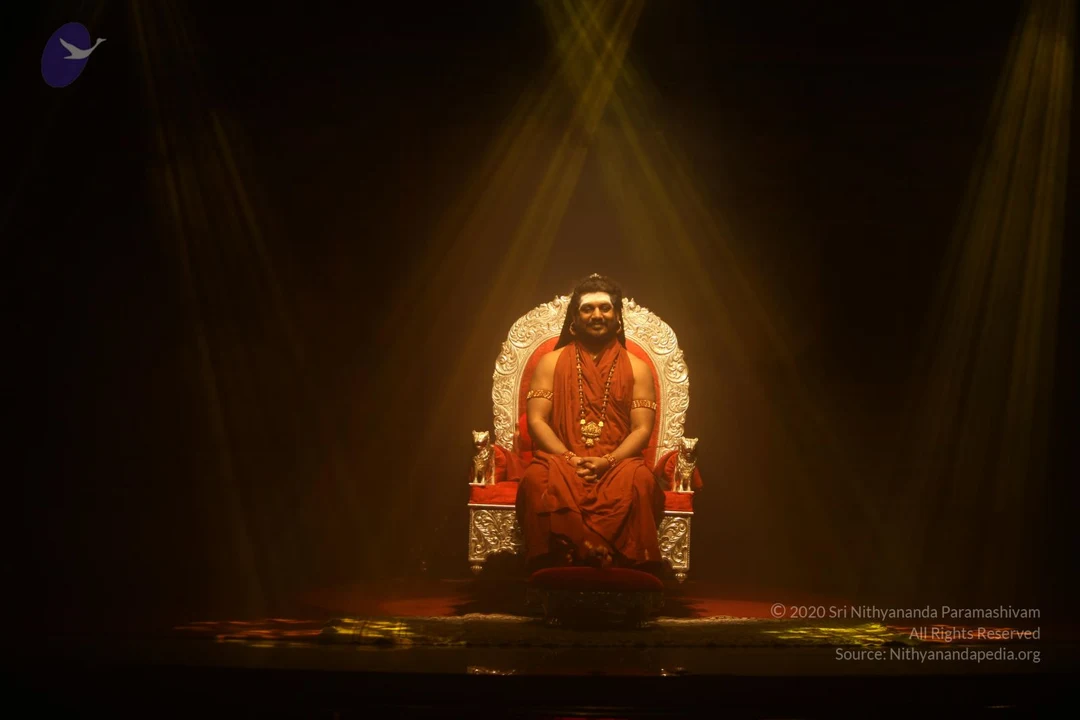
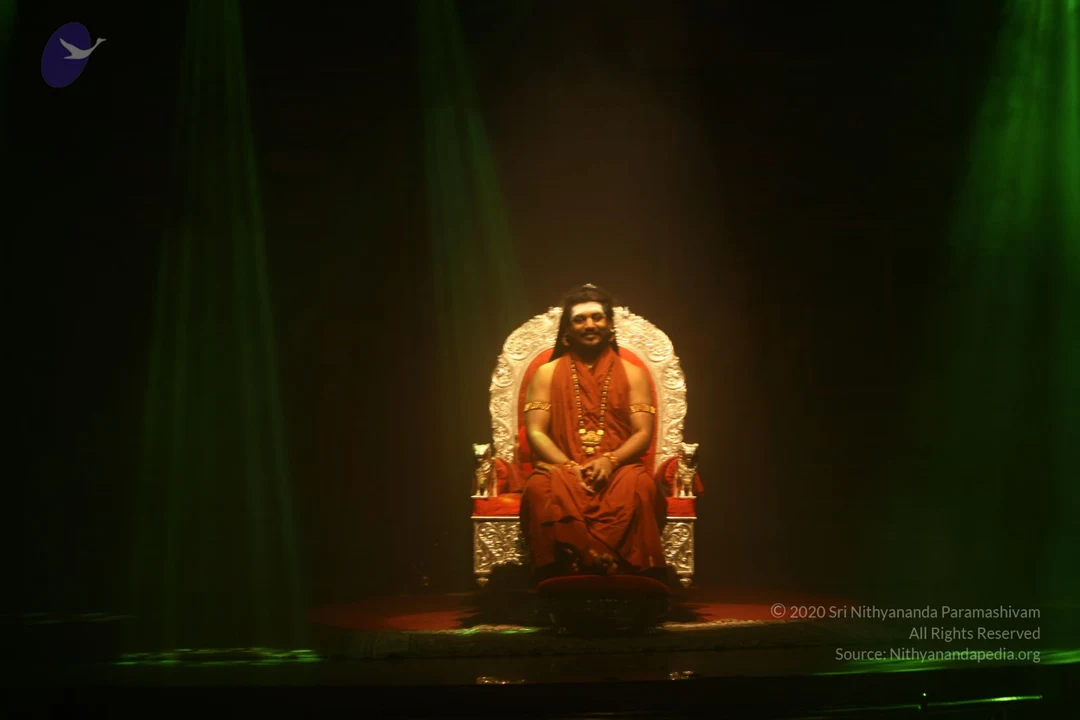
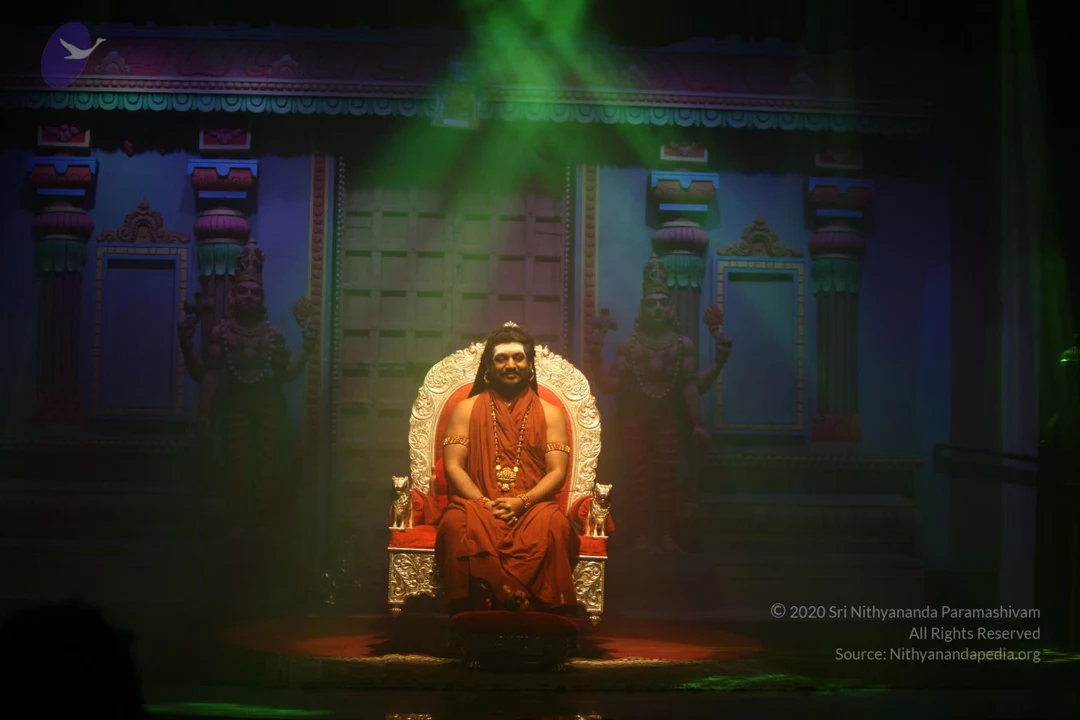
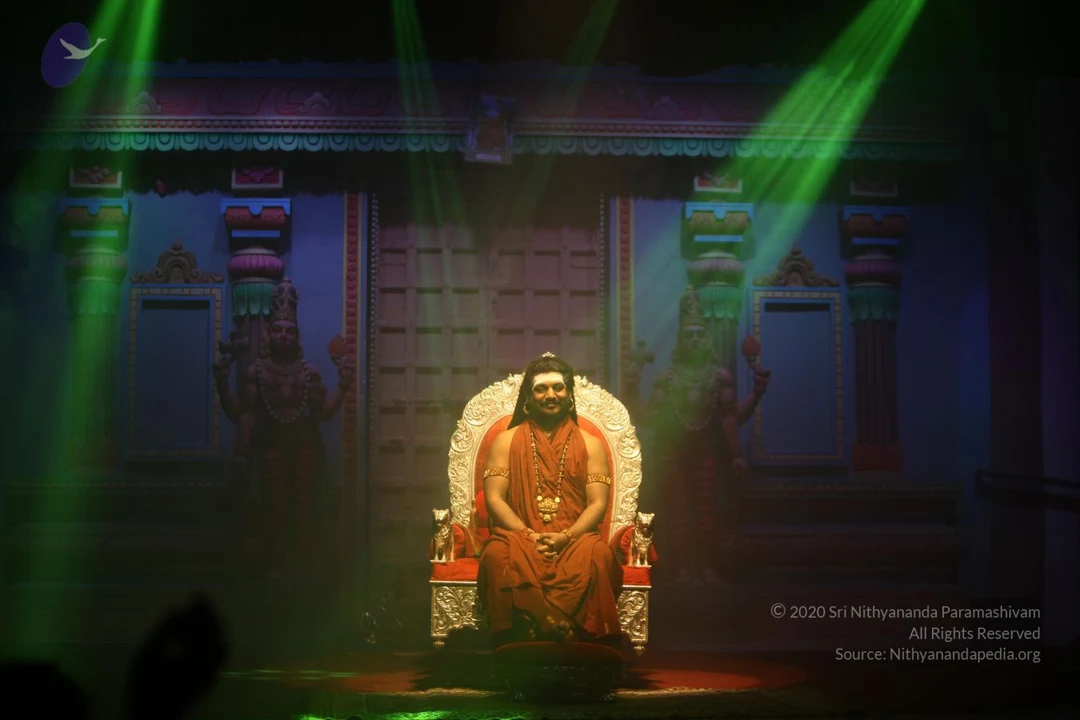
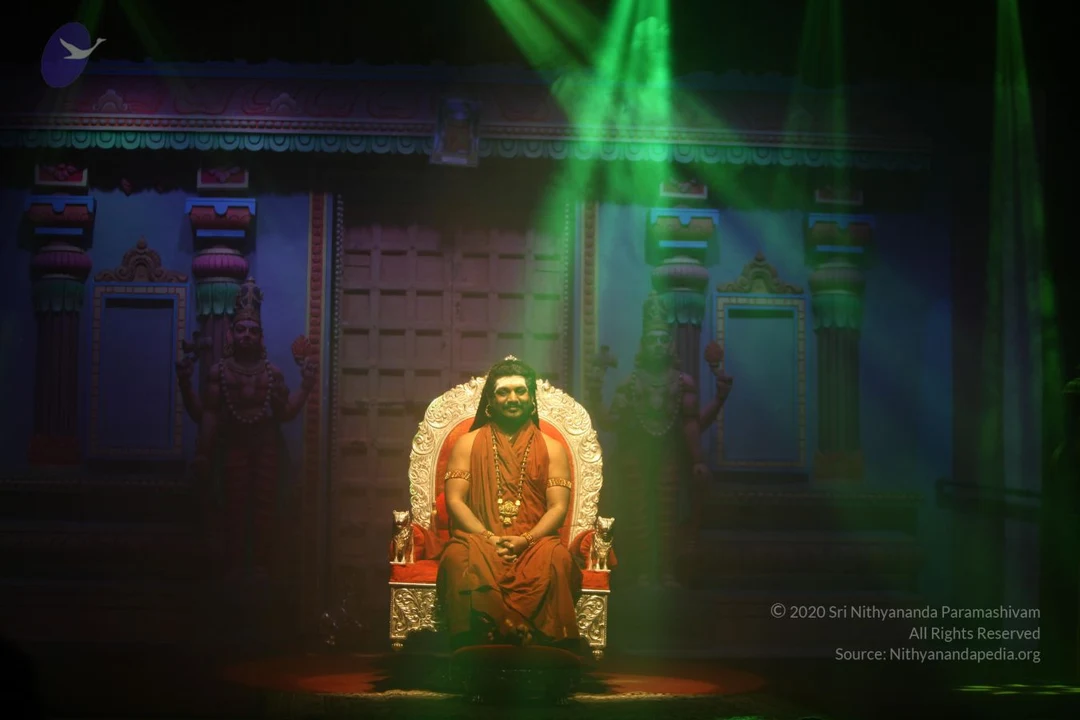
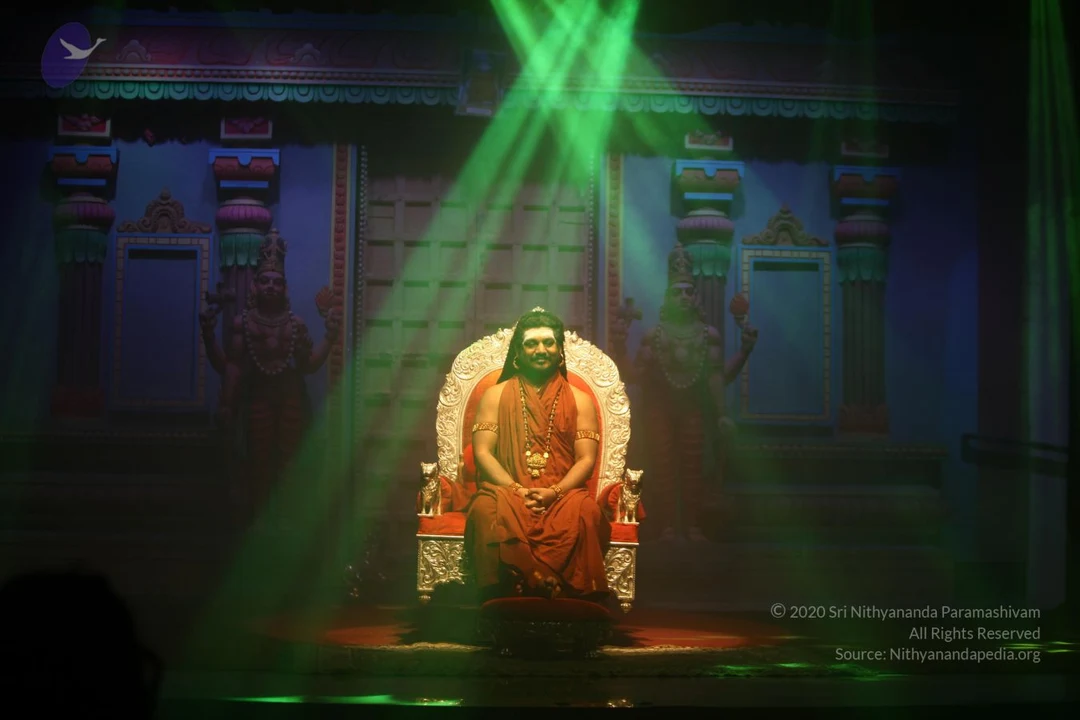
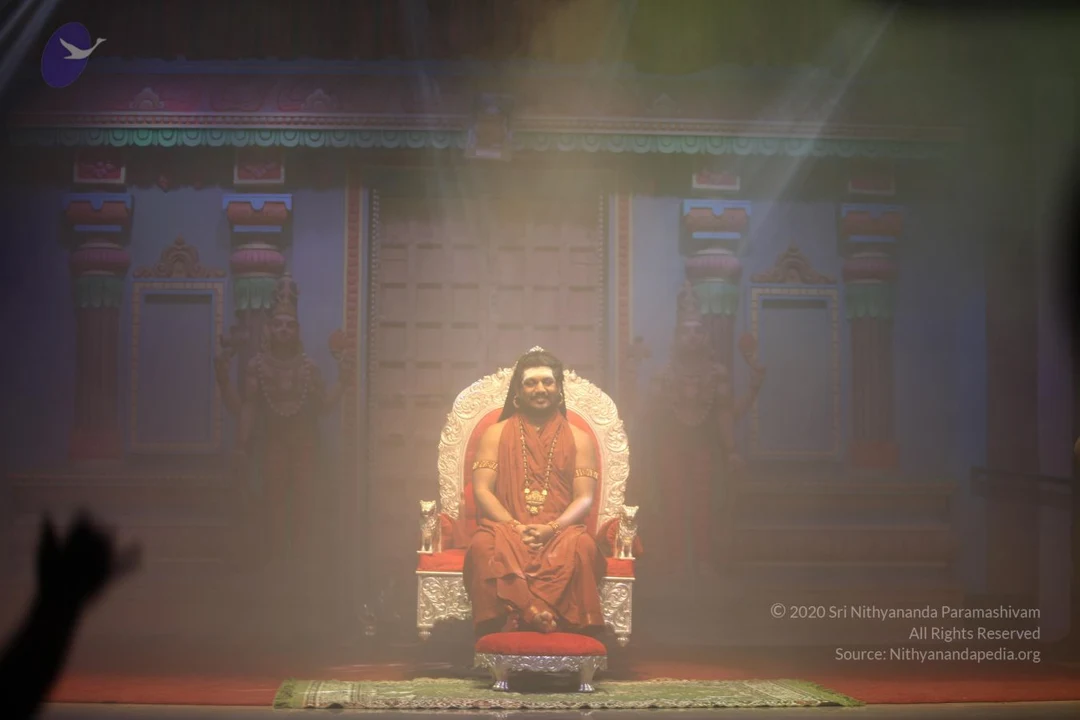
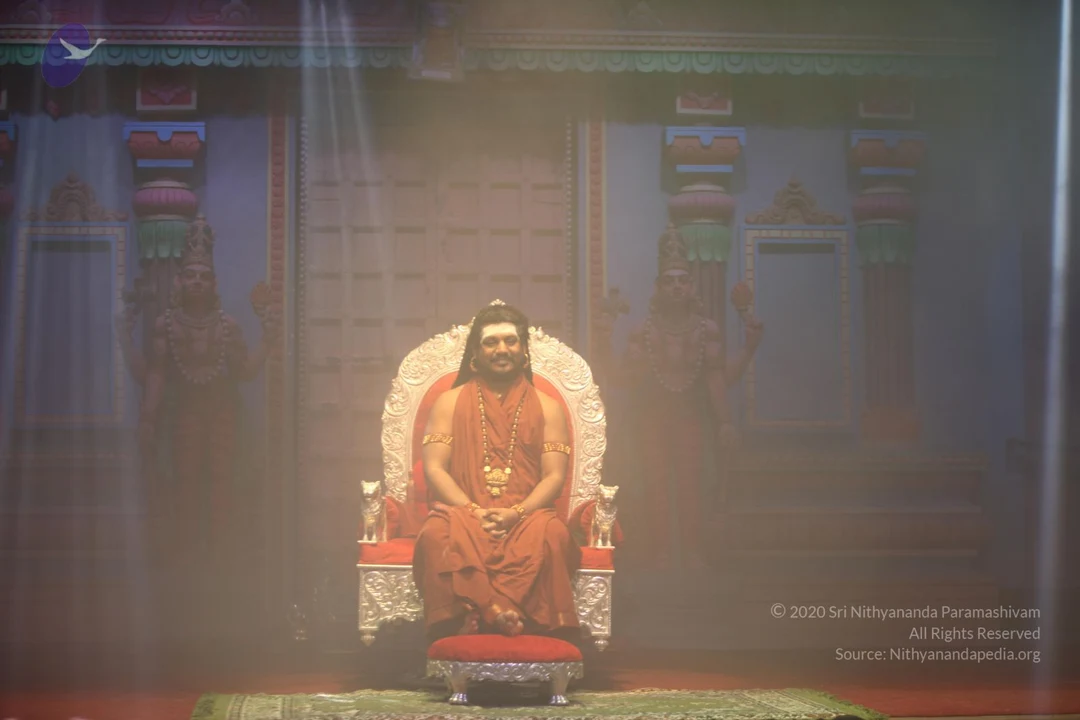
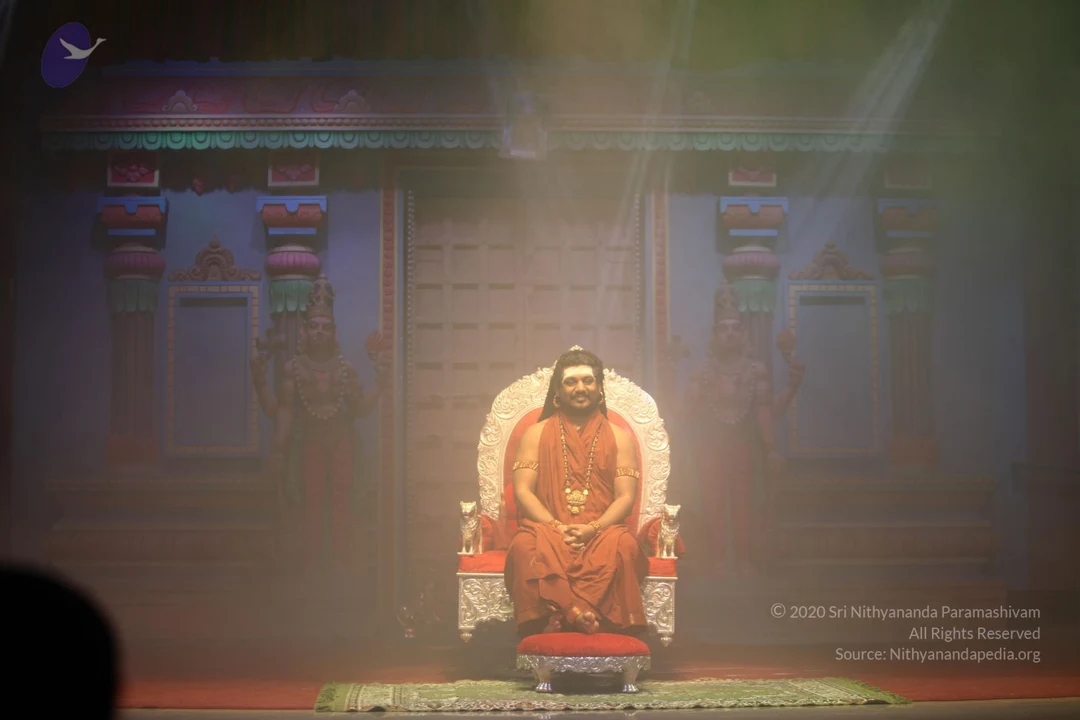
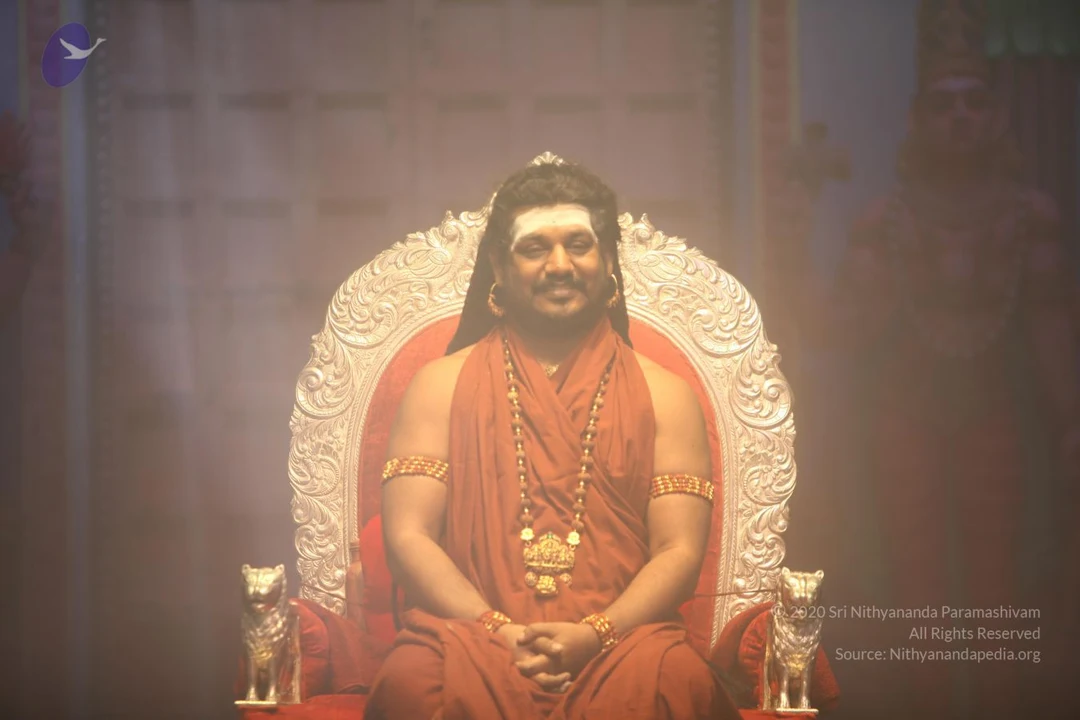
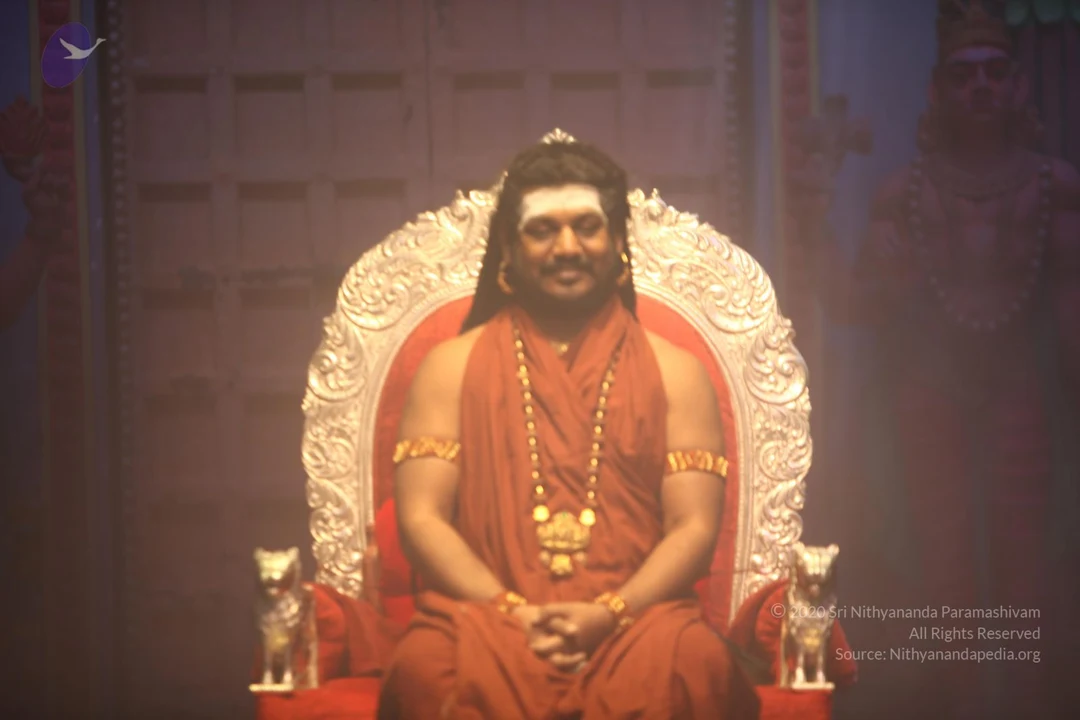
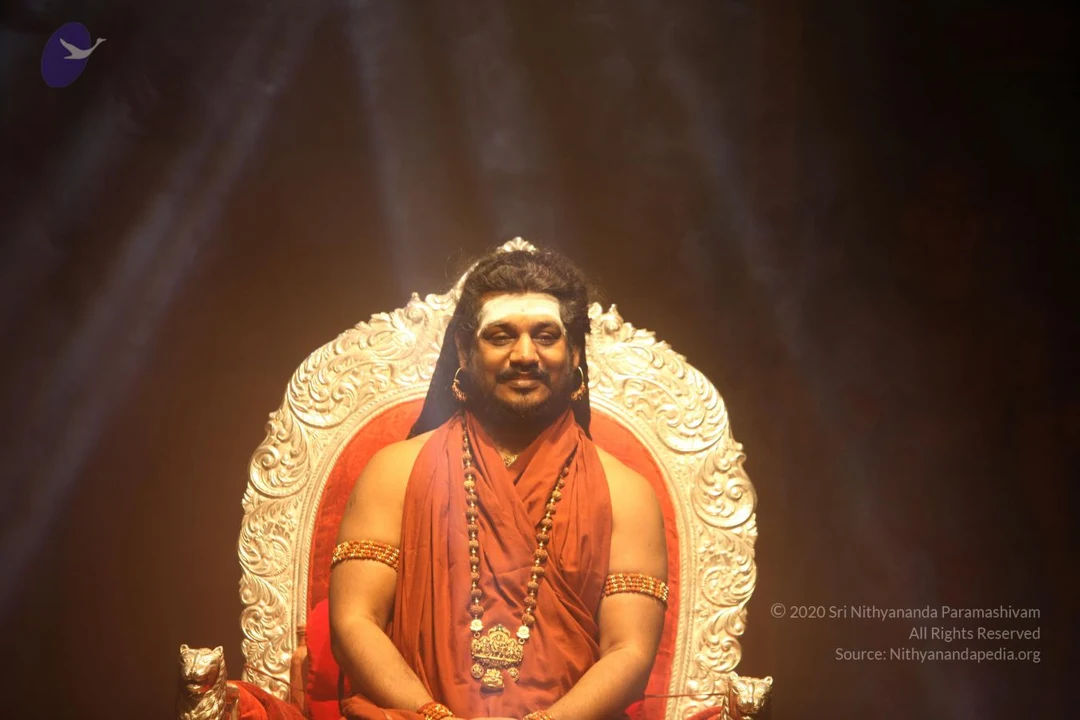
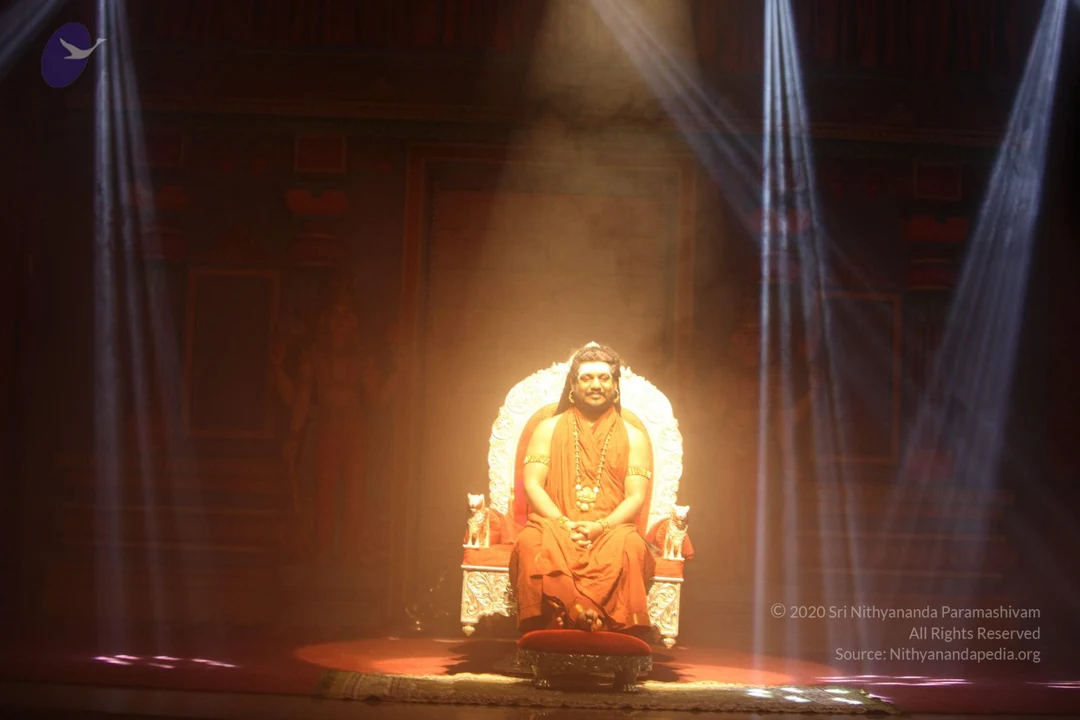
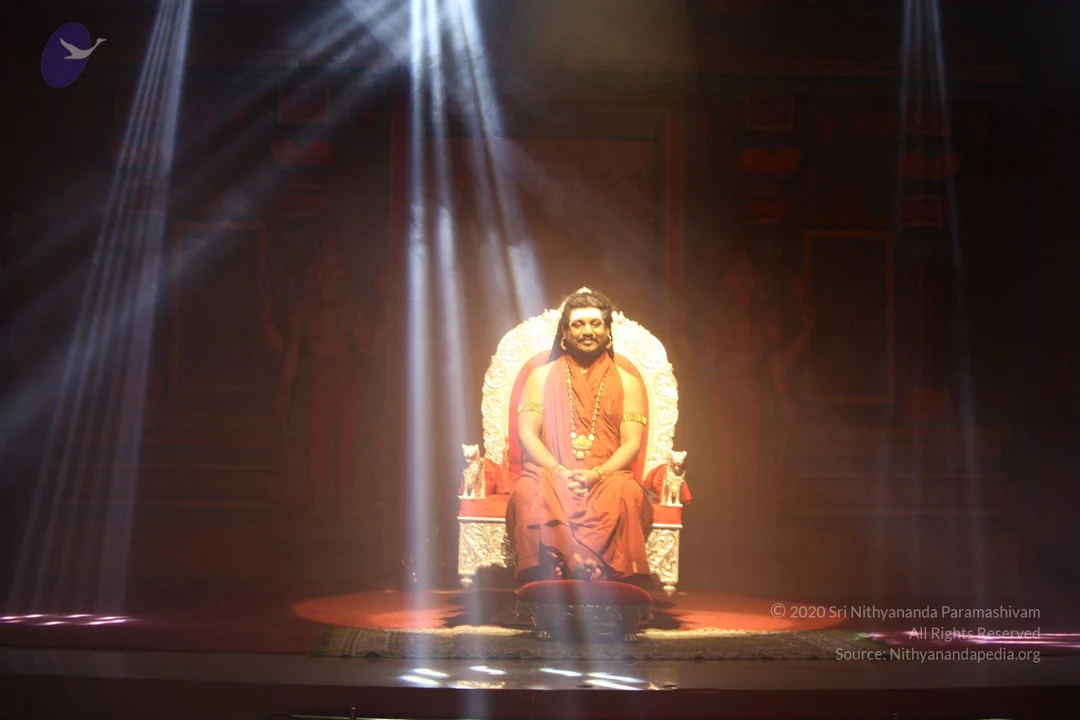
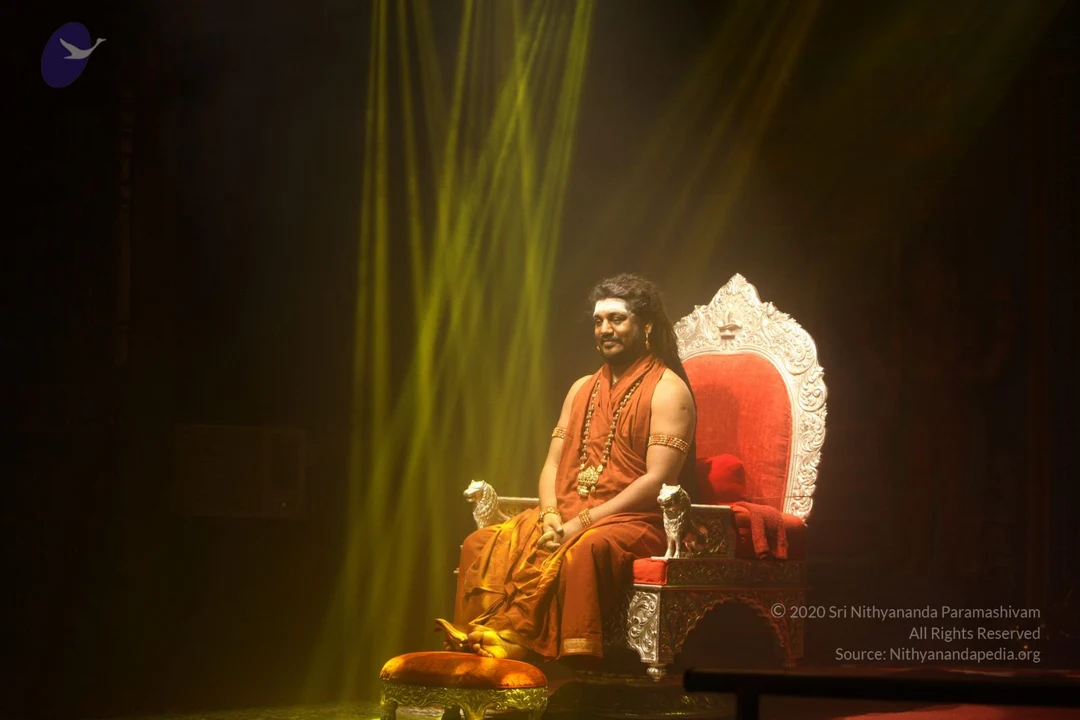
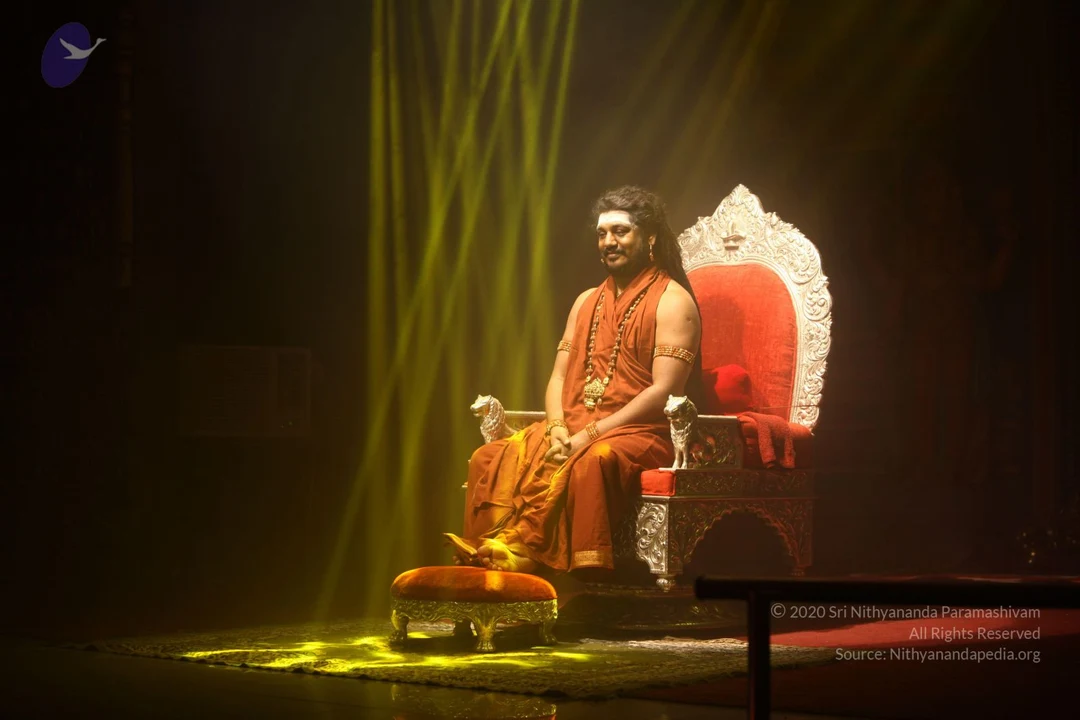
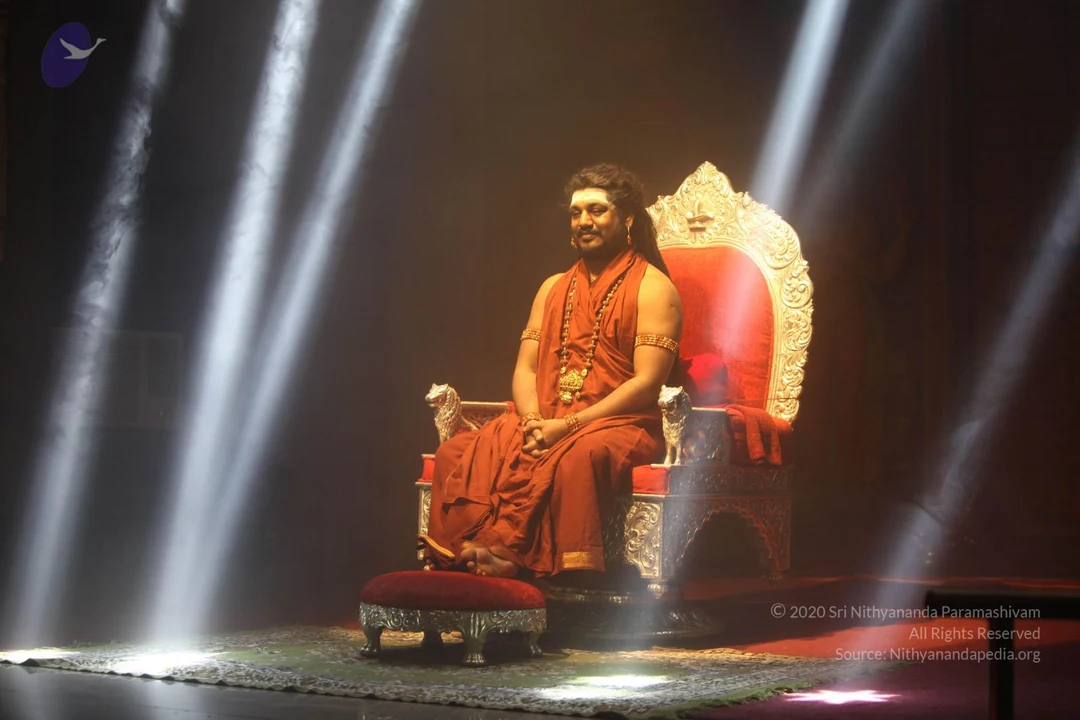
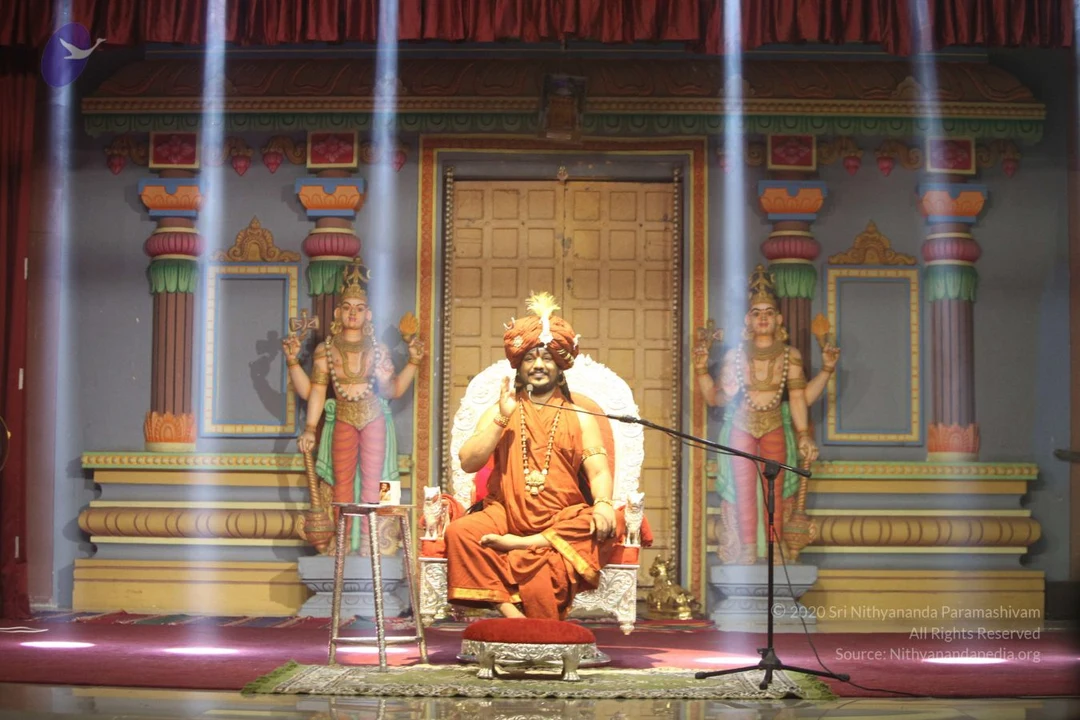
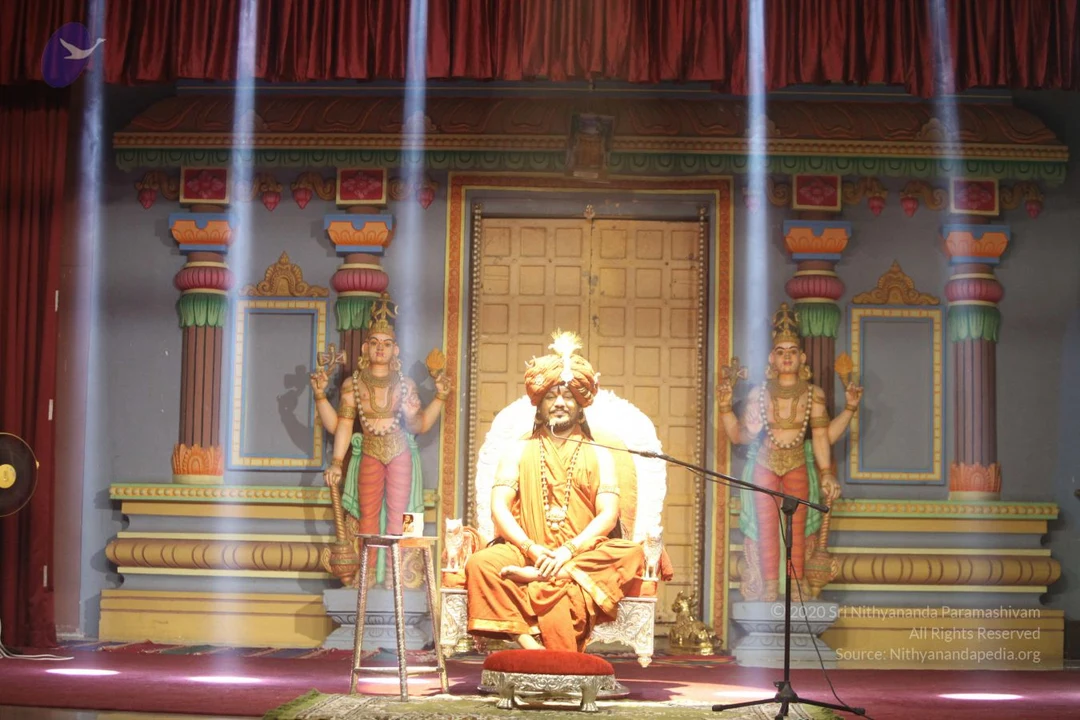
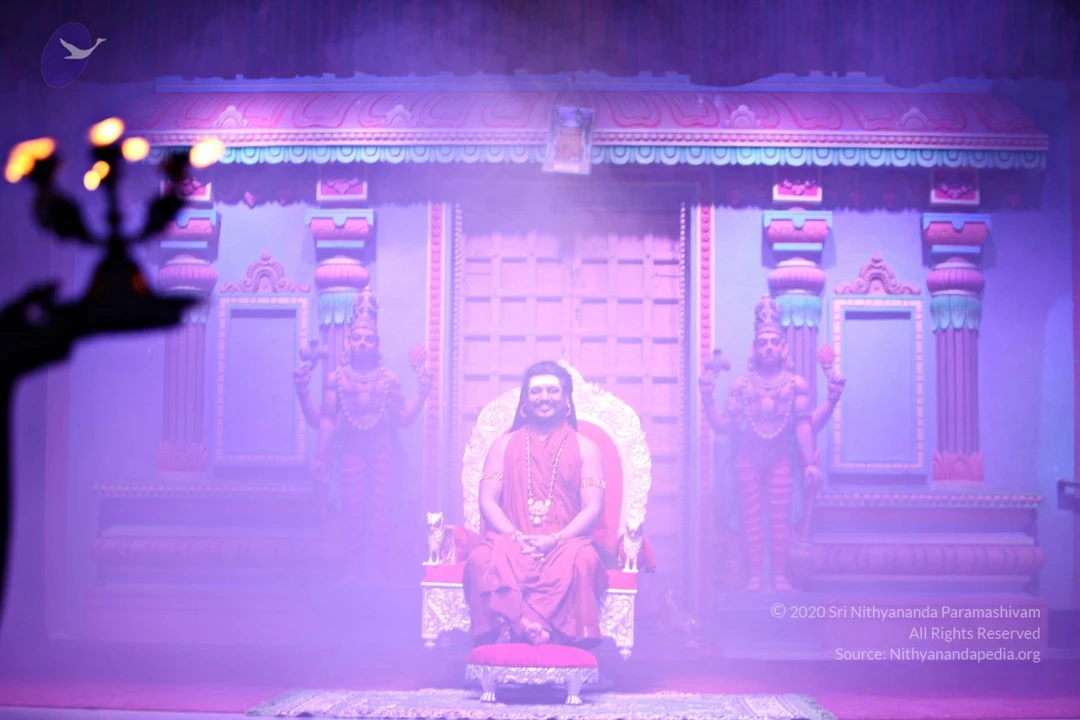
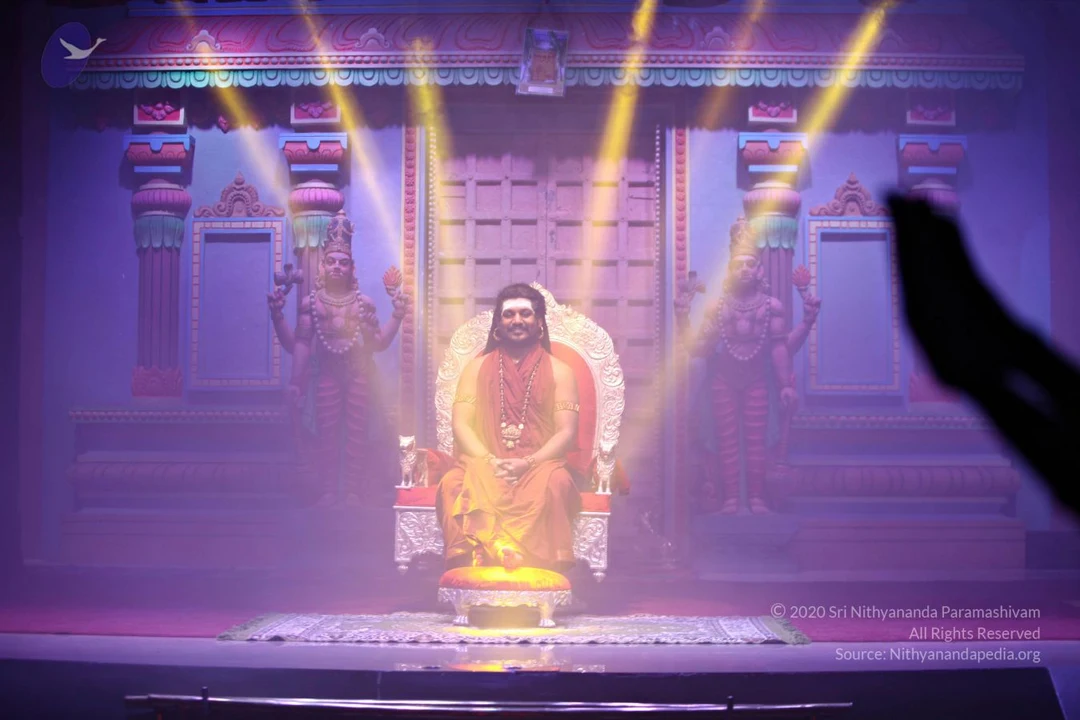
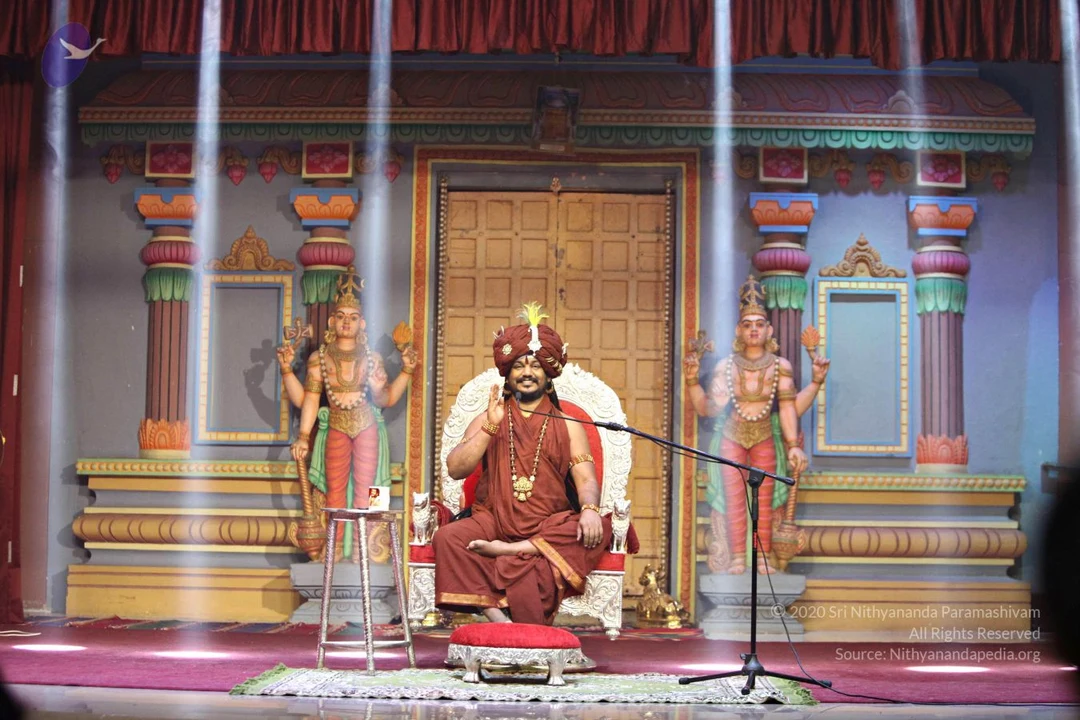
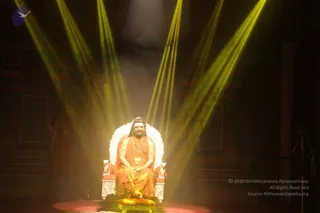
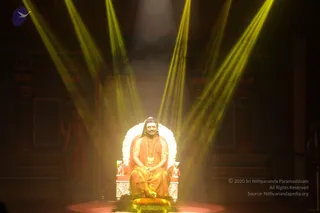
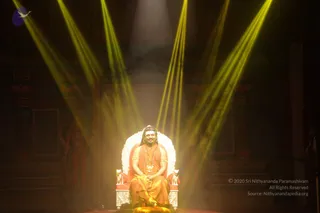
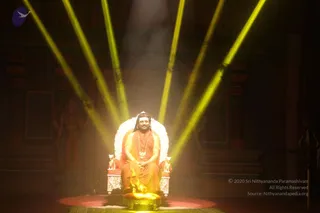
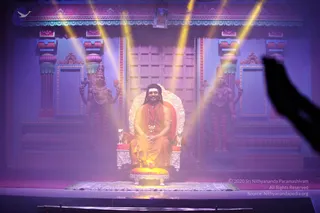
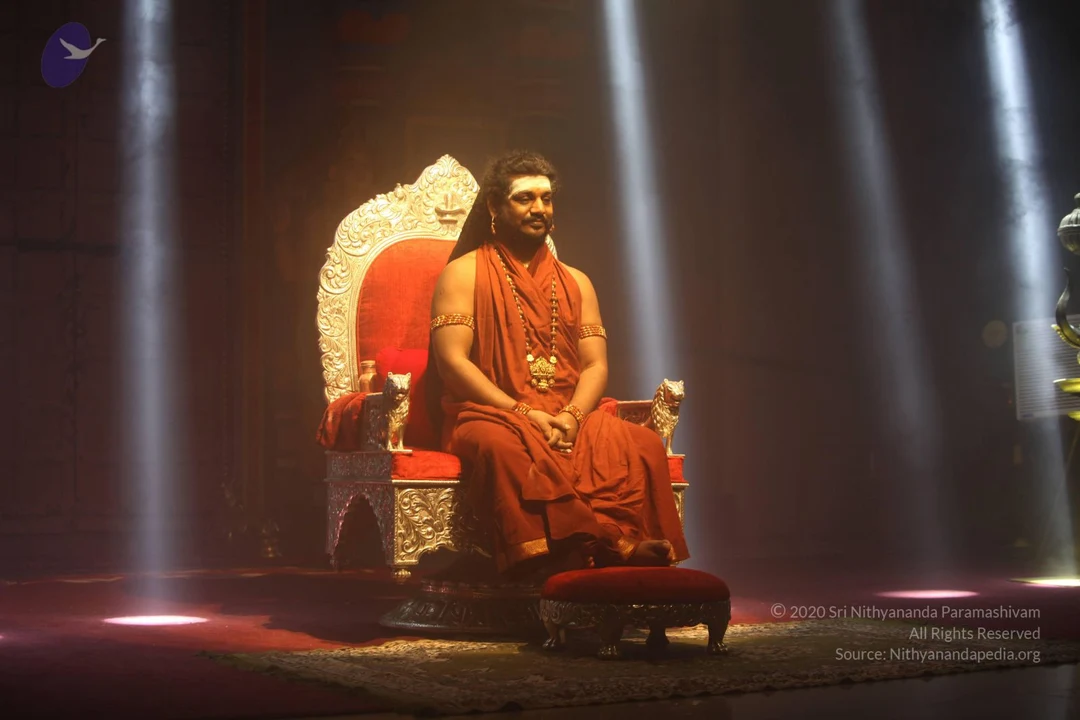
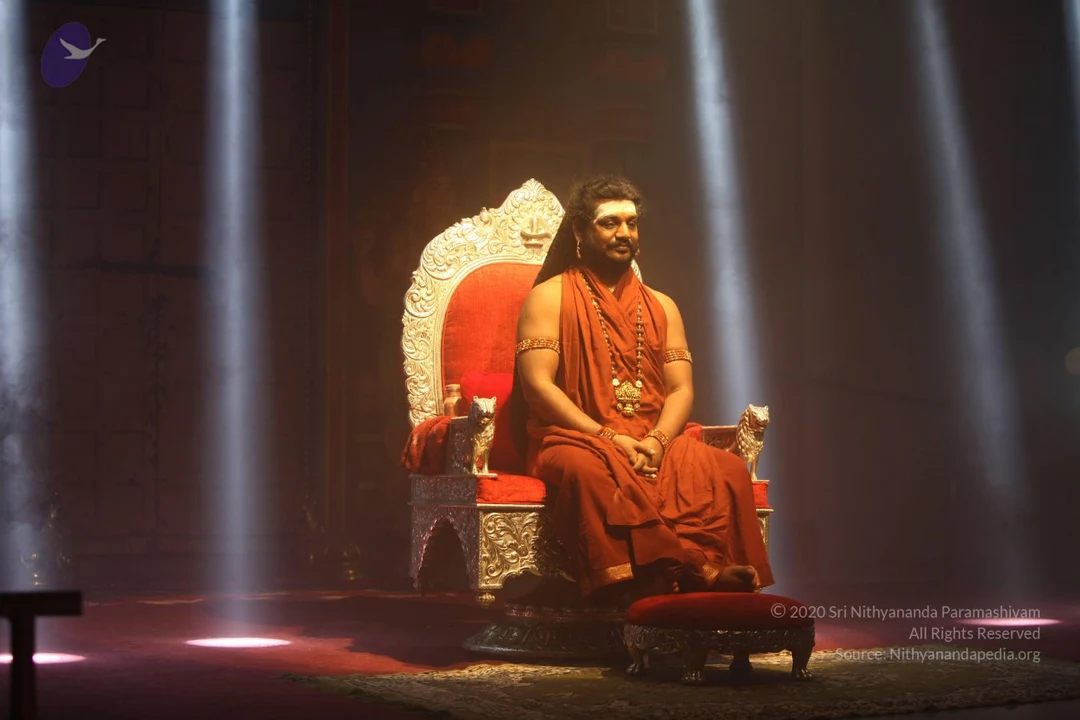
A photograph of a dimly lit stage with red velvet drapes hanging across the top and a painted backdrop of two standing deity figures flanking a golden doorway. Yellow spotlights beam down onto a single seated figure in the centre on a white and red ornate throne, wearing orange robes and a beaded necklace. Gilded lattice panels frame each side of the stage. The seated figure is the only person visible. Appearance is consistent with the page's reference to a person, but the figure is seated at a distance and the features are not clear enough to confirm, so identity is uncertain.A man in an orange-red saffron robe sits cross-legged on an ornate white and red throne with lion-shaped armrests, centred on a red-carpeted dais under sharp yellow stage spotlights. He wears a rudraksha mala and a gold necklace, with gold armbands and a dark head covering. Hands rest folded in his lap. Behind him are carved temple-style wall panels and a pair of standing figures in the dim background, with a haze of smoke or incense rising in the light. A stage-lit satsang setting. The face and outfit cues match the a person candidate: a saffron robe, rudraksha mala and ceremonial gold ornaments seated on a throne.A seated man in saffron-orange robes sits on an ornate silver throne with lion-head armrests, lit by sharp yellow-green spotlights fanning out from above in a dim, painted temple-style hall. He wears long dark hair swept back, a rudraksha mala and a gold chain necklace, with a shawl draped over his shoulders and bare upper arms adorned with gold armlets. His hands rest on his lap and his feet are placed on a golden cushion. Soft smoke or haze drifts through the beams, and a trident stands at the right edge. The Swamiji (probable) cues are the long swept-back hair, saffron clothing, rudraksha mala and ceremonial gold ornaments, seated on a throne in an event setting.A seated figure in saffron-orange robes sits on an ornate silver-and-white throne (peetha) on a stage, lit by sweeping yellow-green spotlight beams. He wears a long rudraksha-style mala and gold armlets, with long dark hair swept back, and holds his hands together in his lap. A small golden cushion rests at the base of the throne. Behind him are painted temple-style wall panels with figures and pillars. Swamiji (probable): the seated figure has long swept-back hair, saffron clothing, a rudraksha mala and gold armlets, and sits enthroned as the central focus. The scene is a single person on stage with no visible audience.A photograph of a single seated figure on an ornate white and silver throne with red cushioning and carved lion-headed armrests, centred on a dark stage. The figure wears saffron-orange draped robes, a rudraksha mala and gold arm bands, with hair swept back. Several bright yellow-green spotlight beams fan out from above and behind, and a murky backdrop with painted columns frames the scene. Swamiji (probable): the seated figure shows long swept-back hair, saffron-orange draped clothing, a rudraksha mala and ceremonial gold ornaments, seated on a throne in a satsang setting.A seated man in saffron-orange robes sits on an ornate white-and-red throne on a circular red dais, centred under sweeping yellow spotlight beams that fan out from above through haze. He wears a rudraksha mala and ceremonial gold necklace and gold armlets, with hands resting in his lap. A golden lamp or kalasha-like object glows before the throne. Carved temple pillars and a painted wall with a deity figure frame the stage, and a trident stands at the right edge. A candidate matching the page's a person reference by saffron clothing, long hair, rudraksha mala and gold ornaments; the figure's identity is only an appearance-based probable match.

IA-Mandala-Process

7 photosSource gallery
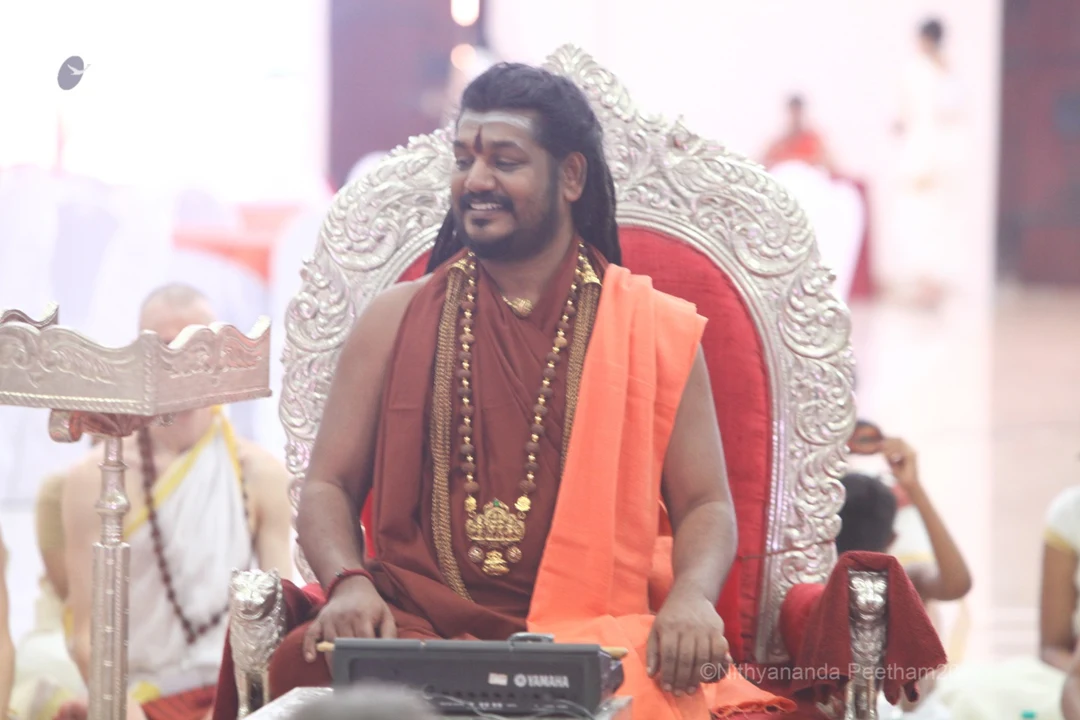
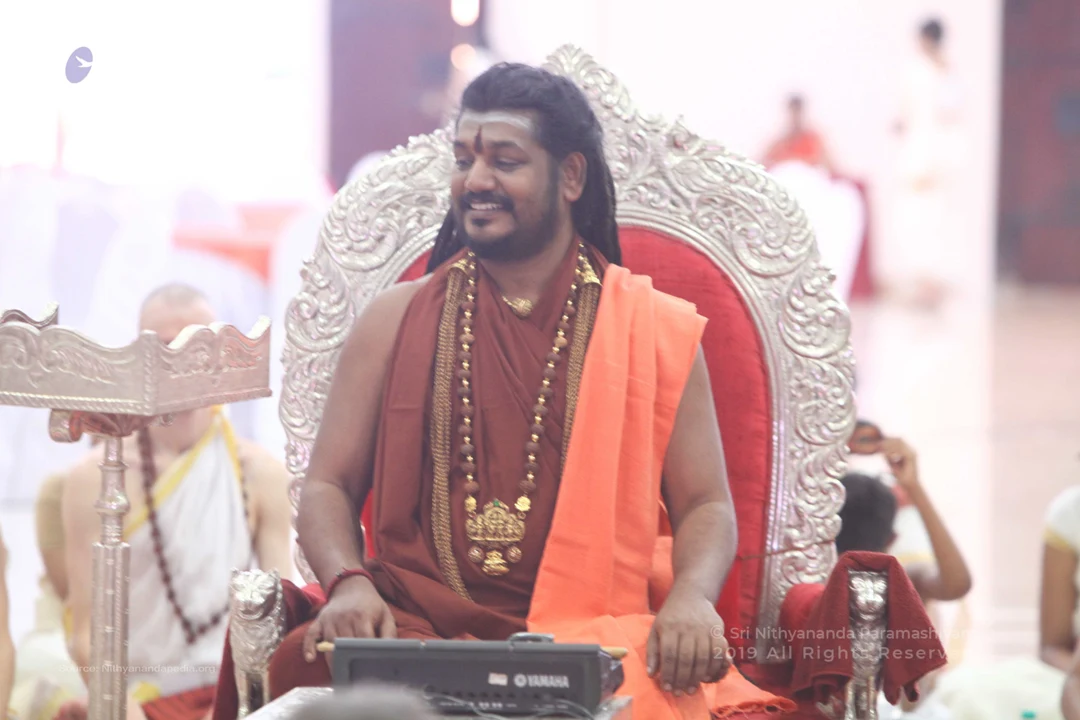
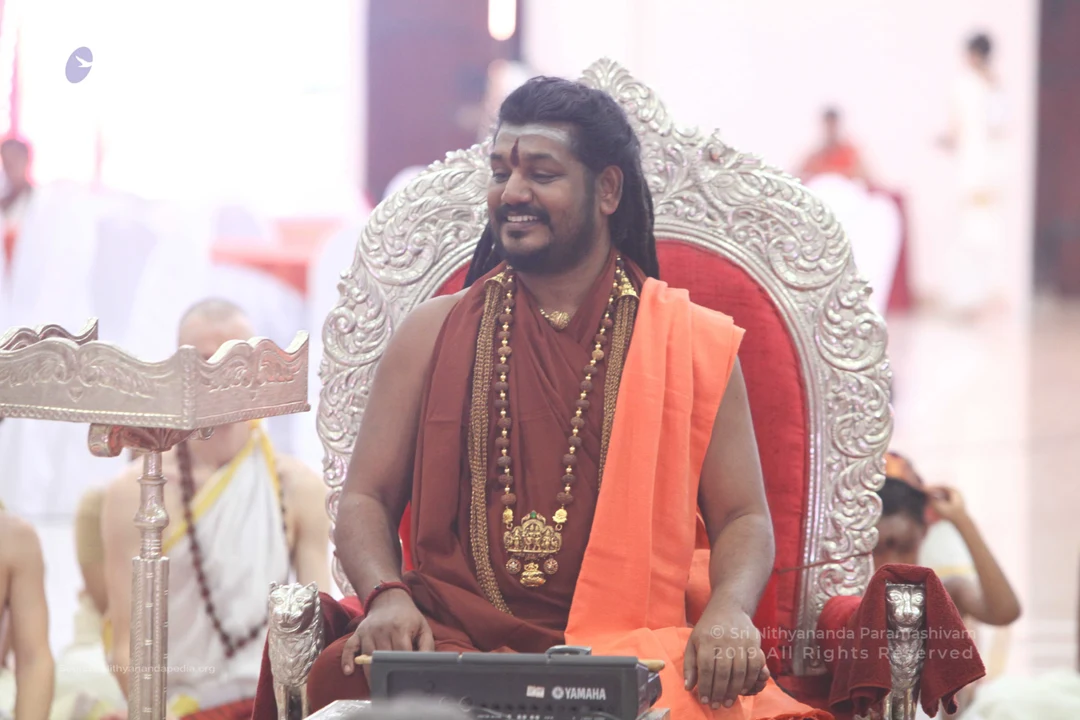
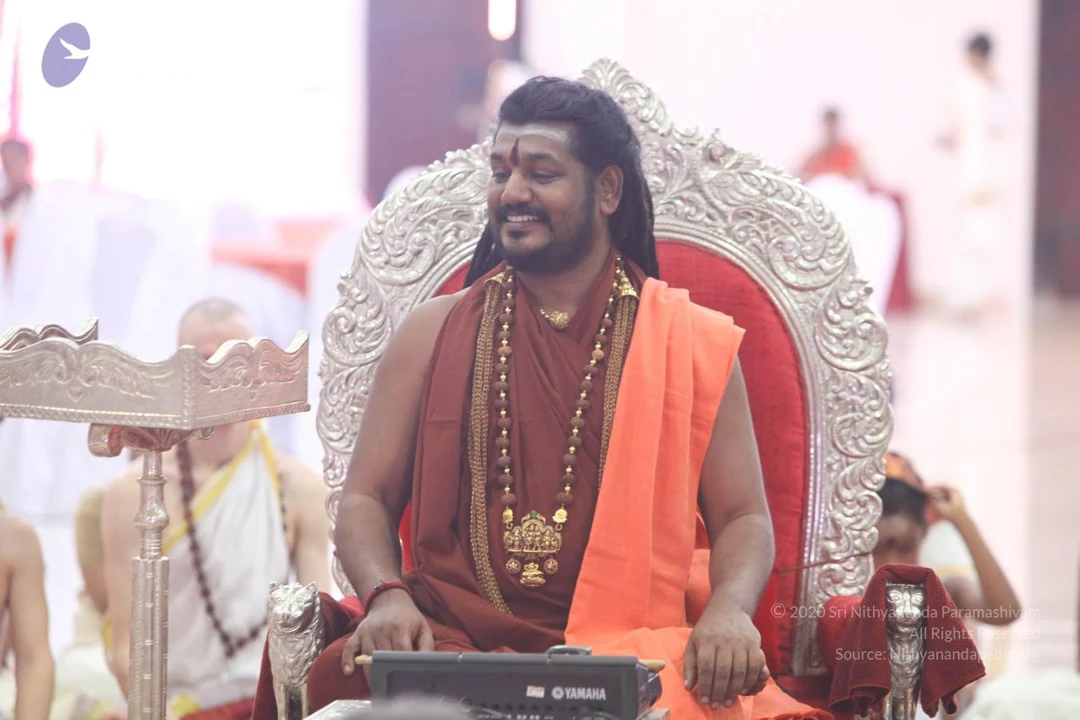
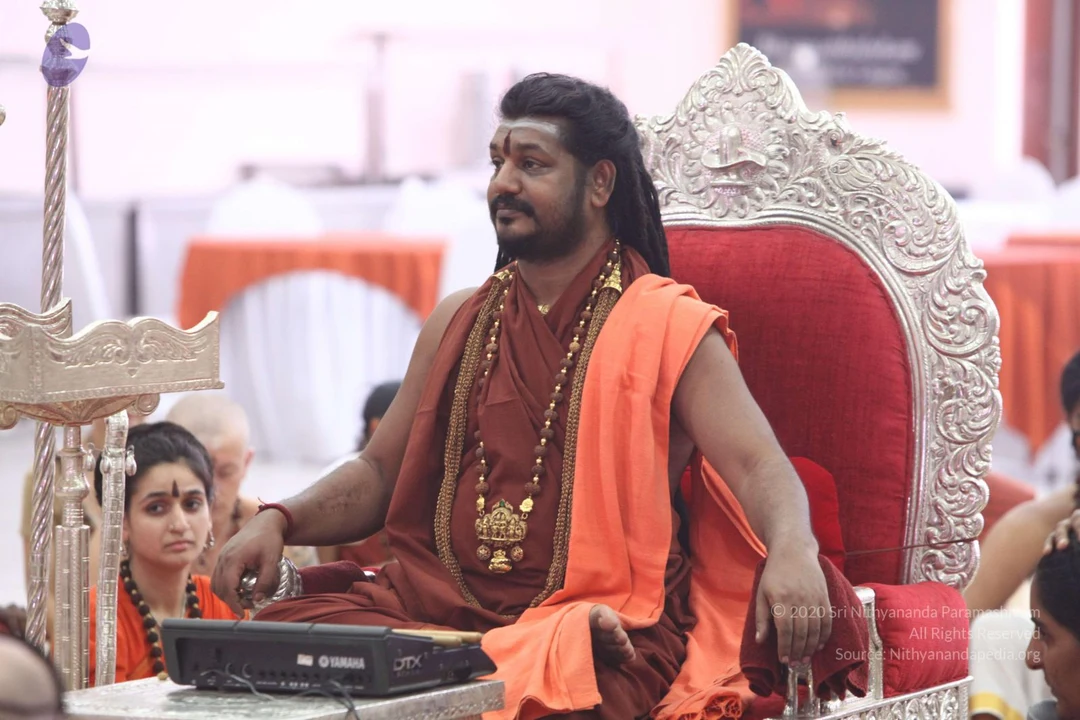
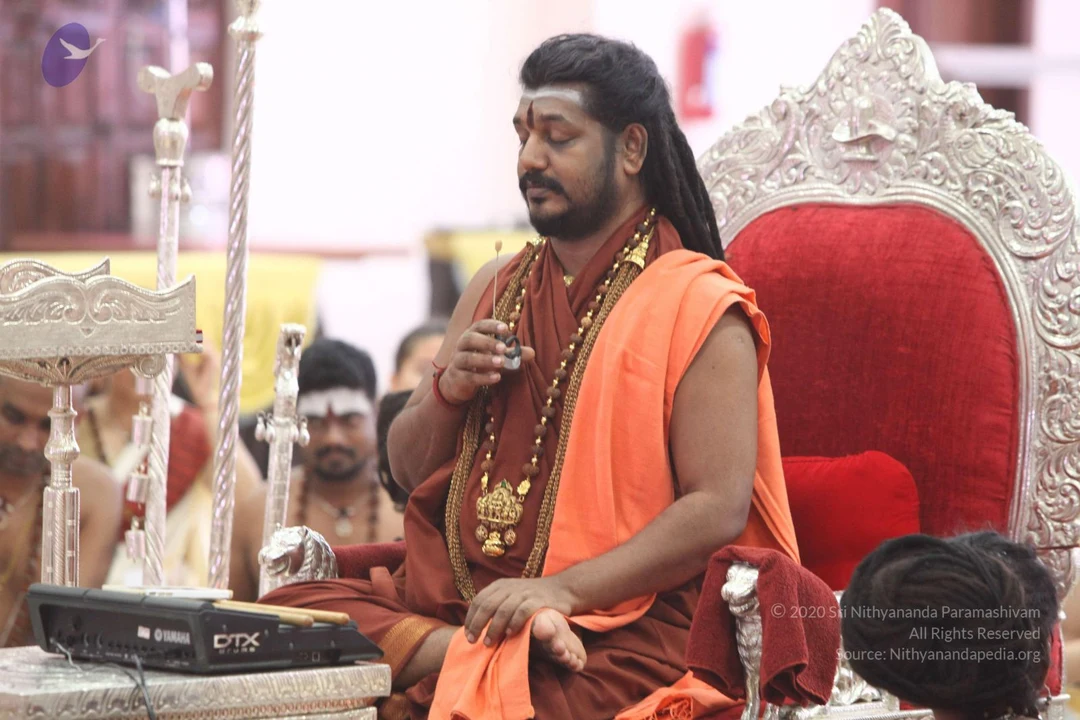
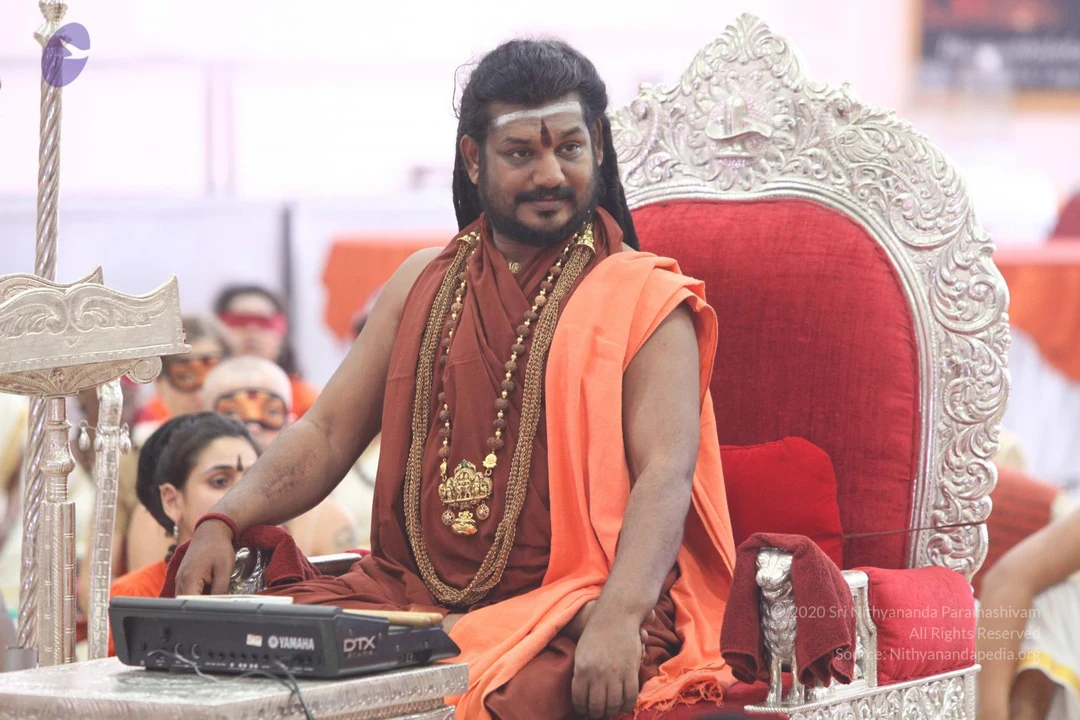
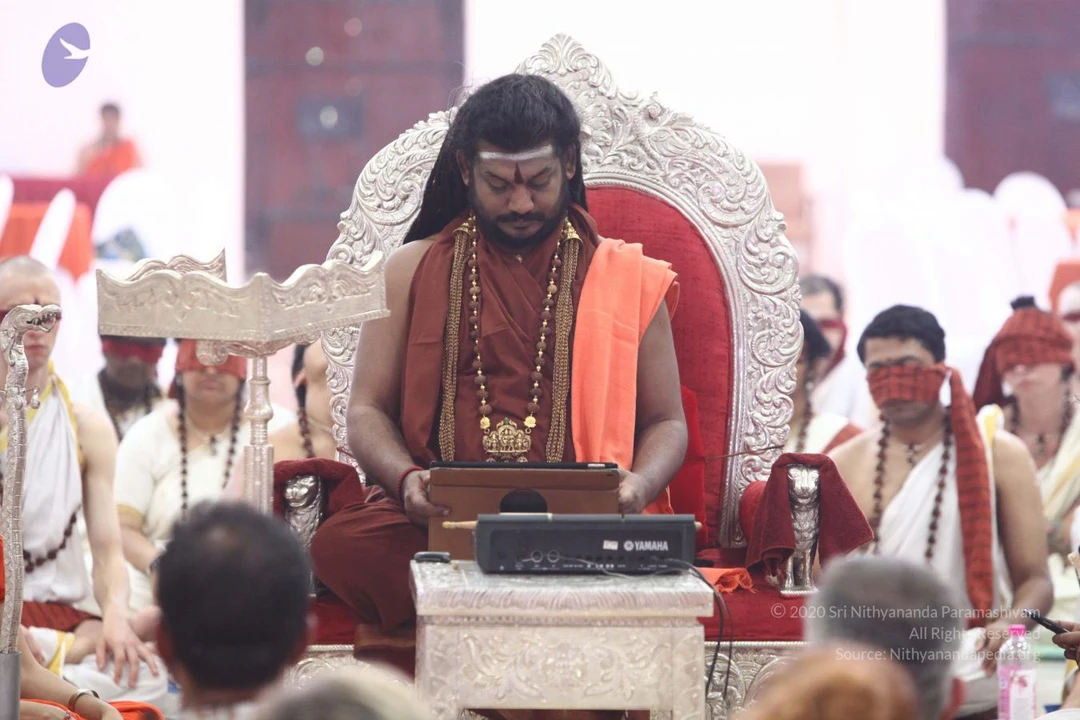
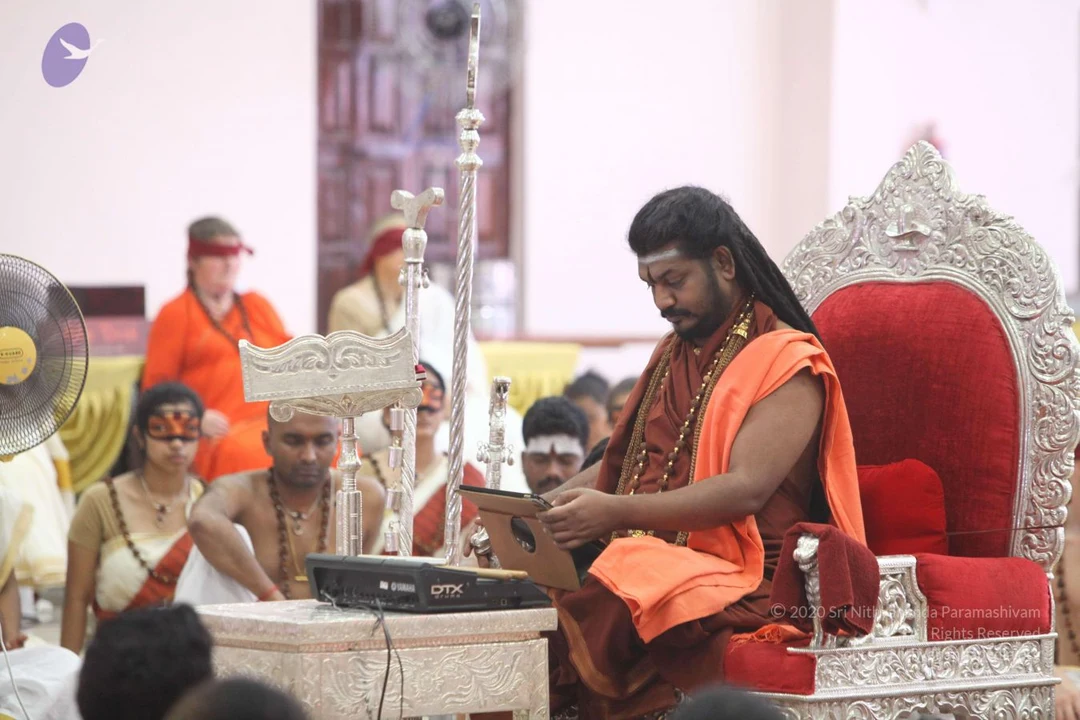
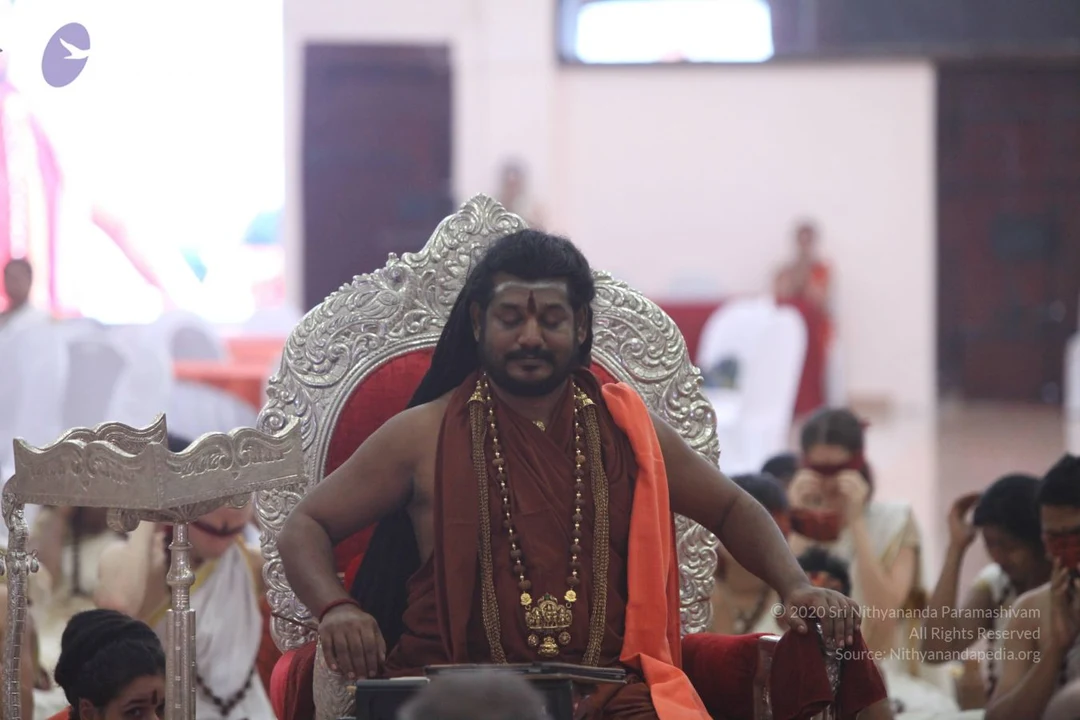
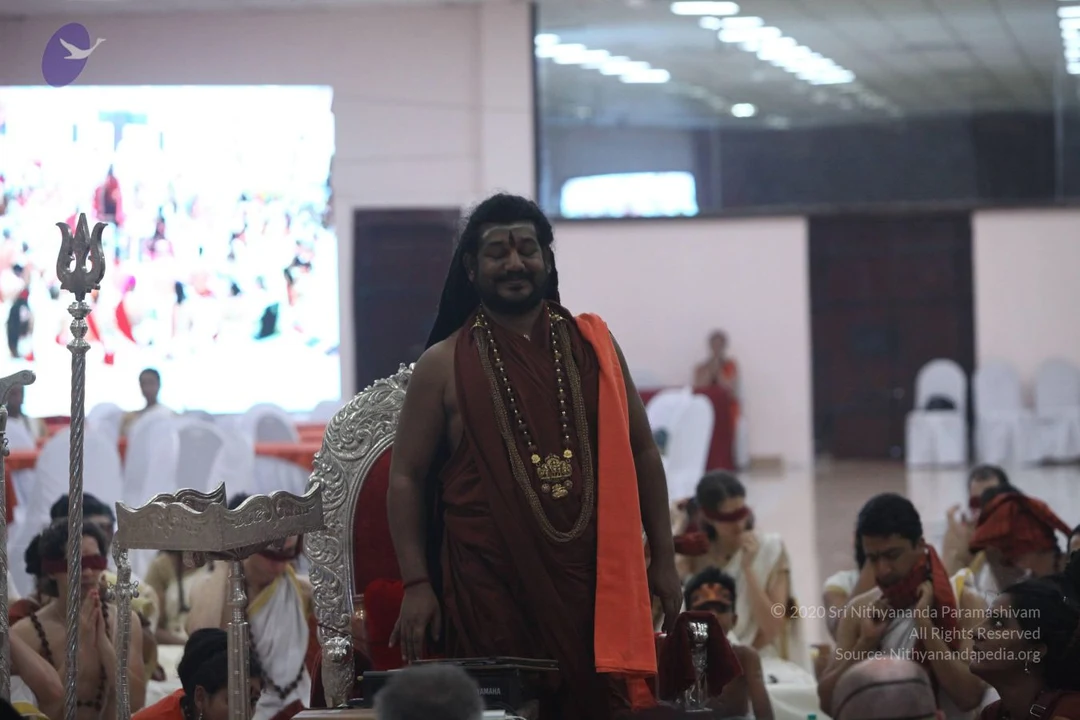
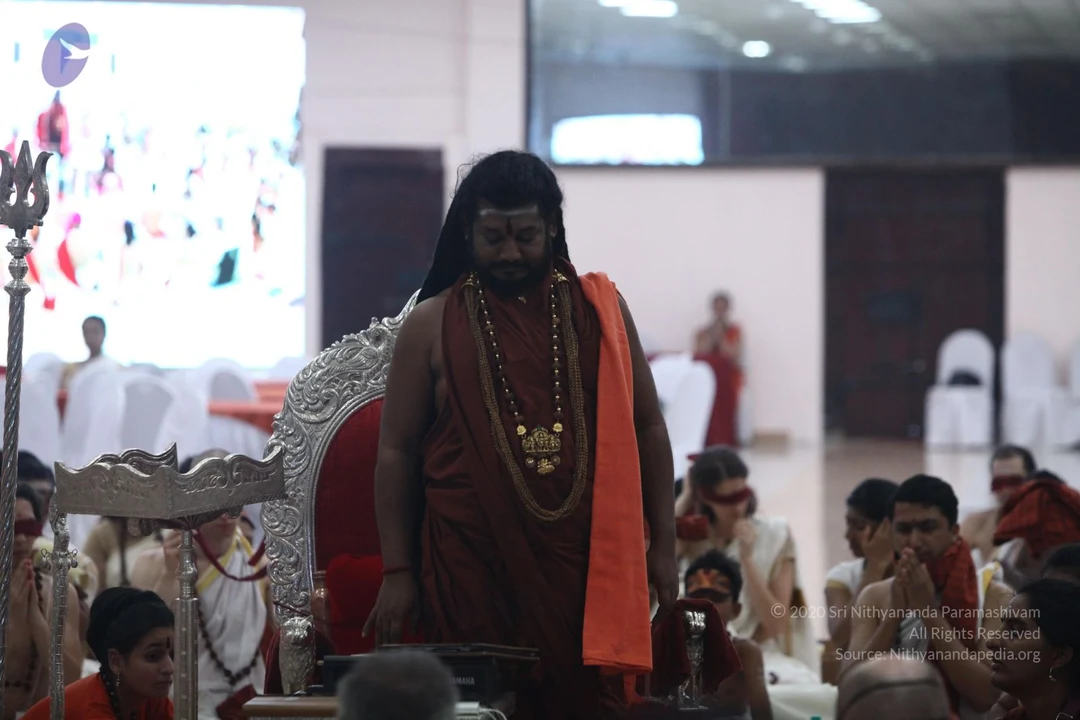
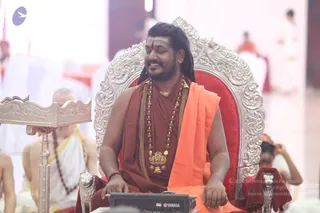
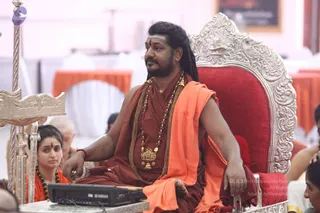
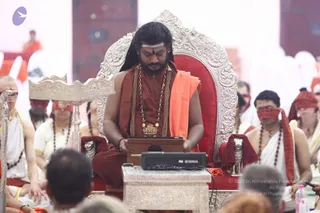
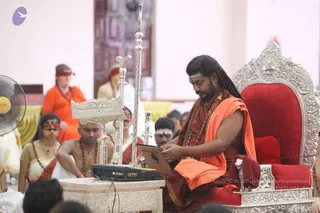
A smiling man with long dark hair and a red tilak on his forehead sits on an ornate silver throne with a red cushioned seat. He wears a rust-red robe with a saffron-orange shawl draped over one shoulder, a gold-toned ceremonial necklace, and a large rudraksha mala with a gold ornament. His hands rest on a small Yamaha keyboard in front of him. Behind him, a silver lion-headed armrest stand and a blurred seated figure in white with a yellow-bordered shawl appear, with white-clad attendees in the background of a bright hall.A seated man in an orange and rust-coloured wrap, with long dark hair swept back, a forehead tilak and a beard, sits on an ornate silver-and-red throne-style chair with a carved silver frame. He wears a heavy gold necklace with a gold pendant and rudraksha-style beads, and his right hand rests on the armrest. In front of him stands a silver ceremonial staff and a black Yamaha DTX electronic device on a table. Beside him sits a woman in orange with a bindi and a beaded necklace, and a bald man in white is partly visible at the left edge. Orange-draped tables and a pale hall stand behind them. Appearance cues are consistent with the page's reference to a person, so he is labelled a probable Swamiji on the throne.A seated man in a rust-red and orange robe sits on an ornate silver throne with a red cushion, holding a tablet device and wearing a long gold-beaded necklace with an ornate pendant and a rudraksha mala. He has long dark hair and a white tilak on his forehead, and he looks down at the tablet. Around him, several devotees in white ritual dress and red cloth wraps sit with eyes covered by red blindfolds, wearing rudraksha malas. A silver ornamental stand with a bell-like stand stands to the left, and a Yamaha amplifier sits on a silver side table in front. The setting is a bright hall with white draping and orange-clad figures in the background.A man with long swept-back dark hair, a white forehead mark and rudraksha malas wearing saffron-orange robes sits on an ornate silver-and-red throne, looking down at a tablet held in his hands. Beside him a silver lectern and a silver staff stand near a black Yamaha keyboard unit. Behind them, several seated attendants wear orange and white cloth, one with an orange blindfold-style headband, and a ceiling fan is visible at left. A white-walled hall with a wooden door forms the backdrop. The man has distinctive long hair, saffron robes, rudraksha malas and a throne cues, so this is an appearance-based probable Swamiji seated in person, though the photograph does not establish his identity beyond that.A man seated on an ornate silver-framed throne with a red cushioned seat, eyes closed in meditation, hands resting on the armrests. He wears a rust-red garment with an orange shawl draped over one shoulder, a rudraksha mala and a long gold ceremonial necklace with a central gold pendant, and a vertical marking on his forehead. Long dark hair falls behind him. Beside him stands a silver ornamental lectern. Seated devotees in white and red saris, several with red cloths over their faces, fill the foreground and a hall with pale walls and a red-draped table behind.Photograph of a satsang hall in which a man with long dark hair and a red-brown robe with an orange shawl stands beside a silver-framed red throne-style seat, smiling with eyes closed and hands at his sides. He wears a red tilak, a rudraksha mala and a gold ceremonial necklace. Seated devotees in white and red ritual attire, some with red cloths over their eyes and hands in namaste, fill the foreground. A silver trident stands on the left, and a large screen in the background shows a crowd. a person: the figure wears rudraksha mala, gold ceremonial necklace and flowing hair, and is presiding at the satsang.

Vishesh-Deeksha

138 photosSource gallery
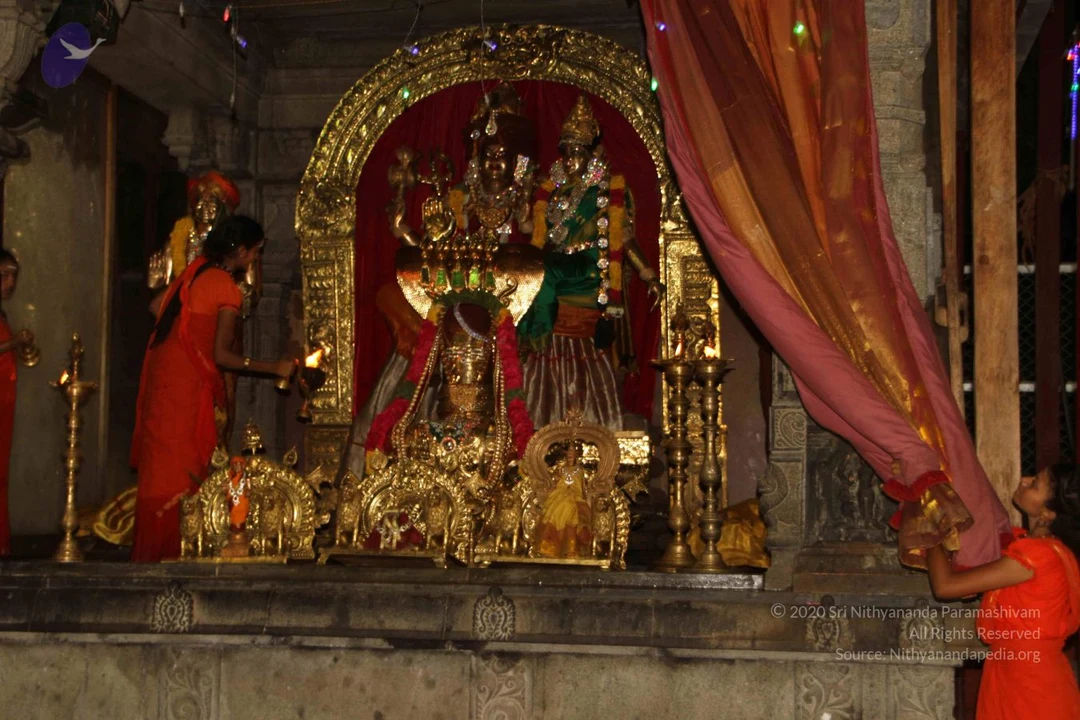
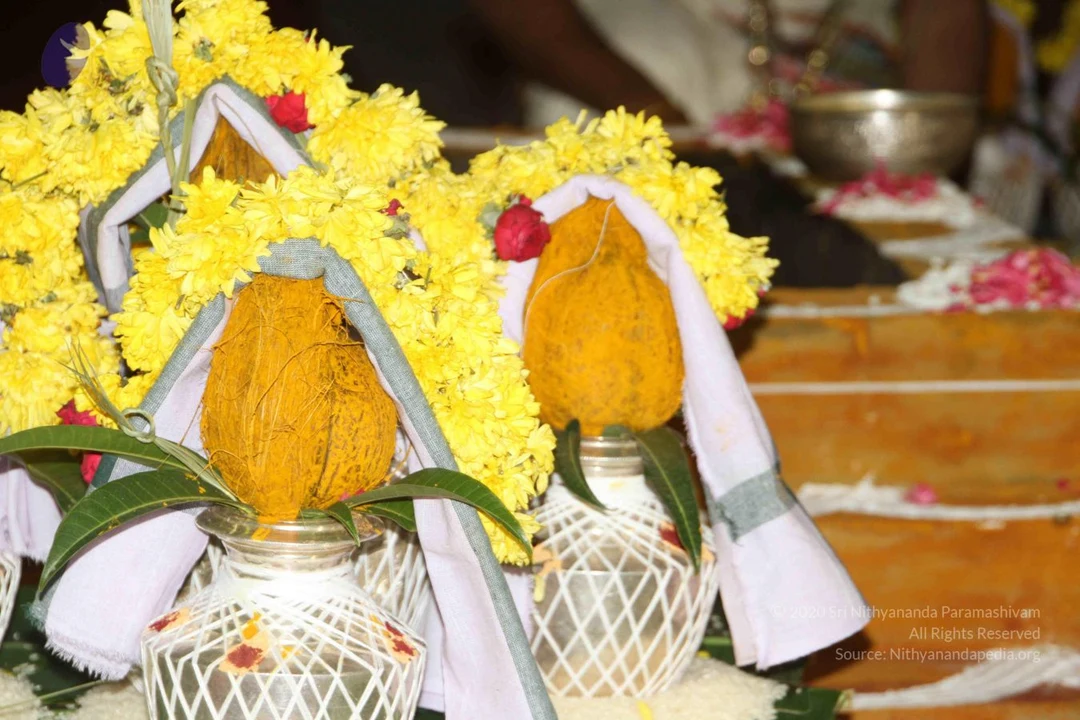
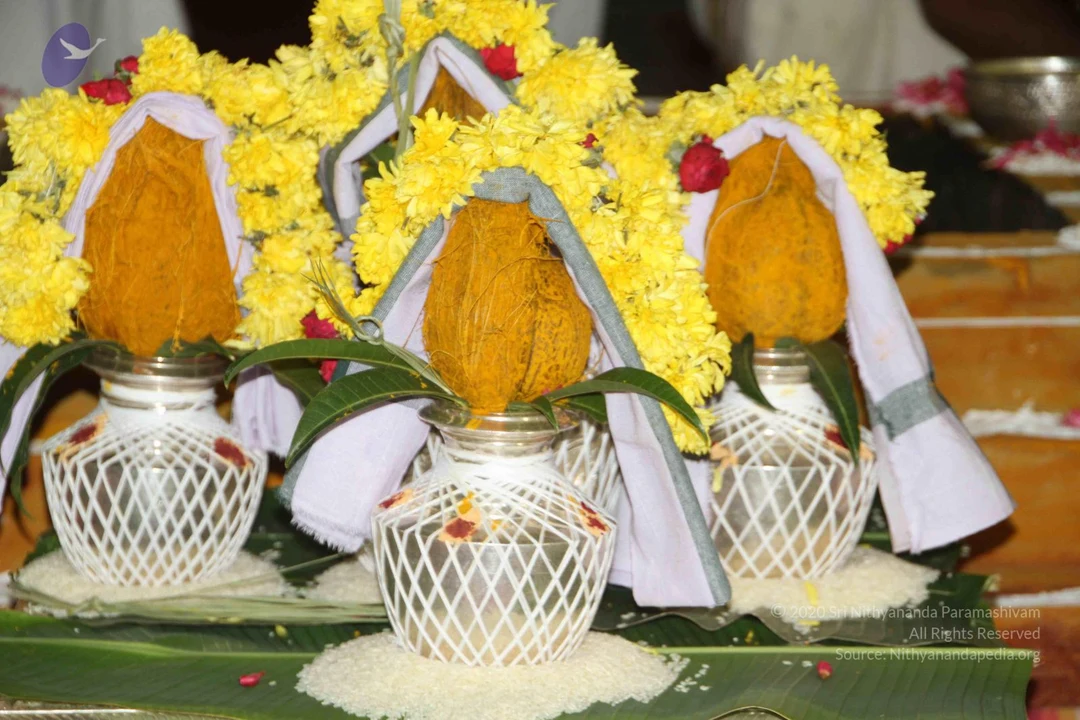
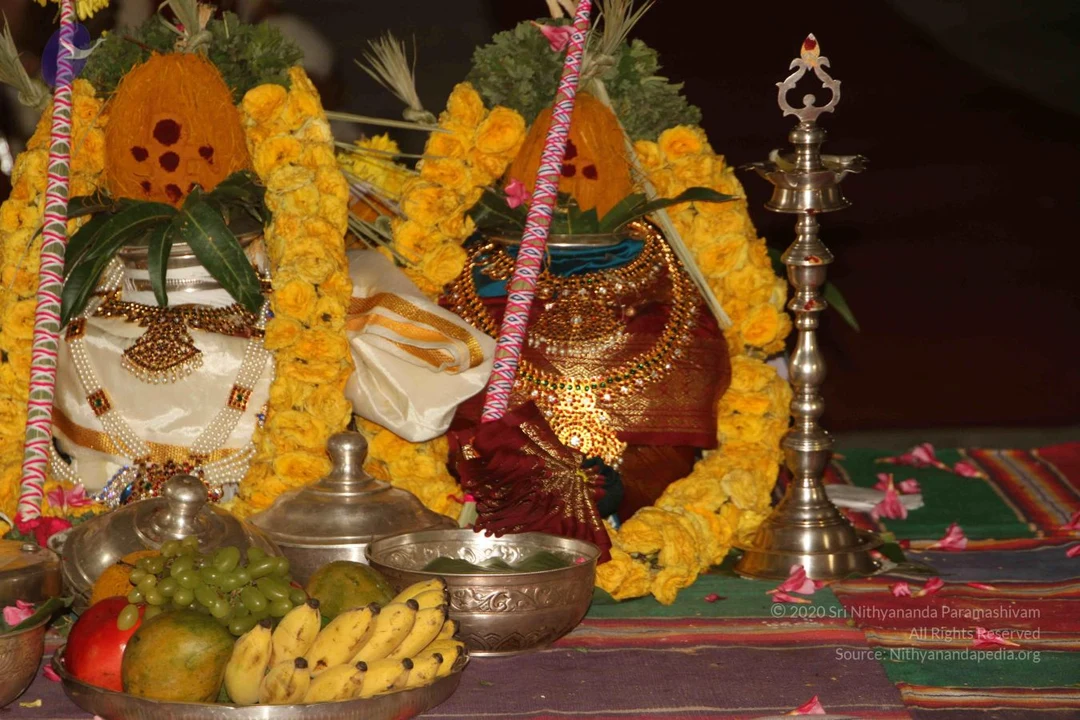
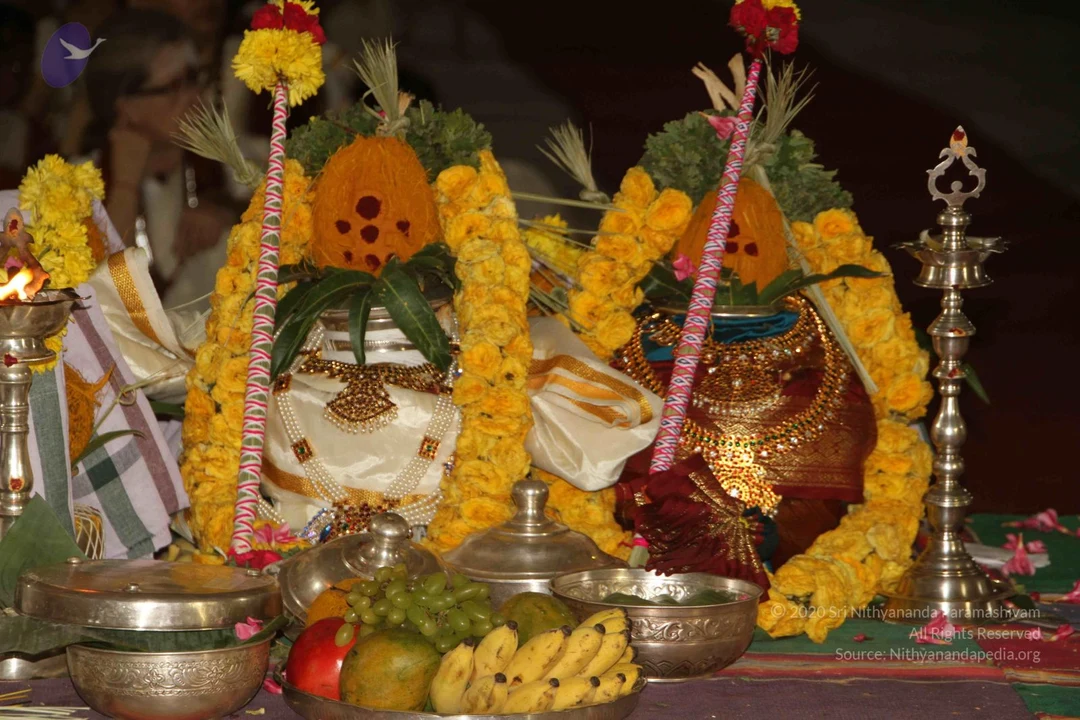
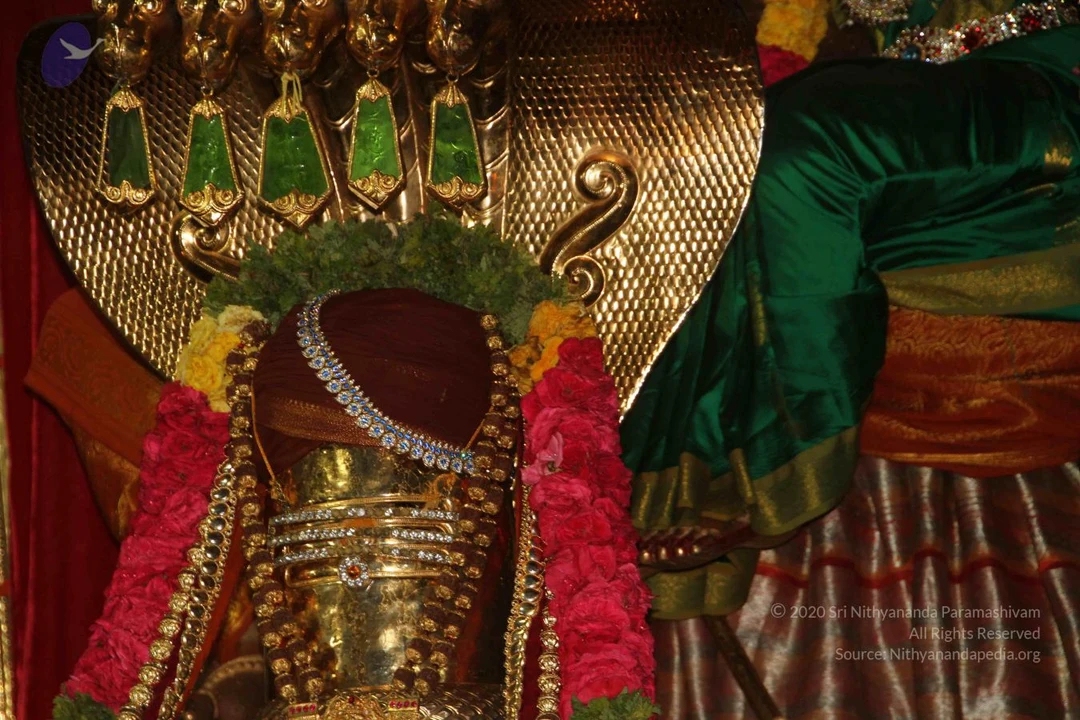
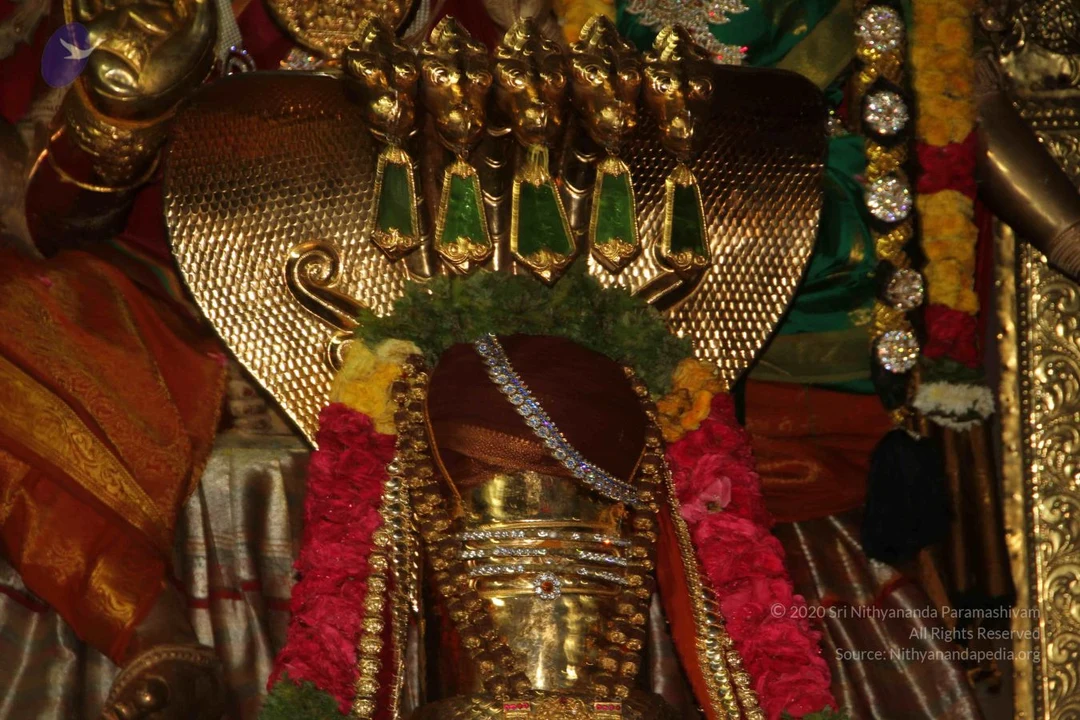
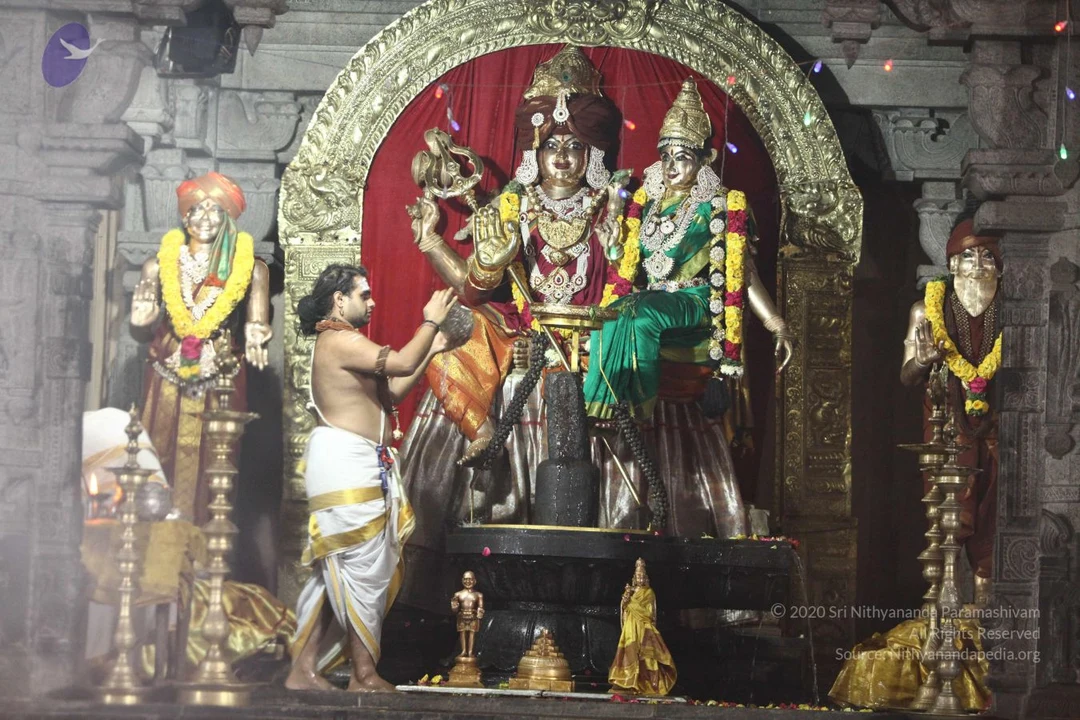
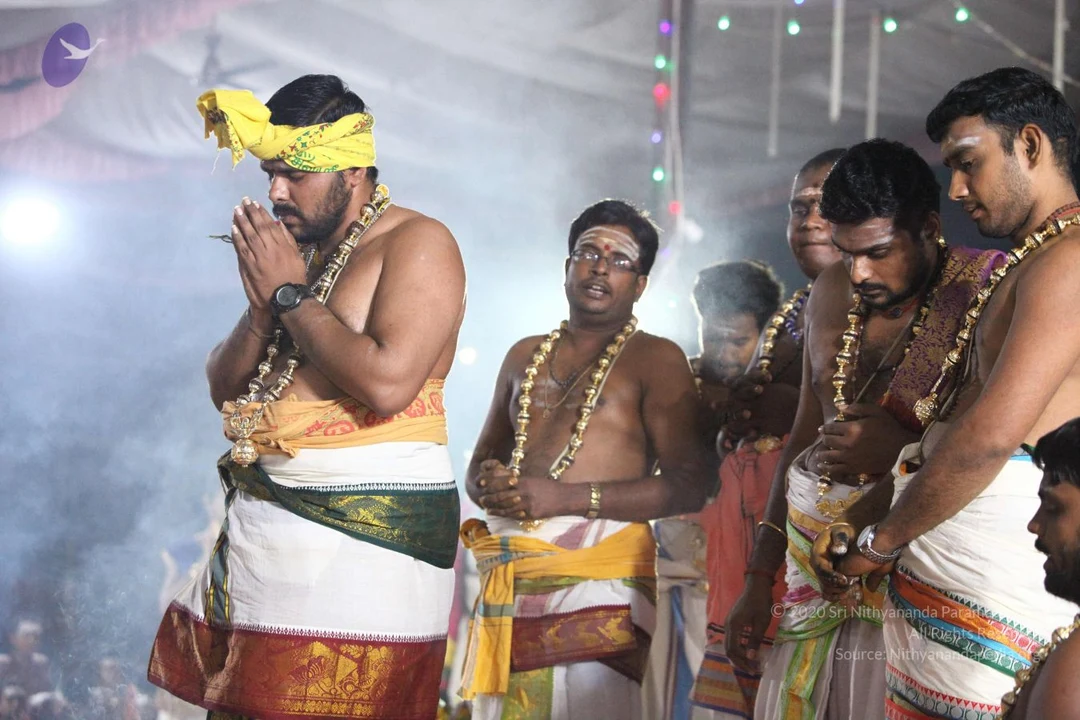
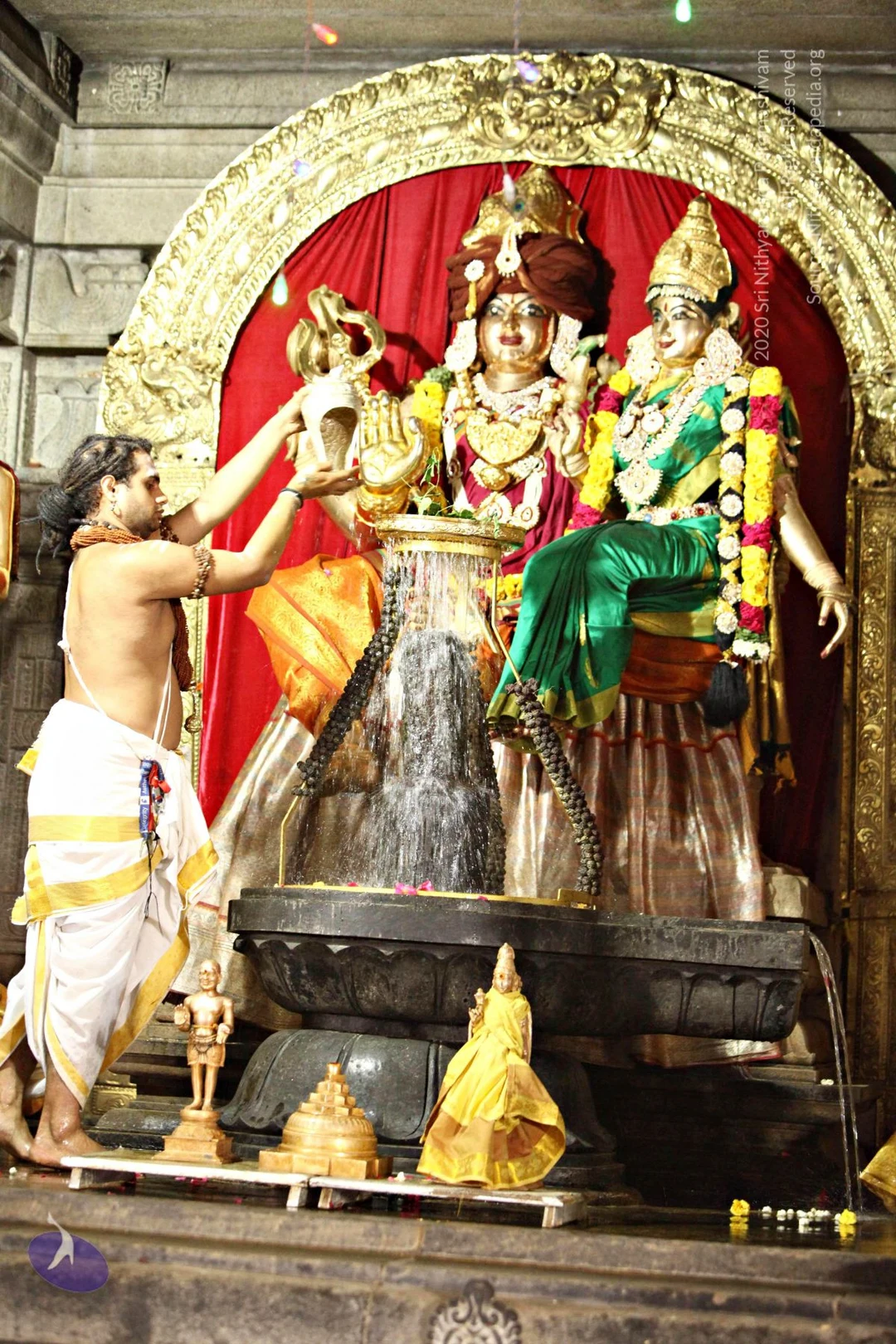
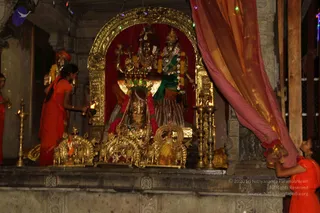
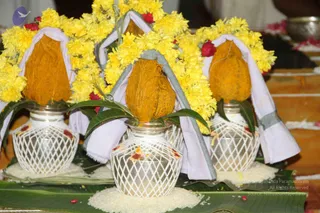
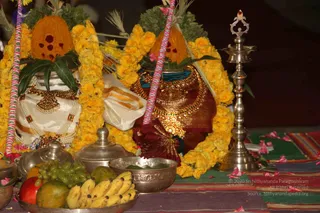
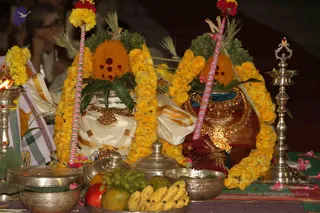
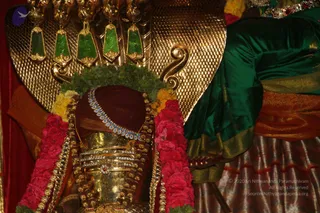
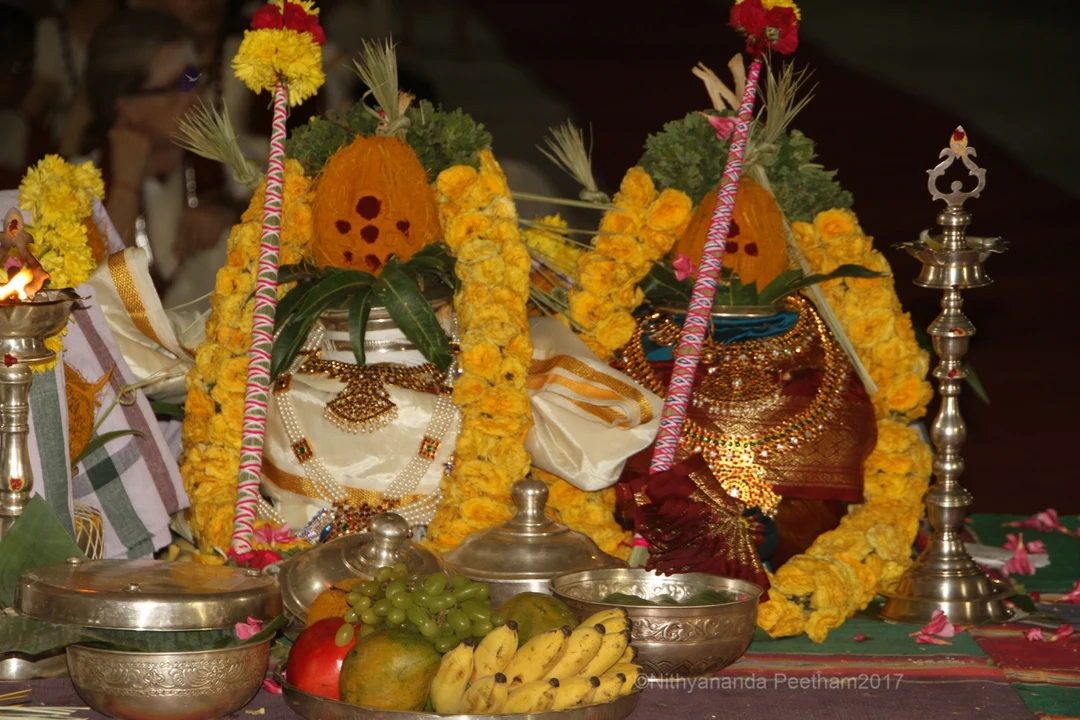
Inside a temple shrine, two women in orange saris stand before a golden arched niche framing a deity murti with a crown and garland, with a gilded figure beside it. Women in orange clothing hold oil lamps and attend the altar; brass lamp stands and a red curtain surround the scene. A third woman in orange stands at right, touching a hanging fabric. The deity murti is sculpted rather than a living figure.Close view of two kalasha pots topped with coconuts wrapped in white cloth and wreathed with yellow marigold garlands and red flowers, set on a wooden platform. Mango leaves are tucked among the garlands and the kalashas sit in woven white netting. Scattered rose petals and a small metal bowl appear in the background. No people are visible in the frame, so the scene is an unoccupied ritual setup rather than an event with attendees.Close-up photograph of four kalasha water pots arranged on a banana leaf, each topped with a coconut wrapped in a white cloth and draped with yellow marigold garlands and red flowers. The pots have silver rims and white netted covers, and rice grains are scattered on the leaf around them. No people are visible; the background shows a brass vessel and a rose-petal-strewn table.A ritual display of two decorated kalasha-style pots dressed with yellow marigold garlands, mango leaves, coconuts with red markings and sacred threads. Both pots wear gold jewellery and pearl necklaces, one in white cloth and one in a maroon cloth. In front are silver bowls of bananas, grapes, mangoes and other fruit, a silver oil lamp on a stand, and scattered pink petals on a striped woven mat. No people are visible.Two decorated ritual pots, or kalasha-style vessels, sit side by side on a table as a puja offering. Each is wrapped in yellow marigold garlands with red and pink striped sticks rising from the tops, and topped with mango leaves, grass and orange coconut-like tops marked with red dots. The left vessel wears a white silk cloth and pearl and gold jewellery, while the right wears a maroon and gold silk cloth with a gold necklace. Silver oil lamps, a silver dish of mixed fruit including green grapes, bananas and mangoes, and silver bowls surround them. Devotees are faintly visible in the dim background, and a lit oil lamp burns at the left edge. This appears to be an abhishekam or puja arrangement.A photograph of a deity murti in a temple shrine, dressed and decorated for worship. A golden cobra hood with five green glass pendants rises behind the figure. The murti wears a dark maroon cloth wrapped on its head, a diamond-studded necklace, golden armbands and bangles, and garlands of red roses, yellow marigolds and green leaves. The murti is draped in a green silk garment with gold border. Ornate golden decoration frames the shrine.

Aadheenivasi-Brahmcharya-Initiation

4 photosSource gallery
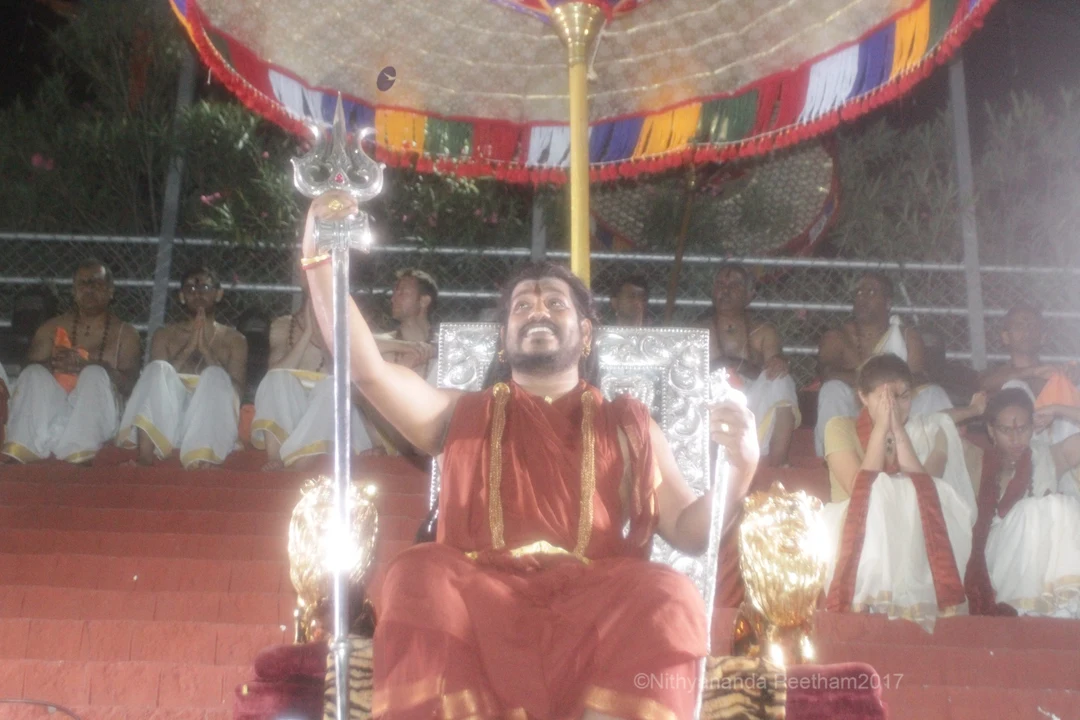
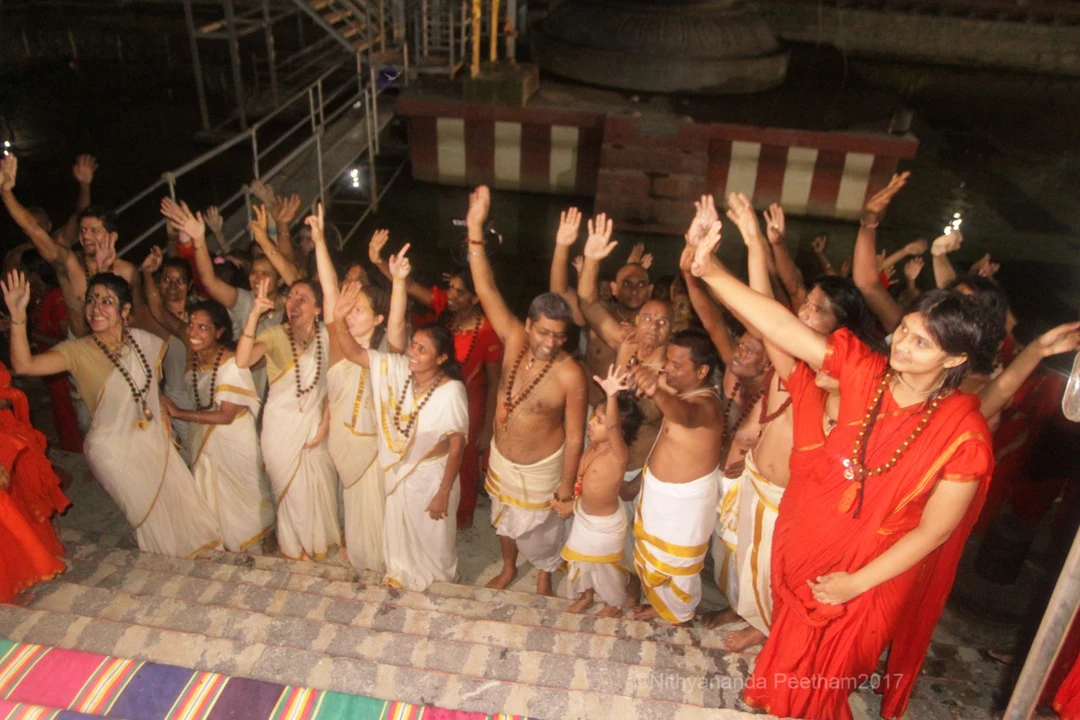
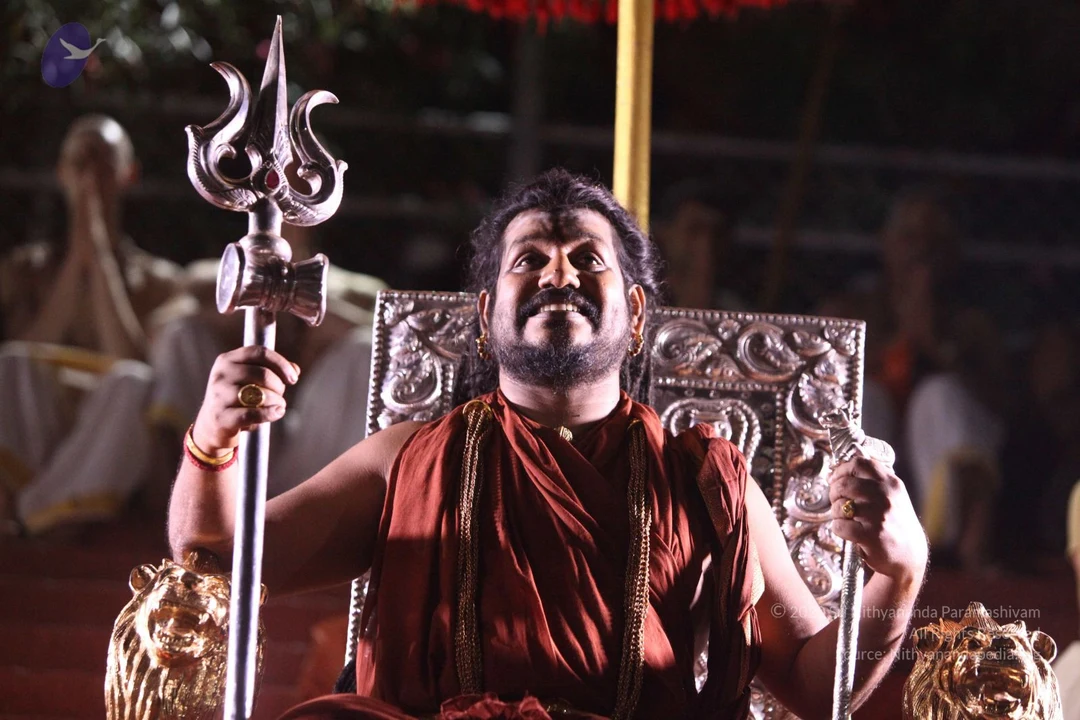
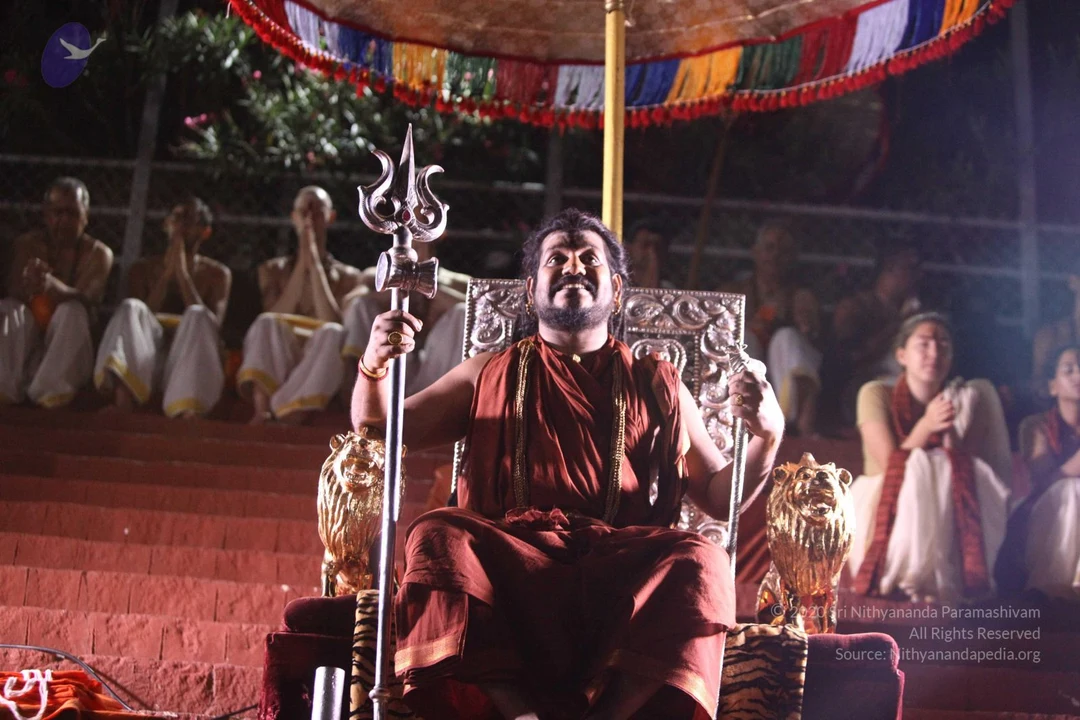
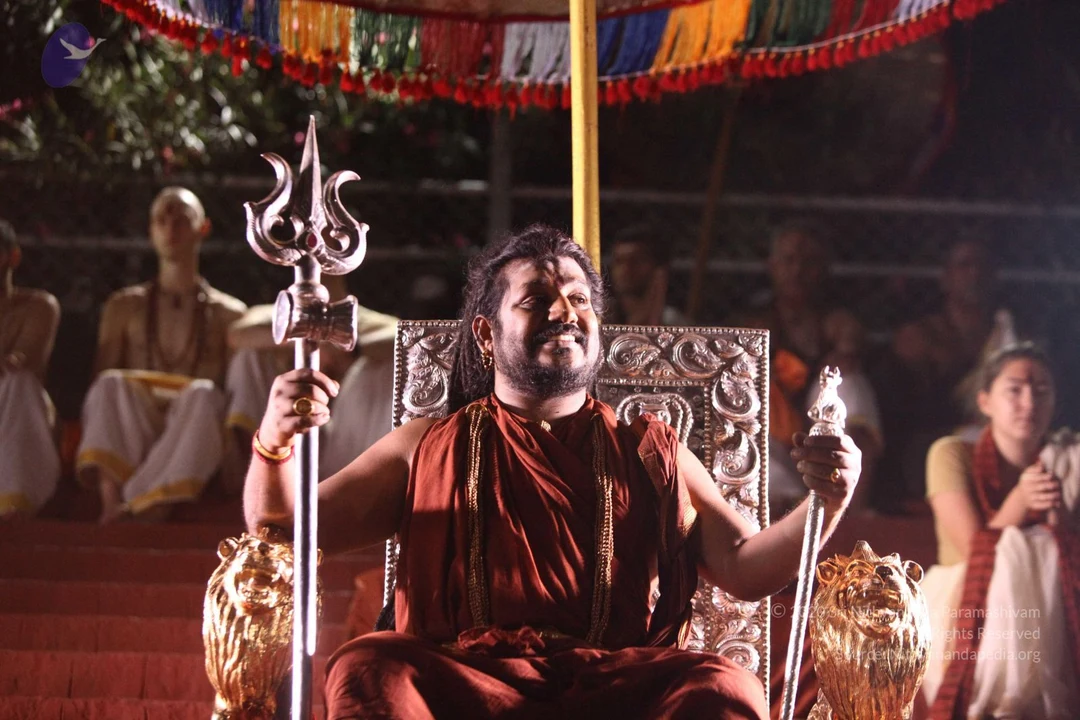
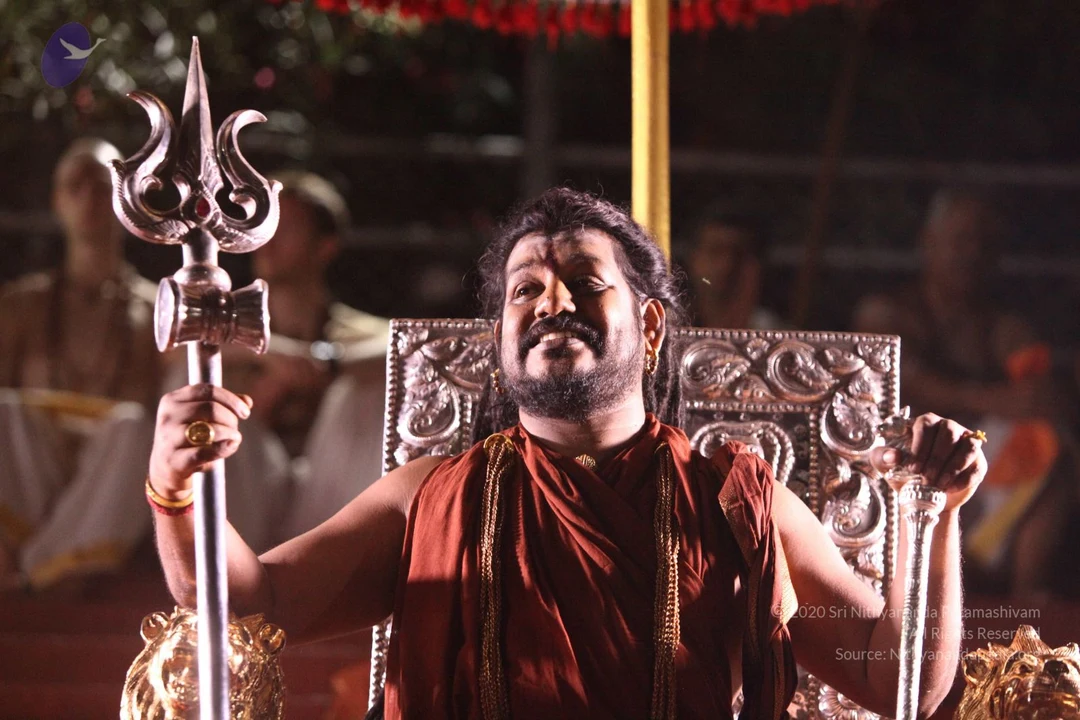
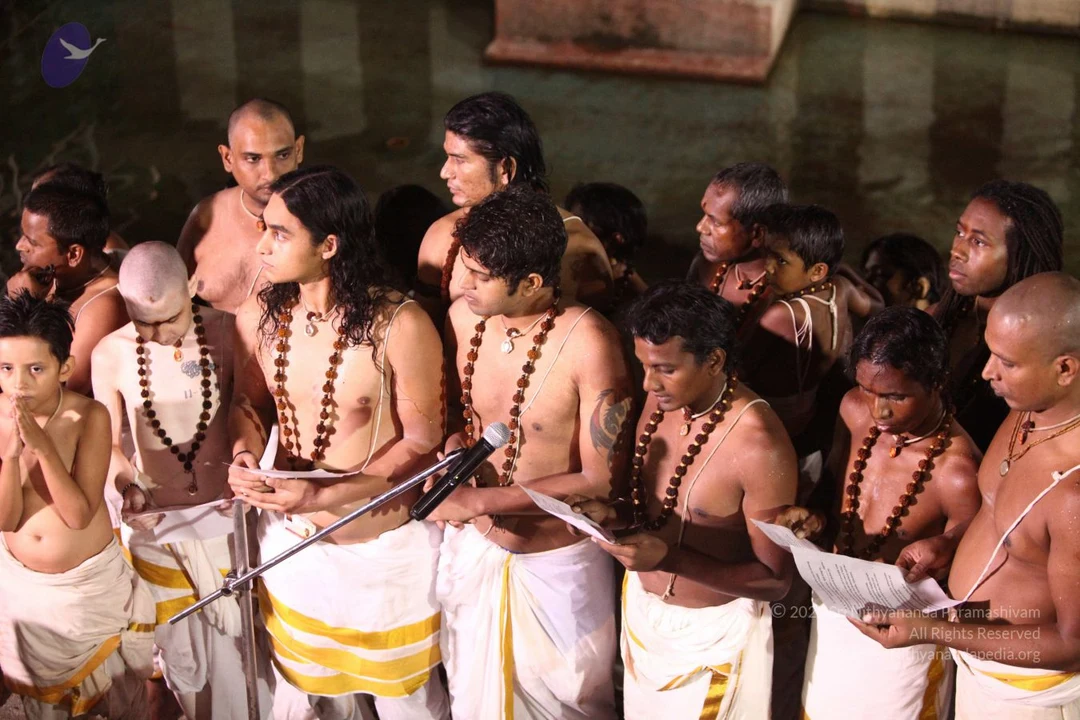
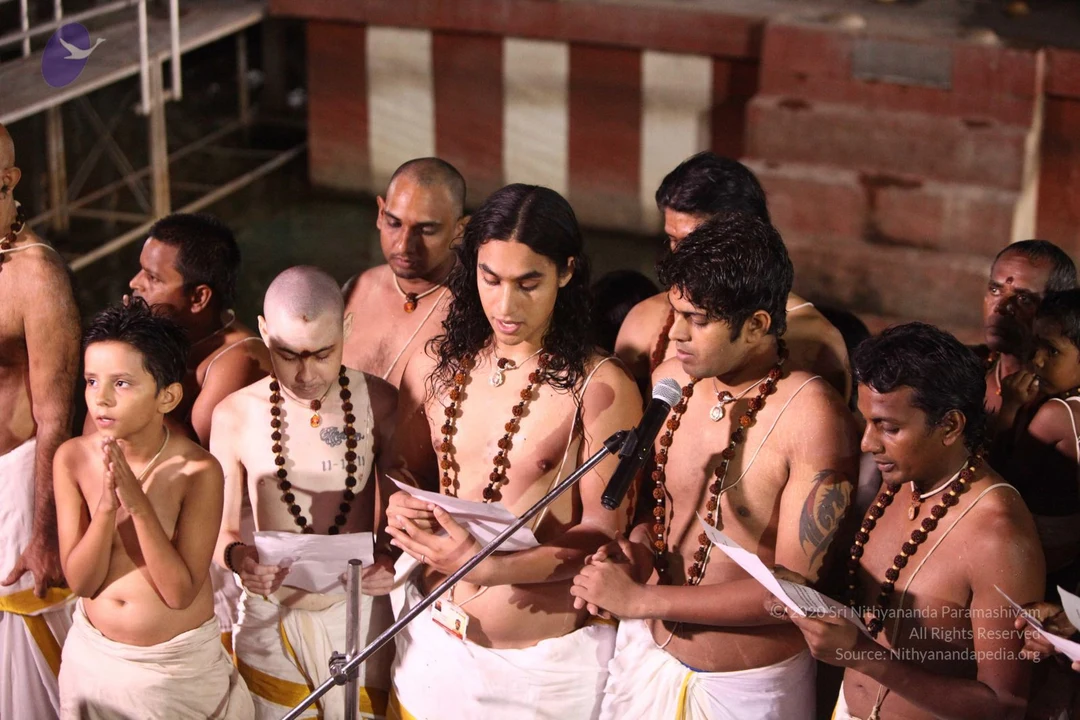
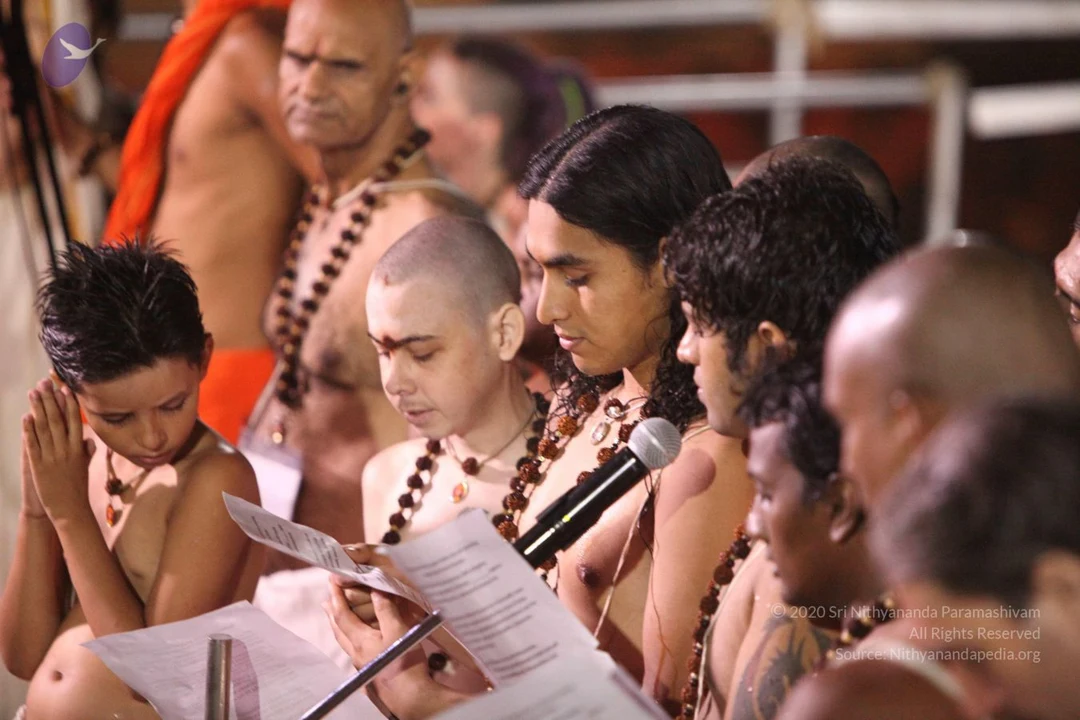
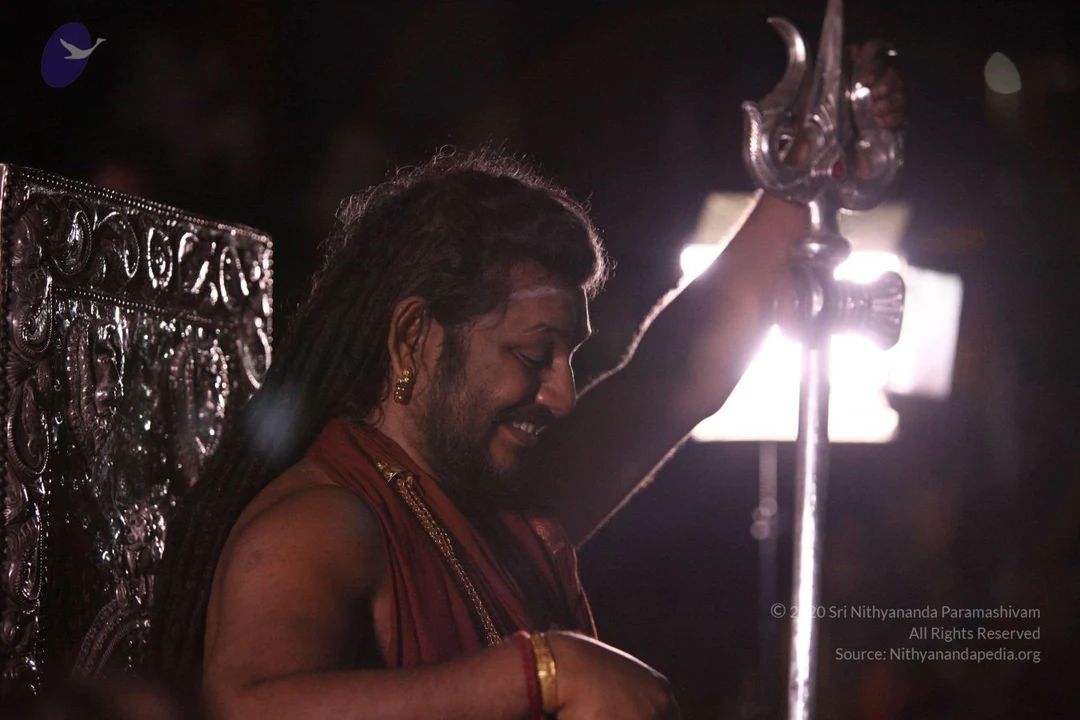
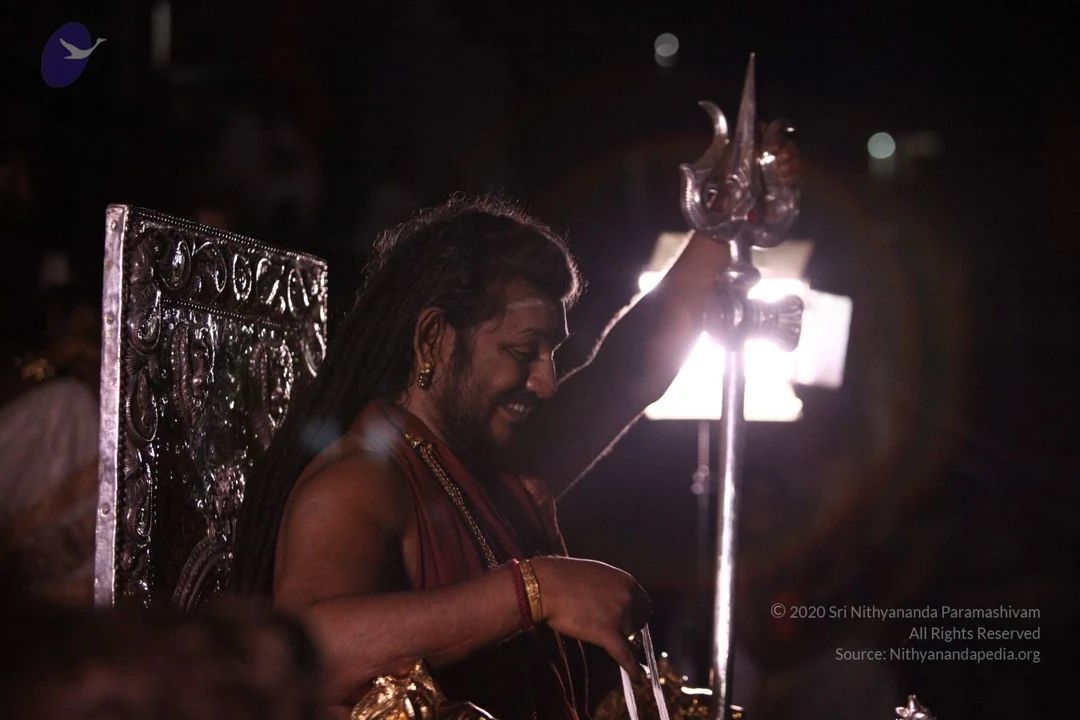
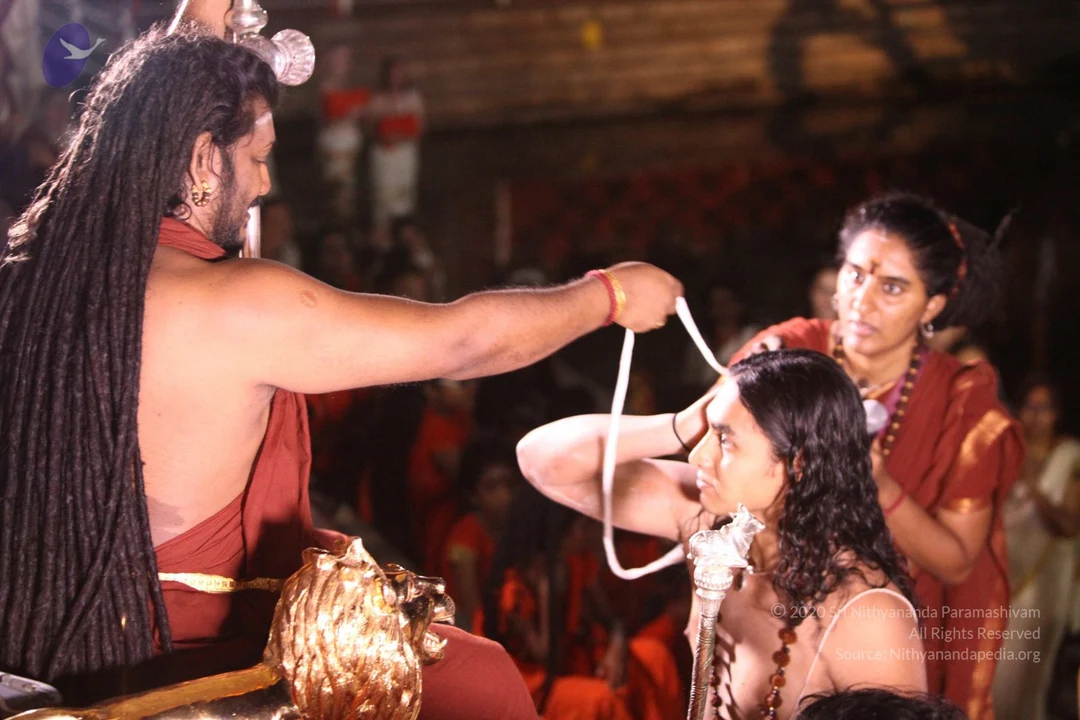
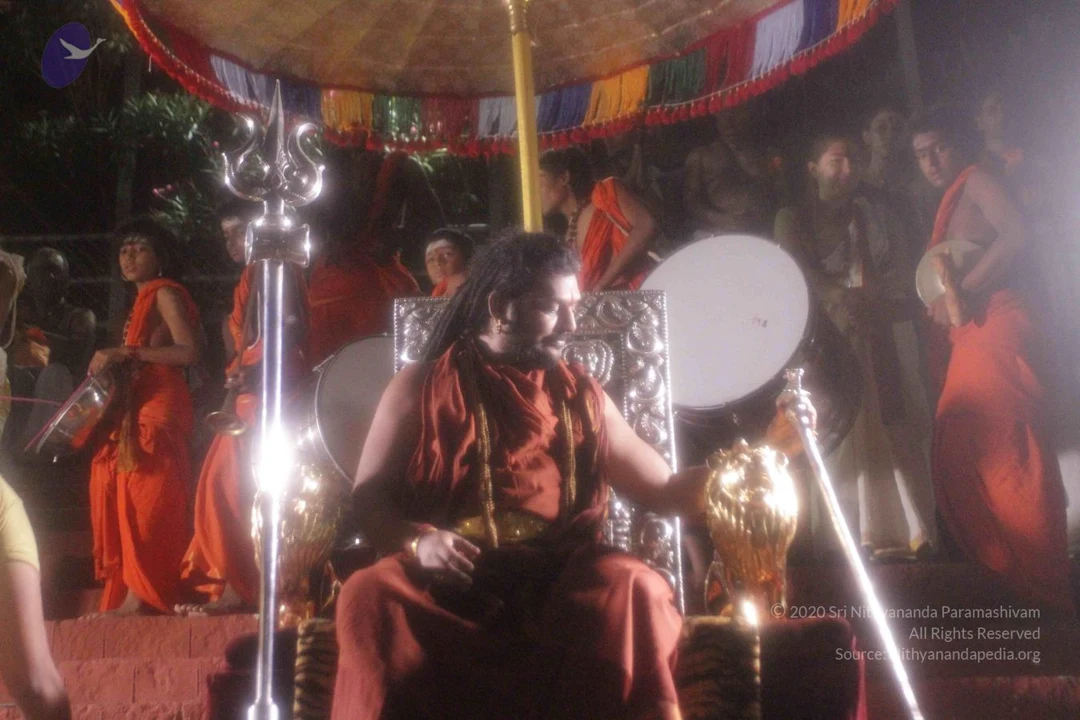
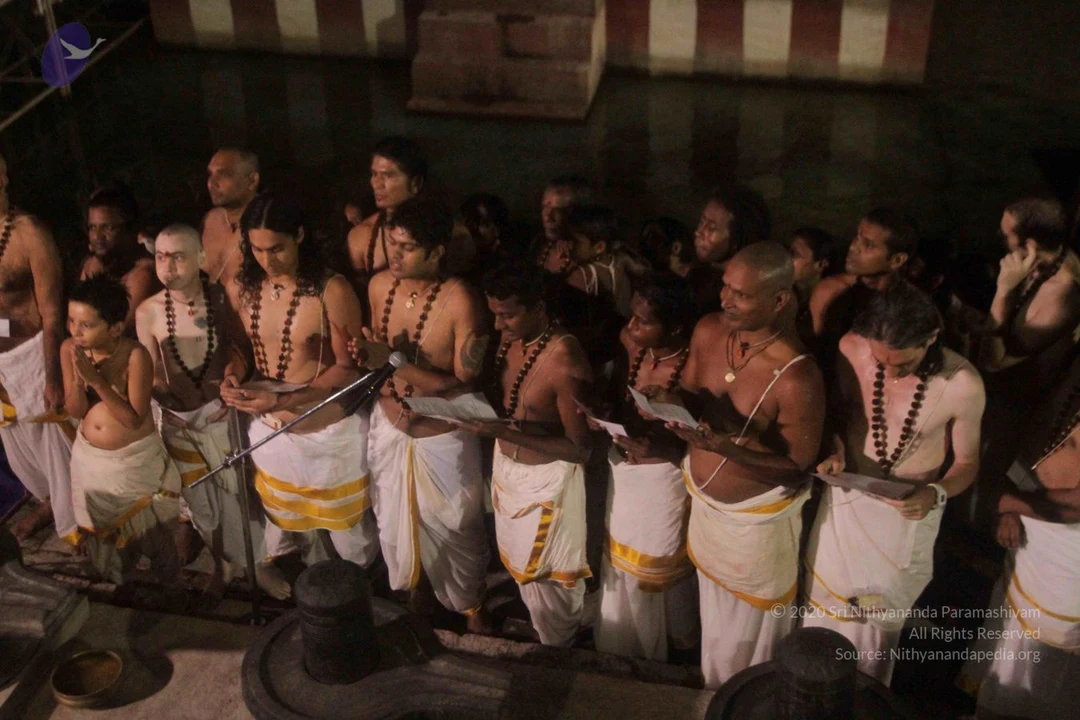
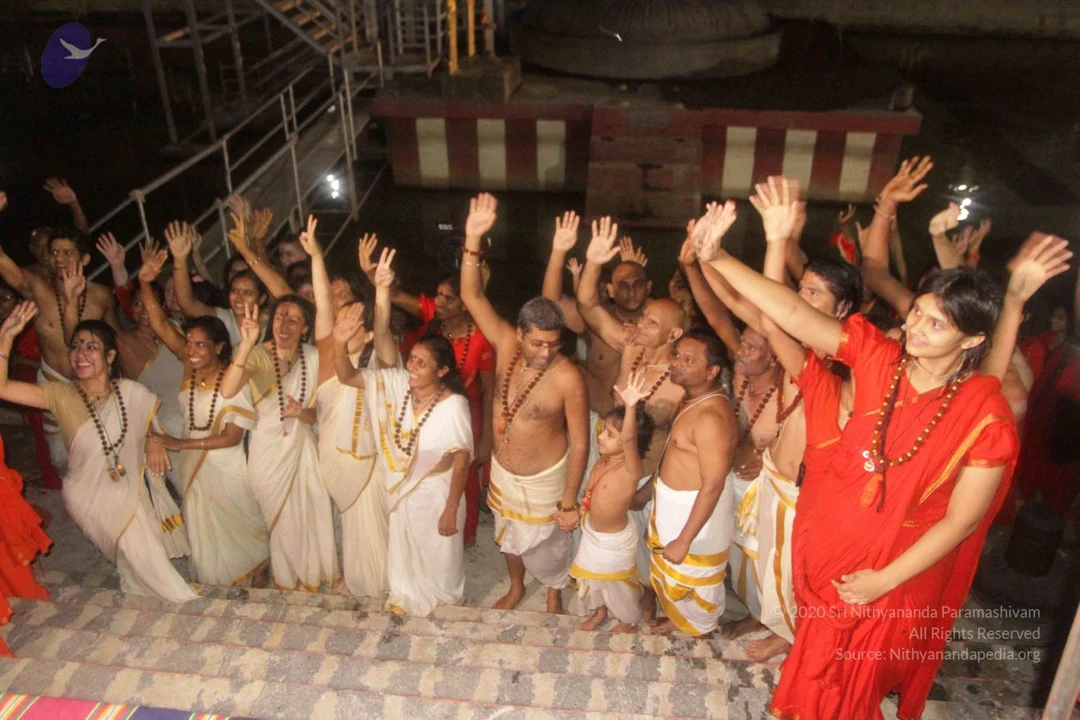
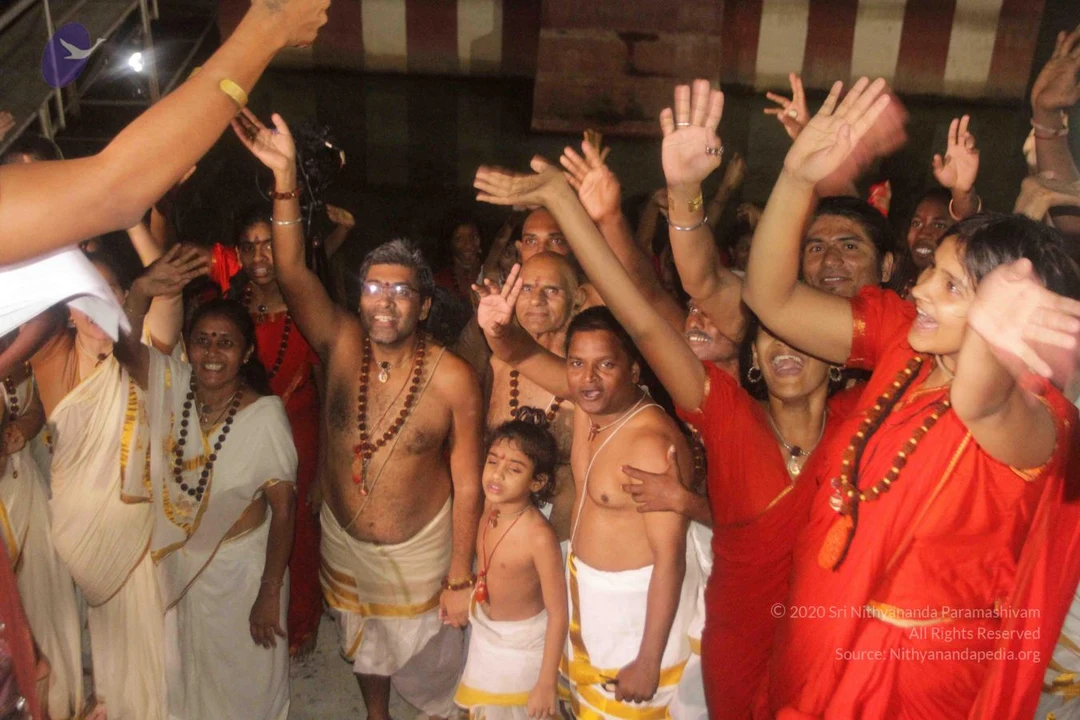
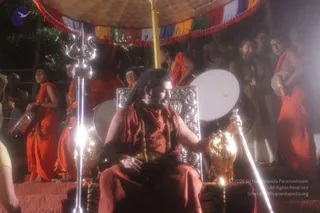
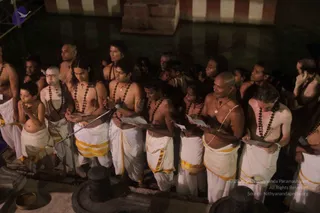
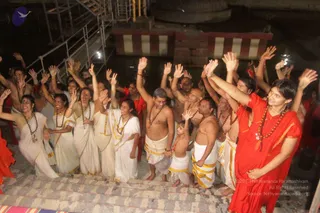
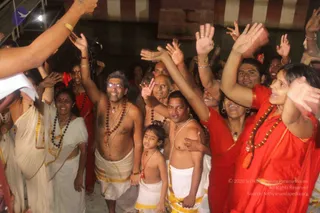
Photograph of a seated man at an outdoor night event on a raised platform beneath a yellow canopy with colourful fringed streamers. He wears a rust-orange wrap over bare shoulders, a gold-coloured ornamental necklace and rudraksha-style beads, with long dreadlocked hair and a short beard. He sits on an ornate silver-embossed throne and grips a long silver staff topped with a gold finial. Behind him, several people in saffron-orange robes sit or stand, and a large drum stands on the platform. A tall silver trident stands to the left.A night-time photograph of a row of shirtless men in white dhotis with gold-bordered yellow edges, many wearing rudraksha malas and gold chains, standing close together and holding paper sheets as if reciting chants. A microphone on a stand is at the centre, and a dark stone shivalinga-style base and a brass vessel sit in the foreground. Behind them is a striped red and white temple wall. A few men on the left and right have shaved heads.A photograph of a crowd of devotees gathered on a stone staircase inside a temple-like hall, arms raised high in an ecstatic gesture. Many wear white dhotis and sarees with gold borders, and rudraksha malas around their necks. A woman in the right foreground wears a bright red saffron-toned saree with a rudraksha mala. Several men are bare-chested, and a small child in a white dhoti stands among them. Behind them are metal railings, a striped red and white barrier, and a large stone structure above. Approximately 20 people are visible.A joyful group of devotees with arms raised high in a night-time temple setting, some clapping and singing. A bare-chested man with short hair and glasses wears a rudraksha mala and a white dhoti with gold border, and a bald older man beside him is also bare-chested with a mala. Women wear red and orange saris and white saris with gold borders, many with beaded malas and gold jewellery; a young girl in red holds her hands up. A small child in a white dhoti and rudraksha mala stands in front. Striped red and white fabric hangs in the background.

More Photos of Padapuja

4 photosSource gallery
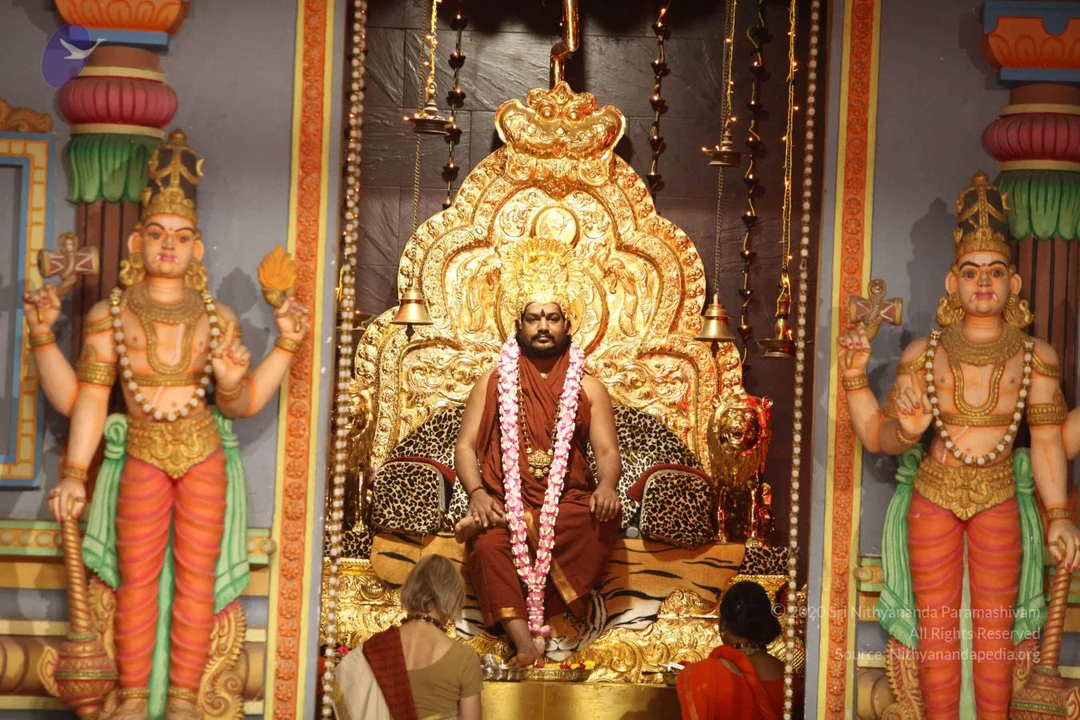
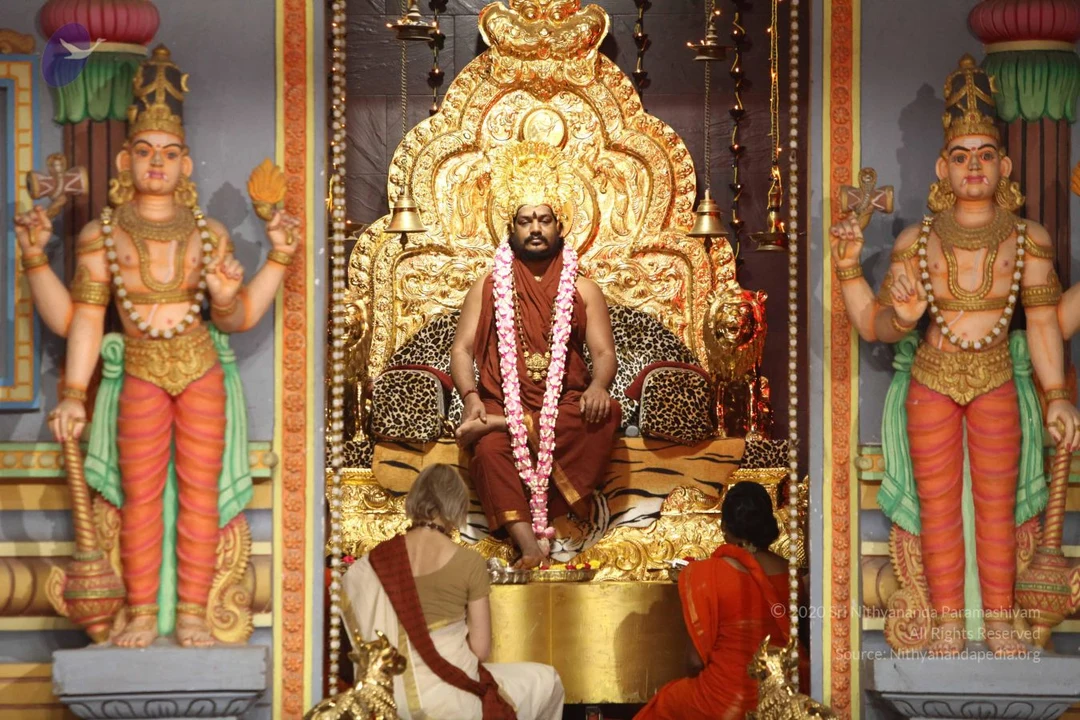
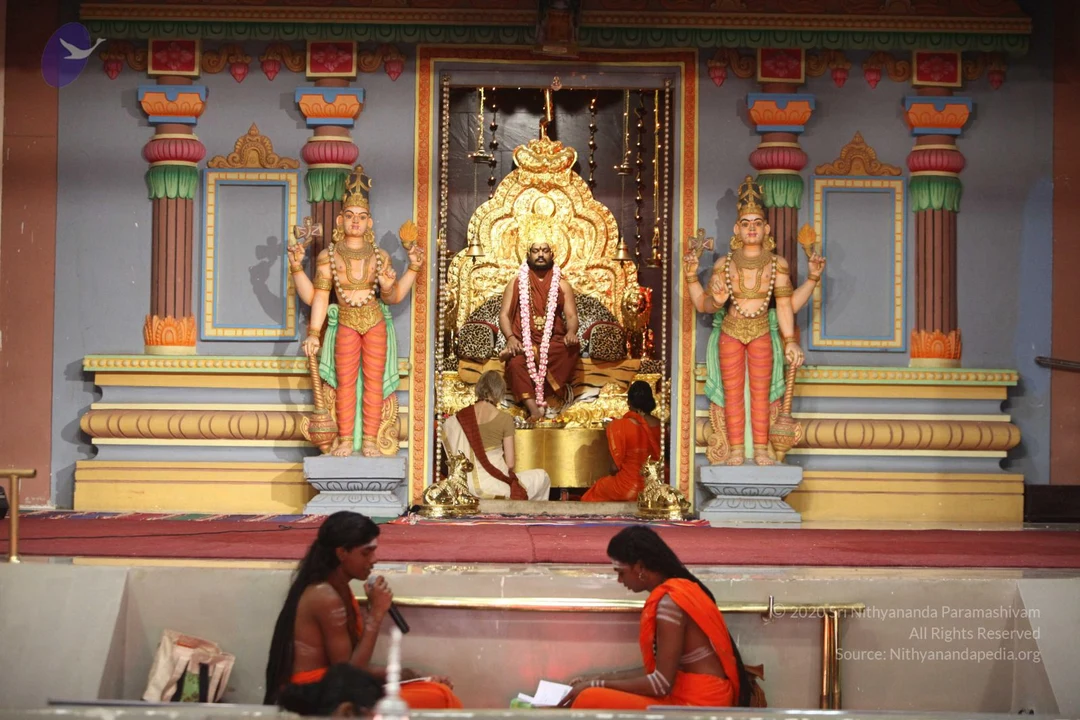
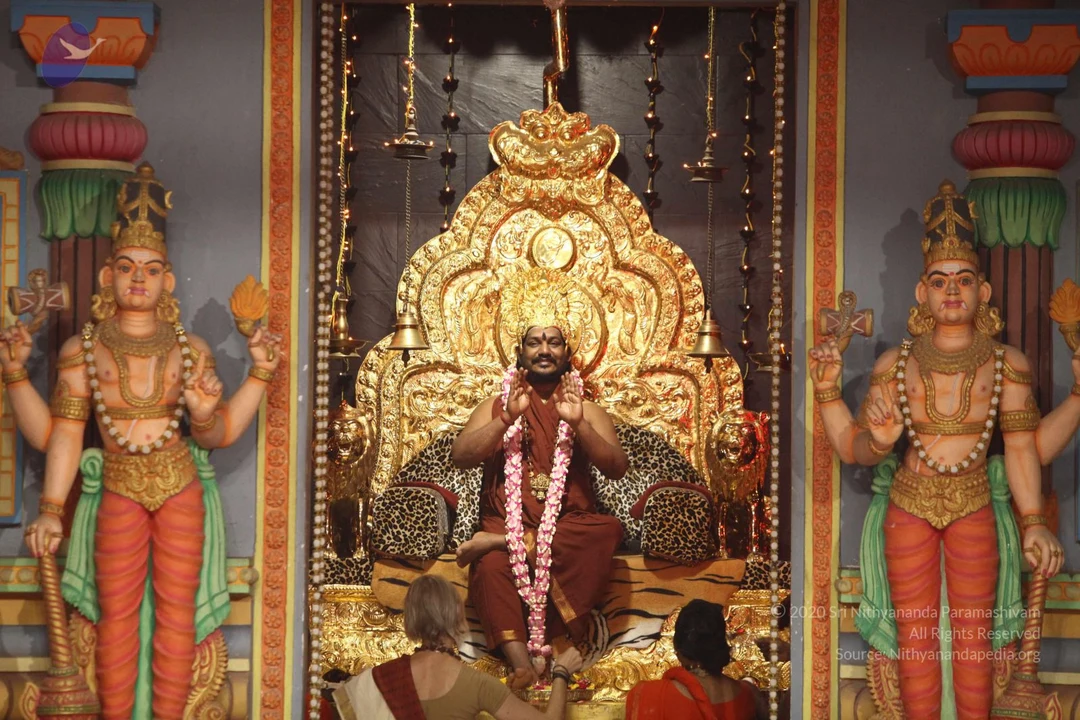
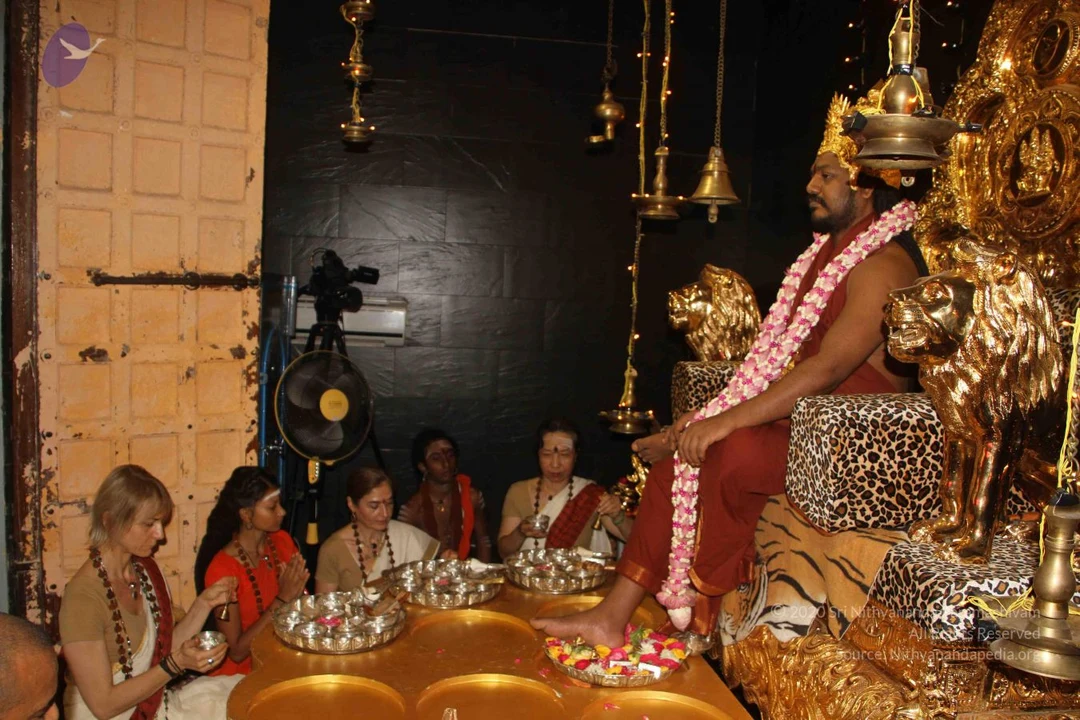
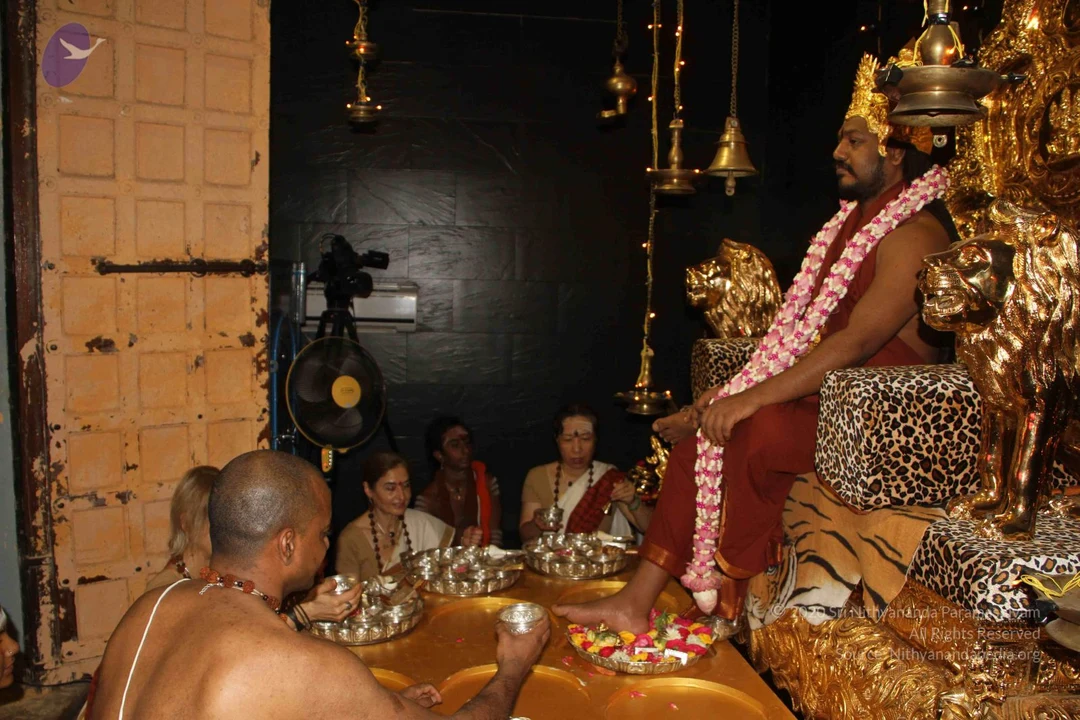
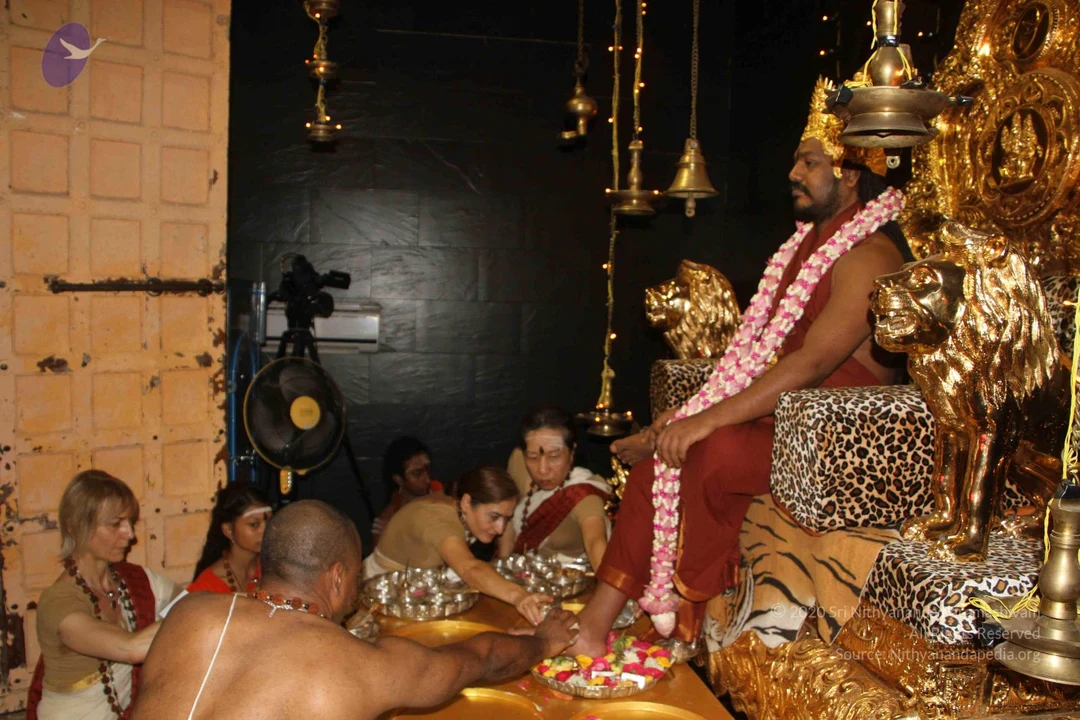
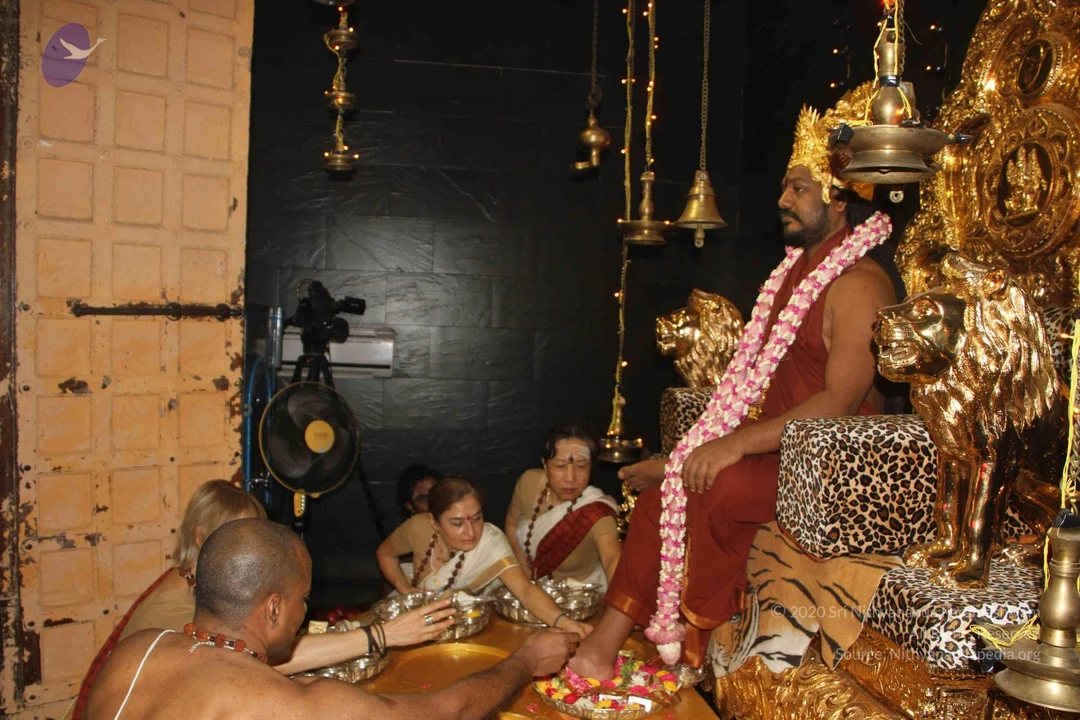
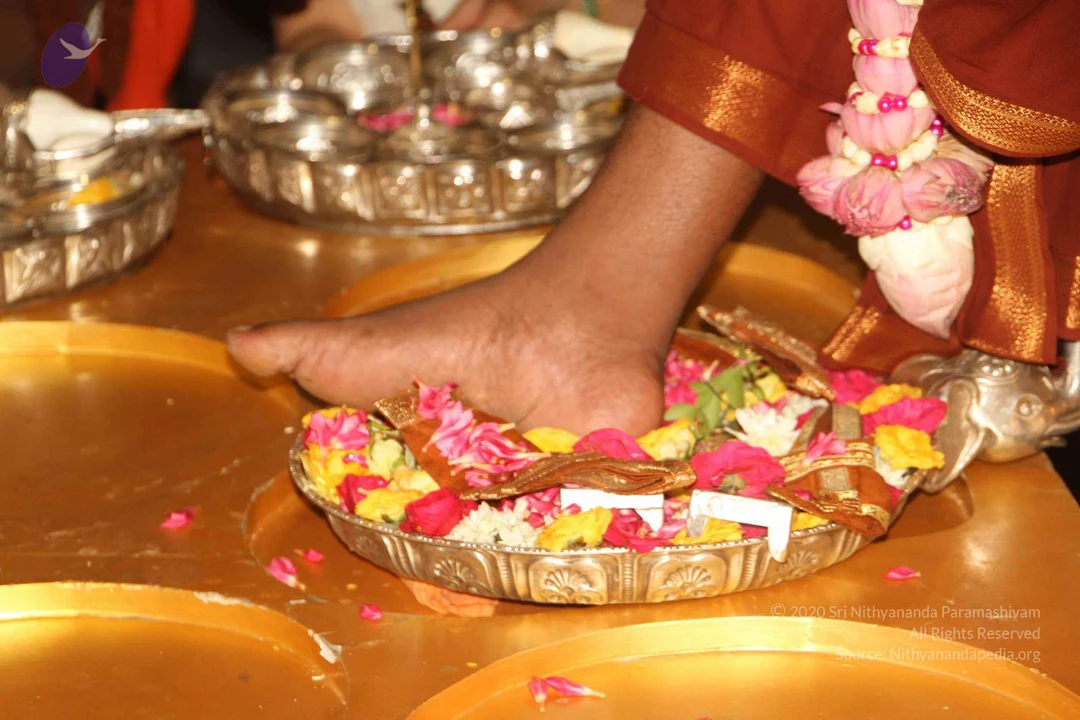
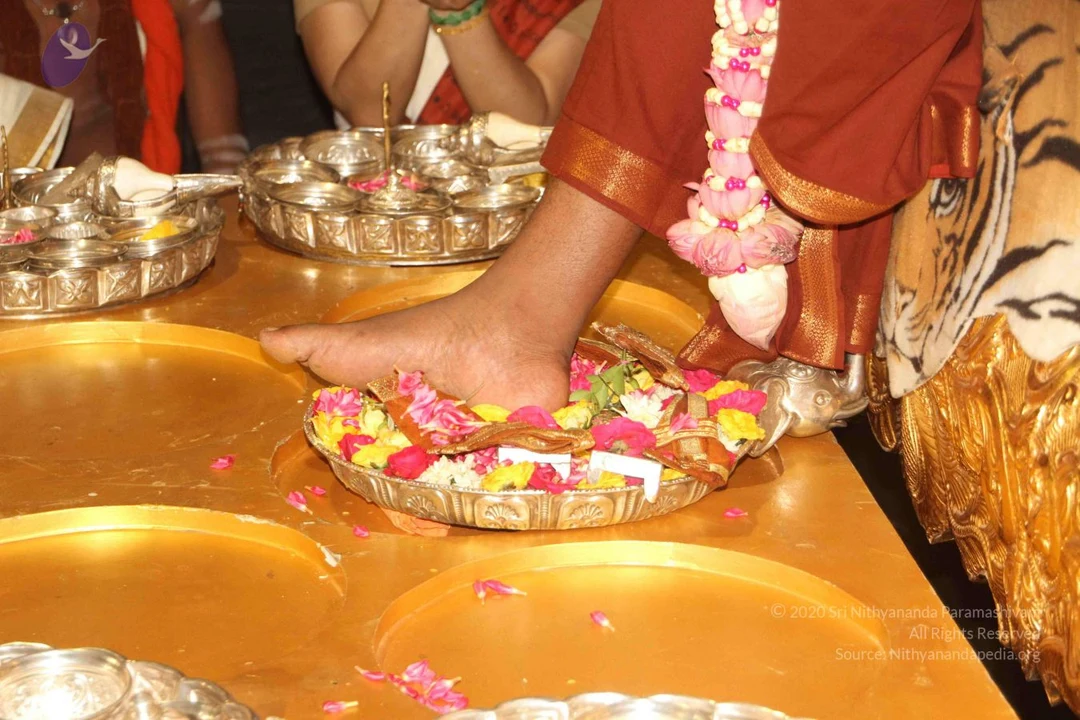
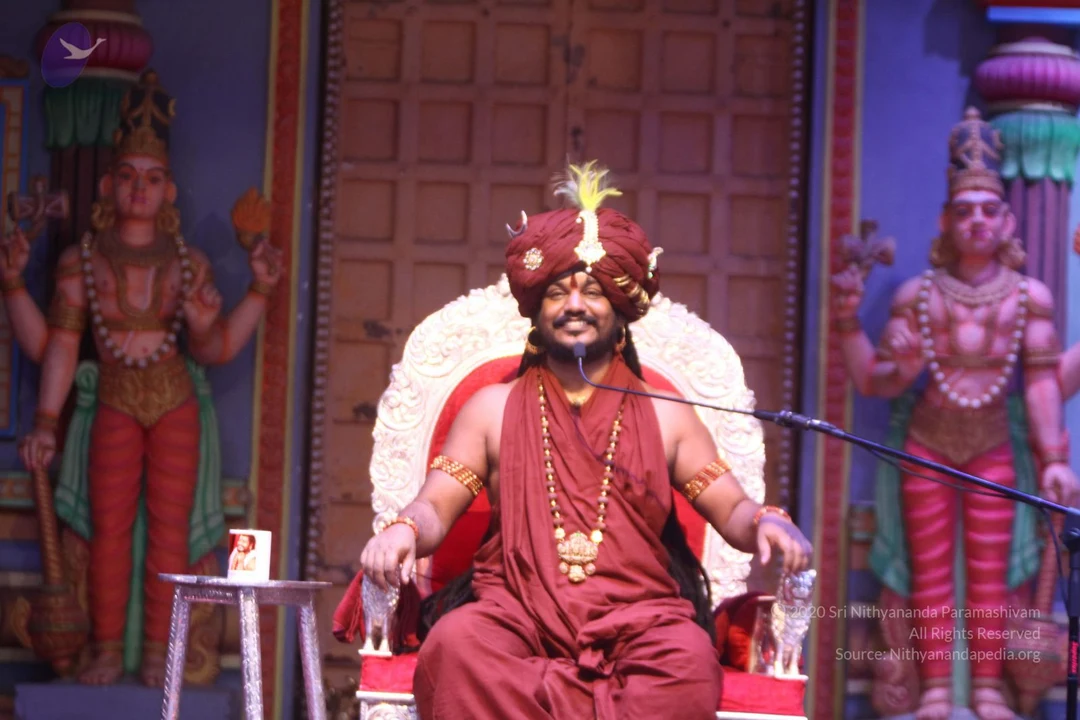
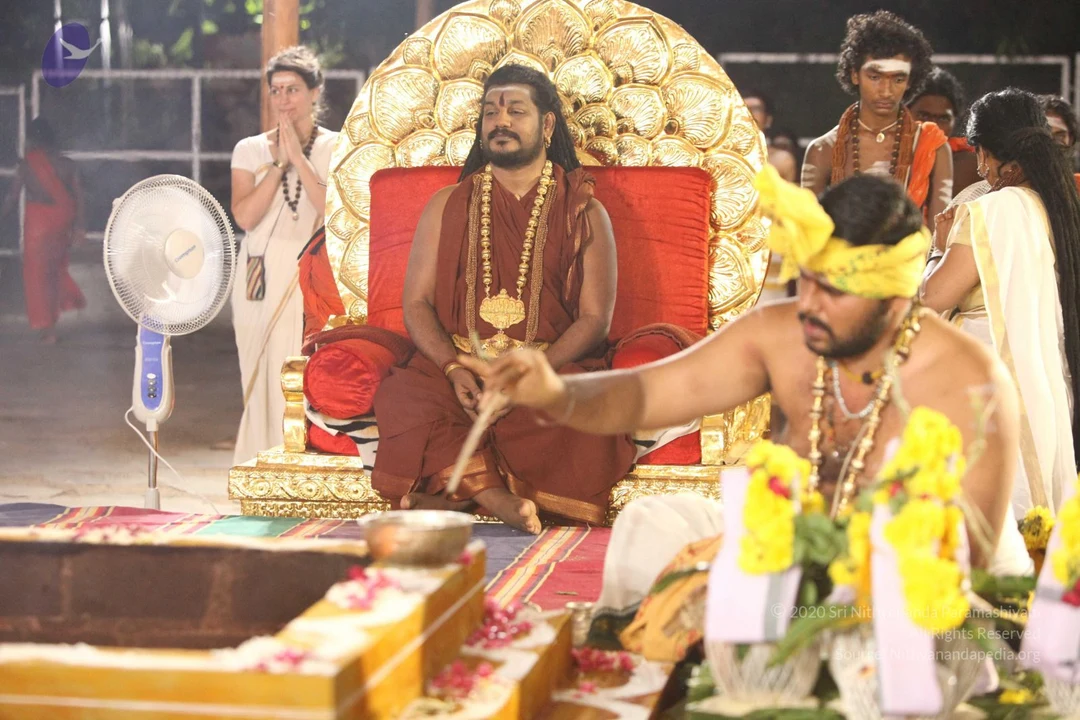
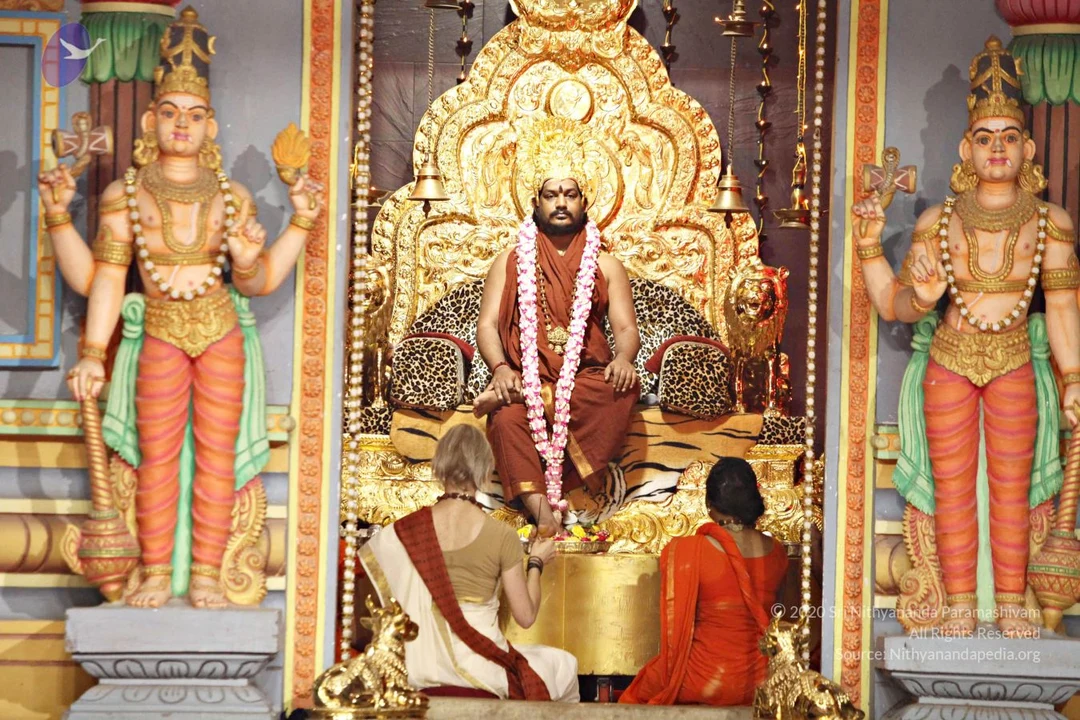
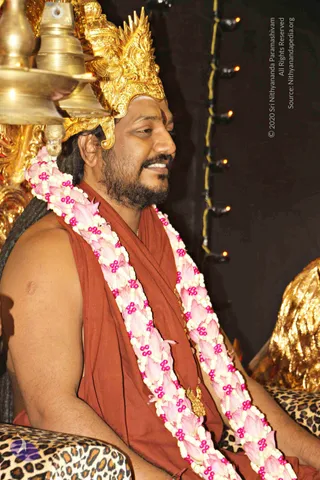
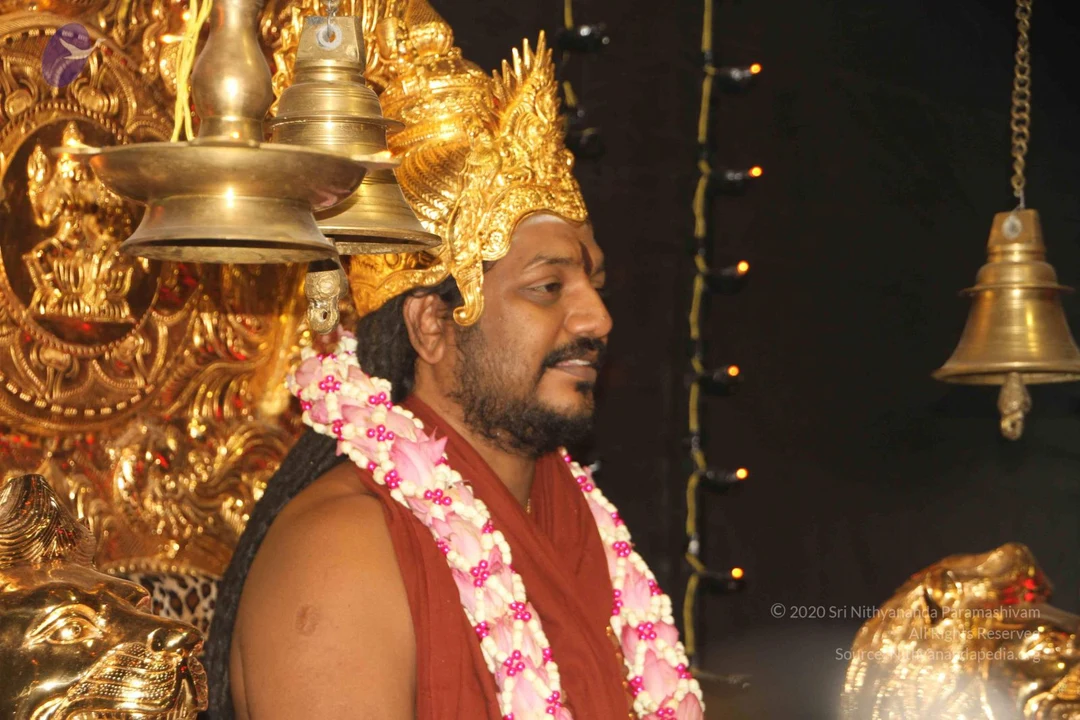
A seated man in a rust-orange robe with a pink and white flower garland sits on an ornate gold throne draped with leopard-print and tiger-striped cushions, flanked by two painted standing deity murti with multiple arms, gold crowns and green sashes. Two women and a man kneel before the throne in front of a gold pot, with the woman in front wearing a white and gold sari and the others in orange; brass bells and hanging chains decorate the top of the throne. The seated figure has long swept-back hair and a crown-like ornament, and wears saffron clothing with a gold necklace, which matches Swamiji (probable) in a ceremonial honouring setting.A photograph of a man seated on an ornate gold throne with a leopard-print and tiger-striped cushion, wearing a rust-red robe over bare shoulders, a pink and white flower garland around his neck and a gold necklace. Two gold lion figures flank the throne in a golden shrine niche with hanging bells and lamps, and four-armed painted deity figures stand on either side. Two women sit below: one in white with a red-bordered shawl and one in orange-red sari, both bowing or offering near a tray of flowers at the base of the throne.A photograph inside an ornate temple-style hall. A man seated on a gold-covered throne with lion and tiger motifs wears a saffron-orange robe, a pink and white flower garland, and a gold crown; he has long-looking dark hair and a beard. Two women kneel before him; one in cream and maroon clothing with a rudraksha mala and one in a deep orange sari, and they are offering flowers and worship at his feet. Two painted standing dvarapala-style guardian figures with gold ornaments, pearl necklaces and green sashes flank the throne. Brass bells and a kalasha hang above. The seated man is a person match on this page; the throne, garland and saffron robe are visible, supporting a padapuja scene.A photograph of a smiling bearded man seated in profile on a leopard-print cushion beside a gold-coloured throne. He wears an ornate gold crown, a red-brown ochre shawl wrapped over his shoulders, and a long pink-and-white lotus garland with magenta beads draped across his chest. A gold ornament hangs at his chest and a brass oil lamp with lit wicks stands at the upper left. Fairy lights glow against a dark background. The page is a satsang record, though no printed name appears on the subject.

More Photos of Nithya Satsang
24 photosSource gallery
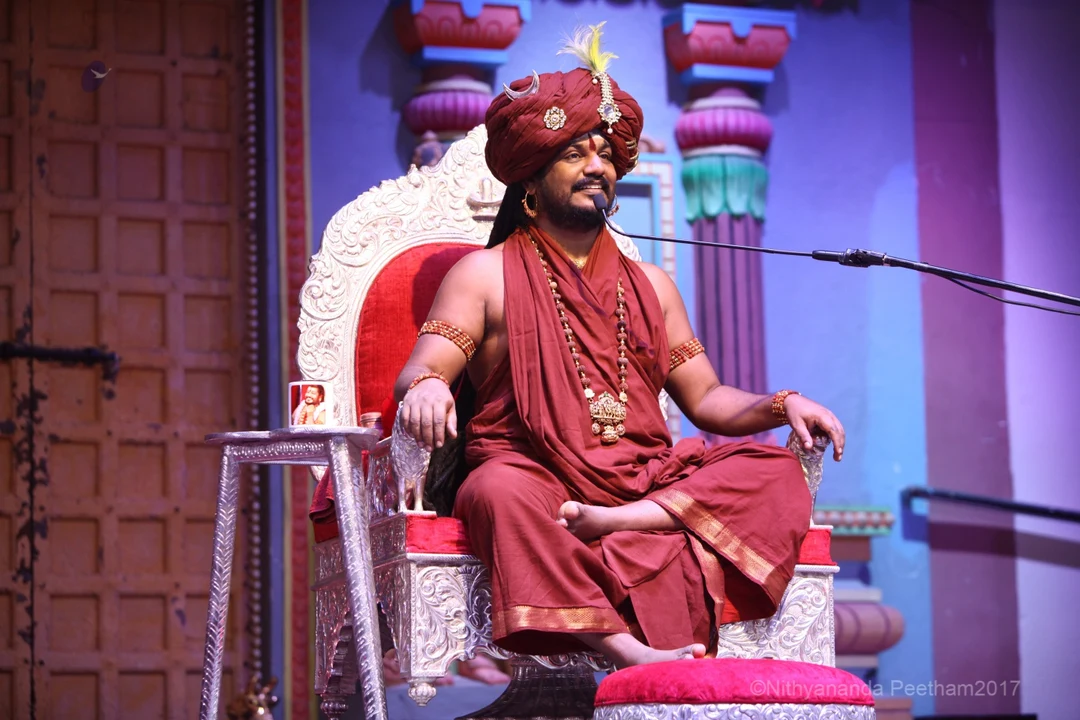
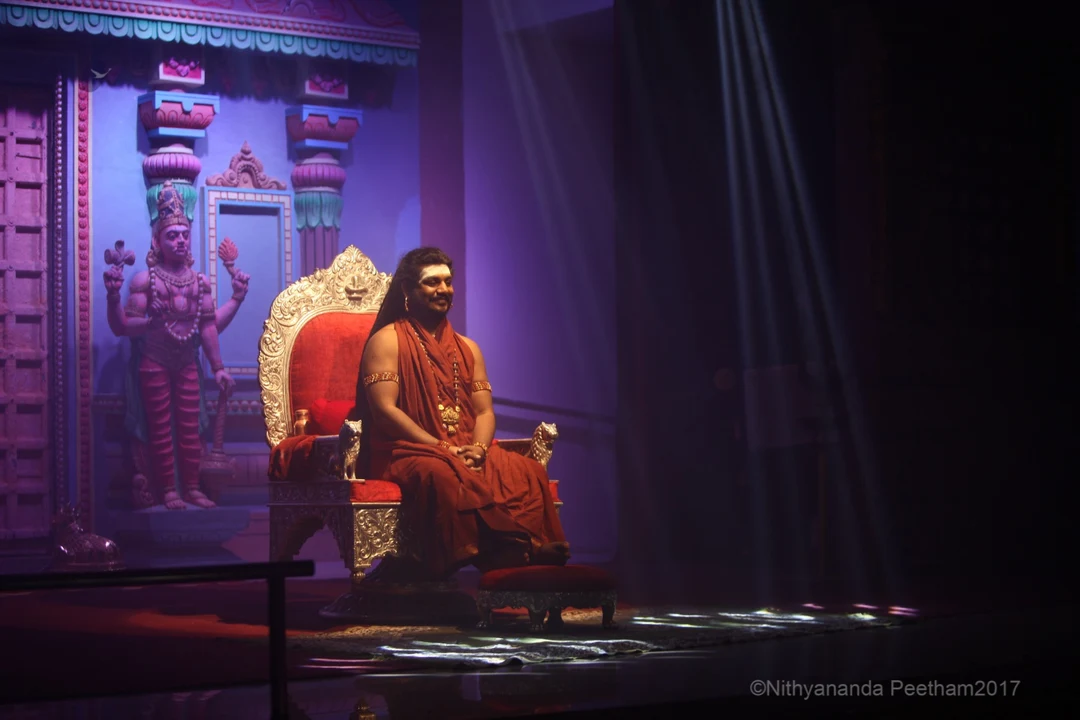
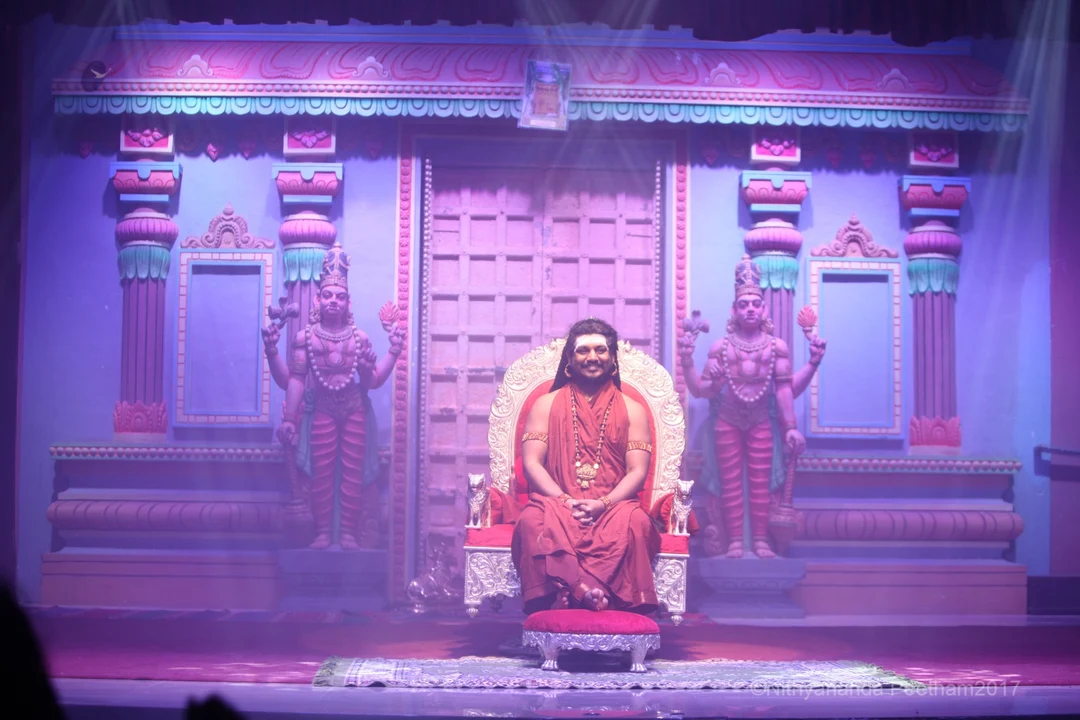
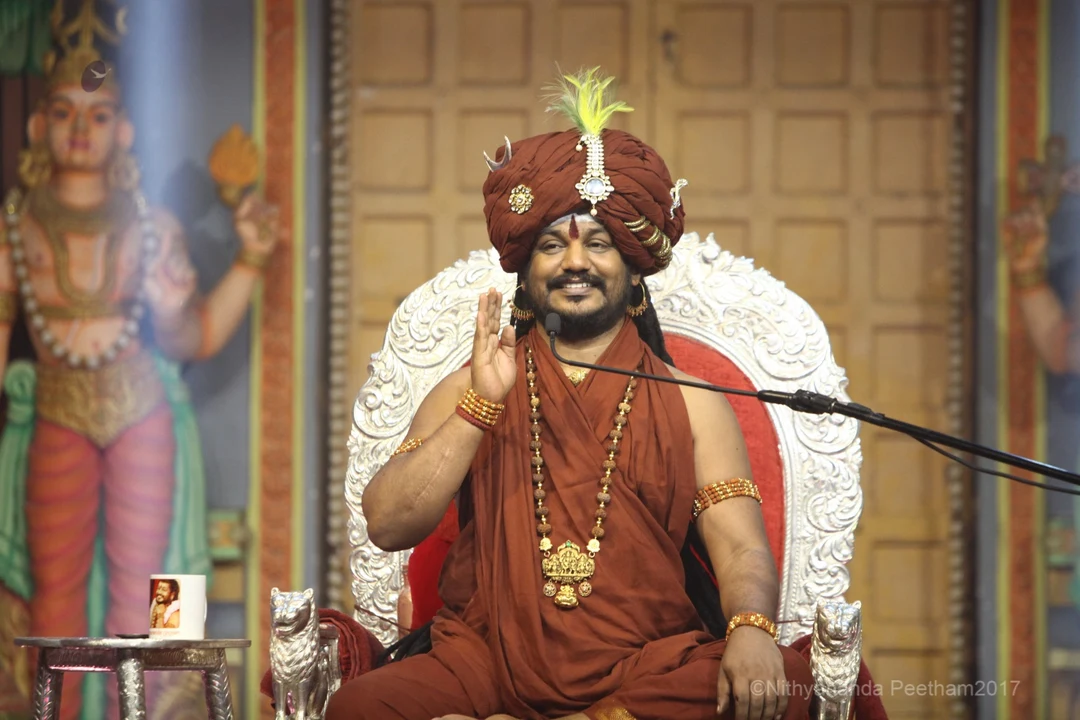
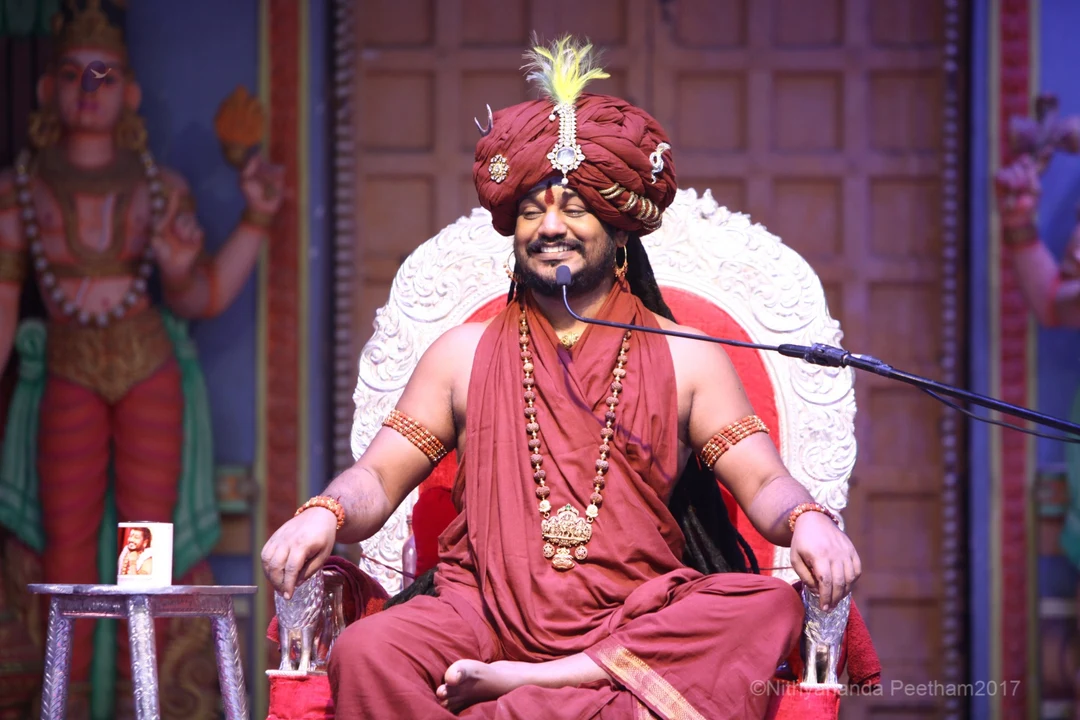
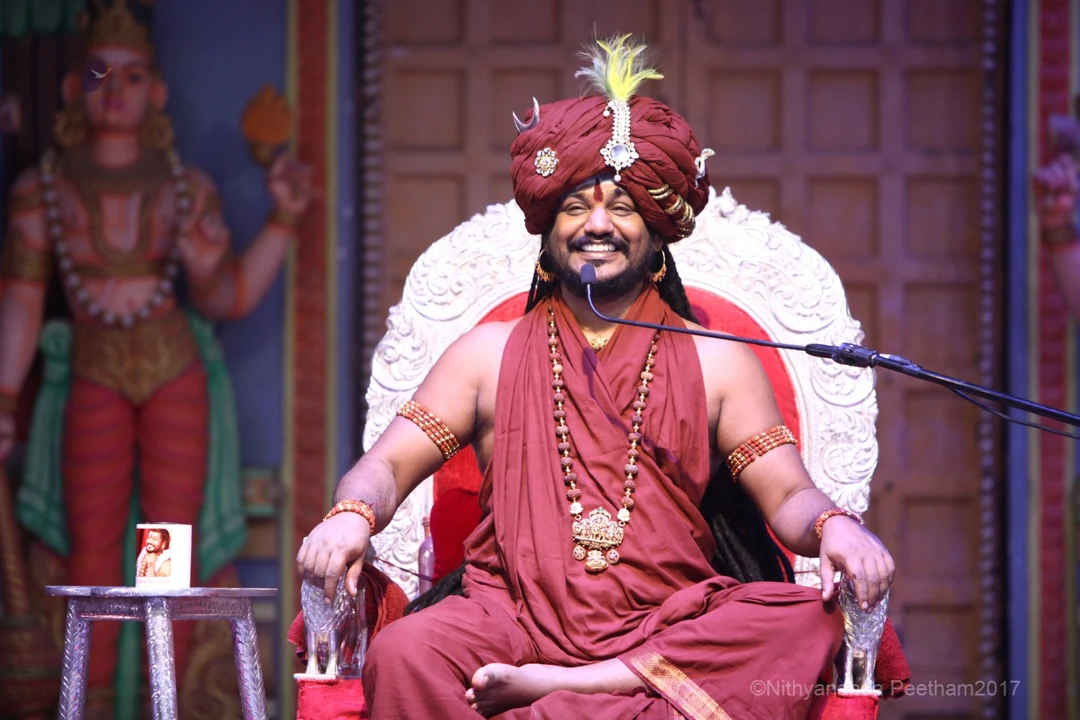
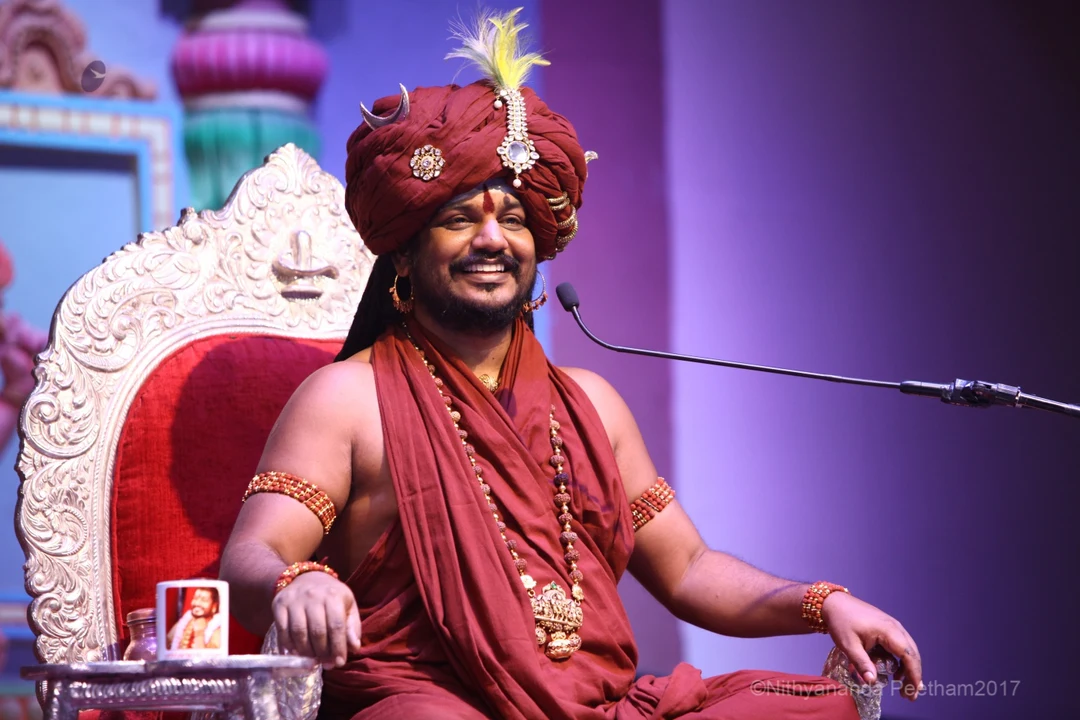
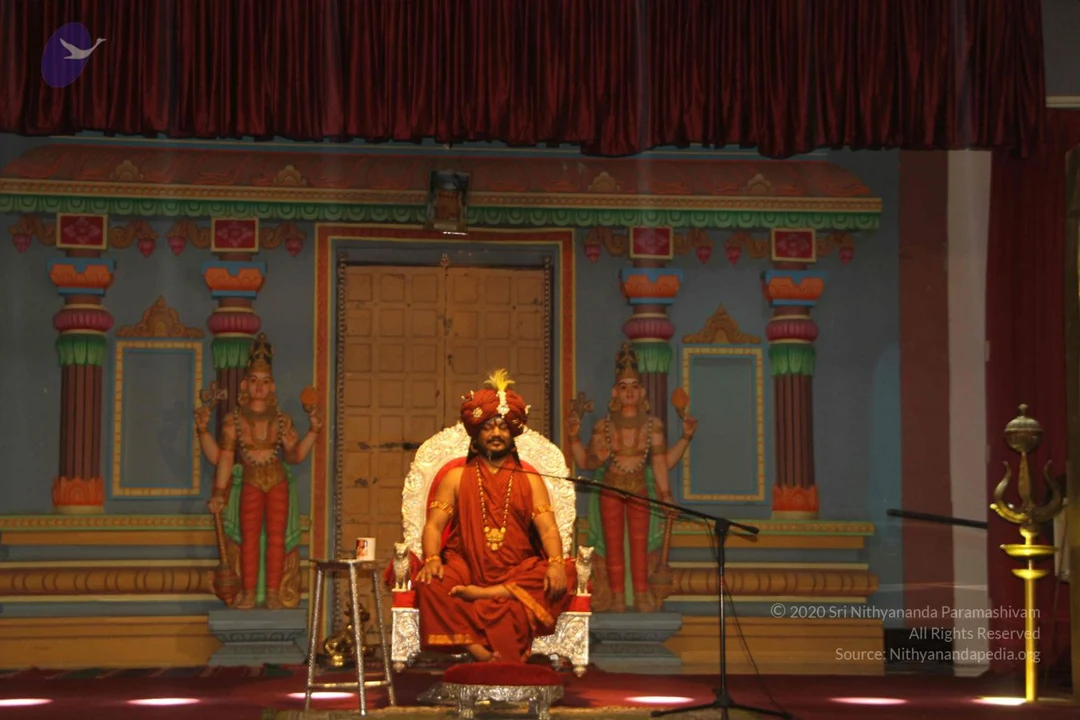
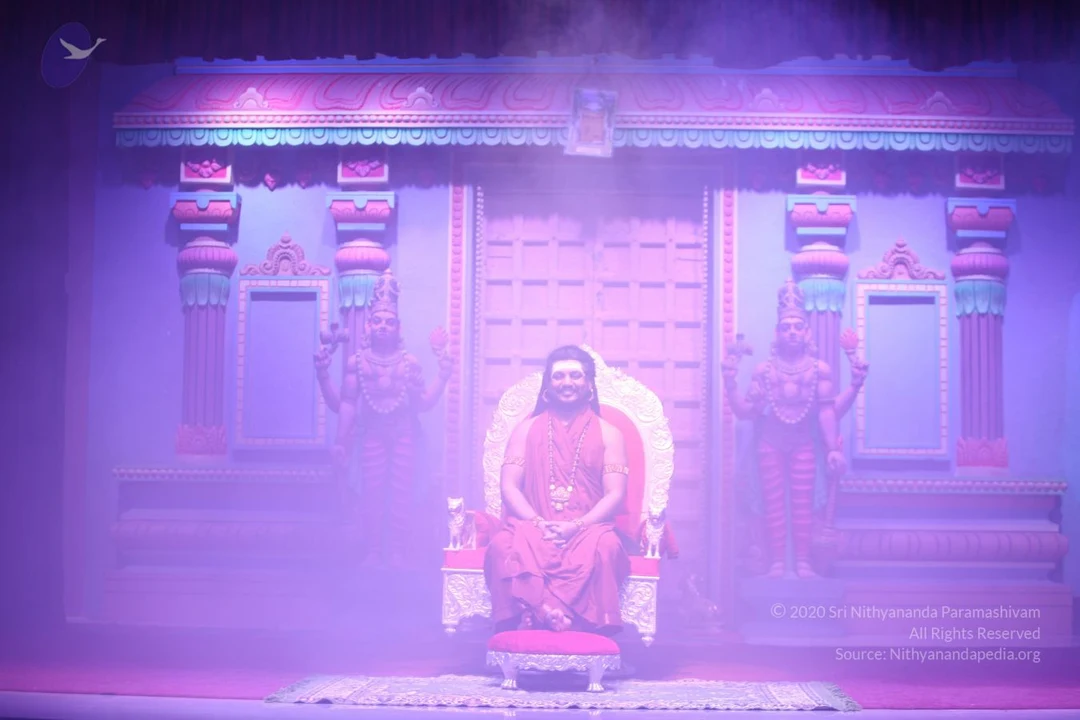
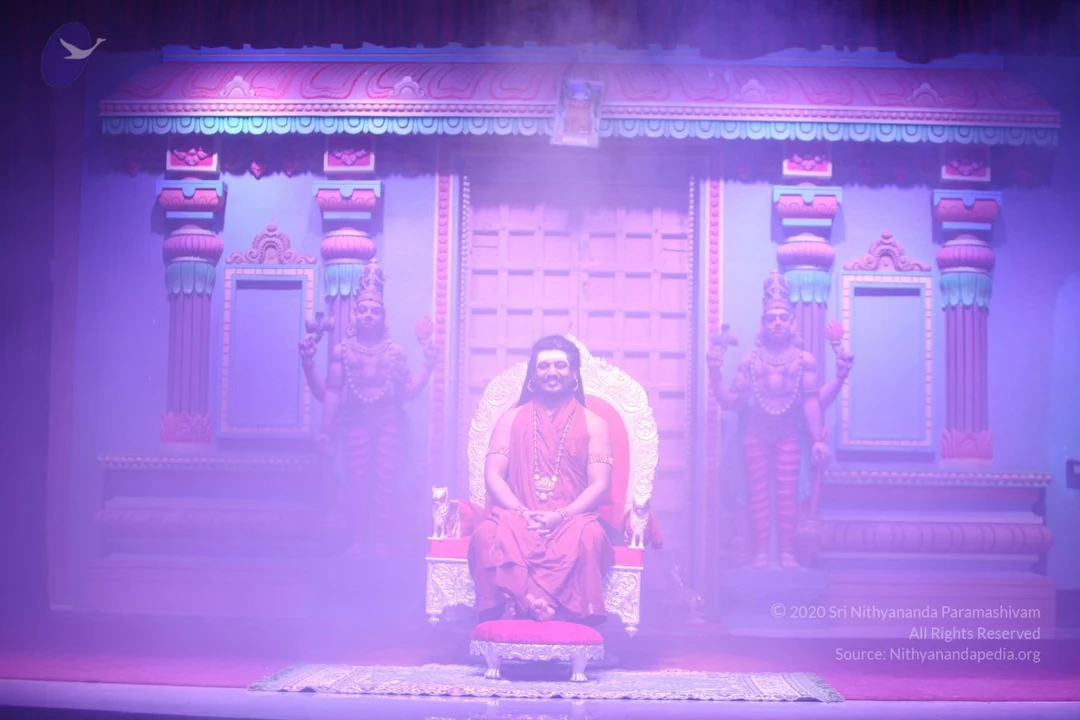
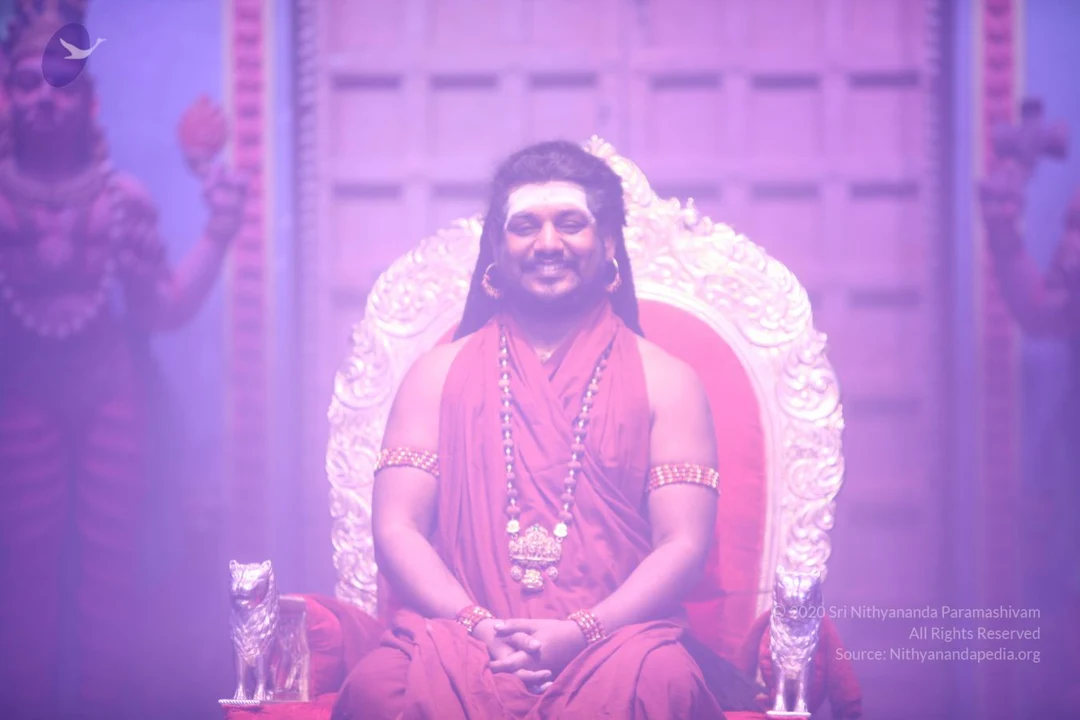
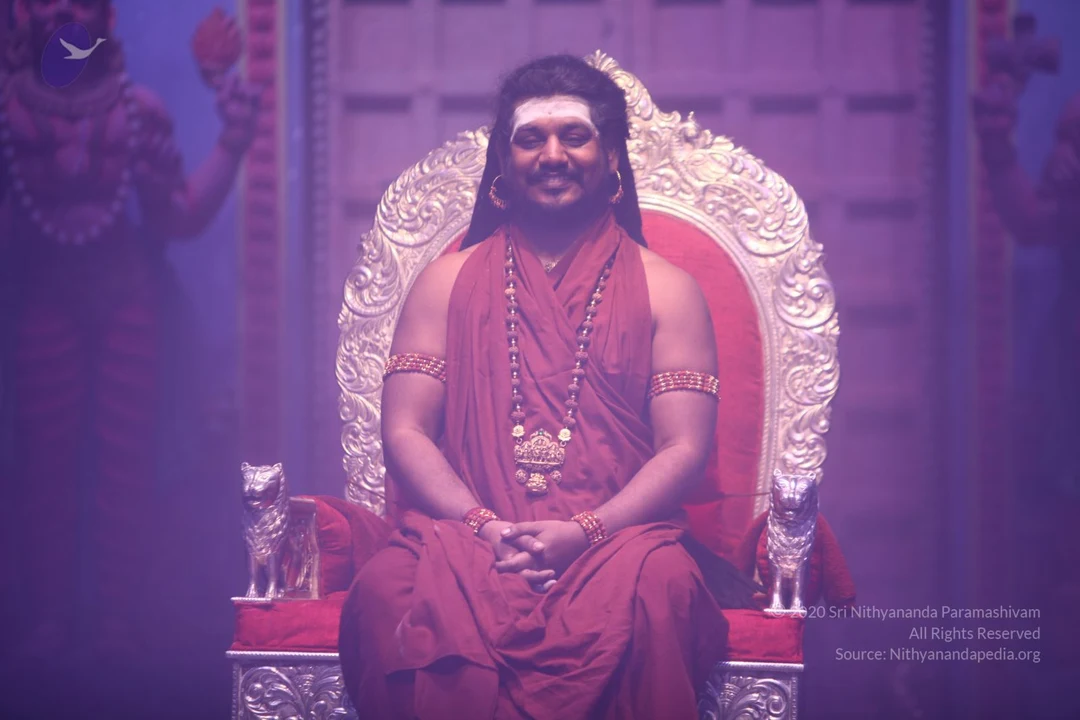
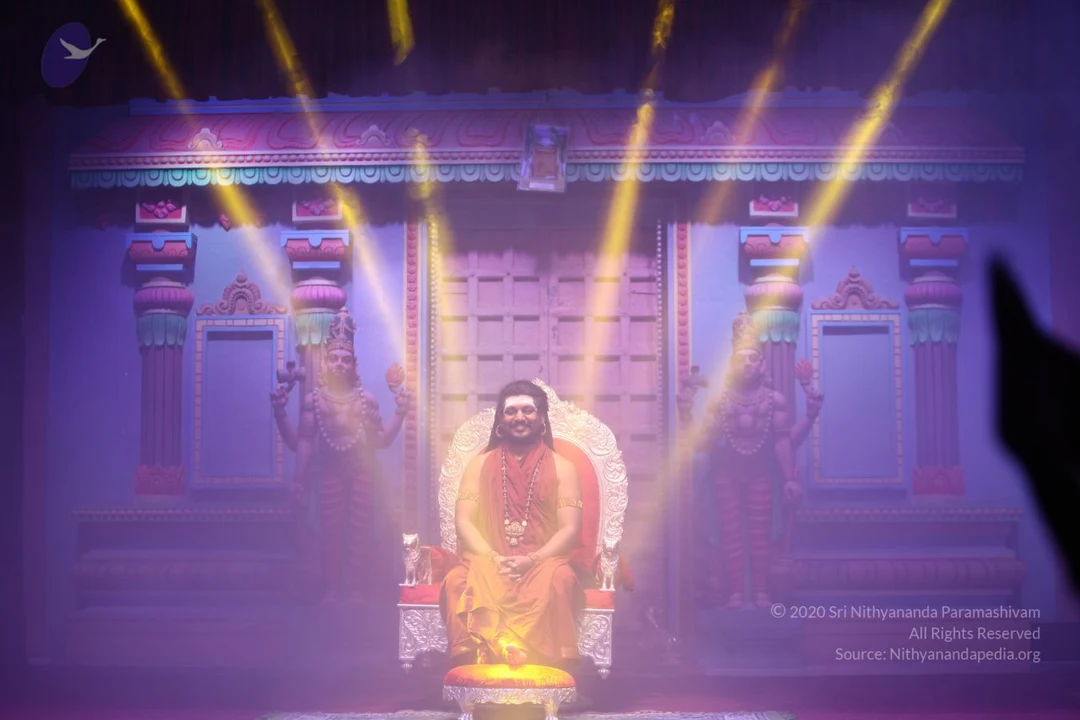
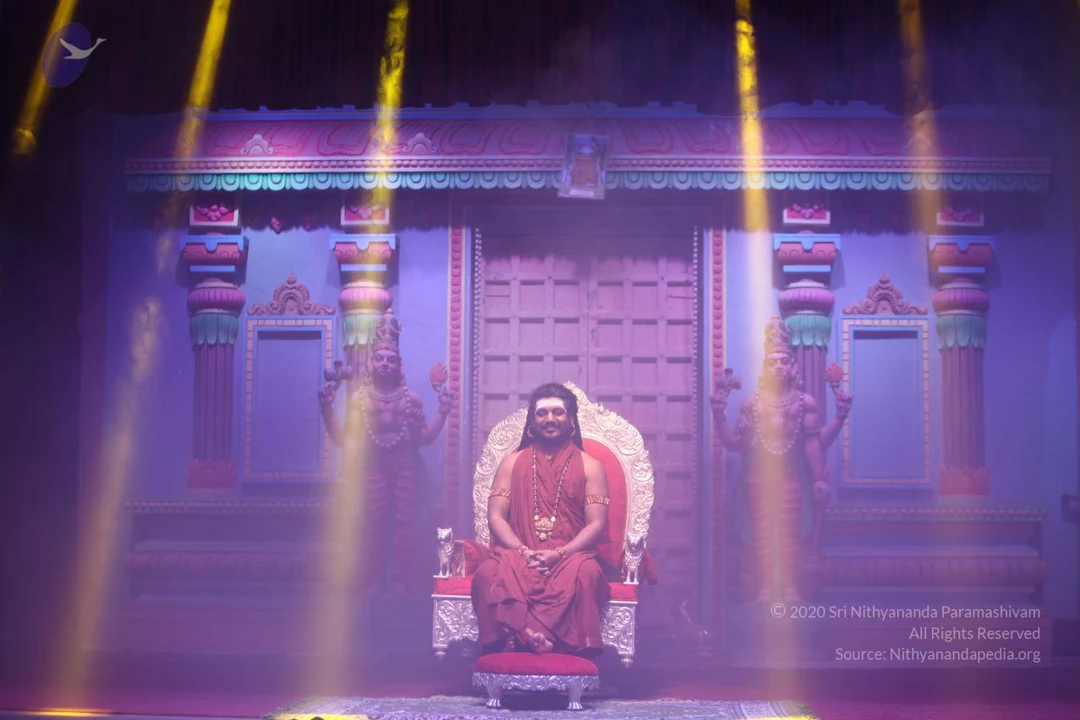
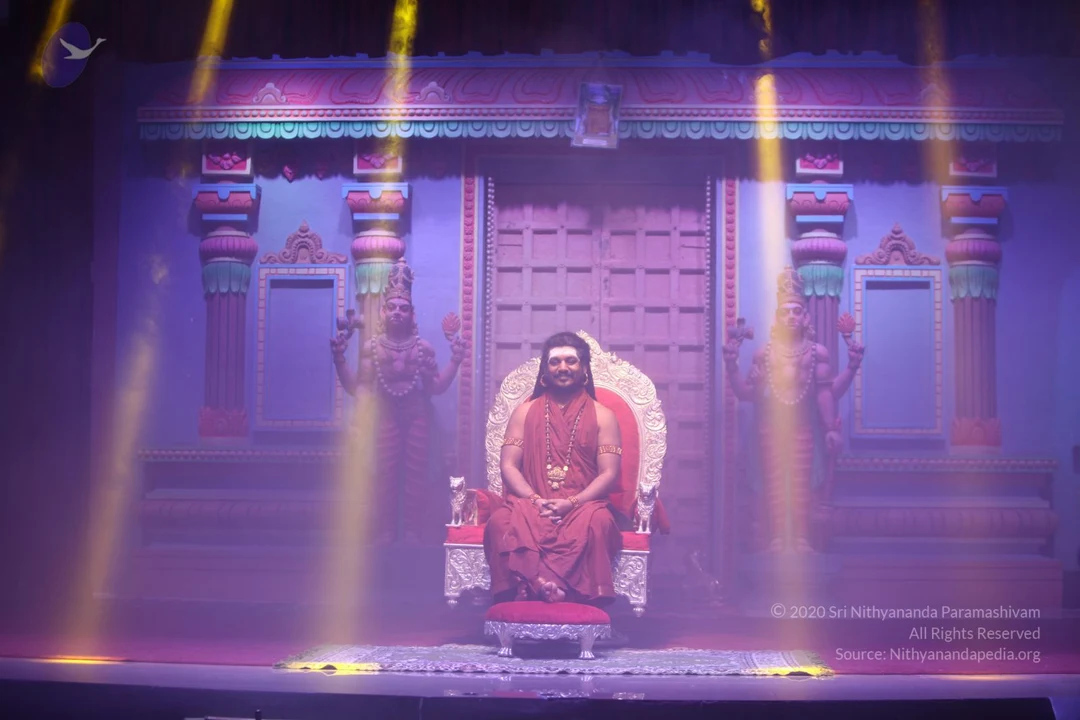
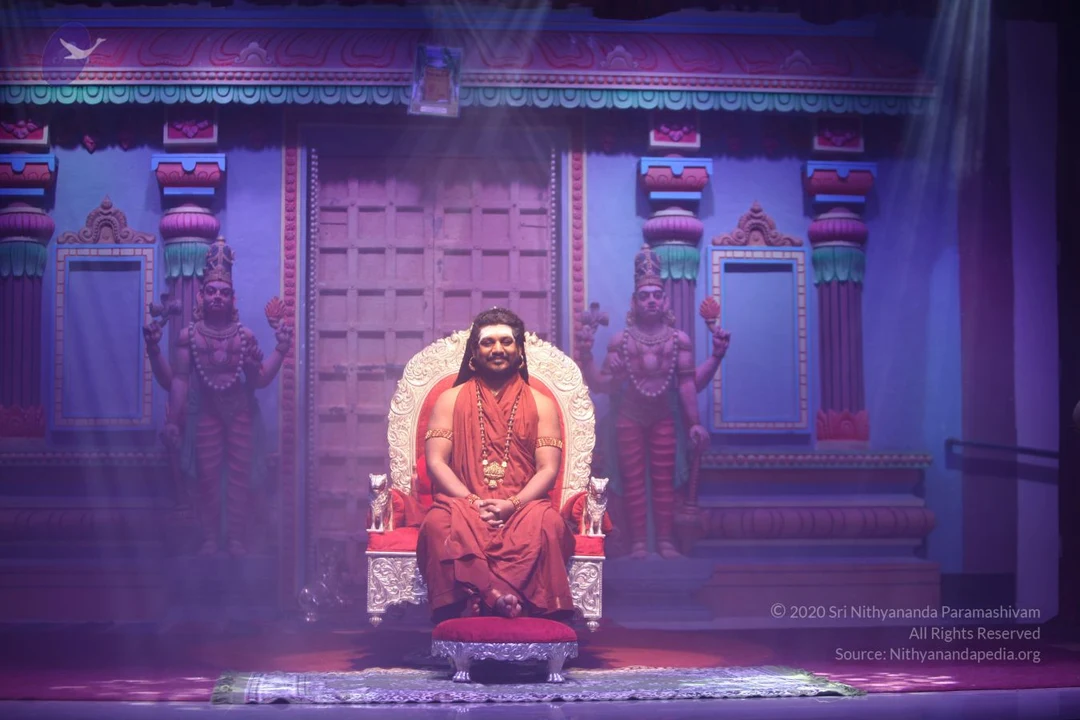
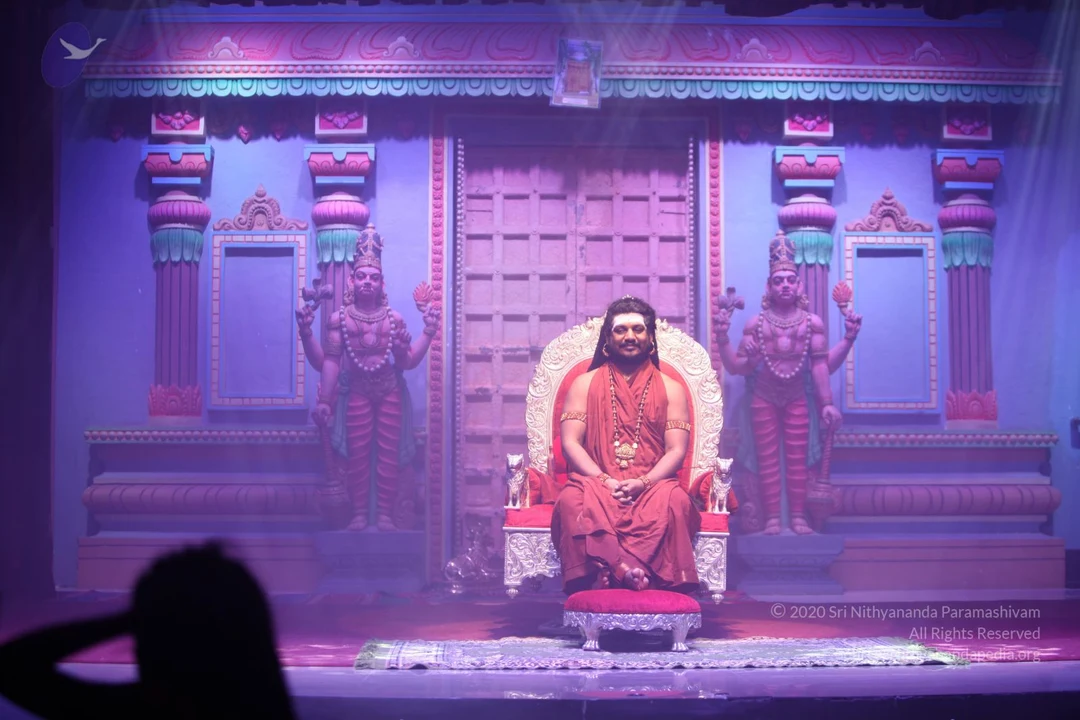
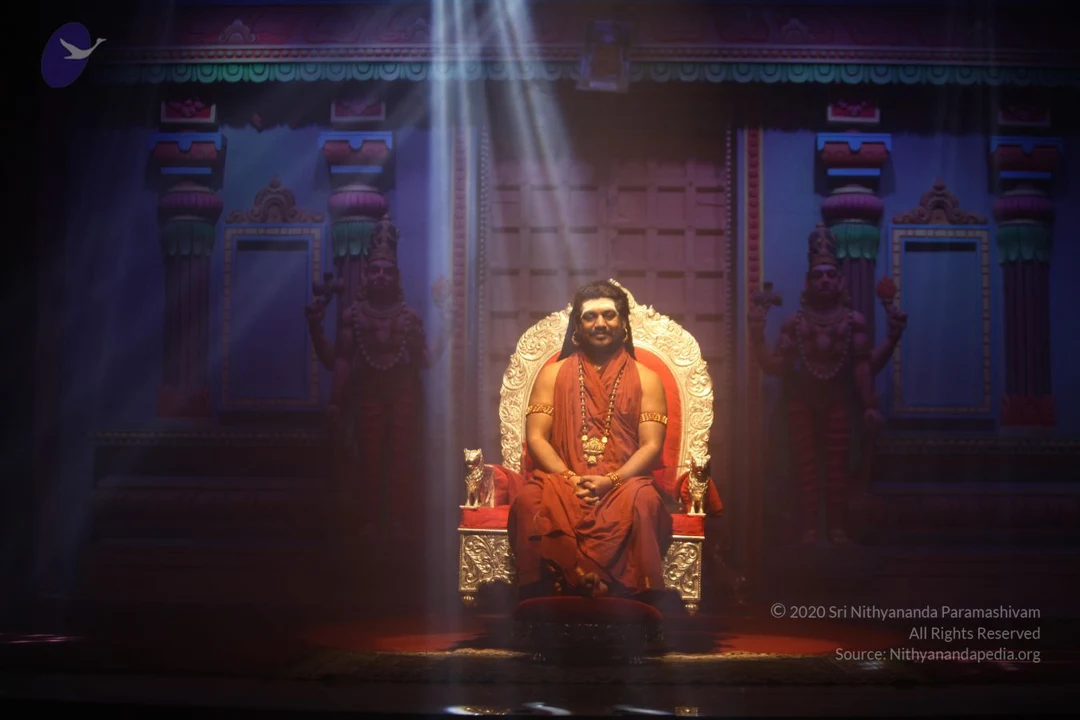
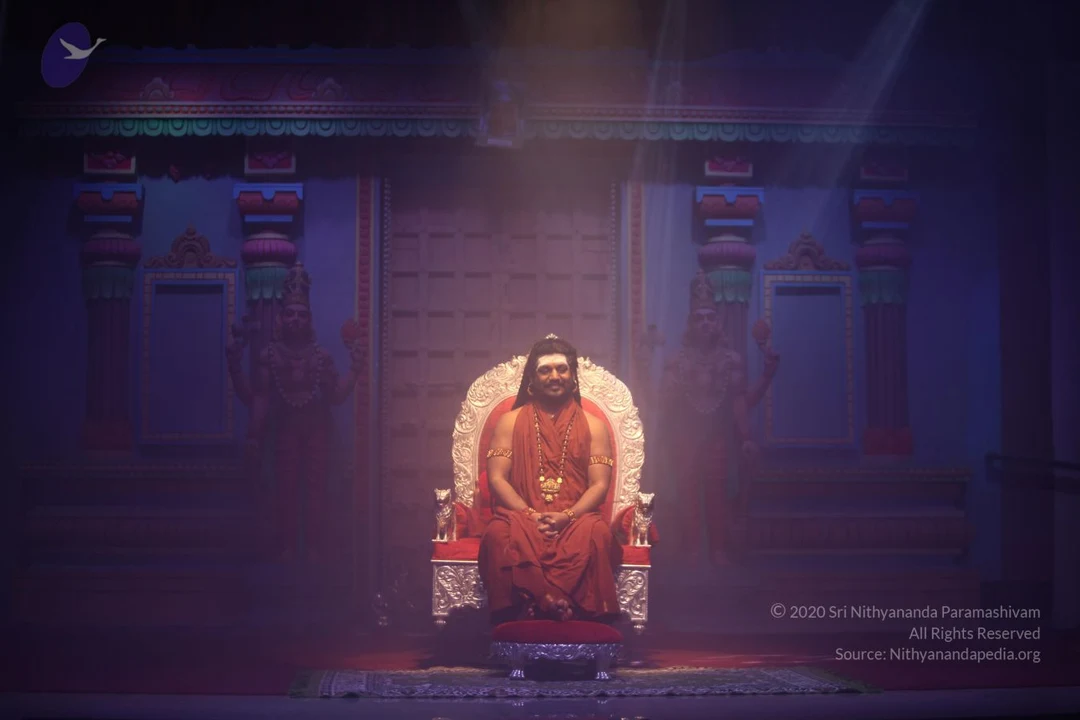
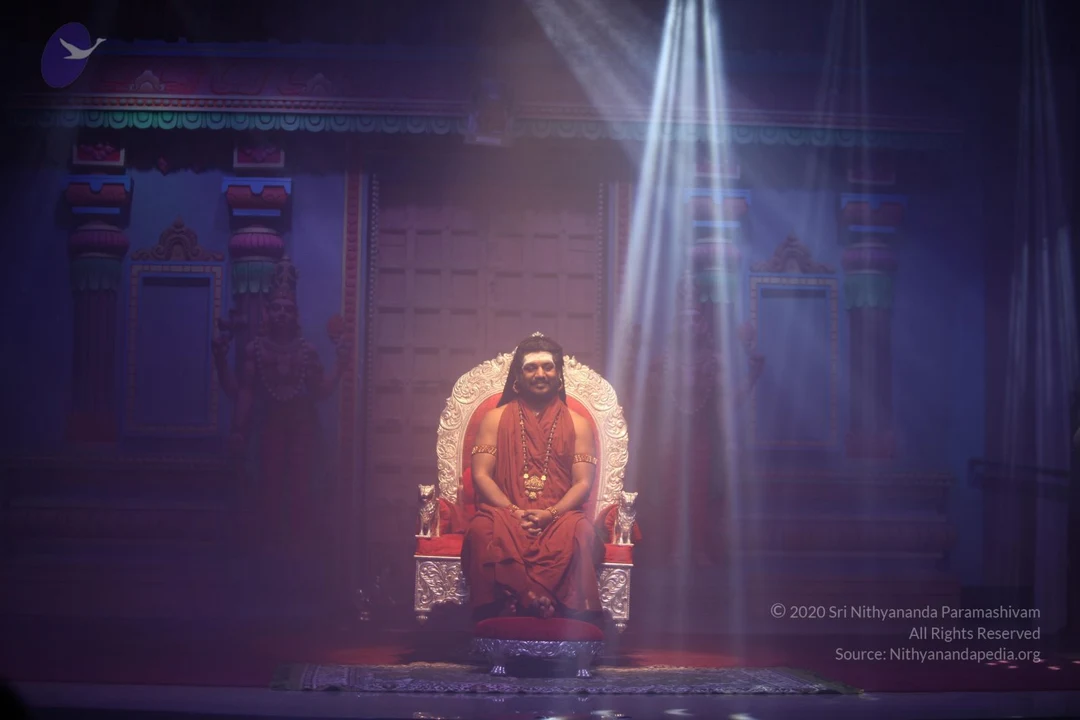
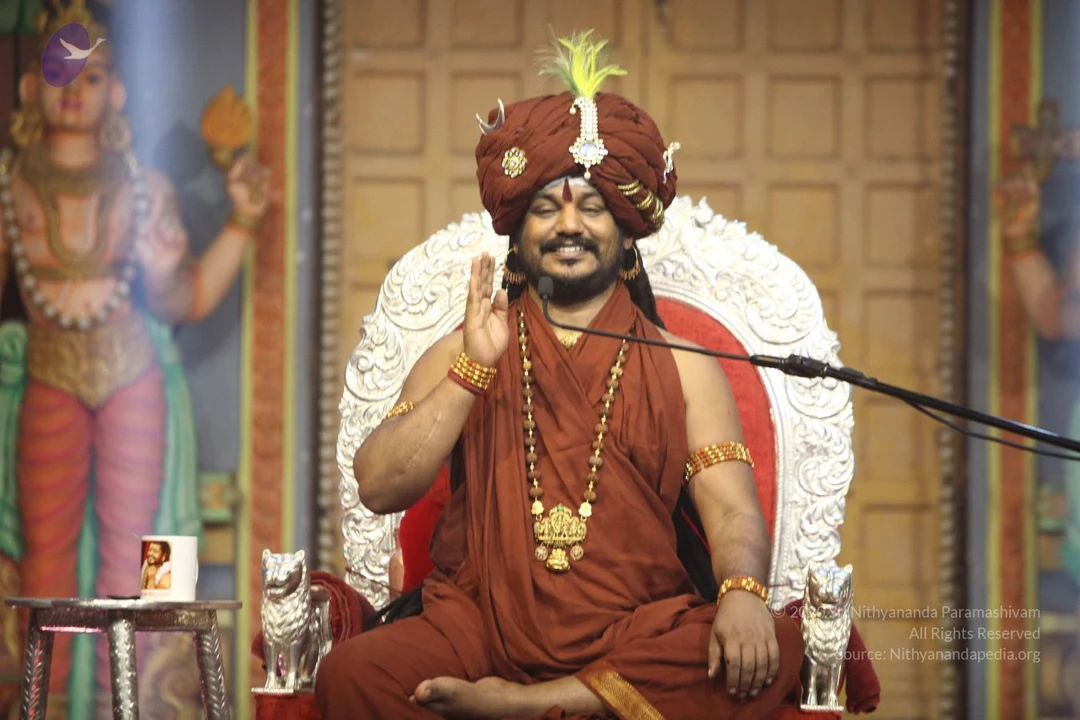
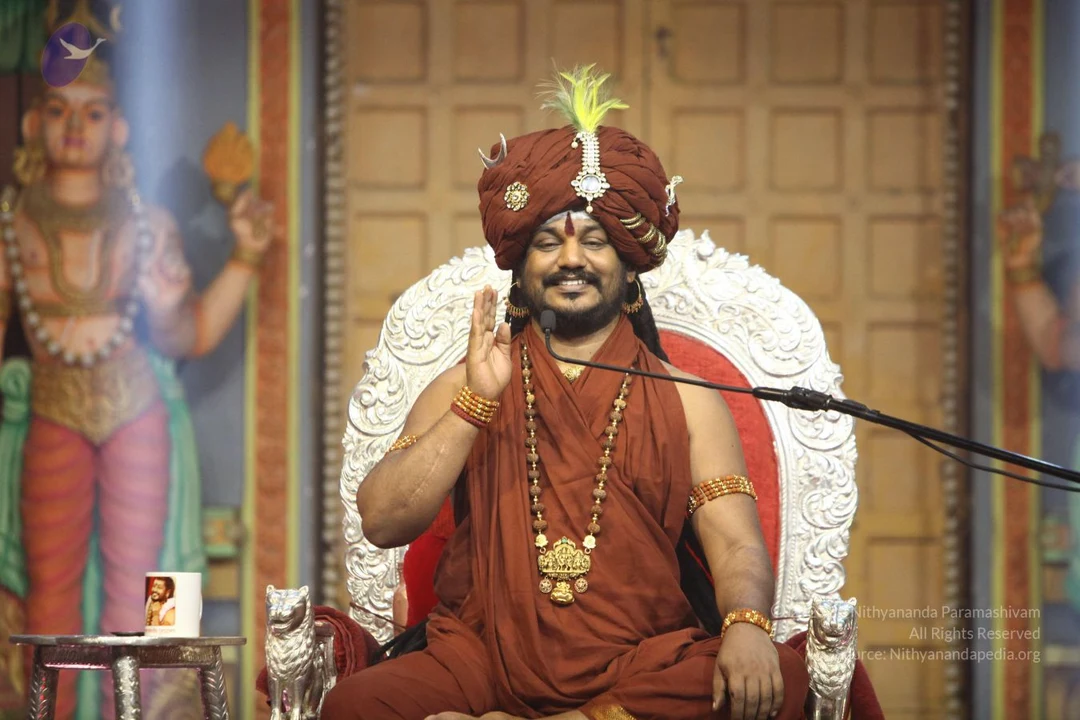
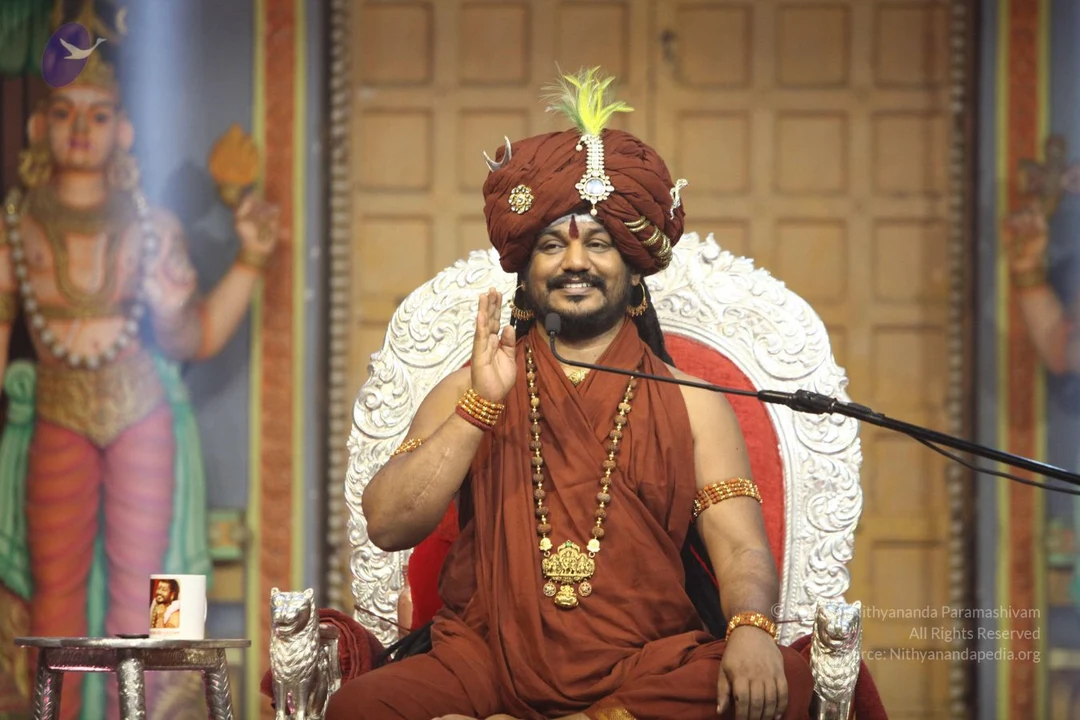
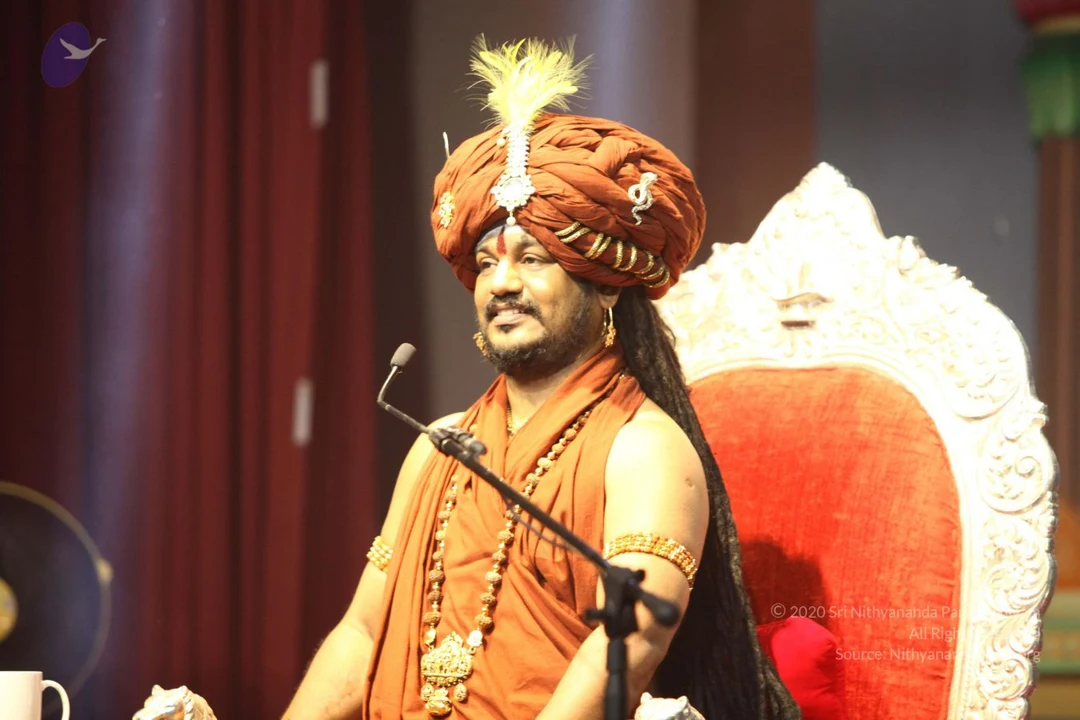
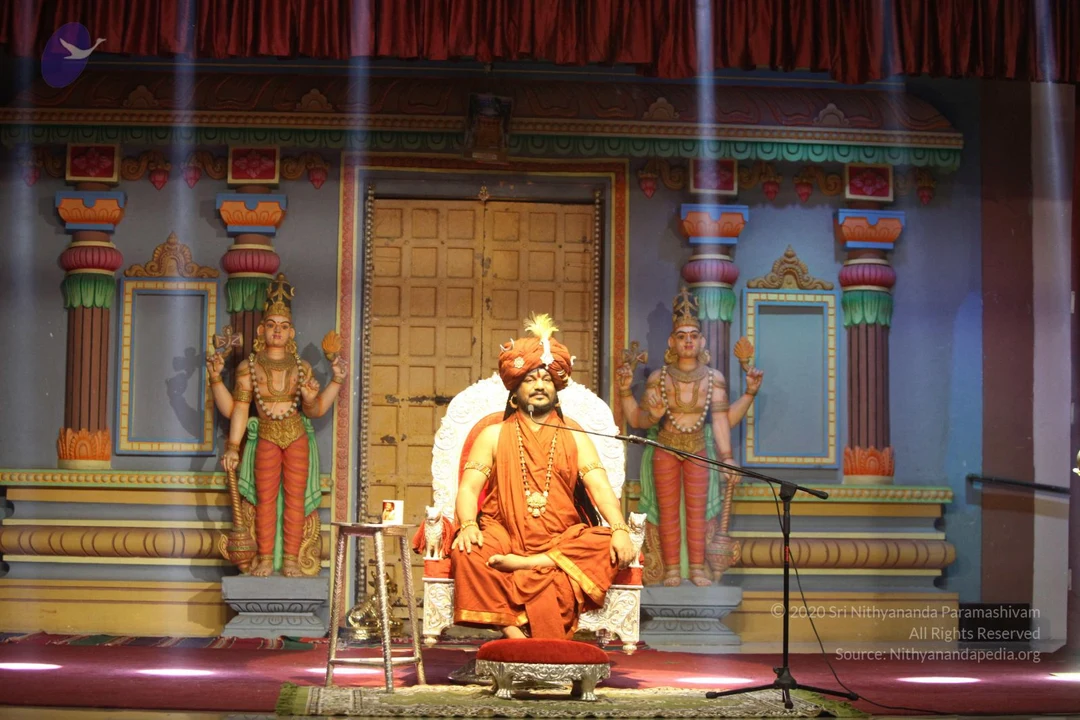
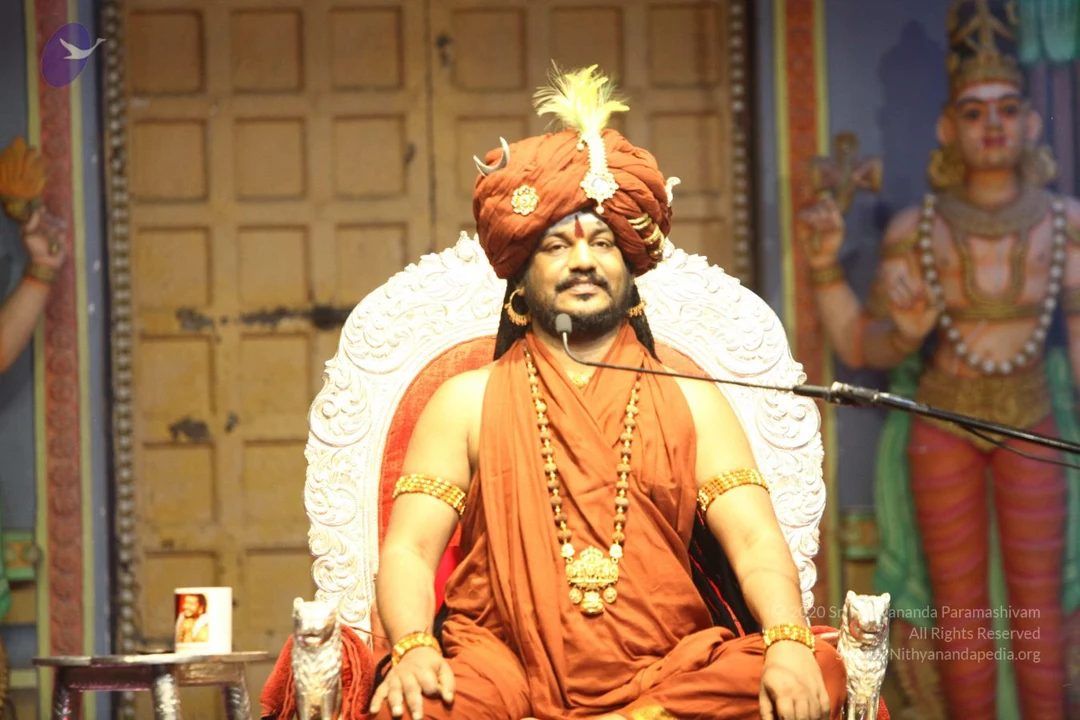
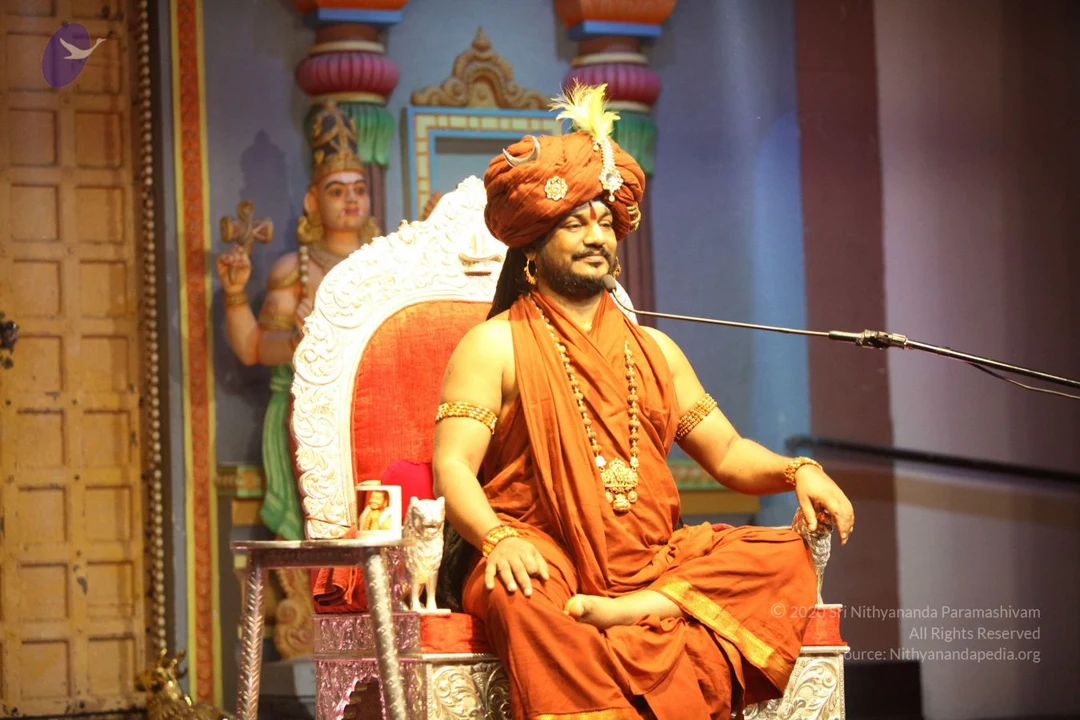
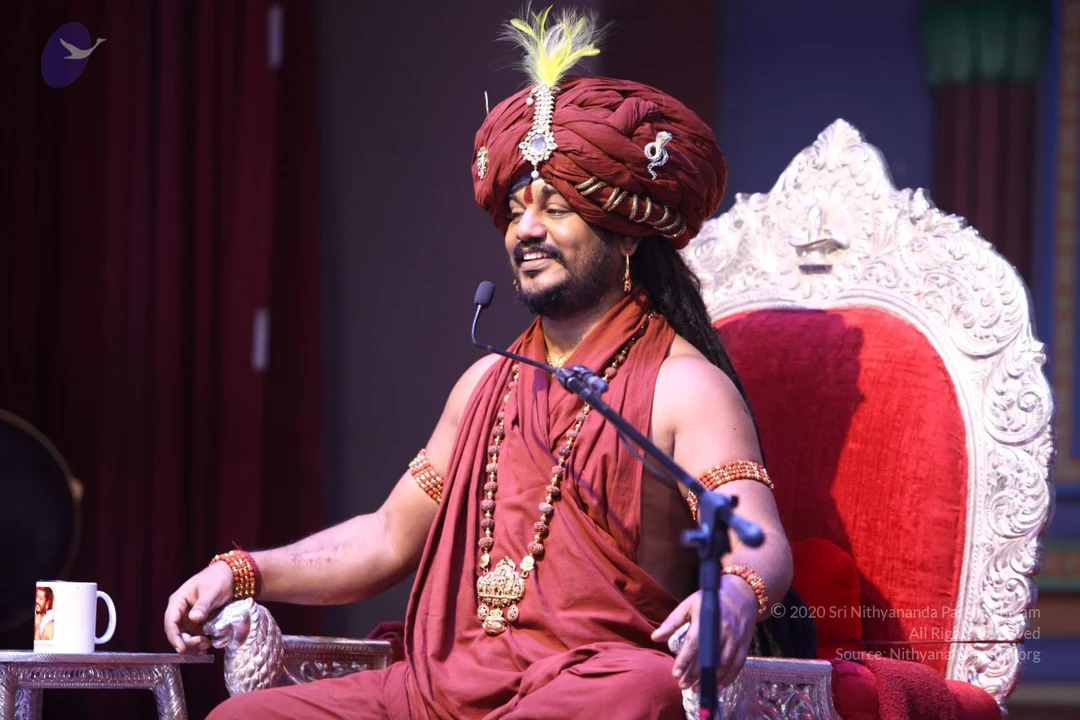
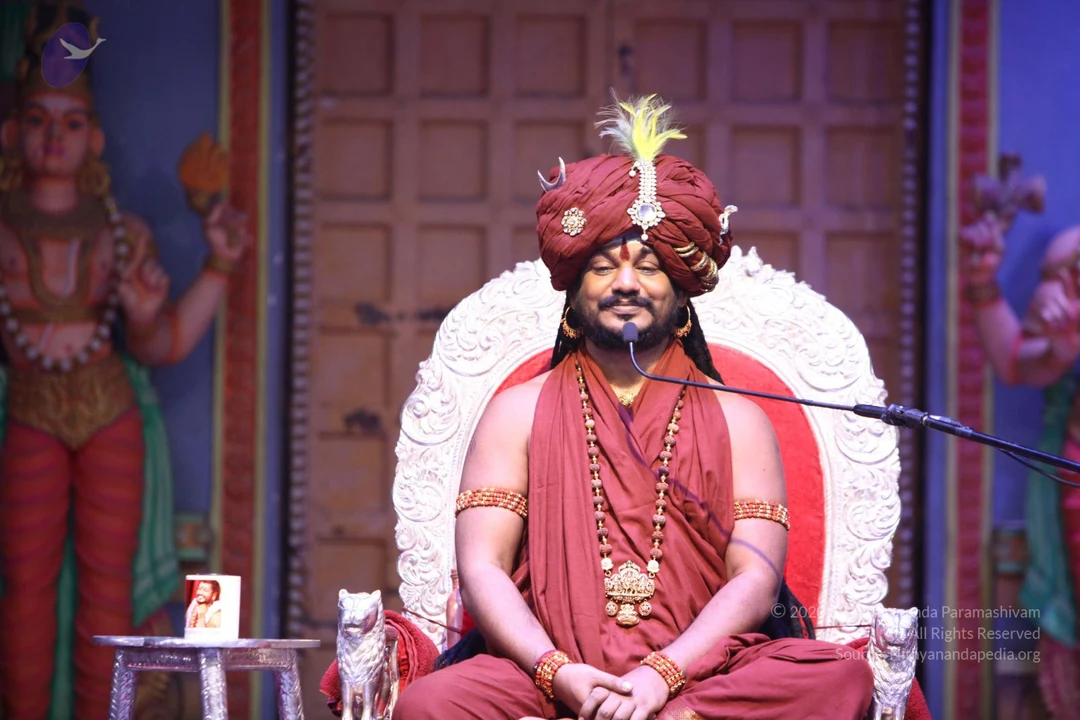
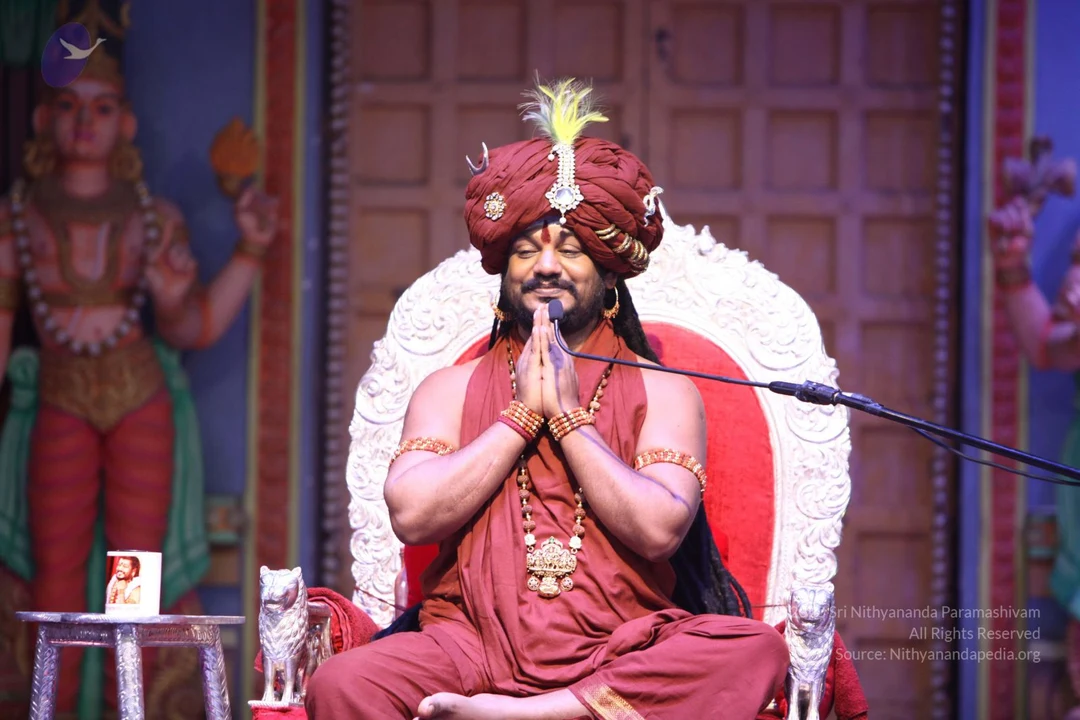
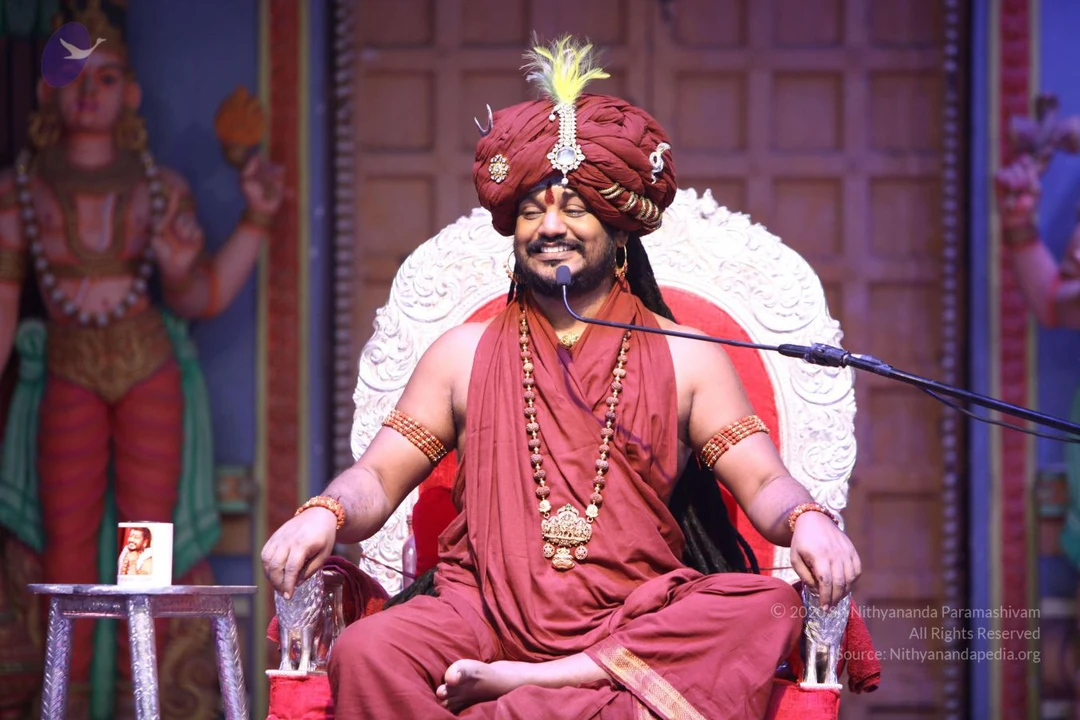
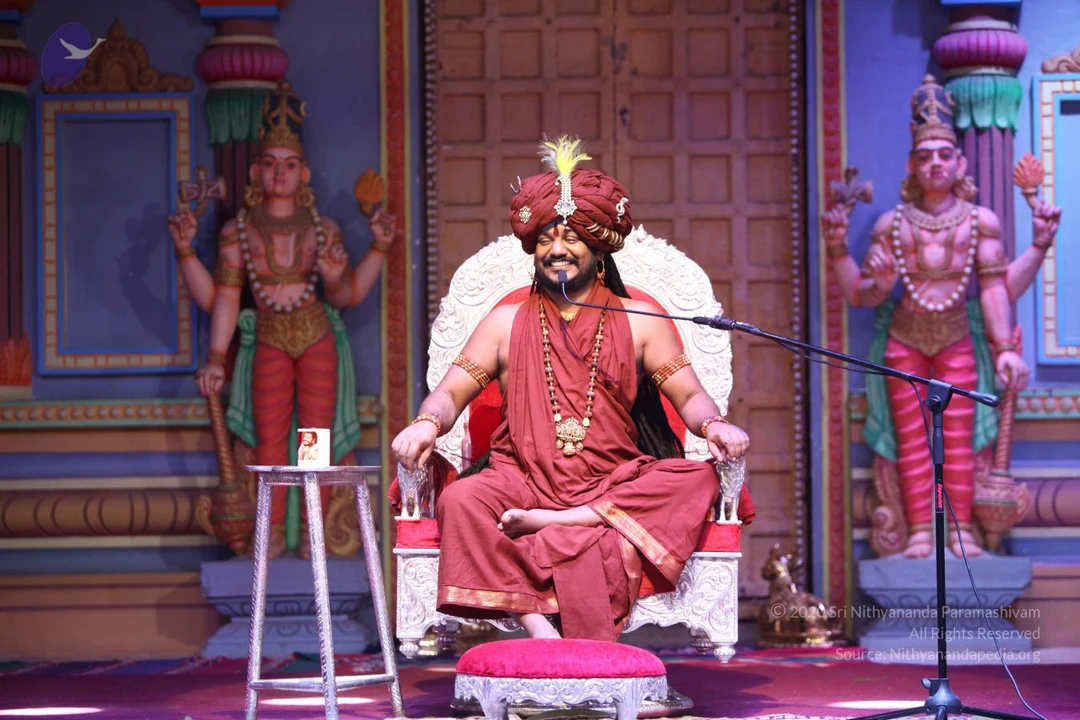
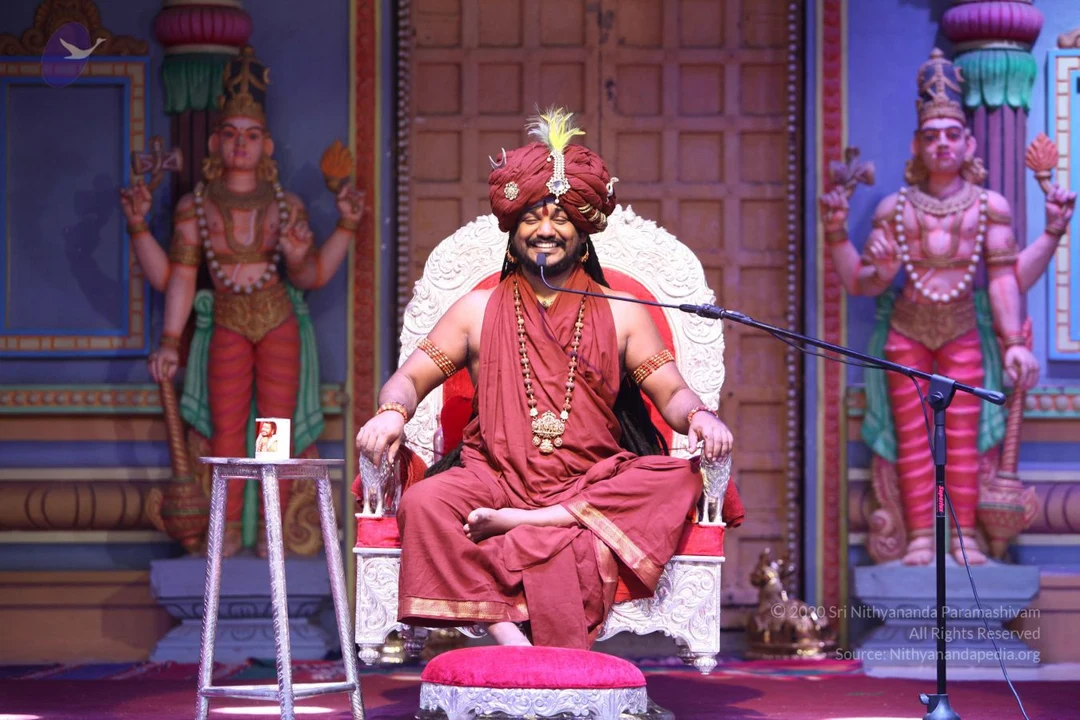
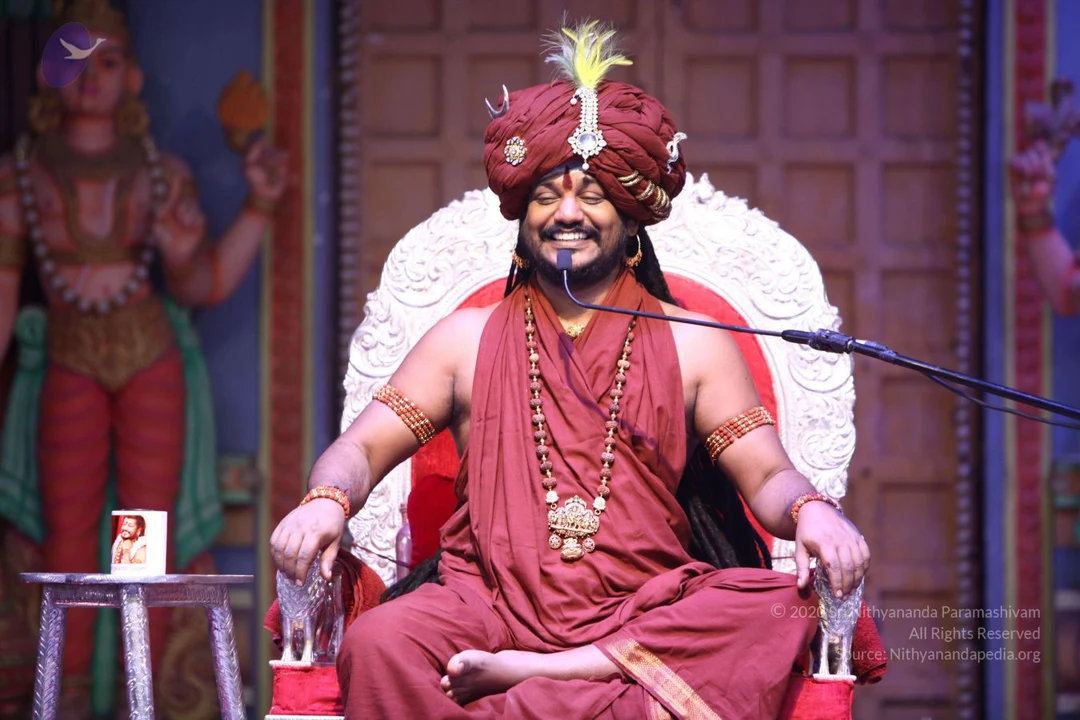
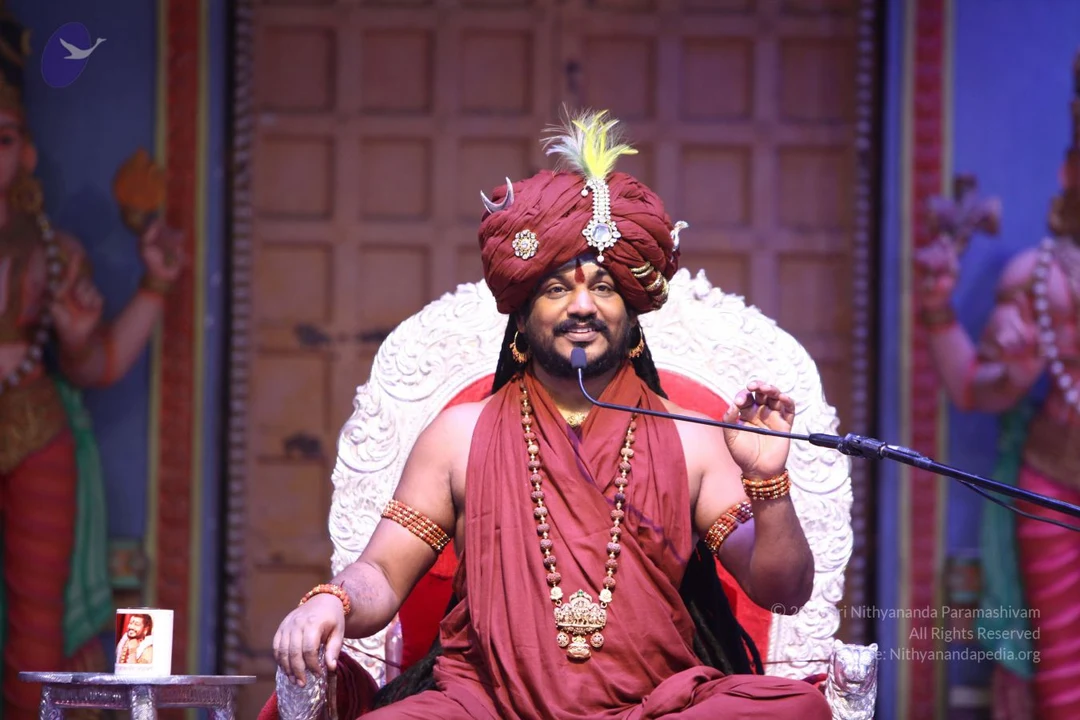
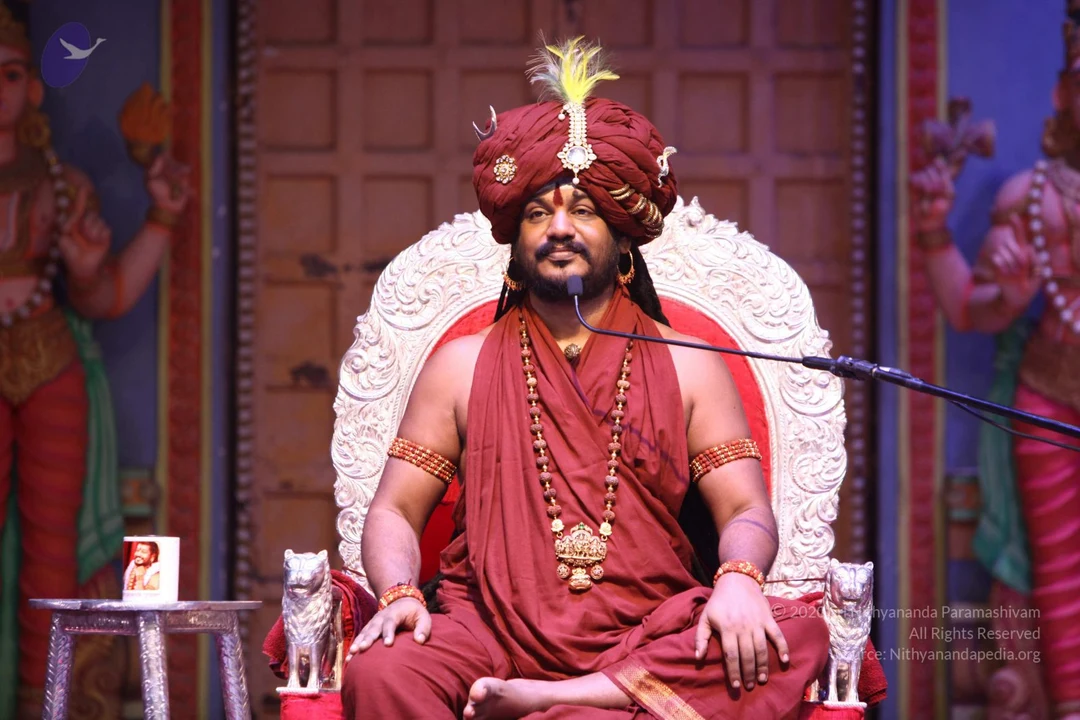
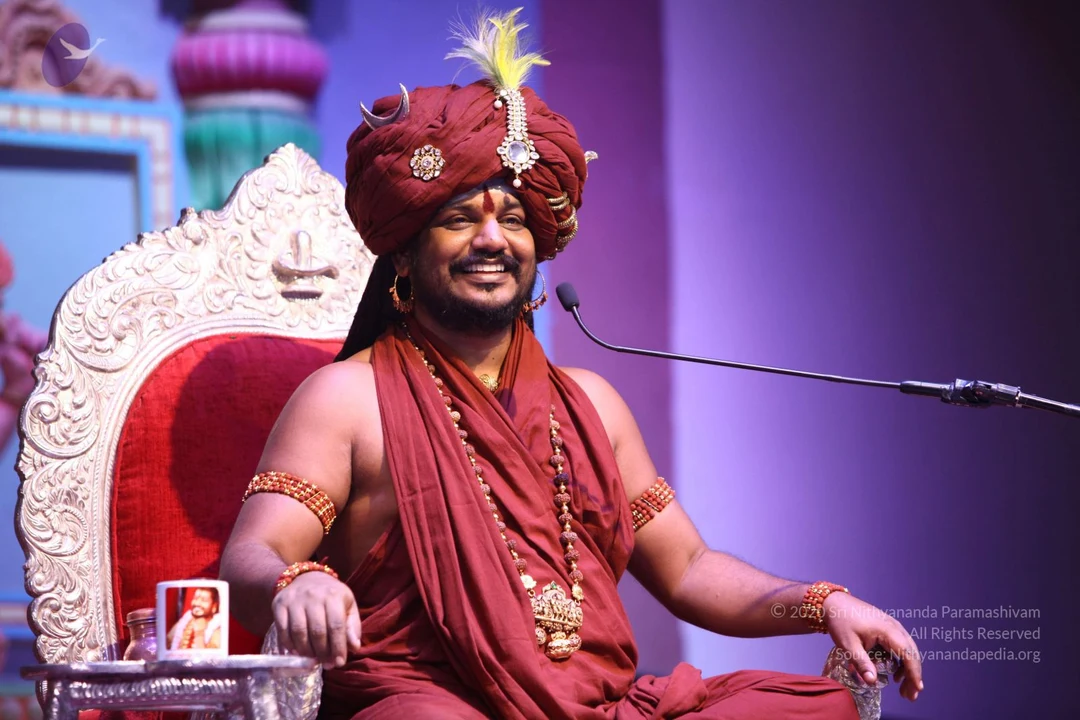
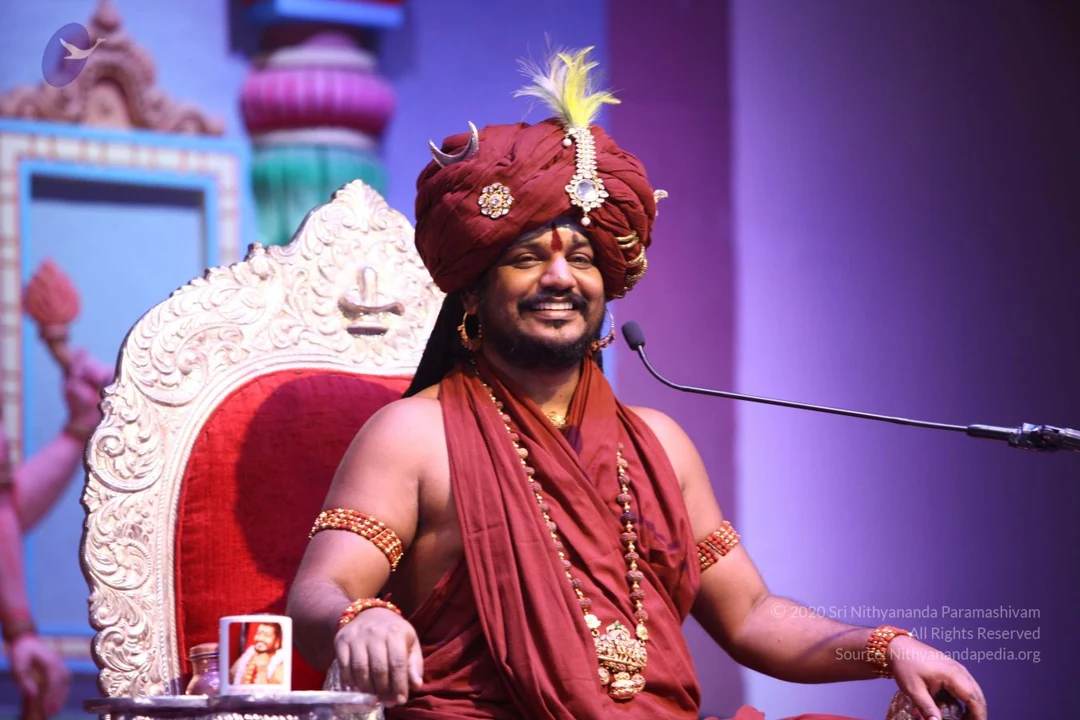
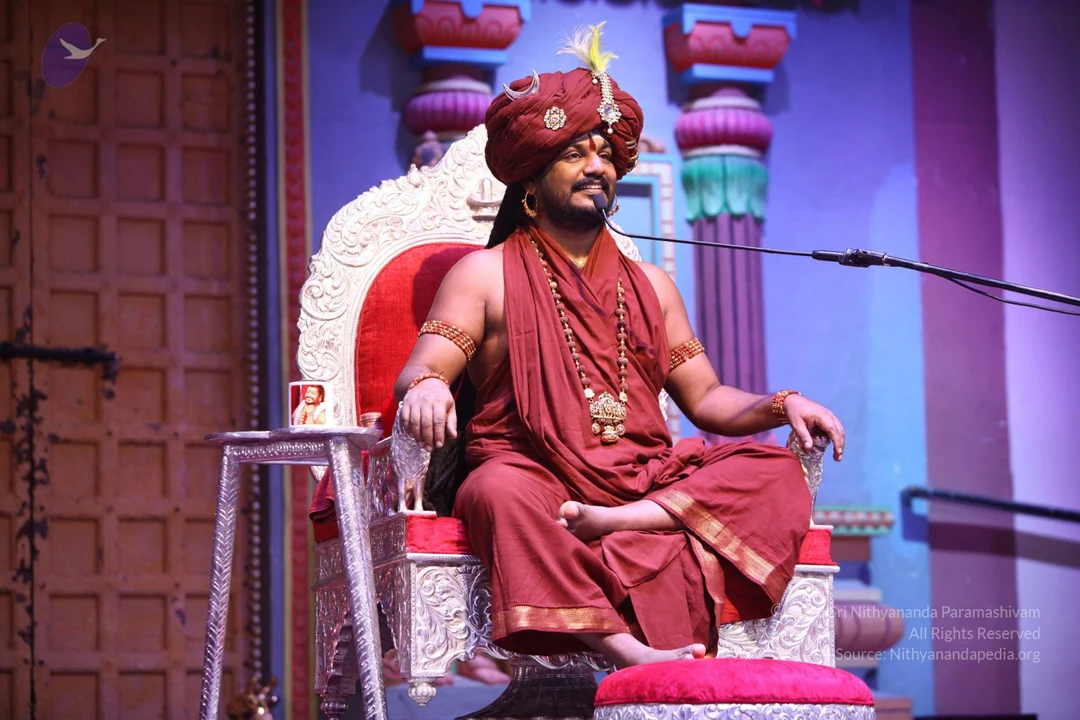
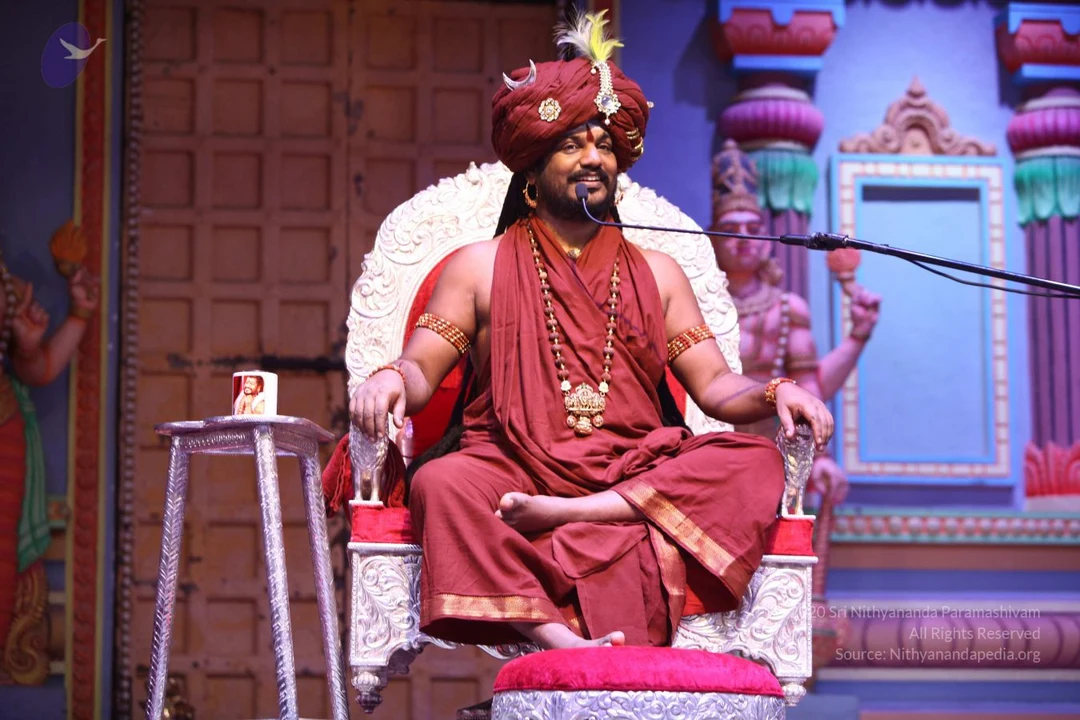
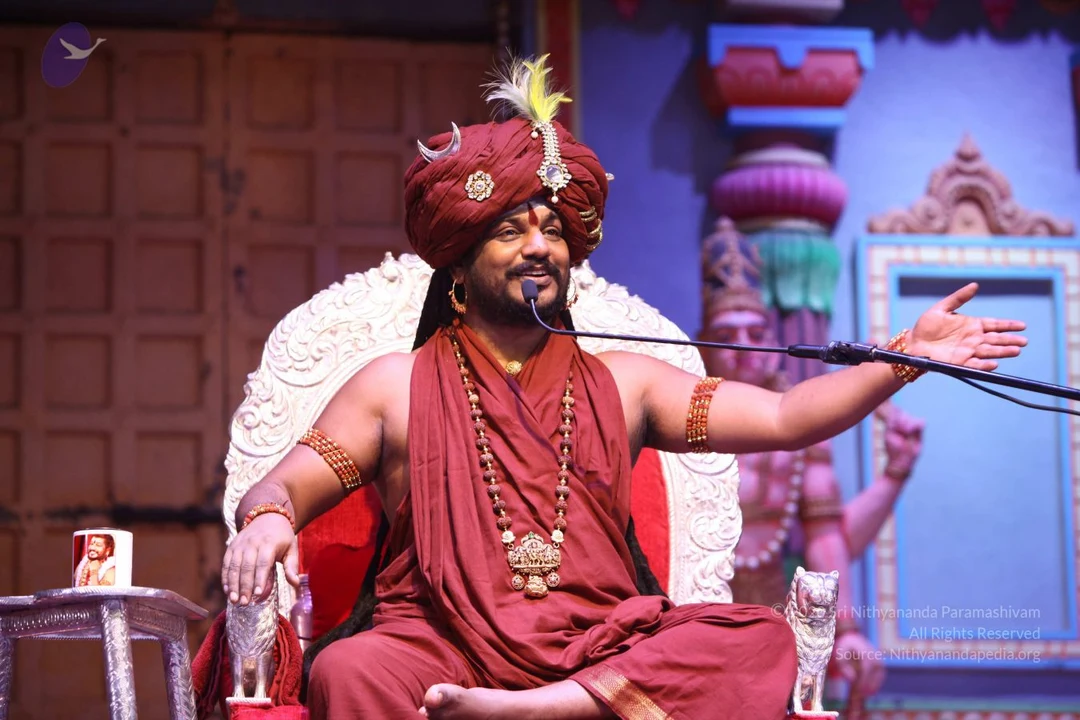
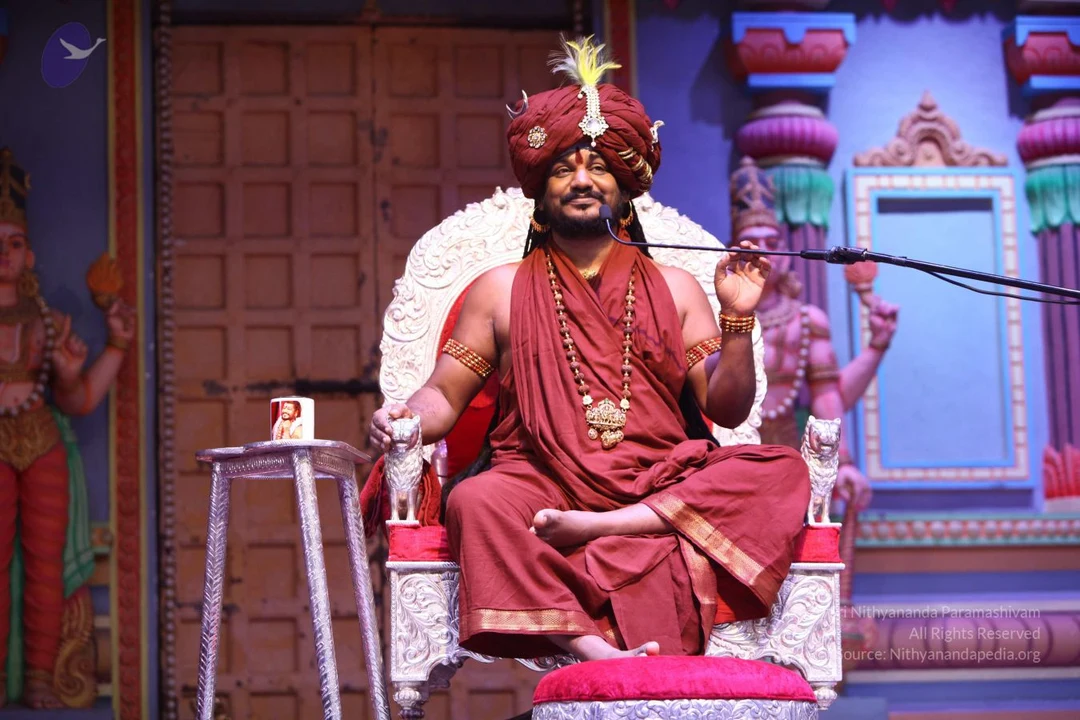
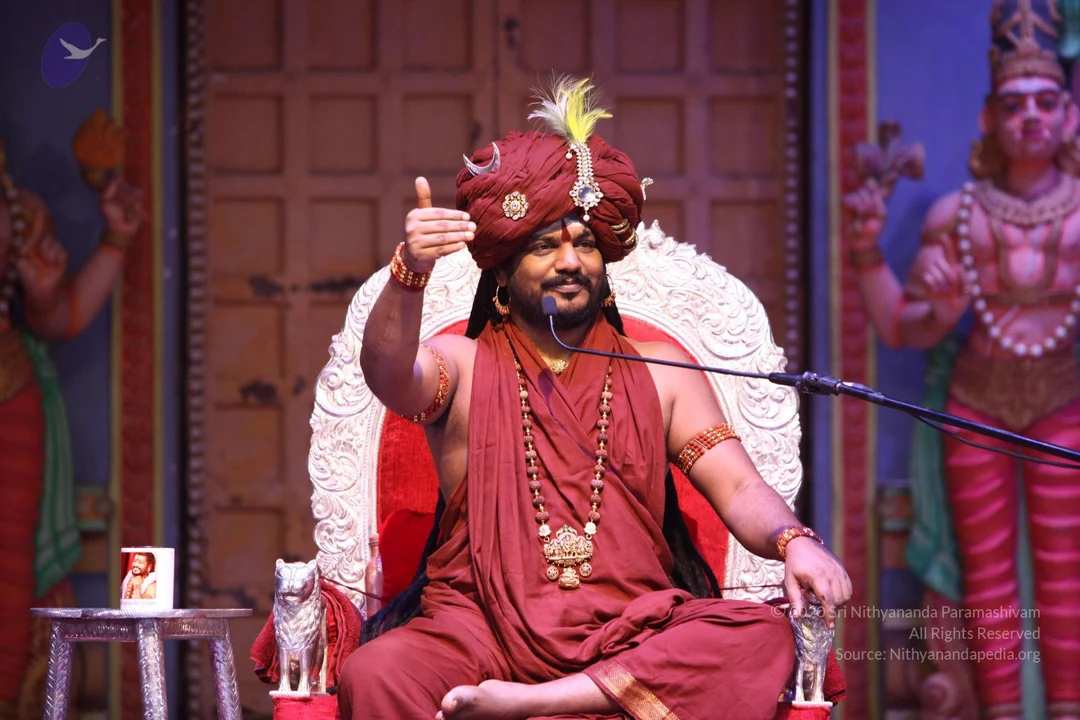
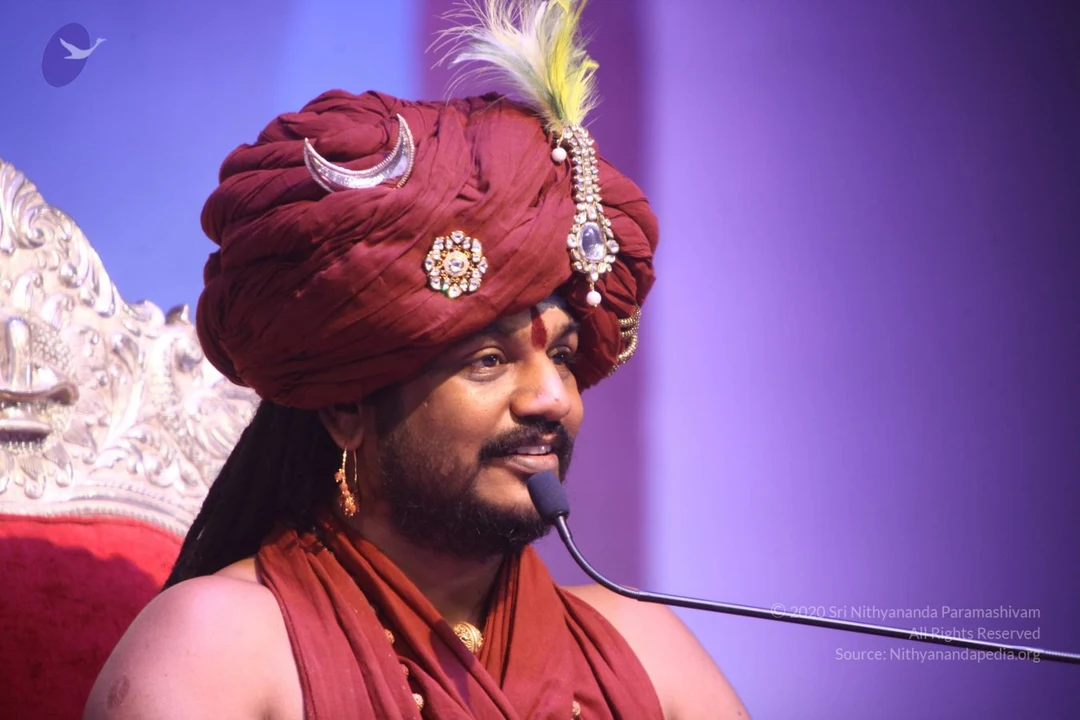
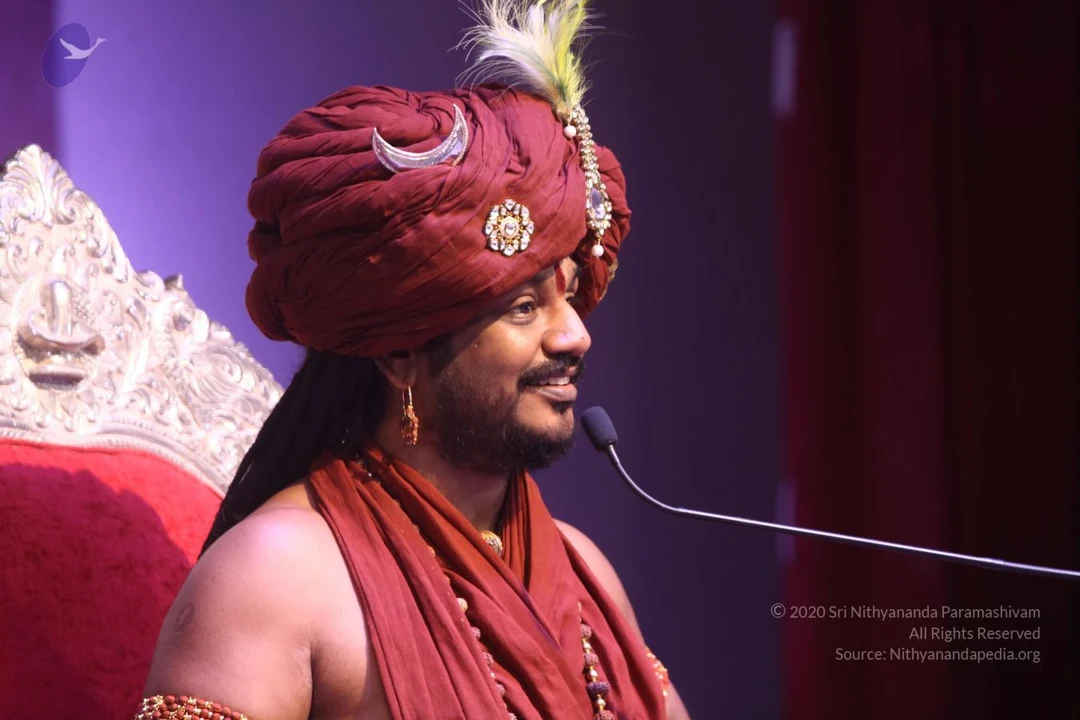
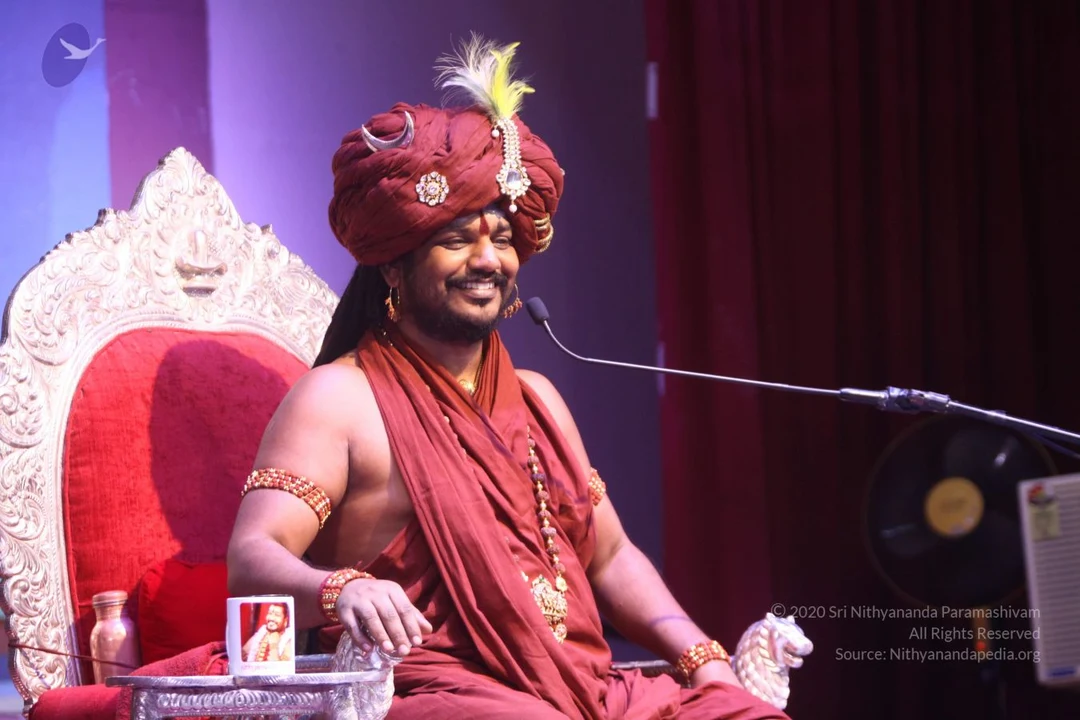
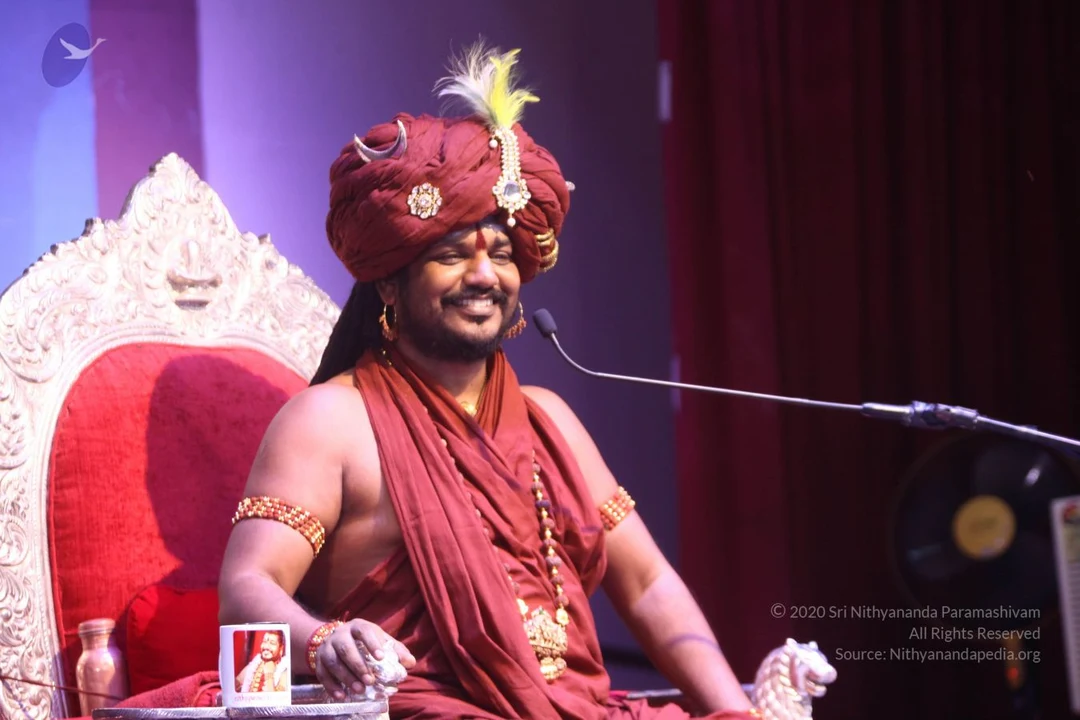
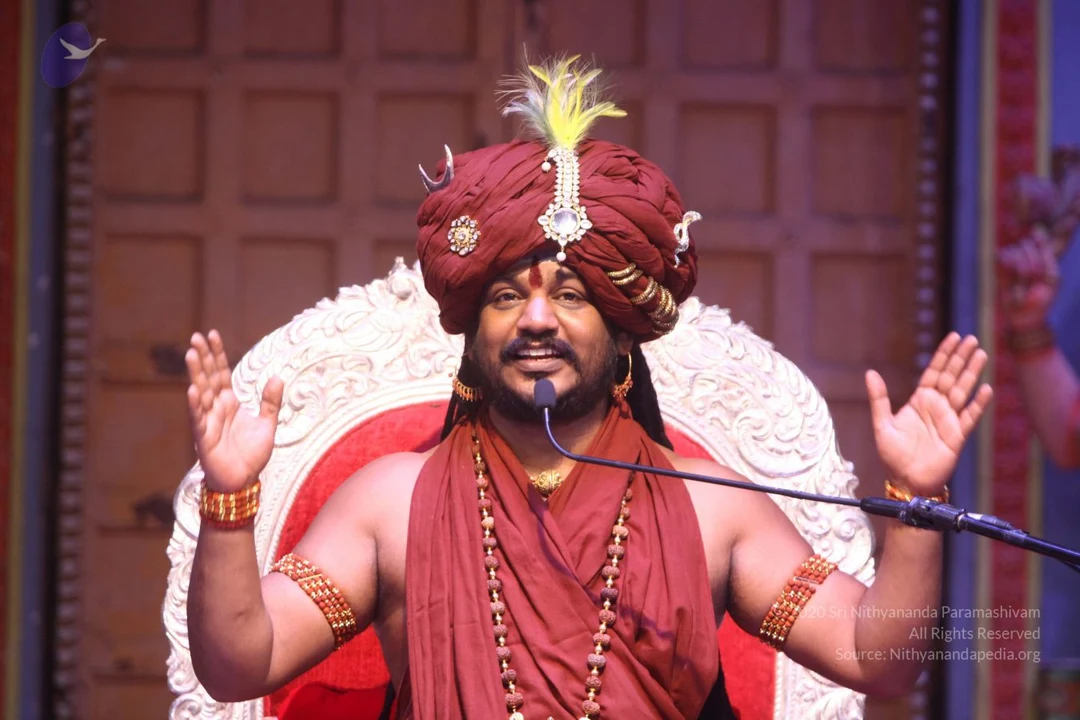
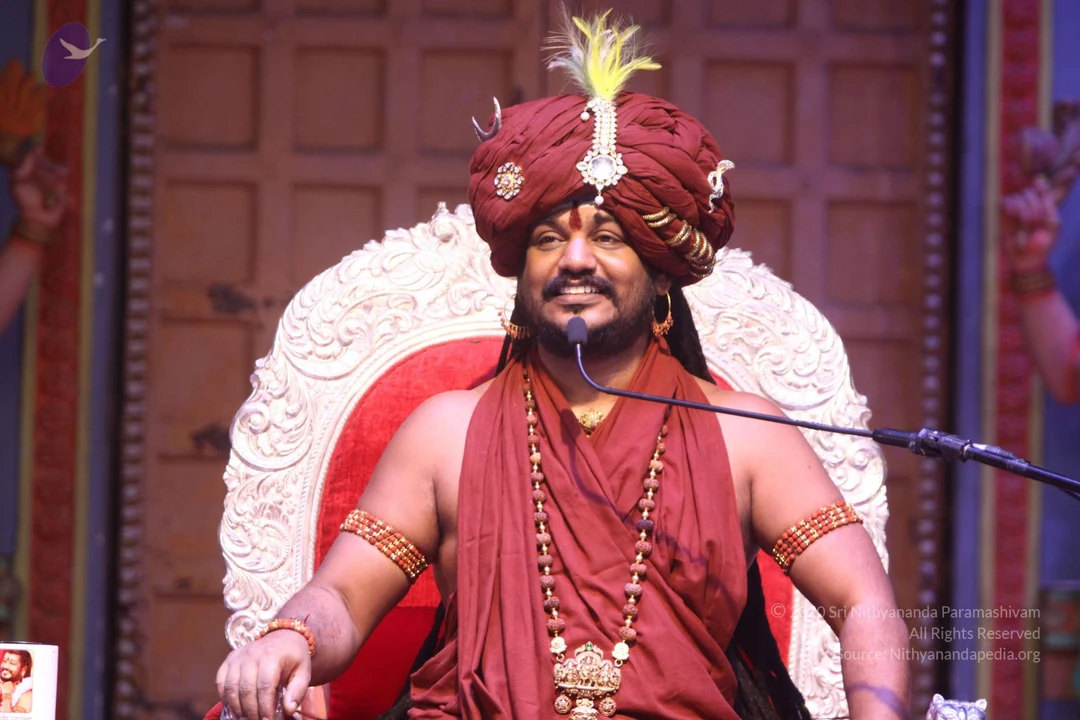
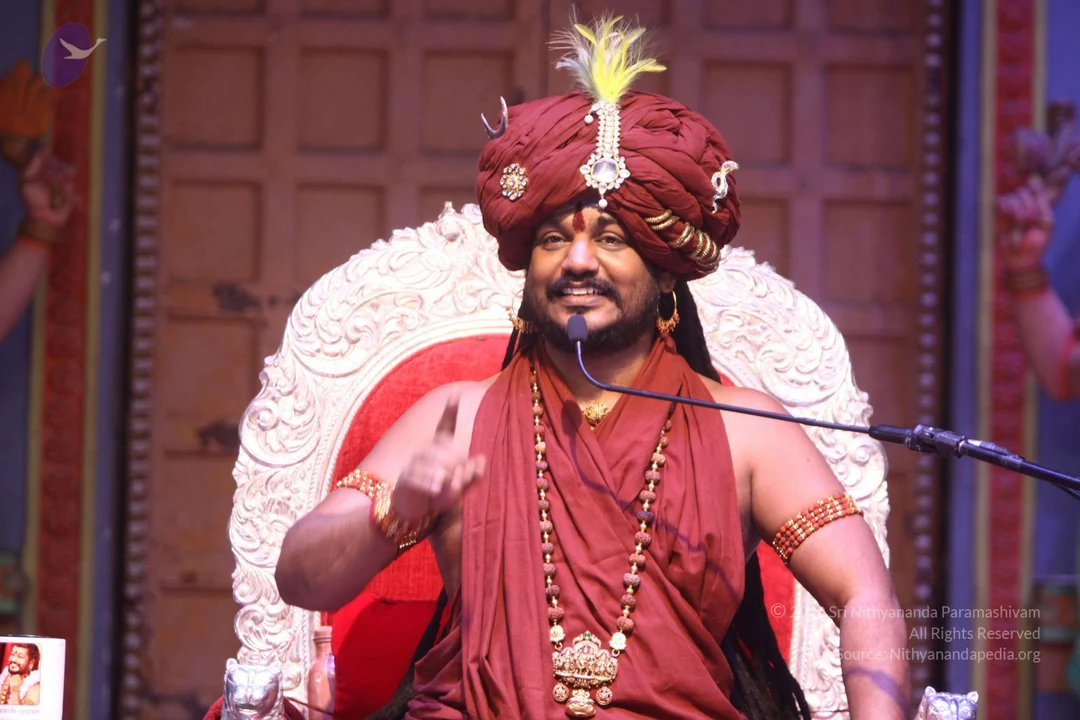
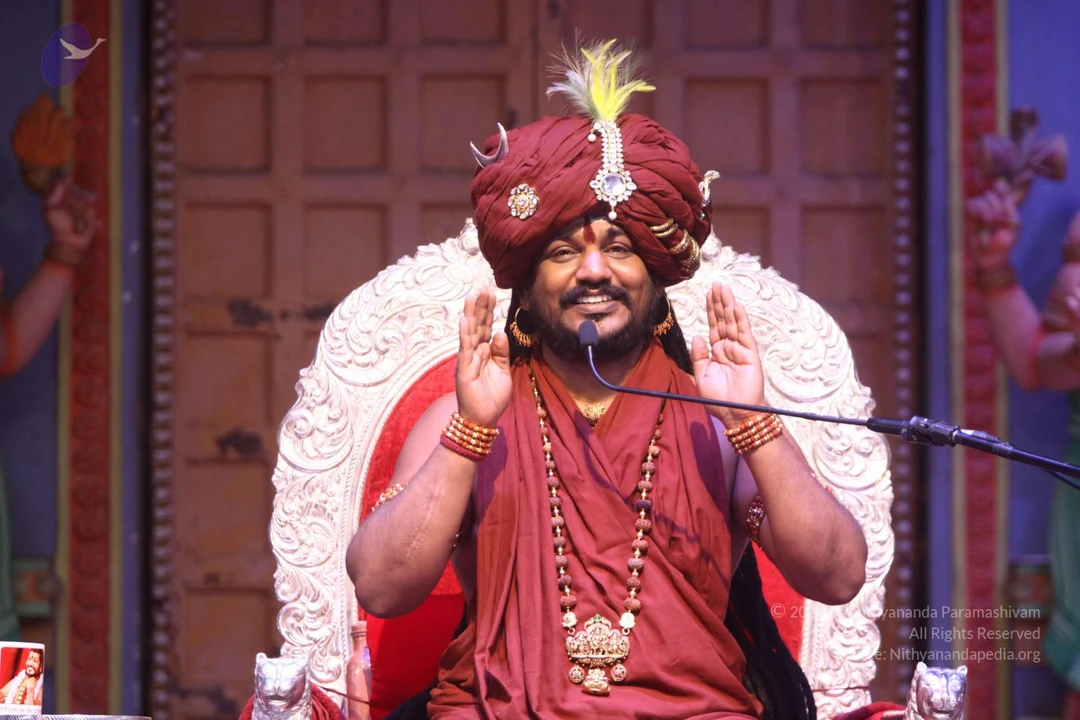
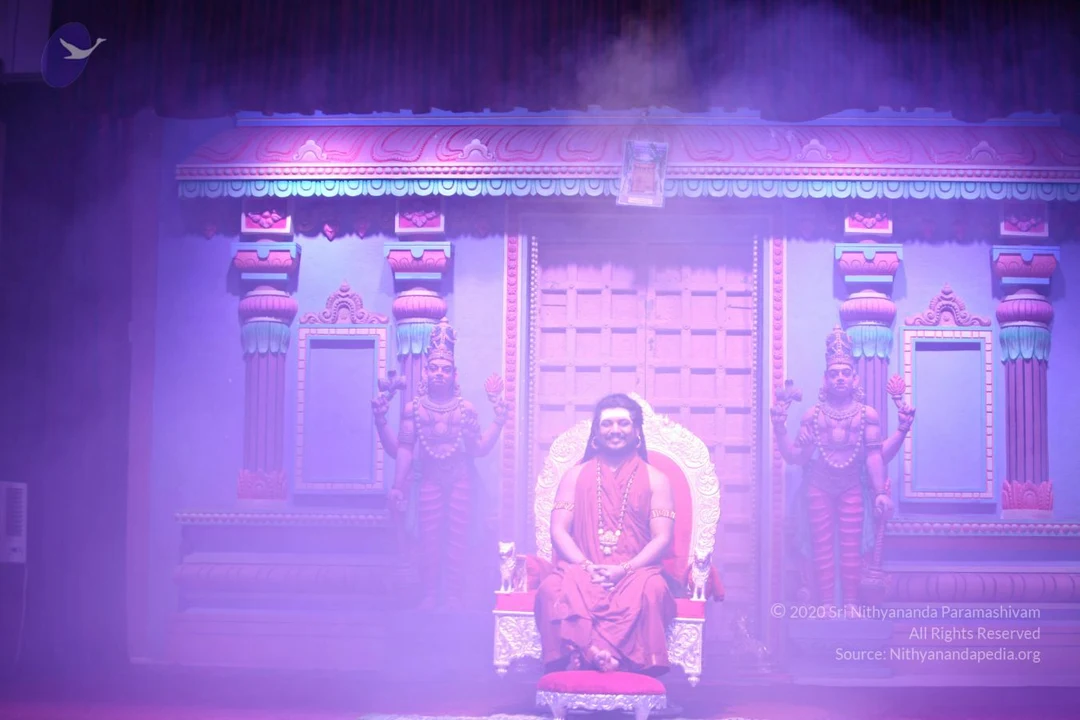
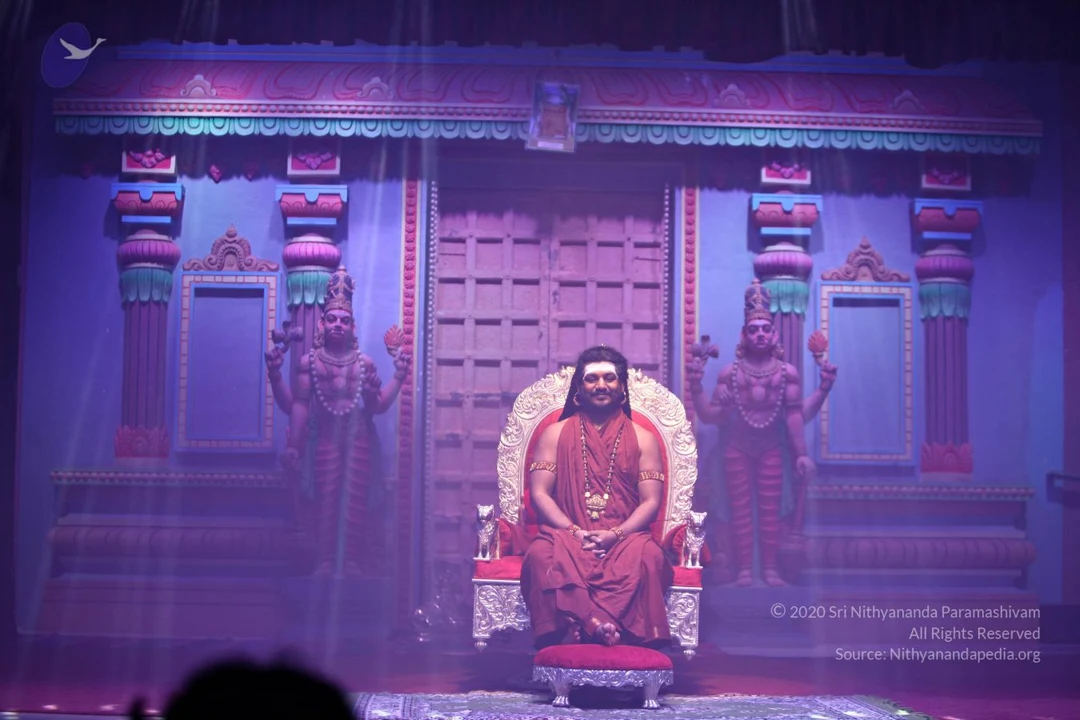
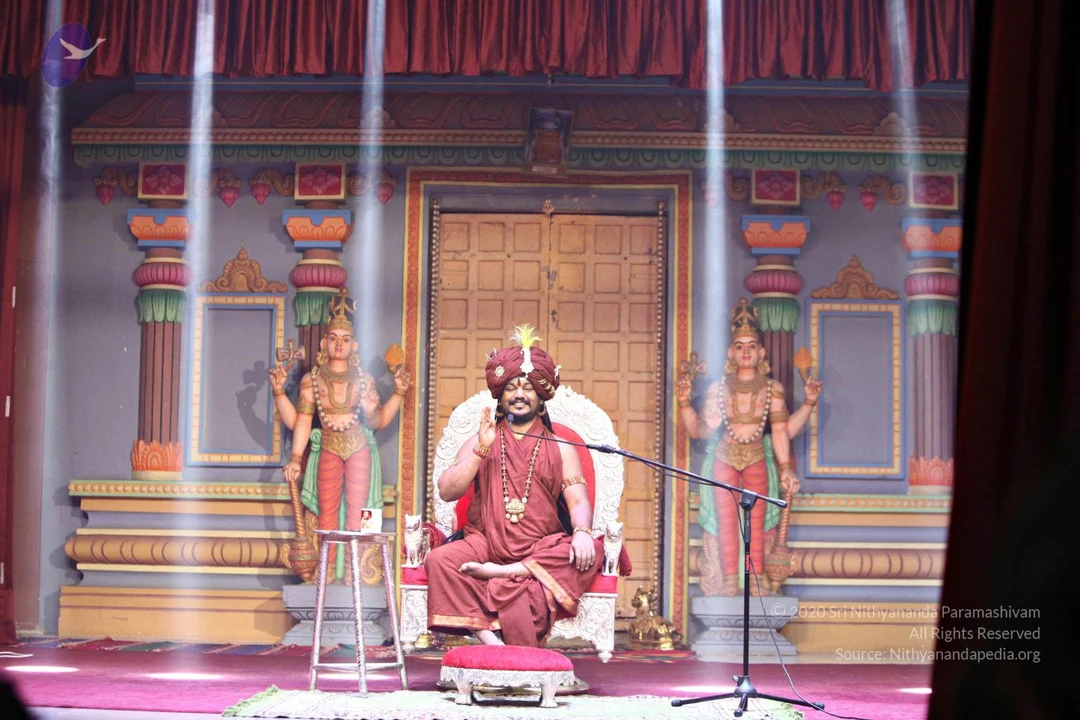
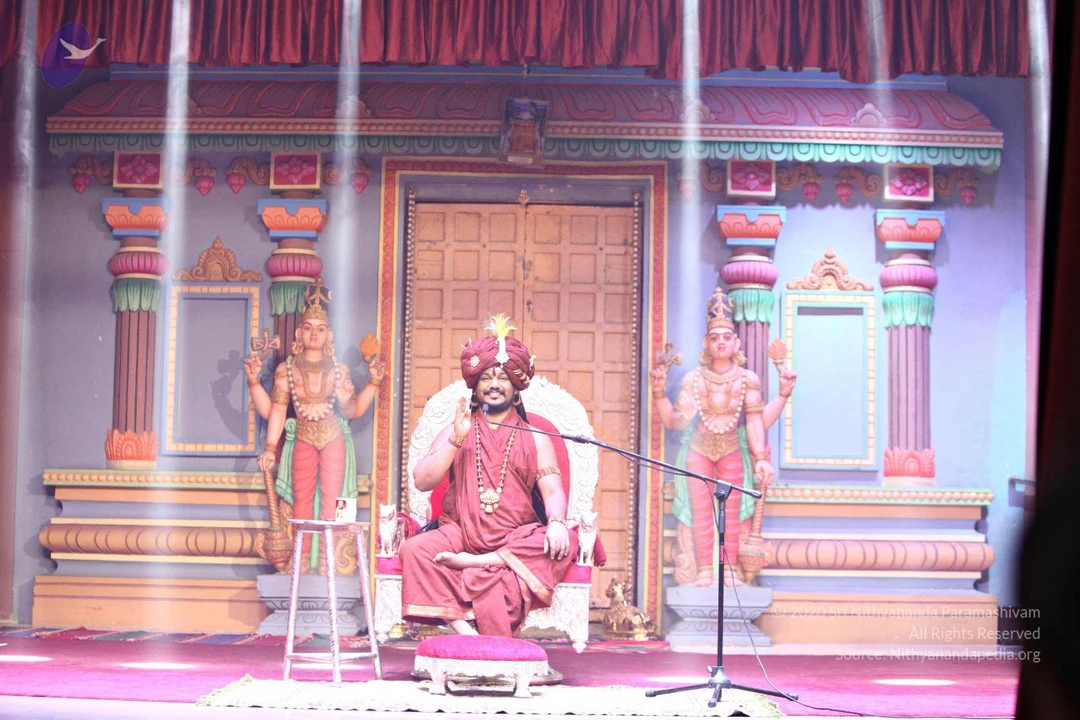
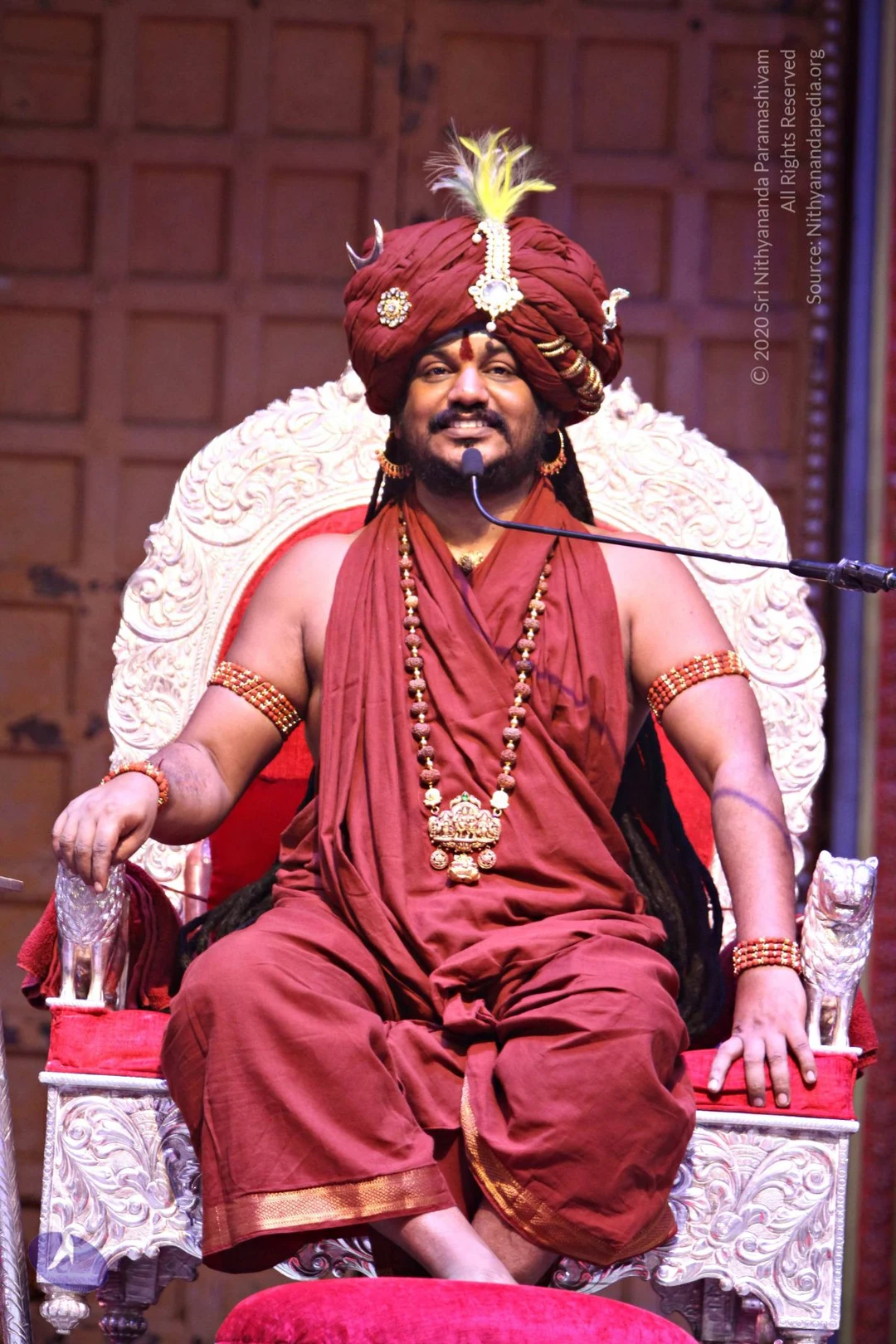
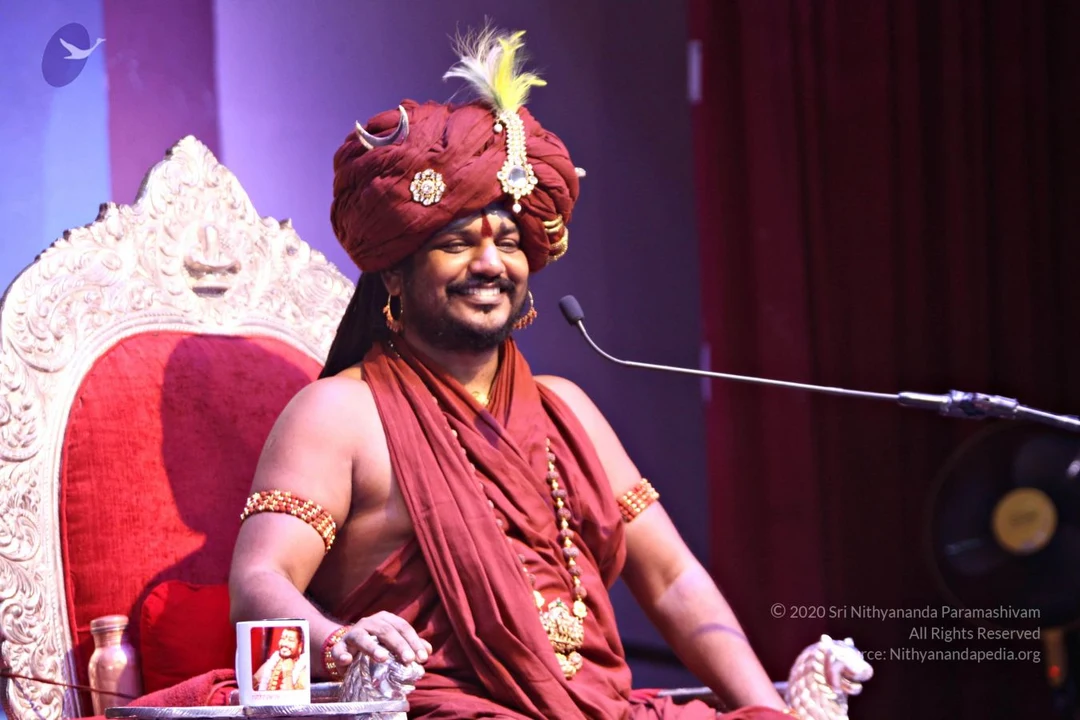
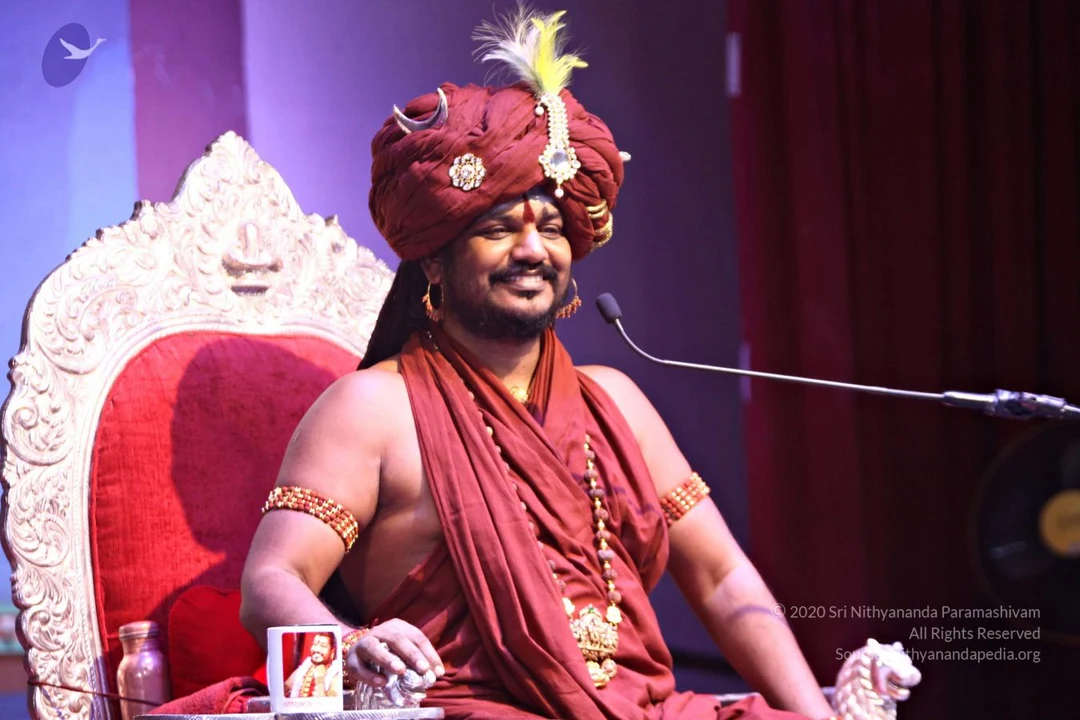
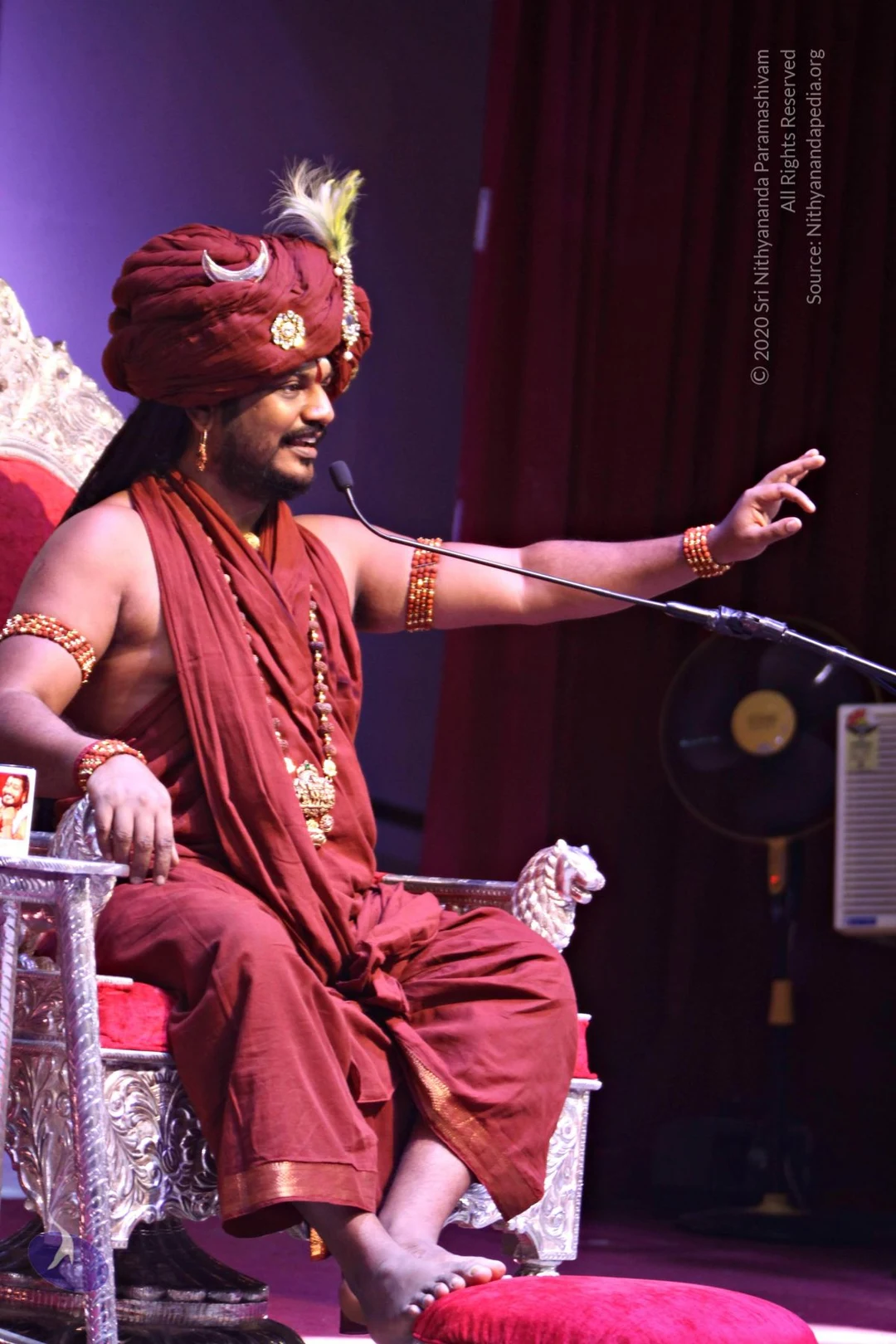
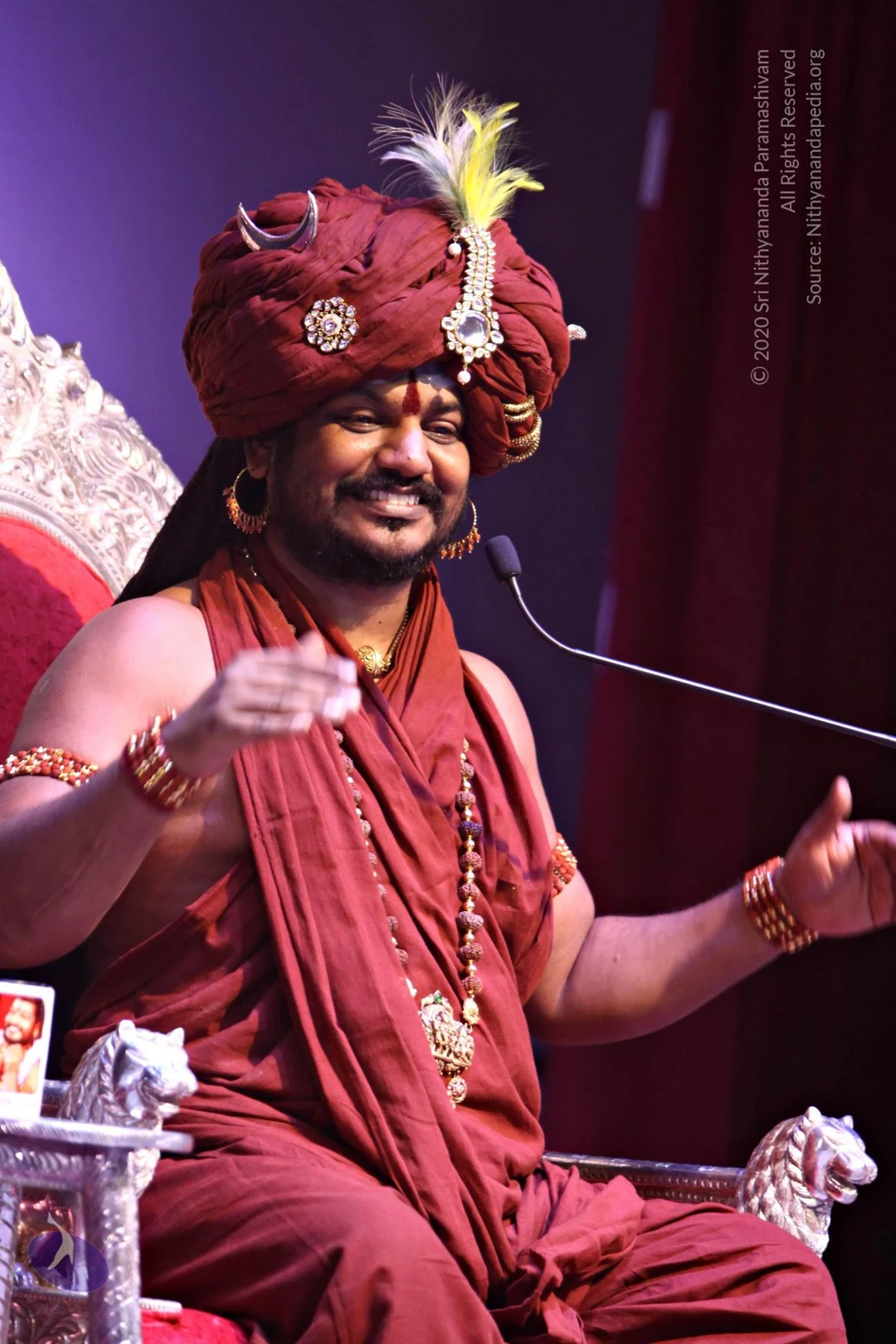
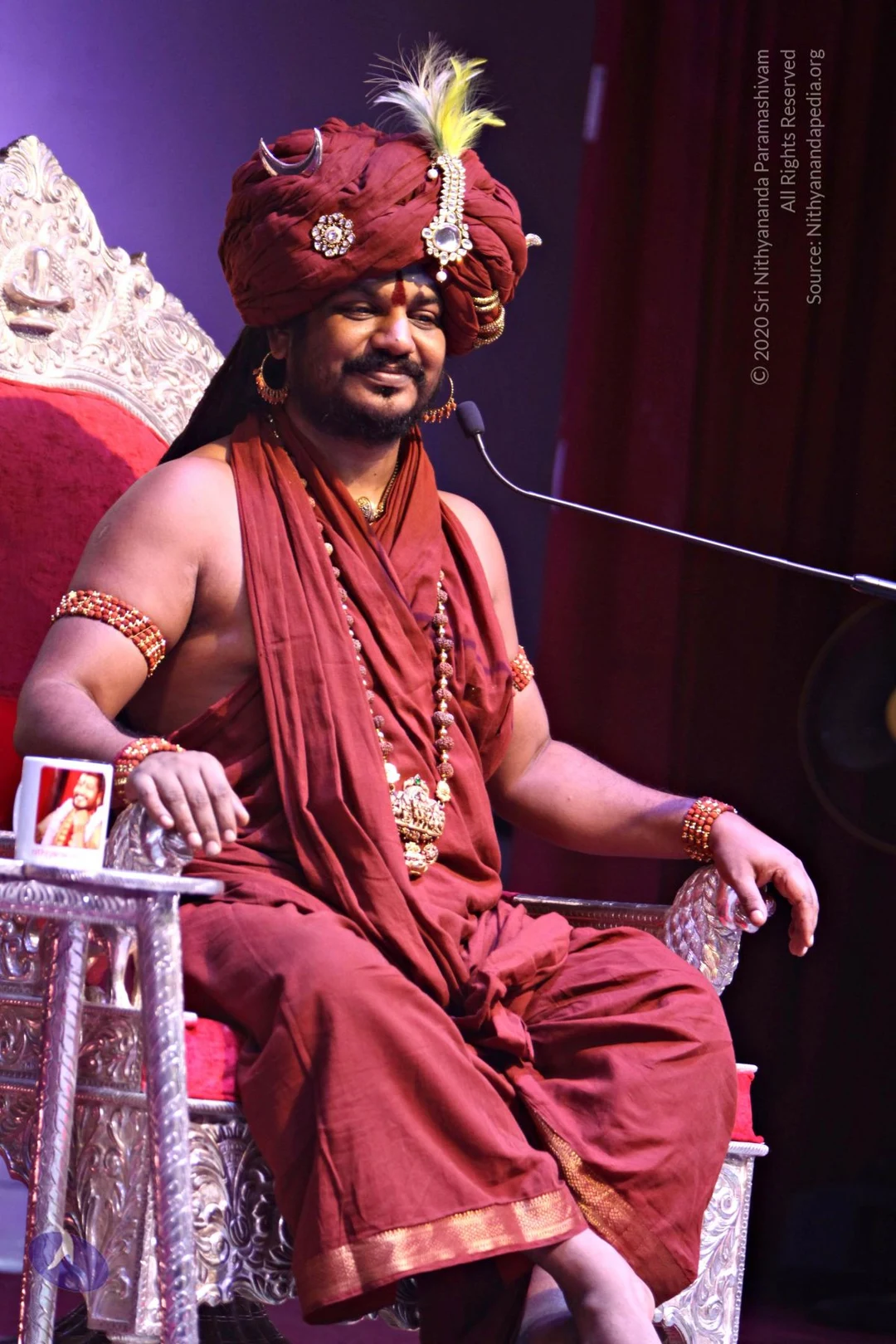
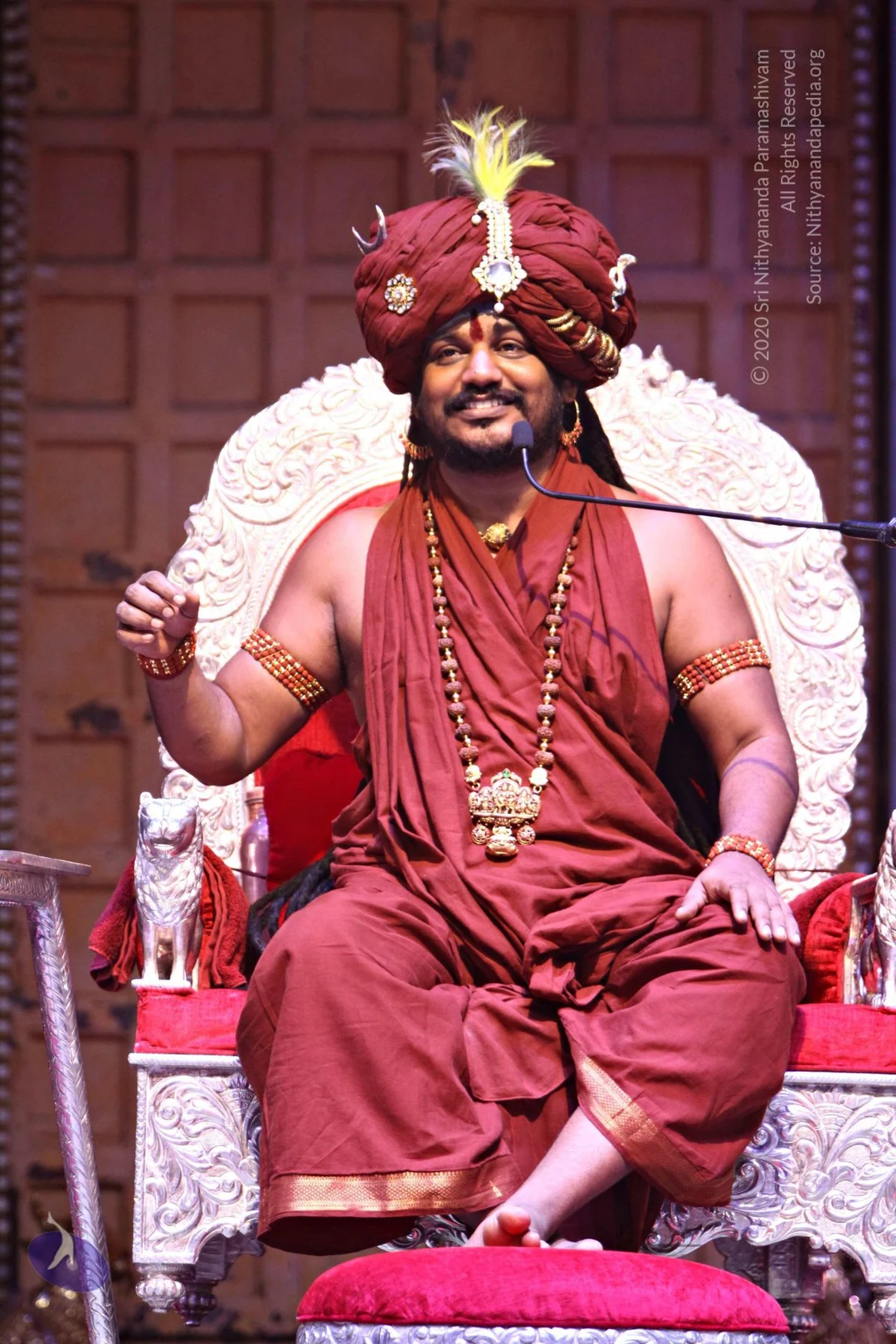
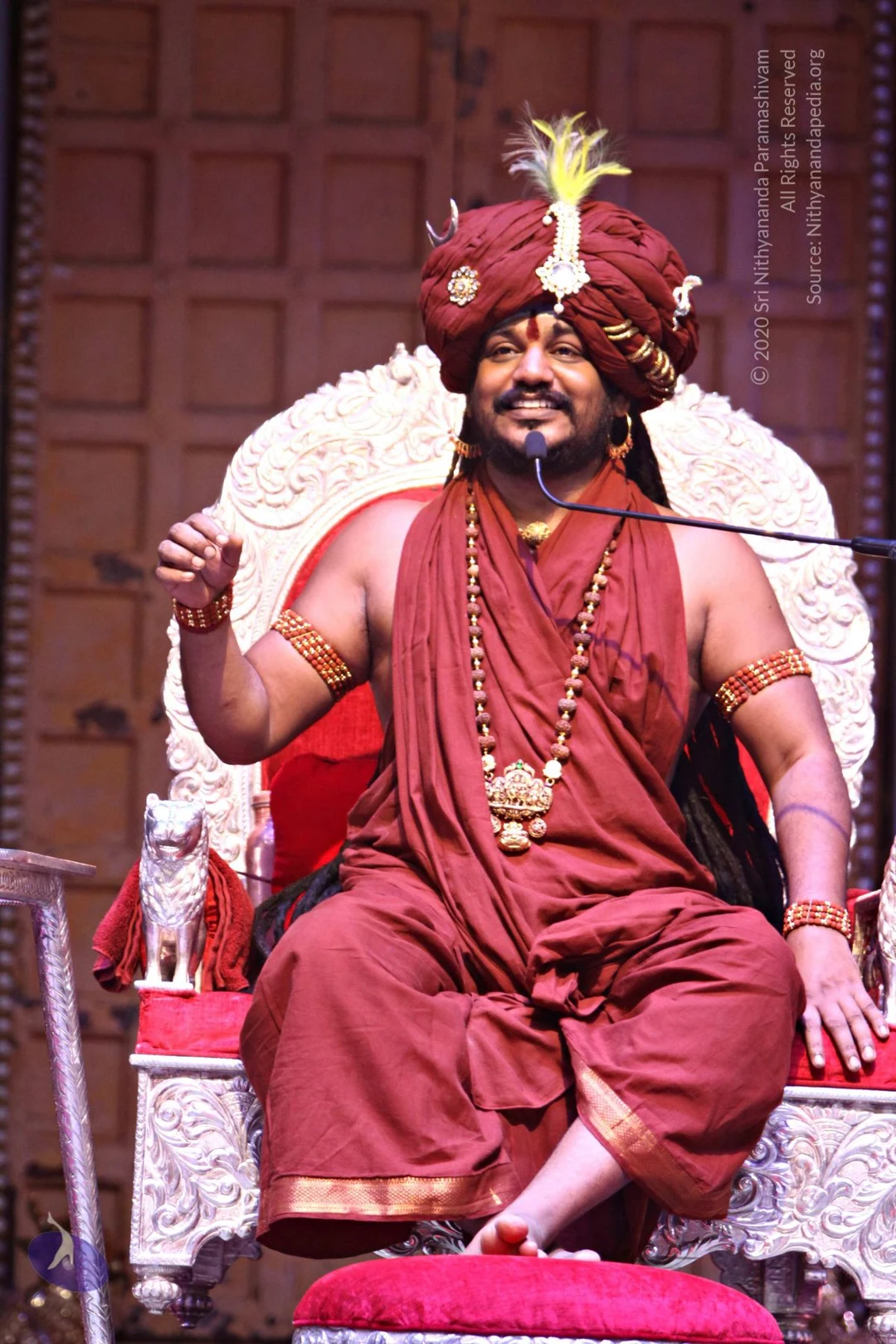
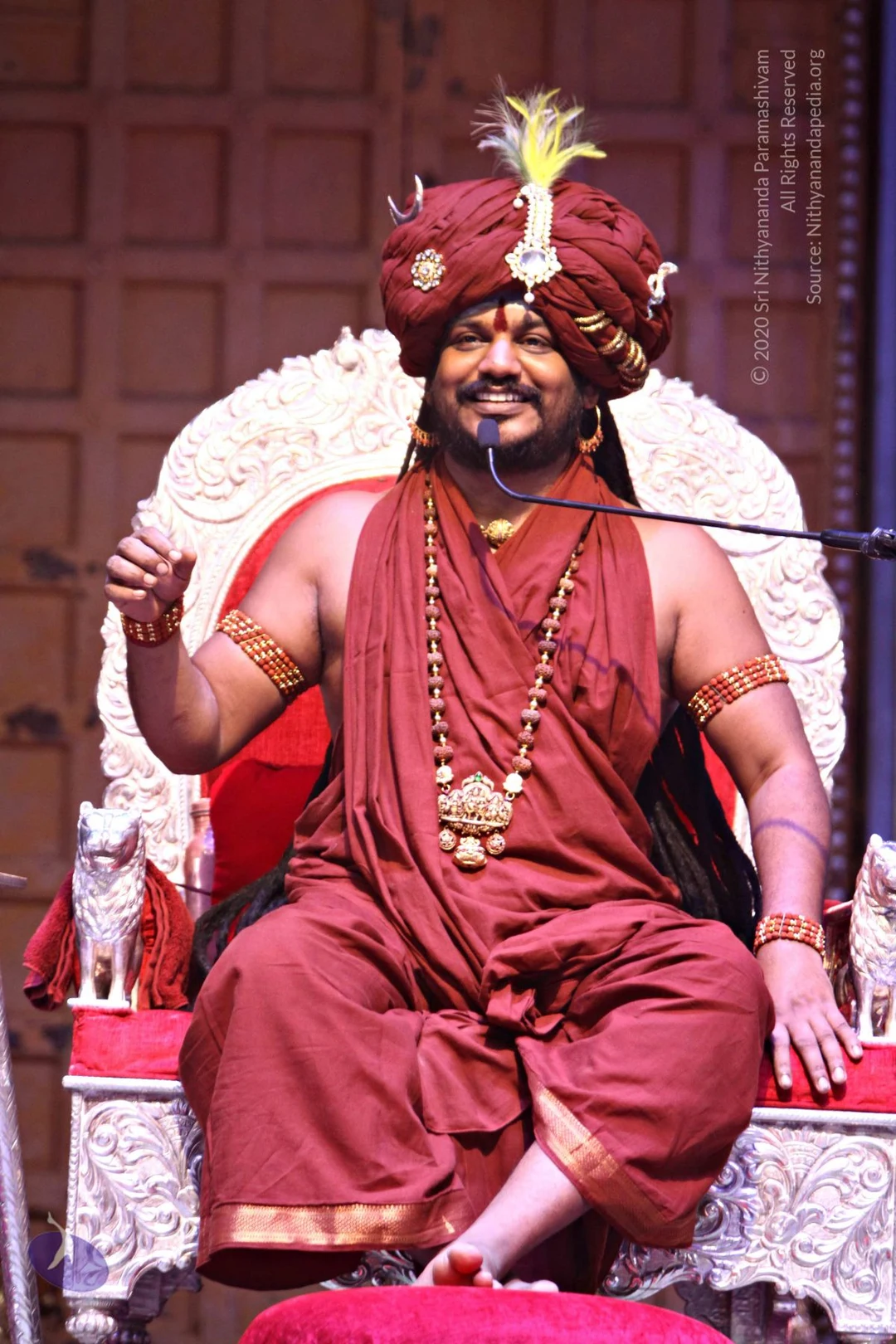
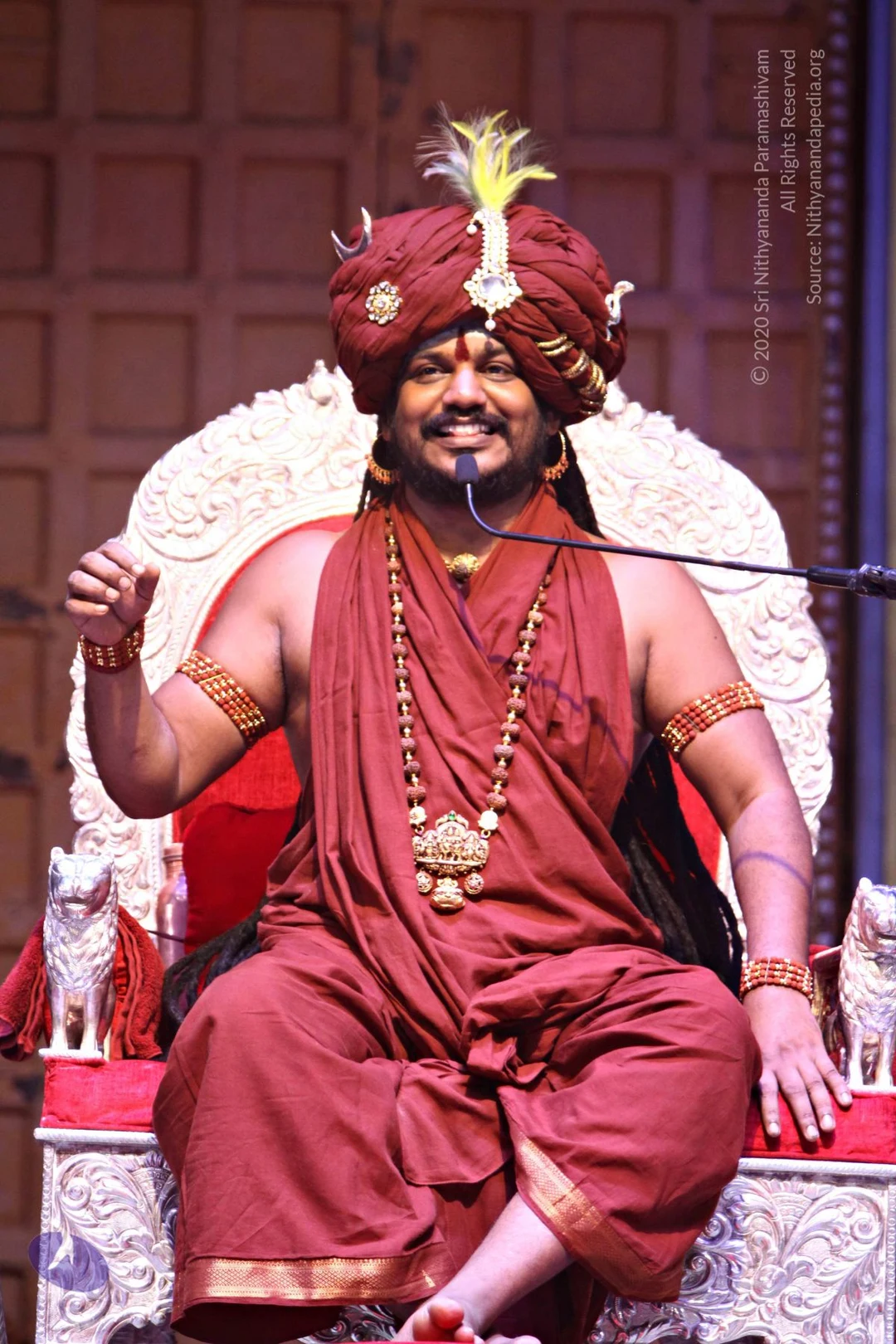
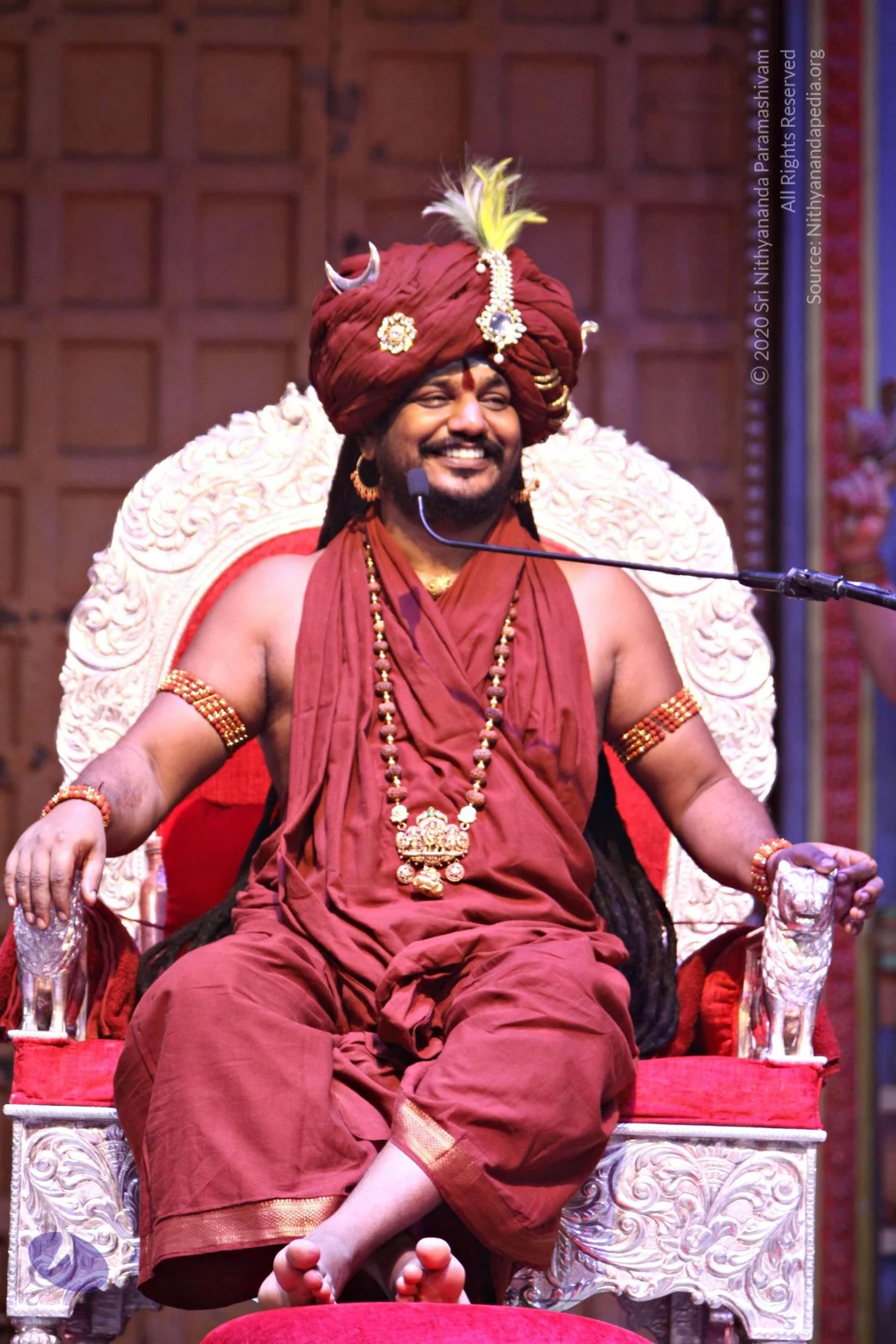
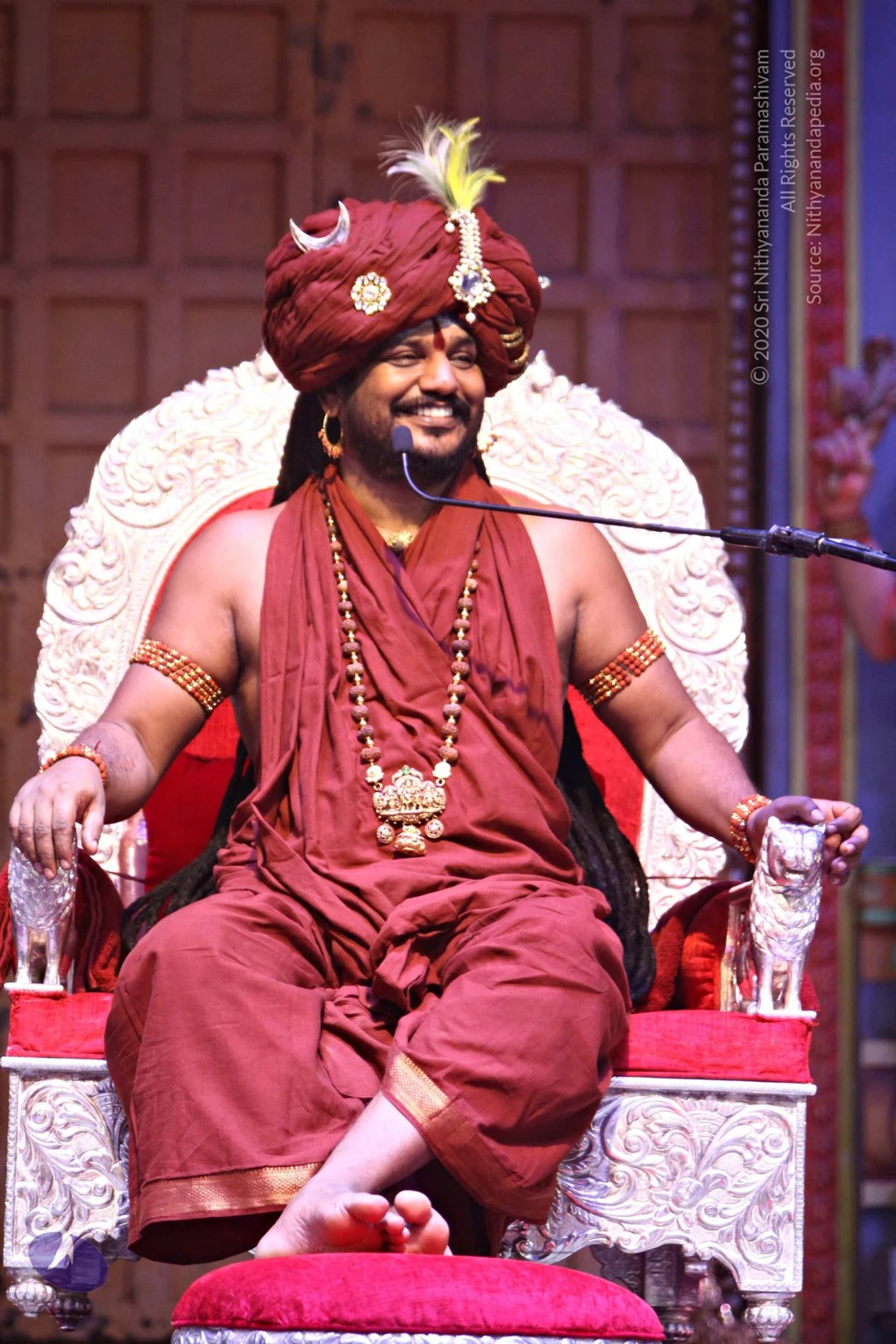
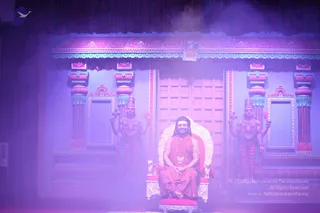
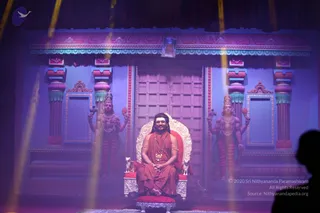
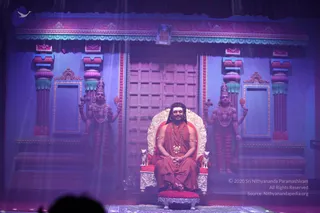
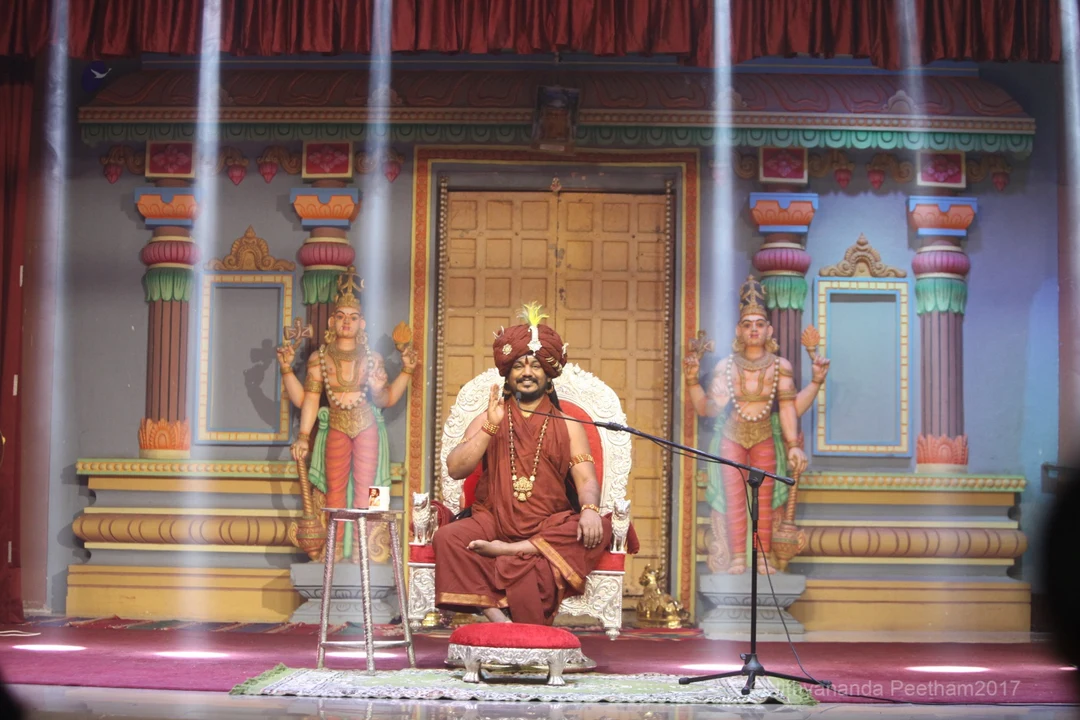
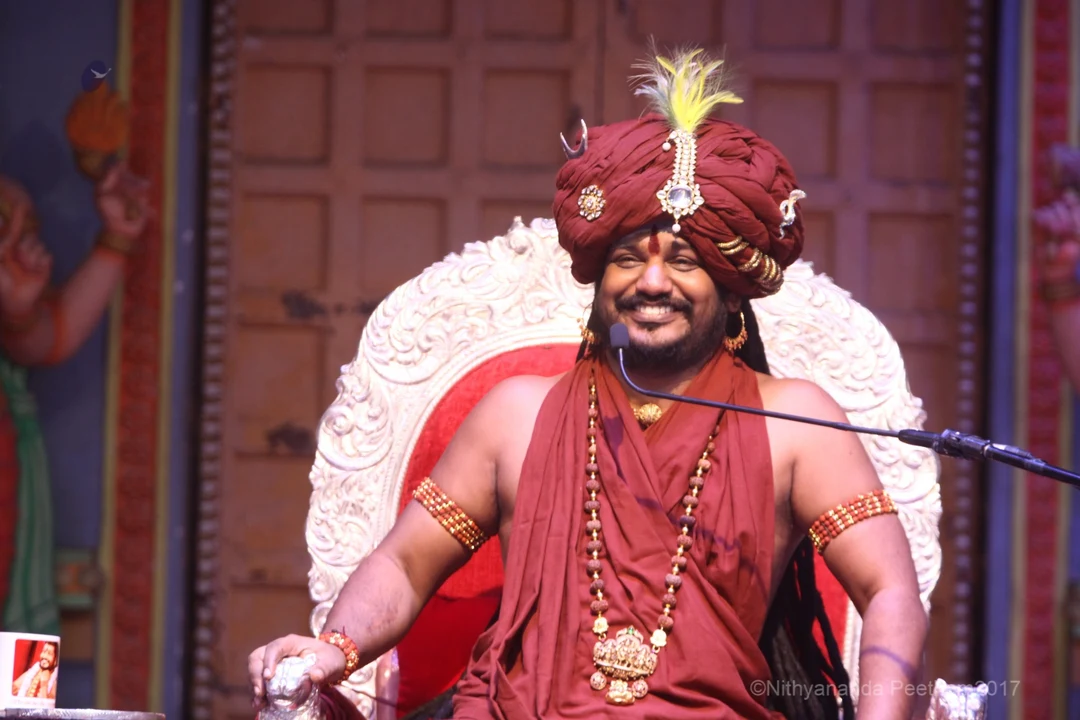
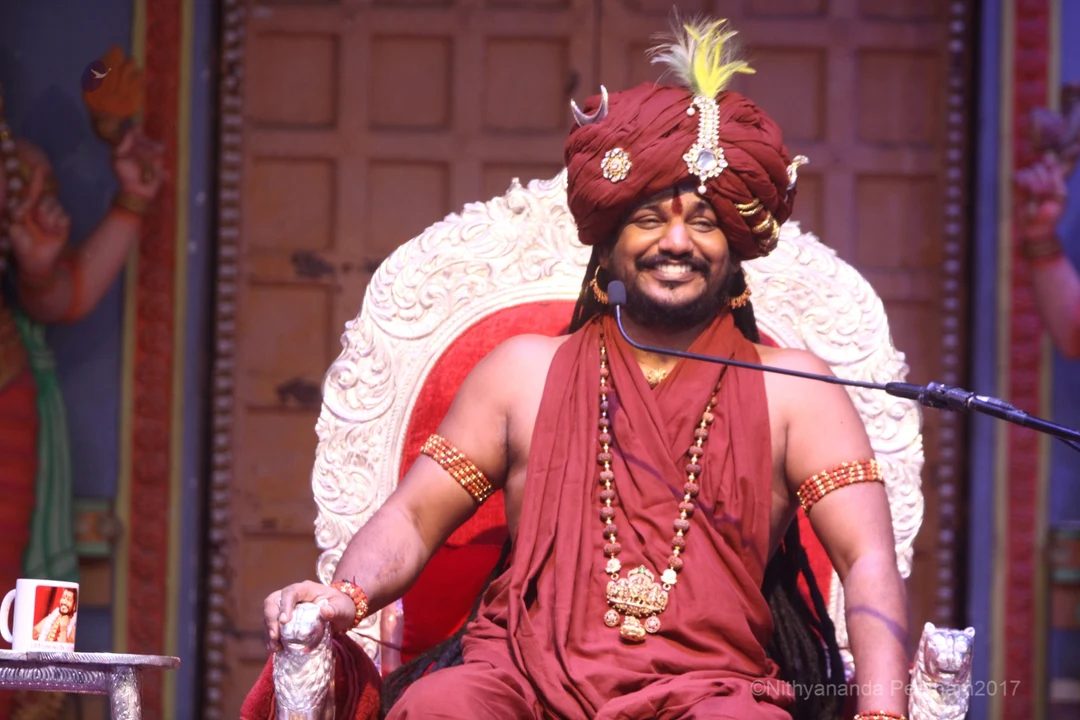
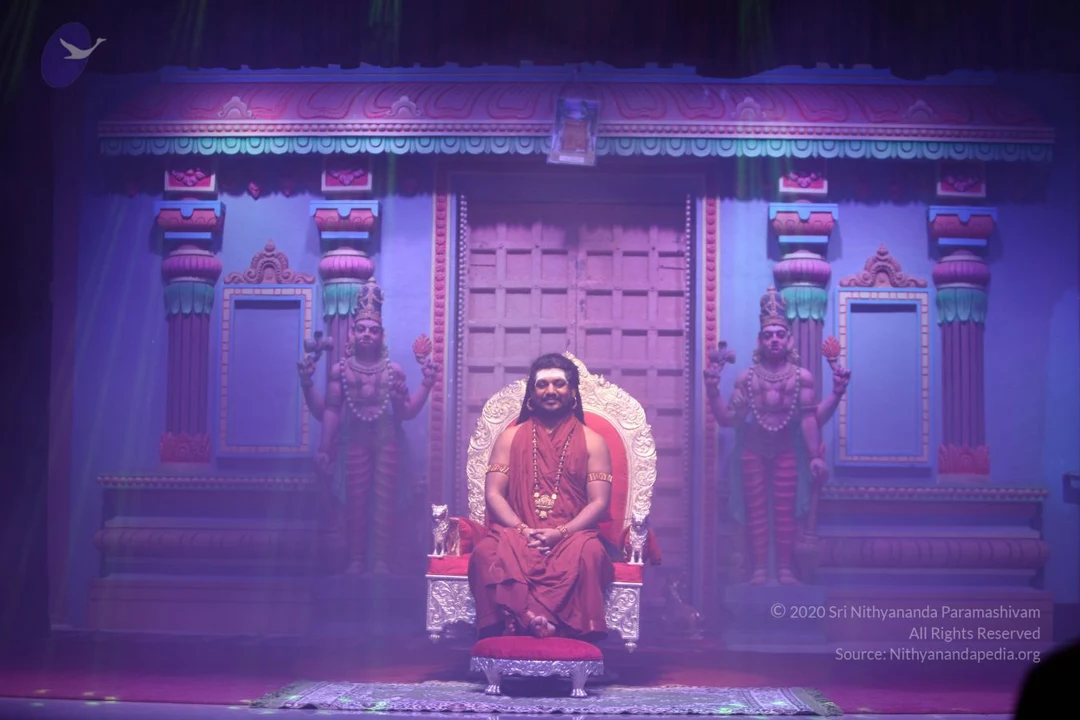
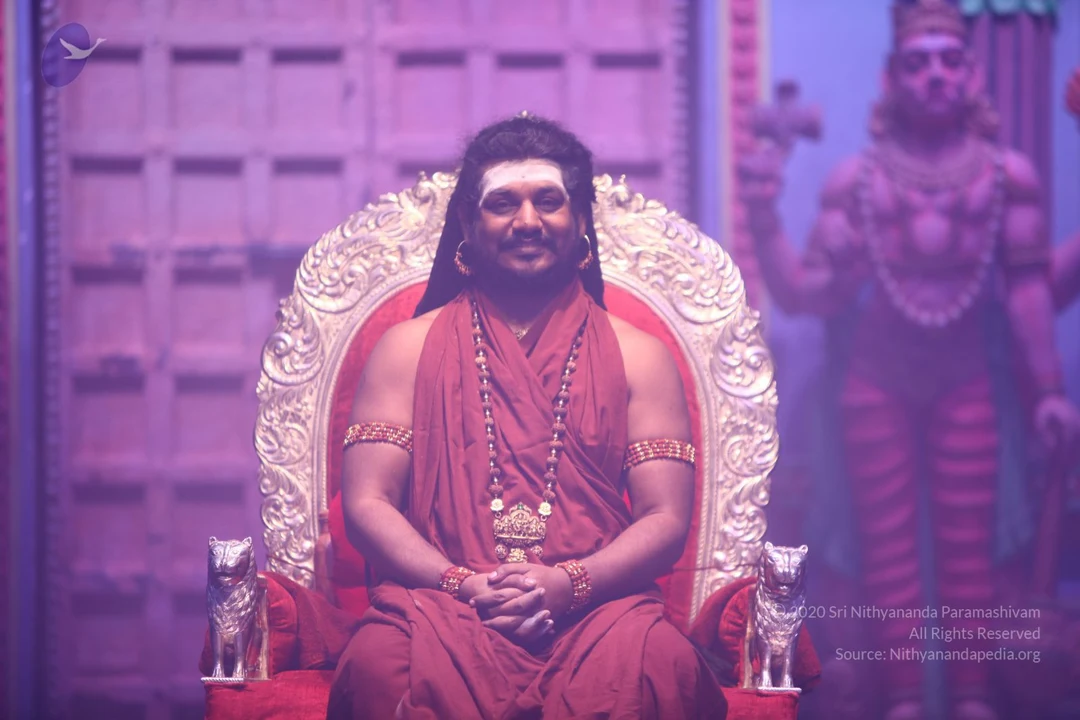
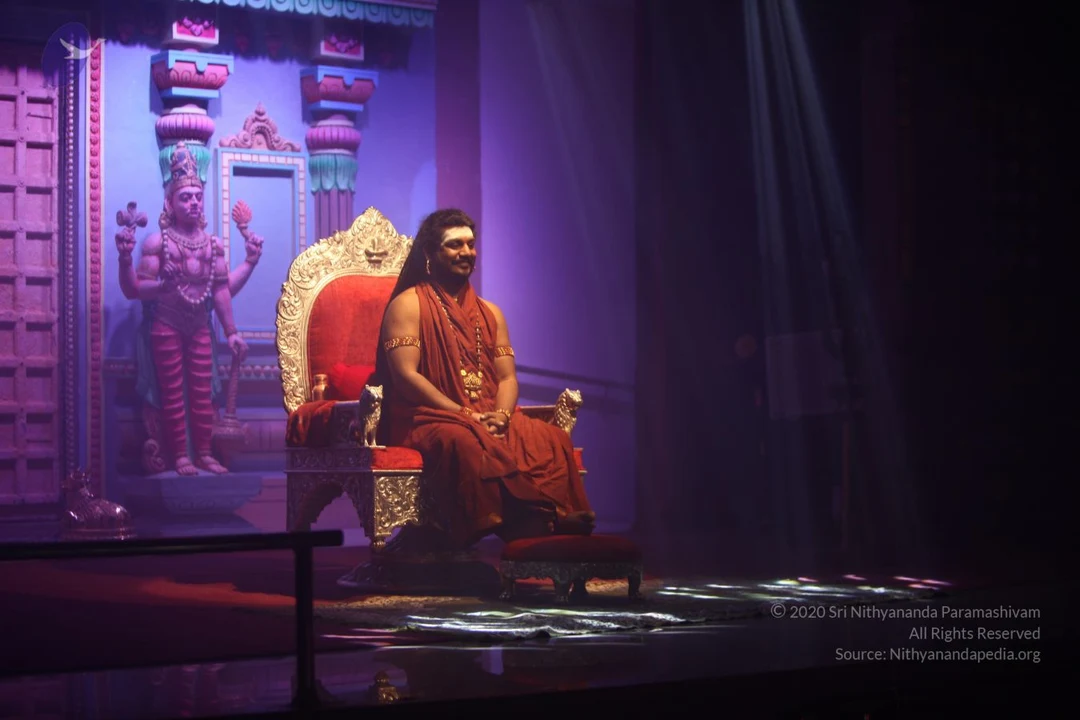
A seated man in saffron-orange robes sits on an ornate silver throne with a red cushion, centred on a purple-lit stage set with a carved wooden door and painted pillars. Two standing deity murti flank him, multi-armed figures with garlands and red lotus-like objects. A foreground lamp stand holds lit oil lamps, and light haze fills the air. A long rudraksha-style mala and gold necklace hang on his chest; his long hair is swept back.A seated man in saffron-orange robes sits on an ornate white-and-red throne on a stage set with carved pink and turquoise temple-style pillars and a large wooden door behind him. Two standing deity statues flank the throne, each with multiple arms, a crown and beaded necklaces, one holding a lotus. Purple stage lighting and haze fill the scene, with small lion or dog figures at the throne's base and a red footstool in front. A rudraksha-style mala and gold necklace are visible on the seated man.A seated man in saffron-orange robes sits on an ornate silver throne with red cushioning and lion figures at its arms, centred on a stage lit with violet light and bright yellow beams. He wears a long rudraksha mala and a gold necklace, and rests his hands in his lap. Before him is a small red-and-gold cushioned footstool on a patterned rug. Behind him stand two painted deity figures with multiple arms holding objects, flanking a carved wooden door set within pink and blue temple-style pillars. A dark silhouetted arm reaches in from the right edge. Swamiji (probable): the seated figure has long swept-back hair, saffron robes, rudraksha mala and ceremonial gold necklace, seated on a throne during a satsang stage setting.A seated man in an orange-saffron robe sits on an ornate silver-and-red throne at the centre of a stage set with painted blue-purple pillars and a wooden door. He wears a rudraksha mala and a gold ceremonial necklace, with gold armbands and long swept-back hair, and rests his hands in his lap. Flanking him are two large painted deity murti figures holding ritual objects, and a lion-shaped figure sits at the base of the throne. A silhouetted person stands at the lower right edge of the frame. Swamiji (probable) appears as the seated figure on the peetha, with the probable cues being the saffron robe, rudraksha mala, gold necklace and long hair.A man seated on an ornate silver-and-red throne on a stage, wearing a saffron-orange robe, a rudraksha-style beaded mala and a gold necklace, with white forehead markings and long dark hair swept back. A red footstool sits before the throne. Behind him a painted temple backdrop shows two large painted deity figures with multiple arms holding ritual objects, flanked by purple and teal columns and a wooden door. Purple stage lighting fills the scene, and dark silhouettes of audience heads appear at the bottom edge. Swamiji (probable) is seated on the throne, identified by his distinctive long hair, saffron robe and ornate beaded necklace.A seated man in rust-red robes and a red turban with a yellow plume sits cross-legged on a white ornate throne-chair during a satsang on a stage. He wears a rudraksha mala and a gold necklace, and raises one hand in a blessing gesture toward a microphone on a stand. Two painted standing deity murti flank him, holding ritual objects, in front of a carved wooden door with a red curtain above. A small stool with a red cushion and a framed photo sits at his side, and a red footstool is in front of the throne. Light beams cut through the air. Probable Swamiji cues: red-and-saffron ceremonial turban, rudraksha mala, gold necklace and ornate dress, seated on a throne. He is the sole visible person.

More Photos from IA Mandala Process

8 photosSource gallery
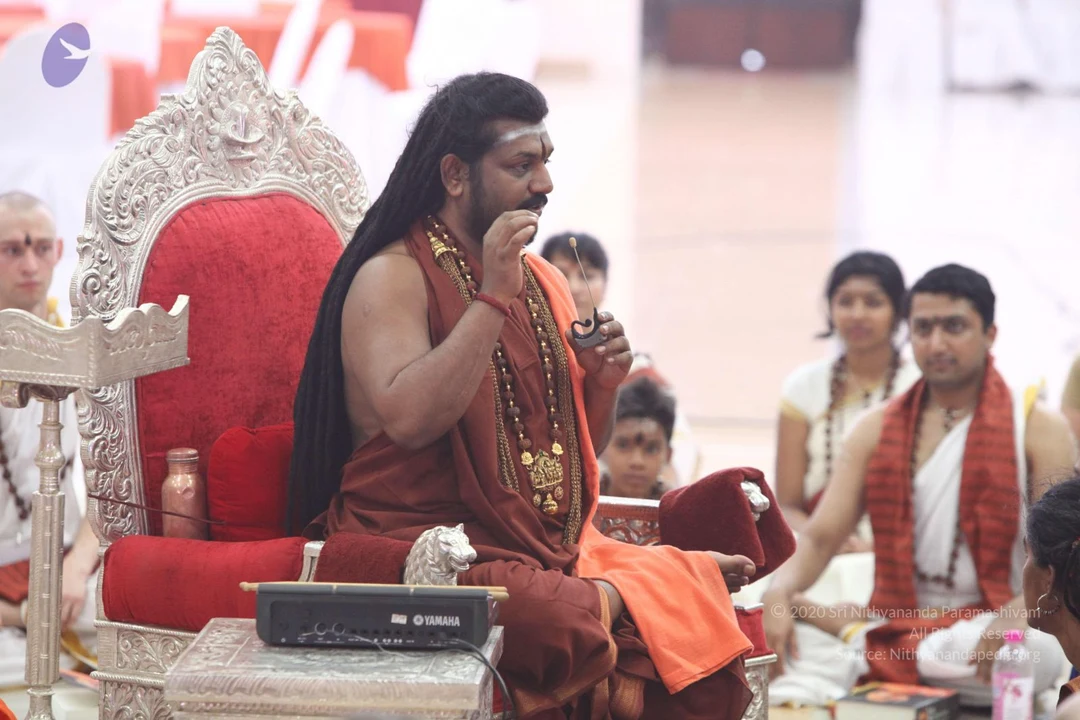
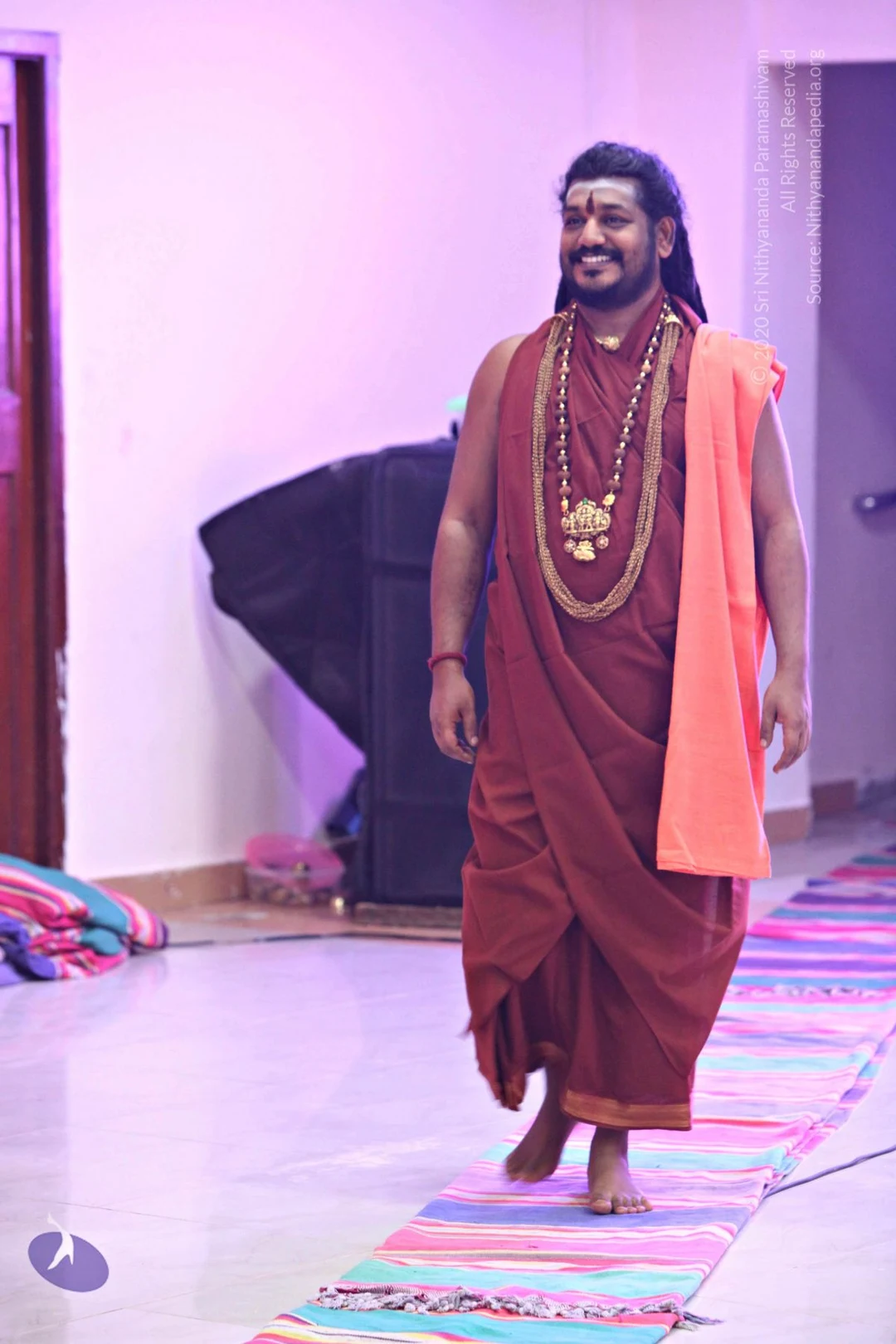
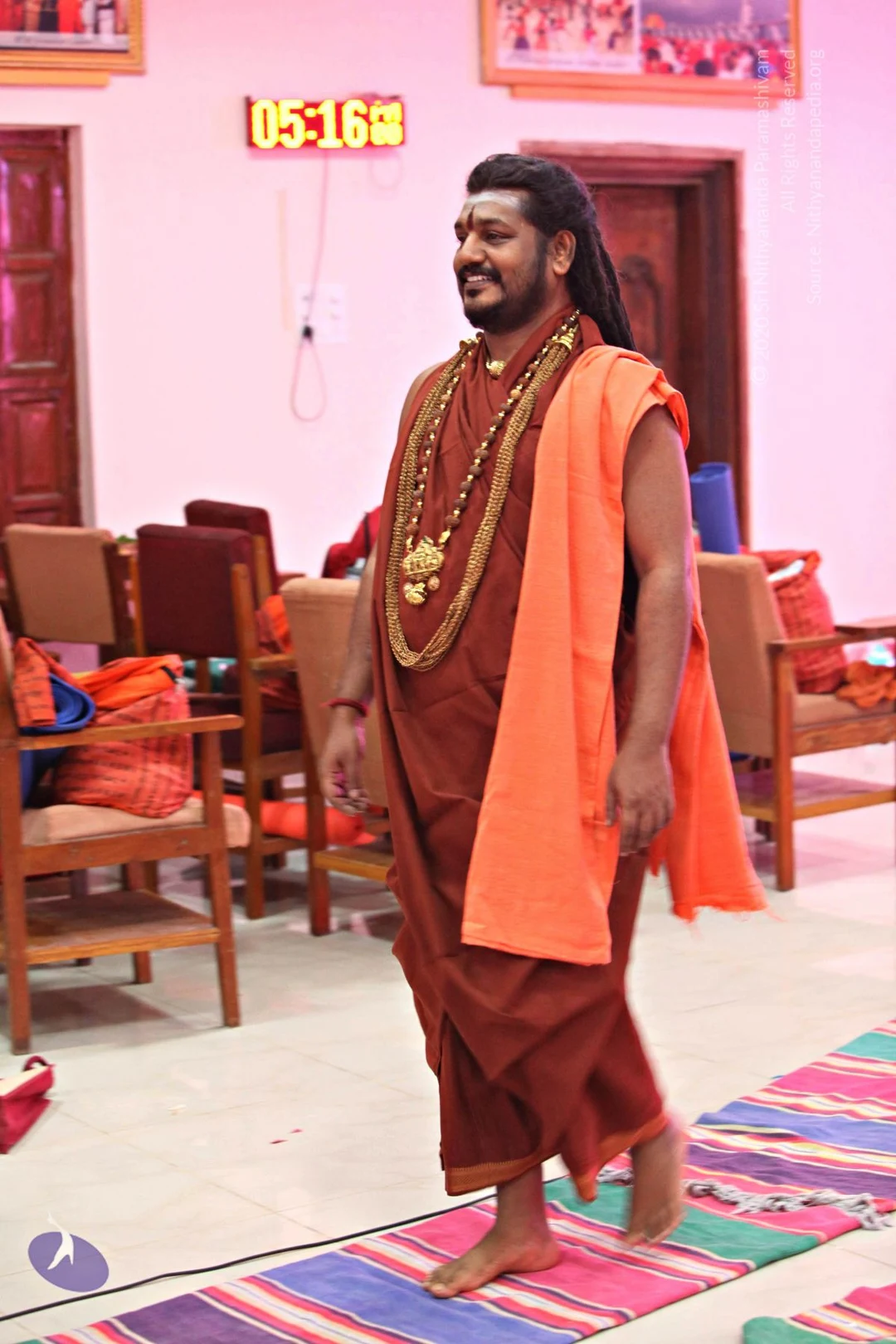
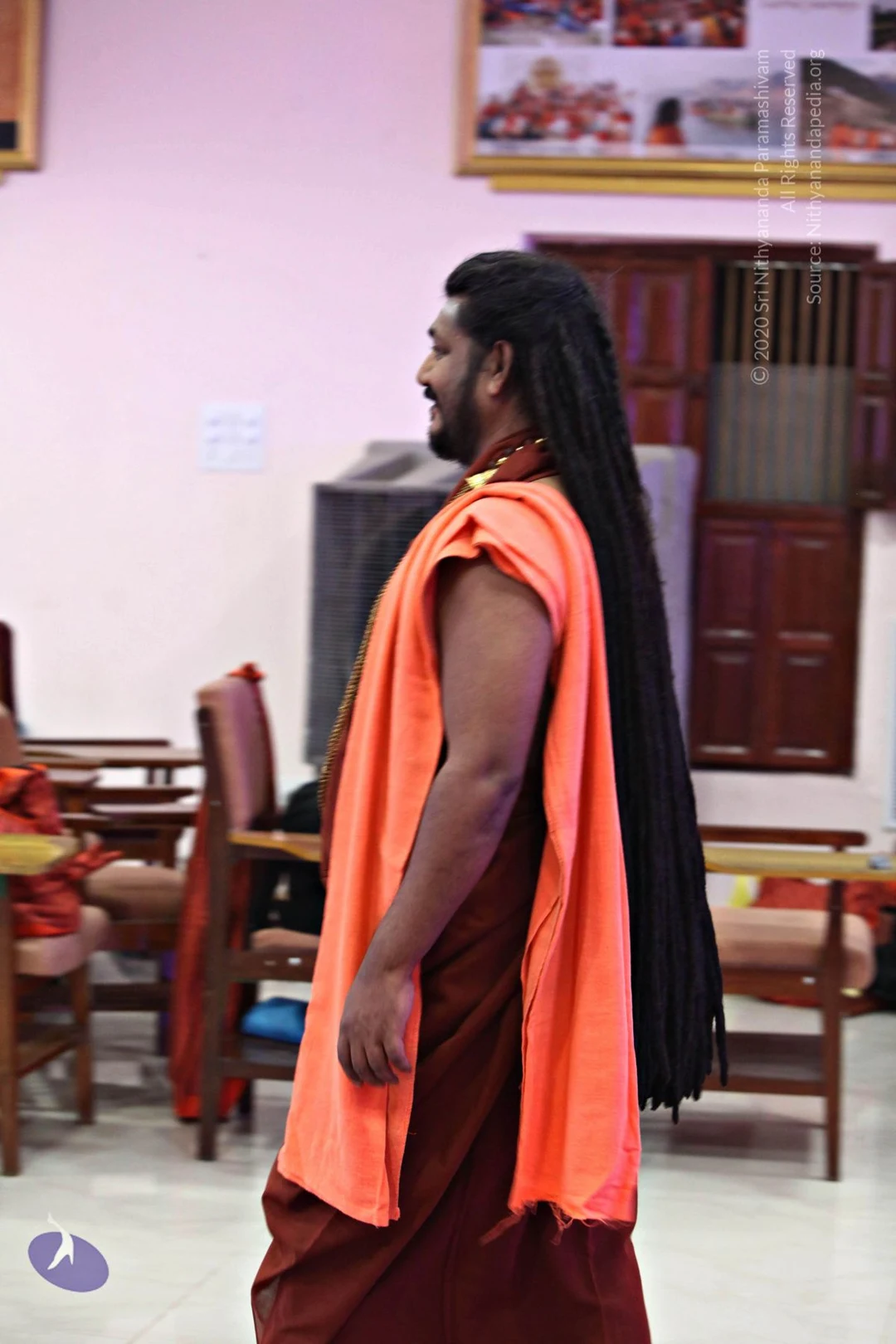
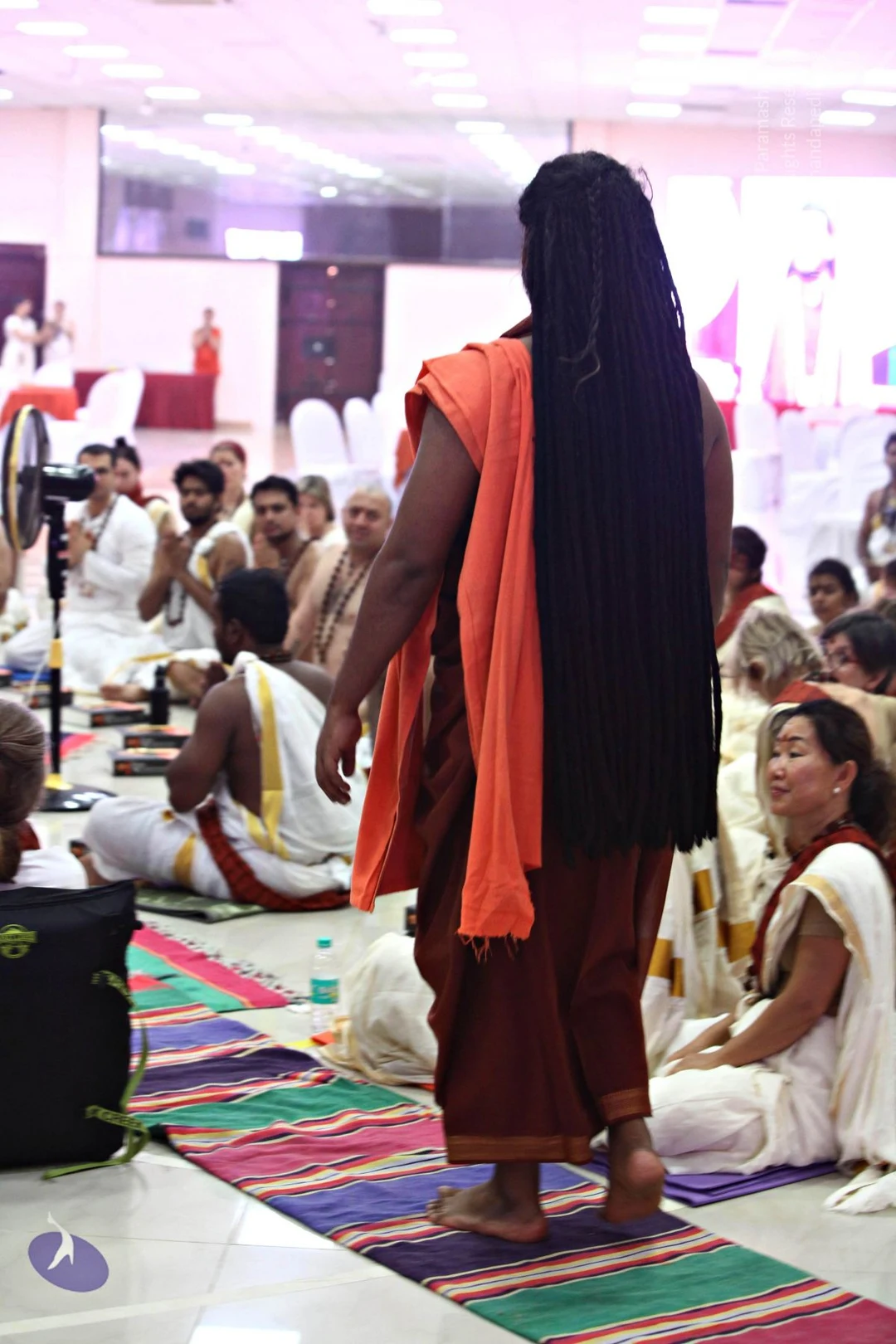
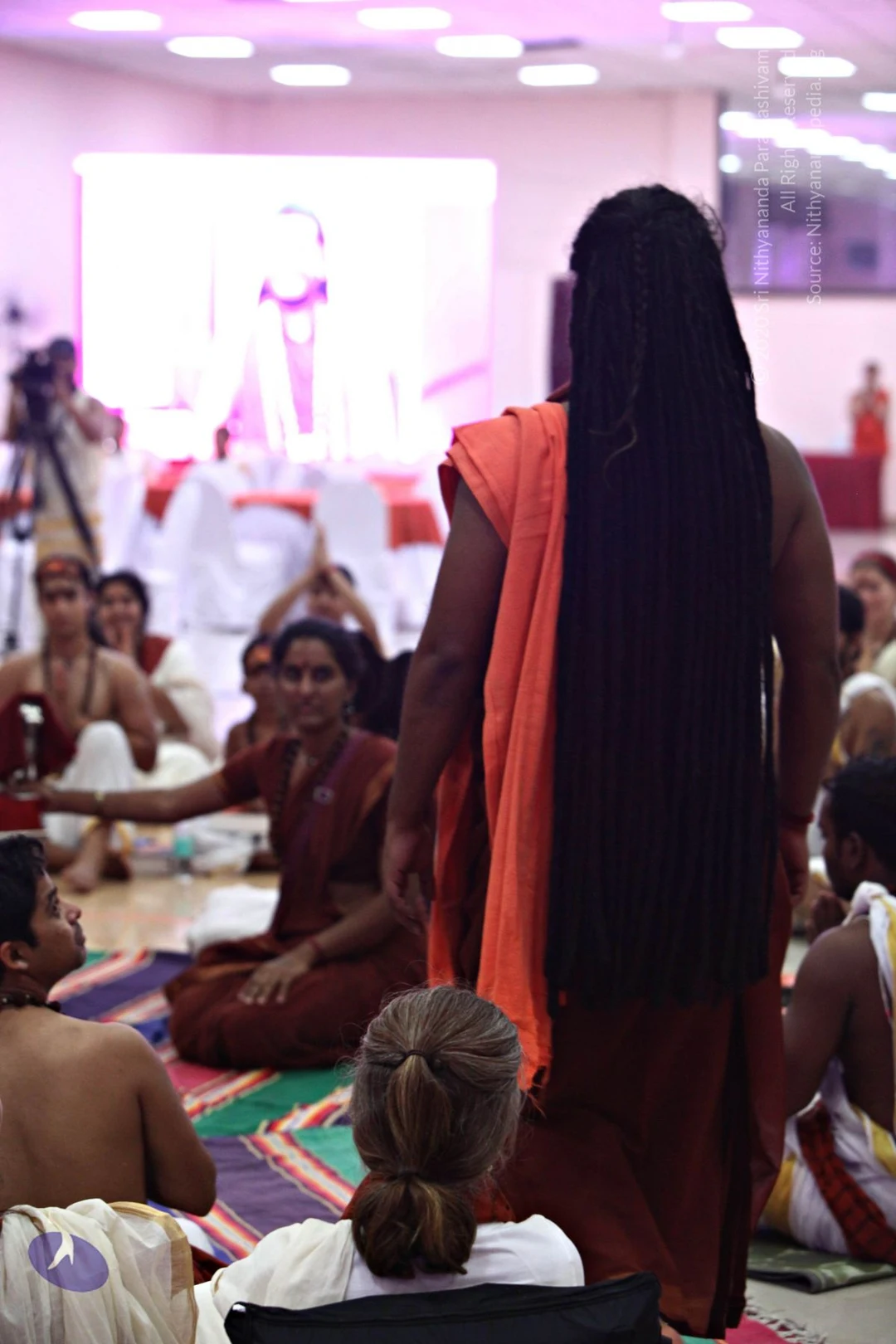
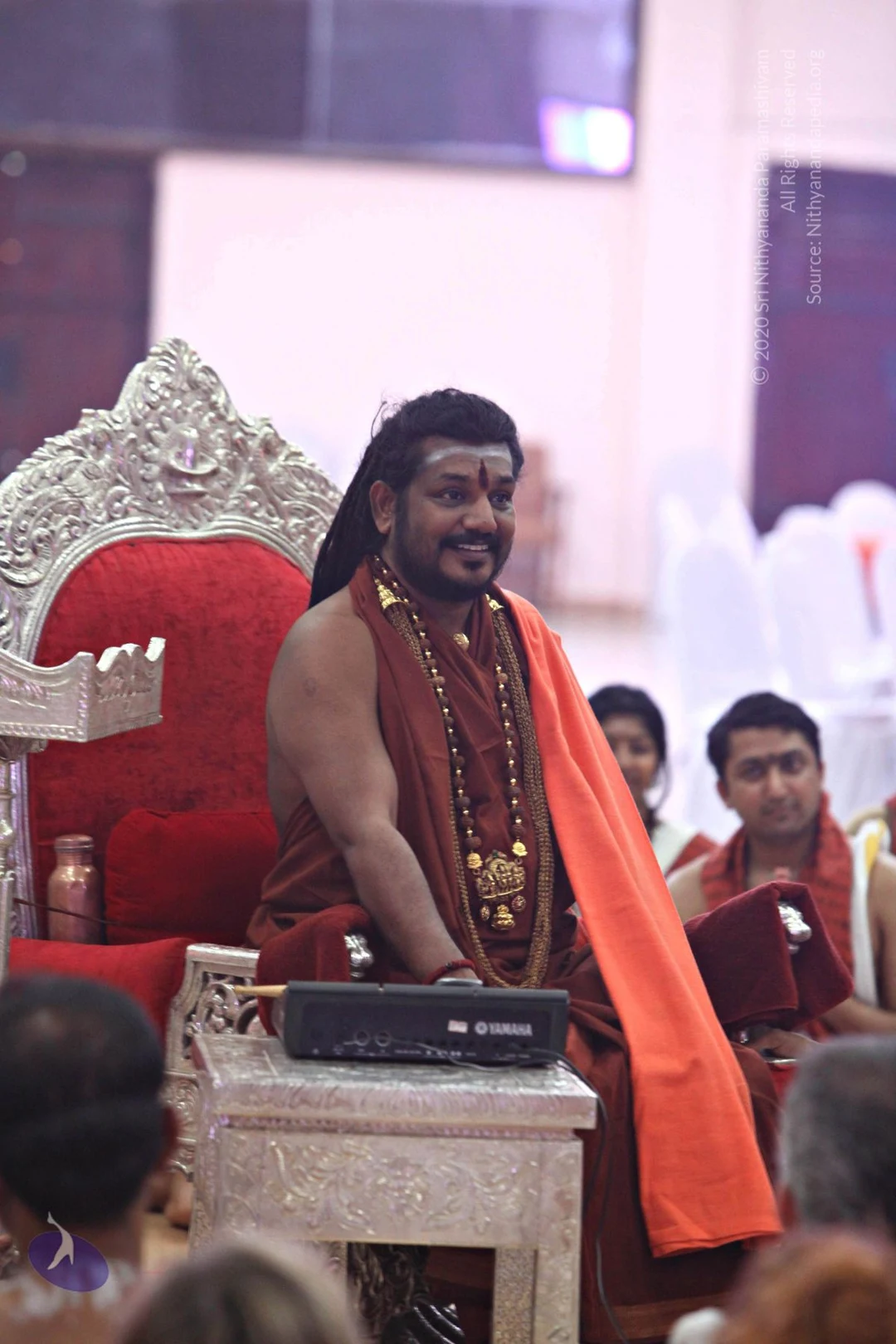
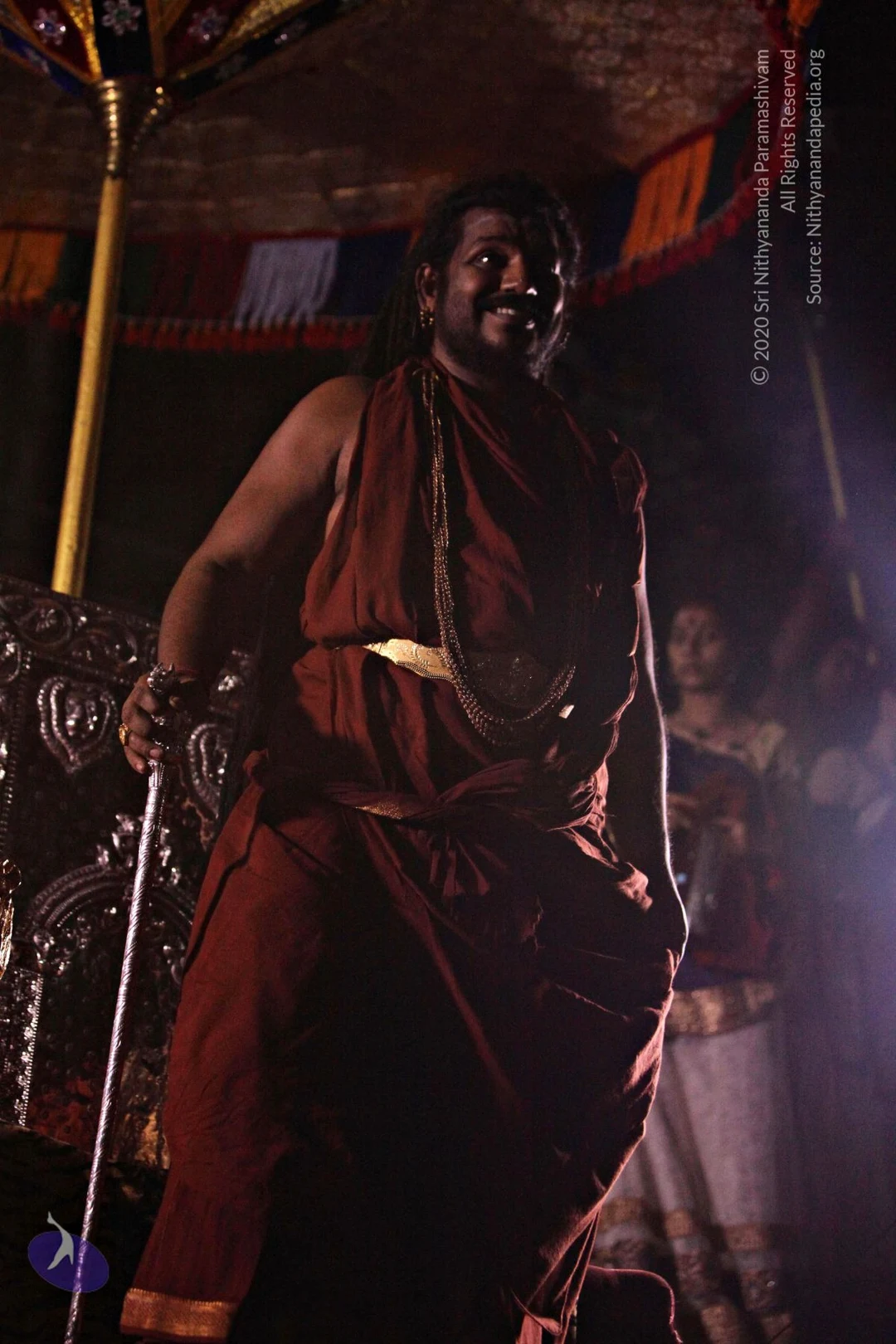
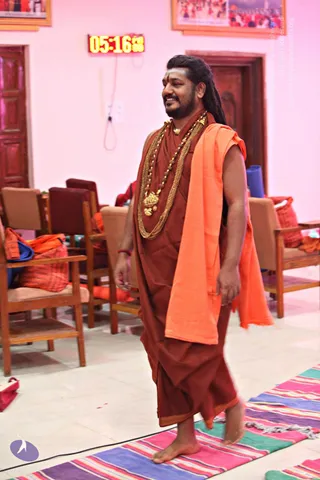
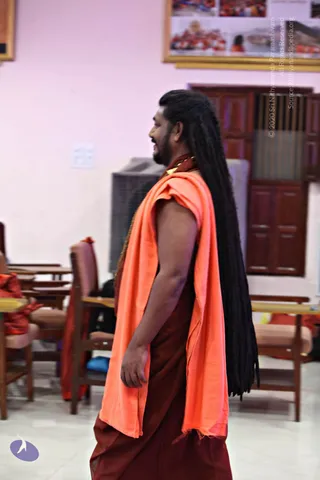
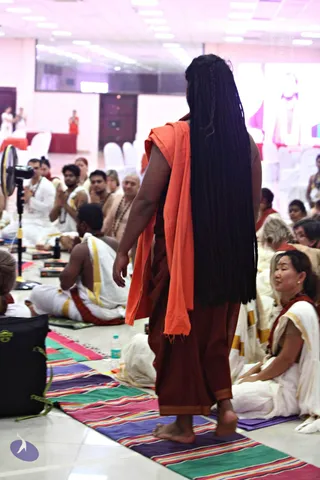
A barefoot man with long dark hair, a vertical red tilak on his forehead and a broad smile walks across a striped multicolour mat on a pale floor in a pink-lit room. He wears a maroon-brown draped robe with an orange shawl over one shoulder, layered gold and beaded rudraksha-style malas, and a gold pendant with a deity-like motif. A dark cabinet and a folded striped cloth are visible behind him.A barefoot man with long dark dreadlocks and a beard, wearing a rust-brown sleeveless robe with an orange shawl draped over his shoulder, walks across striped pink, blue and green mats in a room with wooden armchairs and a red digital clock showing 05:16. He wears multiple gold chains with rudraksha beads and a gold pendant, and a tilak on his forehead. Pink walls display framed photographs behind him.A man in profile walks through an indoor hall with pale pink walls, wooden cabinets and wooden chairs with pink cushions behind him. He has very long, dark, dreadlocked hair falling down his back, a beard and a gold-toned necklace. He wears an orange shawl draped over his shoulder and arm over a rust-brown dhoti. Framed photographs hang on the upper wall and another seated person in orange is partly visible at the left edge.A man with long, dark, dreadlocked hair and a beard walks through a seated hall beside a large white pedestal fan. He wears an orange shawl draped over one shoulder, a maroon-brown dhoti, and a gold chain at his neck. Behind him, rows of wooden chairs hold folded orange garments and books, and a framed sign hangs on the pink wall above. A white plastic storage box sits on the floor near the fan.A barefoot man with very long dark hair, worn loose and braided at the back, walks away from the camera across a striped multicolour mat in a bright hall. He wears a rust-brown dhoti and an orange shawl draped over his shoulders. Seated devotees in white ritual clothes with yellow borders, some with rudraksha malas, sit on the floor on either side, many watching him. A man in white at left presses his palms together, and a woman in white with a red border sits at right.A man seated on an ornate silver and red velvet throne, smiling, with long dark hair, white and red forehead marks, a dark rust-coloured robe with an orange shawl draped over his shoulder, layered rudraksha malas and a gold pendant necklace. He sits behind a silver-engraved side table holding a black Yamaha device, with a copper water bottle beside the throne. Two seated devotees in red shawls are visible behind him, and white chairs fill the background hall. Swamiji (probable) is seated as the speaker, with the distinctive long hair, saffron shawl and rudraksha-gold necklace cues.

More Photos from Vishesha Deeksha
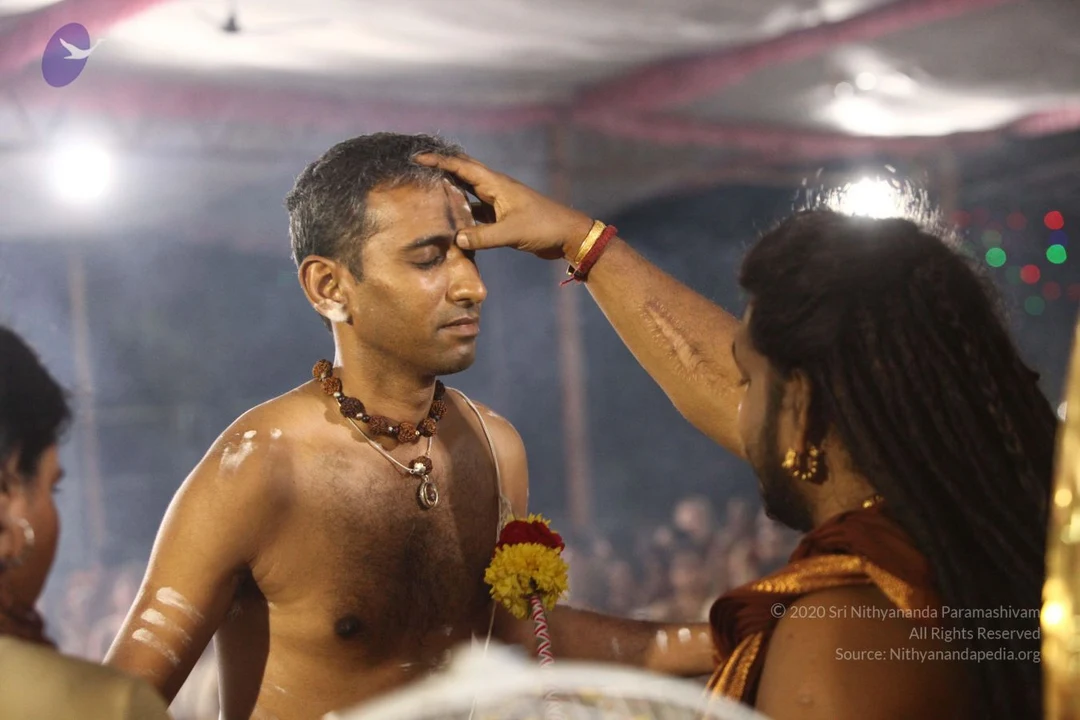
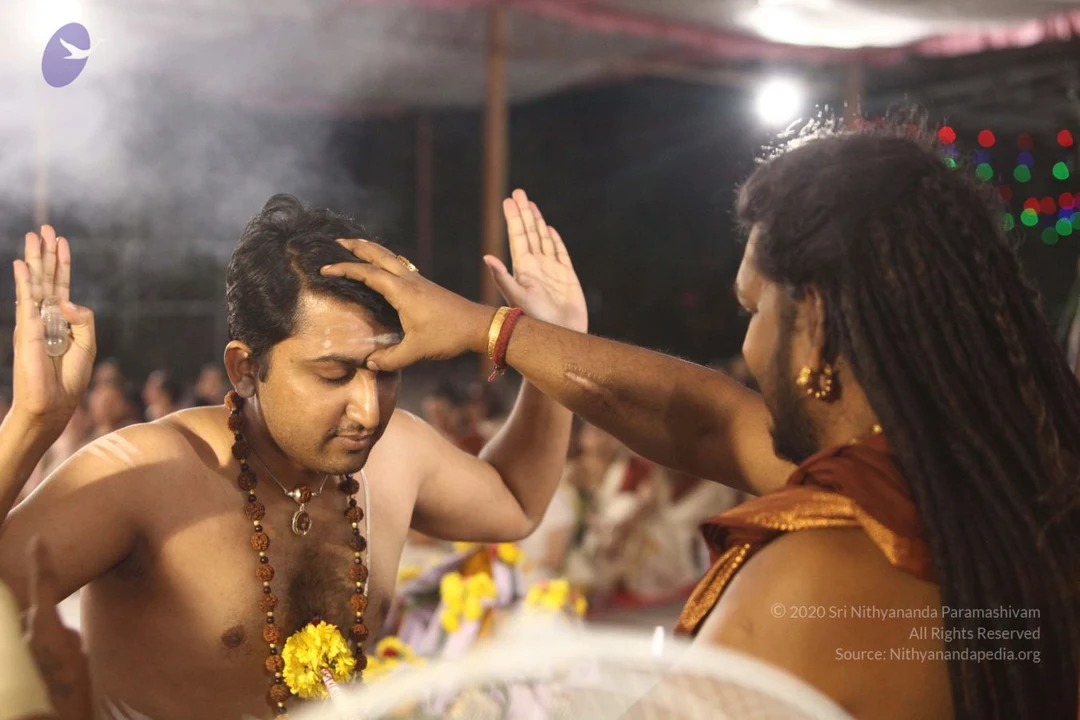
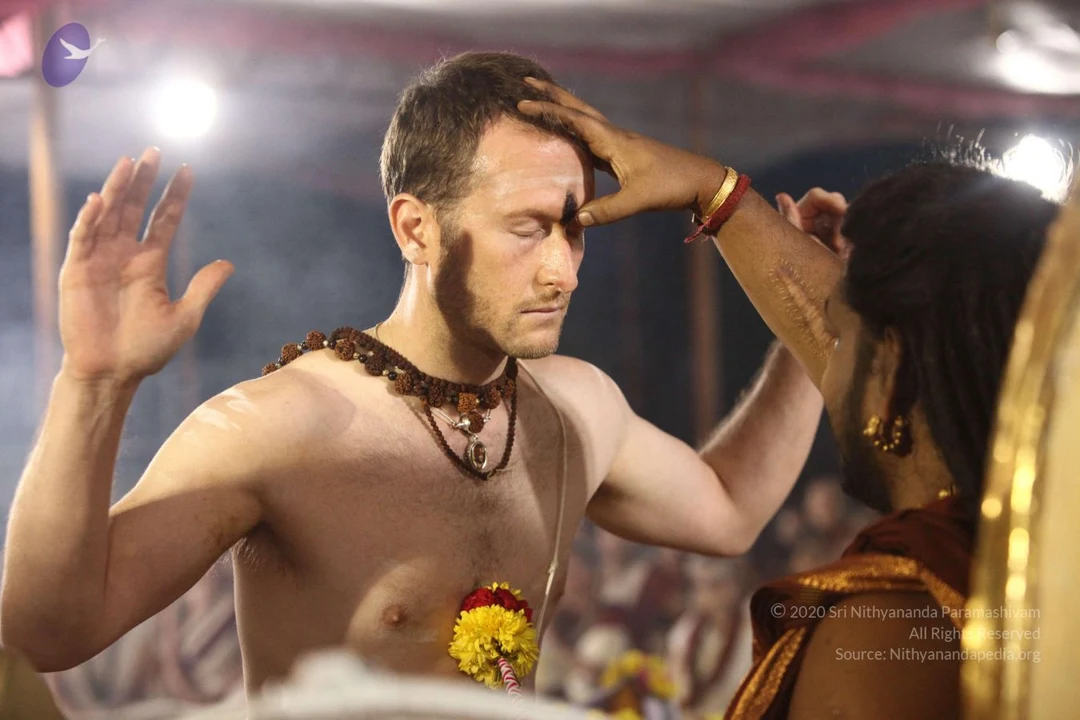
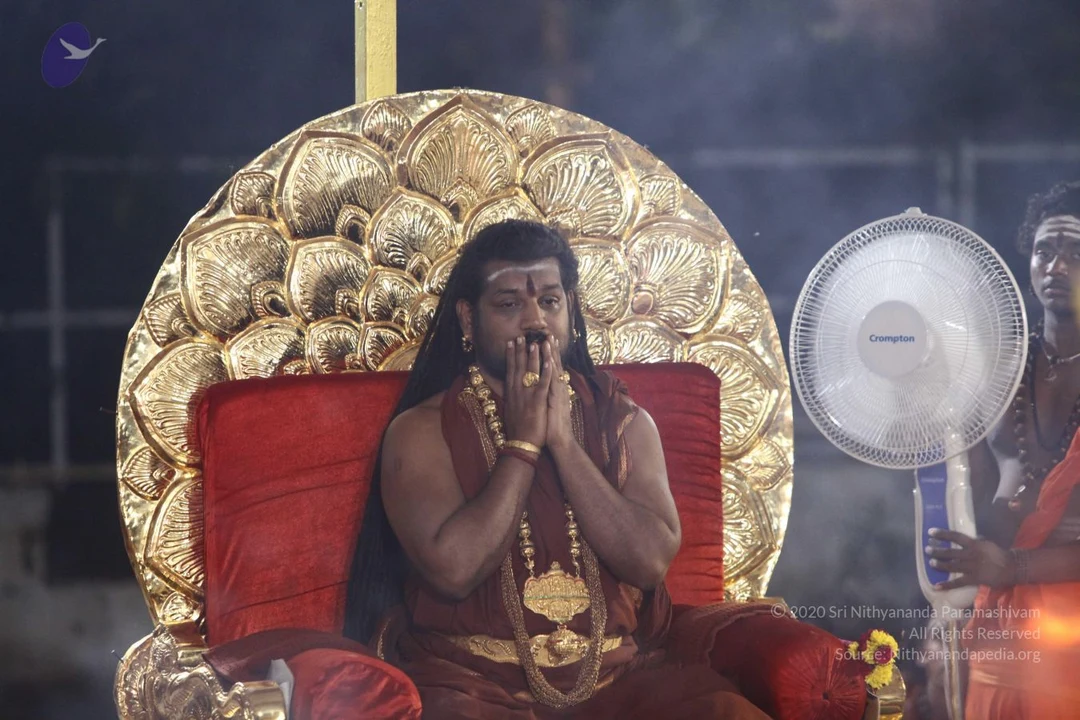
32 photosSource gallery
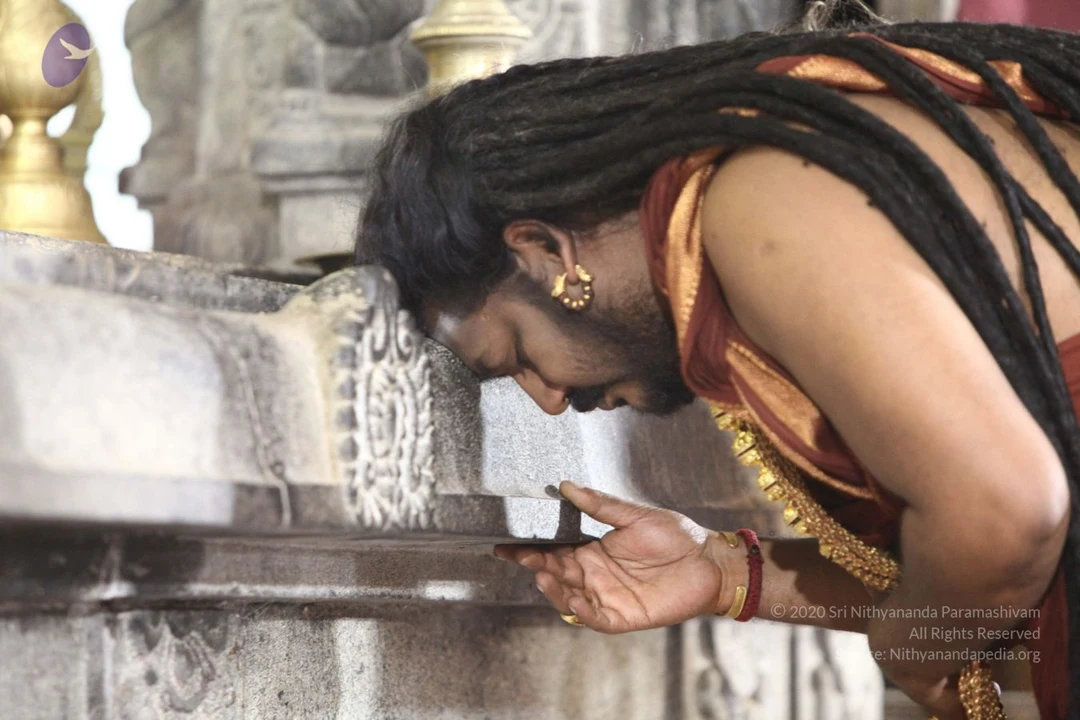
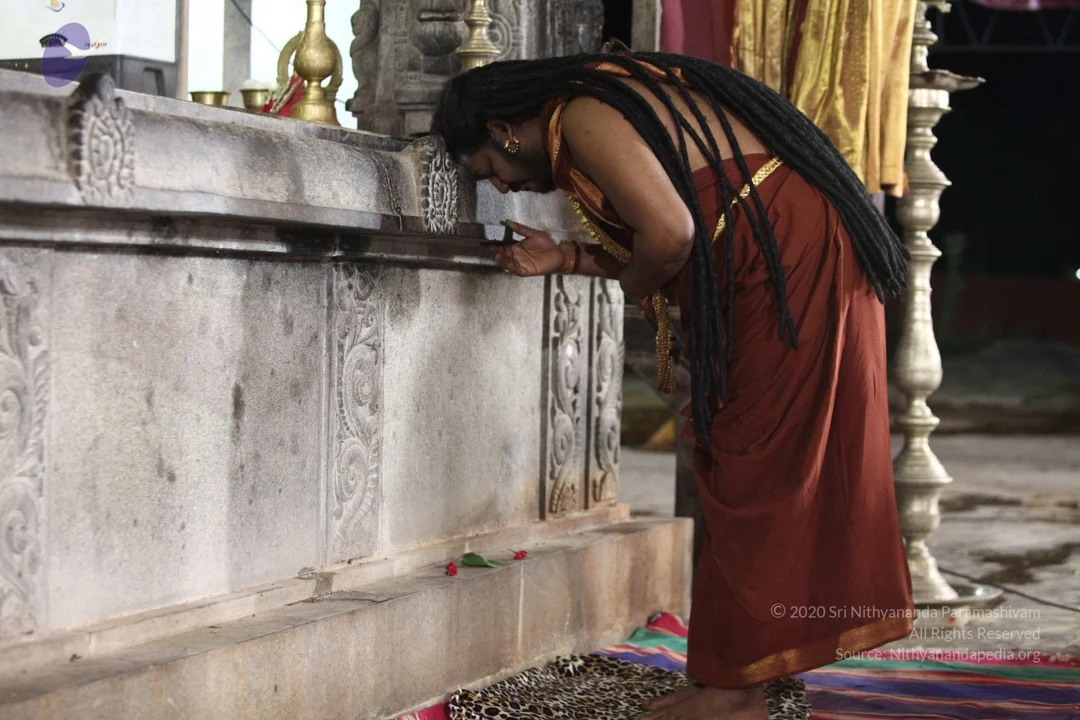
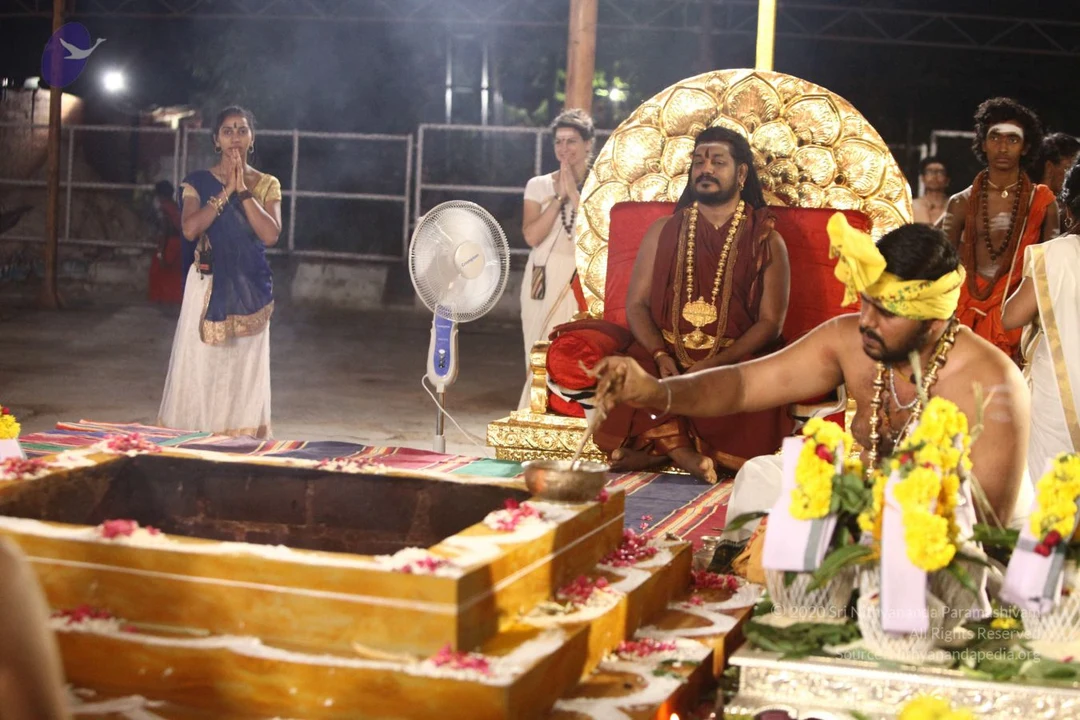
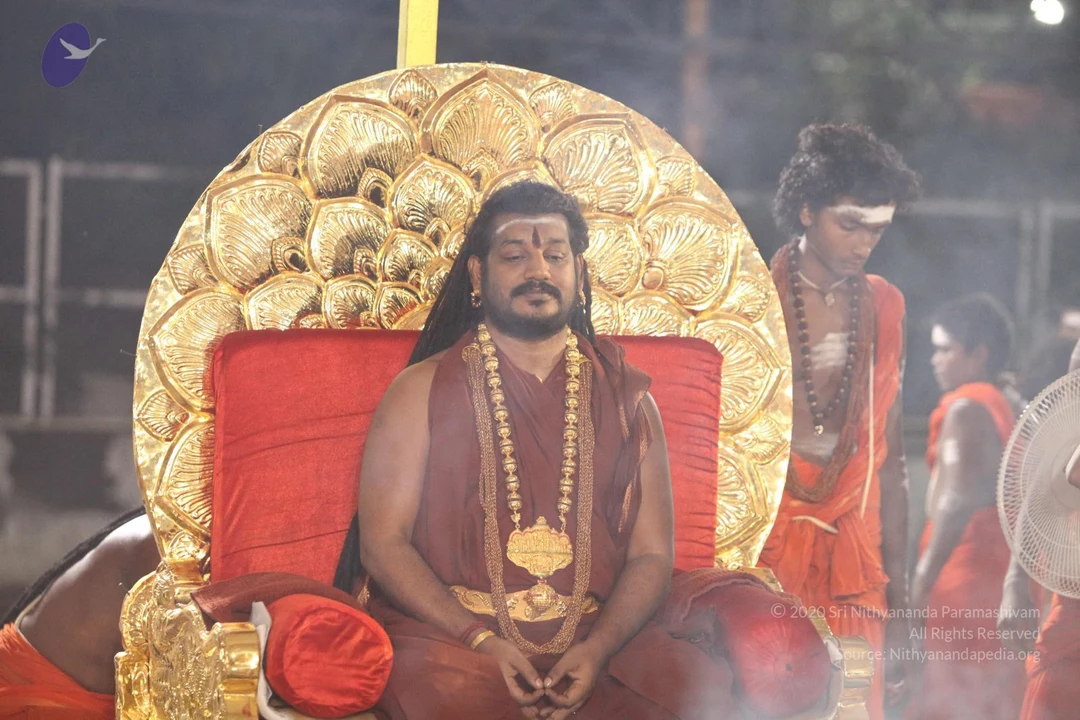
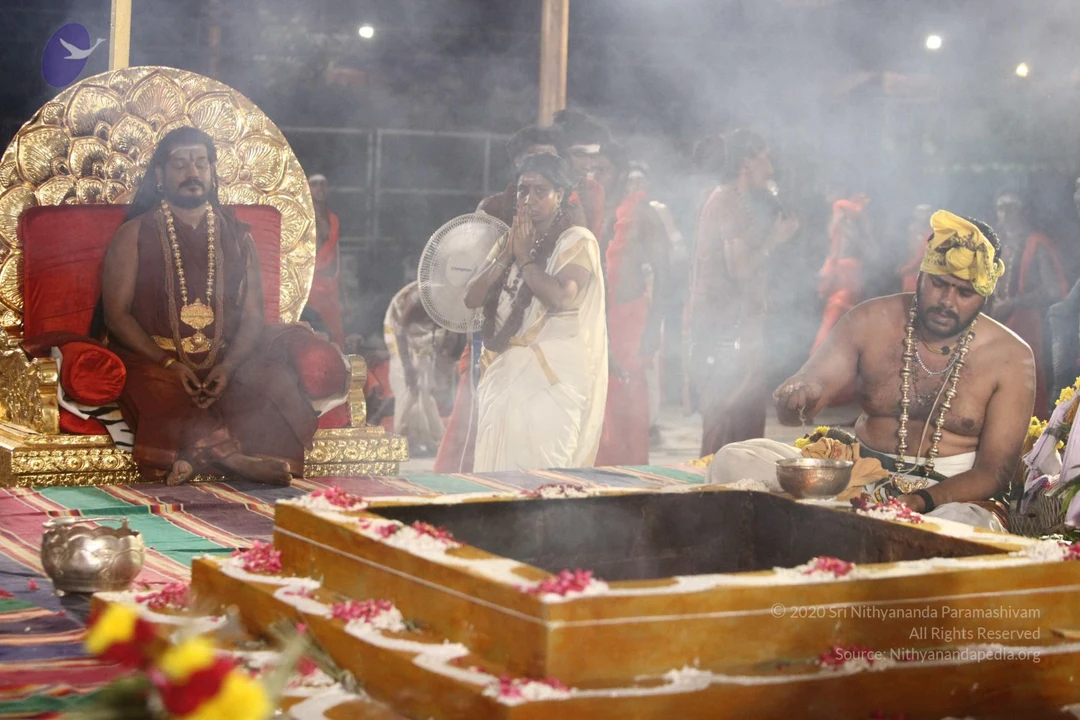
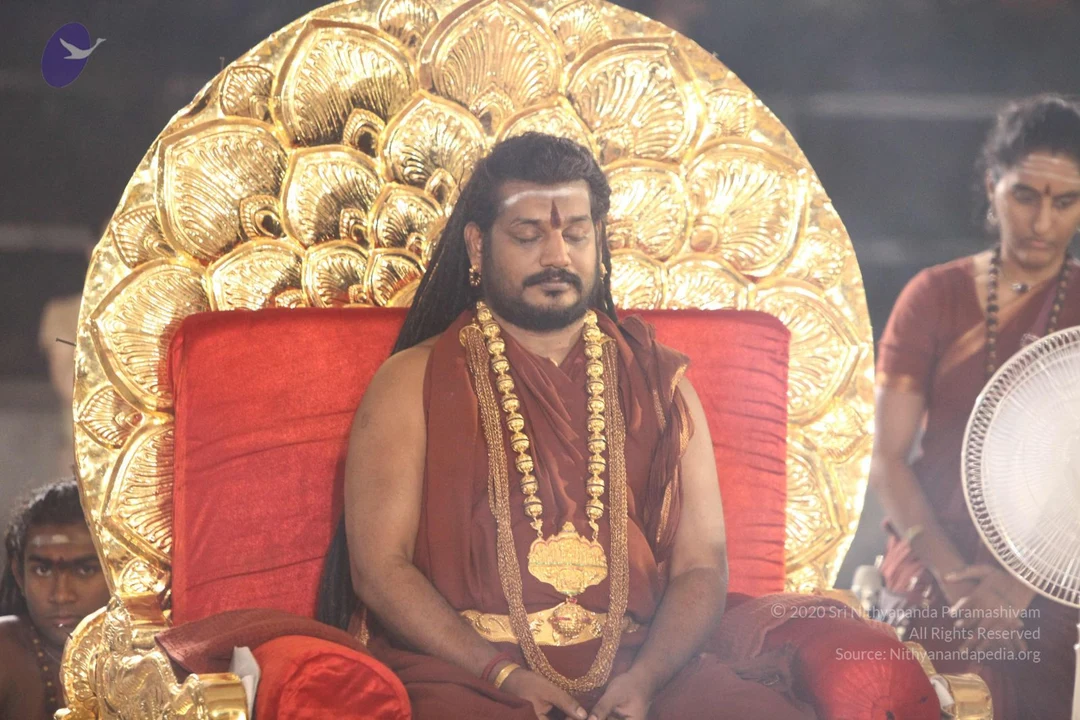
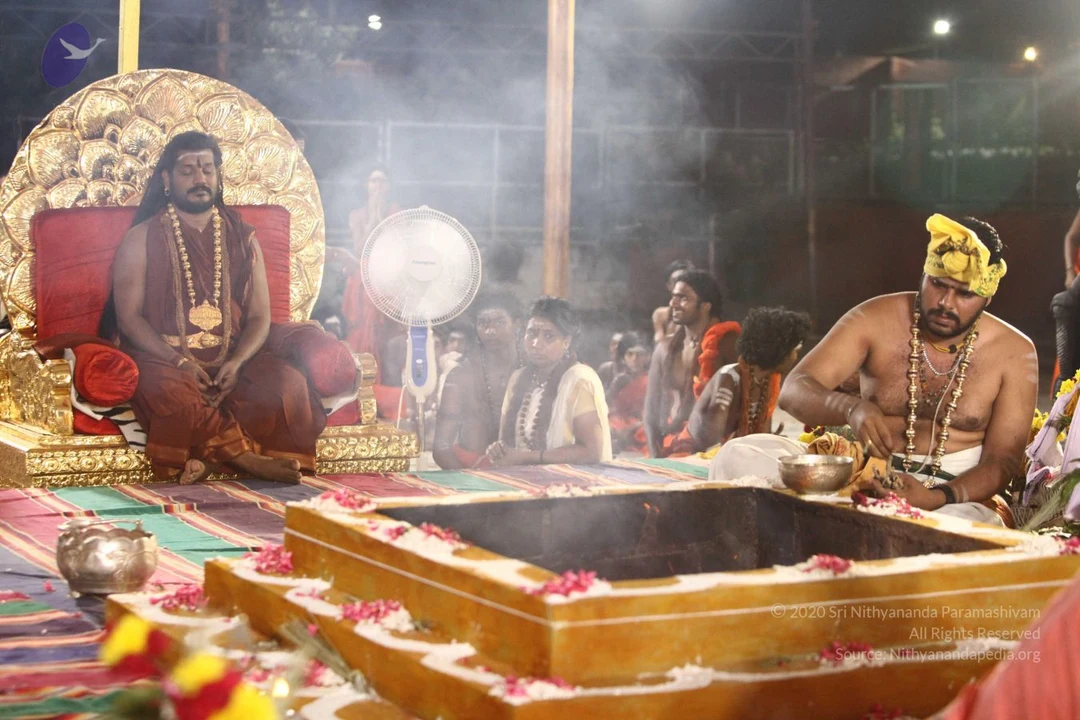
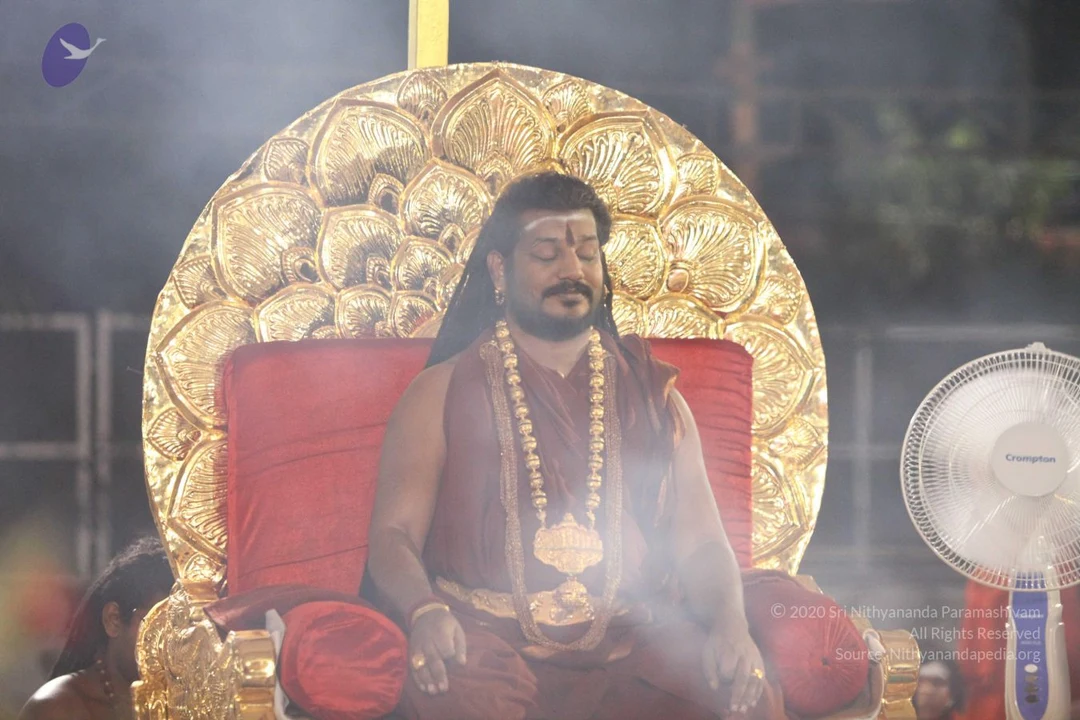
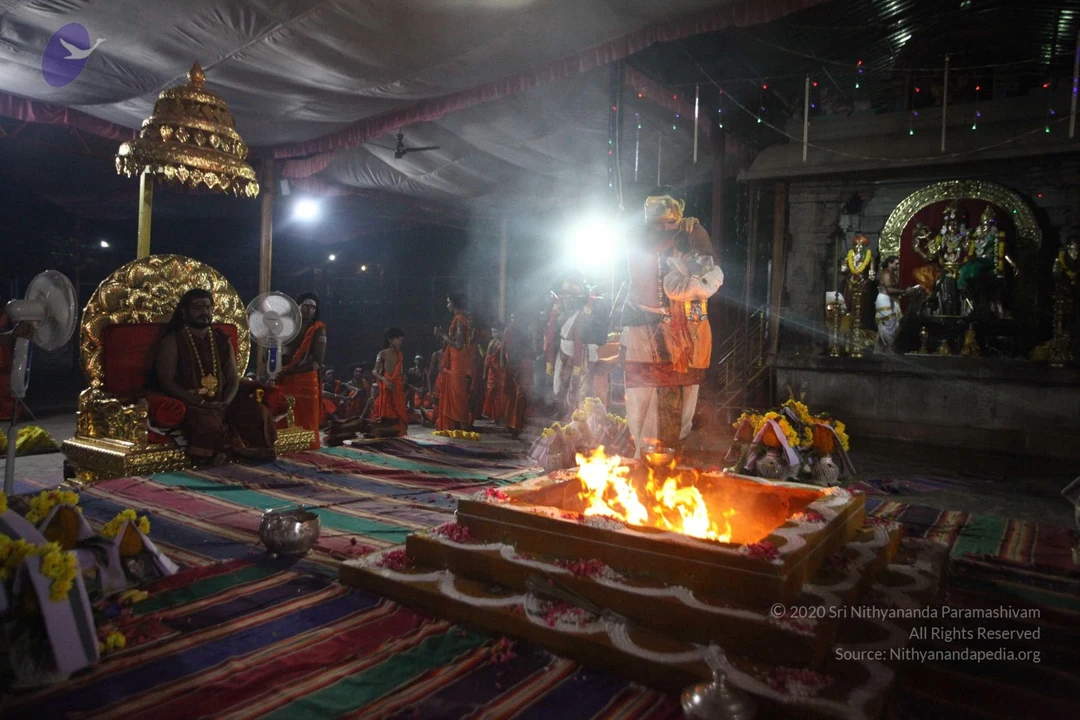
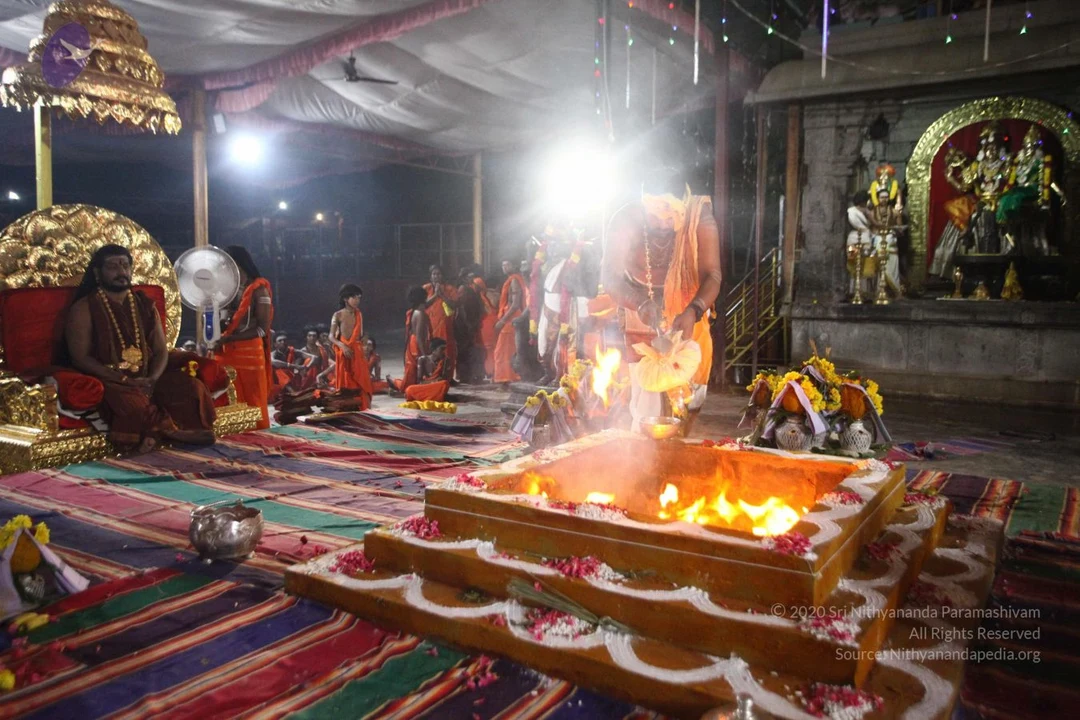
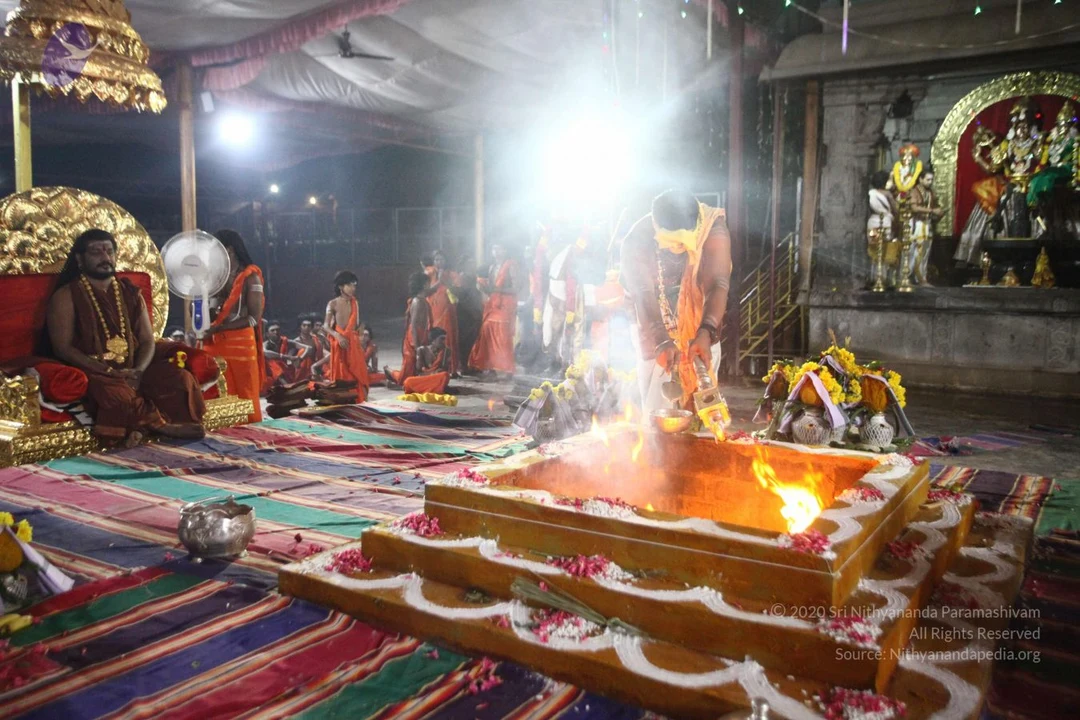
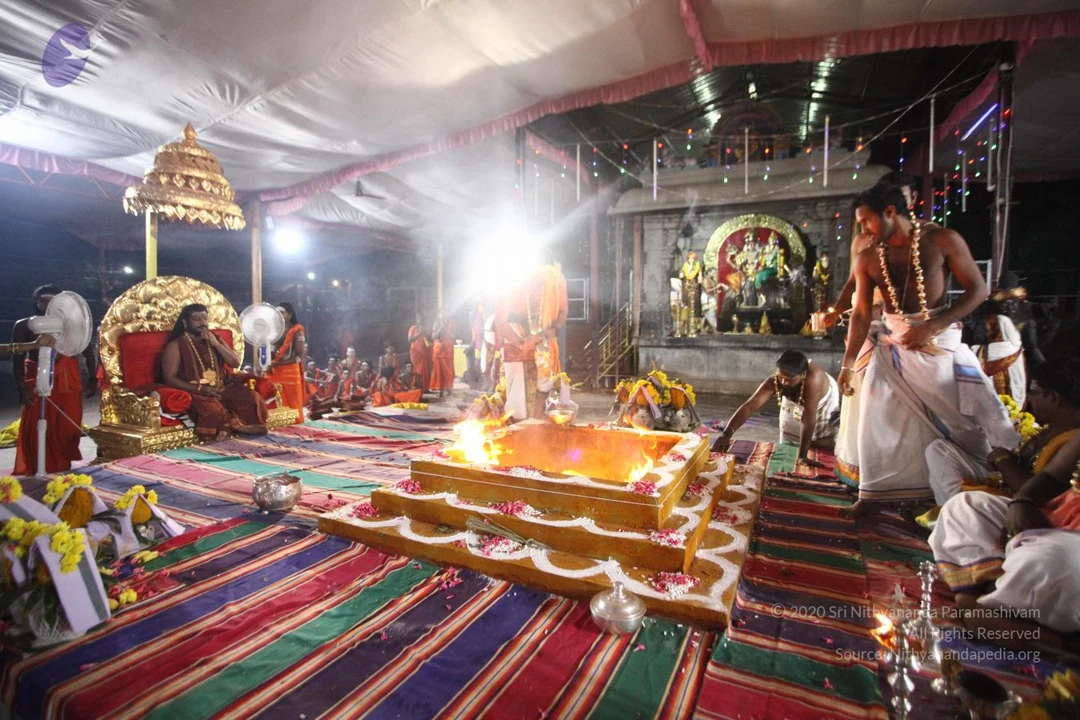
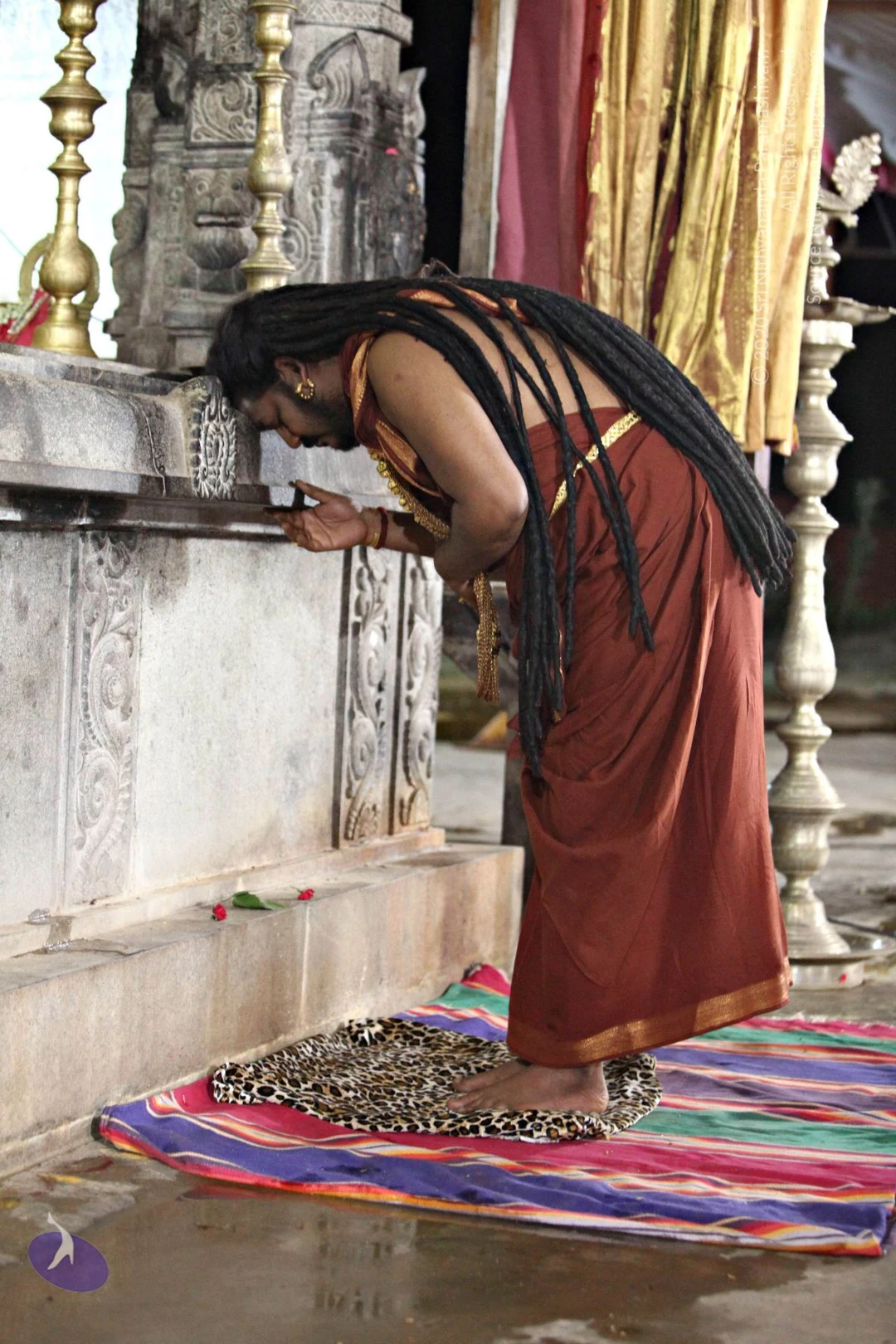
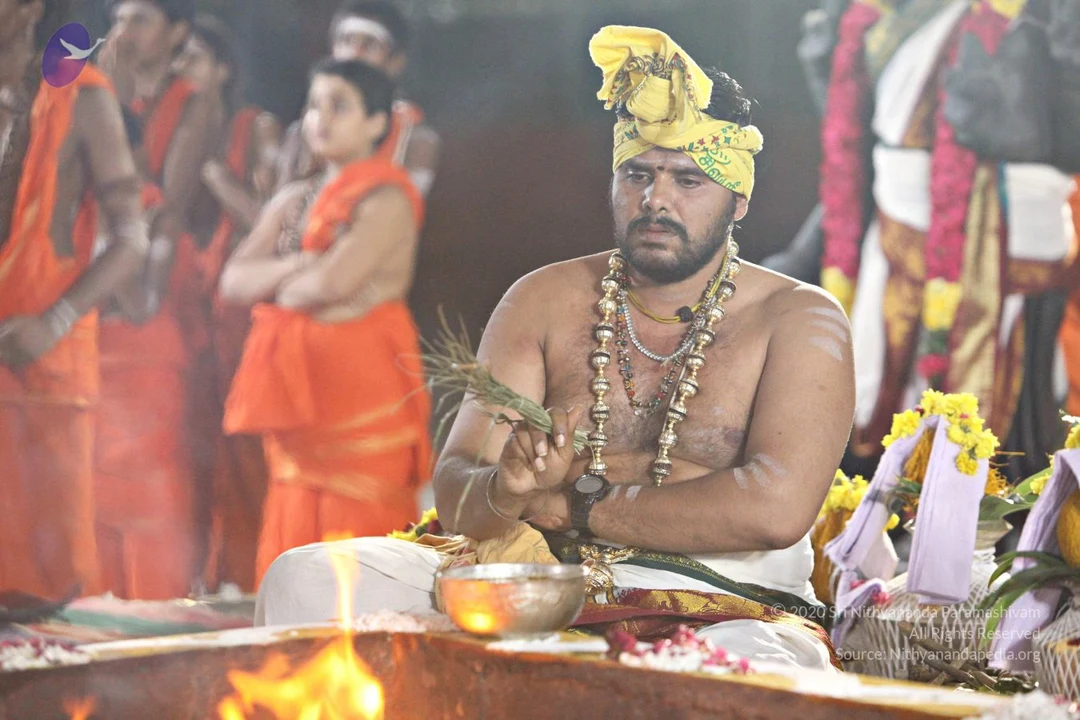
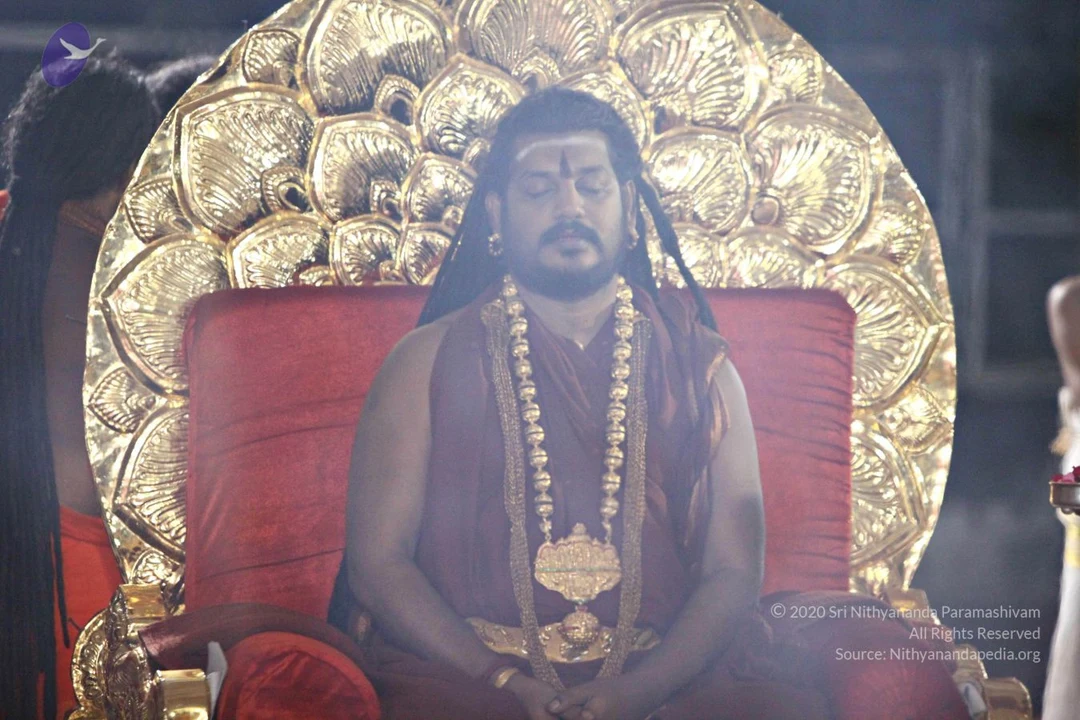
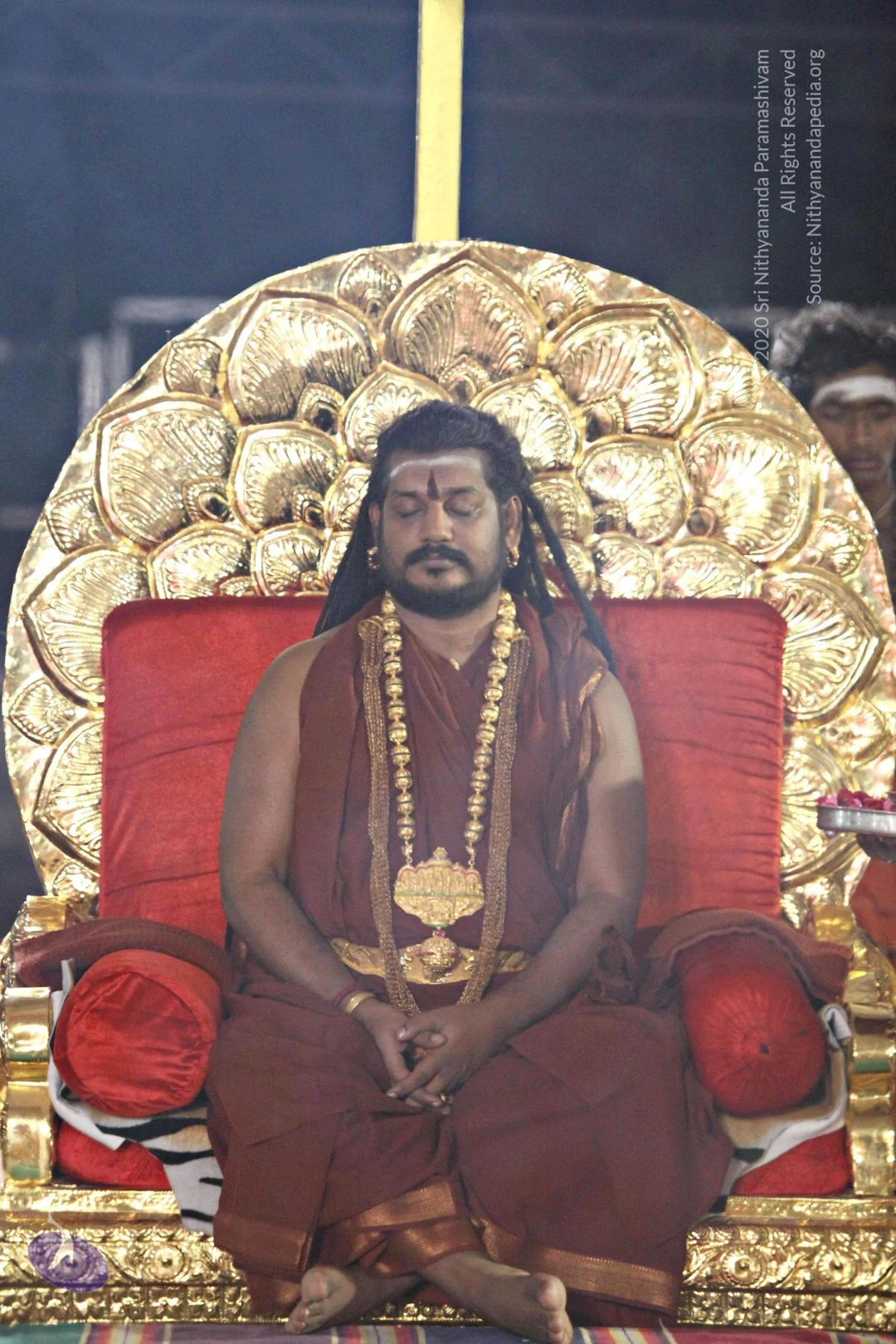
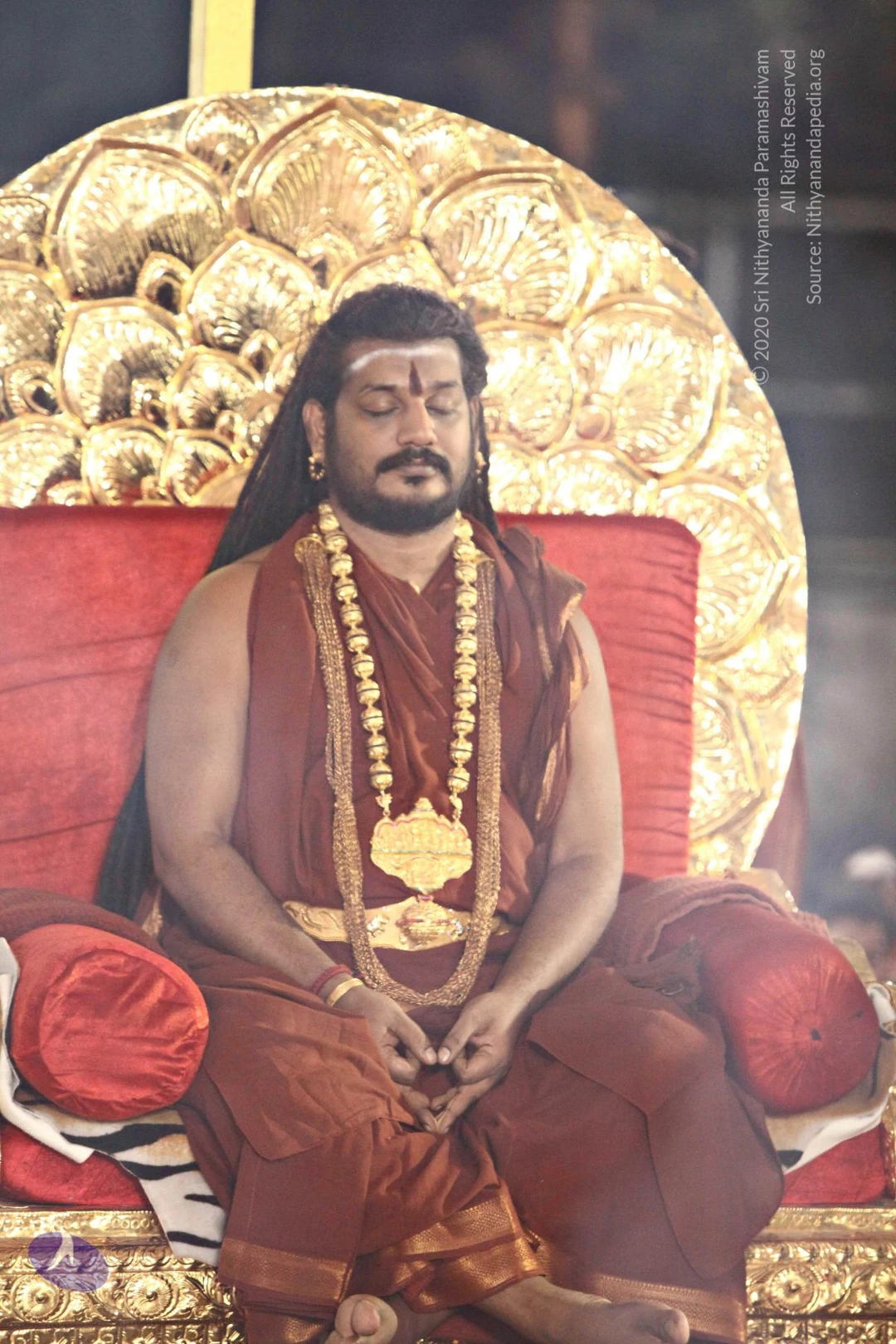
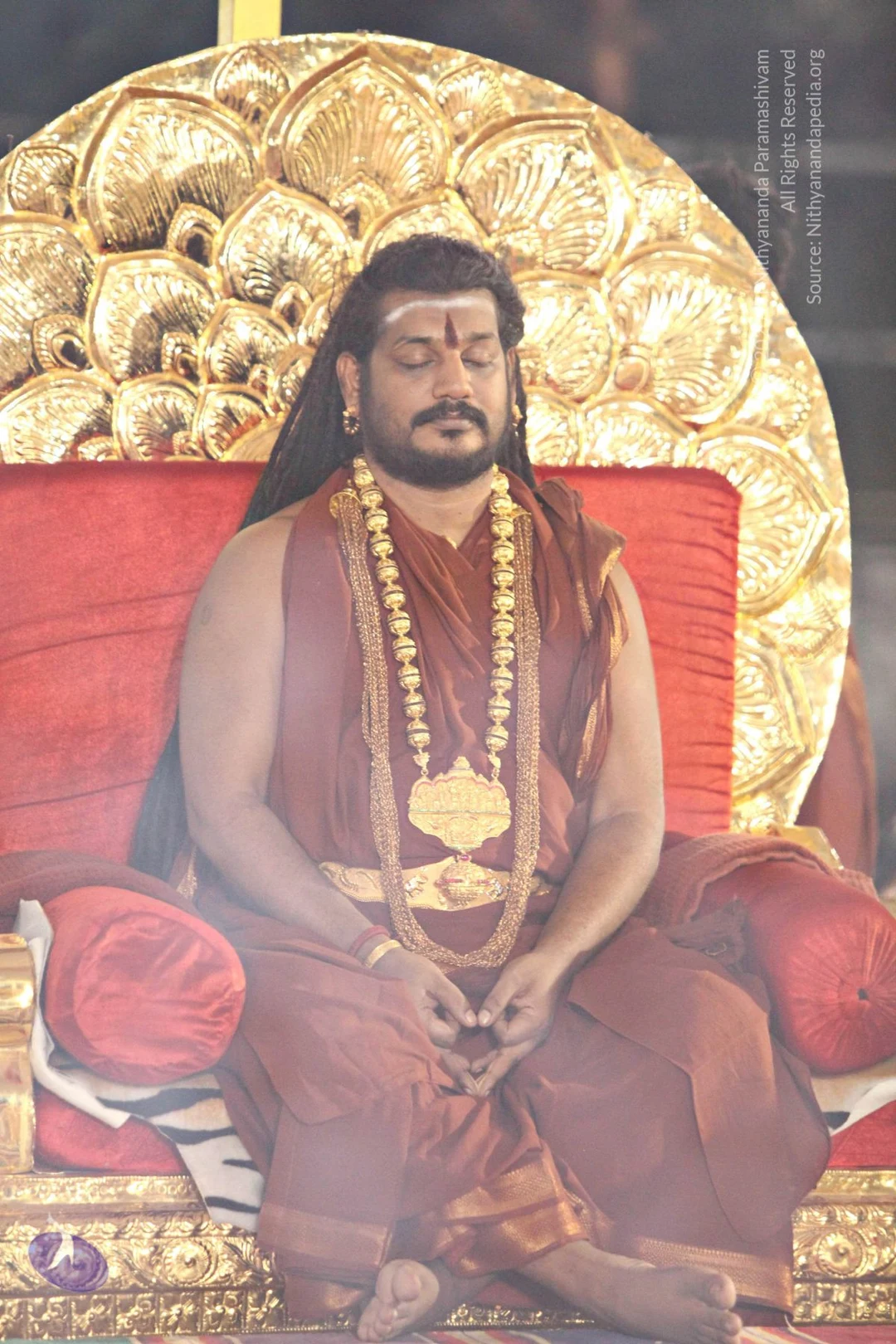
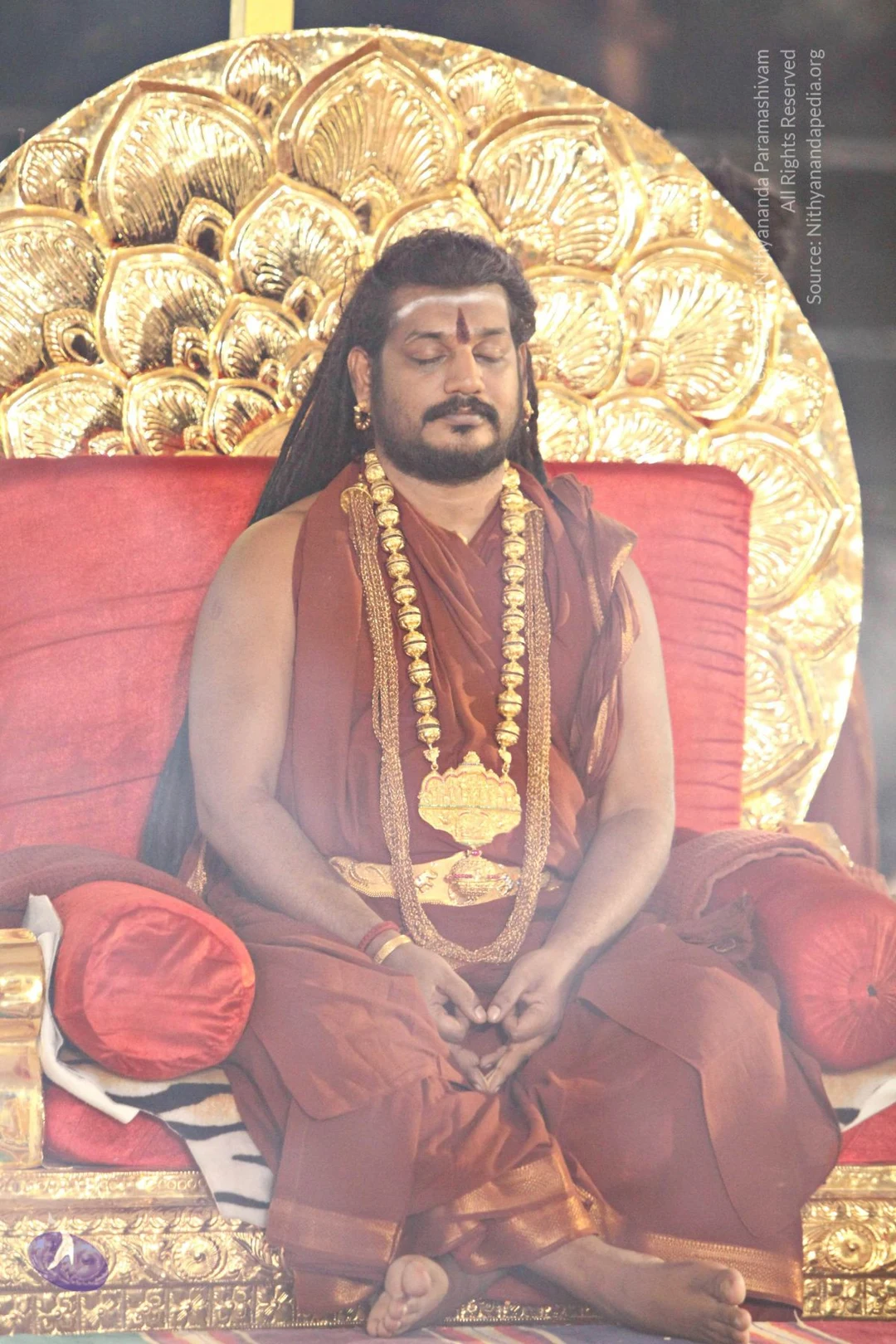
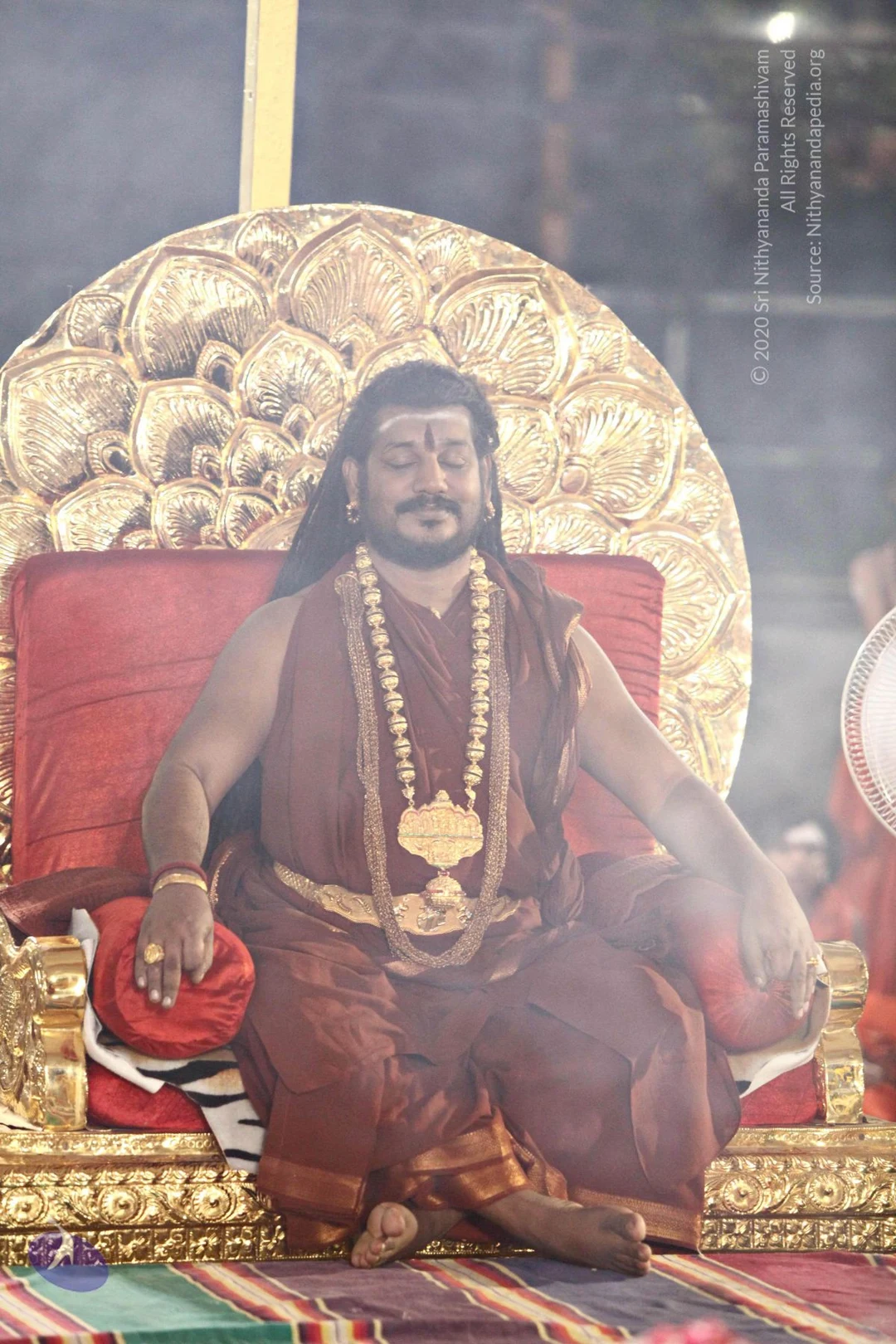
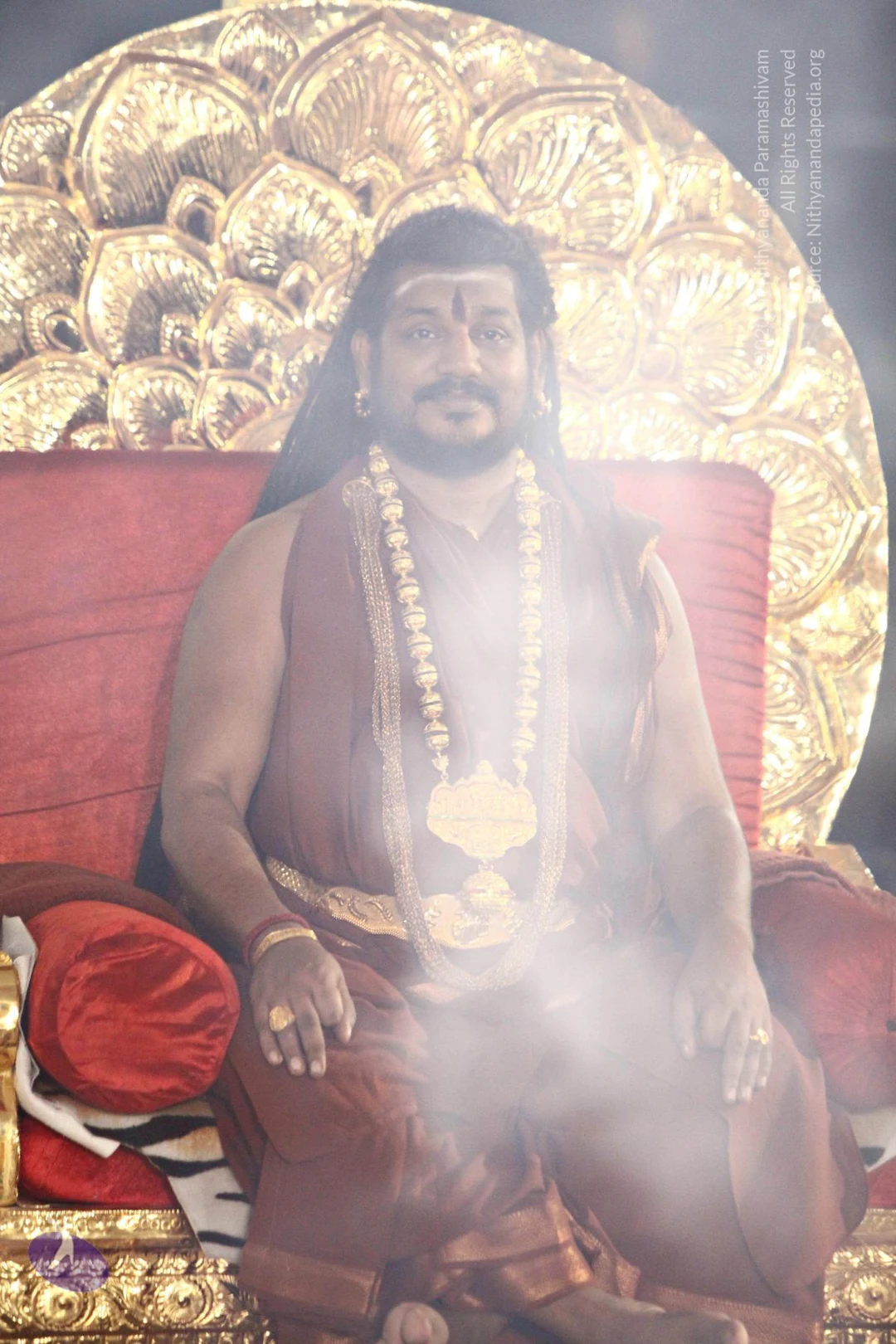
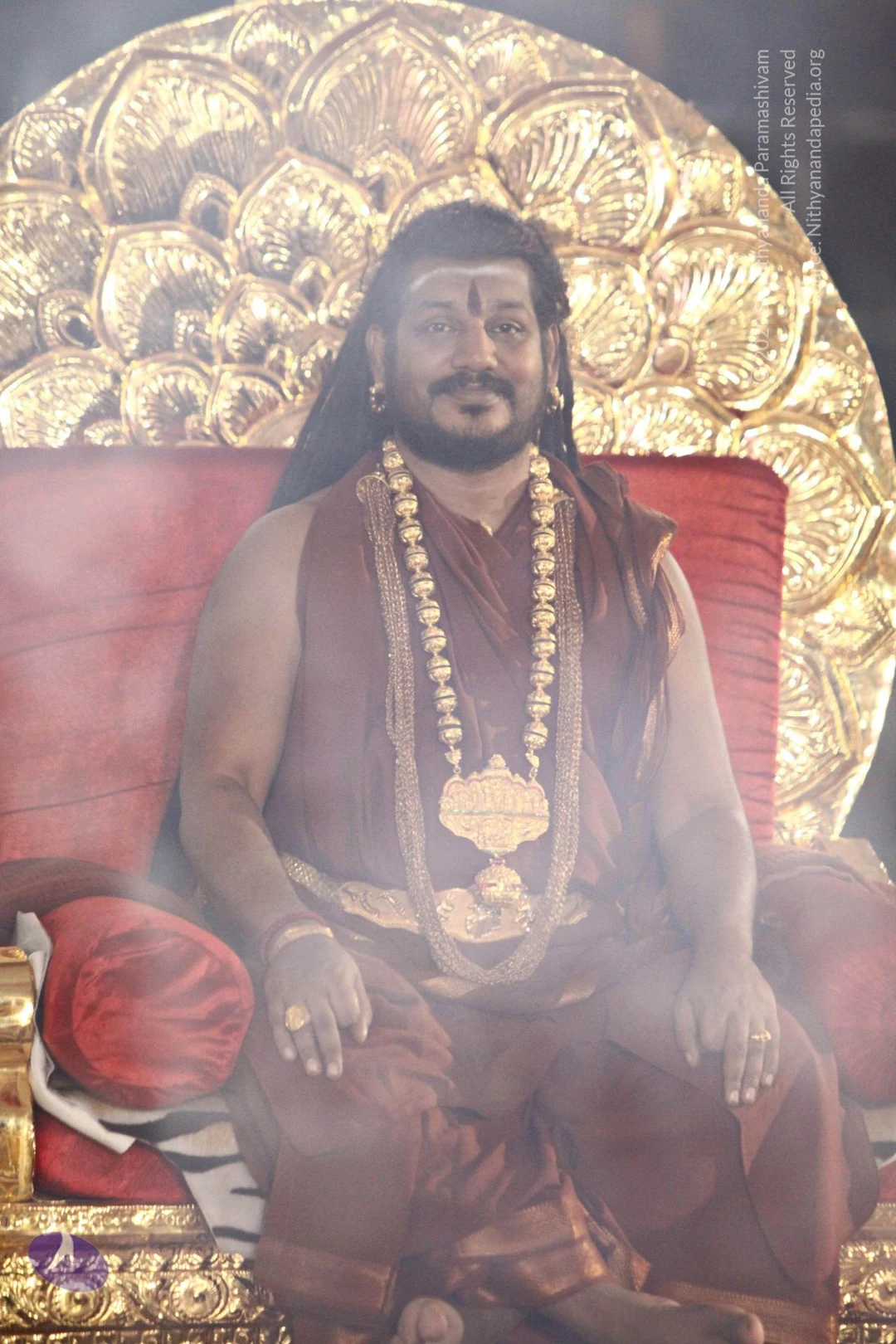
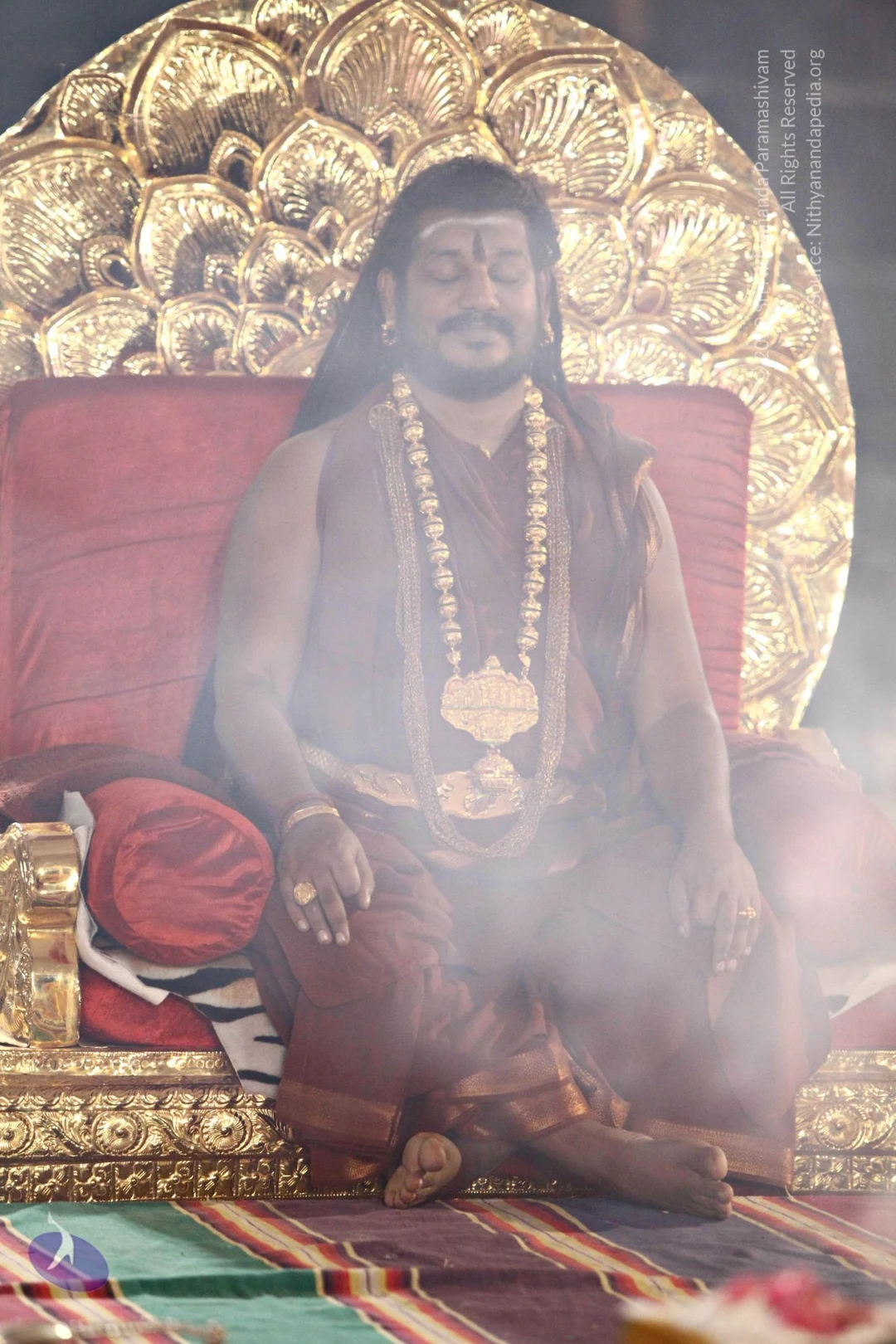
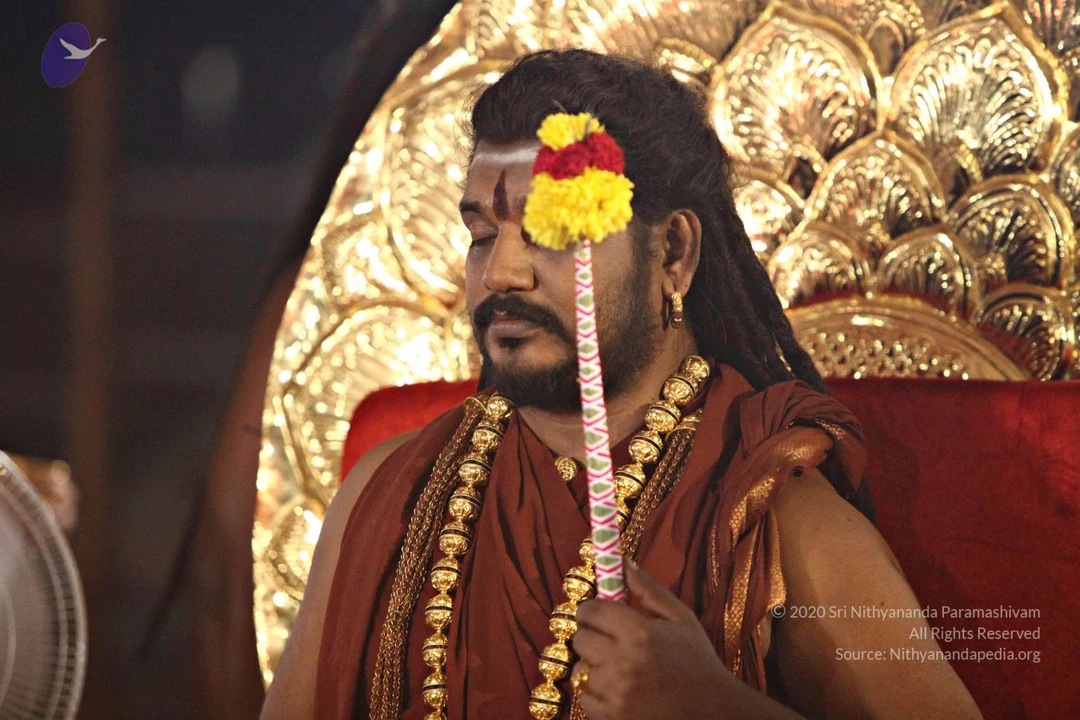
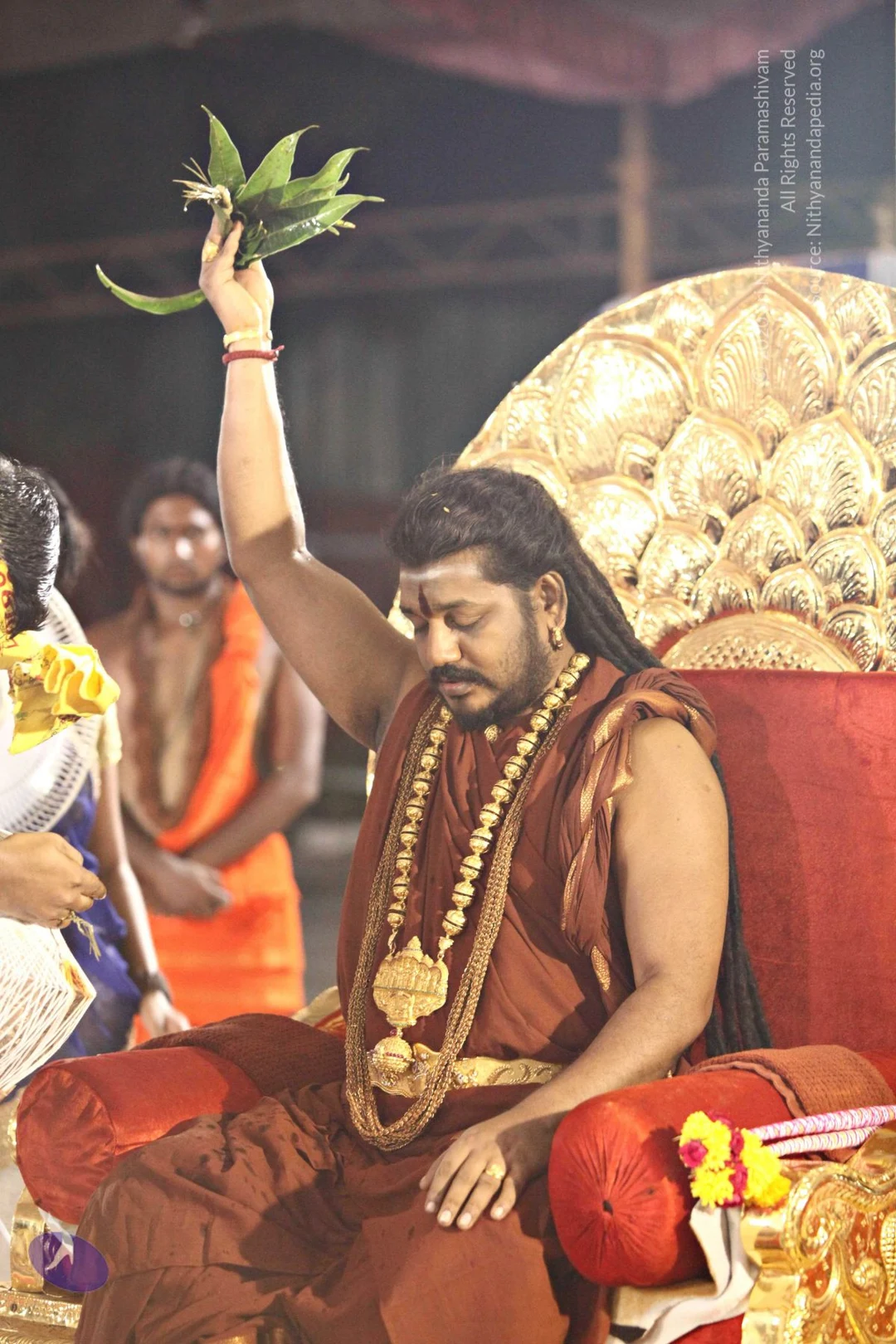
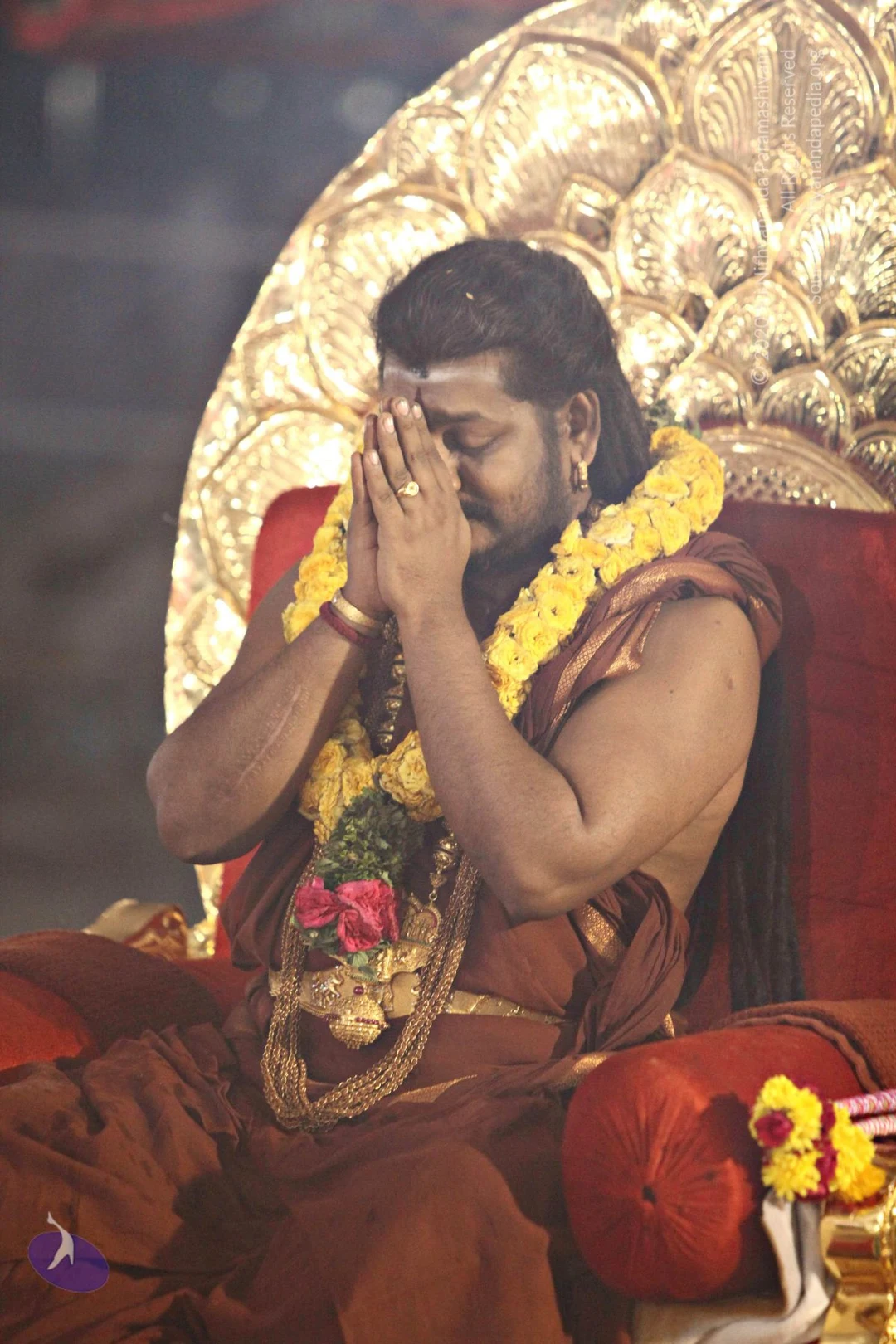
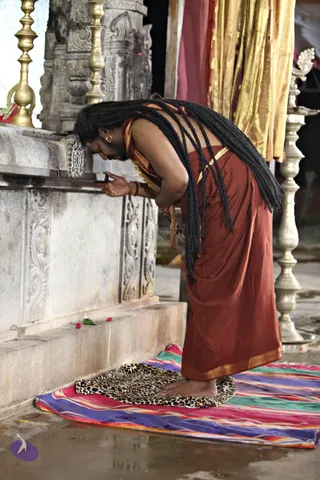
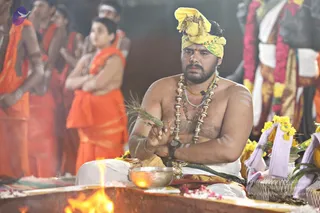
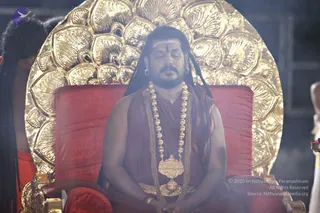
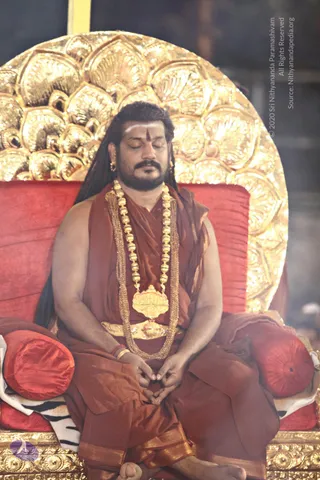
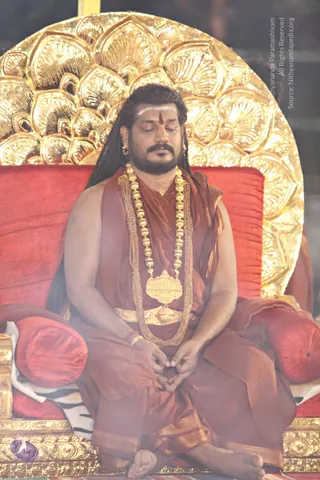
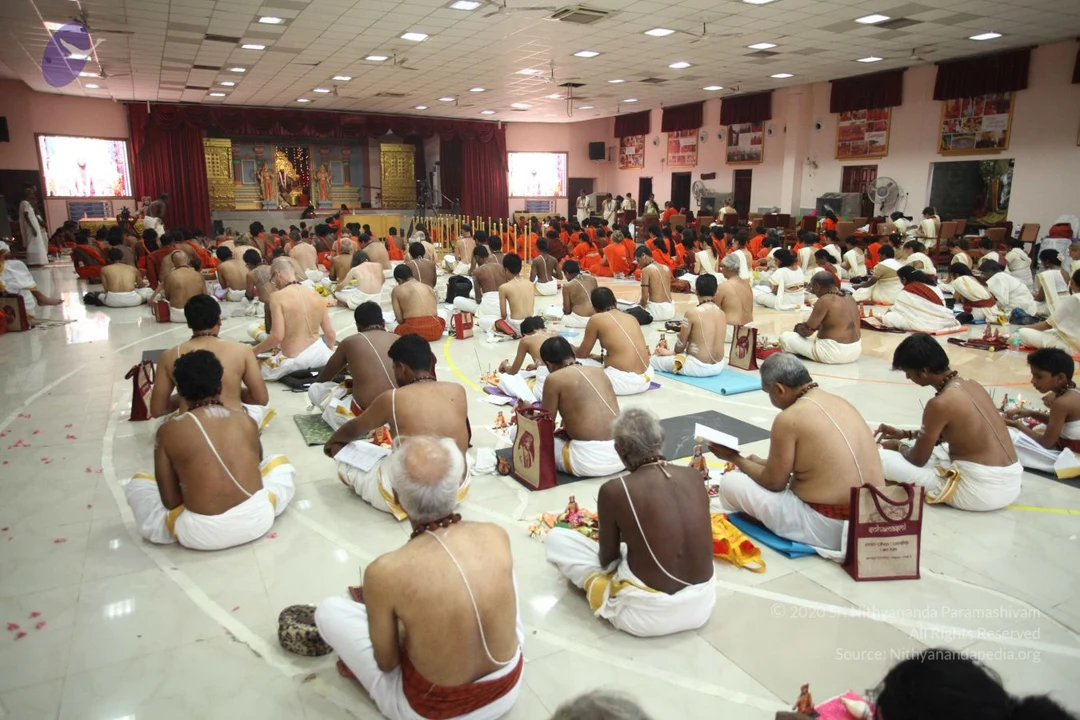
A photograph of a person in a temple bowing forward to touch or bow to a carved grey stone platform with floral and scroll relief. The person wears a rust-red wrap garment with gold border and gold ornaments, has long dark dreadlocks falling down the back, and a gold earring. Bare feet stand on a leopard-print mat over a striped multicoloured rug. A red flower and green leaf lie on the stone step. Brass lamp stands and gold-coloured hangings stand behind.A photograph of a homa or yagna at a fire pit. A bare-chested priest in white dhoti with a yellow turban sits before the flames, holding a bunch of green kusha grass in one hand and a small brass bowl nearby. He wears layered gold and bead necklaces and a wristwatch, with white markings on his chest and arms. Behind him, several young boys in saffron-orange cloth stand in a row, and to the right stand deity murtis draped in pink and yellow garlands. Orange and yellow marigold offerings lie beside the fire.A bearded man with eyes closed sits in meditation on a red velvet throne backed by an ornate gold lotus-petal halo. He wears a reddish-maroon robe draped over his shoulders, a multi-strand gold bead mala with a large gold pendant, and a horizontal sandalwood tilak on his forehead, with hands folded in his lap. A figure in orange clothing with long dark hair sits partly visible at the left edge, and a partially visible attendant in white stands at the right, with a tray holding flowers or offerings. Hazy smoke or incense drifts through the scene.A seated man with eyes closed sits on an ornate red-cushioned throne backed by a large gilded shell-patterned halo panel. He wears rust-red robes, a heavy multi-strand gold necklace with a large gold pendant, a gold waist belt, red and gold bangles, and a white and red forehead mark. His hands are joined in front of his lap in a meditative gesture, and a zebra-striped cloth lies on the seat. Probable Swamiji by appearance: long swept-back hair, ornate gold necklaces and saffron-toned ceremonial clothing, seated on a throne in a satsang setting.A seated man with eyes closed sits on an ornate red cushioned throne with a large gold peacock-feather style backrest. He wears rust-brown draped robes, a heavy gold multi-strand necklace with a large gold pendant, a gold belt, and gold earrings, with a white and red tilak on his forehead and long dark hair. His hands rest together in front of him in a meditative mudra, and a red bolster and tiger-striped cloth lie beside him.A seated man with eyes closed sits in meditation on a red cushioned throne with an ornate gold shell-patterned backrest. He wears rust-brown saffron-toned robes draped over one shoulder, a heavy gold bead necklace with a large gold pendant, a gold belt, and gold earrings. Long dark hair falls past his shoulders, with a white and red tilak on his forehead. His hands rest in a mudra in his lap, and a tiger-striped cloth lies beneath the seat. Swamiji (probable) is seated on the throne, wearing saffron robes, rudraksha-style gold beads and ceremonial gold necklace, with long hair and tilak.
More Photos from Brahmacharya Initiation

9 photosSource gallery
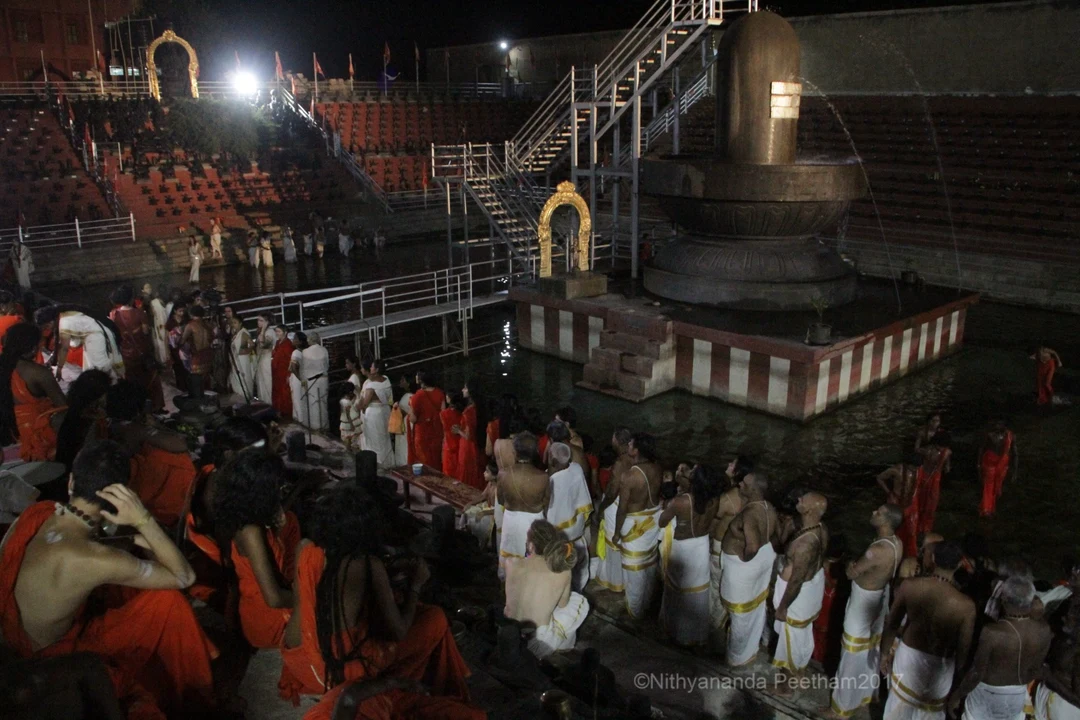
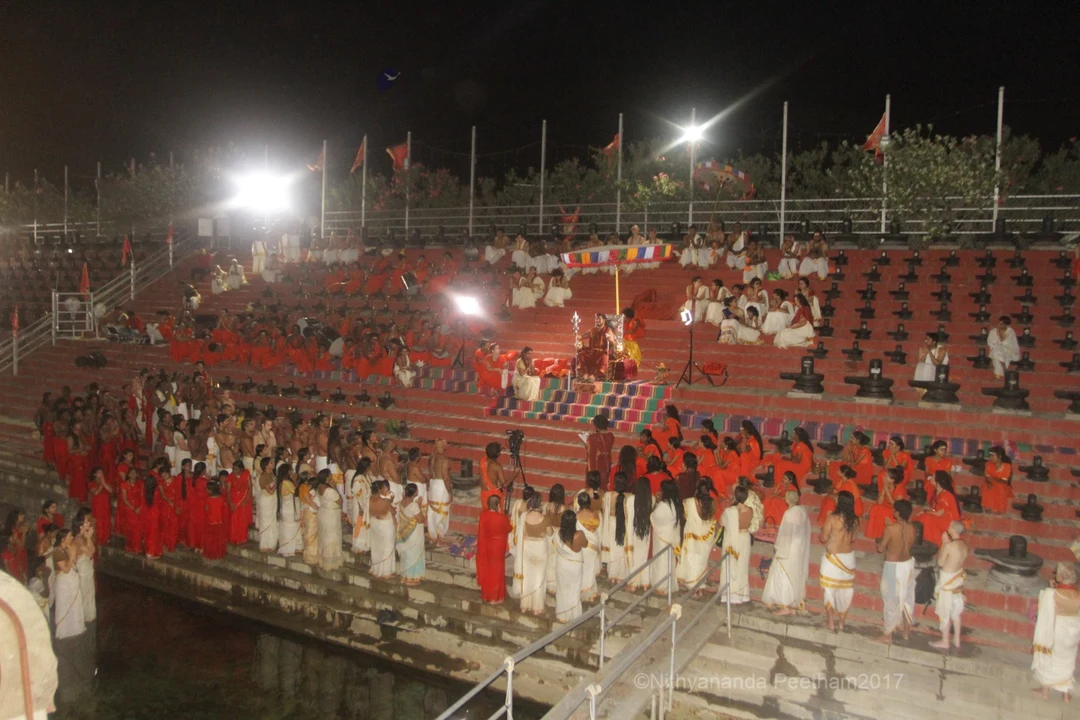
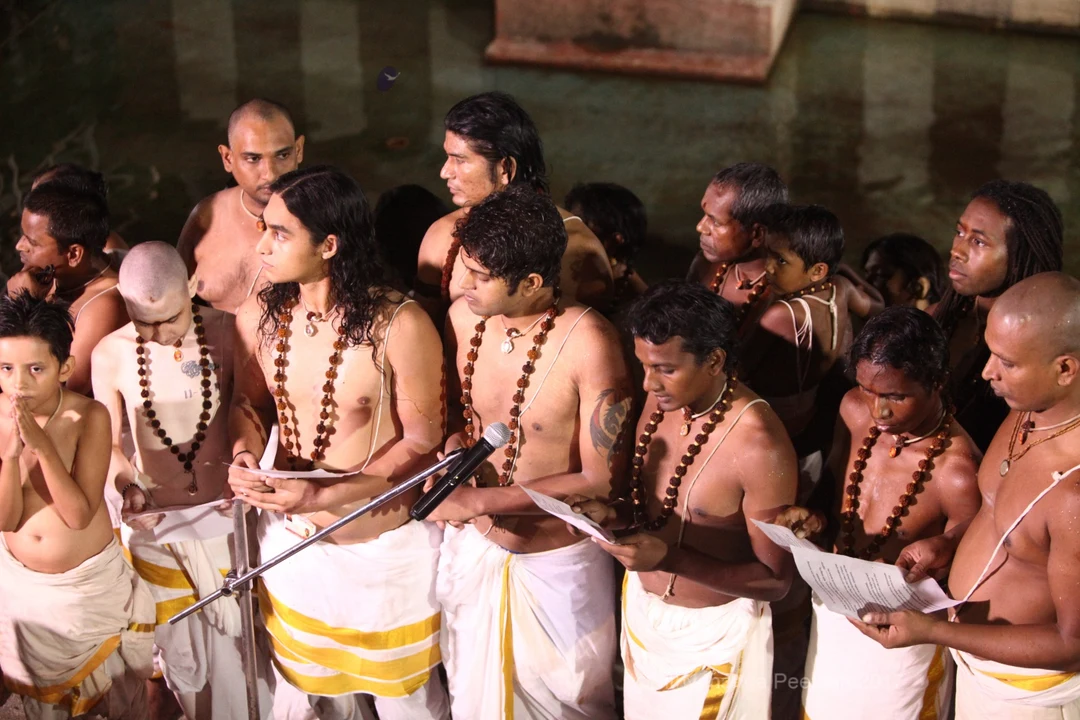
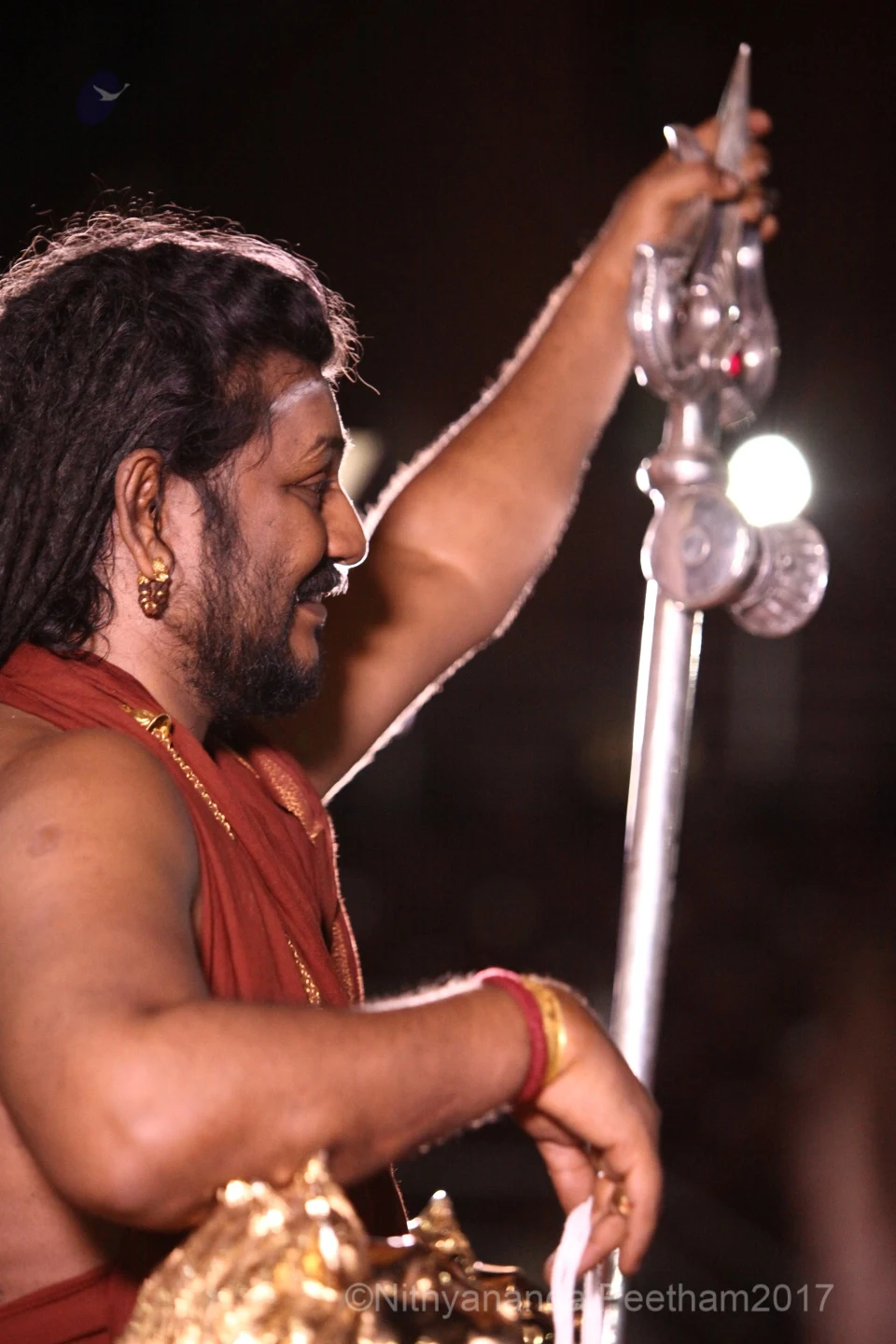
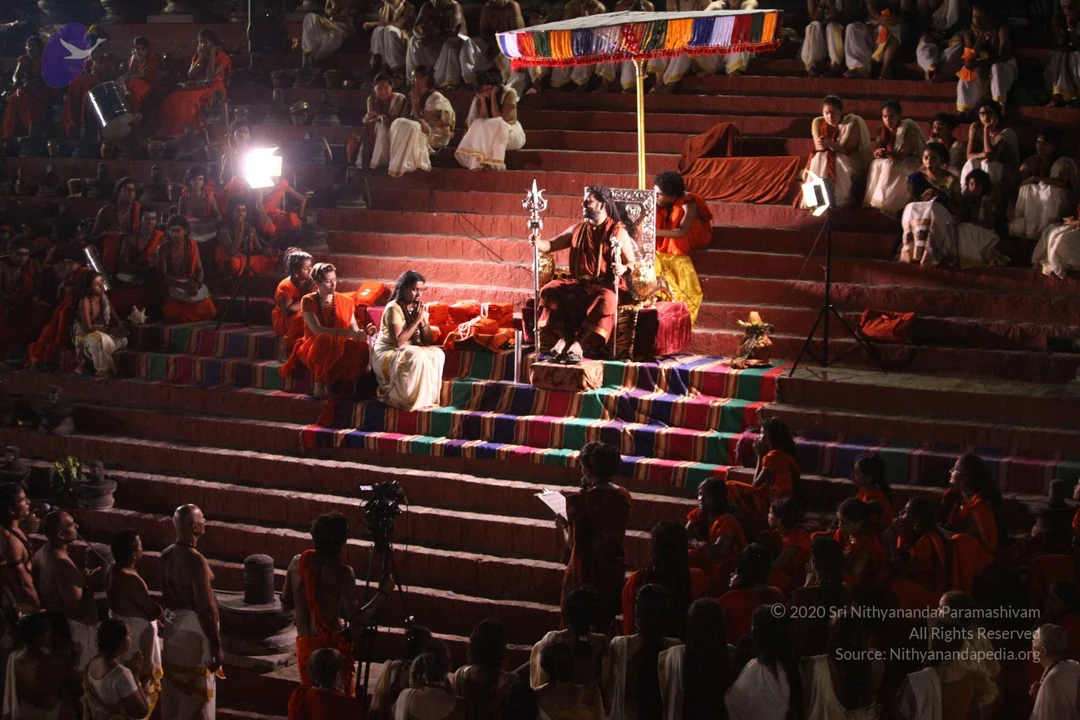
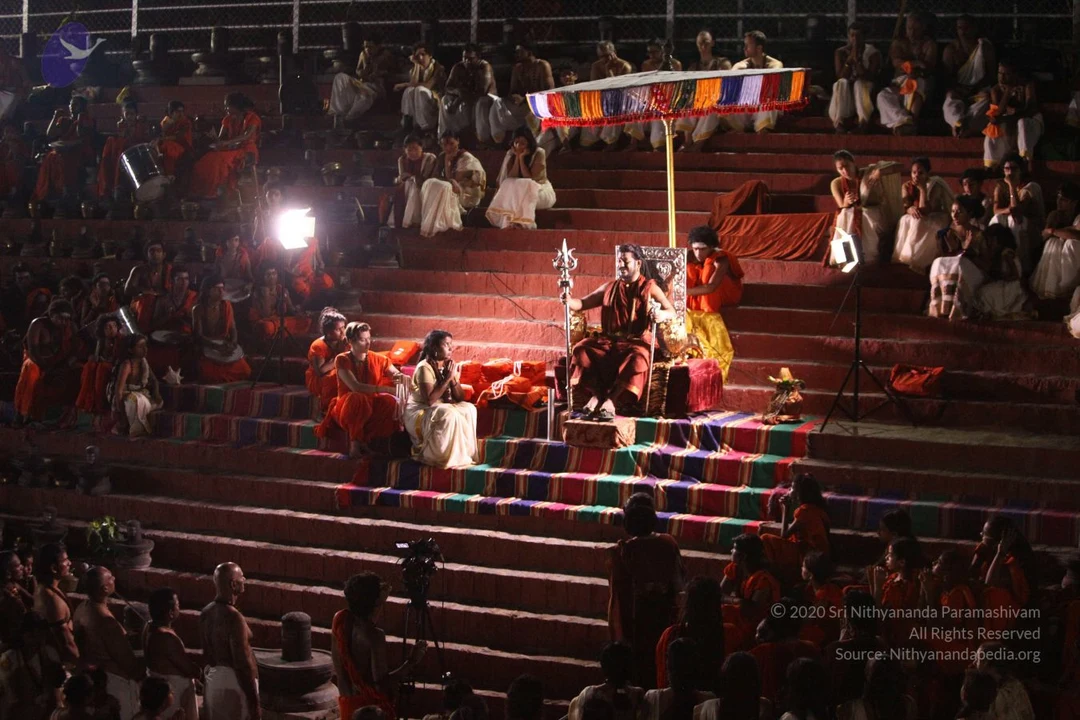
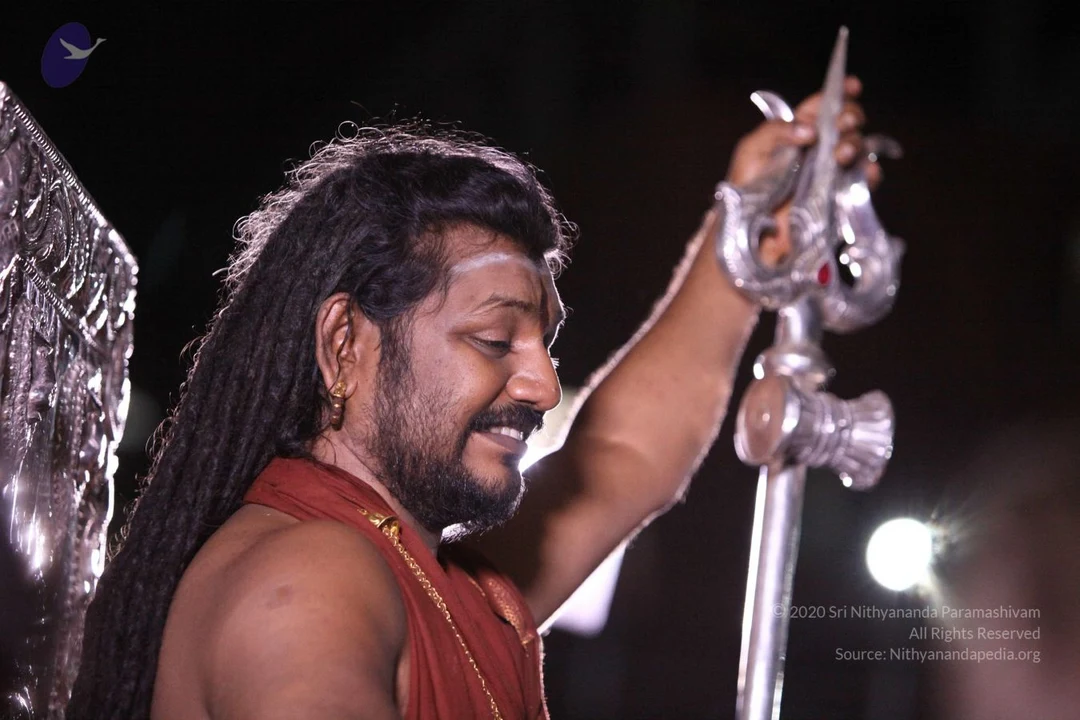
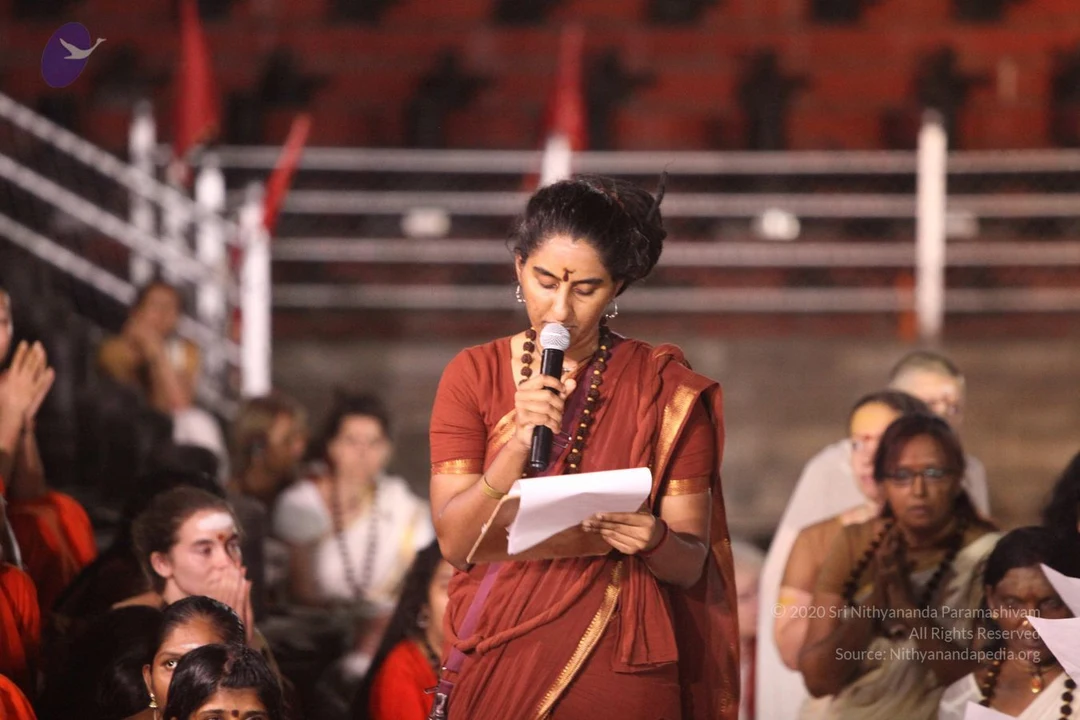
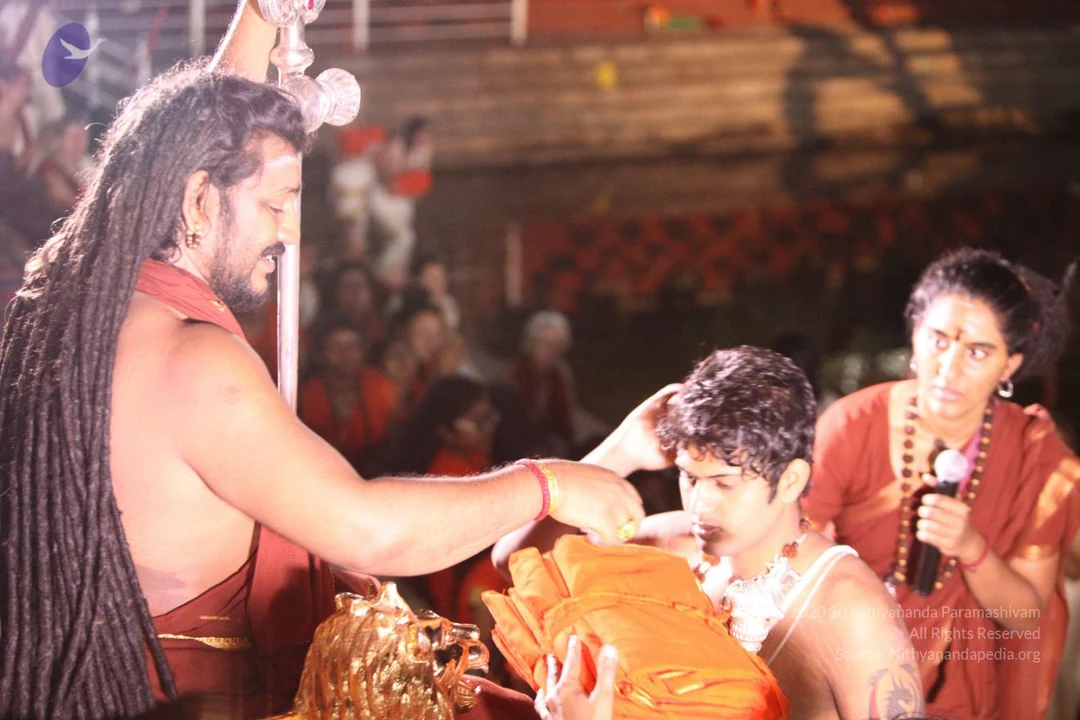
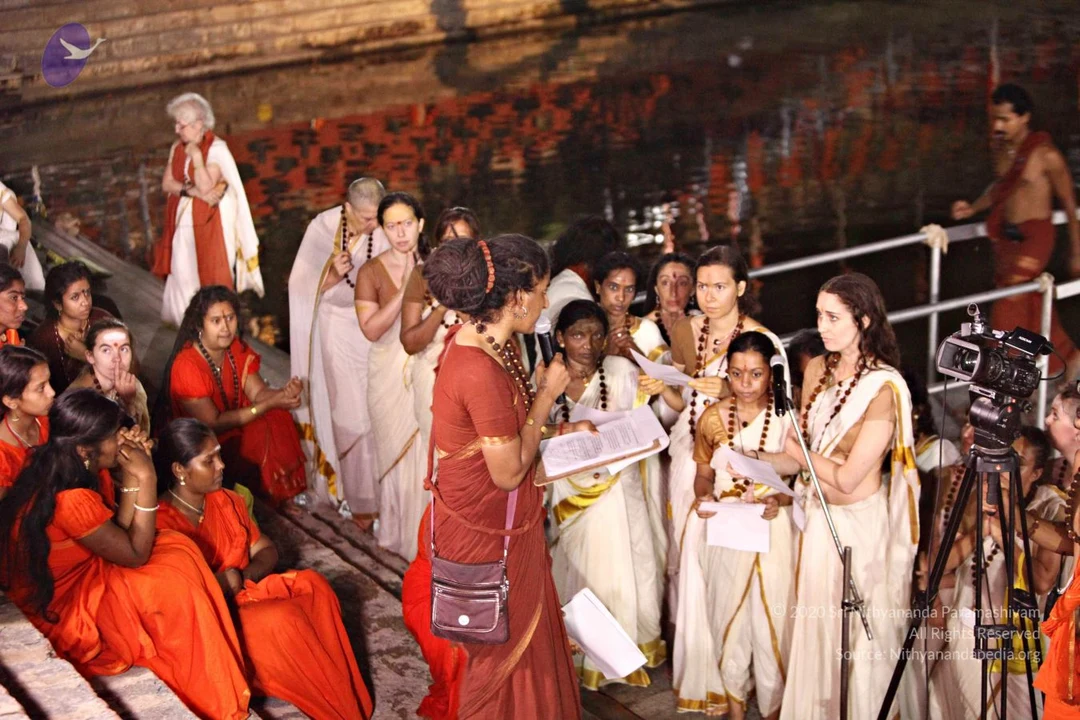
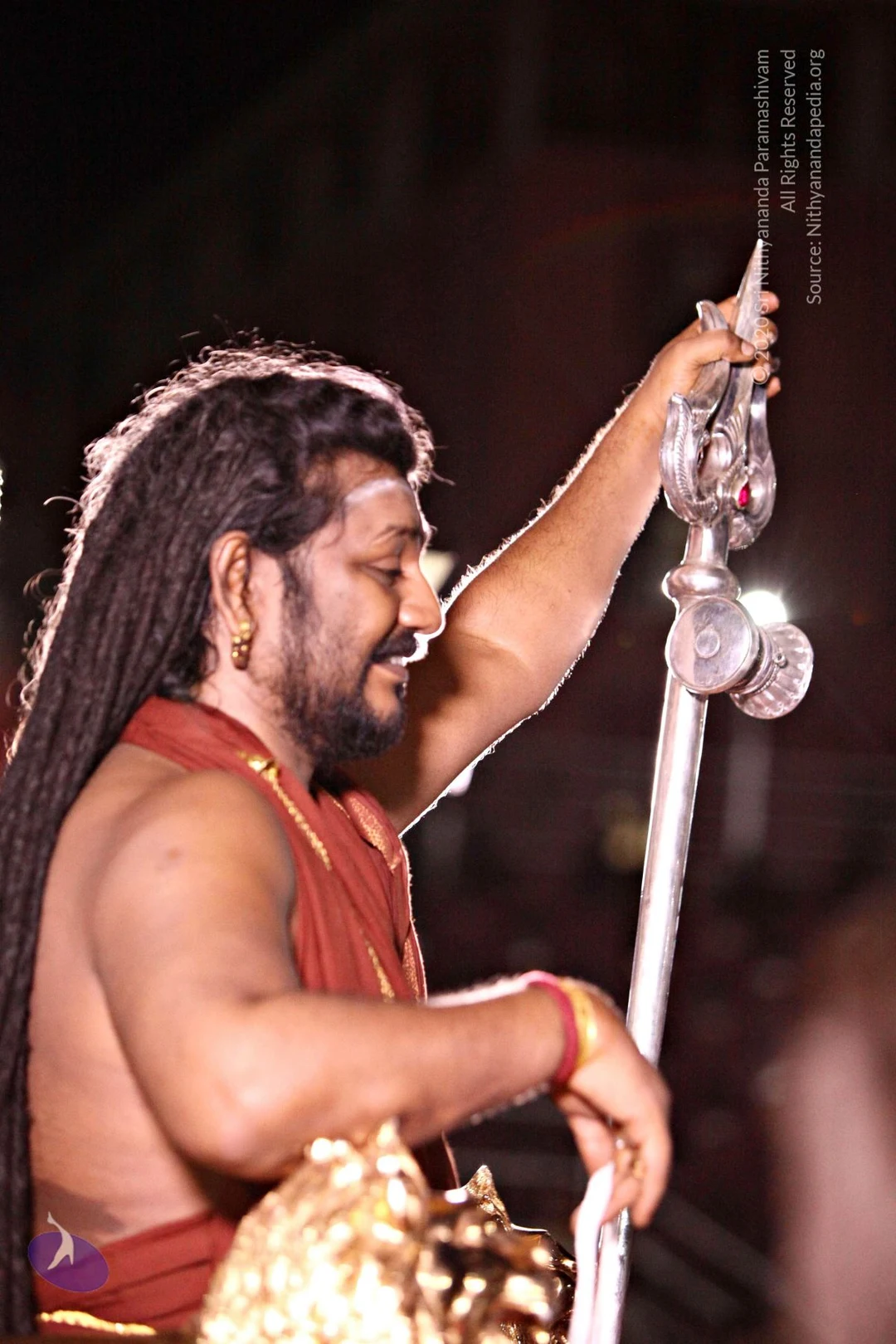
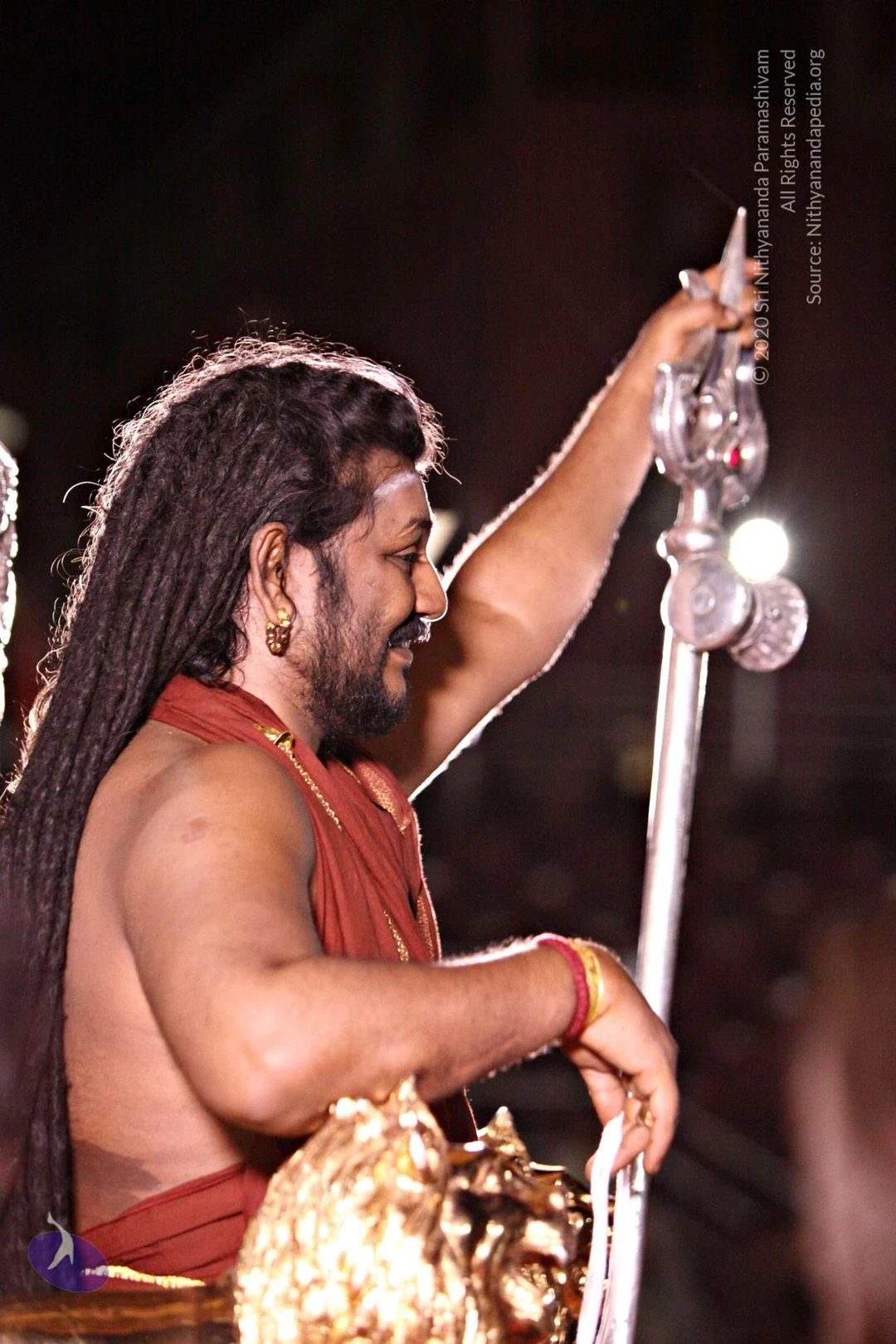
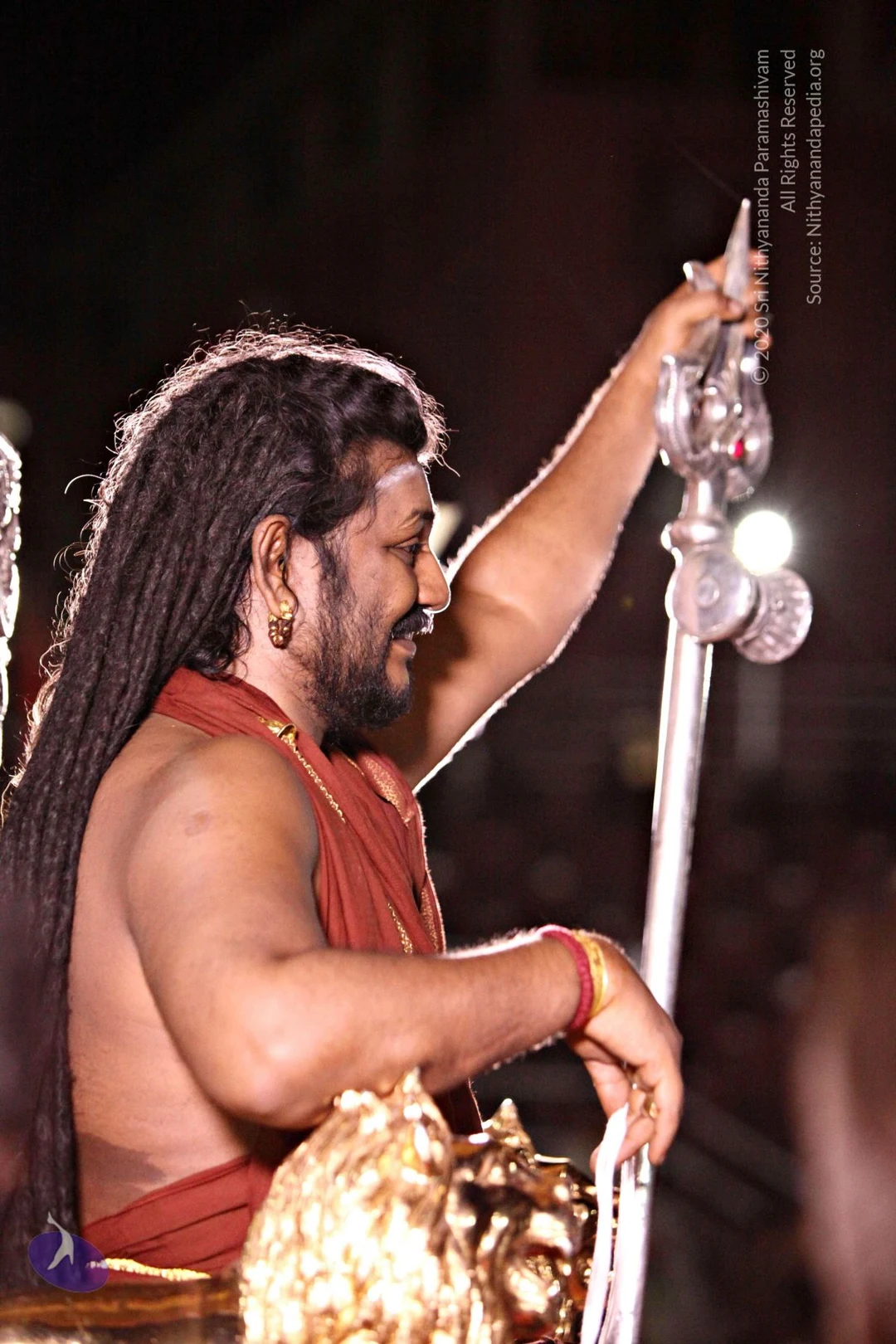
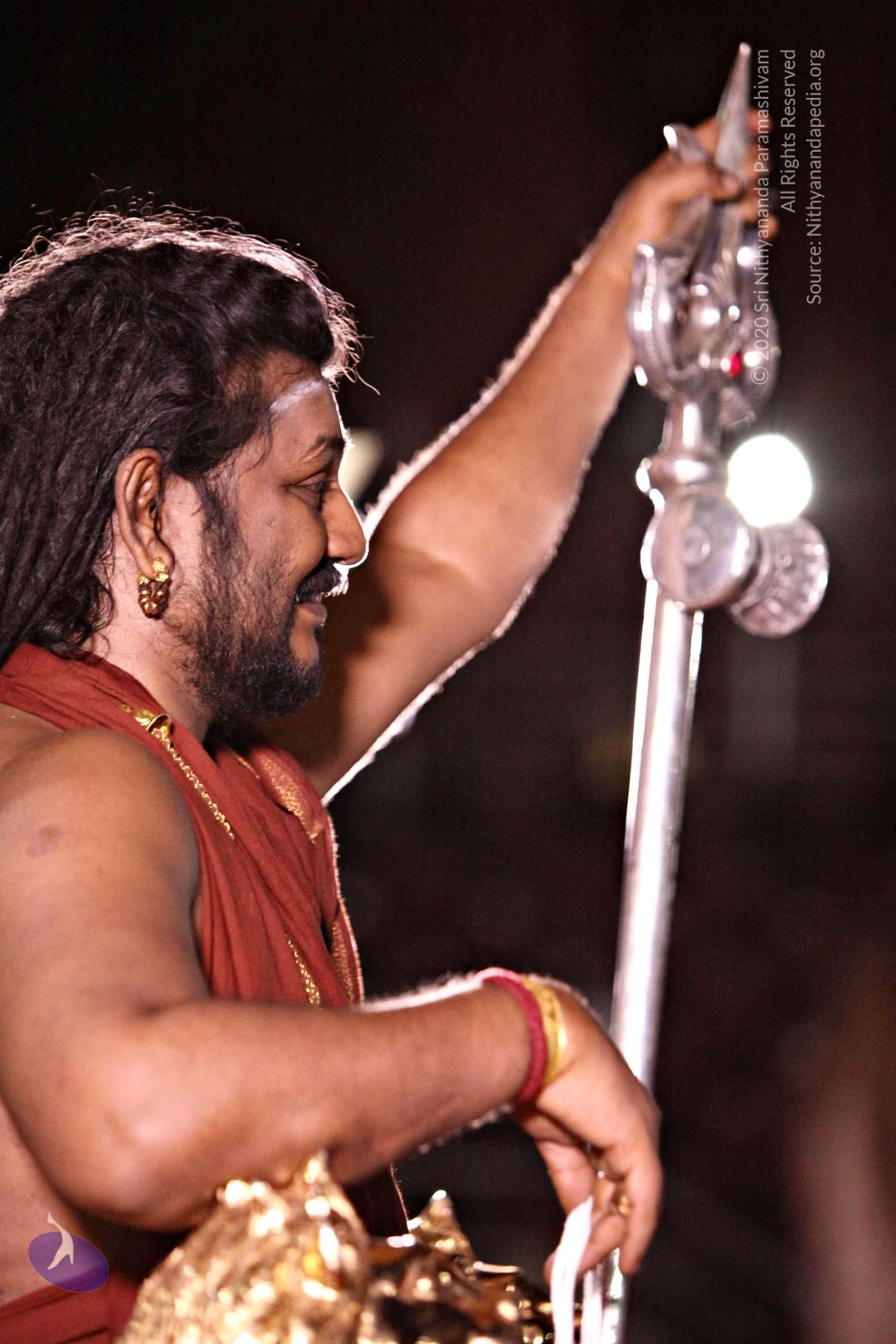
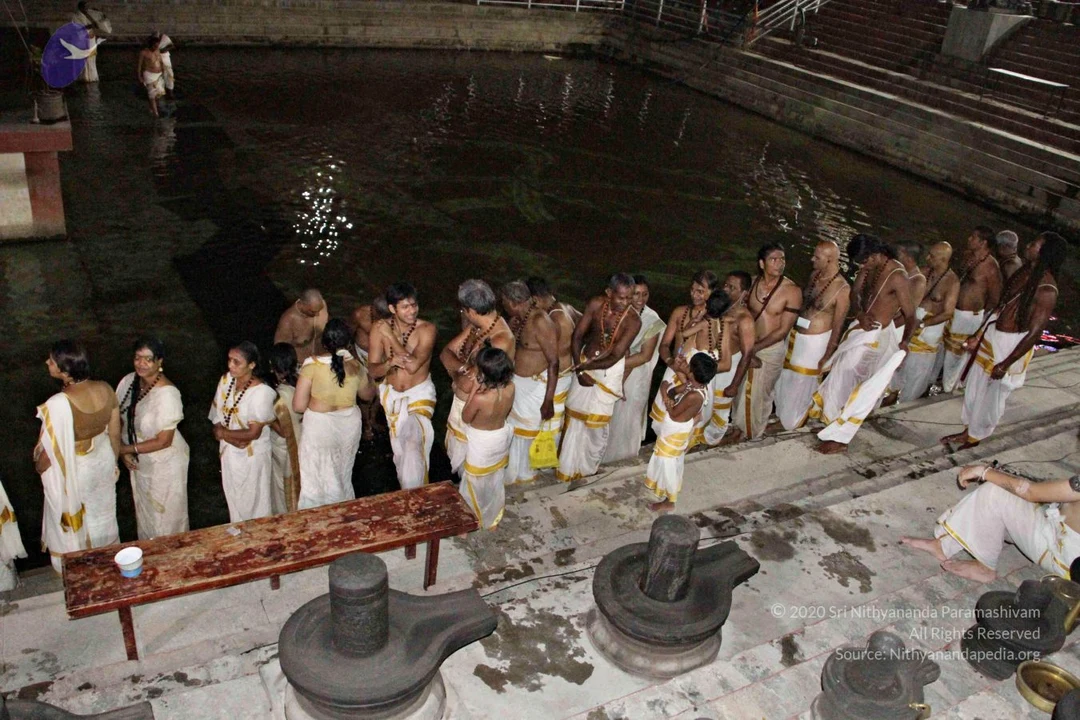
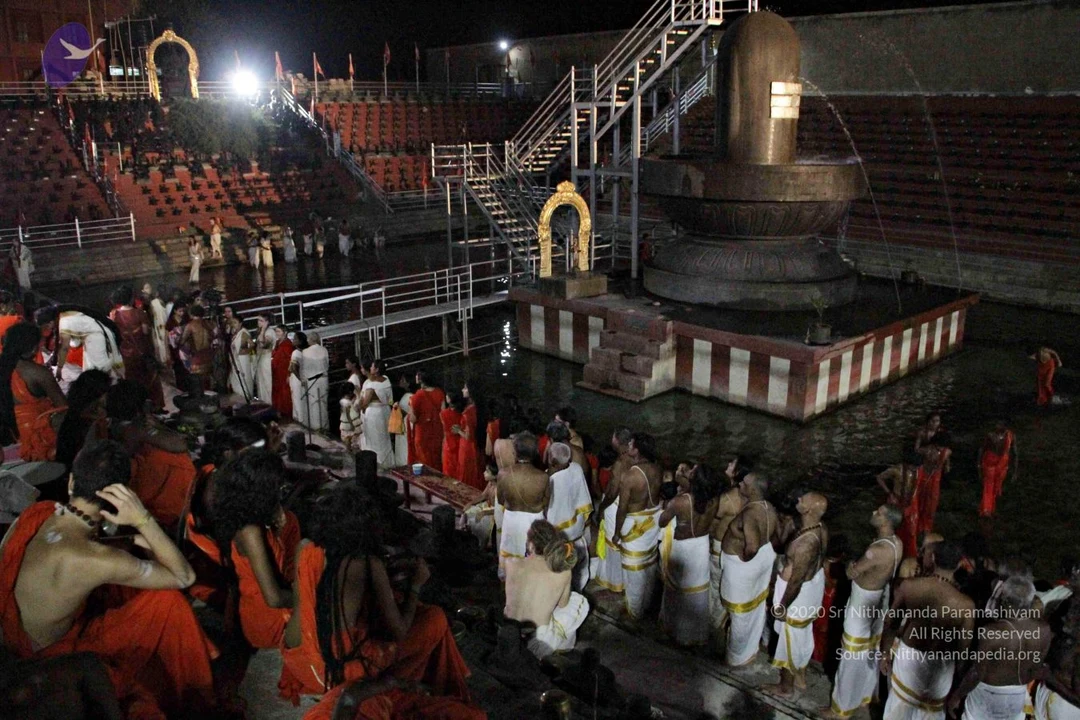
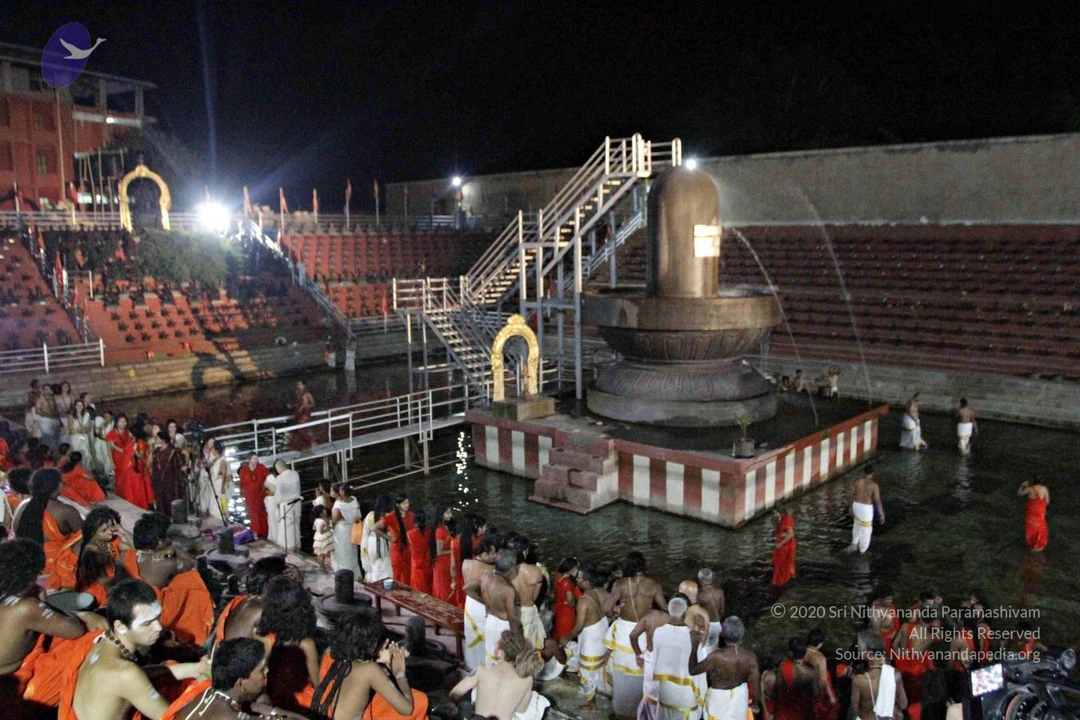
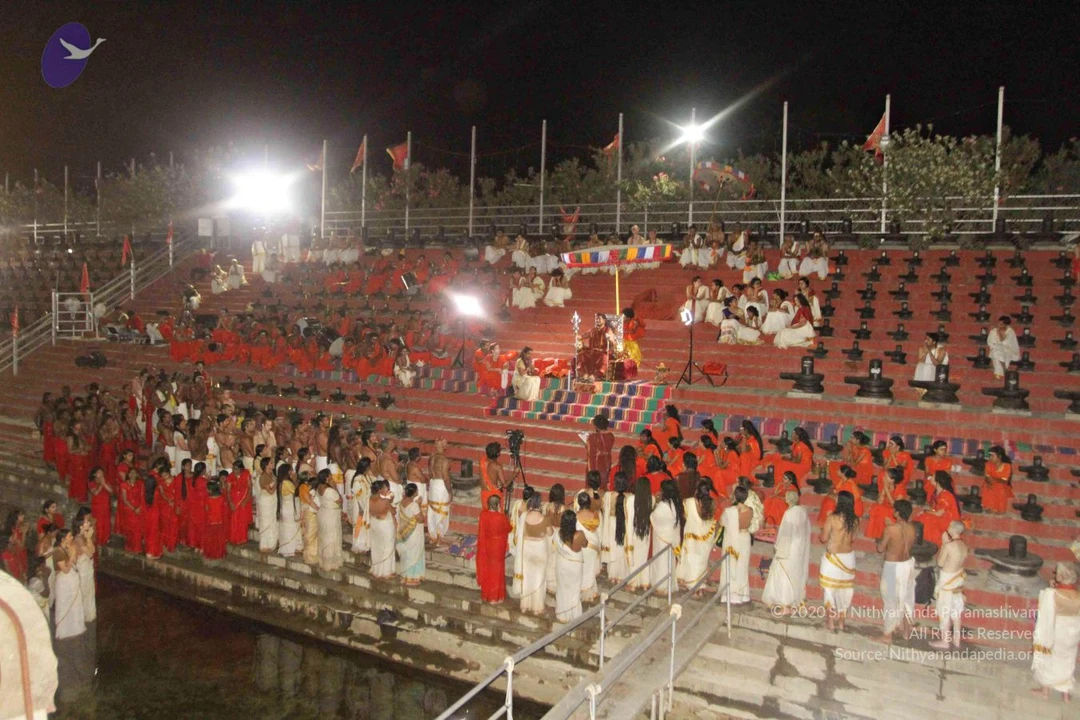
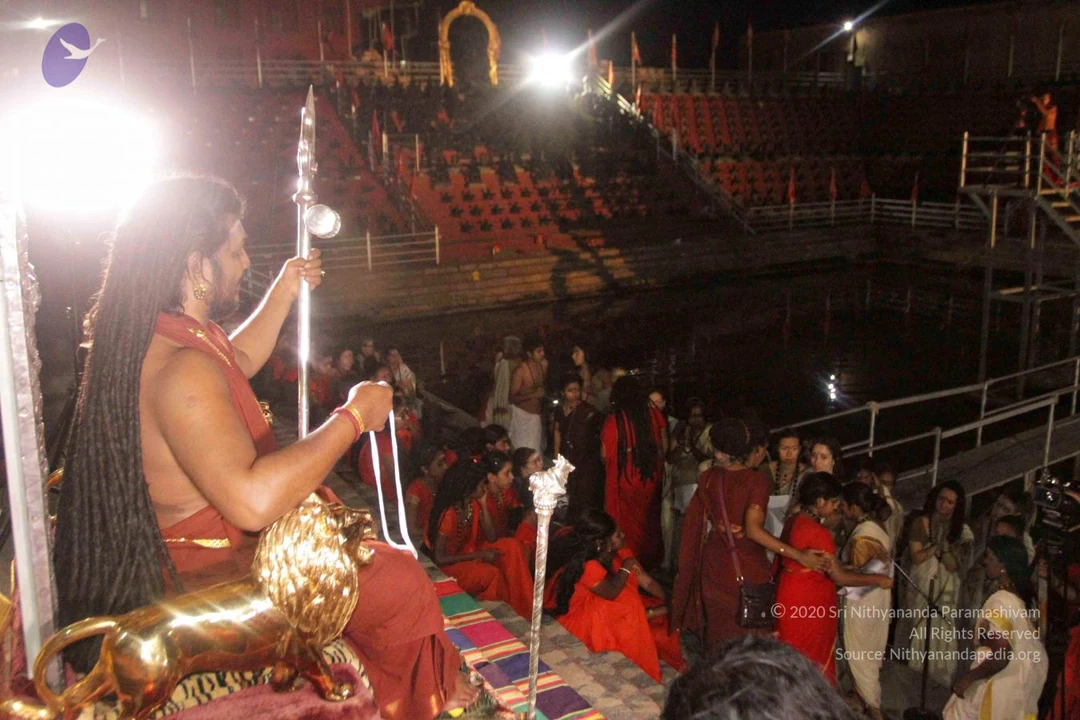
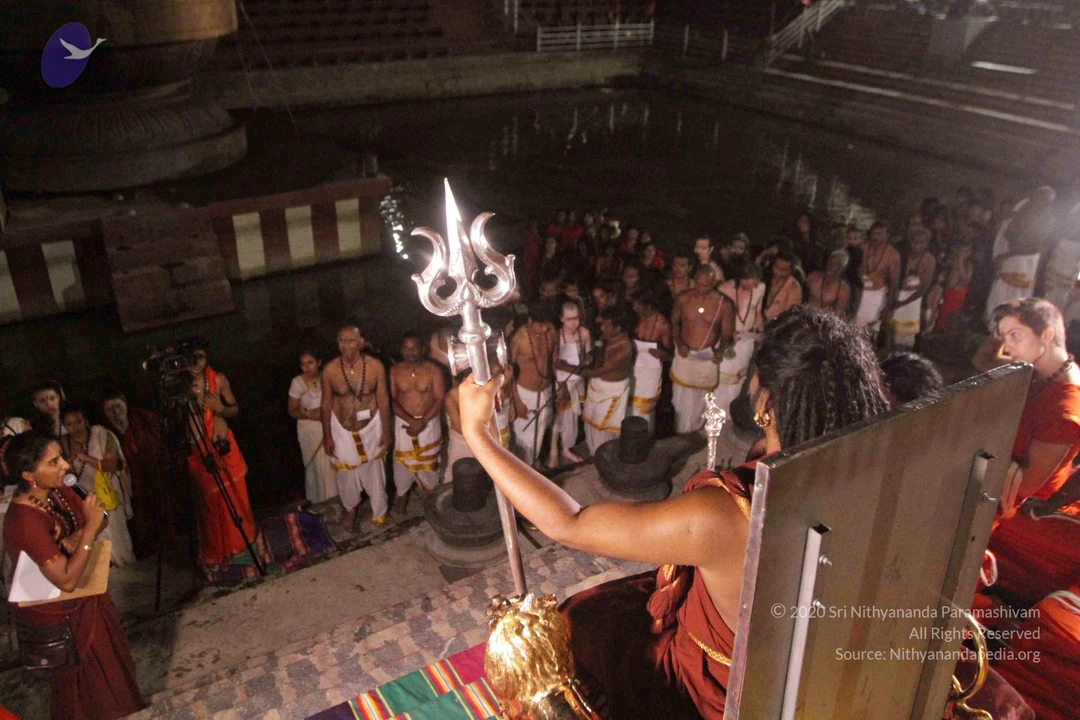
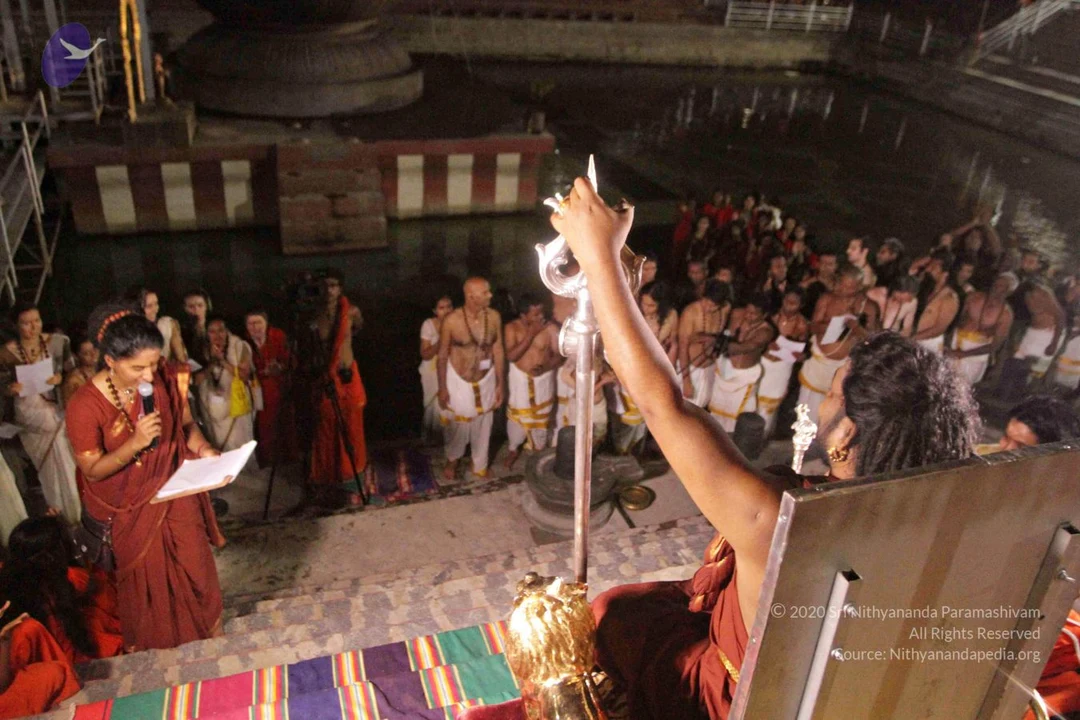
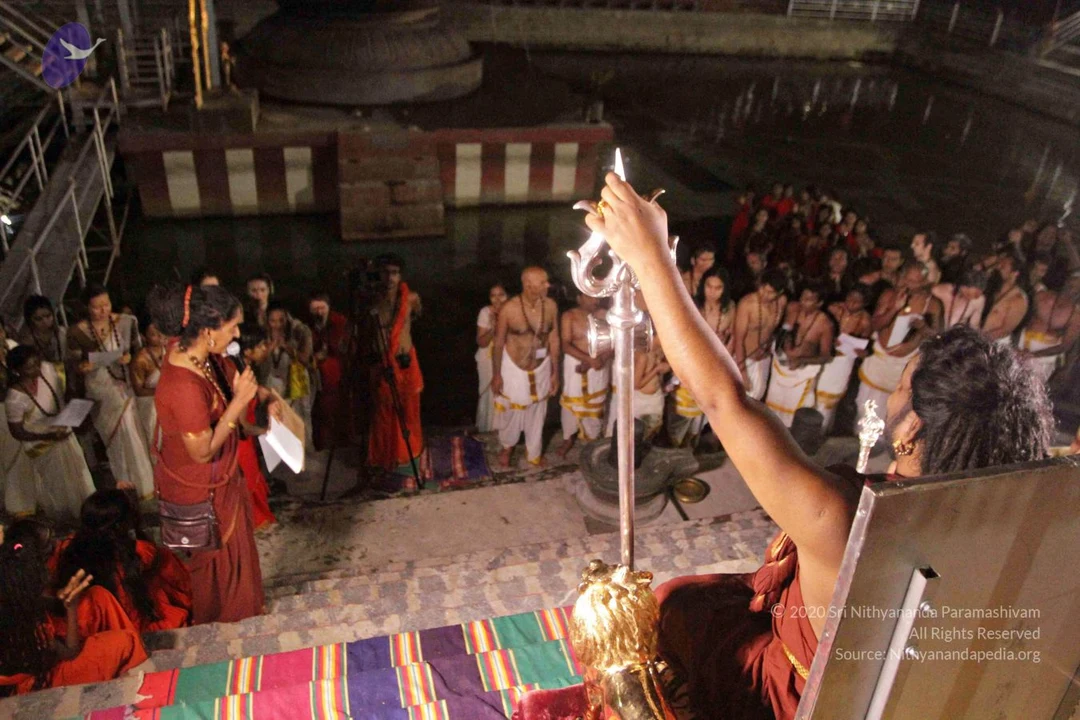
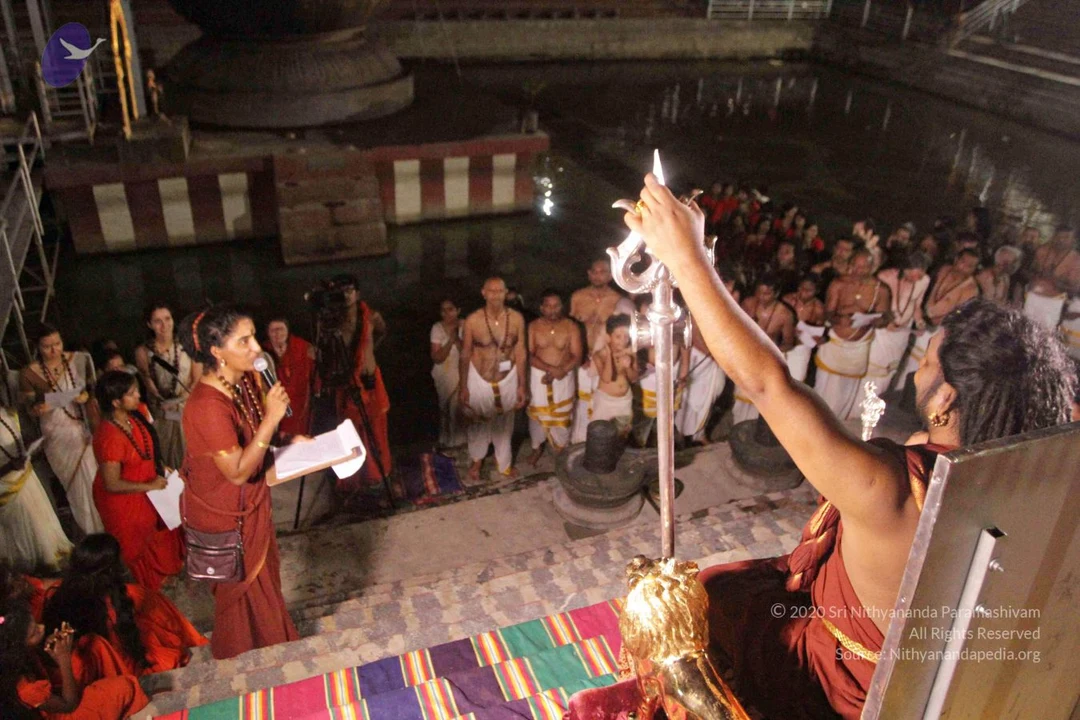
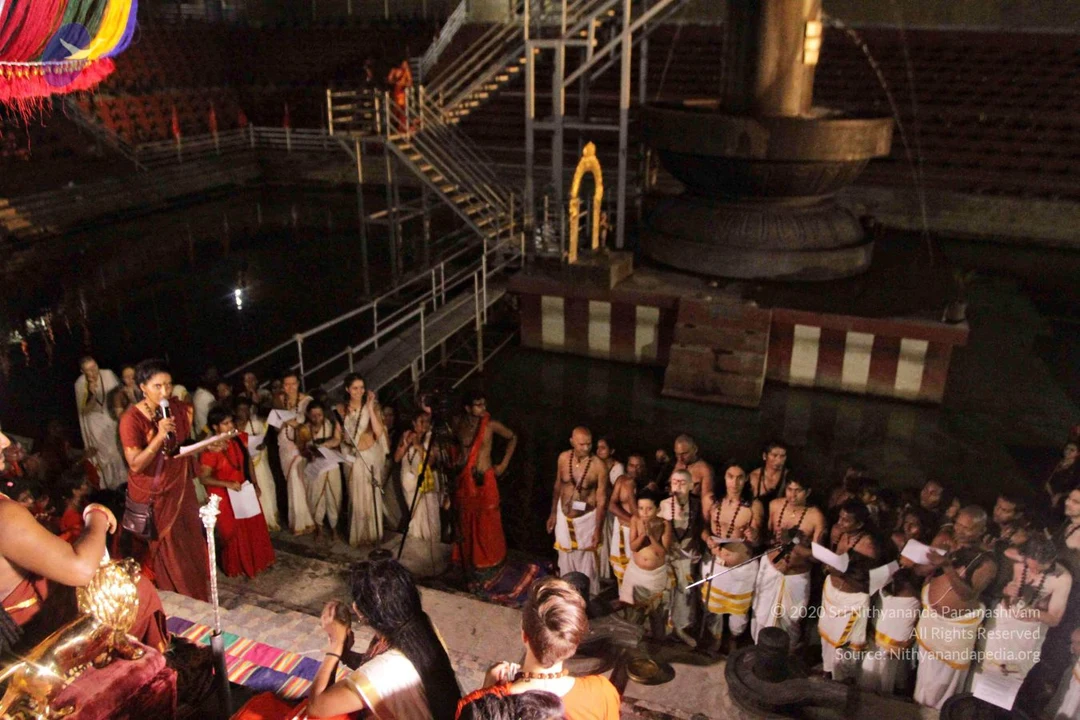
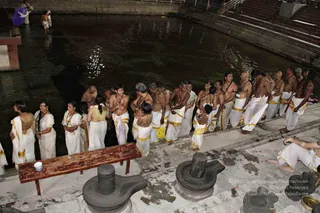
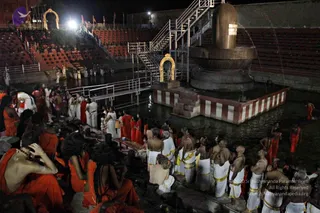
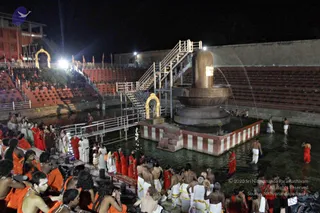
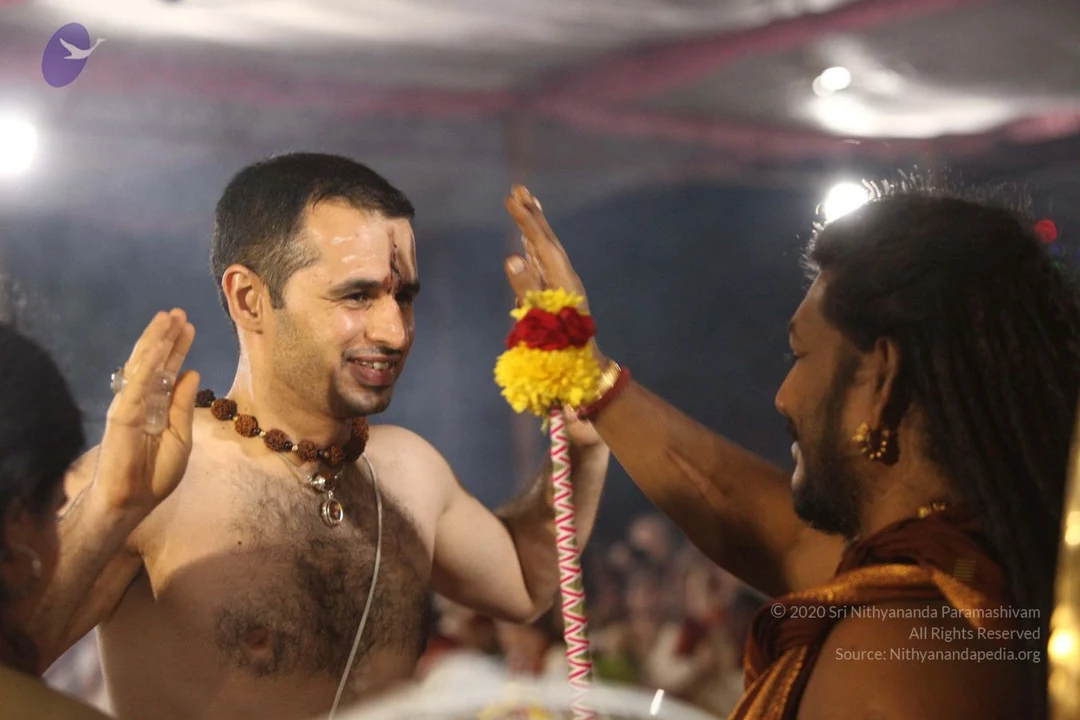
Night-time photograph of devotees standing in a line at the edge of a dark stone-stepped tank or pool. Many men are bare-chested, wearing white dhotis with gold borders and rudraksha malas, while women wear white saris with gold borders and garlands. Several stand waist-deep or wade in the water, and a man in white sits on the steps at right. Black Shiva lingam stones sit on the ground in the foreground, with a wooden bench and a small cup at left. A figure with a purple umbrella stands in the water at top left.Night-time photograph of a large outdoor water tank at a temple complex, with a tall black Shivalinga on a square plinth in the centre-right, water pouring over it from a spout. Devotees stand in the water and along the steps. Many men on the right wear bare upper bodies, white dhotis with gold borders, and some have white upper cloths. Women in white and in orange-red saris stand in the water and on the left bank. Several sadhus in saffron-orange robes sit on the lower left steps, some with rudraksha malas and marked foreheads. Golden arches frame the plinth, and tiered red-and-white seating stands in the background. Lights and flags are visible at the top.Night photograph of a large outdoor temple tank with a tall dark Shiva lingam on a tiered pedestal rising from water at its centre, with water streaming from its upper part. Striped red-and-white borders surround the central platform. Numerous devotees stand and sit on the stepped stone edges and in the water, many wearing orange and red robes and white dhotis, some bare-chested. Several figures wear red garments and move through the water near the lingam. Steps and railings lead up to a tiered red seating area lit by floodlights, with orange flags and gold-coloured arches in the background.A night-time outdoor ceremony on wide red-and-white stepped ghats beside water, lit by floodlights. Hundreds of devotees fill the steps: many in red or orange robes, others in white dhotis and saris, some bare-chested. A central raised platform holds a decorated seat and lamps, with a small figure in red near the middle; the candidate for a person cannot be confirmed from appearance at this distance. Rows of black shivalinga-style stone forms line the steps, and a striped canopy shades the platform. Flags on poles and trees frame the background.A night ritual photograph at a stone-lined water tank. In the foreground a figure seated on a raised wooden platform with a golden lion-headed base raises a silver trident aloft with one arm; the figure wears dark red robes, has long dark hair pulled back, and gold jewellery. Below and around the tank, a large group of men in white dhoti with saffron-gold borders stand bare-chested or with white shawls, some wearing rudraksha beads, surrounding a dark stone shivalingam-style platform. A woman in a red blouse and white garment at left holds a microphone, and a camera operator with a tripod stands nearby. Several robed attendants in orange and red are visible, and rows of people fill the background steps. a person cues are not clearly established for the seated figure, so identity is uncertain.Night-time photograph of an outdoor temple-tank ritual. In the foreground, a figure seated on a wooden platform with long dark hair and a red-orange cloth raises a silver trident-like staff, a trident with a golden base set in a small pedestal. A woman in a red-orange sari with a microphone stands on the left holding papers and speaks. Behind them, a large crowd of devotees, several bare-chested men in white dhoti-style cloth with yellow borders and women in white and red saris, stands on stone steps beside dark water. A striped red-and-white wall and a stone structure frame the scene.
FB-Photos-of-the-Day

1 photoSource gallery
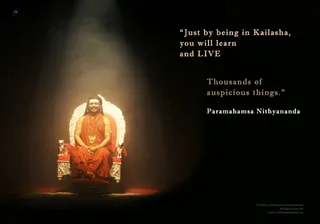
A graphic quote card on a black background showing a spotlit man seated on an ornate silver-and-red throne with carved lion-like armrests. He wears an orange-red robe, a heavy gold chest necklace and gold armbands, with long dark hair, and his hands rest together in his lap. Large cream text on the right reads a quotation attributed to Paramahamsa Nithyananda.