Skip to content
Saturday

24 May 2014

Advaita makes your enemy powerless

Dated photos
107
Source pages
1
Media
2
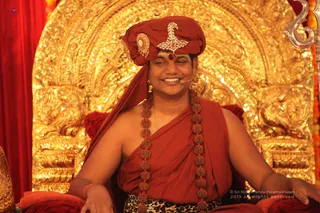
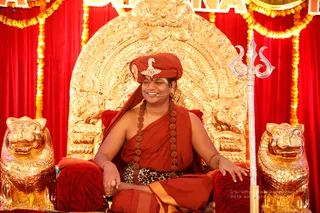
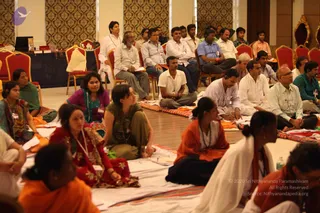
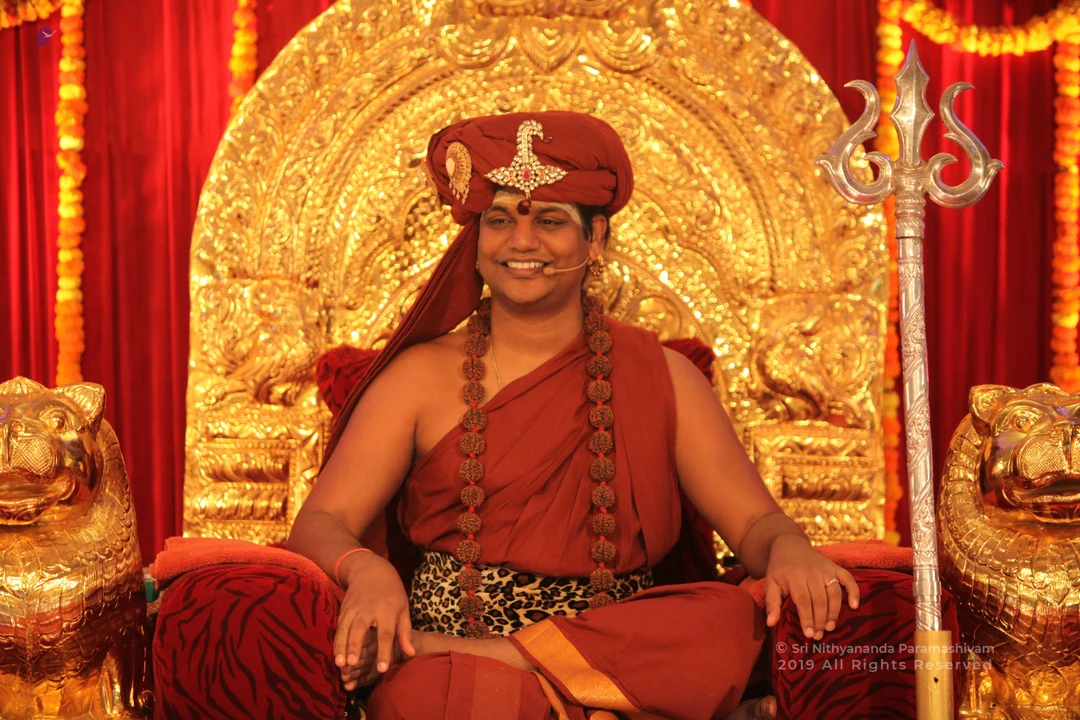
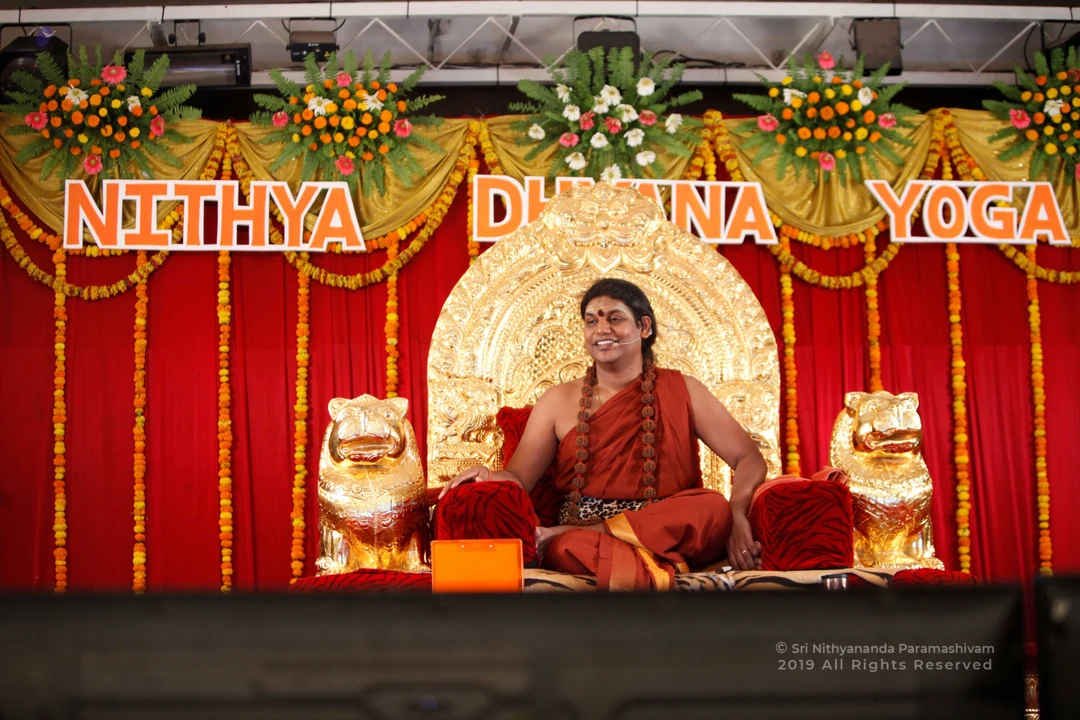
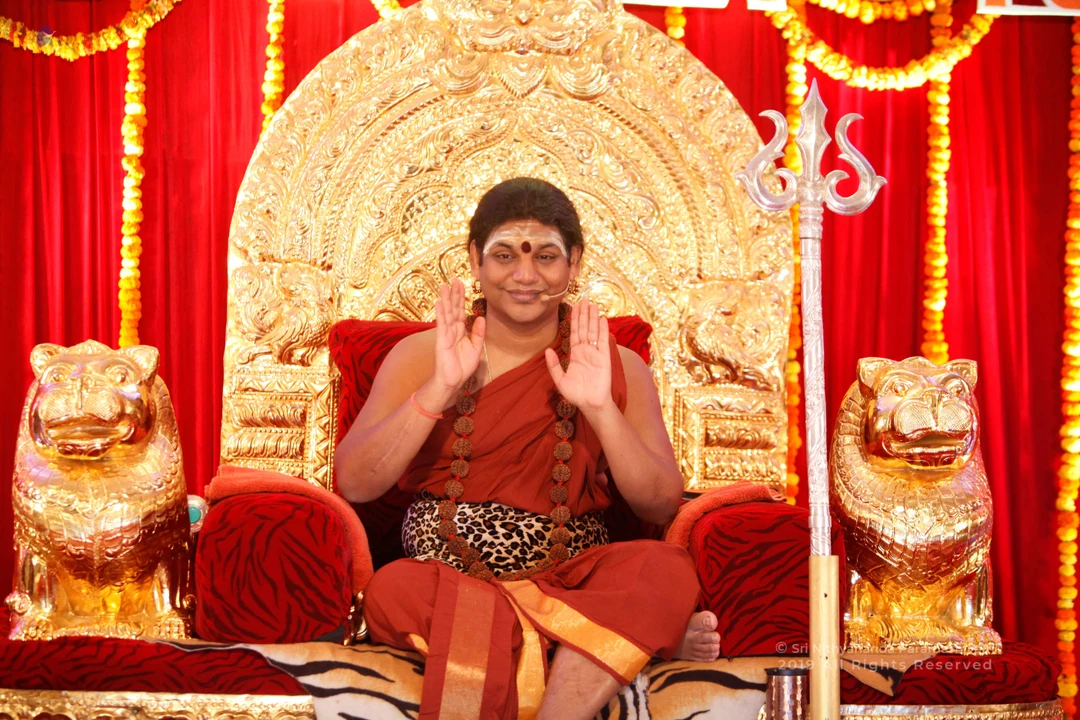
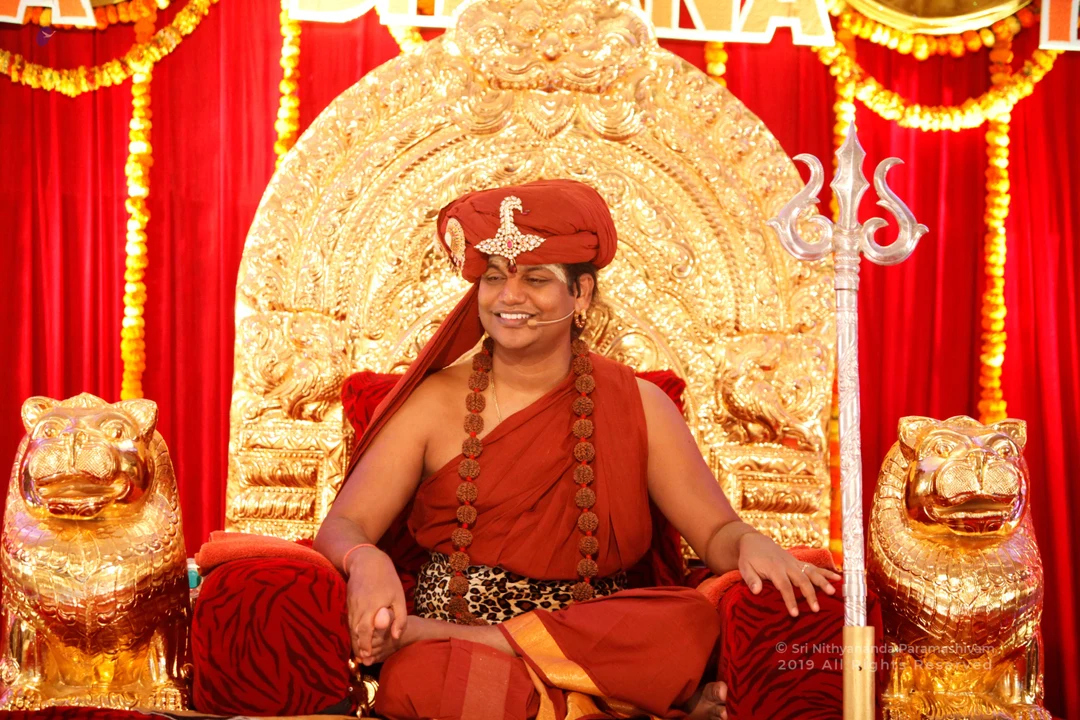
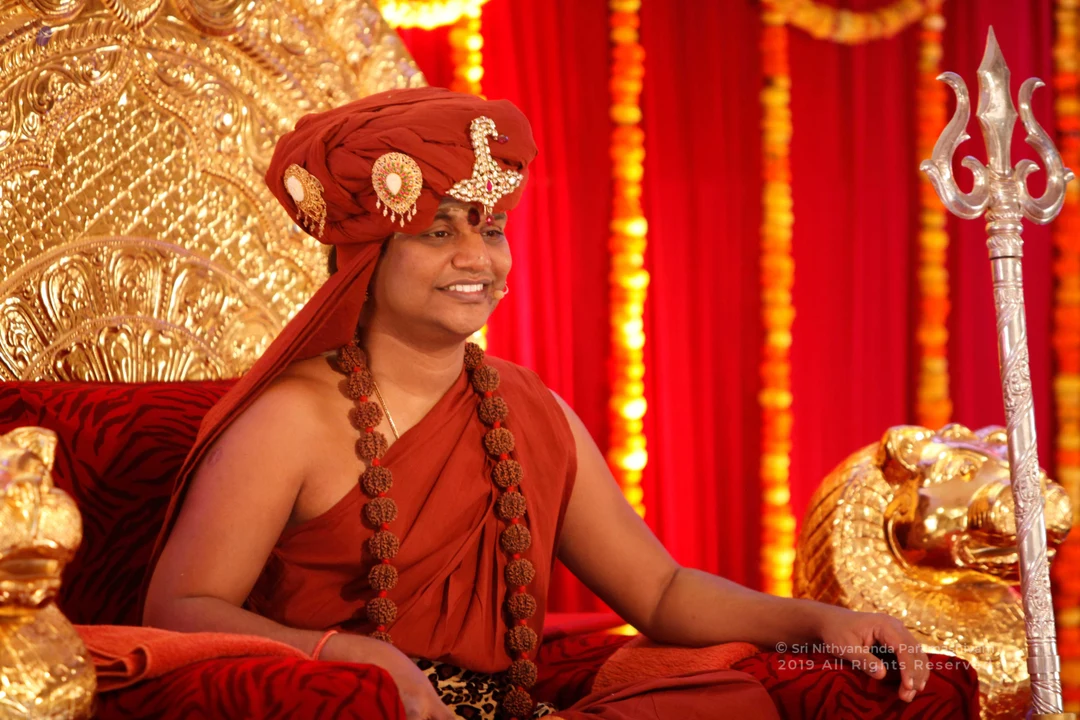
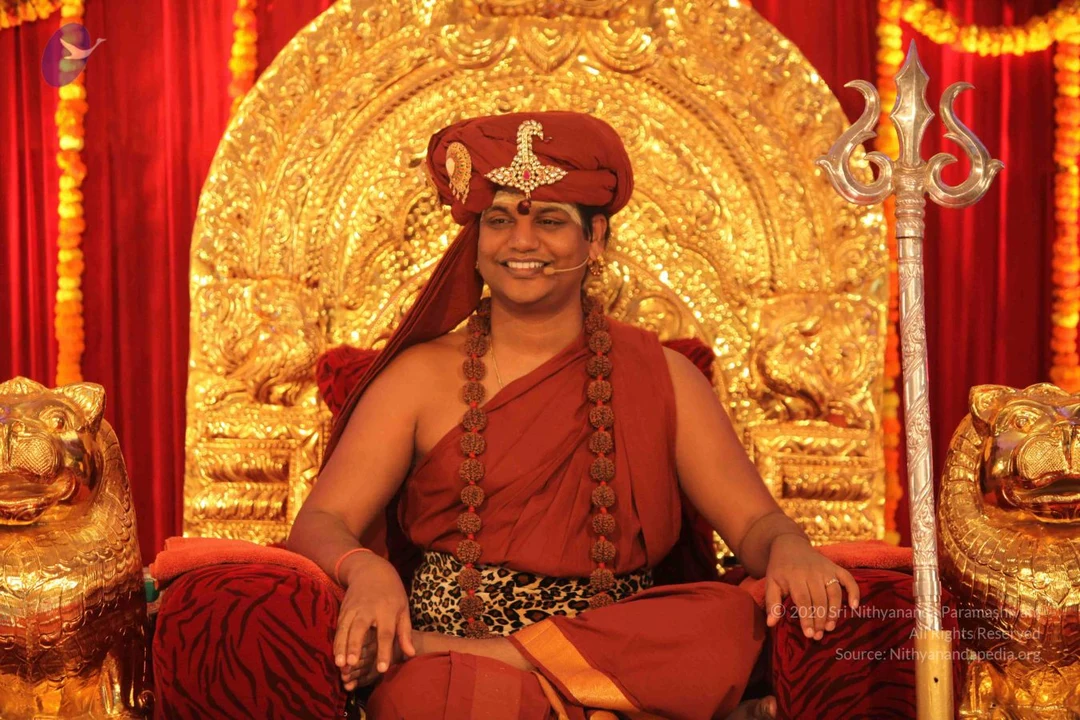
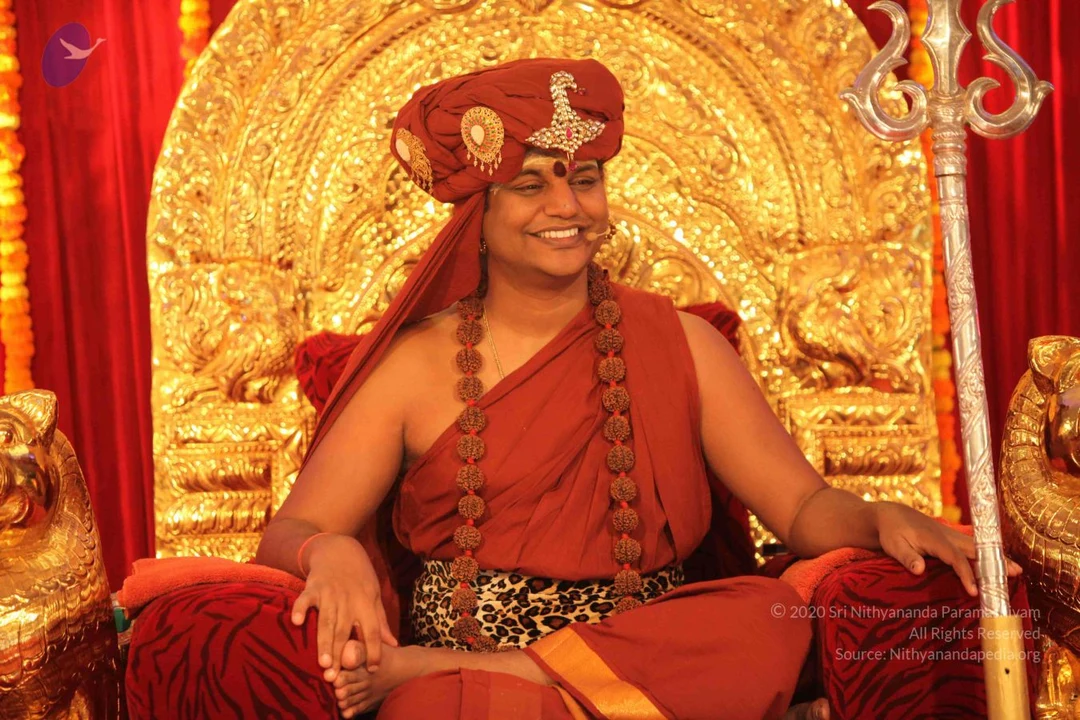
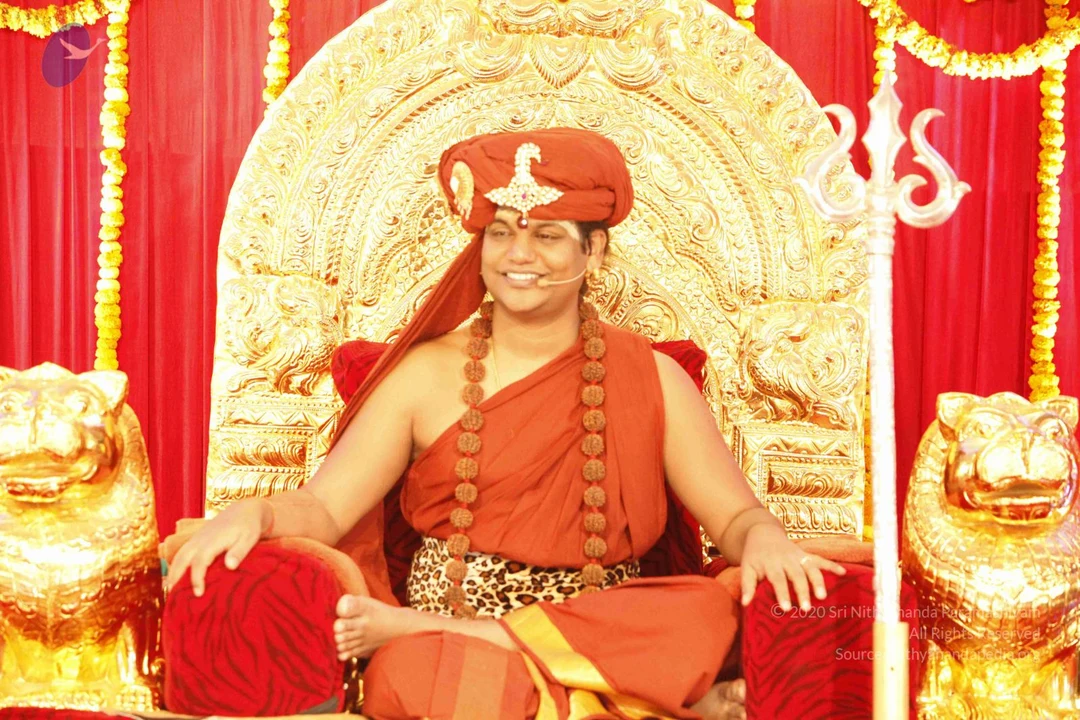
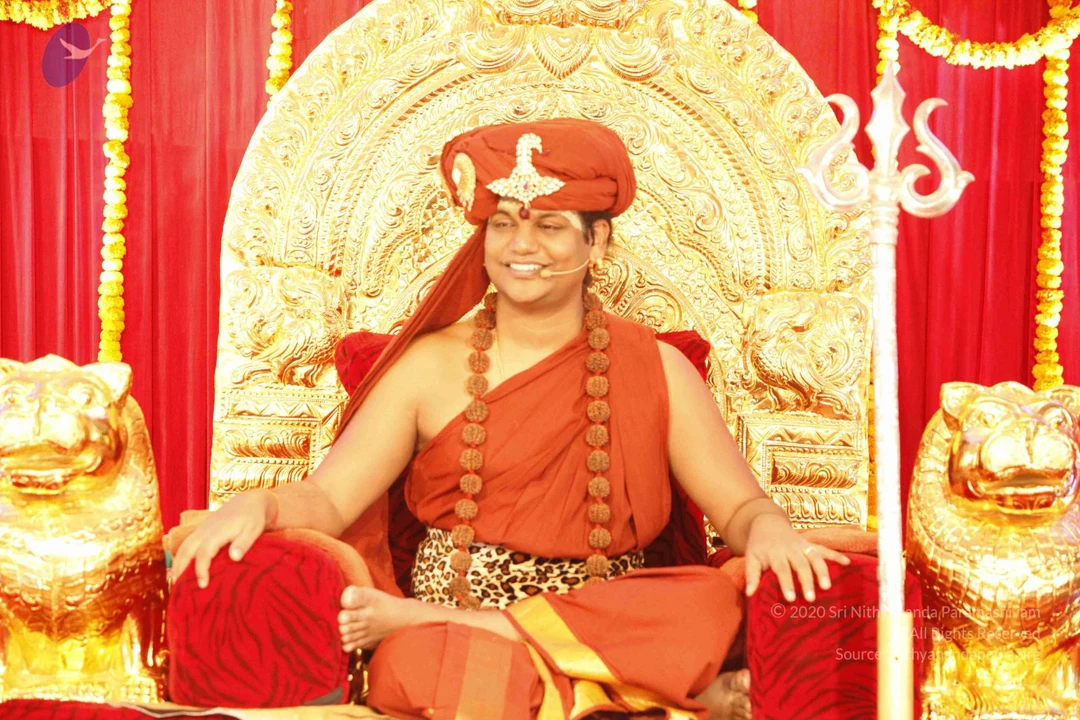
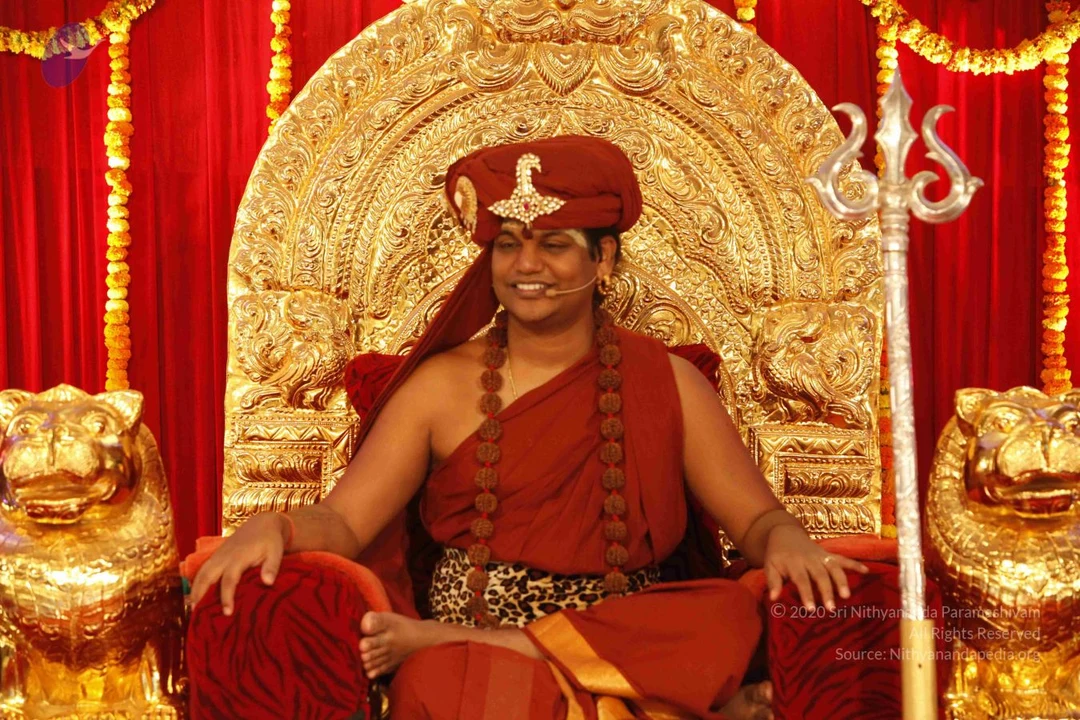
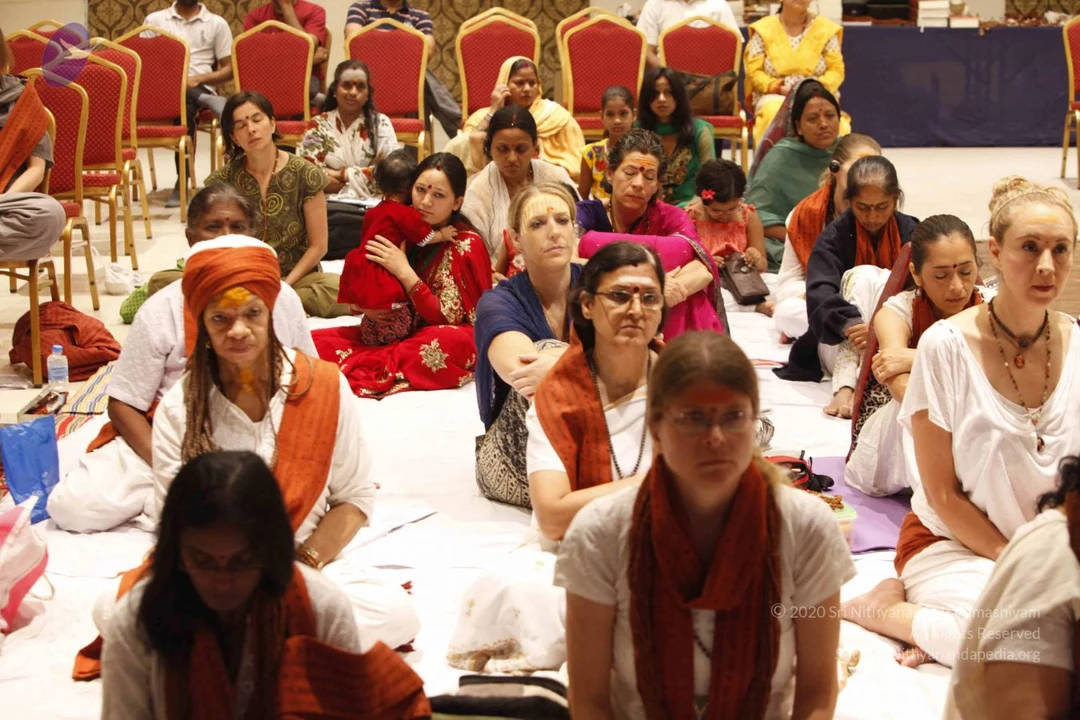
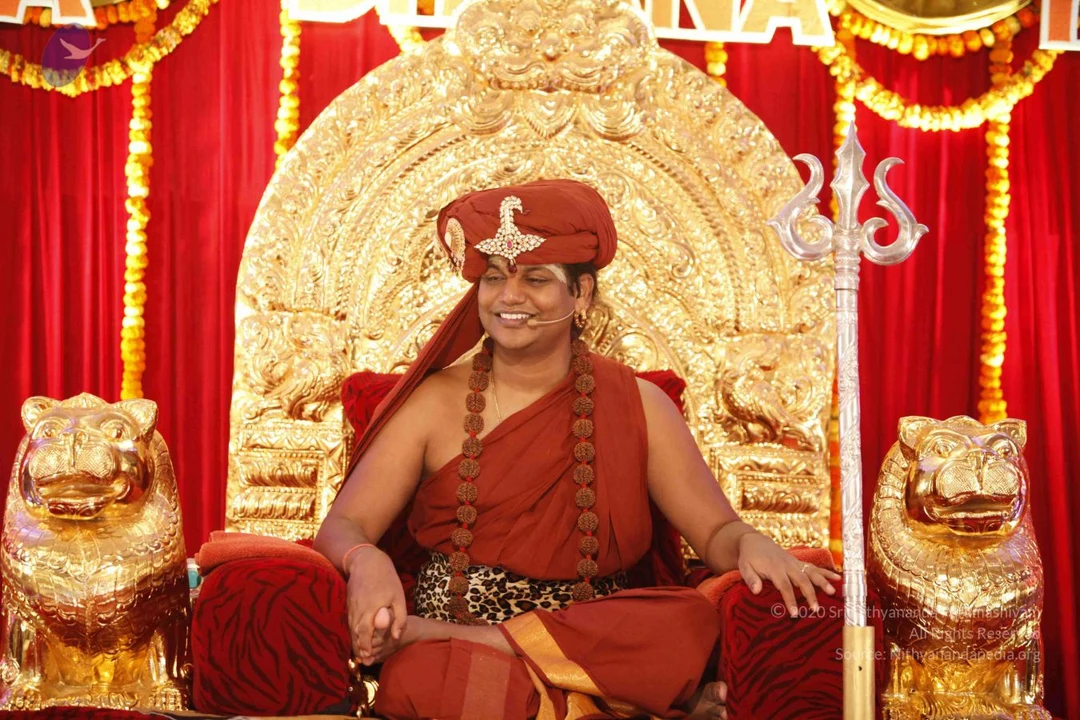
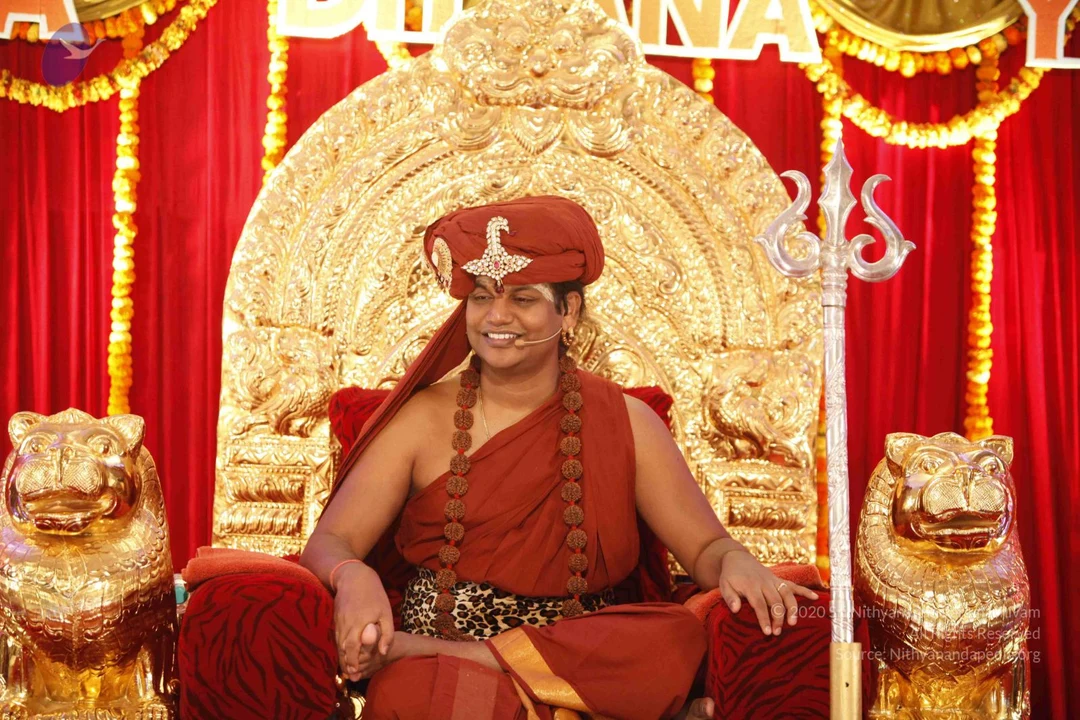
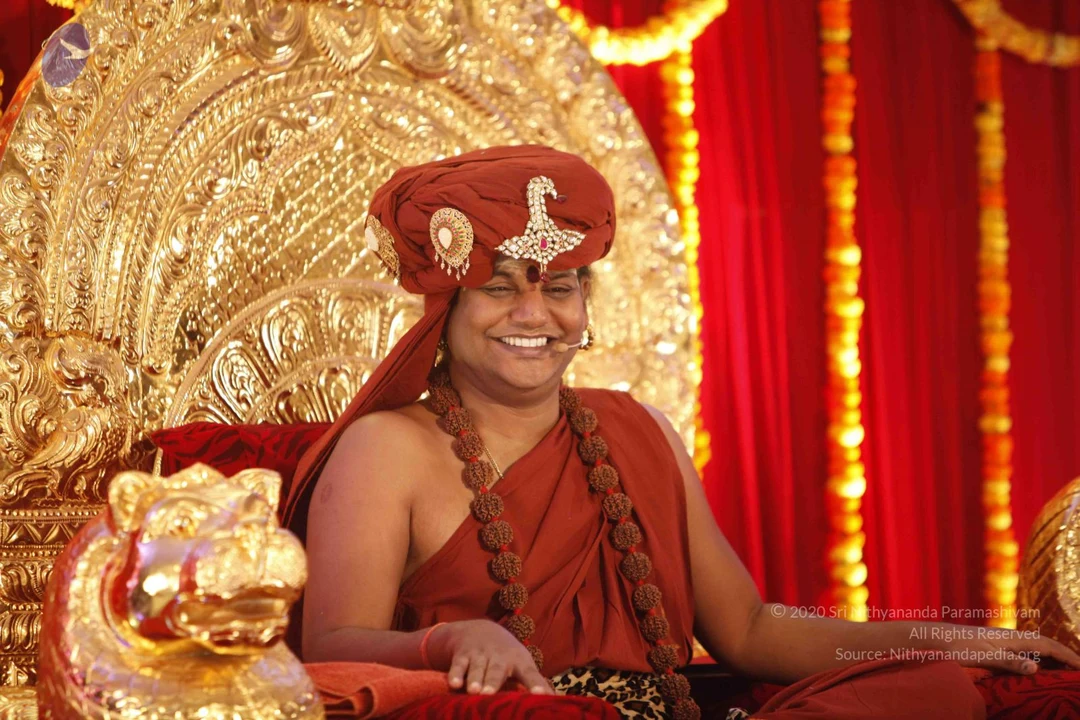
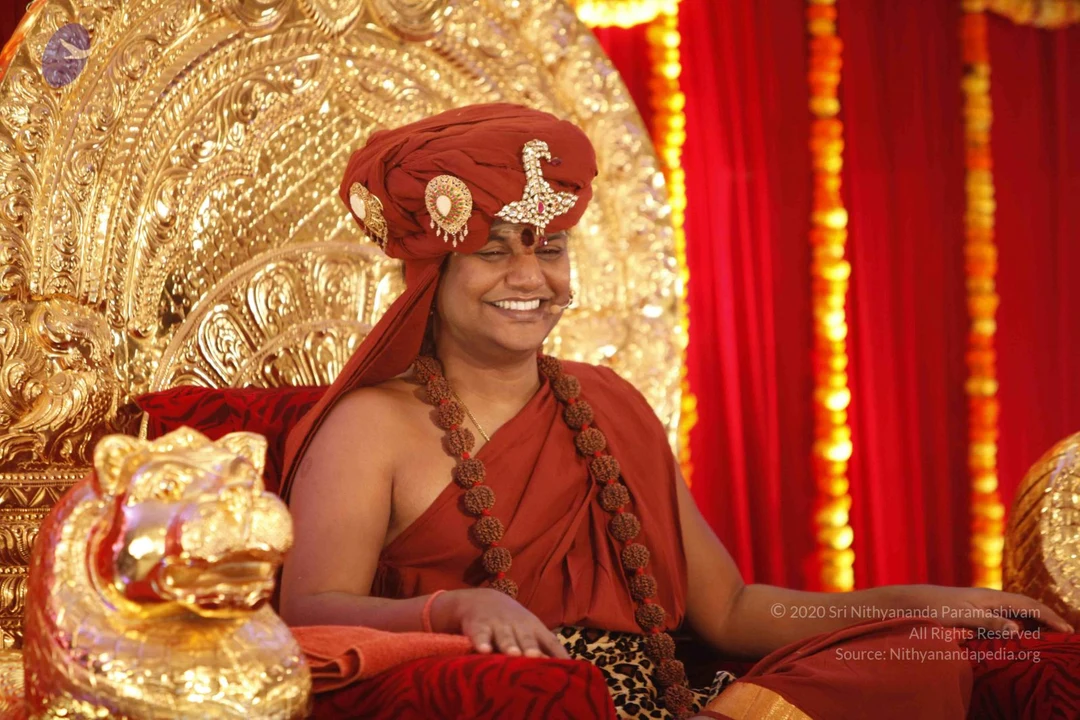
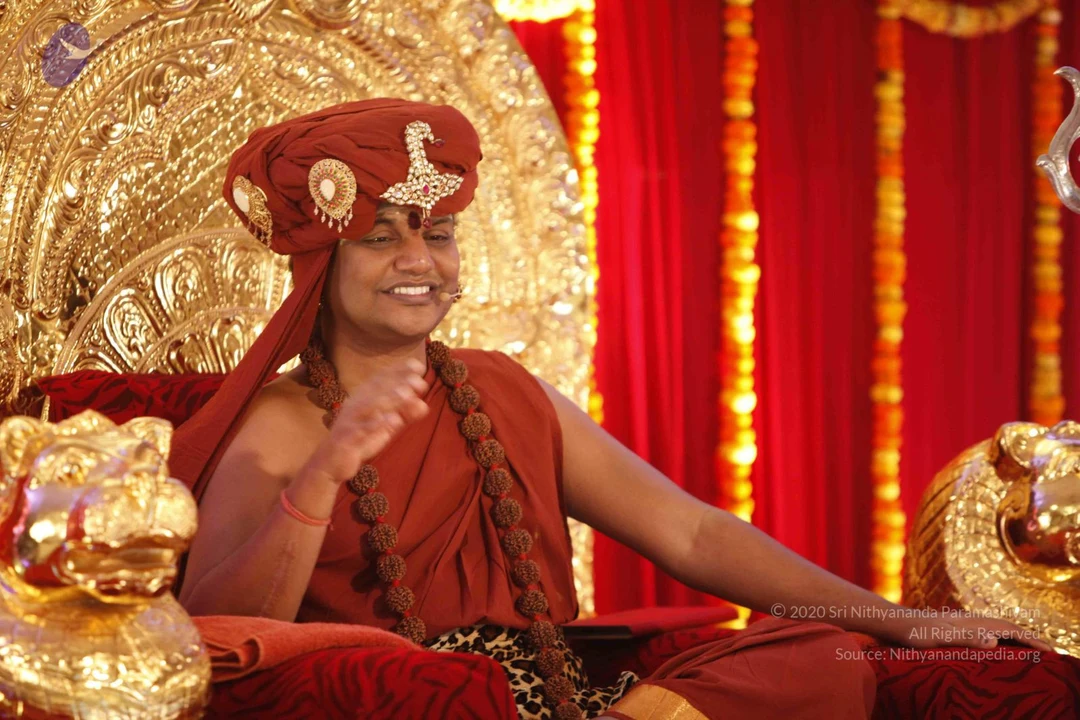
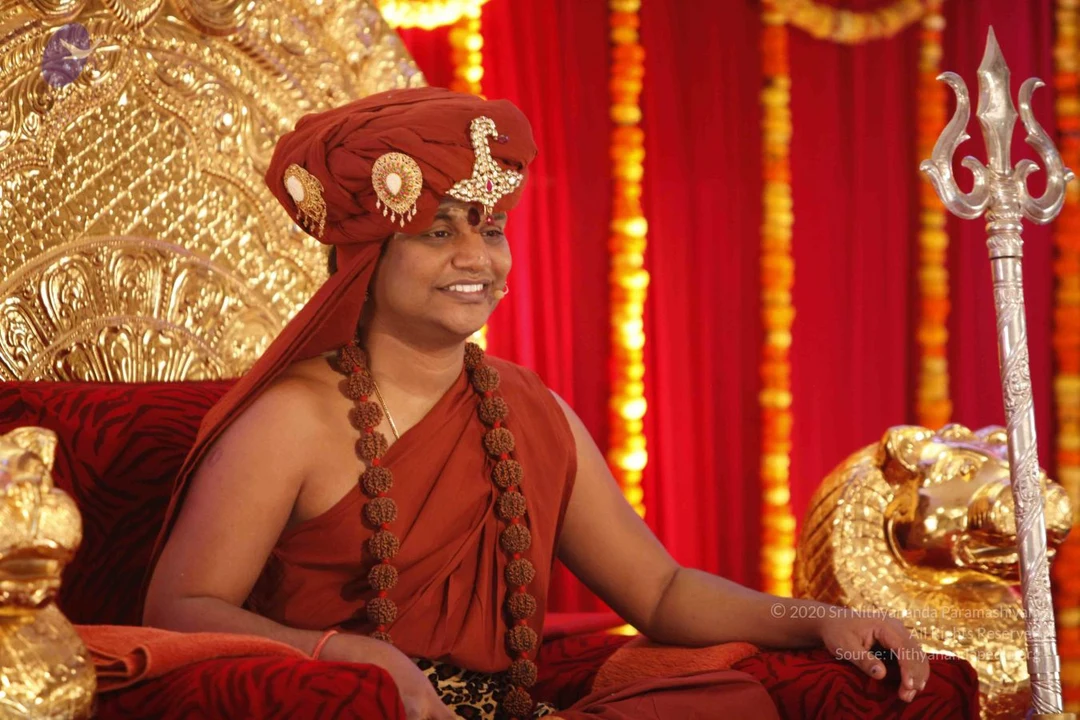
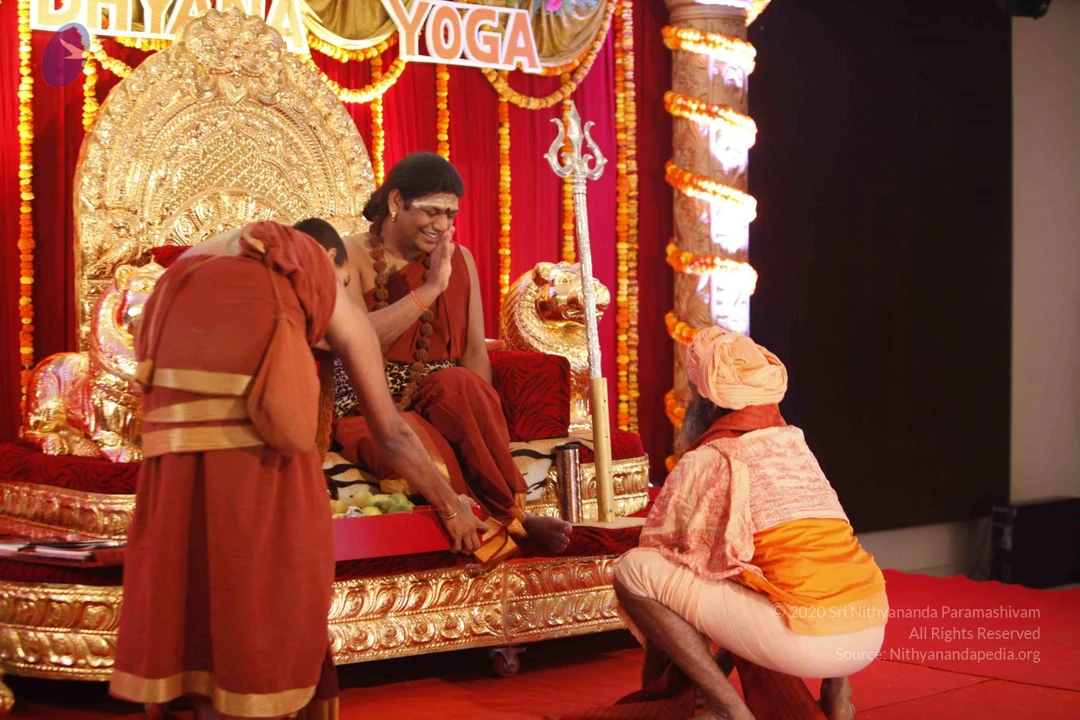
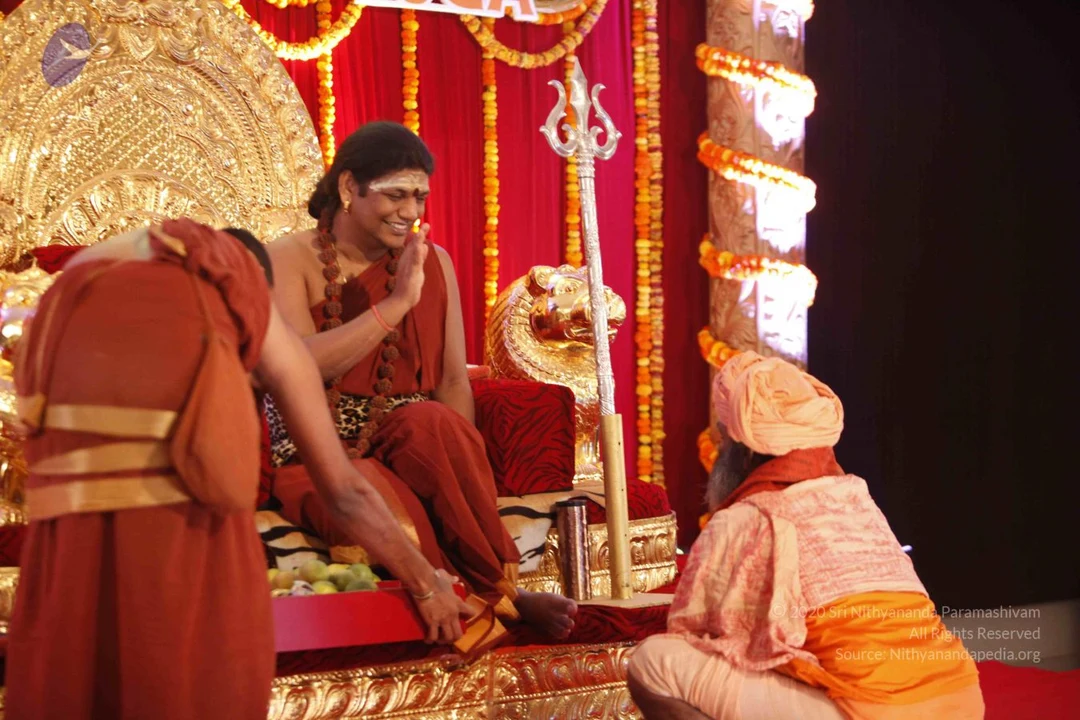
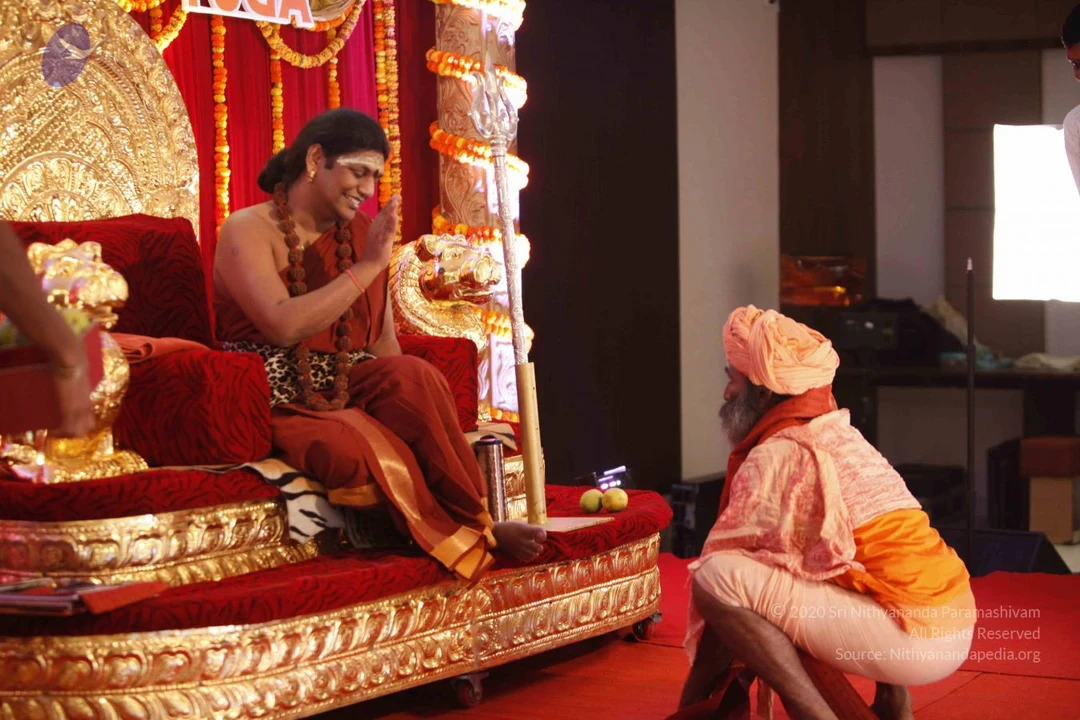
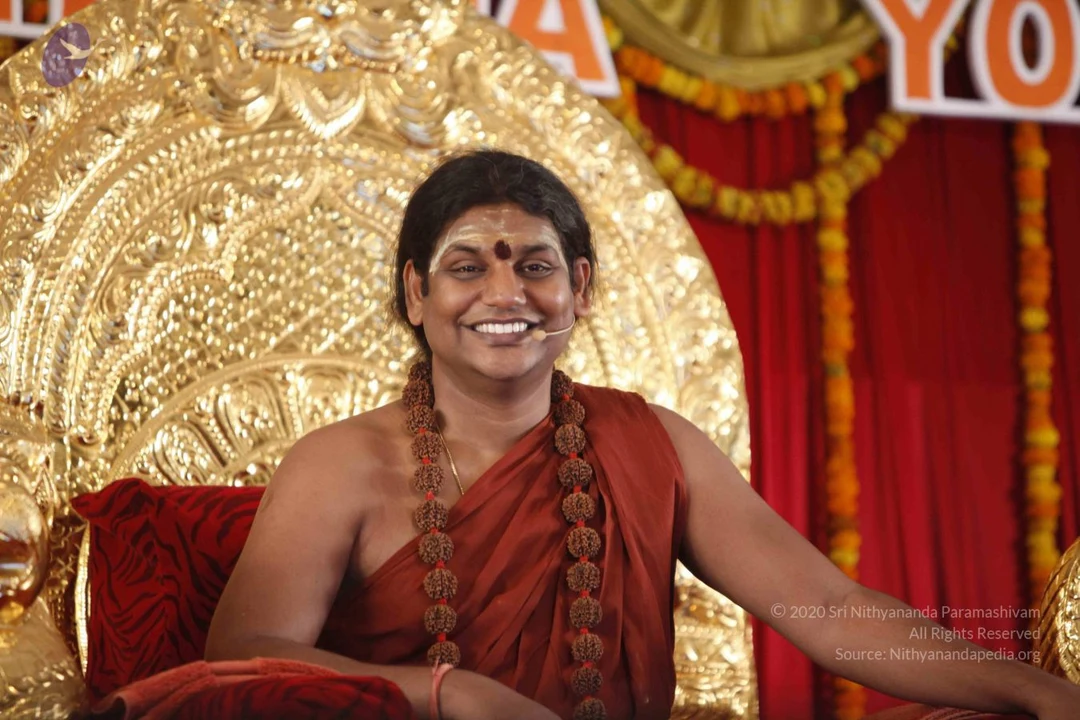
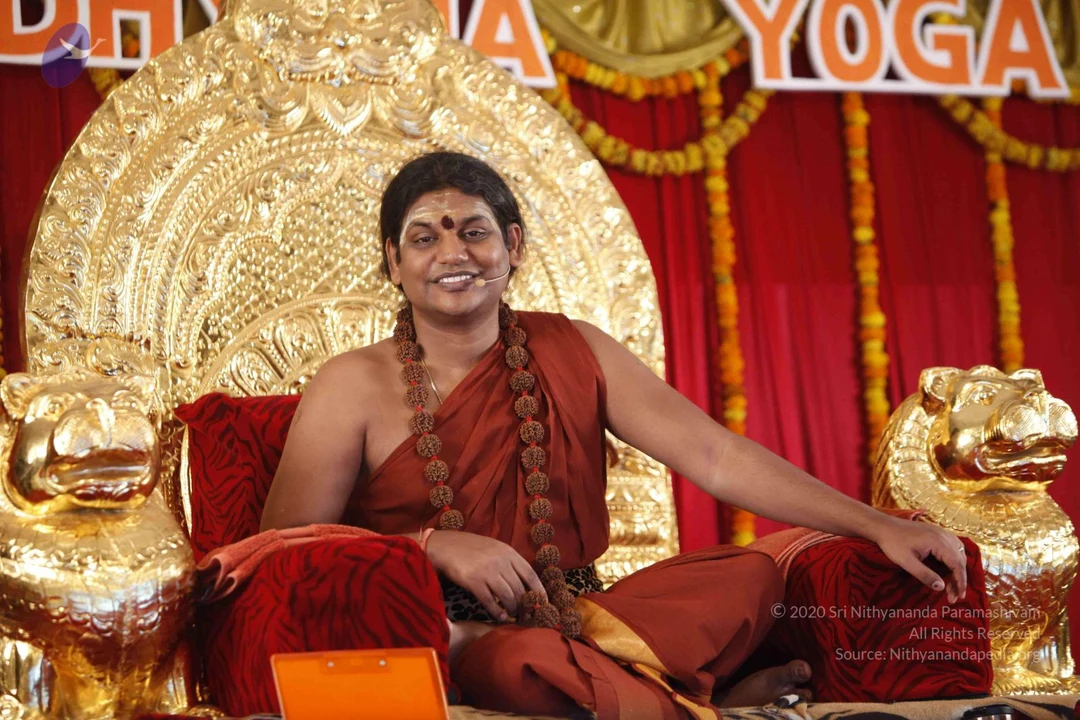
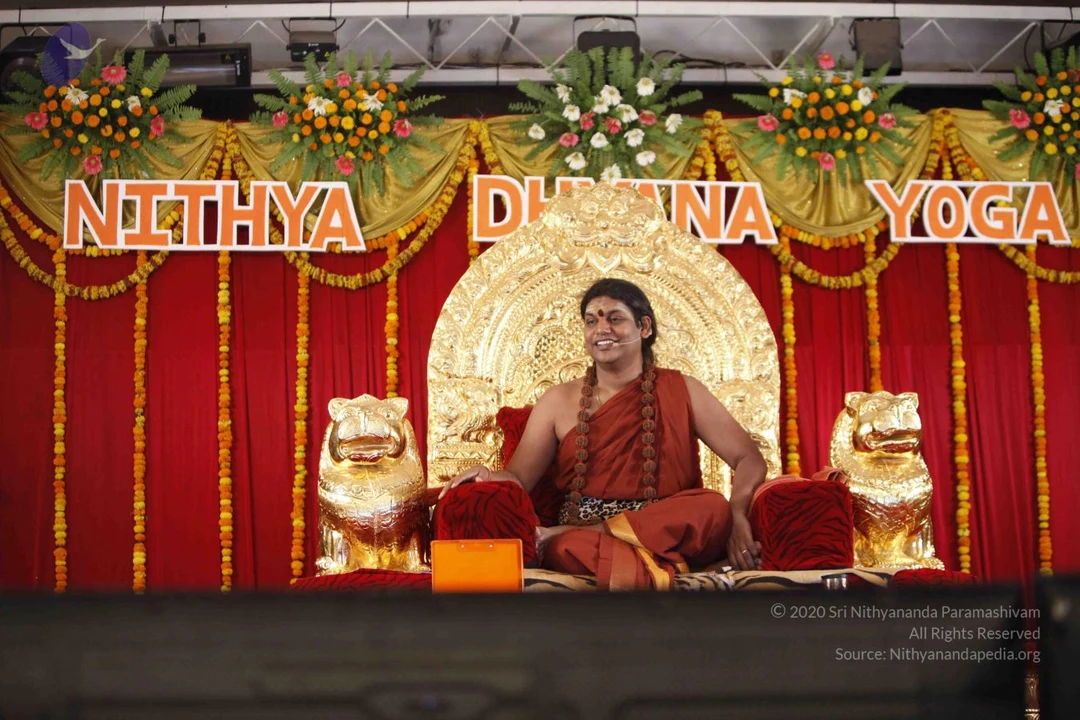
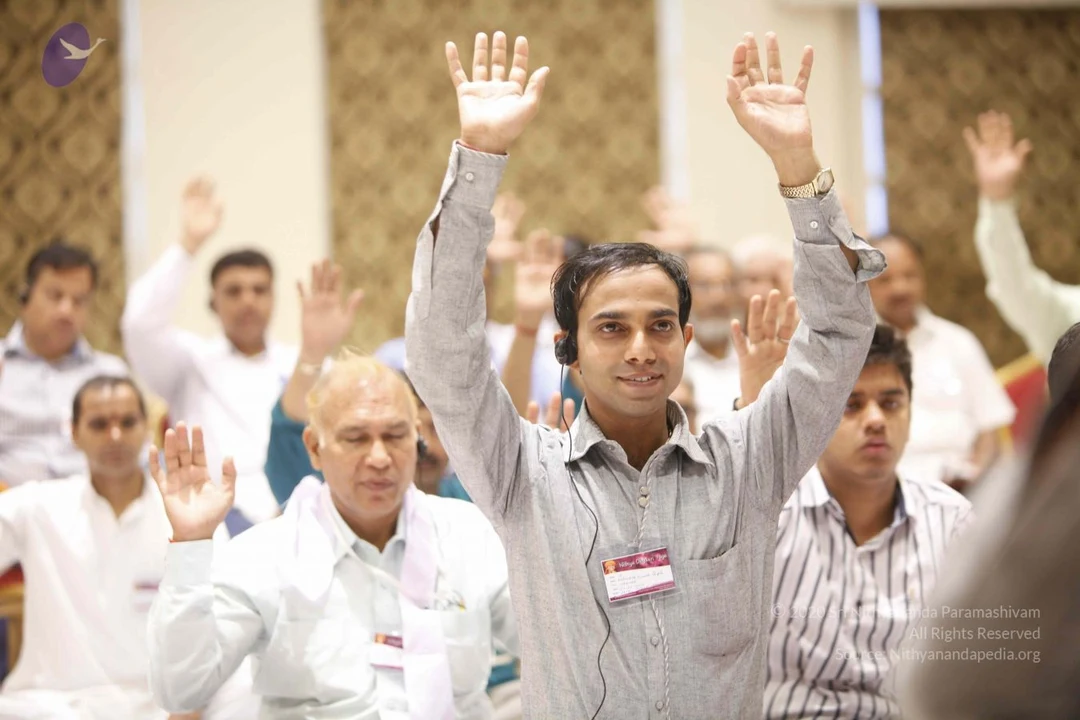
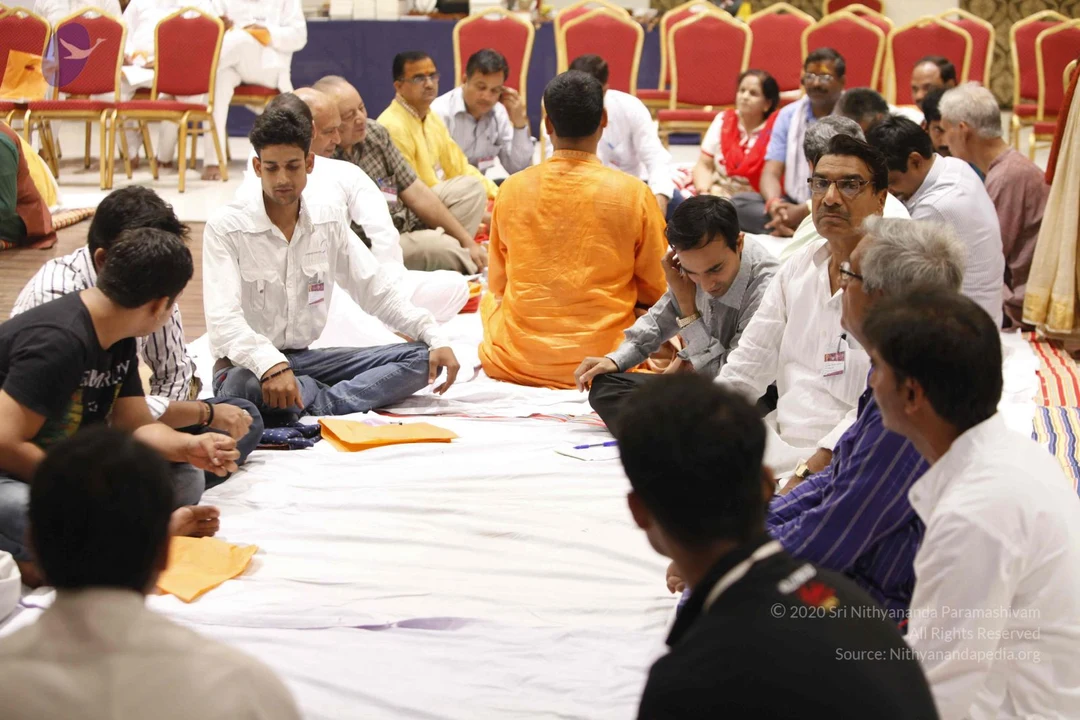
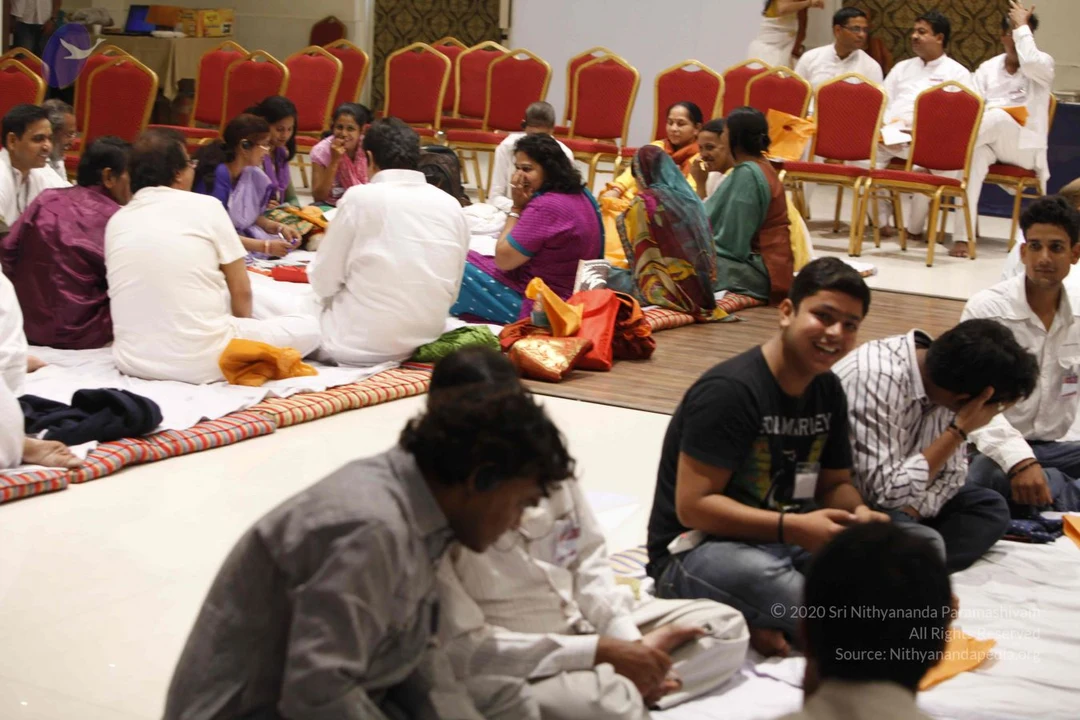
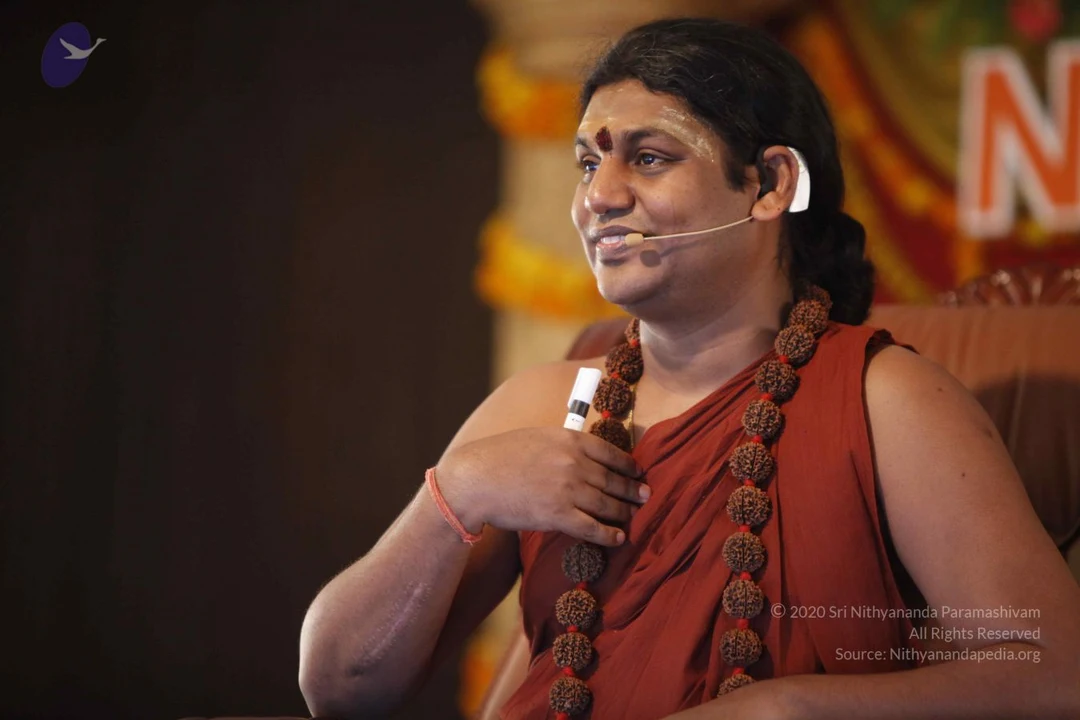
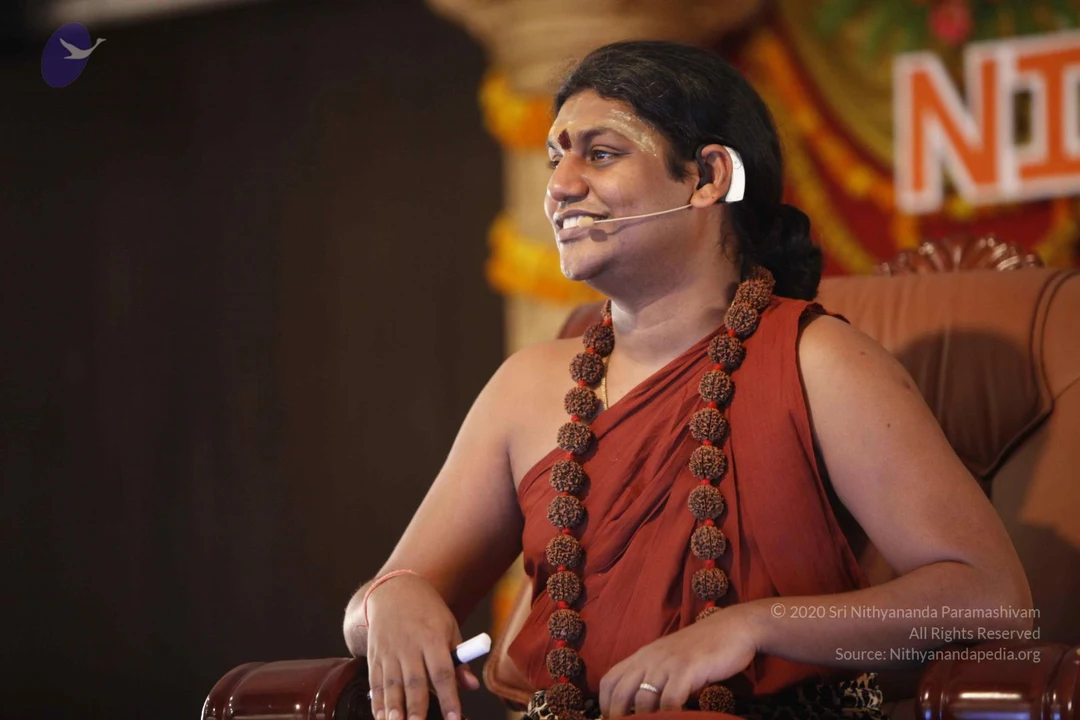
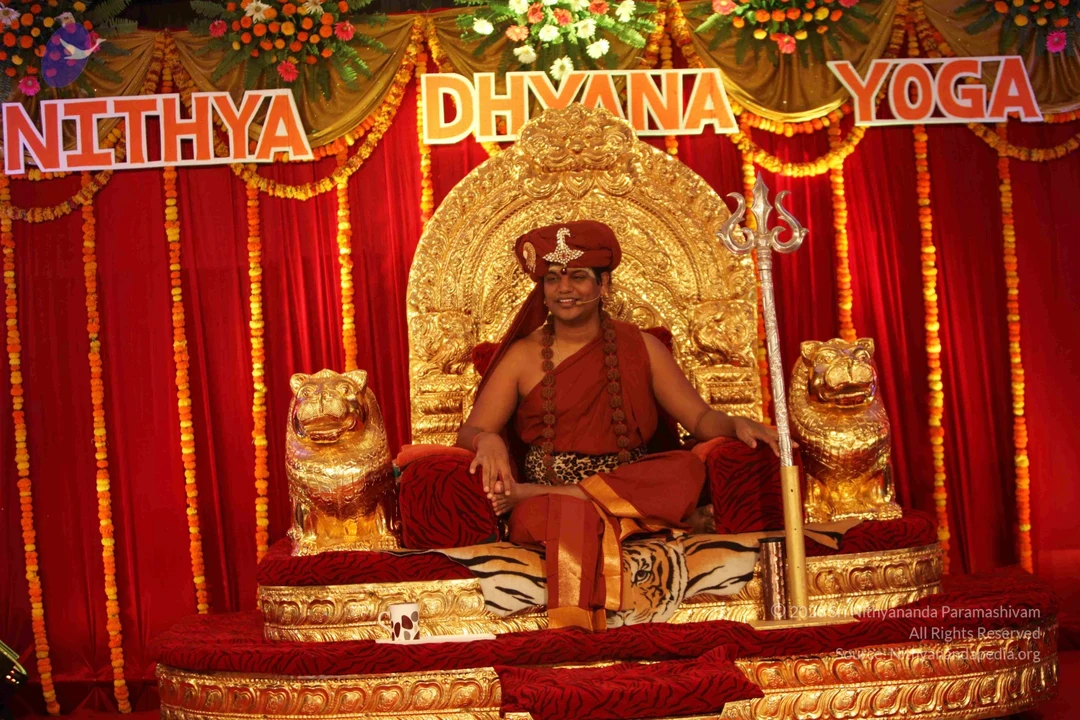
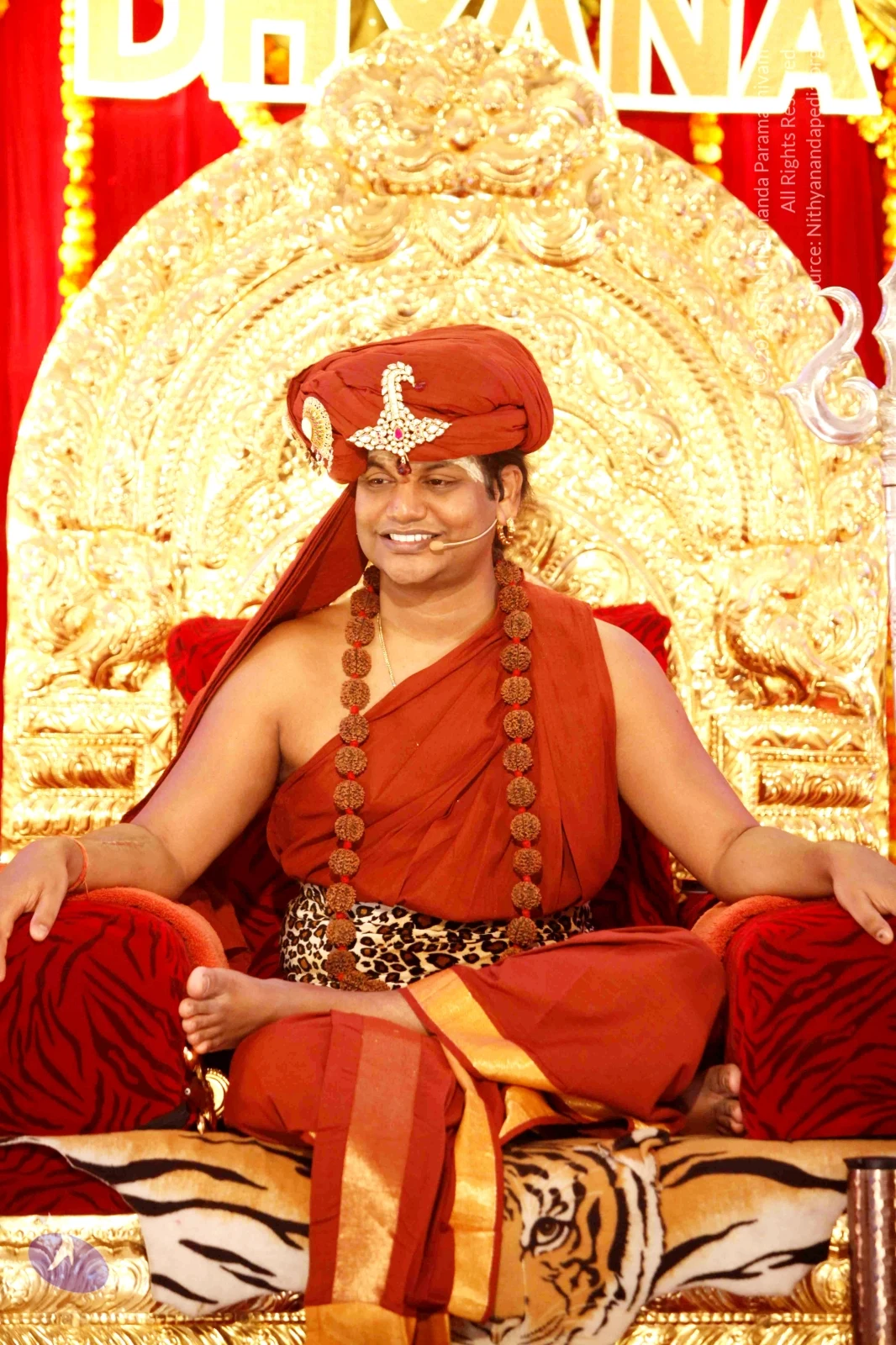
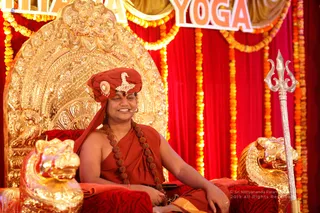
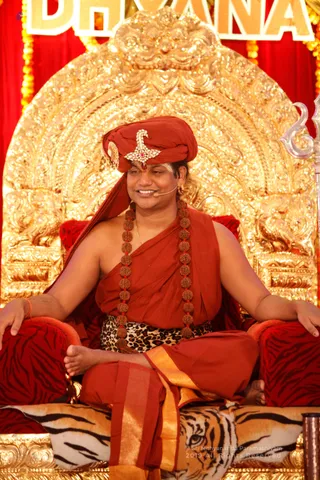
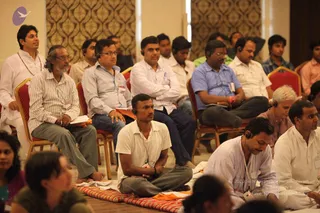
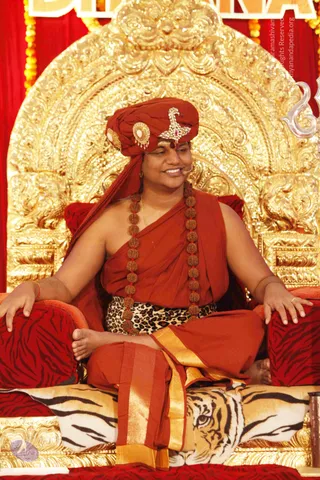
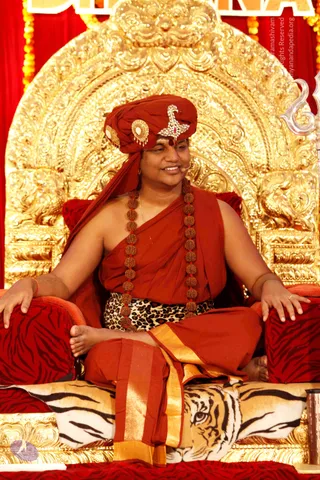
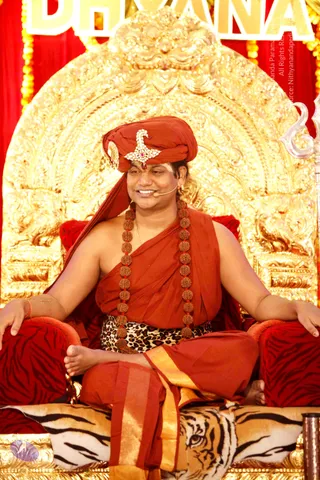
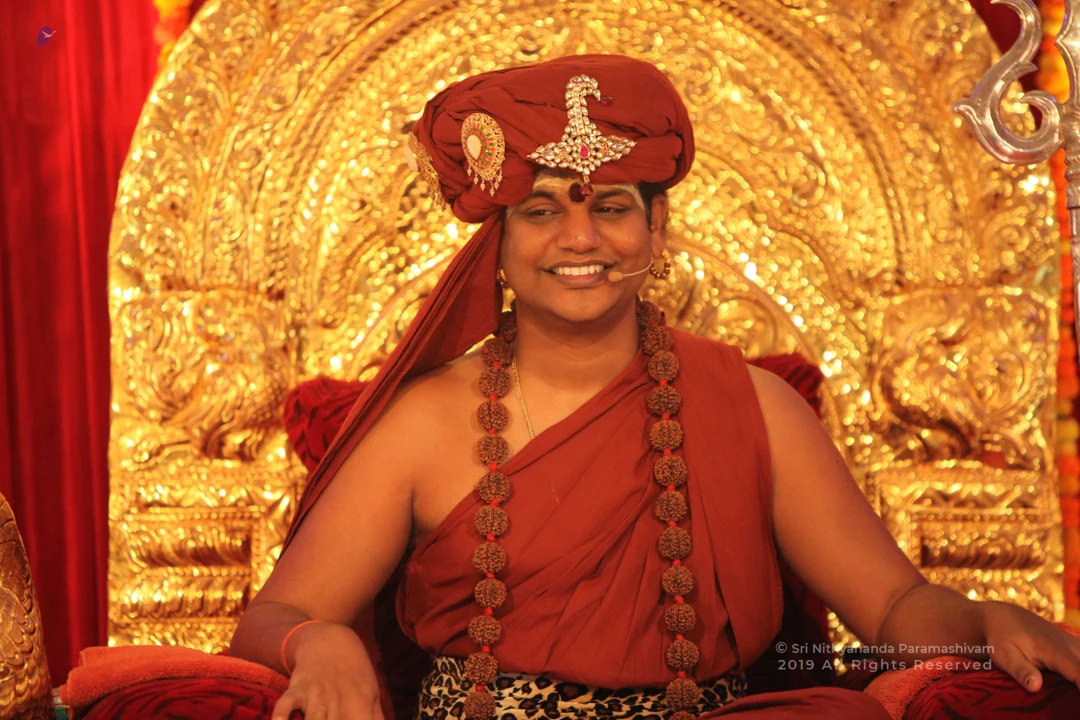
A seated man in an ornate golden throne setting wears a red-orange turban with a jewelled gold ornament and a red tilak, and a long rudraksha mala with red-orange robes over a leopard-print cloth. He smiles and sits on red cushions, with a microphone at his cheek and a trident-like silver staff at the upper right against a red curtain and gold-embossed backdrop. Swamiji (probable) appears as the person seated on the throne, with cues of a jewelled turban and rudraksha malas. One physical person is visible.A seated figure in a red-orange robe and red turban with a white jewelled ornament sits cross-legged on an ornate gold throne with carved lions and a mythical figure motif. A long beaded rudraksha mala hangs over the chest and a silver trident stands to the right. Two gold lion sculptures flank the throne, with red velvet cushions and a red drape behind, decorated with marigold garlands. A small microphone is at the face. The figure smiles and rests hands on the knees, with a leopard-print waist cloth visible.A seated audience fills a hall during a satsang gathering. In the foreground, women in orange and saffron shawls and a woman in a red embroidered outfit sit on floor mats, while rows of men and women in white kurtas, striped shirts and light jackets sit on chairs and mats behind them. Many wear lanyards with name badges. Gold-framed chairs line the room, and a table with a black cloth and a small brass item stands at the left. No a person candidate is visible in this crowd.

May 24 2014

Original wiki page
Contents

Title:

Advaita makes your enemy powerless

Description:

In today’s (24th May, 2014) morning satsang from Varanasi, Paramahamsa Nithyananda expanded on Living Advaitha; specifically how Advaitha can be a crisis management strategy. He pointed out that each of us is fighting our own Mahabharat war and when we are in a state of completion our anxiety is reduced and we can see who really wants to fight and who has been influenced by induced enmity. This understanding is arrived at by deep contemplation and always being in a state of non violence. Tags- Varanasi, Paramahamsa nithyananda, Living Advaitha, crisis management, strategy, Mahabharat , war, completion, anxiety, reduced, influenced by induced enmity, deep contemplation, non violence. Watch, Share and Subscribe to our channel to be notified of the next upload click http://www.youtube.com/subscription_center?add_user=lifeblissfoundation to subscribe.

Link to Video:

VideoAudio

Transcript:

NithyanandeshwaraSamaarambhaam

NithyanandeshwariMadhyamaam |

AsmathAachaaryaParyanthaam

Vandhey Guru Paramparaam ||

I welcome all the devotees, disciples, samajis, satsanghis, Shrimahants, Mahants, Kotharis, Thanedars, who are sitting with us all over the world through Nithyananda TV, Sadhna TV, two-way video-conferencing having NayanaDeeksha.

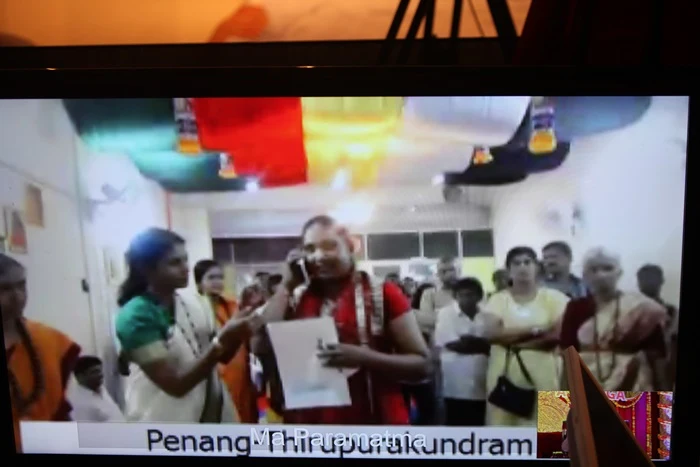
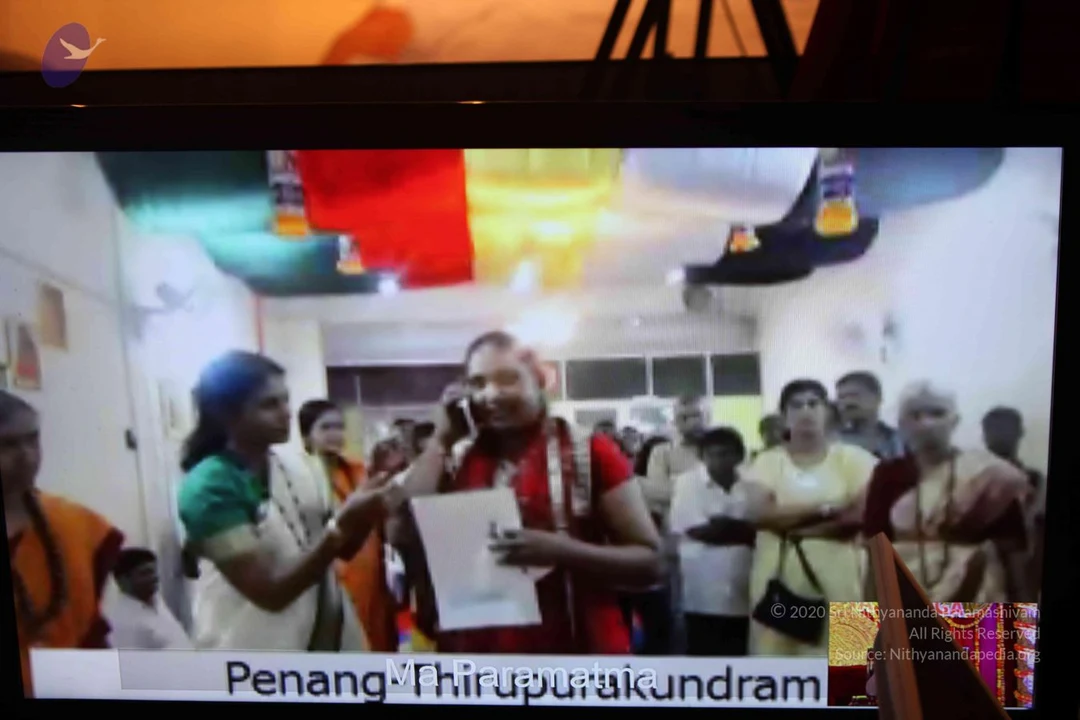
Cities sitting with us through two-way video-conferencing: Surrey-Canada, Seattle-Chidambaram, Houston-Kalahasti, San Jose-Madurai, Singapore-Singapuram, Toronto-Kailasam, Penang-Tirupparamkundram, Peethadeeshwaris Training Centre-Salem, Santa Clara-California, SanDiego-Tirualavai, Scottsdale-Arizona, Ohio-Prayag, Dubai-Vaidyanatham, NithyanandaNagara-Bidadi, NithyanandaNagaramu-Hyderabad, Nithyananda Nagar-Tiruvannamalai, Nithyananda Nagar-Rajapalayam, SanDiego-Tirualavai, Gyaneshwor-Nepal, Canada, Guadeloupe-Rameshwaram, New Zealand-AdiArunachalam, Hyderabad-Gupta Kashi, Phillip Island-Australia, Hong Kong-Sirkazhi, Nithyananda University-Los Angeles, NDY Nithya Dhyaan Yoga-New Delhi and Penang-Tirupparamkundram, Singapore-Singapuram.

I welcome all of you with my love and respects.

Today we have beautiful programme, two-day meditation programme – Nithya Dhyaan Yoga, first level – in Ananda Vana. In AnandaVana the programme starts. All over the world through two-way video-conferencing the programme will be happening. Next two days I will be teaching the Science of Completion, Completion with yourself.

Let me start today’s satsangh.

3:31

Today I wanted to expand on Living Advaitha.

See, many saints, sadhus, have spoken practical Advaitha, practical Vedanta, how to apply Advaitha in your market-place, in your business, in your day-to-day life, in your family relationships. But I am going to expand on Advaitha can be a war strategy, how it can be a crisis management strategy, because I used it. I won all the wars I waged, all the wars. Please understand, I did not enter into any war, but when I am forced to wage, I waged all the wars and handled all the critical situations, everything just through the power of Advaitha, the non-duality, non-dual experience. The war brought me only success. It has proved the power of the non-dual philosophy, the Advaitha.

I tell you, all of us are going through some Kurukshetra. You are fighting with your own Mahabharata. You are fighting in your own Mahabharata. You are fighting with your own Duryodhana, Karna, Bhishma, Drona. If I share how the Advaitha was such a successful powerful strategy, it will really be helpful for all of you to use Advaitha as the powerful strategy in your Mahabharata, in your life war.

First thing, listen, Advaitha reduces..... Living in the space of Advaitha, having liberated thinking, kind of a constantly completing with yourself and others, this constant Completion does two things to you immediately:

· One, reduces your anxiety level.

· Second, because of the clarity it brings, it helps you to identify really the people who want to fight with you, not that people who come in the crowd, understand.

Many time, just because a large crowd is going, you also go with it without knowing where that crowd is going. That happens in the life. When many people hate you, fight with you, if ten-twenty people are fighting with you, they will create a scene as if whole world is against you, and it will also appear so many people will join that ten-twenty people. If you are in the anxiety, you will start throwing weapons on all the thousands of people. But if you carry the space of Completion, you will see just in two-three days, the two-thousand people drop off. The group which joined for curiosity sake will drop. People really who want to be destroyed only will be opposing you.

8:13

Please understand, if I have to put it in very simple words, without finding solution just if you sleep off, postponing the problems, eighty percent of the problems will die. Understand, the statement I am making, you will never expect this statement from my mouth. I am saying, without bothering to find solution, if you just brush them aside and sleep off, fall asleep, eighty percent of your problems and enemies will disappear, because they do not have individual enmity towards you, it is excited enmity towards you. ‘Because ten people are attacking this fellow, why not let me also throw a stone on him? May be he must be a evil, really, really evil.’

Most of the stupid fellows who were abusing Hitler – no, I am not supporting Hitler – who attacked Hitler, have no brain. In the name of Hitler, the modern day, many demons and devils are saving themselves by diverting your attention towards Hitler. What about each American President in the modern day? What about all these oil wars? Hitler was used, is still being used to divert your attention from all the modern-day devils and demons. I am not saying about one person or one country; in every country the way things are happening, in every place the way things are happening! So, if you are just hating Hitler because everyone hates, it is ‘infused enmity’.

Please understand, if you start fighting with people who have ‘infused enmity’ towards you, you will be wasting your resources and energy; you are fool. Wait. Just fall asleep. When a tornado comes, don’t think your crowbar is a great powerful weapon, and don’t go and try to roll your crowbar and say, ‘I will fight with you tornado.’ No. Your crowbar or shield can never be a protection. when tornado comes just get into the underground and sleep, doze off!

Even your simple verbal response can make ‘incited enemies’ into ‘individual enemies’. Understand, people who have enmity towards you, people who feel that they have been personally suffered by you, and they want to attack you and people who feel, ‘Oh, he has suffered; I should support him’ – the incited enmity.

12:33

Please understand, all of you in your life will find both enemies. You will find individual enemy and incited enemy. Advaitha will give you enough space, will give you so much of Completion, will keep you anxiety-free. The first thing will happen to you is, you will be so anxiety-free, you will be in the space of Completion. You will not respond immediately to these incited enemies. Please understand, a man who is capable of not converting incited enemies into individual enemies is successful already in the war. See, when somebody joins the war just because others have suffered, if you start even throwing one word towards this guy, he says, ‘Now I also suffered. Come on, now you are directly my enemy.’ That is the stupid thing you will do. Creating the number of enemies, increasing the number of enemies is the foolish thing any strategist will do. First thing, be anxiety-free; through the space of Completion, so that you do not increase the number of enemies.

I am really telling you, if somebody has incited enemy, enmity is incited in him, he himself has not suffered, in twenty-one hours his anger and enmity will melt down if you just keep quiet. When they come it will look like almost two-thousand people are coming. Your real enemy will feel so empowered. Just keep quiet. When they come and stand in front of you before starting the war, tell your enemy to look all around. He will be all alone. He will be just all alone; because, your enemy’s strength is your anxiety. If you don’t have anxiety, half of your enemy’s strategies will become a failure. Understand, whatever lessons I am sharing with you is a very practical Living Advaitha experimented and experienced in my own life.

16:23

All of you are waging war in your life, in your business, in your relationships, in your career, with your health, understand? Even in your health, you are waging war. Even your health is a Mahabharata. Your eyes are Dhritarashtra, shoulders are Bhima, stomach is Sahadeva, heart is Karna, intellect, the buddhi, is Dharmaraja. The feeling you carry you are going to live forever from the consciousness is Bhishma. Your knowledge is Drona. Even with your health there is a big Mahabharata going on. Some parts of you are fighting with some parts of you. All your cells are the sena. Some group joins your brain, some group joins your heart, some group joins your being. Whether in your health or life or career, you are fighting with Duryodhana, Shakuni. The hypocrisy of you which makes you believe others are not as intelligent as you is Shakuni. Clarity of you which makes you understand everyone is as intelligent as you is Krishna. Krishna’s success is, he knows everyone is as intelligent as him. So he tries to be one step further. Shakuni’s weakness is he never thought the other side will have even one person as intelligent as him. Find out in your inner-space whether you are a Shakuni or Krishna.

Understand, the space of Completion, first thing it will do to you, you will not be creating more enemies. And most of the incited enemies will just die down. If you are anxiety-free, when the incited enemies drop off, now you will know really with whom you need to fight which will be very less number. Even then don’t start the fight. See, get into your inner-space, find those patterns which make you feel somebody is your enemy.

Listen. For a rich man, whoever tries to steal his wealth, or he thinks they are trying to steal his wealth, is his enemy. For a free man, whoever tries to steal his freedom, or whom he thinks is trying to steal his freedom, is enemy. For each person there is an instinct in him which makes him identify his enemies. Complete with that instinct. You will see many people whom you identify as your enemies are not your enemies, are not really your enemies.

So, when you do an acid wash of all your incompletions with the space of Completion, you will find so many people who appear to be enemy superficially are not any more enemies to you. The context from which they are having enmity is not directly attacking you. Understand, so, if you wait and complete with your instinct which identifies your enemies, you will understand all the people scream towards you are not your enemies.

22:20

Please understand, anybody who is shouting at your direction, you think they are your enemies. No. Look in, complete with the instinct which makes you identify your enemies. When you complete, you will also find the true purpose of your existence. Whoever tries to disturb your true purpose, only they are your enemies. Now you need to handle only those few people. Now you need to handle only those few people. Even in those few people, don’t think that whole person is an enemy. May be only his intellect is hurt by you and it is screaming towards you, or his emotion is hurt by you he is screaming towards you, his sentiment is hurt by you he is screaming towards you, or he feels threatened towards you, he feels threatened by you he screams towards you.

Look in. Even the enemy is not a complete enemy as you think. If you play the right approach from the space of Completion, suddenly even your enemy will tell, ‘No, no, no, only in that aspect I don’t like him. Other things are okay’. Don’t waste your time on him. Emptying your enemies out of enmity is the strategy to be successful in any war. Same way, with your body and mind, understand.

Afterwards when you find time, see this satsangh completely second time, third time. Try to apply this teaching, this concept in this satsangh, in your health. If you are having some fights with yourself - addictions, restlessness, depression, these are all fights with yourself. Even those moments are nothing but wars. So, try to apply these same teachings with you, within you. Just see which part of you is resisting you, which part of you is angry with you, which part of you is against you. Sometimes, your own sleep will be against you, your own hunger will be against you.

If you are having acidity problem, it is not that your stomach is fighting against you; your hunger pattern is fighting against you.

If you have a sleeping problem, too much sleeping, it is not that your body is tired; your boredom pattern is fighting with you.

Your body is an incited enemy; your boredom is the individual enemy. So handle your boredom. Your boredom is also not about the whole life. Only there are some two-three conflicting patterns; about that you are bored. Complete with them.

26:28

Please understand, first, all the friends of the enemy should lose enmity towards you. Then weapons of the enemy should lose enmity towards you. Then parts of your own enemy should lose enmity towards you. Make enemy wither away, understand? Till now you have not touched any weapon just like Krishna, and you don’t need to touch. The power of Advaitha, I tell you, when anxiety cannot be instigated in you, when the space of Completion cannot be taken away from you, I guarantee you are the winner. Hundred percent I assure you, you are the winner. In your health, in your wealth, in your relationships, in your business, in your profession, in your career, all of us are facing a Kurukshetra, all of us are facing a Kurukshetra. Apply these teachings by deep contemplation. Sit and think, think, think, how your own Completion makes the enemy powerless.

I tell you, rebuilding is the biggest revenge. Just by rebuilding yourself, you can make your enemies powerless, you can mock them, you can laugh at them. I tell you, when somebody is trying to frighten you, if you laugh, they will simply think you are laughing at them only.

Please understand, a person who cherishes enmity in the heart is already fallen. He lost the balance. He lost the purpose of life. He is a weak guy, powerless guy. He has already set up himself for failure. You just have to say ‘Thathaasthu’ to him. Never ever allow yourself to be out of the Advaithic space. Never ever allow yourself to enter into a violent space. Always be in the space of non-violence. Always be in the space of non-violence. Never allow the enmity to sit in your heart.

I will continue further on applying Advaitha for crisis management. I will further expand on this subject in next few satsanghs.

Photos

(Nithya Dhyaan Yoga (Life Bliss Program - level 1) - Day 1)
(kalpatharu on varanasi)

(e- kalpatharu Penang Thiruparakundram)

https://nithyananda.org/sites/default/files/photo-gallery/2014-05may-24-nithyananda-diary_e-%20kalpathru_0.JPG

Tags:

Varanasi, Paramahamsa nithyananda, Living Advaitha, crisis management, strategy, Mahabharat , war, completion, anxiety, reduced, influenced by induced enmity, deep contemplation, non violence.

Photos Of The Day:

MorningSatsang--Kalapataru--NDYsession1

NDYsessions

1-Morning-Satsang-Kalpataru-NDY-1

2-Nithya-Dhyana-Yoga

Photos from this day

View all 107 photos

(Nithya Dhyaan Yoga (Life Bliss Program - level 1) - Day 1)
8 photosSource gallery
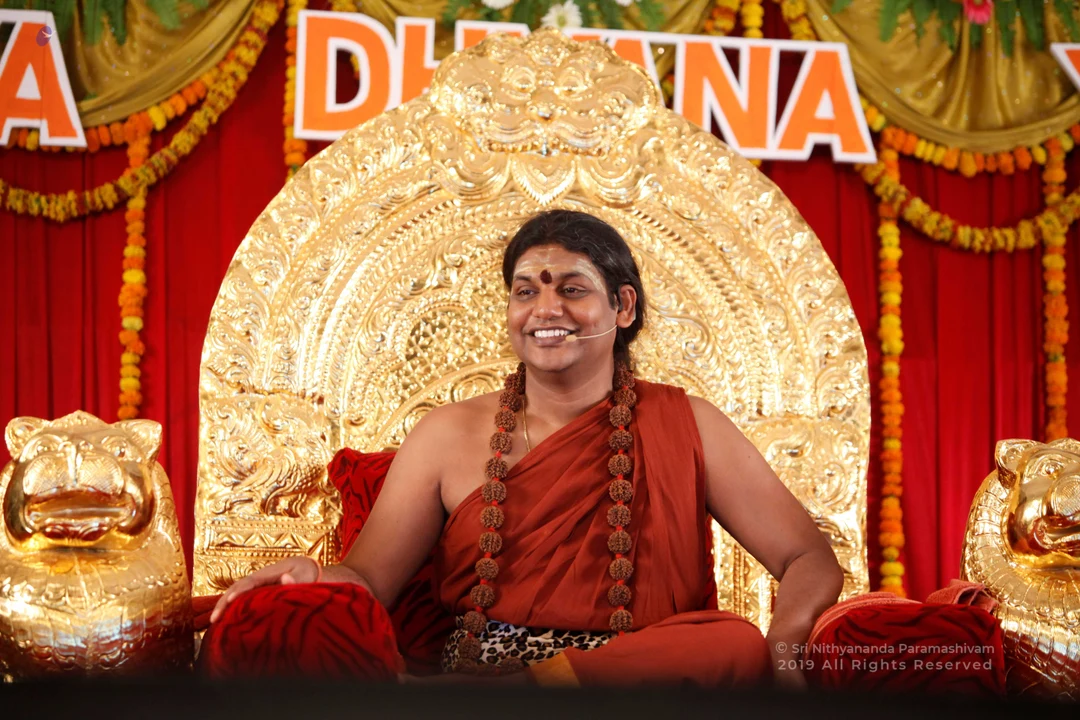
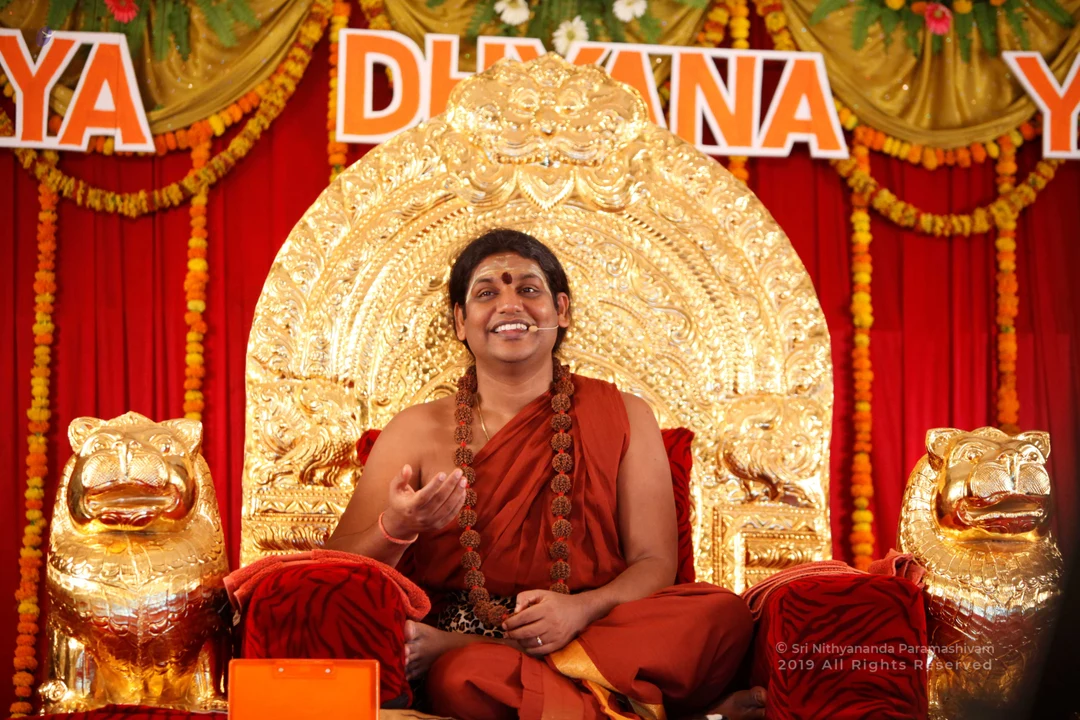
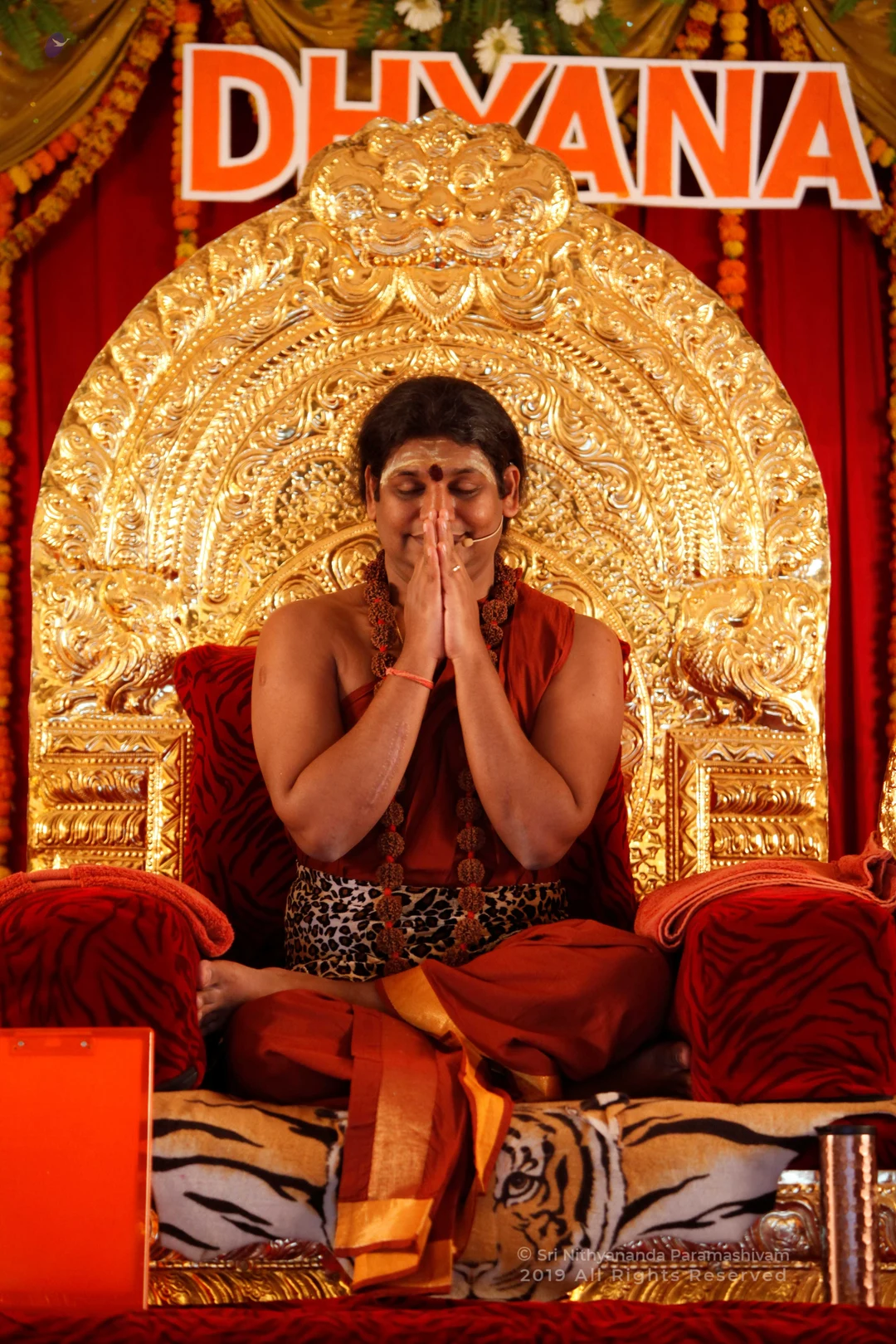
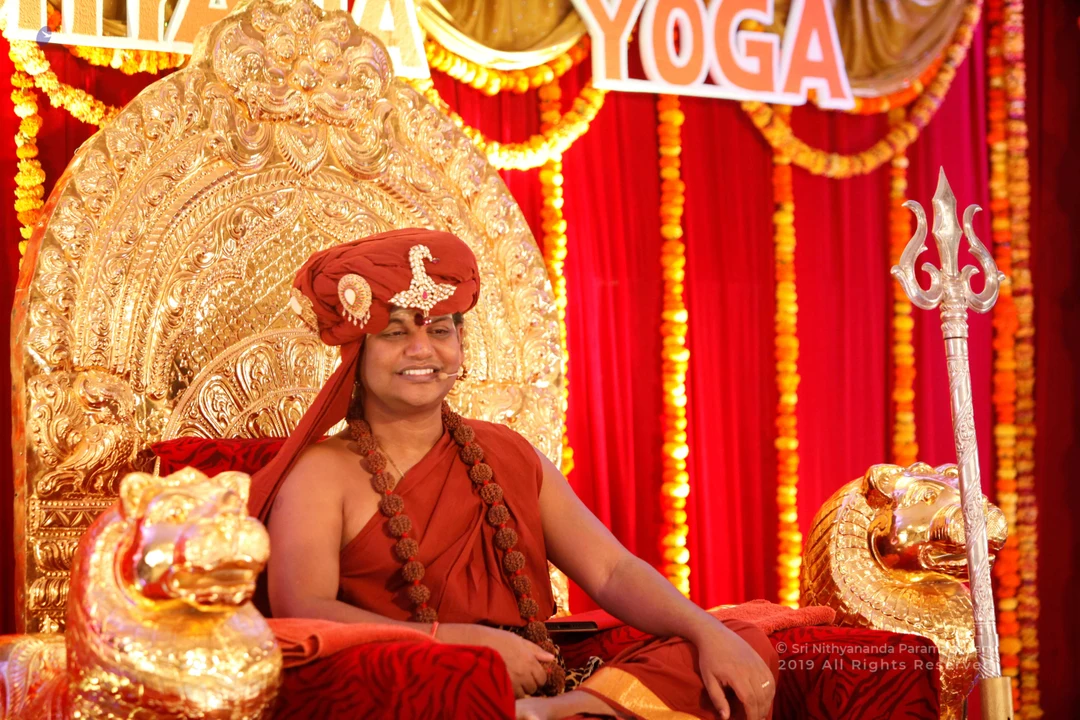
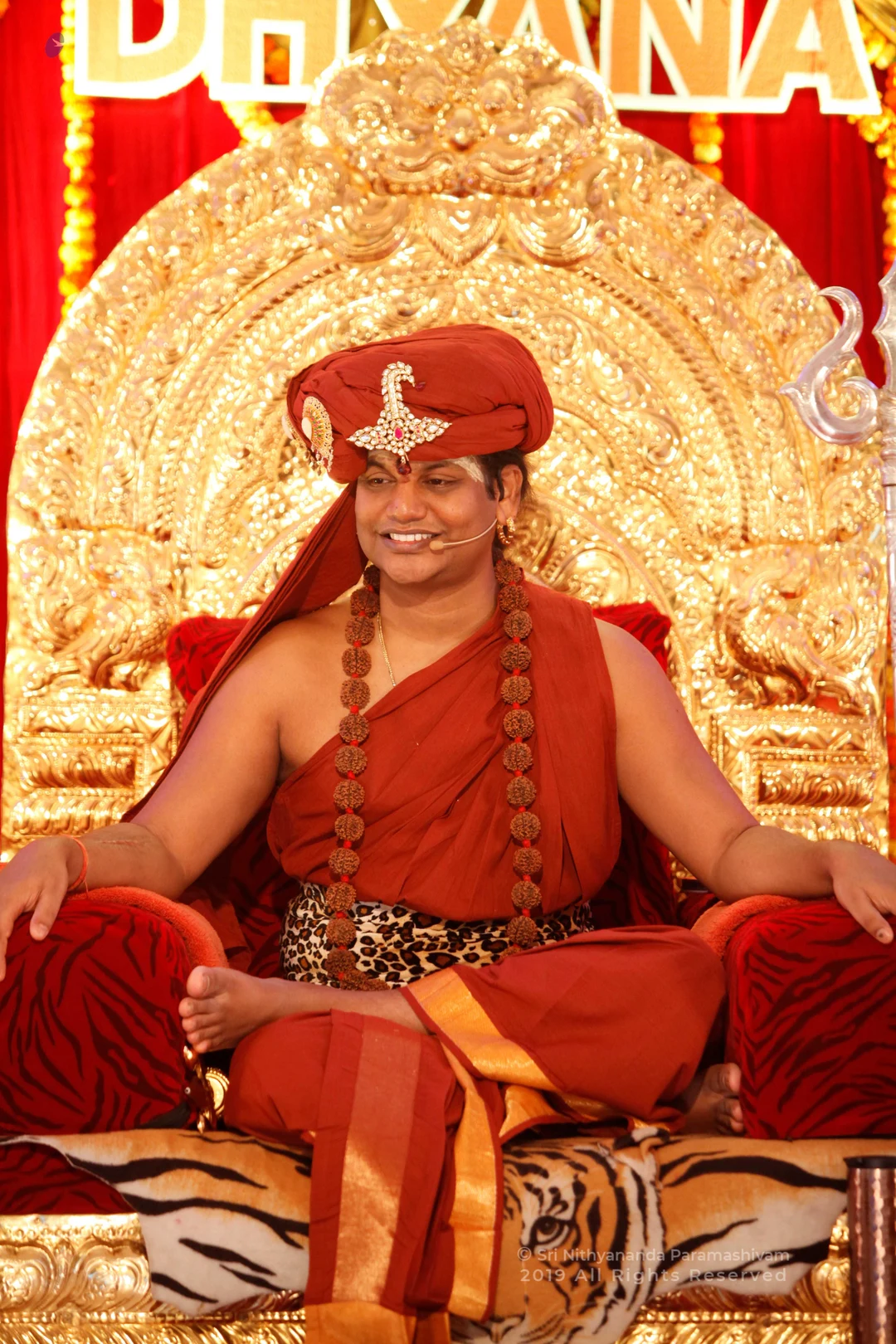
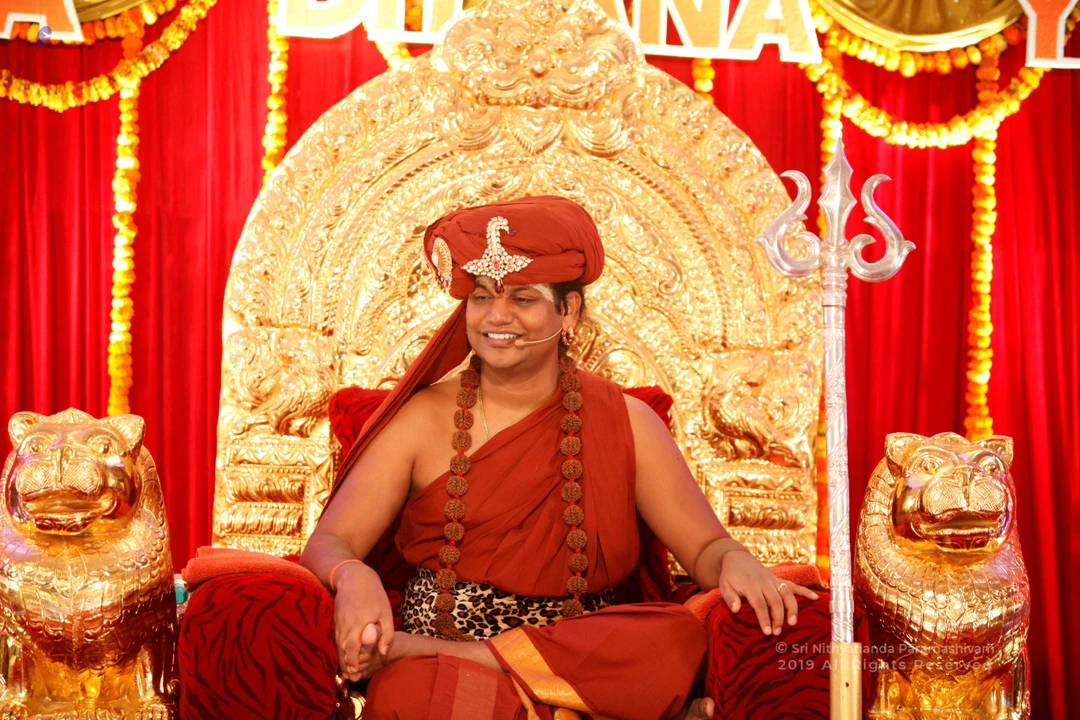
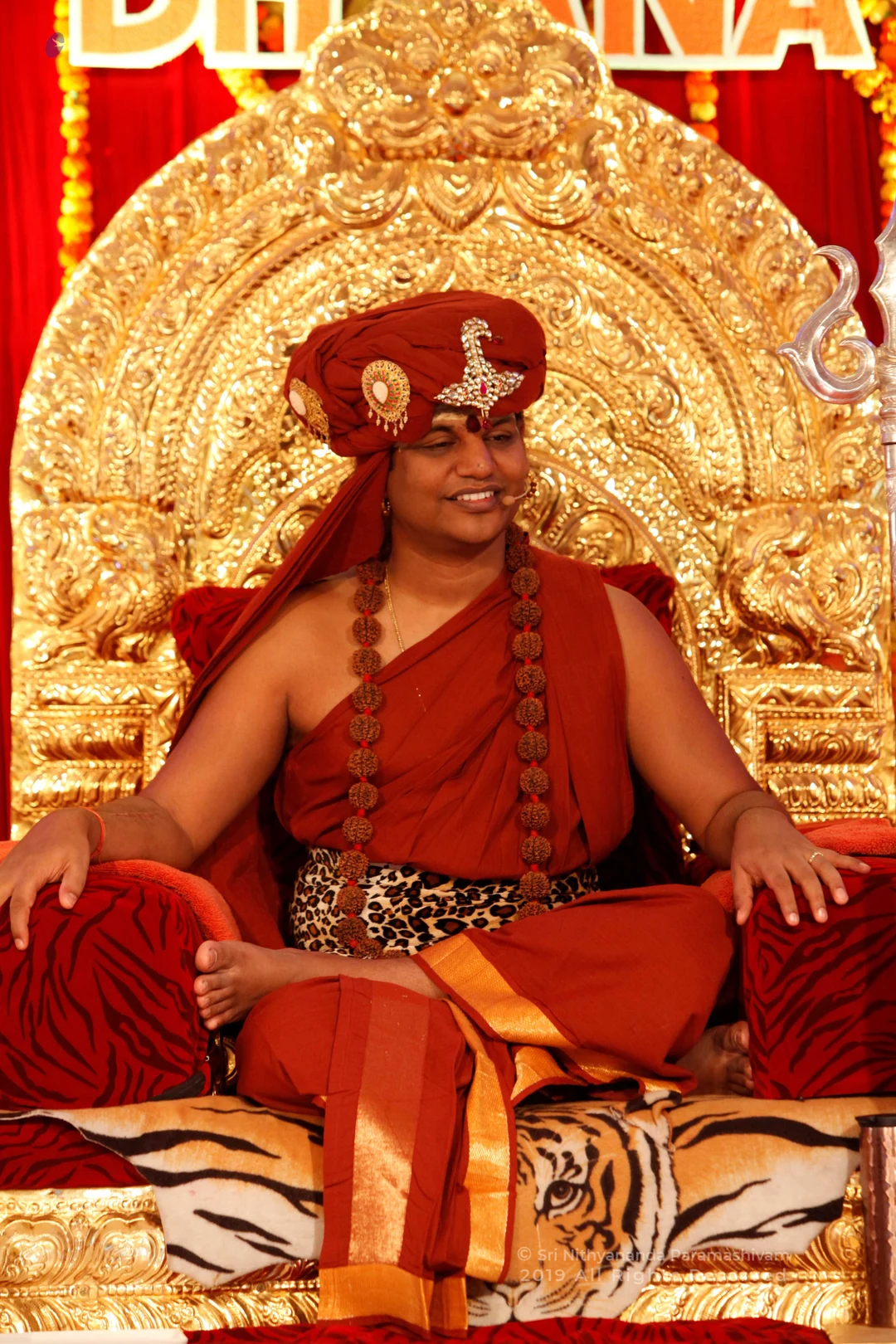
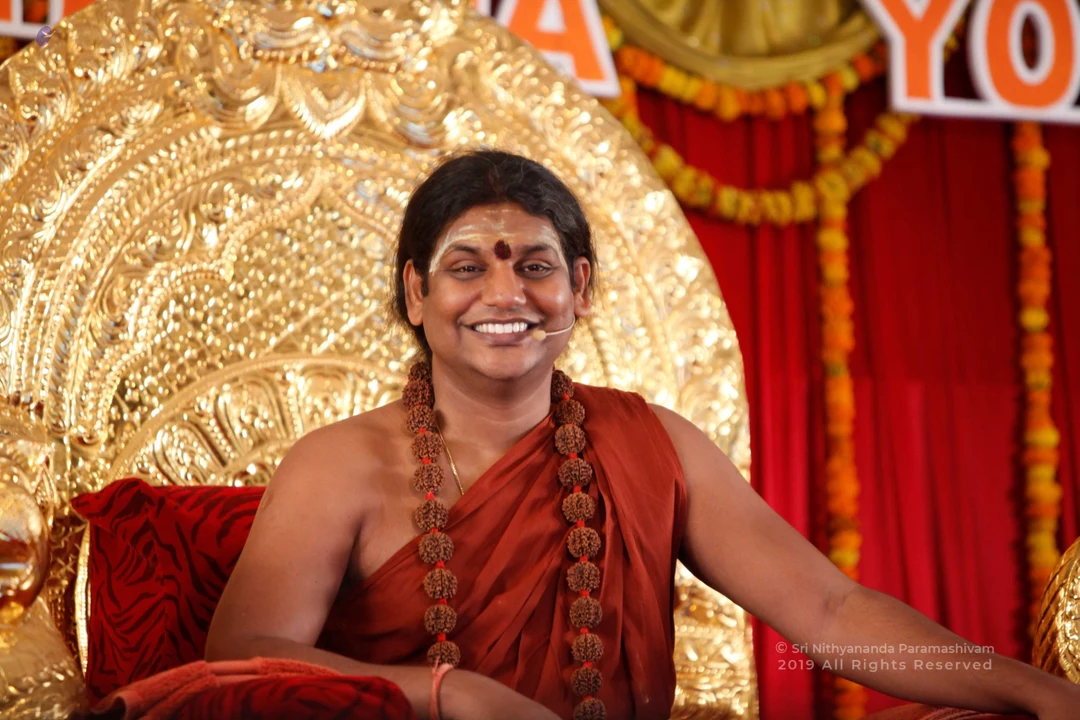
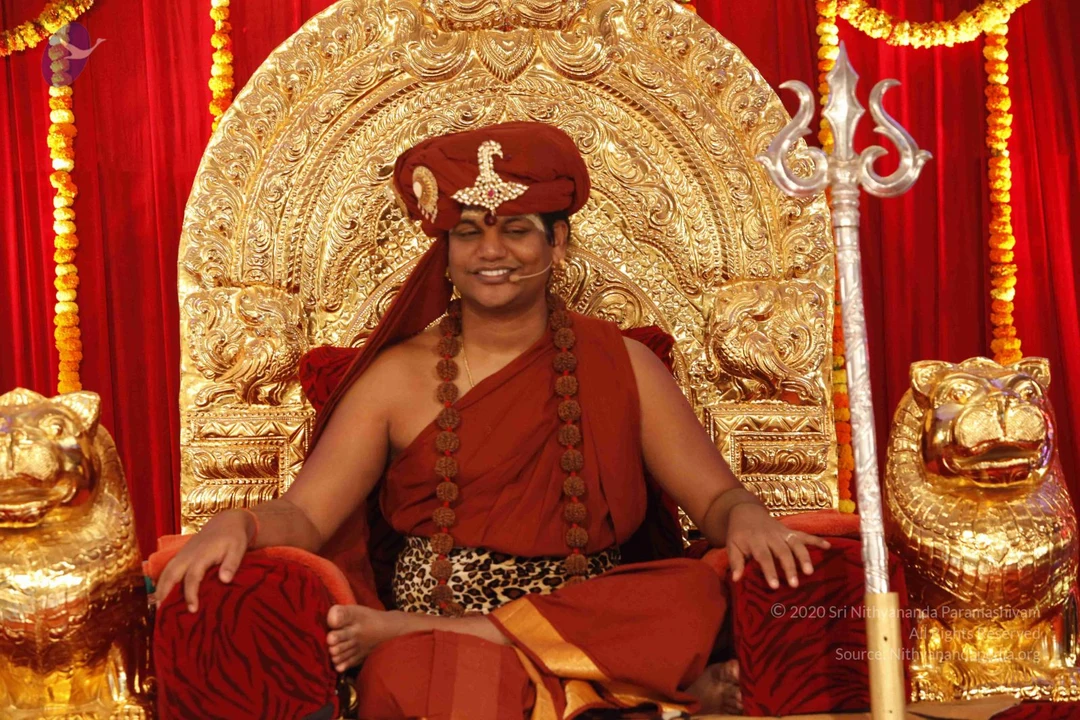
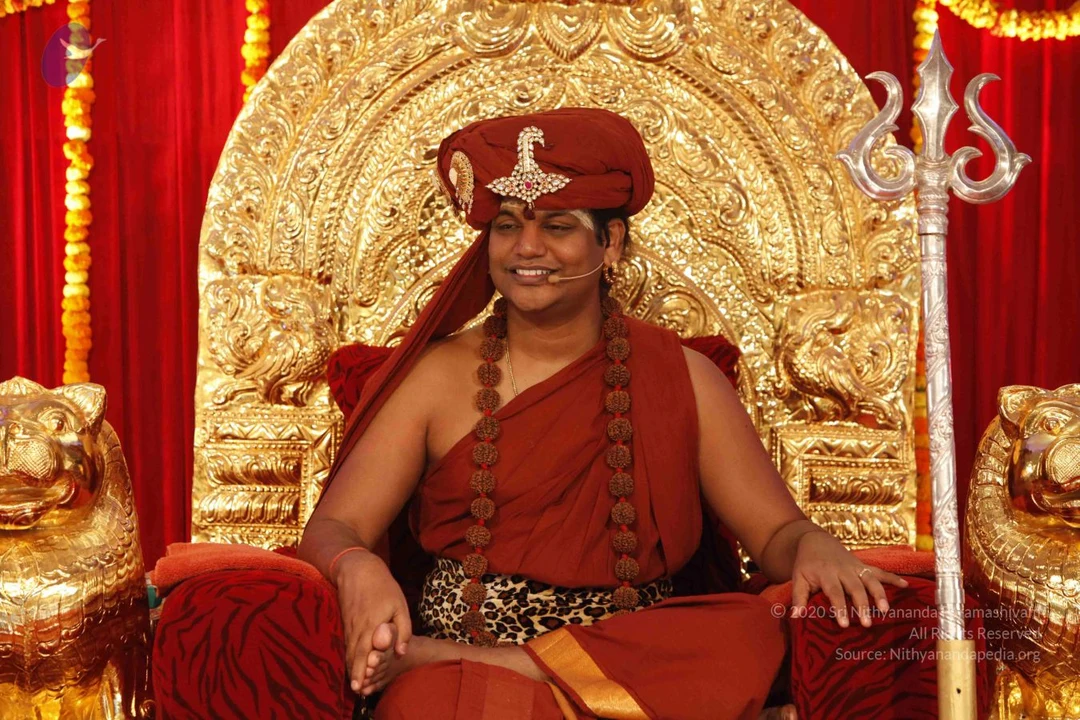
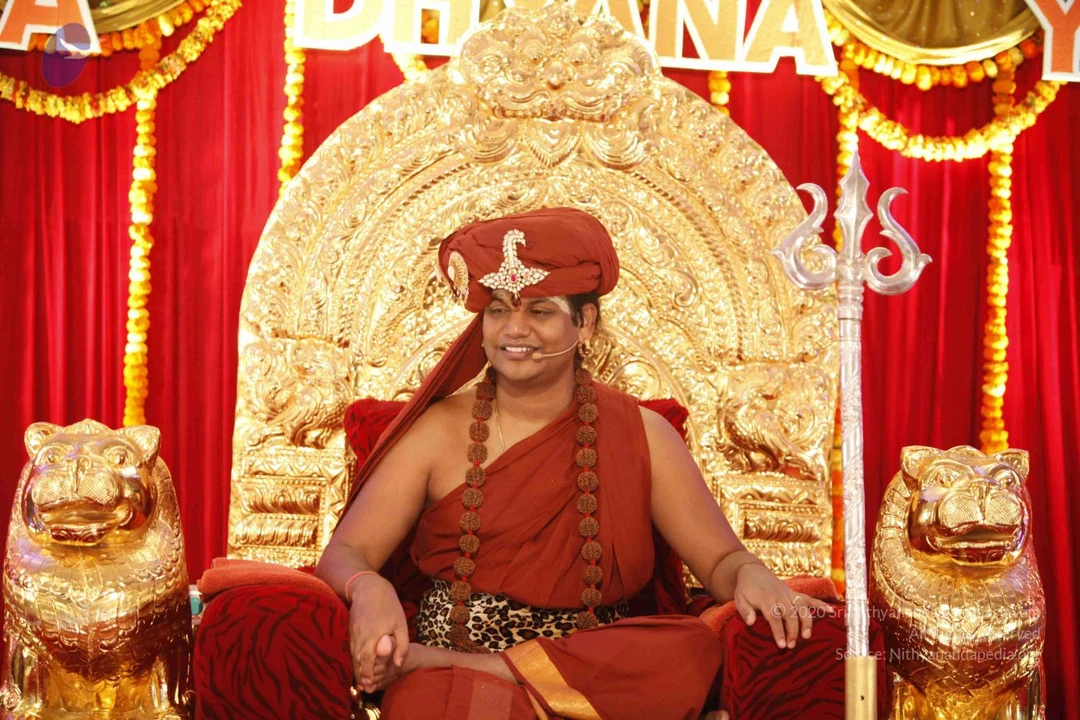
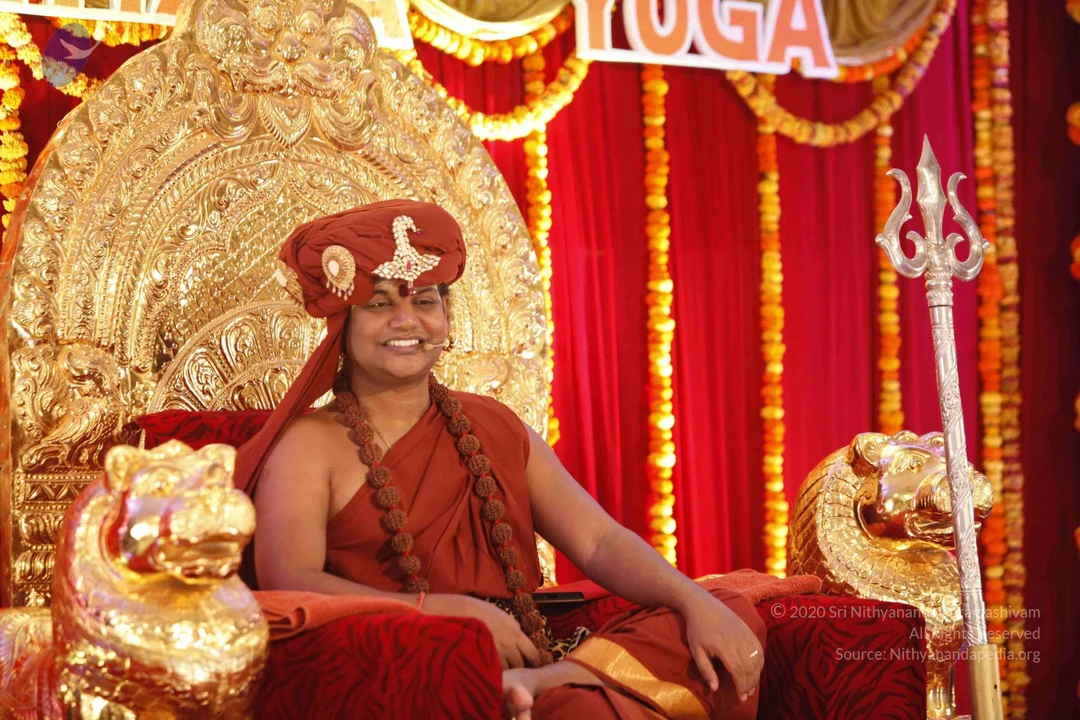
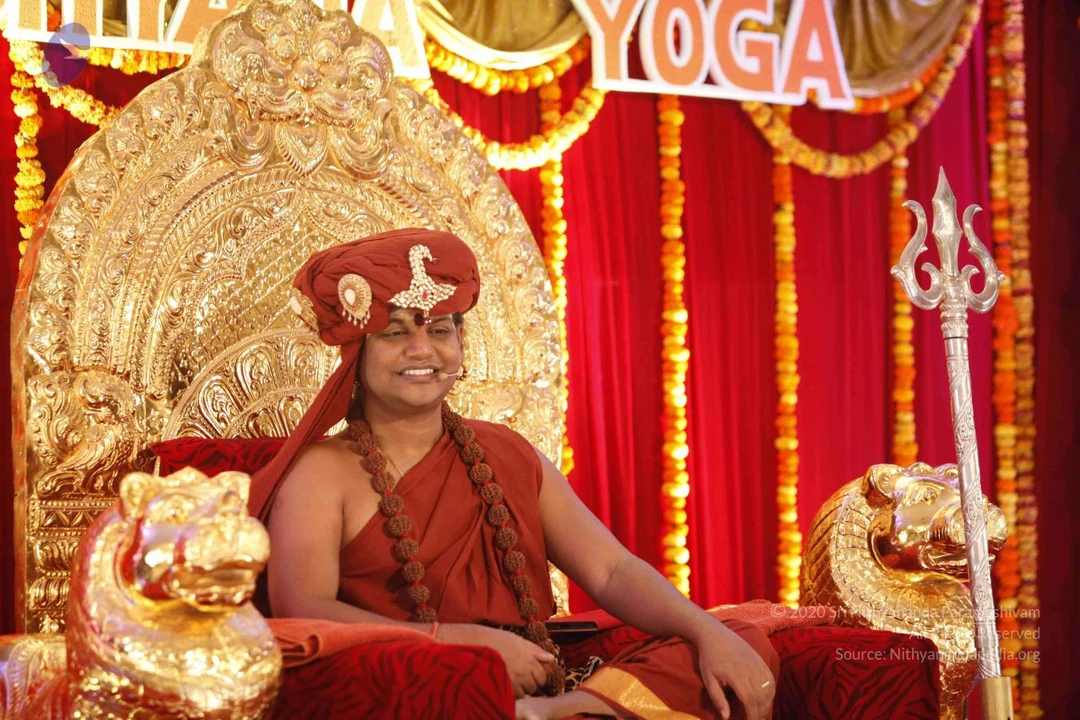
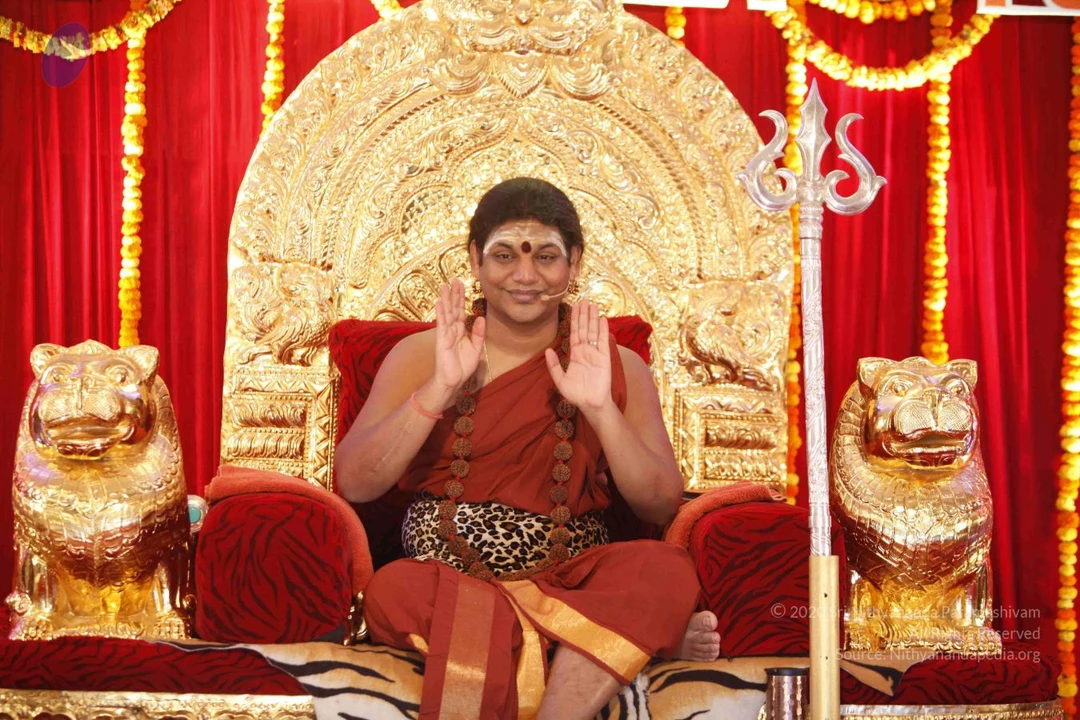
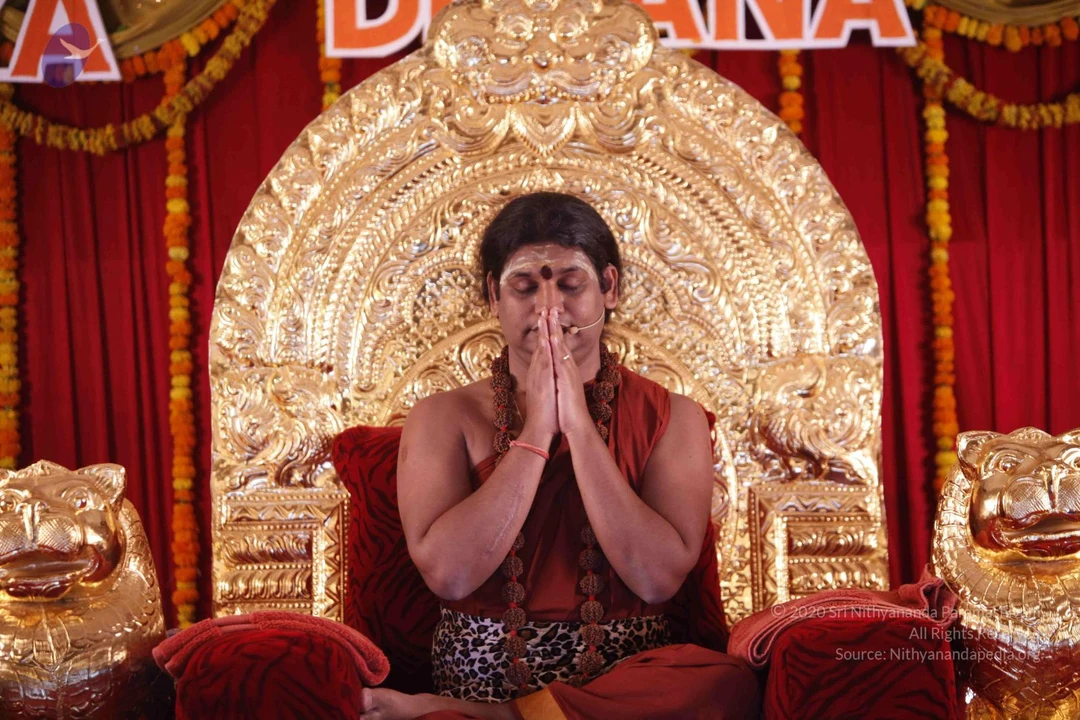
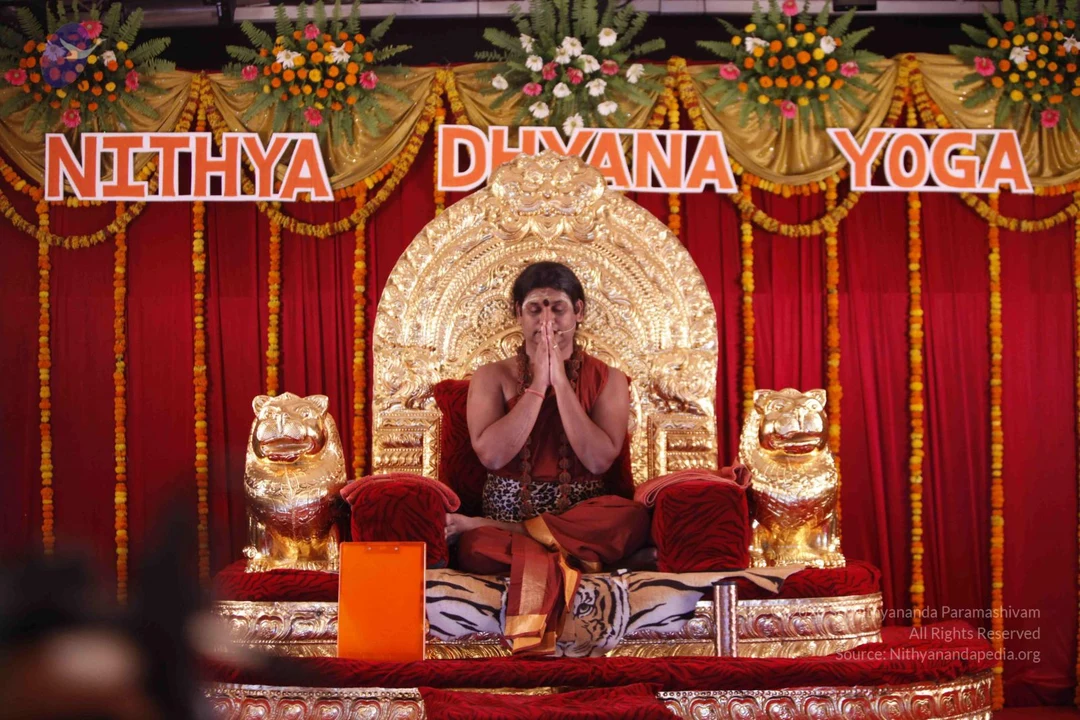
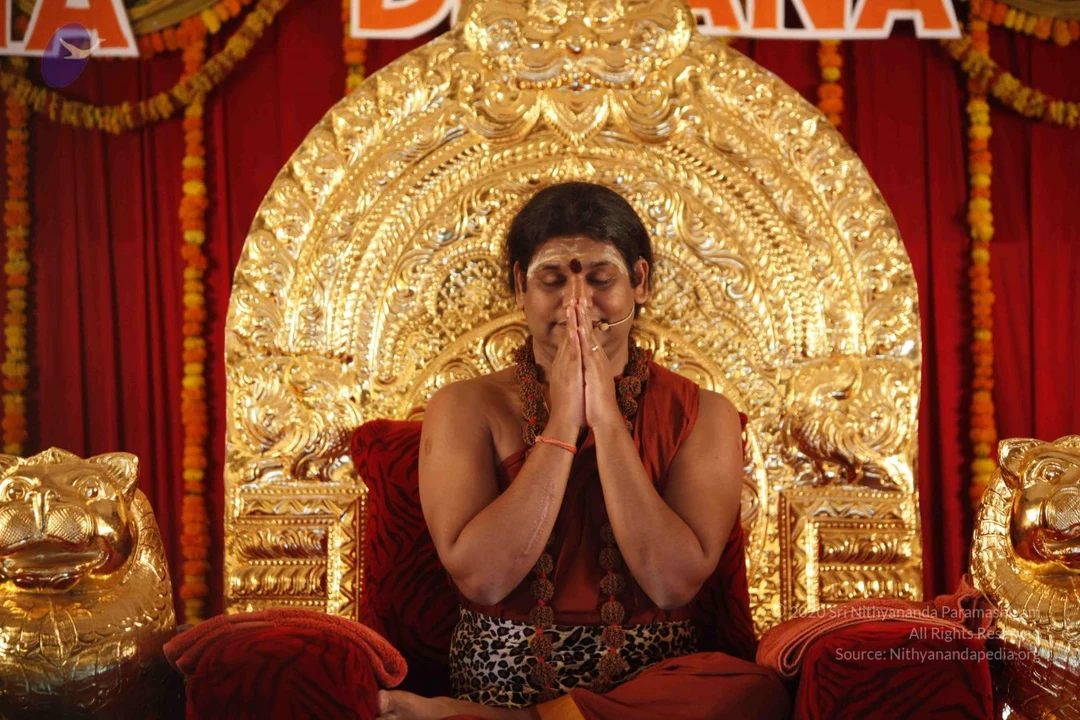
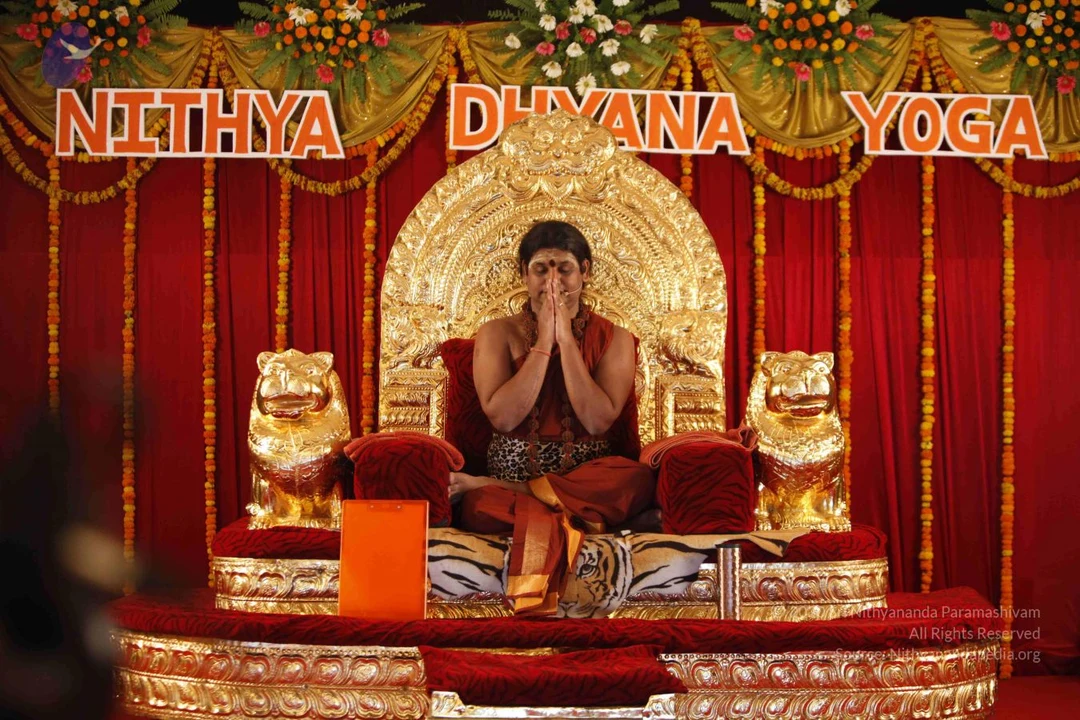
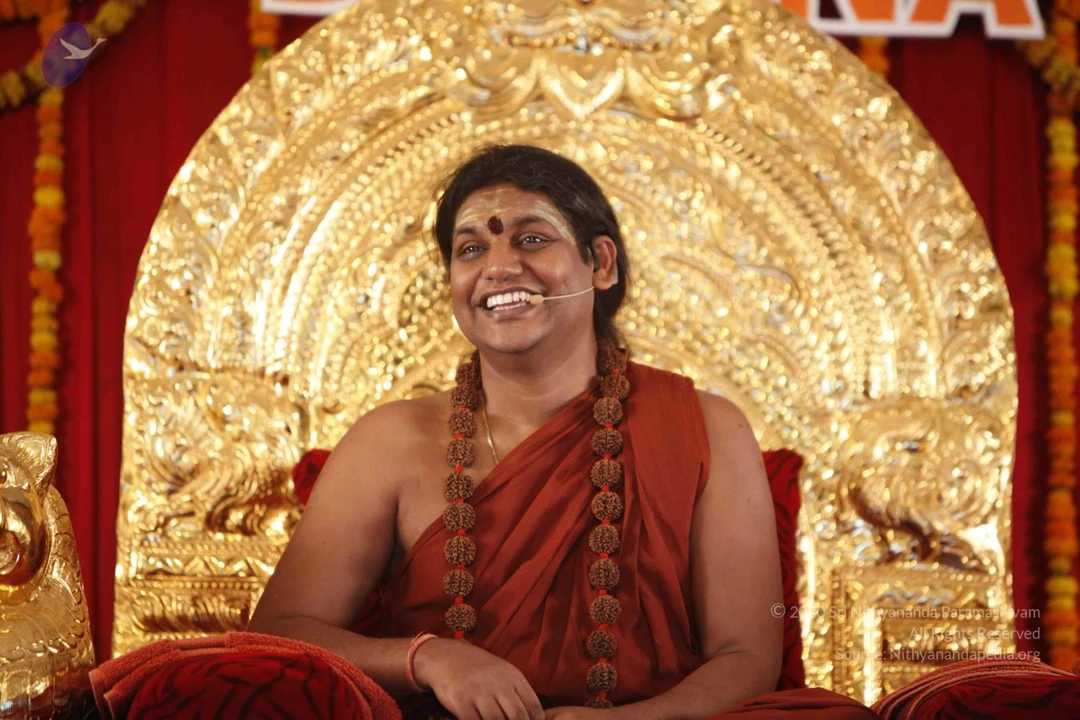
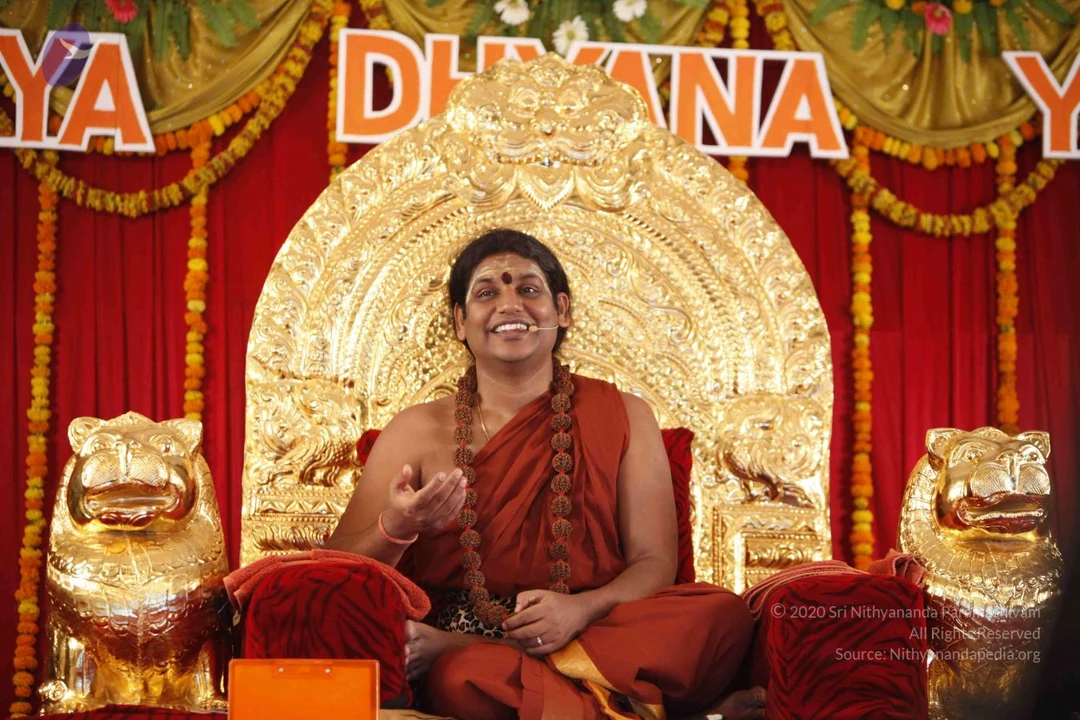
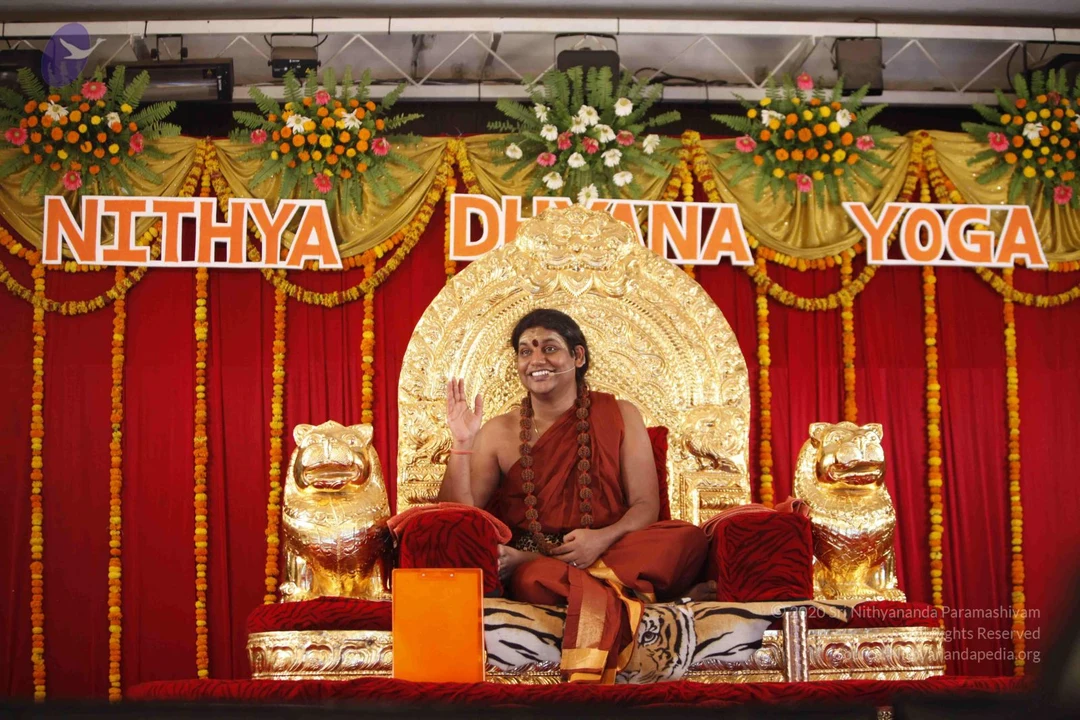
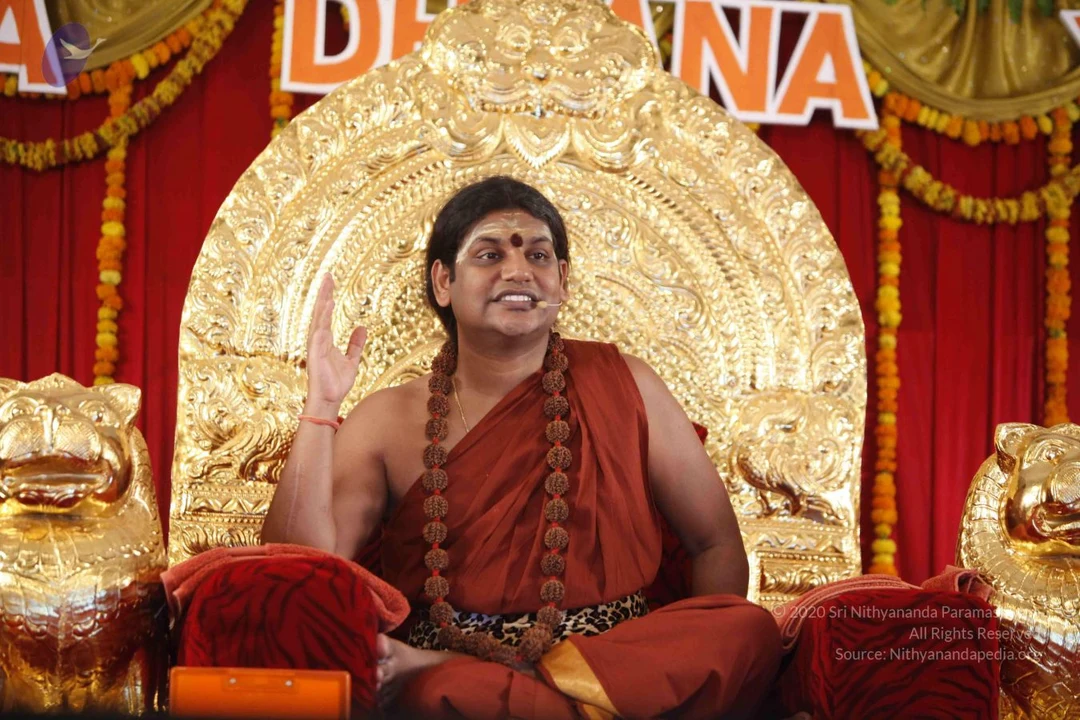
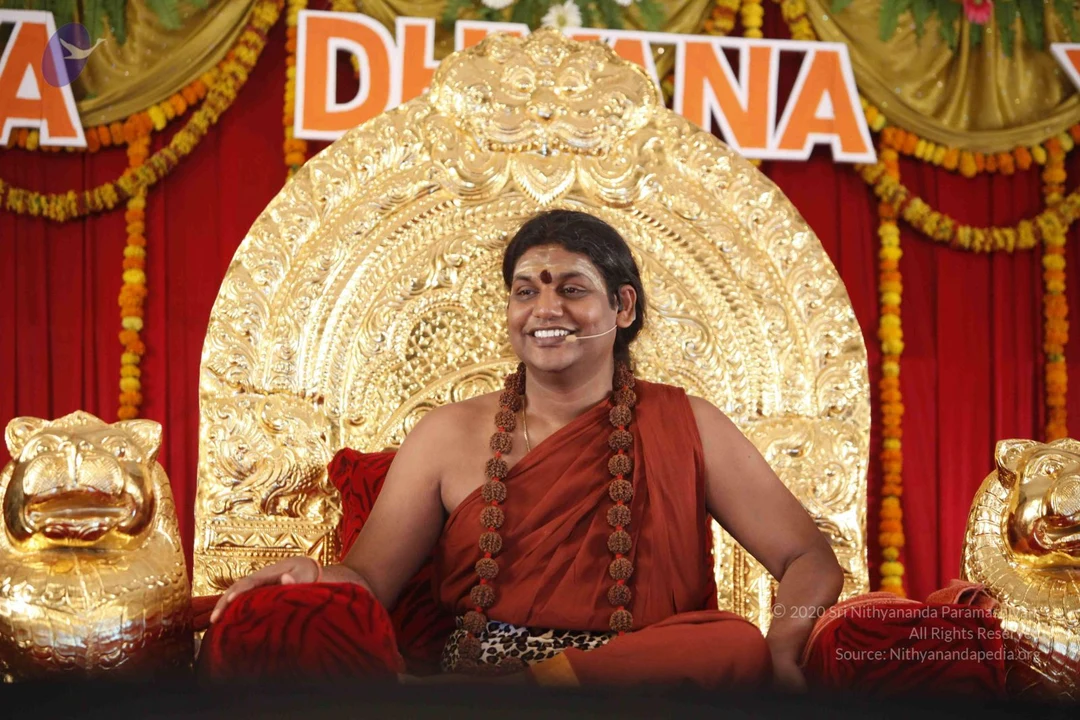
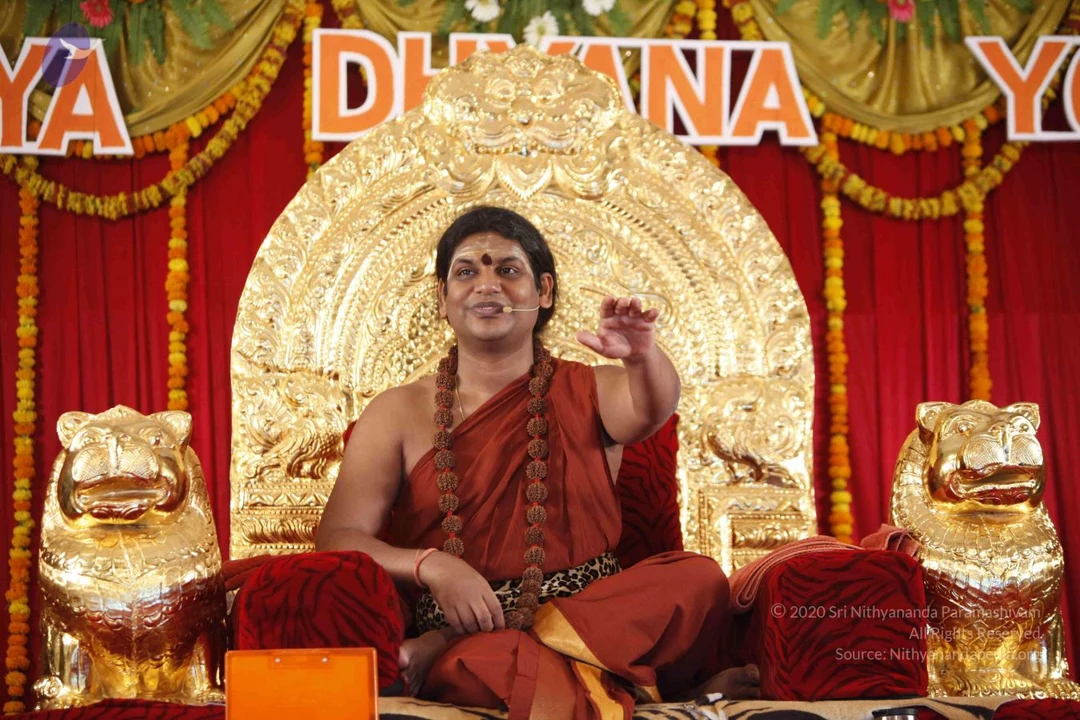
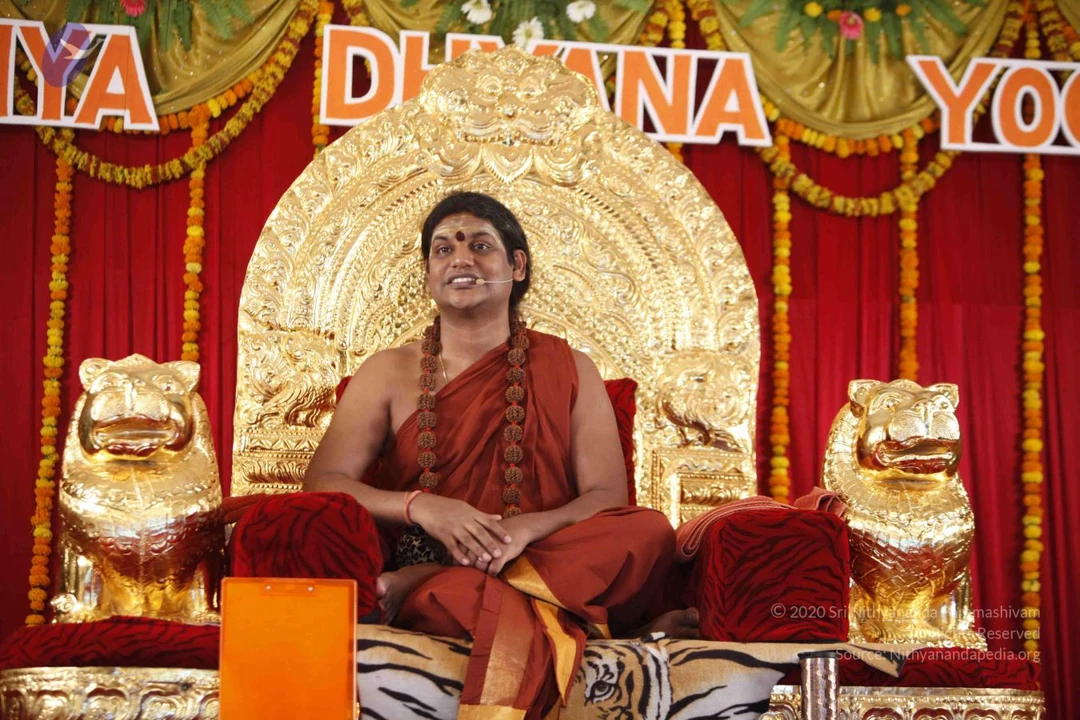
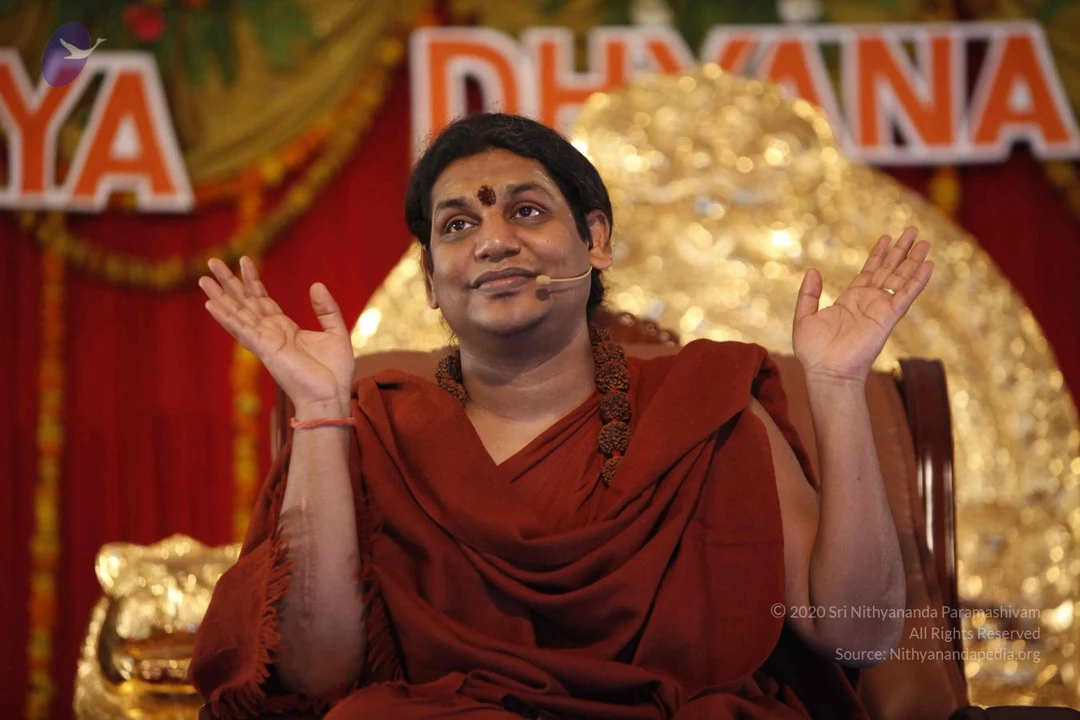
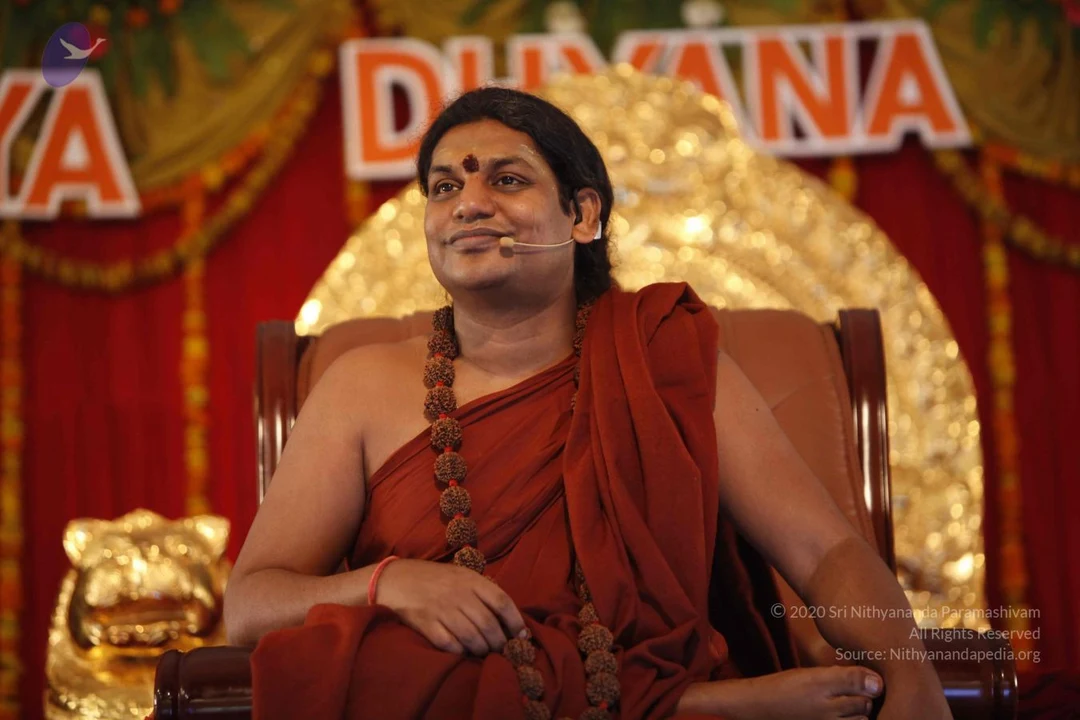
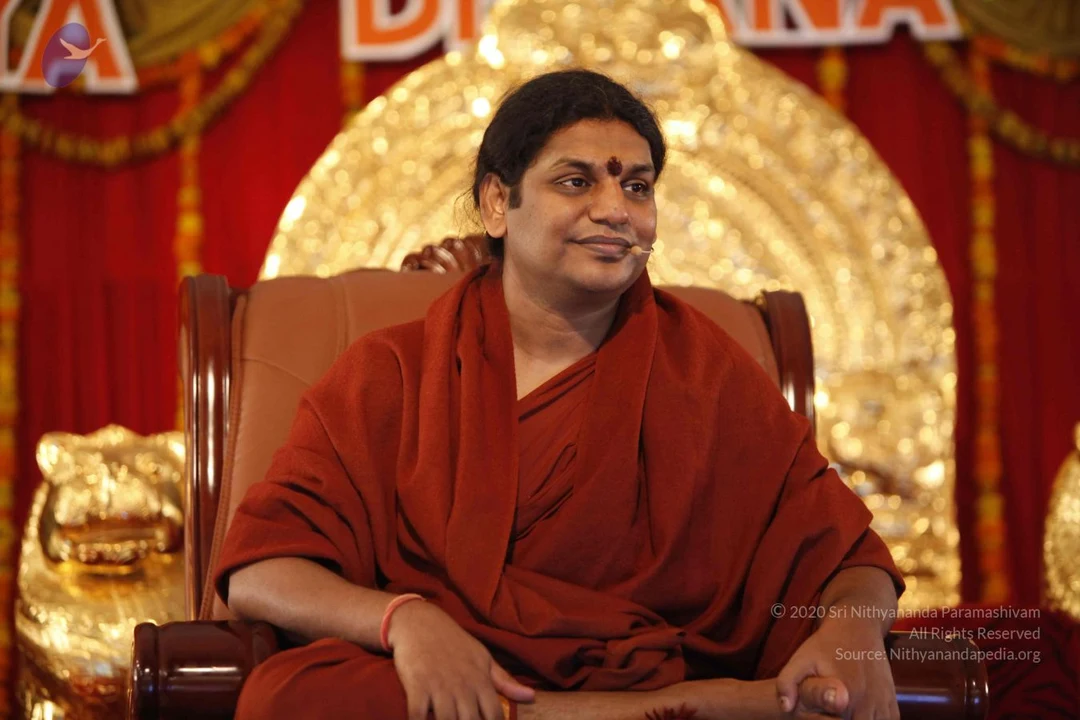
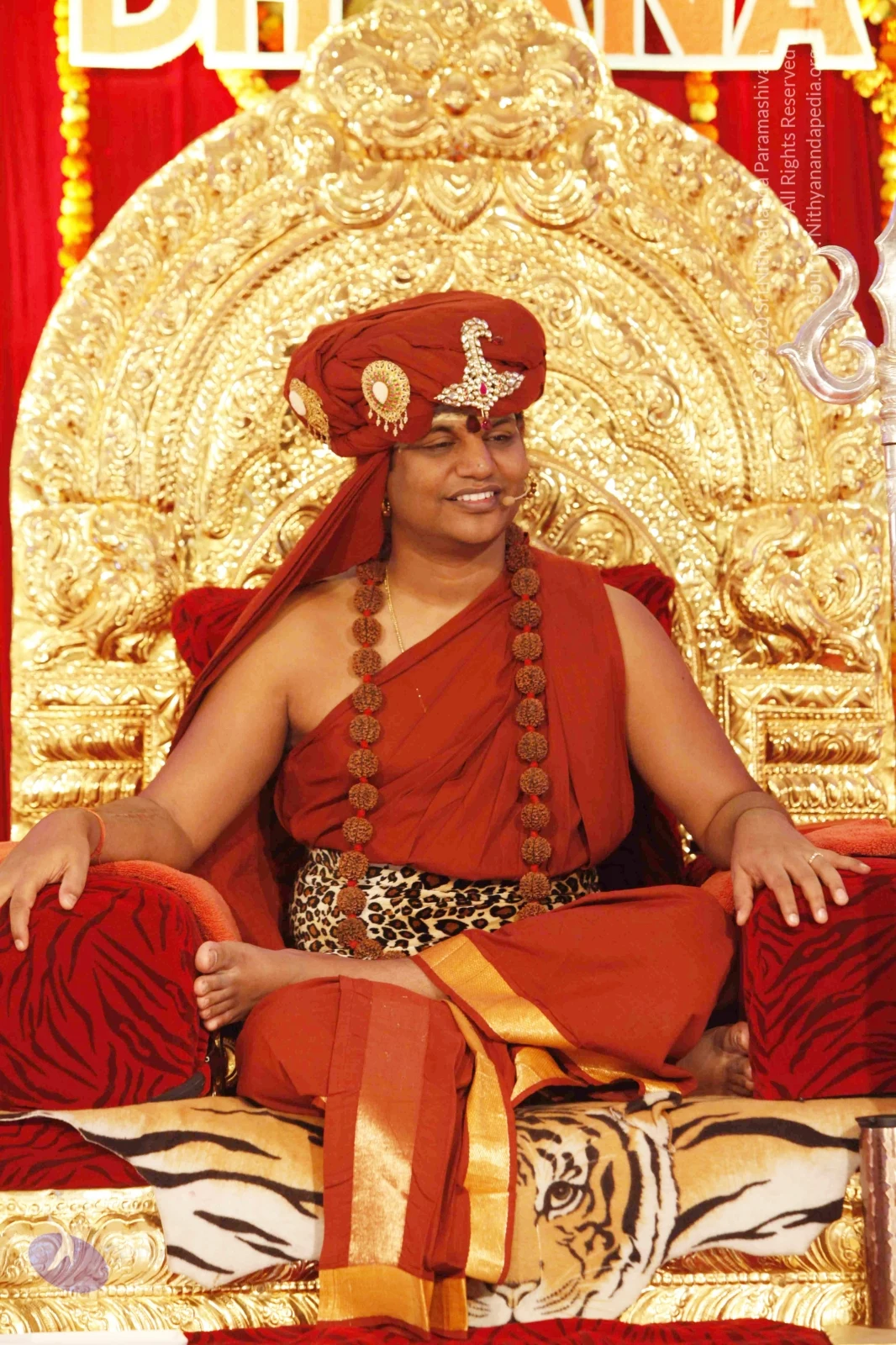
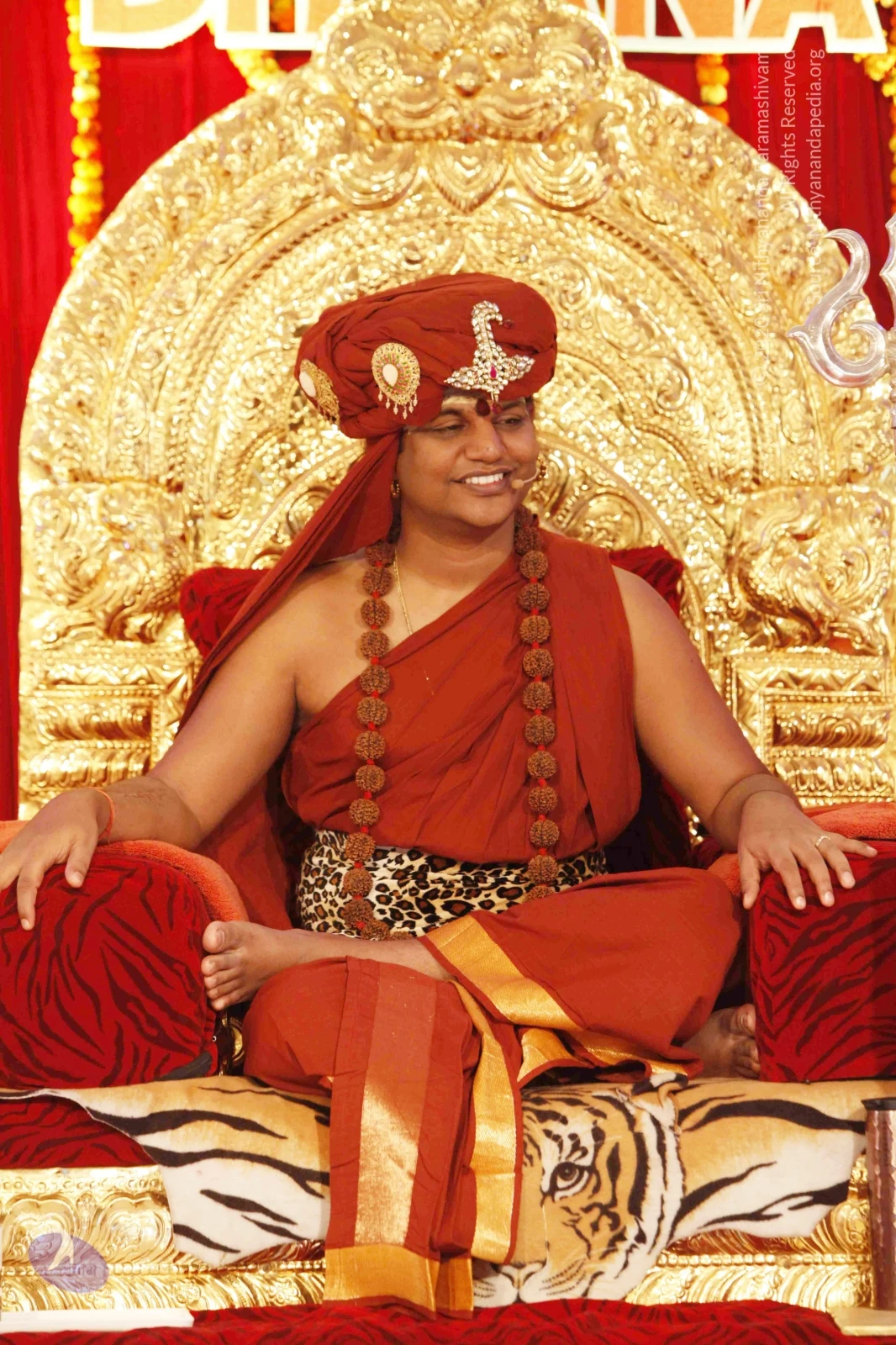
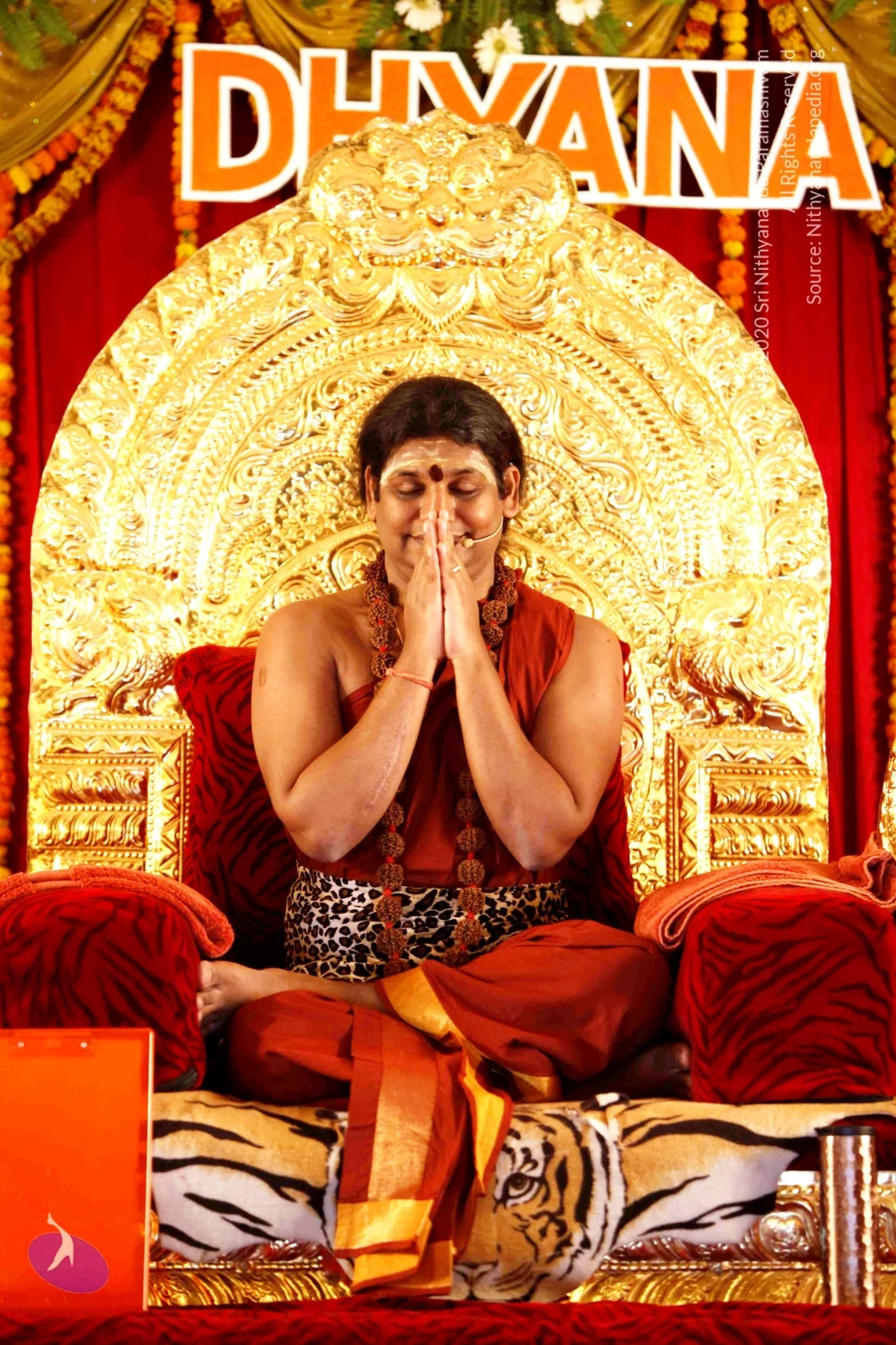
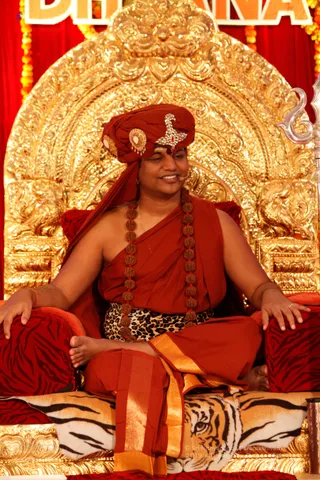
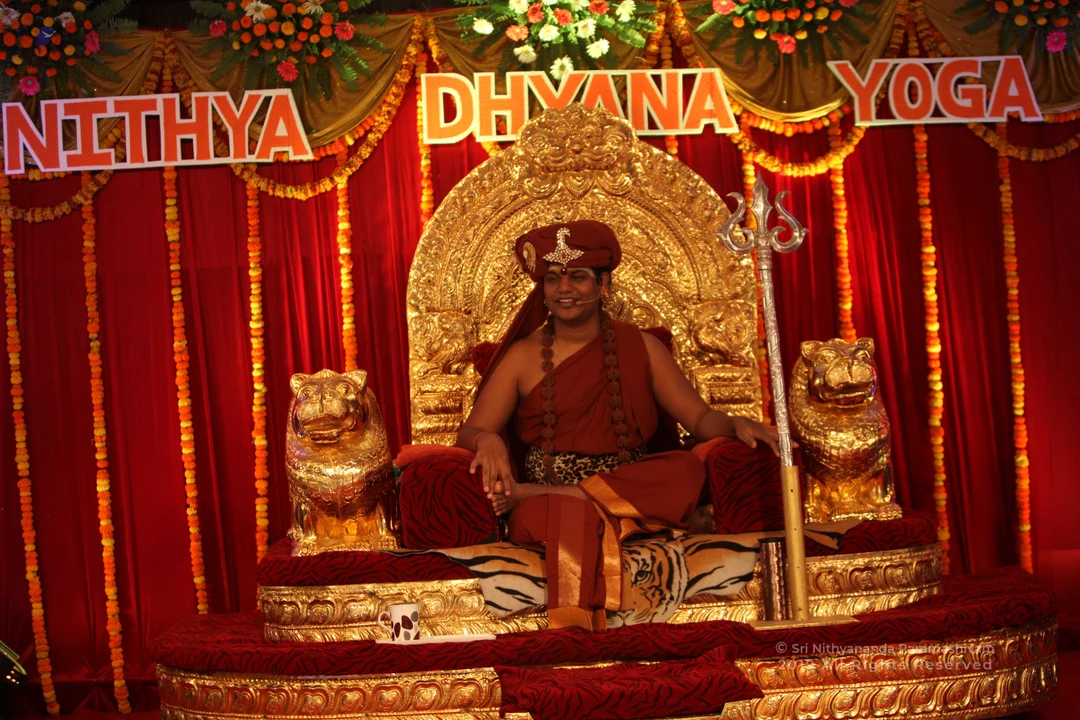
A seated man in an ornate golden throne setting wears a red-orange turban with a jewelled gold ornament and a red tilak, and a long rudraksha mala with red-orange robes over a leopard-print cloth. He smiles and sits on red cushions, with a microphone at his cheek and a trident-like silver staff at the upper right against a red curtain and gold-embossed backdrop. Swamiji (probable) appears as the person seated on the throne, with cues of a jewelled turban and rudraksha malas. One physical person is visible.A seated man in saffron-orange robes sits on an ornate golden throne with lion-head armrests and red tiger-print cushions, speaking into a headset microphone. He wears a rudraksha mala with a gold-coloured ceremonial necklace and has a red tilak on his forehead; long dark hair falls past his shoulders. Behind him hangs red drapery with gold swags, marigold garlands and flower arrangements of orange, pink and white blooms, with large orange letters reading NITHYA DHYANA YOGA. An orange box sits on the stage in front. The scene appears to be a stage talk, and the printed signage names Nithya Dhyana Yoga. Appearance-based candidate: a person, seated in a throne, with rudraksha mala and saffron robes.A seated man in saffron-red robes sits on an ornate gold throne with carved lion-head armrests, in front of red drapes and marigold garlands. He wears a red turban with a pearl-and-gold ornament and a long rudraksha mala, and holds a small object in his hands. A silver trident stands to the right. Probable Swamiji in an in-person satsang setting, based on the saffron robe, turban, rudraksha mala and throne. Overhead banner letters read partly as YOGA.Photo of a seated figure on an ornate gold throne with a carved arched back, in front of red drapes and marigold garlands. The figure wears a red-orange turban with a jewelled ornament, a red-orange robe draped over one shoulder, a leopard-print cloth at the waist, and long rudraksha mala necklaces. A headset microphone is visible, and the arm rests sit on tiger-striped red cushions with a tiger-striped throw beneath. Probable Swamiji (appearance cues: red-orange turban with jewelled ornament, rudraksha malas, ceremonial throne setting) seated in a discourse setting. Lettering partly visible at top reads DHYANA.A seated figure in a red-orange robe and red turban with a white jewelled ornament sits cross-legged on an ornate gold throne with carved lions and a mythical figure motif. A long beaded rudraksha mala hangs over the chest and a silver trident stands to the right. Two gold lion sculptures flank the throne, with red velvet cushions and a red drape behind, decorated with marigold garlands. A small microphone is at the face. The figure smiles and rests hands on the knees, with a leopard-print waist cloth visible.A seated figure in a red-orange turban with a silver jewelled ornament and red bindi sits on an ornate gilded throne backed by carved gold scrollwork. He wears an orange-red robe with gold border, a leopard-print waist cloth, and long rudraksha mala necklaces, with a gold chain visible at the chest. His bare feet rest on a tiger-striped cushion, and his hands rest on tiger-patterned armrests. A silver trident stands at the right edge, and a red backdrop with marigold garlands frames the scene. Probable Swamiji cues include the rudraksha malas, the ornate turban and the gilded throne setting, consistent with the page's reference to the Nithyananda Paramashivam satsang.

(kalpatharu on varanasi)
1 photoSource gallery
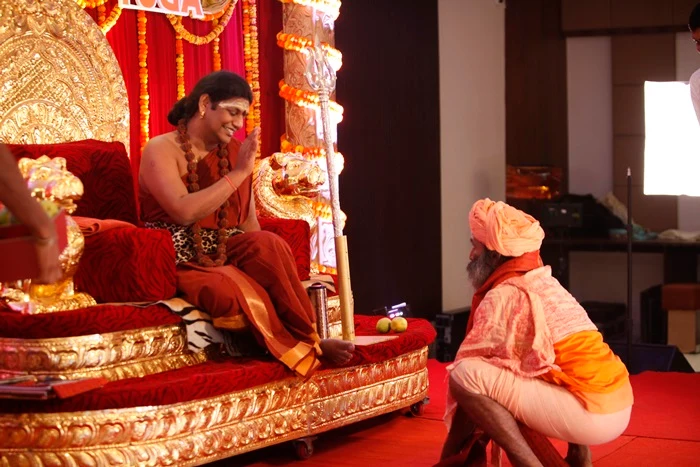
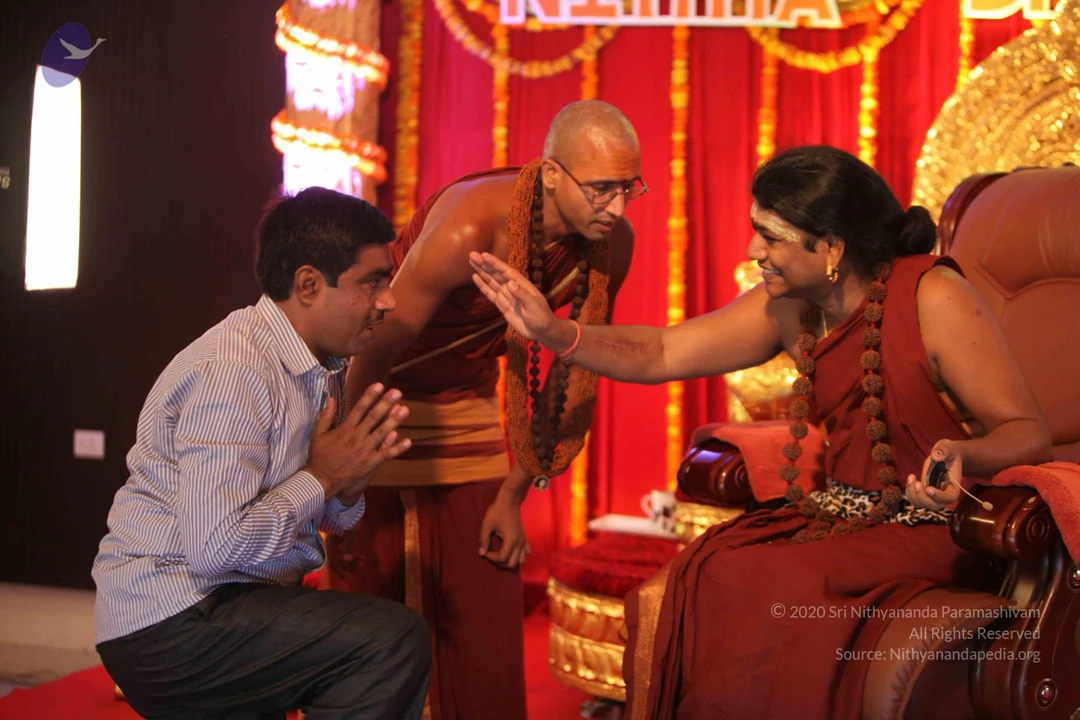
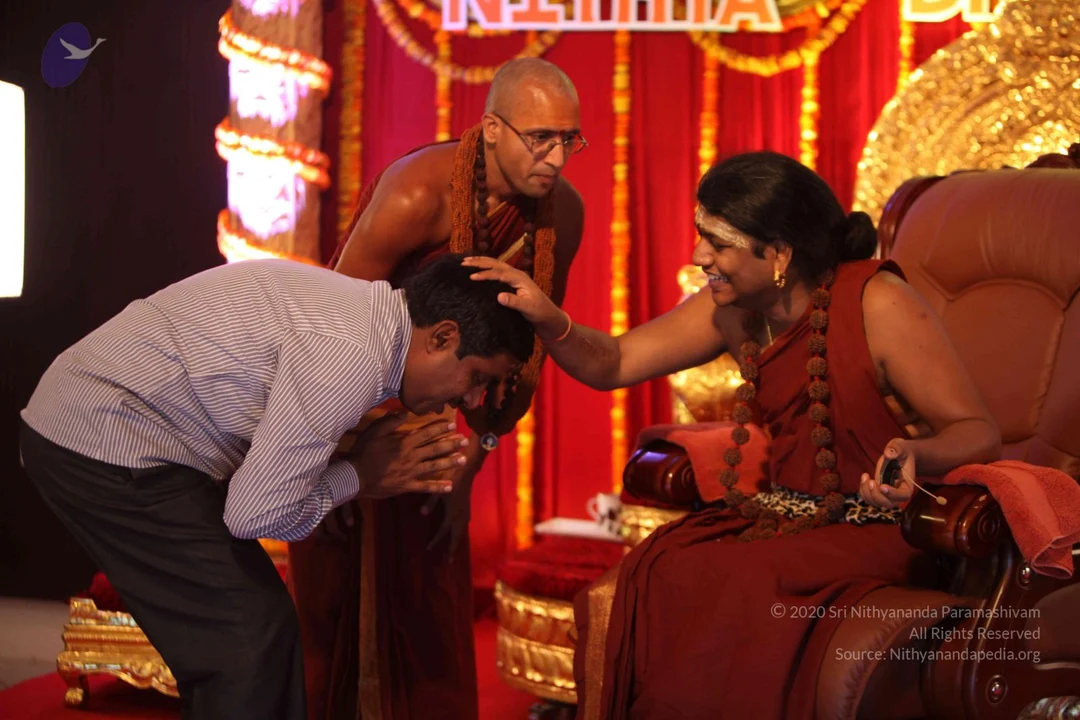
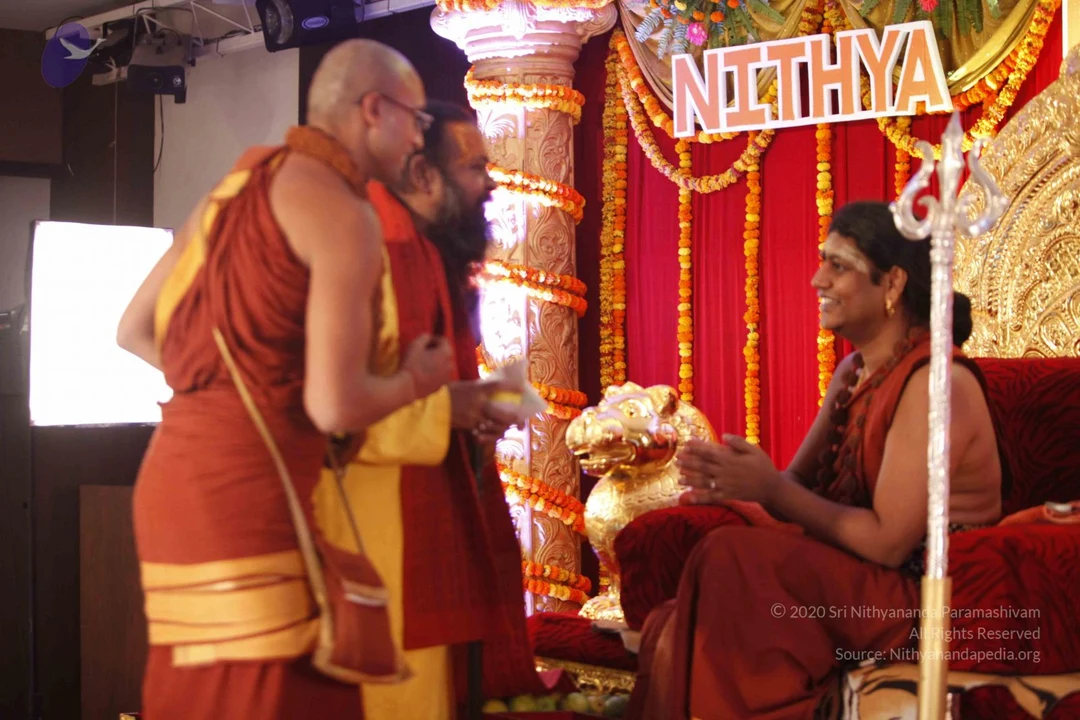
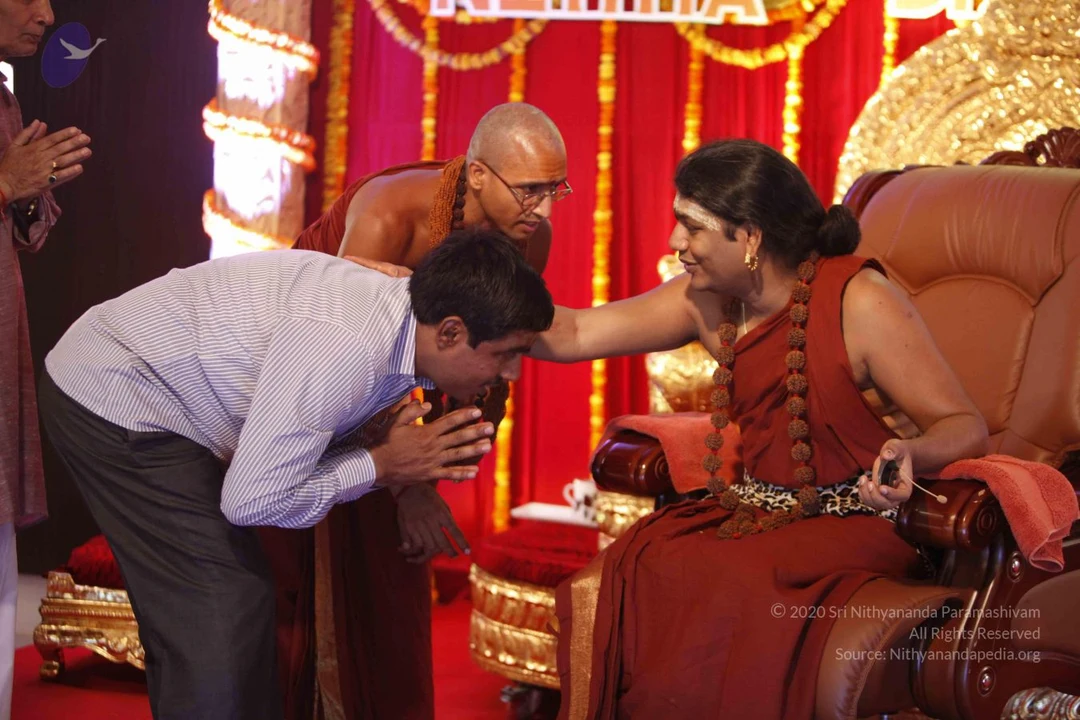
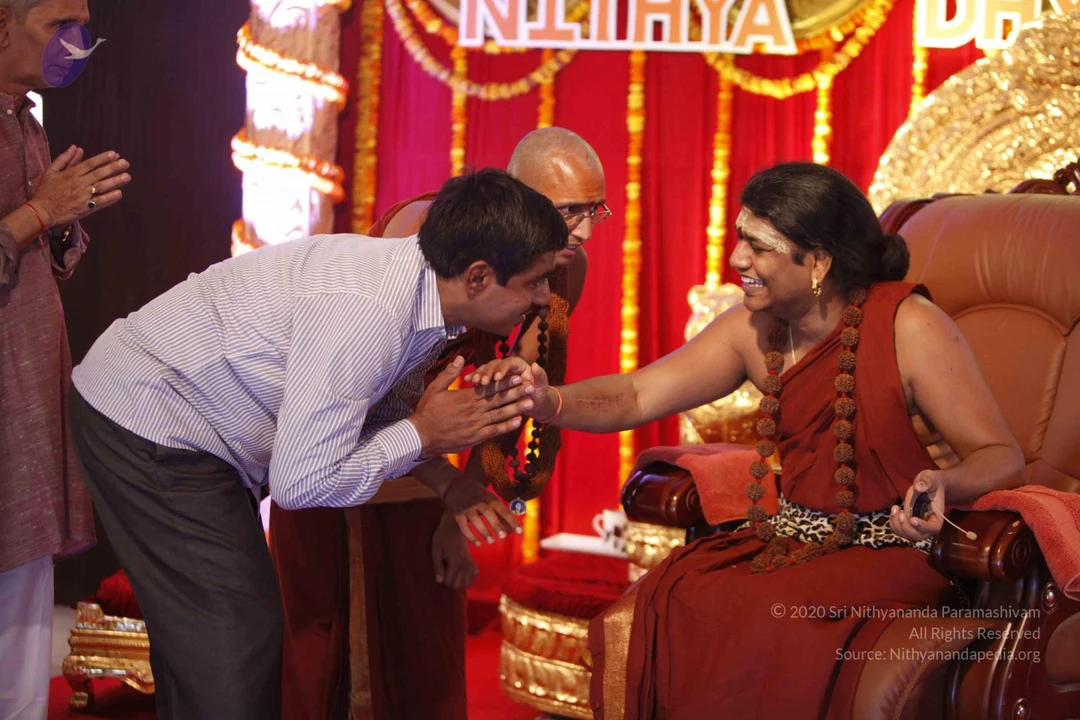
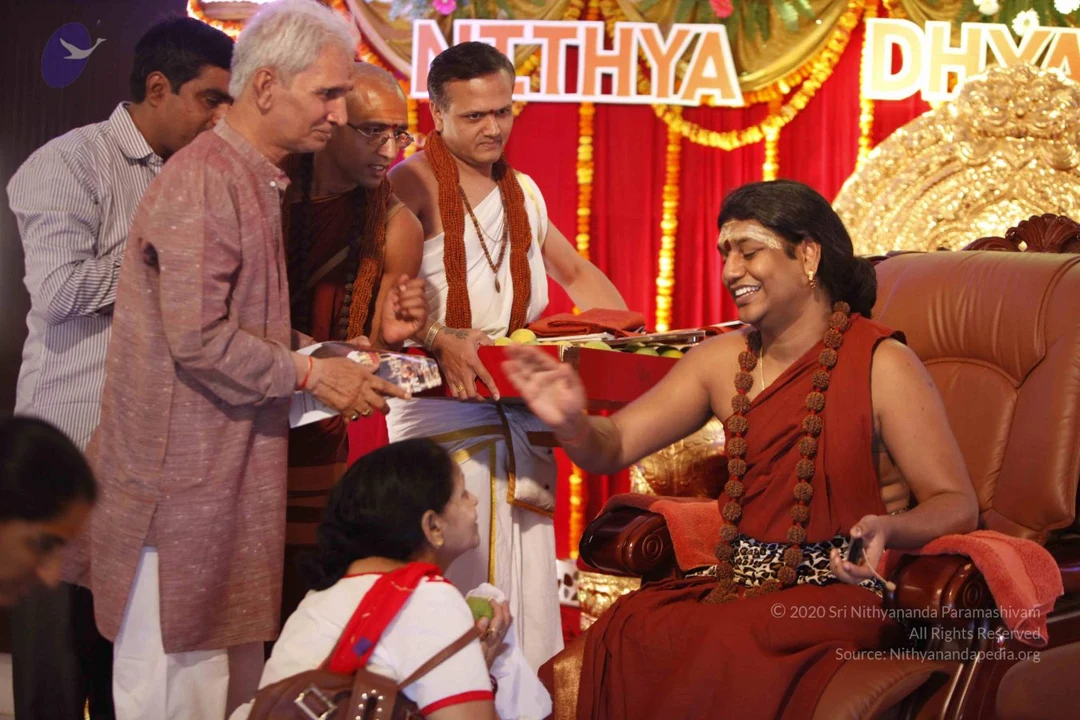
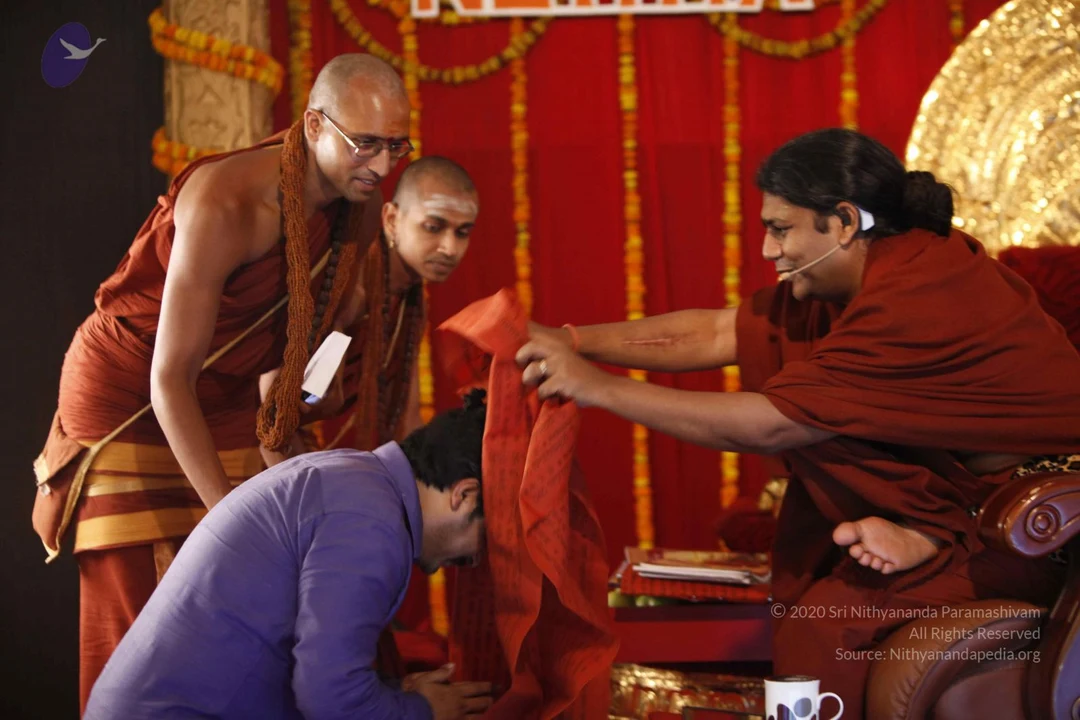
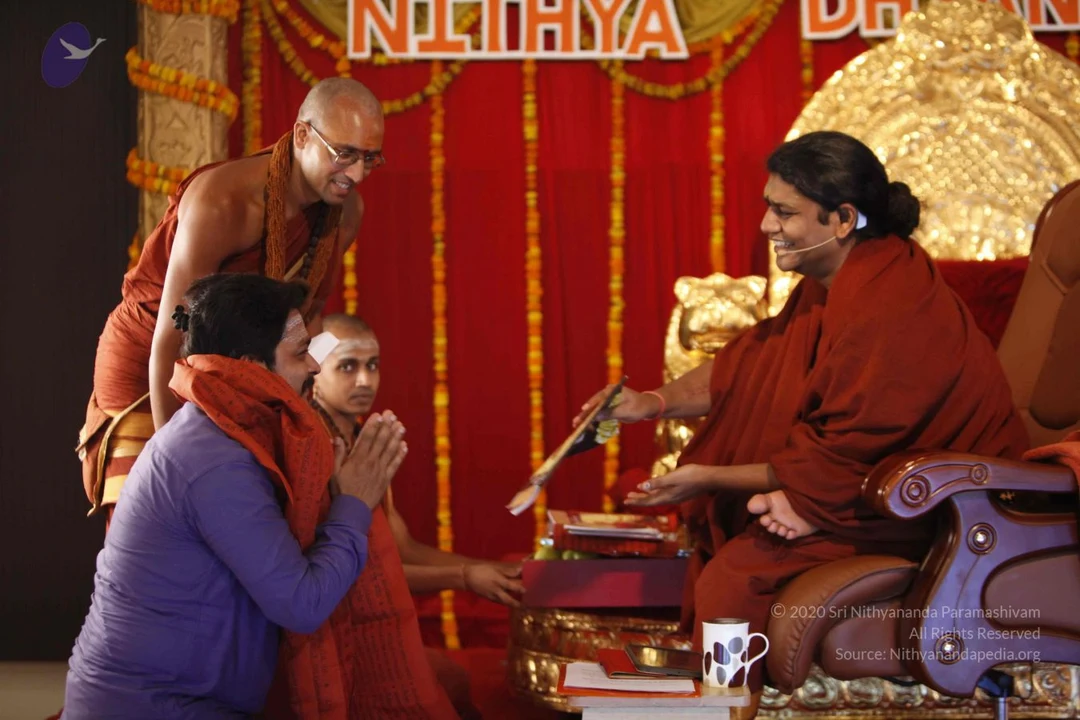
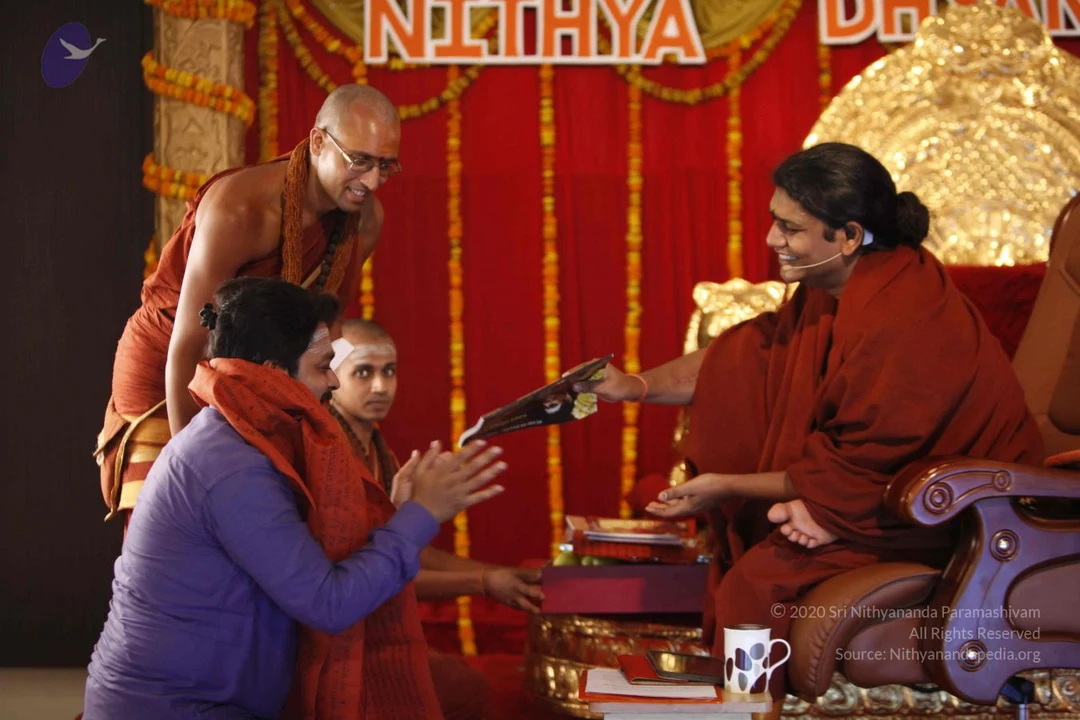
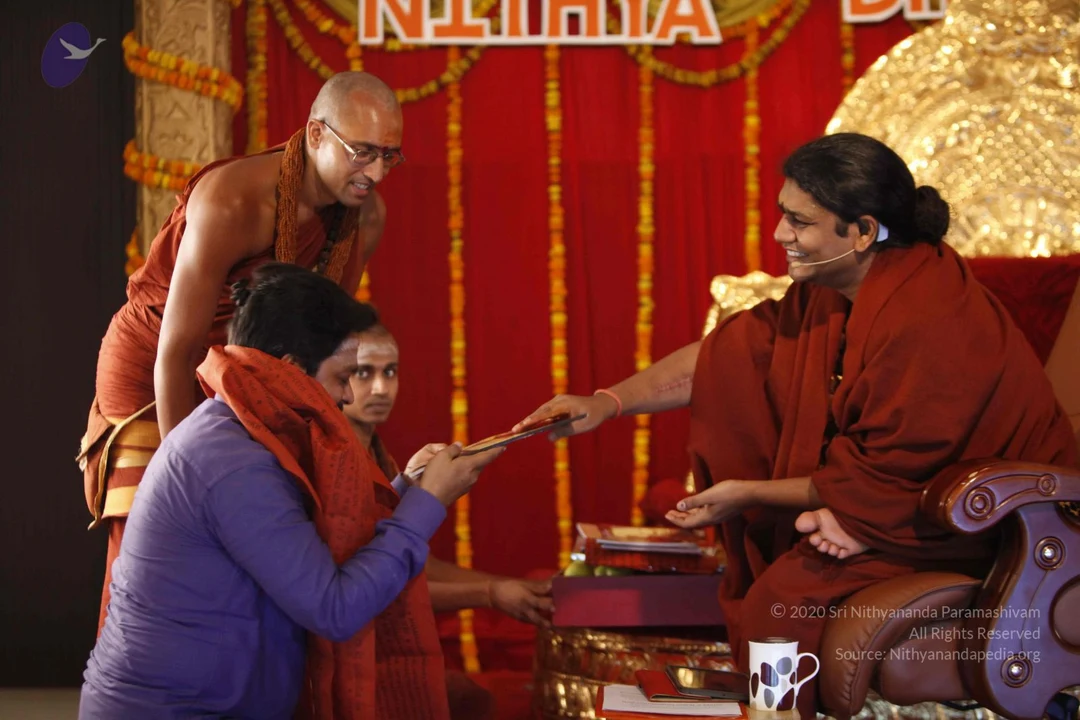
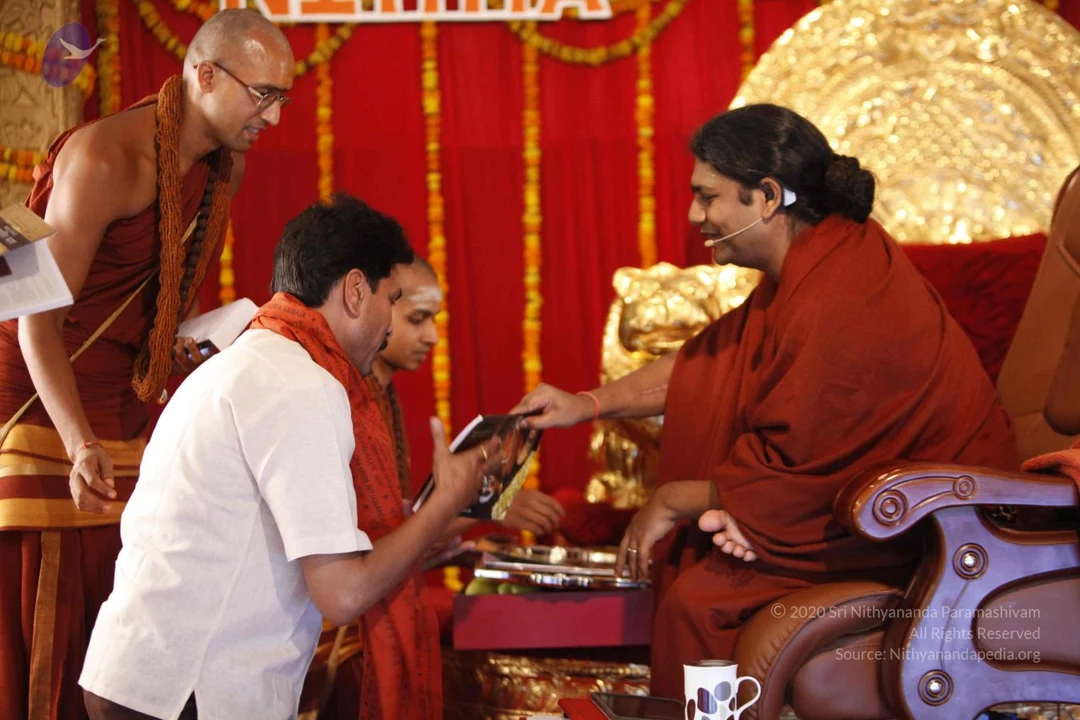
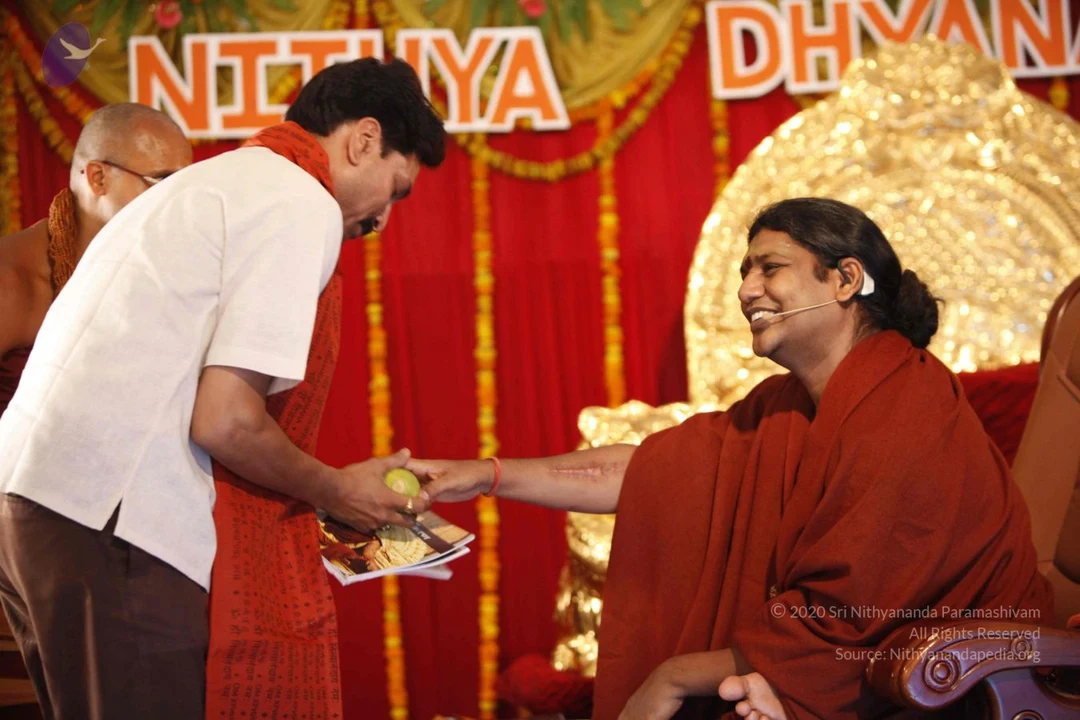
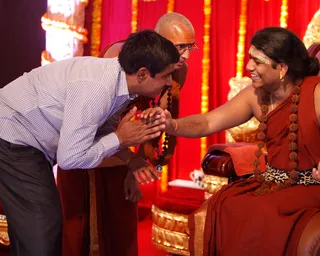
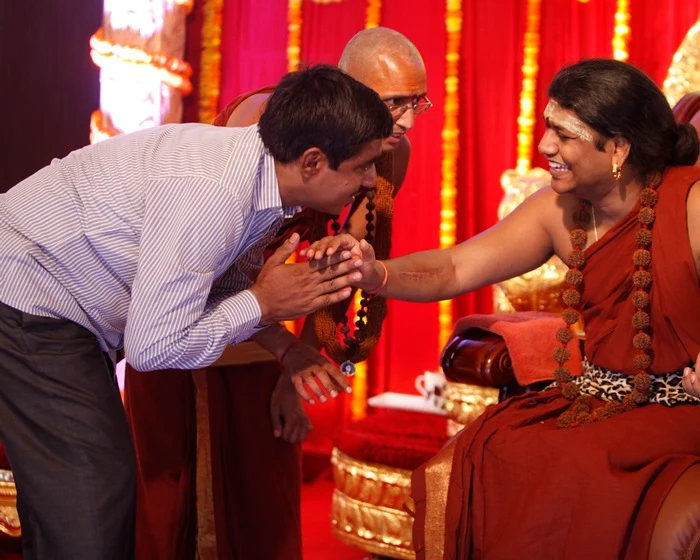
A seated figure in a rust-red saffron sari with a long rudraksha mala and a beaded waist sash sits on an ornate gold throne in front of a red draped backdrop with golden flower garlands. The figure has a white-and-red forehead mark and wears a gold stud earring. A standing man in a striped light-blue shirt and dark trousers bends forward with palms pressed together, reaching to clasp the seated figure's hands in greeting. Behind him a bald man in rust-red robes with a rudraksha mala and glasses leans in, hands raised together. The scene reads as a devotee receiving darshan at a satsang. Two physical people are clearly visible plus a partly visible third person. The seated figure shows distinctive ceremonial cues, so the appearance is a probable match for a person.

MorningSatsang--Kalapataru--NDYsession1
65 photosSource gallery
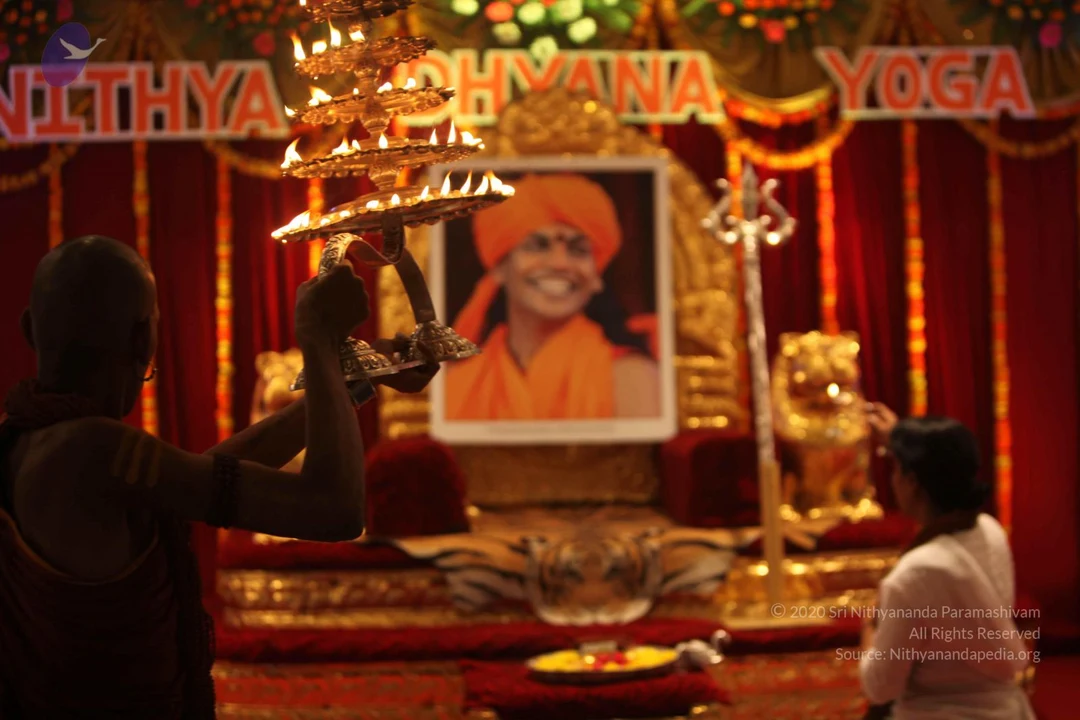
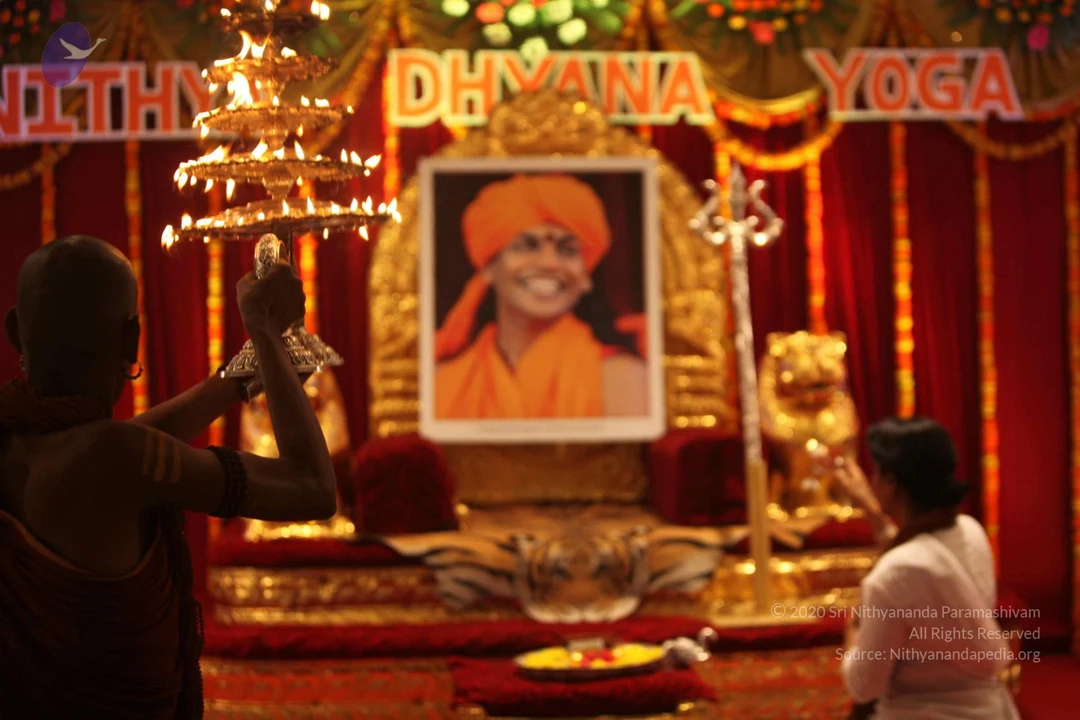
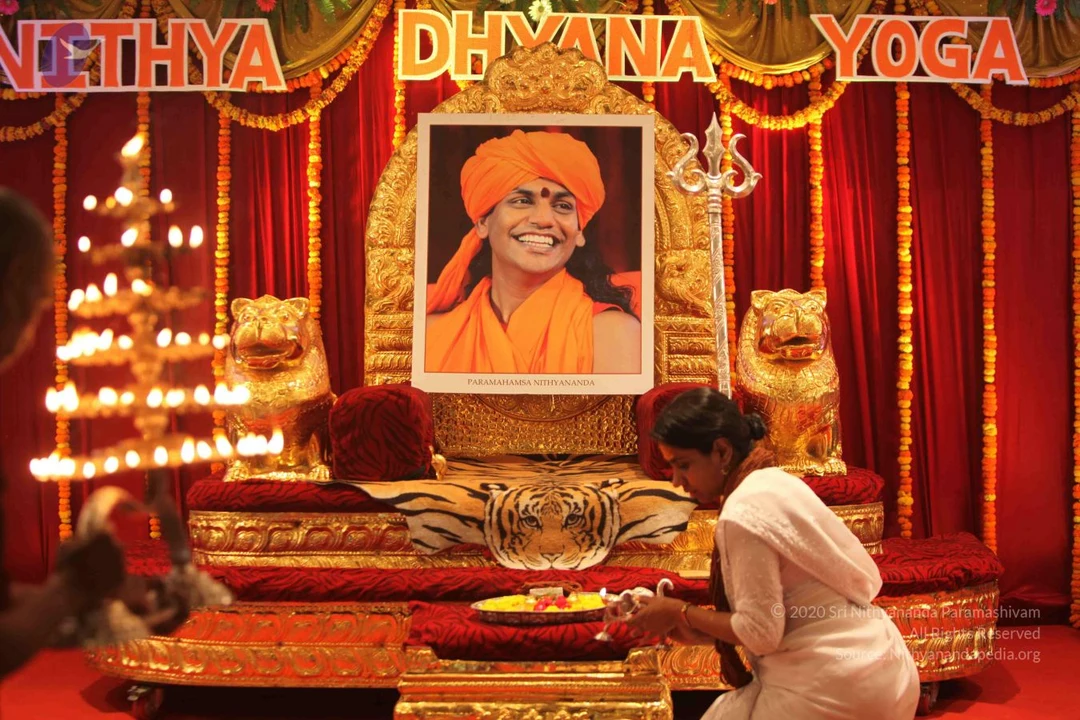
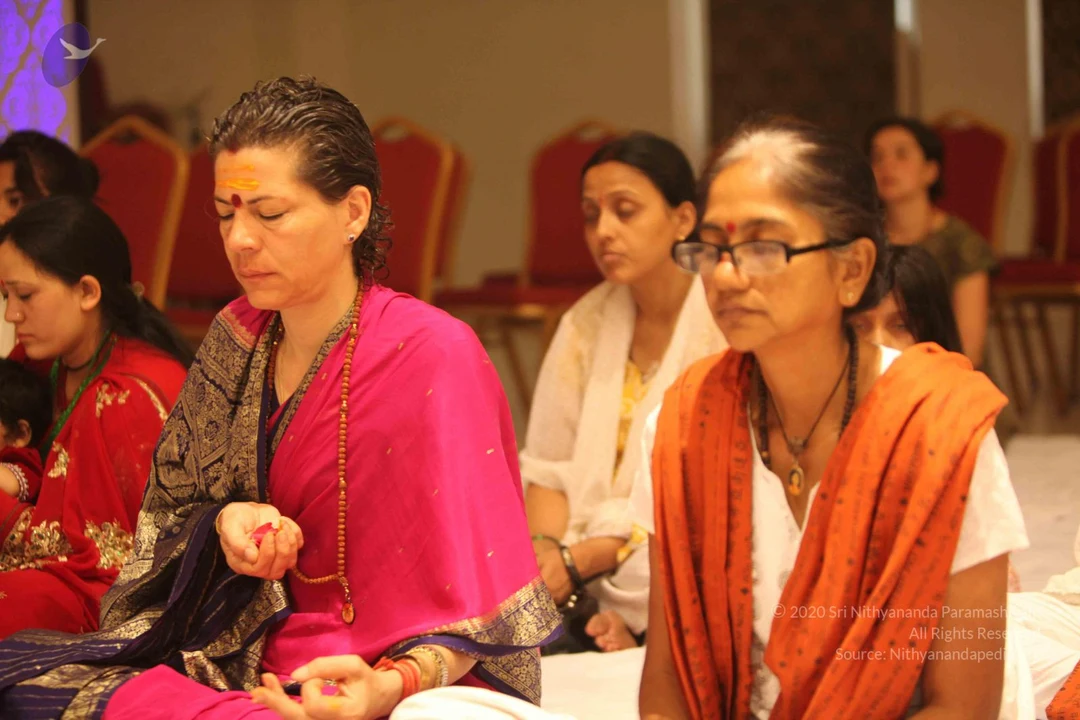
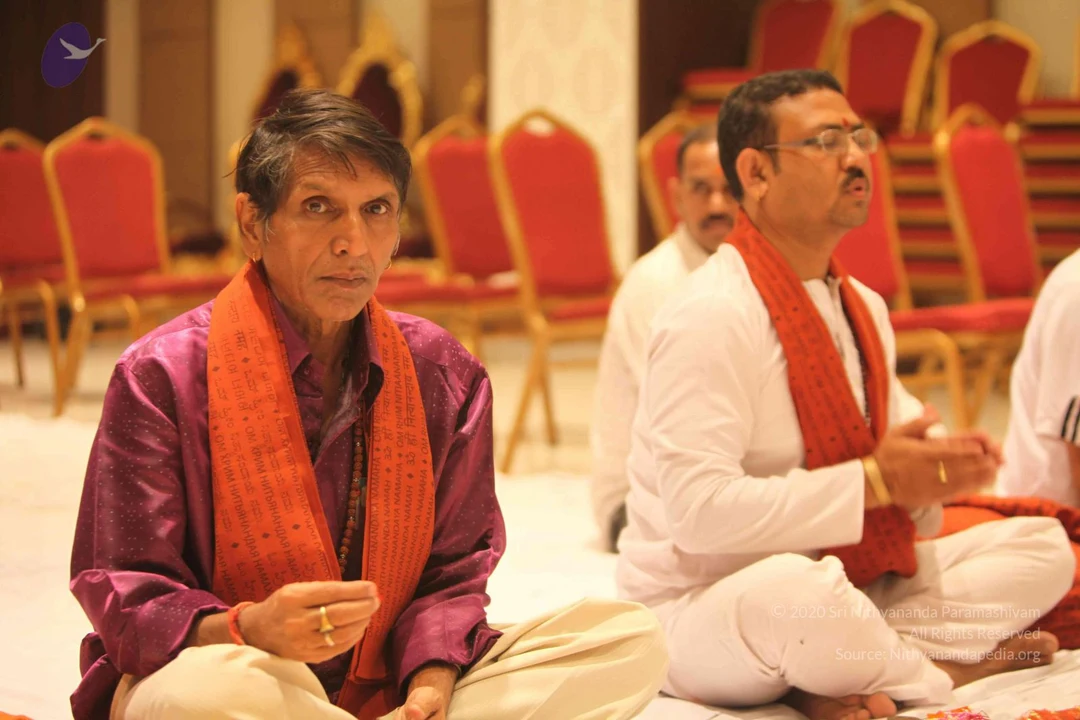
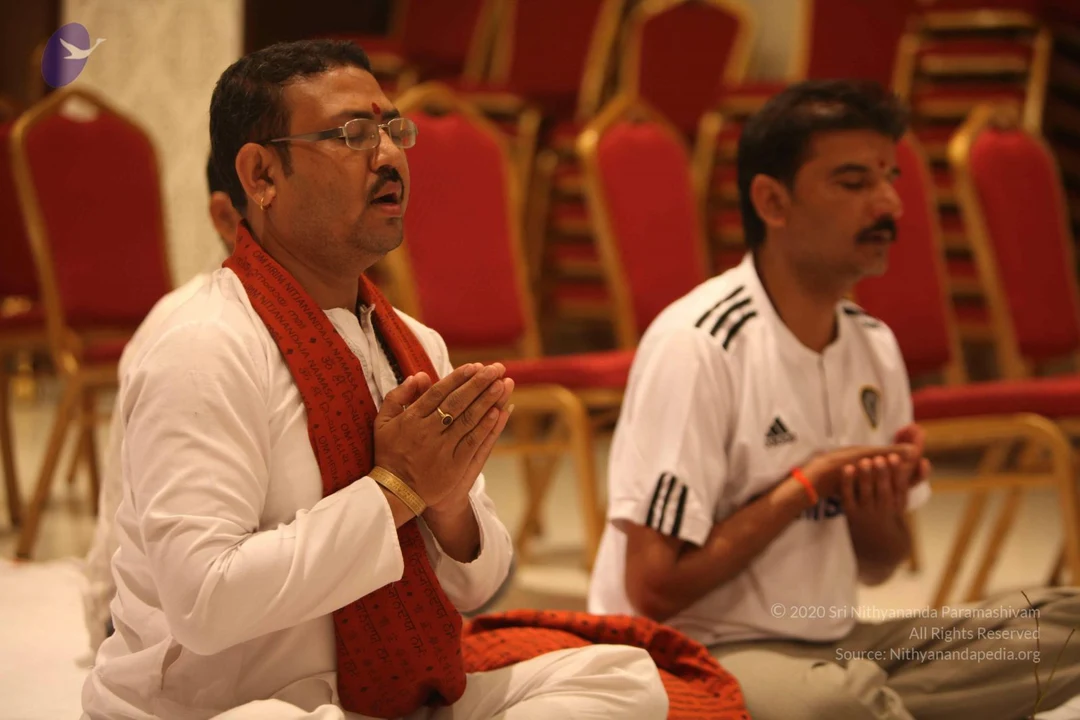
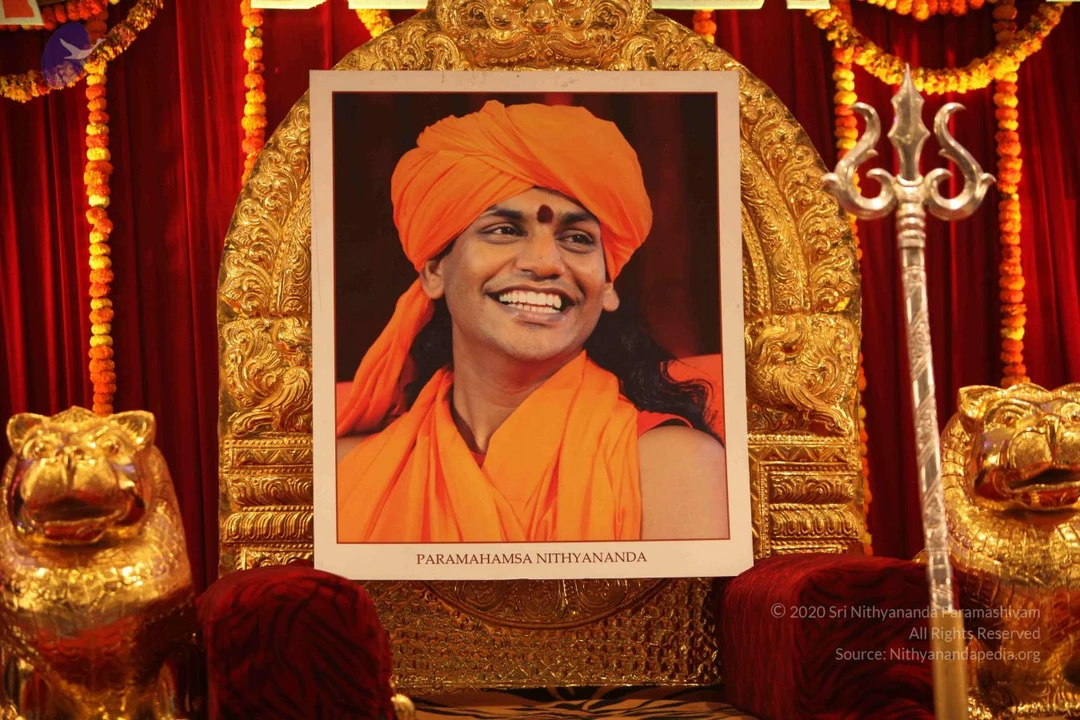
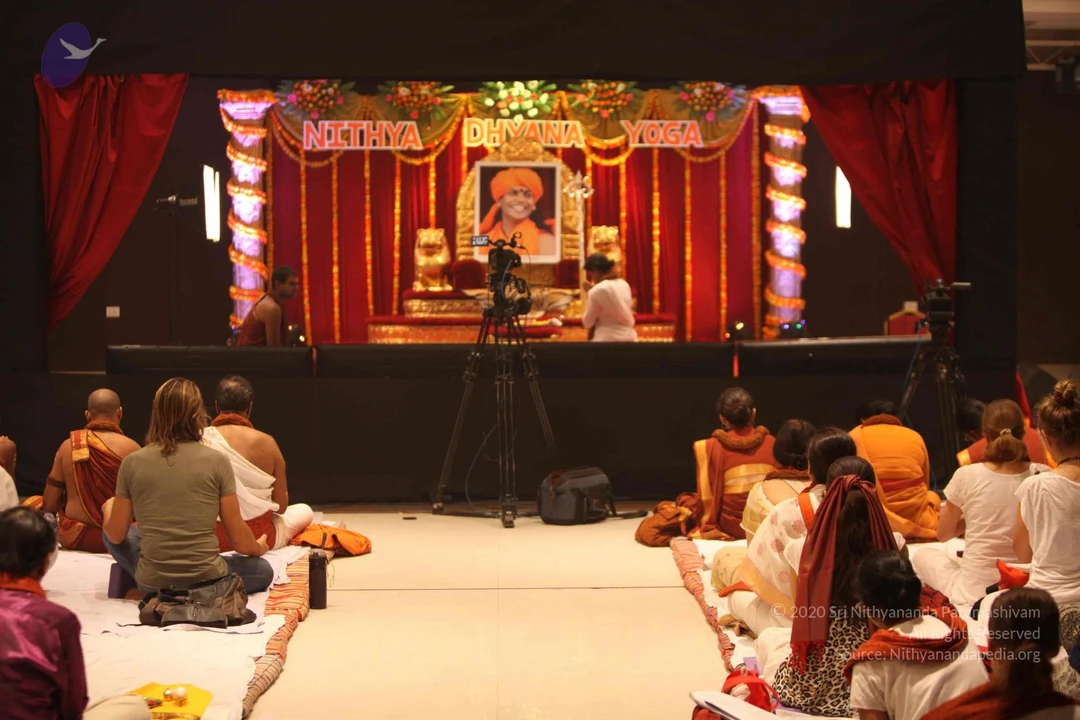
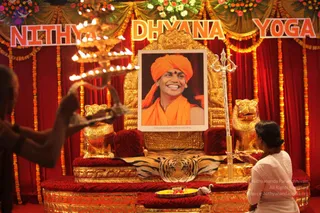
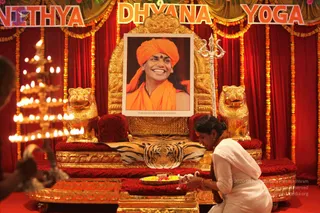
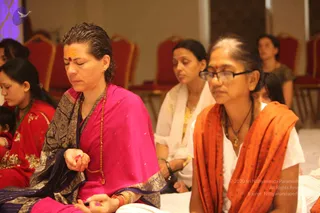
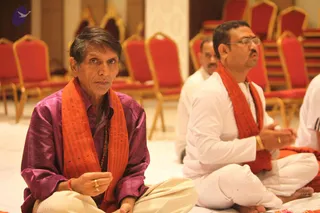
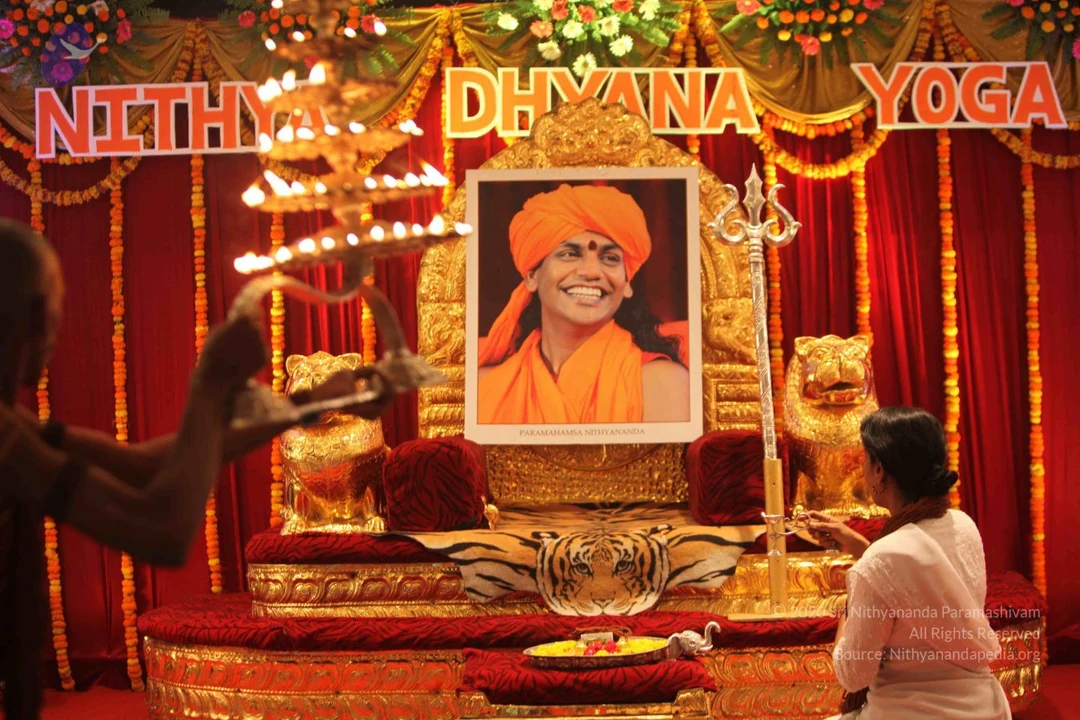
A golden throne (peetha) draped with a red cushion and a tiger-skin rug is framed by red curtains and marigold garlands, under a banner reading NITHYA DHYANA YOGA. Centre-back, a framed portrait labelled "PARAMAHAMSA NITHYANANDA" shows a smiling man in an orange turban and orange robe, shown only as a printed image. On the left, a man in a dark top holds a tiered brass aarti lamp with many lit oil lamps. On the right, a woman in a white garment with a red shawl kneels at the throne, a brass trident and a plate of flowers and offerings beside her. Two golden lion sculptures flank the throne.A photograph of a devotional aarti at a stage decorated with red drapes, marigold garlands and banners reading NITHYA and DHYANA YOGA. A man in the foreground, seen in silhouette with a shaved head and a ceremonial sash, holds up a tiered brass oil lamp with several lit flames. Behind him a large framed portrait of a smiling man wearing an orange turban and orange robes sits above a golden throne with a tiger-skin cushion; the portrait is a printed depiction, not a physical person. A woman in a white top stands at the right with her hands raised near a small golden figure, and a tray of offerings with flowers sits on the red-carpeted dais in front.Aarti ritual before a golden throne draped in red and gold, with a large framed portrait labelled Dhyana Yoga banners above. In the foreground a shaved-headed priest in saffron cloth with a bare shoulder holds up a multi-tiered silver aarti lamp with bright flames. To the right a woman in a white sari stands with hands joined in prayer. The framed portrait on the throne shows a smiling man in an orange turban and saffron robe, and a golden lion sits beside the seat. Red curtains, marigold garlands and a flower plate with offerings complete the scene.A woman in a white sari kneels before a golden throne draped with a tiger-skin cloth and flanked by golden lion figures on a red-cushioned dais. Above the throne hangs a framed portrait labelled "PARAMAHAMSA NITHYANANDA" showing a smiling man in an orange turban and orange shawl with a red bindi, and a silver trident is mounted beside it. The woman arranges a plate of flowers and offerings and tends a tiered brass oil lamp with many lit wicks at left, while a partially visible figure stands at the edge. Marigold garlands and a backdrop reading "NITHYA DHYANA YOGA" frame the scene in red and gold.A photograph of a seated group meditating indoors in a hall with red upholstered chairs and a patterned wall. In the foreground a woman in a magenta sari with a dark patterned border and a rudraksha-style mala holds her hands in a mudra with her eyes closed, with a yellow tilak on her forehead. Beside her a woman in an orange shawl over white clothes wears glasses and a pendant necklace, eyes closed. Behind them women in red and white saris sit in meditation, and a small child is partly visible at left. No a person candidate is visible.Seated satsang scene in a hall with red and gold chairs in the background. In the foreground, a man with short greying hair wears a magenta silk-look kurta, cream dhoti-style trousers, a saffron shawl printed with Sanskrit mantras, a rudraksha mala and a gold ring, his hands resting together. Beside him, a man in white kurta and white trousers, wearing gold-rimmed glasses and a saffron shawl with red border, sits cross-legged with hands folded. Two more seated people, one in white, are partly visible behind them. No identifiable a person candidate is clearly present by appearance.

NDYsessions

18 photosSource gallery
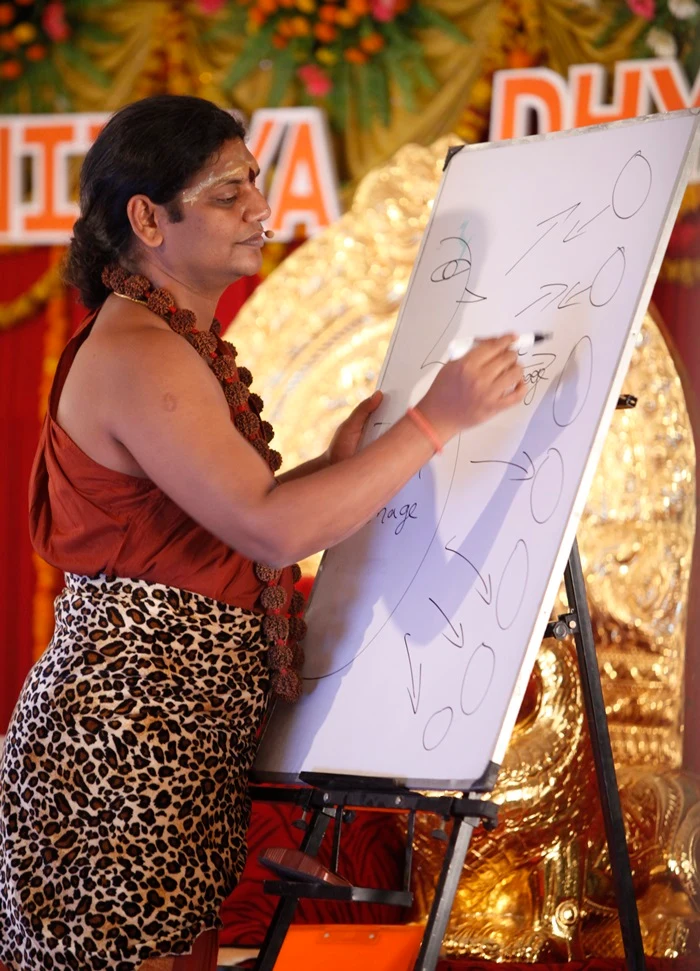
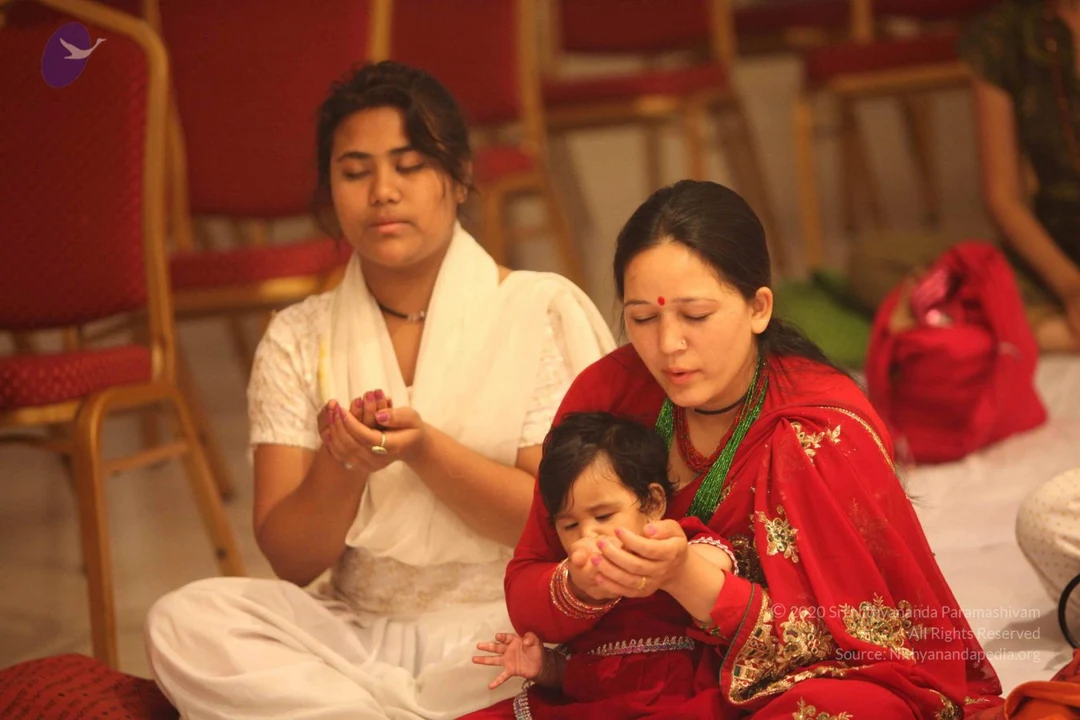
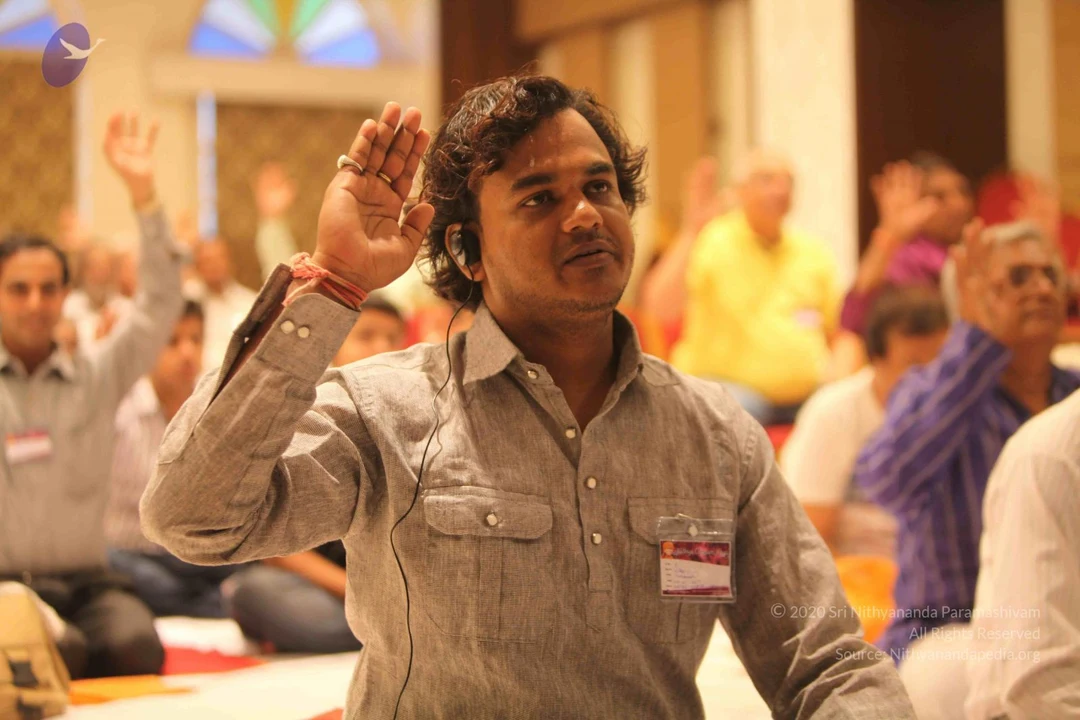
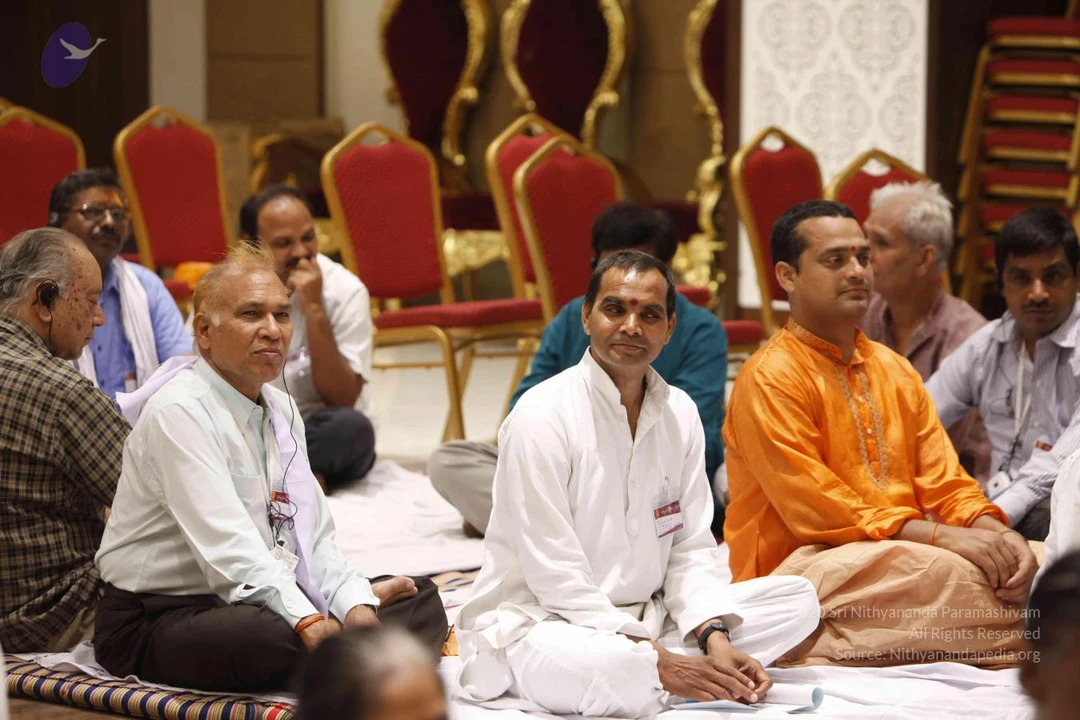
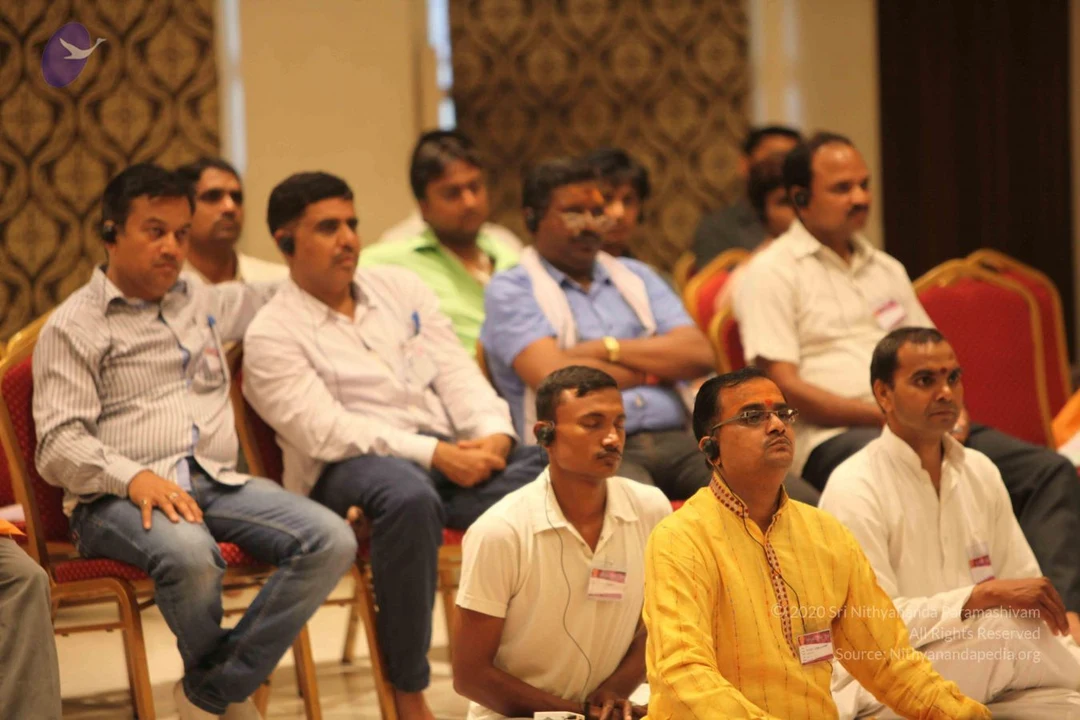
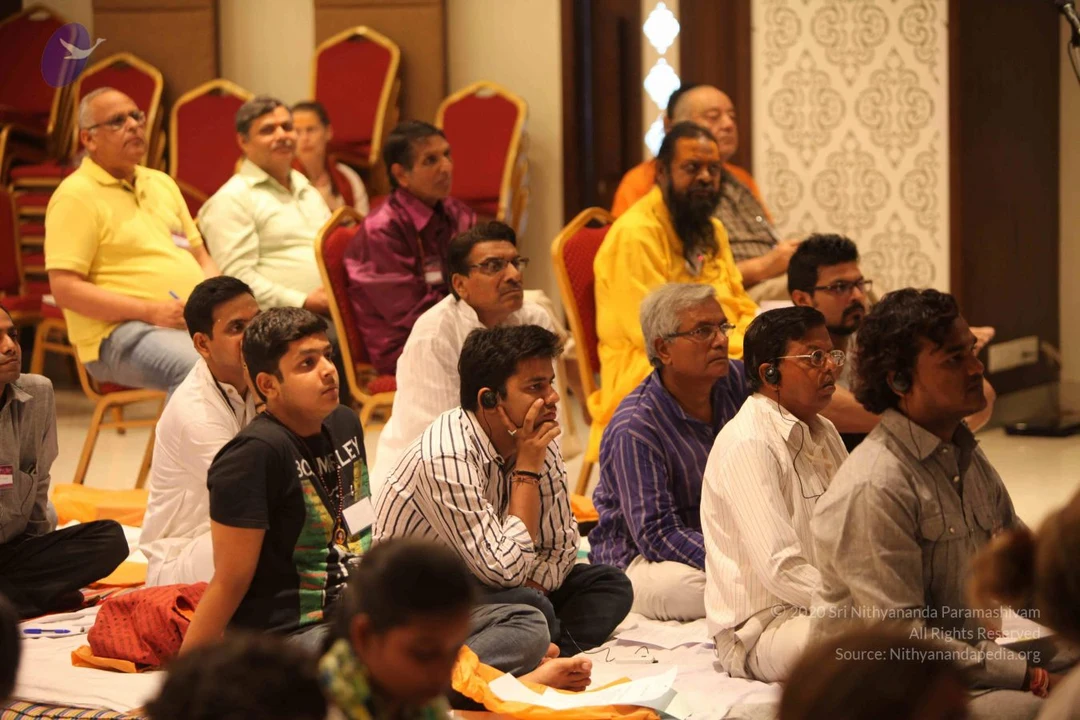
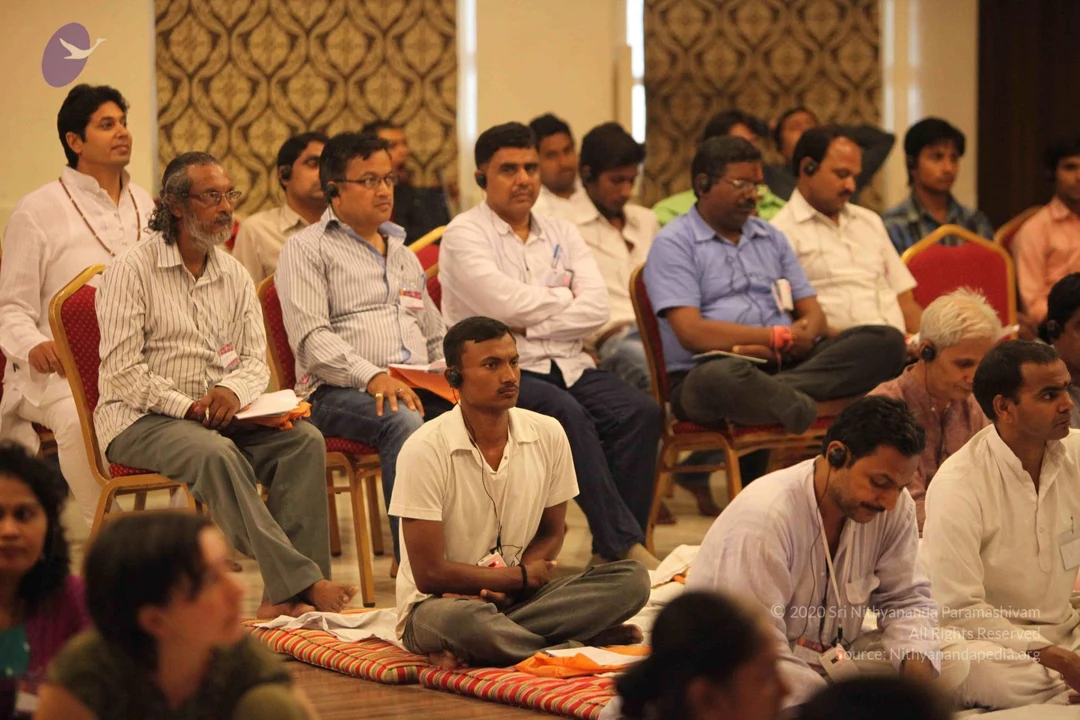
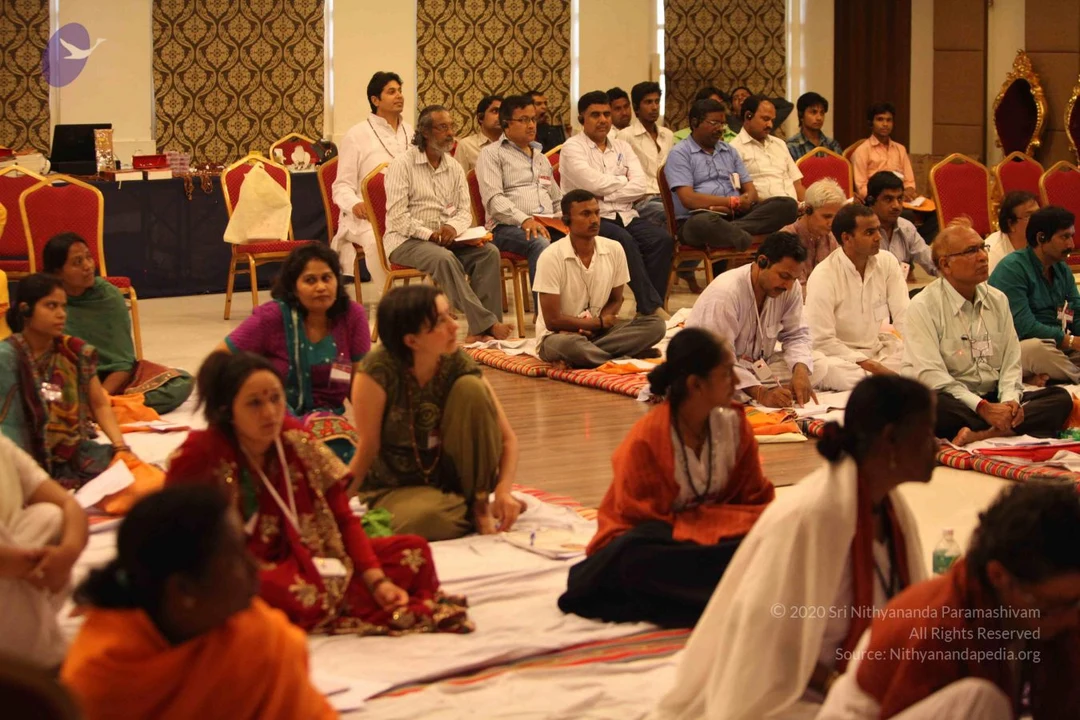
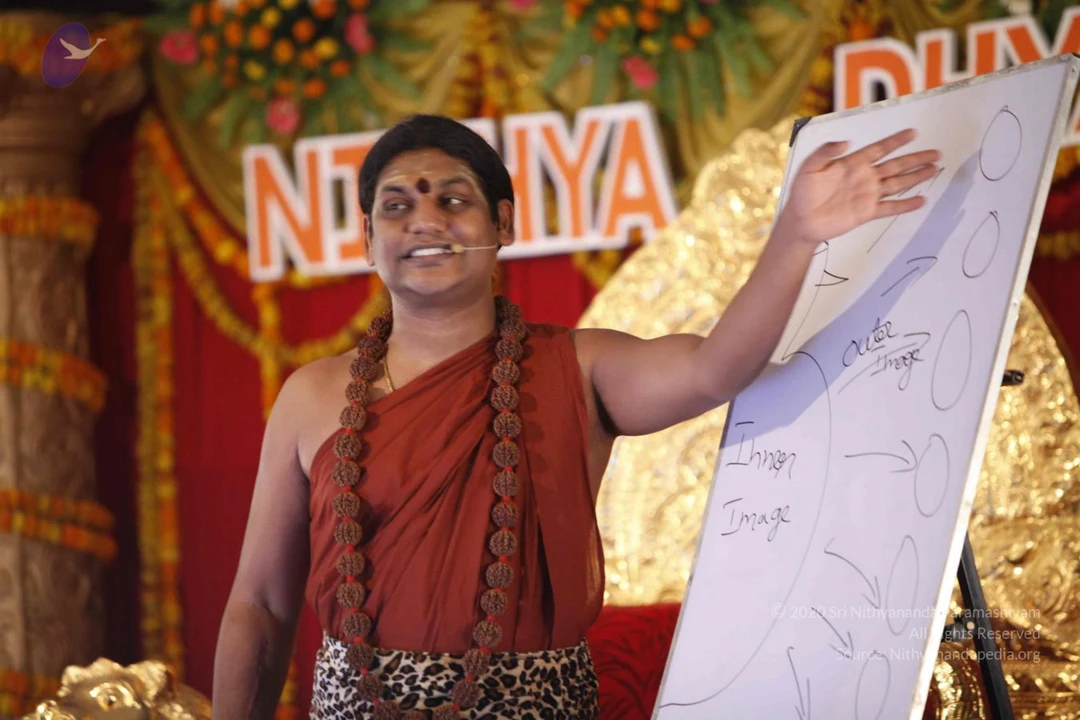
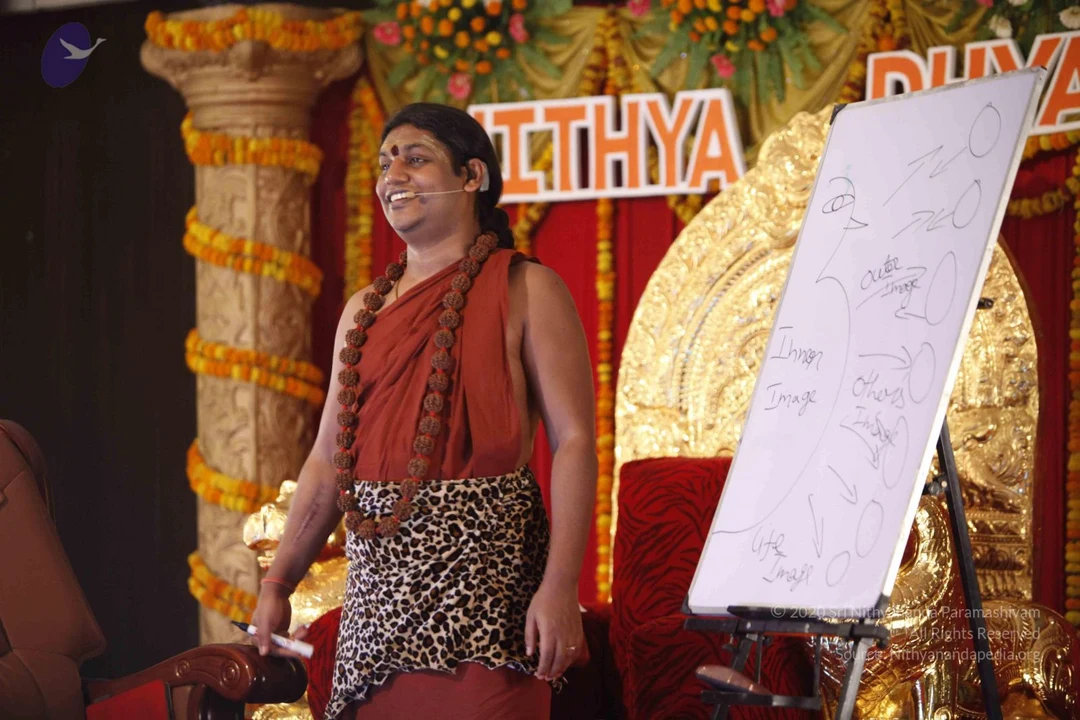
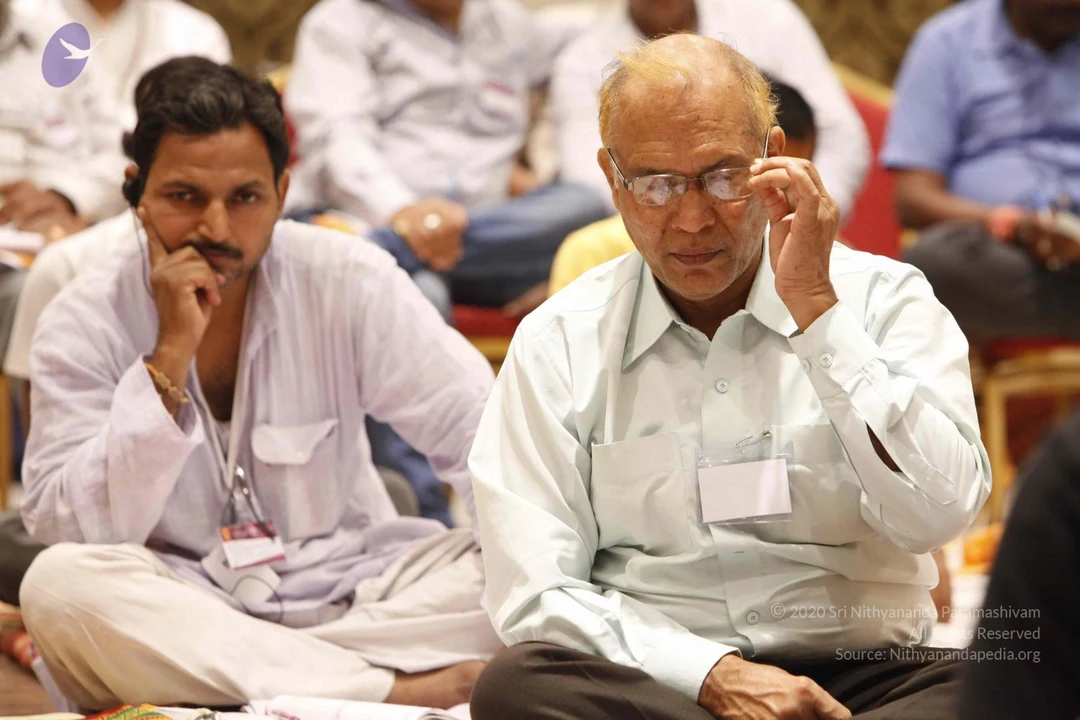
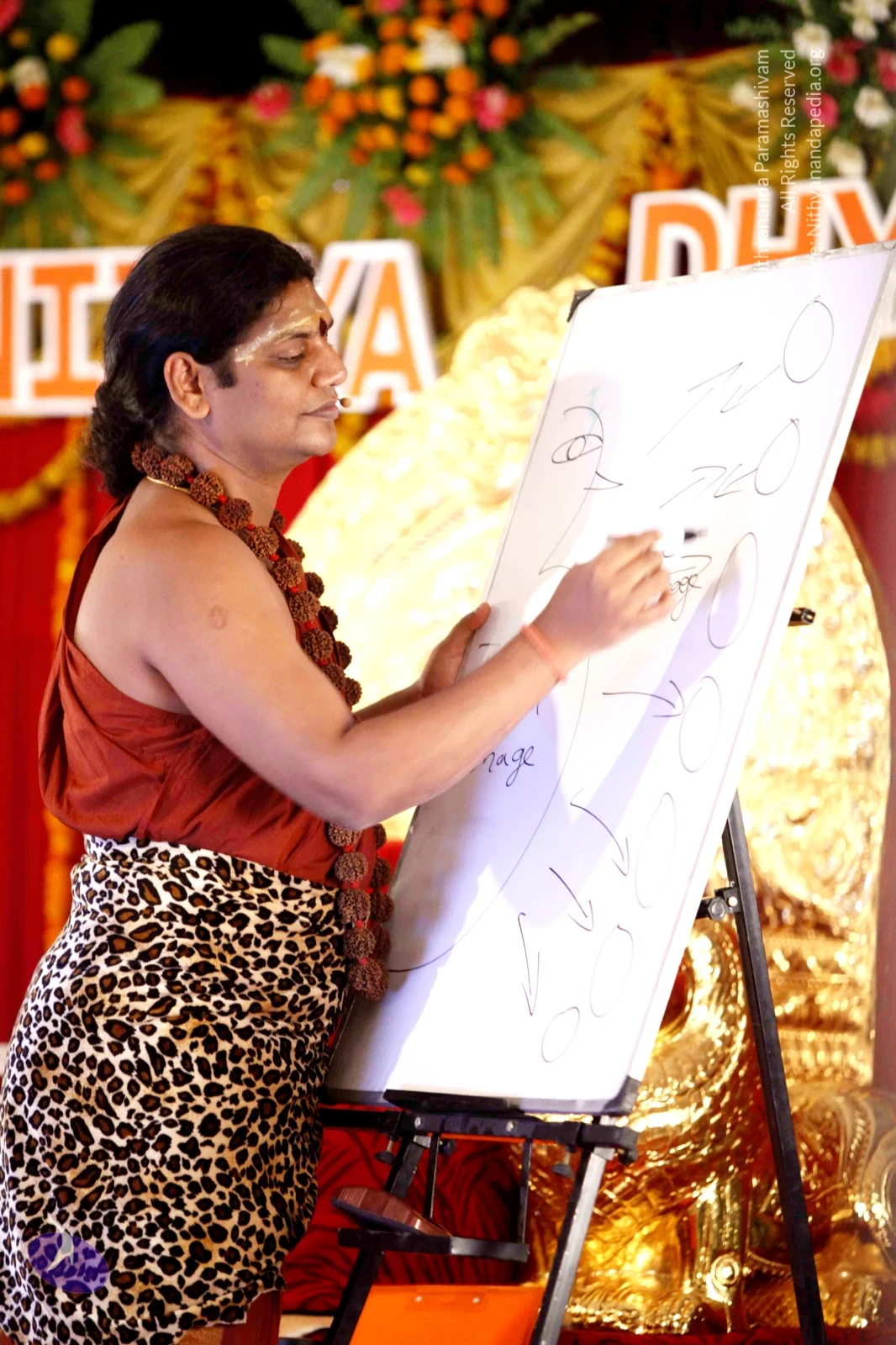
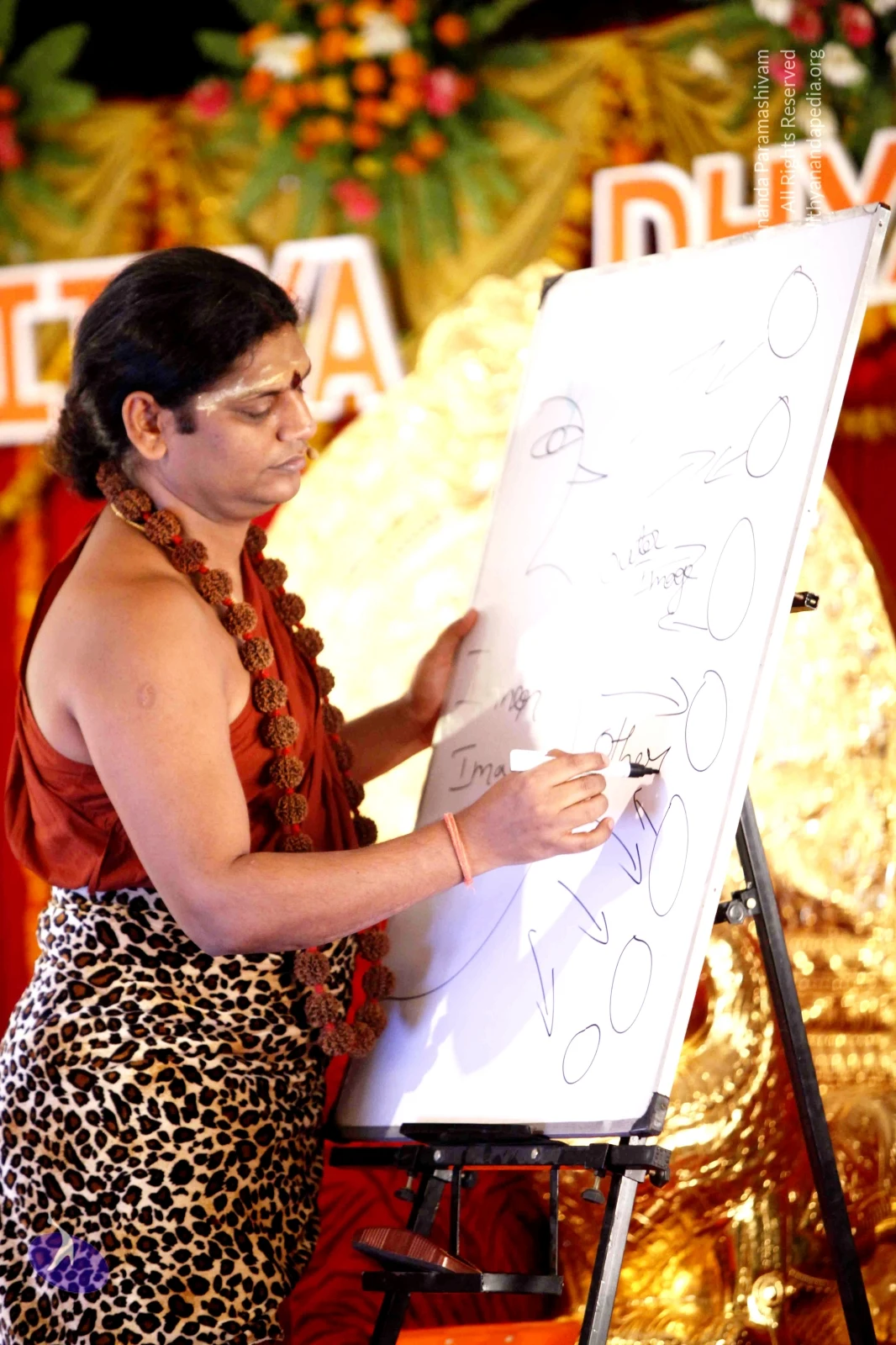
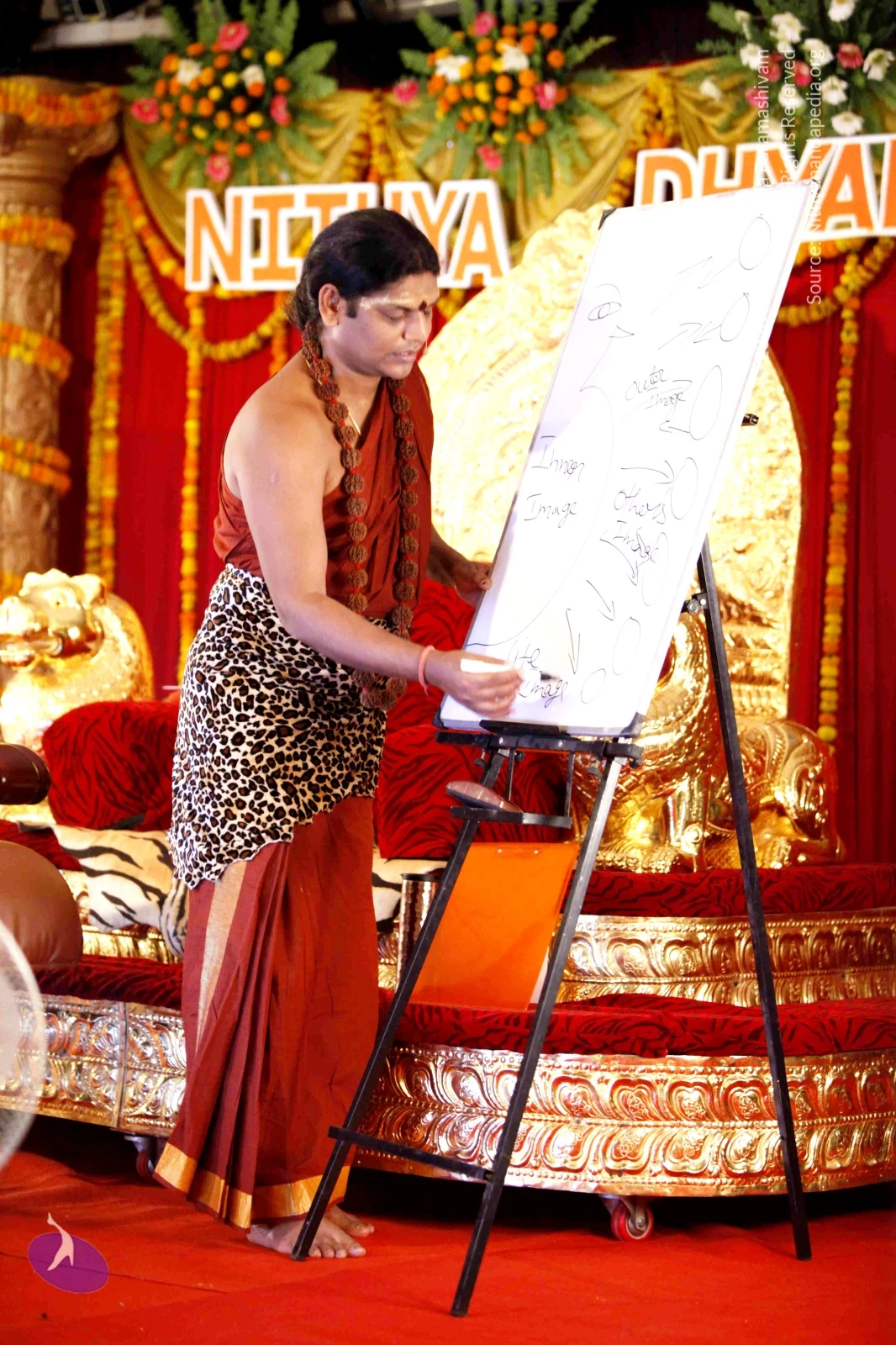
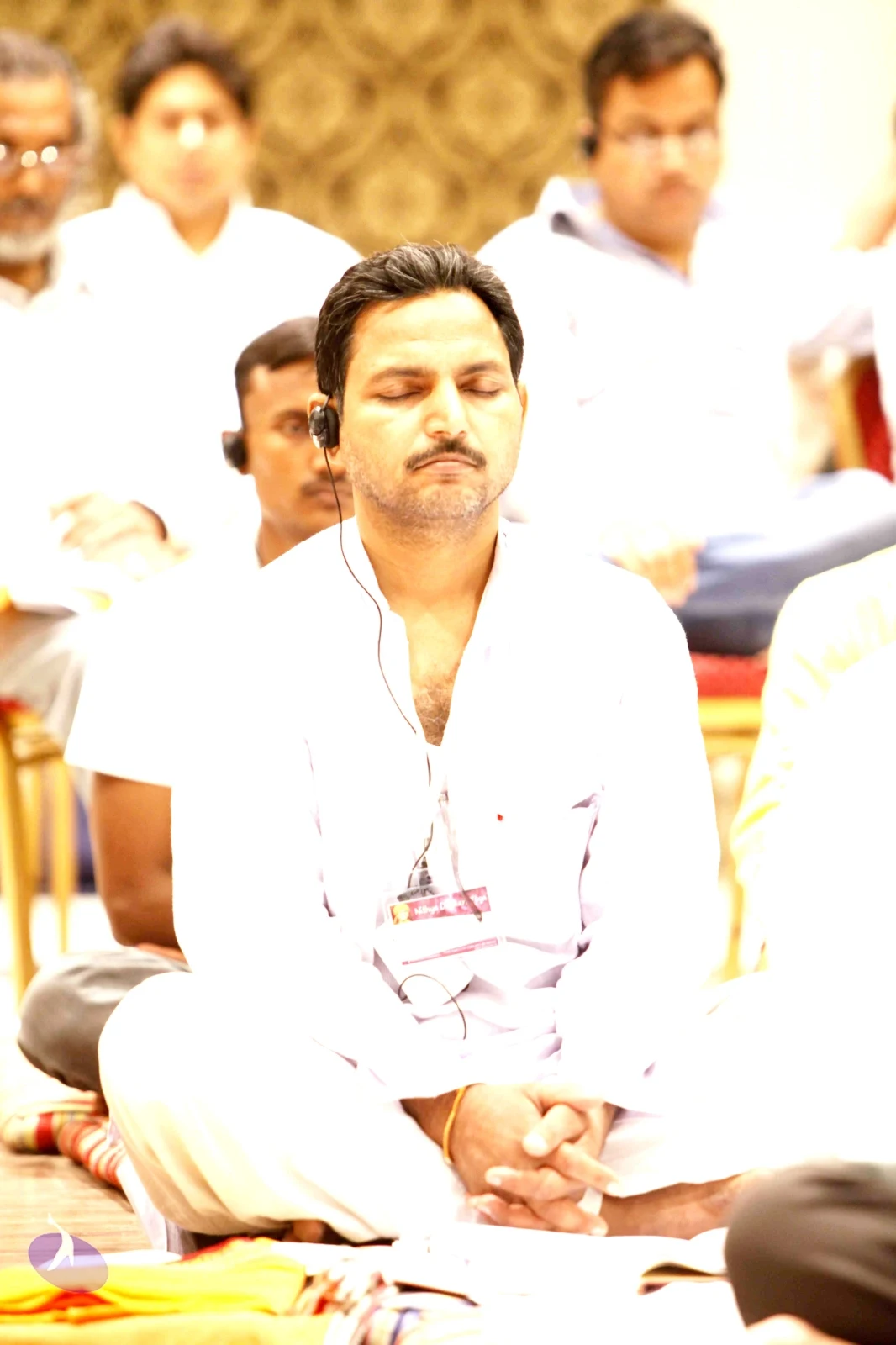
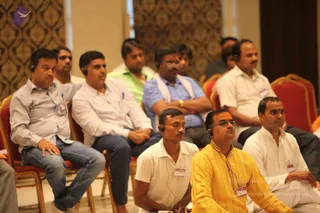
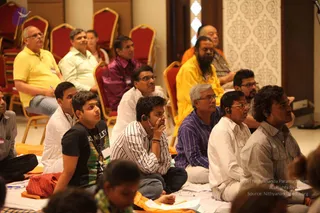
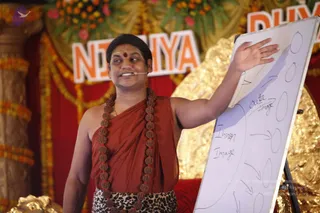
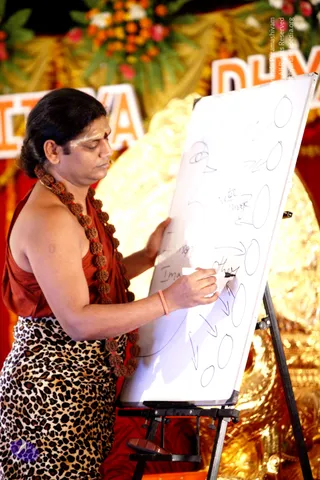
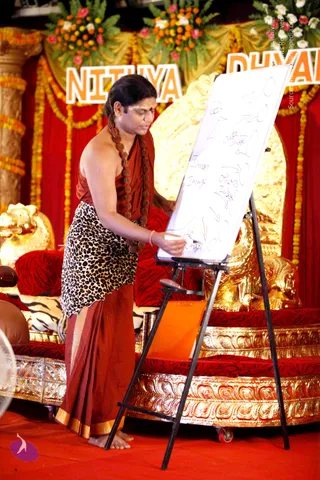
Seated audience in a hotel-style hall with patterned gold wallpaper and red upholstered chairs, attendees wearing earpieces and name badges. In the foreground a man in a yellow kurta with a vertical red-and-white mark on his forehead and glasses listens intently; beside him a man in a white polo shirt with a badge and a man in white shirt sit attentively. Behind them, men in striped shirt, jeans, green shirt, blue shirt with white shawl and white shirt listen. No one is shown speaking; attendees appear to be listening to a teaching given from the front.A photograph of a seated audience at a satsang hall with red-cushioned chairs and patterned cream wall panels. In the foreground, men and women sit on white mats listening attentively, several wearing small earpieces. A man in a yellow polo shirt sits at the left, a bearded man in a yellow robe sits centre-right, and a man in a striped shirt rests his hand on his chin. Another man in orange and grey sits at the upper right.Seated audience at an indoor satsang hall with gold damask-patterned wall panels and red-cushioned chairs. Men in white kurtas, striped shirts, blue shirts and collared shirts listen attentively, many wearing small headsets. Foreground figures sit cross-legged on a striped red mat, one in a white shirt and grey trousers, another in a white kurta. A woman in the lower left corner is partly out of frame. A figure in a white kurta with a rudraksha-style mala stands at the upper left, but no one is identified as a person. The room holds a large seated crowd.A seated audience fills a hall during a satsang gathering. In the foreground, women in orange and saffron shawls and a woman in a red embroidered outfit sit on floor mats, while rows of men and women in white kurtas, striped shirts and light jackets sit on chairs and mats behind them. Many wear lanyards with name badges. Gold-framed chairs line the room, and a table with a black cloth and a small brass item stands at the left. No a person candidate is visible in this crowd.A man in a rust-orange saffron wrap and a leopard-print lower garment stands before a whiteboard, pointing with his right hand at diagrams of circles, arrows and handwritten labels reading "Inner Image" and "Outer Image". He wears a long mala of large rudraksha beads, a red tilak on his forehead and a small clip-on microphone. Behind him are orange lettered "NITHYA" signage, marigold garlands and a gold ornate backdrop. Swamiji (probable) appears with long dark hair and a rudraksha mala, presenting as the teacher giving a discourse.A photograph of a standing figure at a satsang stage, with a head microphone and a rudraksha mala. The person wears a rust-orange shawl draped over one shoulder and a leopard-print lower wrap, and gestures toward a whiteboard easel. The whiteboard shows hand-drawn diagrams of a head profile with arrows and circles labelled inner image, outer image, others image and the 'the' image. Behind is a gold throne with red upholstery, marigold garlands wrapped on a pillar, and a large stage backdrop with orange lettering reading NITHYA and DHYA. a person: the figure has a swept-back long hairstyle, a rudraksha mala and orange clothing, consistent with the page's reference to a Varanasi satsang, though the appearance is only partly confirmable. One physical person is visible.

1-Morning-Satsang-Kalpataru-NDY-1

5 photosSource gallery
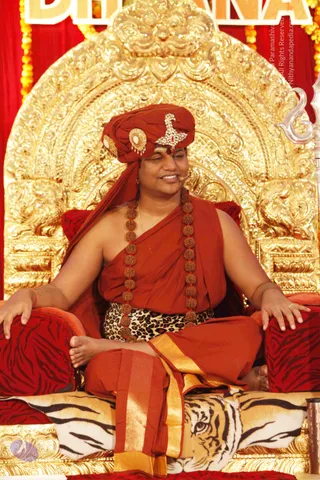
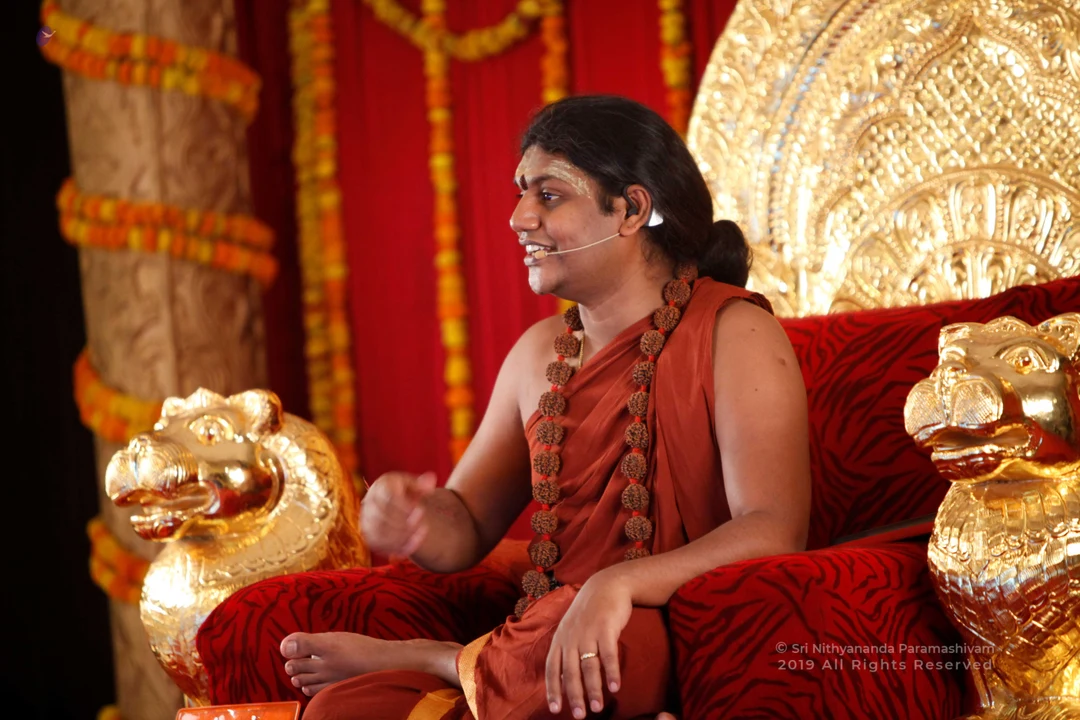
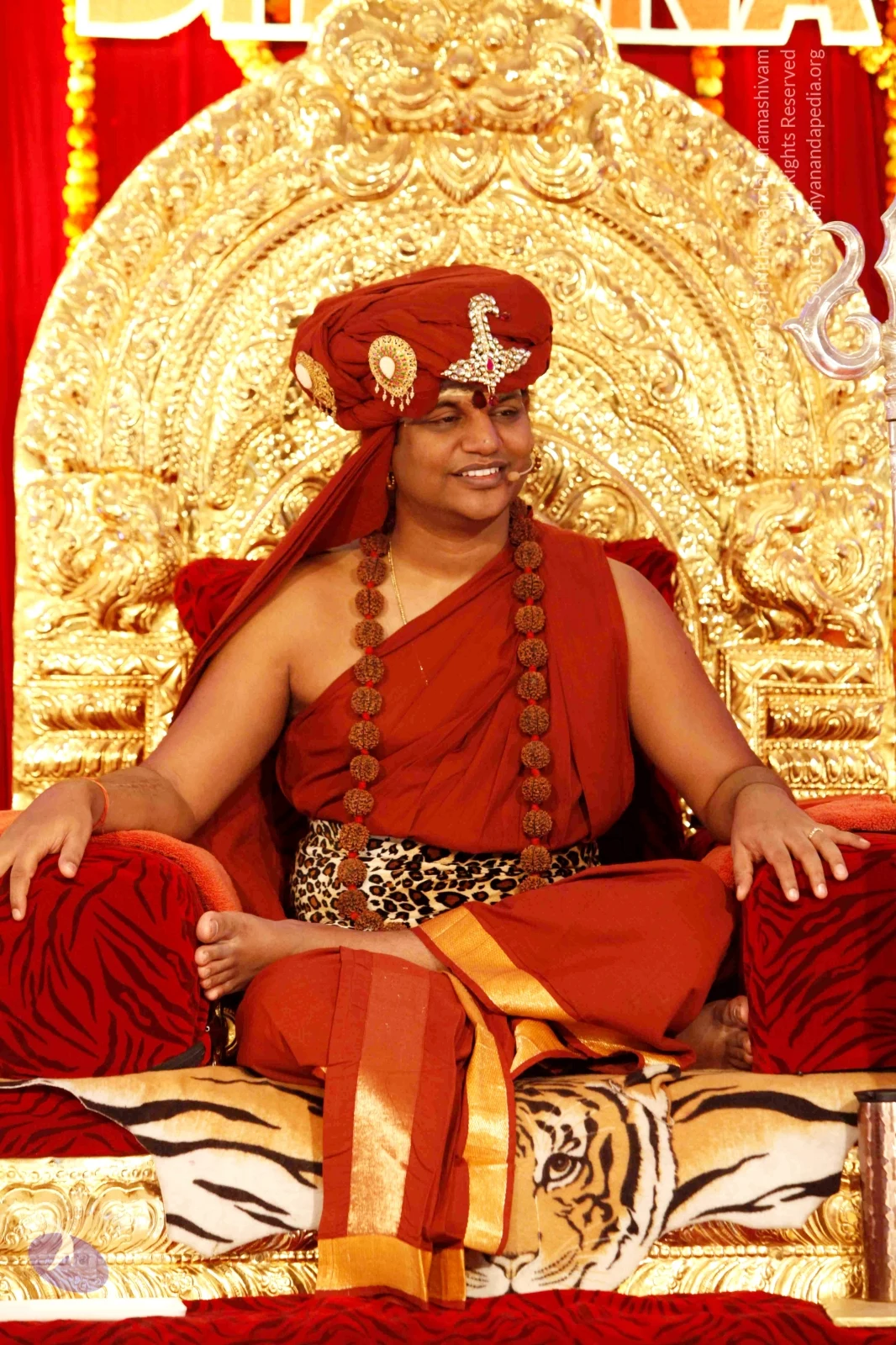
A seated figure on an ornate golden throne with a carved arched backrest, draped in a tiger-striped cushion and red velvet armrests. The person wears a red-orange turban with gold and jewelled brooches, a red-orange shawl over the torso, a leopard-print waist cloth, a long rudraksha mala with a gold chain, and a gold-bordered orange dhoti, sitting cross-legged on the throne with bare feet. A silver trident is partly visible at the upper right, and marigold garlands decorate the background. Swamiji (probable): the appearance cues of saffron-orange clothing, a turban, rudraksha malas and ceremonial gold ornaments match the page label of a satsang seat. The sign behind reads DHYANA partially.A seated figure on an ornate gilded throne with red upholstery and a tiger-skin cushion, in front of red drapes and marigold garlands. The central person wears a red-orange turban with a jewelled ornament and a red-orange wrap, with a long rudraksha mala and a leopard-print waistband, smiling with bare feet and a small microphone at the cheek. Swamiji (probable): long-haired presentation with a crown-like turban, saffron-orange clothing and rudraksha malas. A silver om symbol is visible at the upper right, and a red banner with partially visible letters appears at the top.A person seated cross-legged on an ornate gold throne with a carved gold backrest and red tiger-striped upholstered armrests, draped over a tiger-print cushion. The seated figure wears a red-orange turban decorated with gold and jewelled ornaments, a red-orange shawl over the shoulder, a leopard-print waistcloth, a gold-bordered red dhoti, and multiple long rudraksha malas across the chest. A thin gold chain and a small red mark on the forehead are visible. Behind the throne are red drapes and marigold garlands, and a silver trident-like staff is partly visible at the right edge. The appearance shows several cues associated with a person, seated in a satsang setting; the image is a photograph of a single seated person with no other people visible.A seated man in saffron-orange robes sits cross-legged on an ornate gilded throne with a large golden arched backrest, red velvet cushions and a tiger-striped rug. He wears a saffron turban with a jewelled gold ornament, a multi-strand rudraksha mala across his chest, a leopard-print waistband, and a lapel microphone; he is smiling and gesturing with open hands. Behind him are red drapes, marigold garlands and large gold letters reading DHYANA.

2-Nithya-Dhyana-Yoga

10 photosSource gallery
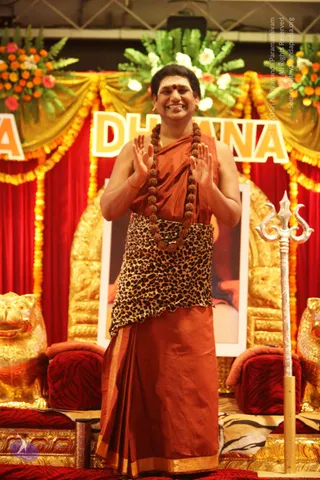
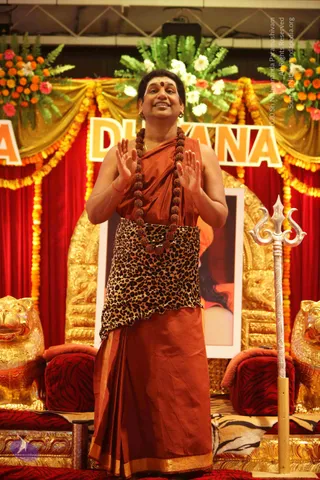
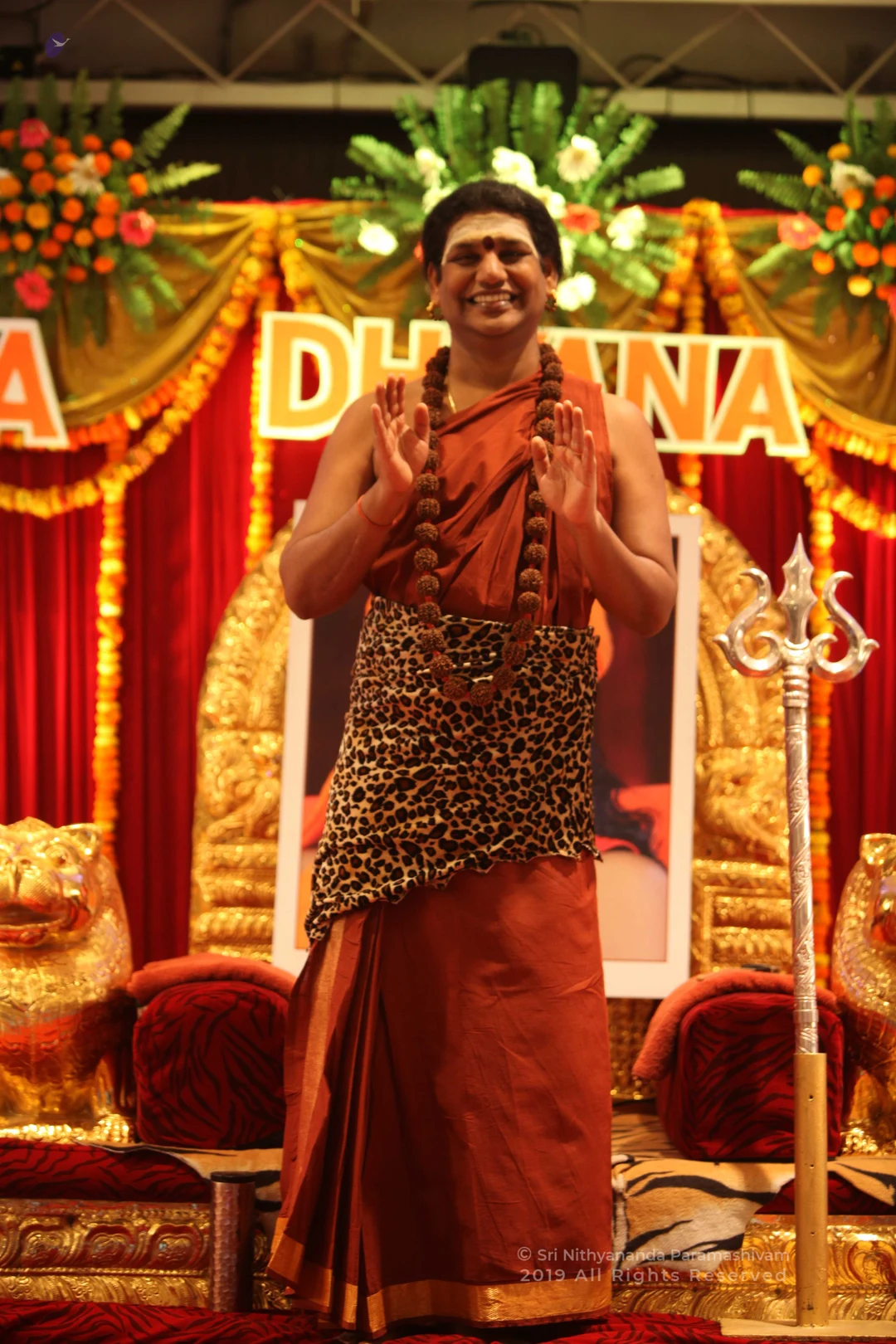
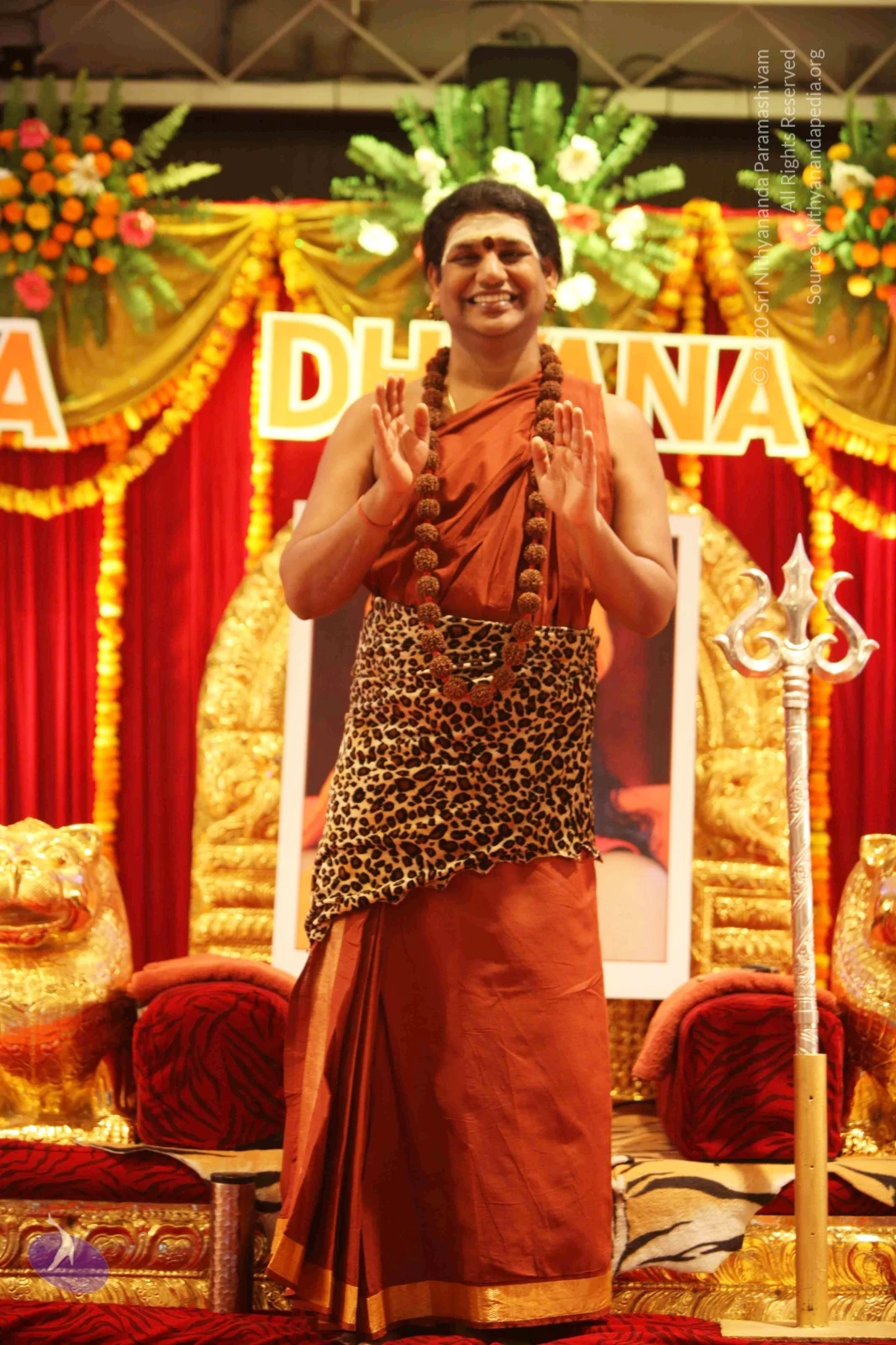
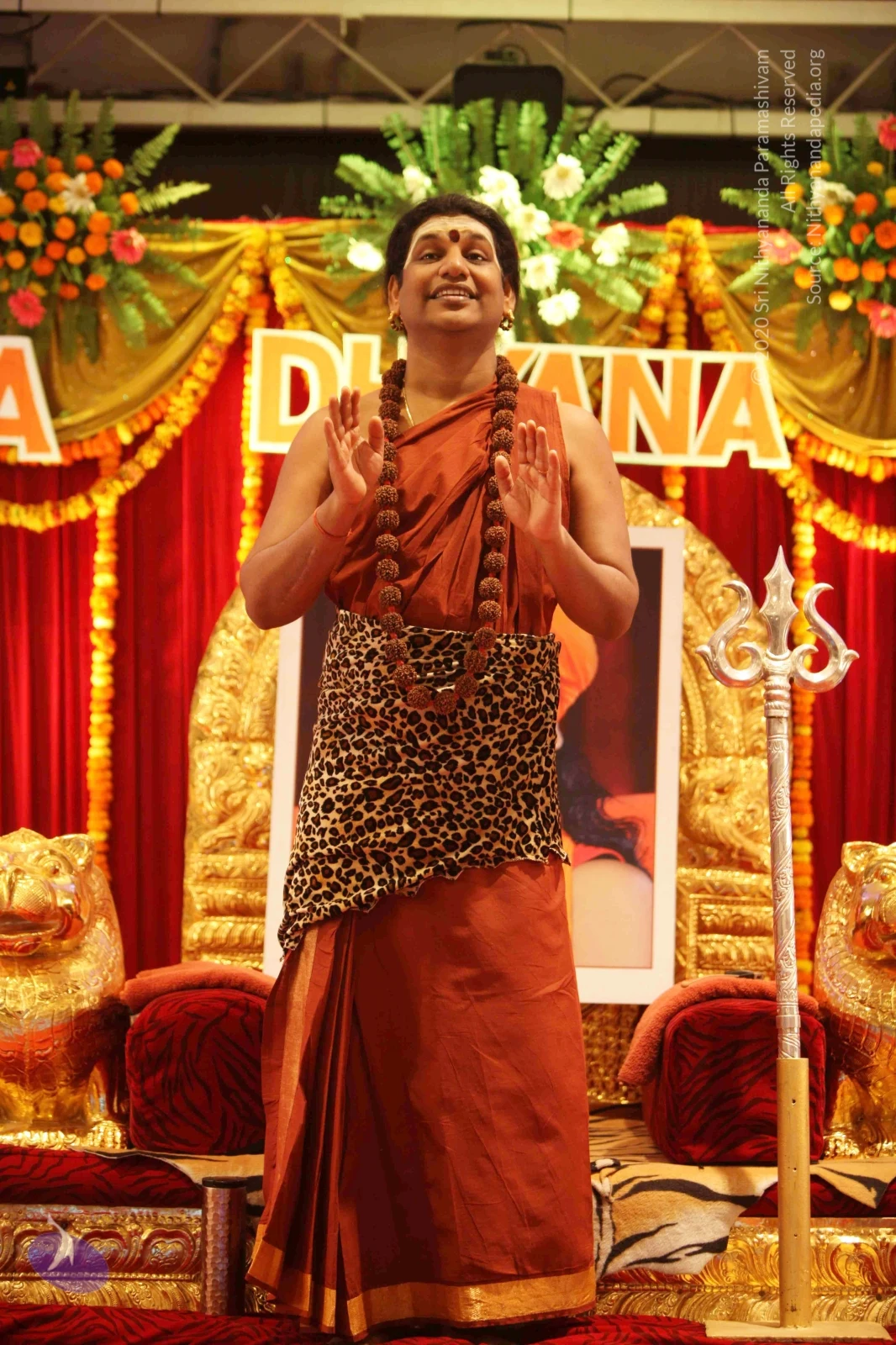
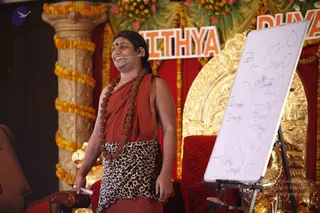
A man in rust-orange robes stands centre stage with palms pressed together in a greeting, smiling. He wears a long rudraksha mala with dark seed beads, a leopard-print shawl at the waist, and a red-orange tilak on his forehead. Behind him, orange and white floral arrangements, marigold garlands and gold-and-red drapes frame a backdrop reading 'DHYANA'. Gold lion figures flank a golden throne-like seat with red cushions, and a silver trident stands at right. A portrait of a figure in orange is visible behind him. a person: the man has a rudraksha mala and orange robes on a stage with a throne, and the page places a person at this event.A man with swept-back dark hair and white vertical tilaka marks on his forehead stands at a white flip-chart easel, writing with a marker. He wears a rust-red sleeveless garment, a leopard-print wrap, and a multi-strand rudraksha mala with a thin gold chain. He draws circles and arrows on the chart, which bears handwritten words. Behind him are orange-and-white letters reading DHYANA, marigold and rose garlands, golden drapery and a large gold-coloured figure. The page excerpt names the Varanasi satsang of 24 May 2014. The man appears to be Swamiji (probable), with long swept-back hair, a rudraksha mala and ornate gold chain, and is shown in person, so the field is in_person.A man in a rust-orange garment with a rudraksha mala draped over his shoulder and a sacred tilak on his forehead stands at a white flip chart on an easel, writing with a black marker. His hair is tied back, and he wears a leopard-print lower wrap. Behind him are orange lettering reading DHYA, marigold and rose garlands, and golden decorations. The chart shows hand-drawn circles, arrows and handwritten words. a person by visible cues: rudraksha mala, orange clothing and tilak, though the face is not used for identification.A man with long dark hair and a tilak on his forehead stands barefoot at a whiteboard easel, writing with a marker. He wears a rust-red shawl over his bare shoulders, a leopard-print wrap, and a rust-red dhoti with gold border, with a rudraksha mala hanging down his chest. Behind him is a golden throne with red cushions and gold lion figures, a red stage backdrop, and a floral garland arch. The whiteboard shows handwritten words and arrows including 'Inner Image' and 'Create Image'. A banner behind reads 'NITHYA DHYAN'. a person: the long swept hair, rudraksha malas, rust-red shawl and ceremonial dress match the page's identification, so the figure is treated as a person presence, not a confirmed identity.