Skip to content
Tuesday

18 March 2014

Do you know the biggest secret

Dated photos
312
Source pages
1
Media
2
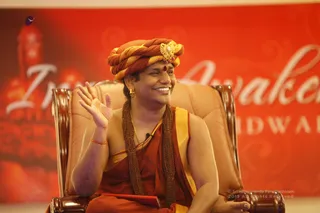
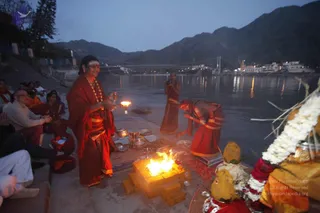
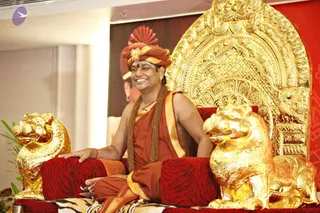
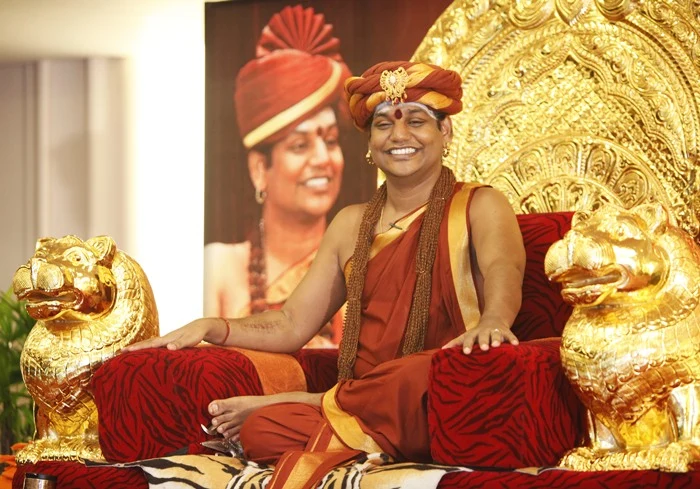
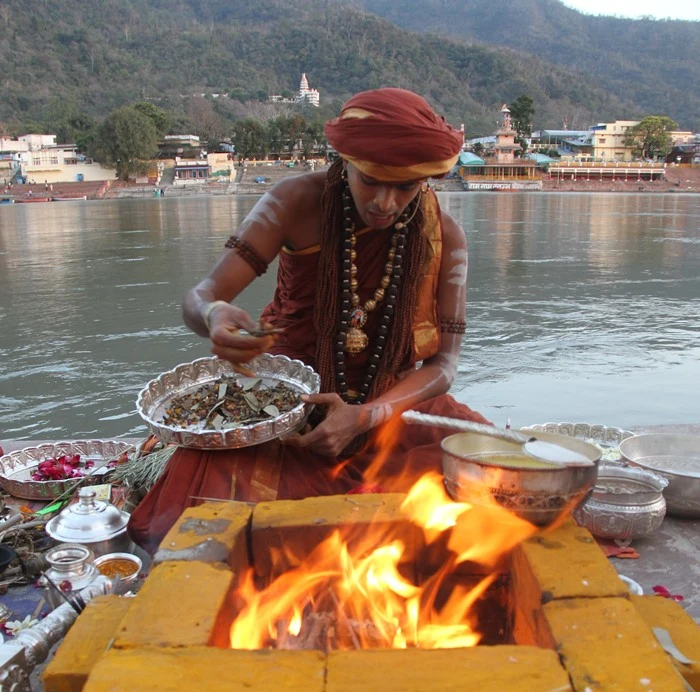
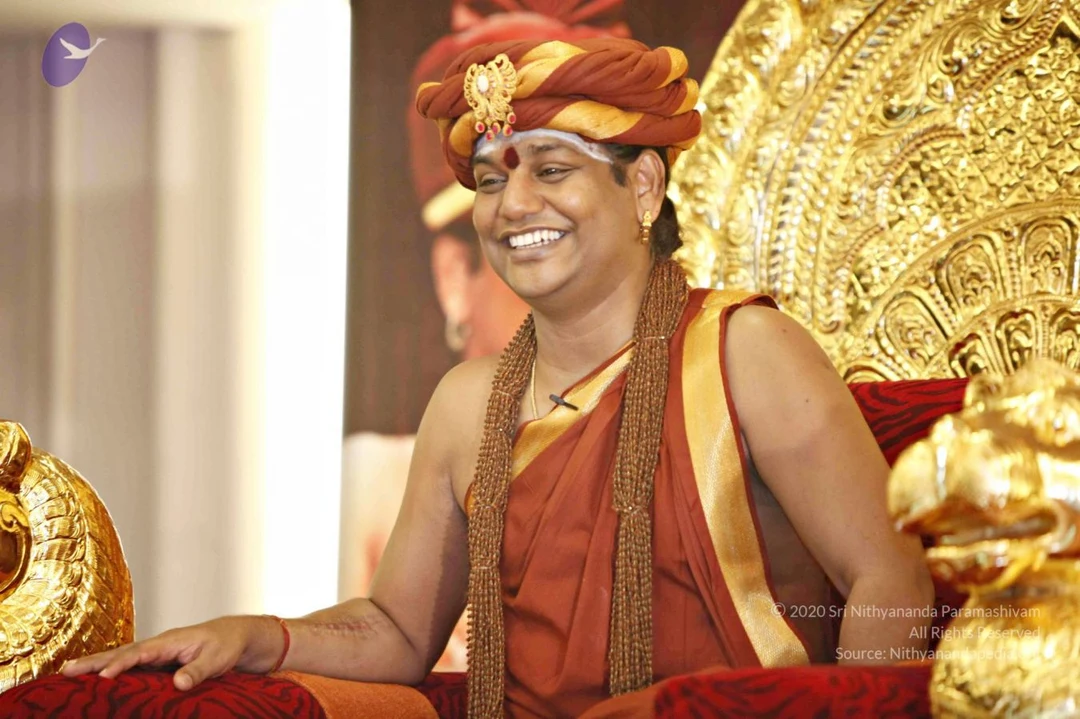
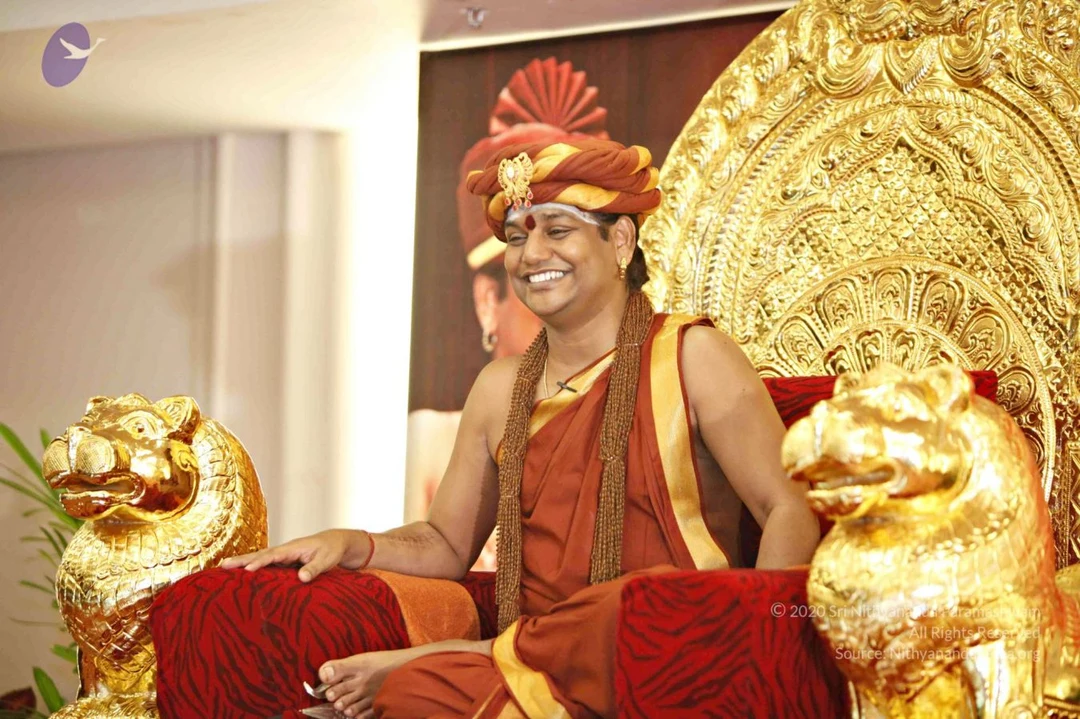
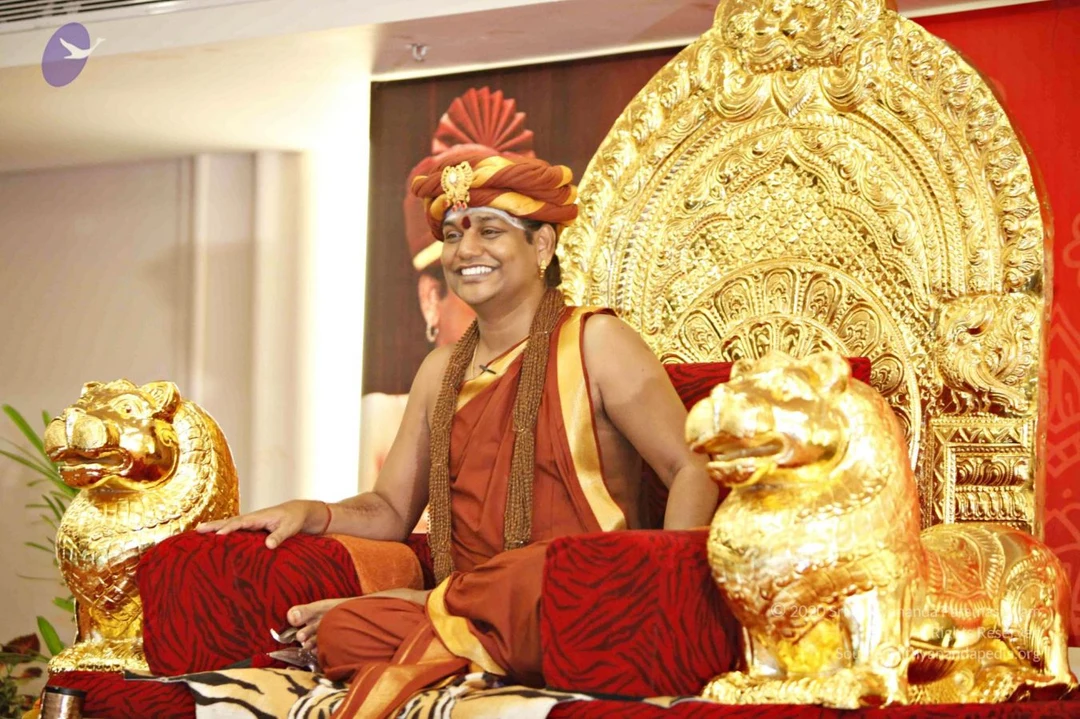
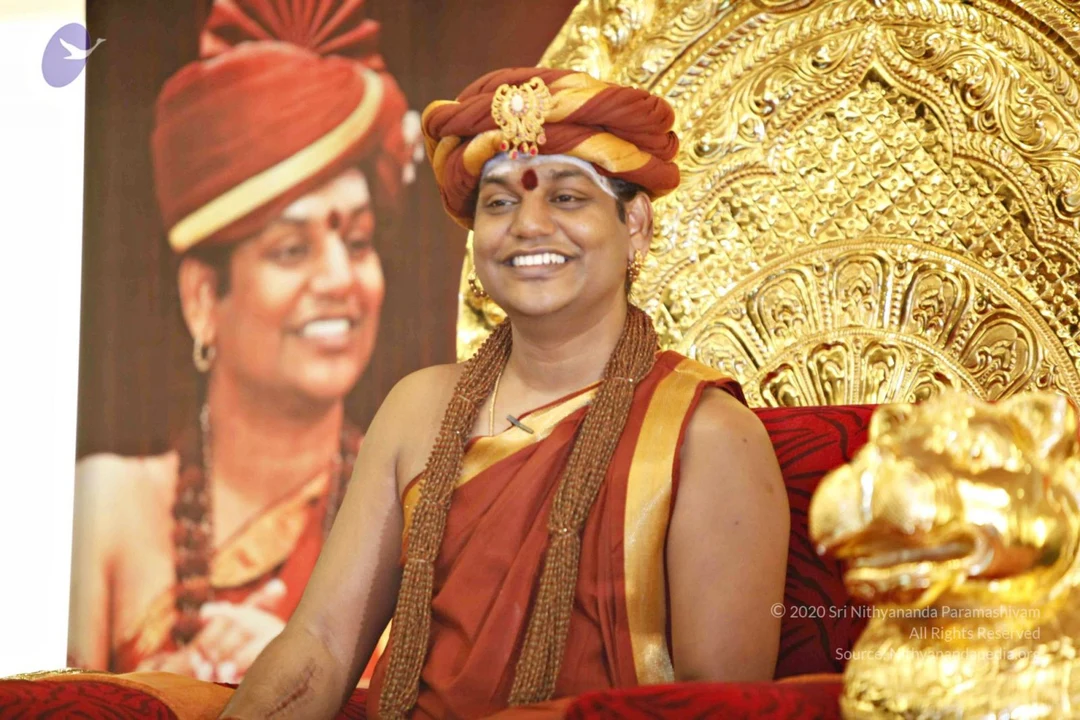
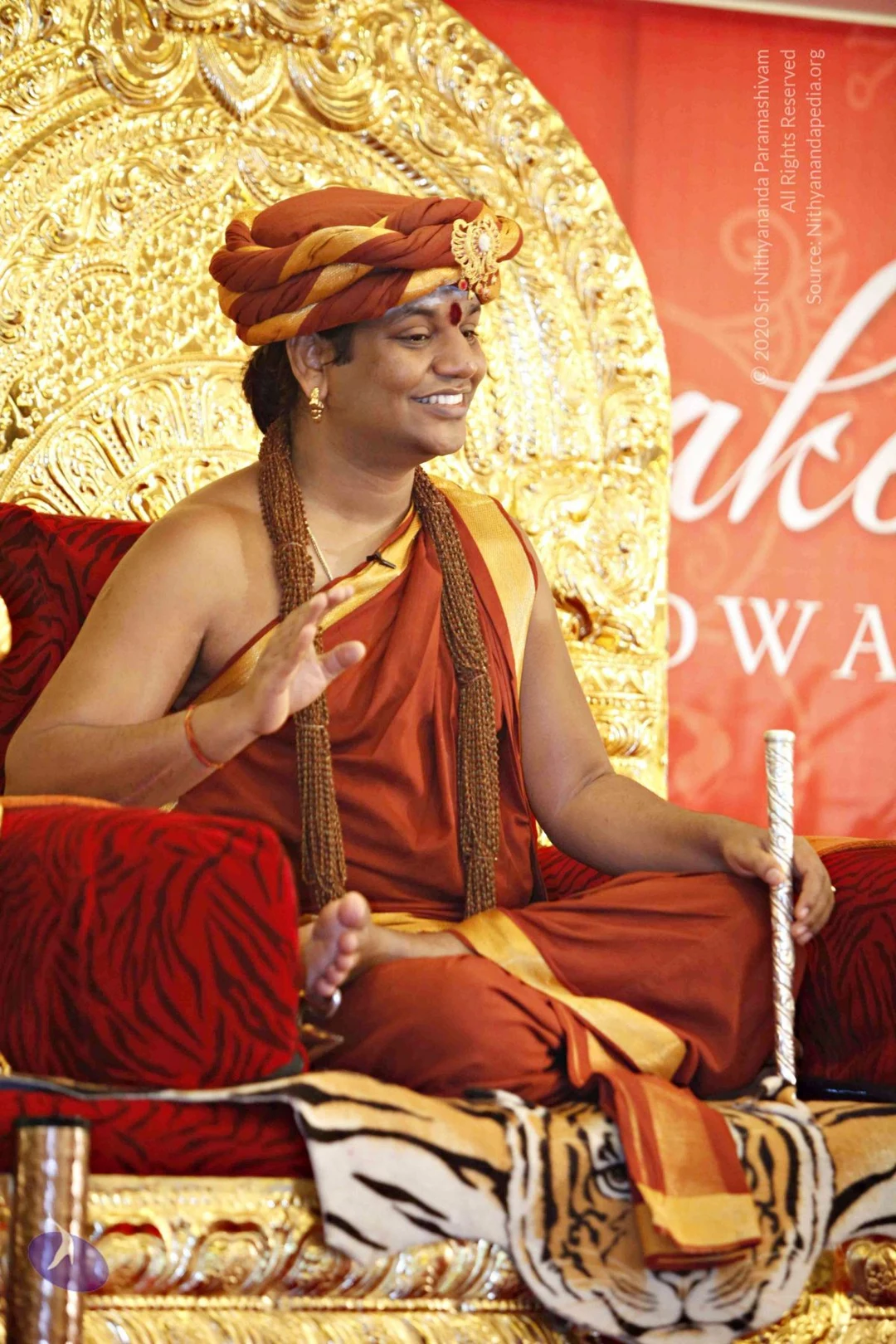
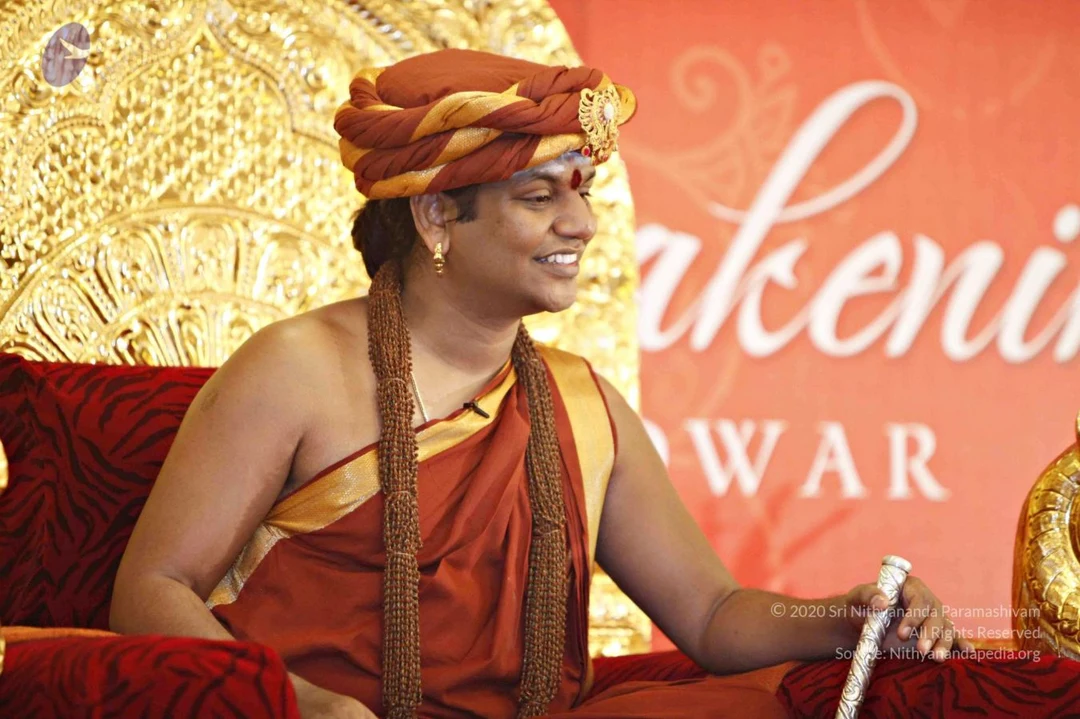
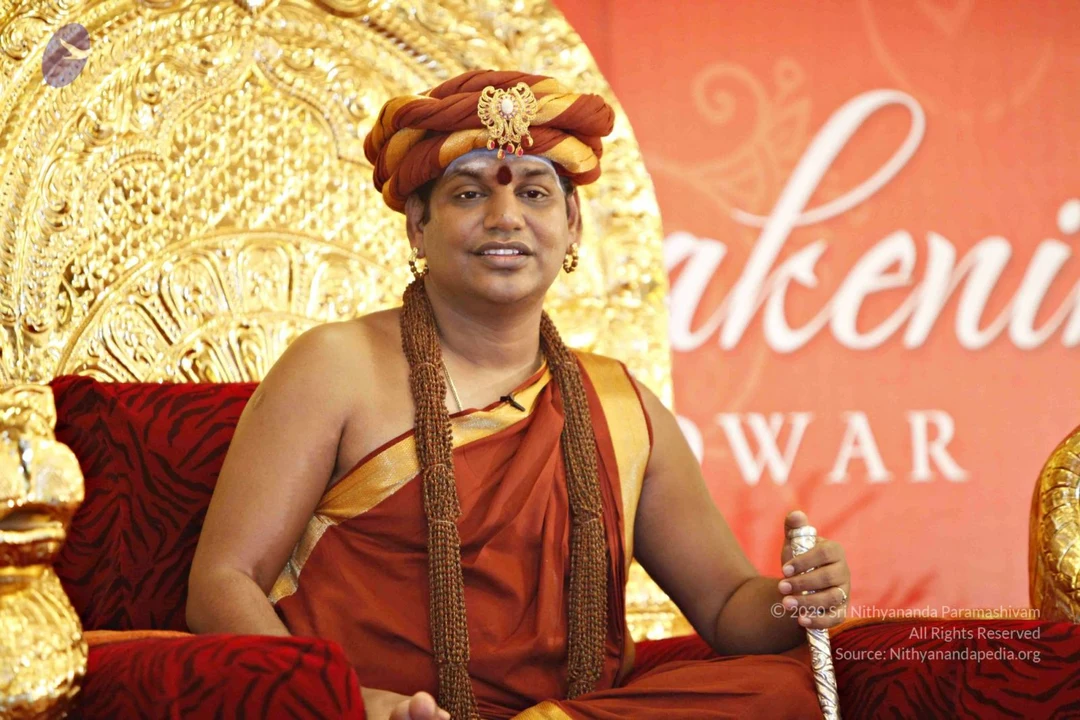
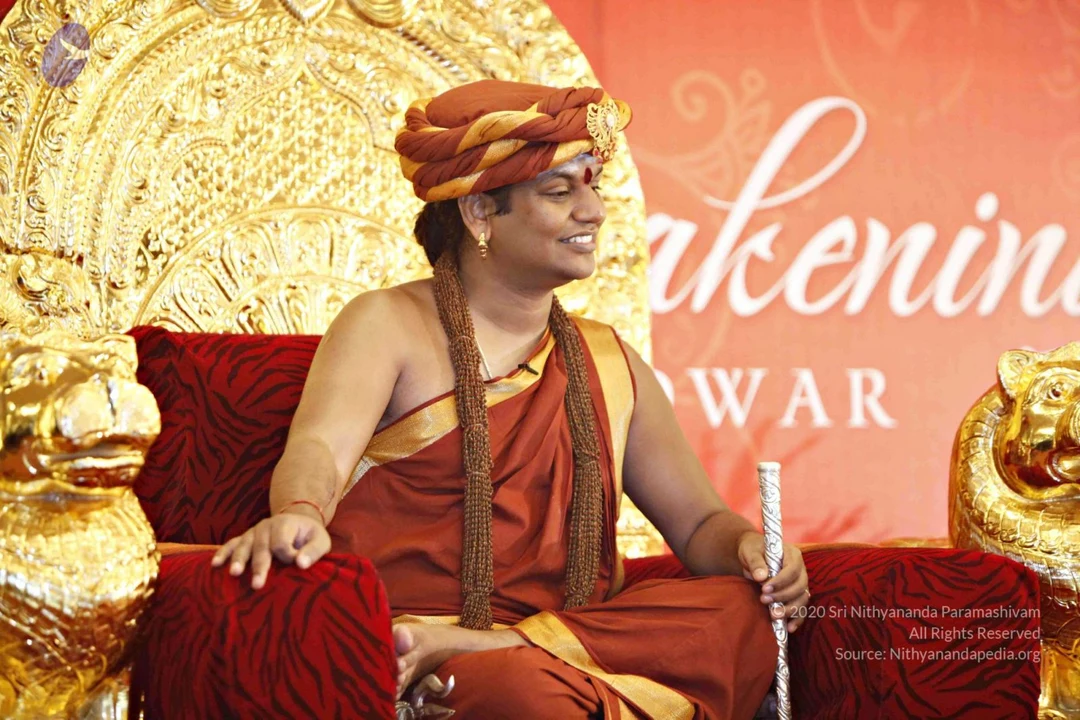
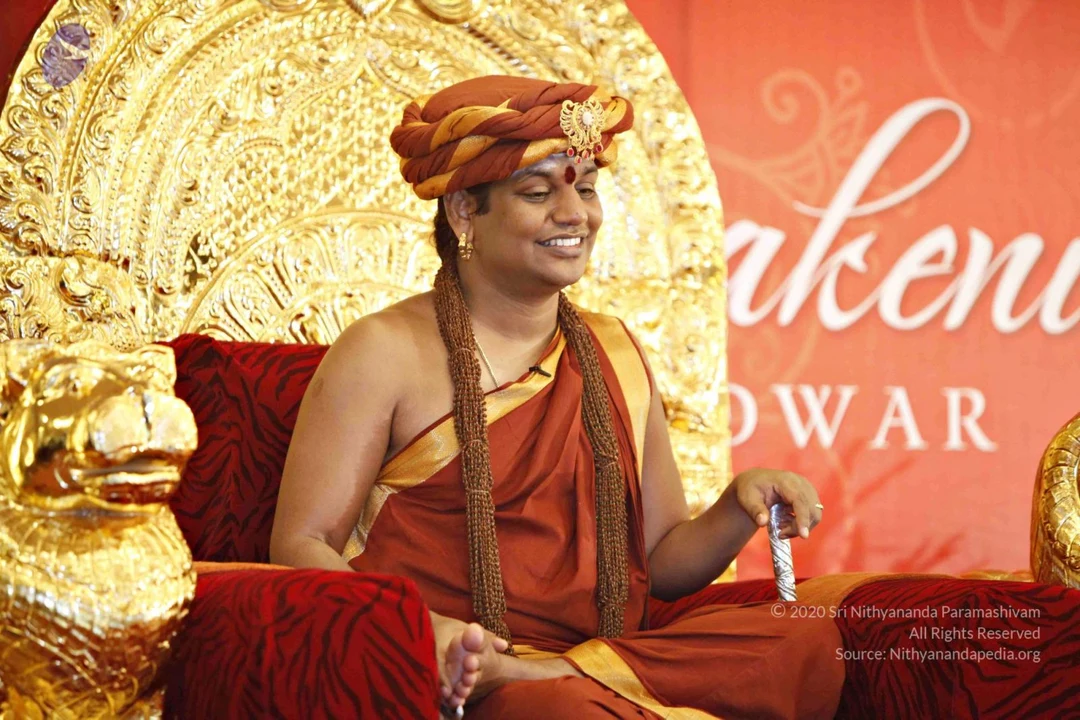
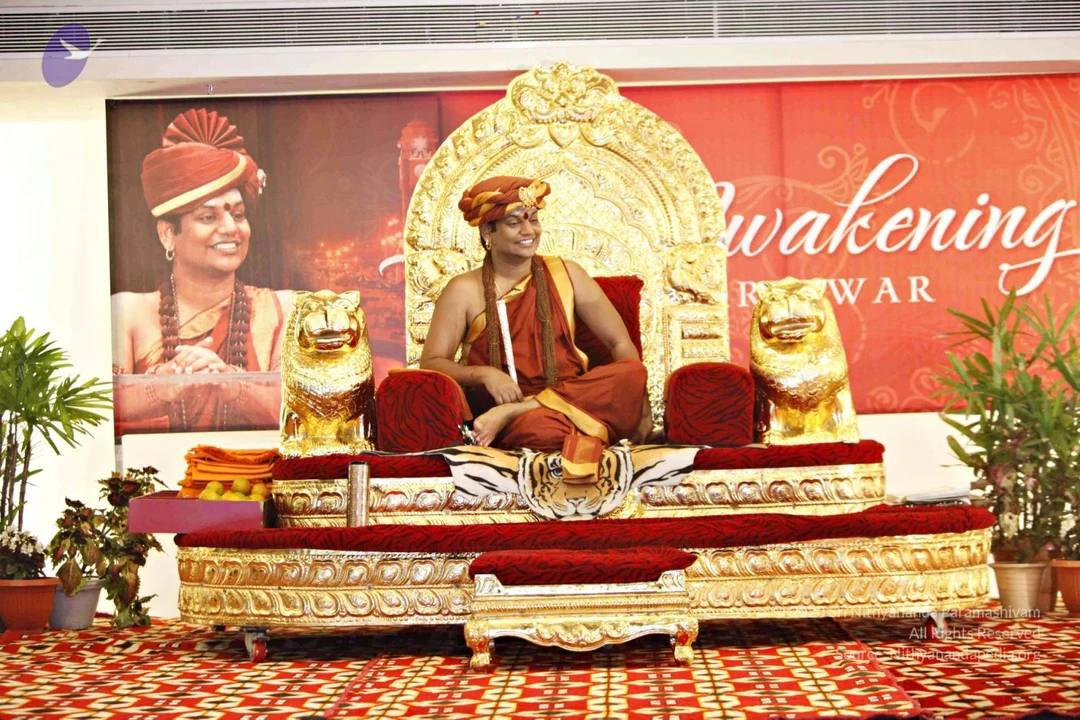
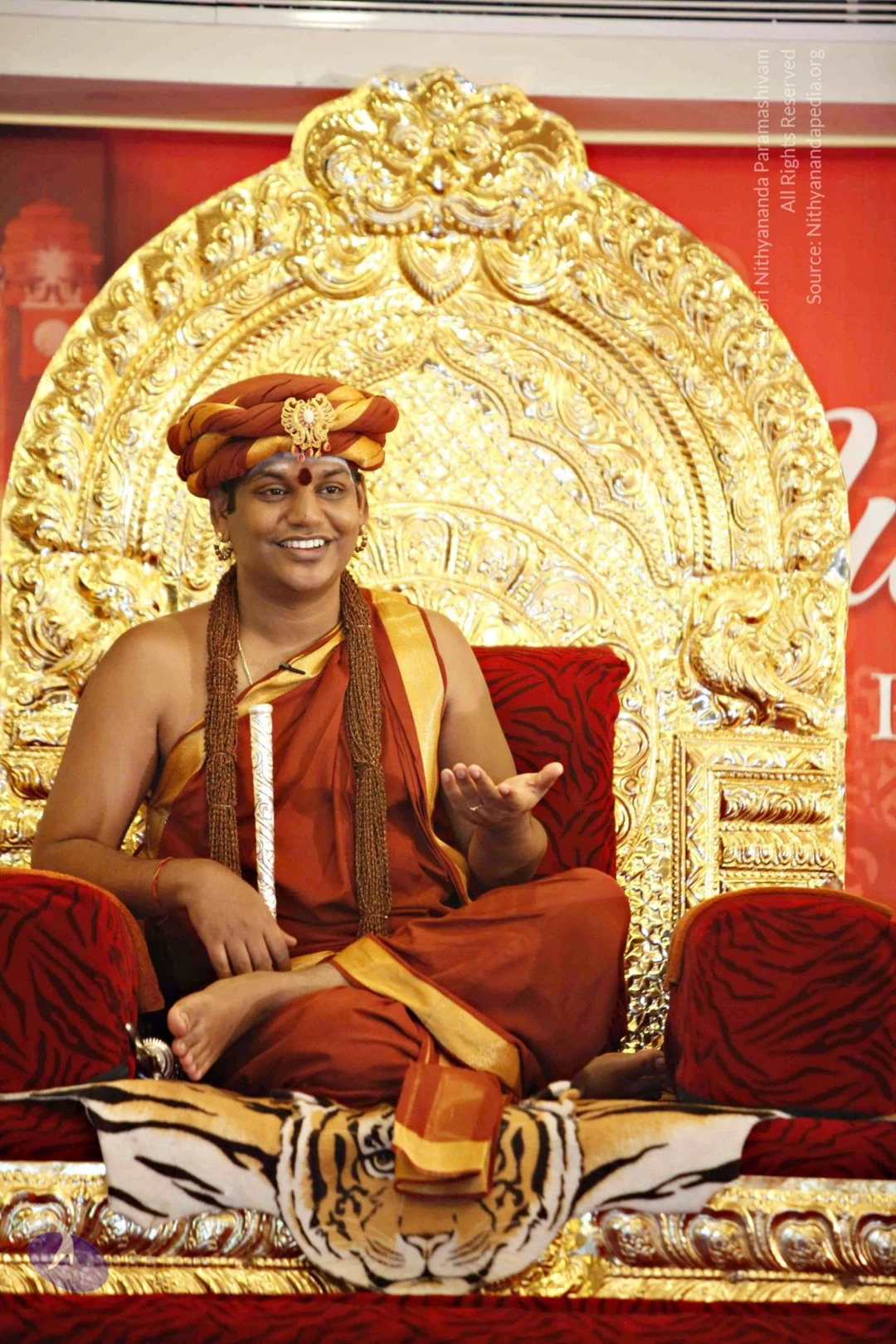
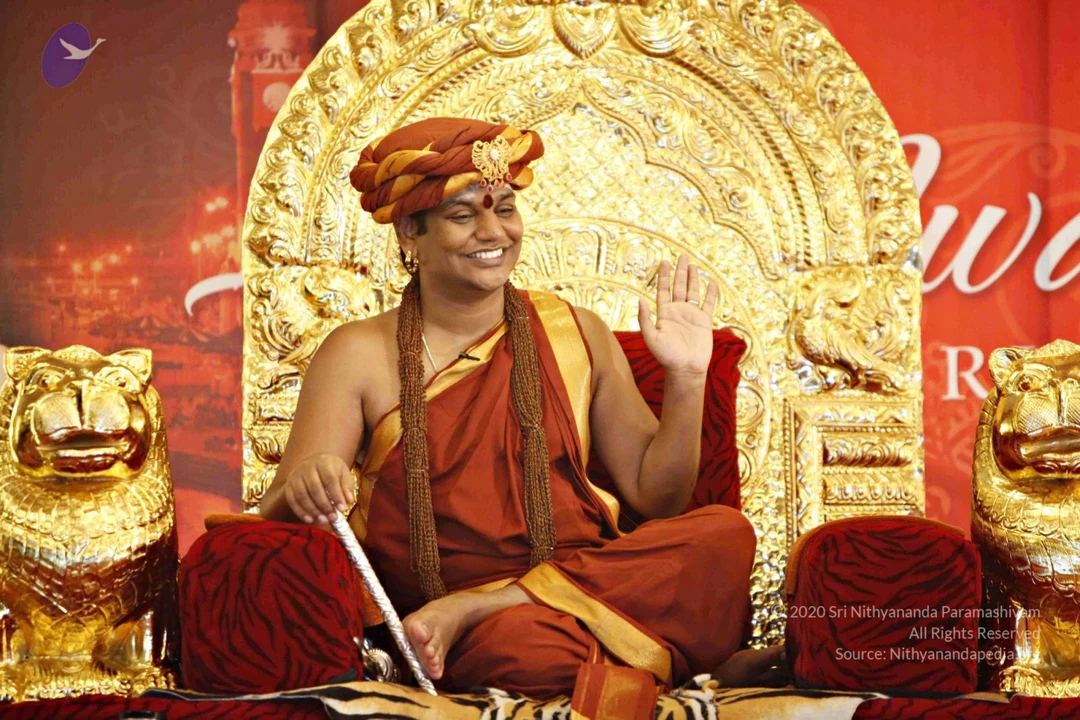
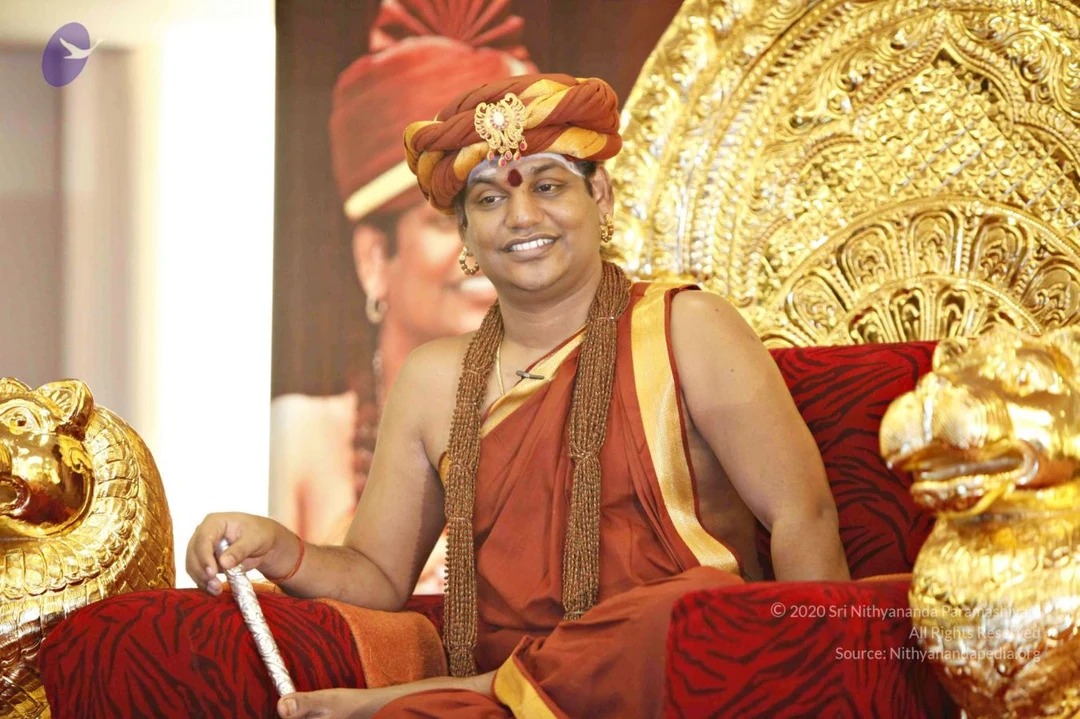
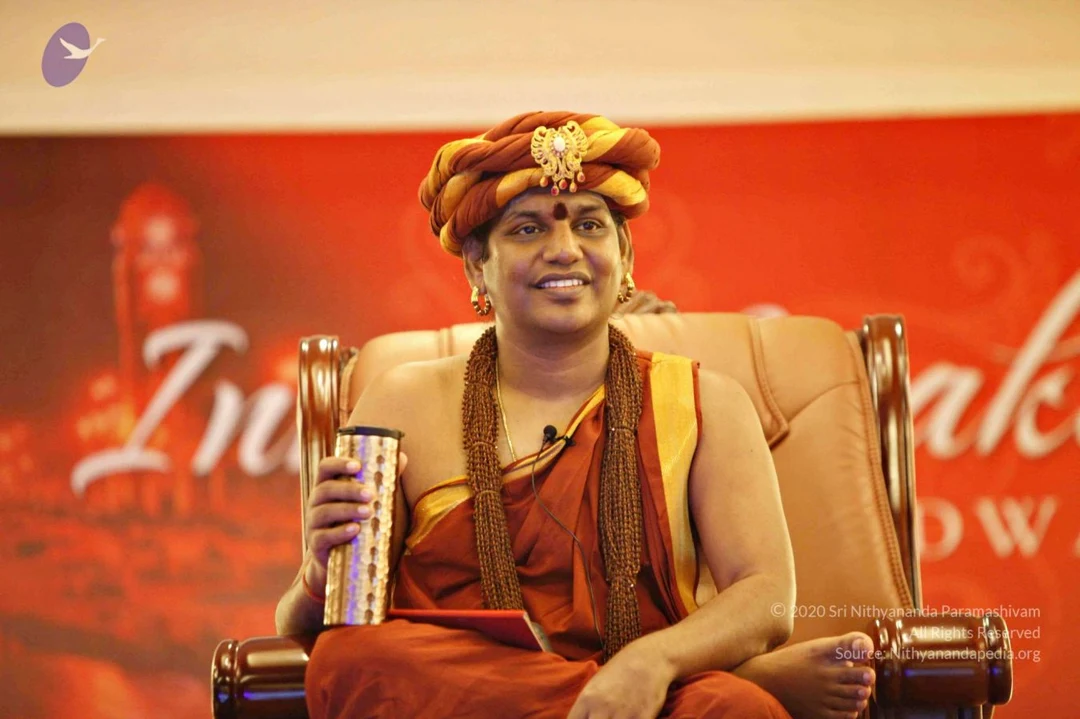
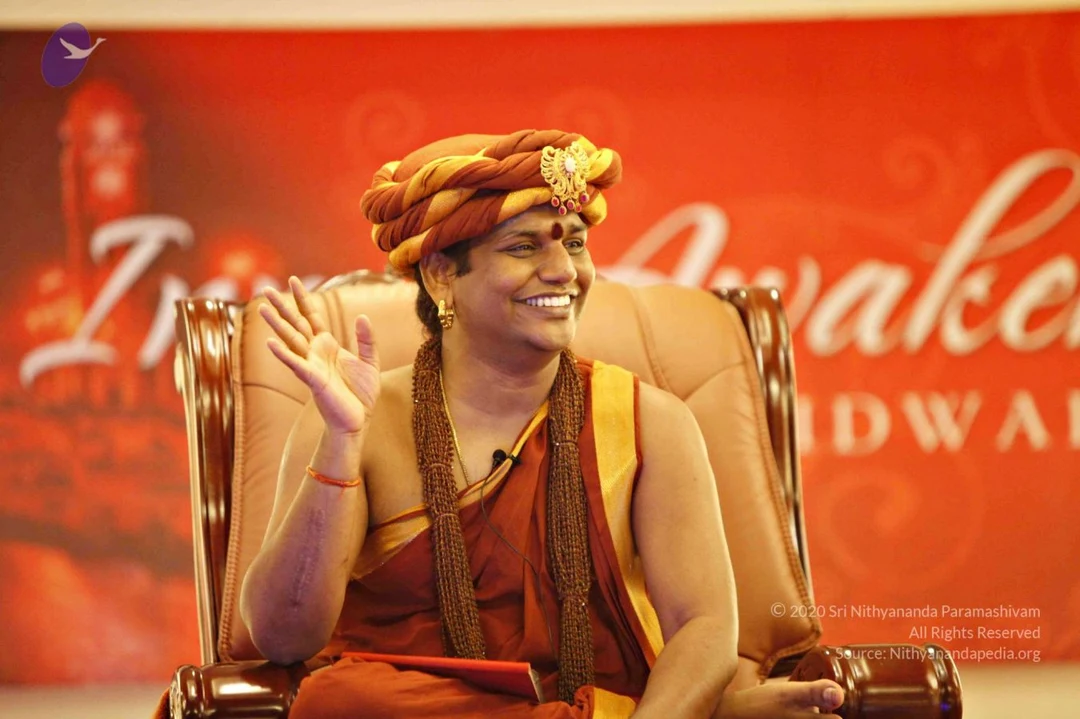
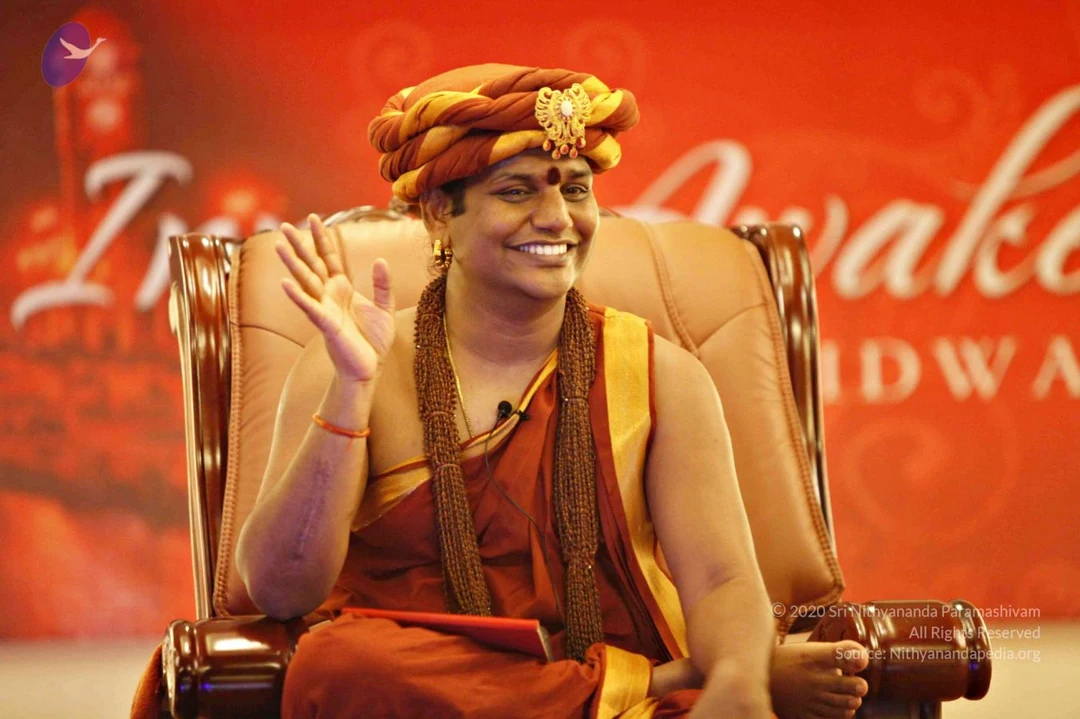
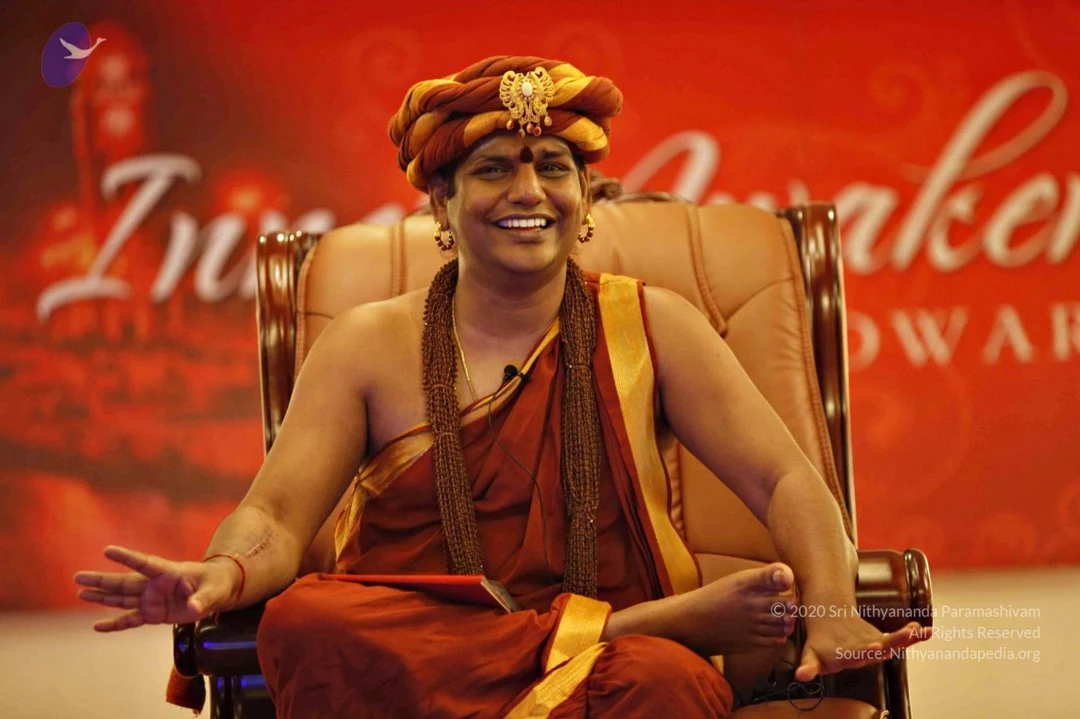
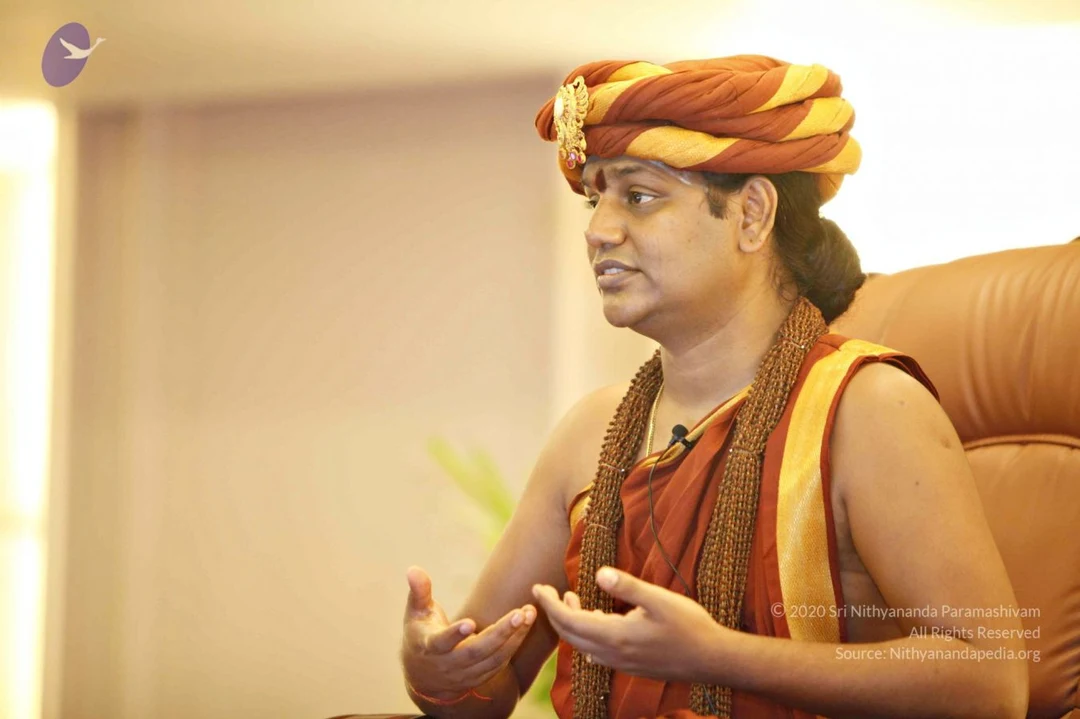
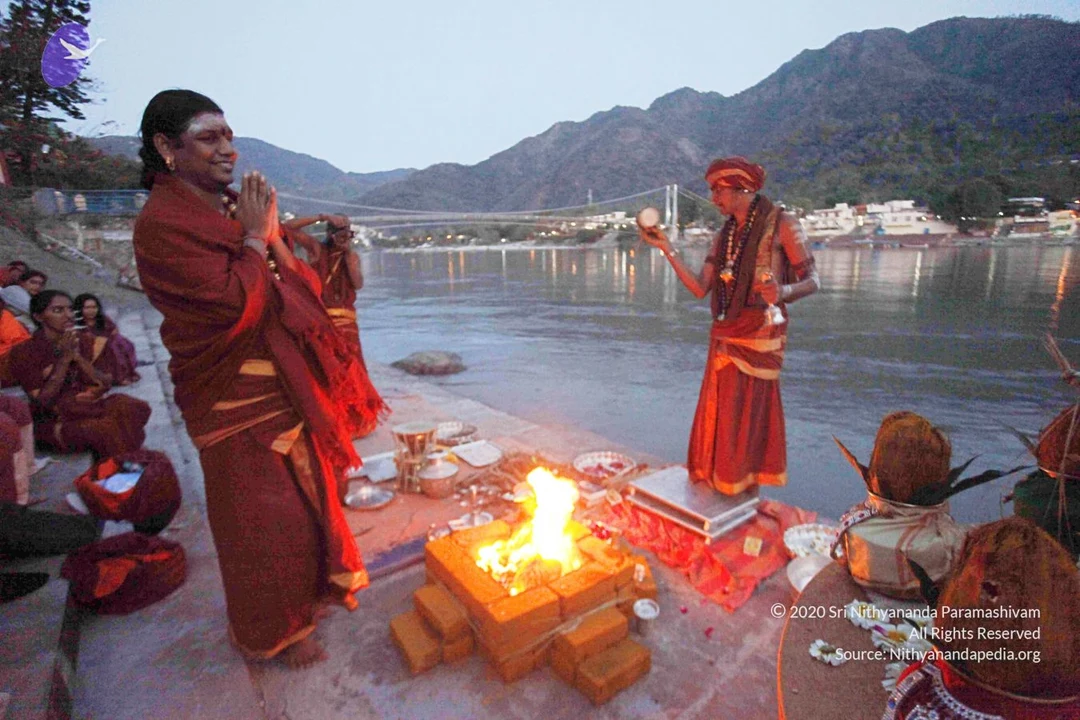
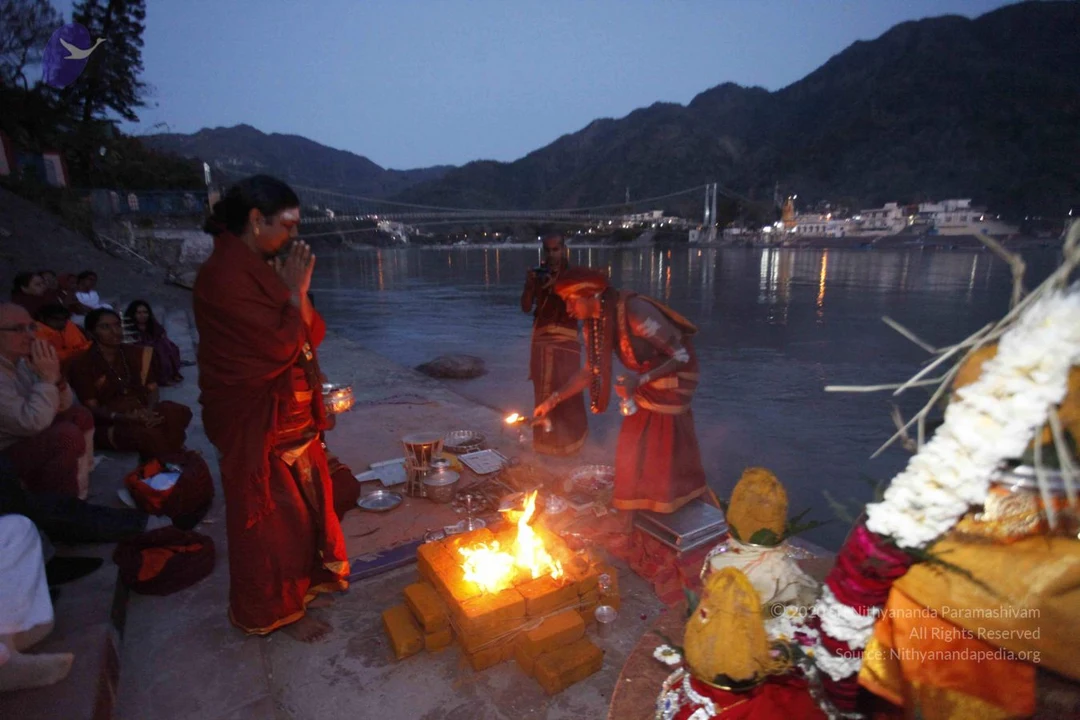
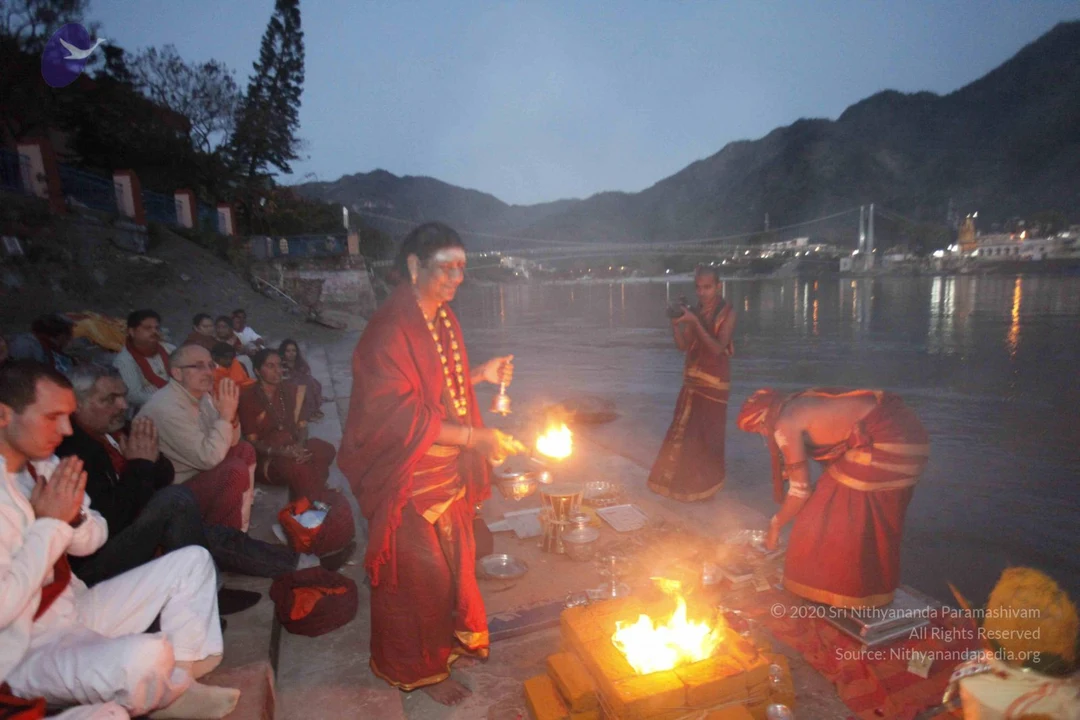
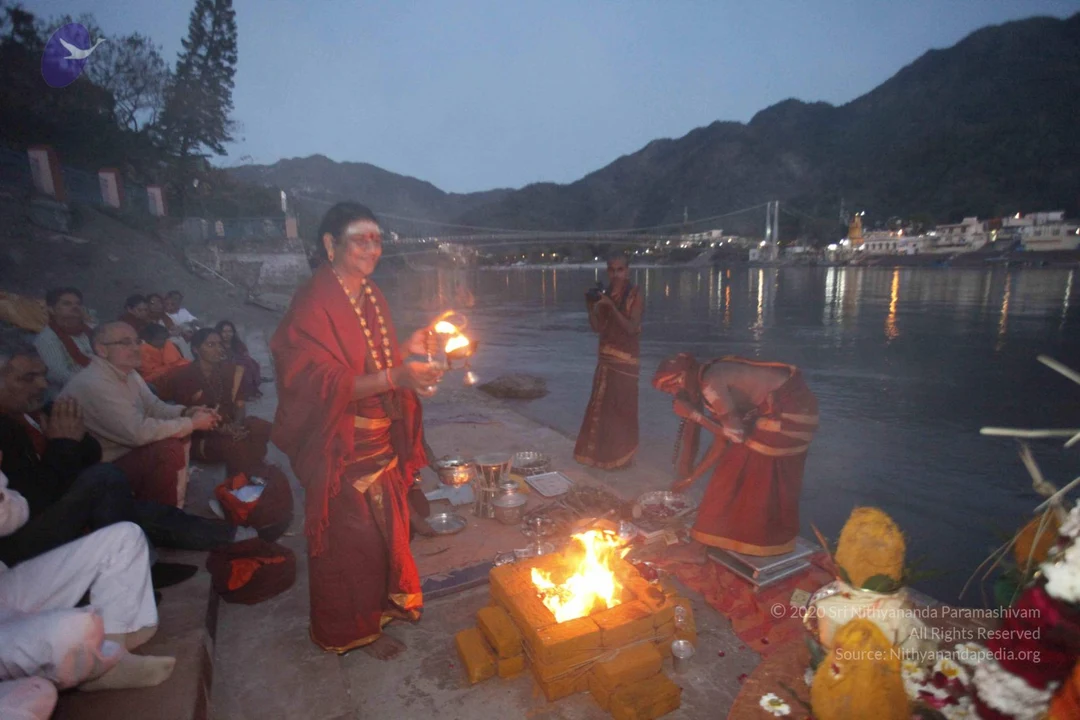
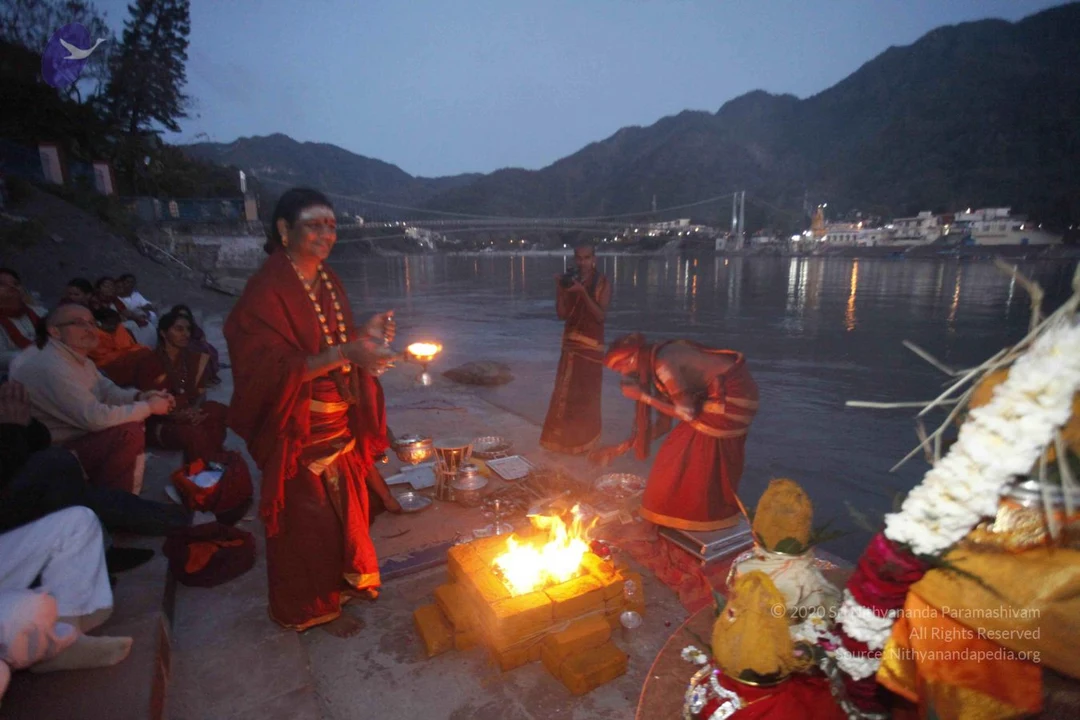
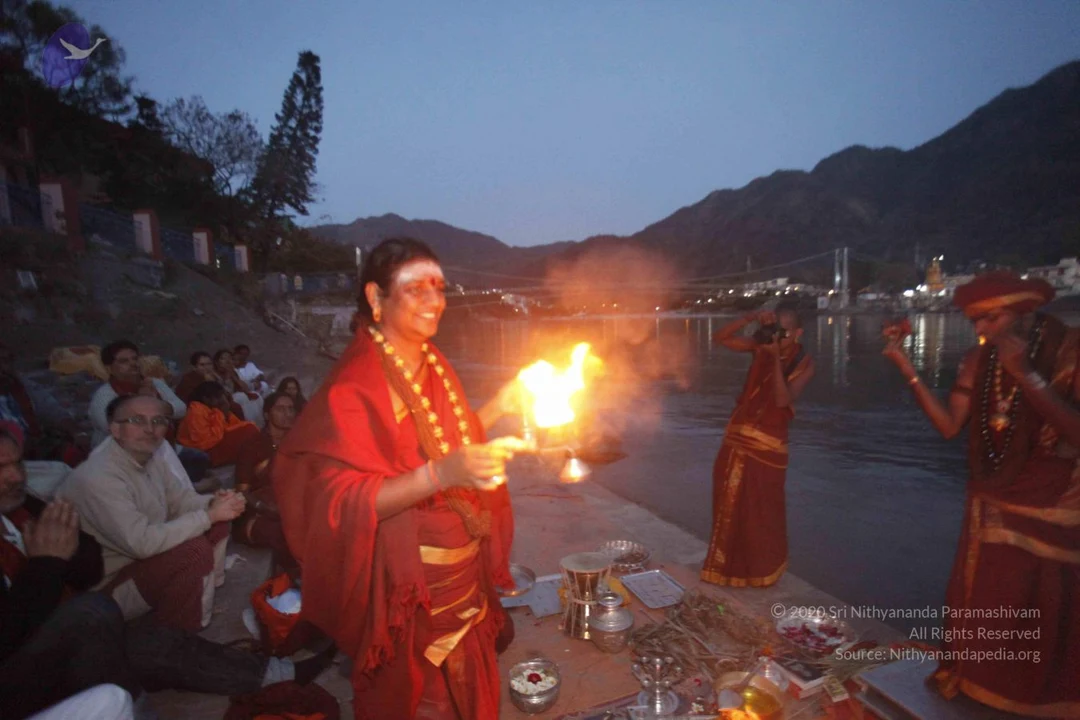
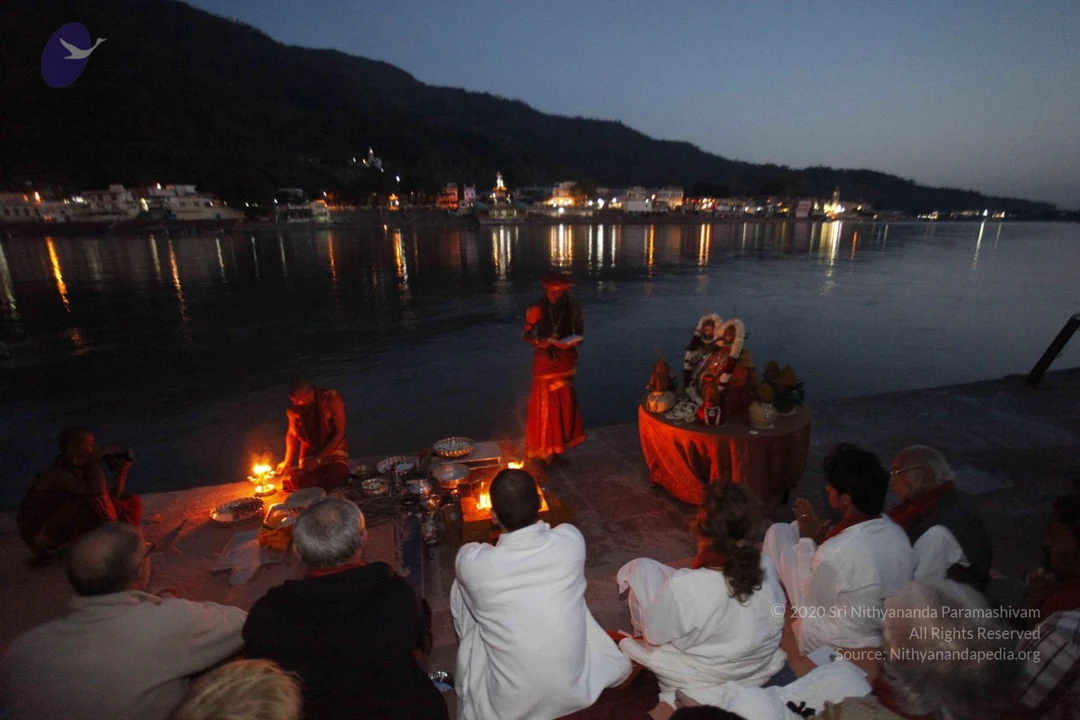
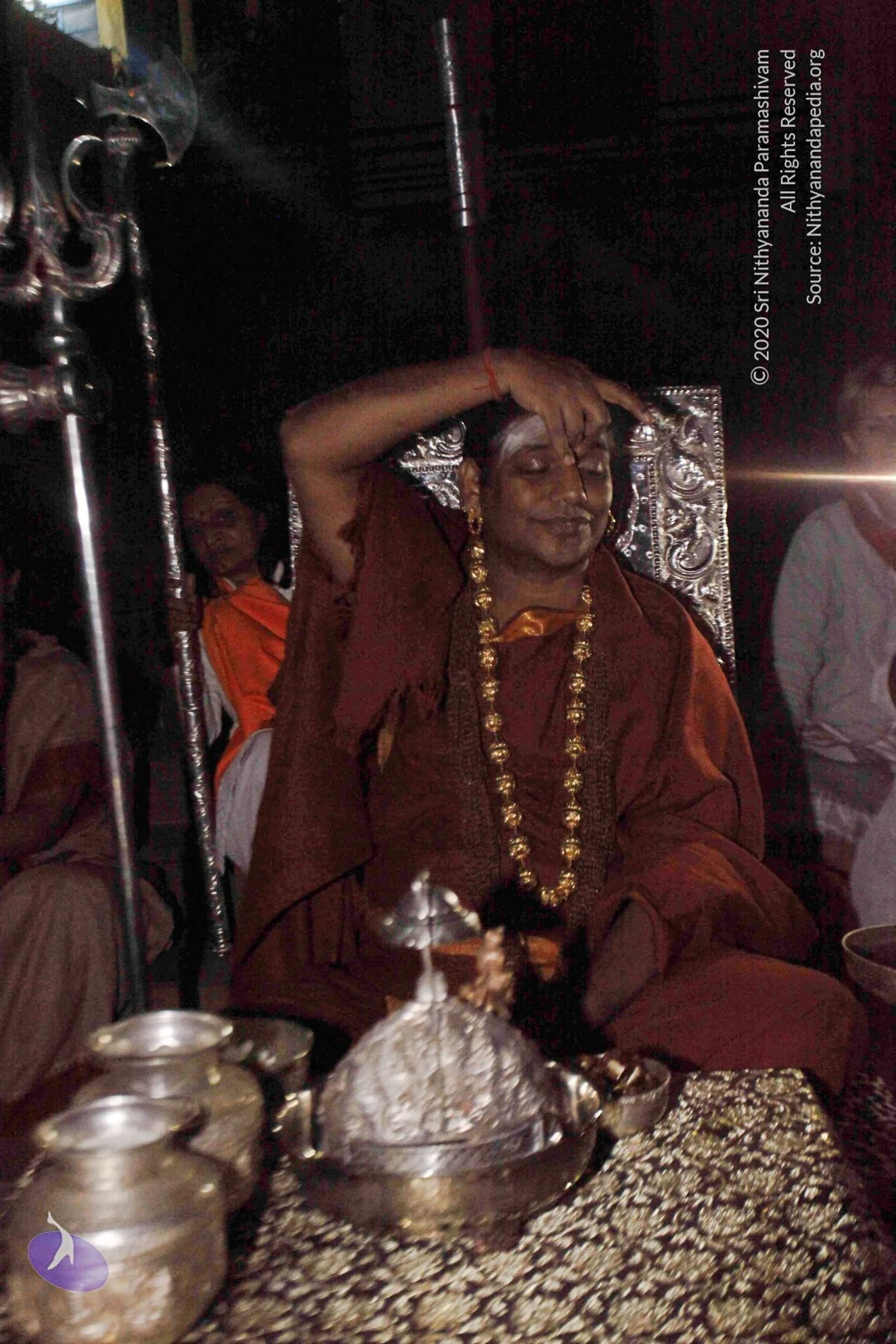
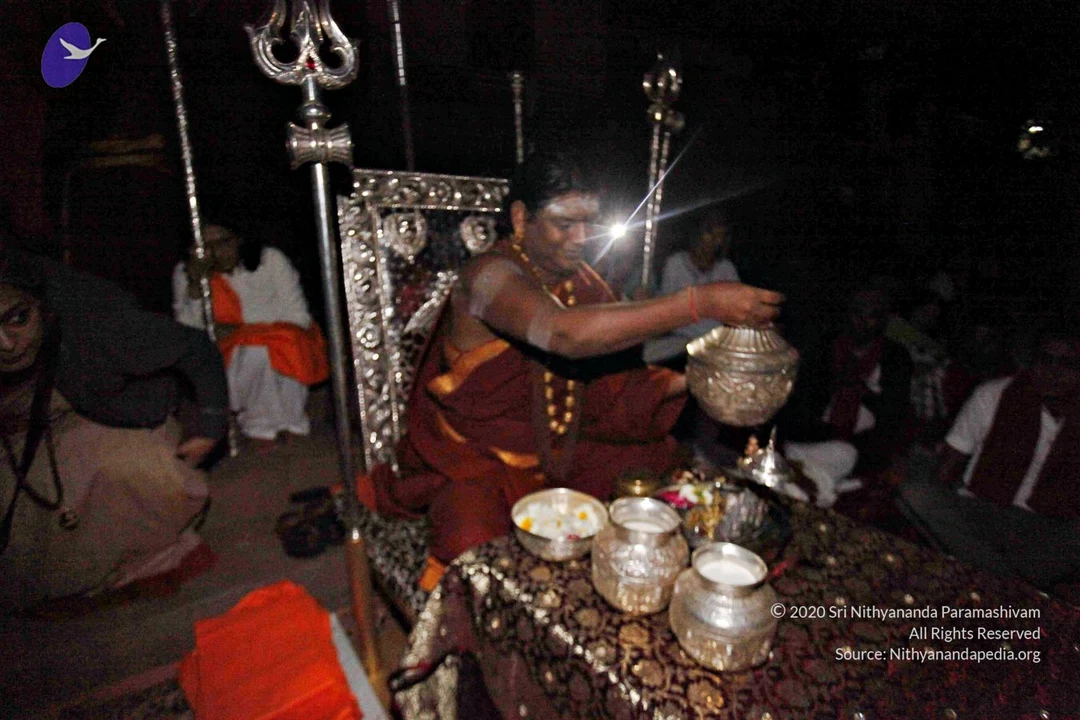
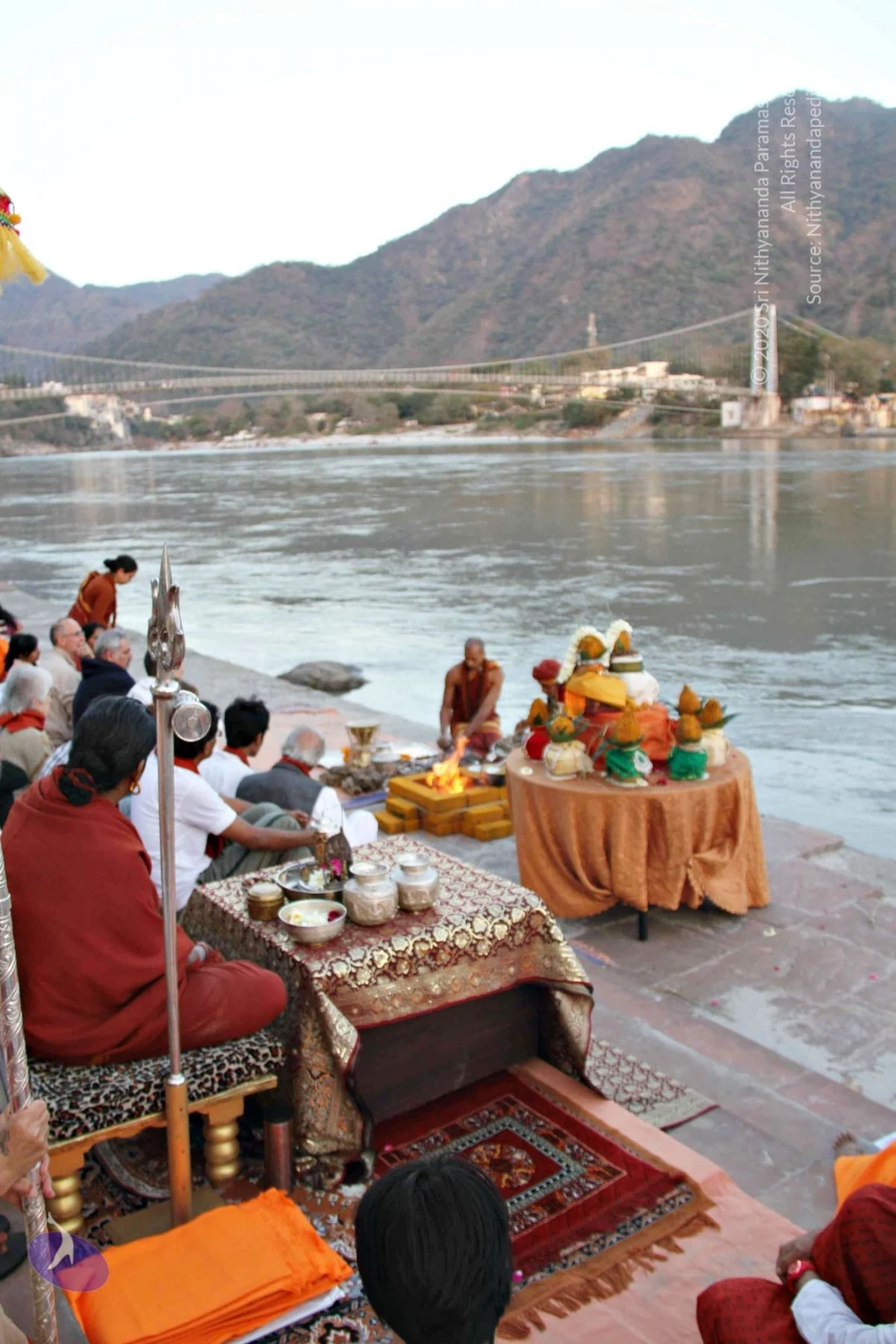
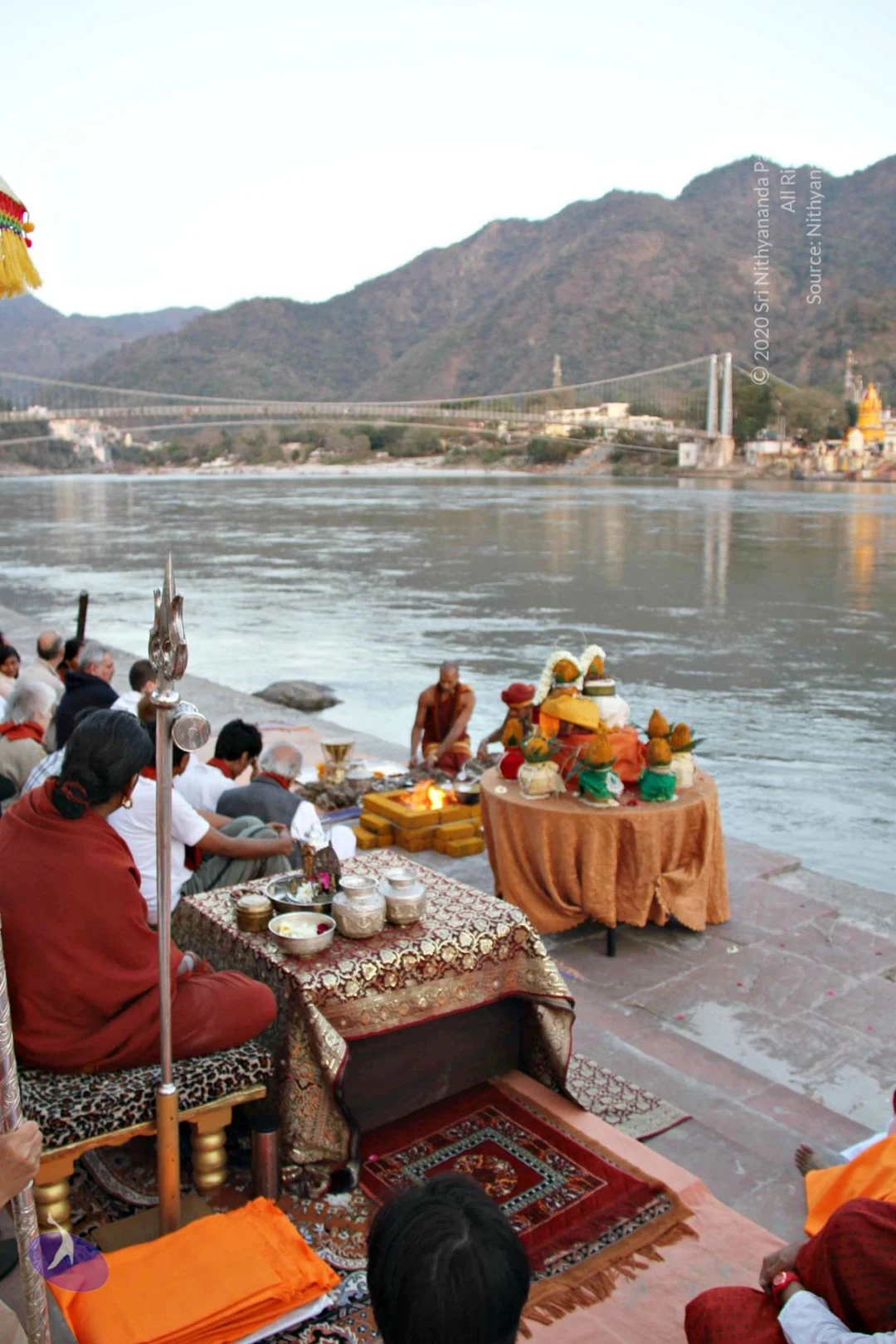
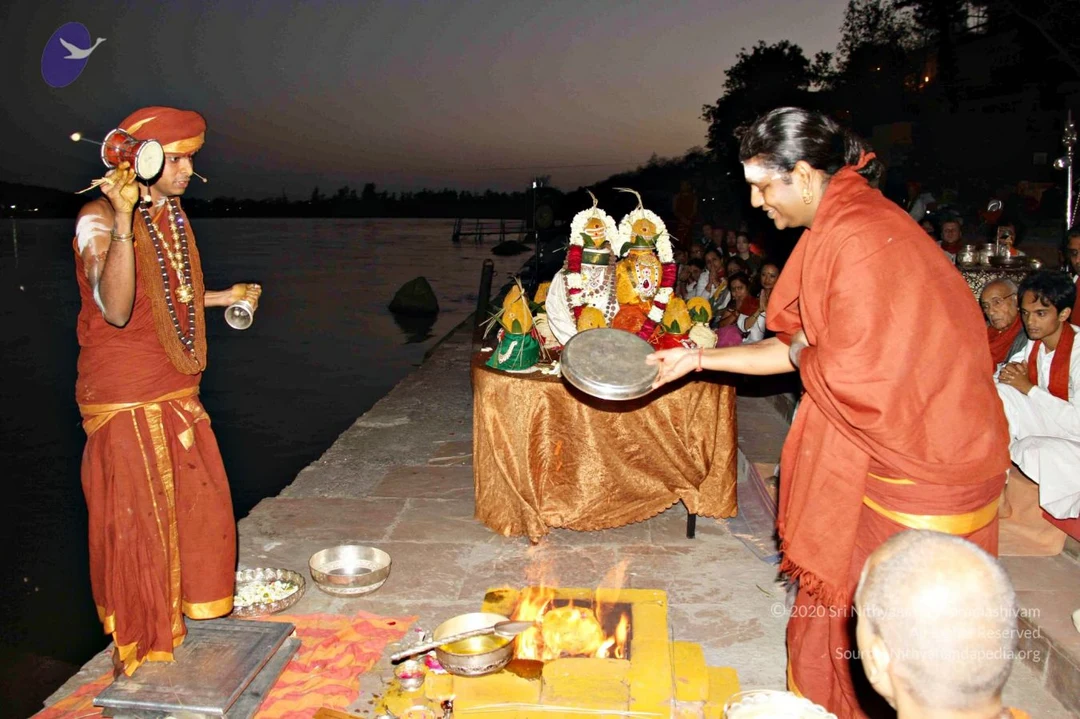
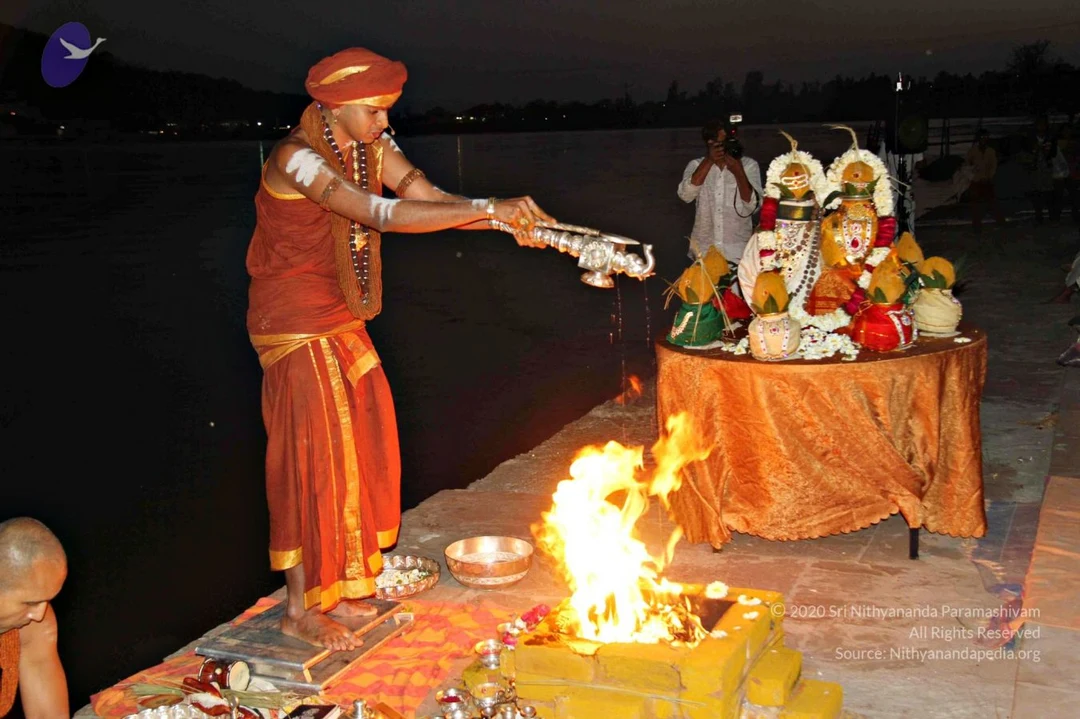
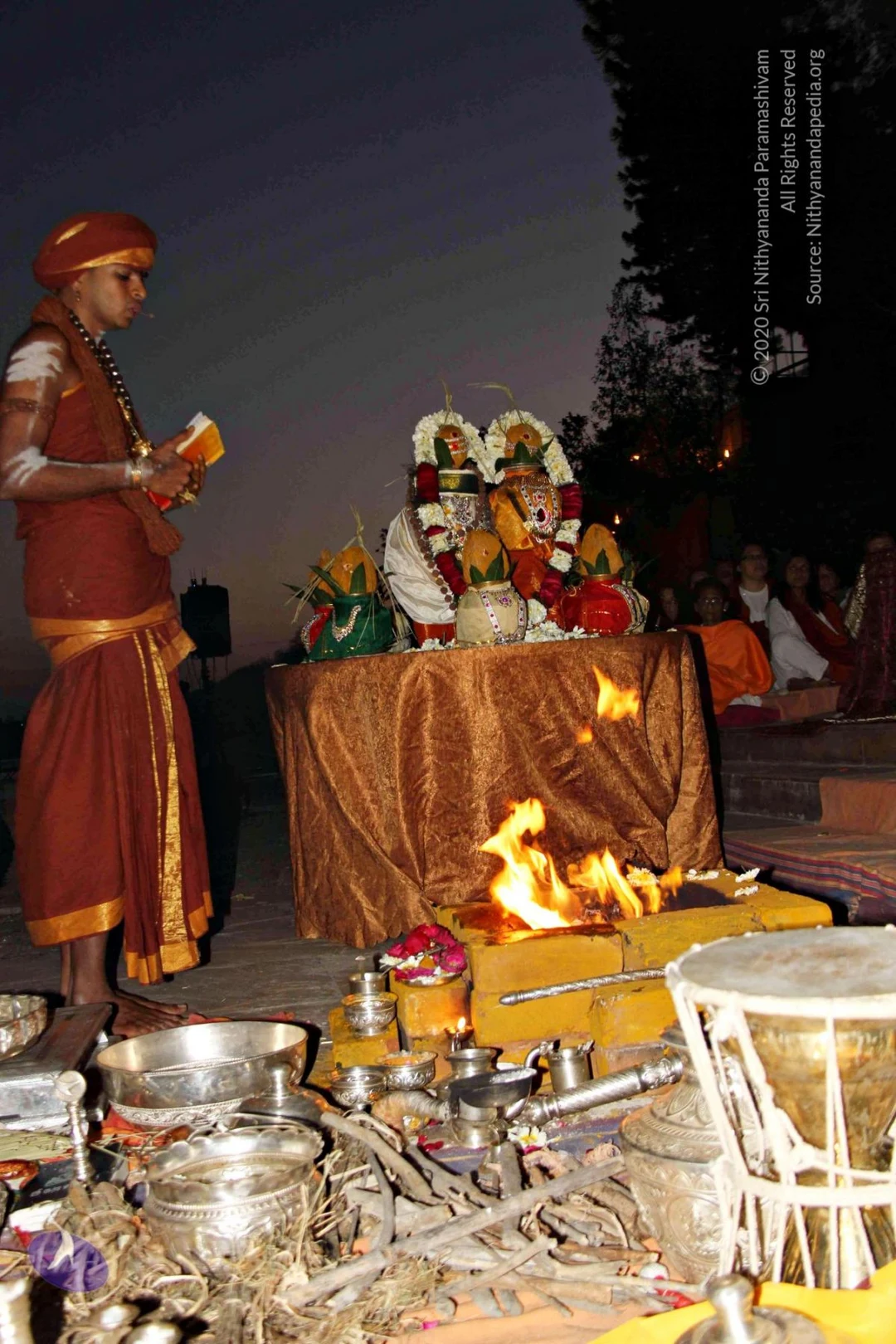
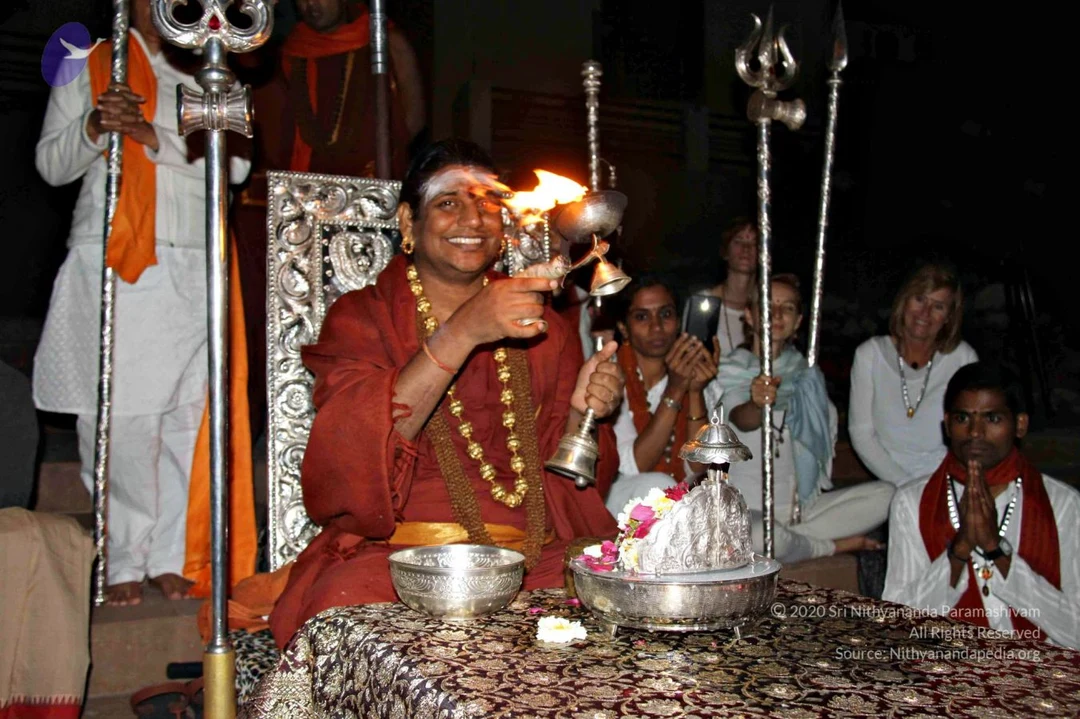
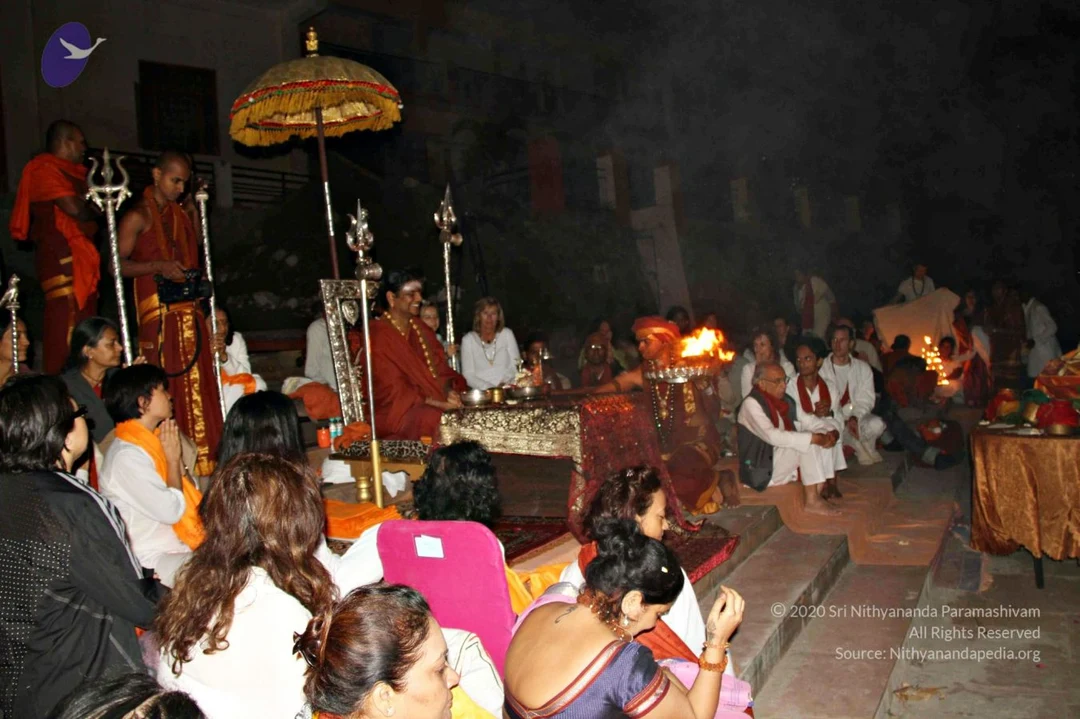
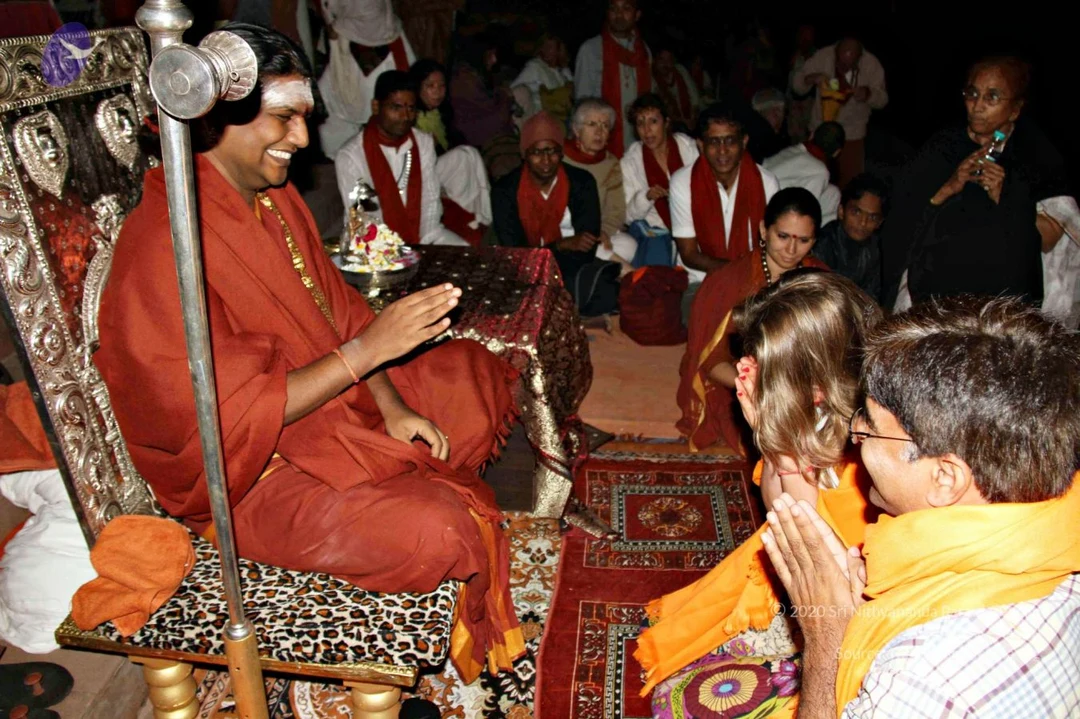
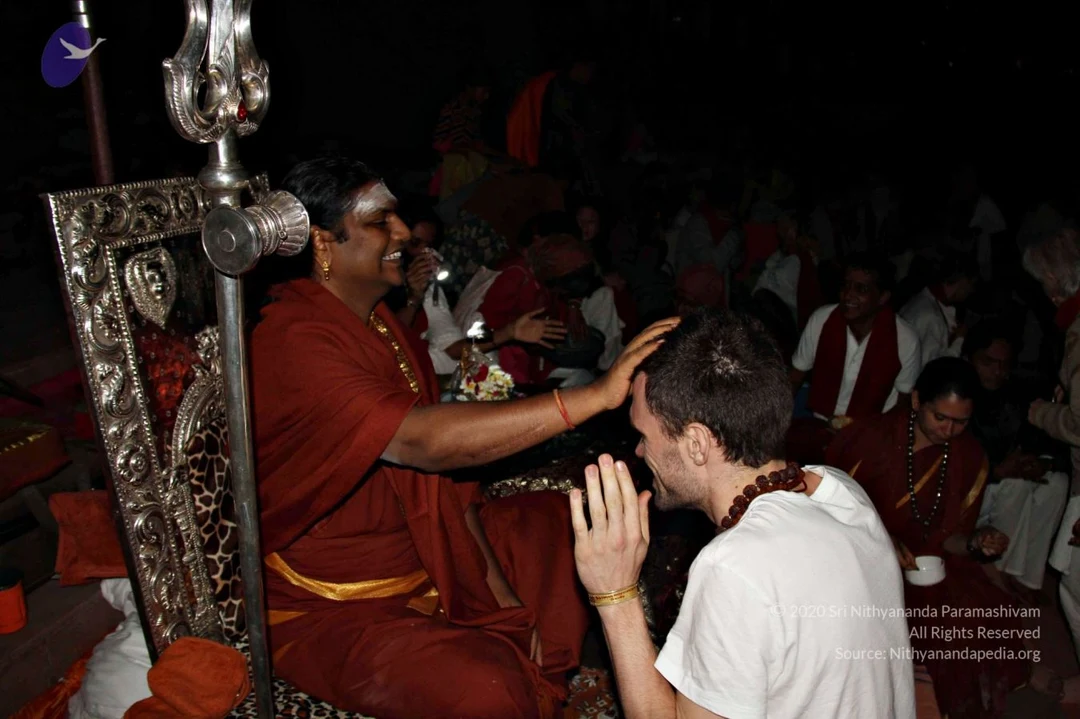
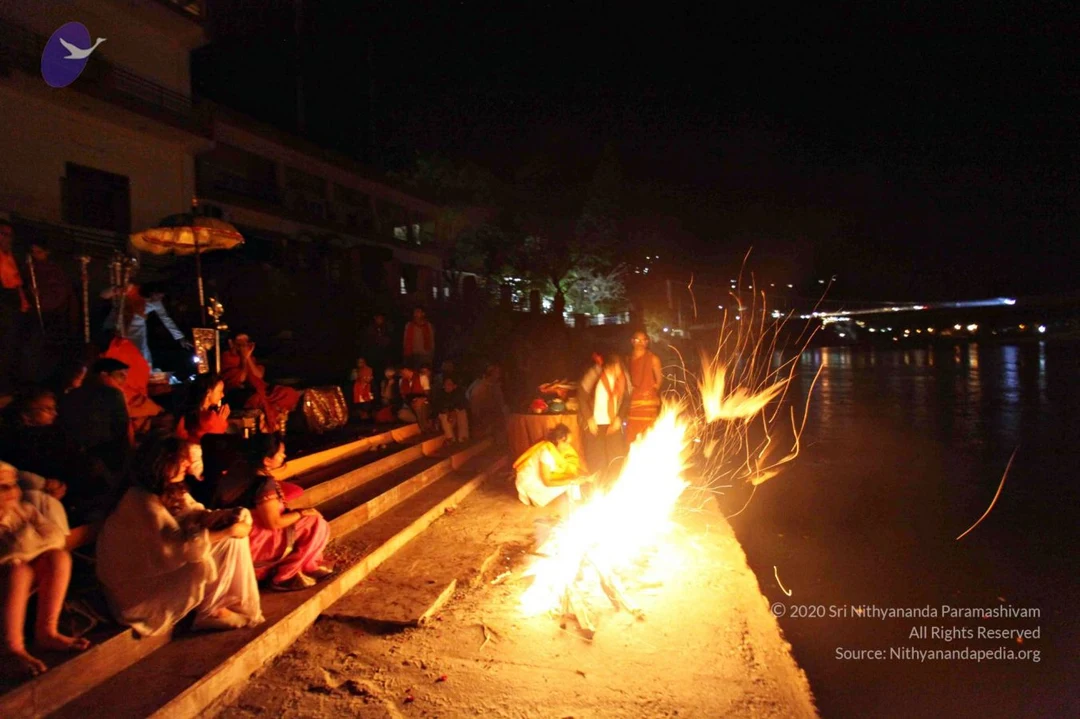
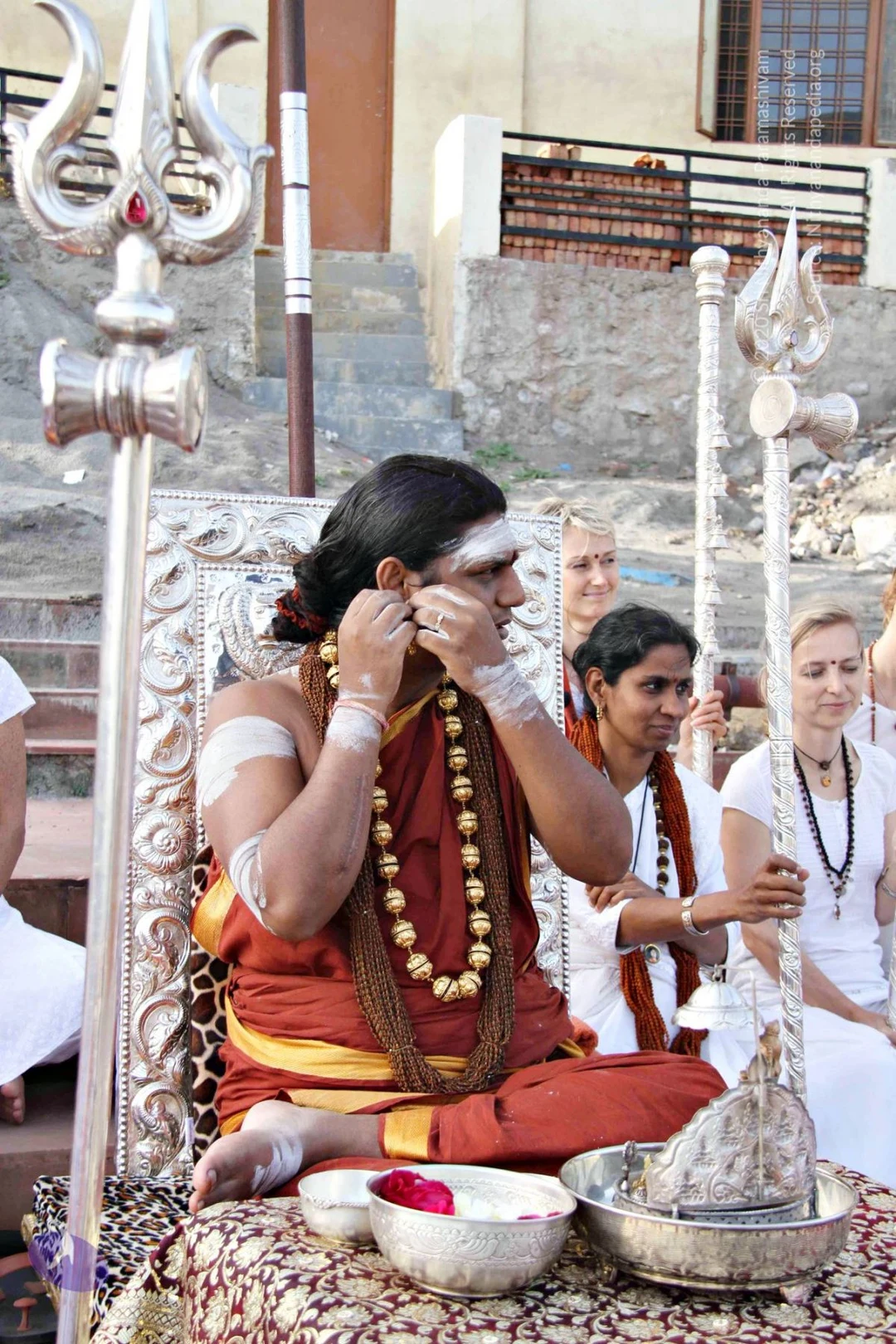
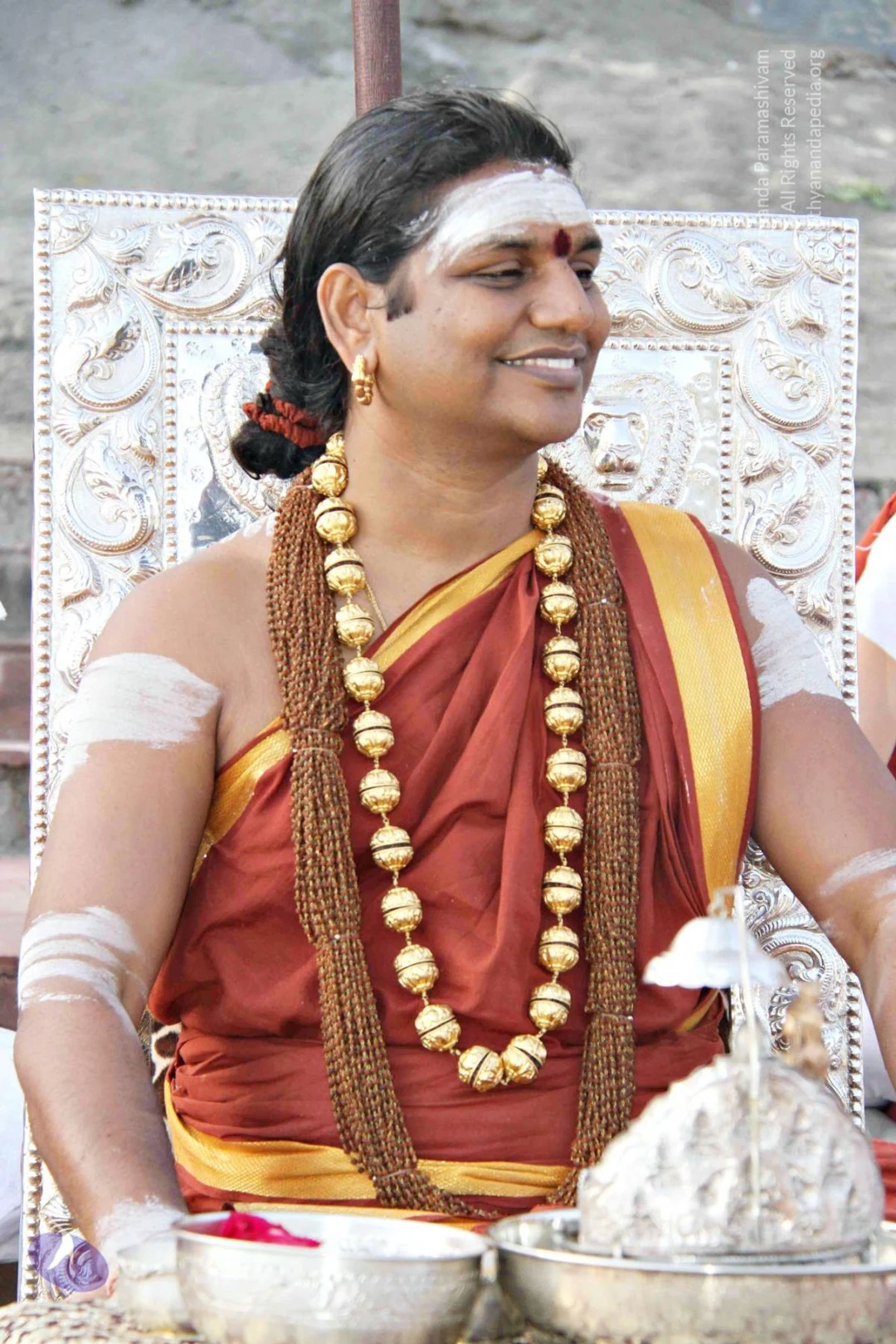
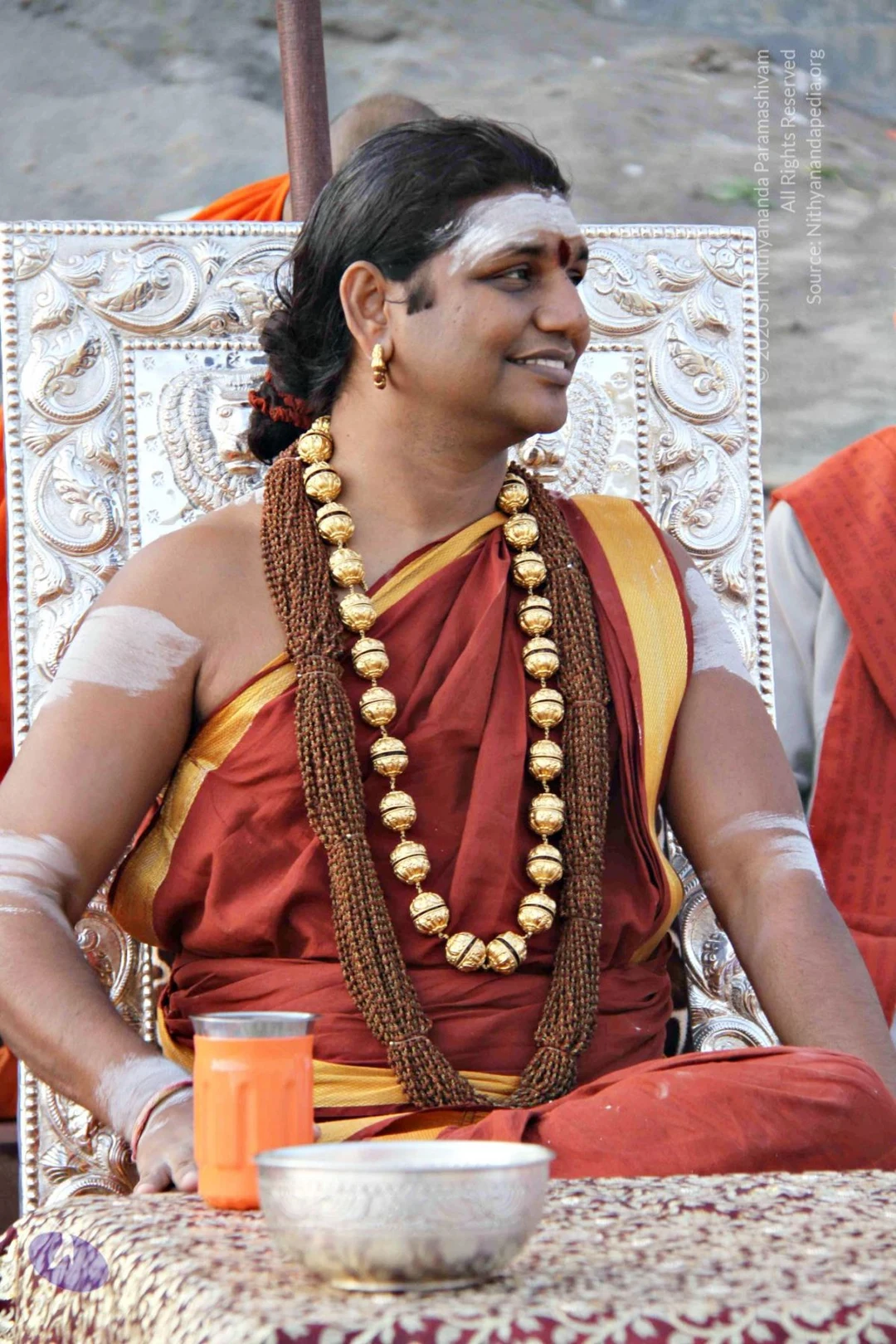
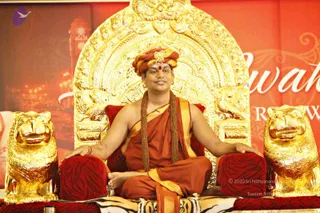
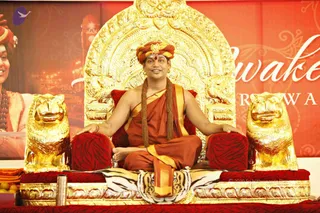
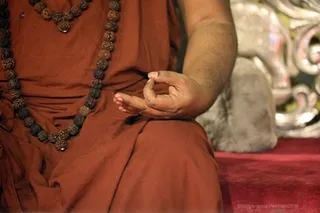
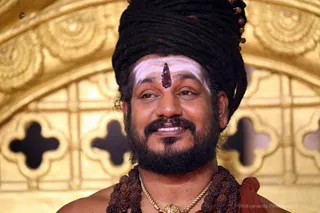
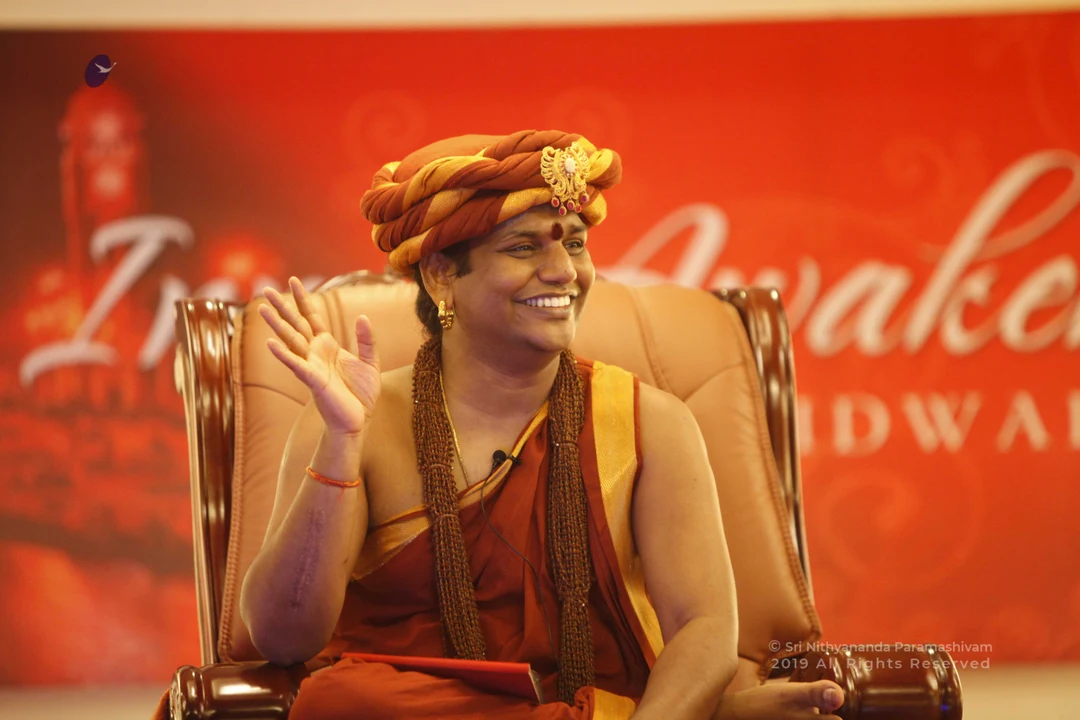
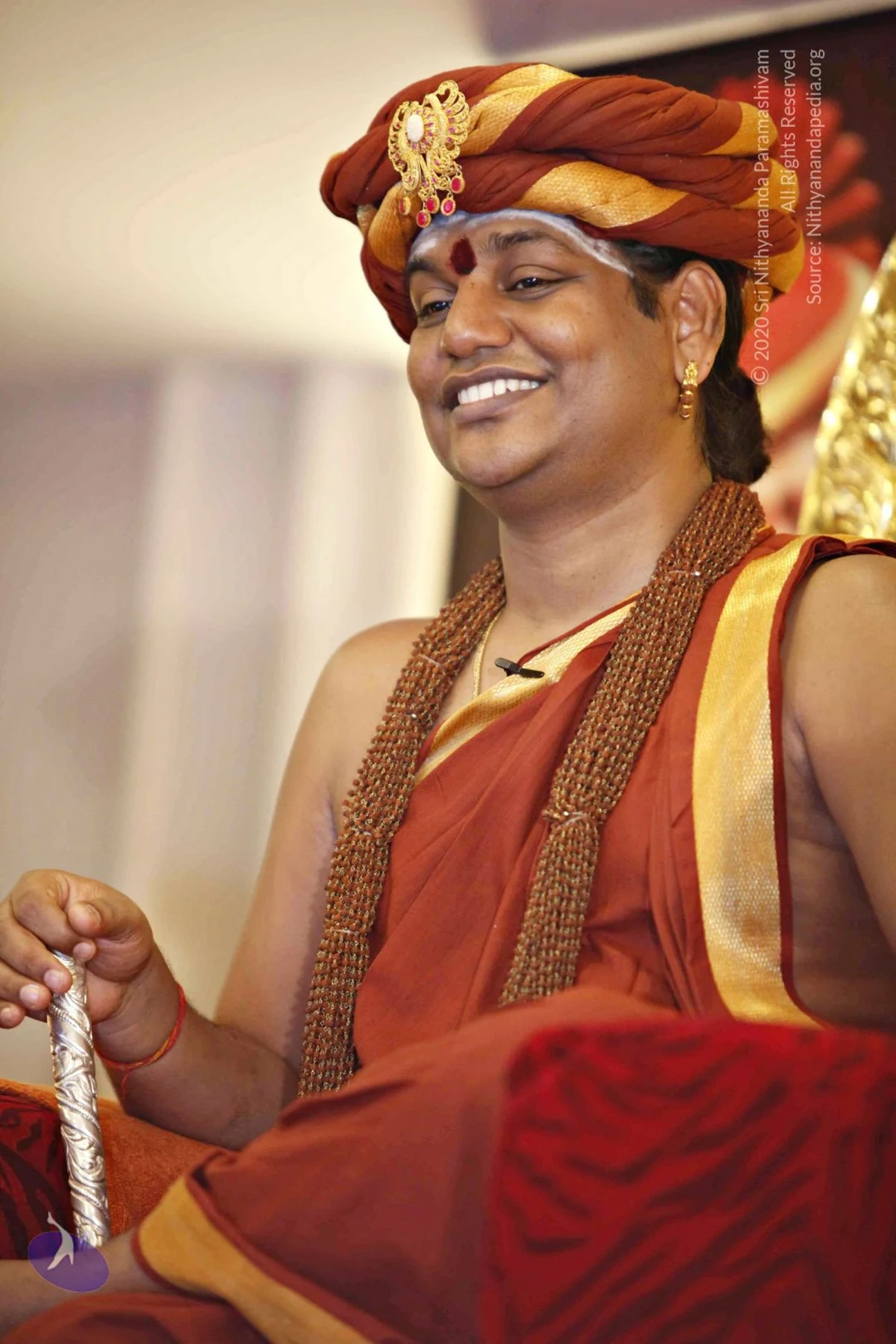
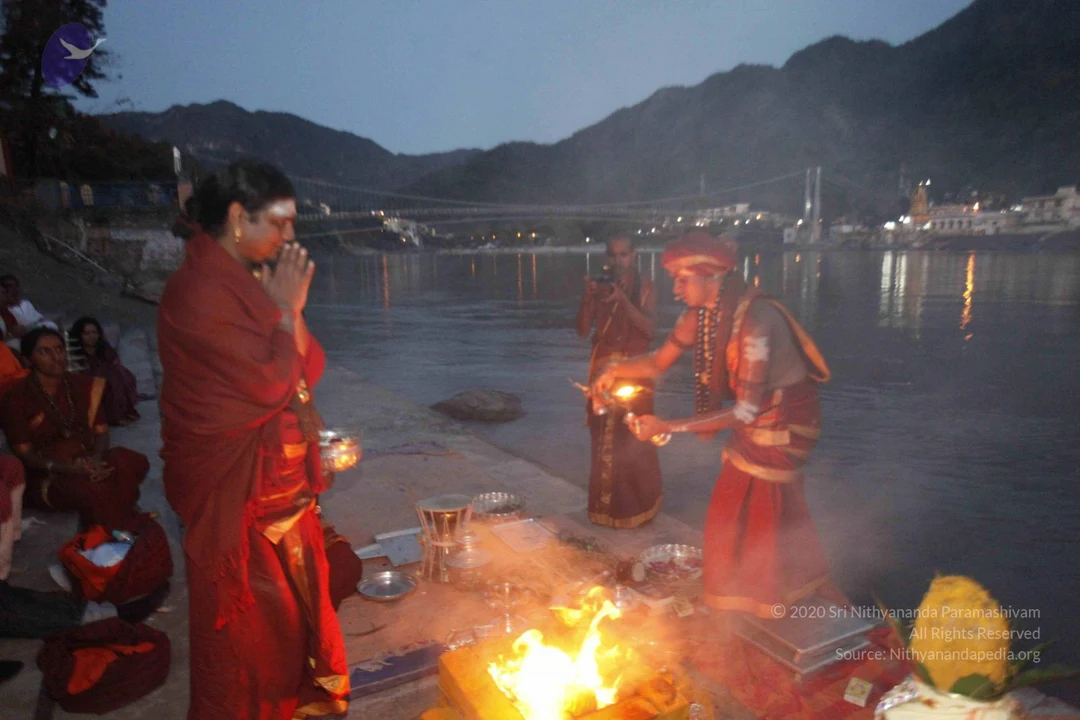
A smiling person sits in a brown leather armchair with carved wooden arms, gesturing with a raised right hand. They wear an orange and gold turban with a gold brooch, a red bindi, rudraksha mala beads over a red-orange robe with gold trim, and a small microphone clipped to the robe. A red book rests on their lap. Behind them is a red banner reading Enlightenment-style lettering partly visible with the word Haridwar. The person is a single seated speaker at an event. Swamiji (probable): the orange and gold turban, ornate gold brooch, layered rudraksha malas and saffron robe are consistent with the page's claim.Dusk ritual on a riverbank with a wide river and hills behind, a suspension bridge and lit buildings in the distance. A fire burns on a square stack of yellow bricks as a woman in a red sari with a red-and-gold border and a red bindi stands holding a lit oil lamp, with a string of beads around her neck. Beside her, another person in red kneels at the fire with a brass vessel, and a man in orange robes stands behind them. Seated devotees in red and white clothes line the left edge. At the lower right, a decorated deity murti is adorned with white flower garlands and a red and gold cloth, with brass vessels nearby.A seated man in saffron-orange robes and an orange turban with a gold ornament sits on an ornate gold throne carved with floral and scroll patterns. He wears a long rudraksha mala and a gold necklace, with red tilak on his forehead, and rests one hand on a red velvet cushion with a tiger-stripe pattern. Two gold lion-shaped armrests flank him. A red backdrop with a partial portrait stands behind.

March 18 2014

Original wiki page
Contents

Title:

Do you know the biggest secret

Description:

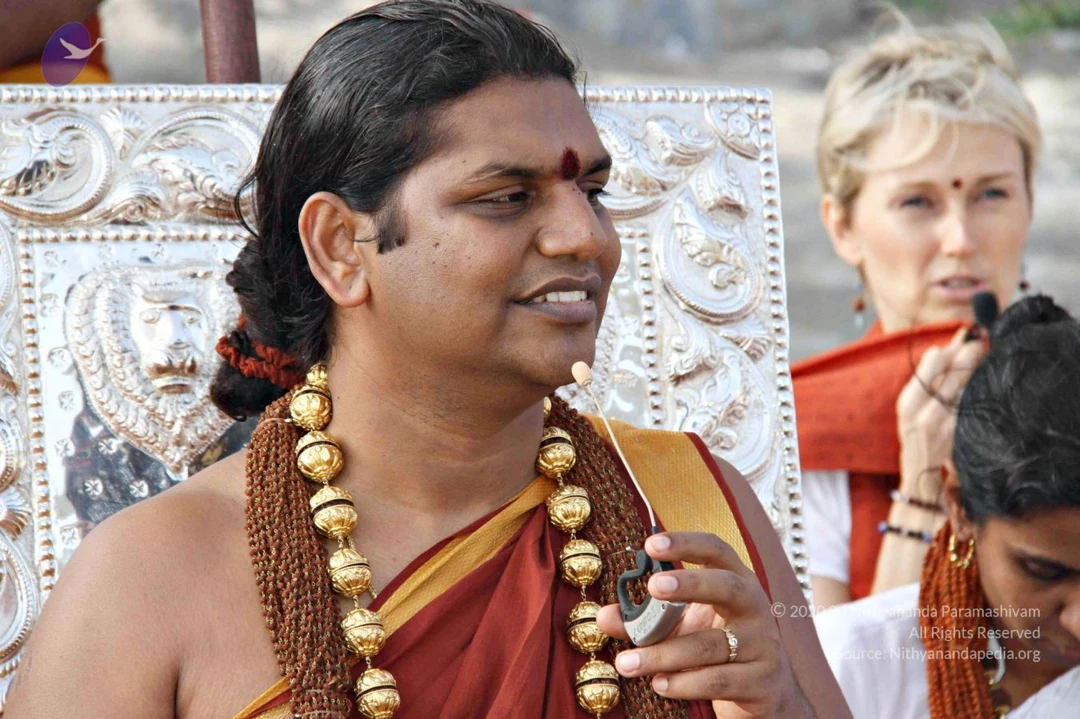
In today’s morning Satsang in Haridwar, Paramahamsa Nithyananda reveals that the powerful space of Advaita can solve any problem in our lives. When we have the understanding that the world will go on as it is, ‘the world’, and we carry the space of Advaita in our world, ‘my world’, we will attract people carrying this same space – like attracts like. When we cognize the truth that everyone is part of us, then we can be sure about ourselves – what we want, who we are, what we are doing – we are living in the space of Advaita.

Link to Video:

VideoAudio

Transcript:

[00:16]

Nithyānandeśvara samārambhām Nithyānandeśvari madhyamām | asmat āchārya paryantām vande guru paramparām || Iss samay hamare sath upastith sabhi darshakon aur bhakton ka main, prem evam aashirwad sahit swagat karta hun.

[00:54]

I welcome all the devotees disciples, samajees, Satsangis, Sri Mahants, Mahants, Kotharis, Thanedar sitting with us all over the world through Nithyananda TV, lotus news channel, Janasri TV, Eswar TV, and through two-way video conferencing having Nayana deeksha in many cities, many countries around the world. Cities sitting with us two-way video-conferencing having Nayana deeksha: Hyderabad-Gupta Kashi, High Point-North Carolina, Houston-Texas, London-Kashi, San Jose-Madurai, Dubai-Vaidhyanathan, Canada, New York-Varanasi, Coimbatore- Dhyanapeetam, Guadeloupe-Rameswaram, Dhyanapeetam-Hosur, NewFoundland- Canada, Johorbahru-Tiruchendur, Indrani-New Jersey, Mettur-Dhyanapeetam, Toronto- Kailasam, Los Angeles-Arunachalam, Ohio-Prayag, Toronto-Canada, Redondo Beach- California, Thiruvanmiyur-Chennai, Oklahoma-Somanatham, Seattle-Chidambaram, Singapore- Singapuram, Ohio-Ma Sivananda, Nithyananda Nagaramu-Hyderabad, Thiruvanmiyur-Chennai, Charlotte-Srisailam, Doncaster-UK, Nithyananda Nagar- Tiruvannamalai, Oman-Sivagangai, Seremban-Sivakasi, Obrack-Slovakia, Kulim- Tiruttani, Vincent Salem-North Carolina.. I welcome all of you with My love and respects.

[03:09]

கல்பதரு தரிசனத்திற்காக மேட்டூர் தியானப்பீடத்தில் ஒன்று கூடியிருக்கும் பக்தர்கள் அனைவரையும் வணங்கி வரவேற்கின்றேன். (Kalpataru darisanthitkaga Mettur Dhyanapeetathil onru kudiyirukkum bakthargal annaivarayum vanangi varavetkindren) [ I welcome all the devotees who have gathered in Mettur Dhyanapeetam for the kalpataru darshan.] Today I will expand, I can say in a way continue to expand on the space of advaita. Listen, please listen. Either you can keep your inner space powerful, fulfilled, joyful or keep yourself in utter poverty, dull, depressed, constantly in conflict, fighting with everyone, finding fault with everyone, accusing everyone. This person is not right, that person is not right, that person is not right; it is up to you how you can keep your inner space. A Thanedar level person who is starting his spiritual journey, if he keeps on accusing it can be tolerated. If a Kothari keeps everyone abusing, it should not be tolerated; he should be reminded and trained. No, the space you declare for yourself and others, I tell you, the space of advaita is so powerful.... Please listen. The space of advaita is so powerful, it can solve any problem you carry, and any problem you invent.

[06:13]

Human beings are the greatest problem inventors. See, everything in our society is invented to invent new, new problems. All our desires, fears, life style, everything you can see, money, the concept of money, the concept of ownership, everything is invented to invent new, new problems. It is like when the kids have to be kept occupied, you give them some playing things… what do you call, there will be a box with multicolor? Rubik’s cube. I don’t know the name. Good I did not play with all that foolishness. No, you completely destroy it and then you try to align it. What foolishness! I think in our Gurukul we should ban that. Why will you first of all invent a problem then to find a solution? Arrey come on we already have multiple problems, find solutions for that. Putting your energy to invent a problem and then finding a solution for it. Please understand. When you enter into the space of advaita the first thing will happen is you will stop inventing problems. And you will start continuously solving.

[08:20]

I tell you Advaita will bring surety about you. The biggest gift of the space of advaita is all your confusions will disappear. You will be sure about what you want to do; what you are and what you want to do. I tell you, people who honor the space of Advaita in their life as first priority, when they wake up they wake up like Eshwara of the universe, Jagadeeshwara. When they live they live like Jagadeeshwara, they are not only Jagadeeshwaras… Jagathkaranas. Please understand when you are stuck with some pattern and unable to honor the space of advaita, that is what I call Maya and continuing to honor the advaita even if you are stuck with some pattern is called Tapas. That is Tapas. I tell you, THE world is going to be THE world. In MY world if you carry the space of advaita and approach the THE world, in THE world also you will attract exactly people who carry the space of advaita towards you. I always bless My Swami’s ‘let you all have disciples exactly like you.’ It is now up to them, whether to make that as a blessing or a curse. 😊 I tell them you will have disciples exactly like you. So, now it is up to you whether to make that as a blessing. All Mahants I bless you guys, ‘You will have Kotaris exactly like you.’ All Kotaris I bless you ‘You will have exactly Thanedars like you.’ All Thanedars ‘I bless you, ‘You will have volunteers exactly like you.’ And I am blessing Myself, ‘Let Me have disciples exactly like Me. 😊

[11:28]

Now it is up to you, whether you make your inner space more powerful or you make your idea about inner…. the THE world, the MY world more powerful. Understand, the MY world you carry is not your world. As I said advaita is neither difficult nor easy. Arguing or believing advaita is easy or difficult is the most foolish thing. It is like a you are sitting here and saying Ganga flowing in Haridwar is the most difficult thing, see from here we will have to walk up to twenty minutes. How difficult to get into the Ganga. Twenty minutes I have to walk, you can say that way or you can say, Ganga flowing in the Haridwar is the most easiest thing, just twenty minutes walk. But the very argument, it is easy or difficult does not make any logical sense. Because Ganga flowing in Haridwar is the fact. I tell you, same way, ‘everyone is you’ is a fact. It is a fact. ‘Everyone is you’ is the fact. There is no question of debating, arguing whether the space of advaita is right or wrong, it is the fact. Understand, whether you achieve that space today or you achieve that space tomorrow or you achieve it after few janmas, you have to achieve it, because that is the only most sure thing on the planet earth. The most sure thing in the universe is the space of advaita. That is why I am telling you, if you start understanding advaita, if you understand advaita, it will make more and more sure about you to you. This whole inner awakening is nothing but making your inner space experience the power of advaita. And Kalpataru is nothing but giving you the glimpse of advaita.

[14:56]

Knowing that whatever you want is already part of you is the science of Artha - acquiring. Listen! Knowing that whatever you do should be done from the space of advaita is Dharma, Knowing that whatever you want to acquire is already part of your inner space is the science of Artha. Knowing that every person in your life you want to have, every person you want to have in your life is already part of you is Kama, the science of Kama and, Knowing that everything is you is a science of Moksha. I tell you Kama does not mean just having lust or sexual desires fulfilled, even the desire to have a friend, even desire to have a good brother, even desire to have good mother, desire to have a good relationship with father, desire to have a good son, good daughter, everything is Kama only. Please understand having a good mother completes you so much, even if you have a spouse you will radiate so much of friendliness with him or her. Same way having a good father completes you so much, even with your wife or husband you will radiate so much of friendliness. Friendliness is the smell of advaita. Understand. I tell you, the space of advaita is the source of all the great things in the planet earth.

[17:52]

The founder of Homeopathy was a great enlightened being. He was an Advaiti. All the plants, herbs spoke to him and they reveal to him what for they can be used and what diseases they can cure and he recorded. Otherwise it is impossible to record by doing R&D on so many thousands of herbs and medicines. Sameway all our Siddhas, the Ayurveda science, where were the labs, where were the R&D methods; it is the power of advaita, the plans revealed their glory and their quality, and what for they can be used and what diseases they can heal and the siddhas and rishis have recorded it. Whether it is a Indian dance, Indian music, Indian medicine, Indian way of dressing, Indian sex, Indian entertainments, Indian architecture, Indian cooking, Indian way of eating, Indian way of sleeping, everything I tell you is from the space of advaita. It is from the space of advaita. The way we solve conflicts, the way we create law, the way we create rules, the way we create understanding, the way we create organizations, the way we create our religious life style, the way we create our beliefs, the way we create our sanatana sangha, everything, Dhyan se suniye, everything, is based on the space of Advaita.

[20:12]

I tell you, “Oh My dear ones, with tremendous love I tell you, do not be agitated to practice Advaita. And remember, My love is so powerful it comes from advaita, allow it to sink in your life, when it comes back to Me, by that time it would have made you Advaiti.” Love of the master engulfs you, fills you, completes you, and raises you to the space of advaita and comes back as love for the Master. So just wait, allow My love to sink in you. When a Master’s love, love of the Master showers… showered on you, suddenly you feel nothing in the world matters anymore. Matter does not matter anymore, you feel you are in the top of the world, everything is forgotten. That is what is called Vishitadvaita, means you feel everything is part of you, you are part of everything. And then when the love for the Master starts in you, you feel in the world there is nothing else other than you and the Master, nothing else matters. When the circle is complete you understand, there is no you and the Master, you THE Master. I tell you, advaita is the fact, it is a truth. Fighting with advaita is utter foolishness. Saying “No, No, No. That it cannot be practiced” is utter ignorance, today or ignorance. Today or tomorrow you have to land up only in that space. Already you postponed enough for janmas. Landing up in the space of advaita, now don't postpone anymore; no need to waste the life. All success happens from advaita, all failures are happening from the fighting with advaita.The space of advaita - simple fact. I don't even want to use the word truth because it is loaded with too much of meaning. I just wanted to say it is a simple fact.

[24:11]

I will go on defining the space of advaita for next few more days because this is the subject I am working with all the inner awakening participants. Now I am teaching them the science of making what you want as reality. Advaita in practice is the science of making what you want as reality. Advaita in thinking is clarity. If you have a Advaitic approach towards yourself, that will make you understand, you will become too sure about what you want. Understand, being sure about what you want will remove all powerlessness from your life. It will make you so powerful. It will bring so much success. Not only everything you touch, everything people touch in your name also will become successful. Everything people touch in your name will also become successful. Taking your name, anything people touch will become successful. The space of advaita is so powerful; anybody who takes your name and touches any work, they will be successful. Cognizing your life and decisions based on just these few truths, few facts, is what I call space of advaita. Everything is you, whether you call everything is a joy addition to you, whether you call everything is a problems added to you, whether you feel everything is lead for your life to further you, or a load for your life to stop you from furthering. Listen whether you feel everything comes around you - people, things, situations - everything is a lead happening in your life to further you, expand you, make you successful or you feel everything coming around your life is a load happening, both are advaita. Understand whether you feel life as a lead or a load, advaita is the fact. If you understand everything is you, naturally you will work now, then I am responsible how can I make everything around Me as a lead instead of load.

[27:52]

Understand when you know everything around Me, everything around you is you. You will have the tremendous compassion and sympathy and not to give up on people, How will you give up on? You will not even have the arrogance to give up on. Giving up on is nothing but arrogance which Kalabhairava beats left and right, smashes. Kalabhairava is highly allergic to arrogance, the moment he sees the arrogant people he starts sneezing. And his sneeze is thundering. Understand. Lightning and thunder. When Kalabhairava sneezes it is lightning and thunder. Giving up on others is arrogance. Please understand. And I tell you, go on sharing love from the context of advaita you will have so much of fulfillment, I am telling you. Even when I act like as if I am not showing love, I act. So that you just understand you are told ‘eh, you are not doing right things.’ That's all. You have to come to the space of advaita. That’s all, nothing else. So, understand when you are a kid, if you go and ask your mom, ‘Give me, give me mom one rupee. I want to get ice-cream, I want to buy this.’ Your mom will tell, ‘Alright wipe all the windows or the doors, I will give you one rupee.’ How many of you have experienced this in your life? I have experienced I can tell you. If you ask something they tell you. That does not mean your mom hates you and makes… makes, takes work out of you, and only if you work you will be given. No. She just wants to teach you something. She just wants you to understand some principle, nothing else. Otherwise what she has given can you equate it based on what work you did. No, it can never be equated, understand she is trying to tell you something, she is trying to make you understand something.

[31:05]

I tell whether My love or My showing anger or whatever I tell you, it is purely just to make you live advaita. With all integrity I can tell keeping Kalabhairava as a witness, everything from Me whether it is a loving body language, whatever words whether it is a loving word or a sharp word, courteous word, or very cut word, past, present, future, anything, anything comes from Me, is purely, it has only one meaning, “Oh My dear live advaita.” That’s all. Whether you get the word in satsang or in sangha meeting or in personal interview or in Kalpataru, all My words with integrity I am telling you, has only one meaning, “Oh My dear let us live advaita.” That’s all. And there is no other meaning, there is no other interpretation. Building of the sangha is for advaita, to live advaita, to radiate advaita, to teach advaita. Teaching advaita is to live advaita, living advaita is to teach advaita. Everything is you, look into you and repair. I tell you, everything is you. The good news is, by repairing it inside, you can repair anything outside. The best news is when you understand everything is you, you may not even need to repair it. This good news, bad news series has to be replaced with a new frame called good news-best news. I am going to do that now. The Good news-Best news series. Make all the decisions based on advaita, make all the cognition happen based on advaita. It is the ultimate truth of advaita-satya. Everything needs to be done in the ‘MY world’, then automatically ‘THE world’ responds. So I can tell you, with all My Integrity and Authenticity, everything comes out of Me is just straight away asking you, making you, to live advaita. And I tell you, that is the only space you will find rest, you will find success, you will find completion, you will find fulfillment.

[35:25]

So, if you received advaita from Me, you received the best thing you can receive from Me and from the cosmos. If you missed advaita from Me, even if you received everything else from Me, you have been cheated. Understand you have been cheated. You missed it so badly. So I tell you, if you have received advaita from Me, you have received best thing you can receive from Me and the world. If you have missed advaita from Me, then you have missed very badly from Me and receiving from the cosmos. So, receive advaita, that is the best thing I am secretly hiding. Understand one of My biggest miracle, actually to few people I was talking one day and asking them, “What do you think is My biggest Miracle?” Somebody said, “Oh this whole sangha is Your miracle.” Somebody said, “The way You heal people is miracle.” Somebody said, “All this materialization which You are doing is miracle.” But I tell you, in this information age, still I am keeping this as a secret, here you can get advaitic experience is the big miracle. Still the world does not know you can get the best here. How much ever you try to tell the world, nobody listens you see 😃 Keeping that greatest valuable thing secretly and giving only to the qualified people - that’s the greatest miracle. So, understand. The most valuable thing you can get from Me is the space of advaita, now I am giving. Please receive it and live it.

[38:10]

I bless you all. Let you all radiate with Integrity, Authenticity, Responsibility, Enriching and Causing eternal bliss, Nithyananda. Thank you.

Photos

Nithya Satsang
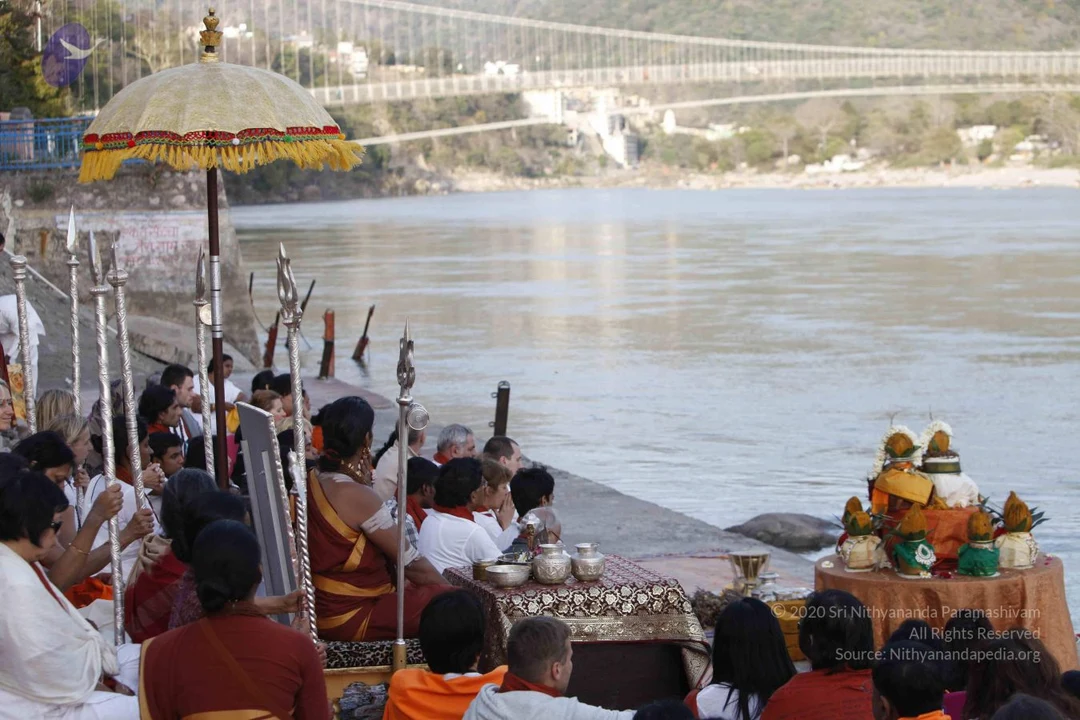
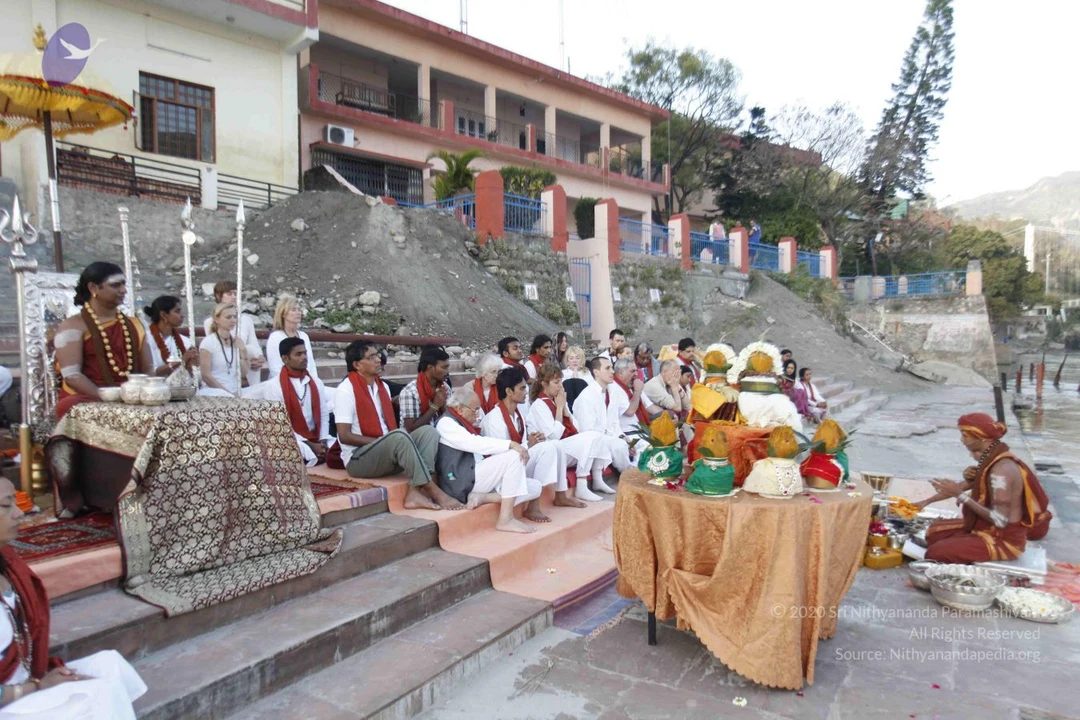
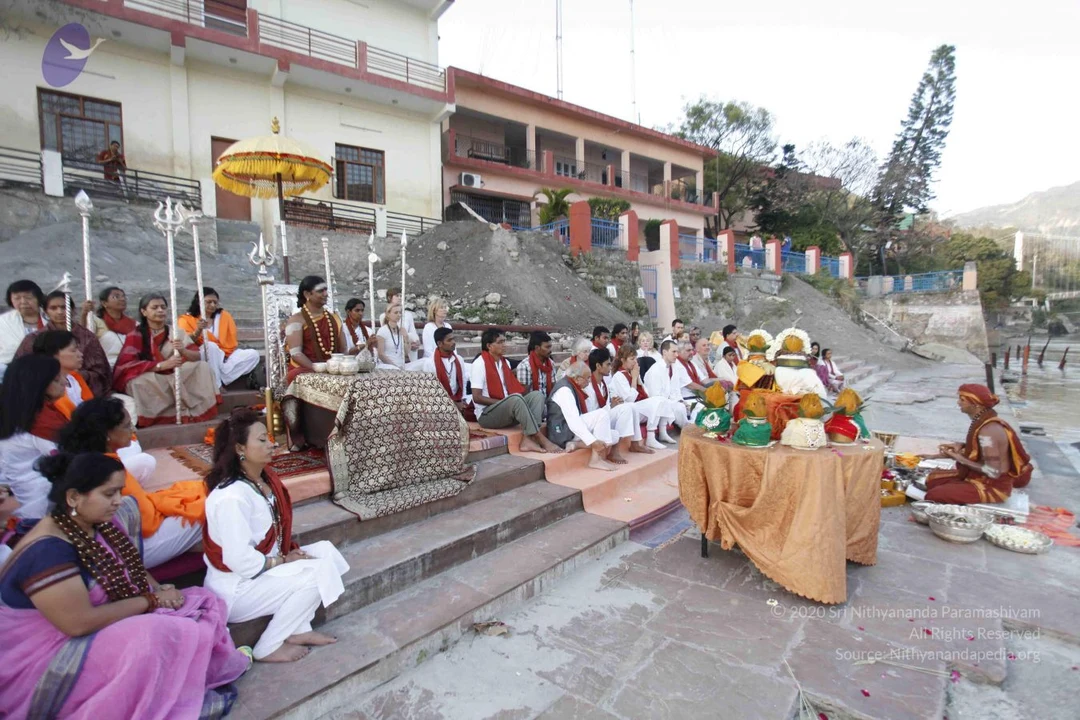
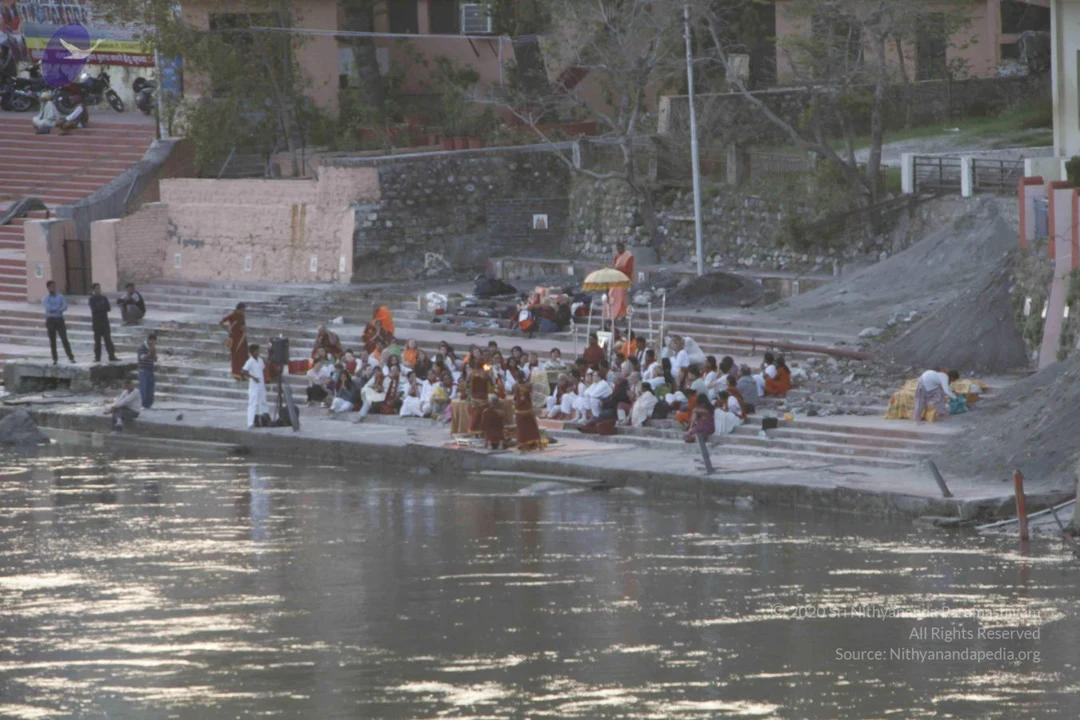
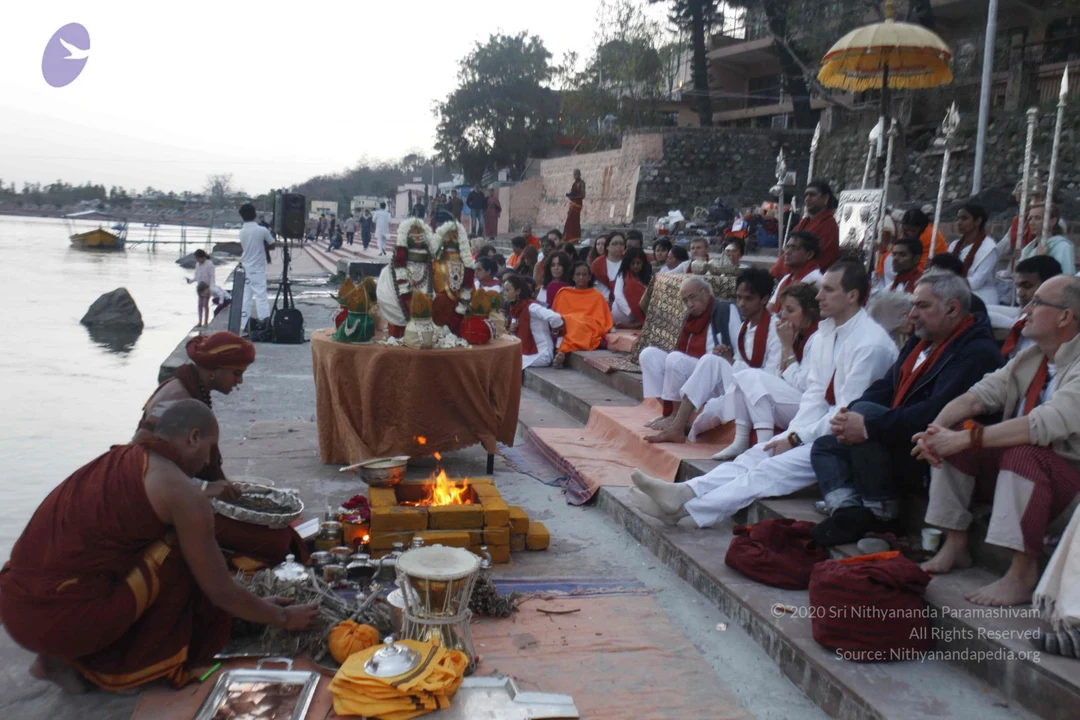
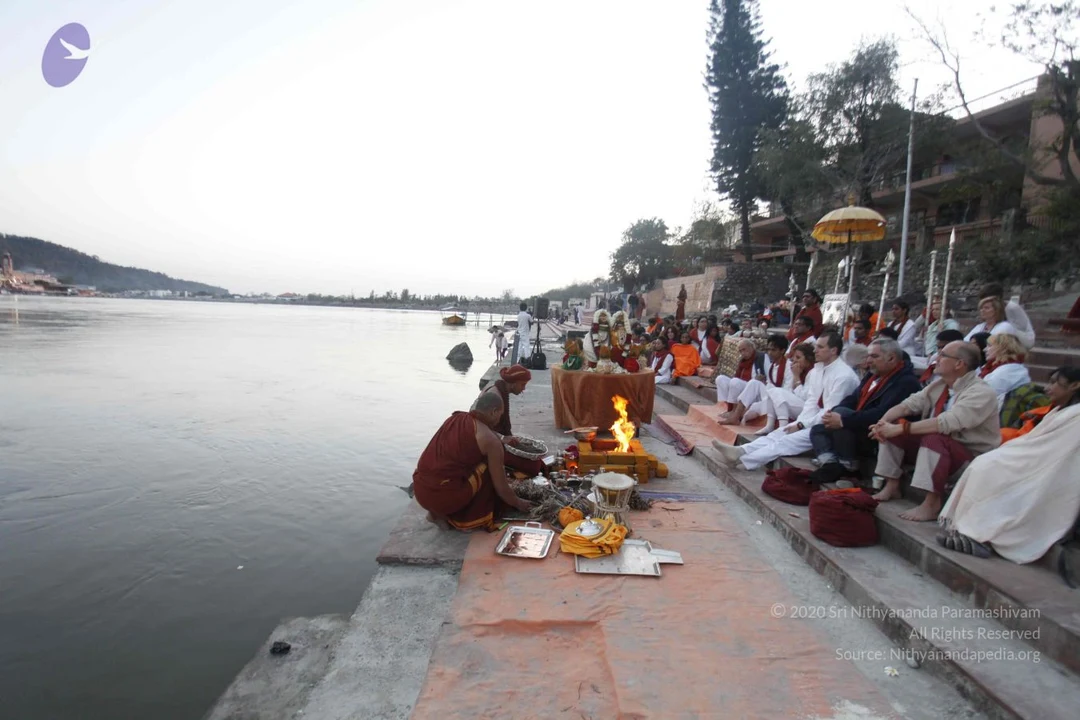
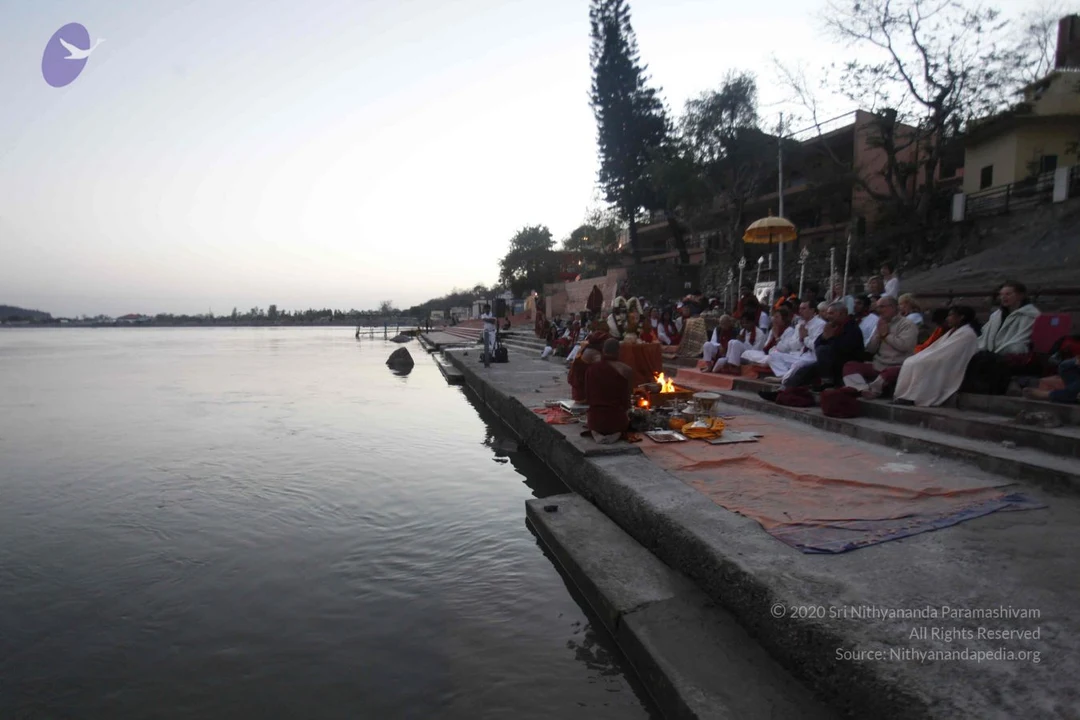
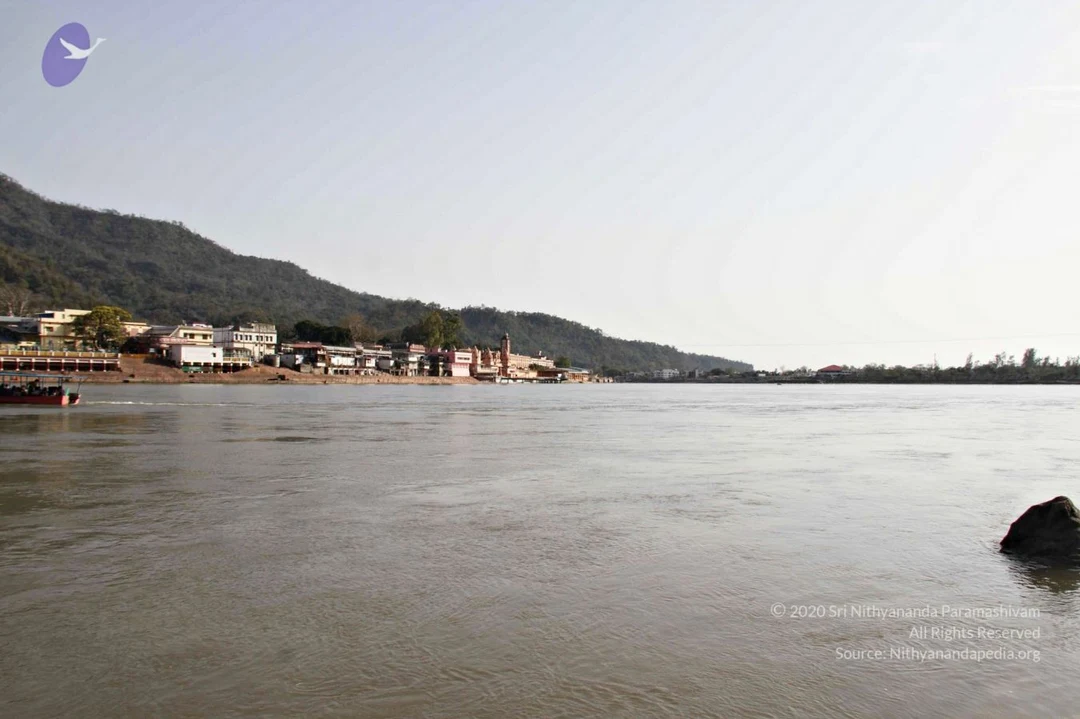
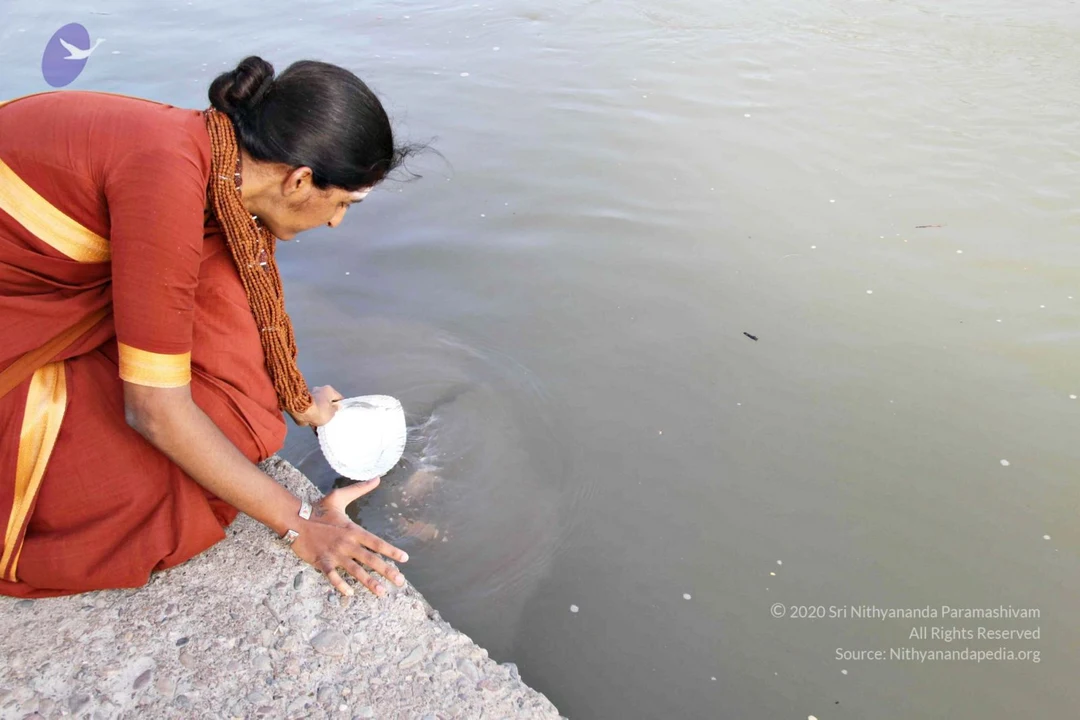
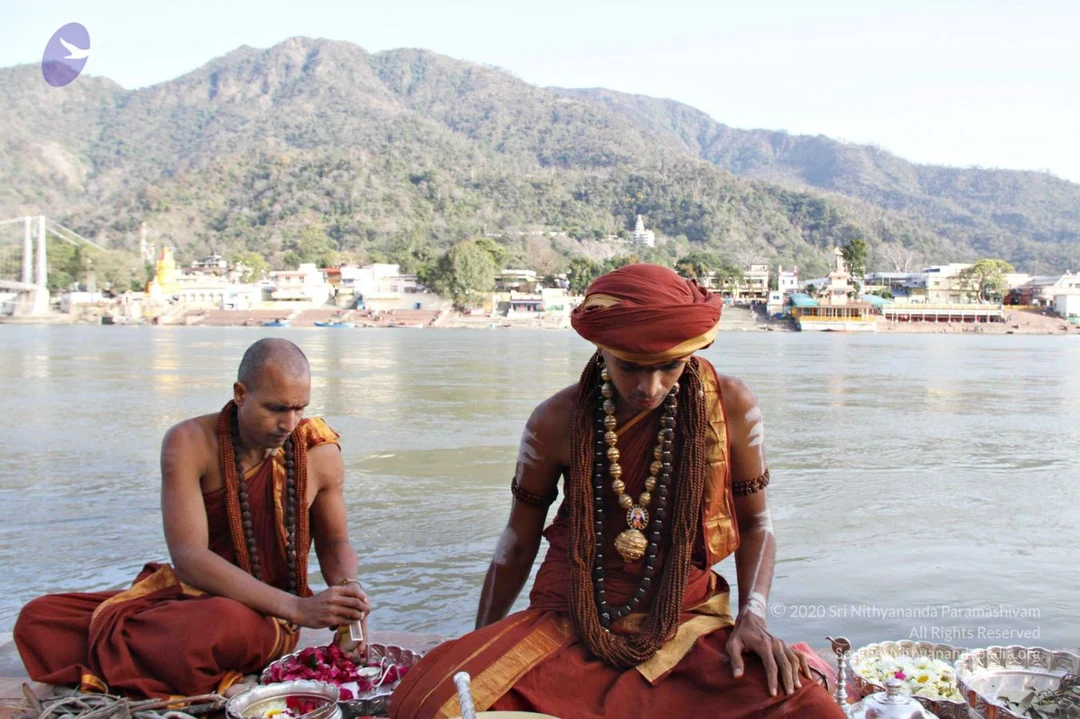
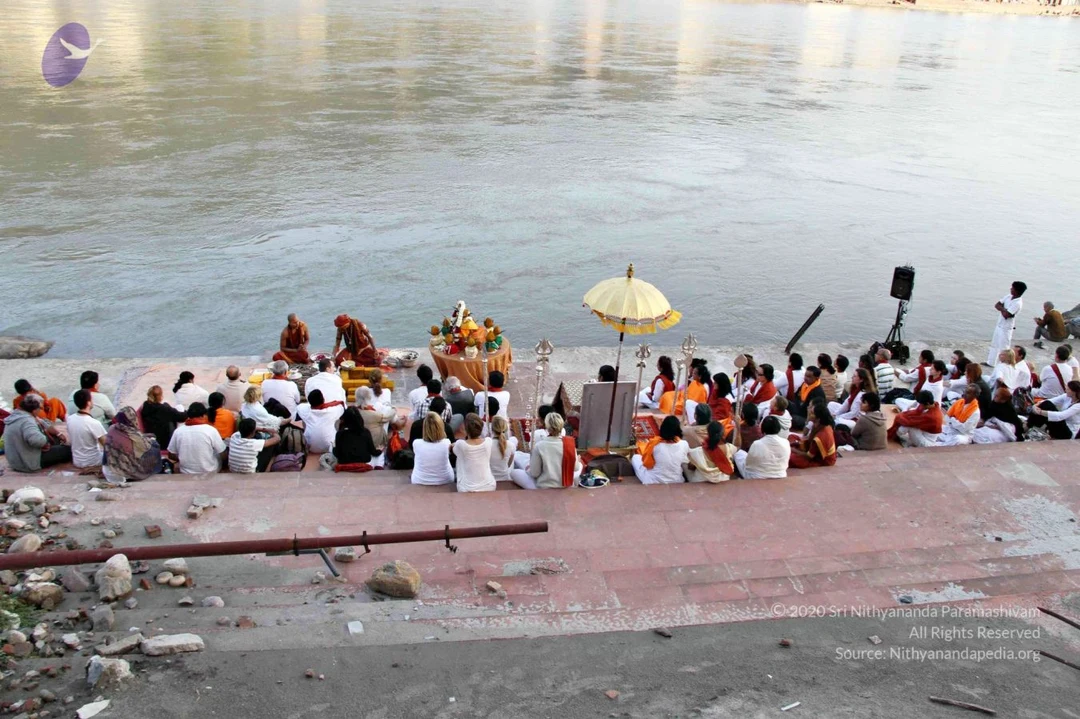
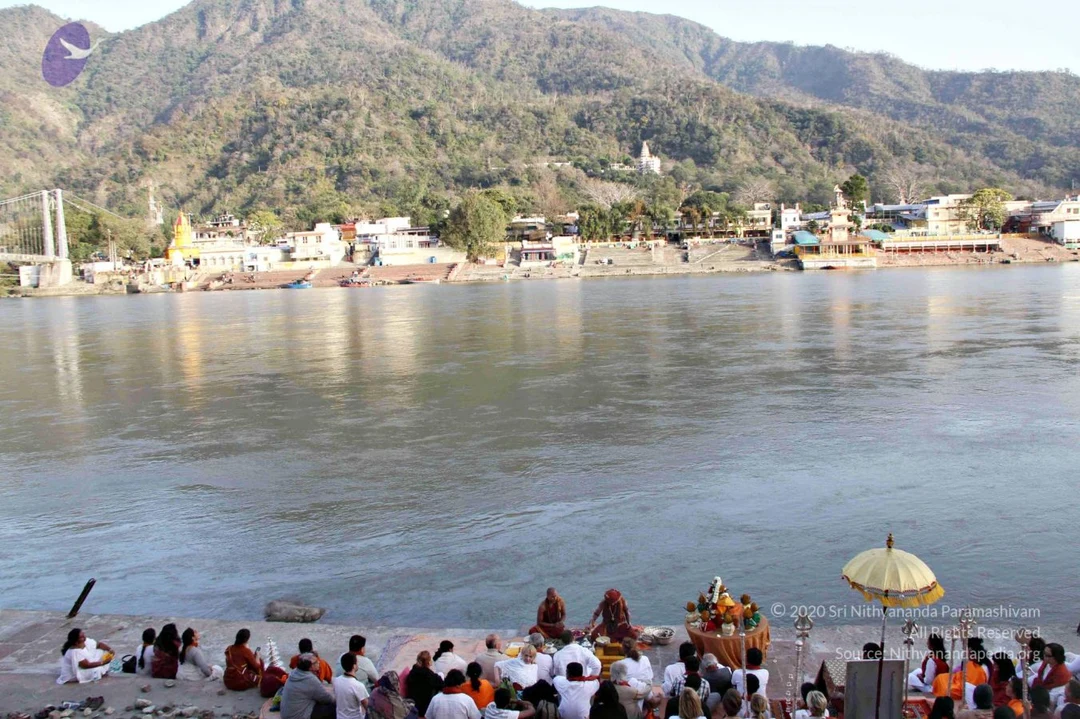
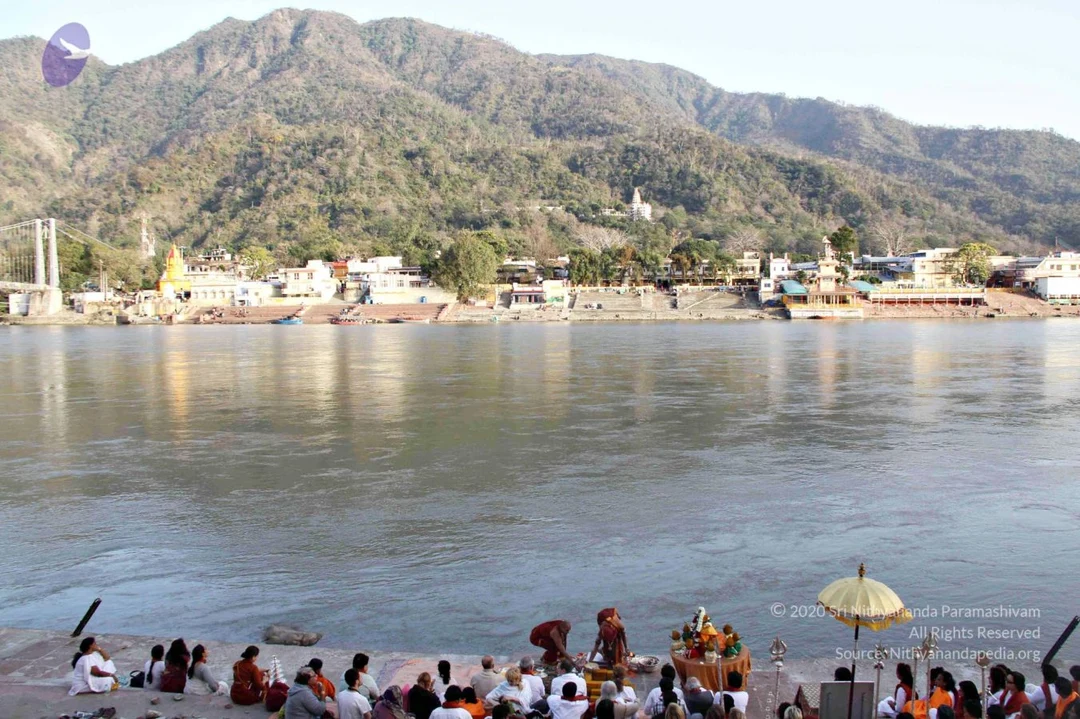
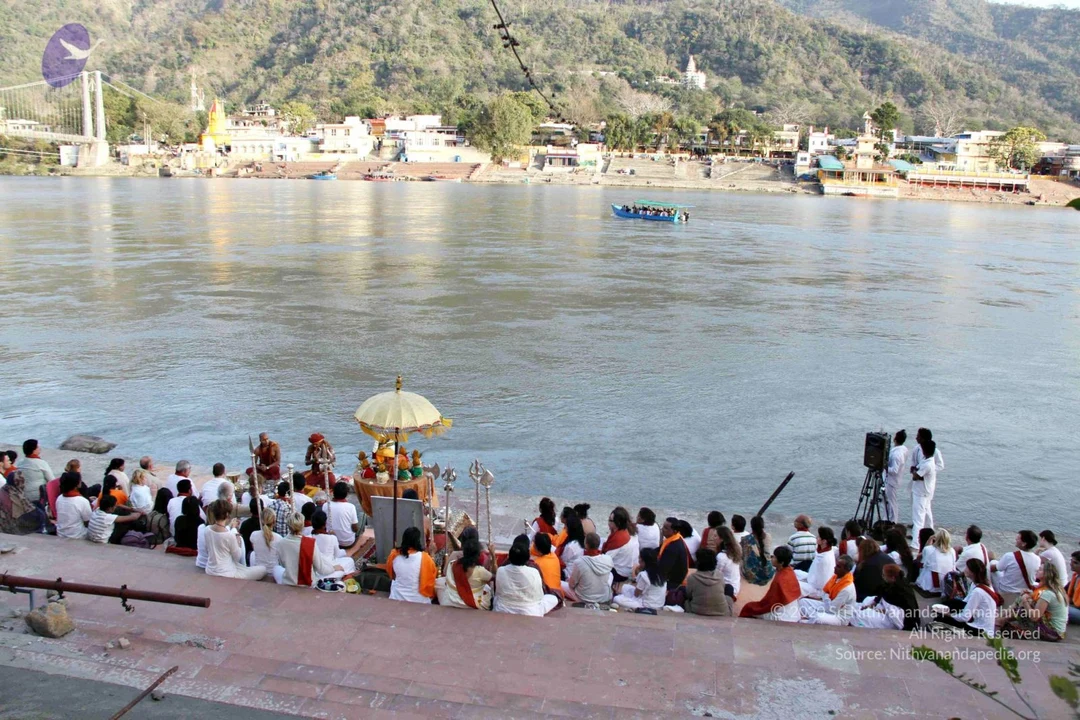
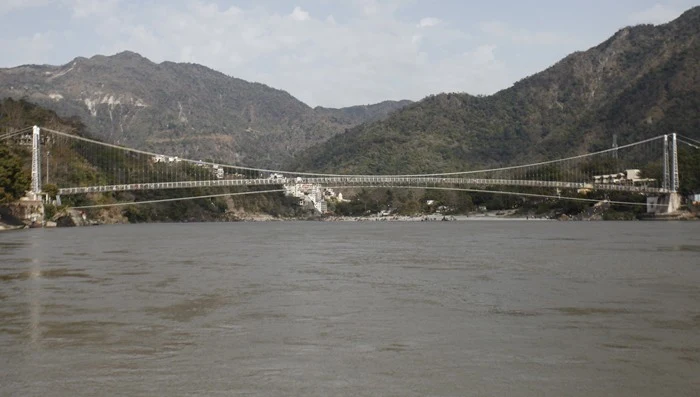
Ganga Ghat - Rishikesh
Kalpataru Darshan
Photos Of The Day:

Nithyananda Satsang
Kalpataru Darshan

SPH visits Rishikesh

Tags:

Paramahamsa Nithyananda, Haridwar, Advaita, world, space, like attracts like, truth, living.

Photos Of The Day:

FB-photo-of-the-day

Photos from this day

View all 312 photos

Nithya Satsang

3 photosSource gallery
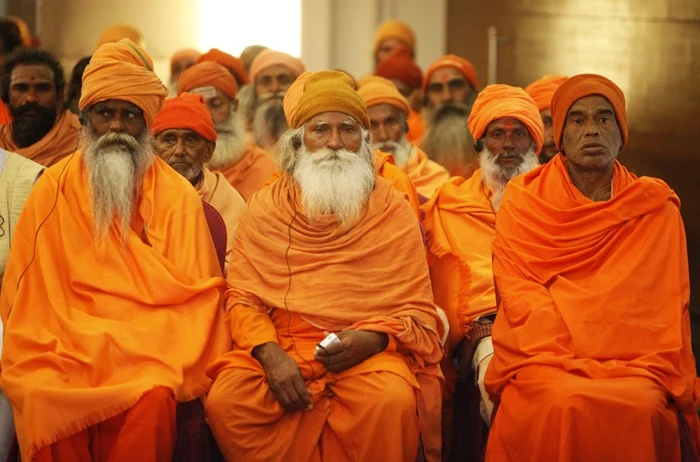
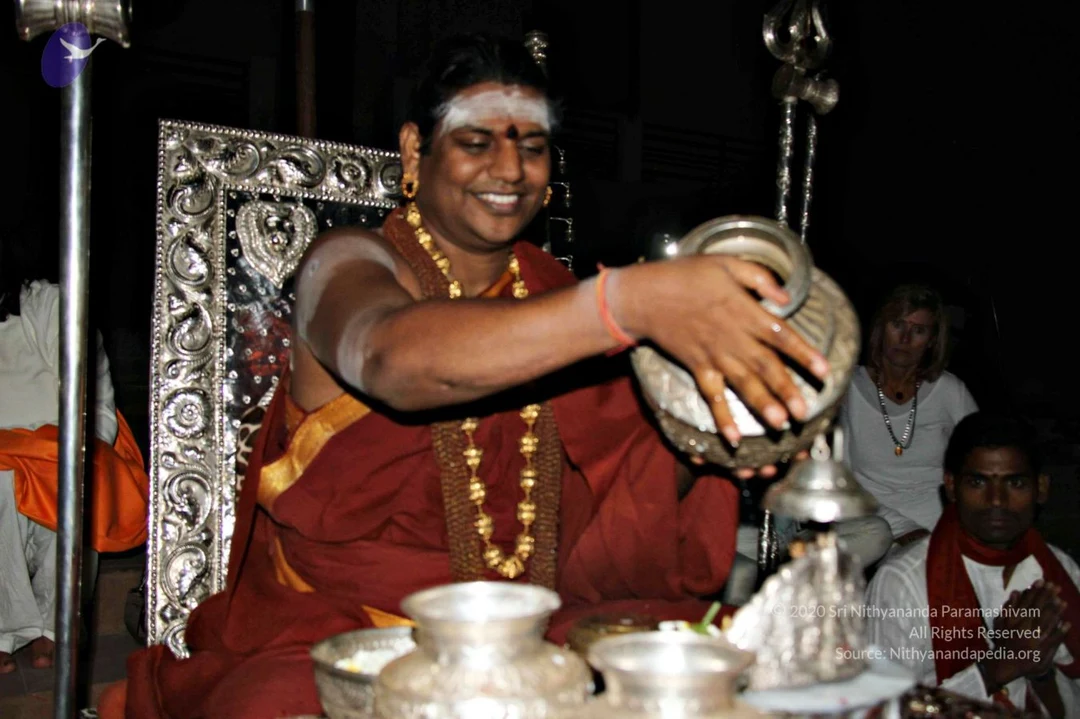
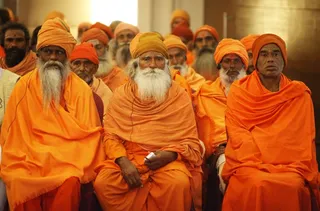
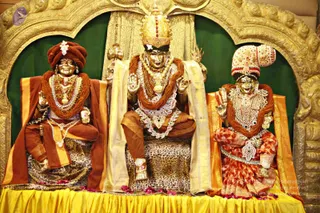
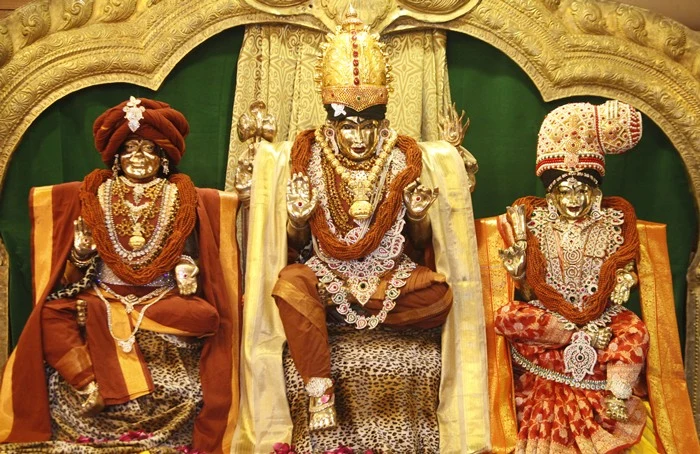
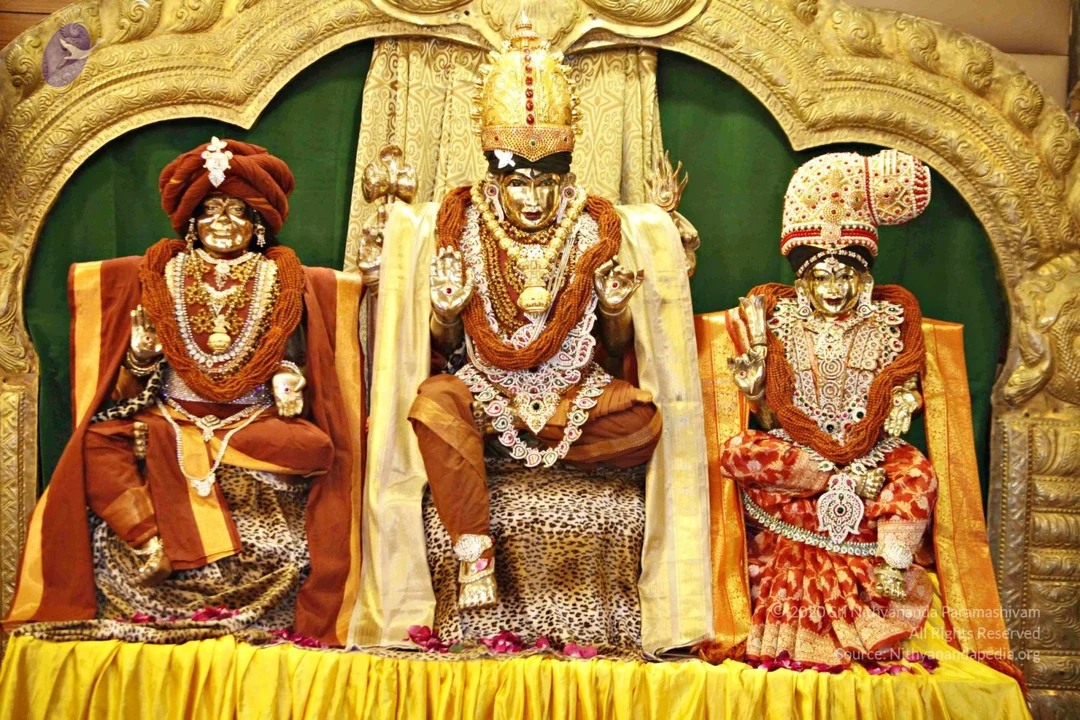
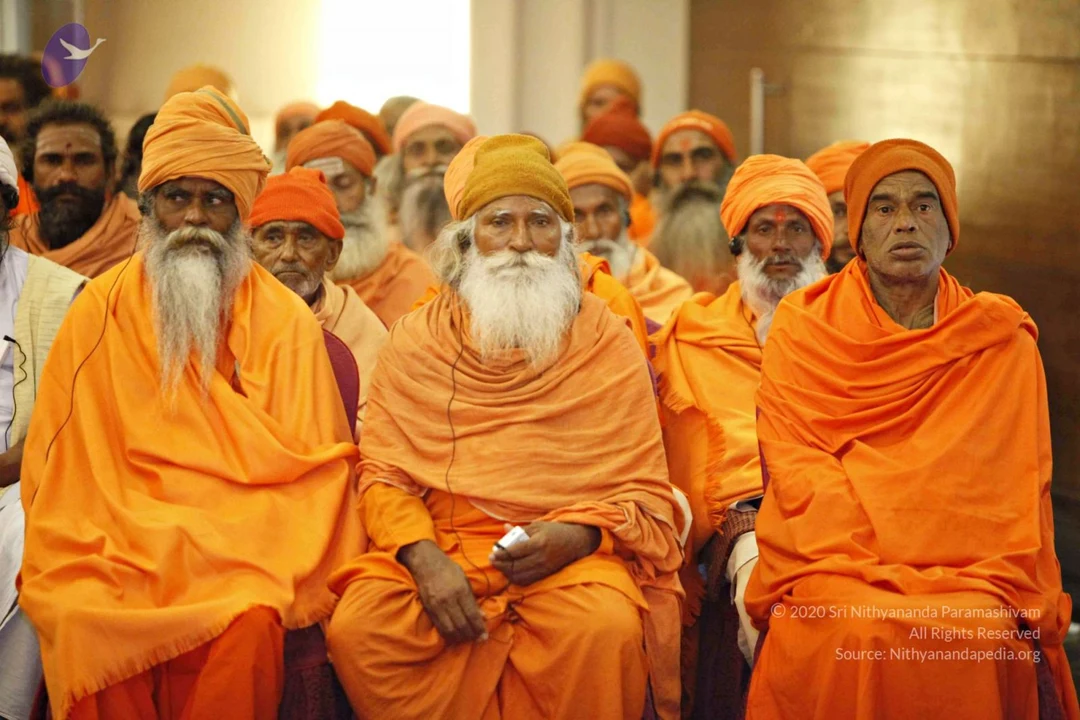
Three gilded statues seated side by side on a raised platform in front of a green and gold backdrop with a golden arched frame. The central figure wears a tall gold crown, a rudraksha mala, a gold necklace and a leopard-print seat cover, and holds his hands in mudra. The figure on the left wears a rust-orange turban, rudraksha beads, gold chains and holds one hand raised. The figure on the right wears a red and white headdress, a patterned red garment and gold jewellery. Gold and orange silk draping frames the statues, with flower petals on the platform.A seated group of older men in saffron and orange sannyasi robes, many wearing orange and yellow turbans, sits in rows at a satsang gathering. The foreground figures have long white beards; the central man in a mustard-yellow turban holds a small white object and a cable runs from his ear. Behind them more saffron-clad devotees and a warm-lit hall are visible. Approximately 15 people are visible, and no figure shows distinctive a person cues such as a crown, rudraksha mala or ornate gold necklace, so no candidate is identified.

Ganga Ghat - Rishikesh

8 photosSource gallery
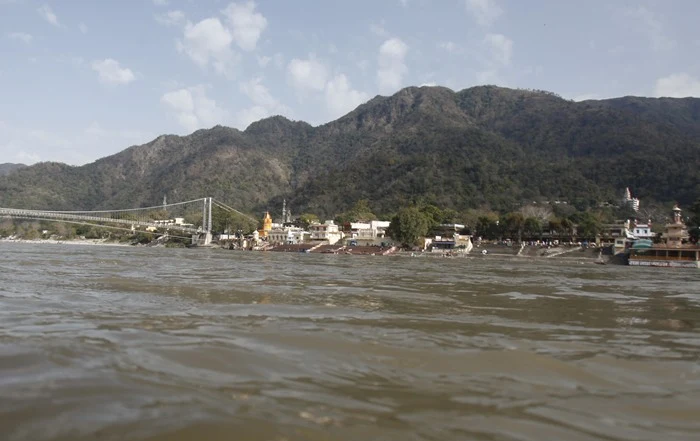
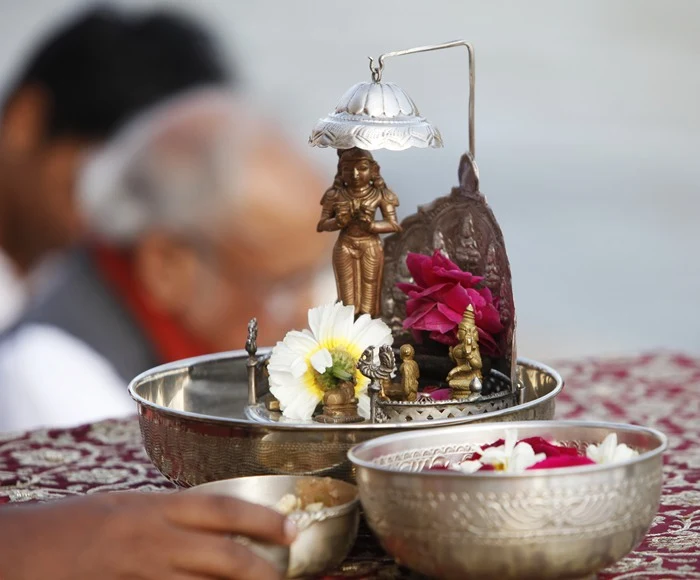
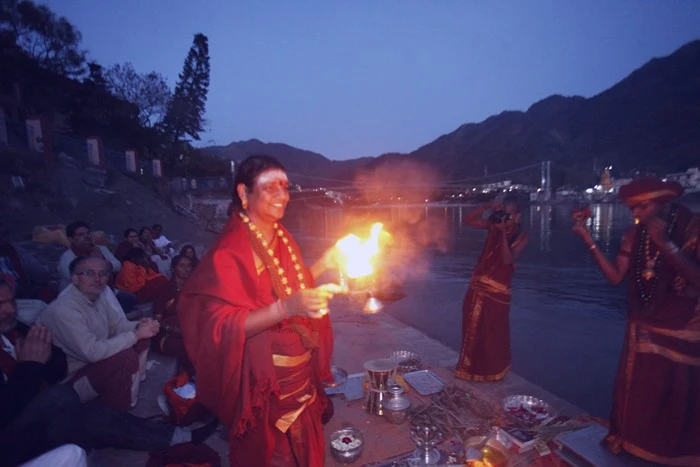
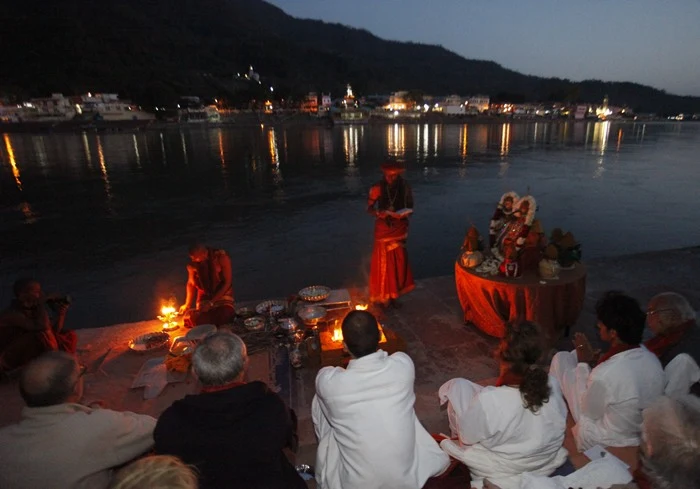
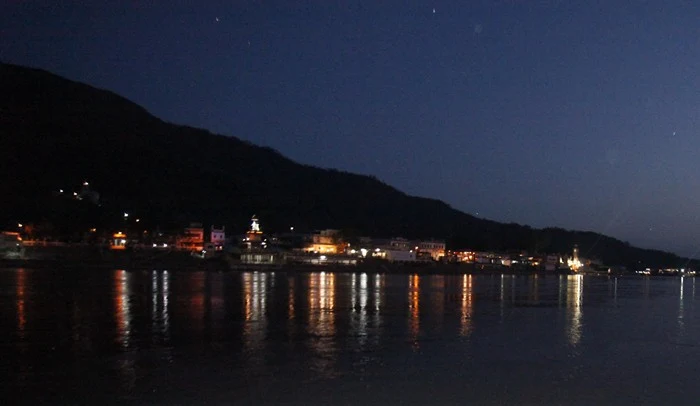
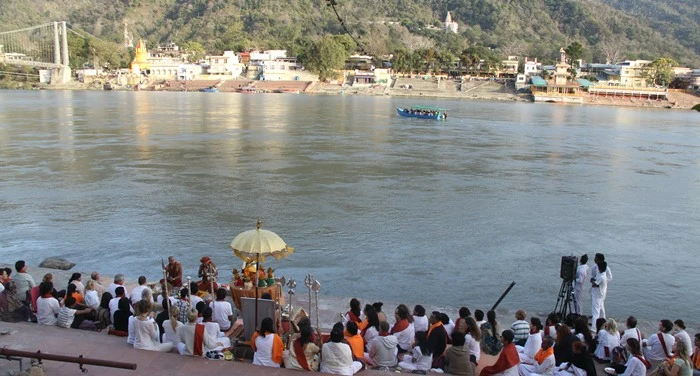
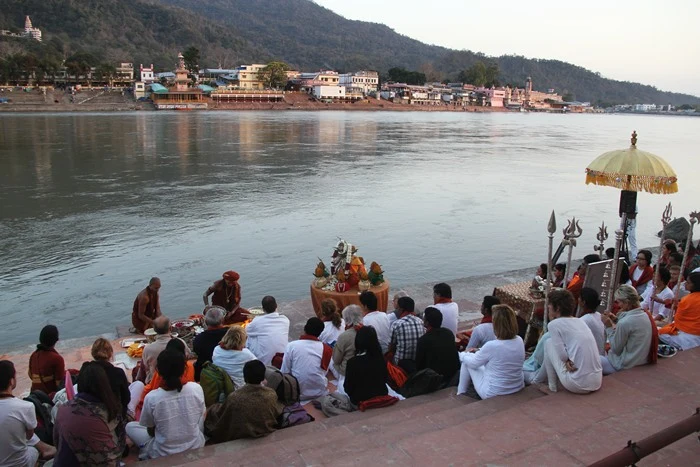
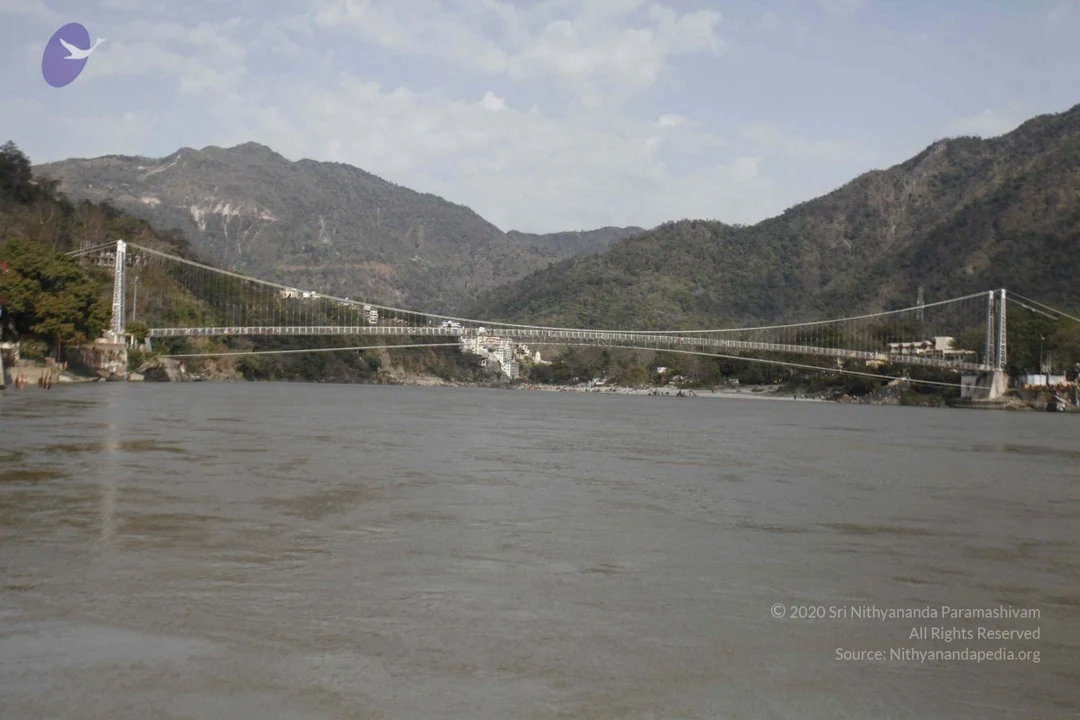
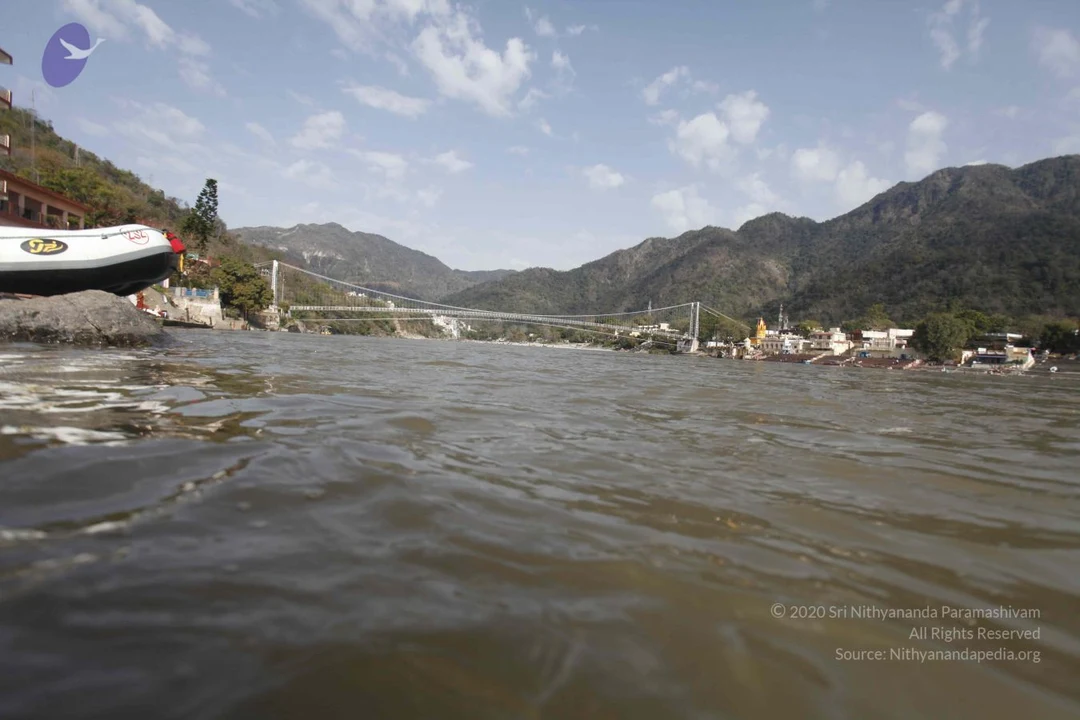
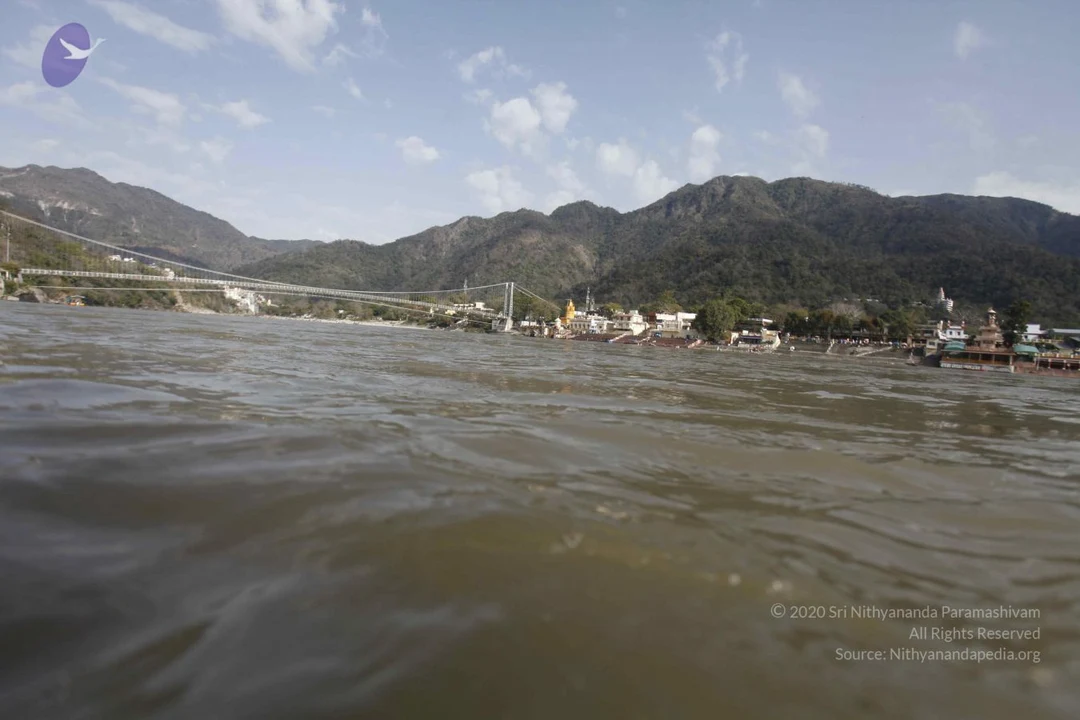
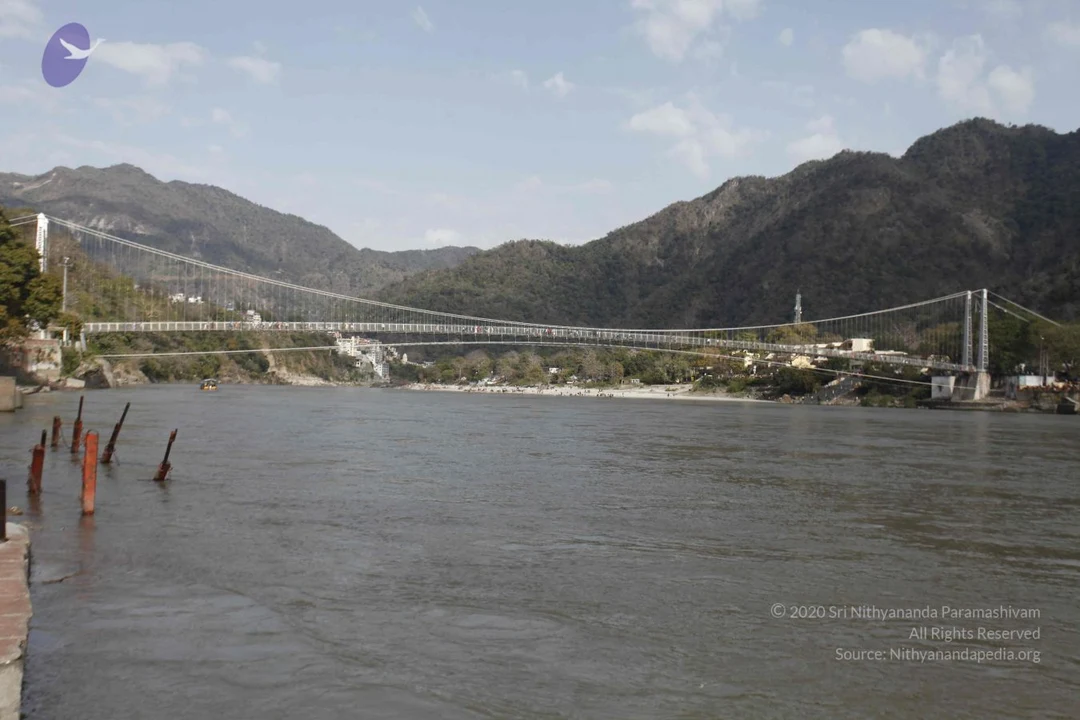
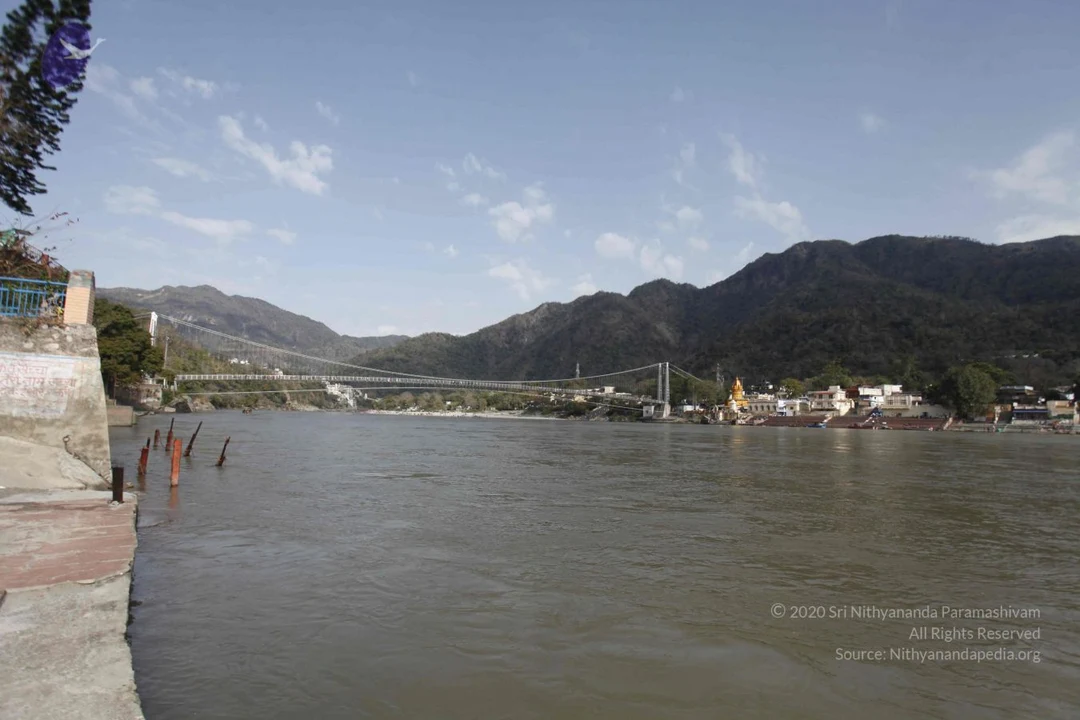
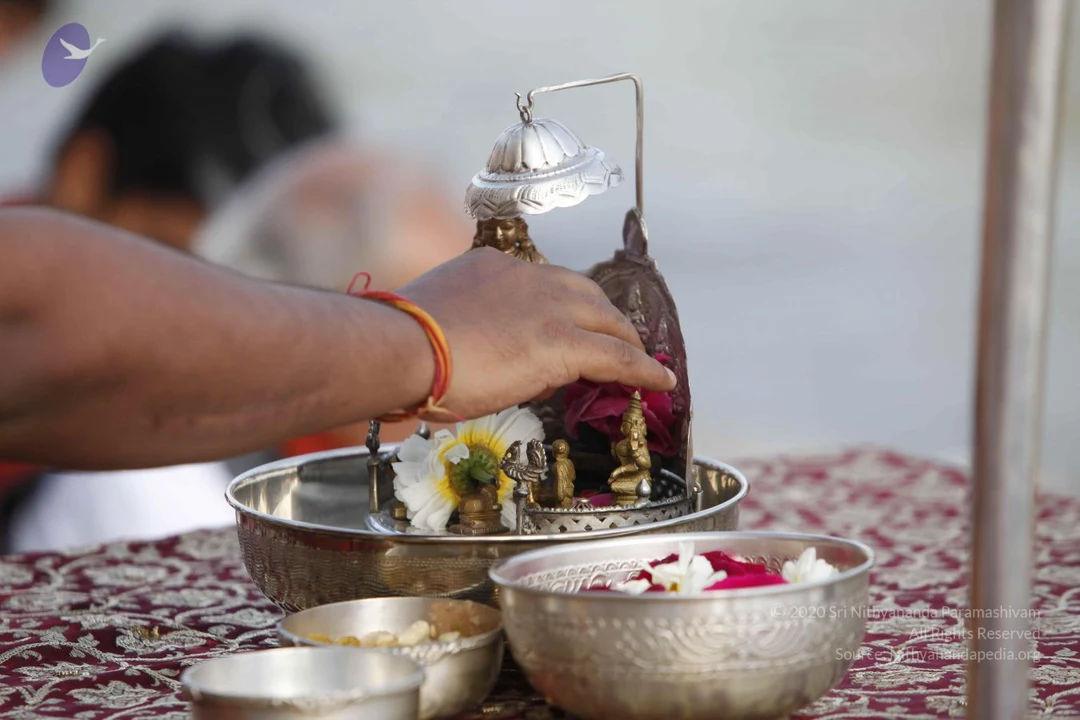
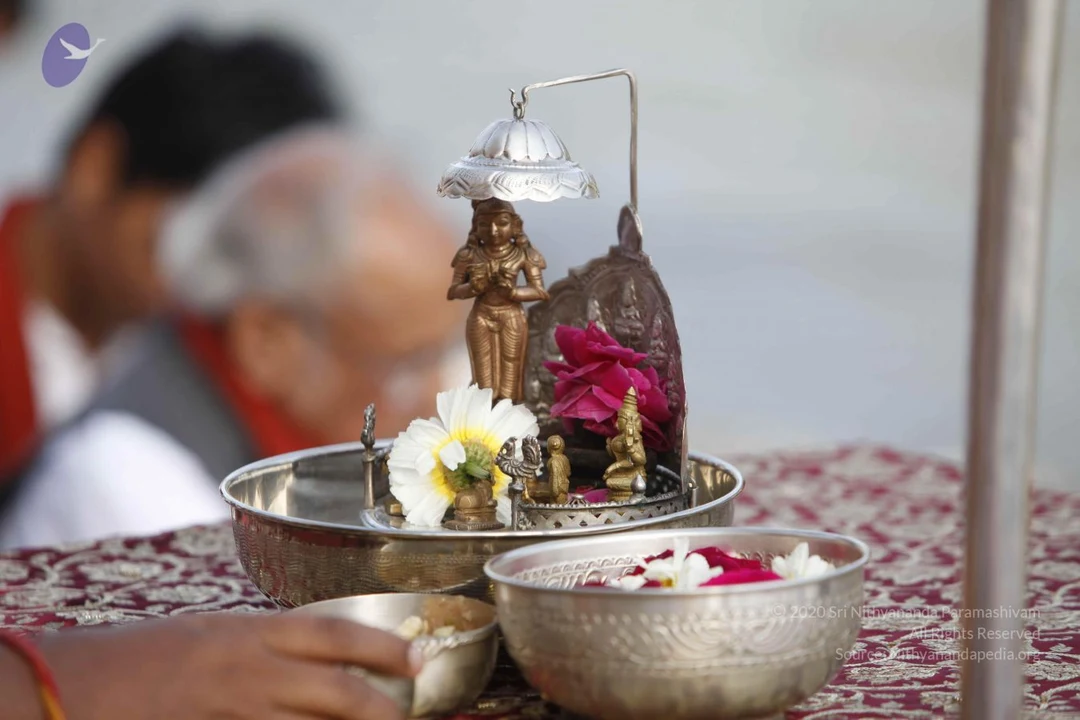
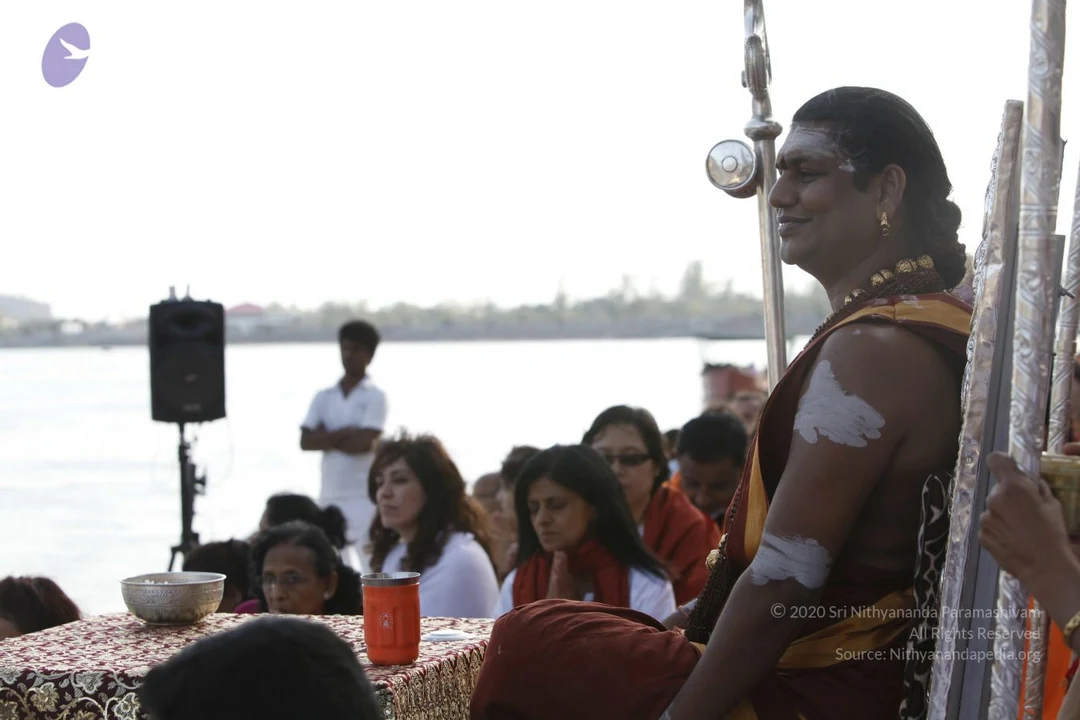
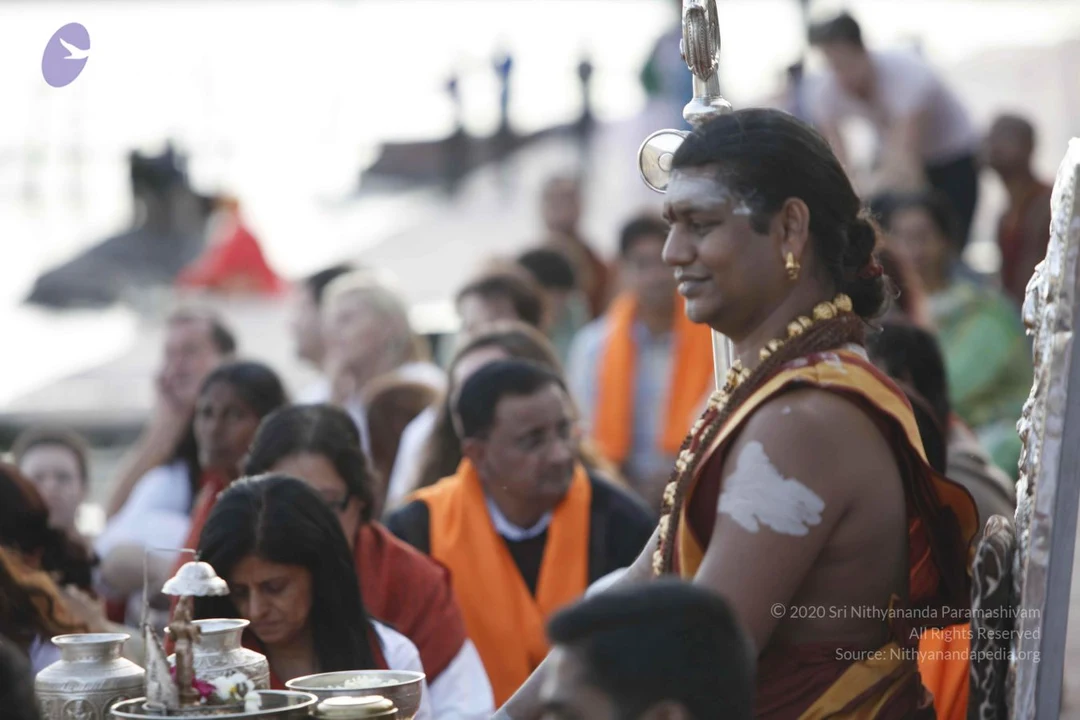
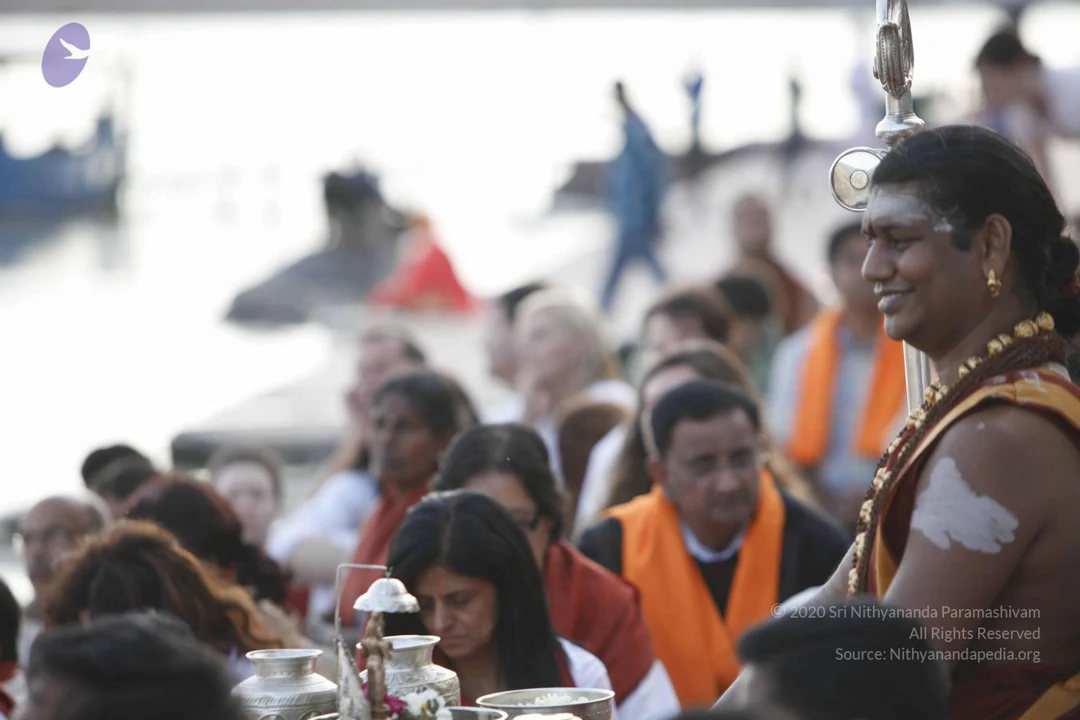
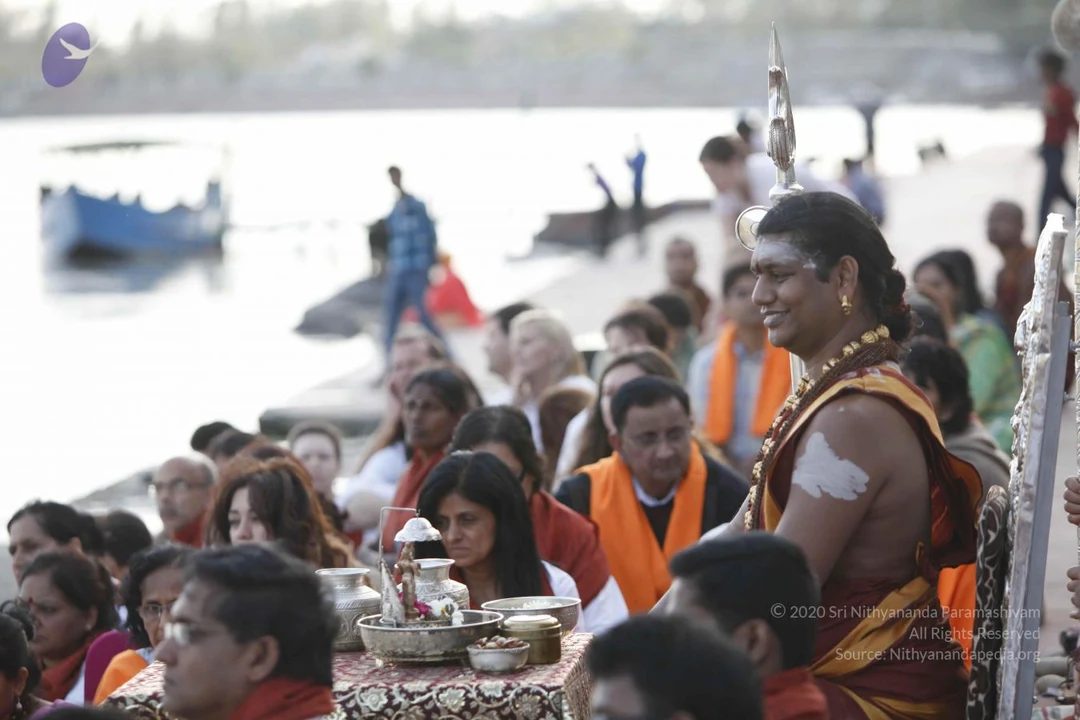
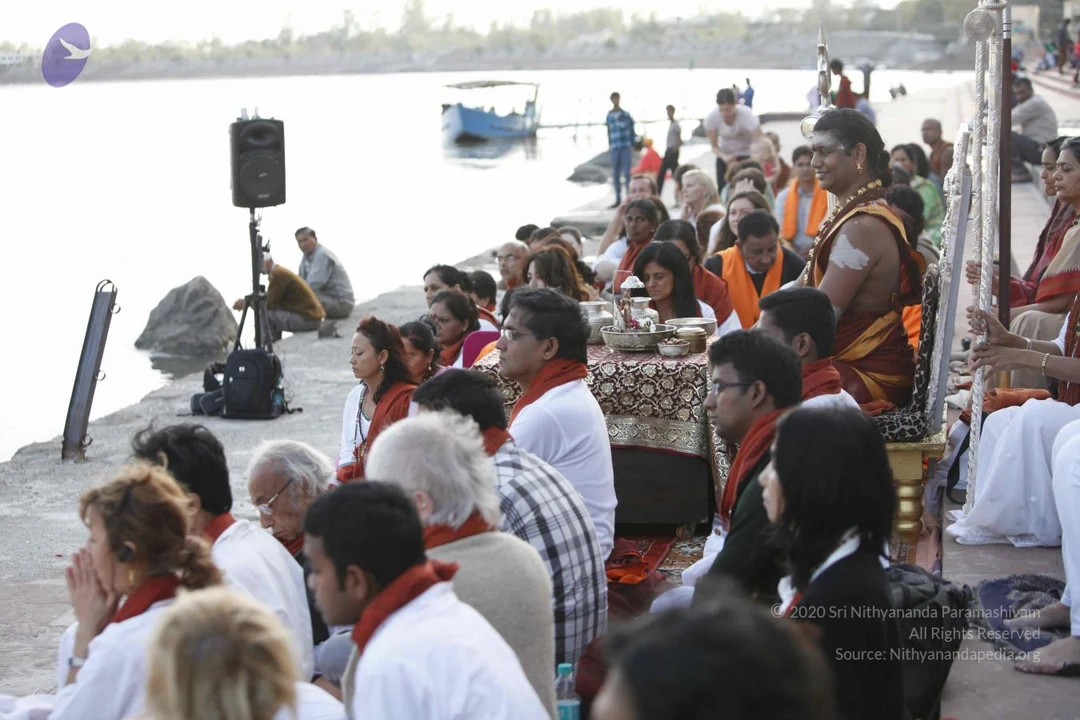
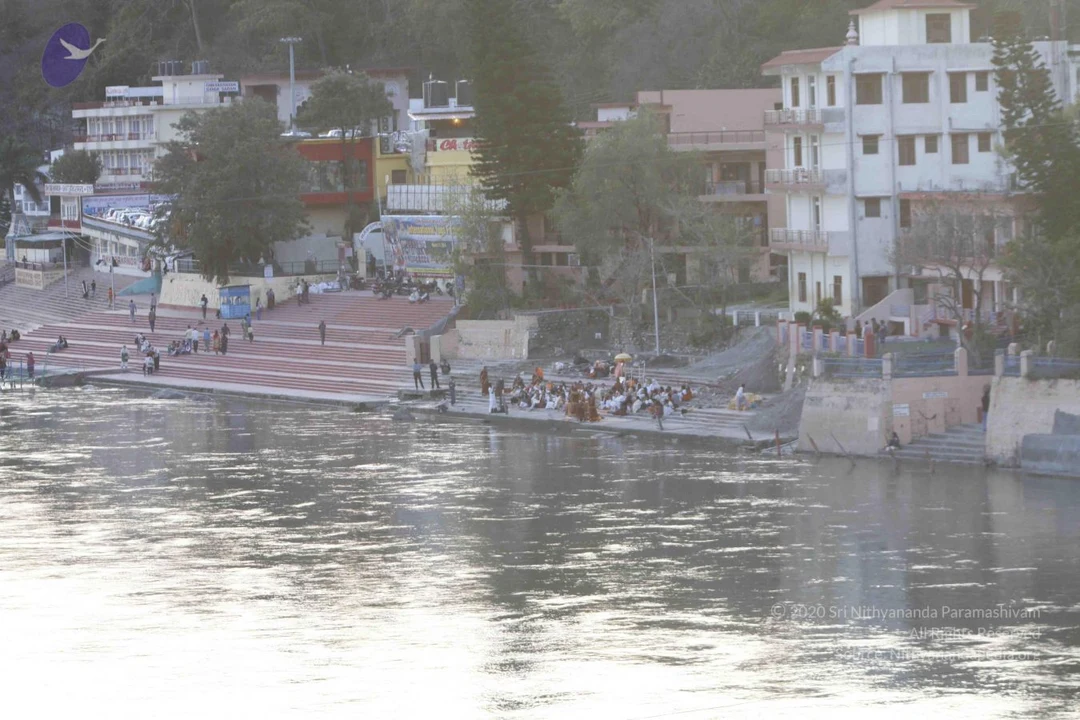
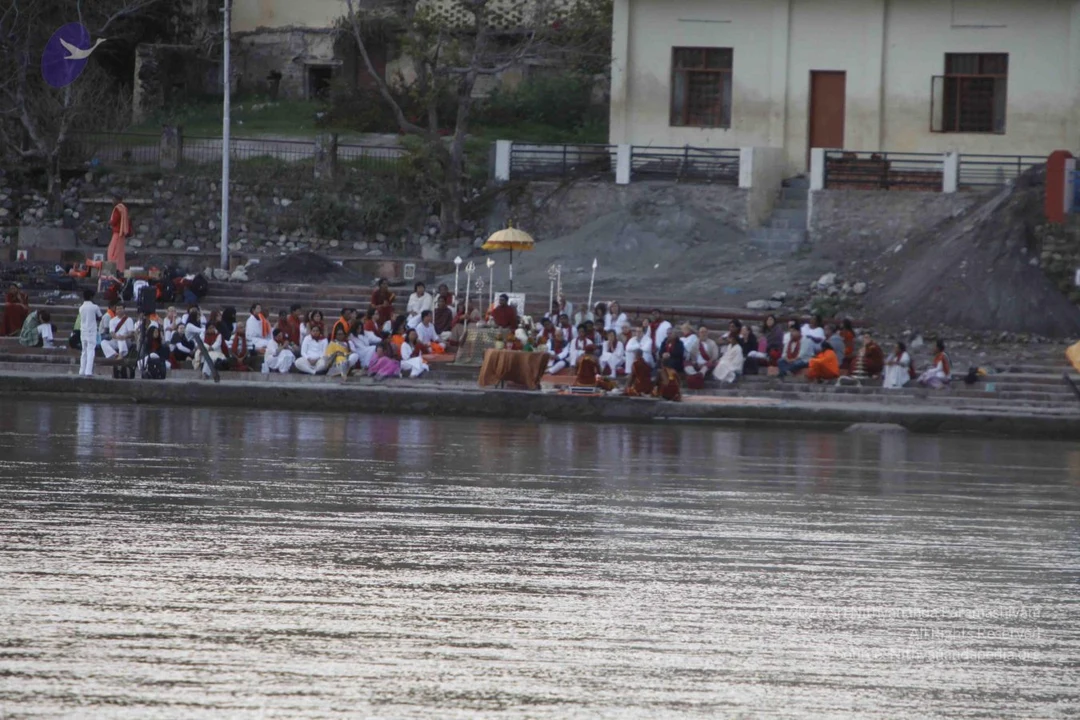
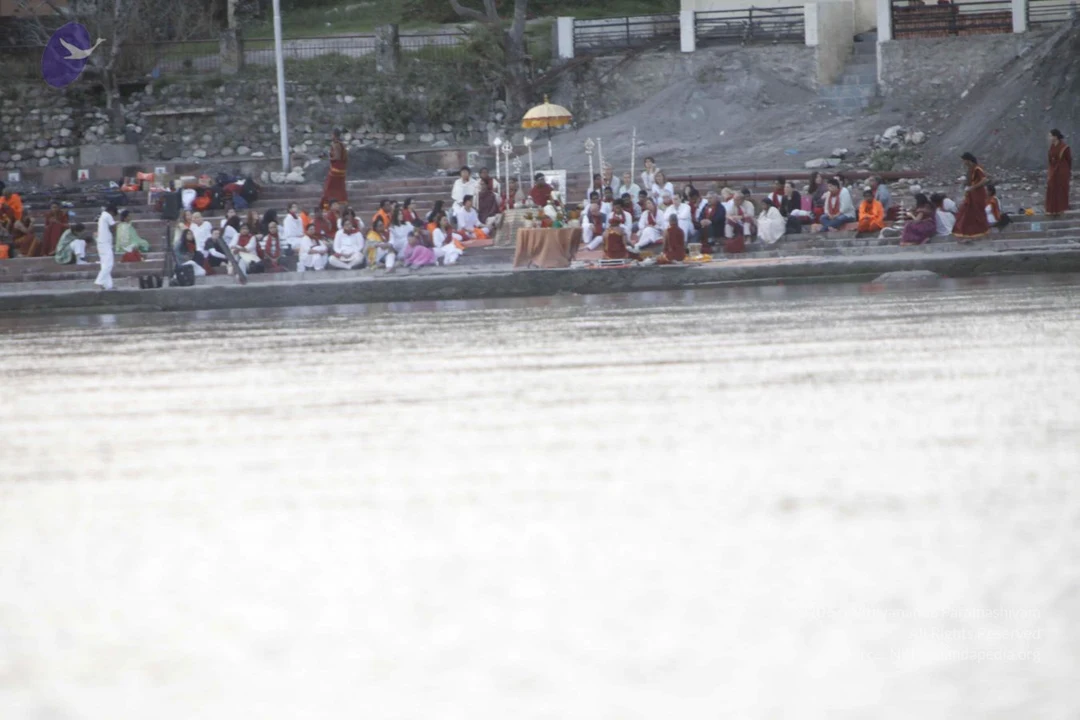
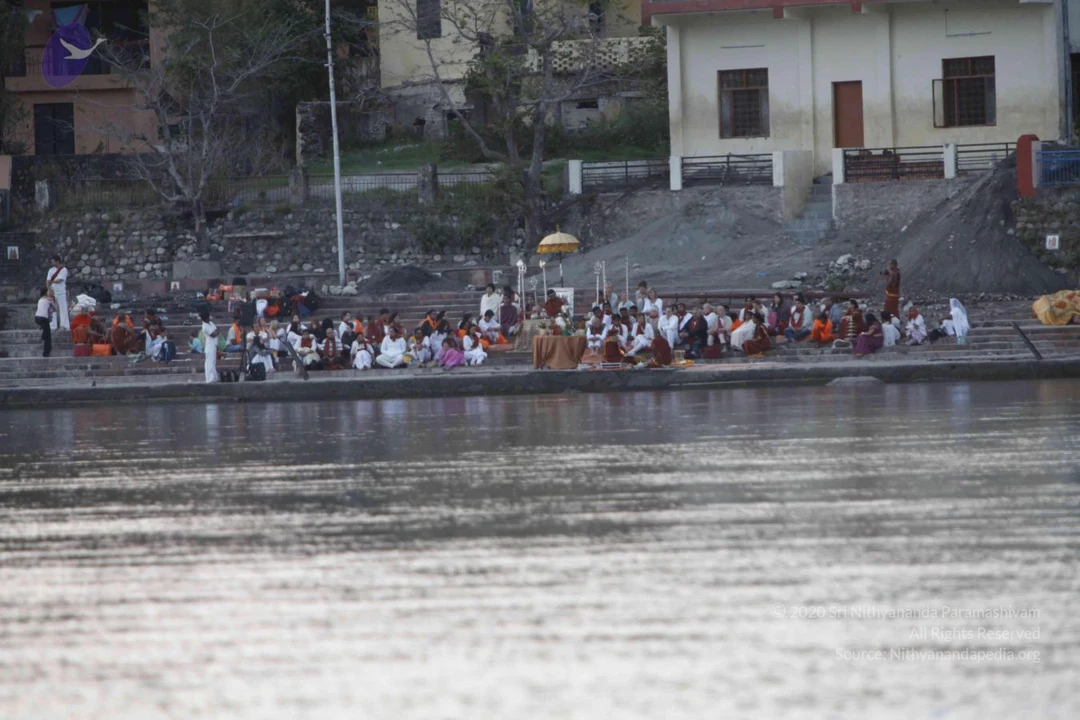
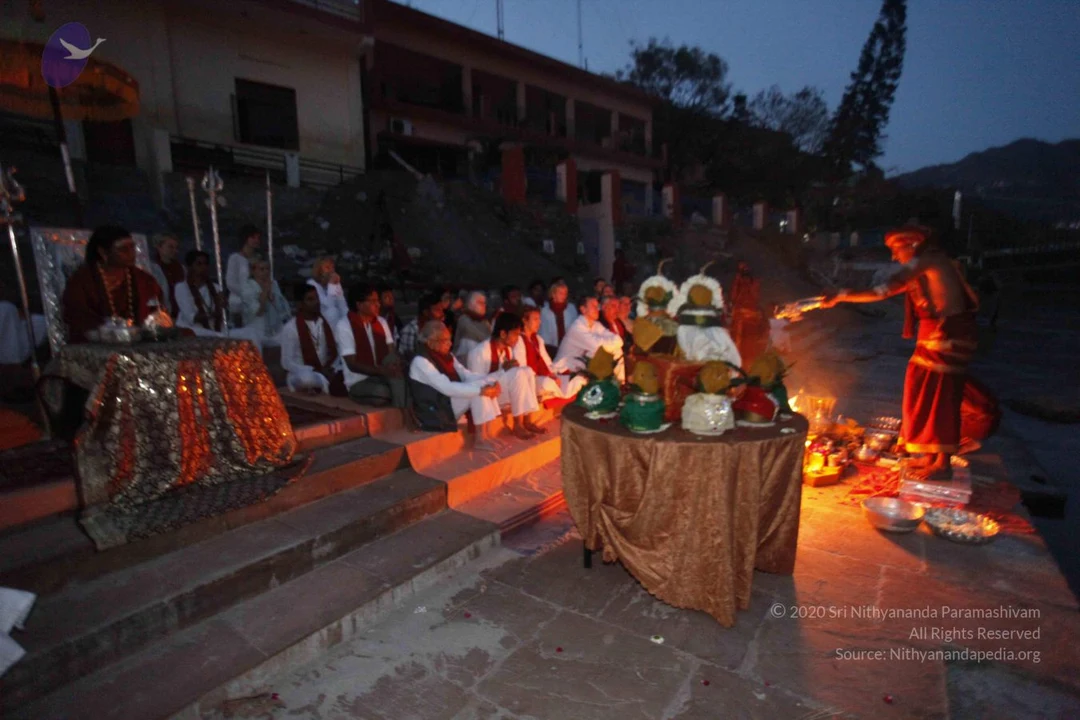
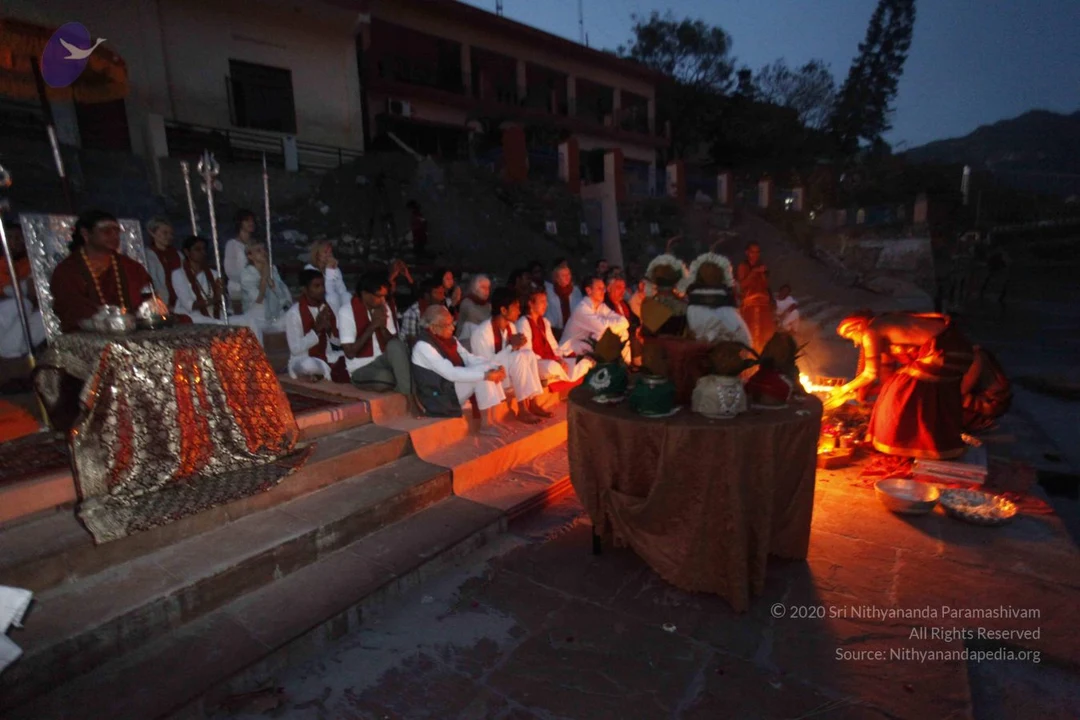
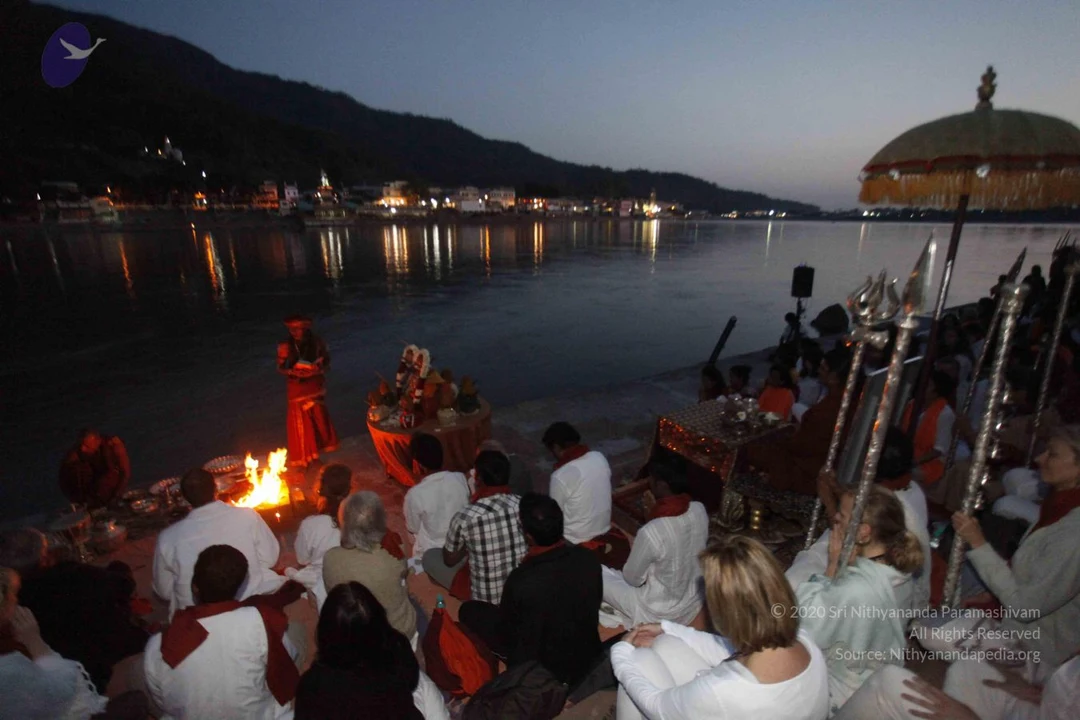
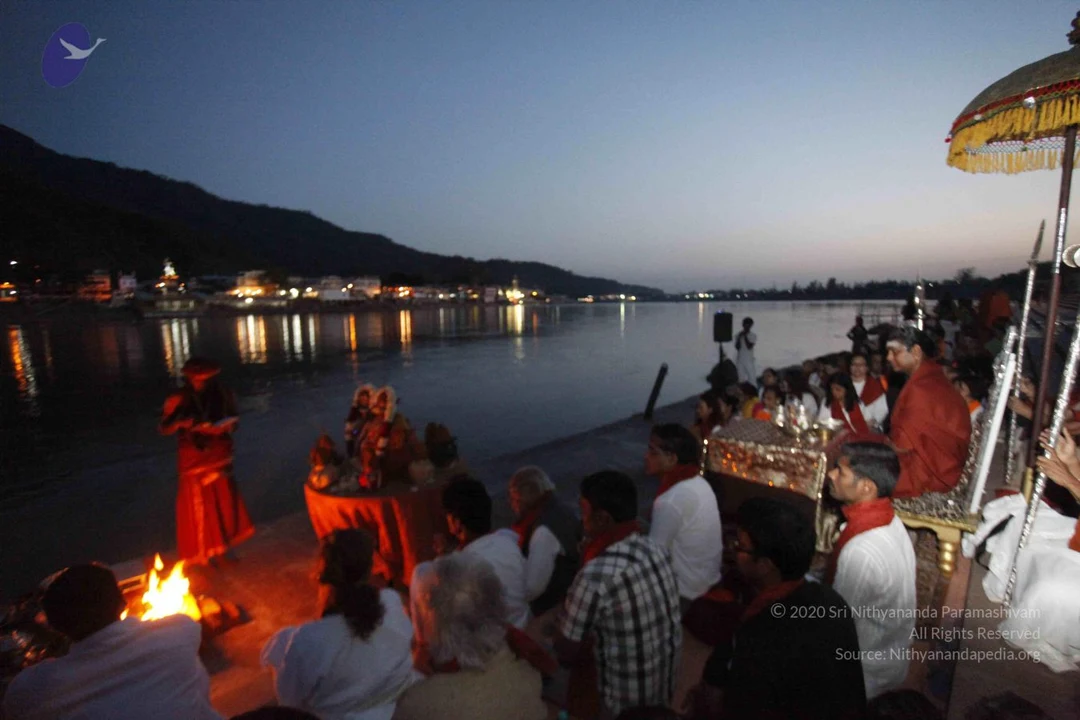
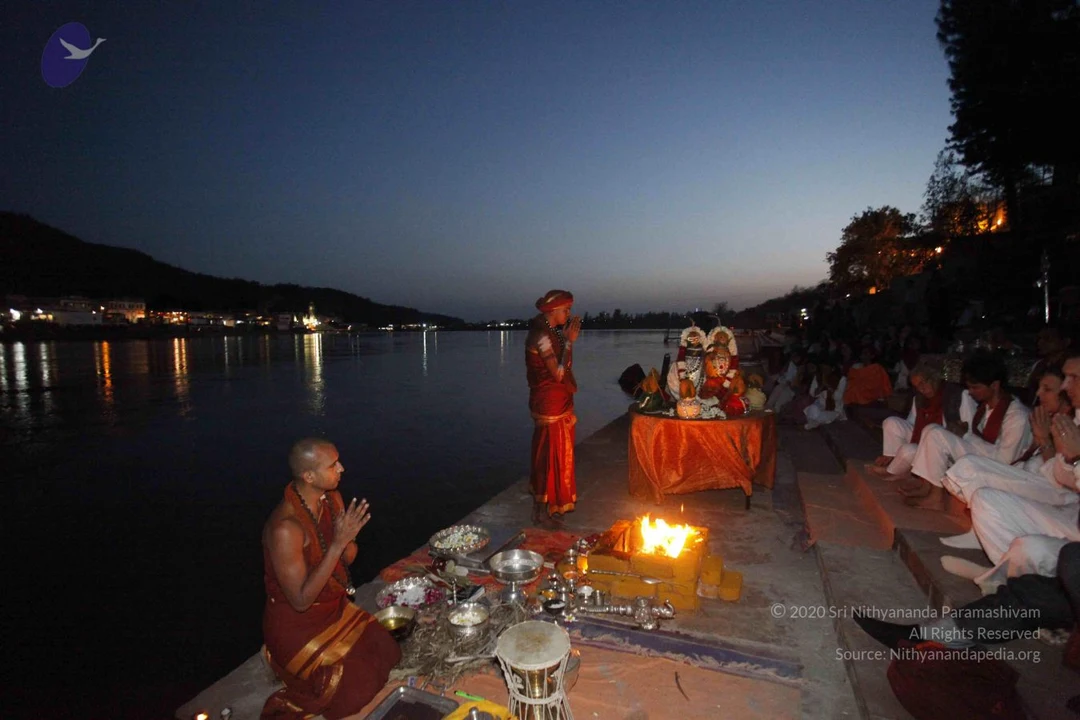
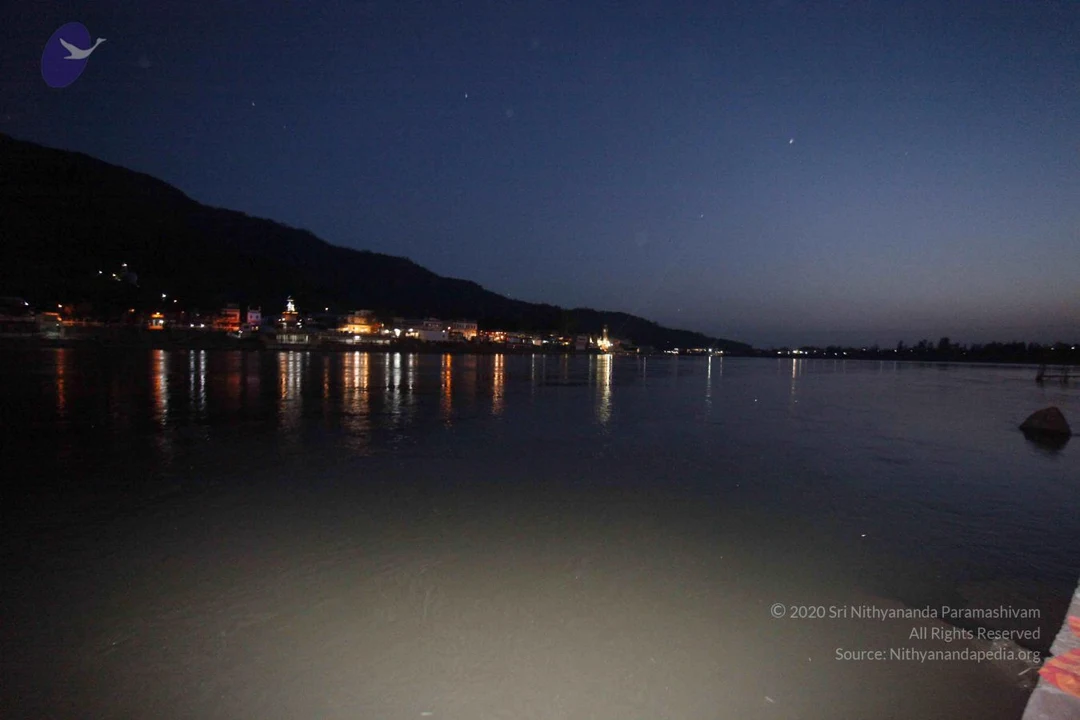
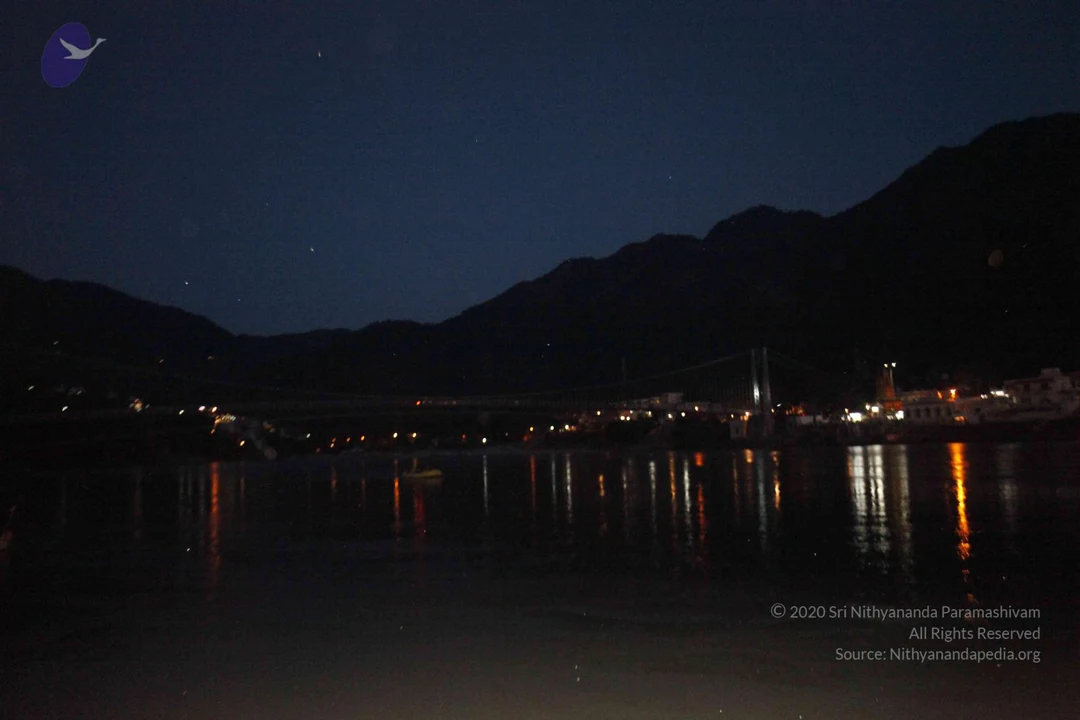
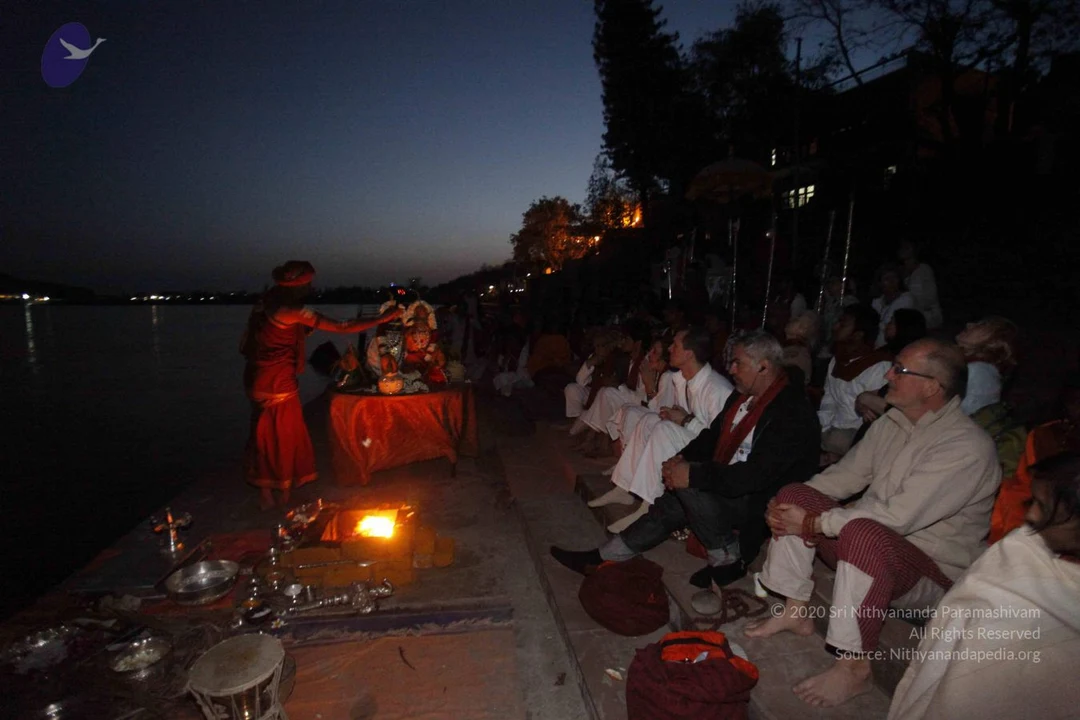
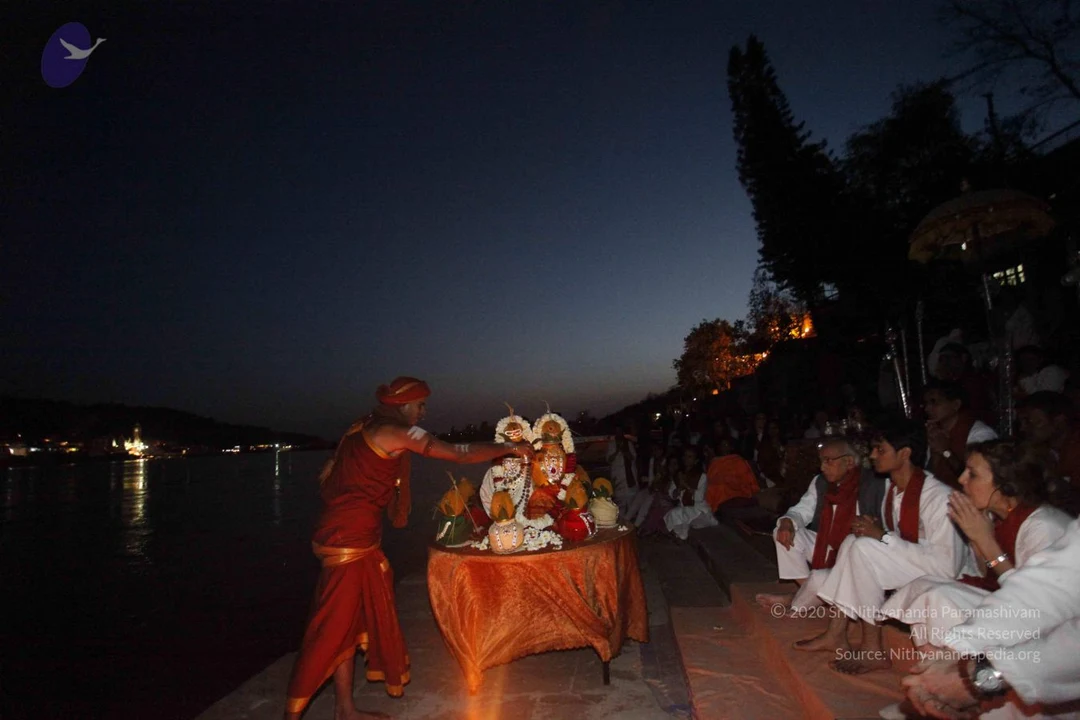
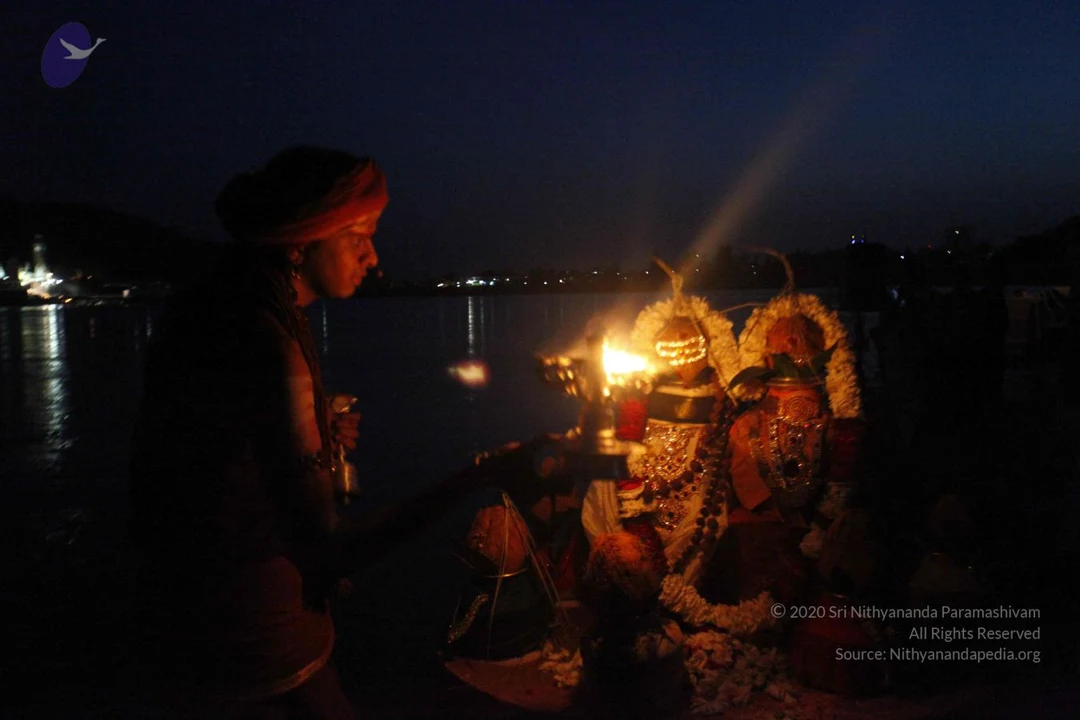
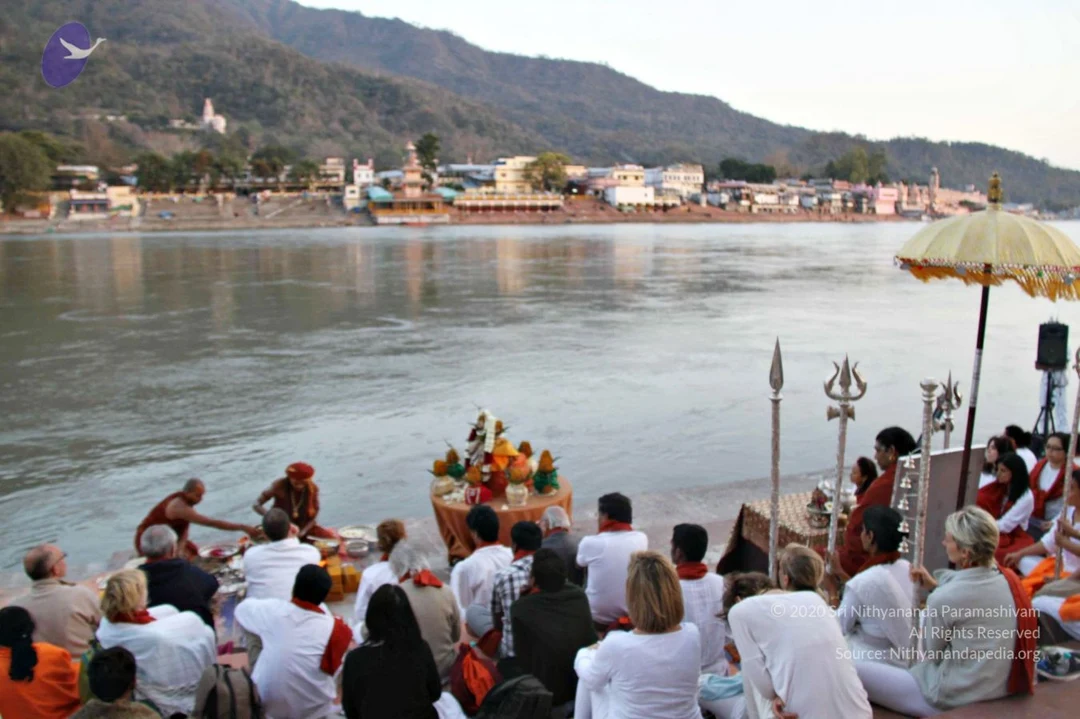
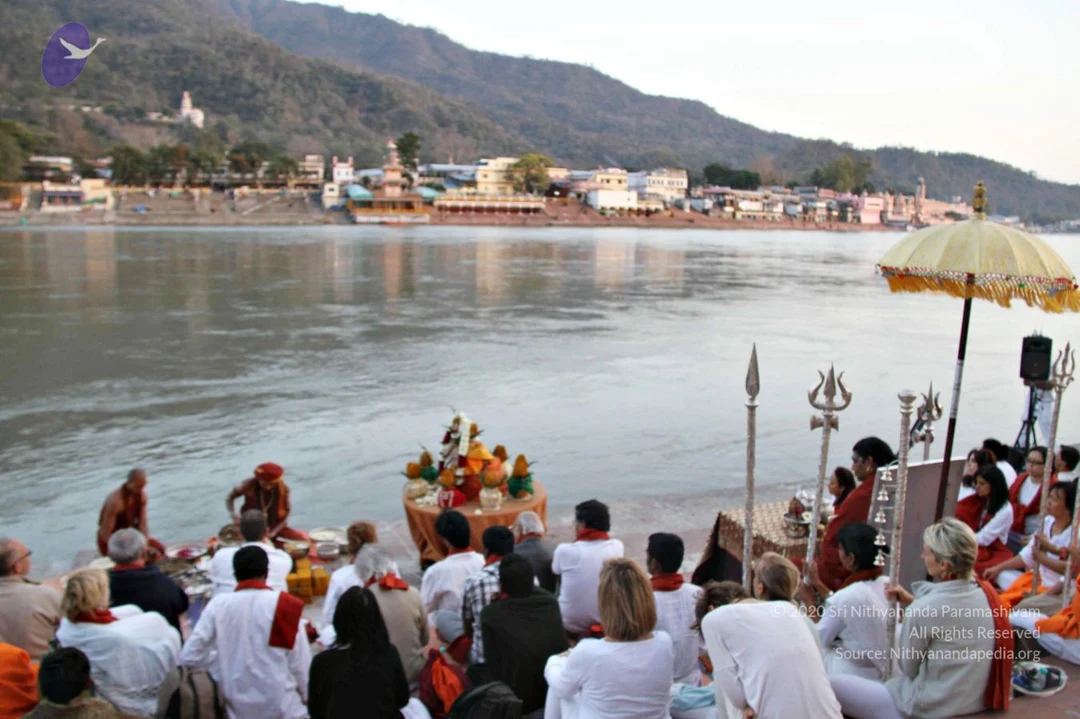
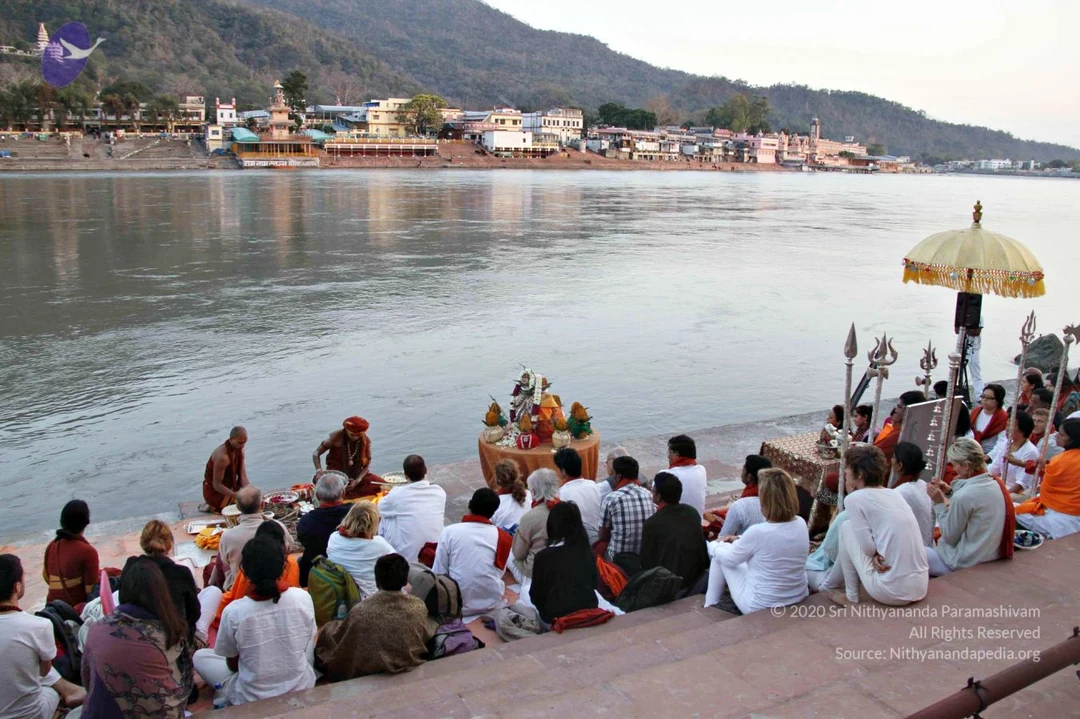
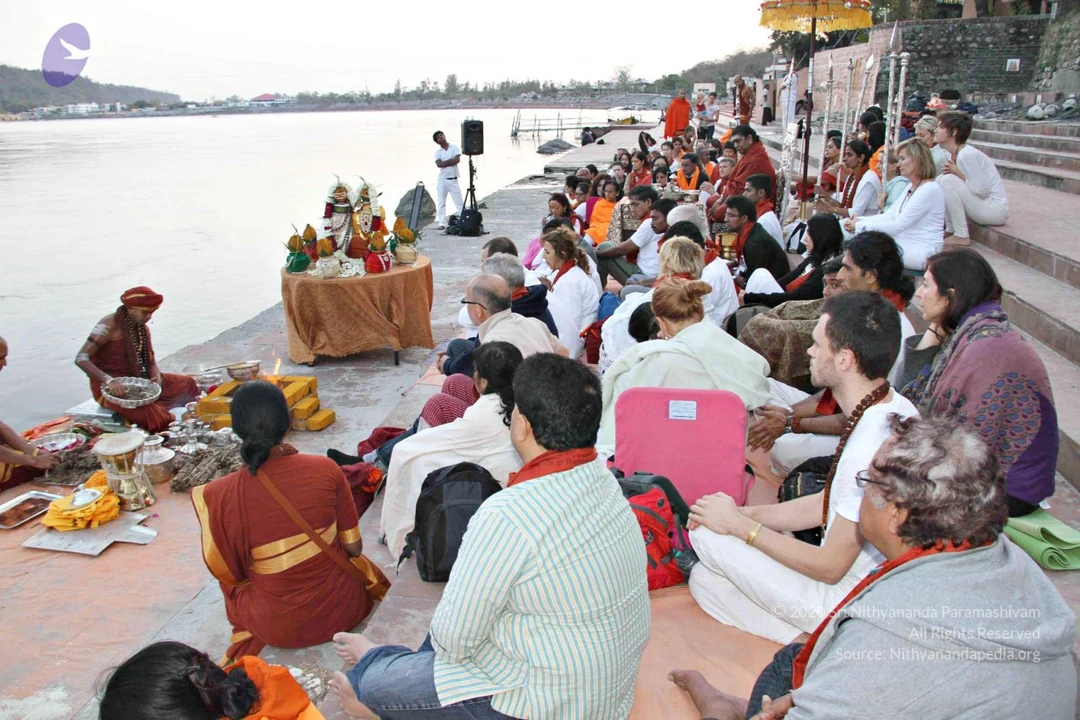
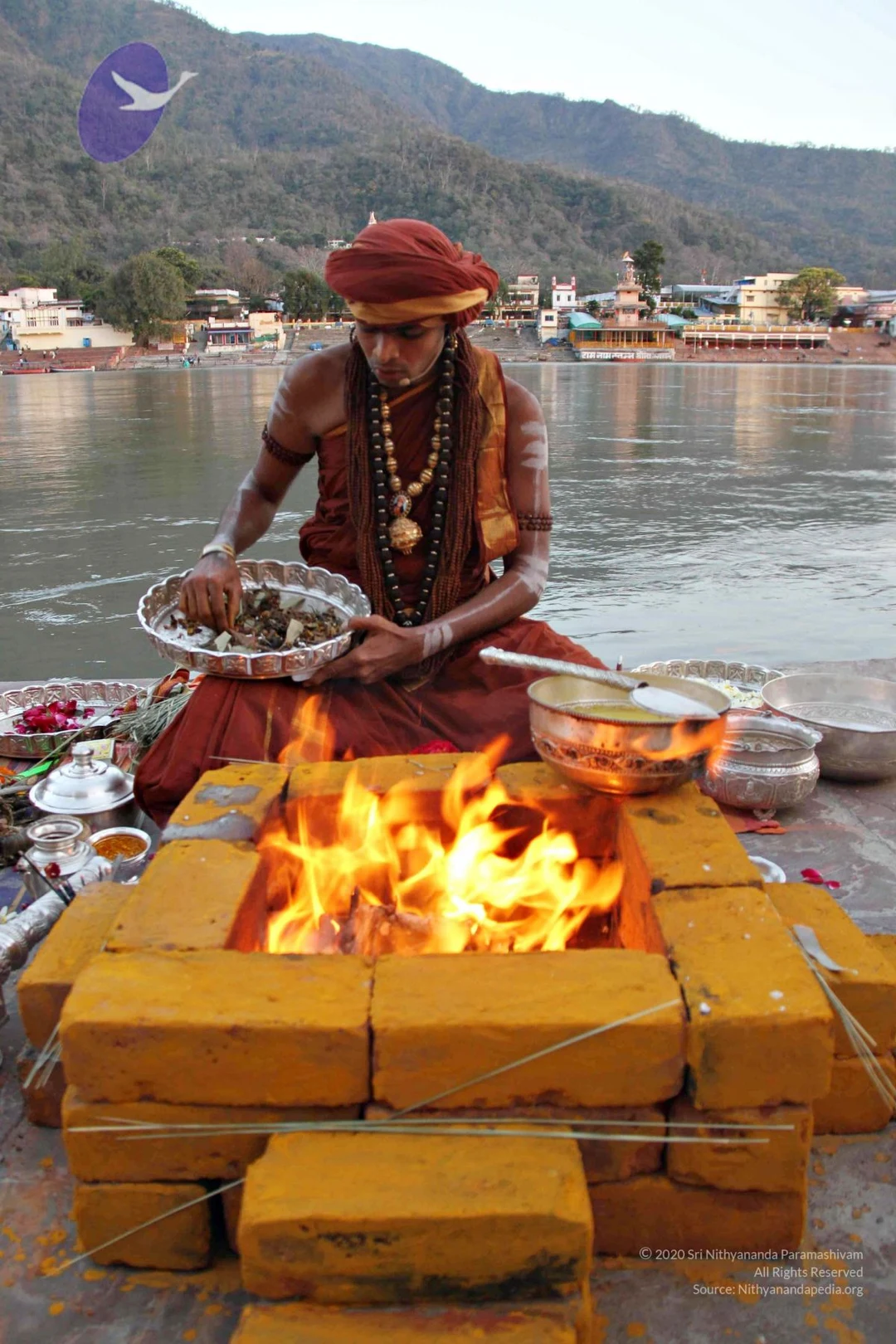
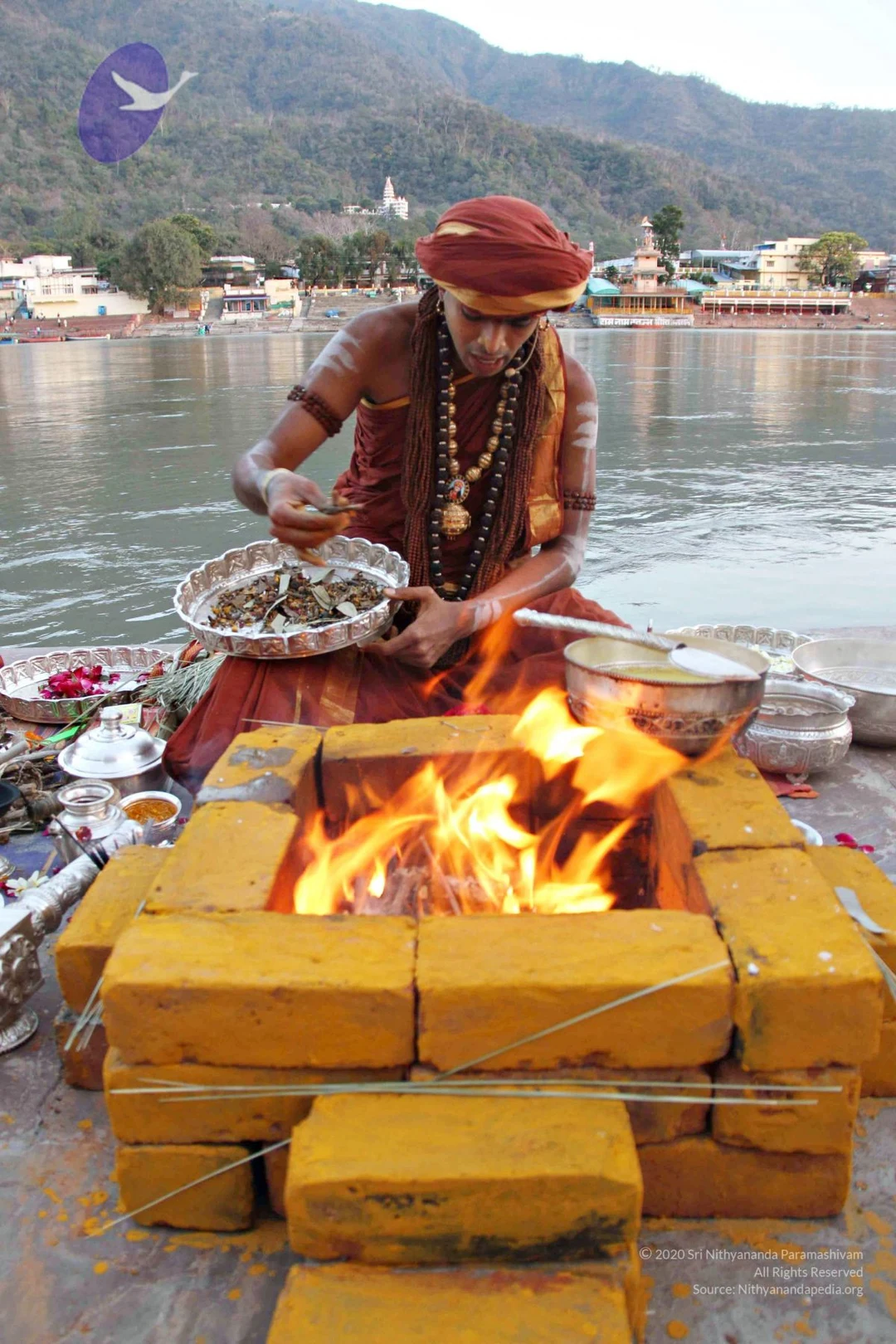
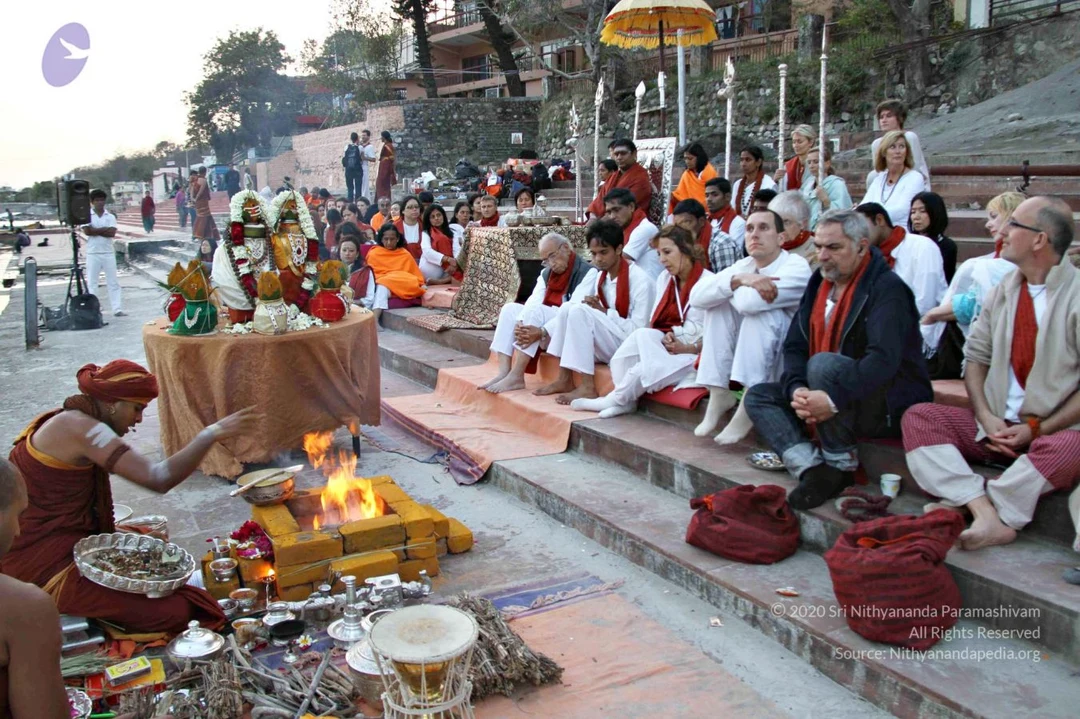
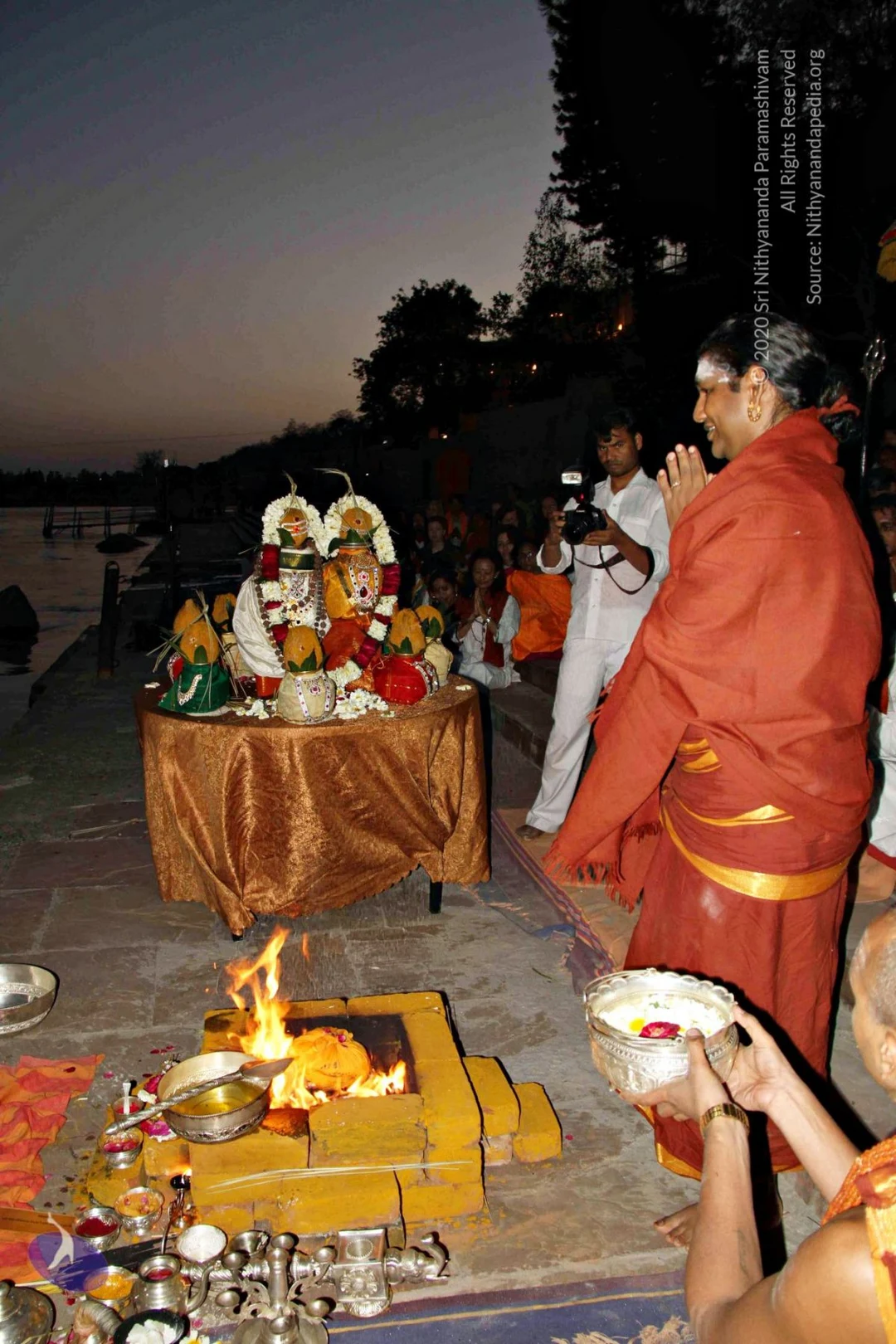
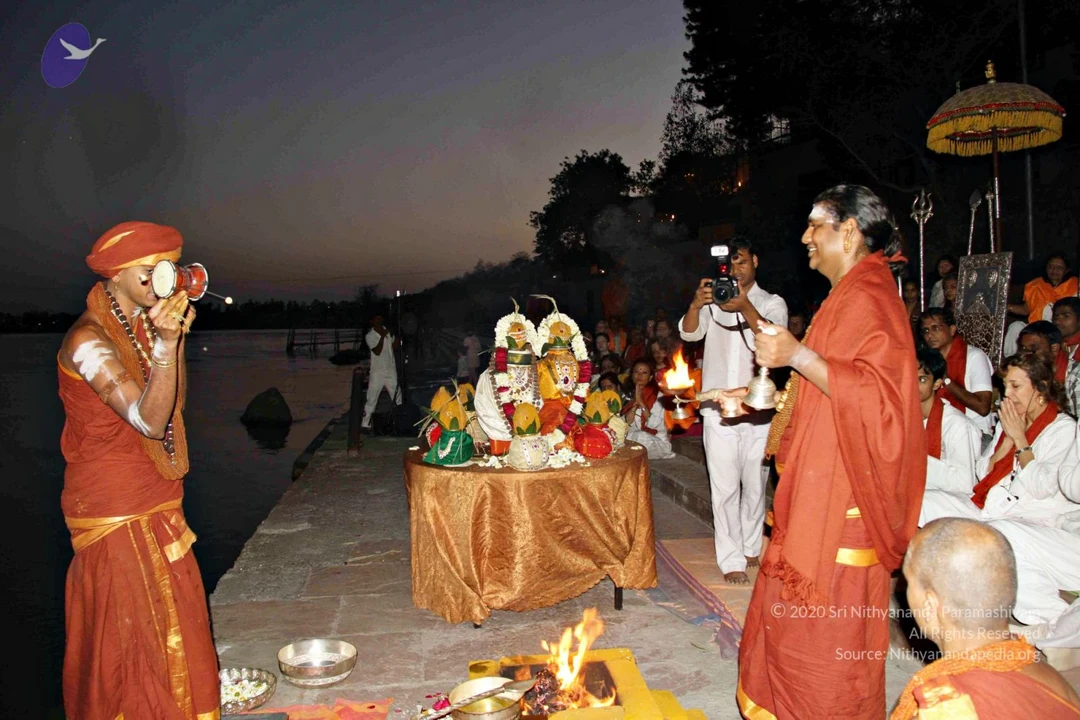
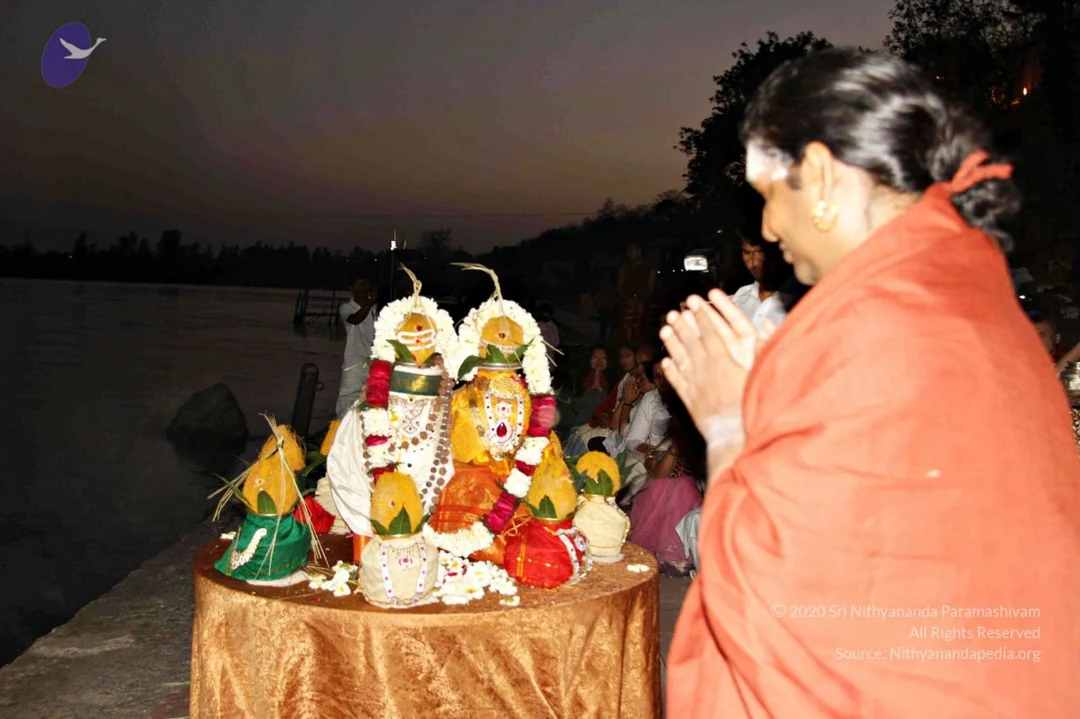
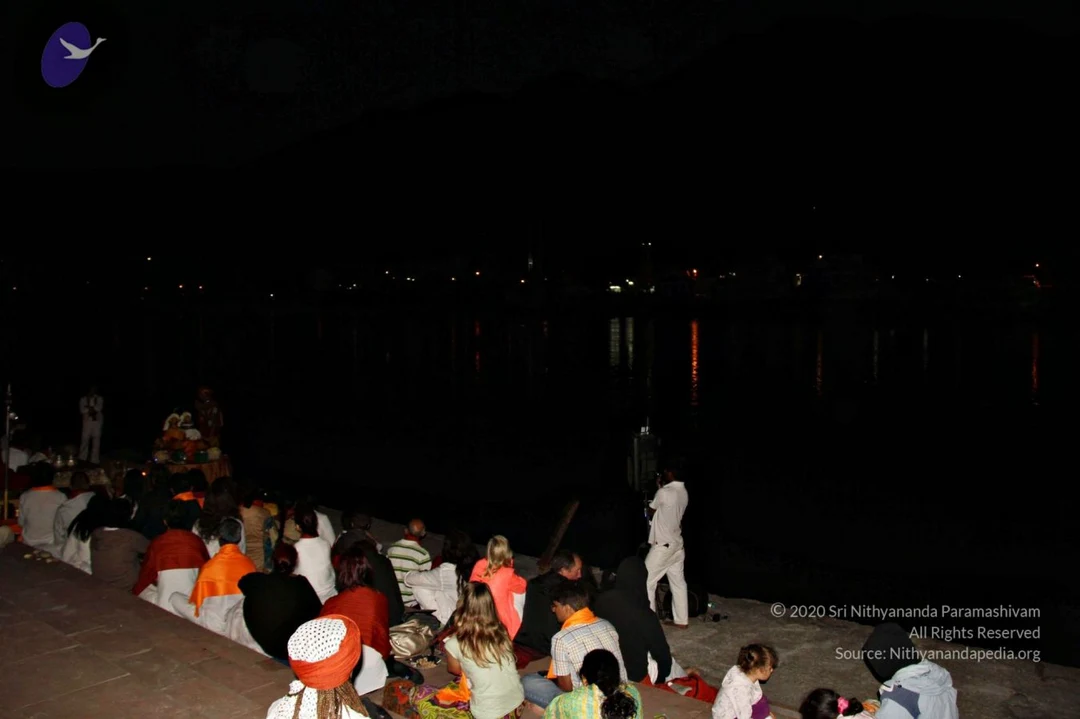
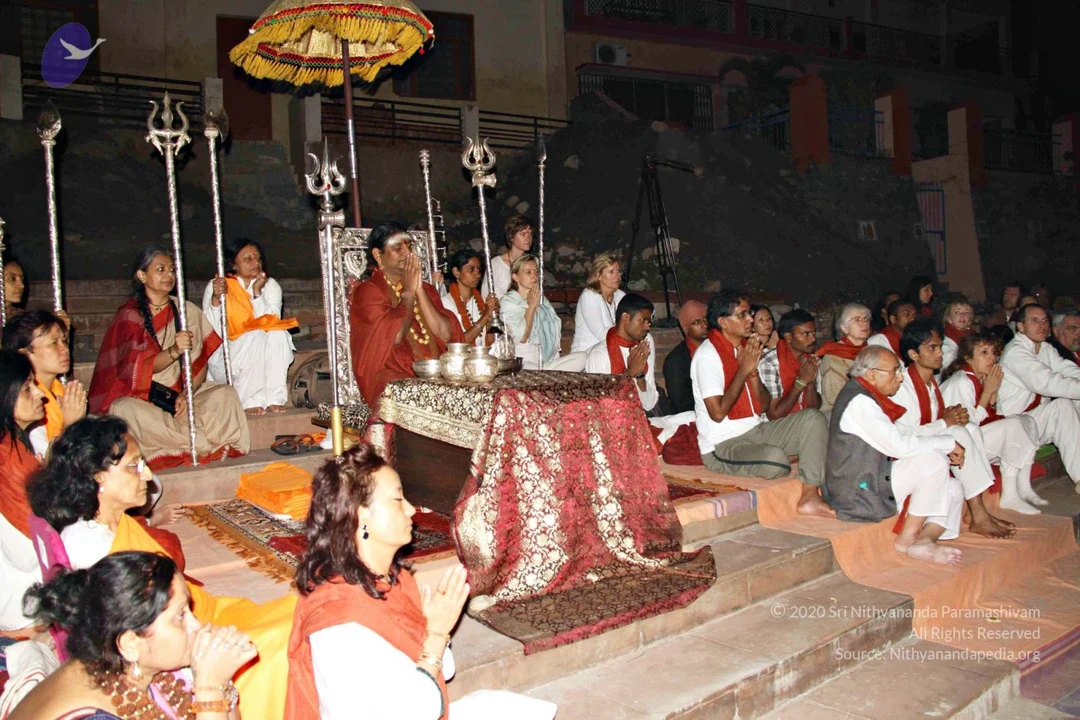
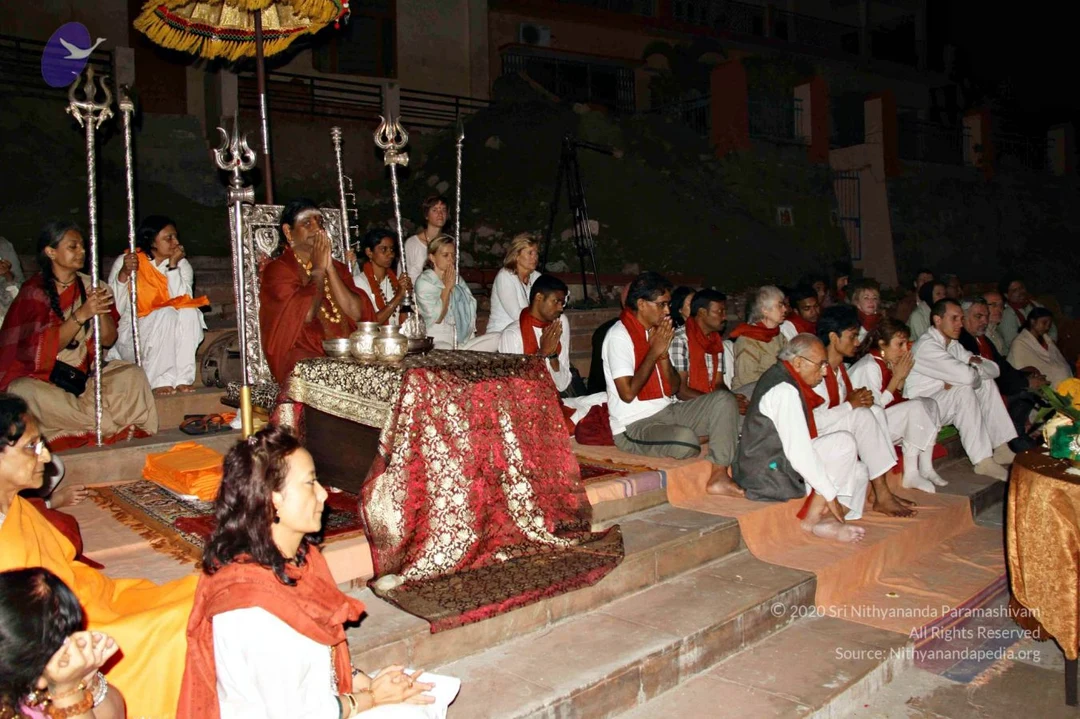
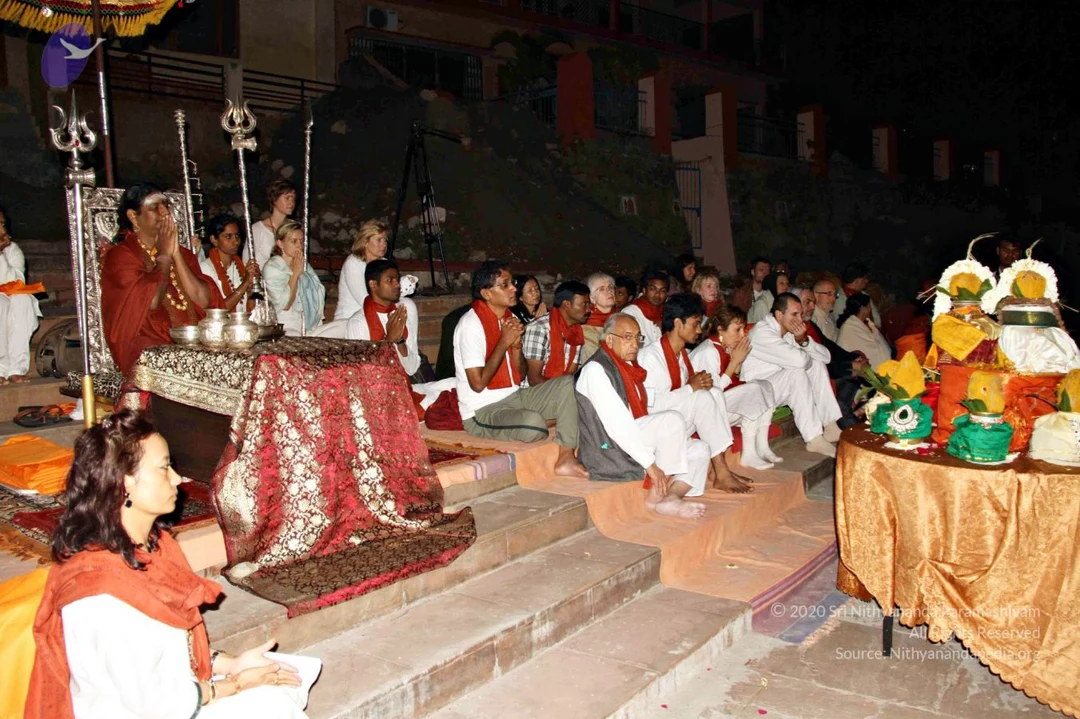
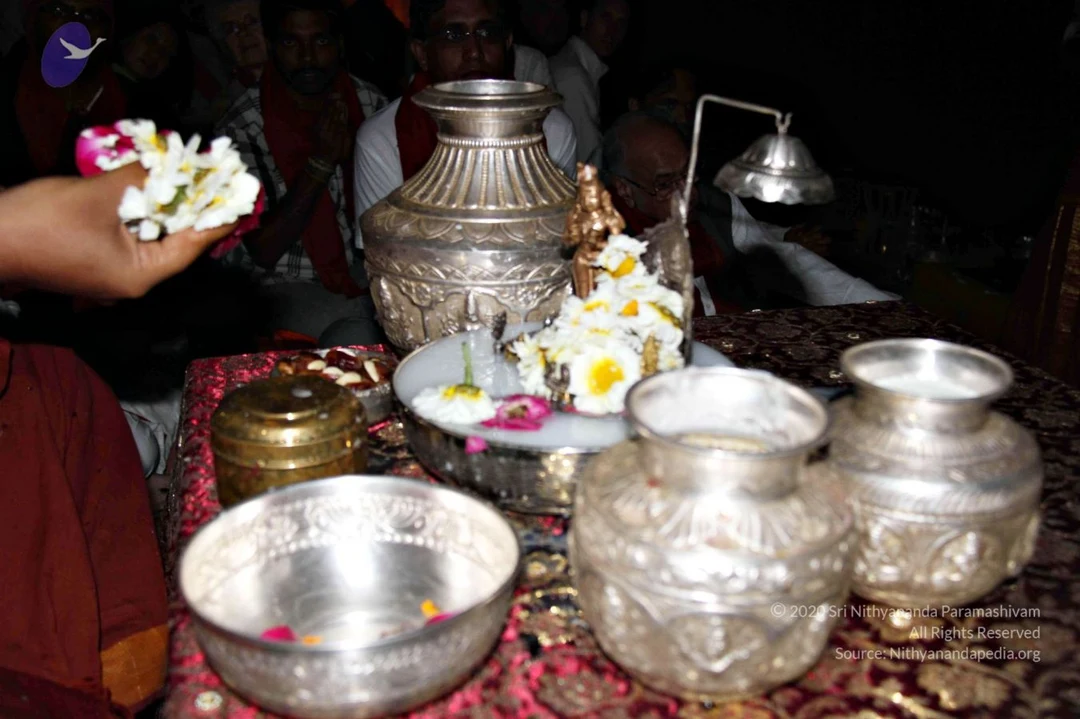
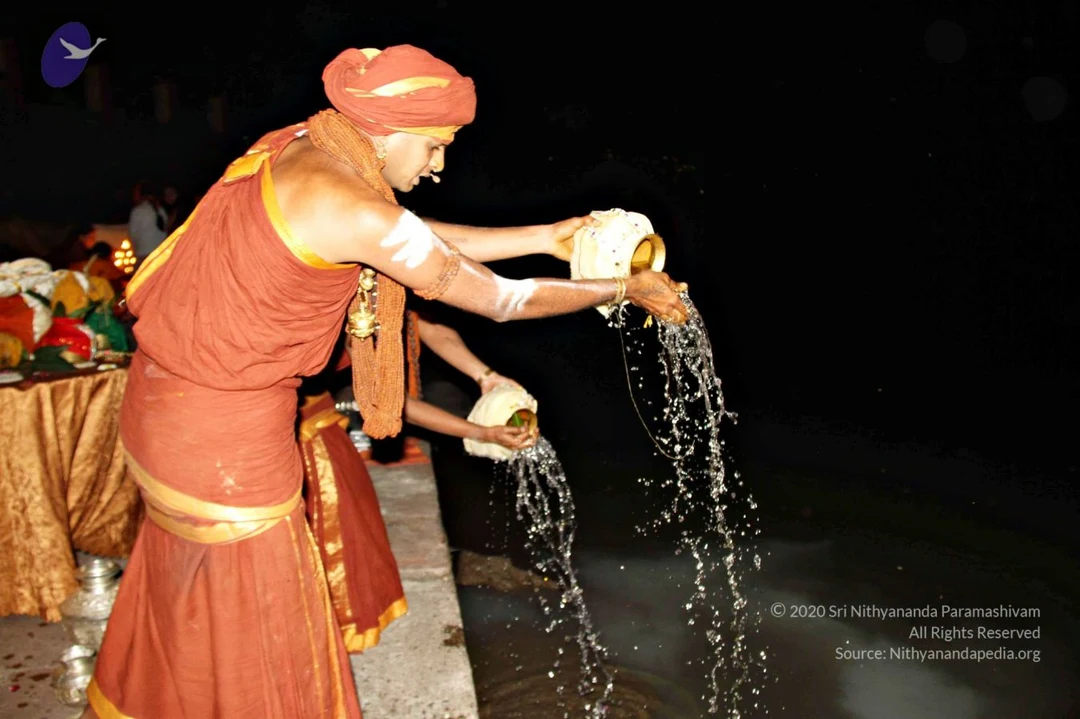
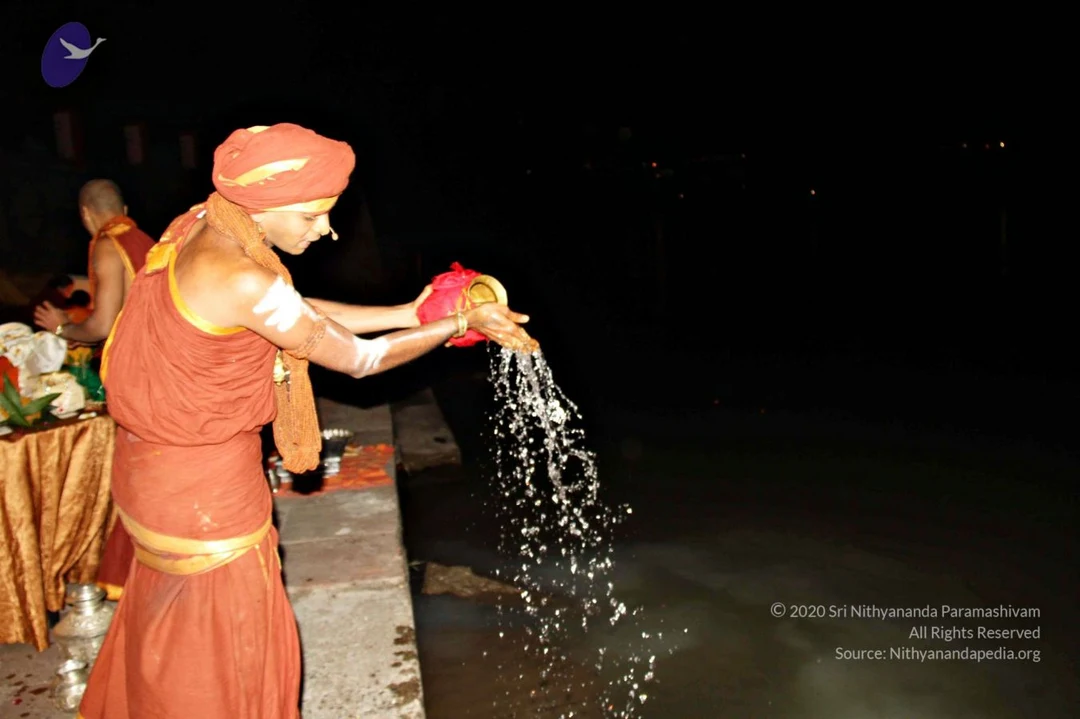
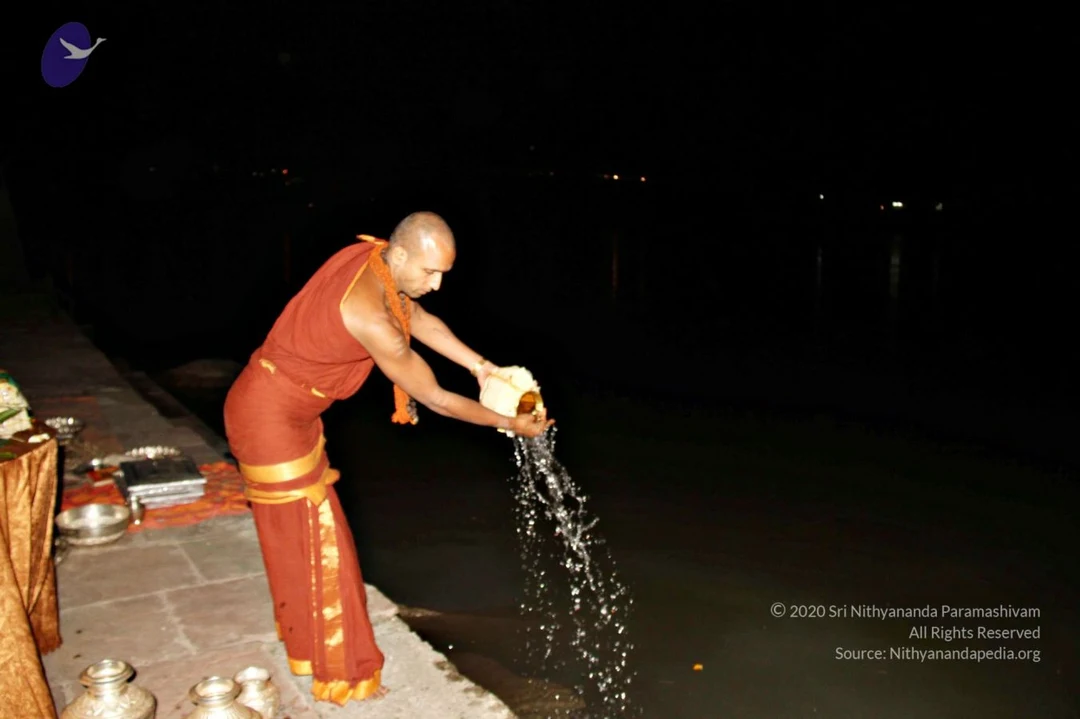
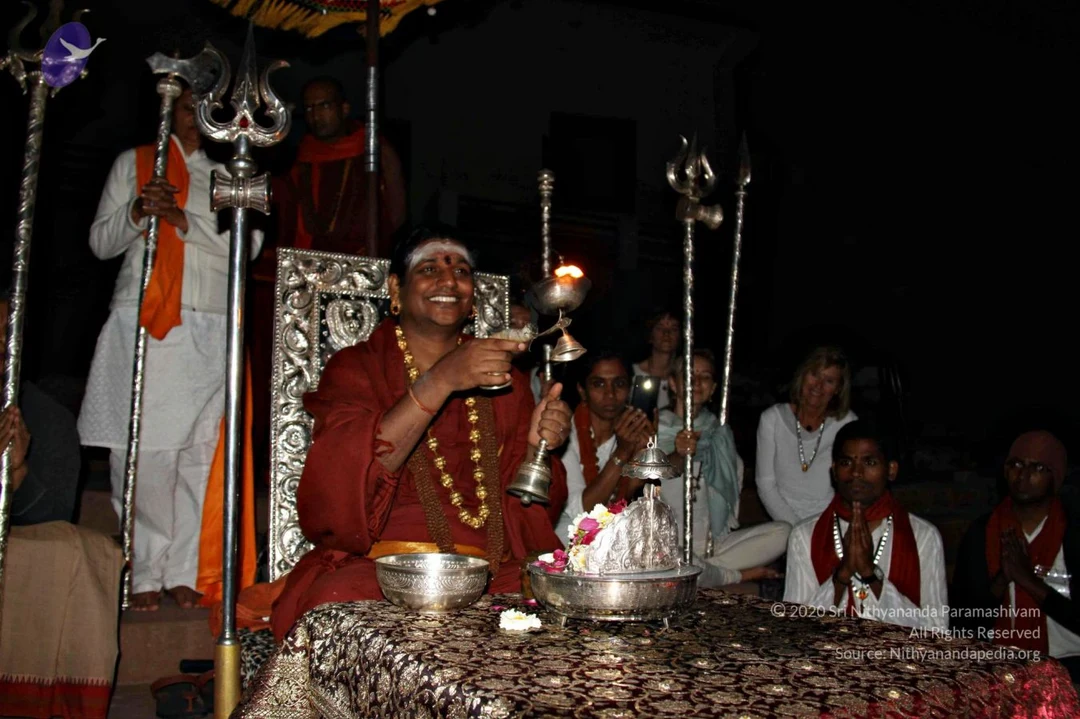
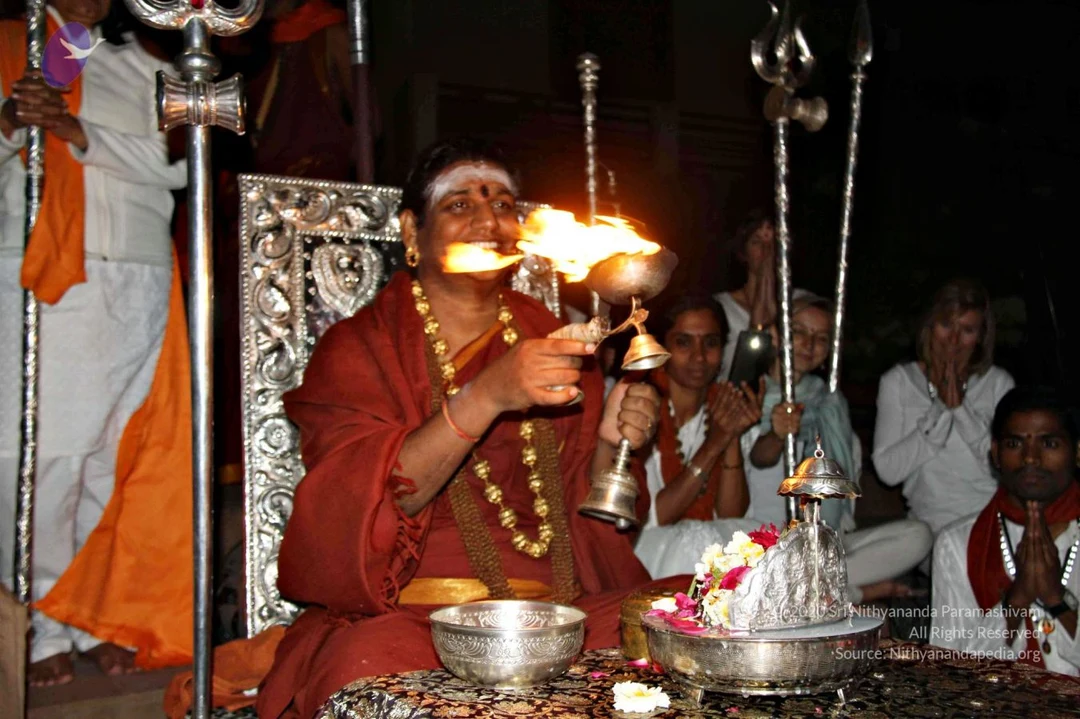
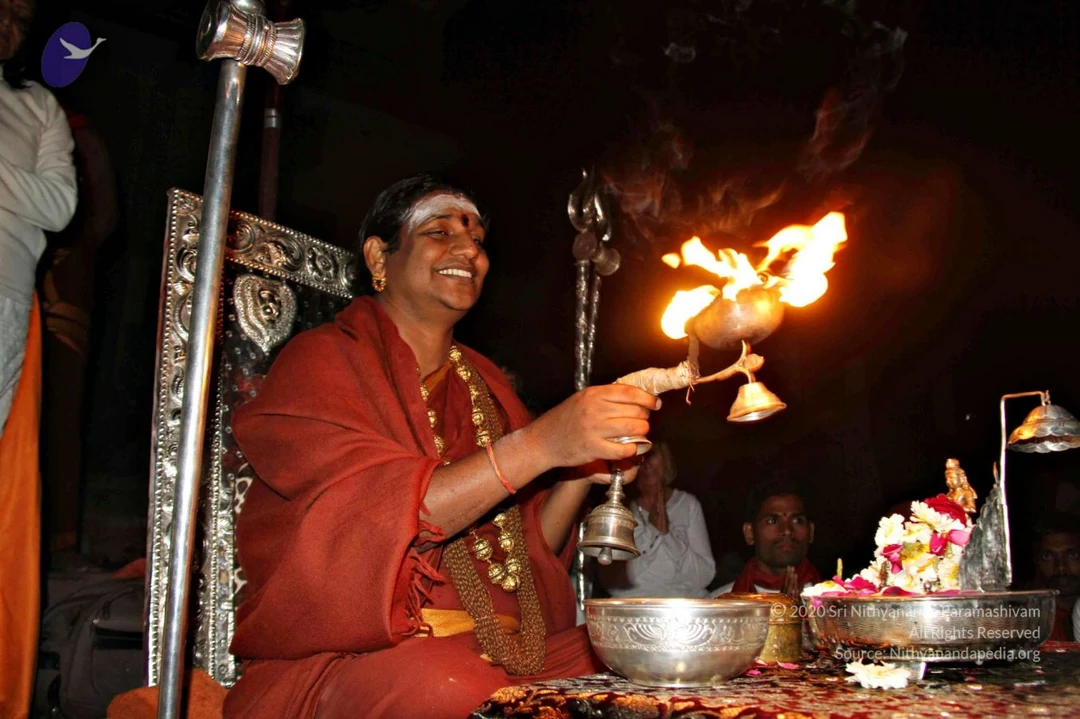
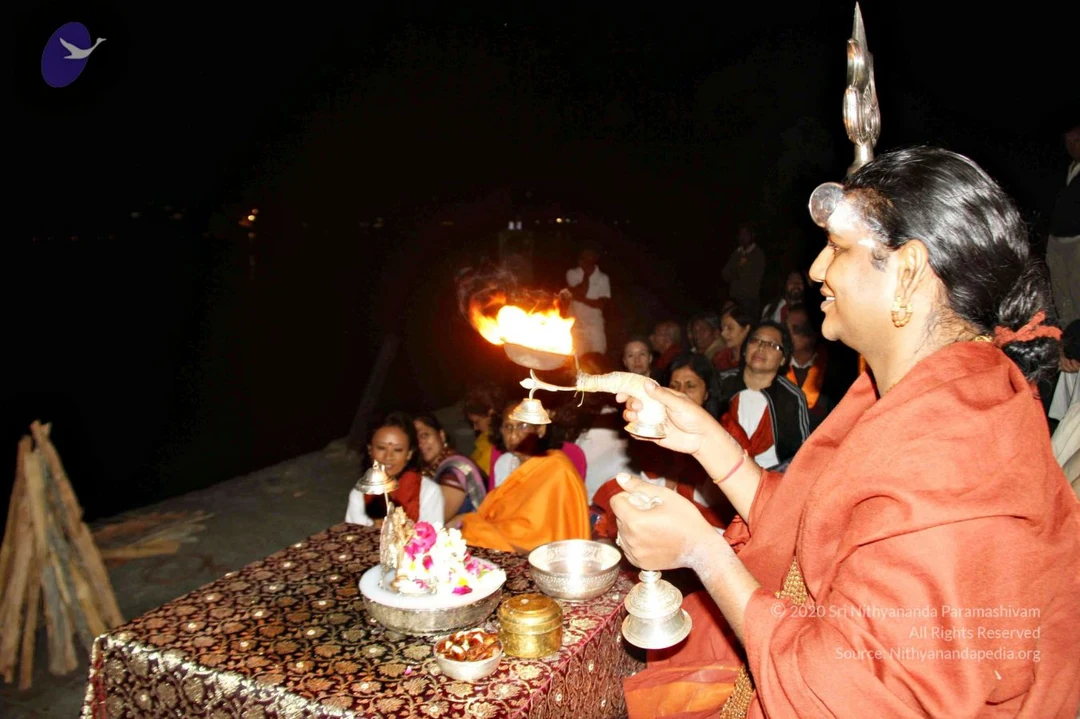
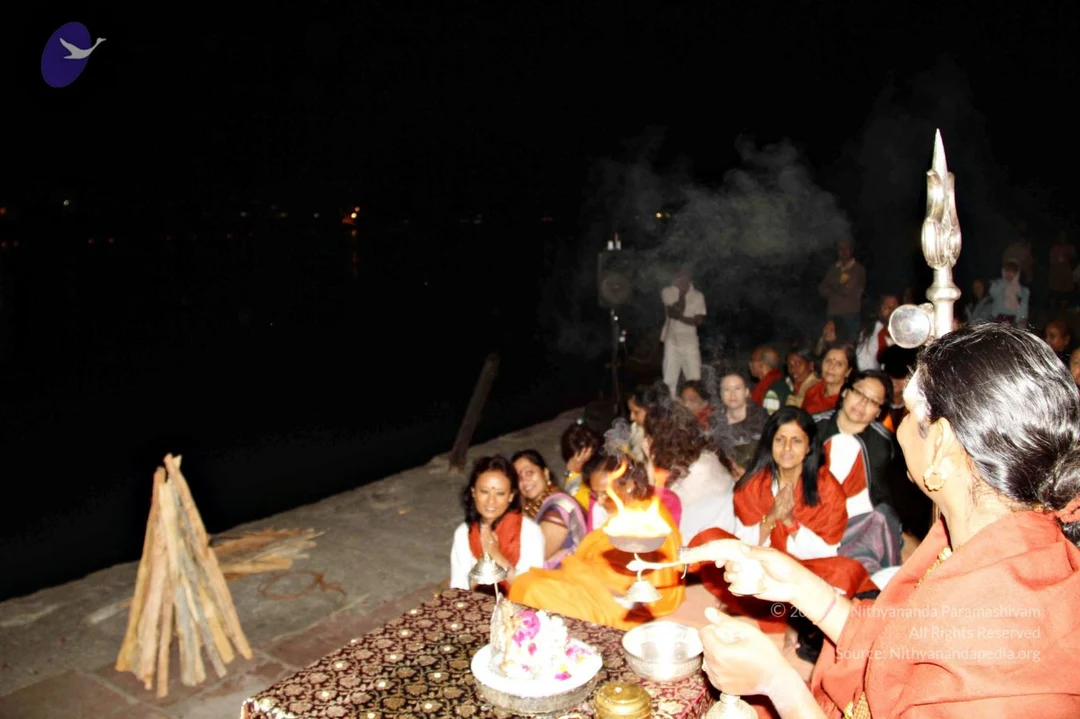
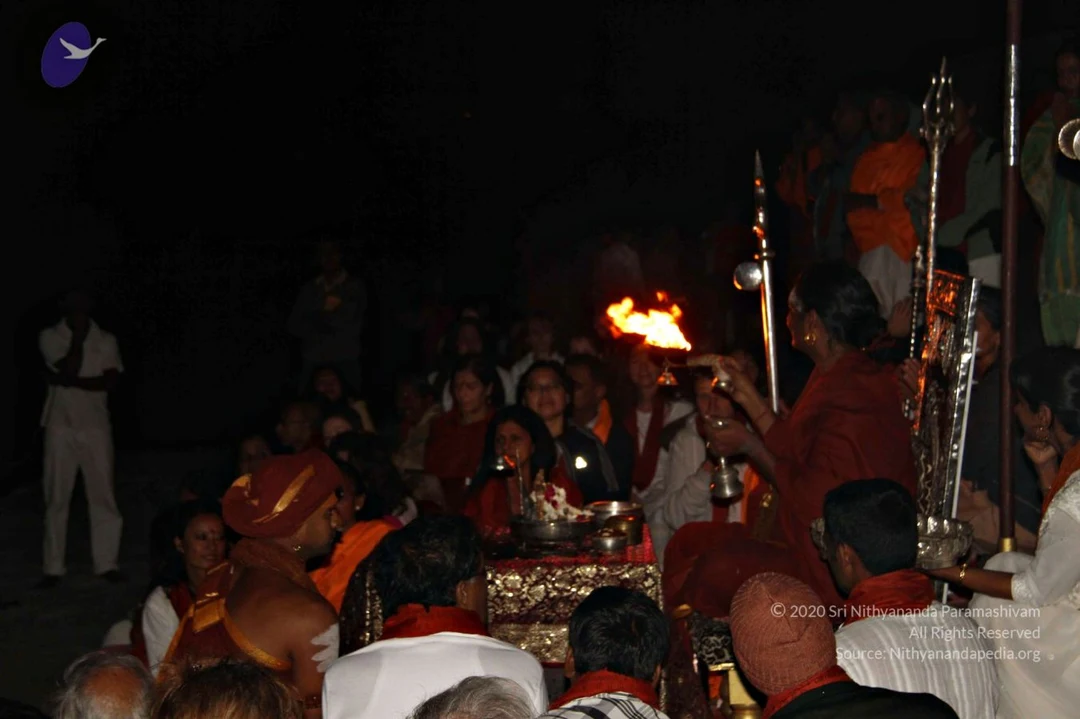
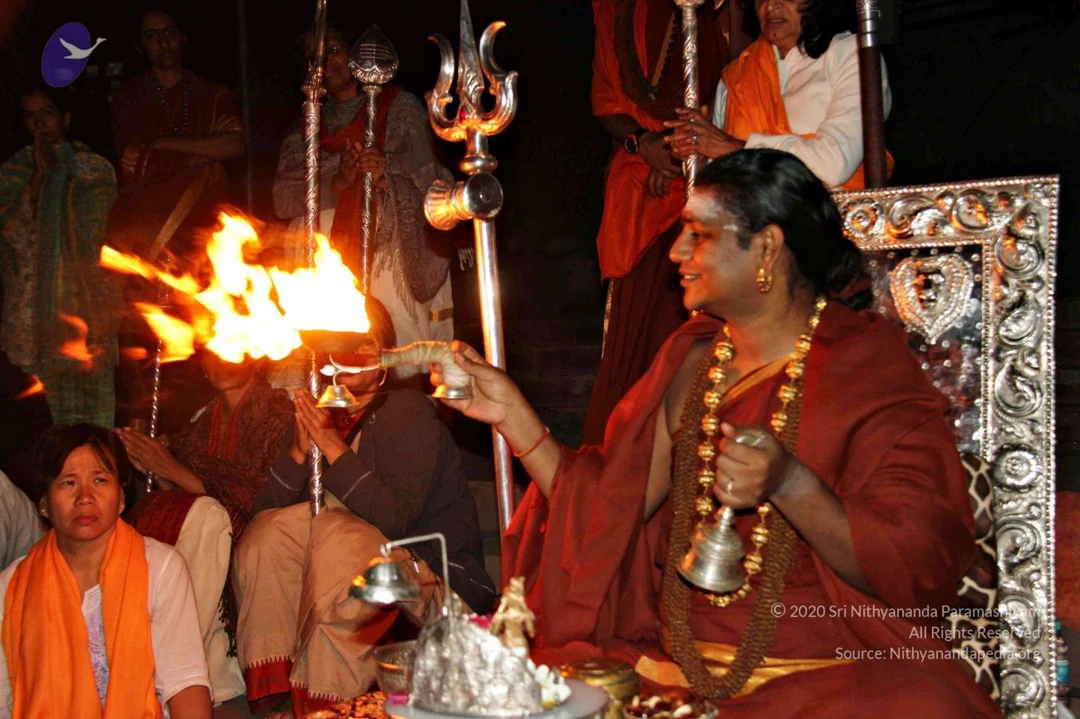
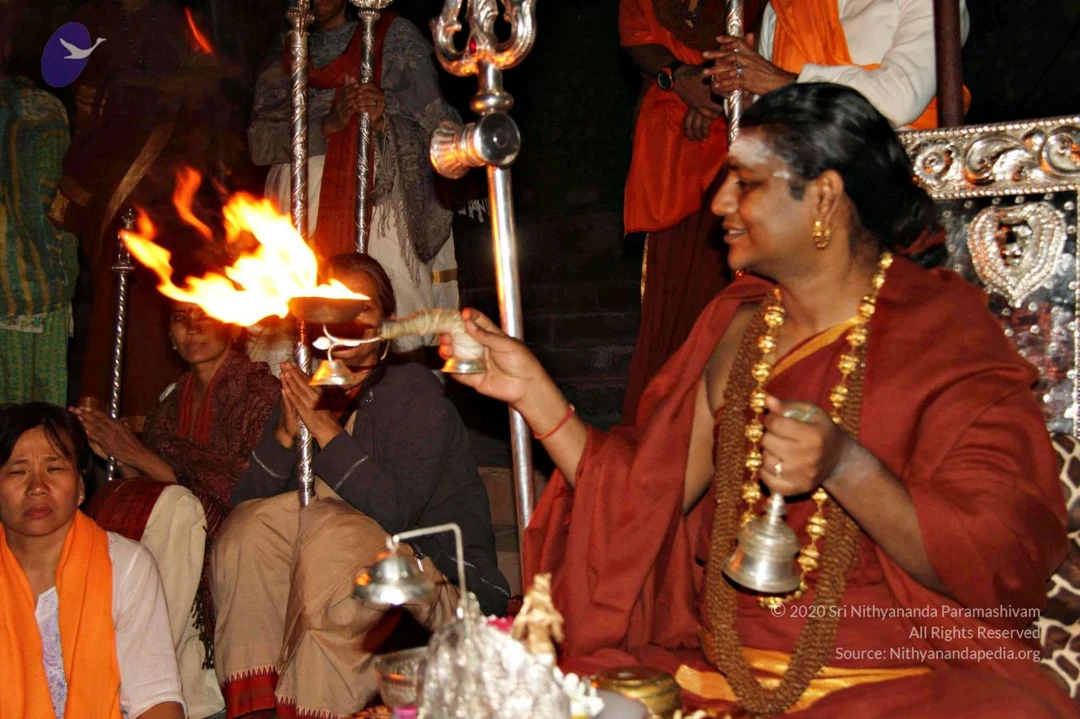
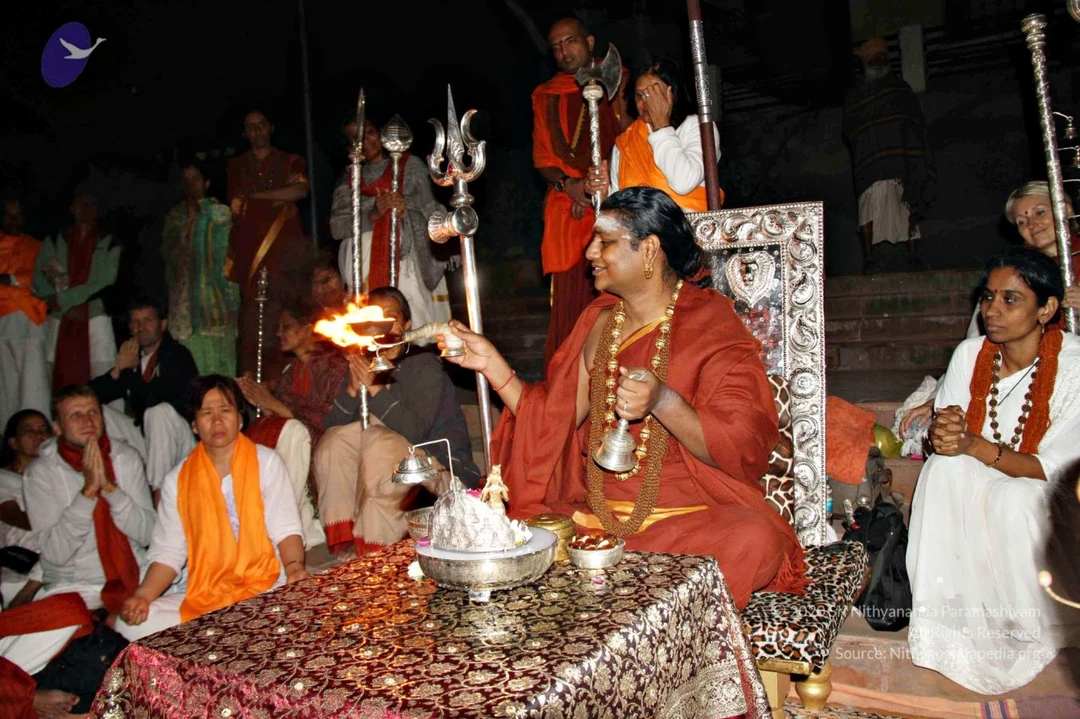
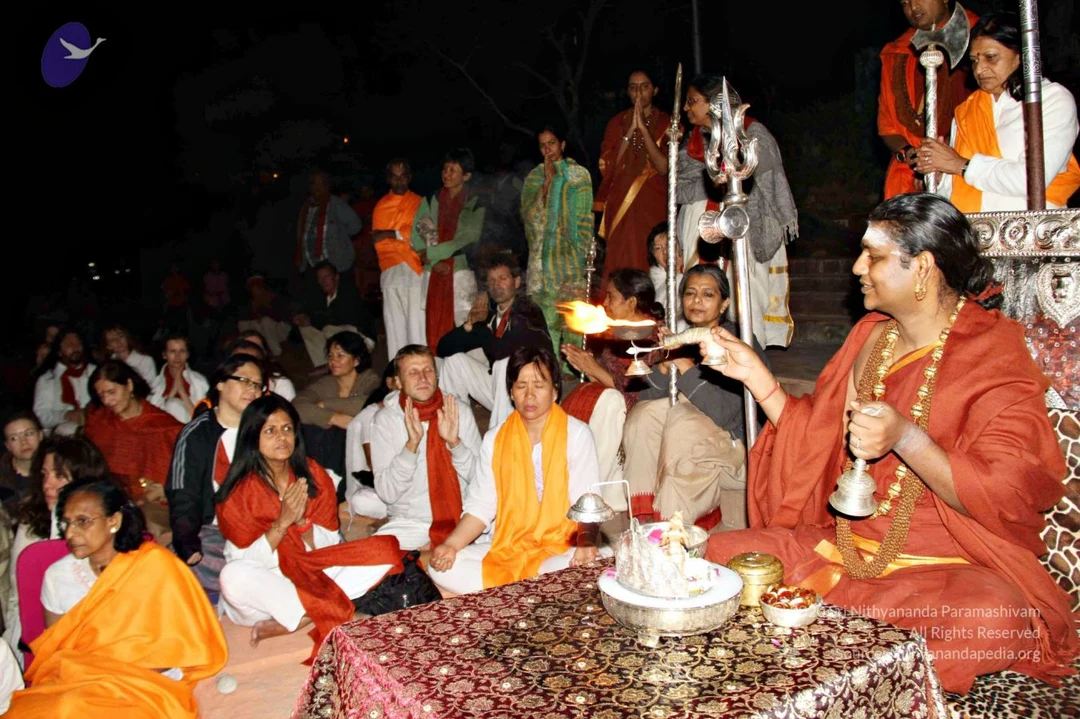
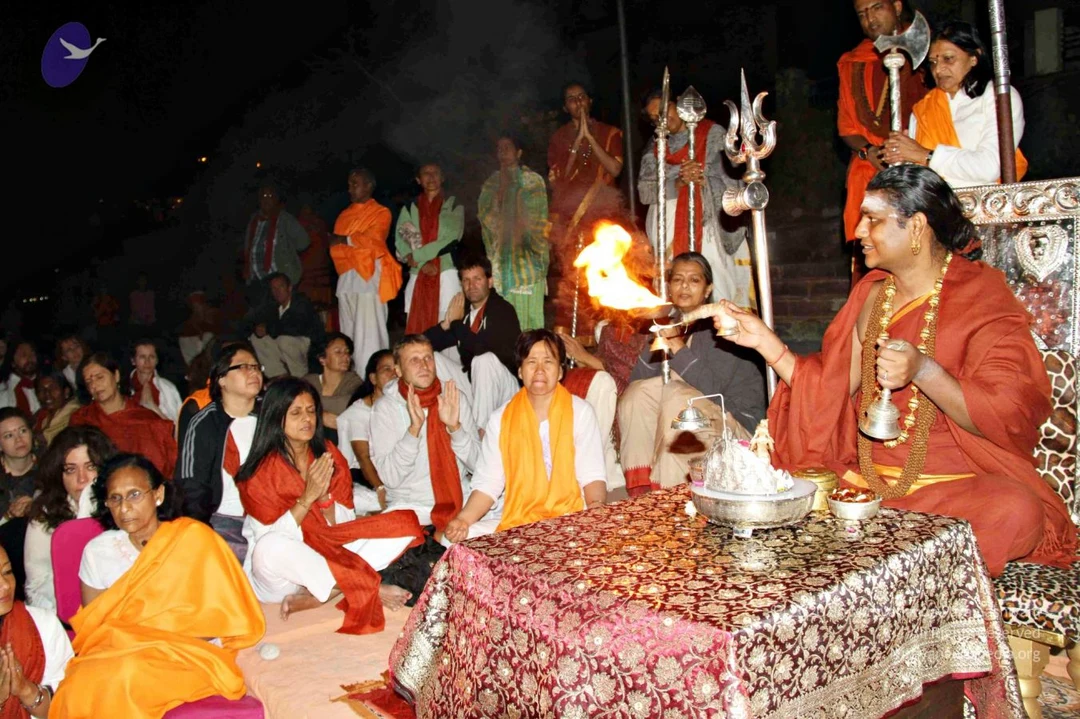
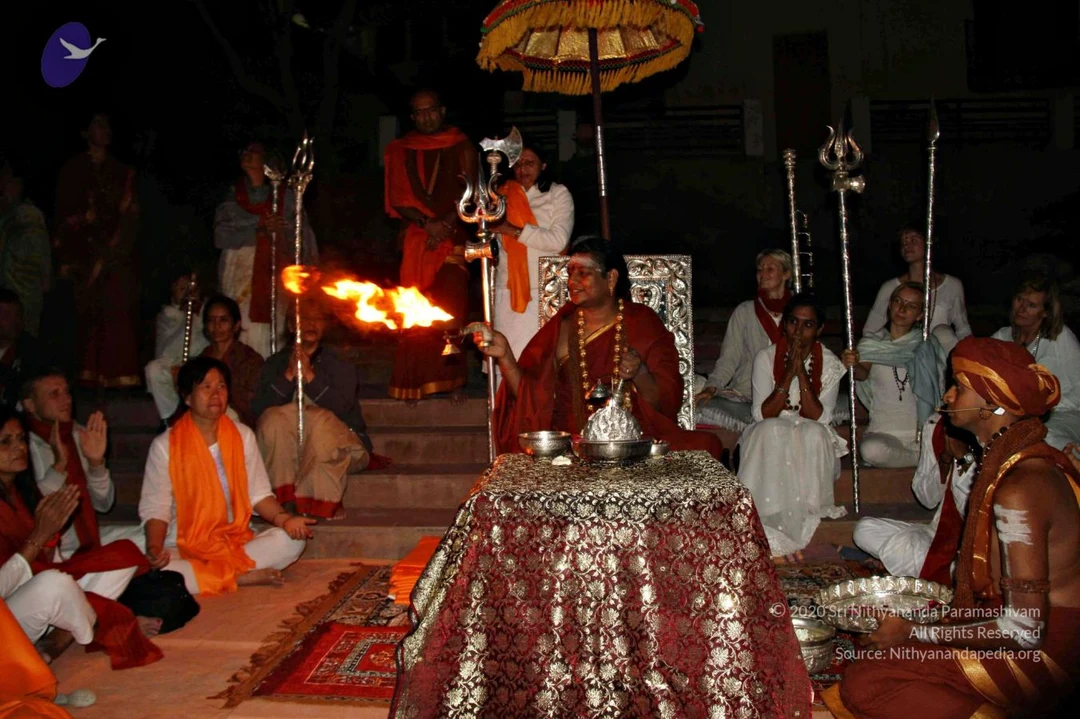
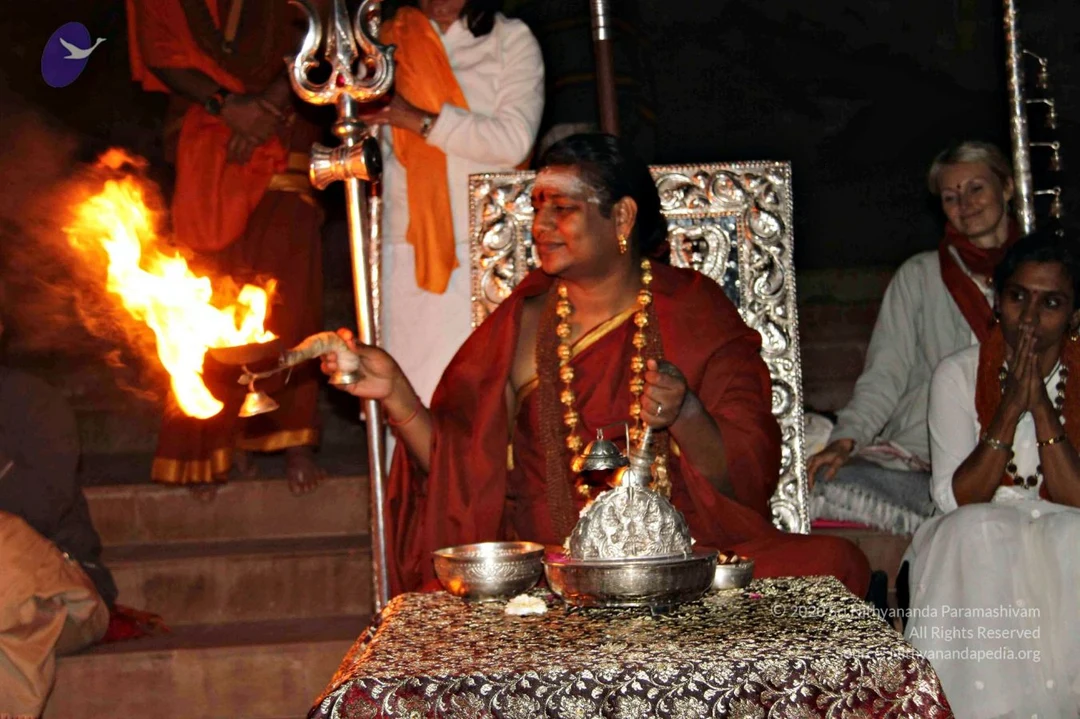
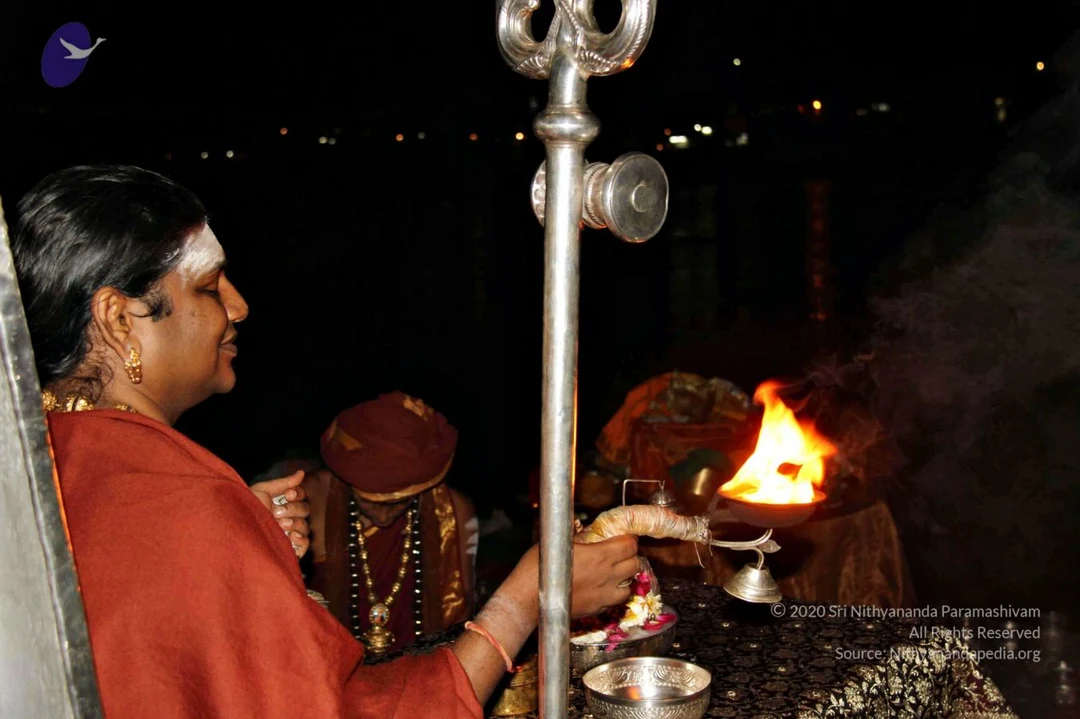
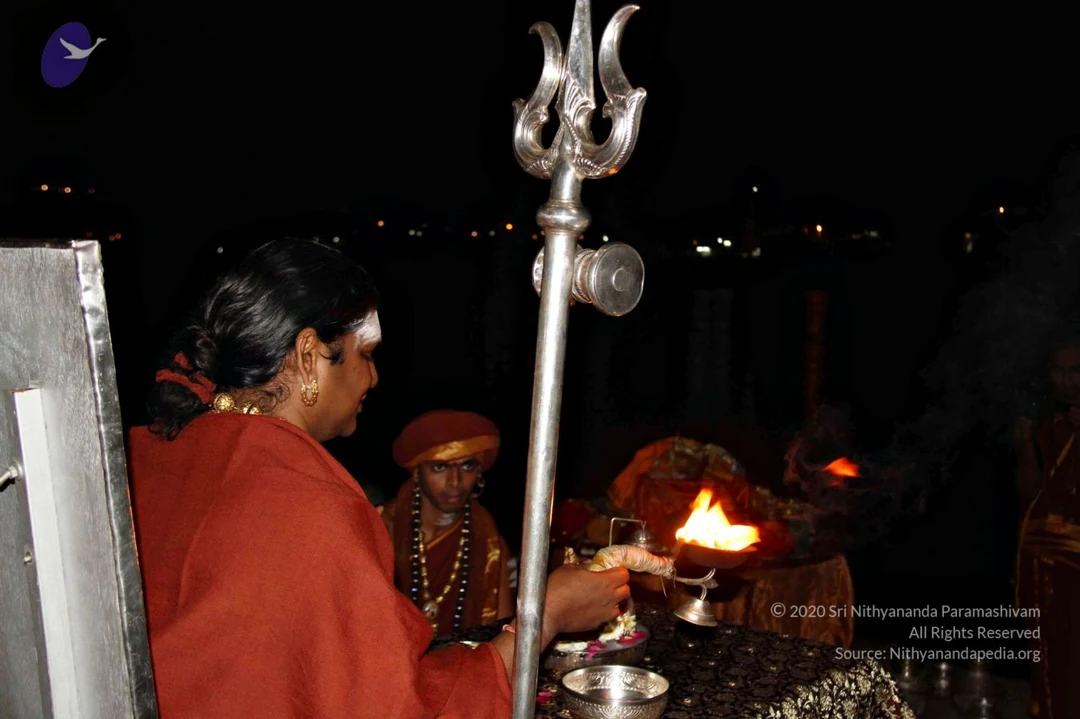
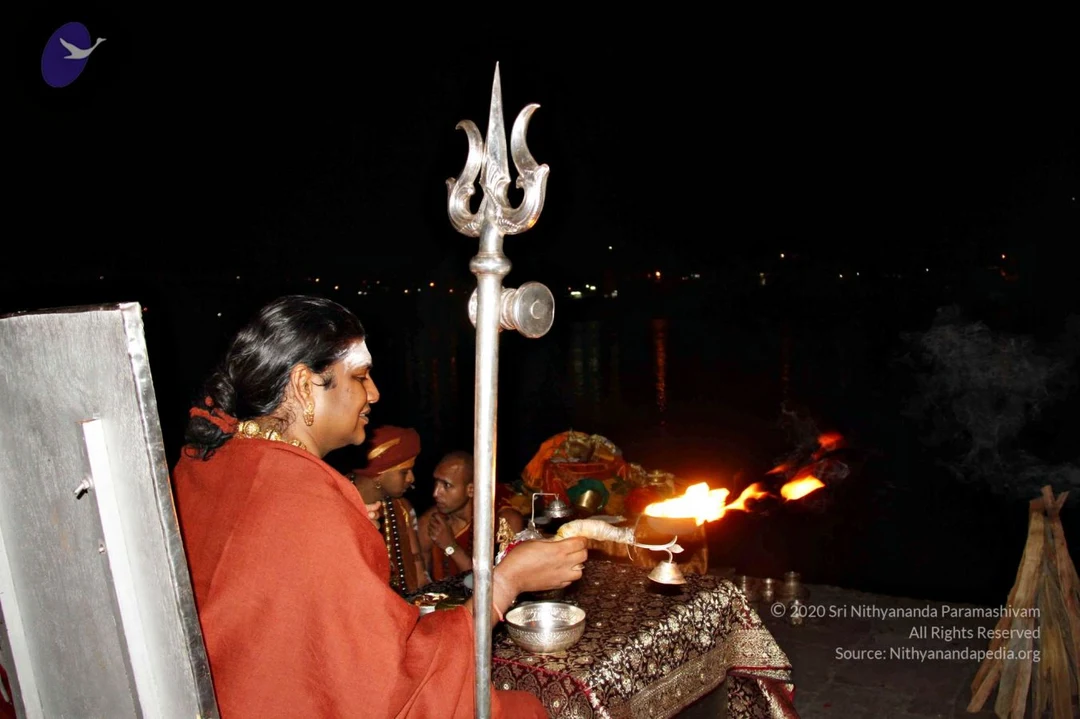
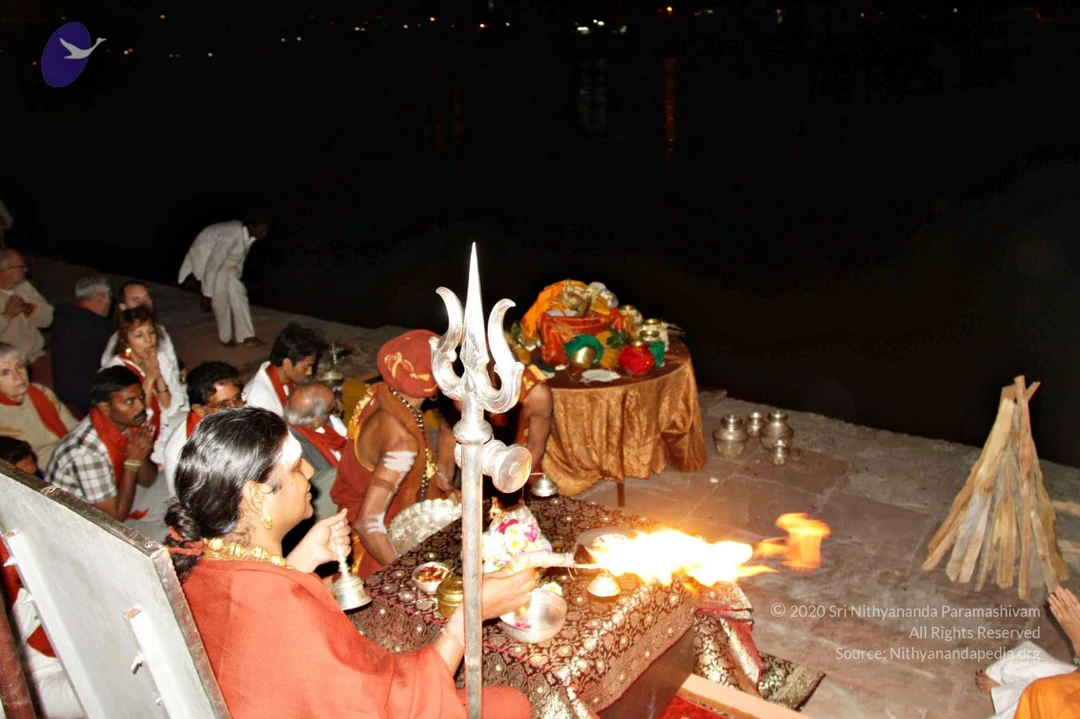
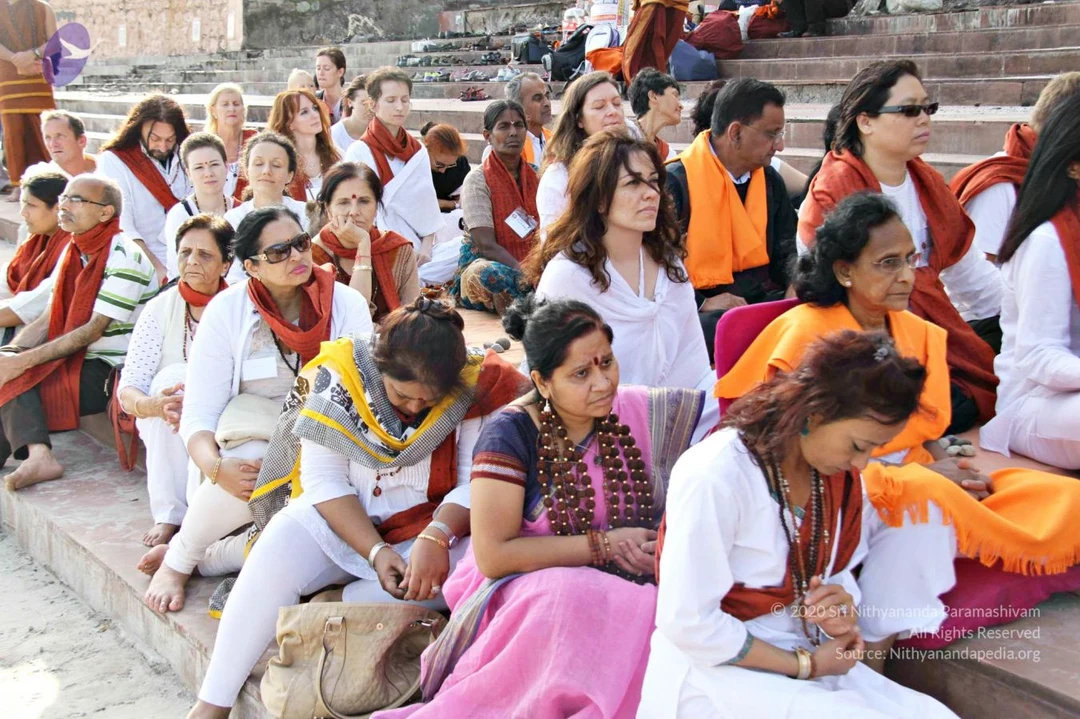
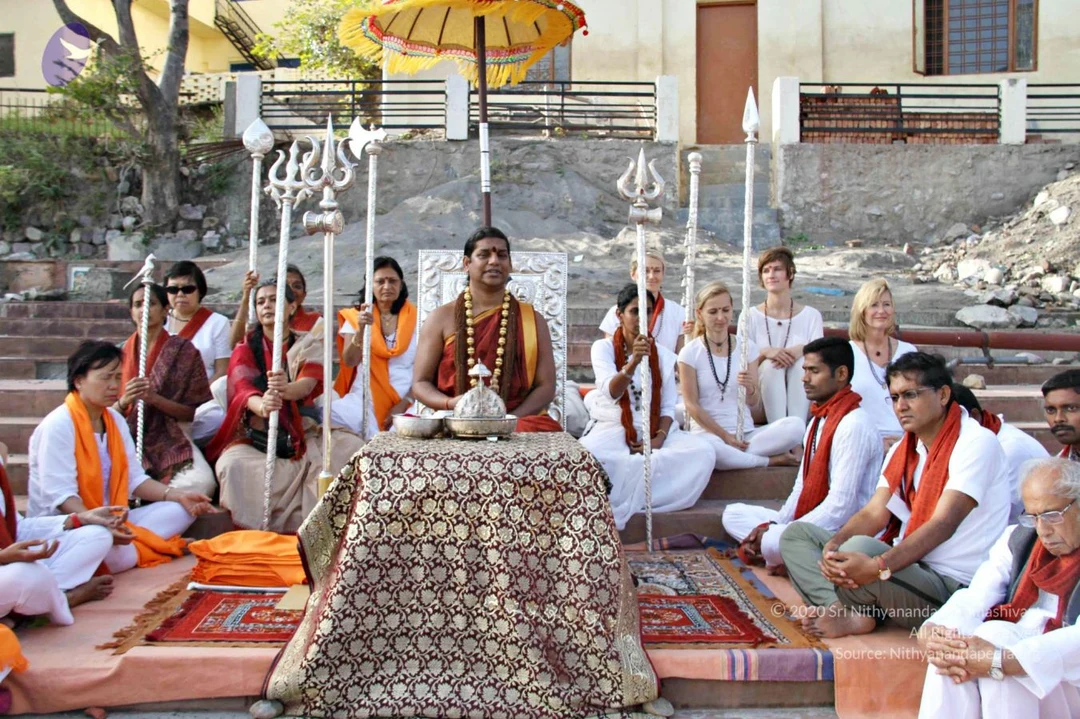
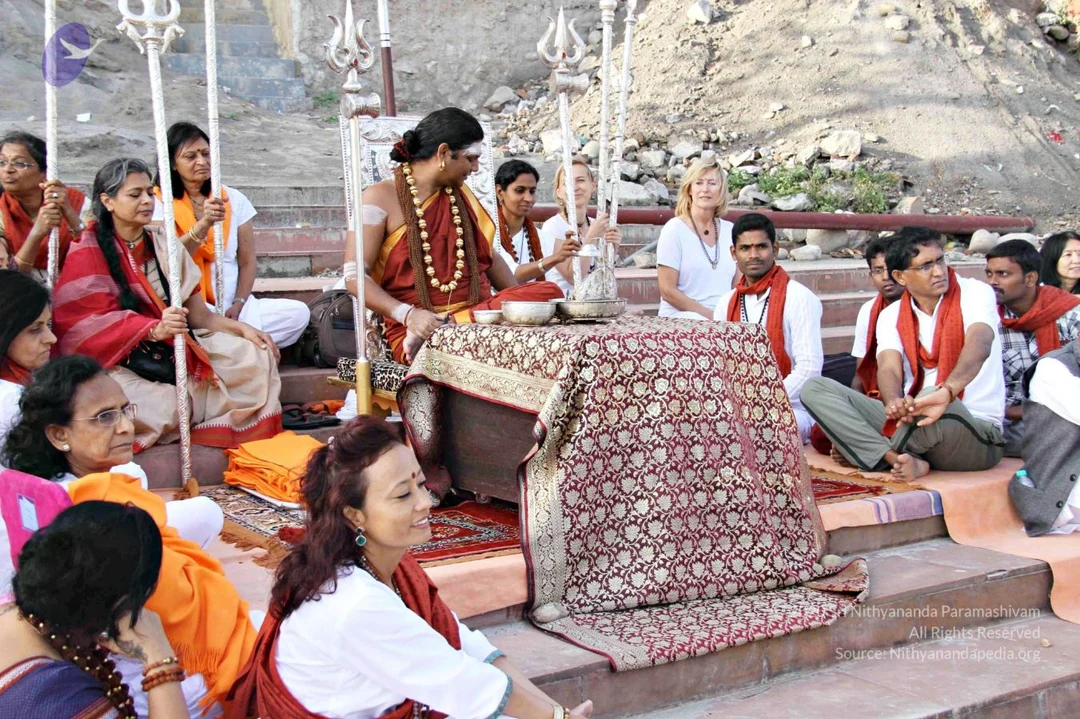
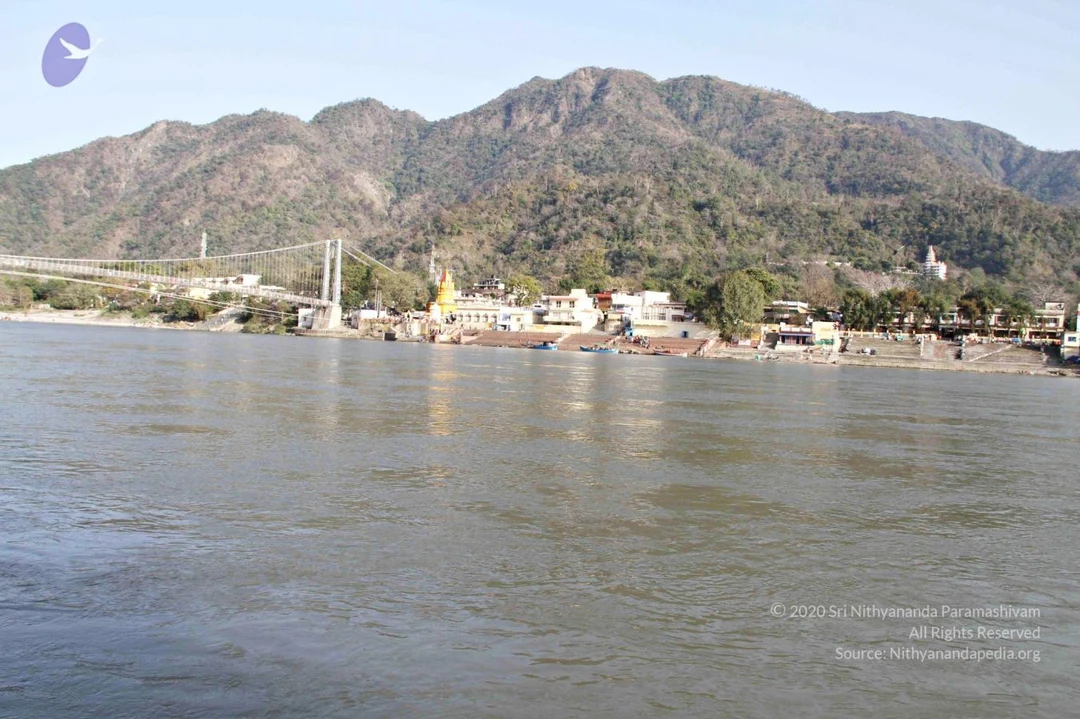
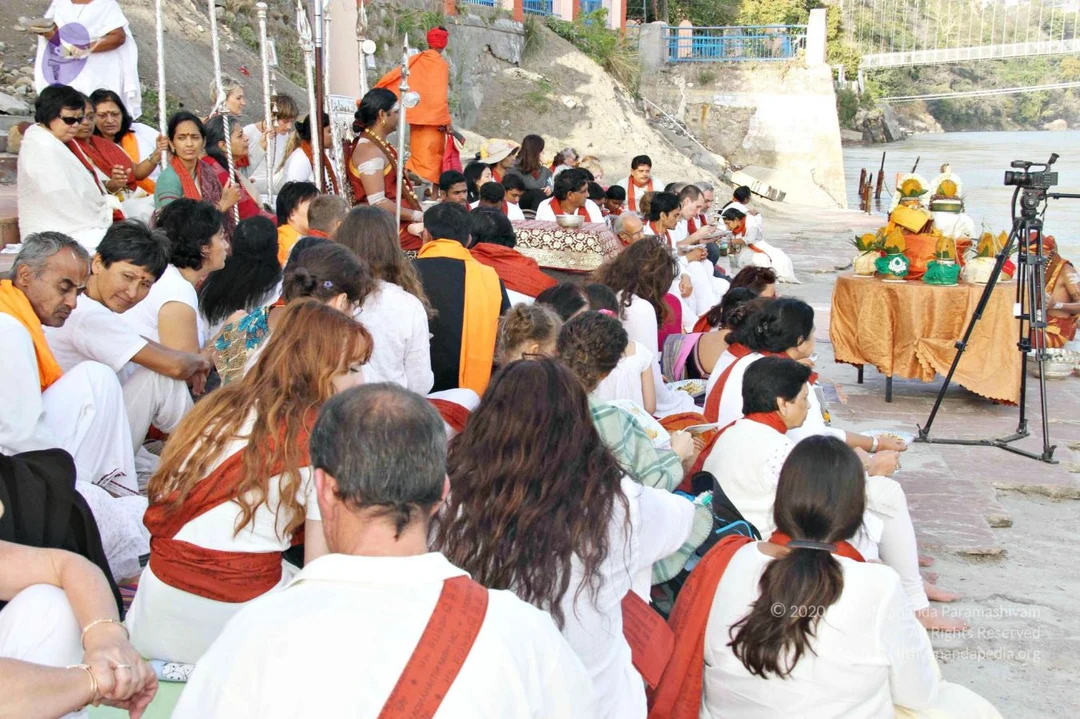
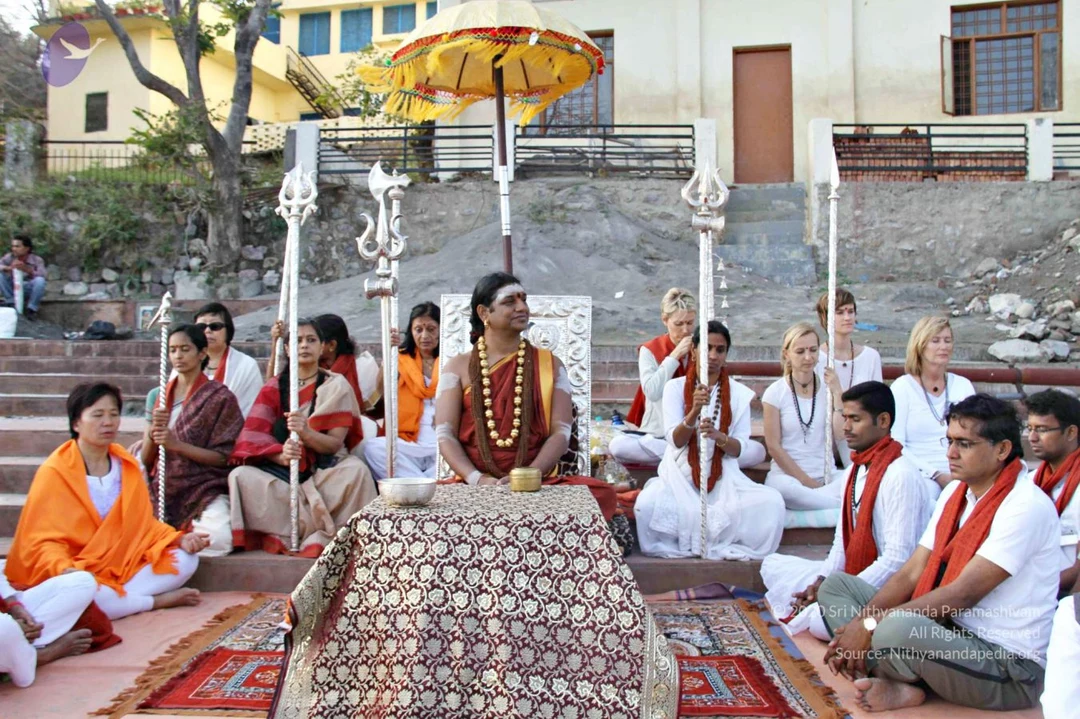
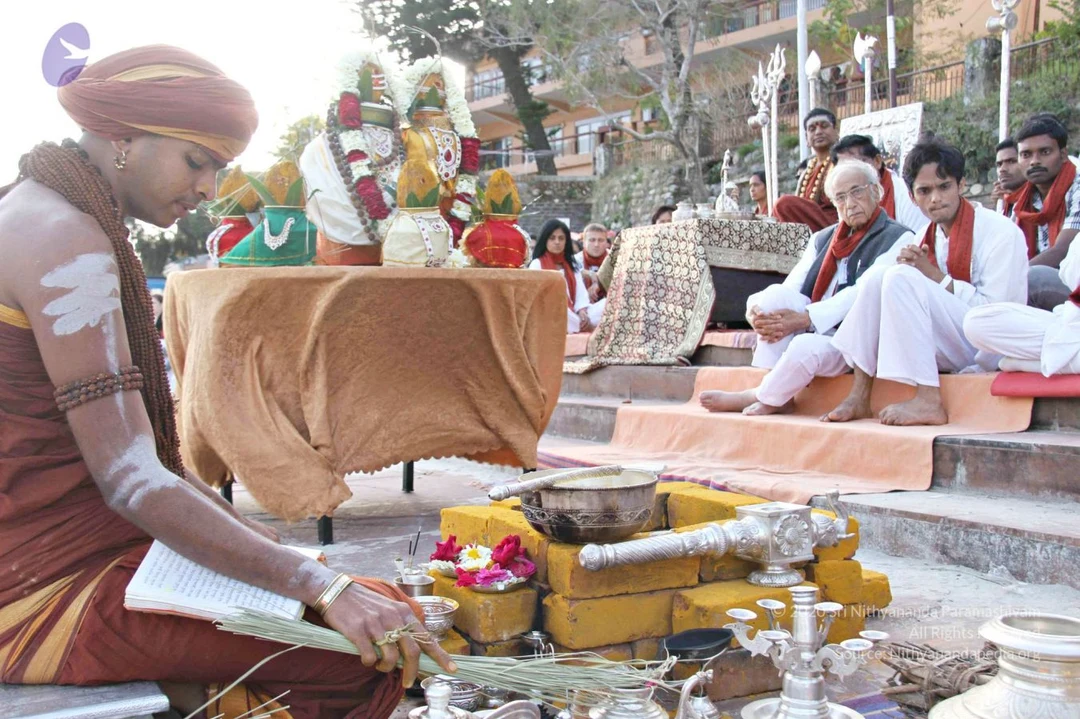
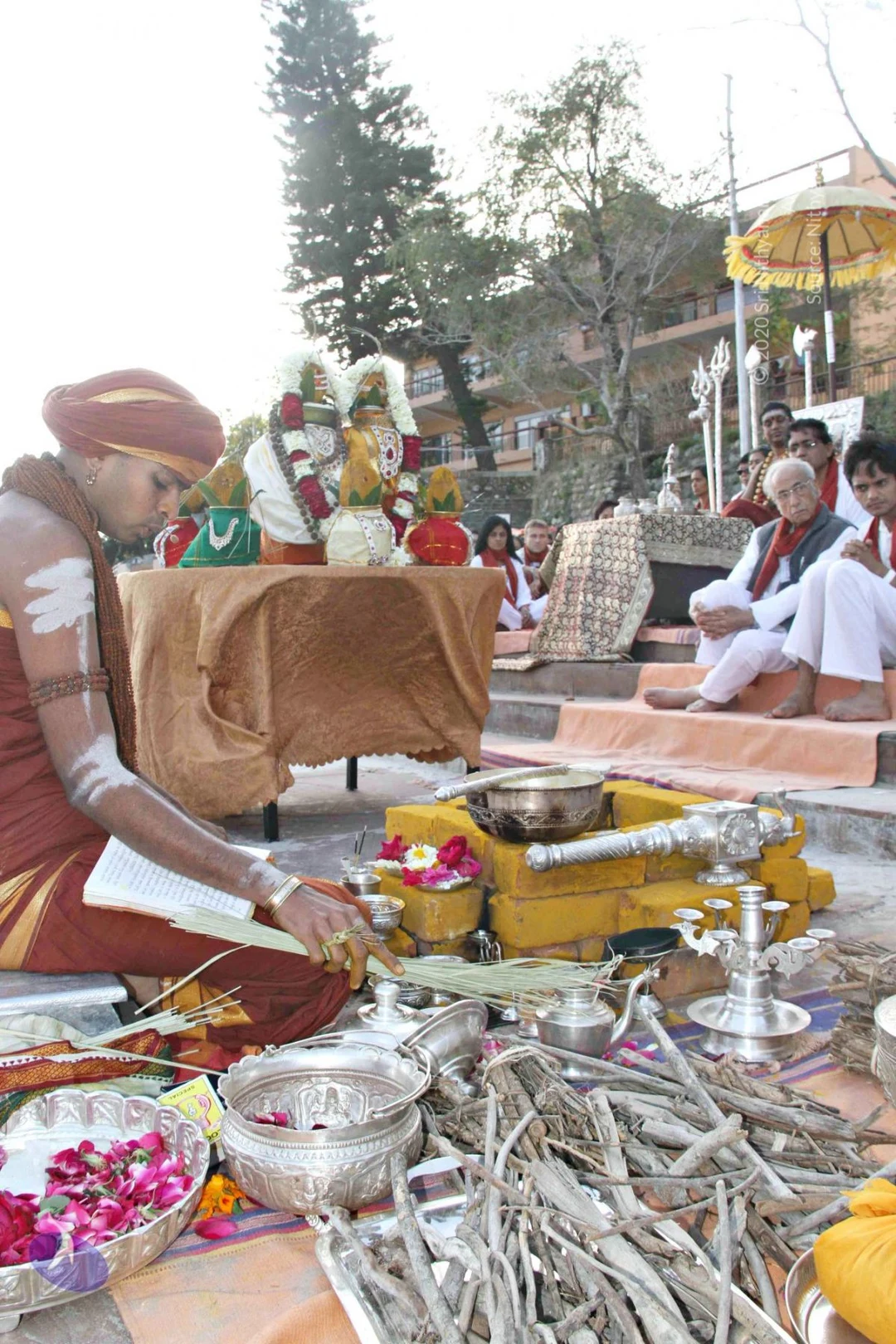
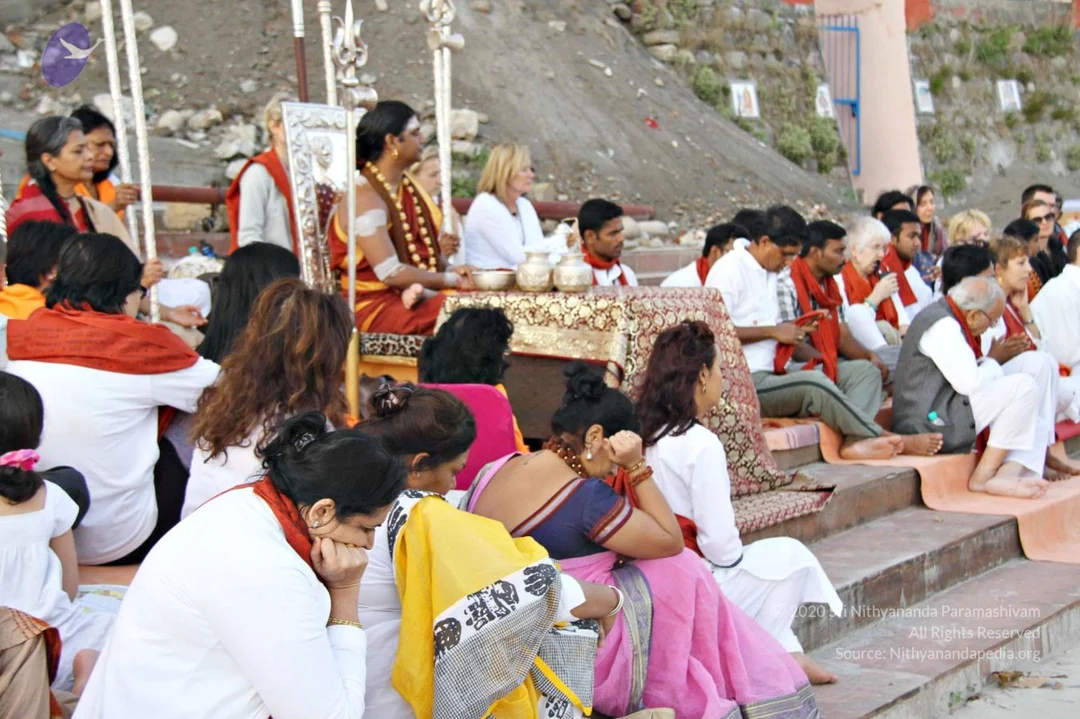
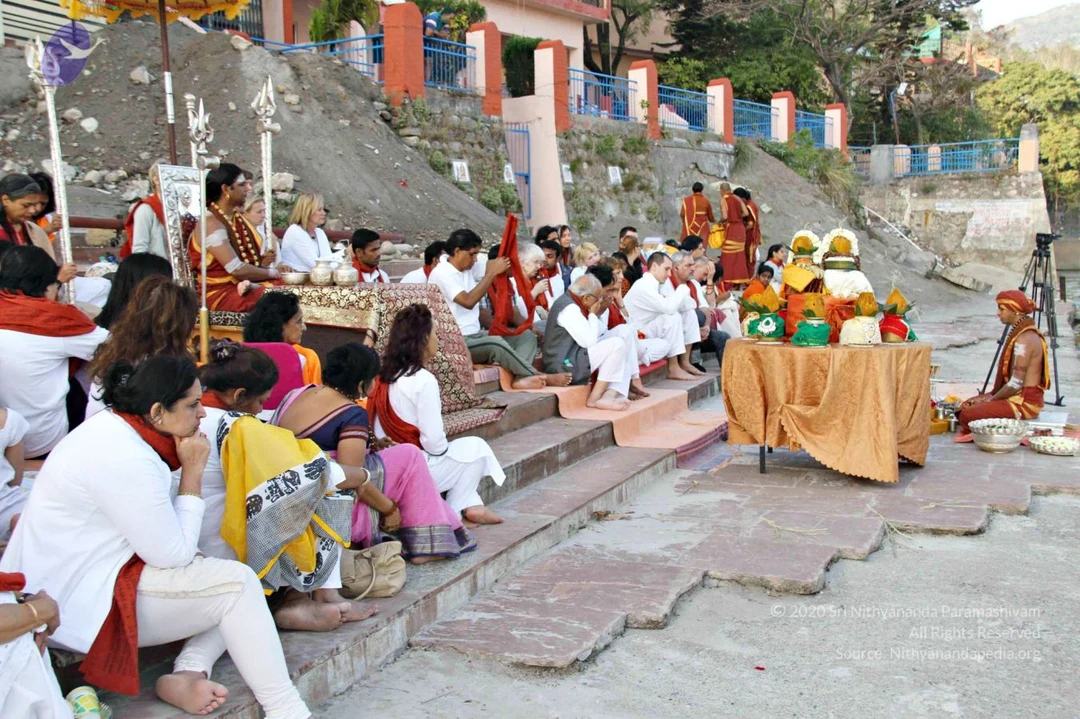
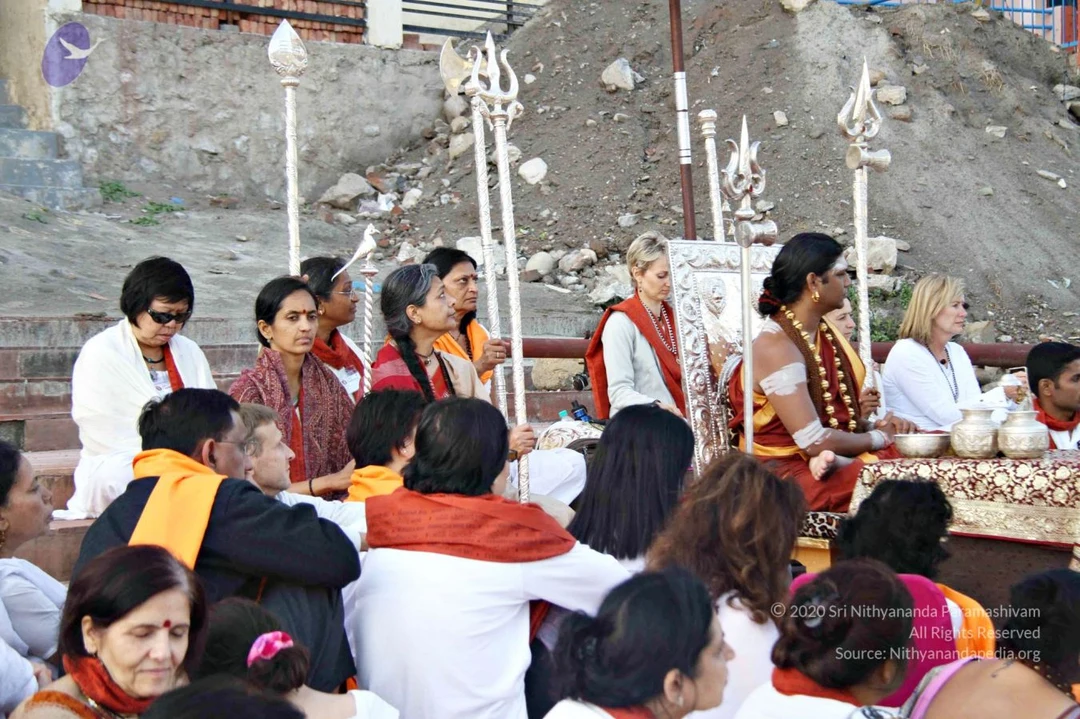
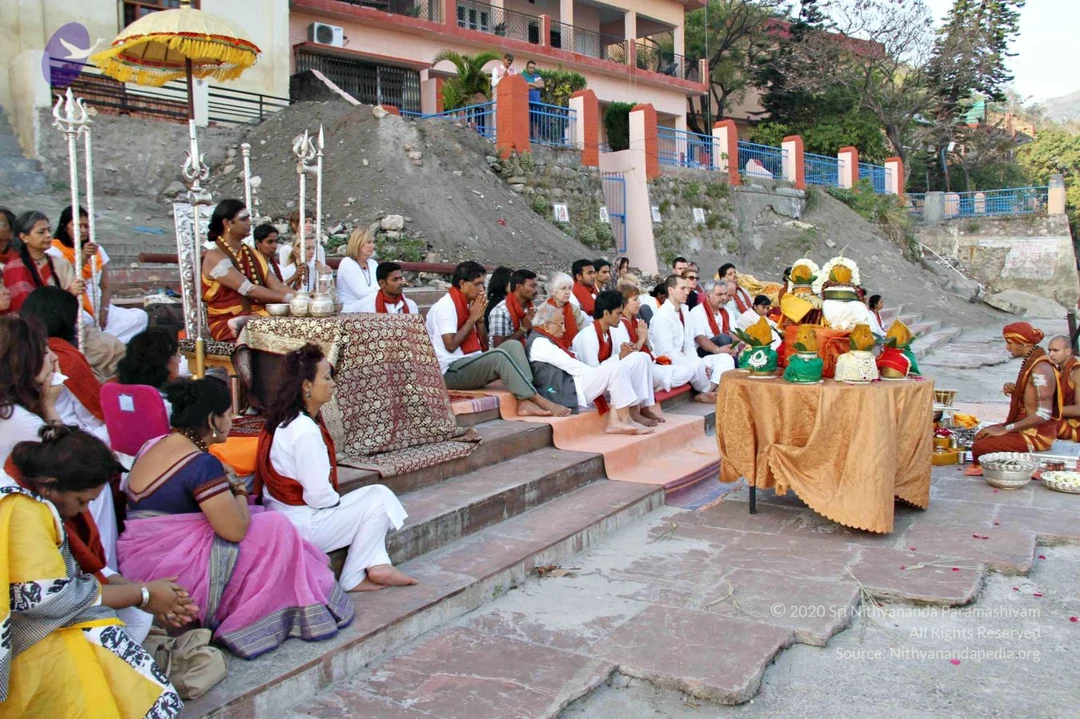
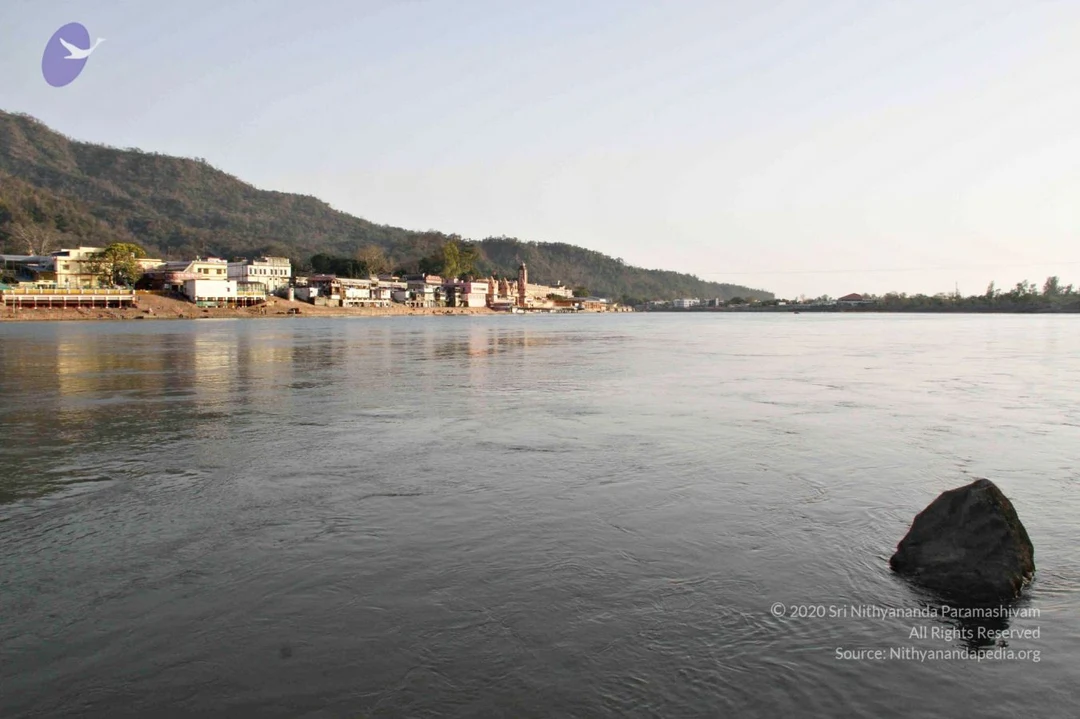
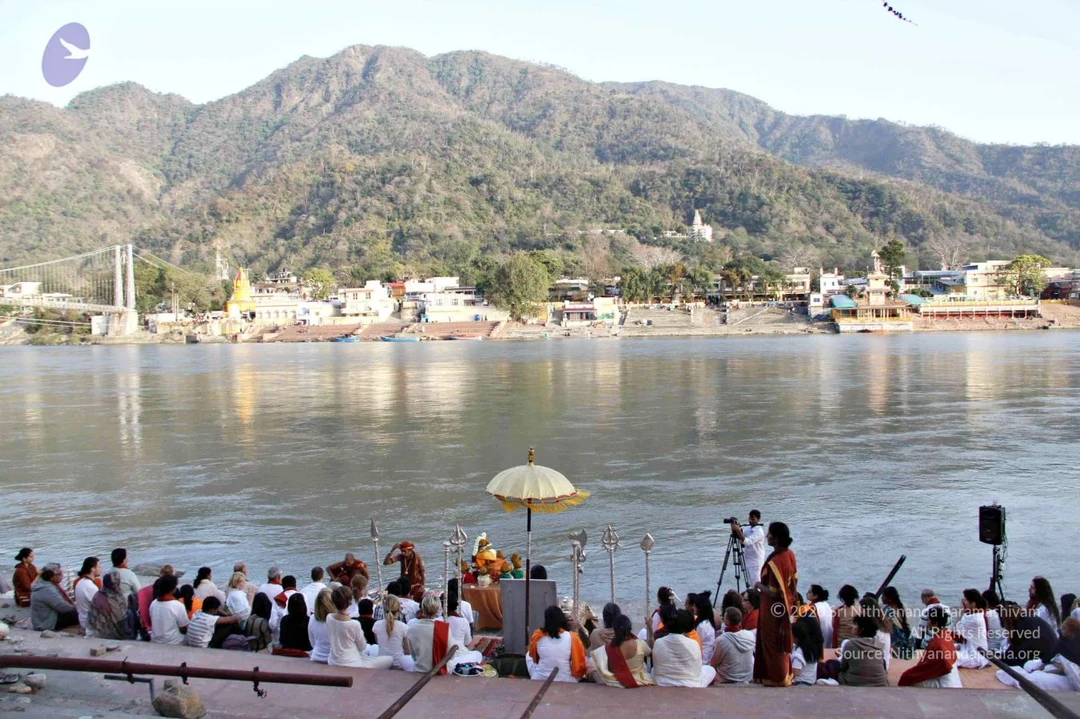
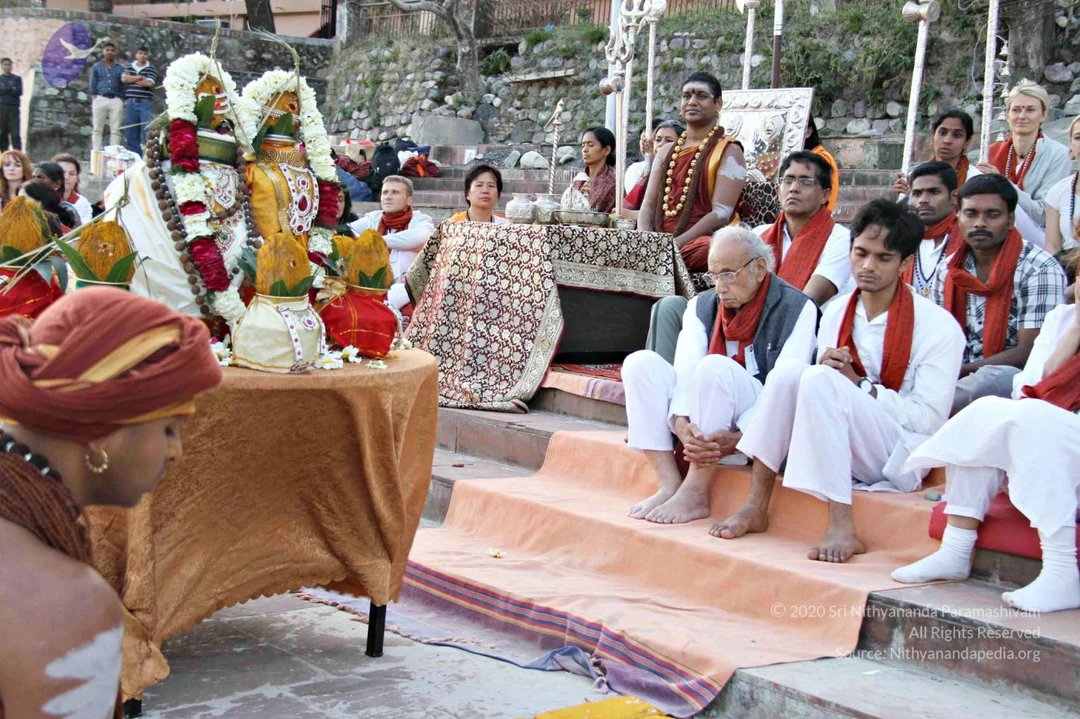
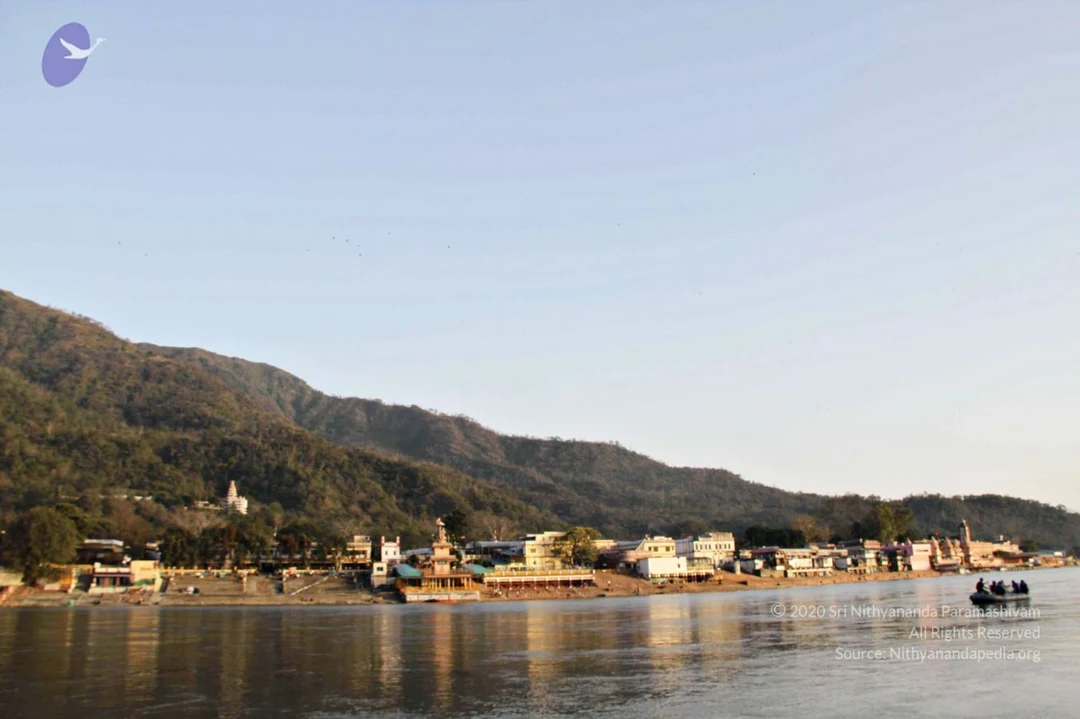
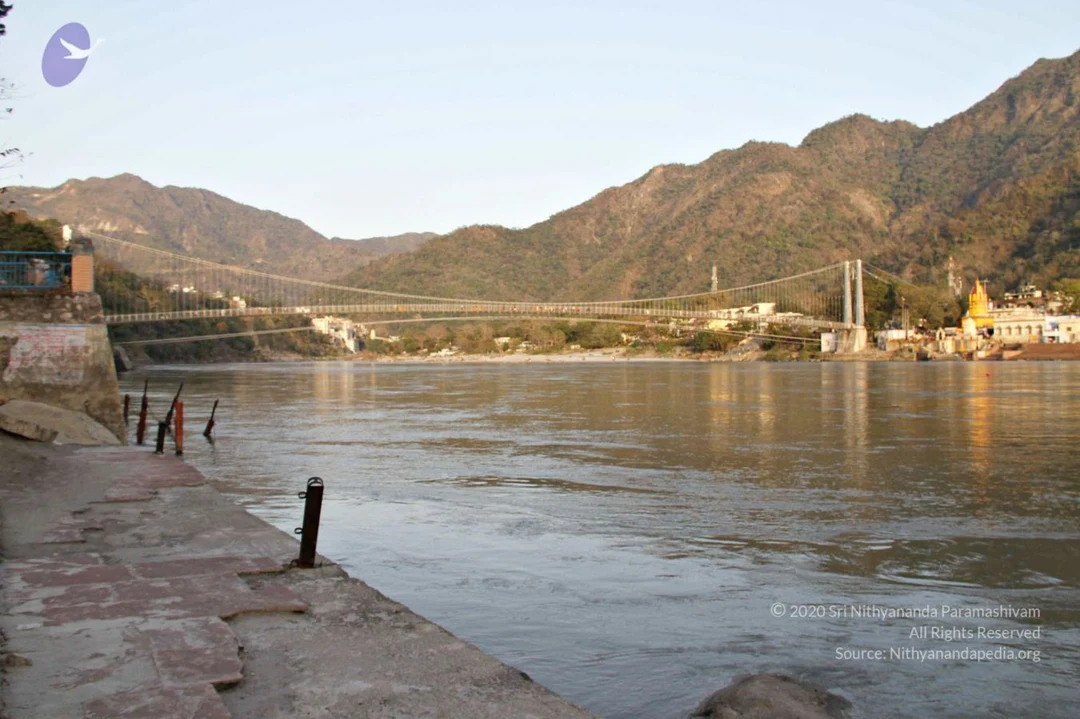
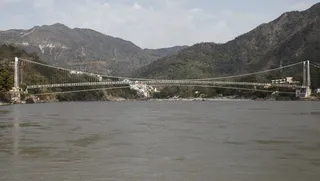
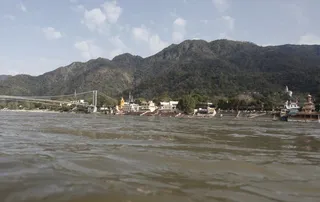
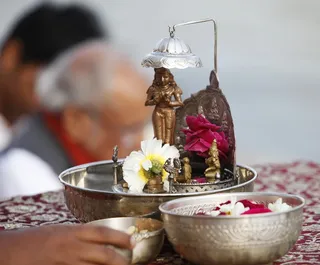
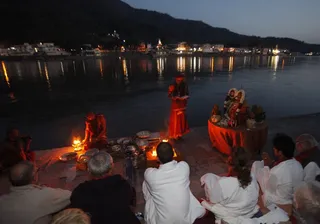
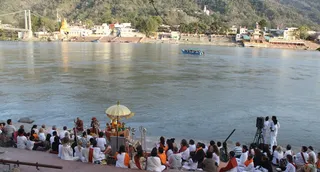
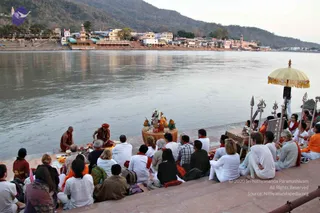
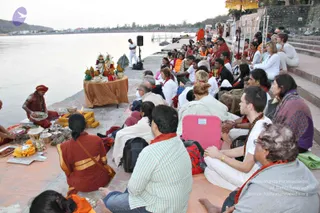
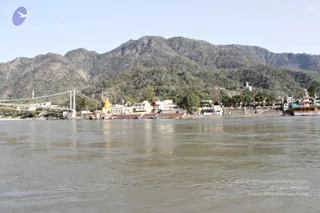
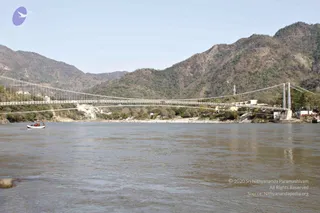
A wide photograph of a broad, greyish-brown river flowing across the foreground toward a long suspension footbridge spanning the water between forested hills. The bridge has steel cable towers at both ends and a central deck with railings; small buildings and structures cluster on the far bank and along the slopes. Rocky banks and dry scrubby hillsides frame the scene under a pale sky. No people are visible in the scene.A wide view across a broad, murky river toward a riverside town backed by forested hills. A suspension footbridge spans the water at left, and along the bank stand whitewashed buildings, a saffron-coloured shrine tower, and temple structures with flags. No people are clearly visible in the frame. The scene appears to be a ghat-lined town on a river with steep green mountains behind it.Close photo of a brass puja arrangement on a red and gold patterned cloth. A small bronze deity figure. A silver bowl holds red and white petals, and a small offering dish sits in the foreground. Blurred background figures, one in a grey jacket and a person in white, appear out of focus. The setting suggests an outdoor ritual offering.Evening ganga aarti on the steps of a river ghat at dusk, with a wide river reflecting town lights and a forested hillside behind. A robed sadhu in orange stands at centre holding a lamp, while another in orange kneels at a flaming fire pit surrounded by brass plates of offerings. To the right, a decorated orange-draped altar holds deity murtis and fruit offerings. Seated devotees in white clothes face the ritual from the foreground, some with hands folded, and one elderly man in a dark jacket sits at the bottom left.A night photograph of a river bank at a Himalayan town, with a dark forested hillside rising behind a row of lit buildings and temple spires along the water. Warm lights are reflected on the calm dark river in the foreground, and the sky is deep blue with a few stars. No people are visible.Wide outdoor photo on the bank of a broad river with a suspension bridge and hillside town behind. A raised seated platform at the water's edge holds a figure in orange robes, flanked by ceremonial brass lamps and a golden parasol. Dozens of devotees sit on the stone steps in white and orange clothing, facing the platform. Two standing people in white on the right hold cameras or a stand-mounted device. A small blue boat crosses the river.

Kalpataru Darshan

1 photoSource gallery
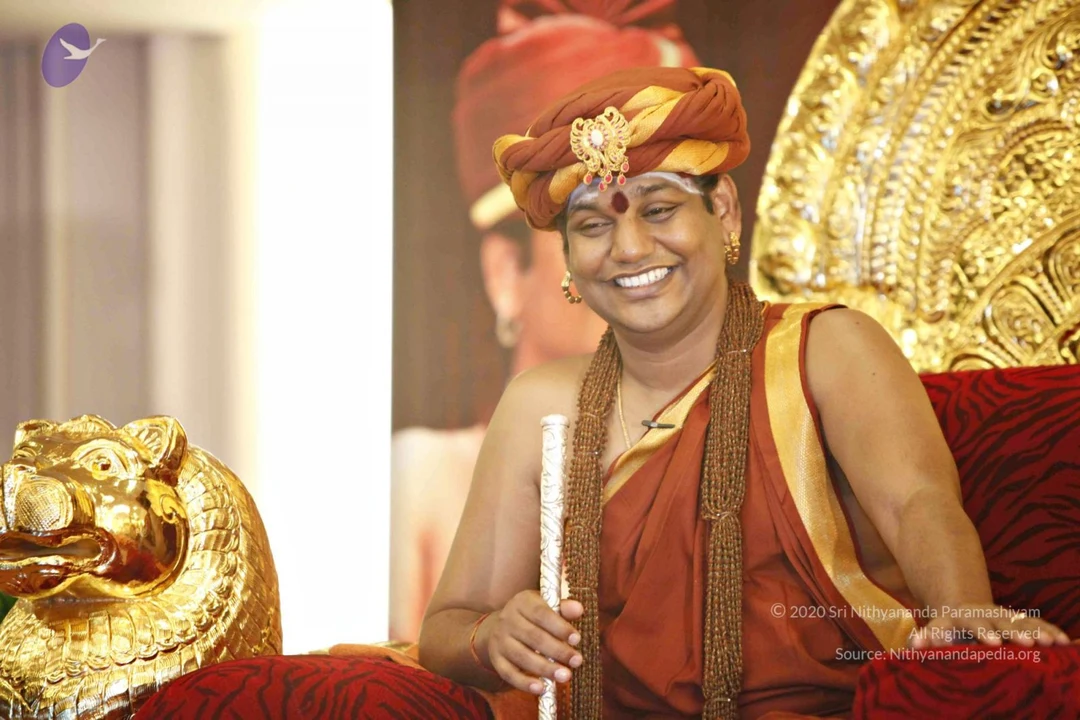
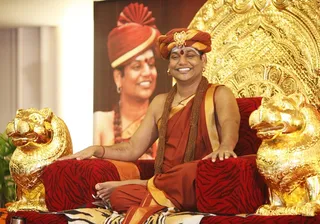
A smiling person sits in a brown leather armchair with carved wooden arms, gesturing with a raised right hand. They wear an orange and gold turban with a gold brooch, a red bindi, rudraksha mala beads over a red-orange robe with gold trim, and a small microphone clipped to the robe. A red book rests on their lap. Behind them is a red banner reading Enlightenment-style lettering partly visible with the word Haridwar. The person is a single seated speaker at an event. Swamiji (probable): the orange and gold turban, ornate gold brooch, layered rudraksha malas and saffron robe are consistent with the page's claim.

Nithyananda Satsang
36 photosSource gallery
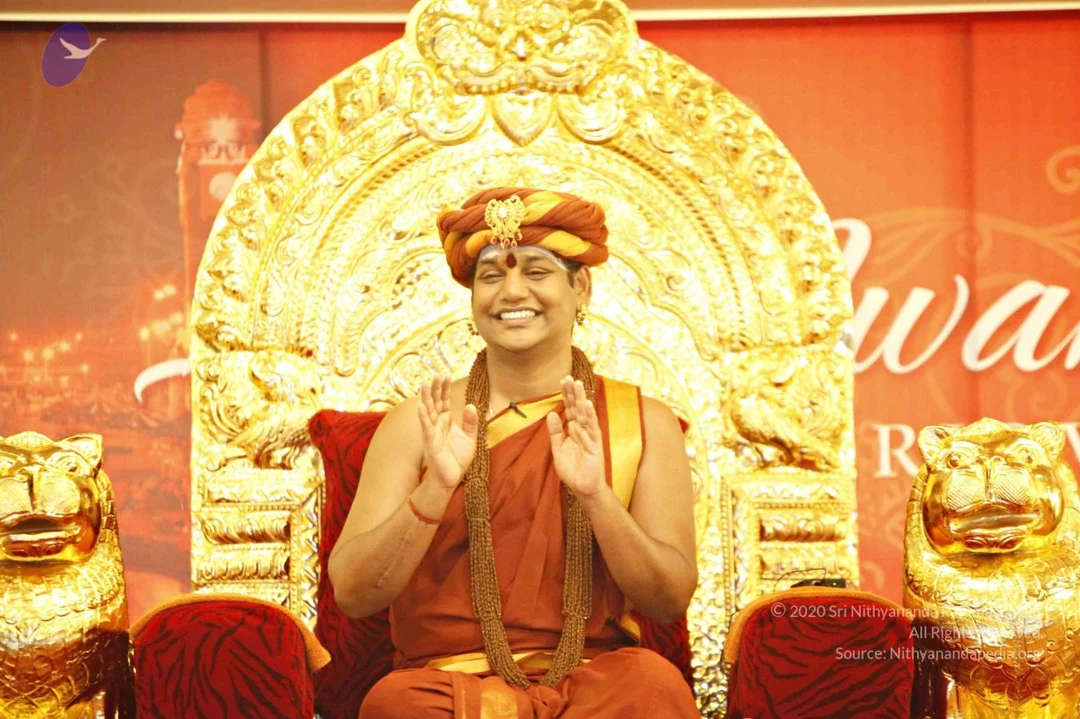
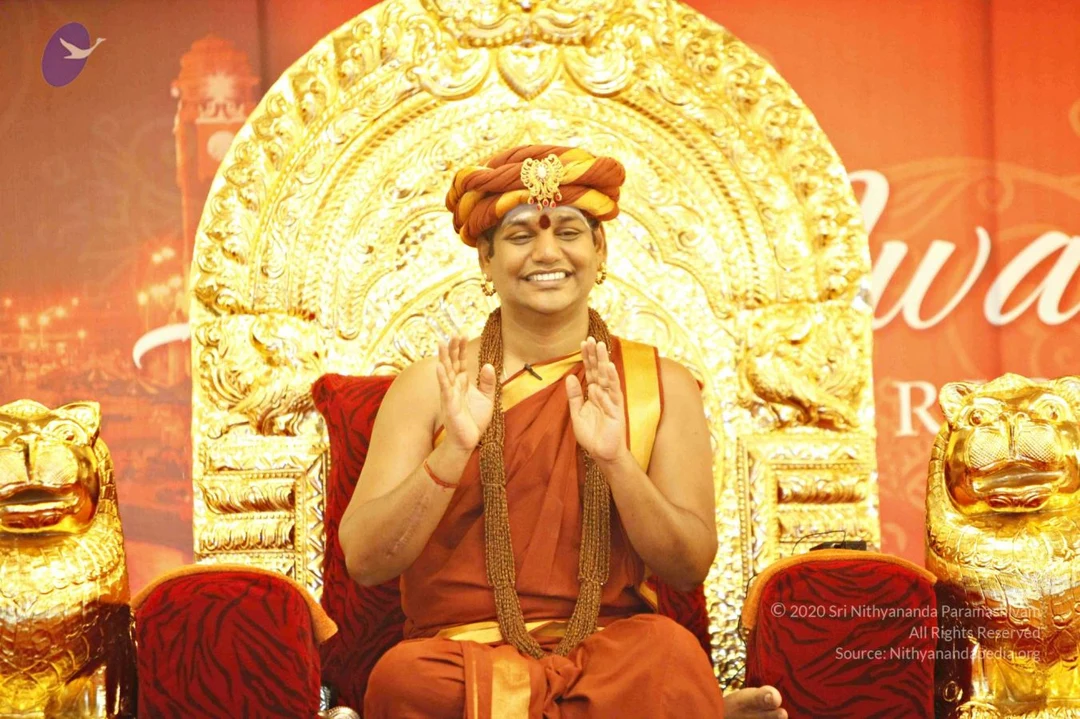
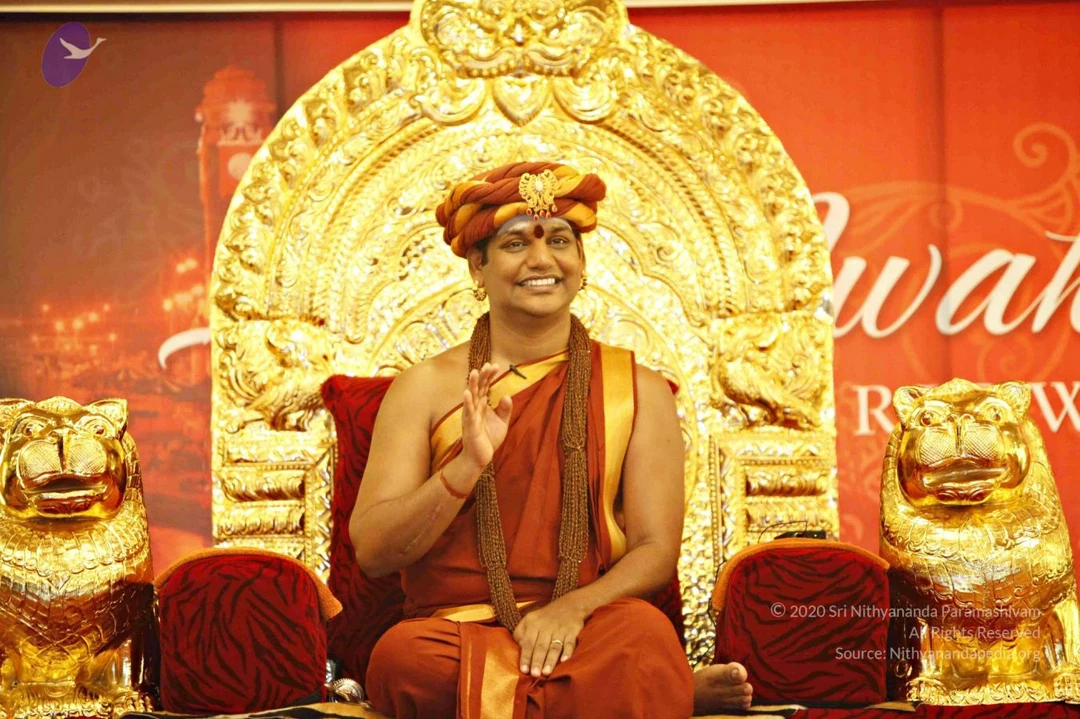
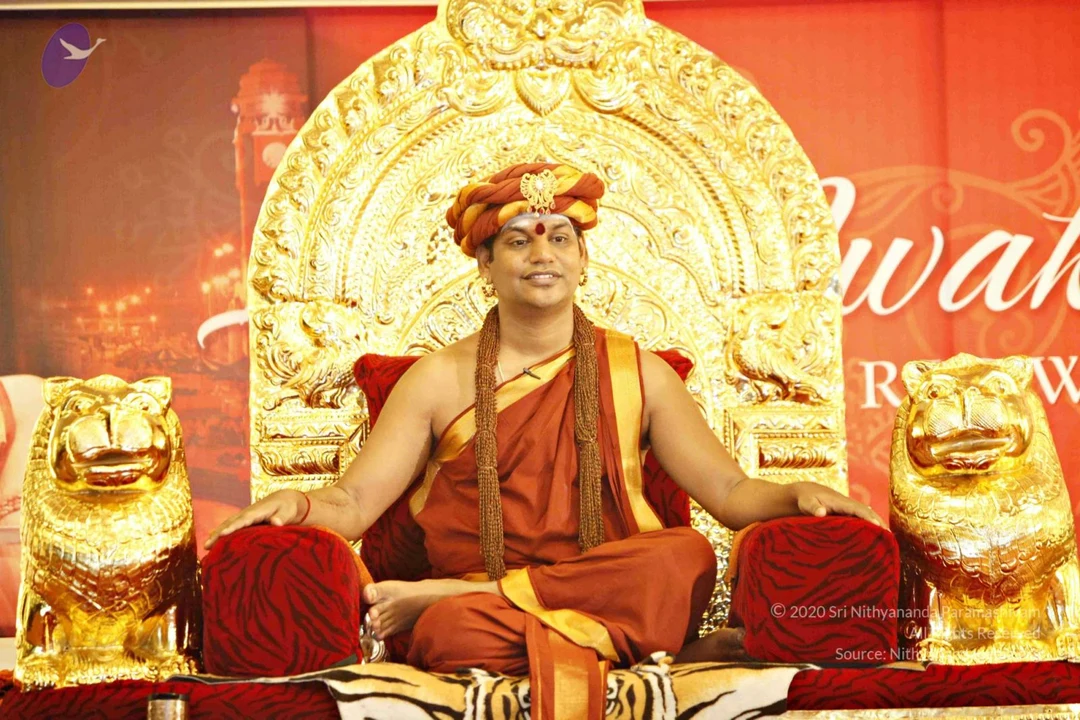
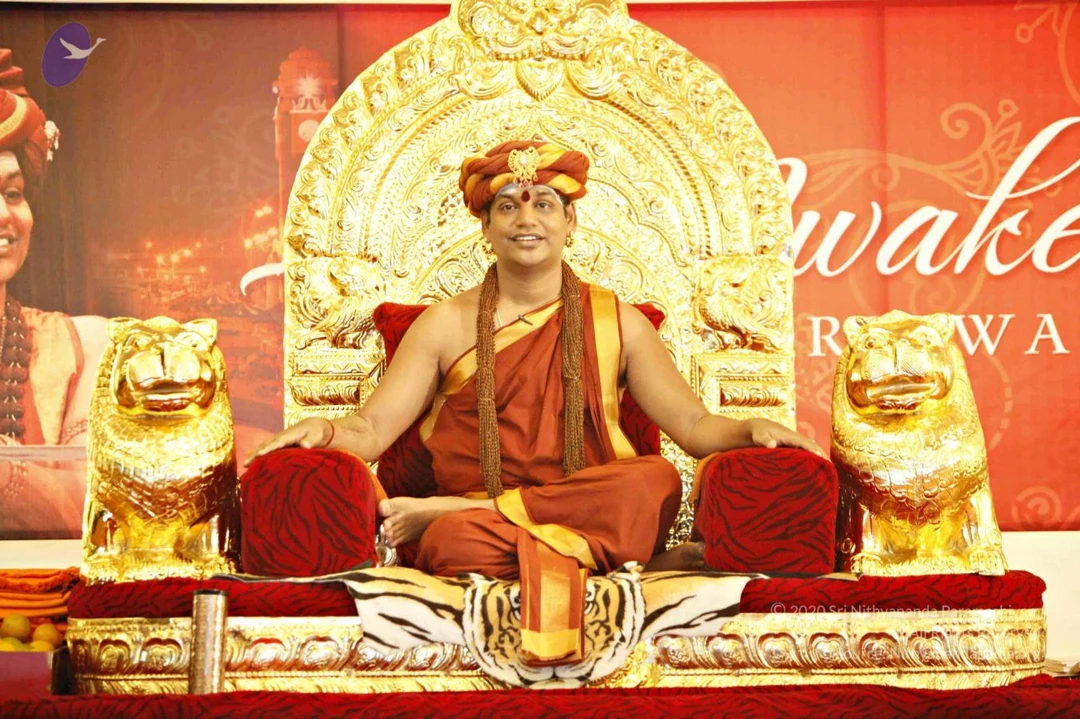
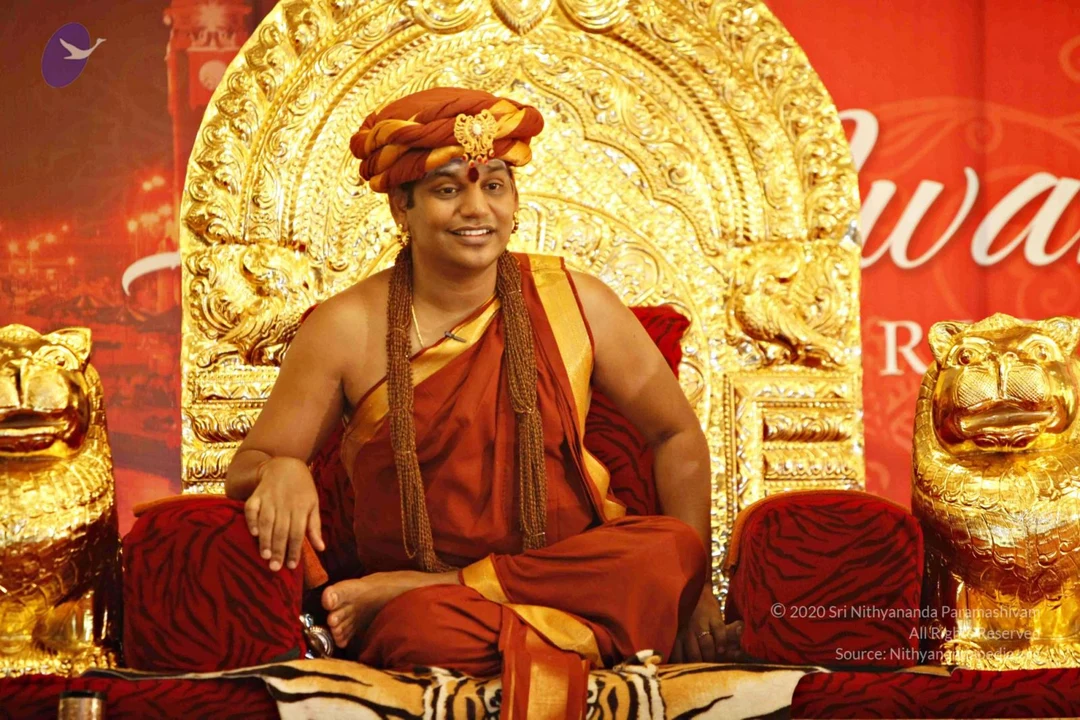
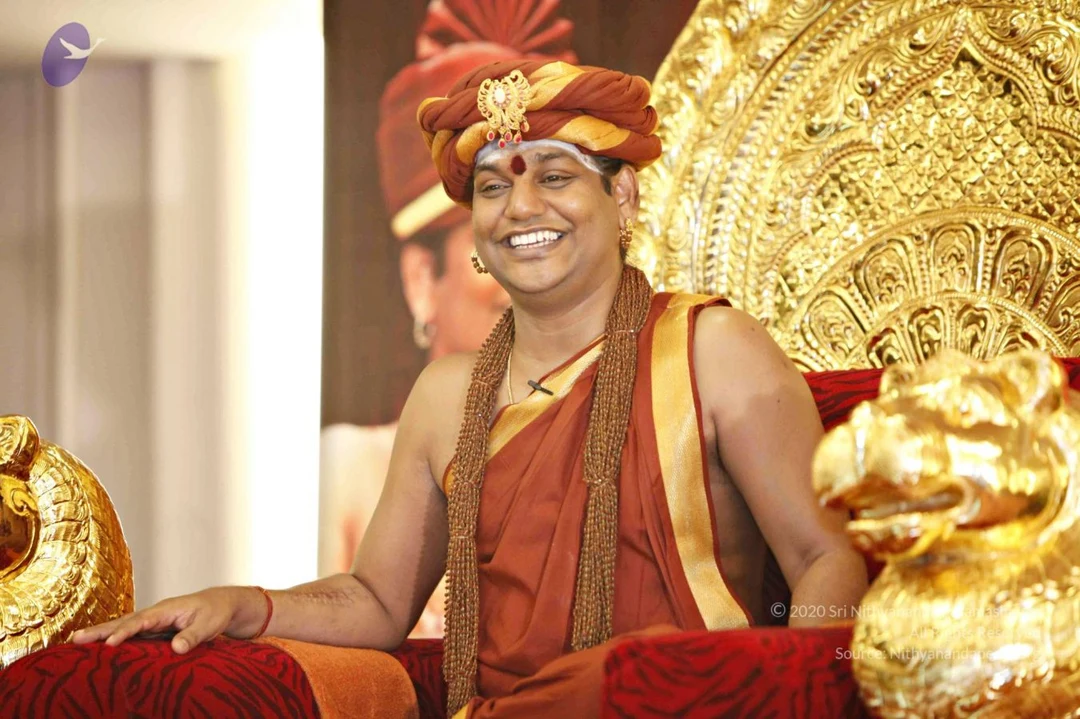
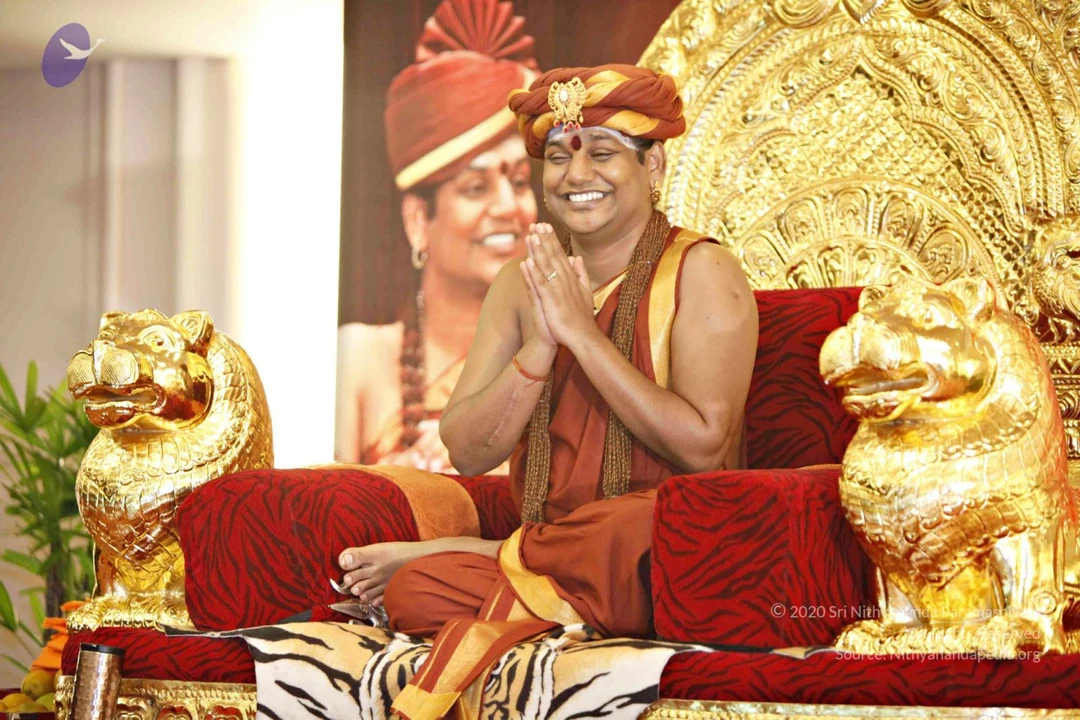
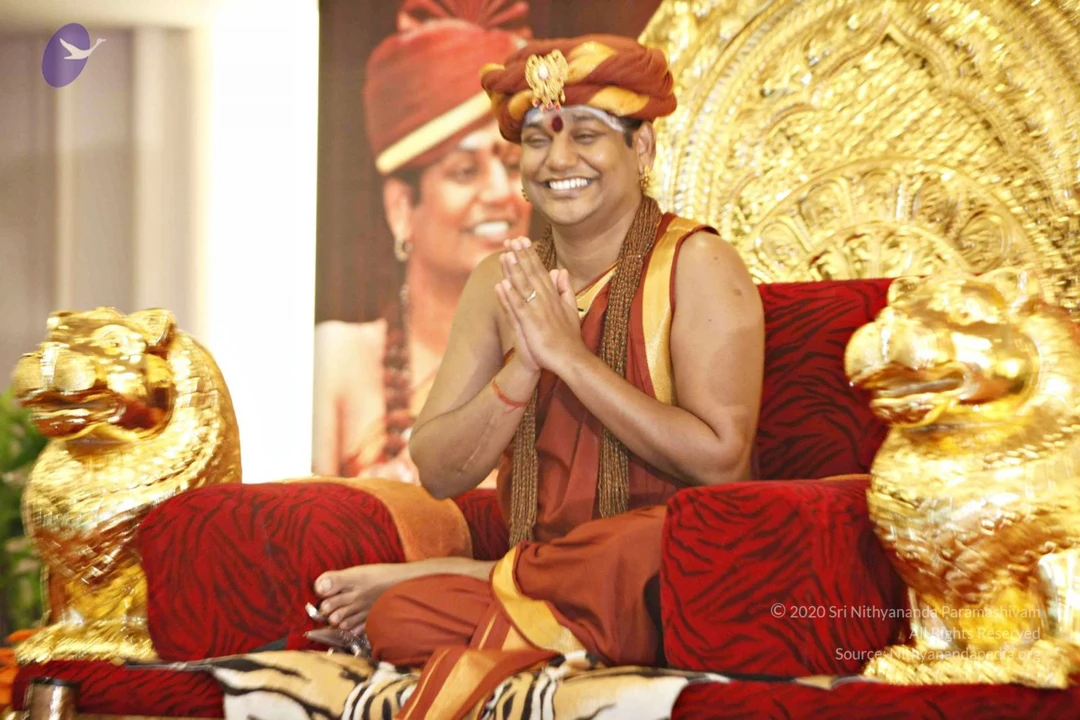
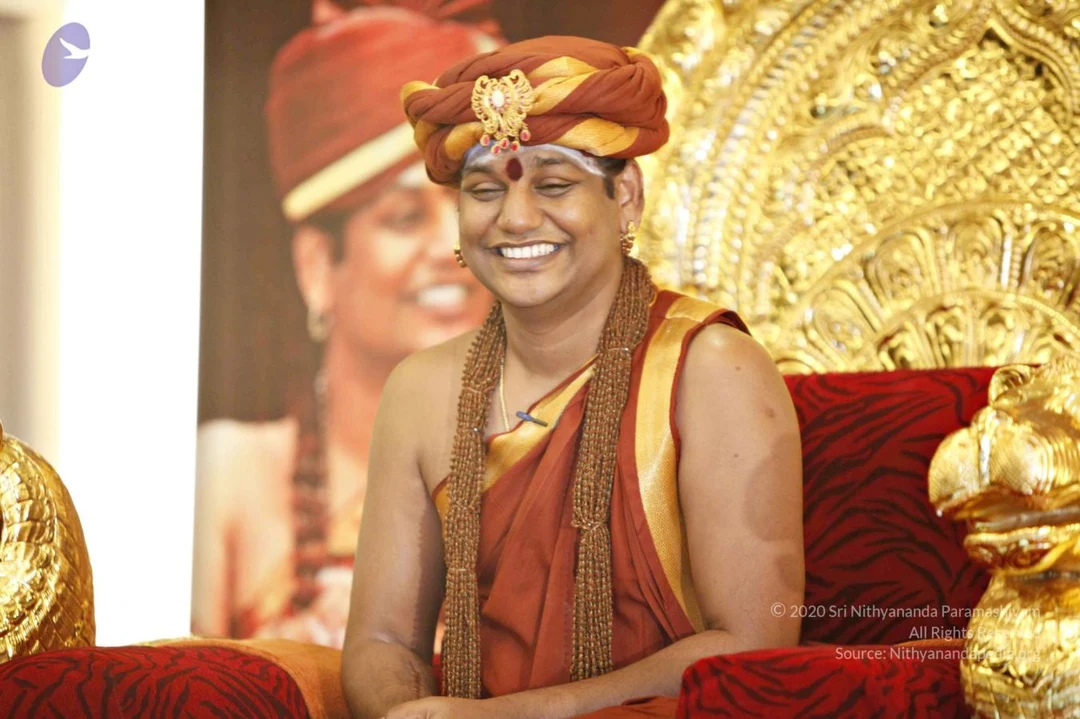
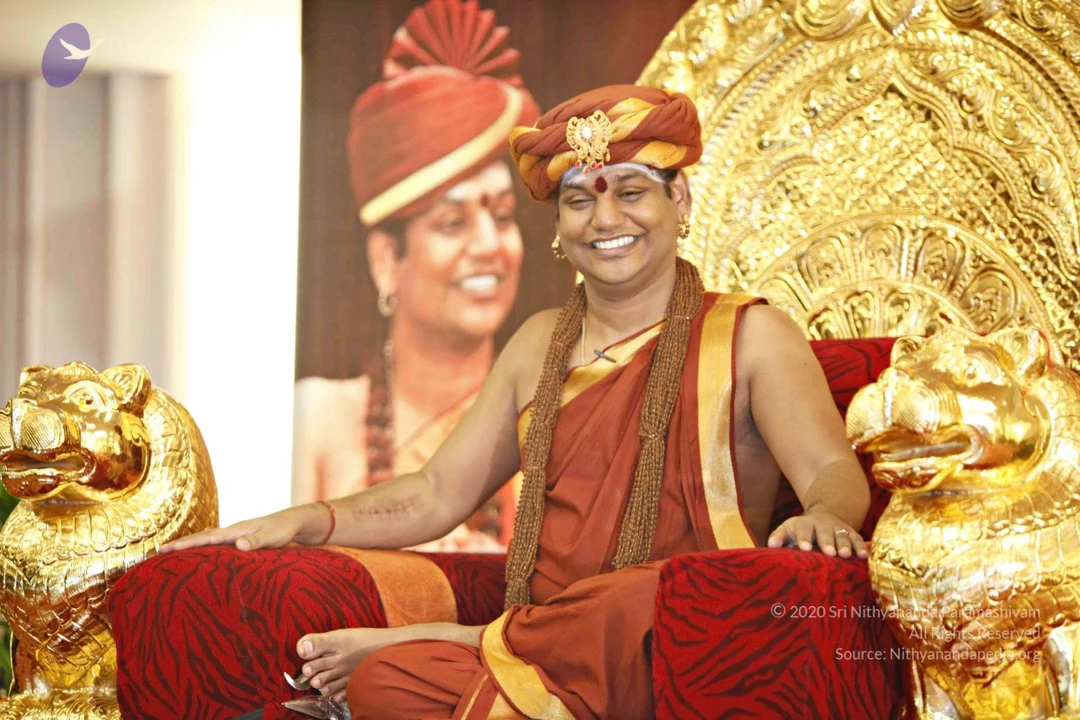
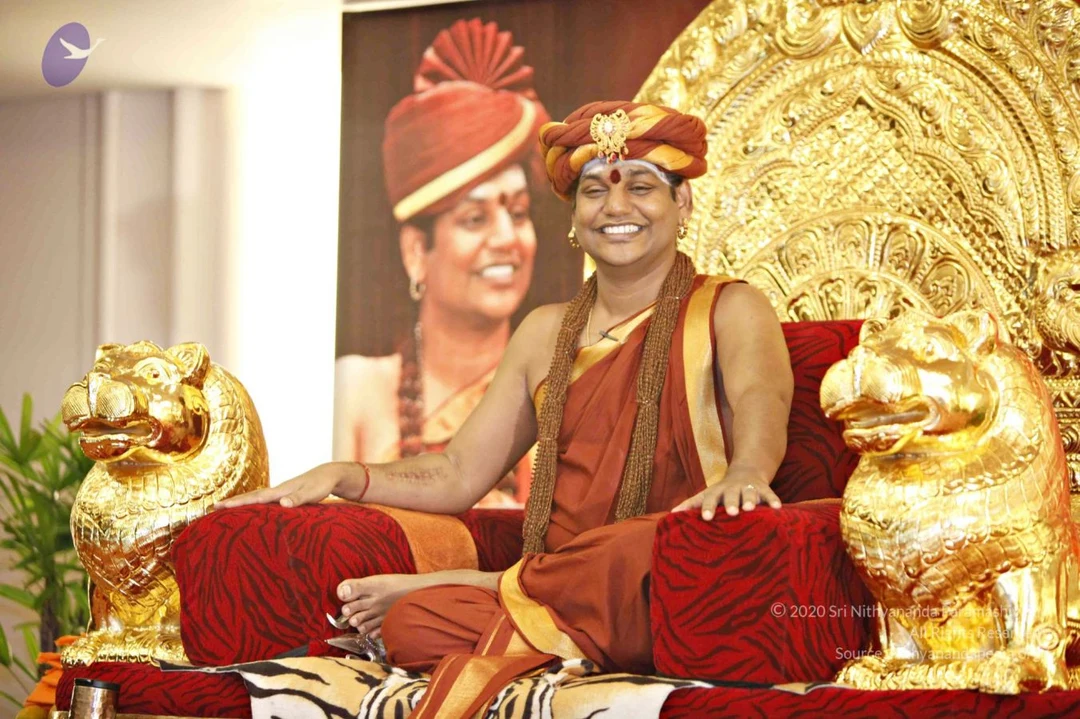
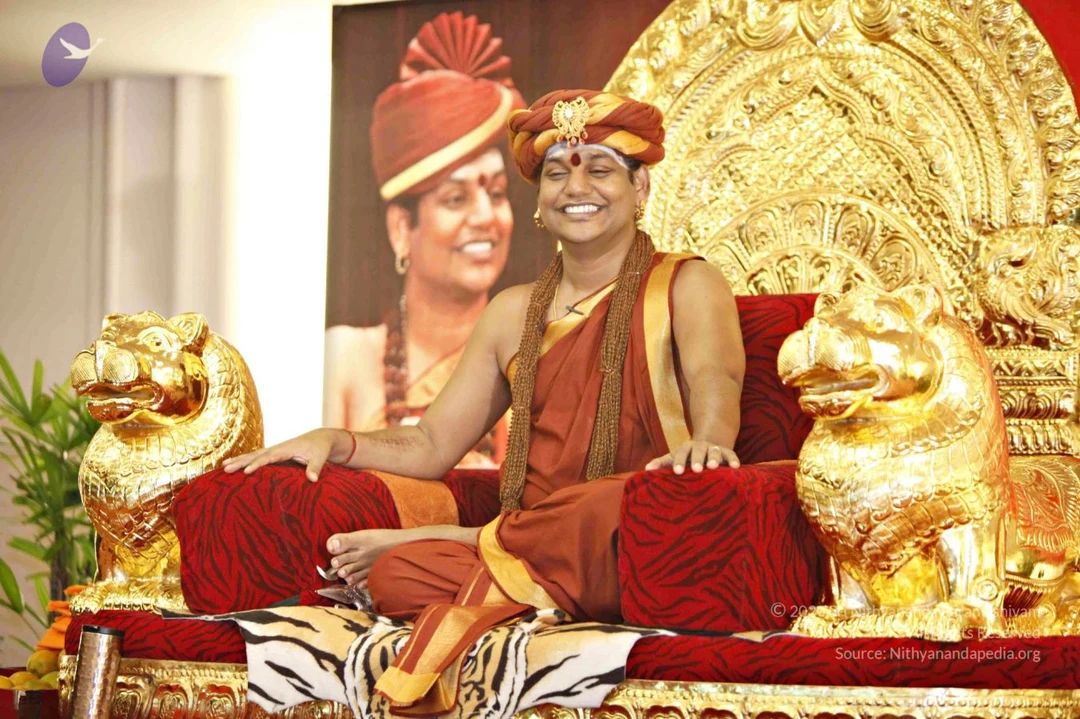
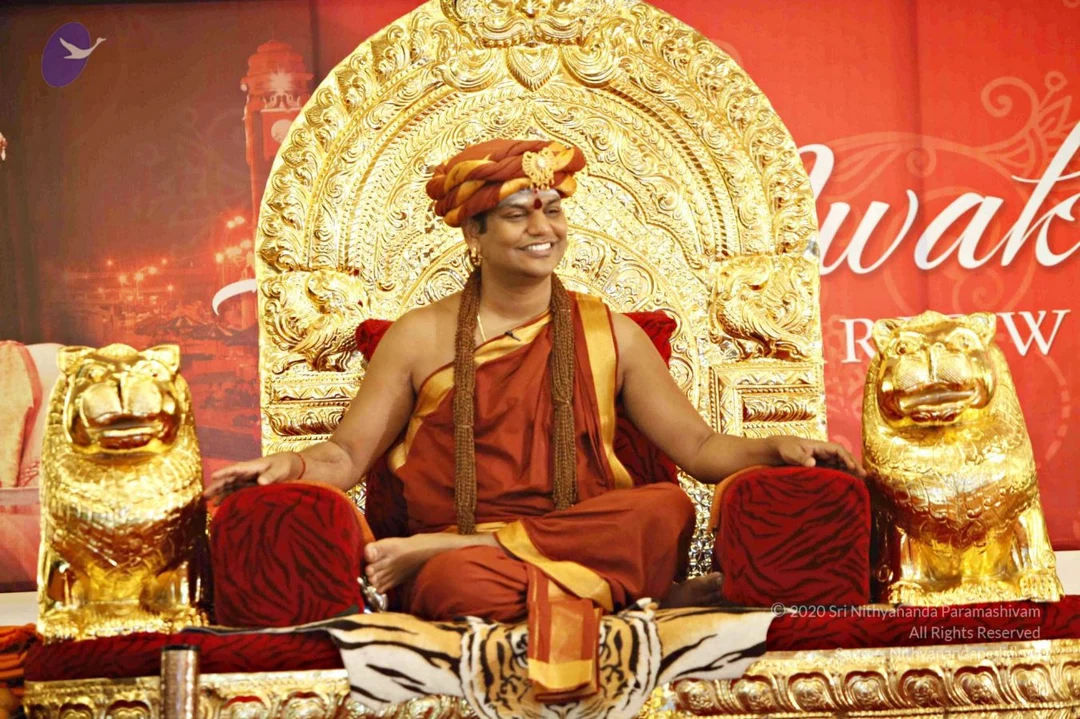
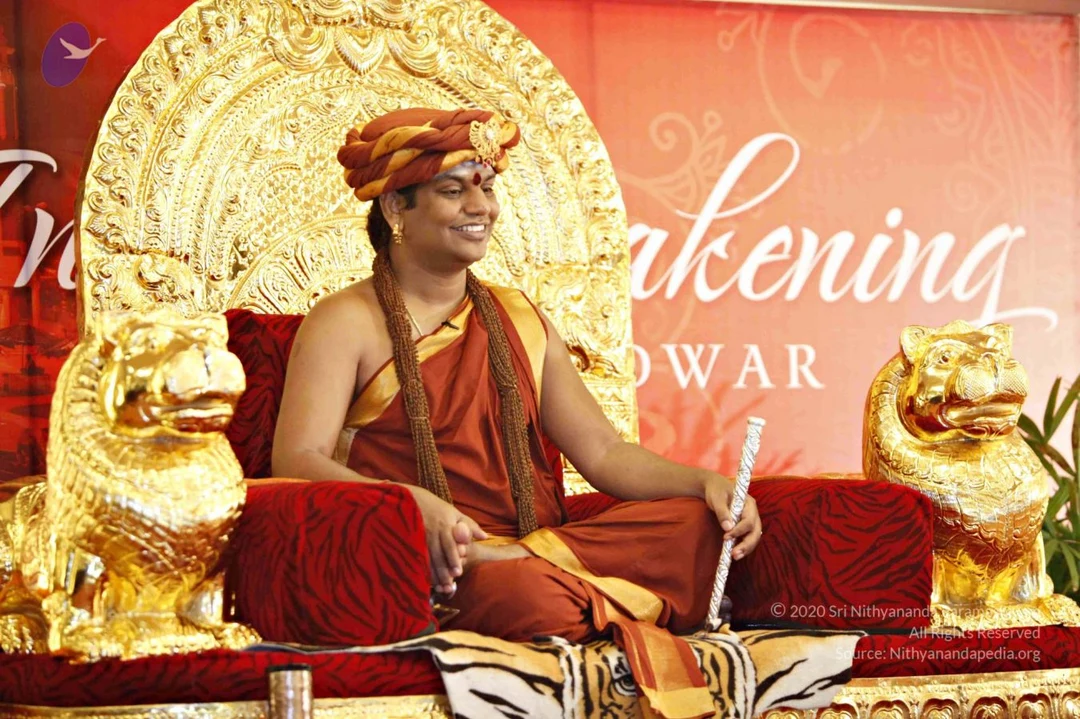
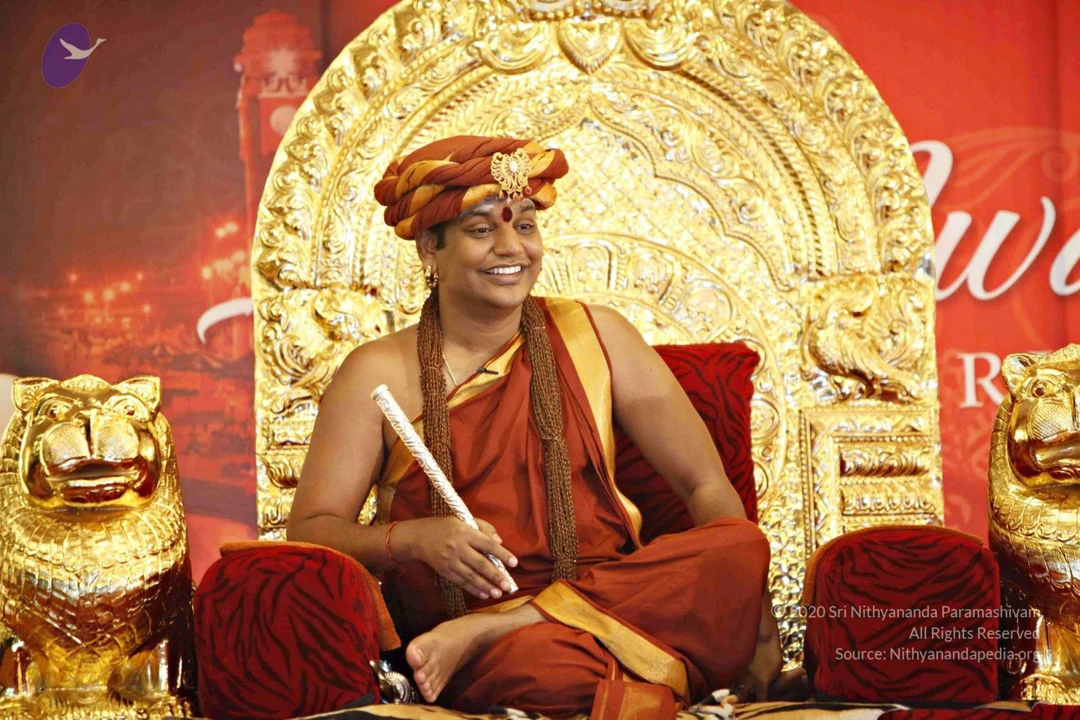
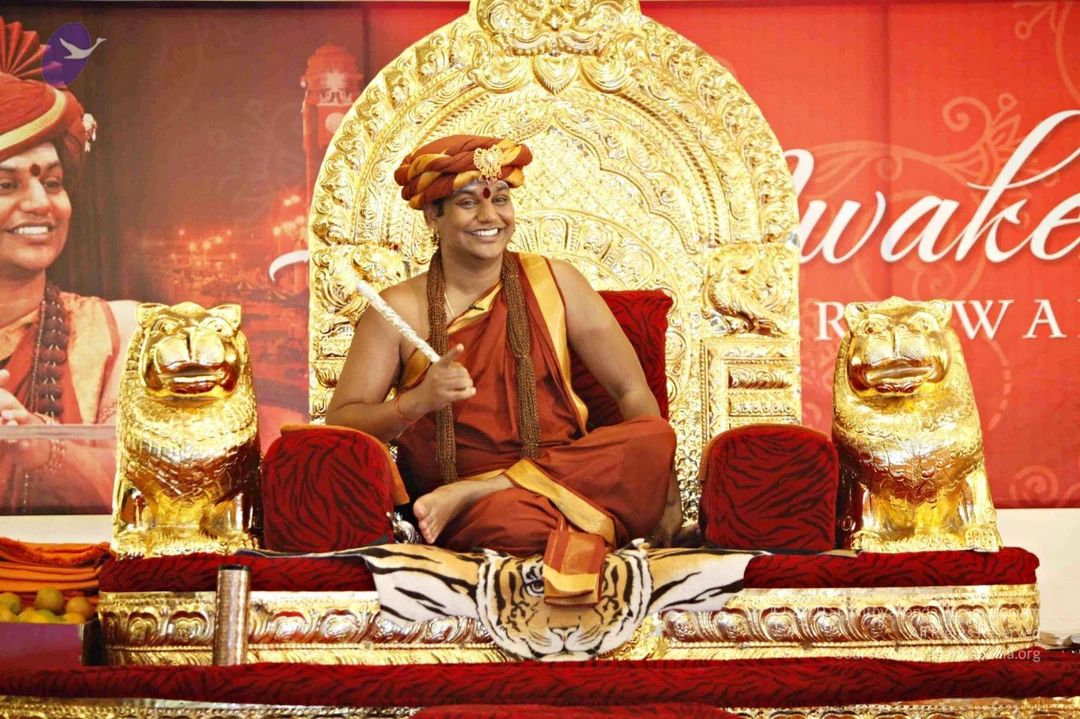
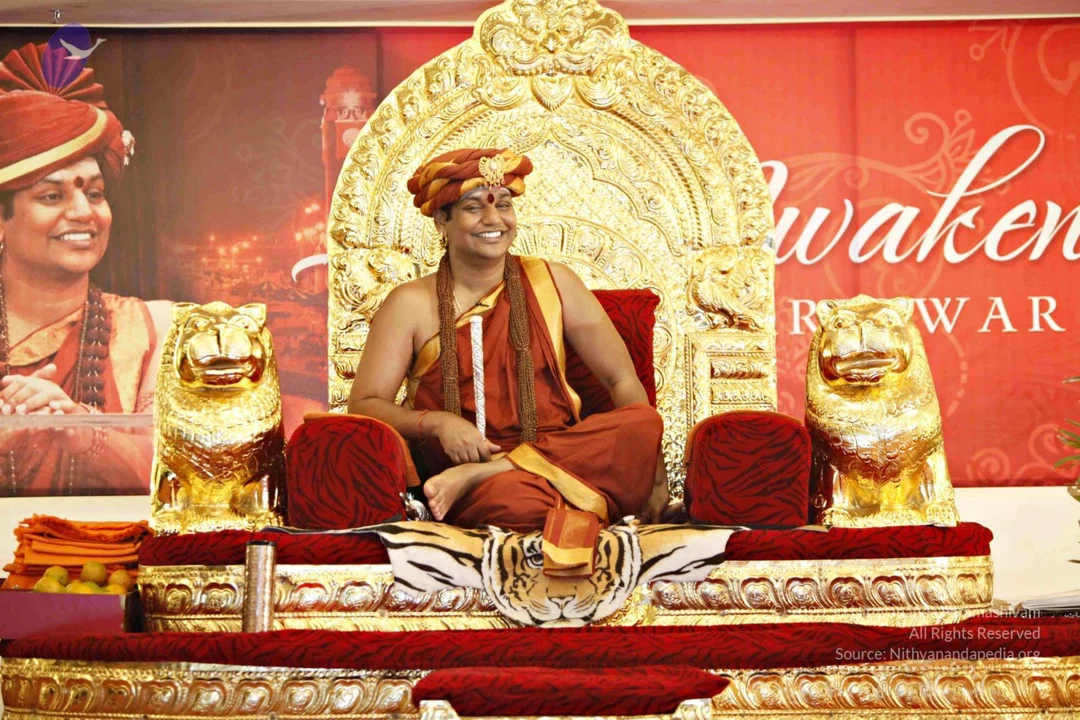
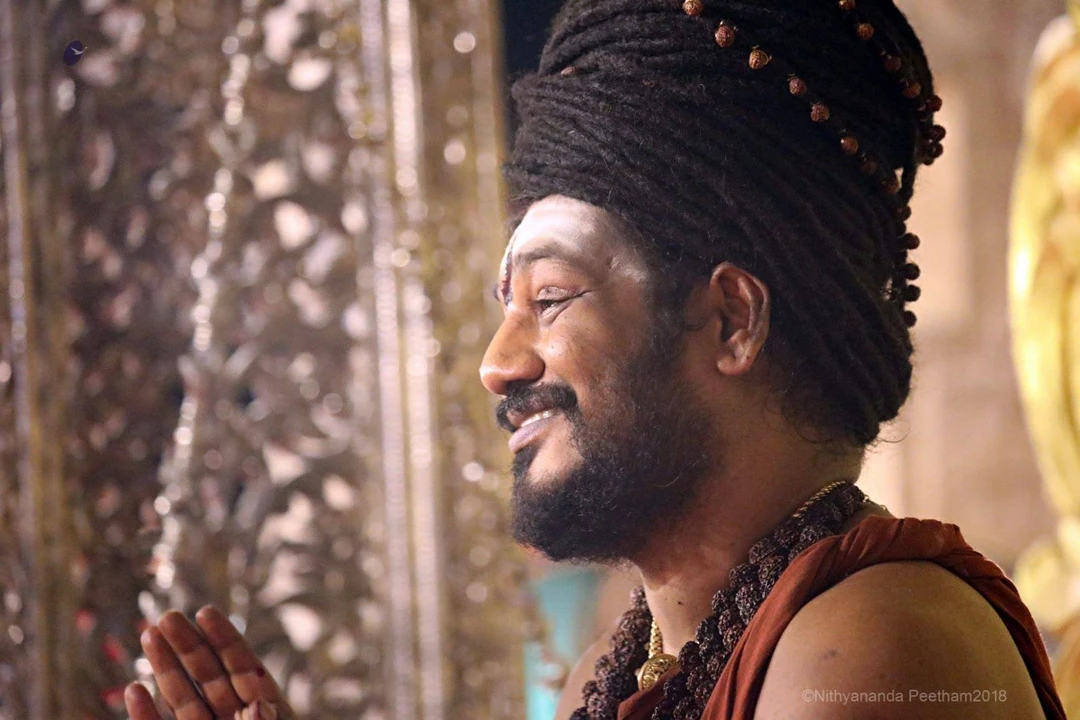
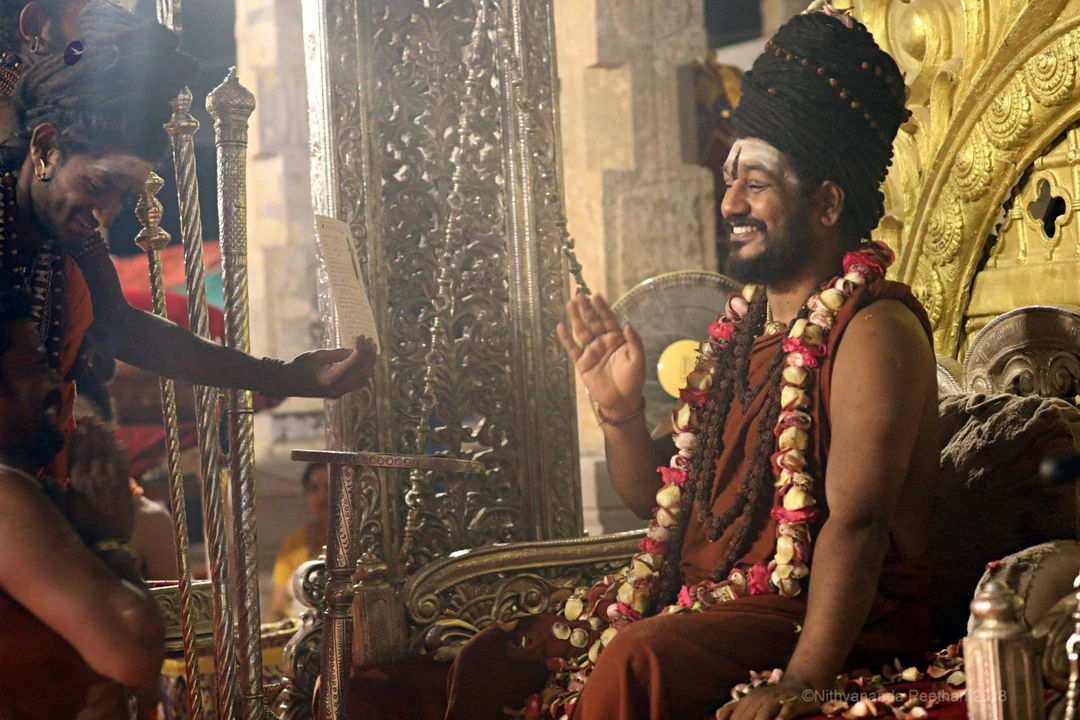
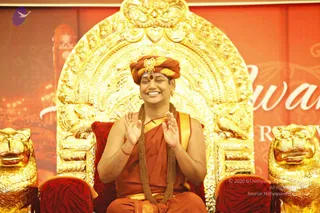
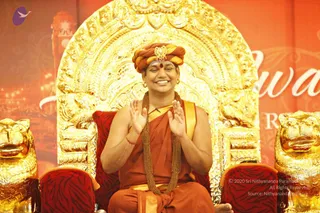
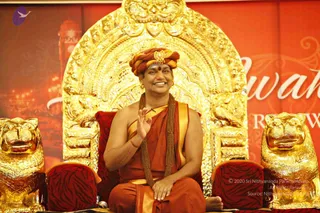
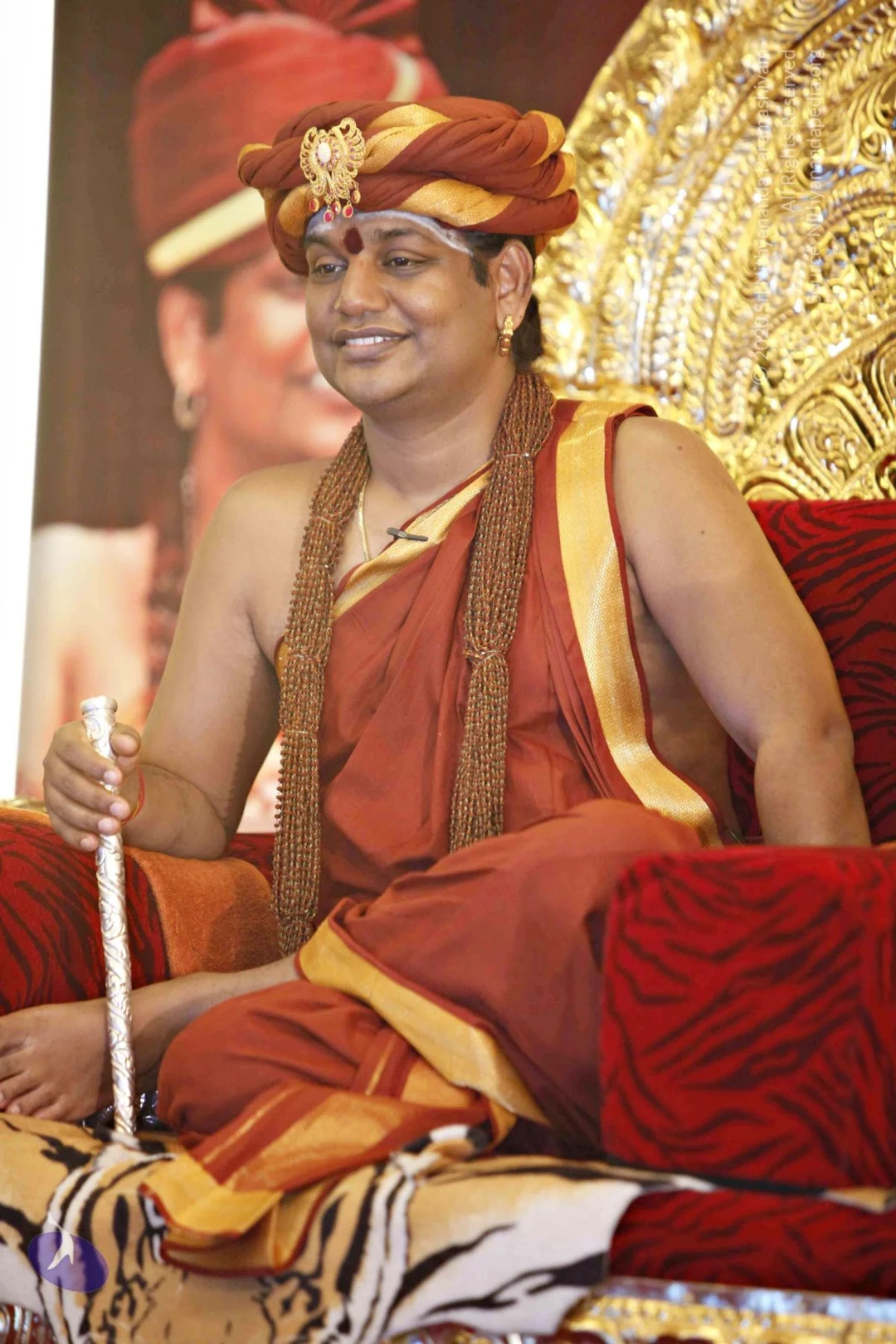
Three ornate metal statues seated side by side on a gold-draped dais with pink flower petals scattered below against a green backdrop framed by gilded carved arches. The central figure wears a tall golden crown with red jewels, a sacred thread, layered garlands and a large pendant, seated cross-legged on a leopard-print cushion with raised hands. The statue on the left wears a rust-red turban, a rust-coloured shawl and beaded necklaces. The statue on the right wears a tall ornamented headdress and a red-and-gold patterned sari-style garment with a jewelled necklace. Statues only; no physical people are present.A smiling person seated on an ornate gold throne with carved arches and two gold lion-head armrests, against a red and orange backdrop. The seated figure wears an orange-and-yellow turban with a gold ornament, an orange robe with a yellow sash, a long beaded rudraksha-style mala, and a red bindi. Both palms are raised with fingers spread in a greeting gesture. Red velvet cushions line the throne. Appearance-based candidate, a person, is shown in a seated discourse setting with long swept hair visible under the turban and ornate clothing, though the appearance is only partly clear.A seated man in saffron-orange robes with a gold-and-orange turban, a gold brooch at the turban and a gold ornament at his forehead, a rudraksha mala with a long gold necklace, and a red bindi. He smiles with palms pressed together in greeting, seated on a red and gold tiger-striped throne-style chair with gold lion heads at each side. An ornate gilded arch backs the seat against an orange backdrop with partial script. Swamiji (probable): the saffron robes, turban, rudraksha mala and ceremonial gold cues match the page's identification, but the face cannot be confirmed from appearance.A smiling man in an orange-red turban with a gold ornament sits on an ornate gold throne with carved lion-shaped armrests, wearing an orange-red robe with gold trim and a long brown rudraksha mala, raising one hand in a blessing gesture. Two gold lion sculptures flank him on red tiger-striped cushions. A red backdrop with partial lettering and a city-lights image sits behind him. Appearance-based probable Swamiji candidate: the turban, ornate gold throne, saffron-orange robe and rudraksha mala are visible cues, seated as the central figure. Single physical person.A man in saffron-orange robes with a golden-yellow trimmed shawl sits cross-legged on an ornate gold throne with a carved back and two gold lion-head armrests, hands resting on red tiger-striped cushions. He wears a saffron-and-gold turban with a gold ornament, a red bindi, gold earrings and a long rudraksha mala. Beneath him is a striped tiger-skin rug. Behind the throne is a red and gold banner with a glowing city riverfront scene and large white lettering. A small gold-and-blue logo sits at top left. a person appears to be seated on the throne in the centre.A man seated cross-legged on an ornate gold throne with carved lion heads and red tiger-striped cushions, smiling at the camera. He wears a red-orange turban with a gold ornament, a saffron-orange robe with a gold border, a long rudraksha mala, and a gold necklace. A tiger skin rests on the platform before a backdrop of red and orange with partial gold lettering. Swamiji (probable): the saffron robe, long rudraksha mala, ornate gold necklace and turban on a lion-and-tiger throne match the distinctive presentation described for the page's subject. Large golden lion sculptures flank the throne, and fruit sits on a tray at the lower left.

Kalpataru Darshan

27 photosSource gallery
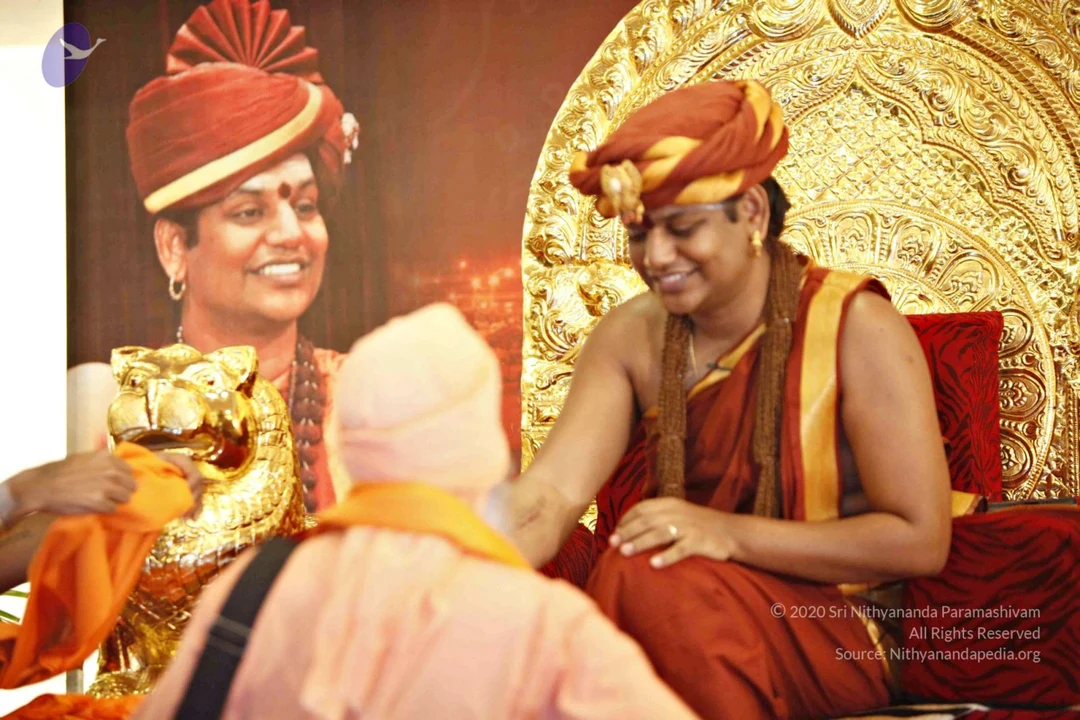
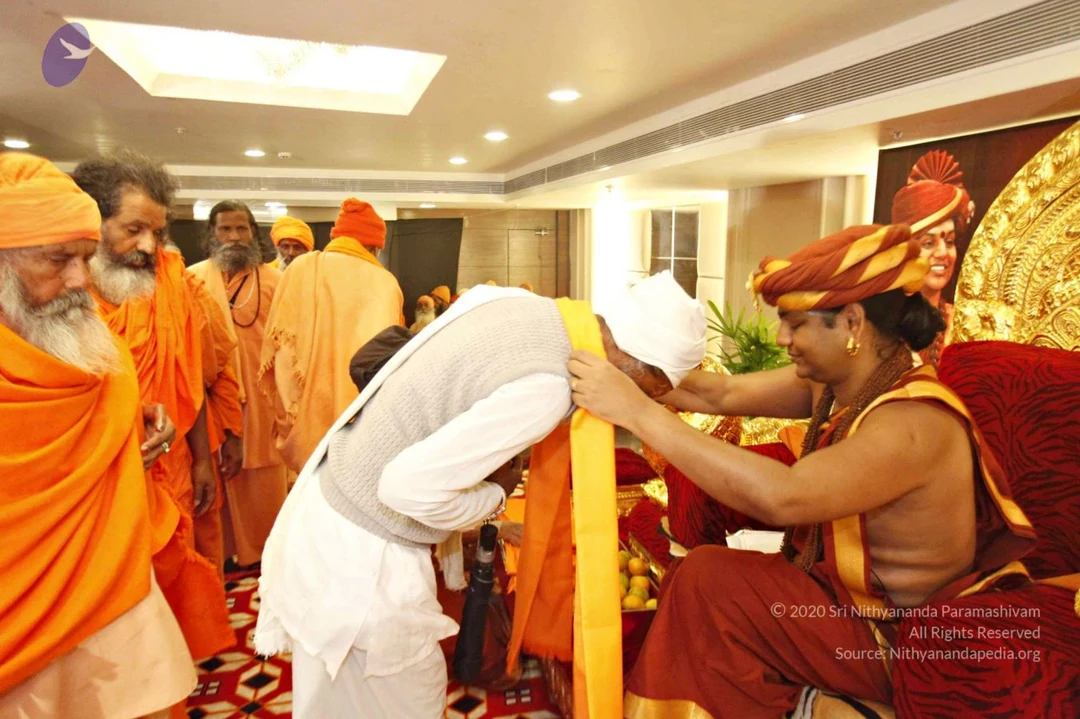
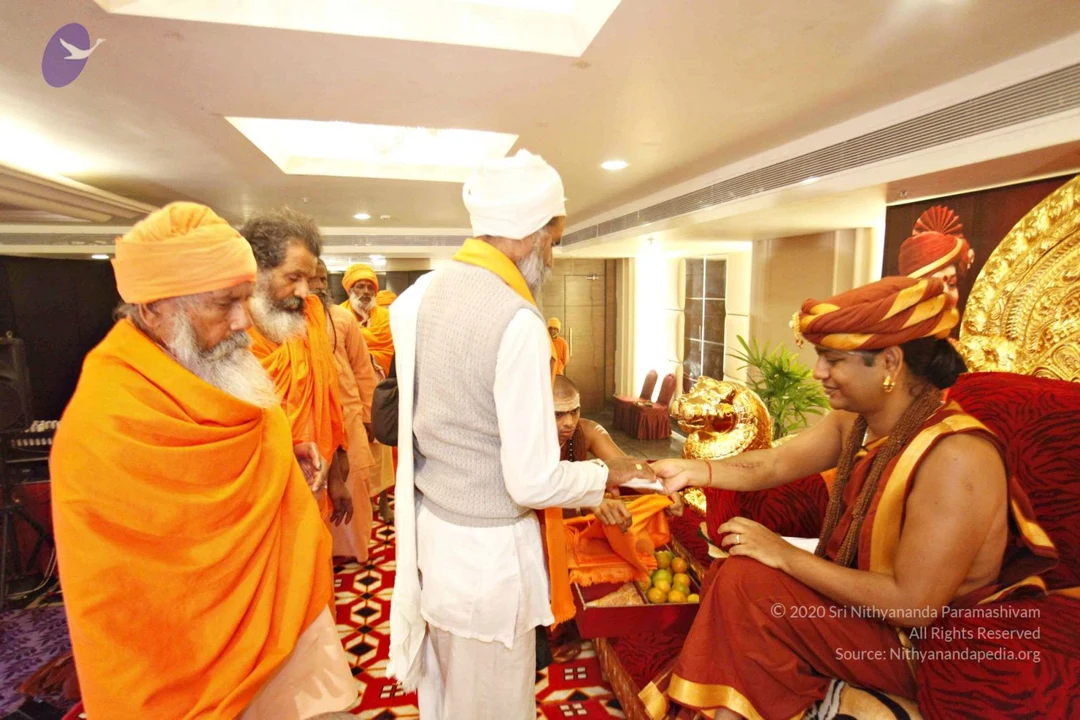
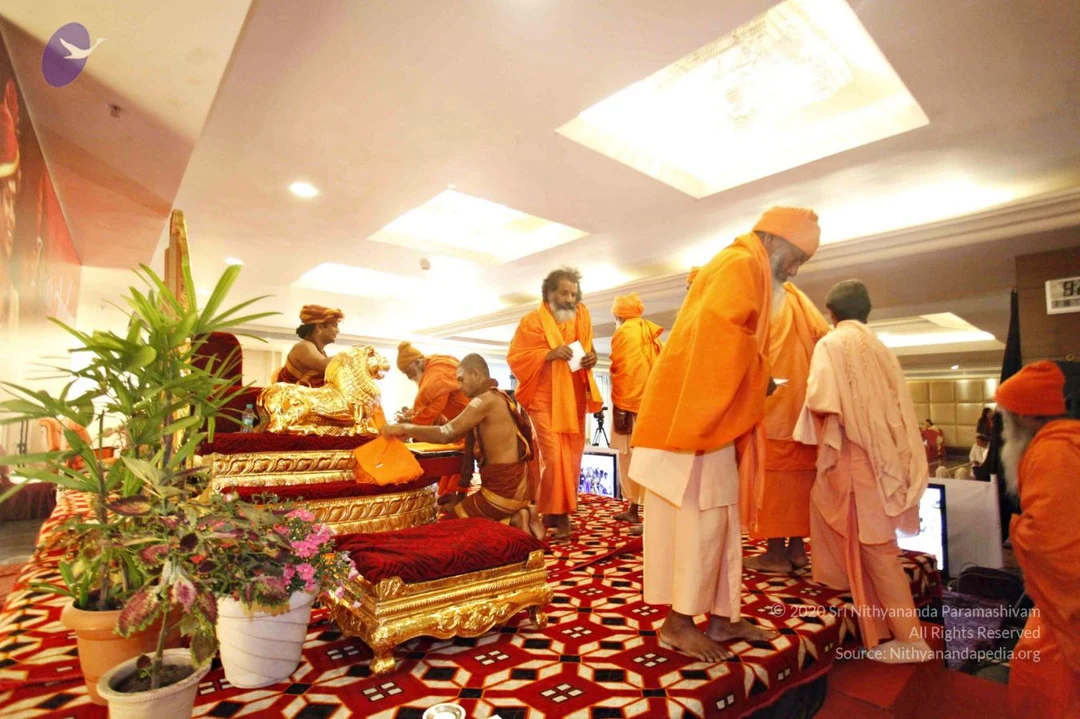
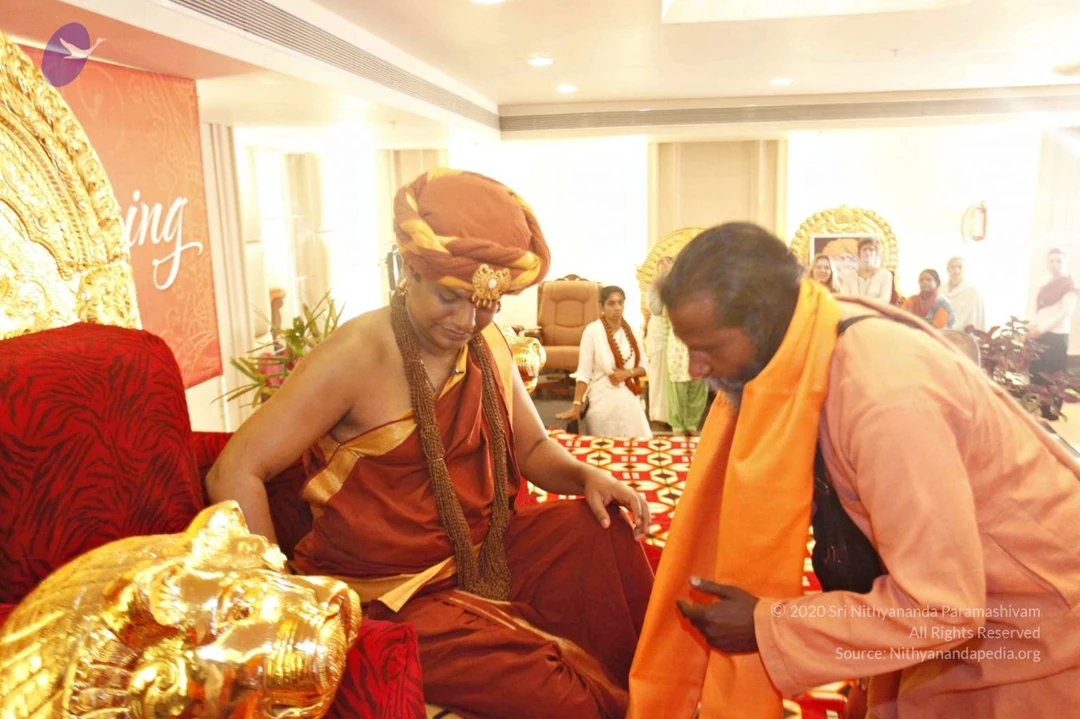
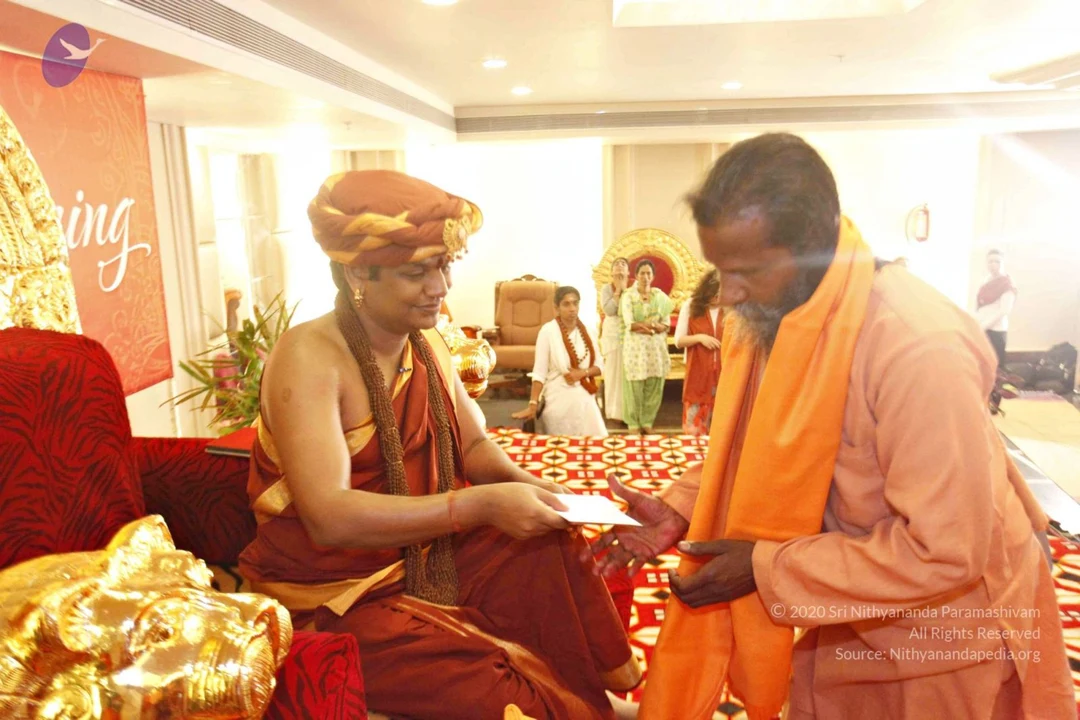
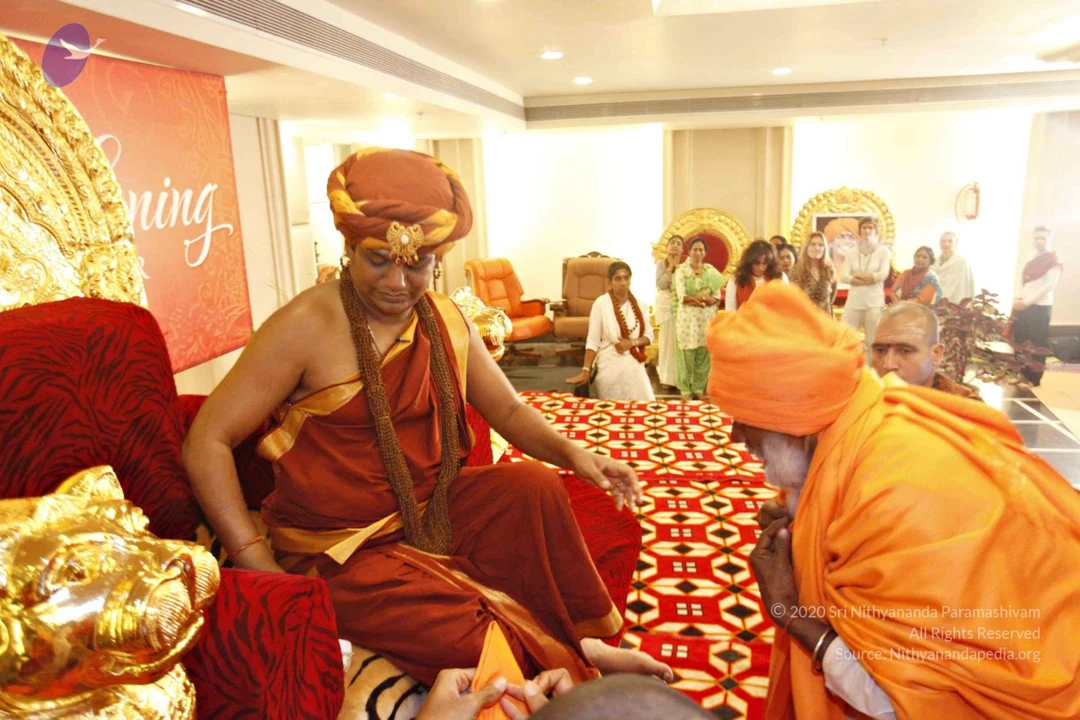
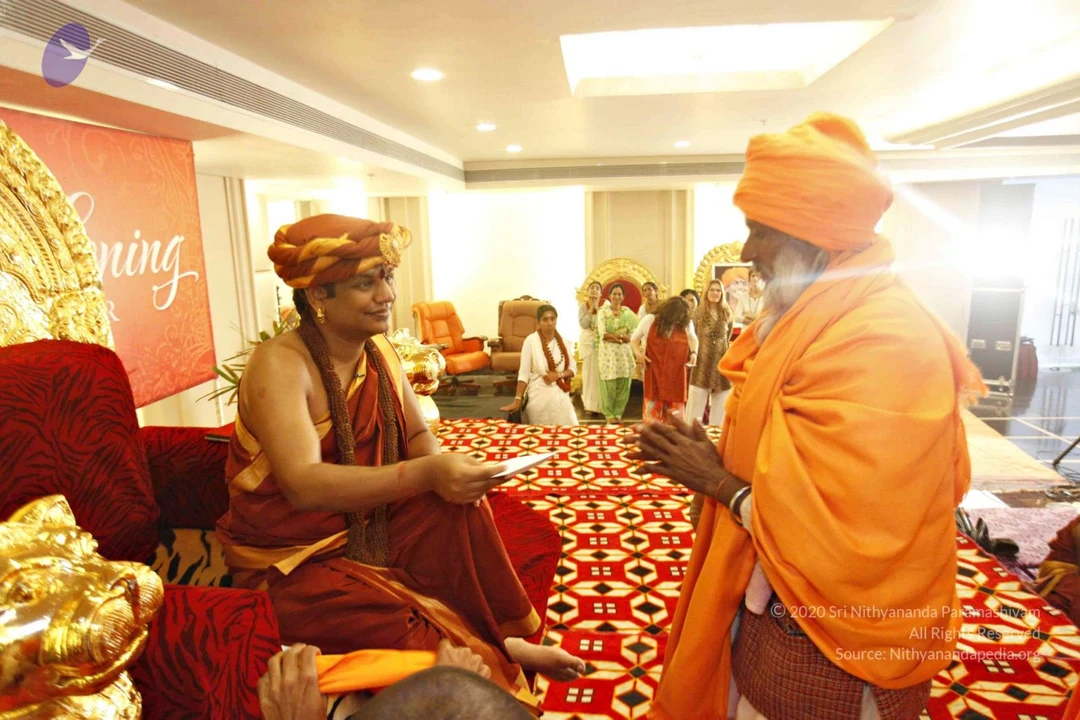
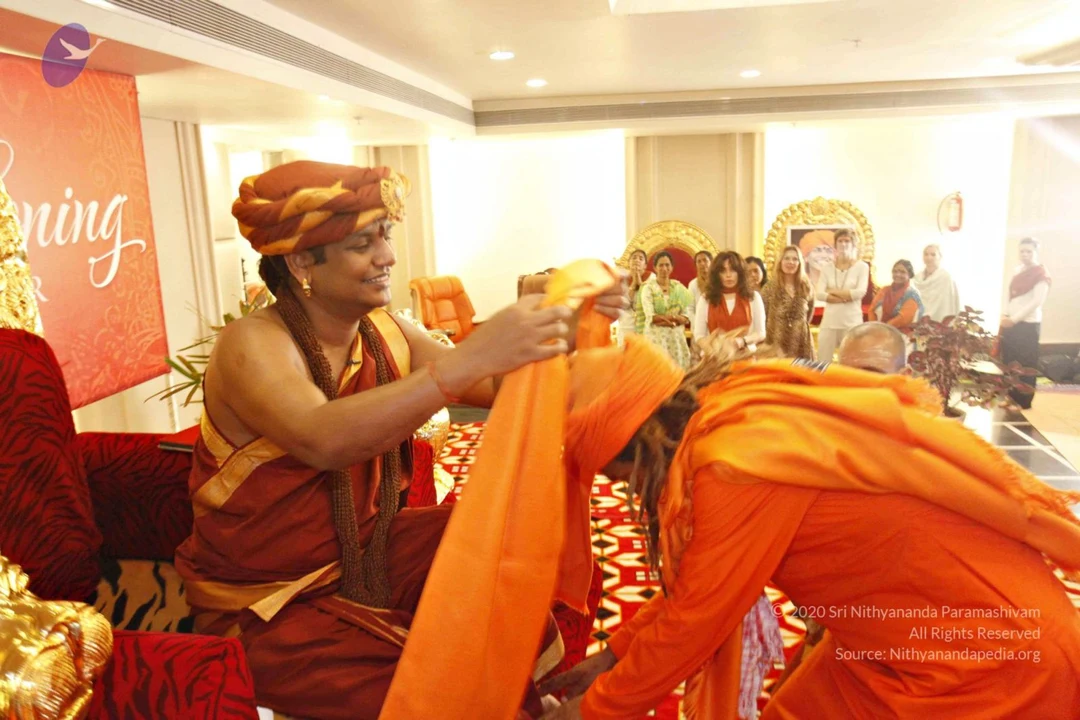
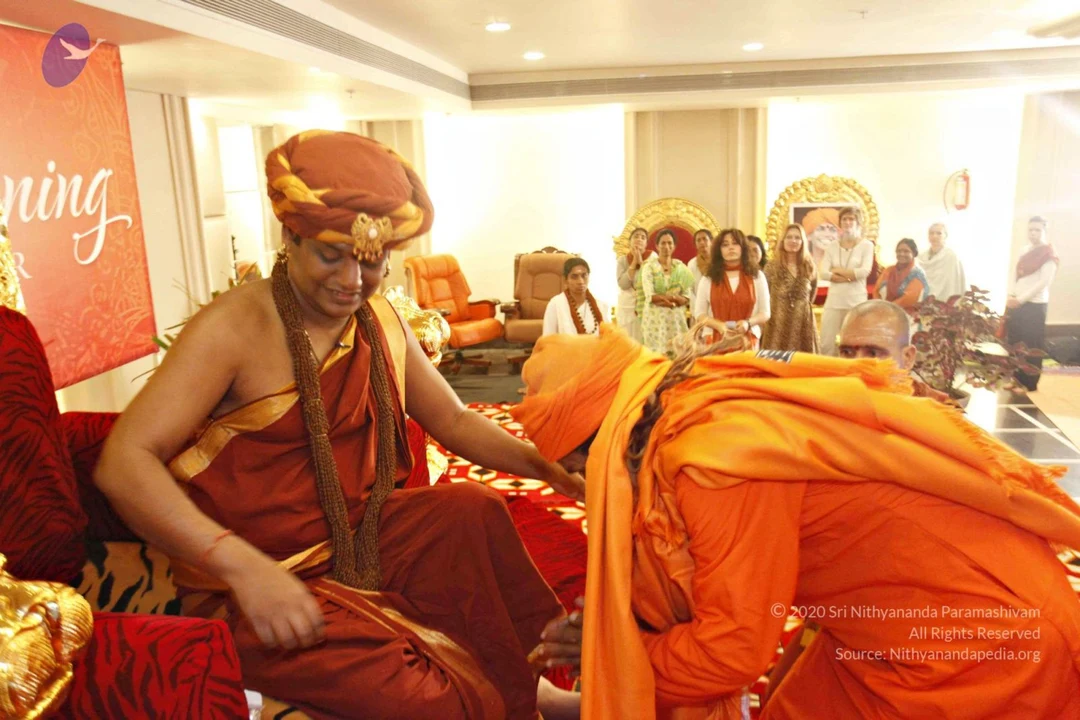
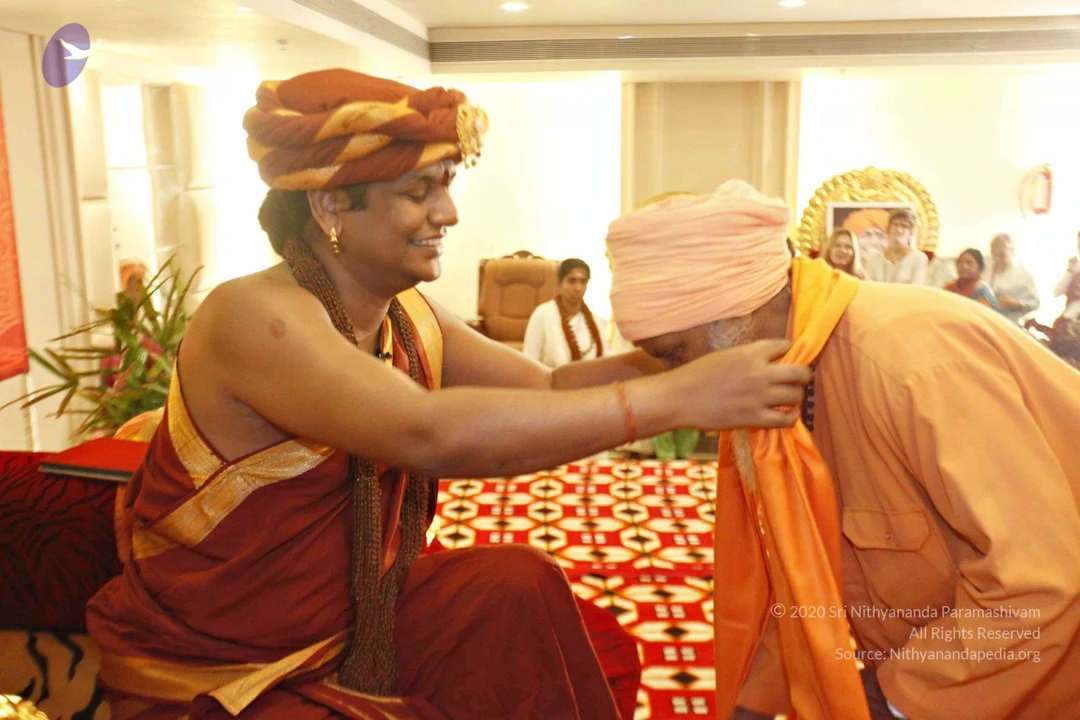
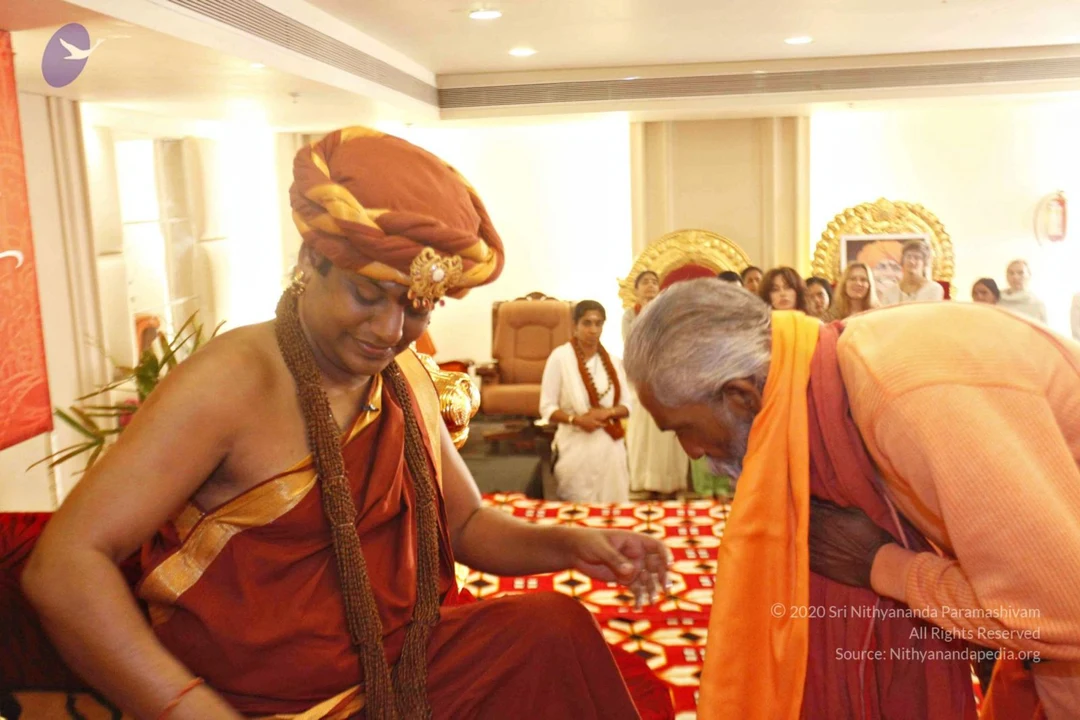
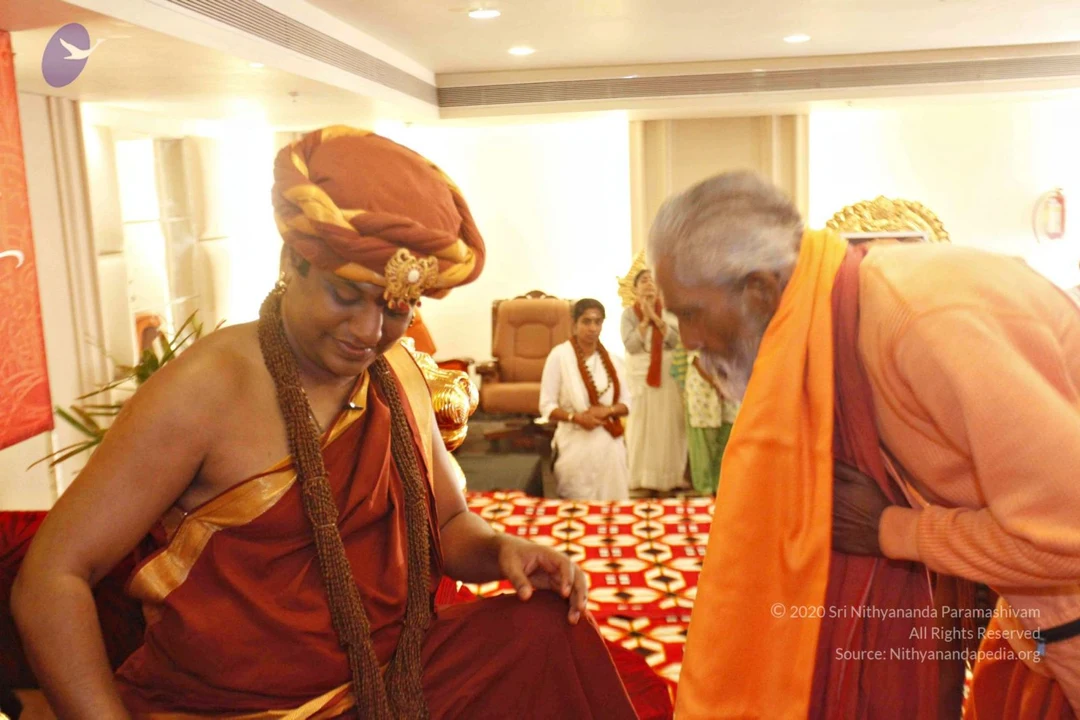
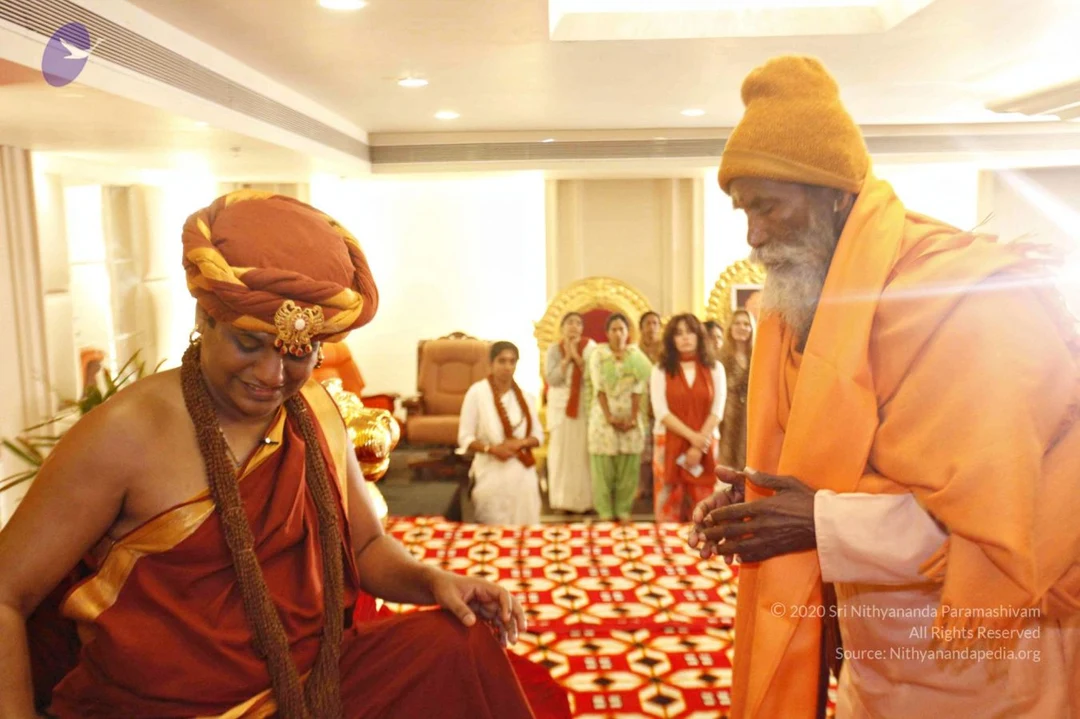
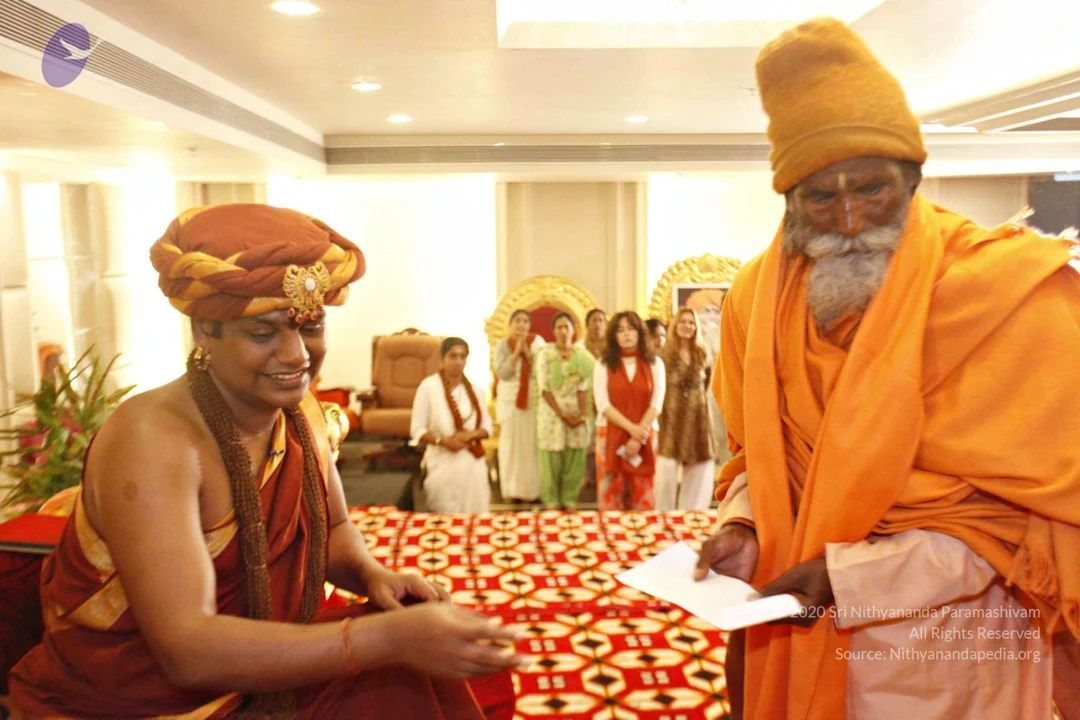
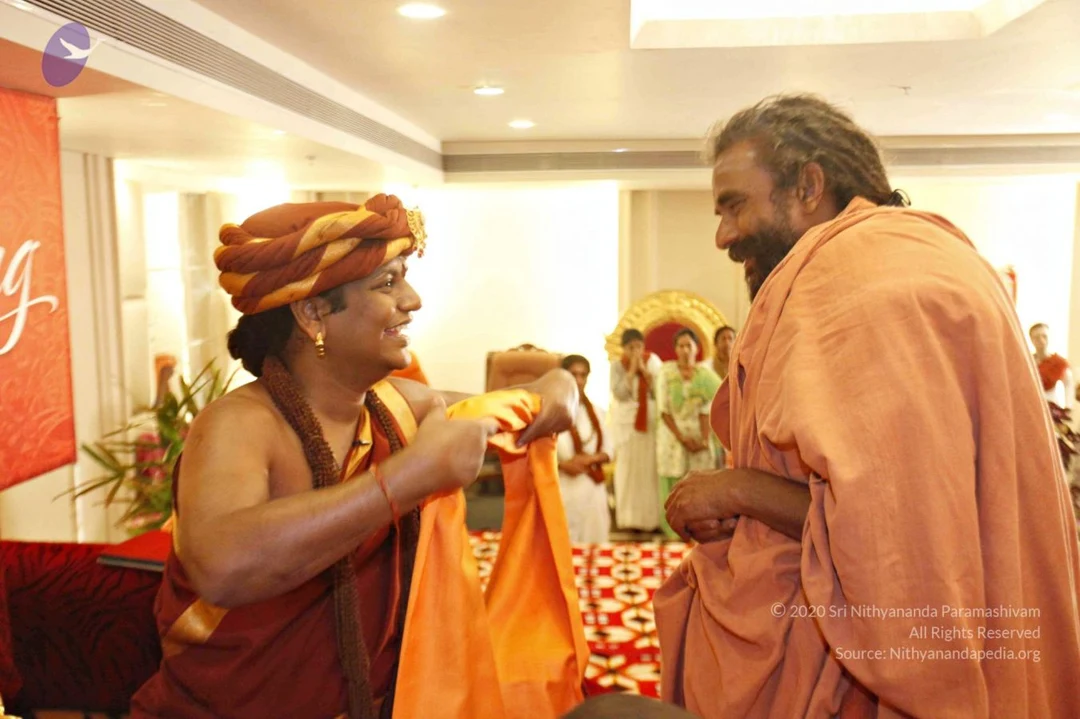
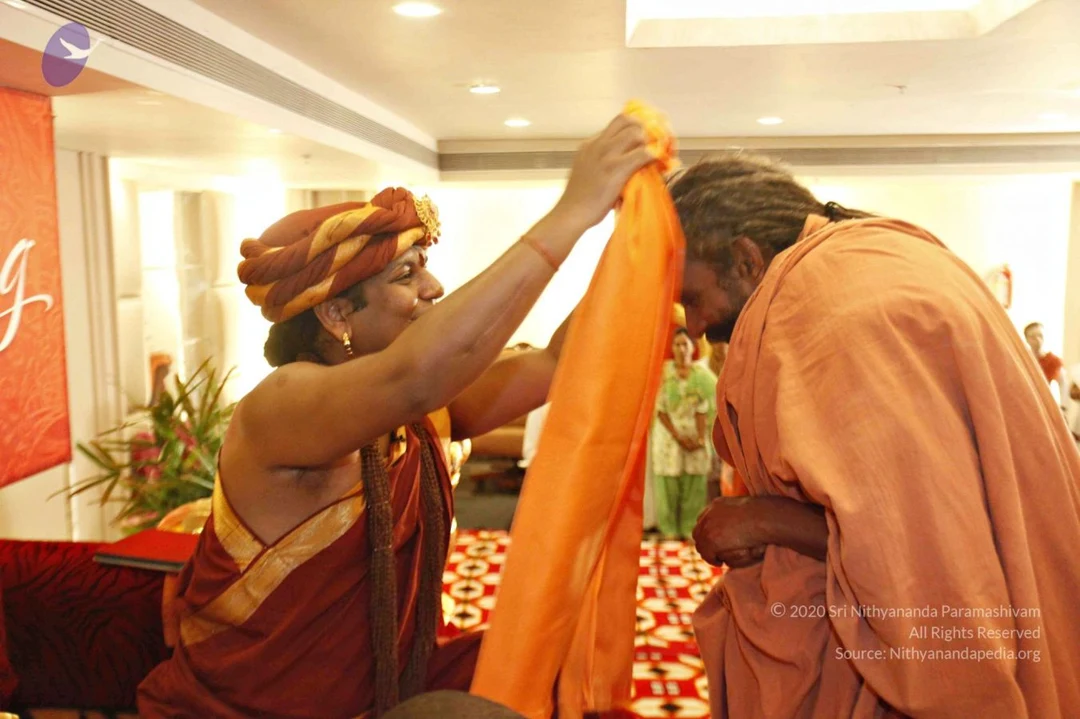
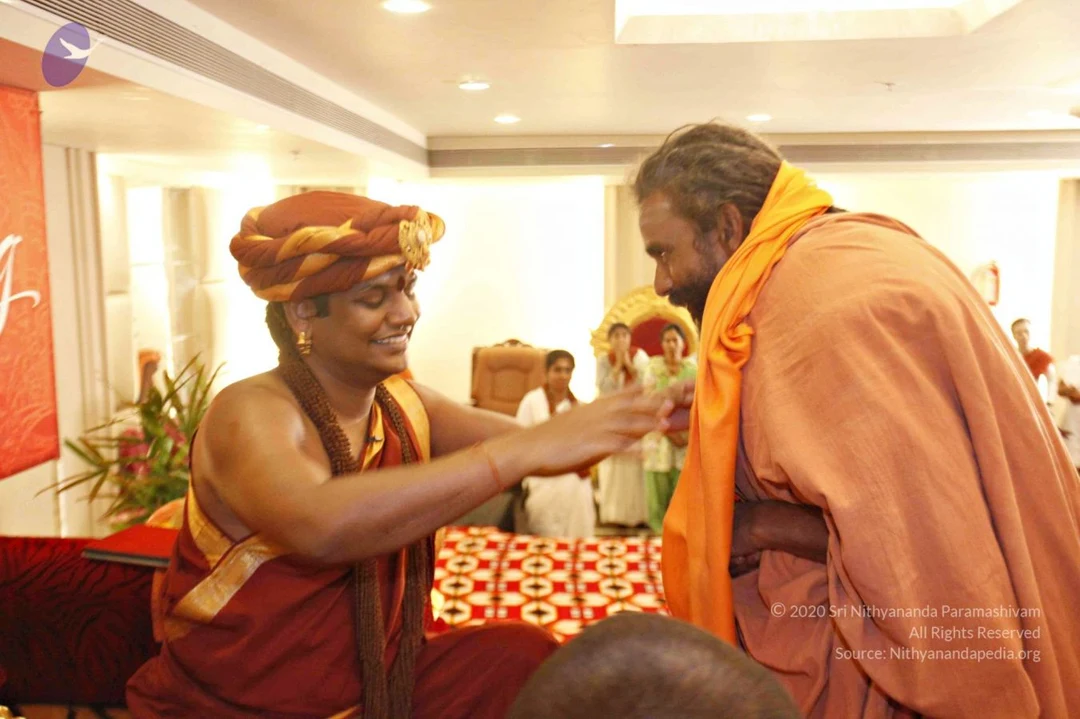
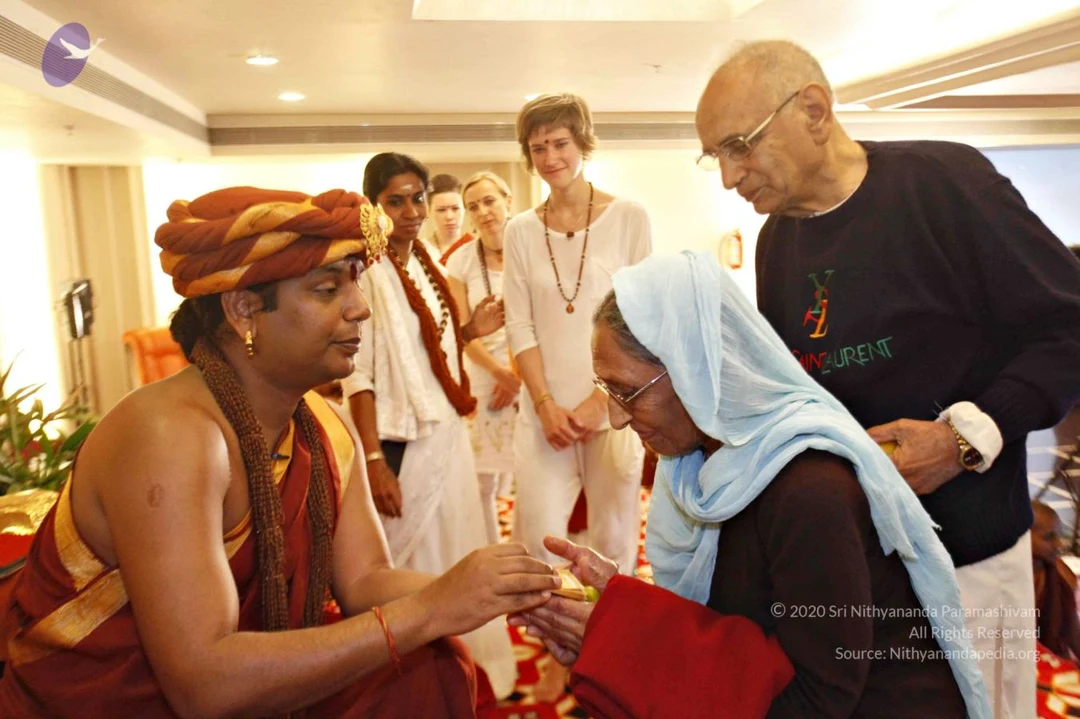
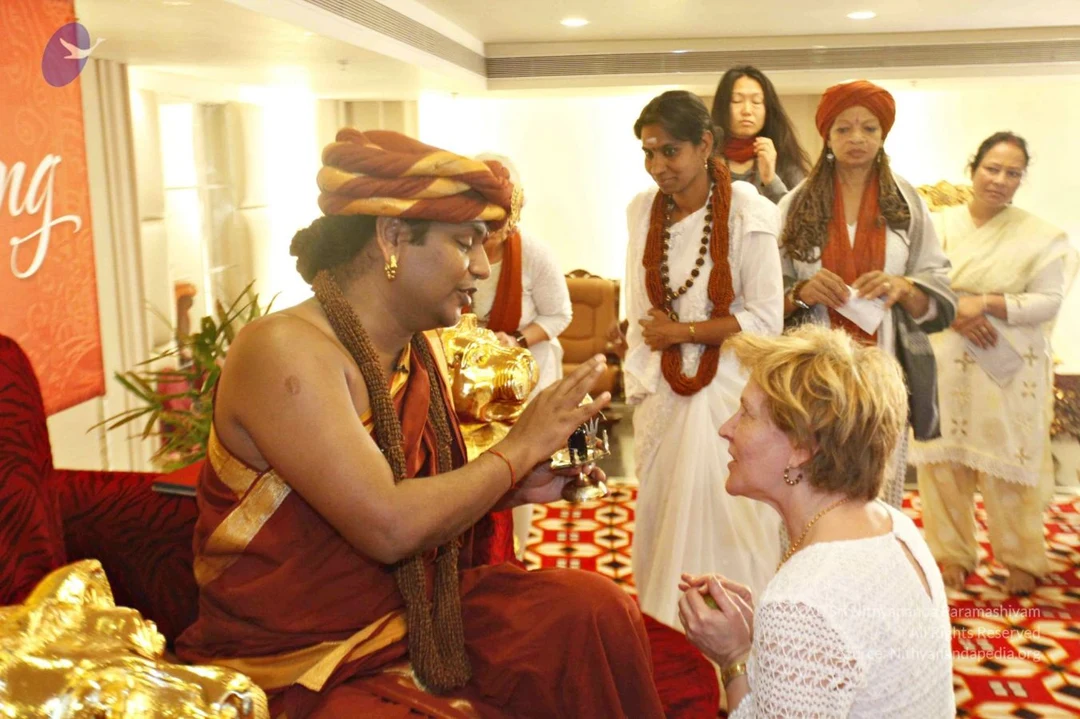
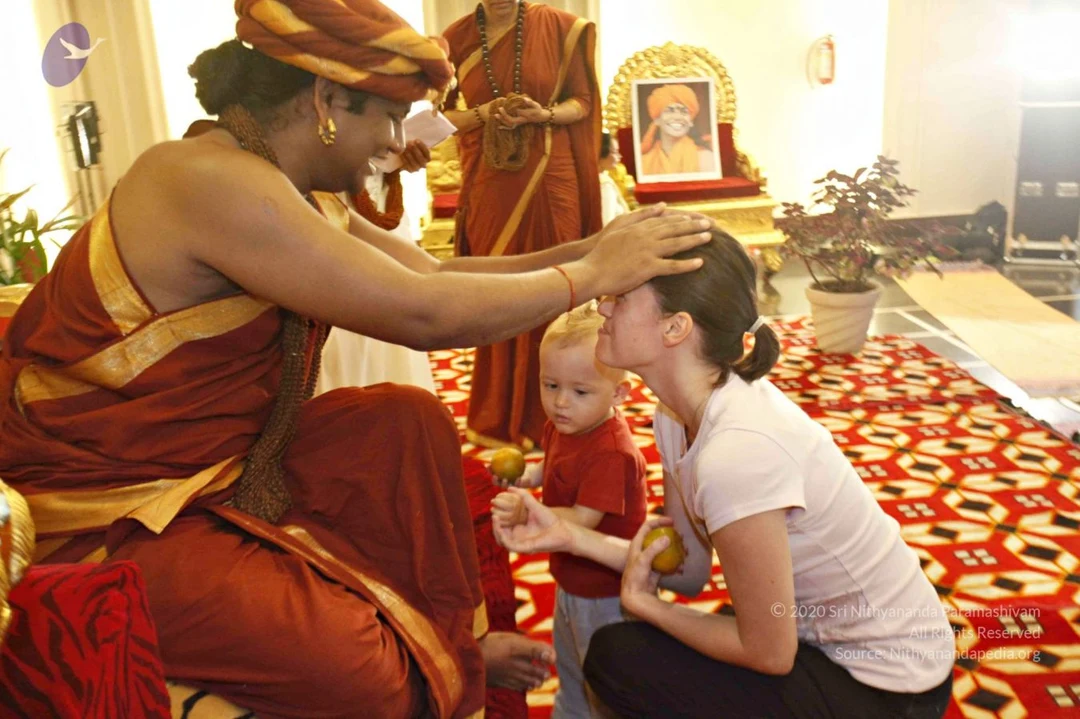
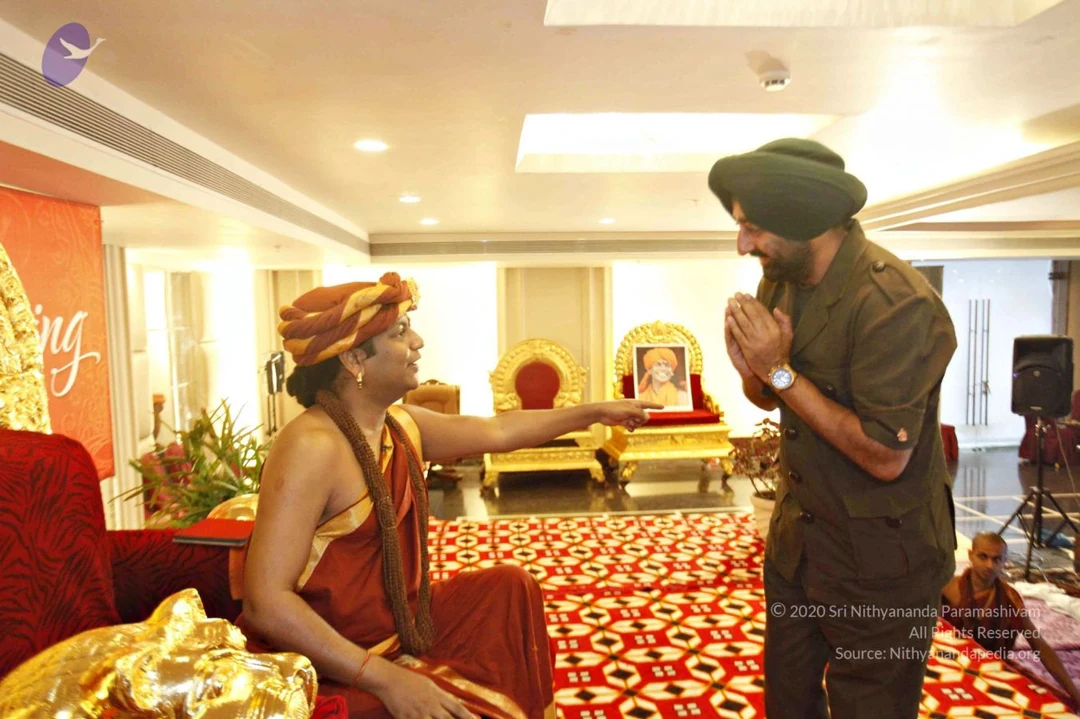
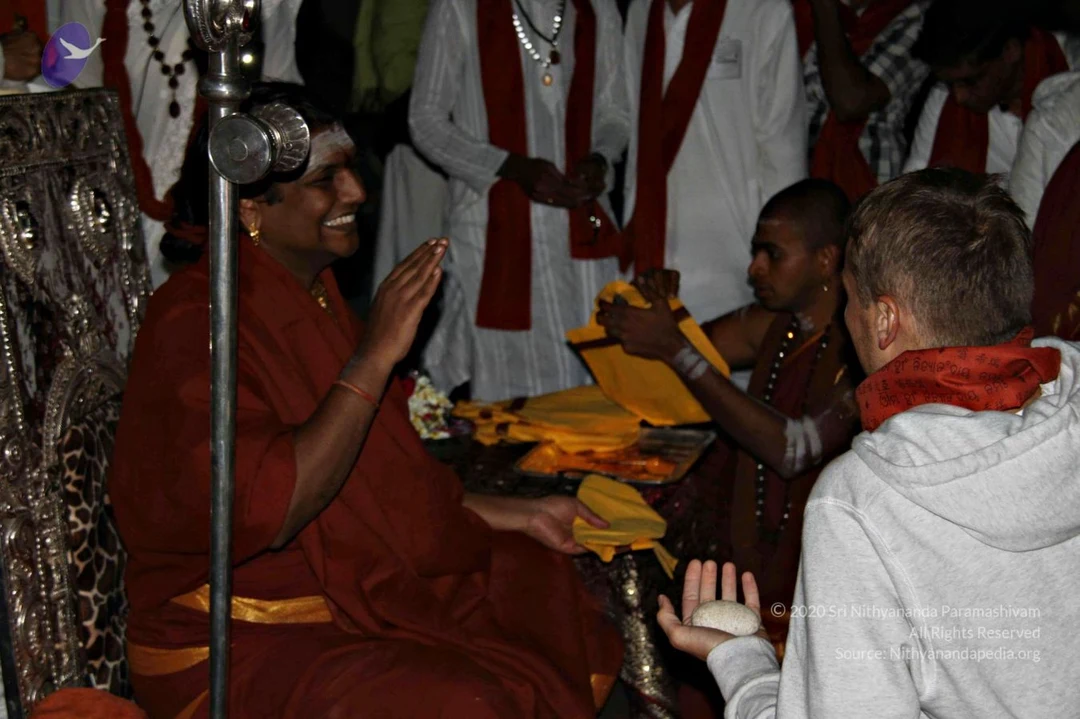
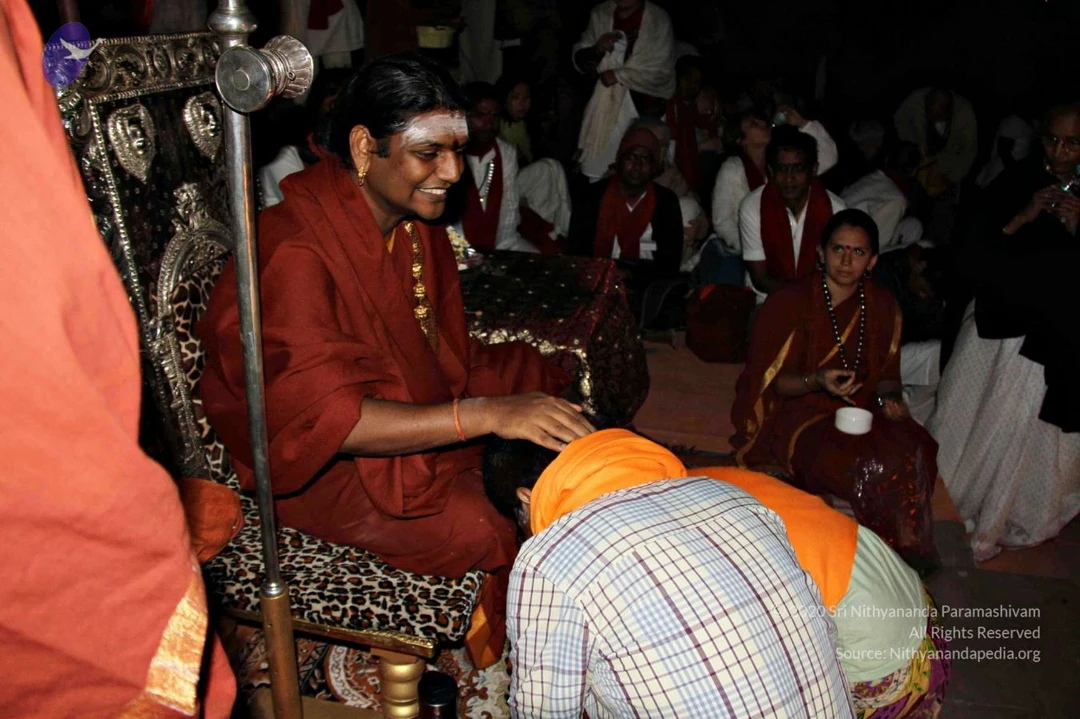
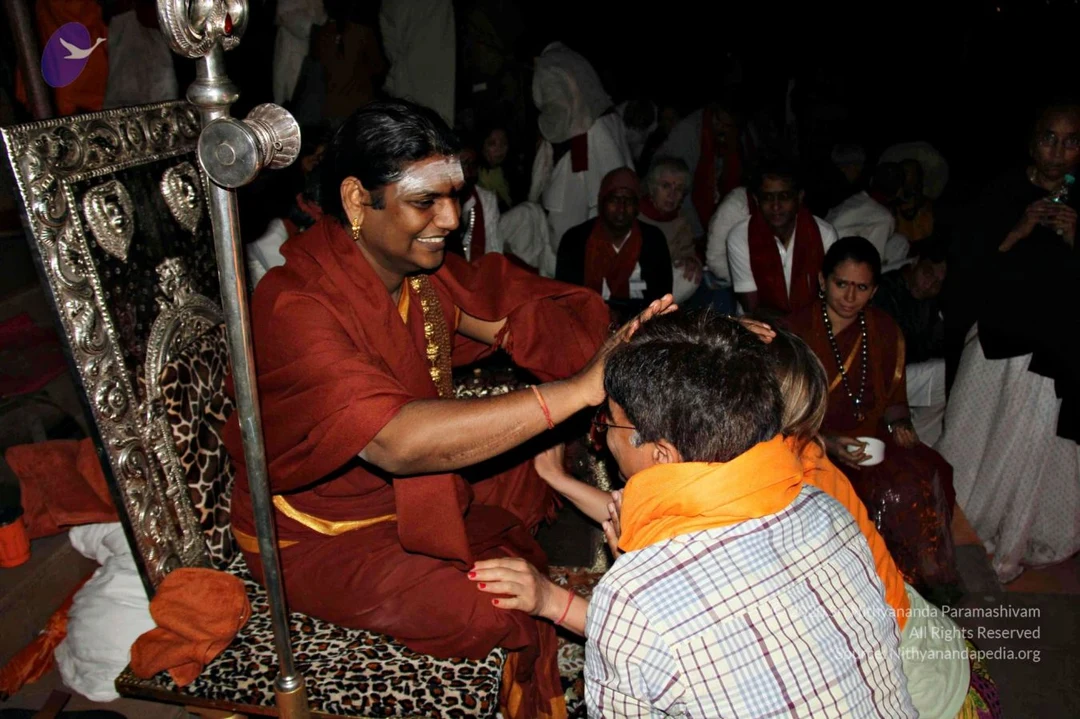
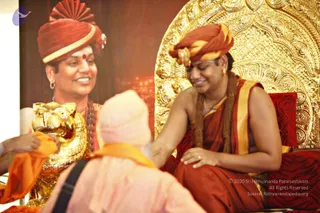
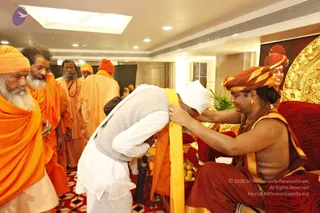
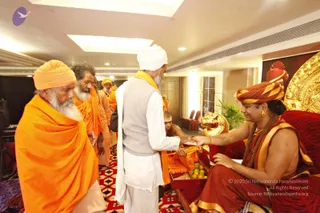
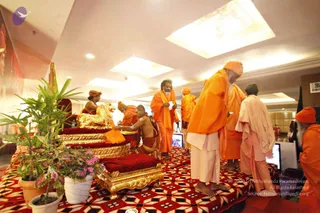
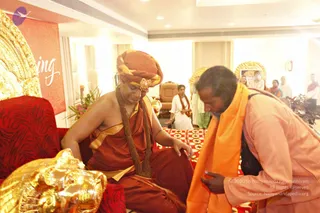
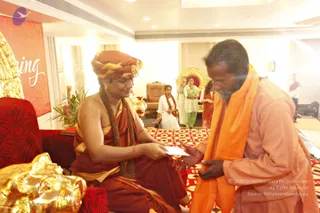
A seated man in a deep red-orange turban and matching saffron-orange robe with a gold-yellow border sits on a red cushioned seat before an ornate gold throne with embossed floral patterns. He wears a rudraksha mala and gold earrings, smiling as he rests his hand on his knee. In the foreground, a person in a pale pink head covering and orange shawl faces him, reaching toward him. To the left, a golden lion-headed statue stands beside a hand holding orange cloth. Behind, a large printed portrait shows a smiling man in a matching red turban and rudraksha mala. The setting appears to be a formal satsang or darshan.Indoor photo in a bright hall with a red patterned carpet. A seated man in a red and gold turban, bare-chested with a rudraksha mala and gold ornaments, sits on a gold-and-red throne-like seat while an attendant in a red turban and white clothing drapes a saffron and gold cloth over him. In the foreground a bearded elderly man in a white kurta with a grey vest bends forward in reverence, while several saffron-robed sannyasis, some in orange turbans, stand nearby. Fruit sits on a tray at the base of the seat, and a large framed portrait of a seated figure in red hangs on the wall behind the throne. A seated figure in saffron and red appears to be the person being honoured, with appearance cues including ornate gold adornments and a rudraksha mala, but the appearance is partly obscured.Indoor photograph in a hotel-style hall with recessed ceiling lights and a red patterned carpet. A bare-chested figure with long, swept-back hair, wearing a red-and-gold turban and rudraksha mala, sits on a red cushioned seat beside a large gold-ornamented backdrop and a golden mask-like ornament, accepting an offering from a white-turbaned man in white kurta and grey vest. Several men in saffron and orange robes and turbans stand in line behind, and a fruit-filled tray sits at the seat's edge.A photograph inside a hall where a red and white patterned carpet covers a raised platform with gilded thrones and red cushions, one topped by a golden lion-shaped seat. Several saffron-robed sannyasis stand and kneel around the platform; a bearded man in a saffron robe and orange turban stands centre-left holding papers, a man in orange and white stands right with bare feet, and a man kneels in front of the gilded seat holding an orange cloth. A man in a white and pink shawl stands right beside another saffron-robed monk in an orange turban. Potted plants with pink flowers sit at the left edge, and a bright ceiling panel and wall screens complete the room.A photograph in a bright, ornate hall with a red-and-gold throne. A seated man in a rust-orange turban, orange-brown robe with gold trim and a long rudraksha-style bead necklace receives a bow from a standing devotee in a saffron-orange shawl and pink-orange robe, who leans forward with hands together. Gold lion-head armrest in the lower left, red tiger-striped upholstery, red patterned carpet. Behind them, several people in white and green garments stand near floral arrangements and gold chairs, and a gold framed mirror appears on the right. a person: the seated figure wears a turban, rudraksha-style beads and ceremonial orange-gold clothing on a throne, and is being bowed to by a devotee.A seated figure in an orange-red turban and matching saffron-red robe, with long braided hair, a brown-beaded mala and gold earrings, receives a small white envelope from a bearded man in orange clothing and an orange shawl who bows with hands extended. The seated figure sits on a red patterned chair beside a gold lion-shaped ornament, with a red and gold patterned rug underfoot. Behind them, several people in white and green garments stand in a bright room with a gold-framed throne and a potted plant. A printed backdrop reads 'ing' in white script.
SPH visits Rishikesh

56 photosSource gallery
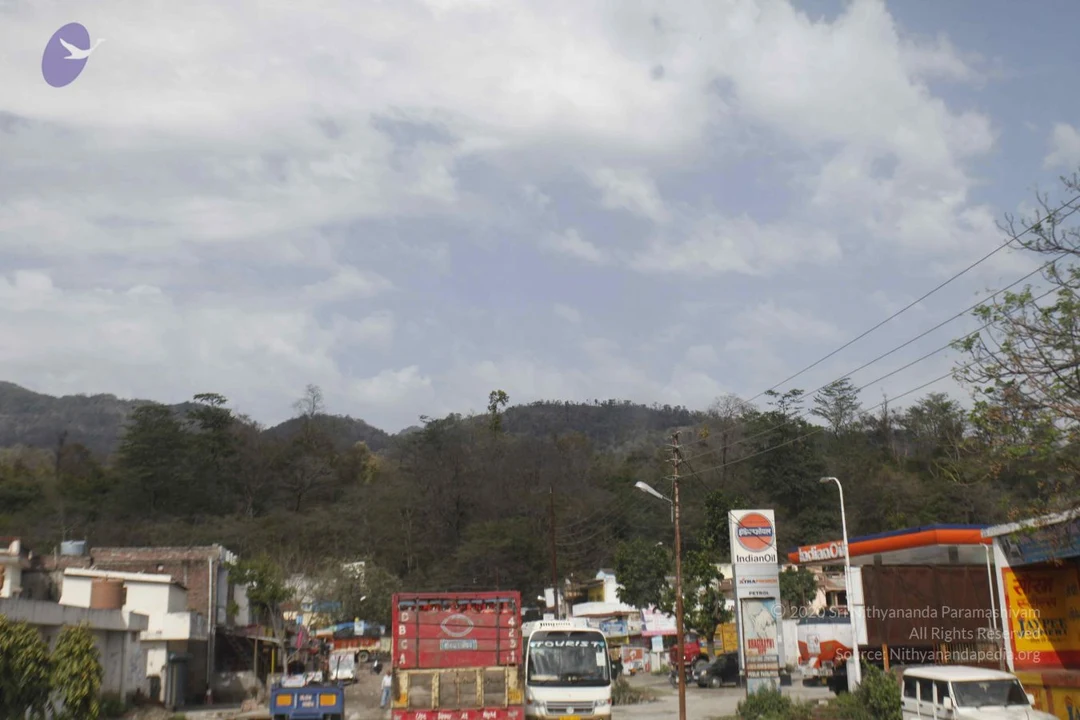
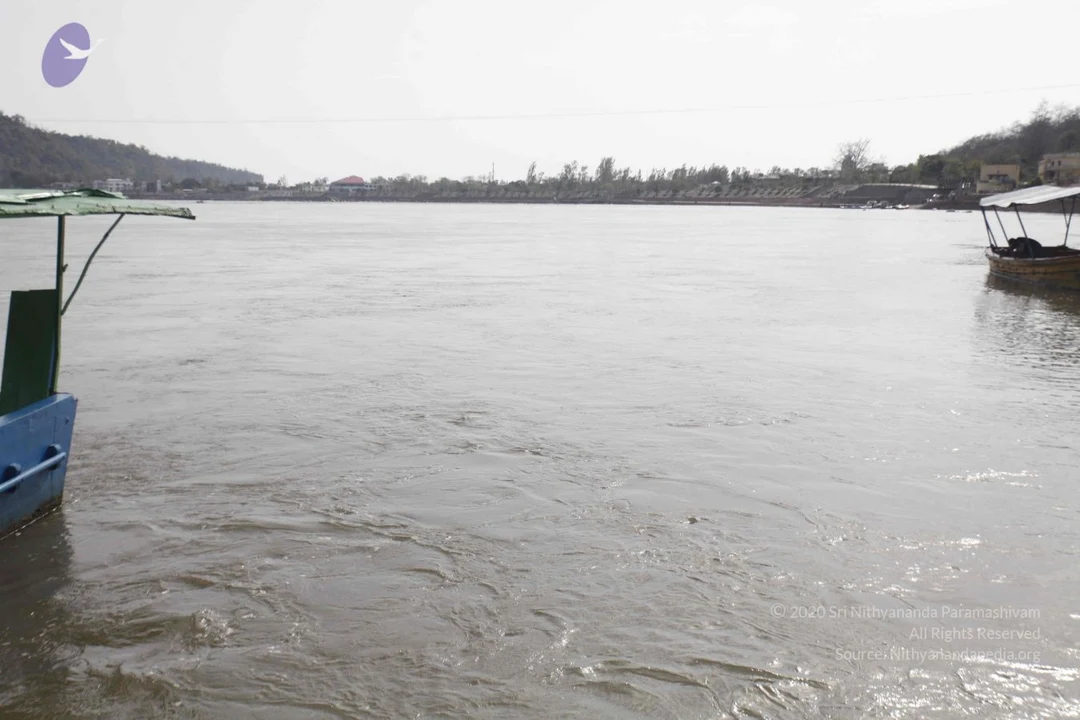
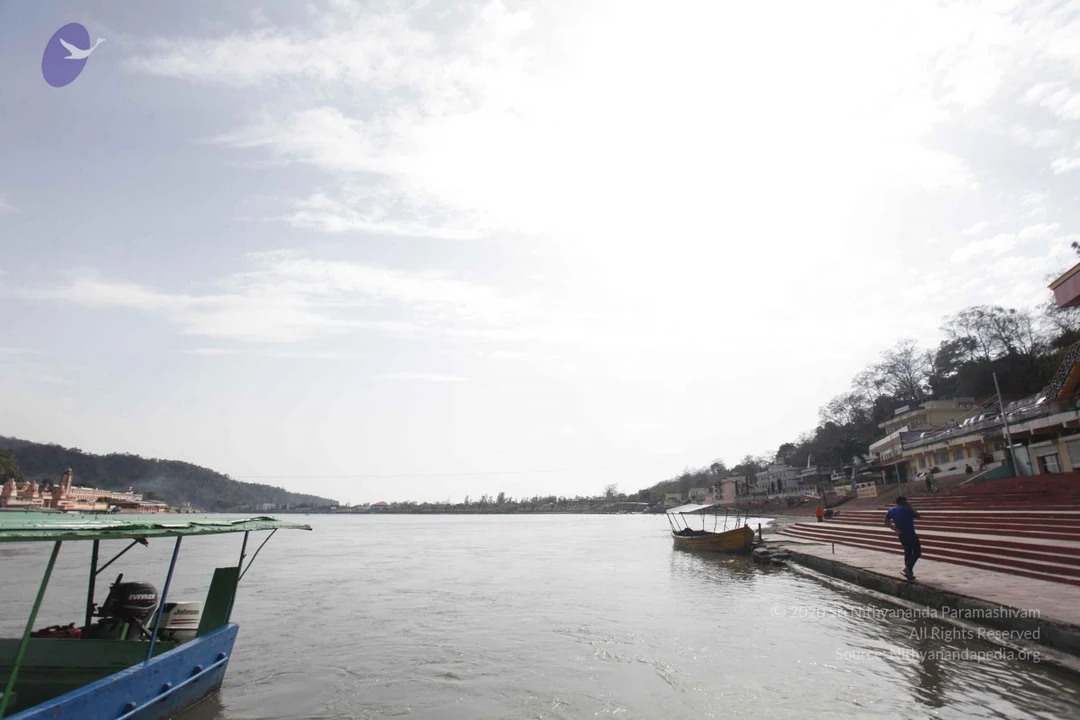
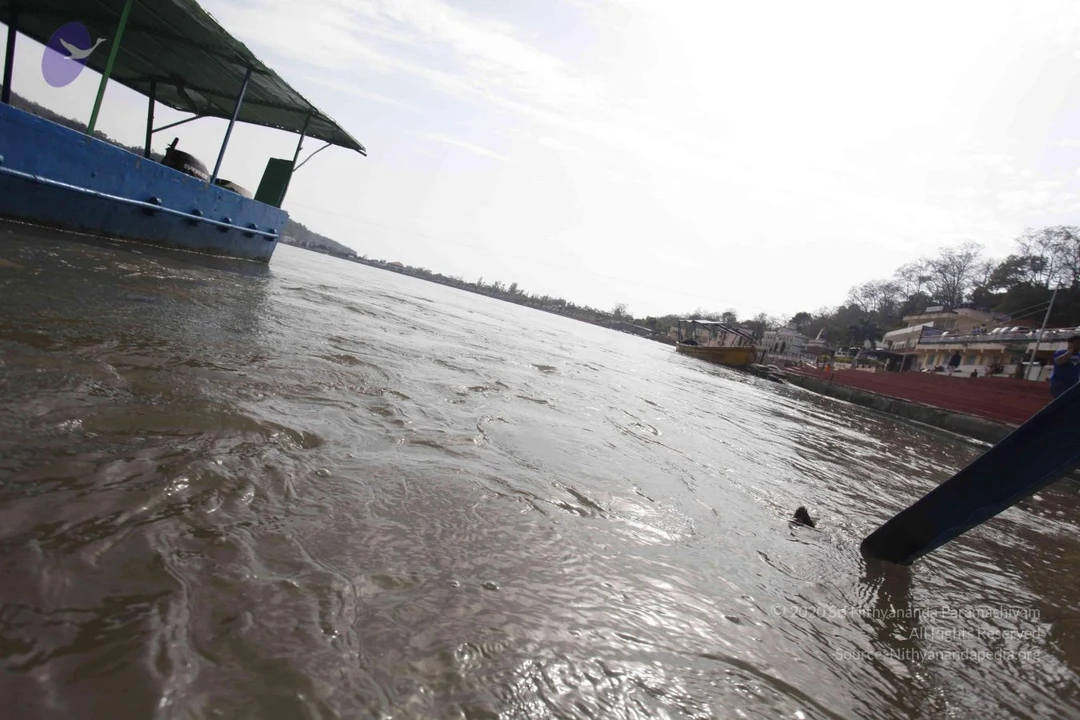
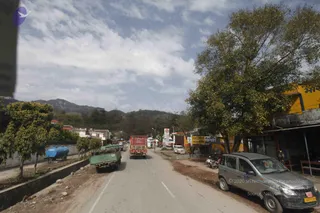
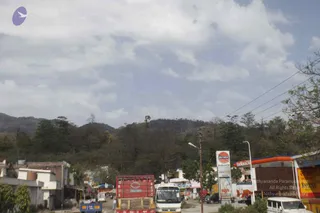
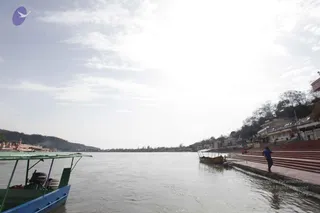
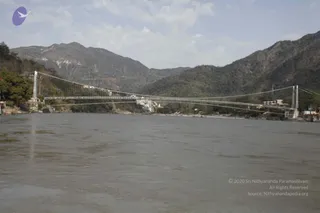
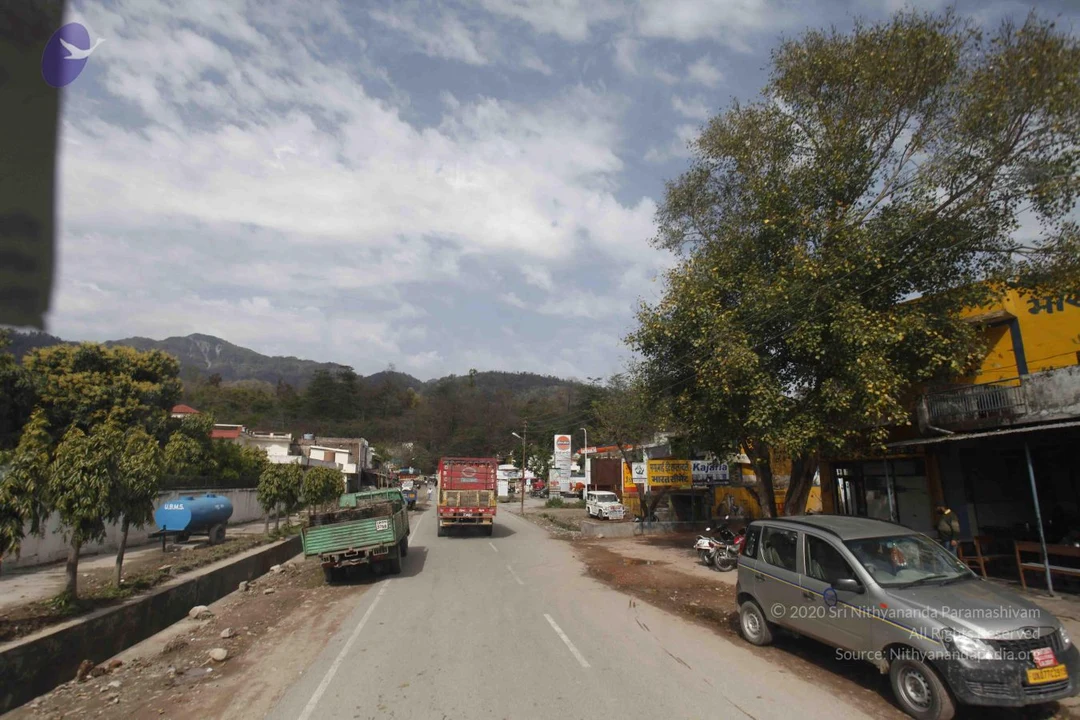
A roadside scene on a two-lane hillside road with a grey asphalt surface and white edge lines. Several trucks are on the road, including a red truck and a green flatbed, and a blue water tanker sits on the left. Hills and trees fill the background under a partly cloudy sky. On the right, a large leafy tree stands beside yellow-fronted shops with Hindi signboards, a row of parked motorcycles, and a silver hatchback parked at the curb in the foreground. No people are visible.Outdoor street scene in a hilly town under a pale cloudy sky. A red cargo truck with a white-and-red Tata-style bus parked beside it stands in a dusty lot in front of a small roadside fuel station with an Indian Oil sign and a pole-mounted red-and-white price board. Wooded hills and scattered buildings line the background, with overhead power lines crossing the frame. No people are clearly visible, and no one appears to be a person.A wide, muddy brown river flows across the frame under a pale hazy sky. On the left foreground a blue-hulled boat with a green canopy sits at the water's edge, and on the right a small wooden boat with a tan canopy floats near the bank. Distant green hills rise on both sides, with a row of trees, a few low buildings and a red-roofed structure along the far shoreline. No people are visible.A wide river scene at a riverside ghat, with a calm grey-brown river under a pale hazy sky. A green-roofed motorboat with a blue hull sits at left, and a small yellow wooden boat is moored at center-right beside red stone steps leading down to the water. A single man in a blue shirt and dark trousers walks along the ghat at right. Trees, low buildings and a distant wooded hillside frame the banks, with a pink-walled temple complex visible across the water at left. No ritual activity or a person candidate is visible.A low-angle photograph of a wide, brown river surface with ripples, taken from the water's edge. On the left, a blue-hulled boat with a green corrugated canopy sits at the bank. Further along the shore, a yellow boat is moored near a red-paved riverside platform, with buildings and leafy trees in the background under a pale sky. A small dark head is visible in the water near the right edge, and a blue oar or pole extends into the frame at the lower right. No people are clearly visible beyond the partially submerged swimmer. The scene is a Haridwar-style riverfront with ghat architecture.A photograph of a wide, murky river in the foreground with a suspension bridge spanning it toward forested, hazy mountains. The bridge has tall pylons and thin suspension cables, and a small cluster of buildings and a stepped structure sits on the far bank. No people are visible in the scene. The sky is pale with scattered clouds.

SPH visits Rishikesh

74 photosSource gallery
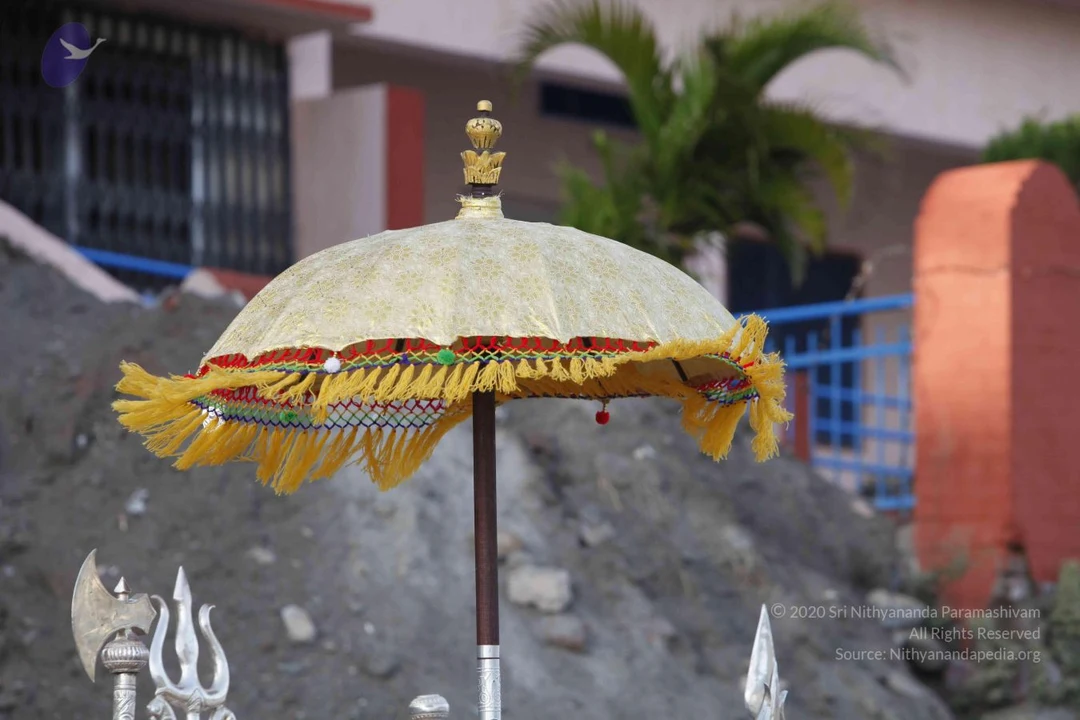
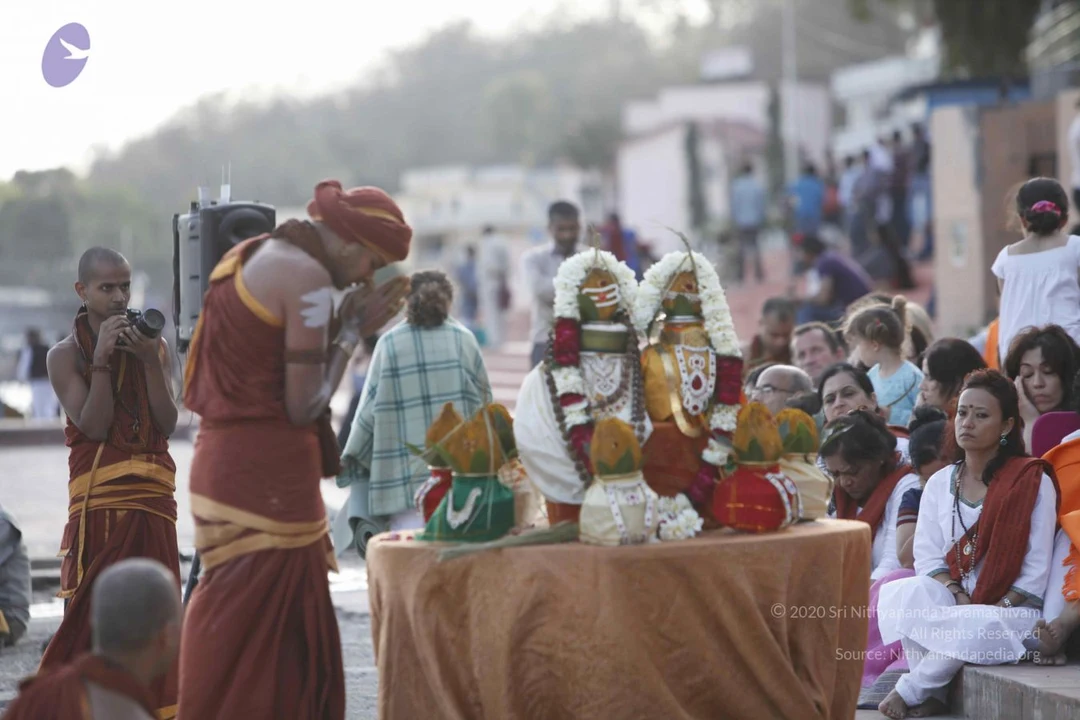
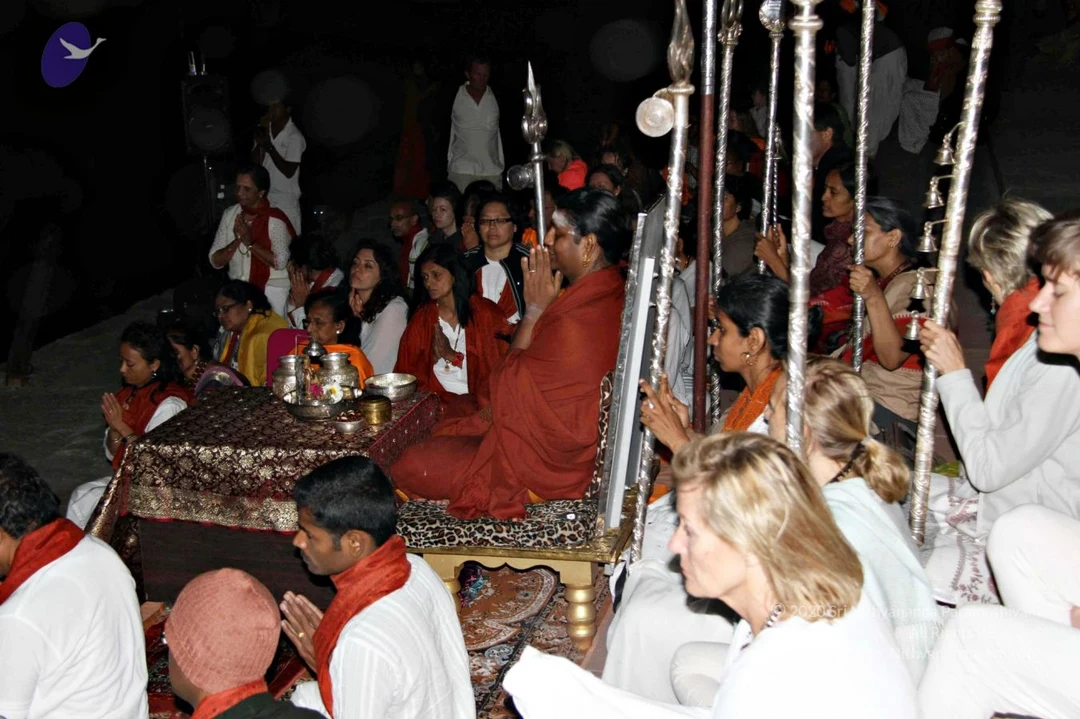
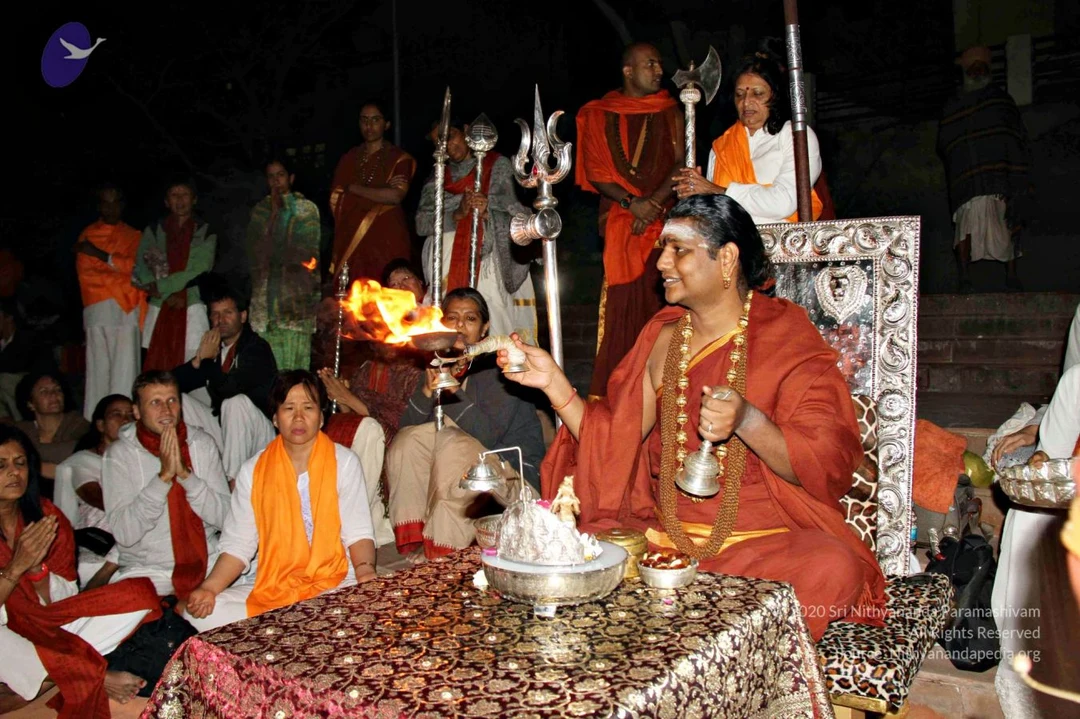
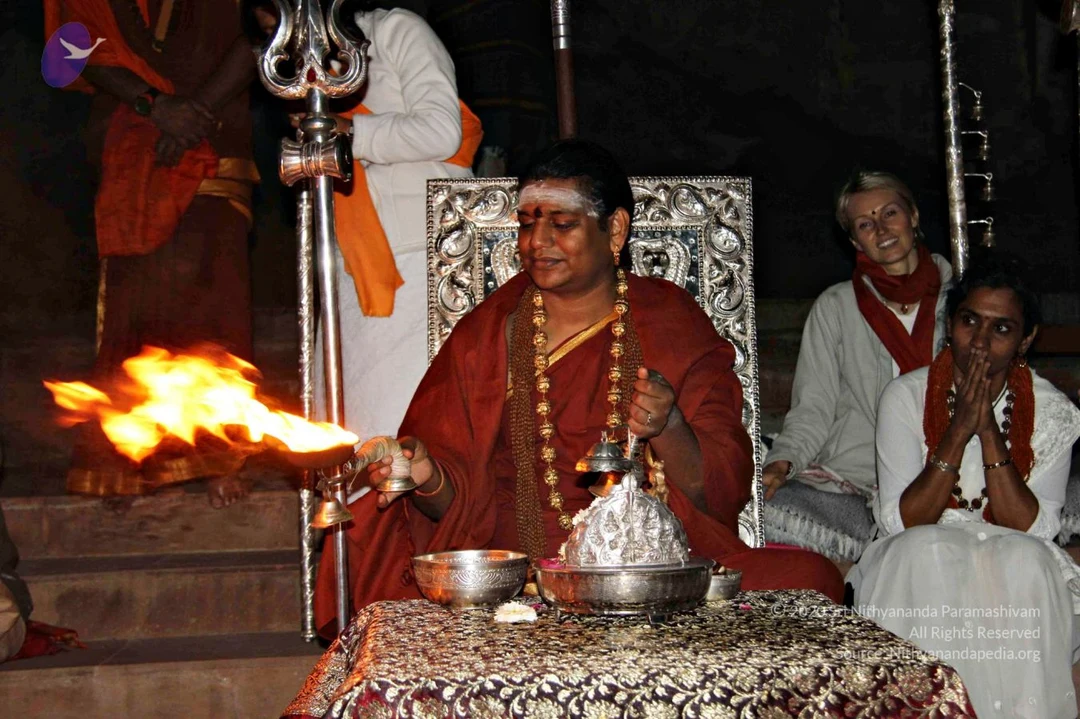
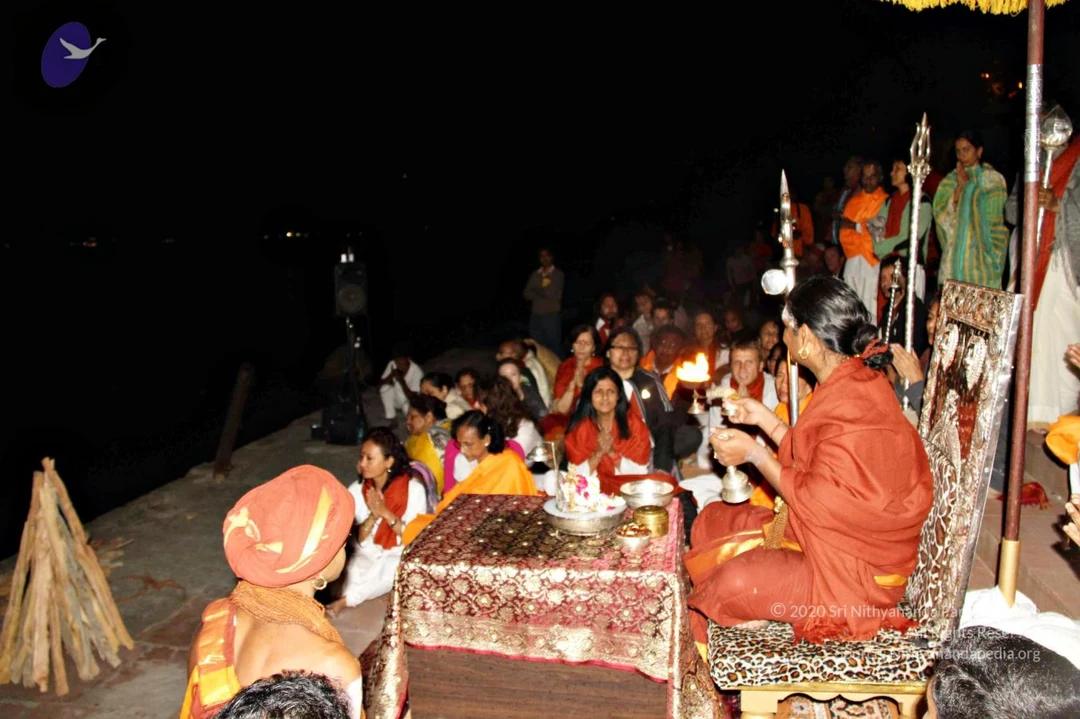
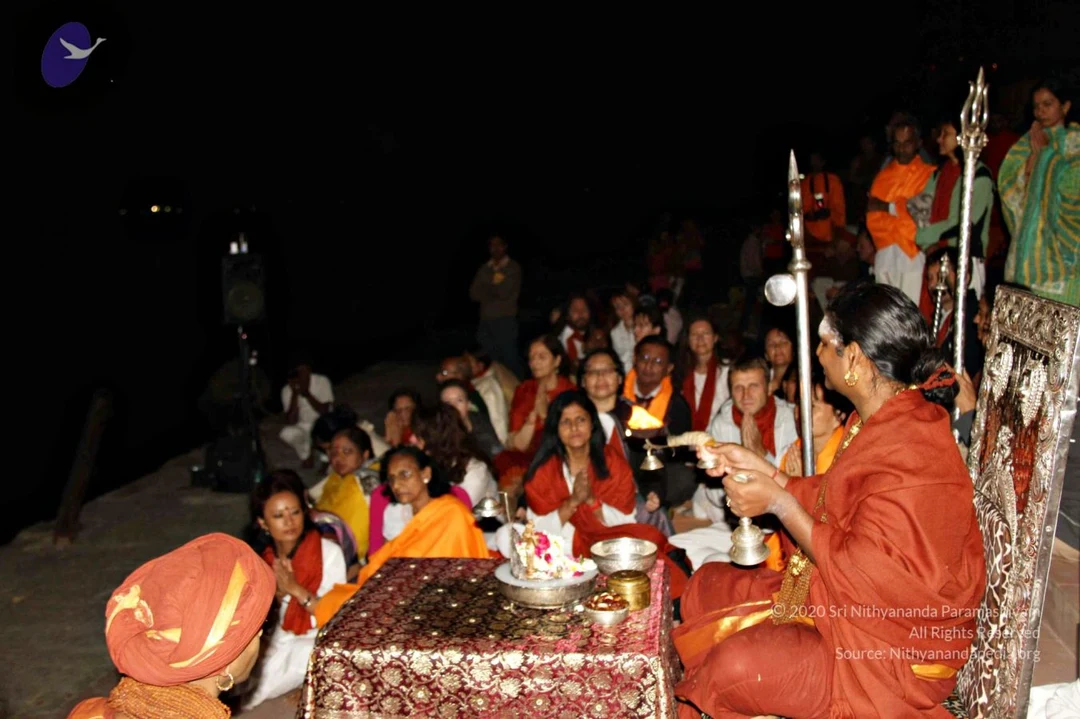
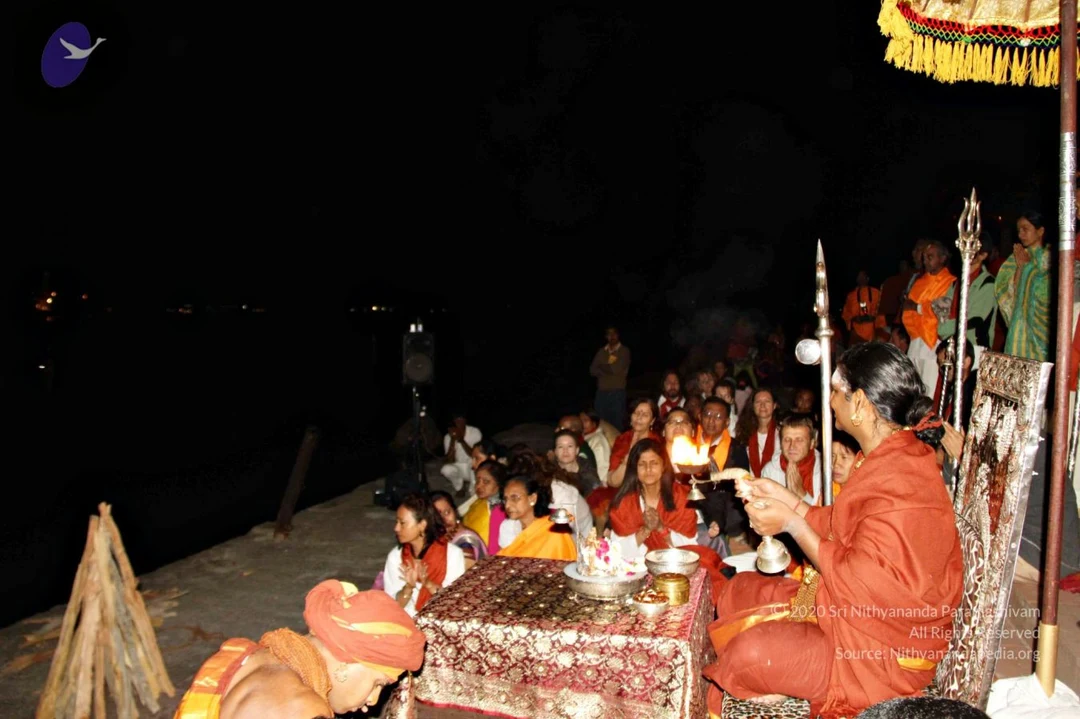
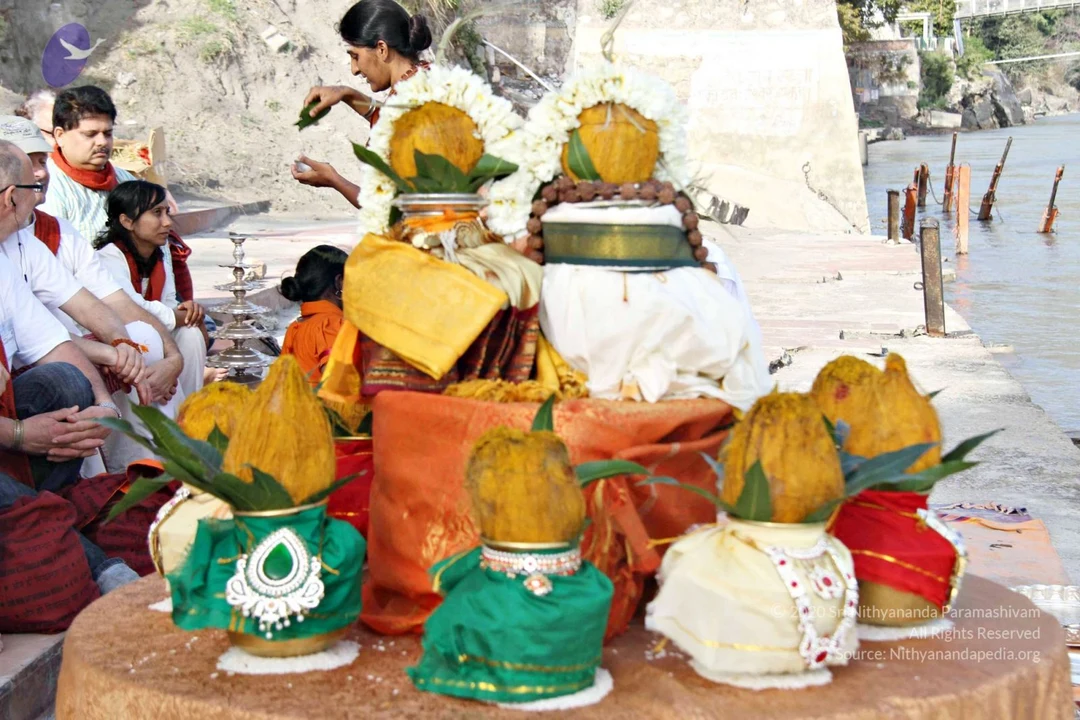
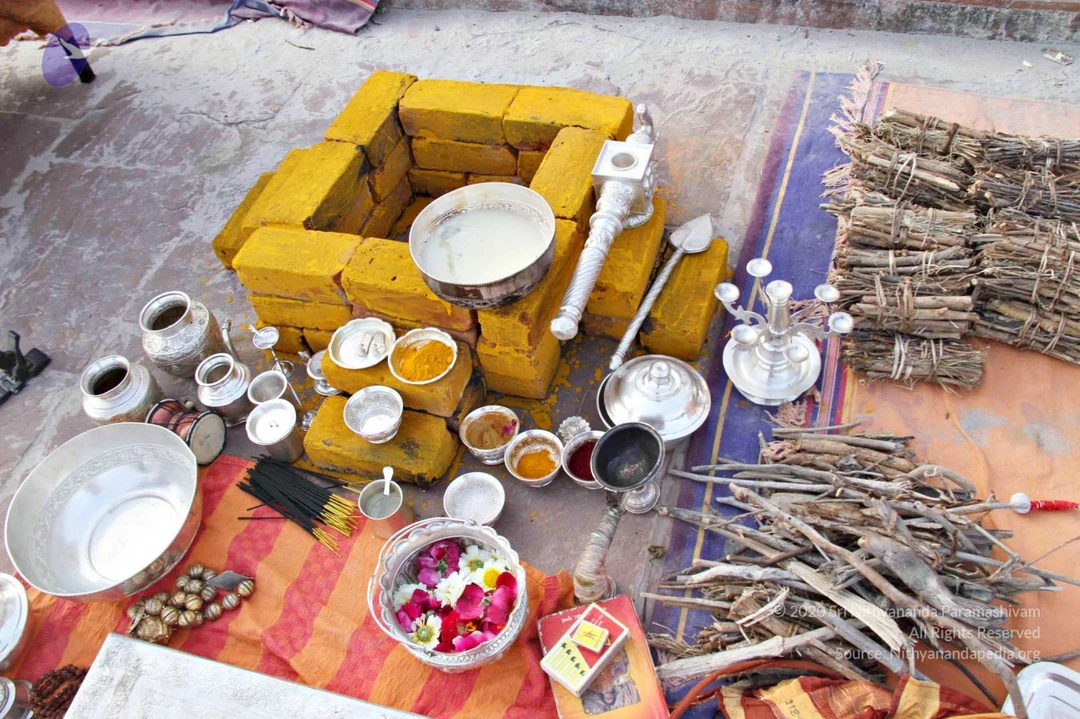
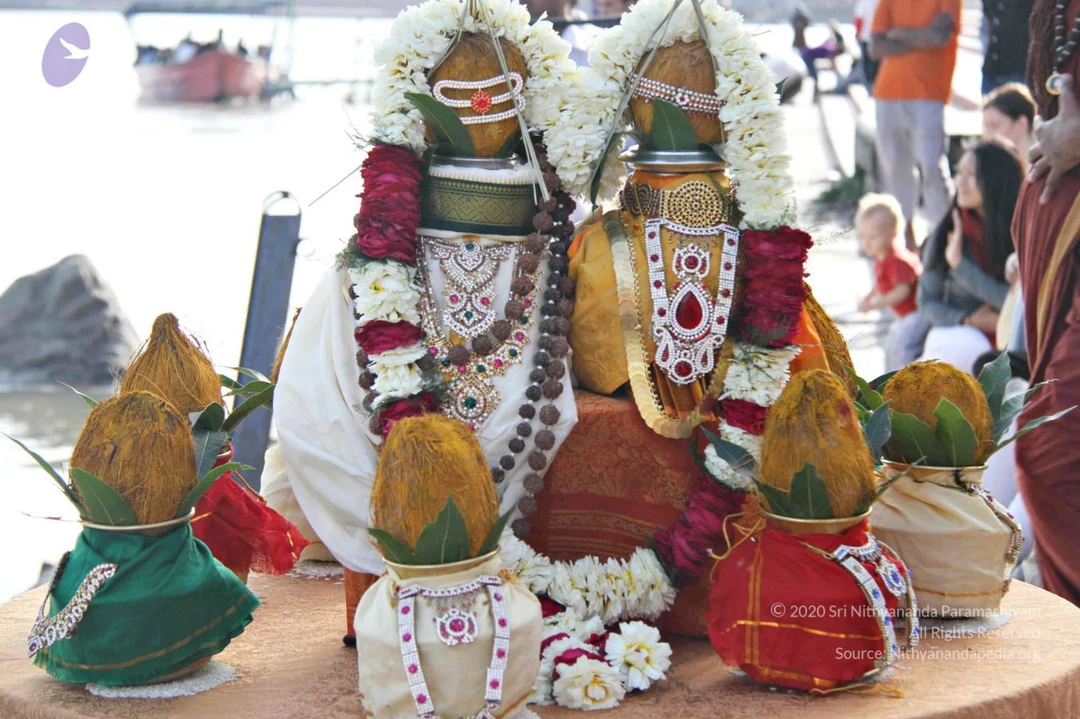
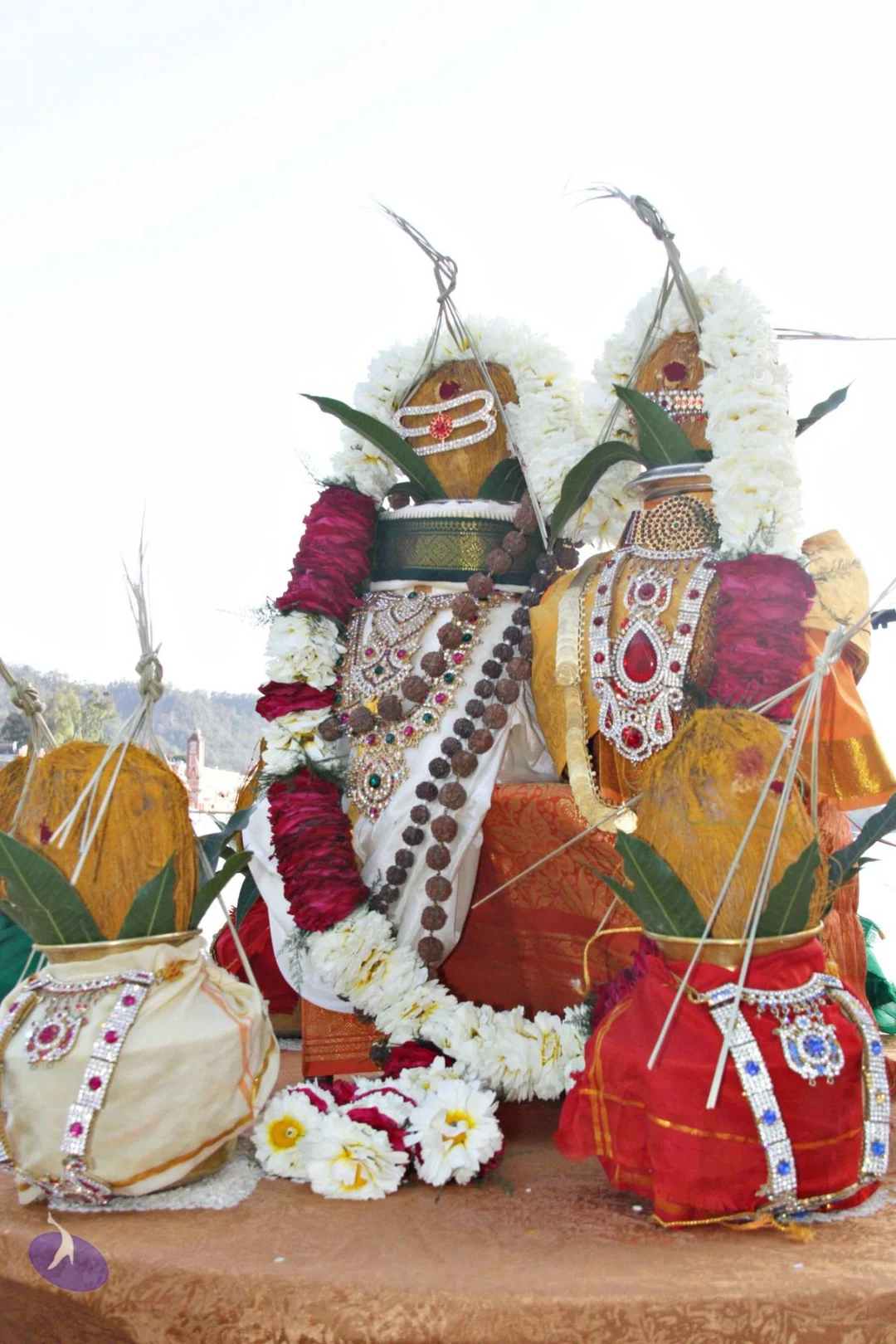
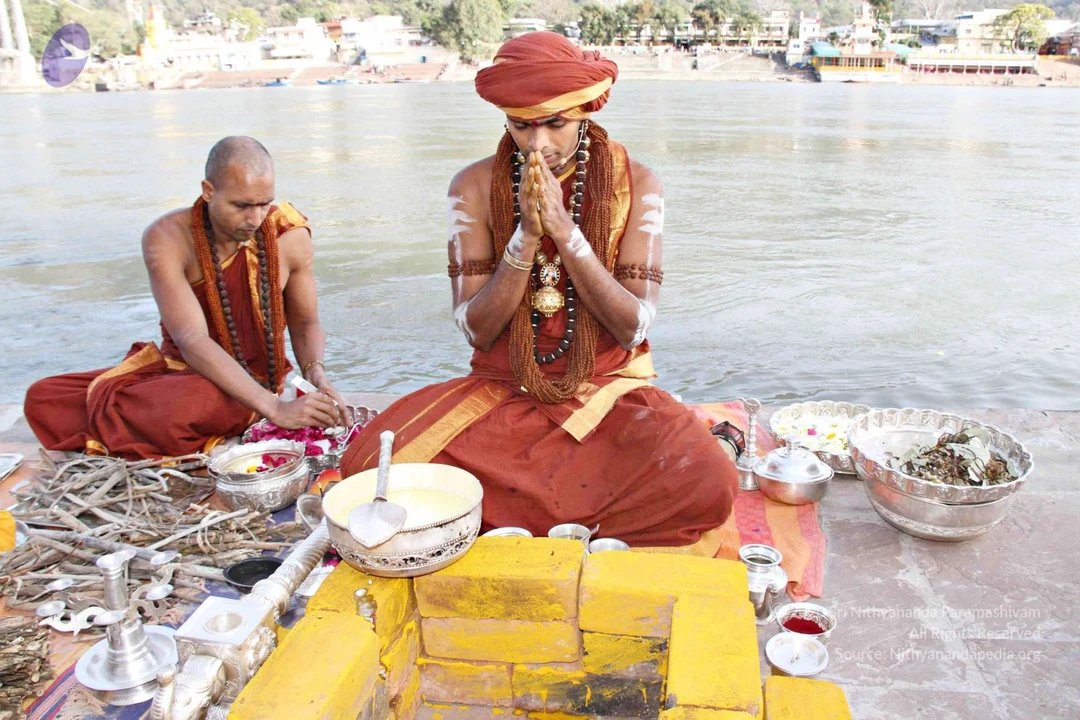
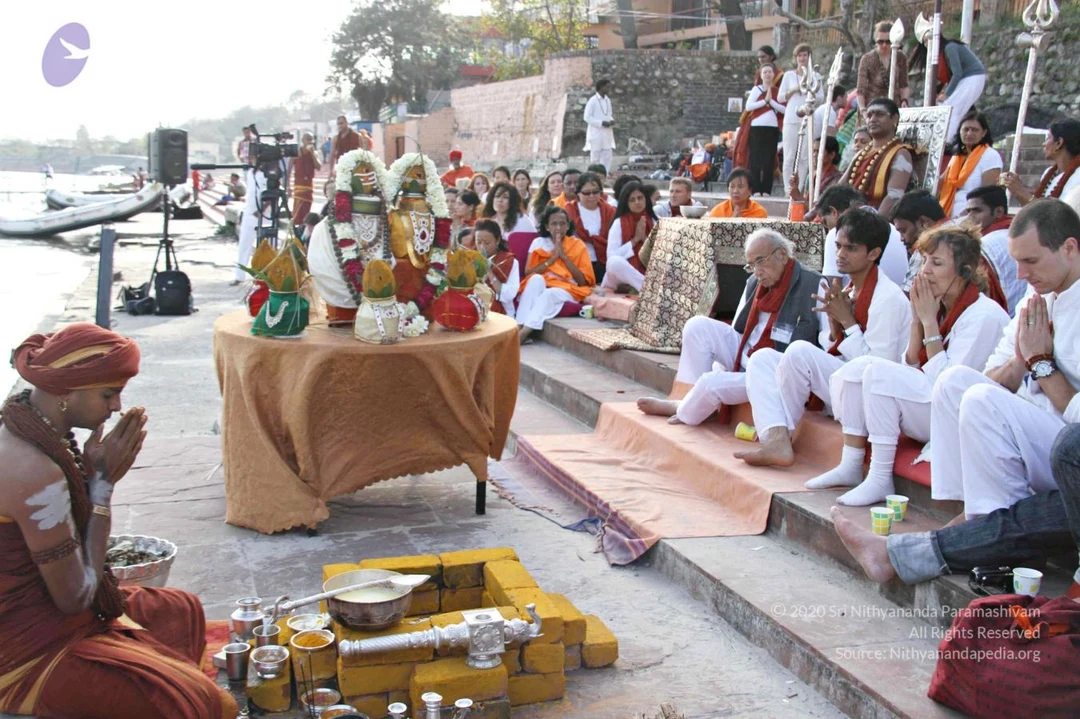
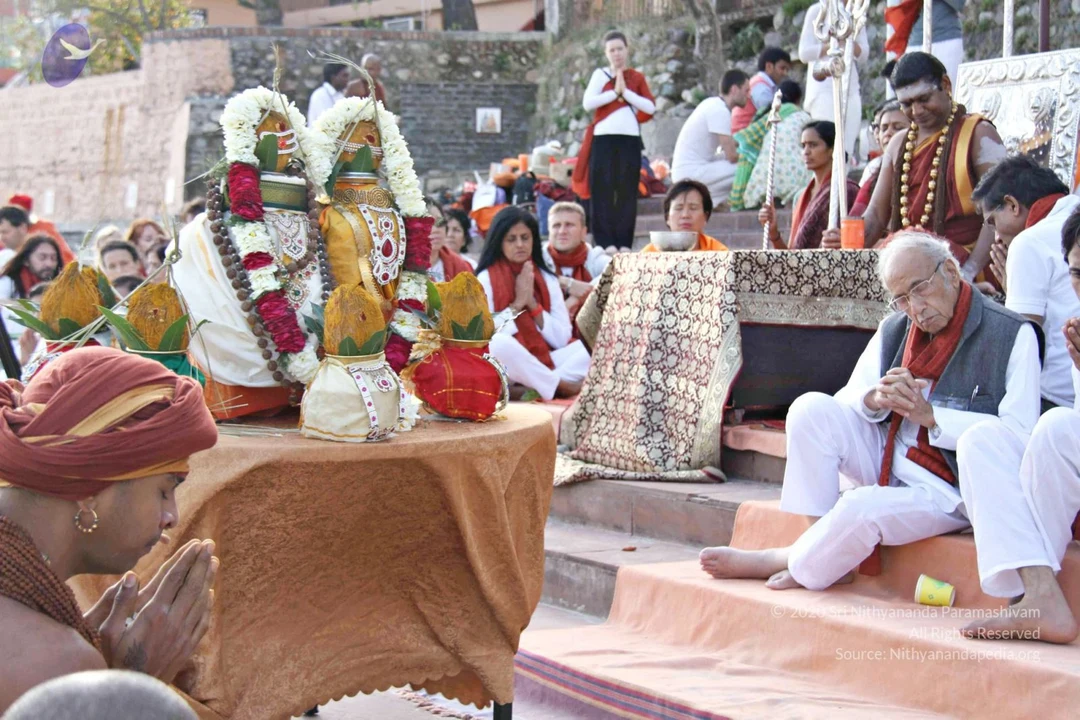
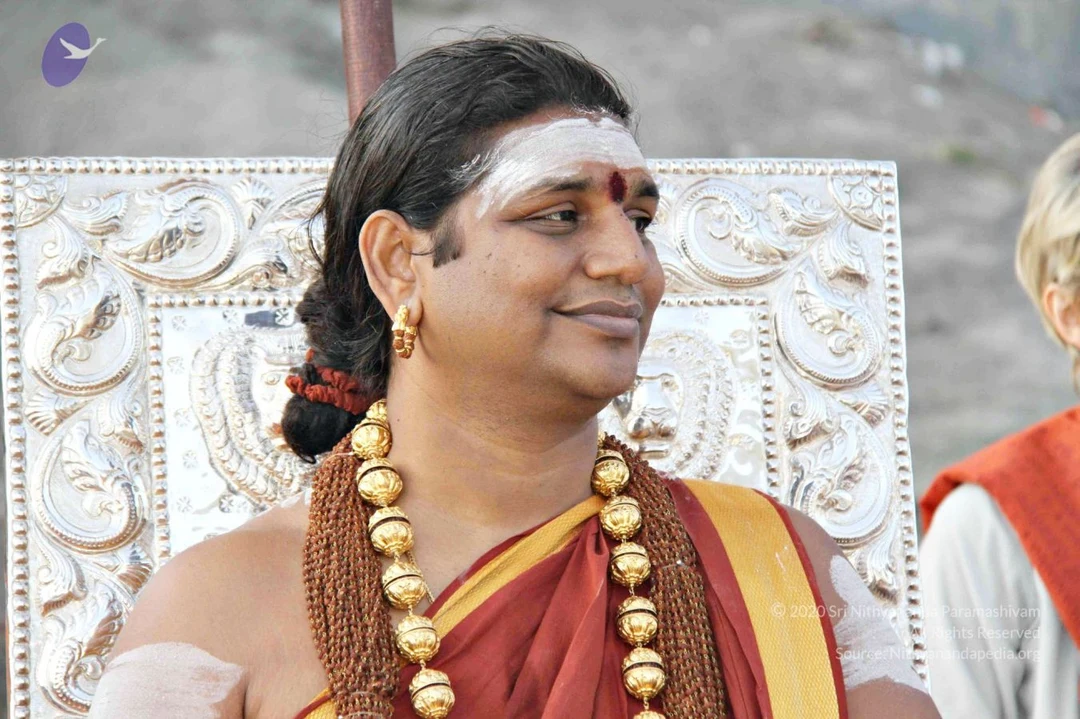
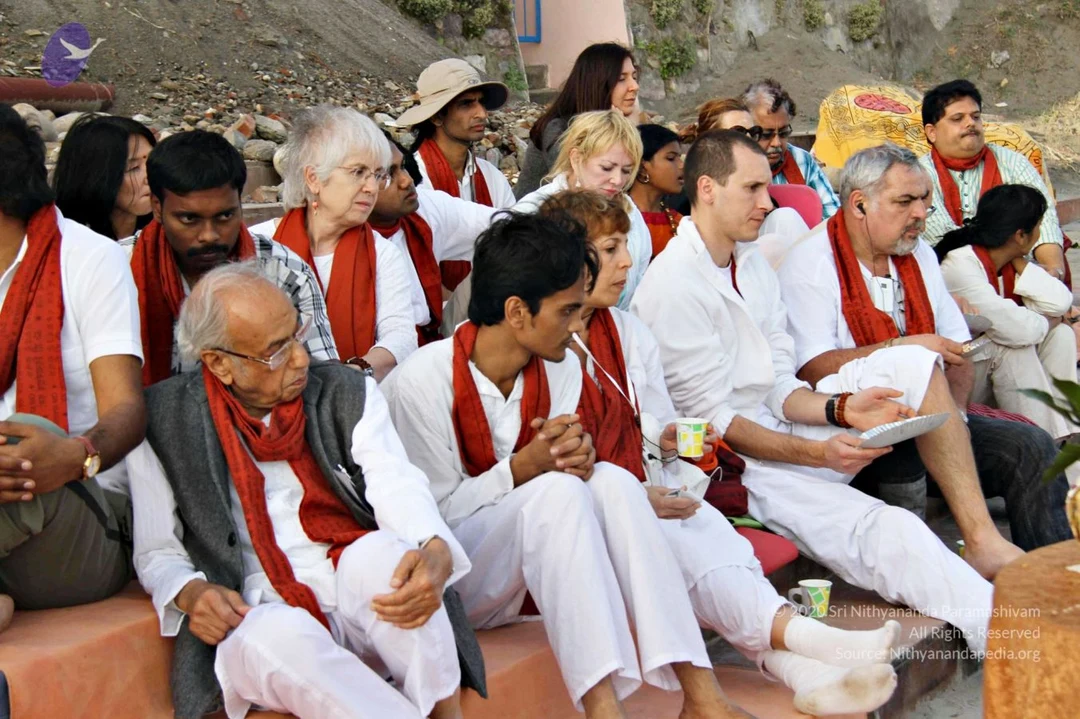
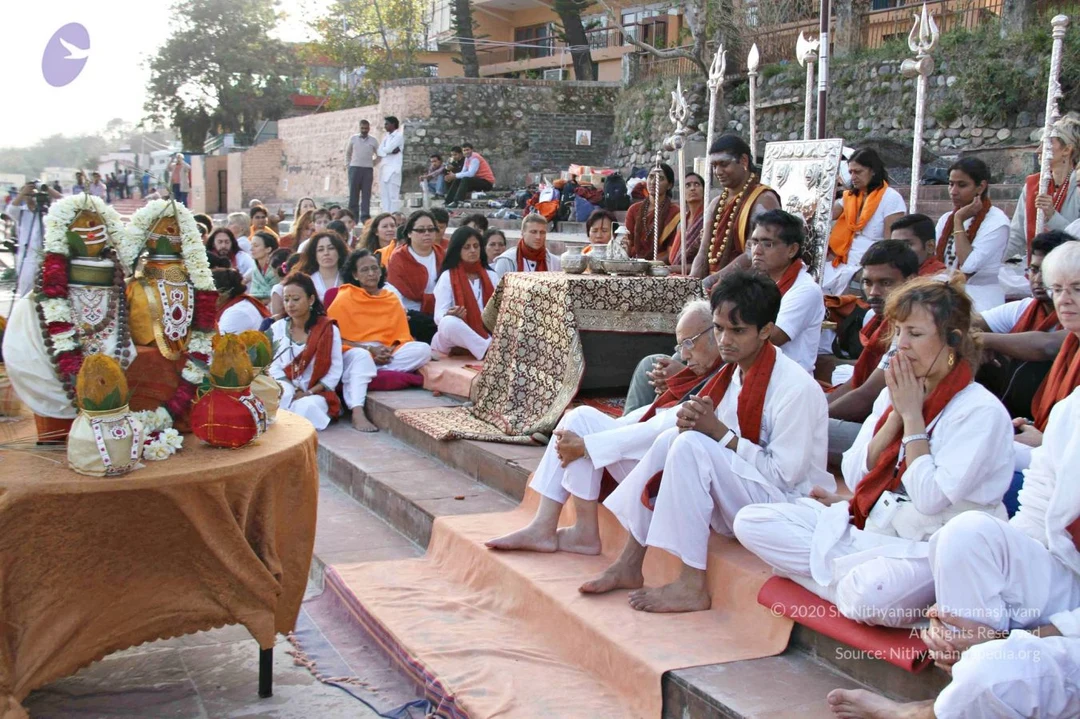
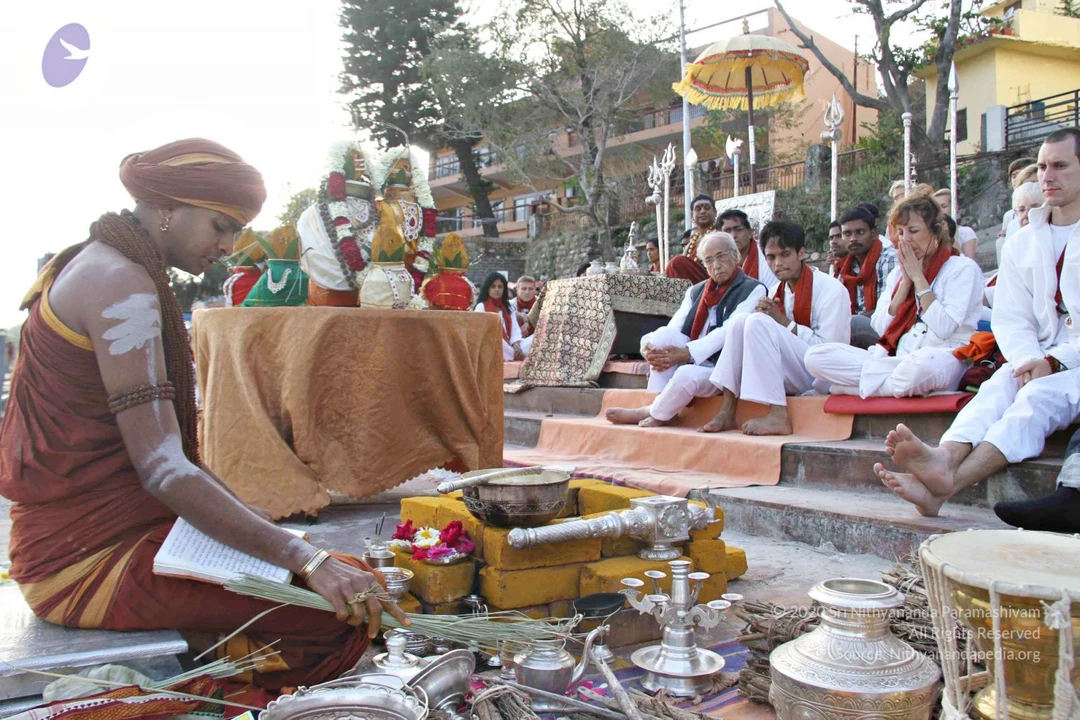
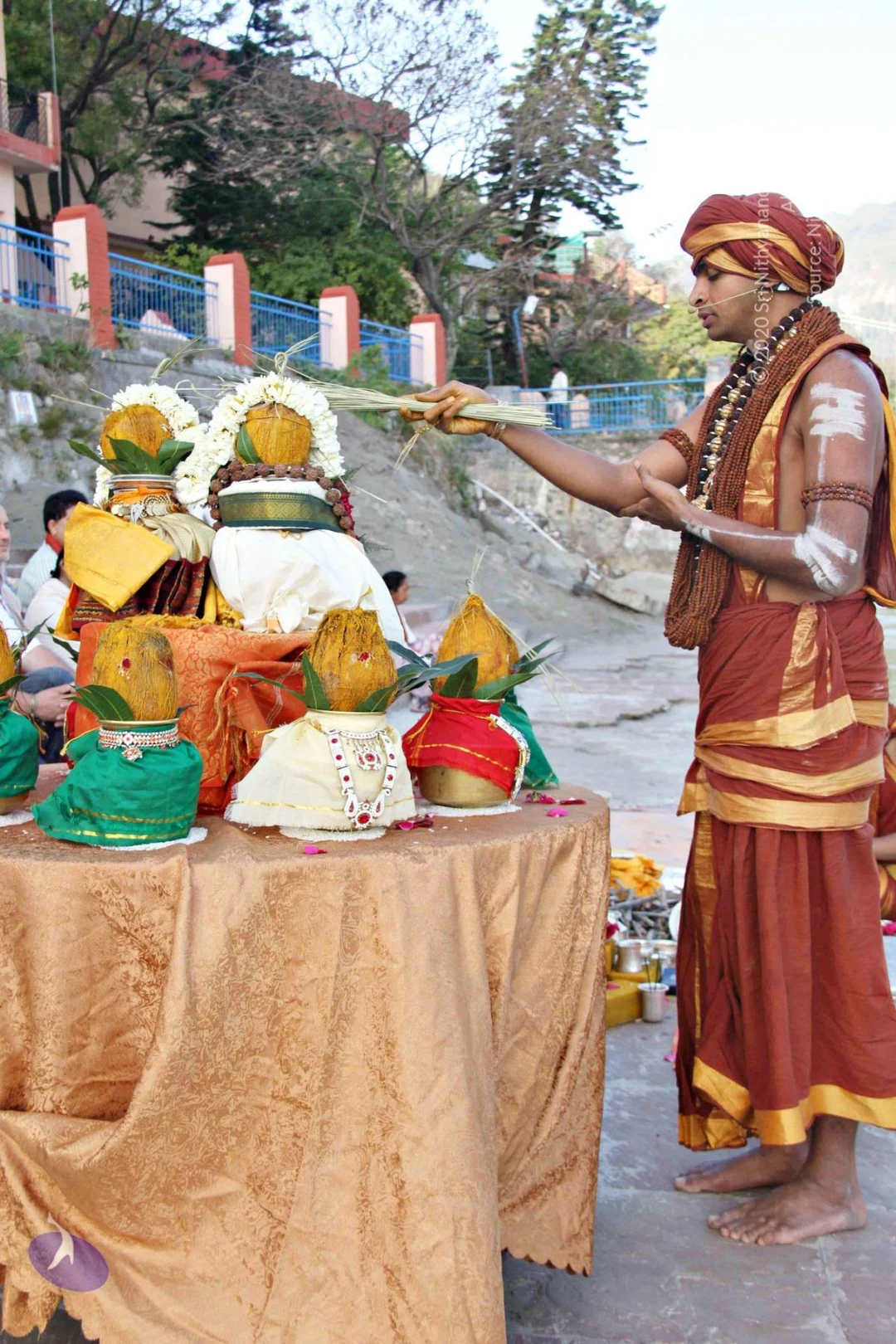
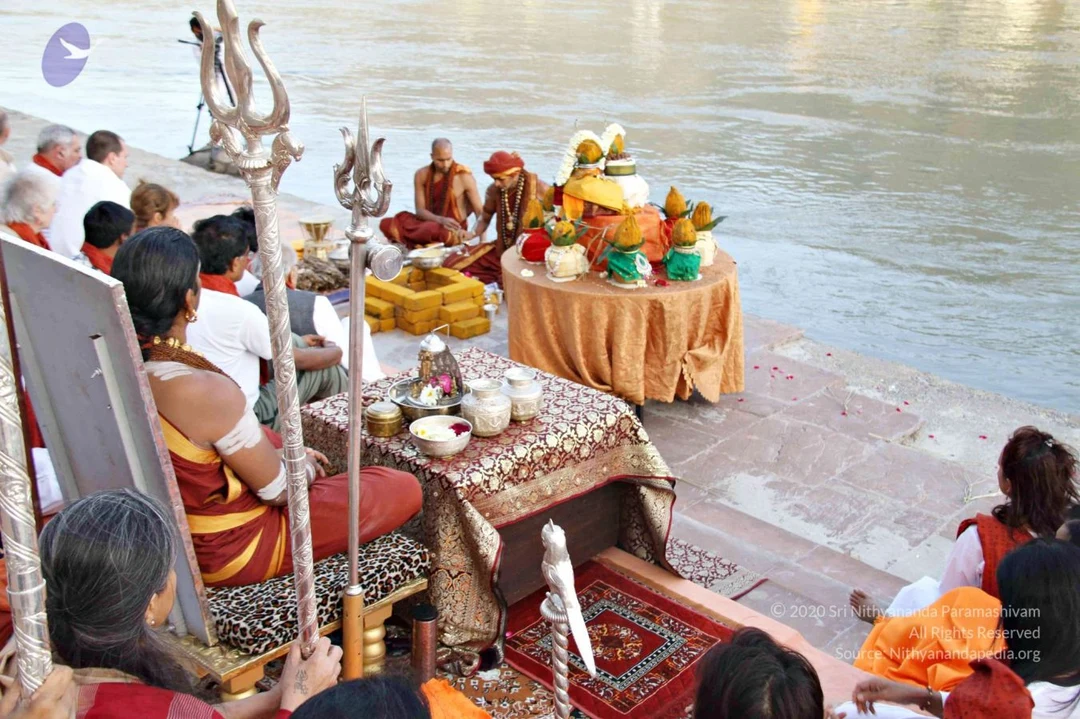
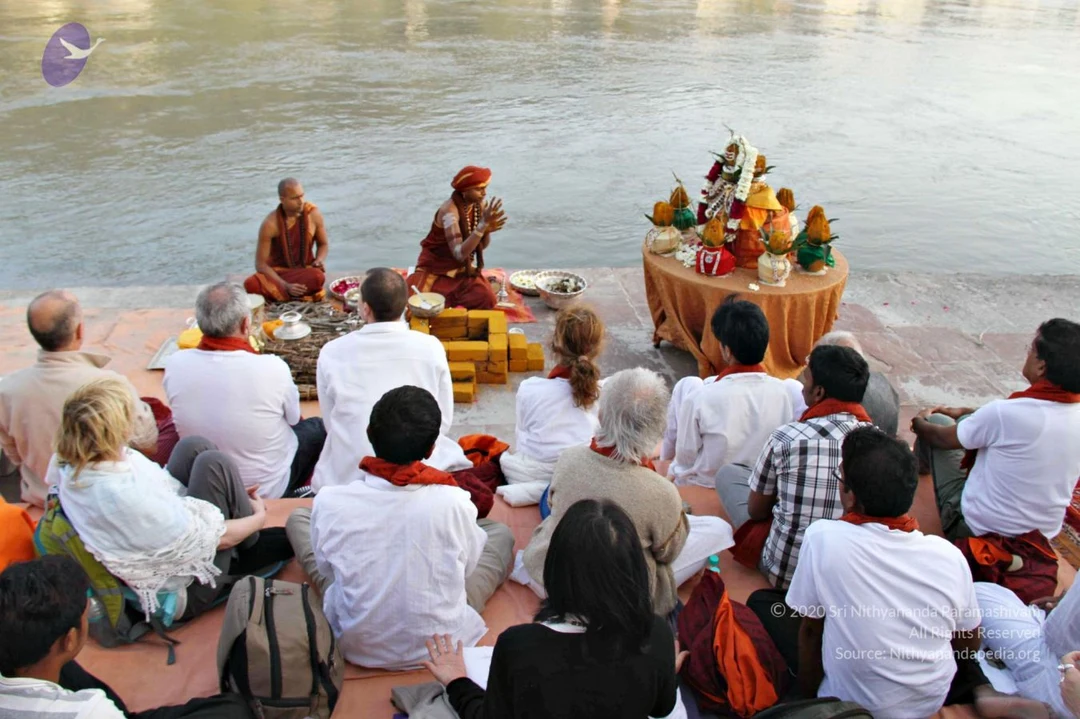
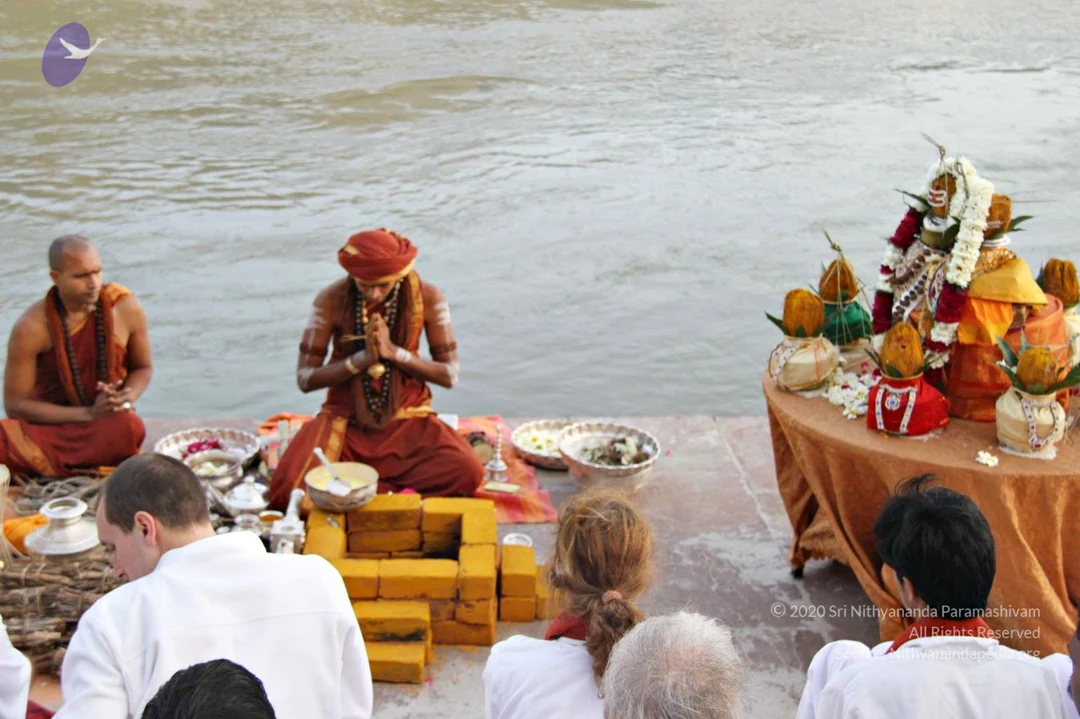
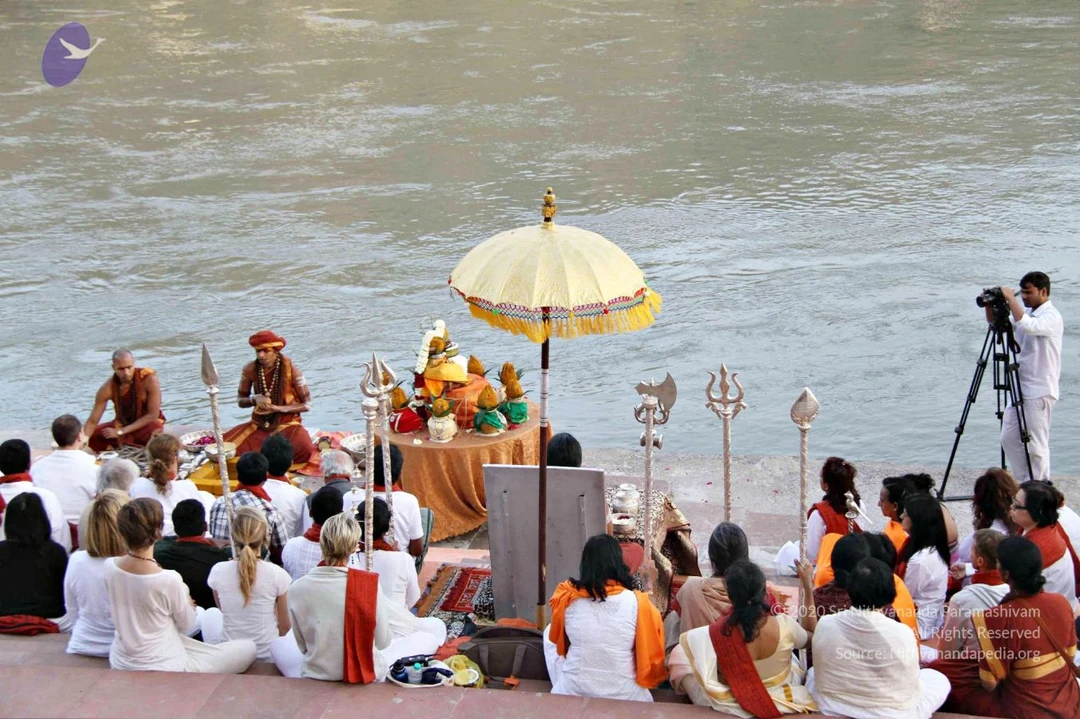
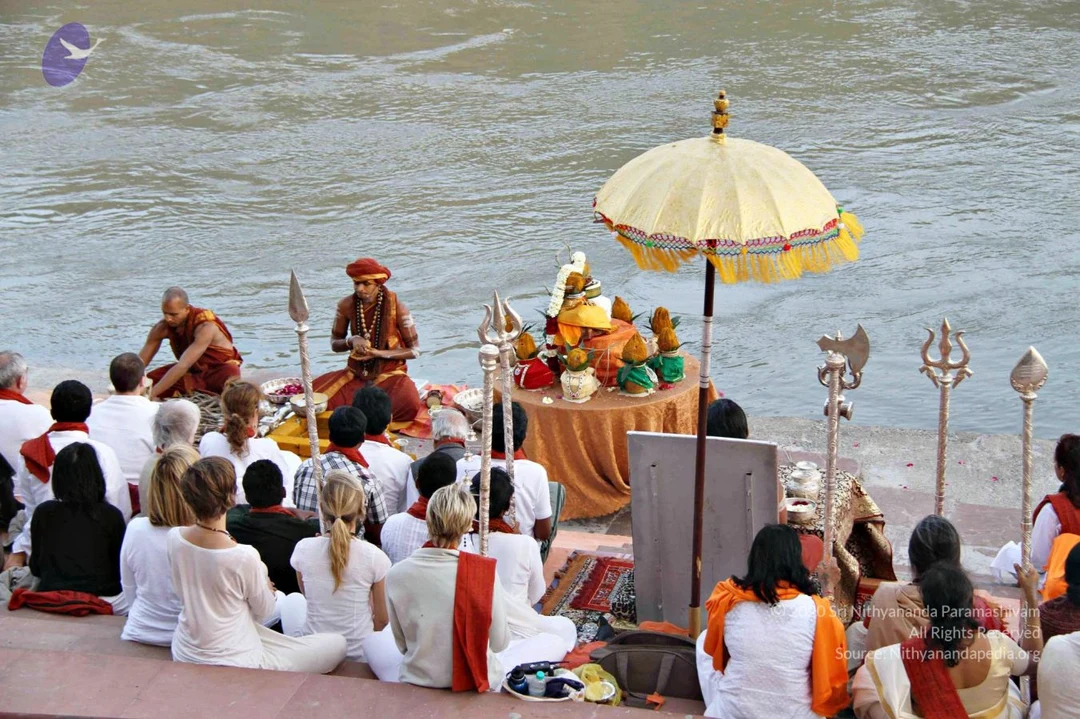
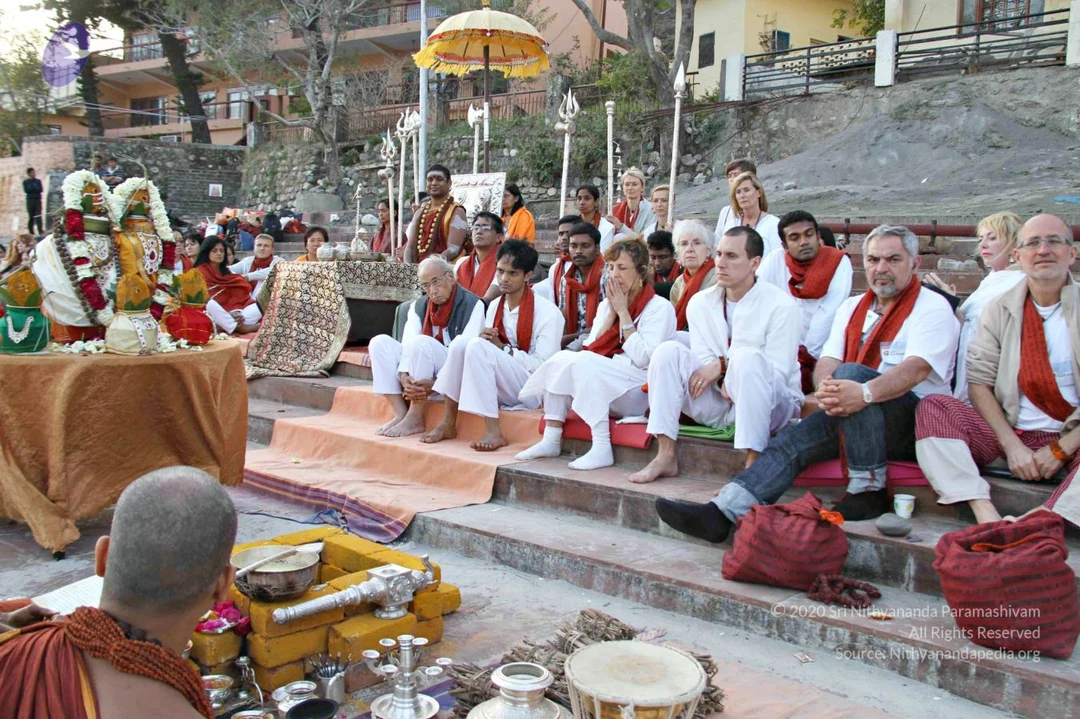
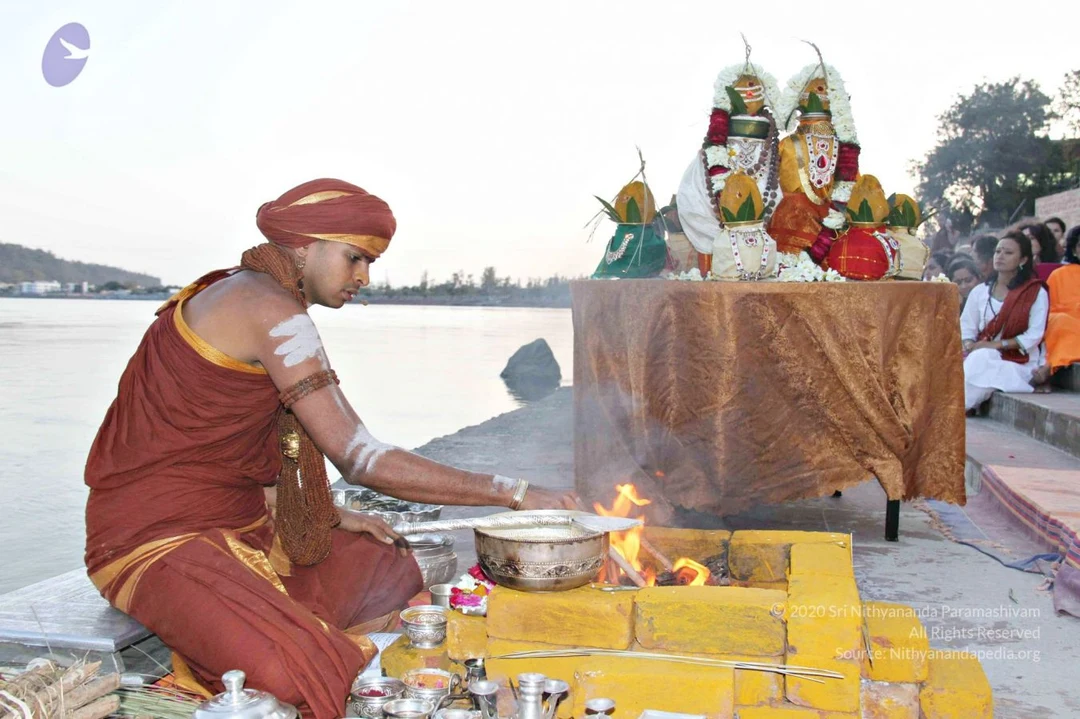
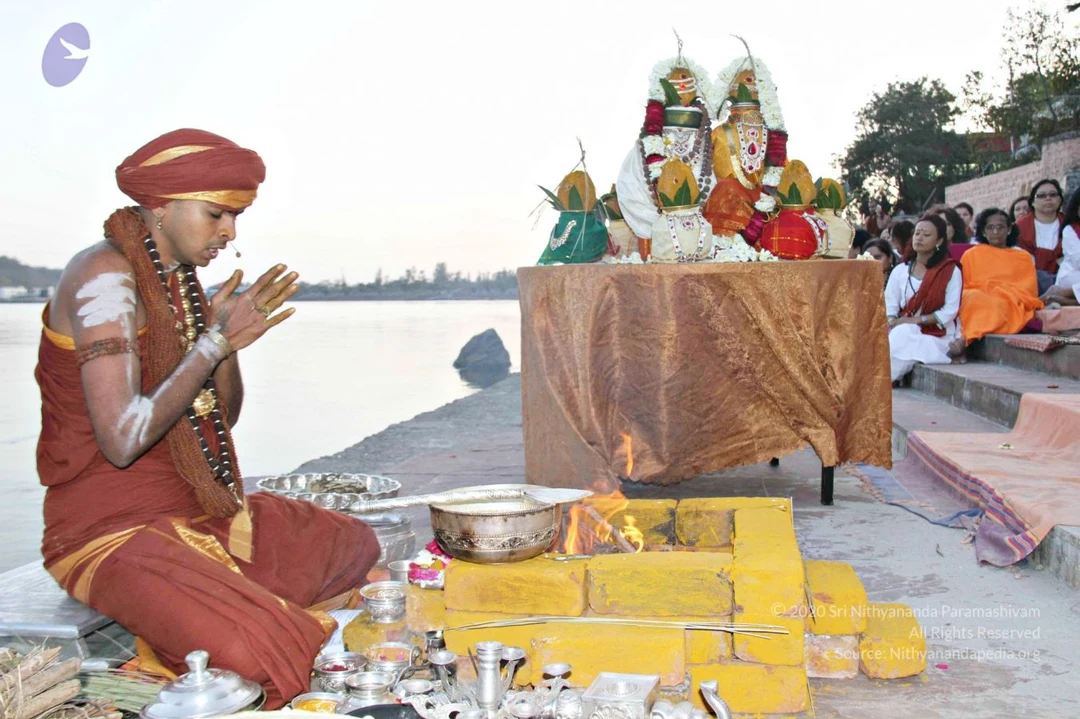
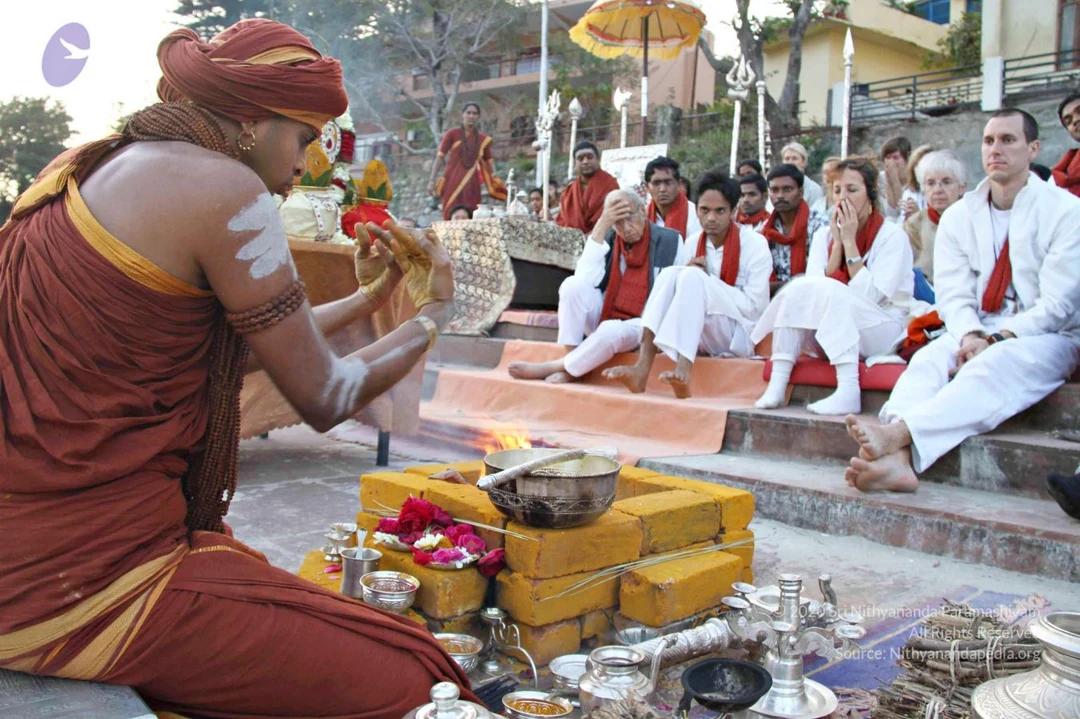
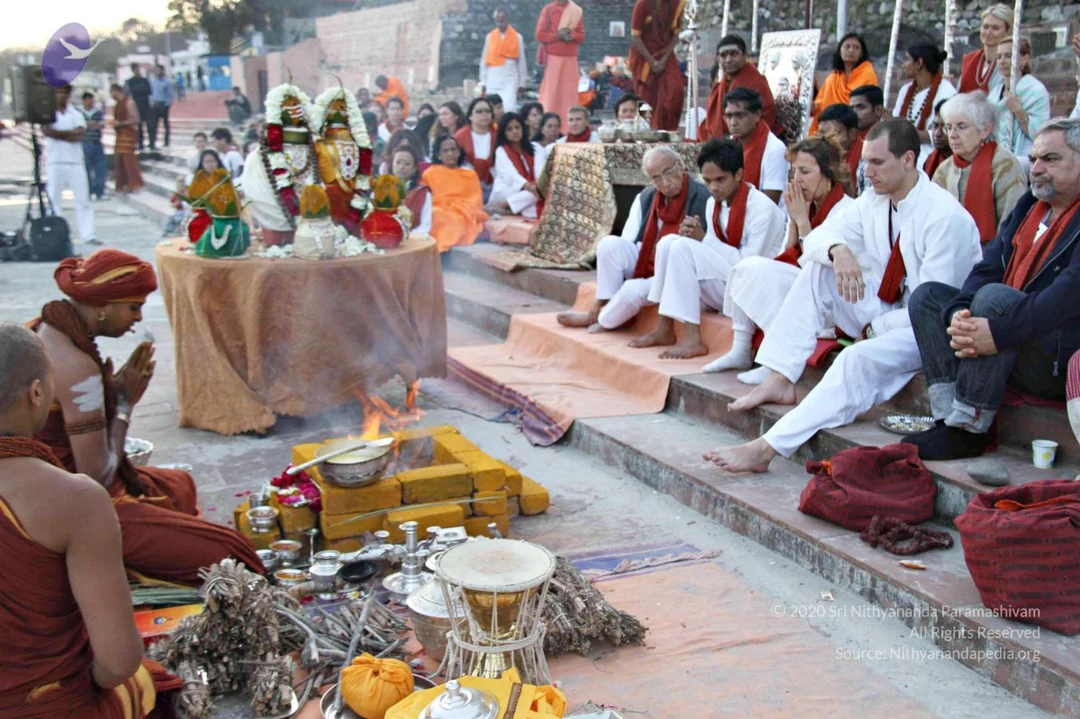
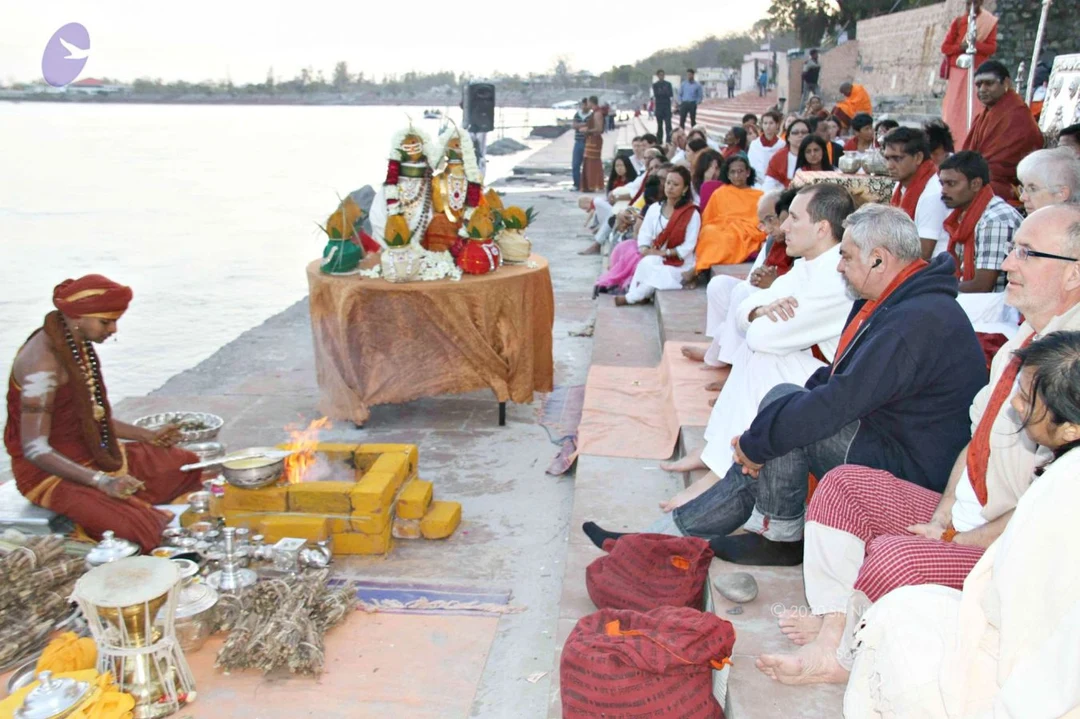
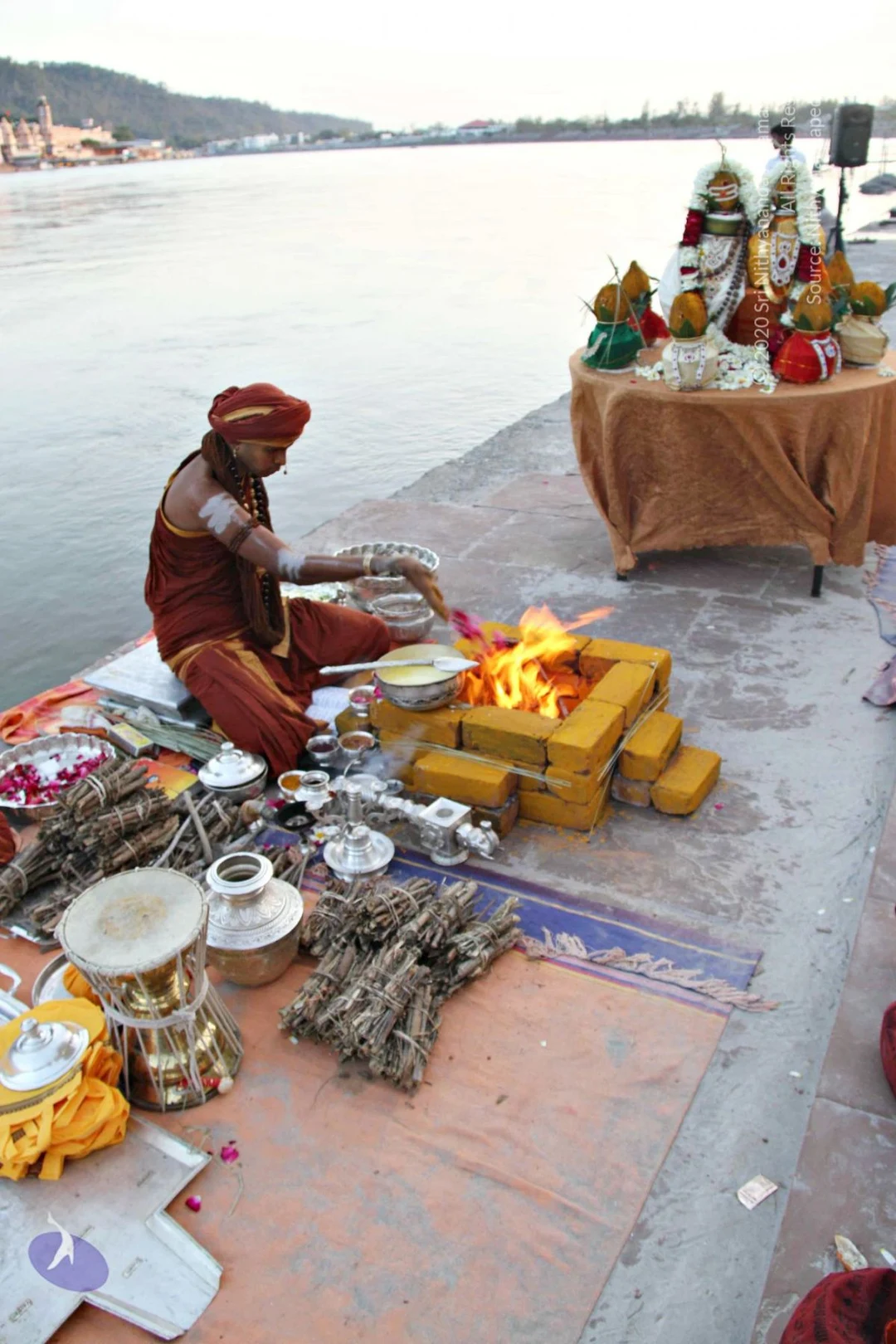
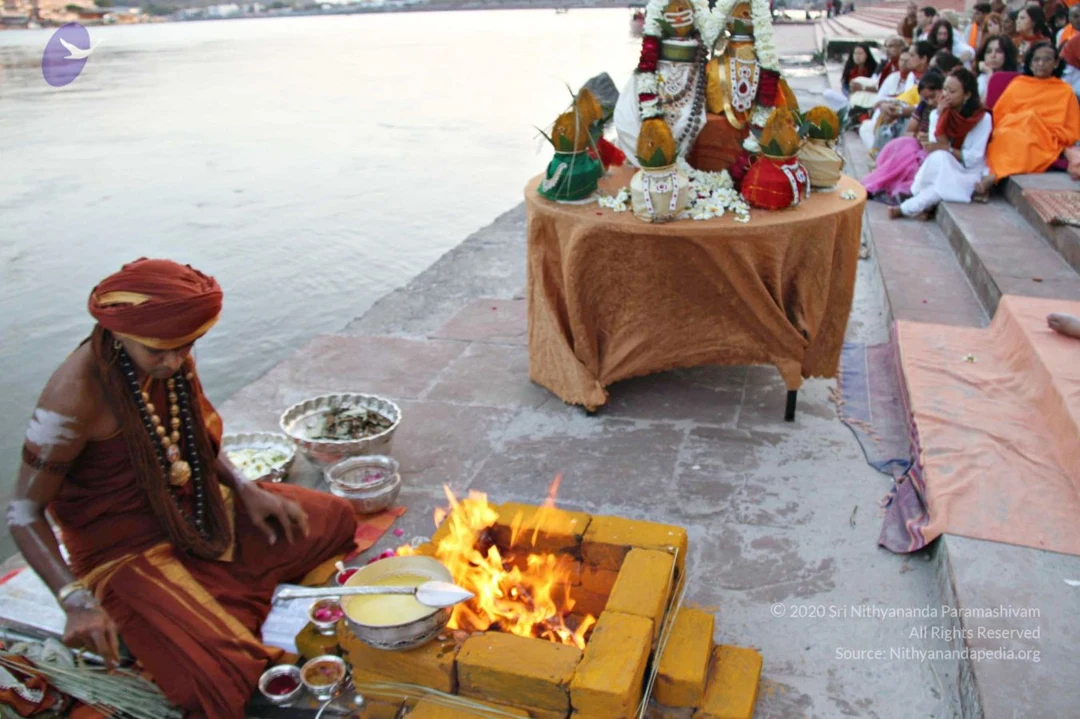
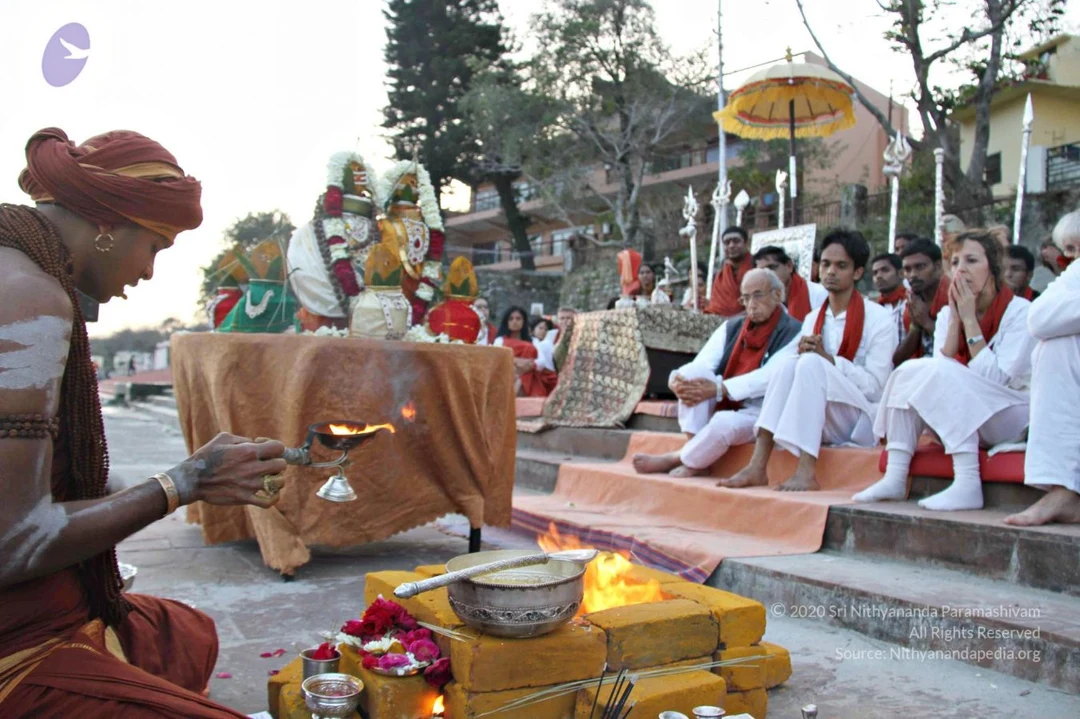
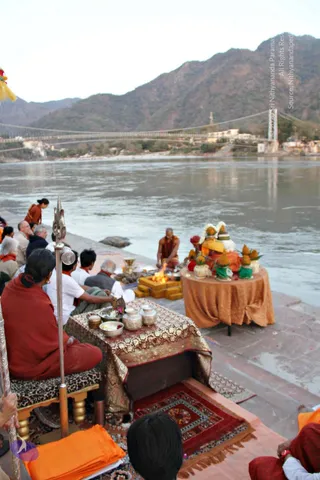
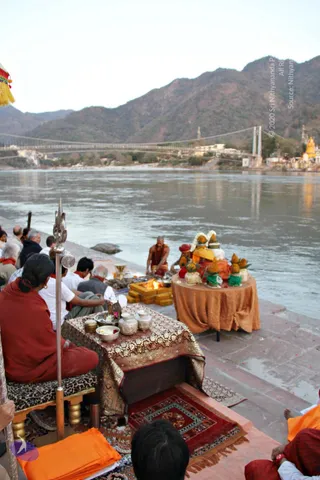
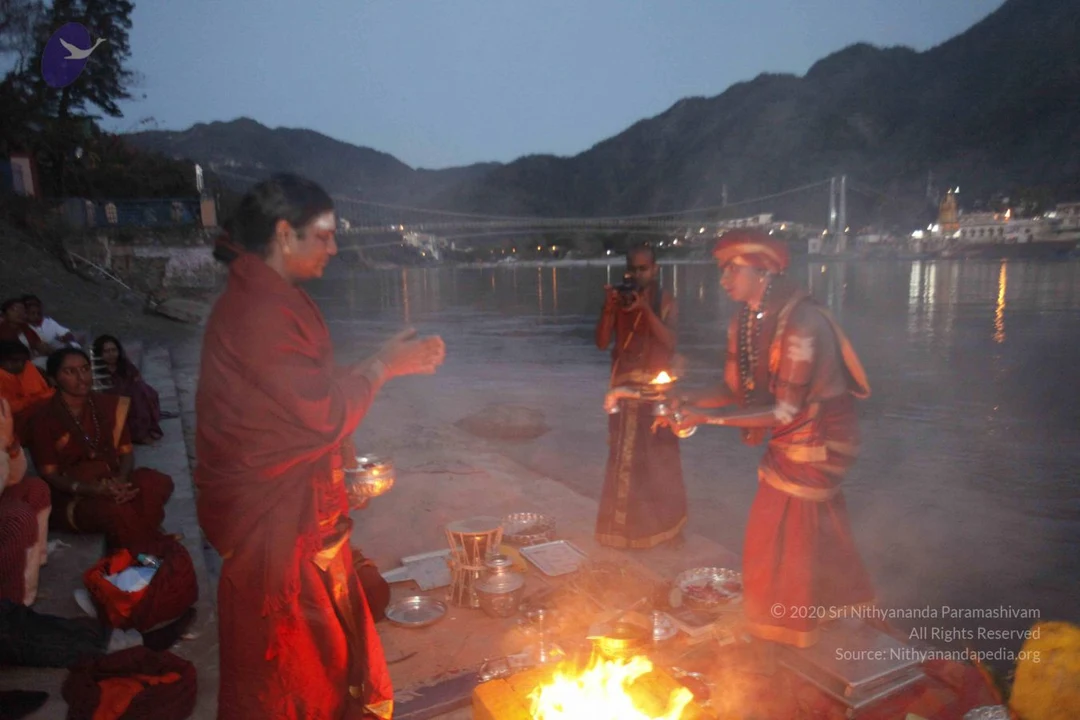
Outdoor riverside ritual on a stone ghat beside a wide grey river, with forested mountains and a suspension bridge behind. A bare-chested priest in a rust-red dhoti kneels at a small fire built on yellow bricks, with a brass vessel nearby. On the right, a deity murti or ornate ceremonial form sits on an orange-draped table, adorned with flower garlands, orange and gold cloth and green and red decorated pots. In the foreground, a seated woman in a rust-red shawl sits on a leopard-print cushion beside a silver trident-topped staff, and several people in white and red-scarved clothing sit on the ground. Brass bowls with offerings, a silver kalasha-style vessel and a patterned cloth cover a low table. The scene suggests a homa or puja performed by the river.A riverside ritual on a stone ghat beside a wide grey river with forested mountains behind and a suspension bridge spanning the water. A priest in orange-brown robes kneels at a small fire pit built of yellow bricks, tending the flames. On a draped orange-cloth table to the right, decorated kalasha pots with mango leaves, marigold garlands and green and red cloth wraps are arranged as offerings. In the foreground, a woman in a red shawl sits on a leopard-print cushion beside a brass plate, bowls and steel containers on an ornate gold-brocade cloth. A trident-topped staff stands at left, and a row of seated devotees in white and red shawls sits along the bank.Outdoor riverside ritual on a stone ghat at dusk, with a wide river in the foreground and hills and temple-lined town behind. Two priests in orange and saffron robes with orange turbans stand at left beside a decorated offering table holding fruit, flowers, brass vessels and a garland-draped kalasha. Seated devotees in white clothes with red shawls fill the lower and right foreground, many facing the ritual. On the right, a golden umbrella and several silver trident staffs stand near seated participants. A small speaker is visible at upper right. Several people in white and orange sit in rows along the steps, and their presence shows a river puja or homa-style gathering.Devotees sit on the riverbank steps of a broad river at dusk, facing a ritual set up at the water's edge. Two priests in saffron-orange robes and red headwraps perform a puja at a low table covered with a golden cloth, which holds a tall arrangement of colourful fruit, flowers and kalasha-style vessels, with brass plates and trays before them. Many seated devotees wear white with red shawls. Behind them stands a person in a red-and-orange robe beside trishula tridents planted in the sand, under a golden ornate parasol. Hillside and riverside town buildings with a temple spire rise in the background.Outdoor photograph of a riverside ghat on a river with a hilly, tree-covered shoreline and a town of buildings and temple spires behind it. Seated devotees in white and orange clothing line stone steps facing the water. Two priests sit at the front near a decorated kalasha-style offering with fruits and flowers, a pot, and small lamps; one wears an orange-red headcloth and the other a shaved-head orange cloth. A golden umbrella and several silver trishula tridents stand at the right edge. Calm evening light.Outdoor riverside ritual on stone ghats at dusk, with a wide river and hills behind. A seated priest in a red-orange robe, red turban and rudraksha mala sits at a small fire with brass vessels and offerings in front of him, near a decorated table with garlanded deity murti and kalasha-like items. Around him, a seated crowd of devotees in white, orange and red shawls, several wearing red sashes and malas, listens attentively. A standing man in white near a speaker stands at the back left, and an orange-robed figure stands farther back on the steps. Foreground includes a woman in orange with a shoulder bag and a man in a striped shirt. Appears to be a satsang or homa by the river.
SPH visits Rishikesh
79 photosSource gallery
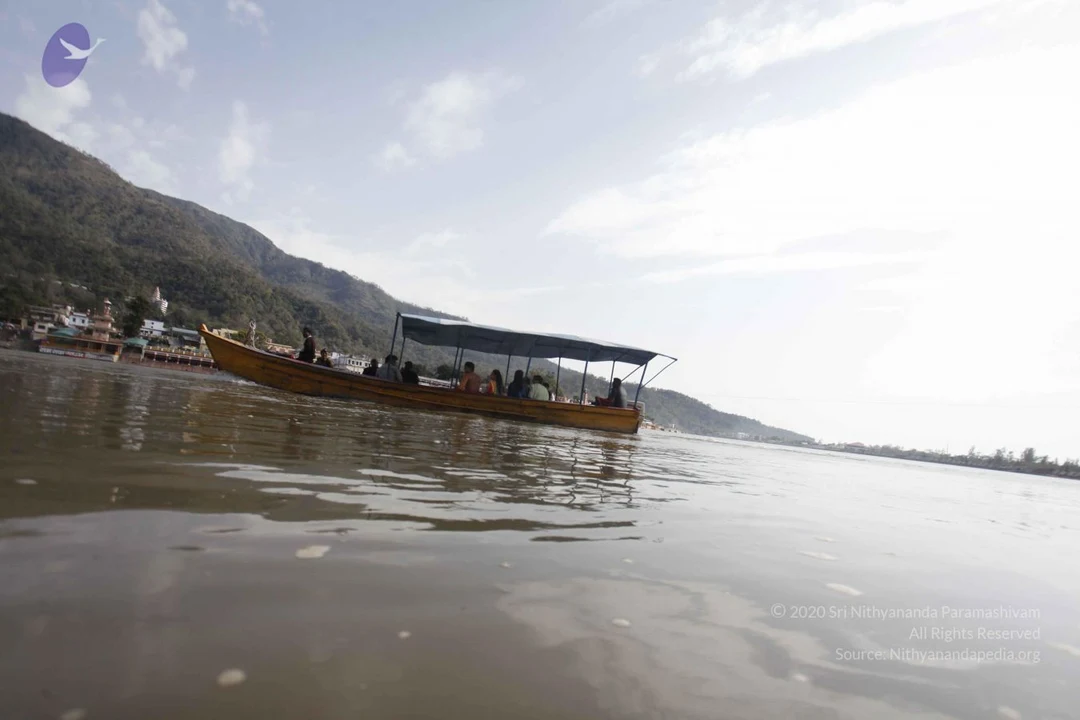
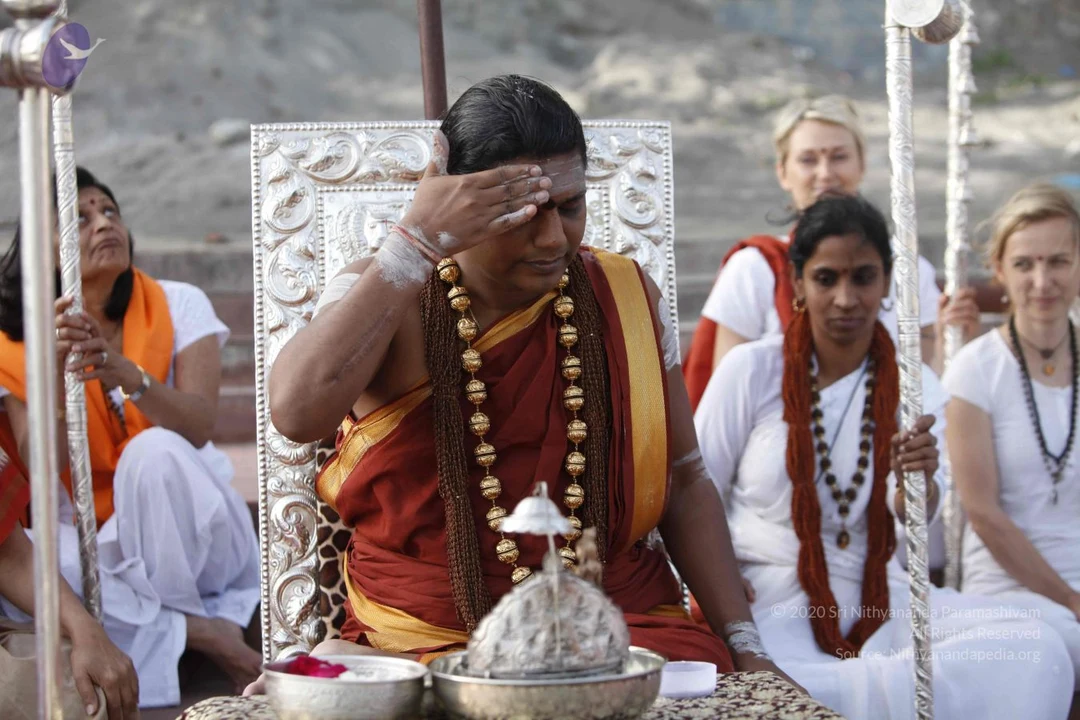
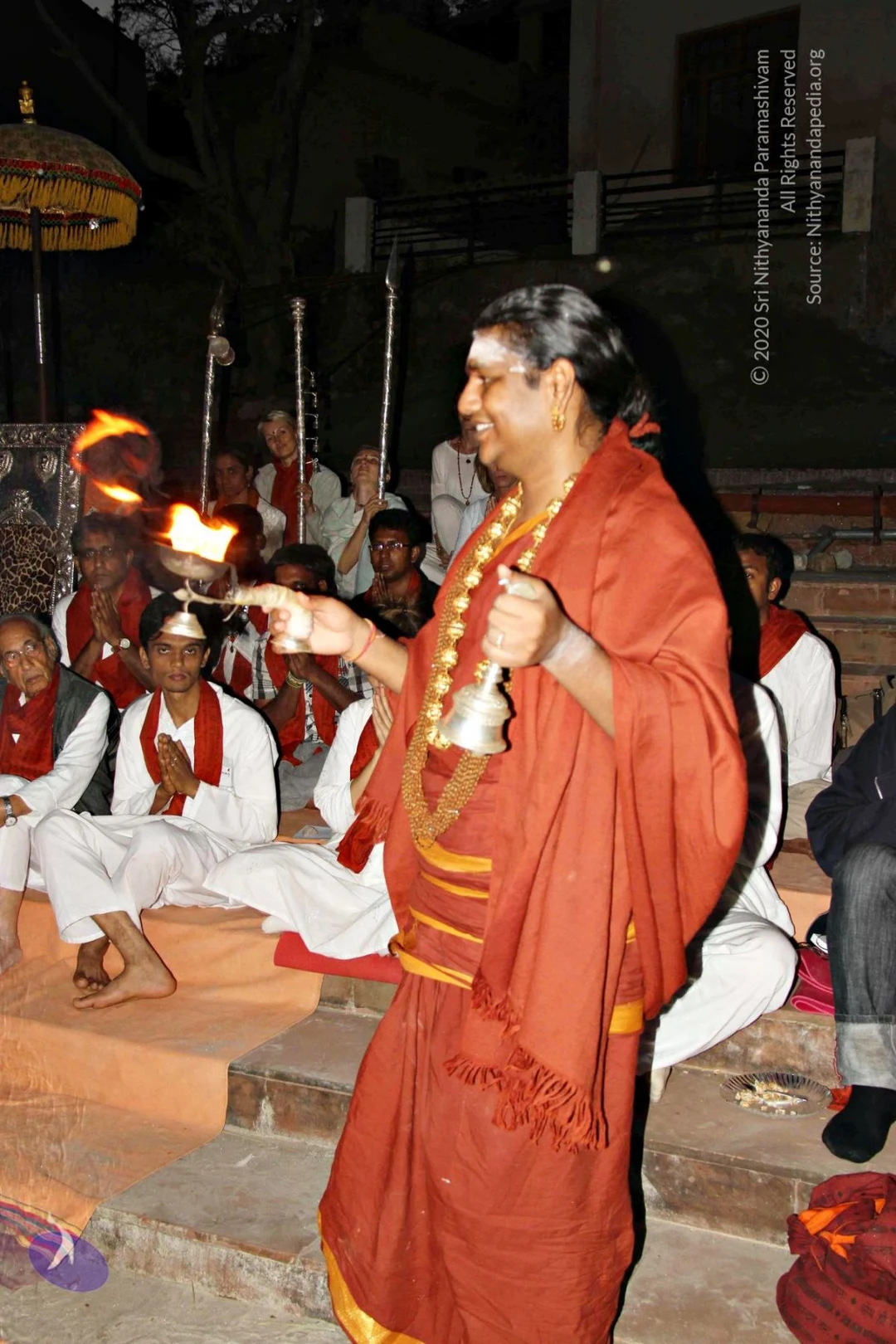
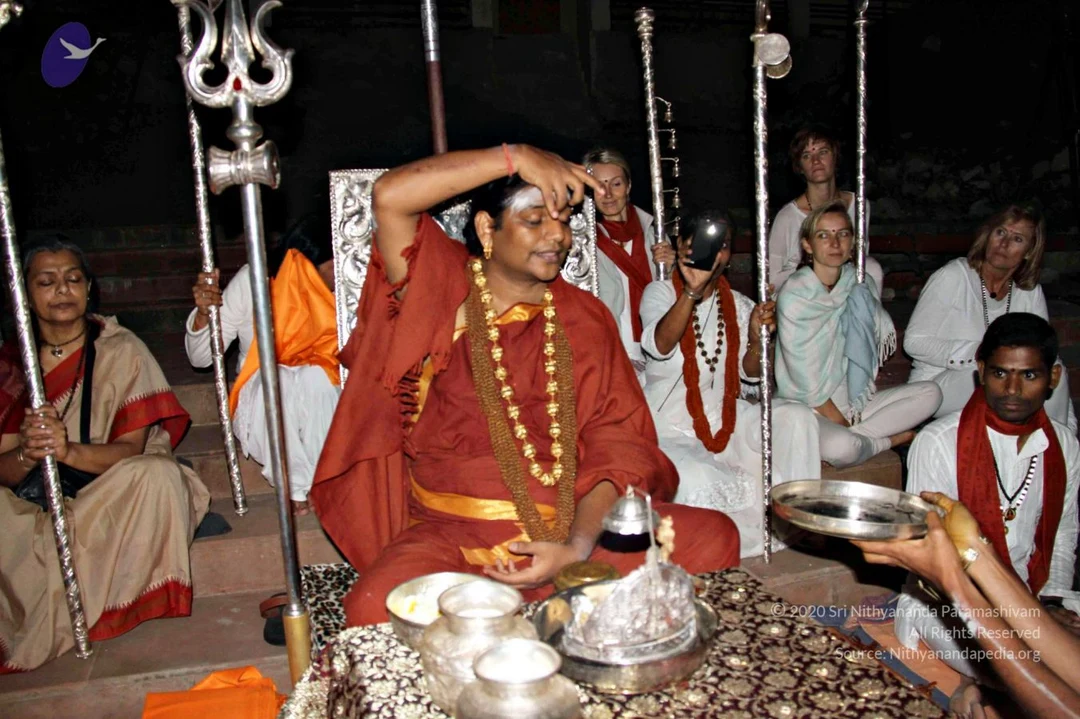
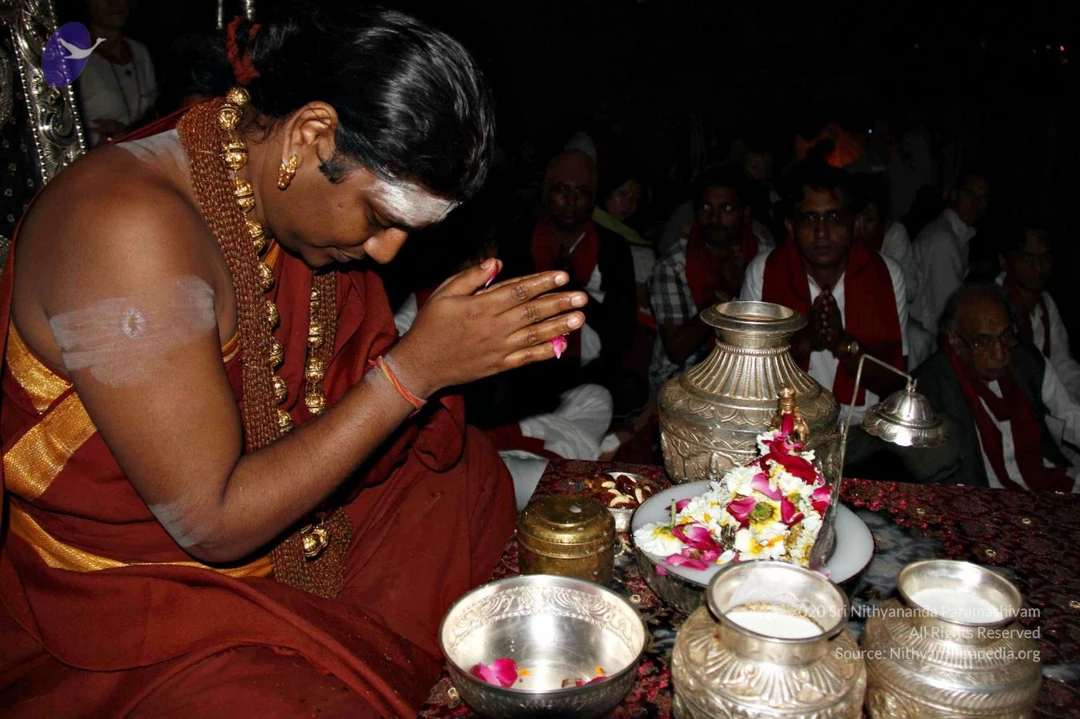
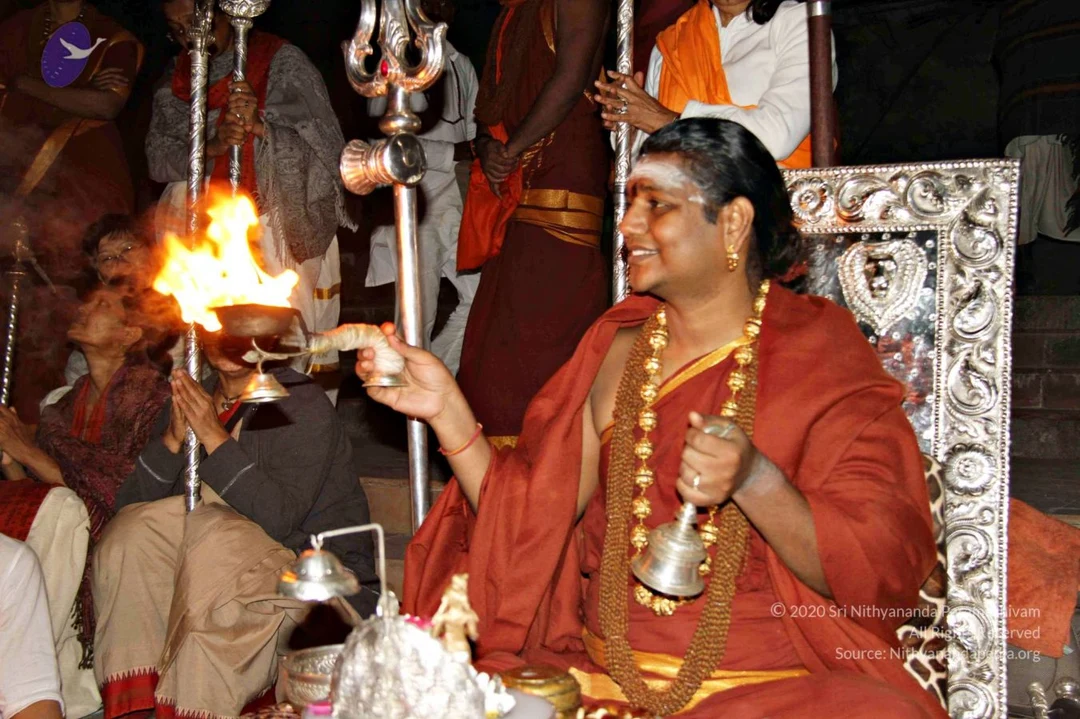
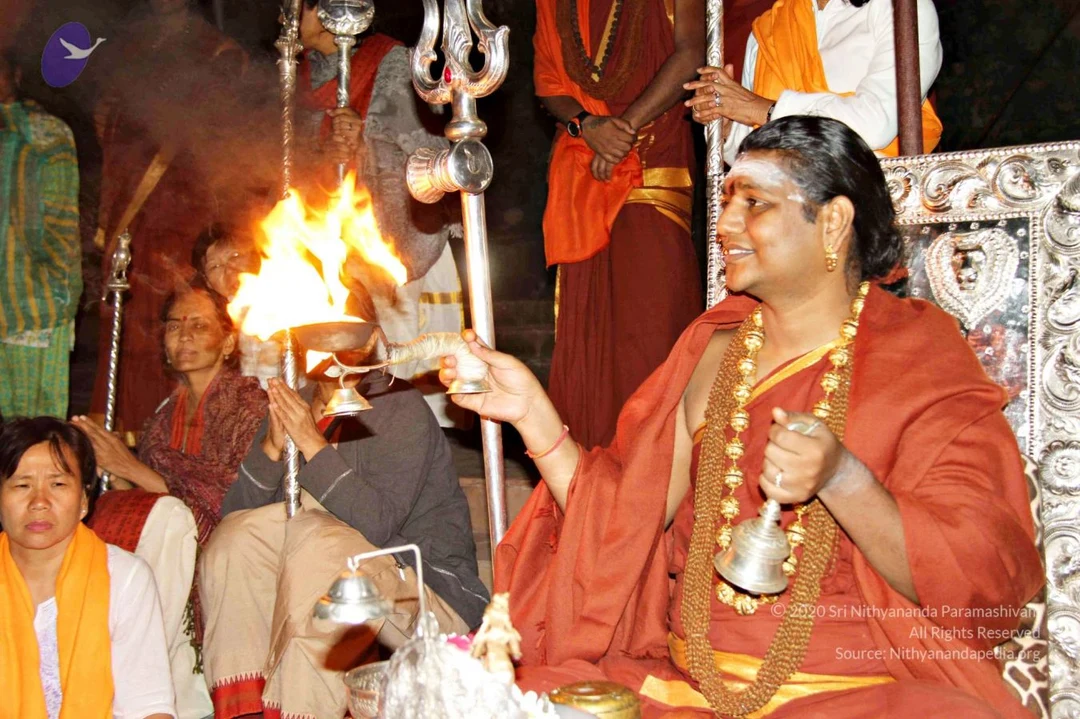
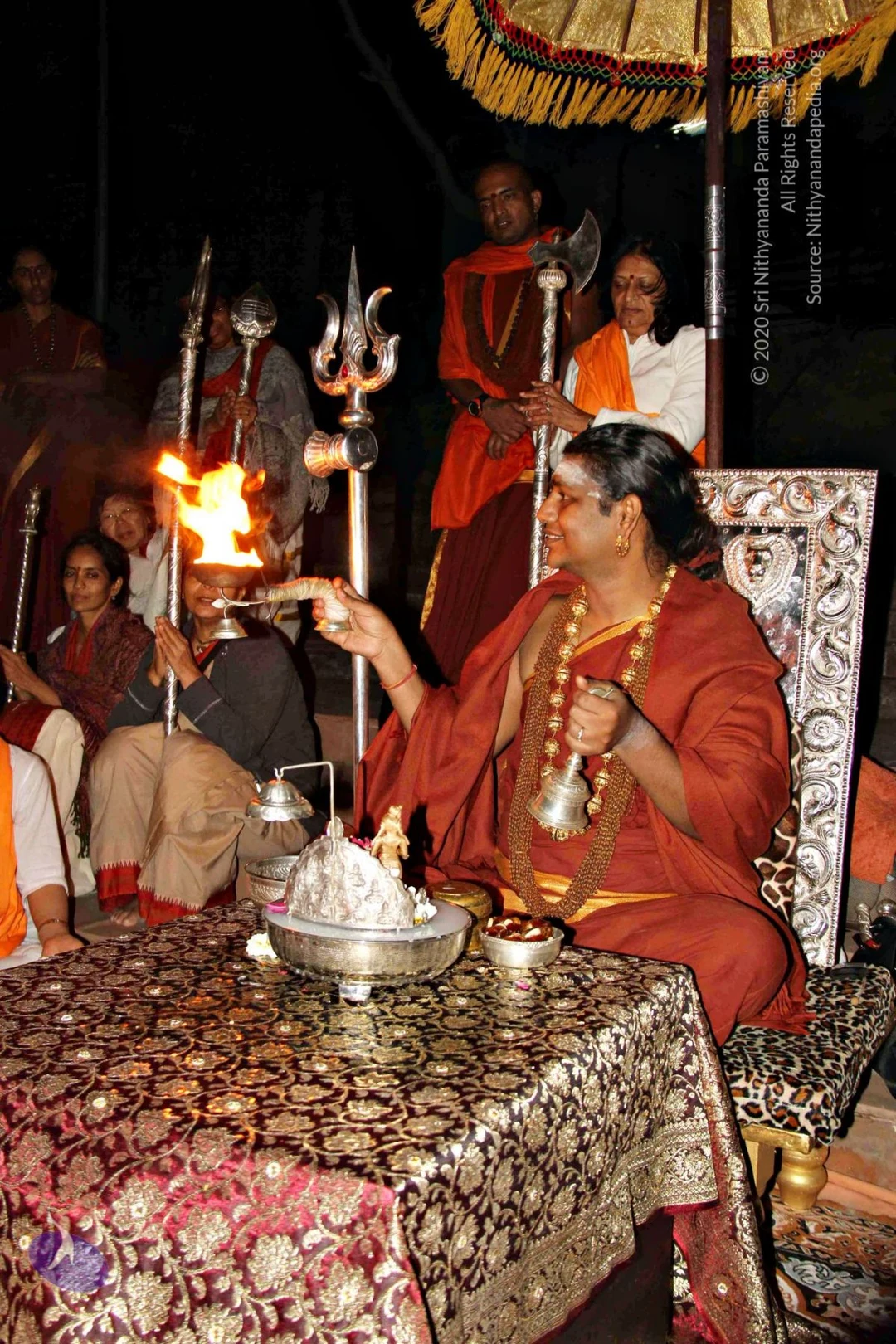
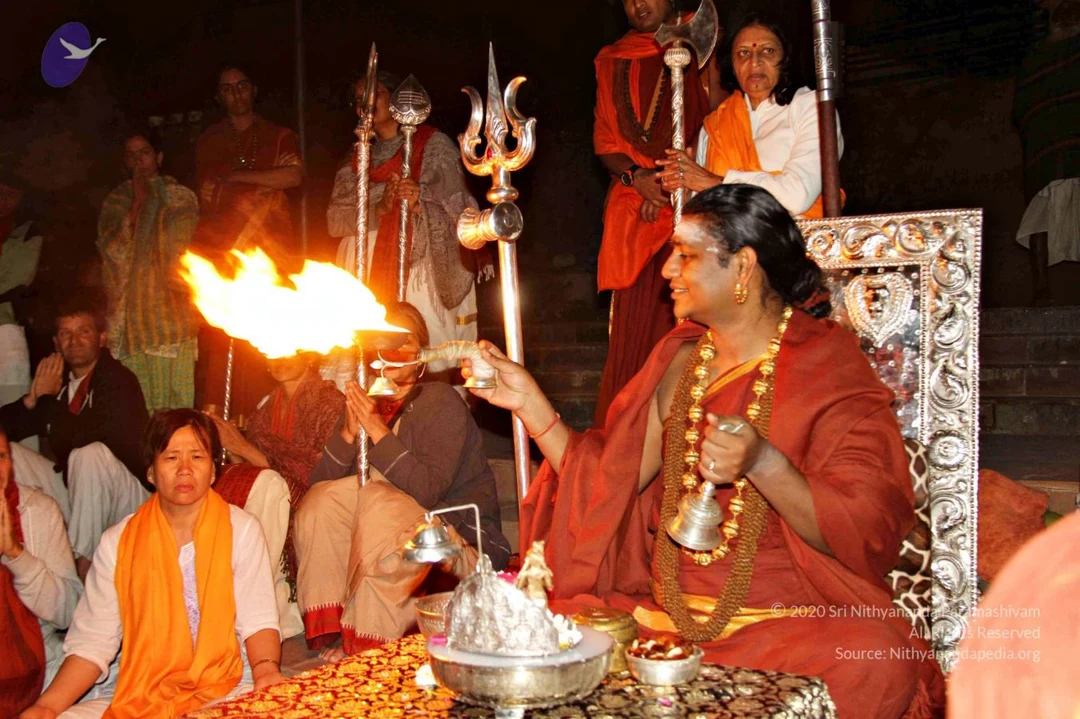
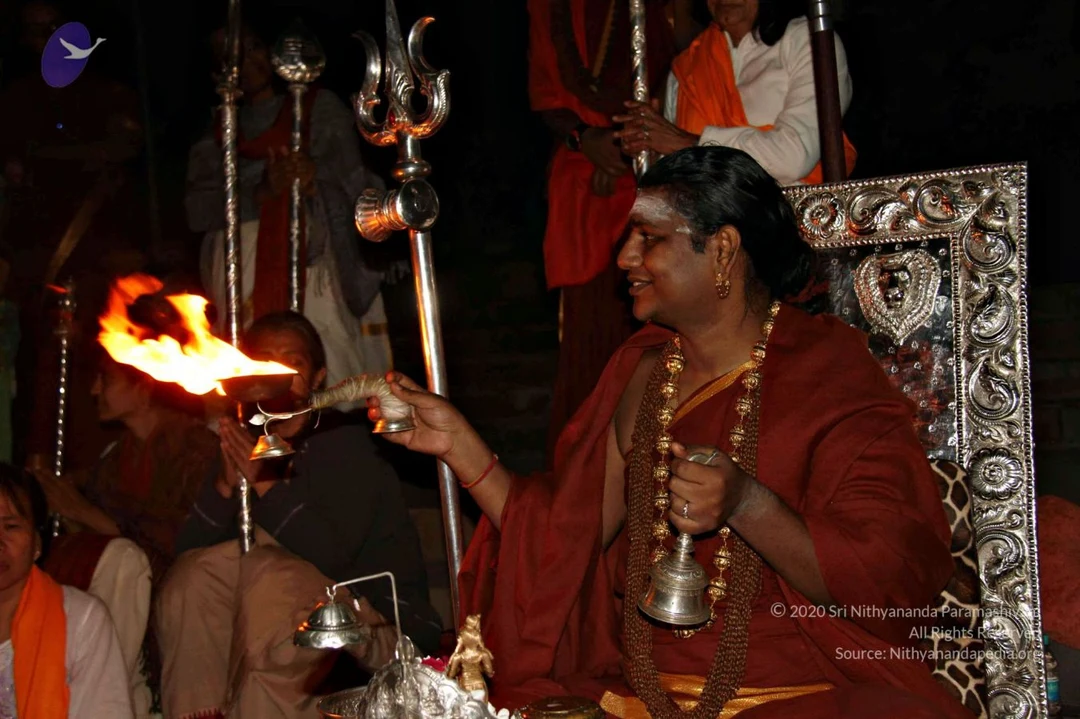
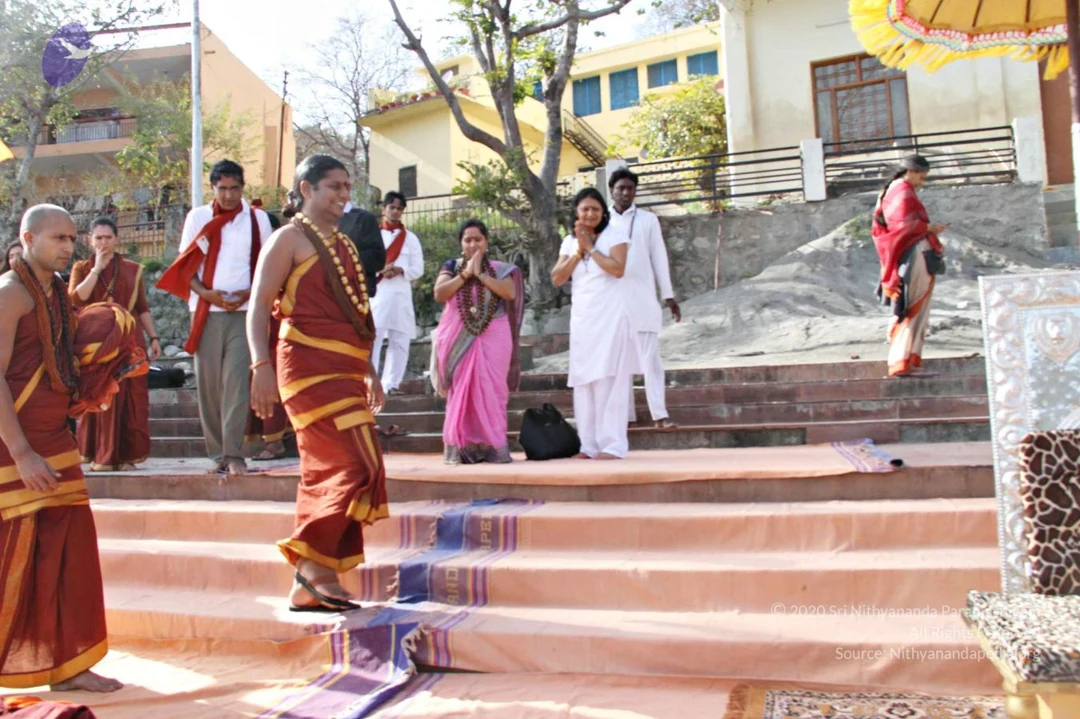
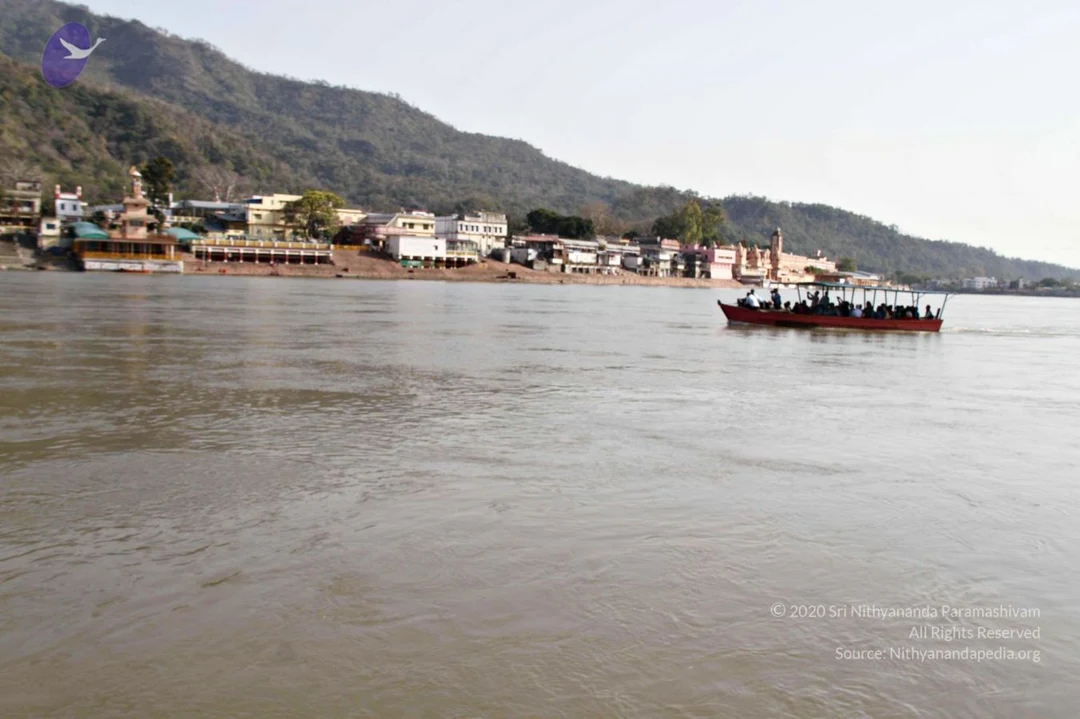
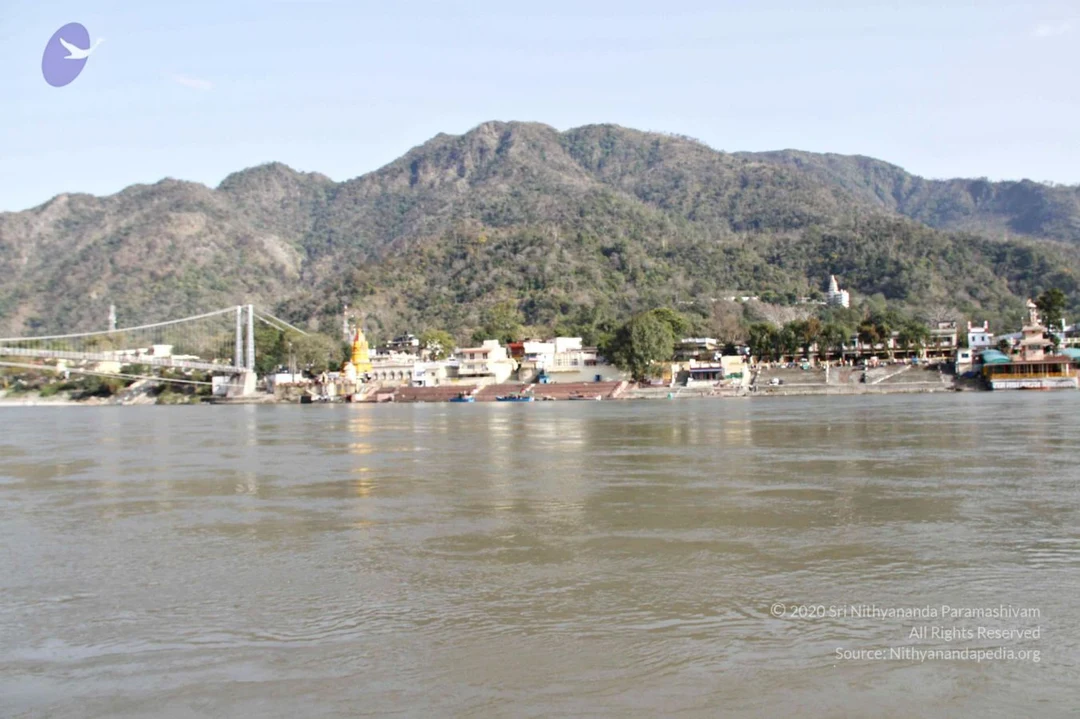
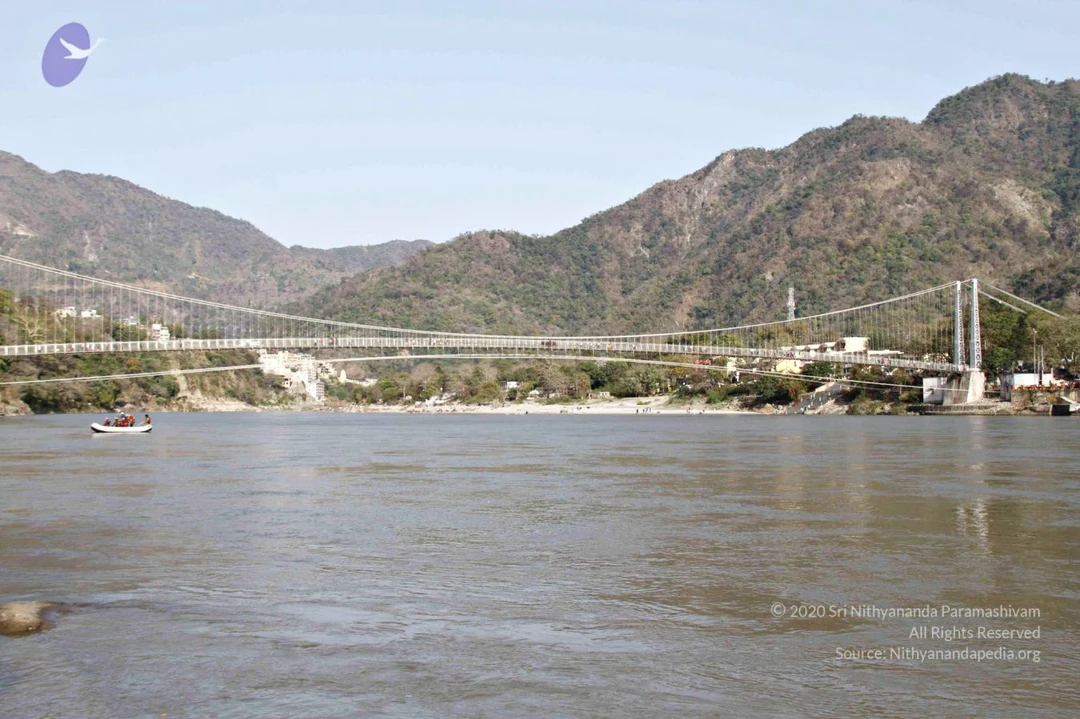
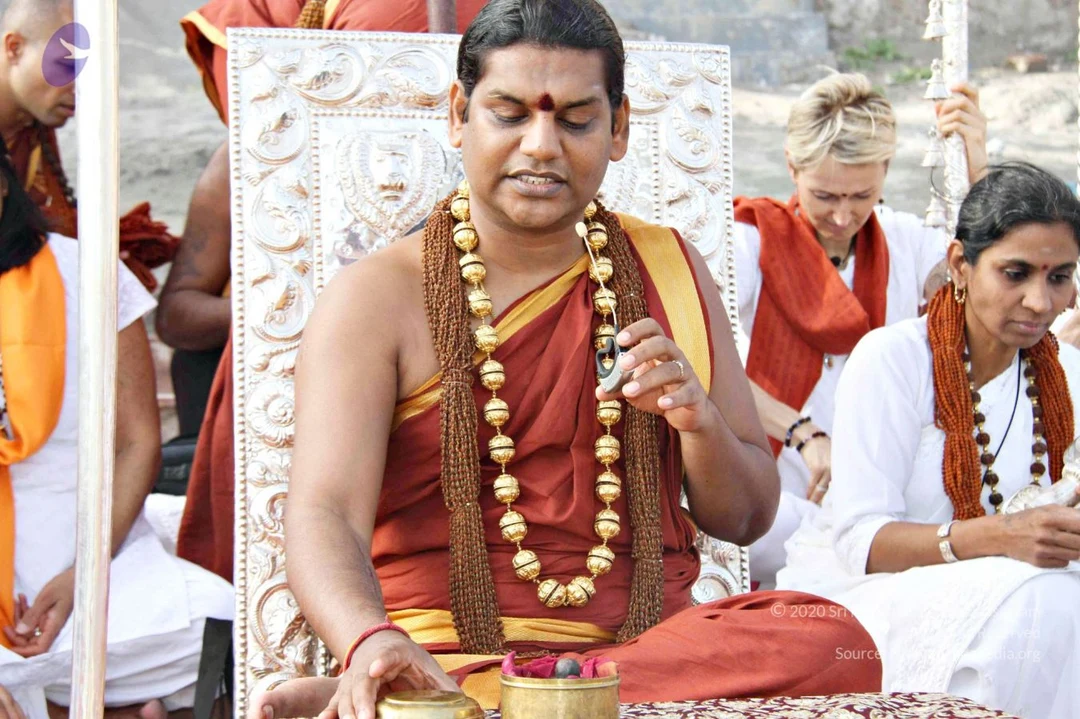
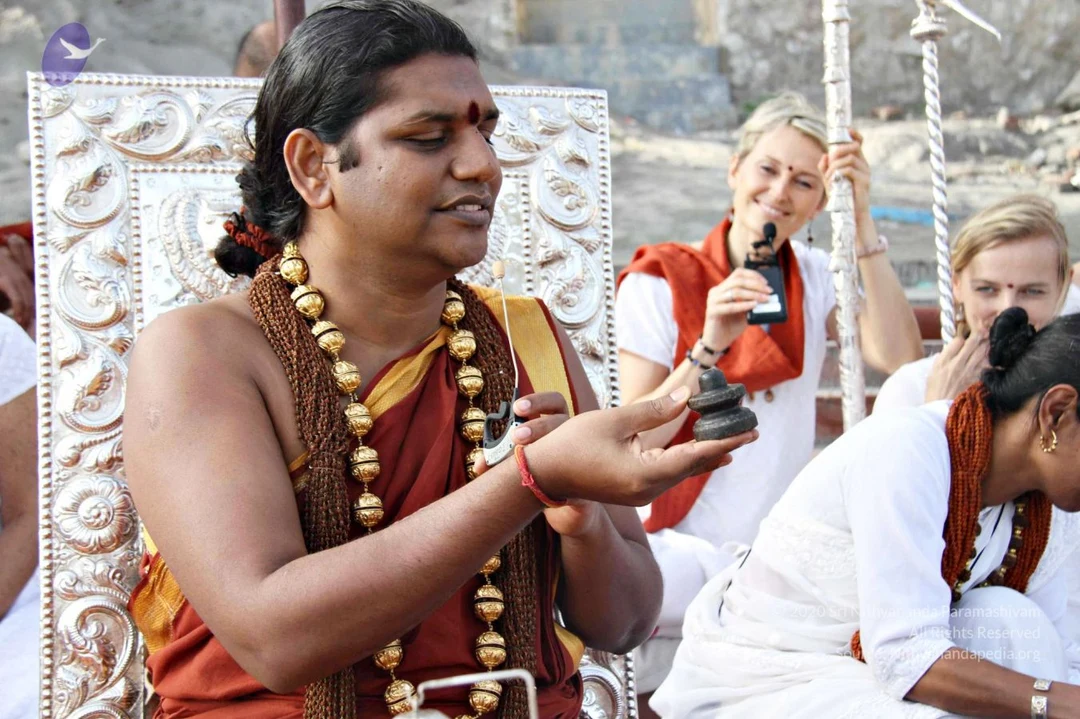
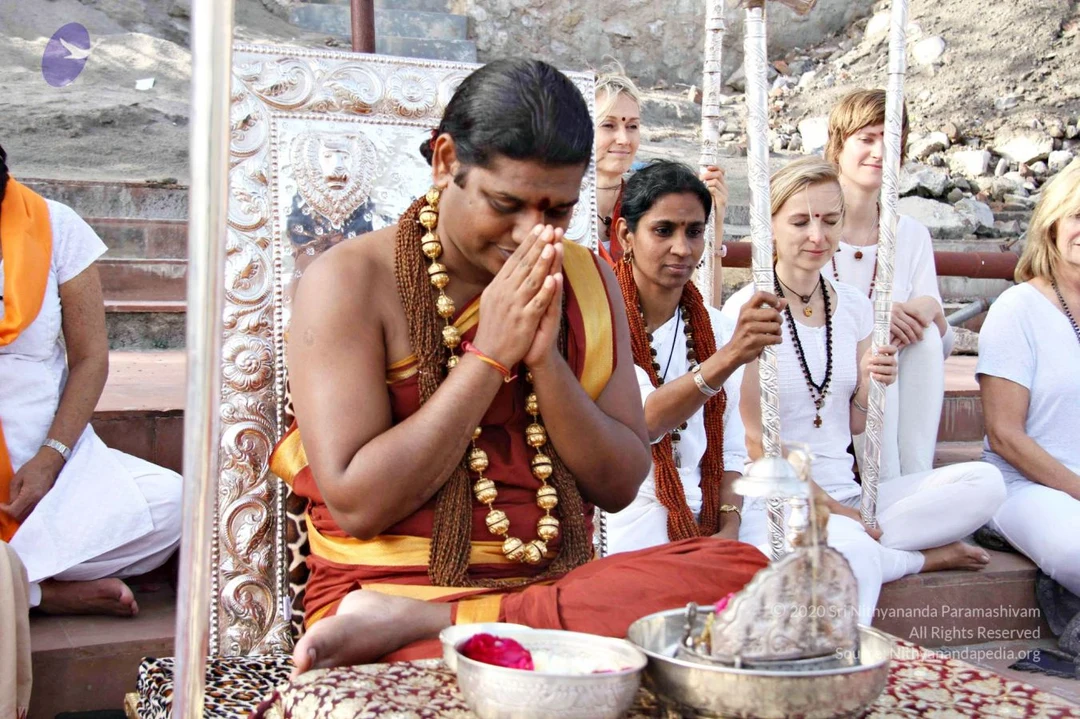
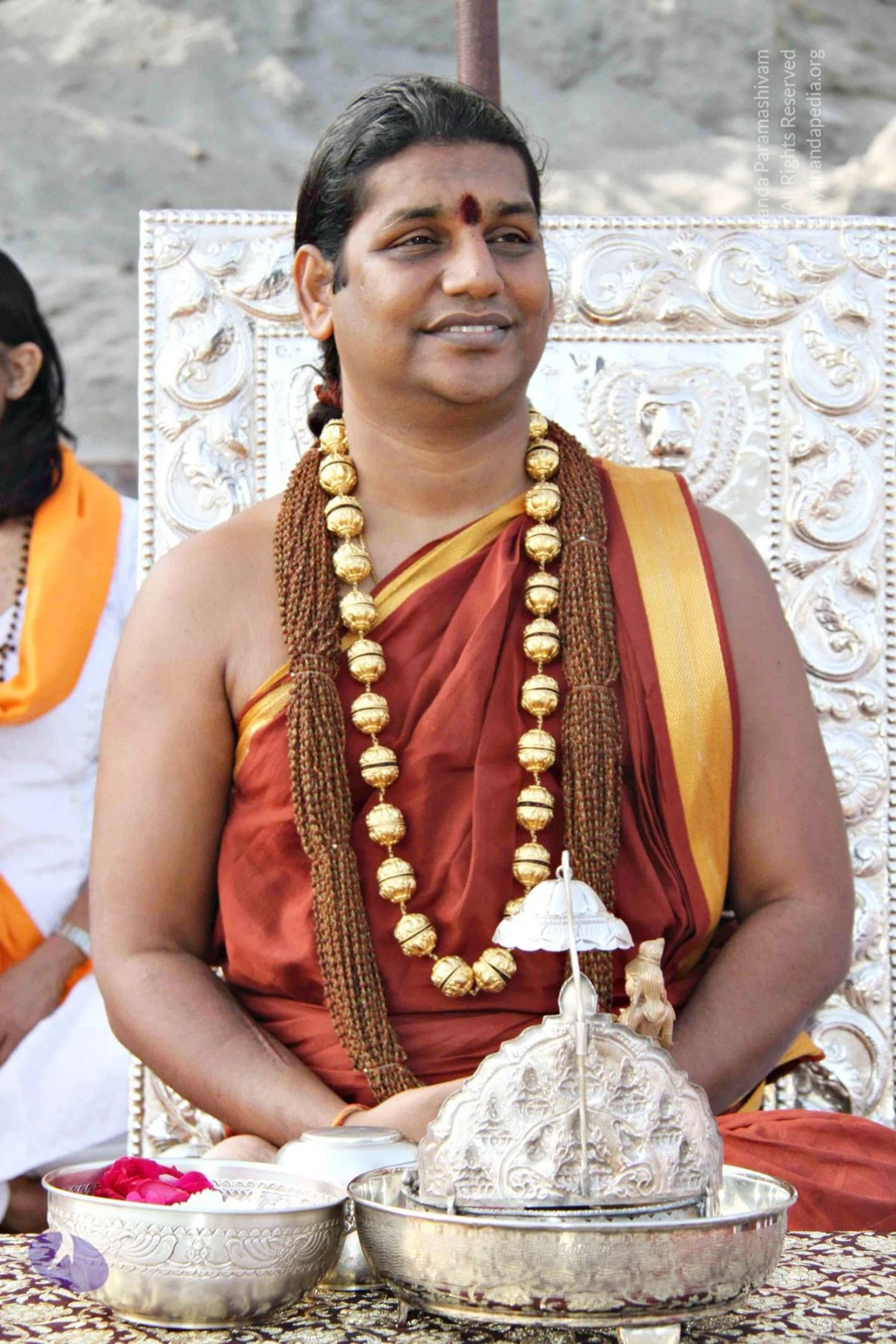
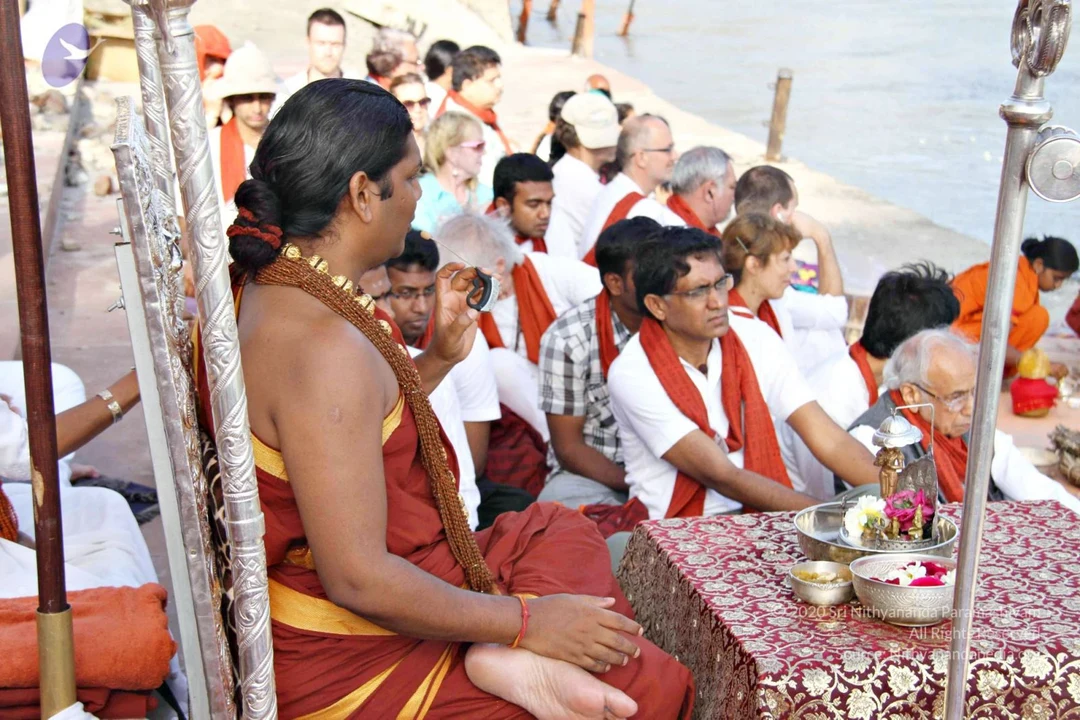
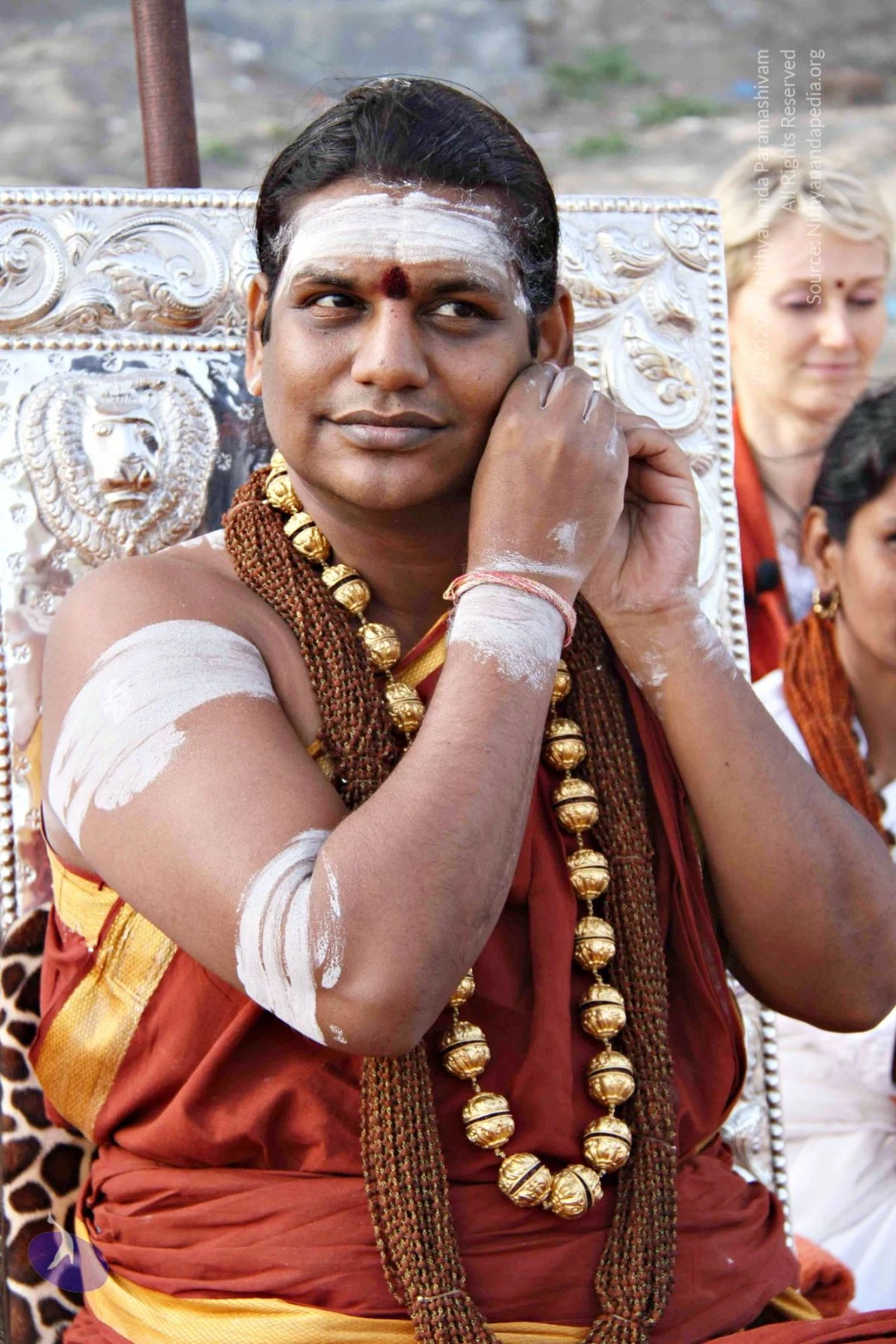
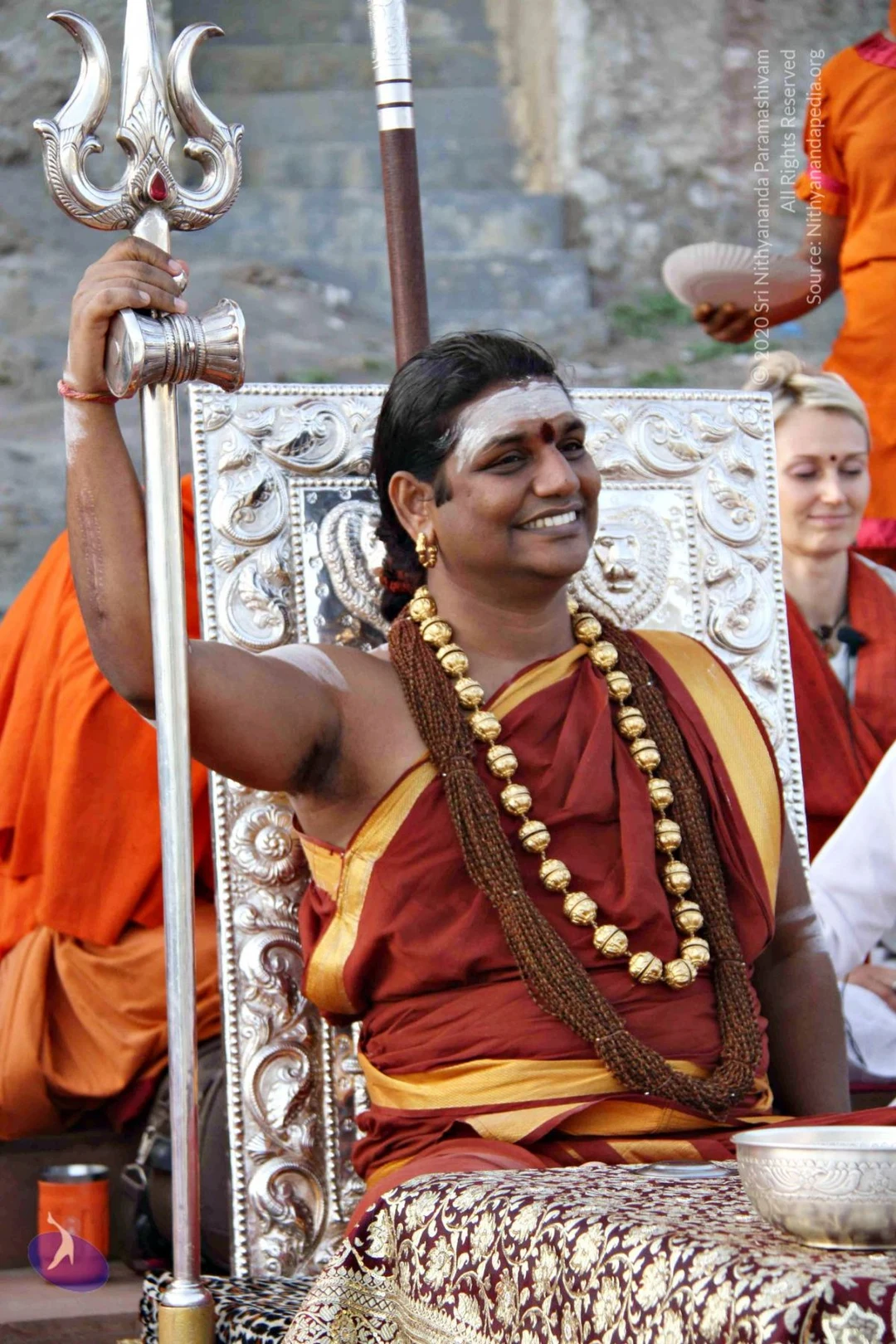
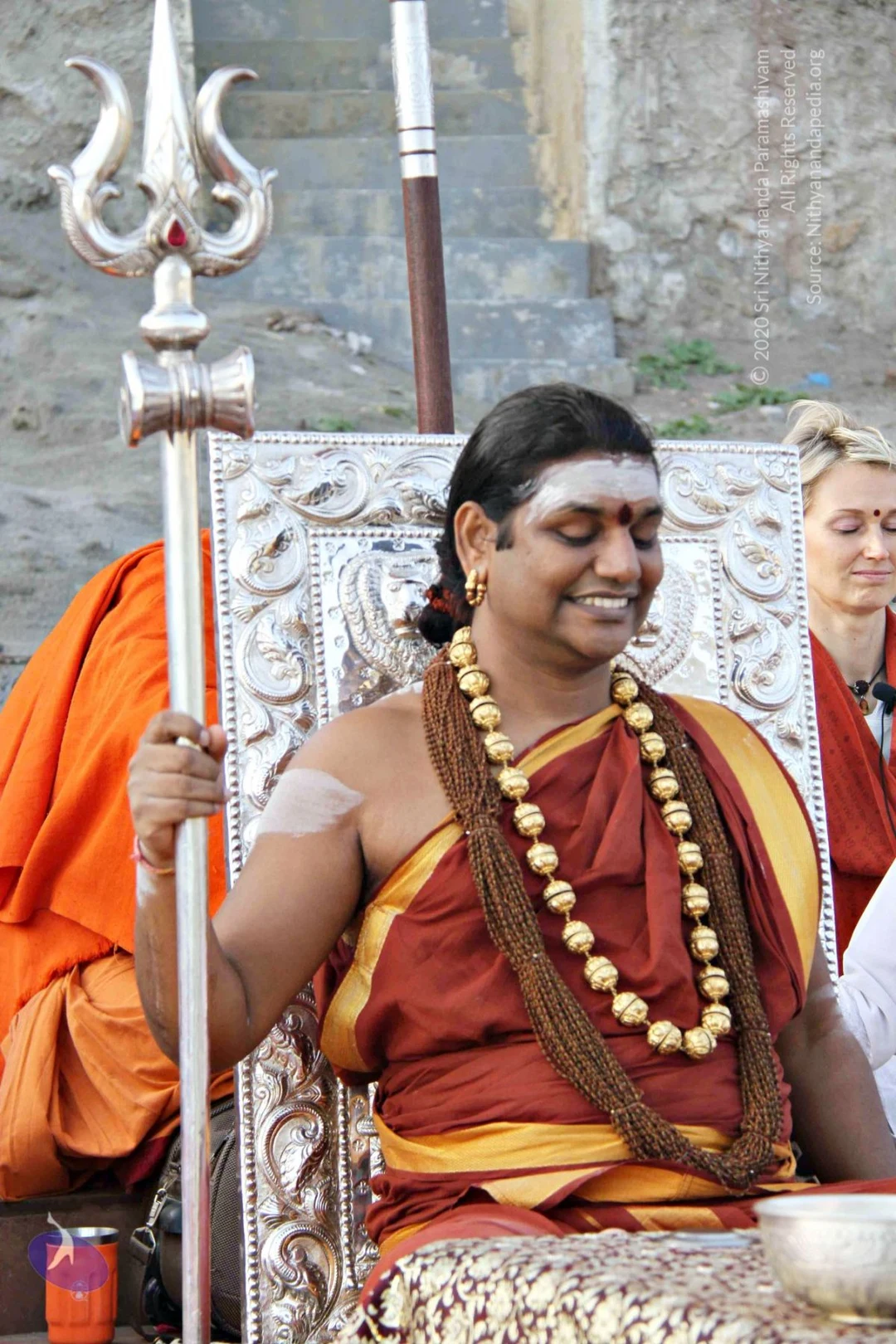
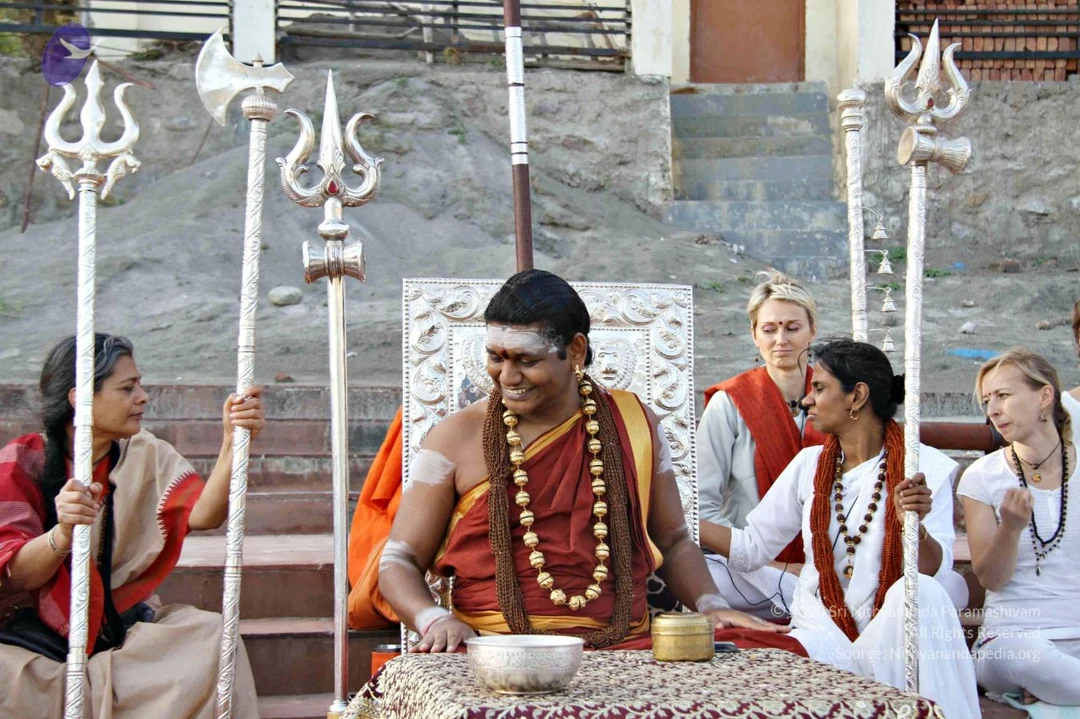
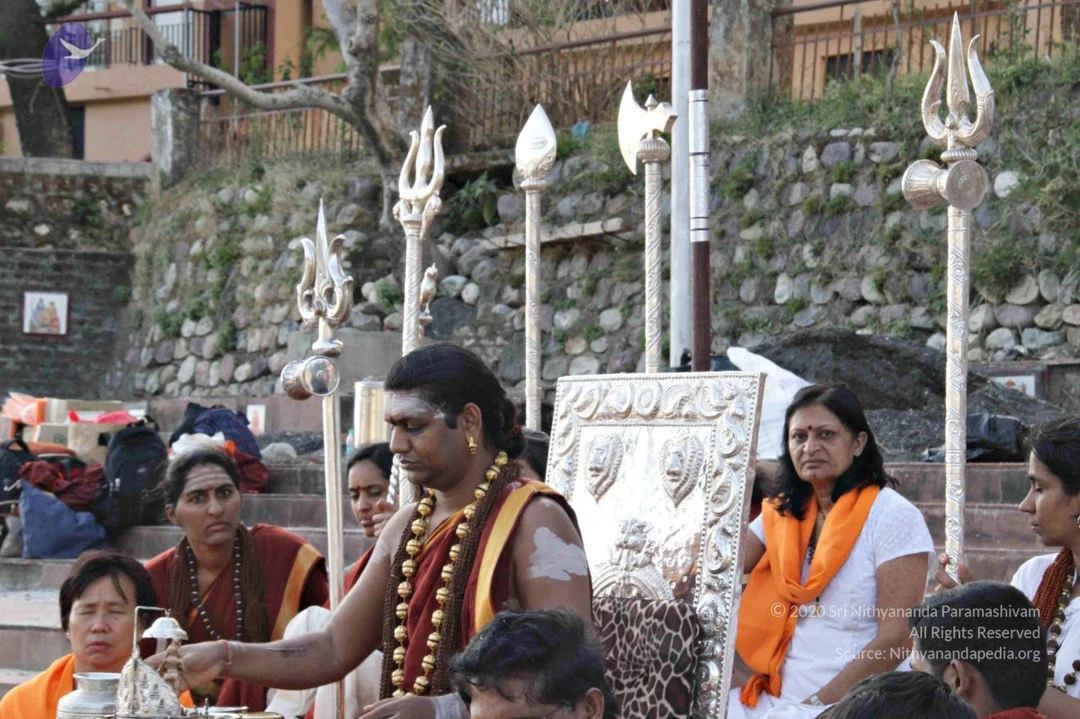
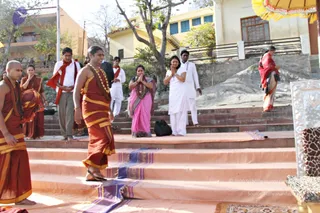
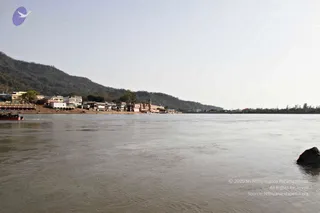
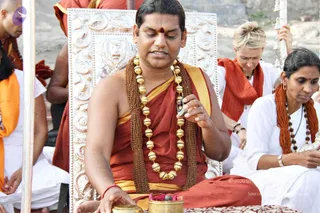
Outdoor photo of a group ascending a broad peach-coloured stone staircase beside a river-side building with yellow walls and a yellow ceremonial umbrella at upper right. A man in the centre wears a rust-red dhoti with yellow borders, a rudraksha mala and a shawl over one shoulder, walking barefoot down the steps over a striped runner. Behind him a shaved-headed man in rust-red robes and a second man in red robes follow. Several people in white kurtas stand on the steps with hands folded in greeting, including a woman in a pink saree with rudraksha beads and a woman in a red saree at right. A black bag rests on the steps and a decorated silver seat with a patterned cushion sits at lower right. The man at centre has long swept-back hair and a distinctive ceremonial appearance, but identity is uncertain from appearance.A wide river photo taken from the water looking toward a hillside town on a hazy day. Muddy brown river water fills the foreground. On the far bank, a row of white and pastel buildings, ghats and a tall tower sit at the base of forested green hills. A small red passenger boat with a white canopy carries a group of people across the river on the right. No identifiable a person figure is visible in the scene.A wide photograph taken from the water of a broad, muddy-brown river with a suspension footbridge spanning it at left. Along the far bank, a row of ghats, temple structures and riverside buildings sits beneath a forested hillside under a clear pale sky. A small white temple spire rises on the slope at right and an orange-and-gold shrine tower stands near the ghat at right. No people are visible.A wide daytime photograph of a broad, brown river flowing toward the viewer, with a suspension bridge crossing from left to right. The bridge has steel towers and cables stretching across a gorge lined with forested, hazy brown hillsides under a pale sky. A small white motorboat with a few occupants travels on the water at left, and a sandy riverbank with a few small figures lies beyond the bridge. White buildings sit on the banks at the bridge ends.Wide landscape photograph of a broad, muddy-brown river under a pale hazy sky. A forested hillside rises behind a riverside town of low buildings, with a pinkish temple spire and a few shops along the bank. A small red-and-white motorboat sits at left on the water, and a dark rock juts from the river at right. No people are visible.Outdoor photo of a seated man in a rust-red and saffron-gold draped garment with a red tilak on his forehead, wearing a long multi-strand ceremonial gold bead necklace with brown rudraksha-style strands. He holds a small silver object near a brass vessel and a metal bowl on a patterned cloth. Behind him is an ornate silver-embossed seat with a carved face motif. Around him sit a woman in white with a red shawl, another woman in white with a red-orange beaded garland, and an orange-robed attendant at left, with a silver ritual staff at right. The setting appears to be an outdoor ritual gathering, possibly a puja or abhishekam.
FB-photo-of-the-day

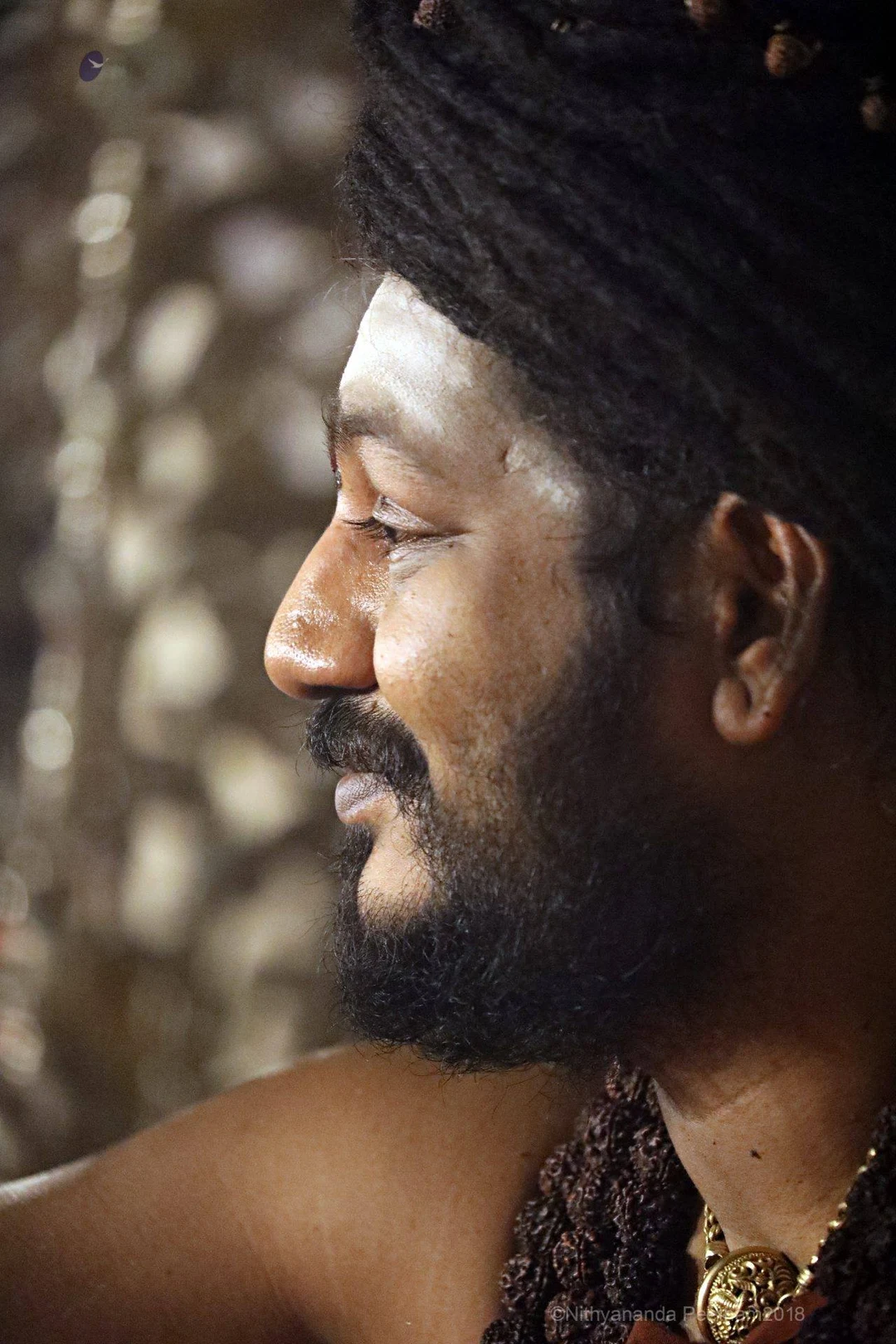
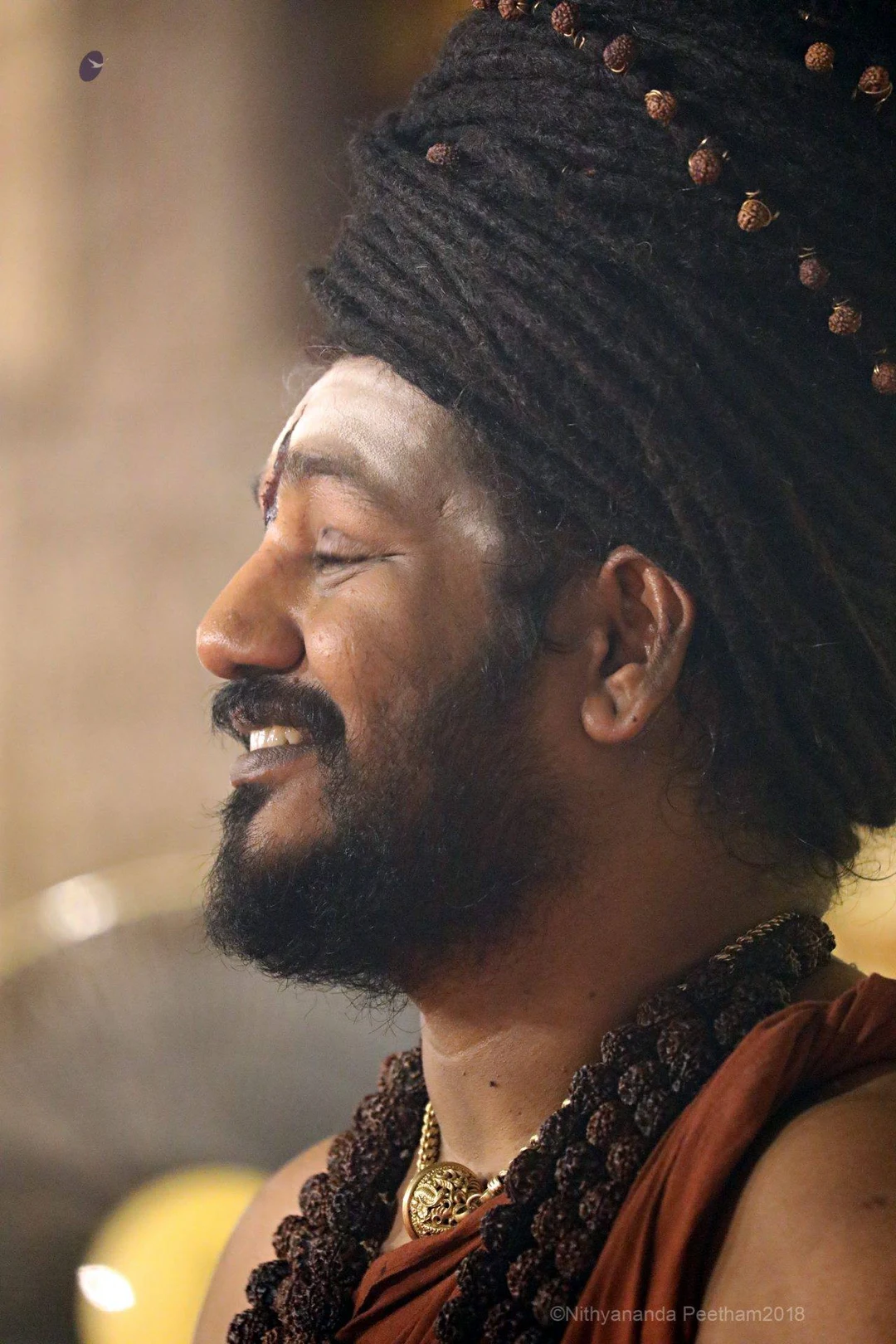
28 photosSource gallery
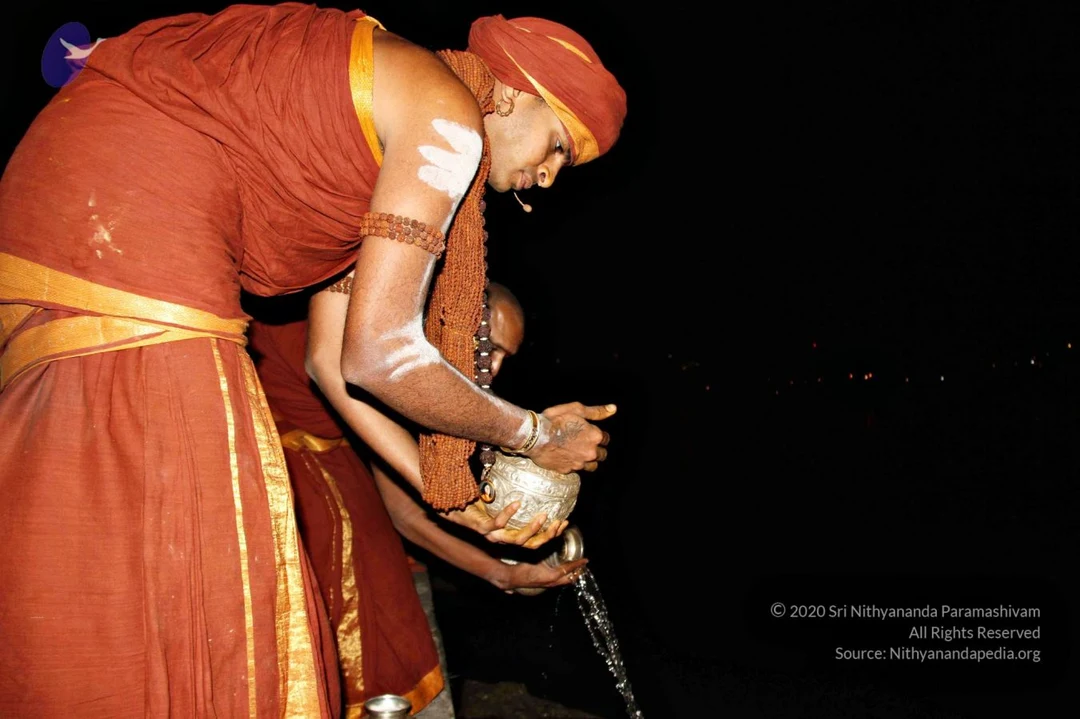
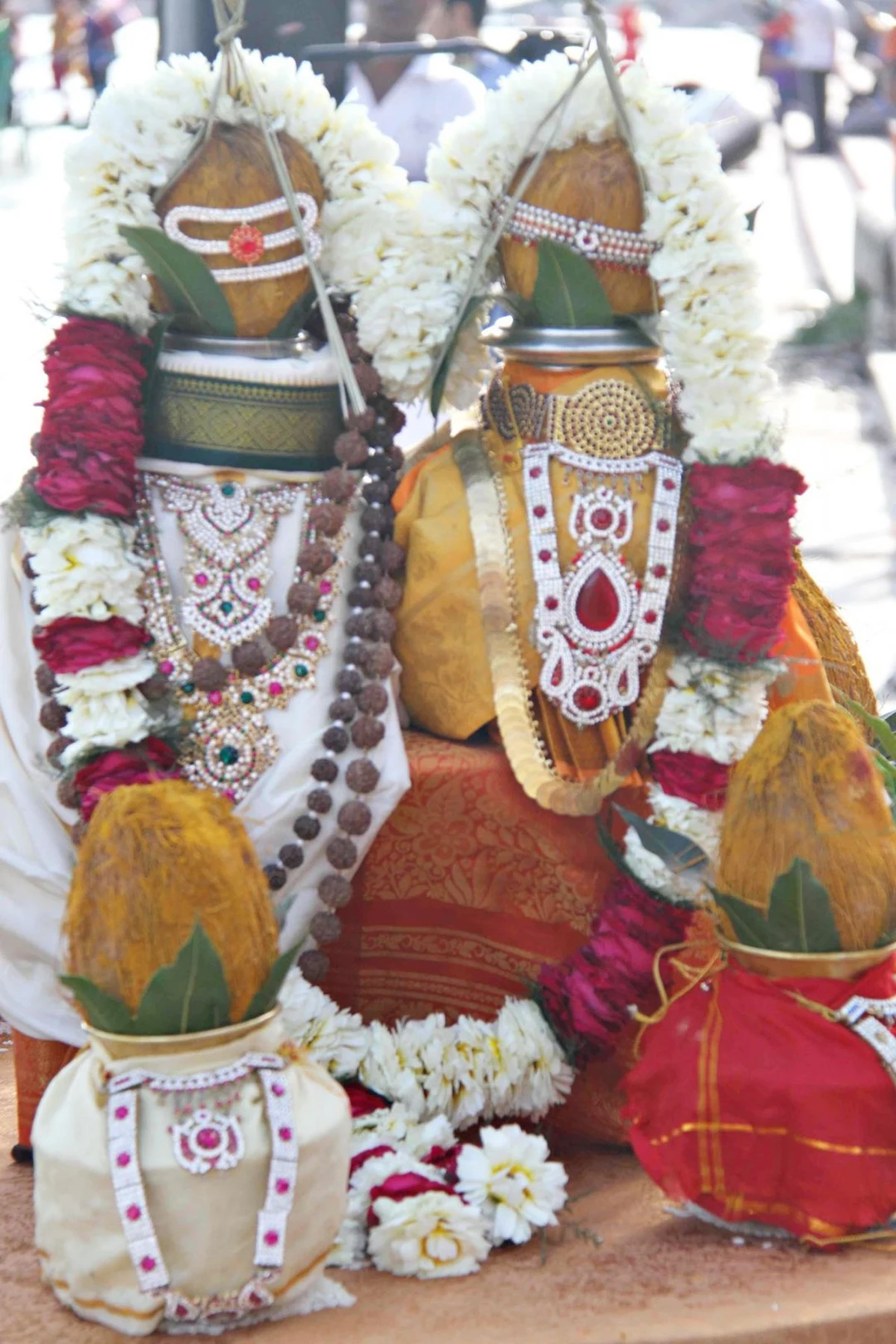
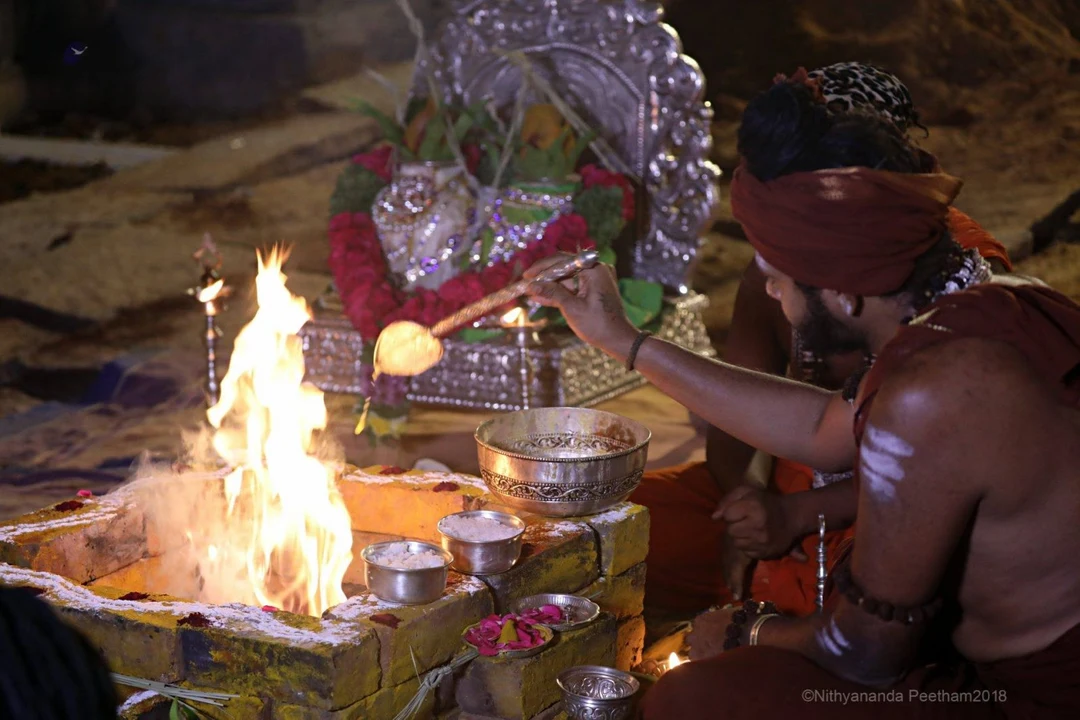
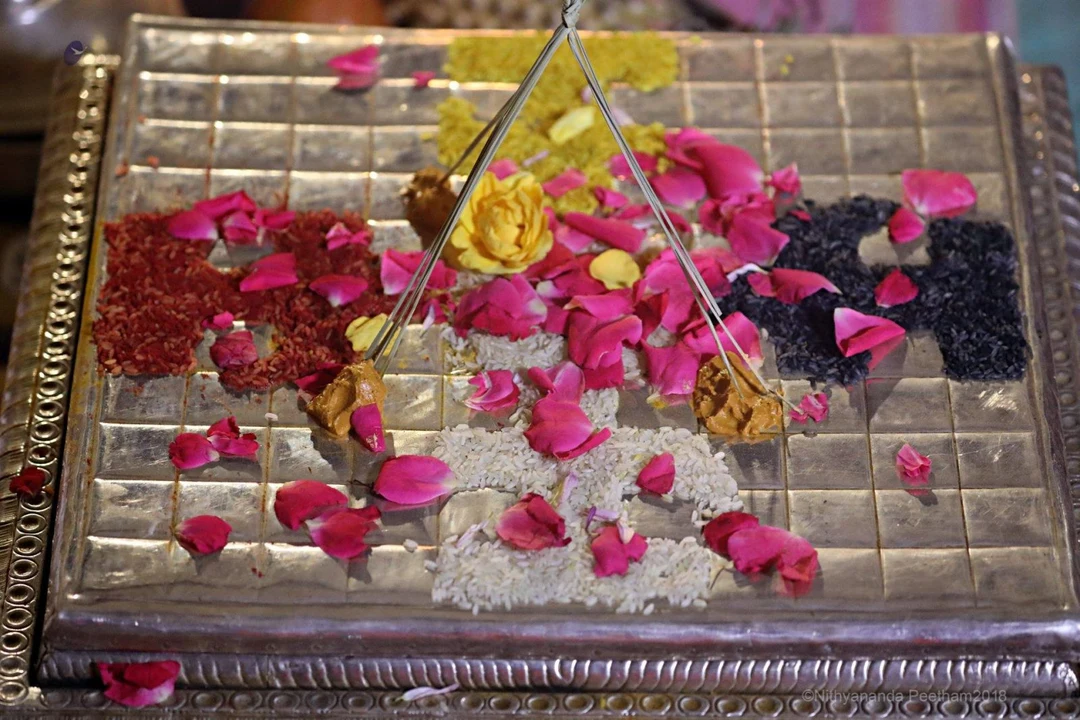
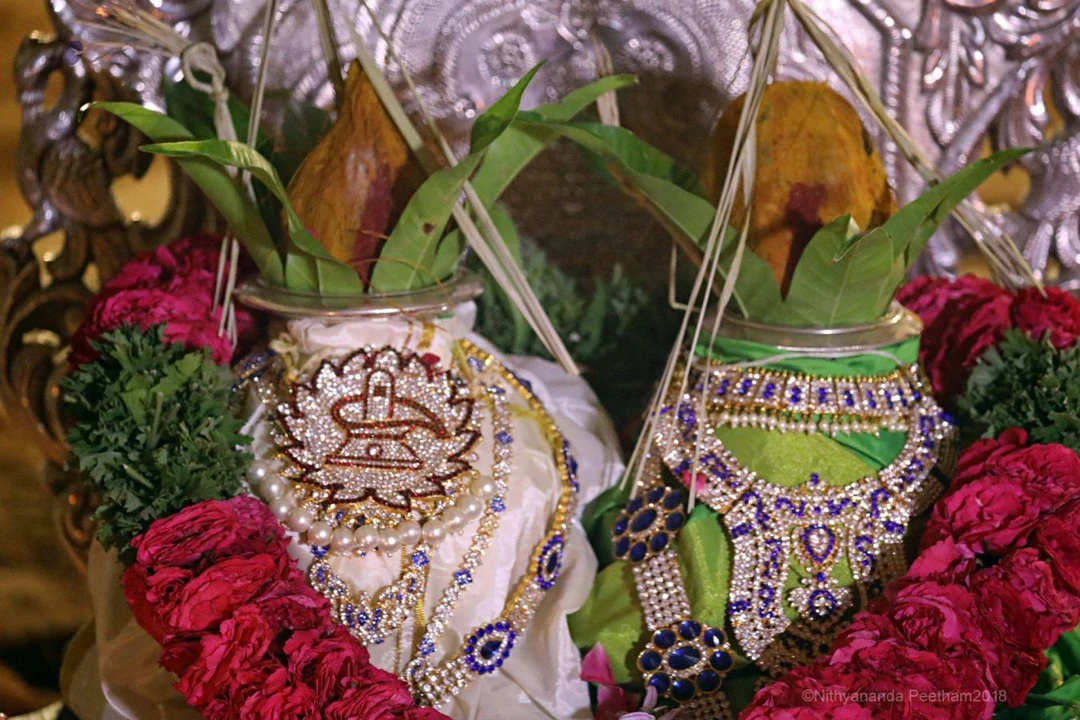
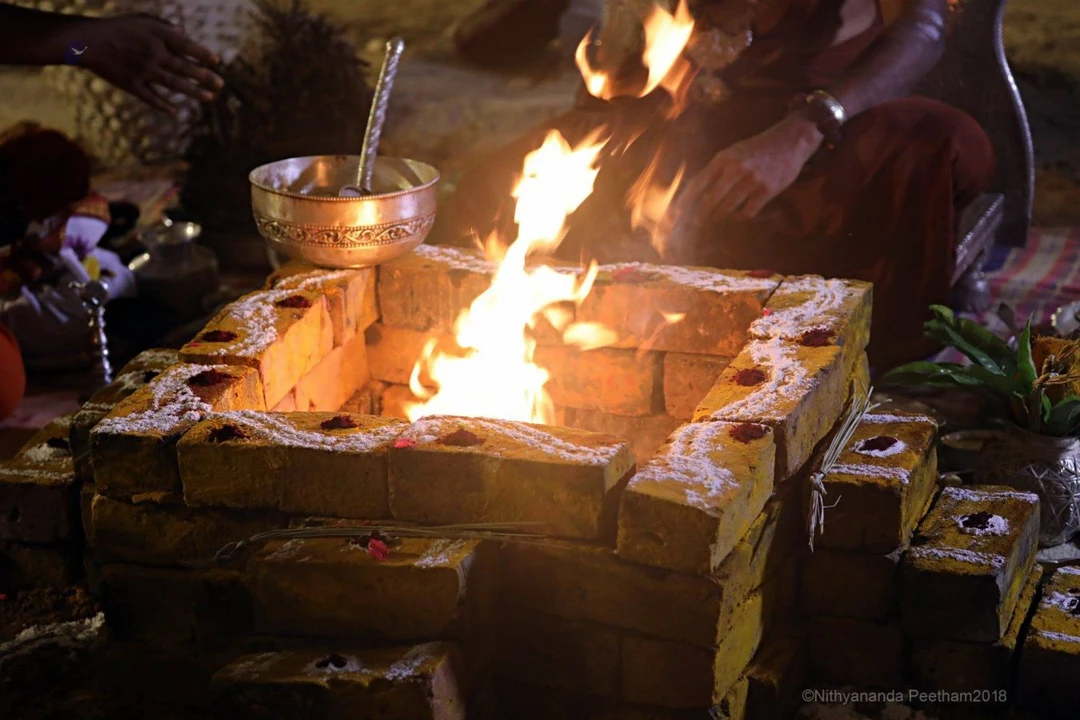
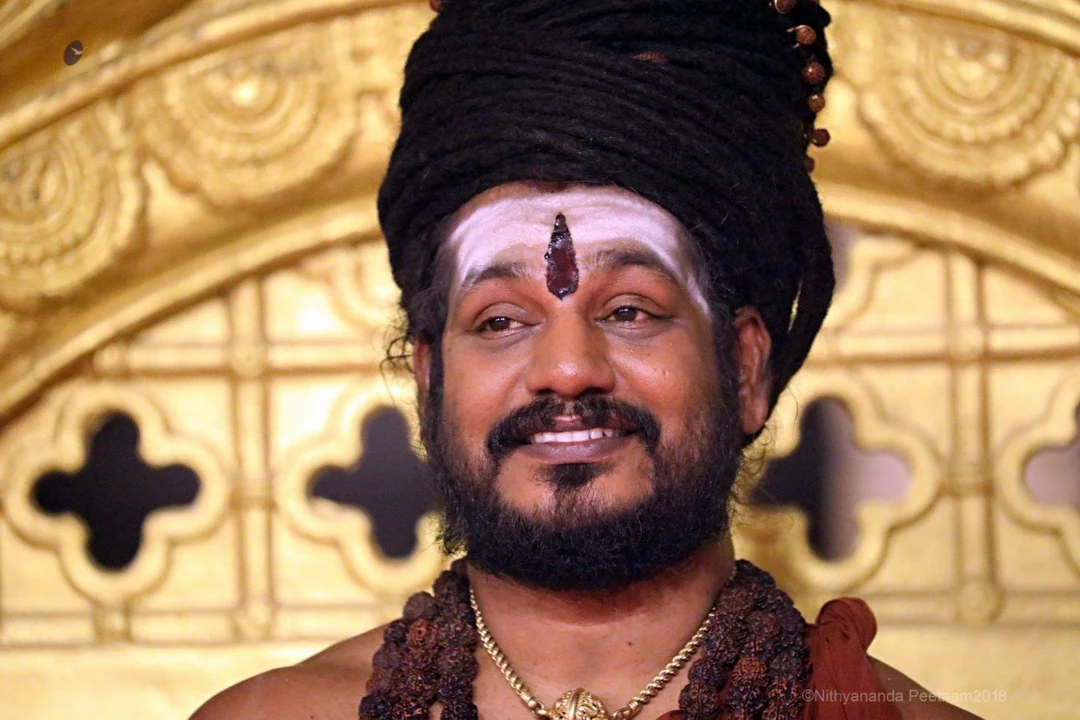
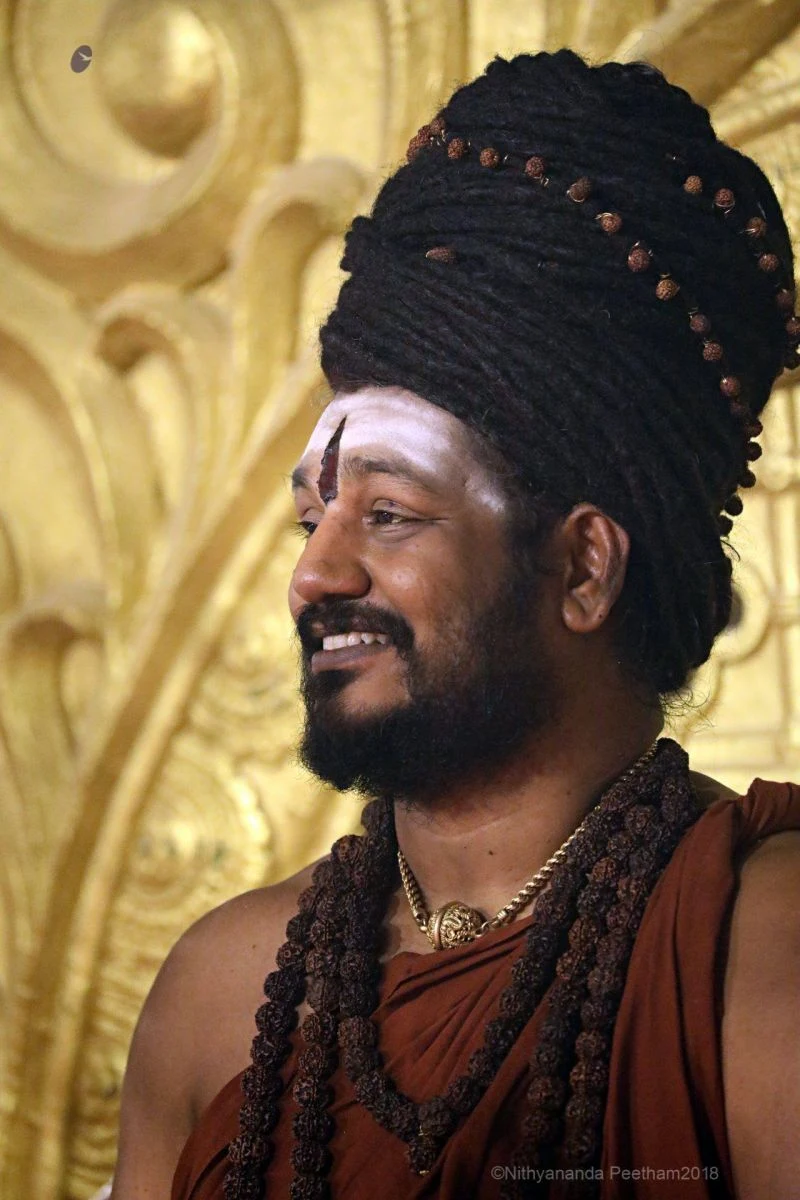
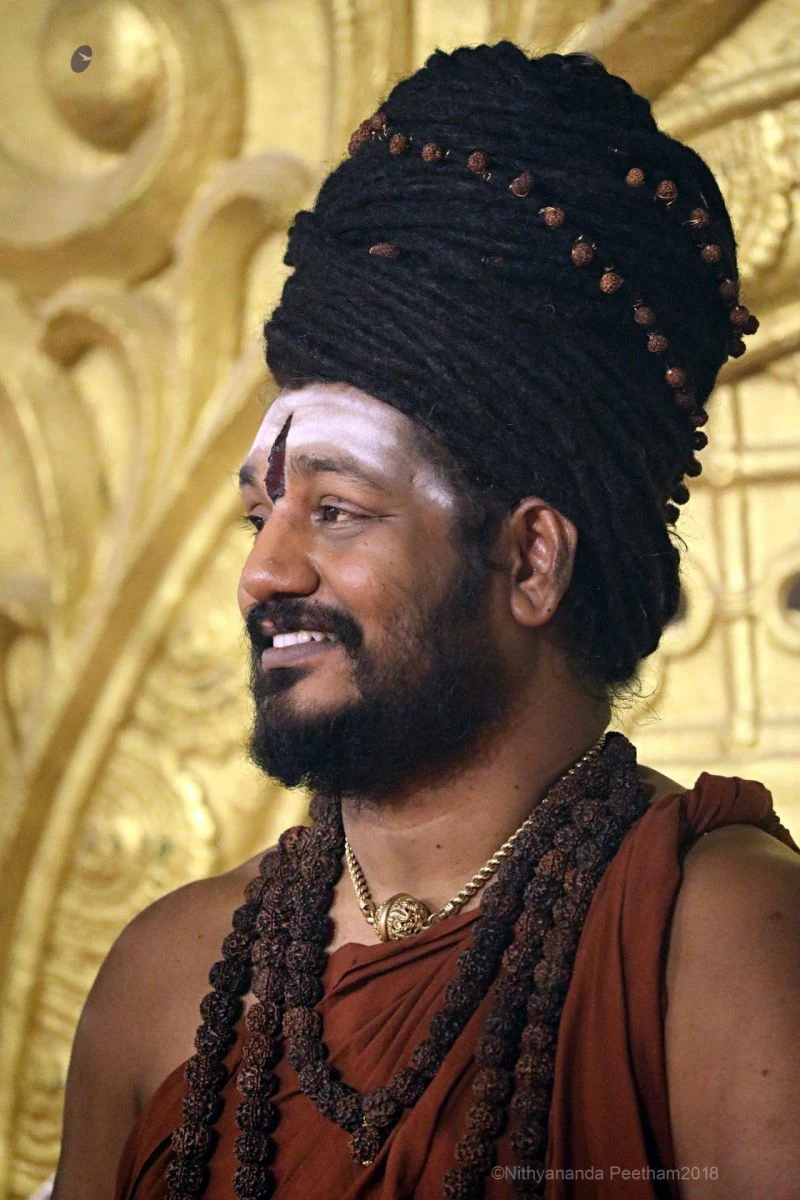
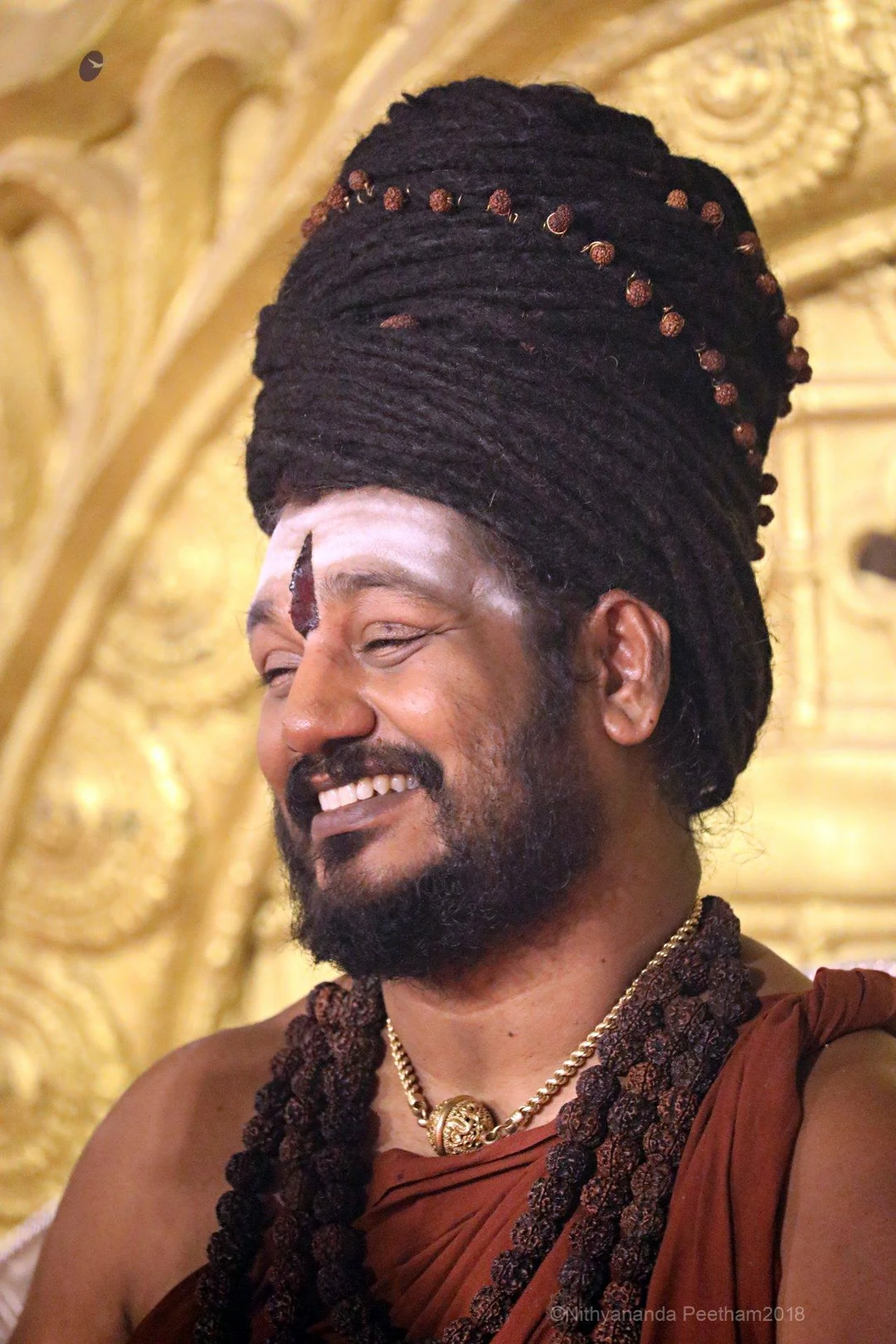
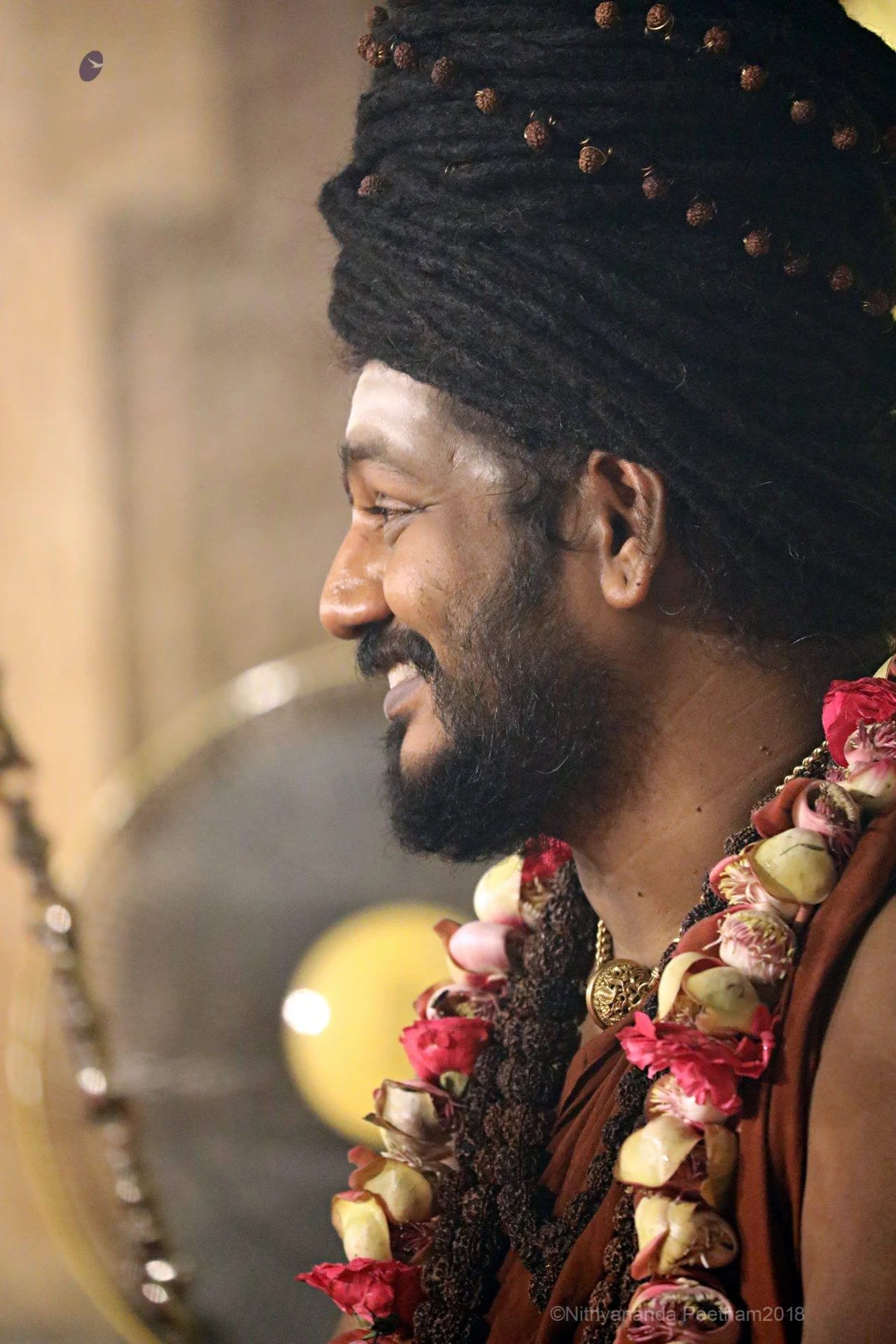
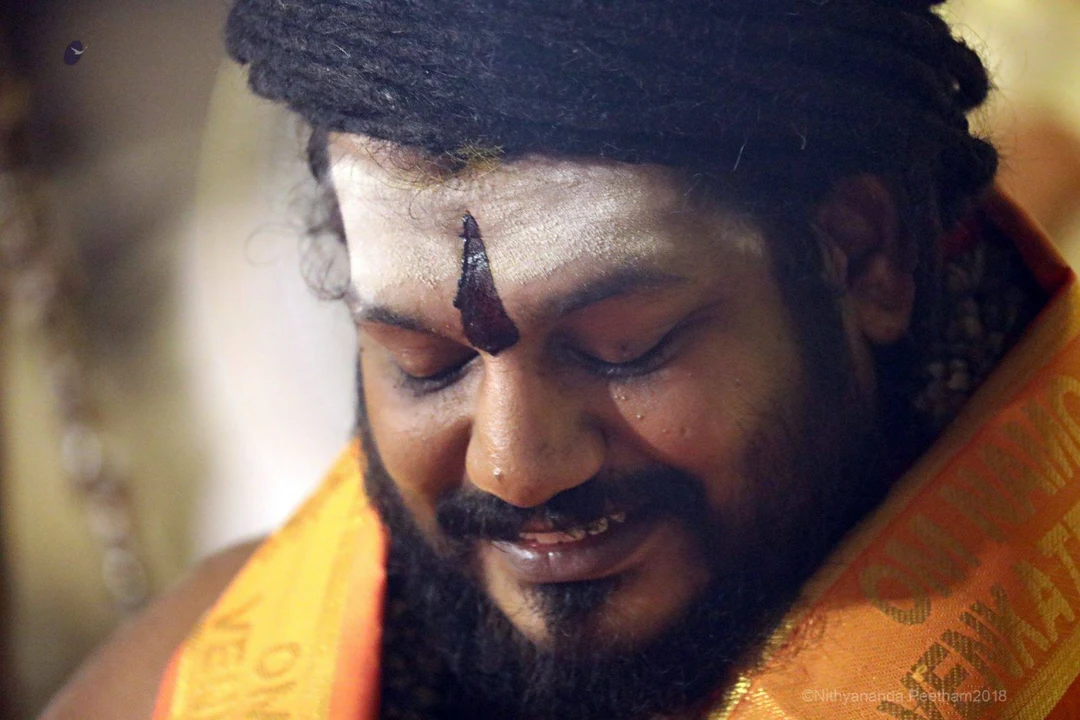
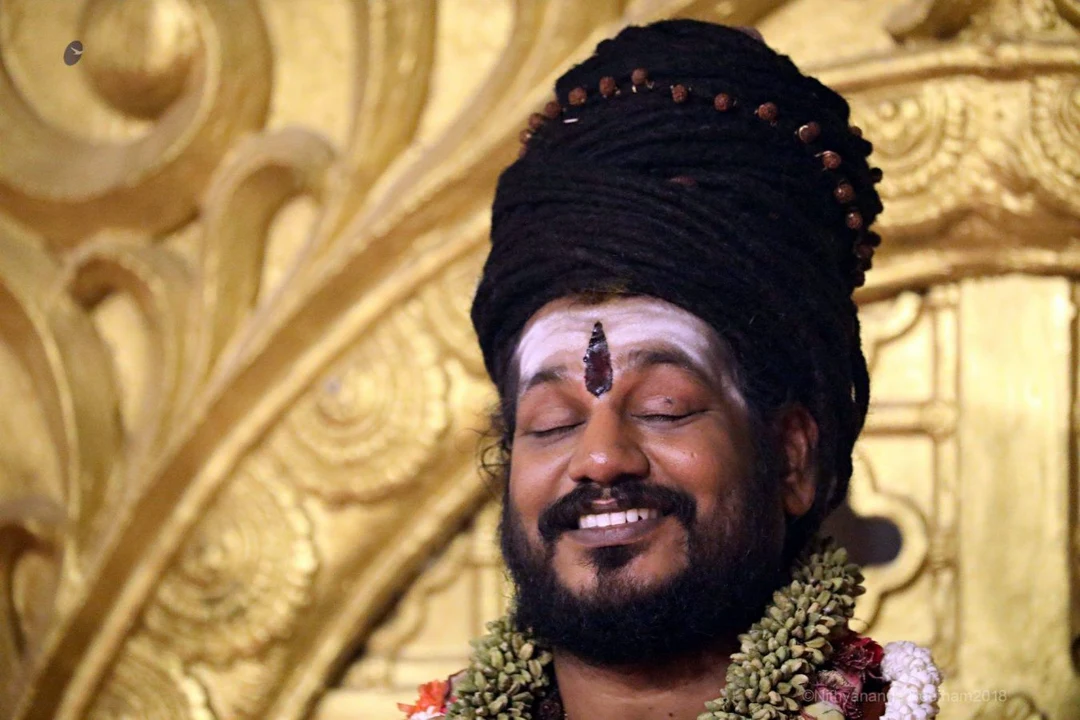
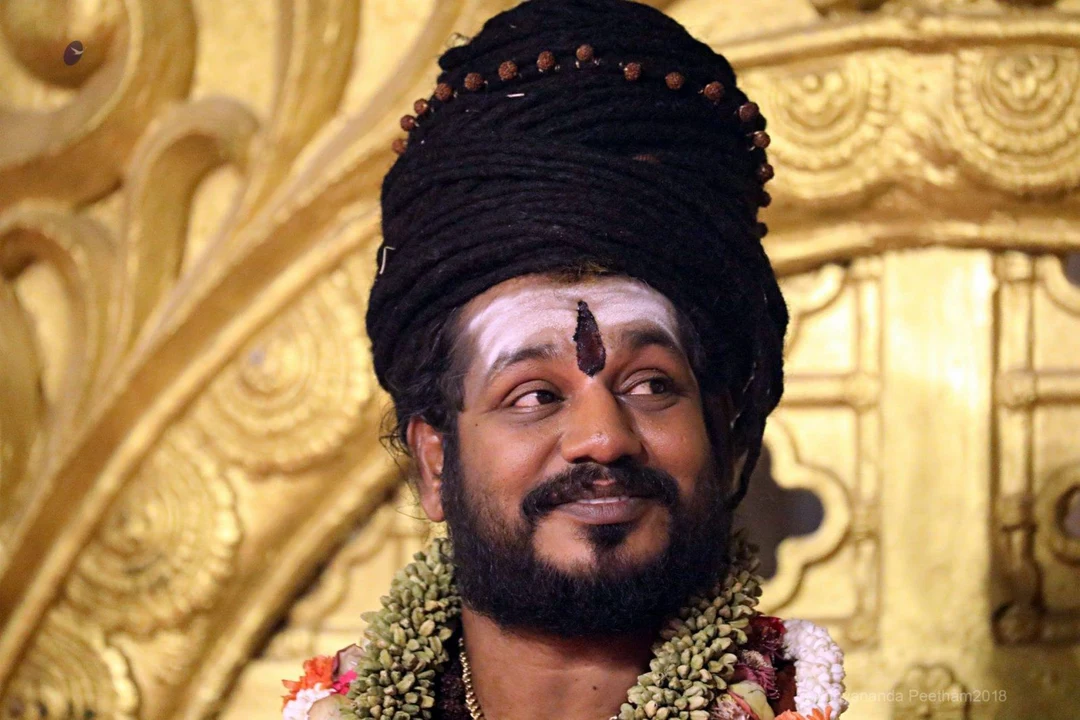
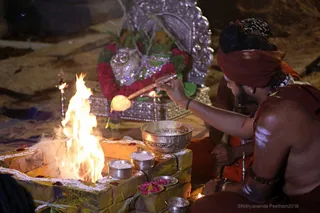
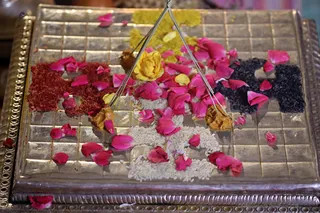
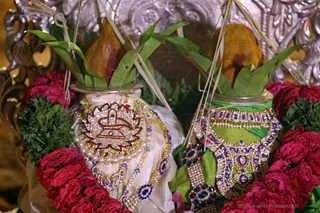
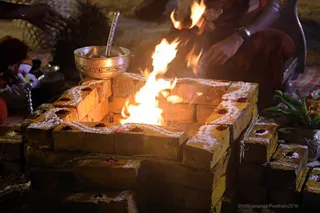
A night-time homa at an outdoor fire pit built of yellow-brown bricks dusted with white powder and scattered with red petals. A bright flame rises on the left. In the foreground, a bare-chested sadhu in a red-orange turban and orange cloth, with white ash markings on his arms and shoulder, uses a long wooden ladle to pour from a silver bowl into the fire. Beside him, another man in orange cloth sits with a rudraksha mala. Behind them, a silver-ornate altar holds a kalasha draped with red marigold garlands and flanked by lit oil lamps.A close-up photograph of a square silver-toned ritual yantra or sacred diagram plate, its grid of raised squares covered in coloured offerings. Red and yellow powders, white and black grains, pink and red rose petals and a yellow flower lie on the surface, with two thin metal wires or tongs crossing over the centre. No people are visible; the frame shows only the offering arrangement.Close-up photograph of two decorated kalasha pots, each topped with mango leaves and a brass rim, dressed with jewelled ornaments. The left pot wears a white cloth draped with a pearl and jewel-studded necklace and a gold-and-red embellished lotus-shaped emblem; the right pot has a green cloth with a blue and white jewelled necklace and bracelet-style adornments. Red roses and green leaves surround both pots, with a silver-toned backdrop behind them. No people are visible. This appears to be a temple-style decoration of kalasha vessels with a ceremonial garland setting.A homa fire burns inside a square fire pit built from stacked brown bricks, each top brick dusted with white ash-like powder and dotted with red kumkum. A silver bowl with a ladle sits on the brick rim at left, and a red-robed figure with wrists and a bracelet visible sits behind the fire, tending the flames. Scattered petals and a small potted plant appear at the right edge, and brass vessels rest at the left.Close-up photo of a seated person in a rust-orange cotton robe, wearing long necklaces of dark rudraksha beads over the chest. The right hand rests in a meditative mudra with fingertips touching, on a crimson velvet seat with a silvery ornate backdrop behind. Only the torso, arm and hand are visible; the face is not shown.Close-up portrait photo of a smiling bearded man with a tall black turban of wrapped hair and a rudraksha mala draped at the neck. He wears a white horizontal tilak with a dark vertical mark on the forehead, a gold chain with a pendant, and an orange-red cloth over the shoulder. Behind him is ornate gold carved metalwork with cut-out lattice panels. Swamiji (probable): the turban, rudraksha malas, gold necklace and saffron-orange cloth are the qualifying cues for the in-person candidate.