Skip to content
Sunday

31 March 2013

THE SUPREME PONTIFF OF HINDUISM HDH BHAGAVAN NITHYANANDA PARAMASHIVAM

Dated photos
405
Source pages
1
Media
1
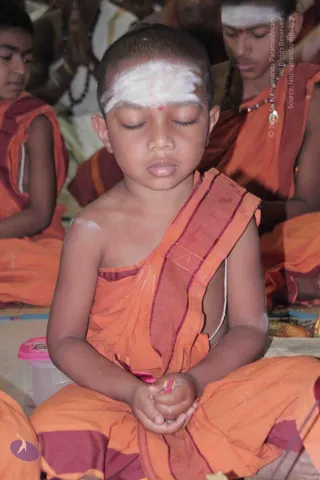
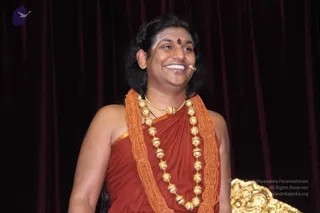
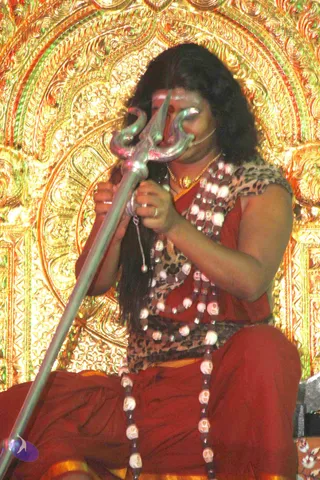
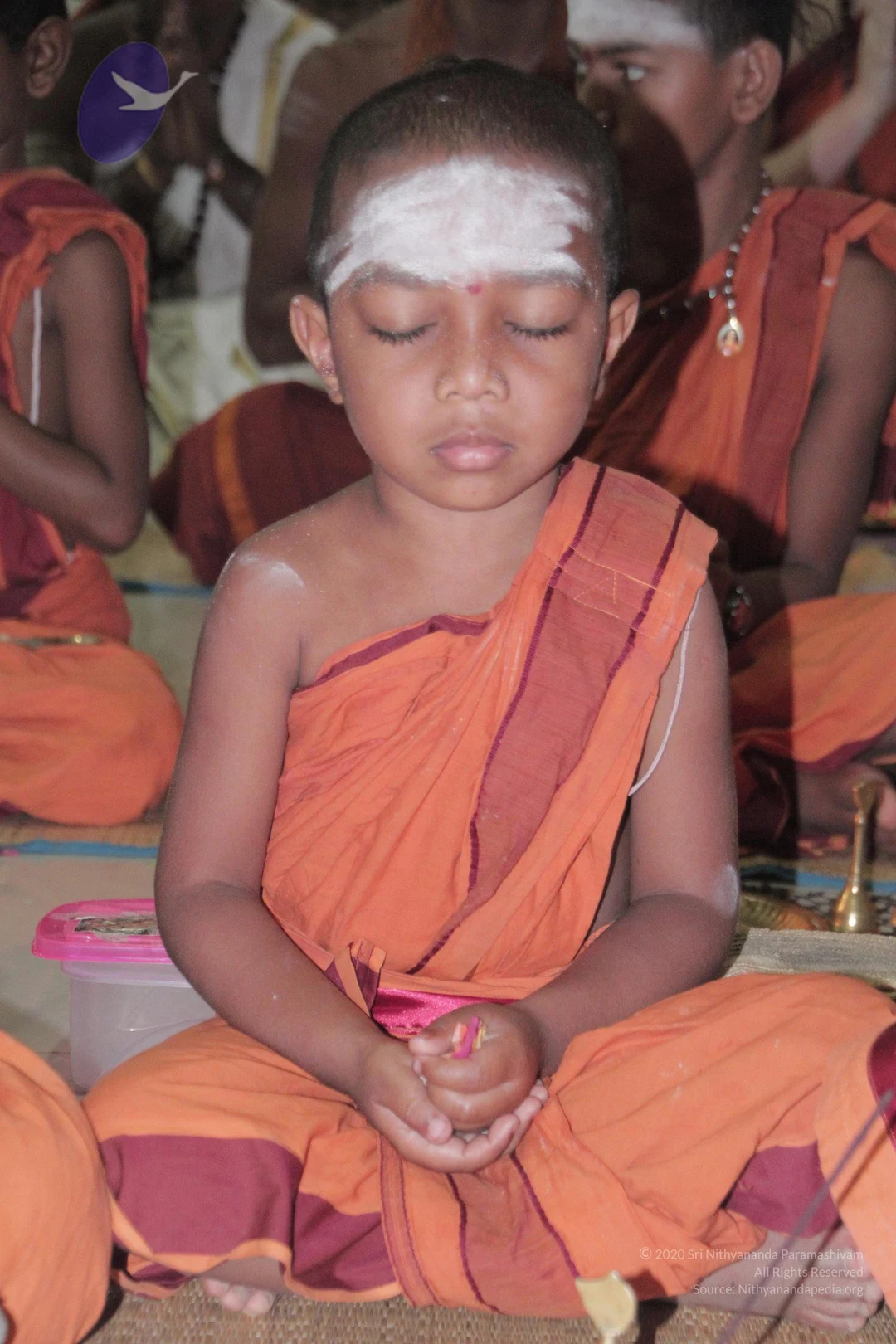
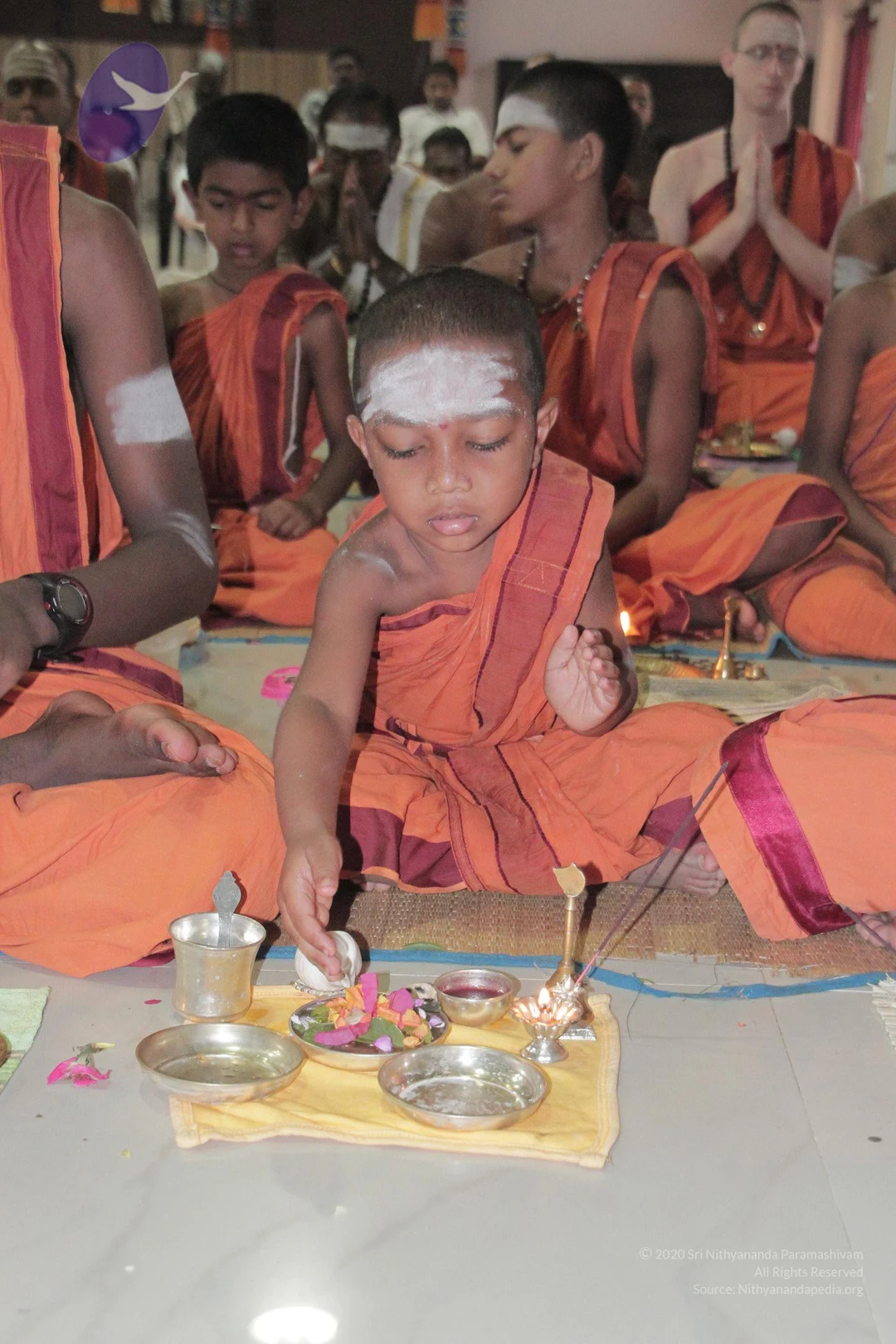
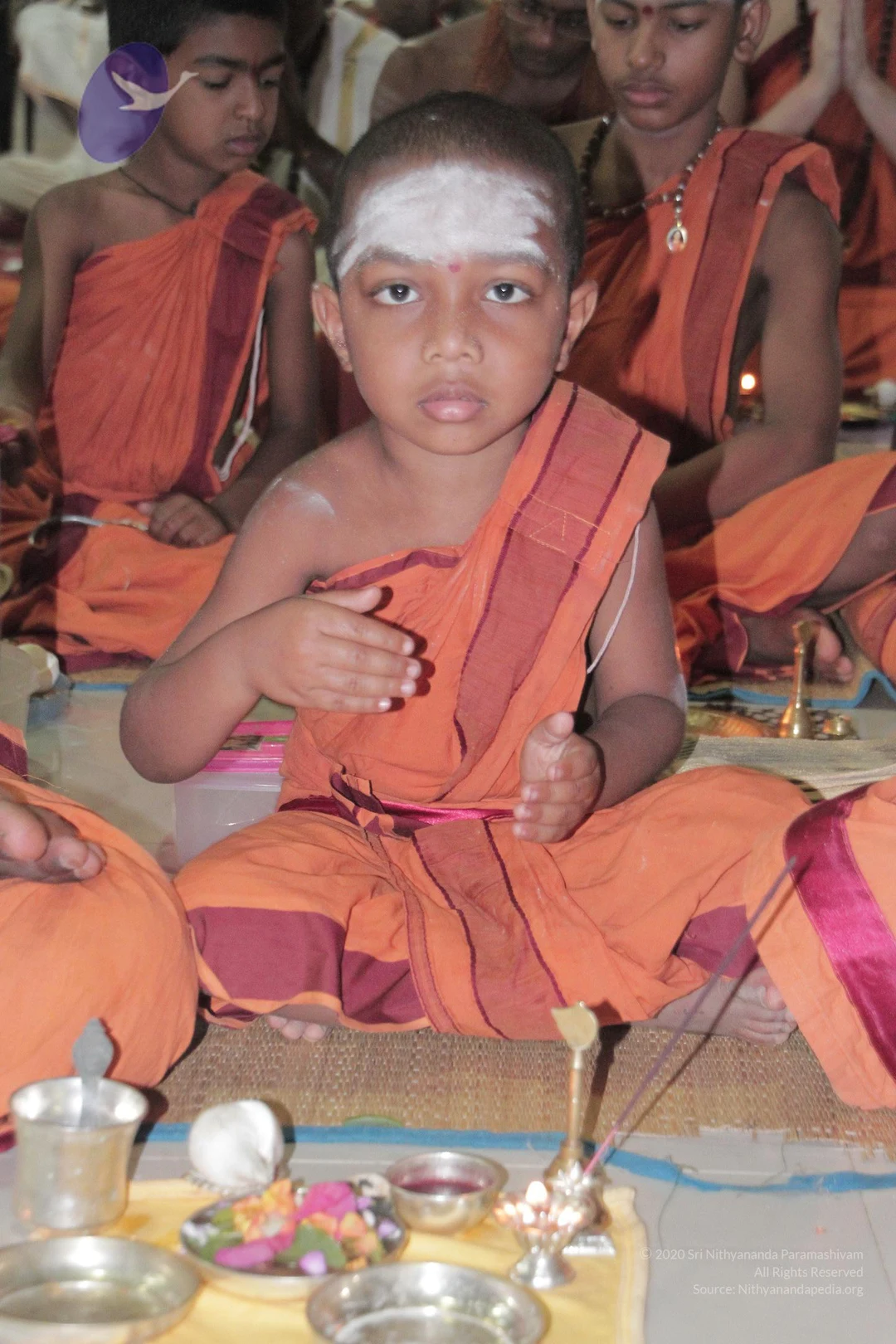
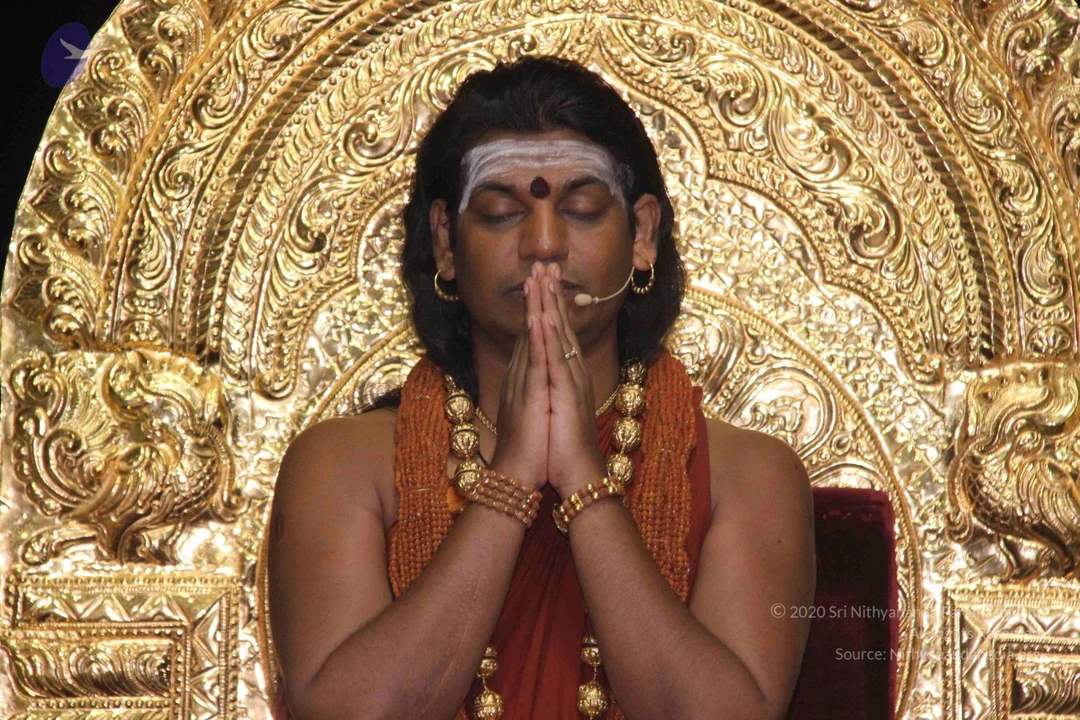
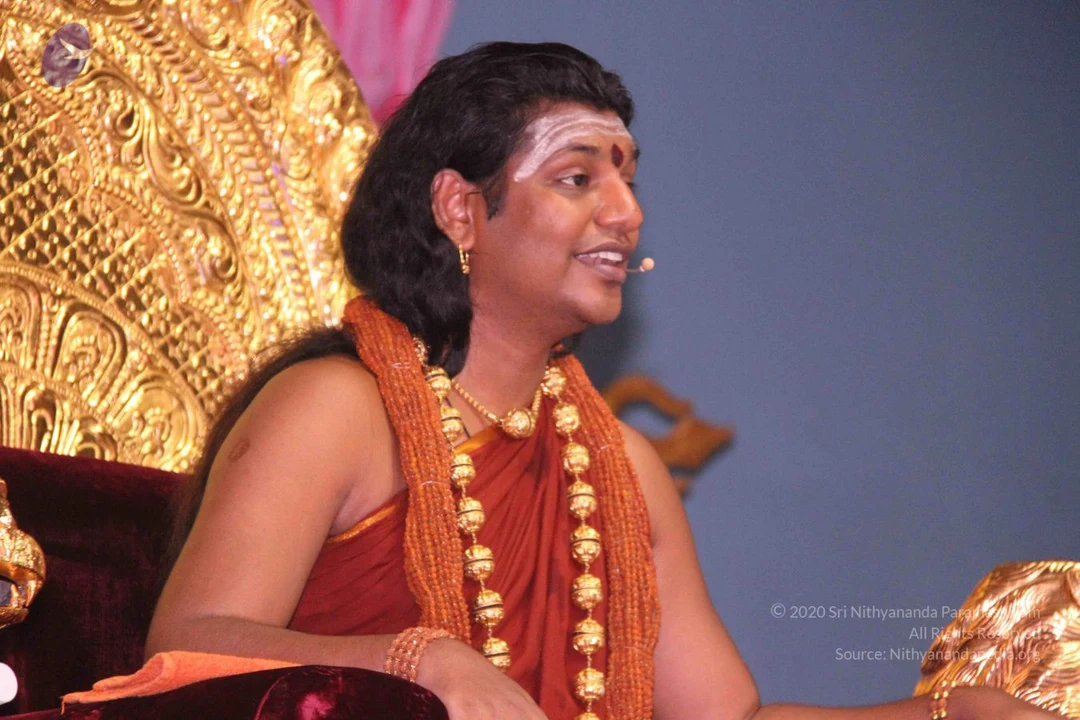
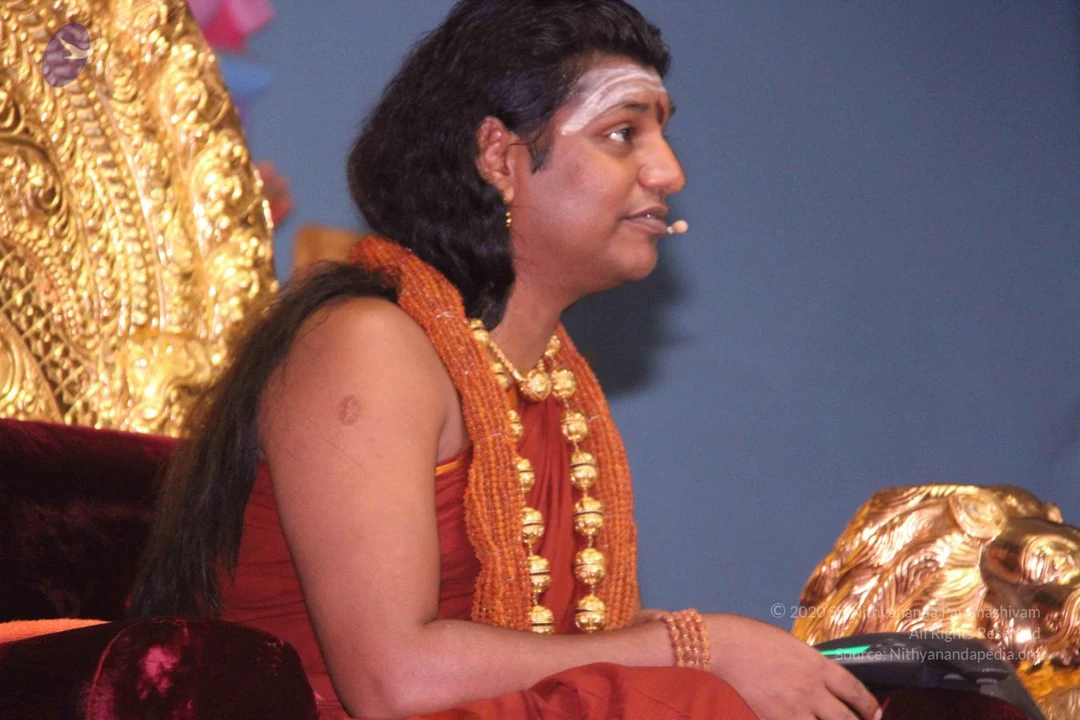
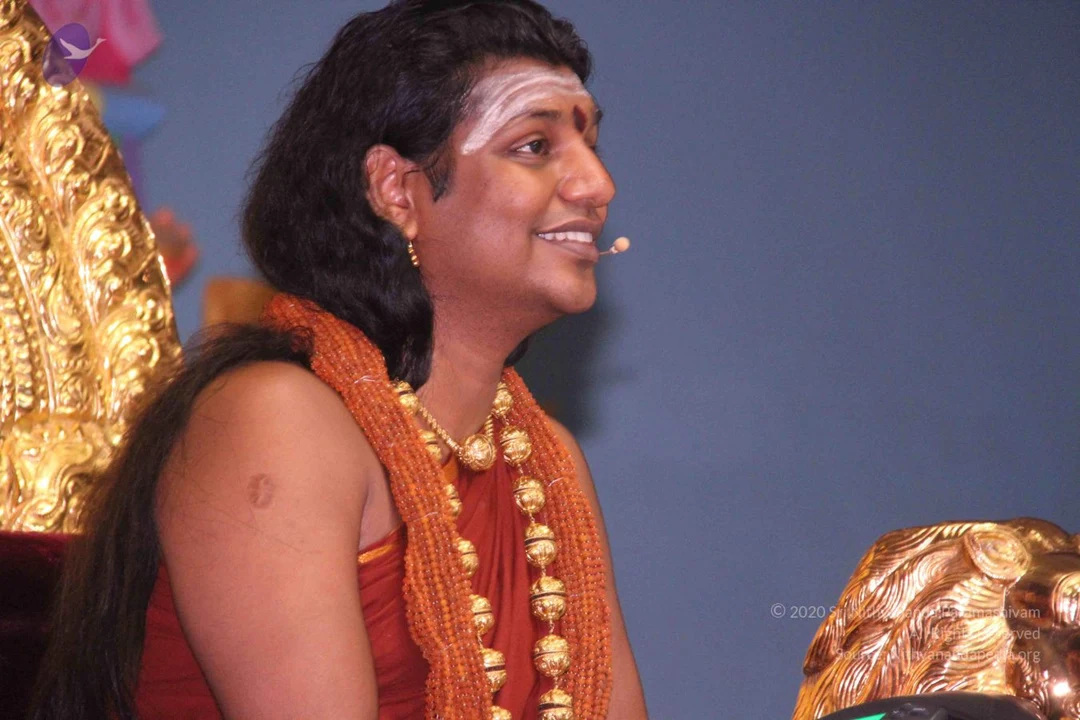
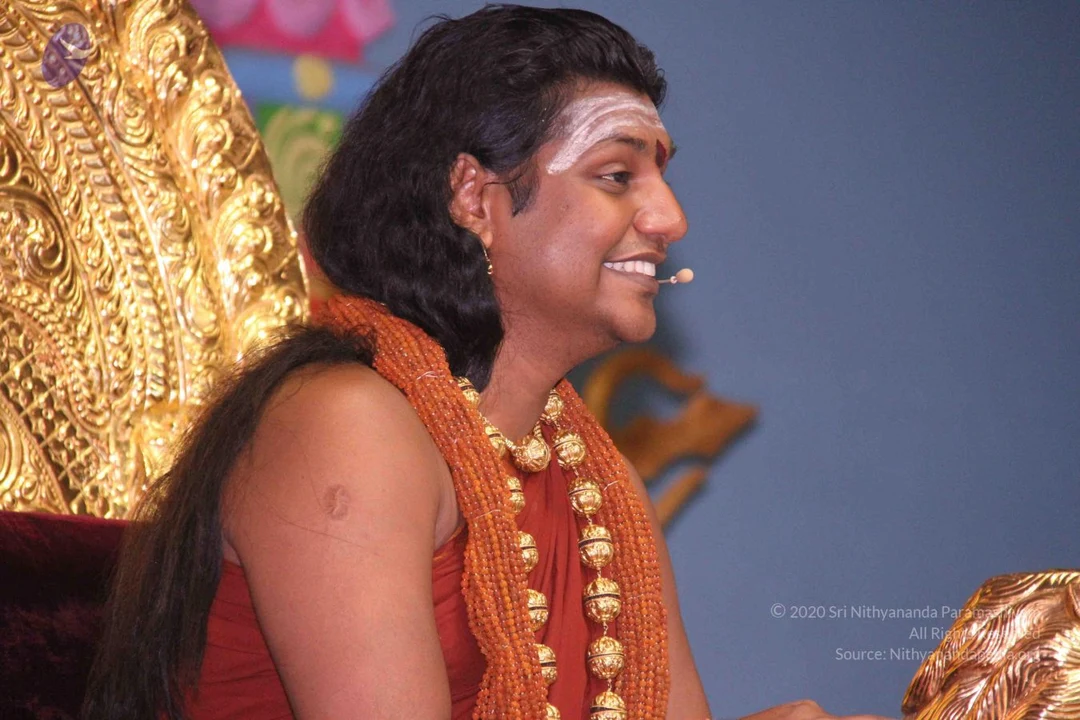
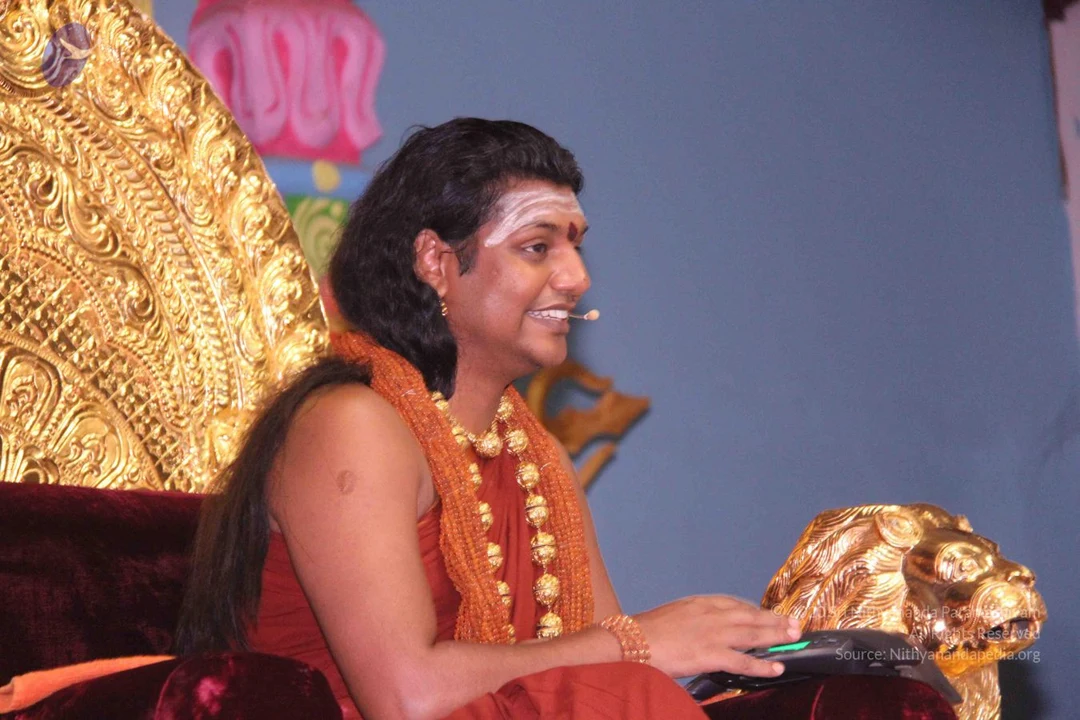
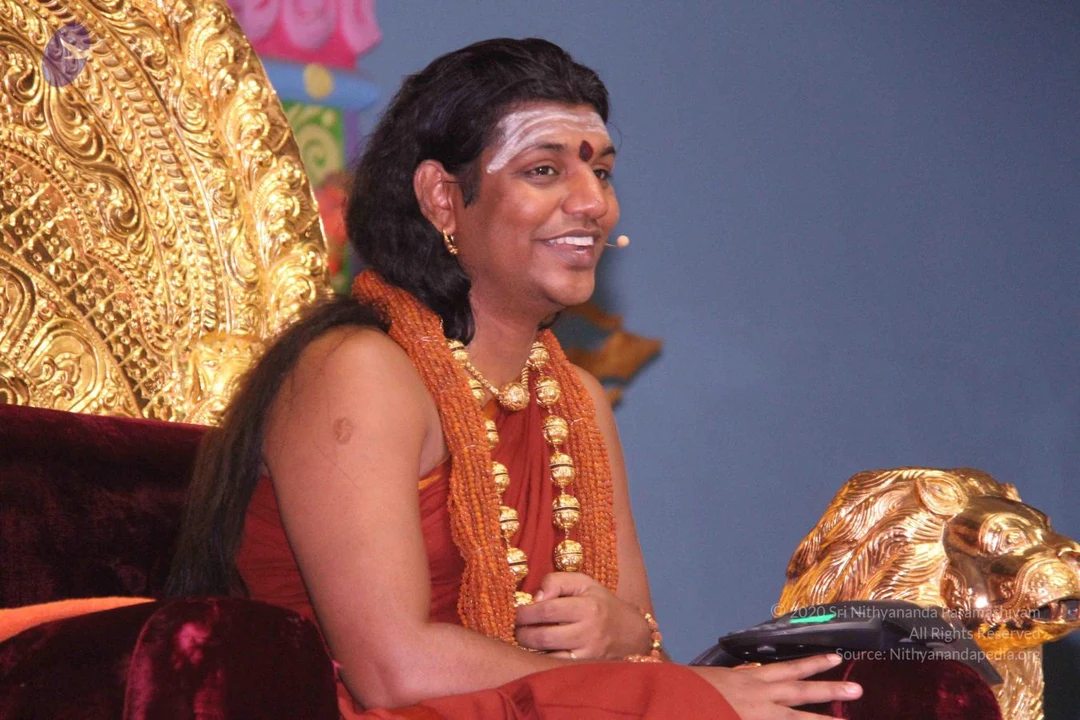
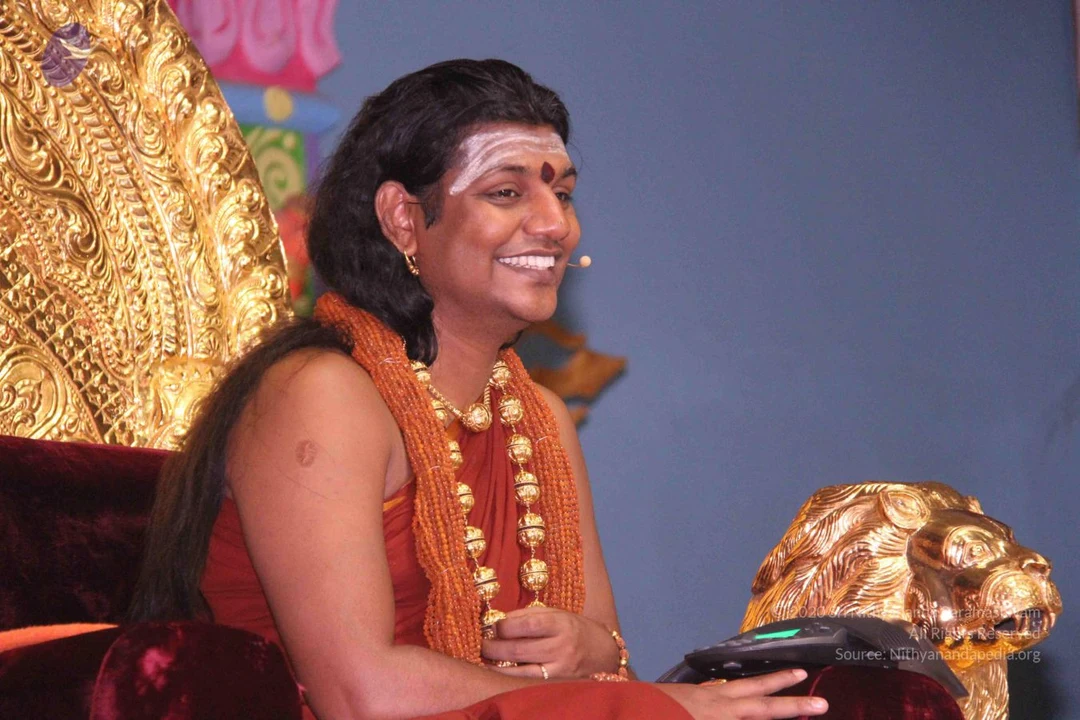
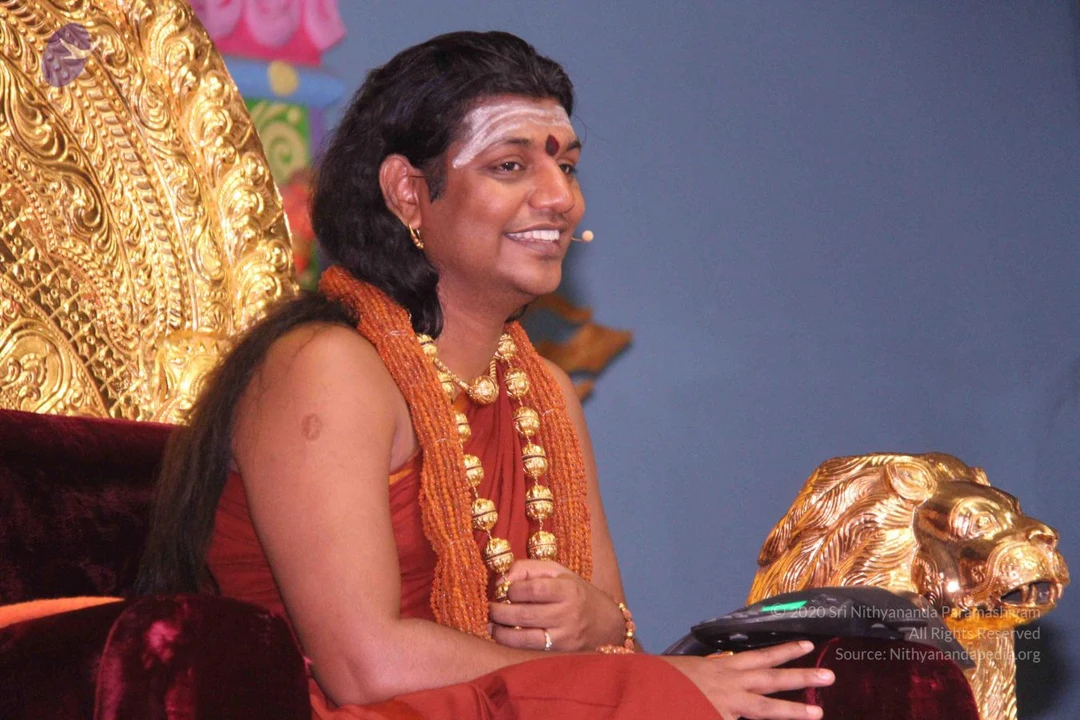
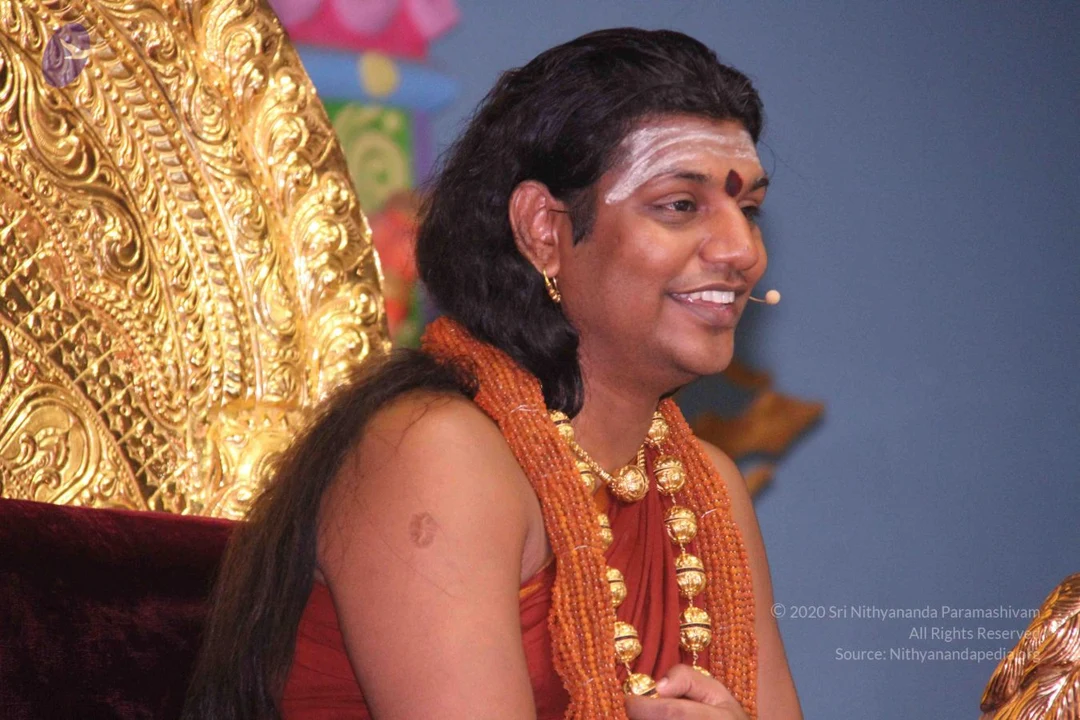
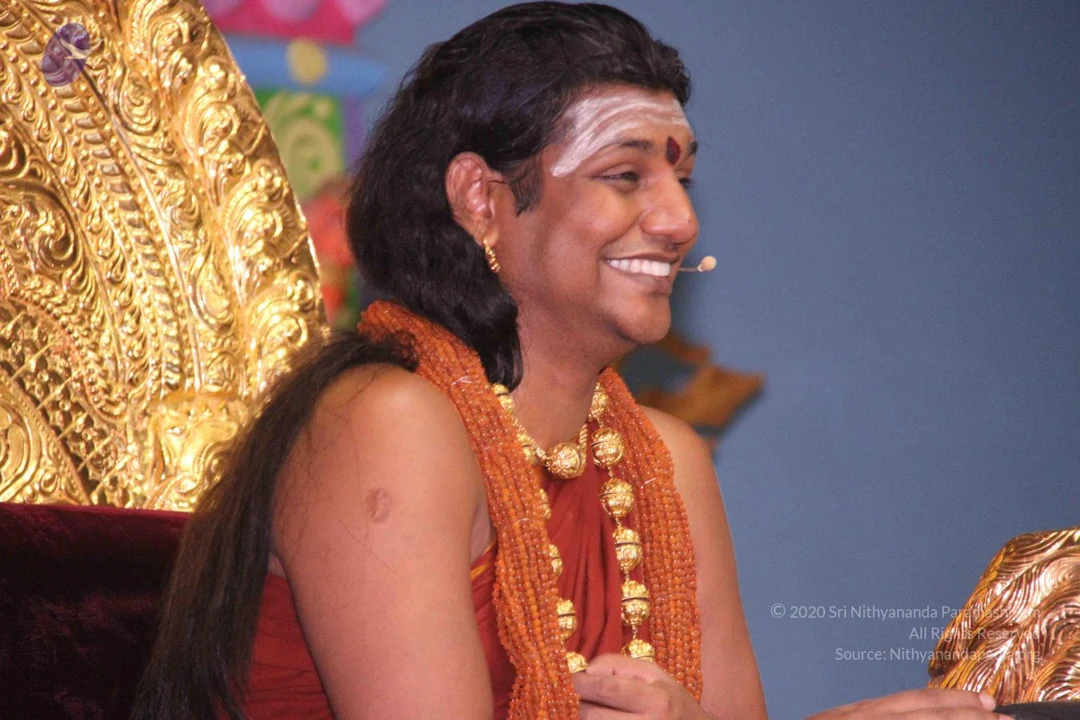
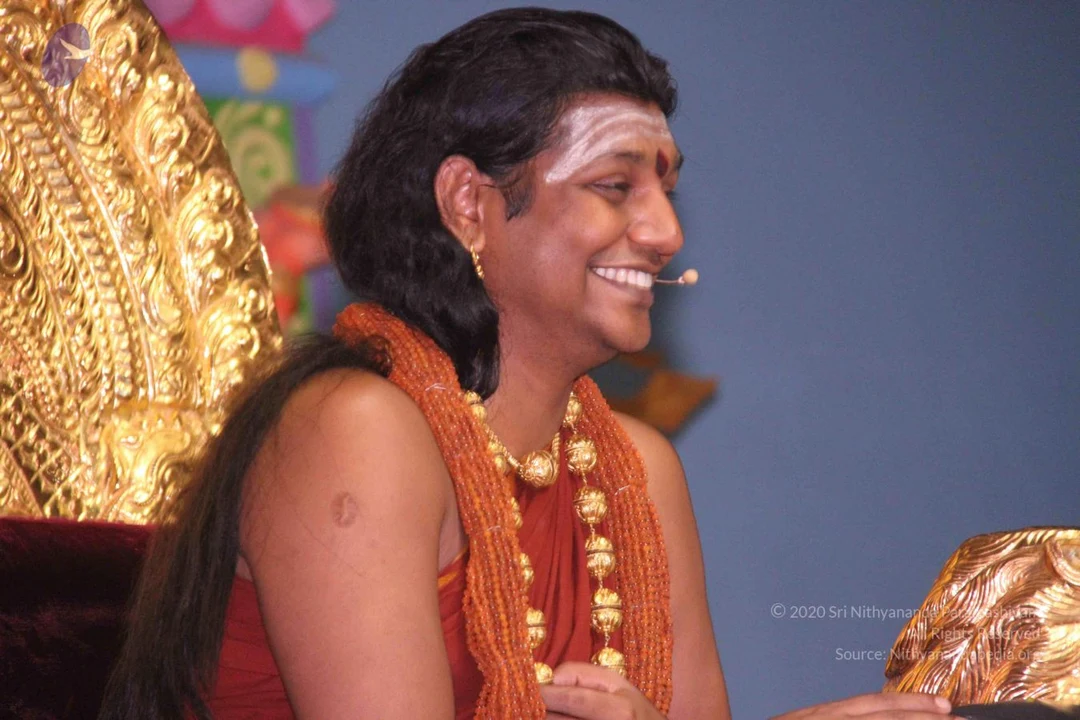
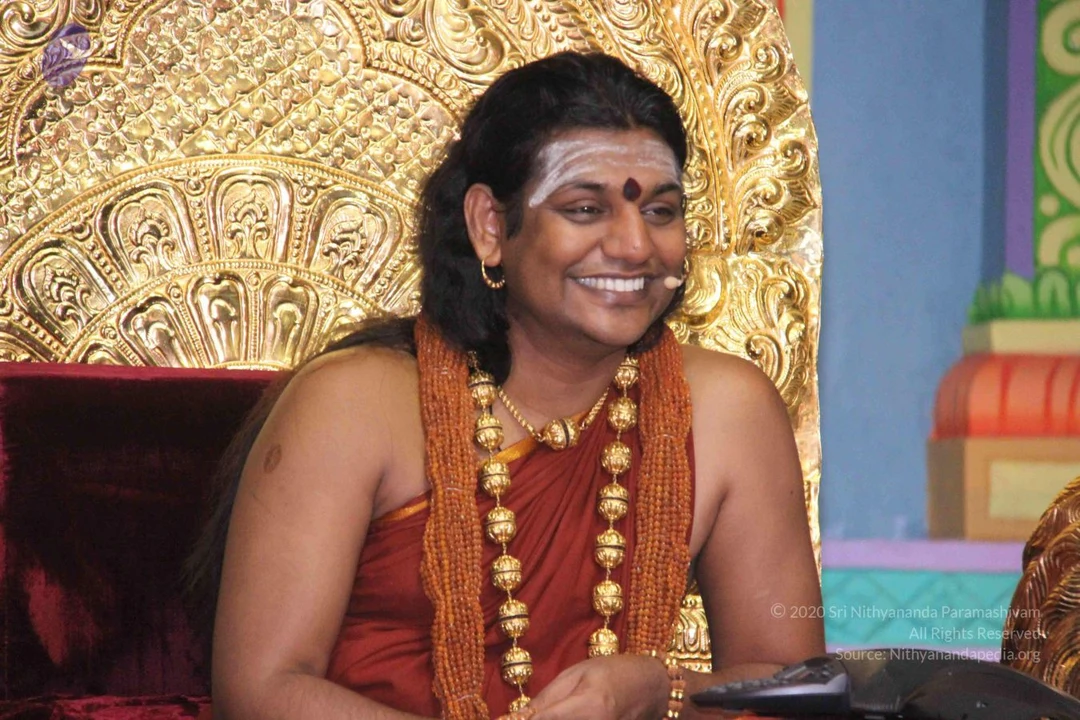
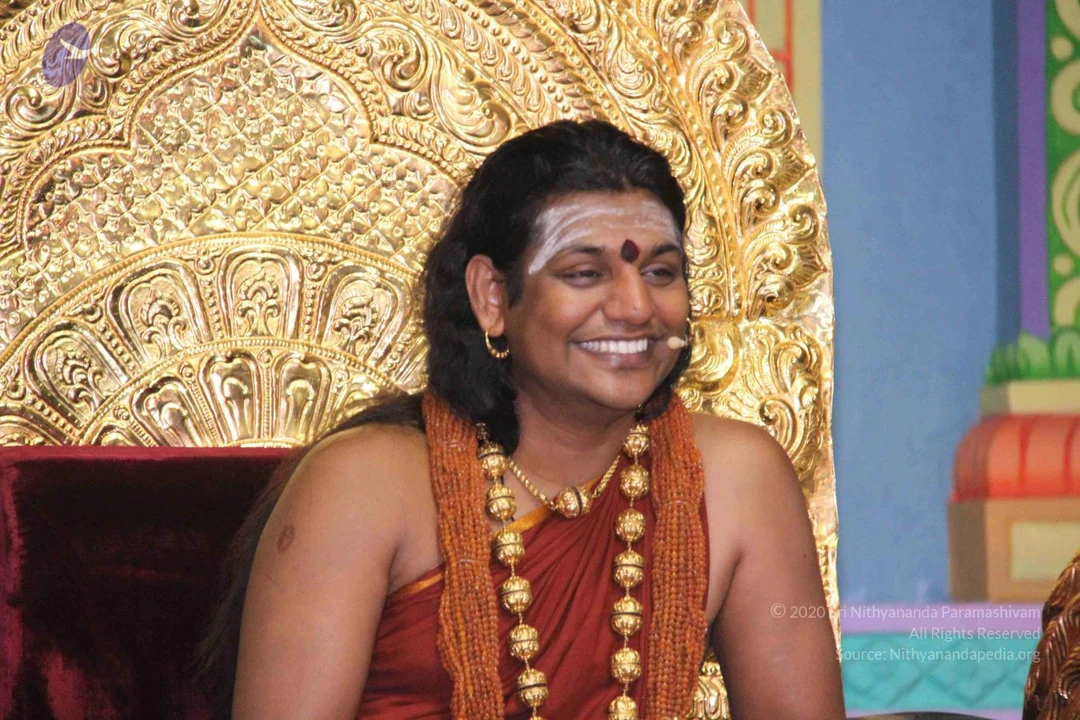
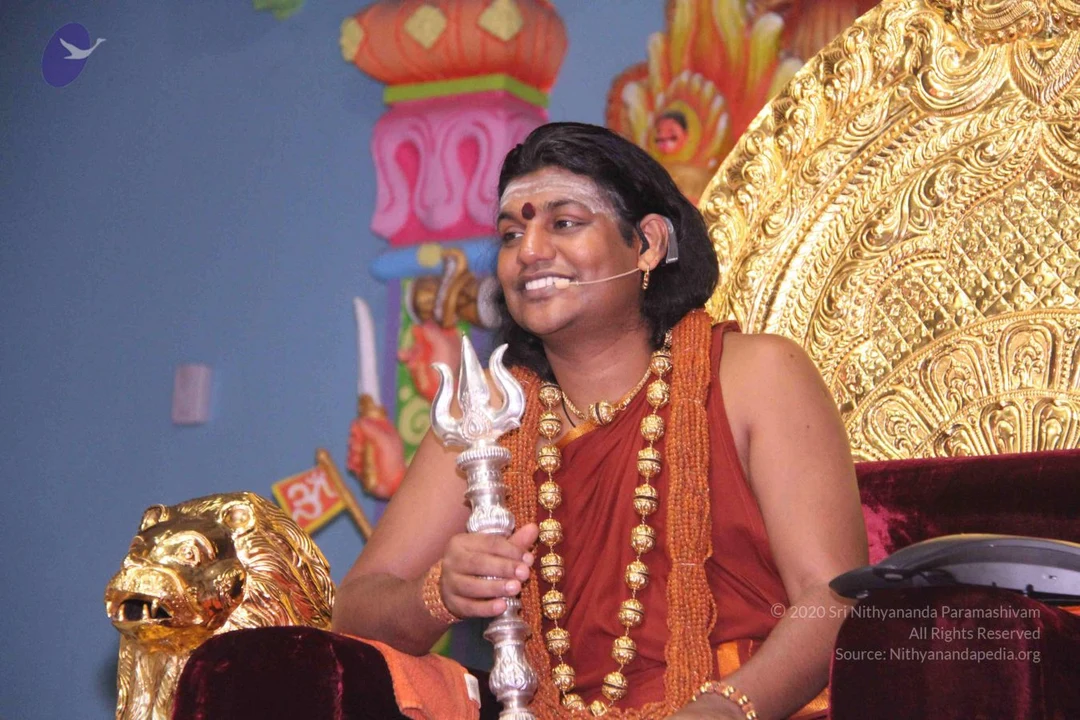
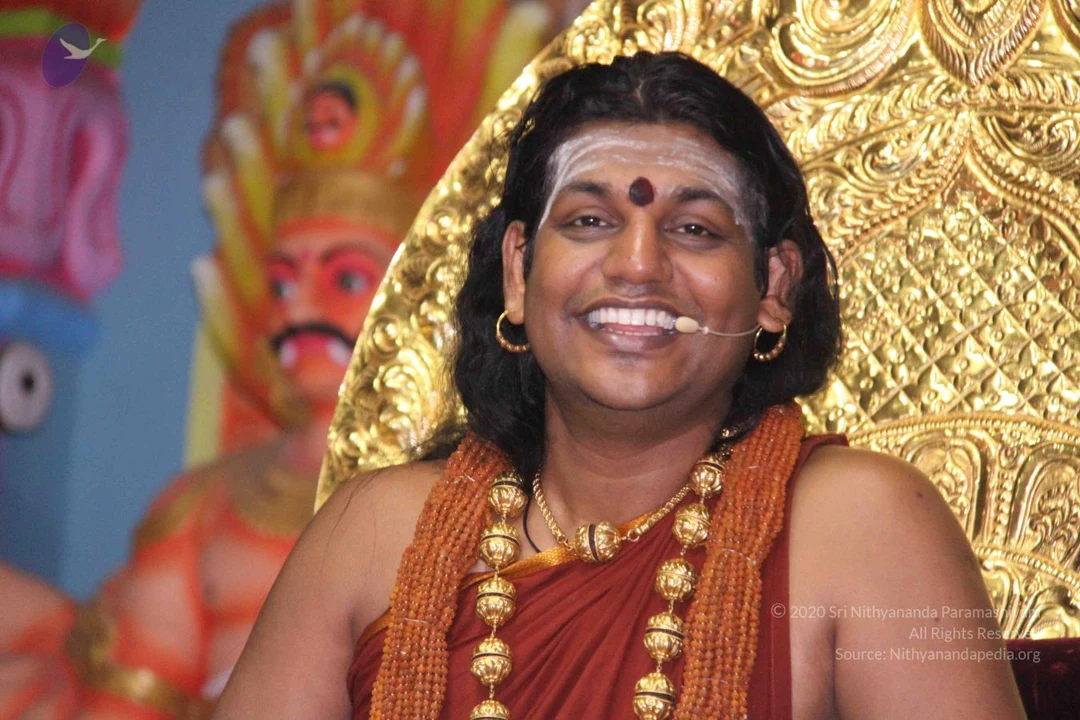
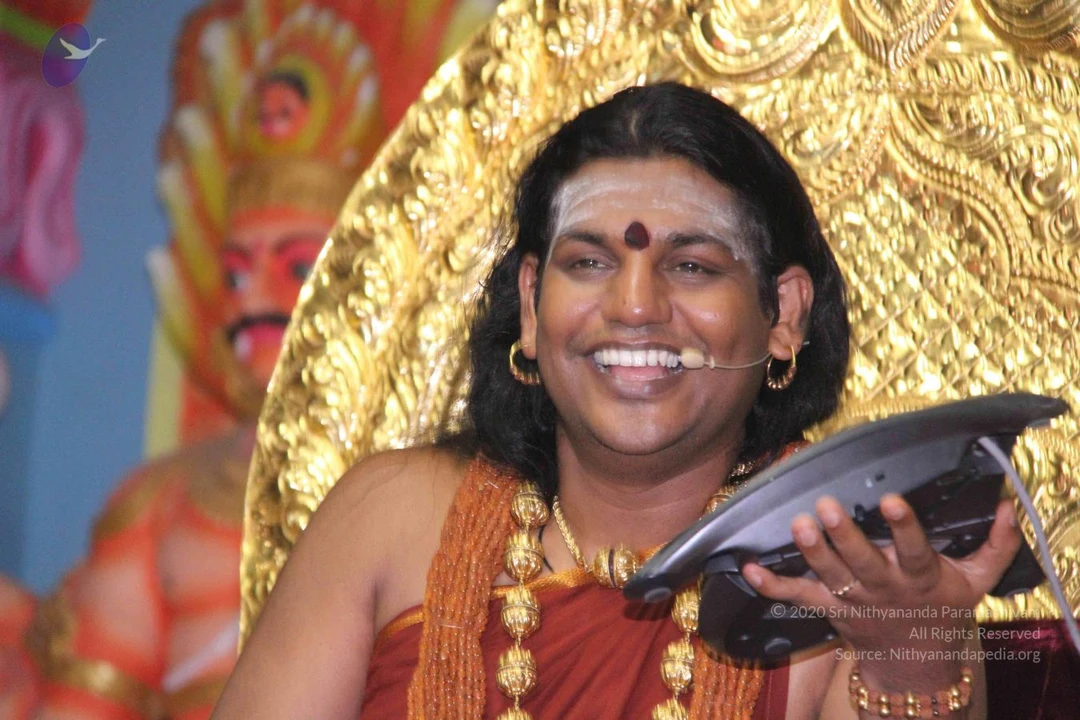
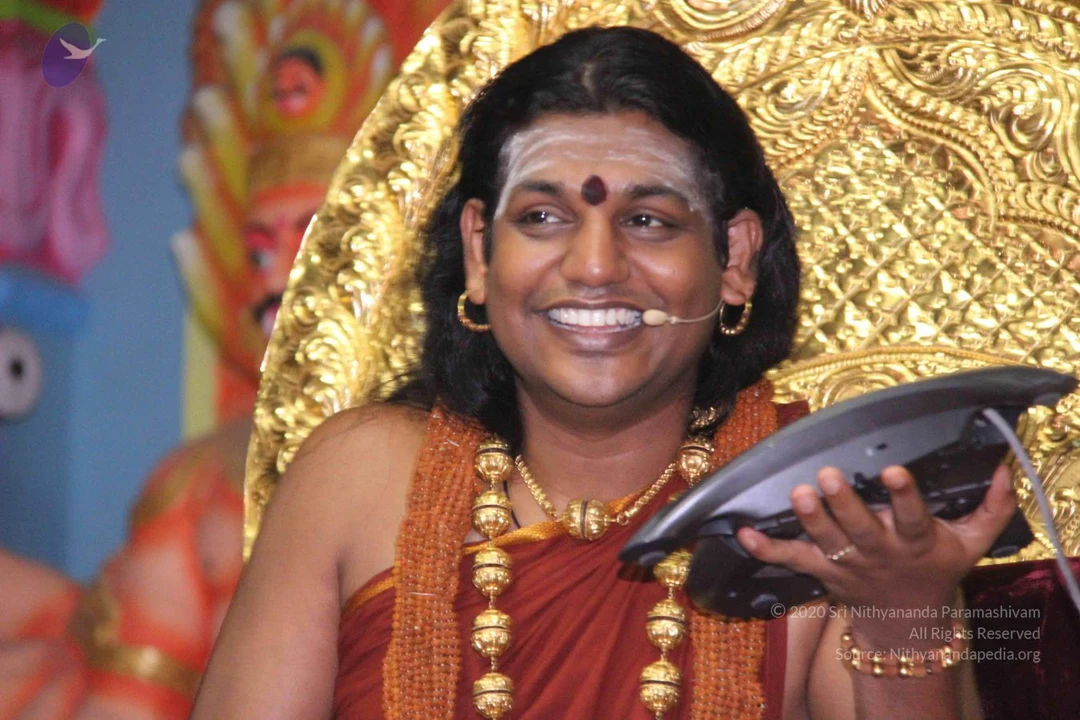
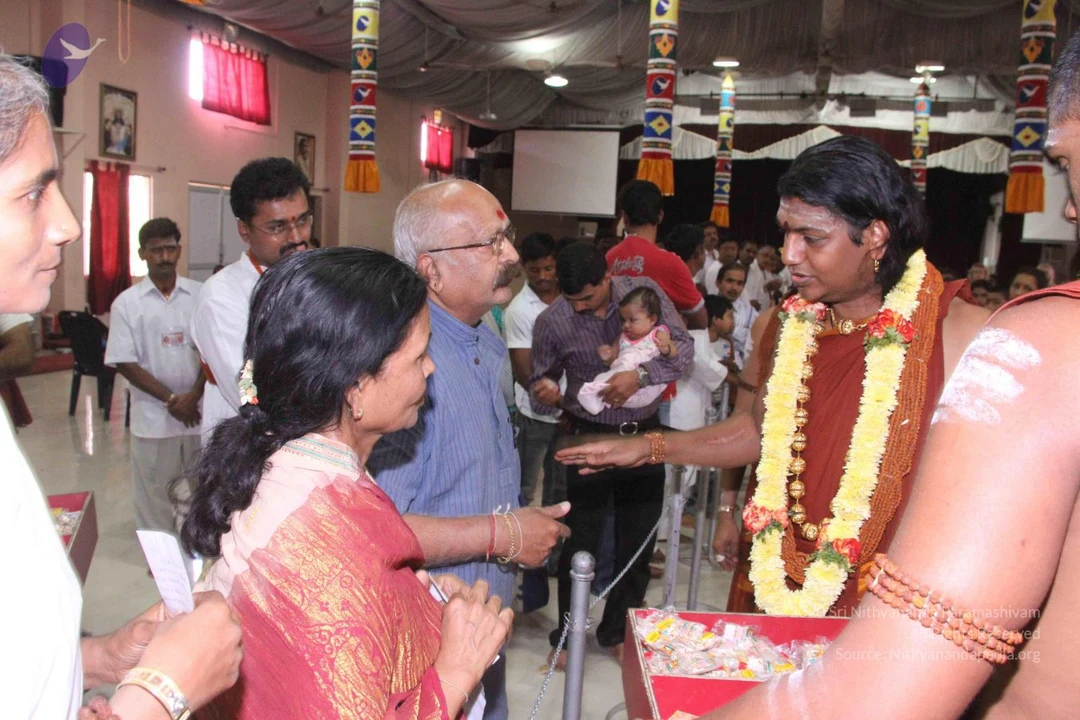
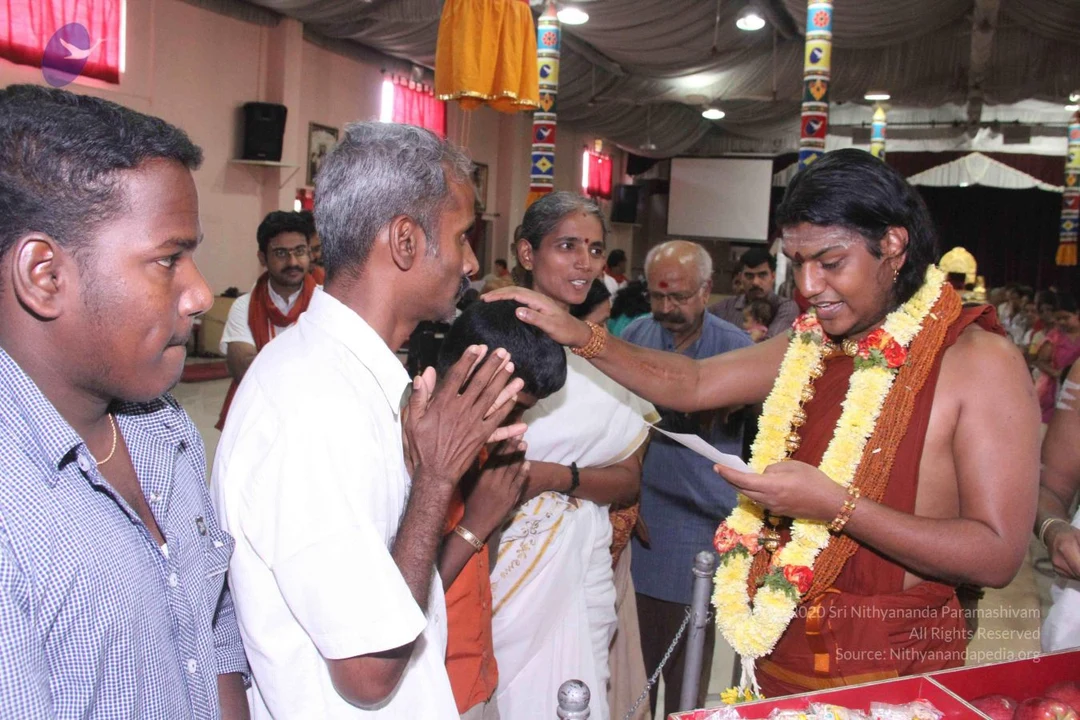
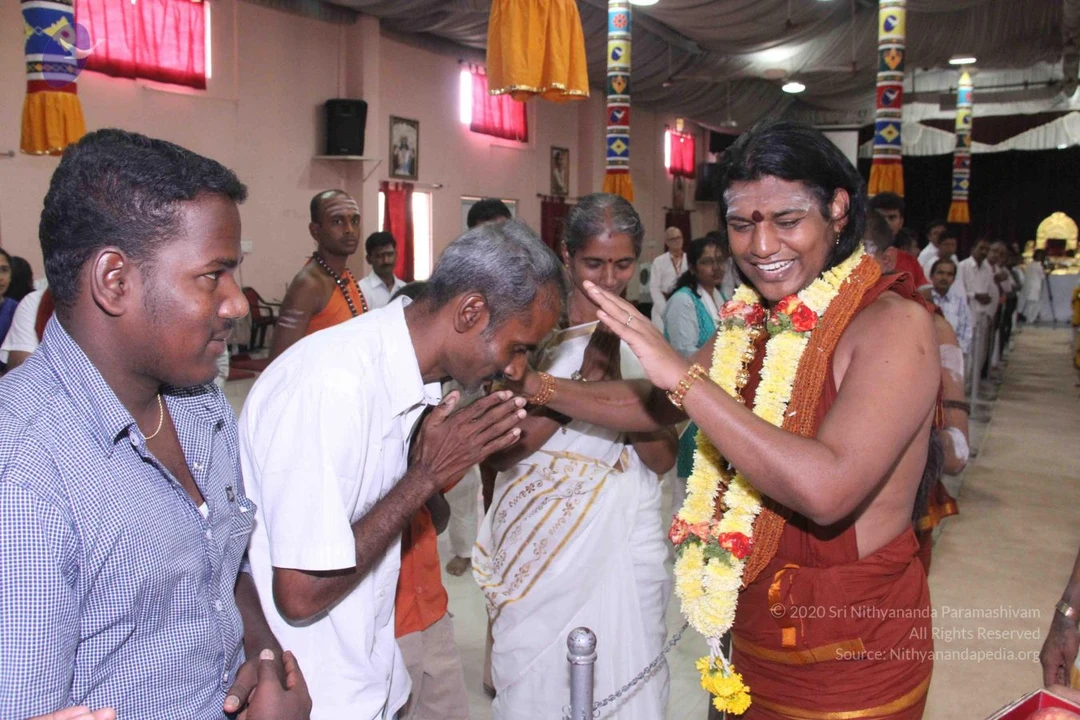
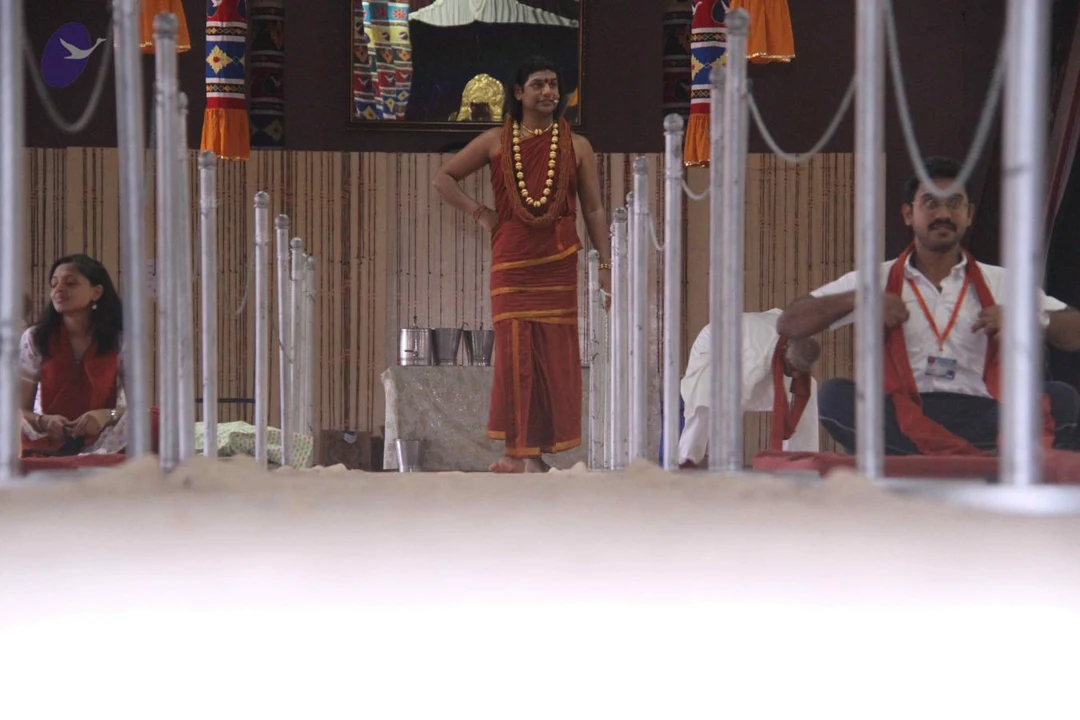
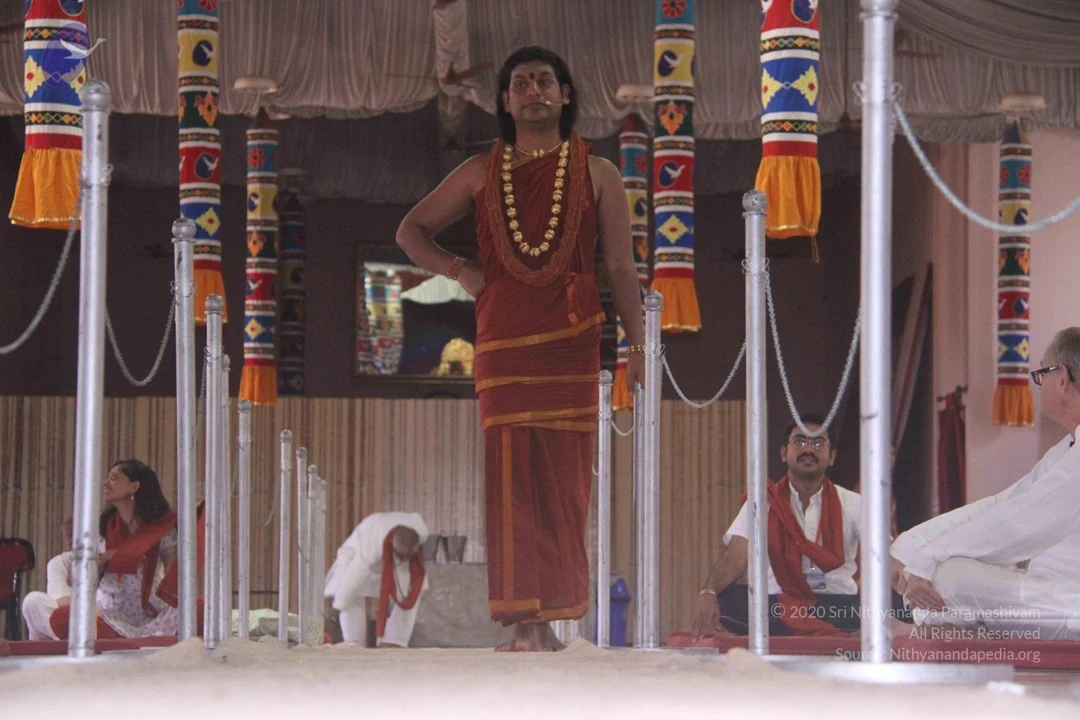
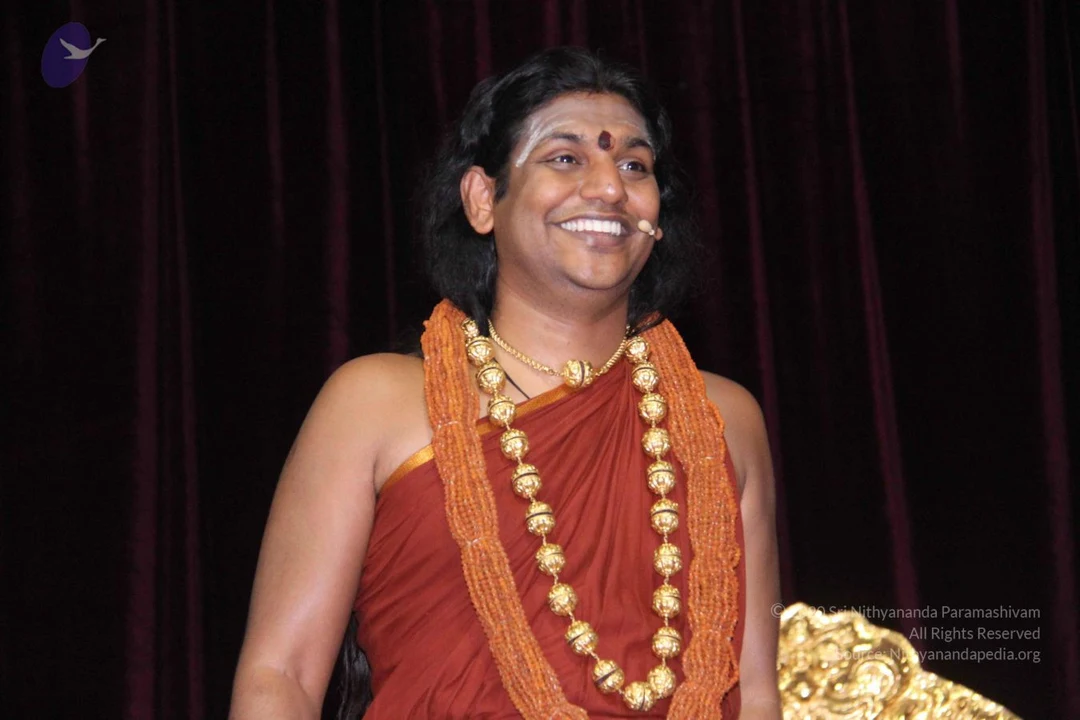
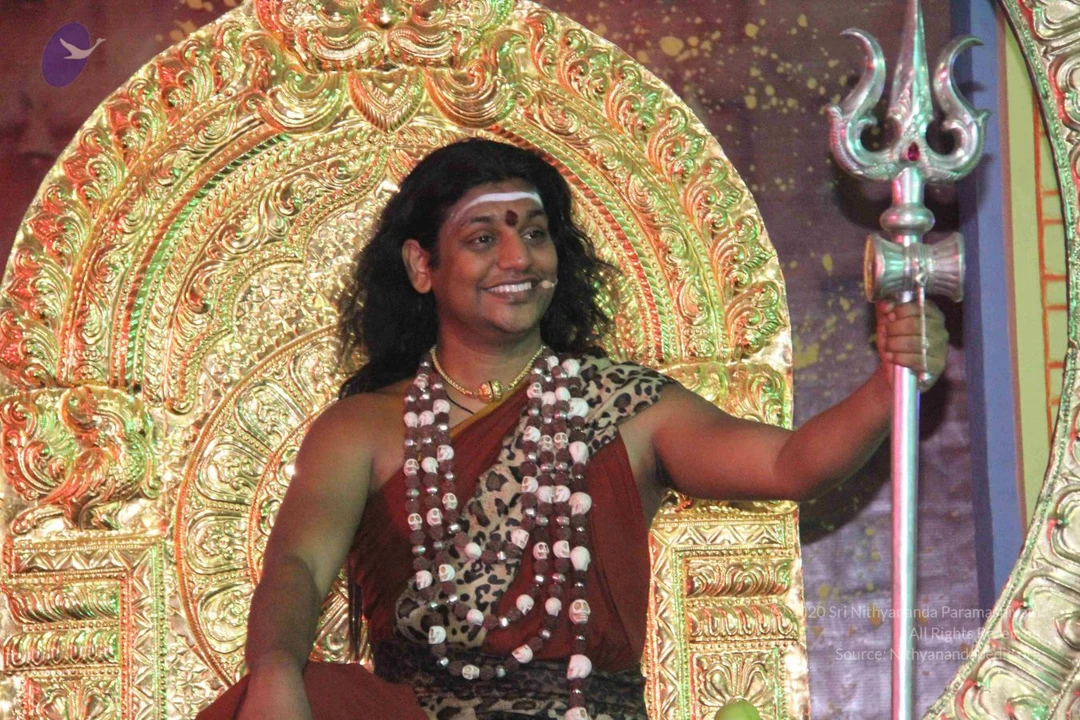
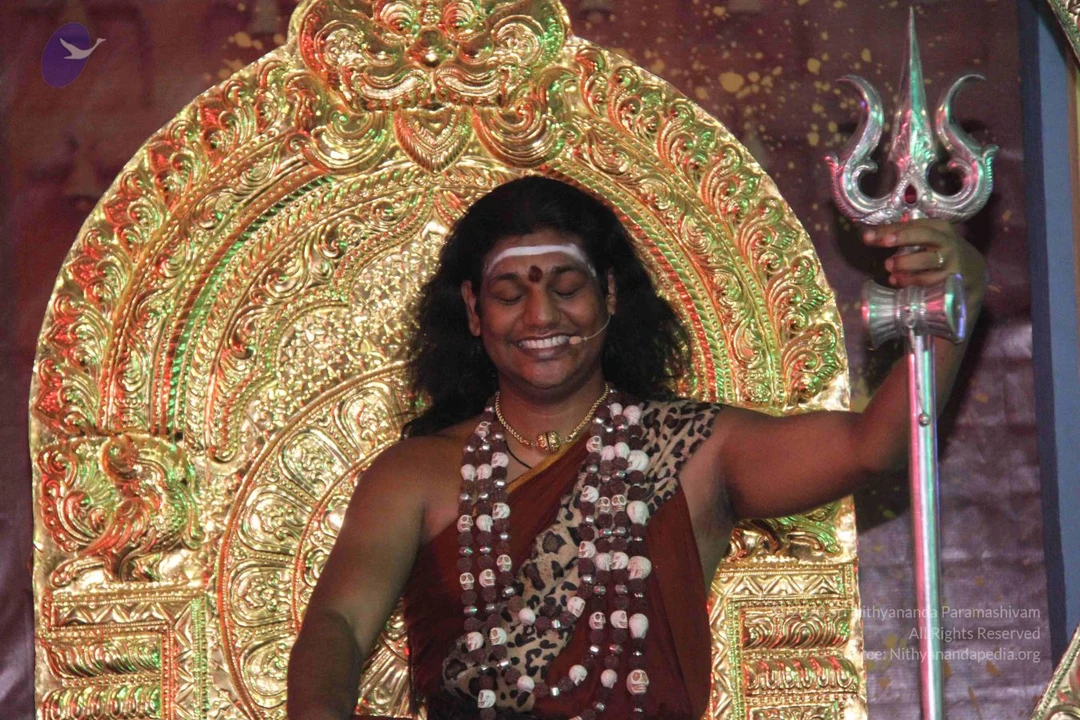
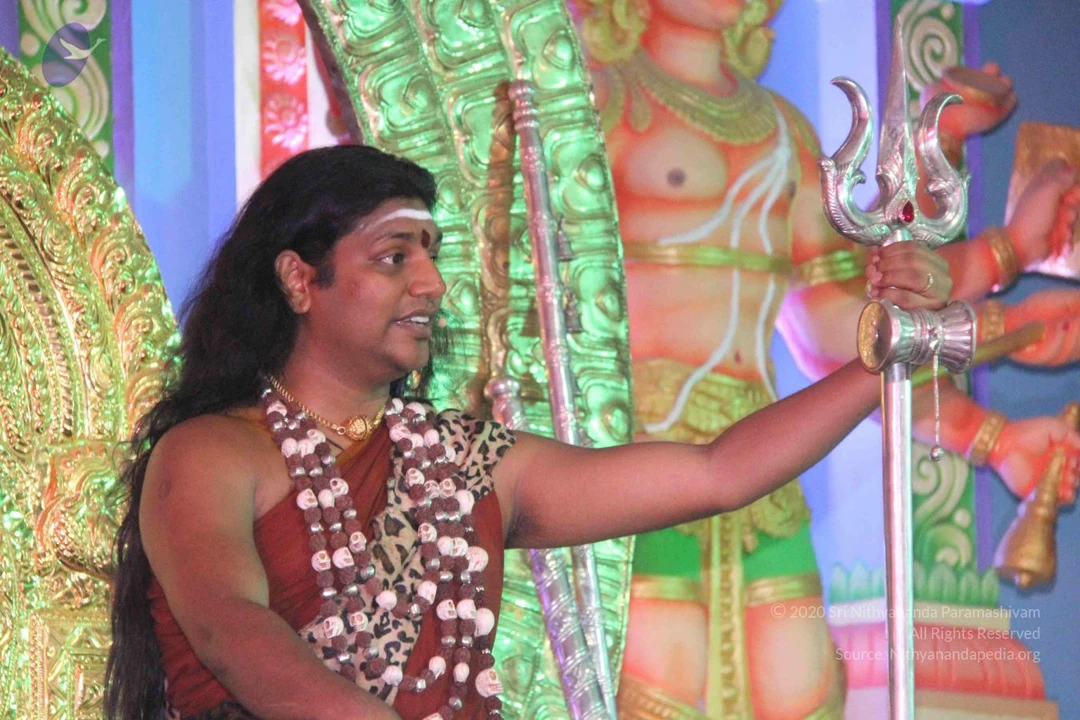
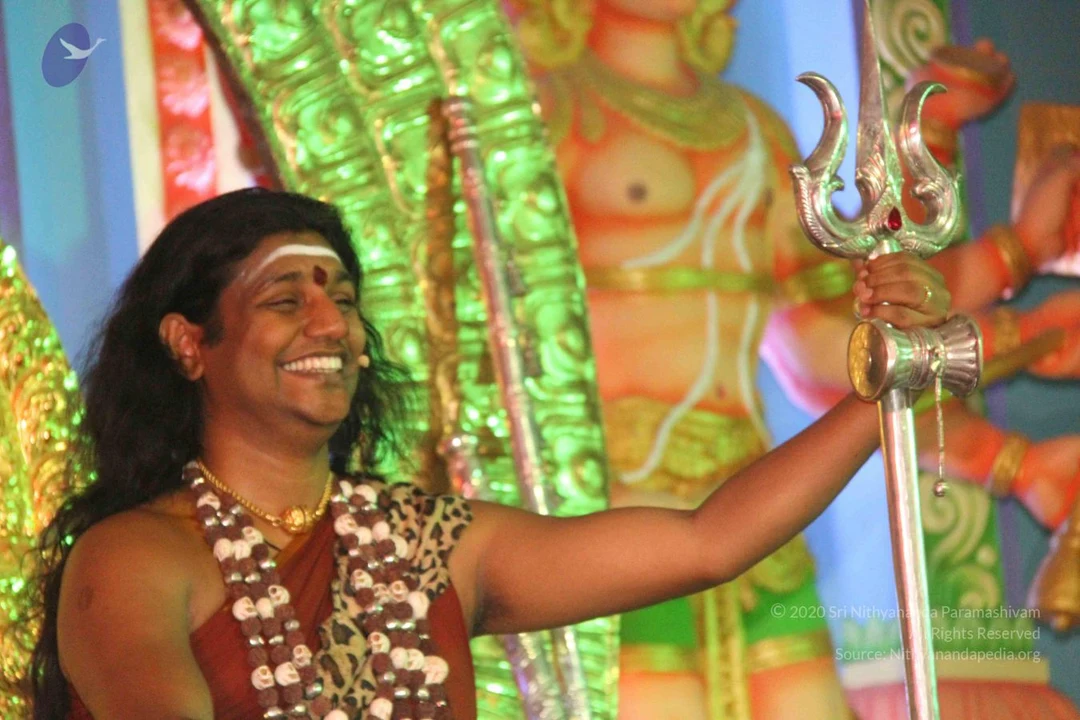
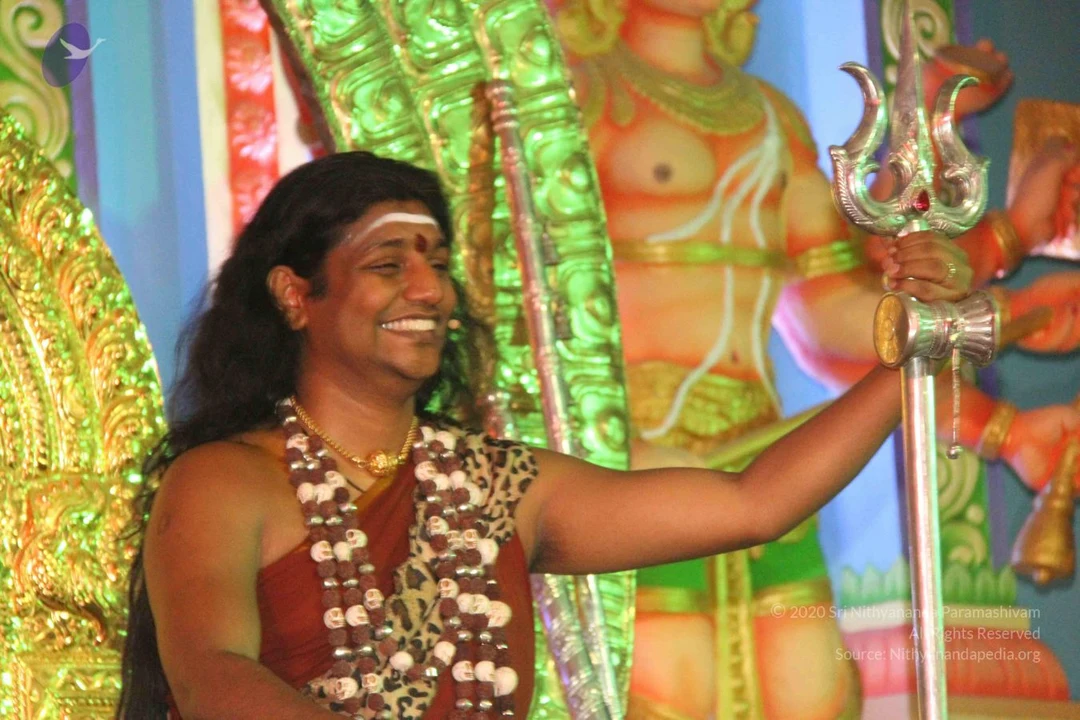
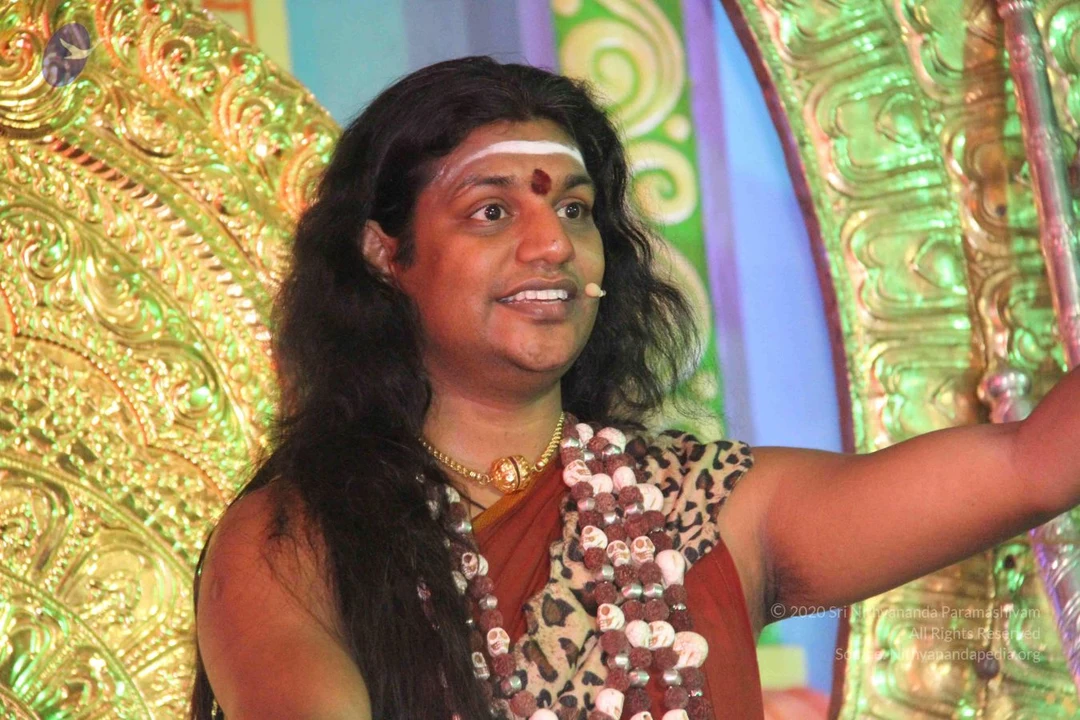
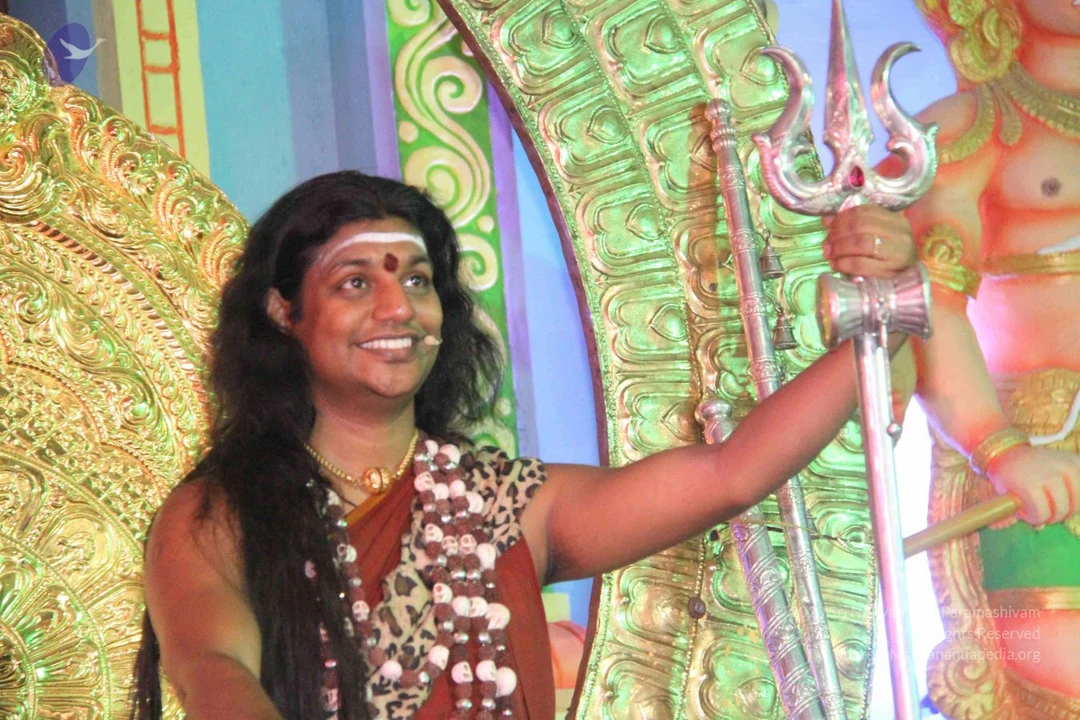
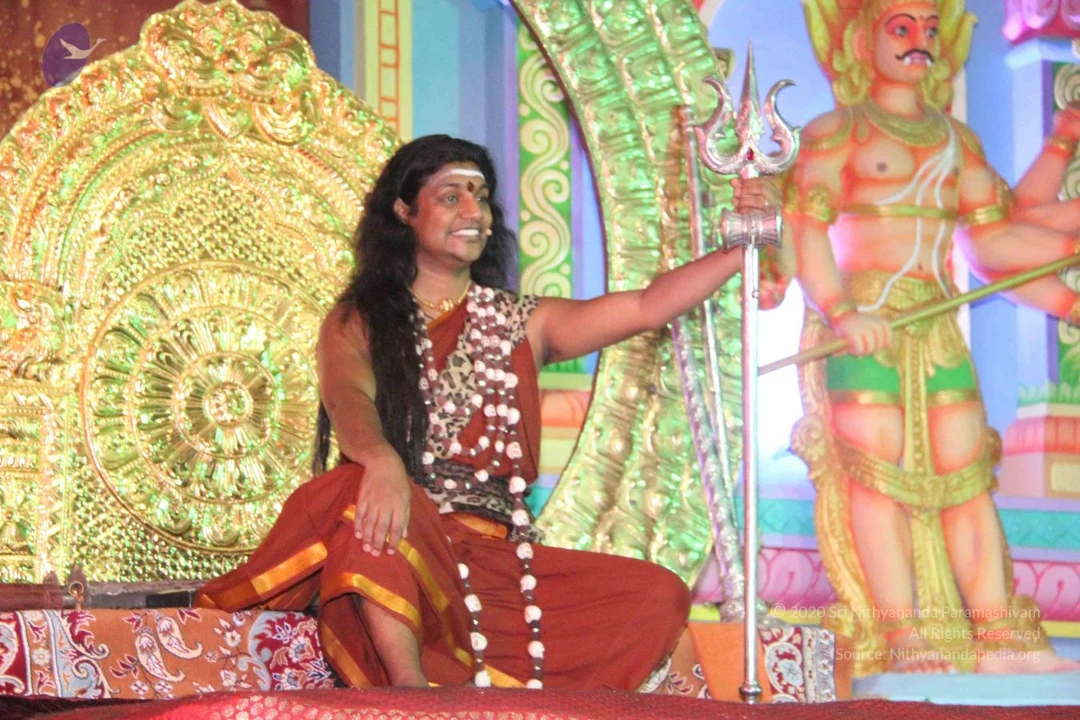
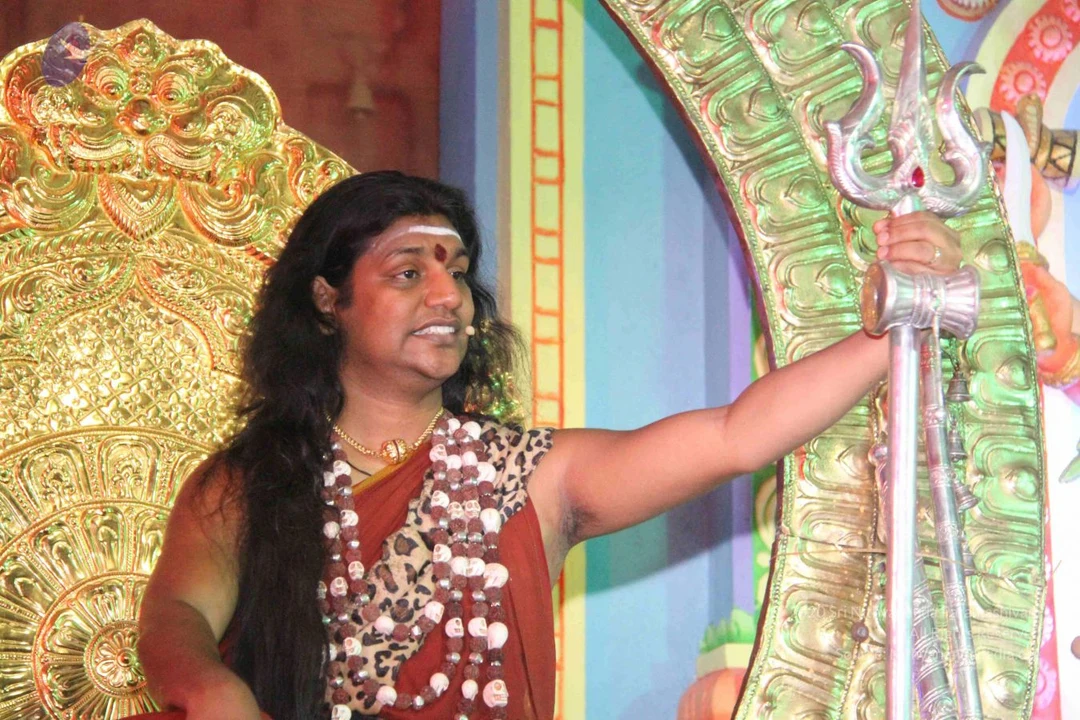
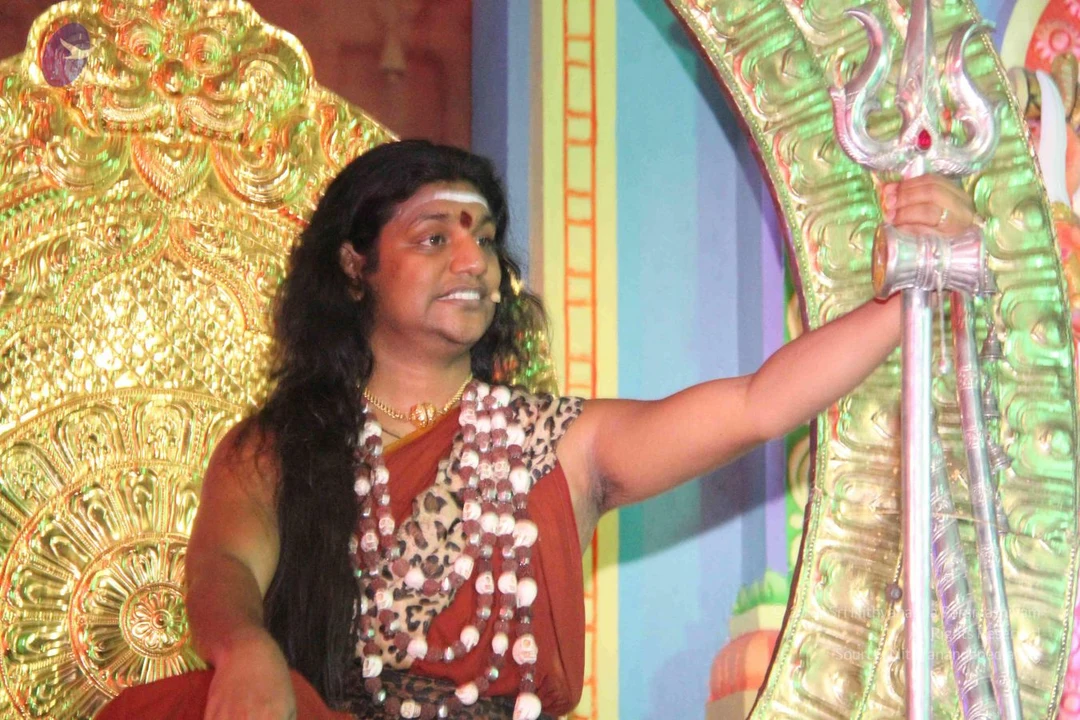
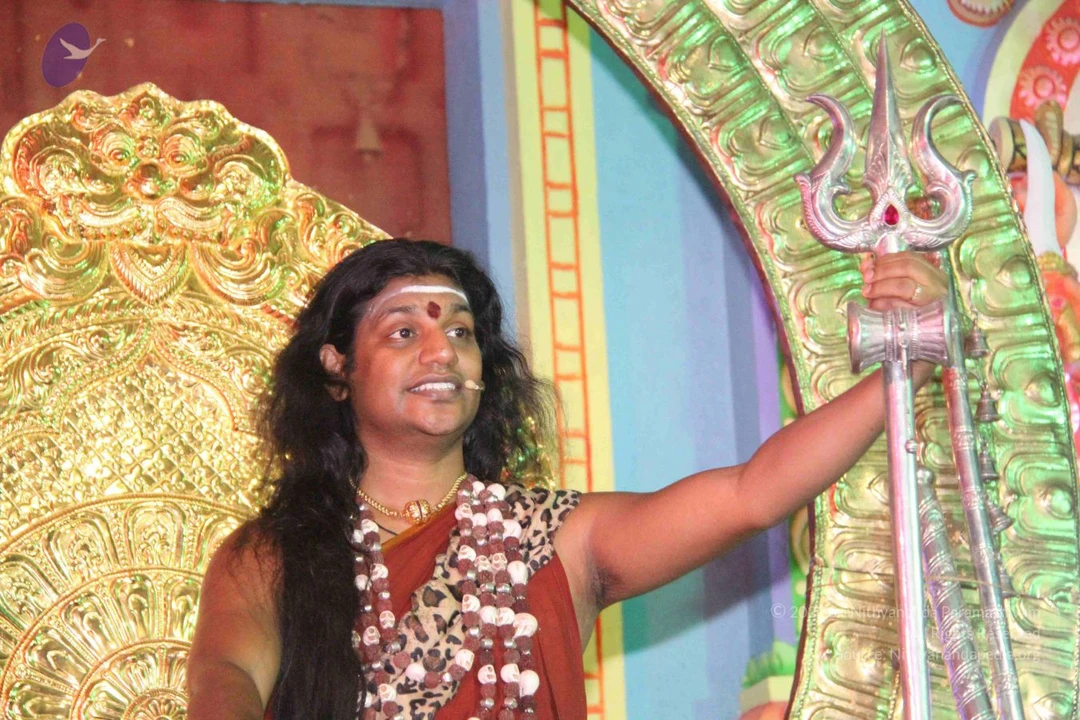
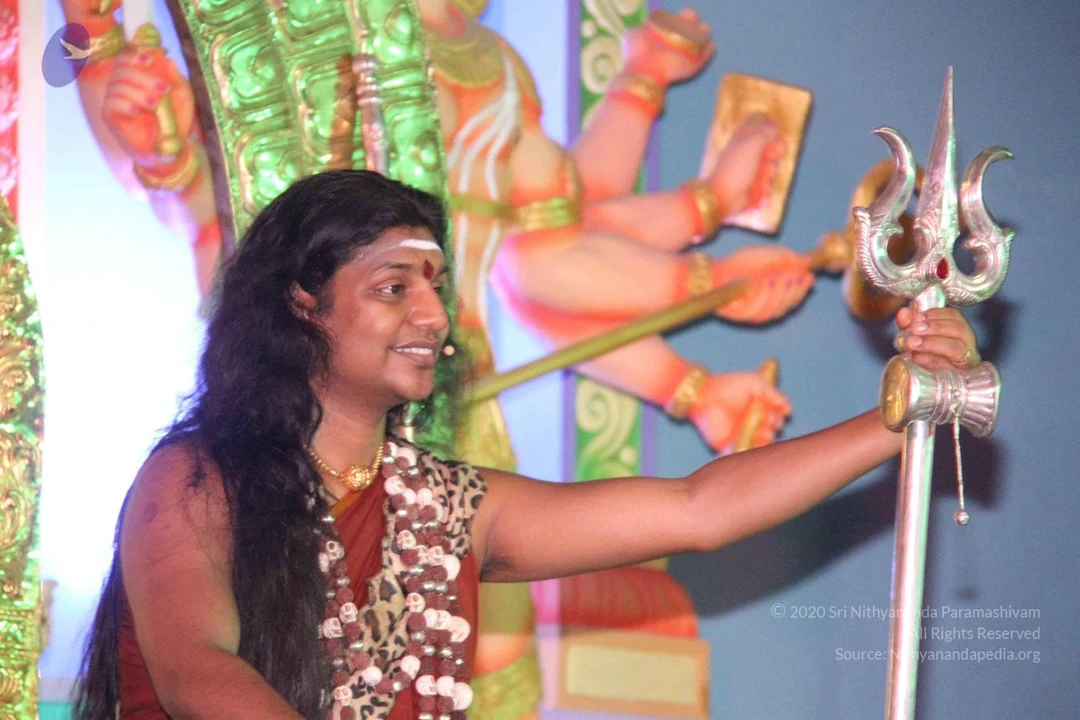
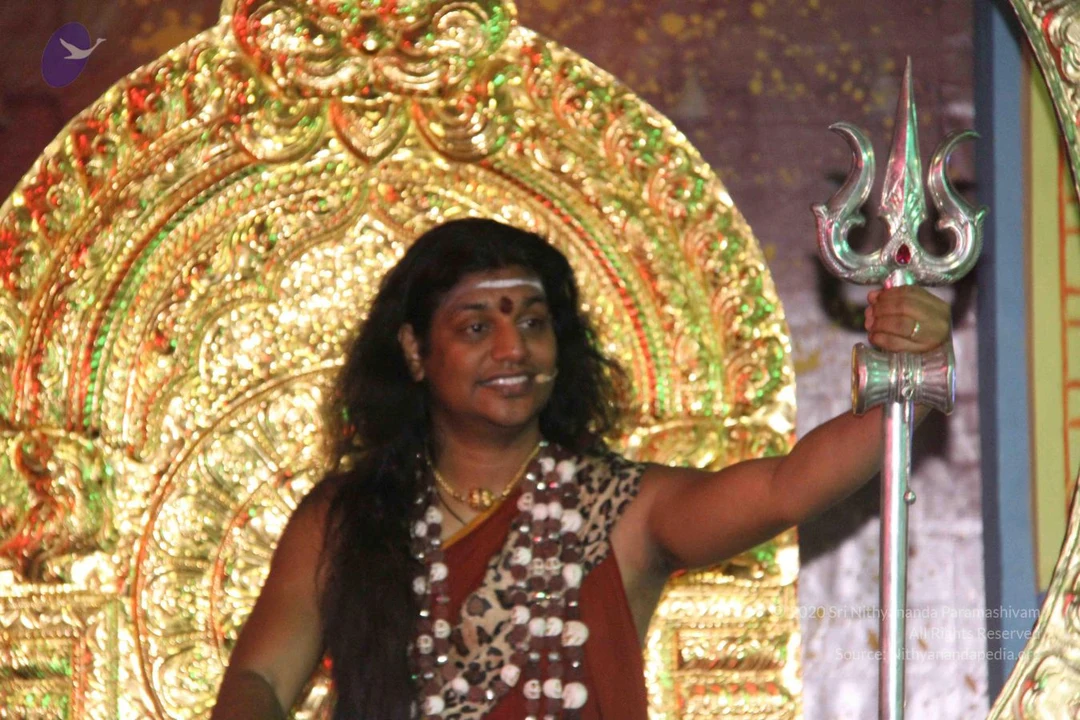
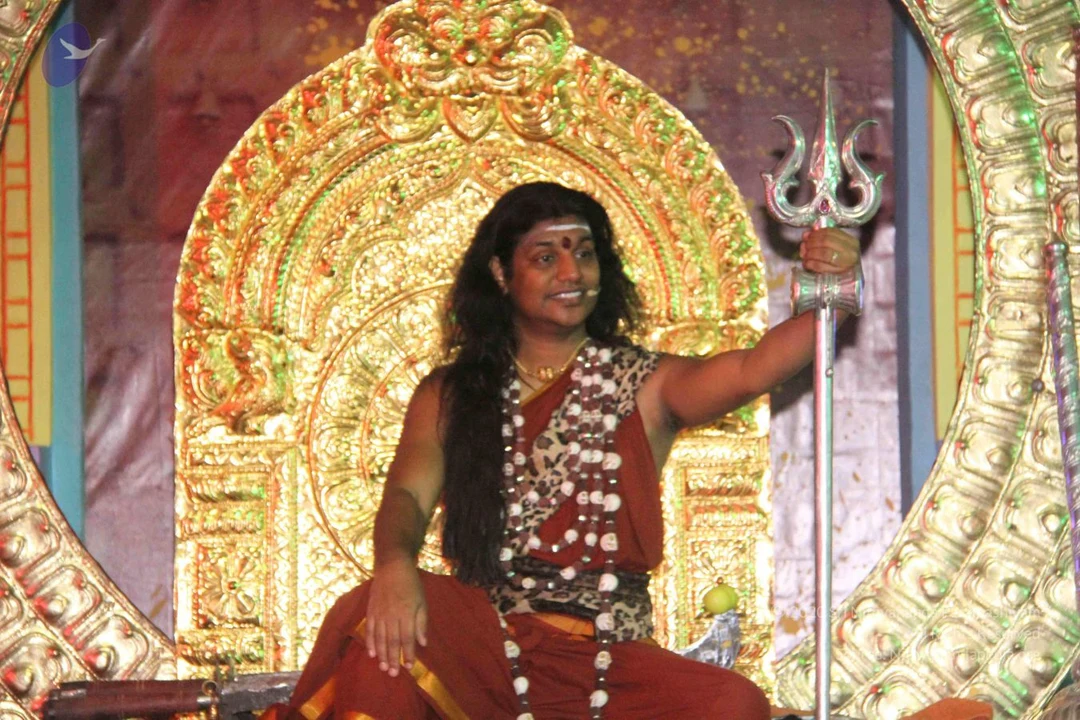
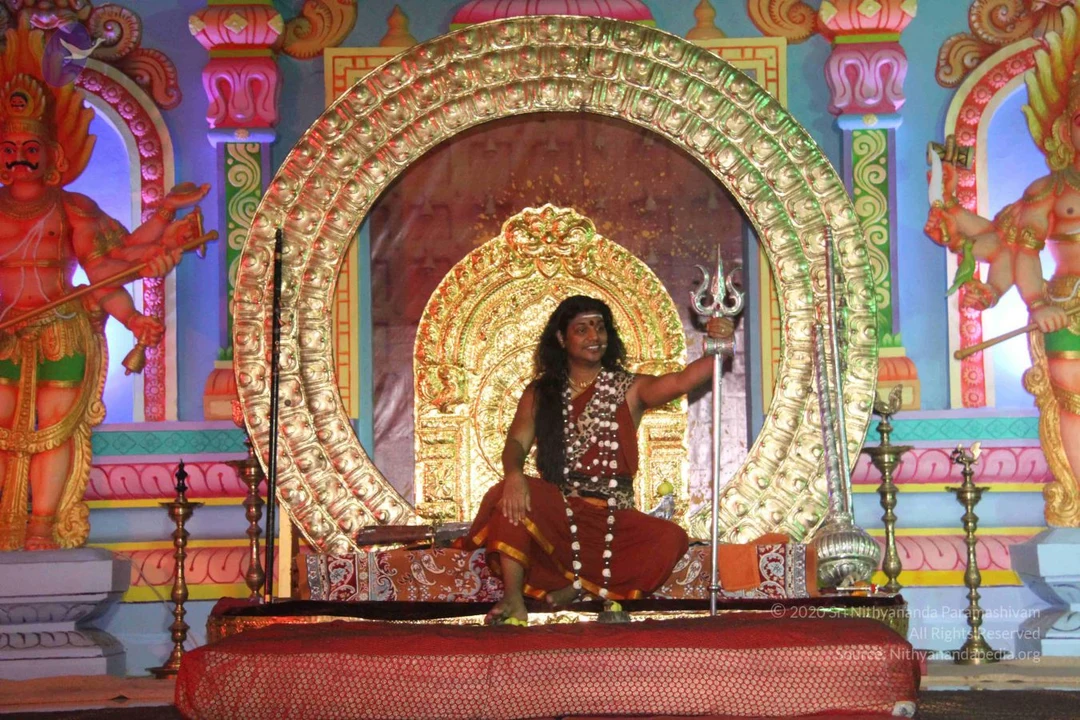
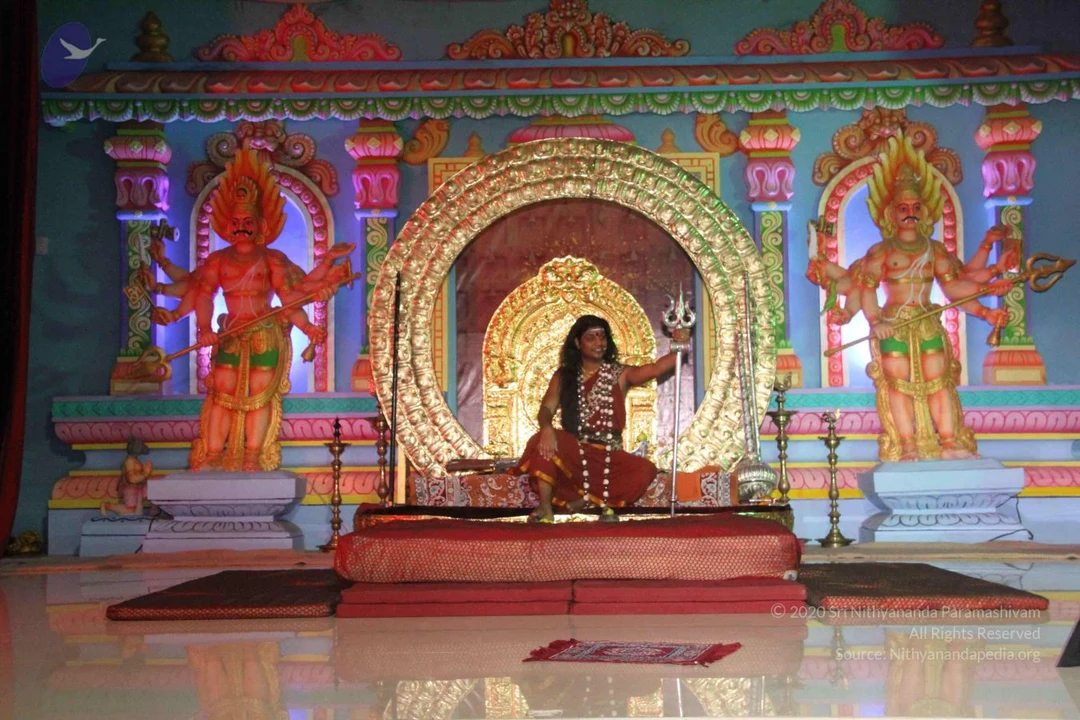
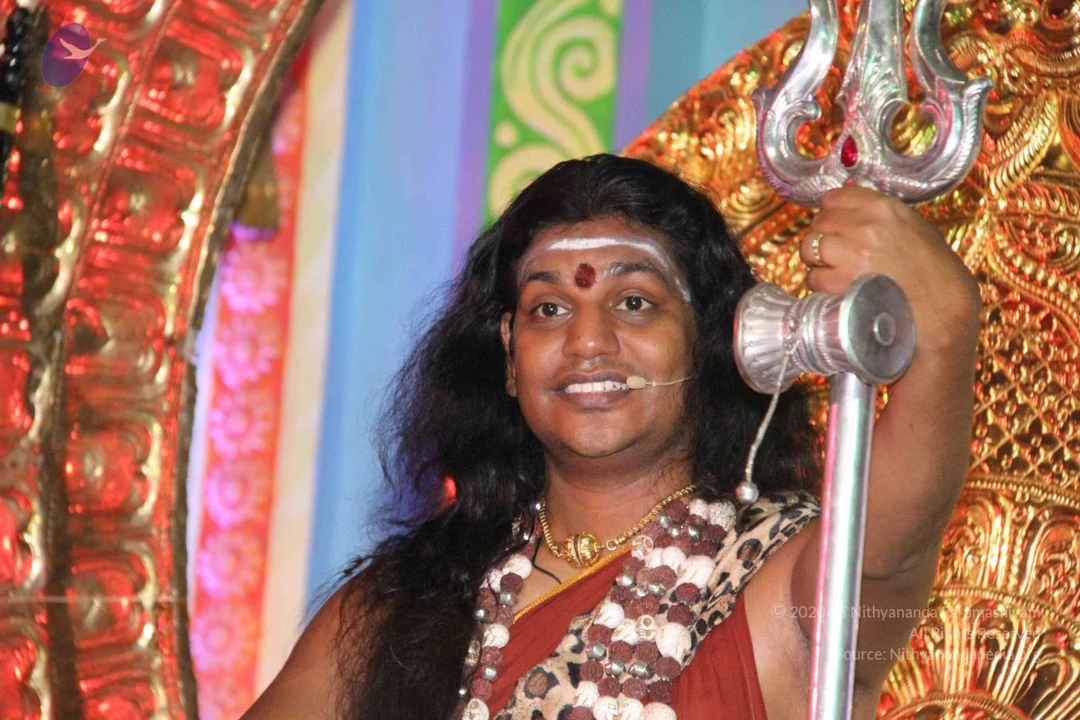
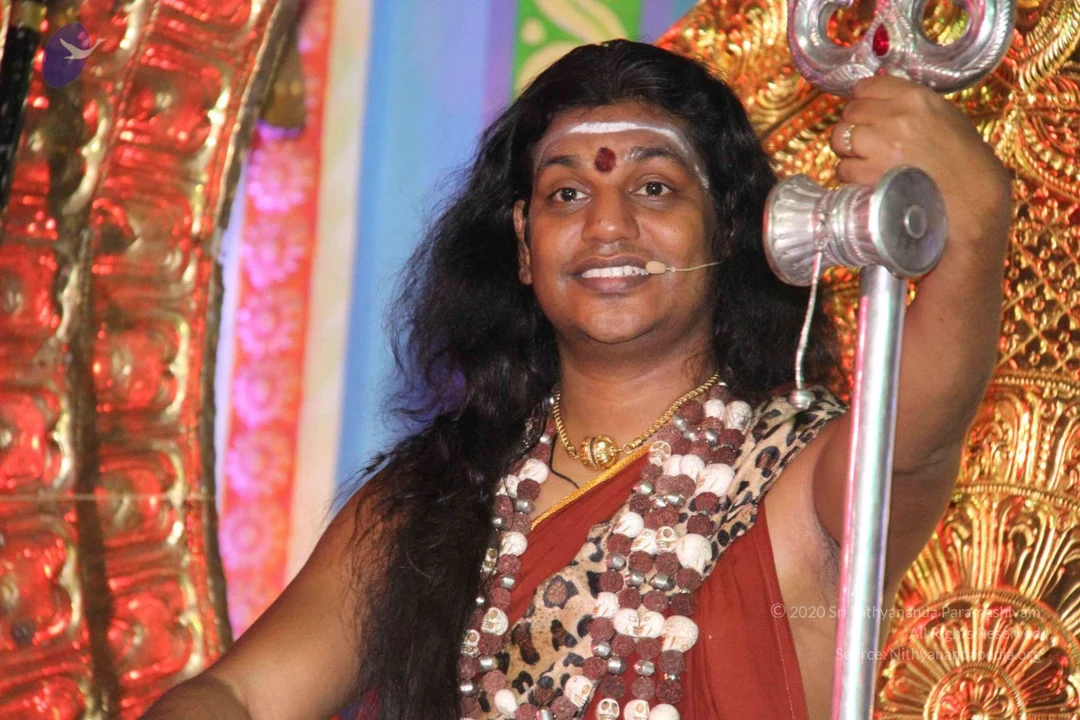
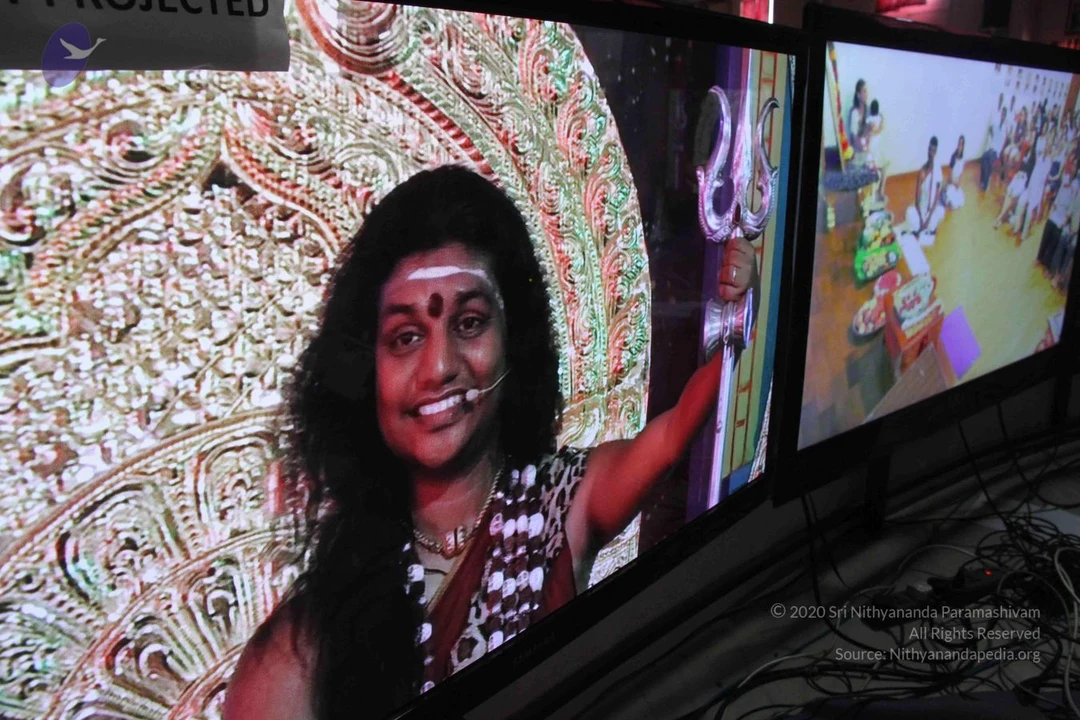
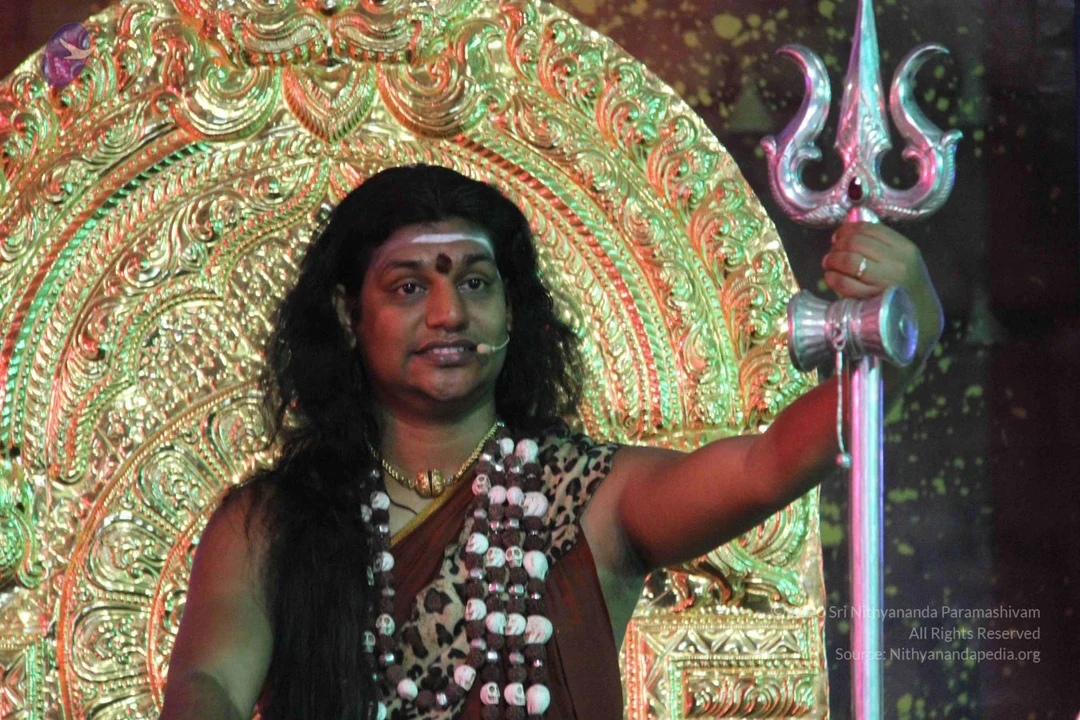
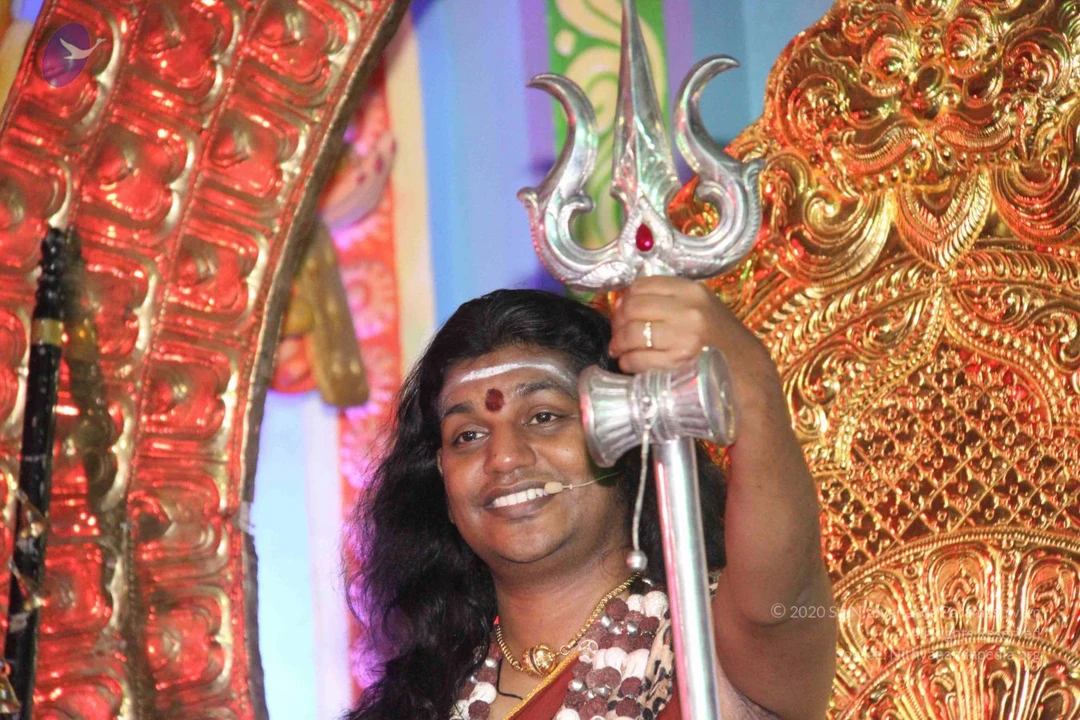
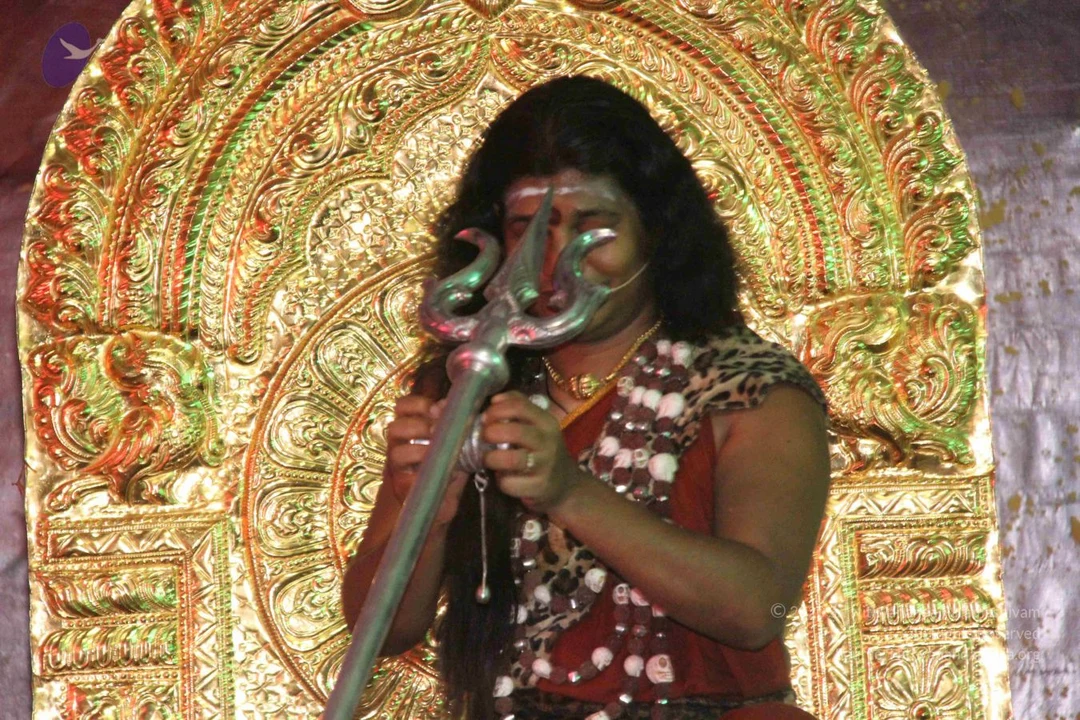
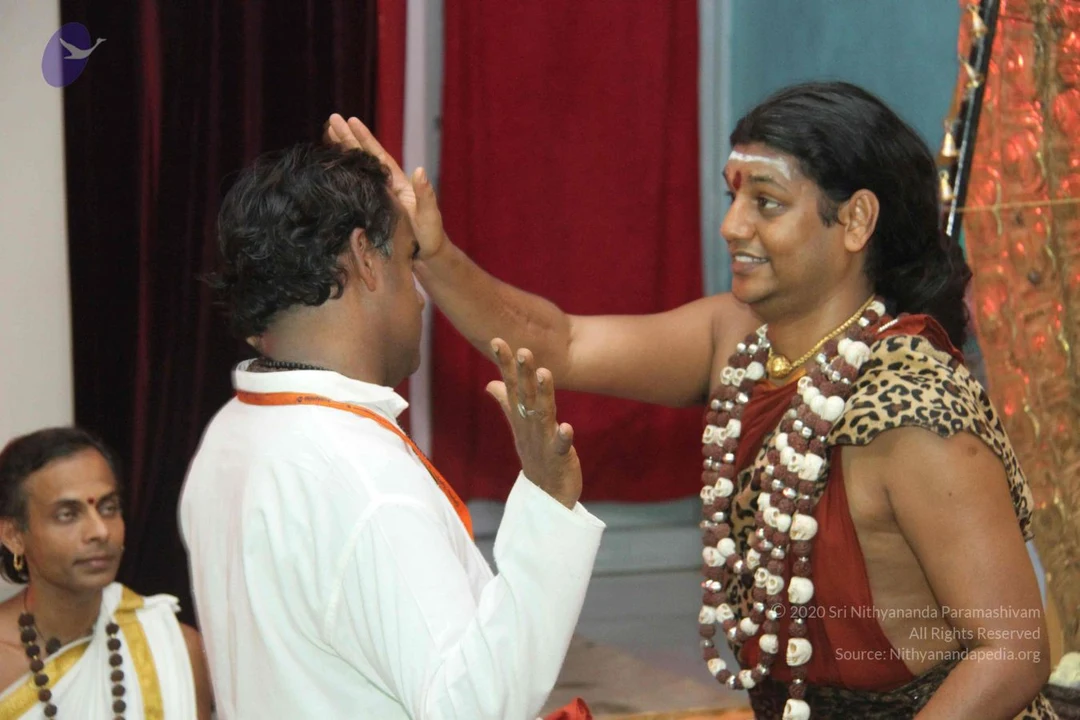
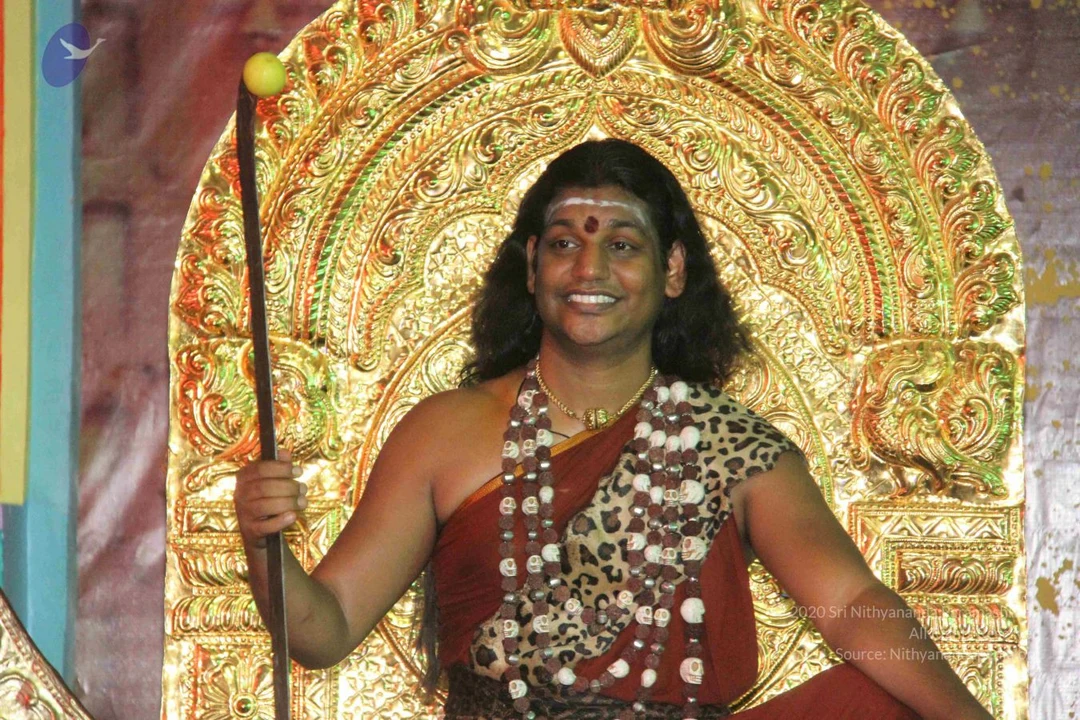
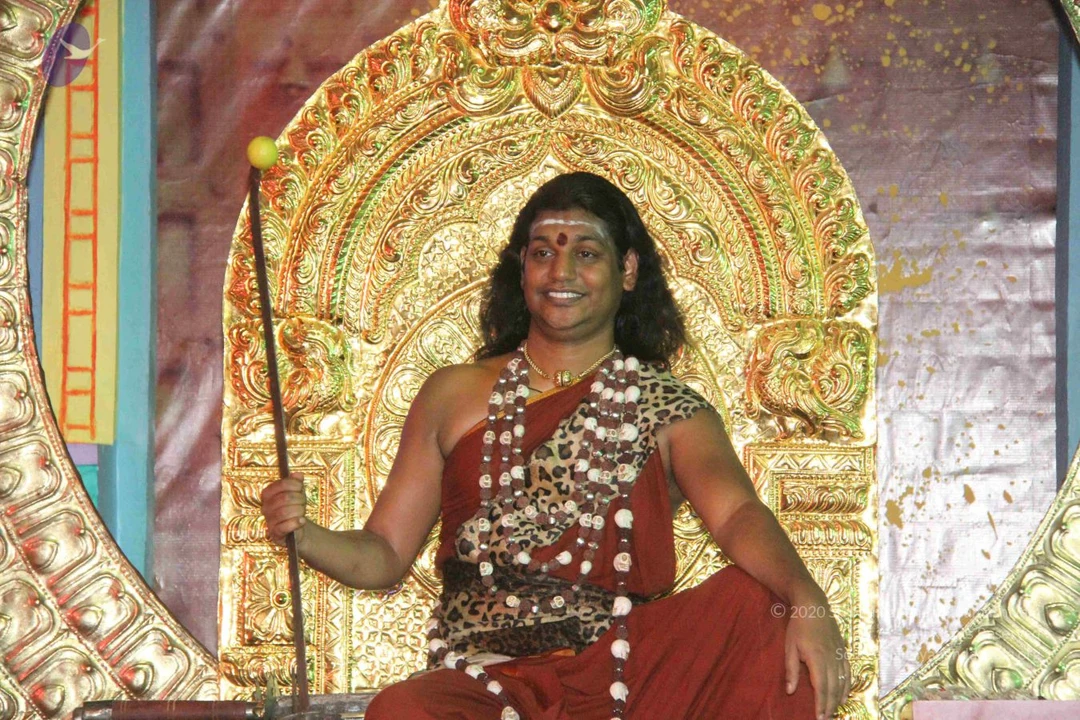
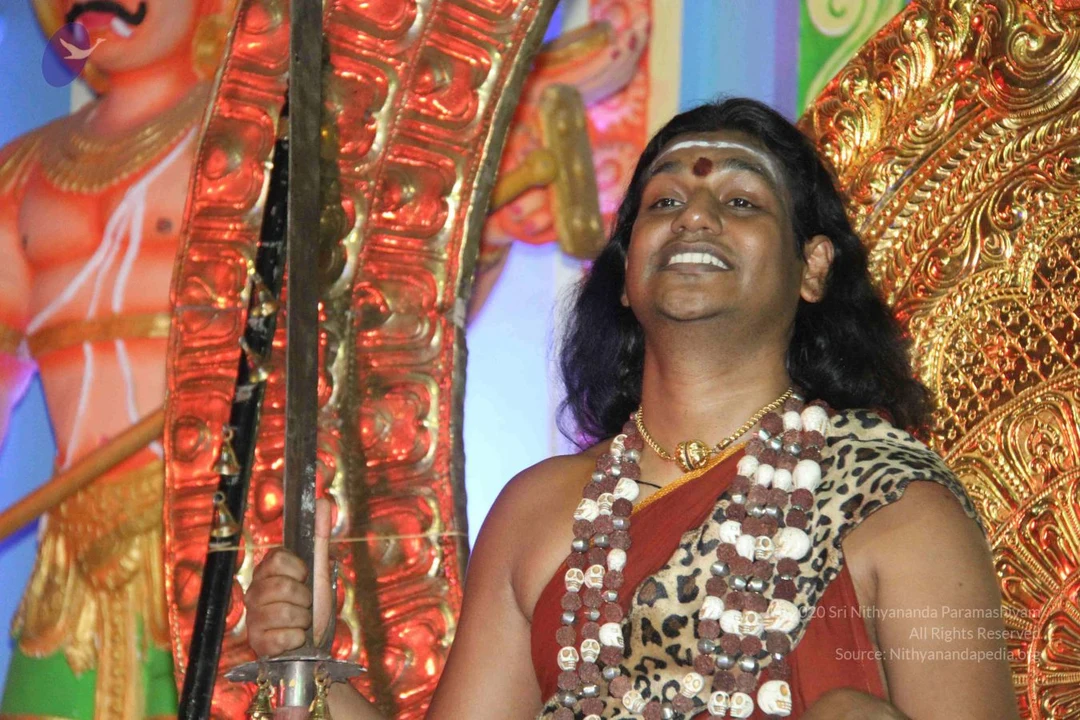
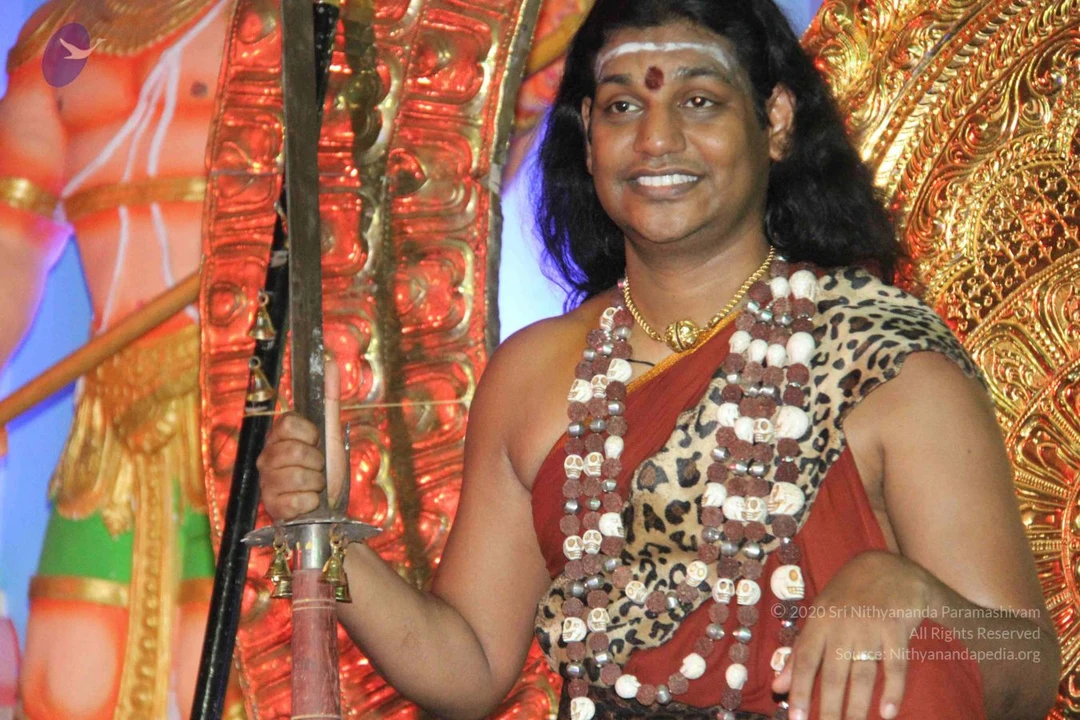
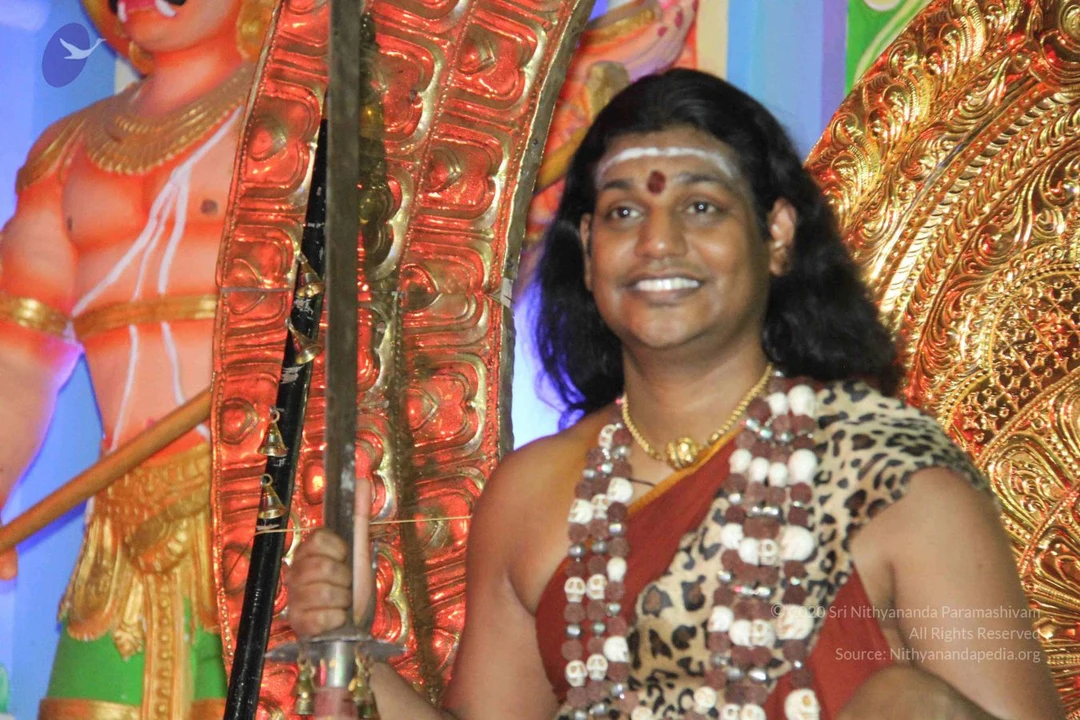
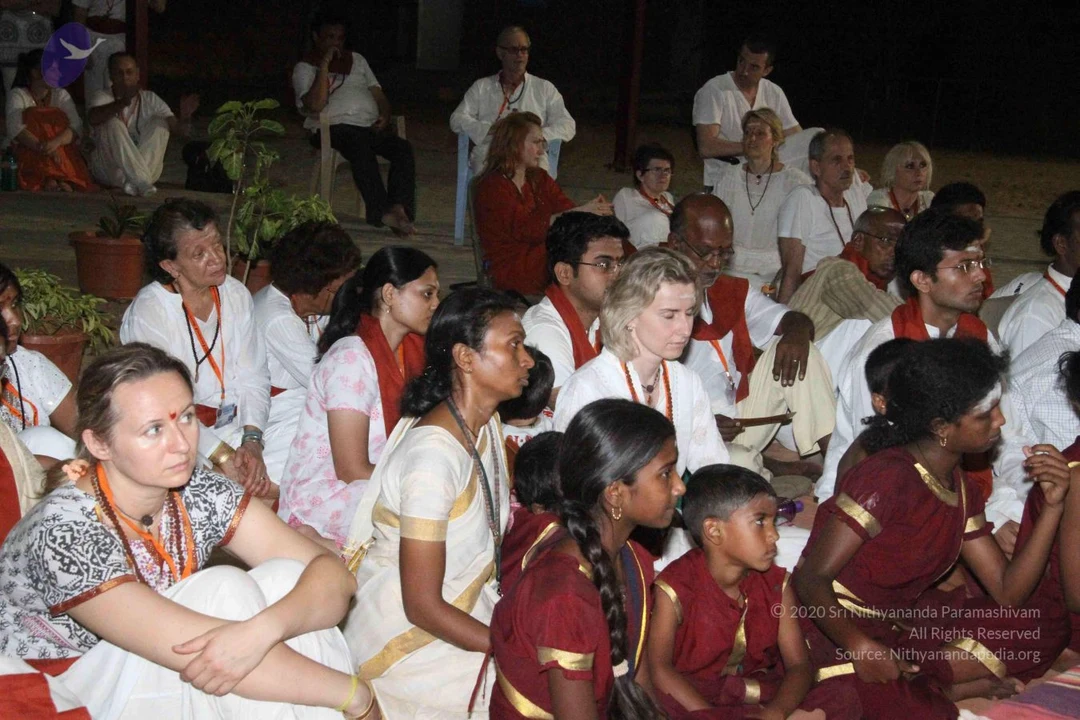
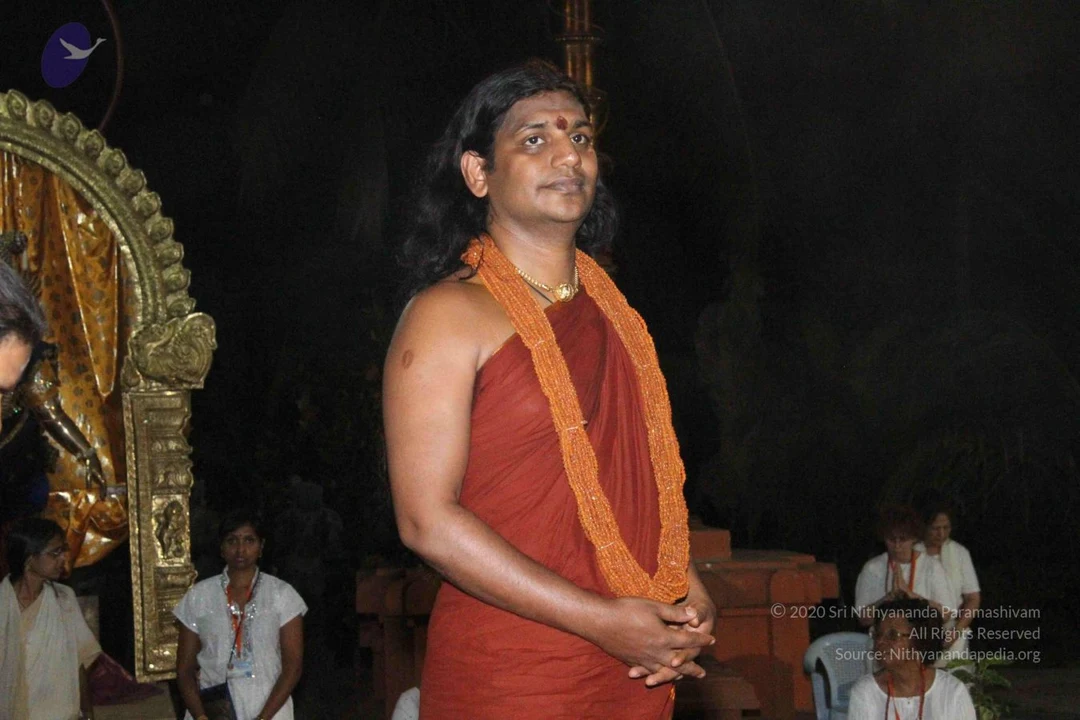
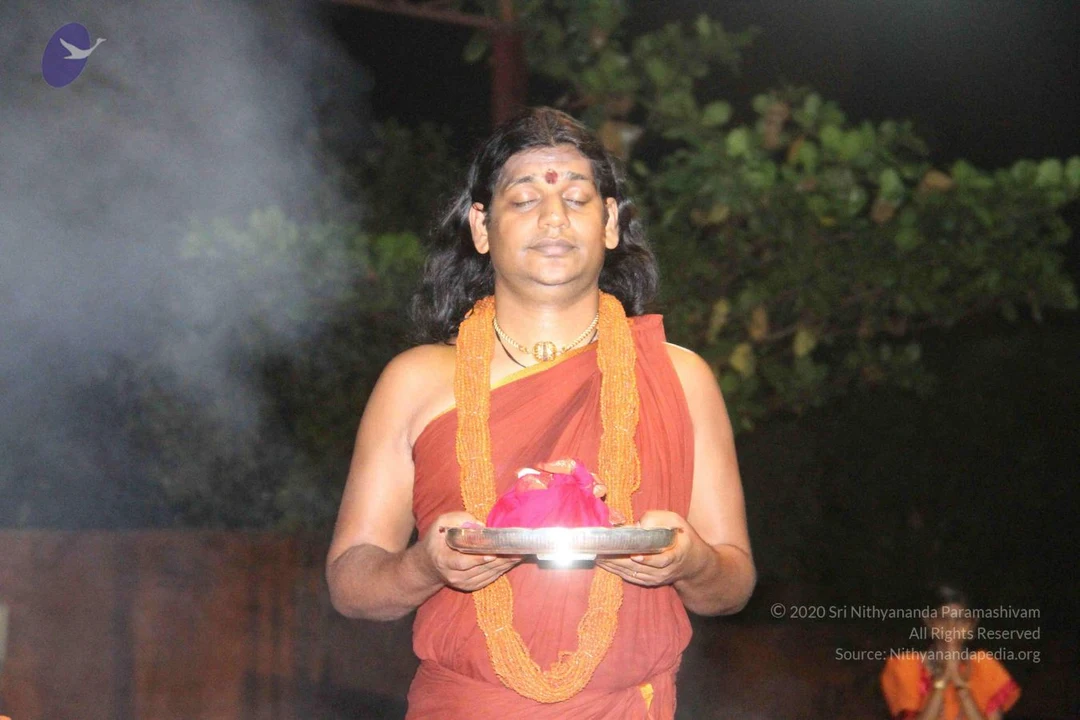
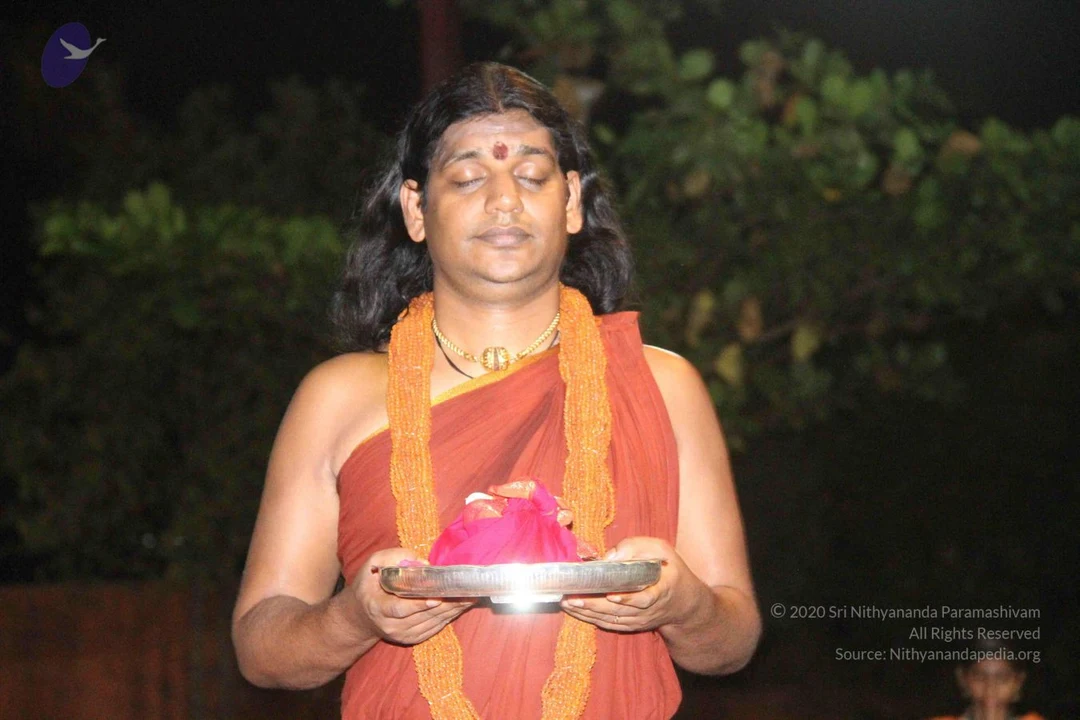
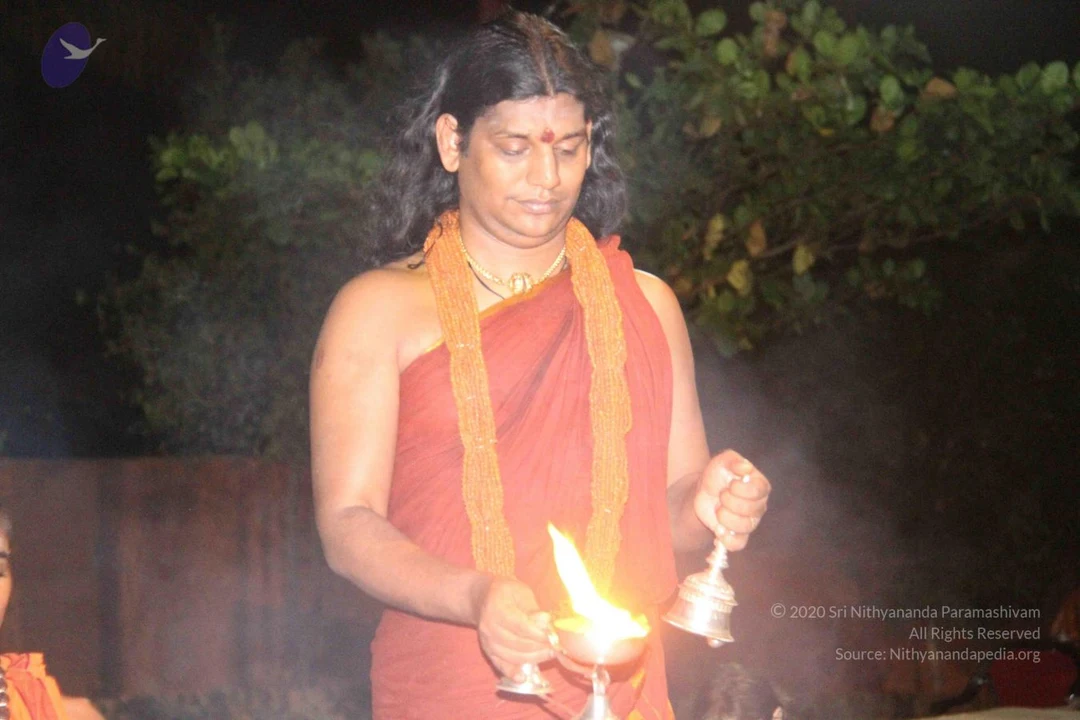
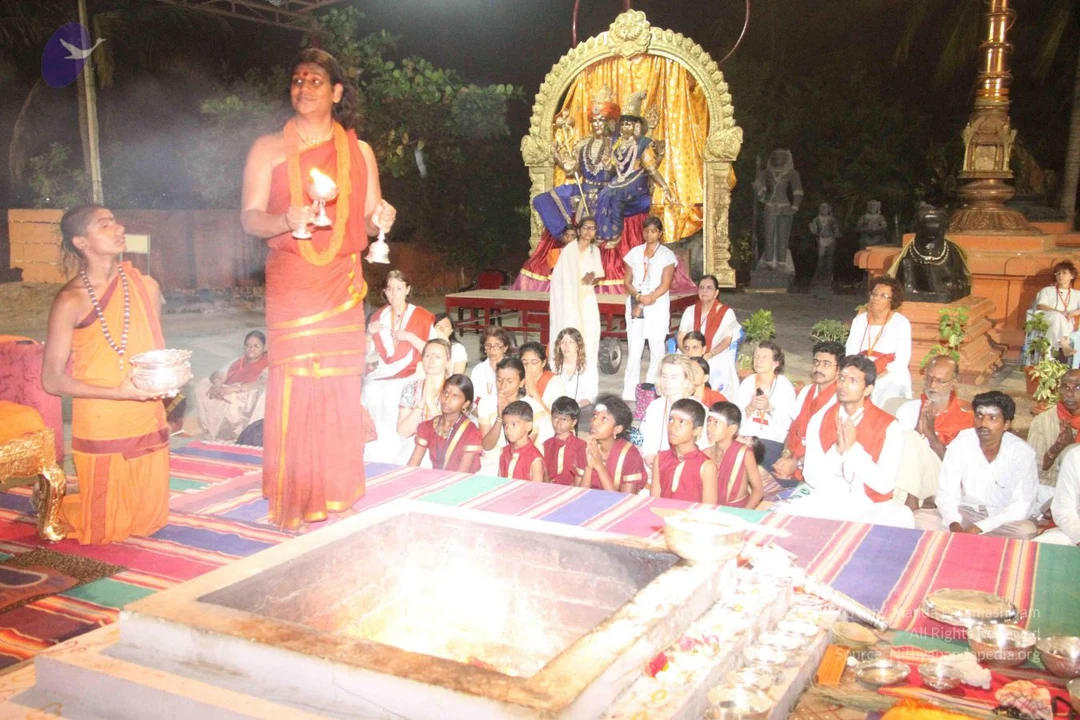
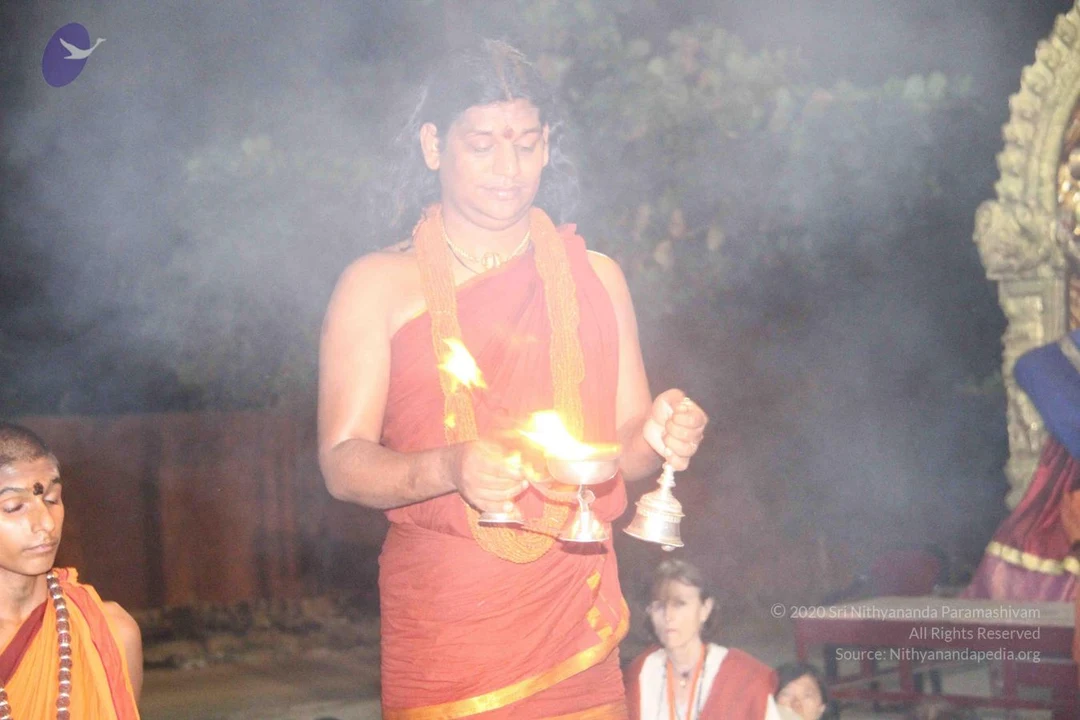
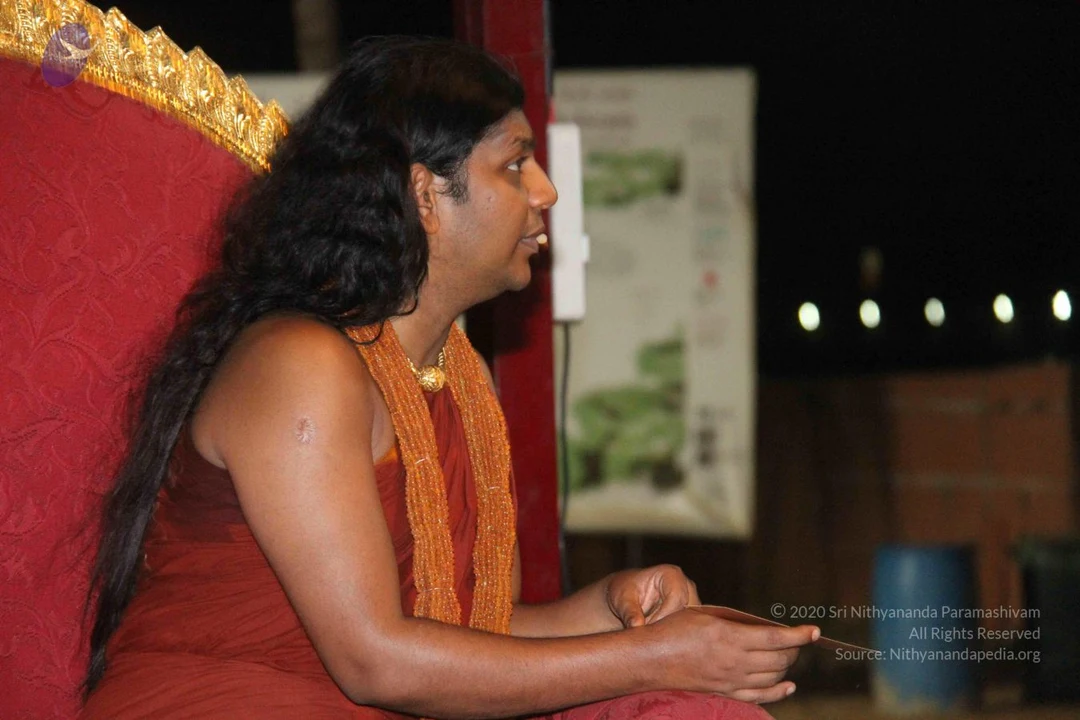
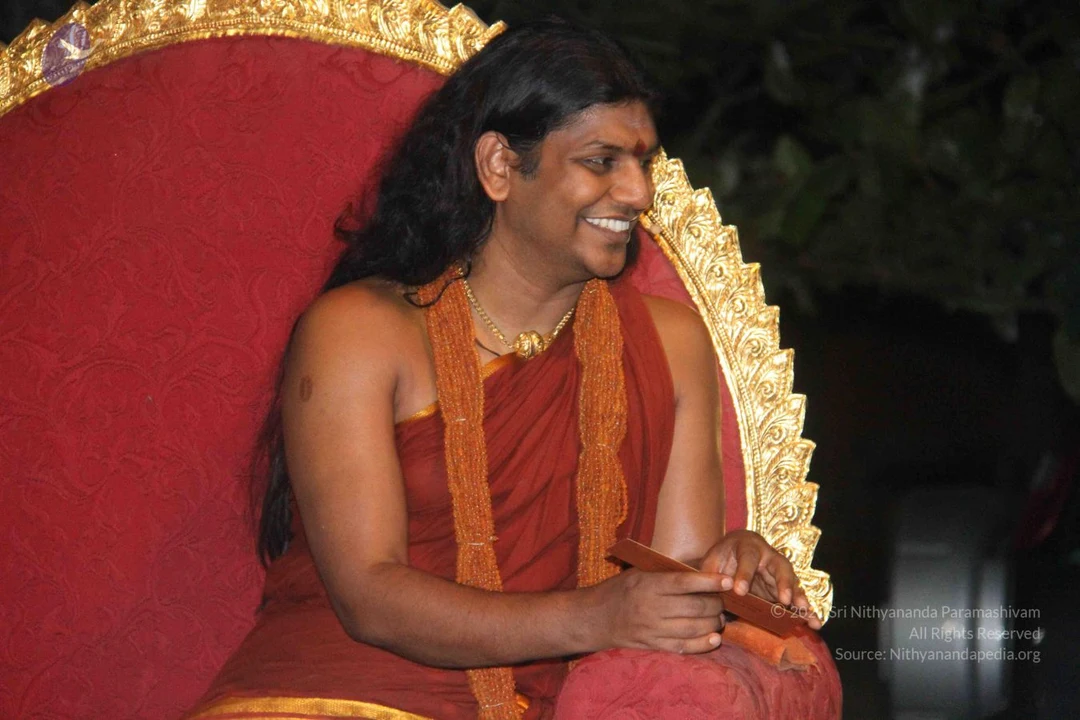
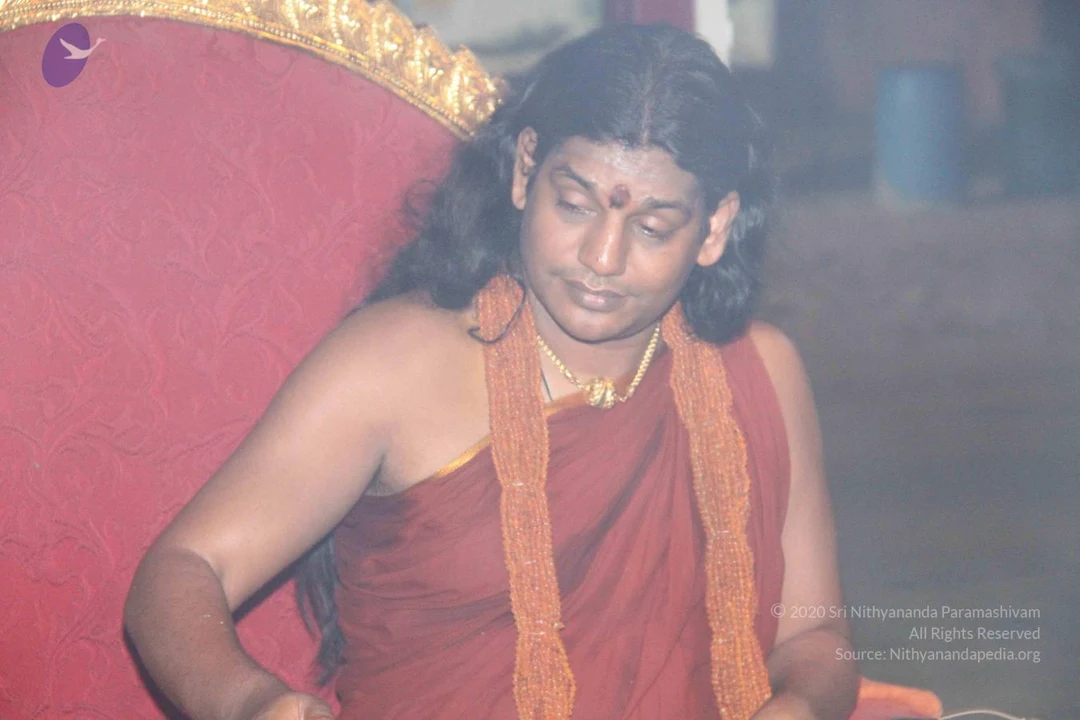
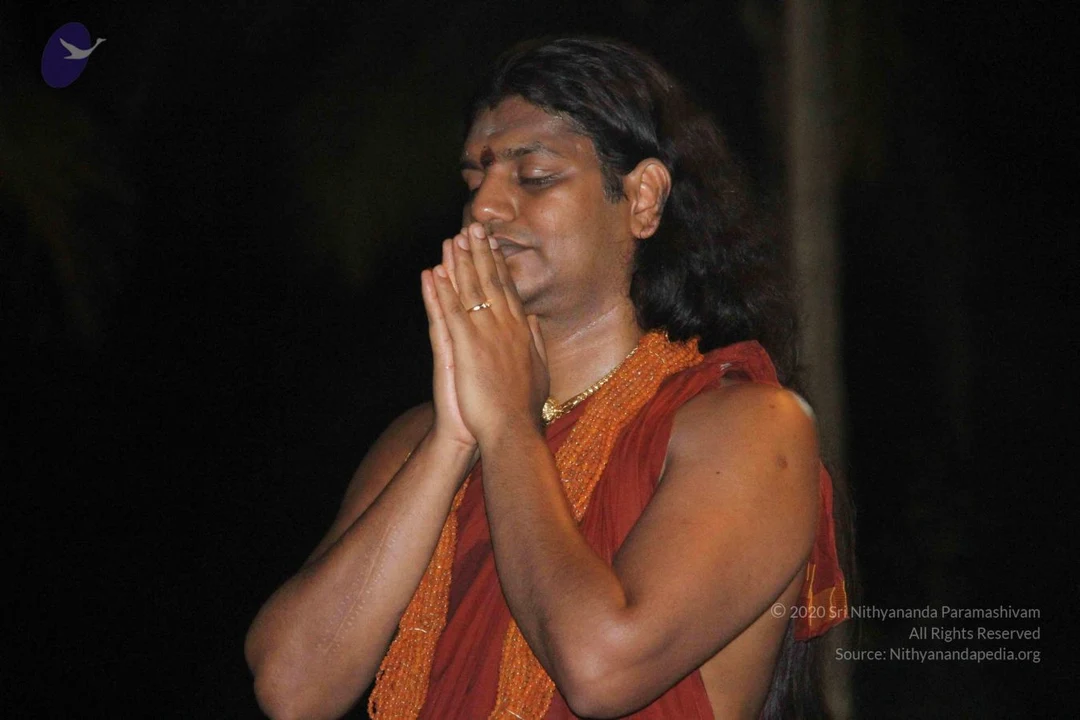
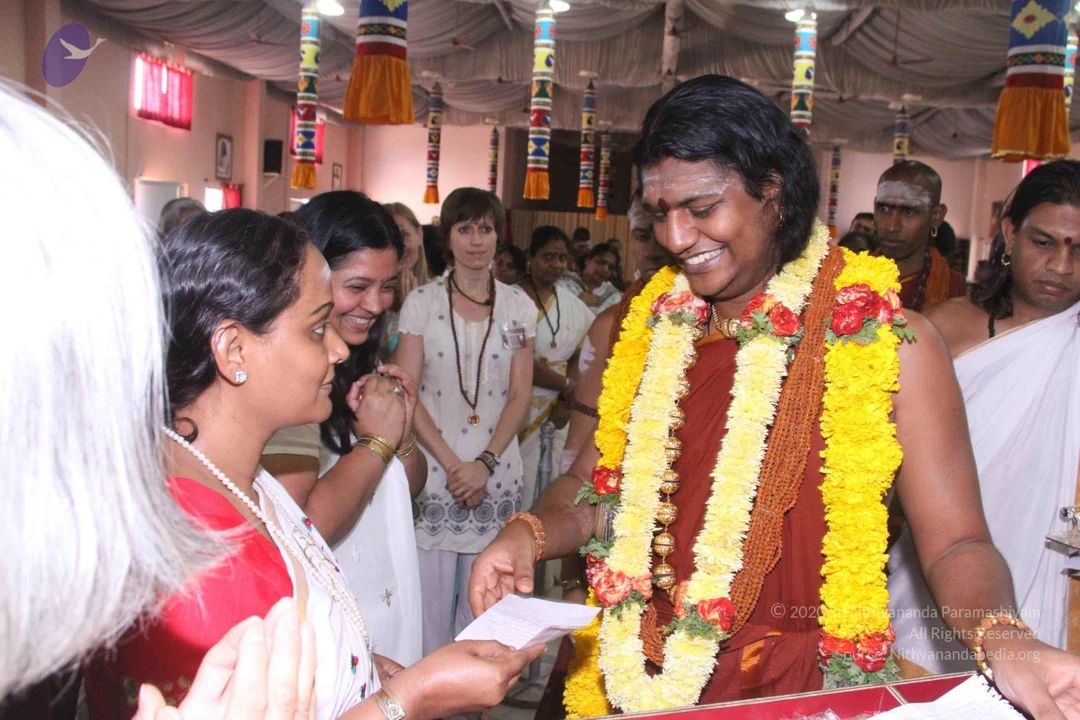
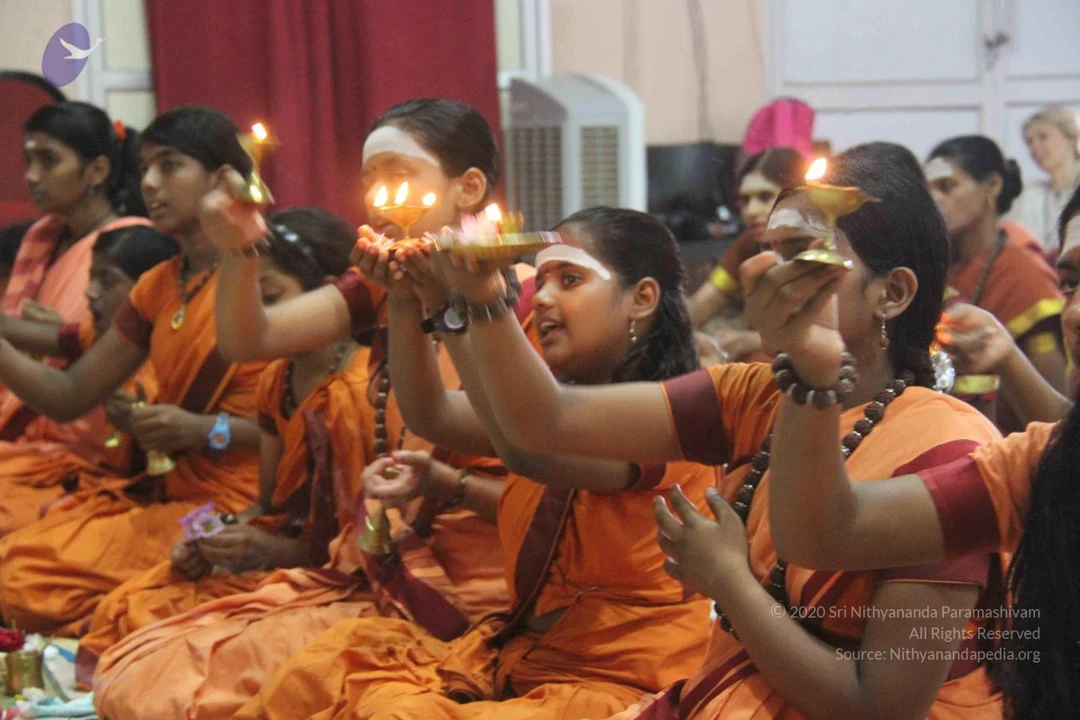
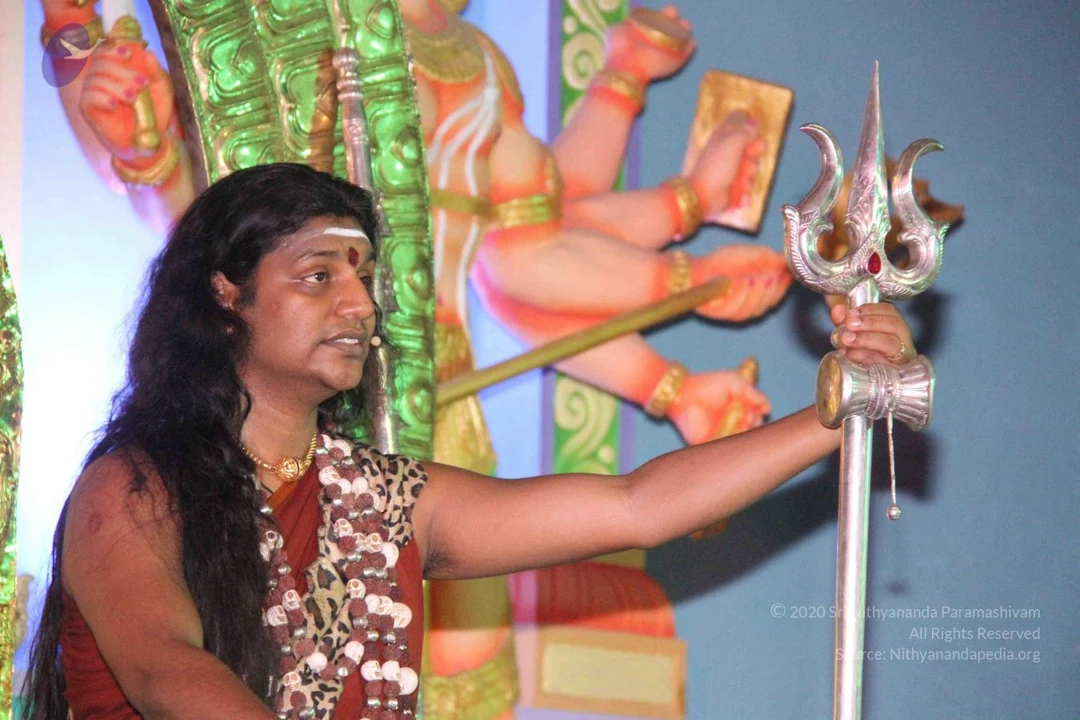
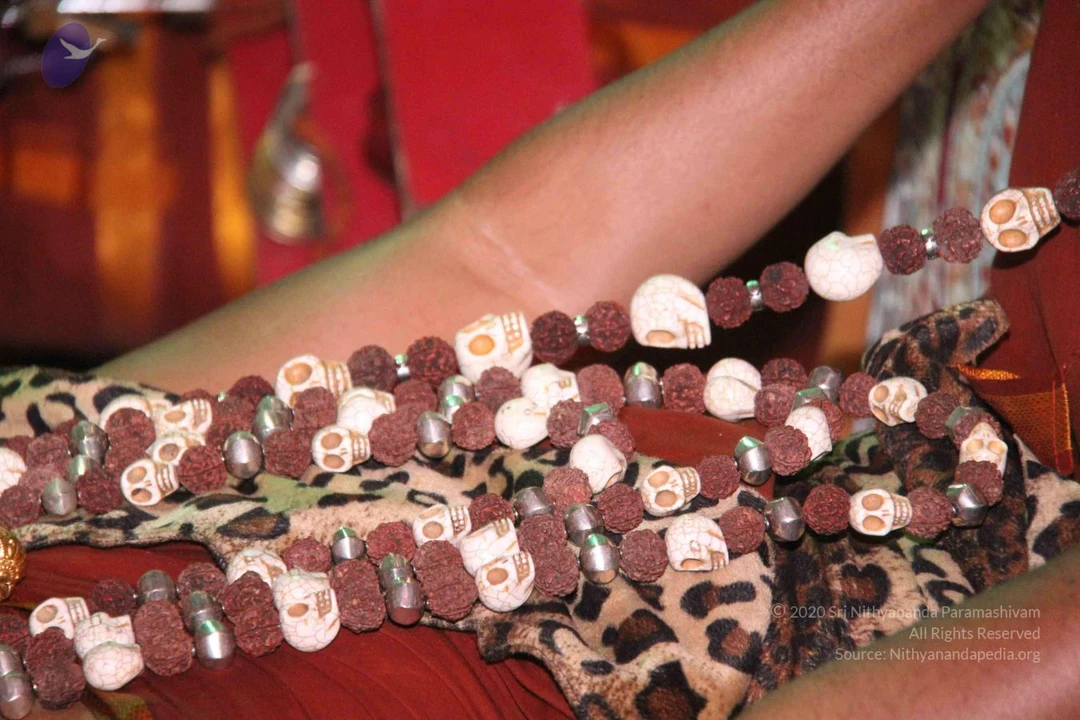
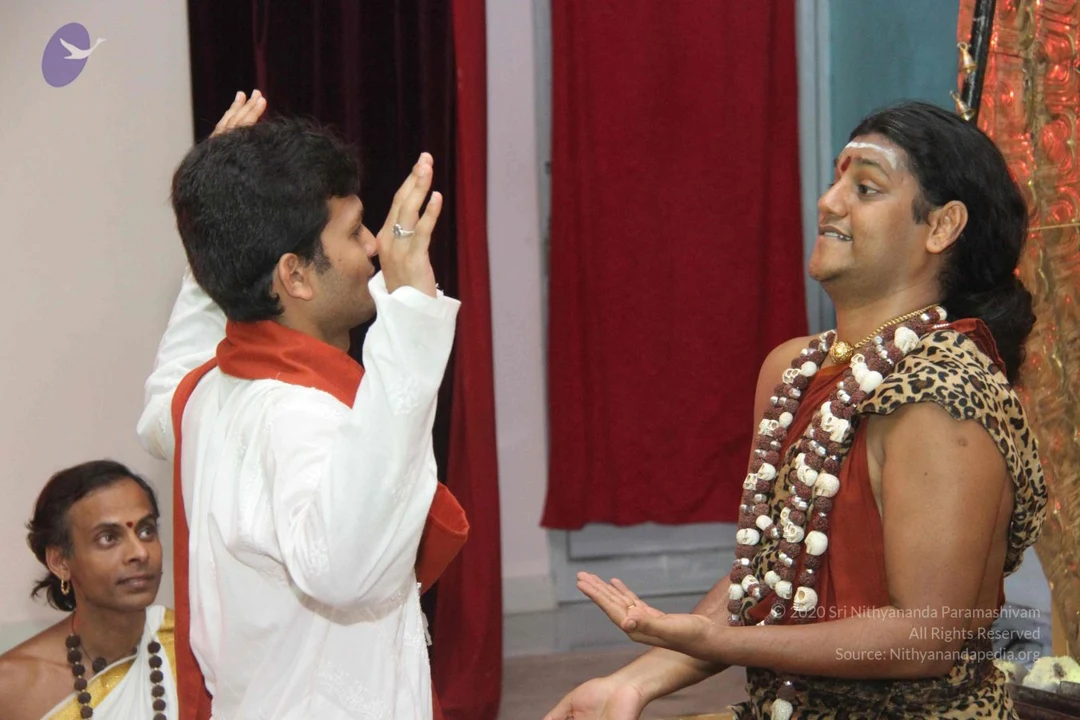
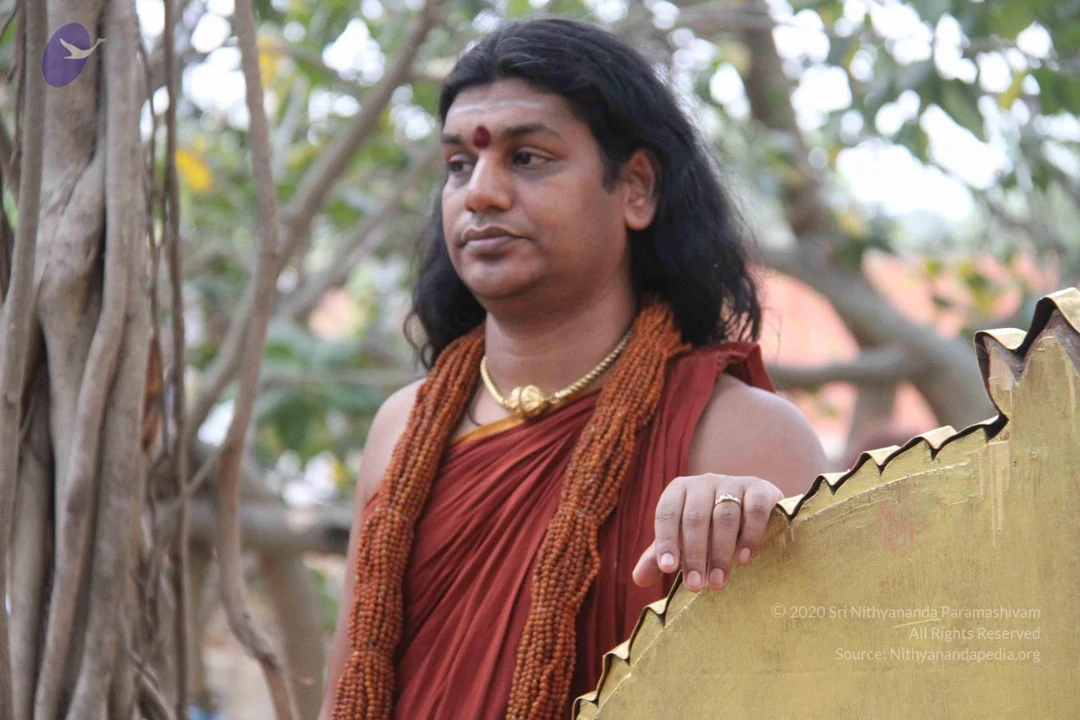
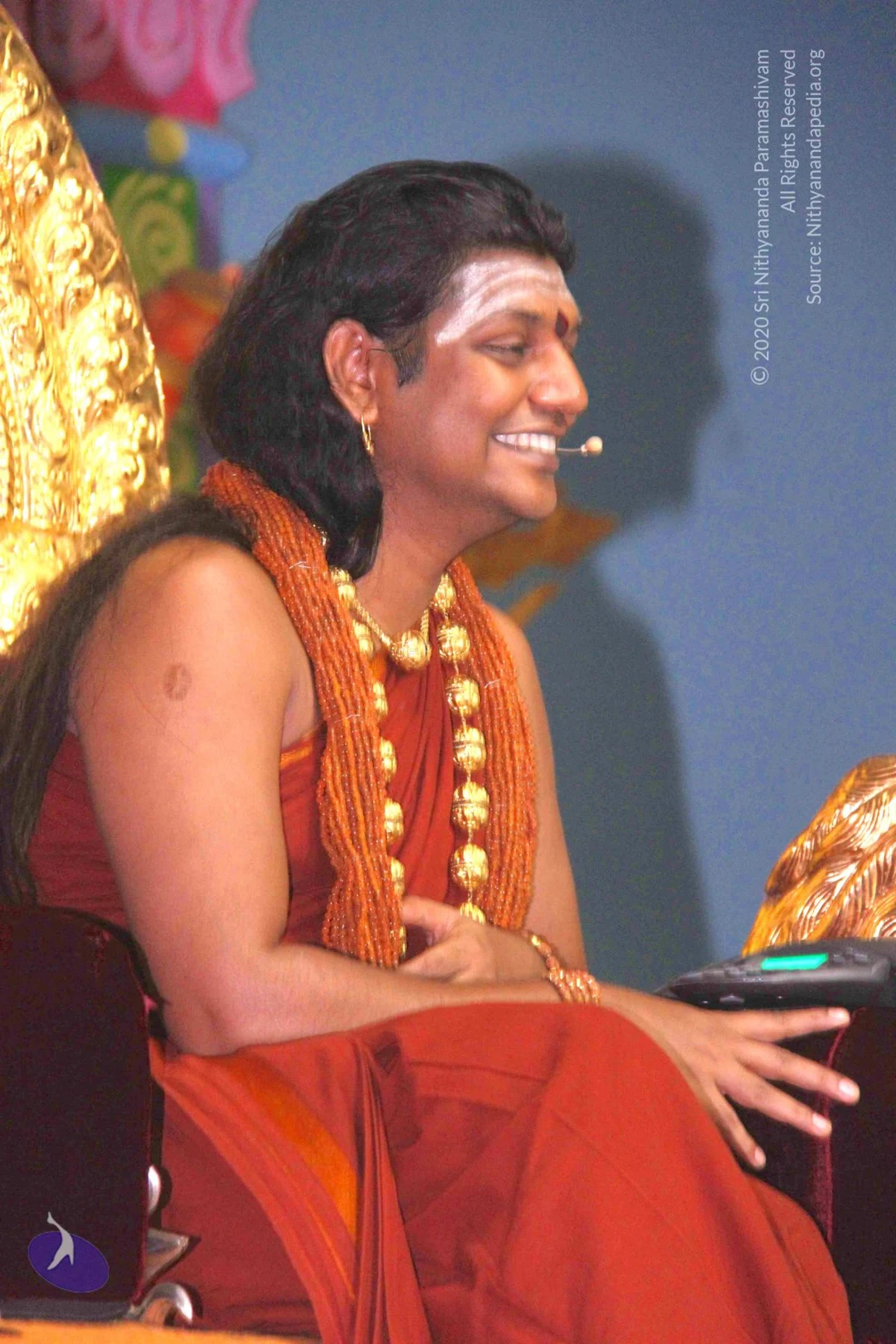
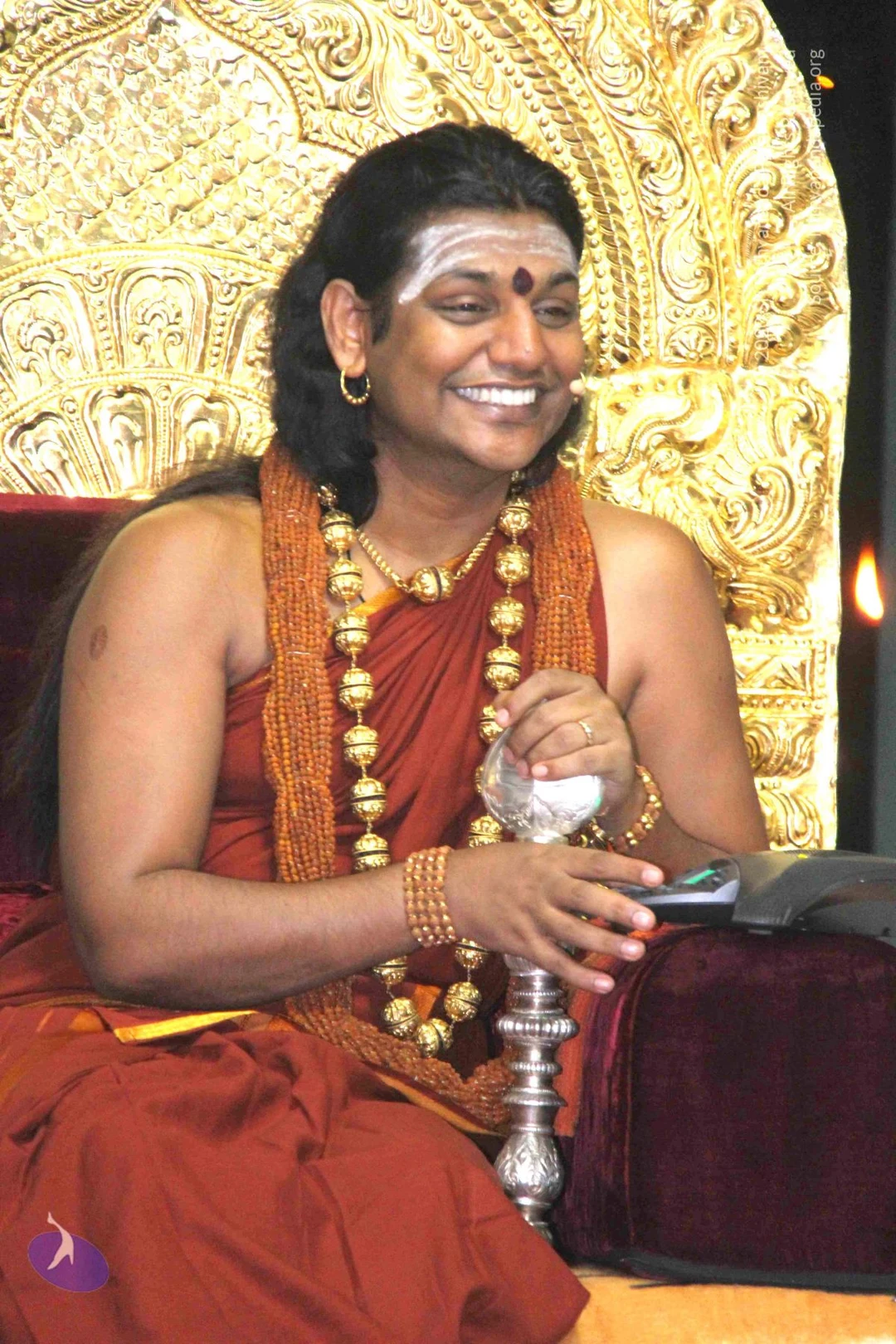
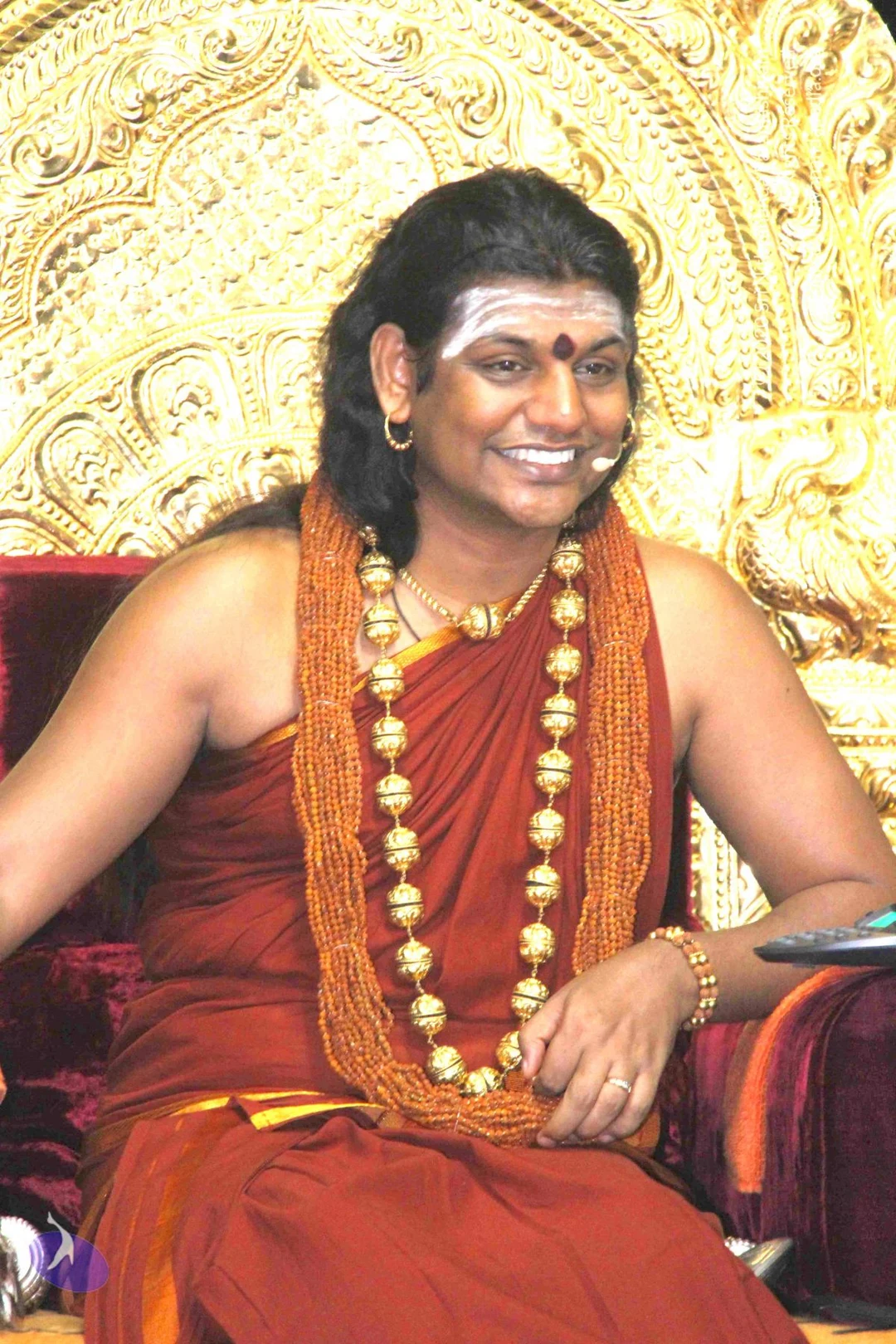
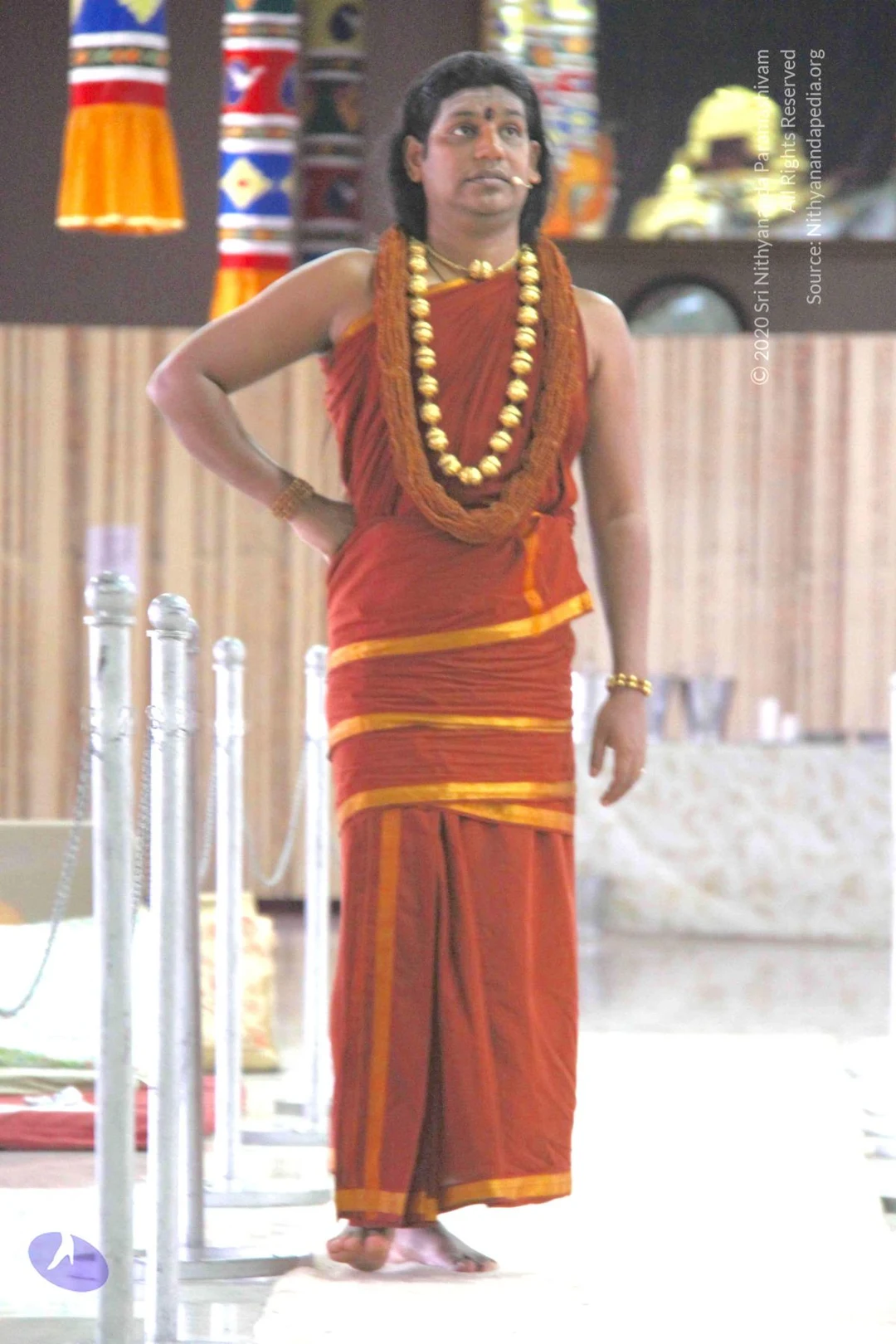
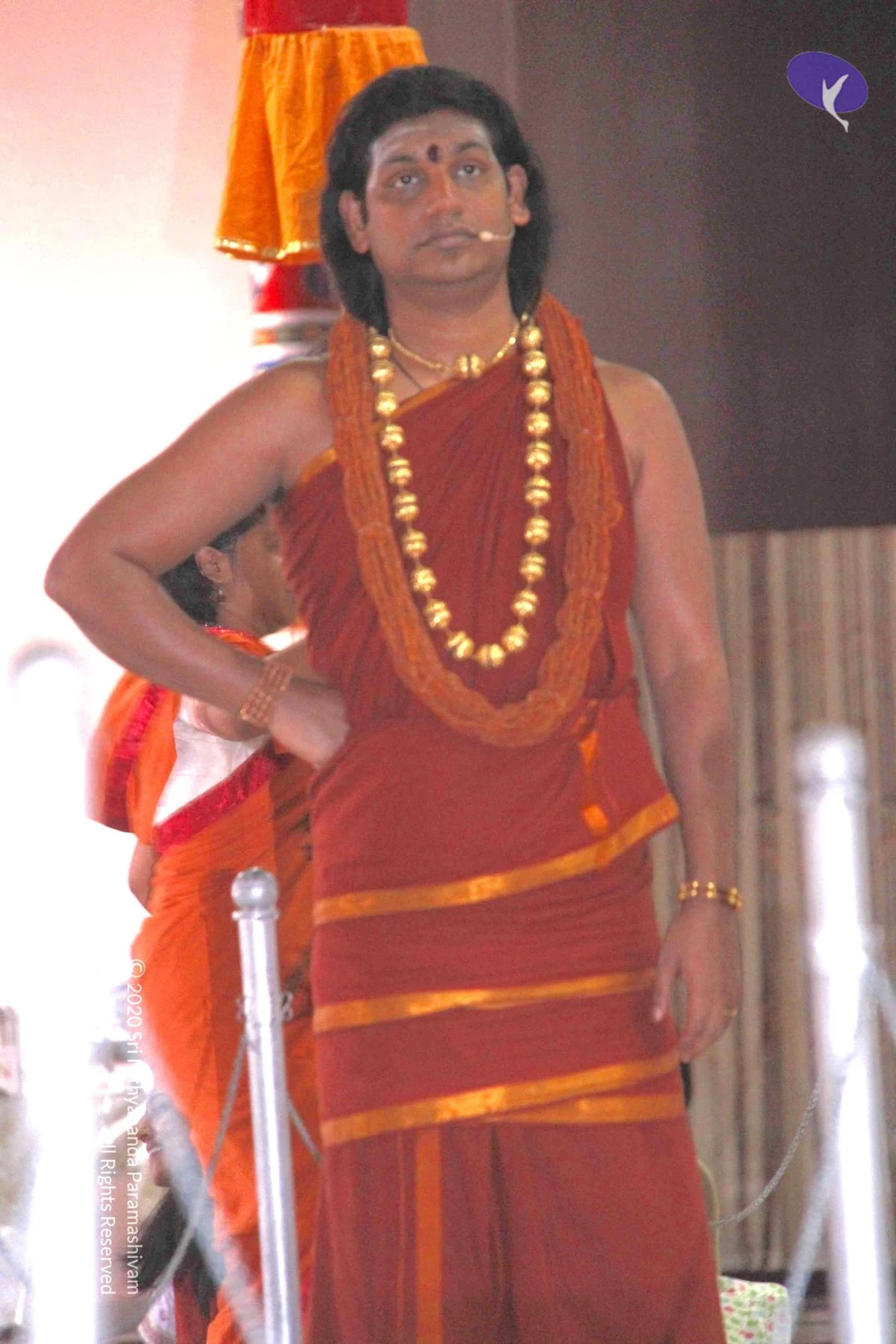
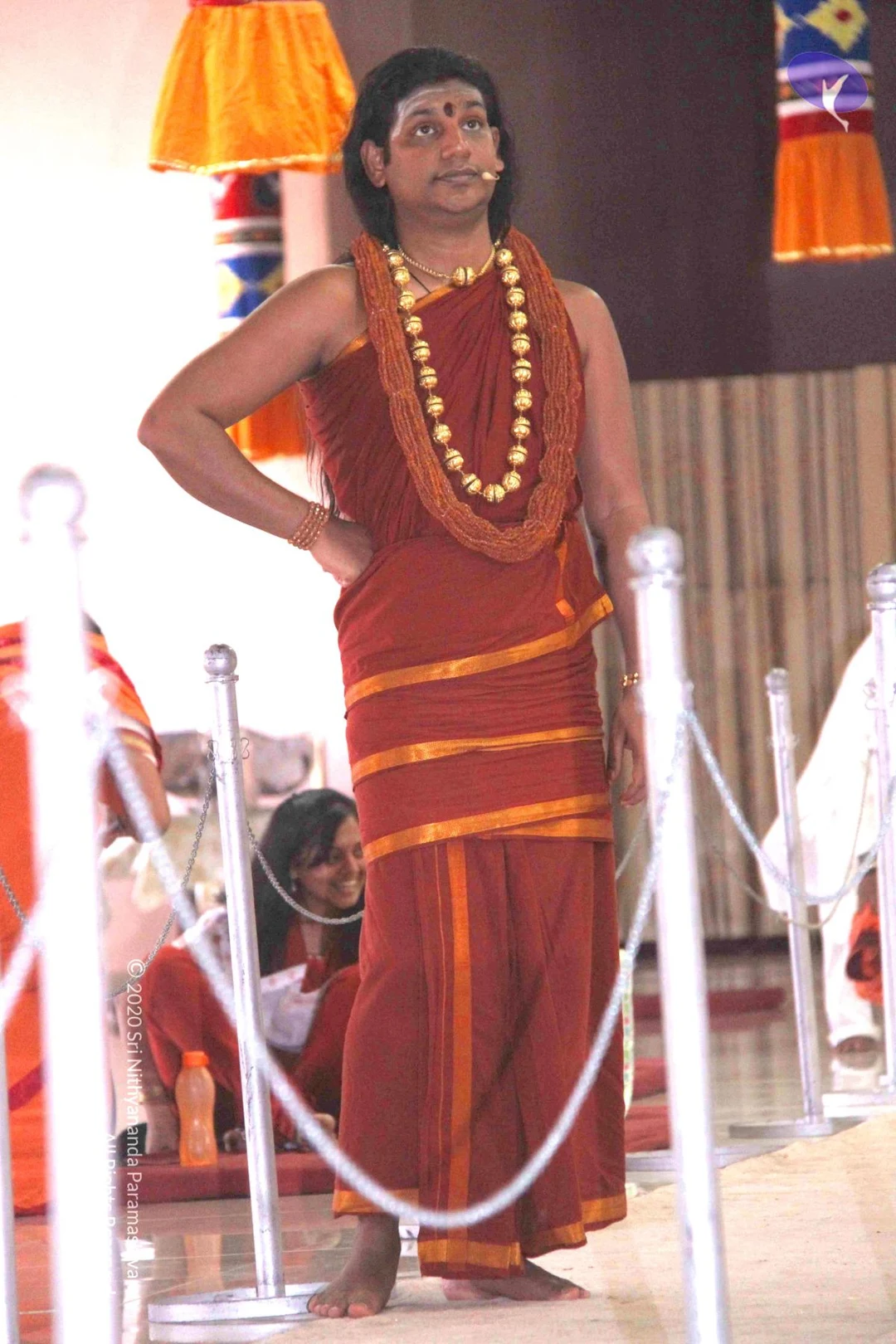
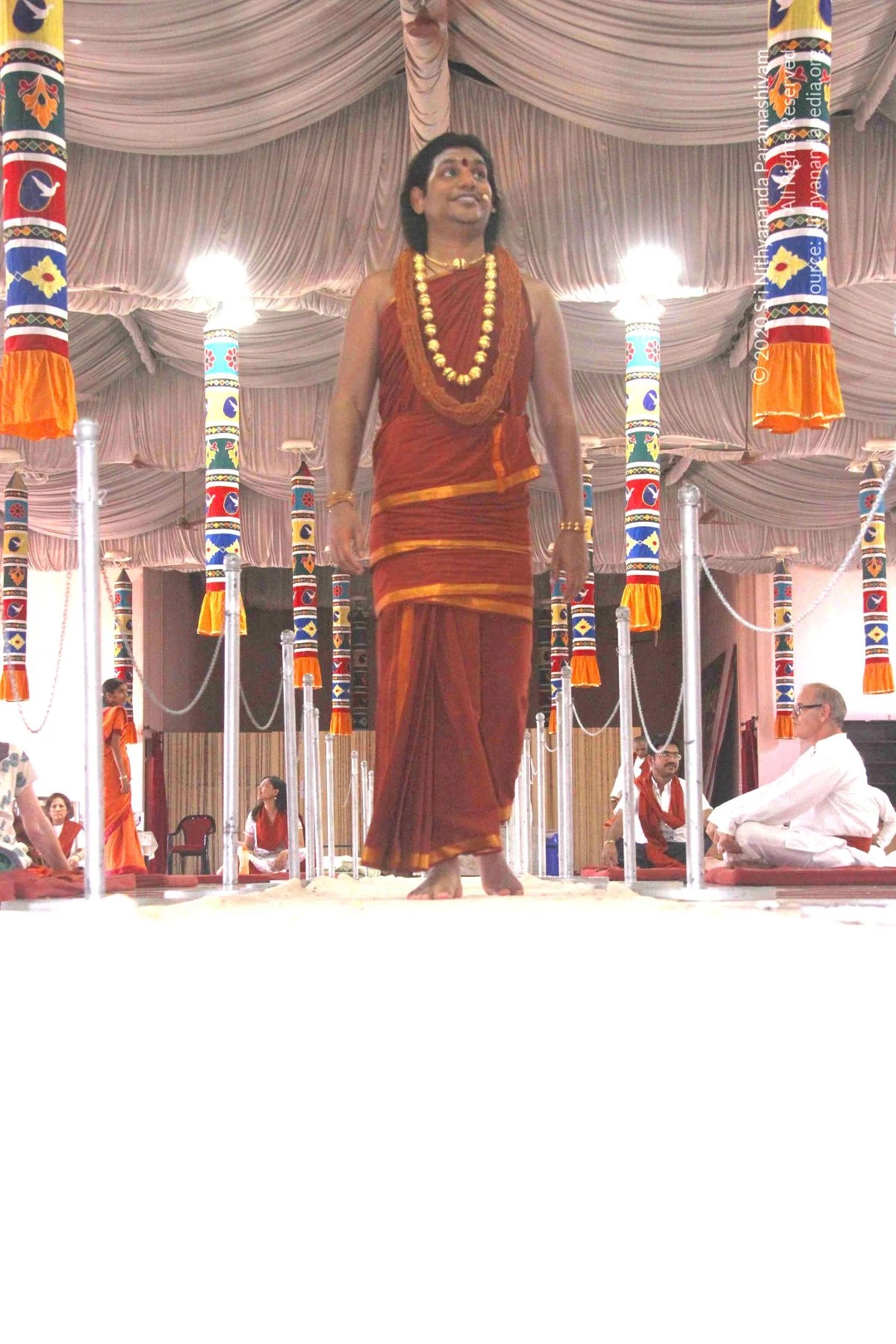
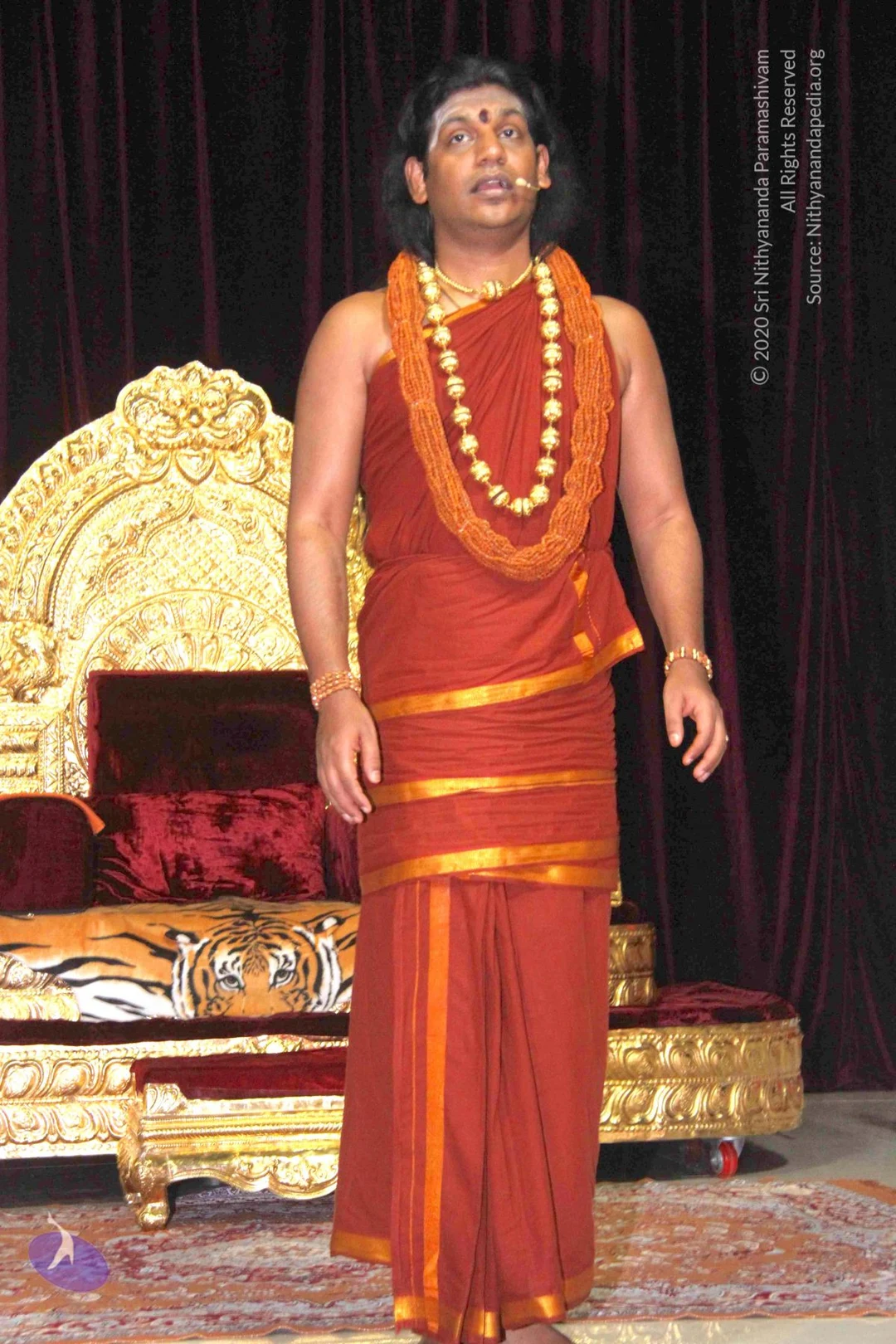
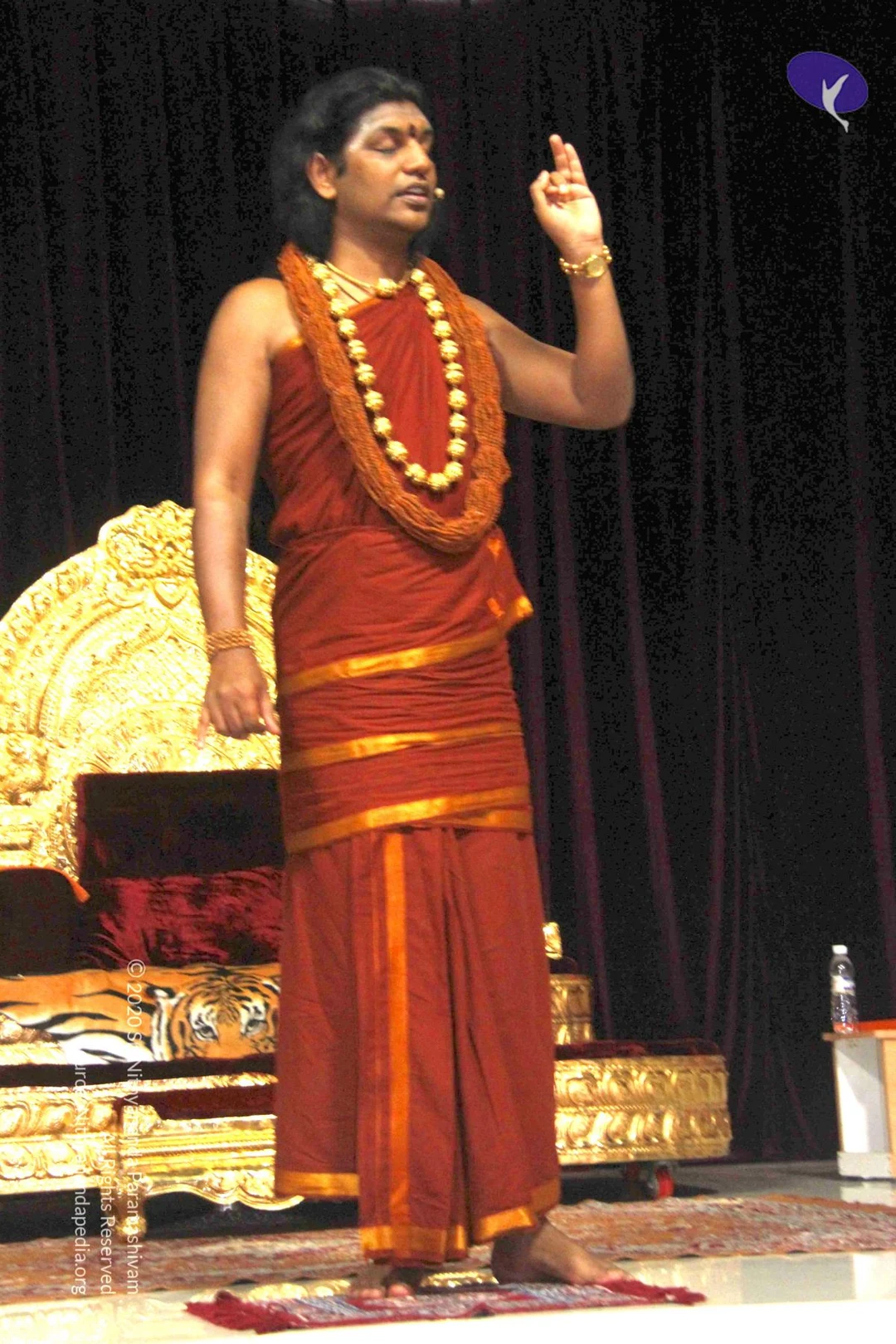
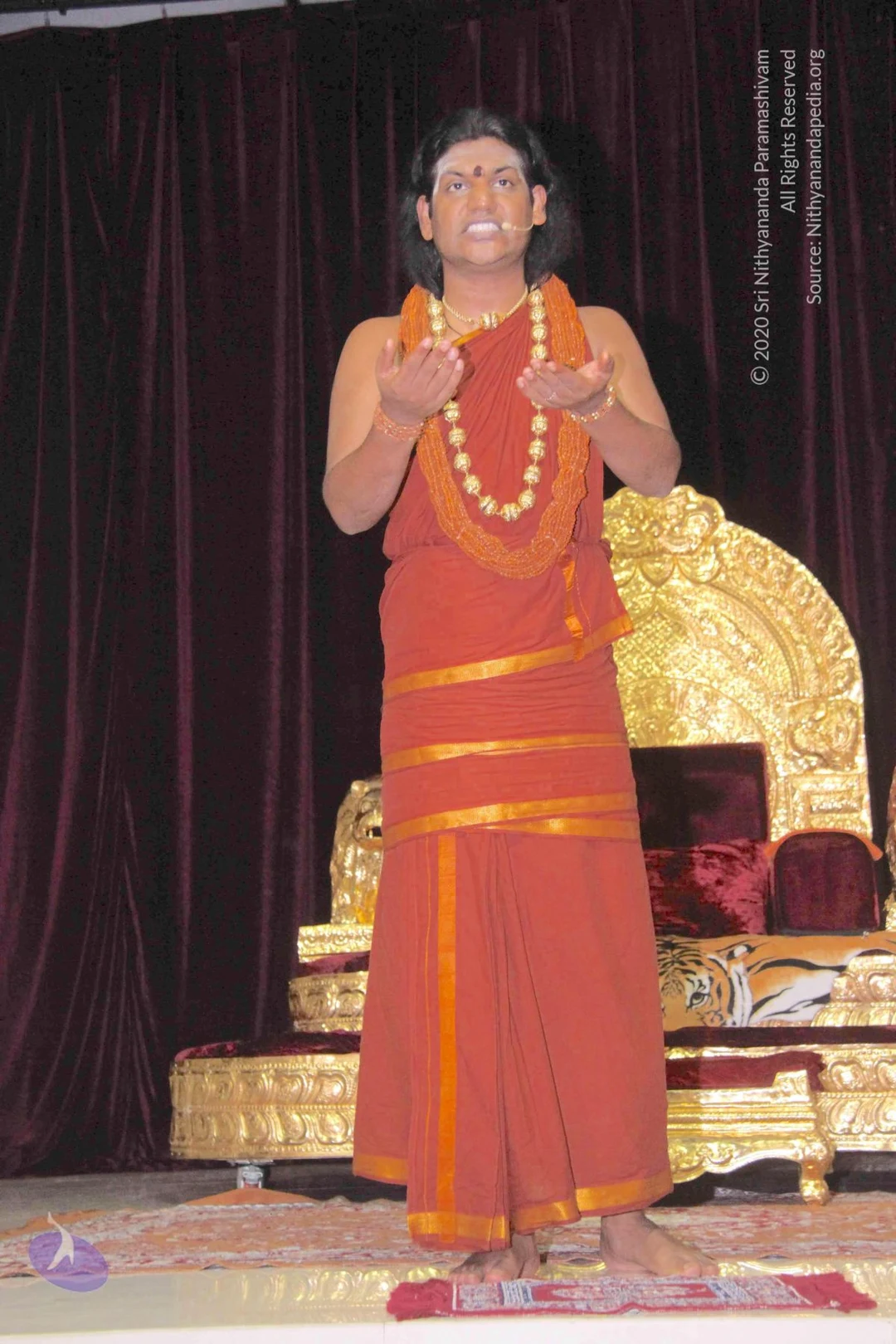
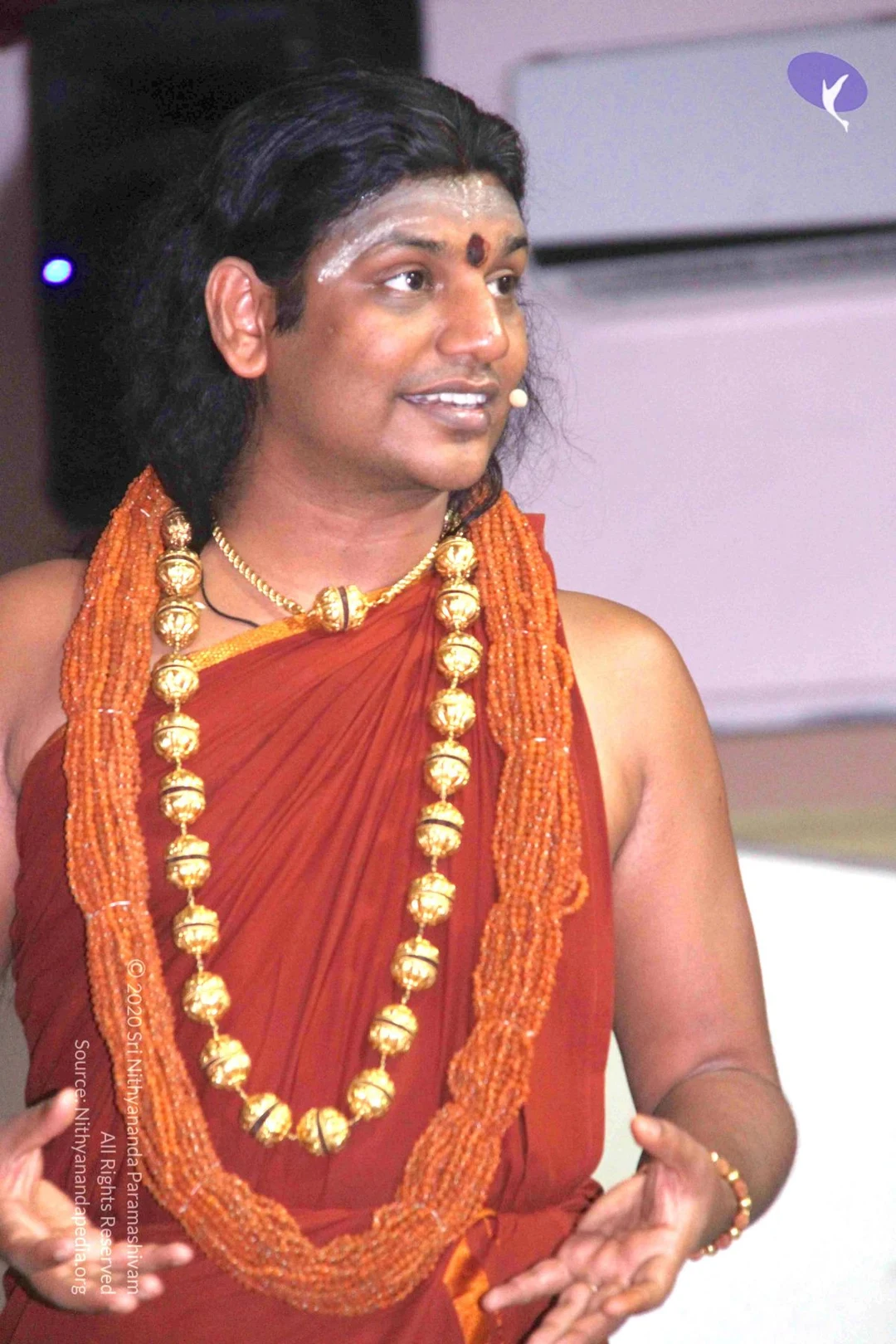
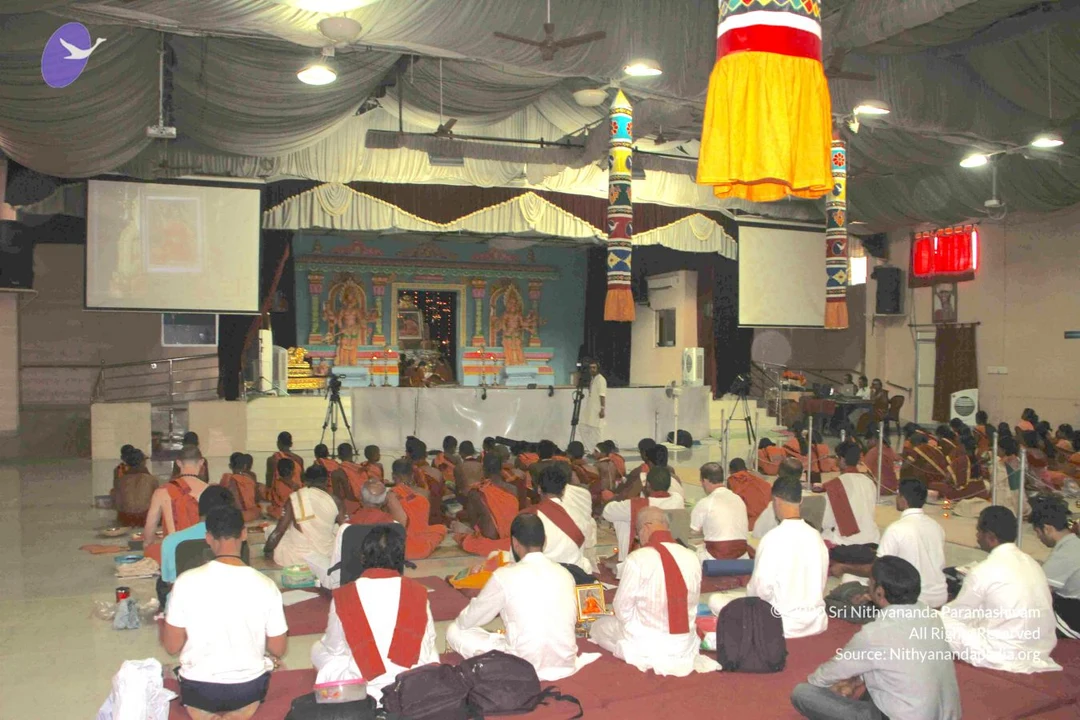
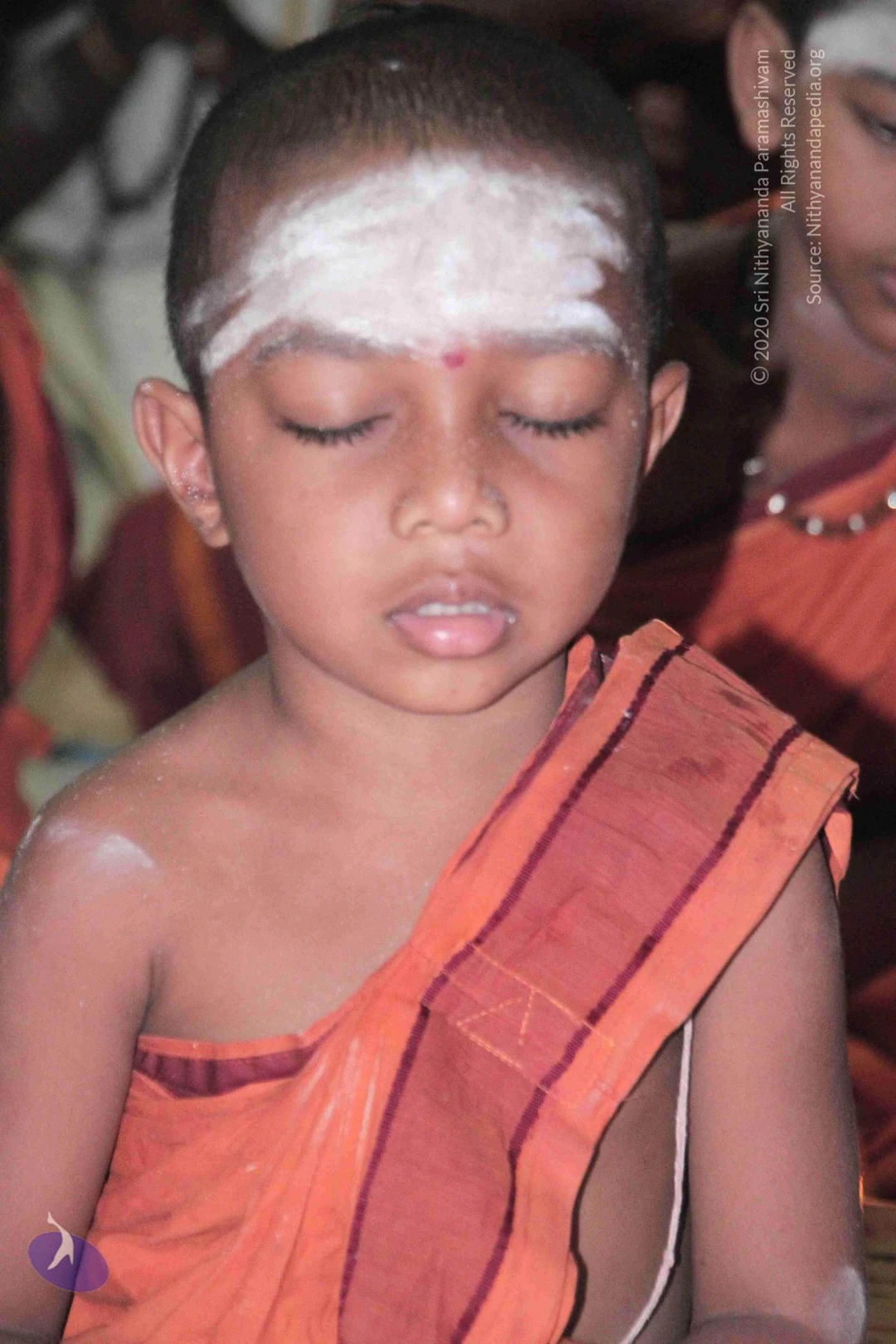
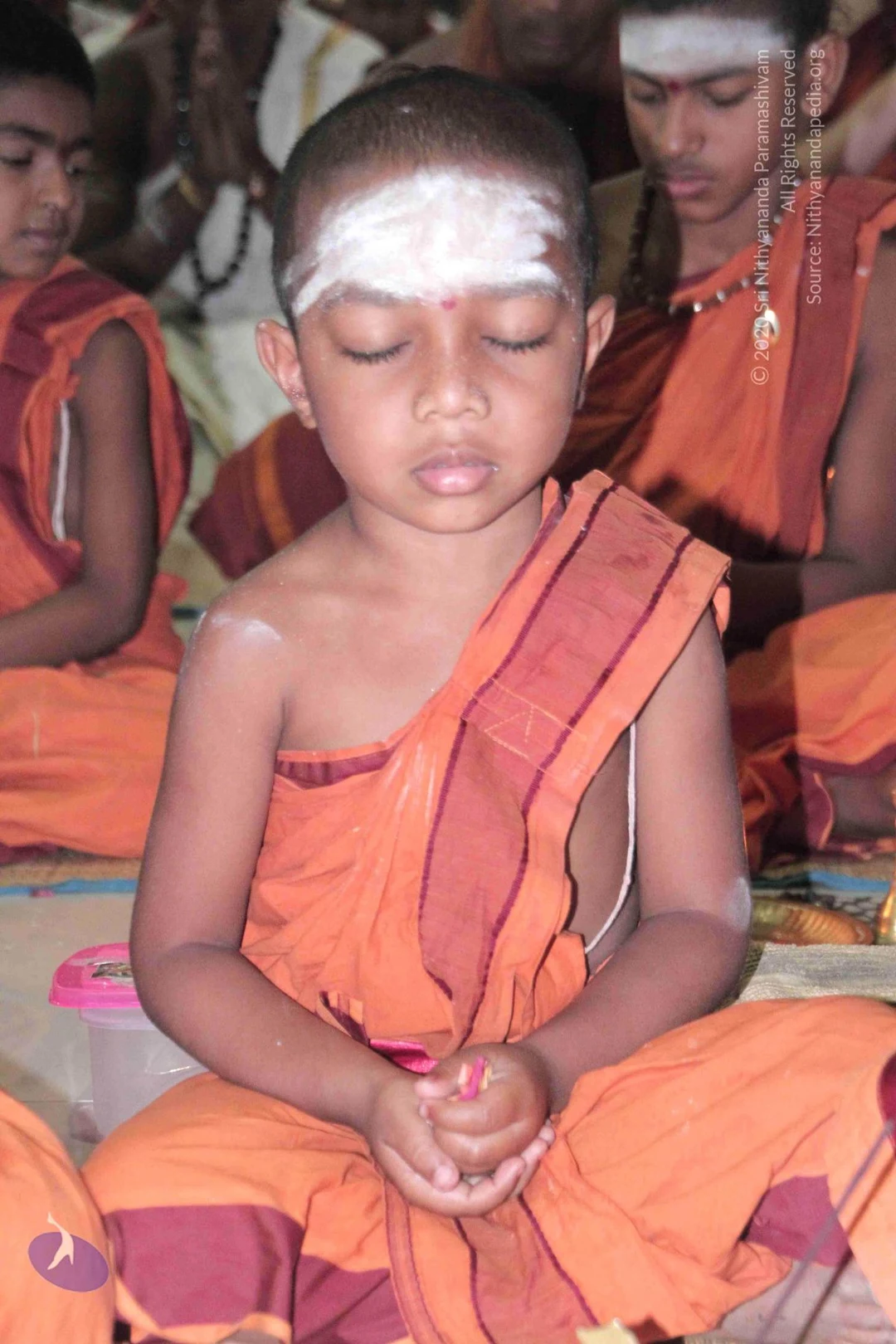
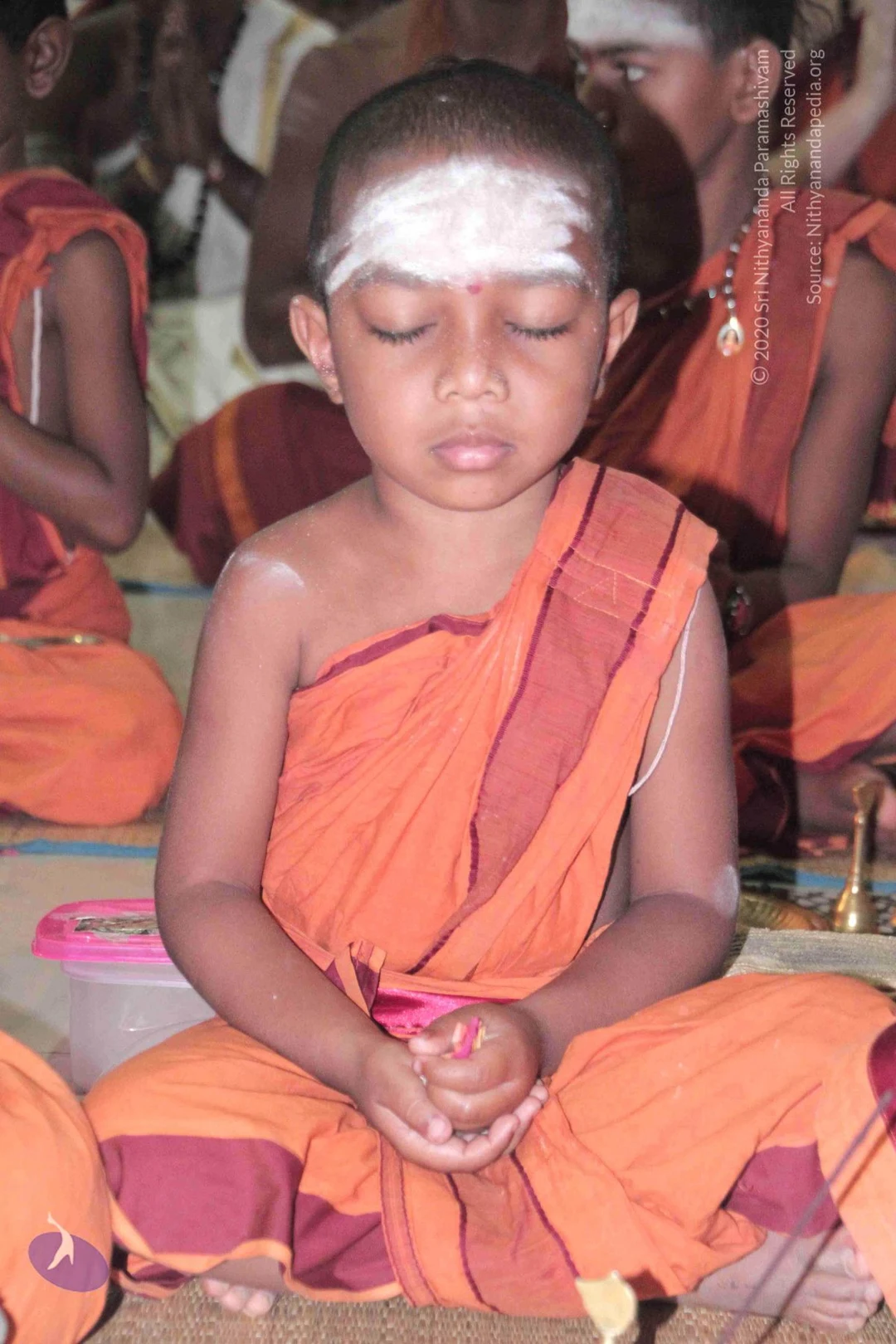
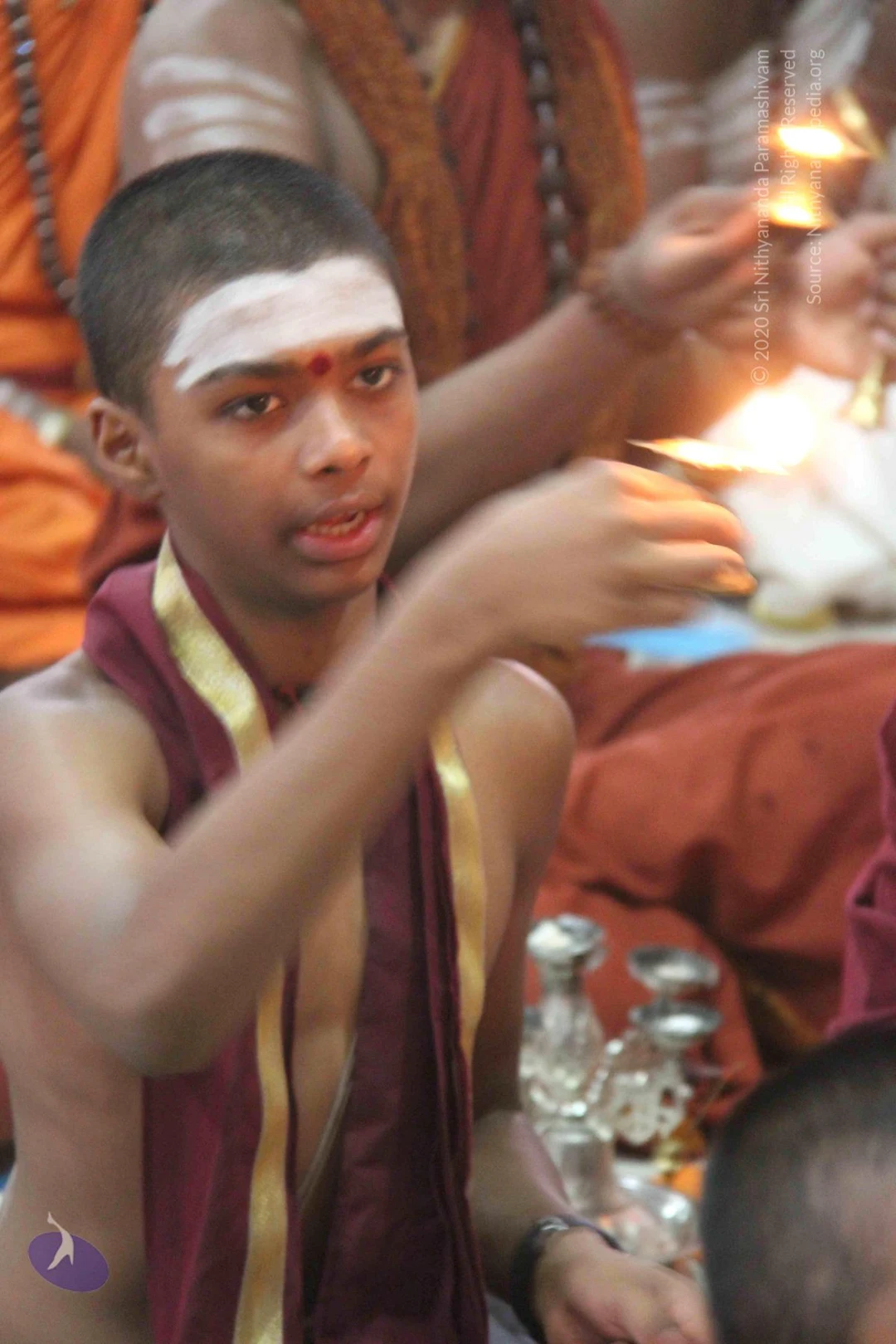
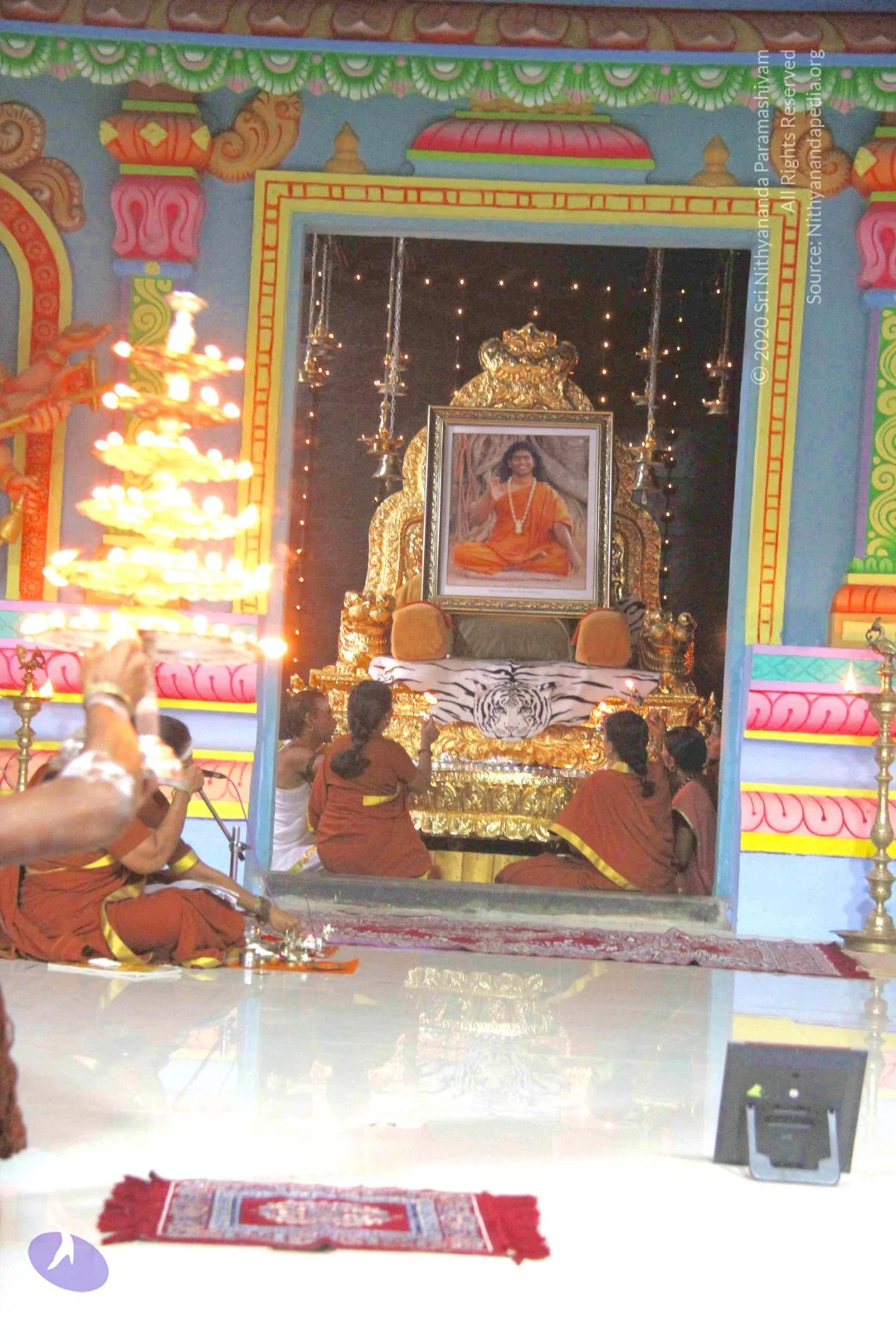
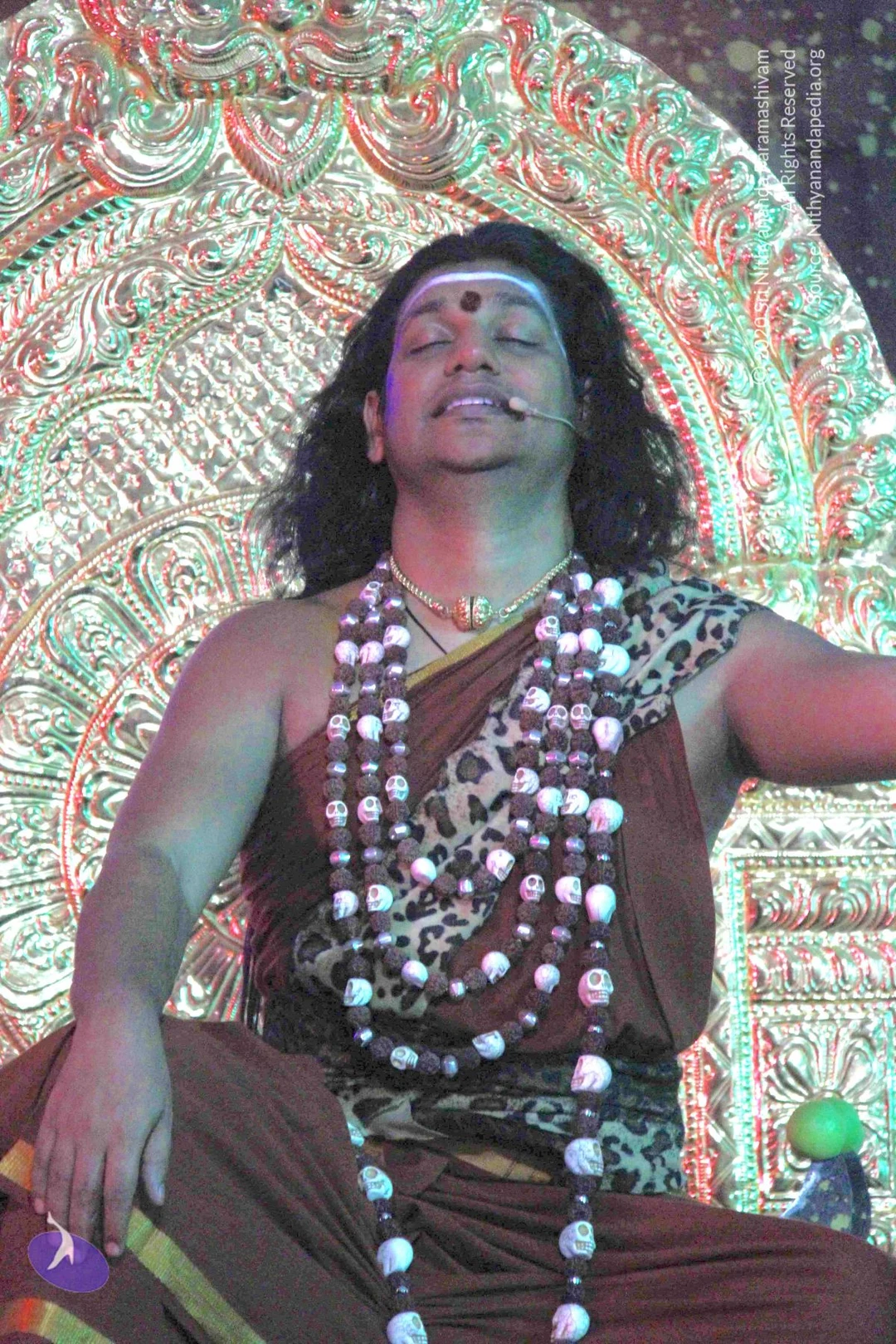
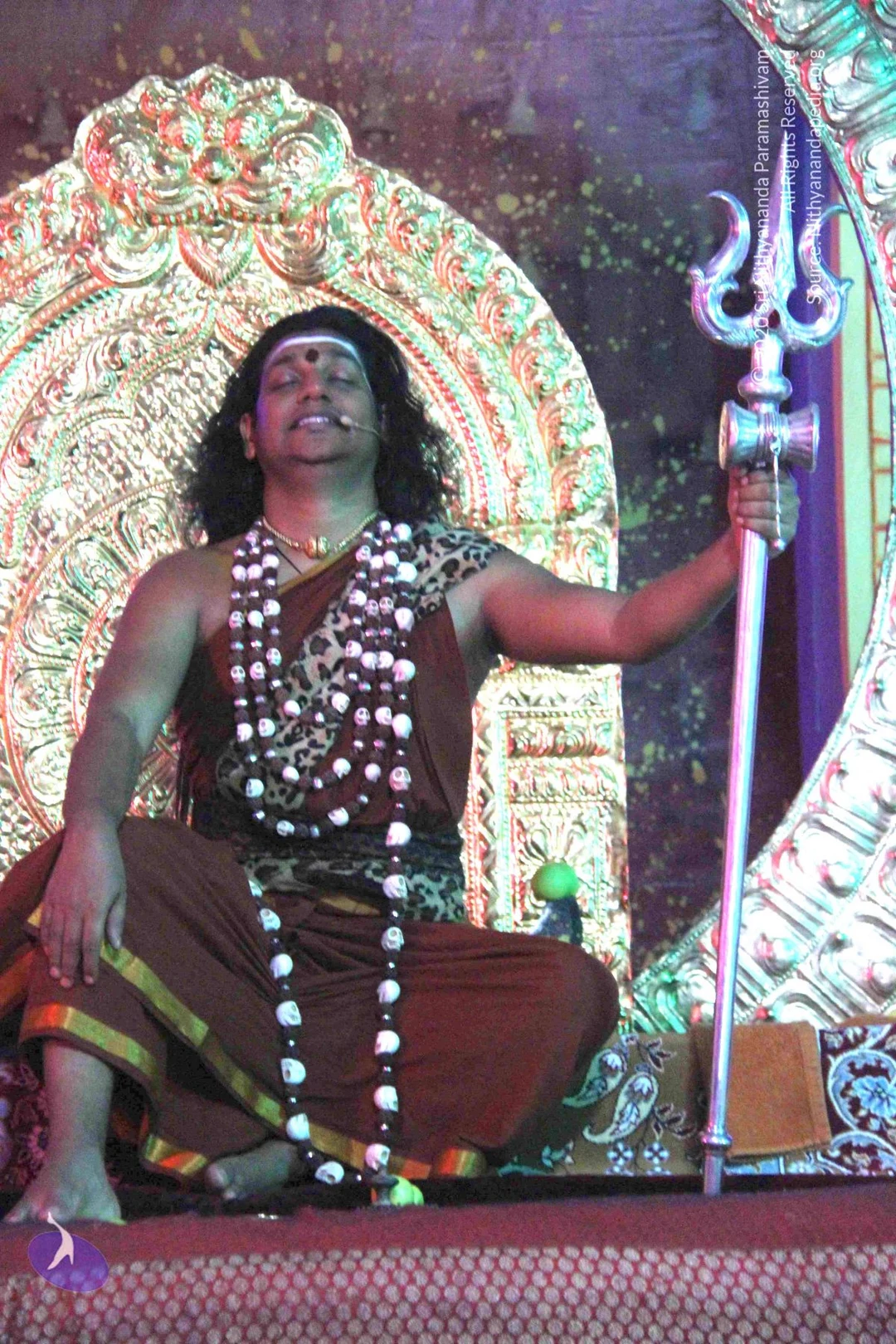
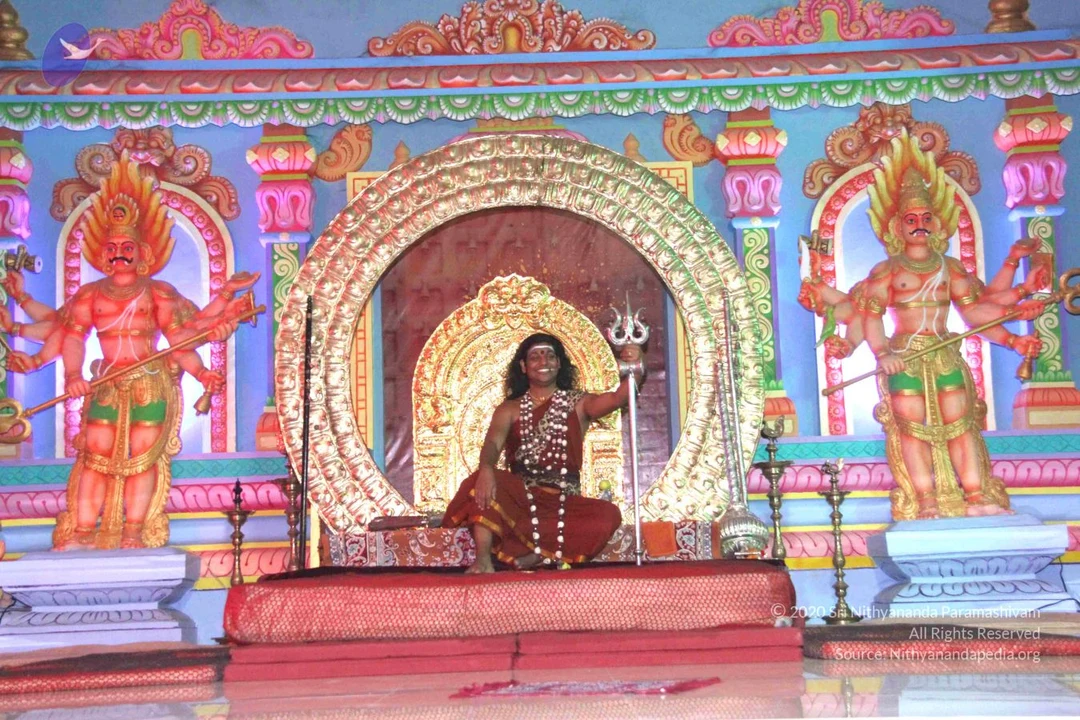
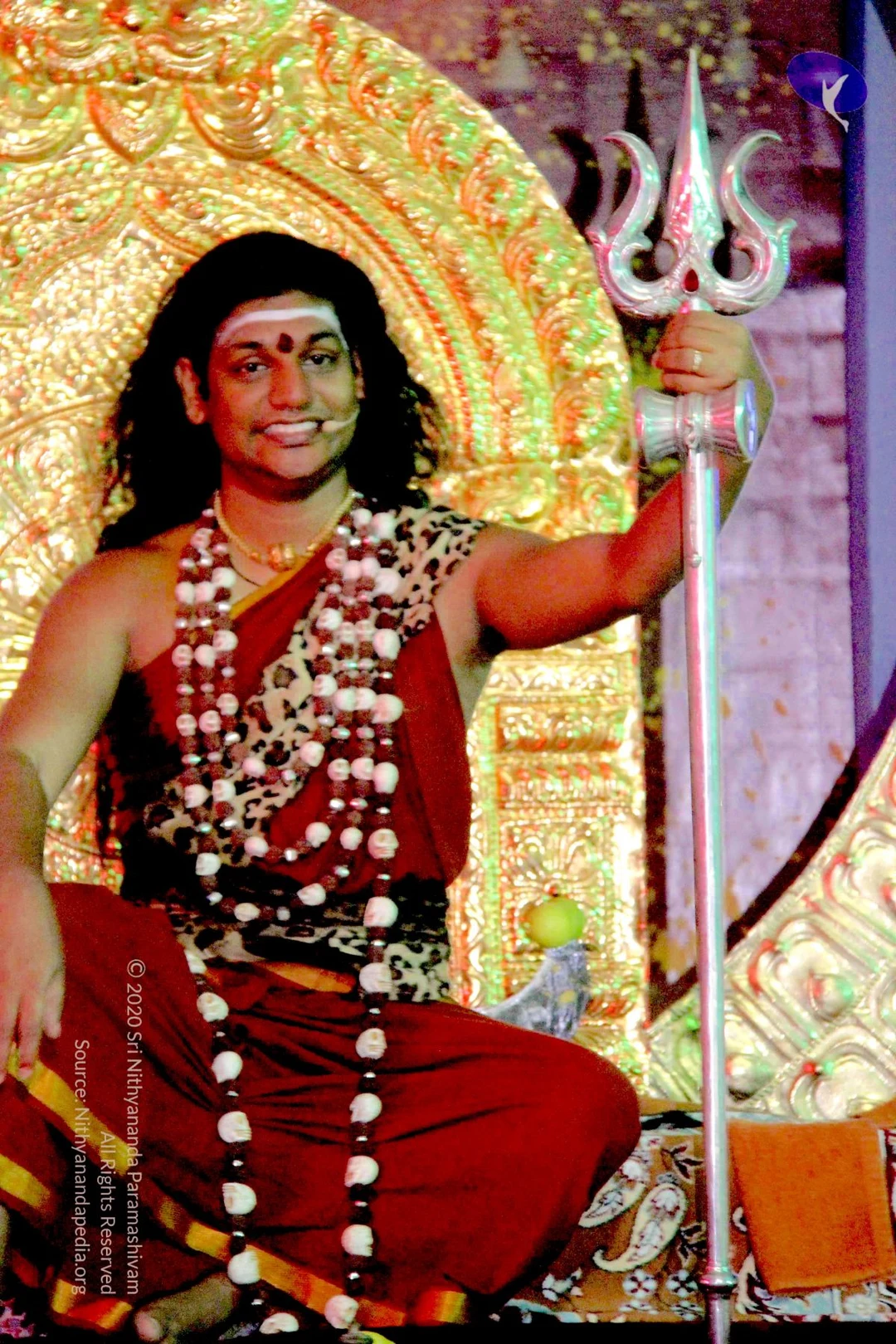
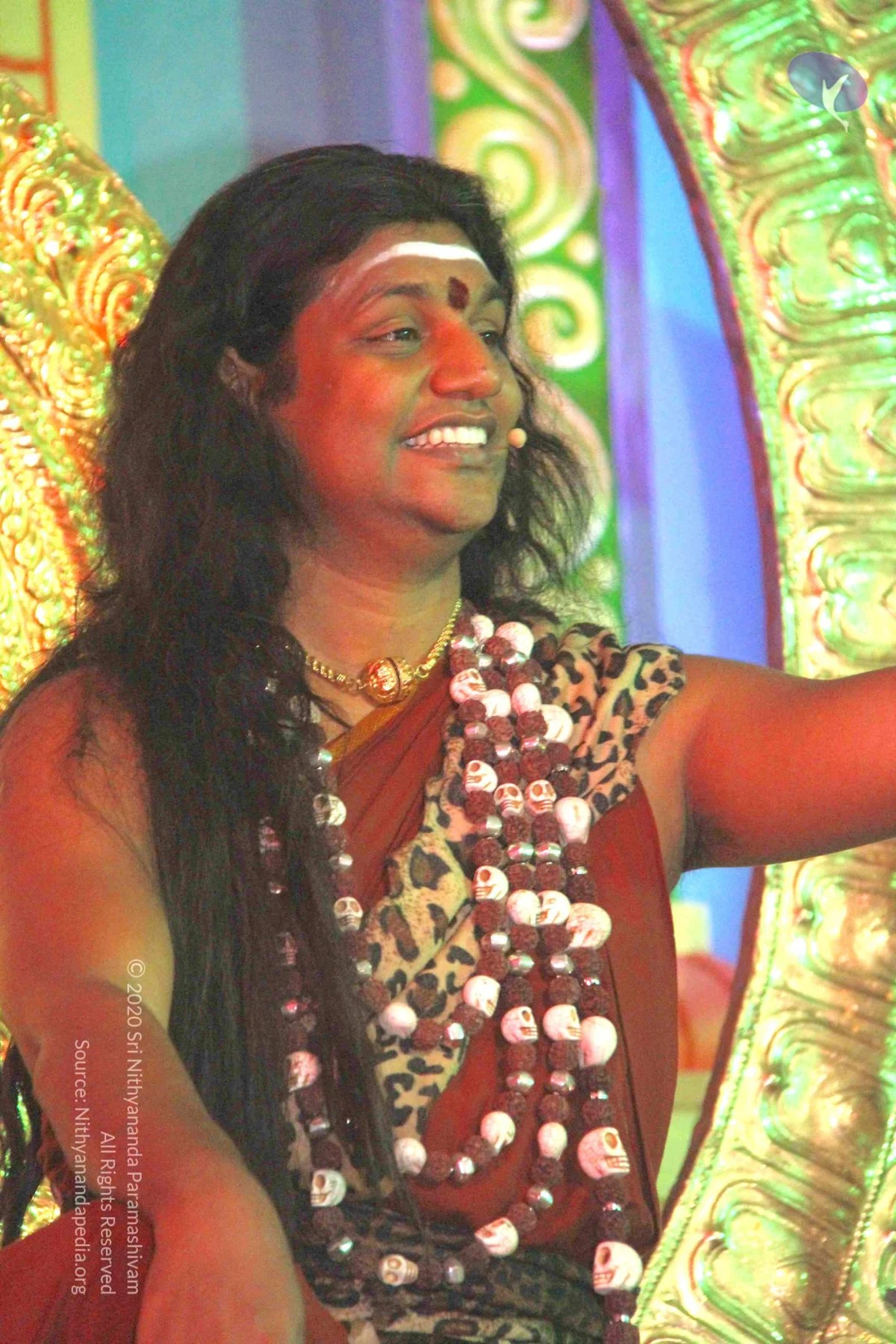
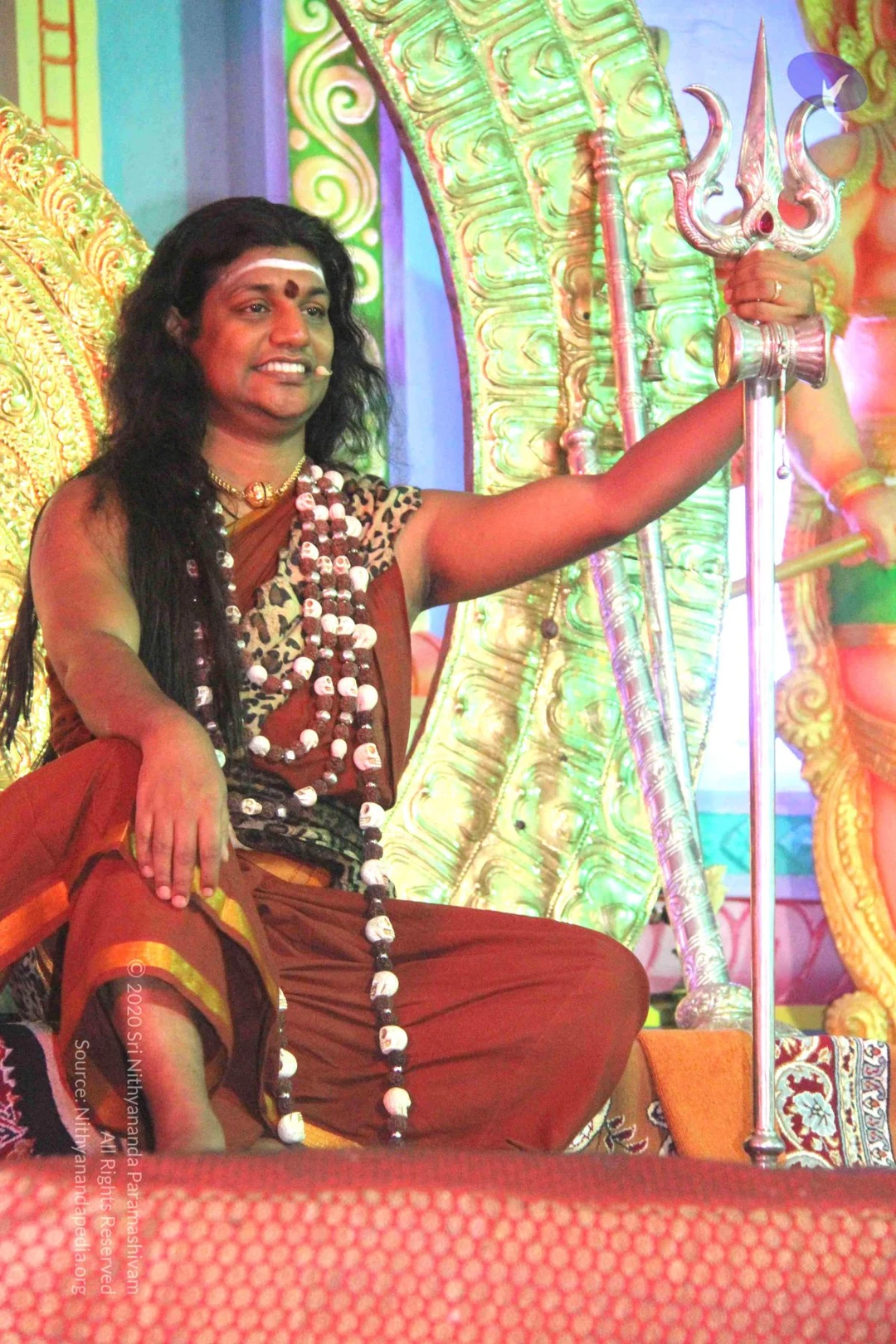
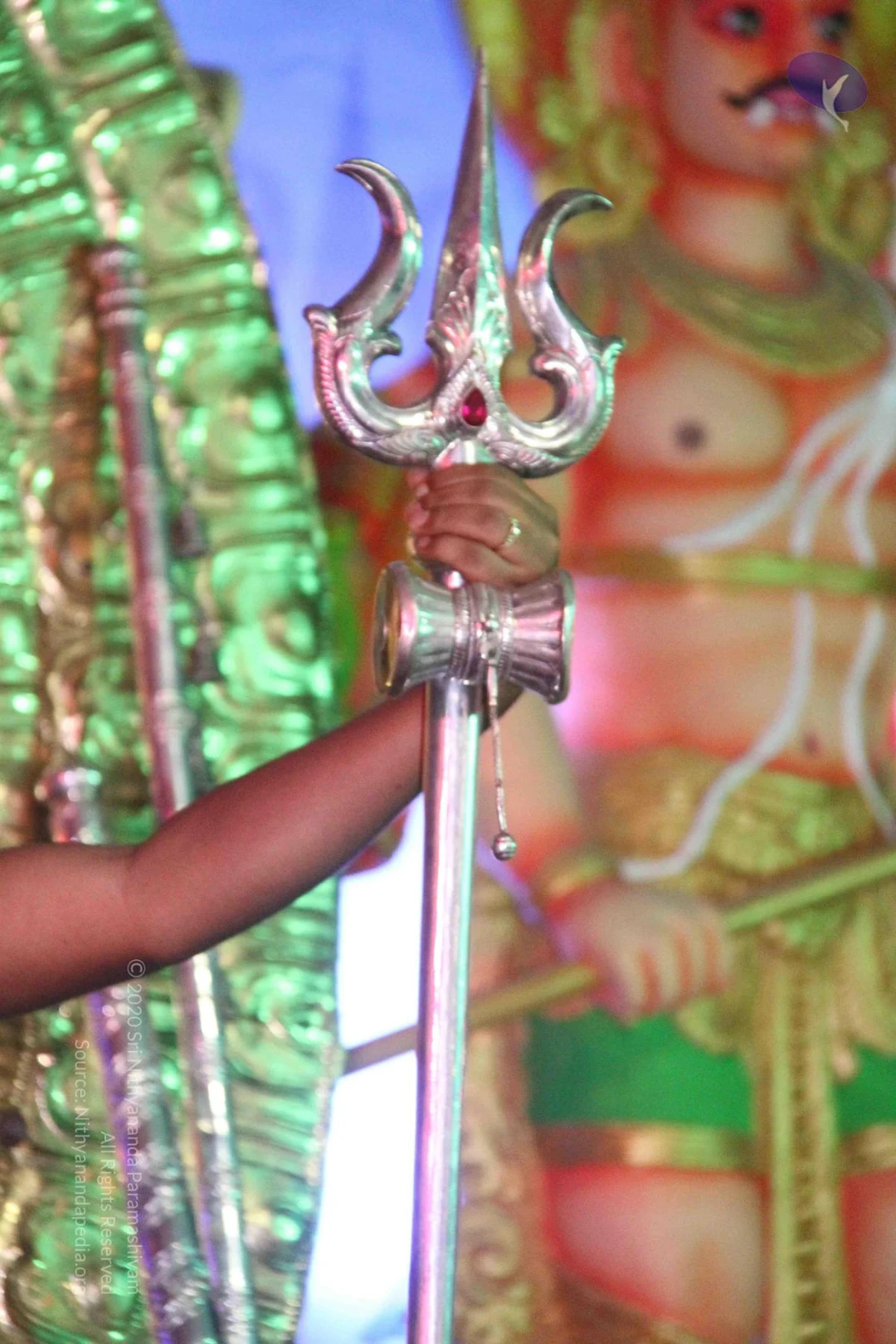
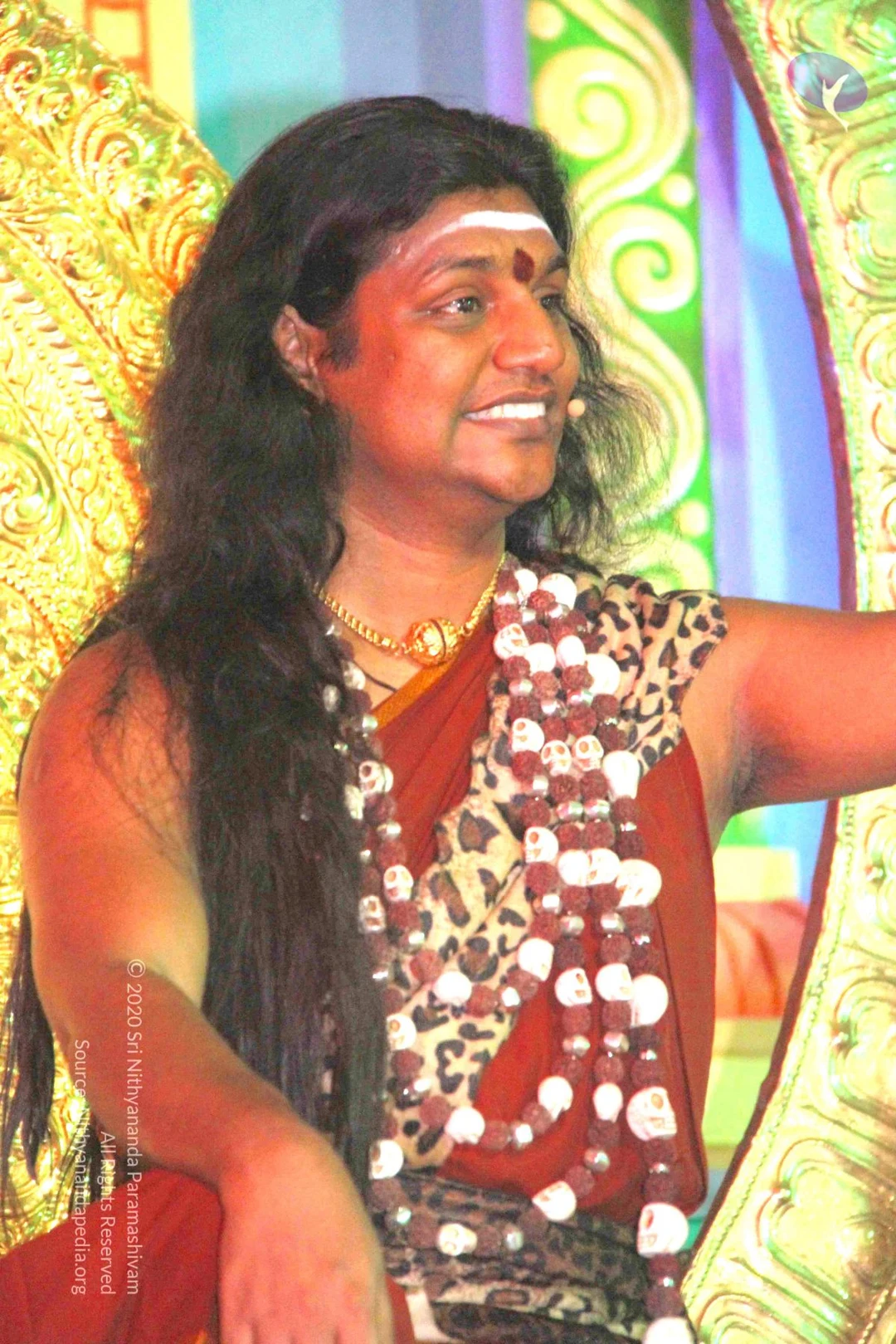
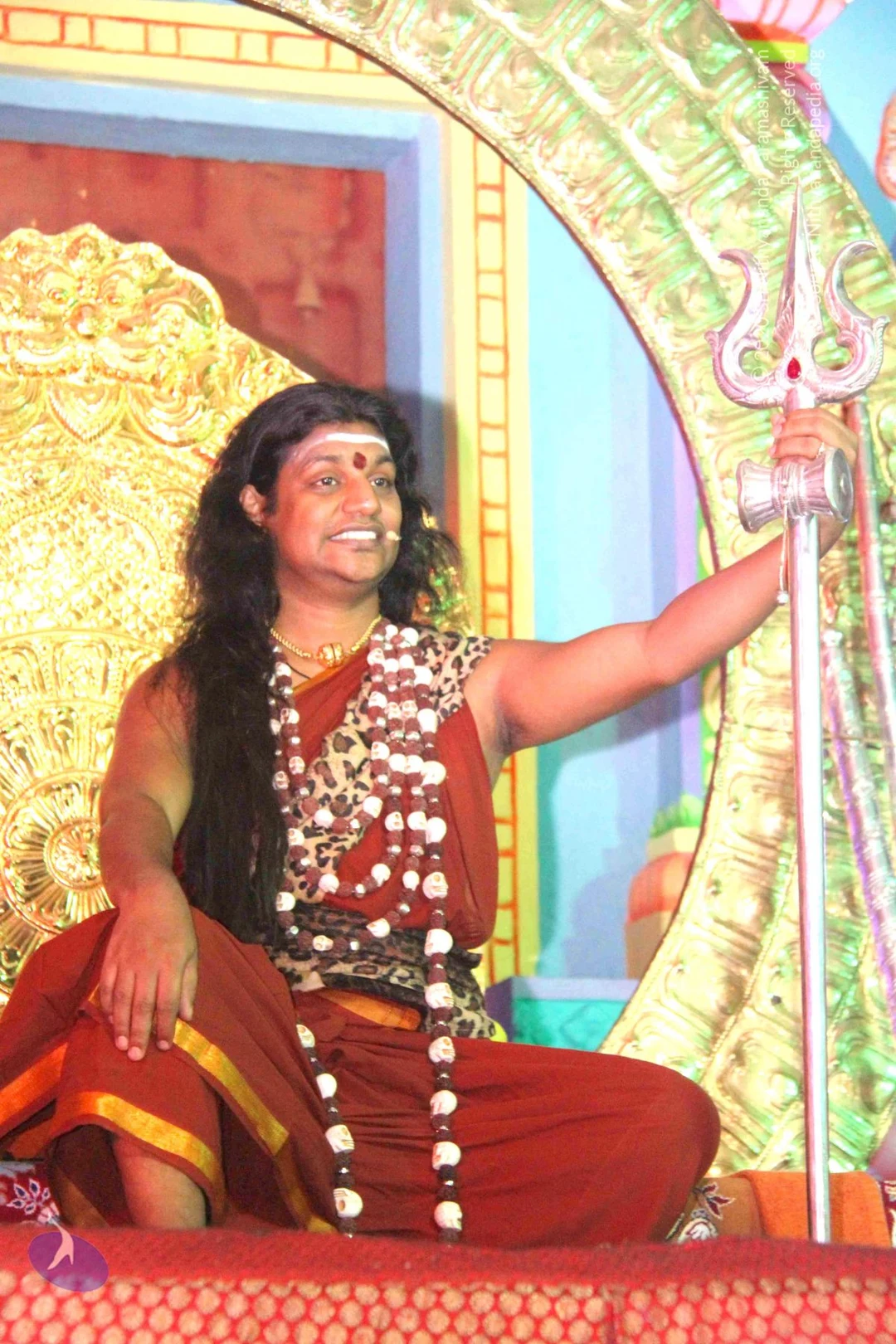
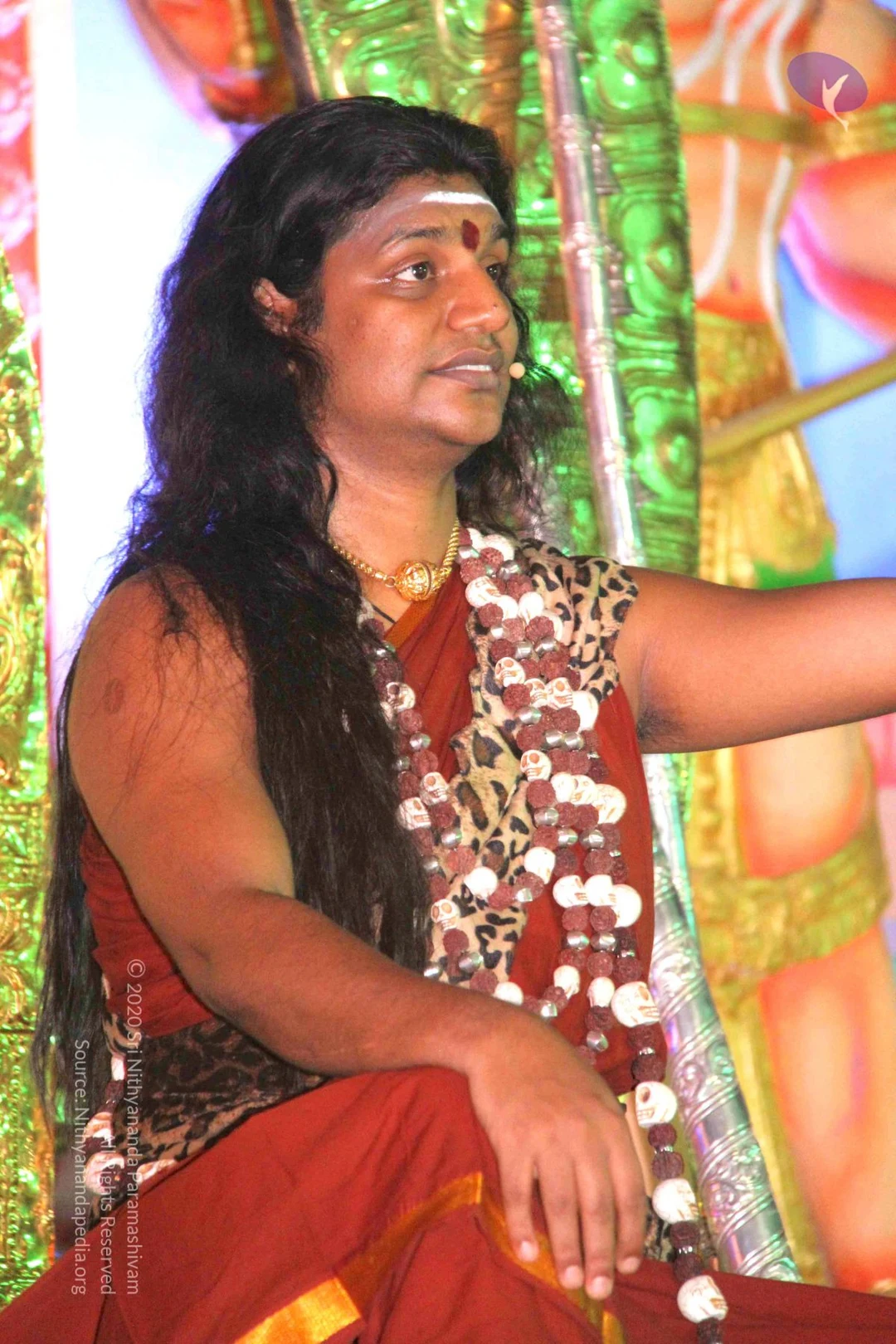
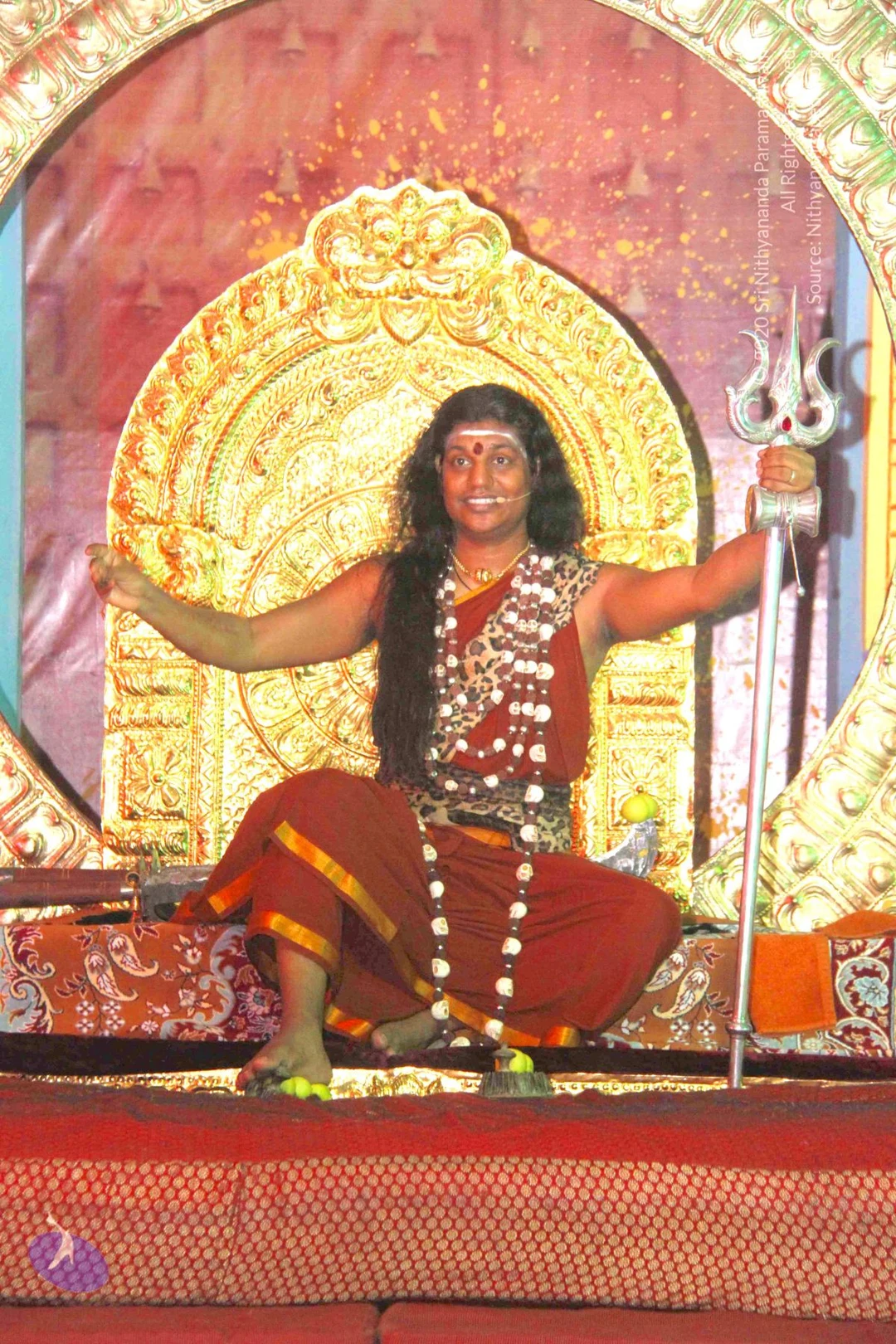
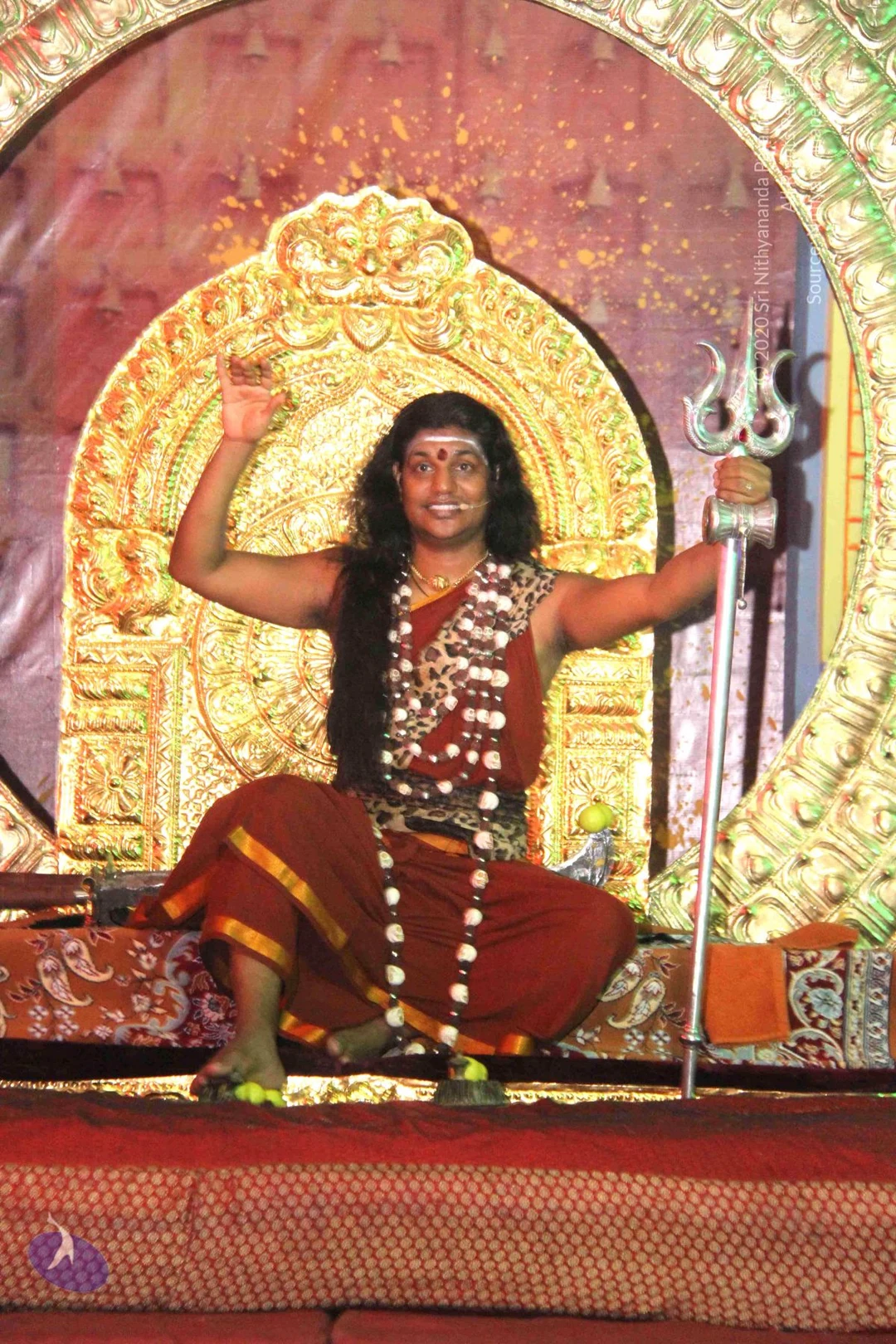
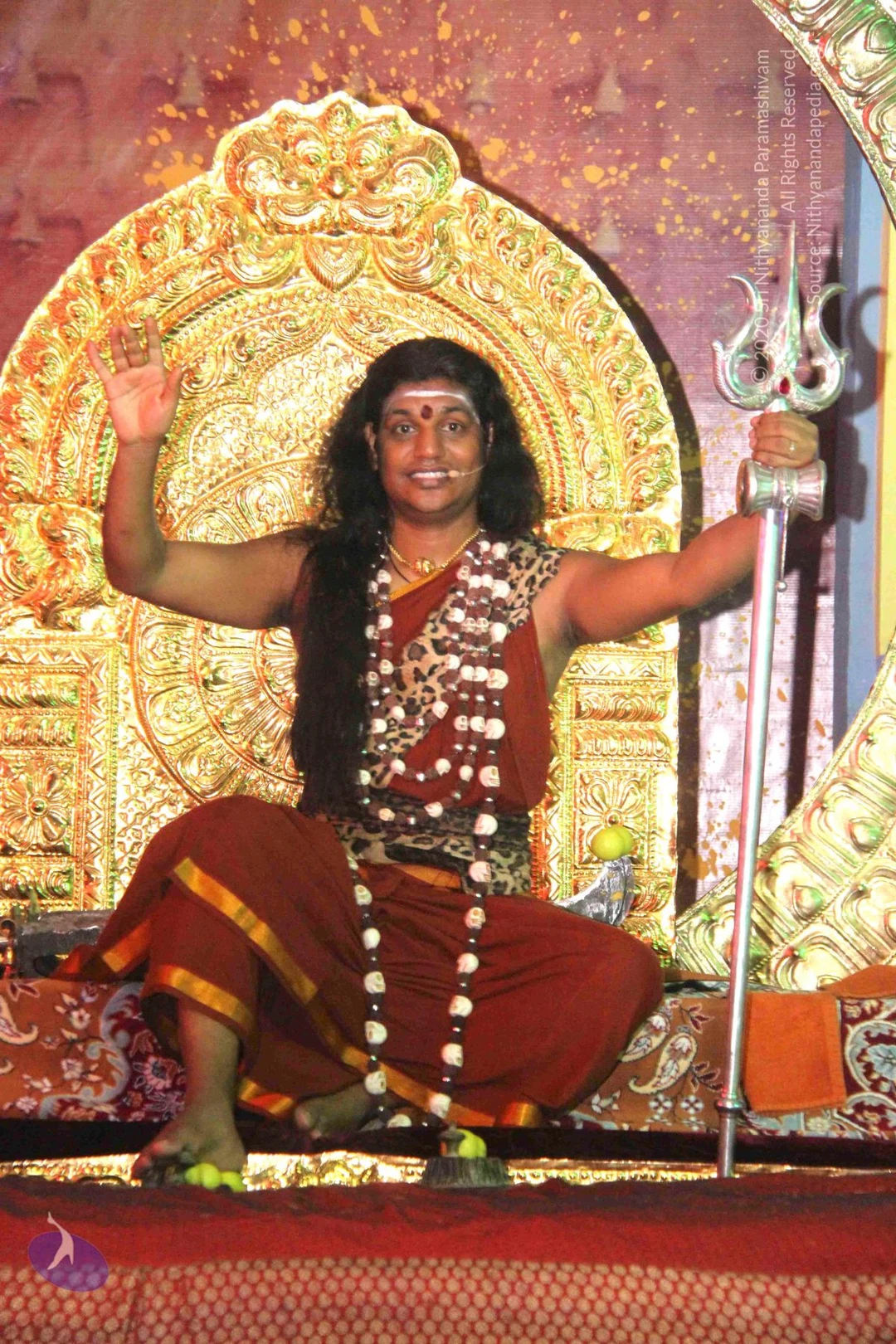
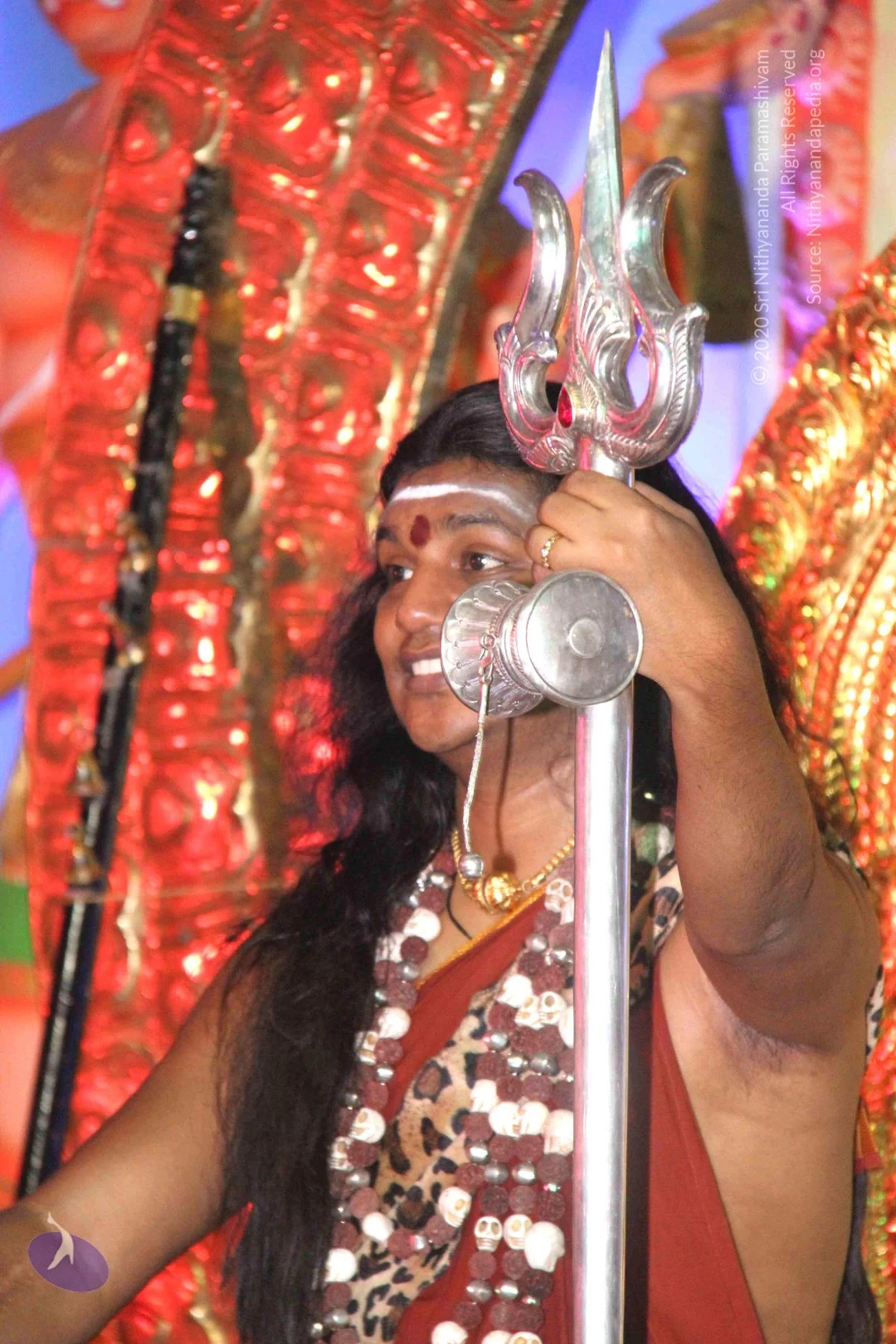
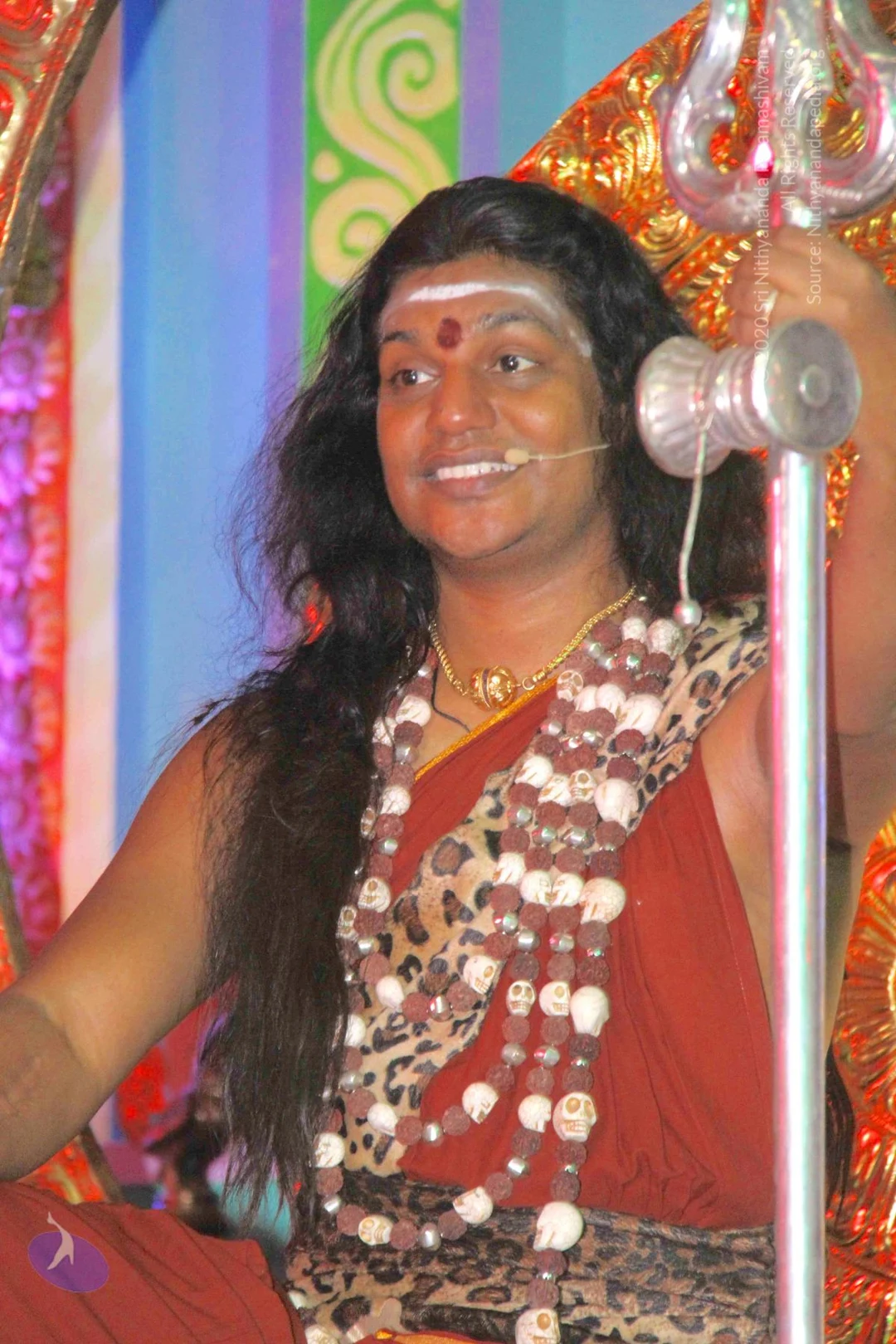
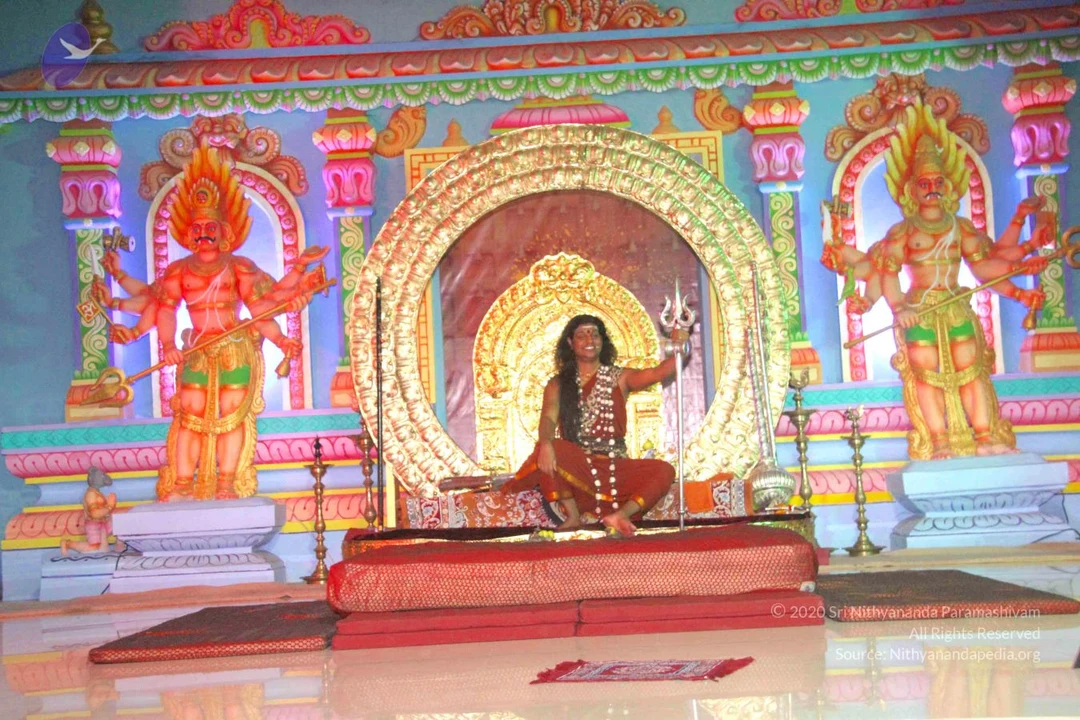
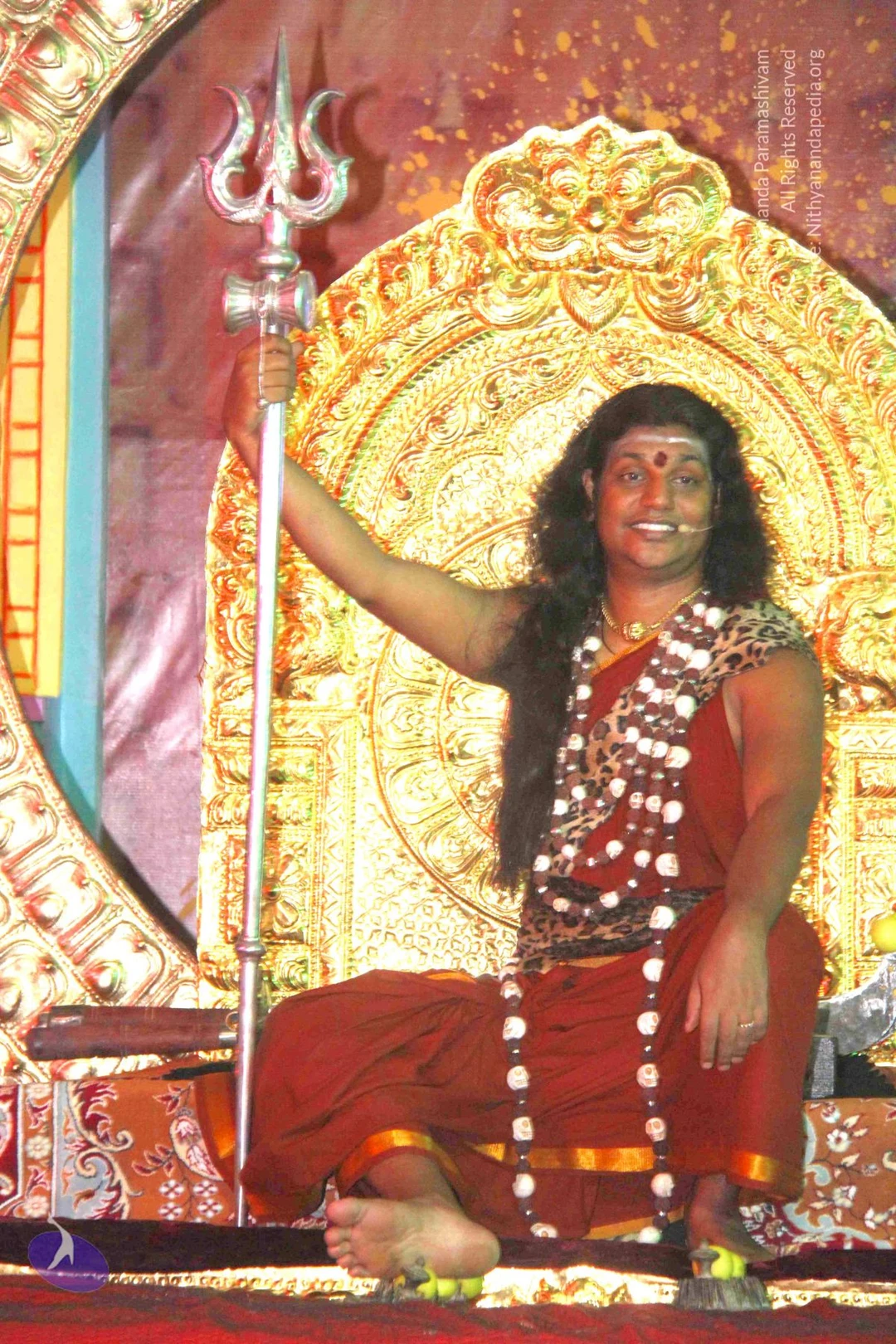
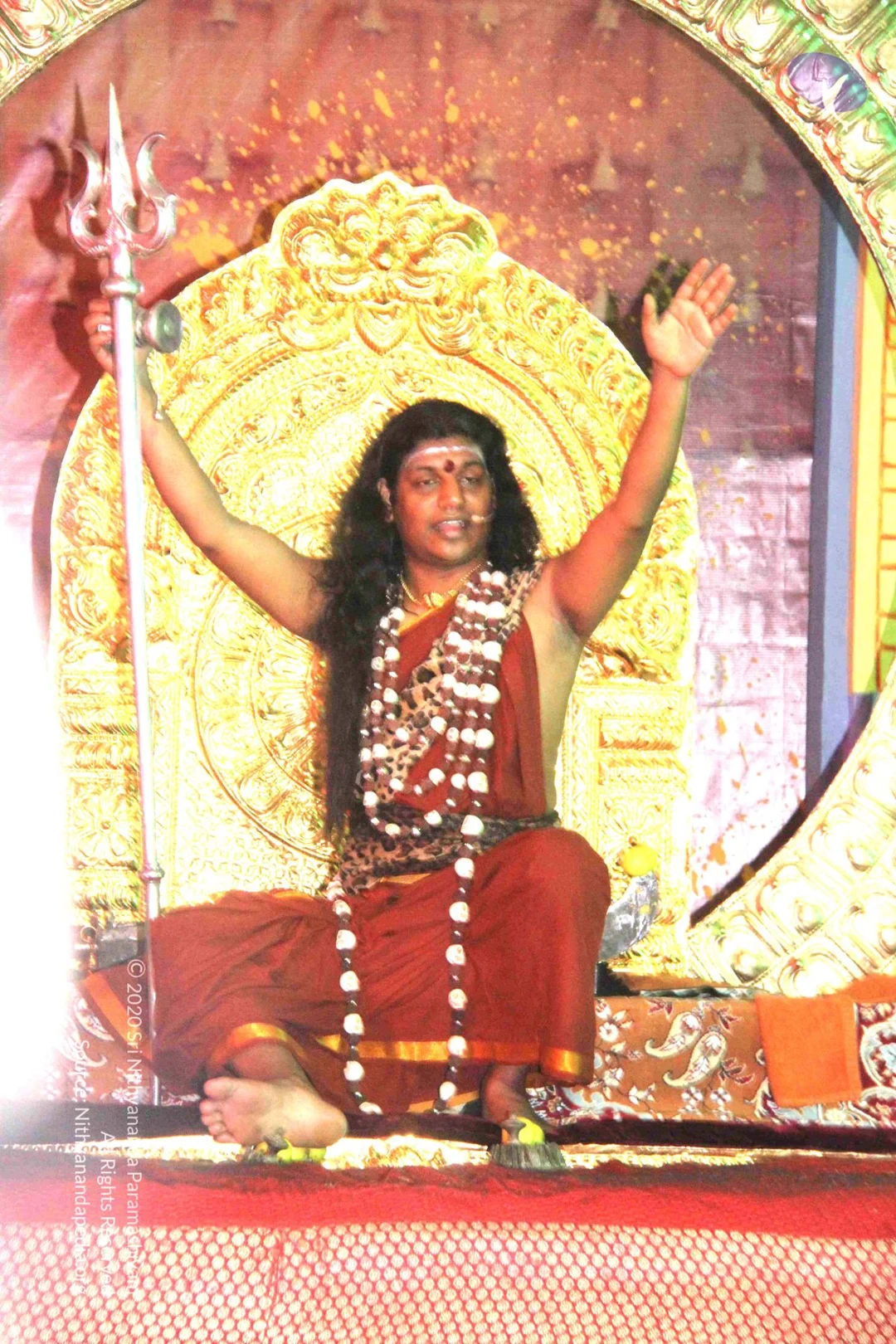
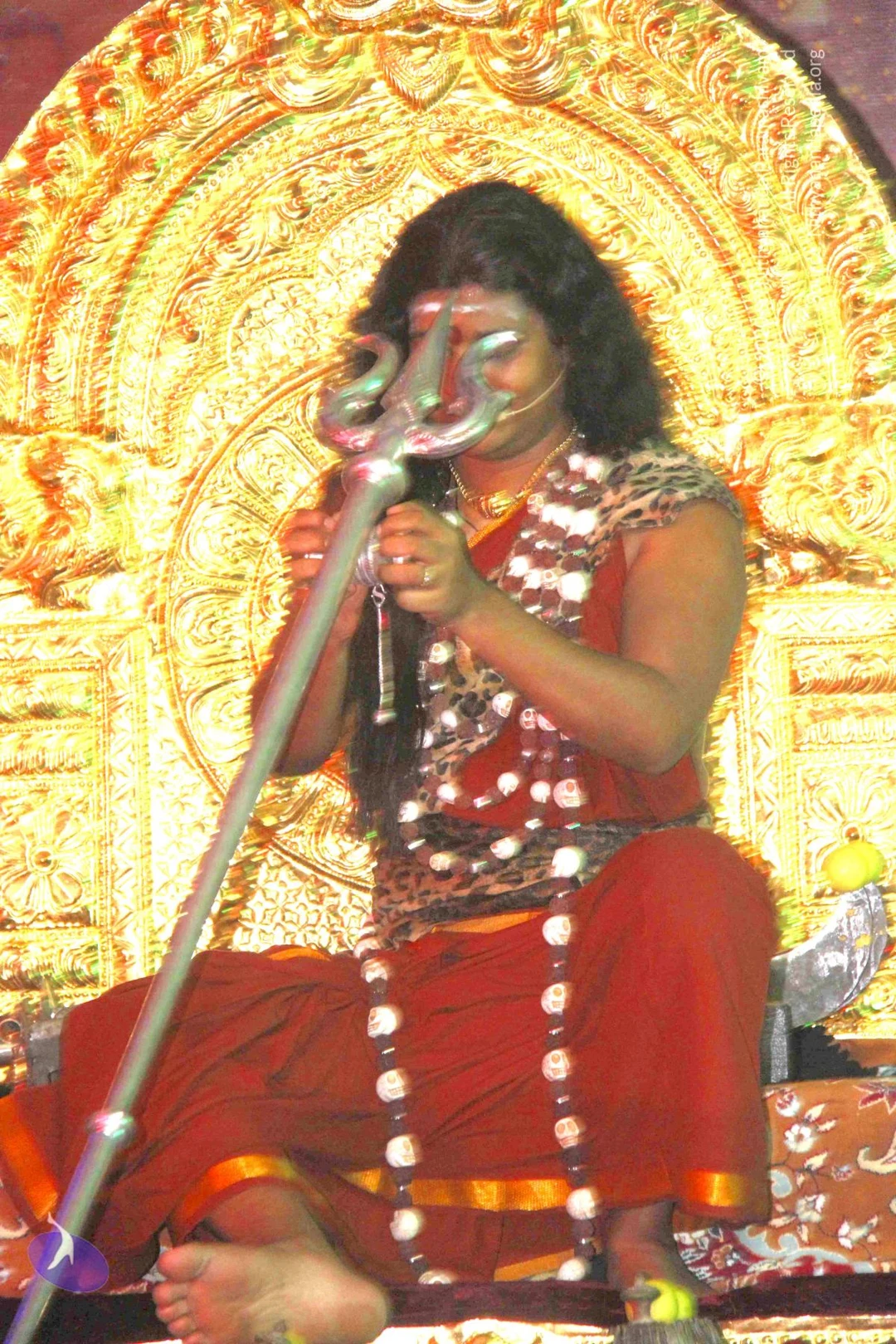
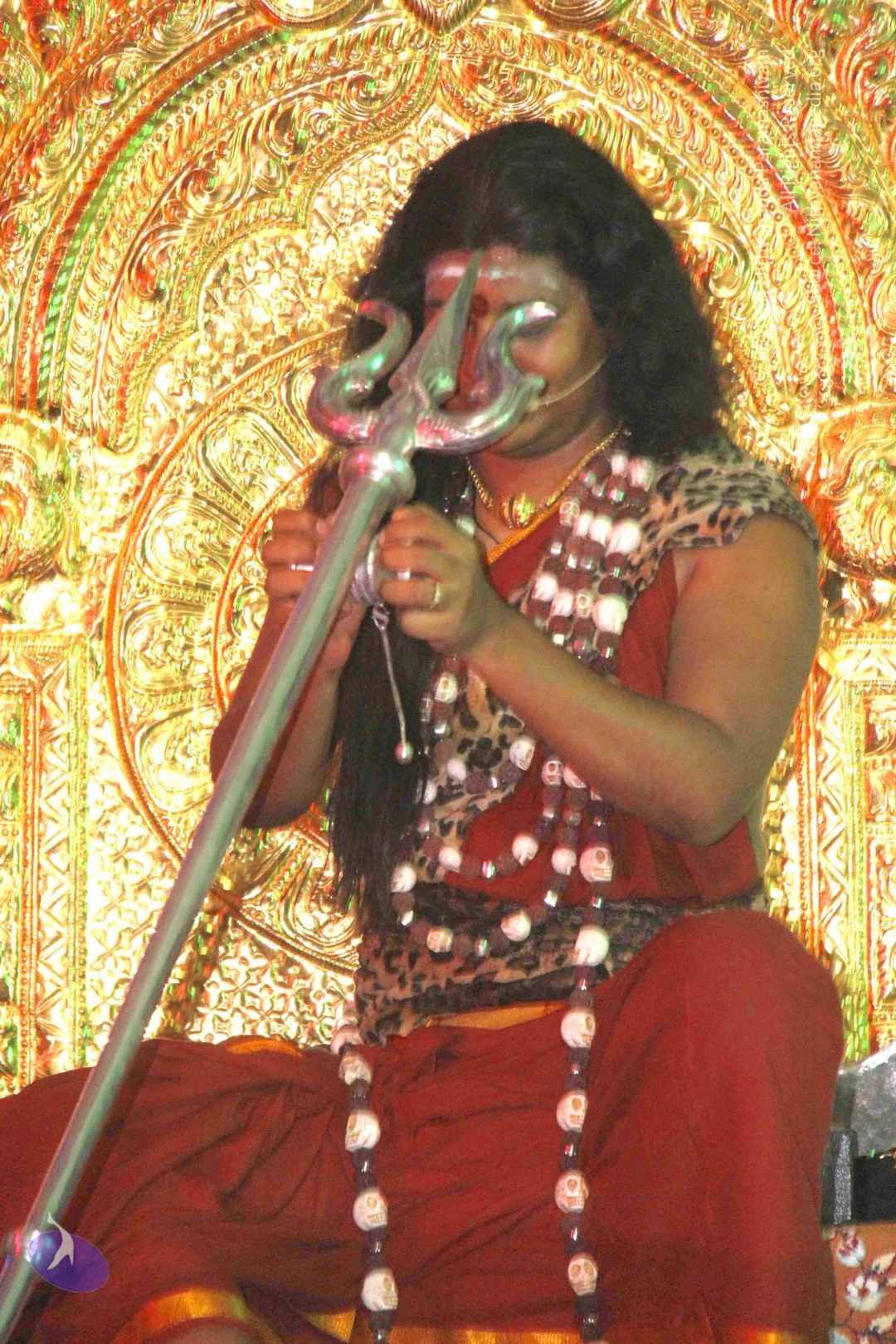
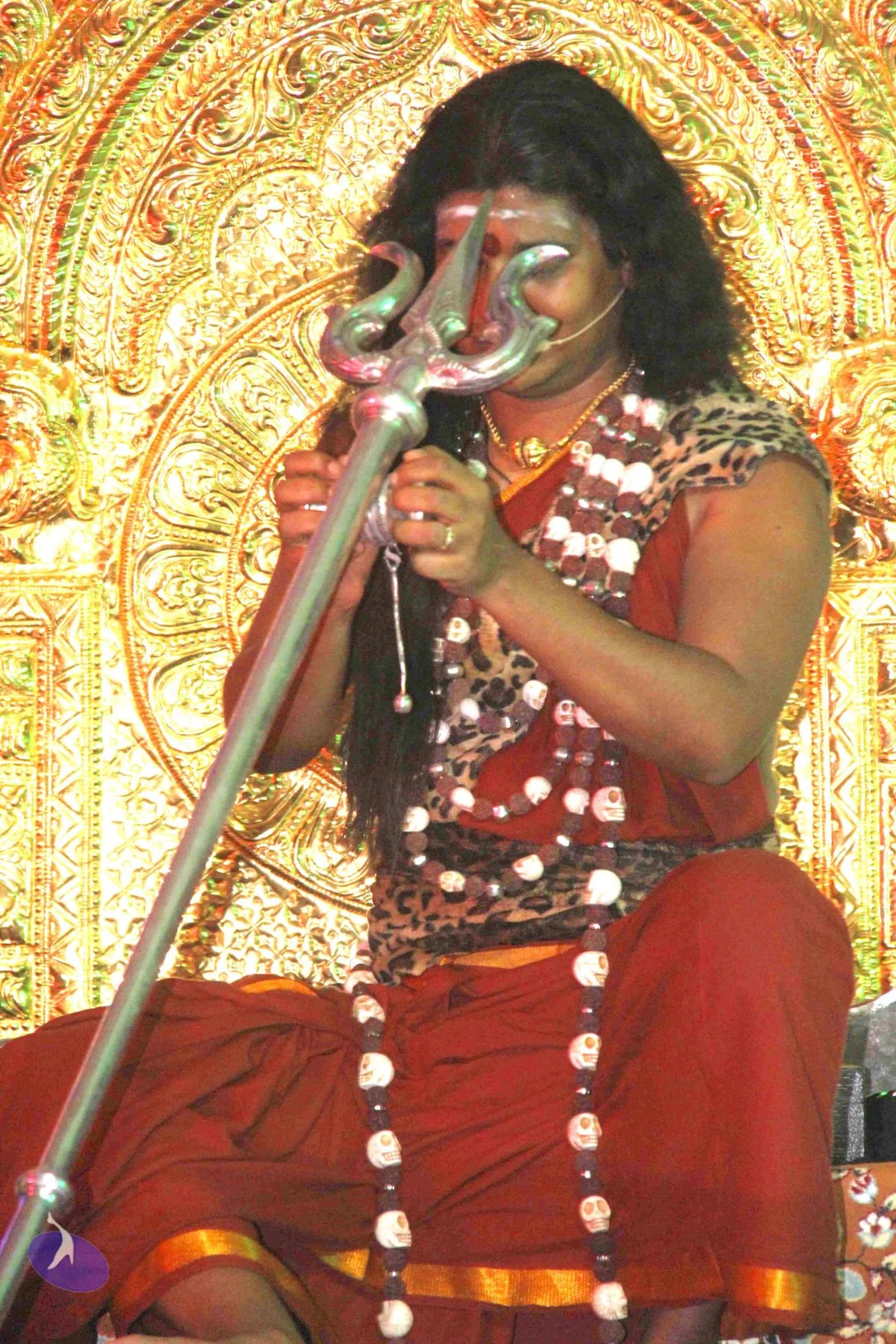
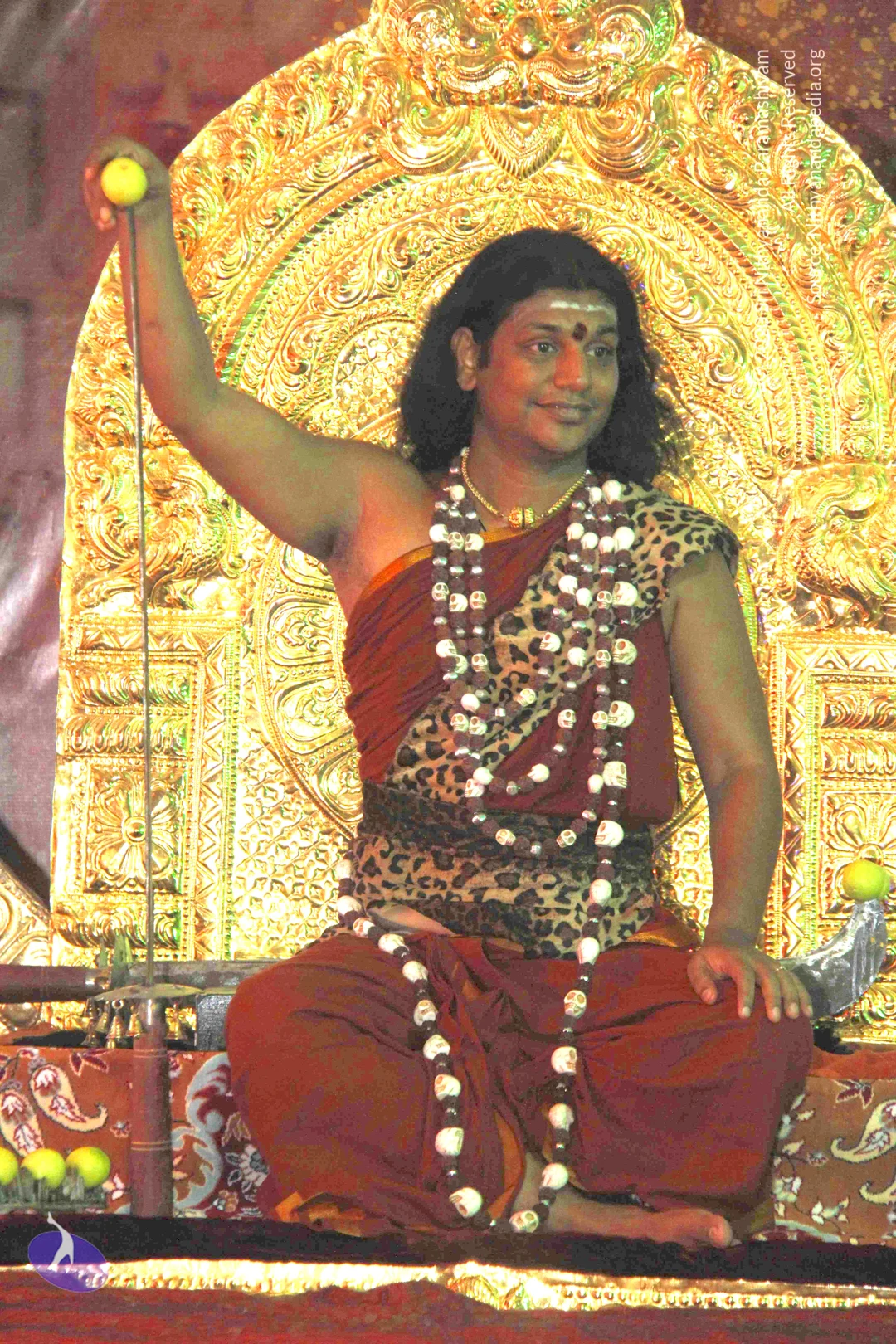
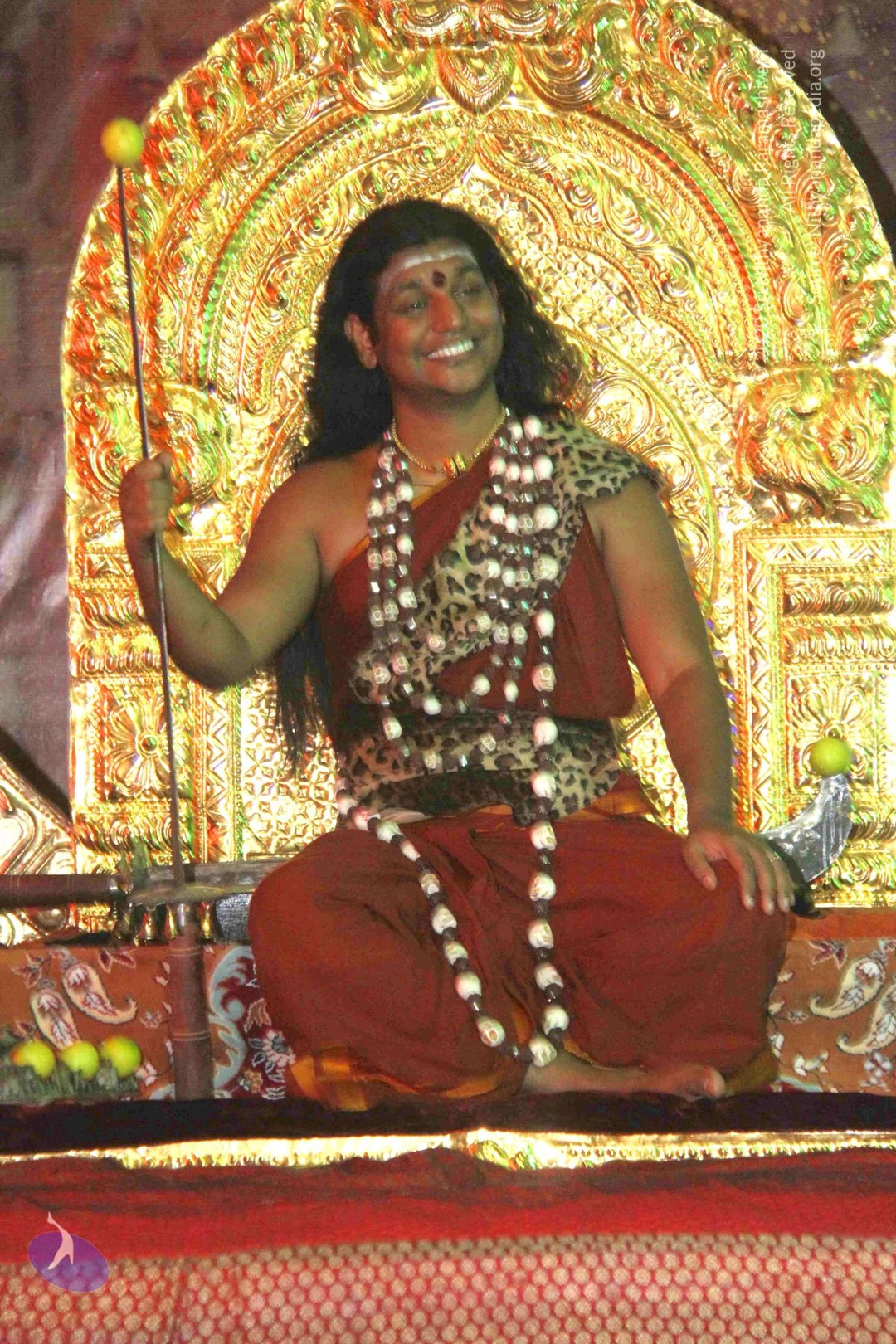
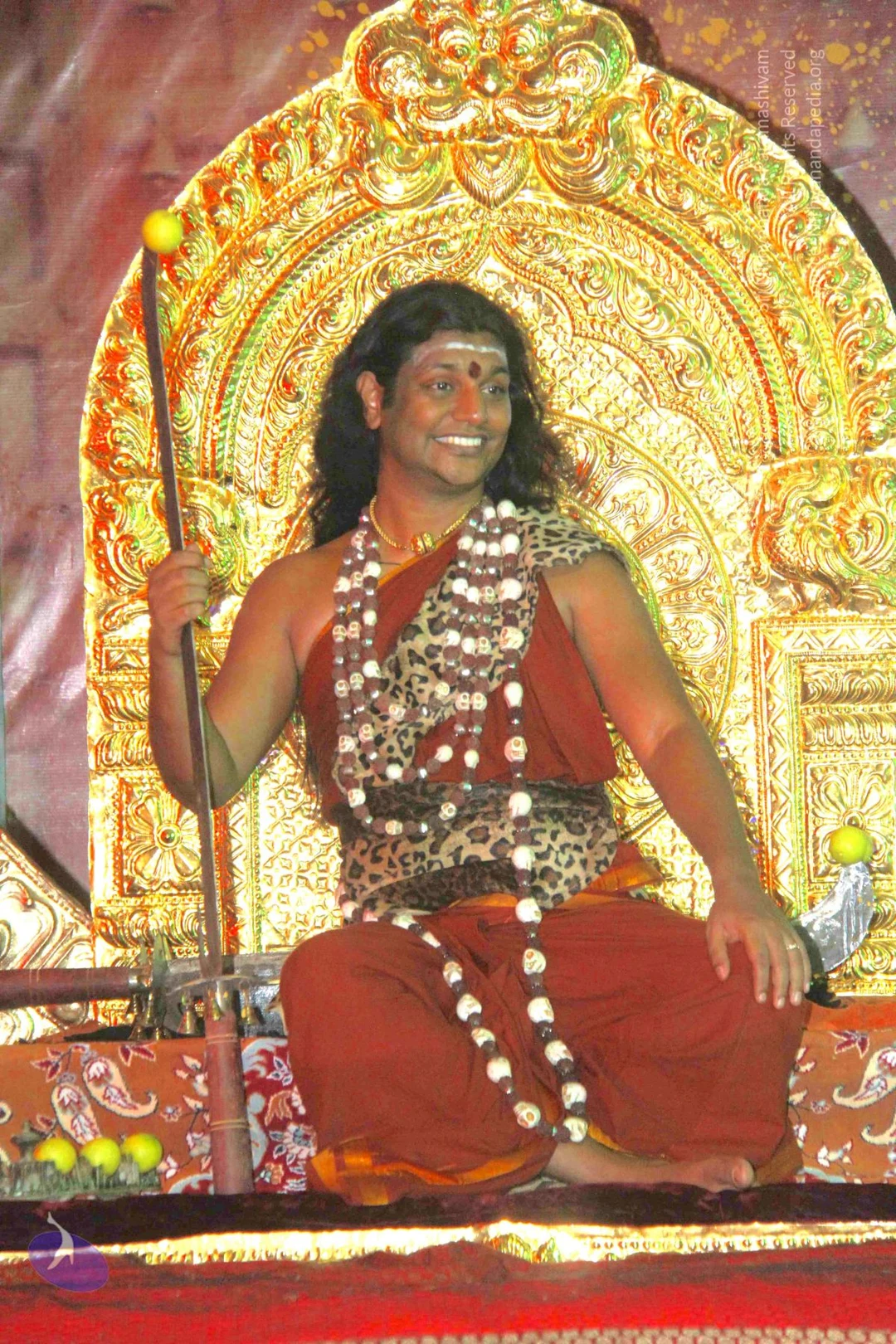
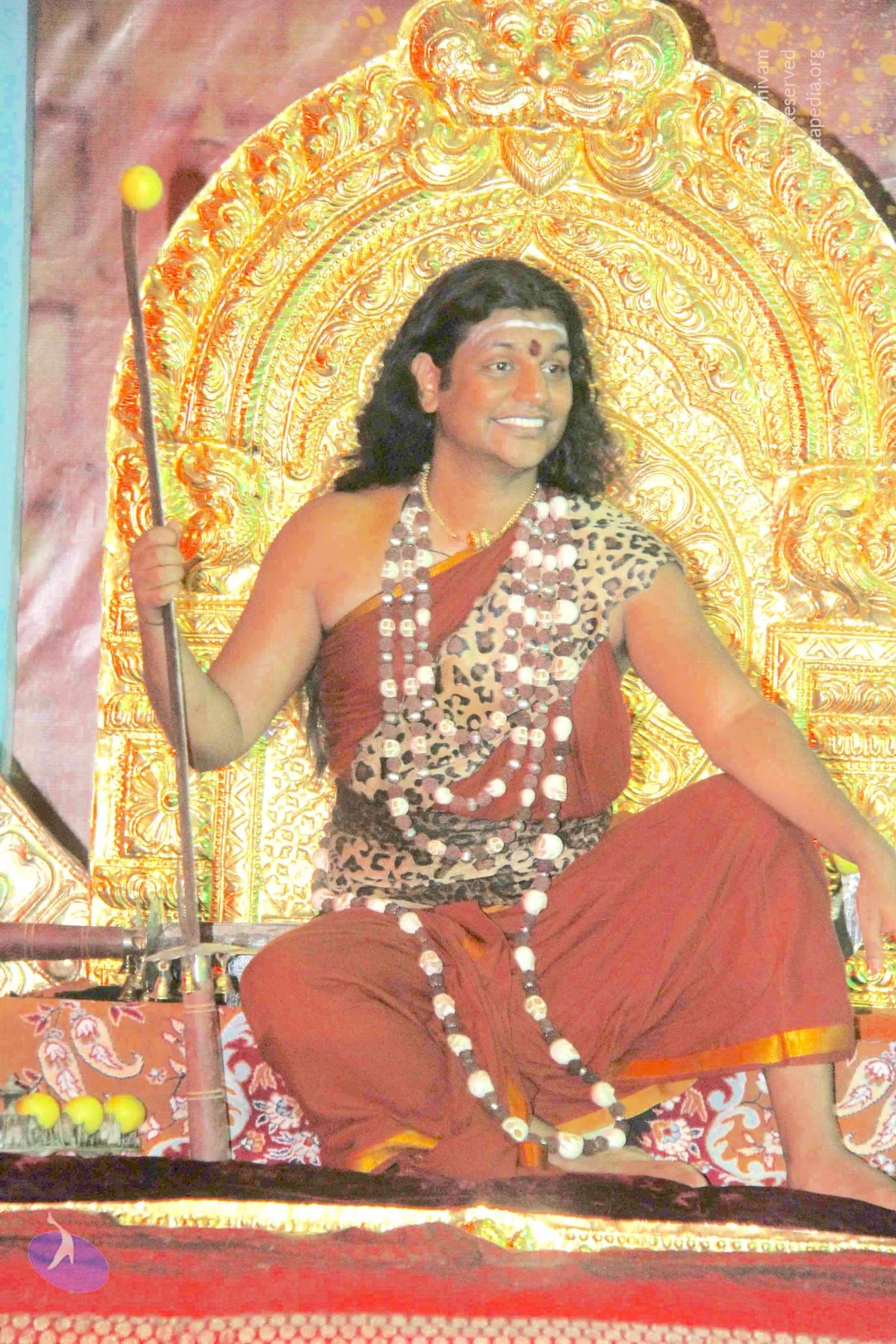
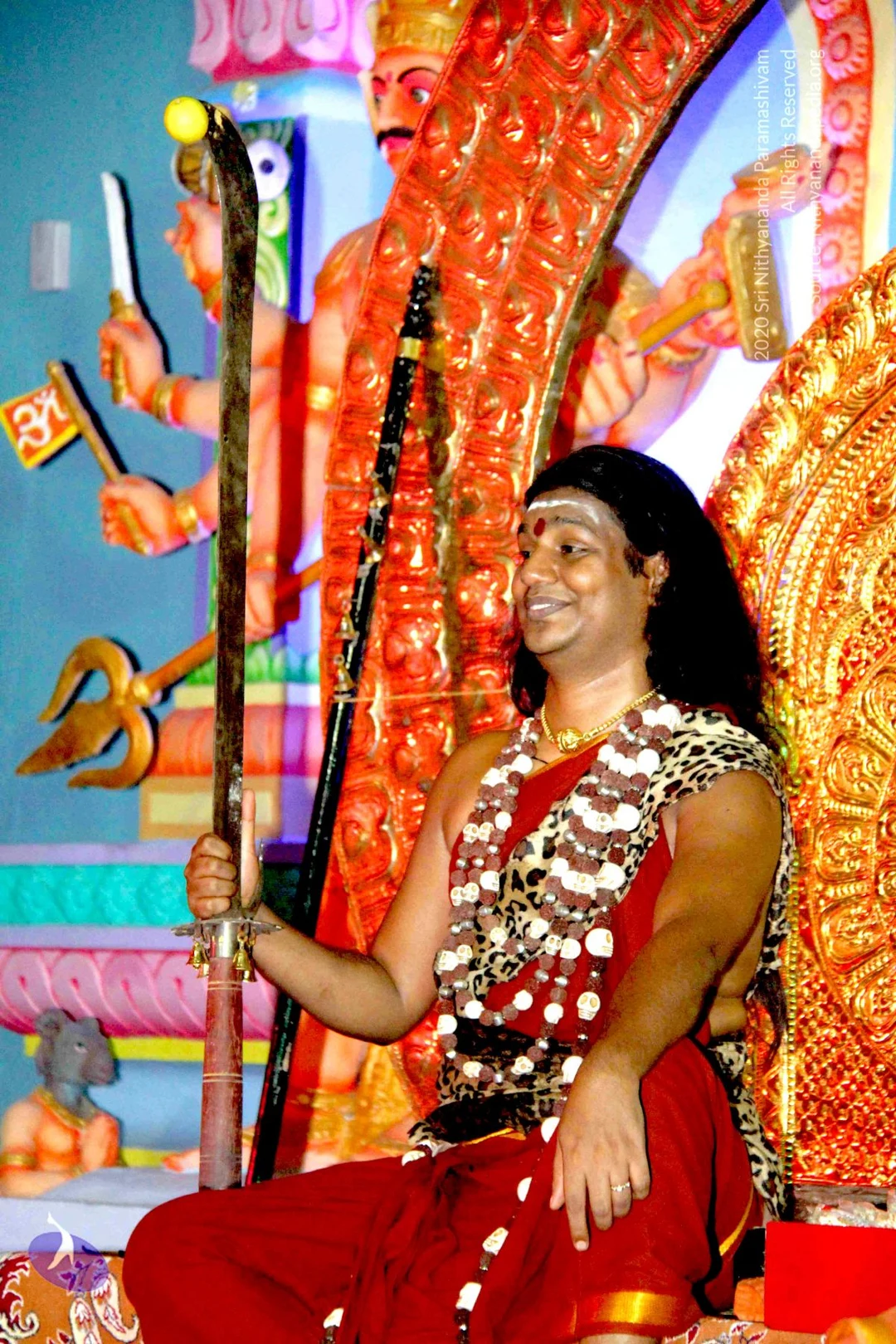
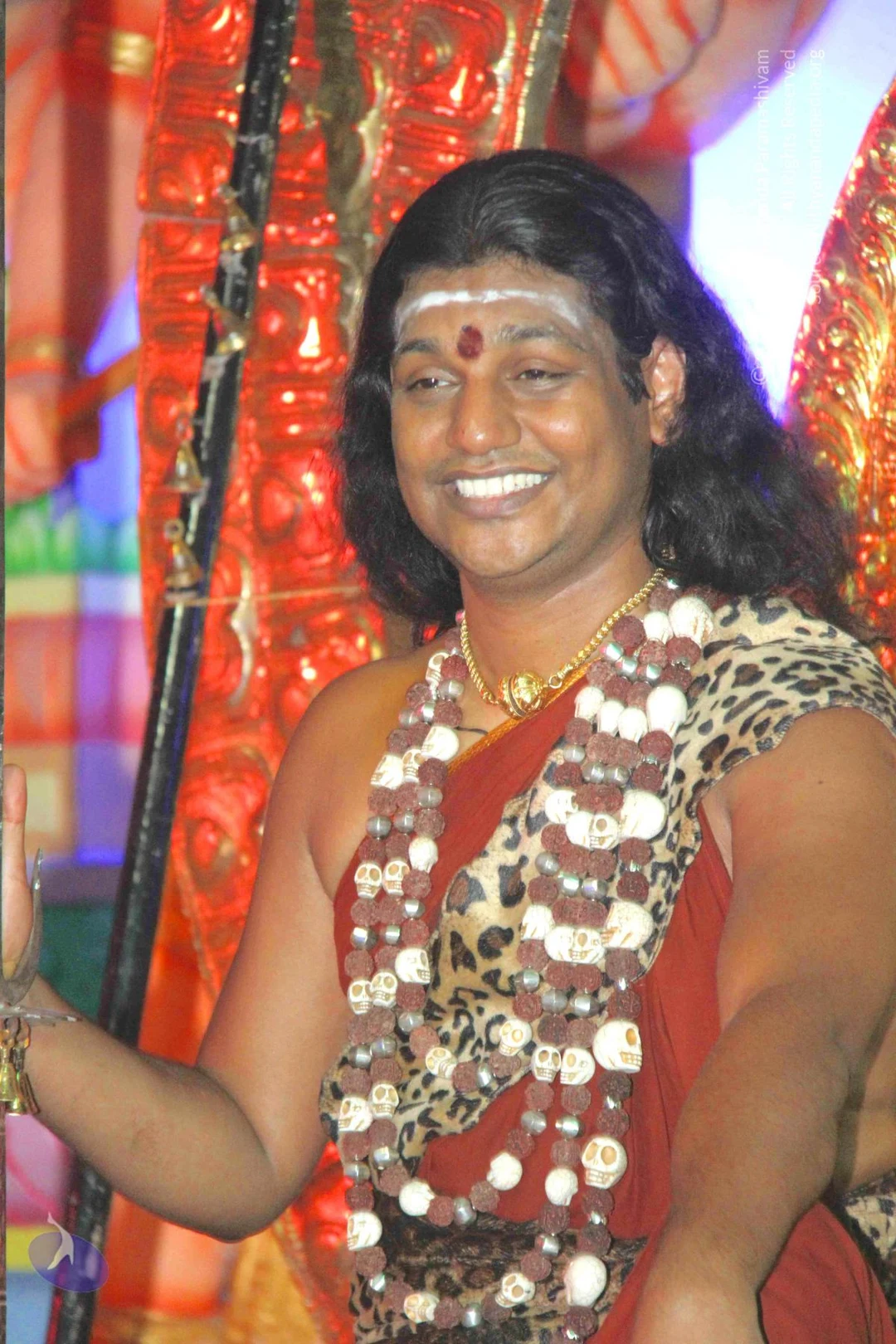
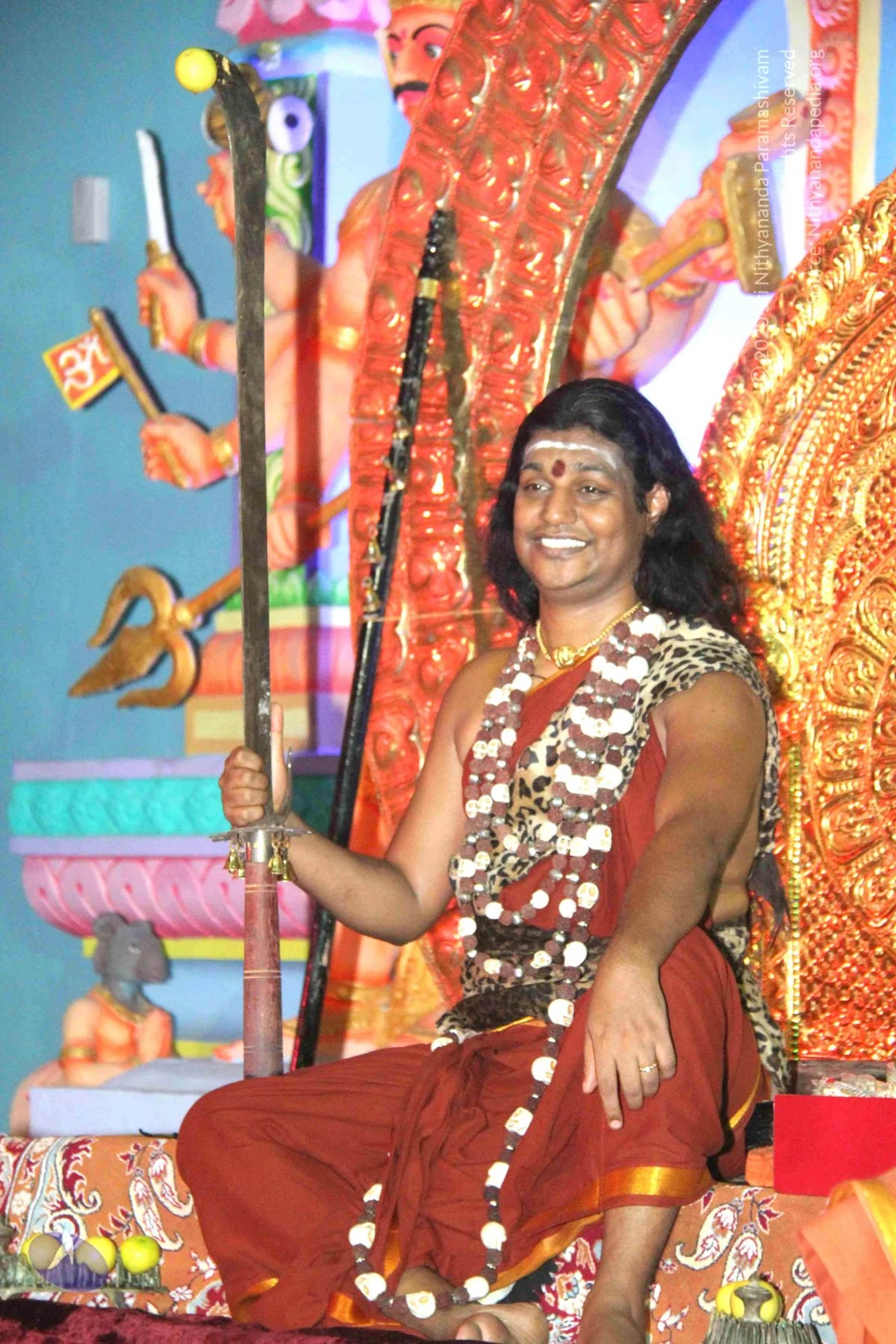
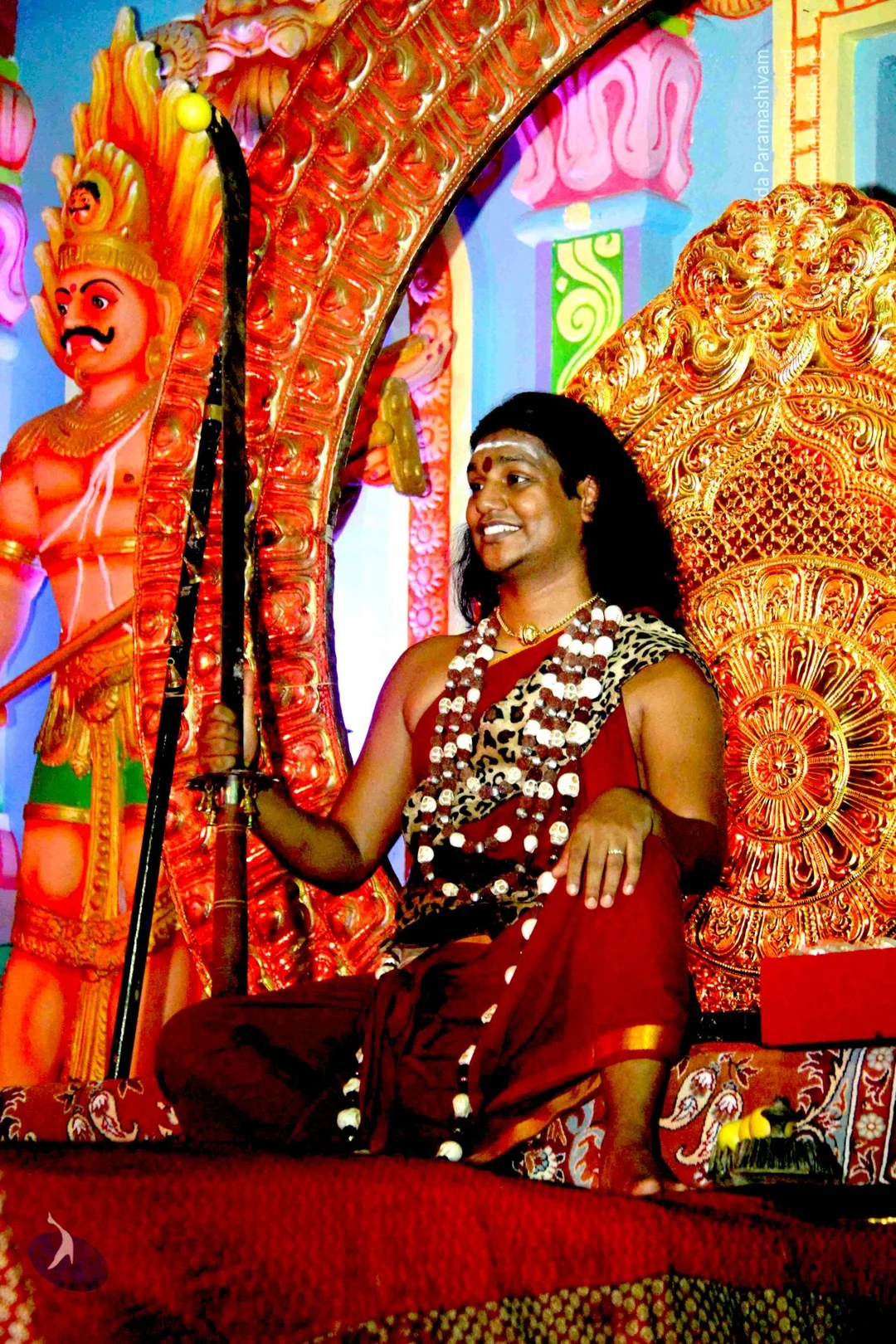
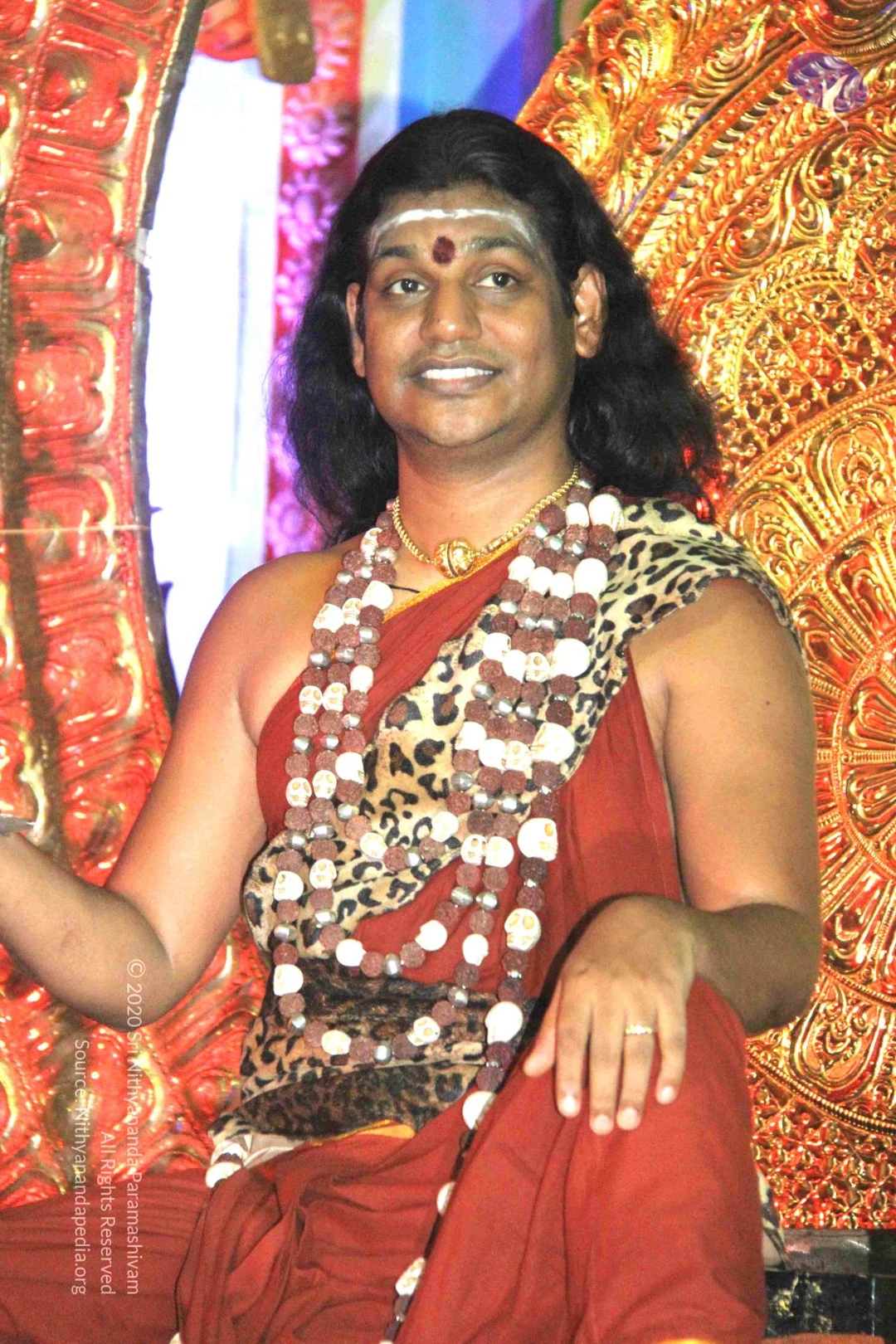
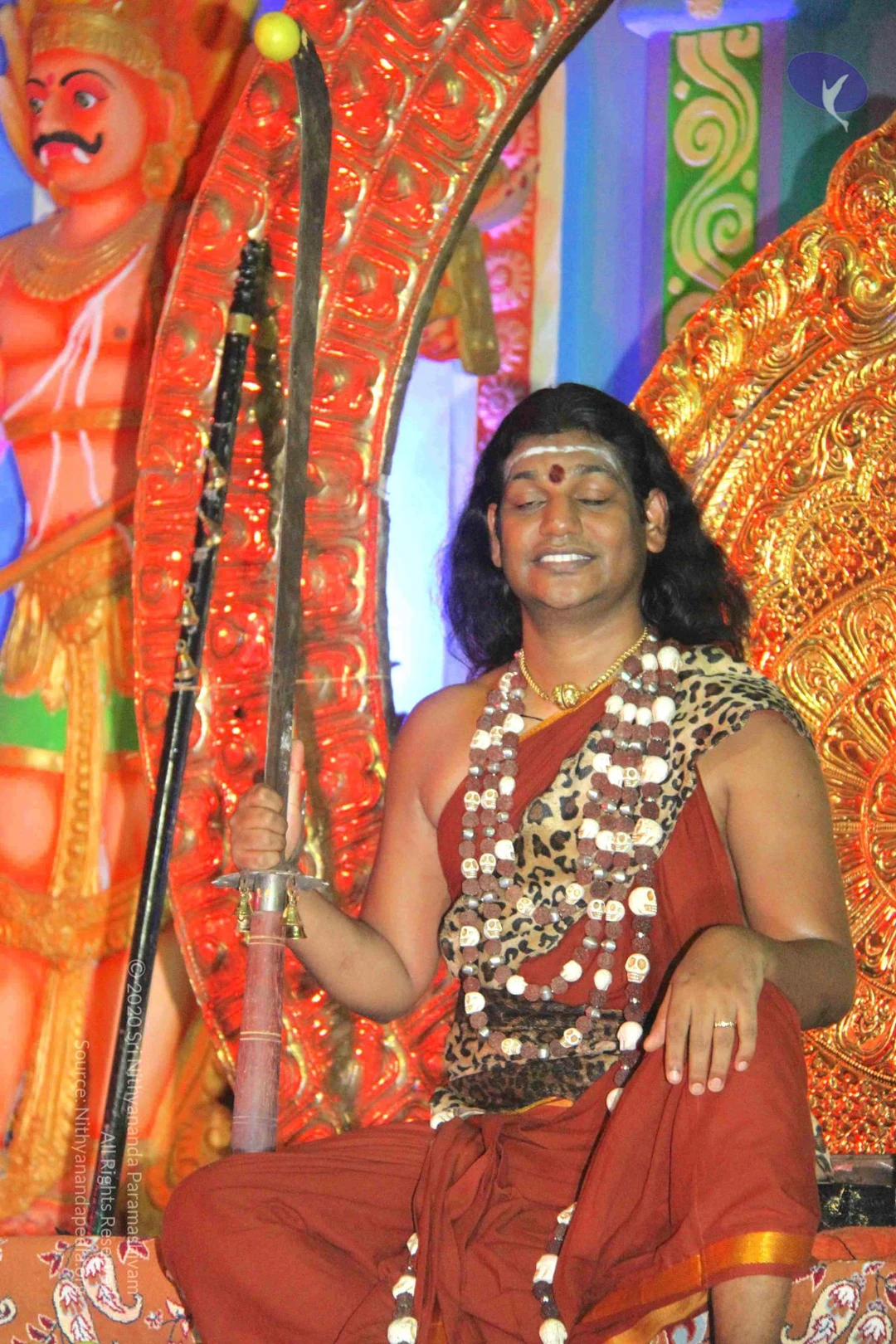
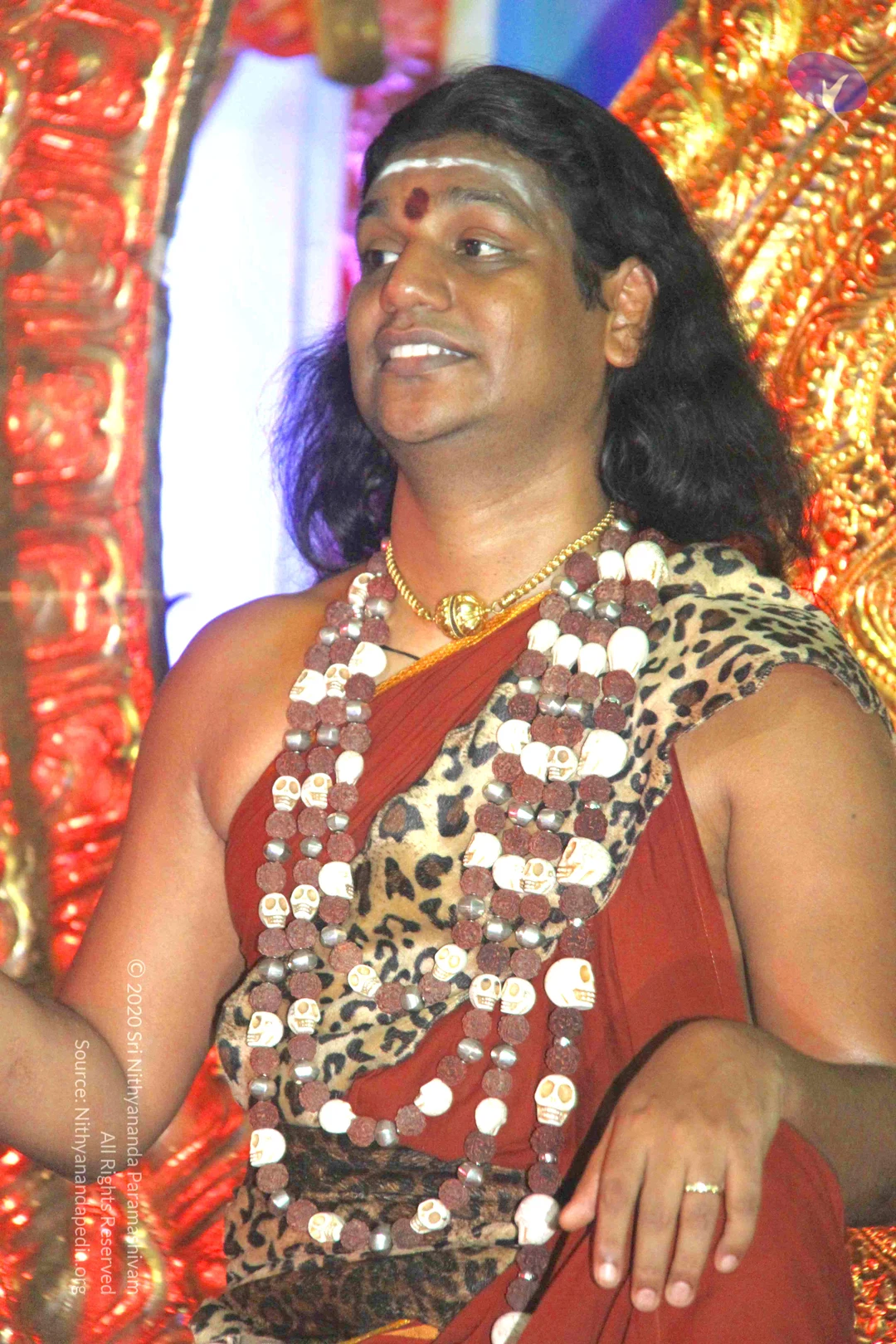
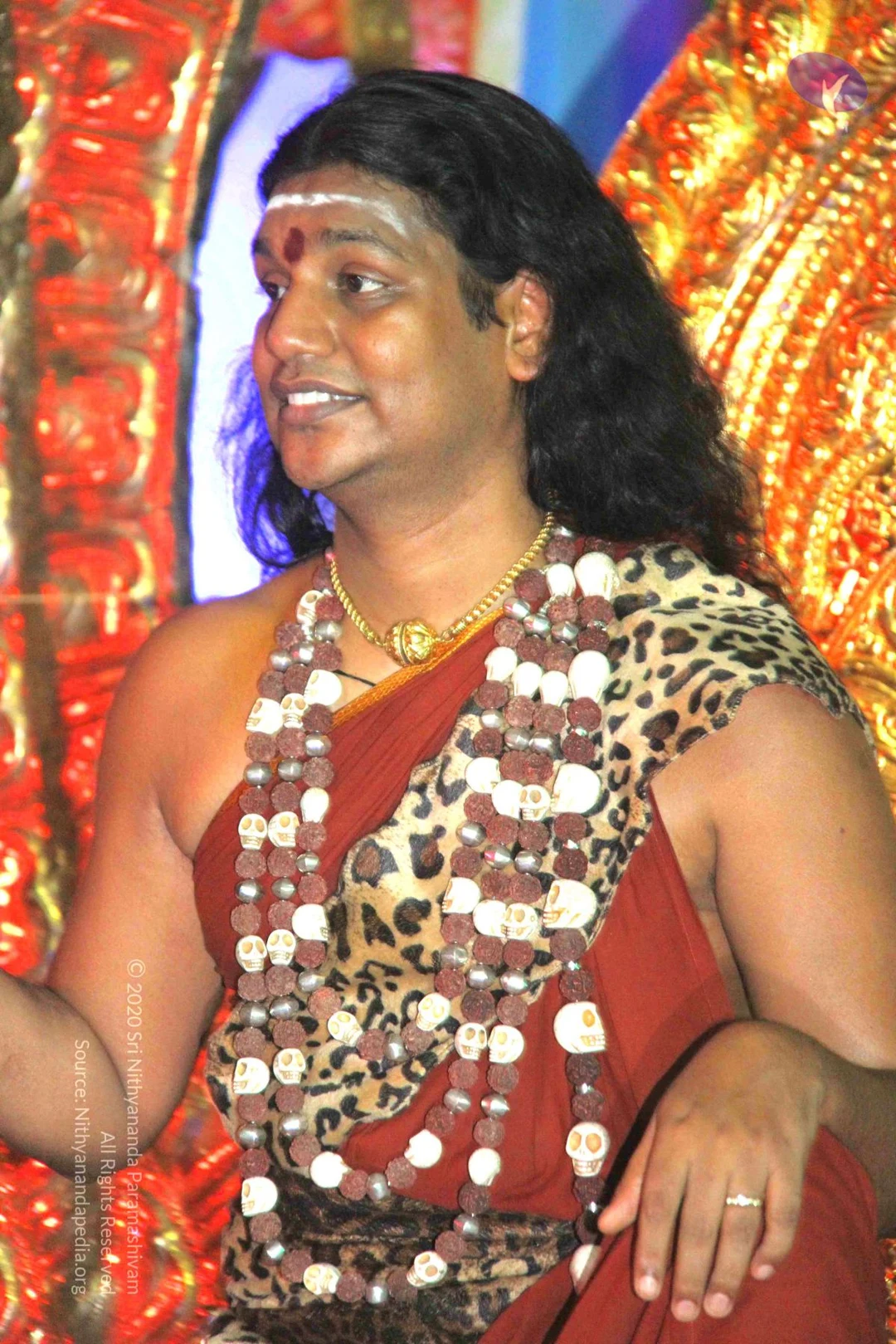
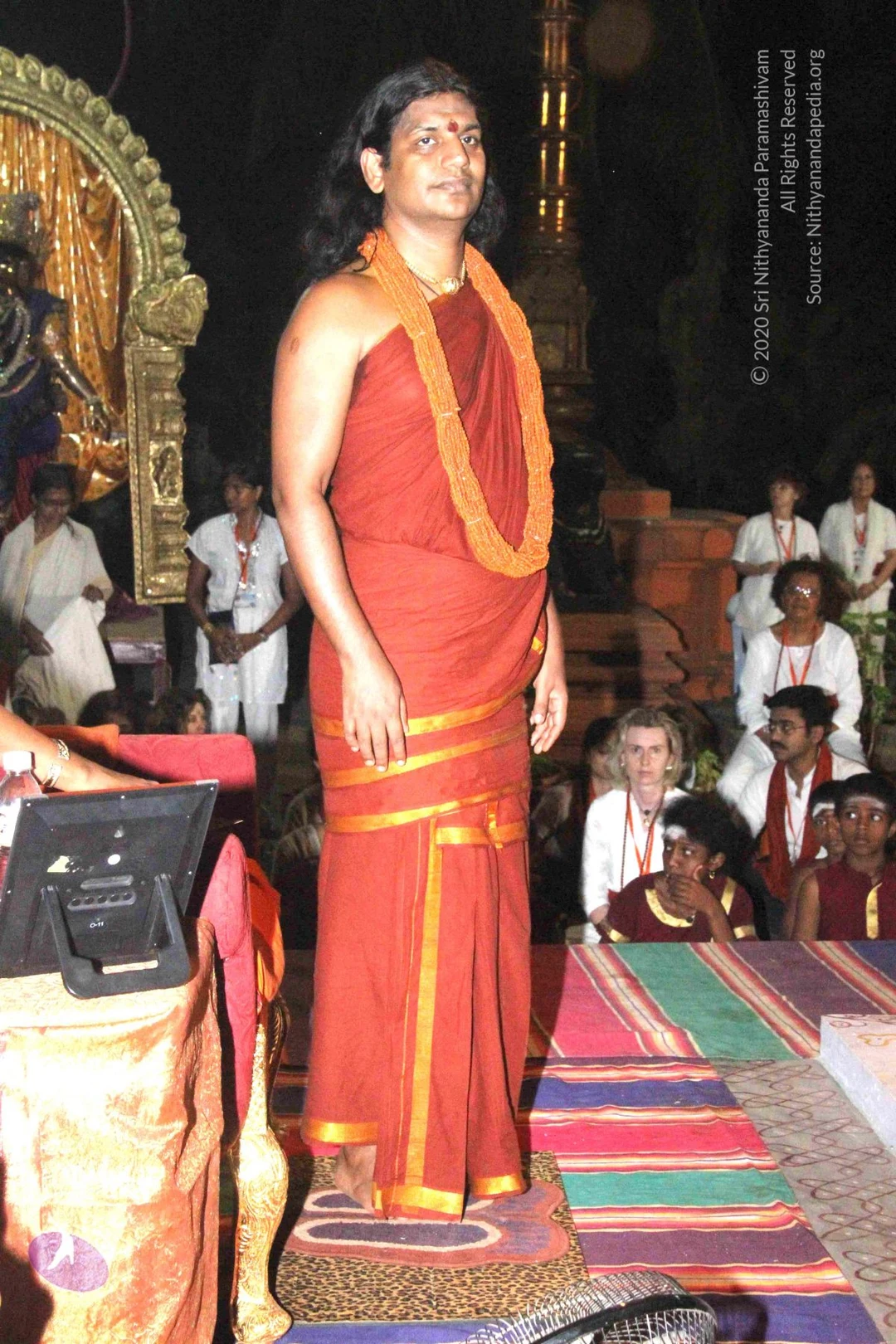
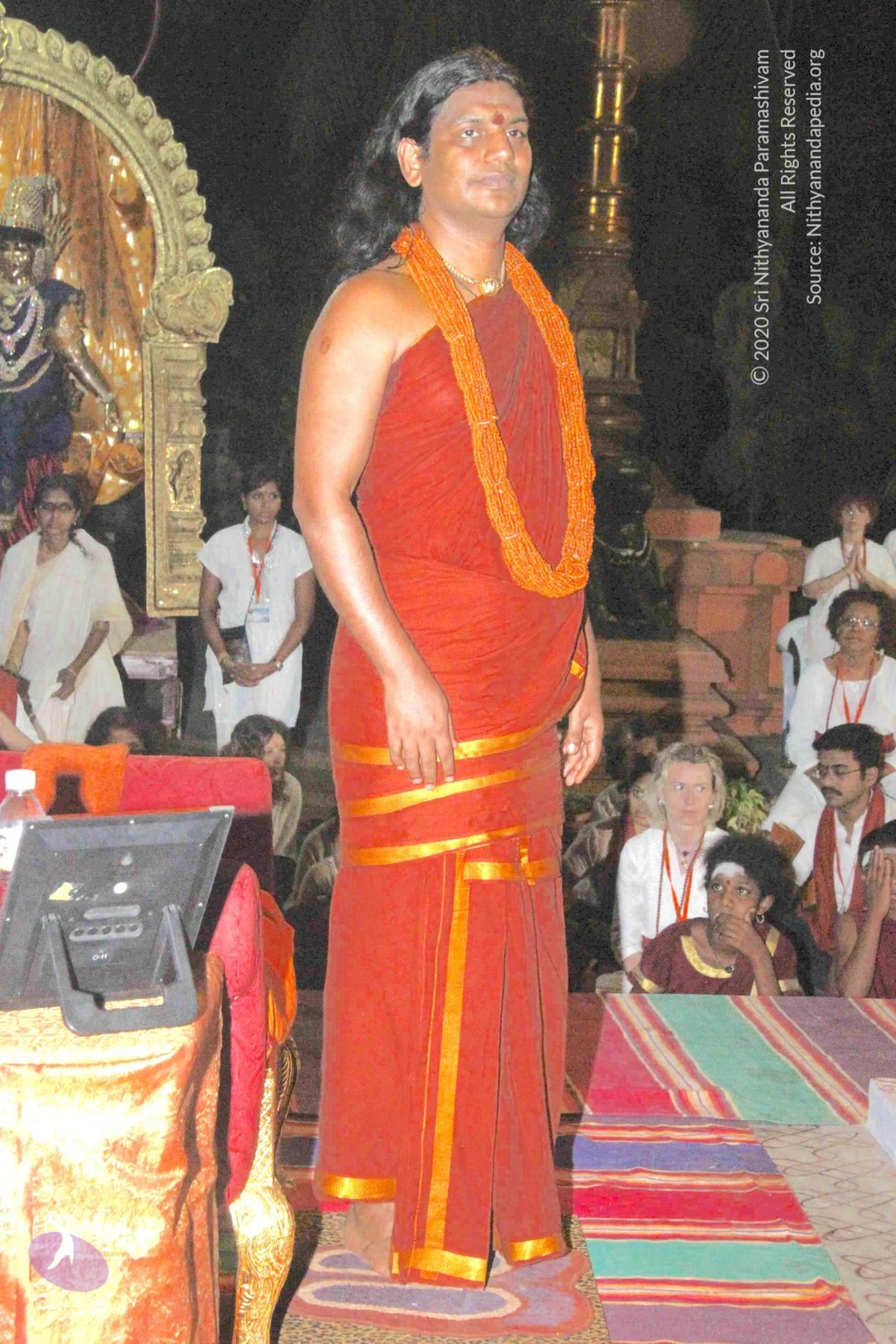
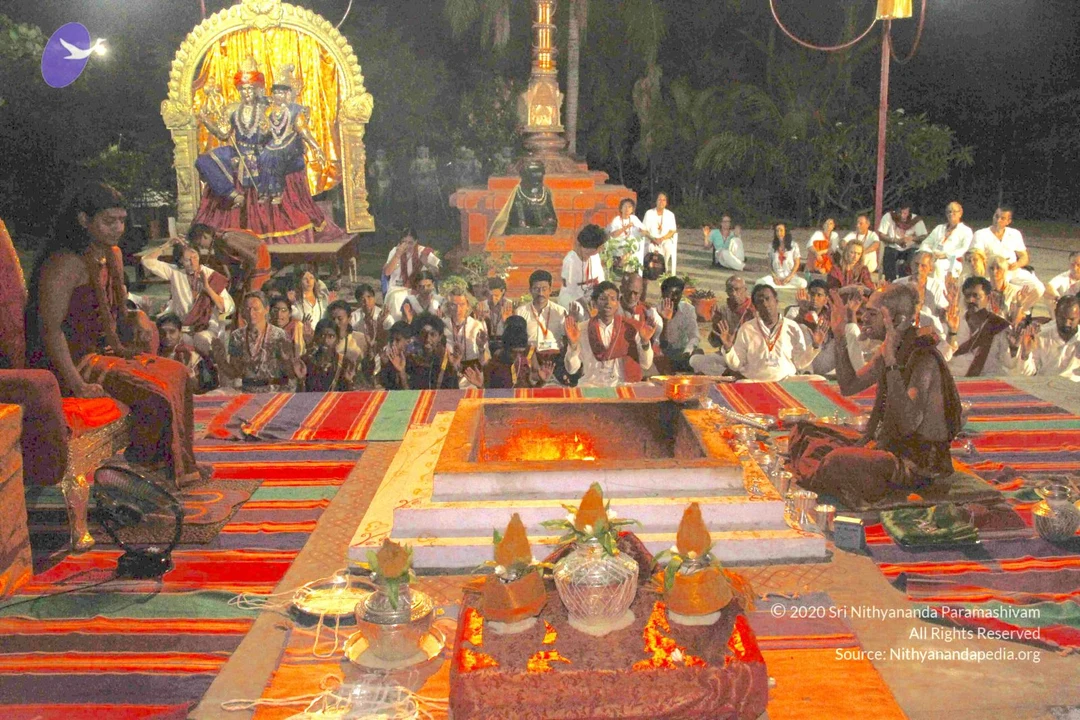
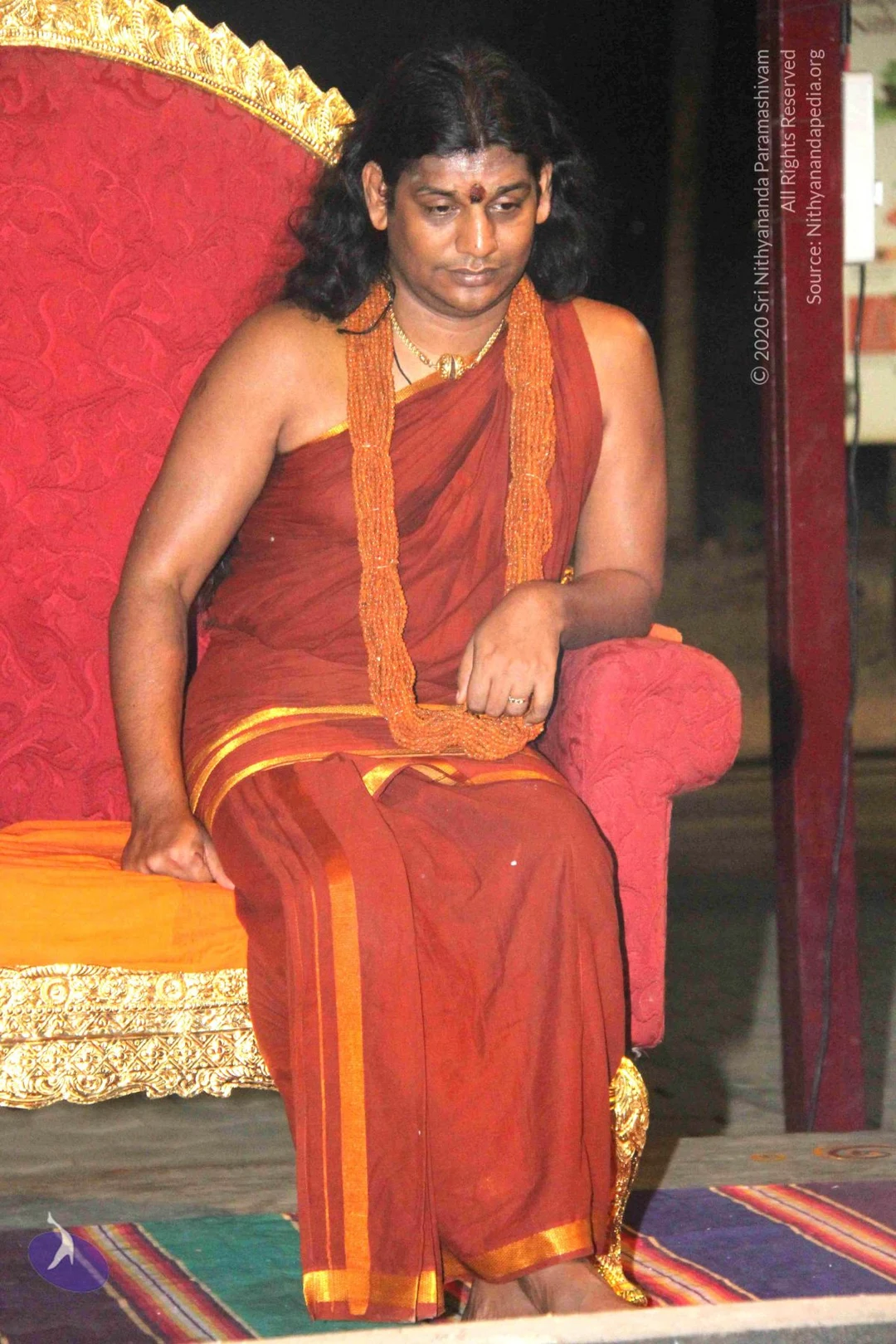
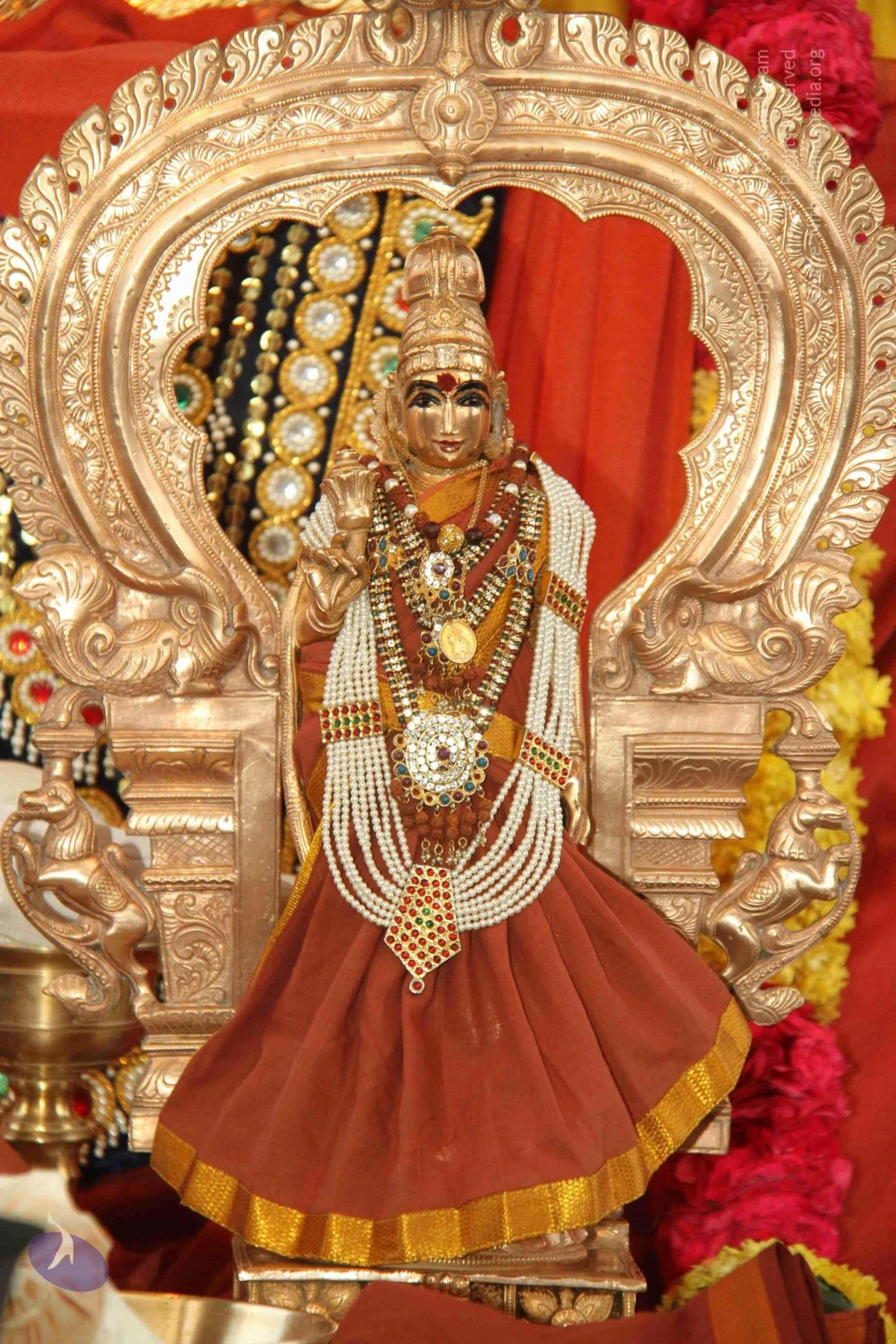
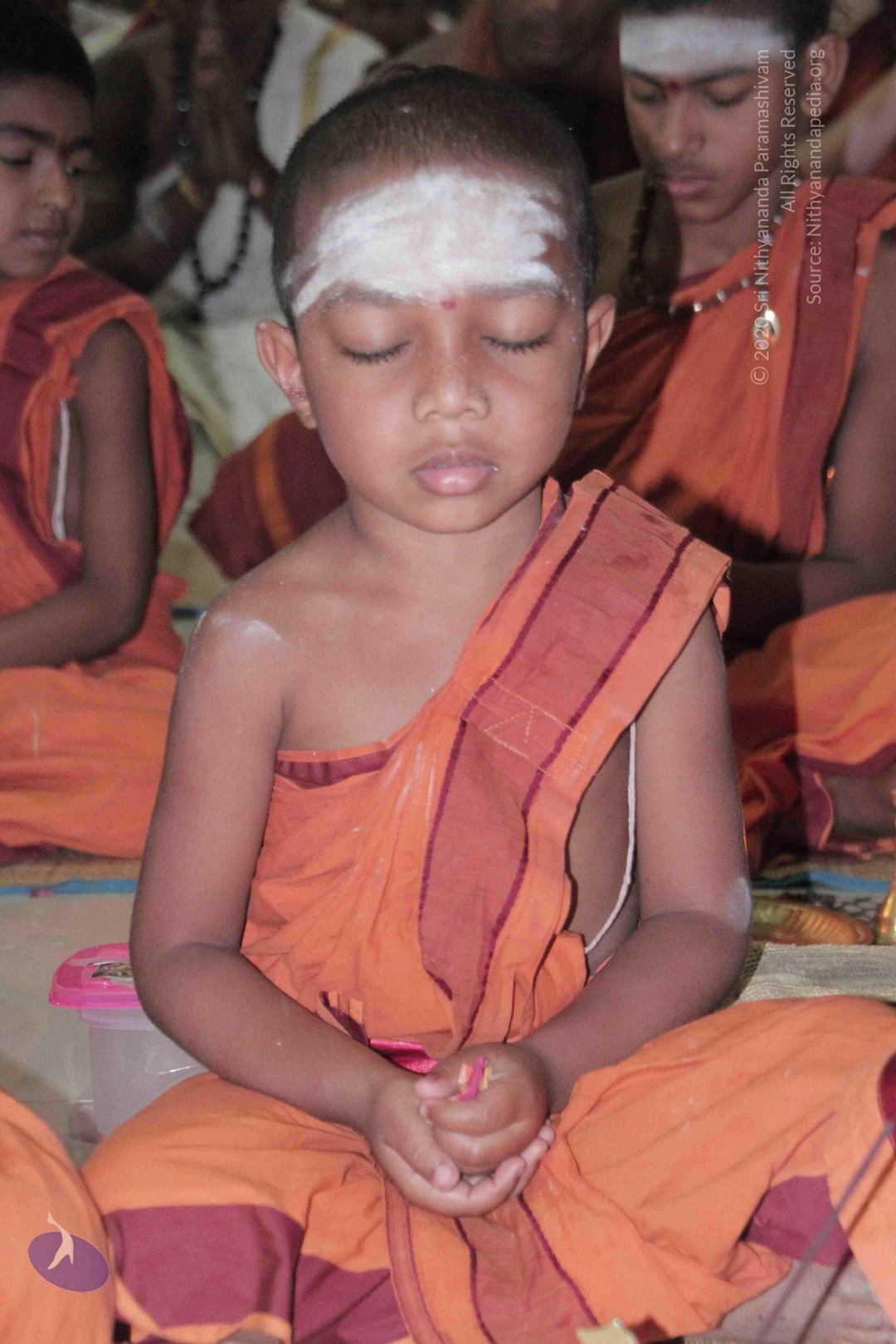
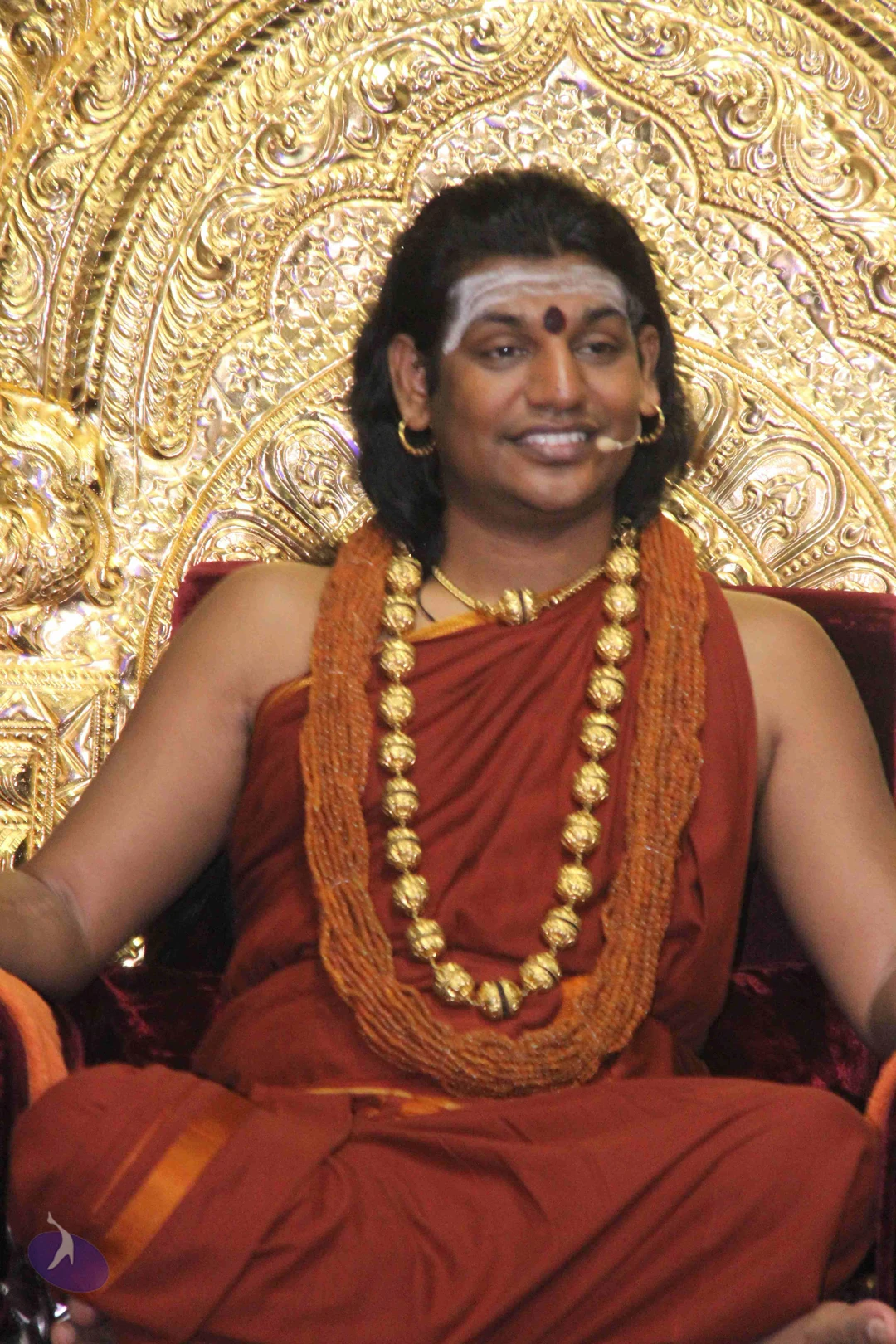
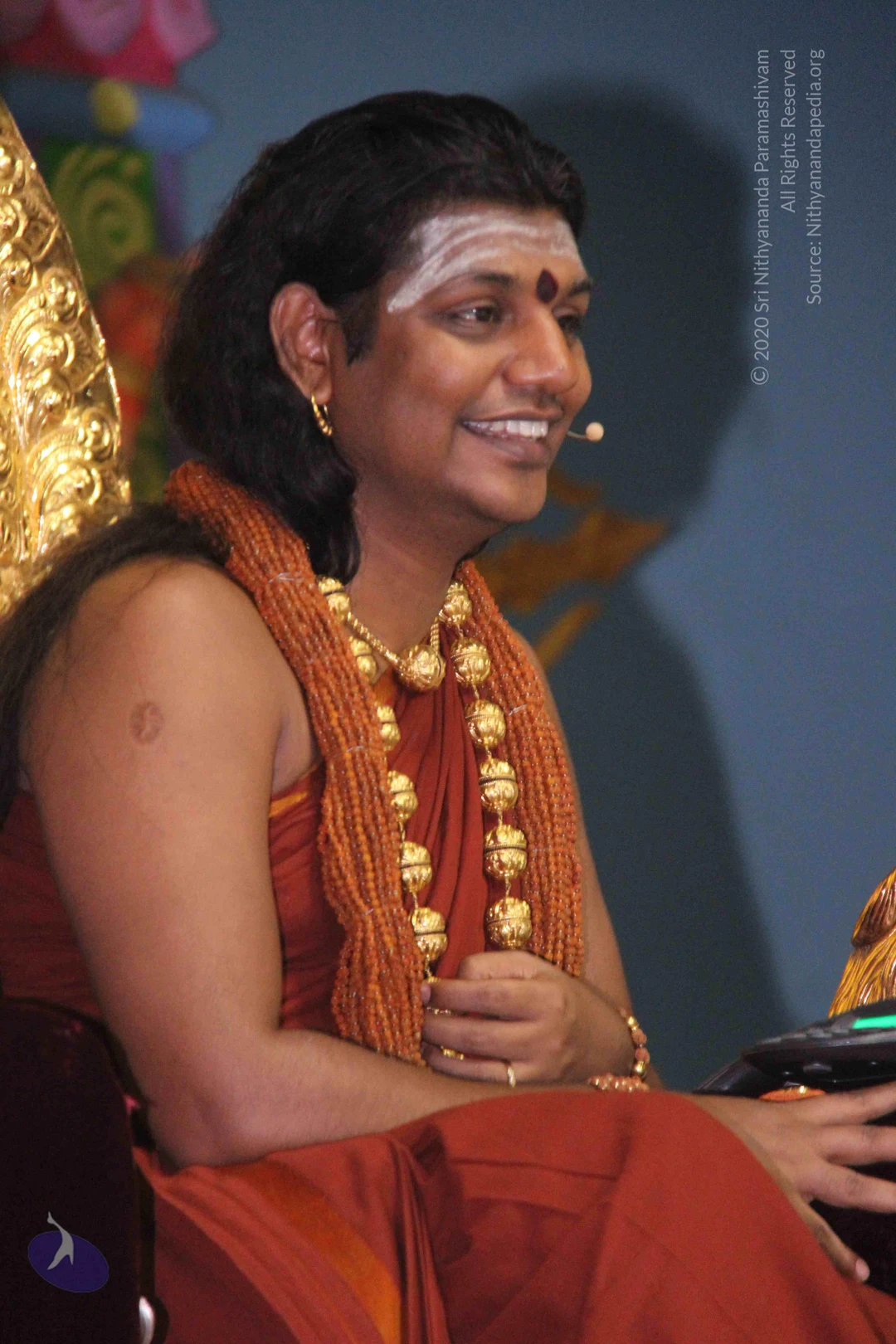
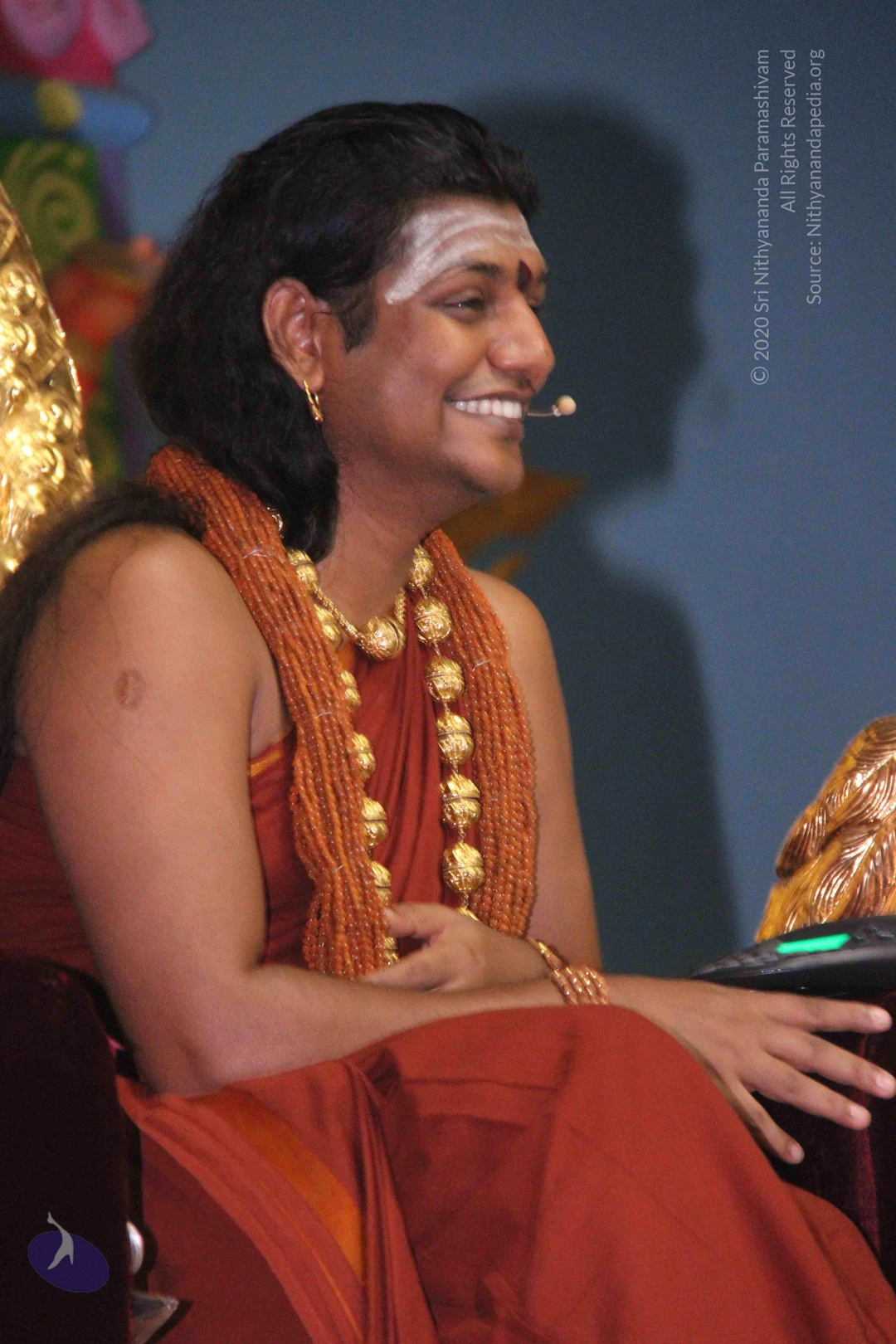
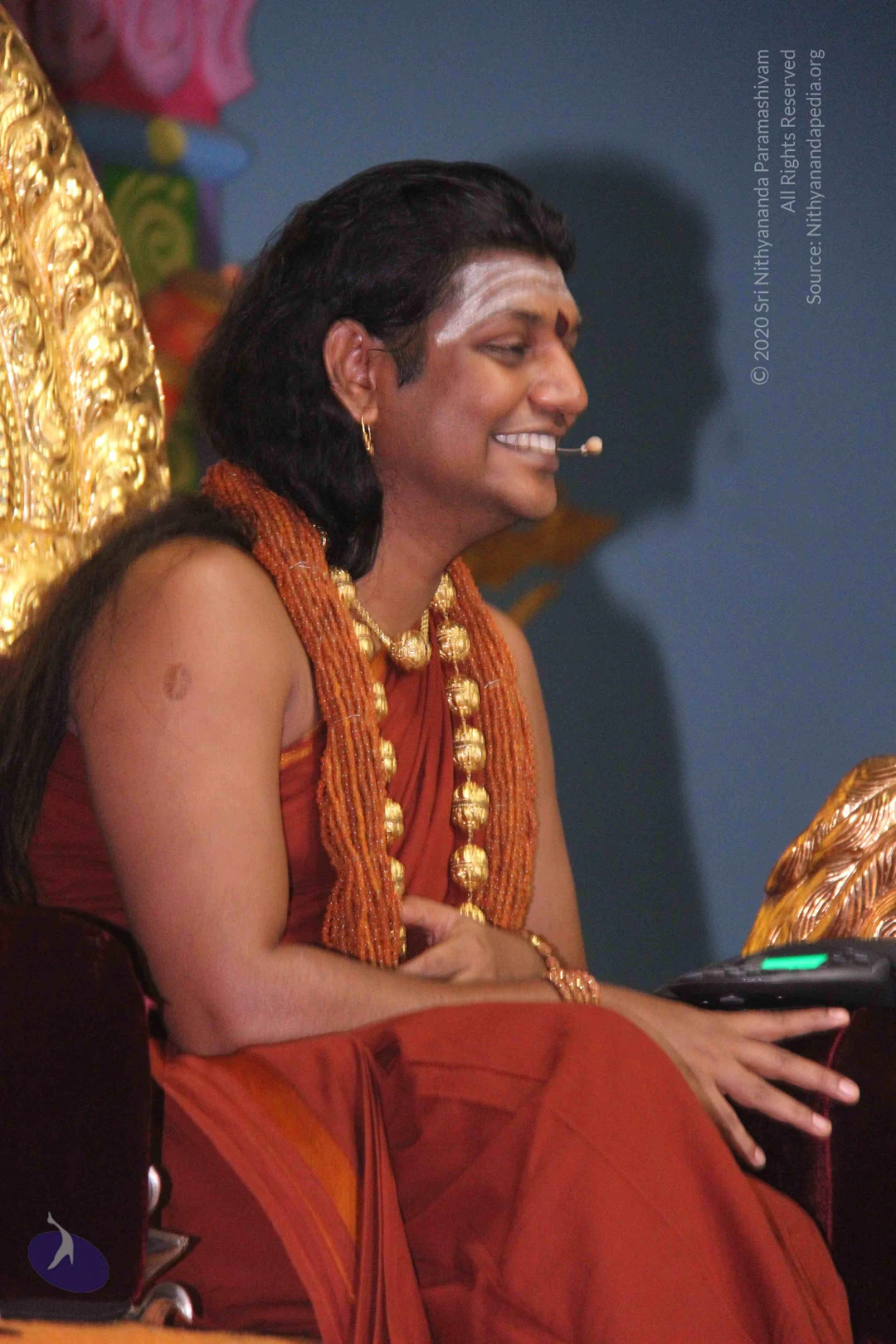
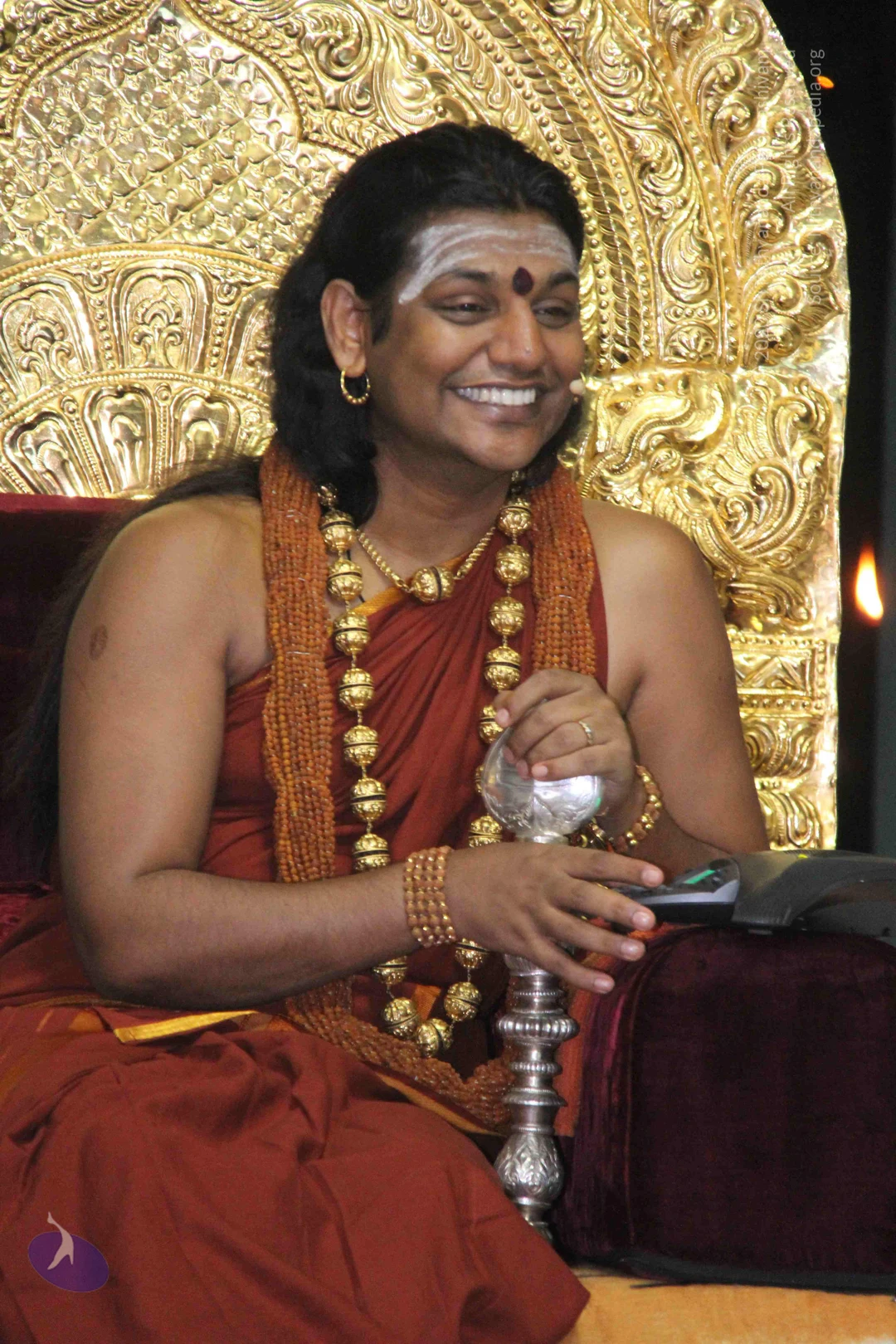
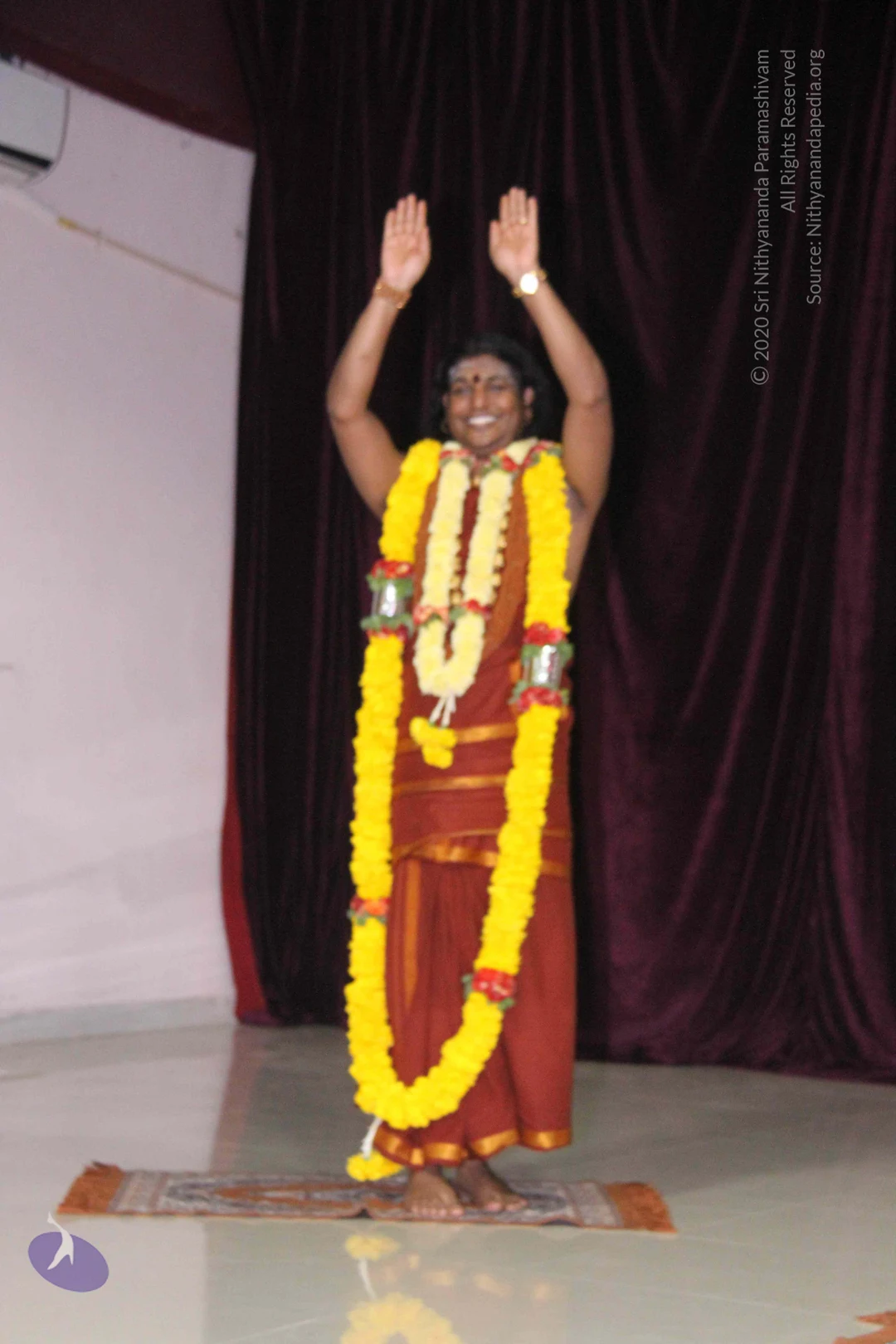
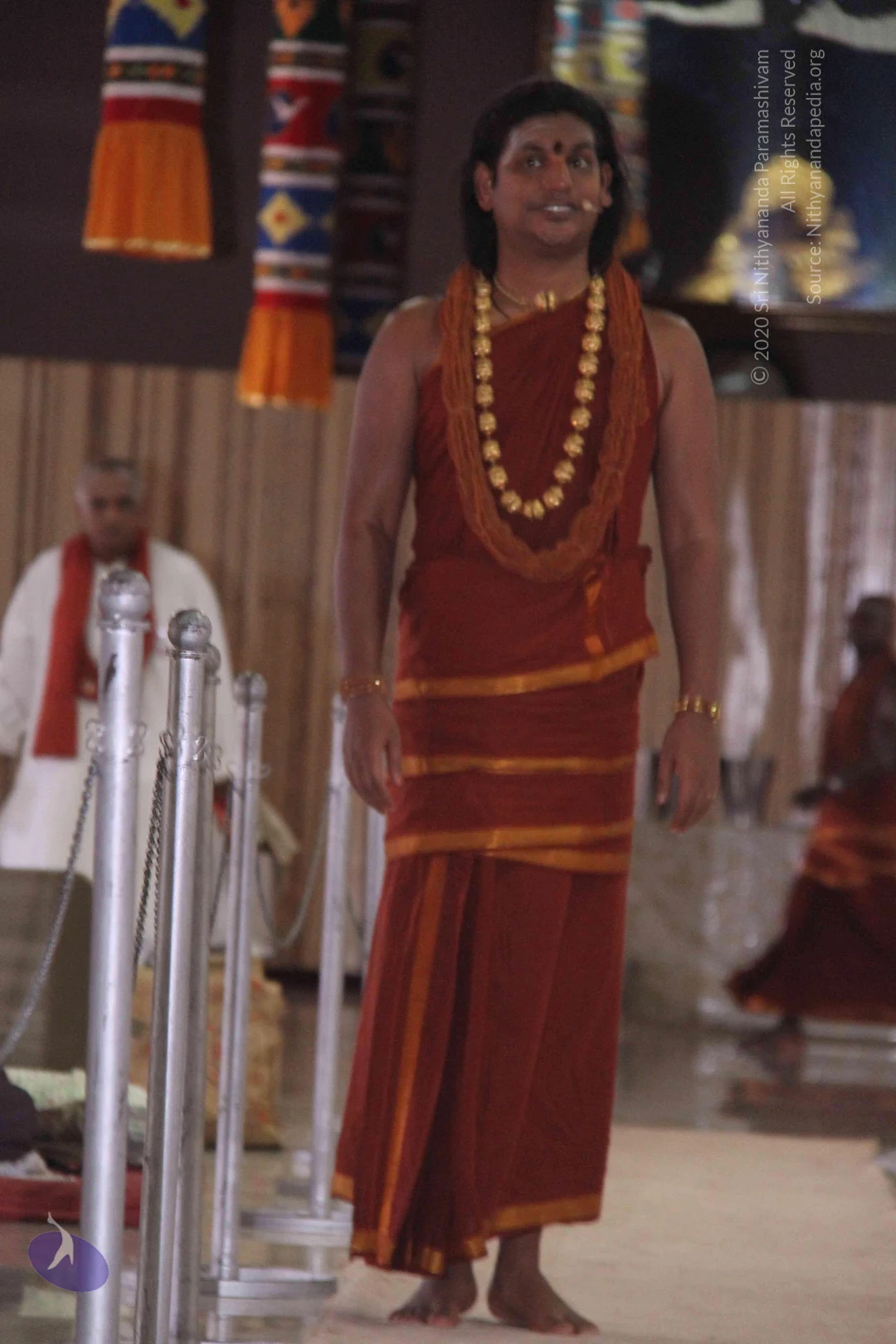
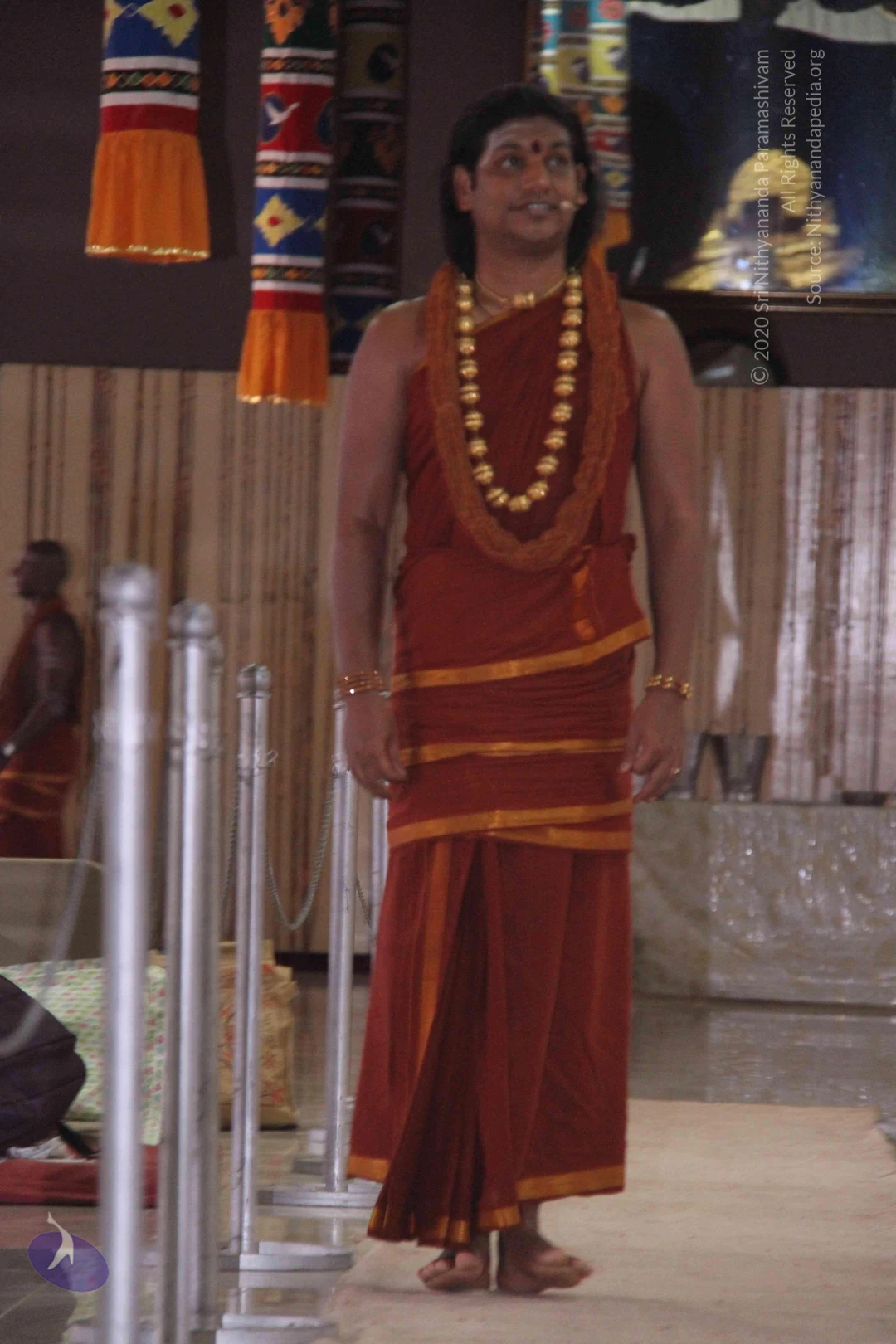
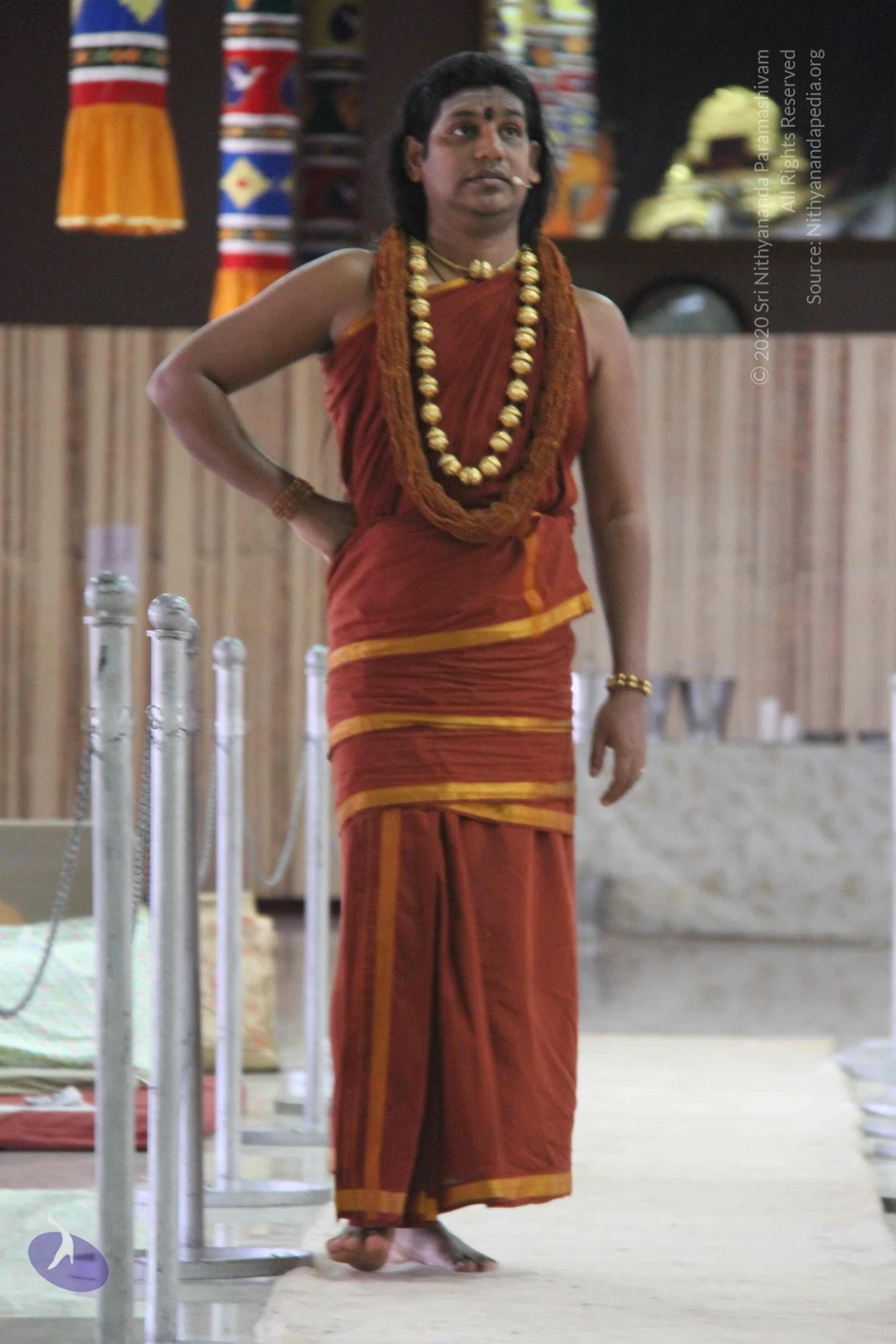
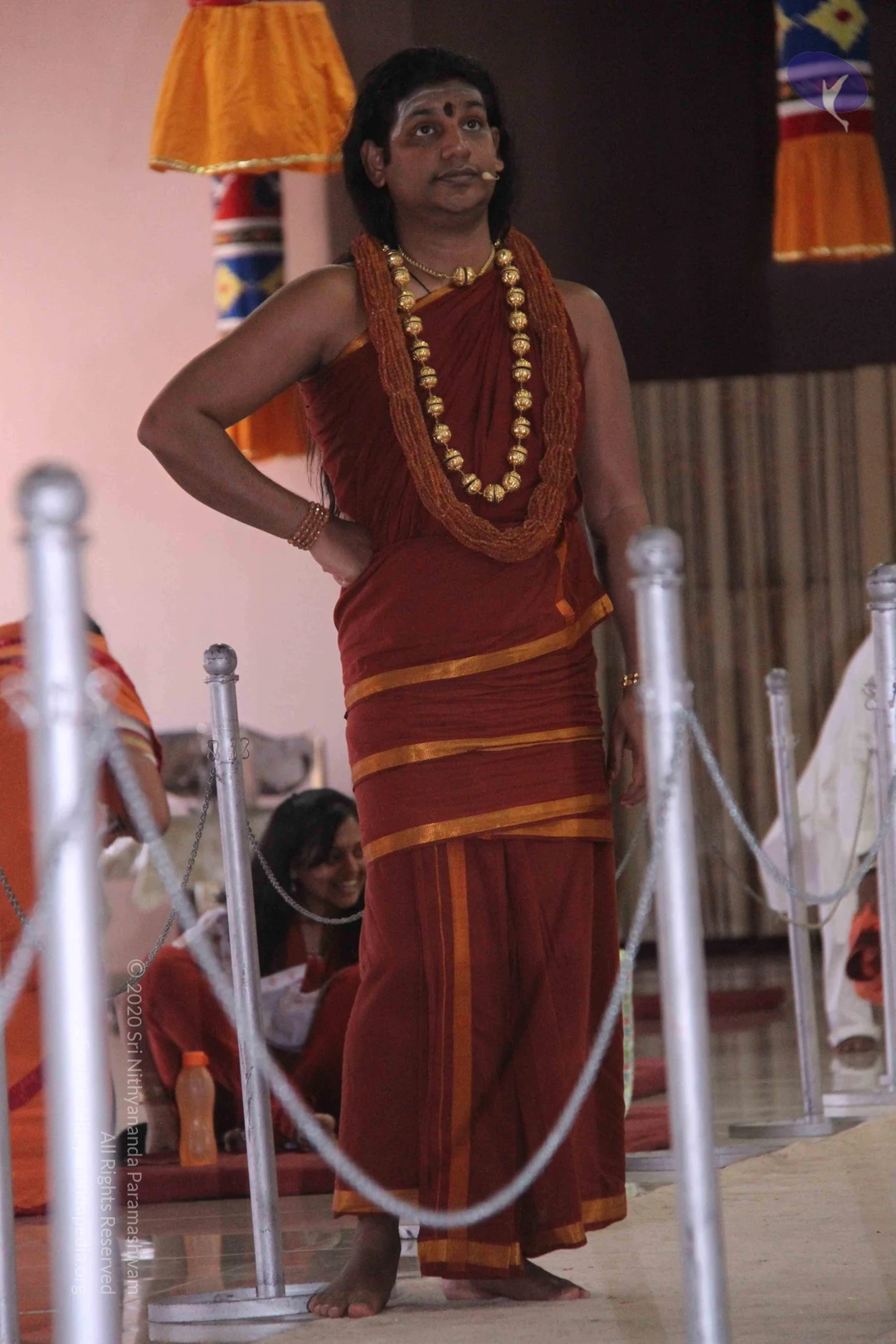
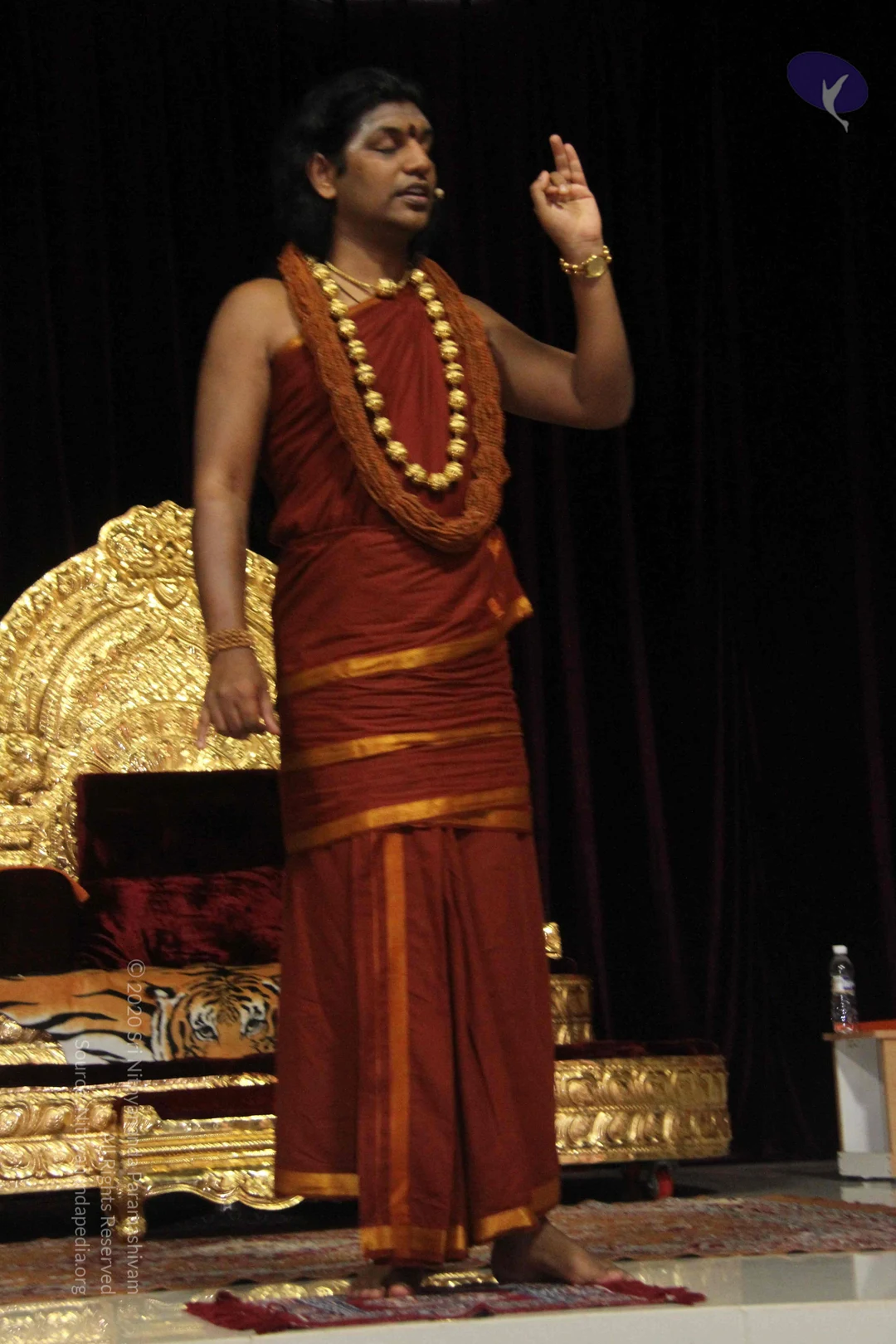
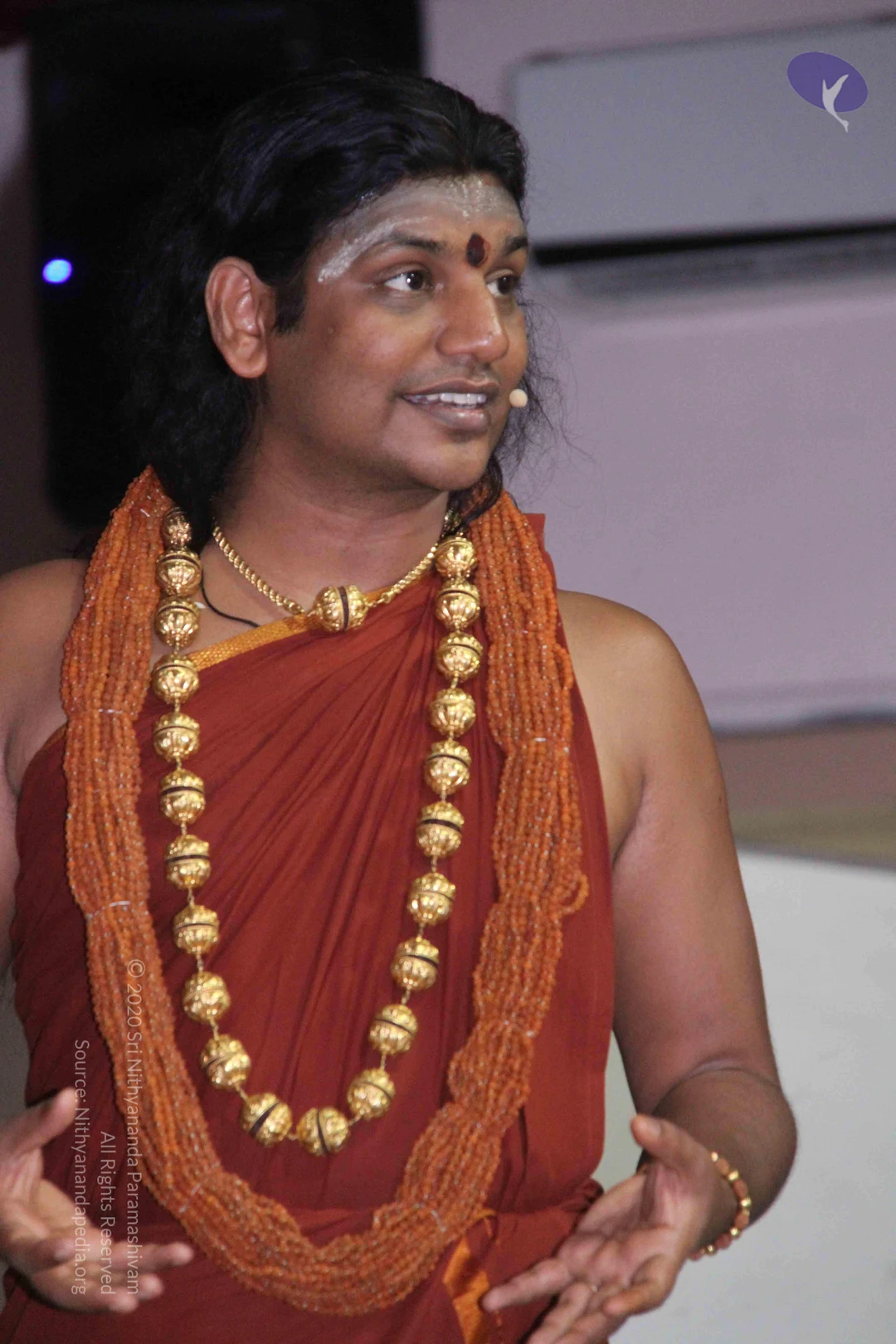
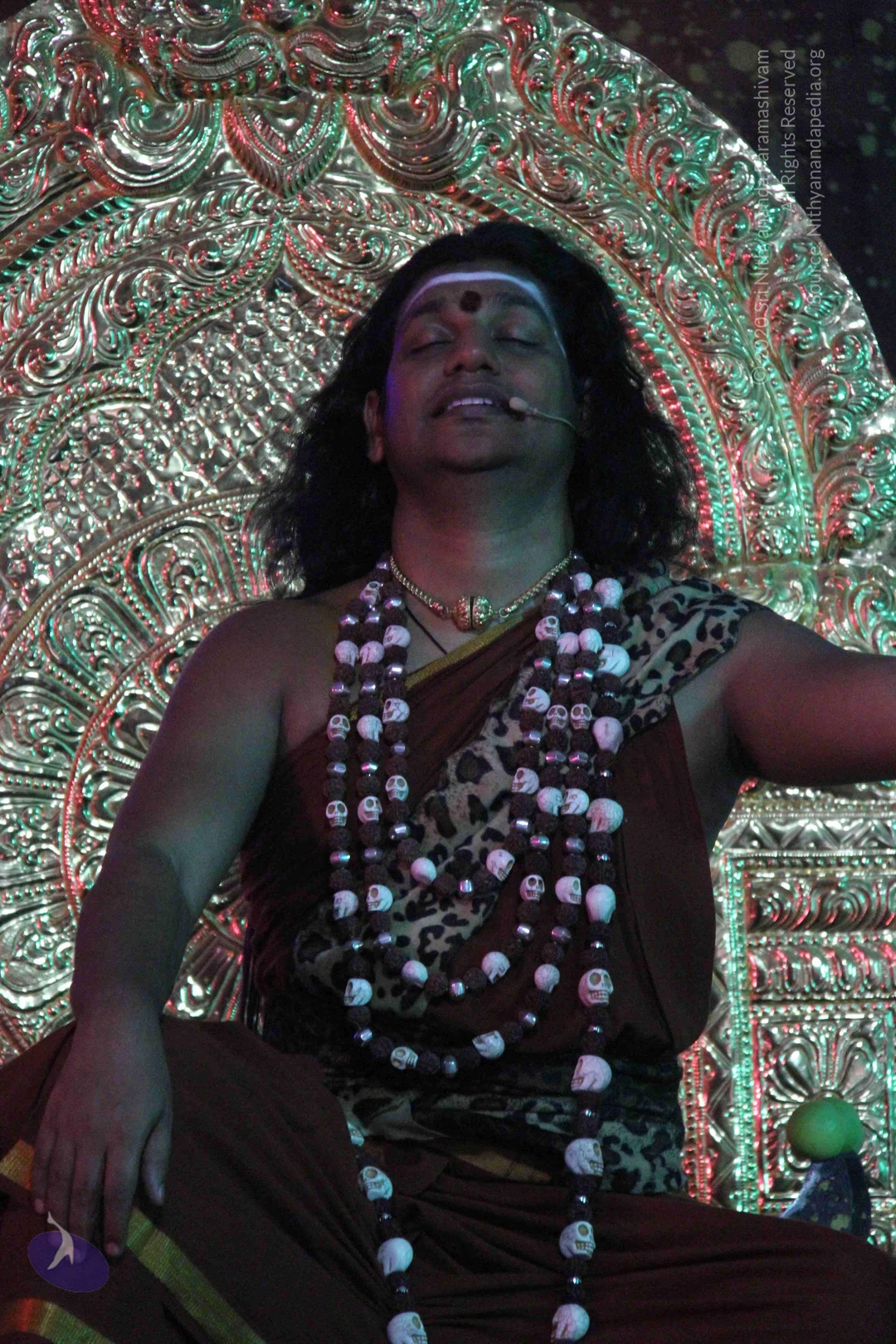
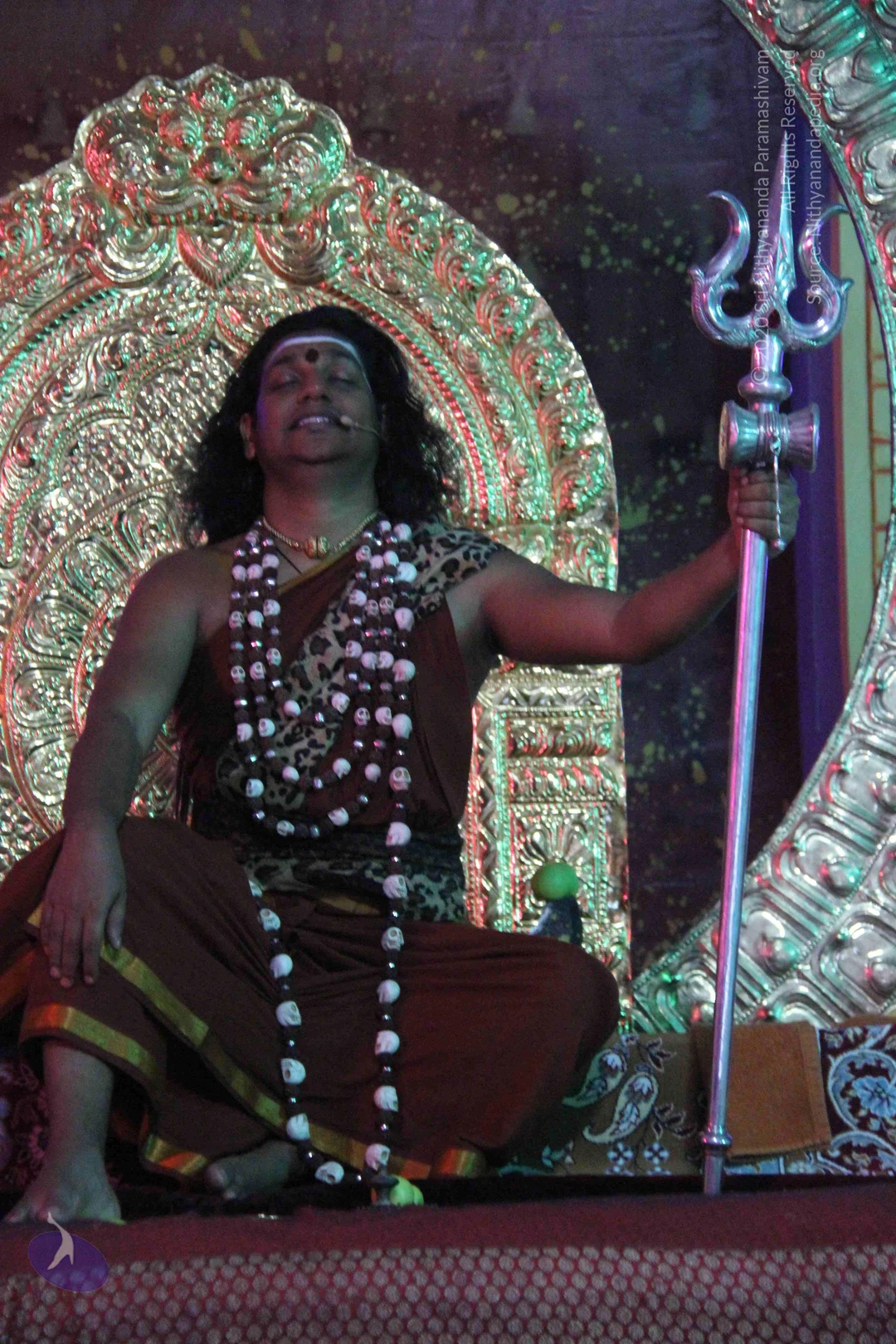
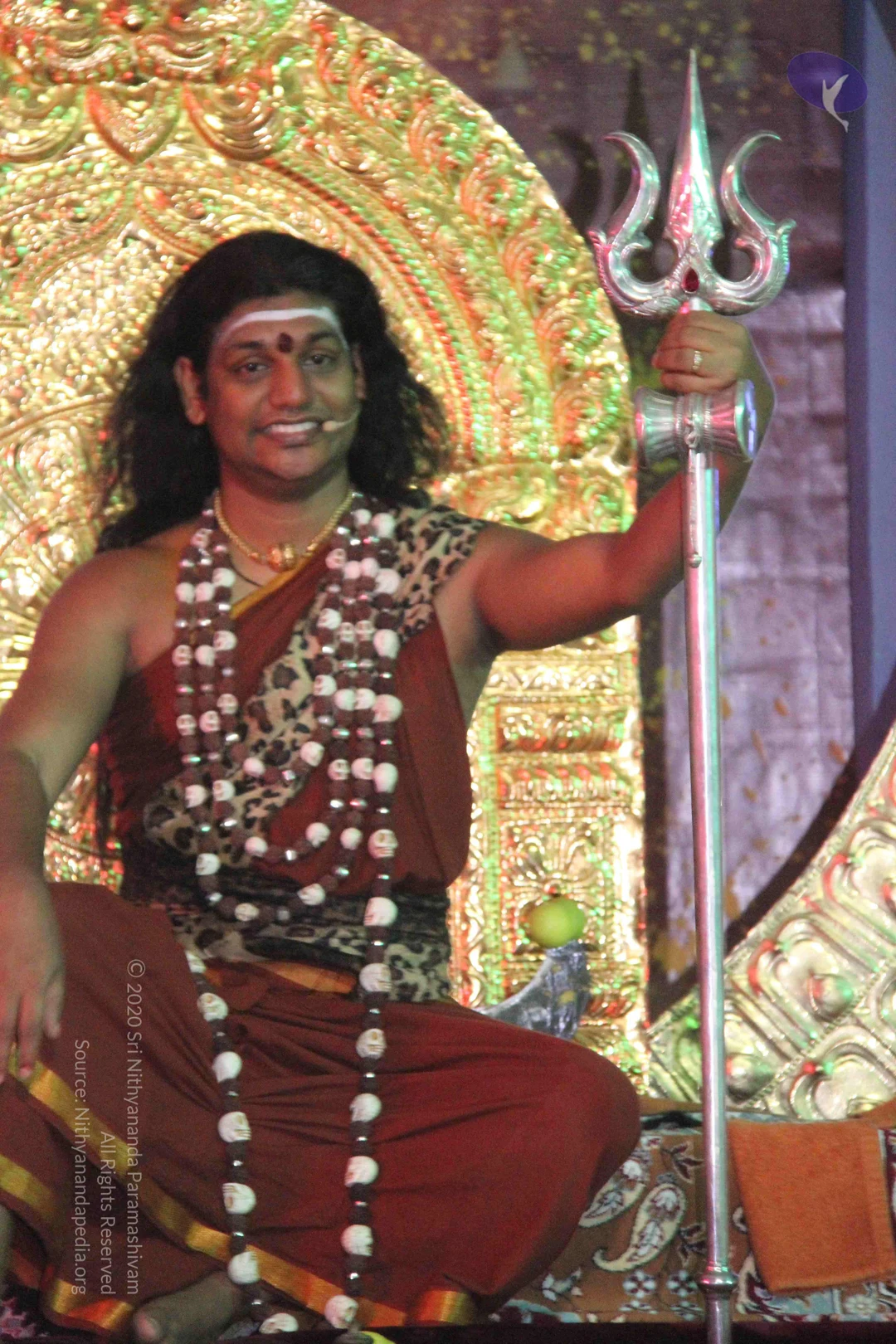
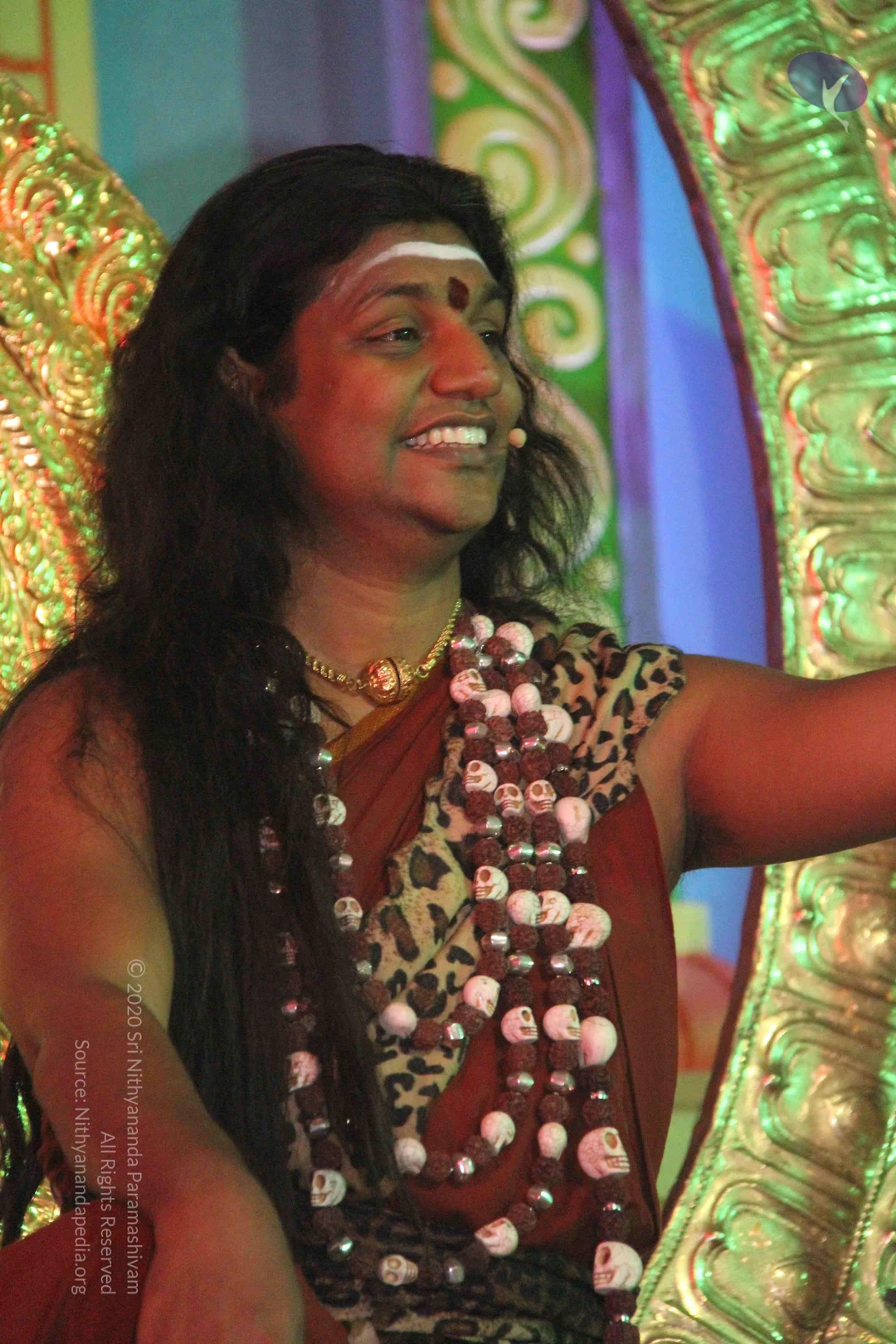
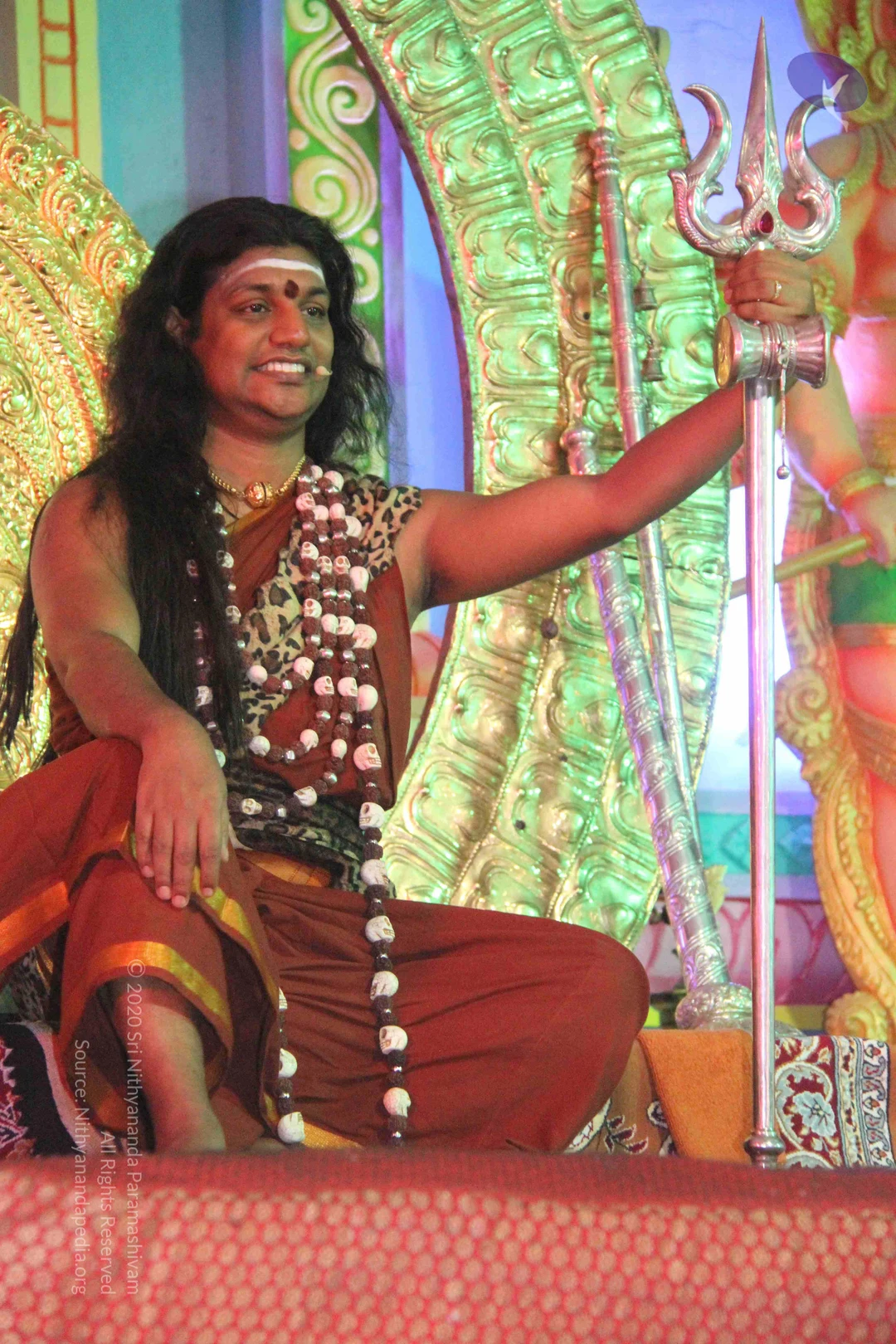
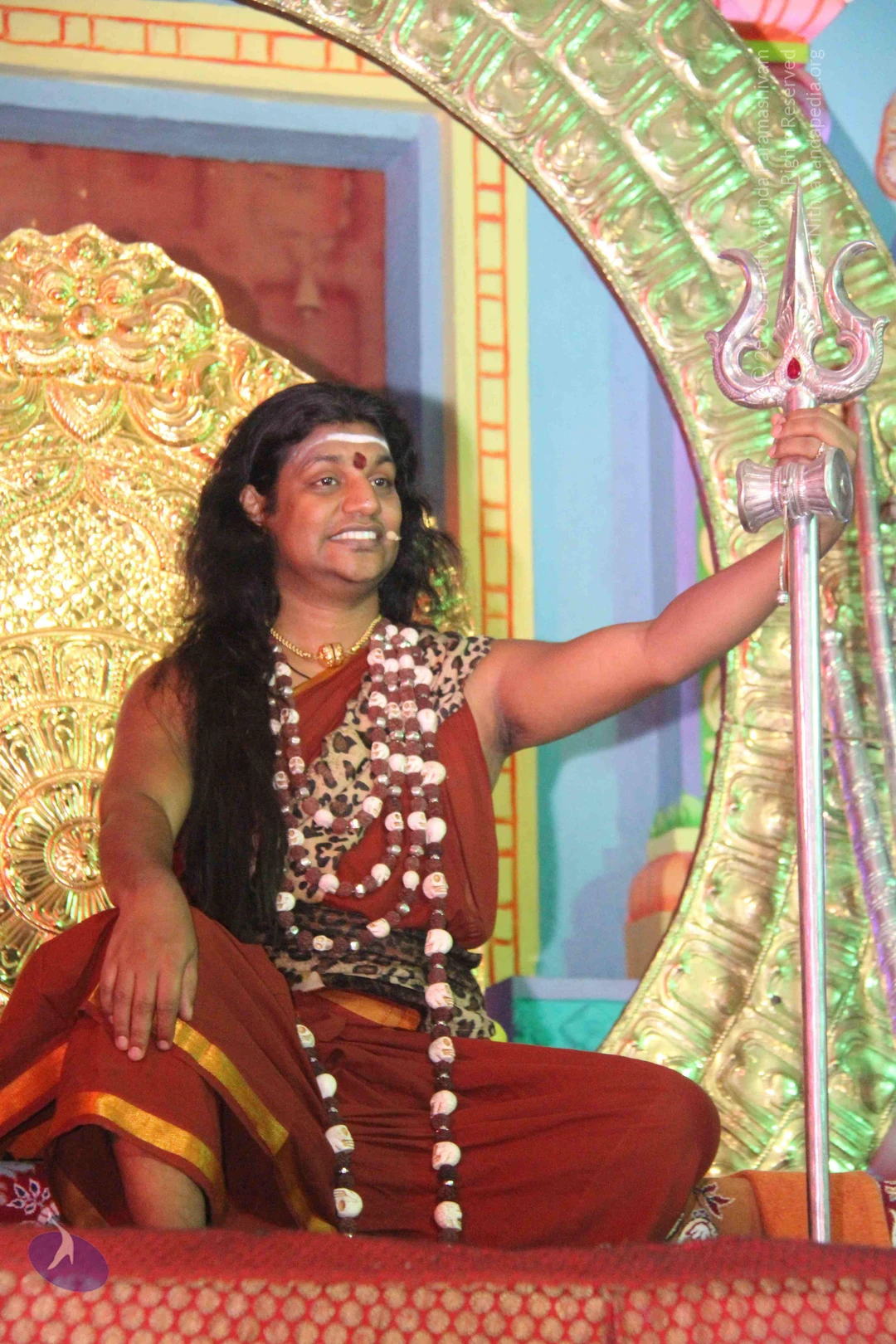
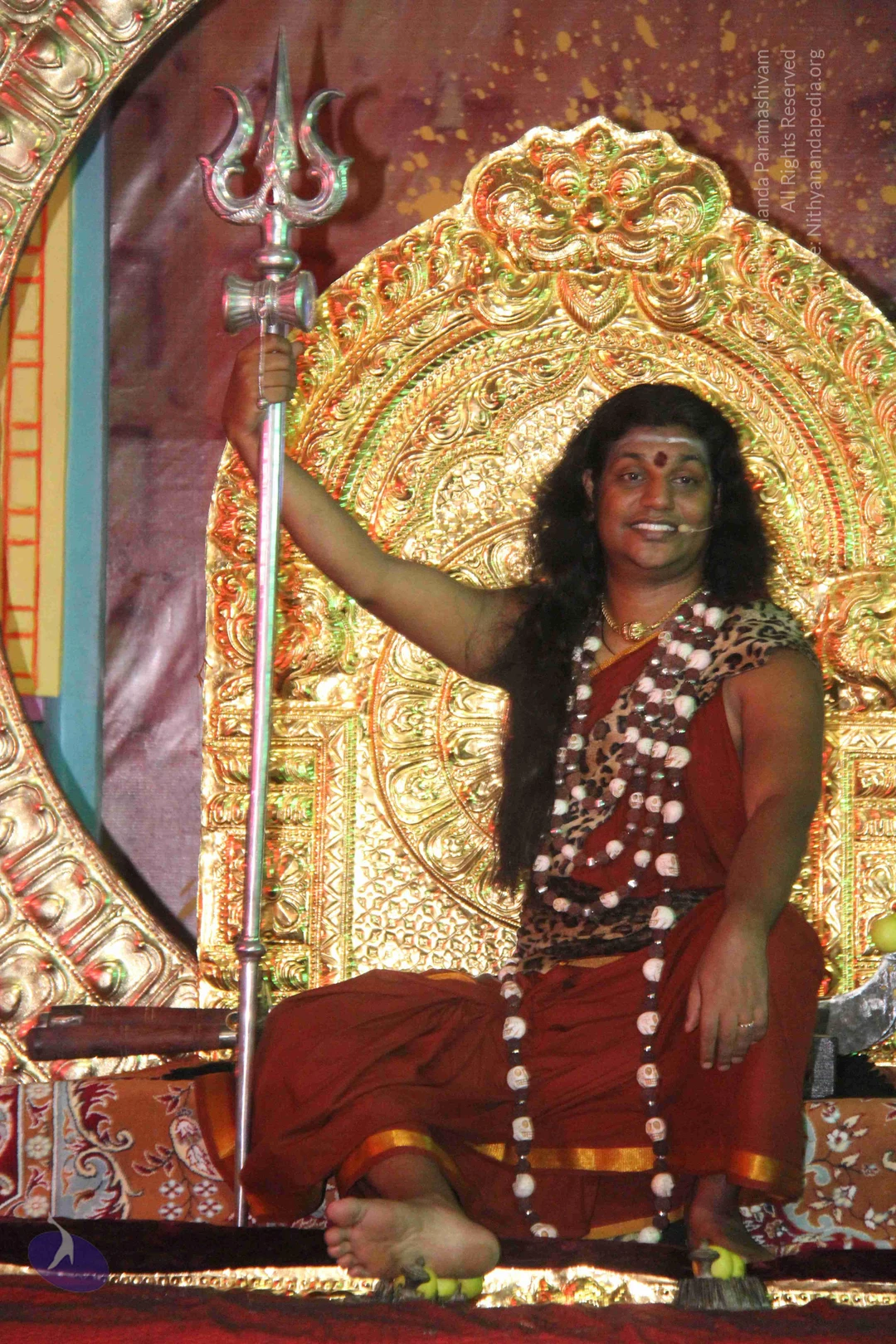
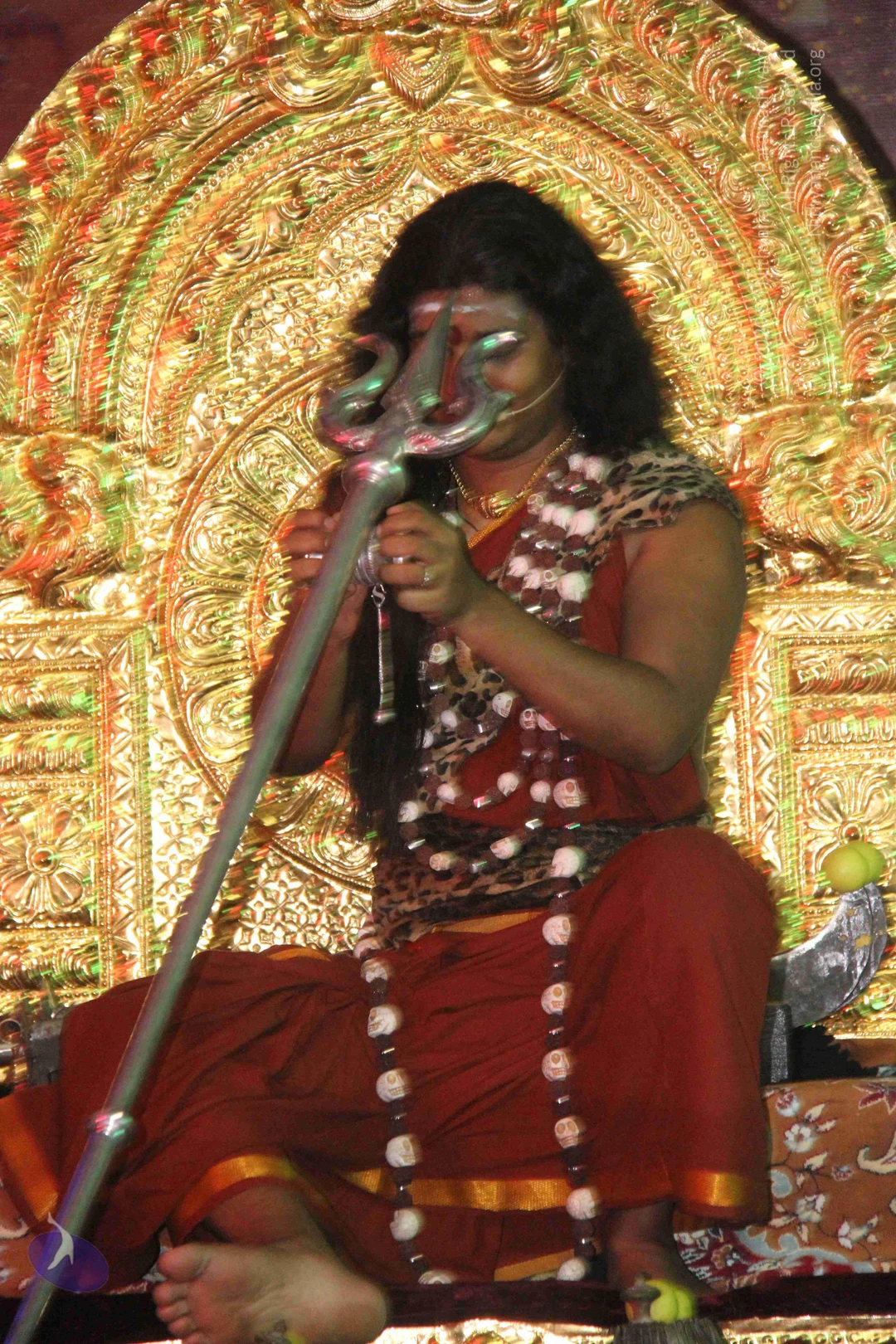
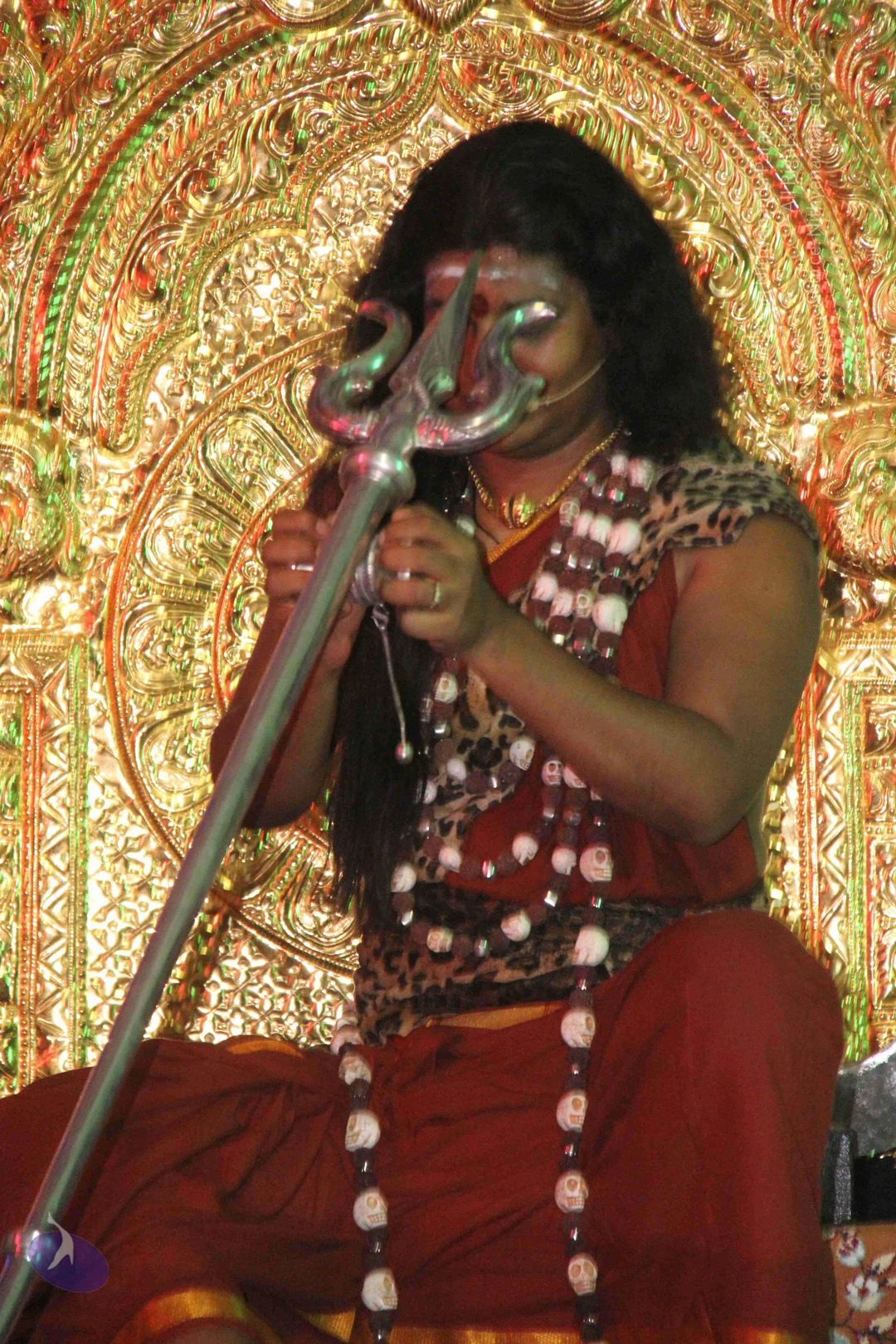
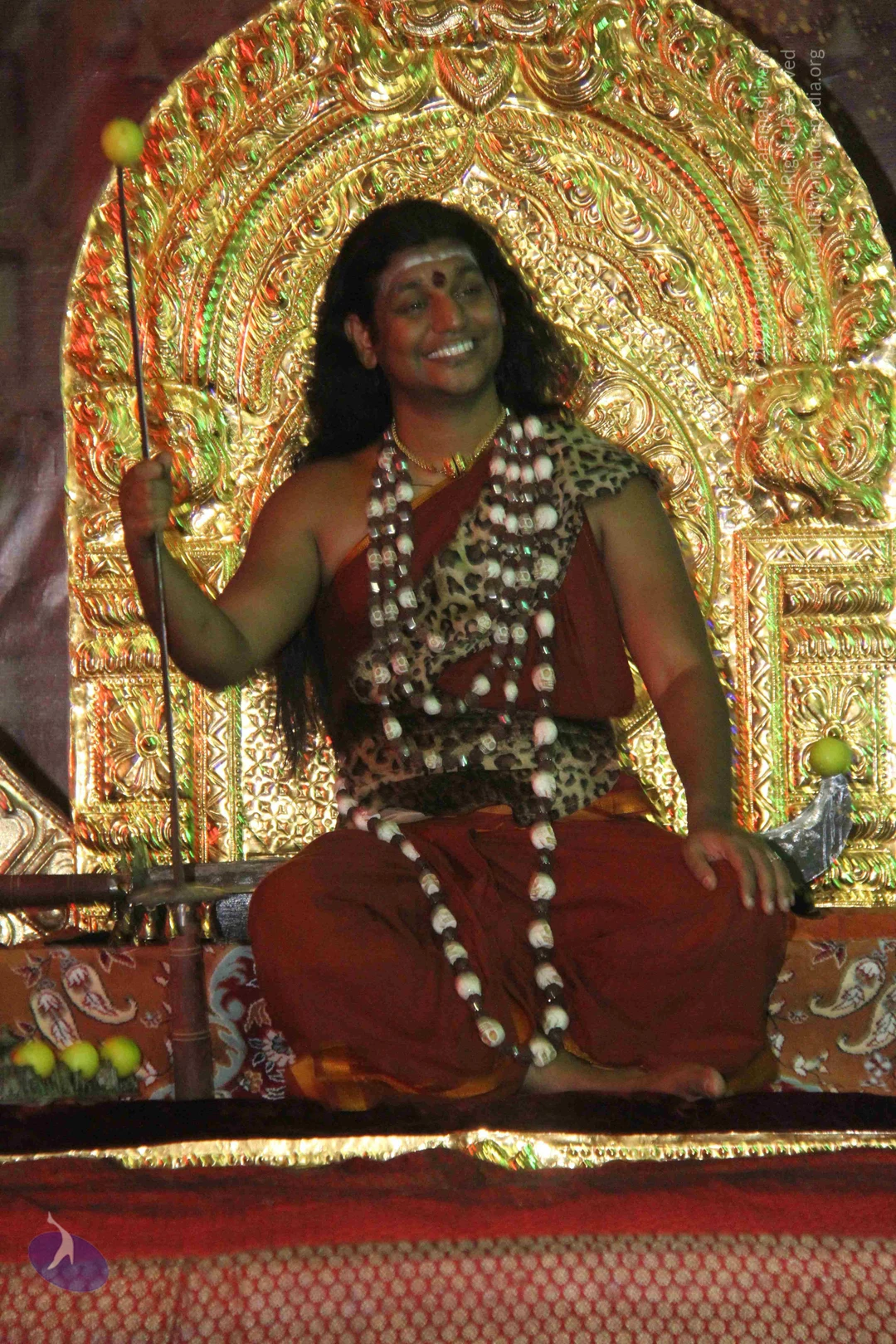
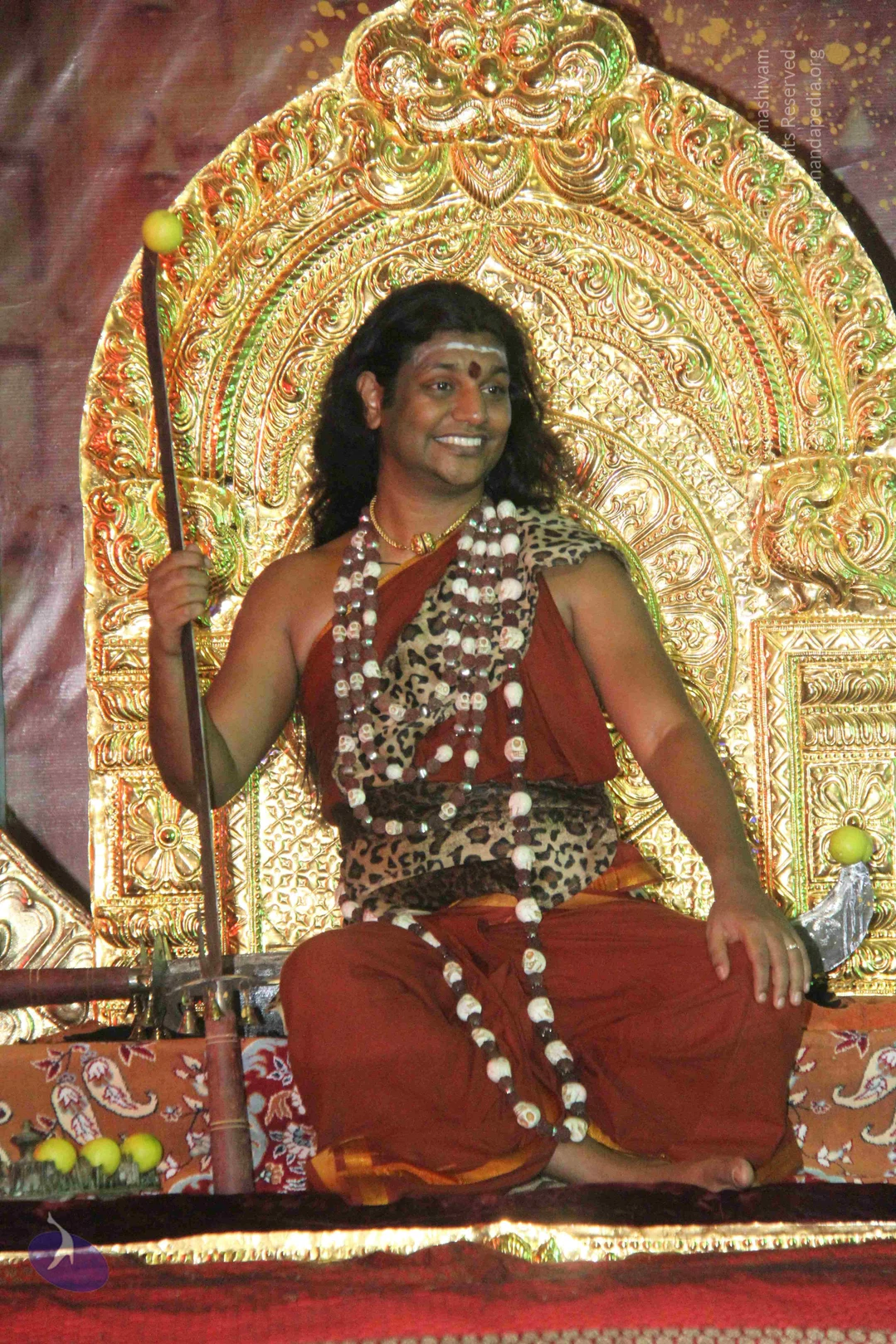
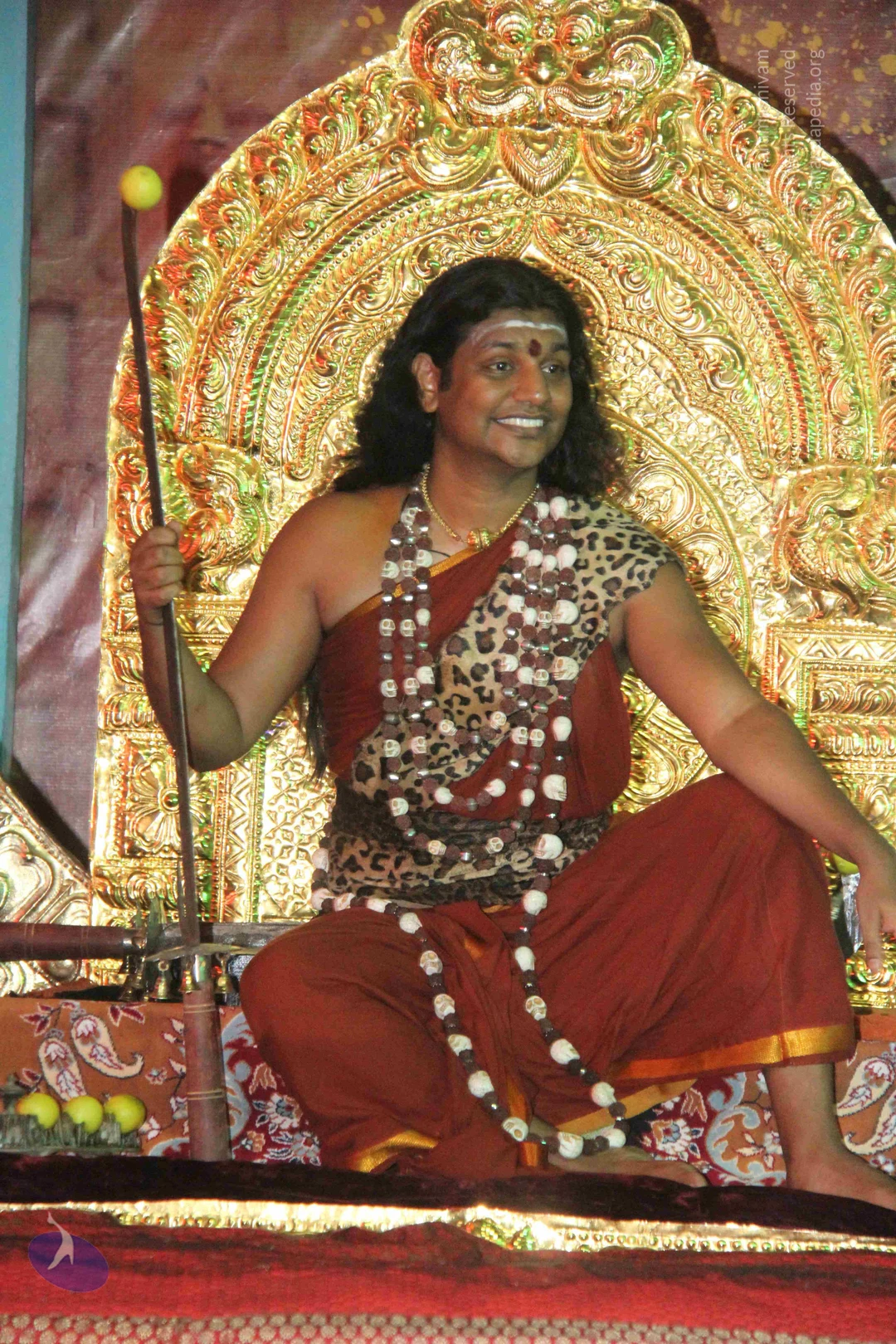
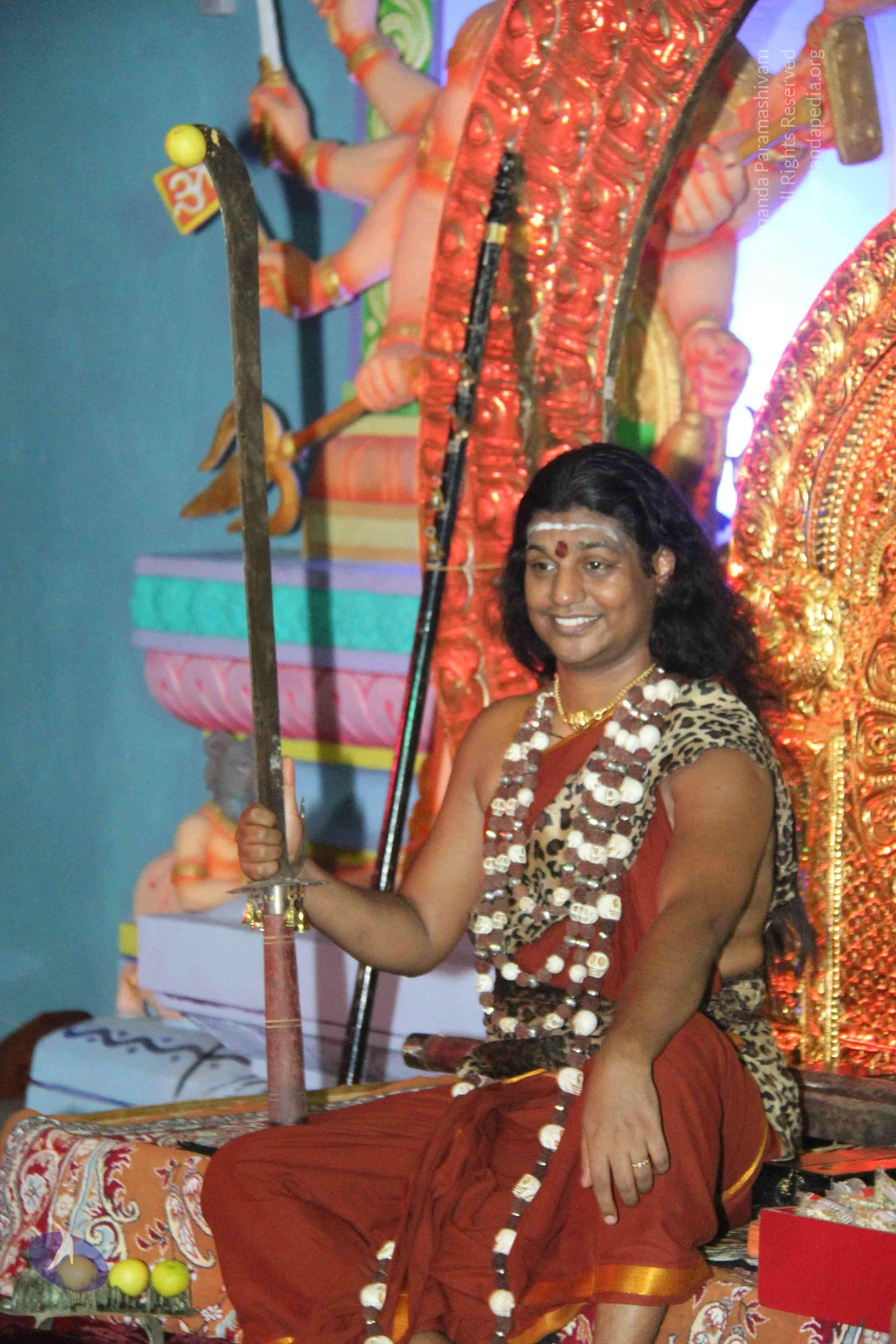
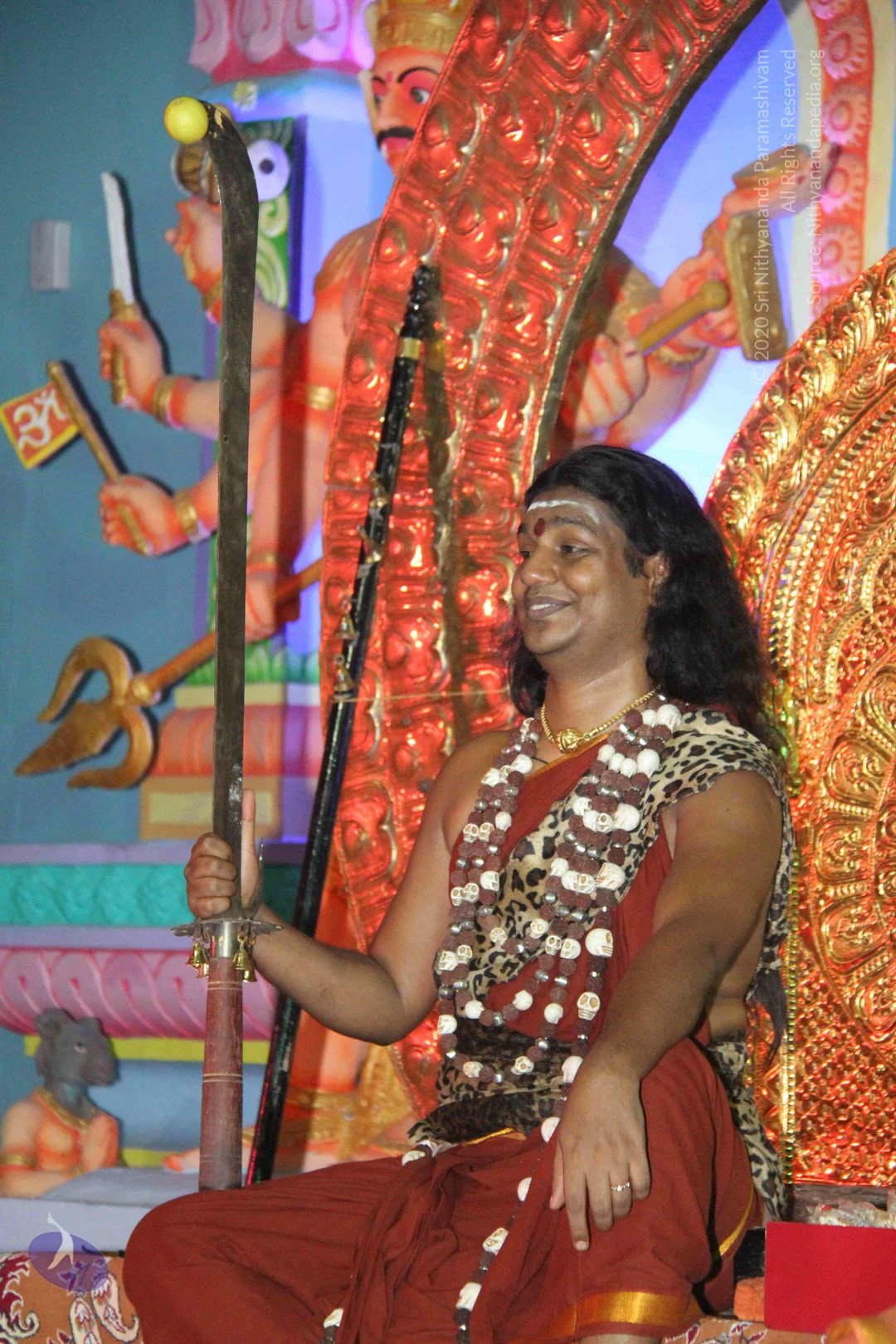
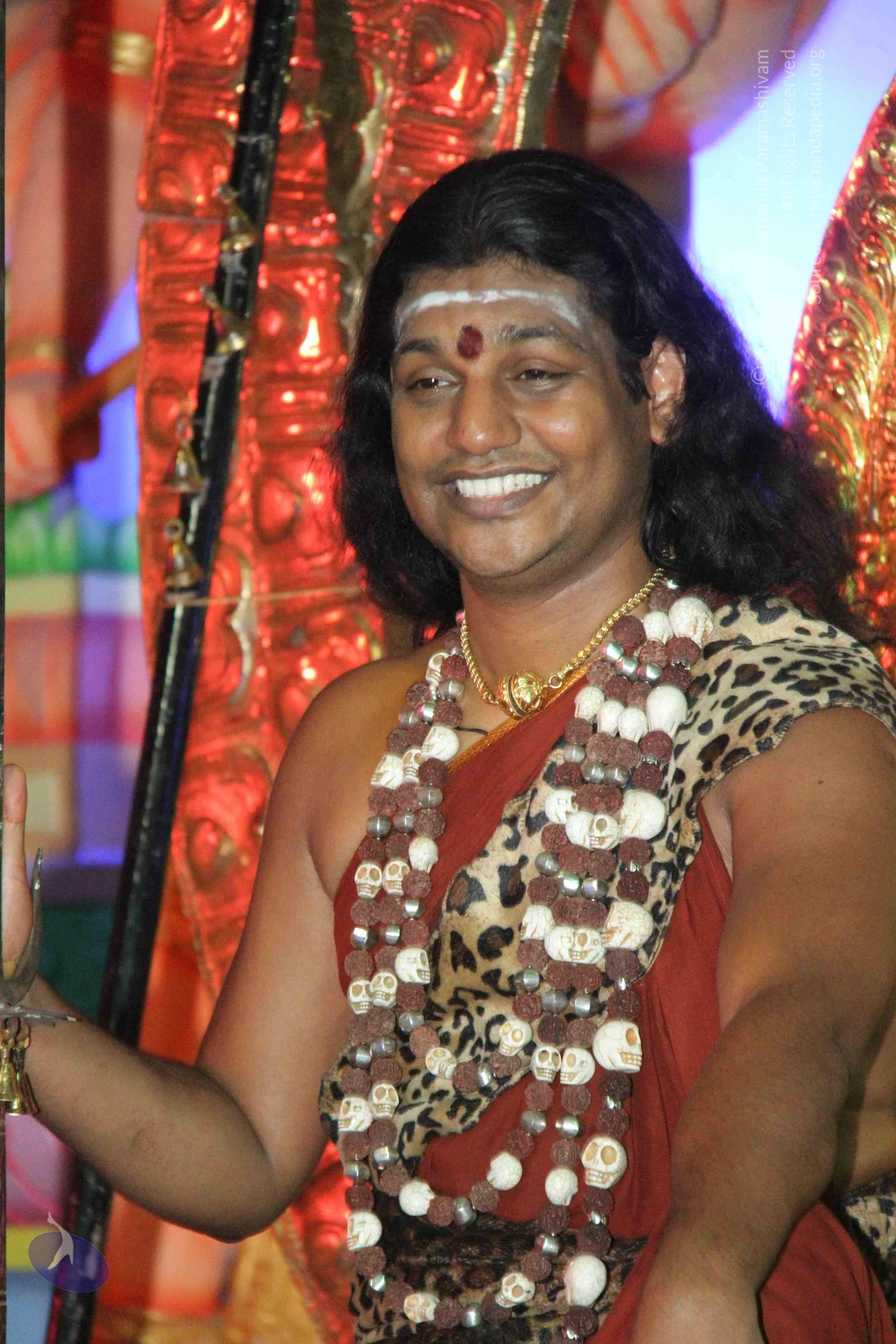
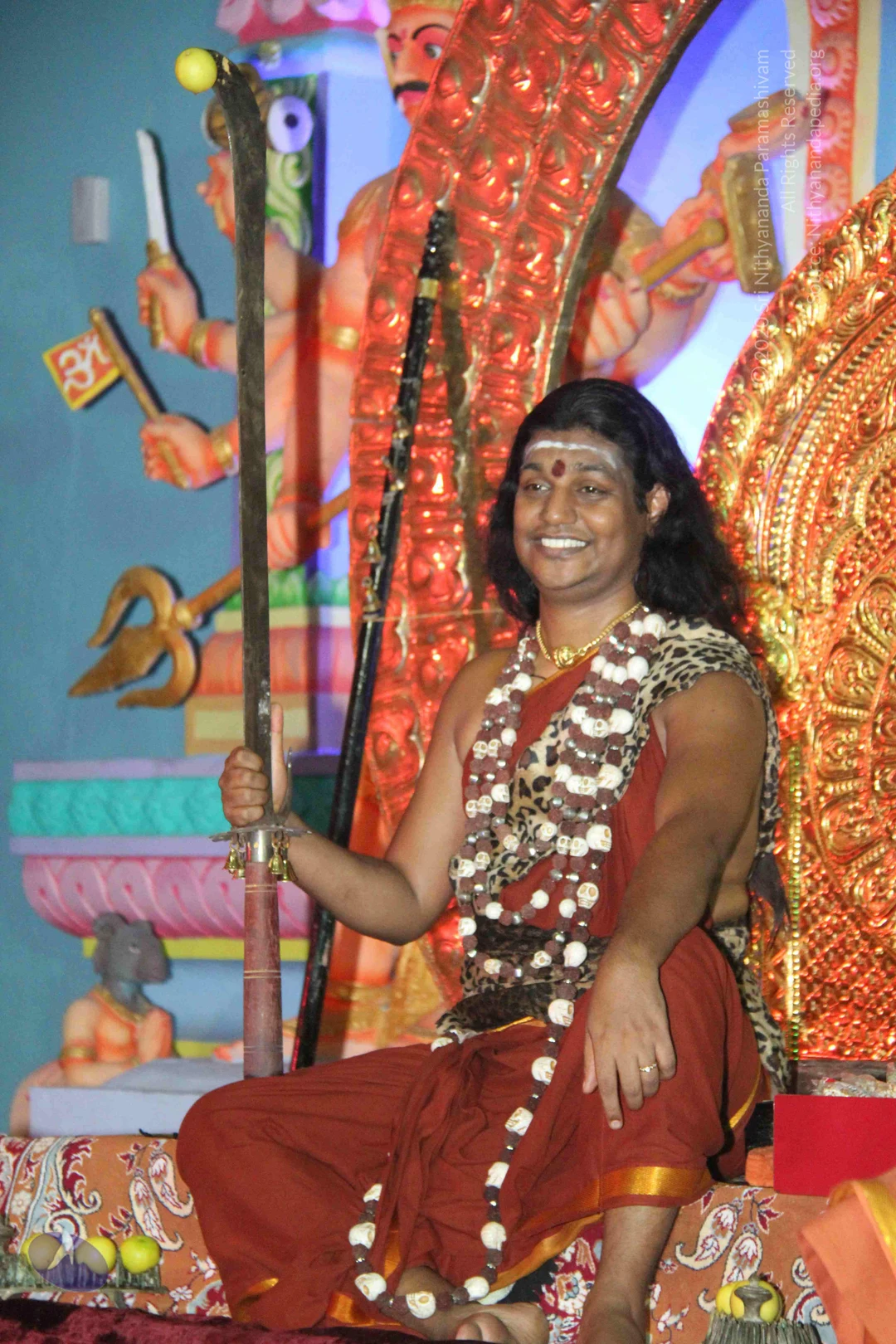
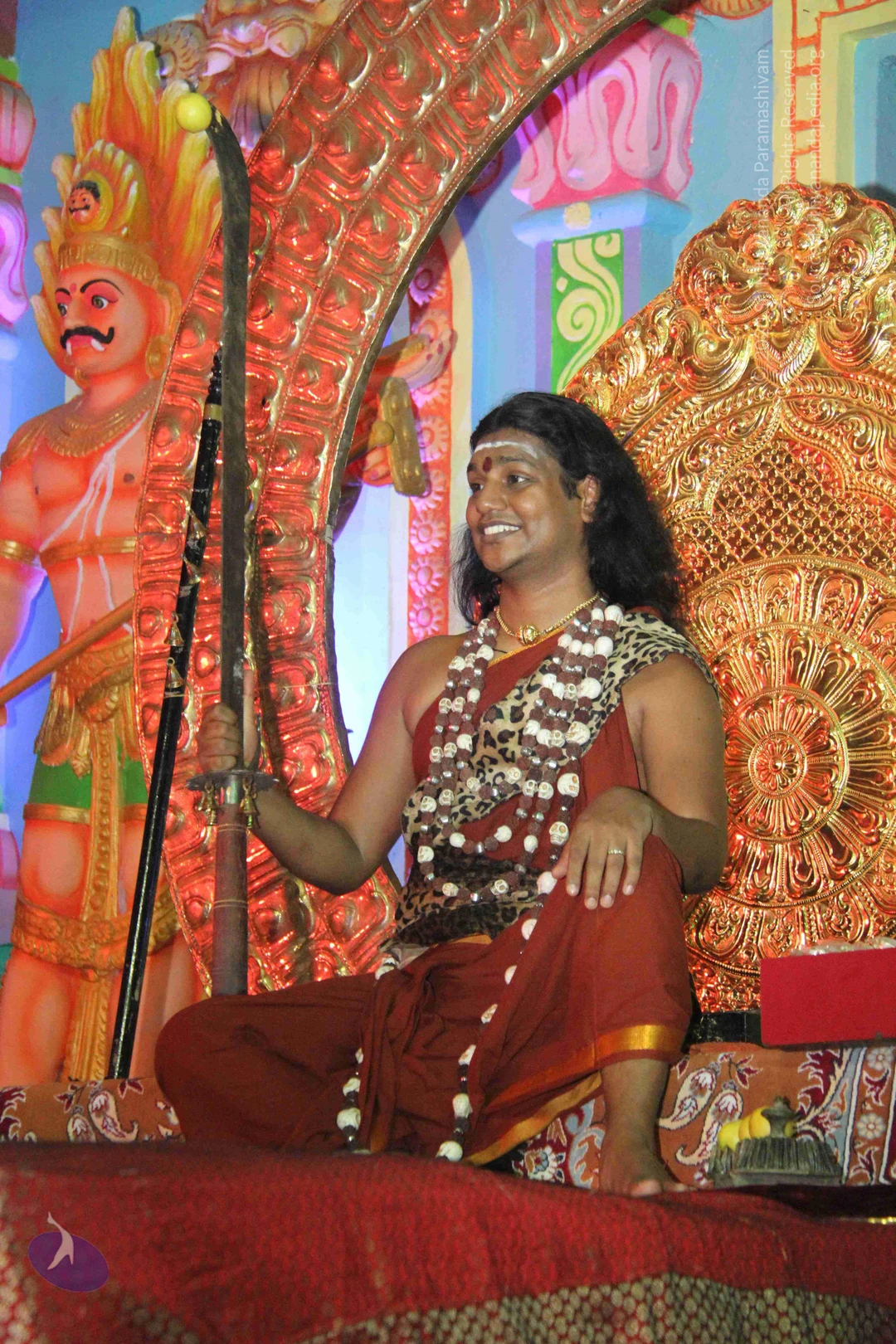
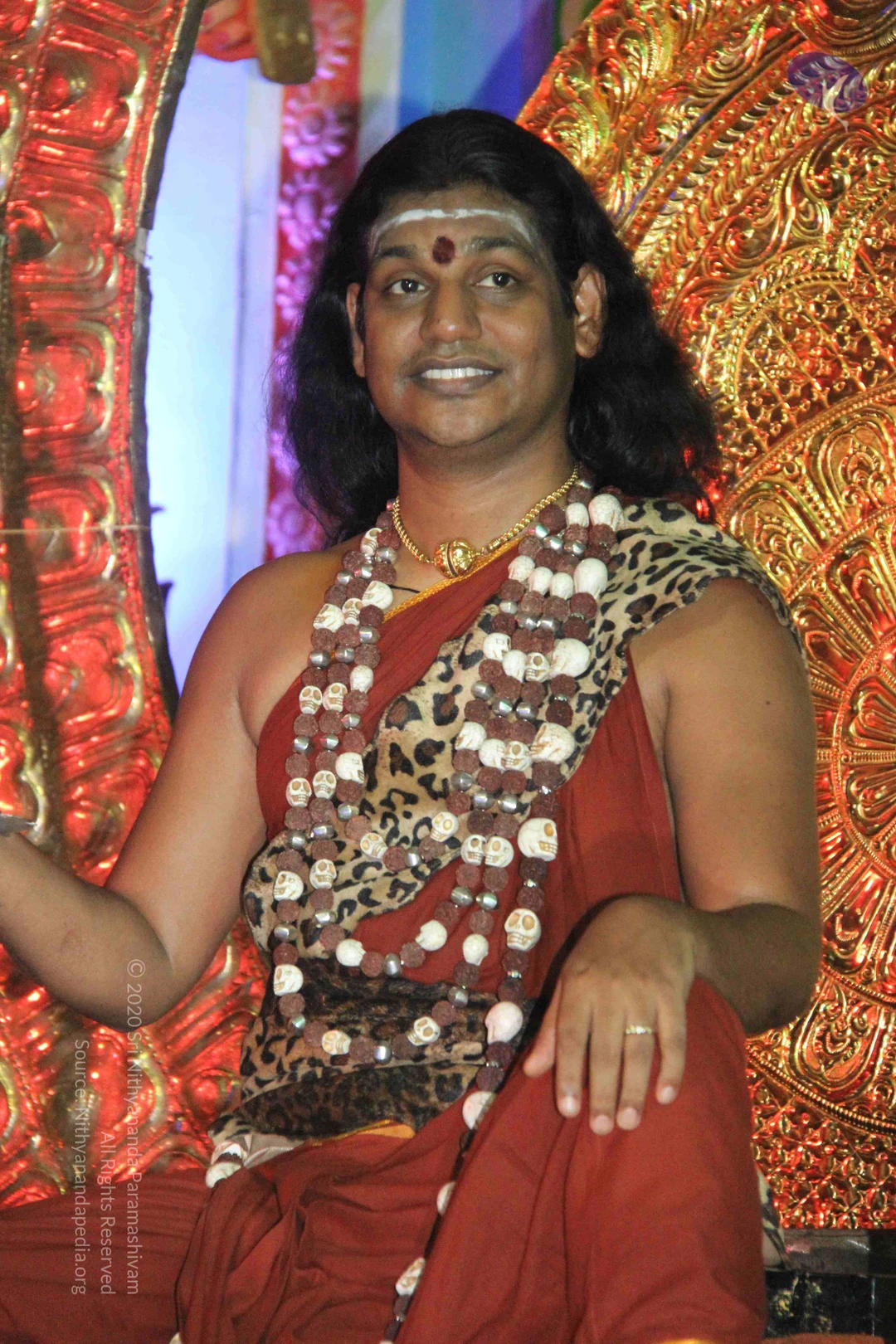
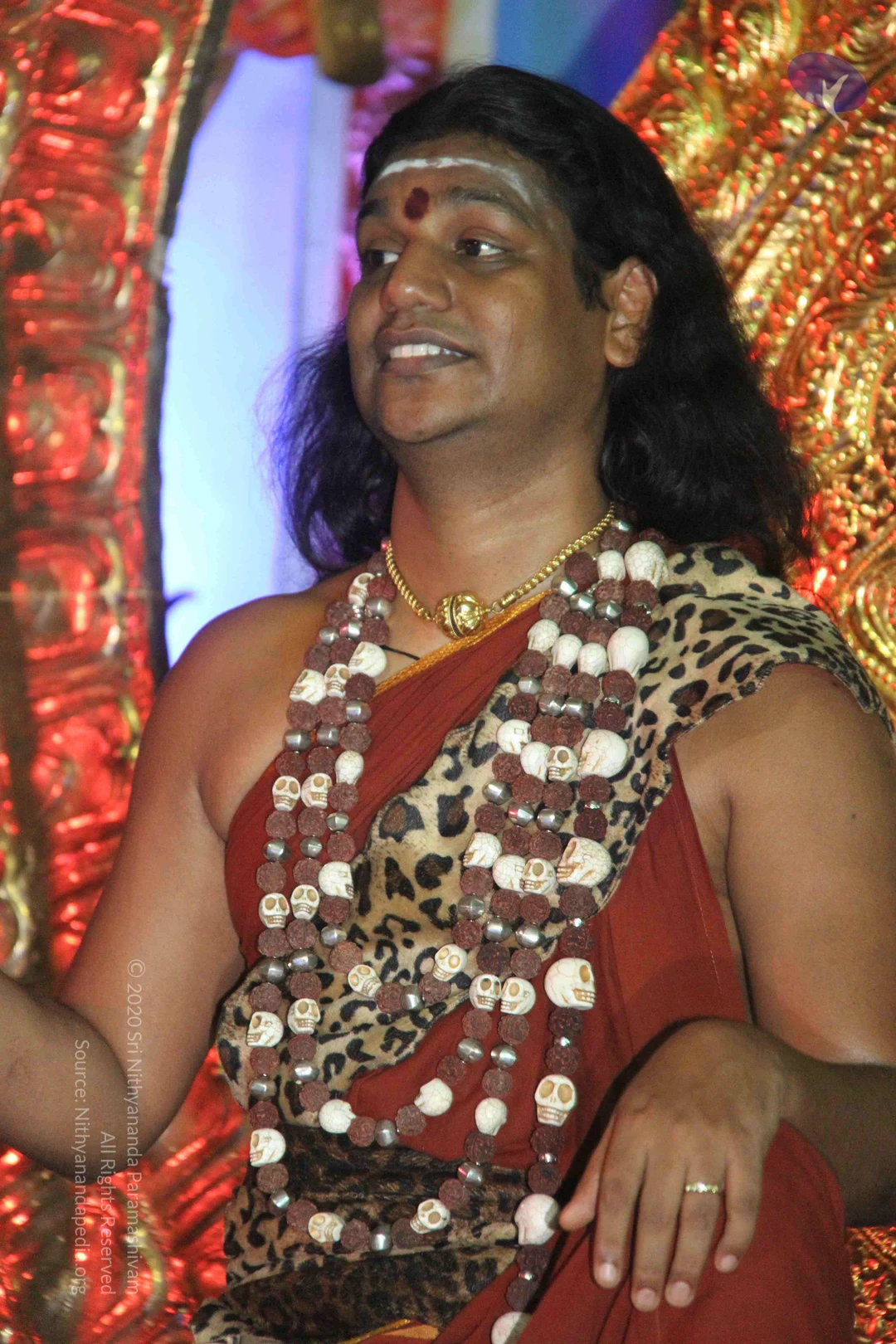
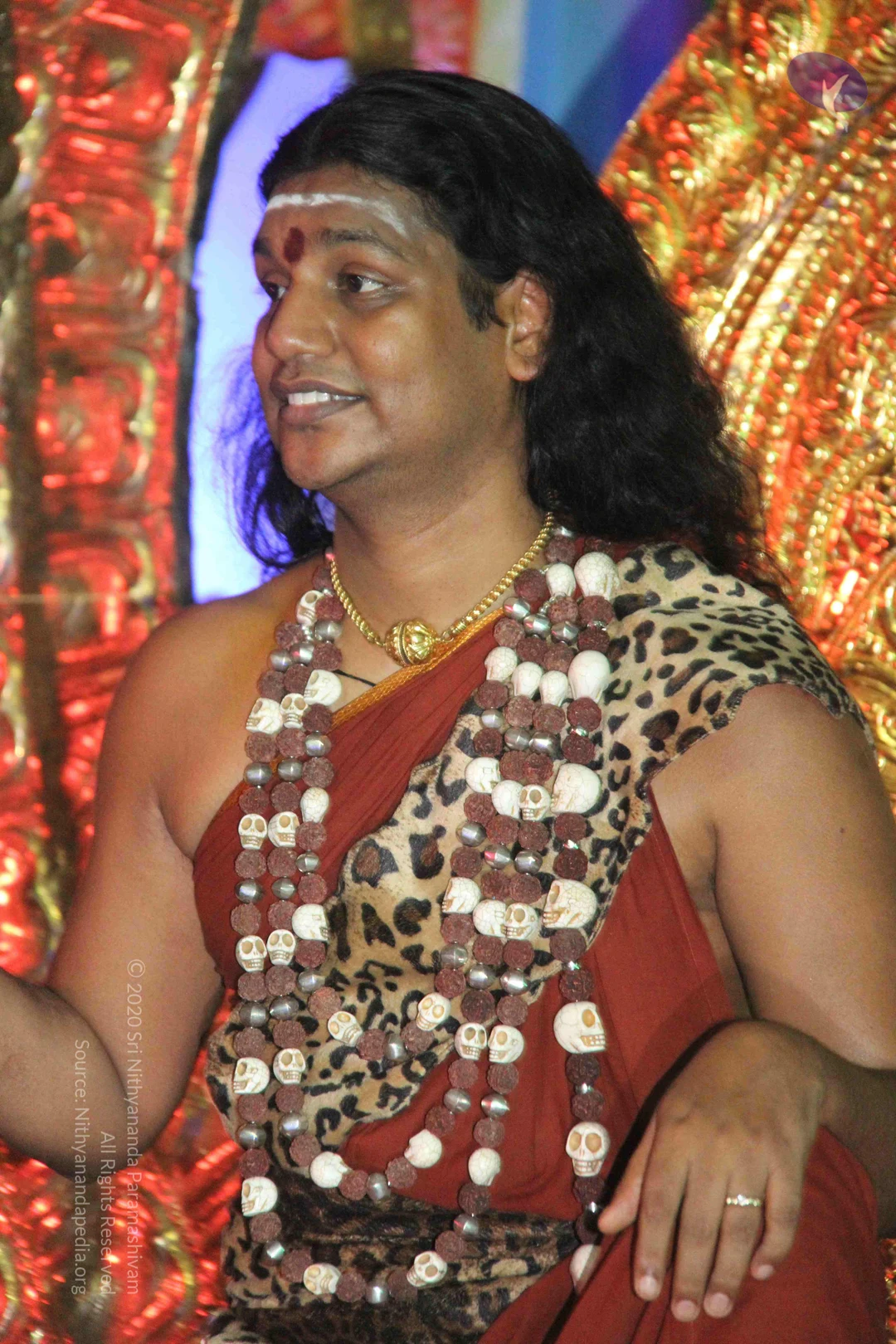
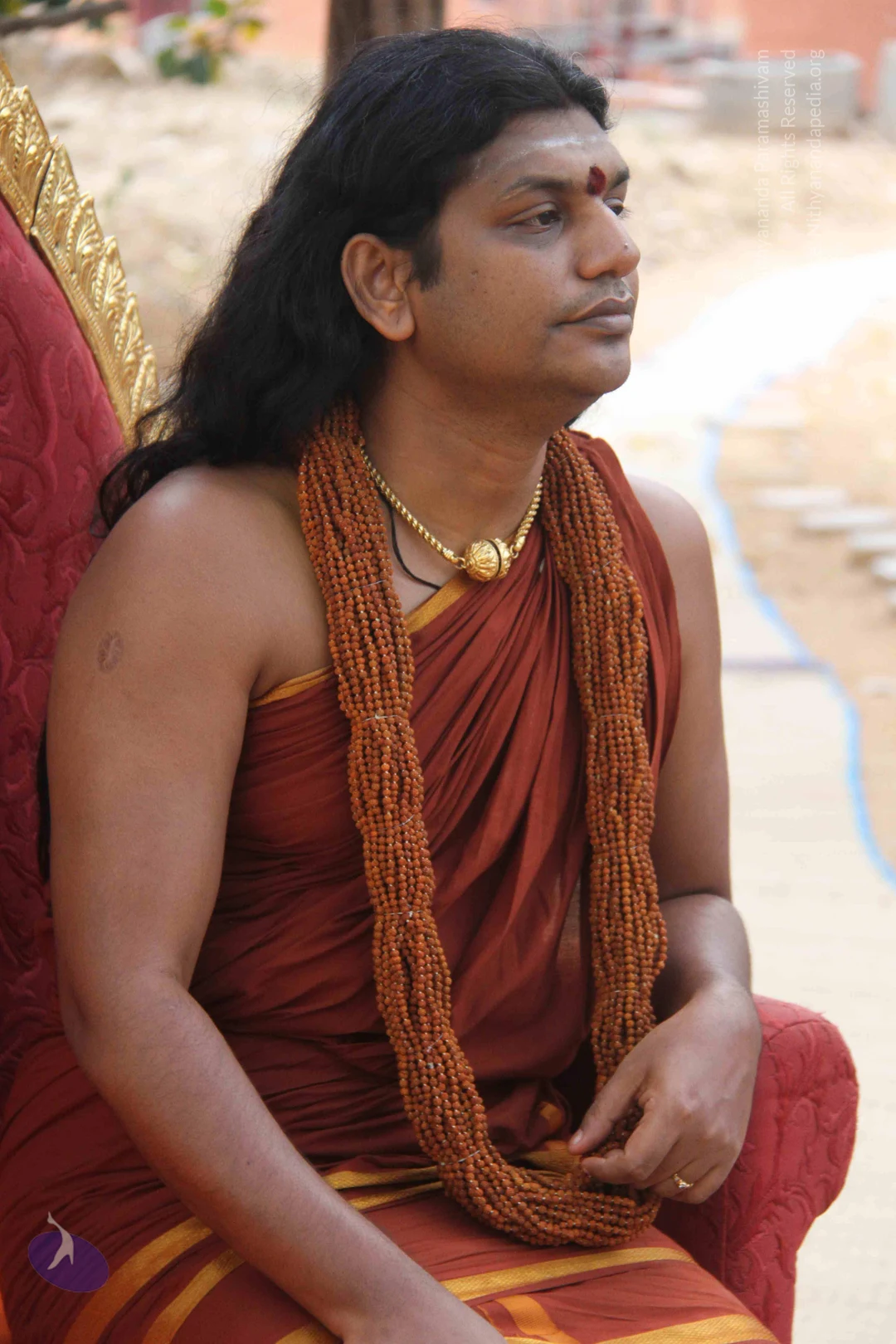
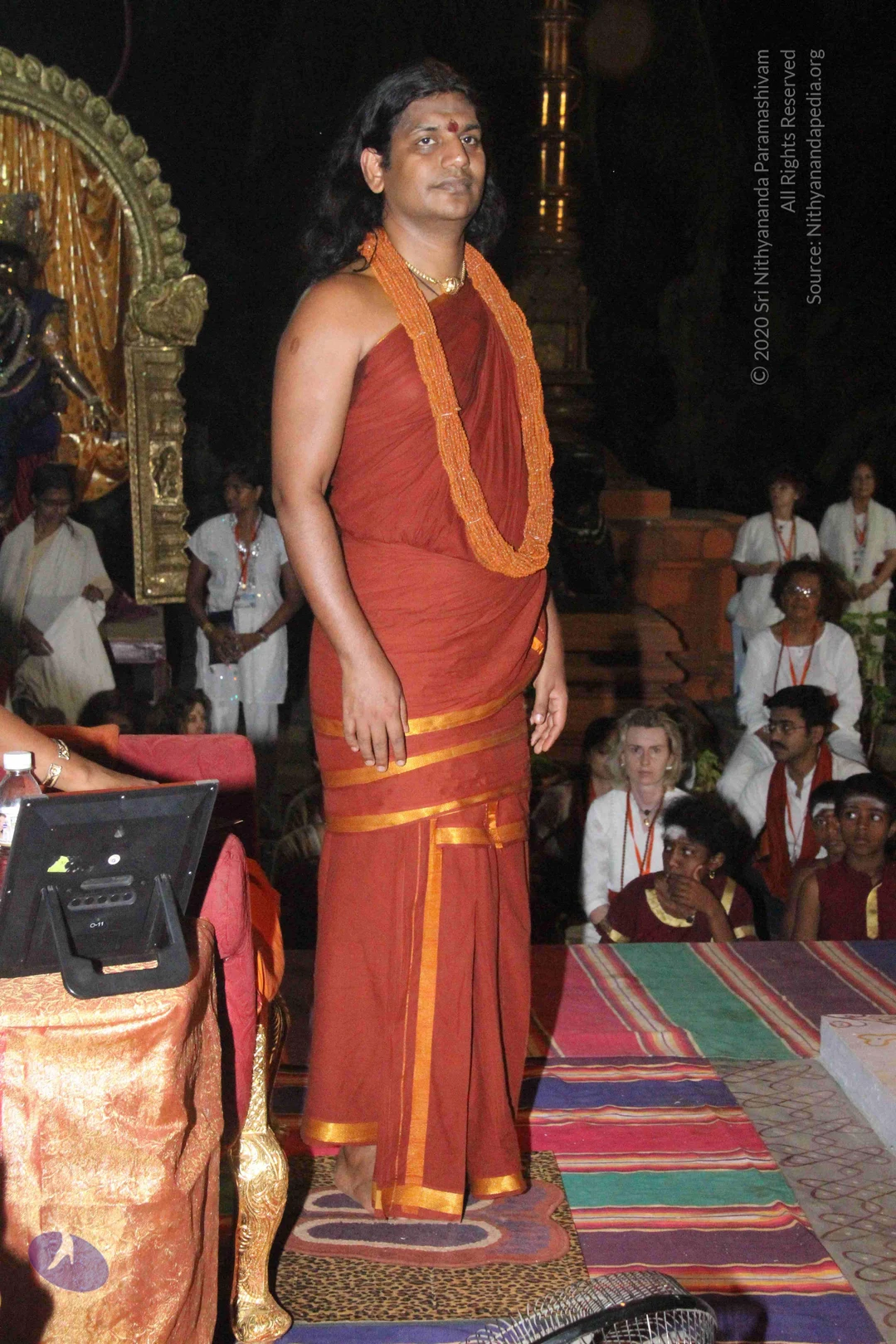
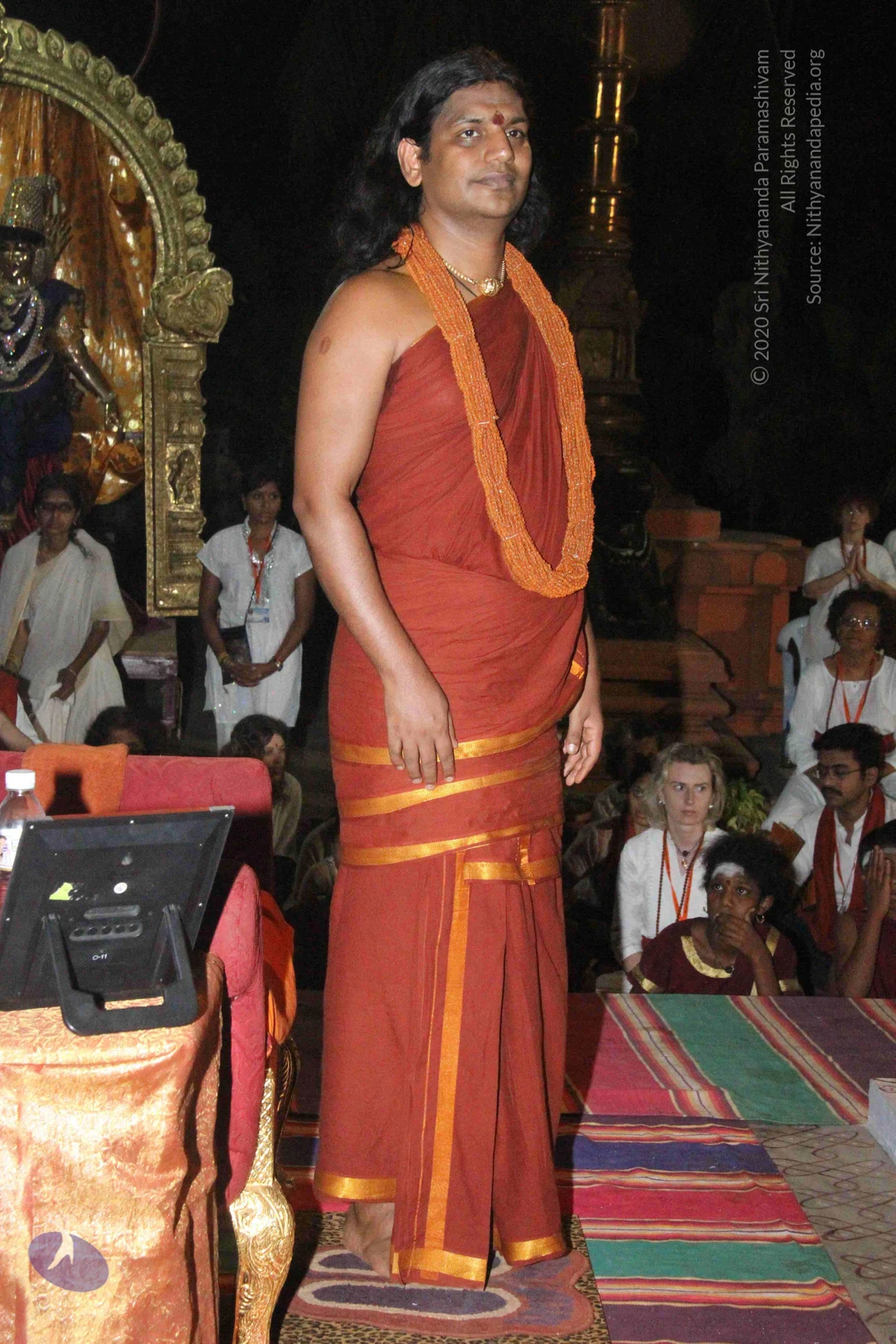
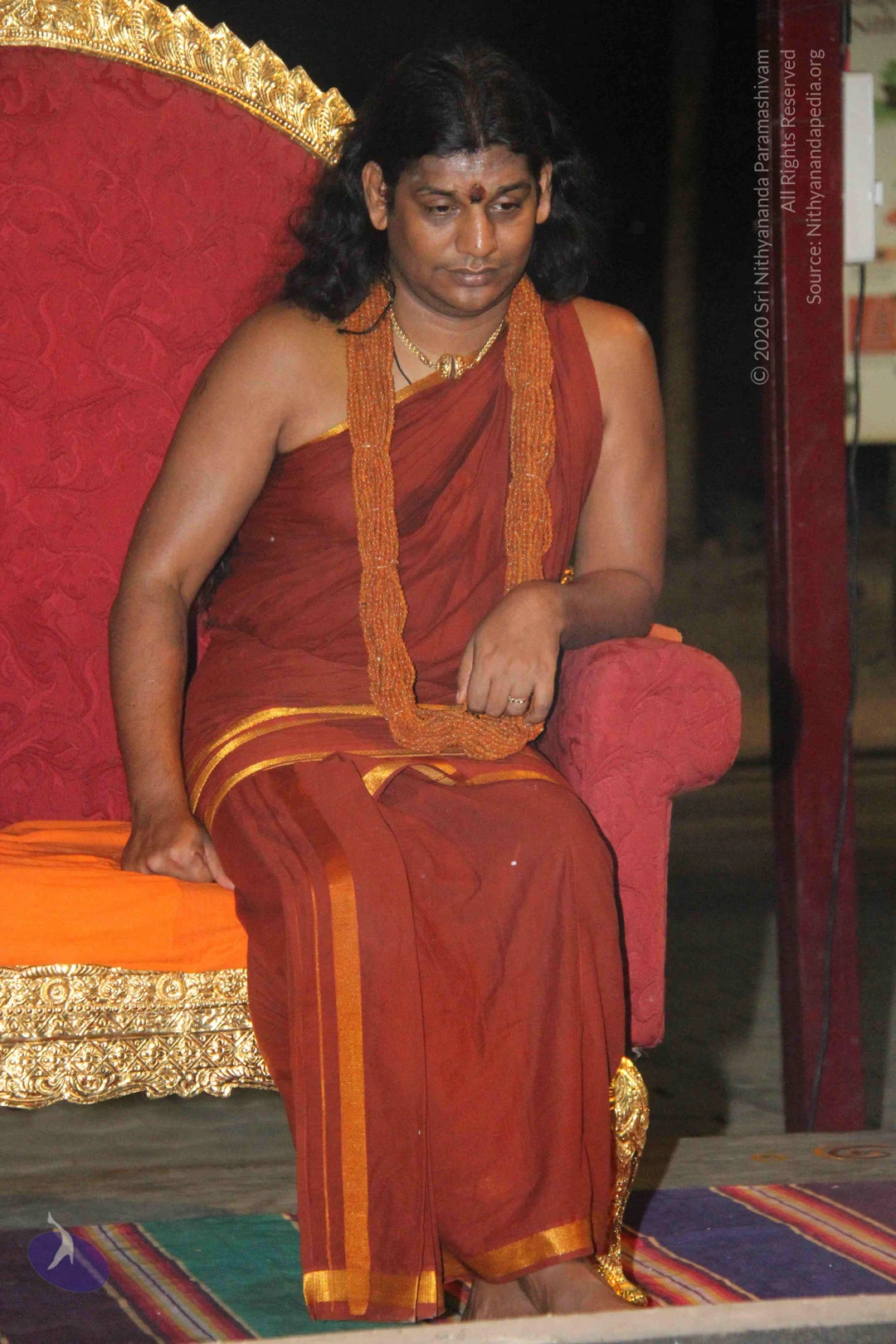
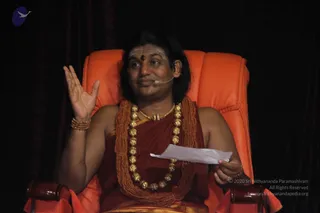
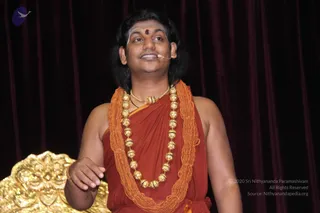
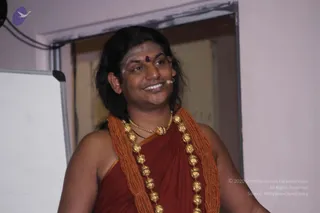
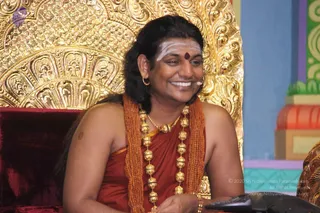
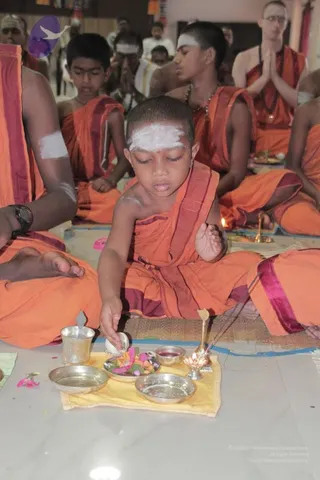
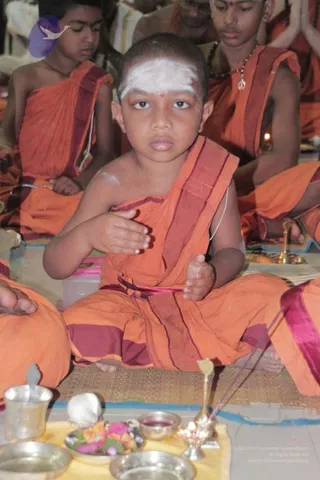
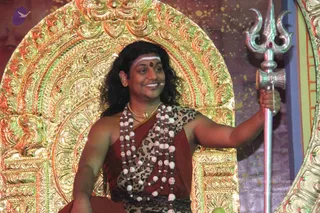
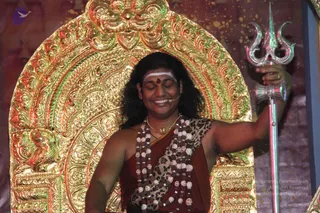
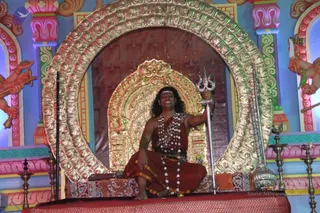
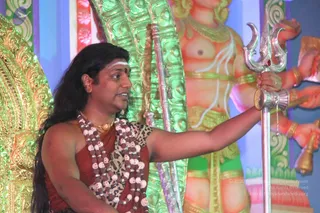
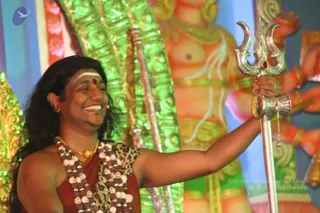
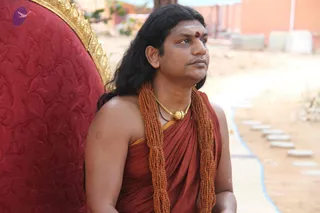
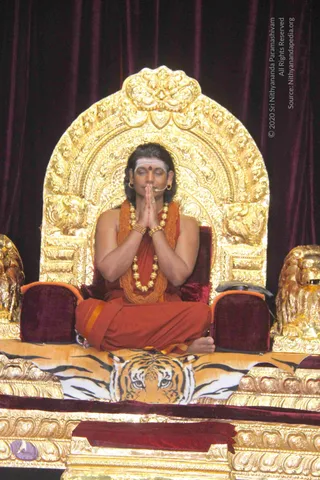
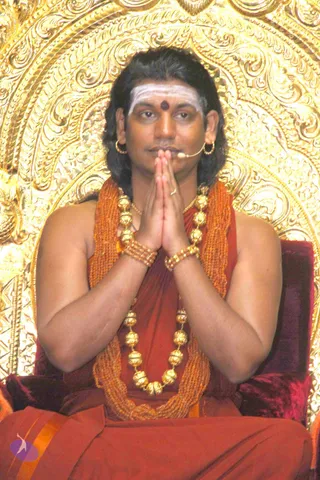
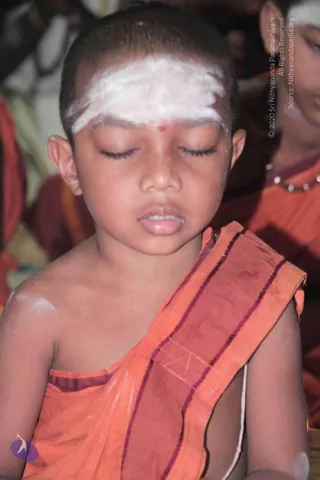
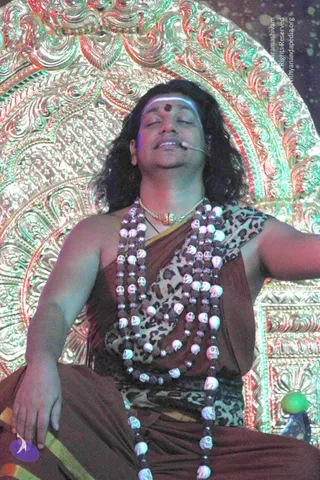
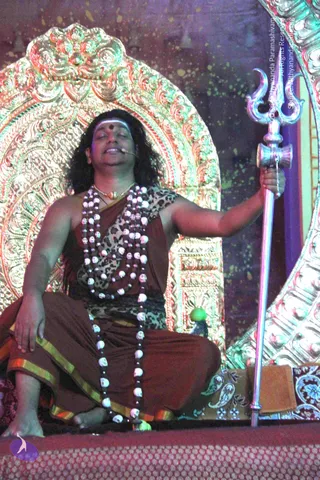
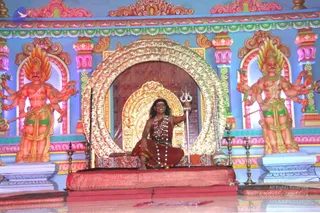
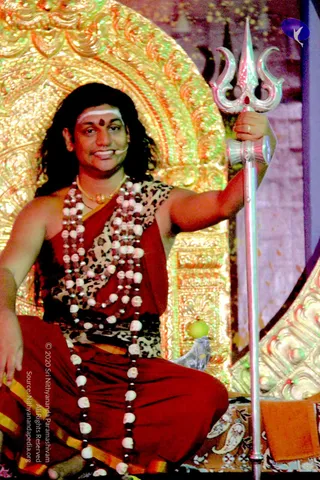
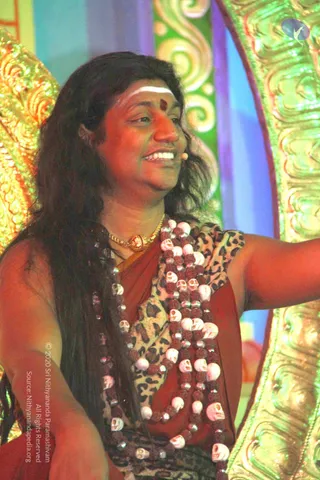
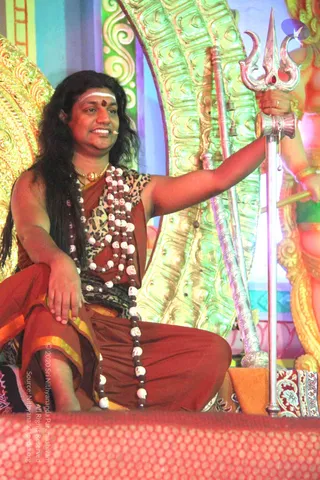
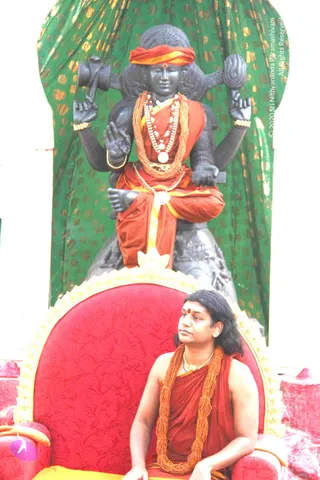
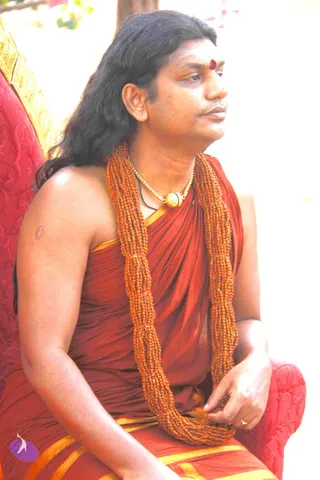
A photograph of a young boy in orange and maroon robes sitting cross-legged with eyes closed and hands clasped in his lap, holding a small stick or flower between his fingers. A white sandalwood or vibhuti band marks his forehead with a red dot at the centre. Behind him, other boys in orange robes sit in meditation, and a few adults in white dhotis are seated with palms pressed together. A pink plastic container and brass items sit on the floor nearby.A smiling man with long dark hair and a red-brown dhoti-style wrap stands on a stage before a dark burgundy curtain. He wears a long orange-beaded mala and a heavy gold bead necklace with a gold pendant, a red bindi and a light forehead mark, and a small headset microphone. Part of an ornate gold throne is visible at the lower right. The scene matches a satsang discourse, with Swamiji (probable) as the speaker: long swept-back hair, rudraksha-style beaded mala and ceremonial gold beads, with a visible throne.A photograph of a seated figure in red robes holding a tall silver trident (trishul) upright in front of the face. The figure has long dark hair, a white tilak on the forehead, a gold chain, and a red-and-brown leopard-print sleeveless garment beneath a loose red shawl. Strands of rudraksha-style beads with skull-shaped pendants hang across the chest and lap. The background is an ornate gold repoussé panel with embossed scrollwork. a person cues: long swept-back hair, a trident, ornate ceremonial beads and gold necklace, and saffron-red robes; the figure's face is partly obscured by the trident. No other people are visible.

March 31 2013

Original wiki page
Contents

Title

THE SUPREME PONTIFF OF HINDUISM HDH BHAGAVAN NITHYANANDA PARAMASHIVAM

Description:

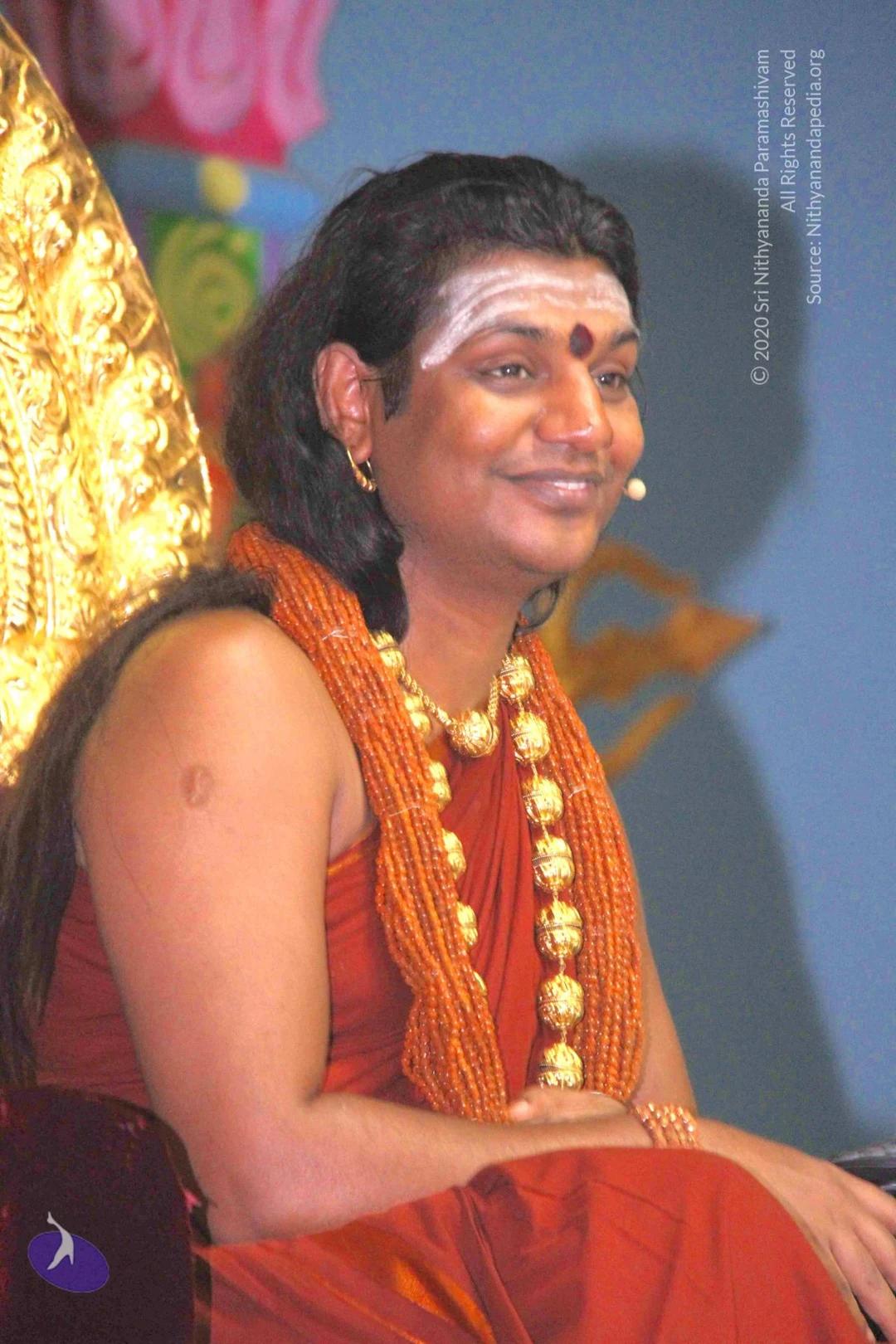
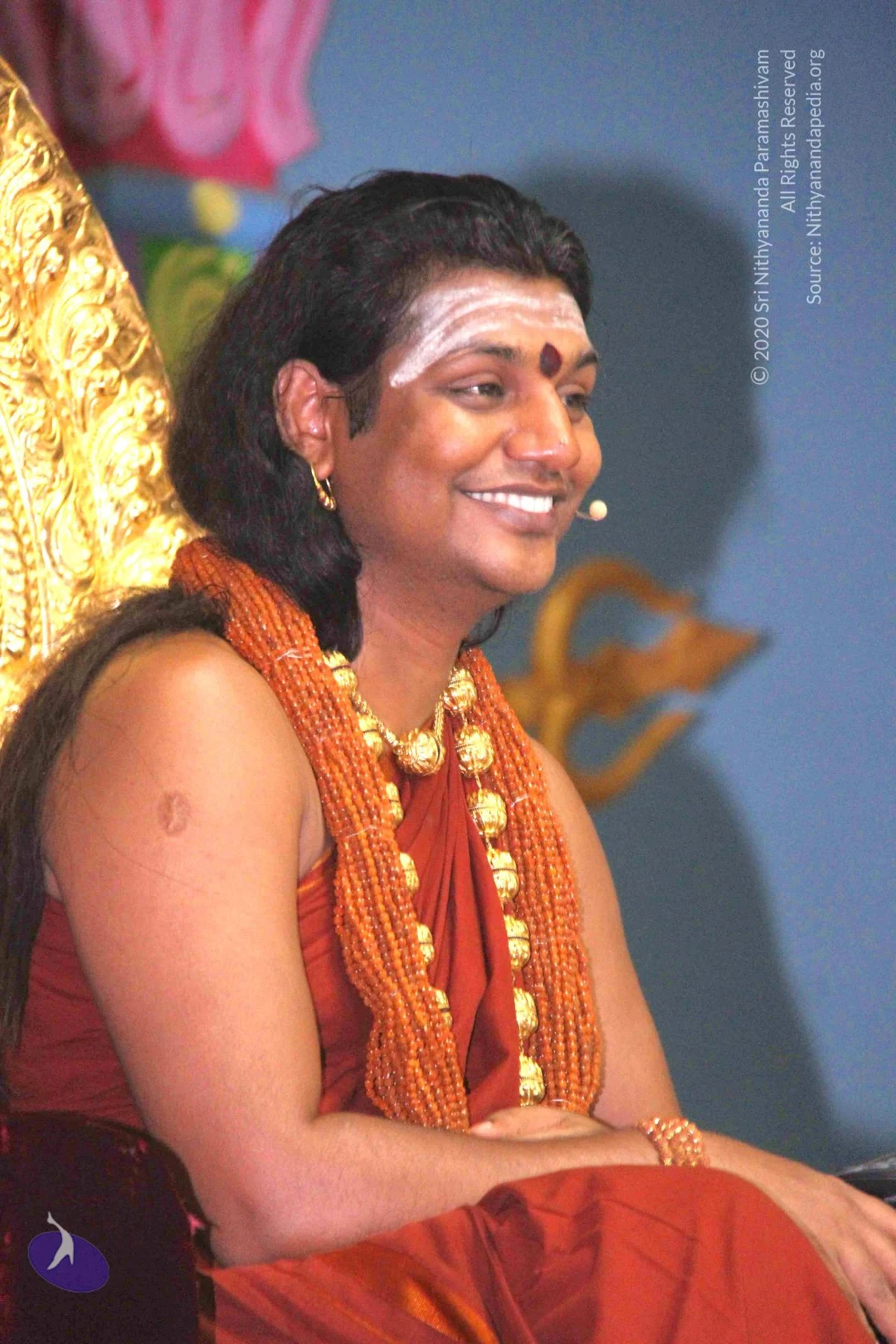
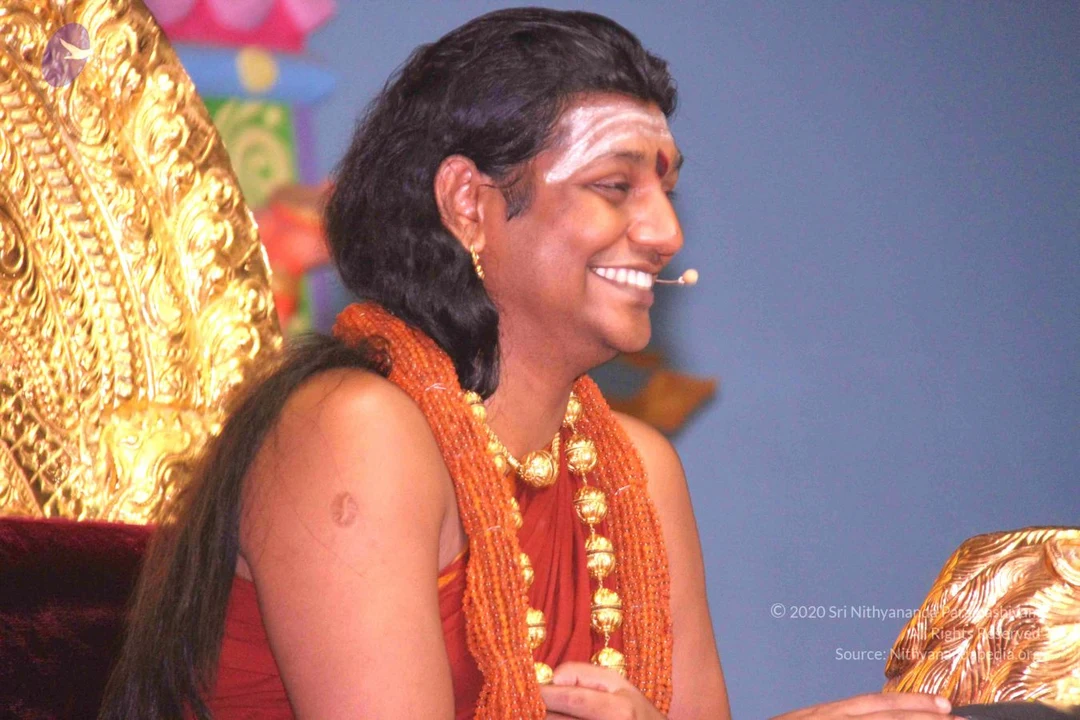
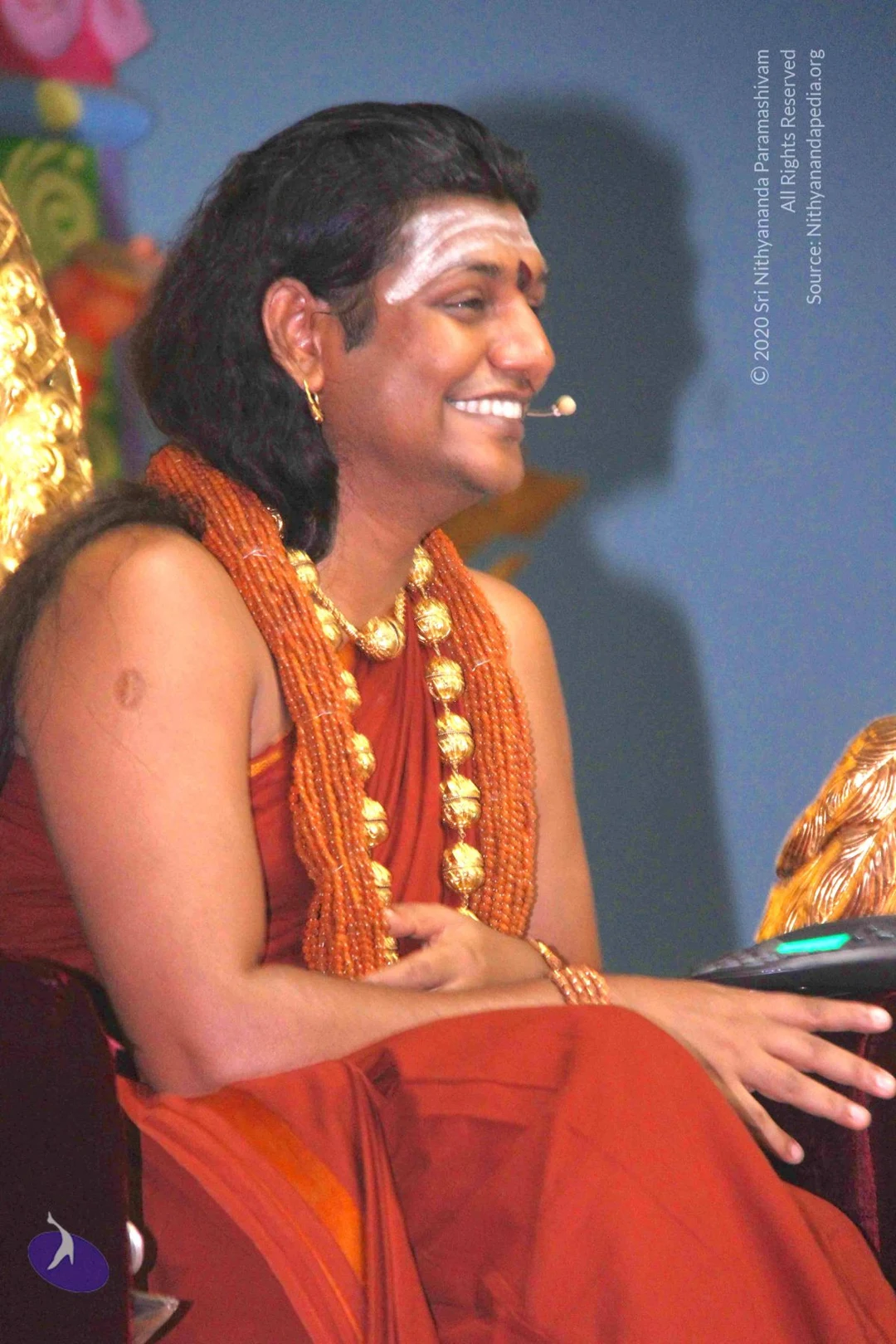
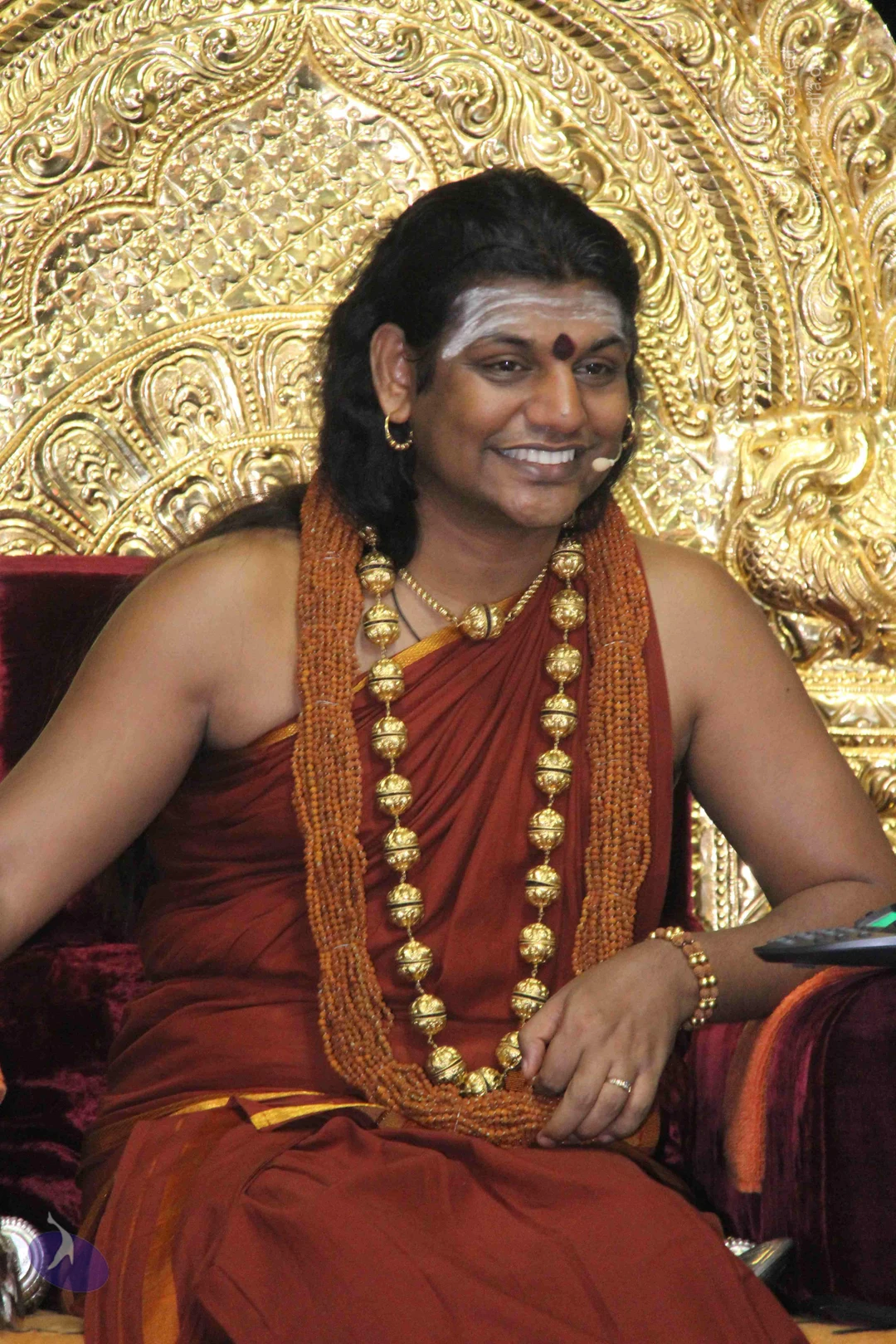
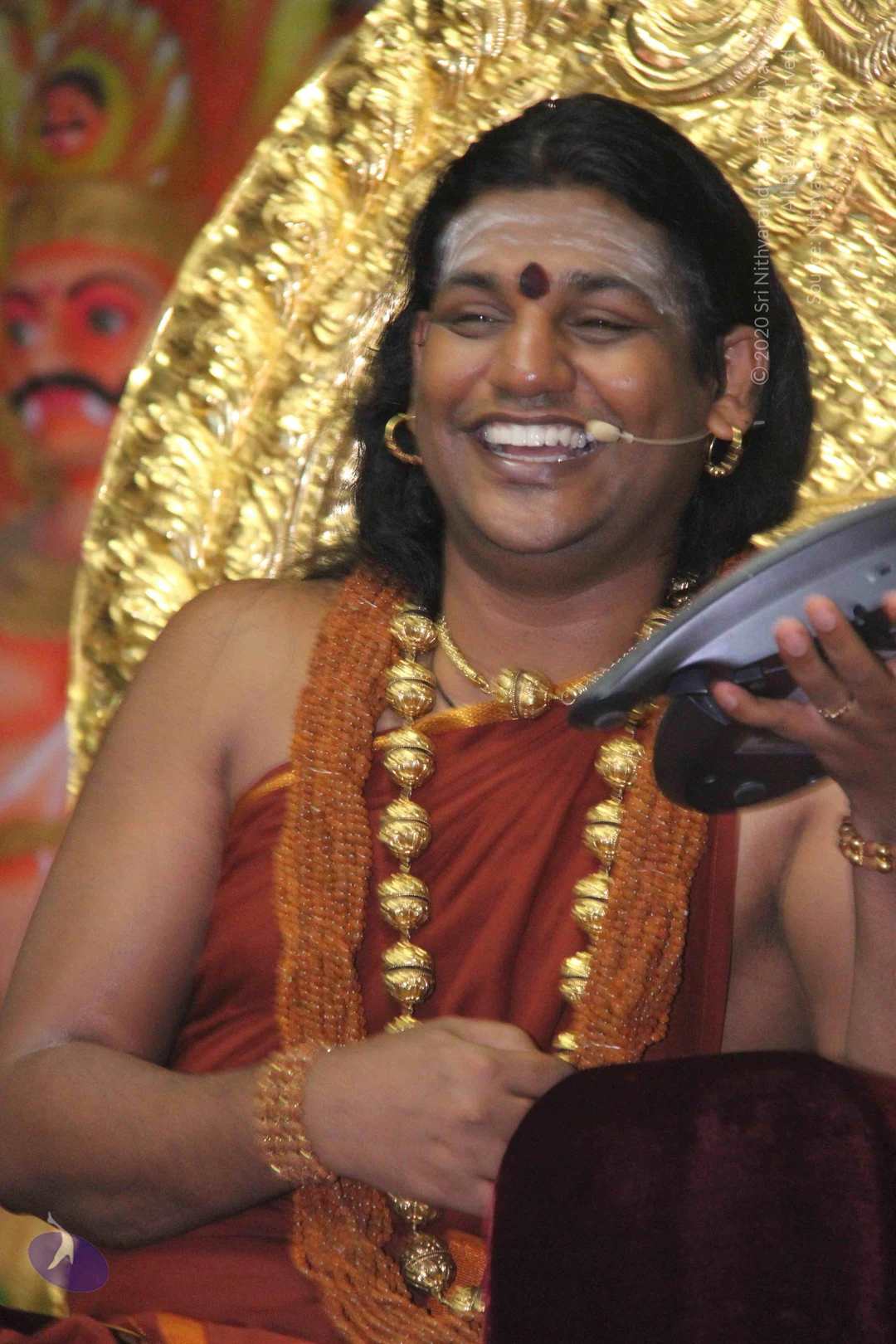
In today’s morning satsang, Paramahamsa Nithyananda demonstrates how lack of integrity creates consistency in our lives. When we fight with ourselves, all the parts of us lose the fight. When we are able to reconcile the warring pieces inside us, every part of us wins. Lack of integrity splinters us so that cannot accomplish anything. When we complete our unfinished ideas and commitments we integrate ourselves and become higher beings.

Transcript:

0:21

Nithyanandeshwara Samaarambhaam Nithyanandeshwari Madhyamaam
Asmadachaarya Paryantaam Vande Guru Paramparaam

1:02

iss samay hamaare saath upastith sabhi darshakon aur bhakton ka main prem evam aashirvaad sahith swagath kartha hoon. aaj ham sampoorthi evam aapke vastaviktha ke beechme jo anokha sambandh hain uske baare mein baath karenge.

Today I will expand how you can (1:43 no video and audio)(1:52 to 2:06 video is there but no audio)

And when they get aligned they become reality. It’s difficult to cognize in the beginning what I am saying if you are not listening. If you have not clapped understand you have not listened. No, I am not asking you to clap; that is different! And I am not interested in people clapping. I am not a politician giving you election time speeches. No. All I am saying is this is such an exciting truth. If you listened automatically you would be excited. Listen once more.

2:56

Dhyan se suniye. Again I am talking. When you don’t have integrity, the life you want to have around you will change hour by hour. Morning you will have one idea of certain life, noon you will have a different idea, next day morning you will have some other idea. So the reality you want to be in, you need to be in and the highest reality - all are different realities. You will be just pushing and pulling, fighting and finally, please listen any fight is defeat.

Any fight is defeat for both parties involved in fighting; all parties in fighting. Any reconciliation is winning for all parties involved in the reconciliation. Listen these two statement. Any fighting is loss for all parties involved in the fight. Any reconciliation is good for all parties involved in the reconciliation. If there is a fight between you and you because of your lack of integrity, sometime I have seen people, 10 people living inside one body. Listen I tell you from my experience sometimes one large size joint family lives inside one body. How will you find peace? So much chaos, so much chaos, so much confusion!

5:23

Forgetting happens because lack of integrity. If one person takes over the other person inside you, you forget what one person was thinking. How many of you are able to cognize this truth? So you are all group living in one body! When I ask your name you should say your name and group. Raman and group! Who are you? Raman and group! It is not one person. It is group of people living.

Listen the problem is when group of people live, all of them need to share your body; one person has your hand, one person has your leg, one person owns your brain, one person owns your heart. So, all of them are handicapped because nobody owns the whole.

Tell me can 20 handicapped persons put together perform one healthy persons work? The problem is, here in the 20 only one owns brain. All the 19 does not have brain. And the fellow who owns the brain does not have heart and the fellow who owns the heart does not have hand. You have become like a group of people living in one body when you lack integrity.

7:32

Listen that is why I am telling you, complete with yourself and align you to integrity. When you align yourself to integrity suddenly you become one being. When you are one being the reality you want to be, you need to be and highest reality, all becomes one and the same.

achche se samajhiye, vaastaviktha jo aap chahthe hain, jo aapki zaroorath hai aur uchchatham vaastaviktha; yeh sabhi jab sanGHaTith jo ho jaathe hain vah vaasthaviktha ban jaathi hain.vaastaviktha teen prakaar ki hothi hain.

pehle voh vaasthaviktha jo aap anubhav karthe hain, doosra vah vaastaviktha jo aap anubhav karna chahthe hain aur teesra vah vaastaviktha joh antim parinaam ke roop mein aapko prapth hothi hai.

jab aap sampoorthi main stapith hothe hain tab jo aap vaastaviktha jo aap anubhav karthe hain, jo vaastaviktha aap anubhav karna chahtha hain, evam jo vaastaviktha anth mein jo aapko parinaam ke roop mein praapth hothi hain; yeh teen vaastaviktha ke BHinn pehloo aapko sarva shreshTHa vaastaviktha mein stapith karthe hain.

jab aap sampoorthi mein nahin hain, jo jeevan aap apni aas paas chahthe hain, vah prathi ghanTe parivarthith hotha hain. isliye jo vaastaviktha aap chahthe hain, jo vaastaviktha aapke liye aavyashak hain, evam sarvochch vaastaviktha sabhi BHinn BHinn hain. koi bhi yuk sabhi daalo ke liye haar hain koi bhi sulaah sabhi dalo ke liye jeeth hain.

10:33

Listen when you integrate you, whatever you want to achieve you just declare and do it. You just declare and do it. You will see when you experience integrity in you, the whole world cooperates with you.

krupaya suniye, jab aap apneaap ko sampoorthi ke stithi mein laathe hain tab aap jo bhi paana chahthe hain aap keval uski GHoshna karke praapth kar sakthe hain.

When you maintain integrity with others, others confidence over you increases. When you maintain integrity with you, your confidence over you increases. Listen when you have confidence over you, you will realize you are the ultimate doer you are the causer of reality.

jab aap sampoorthi mein rehthe hain tab poora vishwa aapka sahaaytha kartha hain. tab poora vishwa aapki sahaaytha kartha hain.

13:34

When you bring integrity in your thinking you become aware of every anxiety you go through, fear you go through, forgetfulness you go through; how you are responsible for creating negativity in your life, how you are anxious to create negativity in your life, how you can align yourself with yourself and the world can just align itself with you.

With lack of integrity there is such huge confusion. You do not know what goes on inside you and outside you and you even forget sometime what you really want. Just to prove one or two points like you should be right and you are right you destroy your lives.

jab aap apne soch mein sampoorthi ki stithi laathe hain tab aapko jaankaari praapth hogi ki kaise aap apne andar bhay, nakaaratmaktha, evam sanGHarsh ka srujan karthe hain.

I have seen human beings just to prove they are right, destroy their whole life. They lose their whole life. It is so dangerous; so dangerous.

Maine kaiii manushyon ko dekha hain jo keval apneaap ko sahi saabith karne ke liye apna poora jeevan ko vinaash kar dethe hain.

16:17

It is so sad human beings many time do not know what they really want. Their lack of integrity makes them forget what they want. Please listen when you lack integrity you even forget what you actually want. After 2 days you don’t know what you wanted. You can have the life of not having what you want. Even that can be forgiven but you can’t have the life of not knowing what you want. Not having what you want is only poverty; not knowing what you want is just horrorty. I am giving a new word.

Not having what you want is just being poor.

Not knowing what you want is being in the state of terror-horror

yeh baDi dukh ki baath hain ki manushya kaiii baar yeh jaan nahi paathe hain ke vaastav main kya chahiye.

jab aap sampoorthi main hain aap dekh sakthe hain ki aap apne jeevan mein nakaaratmaktha bharne ke liye kitni tatpar hain.

jab aapme sampoorthi nahin hain tab aap lagaathaar bhram mein rehthe hain; bas apneaap ko sahi sabith karne ke liye aap apne poore jeevan kaa vinaash kardethe hain.

19:29

Integrity is not just ethics. It is your Constitutional Right and the first Responsibility! What all you can do is your RIGHT. What you can’t do is the LAW; your RESPONSIBILITY! What you can do is your Right. What you can’t do is your Responsibility, Constitution and Law! Vidhi Nishedha!

Same way, in the Cosmic Constitution, you have some Rights and you have some Responsibilities. Here Integrity is your Right and Responsibility. It is not just your Responsibility; it is your Right! If you understand how much Integrity adds to you, the powers given to you by Integrity when you live Integrity, all the things you achieved, then you will realize Integrity is not just your Responsibility; it is your Right!

When you feel Integrity is your Responsibility, you are in the zone of practicer- Seeker. When you understand Integrity is your Right, you are in the zone of Enlightenment!

Now many people want to save themselves; so they are clapping! Whether you understand or not better clap otherwise this guy will ask!!!!!

21:51

suniye aap jise chahthe hain use naa paane ki stithi baDi dukh bhari stithi hain. kinthu aapki ek jaankaari tak nahi hona ki aap vaasthav mein kya chahthe hain vah stithi aur bhee dukh bhari stithi hain.

Whatever you want to achieve, declare to yourself and do it. When you bring Integrity in you, you become aware of all the anxiety you go through, every fear you go through, every forgetfulness you go through and how you can align yourself with yourself and the world can align with you.

Listen! Many time, if you are afraid of your spouse, you go through the same fear even when you do something in your business. Listen! You are afraid of your spouse in the house; so anything you do in the house, there will be fight. So, when that becomes pattern in you, you start believing anything you can achieve only after a lot of struggle, fight, suffering. So, with that mood when you start, even in your business you don’t take any decision. When you think something new, creative, immediately you remember the same fear, anxiety, you have to go through with your spouse without even remembering the spouse.

Listen if you remember the spouse, at least you know only with her you need to fight. But in the business there is nobody to fight with you but the pattern becomes so unconscious you carry the same fear to your profession, business also and do not make any major decision.

24:42

aapko kuch bhi haasil karna chahthe hain keval GHoshana keejiye aur kaaryanvith ho jayiye. jab aap sampoorthi ke avasthaa mein rehthe hain aap sabhi kuch ke baare mein jagrit ho jaathe hain; jo aapko chintith kartha hain, jo aap ko bhaybeeth kartha hain, jo aapko bulakkad bana detha hain, aur kaise aapme aapka swayam se taalmel kar sakthe hain aur duniya ke saath taalmel kar sakthe hain.

Sampoorthi aapka janma siddh adhikaar hain. Sampoorthi ke stithi mein rehne ke liye lagaathaar uttardaayitva leejiye.

Sampoorthi keval aachaar shastra nahin hain. Sampoorthi aapka samvidhanik adhikaar hain. sampoorthi aapka pehla uttardaayitva hain; aap jo kar sakthe hain vah aapka adhikaar hain, jo aap nahi kar sakthe hain vah aapka uttardaayitva hain. yahi brahmanDeeya samvidaan ke vidhi nished hain.

Sampoorthi aapka janma siddh adhikaar hain. sampoorthi ke stithi mein rehne ke liye lagaathaar uttardaayitva leejiye.

26:26

I will move to the next step on integrity.

Just remember, if everybody around you is integrated with you, means they are very transparent and talk the truth as it is, just remember how your life will become! It will become heaven! I tell you from my experience! I don’t know about others. For me it will become heaven Kailaasa.

Everybody wants that life. ‘Yes, it will be amazing if everyone around me is integrated!’ When you want that life, why you don’t want to give that life to others? When you want that life, why you don’t want to give that life to others? You think, ‘No, No! I will make every one integrated but I will keep that cunning way of planning and doing what I want, when I want, that my own independent, decision-making, strategy-planning life-style for me! I will make everyone stable, but I will continue to retain my instability!’

It is like you build the huuuuuge, world’s tallest building on moving ground, on sand-bed, without having foundation. What is the use?

28:34

sochiye agar aapke jeevan mein har koyi maanav aapse spashTa roop se baath kartha hain aur jo bhi baath kartha hain use niBHatha hain, tab aapko kaisi anubhoothi hogi? sochiye. yadi aap ke aas paas sabhi log sampoorthi main hain, yadi aap paardarshi hain aur sathya seedhe bolthe hain, sochiye aapka jeevan kaise hoga? aapka jeevan swarg hoga, Kailas hoga!!

Then, why you don’t want to give that to others? I tell you, anything you create for others only will be created for you. Anything you create for others only will be created for you.

phir aap iss anubhav ko doosron ko dena kyon nahi chahthe hain? aap jo anubhav doosron ko dethe hain vahi anubhav aapko BHi praapth hothi hain. jo BHi aap doosron ke liye banaathe hain vahi aapke liye BHi ban saktha hain. Dhyan se suniye job BHi aap doosron ke liye banaathe hain vahi aapke liye BHi ban saktha hain.

31:05

You need to know, when you start living Integrity, you will become sensitive to all the confusion, suffering you cause to others because of your lack of Integrity. How much you torture how many people in your life because of your lack of Integrity. Only when you start living Integrity, you will become sensitive to it, you will become intelligent to it.

Organization’s Integrity is dependent on their marketing agents and the product delivery. Individual’s Integrity is dependent on Ahankaara and Mamakaara - how you project and what you are. An organization’s Integrity is dependent on your advertising/marketing department and delivery department.

33:01

jab aap sampoorthi mein rehne lagthe hain tab aap apne asampoorN vyavahaar ke saath doosron ko jo kashTa pahunchathe hain vah aap ke saamne prakat hotha hain.

You will understand how much of disturbance you cause to others when you don’t have Integrity. I know, in my native place, once, in one month, when I was young, in that village, within a month that two street people had diarrhea, bleeding in their motion. Finally, we found out, local merchant who supplies the chilly powder has added brick powder into it! The Adulteration! In the Vellore, Gudiyattam, Tiruvannamalai, that area is the largest chilly powder produces. All the chilly from Andhra comes there and gets dried and becomes powder; the processing unit. Sometime, the small processing units do adulteration. They add brick powder into it. This guy, out of greed, added a little more powder. Full two street which was using his products regularly had bleeding. One man’s lack of Integrity can destroy how many people’s health, just understand!

Same thing with MacDonald’s, Pizza! Lack of Integrity of pharmaceutical companies; you need to know, every year, not hundreds of thousands, millions die just by drinking soft drinks! Soft drinks, kills millions! It is statistics I am talking about; all over the world. Same way, the pharmaceutical industries are more interested in emptying your pocket, taking away your money, than taking away your disease!

36:16

The lack of Integrity of one person can cause so much suffering to the society, country. Only when you start living with Integrity, you will realize because of your lack of Integrity how much of suffering you caused to others.

keval jab aap apne asampoorNa vyavahaar ko dekh sakthe hain taBHi aapko samajh mein aayegi ki aap ki asampoorthi kaise anya logon ko nakaaraatmak roop mein prabhaavith karthi hain.

aap asampoorthi ki vajah se doosron ke liye peeDa ke kaaran ban jaaathe hain jab aap sampoorthi mein stith hothe hain taBHi aap samvedansheel banthe hain, taBHi aap yeh samajhne ke liye buddhimaan banthe hain.

jab aap sampoorhti main jeene lagthe hain taBHi aap iss sathya se samvedansheel banthe hain ki aap apne asampoorthi se kaise doosron ko pareshaan karthe hain.

38:41

You will realize when you start living with Integrity how much pain you gave it to others with lack of Integrity. Only with Integrity you will feel you are a man. Otherwise you are just, you know, I tell you, the truth you know about you kills you even if others don’t torture you. If you are living with lack of Integrity, the truth you know about you itself is enough punishment! The hell does not need to come from outside separately! The truth you know about you is powerful enough to kill you!

There are some things in the life, when you live them you will understand. Before that, no word can explain the benefits of it. When you bring Integrity with others, you reclaim life. When you bring Integrity with you, you reclaim Consciousness, Soul.

George Gurdjieff, one of the greatest masters of 20th century; 20th century, last century has produced two great men: Ramana Maharshi and George Gurdjieff. Gurdjieff says beautifully, ‘You don’t have Soul; you have to build it!’ Being an Advaithi, I accept this statement. When you can’t experience it, it is equivalent to not having it. See, if you work and earn, you can have your own private jet. But now you don’t have. It means what? You are not having! You can’t say any day I can work and have it then it is after all with me only. No. Now it is not there. I tell you, with Integrity you have to earn it.

42:50

Dhyan se suniye, aapko apni baahar koi bhi virodhi ka zaroorath nahin hain. aapka asampoorthi dwaara aantharik jagah hi aapka hathya karne ke liye kaafi hain.

jab aap asampoorhti ki avastha main hothe hain, jo sathya aap apne baare mein jaanthe hain vah aapko yaathna dene ke liye paryaapth hain. vah aapko prati kshaN marne ke liye paryaapth hain.

jeevan main kuch satya aise hain jo keval aap taBHi samajh sakthe hain jab aap unhe jeethe hain. uske pehle koi bhi shabd unke laabhon ko nahin samjha sakthe hain. jeevan main kuch satya aise hain jo keval aap tabhi samajh sakthe hain jab aap unhe jeethe hain. uske pehle koi bhi shabd unke laabhon ko nahin samjha sakthe hain.

45:10

There are some things in the life; you have to live it, to taste it, to experience it. Because the thousands of benefits which Integrity can bring, I can never describe by words.

Life itself can be brought to you by Integrity. Life itself can be brought to you; completely new life can be brought to you by Integrity and Authenticity, Responsibility and Enriching.

jeevan ke asli rang aur roop aapke saamne prastuth honge jab aap sampoorthi ki stithi mein rehethe hain.

Whether with other human-beings or with yourself or with God, your ishta devatha, only when you bring Integrity, relationship starts. Only when you have Integrity with your God, relationship starts. Whether it is God or Guru or your relations, friends, relationship starts when you bring Integrity; not before!

jeevan ke asli rang aur roop aapke saamne prastuth honge jab aap sampoorthi shraddha uttardaayithva evam laabhaanvith karne ki sithi apne andar laathe hain . koi sambandh taBHi aarambh hothi hain jab aap inn chaar tattvon ko lathe hain chahe vo maanav ya swayam BHagwan ke saath ho.

48:05

All the boons you want to receive from your God, you can receive only when you maintain the bridge of Integrity. All the blessings you want to receive from your Guru, you can receive only if you maintain the bridge of Integrity. Not otherwise! It is impossible! Otherwise it is impossible! It is impossible.

jab aap doosron ke saath sampoorthi laathe hain aap apne jeevan par apna adhikaar praapth kar sakthe hain. jab aap apneaap ke saath sampoorthi laathe hain aap punah apni chethana, aapki atma par apna adhikaar praapth karthe hain.

Till you establish yourself with Integrity, you can’t receive any boons. When you declare your completion and Integrity, all boons are showered on you, all blessings are showered on you, Consciousness happens to you, Soul happens to you, life happens to you!

51:02

yadi aapke aas paas ke saBHi log sampoorhti mein stith rahe, matlab yadi veh saBHi paardarshi ho jaaye, toh sochiye aapka jeevan kaise ho jayega; vah swarg samaan ho jaayega. main aapke baare mein nahin jaantha paranthu mere baare mein bathaaoon toh vah avashya swarg ho jayega, kailash ban jayega.

aaj ki satsang kaa saaransh hain aapki sarva shreshTa vaasthaviktha ke saath sambandh taBHi aarambh hothi hain jab aap apne andar evam baahar sampoorthi ki stithi laathe hain. Keval sampoorthi ki saath hi aap us vaasthaviktha ko jaan sakthe hain aur use apni jeevan mein anubhav kar sakthe hain.

kal ham baath karenge jeevan ka doosra tattva shraddha kaise aapke vaasthaviktha ko parivartith kar sakthi hain; uske bare mein baath karenge.

ab ham agle BHaag ‘Dial The Avathar’ mein pravesh karenge.

ab aap mujhe call kar sakthe hain. Call karne ka phone number aapke TV screen pe hain.

53:06 - 53:42 no audio

how you should become responsible for yourself; how you should become alive with yourself; how you should become you, real you!

Title

Past Life Regression || Inner Awakening || 31 March 2013

Link to Video:

Transcript:

[00:00:15]

Listen! Whatever we are doing for last three days; Unclutching from word, mood, time, everything is just to uproot the inauthenticity and lack of integrity, irresponsibility patterns in you, to move you… See now, so much of your unconsciousness is settled down on inauthenticity, lack of integrity and irresponsibility pattern. When, if that is uprooted, naturally the space of positivity, possibility and leadership and enlightenment will happen. Transforming your whole unconsciousness into super consciousness. That is what we are doing with these sessions. They are very powerful. It is literally… you allow Me to go on bulldoze whatever you have, or you are carrying for all these years - the inauthenticity and lack of integrity and irresponsibility patterns.

[00:01:40]

Now we are going to go one step further. The deep rooted inauthentic patterns which you brought from past life, we will be breaking them, we will be hitting at them. Catching it? Many of your deep root patterns related to past life. Your patterns of inauthenticity, lack of integrity, irresponsibility related to past life, how much ever you try in this janma, you will be struggling with those patterns, because you brought it from past life, as your bio-energy, bio-memory. It is there in your muscles. So now, in this process we are going to shake that past. You can do the past life regression for various purpose - for entertainment, to know where you were born, who did what to you; to know the information, fact. Many time it is useless, I tell you, many time it is useless.

[00:03:00]

But now I am going to do past life regression on all of you, to heal many patterns which you brought from past life. The only purpose is not giving you information, but healing you. When I heal, you may get some information also, about which I don’t want you to get excited or interested, okay? In this process you may have… usually 90% of the people report they saw their past life house, city, person, name. Many facts when you cross-verify, when you go back and cross-verify, it matches.

[00:03:54]

But, My only request is if you get too interested in those information and fact, you may not allow the healing to happen. The purpose of now doing the past life regression, what is the purpose? HEALING. Listen, now I am going to open the pandora box of the past memories. All the special attention needed people, special attention needed people, can you come to one side? So that we are able to attend and take care of you.

[00:04:34]

All the special attention needed people, please raise your hand. Listen, raise your hand, keep your hands raised, this is the instruction for all you. This process, you will, you will not do actively putting your body. You will use only your mind to do this process - the special attention needed team. Others will use body and mind both in the process, clear? All of you are clear? Okay! You will not use your body in this process, you will only use your mind. Other participants will use body and mind both, because I am going to open all the patterns you carry in you. But don’t worry, even you will have the same effect, because I am doing the job, job is My side, clear? Hum.

[00:05:30]

Listen, now please, listen, listen, listen. Now, you are going to choose any one animal and become that animal. Express all the strong root patterns. Strong root pattern, which you bring from your past life is: Lust, hunger, Listen: Hunger, lust, fear and anger, these four only. Hunger-food, lust-sex, fear-running or fighting, anger-violence. These four are the root patterns which you bring from past life.

[00:06:39]

You will live, means, literally you will be in that body. For example, if you choose lion body, how the lion will express the anger, violence, hunger, fear, lust - intensely express. In few minutes, you will be seeing the scenes of your past life. You pick up any animal, but in few minutes you will see your past life scenes. Usually all human beings, I can say, you see, all of you are middle class family who make little money, one relationship - it works or not, one or two kids. So for all you, I can say at least past ten life you have been human being. At least 10 life, you have been human being. So, for all of you it will be only human memories. If you go deeper, then maybe one or two animal memories will come, only thing, it will be very painful on your muscles and body. Don’t worry, it will become alright by today evening. Today evening it will become alright, but I can tell you, you will be free from hundreds of patterns.

[00:08:10]

Any addition - you will be free, because it is literally a surgery, Me getting into your inner space and pulling out some of the worst root patterns of your life with which you are struggling for years. It will be removed in a session, clear? Any of you… you see, listen to the instruction once more, any of you have not, if you are not clear about the process, can you raise your hand?

[00:08:53]

Now I'll repeat, choose any one animal, you can choose lion, snake, bird, any one animal. Become that animal, visualize, physically and mentally become that animal. If you have chosen bull, stand on all four, become that animal, start expressing these four root pattern: fear, lust, hunger, anger. These four root patterns. Suddenly you will see many of your past life memories scenes, like a scene by scene it will come. If you have seen doordarshan, India, Indian government channel, very lightly it’ll move; exactly like the doordarshan you will see, like TV you will see inside.

[00:09:52]

You continue to be in your process, even if too many things comes inside, don’t be curious to see, don’t be excited about it. Let it go on, you go on with your process, clear? Do not: "Oh, I was in Jabalpur, my daddy was Jain, big merchant, ohhh... I should go on see, what’s, what’s the house number? Street name, name, name name?” No! Don’t, don’t waste your curiosity and excitement. Whatever comes let it come… because I am opening the pandora box.

[00:10:37]

All the past memories of you, with integrity and authenticity, responsibility, and enriching, I bless you all, that I will protect and release all these patterns from your system, which will do only good to you, and to the whole humanity and to everyone, ok? It will be very powerful process, literally boiling you, but it will be a great help and release for you. Most of the patterns with which you are suffering, will be removed, will be dropped.

[00:11:16]

Participant: Swamiji, …. told about the four patterns and the four moods, now you will be telling the emotion which we have to play right, one by one? HDH: Yes. No, it does not need to be one by one, all four also at the time you can do. Because the lion, a lion does not know sex and anger are two different. It, it, you will see it will do both at the time, it will be violent and sexual both at a time, you can see. They do not have a separation. Delegate: “Ok.” HDH: They will be doing sex and eating, they will be doing fighting and eating, they will be doing violence, means killing and eating also, same. So, they will not know the difference.

[00:11:55]

All of you understand? So, please tie the ribbon. I will guide you step by step into the whole process. Please tie the ribbon.

Very clearly. You have few minutes to decide the animal. Once you decide the animal, assume the posture of that animal, become that animal. If you choose bull - be on all four, if you choose bird - get ready to fly, if you choose snake - get ready to move. Only thing, you cannot get out of the bed you are in, that is your space, you cannot get out of the bed you are in. That is your space.

[00:13:12]

Become that animal! (Process: Music starts) Let your whole body language become that animal, see from head to toe you have become that animal.

Special attention needed team, you should not use your body. Physically just sit, use your, only your mind to go through the process. Exactly on the animal body you are in, create the same sounds, let you become completely the animal.

[00:14:19]

Just settle down. Let your eyes be closed, just settle down. Settle down for few minutes. You can open your eyes and have a break. We will gather for next session. Thank you.

[00:15:01]

Tags:

Paramahamsa Nithyananda, integrity, create, live, fight, reconcile, war, accomplish, idea, commitment.

Photos Of The Day:

Nithya YOGA
Temple
Paduka Puja

Nithya Satsang

Sarva DARSHAN

AKASHIC READINGS and Darshan

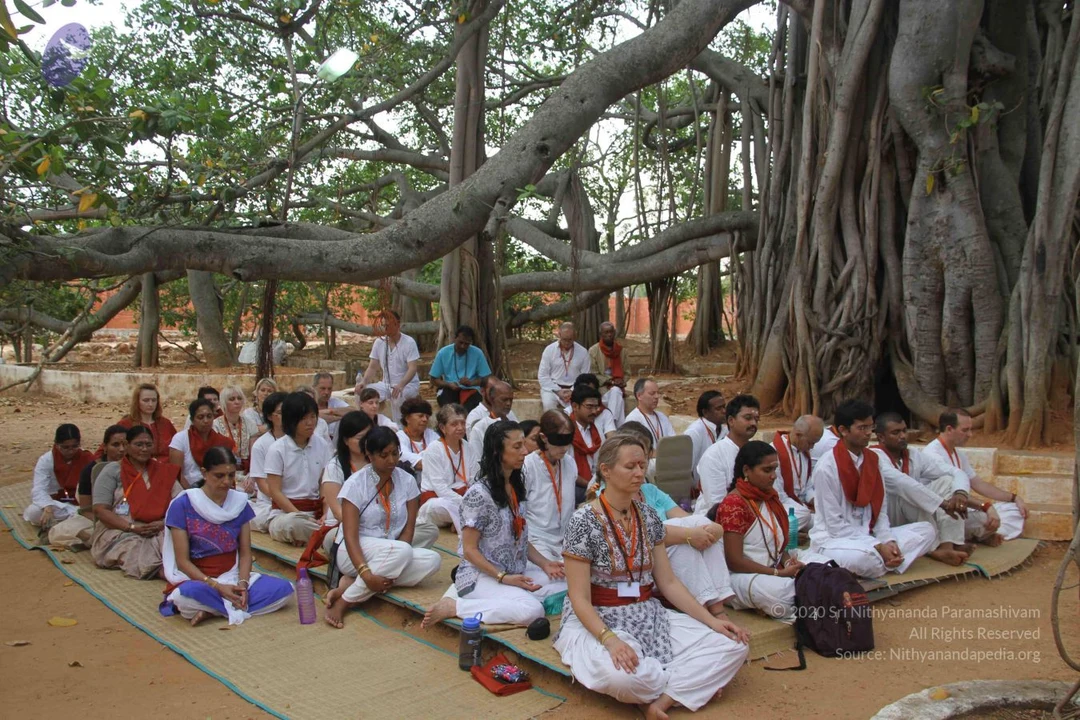
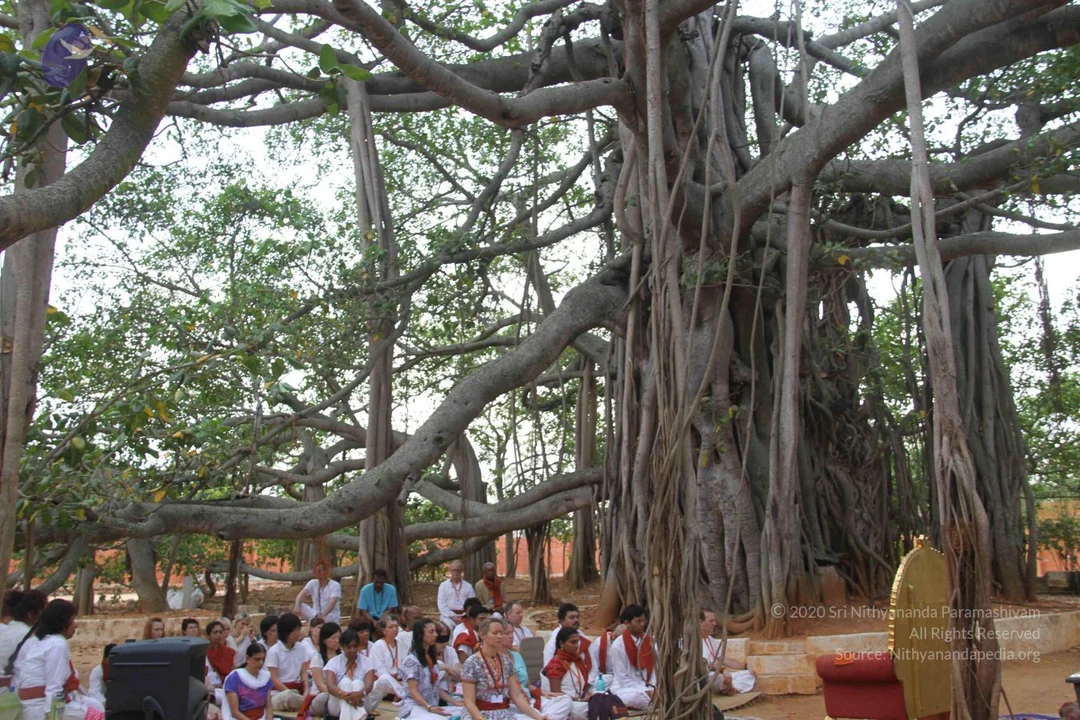
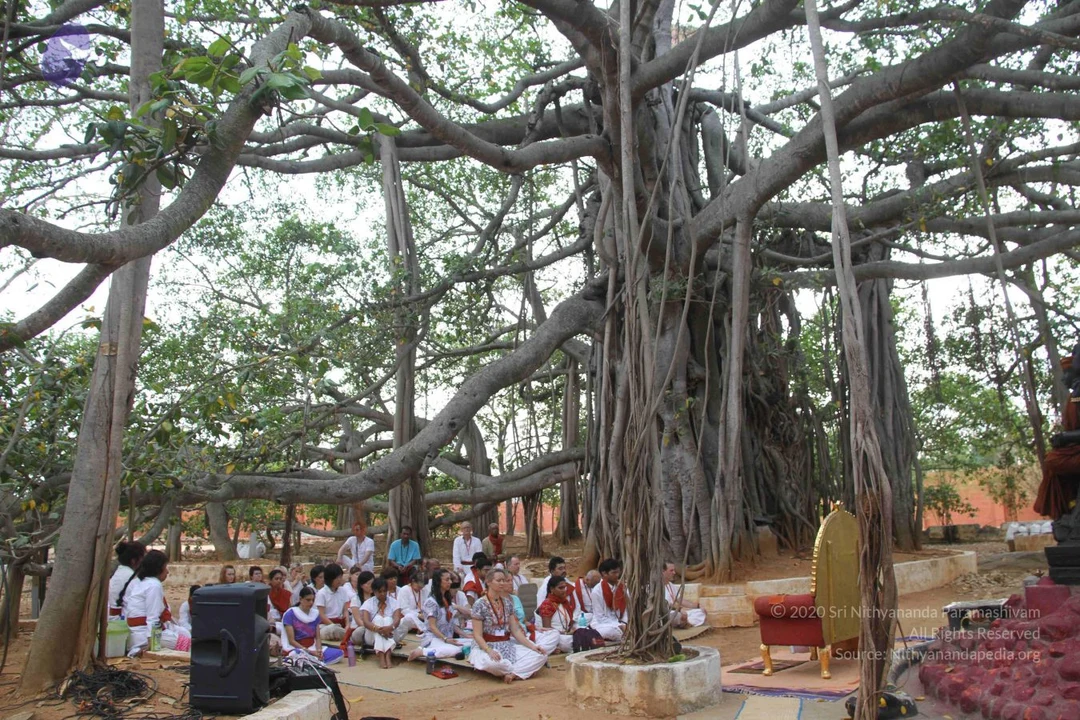
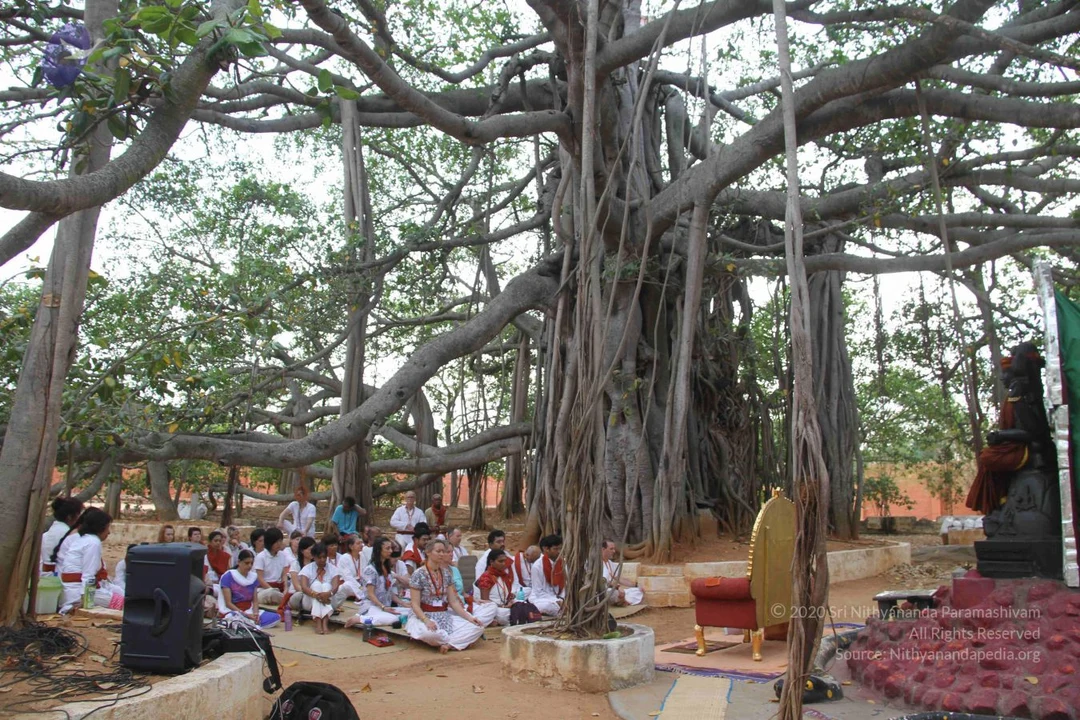
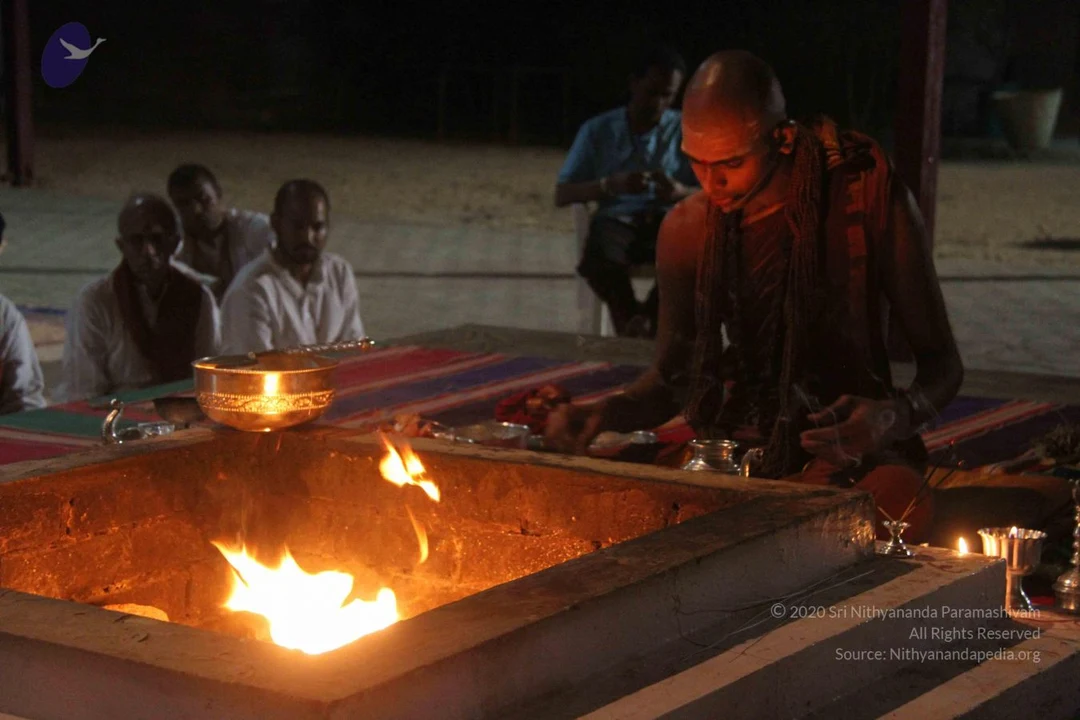
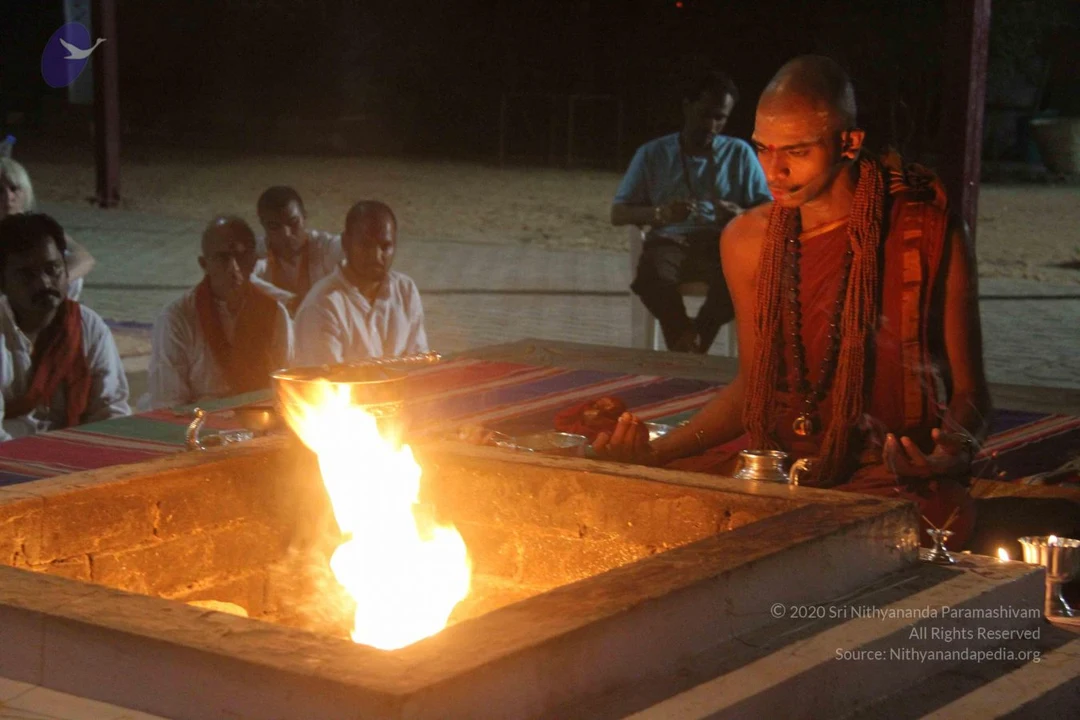
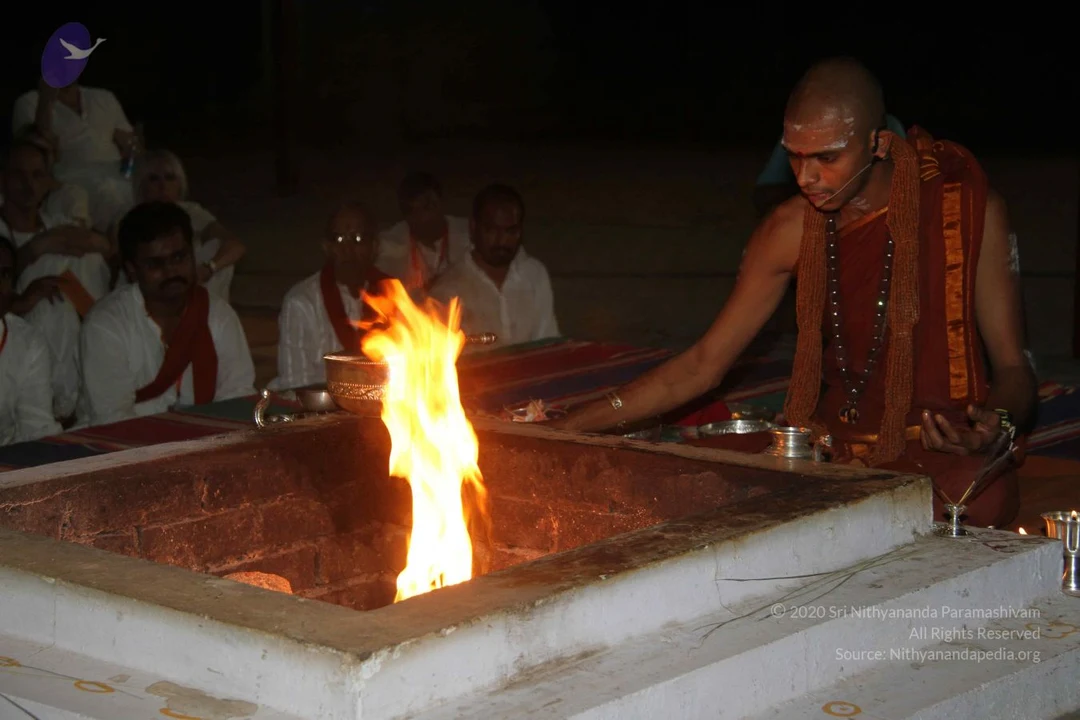
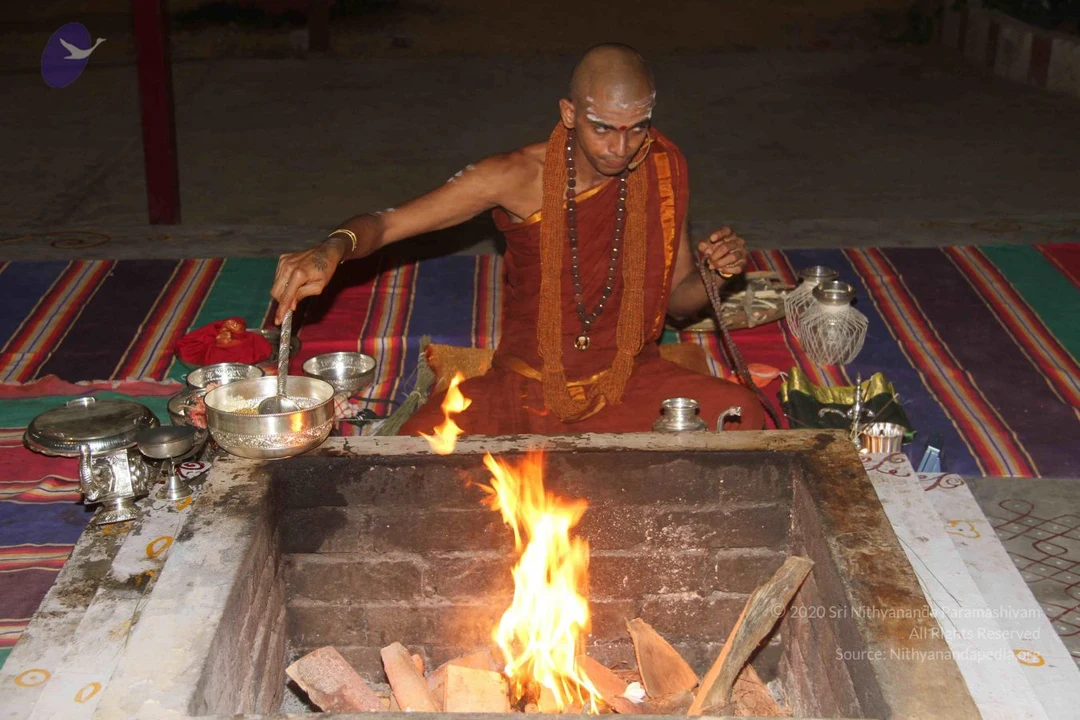
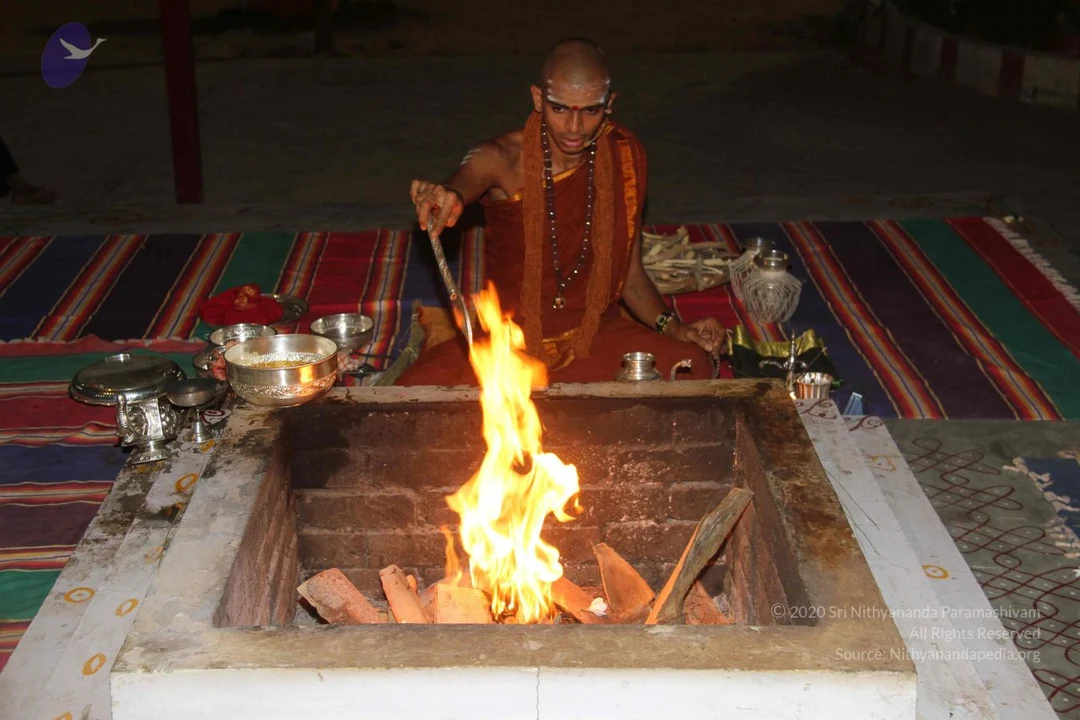
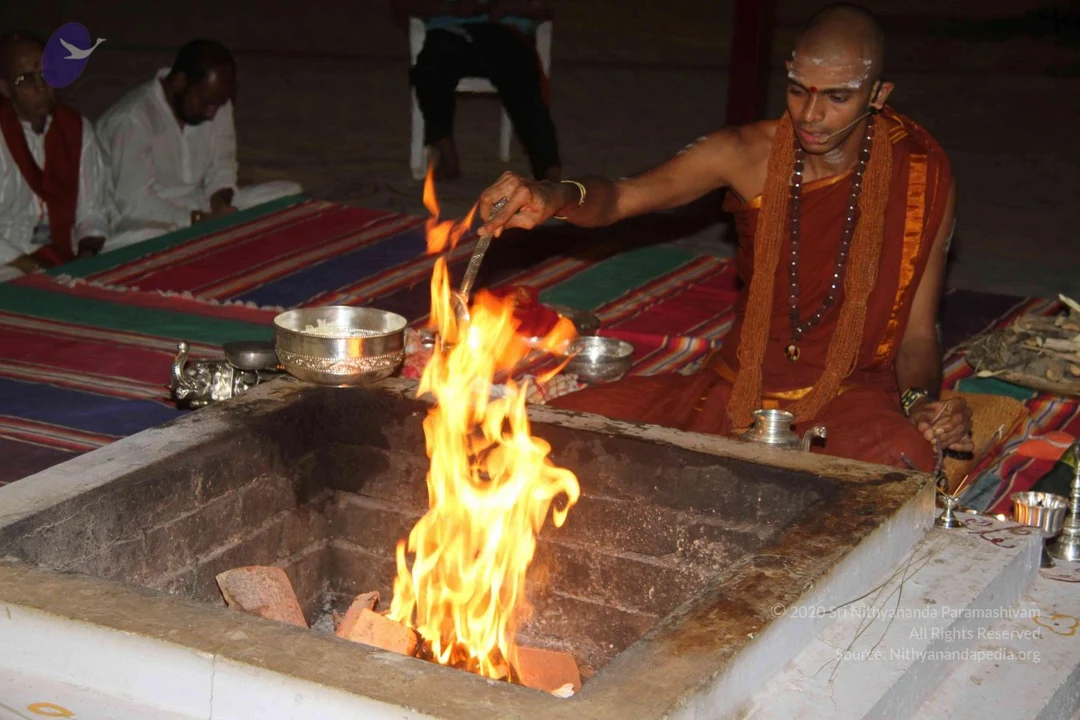
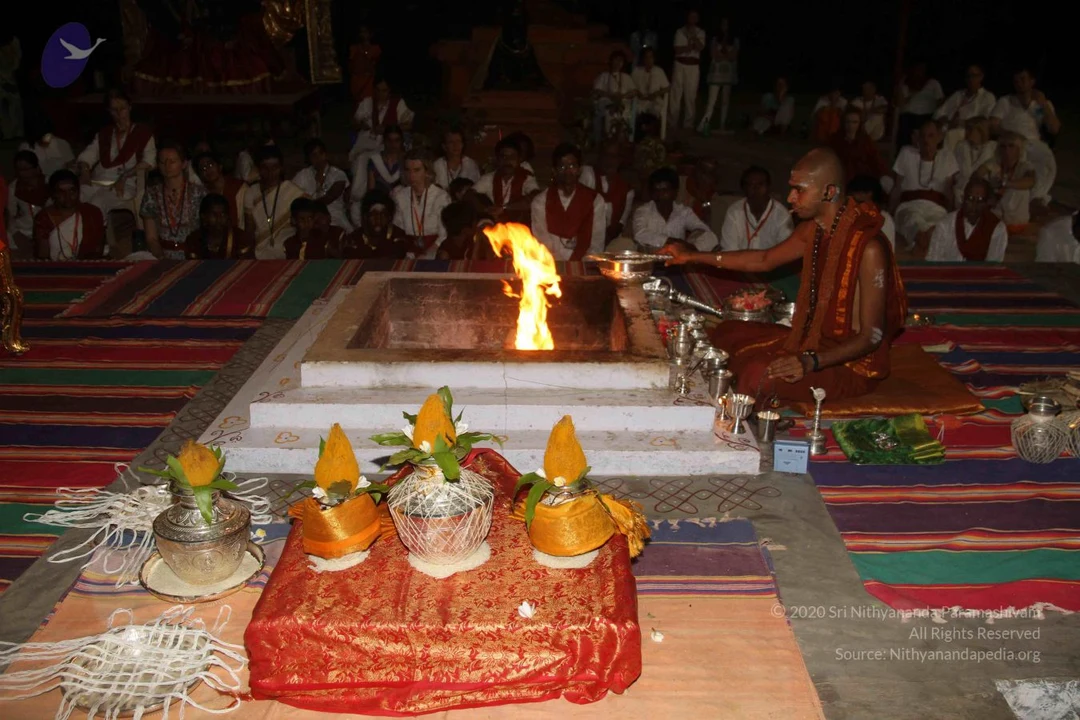
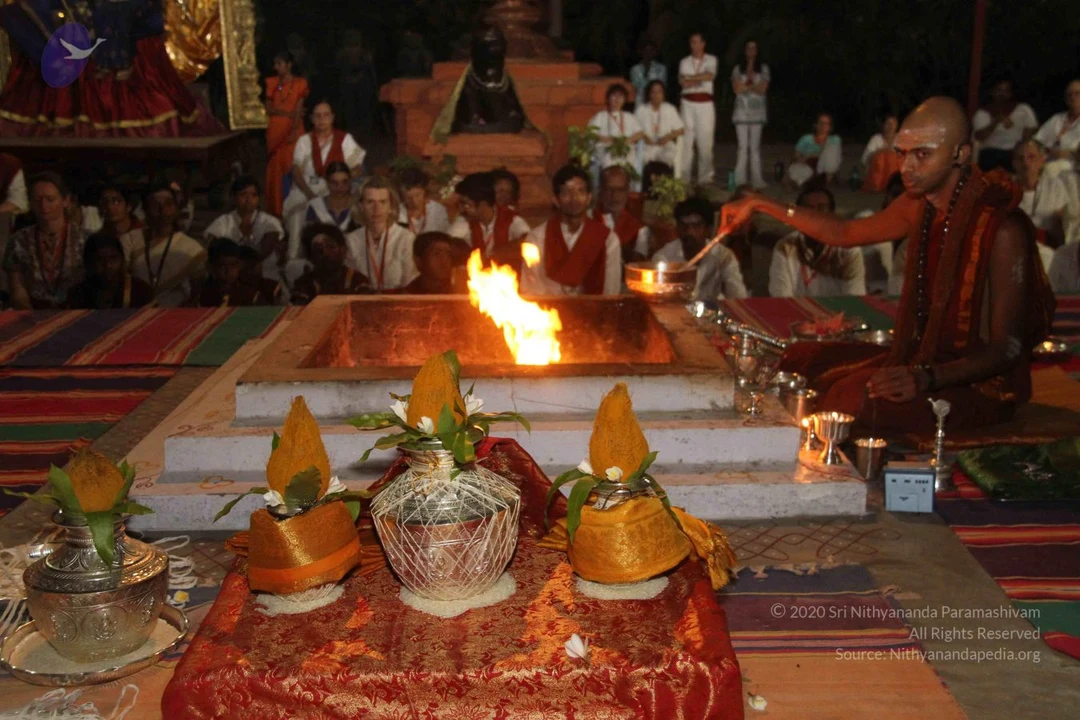
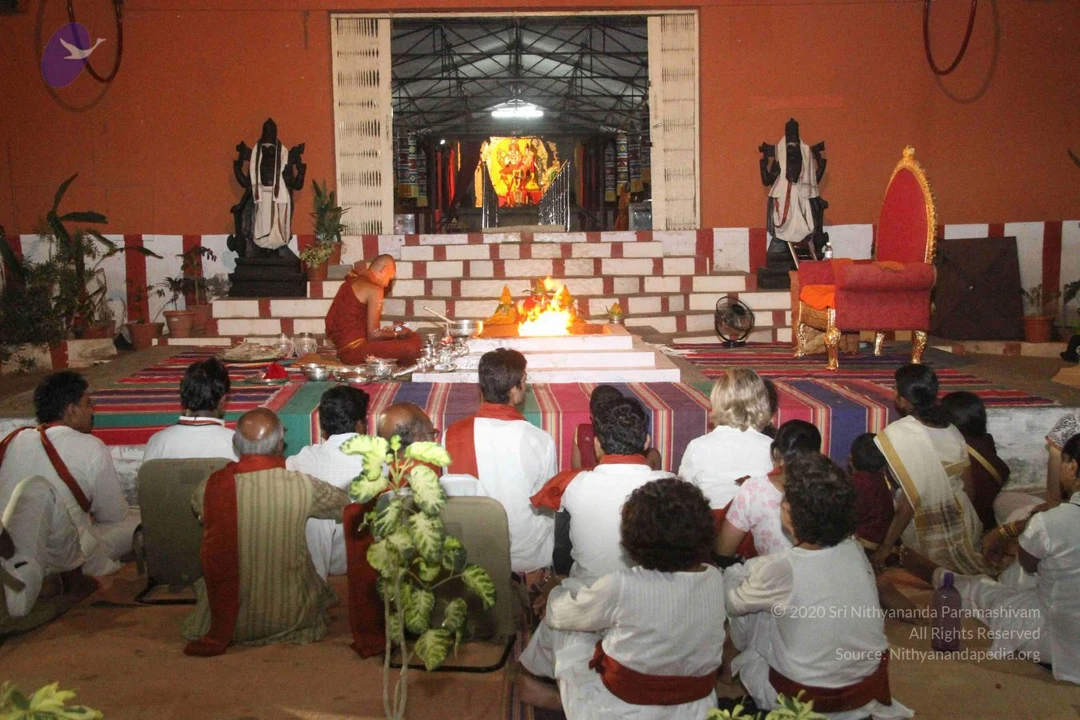
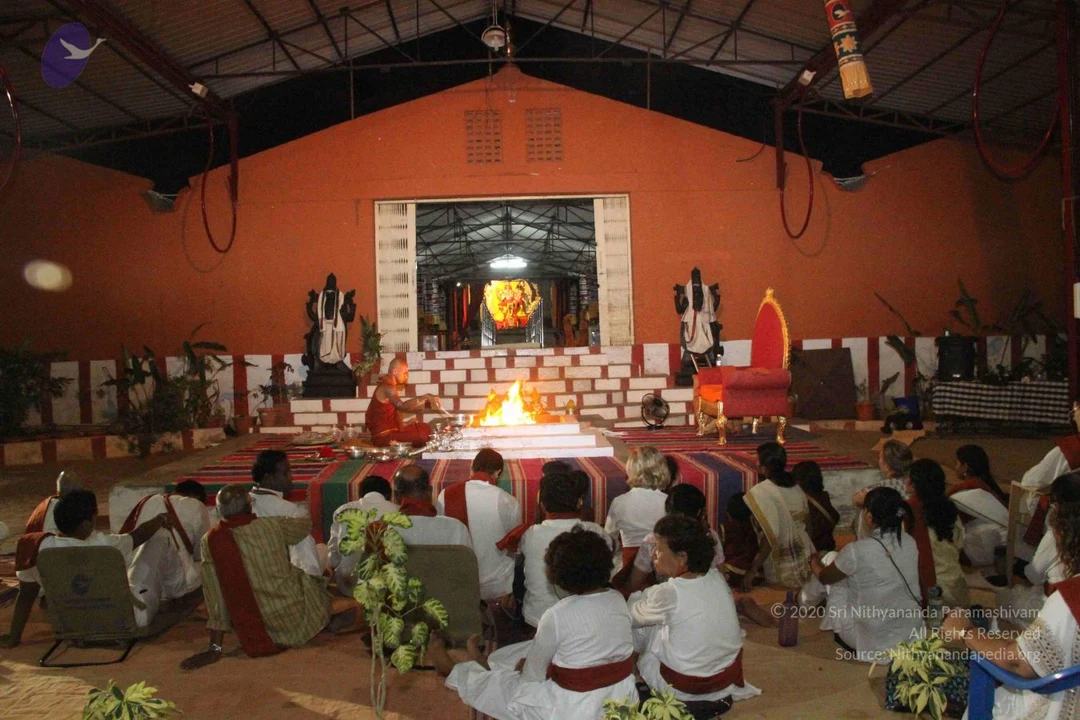
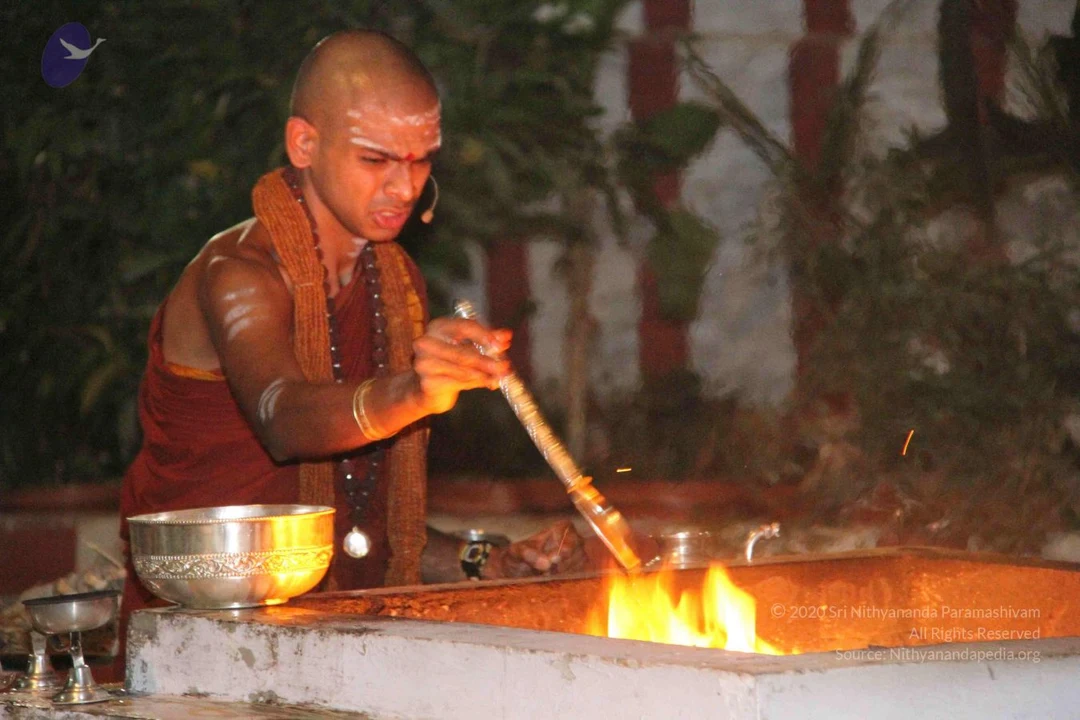
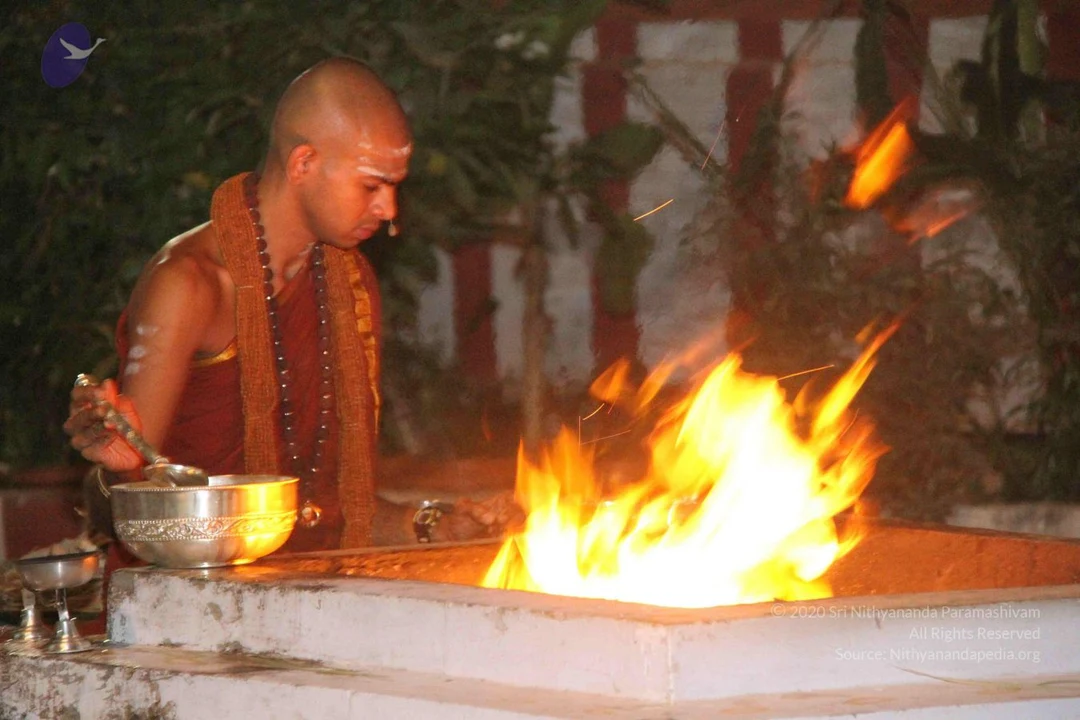
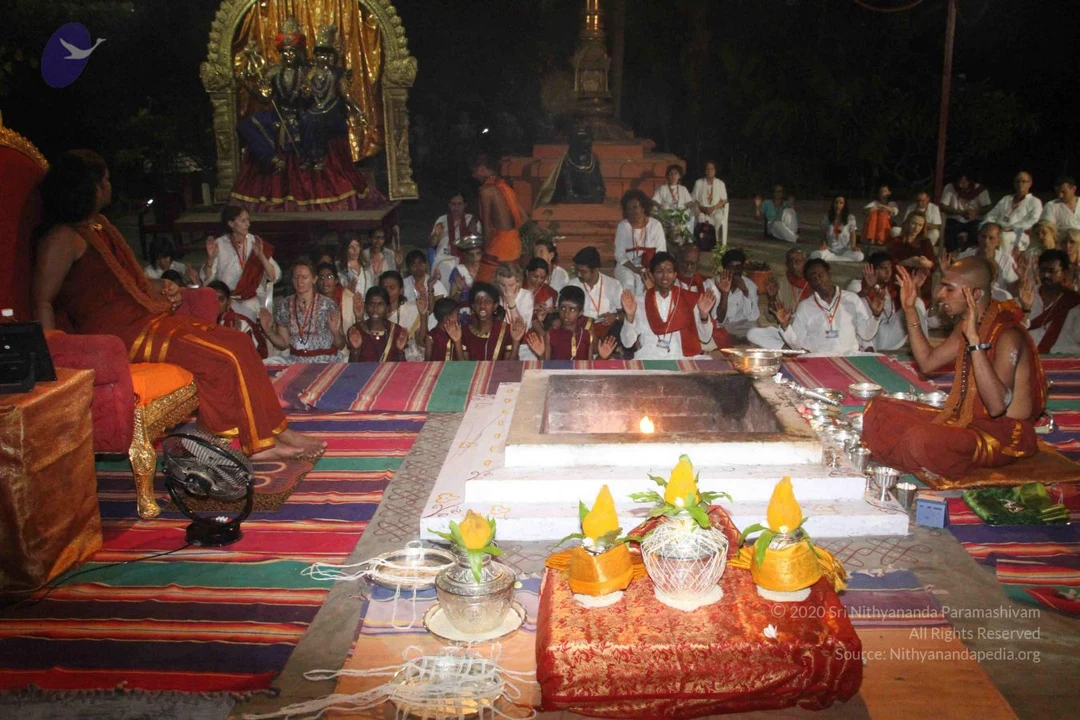
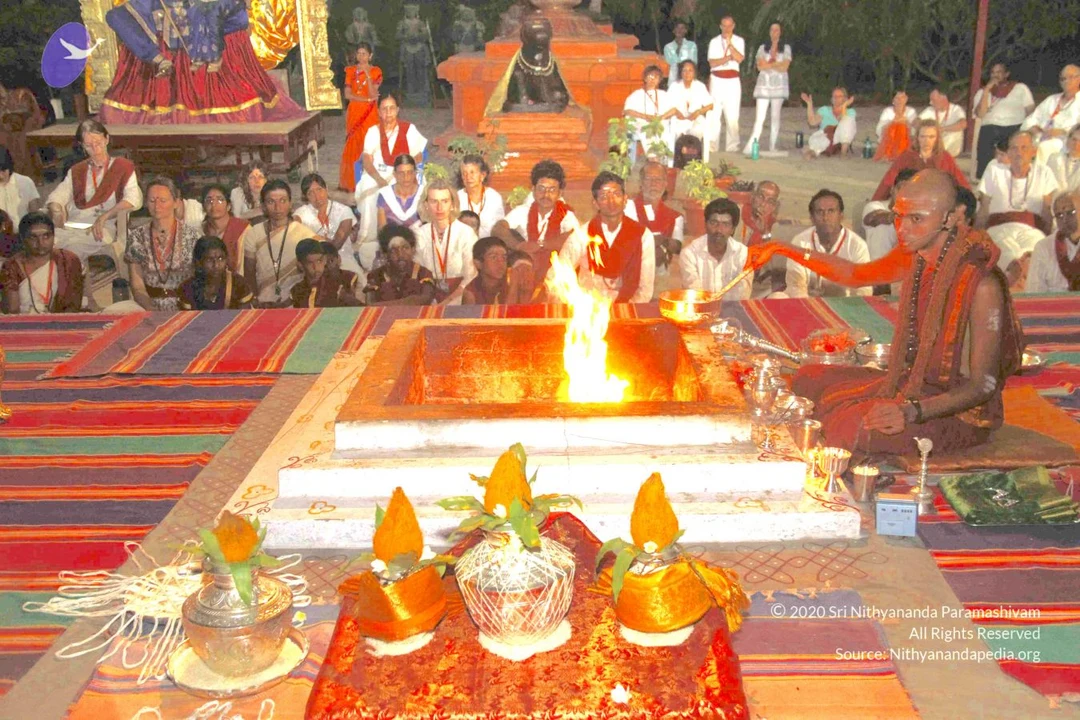
BANYAN TREE SESSION/GAYATRI HOMA

Photos Of The Day:

Nithya-Yoga-Morning

Satsang-morning

Energy-Darshan

Pada-Puja

Inner-Awakening-Session-Akashic-Readings-KalaBhairavaDarshan

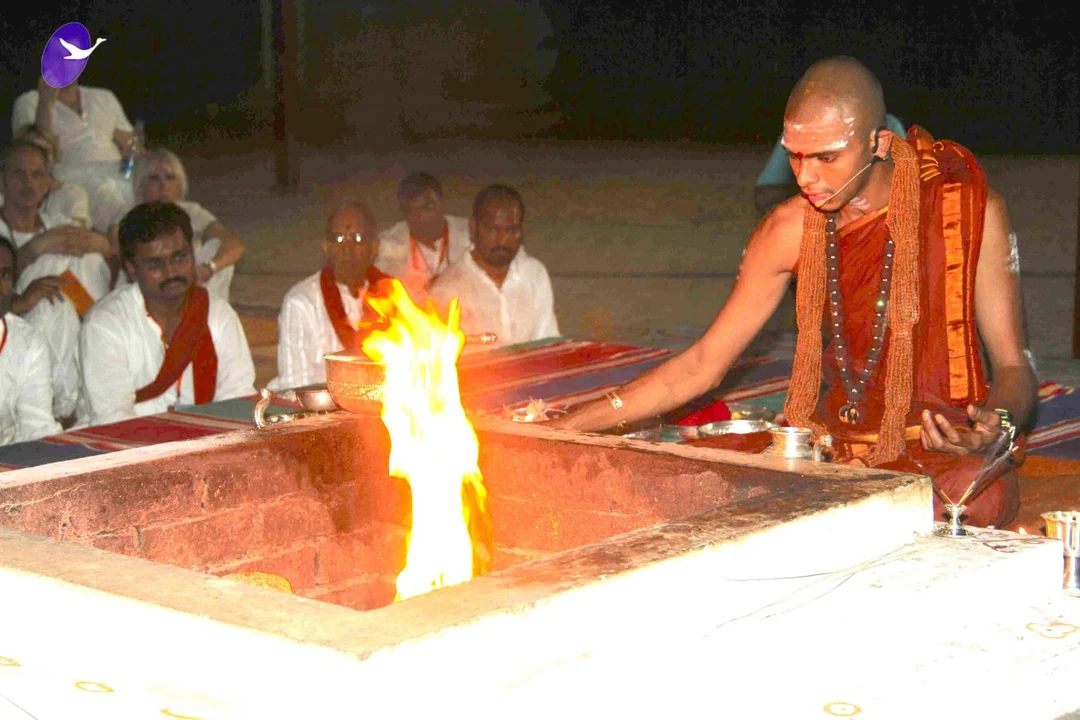
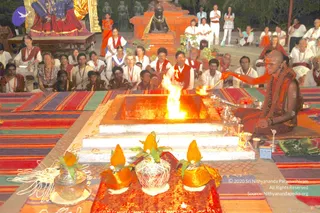
Gayatri-Homa

Puja

Banyan-Tree-Session

Photos Of The Day:

Satsang-morning

Energy-Darshan

Pada-Puja

Inner-Awakening-Session-Akashic-Readings-KalaBhairavaDarshan

Gayatri-Homa

Puja

INNER-AWAKEING-MARCH-2013

Photos from this day

View all 405 photos

Nithya YOGA

15 photosSource gallery
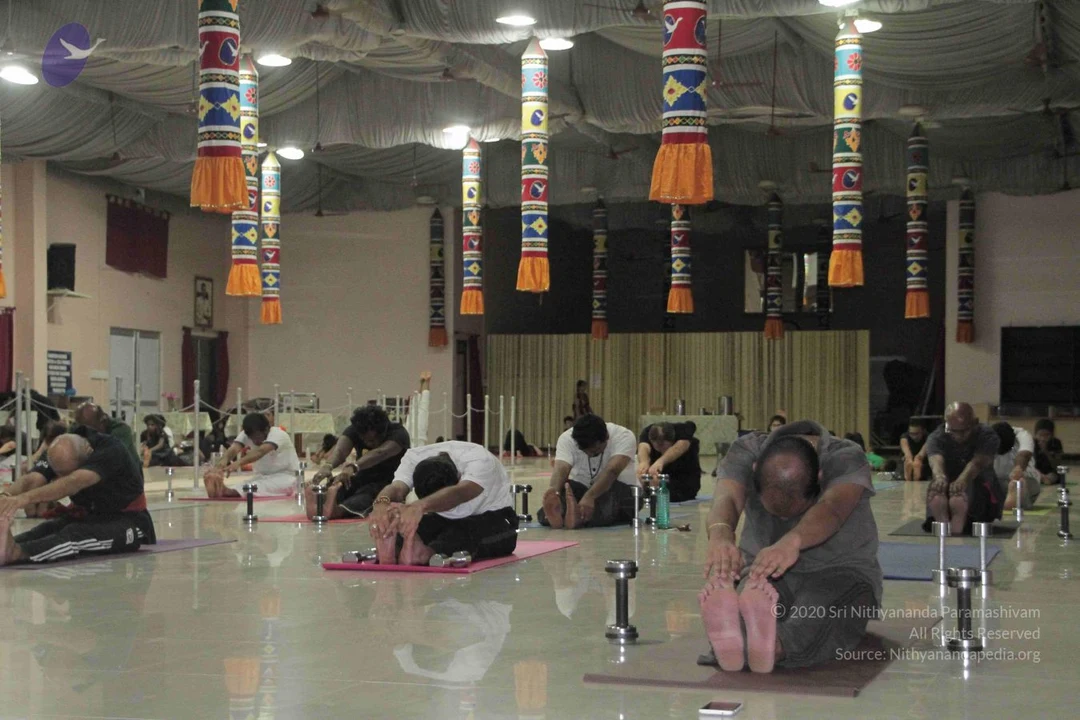
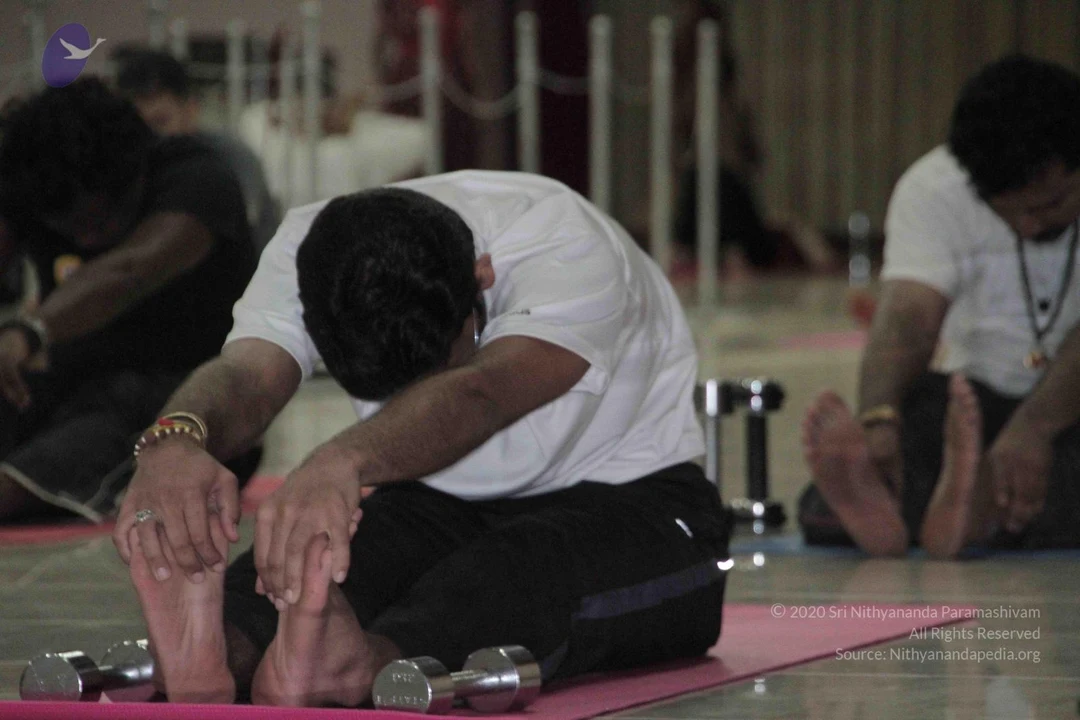
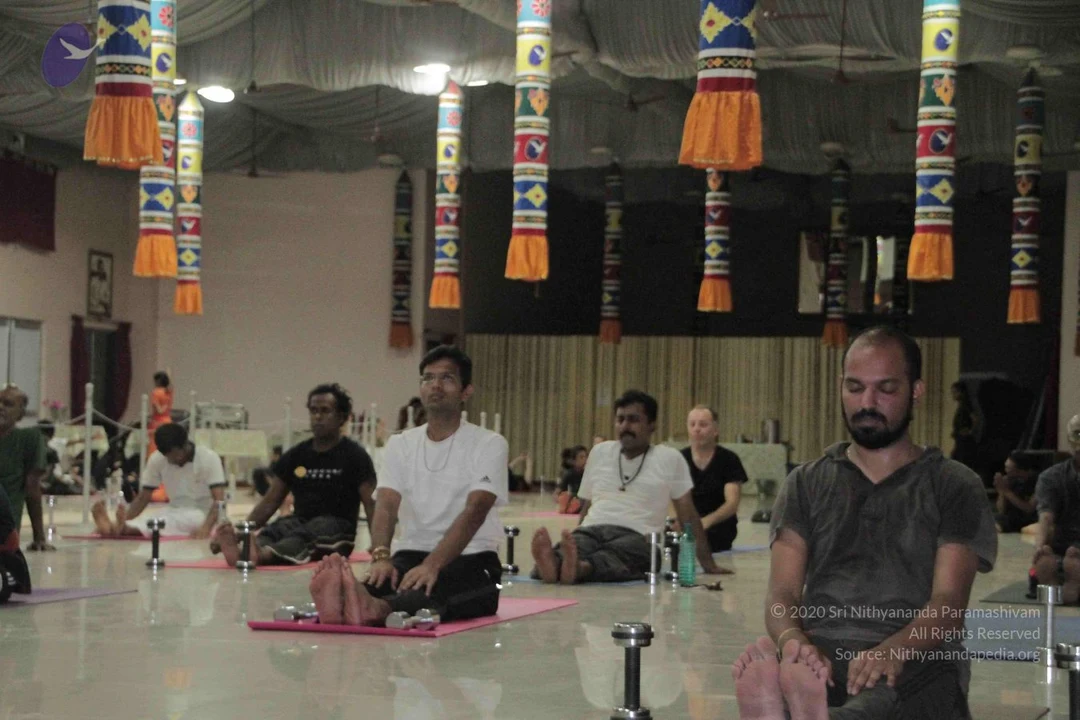
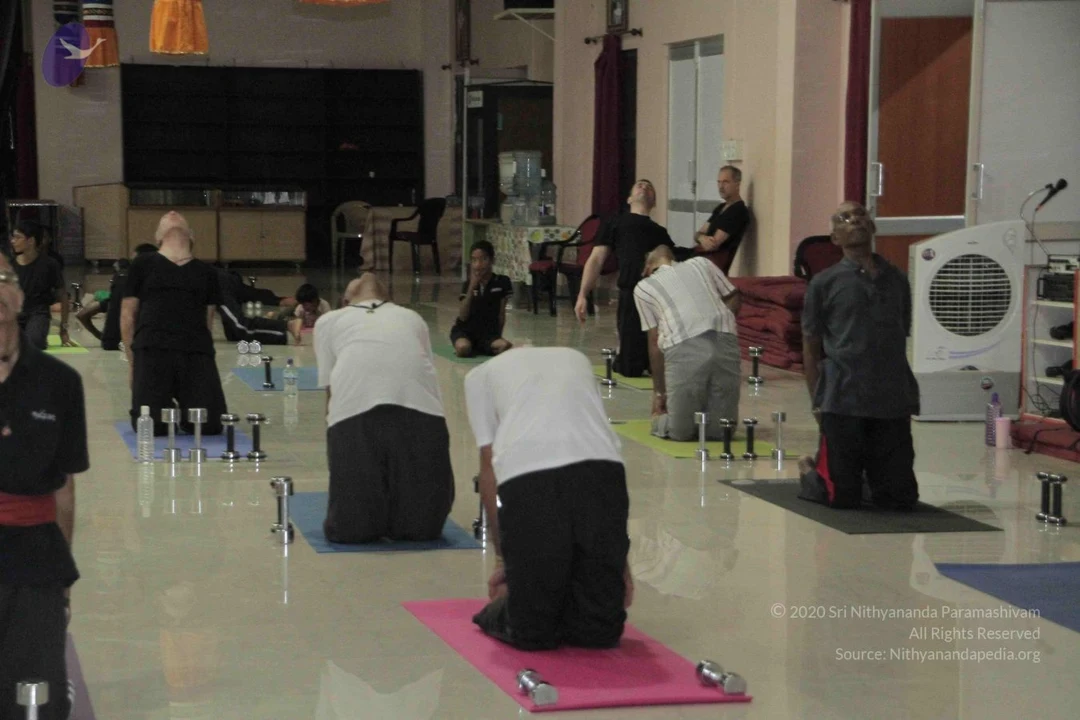
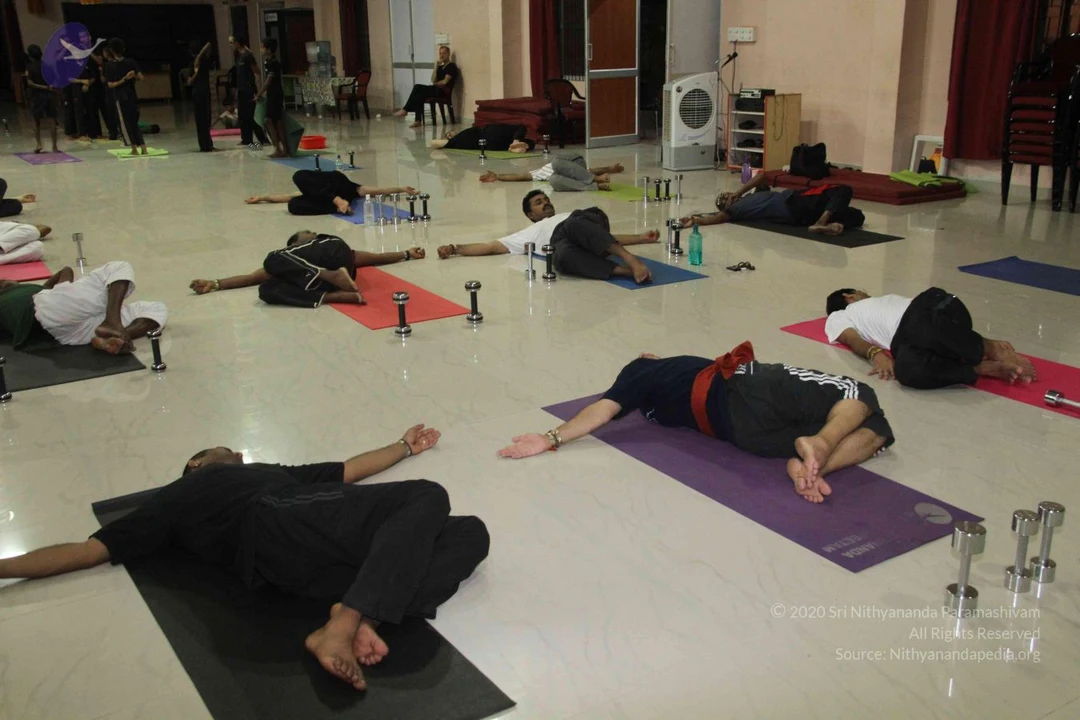
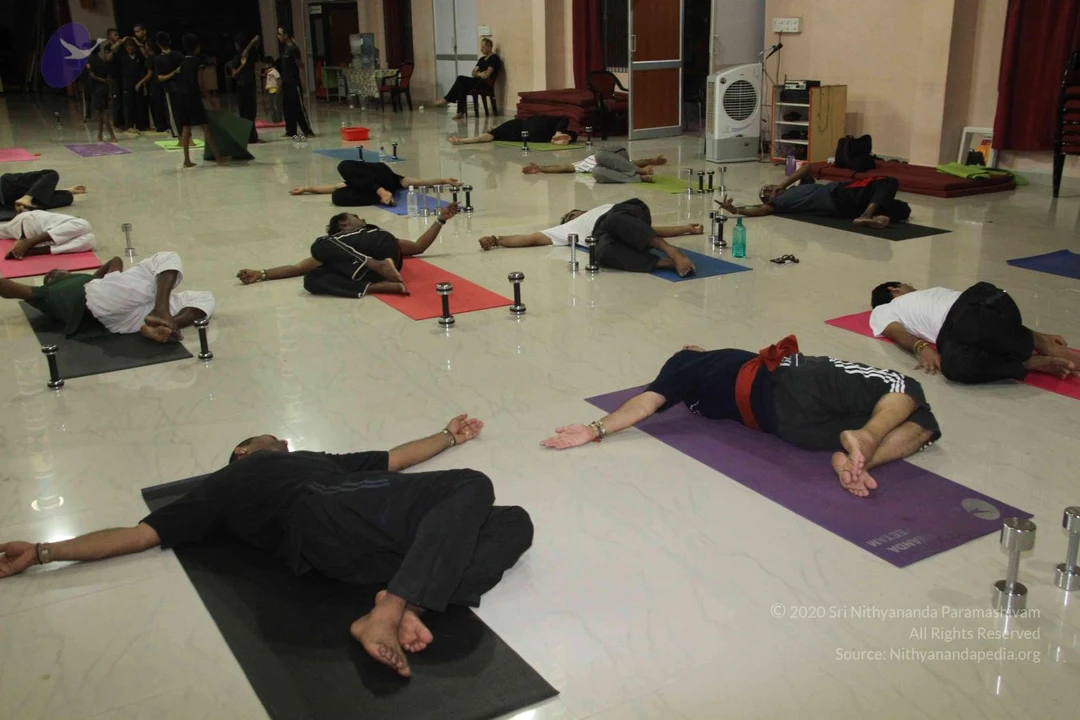
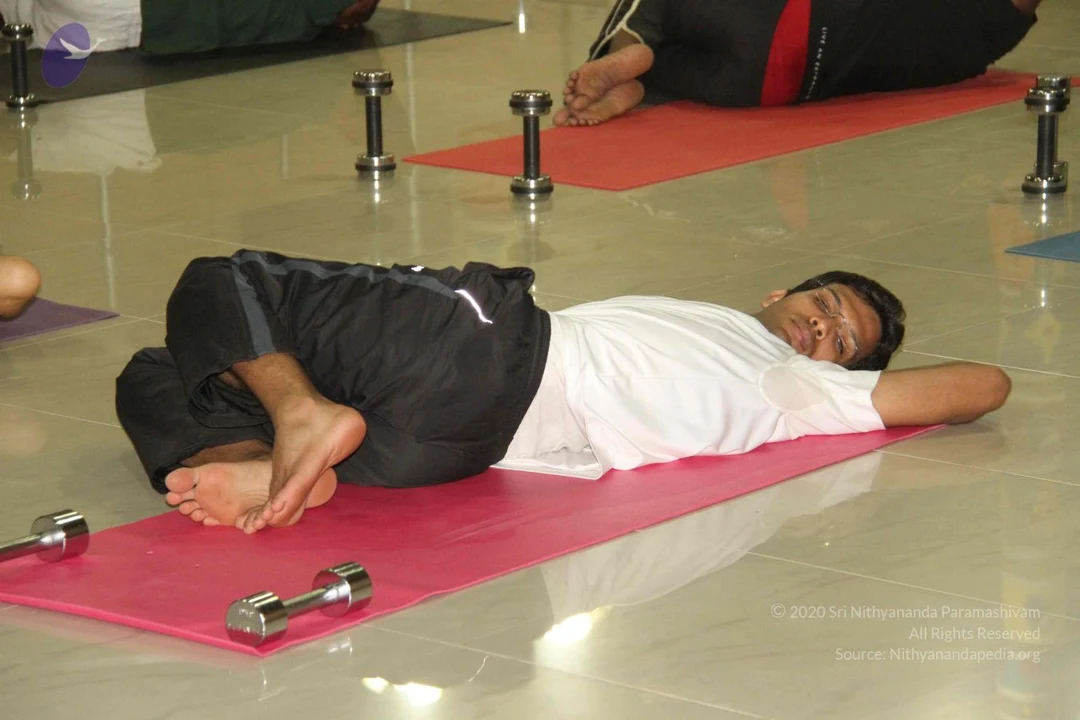
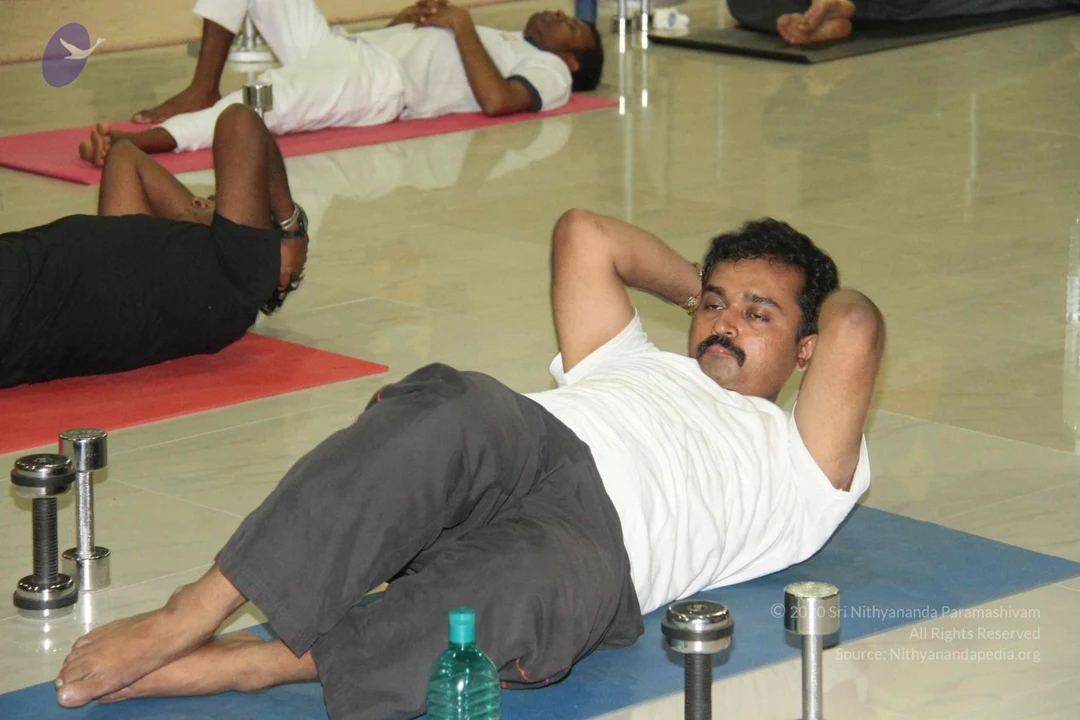
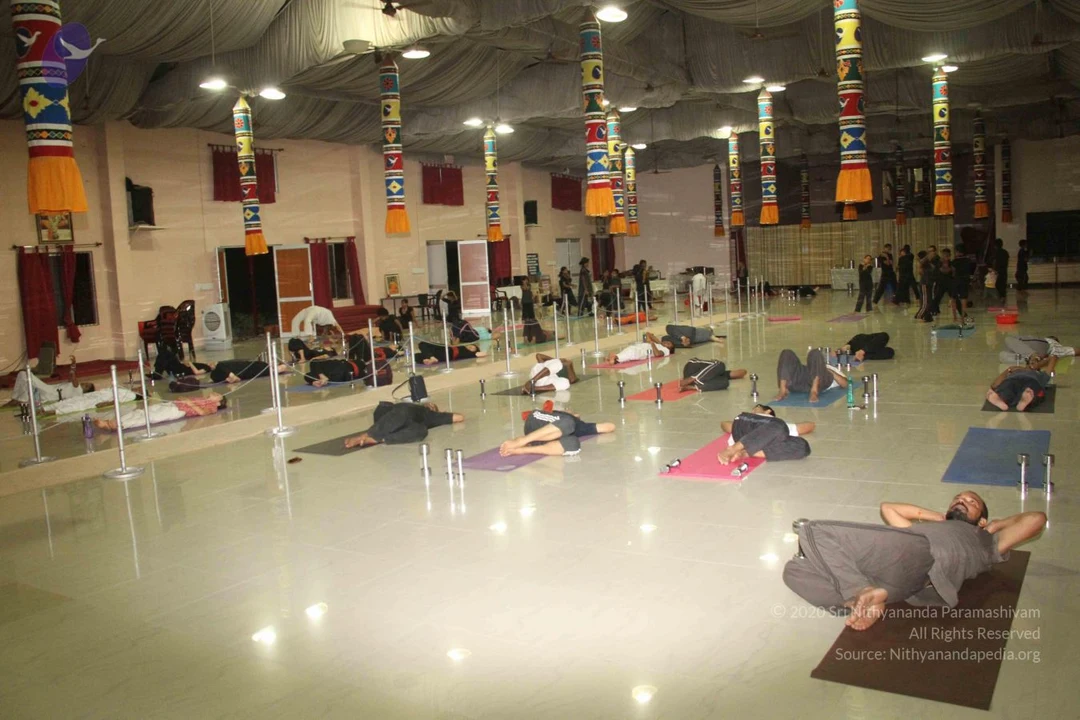
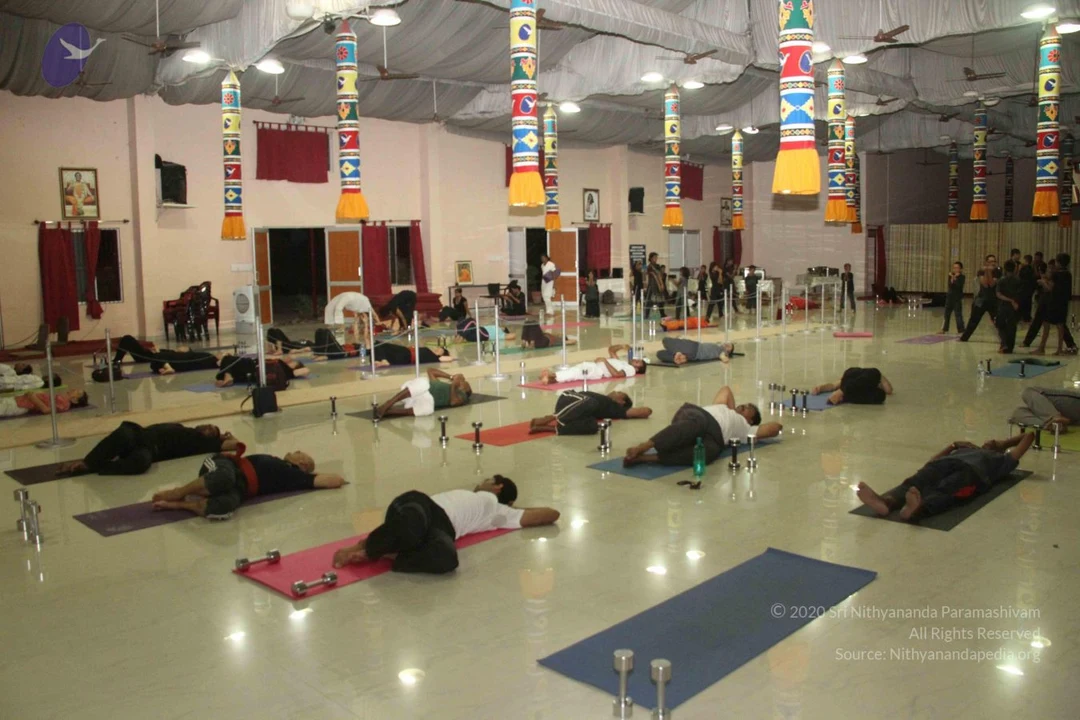
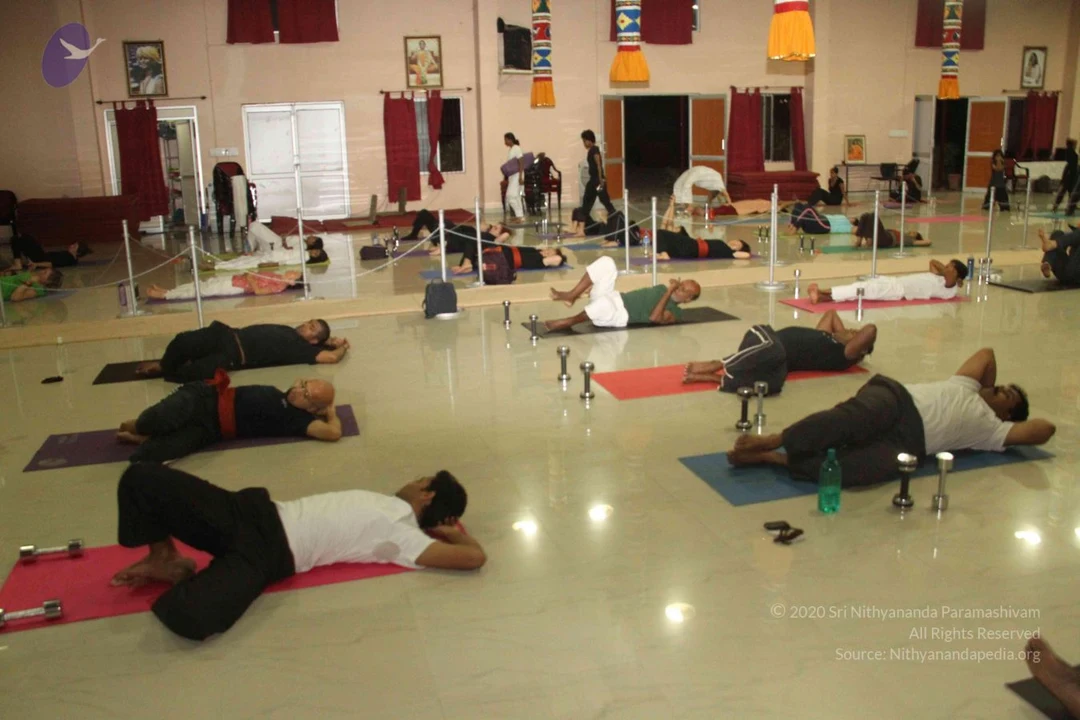
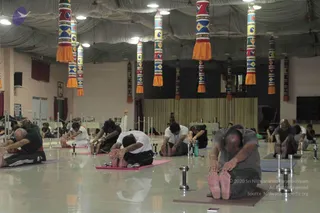
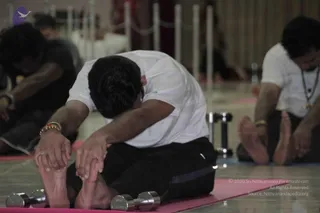
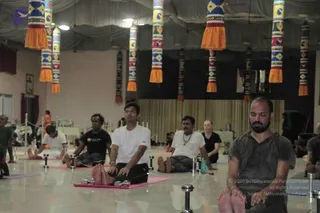
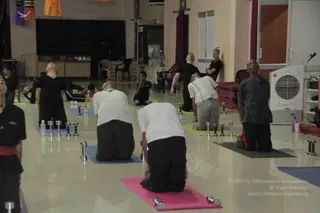
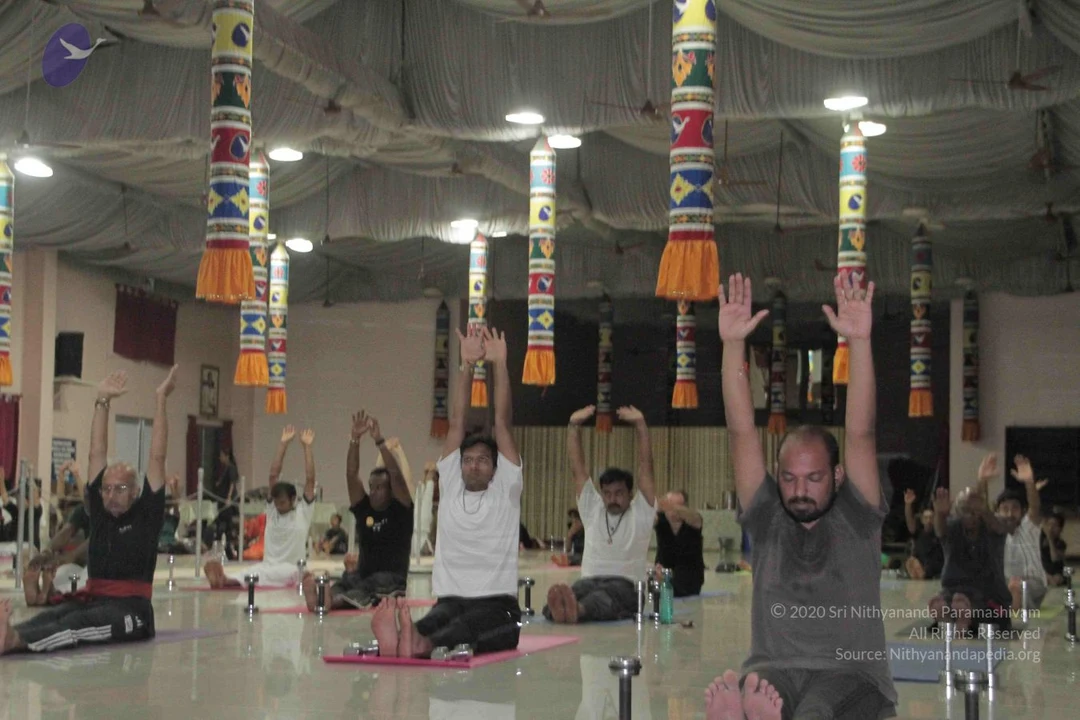
A photograph of a yoga or meditation session in a large hall with a fabric-draped ceiling and hanging decorative cylindrical banners in red, yellow and blue with orange tassels. Several people sit cross-legged on pink and purple mats with both arms raised overhead, palms open. In the foreground at right, a bald man in a grey t-shirt sits with arms raised; beside him a bearded man in a white shirt and a man in a black shirt also sit with arms up. Metal water bottles stand on the floor between the mats. Other participants in white and black clothing are visible toward the back and left.A large hall with a polished floor where a group of about a dozen people do seated forward-bend stretches on pink and purple yoga mats, with small dumbbells placed beside them. Participants wear grey, white and black athletic clothes. Several hanging cylindrical banners with yellow, red, blue and white patterns and orange fringe hang from a draped ceiling. A stage with gold curtains and a wall-mounted television are visible at the back.A group of men practise seated forward-bend stretches on pink exercise mats on a polished floor. The foreground man wears a white t-shirt and black track trousers, head lowered to his knees and hands gripping his feet, with small chrome dumbbells beside him. To the right, another man in a white shirt and black trousers with a dark beaded necklace leans forward similarly. A third person in black sits at left, and white metal railings and a curtained wall form the background. No deity, throne or ritual objects are visible.A hall of seated meditators on a polished floor, sitting cross-legged or with legs folded on pink and dark mats beside metal dumbbell-style weights. A bearded man in a grey hooded top in the foreground has hands resting on his knees and eyes closed. Behind him men in black and white t-shirts and dhoti-style lower wraps sit in meditation. Colourful decorative hangings with orange tassels hang from a draped white ceiling. A small framed picture is on the left wall, and a figure in orange stands in the background.A blurred indoor photo of a yoga or meditation session in a bright hall with a glossy tiled floor and hanging striped tassel banners in red, yellow and blue. Several men stand in rows with hands at their sides, mostly in black, navy and white clothes, while others kneel on pink and purple mats; a man in a navy shirt with a red sash stands centrally. A woman in orange sits at the left edge, and a bald man in white is seen in the background. Metal stanchions and water bottles are visible on the floor.A photograph of a yoga or meditation session in a bright hall with polished floor. Several people kneel on colourful mats (blue, pink, green, black) with small metal dumbbells placed beside them. Foreground figures in white t-shirts and black trousers bend forward in prostration, while others in black tops and grey shirts stand or kneel, some looking upward. A water bottle, a cooler unit, a microphone, tall cabinets and maroon curtains are visible at the back.

Temple
21 photosSource gallery
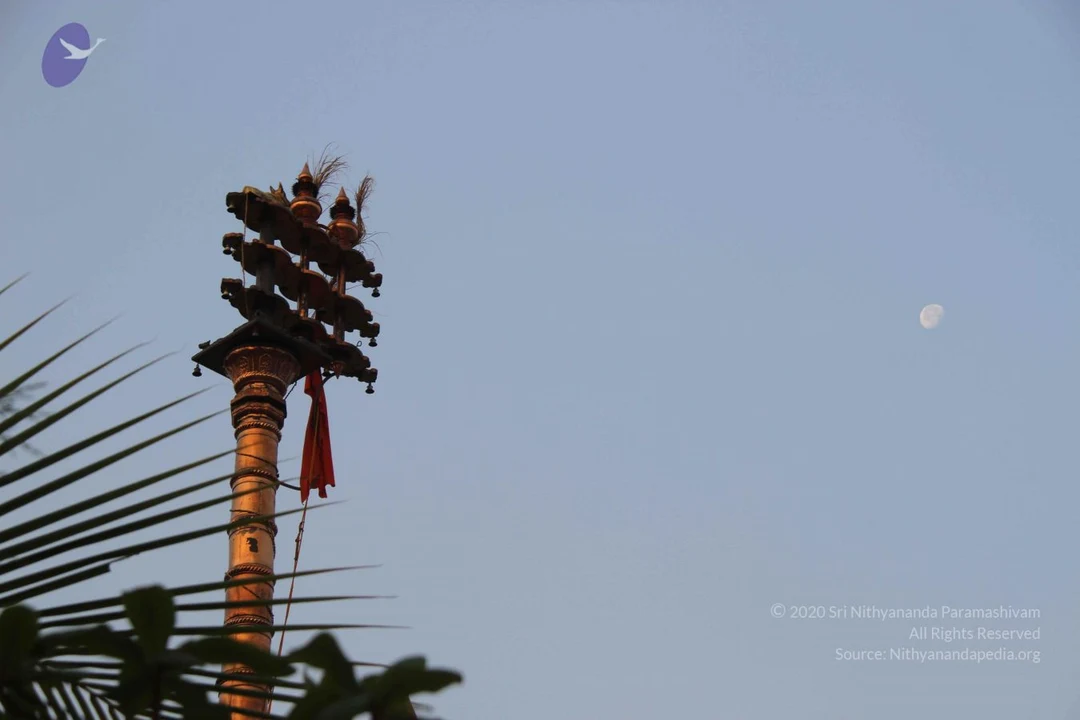
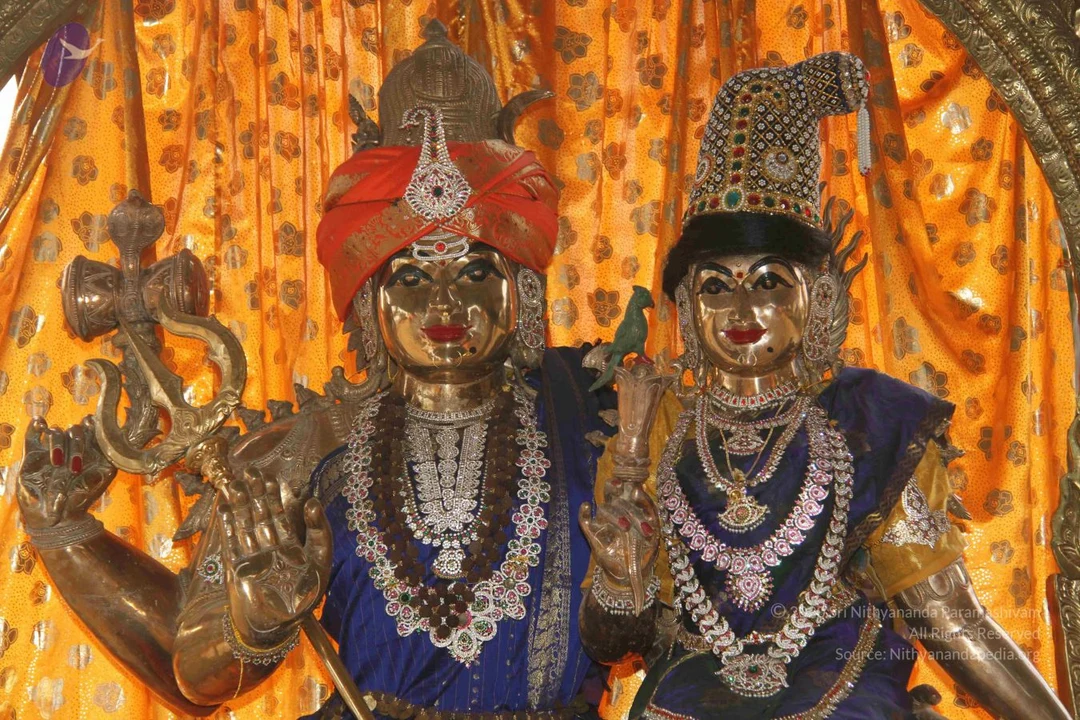
A dim, hazy dusk or dawn sky filled with dark brown and orange tones. A bright yellow-orange sun sits near the centre, glowing with a soft halo of red-orange light. No people, objects or ritual elements are visible. A small purple logo with a white bird appears in the upper-left corner, and a faint copyright notice sits in the lower right.A hazy orange sunset over flat open ground in a rural setting. A round glowing sun sits low in a dusty orange sky, with dark silhouettes of trees on the left and right, a thatched or tiled roof edge on the right, and a wooden post in the foreground. No people, ritual objects or a person are visible.Close-up photograph of a single bright yellow trumpet-shaped flower with five broad petals and an orange-brown throat, growing on a shrub among dark green lanceolate leaves. Two small unopened buds sit beside the bloom, with a blurred dark green background. No people are present.Close-up photograph of a cluster of lantana flowers on a green stem, with blossoms shading from yellow and orange at the top to pink and magenta below. Serrated green leaves frame the frame, and the background is a soft golden sunset bokeh. No people are visible.A tall golden ornamental pole with tiered wooden or brass ledges, pointed finials, hanging bells and a red cloth streamer stands against a pale blue dusk sky with a crescent moon at right. Palm fronds frame the lower left. No people are visible; the pole resembles a ritual flag or ratha-style standard.Two gilded metal murti statues stand before a golden orange draped backdrop with a floral pattern. The figure on the left wears a red turban with a silver ornament, a crescent-topped crown, a dark blue garment, layered silver and beaded necklaces, and holds a trident in one raised hand. The figure on the right wears an ornate jewelled crown in green, red and gold, a deep blue sari, pink and silver garlands, and holds a small green parrot perched on a raised hand. Both have red lips and kumkum-style markings. No physical people are present.

Paduka Puja
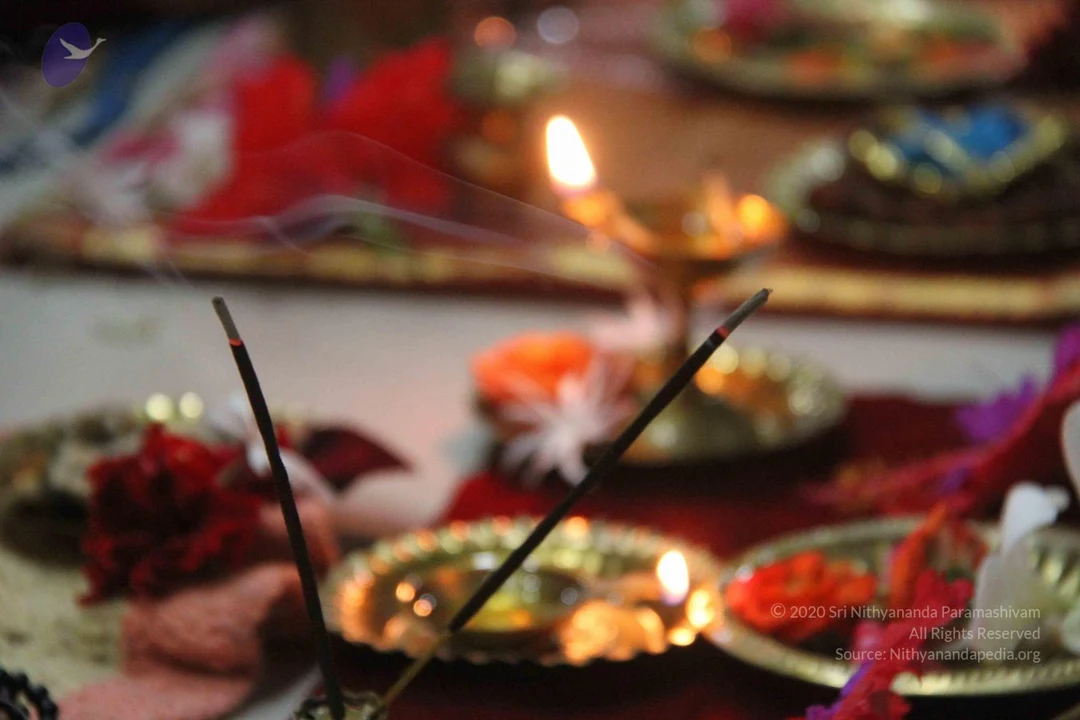
15 photosSource gallery
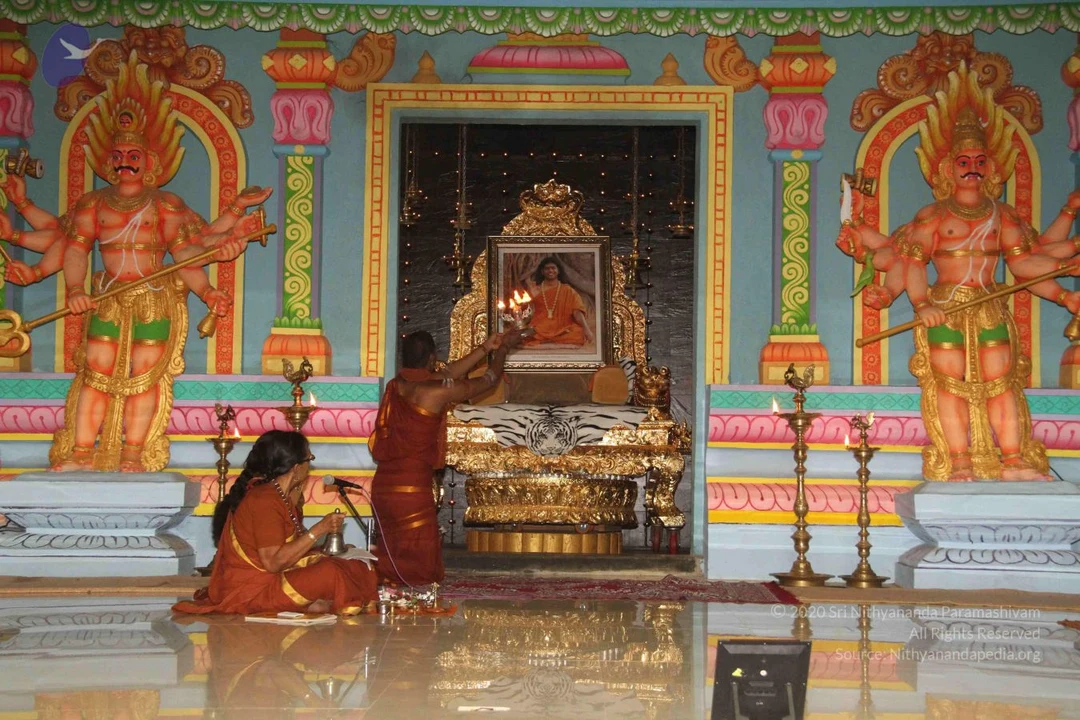
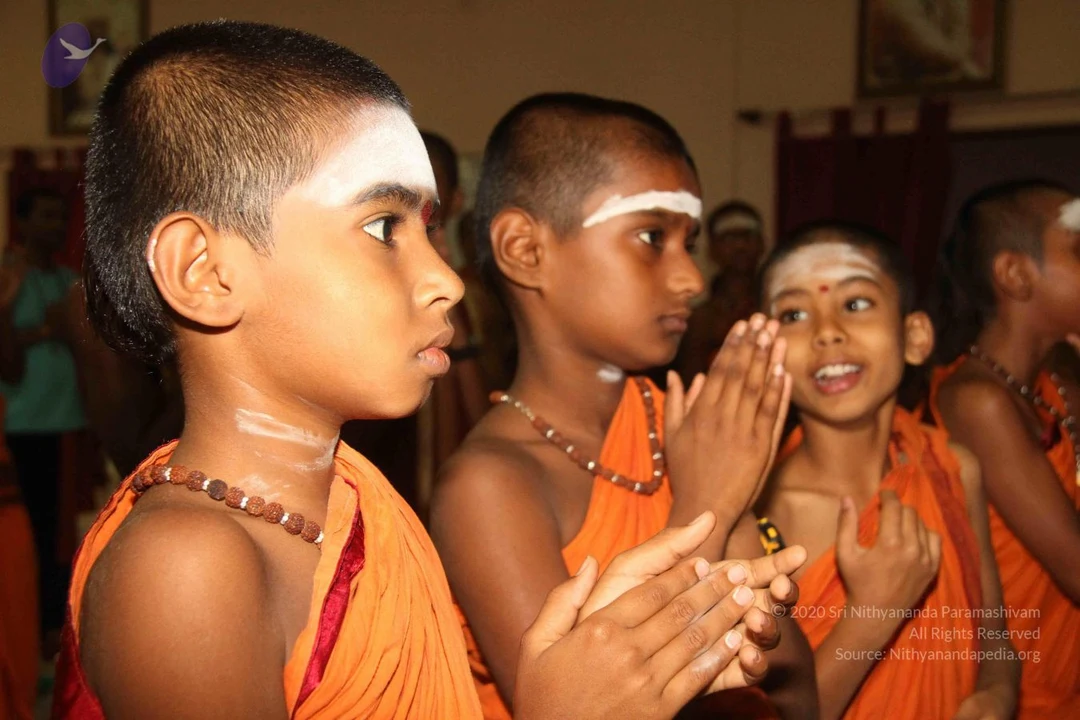
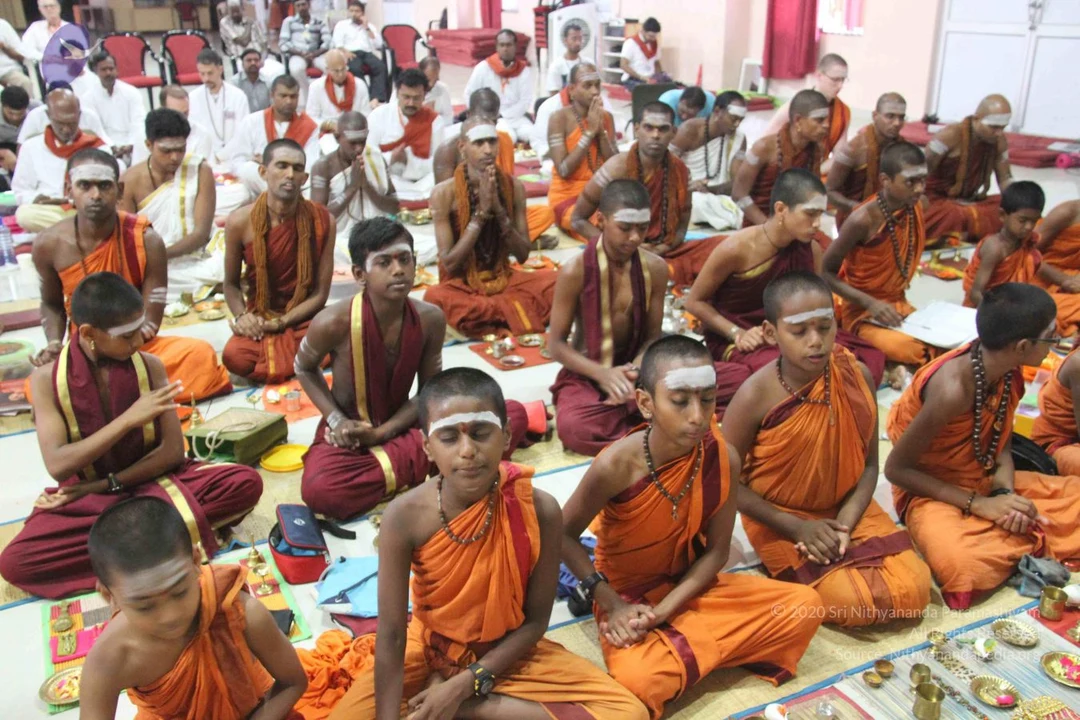
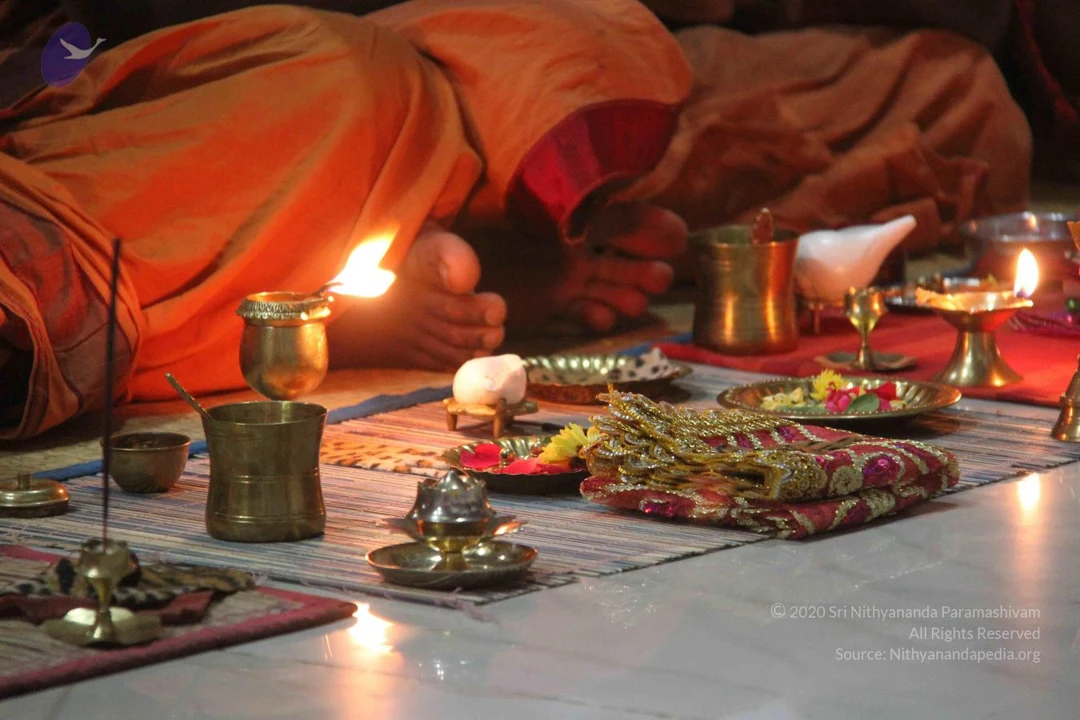
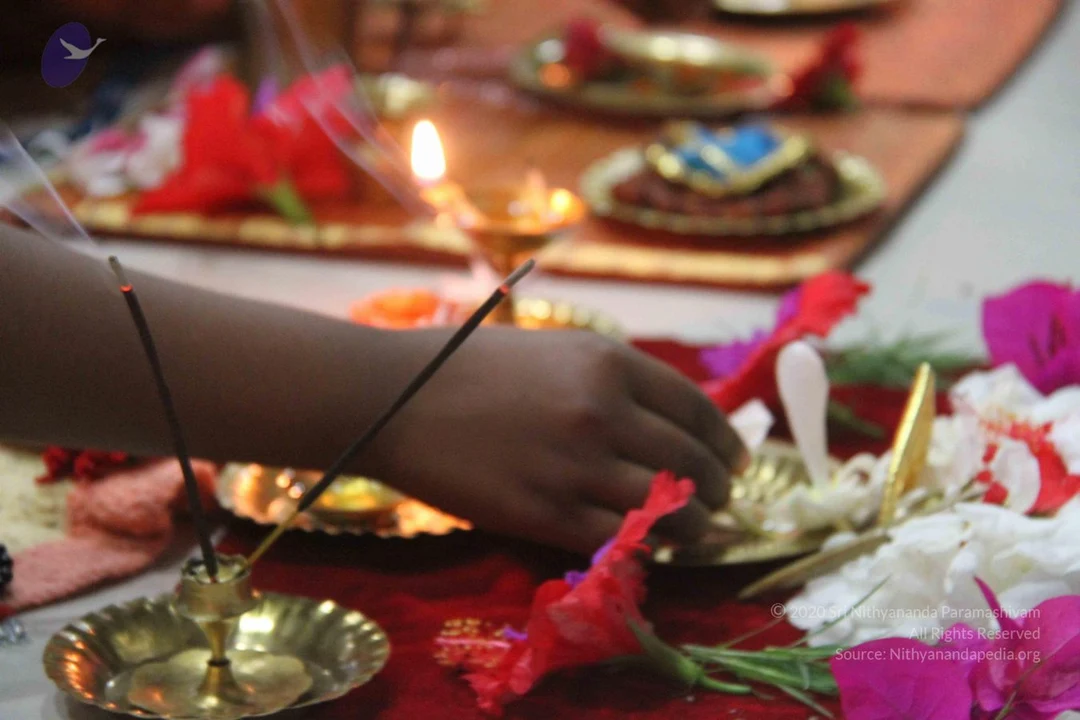
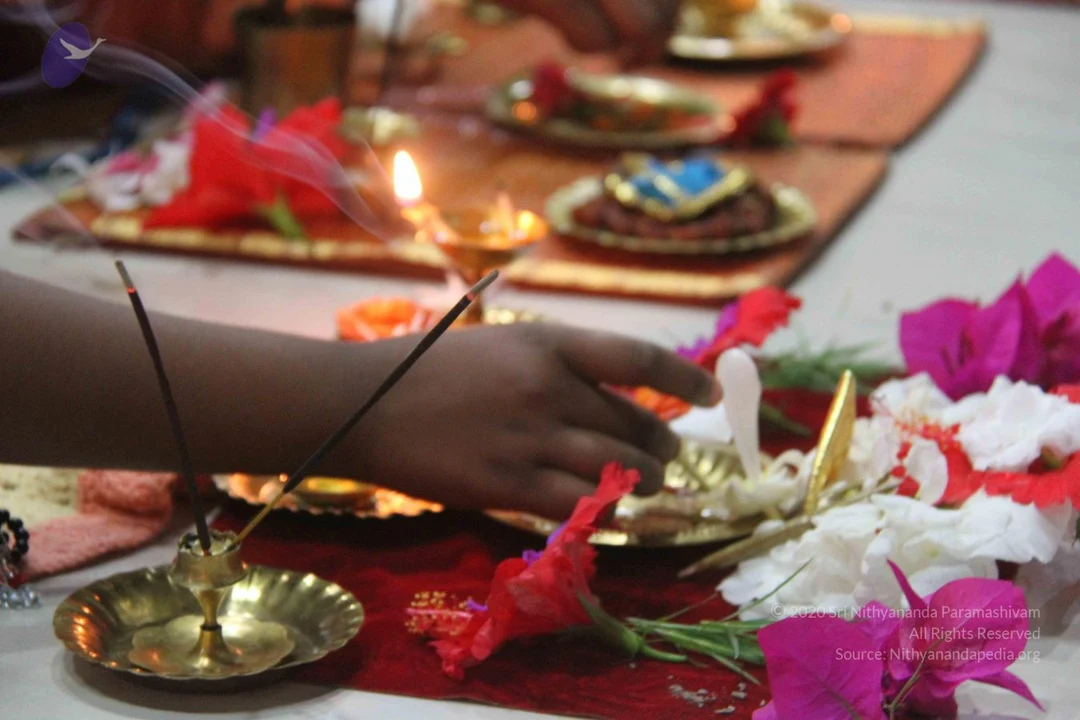
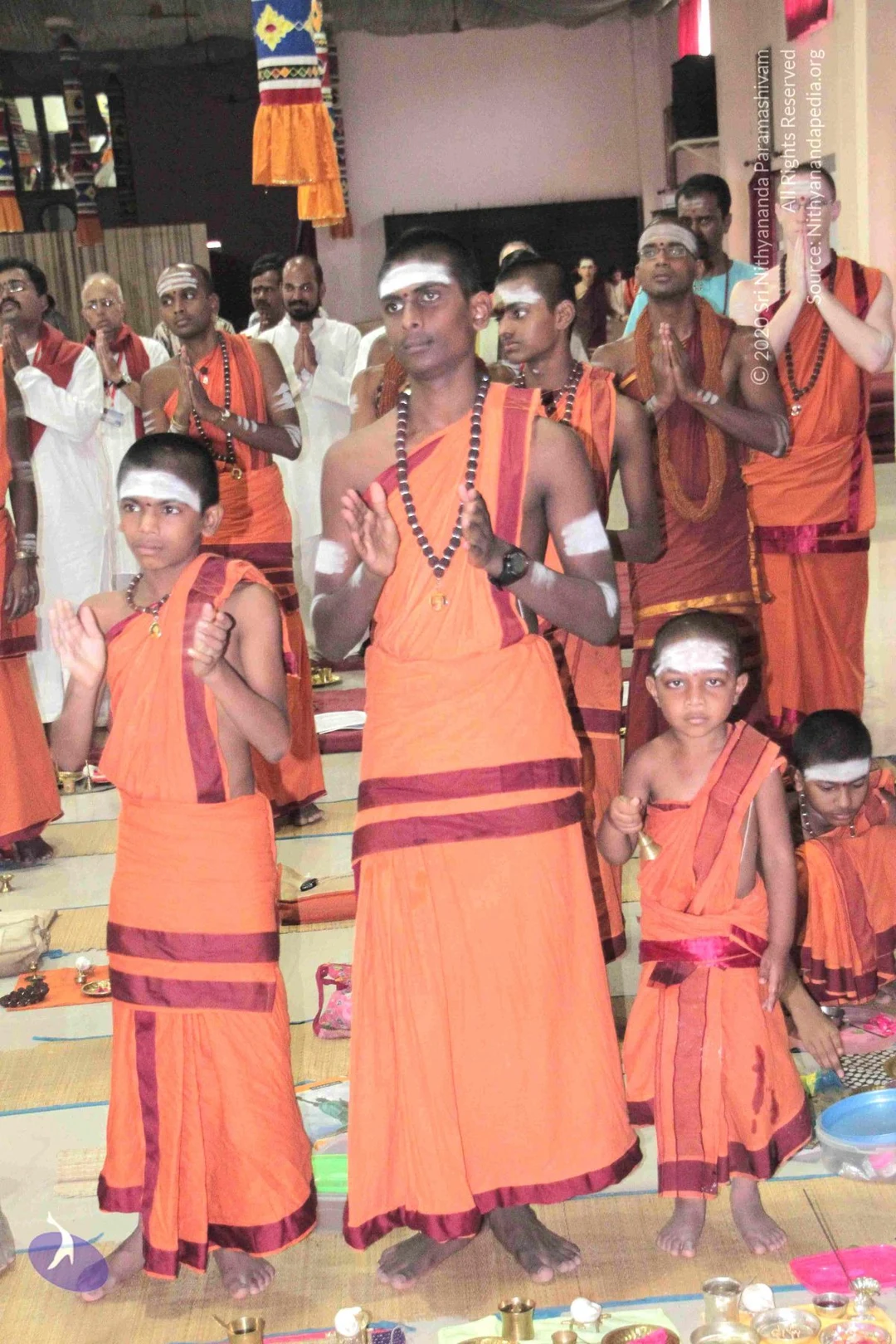
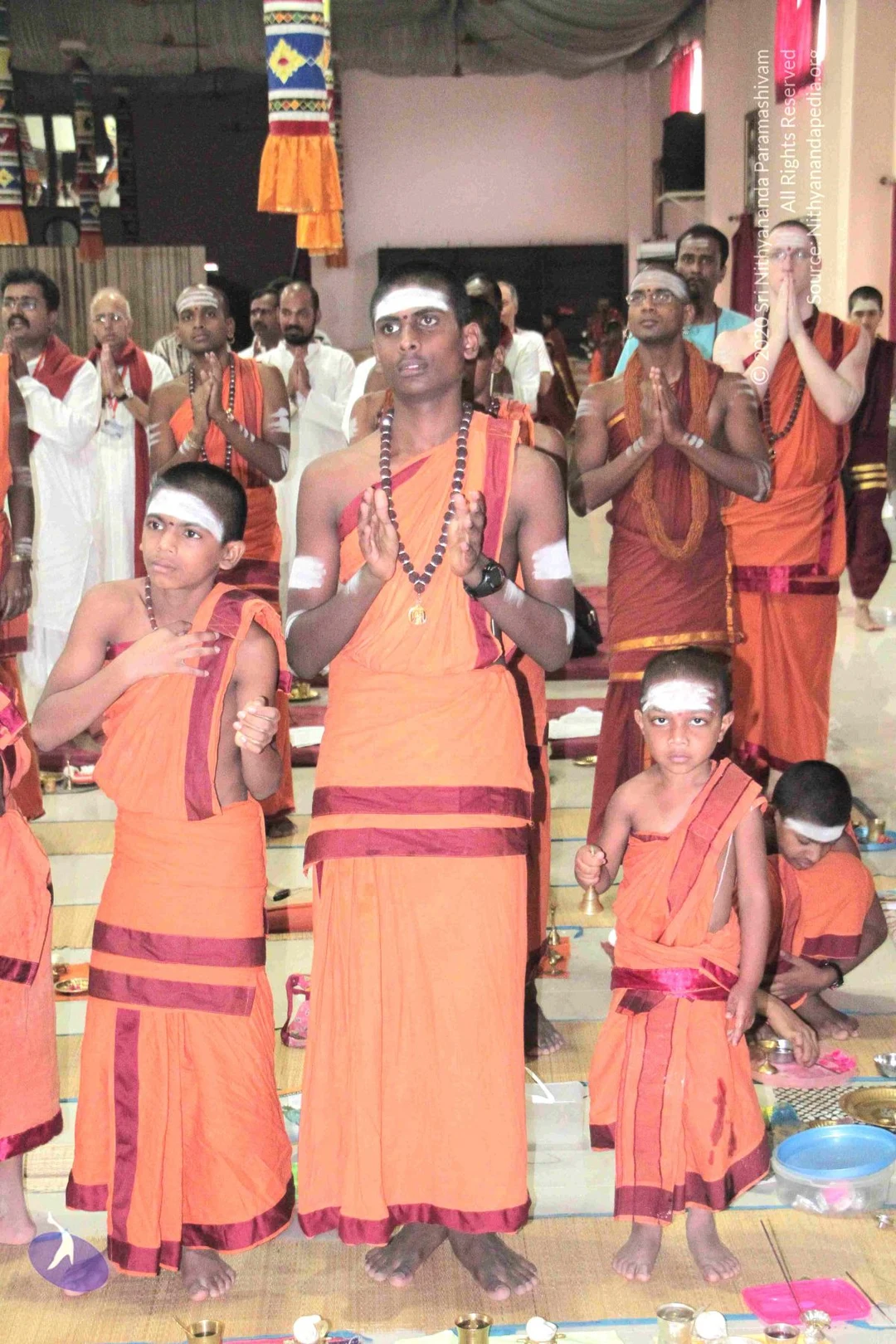
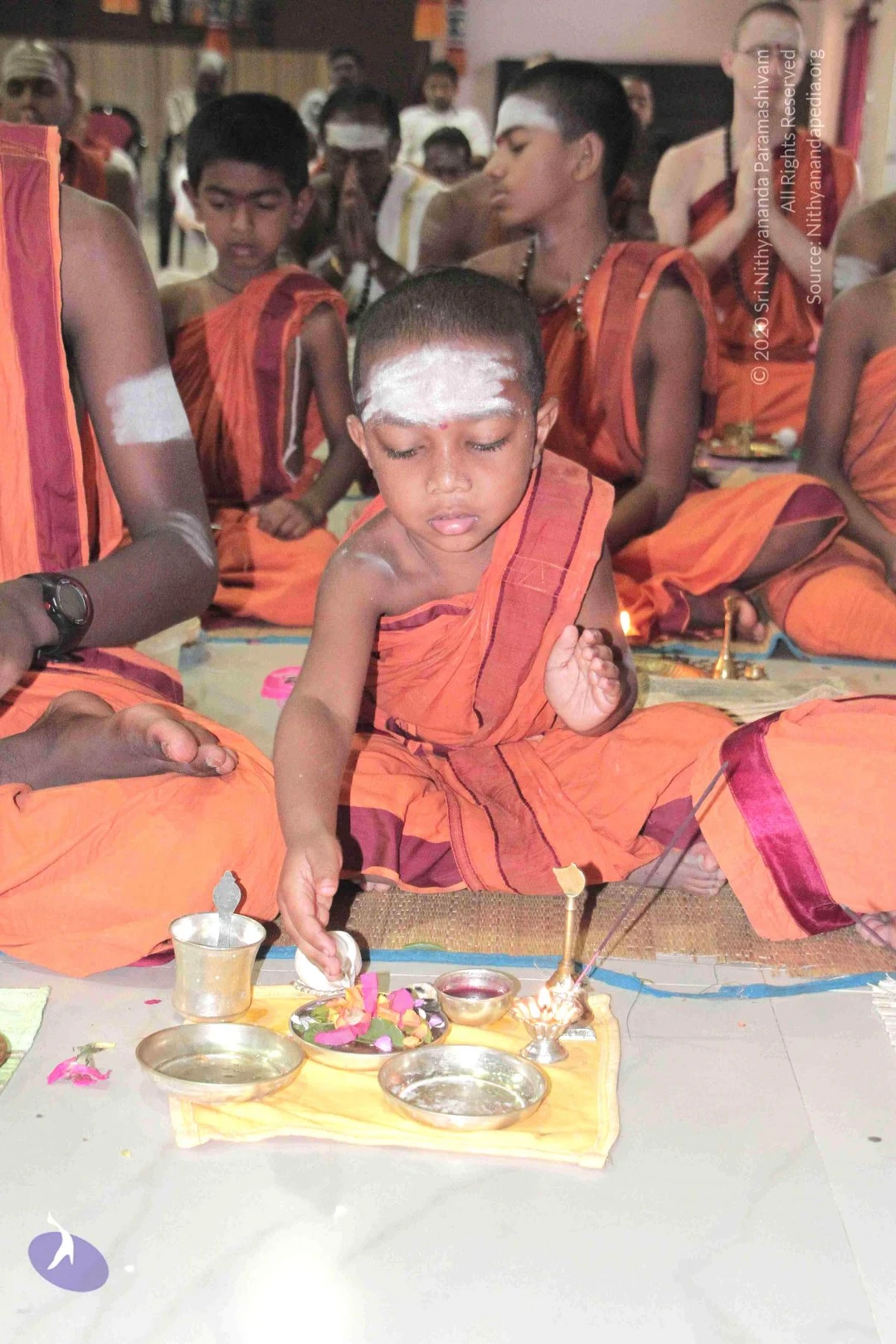
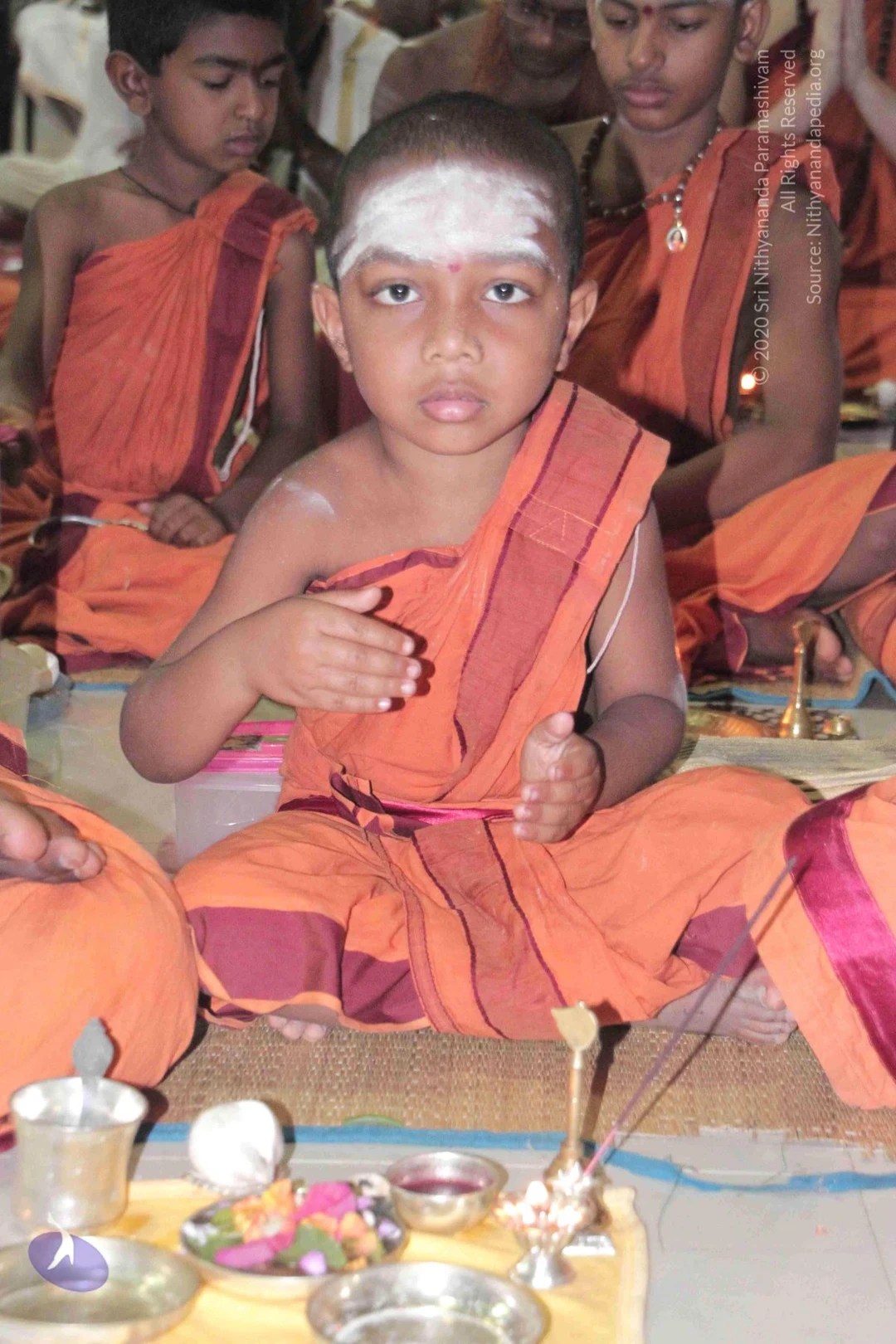
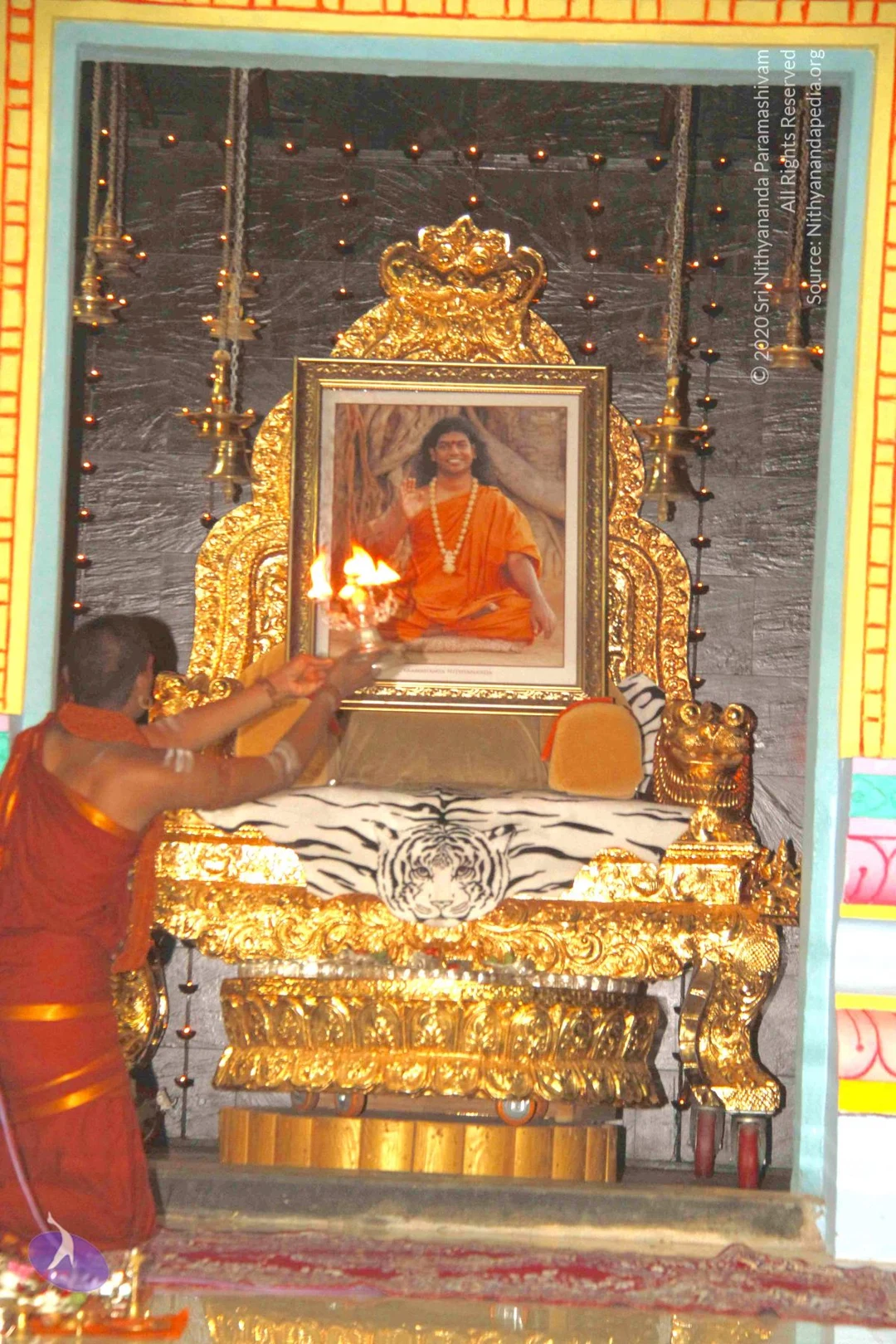
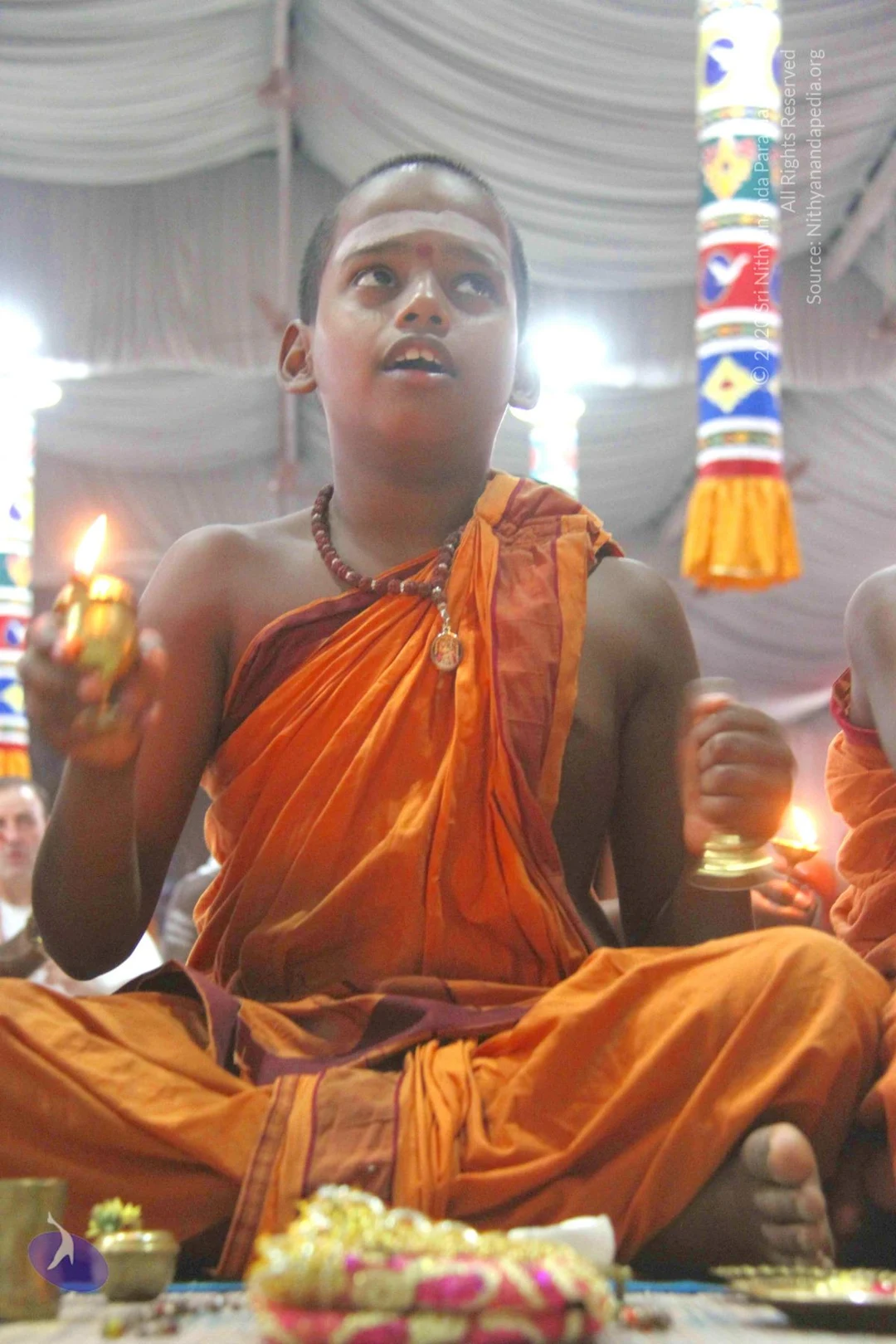
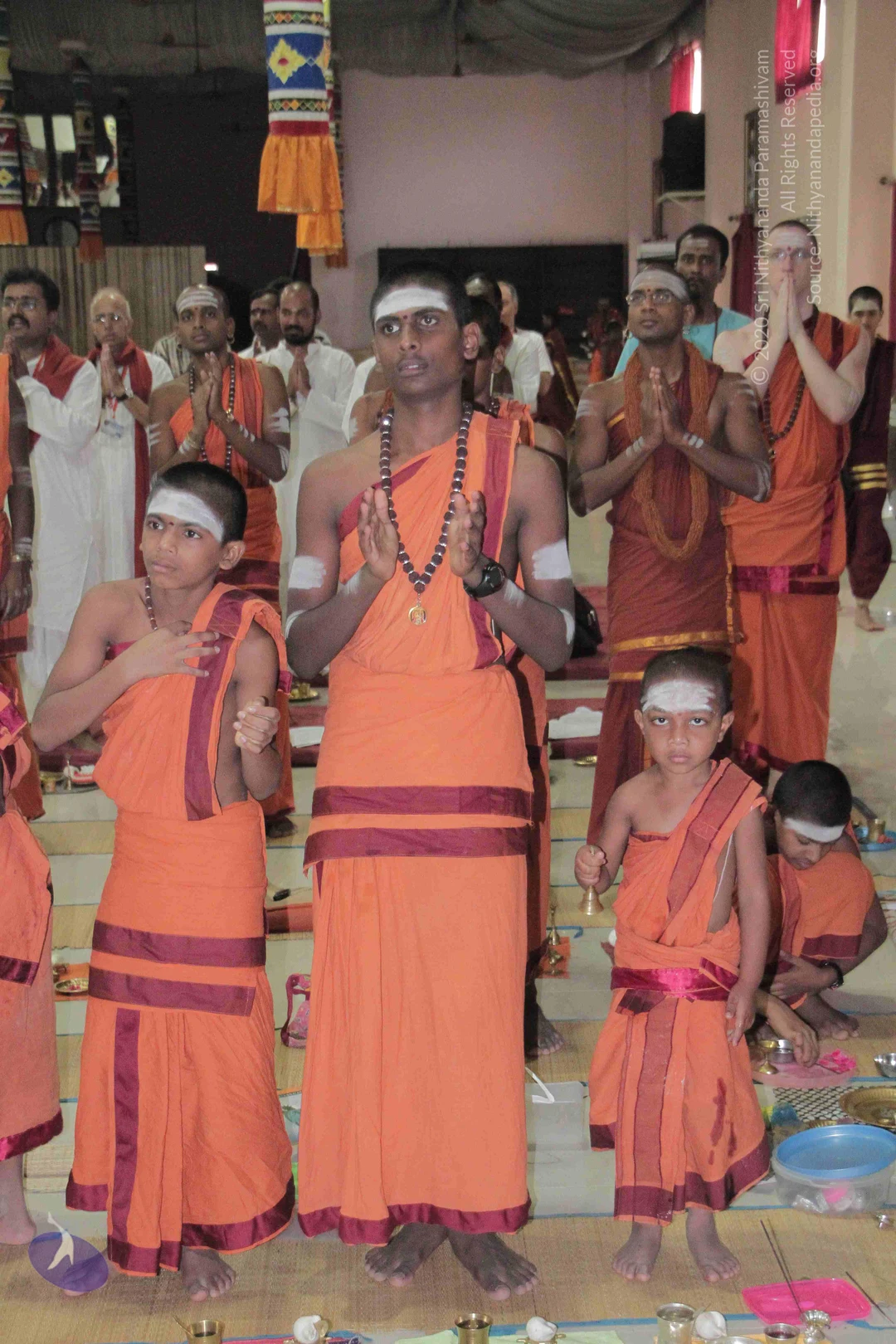
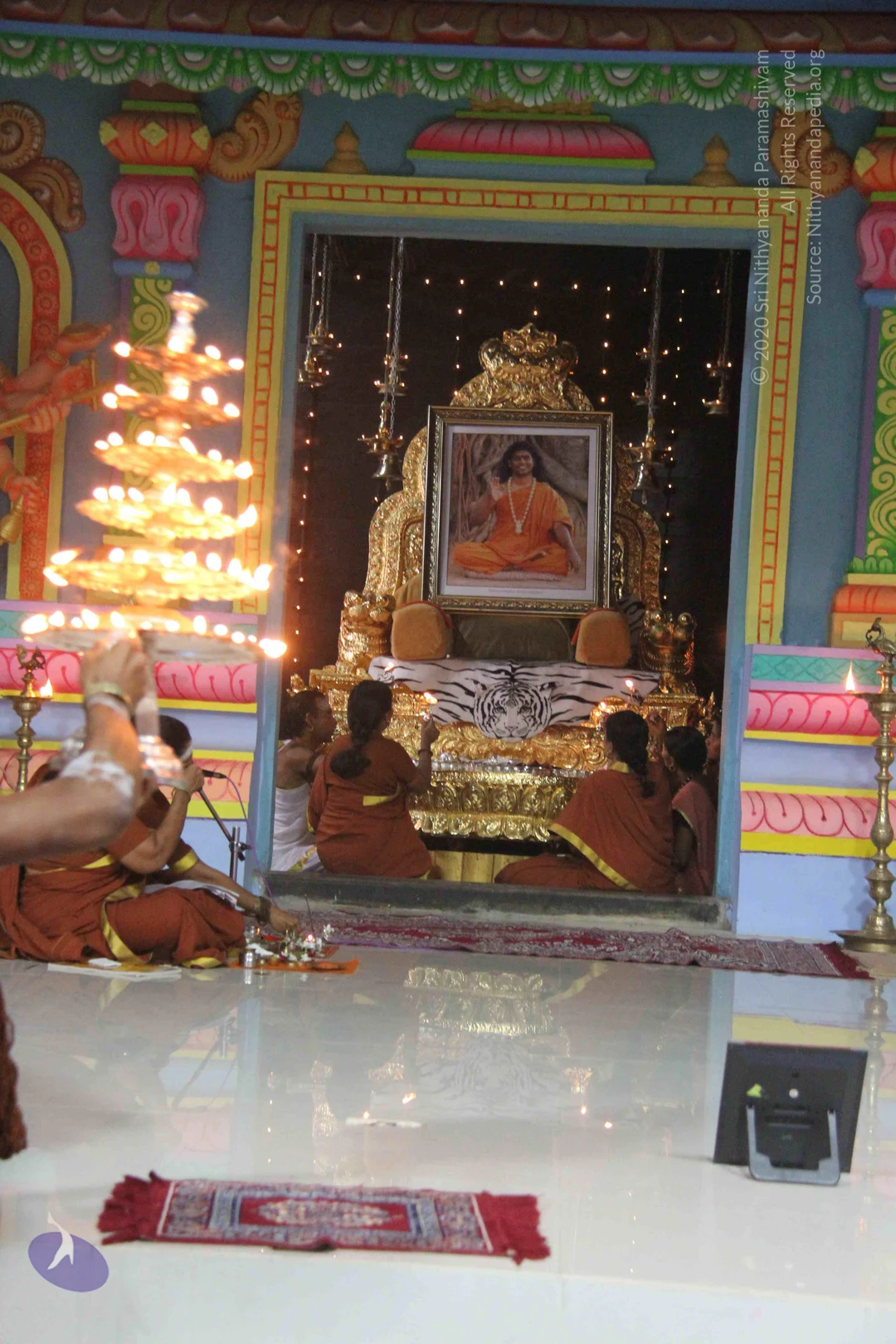
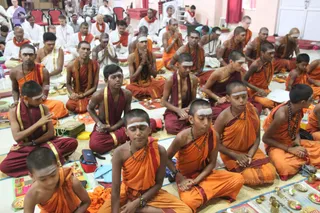
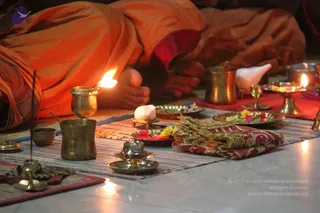
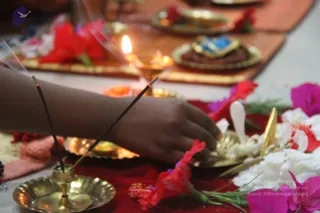
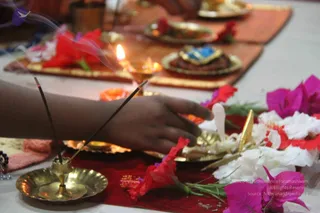
Interior of a temple shrine with painted blue walls and two large painted guardian statues with multiple arms holding weapons, one on each side. At the centre, a framed portrait on a gilded throne draped with a tiger-striped cloth shows a figure in orange robes with a garland, seated on a cushion. A priest in orange robes stands at the shrine raising a lit oil lamp toward the portrait, while a woman in orange sari sits on the glossy floor beside a microphone and a small bell or plate. Brass oil lamps stand on both sides and a row of small lamps lines the background.Several young boys in saffron-orange robes stand in a hall, many with white vibhuti bands across their foreheads and rudraksha malas around their necks. The boy on the left looks sideways with his hands at his chest; the middle boy holds his palms joined in anjali; the boy on the right has palms joined and an open-mouthed expression. Other figures stand in the background, and framed pictures hang on the wall above maroon curtains. No a person candidate is visible.A photograph of a seated group of young boys in saffron-orange dhotis and shawls with maroon-red and gold-bordered cloths, many with white vibhuti horizontal stripes on their foreheads and rudraksha malas around their necks. They sit cross-legged on mats in a hall, several with palms pressed together in prayer or hands folded, eyes closed in meditation. Brass plates, small lamps, and offering trays with flowers sit on mats in front of them, and older men in white and orange clothing sit in the background. No a person candidate is clearly identifiable among the visible people.A photograph of a puja setup on a white marble floor in low warm light. Two people in orange and saffron robes sit cross-legged at the top of the frame, only their lower bodies and bare feet visible. In the foreground, brass vessels, a brass lamp with a lit flame, a brass bowl with offerings, a white conch shell, and a red and gold brocade cloth rest on a woven mat. Flower petals and a small plate of fruit and flowers are arranged nearby, and an incense stick rises at the left edge.Close-up photo of a ritual puja table draped with a red cloth. A person's hand, wrist bare, reaches toward brass plates heaped with white and red flowers. A brass oil lamp with a lit flame sits centre, and a brass incense holder with two lit incense sticks sends up smoke at left. Pink and red blossoms, white jasmine-like flowers and a brass kalasha-style vessel fill the foreground, with trays of offerings blurred in the background. No faces visible.Close photograph of a puja setup on a red cloth-covered table. A bare hand of a person reaches toward brass plates holding white and red flowers, a lit oil lamp with a flame, and a brass incense holder with two burning incense sticks sending up smoke. Pink and magenta bougainvillea and red blossoms lie across the table, with more brass plates and offerings behind. Only a hand and arm are visible, so no full person appears in the frame.

Nithya Satsang
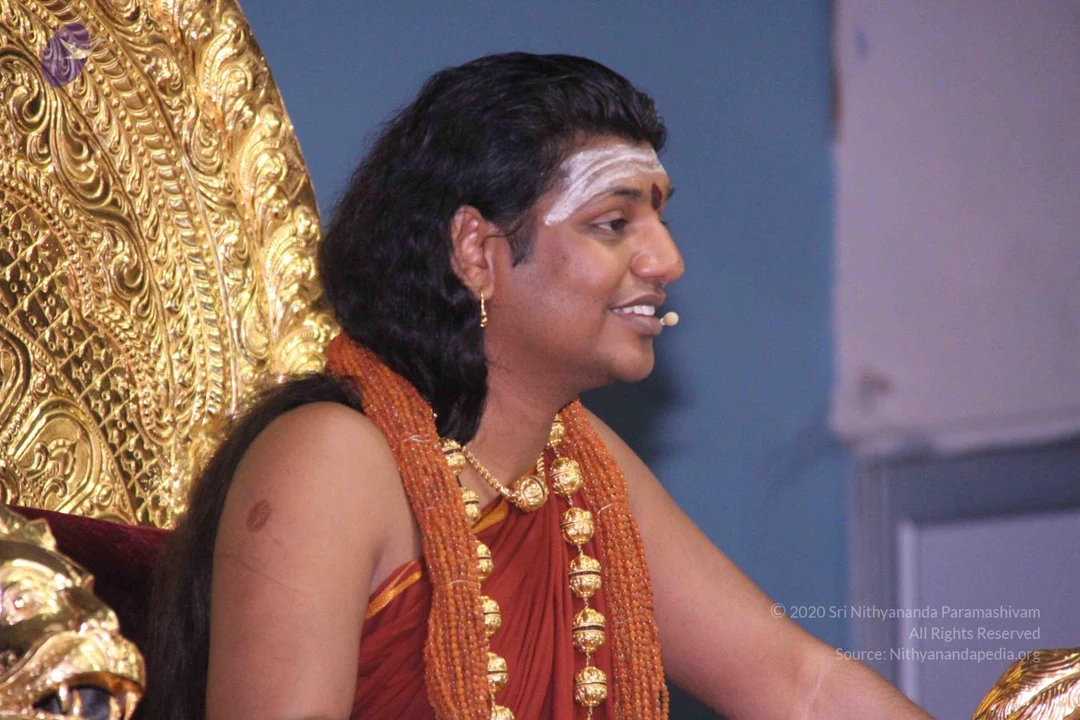
43 photosSource gallery
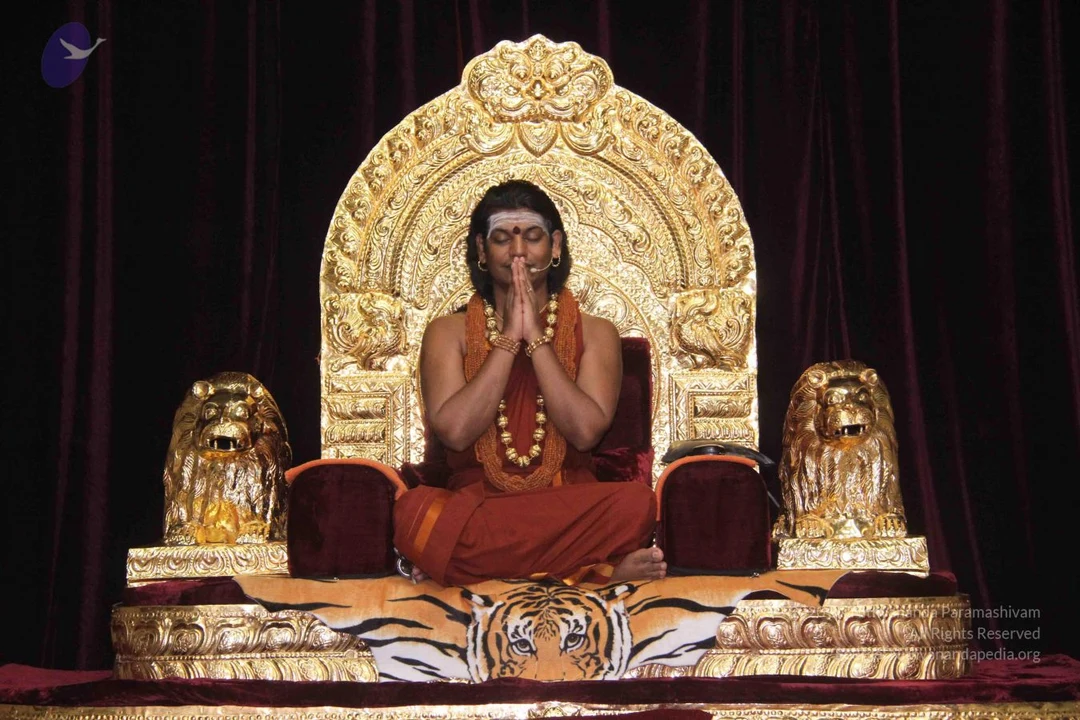
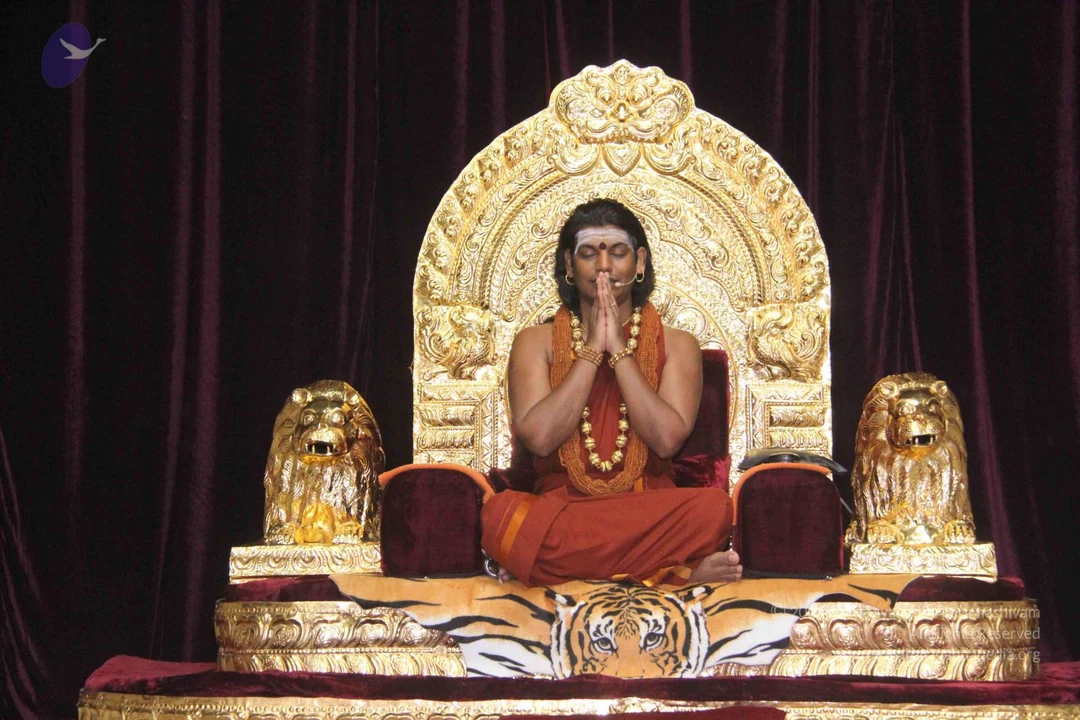
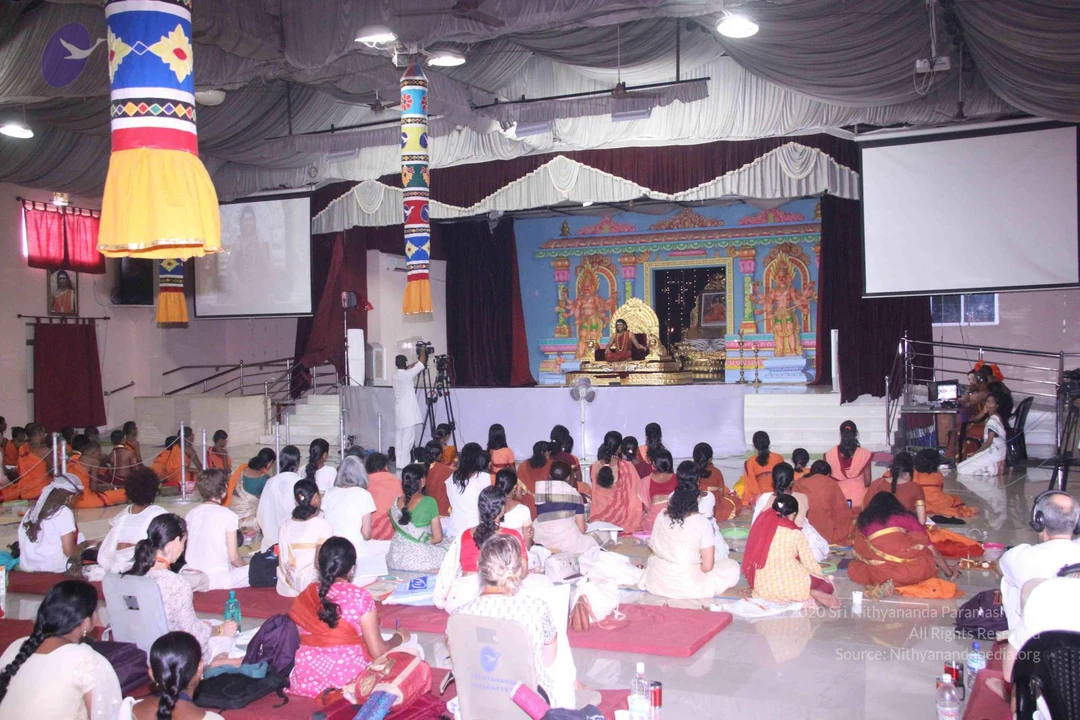
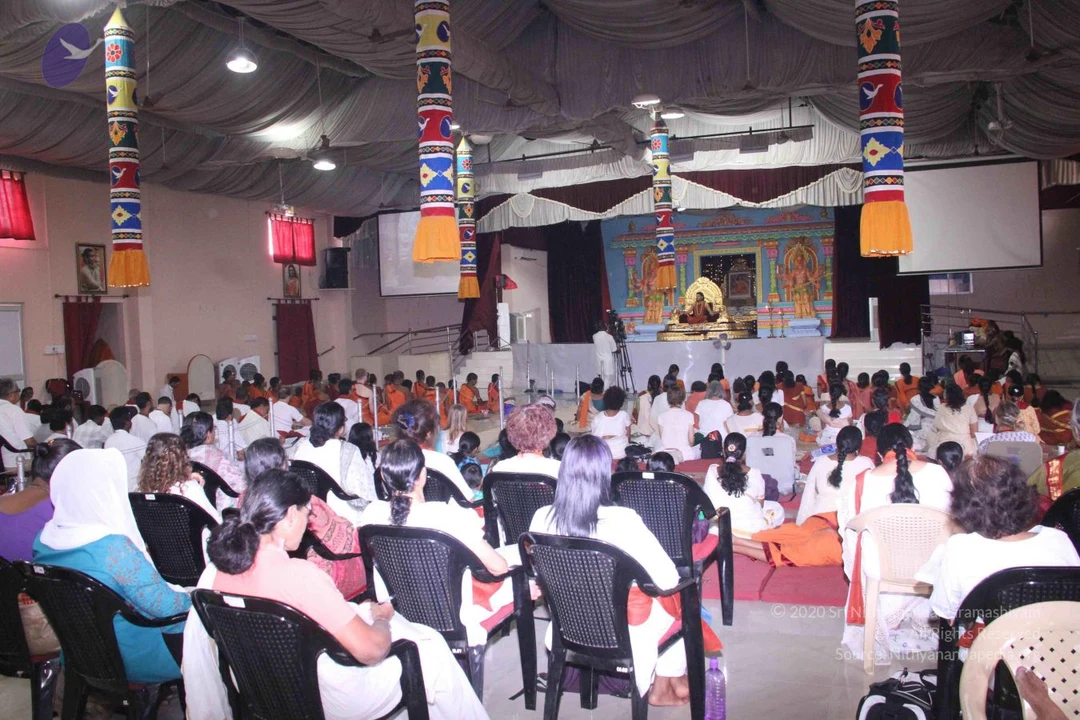
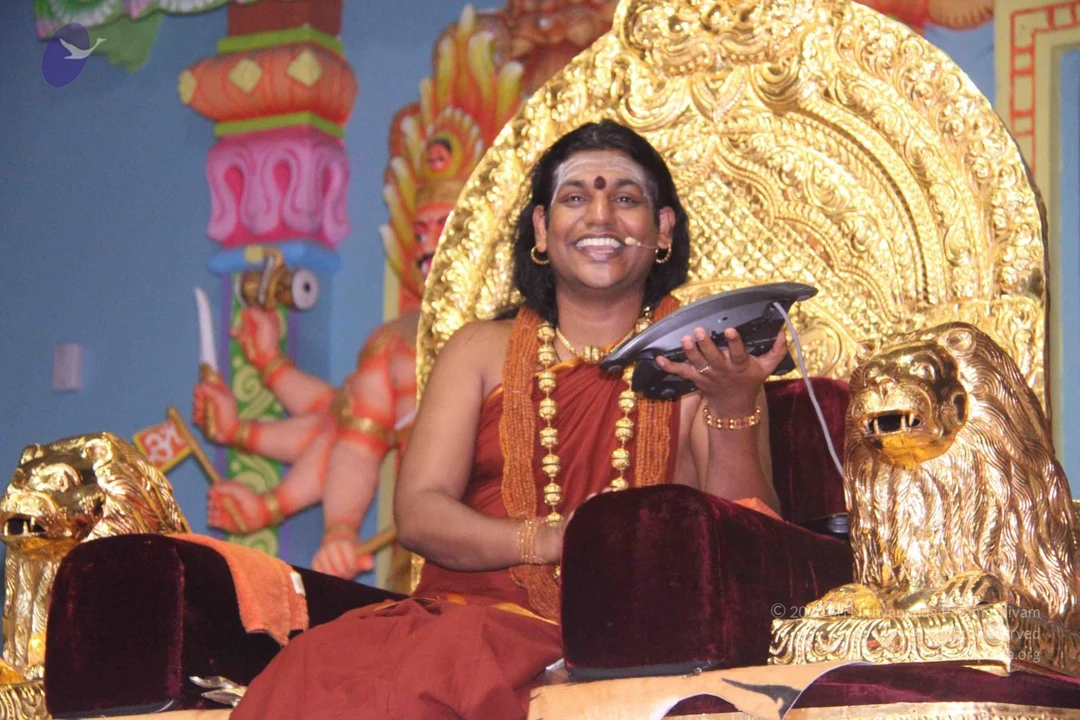
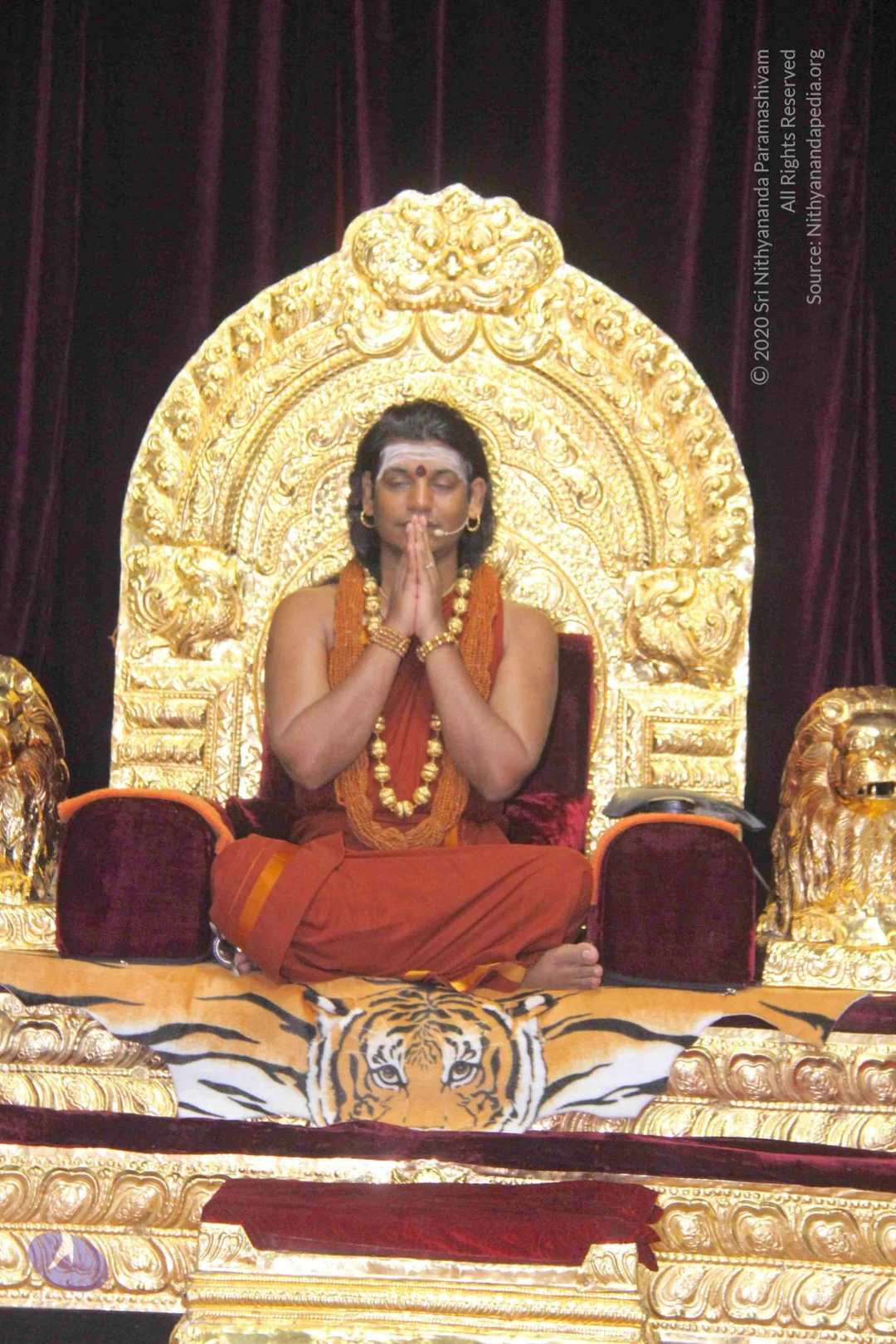
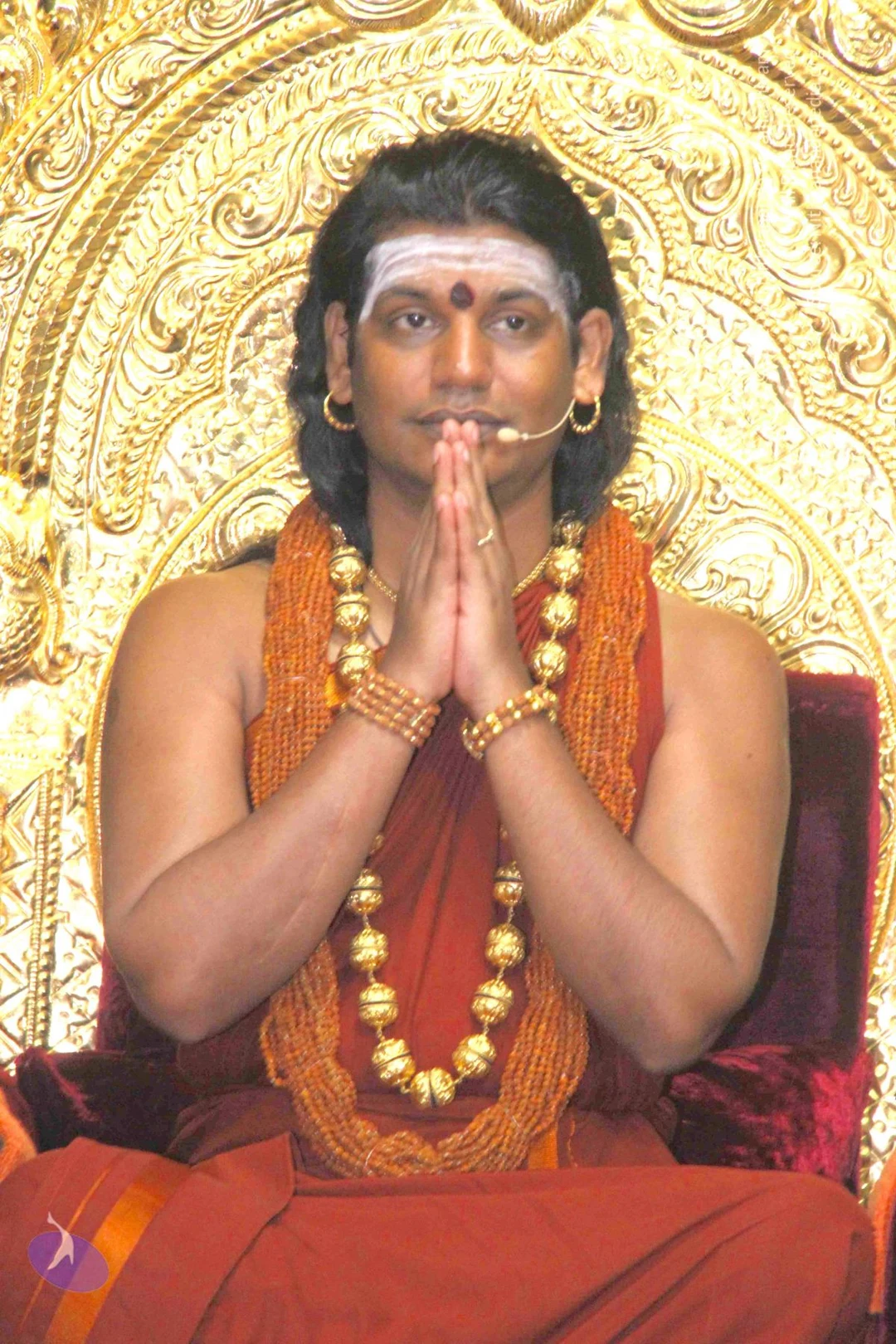
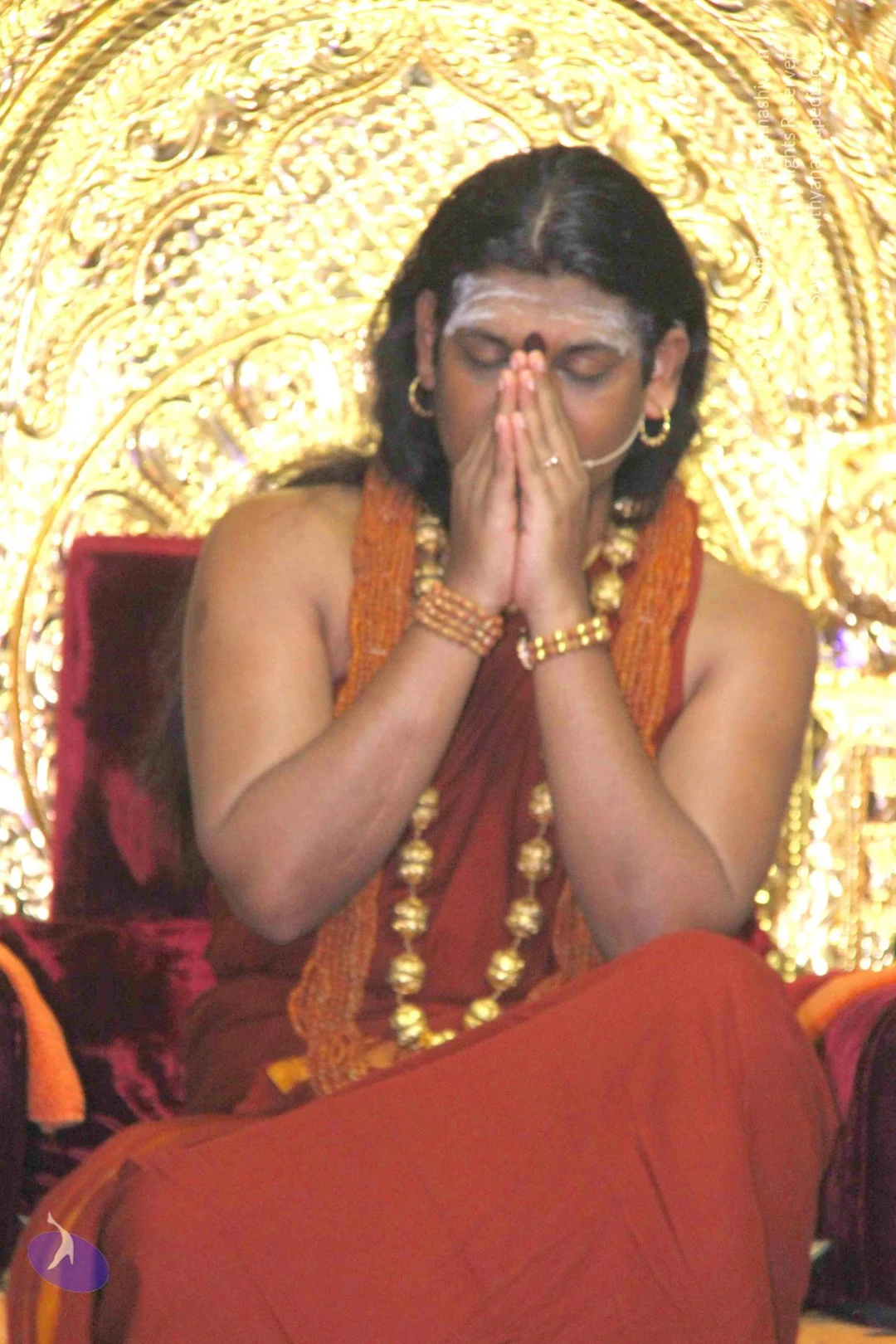
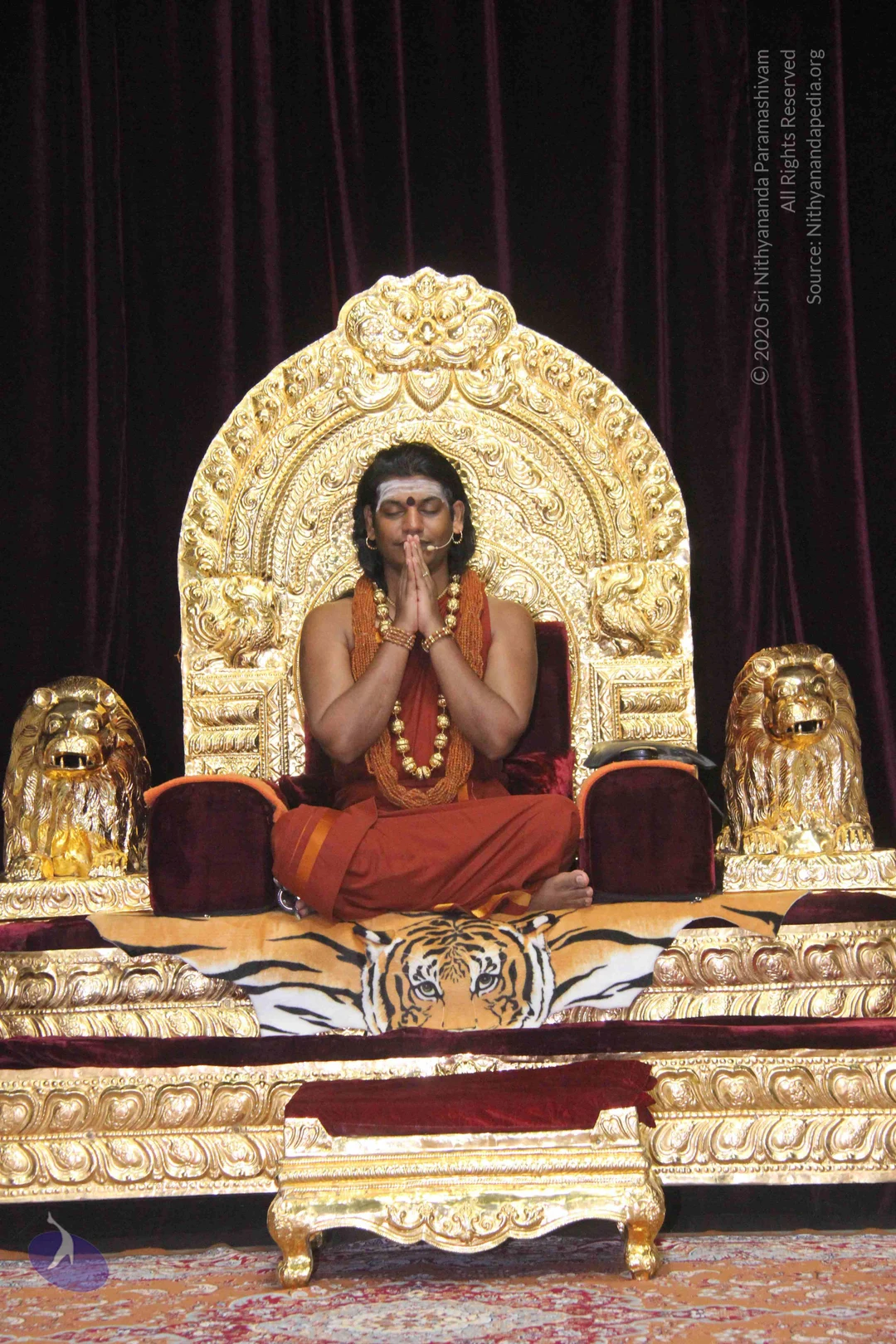
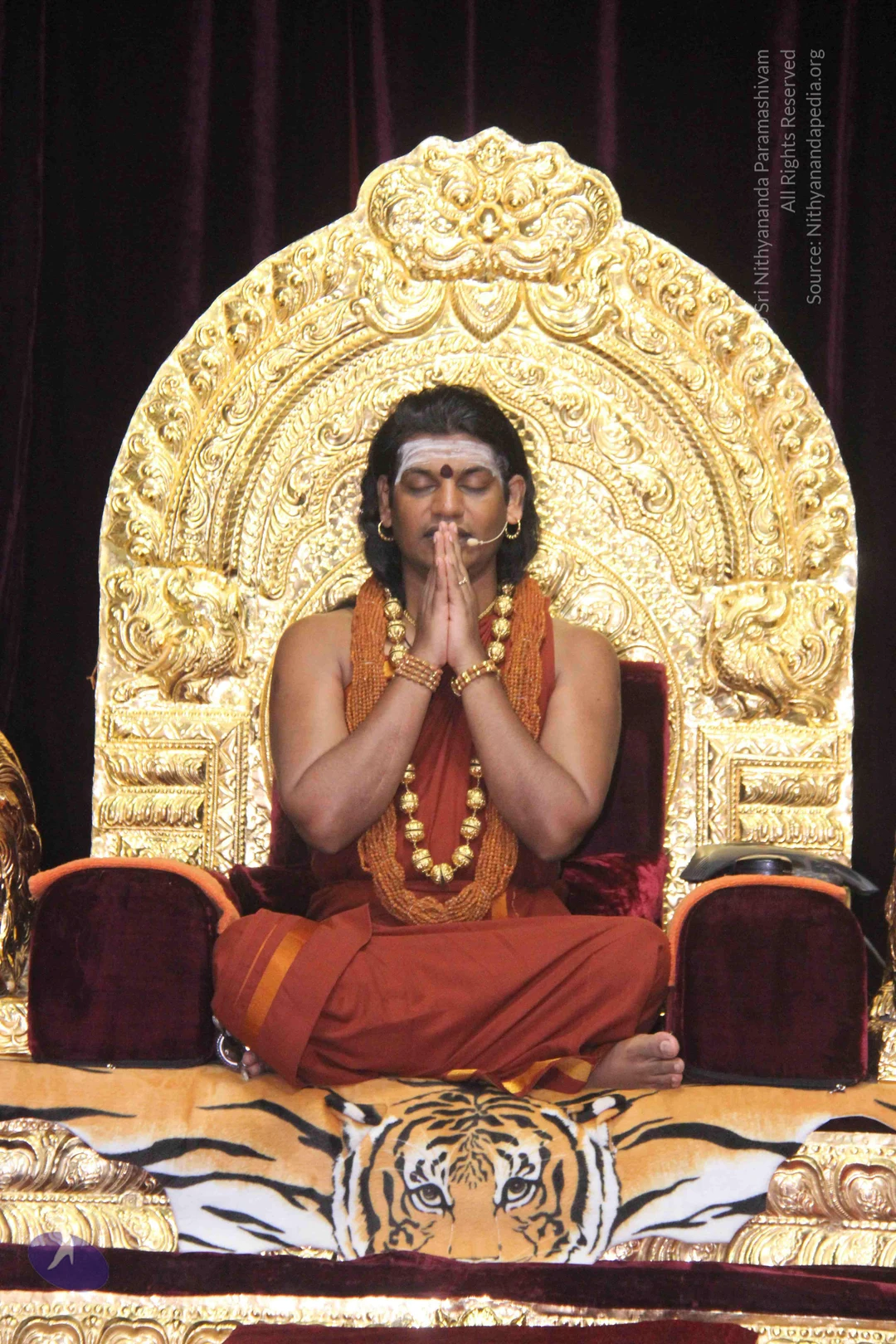
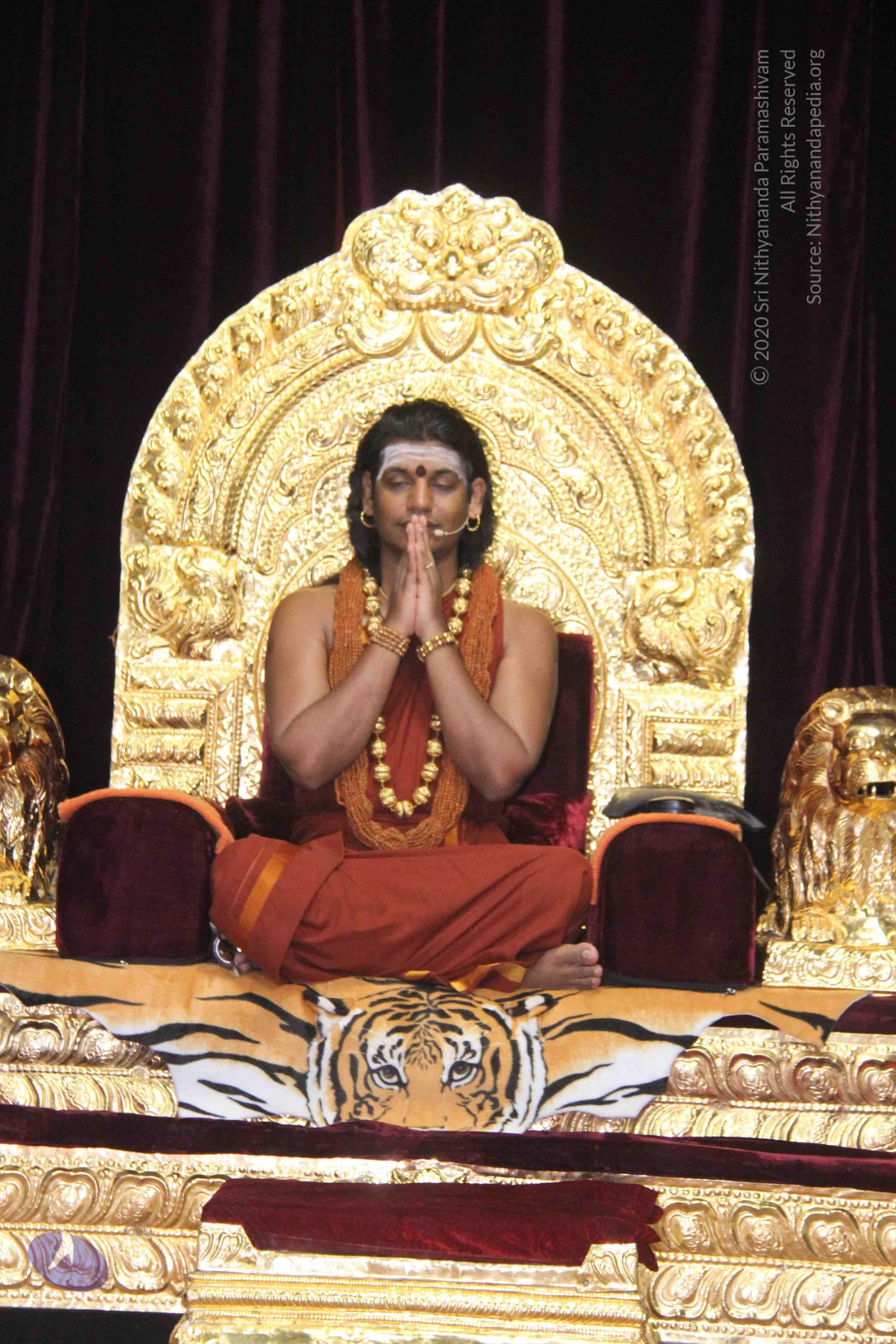
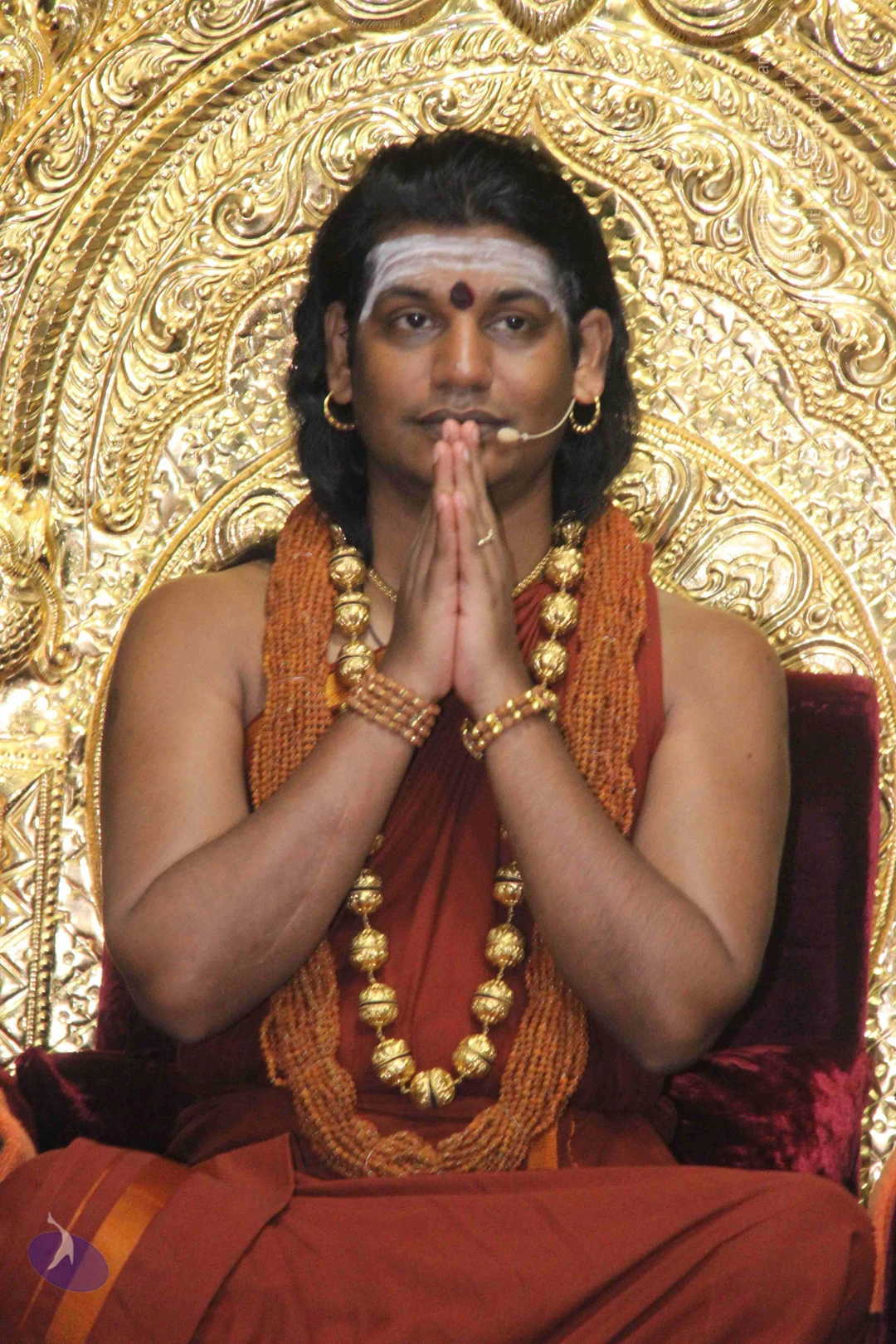
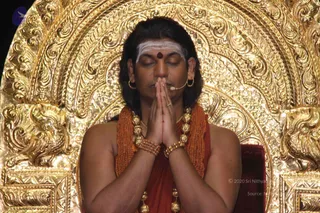
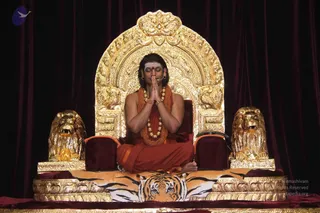
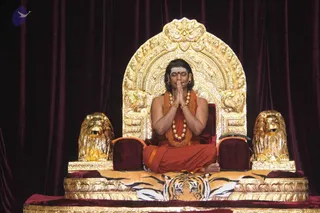
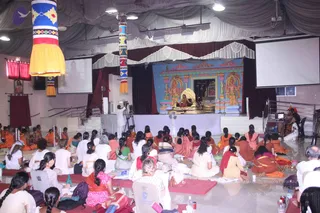
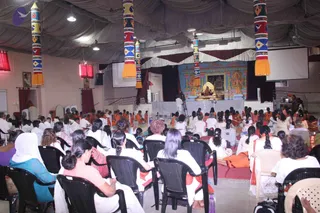
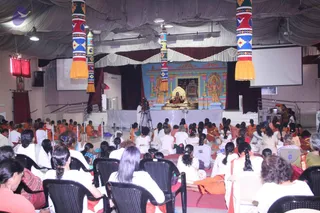
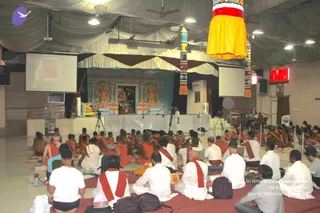
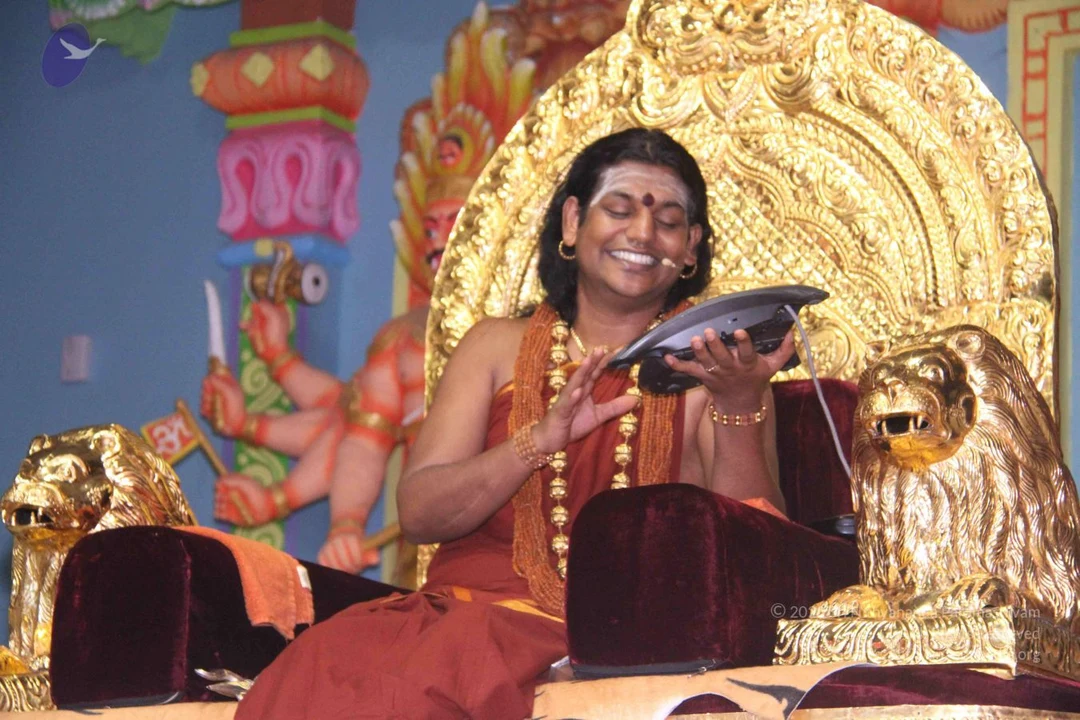
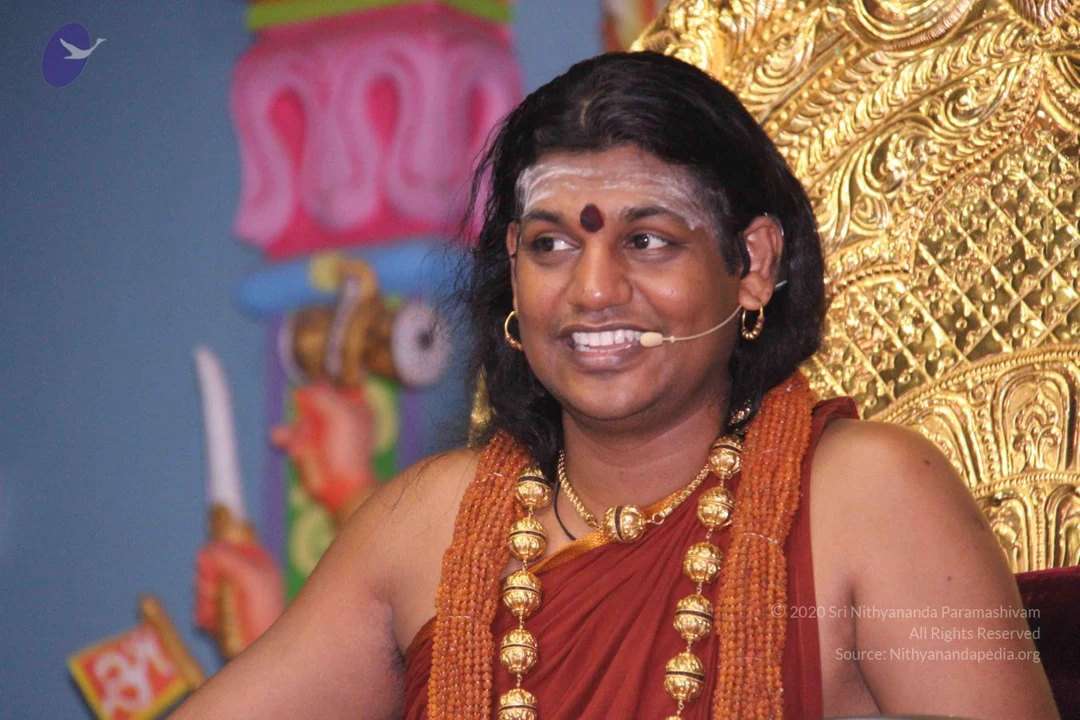
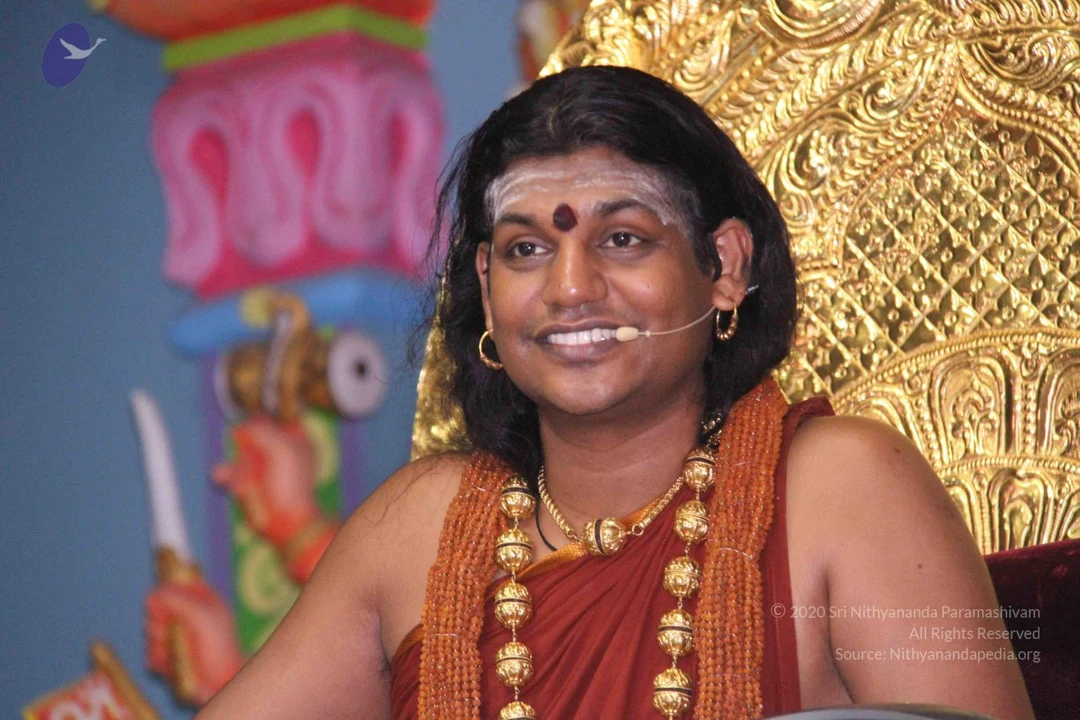
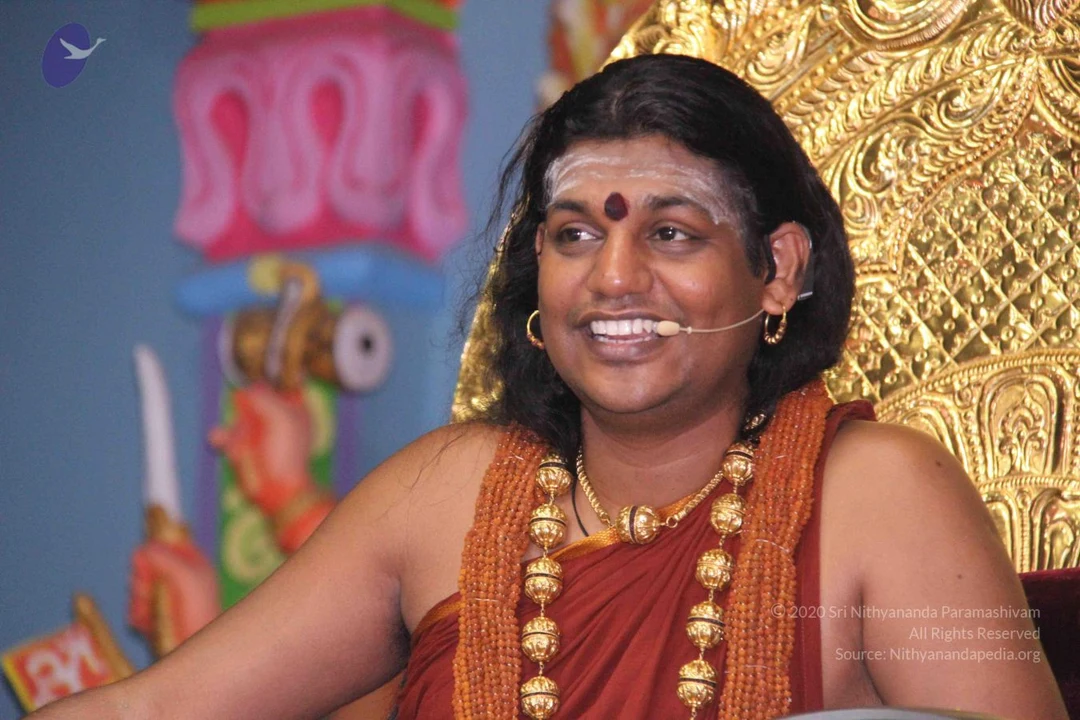
A man with long dark hair sits before an ornate gold-leaf embossed backdrop with his eyes closed and palms pressed together in namaste. He wears a white horizontal tilak with a red dot on his forehead, gold hoop earrings, a headset microphone, an orange-red shawl over bare shoulders, and layered rudraksha-style beaded necklaces with gold and bead accents. The setting appears to be a stage or satsang hall.A seated man in saffron-orange robes sits cross-legged on a tiger-skin-covered platform before an ornate gilded throne with a carved arched back and two gold lion figures at its sides. His palms are pressed together in namaste and his eyes are closed. He wears a white forehead marking with a red dot, a rudraksha mala and layered gold necklaces, and gold earrings. The backdrop is draped in deep maroon velvet curtains. a person seated in a prayer pose, with gilded lions and tiger skin on the dais.A seated man in saffron-orange robes sits cross-legged on an ornate golden throne with a carved arched back, flanked by two gold lion sculptures, on a tiger-skin-covered dais against deep maroon velvet drapes. He has his eyes closed and palms pressed together in namaste, wears a white vibhuti forehead mark with a red kumkum dot, long hair, earrings, and layered rudraksha mala and gold beaded necklaces, and a small microphone is visible near his face. Swamiji (probable): the appearance cues are long hair, saffron robes, rudraksha malas and ornate gold necklaces, with the page stating he is present, so this is a seated speaker on the throne.Photograph of a satsang hall with a large seated crowd of devotees on mats, many in white, cream and orange clothing, facing a raised stage. On the stage a figure in a red-brown robe sits on a gold throne before a blue backdrop painted with deity figures and a shrine doorway. A cameraman with a tripod films from the left, and a projector screen hangs on the right. Colourful cylindrical banners hang from the ceiling. The swami on the throne is a person match: he has long swept-back hair and a saffron-ochre robe with ornate gold ornaments, although the distance is considerable.A large indoor hall with a draped ceiling and painted pillars decorated with colourful patterns and tassels. Rows of plastic chairs hold a seated audience, many women in white with some in saffron and teal. On a stage backed by a painted temple-style mural, a figure seated on an ornate golden throne is addressing the gathering, while people in orange robes sit on the floor before the stage. A projection screen and a framed portrait on the left wall are visible.Photograph of a satsang hall with a large audience of devotees seated on the floor and on plastic chairs, facing a raised stage. Many wear white and saffron or orange garments. On the stage, a seated figure in orange robes sits on a gold throne before a colourful painted backdrop of deity figures. Tall decorative pillars in red, blue and yellow patterns hang from the ceiling, and a projection screen is visible at the right. A small framed portrait hangs on the left wall. The face of the seated figure is too distant to confirm identity, so the appearance is uncertain.
Sarva DARSHAN

23 photosSource gallery
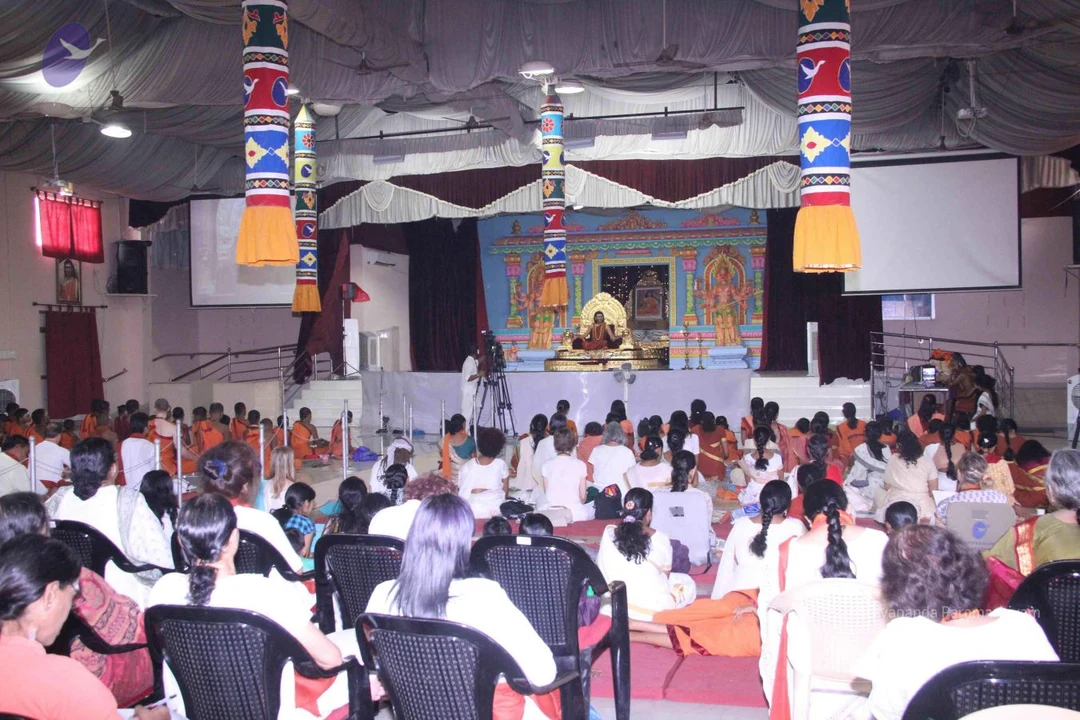
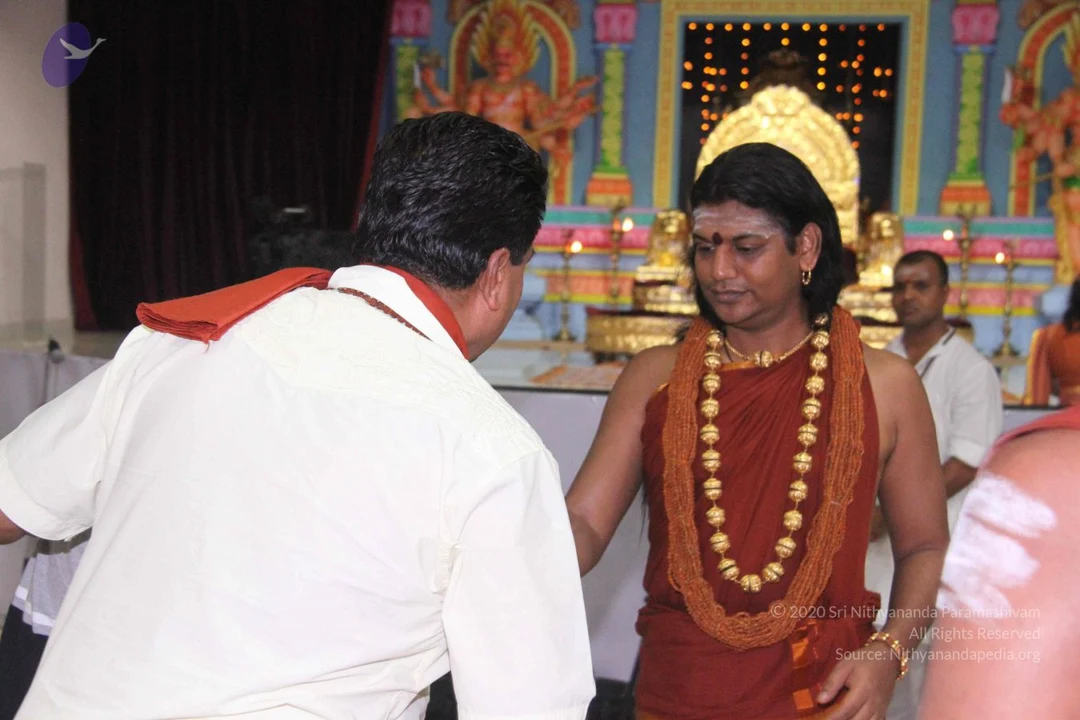
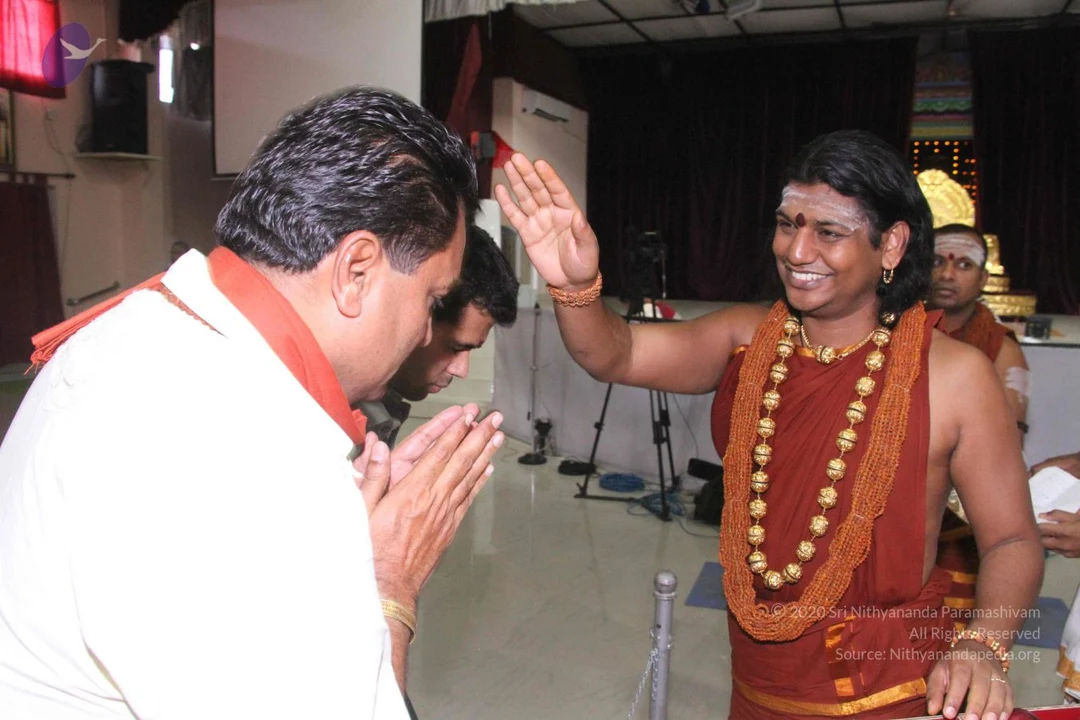
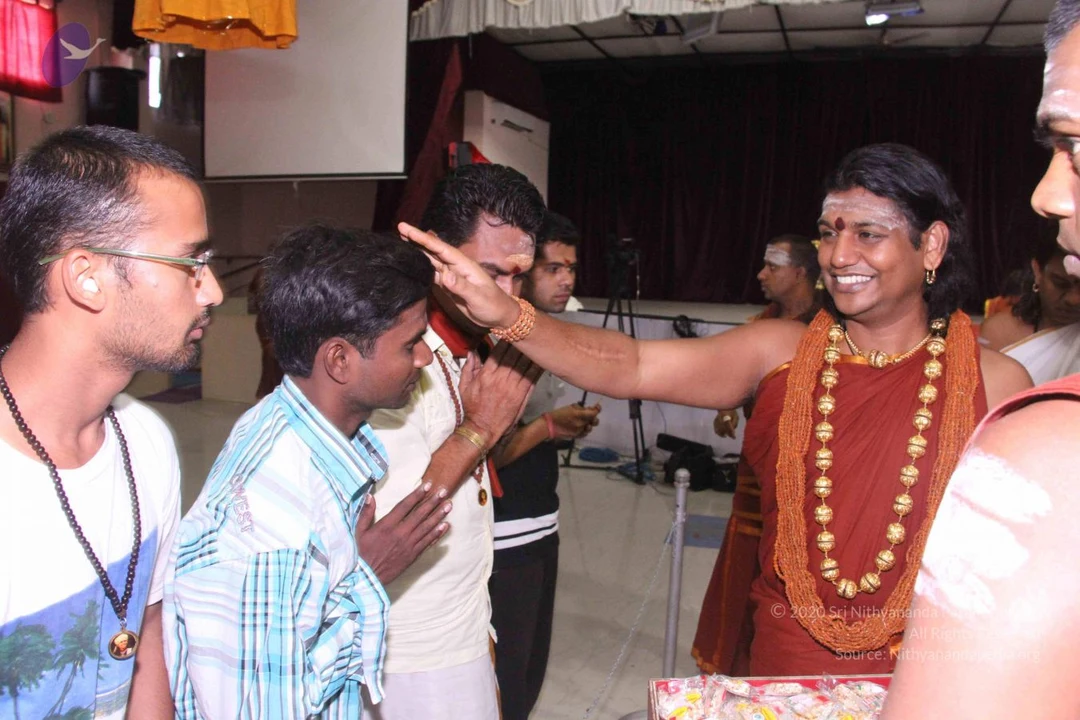
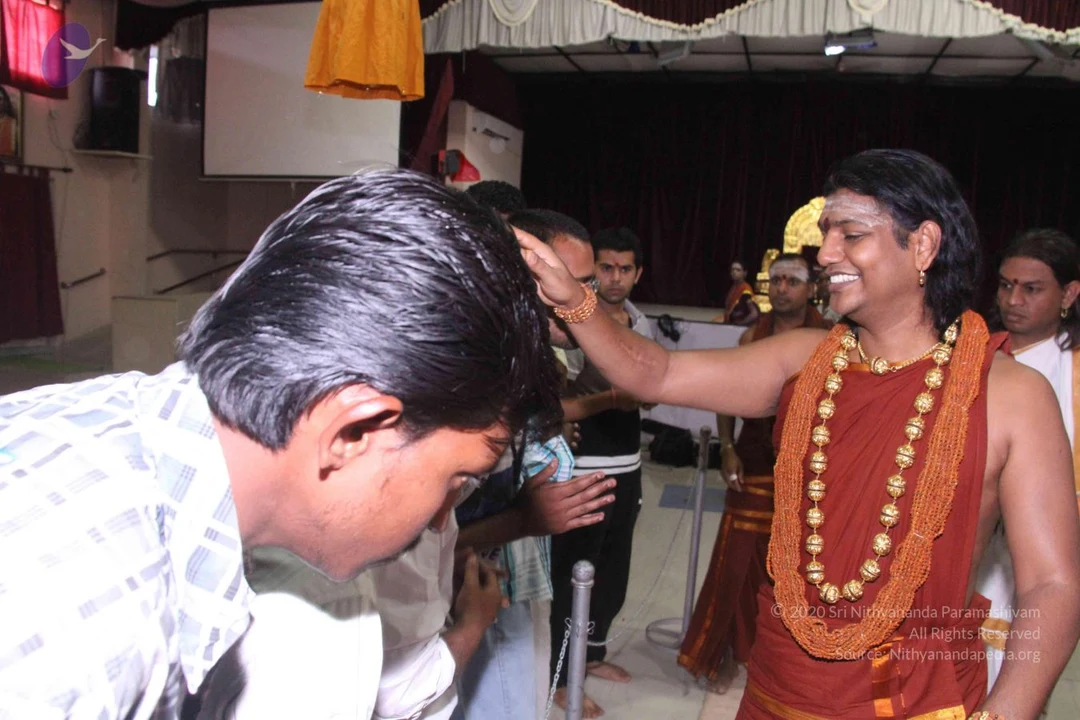
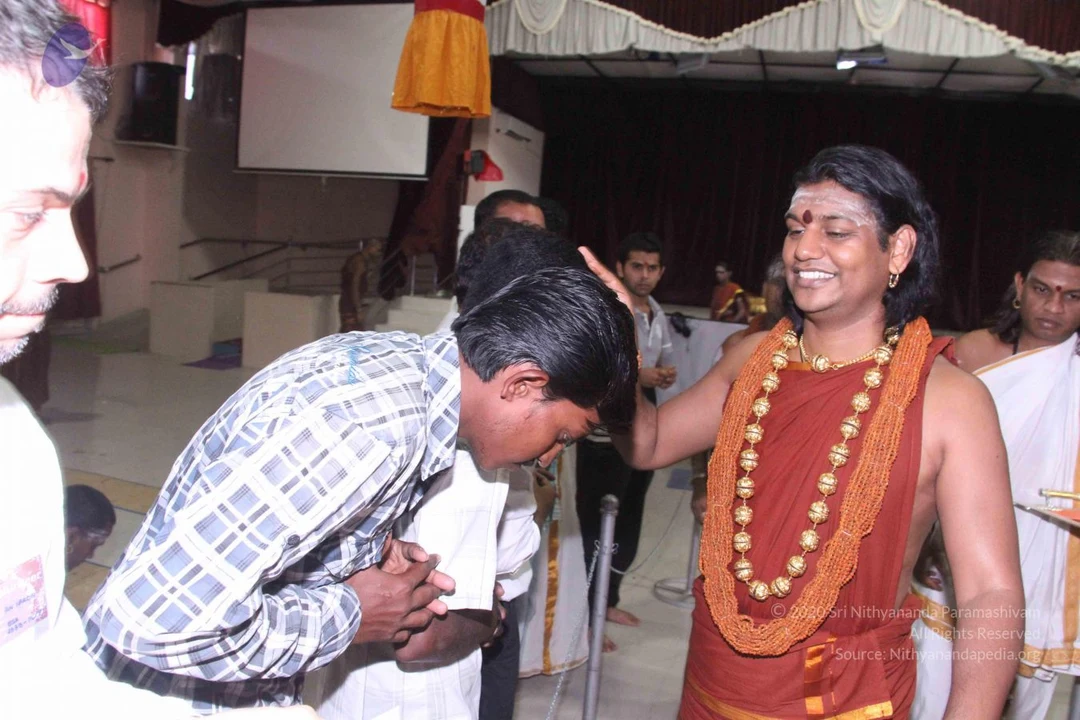
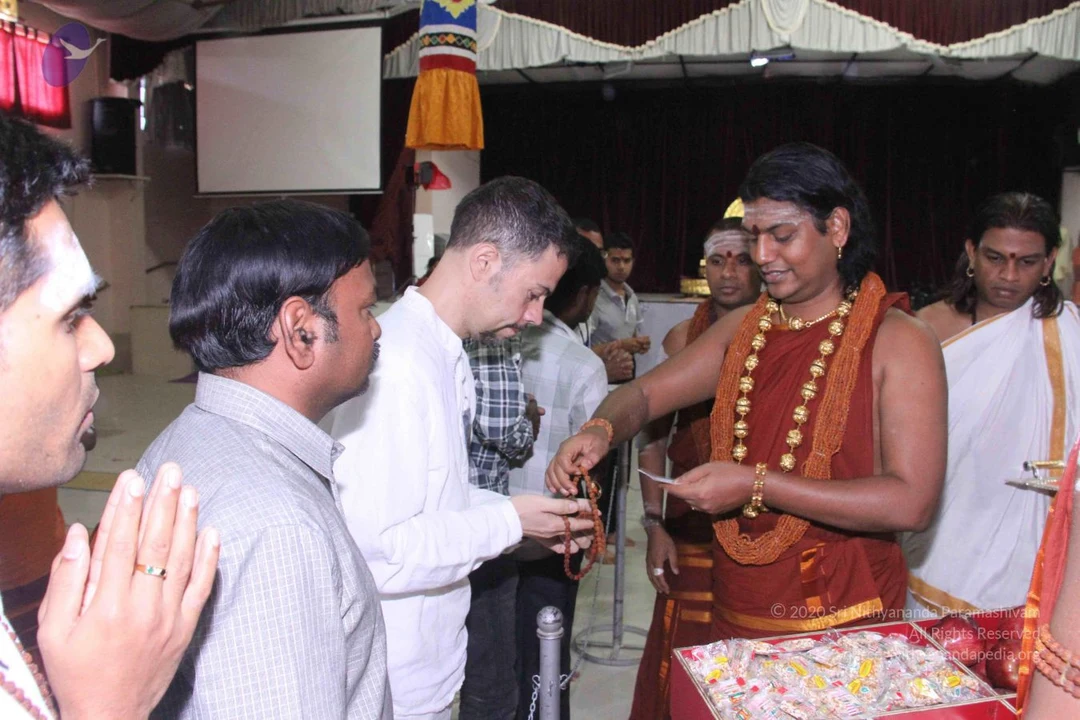
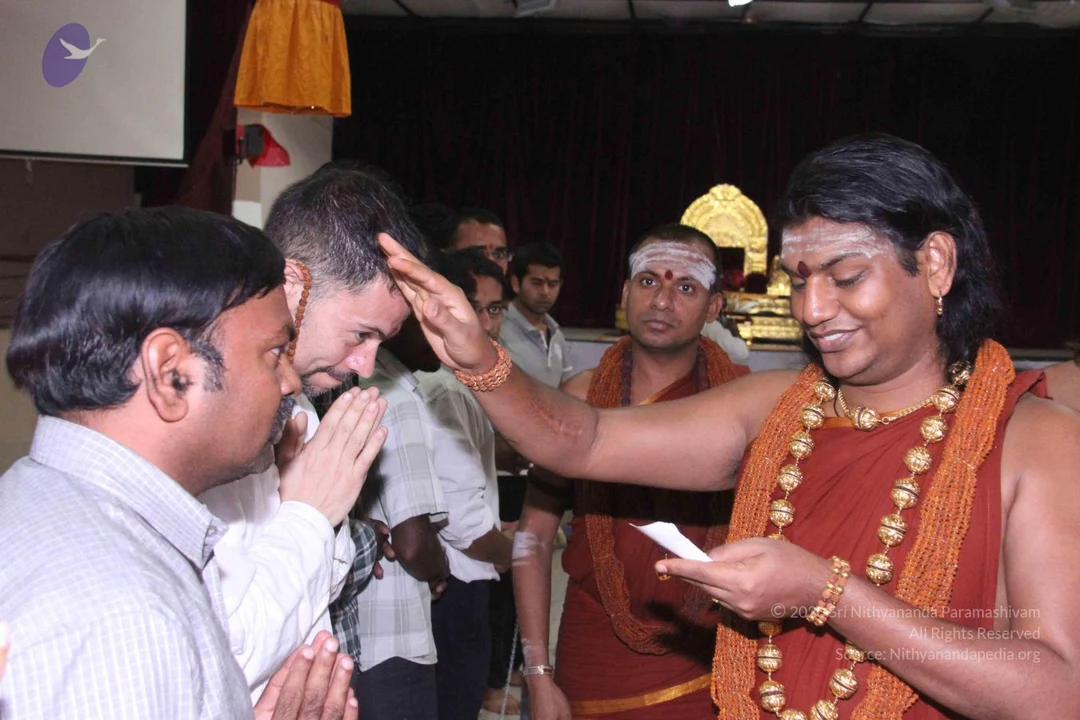
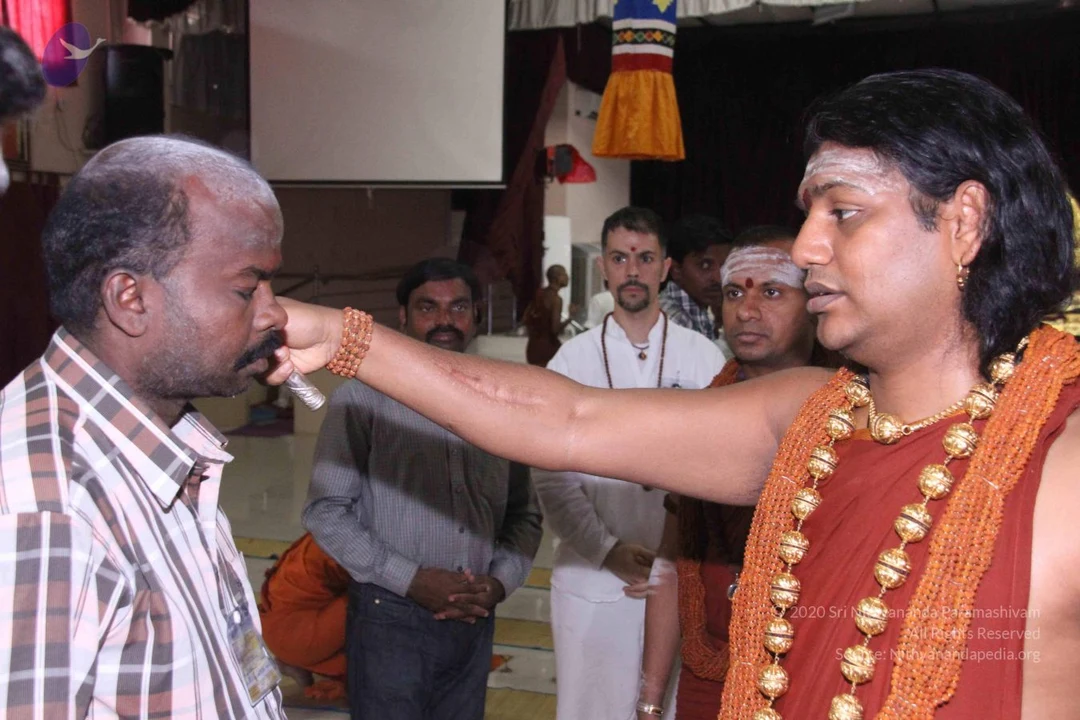
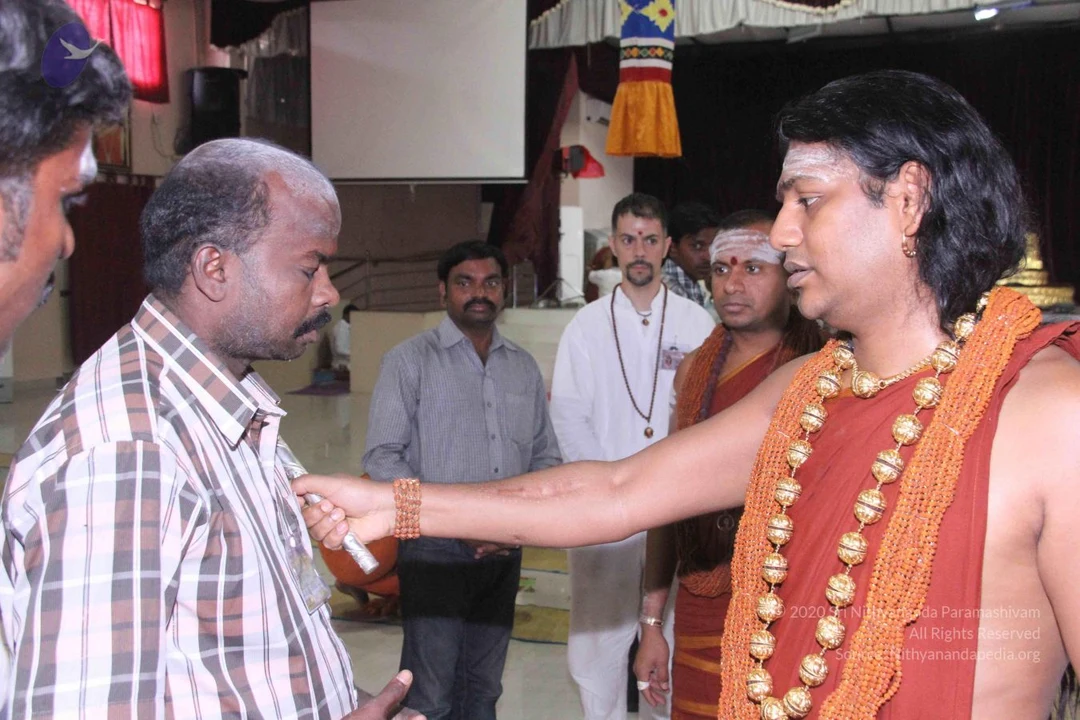
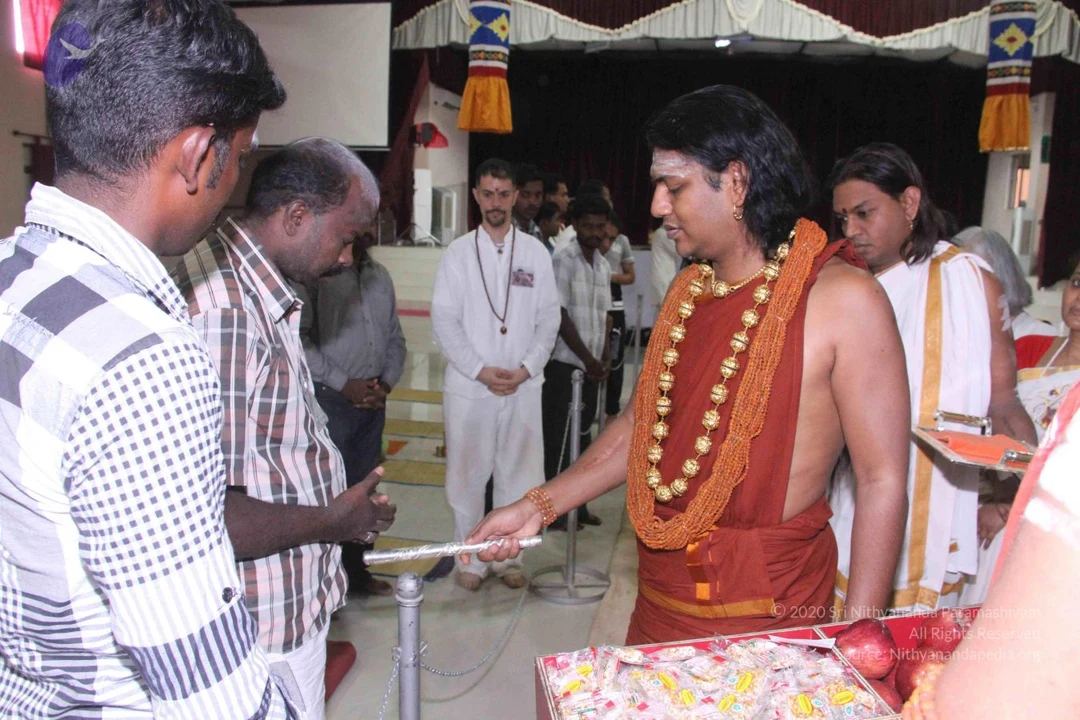
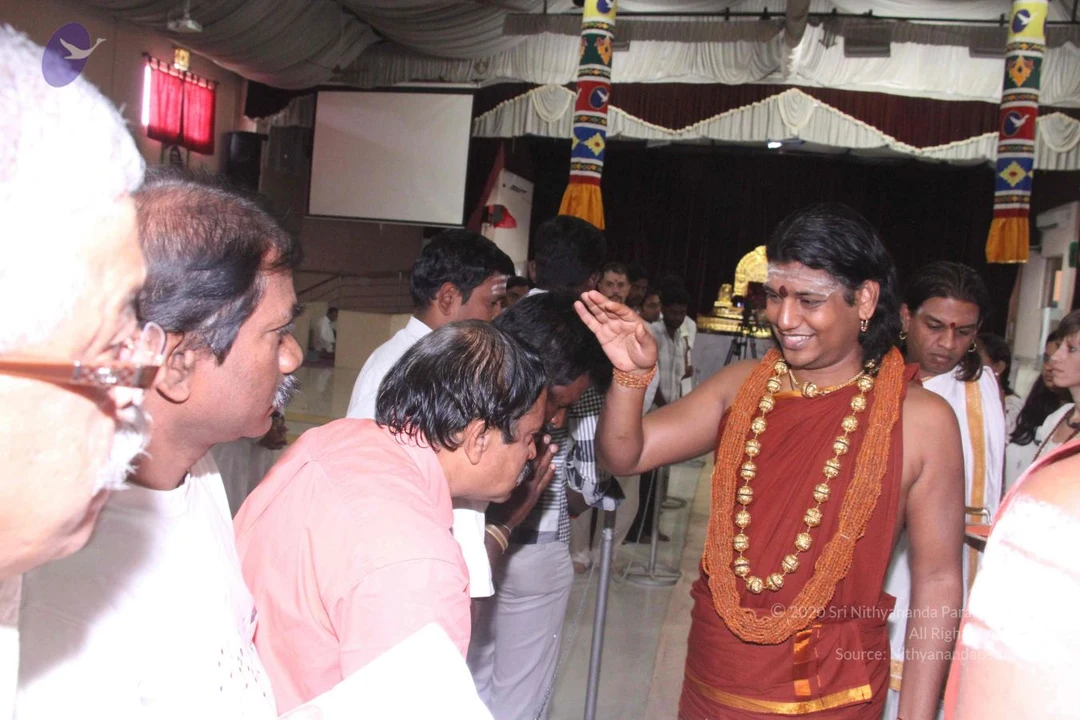
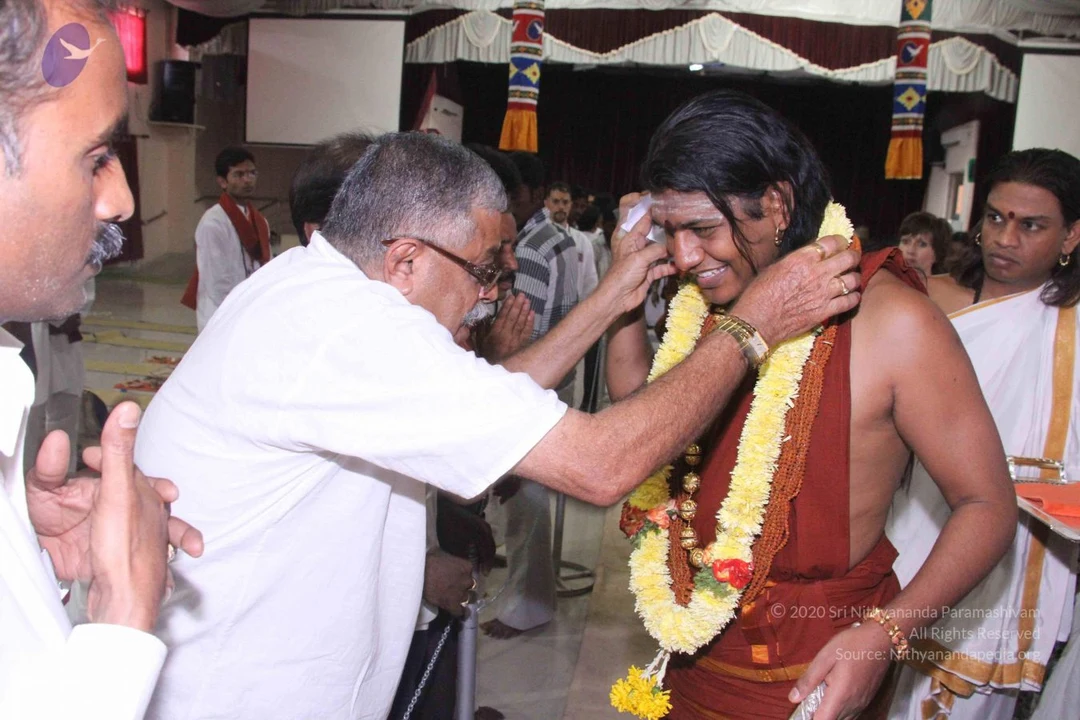
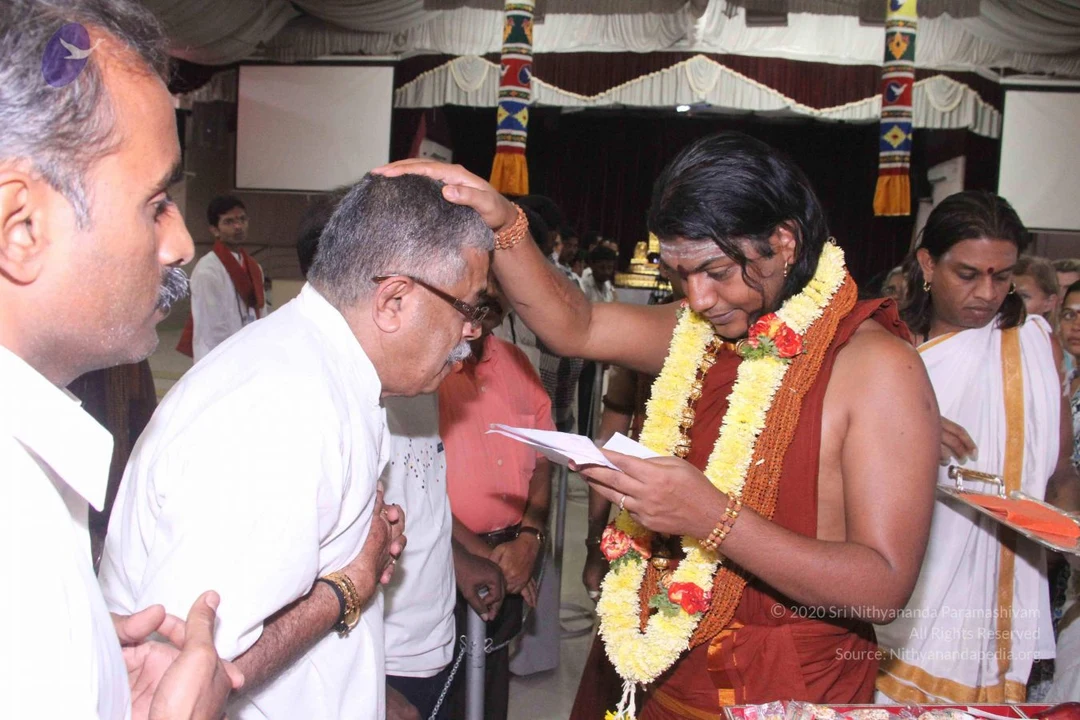
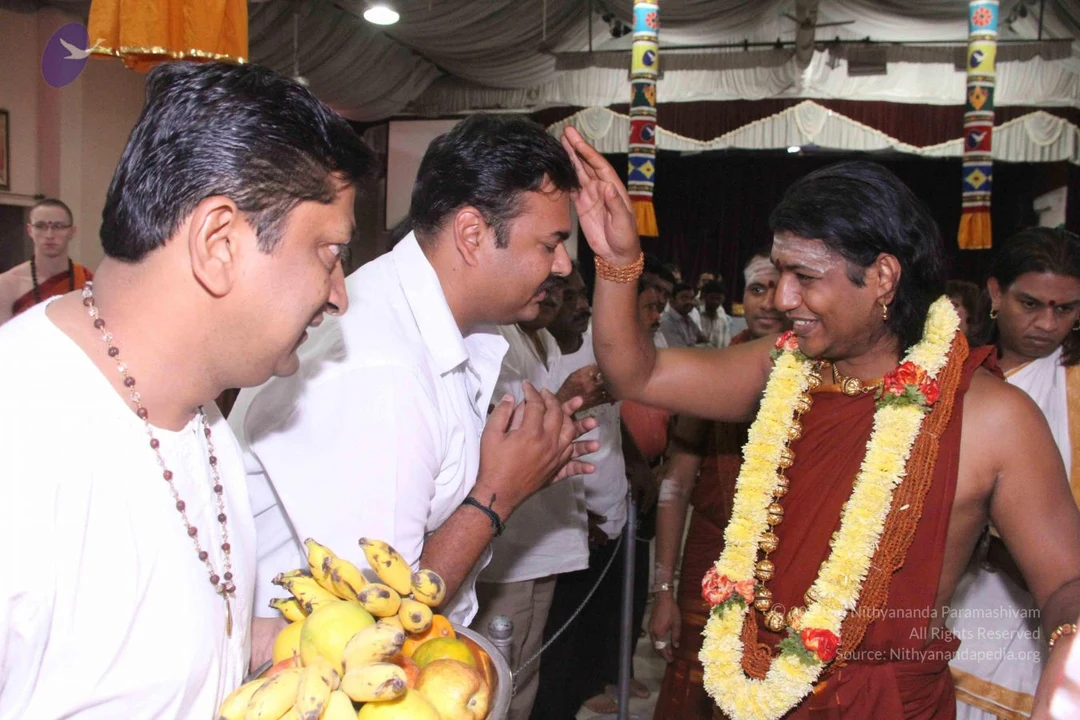
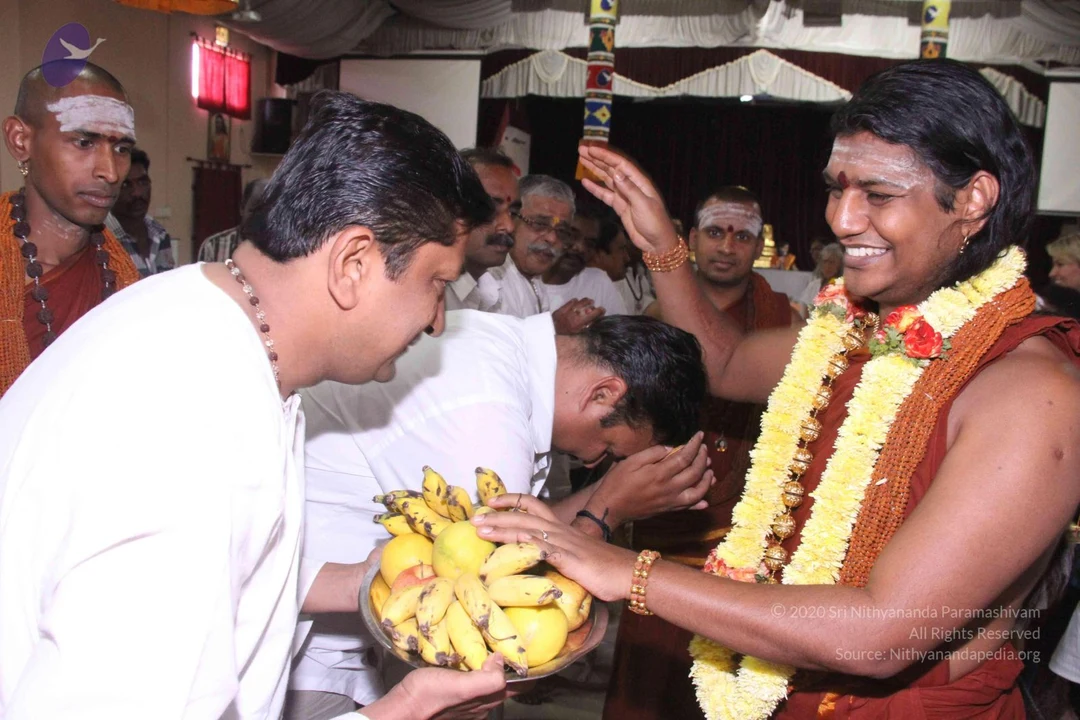
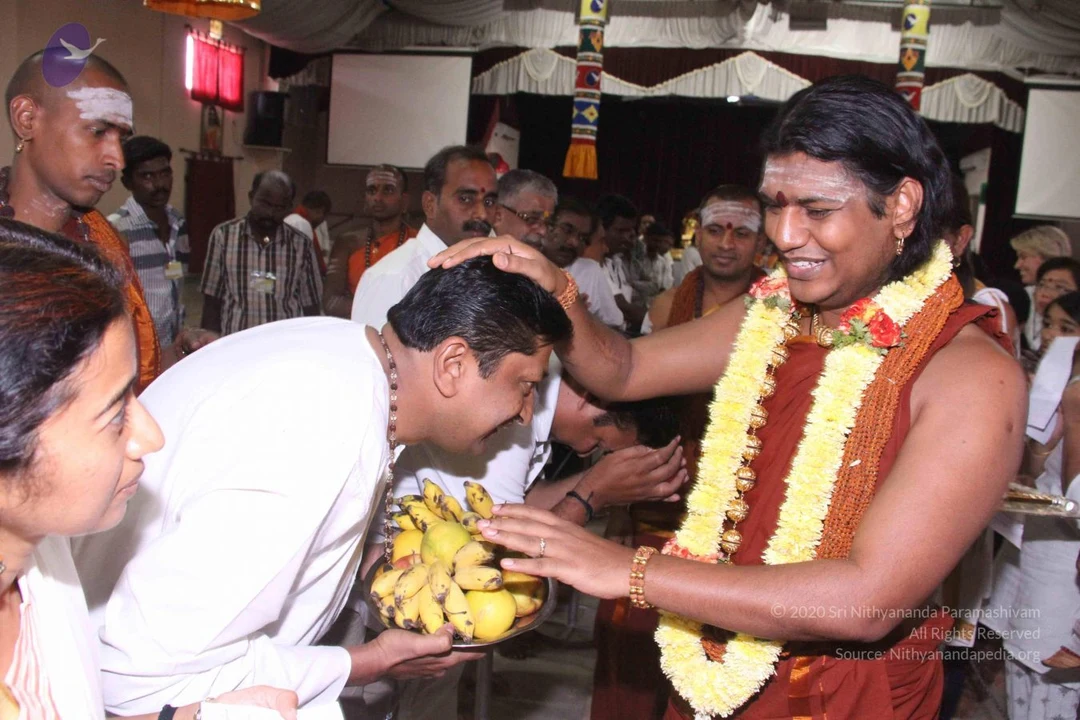
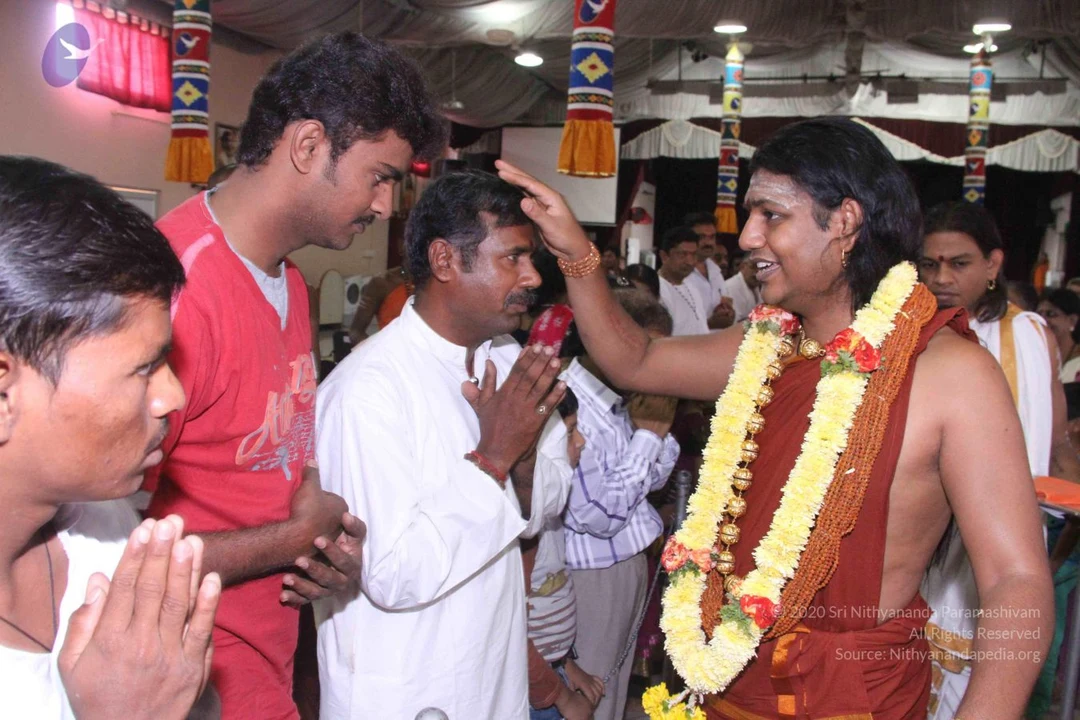
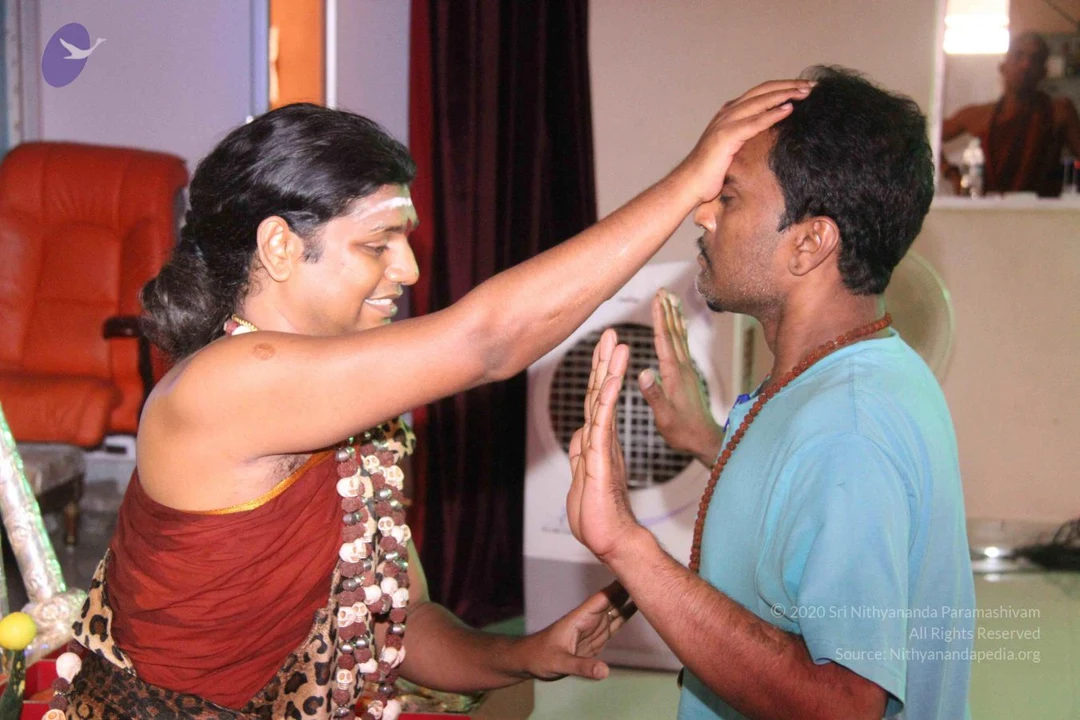
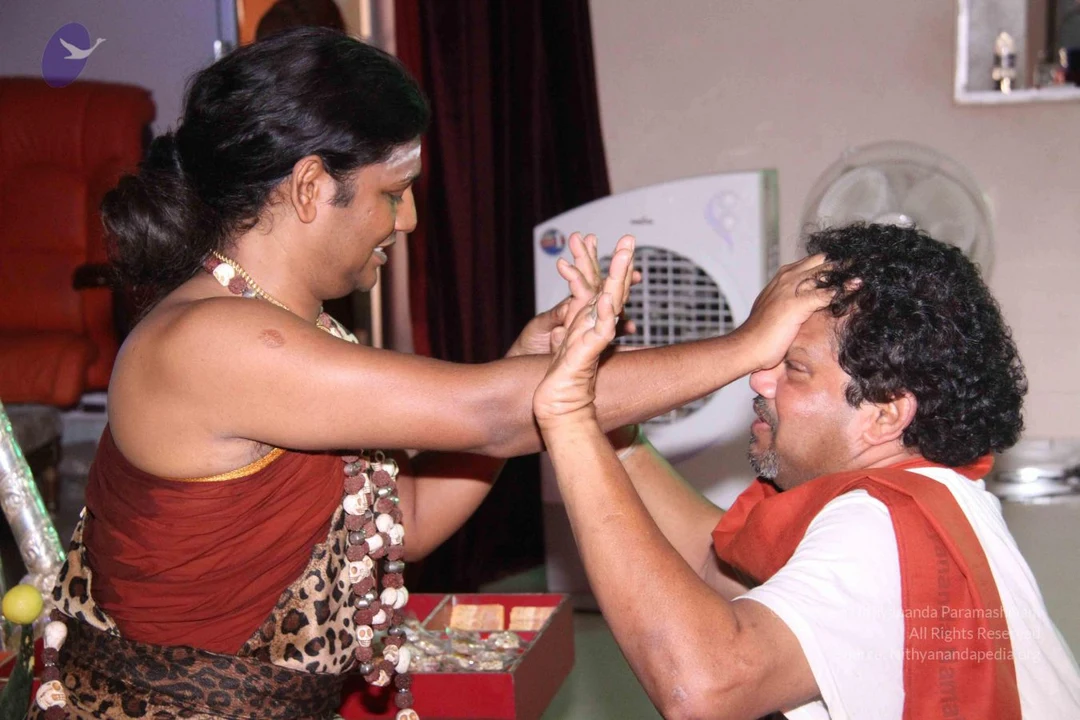
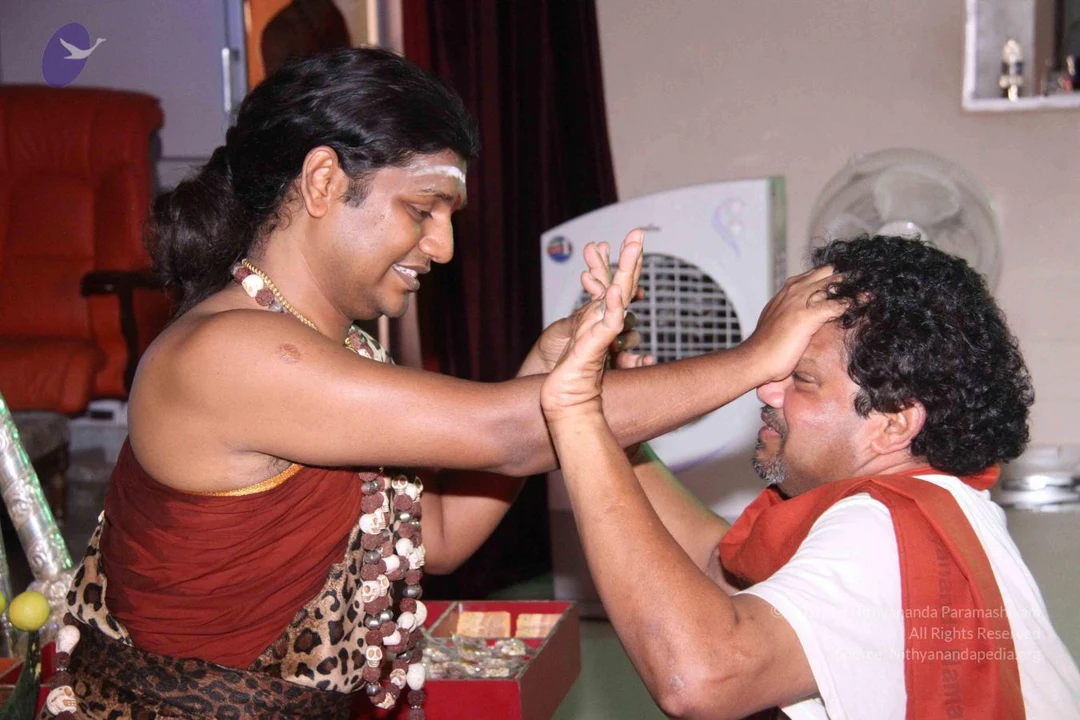
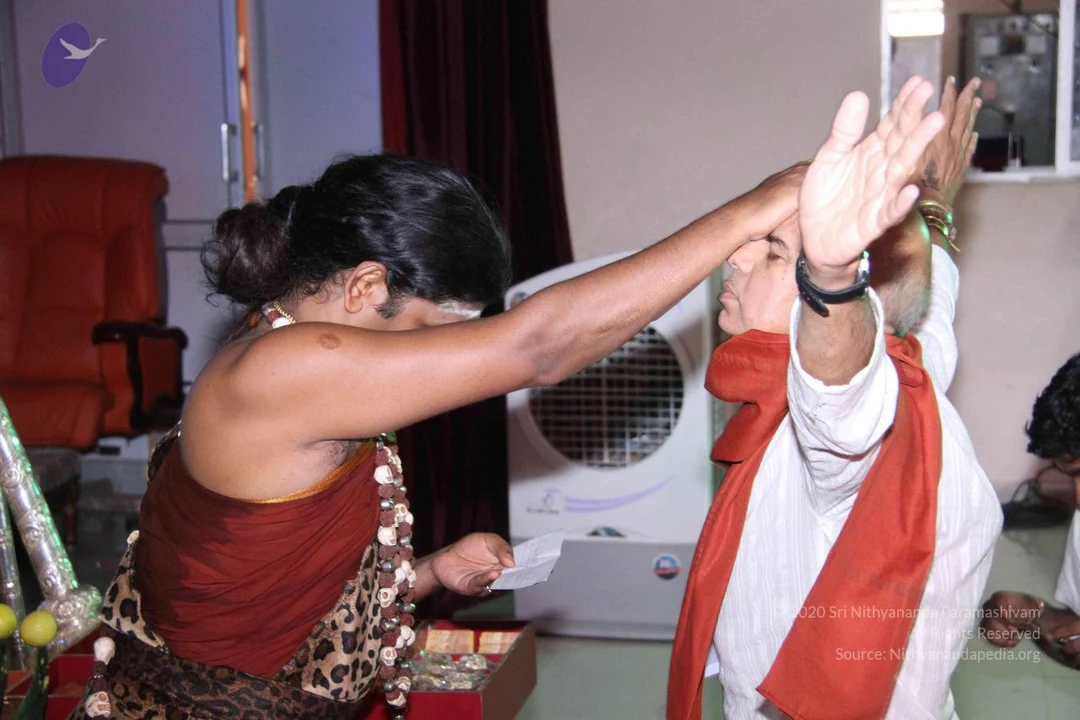
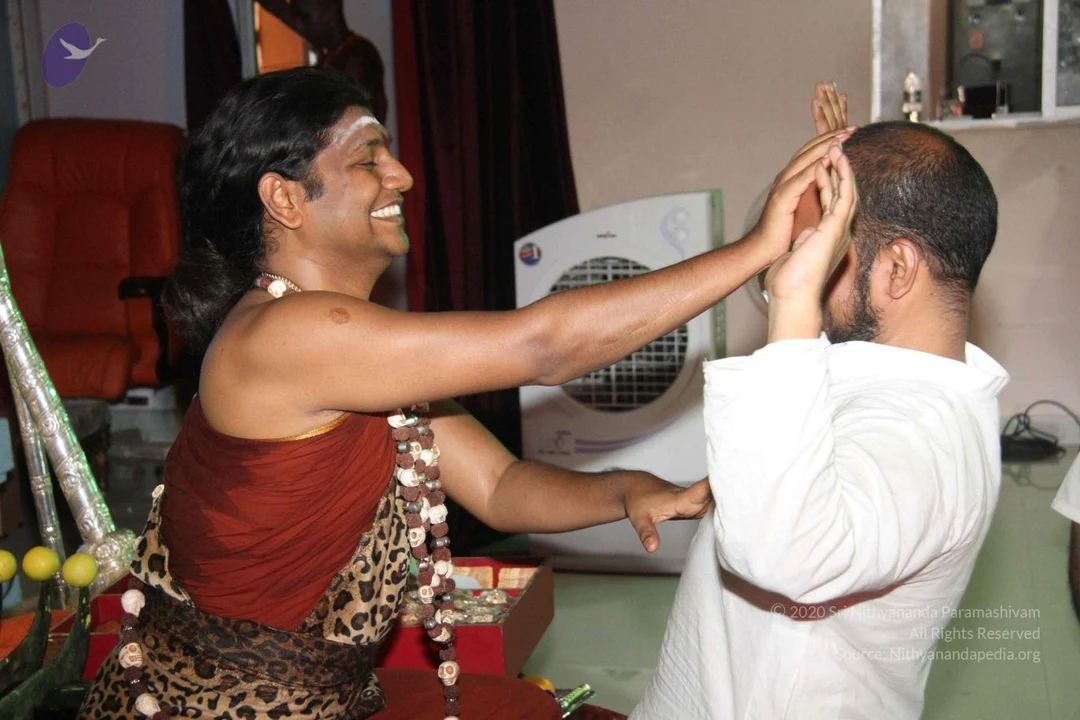
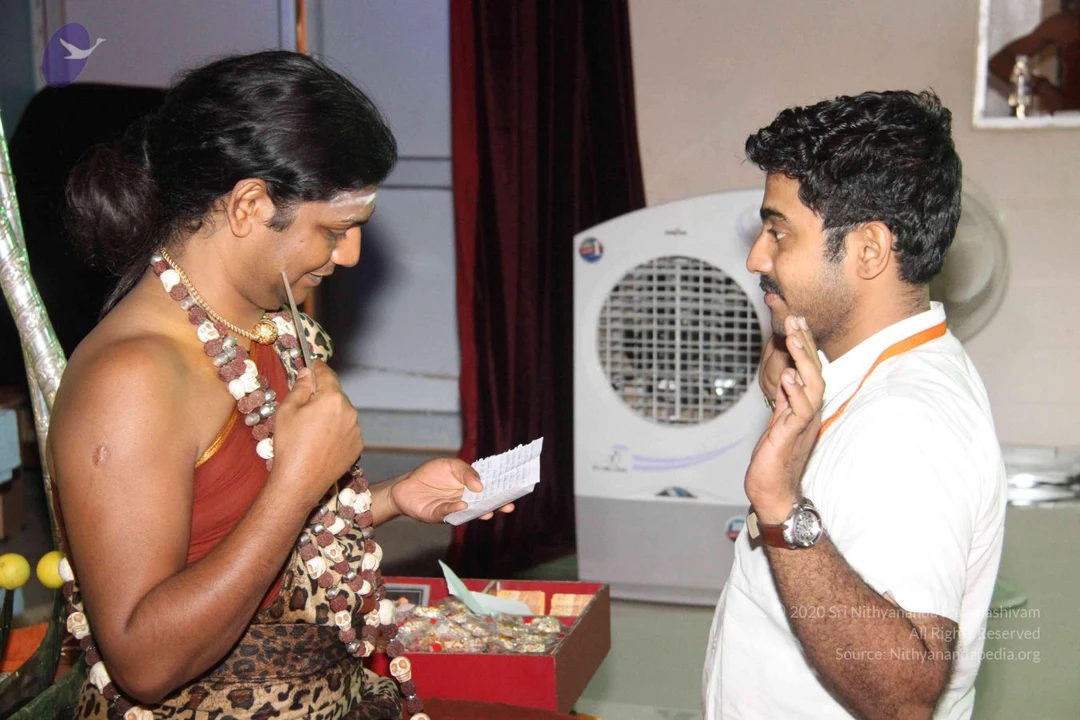
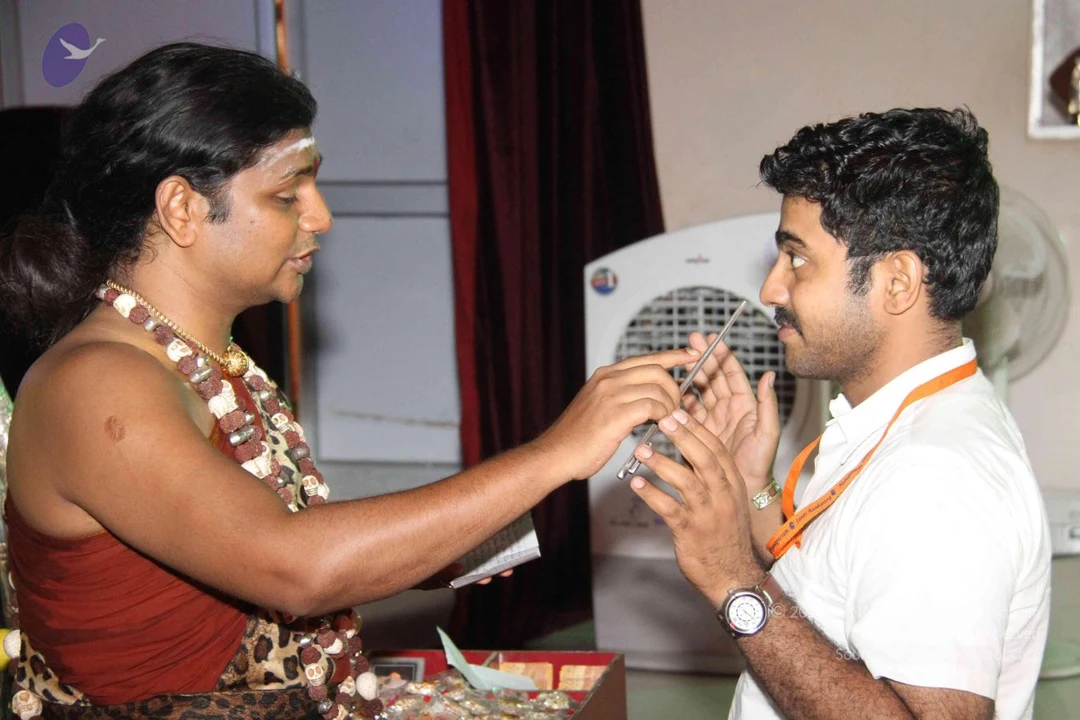
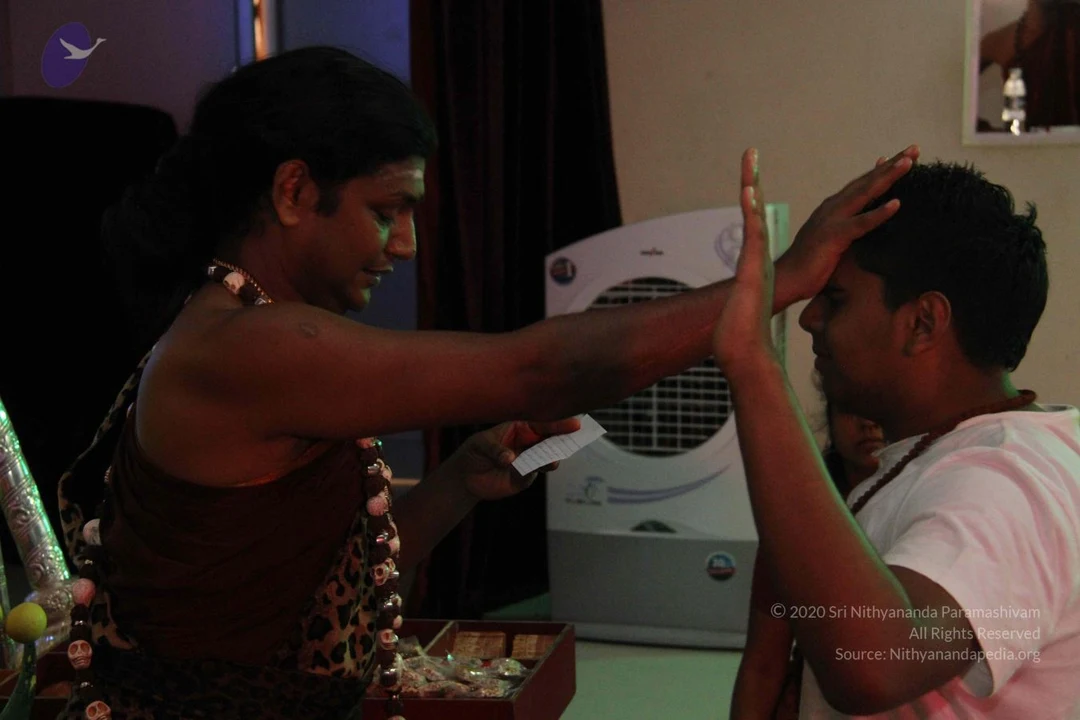
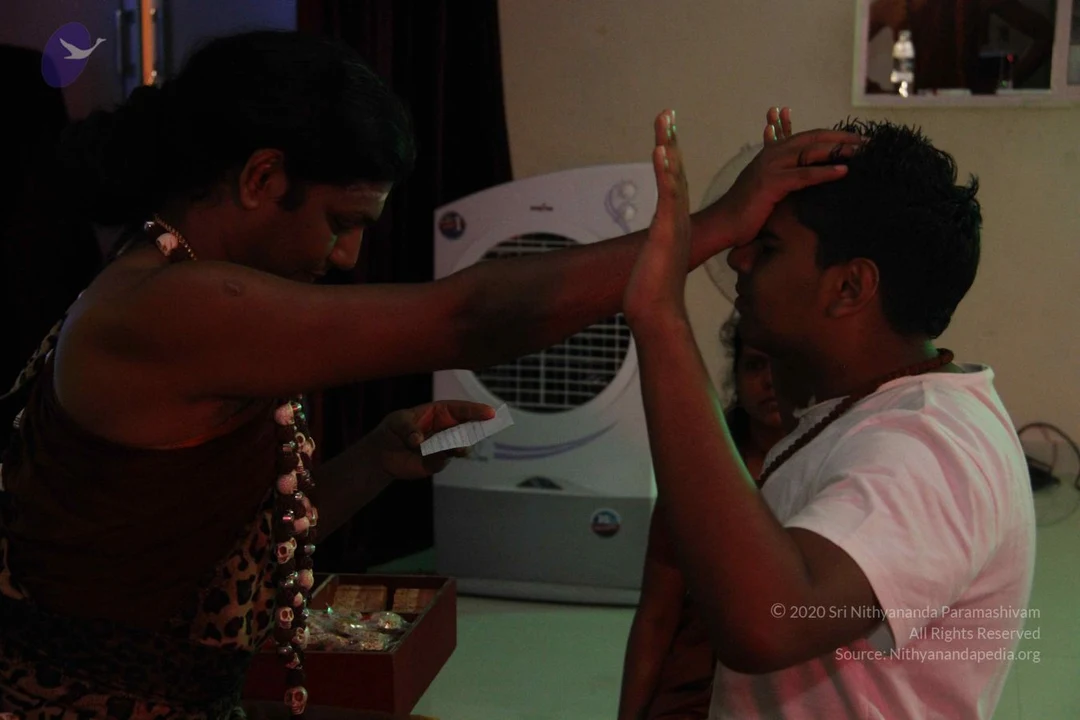
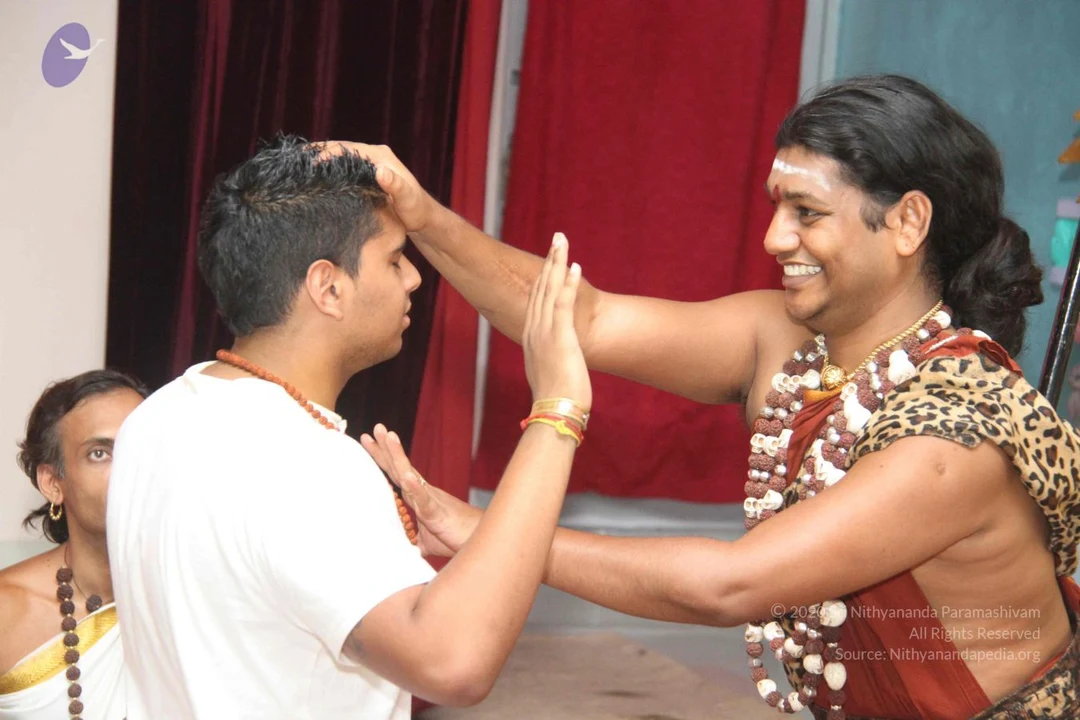
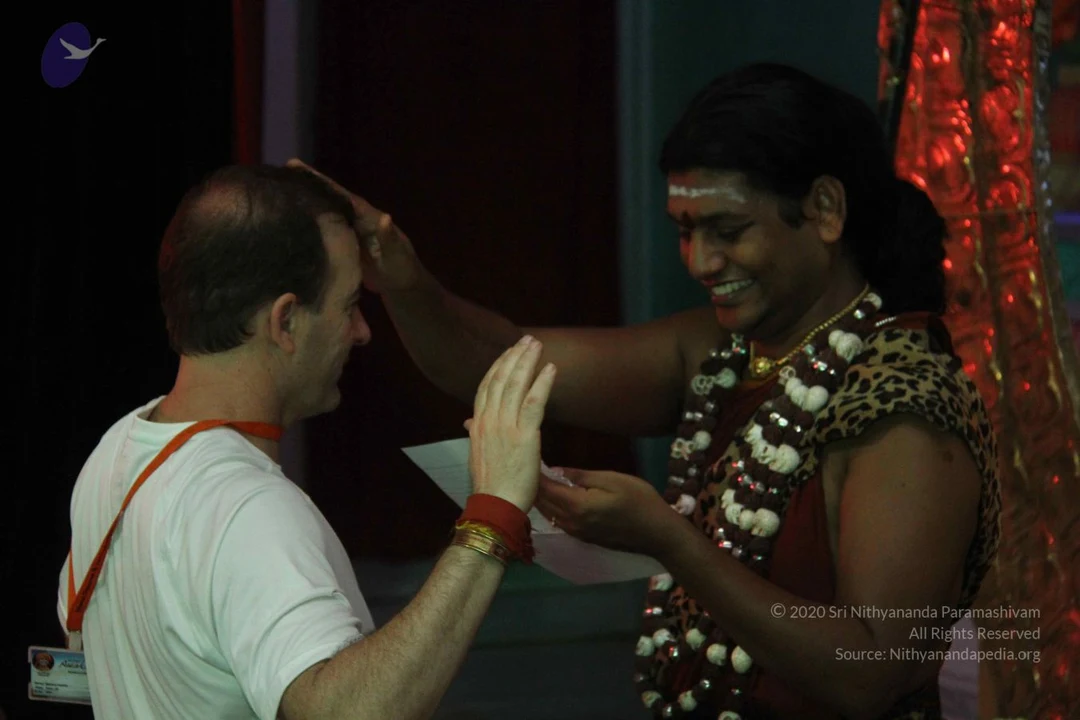
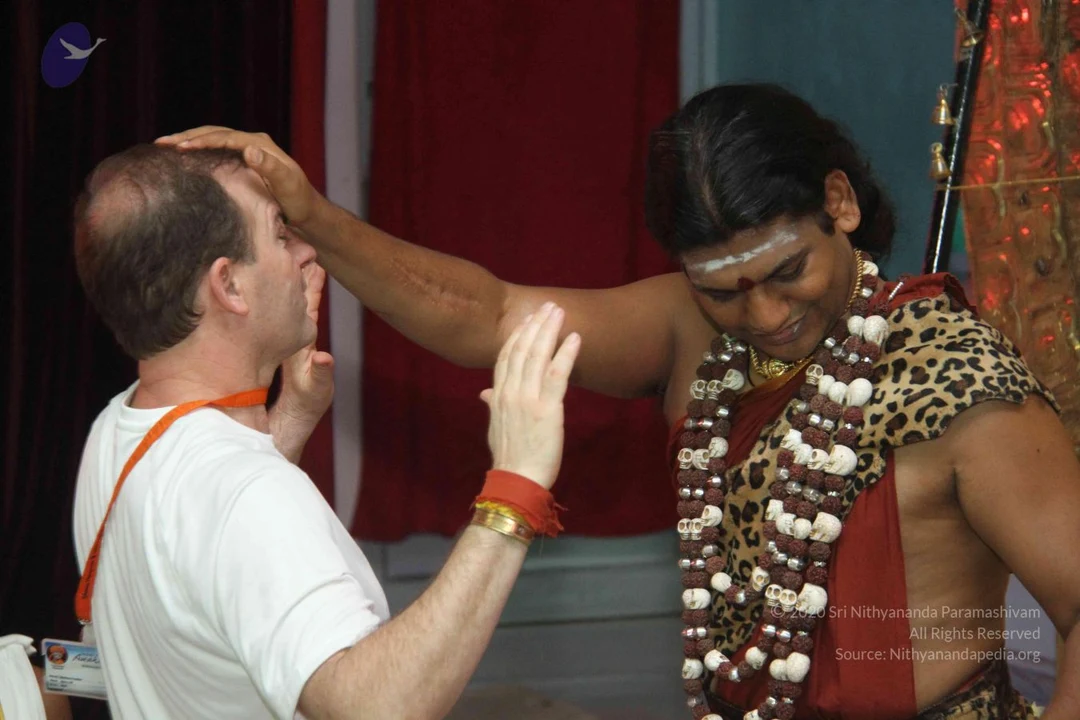
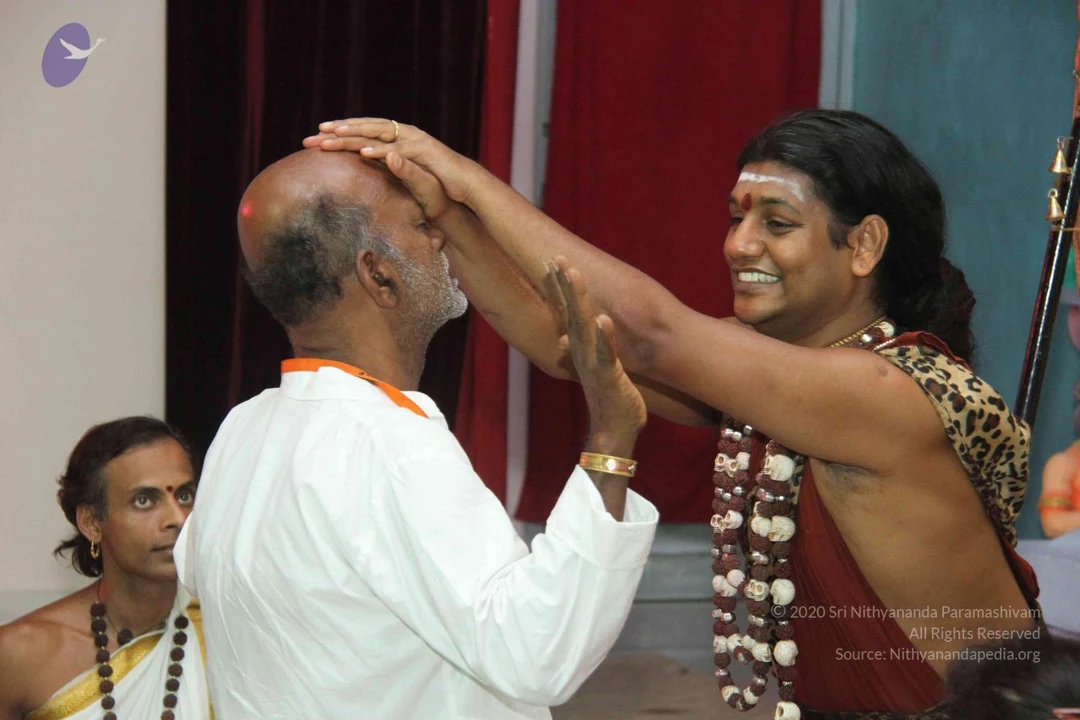
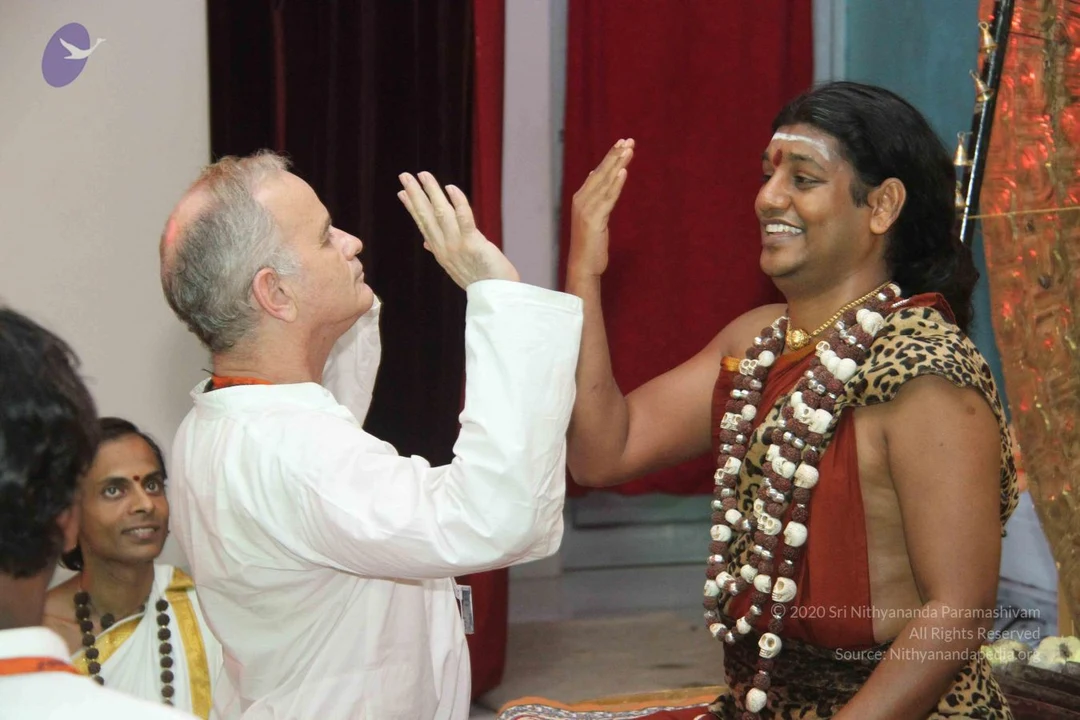
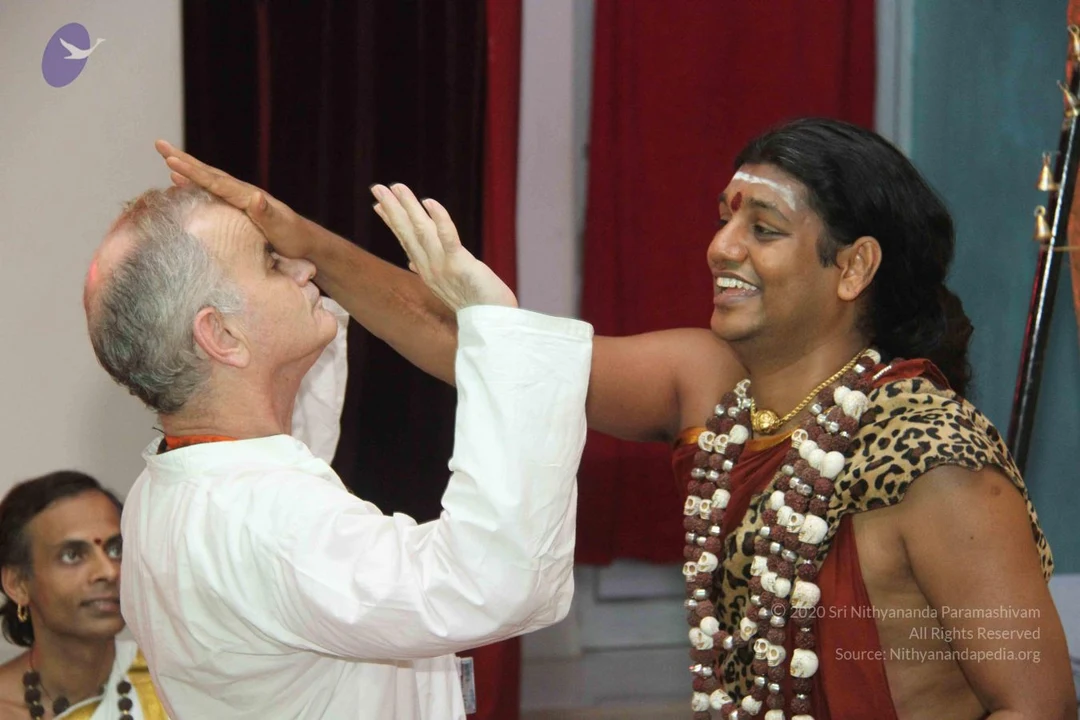
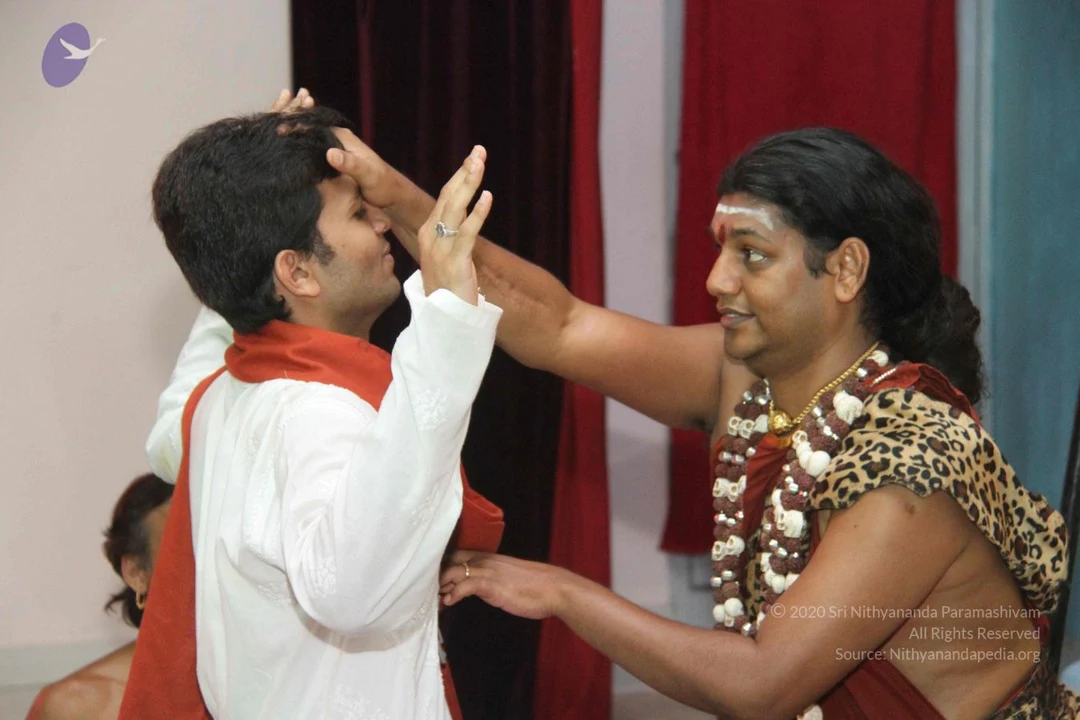
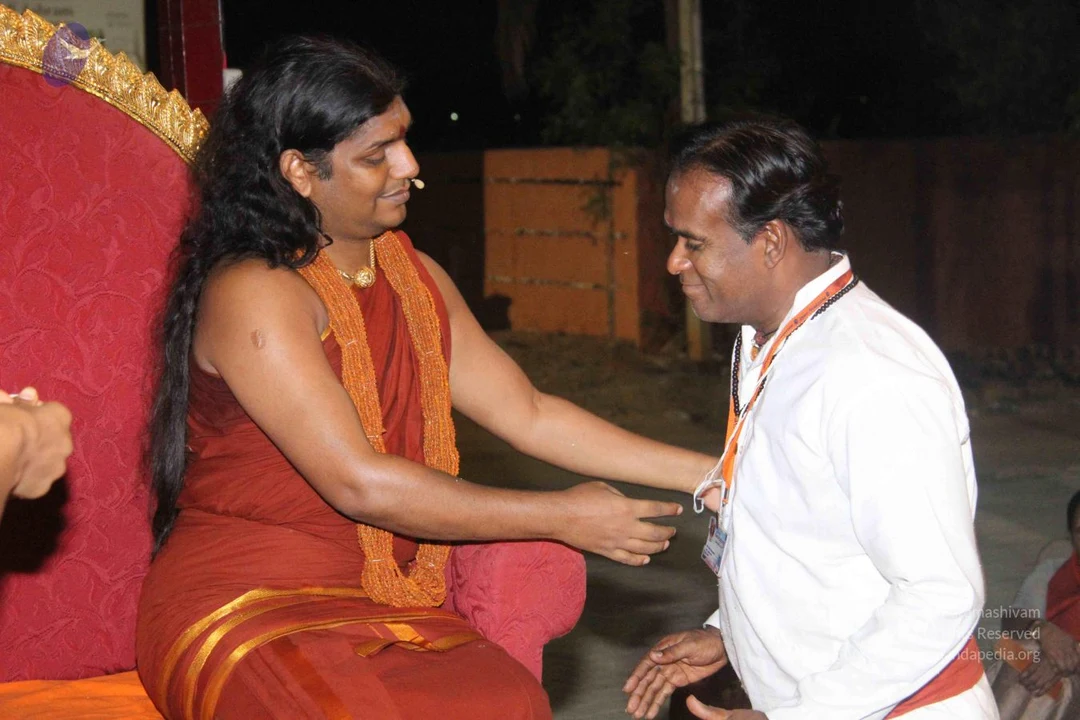
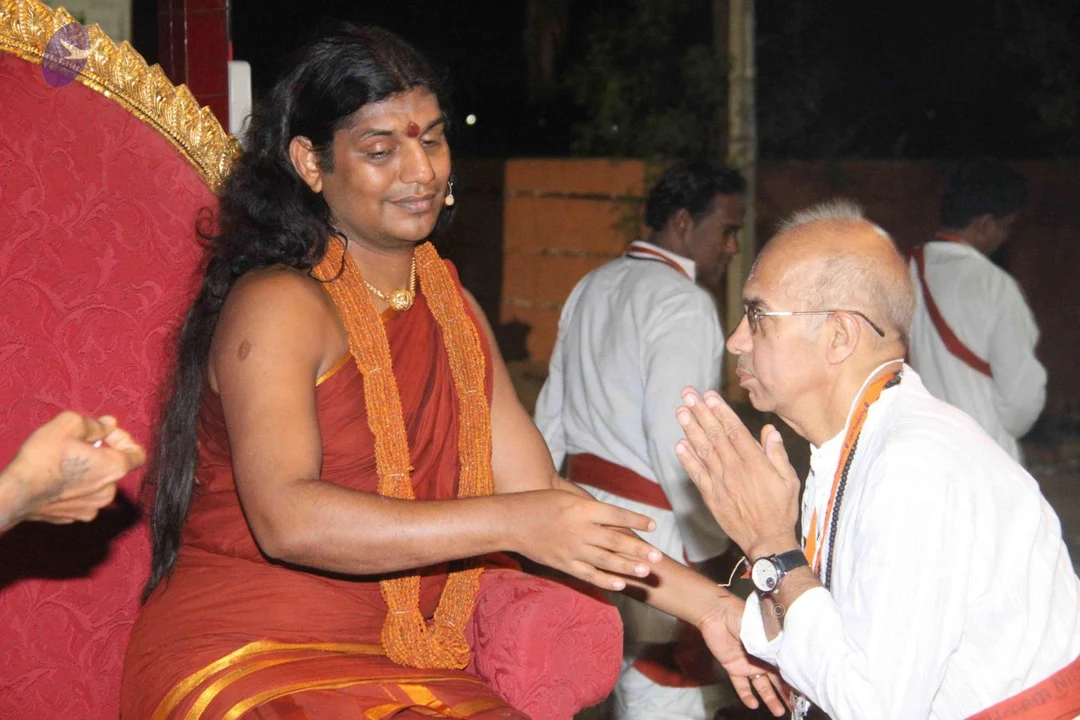
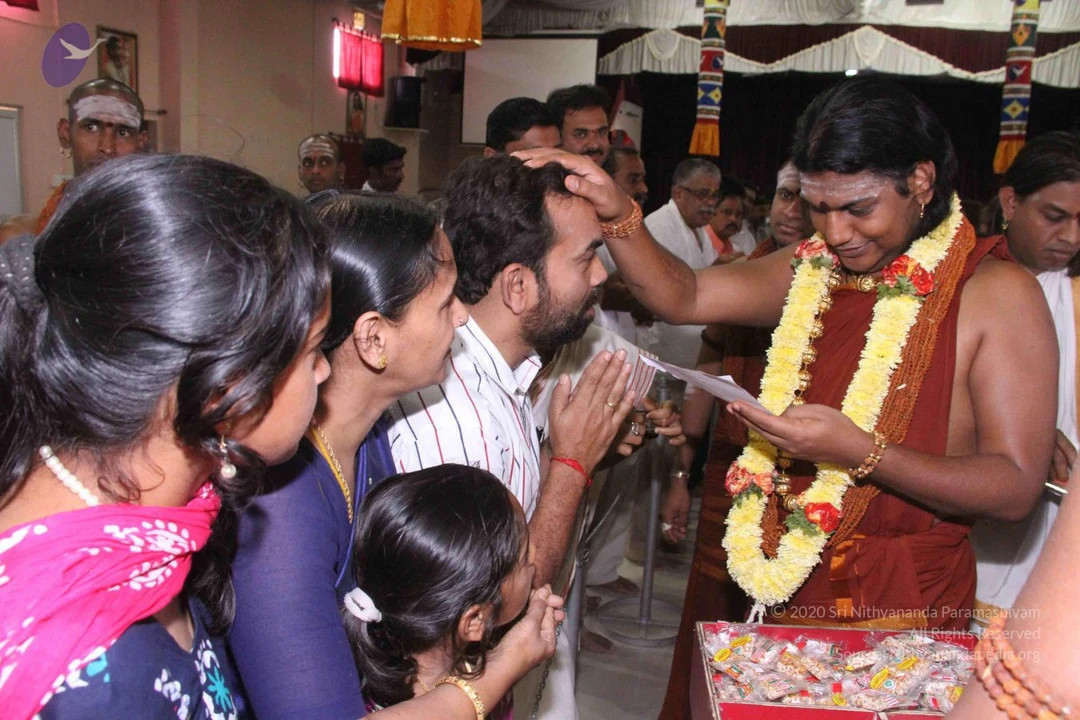
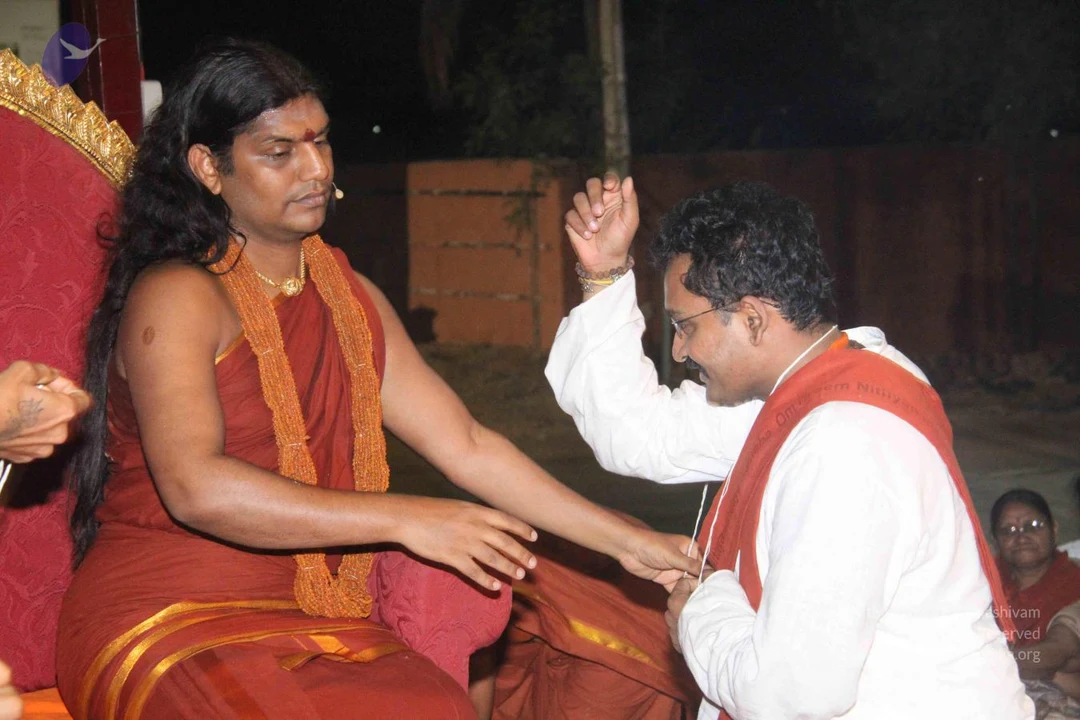
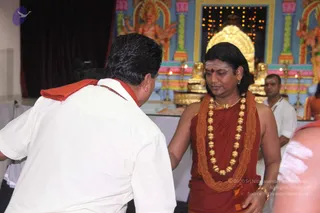
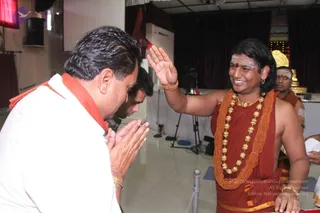
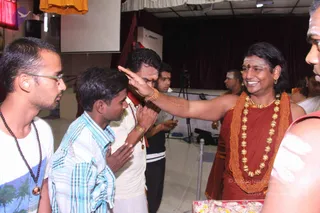
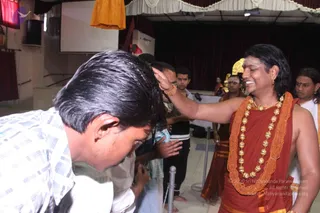
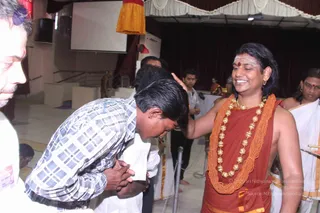
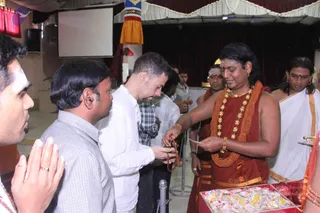
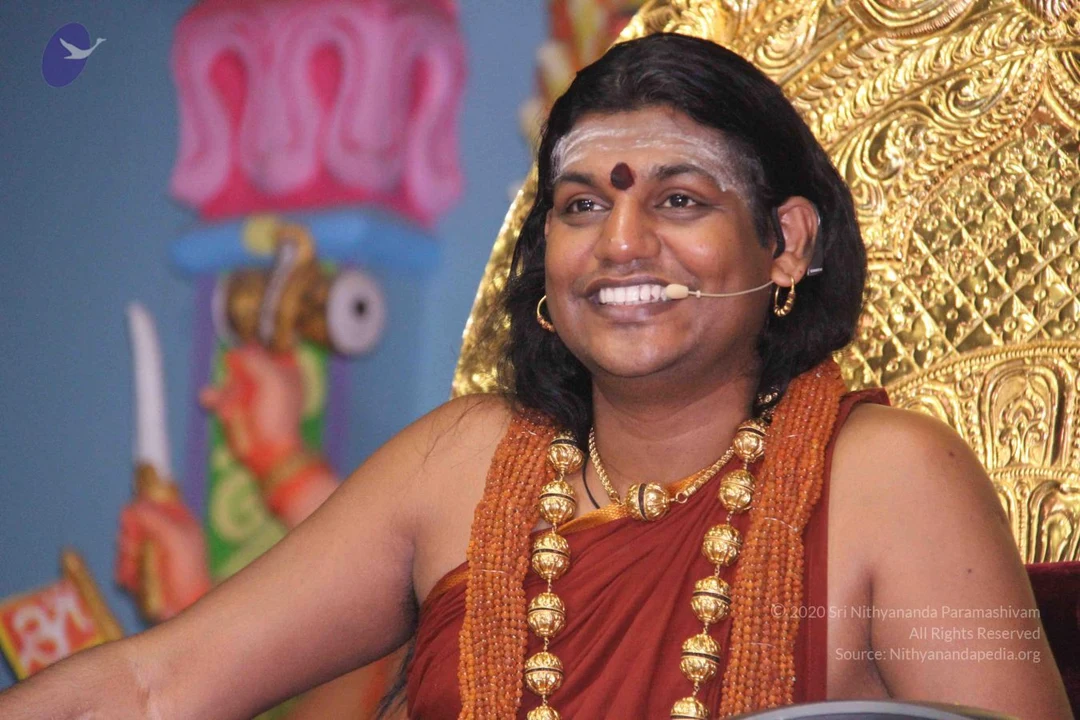
A photograph inside a temple-style hall. A man in a white shirt with a red-orange shawl bows forward toward a bare-chested figure in orange-red cloth. The bare-chested figure has long swept-back dark hair, a red tilak on the forehead, ornate gold necklaces, rudraksha-style gold beaded mala and gold bangles, and holds a tilak-marked devotee's respect. Behind them, an ornate golden peetha/throne with a gold arch stands before colorful painted pillars, multi-armed deity murti figures, brass lamps and lit oil lamps. A man in white stands at right. a person candidate appearance is consistent with the page, but the face and cues are not conclusively distinctive, so the figure is described by role with an uncertain identity.Photograph of an indoor hall where a man in a white shirt with an orange-red shawl stands with hands pressed together in namaste, bowing toward a smiling figure in a reddish-orange saffron-style dress with a bare upper body, rudraksha-like beaded mala and a heavy gold ceremonial necklace, long swept-back hair, a red bindi and tripundra-style marks, who raises one hand in blessing. A second man in a red shawl stands behind the bowing man, and a person in white and orange is partly visible at the right edge. A golden ornament and dark drapes appear in the background, with a camera tripod and a white screen. a person: the blessing figure has long swept-back hair, rudraksha-style beads and gold necklace, consistent with the page's a person attribution.A photograph of an indoor event in a hall with a dark red curtain and a projection screen. A man with long swept-back hair, a white tilak on his forehead, a red dot and a red-orange robe wears a heavy gold bead necklace and a rudraksha mala; he extends his arm and fingers toward the forehead of a young man in a striped blue shirt, who stands with palms pressed together. Other men stand nearby, including one in a white dhoti and one in a black shirt. A tray of offerings sits in the lower right, with a partly visible person at the right edge. Several people are visible, about six to twenty.Photograph of a devotee bowing his head forward while a man in an orange-red dhoti and shawl, with long swept-back hair, a tripundra marking on his forehead, a multi-strand gold bead necklace and a rudraksha-style orange mala, places his right hand on the devotee's head in a blessing gesture. He smiles. Behind them, other devotees wait, a man in white stands near a gold-decorated seat or throne, and a red curtain and stage area are visible. The blessing figure matches the appearance cues of the a person candidate, so this is an appearance-based probable identification. The devotee wears a white checked shirt.A bare-chested man with long swept-back dark hair, a red bindi and tilak, wearing an orange-red wrap, a long orange beaded mala and a heavy gold ceremonial necklace, smiles while placing his right hand on the head of a man in a blue-and-white checked shirt who bows with his hands clasped. The Swamiji (probable) cues are the long swept-back hair, ornate gold necklace and saffron-red wrap. Behind them are other people in white dhotis and a stage with a white screen and draped curtains.A photograph of a satsang-style gathering in a hall with a blank projection screen and red draped curtains. A figure with long dark hair and a dark-red saffron-toned robe, wearing a large ceremonial gold-bead necklace, gold bangles and earrings, is handing a small rudraksha-style mala and a folded paper to a man in a white shirt. Behind him a red-and-gold trimmed robe is worn by a man with a white cloth draped over one shoulder. On the left a man in a grey checked shirt holds his hands in anjali mudra, with white tilak marks on his forehead. A tray of wrapped sweets sits on a table at lower right. Several other devotees stand in the background.
AKASHIC READINGS and Darshan
62 photosSource gallery
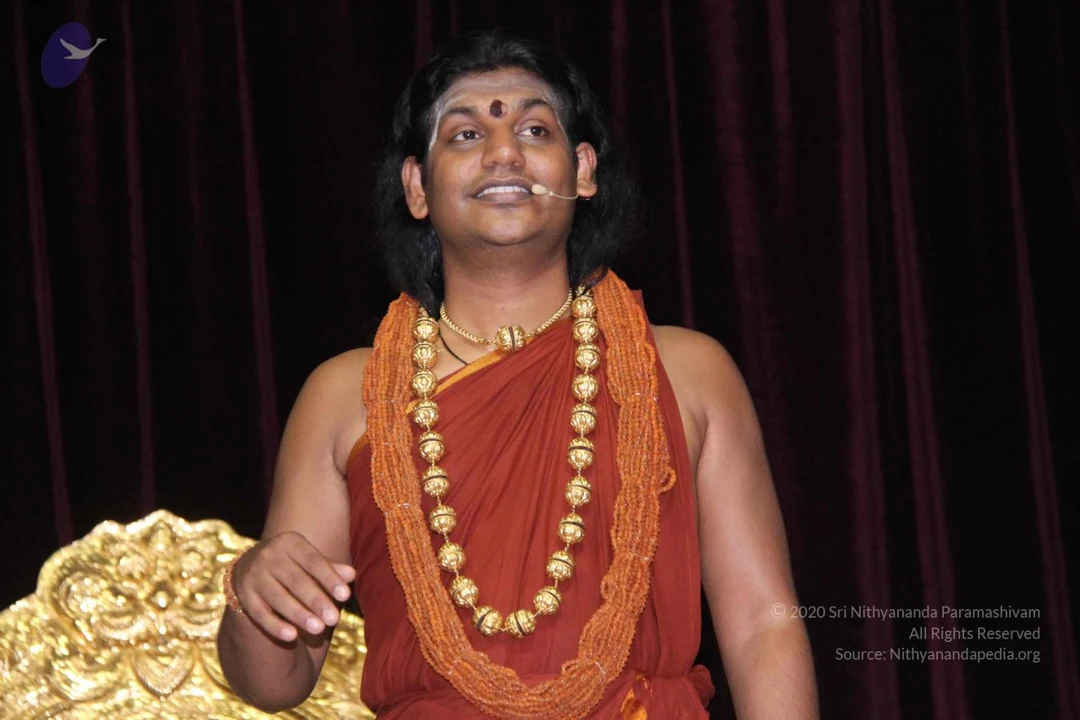
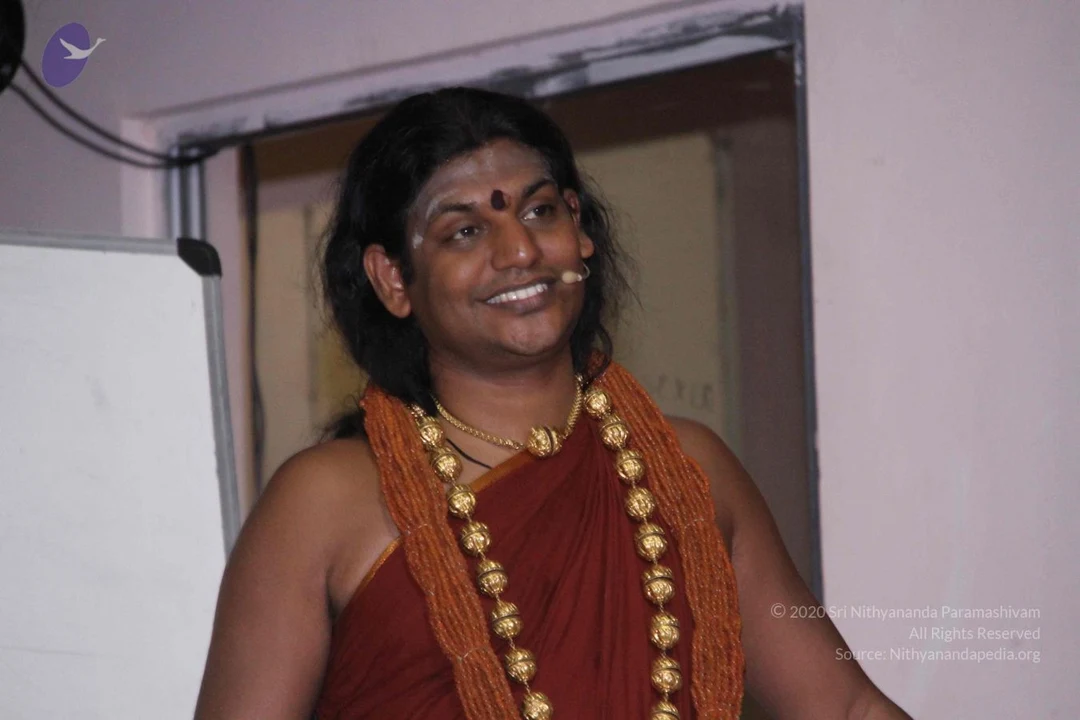
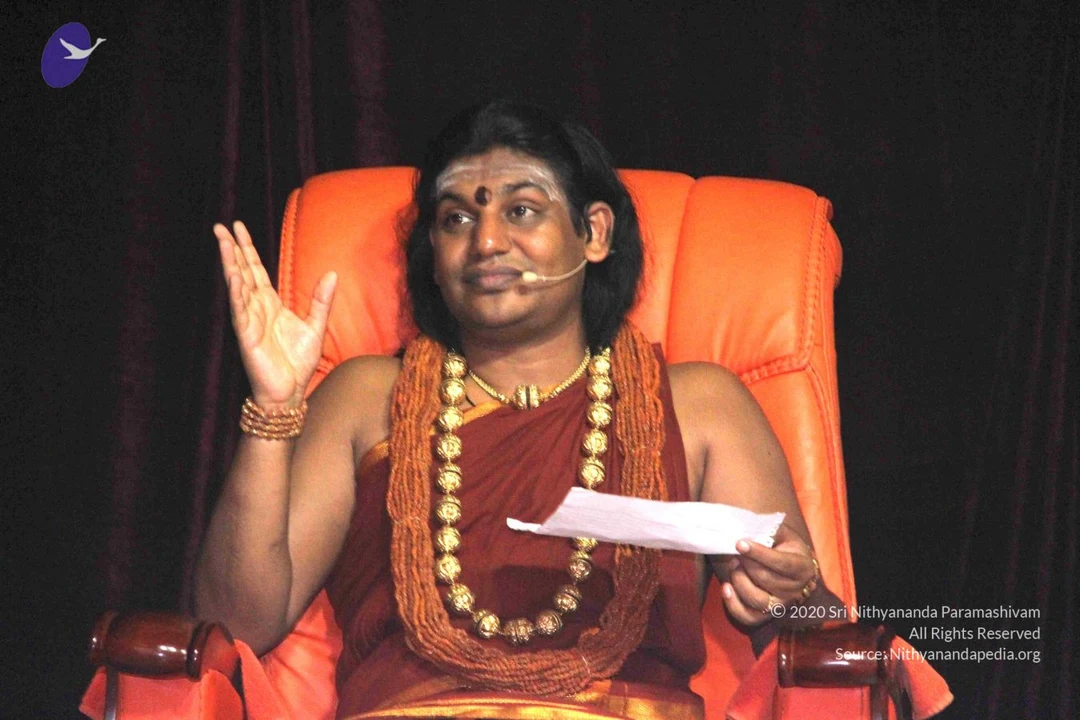
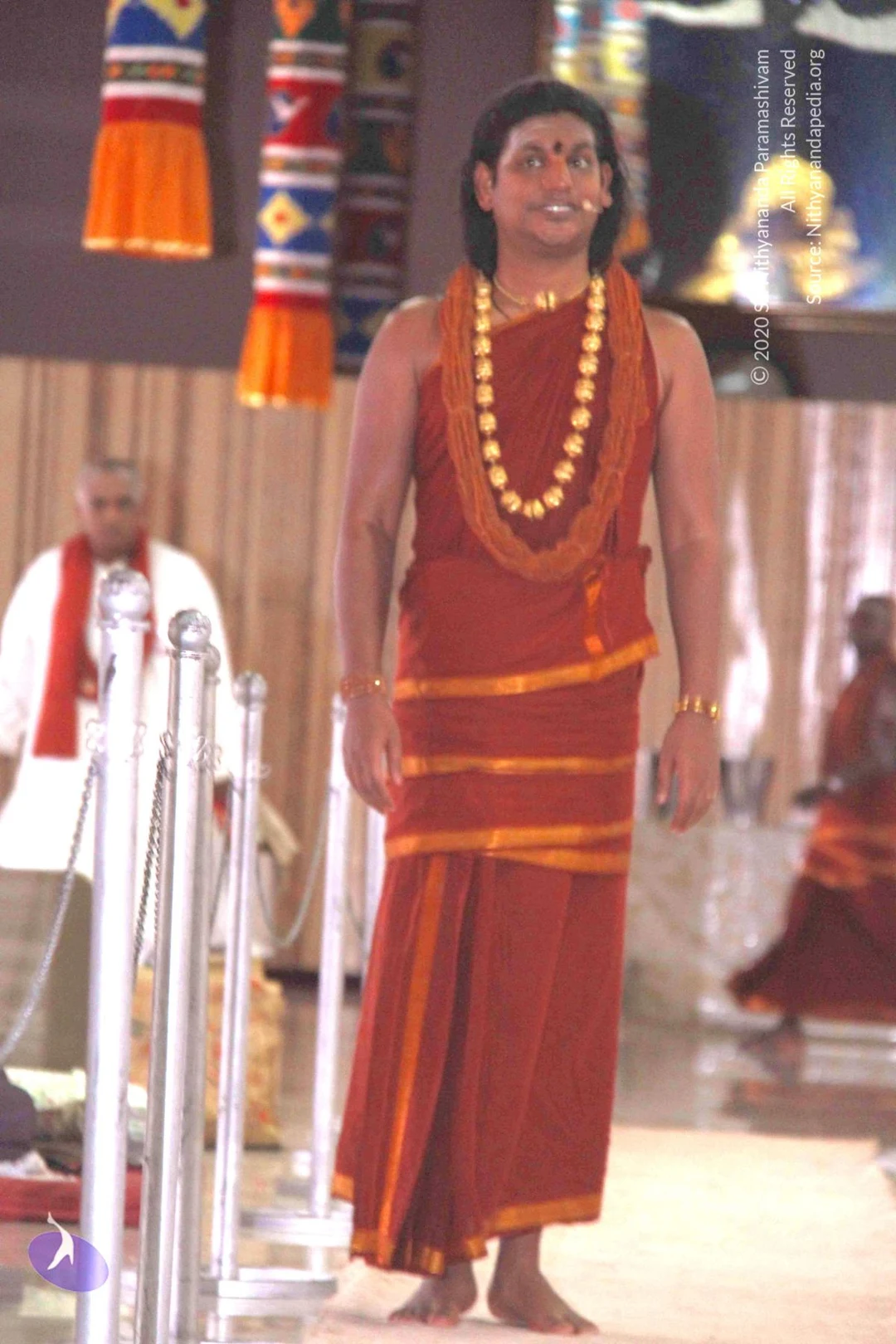
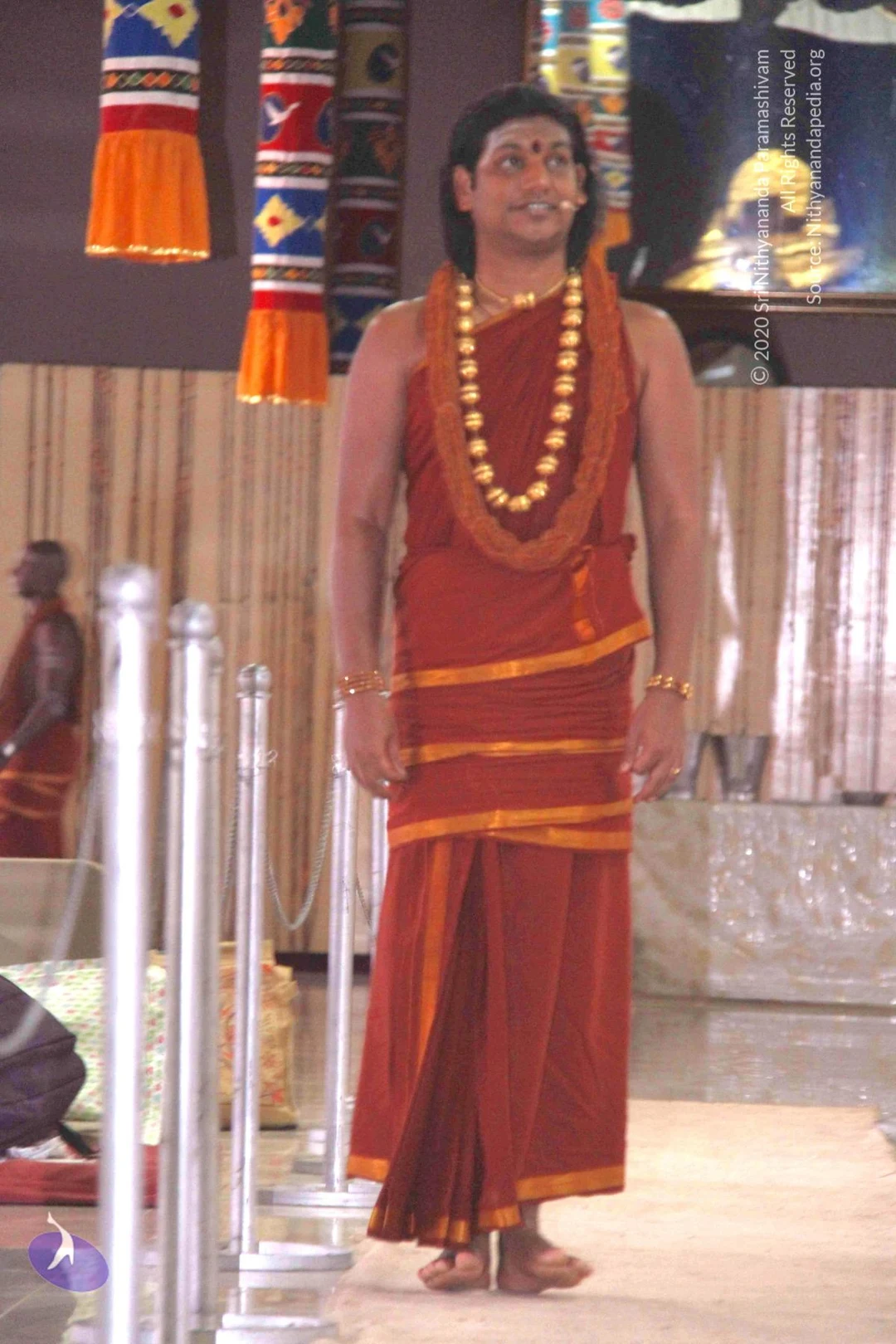
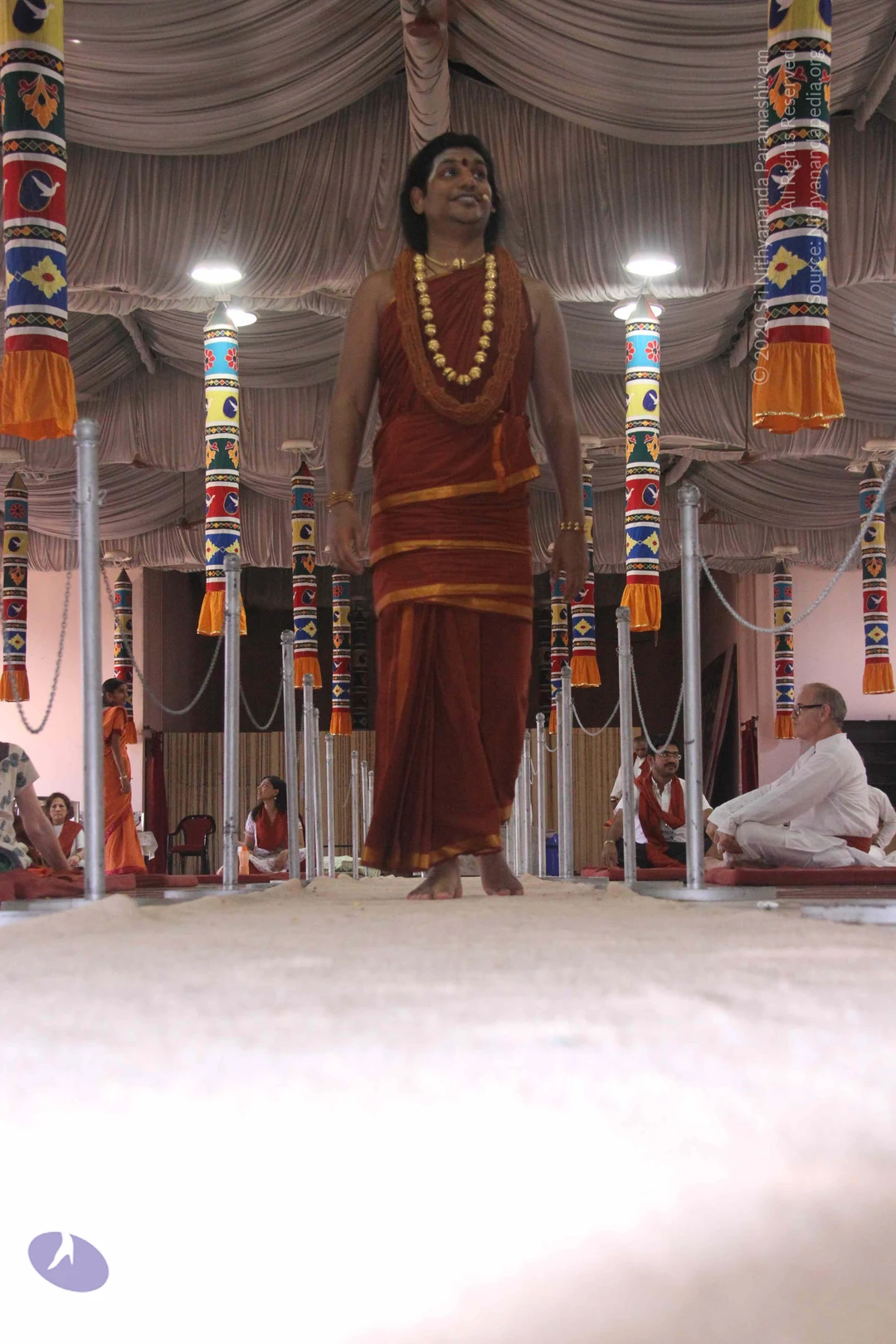
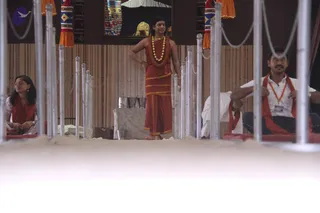
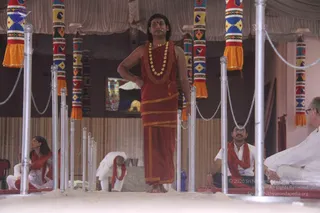
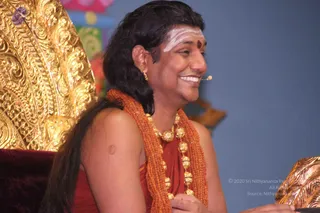
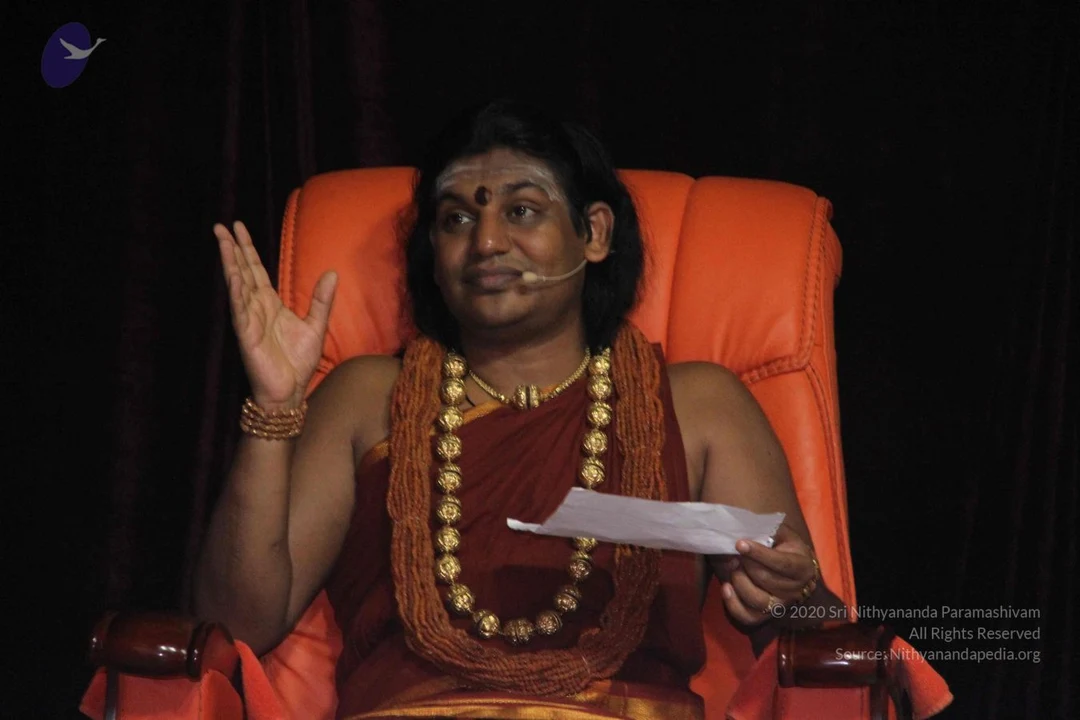
A man with long dark hair and a red-brown bindi sits in a bright orange leather armchair against a black backdrop, raising his right hand while holding a sheet of paper in his left. He wears a headset microphone, a rust-red robe, a dense multi-strand rudraksha-style mala and a heavy gold ceremonial necklace, plus a gold-toned bangle on his wrist.A photograph of a standing man in an orange-red dhoti and shawl, wearing a long strand of gold-and-bead ornaments and a rudraksha-style necklace, his hand on his hip, inside a hall with a wooden lattice wall and a framed painting above. Behind metal railings, a woman in a red-and-white outfit sits on a red mat at left, and a man in a white shirt with an orange lanyard and red shawl sits at right. A bucket and small pots sit on a table in the centre, and a sandy floor lies in the foreground. The man in the centre has distinctive long ornaments and saffron-orange clothing with a presentation that may match a person, though appearance alone is not conclusive.A standing man in a rust-orange dhoti and matching shawl wears a gold-bead mala and a red bindi, one hand on his hip, on a raised sandy stage inside a hall. Behind him hang tall tasselled banners in red, yellow, blue and white with a gold tassel, and a framed picture sits on the wall. Seated devotees in red shawls and white clothes watch from the floor, a man in white bends forward near a chair, and an older man in white with glasses sits at the right edge.A smiling man with long dark hair and a red-brown dhoti-style wrap stands on a stage before a dark burgundy curtain. He wears a long orange-beaded mala and a heavy gold bead necklace with a gold pendant, a red bindi and a light forehead mark, and a small headset microphone. Part of an ornate gold throne is visible at the lower right. The scene matches a satsang discourse, with Swamiji (probable) as the speaker: long swept-back hair, rudraksha-style beaded mala and ceremonial gold beads, with a visible throne.A man with shoulder-length dark hair and a red bindi stands at a gilded ornate throne-like chair against dark burgundy drapes, speaking into a small headset microphone. He wears a saffron-red shawl draped over his shoulder and body, a long multi-strand orange-beaded mala with large gold bead spacers, and a gold chain at his neck. His left hand gestures forward while he smiles. a person: the long swept hair, saffron-orange robes, rudraksha-style mala and gold necklace fit the page's identification, so he is described as the speaker in this satsang setting. A purple bird logo appears at the upper left corner.A man with long, swept-back dark hair and a red bindi stands in front of a white wall and a doorway, smiling, with a small clip-on microphone at his cheek. He wears a maroon-red wrap over bare shoulders, an orange-saffron rudraksha-style beaded shawl, and a heavy gold bead necklace with a thin gold chain. A white board stands at the left edge of the frame.

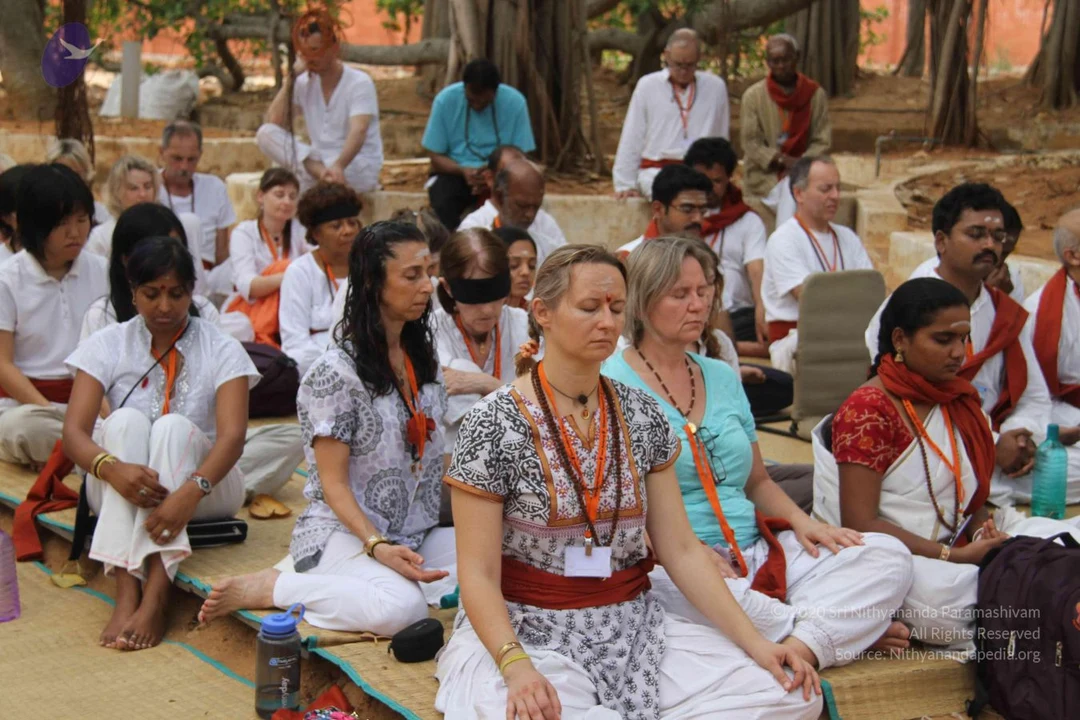
BANYAN TREE SESSION/GAYATRI HOMA

77 photosSource gallery
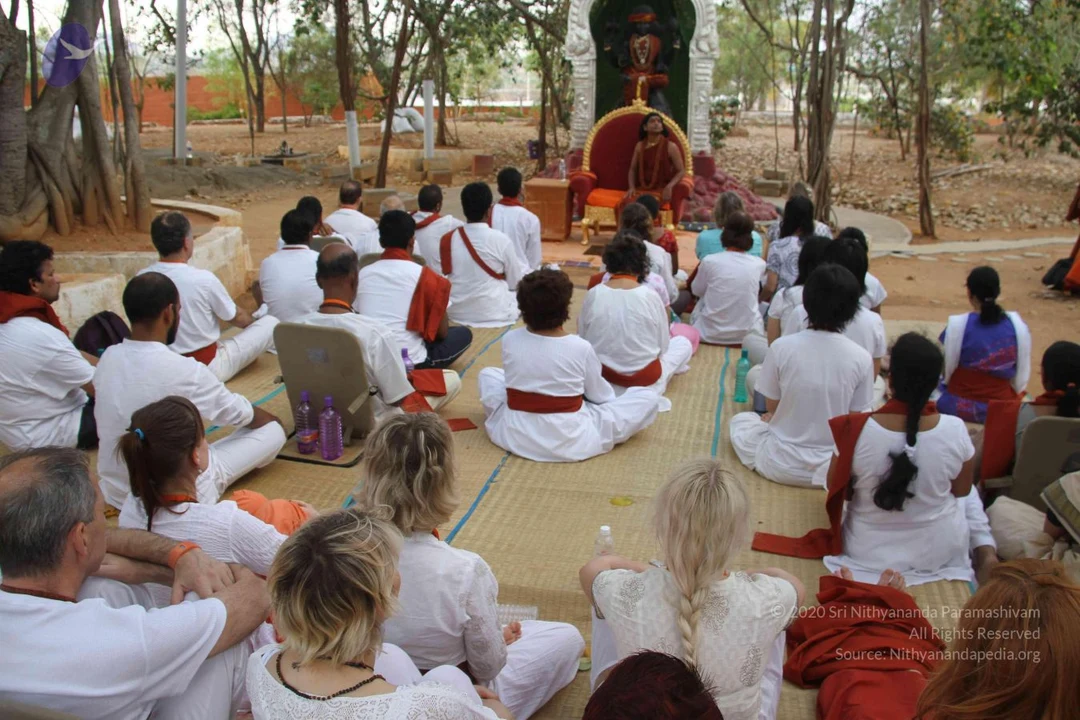
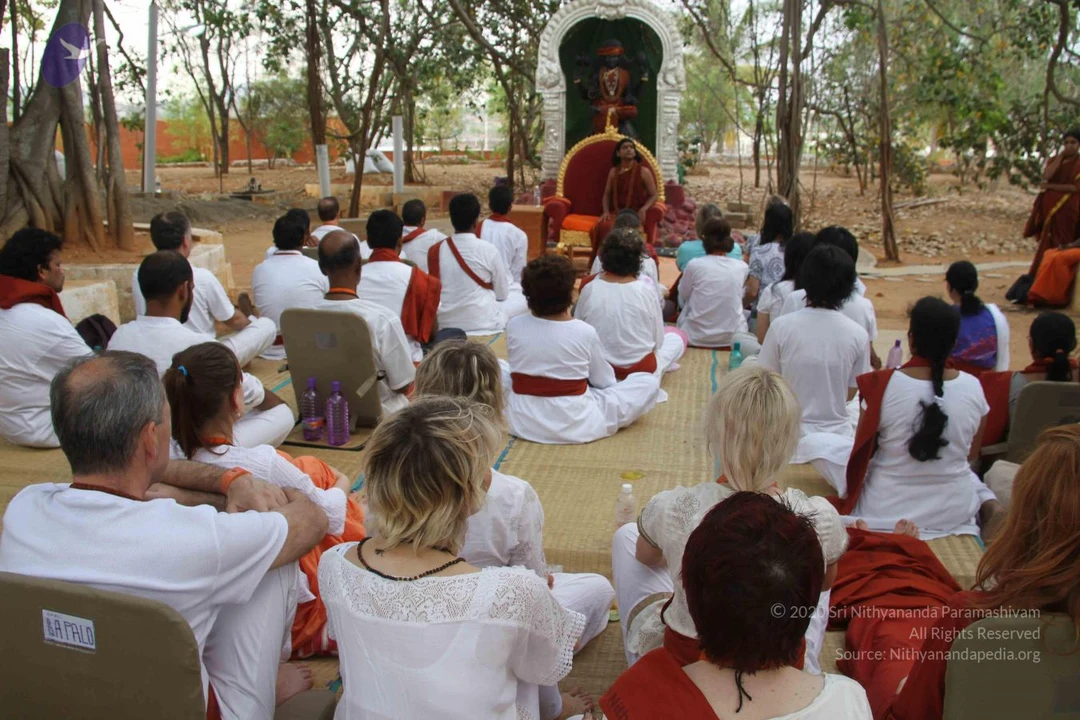
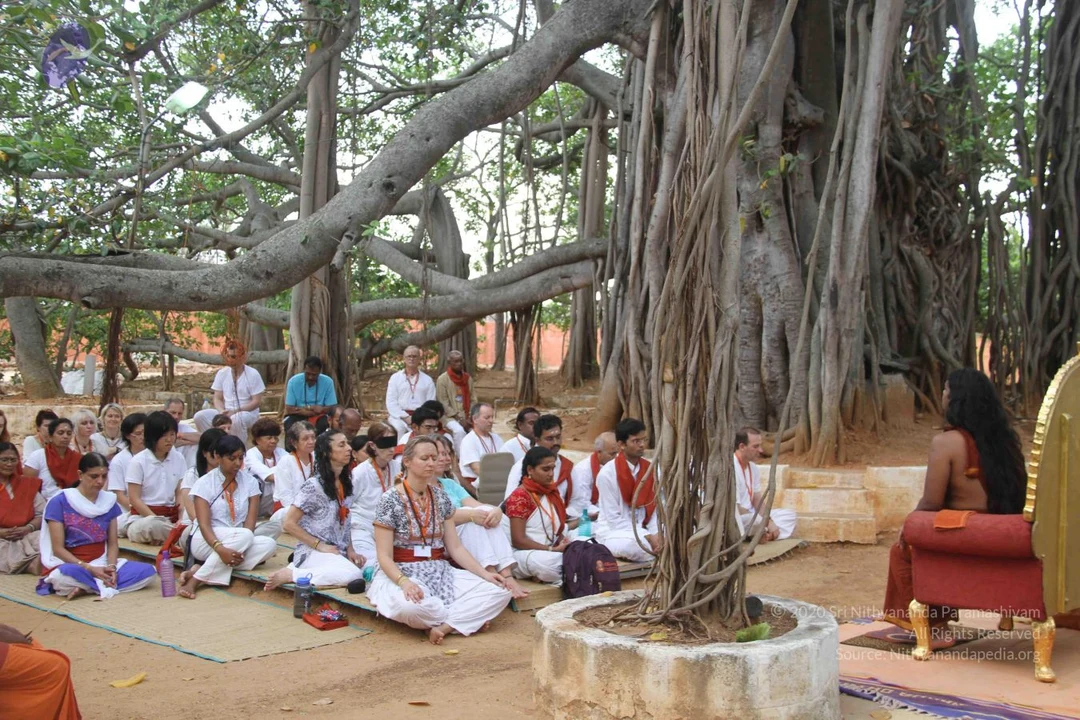
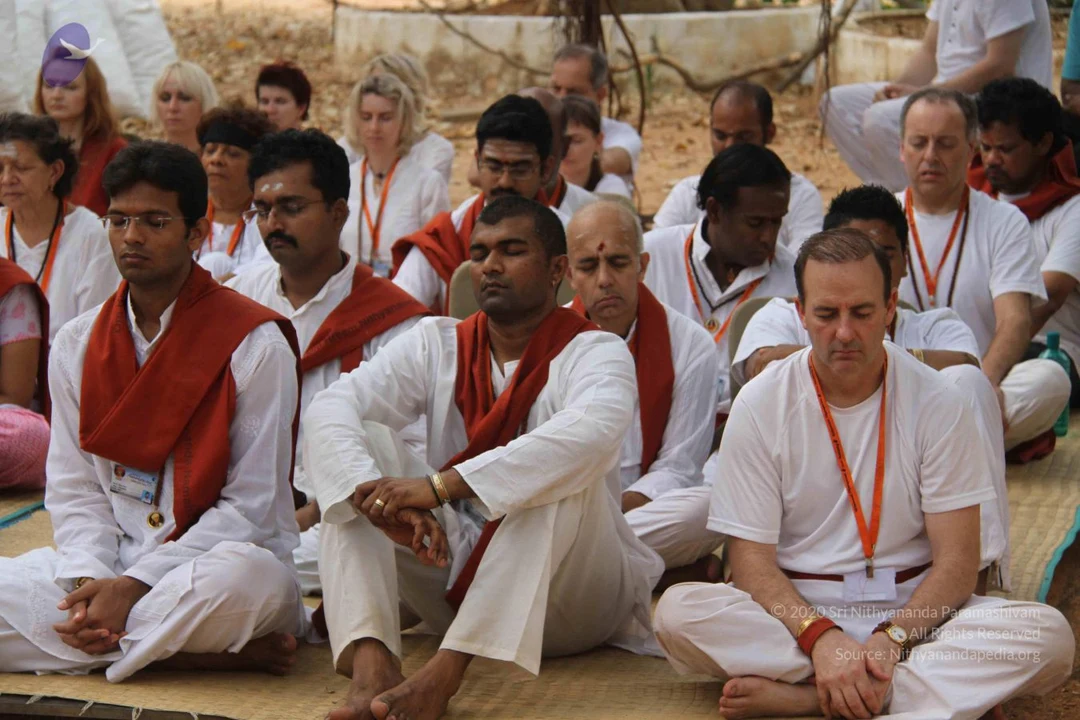
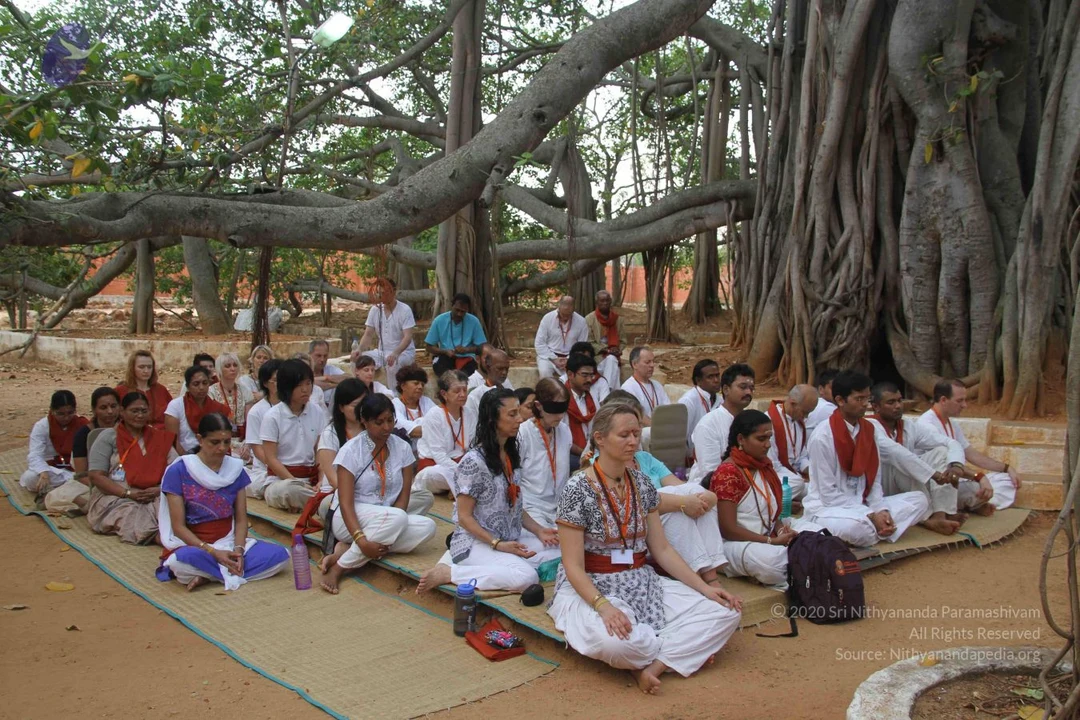
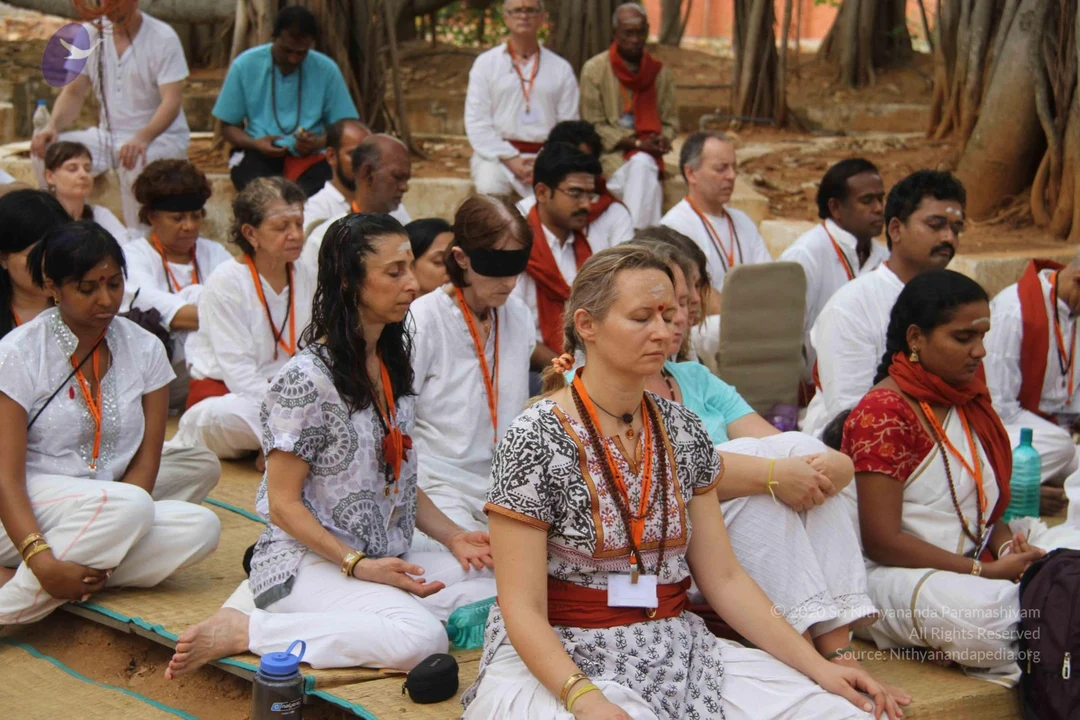
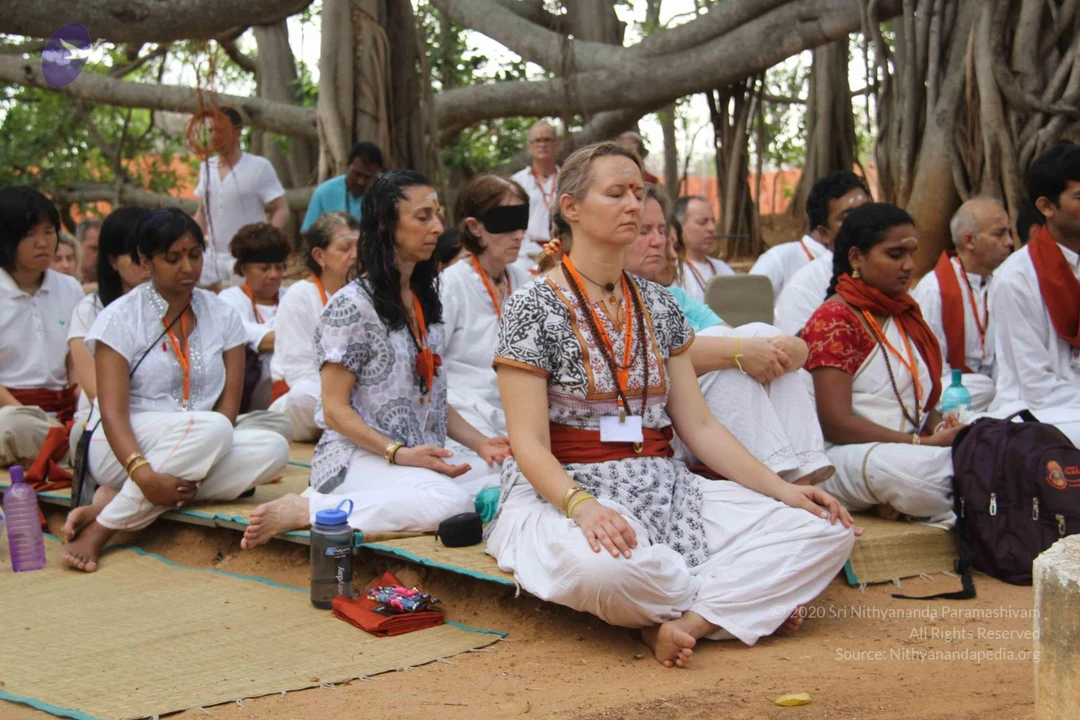
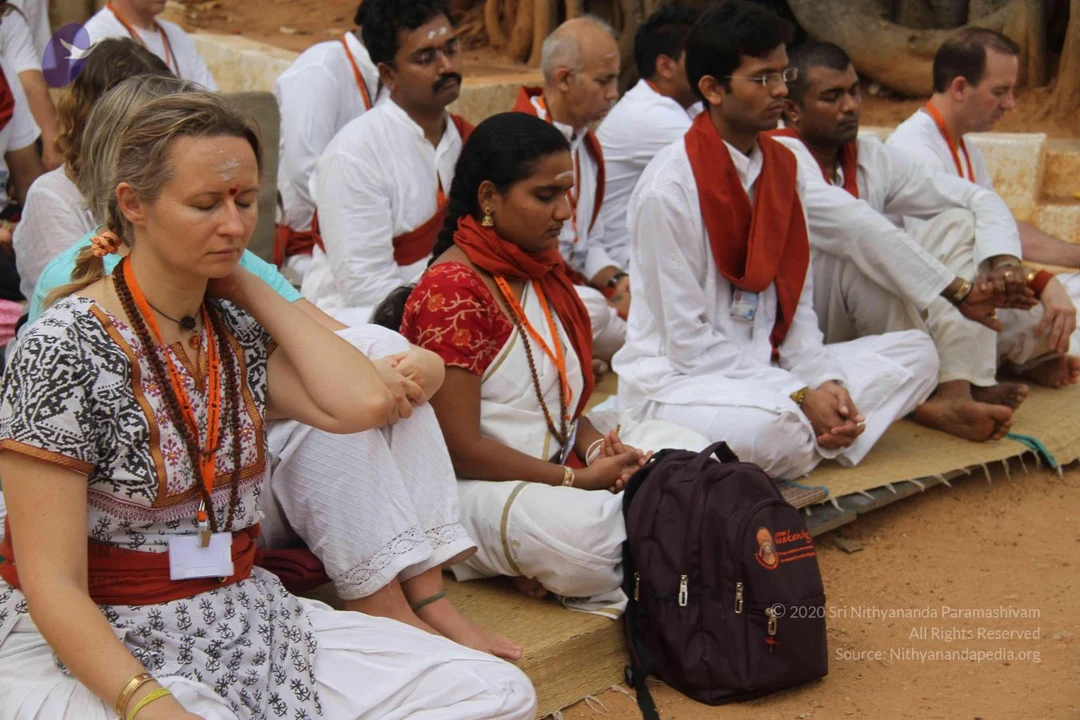
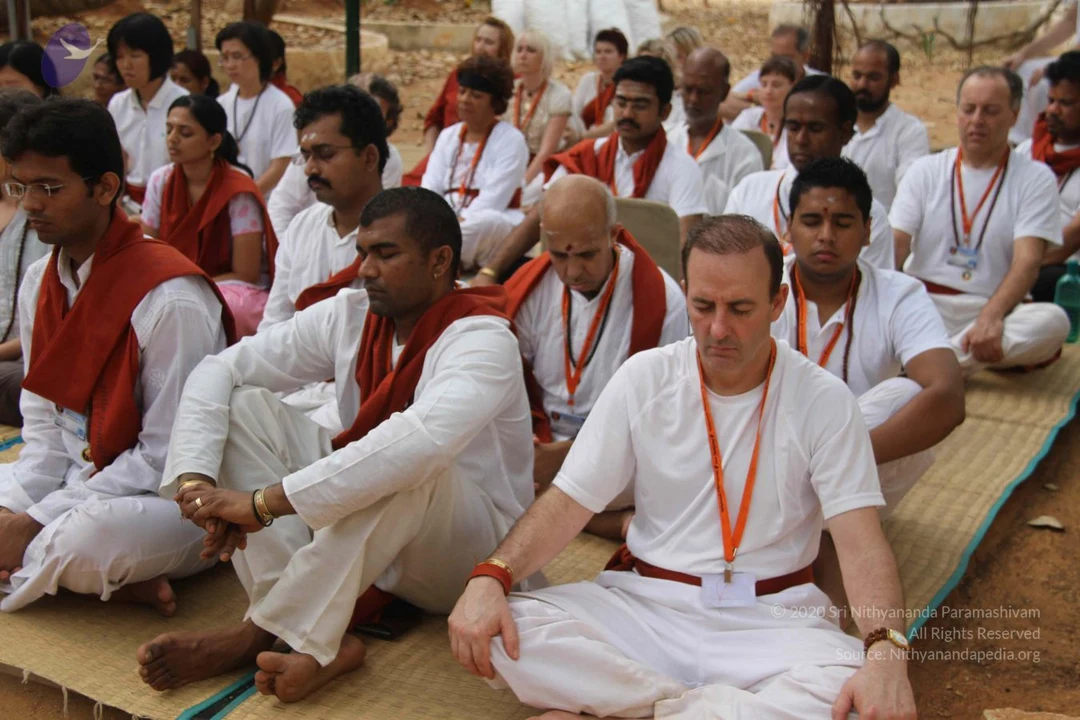
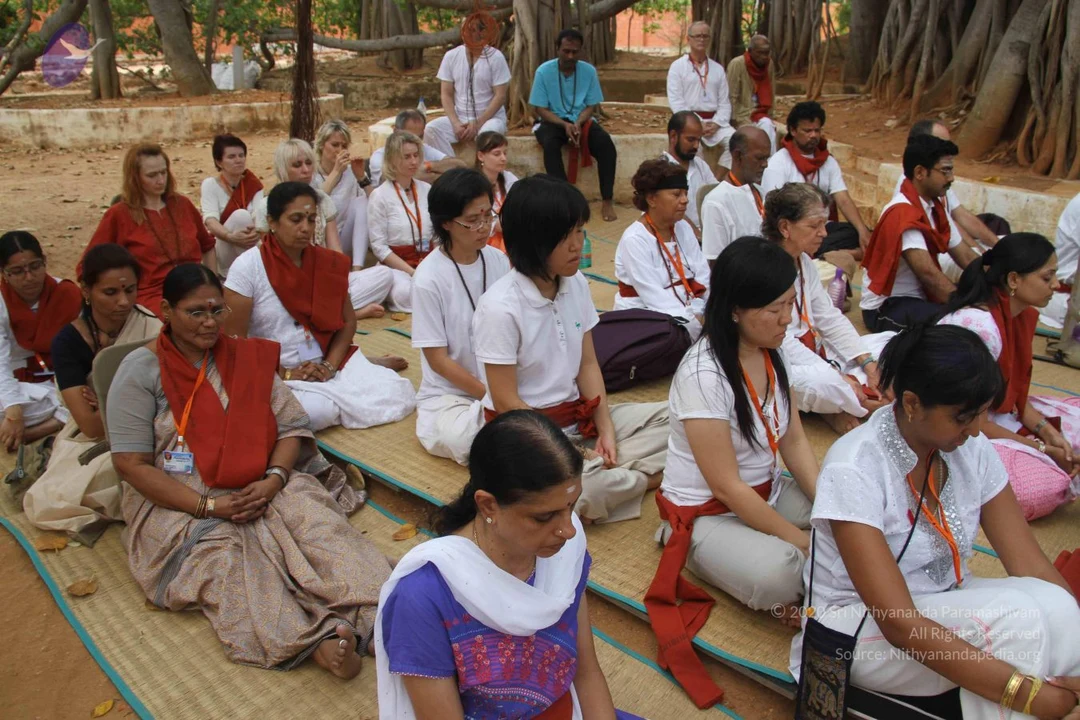
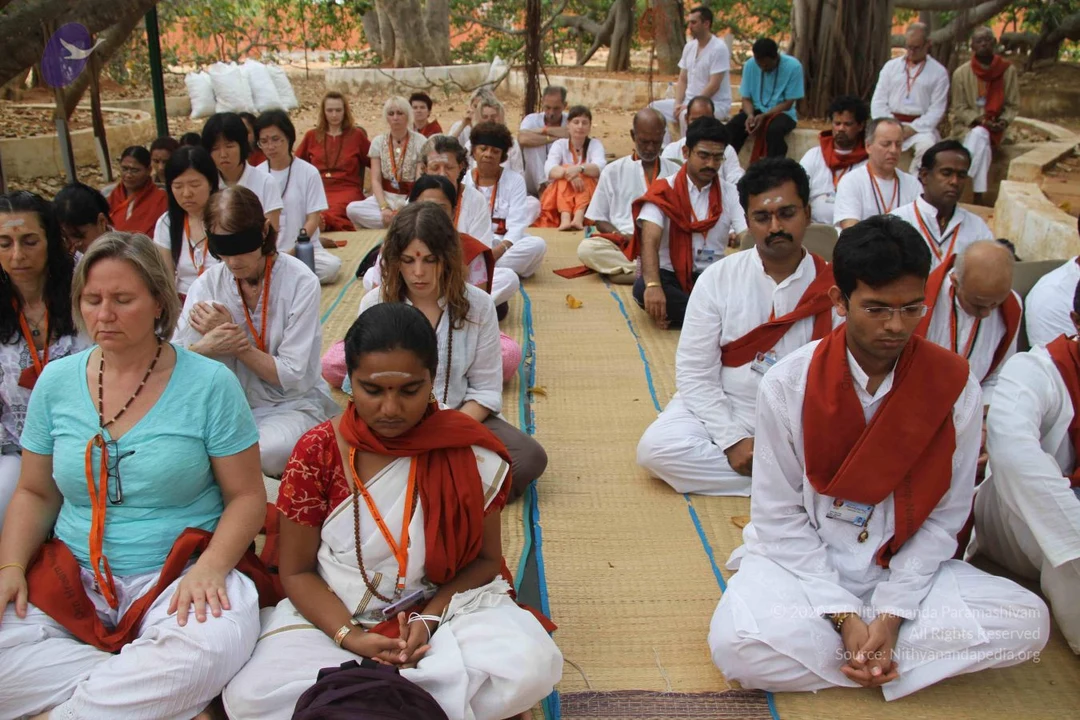
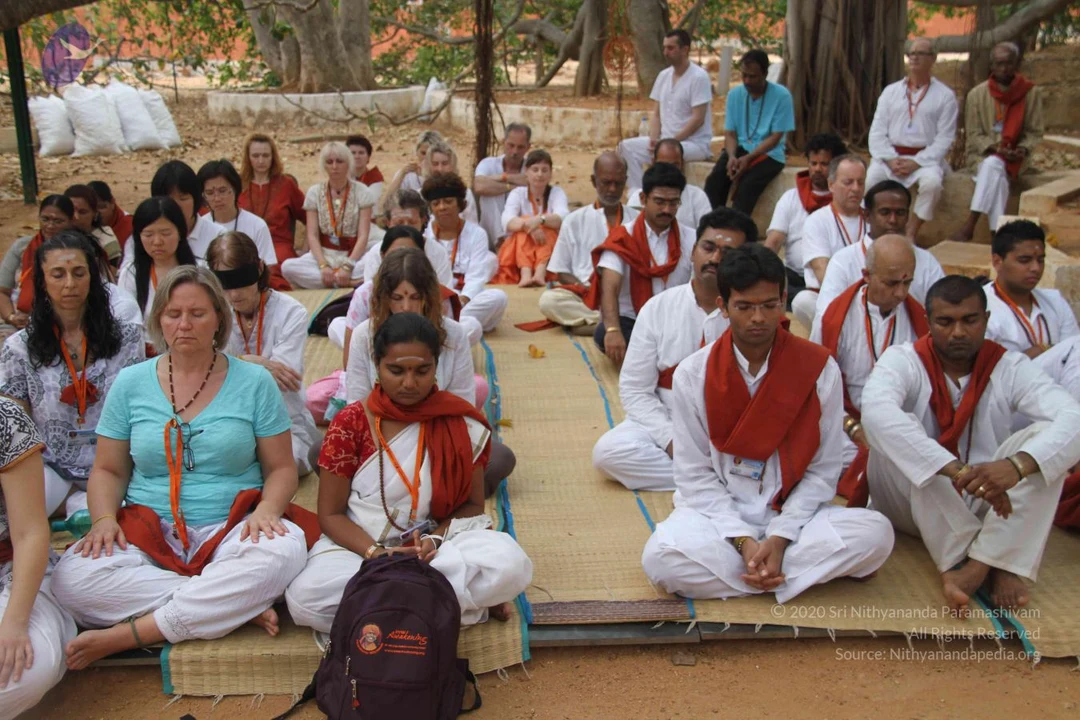
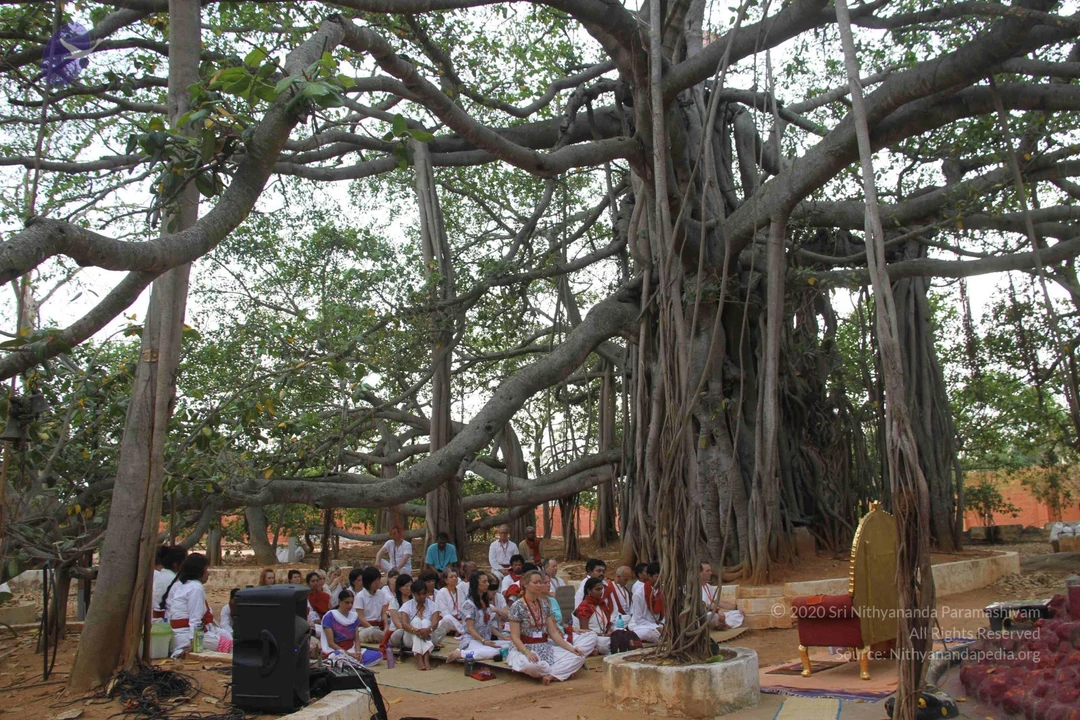
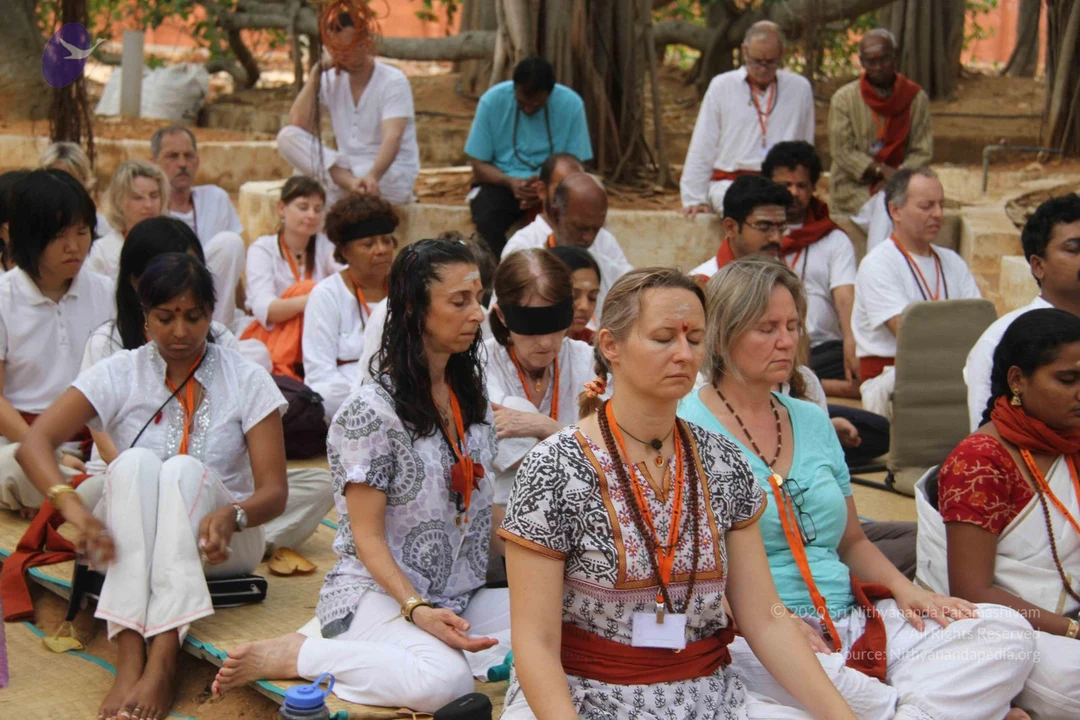
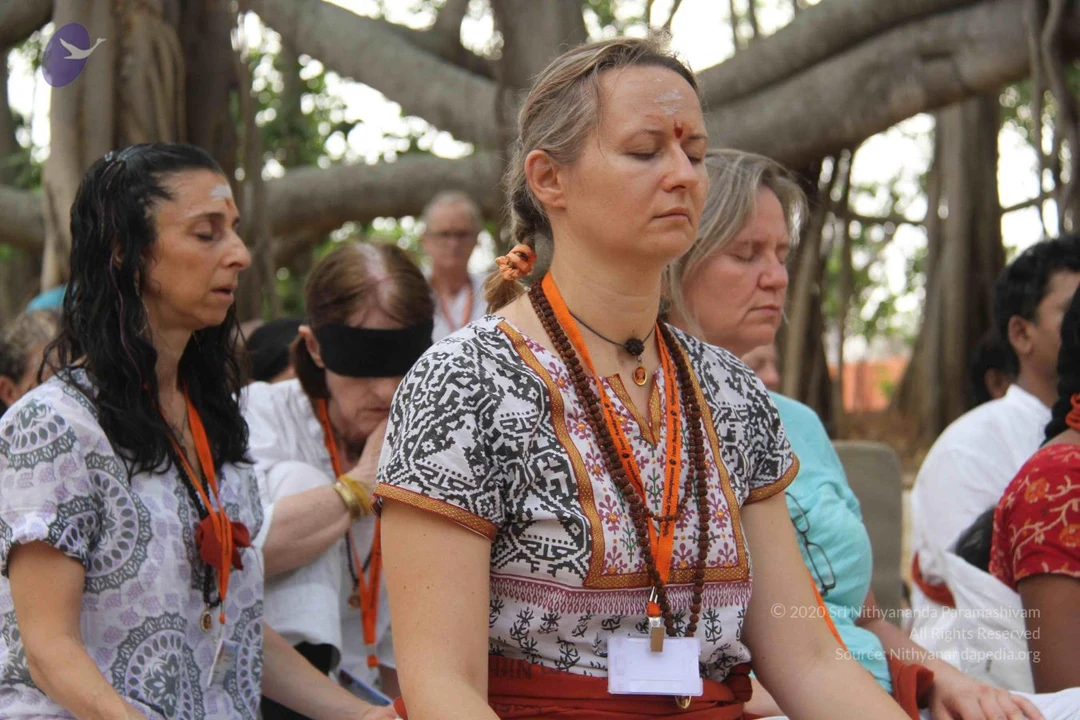
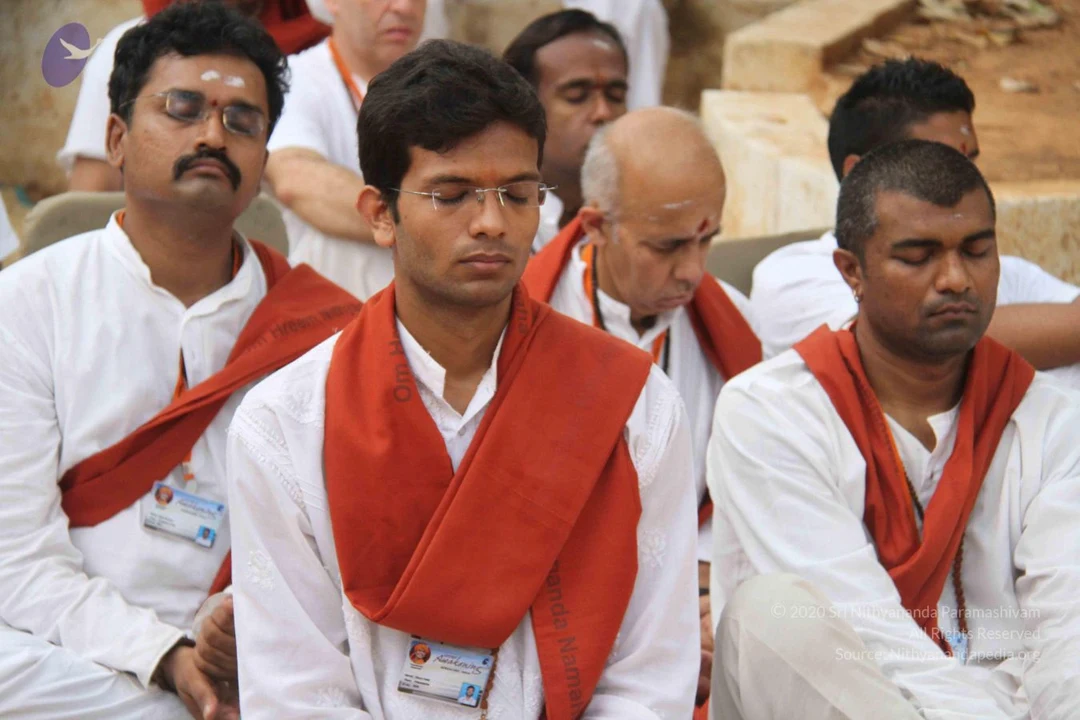
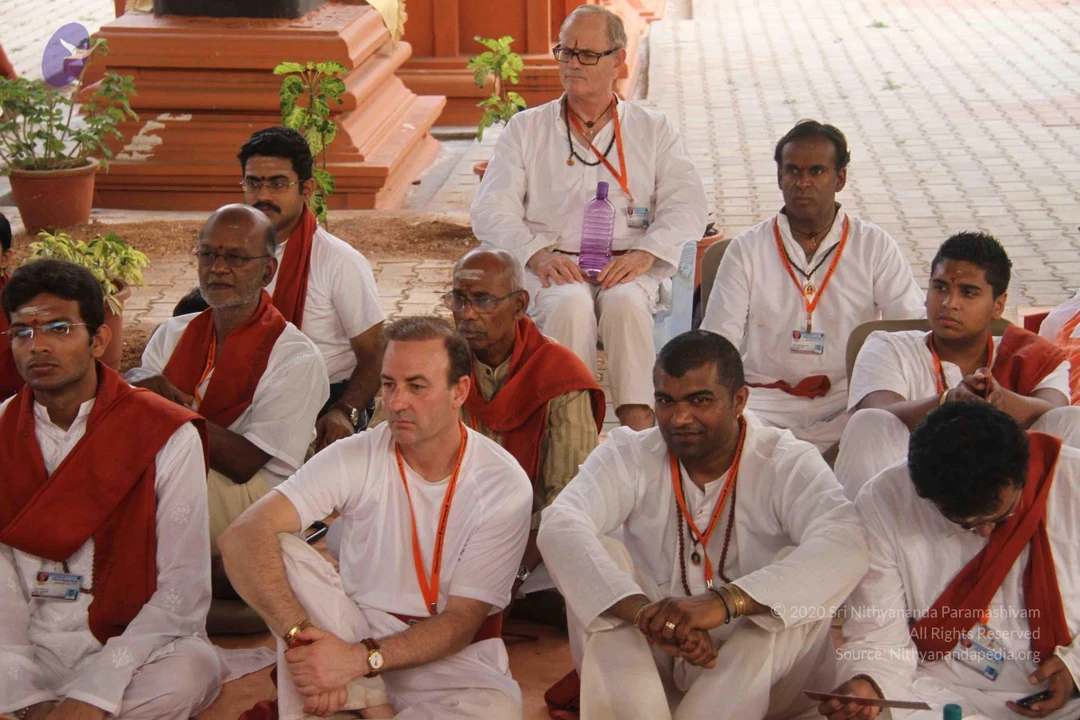
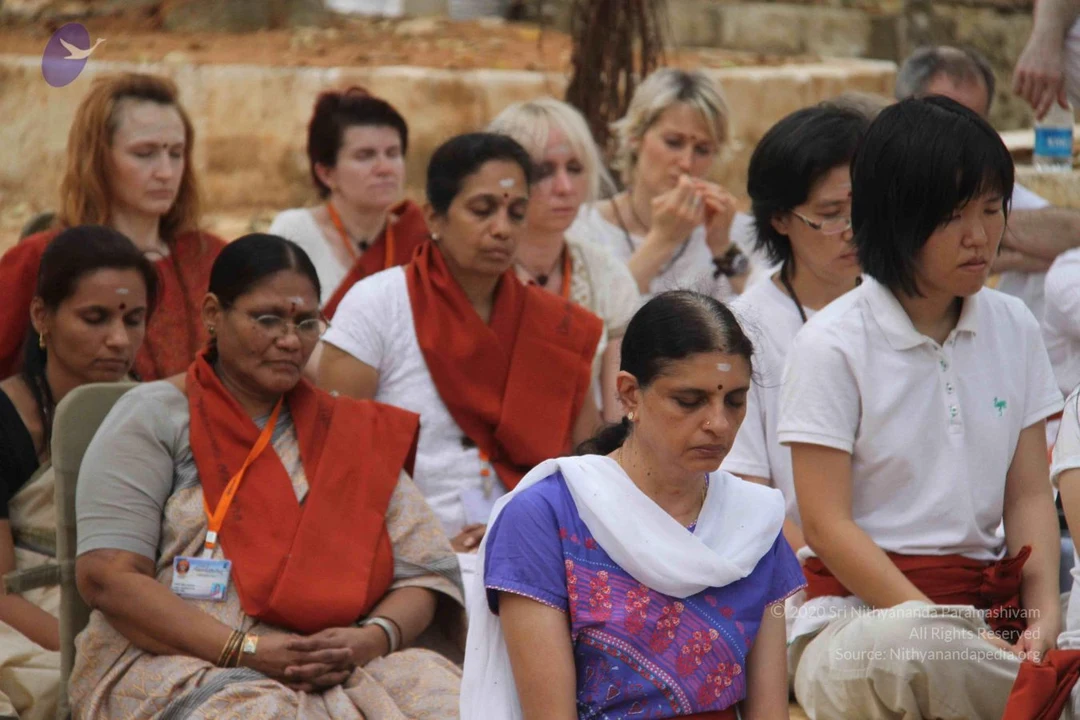
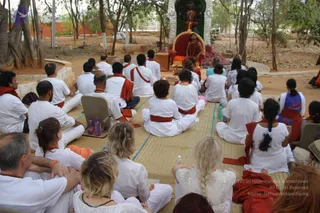
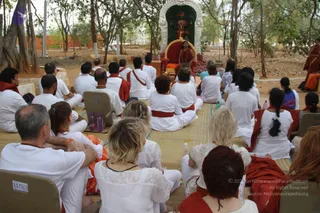
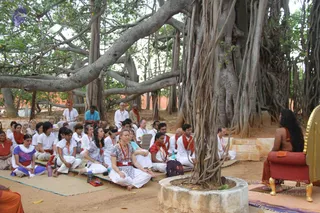
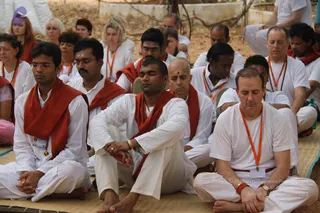
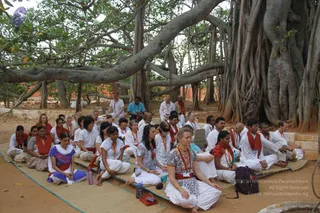
Outdoor satsang in a garden setting with dry earth, trees and a red-and-white ornamental arch framing a dark deity murti. A figure seated on a red and gold throne-like chair with orange drapery sits at the centre of the platform beneath the murti. Around them, about two dozen people sit cross-legged on woven mats in white clothes with red and orange shawls and sashes, with several women in white and a few seated in chairs at the edges. Some hold water bottles, a purple bottle sits on the mat, and an audience member in the foreground wears an orange-tinged shawl. A figure at the edge wears a blue and white top and red sash.Outdoor satsang in a shaded garden with bare earth and trees. Many devotees in white clothes with red or orange shawls sit on mats and folding chairs facing a red-cushioned throne in front of a green shrine arch holding a deity murti. A woman in orange sits on the throne. On the right, a person in orange robes stands. Water bottles sit among the audience, and a man in white in the foreground has a grey beard.Outdoor satsang beneath a large banyan tree with many aerial roots. Dozens of seated devotees sit on mats and a low stone platform, many in white clothing with orange and red shawls and sashes, some wearing ID lanyards. A woman in the foreground wears a patterned blue and grey dress and sits with eyes closed. On the right, a figure with long dark hair and a bare upper body sits on a red upholstered throne with gold legs, facing the crowd, wearing orange cloth. A stone well-like ring surrounds the trunk in front. Water bottles and a small bag sit on the ground among the attendees.A photograph of a seated group meditation or satsang with many people sitting cross-legged on woven mats outdoors, eyes closed. Most wear white kurta-style or white T-shirt clothing with red or maroon shawls and orange lanyards with name badges. A bald man in front centre has a small red mark on his forehead and sits with hands resting on his lap. A man on the right wears a white T-shirt, orange lanyard and wristwatch, with eyes lowered. Background shows dry earth, a stone wall and a white structure. No one at the front is identified as a person.Outdoor meditation session where many devotees sit cross-legged with eyes closed on woven mats over dry ground. Most wear white kurta-style or white T-shirt clothing with red or maroon shawls draped over shoulders, and several wear orange lanyards with name badges. A bald man with a red tilak mark sits in the center-right, and a man in the foreground with a gold bracelet has hands folded. No teacher is visible in the frame; the seated participants are the subject.A large group of around thirty people sits cross-legged on woven mats beneath a massive banyan tree with sprawling aerial roots and thick branches. Most wear white kurtas or white clothing with orange and red shawls or scarves and orange lanyards. Several women in the foreground wear printed kurtas, one in a blue and purple outfit. Water bottles and a small red bag rest on the mats. Some participants have eyes closed in meditation. A white-clad figure stands near the back, and a seated person in an orange wrap appears among the group. The setting is an open outdoor ground with red earth and a low wall behind the tree.

Nithya-Yoga-Morning

15 photosSource gallery
A photograph of a yoga or meditation session in a large hall with a fabric-draped ceiling and hanging decorative cylindrical banners in red, yellow and blue with orange tassels. Several people sit cross-legged on pink and purple mats with both arms raised overhead, palms open. In the foreground at right, a bald man in a grey t-shirt sits with arms raised; beside him a bearded man in a white shirt and a man in a black shirt also sit with arms up. Metal water bottles stand on the floor between the mats. Other participants in white and black clothing are visible toward the back and left.A large hall with a polished floor where a group of about a dozen people do seated forward-bend stretches on pink and purple yoga mats, with small dumbbells placed beside them. Participants wear grey, white and black athletic clothes. Several hanging cylindrical banners with yellow, red, blue and white patterns and orange fringe hang from a draped ceiling. A stage with gold curtains and a wall-mounted television are visible at the back.A group of men practise seated forward-bend stretches on pink exercise mats on a polished floor. The foreground man wears a white t-shirt and black track trousers, head lowered to his knees and hands gripping his feet, with small chrome dumbbells beside him. To the right, another man in a white shirt and black trousers with a dark beaded necklace leans forward similarly. A third person in black sits at left, and white metal railings and a curtained wall form the background. No deity, throne or ritual objects are visible.A hall of seated meditators on a polished floor, sitting cross-legged or with legs folded on pink and dark mats beside metal dumbbell-style weights. A bearded man in a grey hooded top in the foreground has hands resting on his knees and eyes closed. Behind him men in black and white t-shirts and dhoti-style lower wraps sit in meditation. Colourful decorative hangings with orange tassels hang from a draped white ceiling. A small framed picture is on the left wall, and a figure in orange stands in the background.A blurred indoor photo of a yoga or meditation session in a bright hall with a glossy tiled floor and hanging striped tassel banners in red, yellow and blue. Several men stand in rows with hands at their sides, mostly in black, navy and white clothes, while others kneel on pink and purple mats; a man in a navy shirt with a red sash stands centrally. A woman in orange sits at the left edge, and a bald man in white is seen in the background. Metal stanchions and water bottles are visible on the floor.A photograph of a yoga or meditation session in a bright hall with polished floor. Several people kneel on colourful mats (blue, pink, green, black) with small metal dumbbells placed beside them. Foreground figures in white t-shirts and black trousers bend forward in prostration, while others in black tops and grey shirts stand or kneel, some looking upward. A water bottle, a cooler unit, a microphone, tall cabinets and maroon curtains are visible at the back.

Satsang-morning

26 photosSource gallery
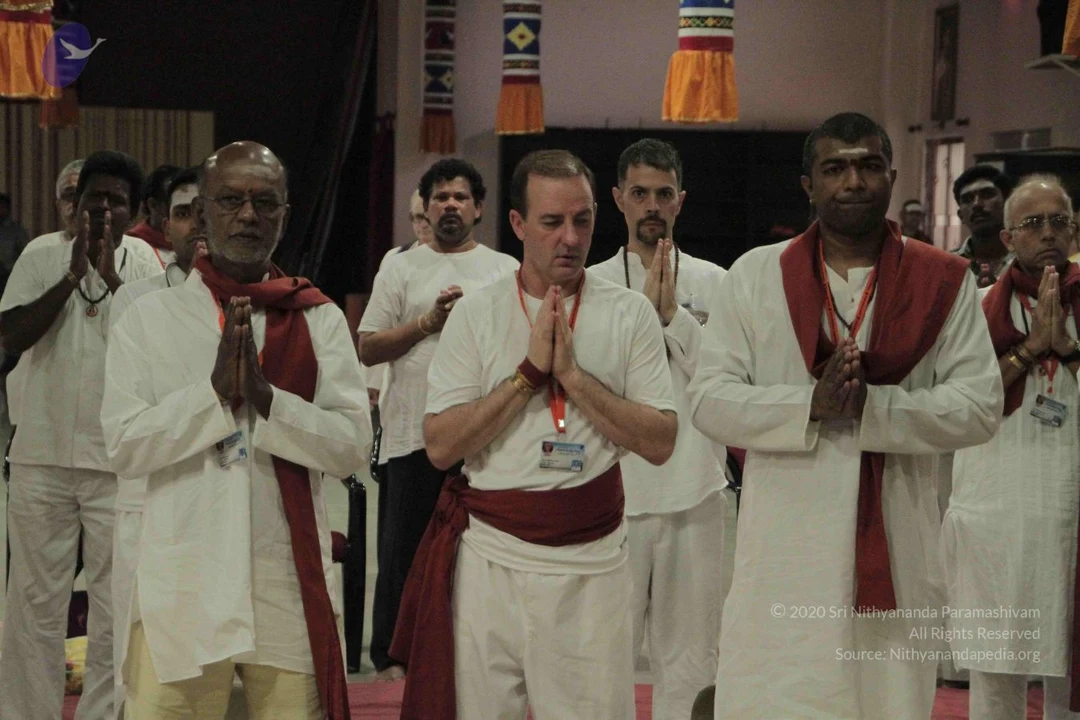
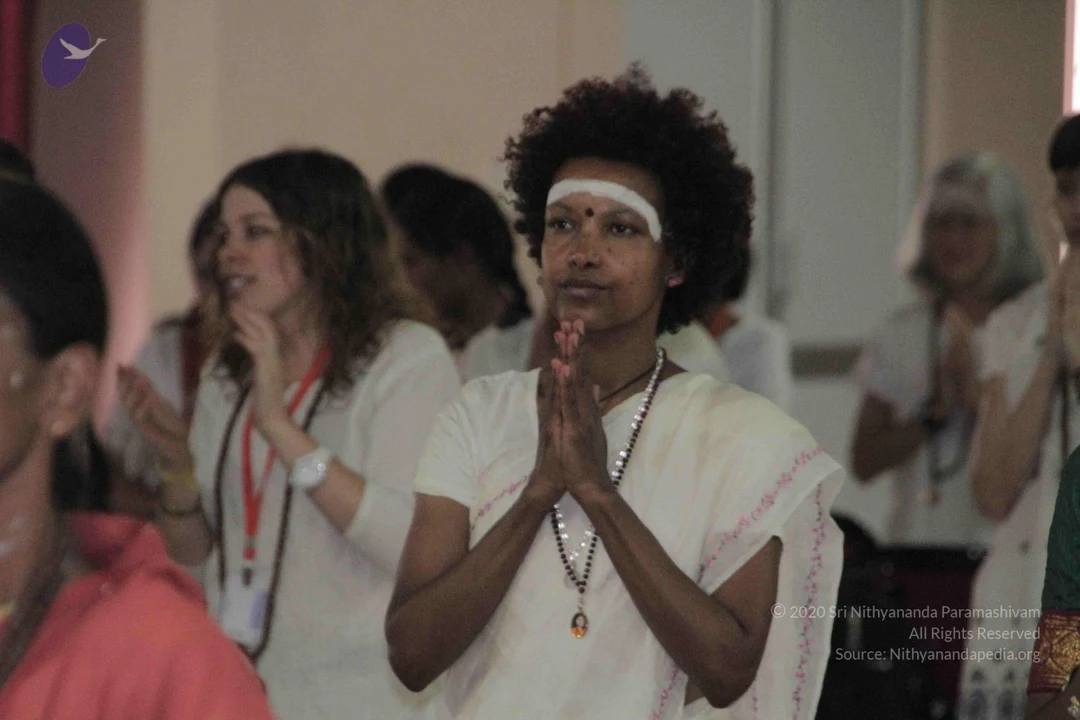
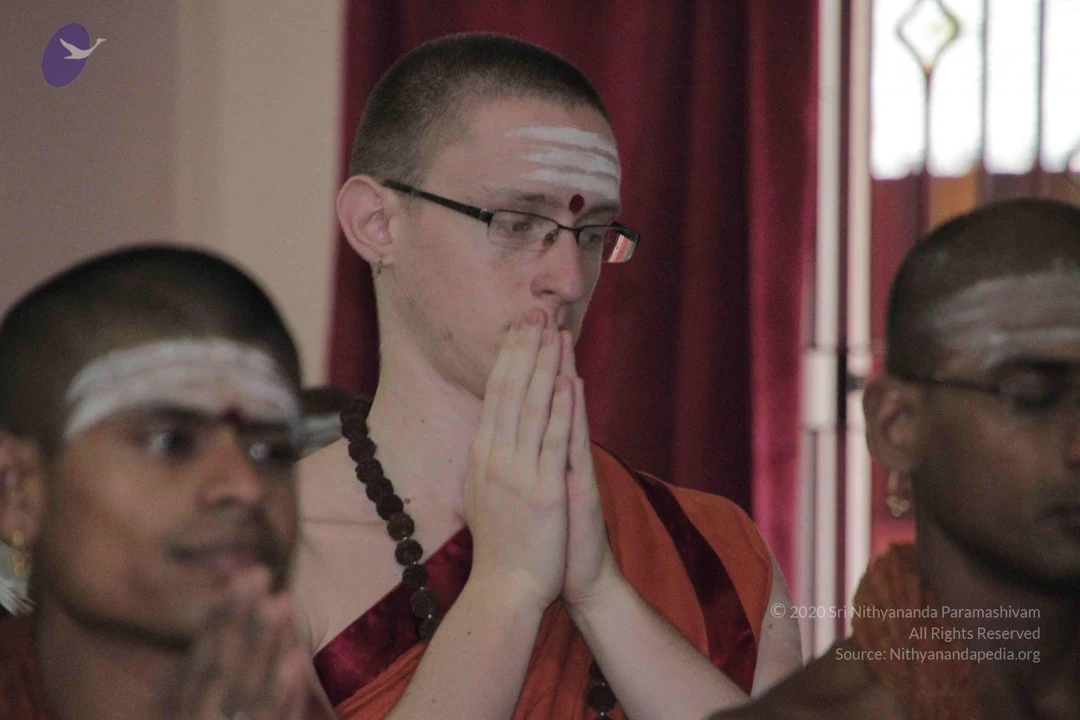
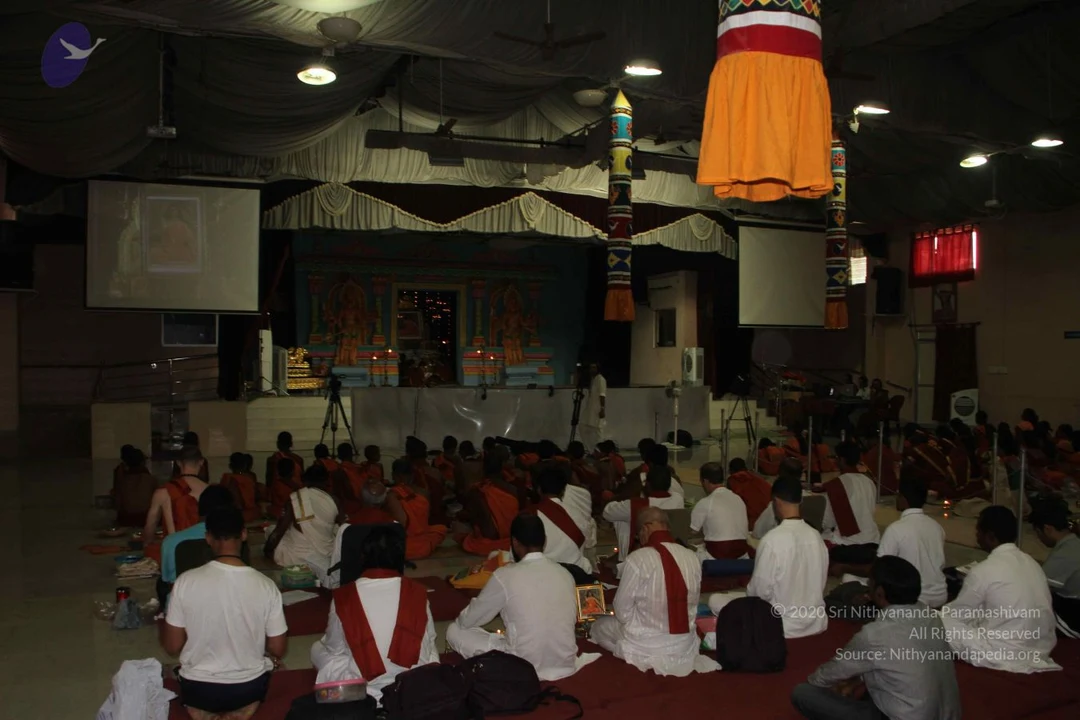
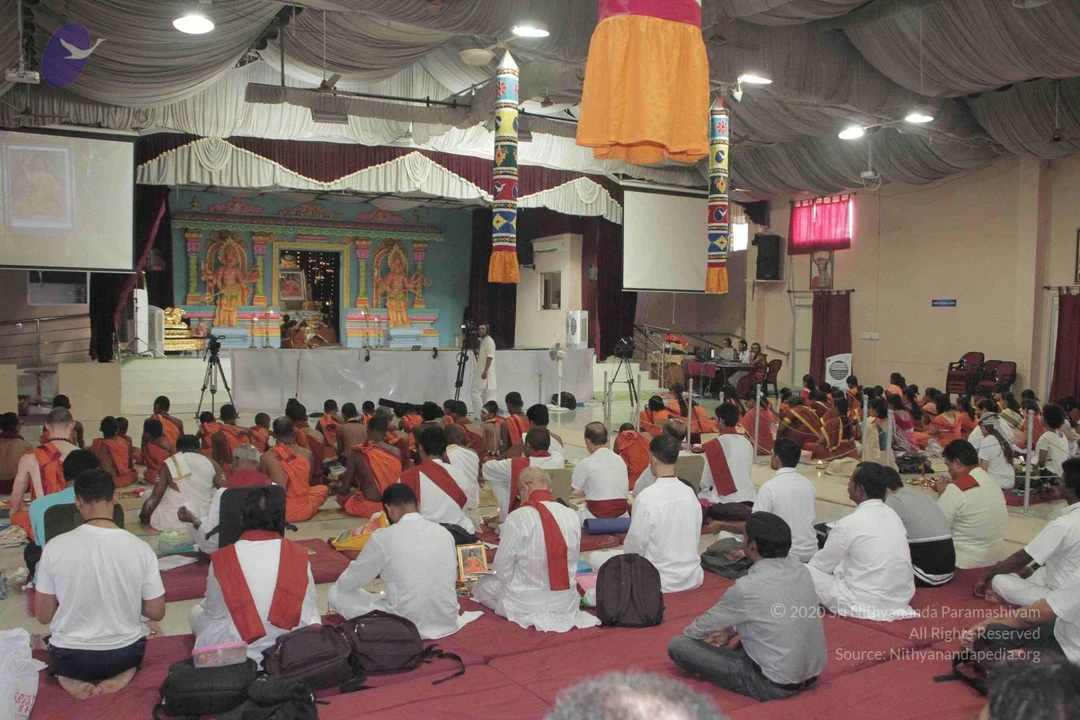
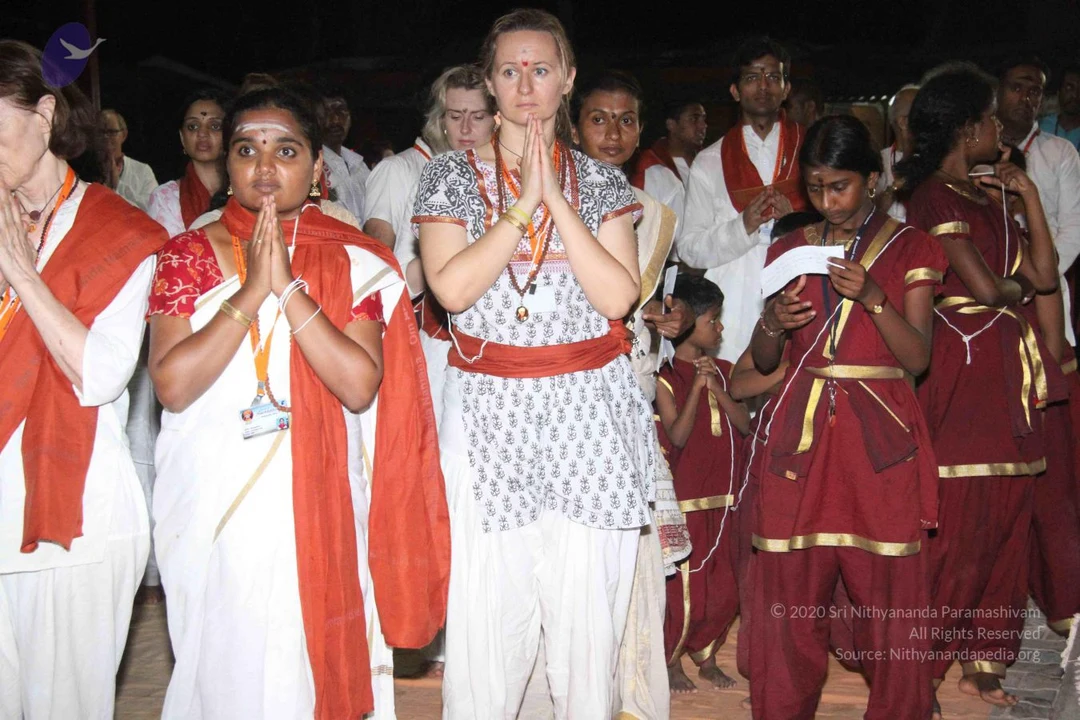
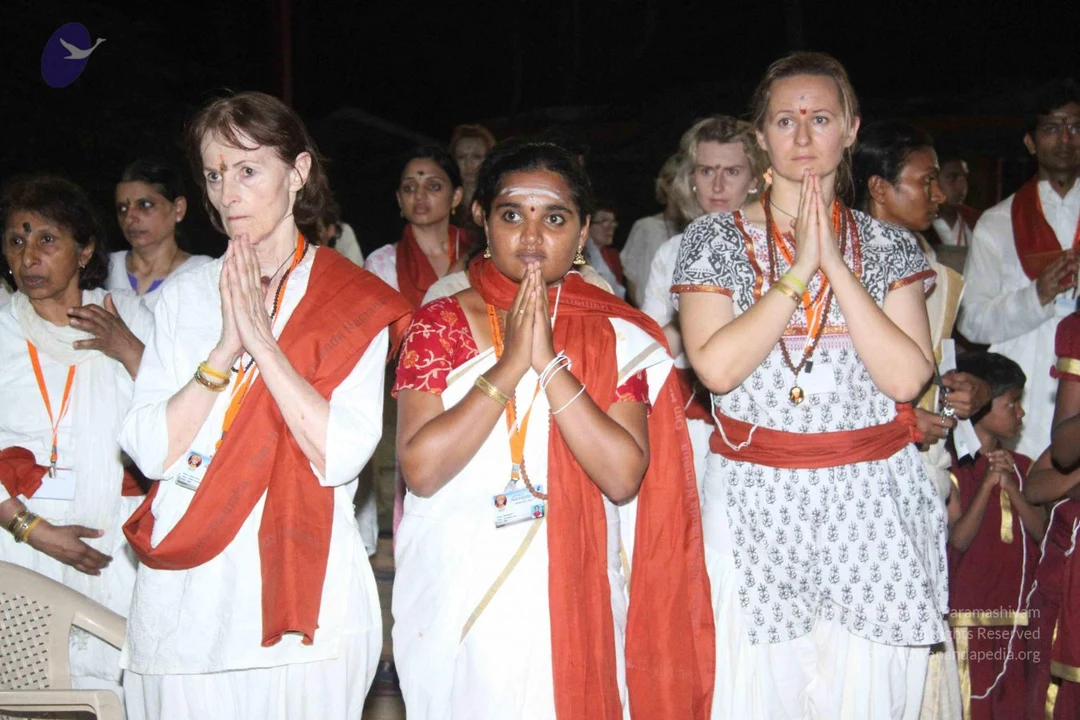
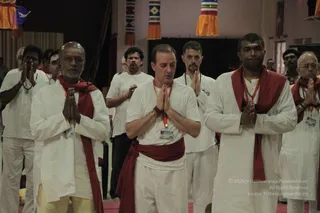
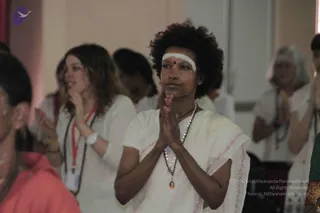
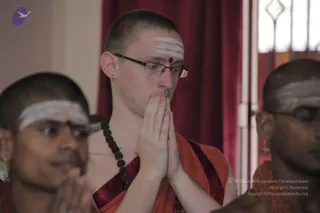
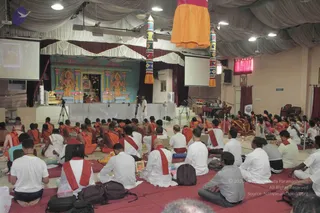
A photograph of devotees standing in a hall with hands joined in anjali mudra. In the foreground, a bald man with glasses wears white kurta-style clothing with a red shawl and a red-and-white lanyard, beside a man in white shirt and white dhoti with a red sash and red lanyard holding palms together. Further right, a man in white kurta with a red shawl and rudraksha-style mala presses his palms together. Behind them, several other people in white clothing stand with hands folded, and colourful orange, red and white decorative hangings hang from the ceiling. No swami or depiction of a swami is clearly identifiable in the scene.A photograph of a satsang gathering indoors. In the centre, a woman with curly dark hair and a white forehead band with a red bindi stands with palms pressed together in anjali mudra, wearing a white garment with pink embroidered edges and a mala necklace with a pendant. Behind and beside her, several people in white clothing, some with lanyards, stand with hands folded or clapping, and a figure in orange-pink clothing appears at the left edge. Pale walls and a pink-toned background frame the room.Three saffron-clad men in a satsang hall with red curtains. The central man, shaven-headed and wearing glasses, has white tripundra marks and a red bindi, holds his palms pressed together at chest level, and wears a rudraksha mala over an orange shawl with a maroon border. Men on either side, also with white forehead marks and shaven heads, hold their hands in anjali, one partly out of focus on the left and one partly visible on the right in orange cloth. The setting is an indoor devotional gathering with a window and white wall in the background.A wide photograph of a large hall during a satsang, with many seated devotees on red mats facing a raised stage. Most attendees wear white clothes and red or orange shawls; a few wear saffron robes. In the foreground, a bald man in white clothes with a red shawl sits with his back to the camera, with a framed photograph placed in front of him. The stage backdrop is teal and gold with painted deity figures flanking a shrine doorway, and orange and white draped cloth hangs above. Two large screens and camera tripods are visible, along with a pink curtain at right. Overall, the scene shows a seated assembly listening to a teaching.A man with long dark hair sits before an ornate gold-leaf embossed backdrop with his eyes closed and palms pressed together in namaste. He wears a white horizontal tilak with a red dot on his forehead, gold hoop earrings, a headset microphone, an orange-red shawl over bare shoulders, and layered rudraksha-style beaded necklaces with gold and bead accents. The setting appears to be a stage or satsang hall.A seated man in saffron-orange robes sits cross-legged on a tiger-skin-covered platform before an ornate gilded throne with a carved arched back and two gold lion figures at its sides. His palms are pressed together in namaste and his eyes are closed. He wears a white forehead marking with a red dot, a rudraksha mala and layered gold necklaces, and gold earrings. The backdrop is draped in deep maroon velvet curtains. a person seated in a prayer pose, with gilded lions and tiger skin on the dais.

Energy-Darshan
27 photosSource gallery
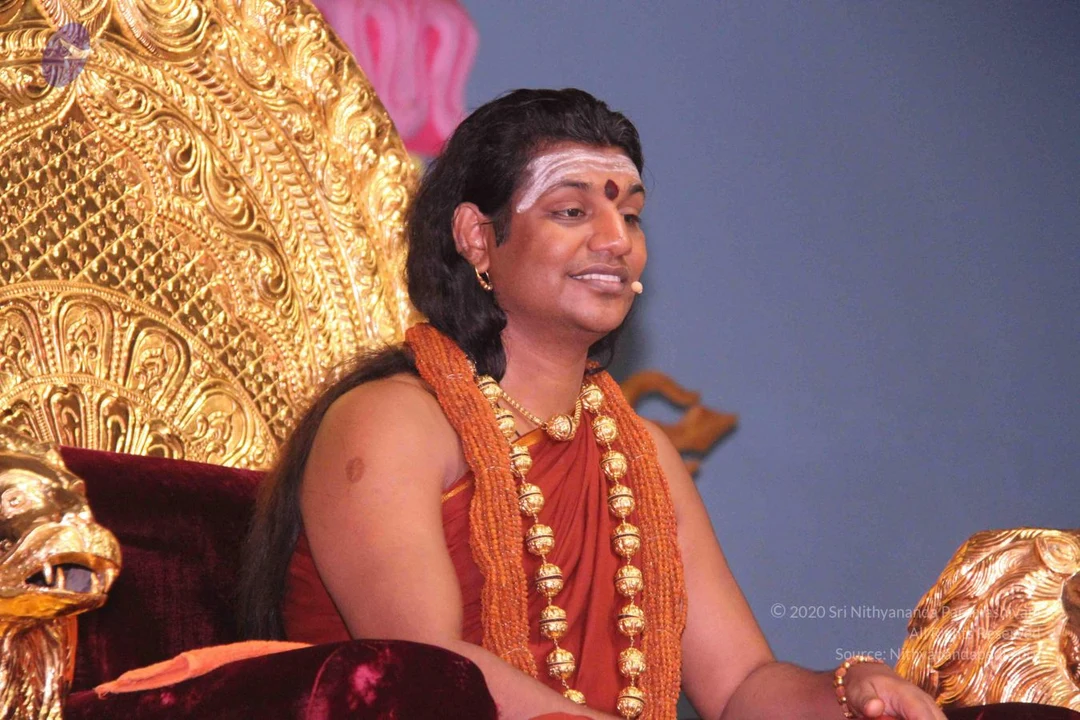
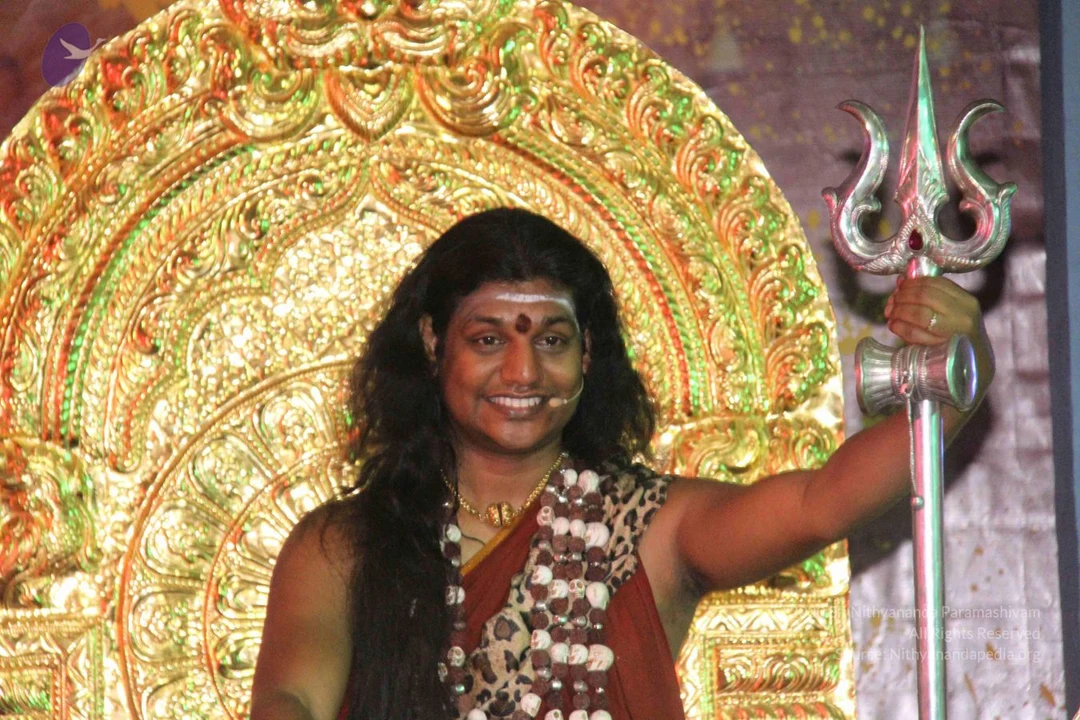
A smiling man sits on an ornate gold throne with carved golden filigree, wearing a red-orange robe and a long orange-beaded rudraksha mala with large gold bead ornaments. He has long swept-back dark hair, white vertical tilak on the forehead with a red dot, and a small headset microphone. His hands rest at the lower frame near a golden armrest. Swamiji (probable): the figure shows long swept-back hair, saffron-orange ornate clothing, rudraksha mala and gold necklace, seated on a throne during a satsang discourse. Behind him is a blue wall with colourful decorations.A smiling man sits on a red velvet seat in front of an ornate gold repoussé backdrop, with a small microphone near his face. He wears a rust-red unstitched cloth over his shoulder and several rows of orange-beaded rudraksha malas with large gold beads and a gold pendant necklace. A white horizontal tilak and a red dot mark his forehead, and he has long dark hair swept back. A cushioned throne-like seat and a colourful painted panel are visible at the right edge. Swamiji (probable) is the central figure, seated in a satsang setting, with long hair, rudraksha malas and ceremonial gold necklaces as the qualifying cues.A photograph inside a temple-style hall. A man in a white shirt with a red-orange shawl bows forward toward a bare-chested figure in orange-red cloth. The bare-chested figure has long swept-back dark hair, a red tilak on the forehead, ornate gold necklaces, rudraksha-style gold beaded mala and gold bangles, and holds a tilak-marked devotee's respect. Behind them, an ornate golden peetha/throne with a gold arch stands before colorful painted pillars, multi-armed deity murti figures, brass lamps and lit oil lamps. A man in white stands at right. a person candidate appearance is consistent with the page, but the face and cues are not conclusively distinctive, so the figure is described by role with an uncertain identity.Photograph of an indoor hall where a man in a white shirt with an orange-red shawl stands with hands pressed together in namaste, bowing toward a smiling figure in a reddish-orange saffron-style dress with a bare upper body, rudraksha-like beaded mala and a heavy gold ceremonial necklace, long swept-back hair, a red bindi and tripundra-style marks, who raises one hand in blessing. A second man in a red shawl stands behind the bowing man, and a person in white and orange is partly visible at the right edge. A golden ornament and dark drapes appear in the background, with a camera tripod and a white screen. a person: the blessing figure has long swept-back hair, rudraksha-style beads and gold necklace, consistent with the page's a person attribution.A photograph of an indoor event in a hall with a dark red curtain and a projection screen. A man with long swept-back hair, a white tilak on his forehead, a red dot and a red-orange robe wears a heavy gold bead necklace and a rudraksha mala; he extends his arm and fingers toward the forehead of a young man in a striped blue shirt, who stands with palms pressed together. Other men stand nearby, including one in a white dhoti and one in a black shirt. A tray of offerings sits in the lower right, with a partly visible person at the right edge. Several people are visible, about six to twenty.Photograph of a devotee bowing his head forward while a man in an orange-red dhoti and shawl, with long swept-back hair, a tripundra marking on his forehead, a multi-strand gold bead necklace and a rudraksha-style orange mala, places his right hand on the devotee's head in a blessing gesture. He smiles. Behind them, other devotees wait, a man in white stands near a gold-decorated seat or throne, and a red curtain and stage area are visible. The blessing figure matches the appearance cues of the a person candidate, so this is an appearance-based probable identification. The devotee wears a white checked shirt.

Pada-Puja

17 photosSource gallery
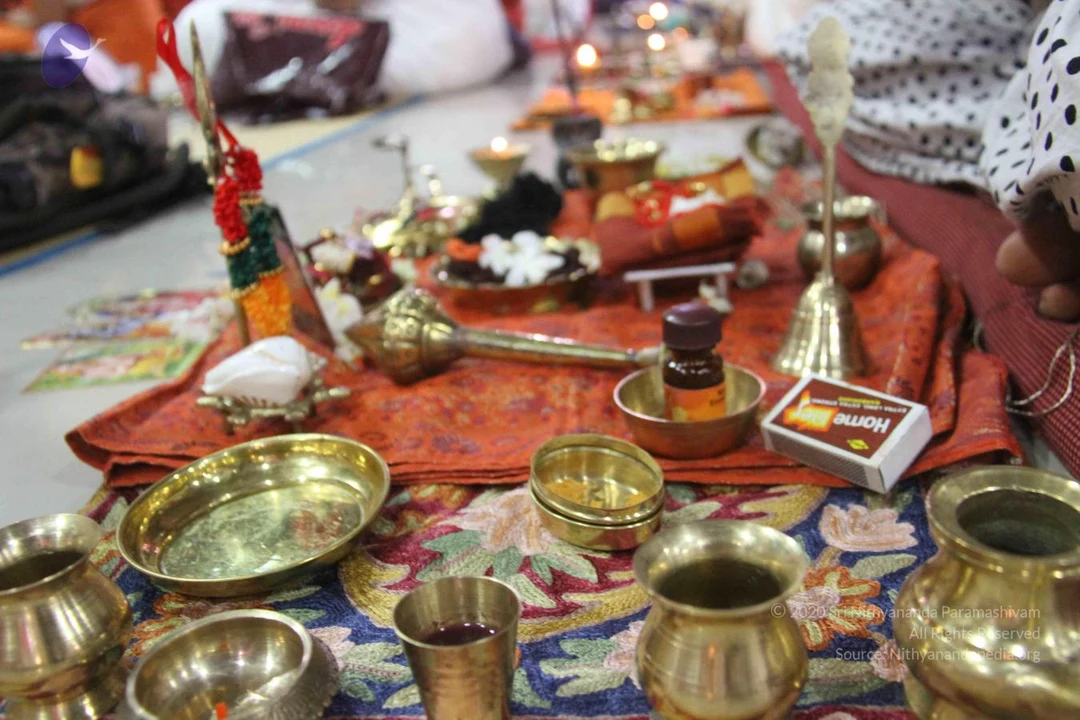
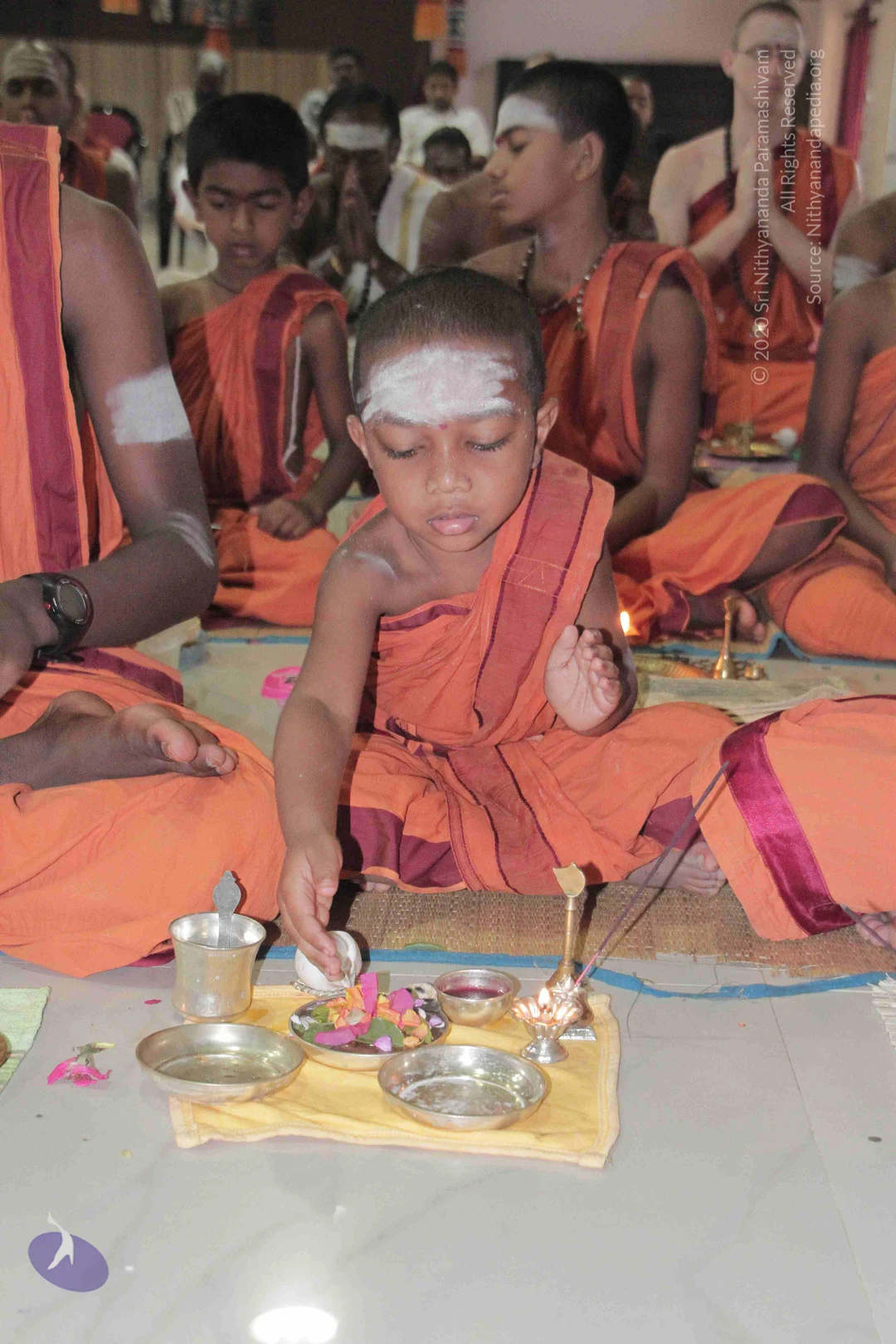
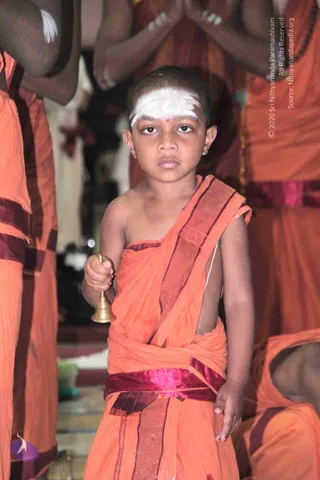
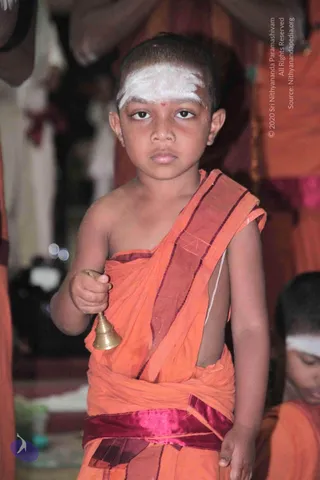
A young shaven-headed boy sits cross-legged on a mat, wearing orange and maroon-bordered ochre robes, with a white vertical forehead marking and a small red bindi. His hands are raised in a gesture before him. Behind him, other robed boys in orange sit in meditation with hands folded. In front stand brass and silver puja vessels, a small oil lamp, a brass bell, a plate of flower petals, and a lit incense stick on a yellow cloth. The scene suggests a devotional ritual with children in saffron robes.Interior of a temple shrine with painted blue walls and two large painted guardian statues with multiple arms holding weapons, one on each side. At the centre, a framed portrait on a gilded throne draped with a tiger-striped cloth shows a figure in orange robes with a garland, seated on a cushion. A priest in orange robes stands at the shrine raising a lit oil lamp toward the portrait, while a woman in orange sari sits on the glossy floor beside a microphone and a small bell or plate. Brass oil lamps stand on both sides and a row of small lamps lines the background.Several young boys in saffron-orange robes stand in a hall, many with white vibhuti bands across their foreheads and rudraksha malas around their necks. The boy on the left looks sideways with his hands at his chest; the middle boy holds his palms joined in anjali; the boy on the right has palms joined and an open-mouthed expression. Other figures stand in the background, and framed pictures hang on the wall above maroon curtains. No a person candidate is visible.A photograph of a seated group of young boys in saffron-orange dhotis and shawls with maroon-red and gold-bordered cloths, many with white vibhuti horizontal stripes on their foreheads and rudraksha malas around their necks. They sit cross-legged on mats in a hall, several with palms pressed together in prayer or hands folded, eyes closed in meditation. Brass plates, small lamps, and offering trays with flowers sit on mats in front of them, and older men in white and orange clothing sit in the background. No a person candidate is clearly identifiable among the visible people.A photograph of a puja setup on a white marble floor in low warm light. Two people in orange and saffron robes sit cross-legged at the top of the frame, only their lower bodies and bare feet visible. In the foreground, brass vessels, a brass lamp with a lit flame, a brass bowl with offerings, a white conch shell, and a red and gold brocade cloth rest on a woven mat. Flower petals and a small plate of fruit and flowers are arranged nearby, and an incense stick rises at the left edge.

Inner-Awakening-Session-Akashic-Readings-KalaBhairavaDarshan
58 photosSource gallery
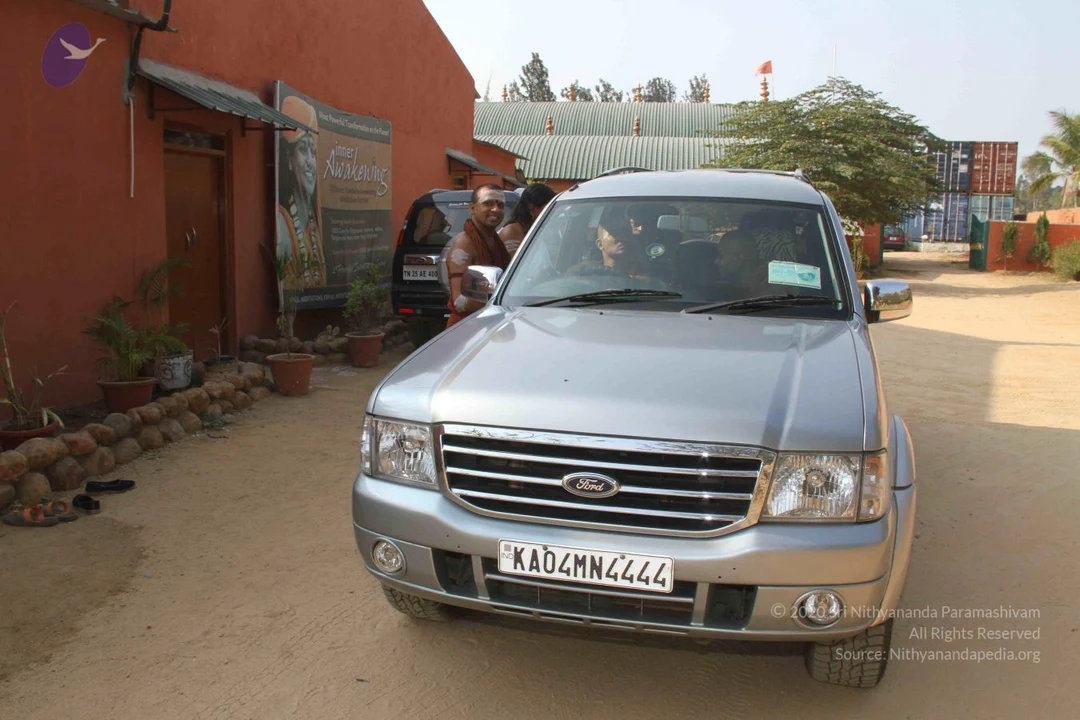
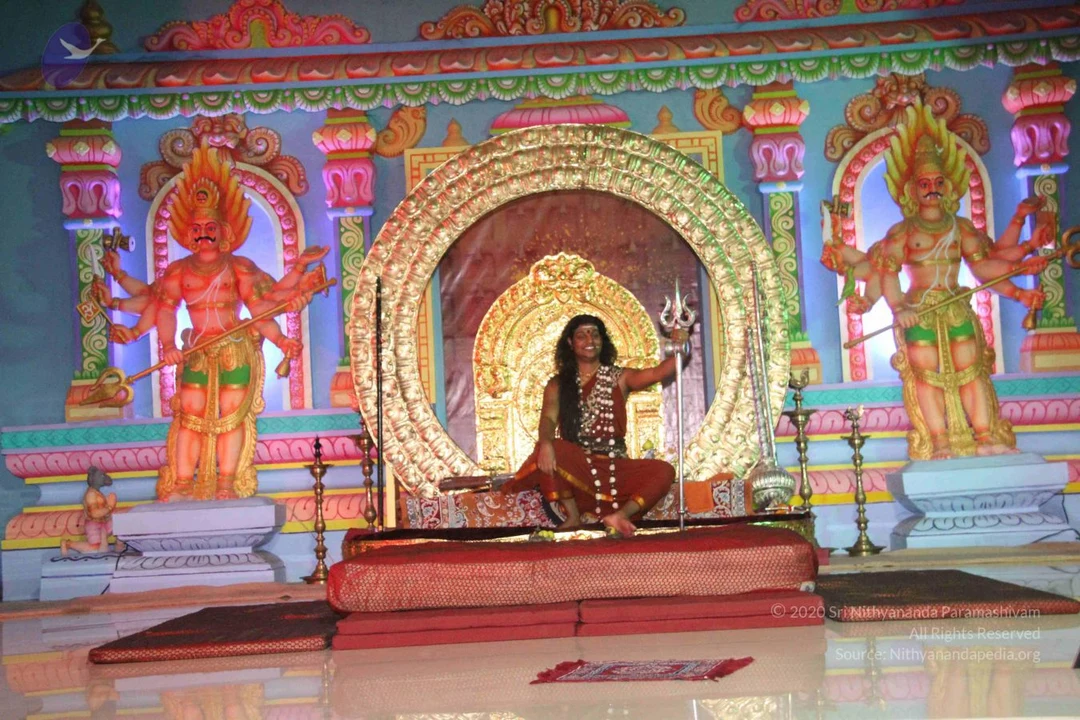
A silver Ford SUV with Karnataka plate KA04MN4444 is parked on a sandy driveway in front of a terracotta-red building. Beside the vehicle stands a man in an orange-red garment with white markings on his body, and another SUV is visible behind. A large banner on the building reads Inner Awakening with a photograph of a man in ochre robes. Potted plants, a stone border and a green-roofed structure with flags are in the background. People sit inside the silver vehicle.A smiling man with long, swept-back dark hair stands before an ornate golden throne-like arch with carved floral and scrollwork panels. He wears a maroon-red cloth wrap over a leopard-print top, a gold necklace, and a long multi-strand rudraksha-style mala of dark beads with white bead accents. A white horizontal tilak and red bindi mark his forehead. In his right hand he holds a tall silver trident (trishul) with a red stone, and a microphone is clipped near his face. The setting is a stage with a painted yellow-speckled backdrop. Swamiji (probable): the long swept-back hair, rudraksha mala, gold ornaments and saffron-red robe are visible cues, and the page identifies him as Swamiji at this satsang.A smiling man with long dark hair, eyes closed, sits before an ornate gold arched throne in a stage setting. He wears a rust-red garment with a leopard-print shawl, a rudraksha-style mala with white beads, and a gold necklace, with a white tilak and red bindi on his forehead. He holds a silver trident aloft in his right hand and wears a small lapel microphone. The appearance of this person matches the a person label from the archive, with long swept hair, ornate clothing, rudraksha mala and gold necklace, and he is seated on a golden throne as a speaker giving satsang.A seated man in saffron-orange robes sits on a red and gold cushioned dais before an ornate gilded arch and large gold circular frame, flanked by painted pink and green pillars and carved figures. He smiles broadly, holds a silver trident in his right hand, and wears long hair, a forehead mark, a white rudraksha-style mala and a beaded necklace. Brass oil lamps stand at the sides.A photograph of a man speaking at an event, holding a large silver trident with his right hand. He has long dark hair, a white vertical mark and a red bindi on his forehead, and wears a red-brown garment with a leopard-print shawl over one shoulder. He is draped in a rudraksha mala with pale beads and a gold chain necklace. Behind him is a large painted deity murti with a bare torso, a sash and bangles, set against green ornamental panels and a bell-shaped brass object at right. Swamiji (probable): the long hair, rudraksha mala, gold necklace and ornate clothing are the distinguishing cues for the satsang speaker on the page.A smiling man with long dark hair, a white urdhva-pundra style forehead mark and a red bindi stands before a large painted backdrop of a deity with orange skin and a golden waist cloth. He holds a silver trident aloft in his right hand. He wears a red-brown wrap, a leopard-print blouse, a gold chain and a multi-strand rudraksha mala. Green and gold decorative panels frame the stage, and a lapel microphone is visible. a person appearance cues include long swept hair, rudraksha mala and ceremonial gold necklace while holding a trident as a stage presenter.

Gayatri-Homa

74 photosSource gallery
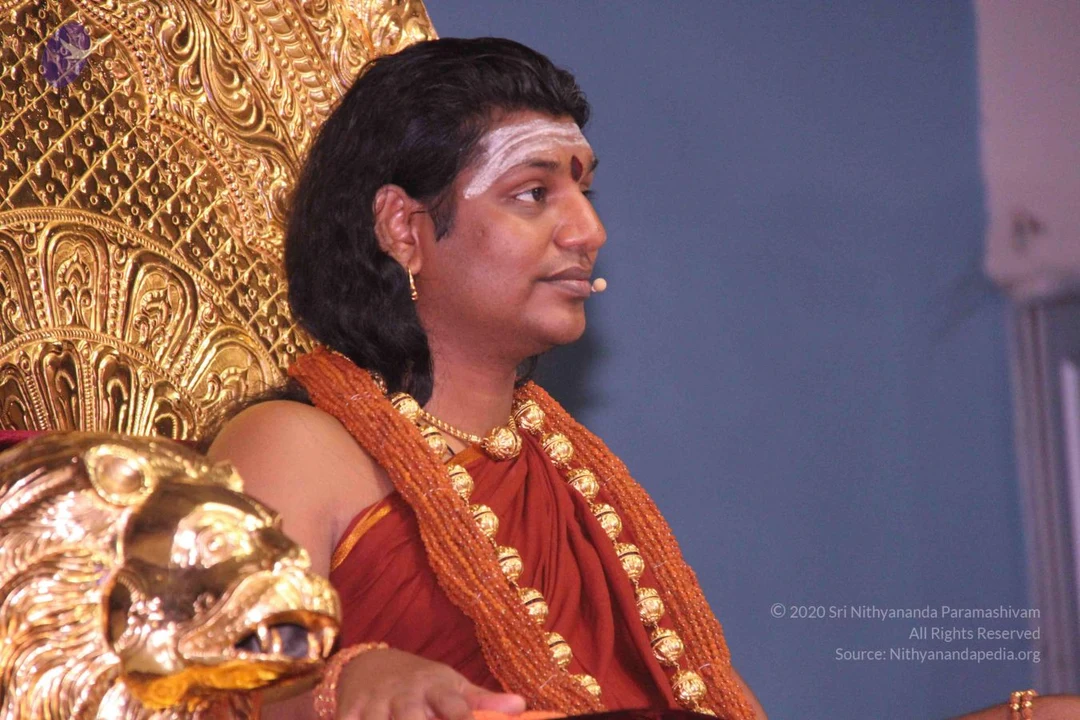
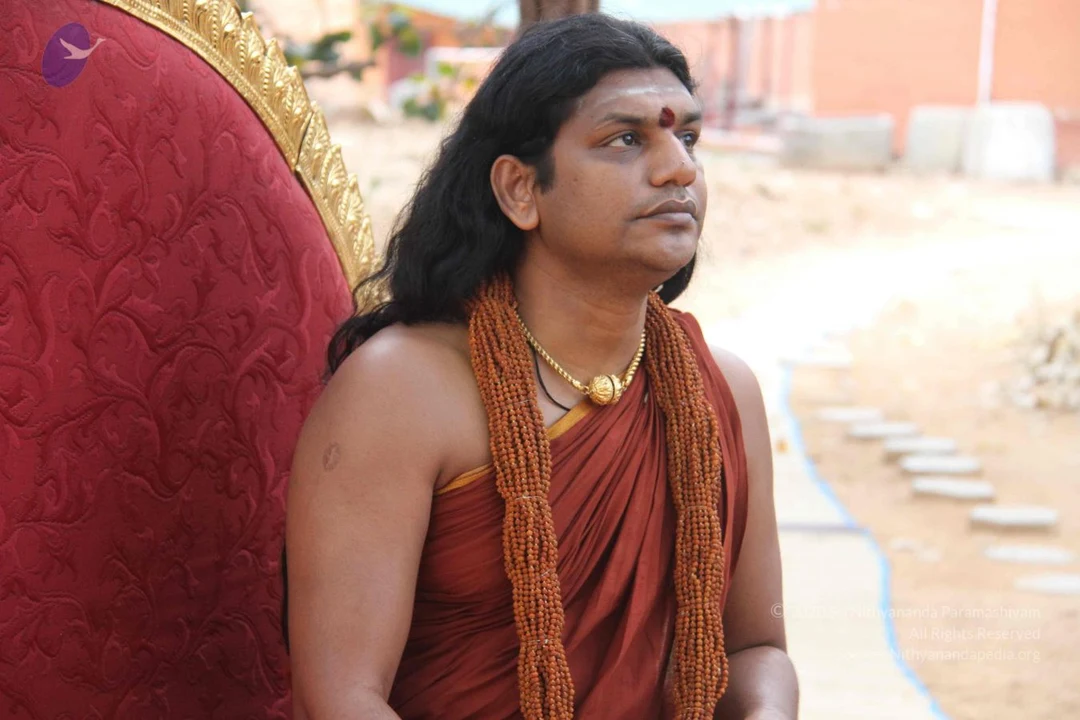
Outdoor satsang in a garden setting with dry earth, trees and a red-and-white ornamental arch framing a dark deity murti. A figure seated on a red and gold throne-like chair with orange drapery sits at the centre of the platform beneath the murti. Around them, about two dozen people sit cross-legged on woven mats in white clothes with red and orange shawls and sashes, with several women in white and a few seated in chairs at the edges. Some hold water bottles, a purple bottle sits on the mat, and an audience member in the foreground wears an orange-tinged shawl. A figure at the edge wears a blue and white top and red sash.Outdoor satsang in a shaded garden with bare earth and trees. Many devotees in white clothes with red or orange shawls sit on mats and folding chairs facing a red-cushioned throne in front of a green shrine arch holding a deity murti. A woman in orange sits on the throne. On the right, a person in orange robes stands. Water bottles sit among the audience, and a man in white in the foreground has a grey beard.Outdoor satsang beneath a large banyan tree with many aerial roots. Dozens of seated devotees sit on mats and a low stone platform, many in white clothing with orange and red shawls and sashes, some wearing ID lanyards. A woman in the foreground wears a patterned blue and grey dress and sits with eyes closed. On the right, a figure with long dark hair and a bare upper body sits on a red upholstered throne with gold legs, facing the crowd, wearing orange cloth. A stone well-like ring surrounds the trunk in front. Water bottles and a small bag sit on the ground among the attendees.A photograph of a seated group meditation or satsang with many people sitting cross-legged on woven mats outdoors, eyes closed. Most wear white kurta-style or white T-shirt clothing with red or maroon shawls and orange lanyards with name badges. A bald man in front centre has a small red mark on his forehead and sits with hands resting on his lap. A man on the right wears a white T-shirt, orange lanyard and wristwatch, with eyes lowered. Background shows dry earth, a stone wall and a white structure. No one at the front is identified as a person.Outdoor meditation session where many devotees sit cross-legged with eyes closed on woven mats over dry ground. Most wear white kurta-style or white T-shirt clothing with red or maroon shawls draped over shoulders, and several wear orange lanyards with name badges. A bald man with a red tilak mark sits in the center-right, and a man in the foreground with a gold bracelet has hands folded. No teacher is visible in the frame; the seated participants are the subject.A photograph of a man seated beside an ornate red upholstered chair with gold trim, wearing a rust-orange draped garment bare over one shoulder, multiple strands of rudraksha beads, a gold pendant necklace and a red bindi with a vertical white forehead mark. He has long dark hair and looks off to the side. Behind him are a paved path with stepping stones and a red wall in a sandy outdoor setting. Appearance-based label: Swamiji (probable), seated in person, based on the long hair, rudraksha malas and saffron-orange garment.

Puja

14 photosSource gallery
A dim, hazy dusk or dawn sky filled with dark brown and orange tones. A bright yellow-orange sun sits near the centre, glowing with a soft halo of red-orange light. No people, objects or ritual elements are visible. A small purple logo with a white bird appears in the upper-left corner, and a faint copyright notice sits in the lower right.A hazy orange sunset over flat open ground in a rural setting. A round glowing sun sits low in a dusty orange sky, with dark silhouettes of trees on the left and right, a thatched or tiled roof edge on the right, and a wooden post in the foreground. No people, ritual objects or a person are visible.Close-up photograph of a single bright yellow trumpet-shaped flower with five broad petals and an orange-brown throat, growing on a shrub among dark green lanceolate leaves. Two small unopened buds sit beside the bloom, with a blurred dark green background. No people are present.Close-up photograph of a cluster of lantana flowers on a green stem, with blossoms shading from yellow and orange at the top to pink and magenta below. Serrated green leaves frame the frame, and the background is a soft golden sunset bokeh. No people are visible.A tall golden ornamental pole with tiered wooden or brass ledges, pointed finials, hanging bells and a red cloth streamer stands against a pale blue dusk sky with a crescent moon at right. Palm fronds frame the lower left. No people are visible; the pole resembles a ritual flag or ratha-style standard.Two gilded metal murti statues stand before a golden orange draped backdrop with a floral pattern. The figure on the left wears a red turban with a silver ornament, a crescent-topped crown, a dark blue garment, layered silver and beaded necklaces, and holds a trident in one raised hand. The figure on the right wears an ornate jewelled crown in green, red and gold, a deep blue sari, pink and silver garlands, and holds a small green parrot perched on a raised hand. Both have red lips and kumkum-style markings. No physical people are present.

Banyan-Tree-Session

7 photosSource gallery
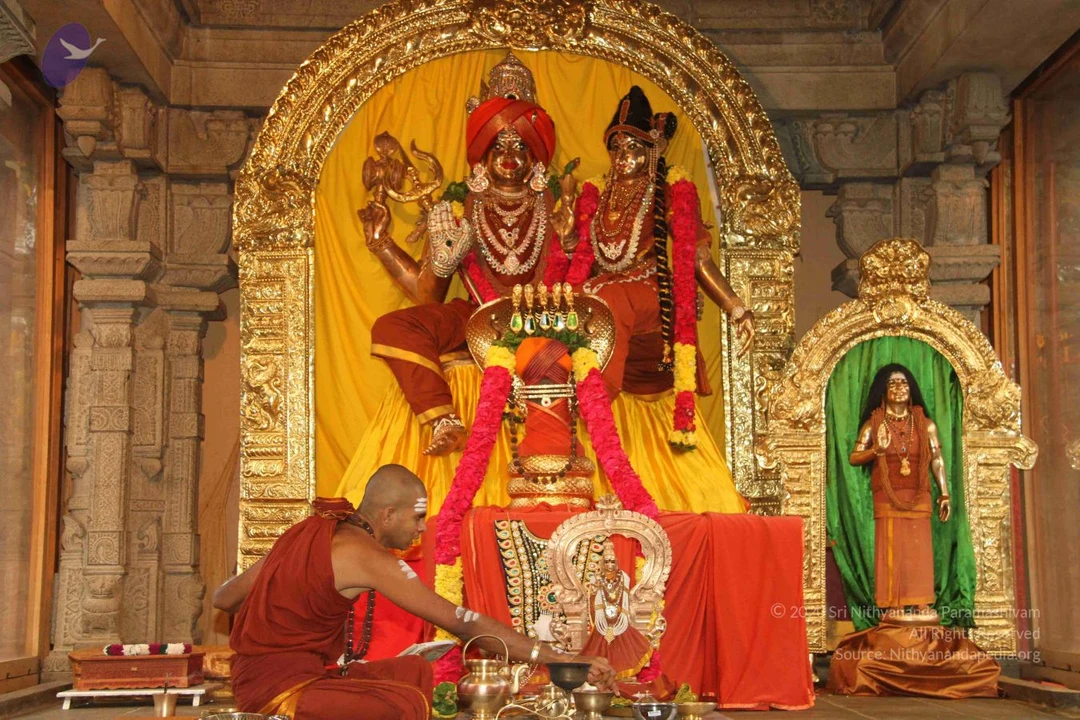
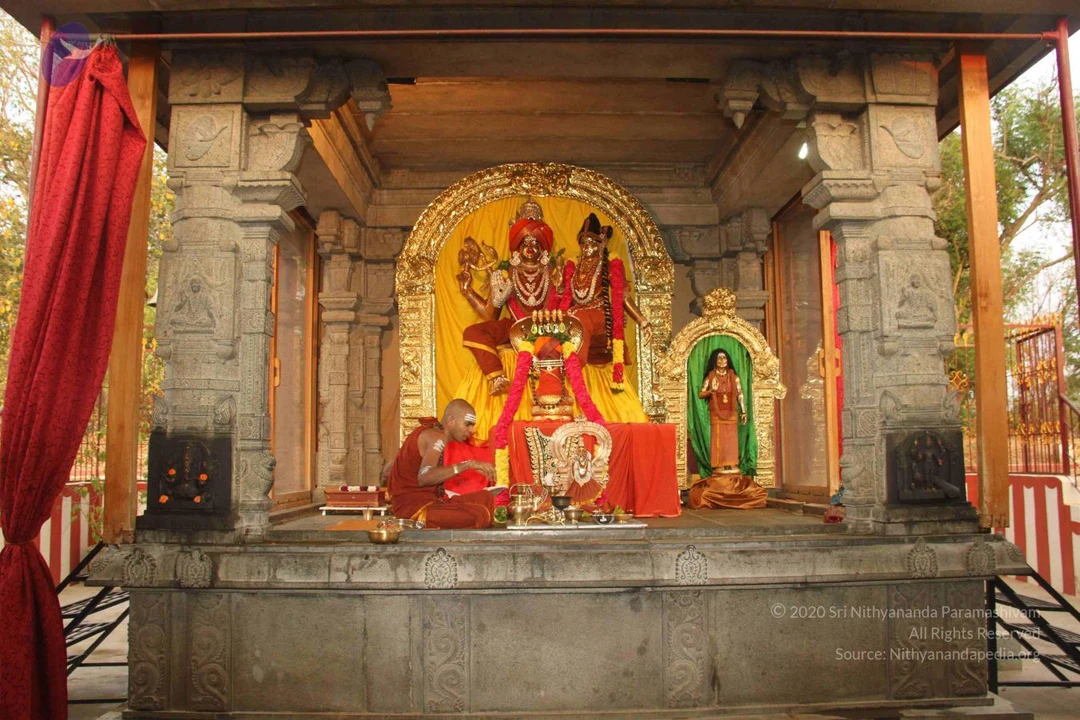
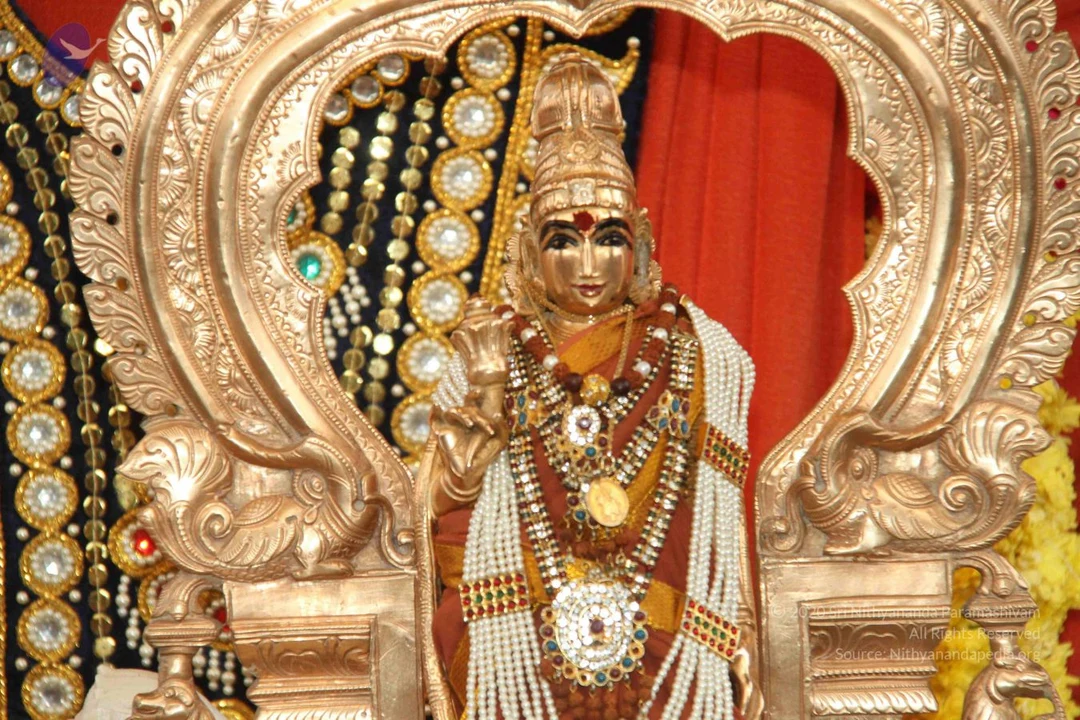
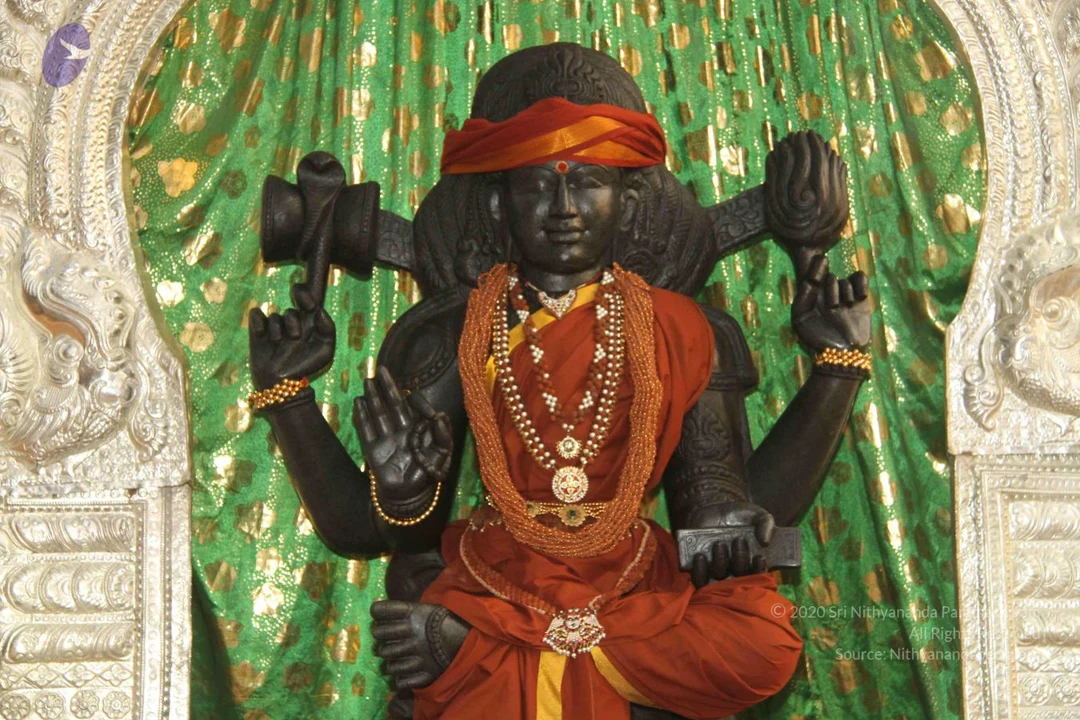
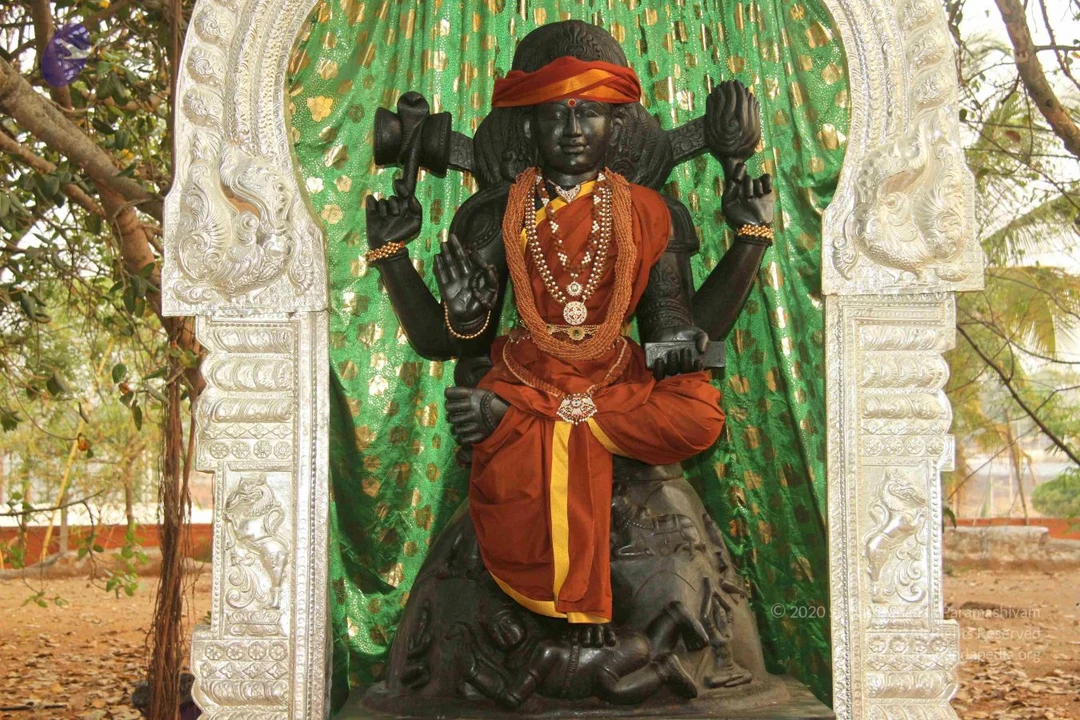
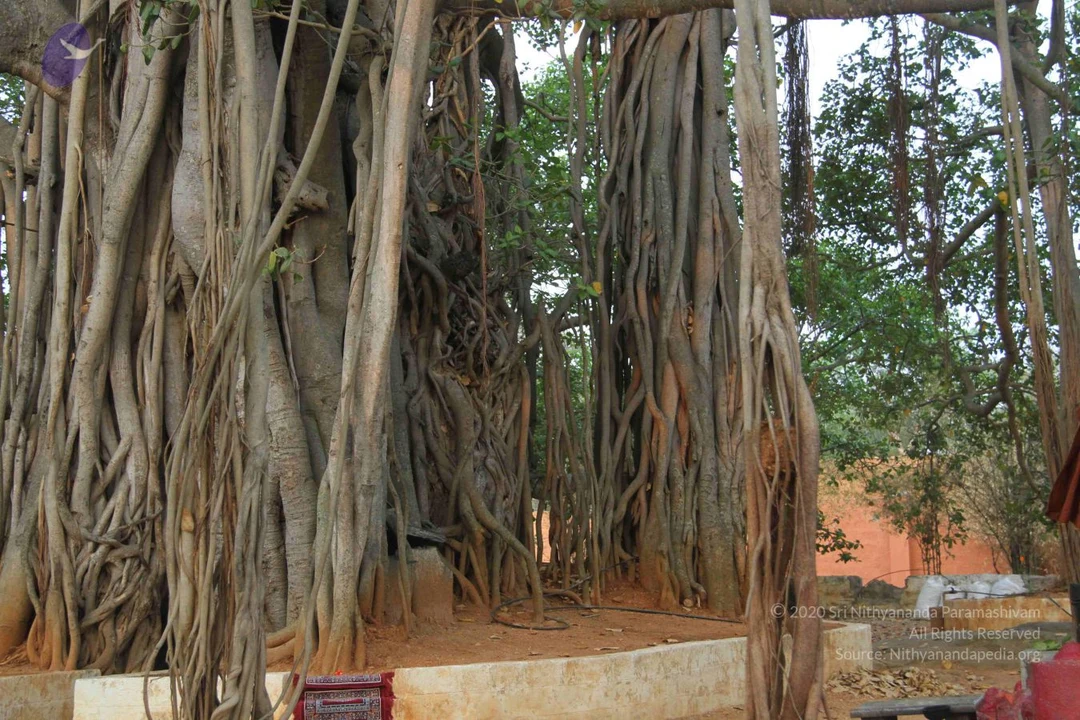
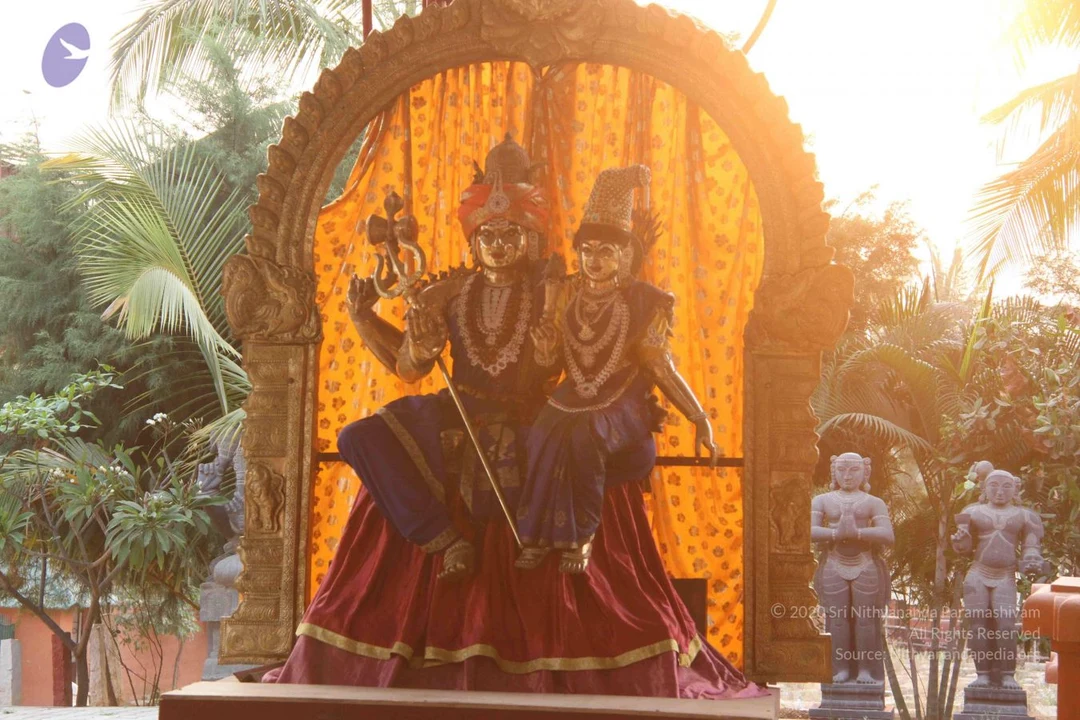
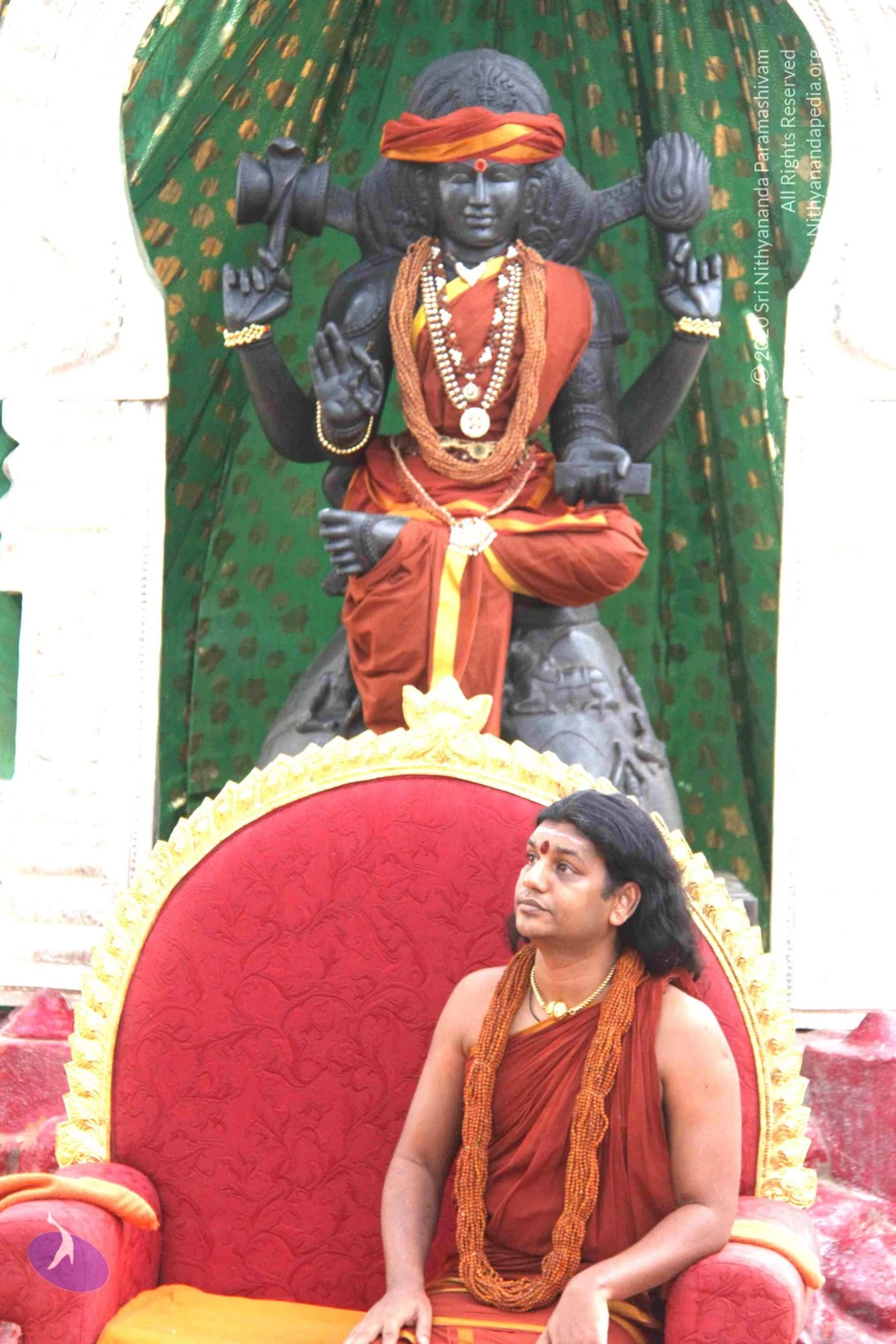
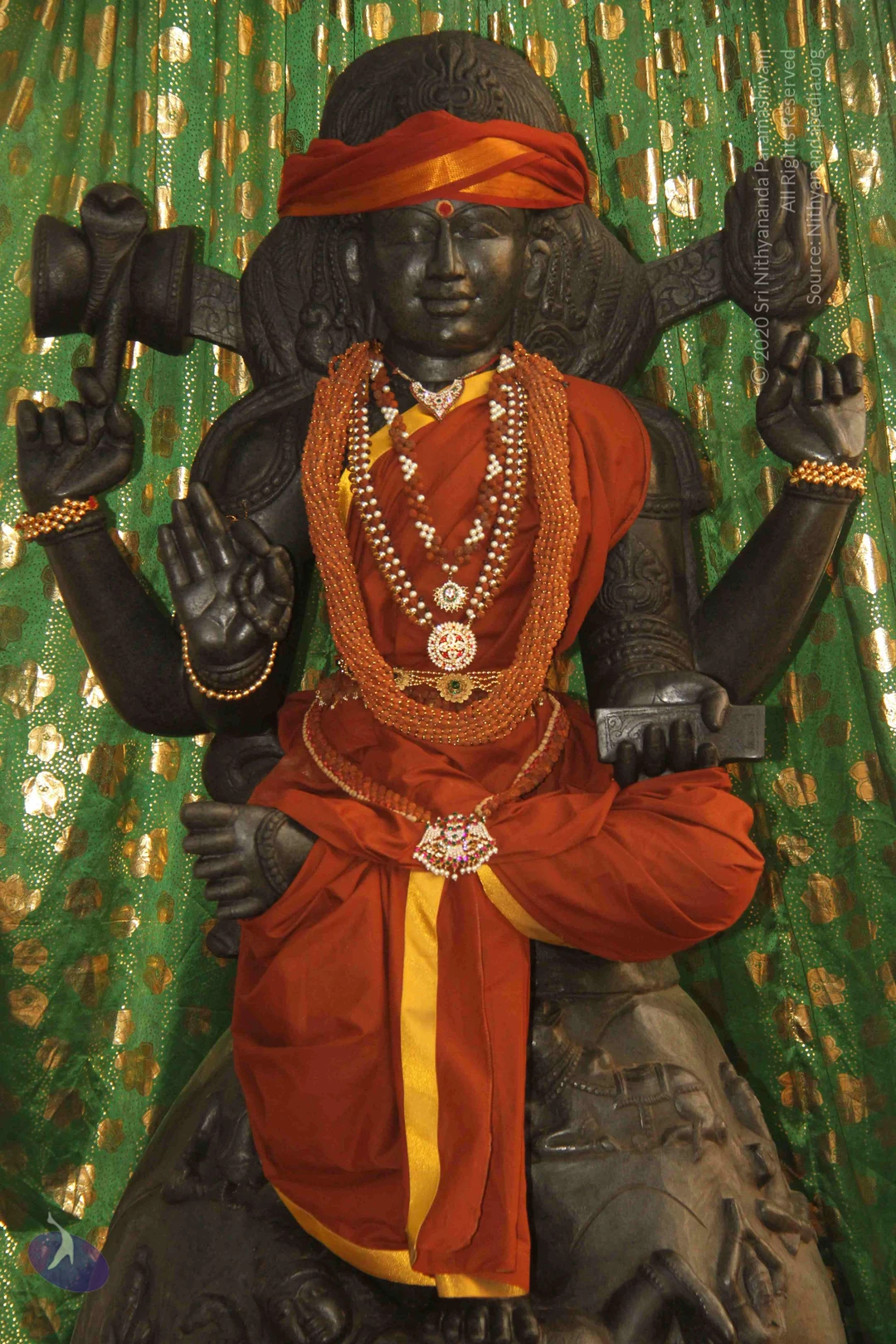
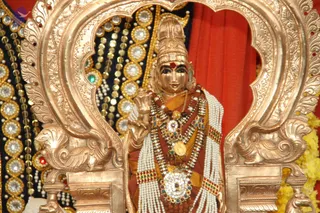
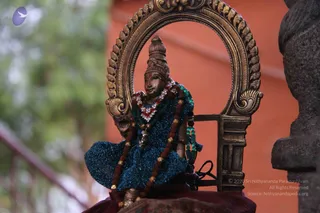
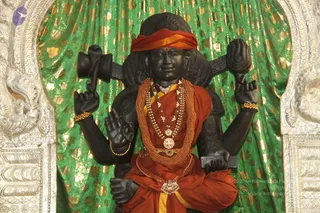
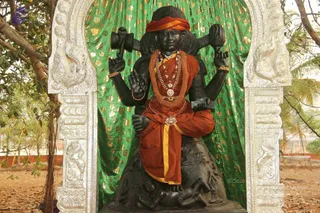
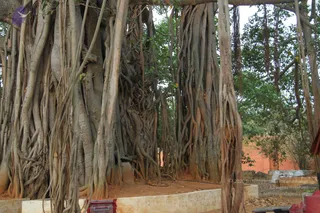
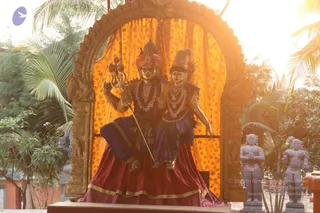
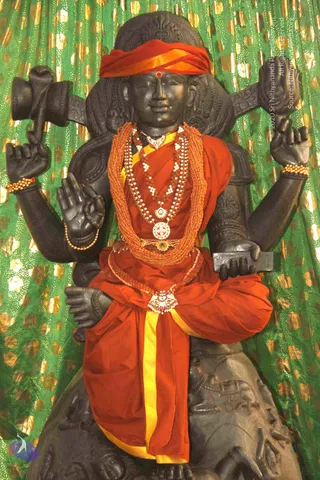
A gilded metal statue of a deity stands in an ornate golden throne with peacock and scroll carvings. The murti wears a tall crown, red tilak on the forehead, and a red and gold garment. Layered necklaces of pearls, gemstones and a large pendant hang on the chest, with pearl strands draped over the shoulders. One hand is raised in blessing. Behind it hang gold-bead and sequin garlands on a dark backdrop with red drapery. No living people are visible.A small brass deity murti seated within an ornate golden arched frame on a red cushioned base, set against an orange wall with a blurred green tree background. The figure wears a shimmering teal sari, a red and white necklace, a rudraksha-style bead garland and a tall crown, with a teal beaded strand hanging at the side. A grey stone figure is partly visible at the right edge. No people are present.A black stone deity murti with four arms seated in a silver-framed shrine niche against a green cloth with gold motifs. The figure wears an orange-red sash and dhoti with a red-and-gold headwrap, a red tilak on the forehead, layered pearl and bead necklaces, a gold pendant, and gold bangles. It holds a damaru-like drum, a trident-like staff and other ritual objects.A dark stone murti of a four-armed deity stands in a silver-framed arched niche against a green fabric backdrop with gold spots. The figure wears a red and orange cloth with a yellow sash, a red head wrap with a tilak, layered beaded necklaces, a rudraksha-style mala and a jeweled belt, and holds ceremonial objects in its hands. Its base rests on a rocky mound. Trees and open ground surround the shrine outdoors.A photograph of a large banyan tree with many hanging aerial roots and thick trunks forming a dense canopy over a raised white-edged platform. The ground is bare reddish earth with a small rug or cloth at the lower left edge. An orange-painted wall and green foliage are visible in the background. No people are present.A photograph of a golden-toned statue group of Shiva and Parvati seated together on a raised platform in an outdoor garden setting. The male figure holds a trident and wears a red and gold turban-like crown and layered garlands; the female figure wears a tall decorated crown, a blue garment and necklaces. Behind them is a carved arch framed by a bright yellow patterned fabric, with palm trees and flowering shrubs around. Grey stone guardian statues stand on either side. Sunlight glows through the scene. No physical people are present.

Satsang-morning

34 photosSource gallery
A young woman with long wavy light-brown hair sits cross-legged on the floor, wearing a white cotton kurta and layered dark wooden rudraksha-style mala necklaces. She holds a lit incense stick in her right hand and a green notebook rests on her lap over a yellow printed cloth with Om symbols. Behind her, other seated attendees in white and floral clothing are visible. A purple logo appears at lower left. No identifiable a person figure is visible in this frame.A man seated in front of an ornate gold carved throne with eyes closed and palms pressed together in anjali mudra. He has long dark hair swept back, a white vertical tilak with a red bindi on the forehead, and a small gold earring. He wears a saffron-red shawl over the shoulders, a thick orange rudraksha mala with gold bead ornaments, and matching orange rudraksha bracelets on the wrists. Dark red drapery is behind him. Appearance-based probable Swamiji (probable): long swept-back hair, rudraksha malas and ceremonial gold necklaces in saffron clothing, seated on a gold throne, offering prayer.A seated man in saffron-orange robes sits cross-legged on an ornate gilded throne with carved arch back and golden lion figures at each side, draped with a striped tiger-skin cloth. He holds his hands in anjali mudra at his chest with eyes closed, wearing a white vertical tilak with a red dot on the forehead, a red-orange shawl, a rudraksha-style beaded mala and ceremonial gold necklaces, and gold bracelets. Deep maroon velvet curtains hang behind the throne. A tall dark-haired figure with long swept-back hair and a distinctive ornate ensemble is visible, a compatible presentation for a person, seated in a throne-presiding role.A seated man in orange-red ochre robes sits cross-legged on a tiger-skin covered platform before an ornate gold arched throne with a dark maroon velvet backdrop. He has long dark hair, a white-and-red forehead mark, gold hoop earrings, and a wired headset microphone. His palms are pressed together in namaste with eyes closed. He wears a thick orange rudraksha-style mala and multiple gold beaded necklaces, with gold bangles on both wrists. Swamiji (probable): the qualifying cues are the long swept-back hair, saffron-orange robes, ornate gold necklaces and rudraksha mala. Visible setting is a stage satsang-style seat with a gold throne.A seated man in an ornate gilded throne with lion figures and a tiger-skin cushion, palms pressed together in namaste with eyes closed. He wears orange-red robes, a multi-strand rudraksha-style bead necklace with gold beads, gold bangles and gold hoop earrings, a white forehead mark with a red bindi, and a headset microphone. Dark velvet drapes form the backdrop. Probable Swamiji cues: long swept-back dark hair, saffron-orange robes, rudraksha mala and ceremonial gold necklaces, seated on a golden peetha throne.A man seated on a crimson velvet throne in front of an ornate gold repoussé backdrop, palms pressed together in namaste. He wears a rust-red robe over bare shoulders, long orange-red rudraksha malas, heavy gold bead necklaces and gold bangles, with a white tilak and red bindu on his forehead, gold hoop earrings and a small clip-on microphone at his cheek. Appearance-based candidate, probable Swamiji, seated as the speaker in a satsang setting with long swept-back hair, ornate gold, orange rudraksha and gold bead necklace cues.

Energy-Darshan
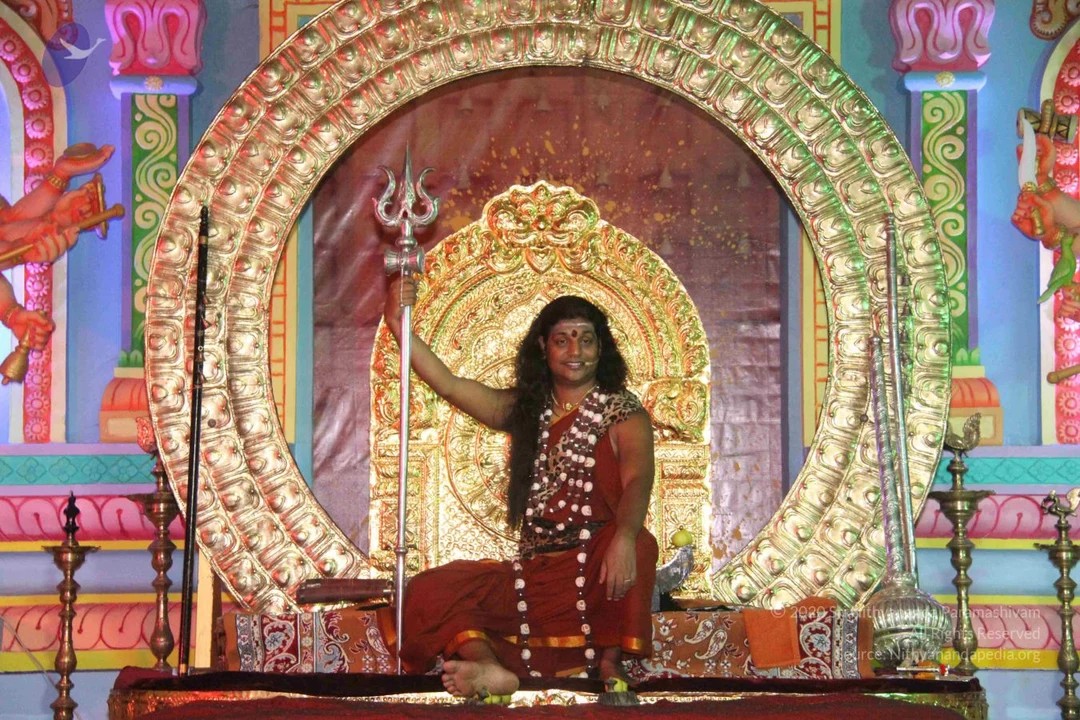
4 photosSource gallery
A woman stands in profile on a stage with a pale floor and a deep plum velvet curtain behind her, wearing a rust-red sleeveless garment with gold bands at the hem and waist. She wears long yellow and white marigold garlands with red flower accents draped over her shoulders and down to her feet, a white vertical forehead mark, and a silver-toned waist ornament. She stands barefoot on a patterned mat, with long dark hair falling down her back. A wall-mounted air conditioner is visible at upper left and a clear acrylic stand at left.A smiling person with long dark hair and a red bindi stands barefoot on a small patterned rug on a light stage, arms extended to the side. They wear a rust-red dhoti-style garment with gold borders and a long yellow and white marigold garland with red flowers draped over the shoulders. A maroon velvet curtain and a wall-mounted air conditioner form the backdrop. The photo appears to show a satsang setting, with the rug marking a speaking or performance spot.A man stands barefoot on a small woven rug on a light stage floor, arms raised high with palms open, smiling broadly. He wears a deep red-orange robe with a gold-edged border and a long, heavy yellow marigold garland with white and red flower accents draped over his shoulders and down to his feet. A dark burgundy velvet curtain hangs behind him, and a wall-mounted air conditioner is visible at the left edge. A yellow-and-maroon ceremonial stage setting frames the moment.A photograph of a single person standing barefoot on a small patterned rug on a light stage floor, arms raised overhead with palms open, smiling. He wears a long yellow marigold garland with a white flower garland at the chest and red-and-green accents, and an orange-red dhoti-style garment with gold borders. A dark maroon velvet curtain hangs behind him and a wall air conditioner is visible at upper left. The swami-like presentation with garlands and saffron-red clothing is a probable match to the page's a person, so this is an appearance-based candidate standing on stage.

Pada-Puja

12 photosSource gallery
A group of young and adult devotees in saffron-orange dhotis with maroon borders stand with palms pressed together in namaste during a ritual gathering indoors. The central young man wears a rudraksha mala and a white horizontal forehead band, and a small boy beside him wears a white forehead band and holds a small bell. Other boys and men, some with white tilaka bands and beaded malas, stand behind them, and a few men in white dhotis and maroon shawls are visible at the back. Brass lamps, a plate and small offerings sit on a mat on the floor at the lower right. Behind the group hang orange and patterned cloth banners.A group of devotees in a hall performs a ritual with palms pressed together in namaste. Foreground: a young man in orange saffron dress with maroon borders, rudraksha mala, white tilak on forehead and arms, hands in anjali, gazing upward. Beside him, a boy in orange with white forehead marks stands with hands folded. A small boy in orange holds a brass bell and sits near brass puja vessels, a kalasha-like lamp and offerings on the floor mat. Behind, men in orange and maroon garments and white dhotis, some with garlands and tilak, stand or sit in rows. A hanging orange-and-patterned textile decorates the wall. No a person candidate is clearly identifiable by appearance, so the role is given as devotees and priests.Photograph of a young boy with a shaved head, white vertical tilak on his forehead and a small red dot, dressed in orange cloth with maroon-edged borders and a maroon velvet waist sash. He holds a small brass handbell in his right hand and stands with a serious expression. Behind him, other orange-robed people stand with palms pressed together in namaste.A young boy with a shaved head and a broad white vertical tilak with a red dot on his forehead stands facing the camera. He wears a draped orange cloth over his shoulder and bare torso, tied with a maroon-edged orange sash at the waist, and holds a small brass handbell in his right hand. Another child with a white forehead mark is partially visible at the right edge, and an orange-clothed figure appears in the blurred background. The setting appears to be a temple or ashram interior.Photo of a large hall with a draped grey ceiling where many seated devotees sit on red mats facing a stage. Most men wear white dhotis and white shirts with orange or saffron shawls, and some wear saffron robes. Yellow and red cloth hangs from the ceiling beside decorated pillars. On the stage, a painted backdrop shows two standing deity murtis flanking a central doorway, with an oil lamp display in front. A projection screen shows a small image and a cameraman films from a tripod. Seated people in the foreground carry bags and bottles, and a small framed picture rests on a mat.Close-up photograph of a young boy with eyes closed in meditation, wearing an orange cloth draped over one shoulder with maroon stripes and a white sacred ash (vibhuti) horizontal mark across his forehead with a small red kumkum dot between the brows. Behind him, other people in orange and maroon robes are seated.

Inner-Awakening-Session-Akashic-Readings-KalaBhairavaDarshan
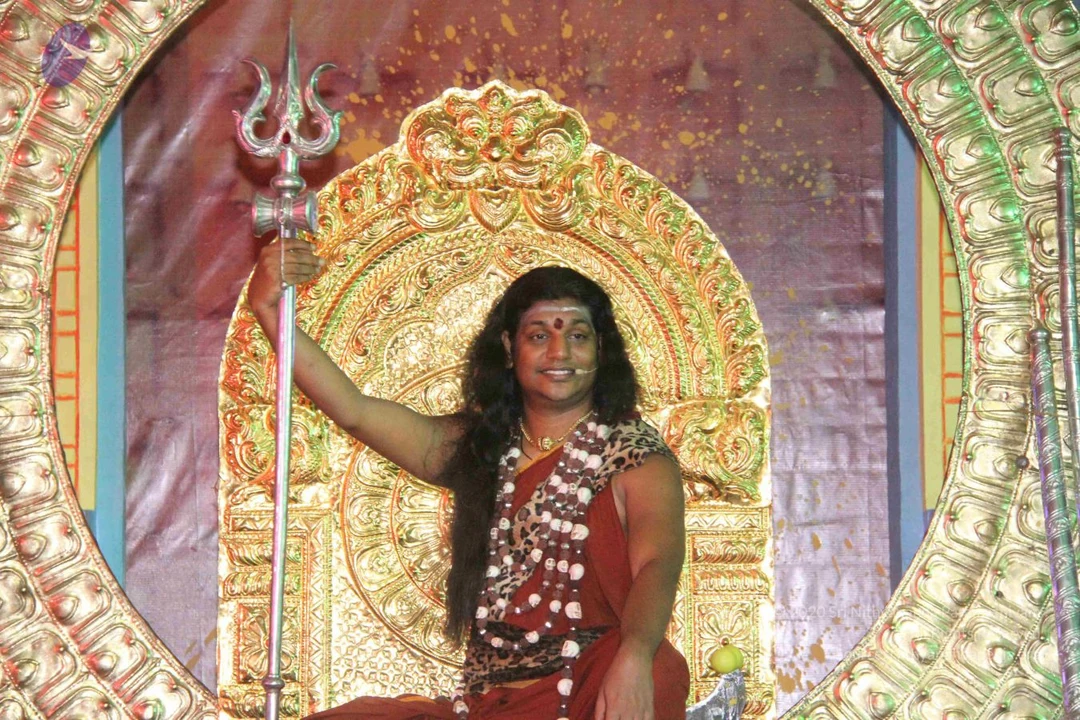
34 photosSource gallery
A photograph of a long-haired man with eyes closed and mouth open mid-speech, wearing a head microphone, seated before an ornate gold-and-green embossed backdrop. He wears a brown dhoti-style garment with a leopard-print shawl across the chest, multiple strands of rudraksha and white skull-shaped beads, a gold chain, and a white horizontal tilak with a red bindi on his forehead. One arm extends to the right while the other rests on his knee. Only one person is visible; a green object appears at the lower right.A man sits cross-legged on an ornate golden throne with a tall gilded arched backrest, eyes closed and mouth open as if speaking, a small headset microphone at his cheek. He wears a brown dhoti-style wrap with a gold-and-red border, a leopard-print shawl over one shoulder, and multiple strands of rudraksha-like beads with white skull-shaped beads, plus a gold necklace. A red bindi and white vertical tilak mark his forehead, and long dark hair falls past his shoulders. He holds a polished silver trident upright in his right hand. Stage setting with red carpeted platform, paisley cushion and a green ball beside the throne. Appearance-based label: a person, seated in a teaching role.A seated man in a red dhoti and orange-red garment sits cross-legged on a red cushioned dais inside an ornate golden arched throne frame. He wears a rudraksha mala and a white-and-red beaded necklace, with a tilak on his forehead, and holds a silver trident staff upright beside him. Flanking him are two large painted deity statues with red-orange skin, flaming headdresses, multiple arms holding weapons and gold ornaments, set on white pedestals. Brass oil lamps stand on the glossy floor, and the blue, pink and green painted hall is decorated with garlands and ornate pillars.A seated man in red and cream leopard-print robes sits before an ornate gold throne-like backdrop, holding a polished silver trident upright in his right hand. He wears layered rudraksha and white bead malas, a gold chain at the neck, and a white forehead band with a red bindi, with long dark hair framing his face and a small headset microphone near his mouth. A vermilion-coloured draped cloth lies on the lower right beside a patterned rug. The setting suggests a satsang stage. Based on his appearance, including long swept hair, rudraksha malas, ceremonial gold necklace and red robes, this is.A smiling person with long dark hair stands on a stage before ornate gold and green carved panels and a multicoloured backdrop. They wear a white horizontal tilak with a red dot on the forehead, a red-orange draped garment, a leopard-print shawl over one shoulder, a gold chain with a red pendant, and several long strands of rudraksha beads interspersed with white skull-shaped beads. A small headset microphone is clipped near the mouth, and one arm is extended outward. The appearance is consistent with the a person candidate described on the page, with long swept hair, saffron-toned clothing and rudraksha malas, though the identification is based on appearance cues only.A long-haired man sits on a red-draped platform in front of an ornate green and gold arched backdrop, smiling and holding a silver trident topped with a red gem. He wears rust-orange cloth, a leopard-print top, a thick rudraksha mala with white beads, a gold chain, and a white tilak with a red bindi. A large deity murti stands at the right edge.
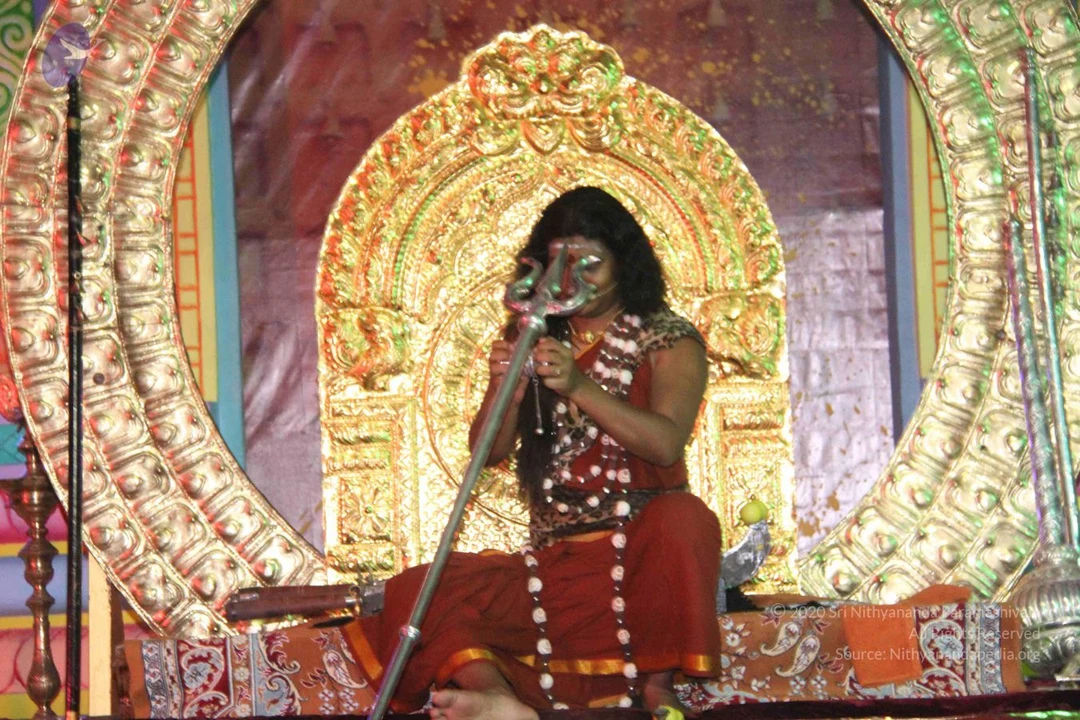
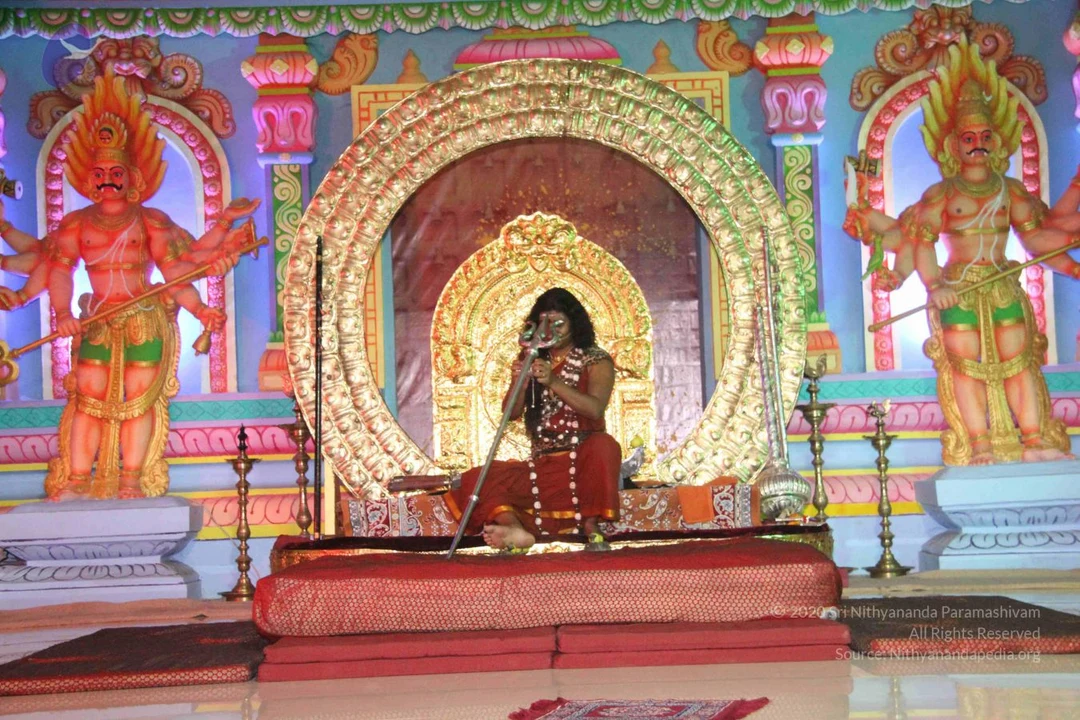
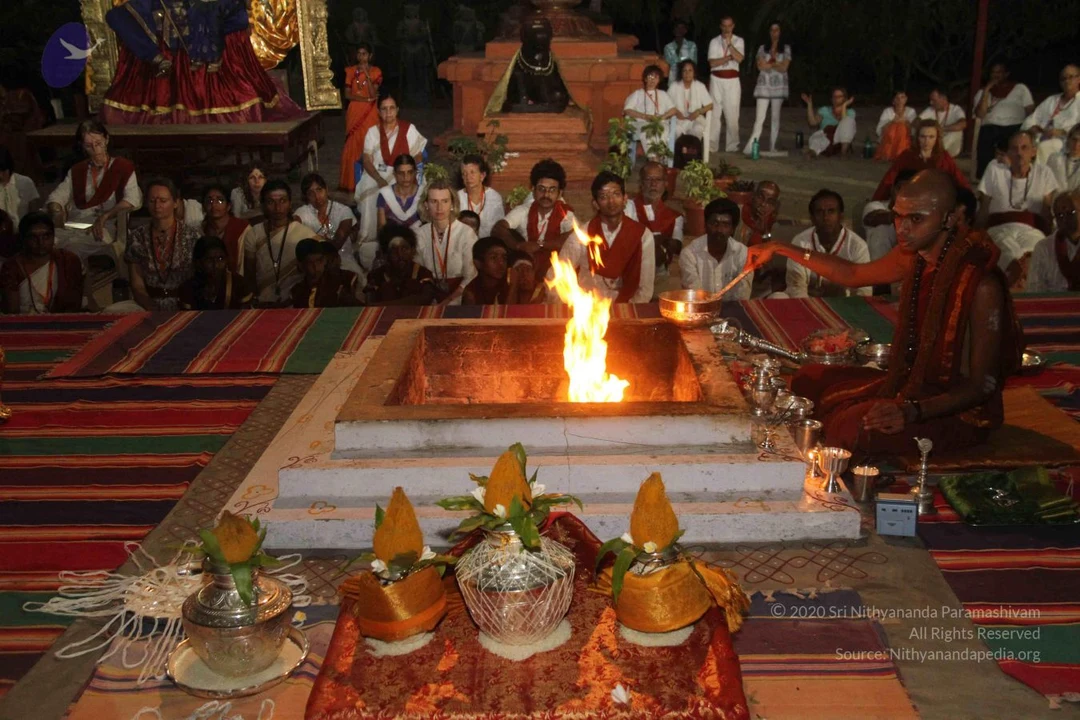
Gayatri-Homa
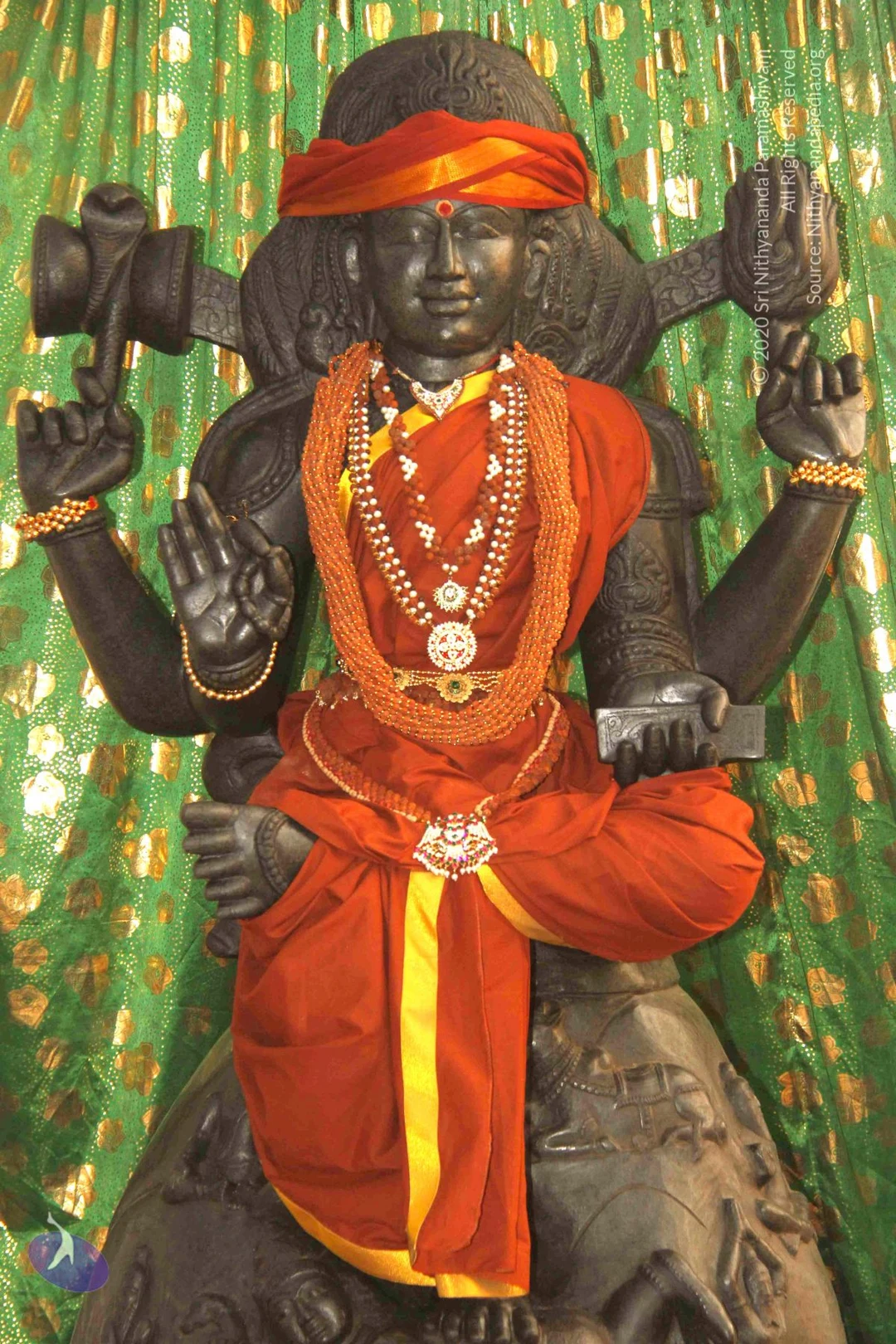
12 photosSource gallery
A dark stone statue of a four-armed deity figure seated in a meditative cross-legged pose against a green curtain with gold flower motifs. The figure wears an orange-red wrap with yellow borders, a red-and-gold turban with a red bindi, and layered orange and white beaded necklaces with a central gold-and-jewelled pendant. Its upper hands hold a trident-like staff and a hand-drum-like object, while lower hands rest in mudra. A carved base with animal reliefs supports the seat.A man with long swept-back dark hair and a red bindi sits on an ornate red upholstered throne with gold-edged back and armrests, wearing a rust-orange cloth wrap and multiple strands of orange rudraksha beads with a gold necklace. Behind him stands a dark grey stone deity murti with four arms, wearing an orange-and-yellow headband, orange garments, a bead and white-bead necklace, set against a green cloth backdrop with gold motifs. The seated man is visibly a sannyasi-style presence with distinctive rudraksha malas and long hair, matching the page's Swamiji label as a probable identification. Only one physical person is present.A seated man in orange-red robes sits on an ornate red upholstered throne with gold trim, wearing layered orange rudraksha-style beaded malas and a gold chain, with a red bindi on his forehead and long swept-back hair. Behind him stands a dark stone deity murti with multiple arms, wrapped in an orange-and-yellow headband and orange garments, against a green gold-patterned cloth backdrop. The man is the only physical person present. Cues consistent with a probable Swamiji depiction: long hair, saffron-orange clothing, multiple malas and a bindi, seated on a throne. Printed copyright text runs down the right edge.A seated man with long, swept-back black hair wears a rust-red saffron-toned shawl over a matching dhoti with a golden border, and a long multi-strand rudraksha mala hangs across his chest. He wears a gold chain necklace with a round gold pendant and a red kumkum mark on his forehead. He sits on a red upholstered chair with gold trim, looking to the side, with one hand resting near his lap. Appearance-based cues are consistent with the a person label, though identity is uncertain from appearance alone.A night homa at a brick fire pit with a tall bright flame rising from the centre. A bald man with a white tilak on his forehead, wearing an orange-saffron cloth draped over his body, a rudraksha mala and a beaded necklace, sits at the right side of the pit, hands extended over the fire with a ritual vessel nearby. Behind him a row of seated devotees wear white clothes and red shawls, some with orange scarves. Brass pots and a small bowl sit beside the fire on a cloth-covered platform. A small headset microphone is visible on the officiant's face.A photograph of an outdoor homa fire ceremony at dusk on a striped woven mat. A shaved-headed priest in orange-saffron robes and a saffron shawl sits at right, pouring an offering from a metal vessel toward a square stone fire pit with a bright flame. Brass and steel ritual vessels, a small bowl and lamps sit on the mat, and three orange-draped kalasha pots with green leaves and netting are arranged in front. Seated devotees in white and red shawls, with lanyards, watch from the background, some with hands folded. A deity mural and a seated statue are visible behind. Whether the priest is a person cannot be determined from appearance.

Puja

2 photosSource gallery
A gilded metal deity murti stands within an ornate copper-gold arched frame flanked by carved lion-like figures. The figure wears a tall crown, a red-brown skirt with a gold border, layered pearl and jewelled necklaces, a rudraksha mala, and a red-and-green jewelled armlet. Red and yellow flower garlands and a brass oil lamp surround the display.A gilded statue stands in a golden arched niche framed by a green silk backdrop. The figure has long dark hair, a red bindi and white forehead marks, and wears layered rudraksha malas, a multi-strand bead necklace with a gold pendant, and a thick rudraksha-bead torso garland over saffron-orange robes with a gold-bordered dhoti. The right hand is raised in blessing while the left hangs at the side. Ornate gold repoussé arches with carved floral and bird motifs surround the figure, and a saffron cloth drapes the base beneath the feet. The statue appears to be a depiction of a sannyasi figure.

INNER-AWAKEING-MARCH-2013
38 photosSource gallery
A group of men and boys in saffron and maroon robes stand with palms pressed together in a hall with a mat floor, during a devotional gathering. A young man in the centre wears a rudraksha mala and a white forehead mark, while younger boys beside him stand with hands folded and one holds a small brass bell. Behind them, others in white clothing and red shawls stand in prayer. Brass vessels, small bowls and puja items lie on the floor in front, and a striped hanging decorates the wall.A photograph of a young boy in orange and maroon robes sitting cross-legged with eyes closed and hands clasped in his lap, holding a small stick or flower between his fingers. A white sandalwood or vibhuti band marks his forehead with a red dot at the centre. Behind him, other boys in orange robes sit in meditation, and a few adults in white dhotis are seated with palms pressed together. A pink plastic container and brass items sit on the floor nearby.A dark stone murti of a four-armed deity seated in lotus-style pose on a carved rock base, set before a green fabric backdrop with gold floral print. The figure wears a red-and-gold turban, an orange-red dhoti with a gold border, layered strands of orange and white beaded necklaces, pearl garlands, a central jewelled medallion and gold bangles. Its hands hold a trident-like staff and other ritual objects.A young woman with long curly brown hair sits cross-legged on the floor in a white long-sleeved top, wearing multiple rudraksha mala necklaces and a gold pendant. She holds an incense stick in one hand and a green-covered booklet across her lap; her lap cloth is patterned with red and gold Om symbols. Behind her, other seated participants in floral and white clothing are visible, and a blurred background suggests an indoor satsang or meditation hall. A purple circular logo appears at lower left.A young boy with a shaved head and white-and-red forehead markings sits cross-legged in orange silk robes, holding a lit brass oil lamp aloft in his right hand and gazing upward. A dark rudraksha mala and a small pendant hang at his chest. Behind him, a second brass lamp burns beside another seated person in orange. Draped grey fabric and painted cylindrical pillars with colourful patterns frame the tent, and brass vessels and a garlanded bundle sit in the foreground.Close-up photo of a young boy with a shaved head and a white horizontal band of sacred ash across his forehead with a red kumkum dot between the brows. His eyes are closed in meditation. He wears an orange saffron-coloured cloth draped over one shoulder with a red satin border, and a strand of brown rudraksha beads with silver spacers around his neck. The blurred background suggests an indoor gathering. No identifiable a person candidate is visible; the boy is a young sannyasi-style devotee.