Skip to content
Thursday

6 September 2012

Break Free OF Collective Myths

Dated photos
526
Source pages
1
Media
3
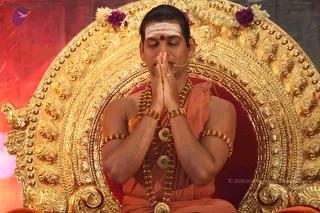
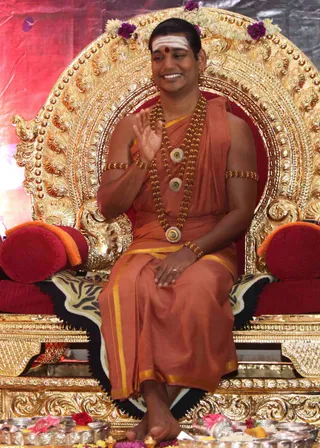
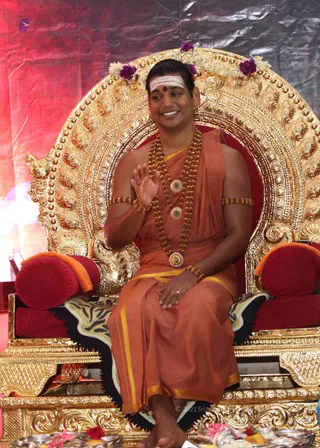
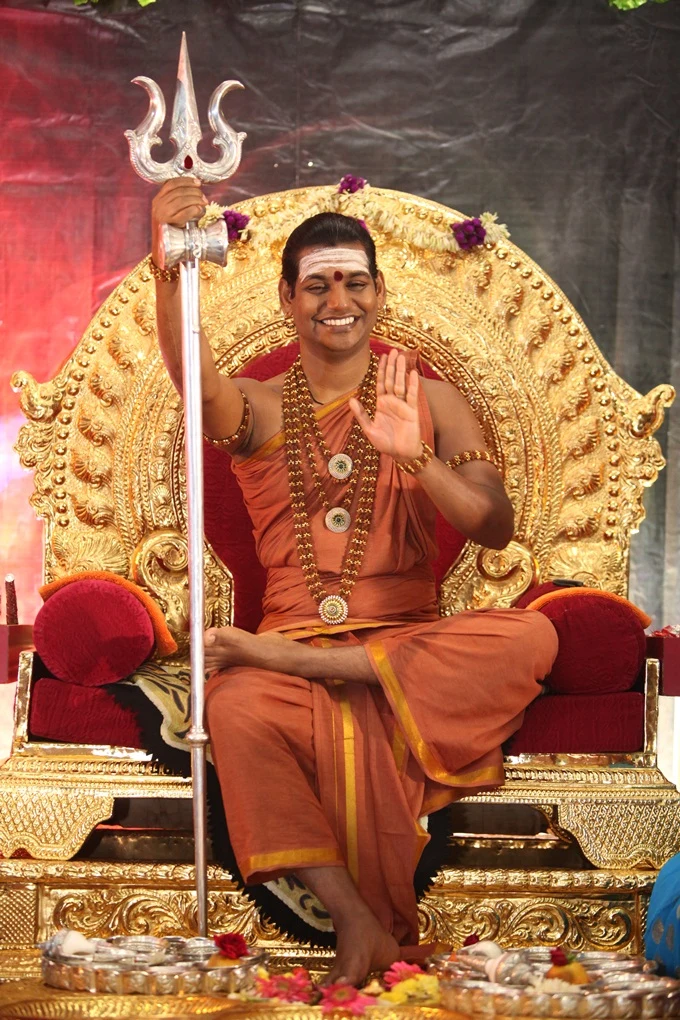
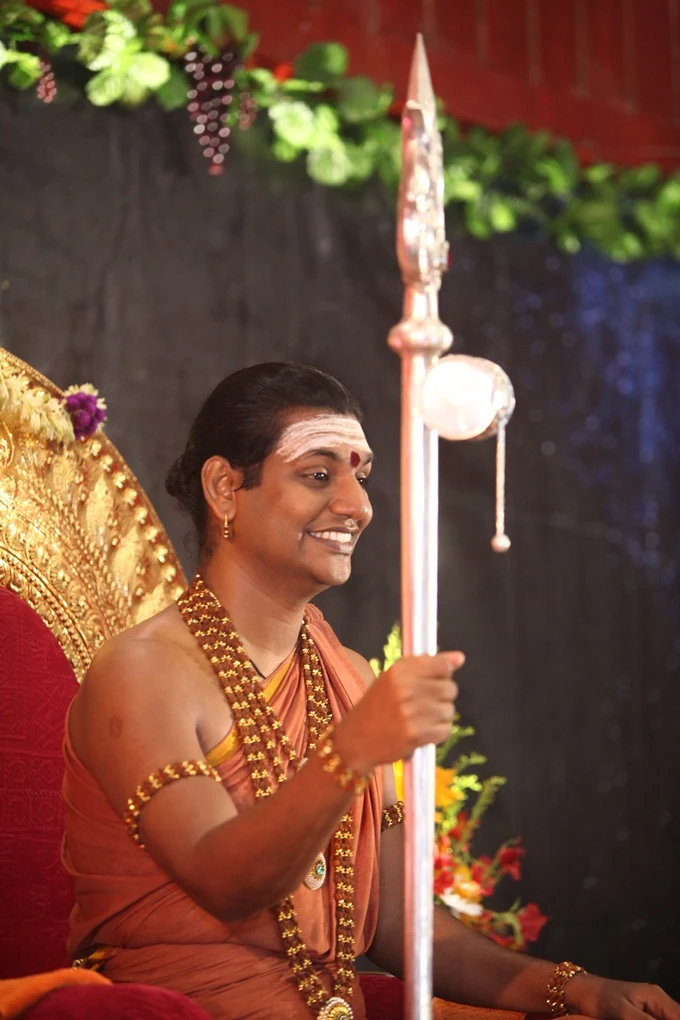
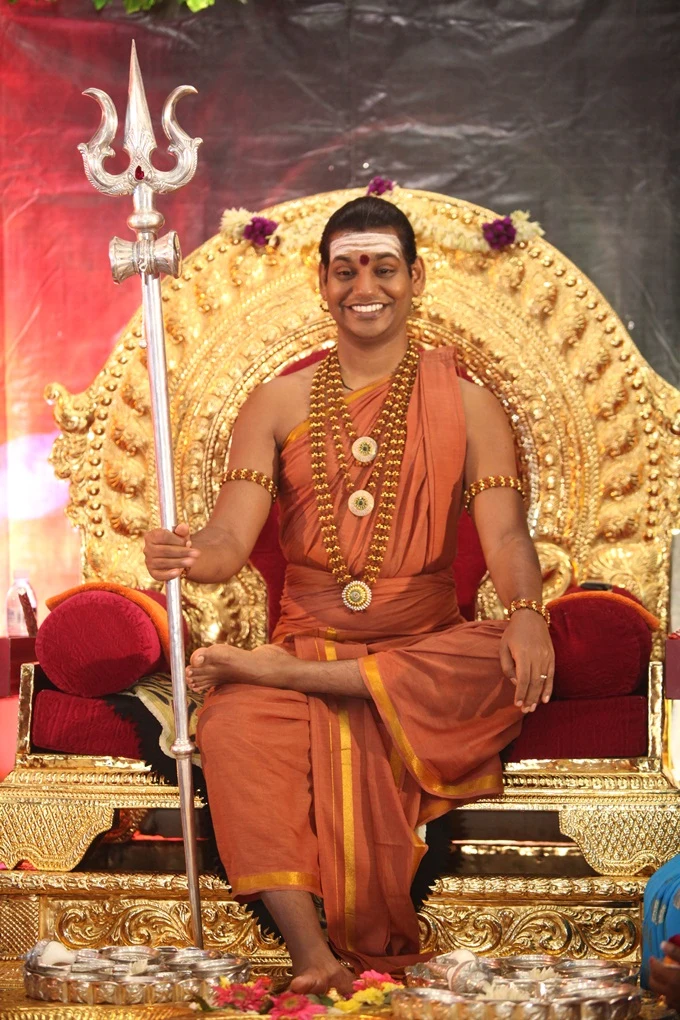
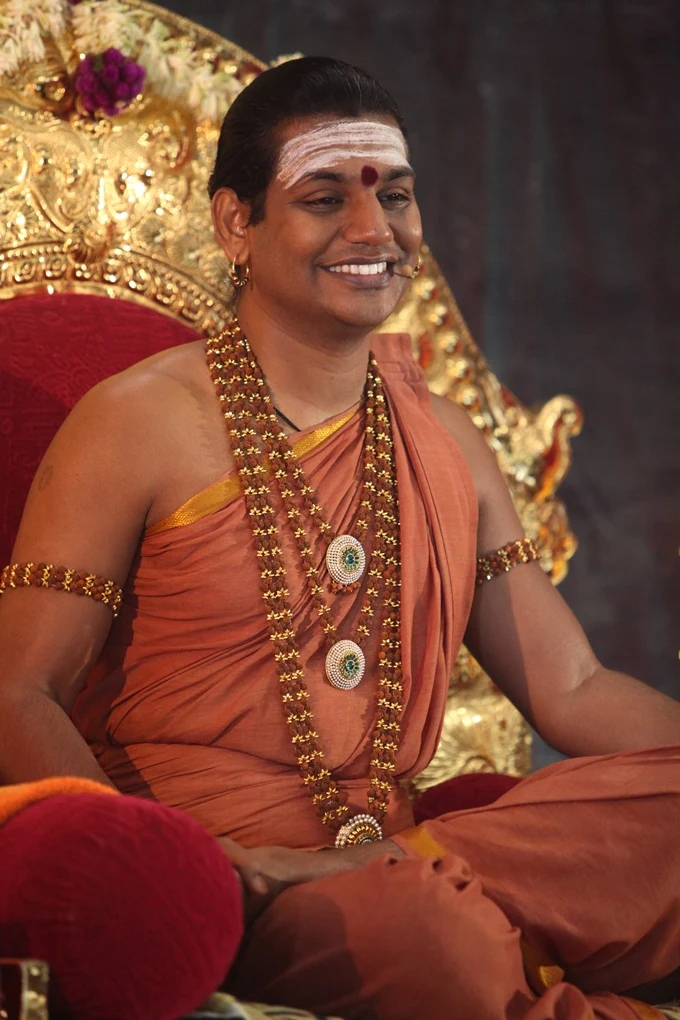
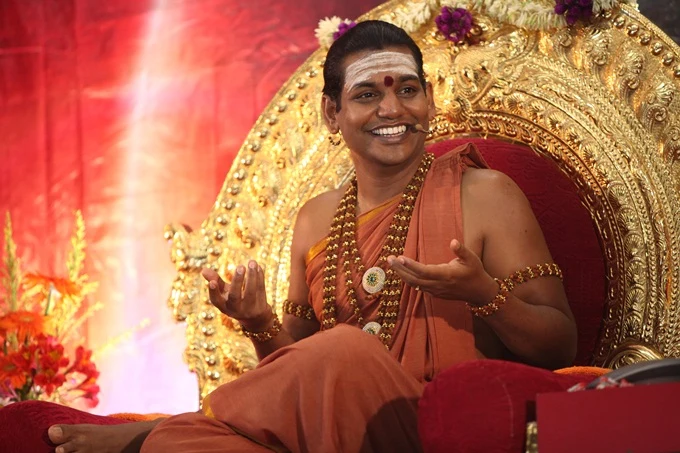
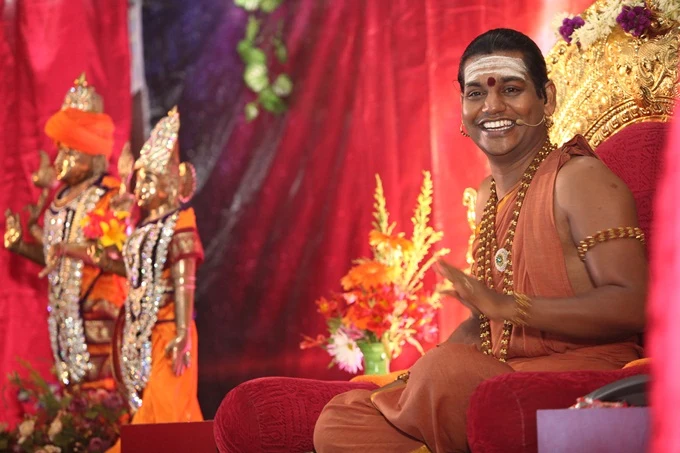
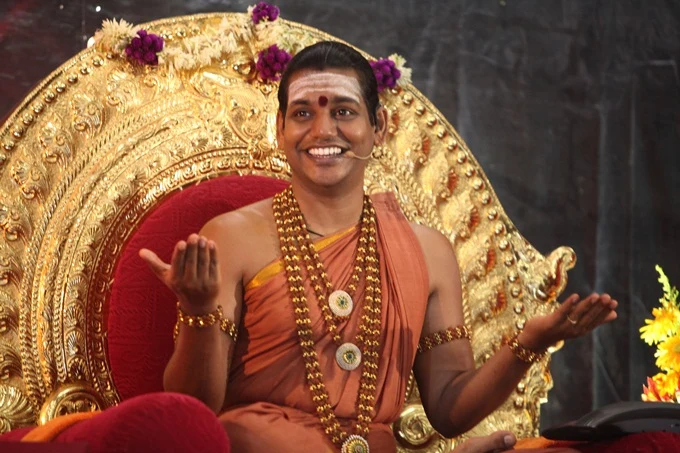
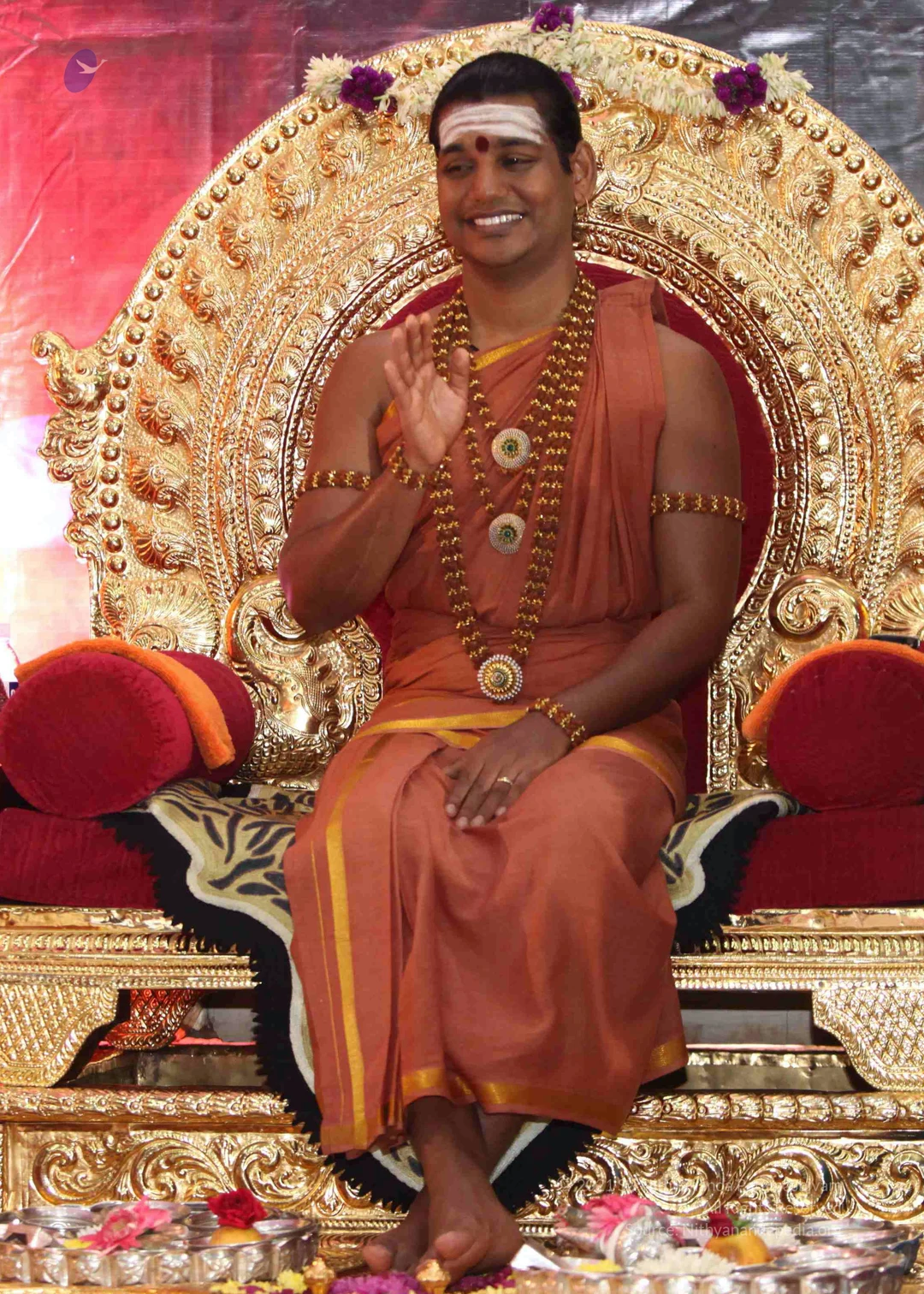
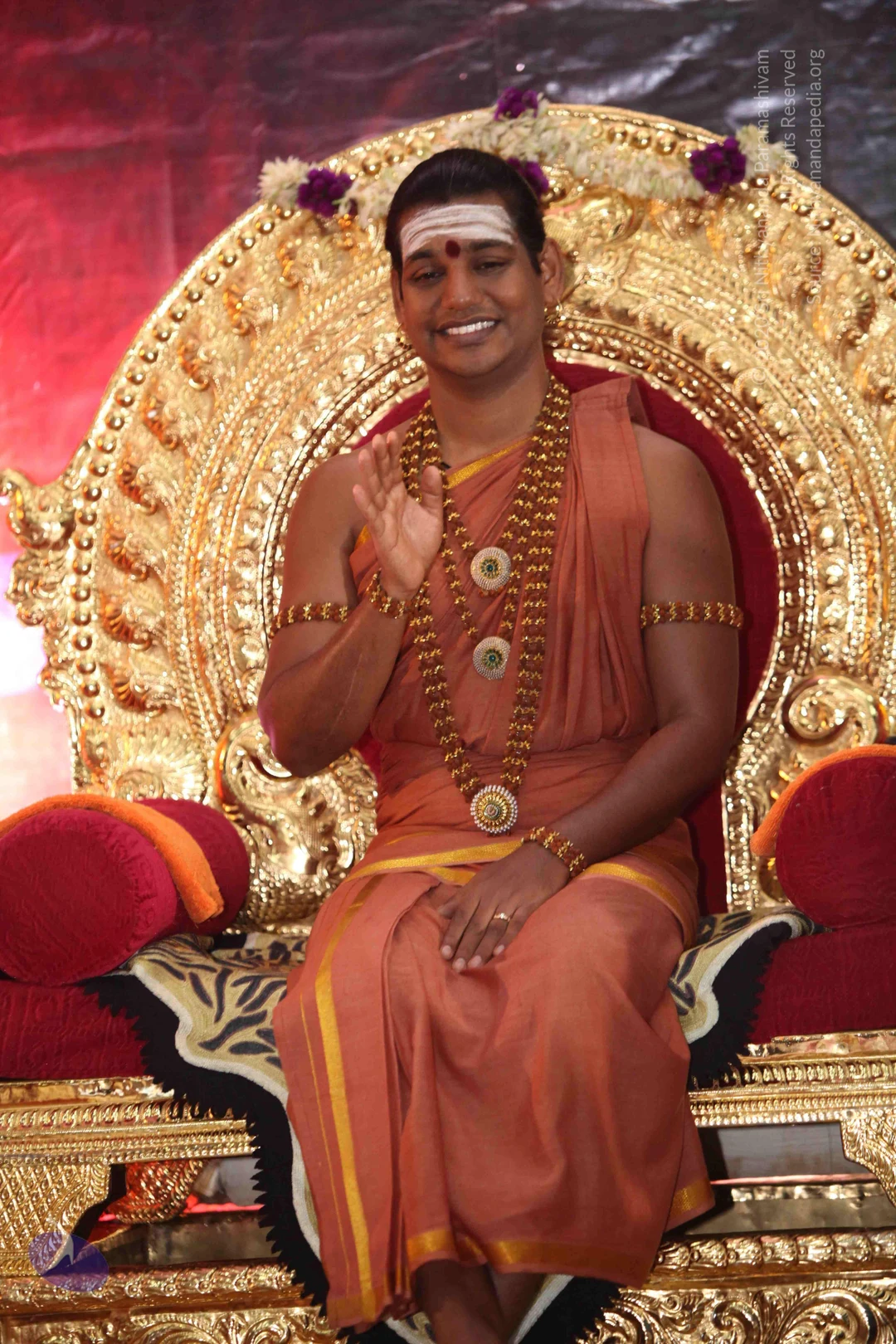
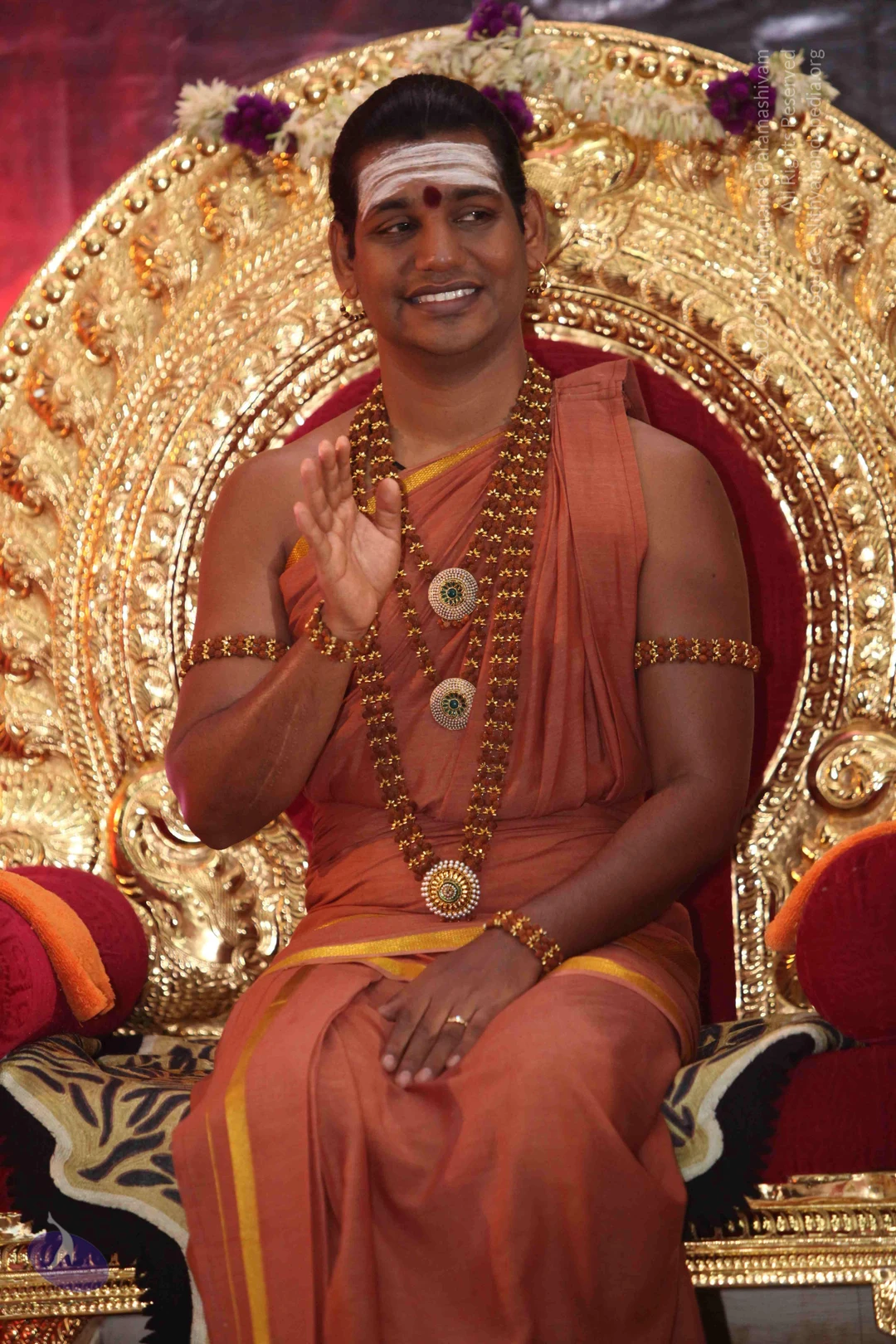
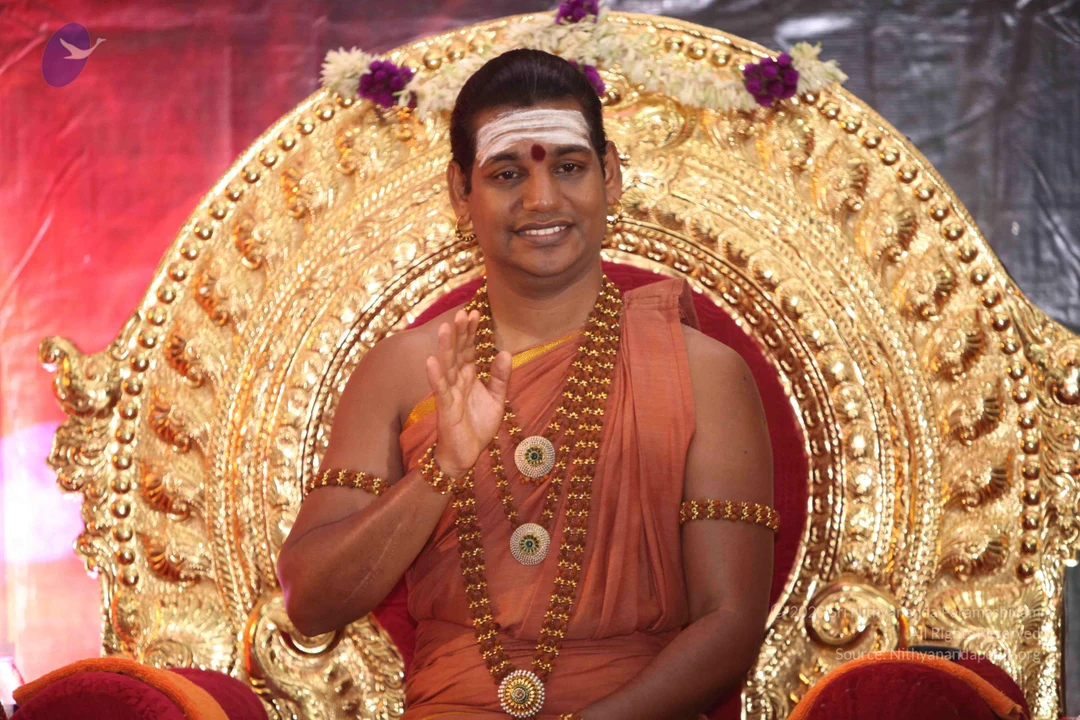
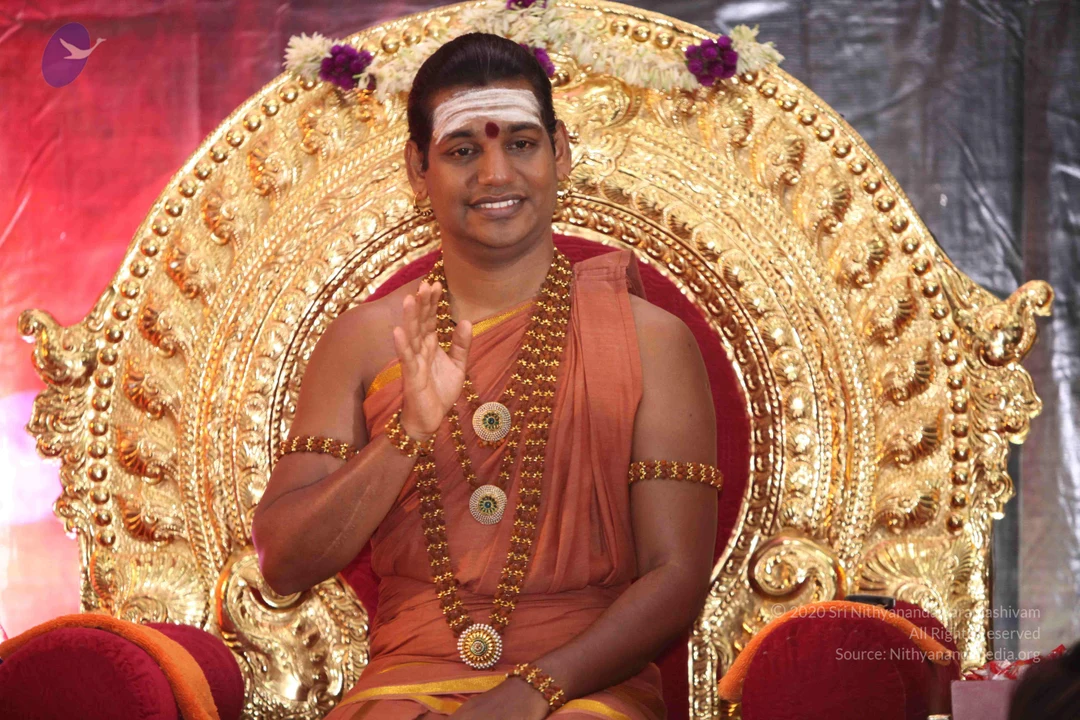
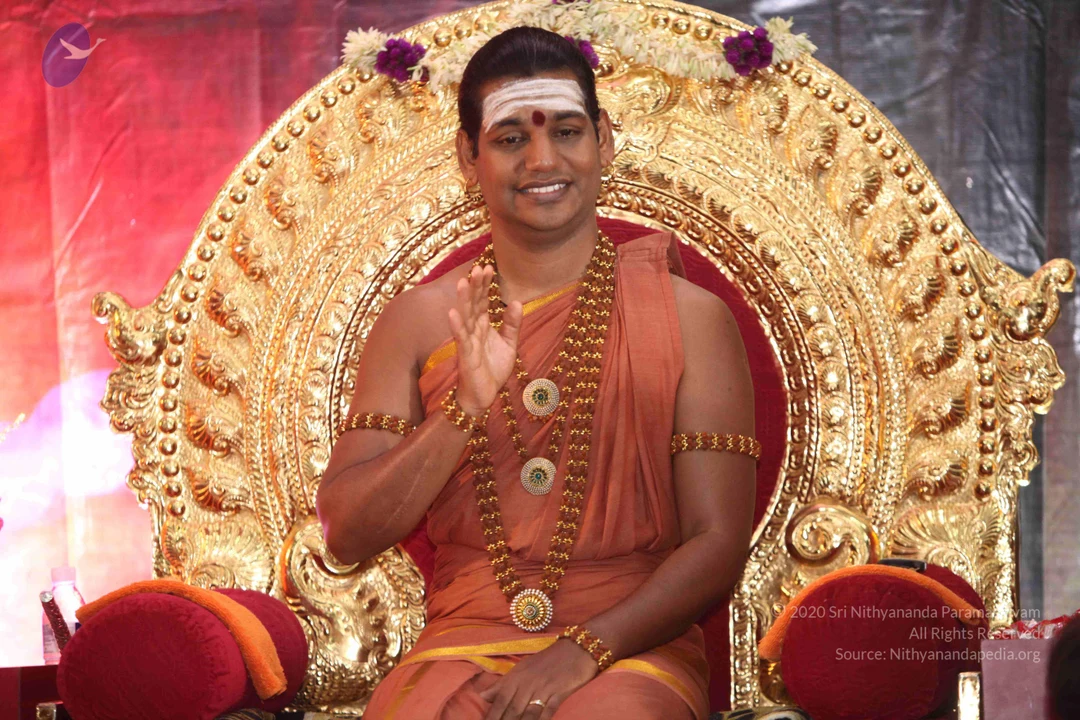
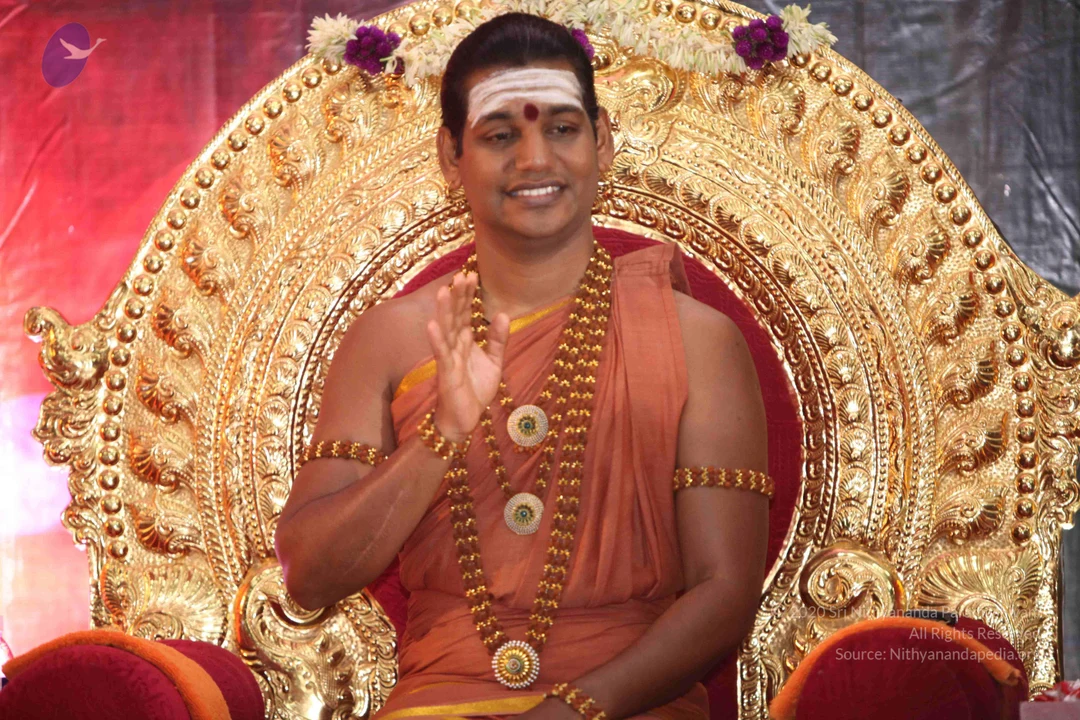
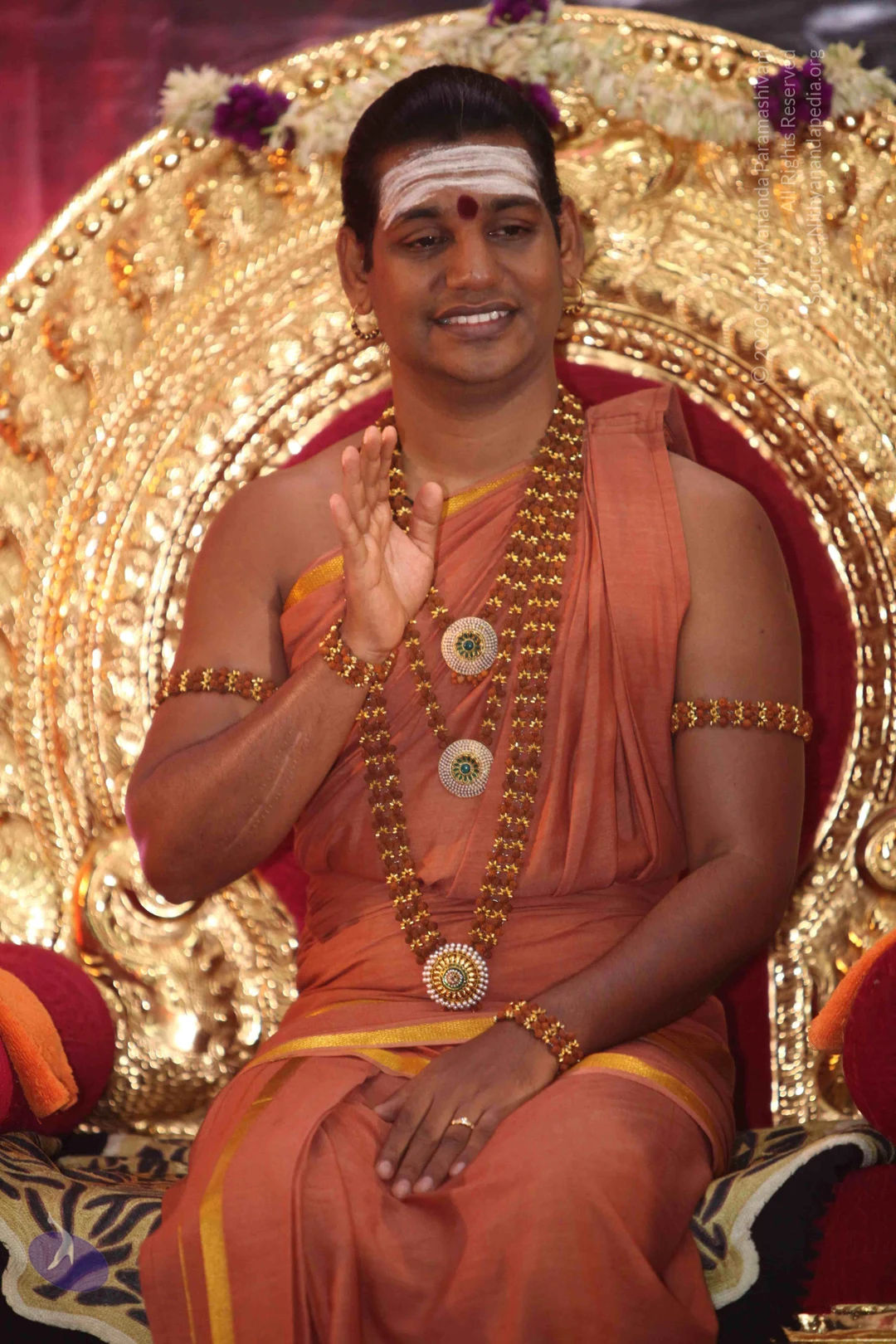
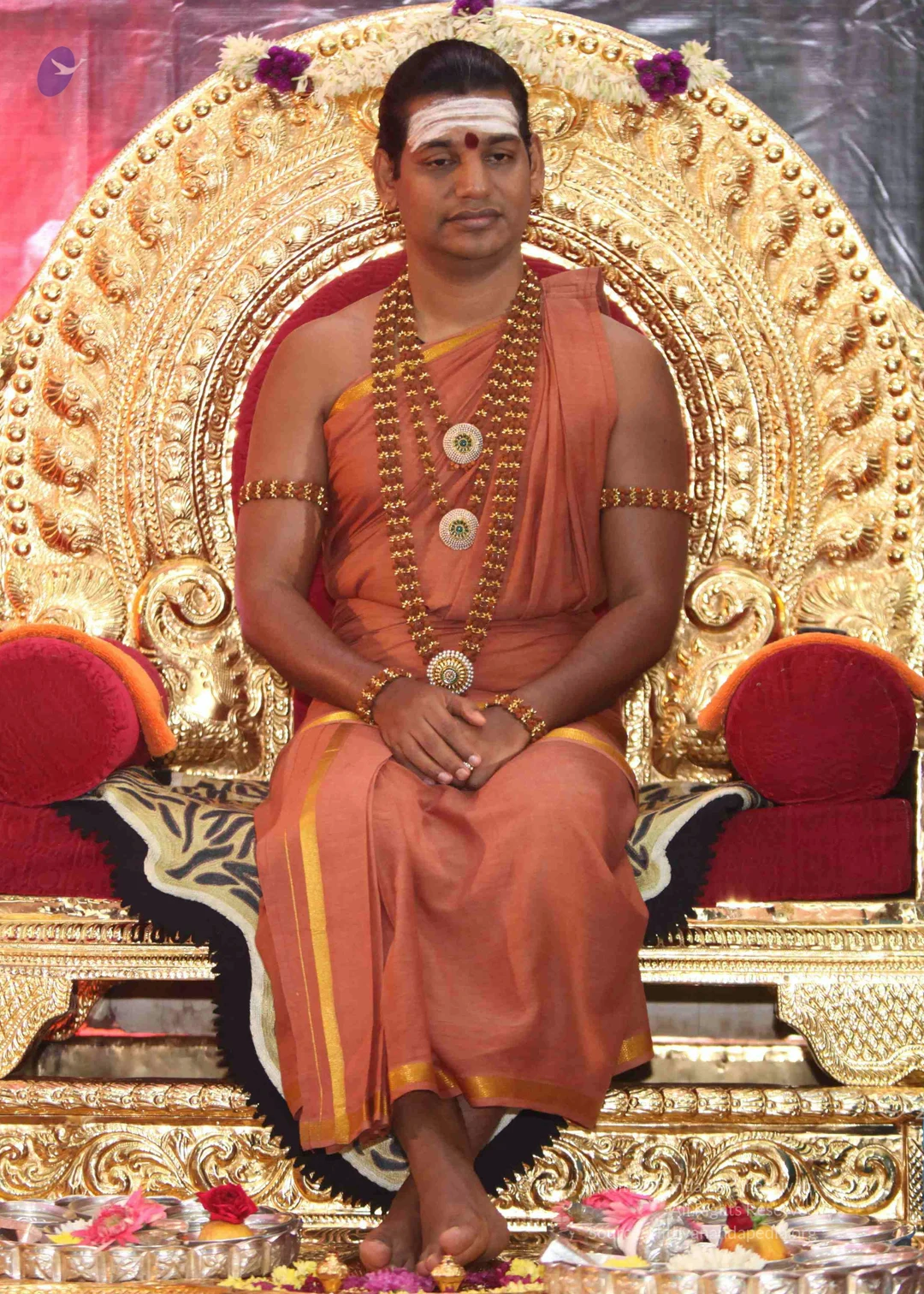
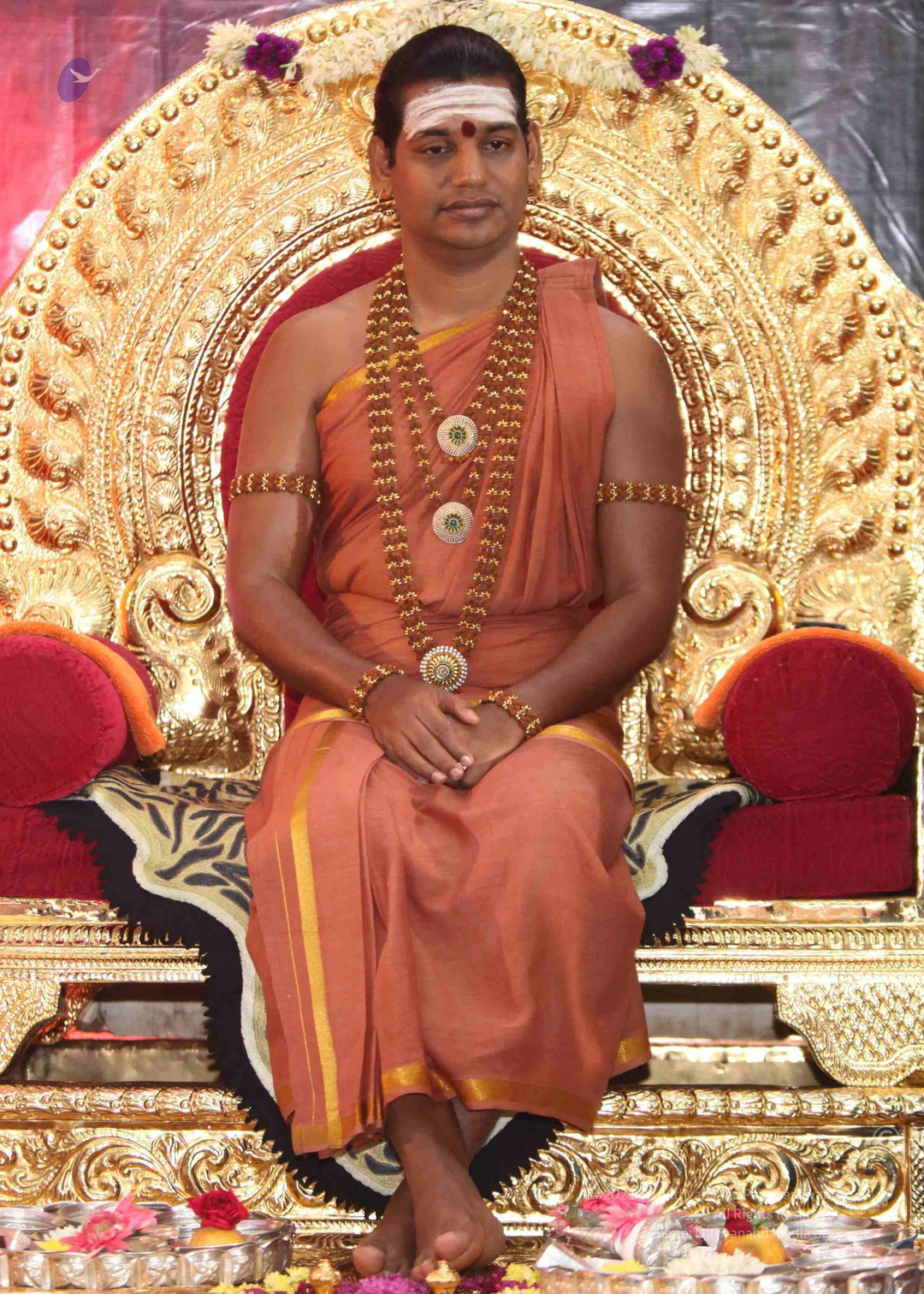
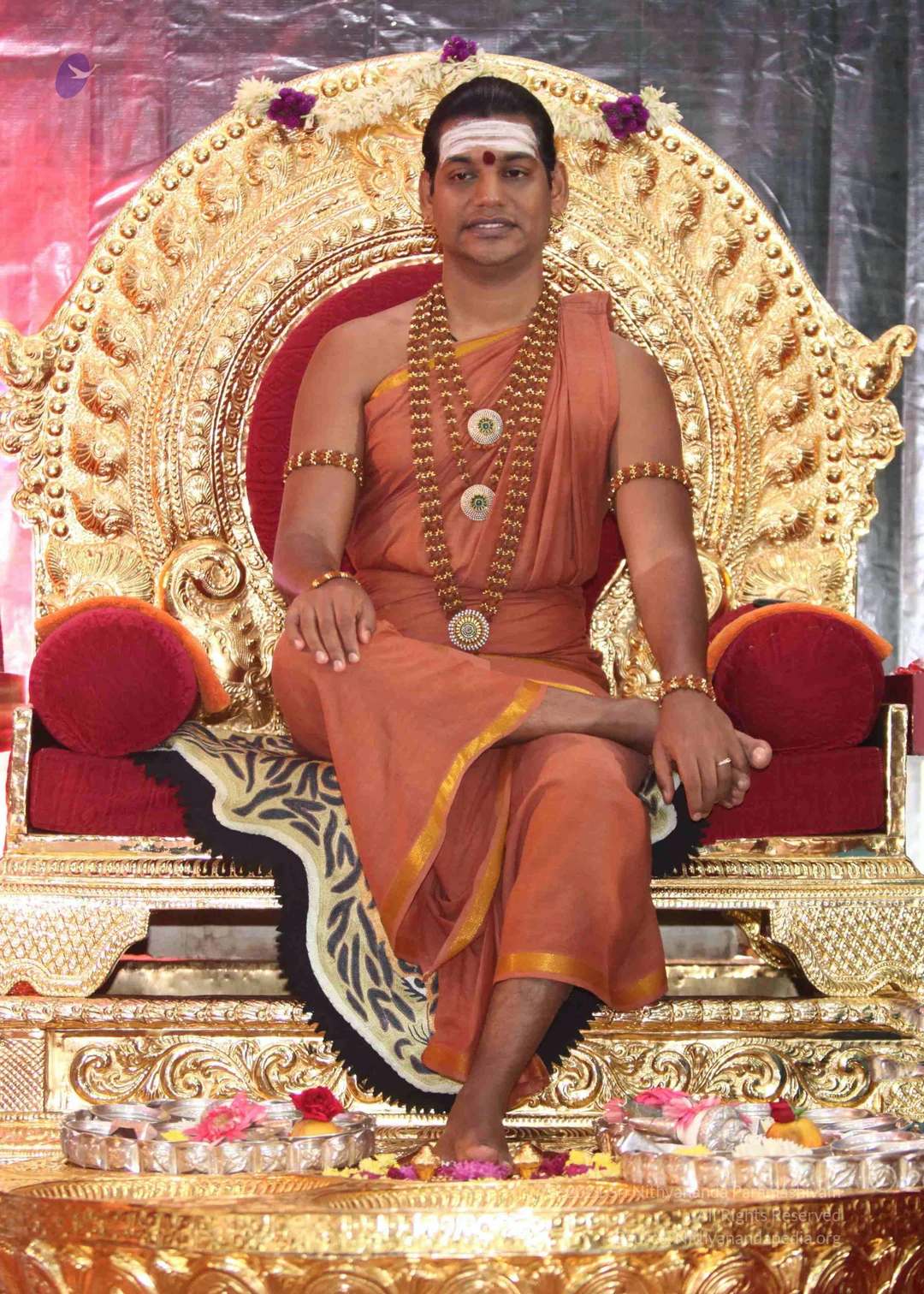
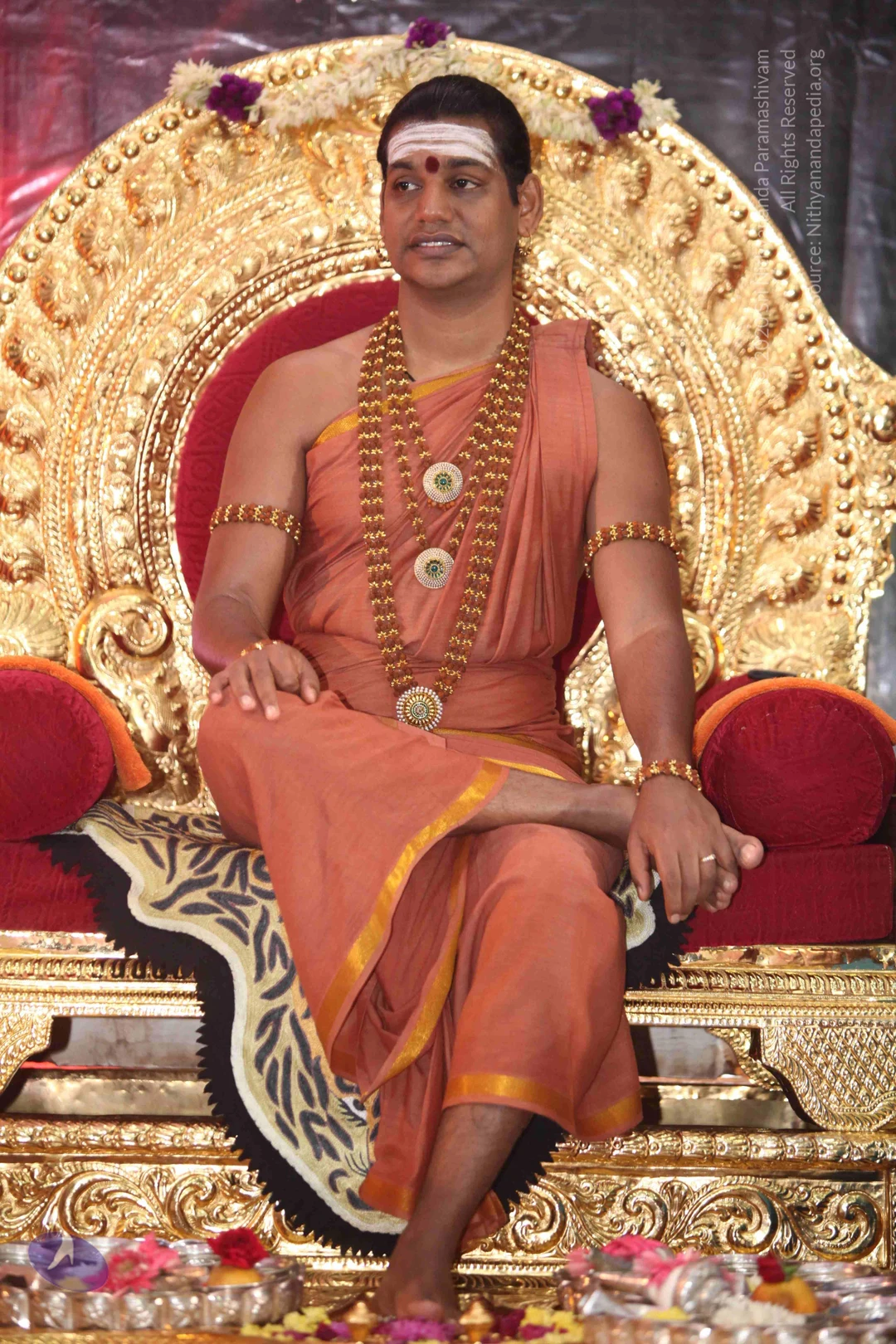
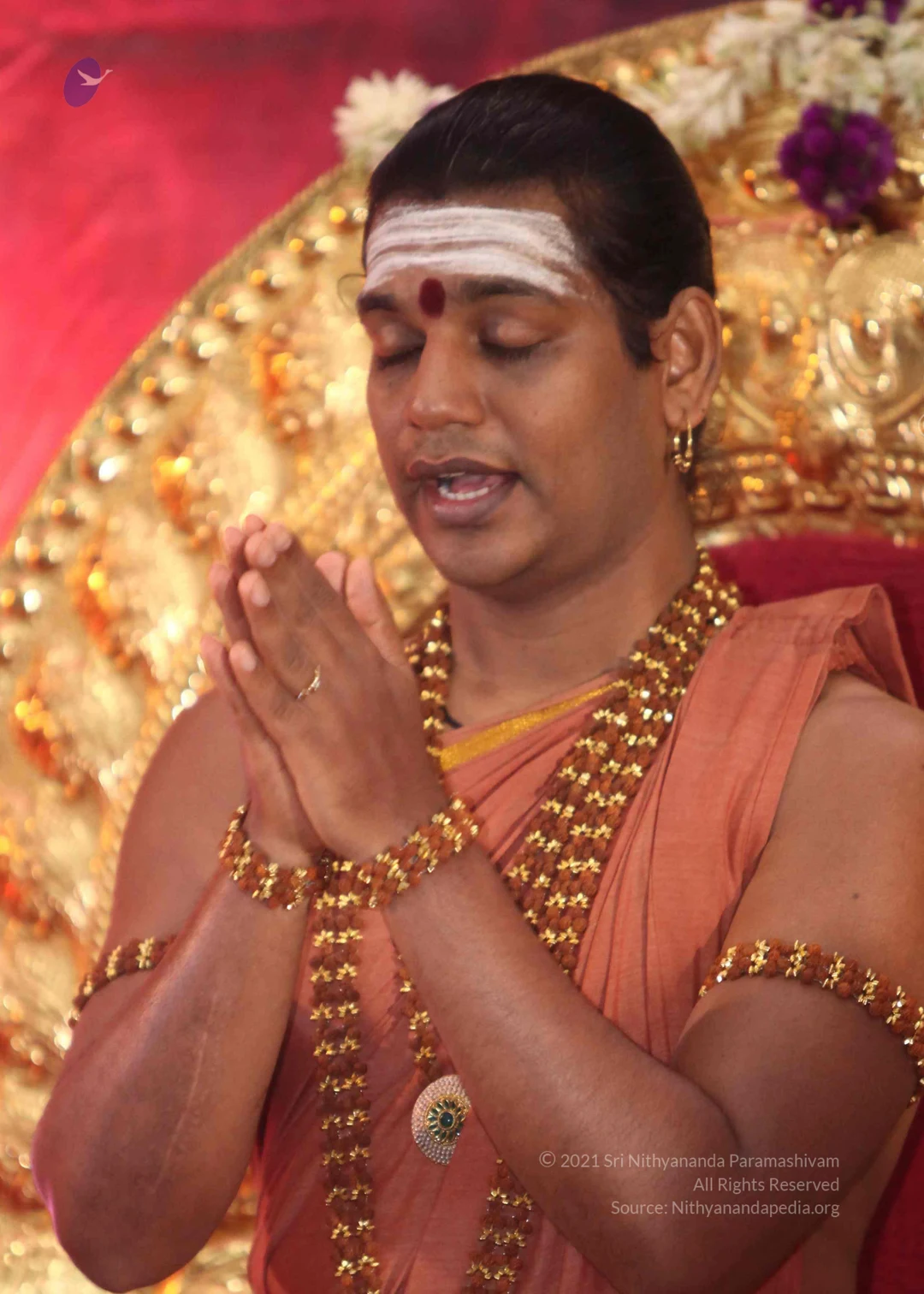
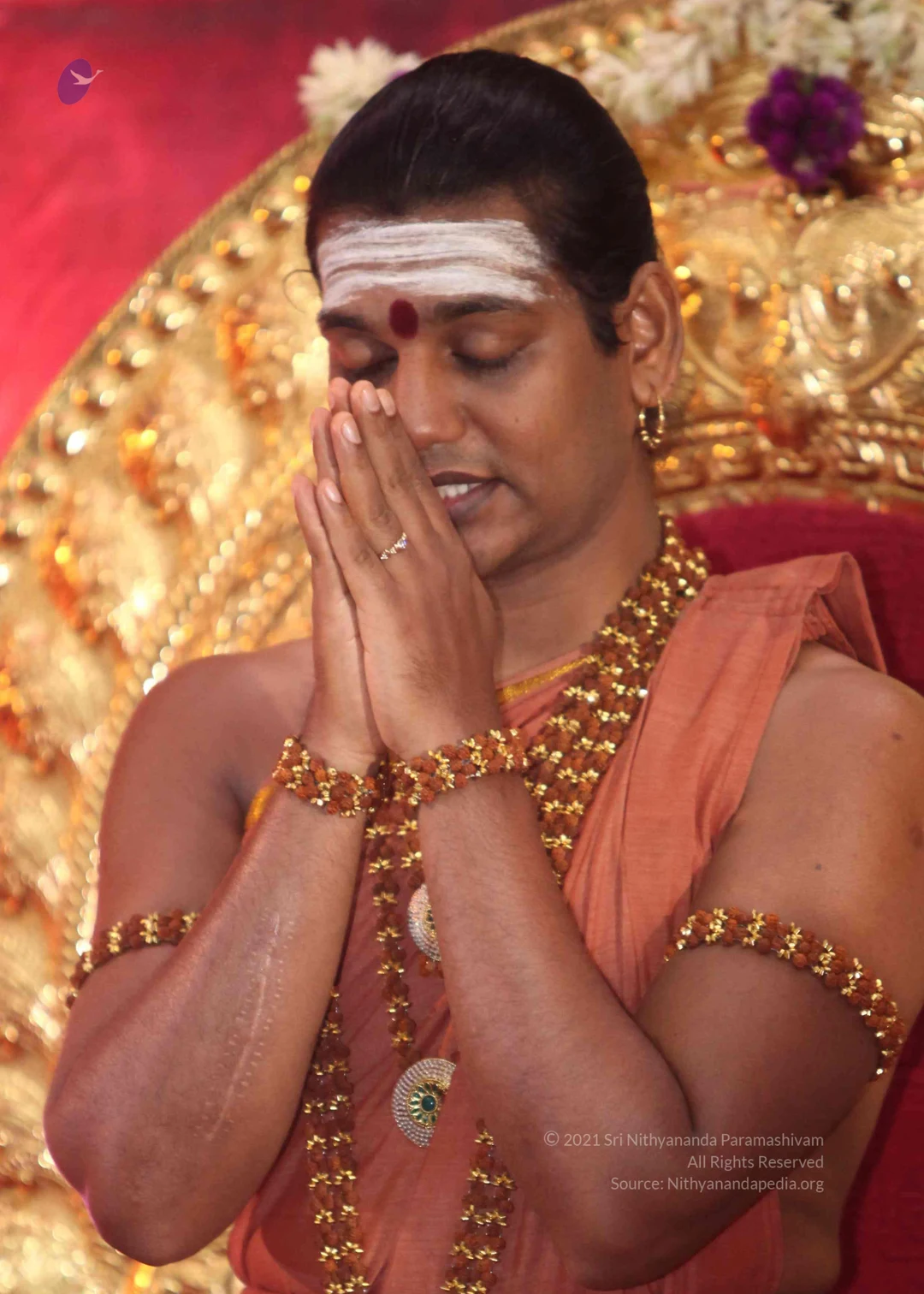
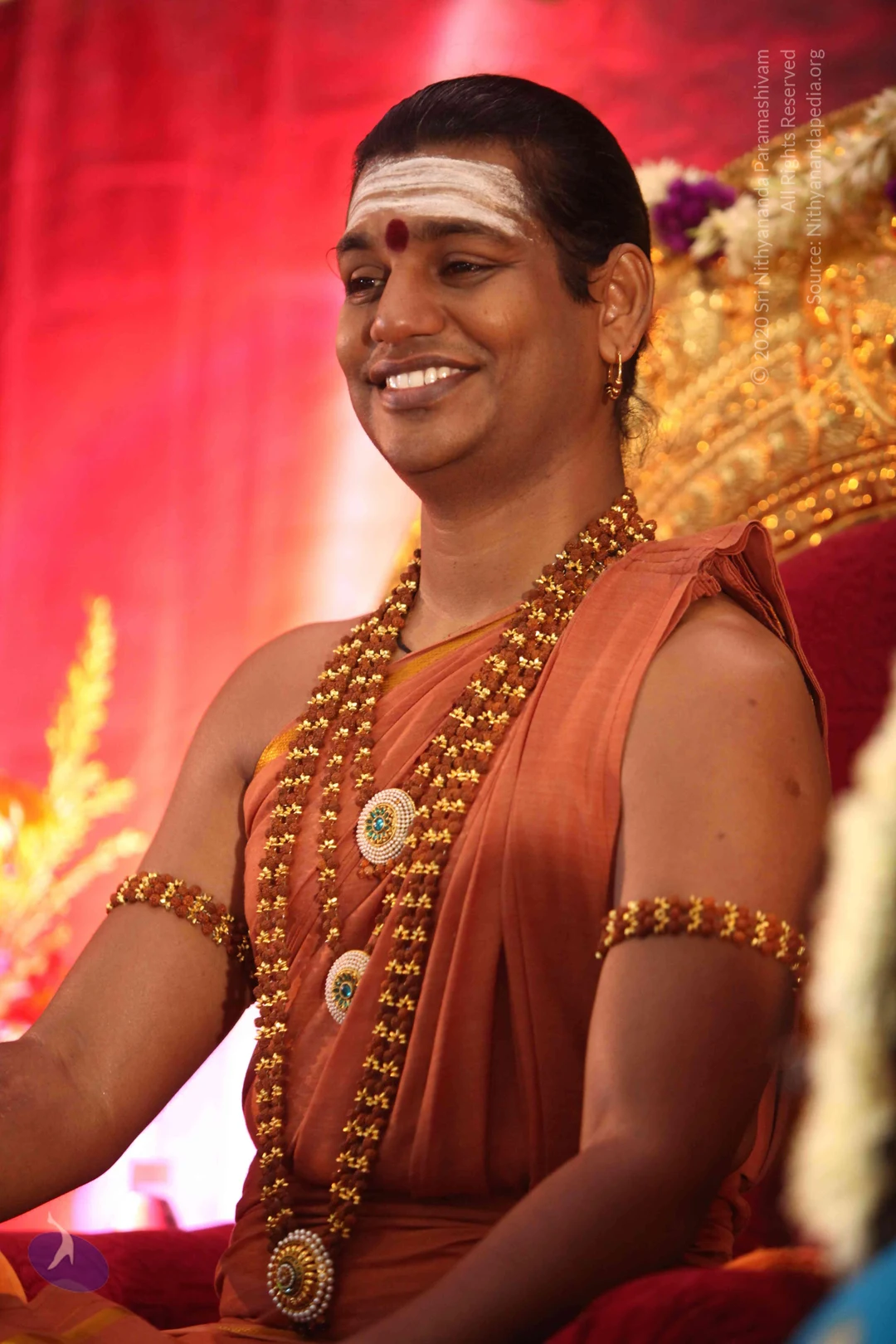
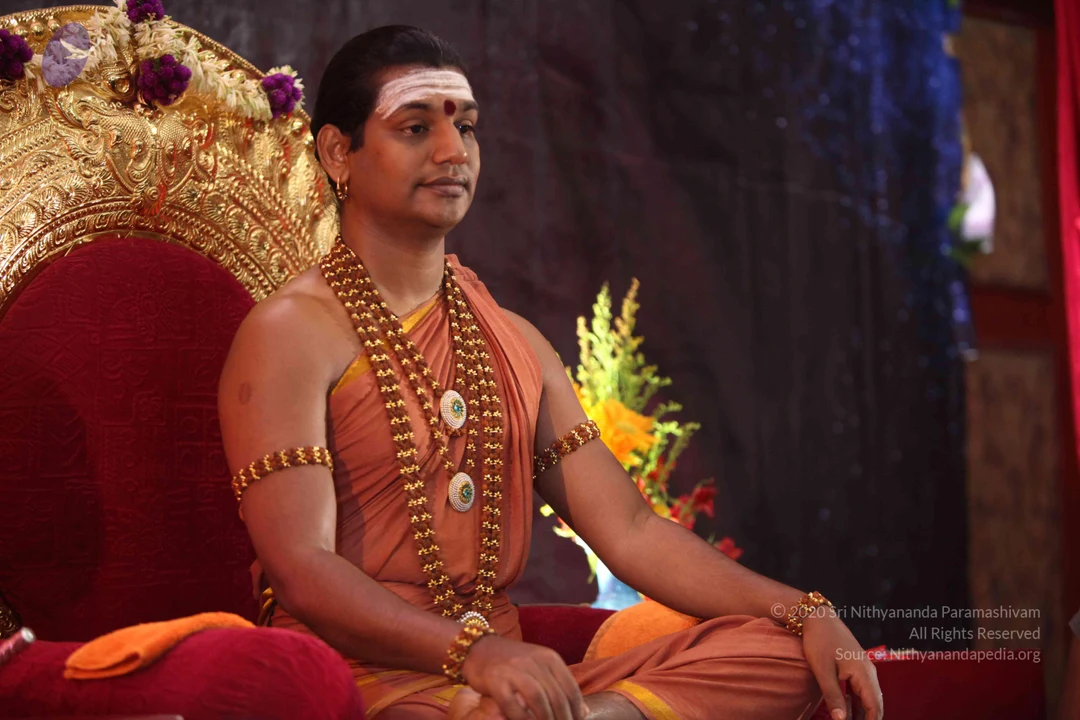
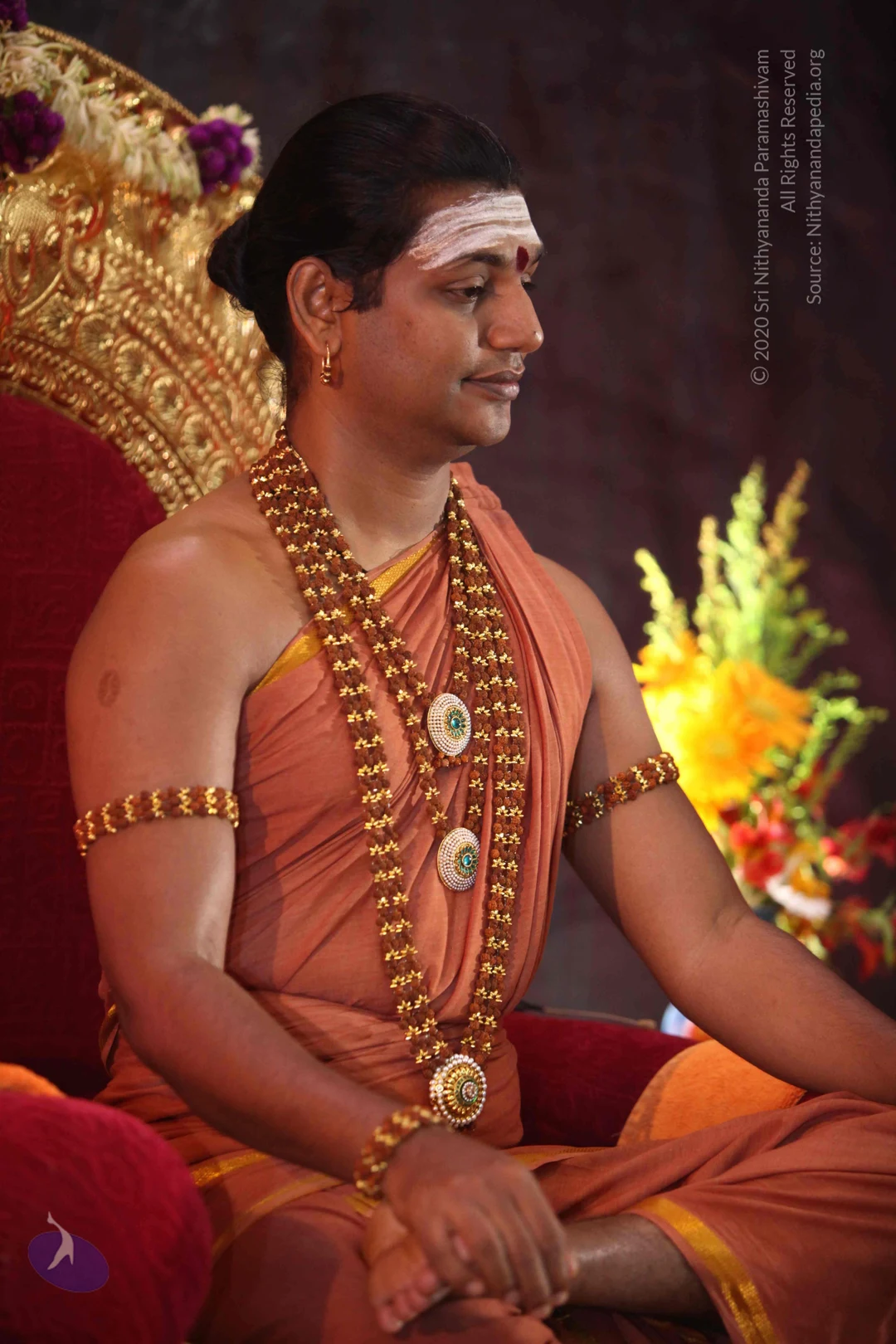
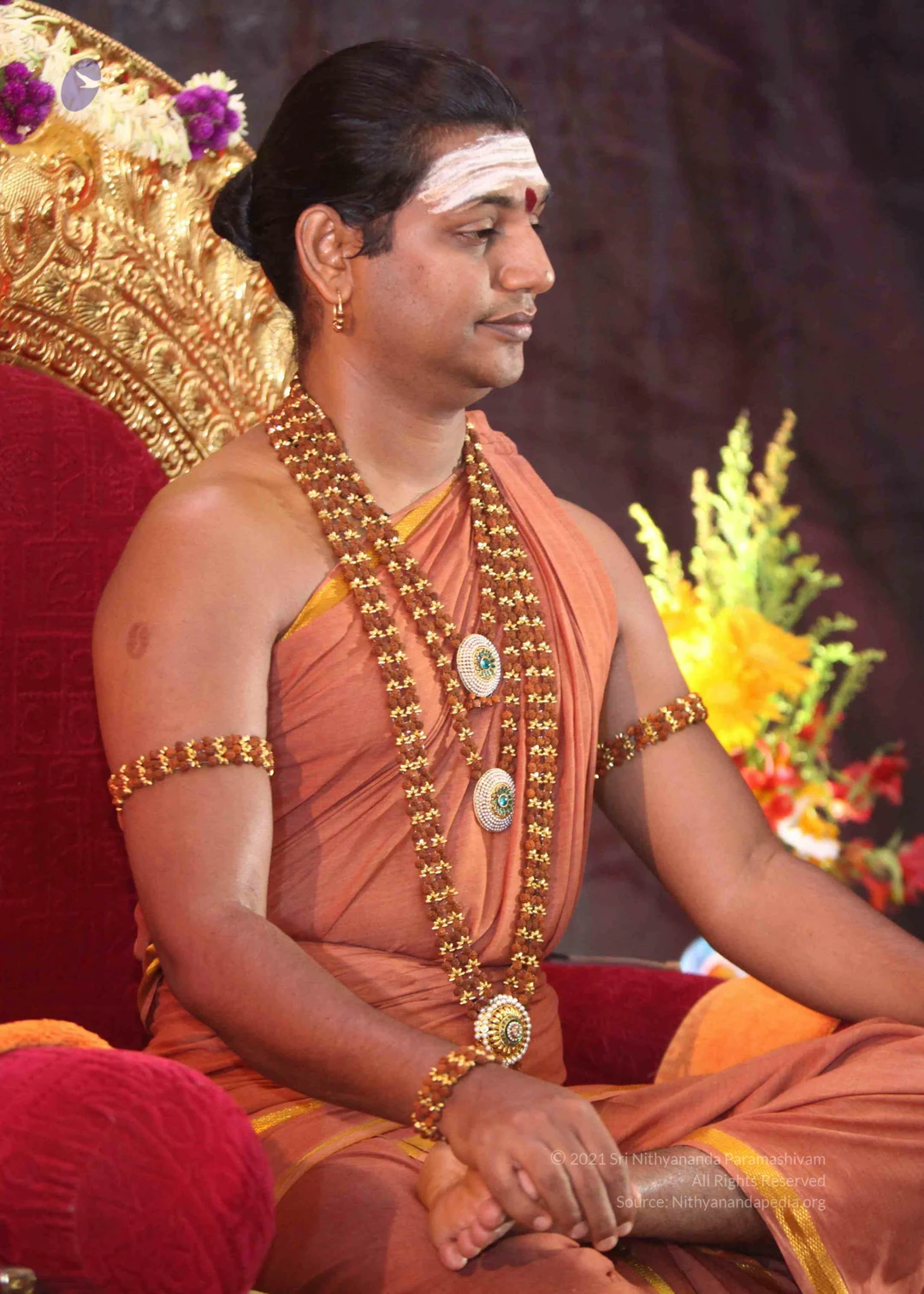
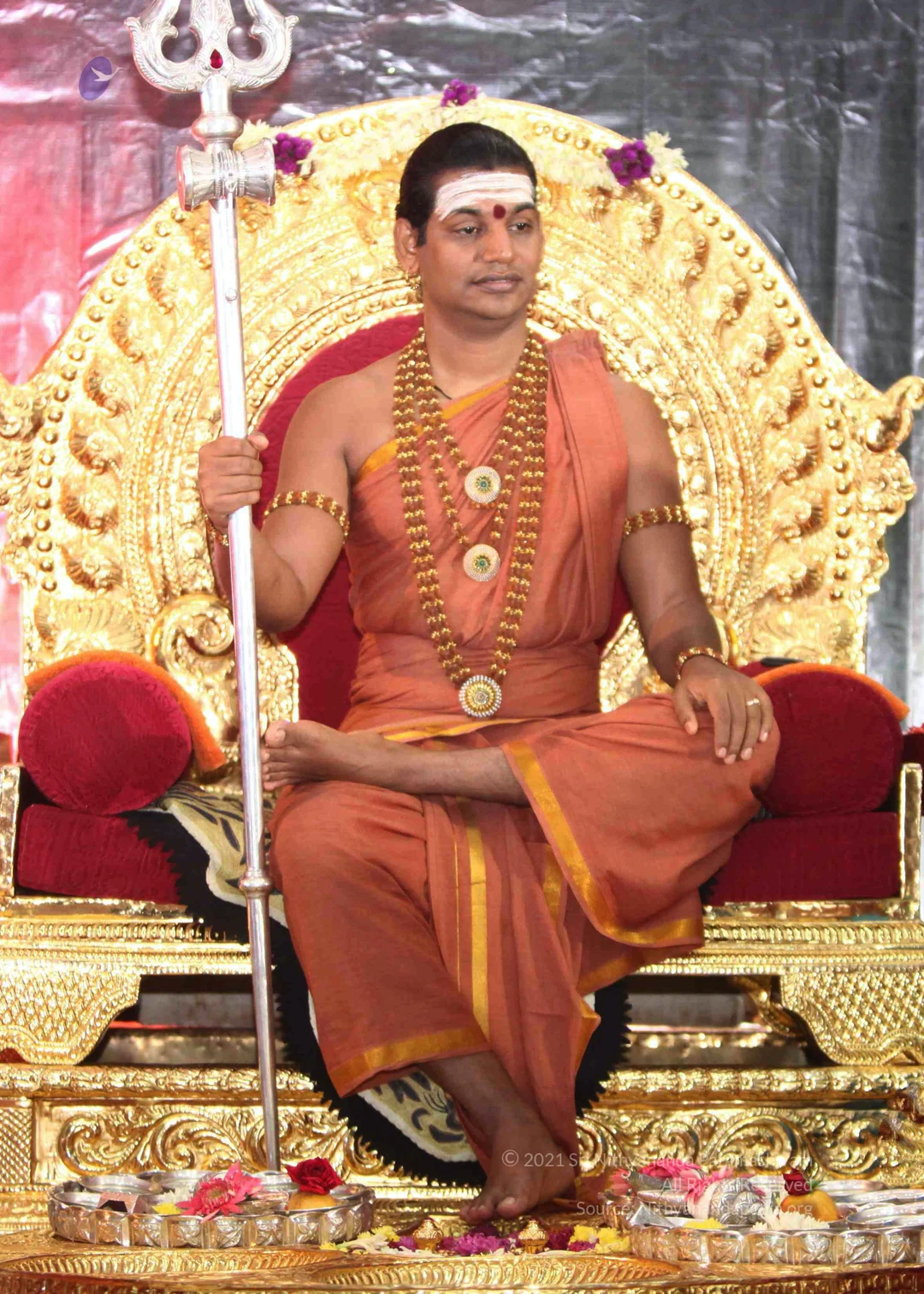
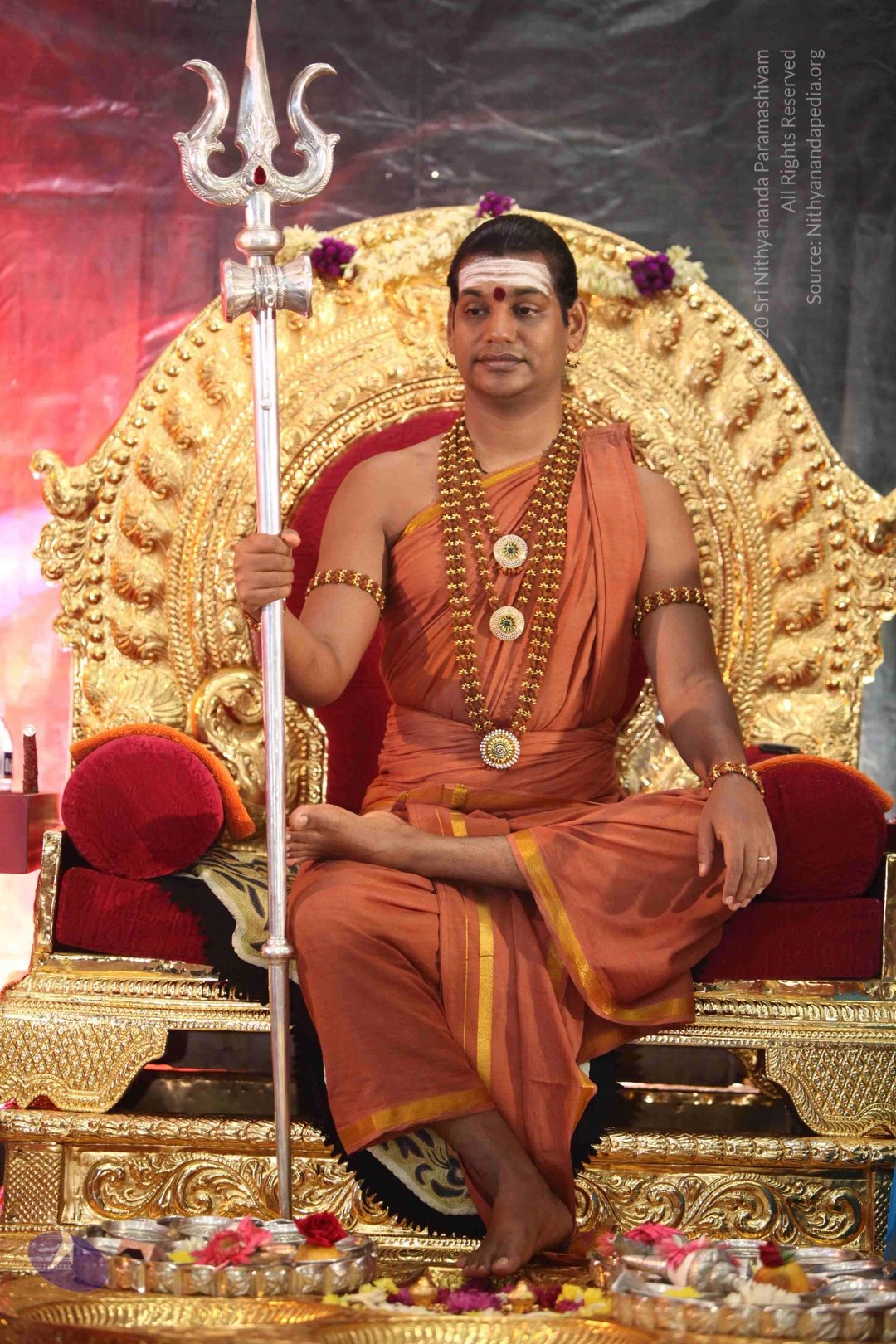
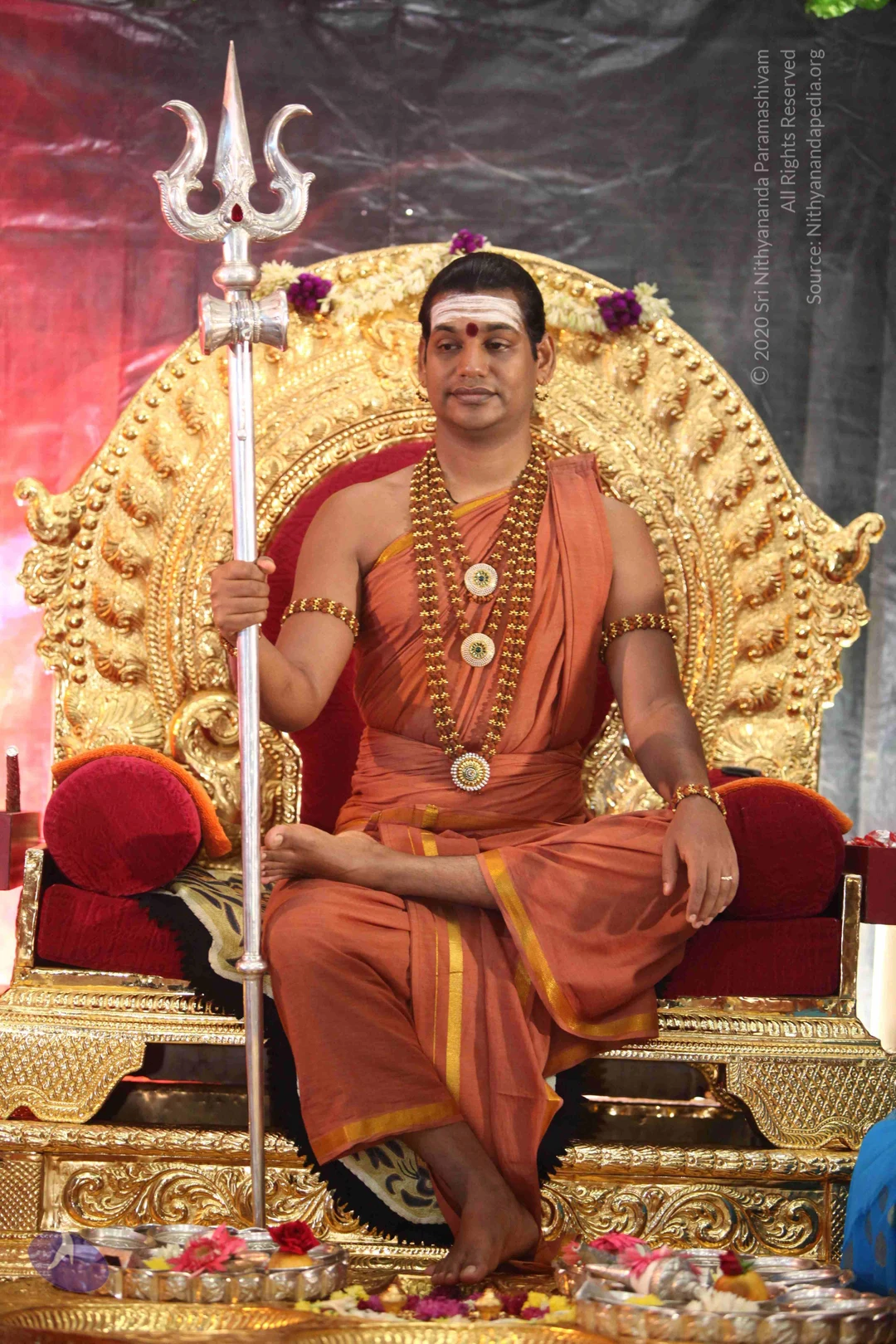
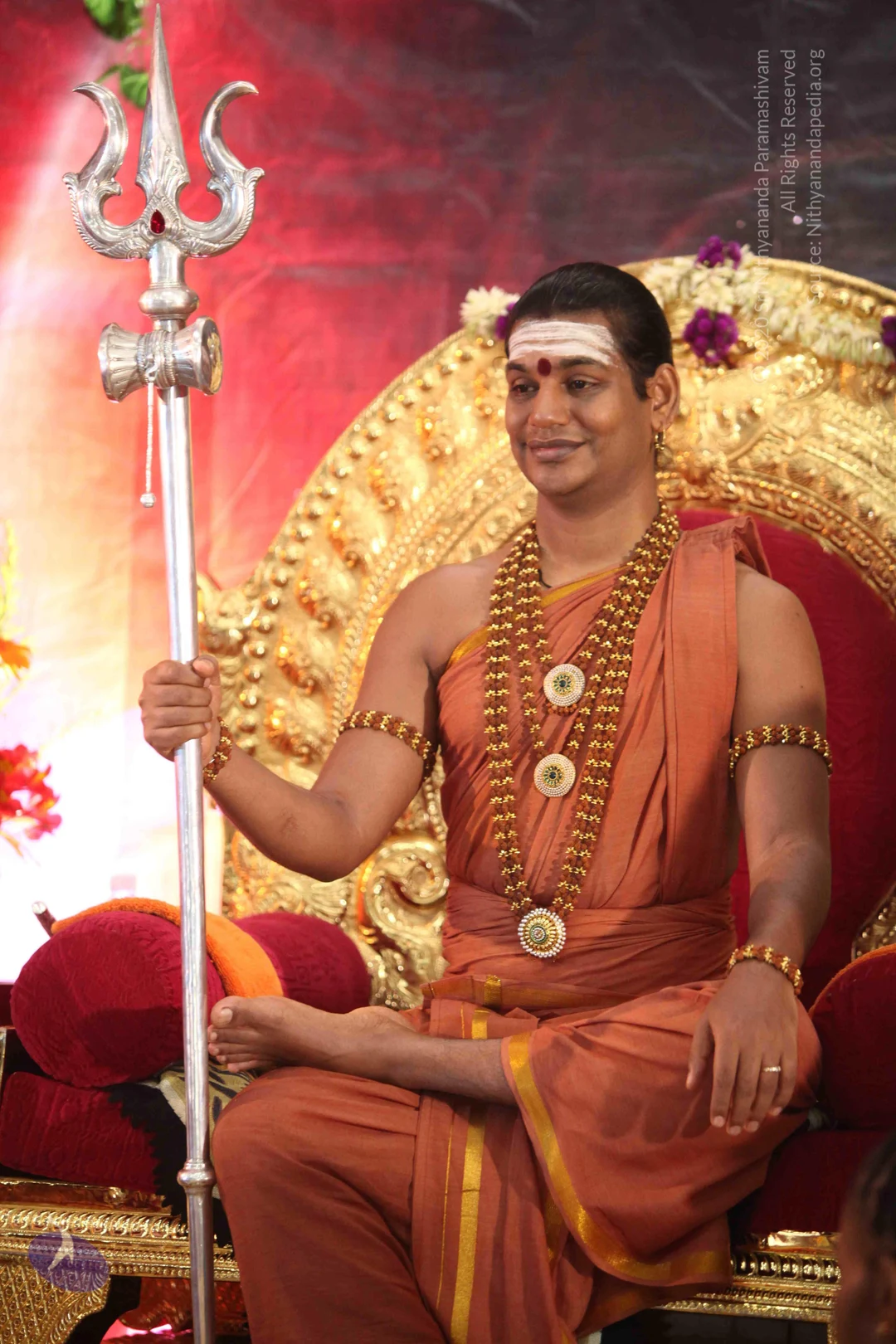
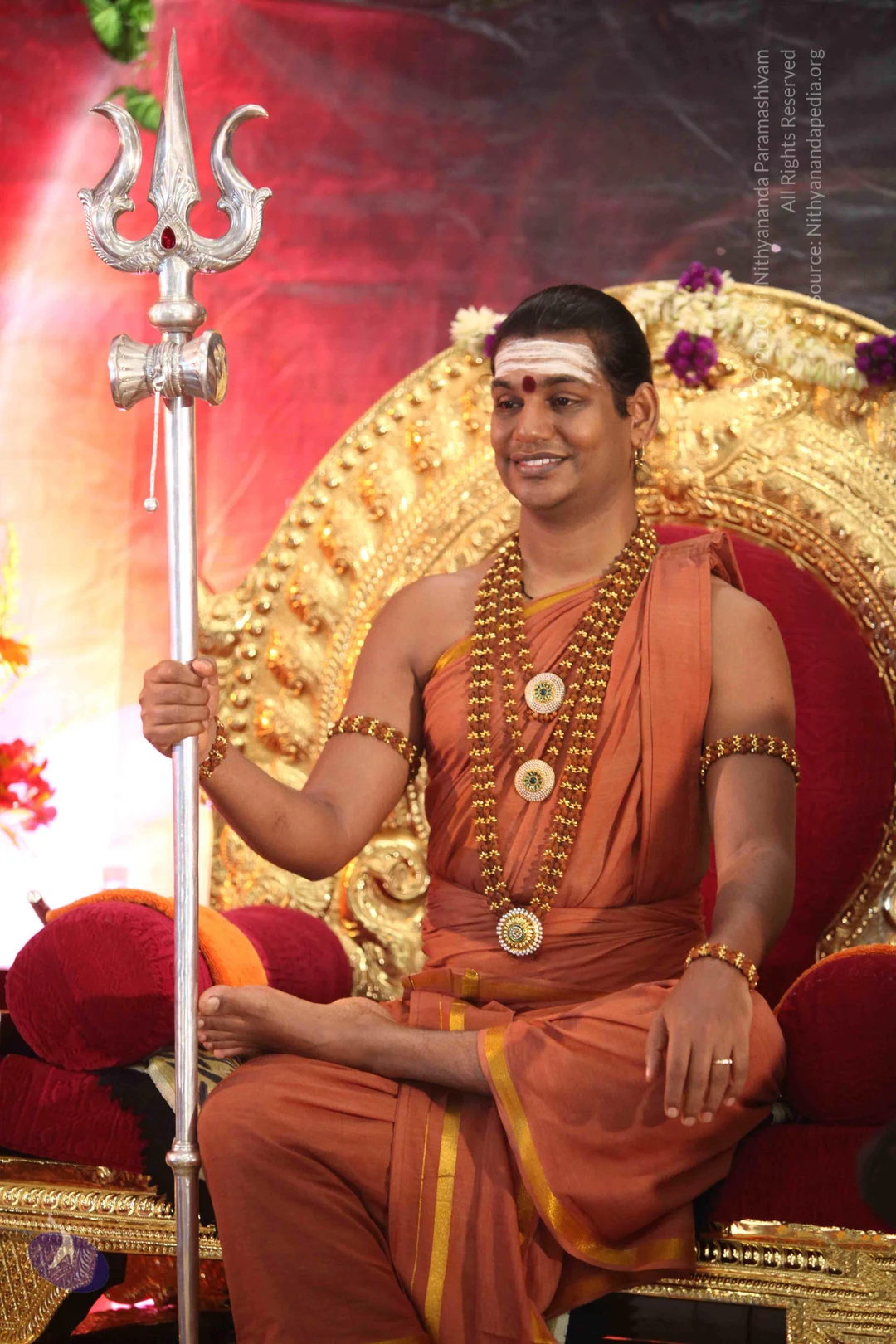
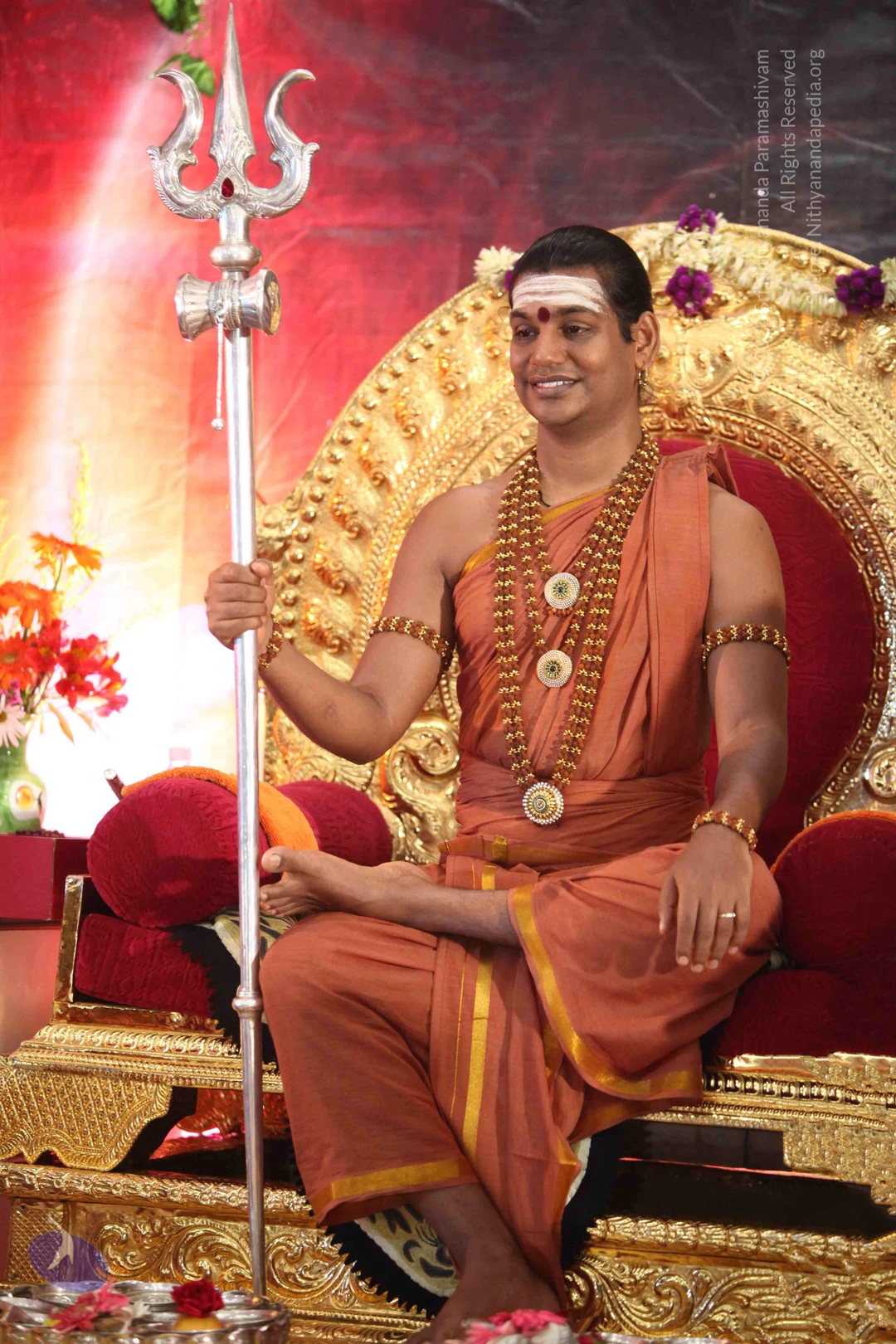
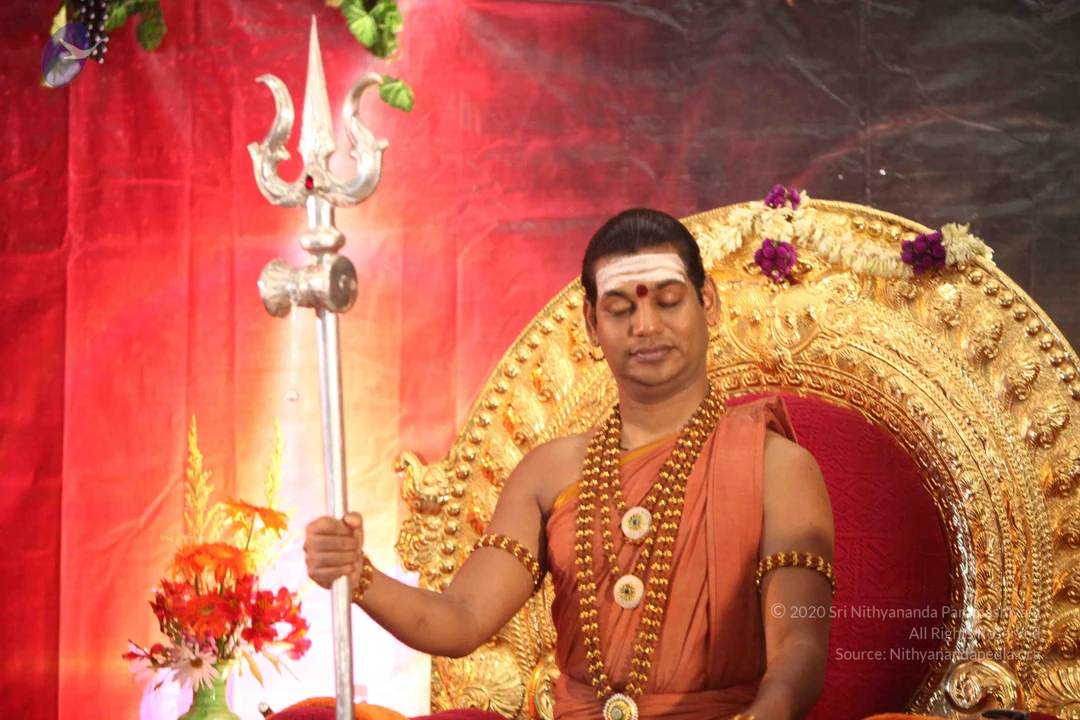
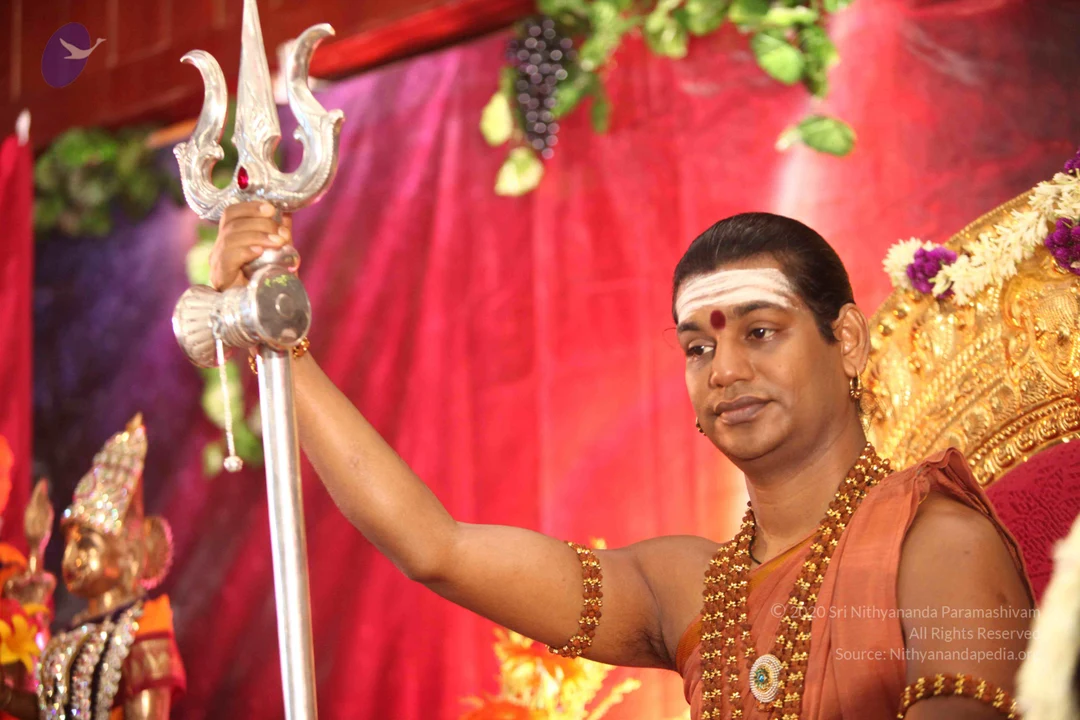
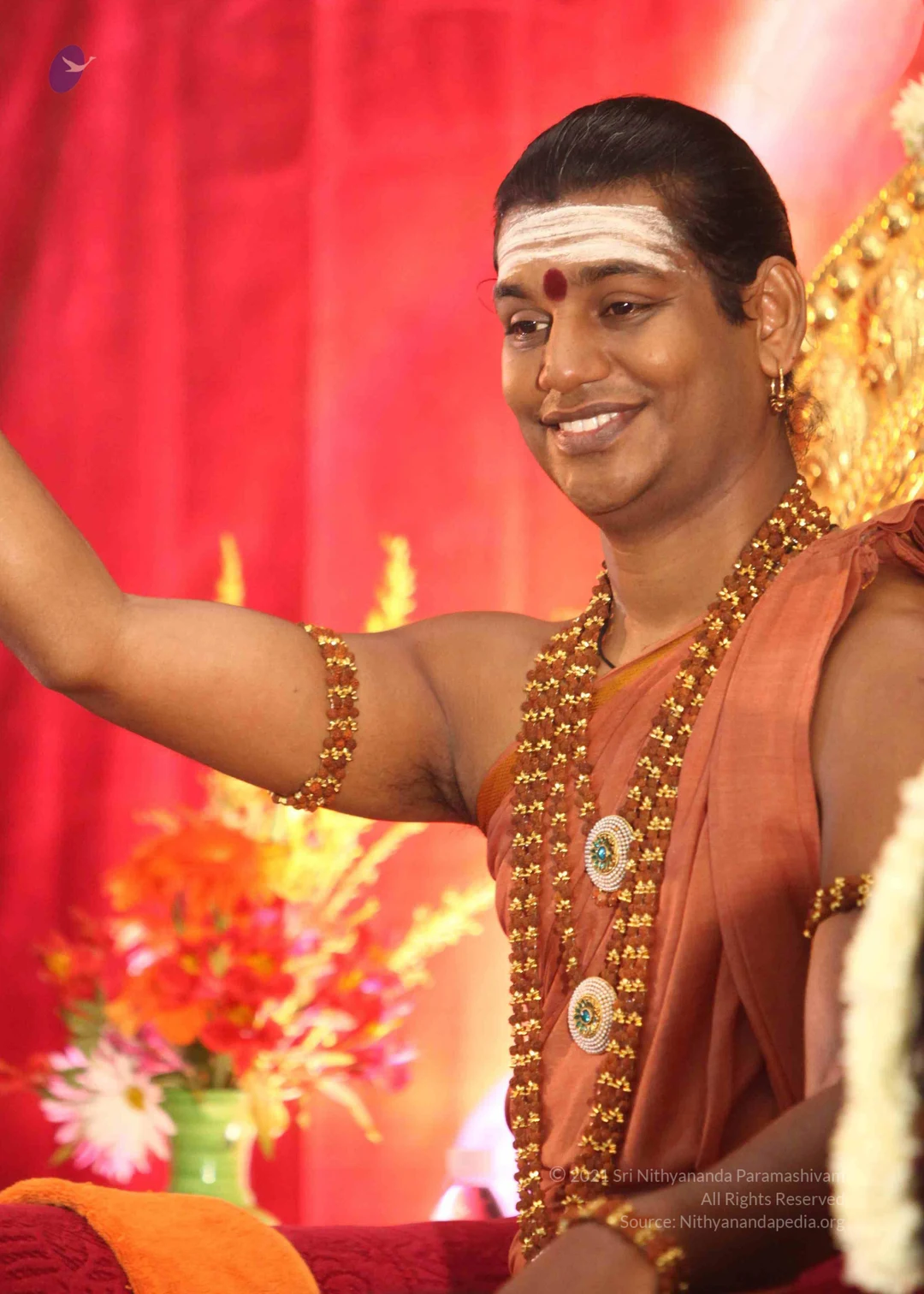
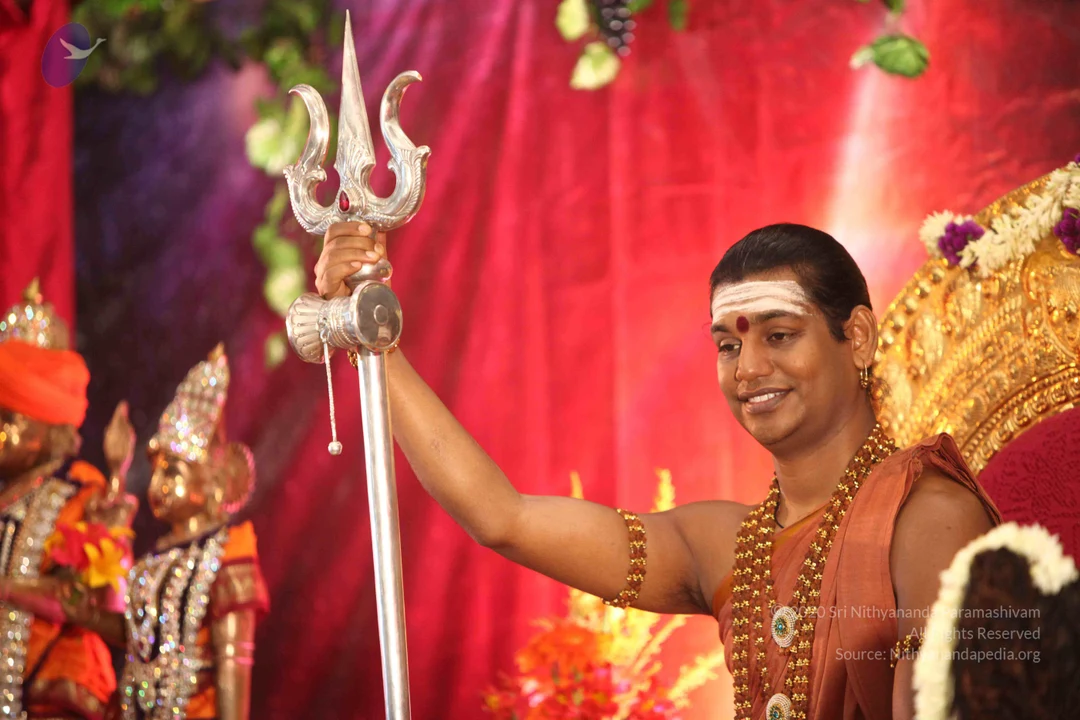
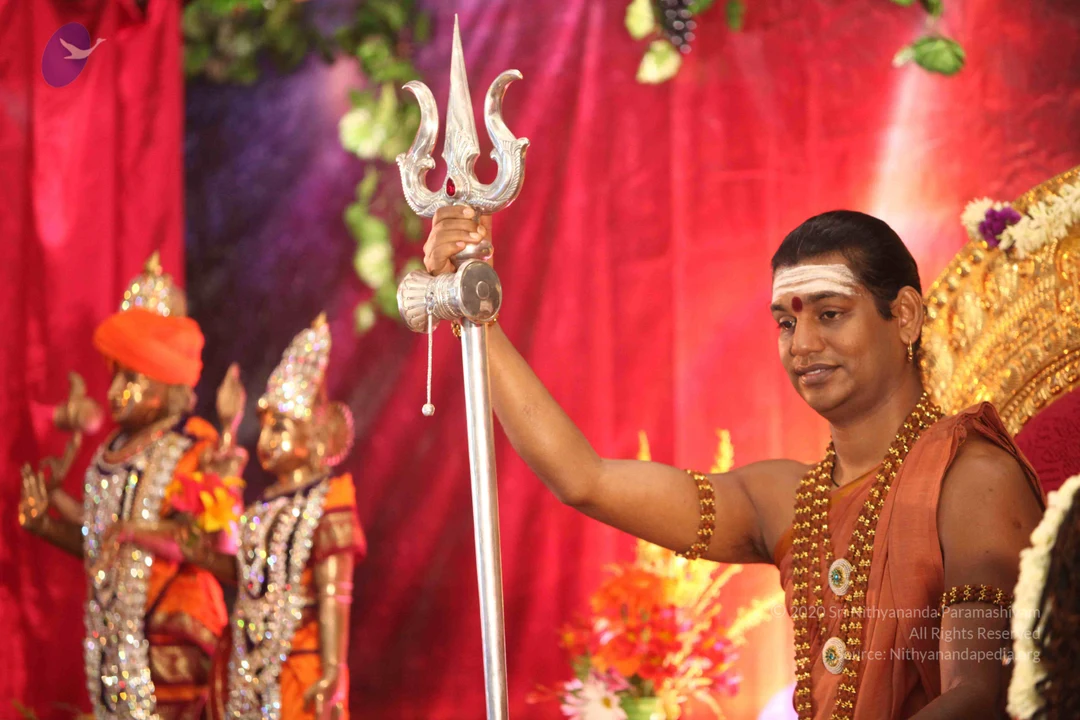
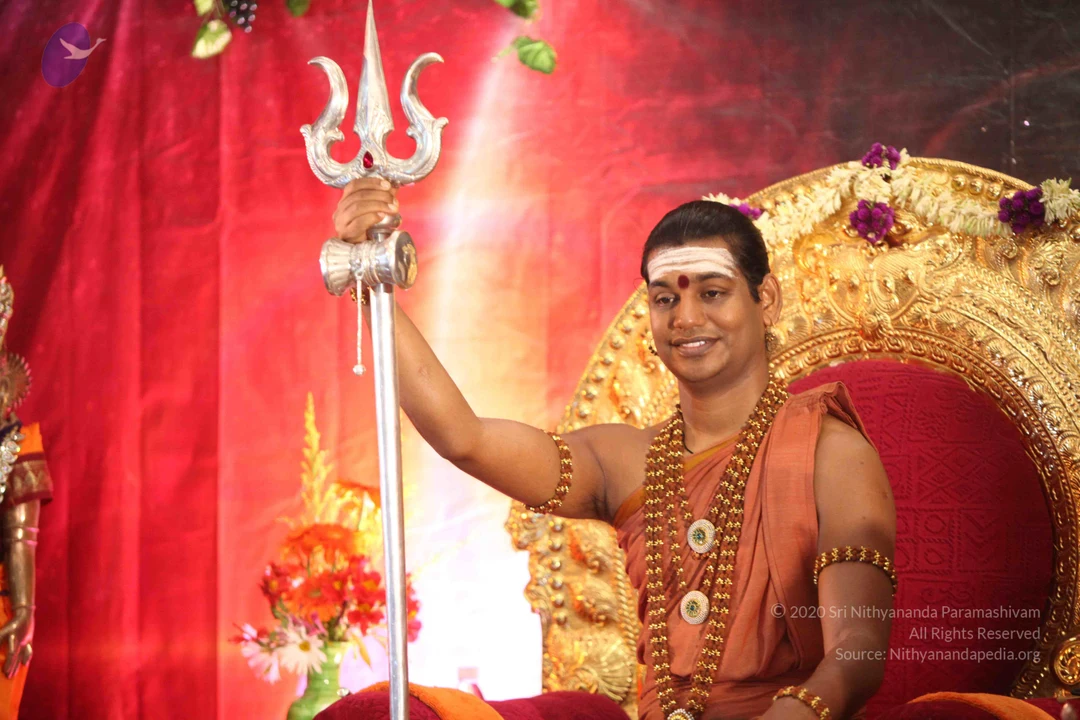
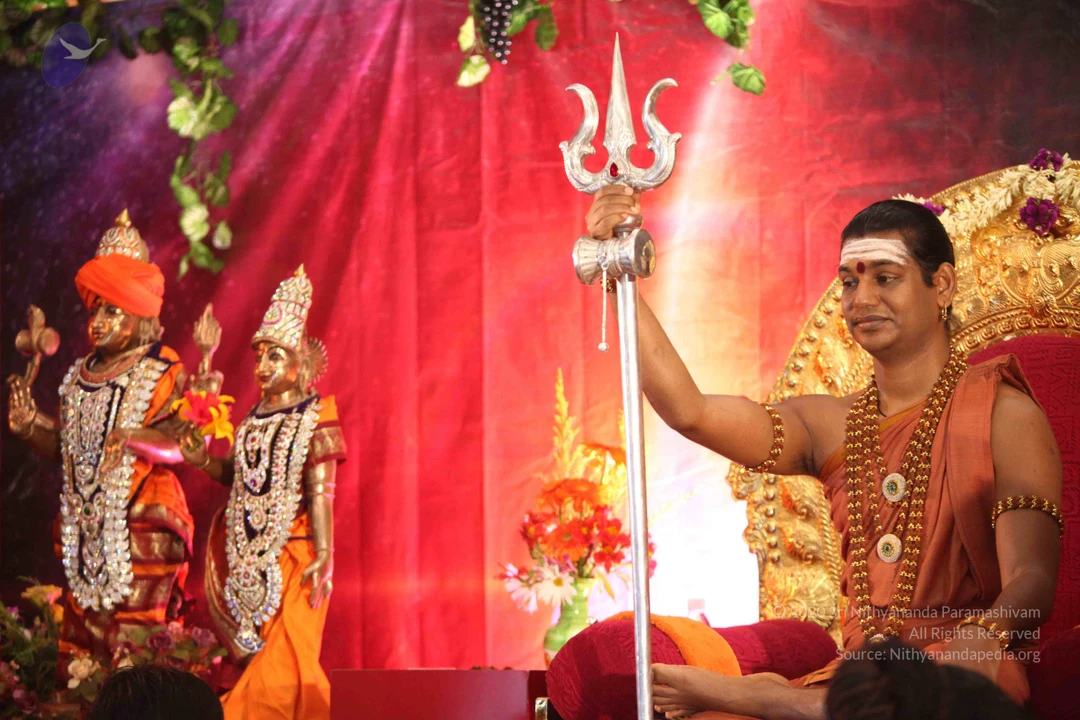
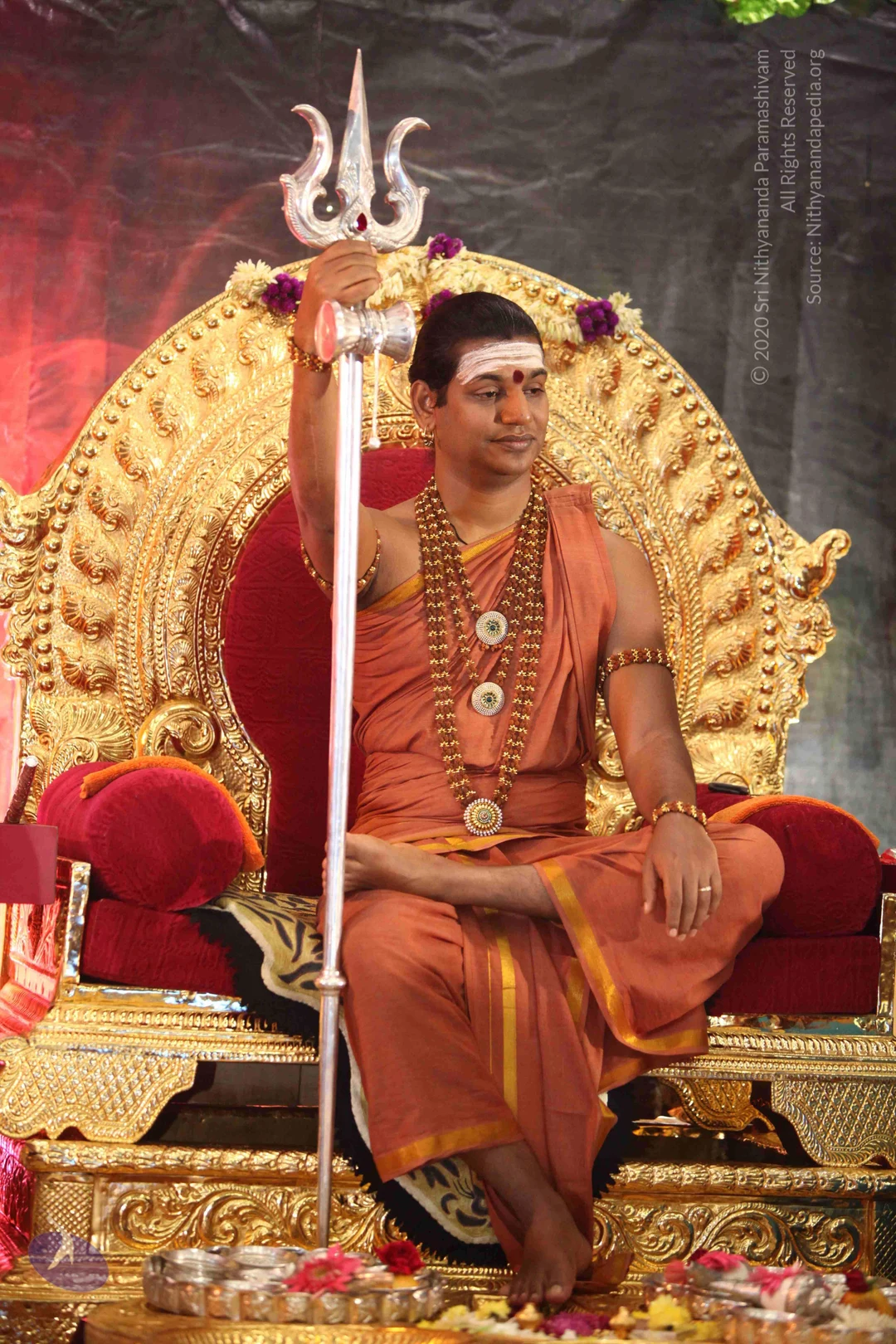
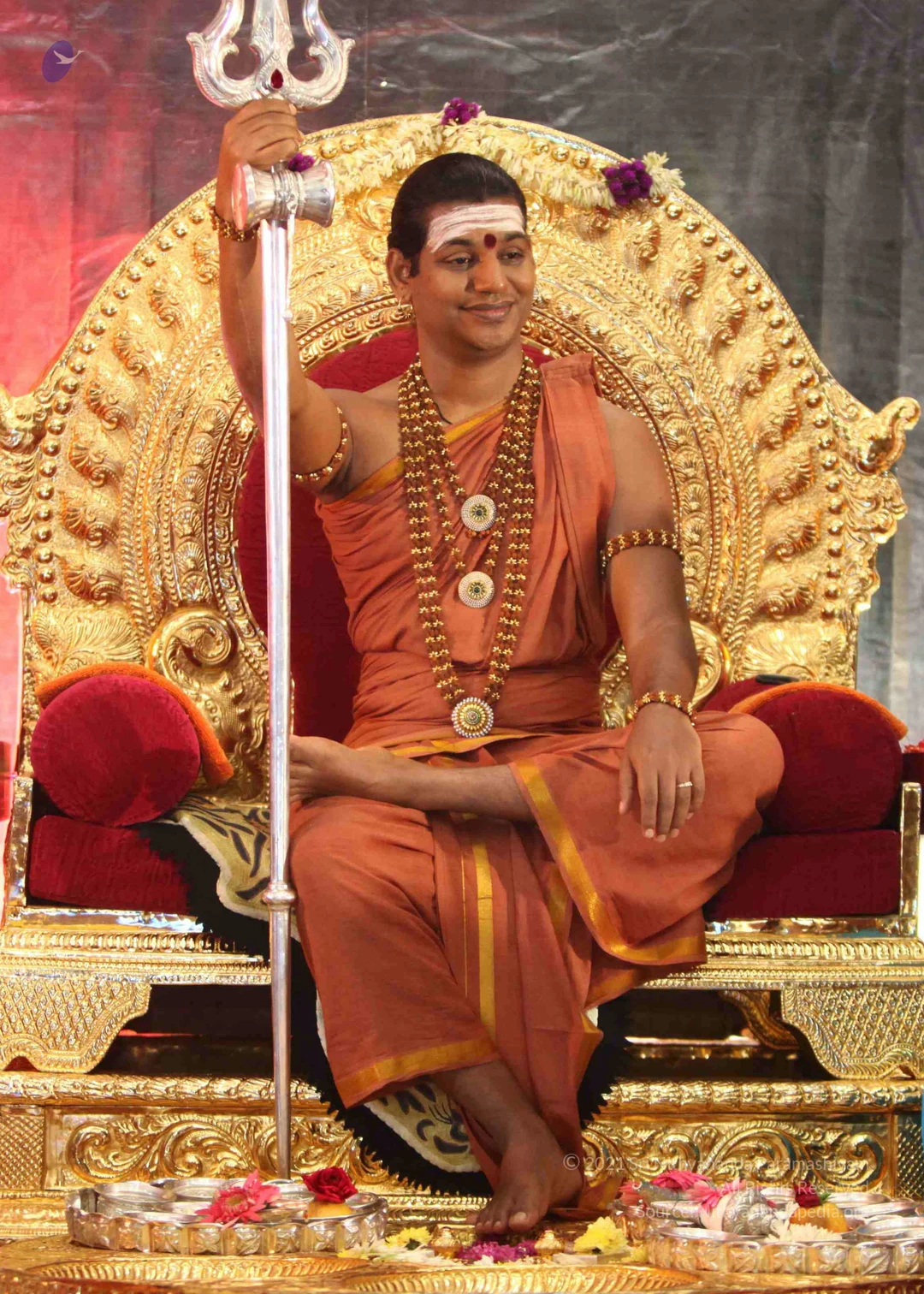
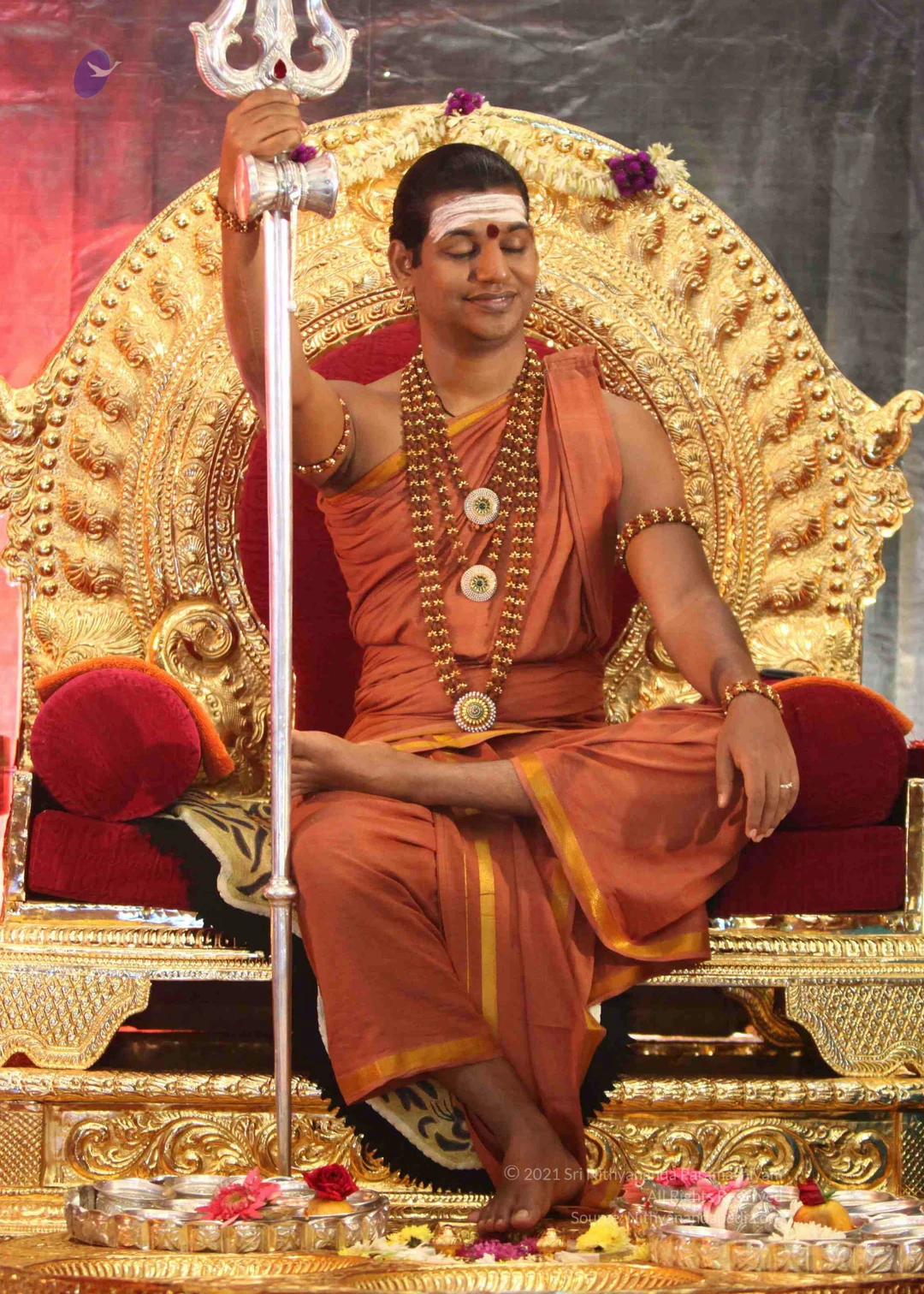
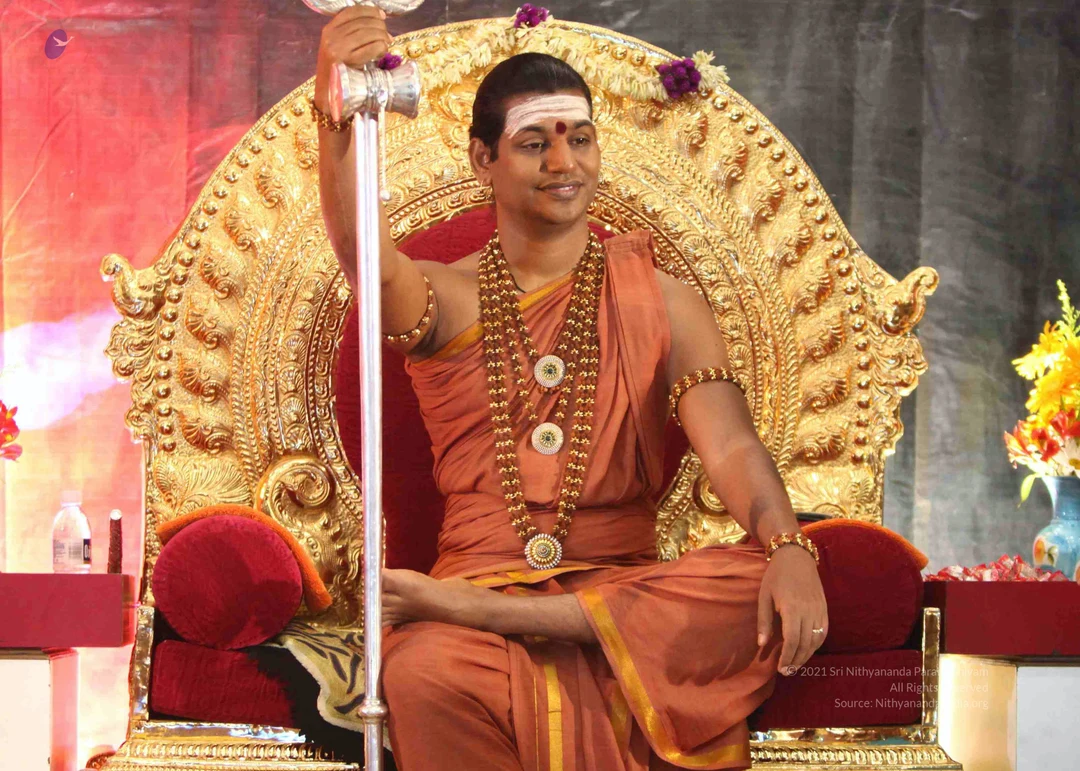
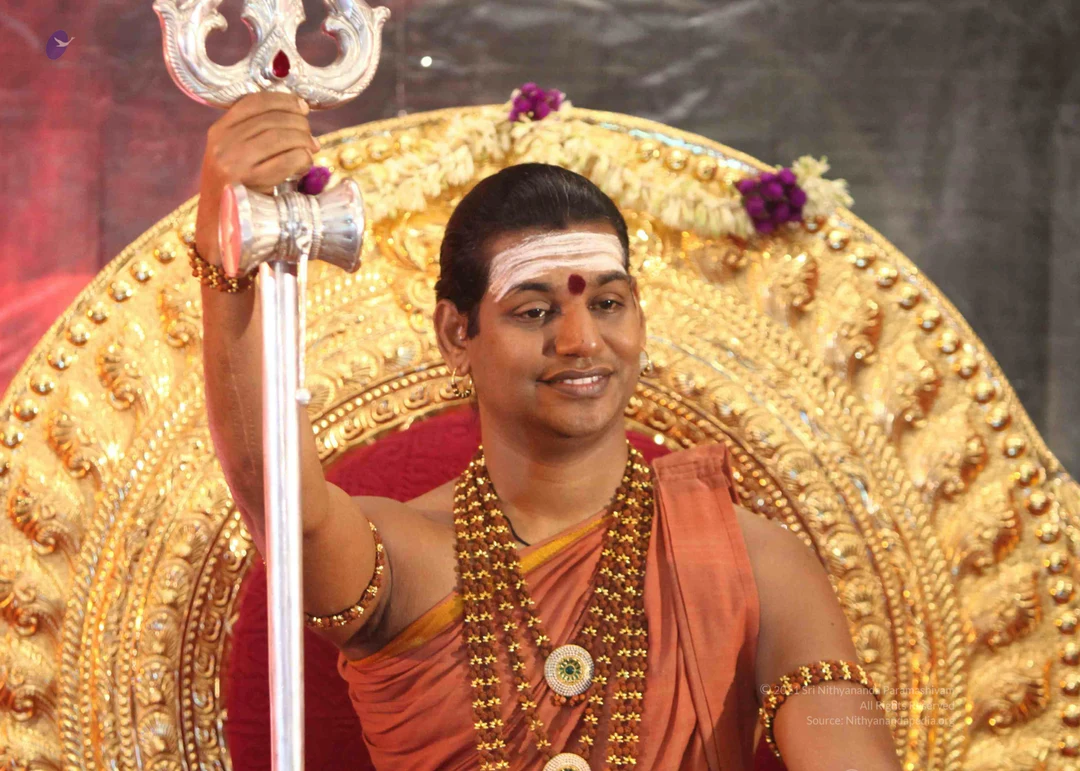
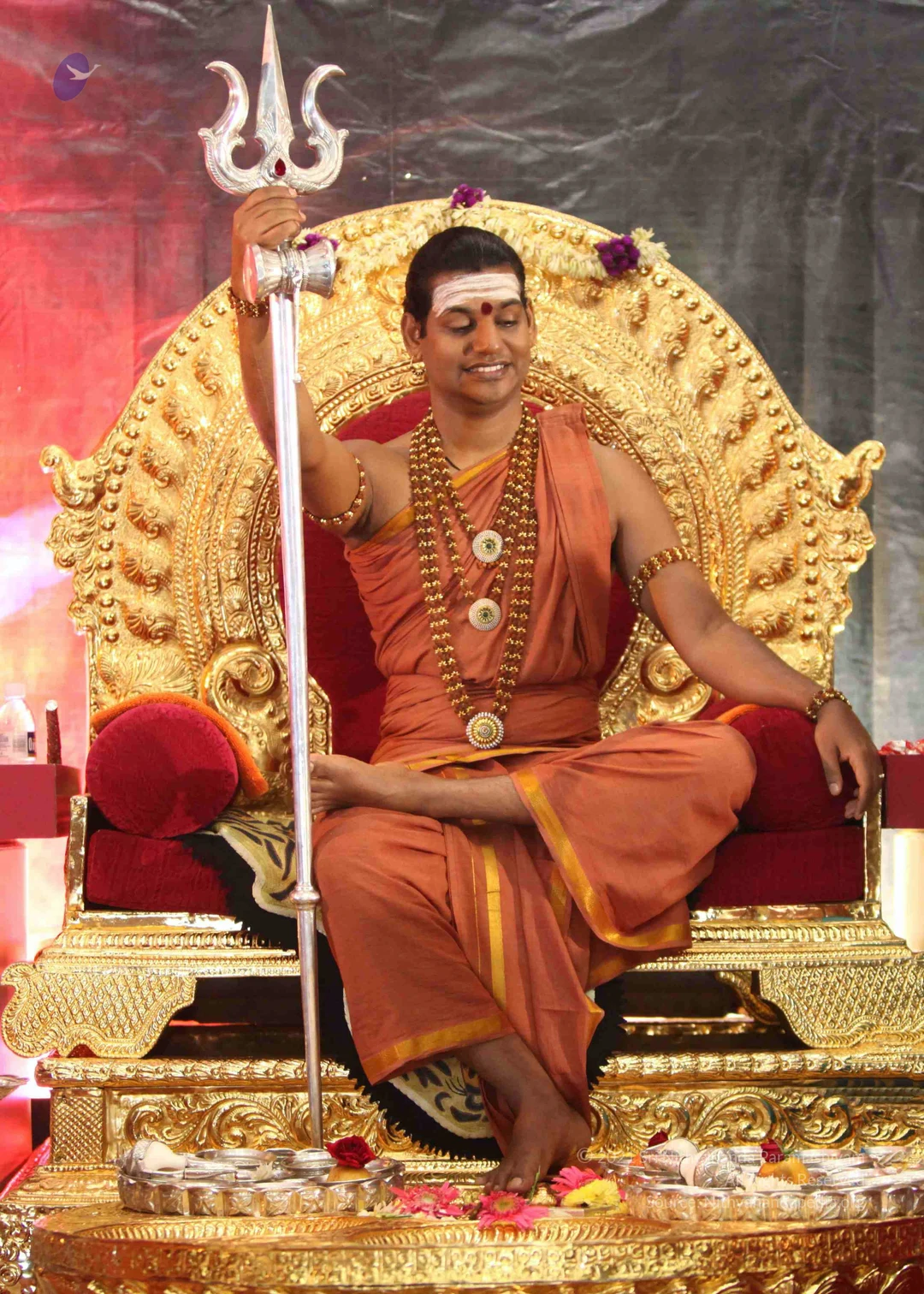
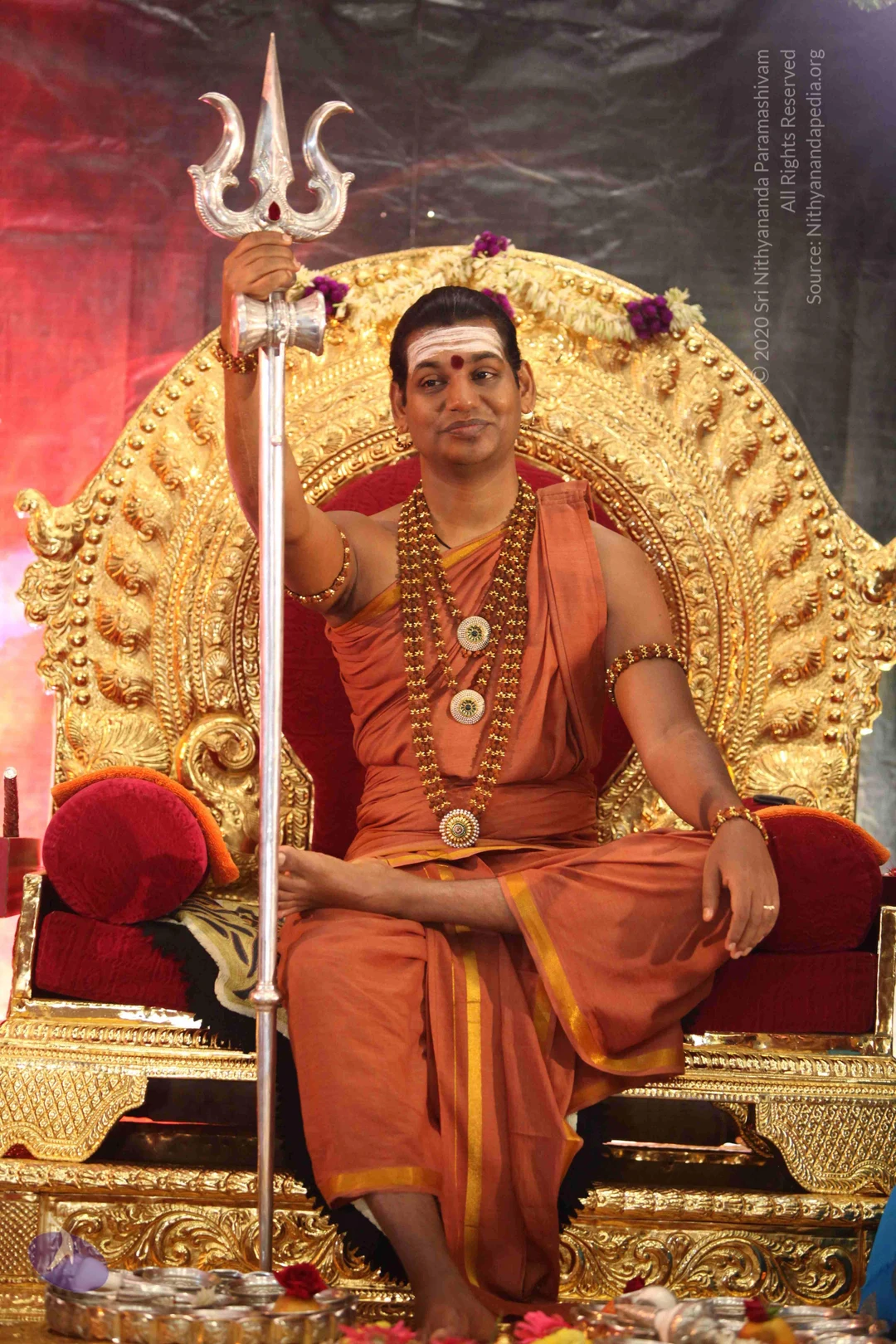
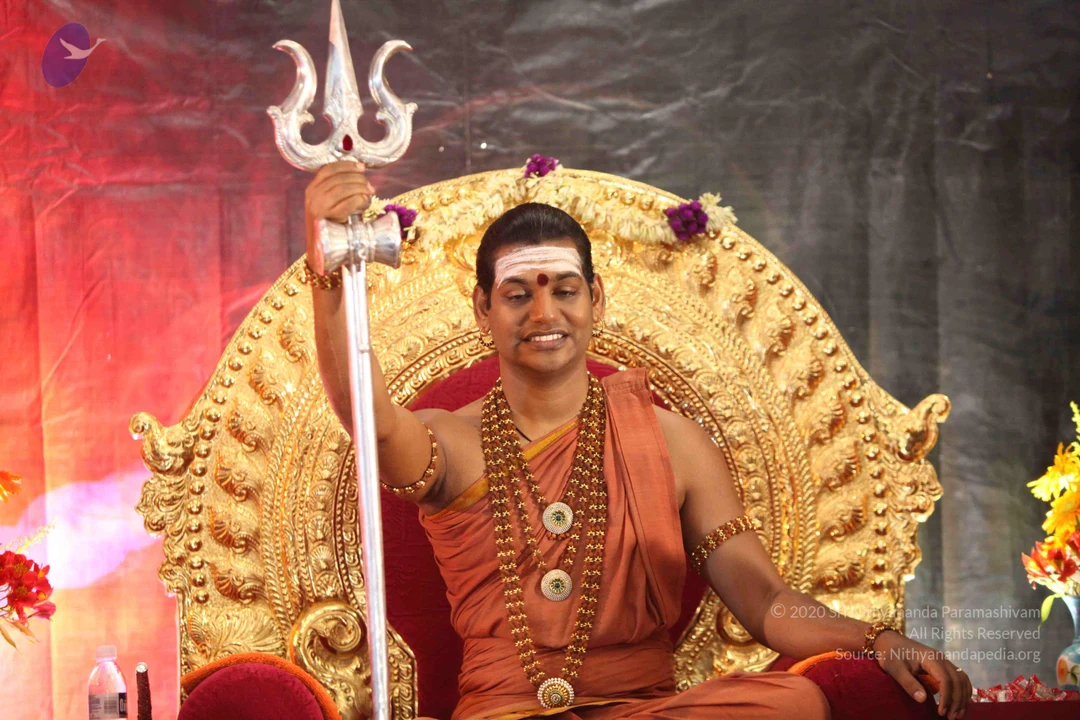
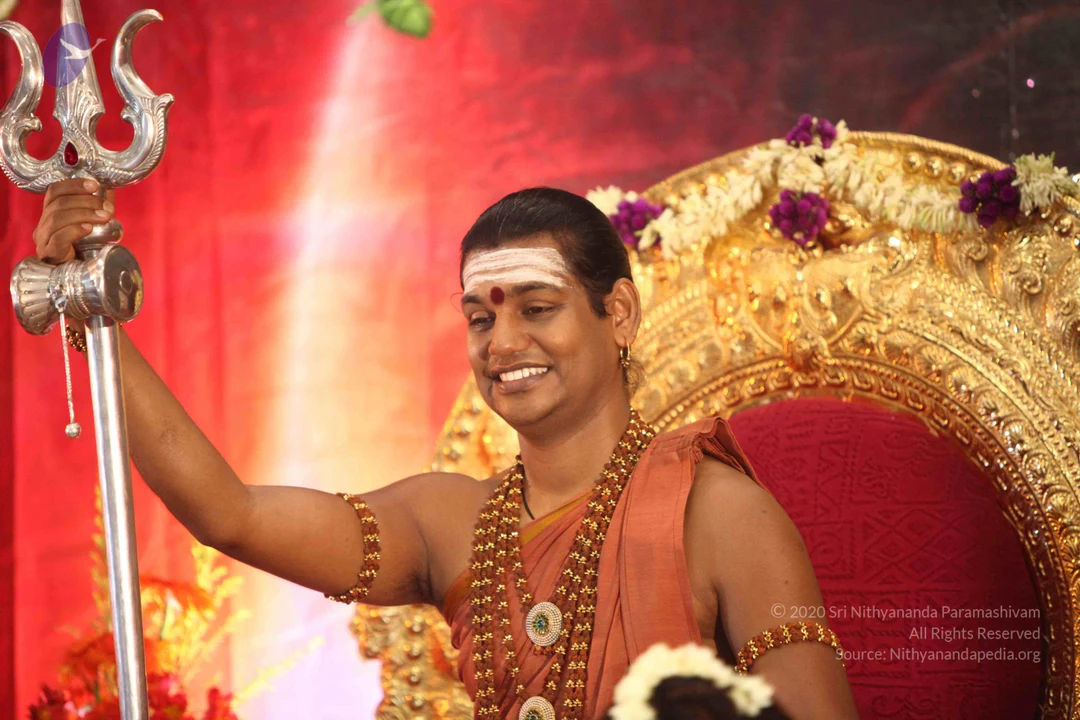
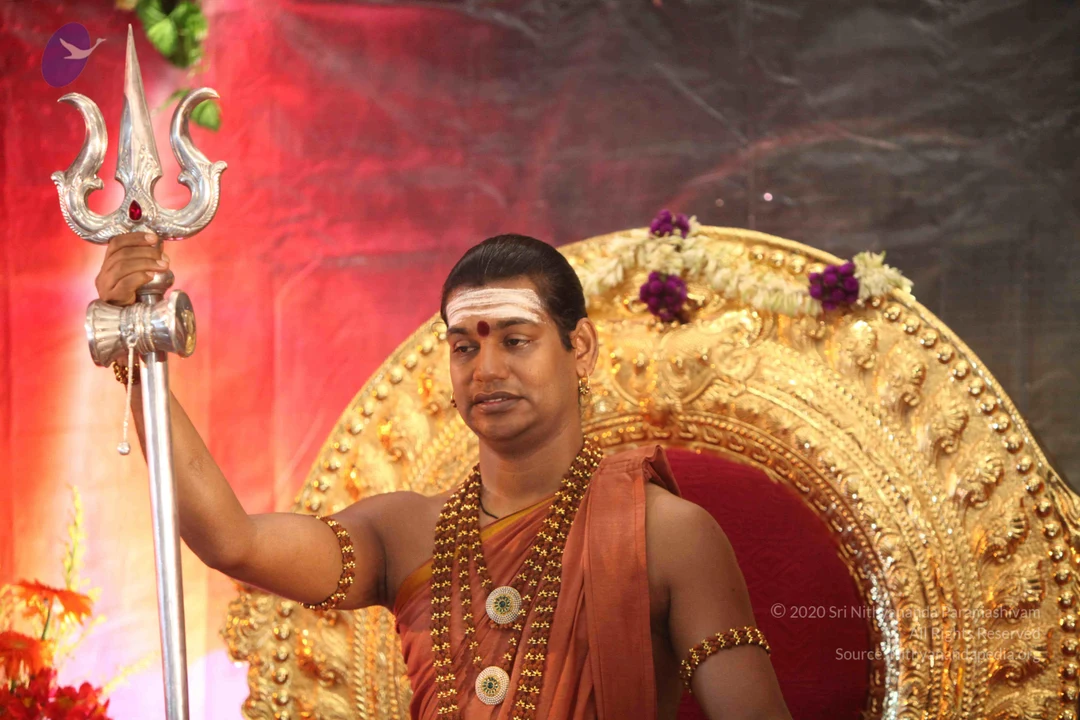
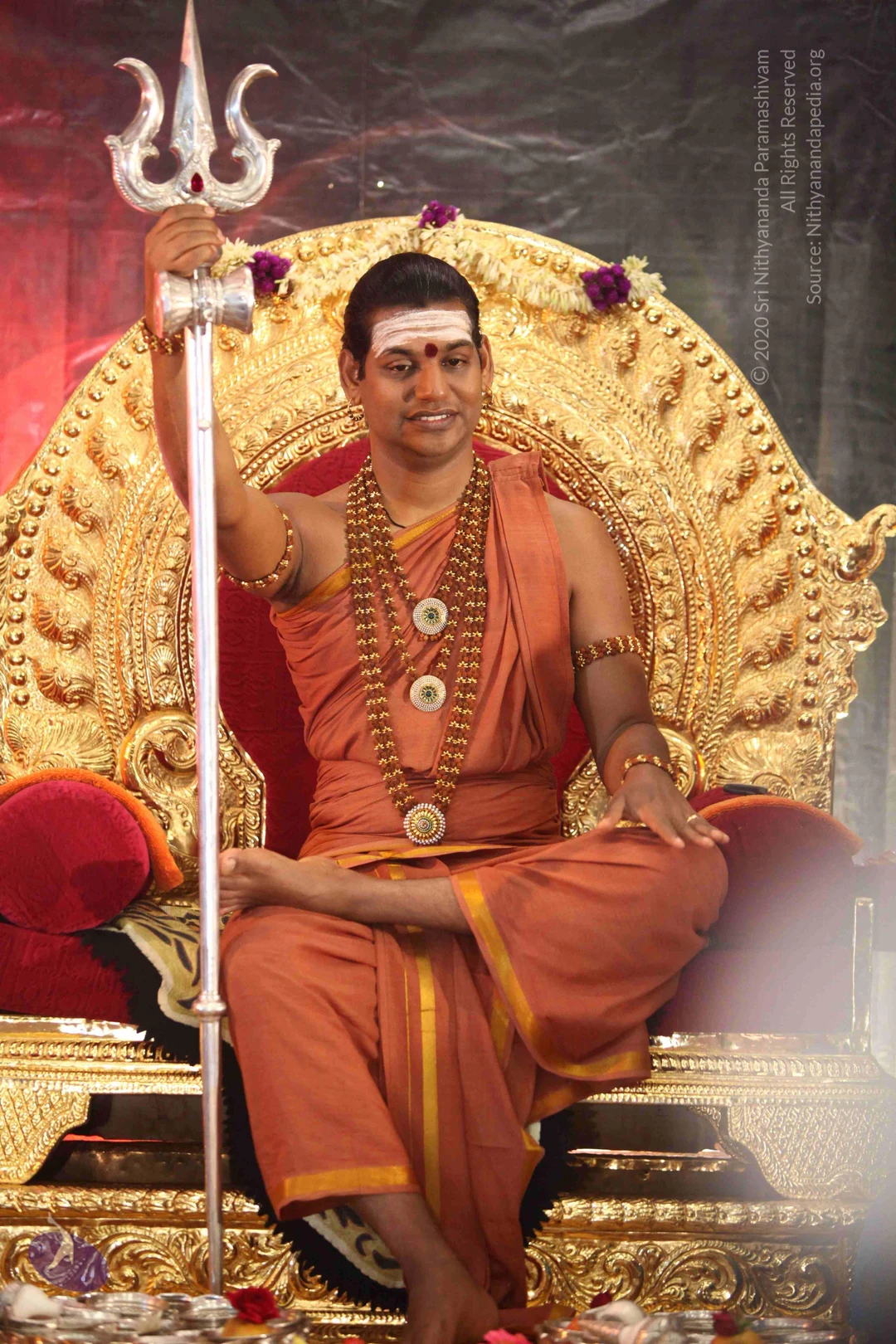
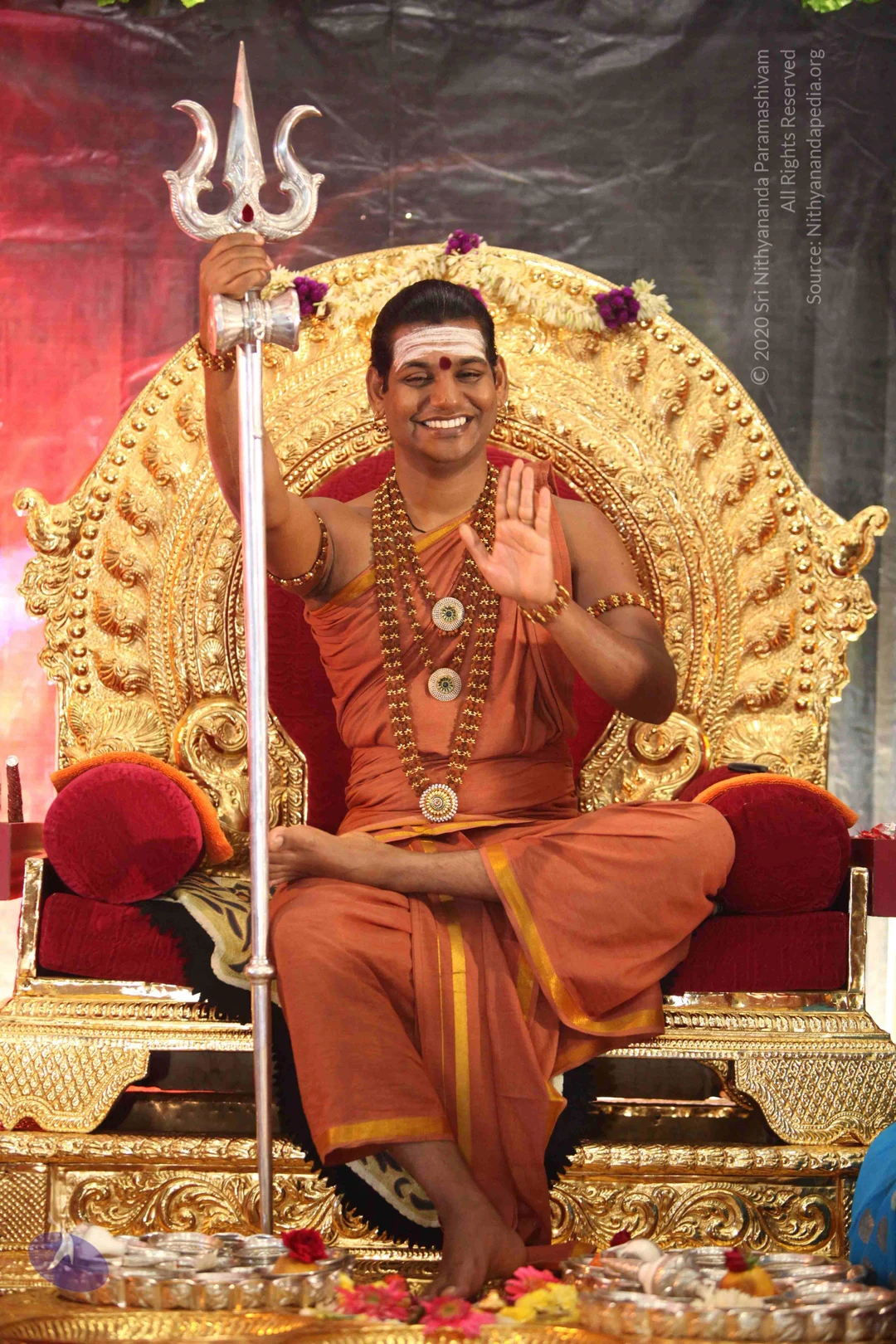
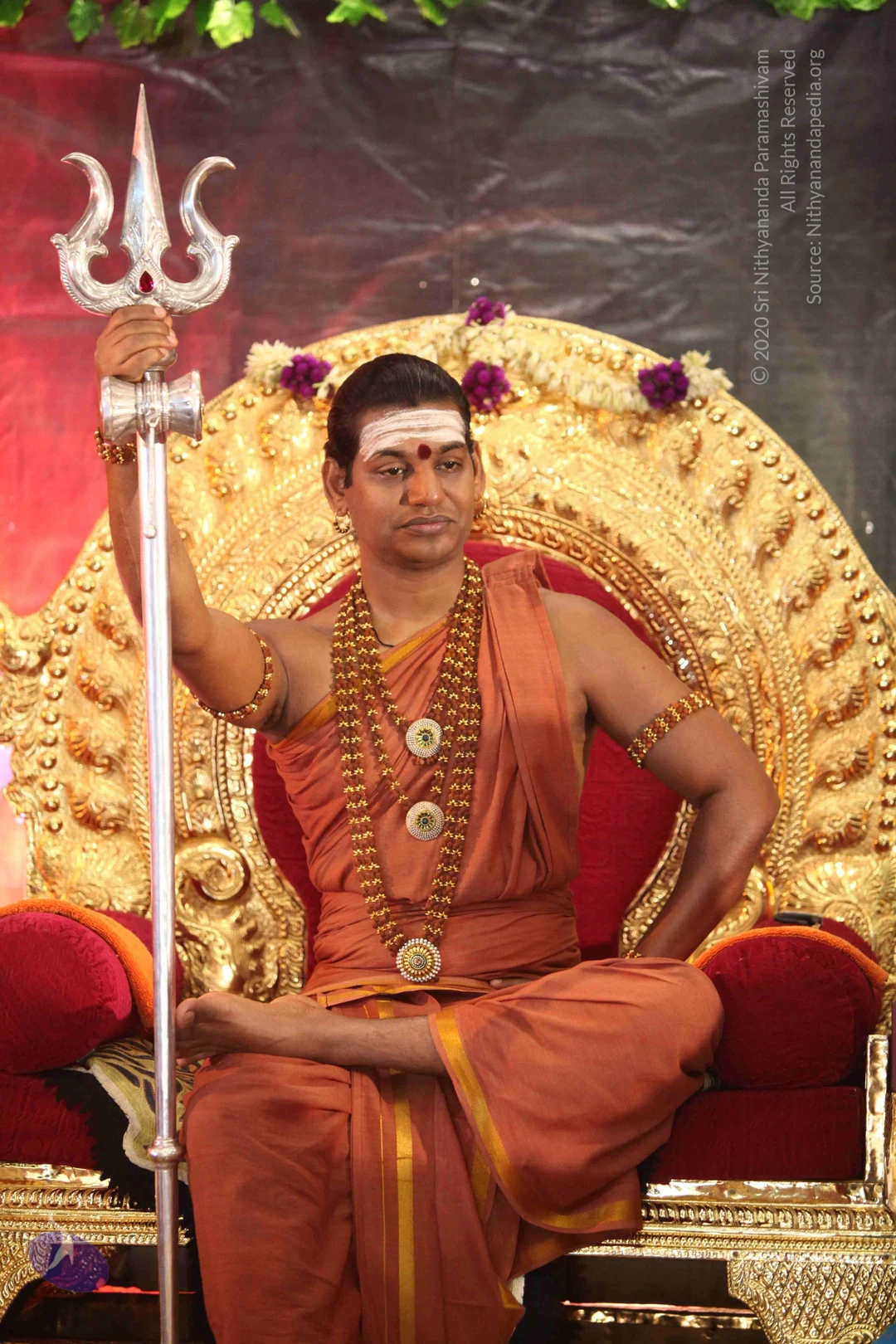
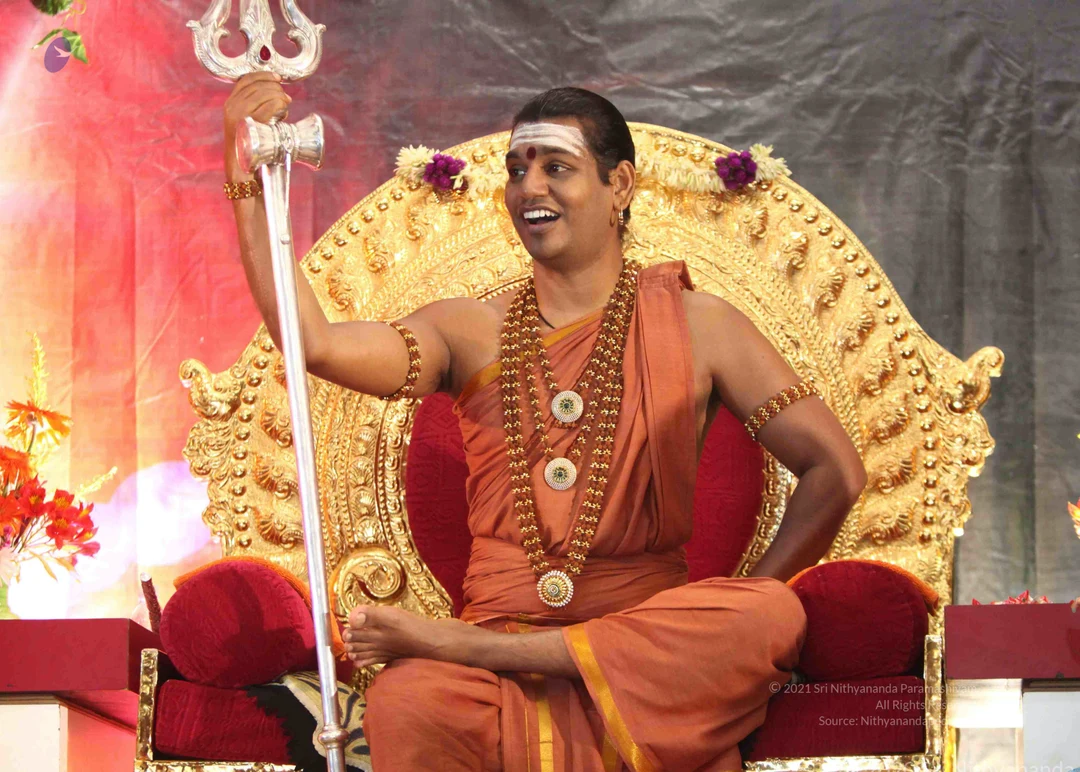
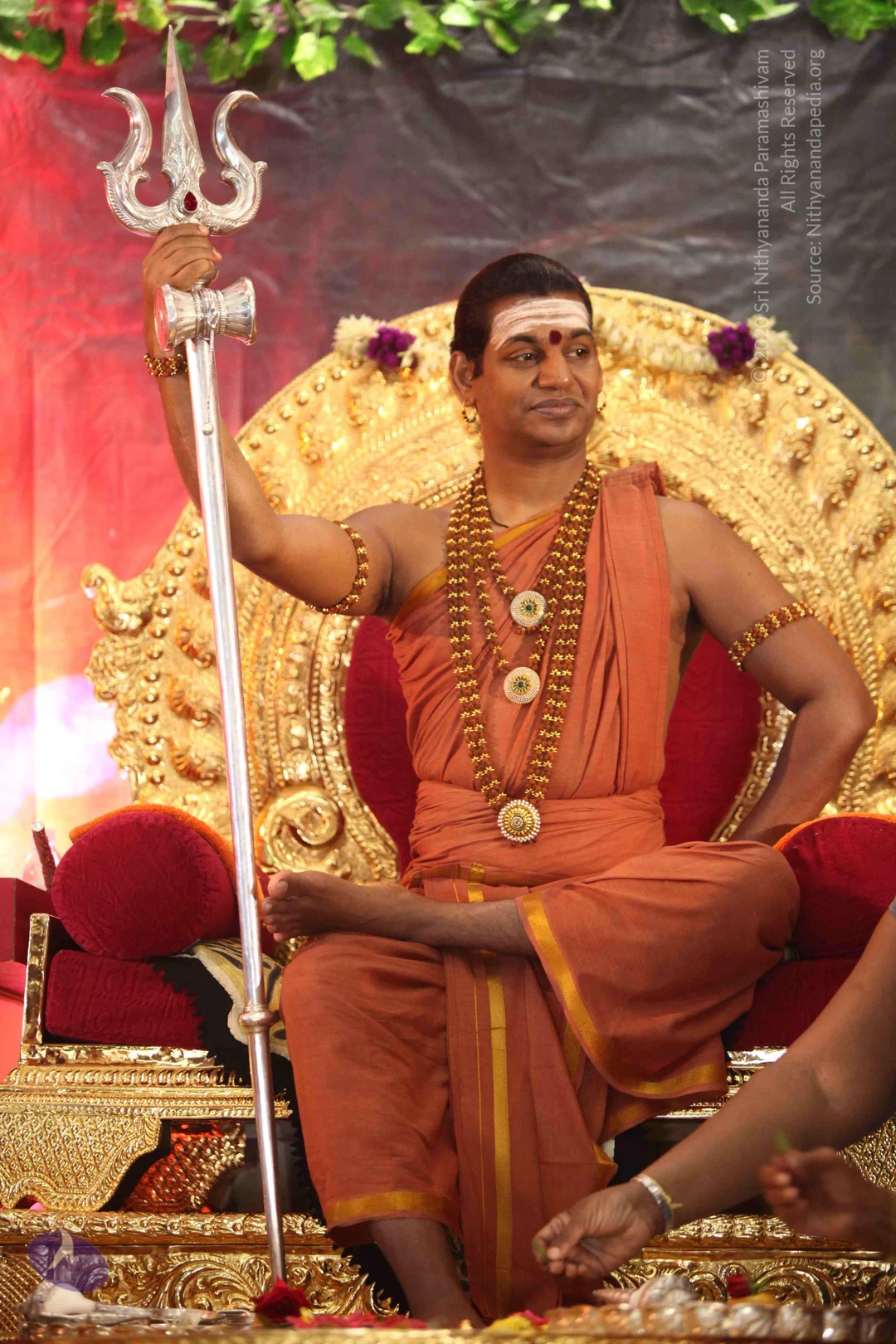
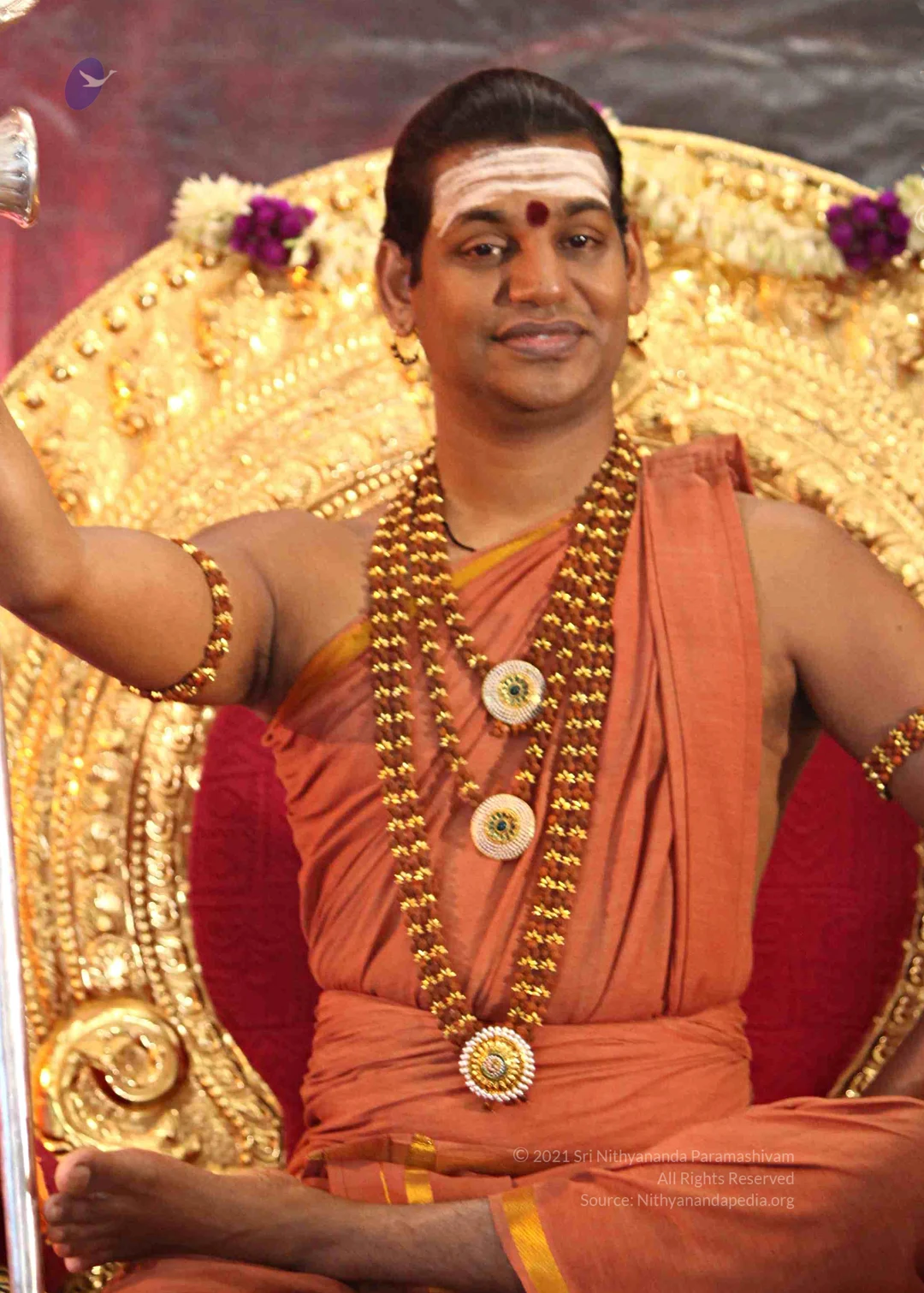
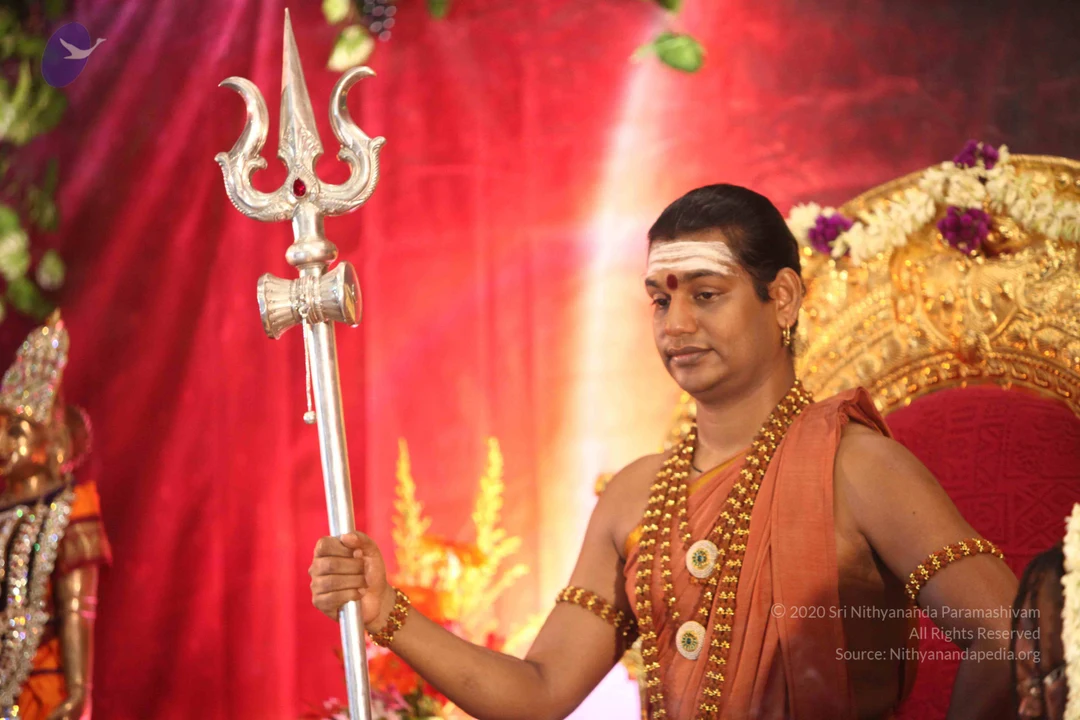
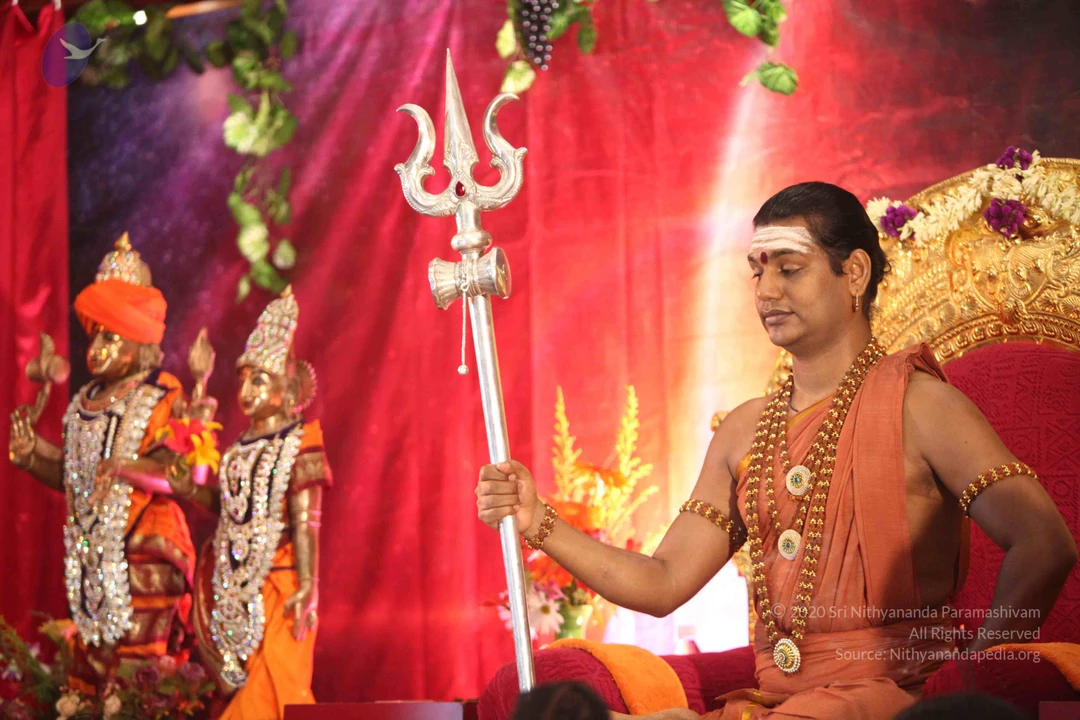
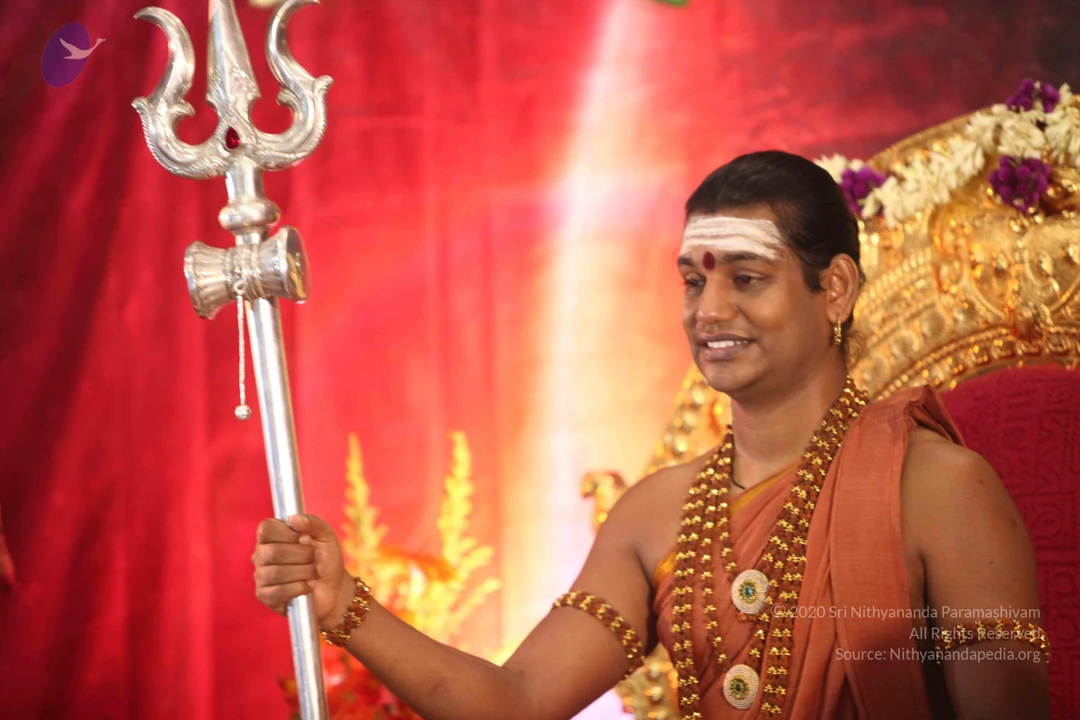
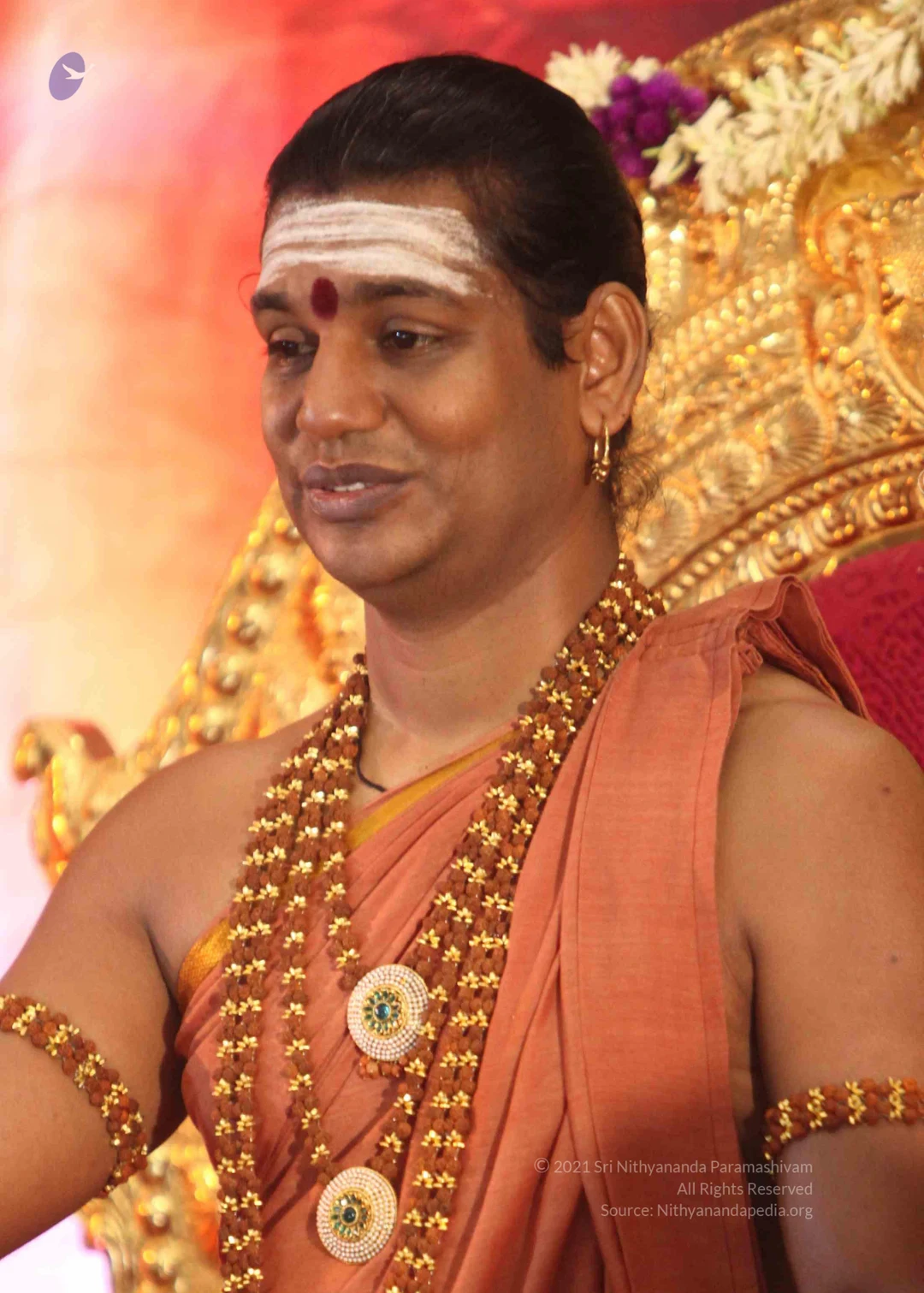
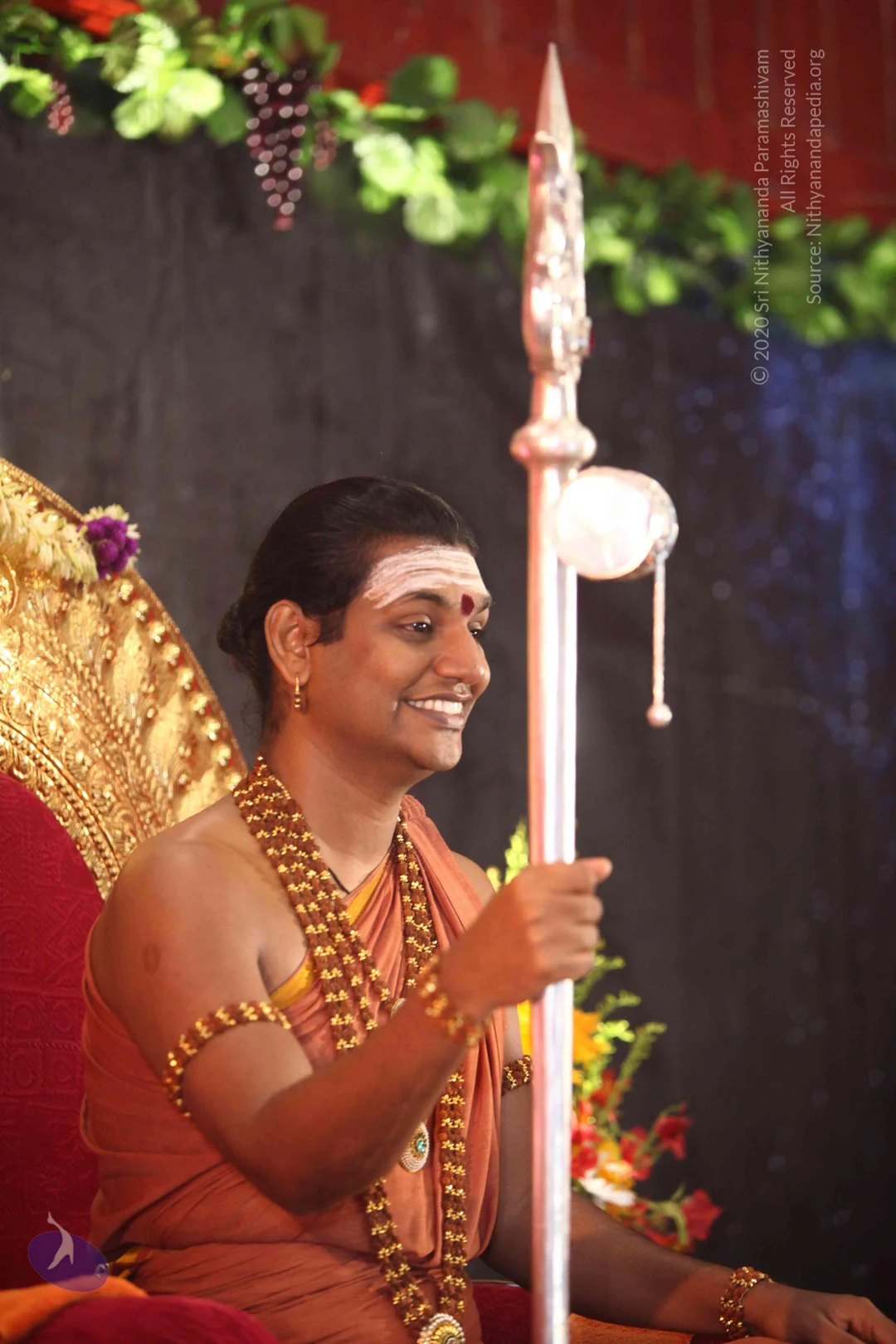
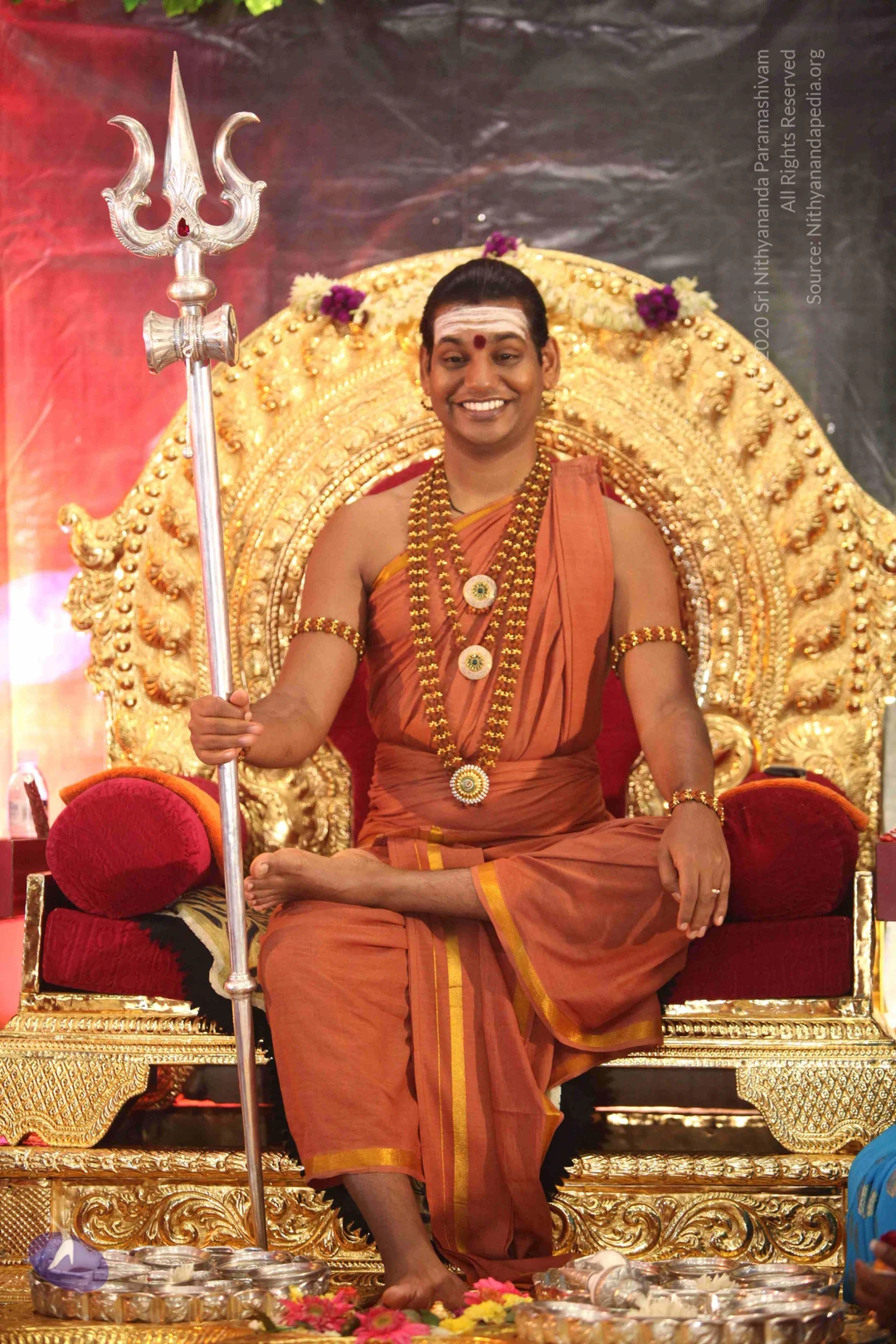
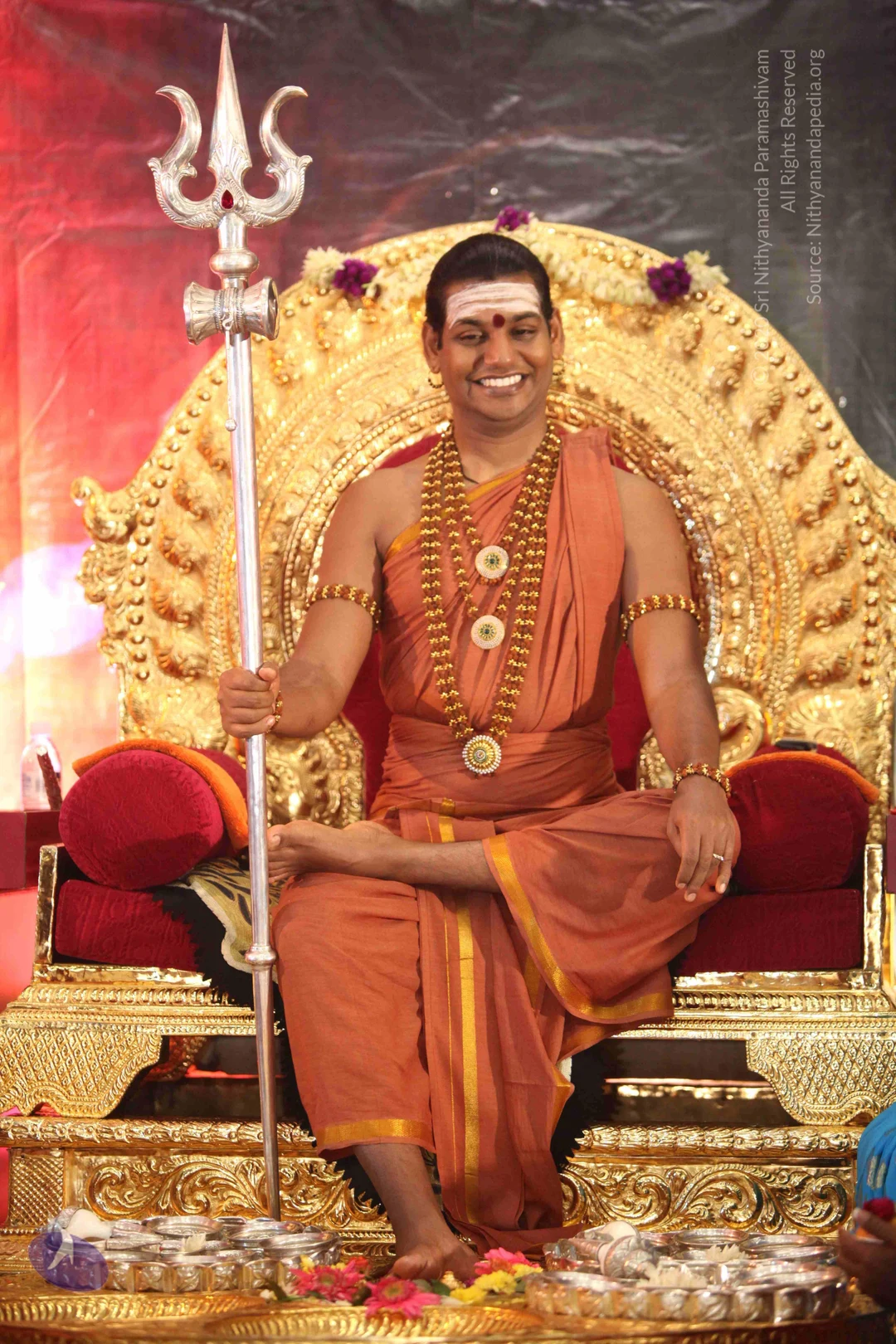
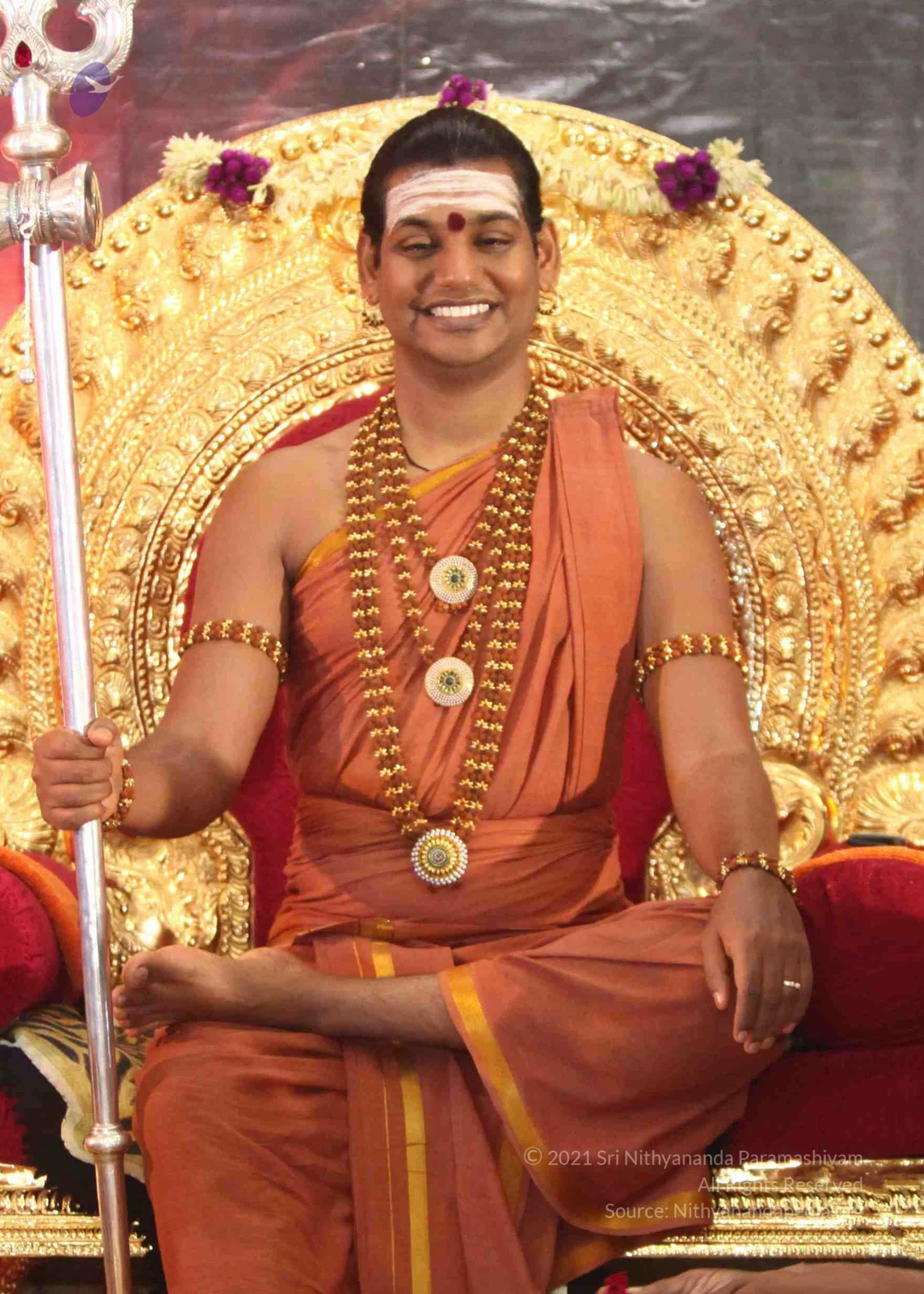
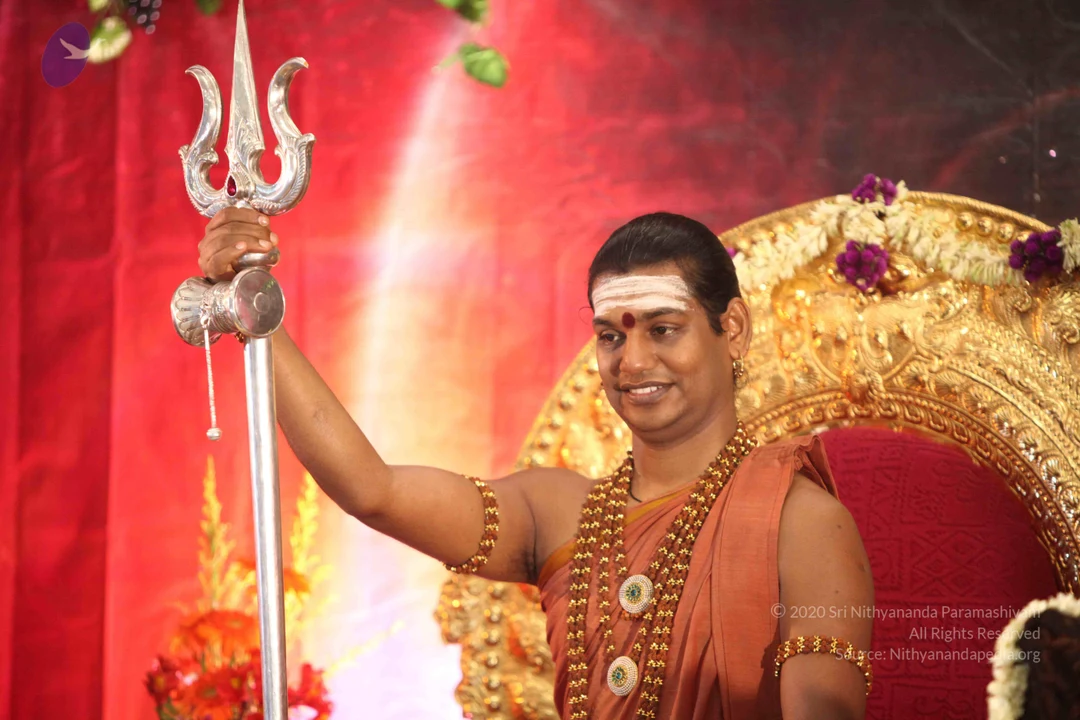
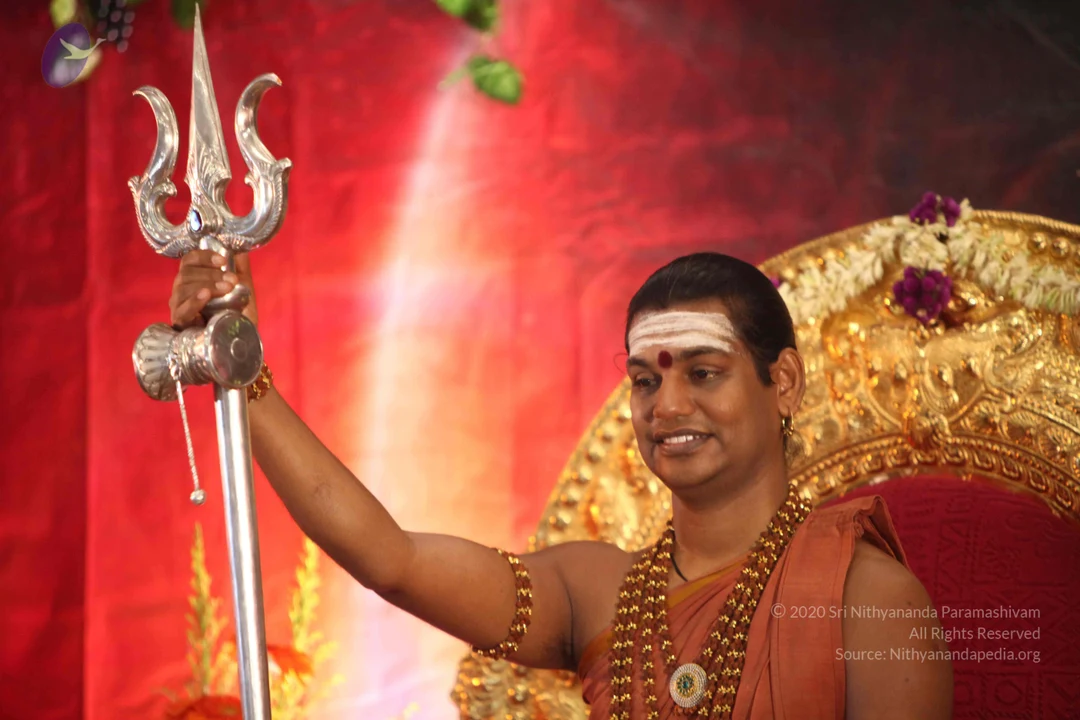
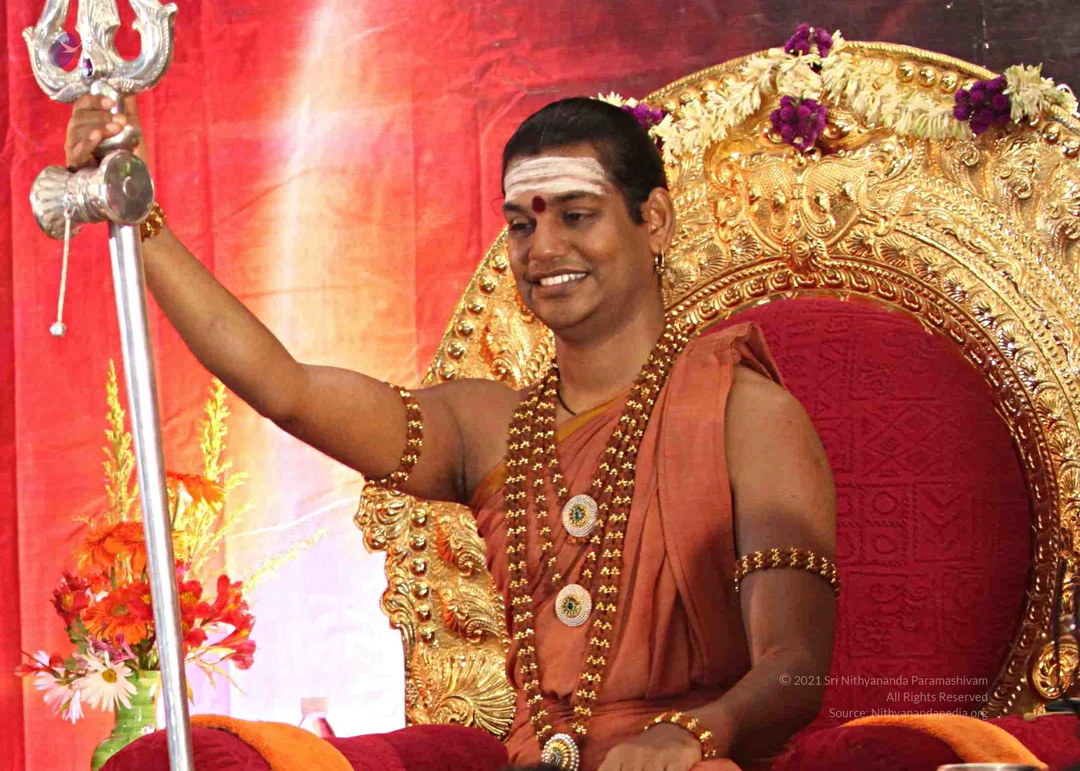
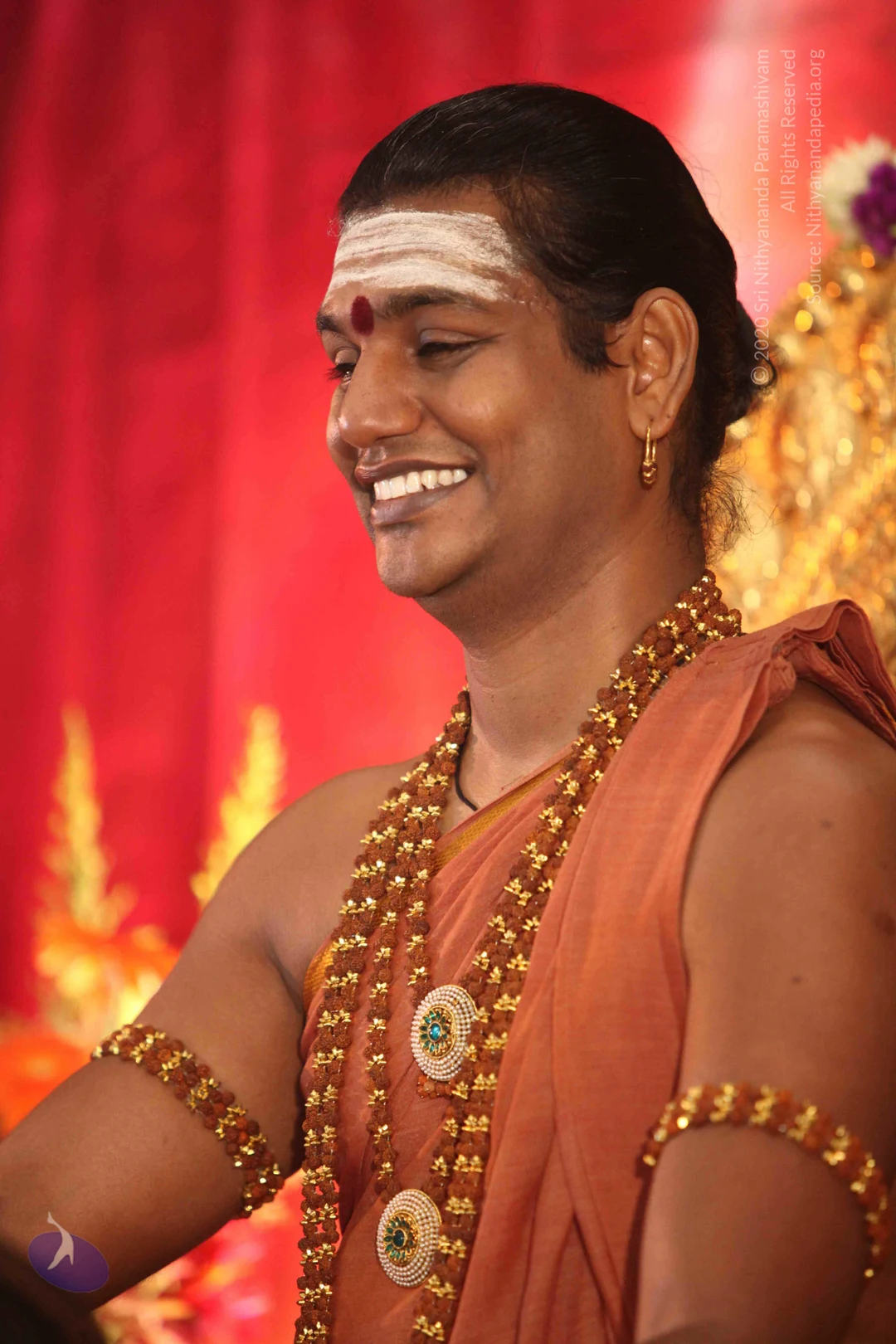
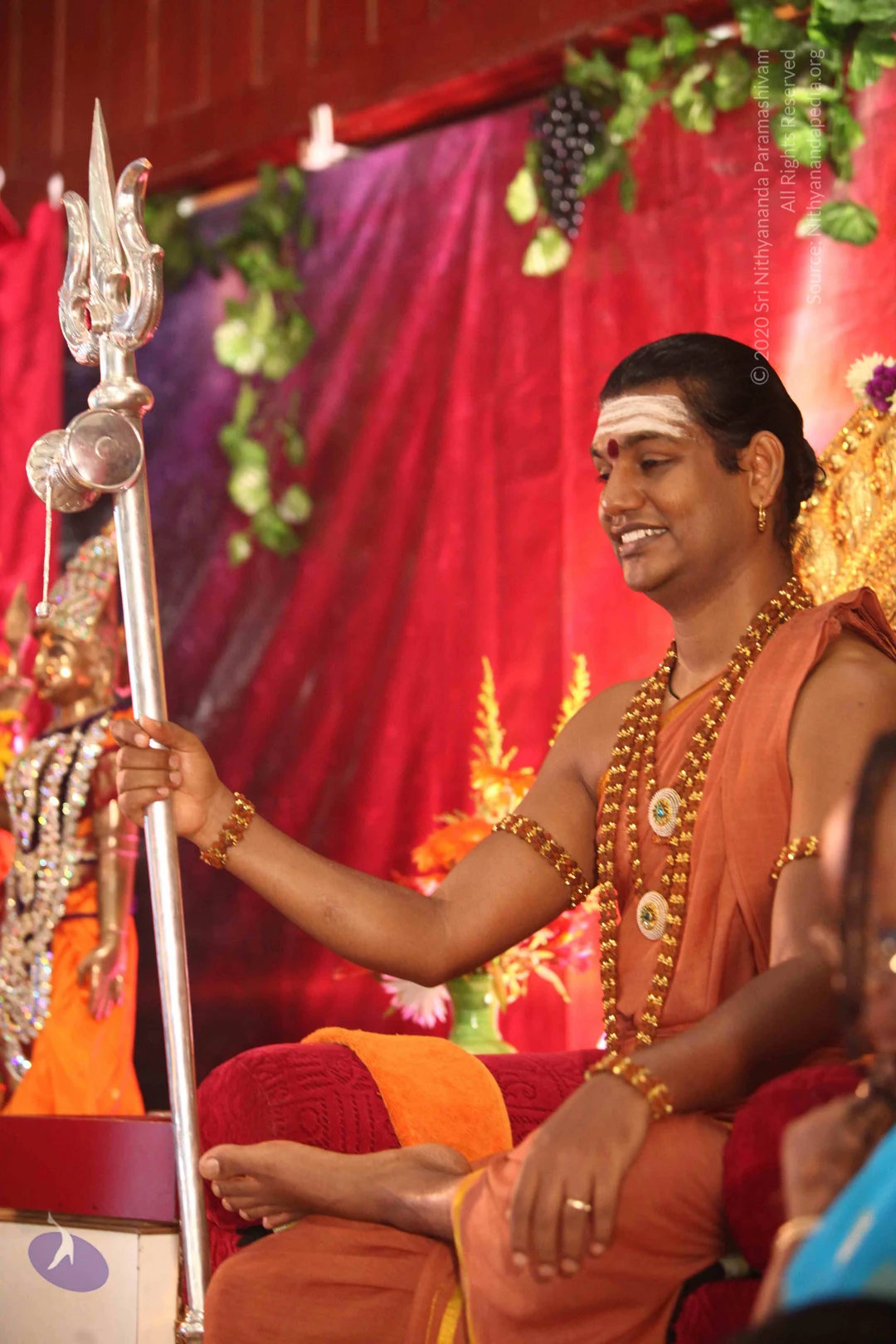
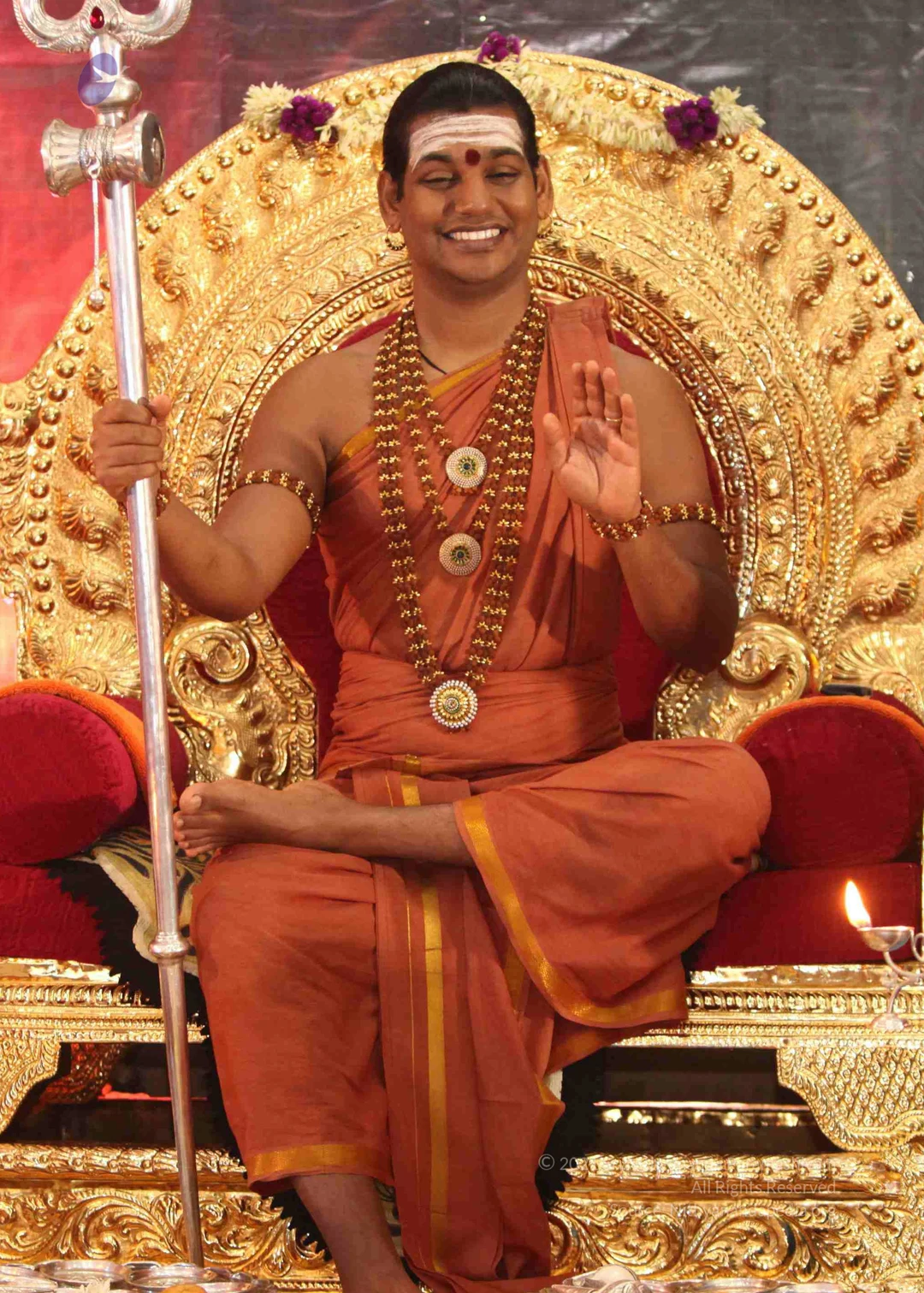
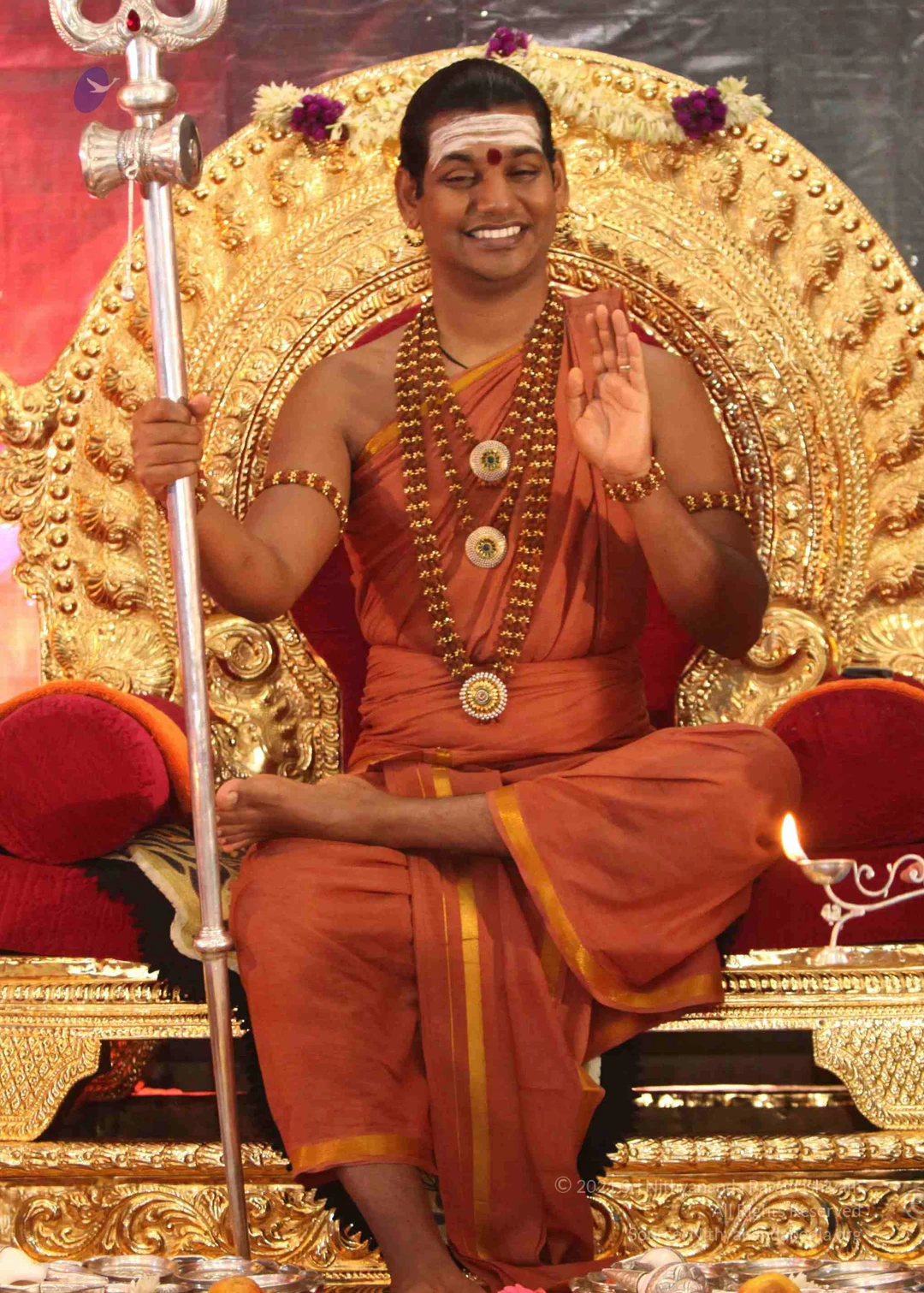
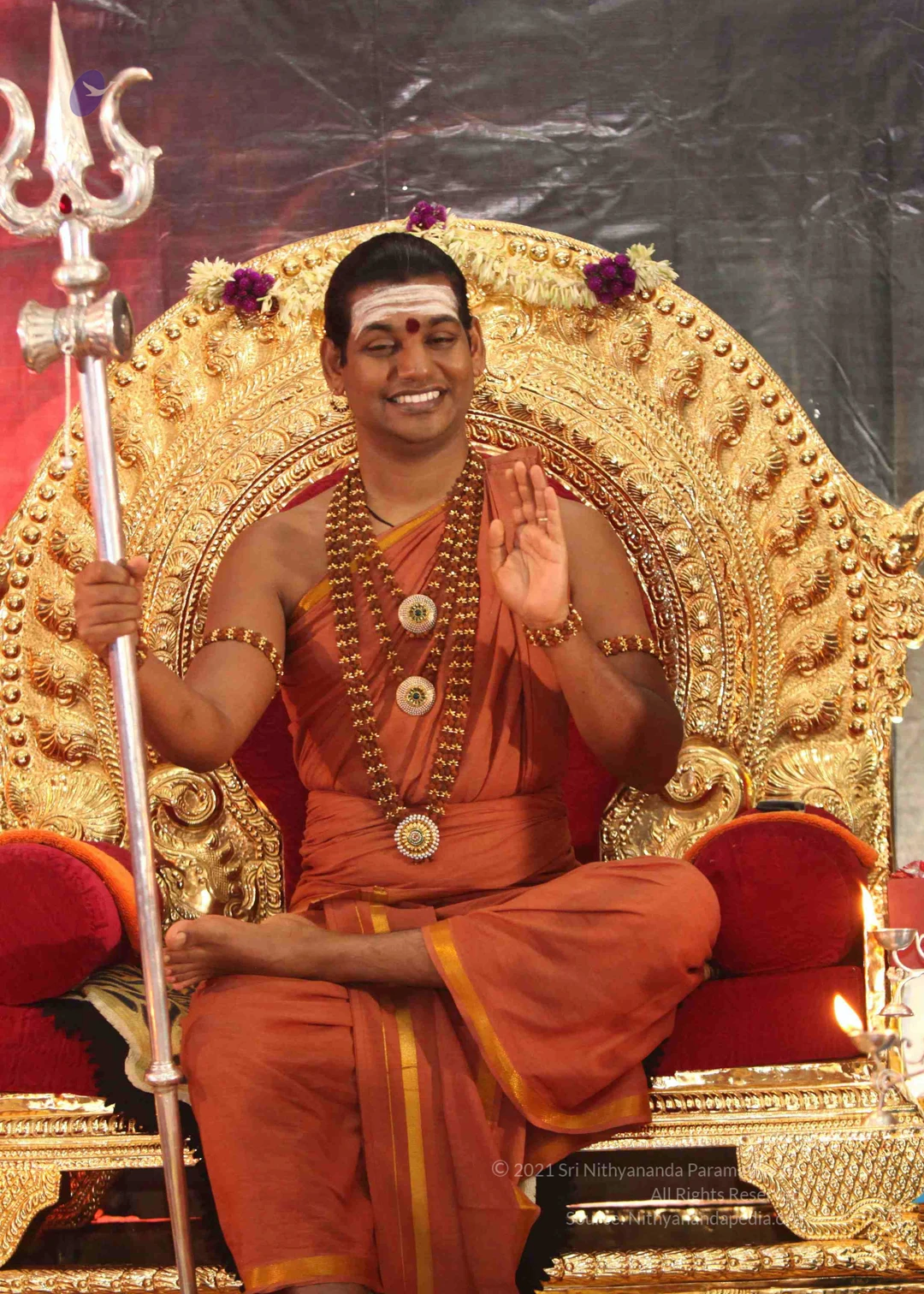
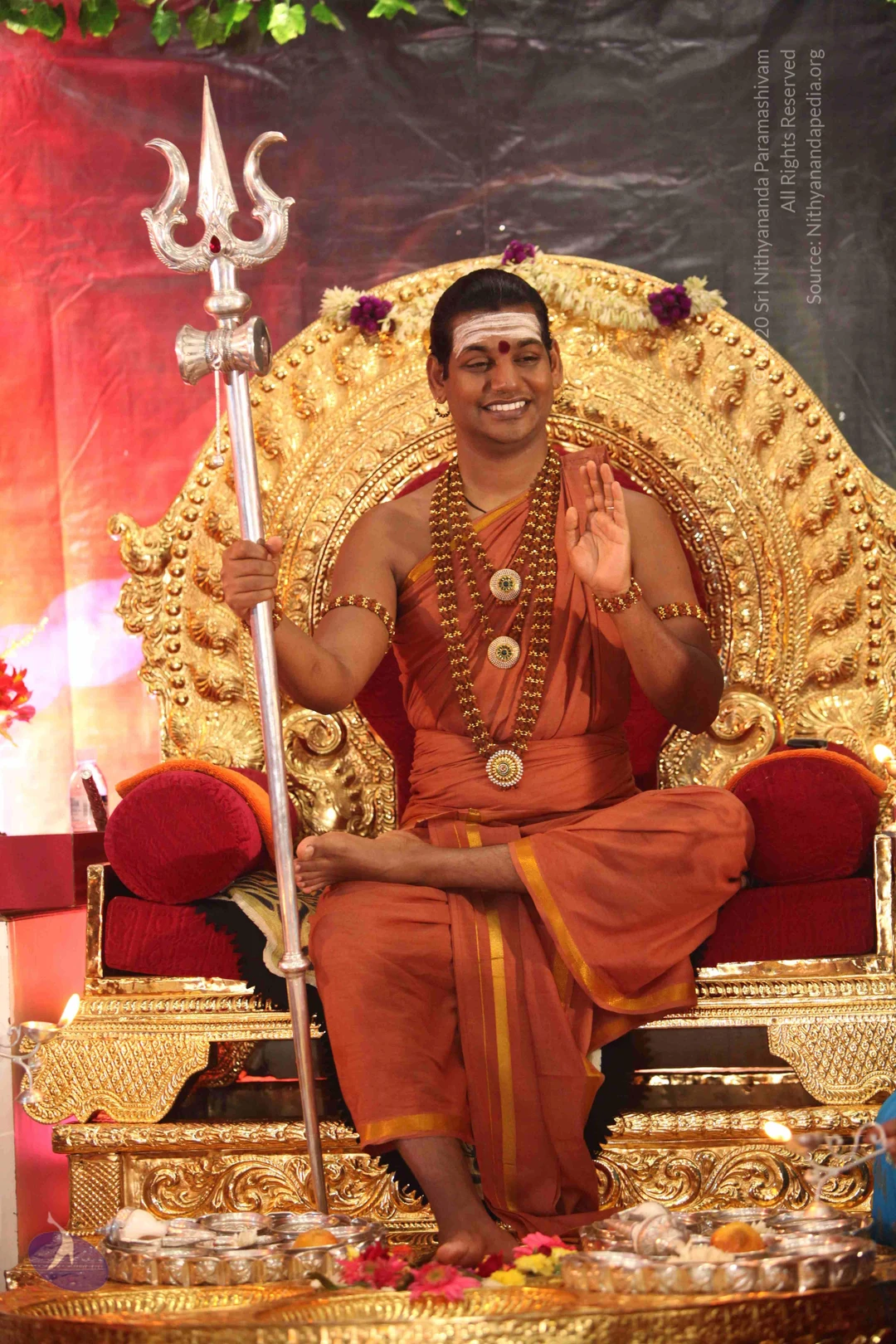
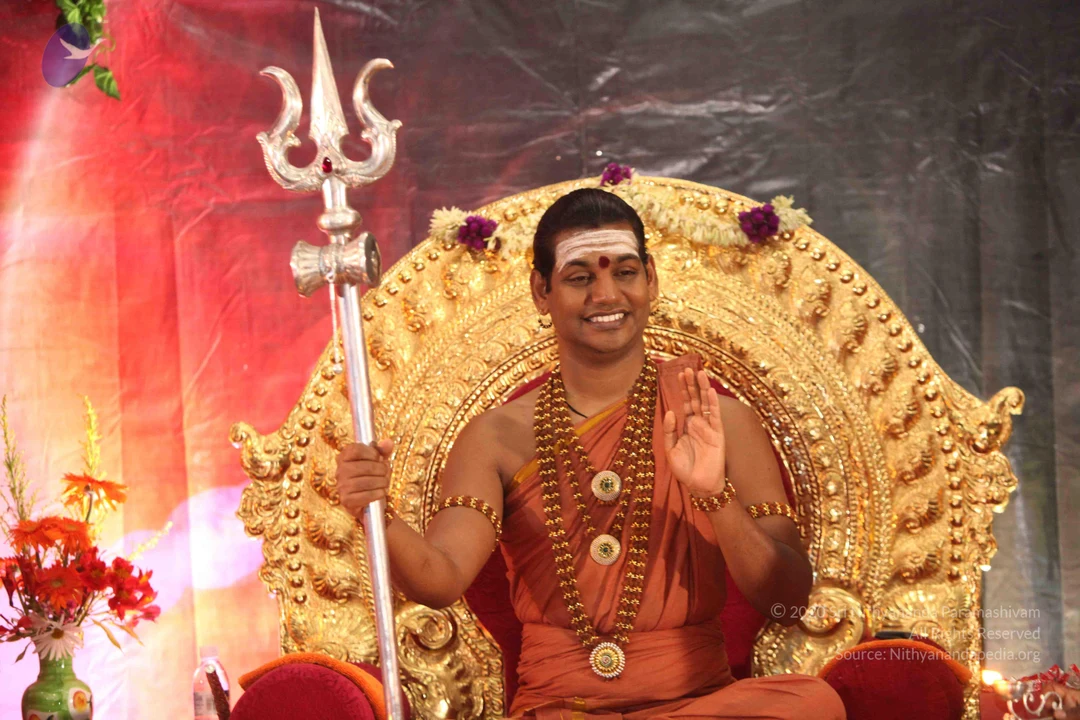
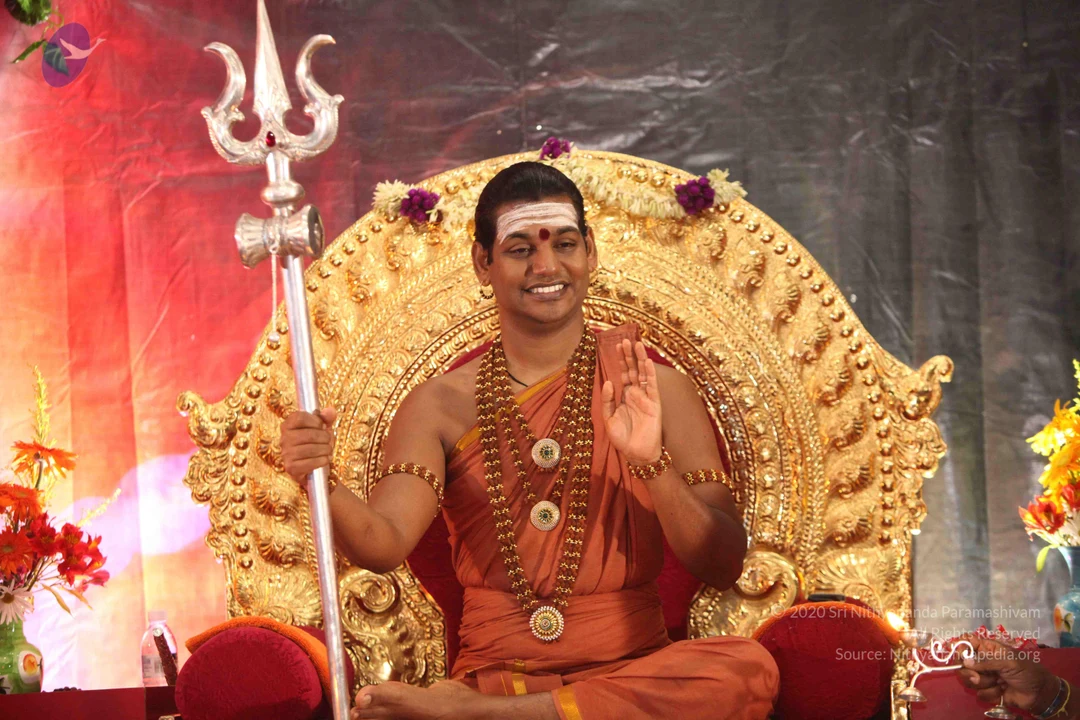
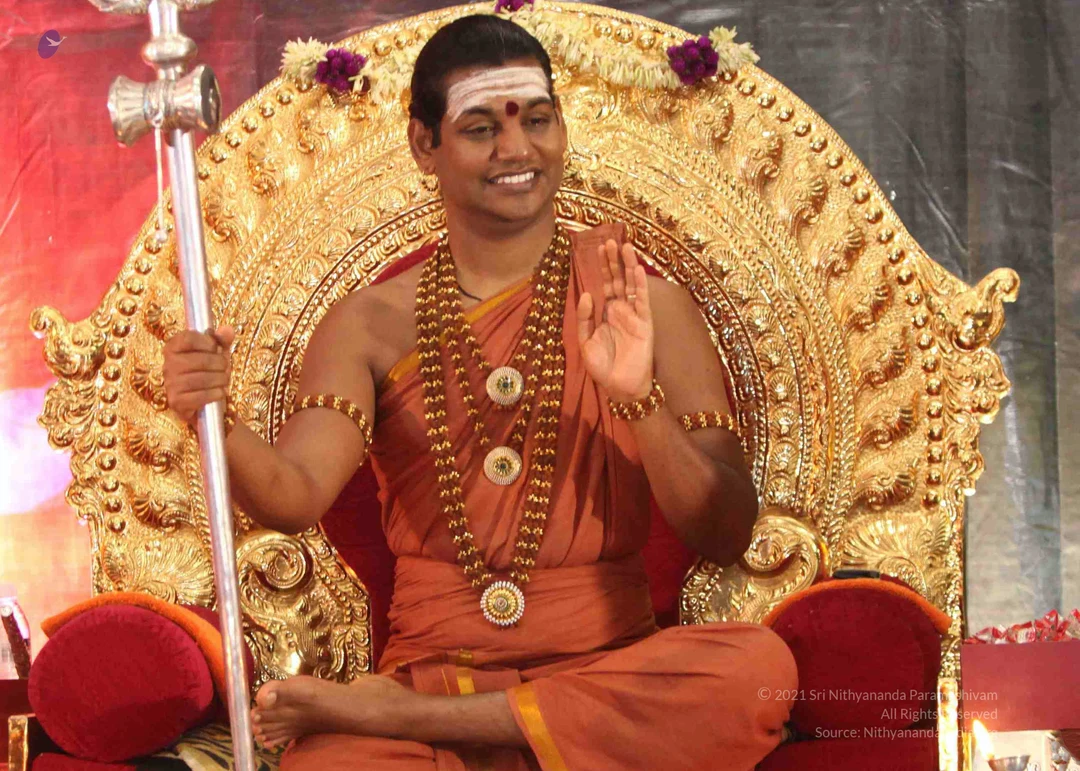
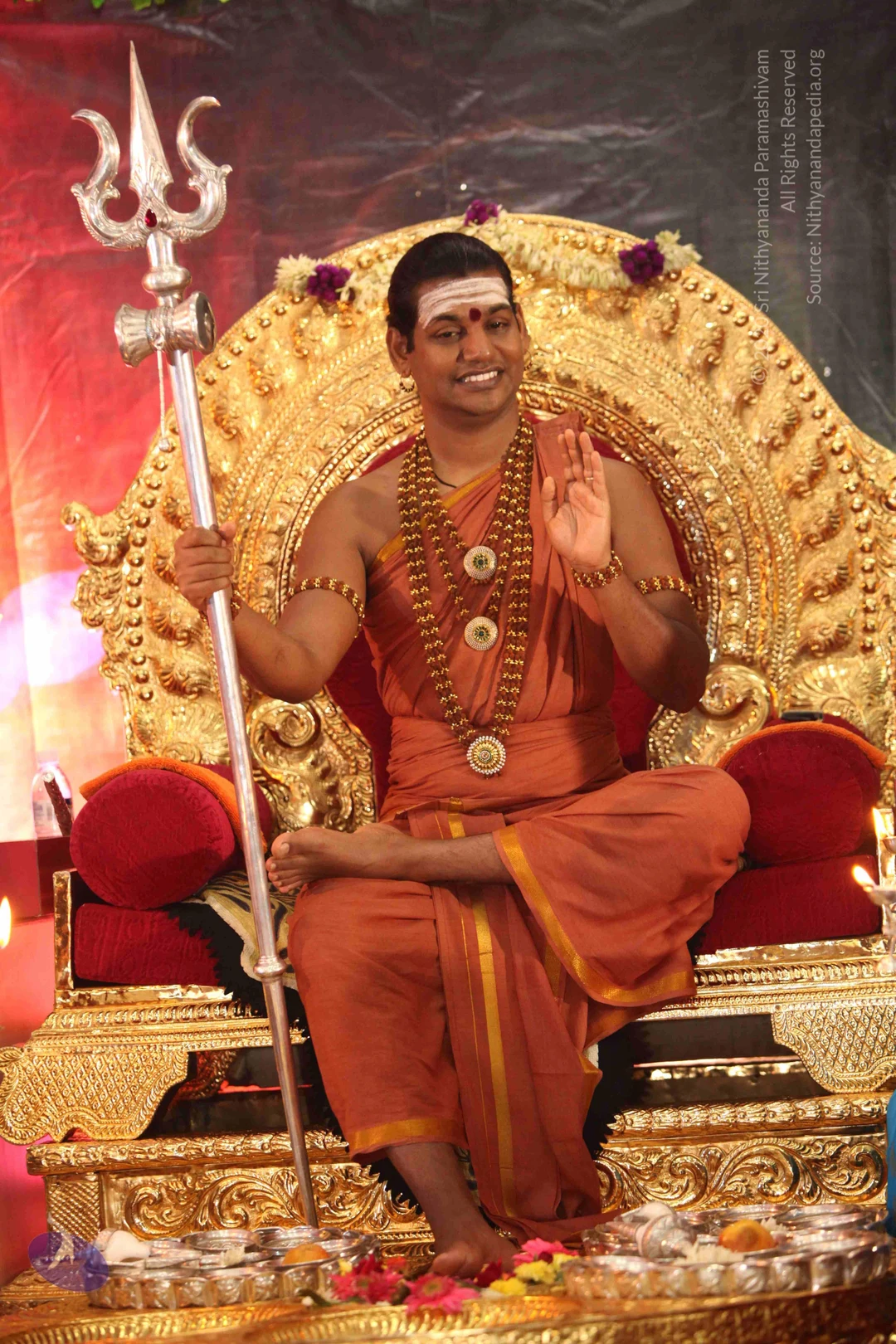
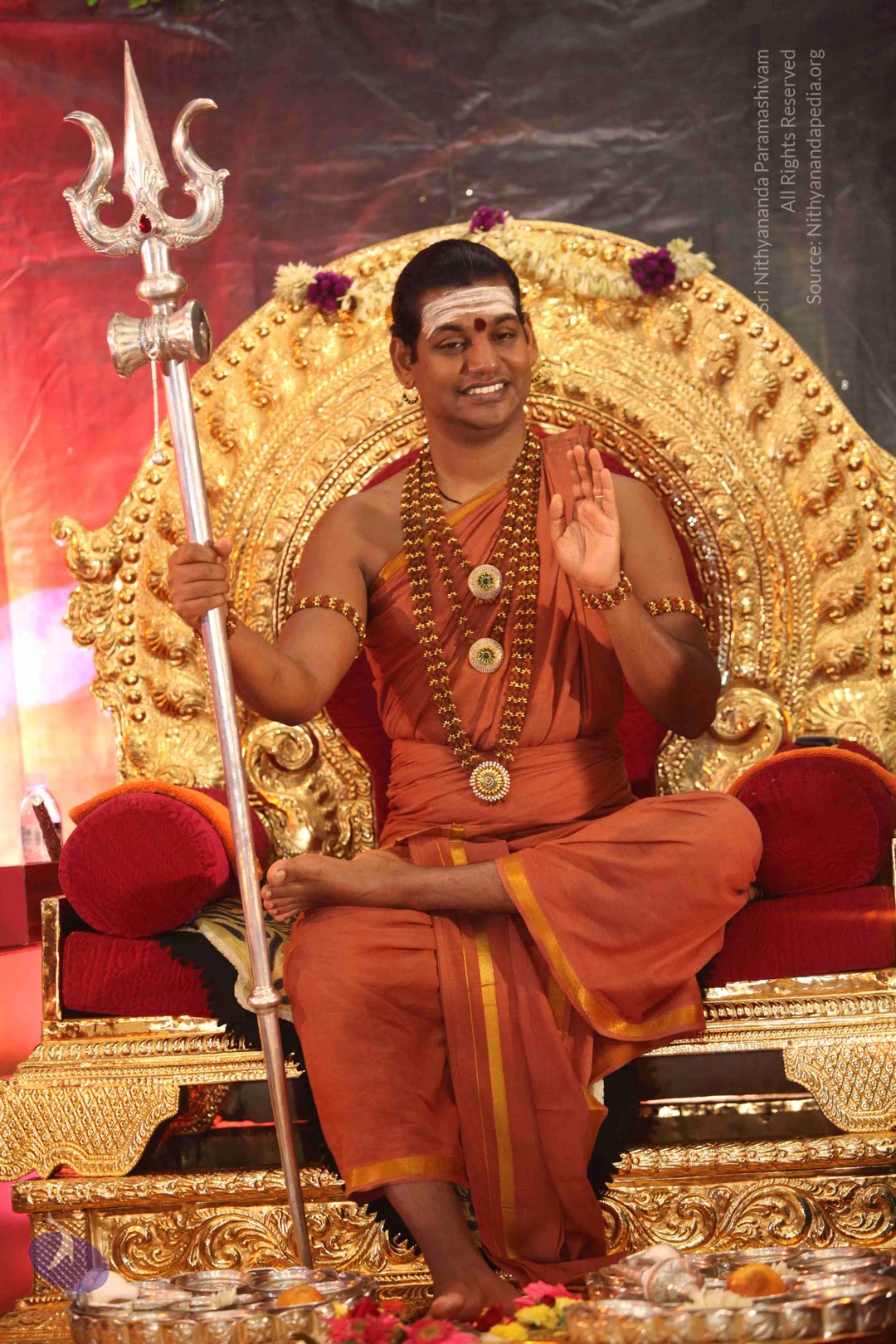
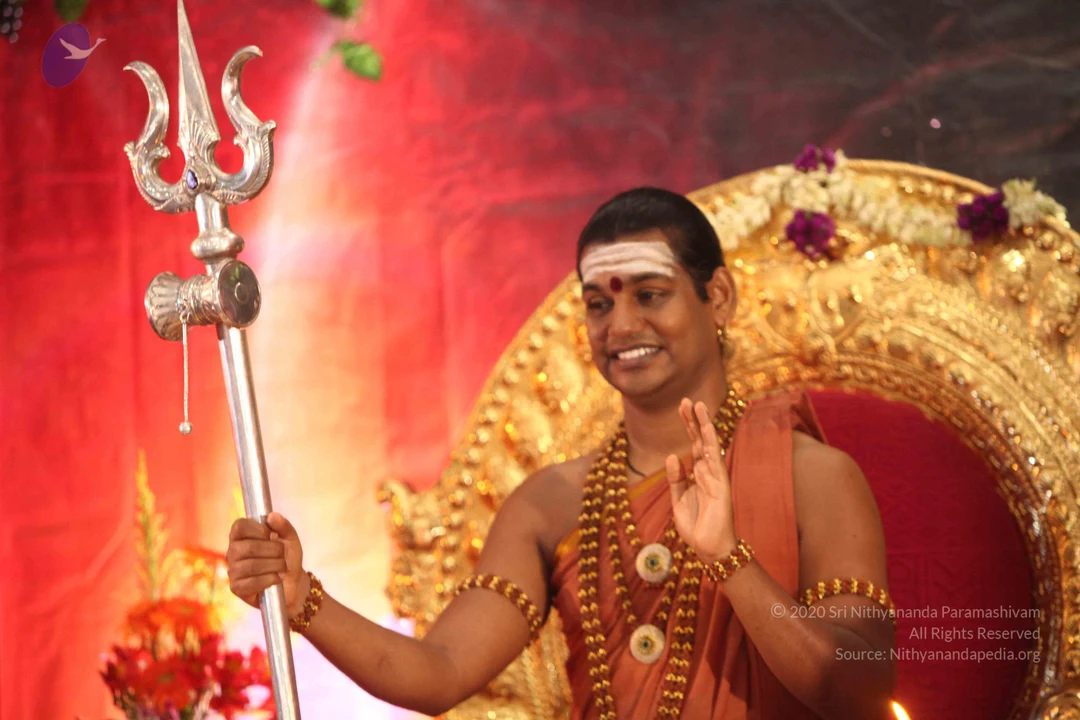
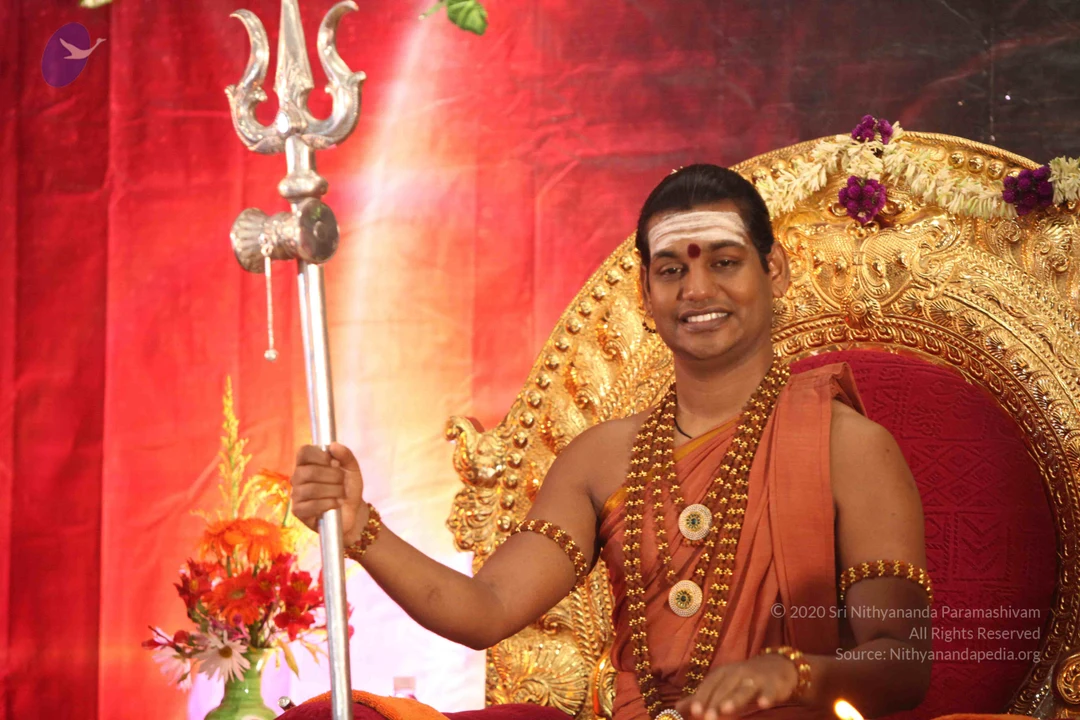
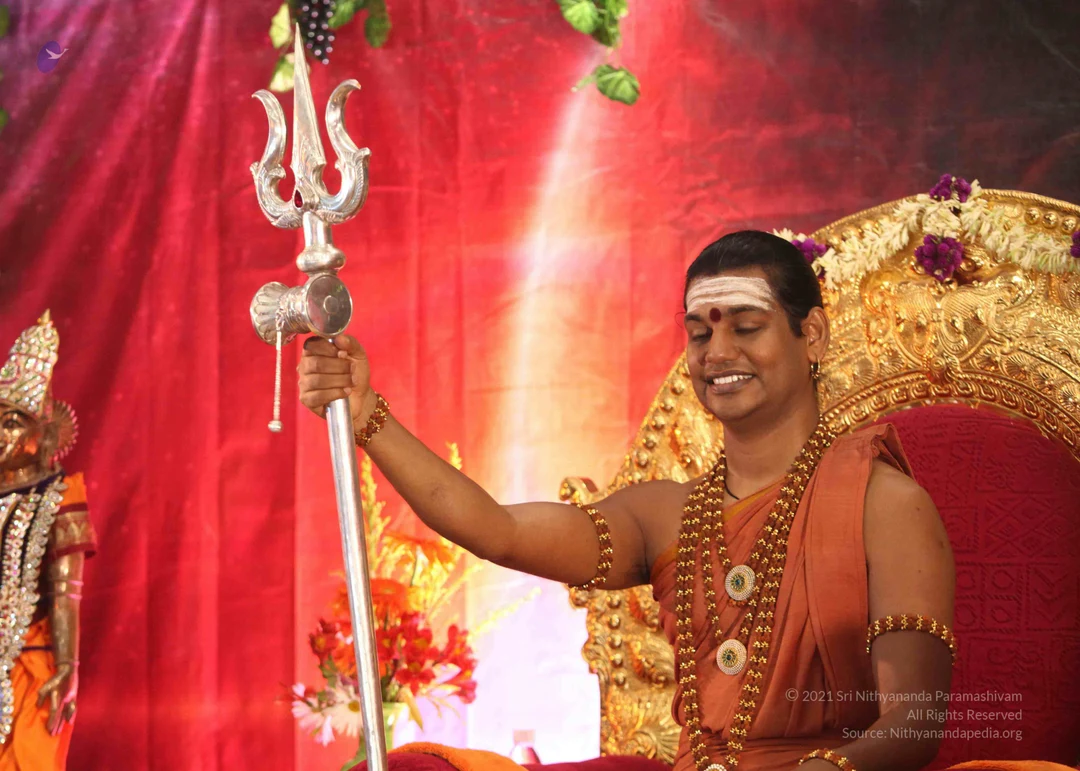
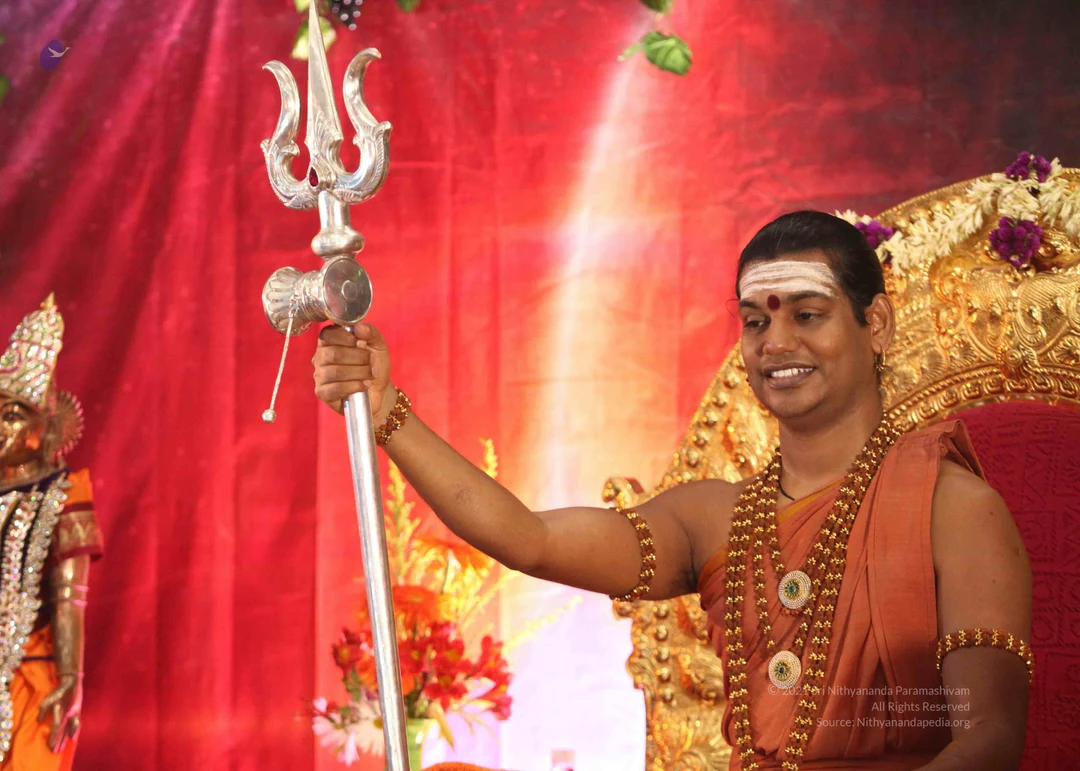
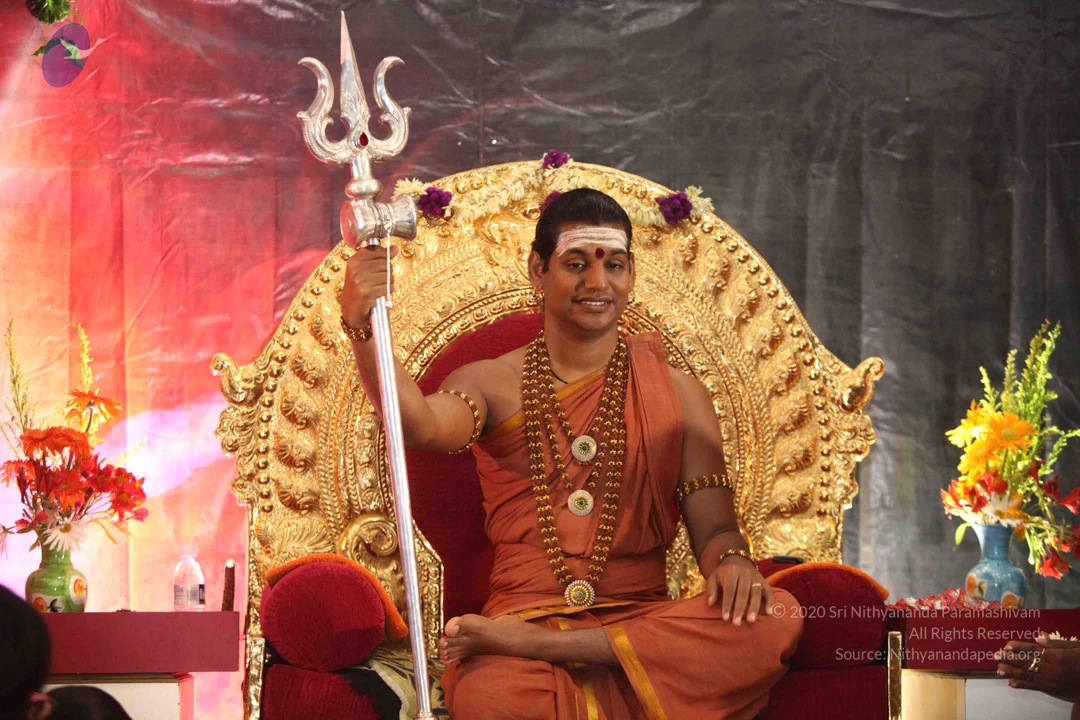
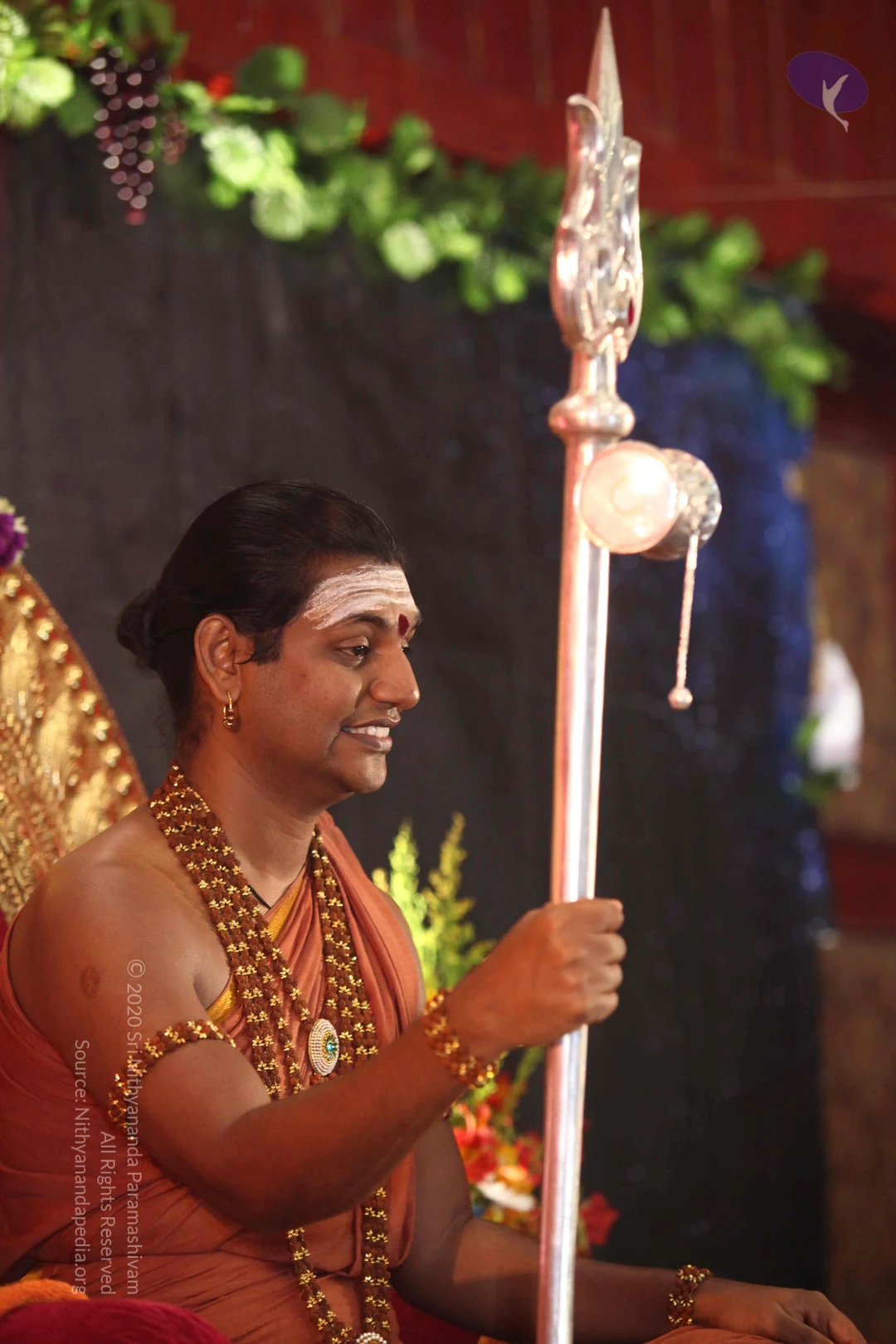
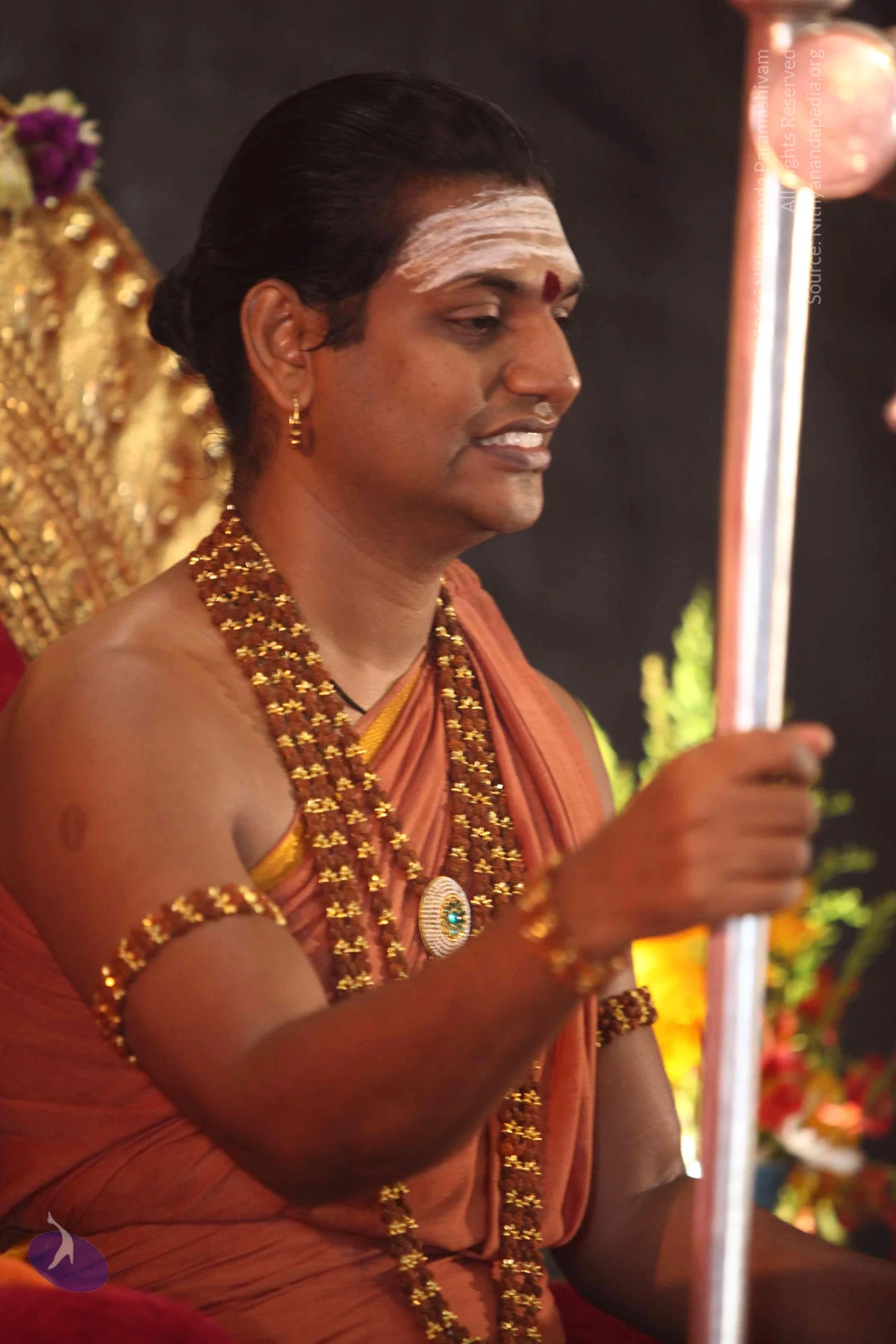
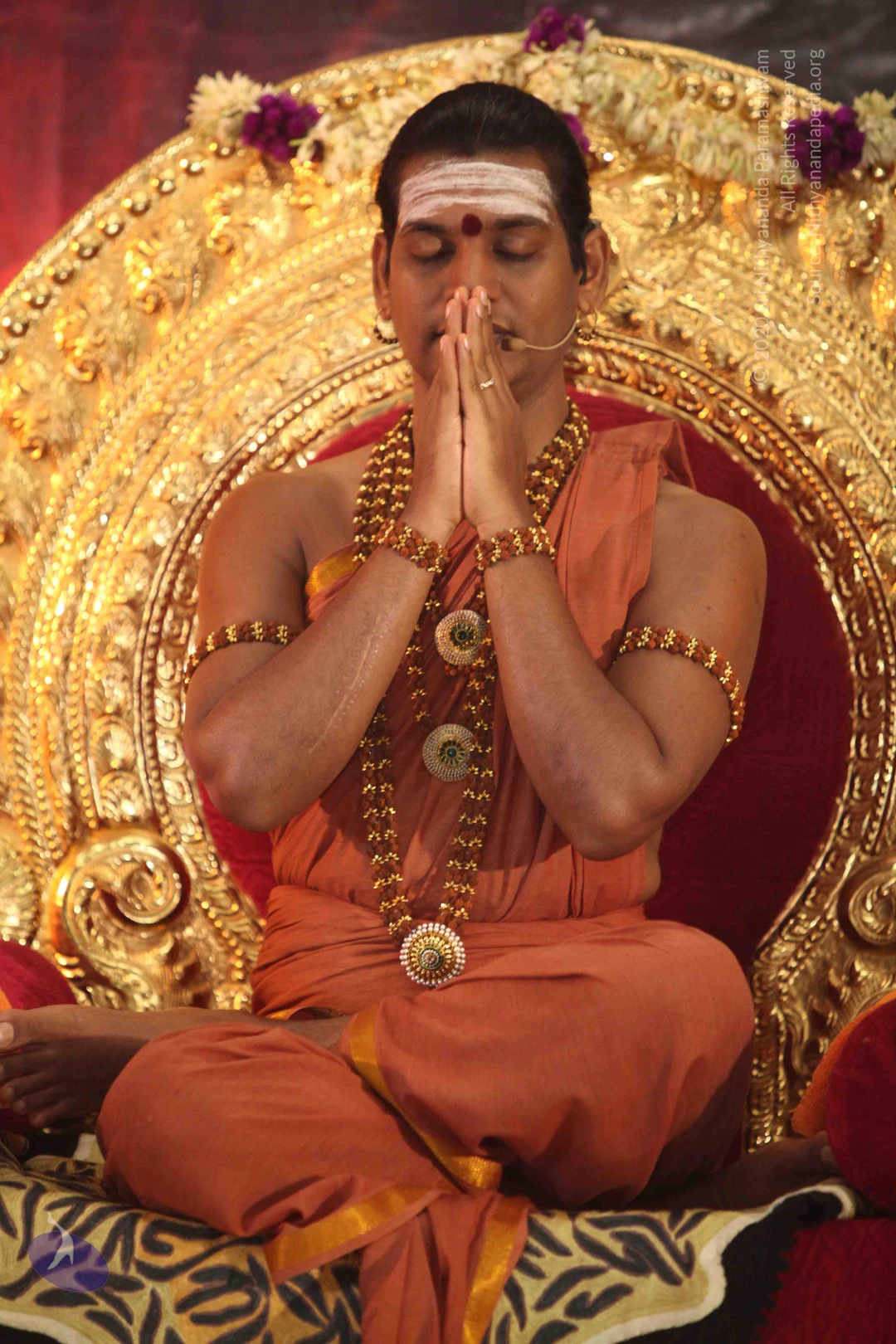
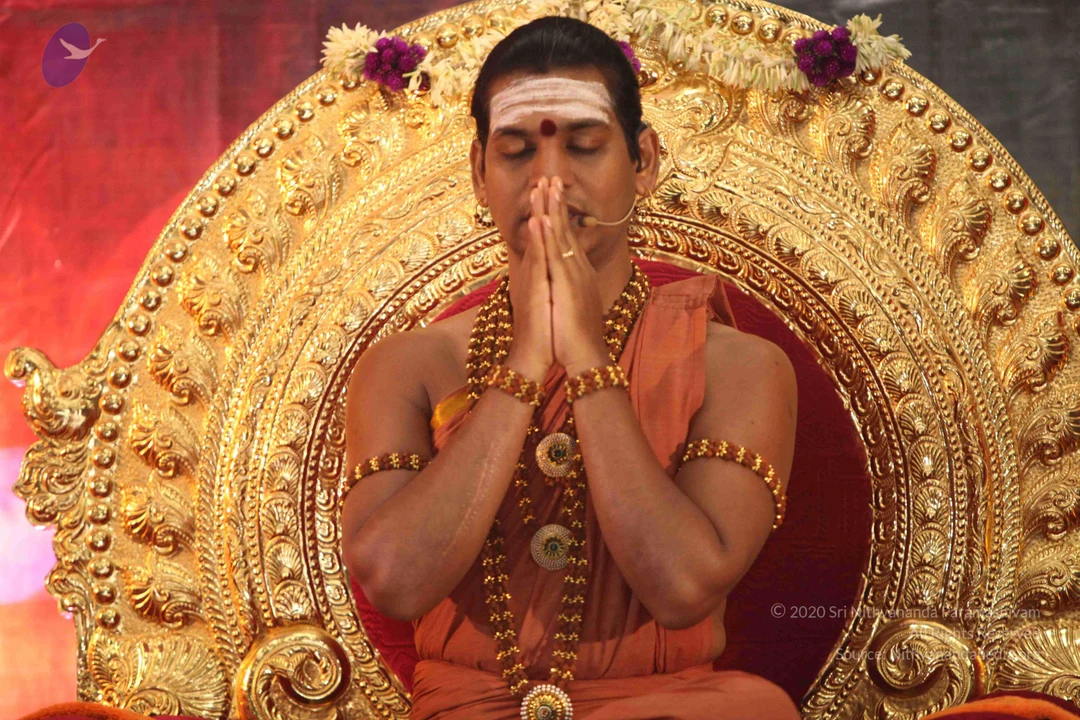
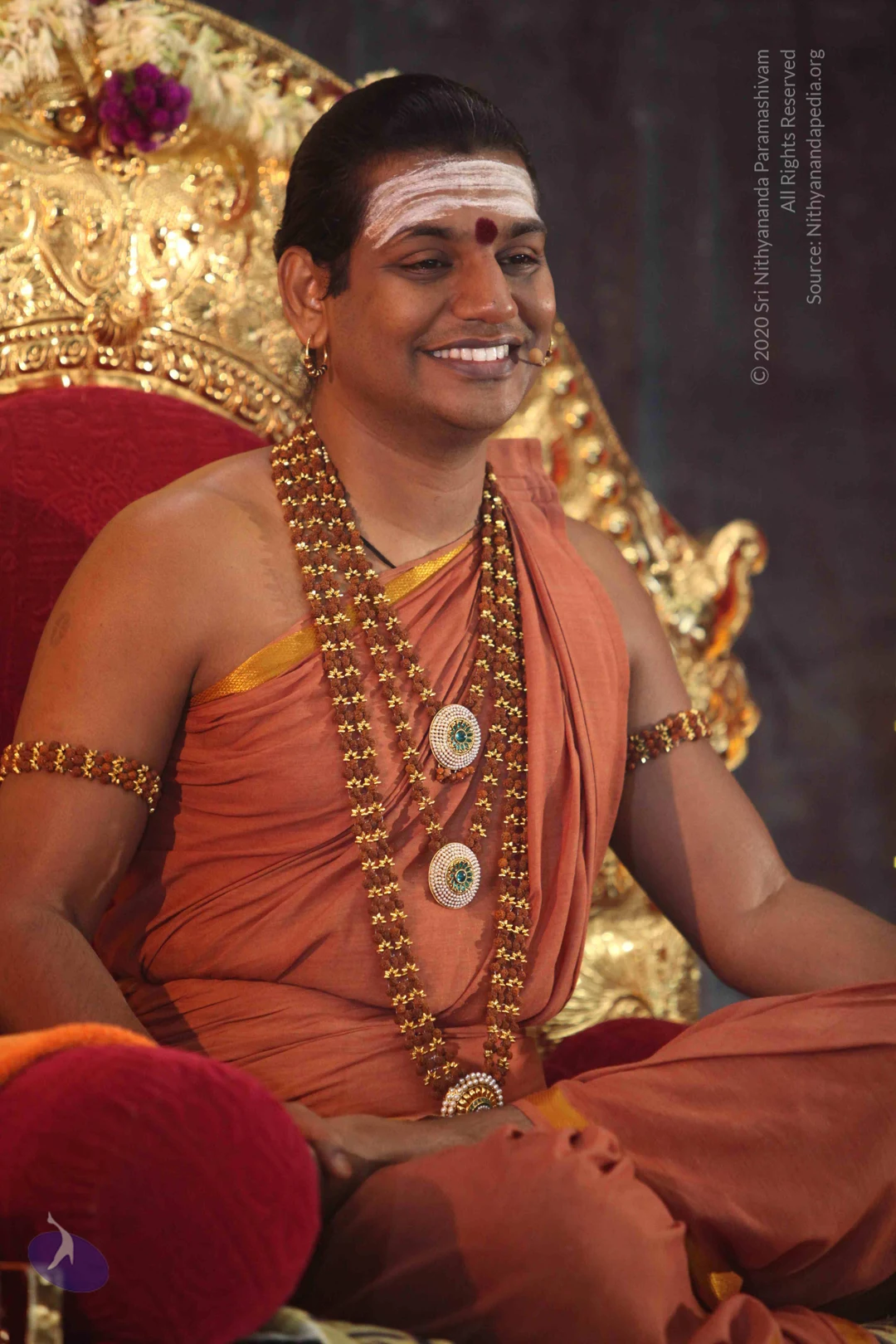
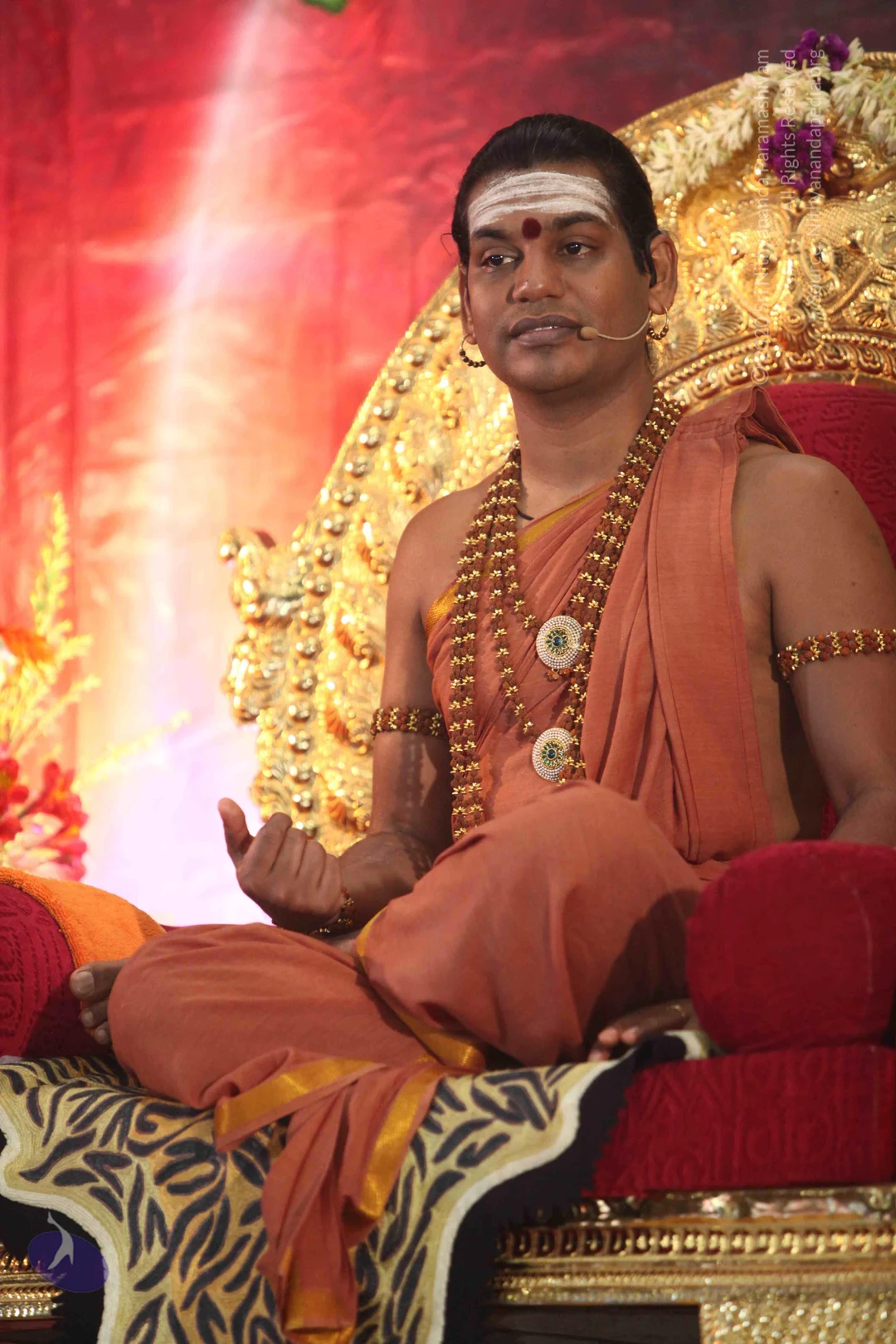
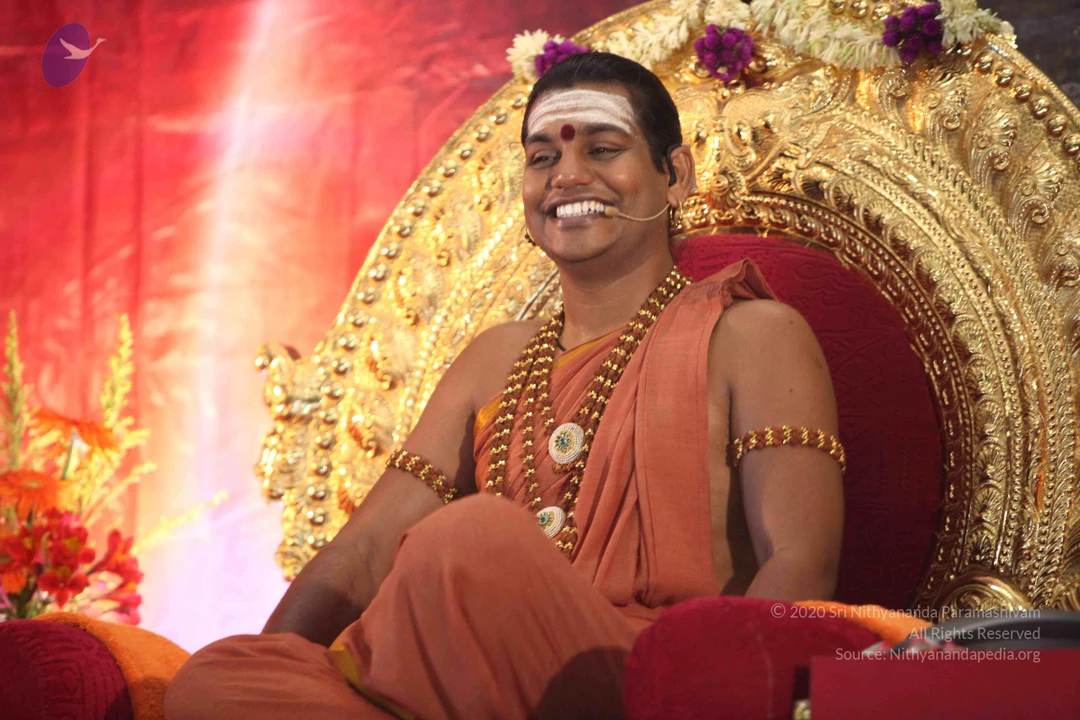
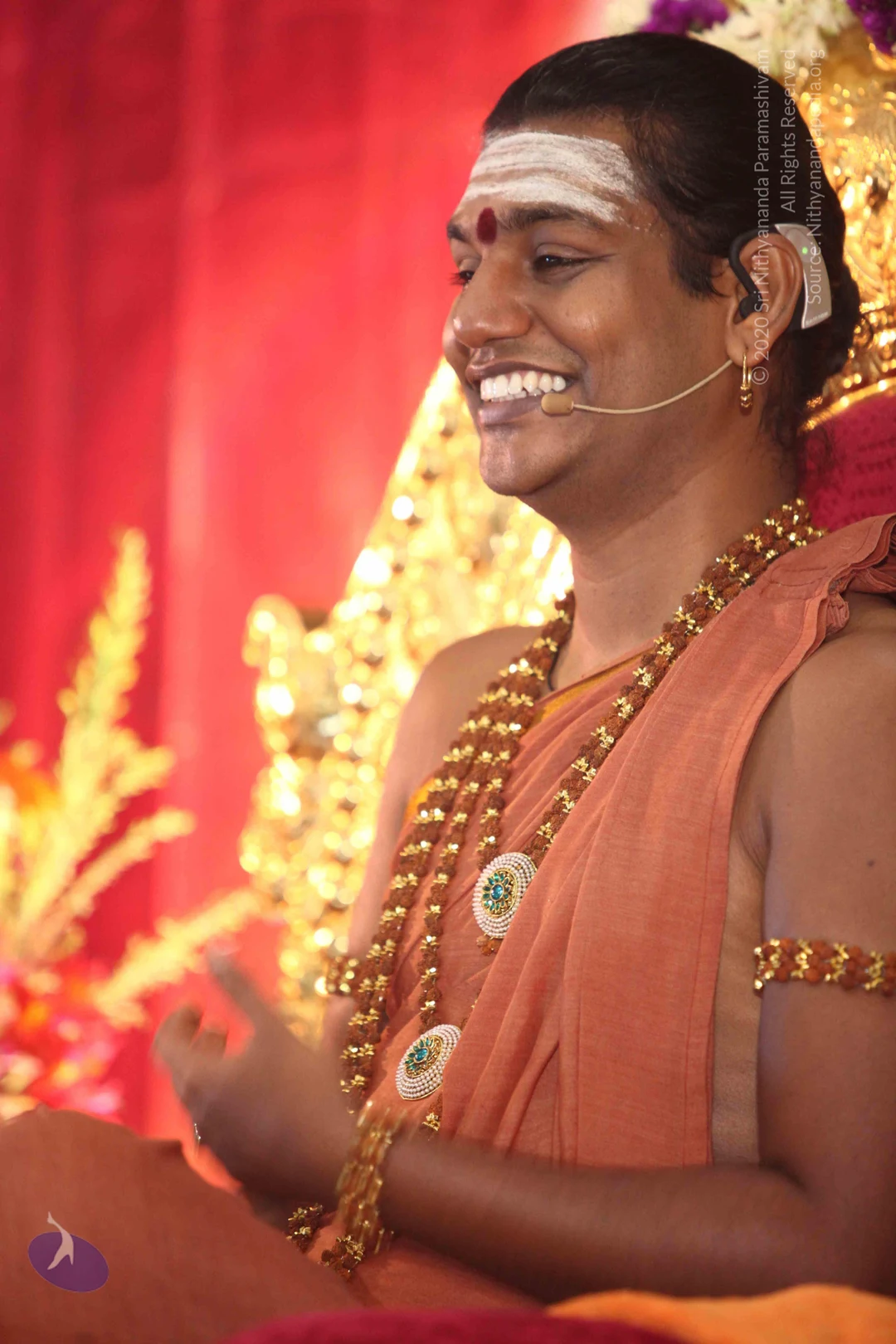
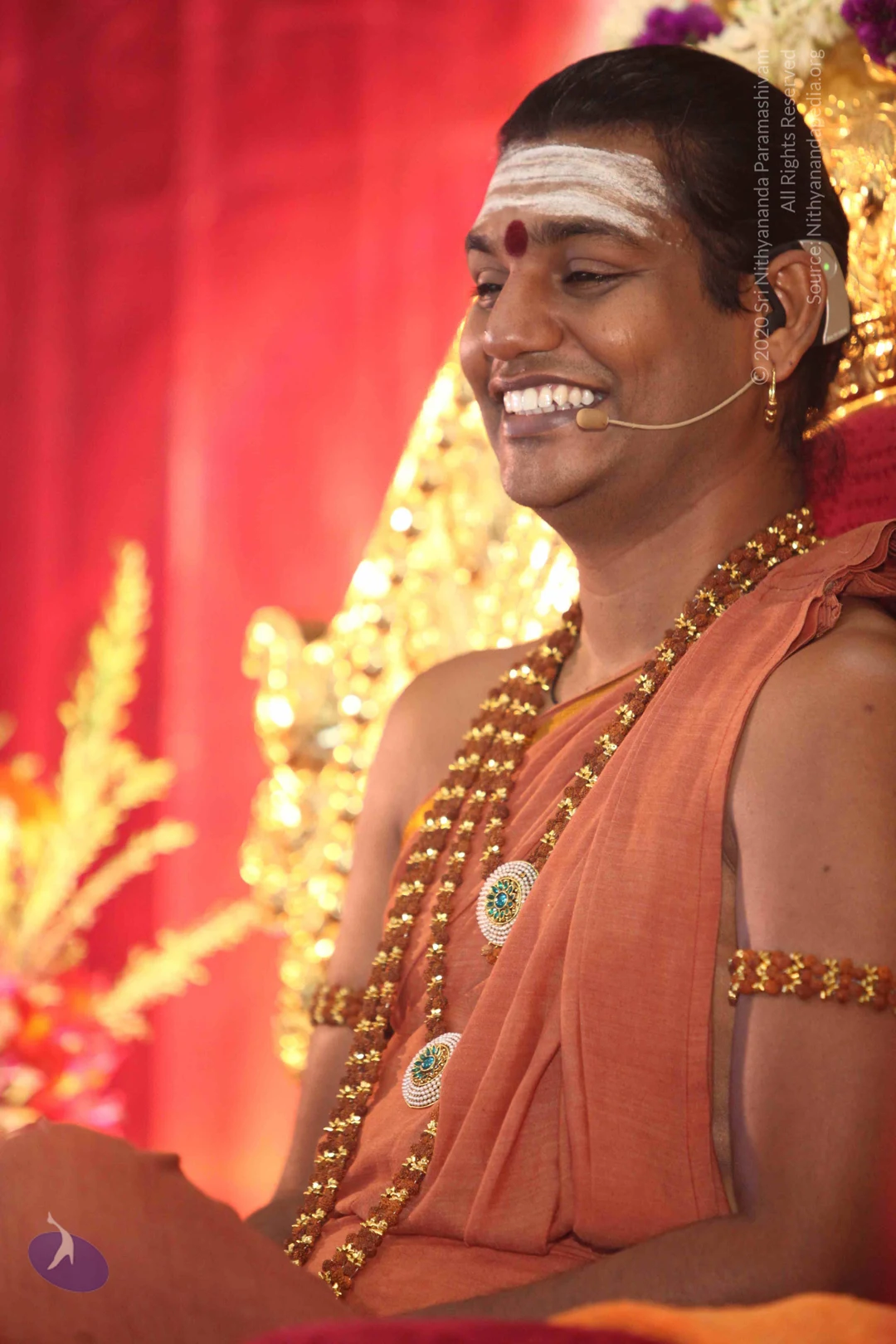
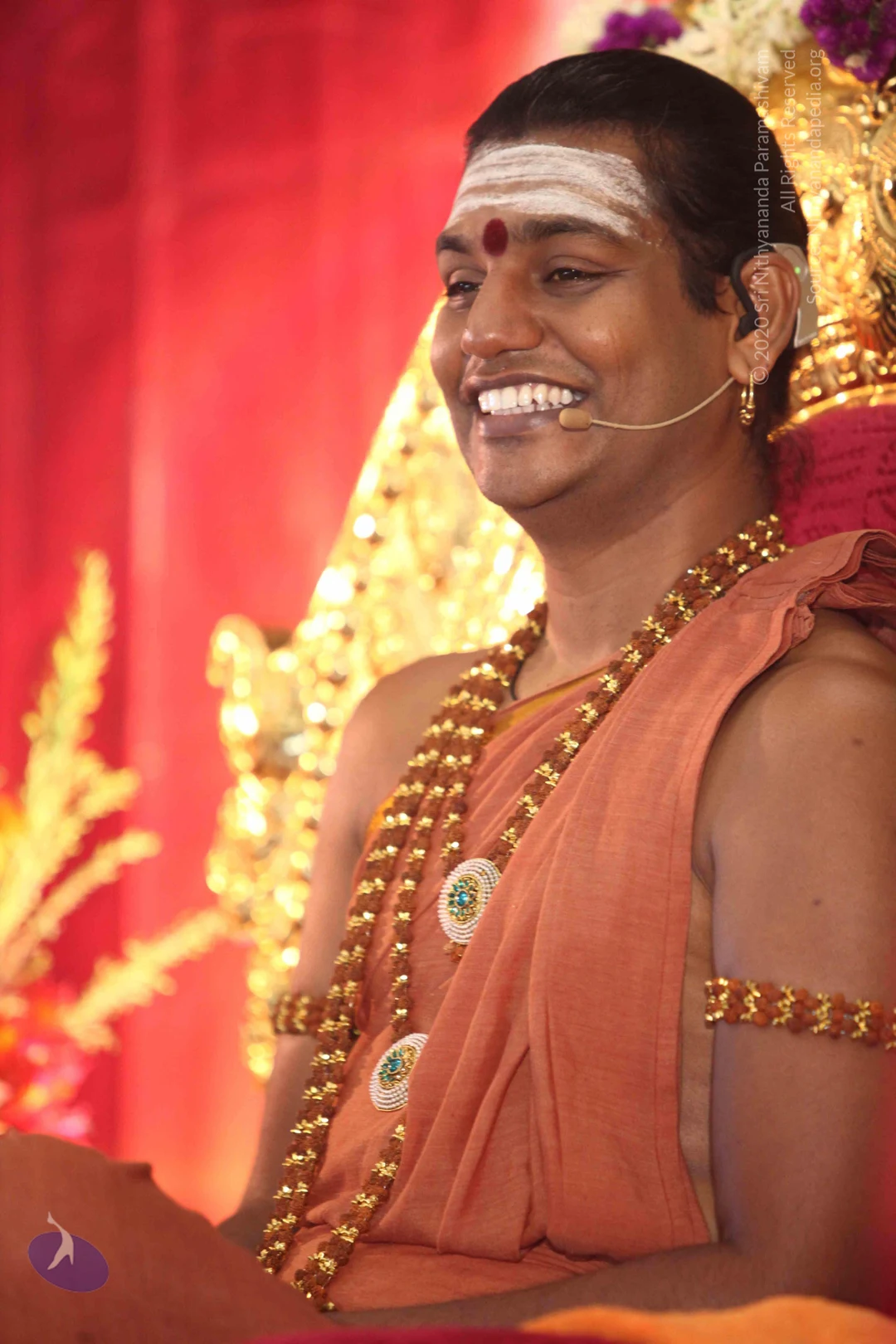
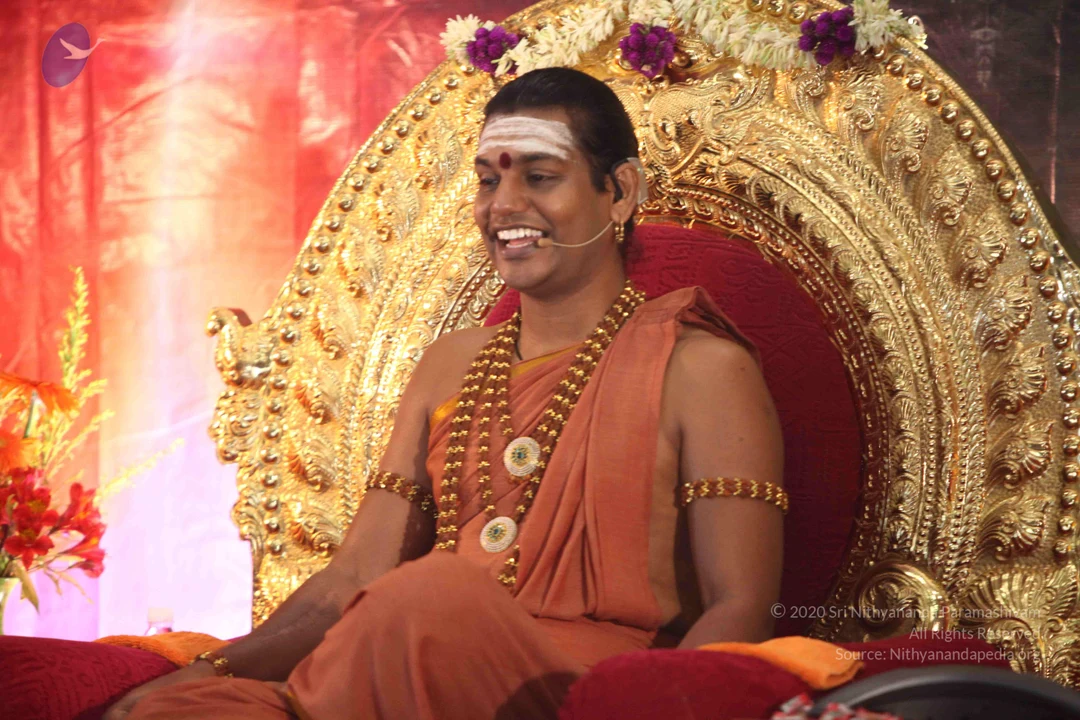
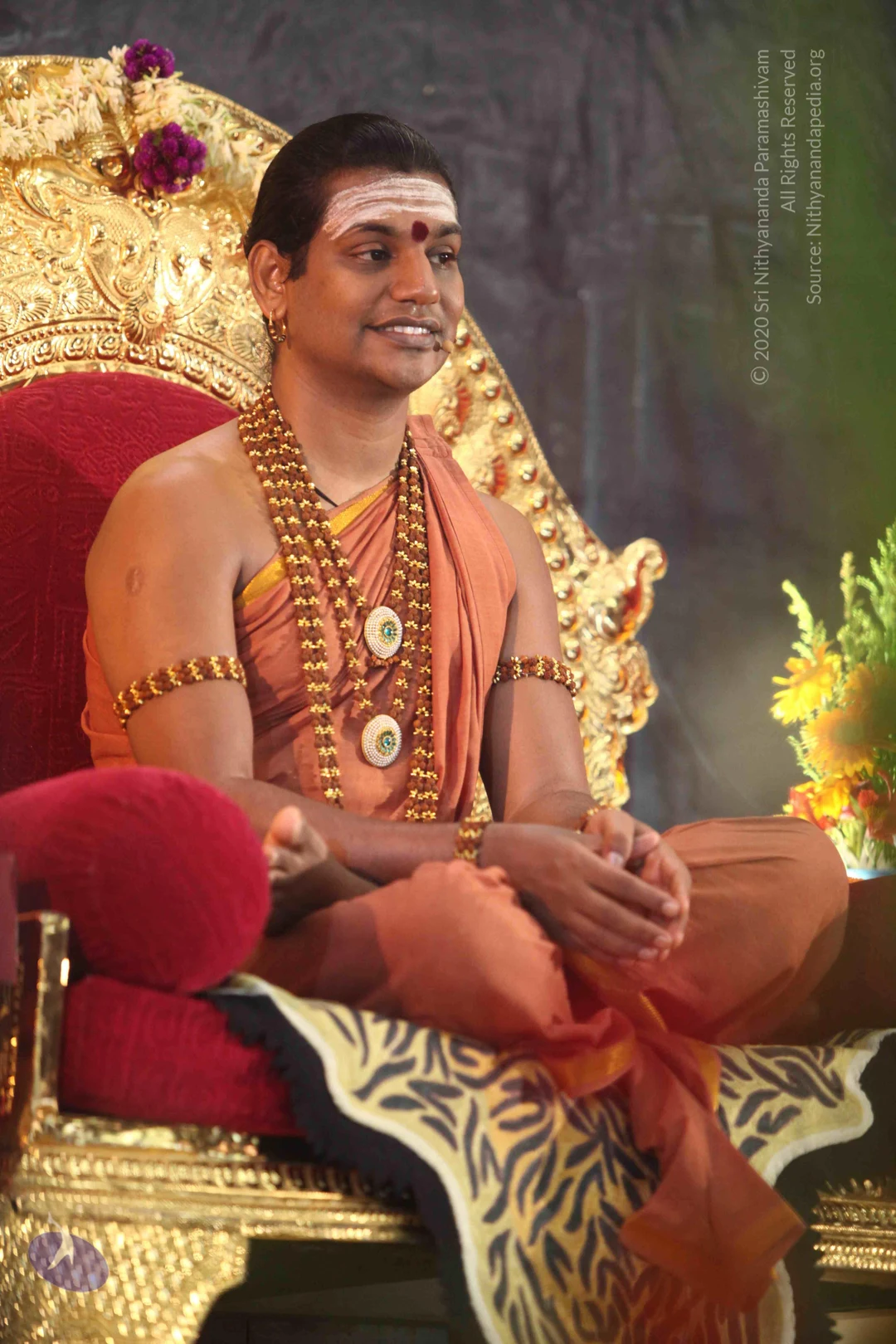
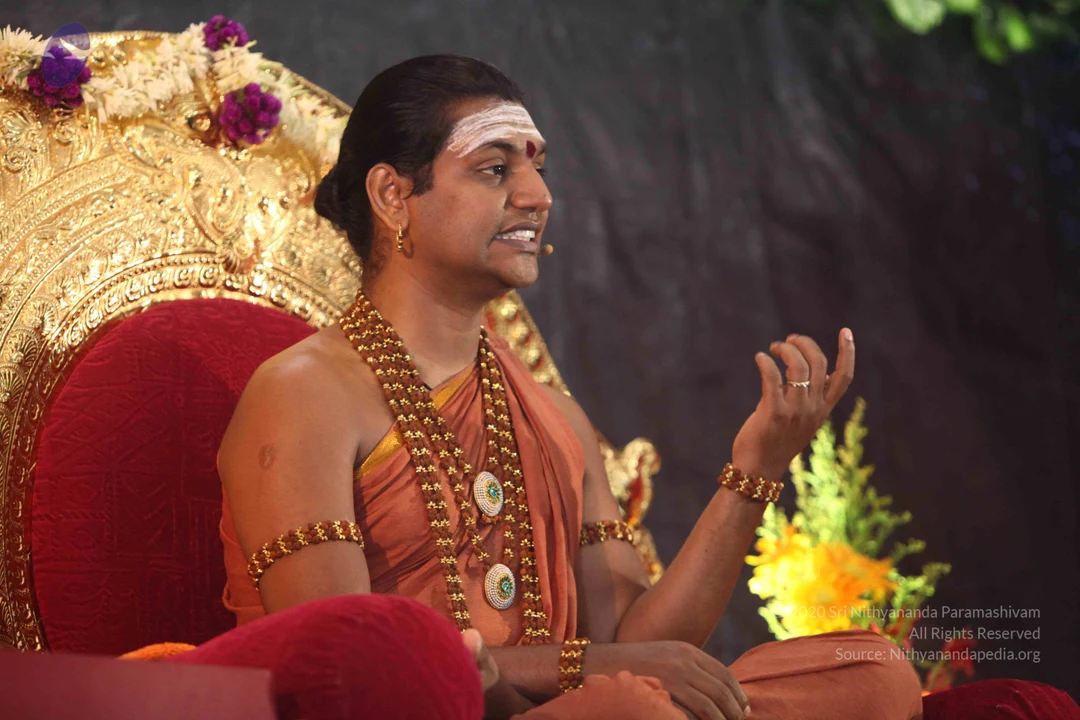
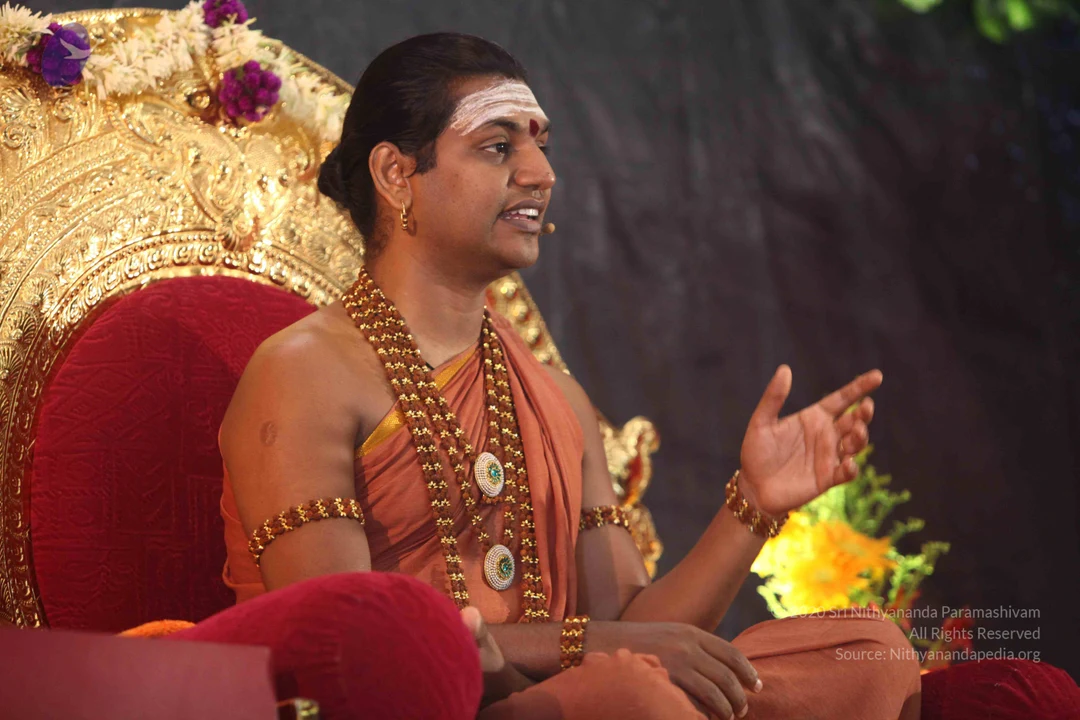
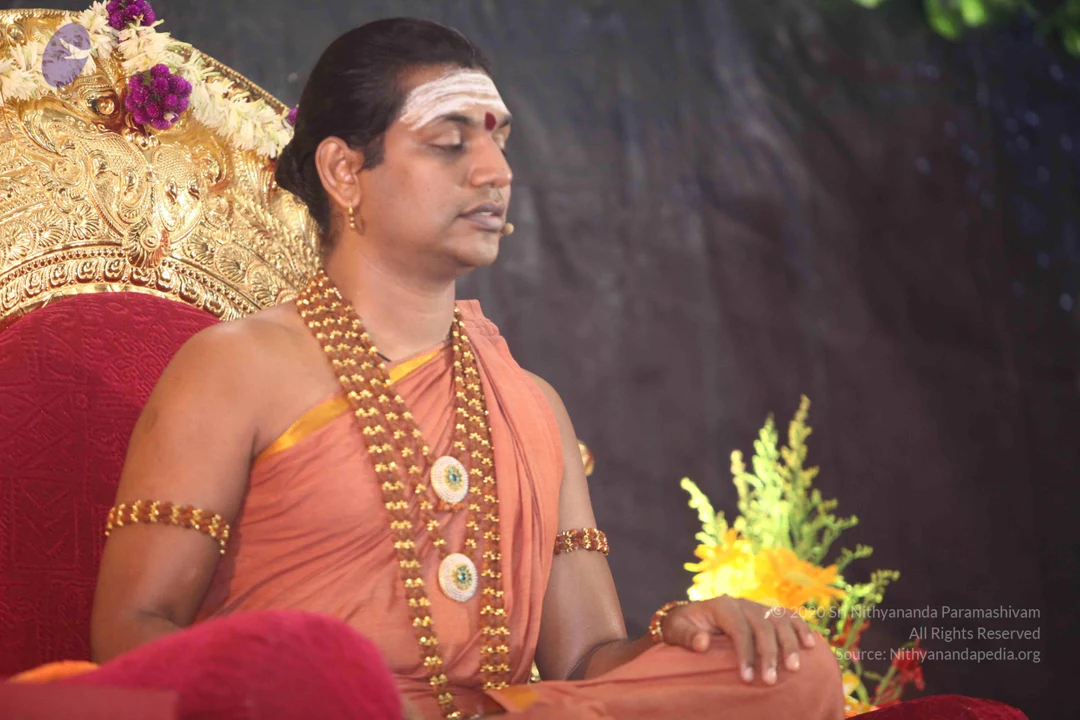
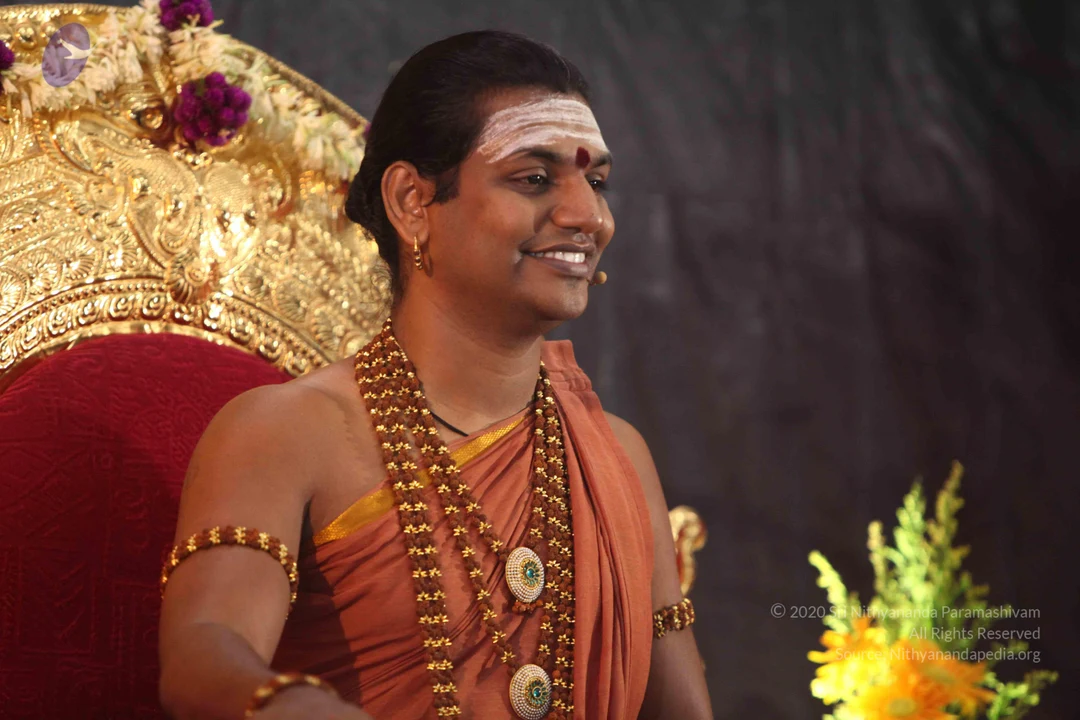
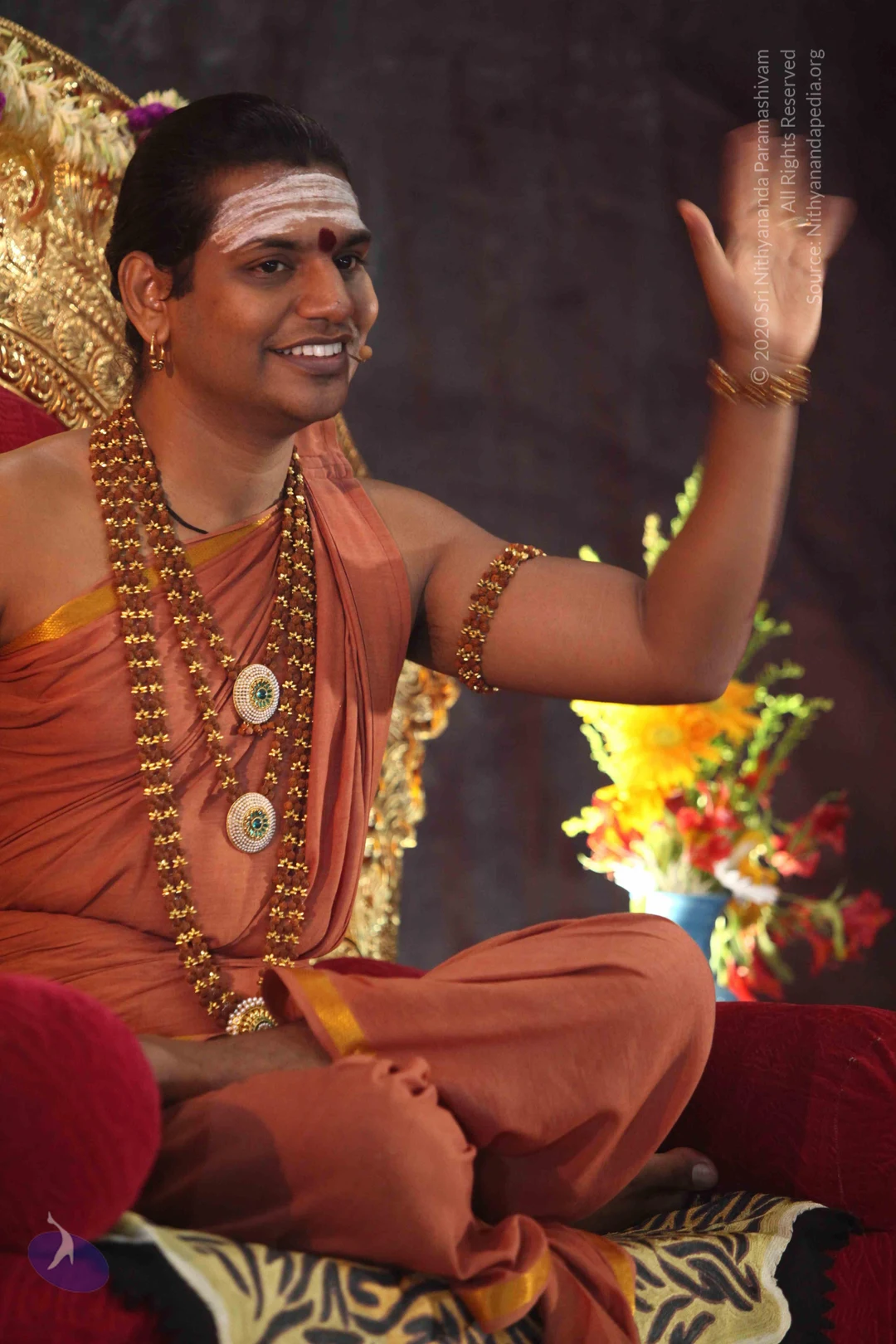
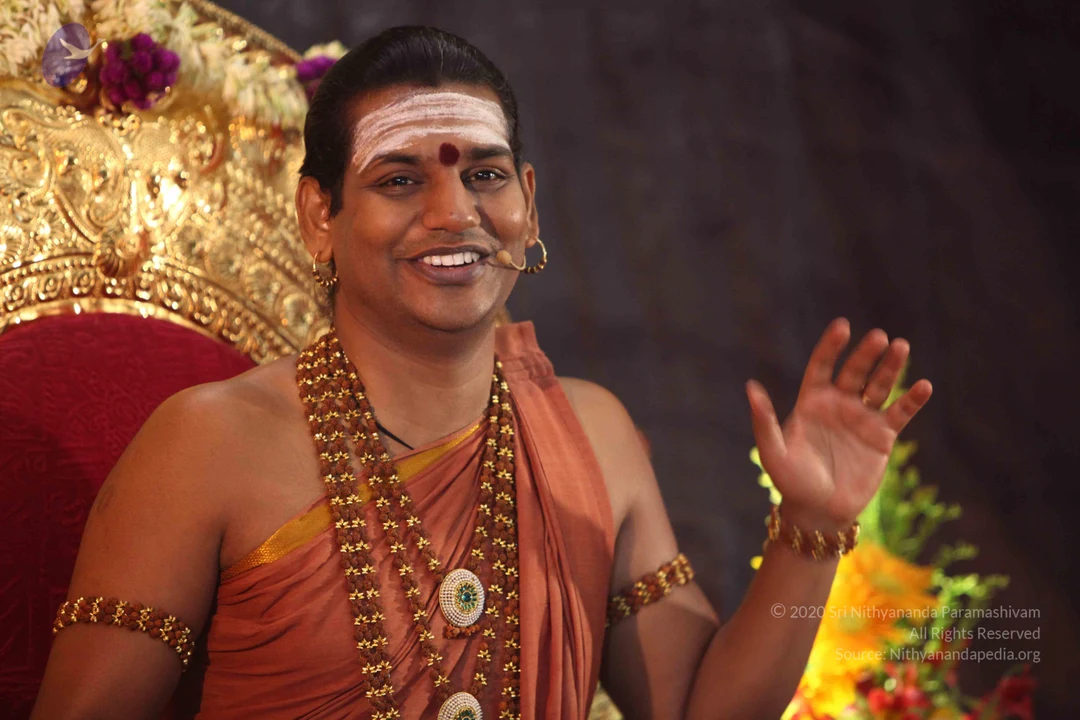
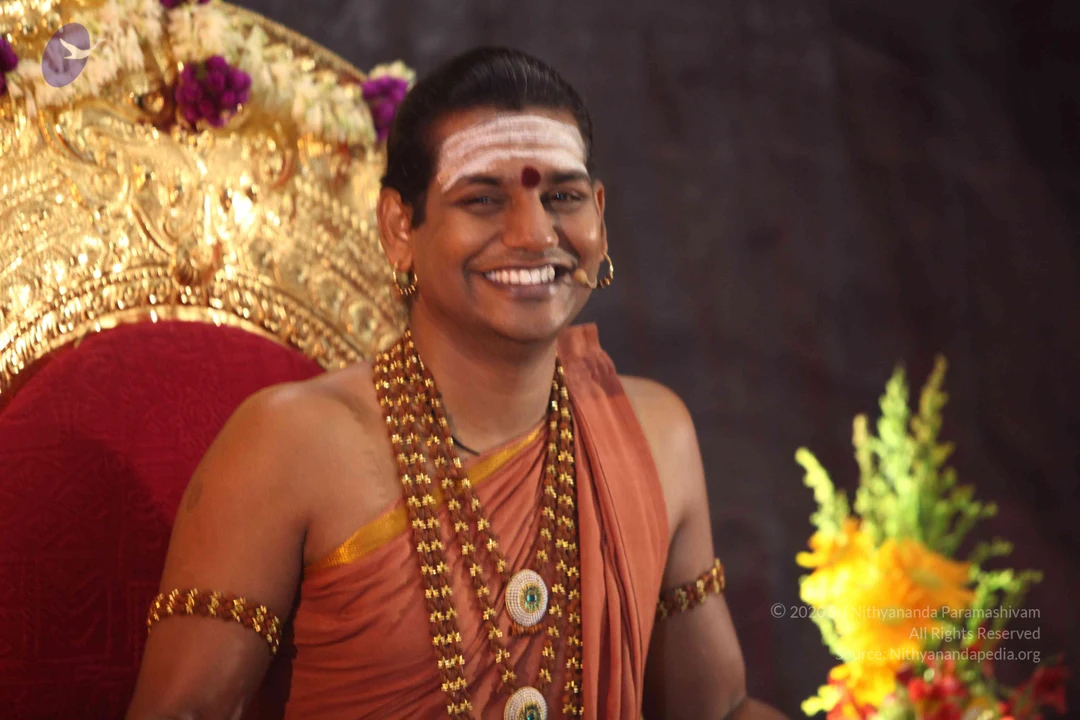
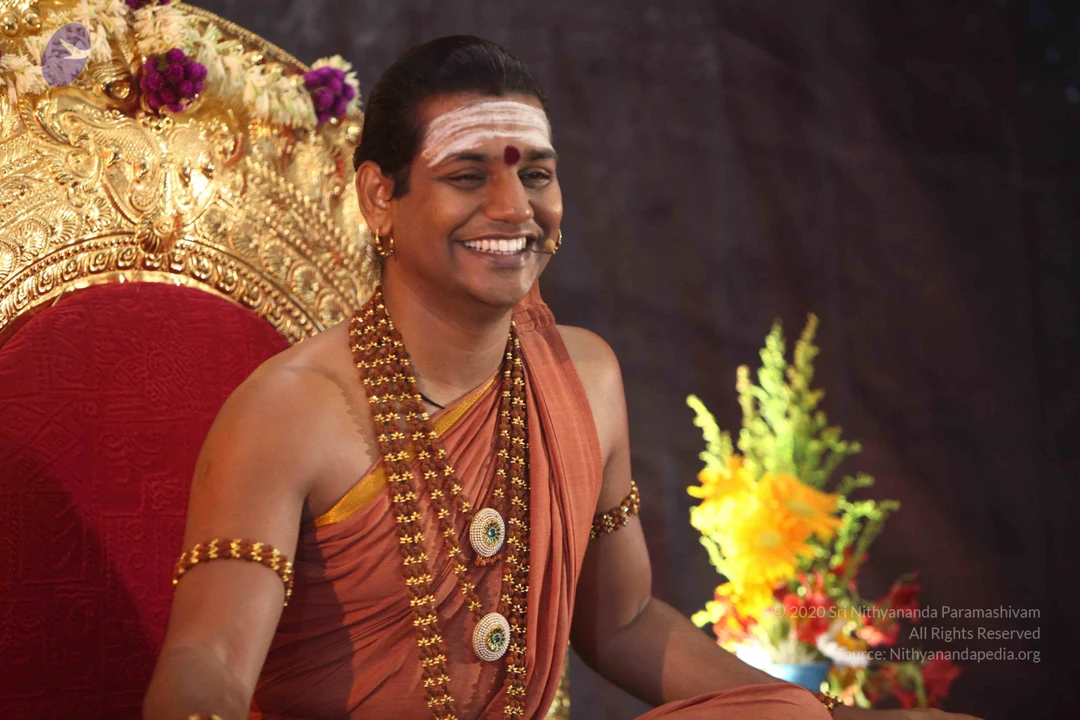
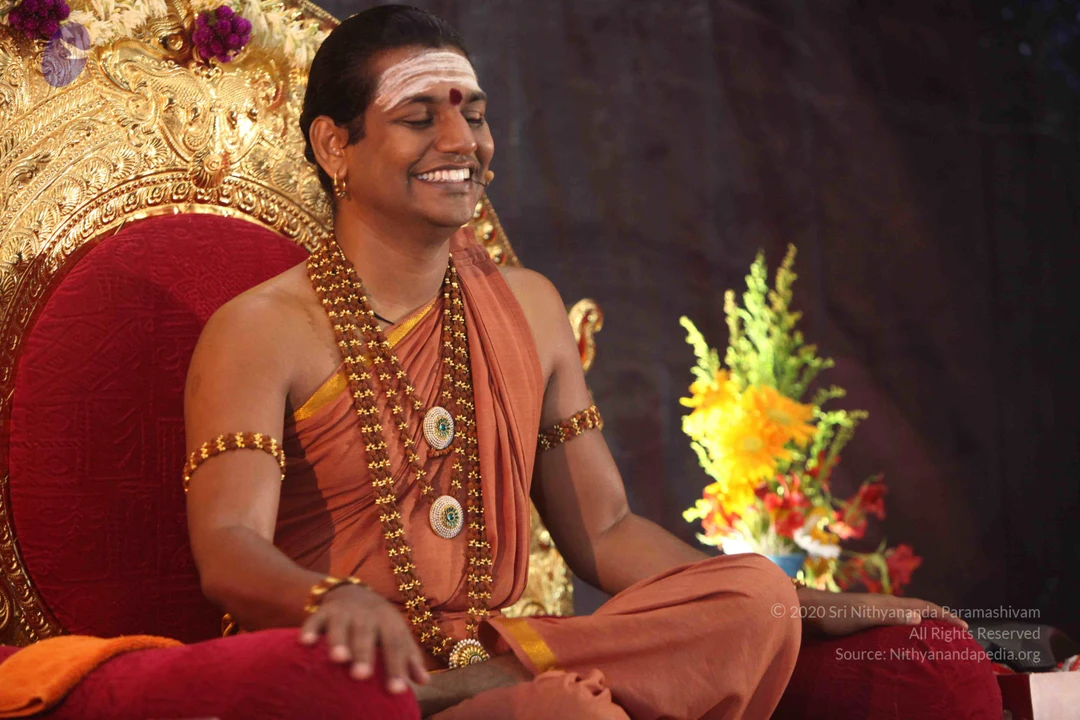
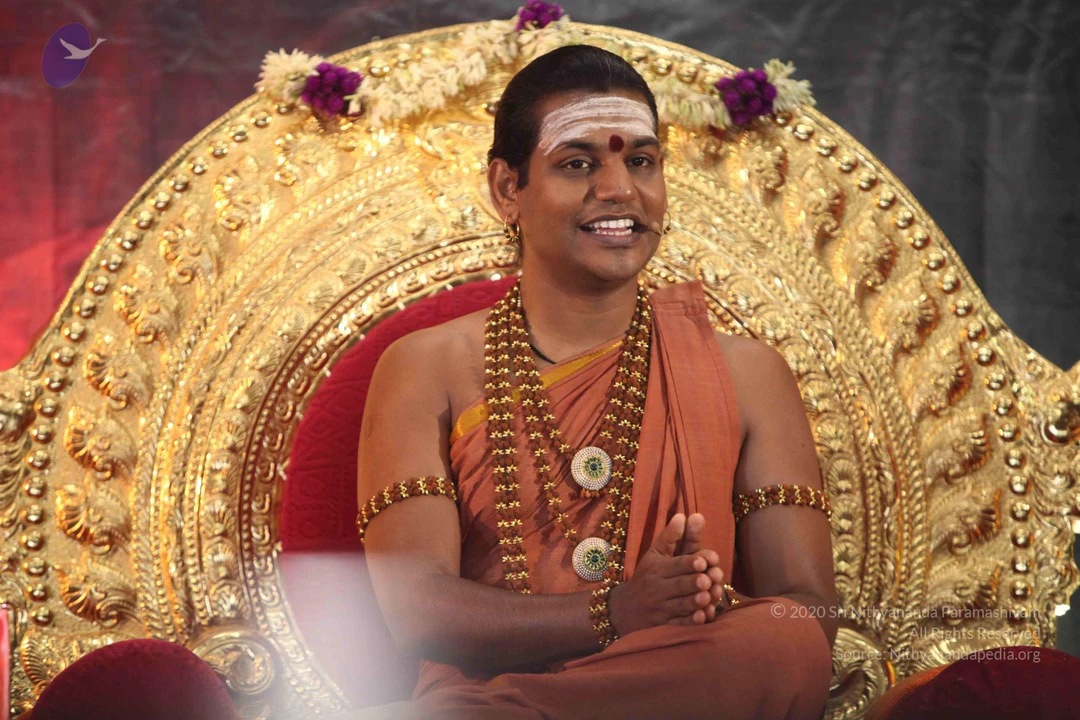
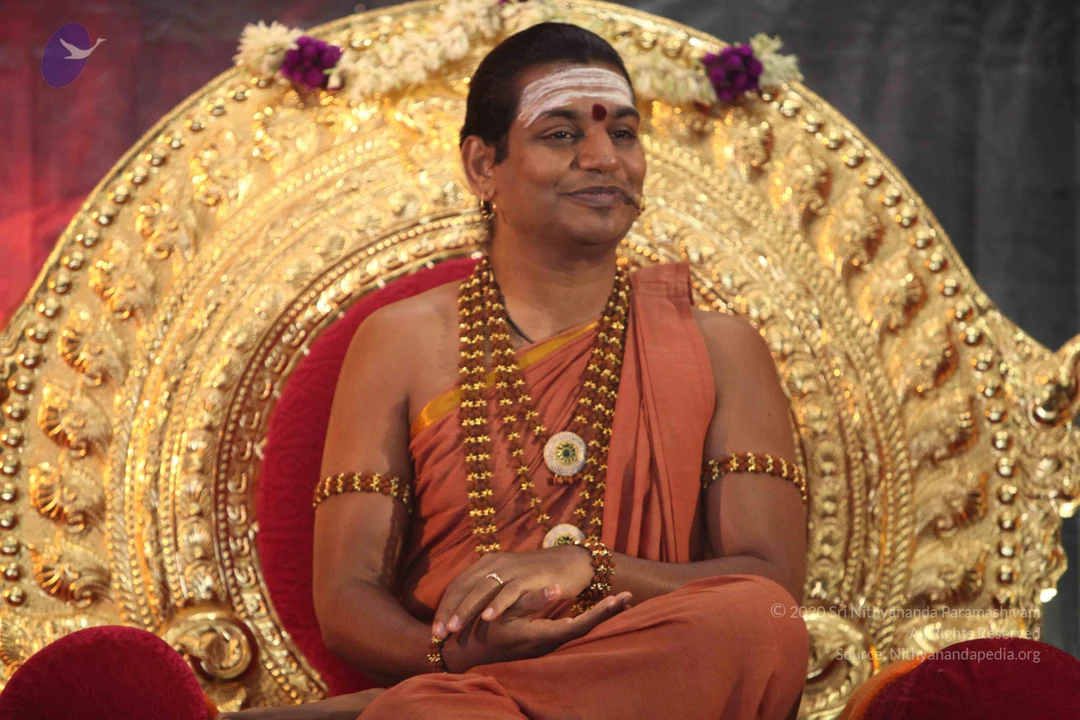
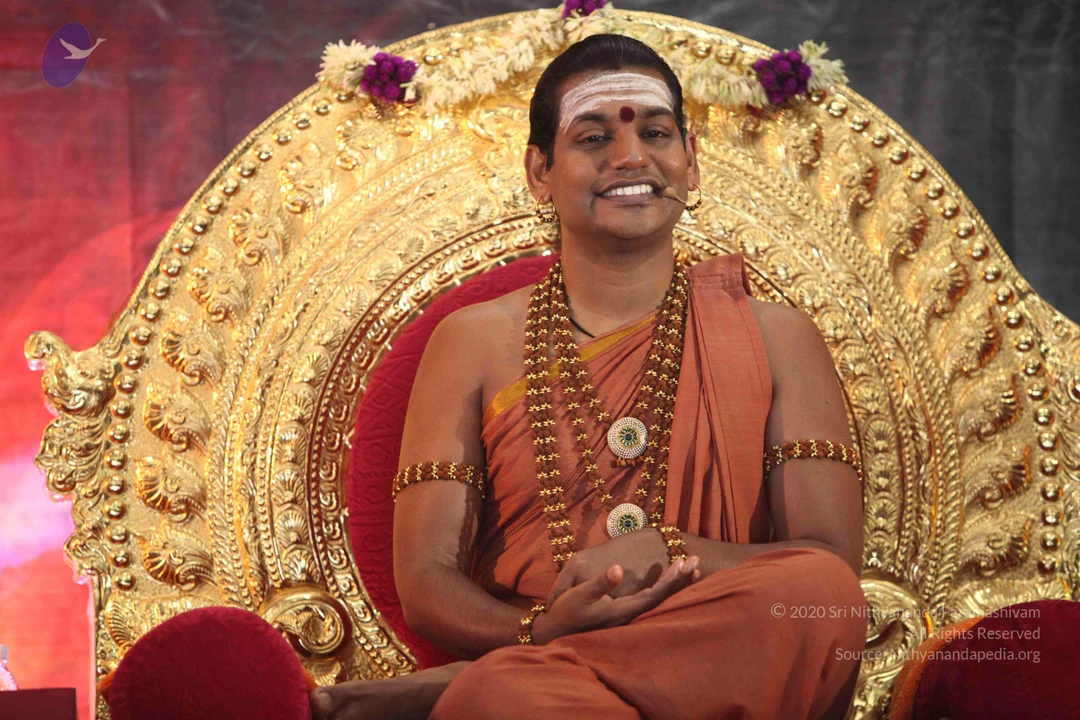
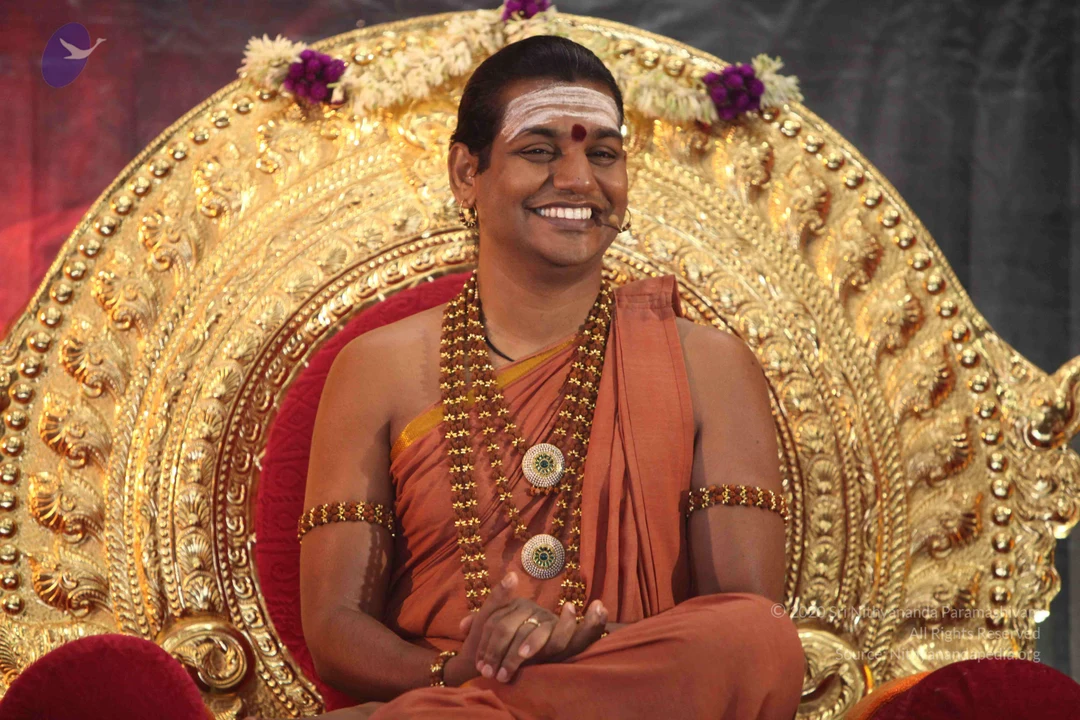
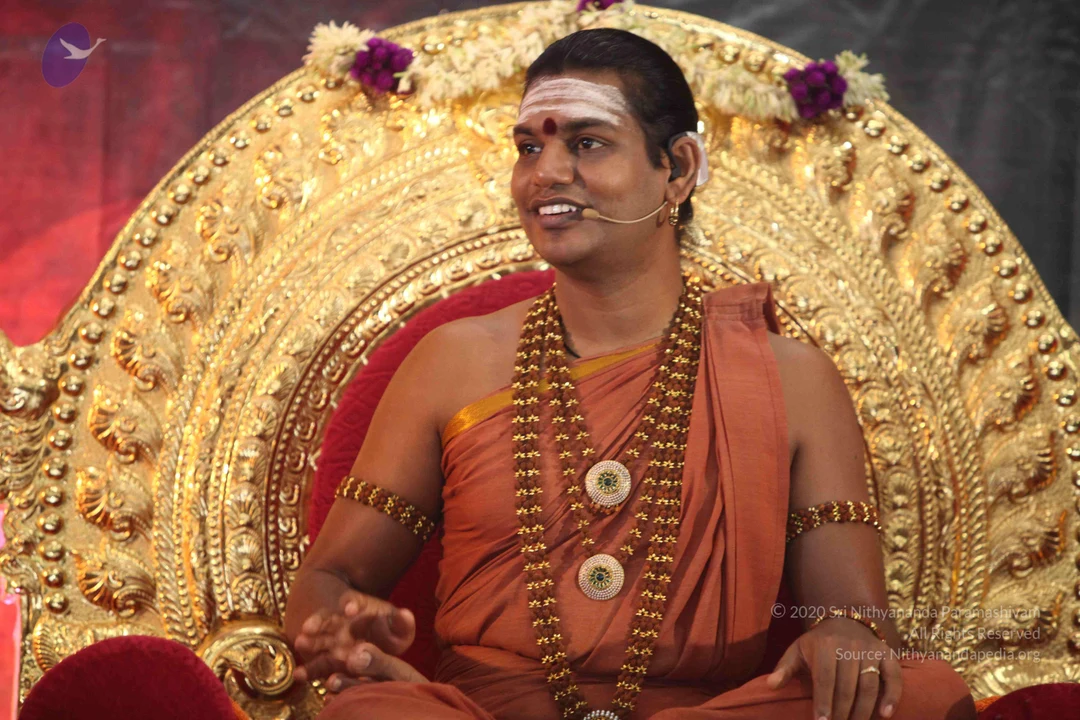
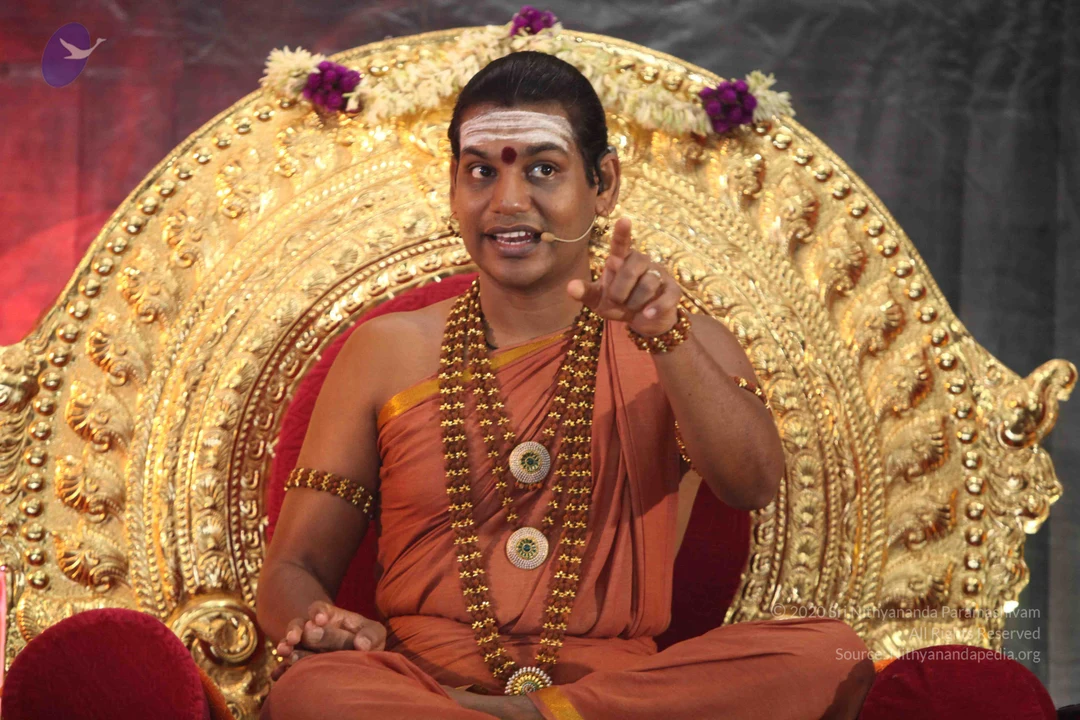
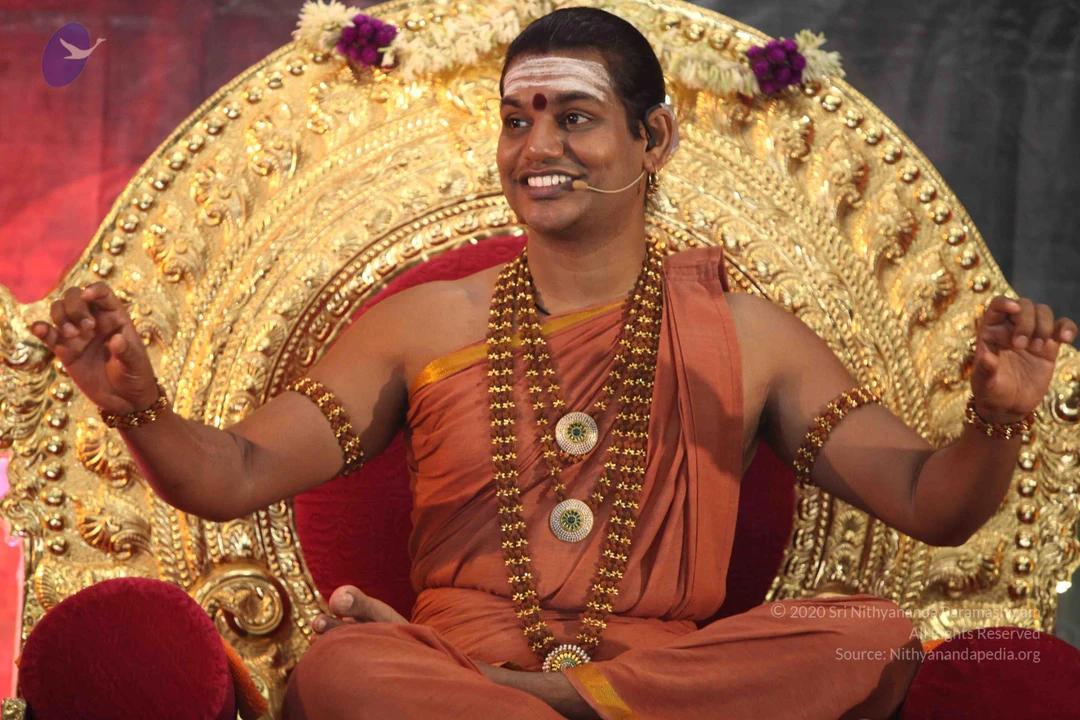
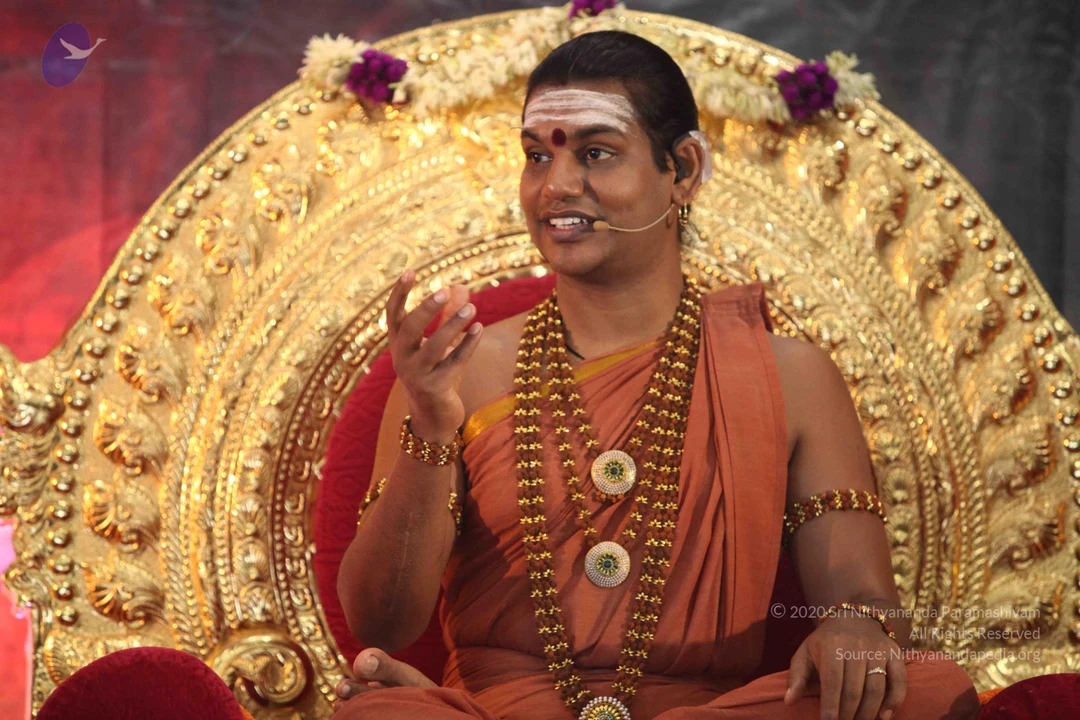
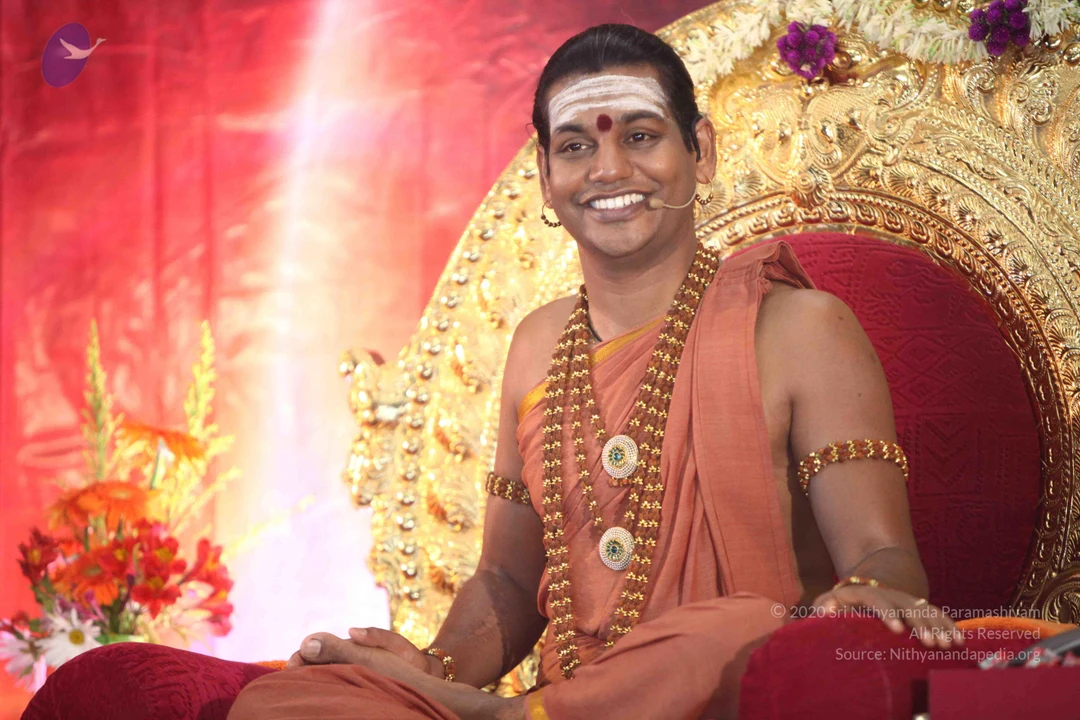
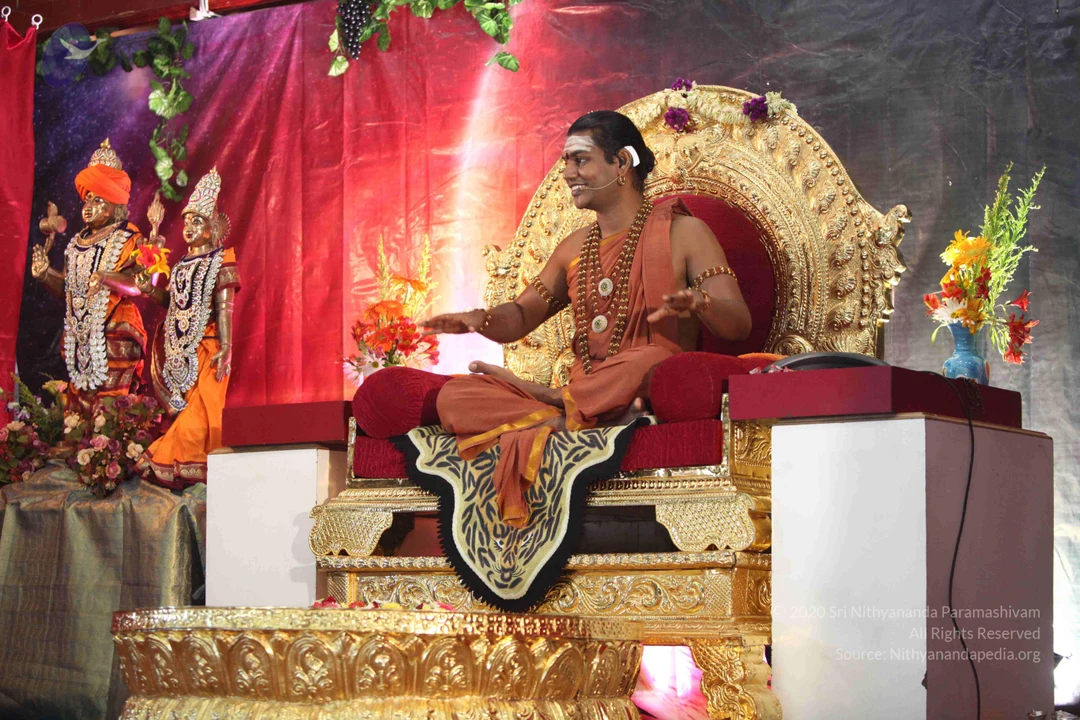
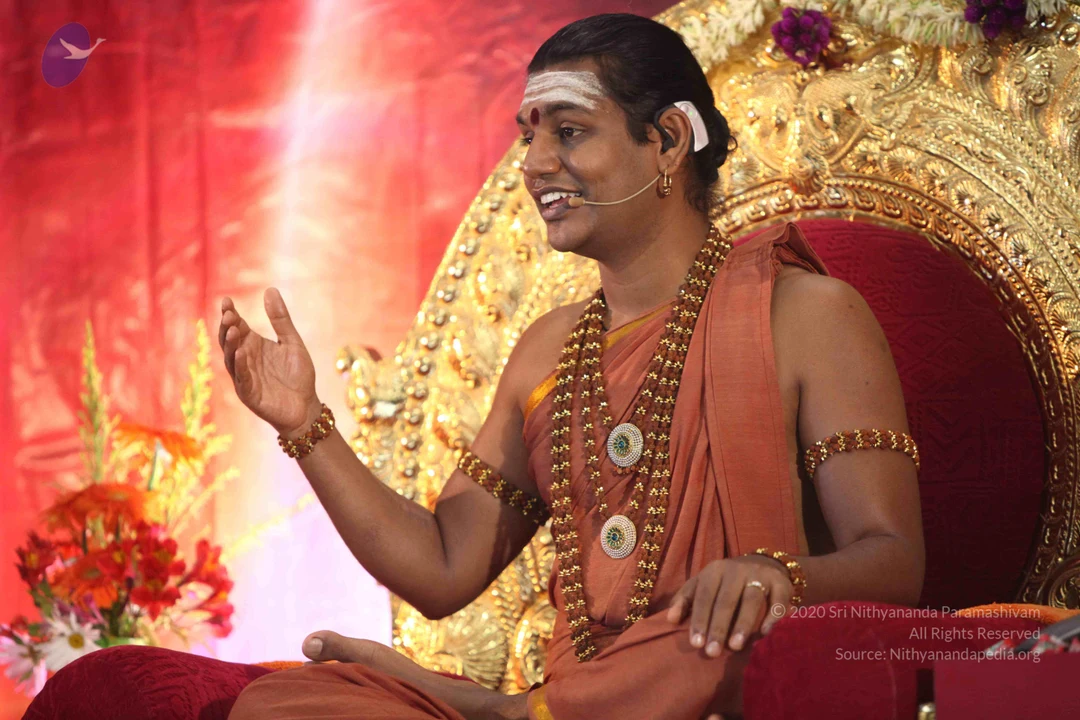
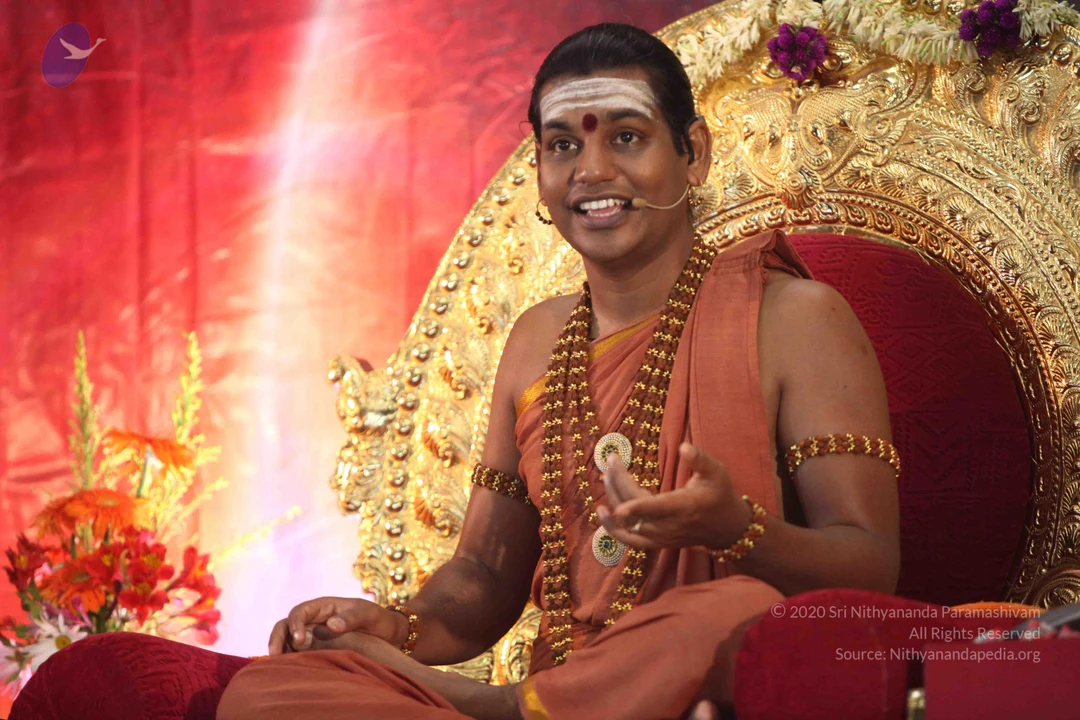
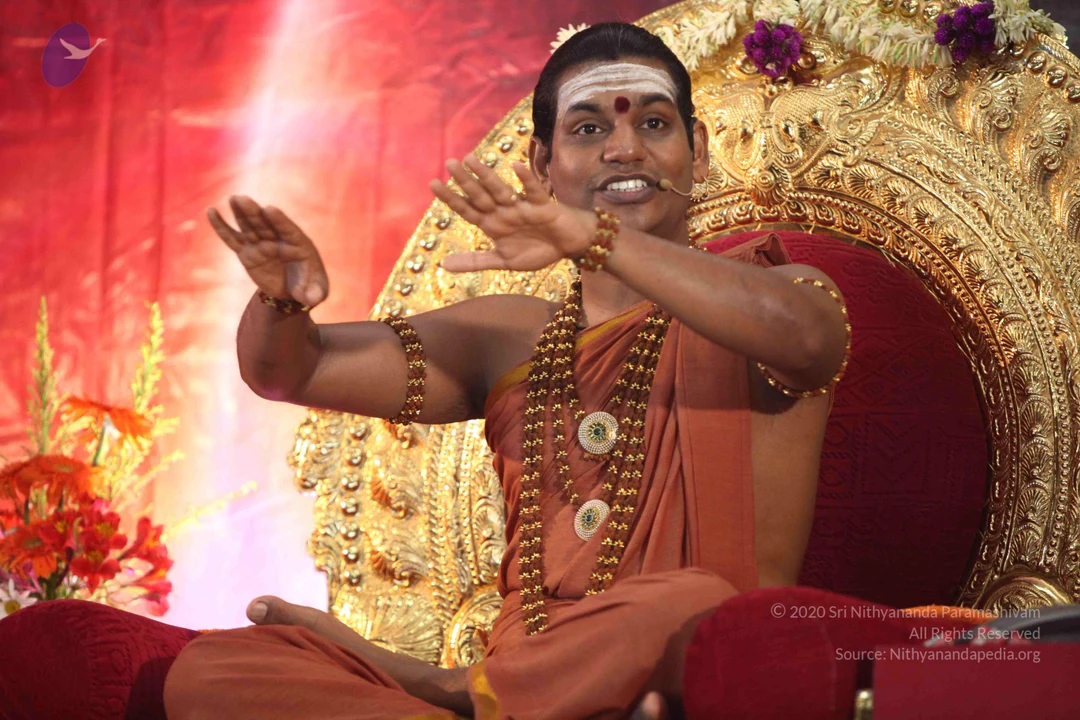
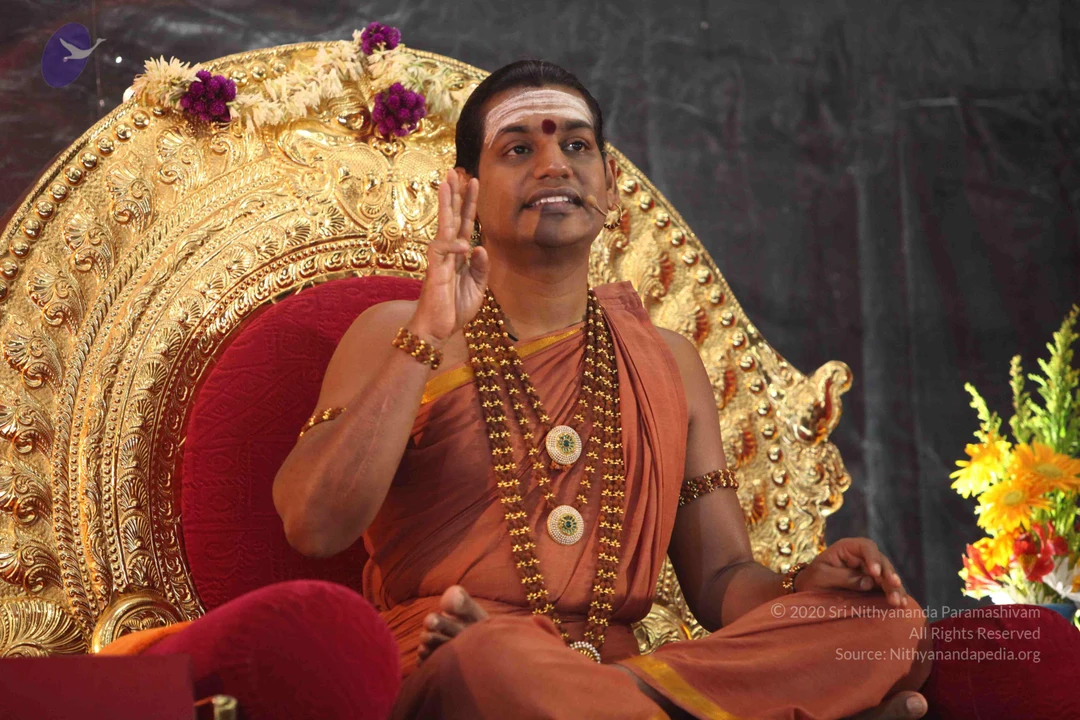
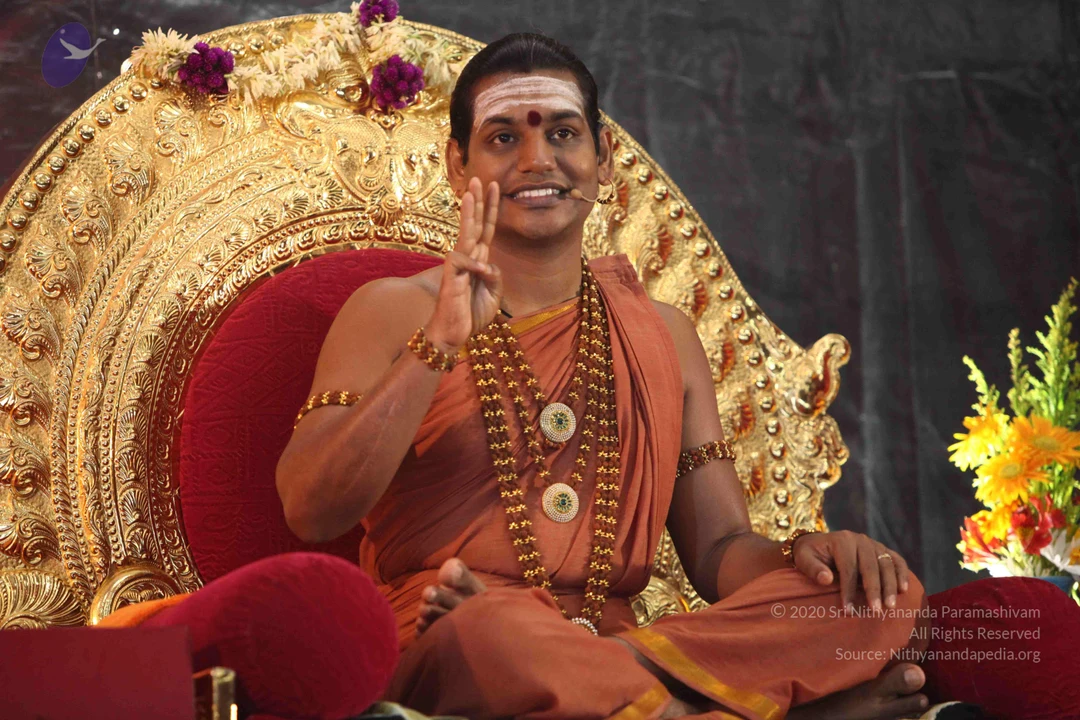
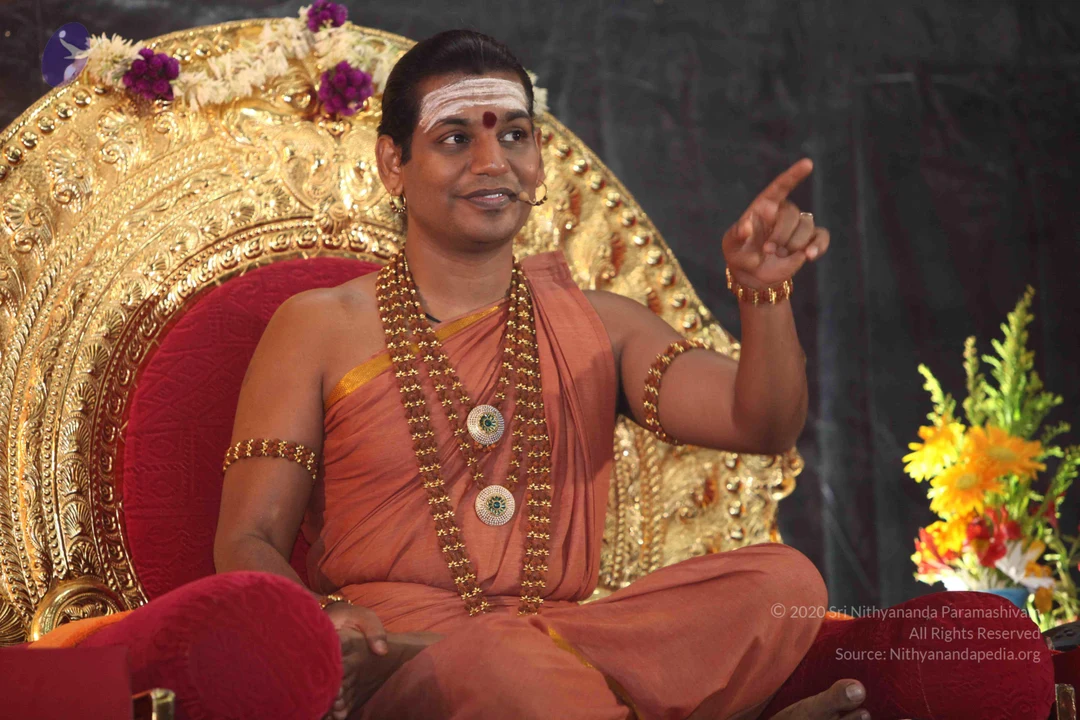
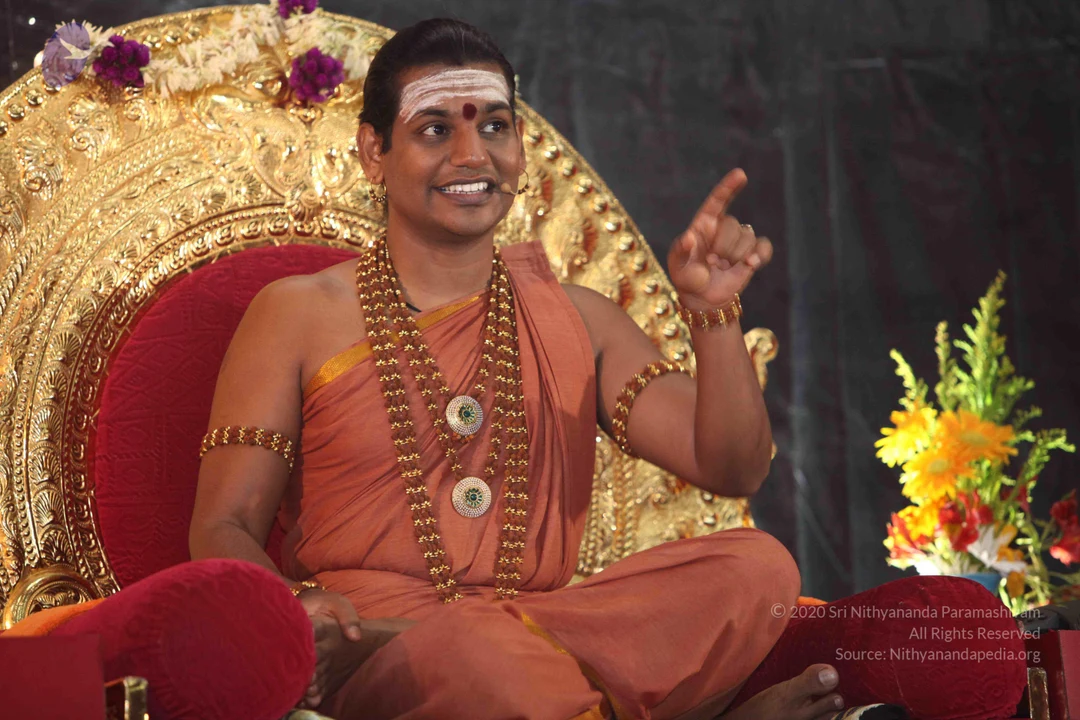
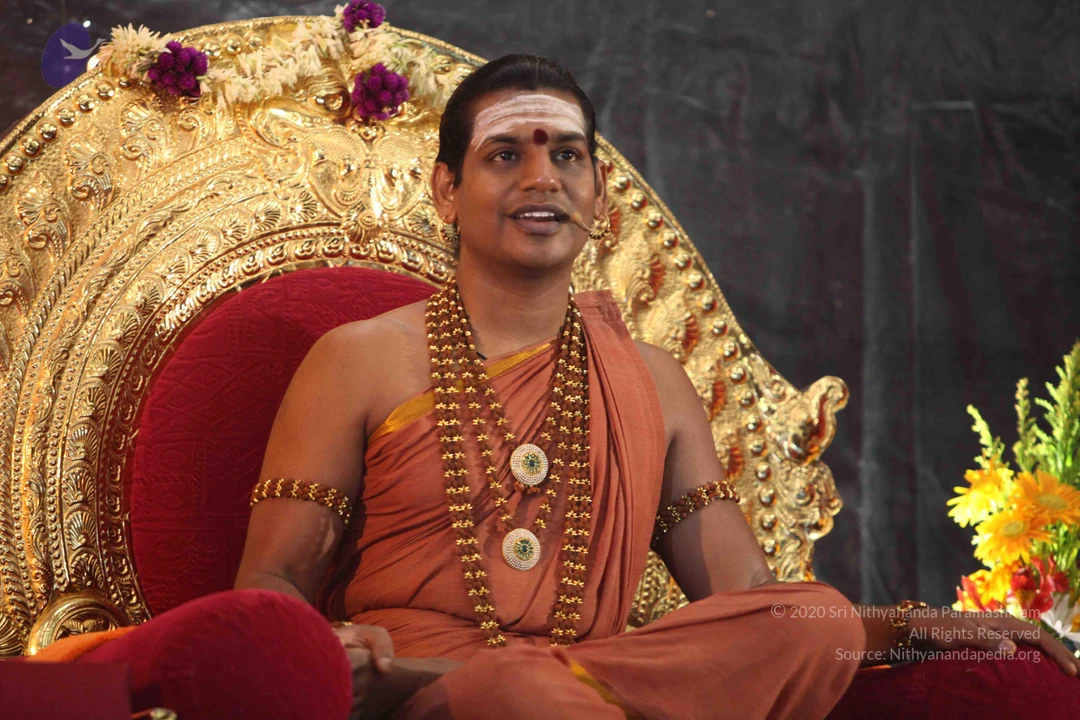
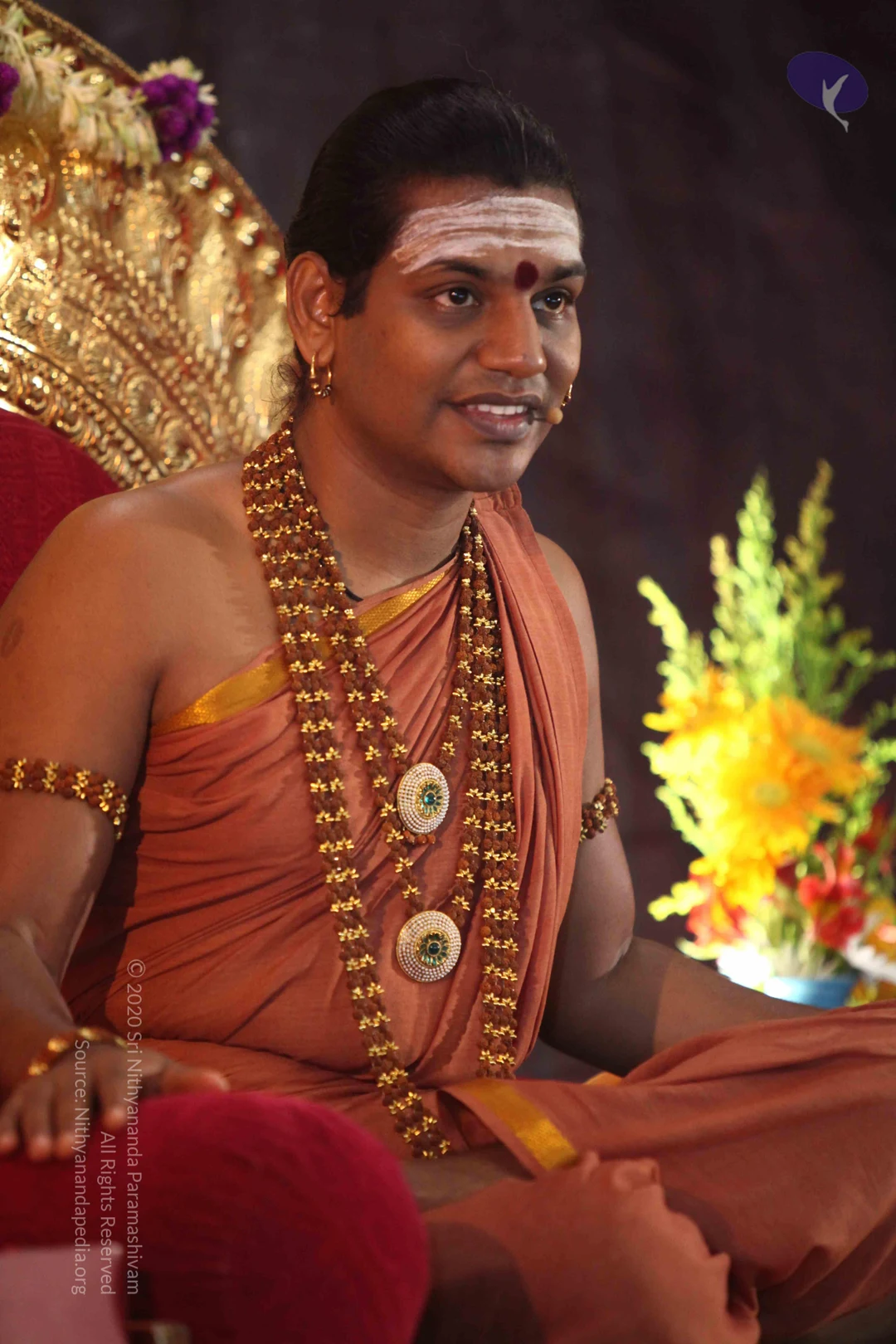
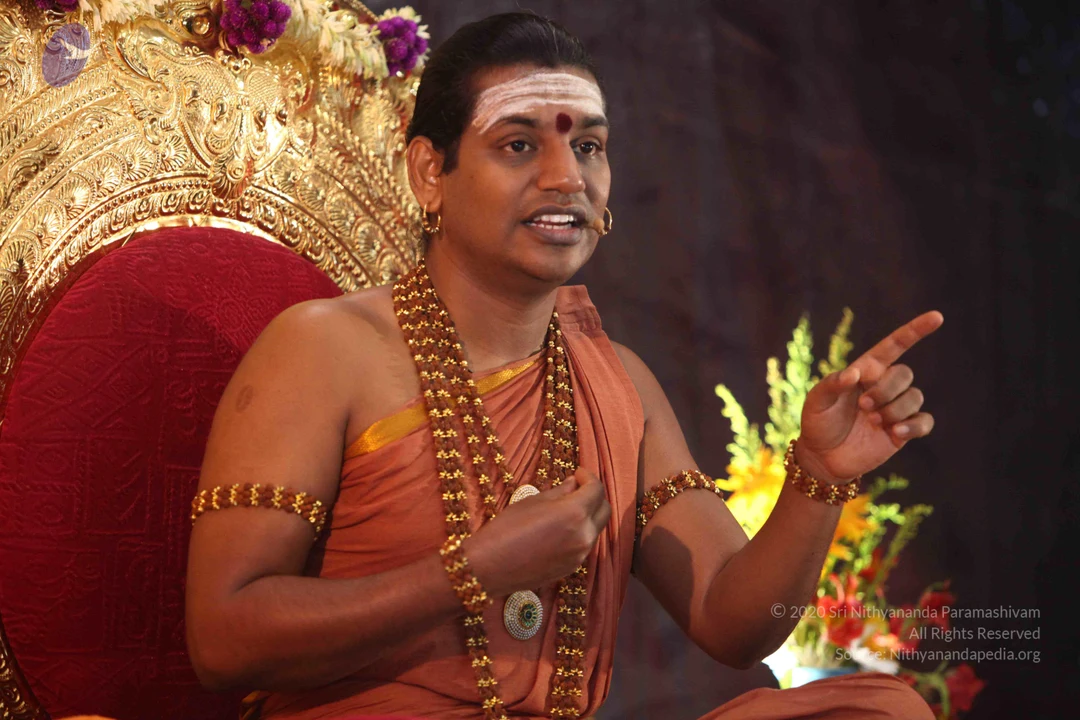
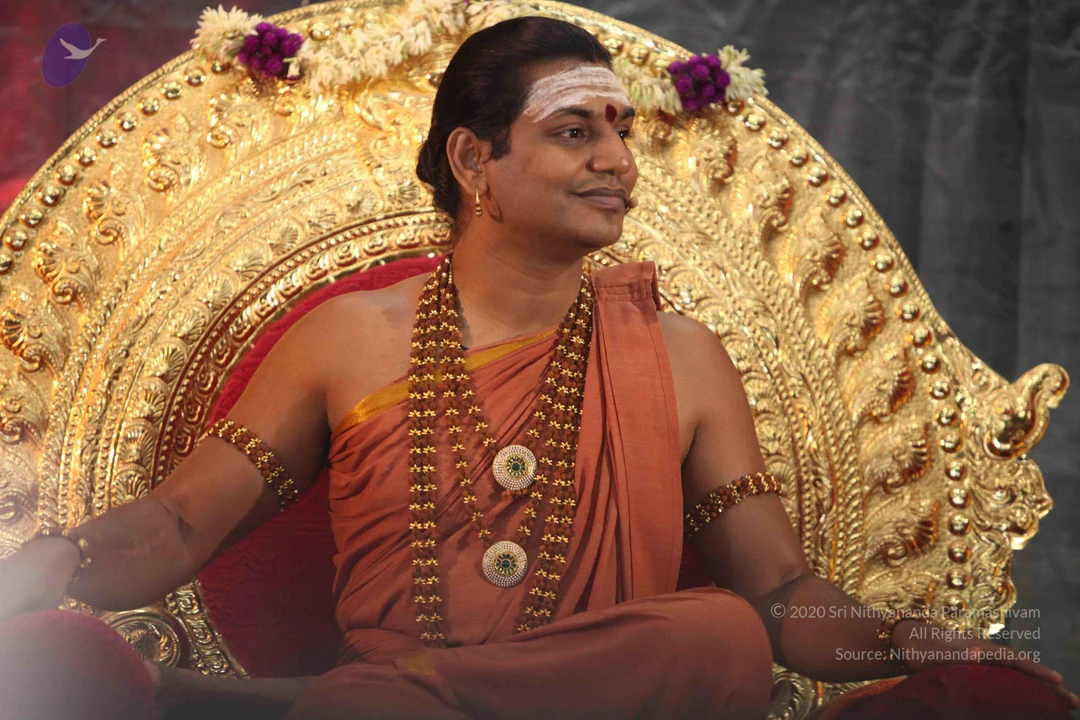
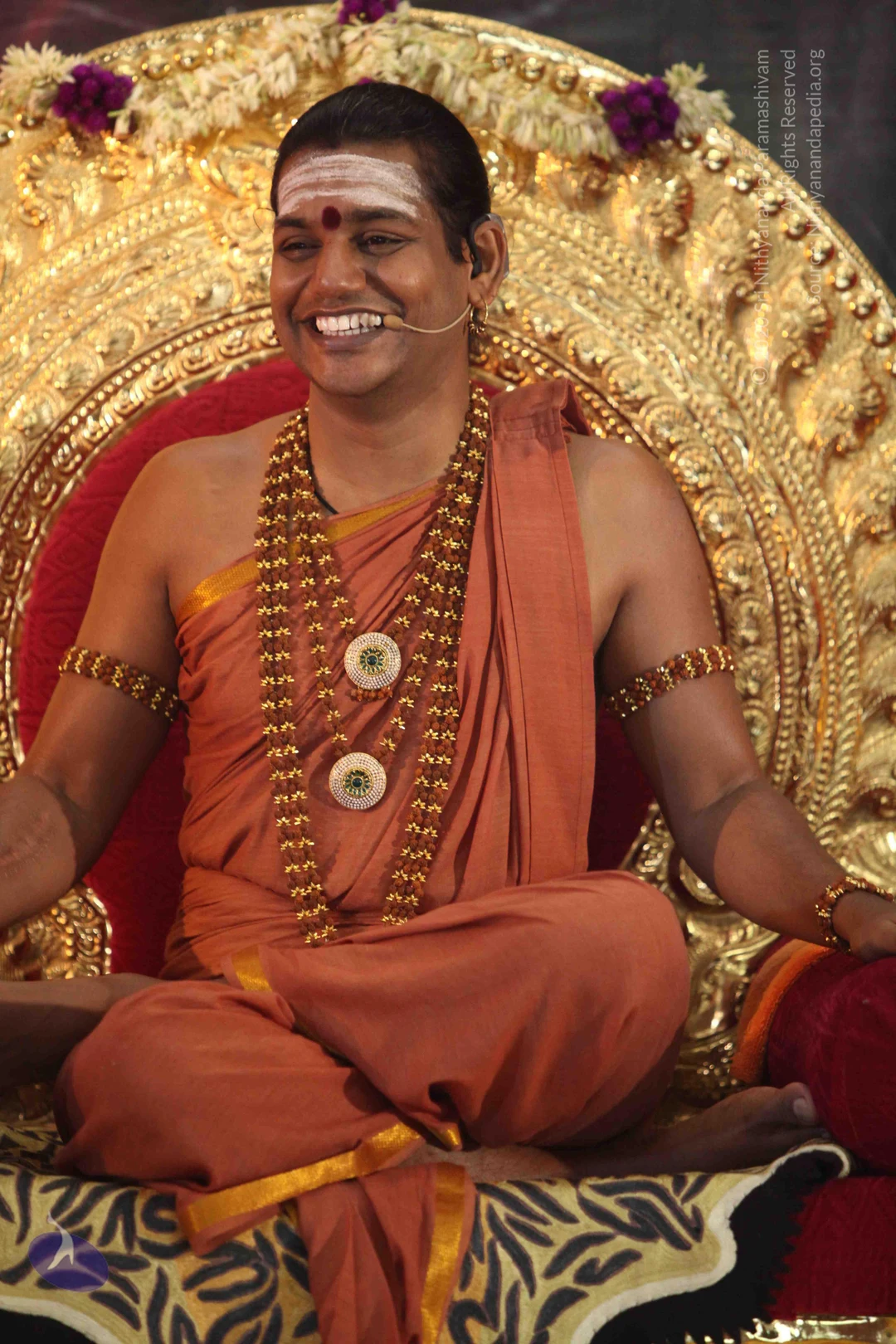
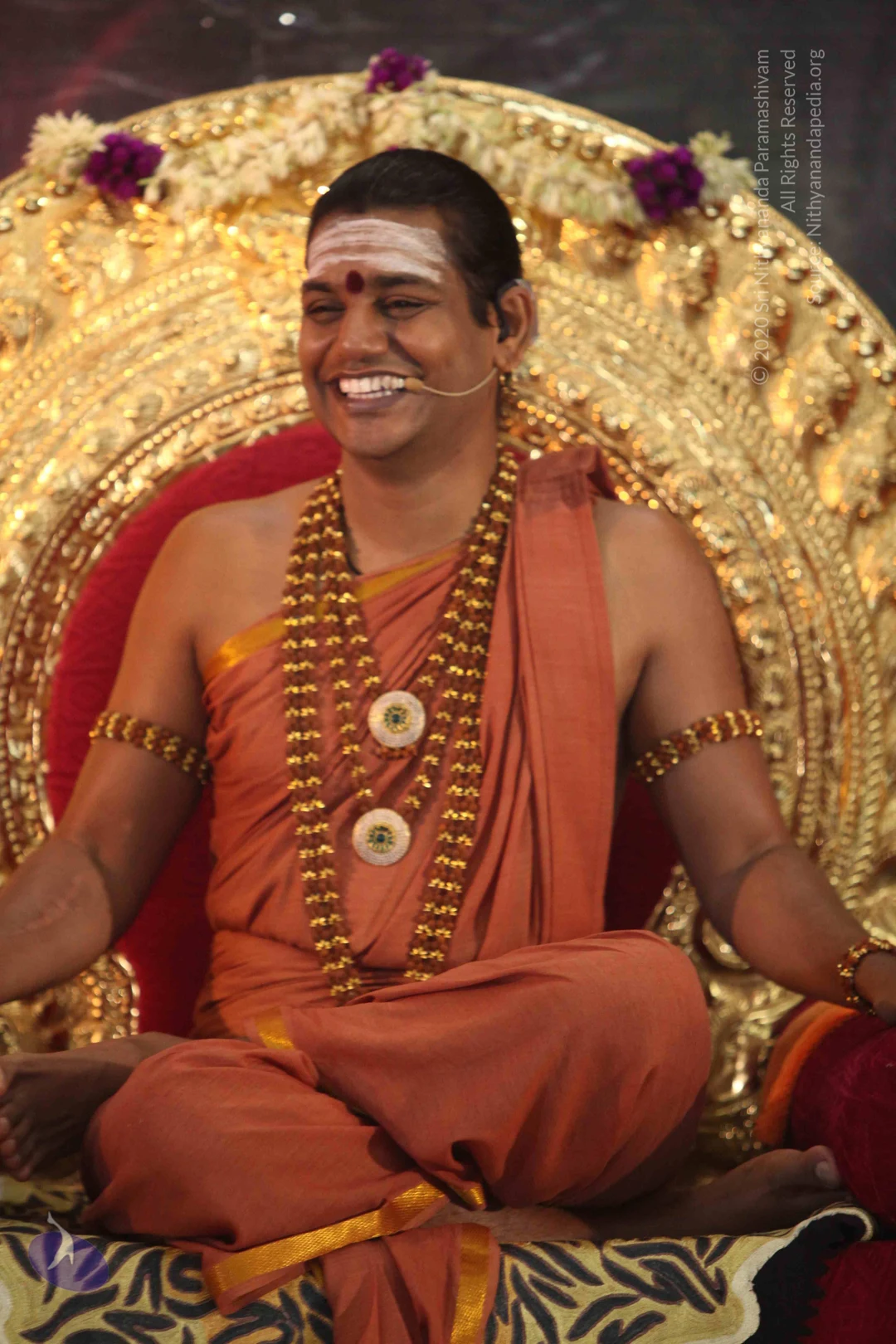
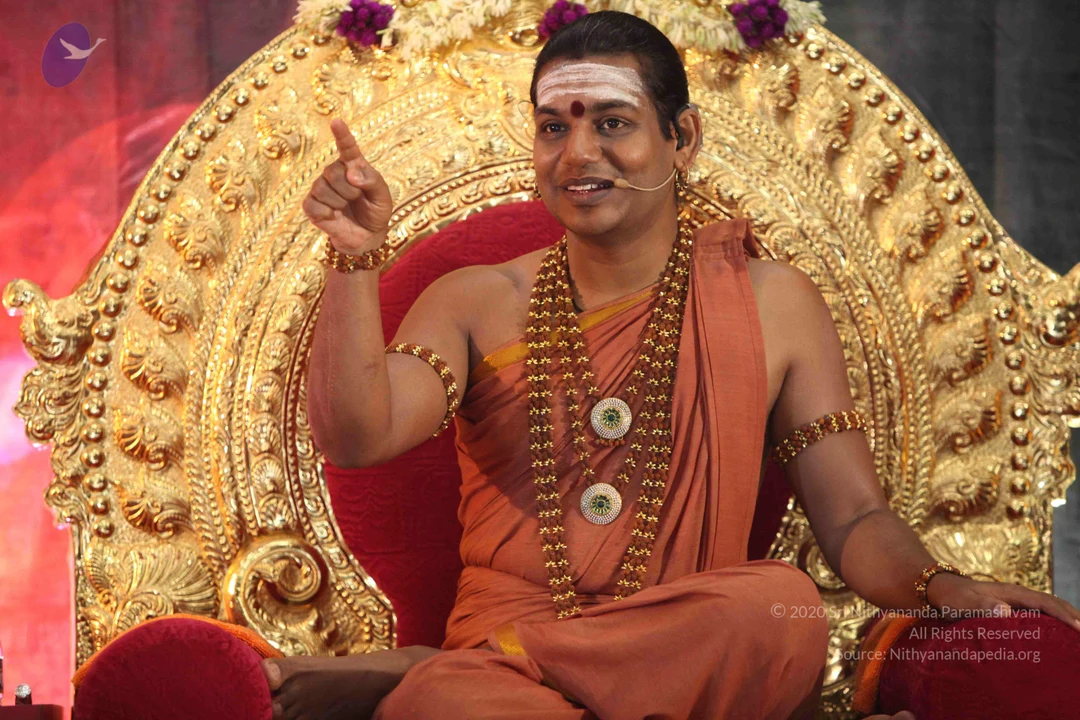
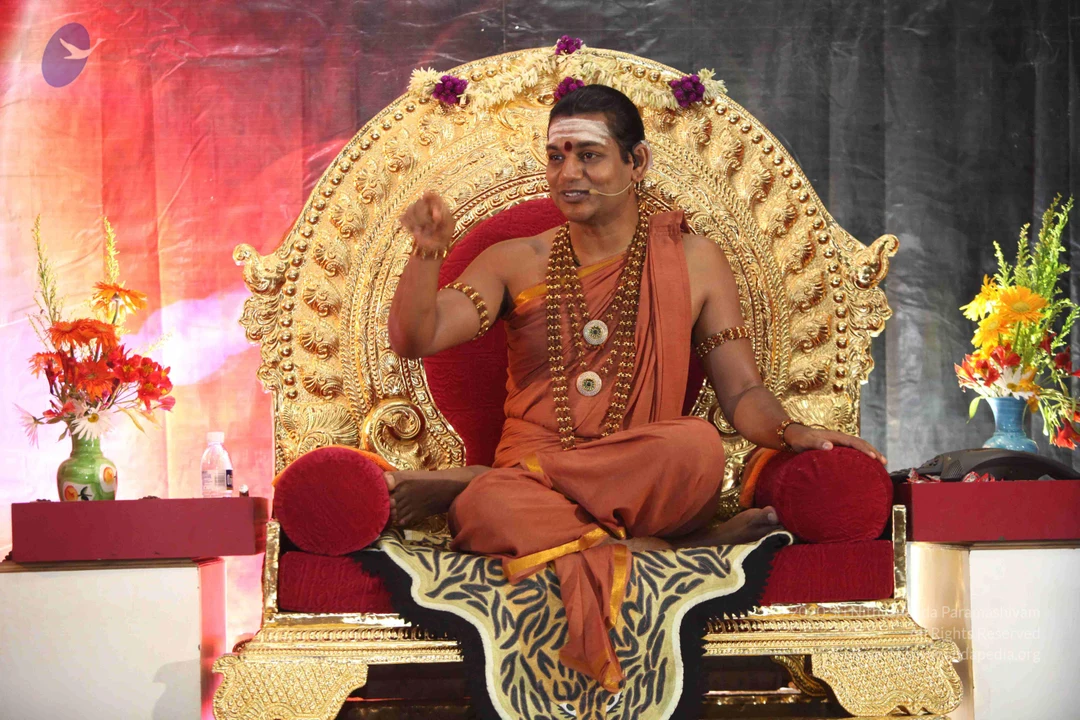
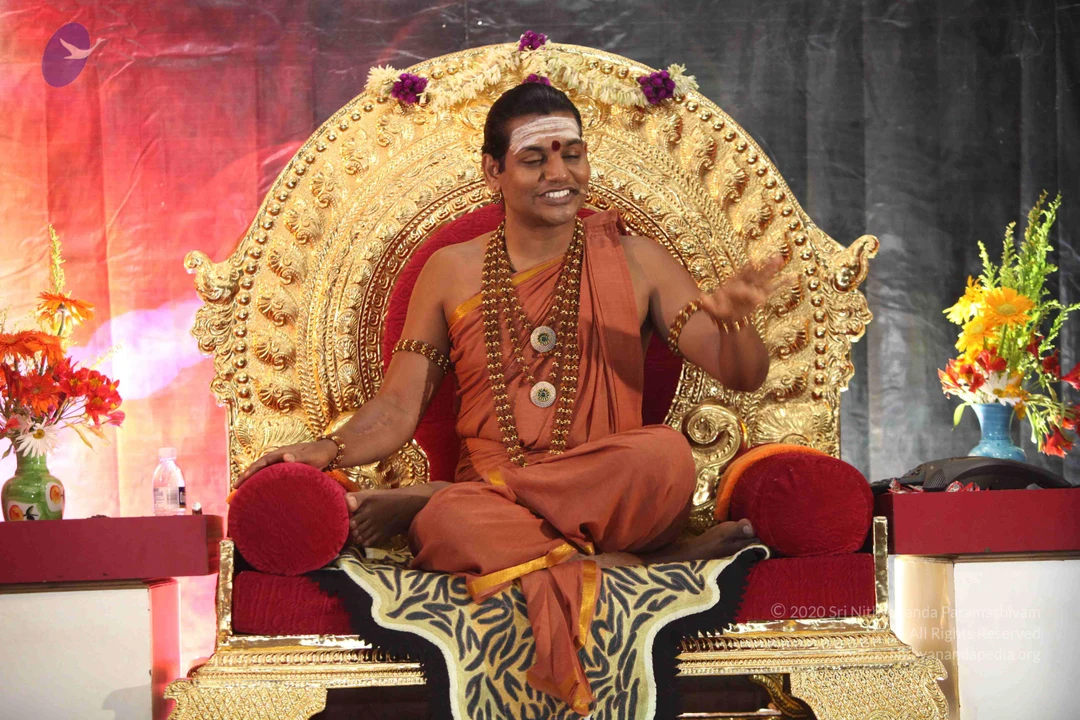
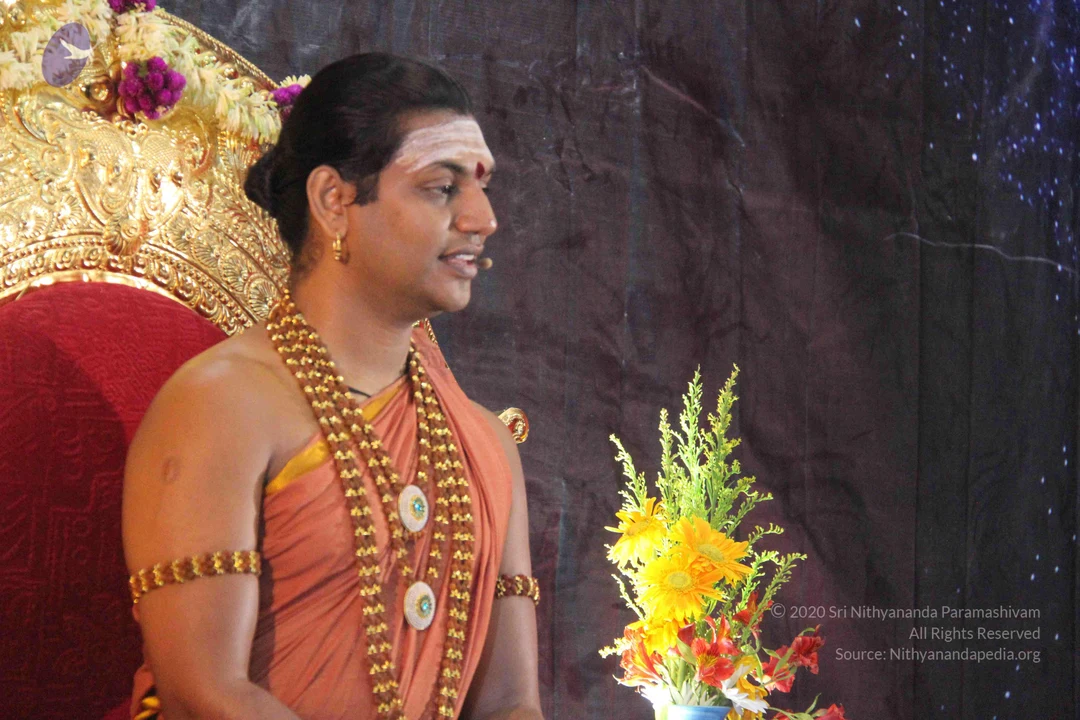
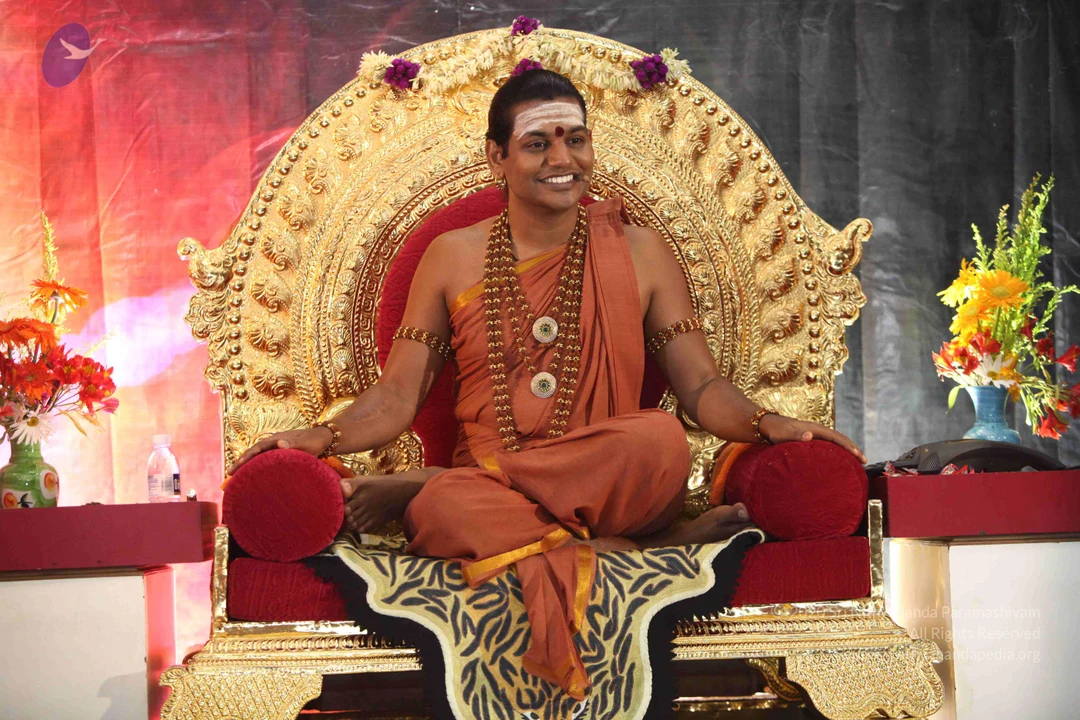
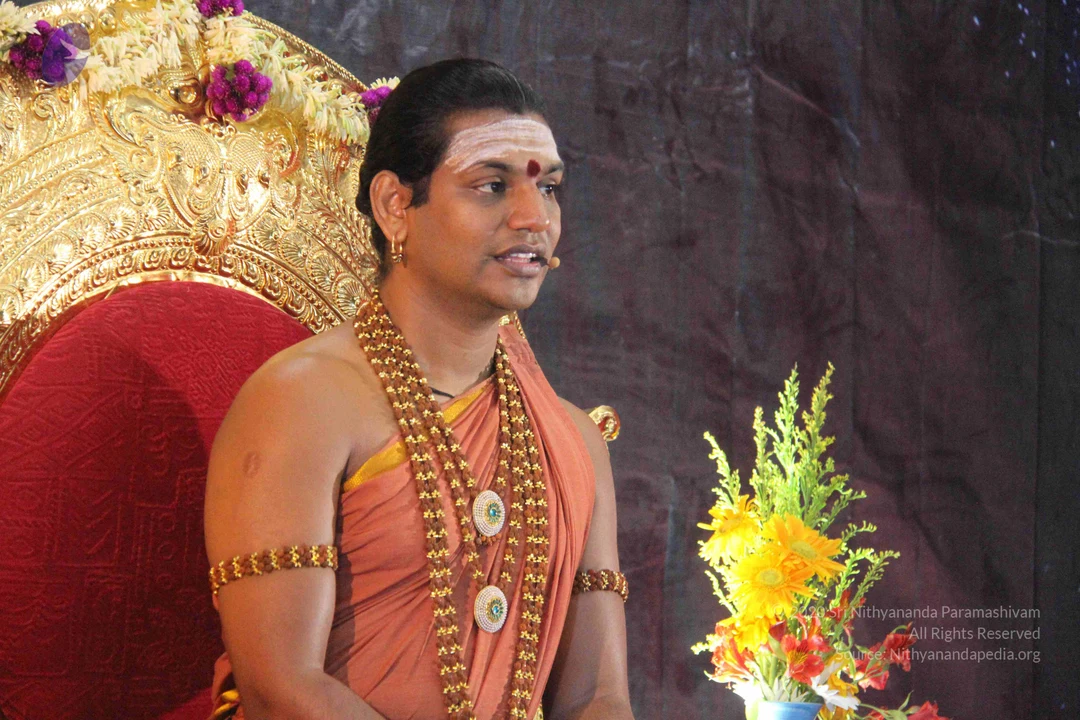
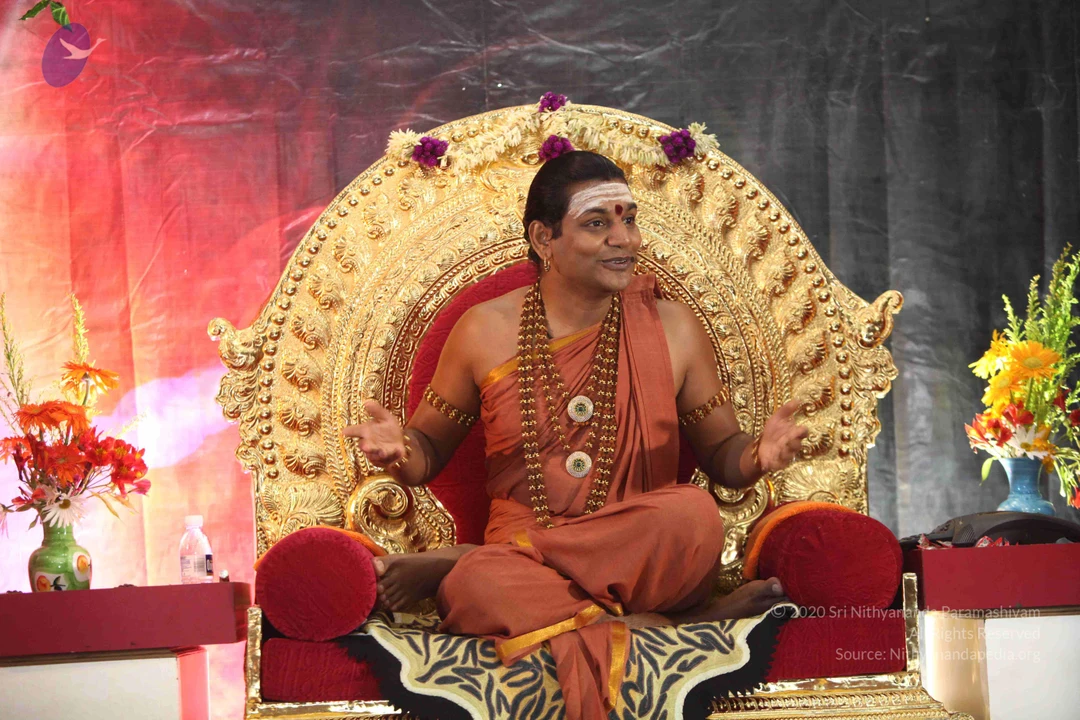
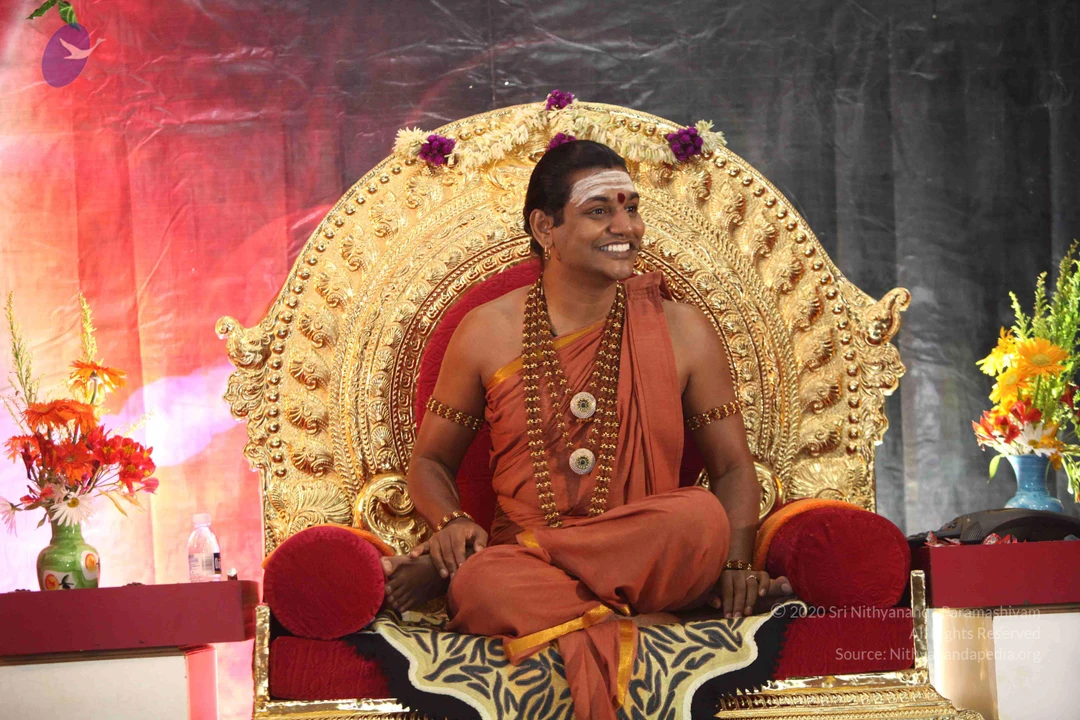
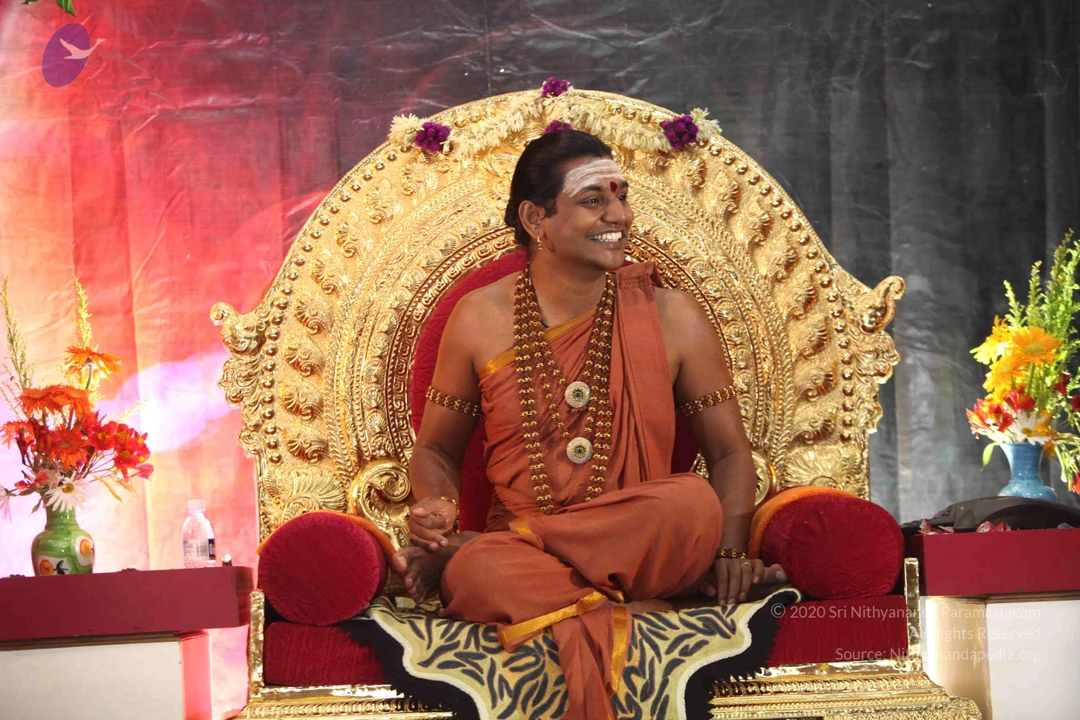
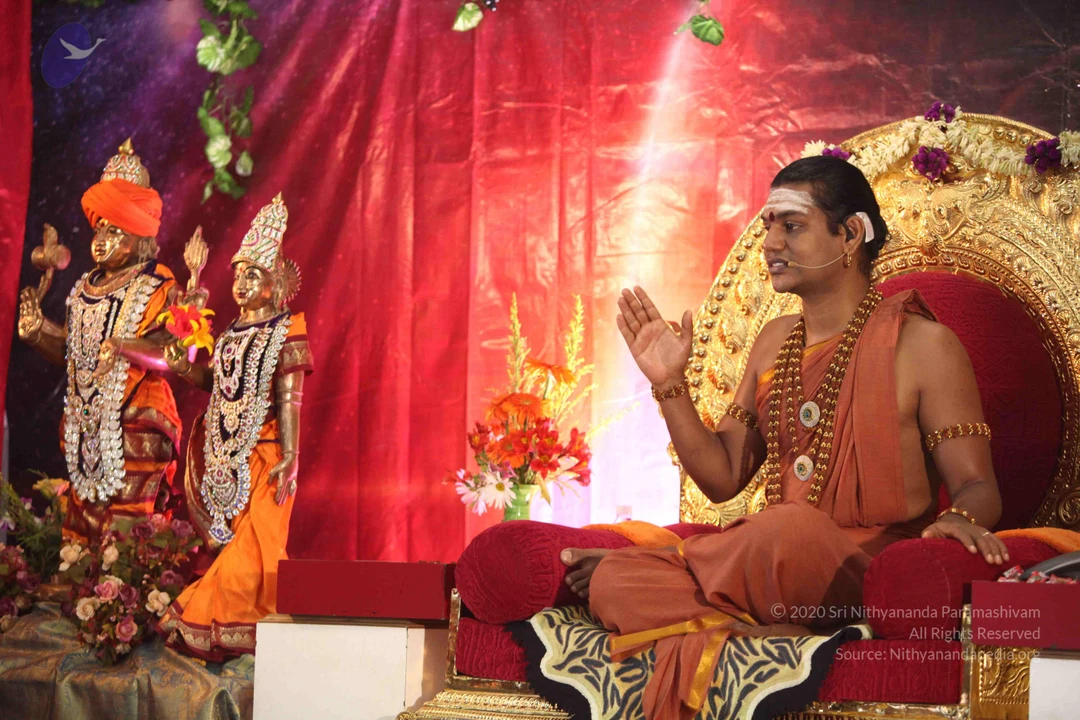
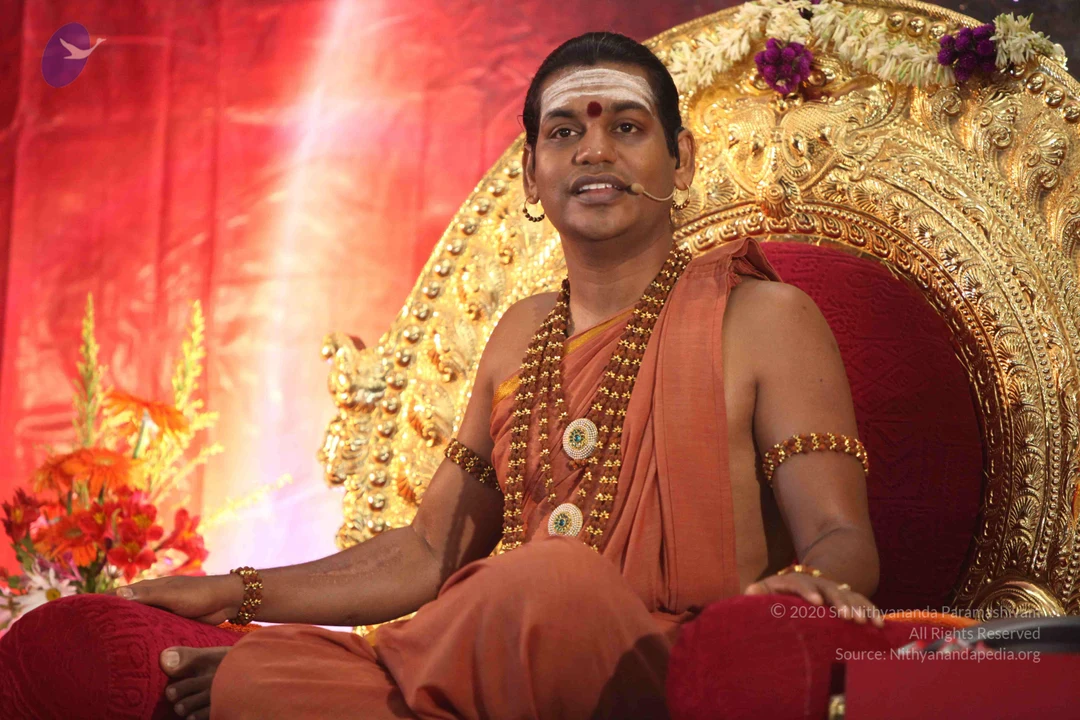
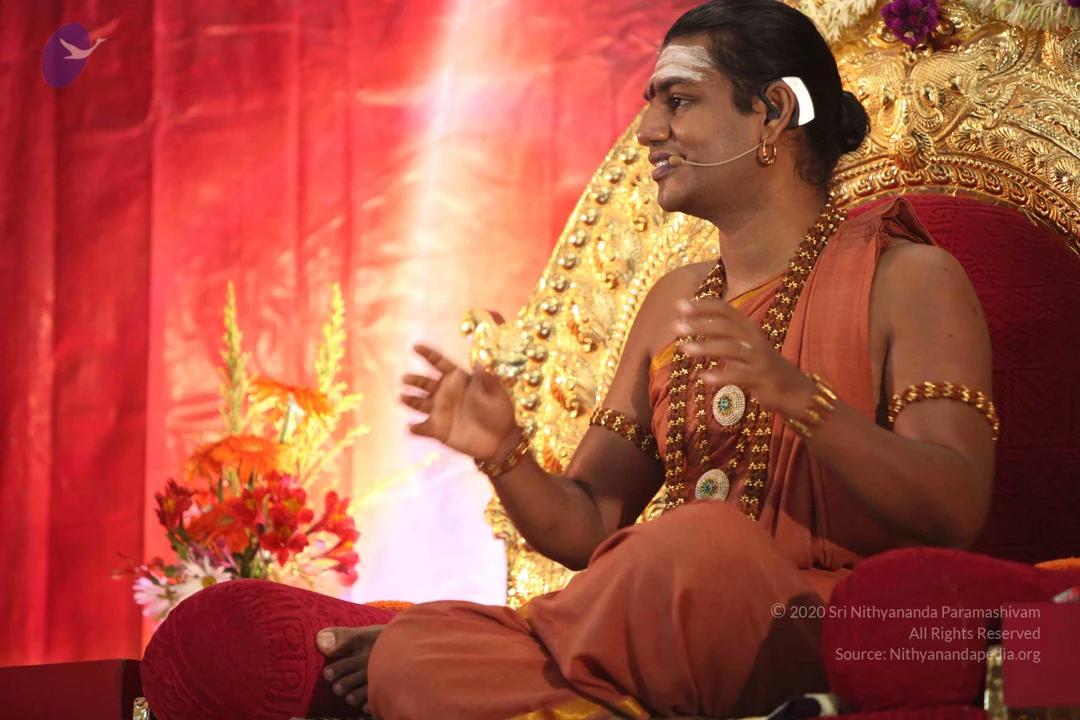
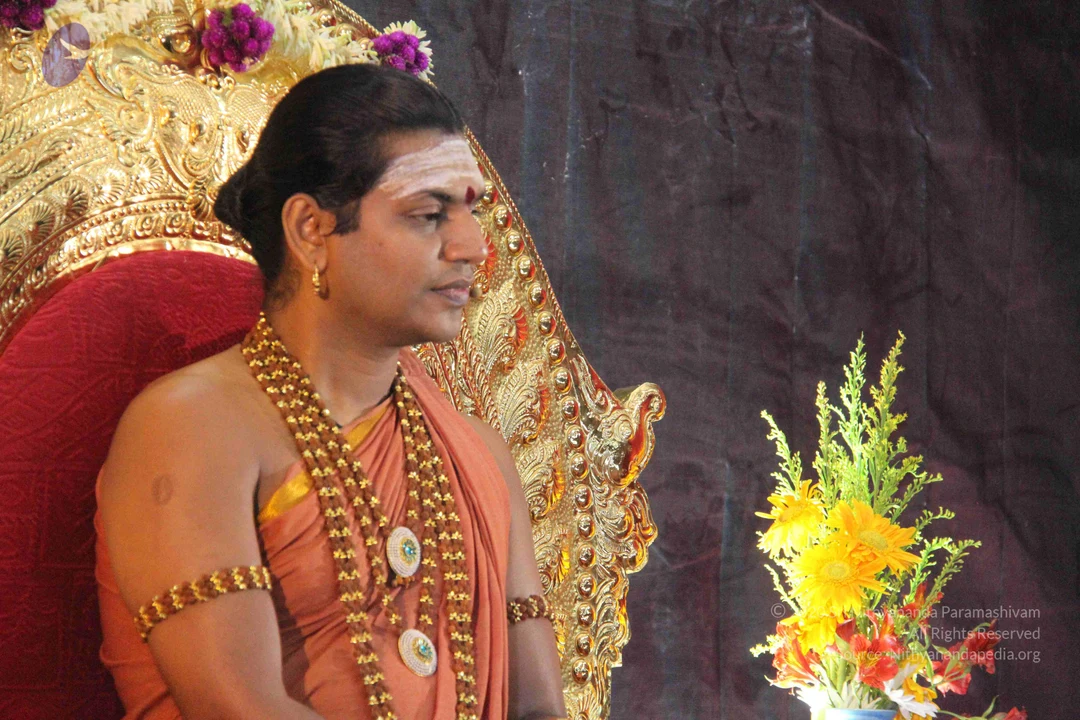
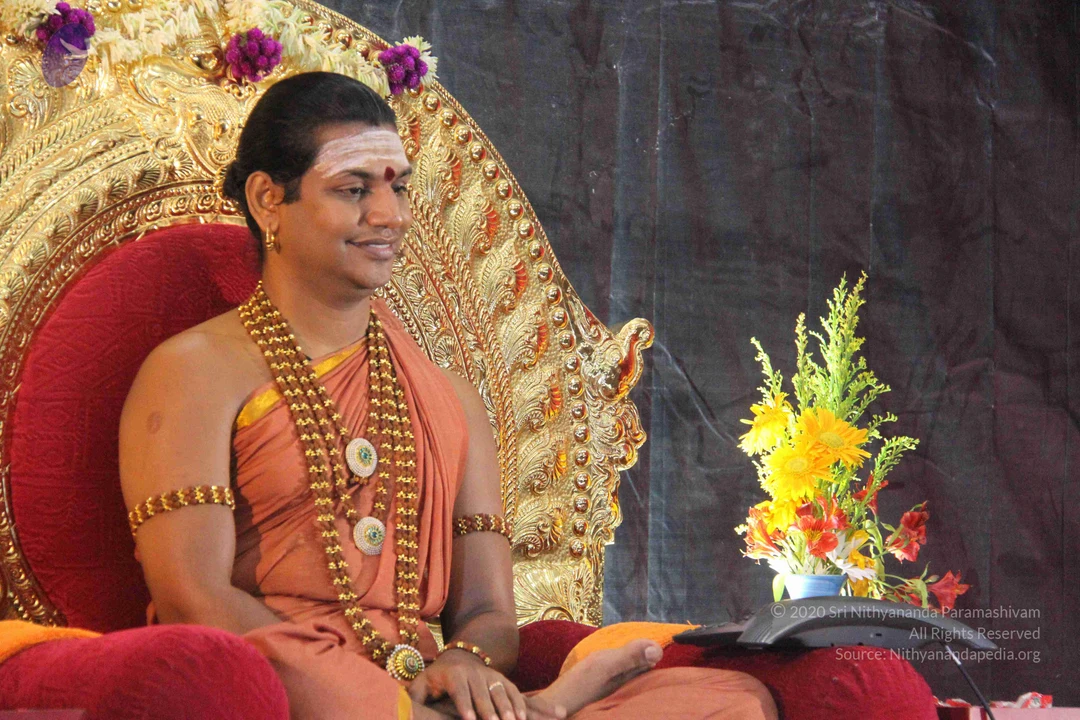
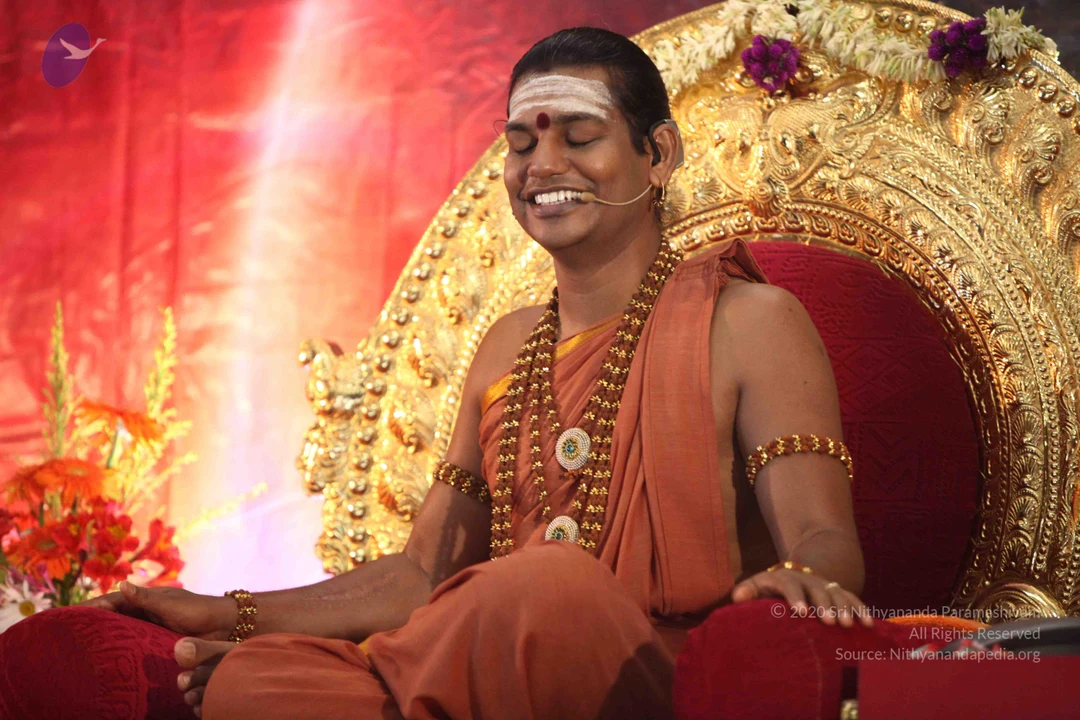
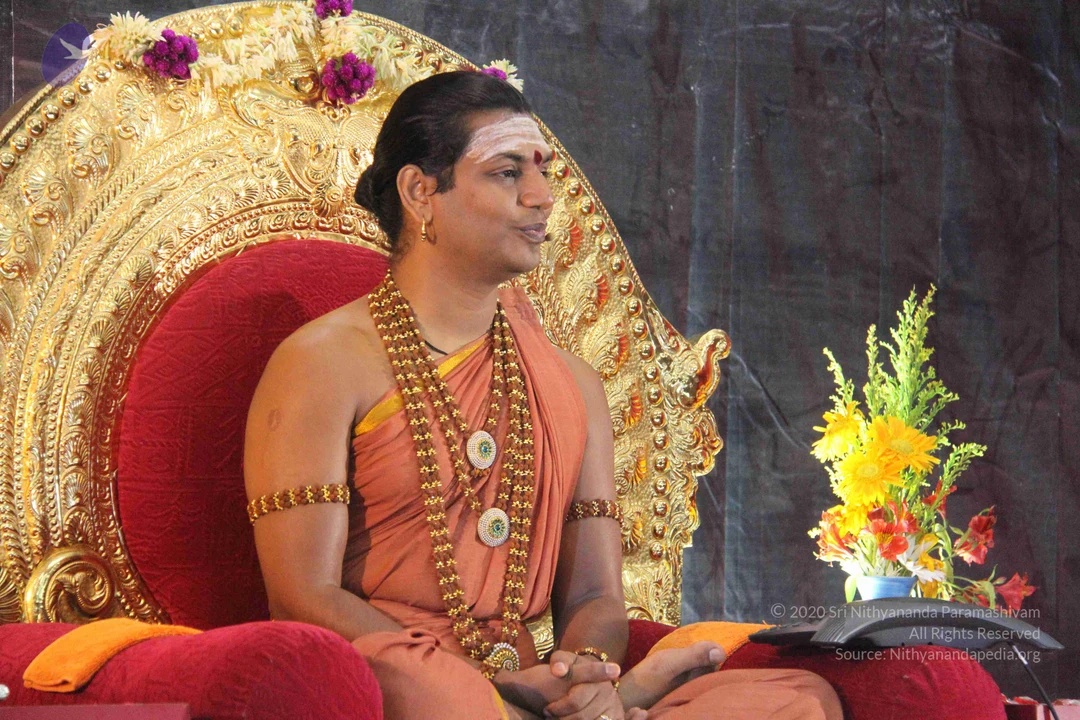
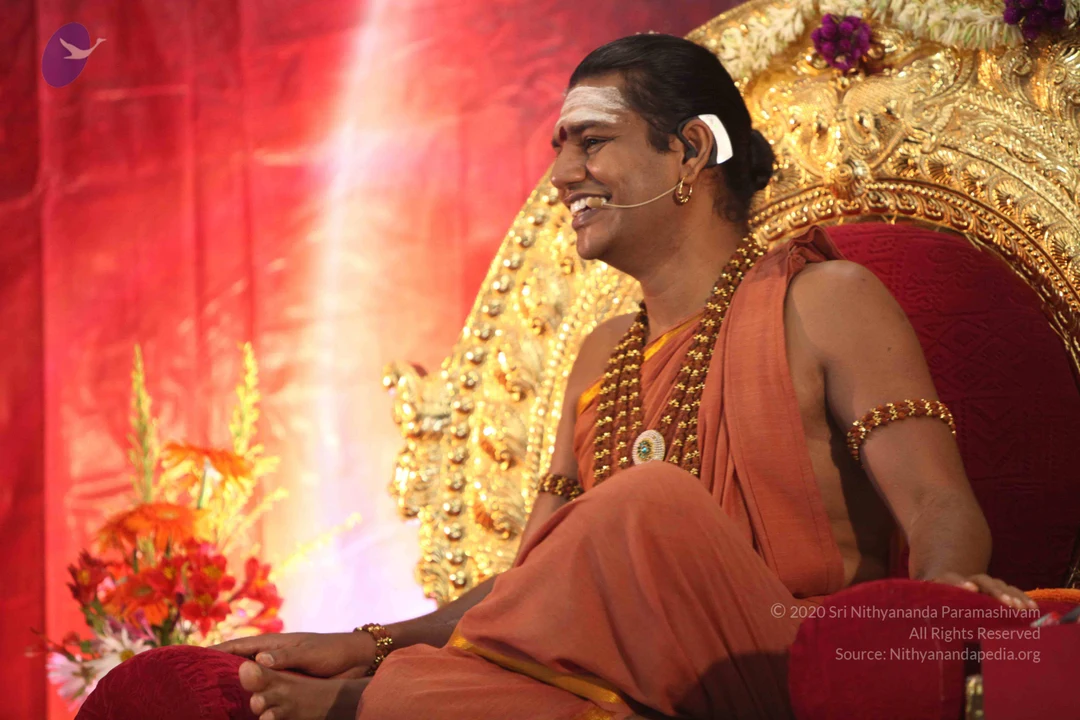
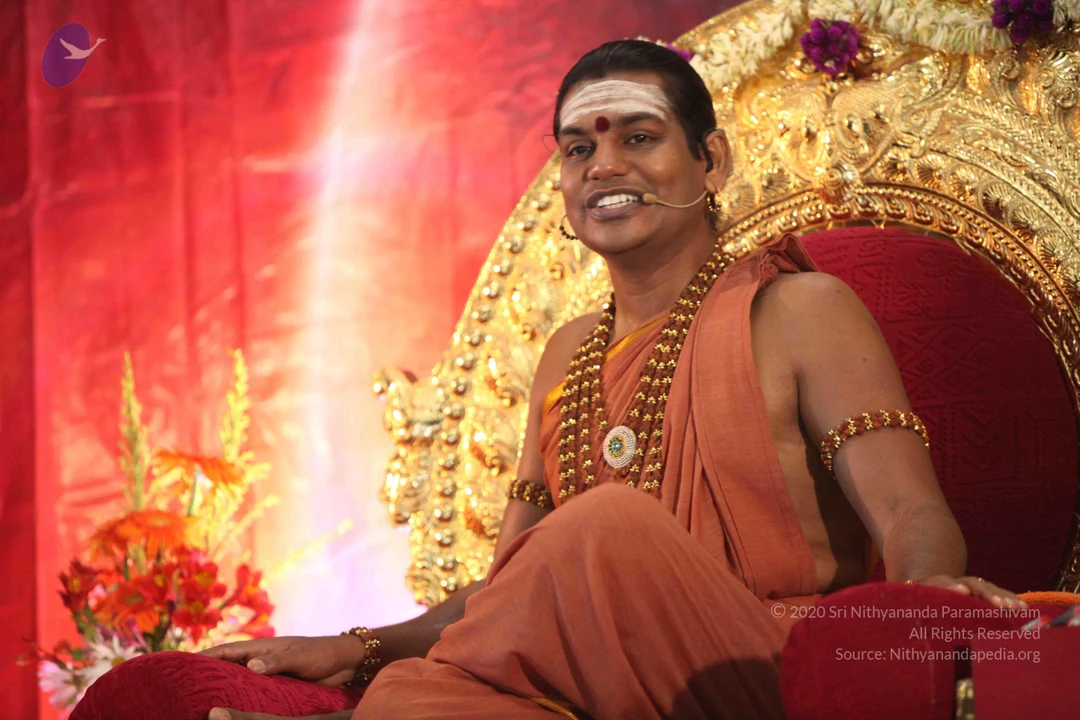
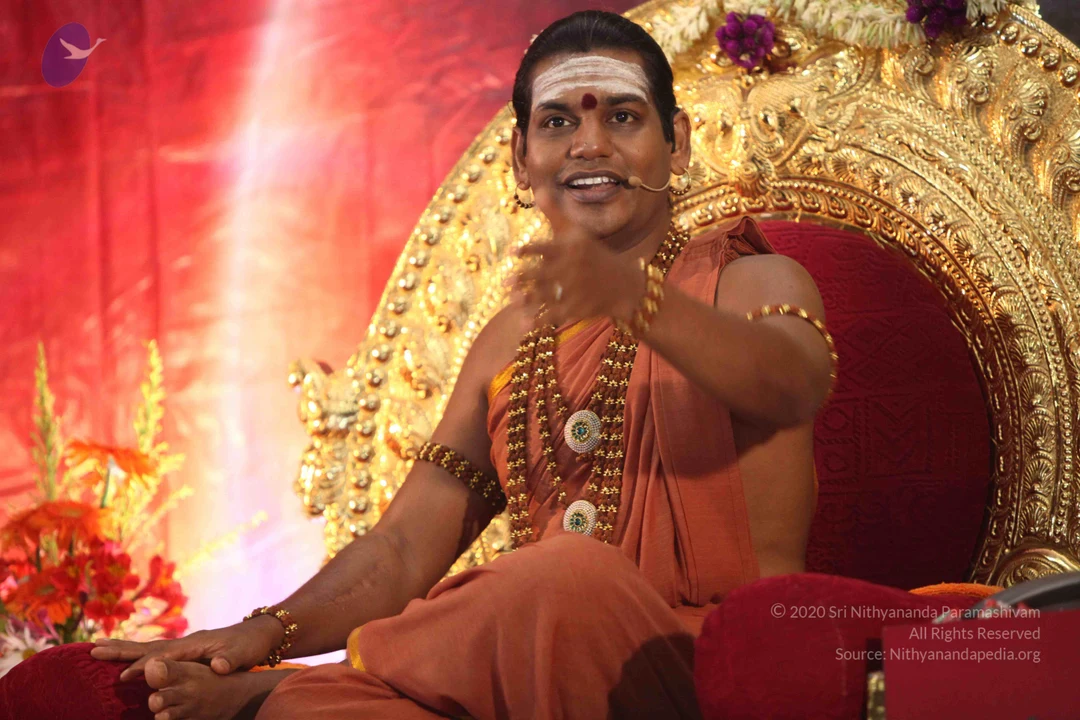
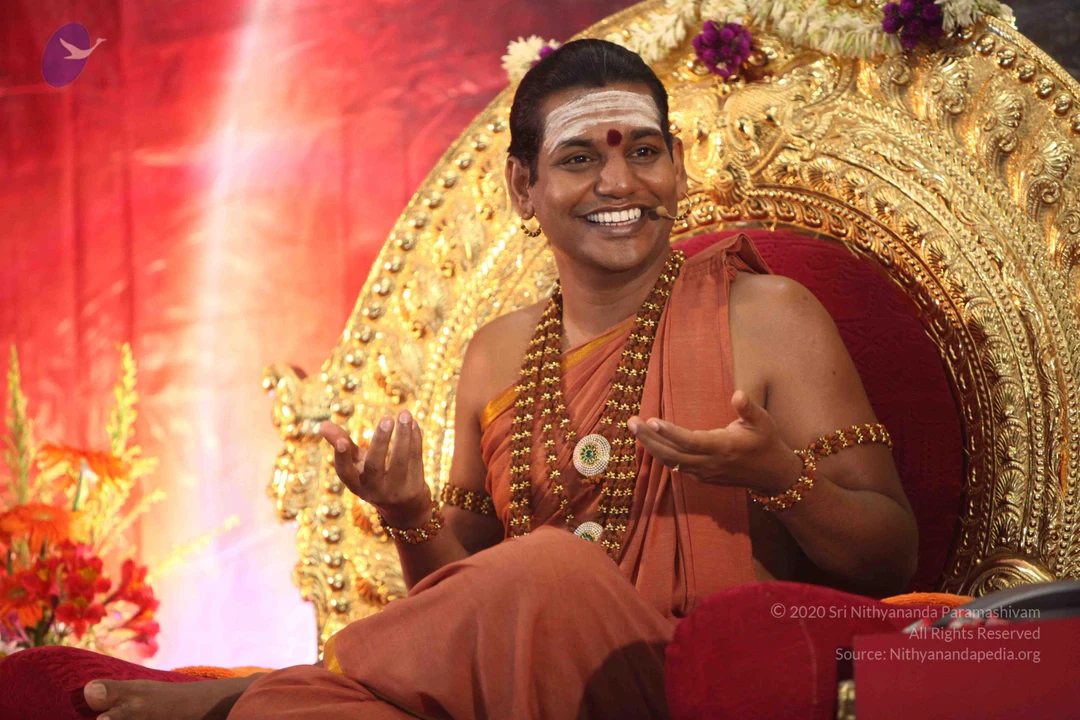
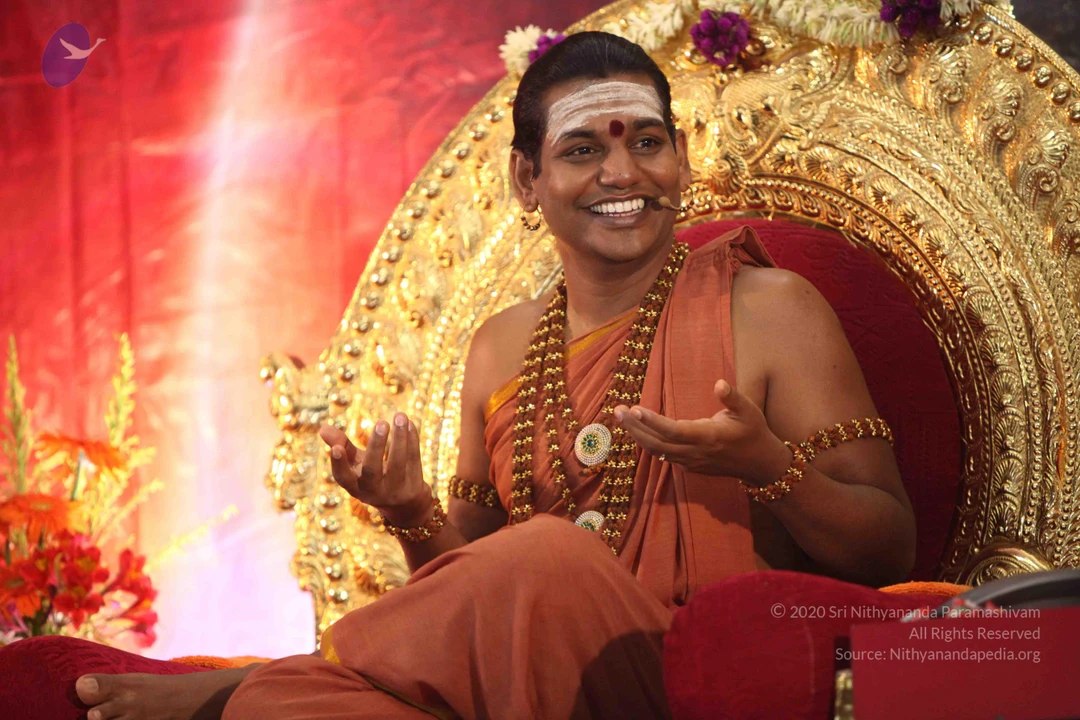
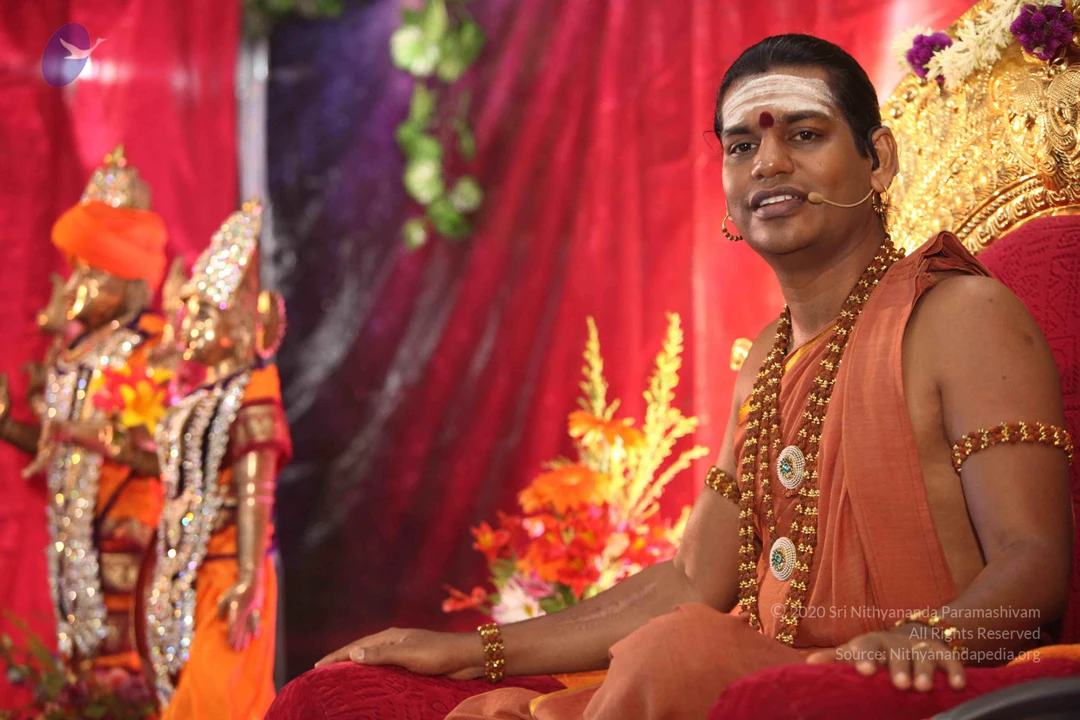
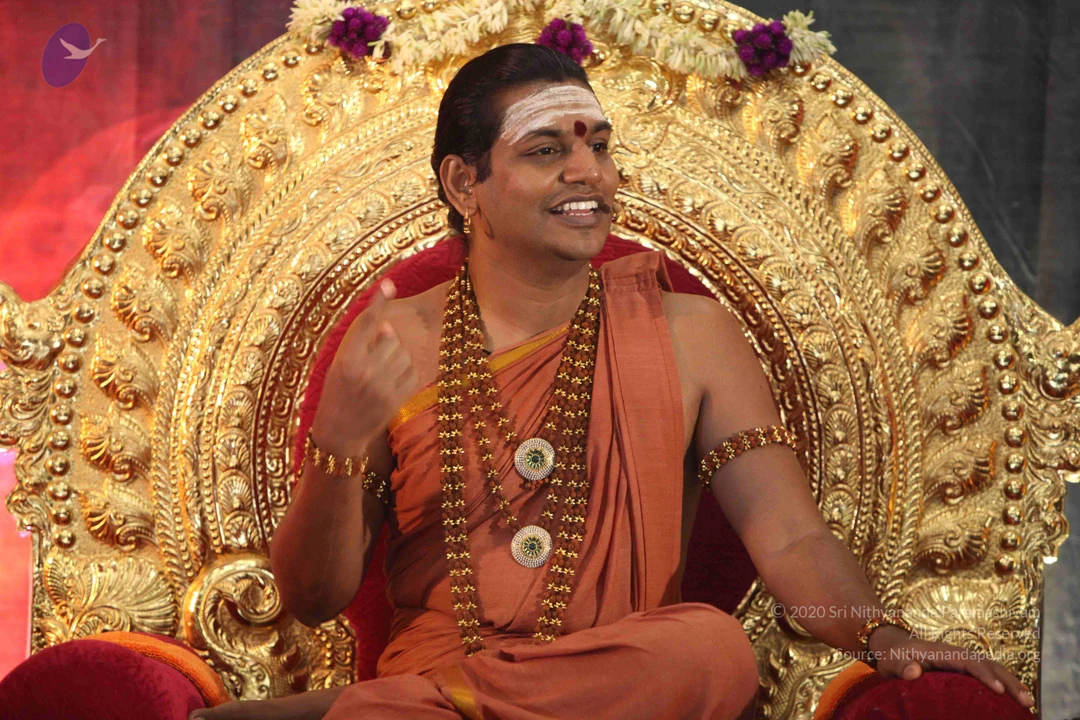
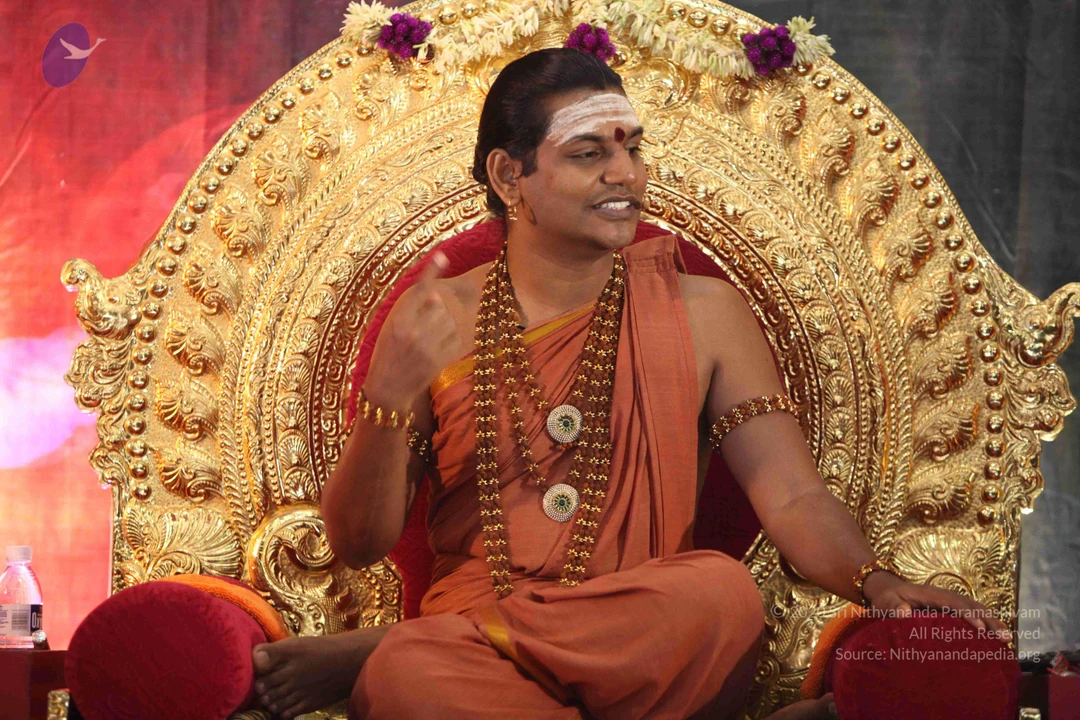
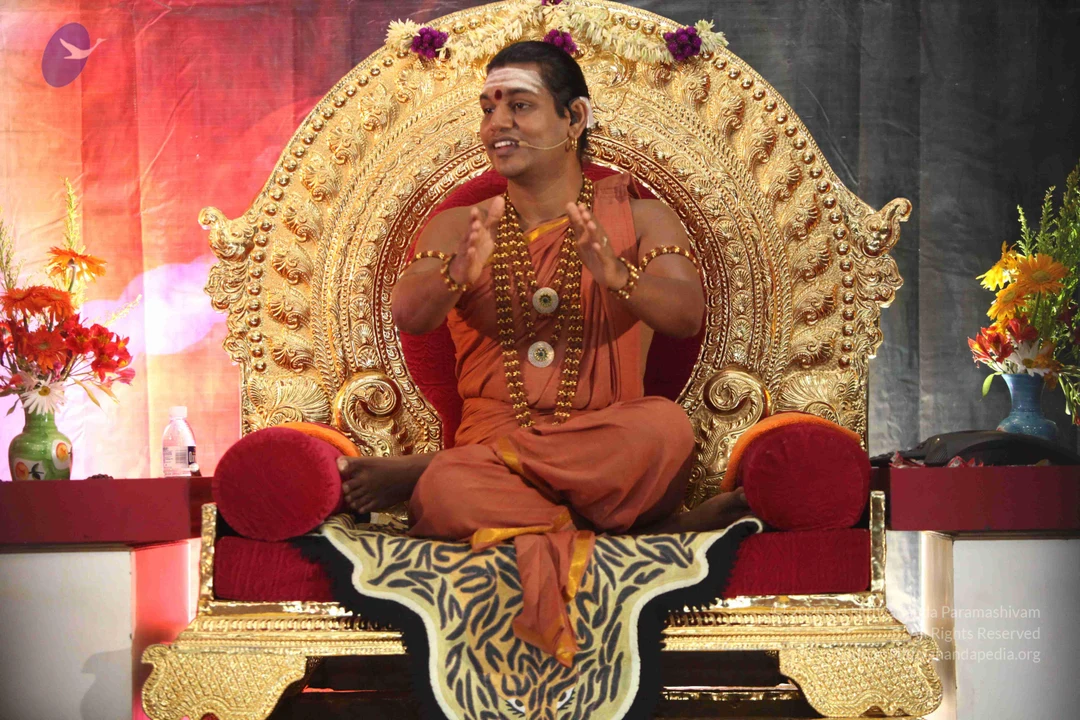
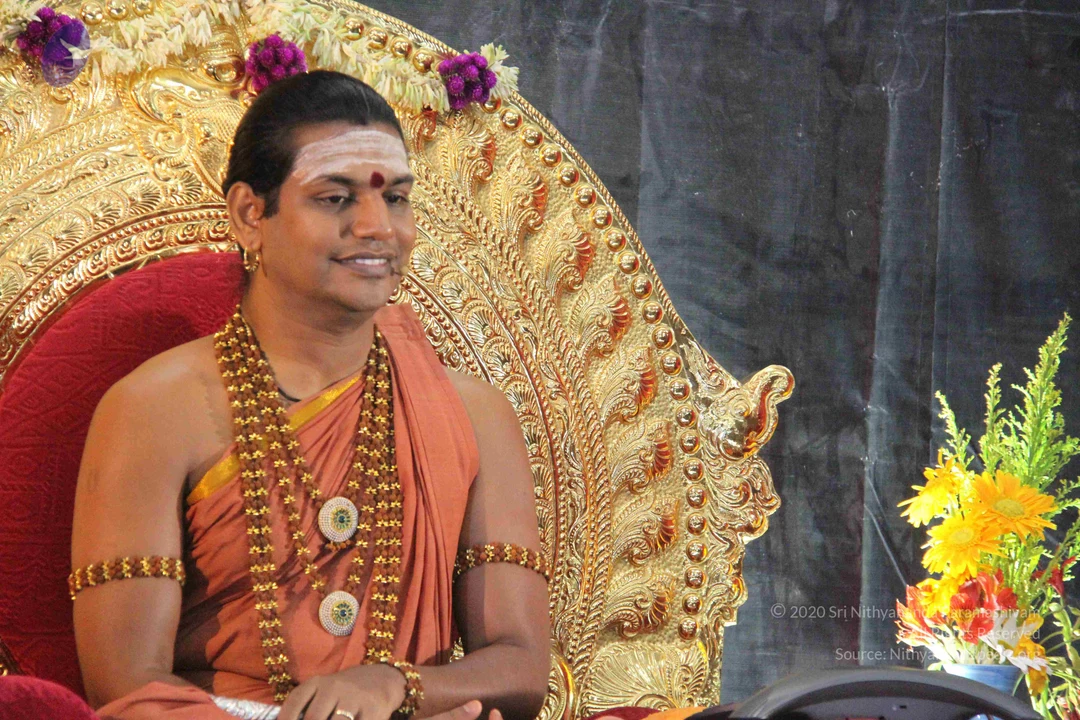
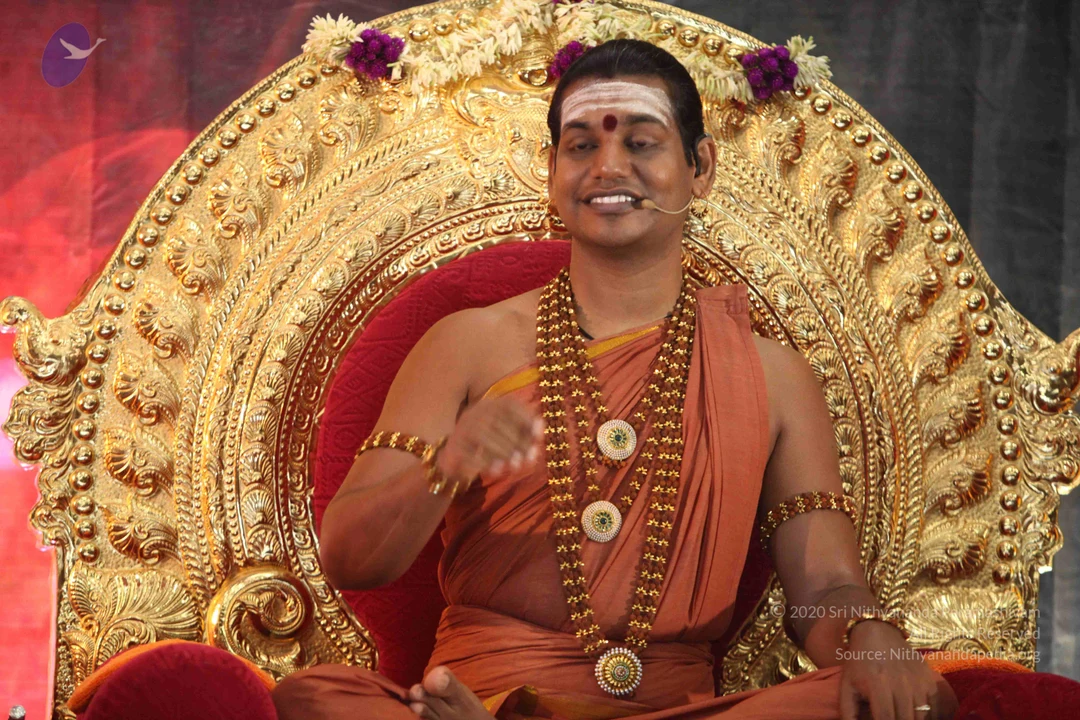
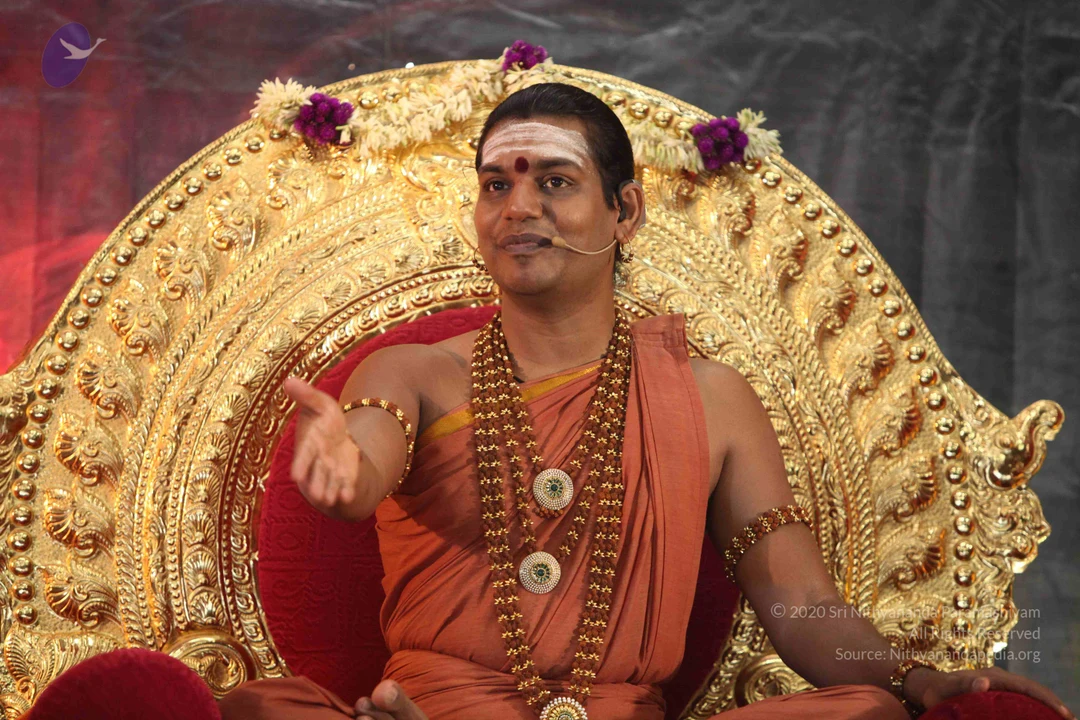
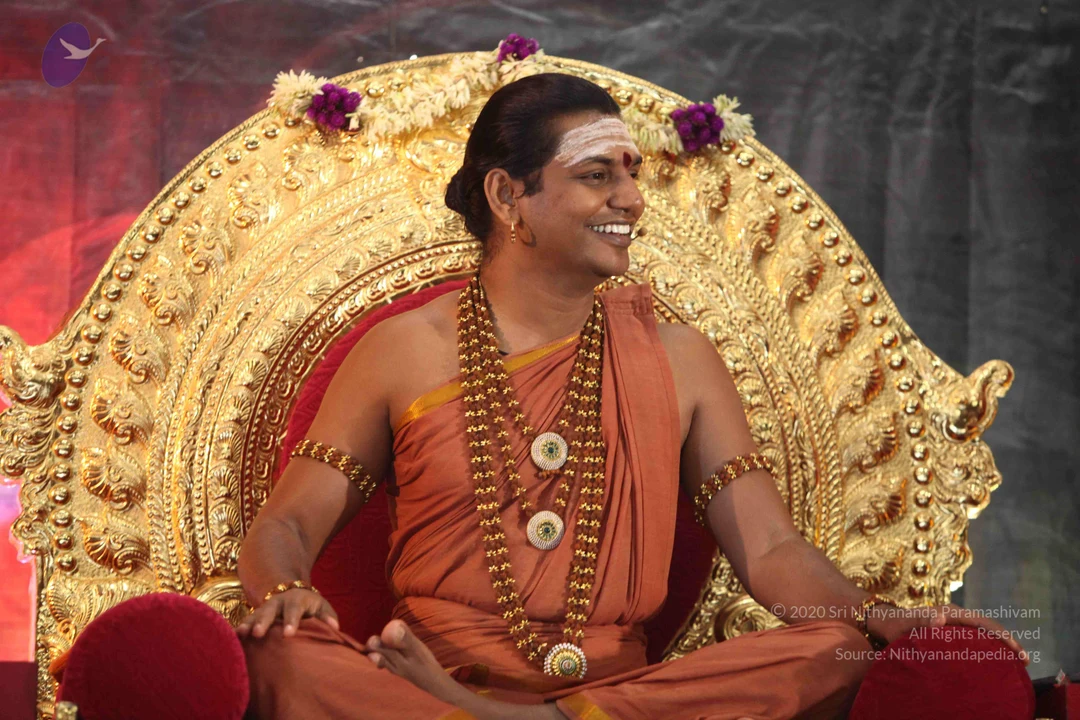
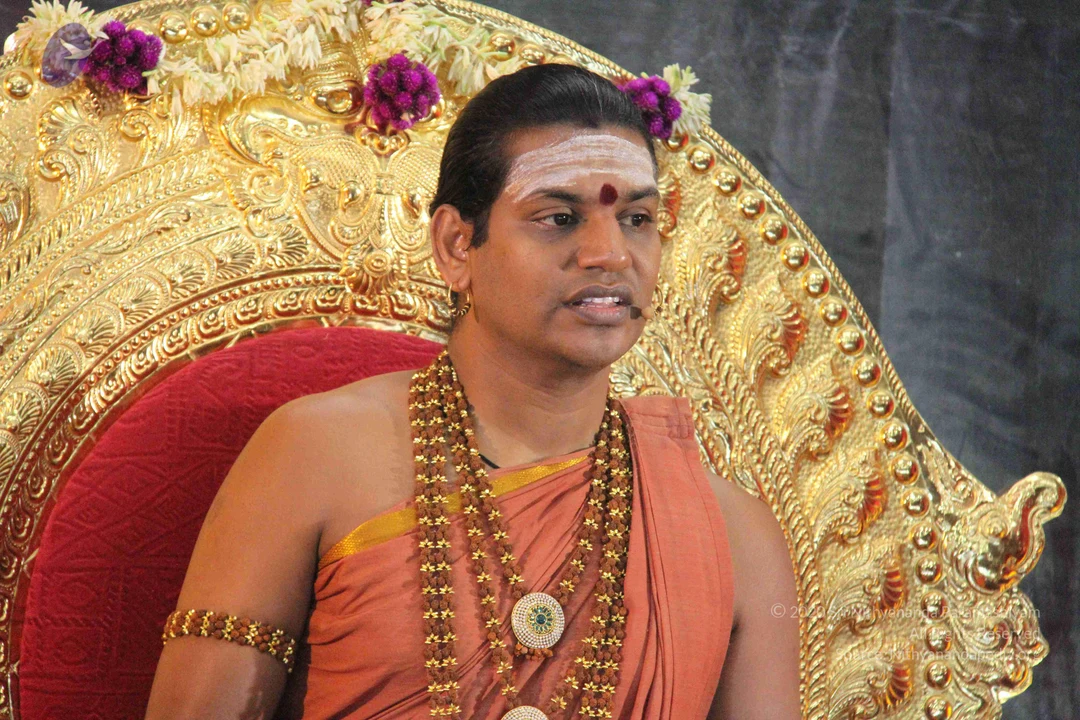
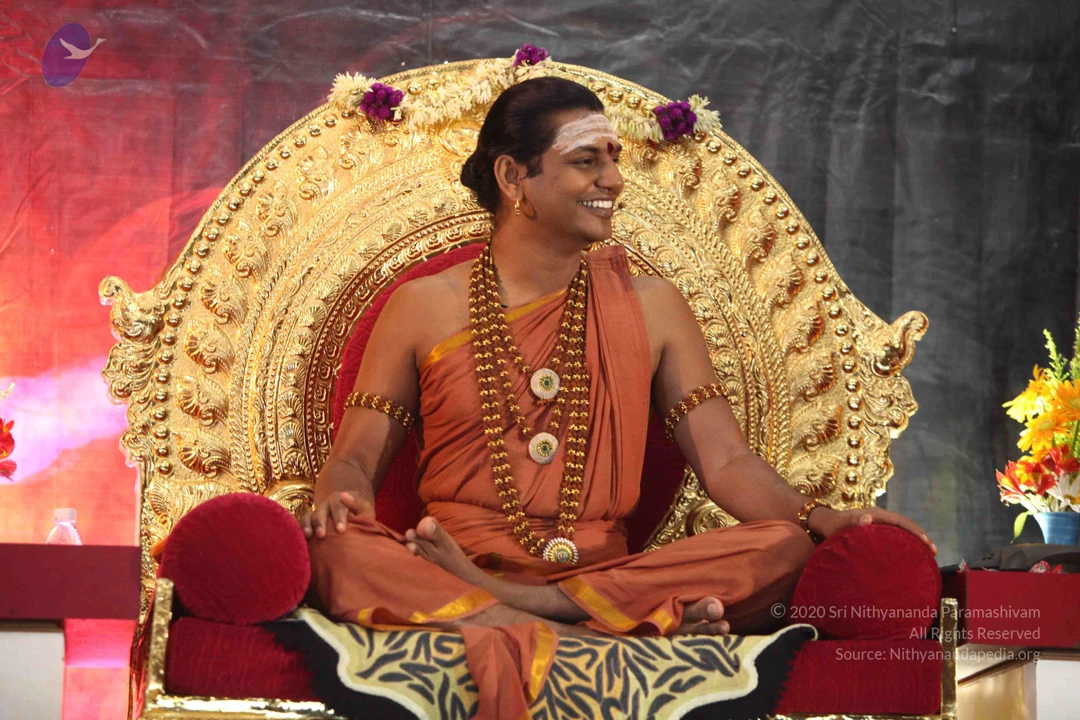
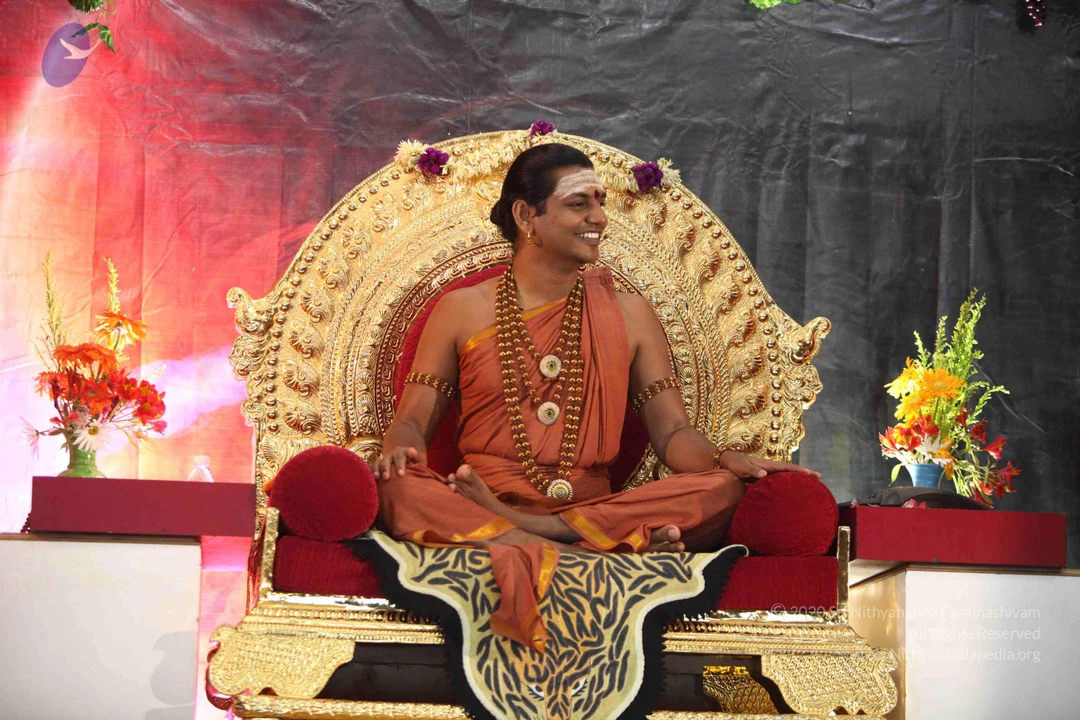
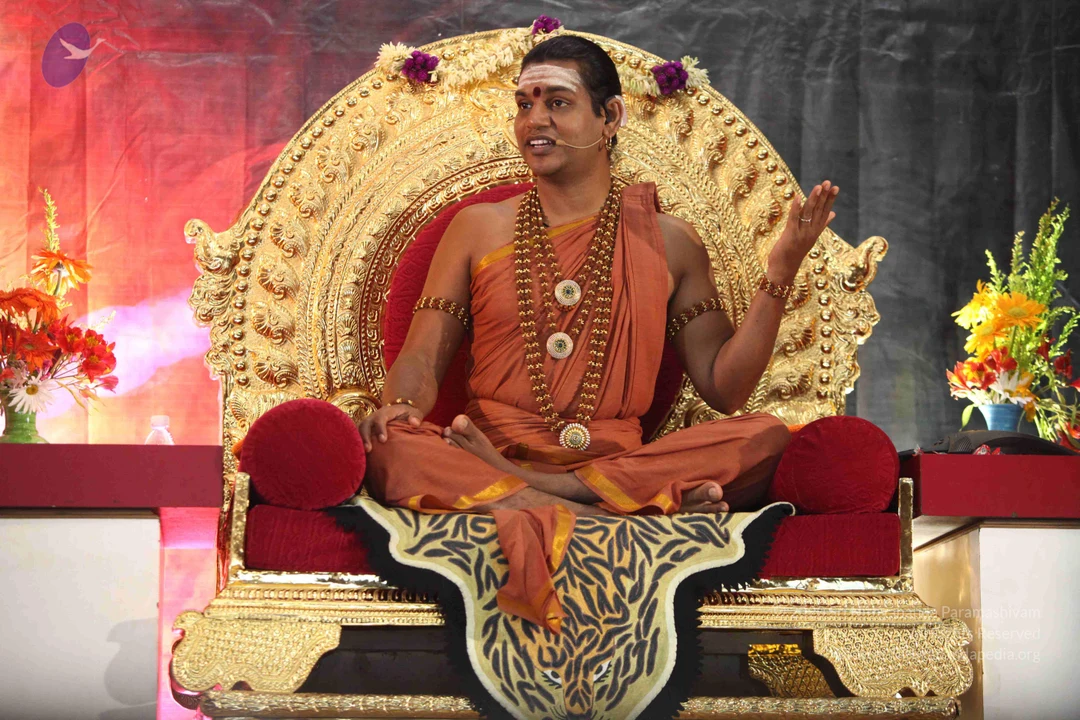
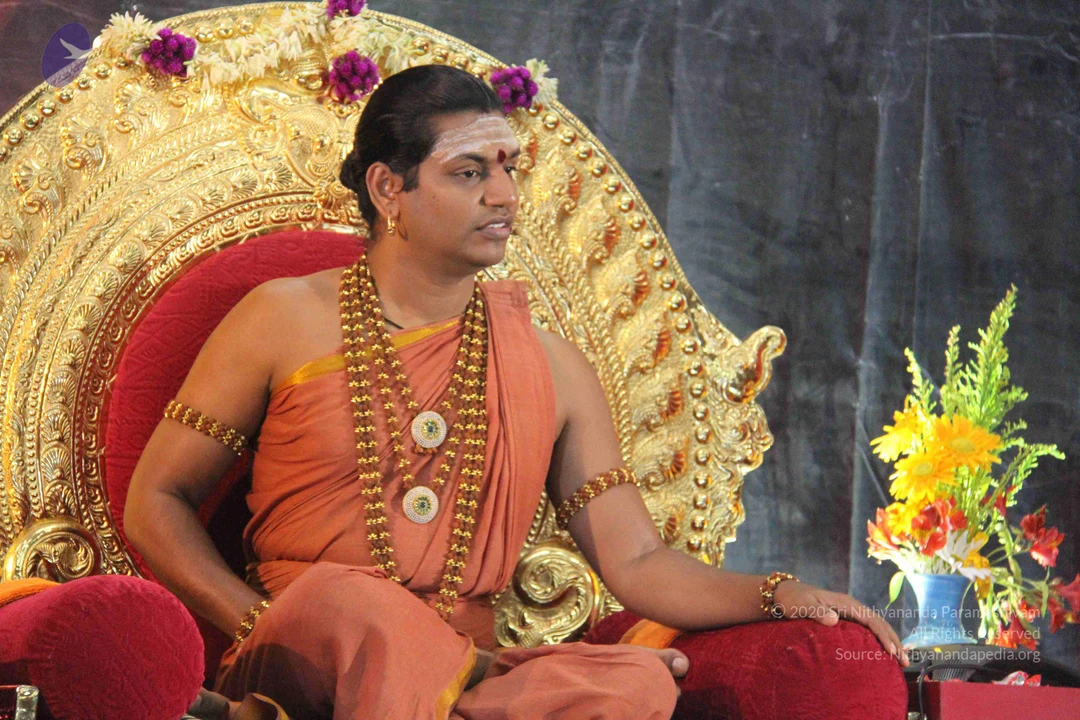
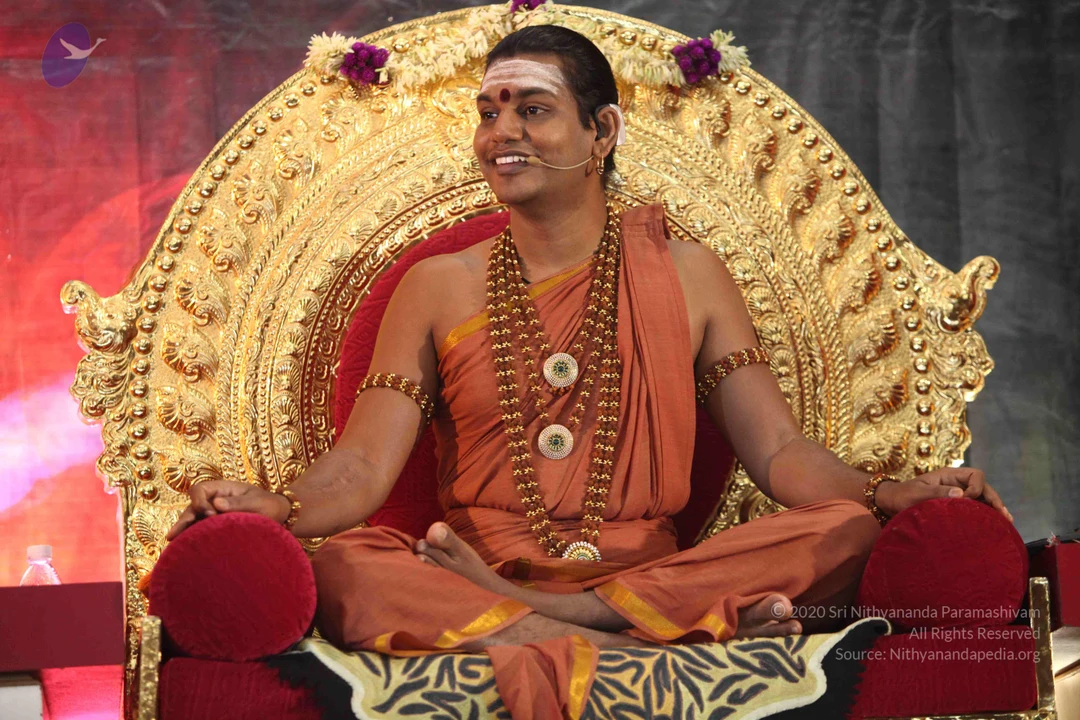
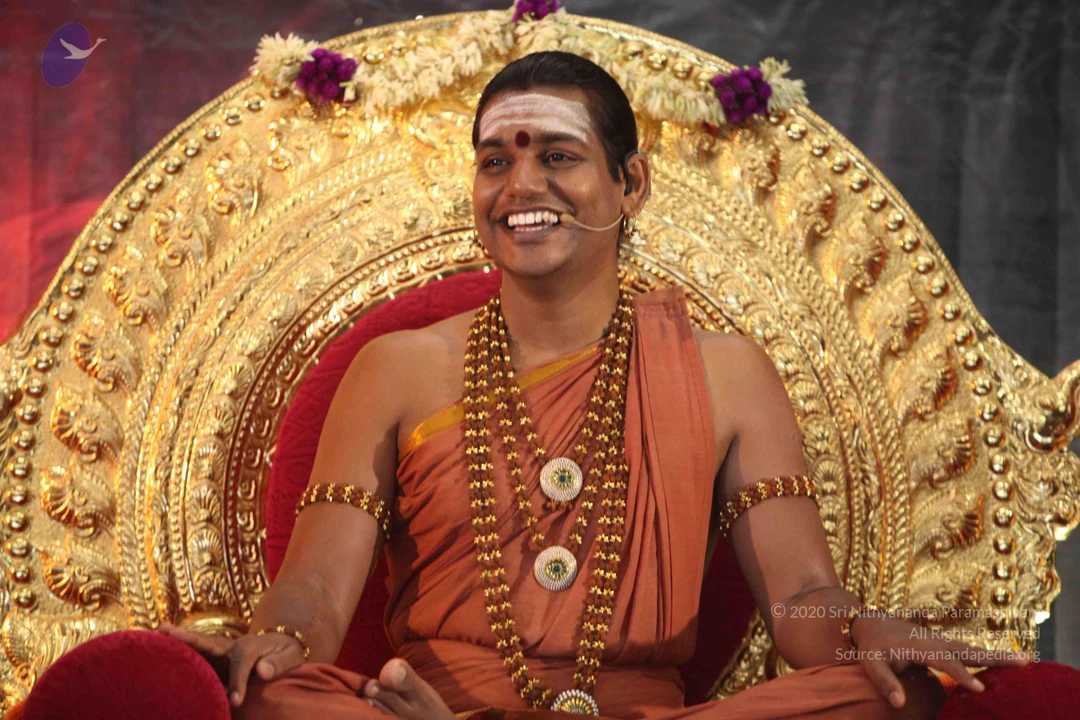
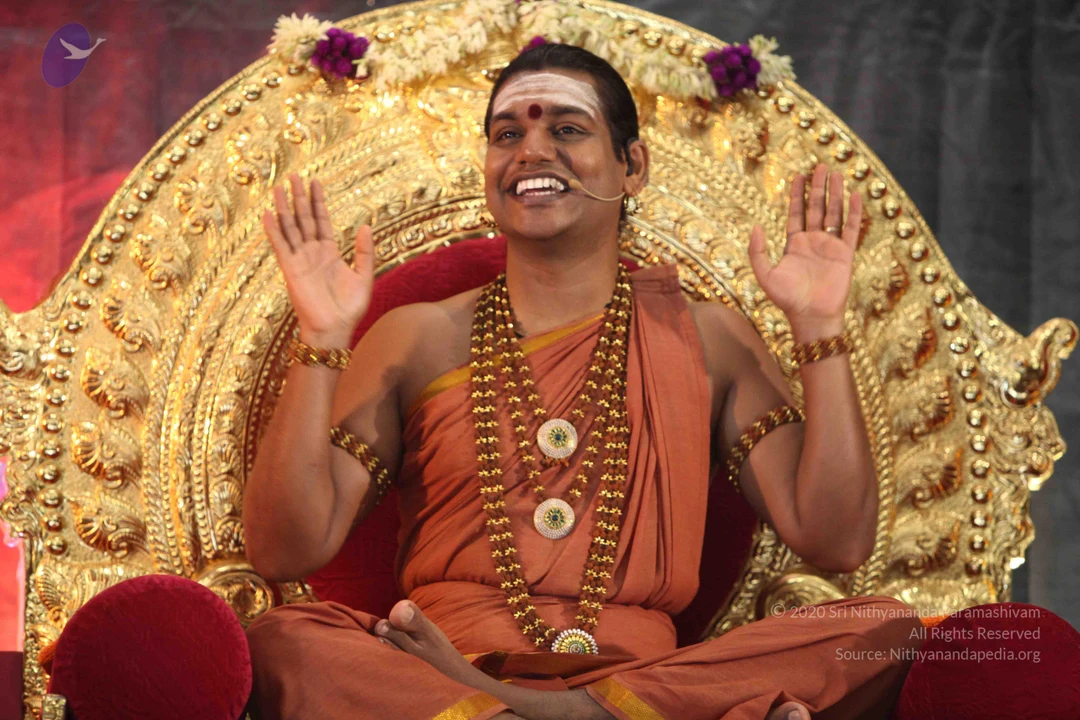
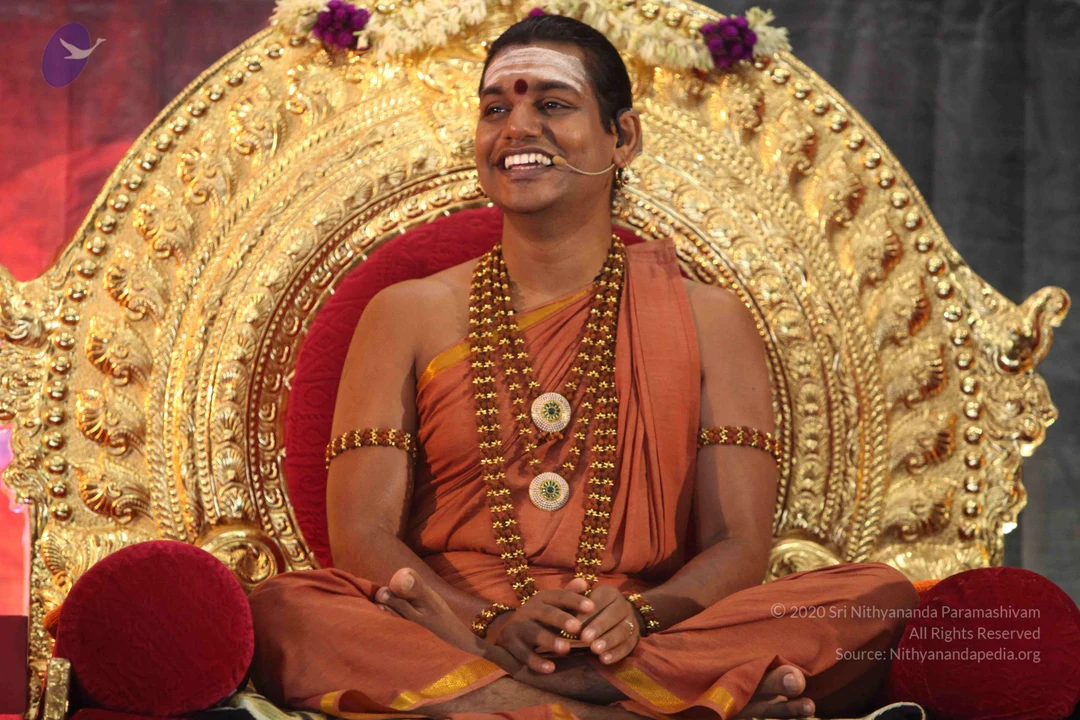
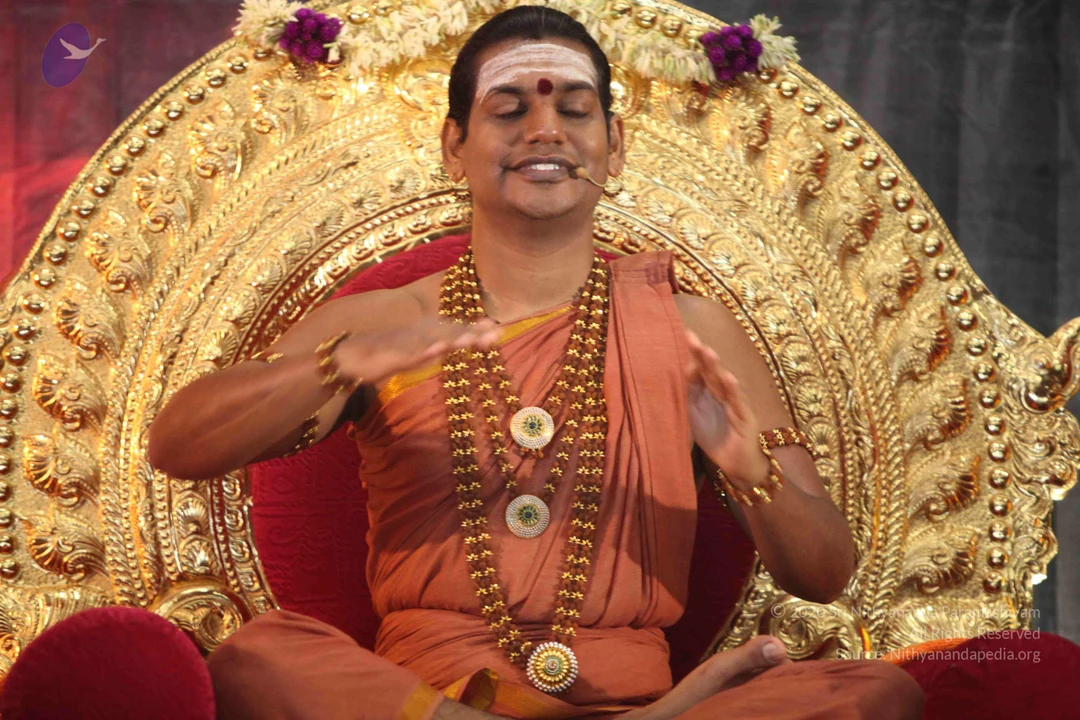
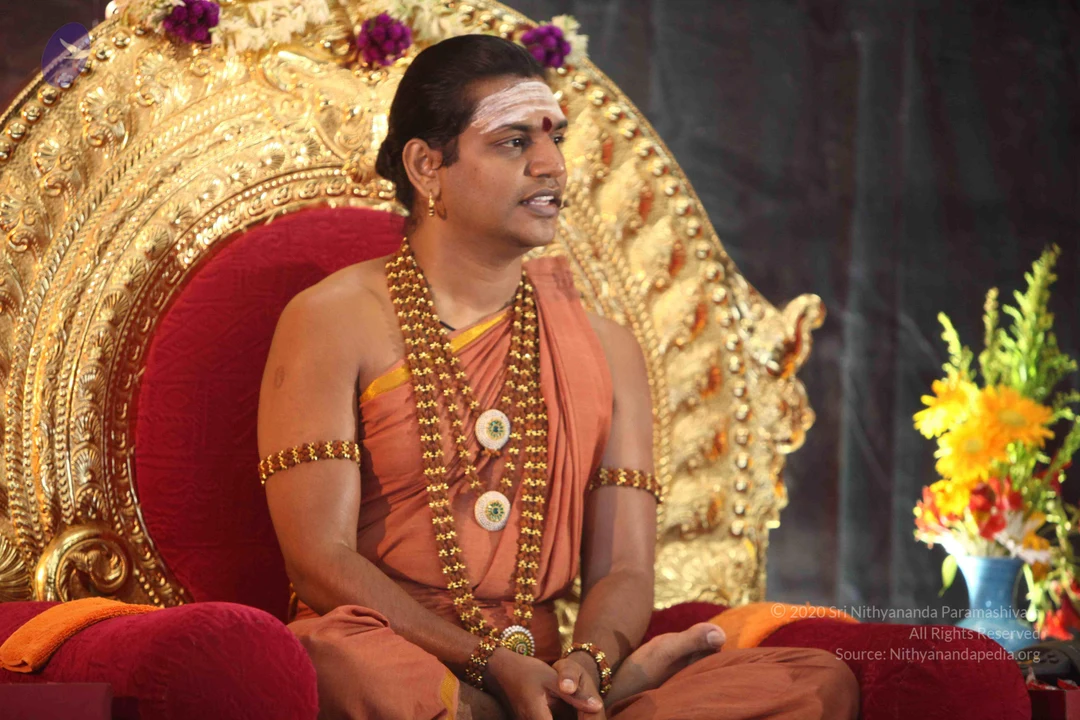
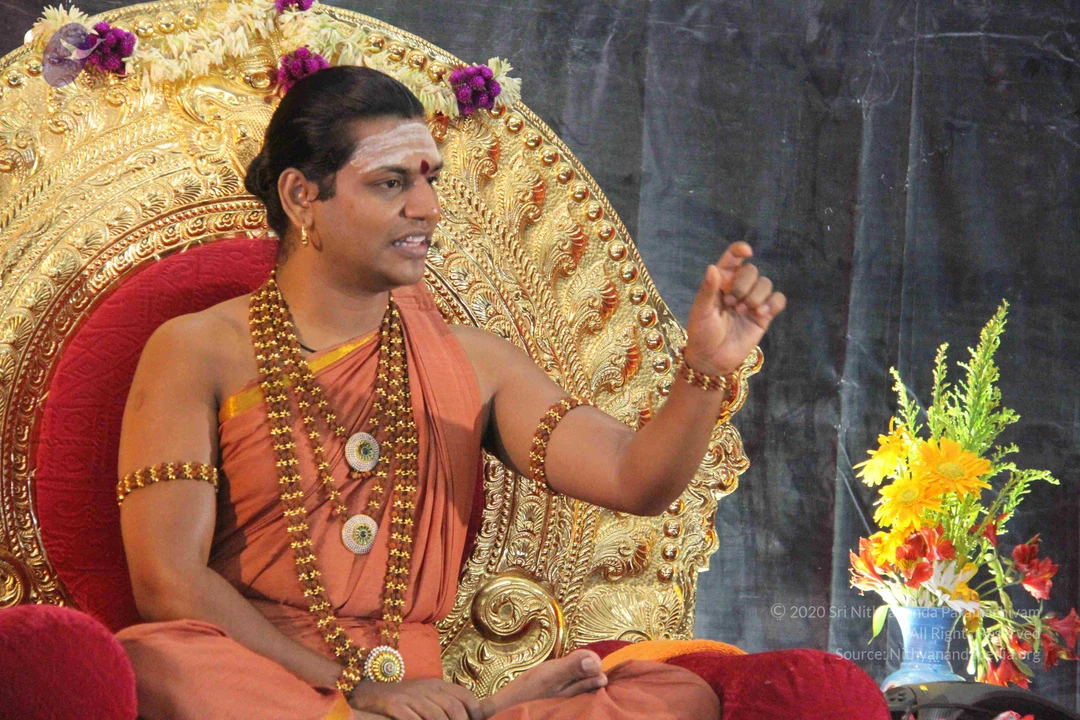
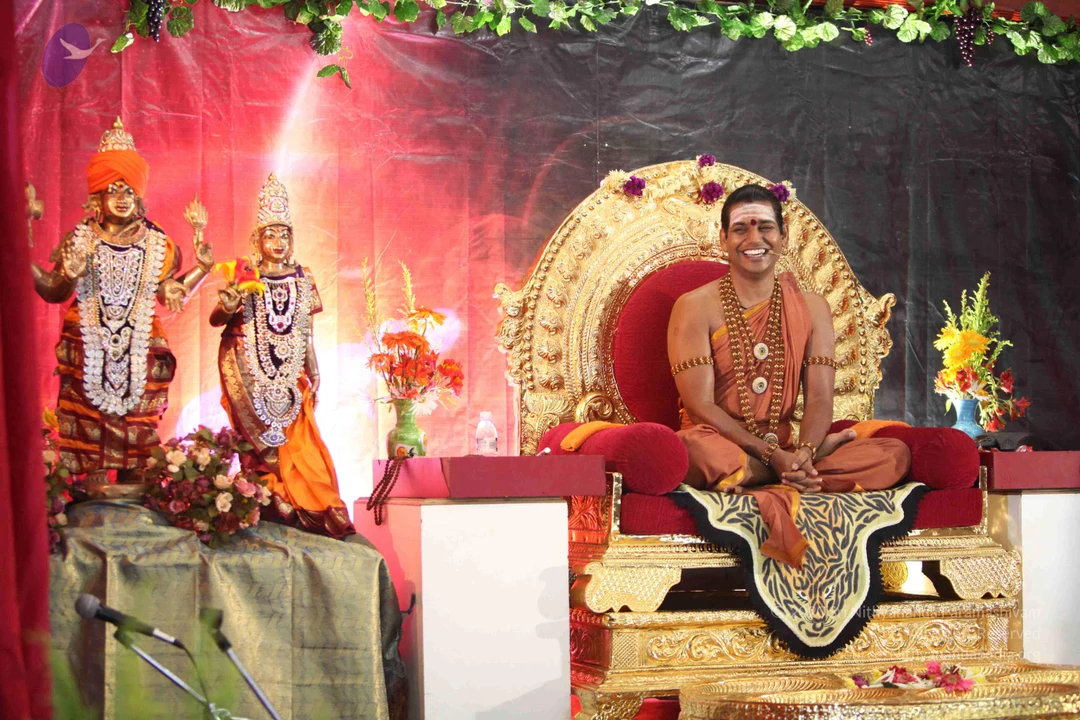
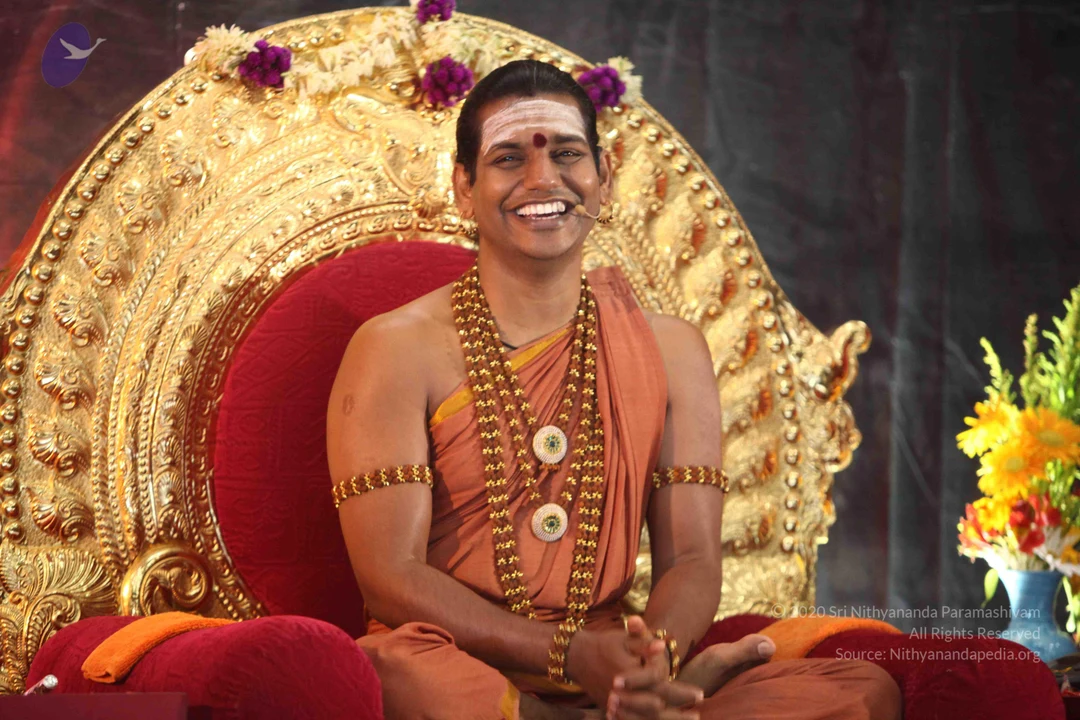
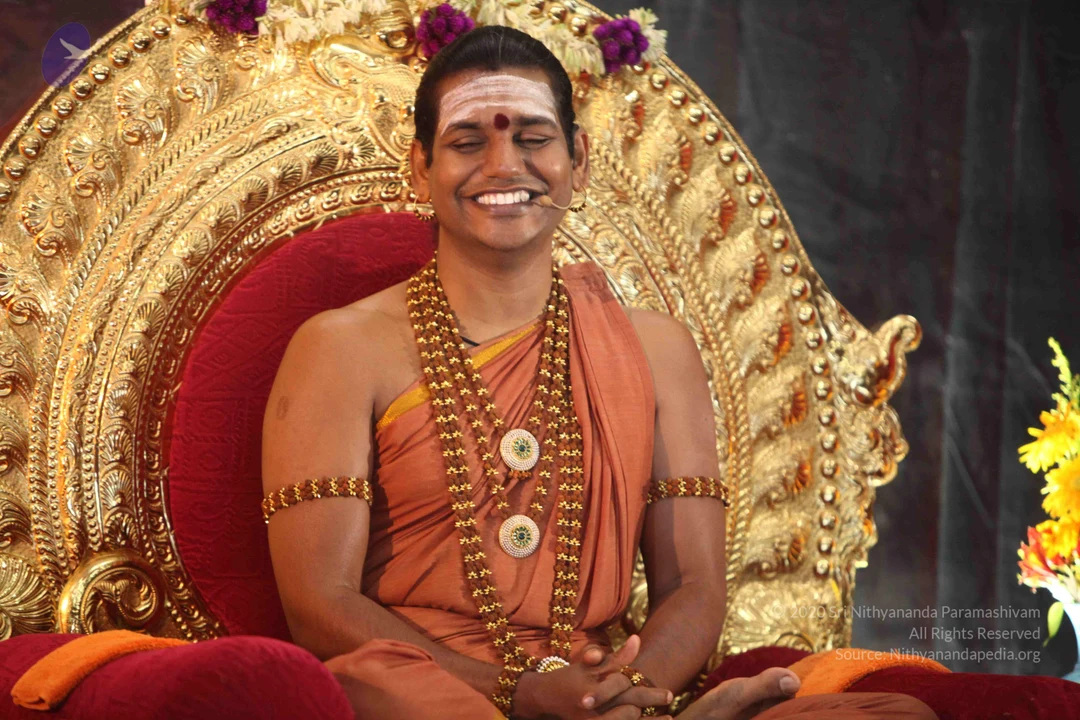
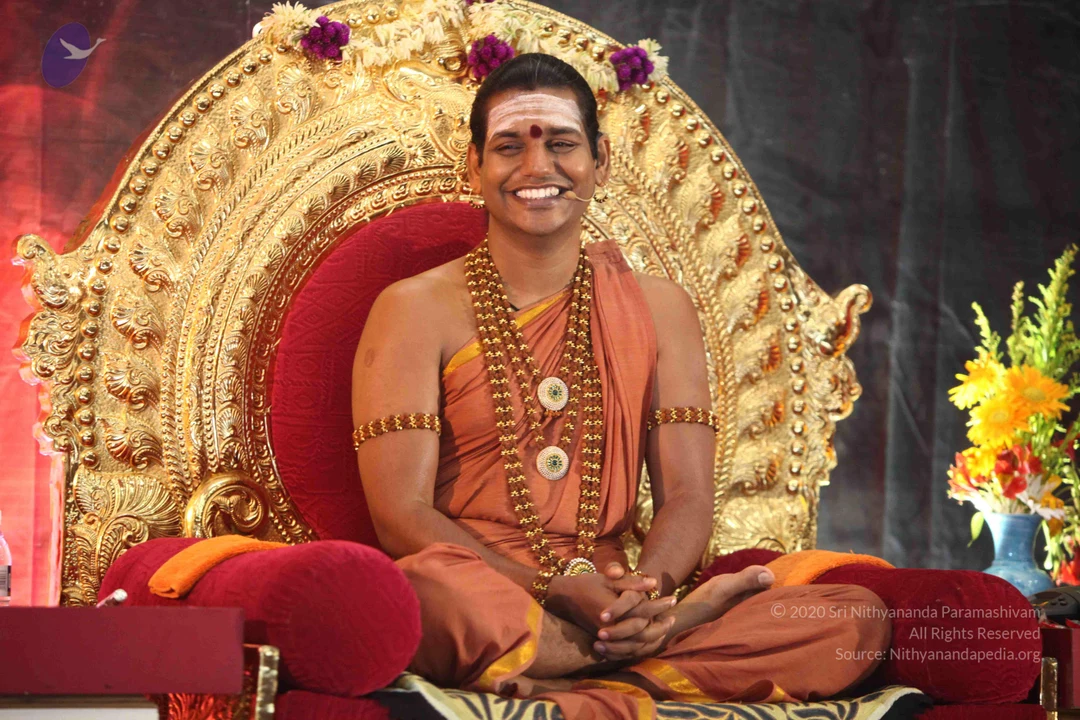
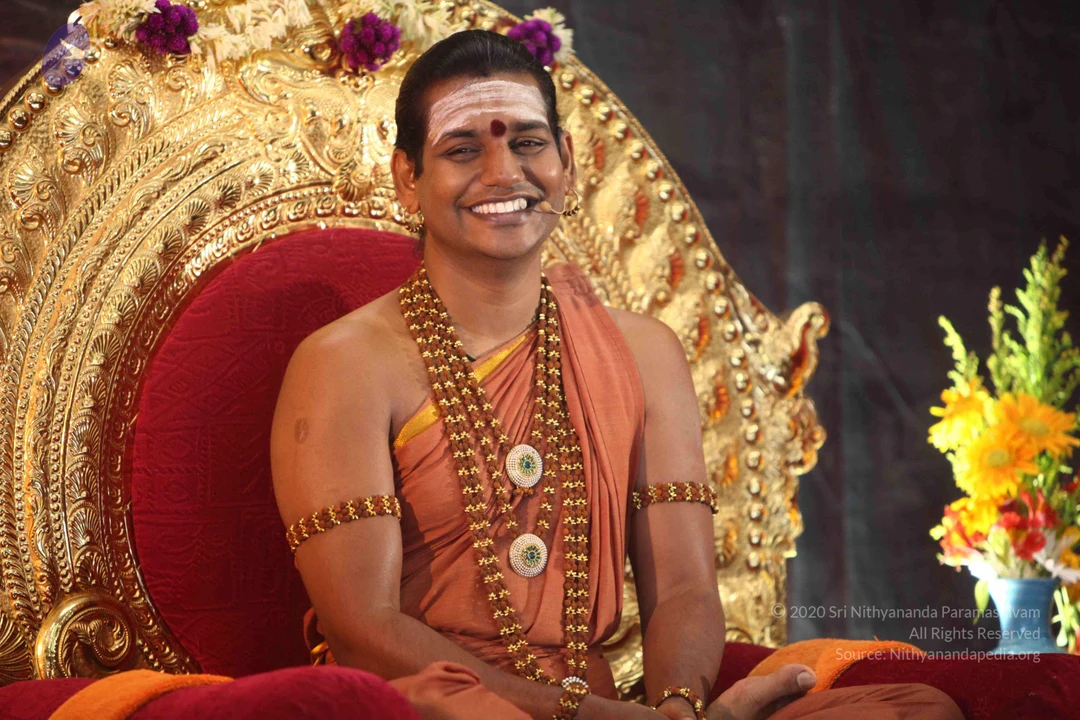
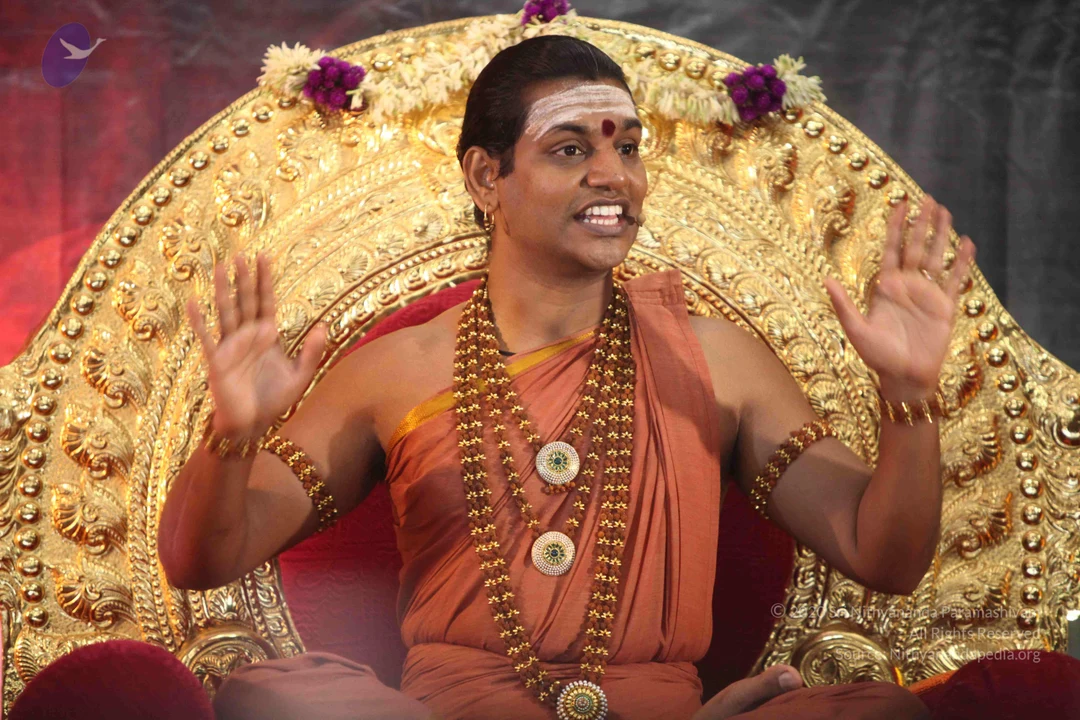
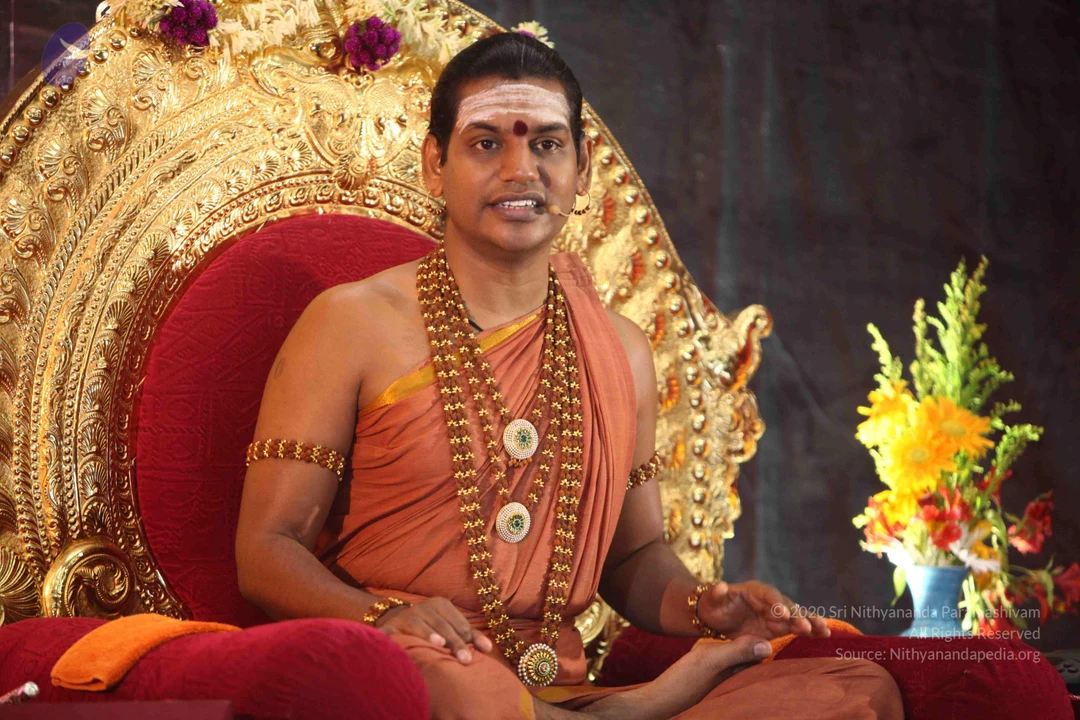
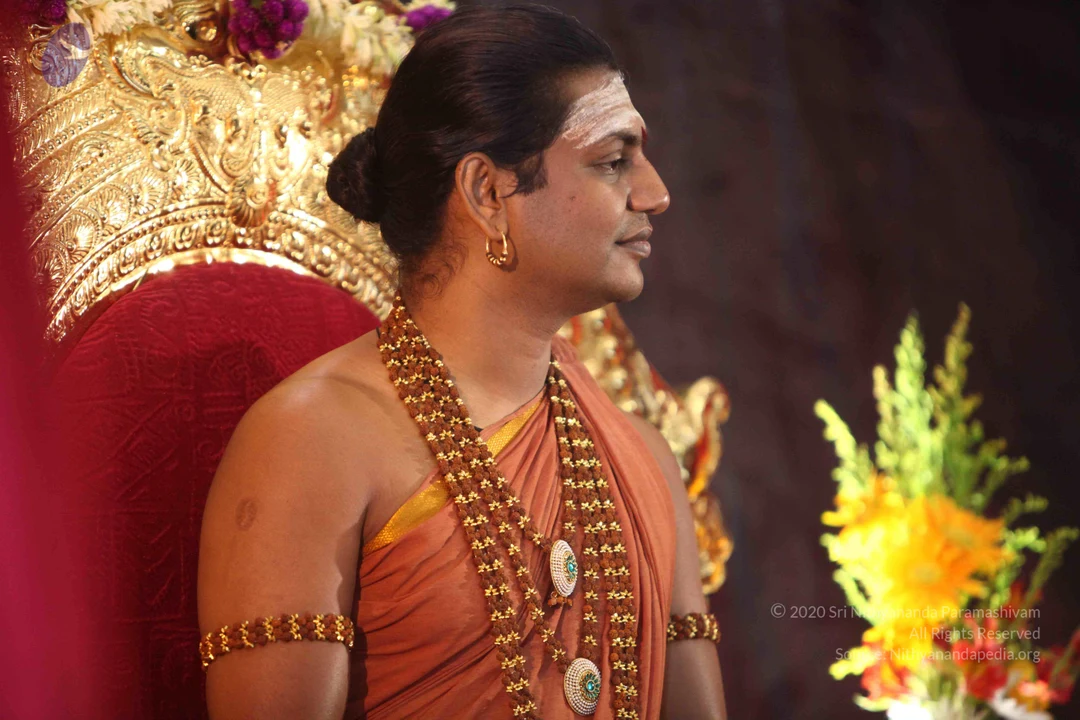
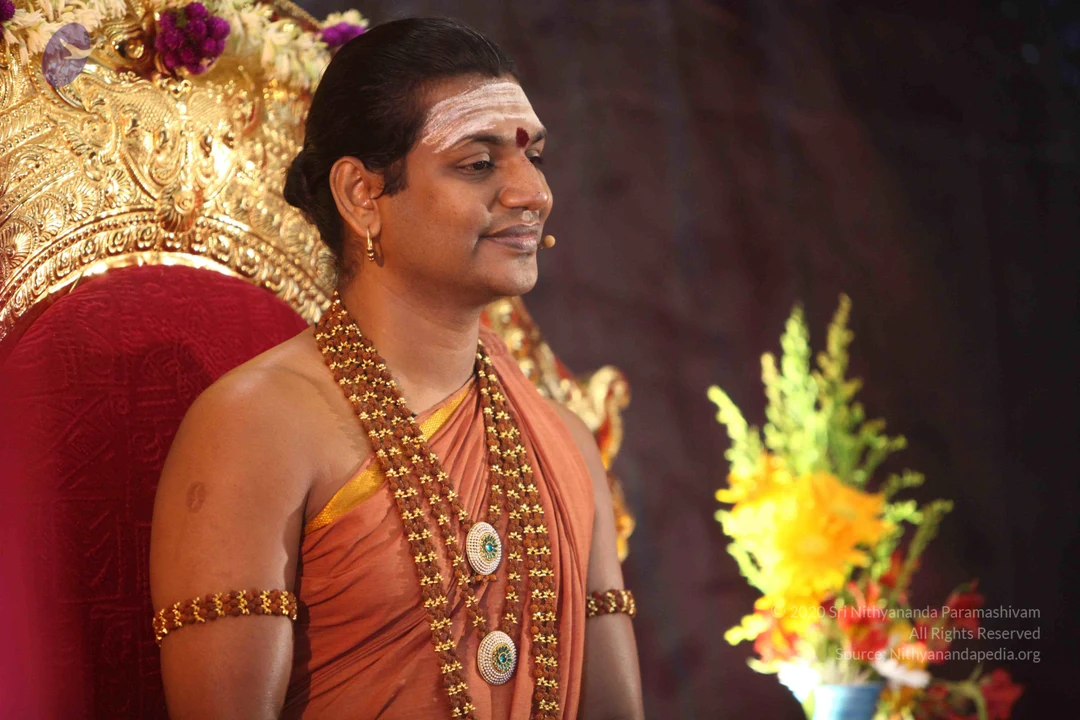
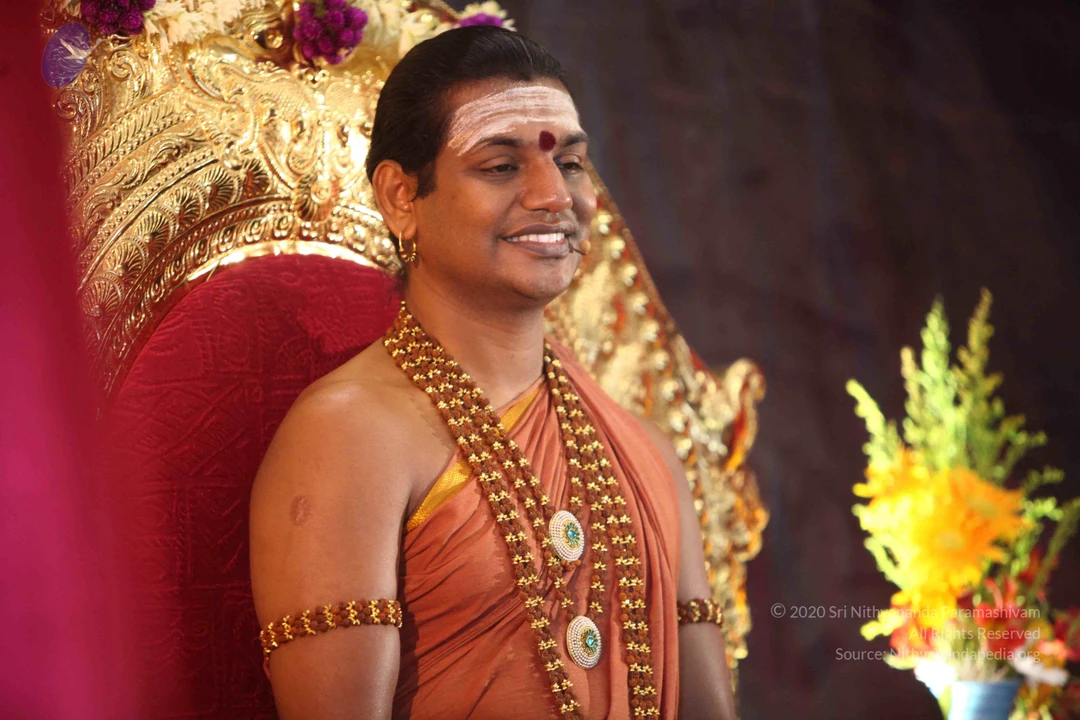
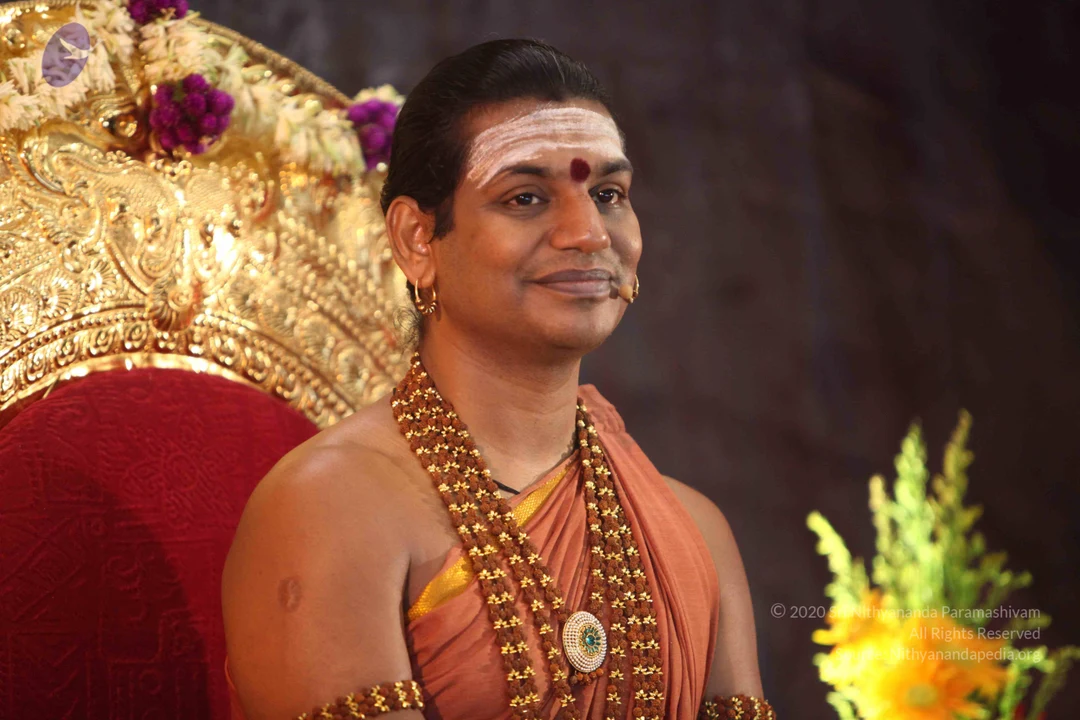
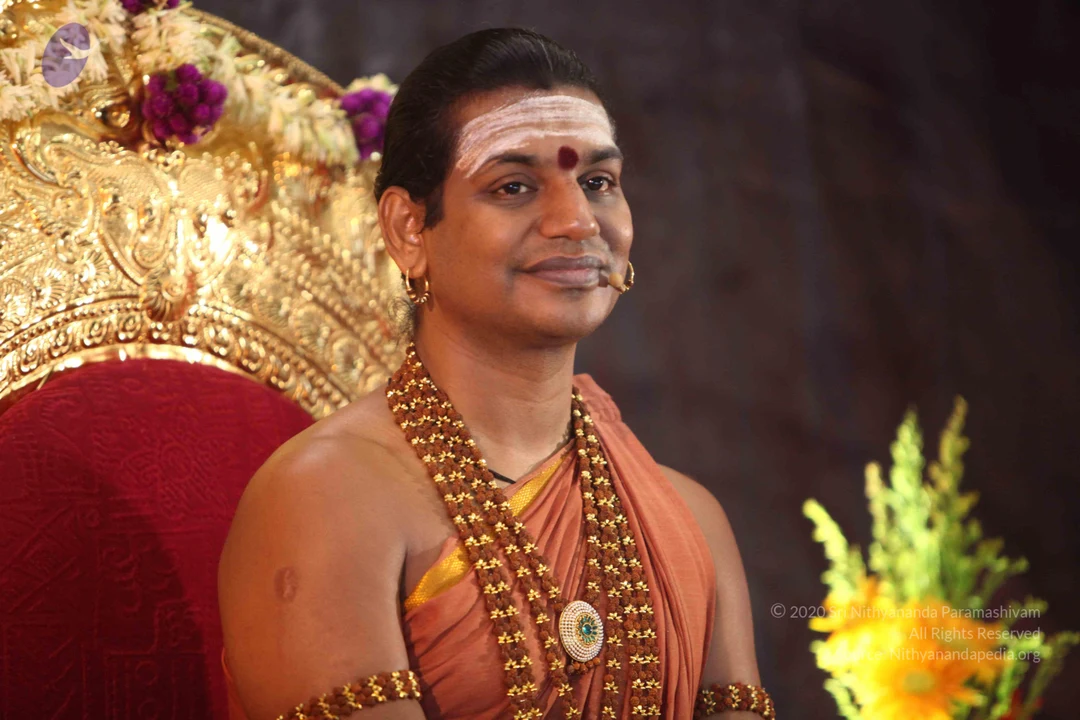
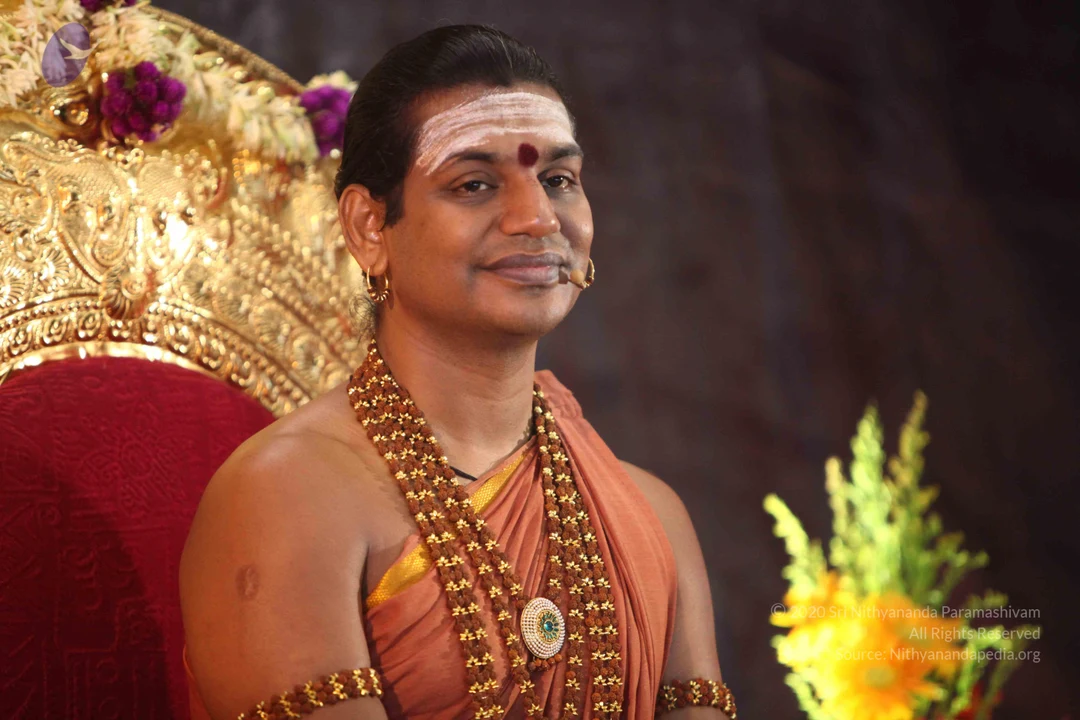
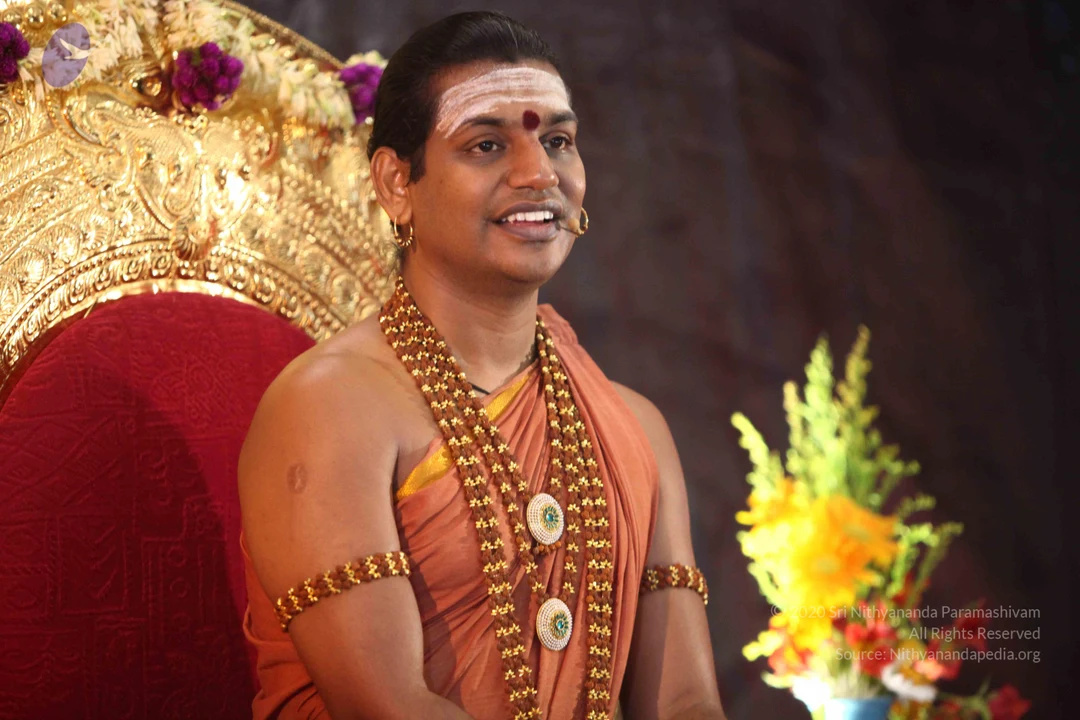
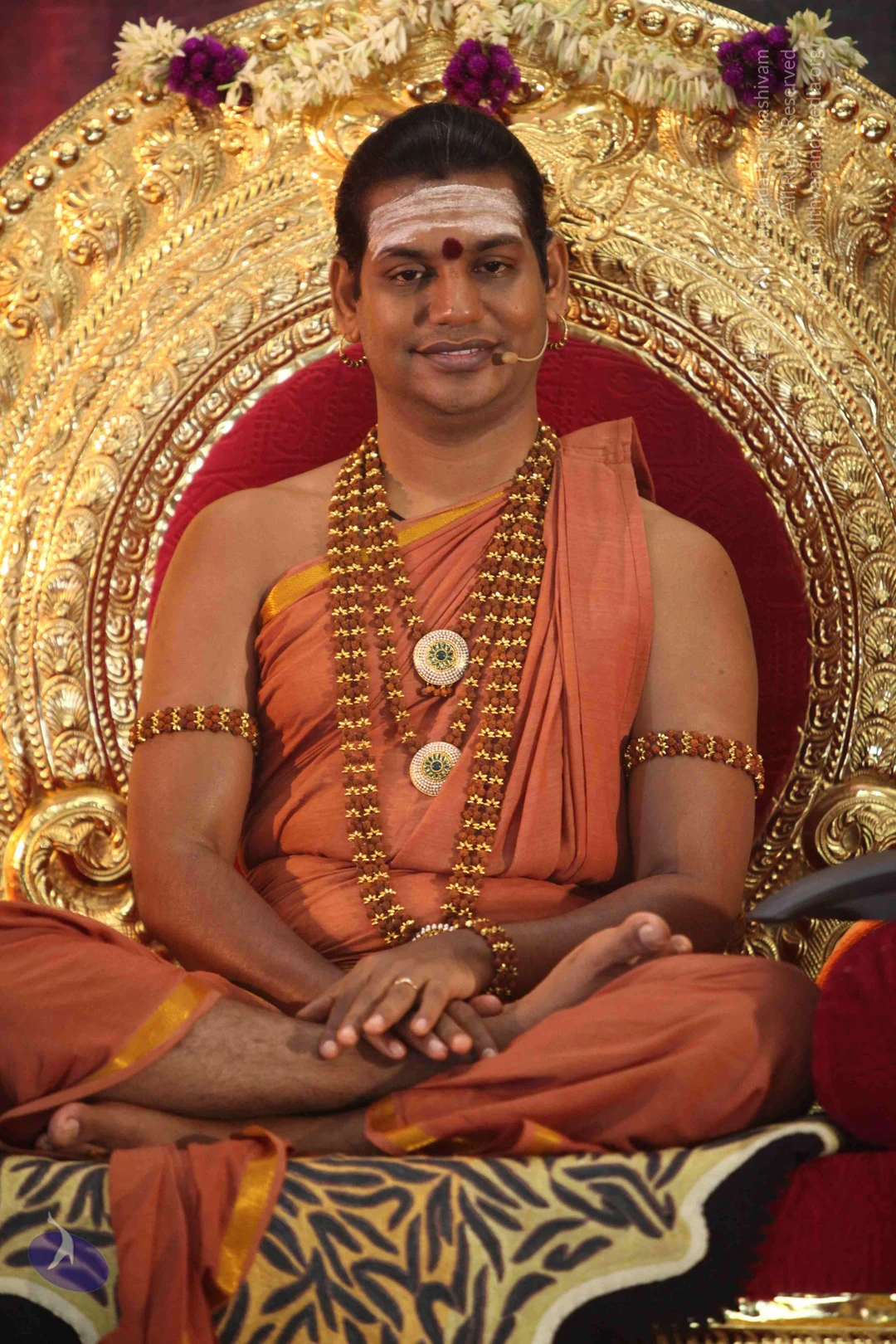
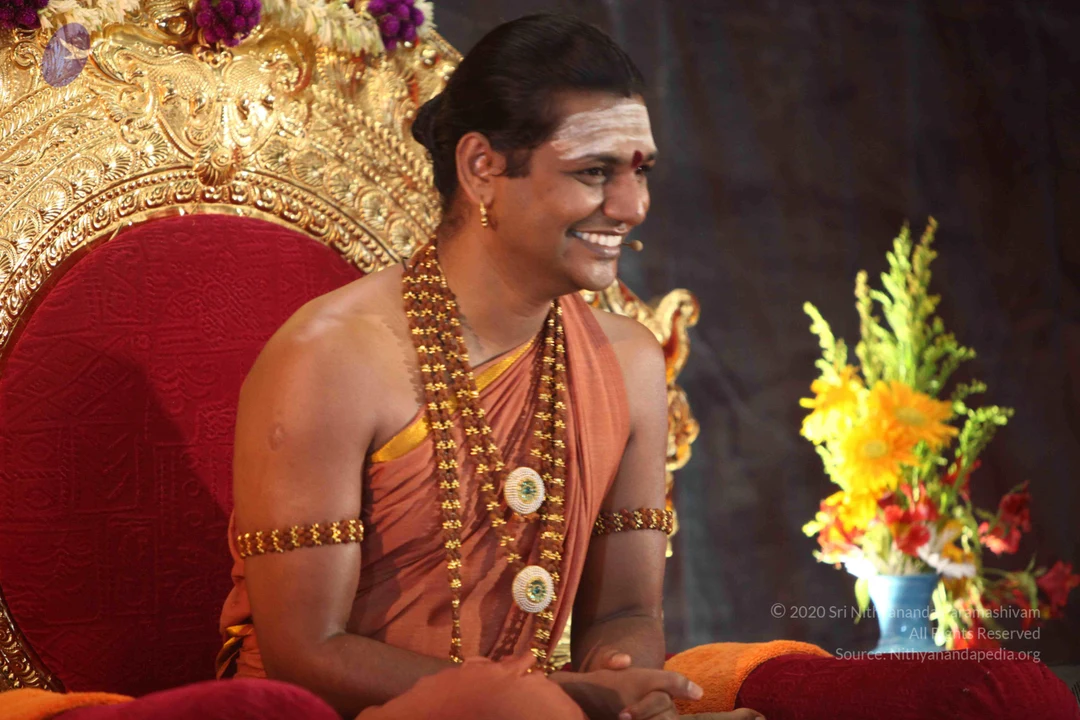
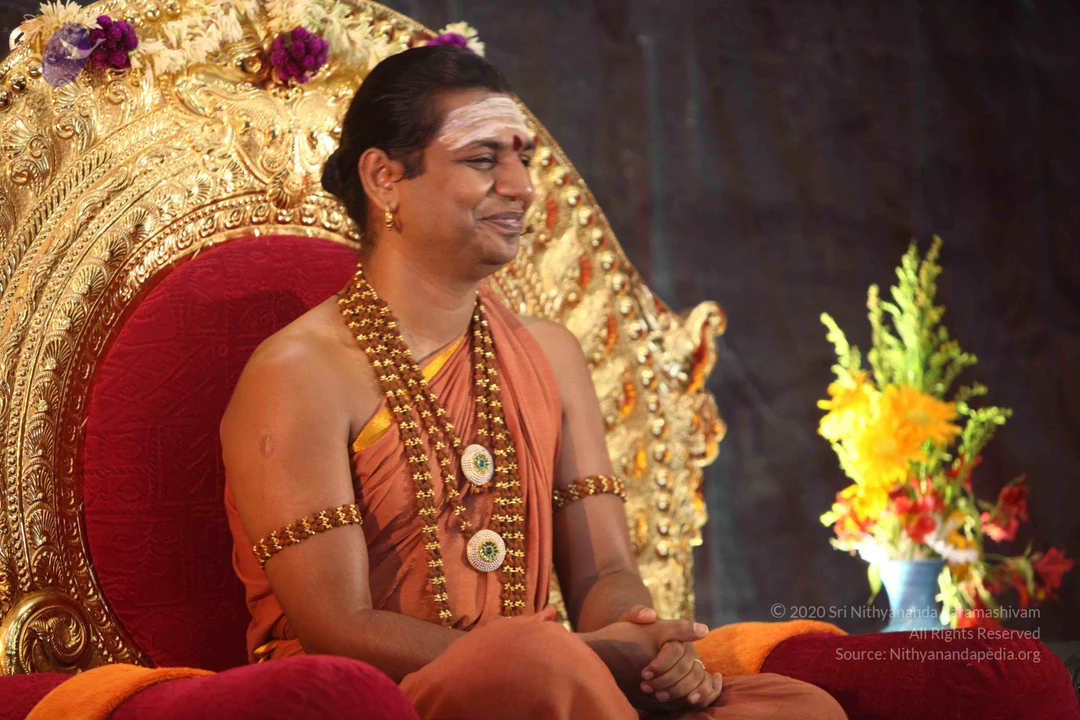
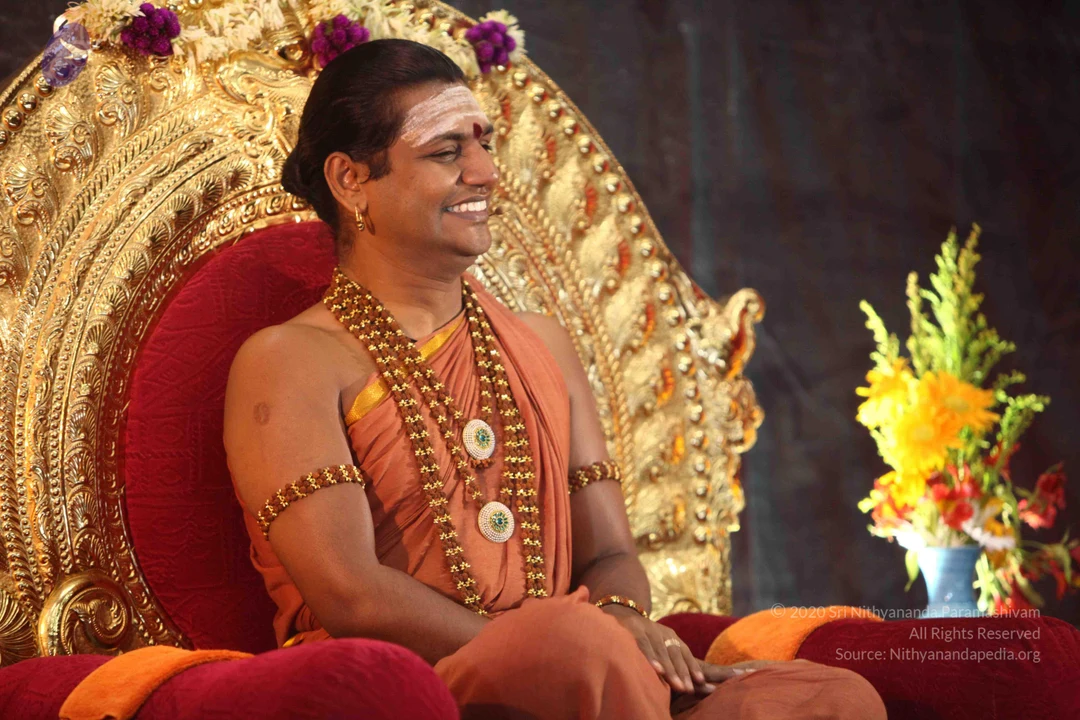
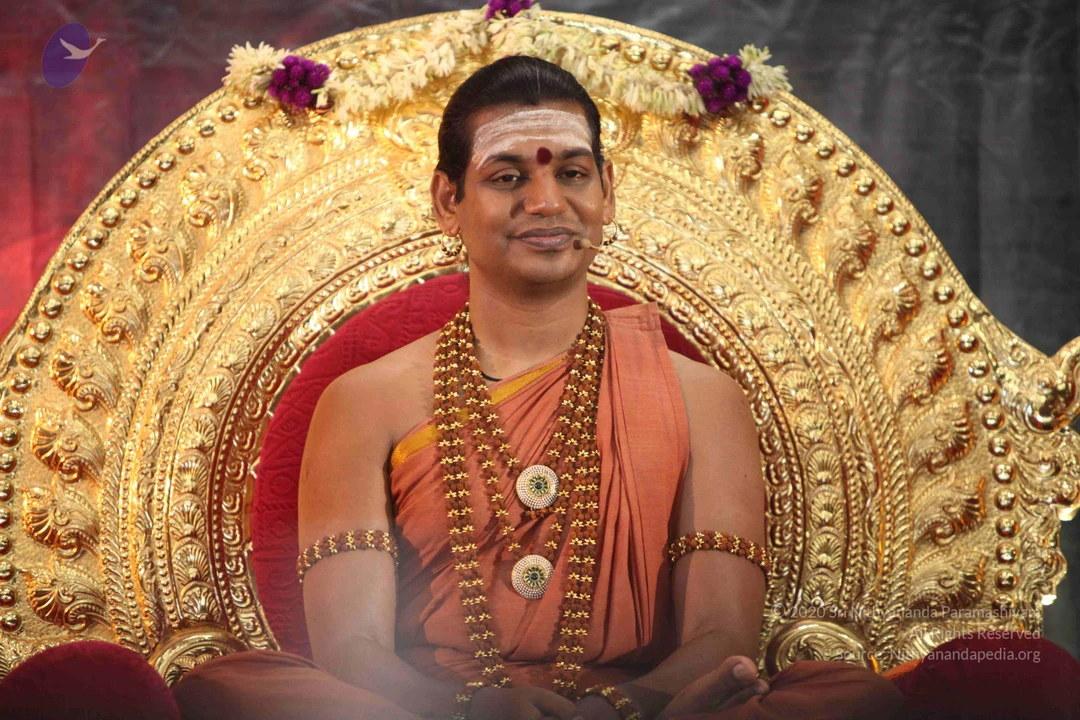
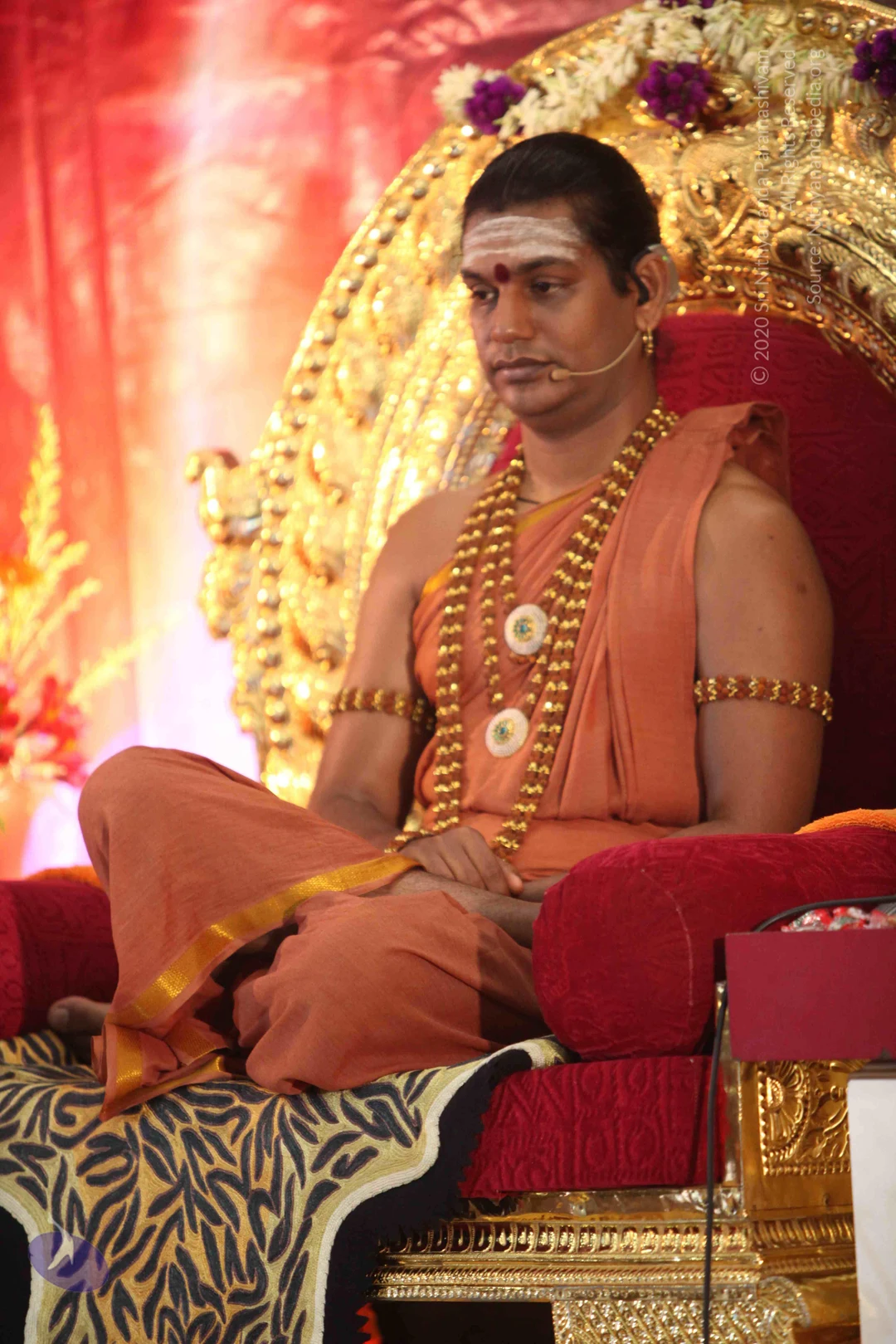
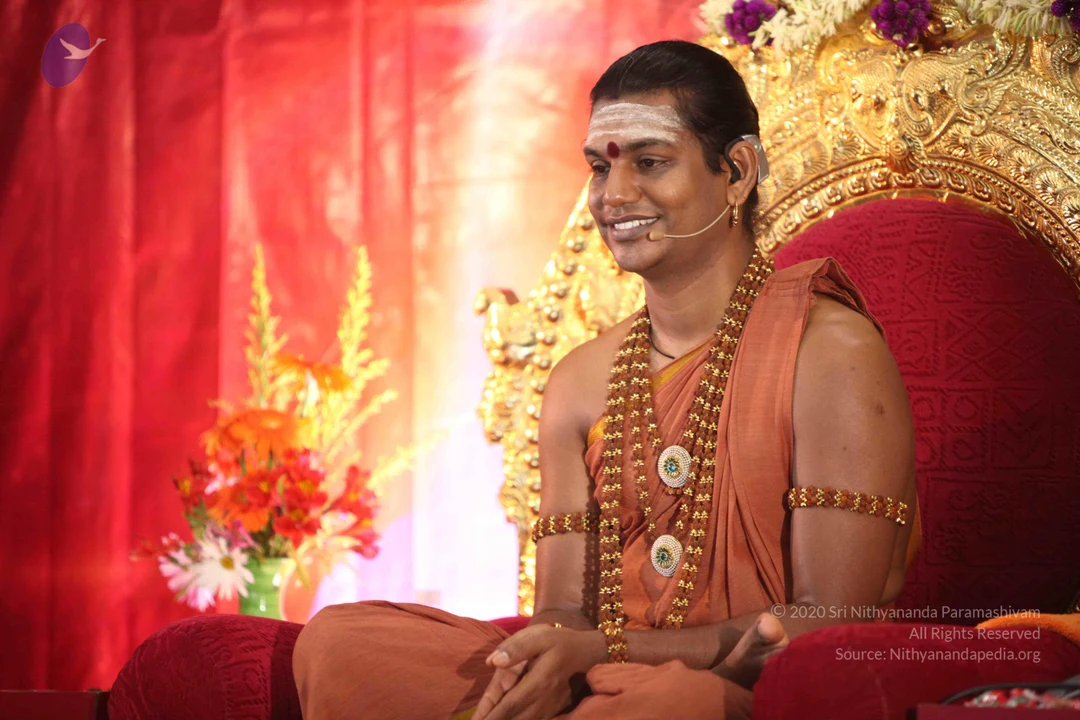
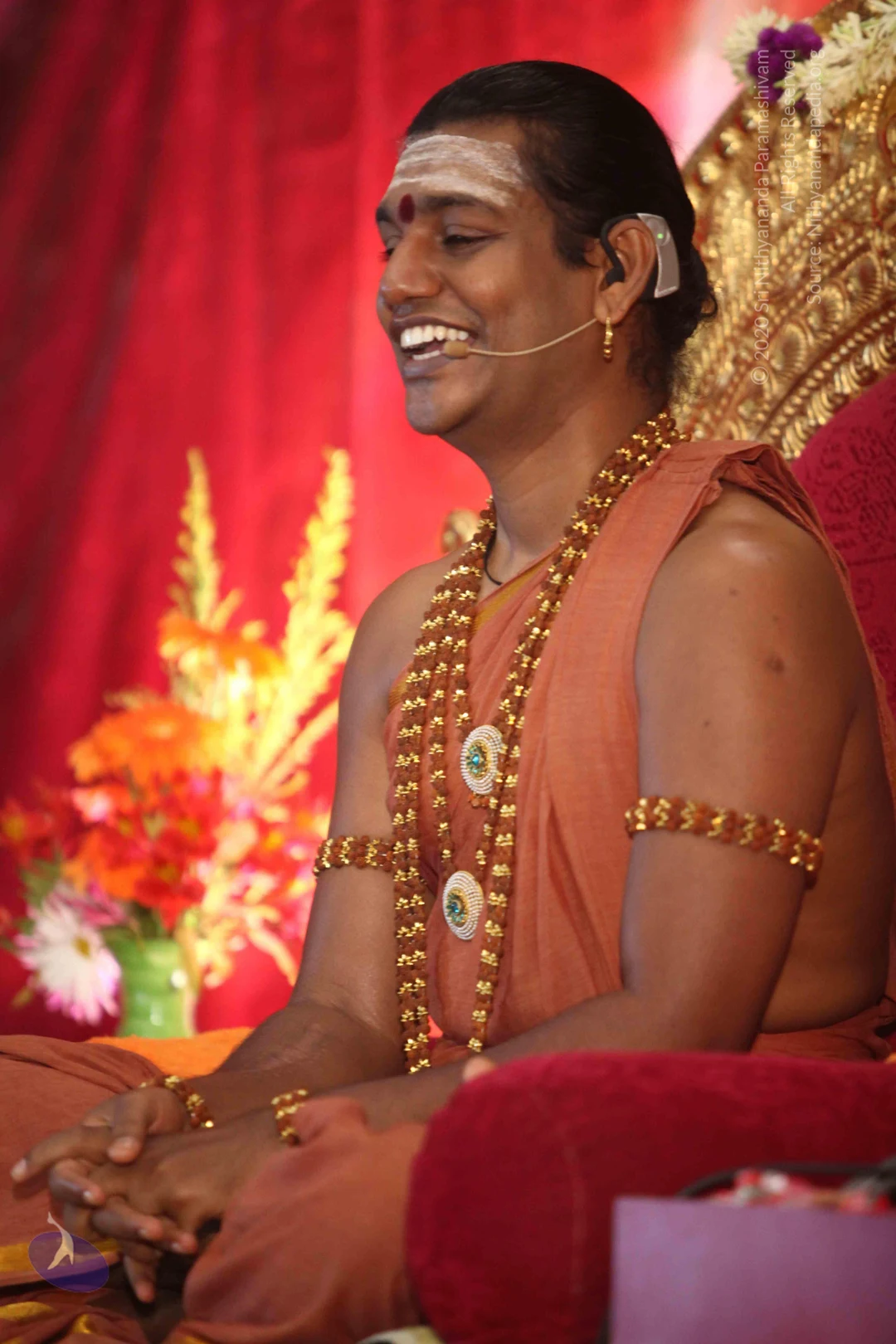
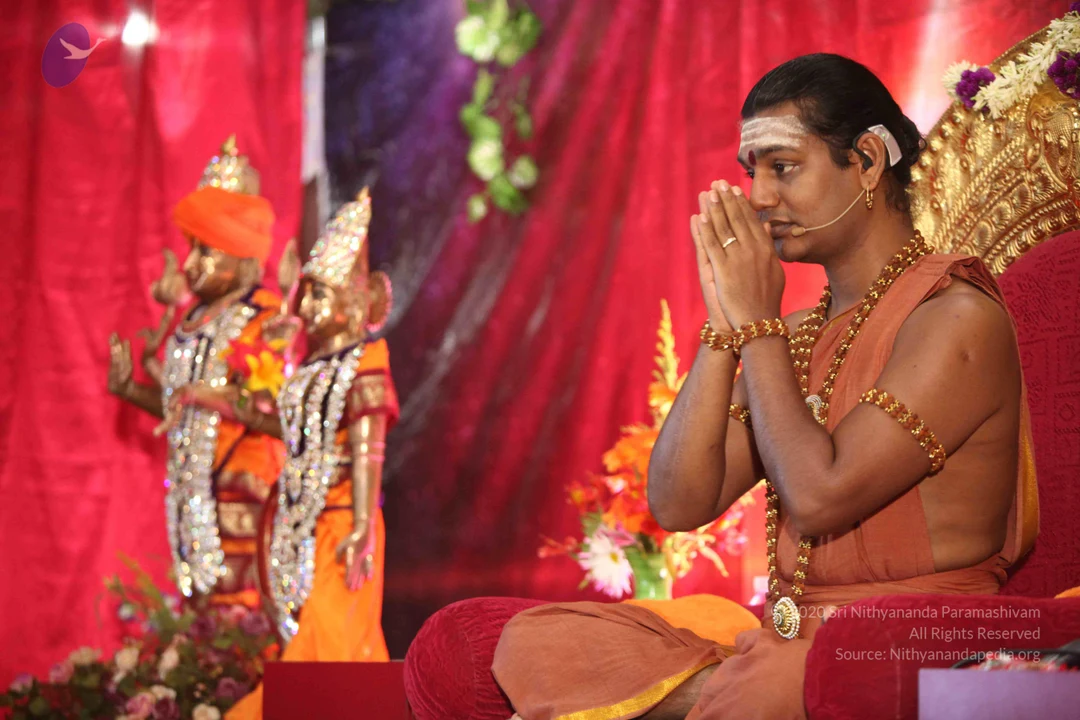
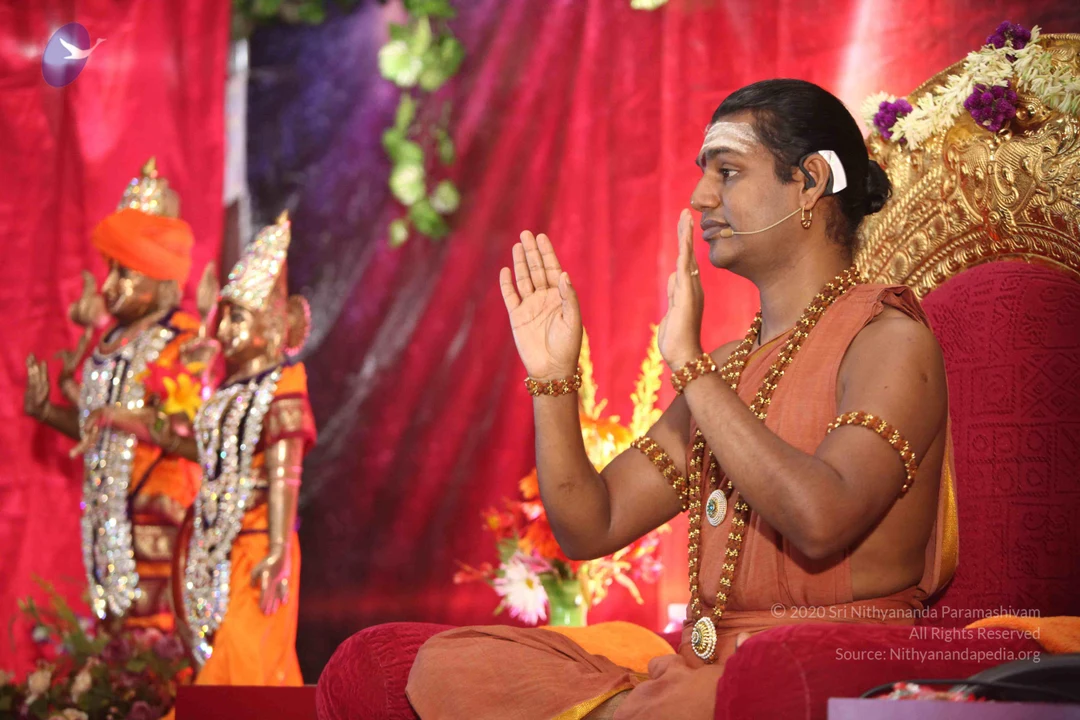
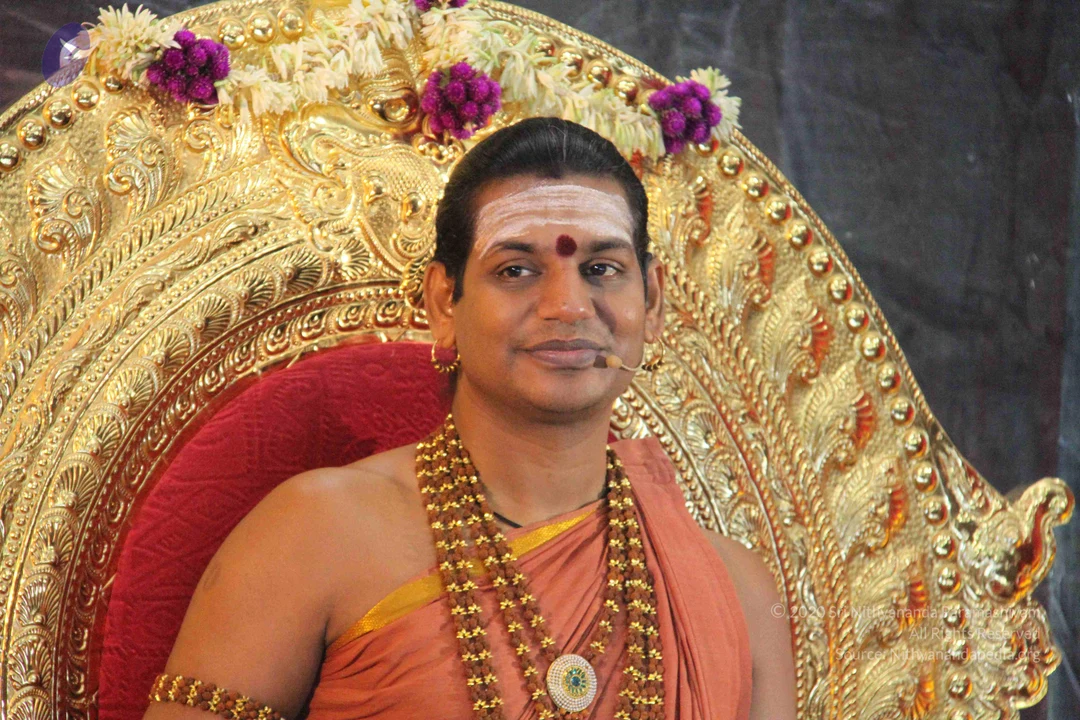
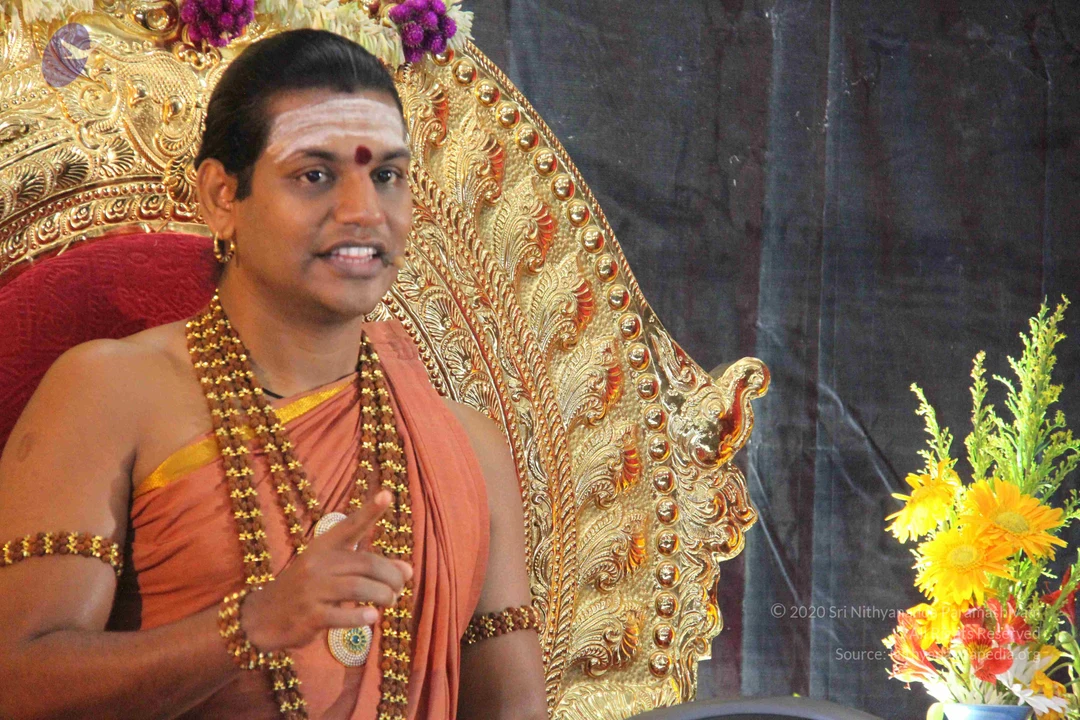
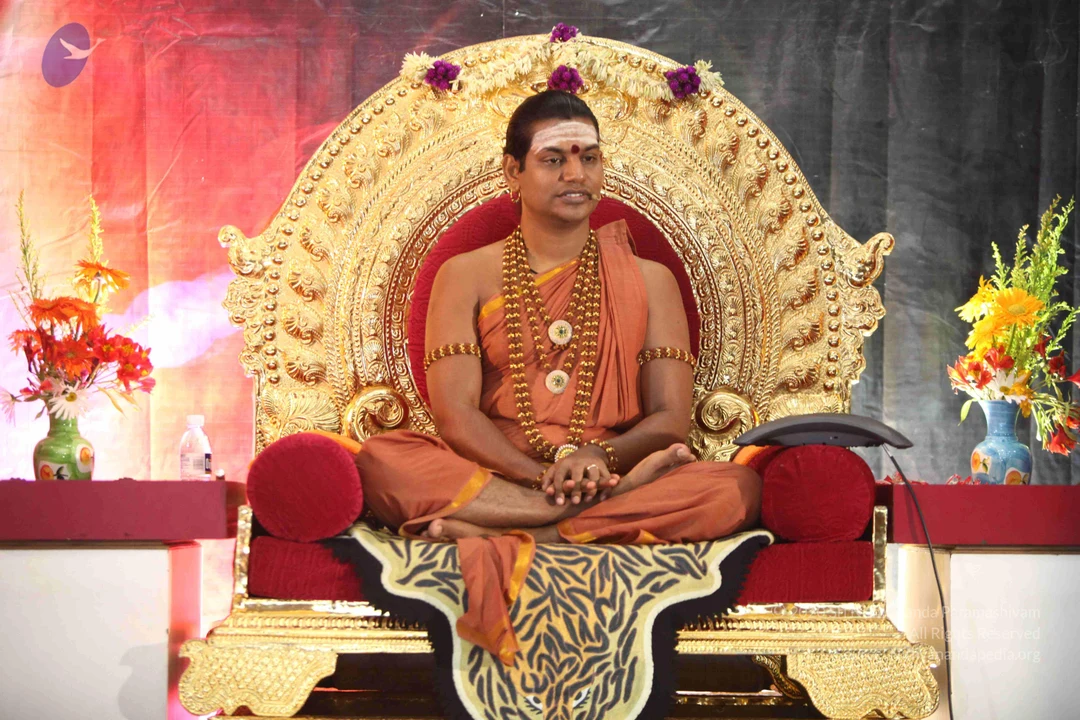
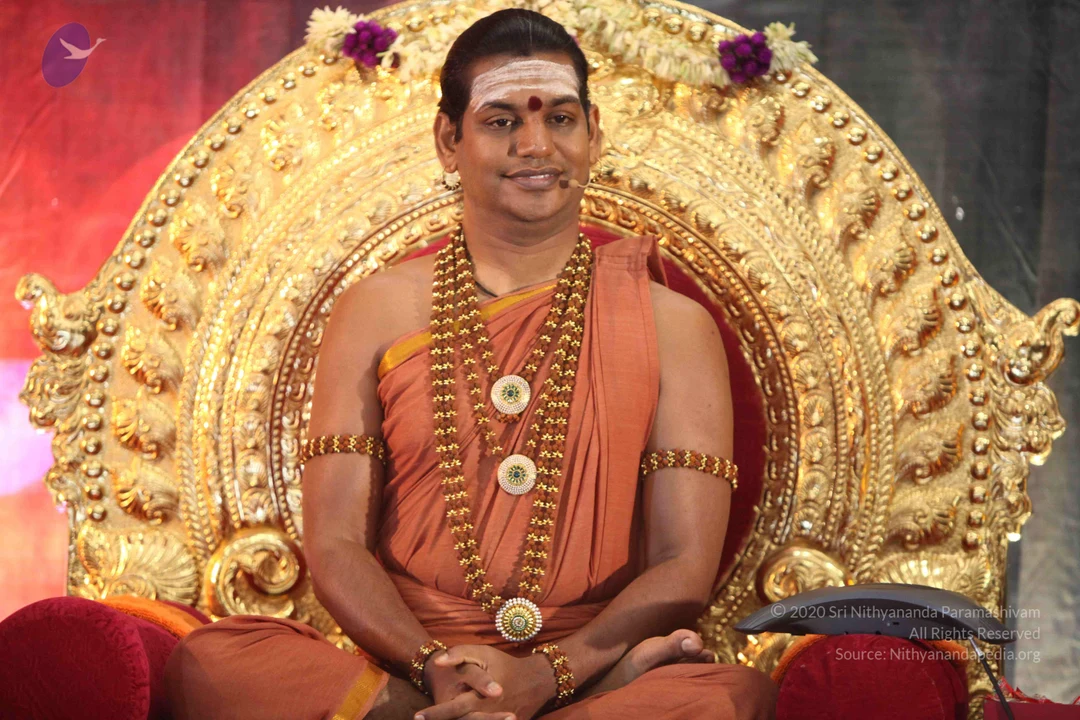
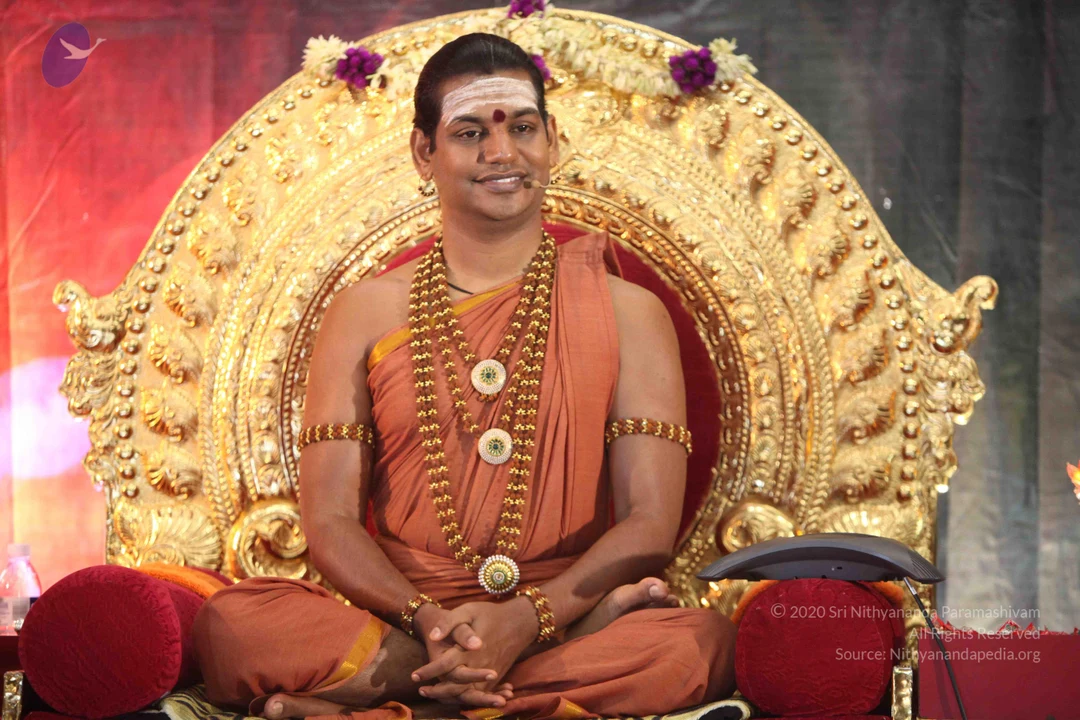
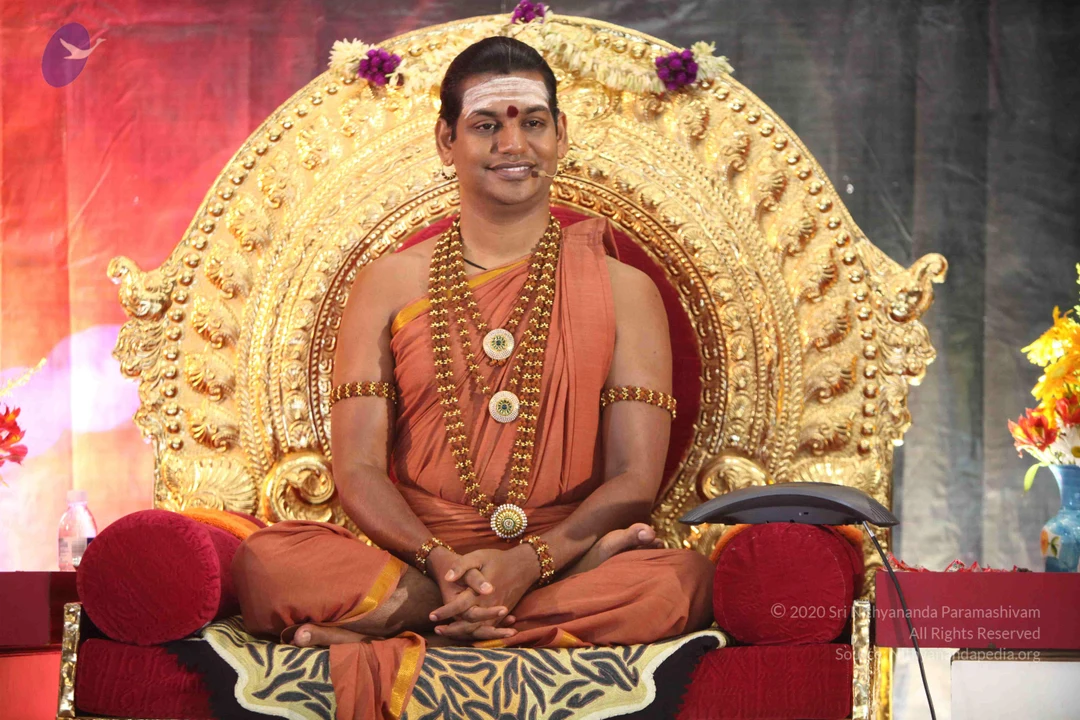
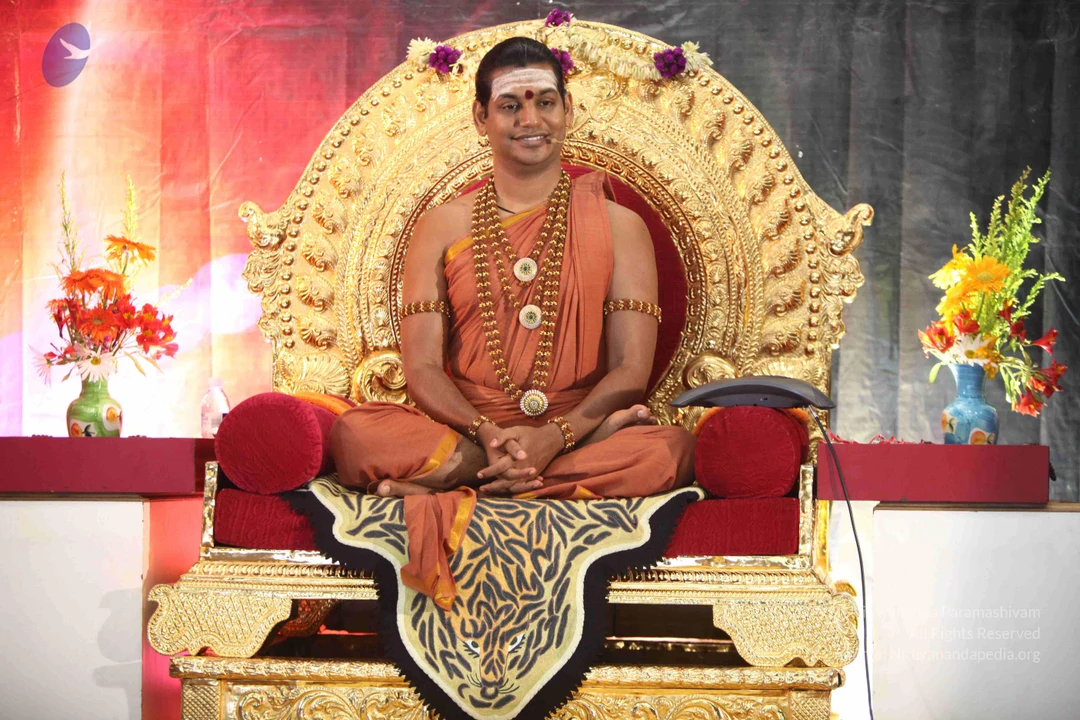
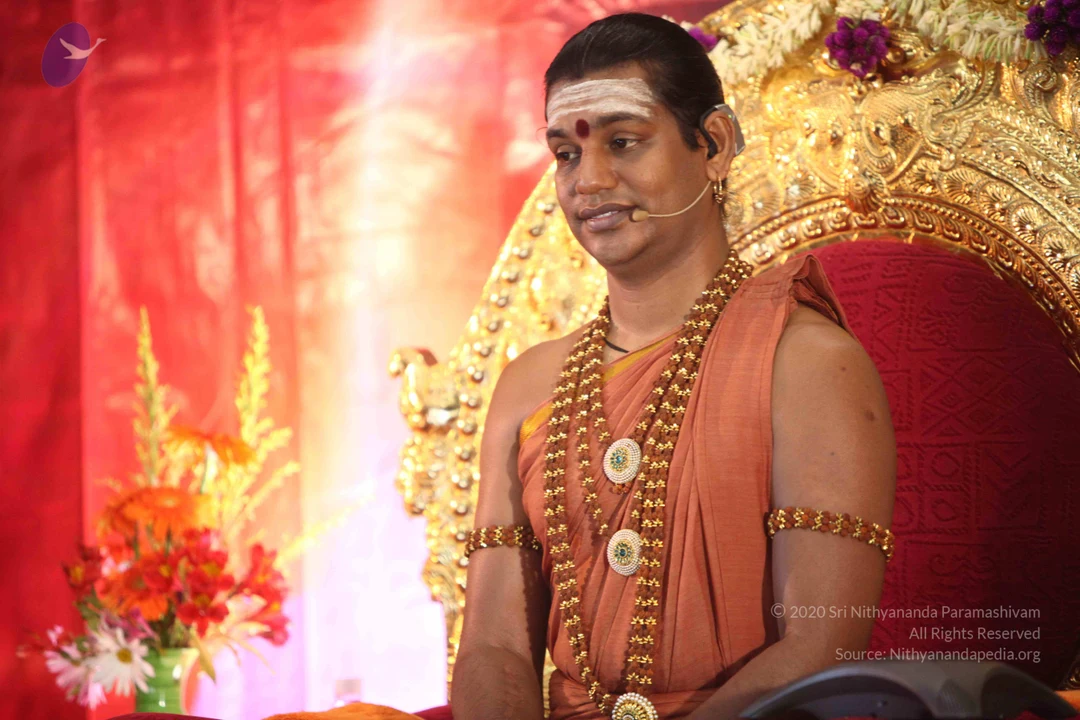
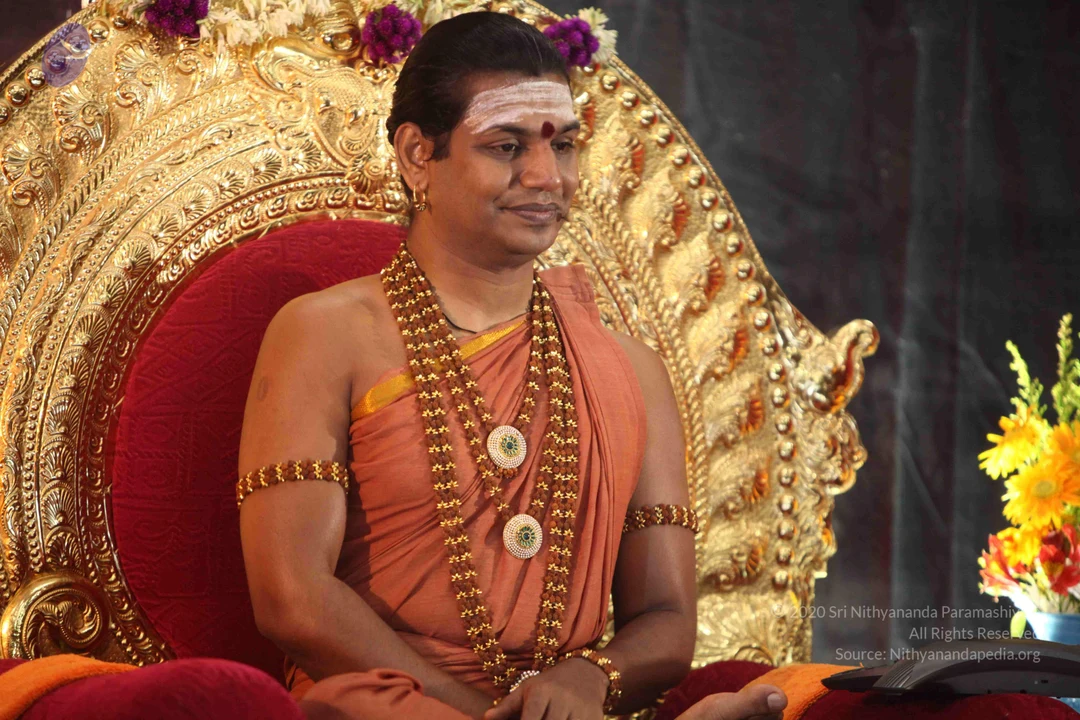
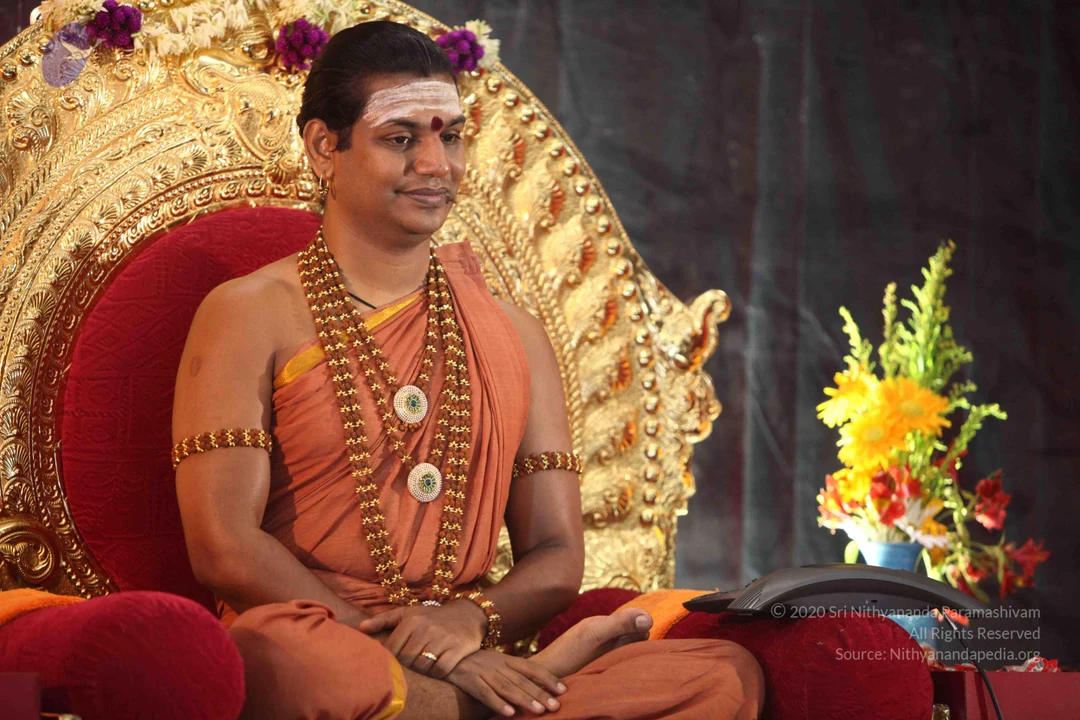
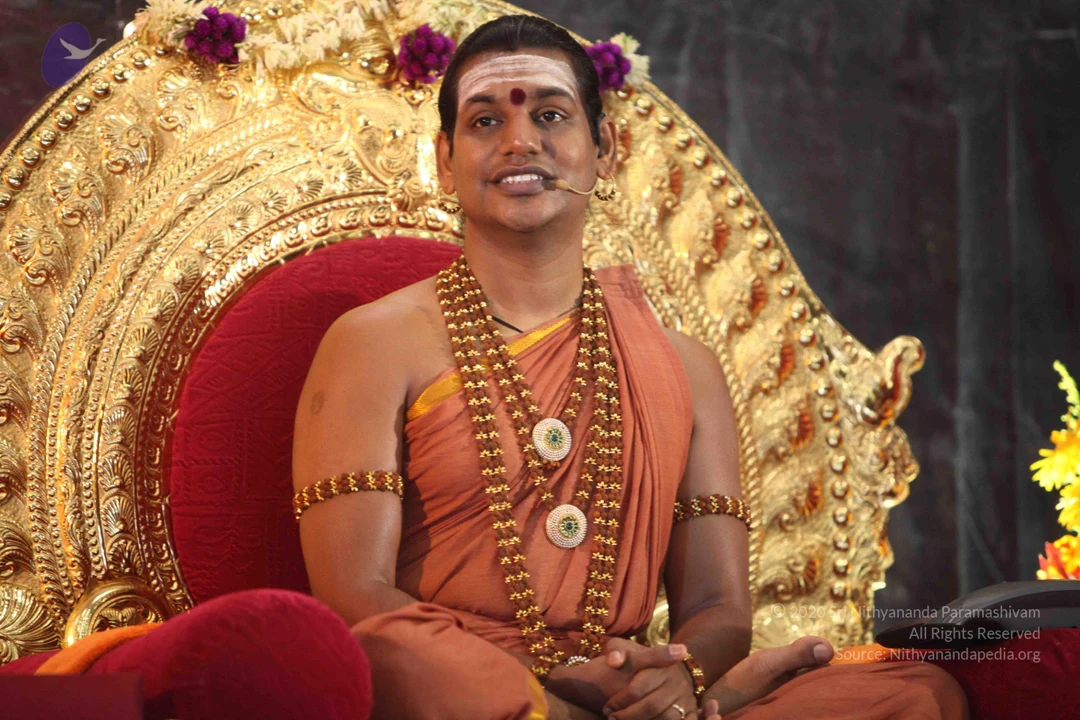
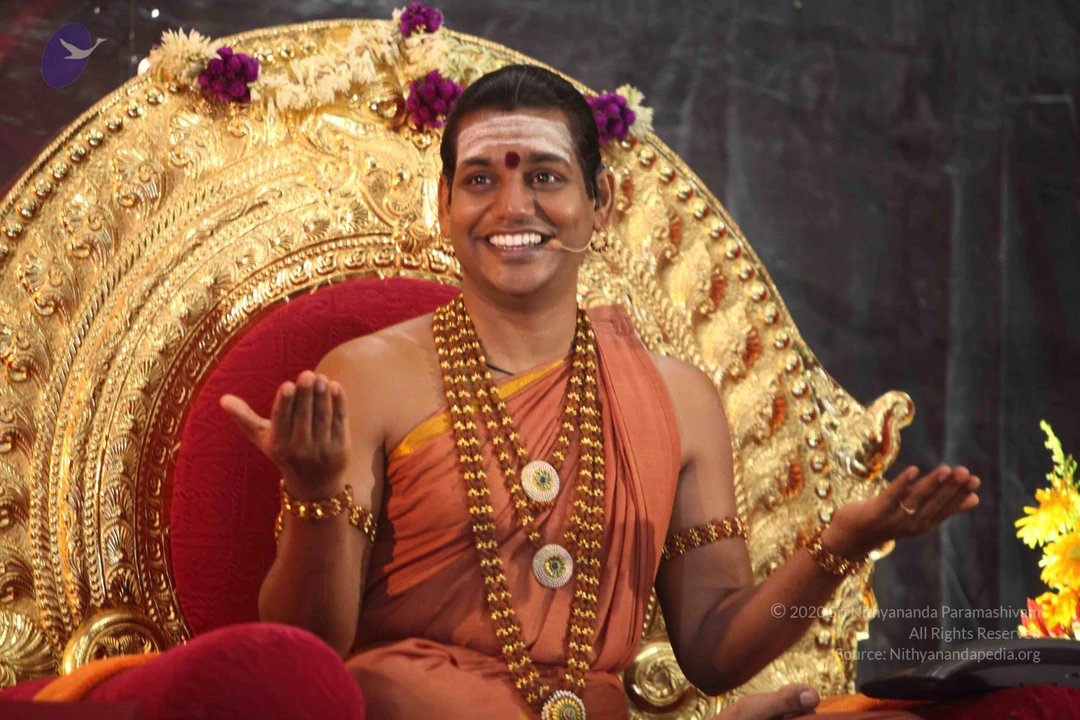
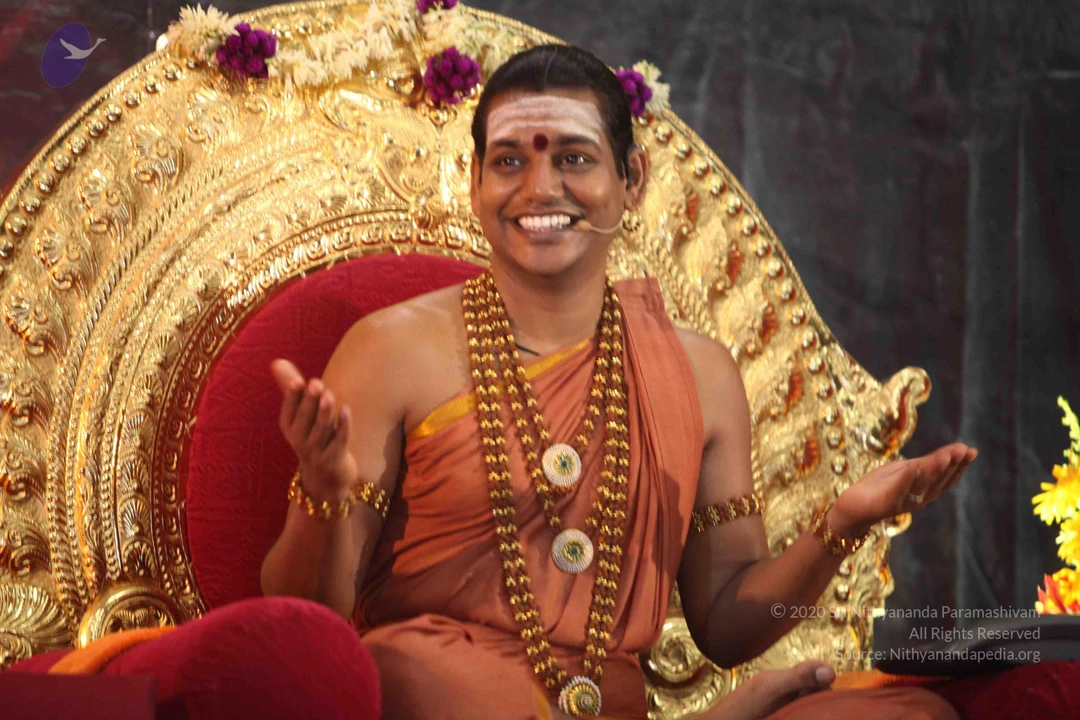
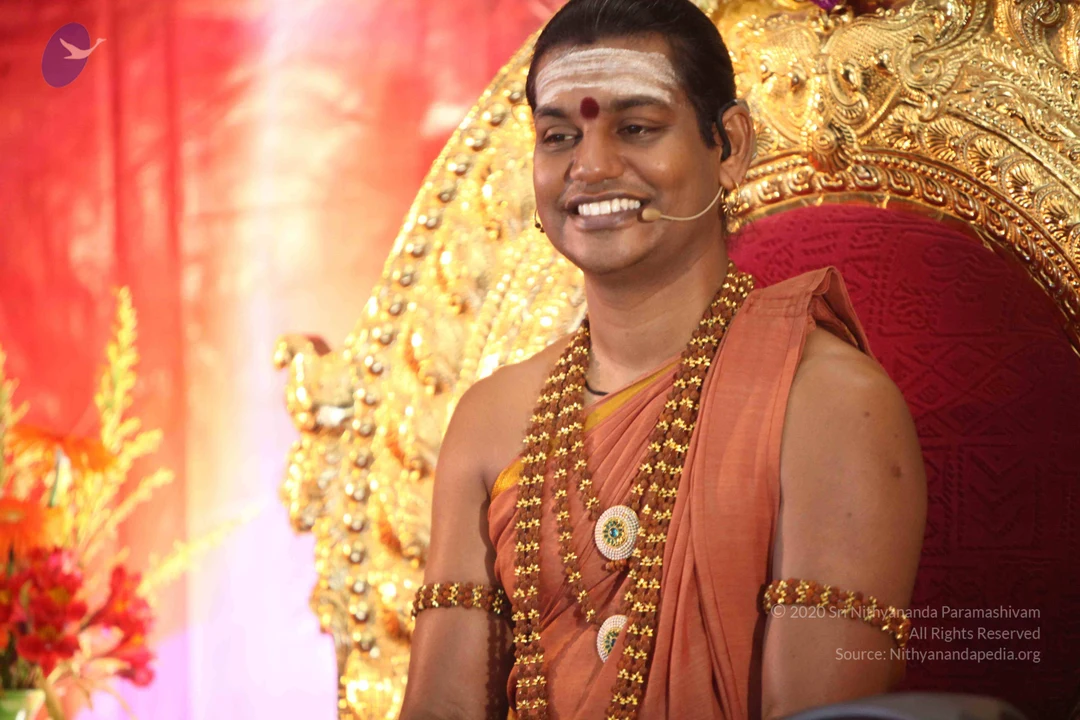
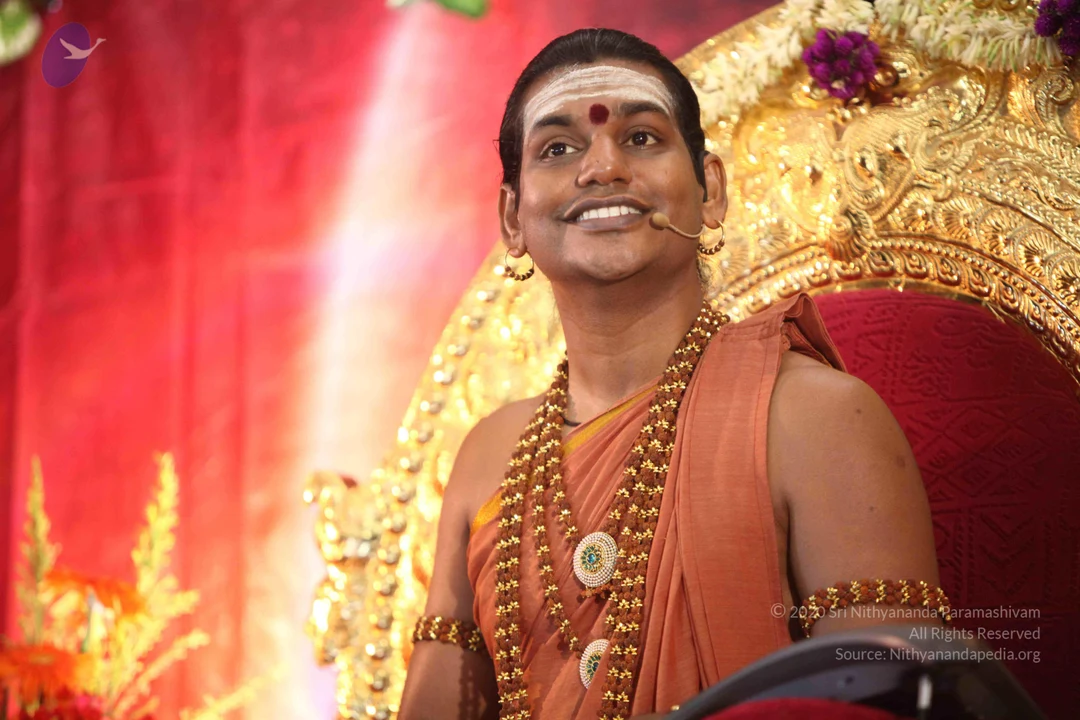
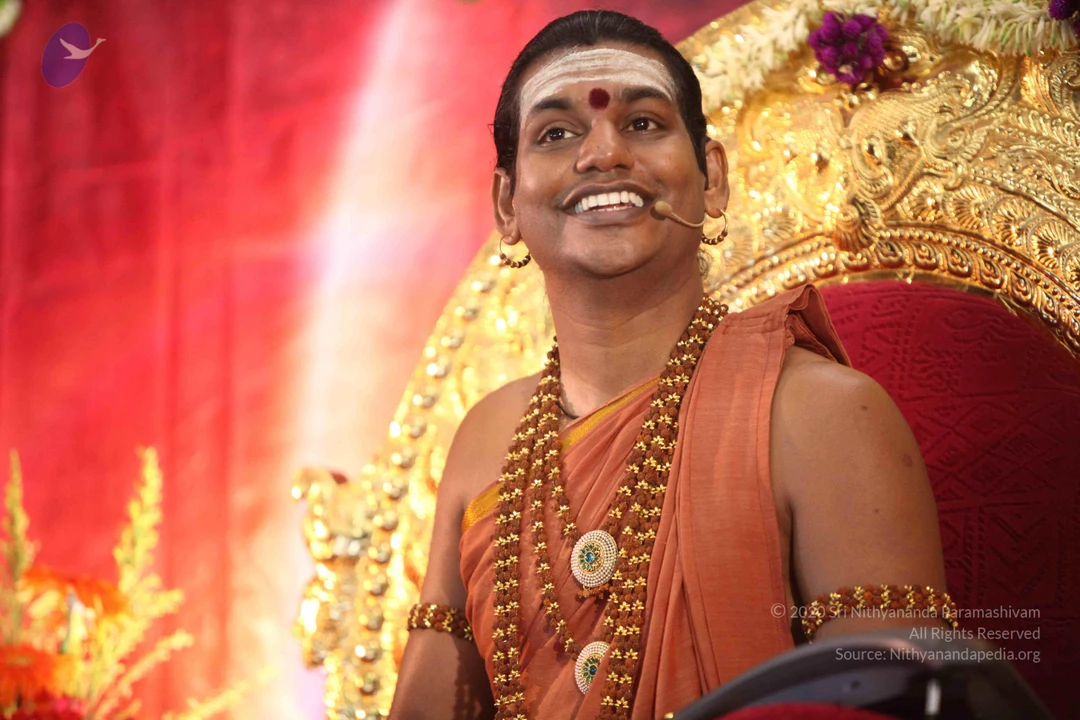
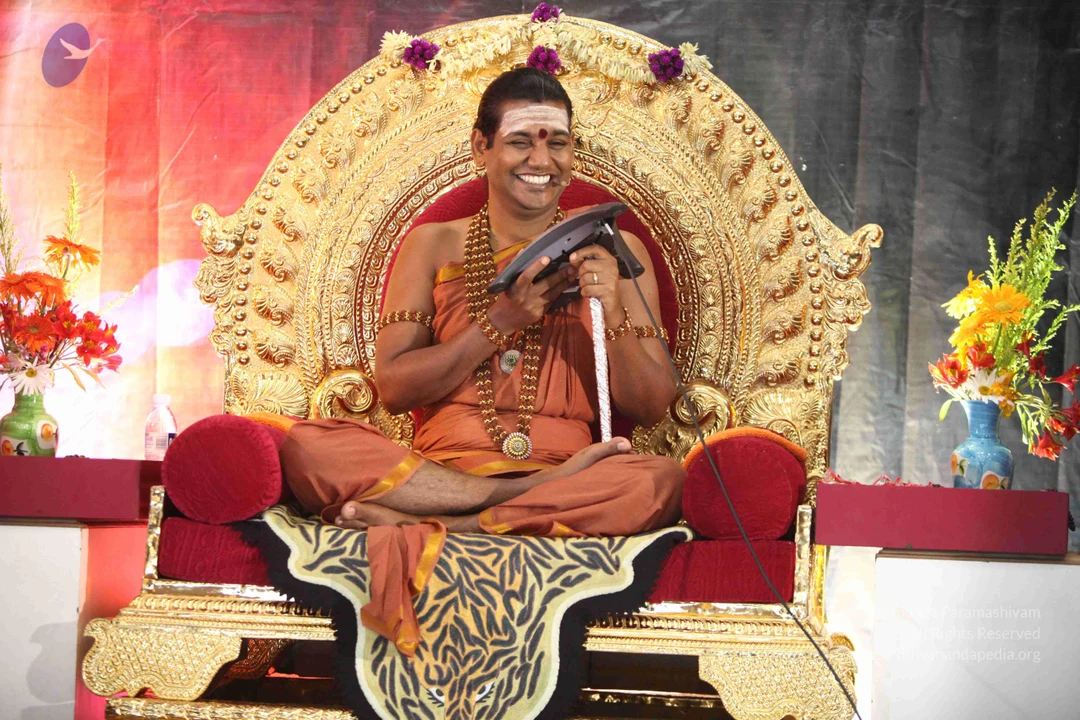
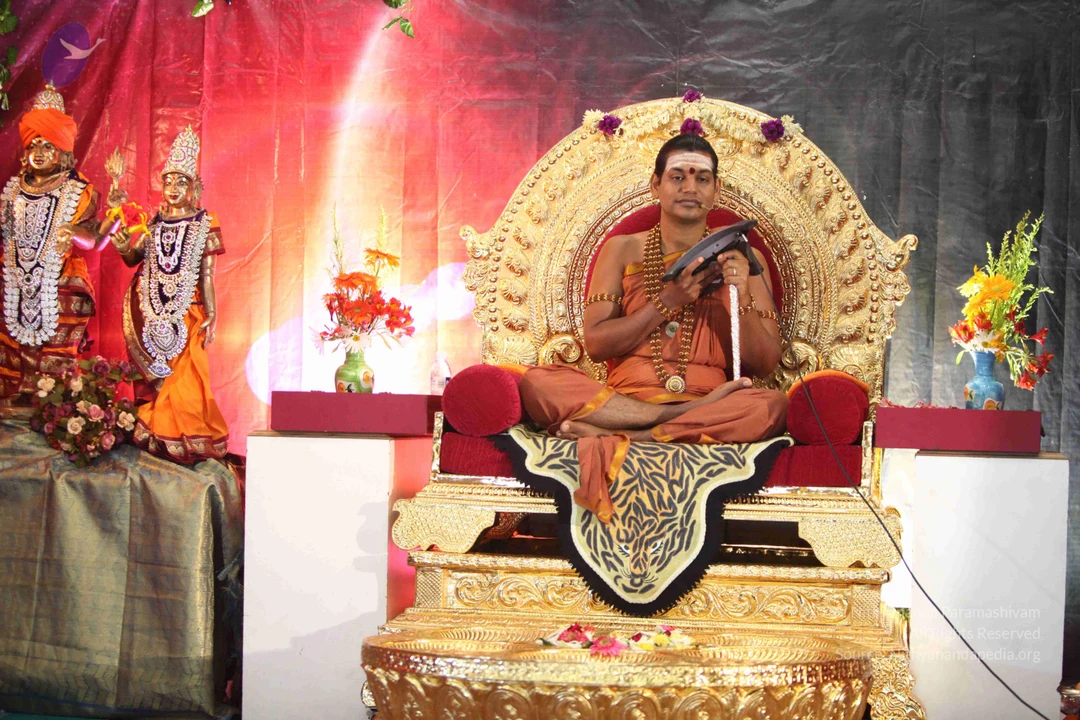
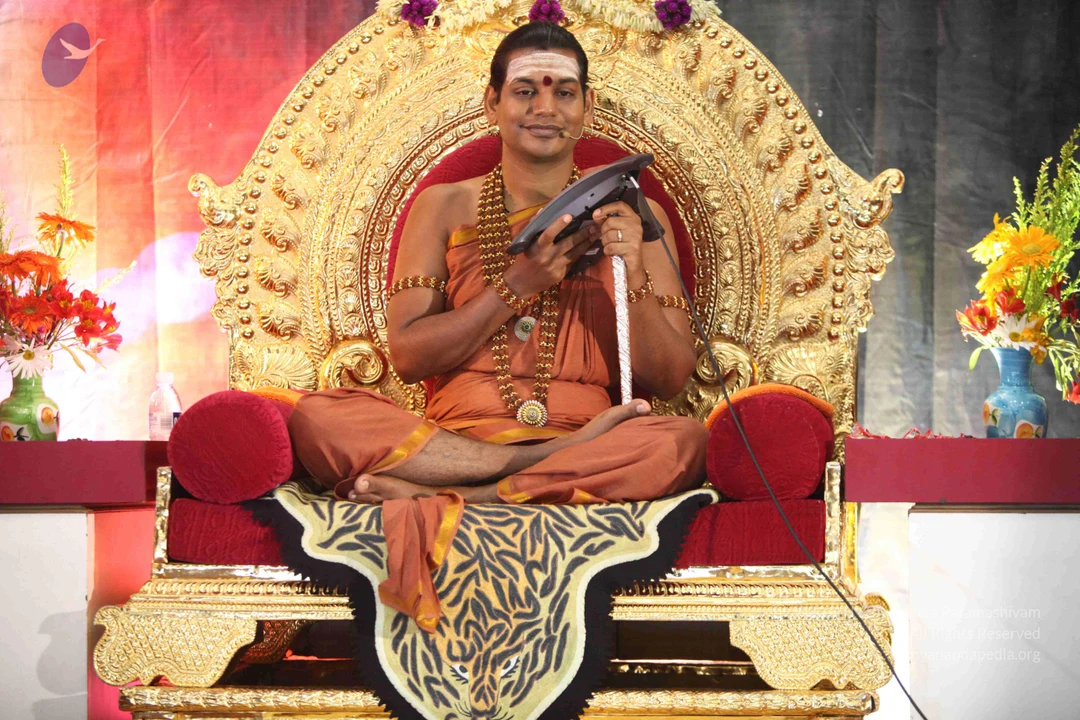
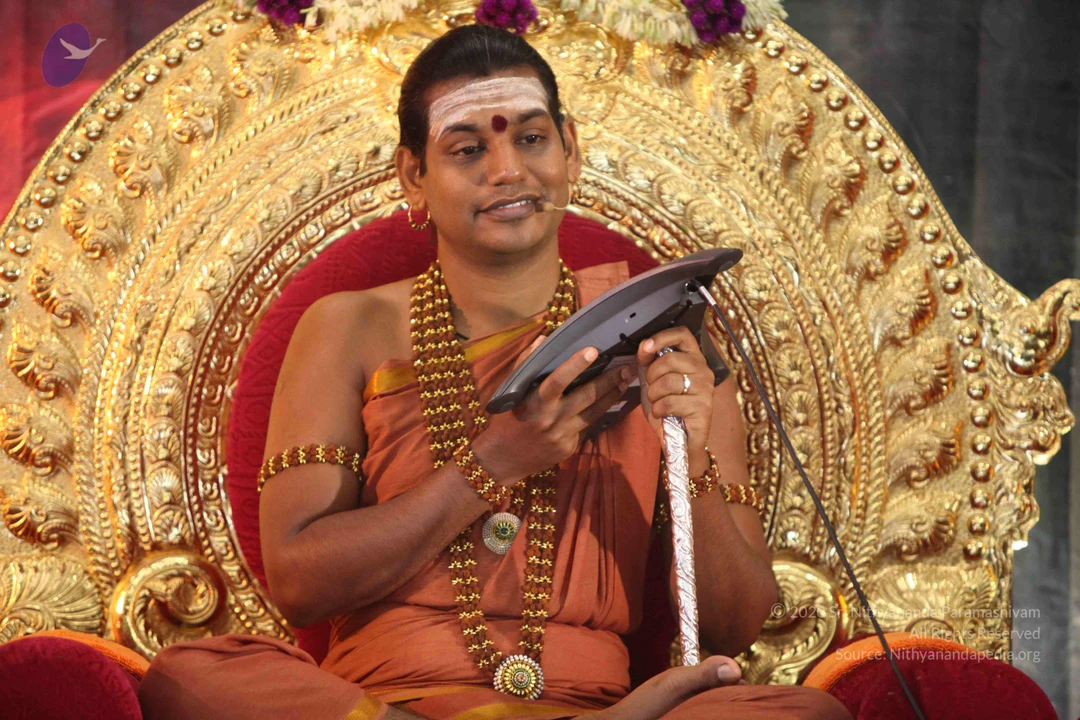
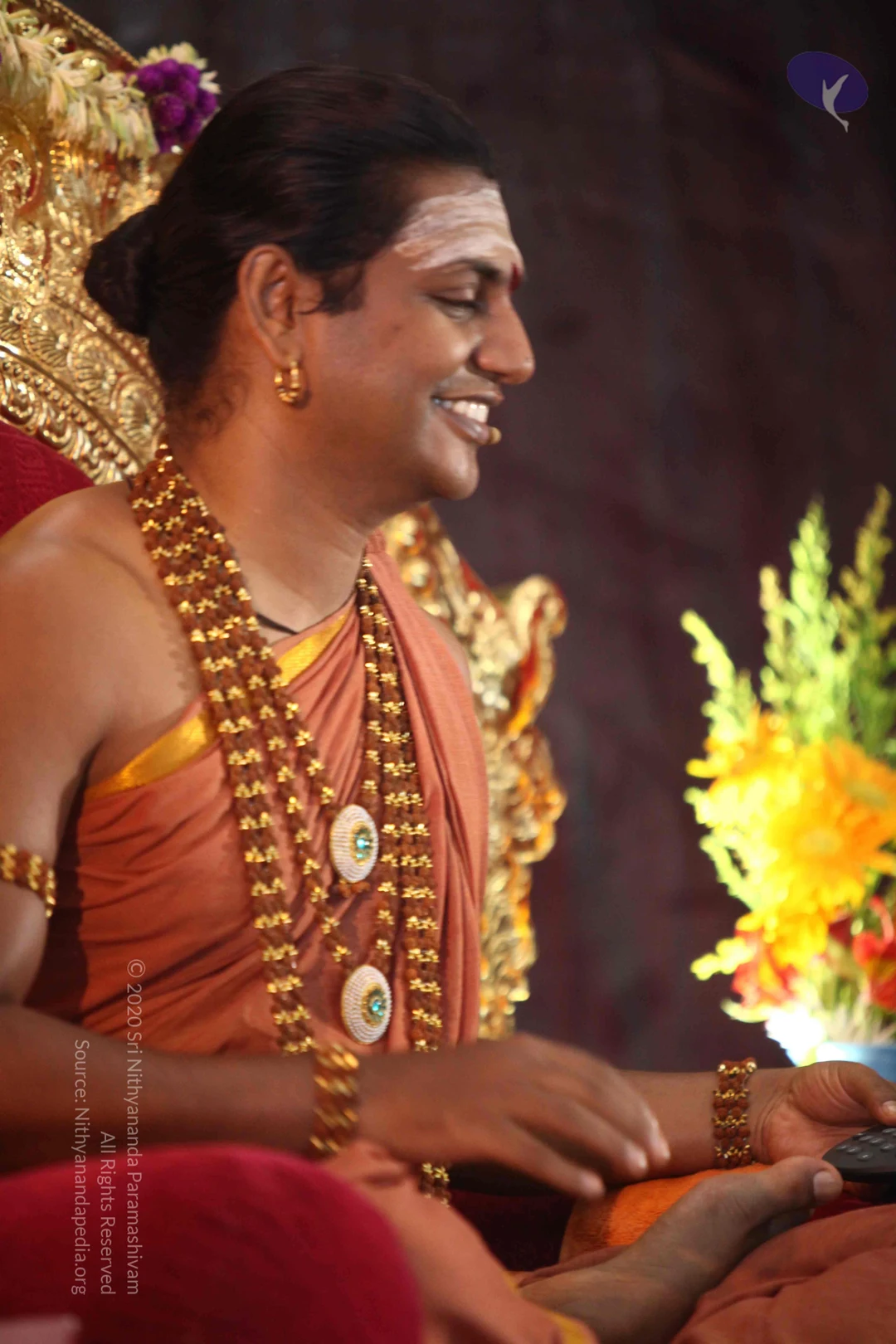
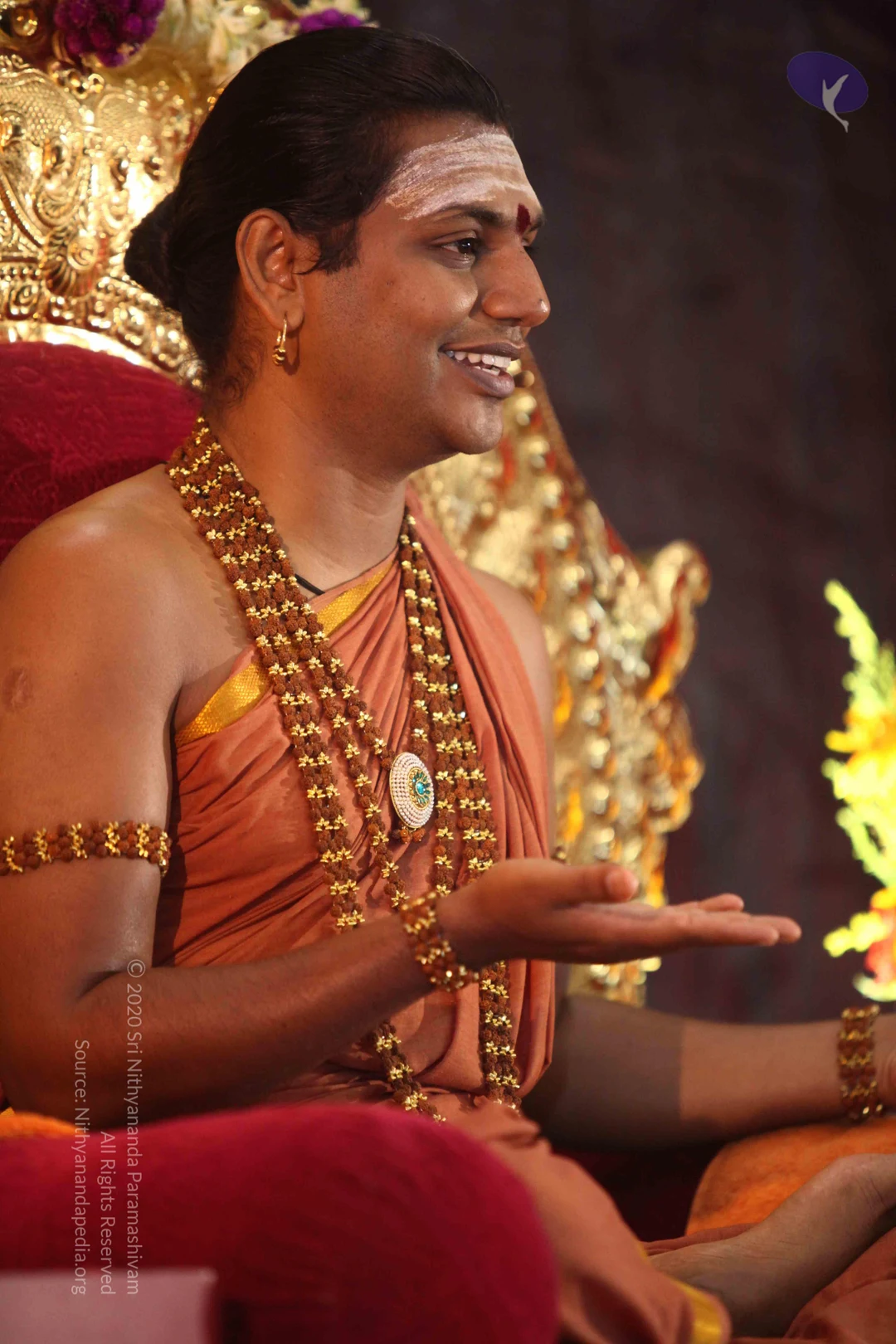
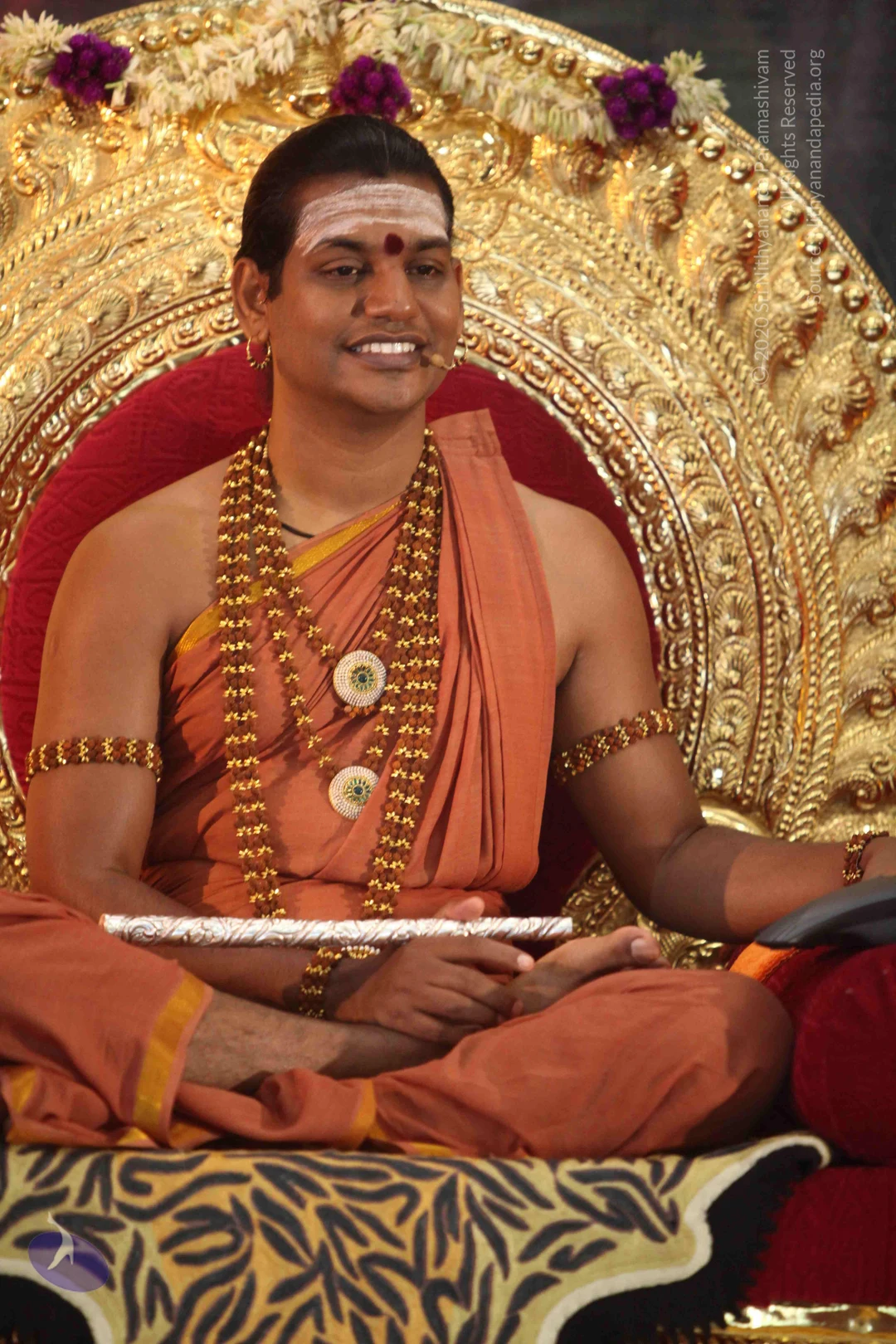
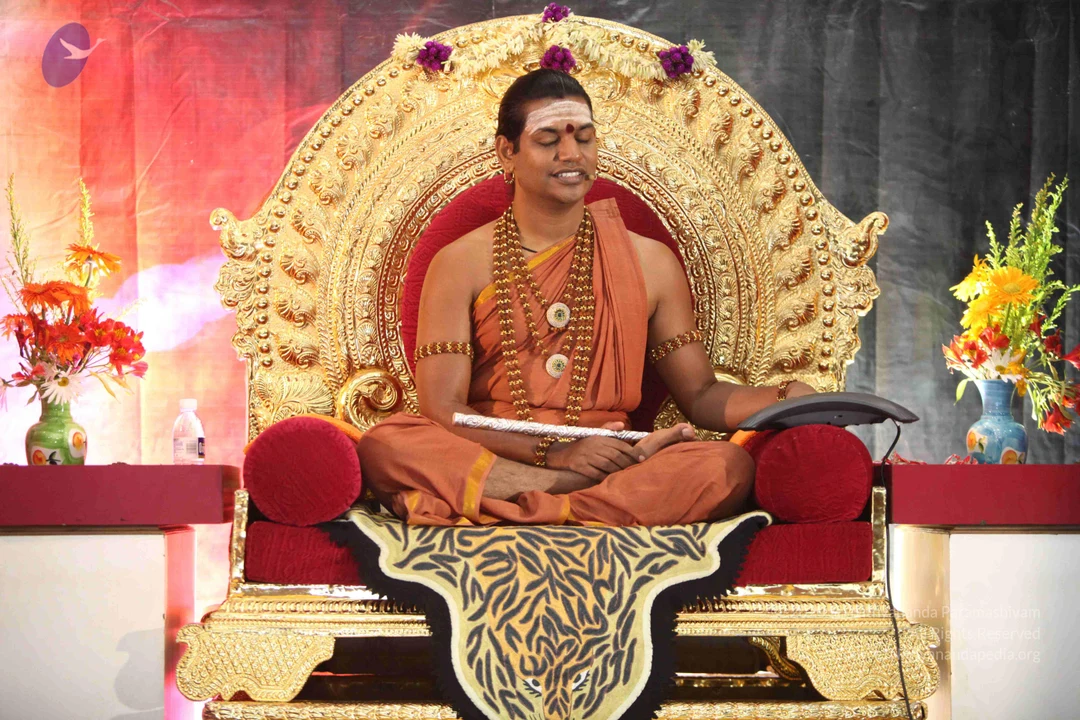
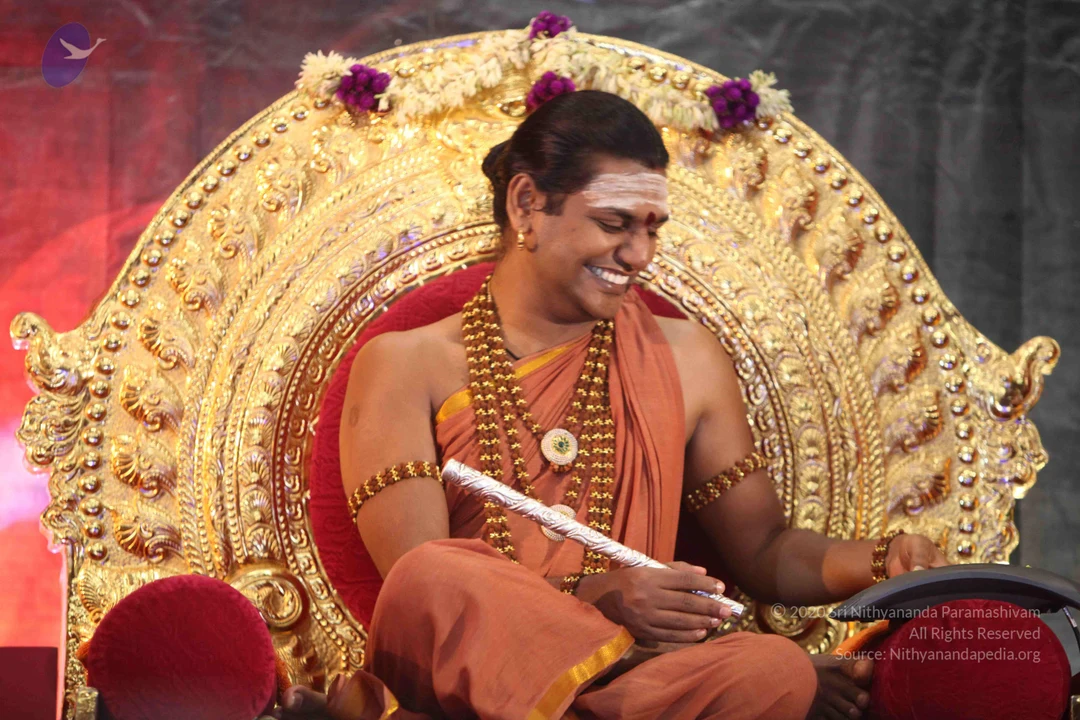
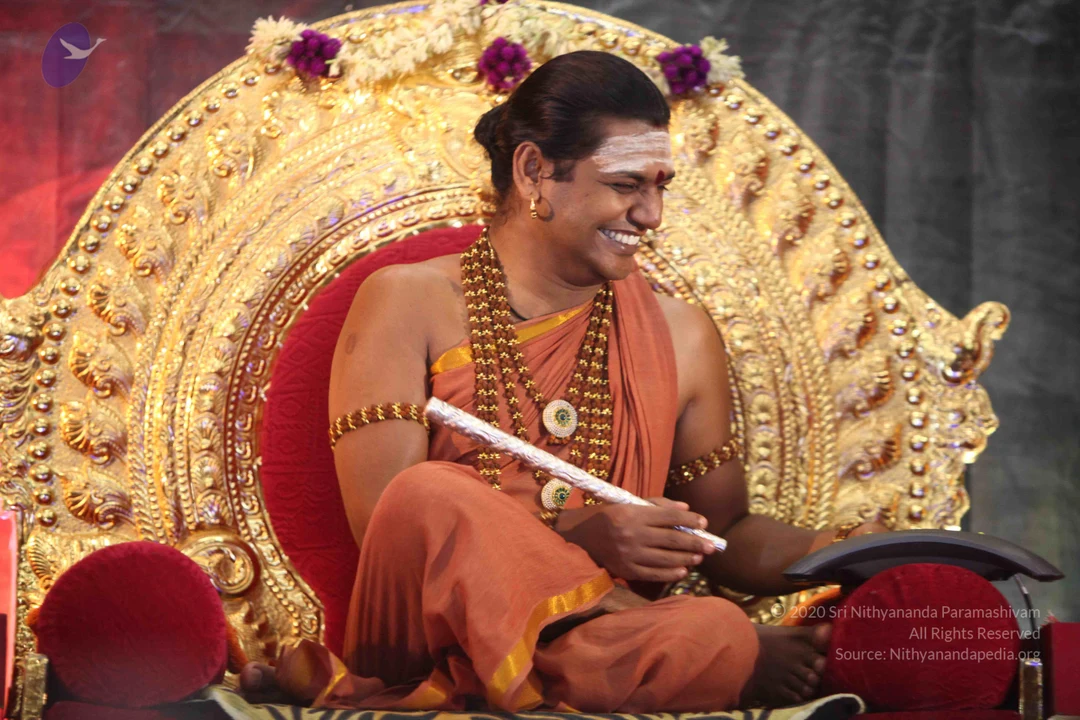
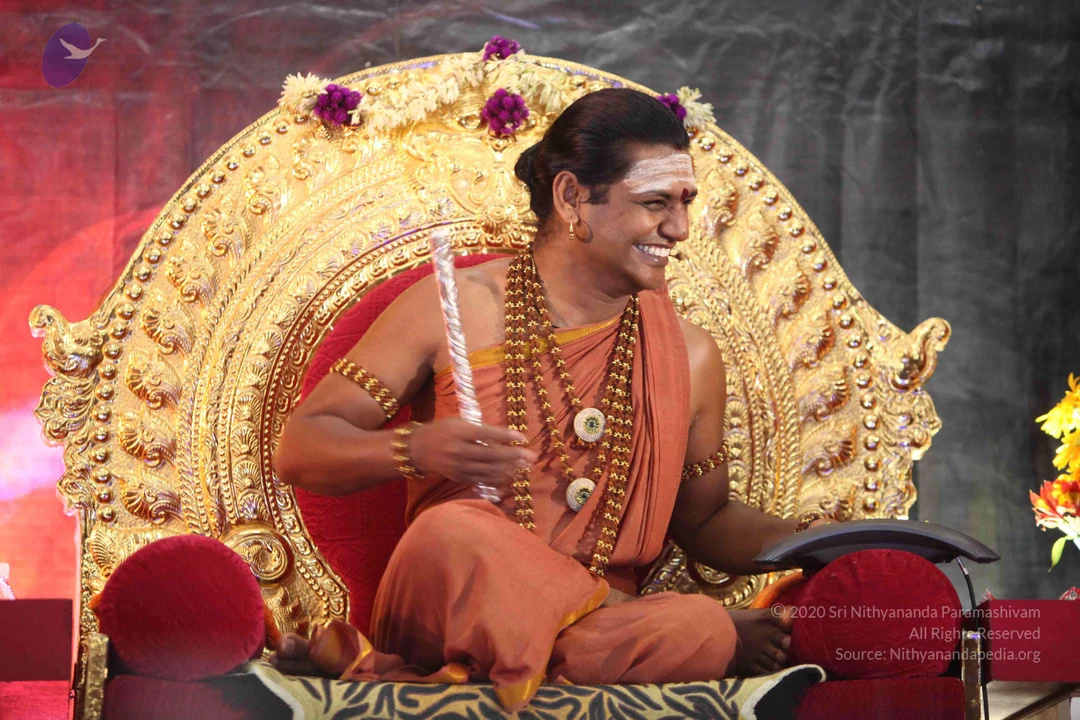
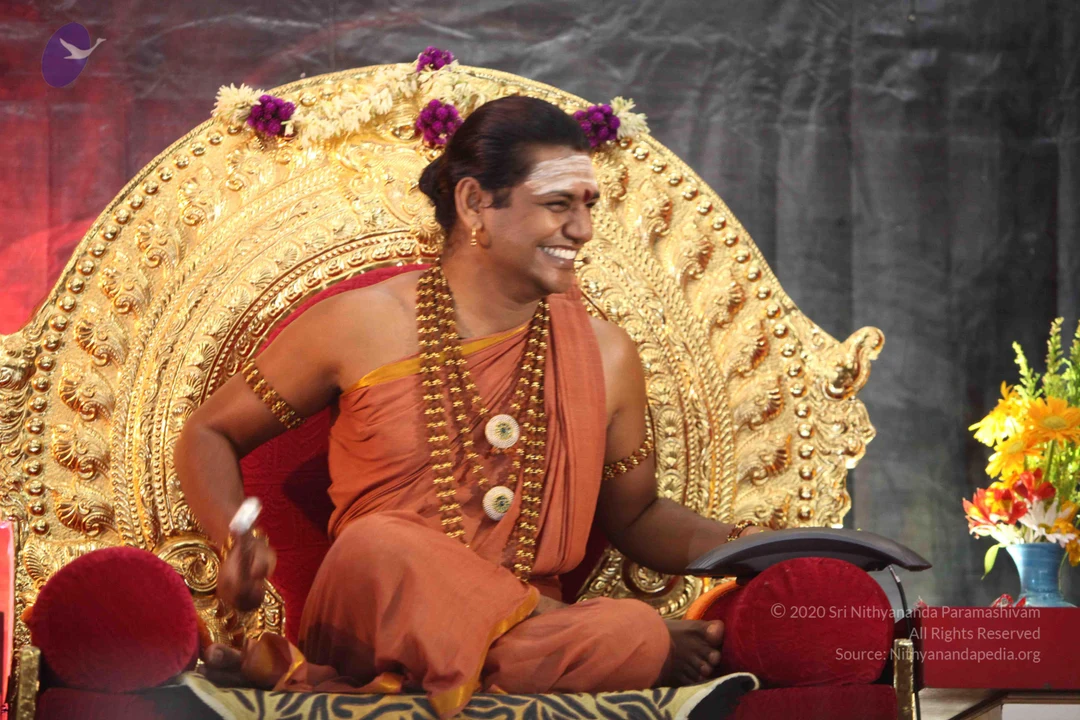
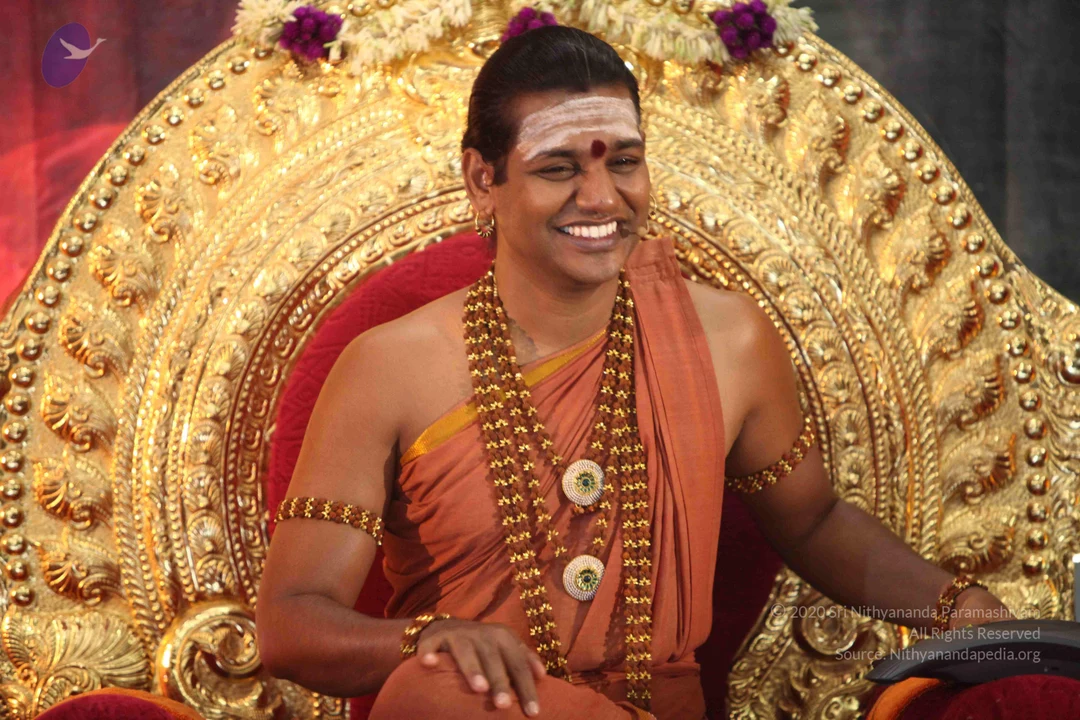
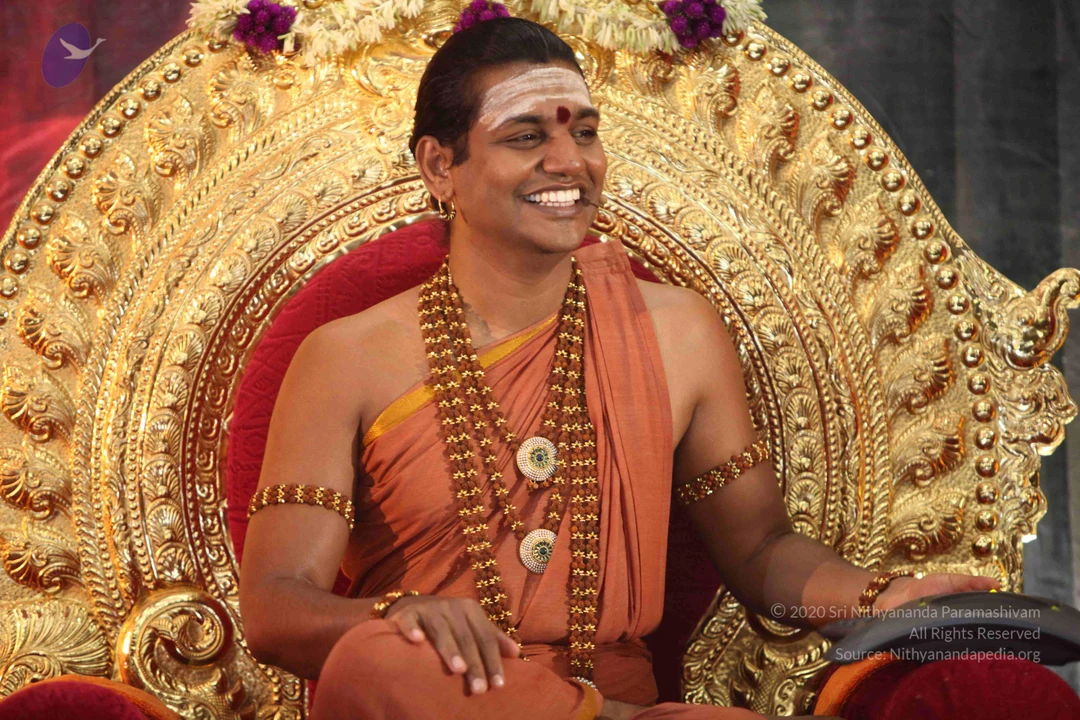
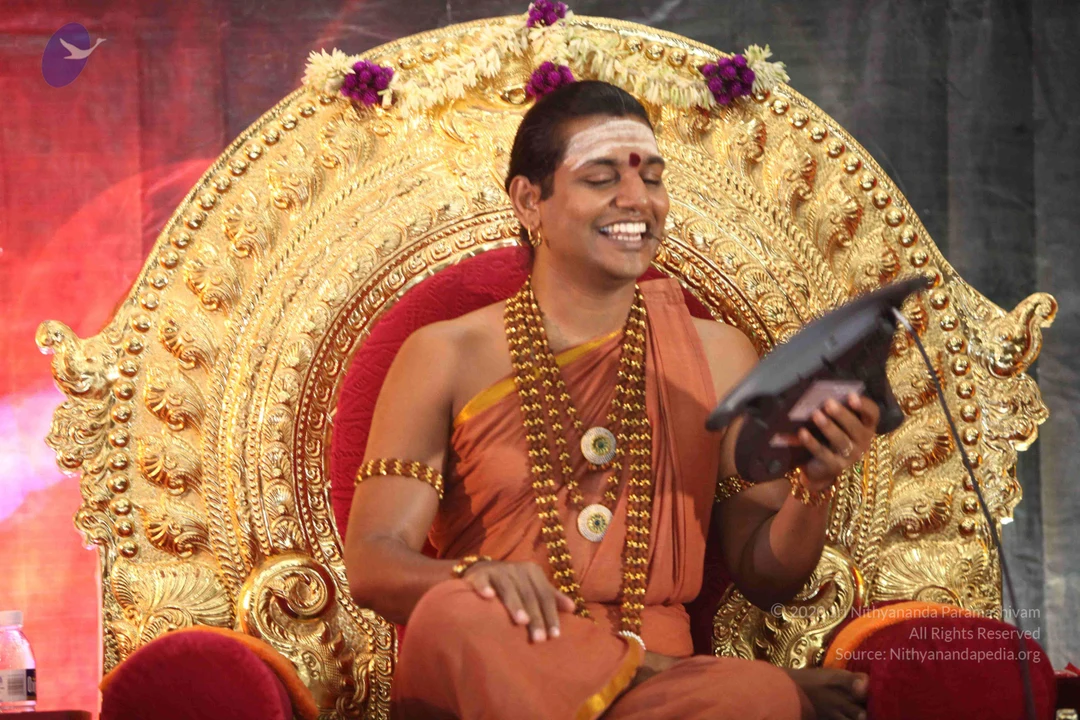
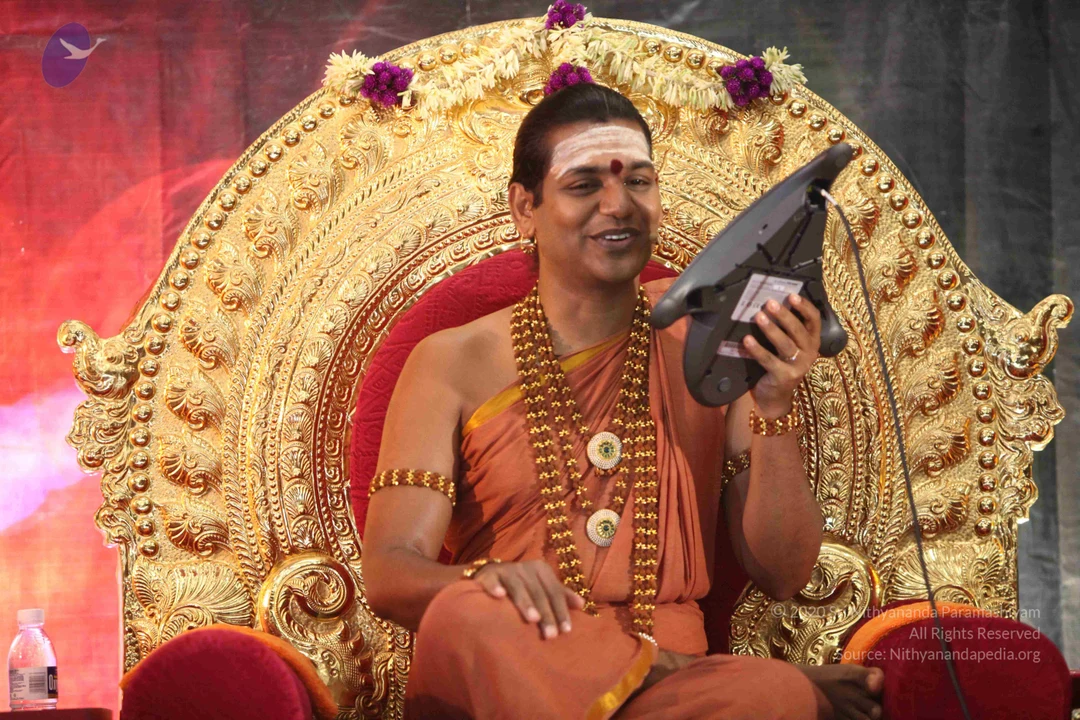
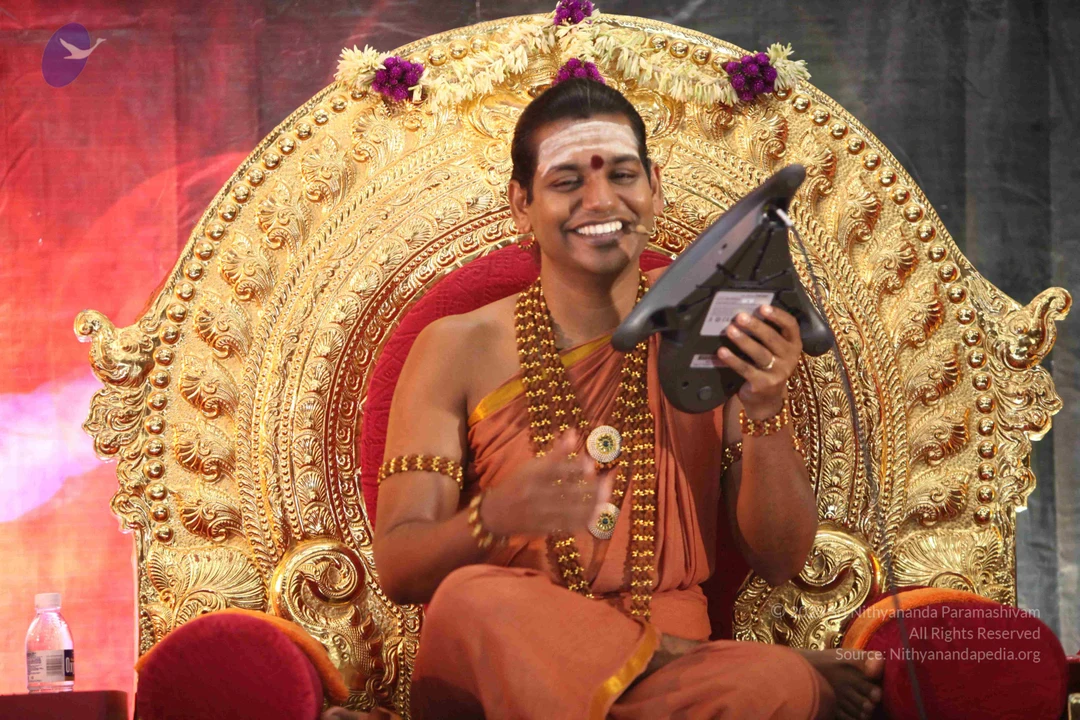
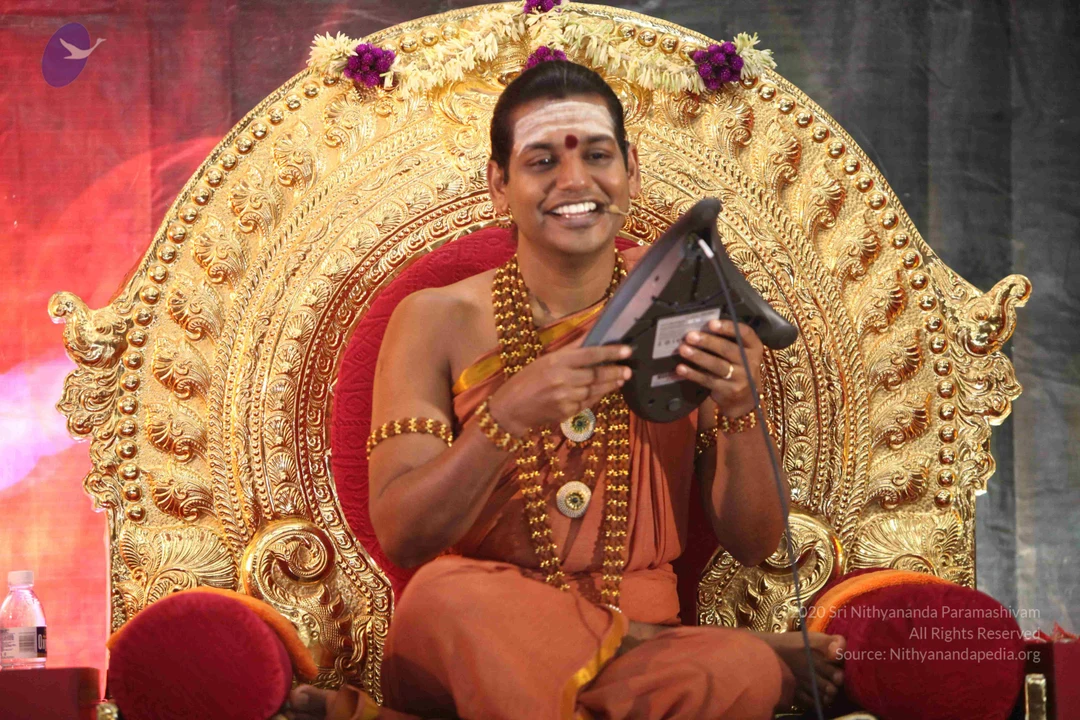
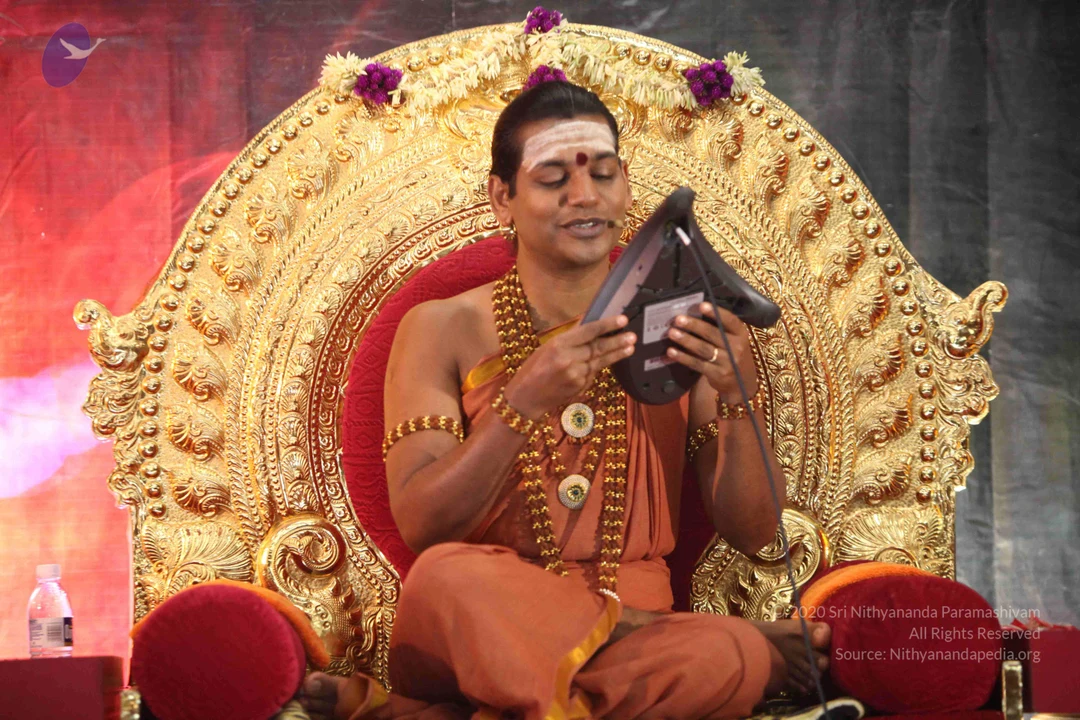
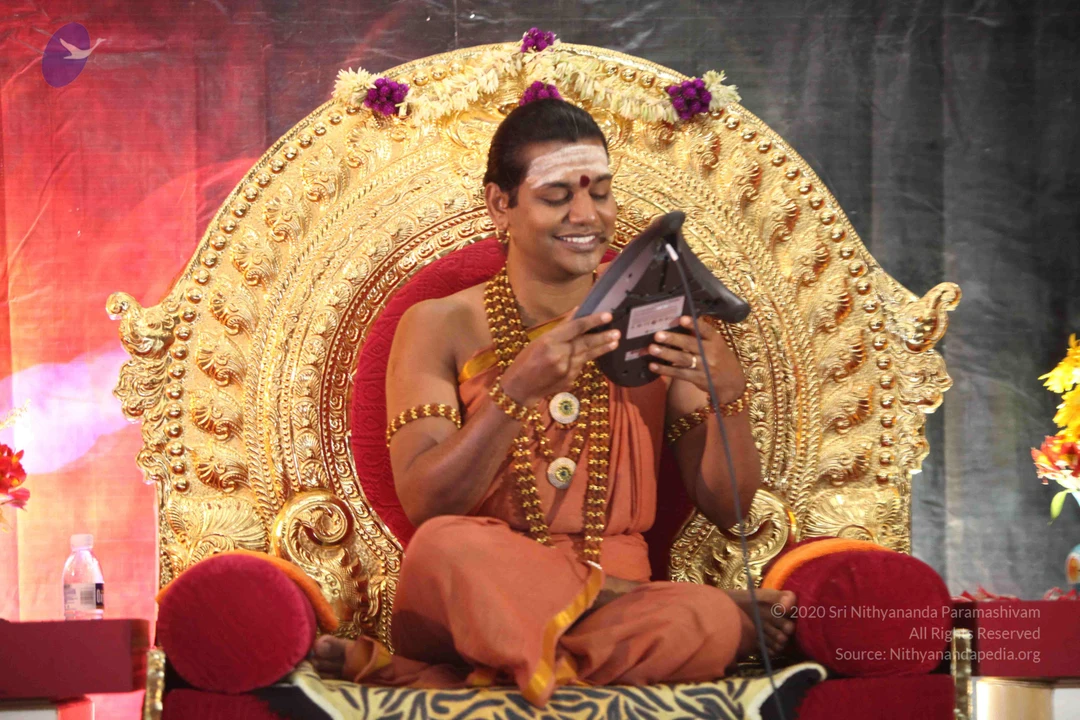
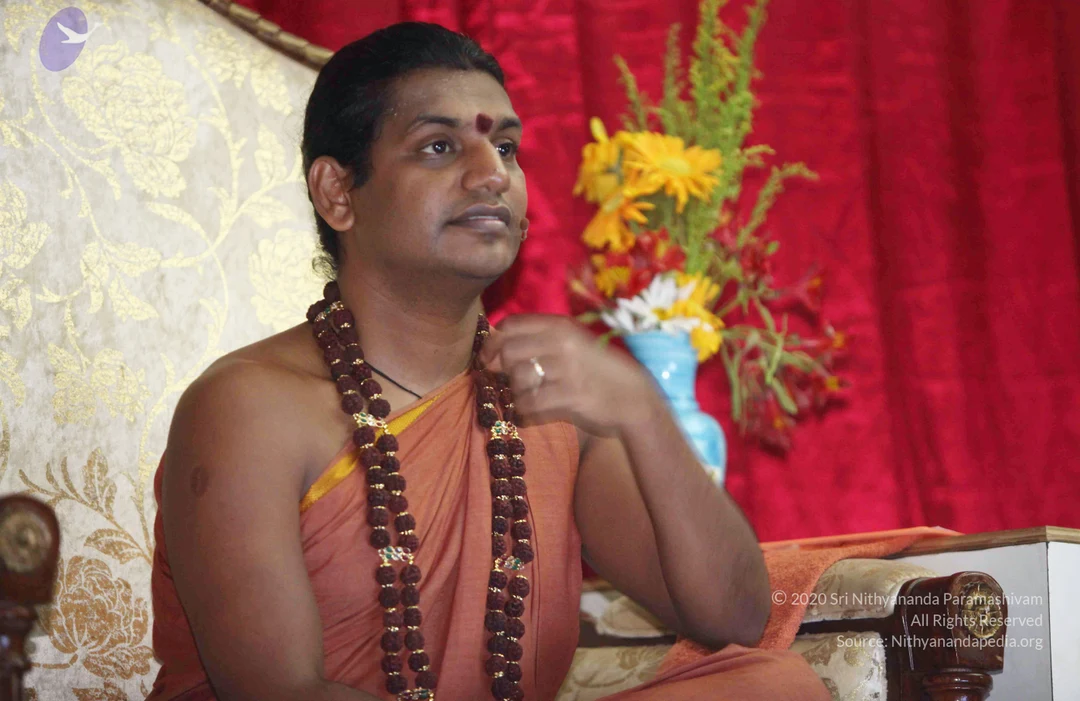
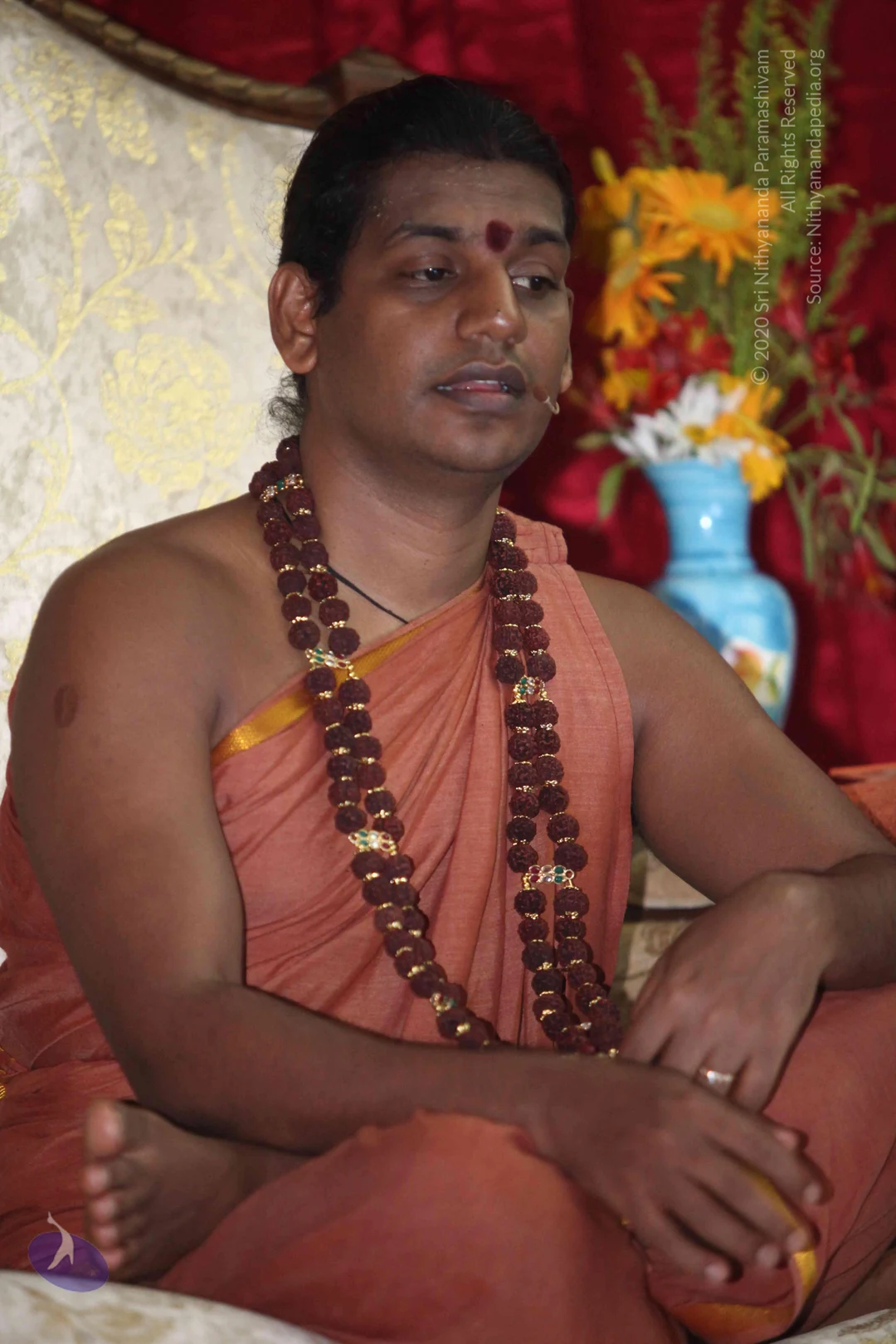
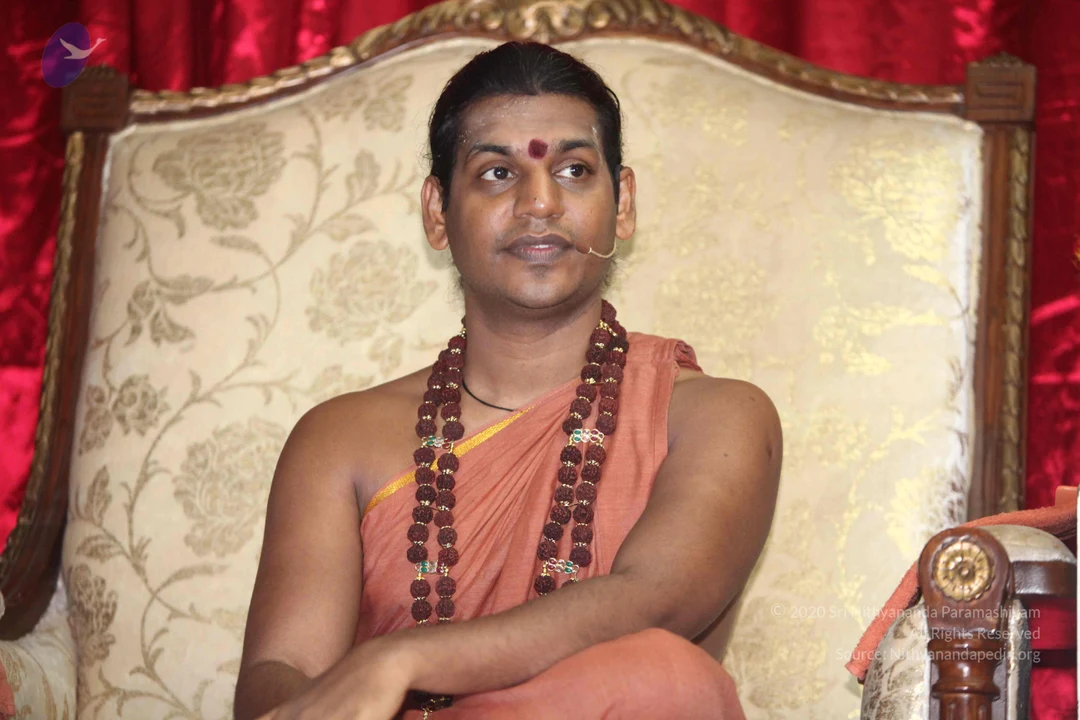
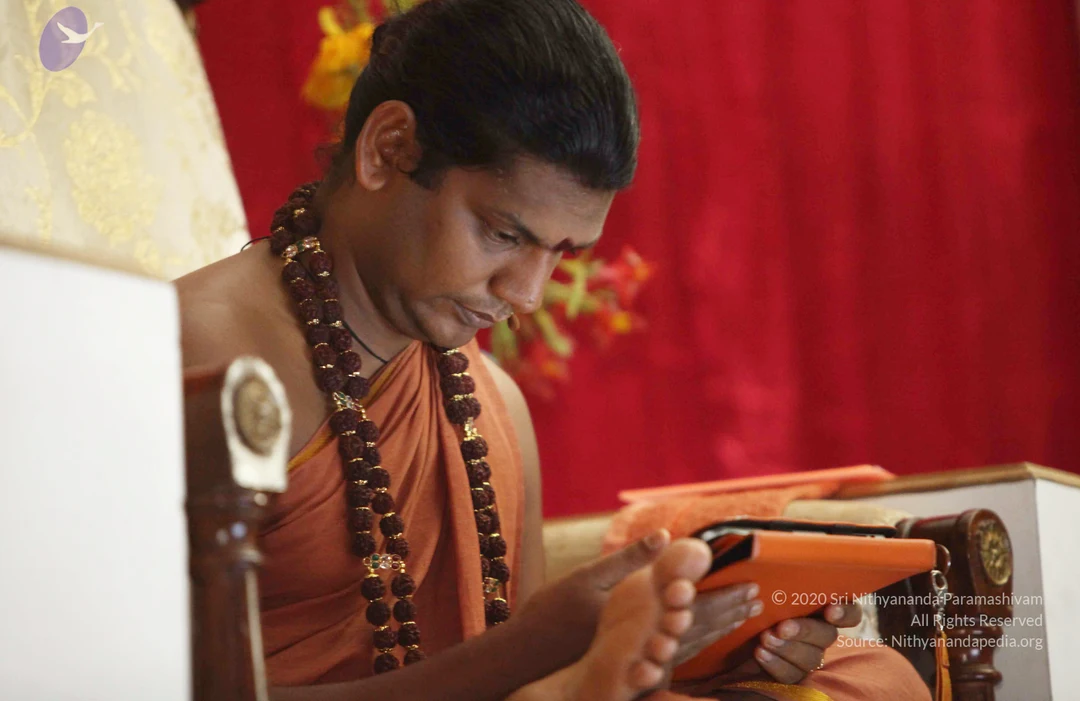
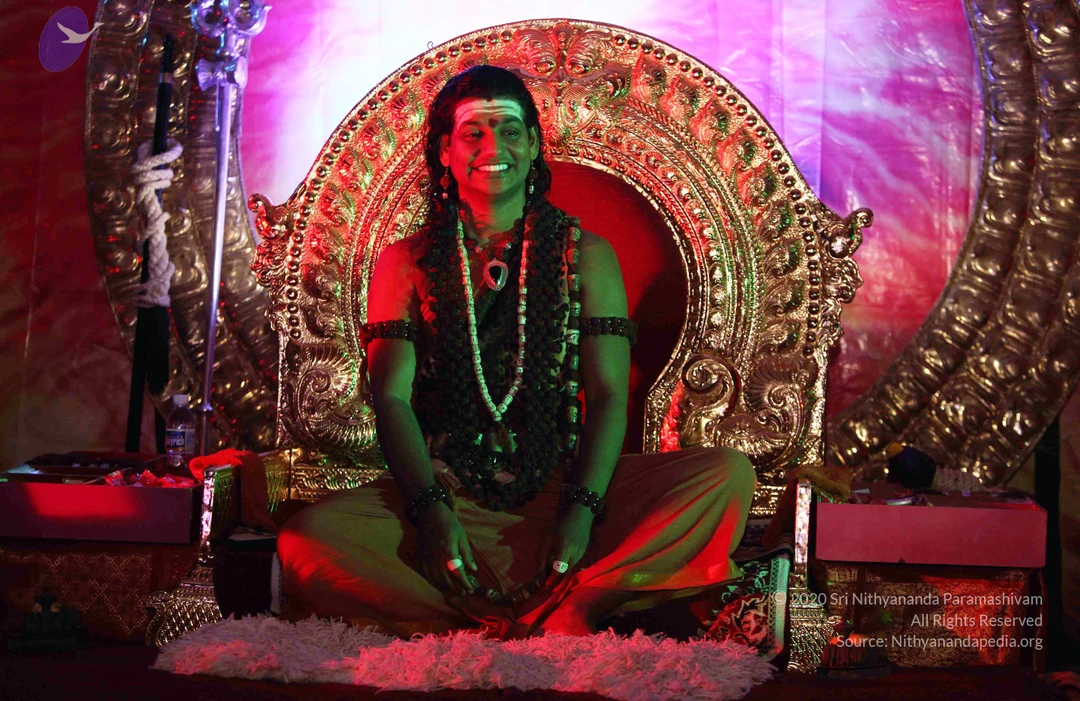
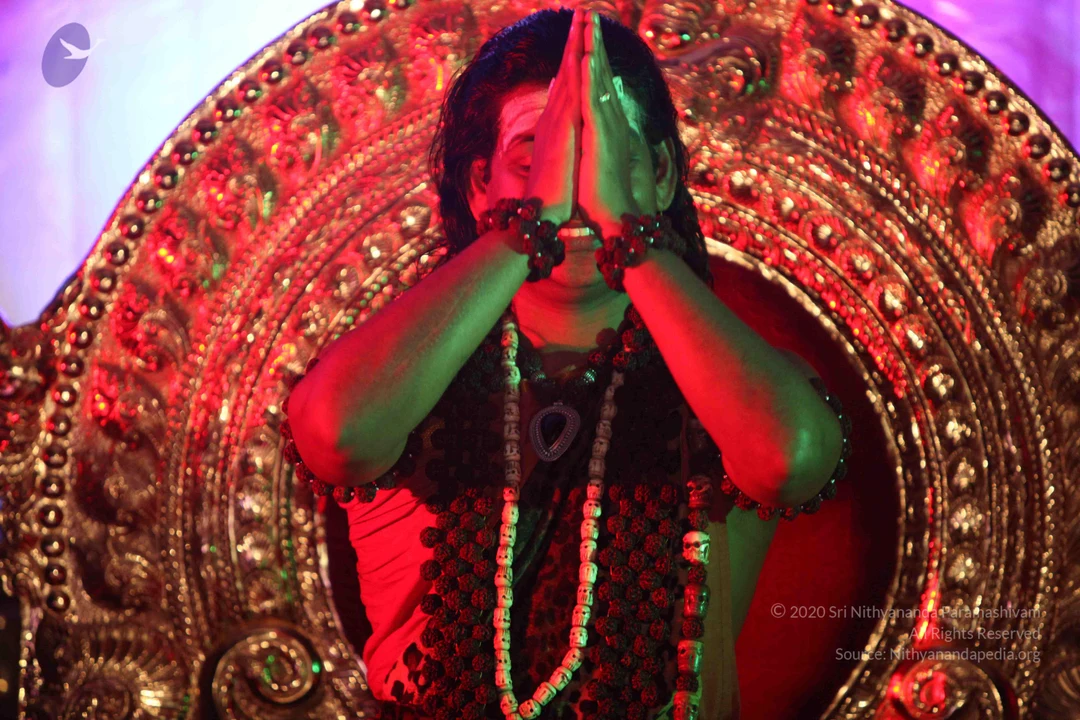
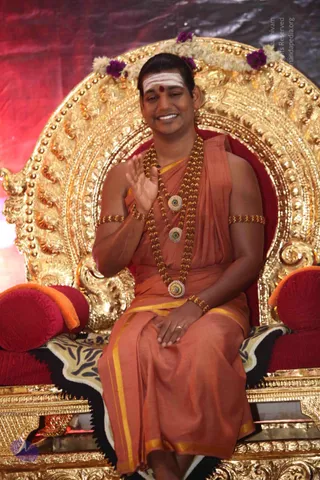
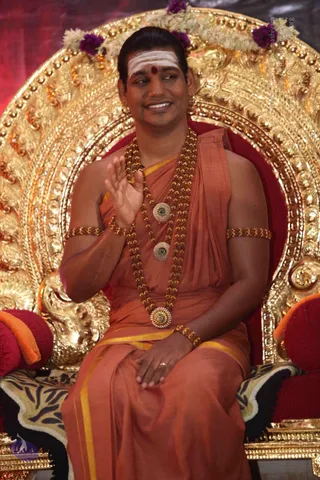
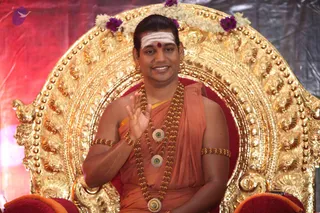
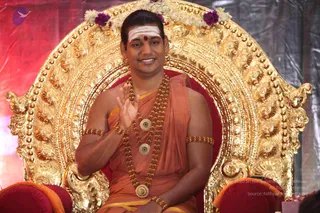
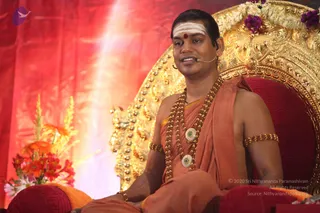
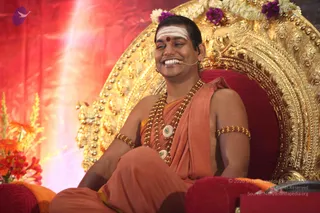
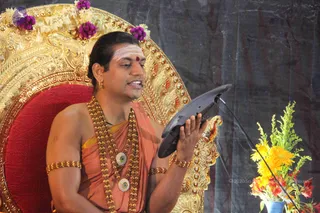
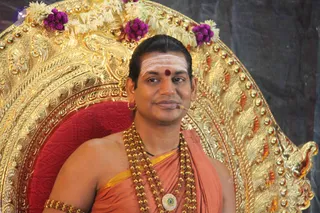
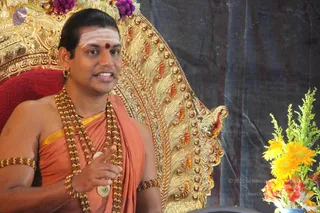
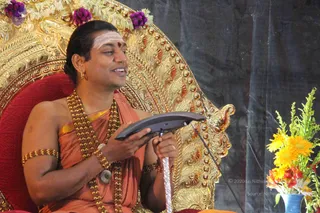
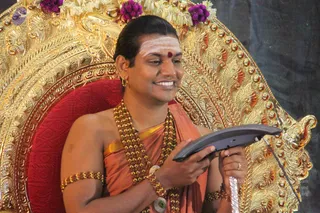
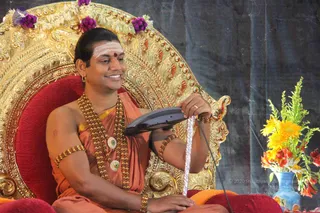
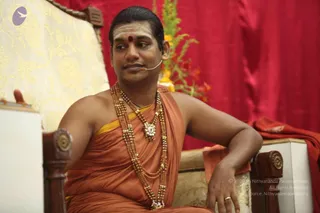
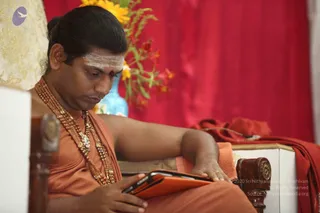
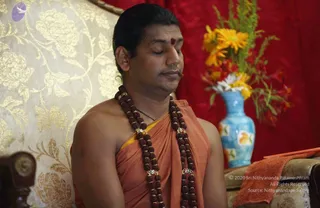
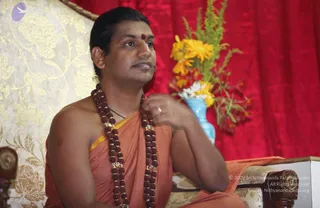
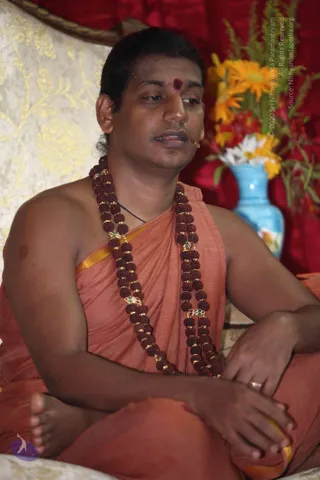
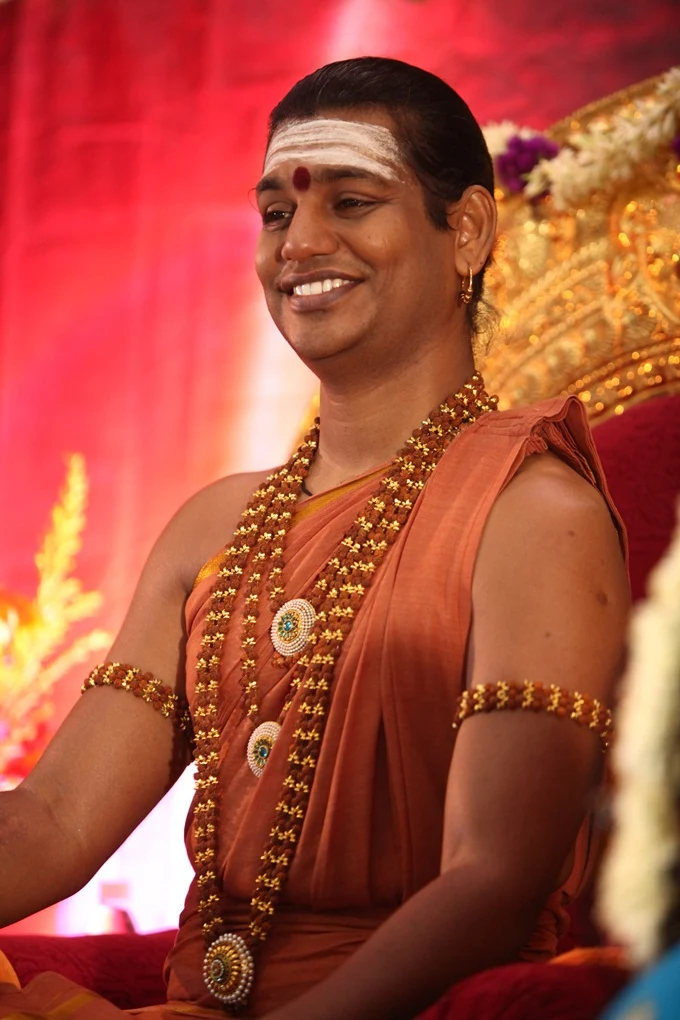
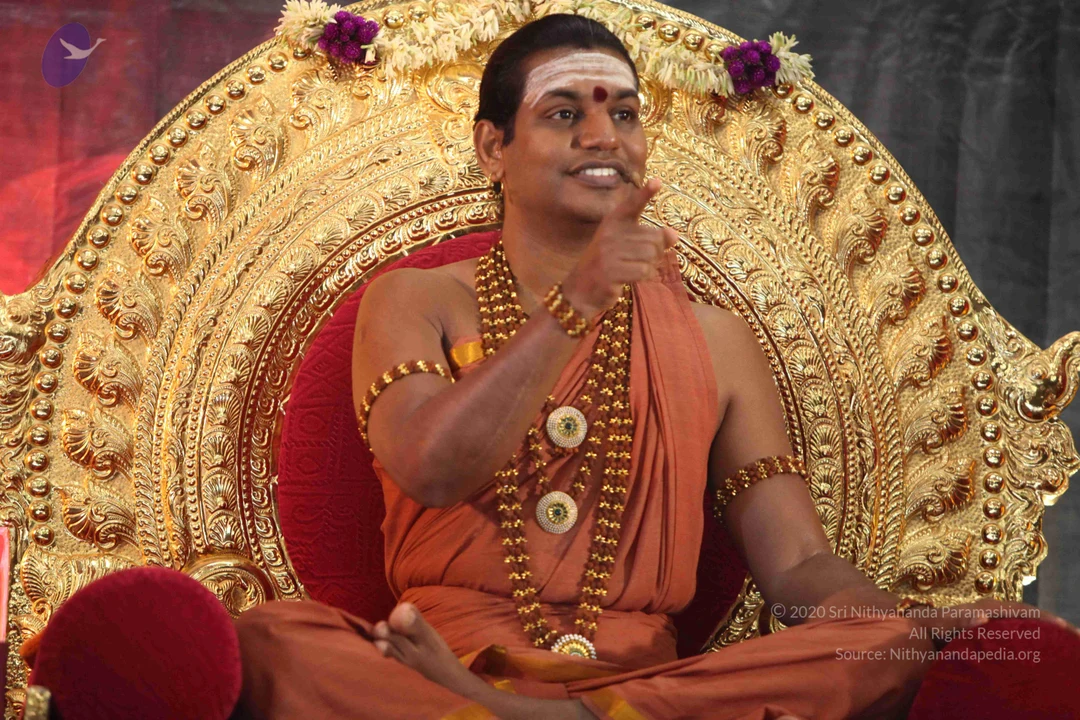
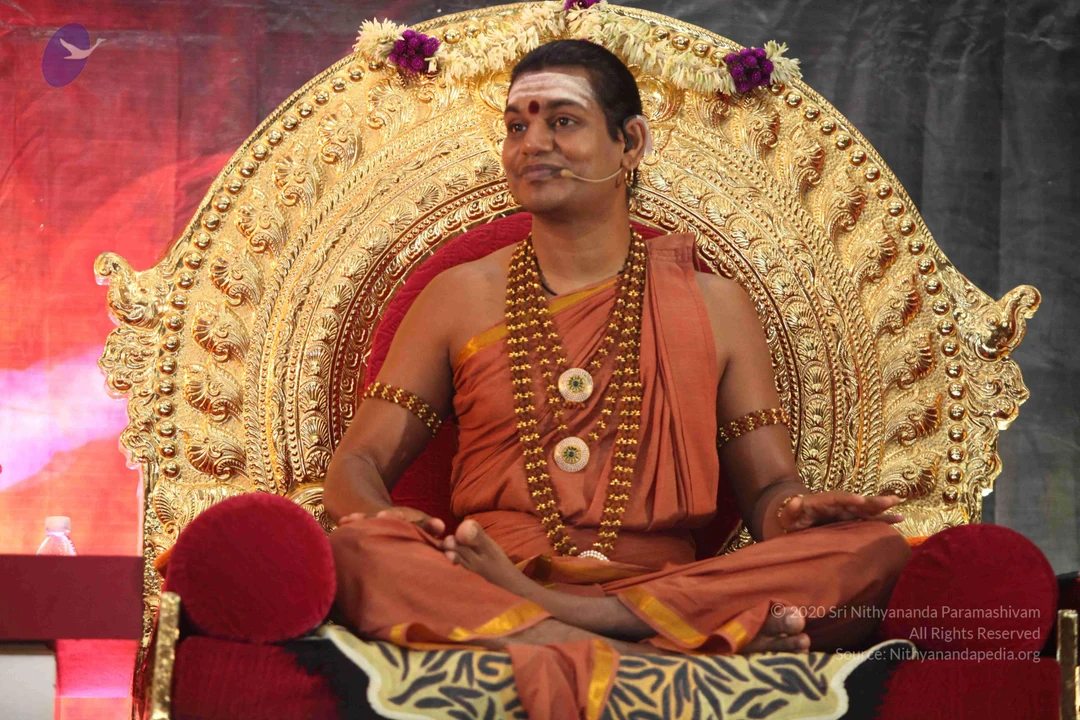
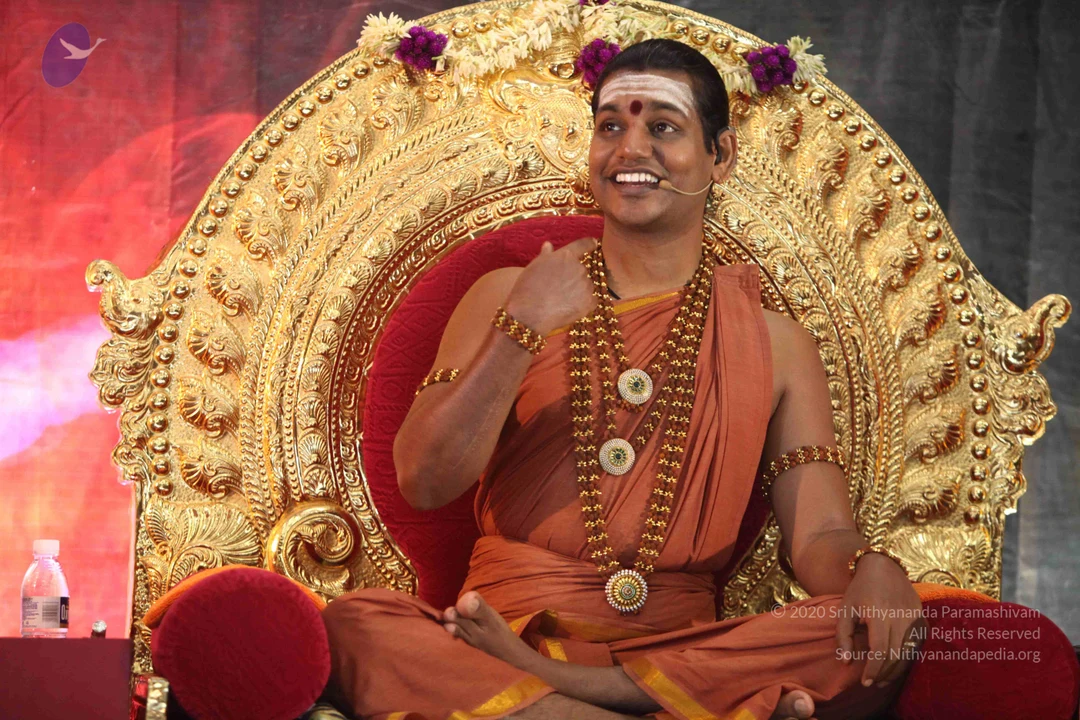
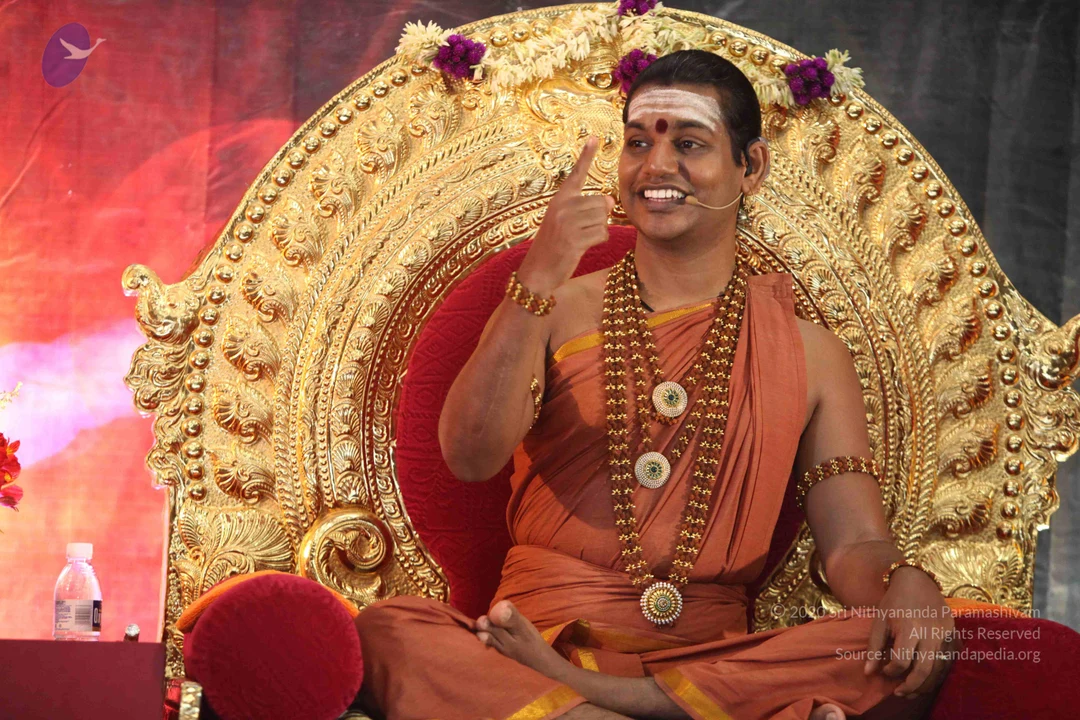
A seated man in saffron-orange robes sits on an ornate gold throne with a gold-leaf arched backrest and red cushioning, hands pressed together in namaste at chest level with eyes closed. He wears a white forehead mark with a red dot, a gold-and-bead necklace with a large pendant, gold armbands and bangles, and a small clip-on microphone near his mouth. Fresh white and purple flowers are draped across the top of the throne behind him, and a red backdrop fills the background. This is a candidate a person based on the saffron clothing, ornate gold necklaces and throne cues, shown in the photograph as the speaker seated for satsang.A man in saffron-orange robes sits on an ornate gilded throne with red velvet cushions, raising his right hand in a blessing gesture while smiling. He wears a white sandalwood stripe with a red dot on his forehead, layered gold beaded necklaces with round pendants, and gold armbands. A garland of white and purple flowers rests above the chair. Marigold and lotus flowers and brass plates with offerings lie in the foreground. a person: long dark hair is not visible, but the saffron robes, gold garlands and throne are consistent with the page's account of a Kodaikanal satsang. He is alone in the frame.A man seated on an ornate gold throne with red velvet cushions, wearing an orange-saffron dhoti and shawl with gold borders, multiple long gold beaded necklaces with round medallions, gold armlets and a bracelet, and a white tilak with a red dot on his forehead. He raises one hand in a blessing or talking gesture while smiling. Purple and white flowers decorate the throne back, and brass plates with flowers and offerings sit at the bottom edge. A red and silver backdrop is behind him.

September 06 2012

Original wiki page
Contents

Title:

Break Free OF Collective Myths

Description:

TALKS FROM MORNING SATSANG ON SEPTEMBER 6, 2012 AT KODAIKANAL, INDIA Bhagavad Gita (Song of God) is a timeless treatise on the essence of living enlightenment. The Gita was imparted by the enlightened Hindu incarnation Sri Krishna to the warrior-prince Arjuna over 5000 years ago. Amazingly, the spiritual wisdom and life solutions offered in the Gita are so universal and current that even today it is used as a personal transformation guide. In today’s talk on Bhagavad Gita, chapter 6, verse 8, Paramahamsa Nithyananda (Swamiji) describes the essence of being sadhu. The classical definition of sadhu is one who has renounced all attachments and lives in a state of holy wandering. Nithyananda tells us that we can broaden this understanding for the new millennium. To save humanity, we must all relinquish our support of money-based and power-based systems, which have created greed, corruption and violence. Once we change our values to base our lives on personal self-worth and spiritual freedom, we can live like sadhus even in the material world. Our transformation will create the 21st century consciousness on Planet Earth.

Link to Video:

VideoAudio

Transcript:

BREAK FREE OF COLLECTIVE MYTHS.

6th chapter Dhyana yoga 8th verse

Jnana Vijnaana Truptaatmaa

Kootastho vijitendriyaha

Yukta ityuchyate yogi

sama-losh-taashma-kaanchanaha

'The one who is fulfilled with the awakening of consciousness and intelligence, who remains firmly established by overcoming the patterns, who is intense and who views with impartiality whether it is a lump of mud, a stone or gold, is said to be united. means achieved the ultimate'.

Now Bhagawan is straight landing on the root patterns of the mind. Understand, let me repeat the sacred secrets in this verse..'One who is fulfilled with the awakening of conscious and intelligence, who remains firmly established by overcoming all the patterns, who is intense and who views with impartiality whether it is lump of mud, a stone or gold'. Bhagawan is hitting at the root of ignorance. Please understand, What is really taking us away from being centered on contentment? What is it that takes your contentment away? The idea of MONEY! You feel somebody has more than you. So only when you have more and more, you will be able to do what you want. Only that leads to contentment. That is the idea of money. What is idea of money? Who makes gold valuable? Who makes dollar currency valuable? Again, it is the law established. Please understand, it is not always greed, you can say, may be Gold, people have started becoming greedy because of that color and shining and all that. What about currency? Why people become greedy? Because of the law established. The fear created. The commonly accepted - Please understand, commonly accepted mutual ideas, Mutual understandings.

In the beginning, when everybody wants gold, the king would have made a rule - This will be valued, because less available, more needed, then the loss evolved, the value, weight, sharing, giving, taking, holding. Then when the stealing has started, laws to punish the people who steel, everything has started evolving.

Even now, what keeps the dollar's value? If you are not ready to do your trades on dollar, there is every possibility you will be attacked later on. Please understand, How the value of the currencies are added or reduced? How much is needed in the world? I have to talk, revealing the deeper secrets of the human mind, How the human mind functions, Who makes you believe you having the gold or having money currency in your bank balance is a security for you? The laws created. Why those laws stand alive? The Fear created. How the whole fear and the law is sustained? Again, based on the demand and supply. Why should law make Gold as an important thing? Because less supply more demand. Why the stones don't have value but the diamonds have value? Because less supply more demand. And I tell you, the diamond industries -- they try to keep the supply less, to keep the value high. If they open their whole market, what ever is available to the market, it will be less than stone. The value will be less than stone! What is the difference between a stone and diamond? Only one difference - Less supply more demand. Otherwise, there are more shining stones than diamond. It is not just shining makes it valuable. It is the collective unconscious decisions which were made and continuously being maintained.

If you just remove few people, who are maintaining these collective unconscious understandings from the top, the whole thing will collapse, tumble down! In the world, there is a constant fight. How I say - The people who maintain the collective unconscious understandings, as the social system, If those few pins are removed, the whole system will collapse. Same way, the communists say the few spiritual leaders who maintain, the collective myth of enlightenment, if they are removed, the whole system will tumble down. I look at their system as a myth. And they look at my system as myth. But whose system makes people's lives more blissful??

Whose system makes people's life more conscious? Whose system makes peoples’ life more celebrating? There are only 3 systems: -

--> Systems where power is made to believed by mass, as important.

--> System where money is made to be believed, as important.

--> System where enlightenment is made to be believed as important.

I wanted you to know, please understand, Power is fear based system.

Money is greed based system.

Enlightenment is freedom based system.

And people who are not ready to bother or get into any of these three system are the shudras. There are only 3 systems.

See all over the world, the fellows who feel poor in power, only they lead revolutions!

And lead all independent struggles. What is independence? Come on let us be open!

Today I'm going to pull down all the economical, political structures. I am going to expose the hypocrisy. Unless you understand the truths properly, neither the corruption will be avoided, nor the political murders will be avoided. Understand, the world is suffering with these 2 major disease.

Corruption - when I say corruption, I not only mean this 2G scam and this coal gate scam and all that. Even you swindling and keeping everything under your control more than what you need is corruption. ‘Legalized corruption’. Thats all. Aparigraha - When you accumulate more than what you need or what you can enjoy, it is corruption. I am not against one country, or one government, or one currency. I am making all of you, I wanted all of you to think through, Why?? Why this whole power centered and money centered system? When you think, why, if you understand, you will be free from it. Your consciousness will not suffer anymore from it. You will not judge yourself based on the money you have, or the power you have.

One of the biggest crime, you do to yourself - Atma hatya dosha. There is a beautiful word - The sin you incur by the suicide is called "atma hatya dosha". It is not just the suicide, means killing your body. Even if you have the wrong self-identity, Even if you destroy your identity by the wrong concepts, you are doing atma hatya. When you measure yourself, through the eyes of the power based systems, money based understandings, I tell you, you are doing atma hatya dosha. People come and tell me, I am such a good person why I am poor, but all bad people are rich? Already did abusal of your being. You have committed the atma hatya dosha. By measuring yourself based on the money angle, based on the collective misunderstanding based on money, you already underestimated you; you have done the atma hatya. You are a sinner. You have to suffer. No other way.

Stop measuring. I tell you, only when you understand, these two -- The power based system and money based system. Who is the world's richest man? What do you mean by the world's richest man? Just because some few hundred people have agreed, to have many zeros in his bank balance, in the bank where he is having the account, you call him world's richest man? Who is president, who is prime minister? Who is the head of the state? Who is the head of the country? Just because few fellows collectively agreed, that they will obey his order, who are waiting to sit in his seat.

I tell you, you are waiting to get into the state where I am, that is why you are my disciple. One good thing, please understand, All the ministers are waiting to sit in the PM's seat that is why they are ministers in his cabinet. All the followers of each party is waiting to become the leader of that party. That is why they are followers. All the poor fellows are waiting to become rich fellows. That is why they are working for the rich fellow. You are waiting to achieve my state. That is why you are my disciple, my follower. One good thing, in my case, even if you achieve my state, I don't lose my state. If a minister reaches and becomes the prime minister, prime minister loses his post. If a worker becomes the owner, owner will lose his post. If you become enlightened and a master, I will not lose my post. That is why I am saying, the only possibility for coexistence without violence is freedom based thinking. The real new generation will be created. New humanity will happen, only when we start thinking freedom-based. Neither greed-based nor fear-based. And I tell you, only when you understand, the futility of the collective myth you started believing based on the power-based and money-based, greed-based and fear-based, only when you understand the futility value of these thought trends, and the power centers created, based on these two, a real sanyasi can be created.

Real sanyasi is a person who is free in the inner world, inner space, from both the thought trends, thinking trends; who has not done atma hatya. Who has healed his inner self, completely, running behind the power centre or money center. Not that I don't have power, I have both - only what it is required. That is not my priority list. That is not continuously cropping up in my consciousness, in my inner space, again and again. If somebody does a post mortem in your inner space, it will be only crore-power, crore-power, crore-power. You will be doing only that ajapa japa. "If somehow I get 100 crore, How nice it will be; If somehow I become MP, how nice it would be; If I become panchayat president of my area how nice it will be; If I become MLA, how nice it will be, If I become president of my country, how nice it will be.. "

Your ajapa japa is nothing but; No! Post mortem your thought trend. Let the collective trend not be the flow of your thinking trend. When the collective myths are forming the basis of your thought trend, it is called PRAVRITTI. When the understanding forms the basis of your thought trend, it is called NIVRUTTI. Only when you liberate yourself from these collective myths, you will be a Sadhu. I tell you, sadhu is a person who is positioned himself, which can neither be taken away by somebody, replacing him in that place, achieving his state, nor by somebody trying to vacate him from that place.

Understand, Sadhu is a person who has positioned himself where he cannot be replaced by somebody achieving the same state in which he is, or by somebody trying to snatch something away from him, or snatch himself away from his position. I will not lose my state by neither you achieving my state nor me being put in prison. Nobody can take this away from me. That is why I am sadhu. I wanted millions of sadhus; billions of sadhus. That is the only way to create peaceful planet earth and save the future of humanity. No political system can save the future of the humanity. Please understand - Democracy, Autocracy, communism, any political thought trend, I tell you, No political thought trend can save the humanity. Because in every political thought trend, there is a hierarchy. Not only hierarchy, if somebody comes to your place, you are replaced. So, naturally there is a competition, jealousy. When there is a competition and jealousy, how do you think it will create peace for the world? Same way, money! Neither economical revolution nor political revolution can lead to the peaceful planet earth. Saving the planet earth. Oh humanity, First, all of you who are listening, you guys become sadhus. Have money to the level what you need for you, and the people who are dependent on you. Have power just to protect you and the people who are dependent on you. I tell you, if you just have for you, this will never be your first priority. Let the fear based thought trend and money based thought trend be not the first priority for you. Not only that, even while you accumulate the little money what you need for you, the little power what you need for you, Let your inner space understand, Let you not judge that you are a poor, or a weak, based on the power trend or money trend thinking lifestyle.

Politicians - they will constantly teach you, ‘you are weak, you are going to be in more and more troubles’. Only when you believe that you will do what they want you to do, for them to remain in power, only when you feel you are weak, You need a support, You need affiliation. You will join some political party and put postures and flags, and everything for him to remain as a leader.

And I am bursting the collective myth. Even while you are accumulating, you don't need to swallow that thought trend. You don't need to believe that you are poor. You don't need to believe you are weak. Because you are in the society, you need little bit of that to run your life. Stop with that! And let your thought trend, thinking trend, be freedom-based. When you started thinking freedom-based, beyond this money and power, you are automatically evolving towards enlightenment based. You are a sadhu. You are a sadhu!

Bhagavan is asking you to be a sadhu in this verse. He is very clear, who views with impartiality, whether it is a lump of mud, a stone or gold. How will you start viewing? Only when you are out of that thought trend. When you stand in front of yourself, for judging yourself, Understand, nobody else is going to judge you actually. Only your own higher self is going to judge you. When you stand in front of your higher self, You will stand Tall. Fortunately I had the right thought trend. And I did not get carried away by the collective myth and the collective unconscious trend. I tell you guys, the moment your thought trend has started working freedom based, you are a sadhu. Unexploitable. Only when we create at least few crore sadhus, unexploitable, When I say sadhu - I don't even mean you need to give up your life and family and all that. That is why I am making my statements very clear. If you are a head of a family, Have money for your old age, retirement, and for the people who are dependent on you. I tell you, In this modern age, you will finish this work within few years. And, Don't work for your unnecessary fear. Don't think ‘if there's a huge tsunami, what will I do? If there is a big revolution, what will I do?’ Even if you think and work, work, work, and keep everything and you are the president of America, you think you can save yourself? If you see the percentage and statistics, more president of Americans were killed than the citizens of America. If you remained as just the citizen of America, you would not have been killed. No, you would not have been shot to death. You would not have been killed. See the statistics. Everybody thought if they become the president, they are protected, because they are the peak of the power centre. But if you see the statistics, more statesman, presidents, prime ministers, where only killed. If you see the percentage, how many common men, how many are killed? How many statesmen, how many are killed? I get to hear. At least 100 times more statesmen are killed. So why are you rushing towards the job which is so insecure? Why are you rushing towards the power centre which is so dangerous? Leader remains a leader if he creates the ambition to be in his seat for millions of people. Rich mans remains as rich man only if he creates the ambition on millions of people to be in his place.

If all of you decide, we don't want to be bill gates, then what will happen to him? If all of you decide, we don't want to be president or prime minister, then what will happen to the whole political party? If all of you decide, we don't want to be enlightened being, I have no problem. I will remain in my state. Even if there is nobody is here, I will sit and sing my song to the parrot which comes once in a while here, to the crow which comes once in a while here, to the trees outside, I will sit and sing with them. I will be singing my song to them.

And if all of you achieve my state, I am not going to lose my state. That is why, all the spiritual components, spiritual part of the religions, always were based on the state of Advaita. See in Buddhism, the cream of Buddhism always promotes the state of Buddha. Not the Gautama the Buddha. He is great because he leads you to the Buddha state. Same way, Shiva. Again and again, "Shivatva", Shiva is great because he leads you to "shivatva". Shiva is great because he leads you to ‘shiva pada’. He is great because he leads you to sayujya of shiva.

There are only 2 religions:

--> One religion which teaches even god is a stepping stone to enlightenment

--> There is one religion even enlightenment is the stepping stone to god.

The prayer based civilizations always teach even enlightenment is stepping stone to God. Even if you become enlightened, you will be his Daasa. You will be serving him. But all meditation based religions, teach even God is a stepping stone for you to become enlightened. Ofcourse, My experience teaches only the second. Even God is a stepping stone for you to reach enlightenment. When you start, When your thinking trend starts, with this freedom based, free from the collective myths, collective beliefs, common beliefs, collective understandings, your thinking trend is called nivritti. The moment your thinking trend starts in nivrutti, you are a sadhu.

I sincerely request, all my followers to take up, take a vow, YOU WILL REMAIN AS SADHU AND YOU WILL GO ON INSPIRING PEOPLE TO BE SADHUS. Understand, you remain as sadhu, Go on inspiring people to remain as sadhus. Have money to manage your needs. Have power to protect yourself. After that, put all your energy and everything to remain as sadhu, to create more and more sadhus. Only by creating more and more sadhus we are going to save the planet earth. Understand, if you are living with the power-based thought trend or money-based thought trend, I tell you, Really I tell you, you are lying to yourself. Lying to yourself is the worst punishment. Don't lie to your mirror, your reflection.

I have a story for you guys:

Once there was a magic mirror which would kill you if you lie to it. One day a brunette was doing her make up and said to herself, "I think I am the smartest woman ever". She immediately dropped dead. The next day, a red head was doing her hair and said to herself "I think I am the prettiest woman alive". She immediately dropped dead. The third day, a blond was flossing her teeth. She stopped and said to herself, "I think" and she dropped dead. So don't try to think in front of the magic mirror. Lying yourself, Lying to yourself is atma hatya dosha. Don't believe you are poor. I tell you. Who can make you poor? It is collective belief which makes you poor. Don't believe you are week. Who makes you weak? It is collective belief somebody is powerful, He is forcing that on you. The moment you swallow the pain, that you are weak, you are going to be mesmerized by him and do what he wants you to do. The moment you swallow the pain, you are poor, you are going to be just following his instruction and do what he wants you to do. I liberate you from fear and greed. And I tell you I don't even want you to think the way I am thinking. I am just liberating you from both the bonded thinking, the bondage, the bound way of thinking. Now you have your own way of thinking-freedom, out of freedom. The moment you start thinking in the lines of freedom, you are a sadhu. If we create one crore sadhus, we will save the planet earth. We will save the planet earth. Let’s create sadhus. Only when you are a sadhu, you can understand and live what bhagavan says "Yukta ityuchyate yogi sama-losh-taashma-kaanchanaha"

When there is a stone, mud, and a few gold coins, three ways of behavior.

è The moment you see - pack up the gold coins into the bag, that’s one way.

è Second, "No it is not mine, it is somebody else's. So will leave it in the police station so that who ever has lost, let them come and take it." This is the second type of behavior. Or "I will leave it here. Why should I touch? Who ever owns, let them take it" ..going - this is the second type of behavior.

è Third, not even knowing the difference between the three and walking.

If you are behaving first, you are fully drunk, addicted to the alcohol of common beliefs of greed system. If you are second, you stopped drinking, but still, you are not completely out of the sober mood you had due to your earlier drinking. You can save you but still you believe that system. Still, little bit of that poisoning is remaining in your body, from the common beliefs of the society. And if you are not even bothered, you just walk. You are completely deaddicted from the alcohol of the common belief of greed-based thinking system, power-based thinking system. I tell you, once you create the freedom-based thinking, what a joy, you just feel, 'Woww'!

You will literally live as a god on the planet earth. Don't be richest man on the planet earth. They are not settled in their life. Don't be the most powerful man on the planet earth. They are not settled in their life. That’s the riskiest job.

Now the so much of statistics are coming down: -

The maximum number of people committed suicide - the profession is psychiatrist.

The maximum number of people killed - the profession is president. See the maximum number of people killed, which profession? the president! Statesmen of the countries! That is the profession where maximum number of people are killed. Then why do you want to run into that profession?

Understand, Jnana Vignana truptatma..

In whom the consciousness means the Jnana, Vignana means making the conscious into practical lifestyle, intelligence.

Jnana - Is awakening of consciousness

Vignana - Is making that consciousness into the practical lifestyle.

One example I will give you, Understanding now whatever I said today "Wow, freedom based thinking!!" That is jnana. Making it as a lifestyle. You make enough for your family and you and have enough power for self defense. From that, without bothering, living the life of sadhu and creating more and more sadhus. When you make this as a life style, it is vignana. Jnana vignana truptatma. In whom the Jnana and vignana is awakened, and living firmly established, in trupti, the contentment and joy. I tell you, I work so much, I inspire people to work so much but, not a moment I moved out of my contentment. Truptatma - What a beautiful word!

Kutastho vijitendriyaha -- who is established firm in the state beyond the patterns.

Today in your book of heart, write clearly "I am a sadhu" at least 10 times, and remind yourself constantly, Let your thought trend be a sadhu. You are a yogi only when you start thinking on freedom-based. If your thought trend is power-based, you are a kshatriya, If your thought trend is greed-based, you are a vysya. If your thought trend is freedom-based, you are a brahmana. If your thought trend is not even awakened, to flow towards anything, it is dullness based, dumbness based, you are a shudra. Nothing can be done. So, brahmana, Vysya, Kshatrita, shudra, does not come by birth. It does not come by your biological father or mother. It comes by your own quality. You decide whether you are a Brahmana or vysya or kshatriya or shudra. No one else can decide. What is your thought trend? Where your thinking trend boils down? your life style boils down? Action trend boils down? Action items boils down? If it boils down to finally power, you are a kshatriya. If it boils down to finally wealth, you are a vysya. If it boils down finally to freedom, you are a brahmana, If it boils down to dumbness and dullness, you are a shudra. Nothing can be done. It is not dependent on your birth, father mother. It is dependent on your thought trend from whom you picked up thoughts, how you think and live!

Photos From The Day:
Sakshi Pramana:

Sharing from Nirahara Samyama

Tags:

Bhagavad Gita, living enlightenment, Hindu, Krishna, spiritual wisdom, life solutions, universal, personal transformation, Paramahamsa Nithyananda, essence, live, holy, understanding, new millennium, save humanity, money, power, greed, corruption, violence, values, self-worth, spiritual freedom, material, world, transformation, 21st century, consciousness, Planet Earth.

Photos Of The Day:

01-Pada-Puja
02-Morning-Satsang

03-Dial-the-Avatar

04-Sarva-Darshan

05-Swamiji-and-Samyam-Participants

06-Upanishad

07-eNGenius

08-Darshan

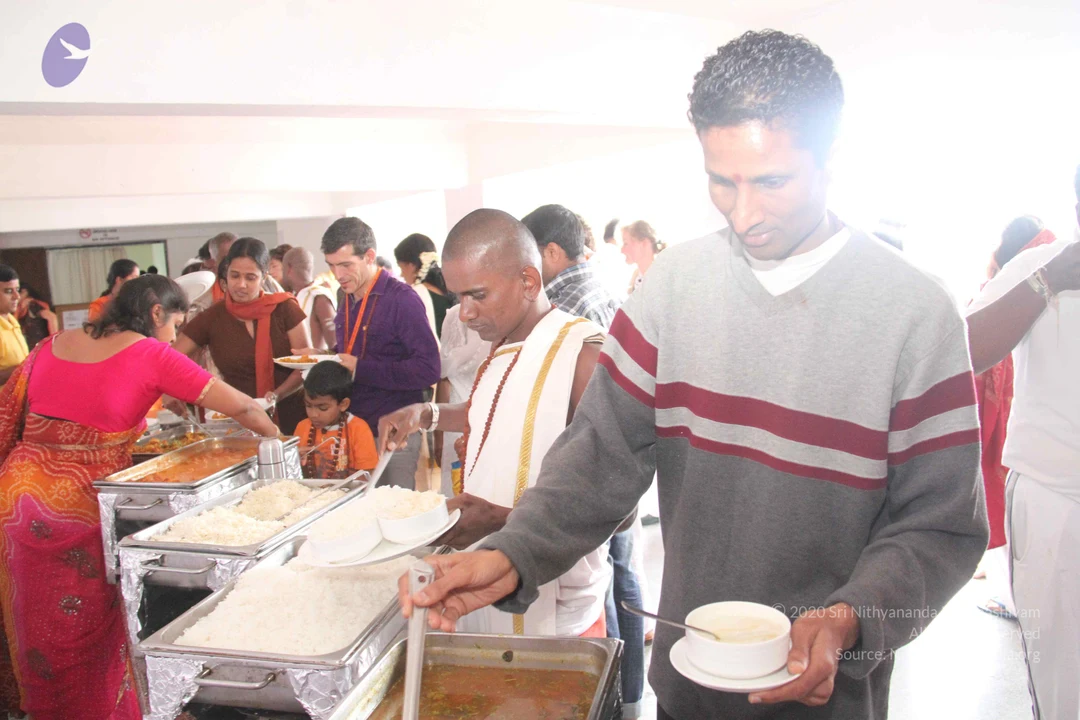
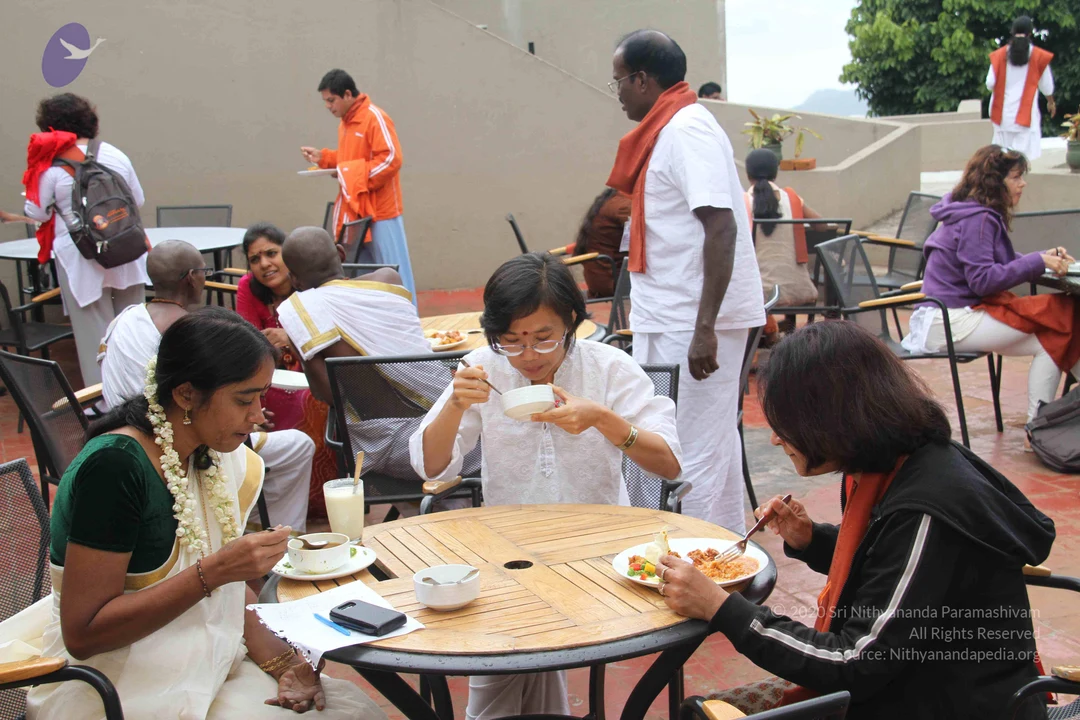
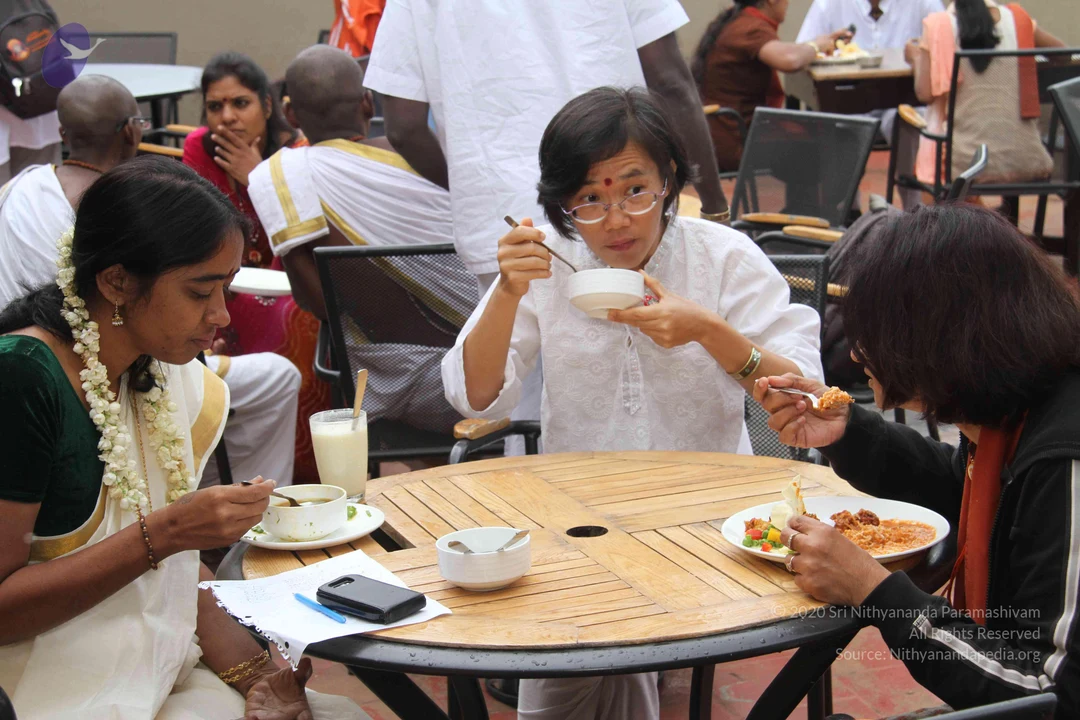
09-Lunch

Photos from this day

View all 526 photos

01-Pada-Puja
93 photosSource gallery
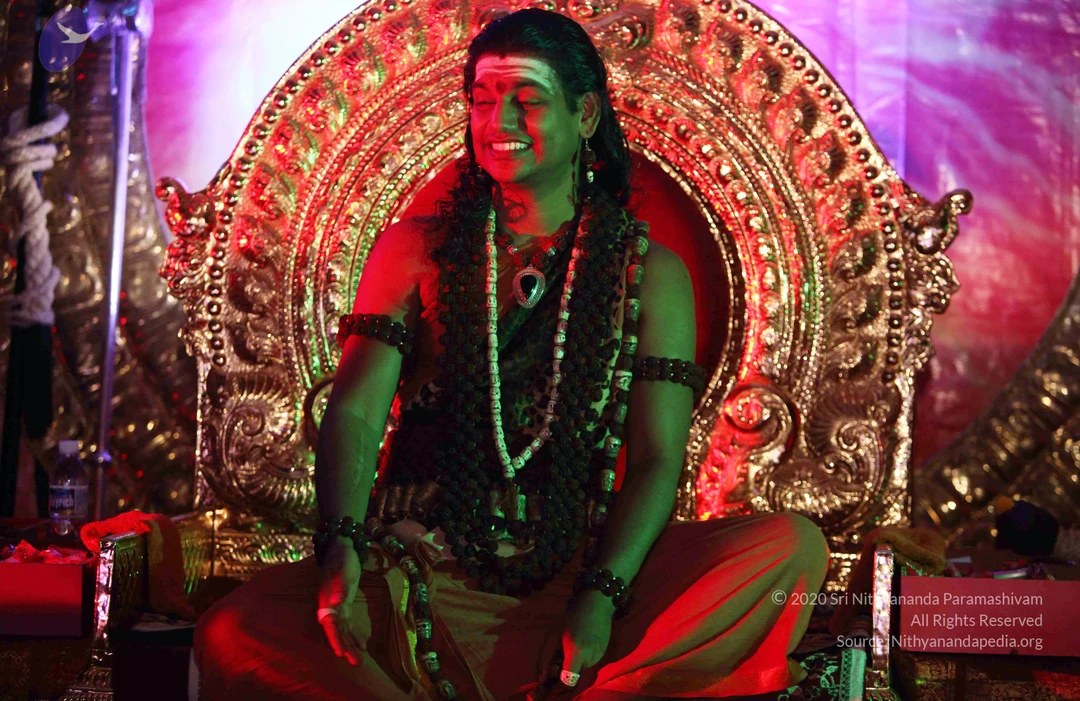
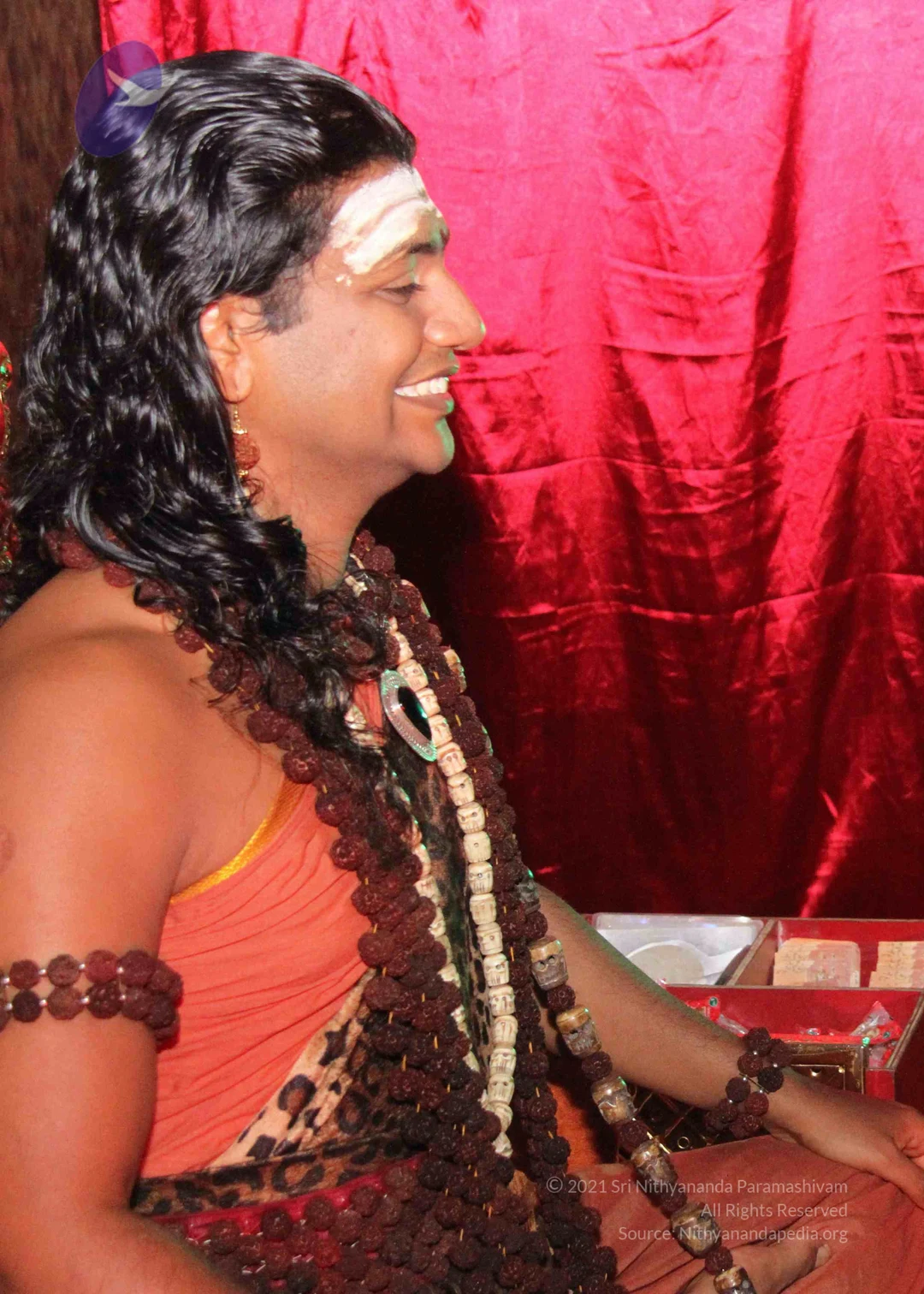
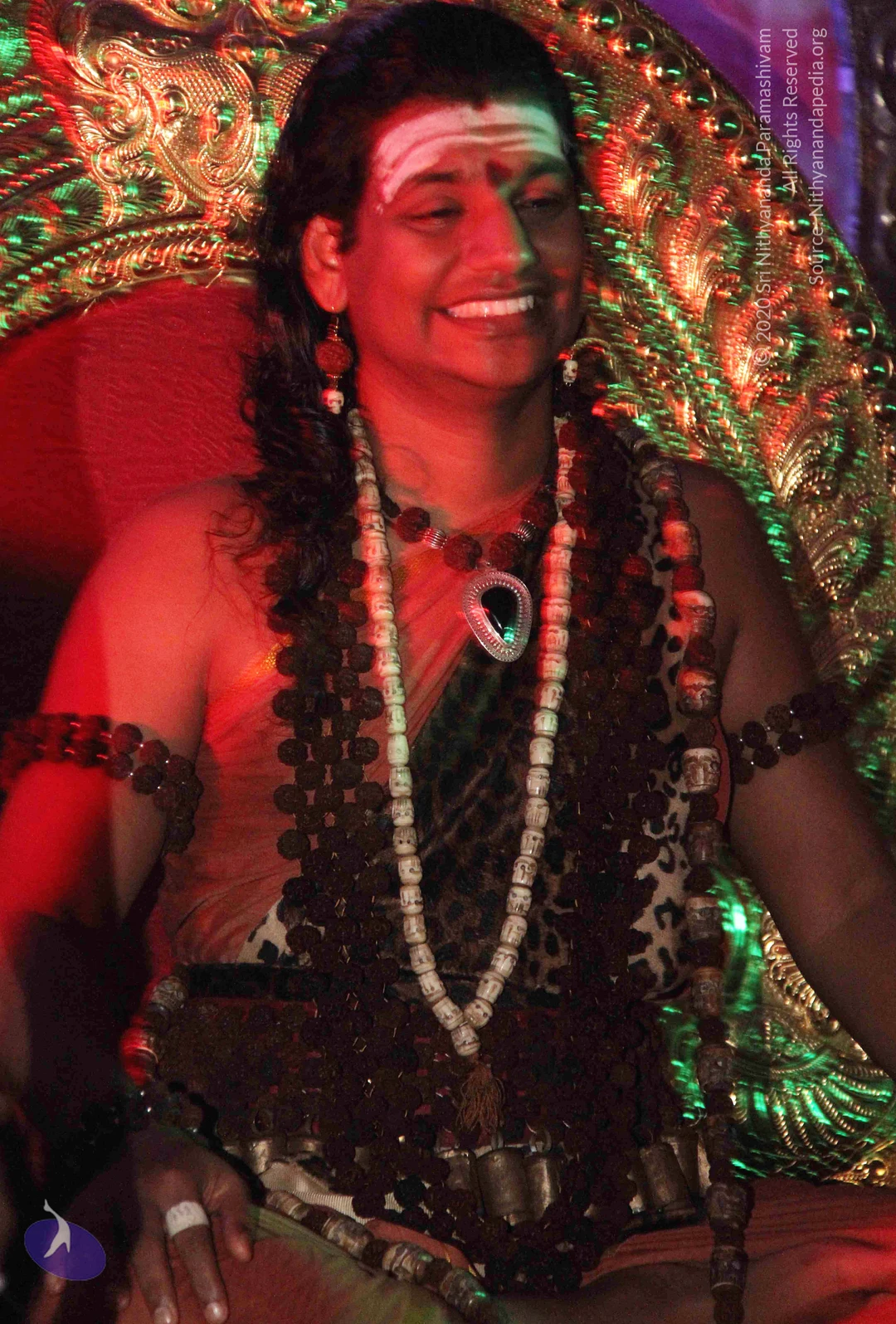
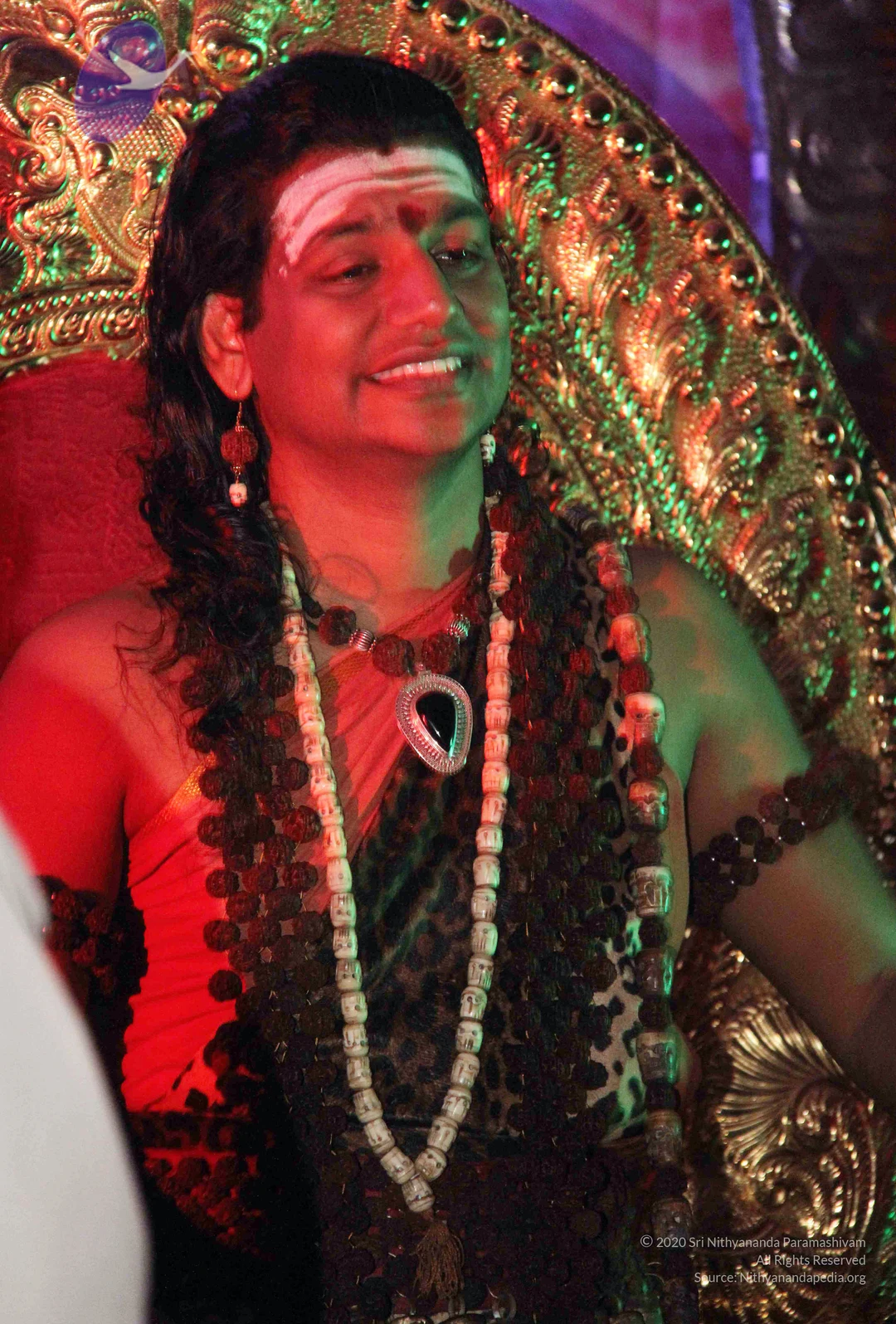
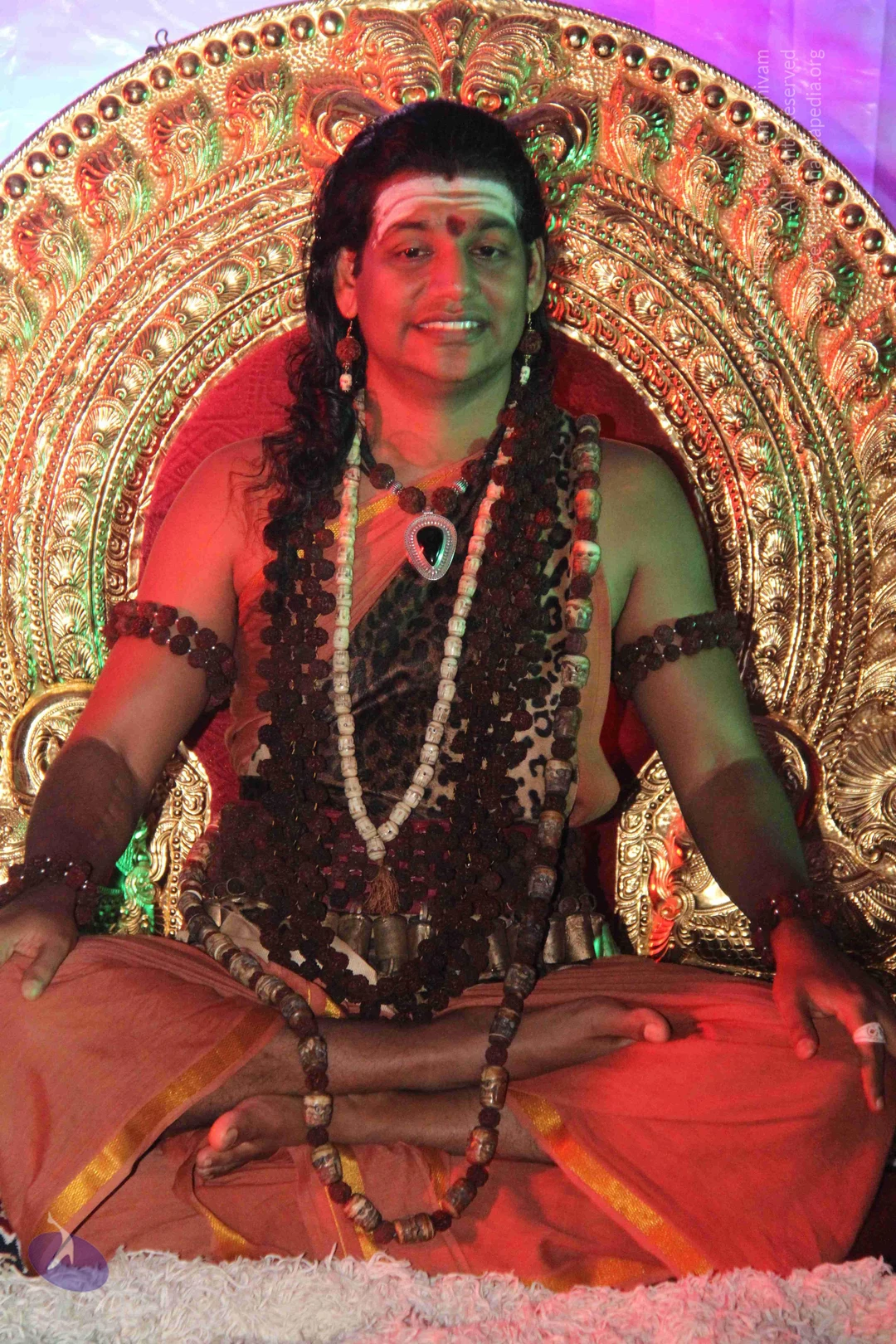
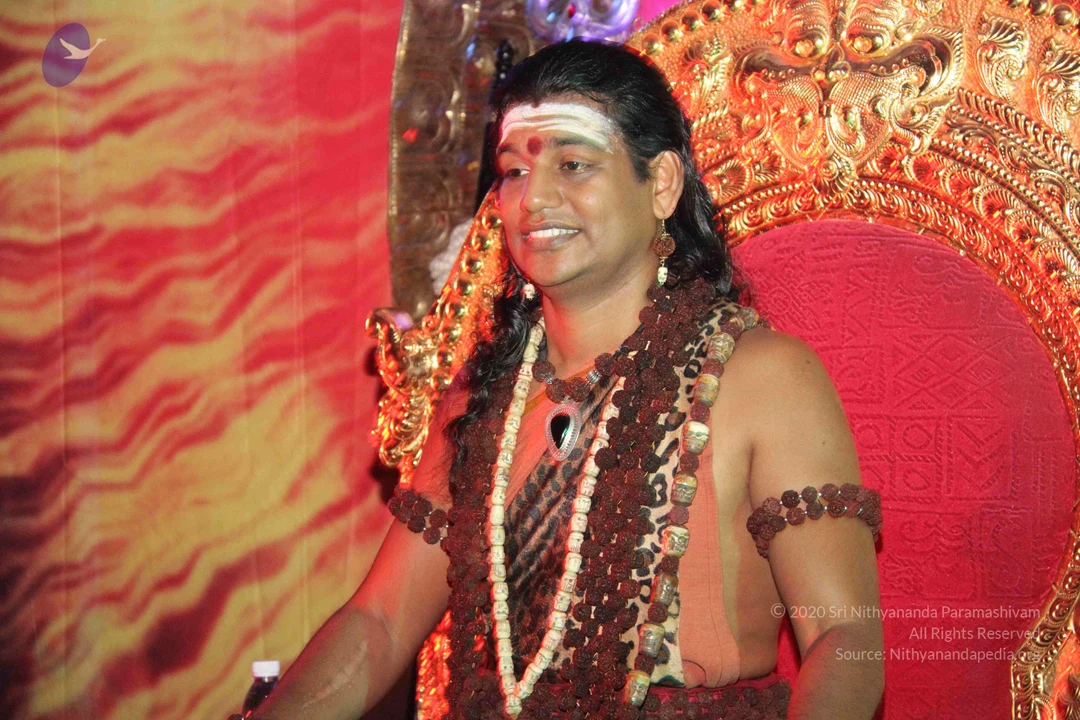
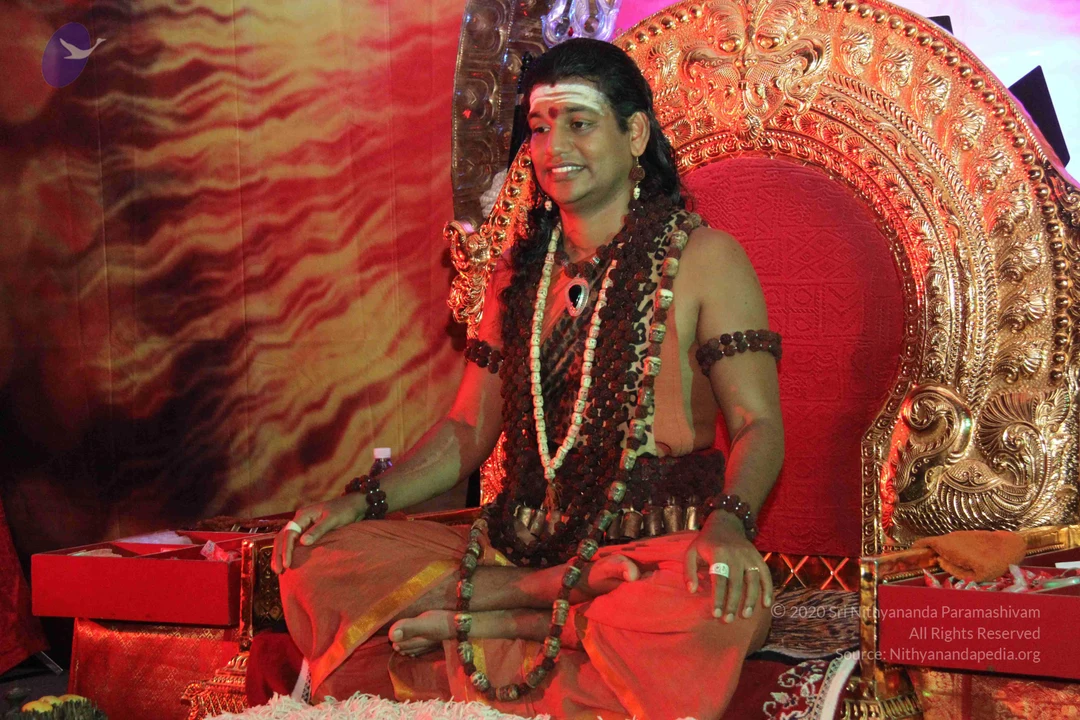
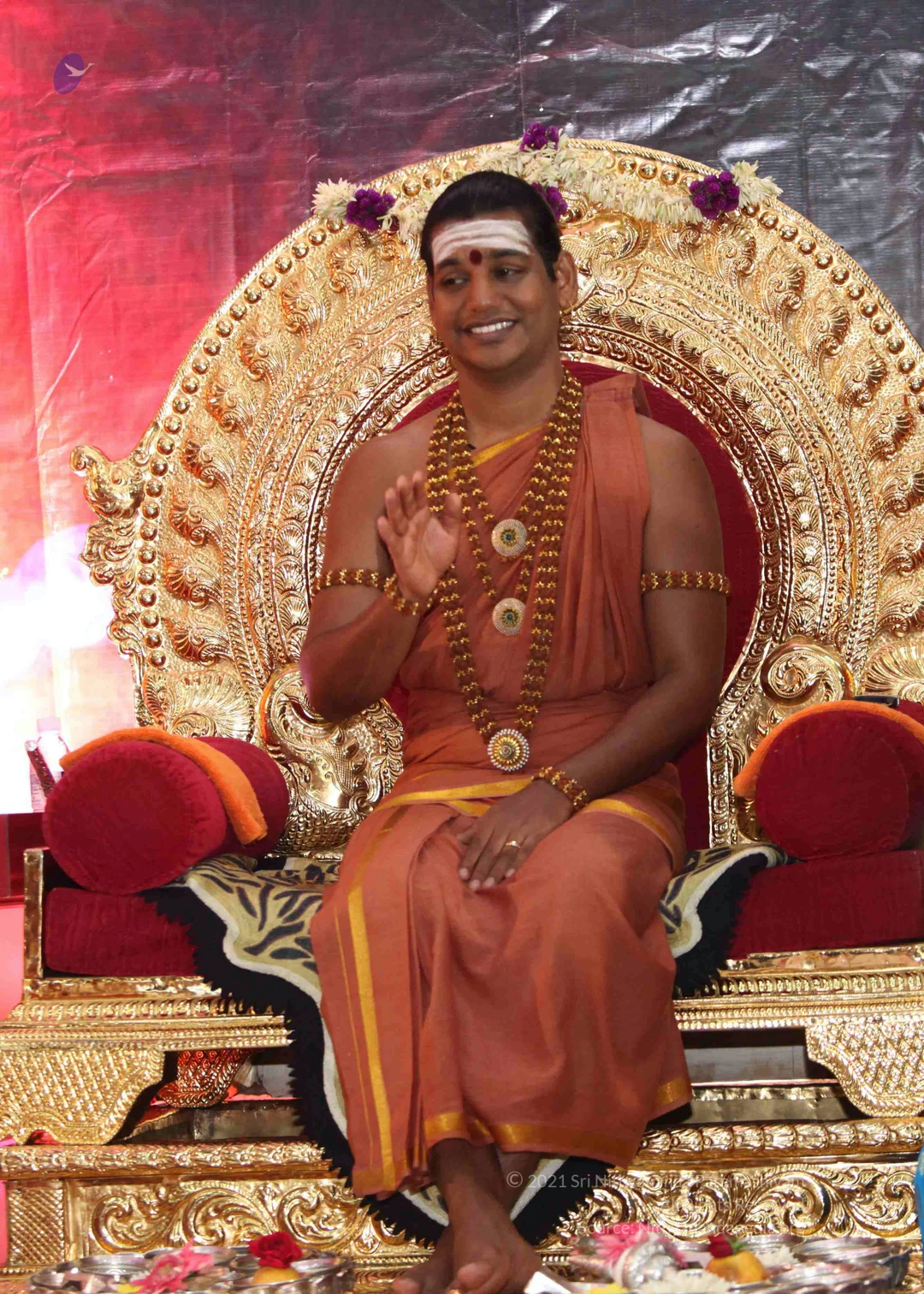
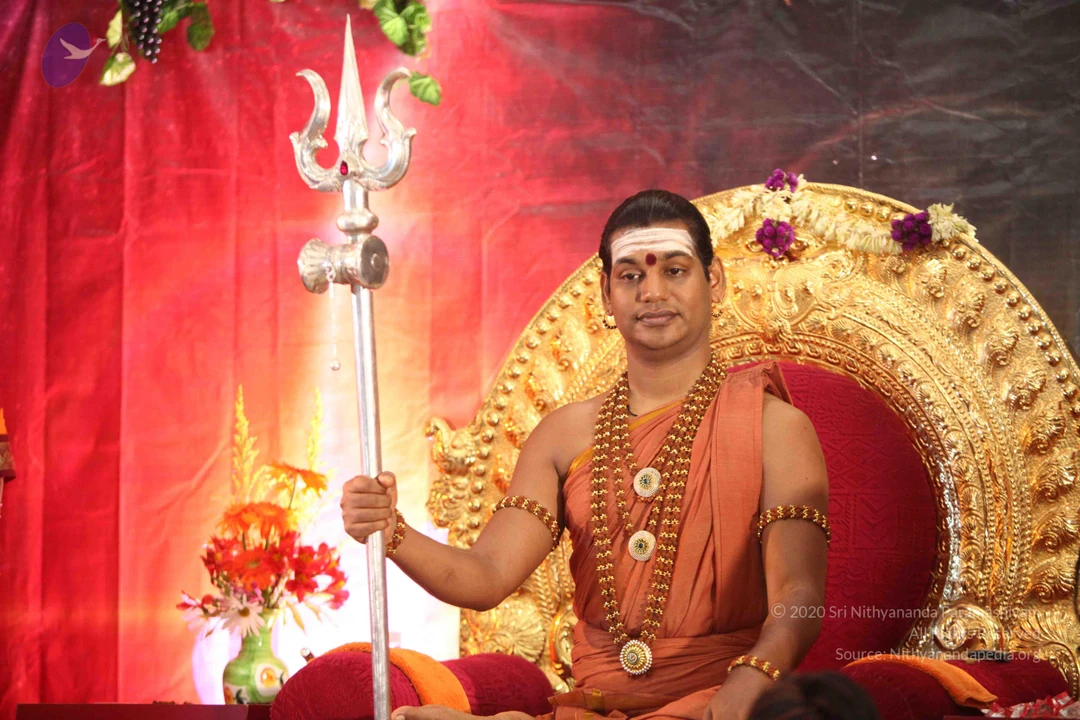
A man seated on an ornate gold throne with red velvet cushions, wearing an orange-saffron dhoti and shawl with gold borders, multiple long gold beaded necklaces with round medallions, gold armlets and a bracelet, and a white tilak with a red dot on his forehead. He raises one hand in a blessing or talking gesture while smiling. Purple and white flowers decorate the throne back, and brass plates with flowers and offerings sit at the bottom edge. A red and silver backdrop is behind him.A man in saffron-orange robes sits on an ornate gilded throne with red velvet cushions, raising his right hand in a blessing gesture while smiling. He wears a white sandalwood stripe with a red dot on his forehead, layered gold beaded necklaces with round pendants, and gold armbands. A garland of white and purple flowers rests above the chair. Marigold and lotus flowers and brass plates with offerings lie in the foreground. a person: long dark hair is not visible, but the saffron robes, gold garlands and throne are consistent with the page's account of a Kodaikanal satsang. He is alone in the frame.a person seated on an ornate gold throne with red cushions, a garland of purple and white flowers across the top of the throne back. He wears a saffron-orange robe with gold border, layered gold beaded necklaces with round medallions, gold armlets and bangles, and has a white urdhva pundra forehead mark with a red bindi. He smiles and raises one hand in greeting while seated at an event, with a red backdrop behind him.A smiling man in saffron-orange robes sits on an ornate gold throne with a red cushion, raising his right hand in a gesture of talking or blessing. He wears layered rudraksha and gold-bead malas with large green-and-white medallions, rudraksha armbands and a gold bracelet, plus a white vertical tilak with a red bindi on his forehead. Purple and white flowers decorate the top of the throne, and a tiger-striped cloth covers the armrest. The setting appears to be a satsang discourse. a person: the orange robes, rudraksha malas and ceremonial gold ornaments are compatible with the page's description, though his face is not used for identification.A man in saffron-orange robes sits on an ornate gilded throne with red cushions, decorated with flowers at its top. He wears a white tilak across his forehead with a red dot, multiple long beaded necklaces and large round gold-and-green pendants, plus gold armbands. He smiles and raises one hand in blessing against a red and grey backdrop. Probable Swamiji by appearance: long swept-back hair, saffron clothing, rudraksha-style beads and ceremonial gold ornaments, seated in an honorific role during a satsang setting.A seated man in an orange-saffron dhoti-style garment with a matching shawl draped over his shoulder sits on an ornate gilded throne with red cushions and a carved arched back. He wears layered gold-coloured necklaces with green-and-white medallions, gold armbands and bangles, and a white sacred ash marking with a red bindi on his forehead. Purple flowers and white blossoms decorate the top of the throne. He smiles and raises his right hand in a blessing gesture against a red and grey backdrop. Appearance-based candidate: a person, seated on a throne with saffron robe, rudraksha-style gold necklaces and ceremonial adornments, shown in person.
02-Morning-Satsang
145 photosSource gallery
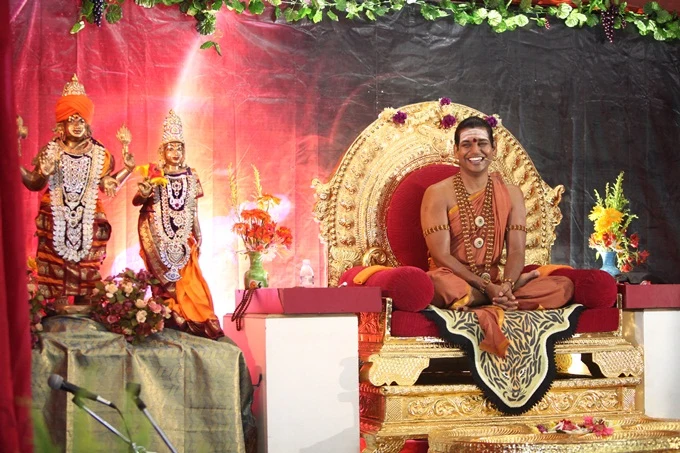
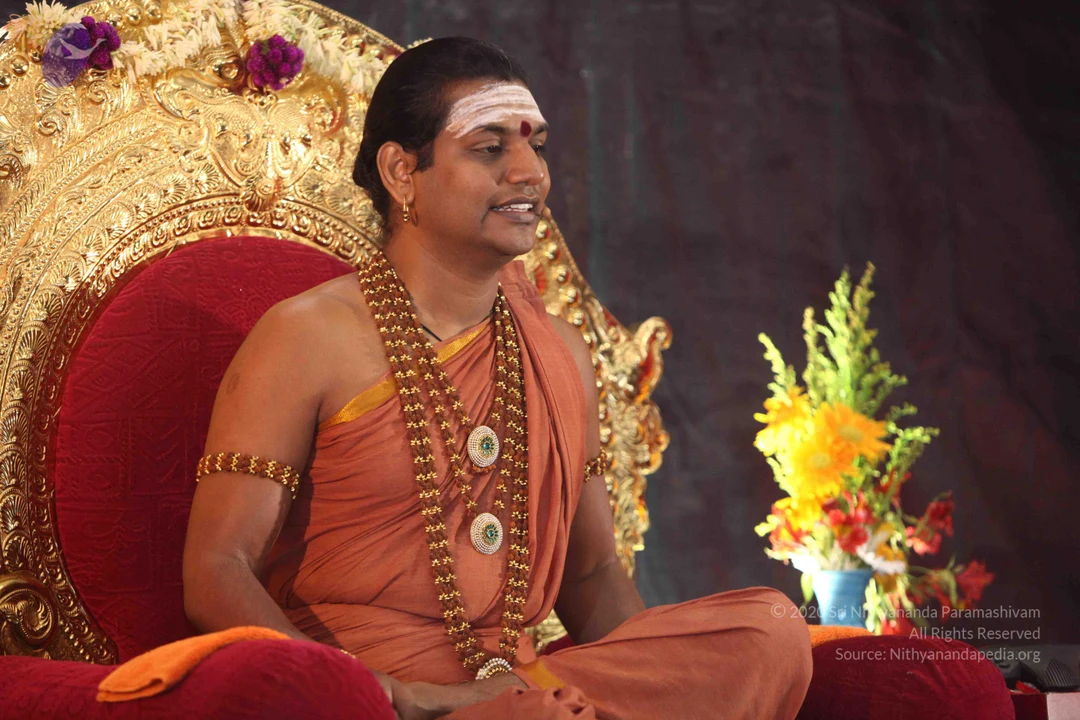
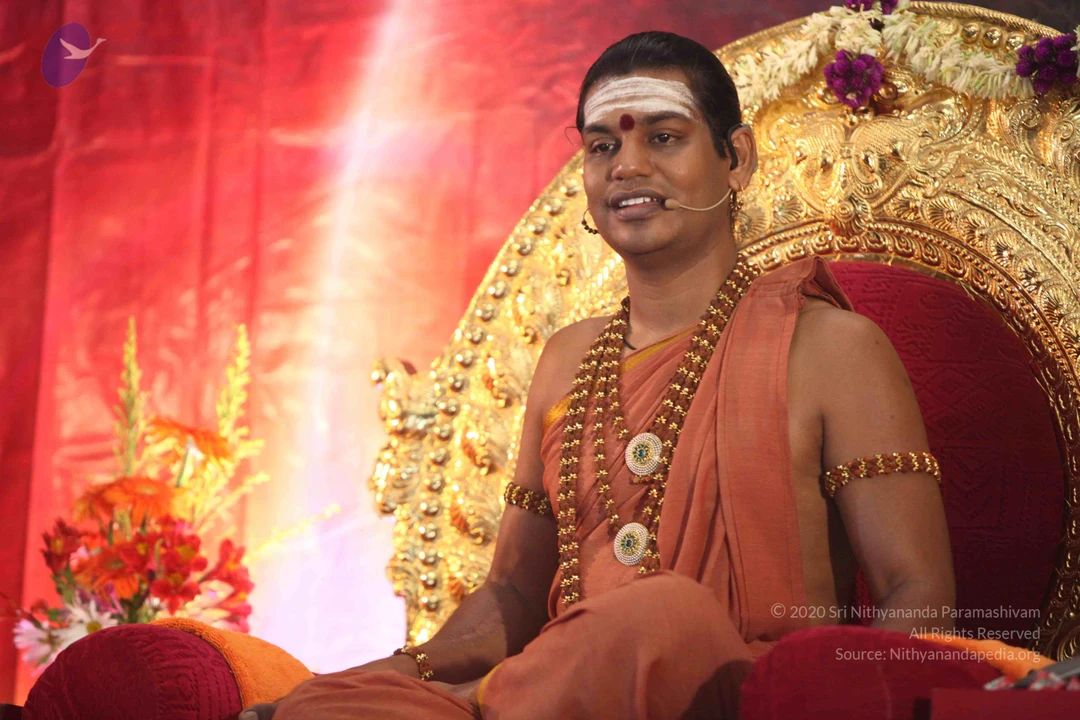
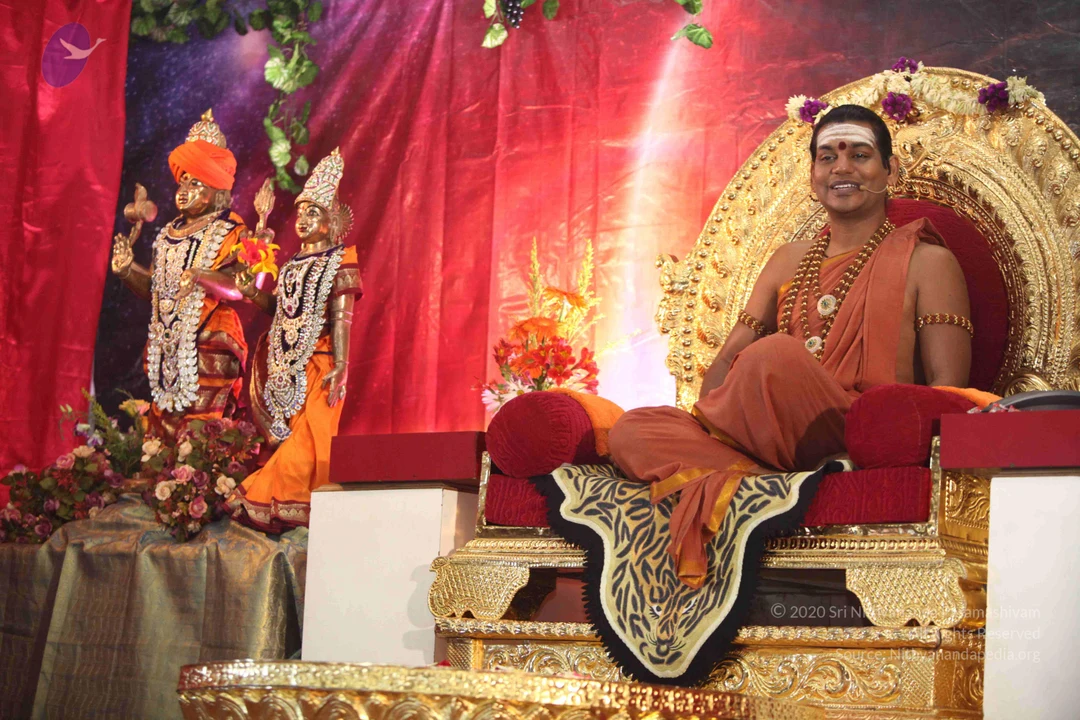
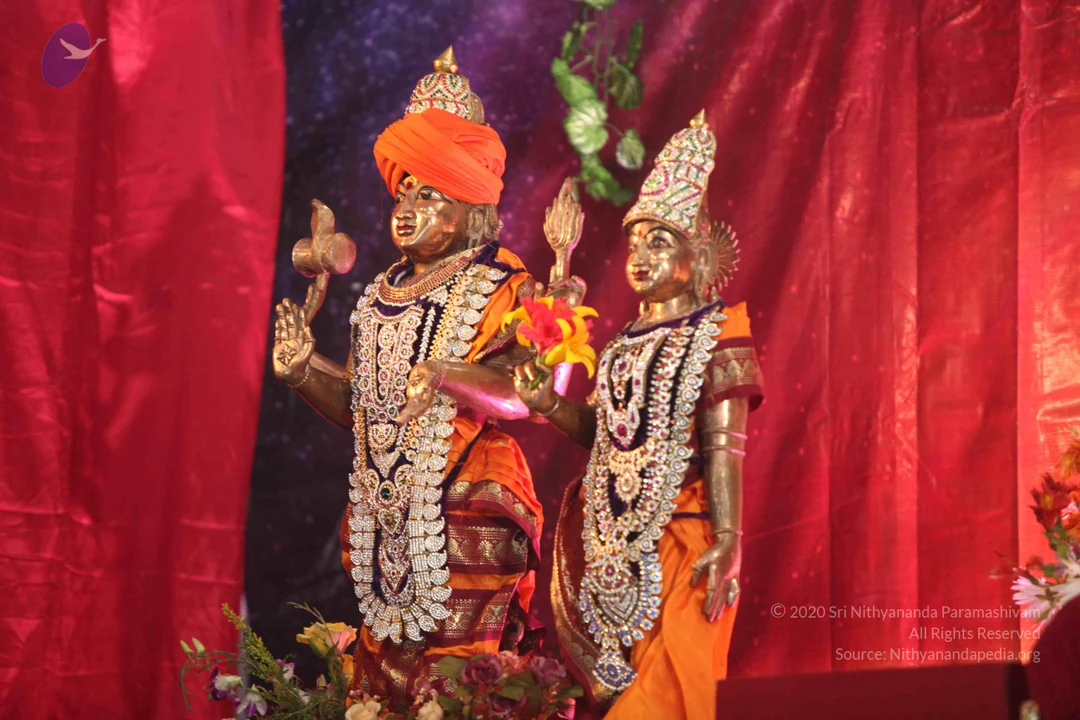
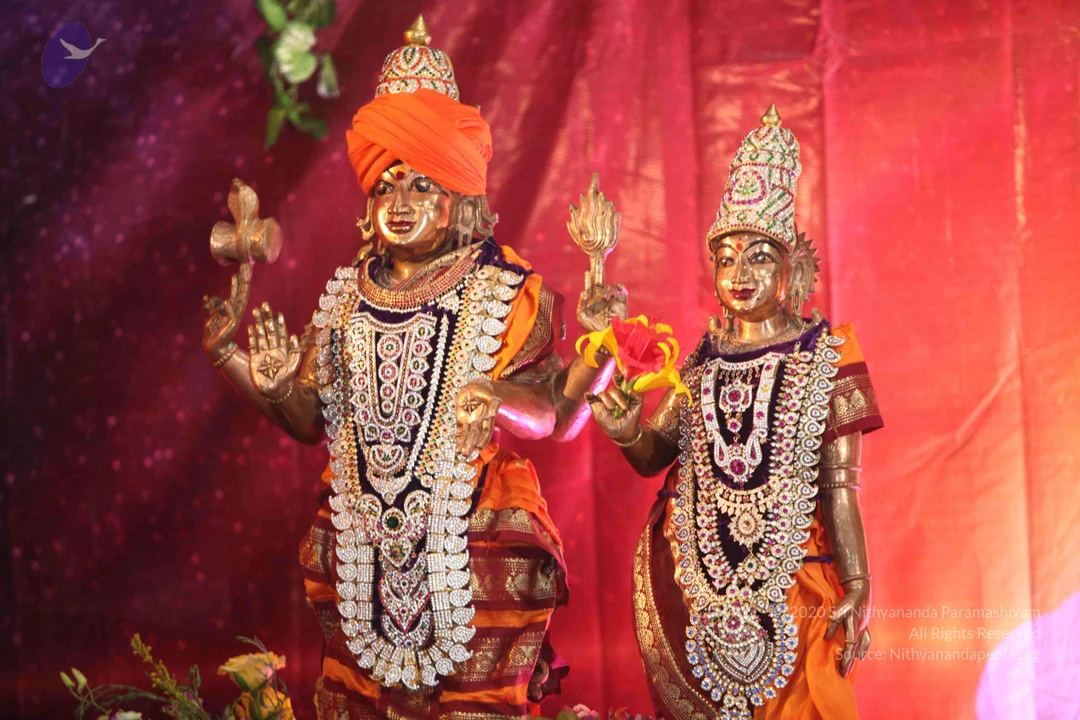
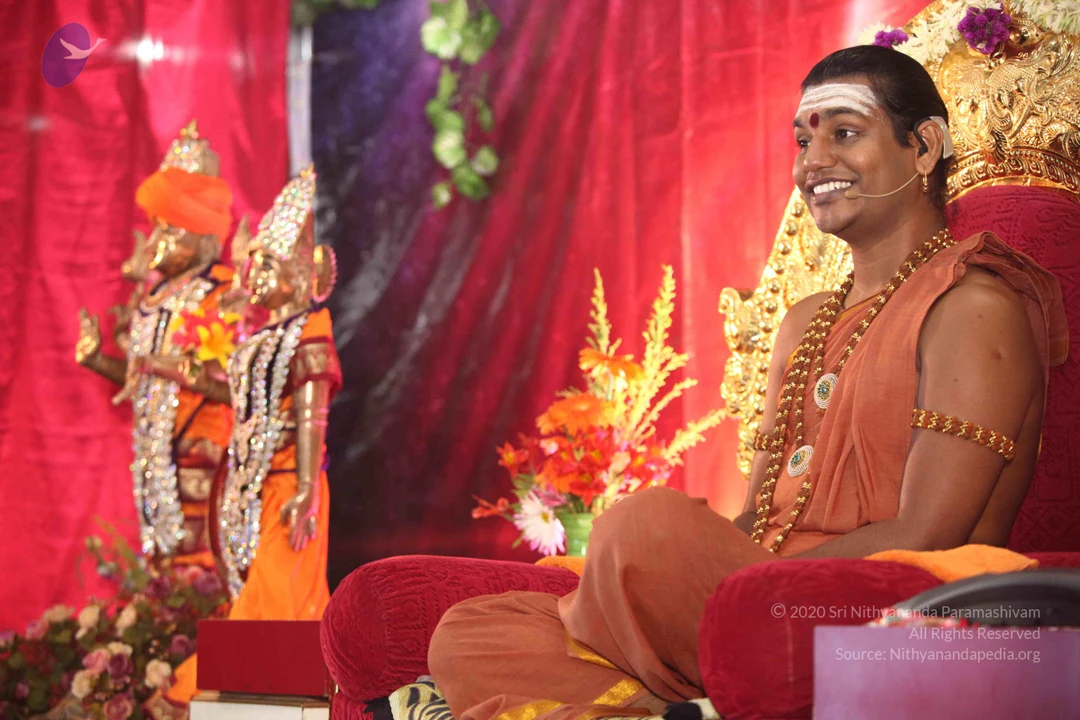
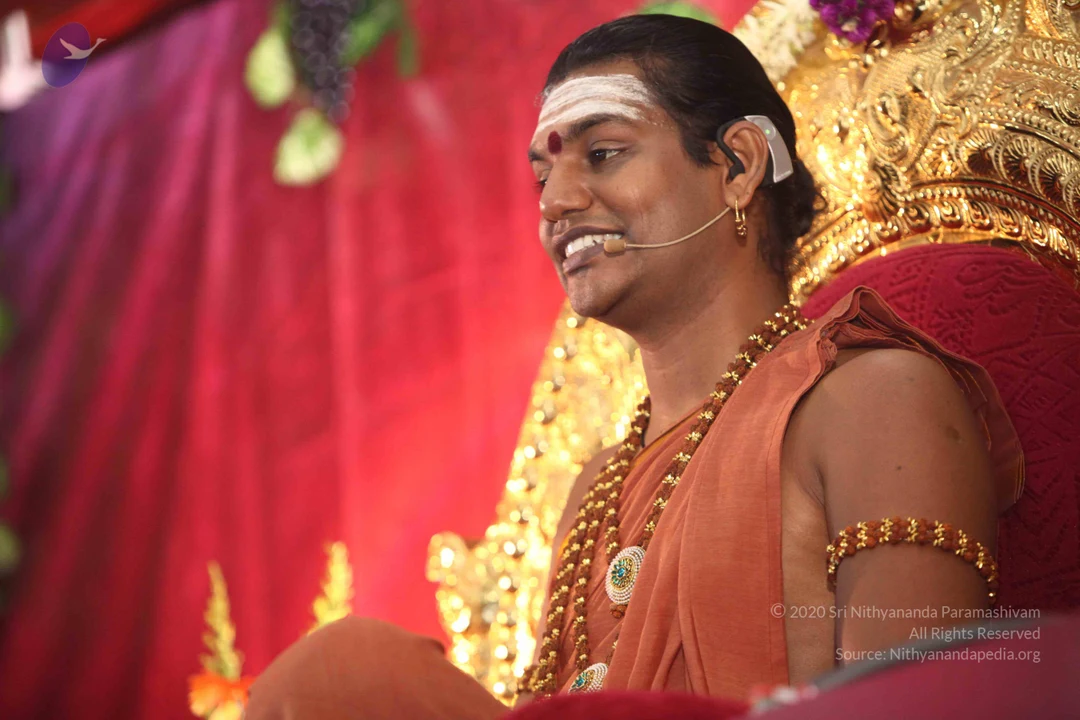
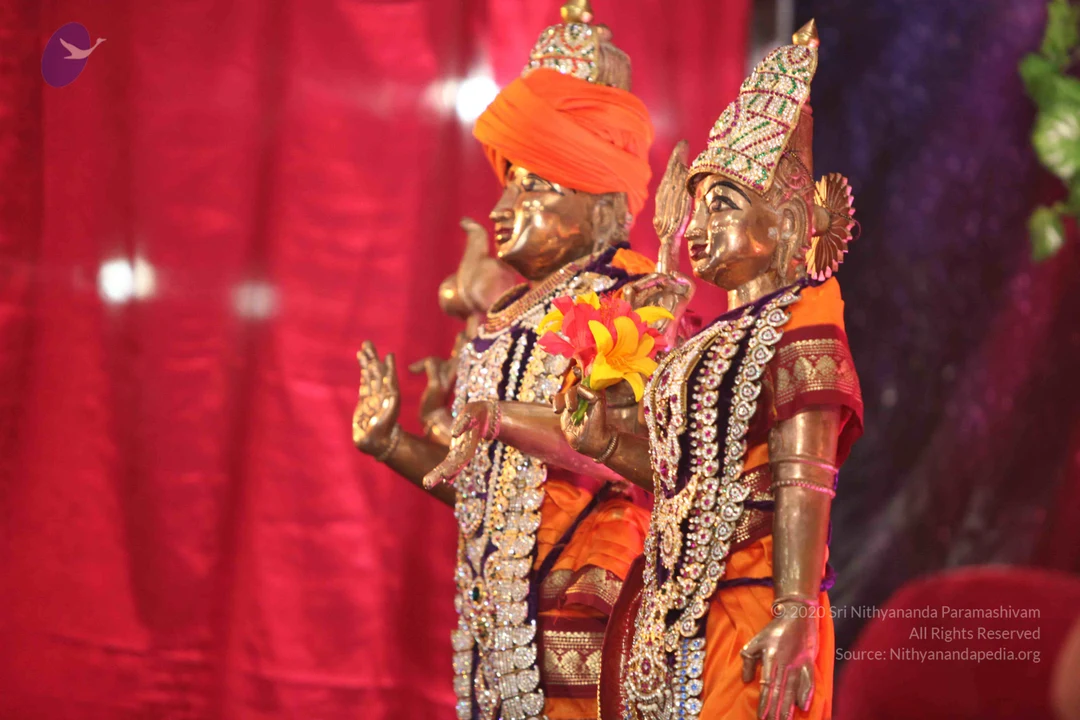
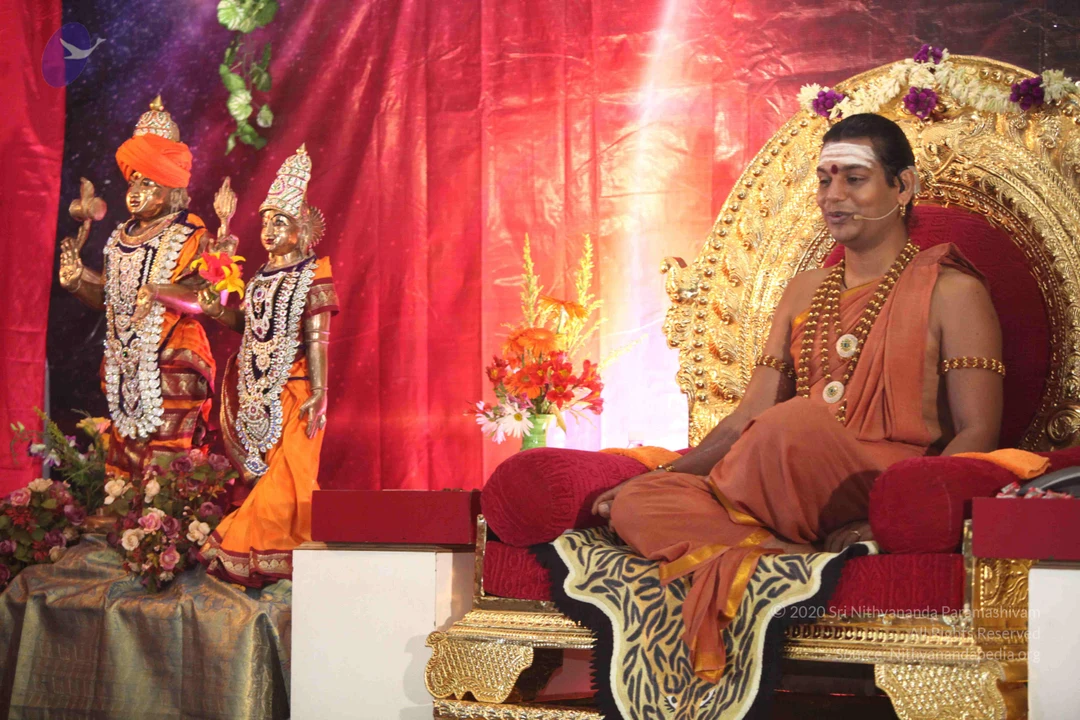
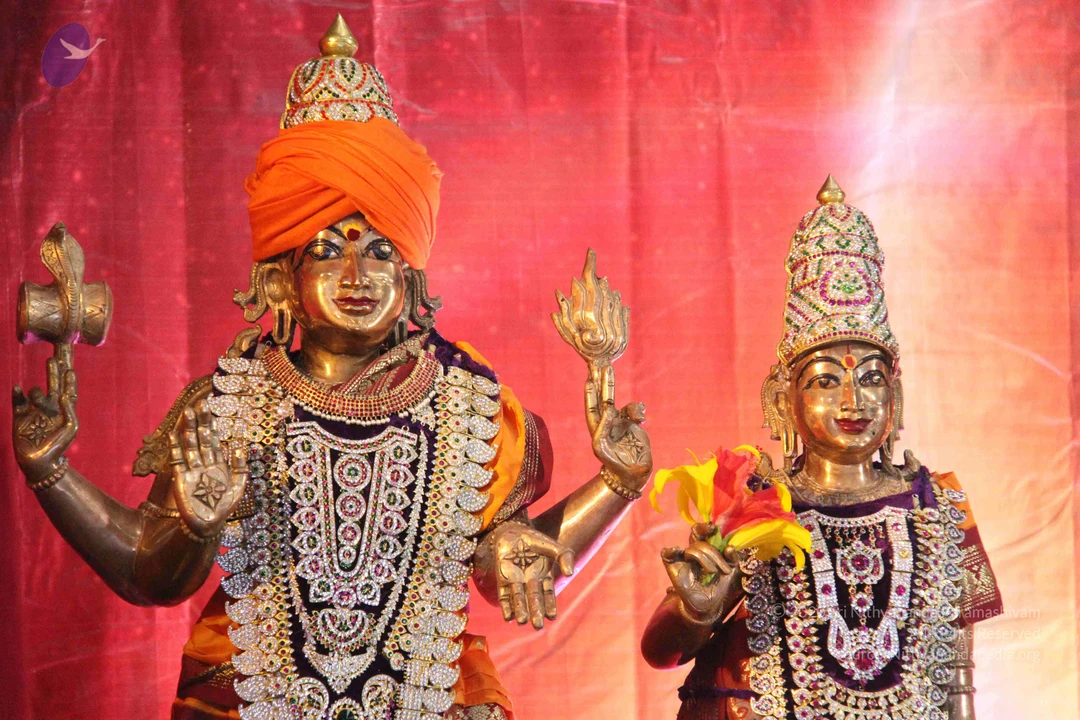
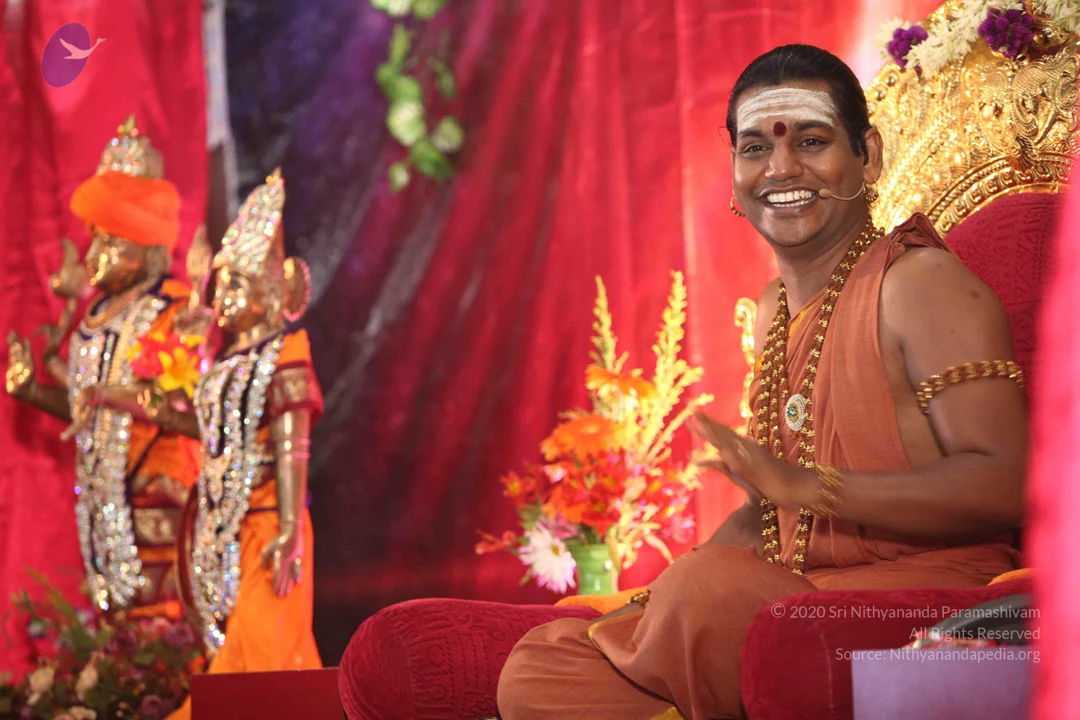
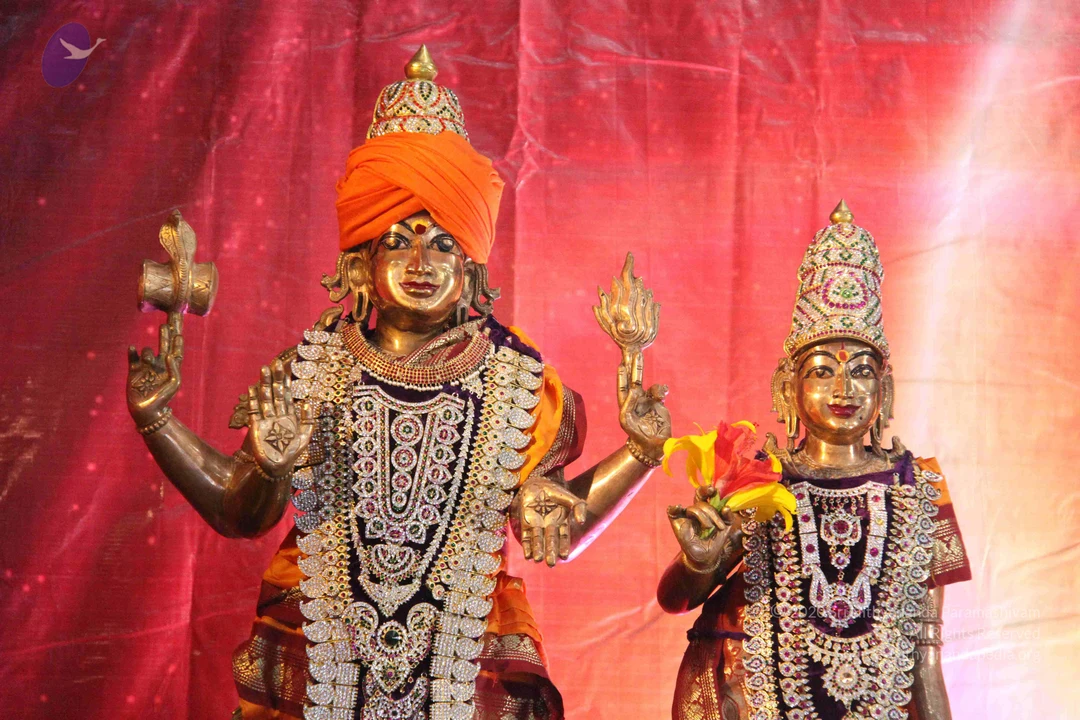
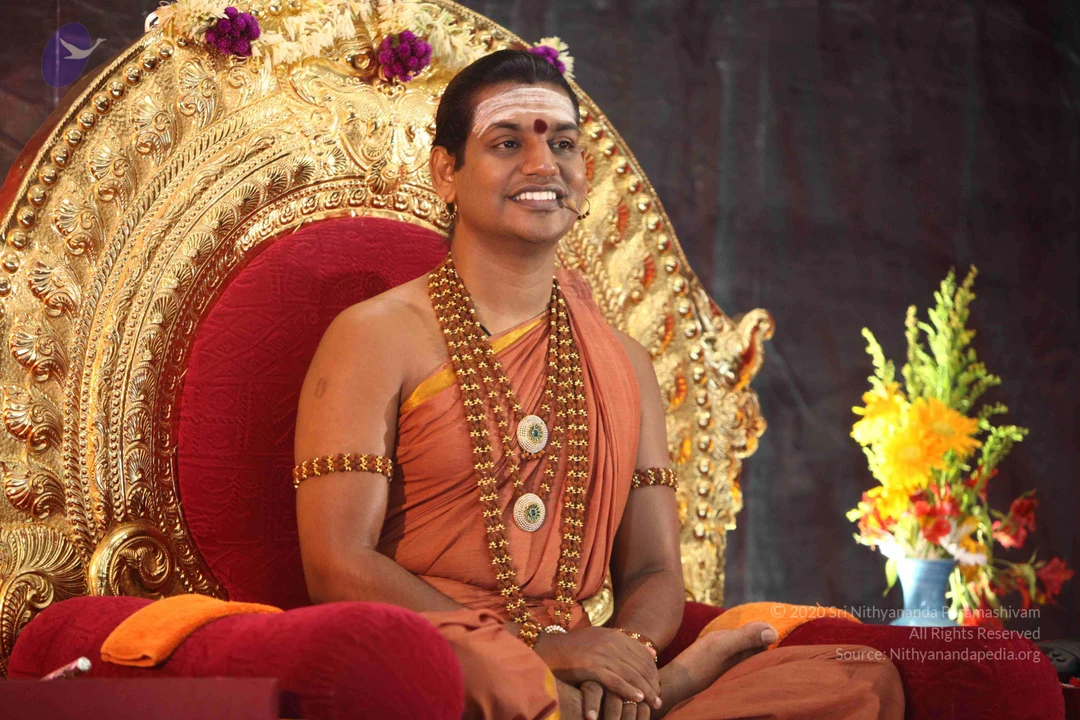
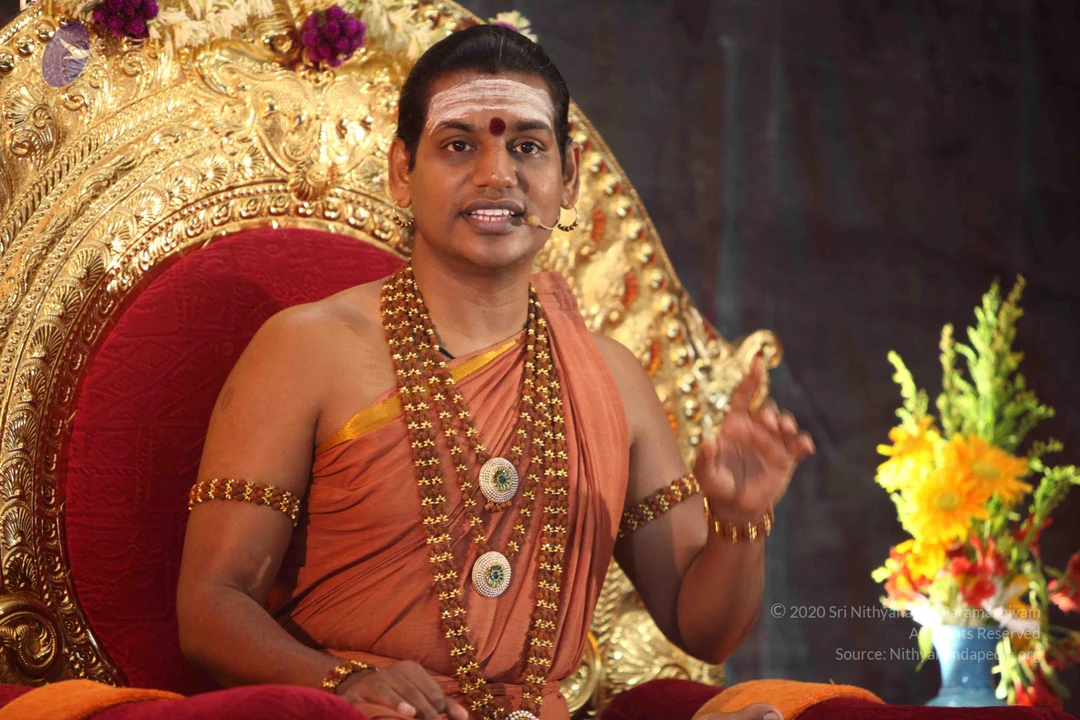
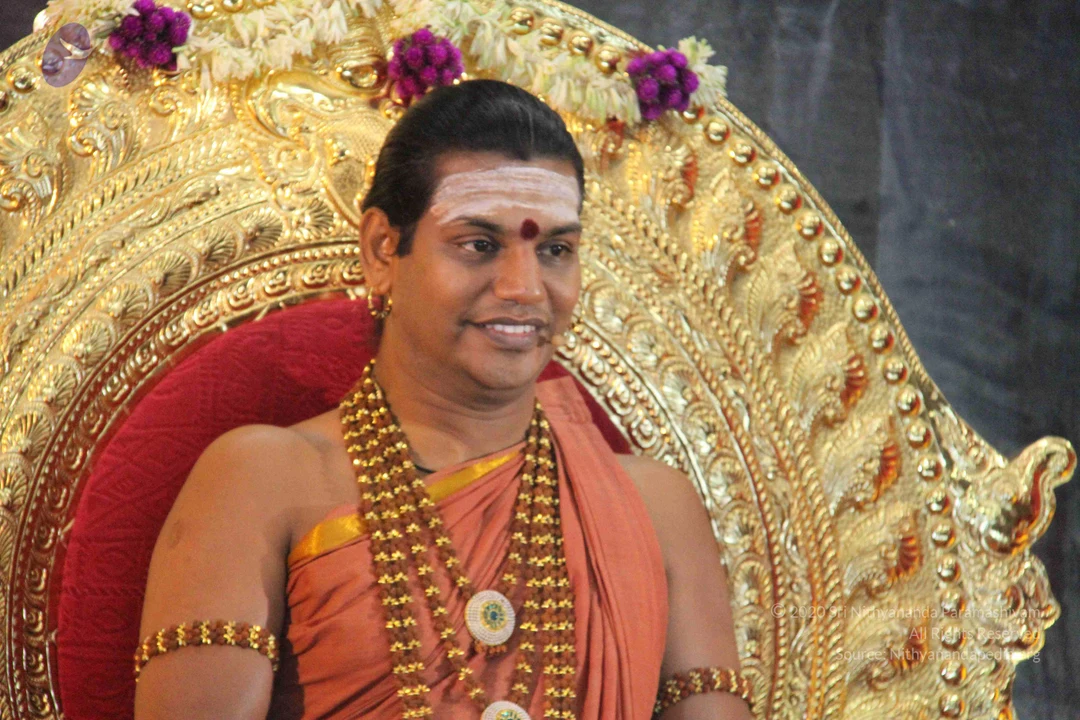
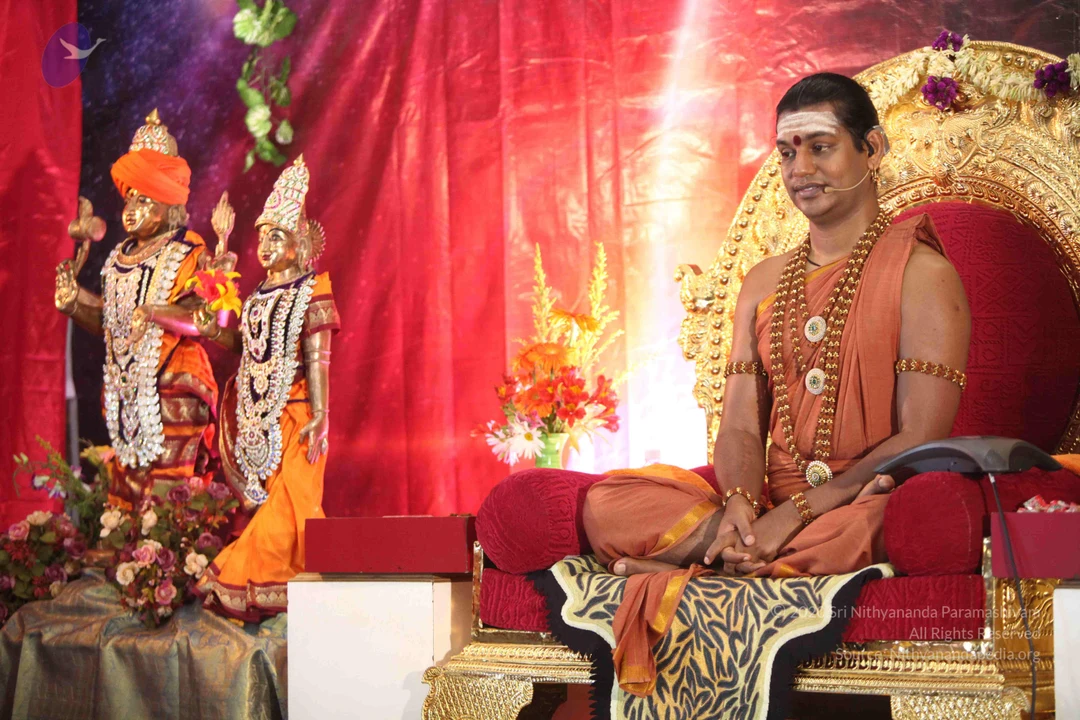
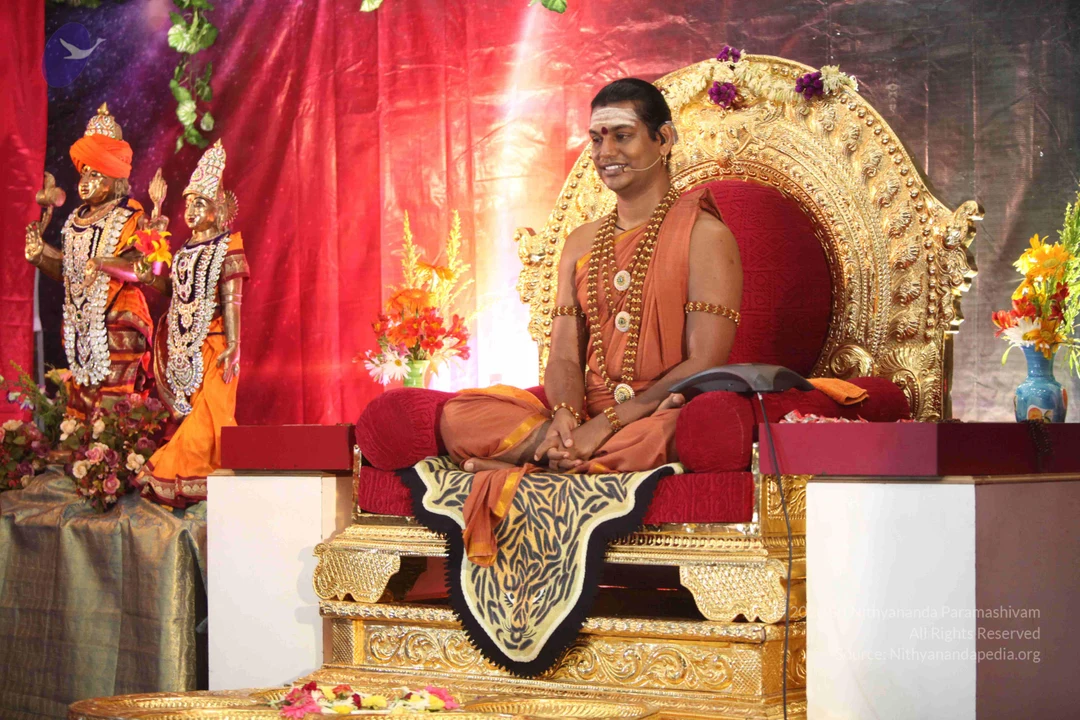
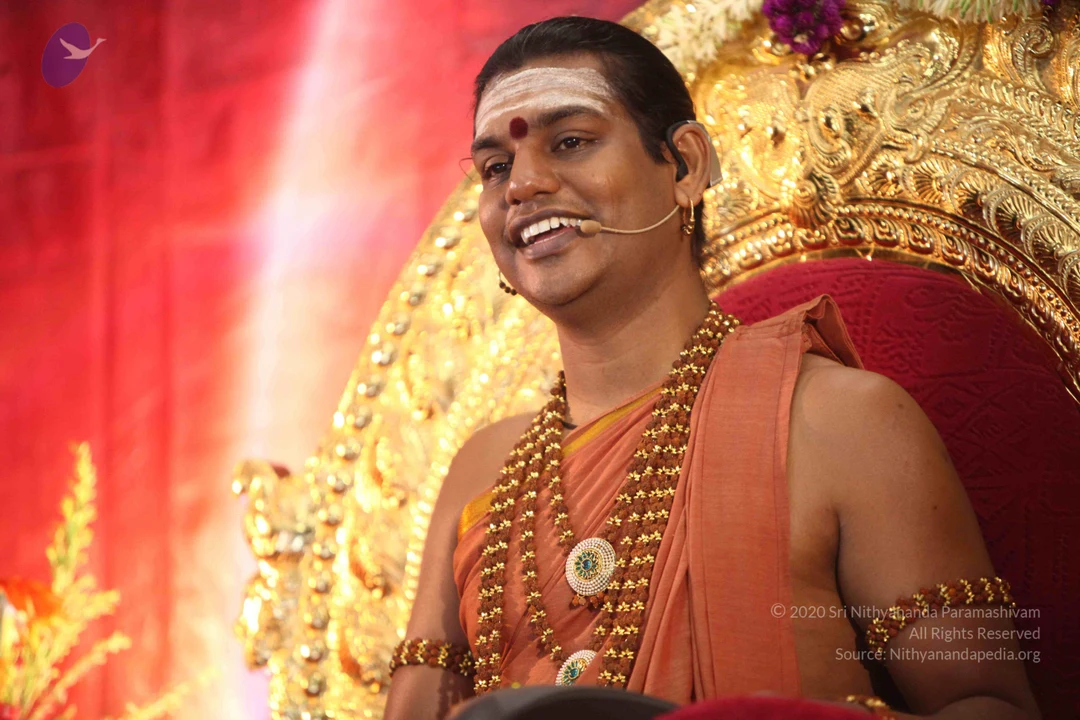
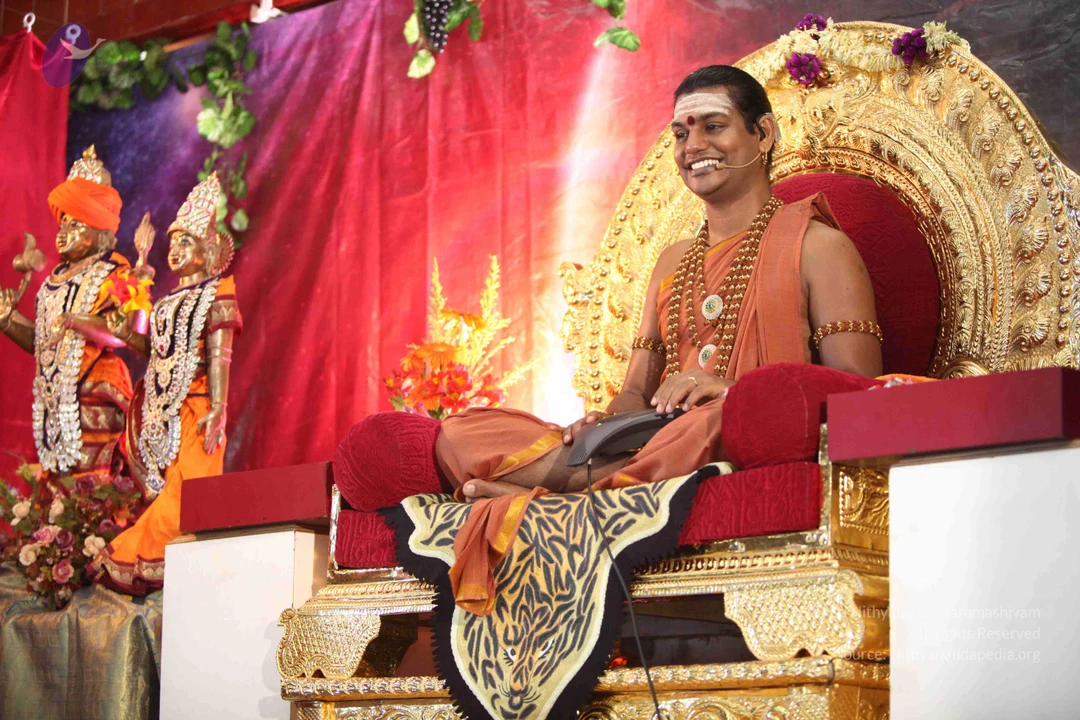
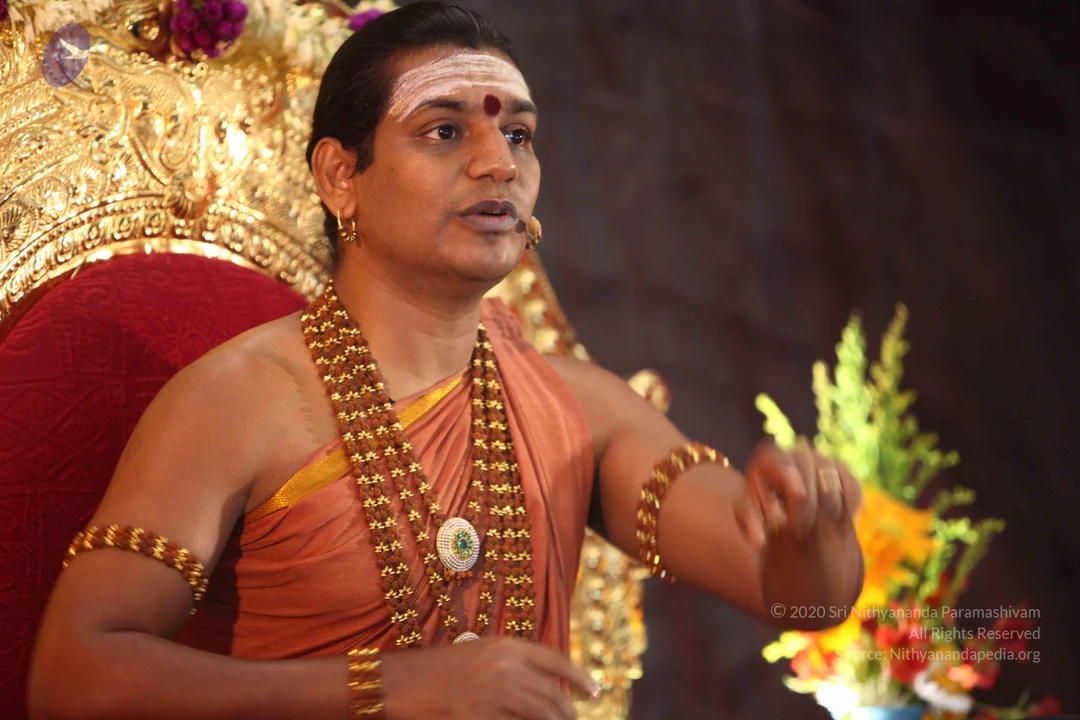
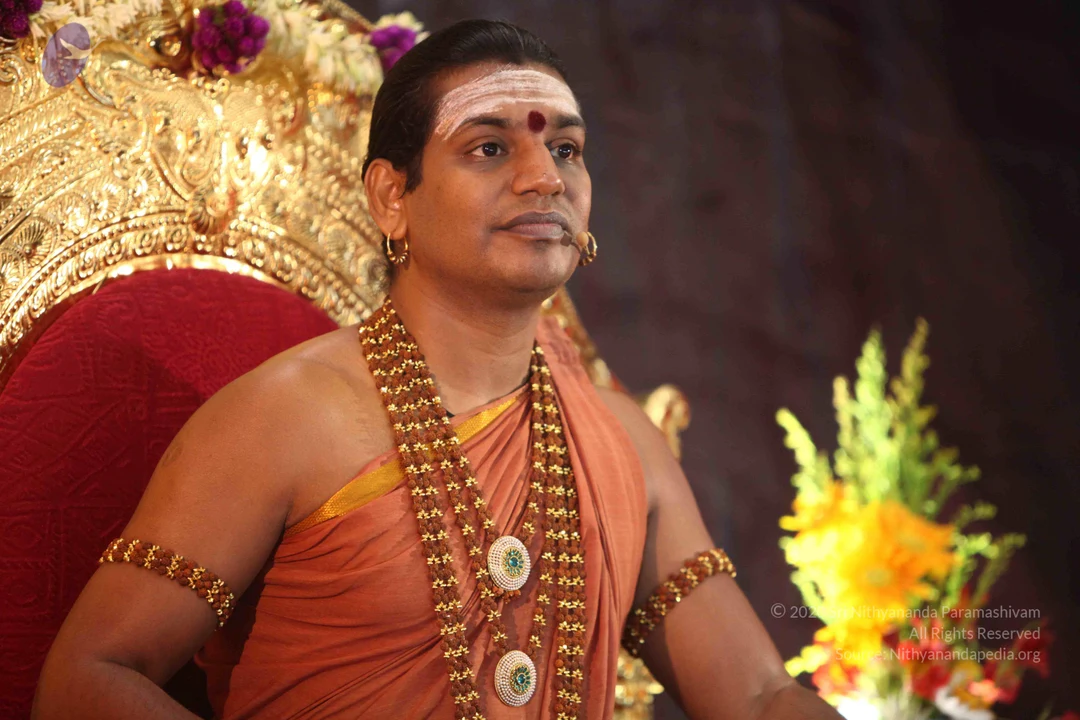
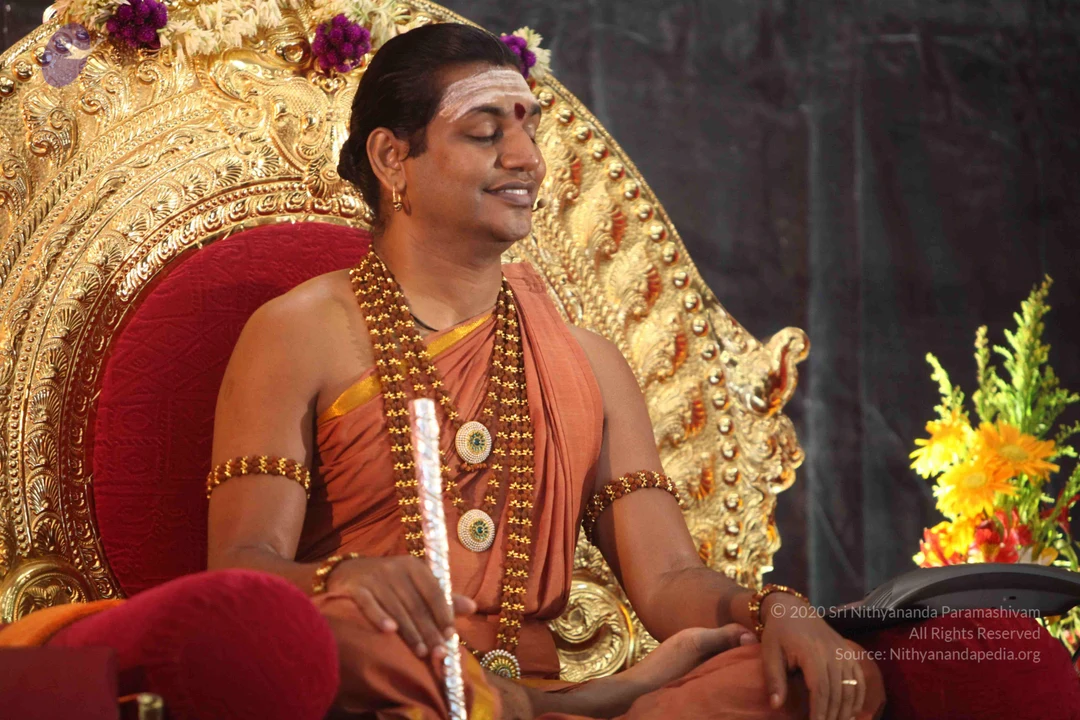
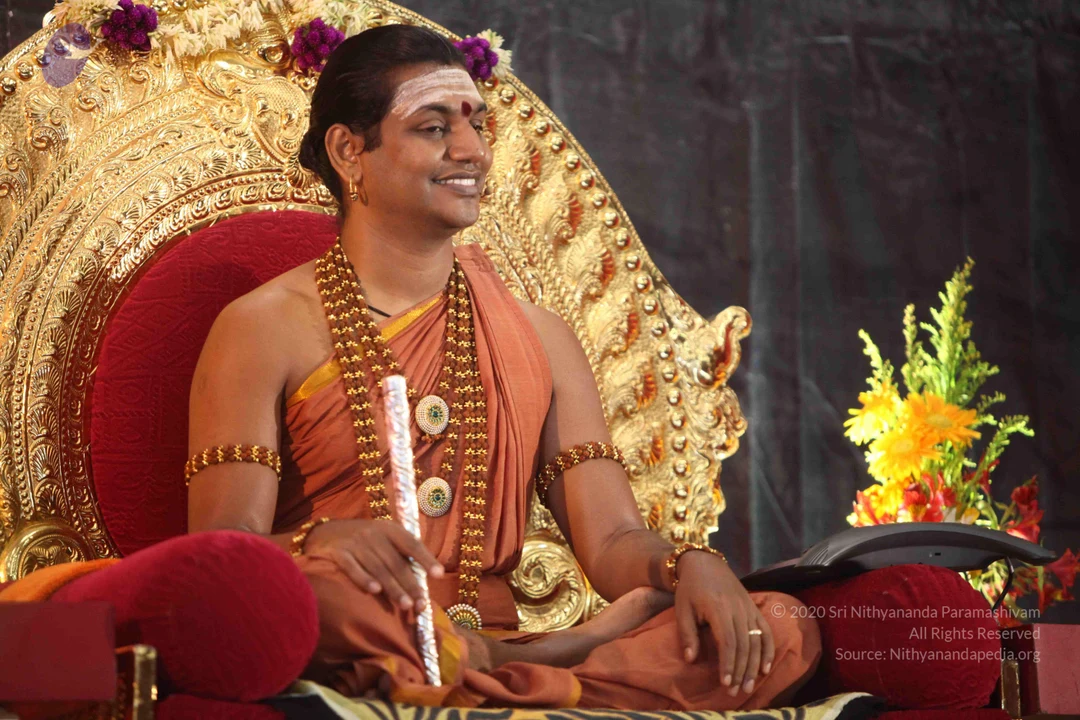
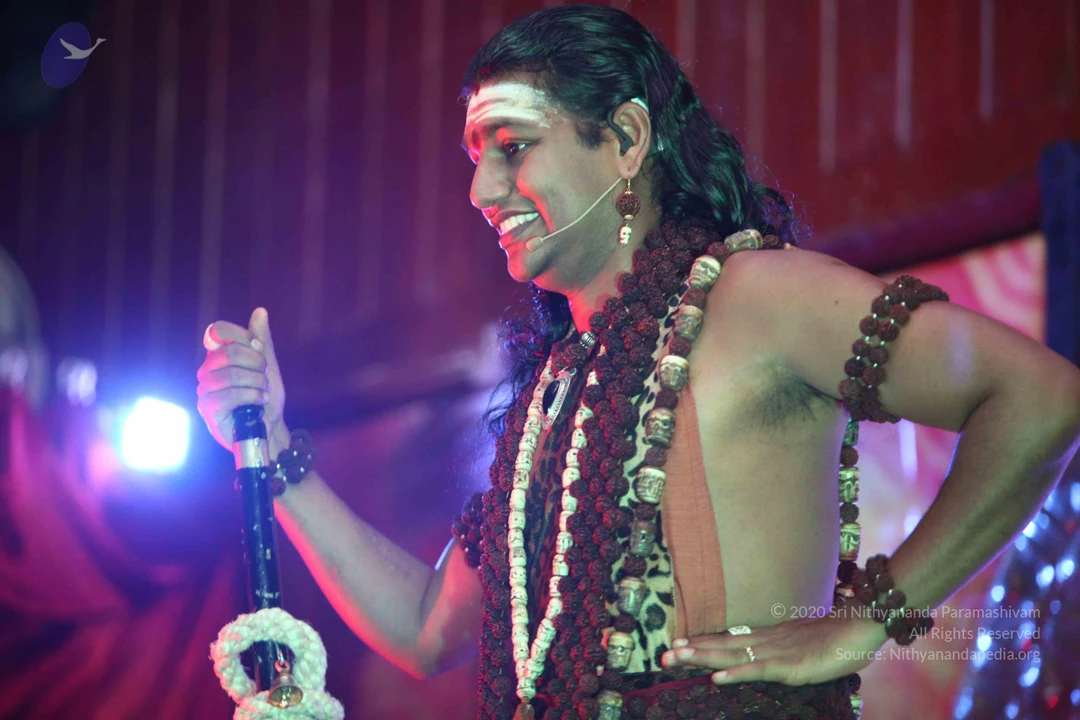
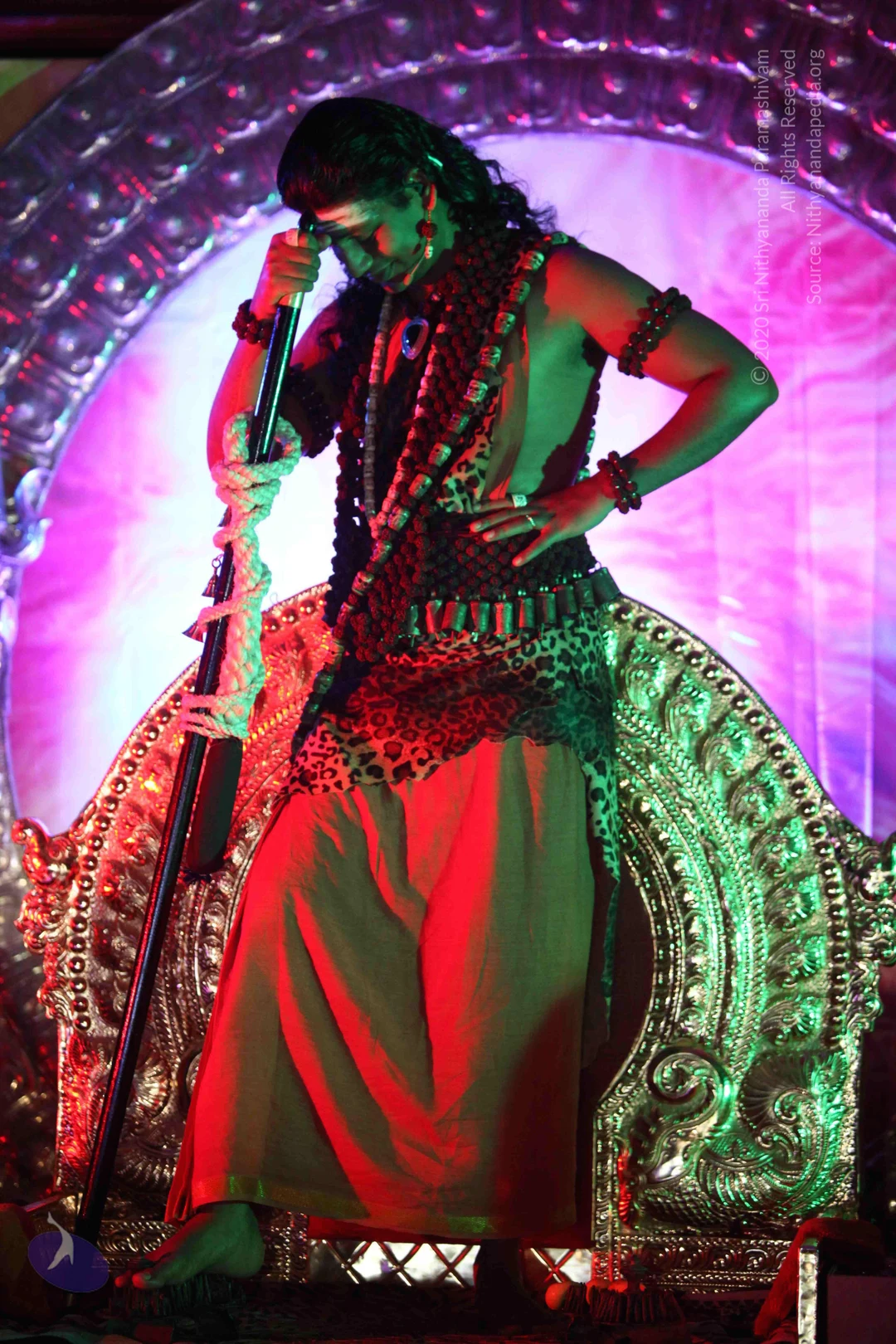
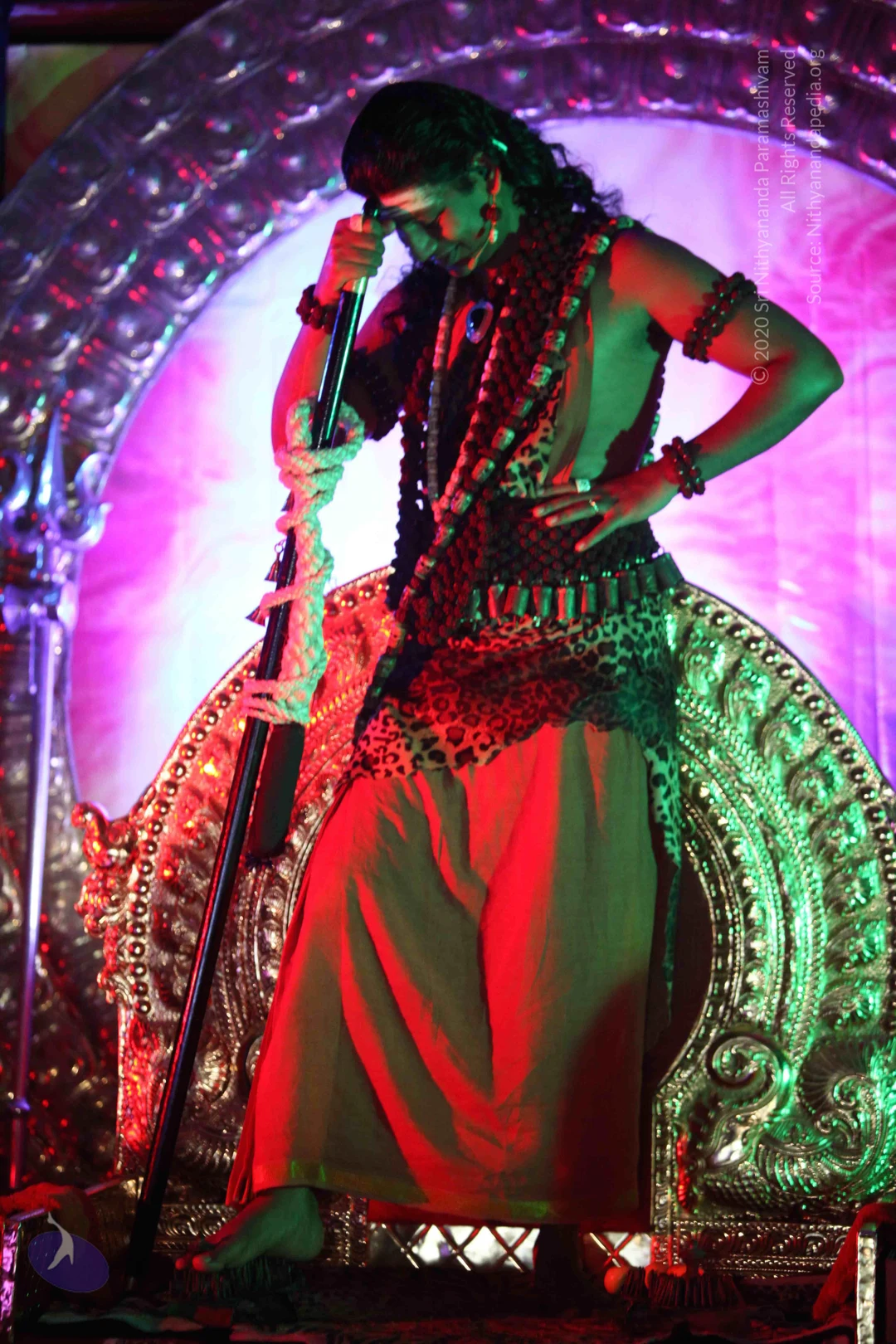
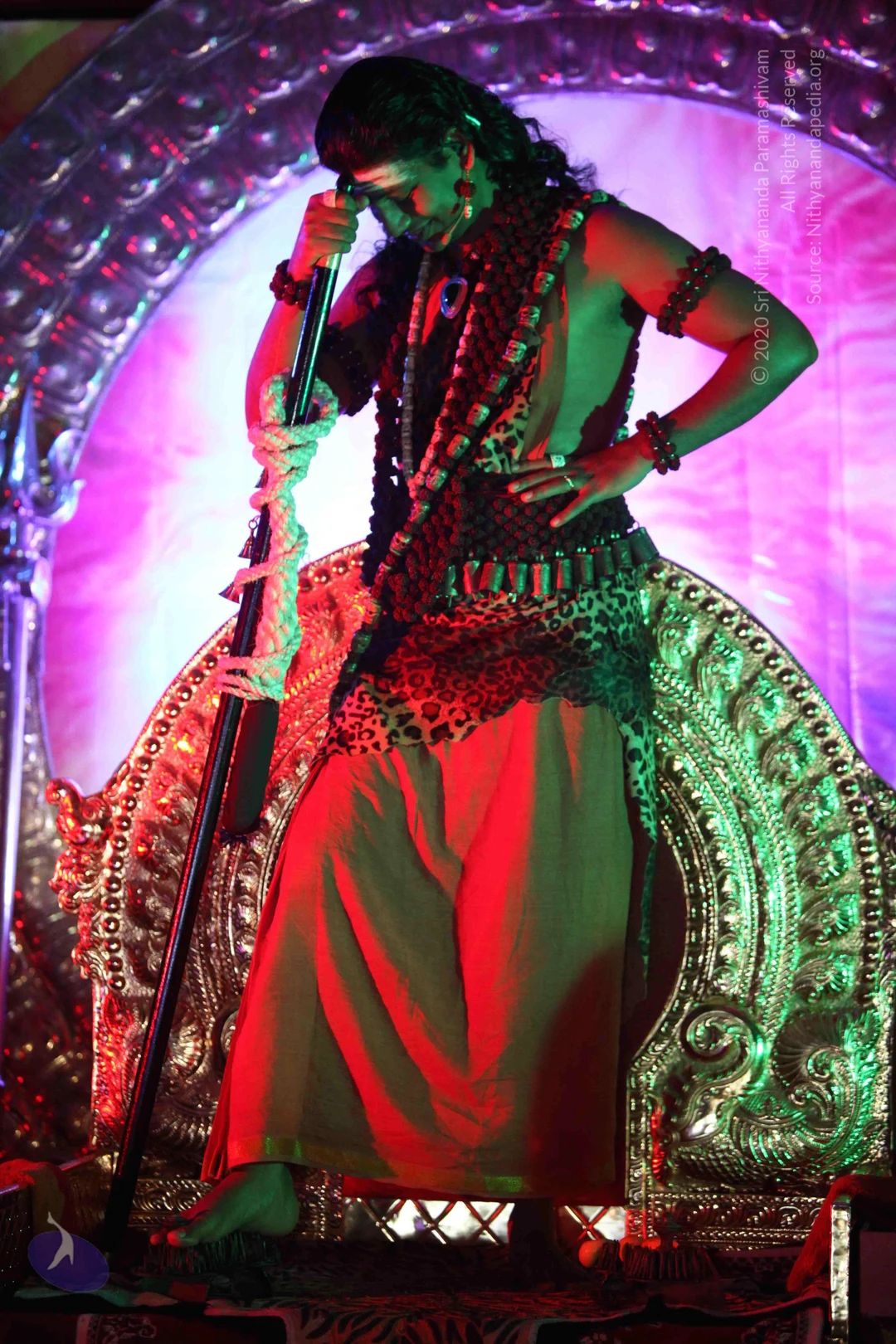
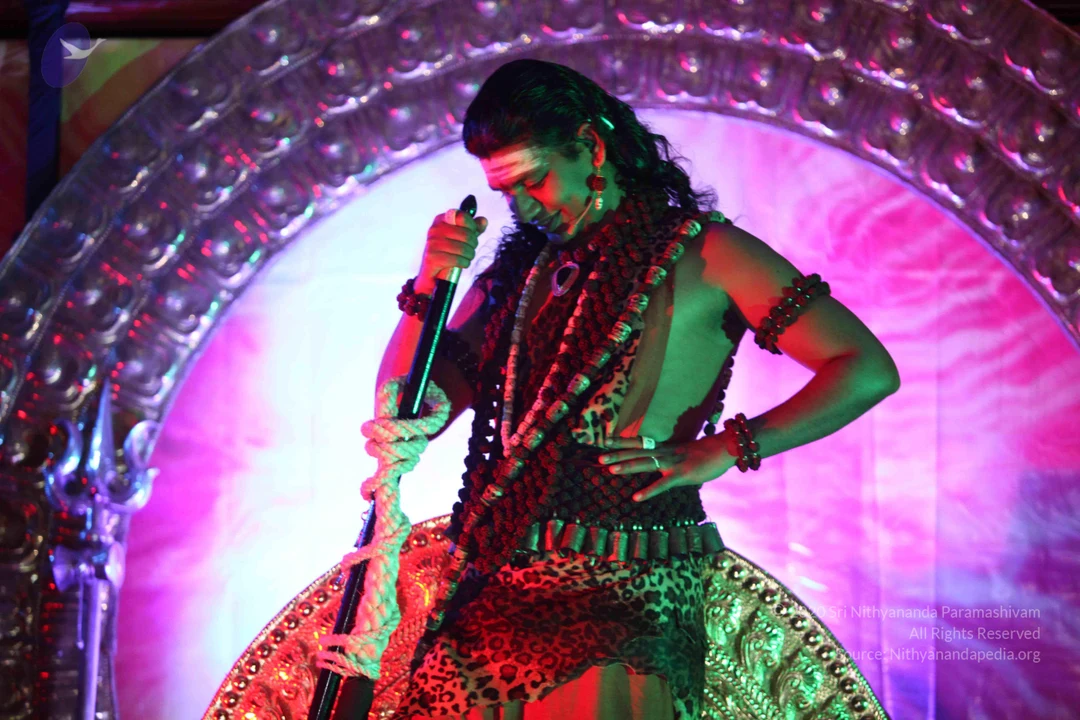
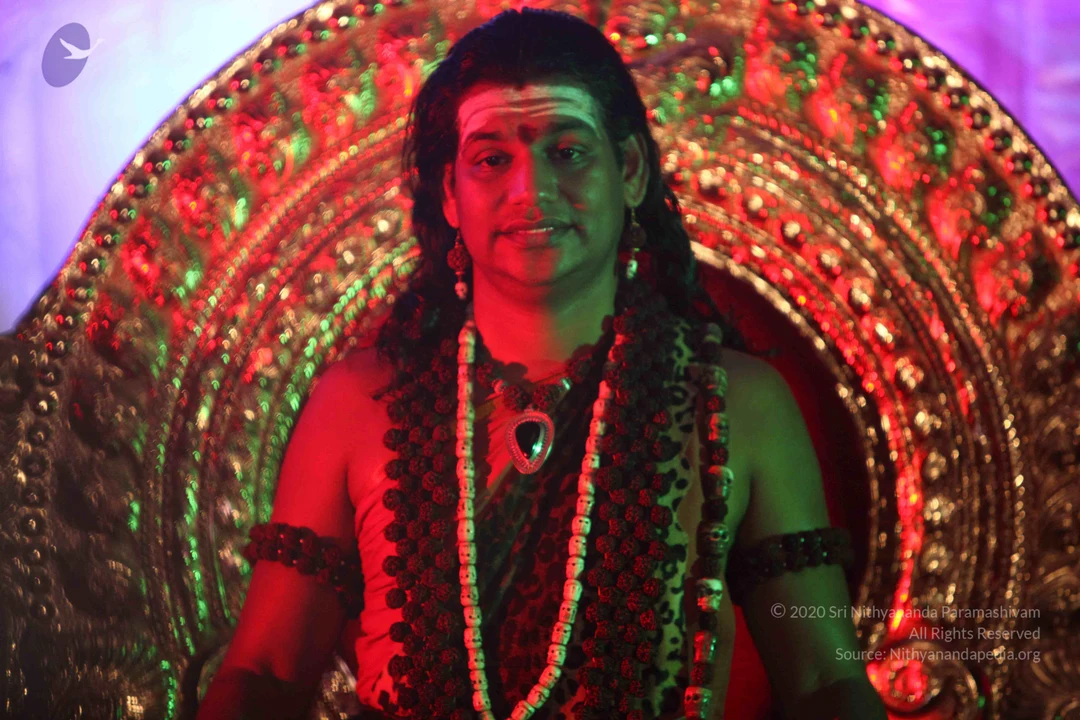
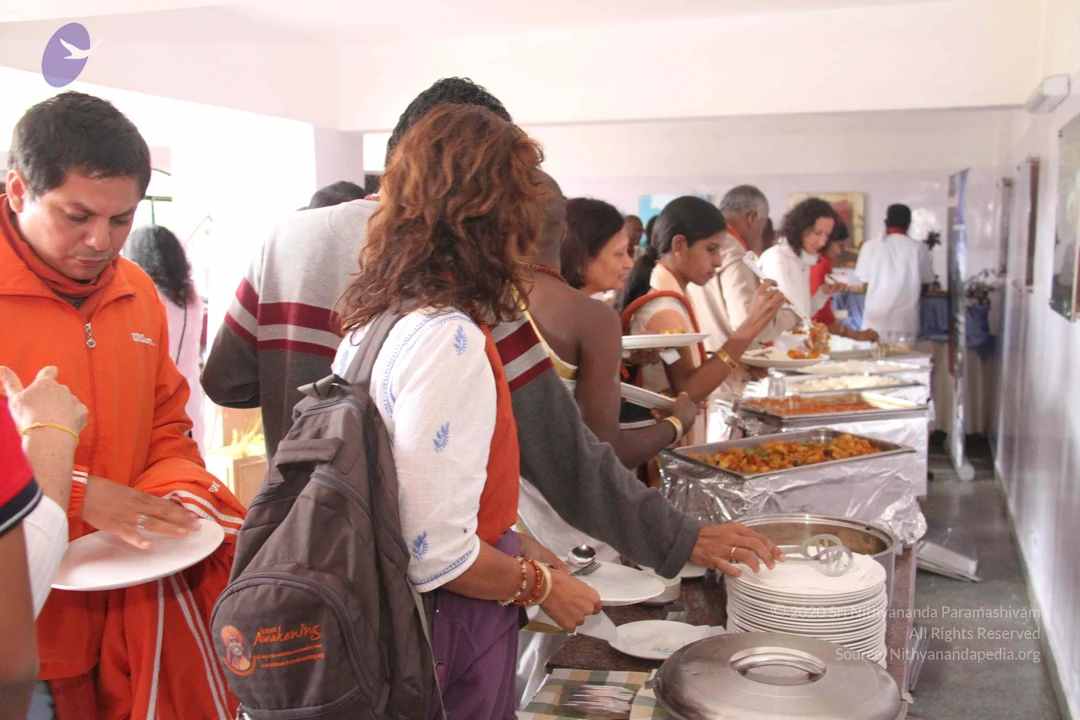
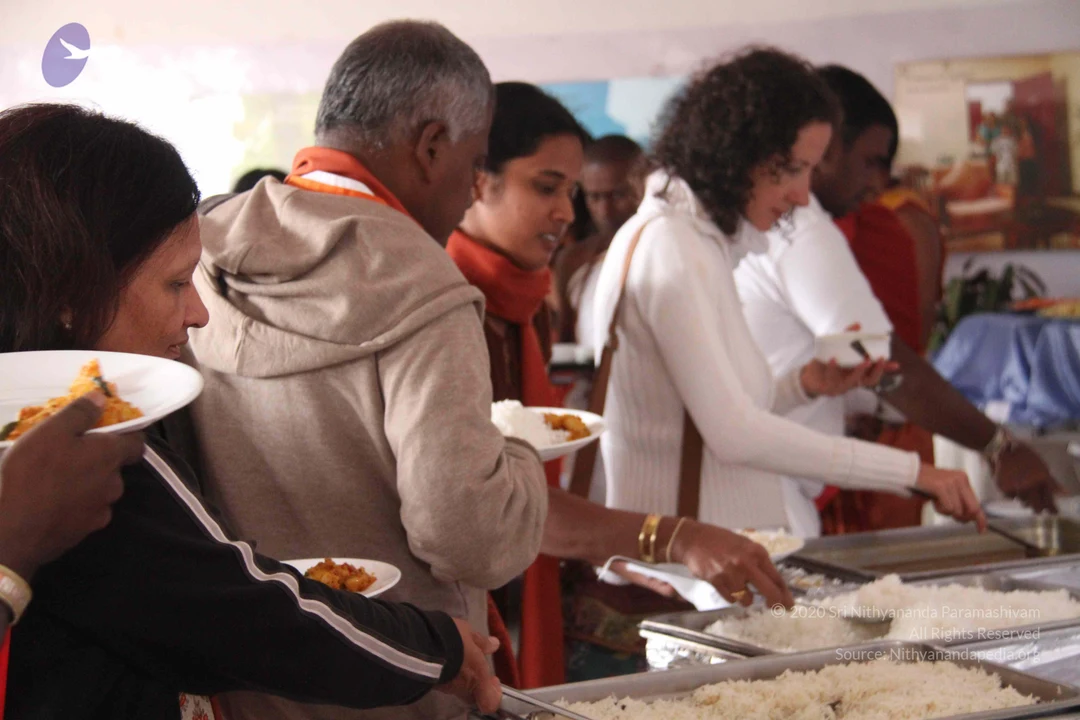
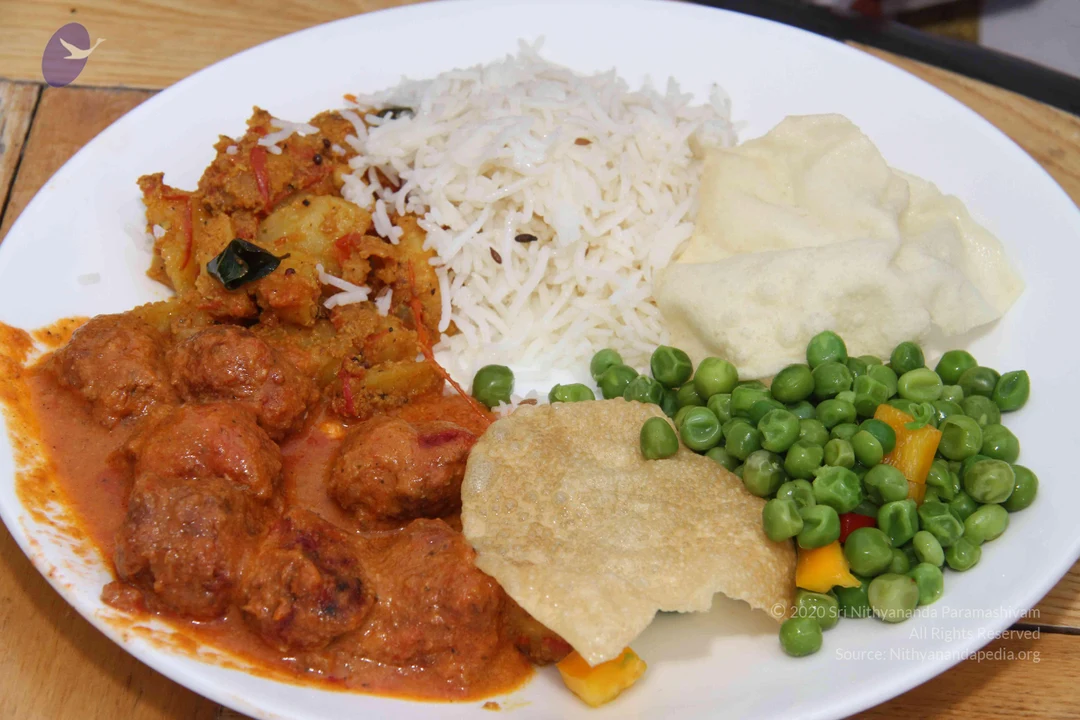
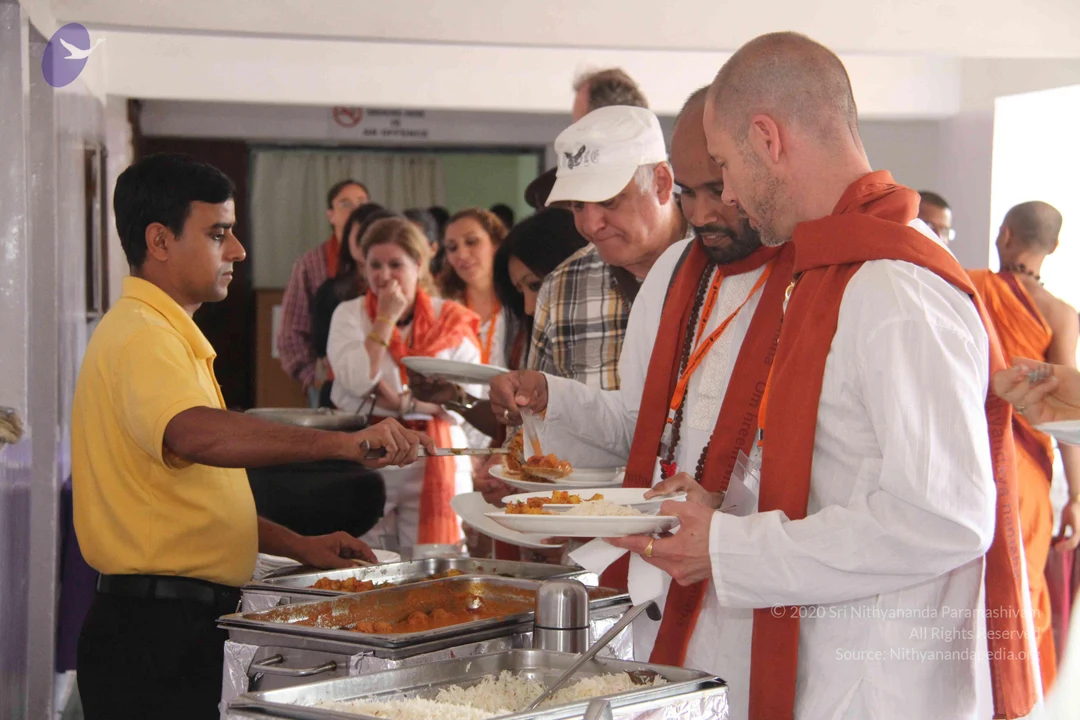
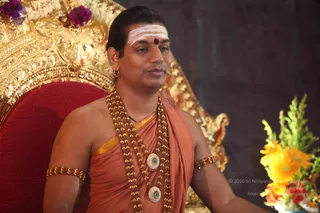
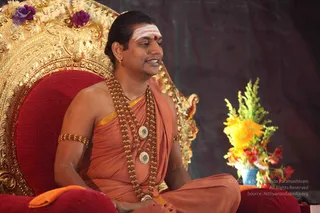
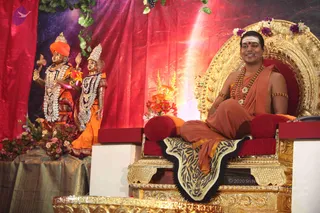
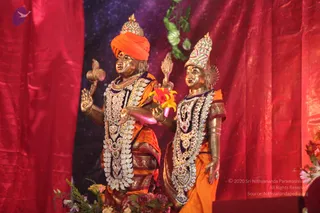
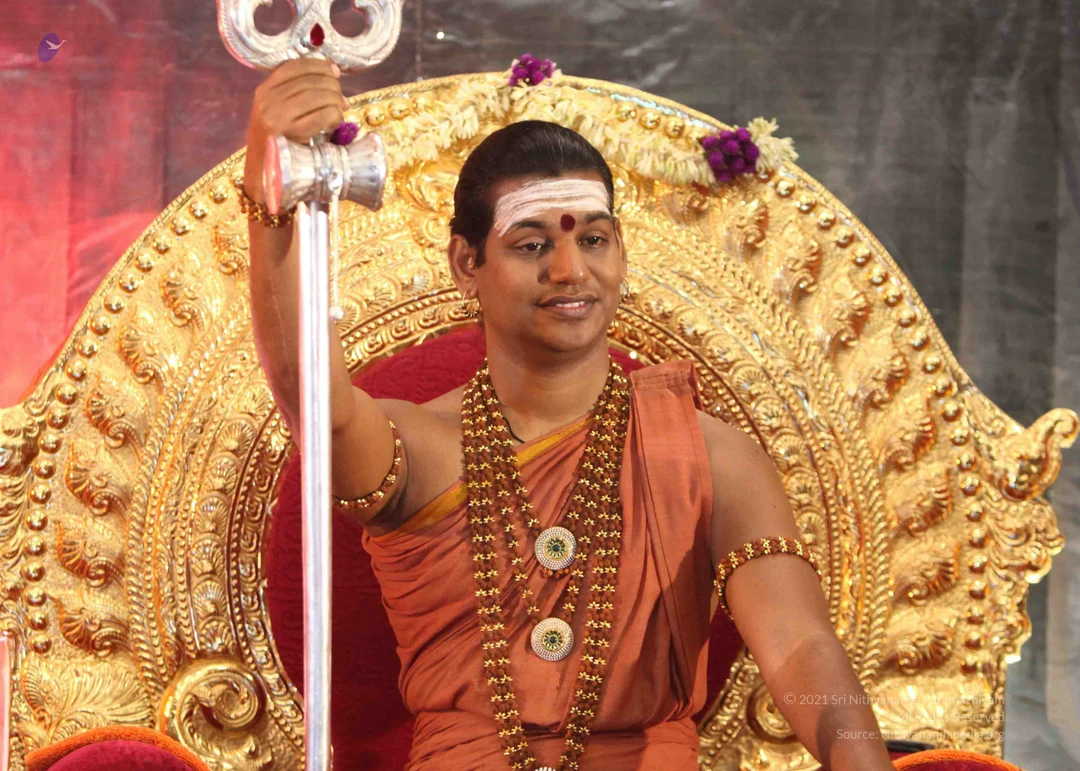
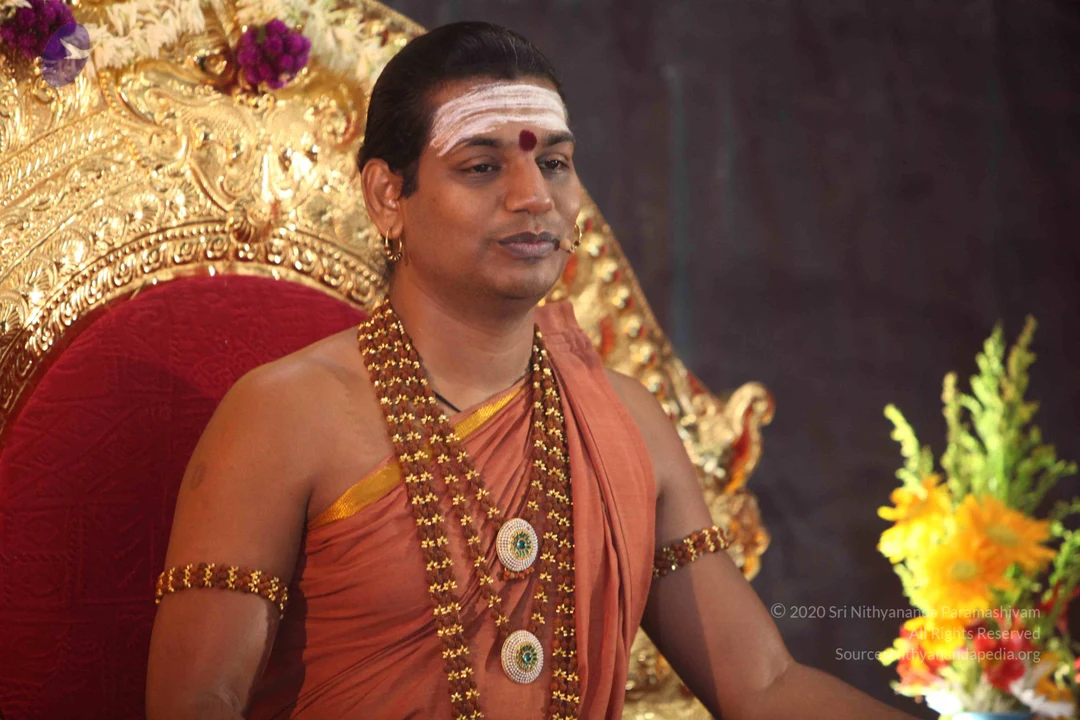
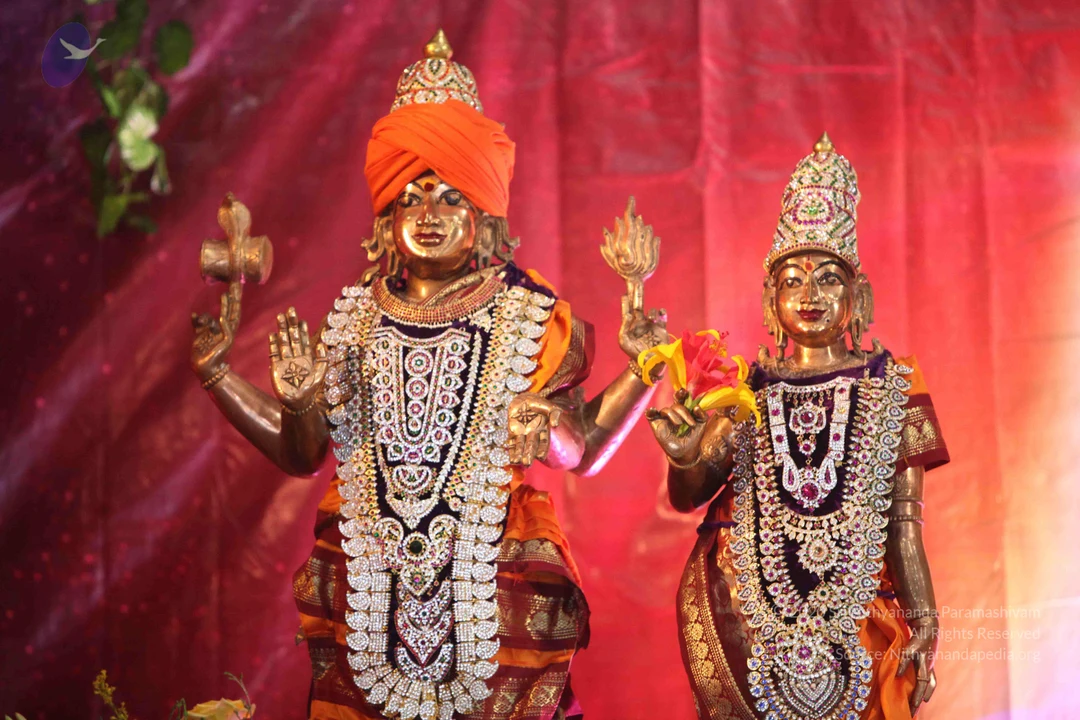
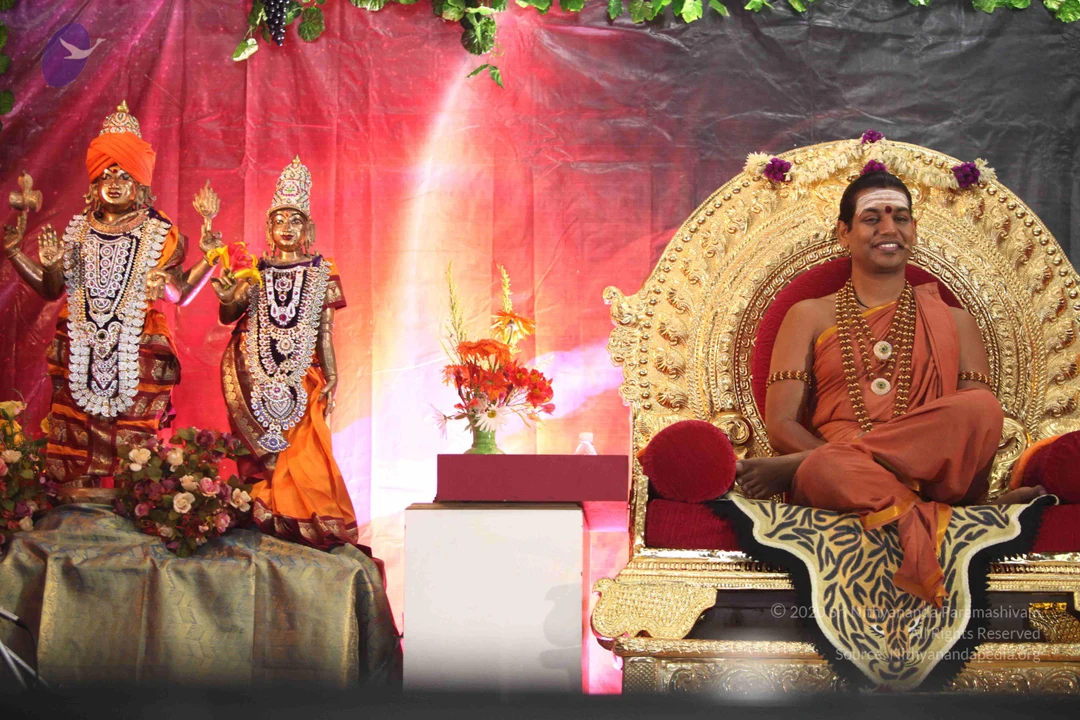
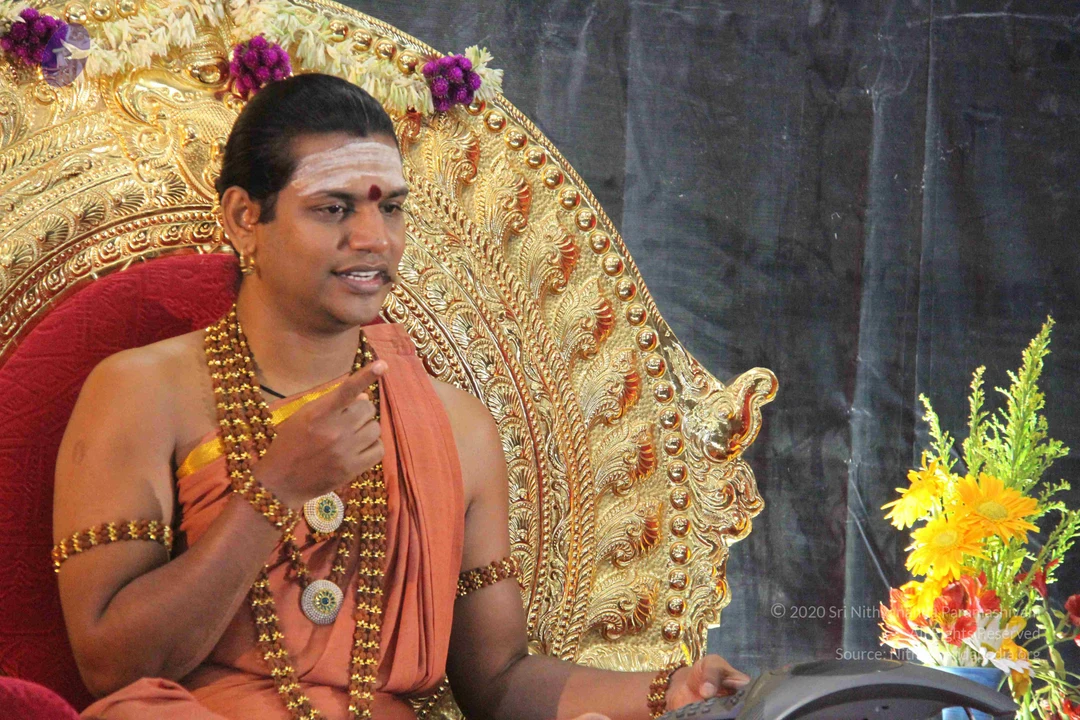
A man seated on an ornate gold throne with red cushioning speaks during a satsang. He wears an orange-saffron robe with a gold-edged shawl, a long rudraksha-style bead mala with gold ornaments across his chest, gold armlets and hoop earrings. His forehead bears white and red tilak markings. Yellow and orange flowers in an arrangement sit at the right, with purple flowers on the throne's top corner. The a person cues here are the saffron robe, layered beads with ceremonial gold necklaces, and seated throne role; appearance-based identification is uncertain, so this is treated as a probable candidate.A seated man in an orange-saffron robe draped over his shoulders and torso sits cross-legged on an ornate golden throne with red cushions. He wears a long multi-strand gold necklace with green-and-white medallions, gold armlets, a gold earring, and a white sandalwood tilak with a red dot on his forehead. His dark hair is swept back, and he appears to be speaking. Purple and white flower garlands decorate the top of the throne, and a vase of yellow and orange flowers stands to the right against a dark backdrop. This is a person depiction in an in-person setting, judged by the saffron robe, gold ornaments and throne.A man seated on an ornate gold throne with red cushions speaks into a headset microphone during a satsang discourse. He wears a saffron-orange shawl over his shoulders and bare chest, multiple strands of gold-toned beaded necklaces with round medallions, gold armlets, and a white tilak with a red bindi on his forehead. Behind him hangs a red curtain with a bright light beam, and orange and white flowers sit at the left edge. Printed copyright text overlays the lower right of the image. a person, the presiding teacher, is seated in the central position with cues of saffron clothing, ornate gold necklaces and ceremonial adornment, giving a talk.A smiling man with a white tilak and red bindi sits on an ornate golden throne with red cushions, speaking into a headset microphone during a satsang discourse. He wears saffron-orange robes draped over one shoulder, a gold-beaded necklace, a pendant medallion, and gold armbands. Orange and purple flowers and a garland decorate the throne, and a red backdrop is behind him. a person: the saffron robes, gold necklaces and ornate throne match the page's description of the speaker. One person is visible.A seated man in saffron-orange robes sits on an ornate gold-and-red throne, smiling and wearing a microphone headset. He has a white tilak with a red dot on his forehead, a rudraksha mala and a ceremonial gold pendant necklace, and gold armbands. Beside him stand two painted deity murti statues dressed in orange garments with jeweled necklaces, one holding a staff. Red drapes, purple flowers and a garland-decorated backdrop frame the stage, and a small gold stand sits in front. The figure on the throne matches the page's a person reference through his saffron clothing, rudraksha mala, and gold necklace, so this is a probable appearance-based identification.Two gilded statues stand before a red draped backdrop decorated with a starry purple panel and green foliage. The taller figure wears an orange turban, a jewelled multi-strand necklace and an orange dhoti with gold border, and holds a ceremonial staff topped with a trident-like finial. The figure beside wears a tall jewelled crown, a heavy jewelled necklace and orange garments, and holds a bunch of yellow and pink flowers. The statues are depictions, not living people, so no physical people are present.
03-Dial-the-Avatar

84 photosSource gallery
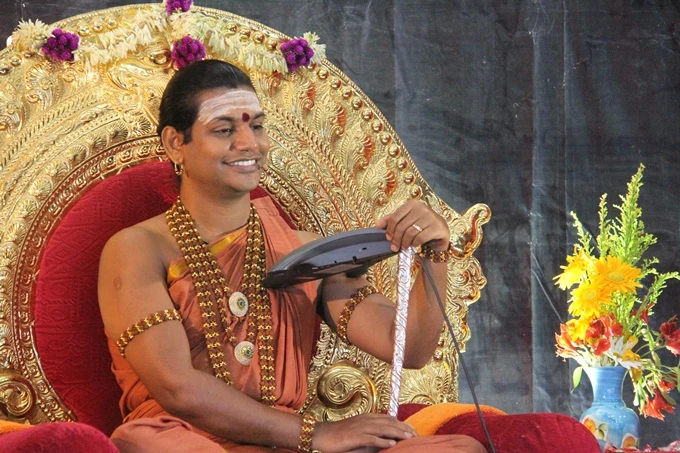
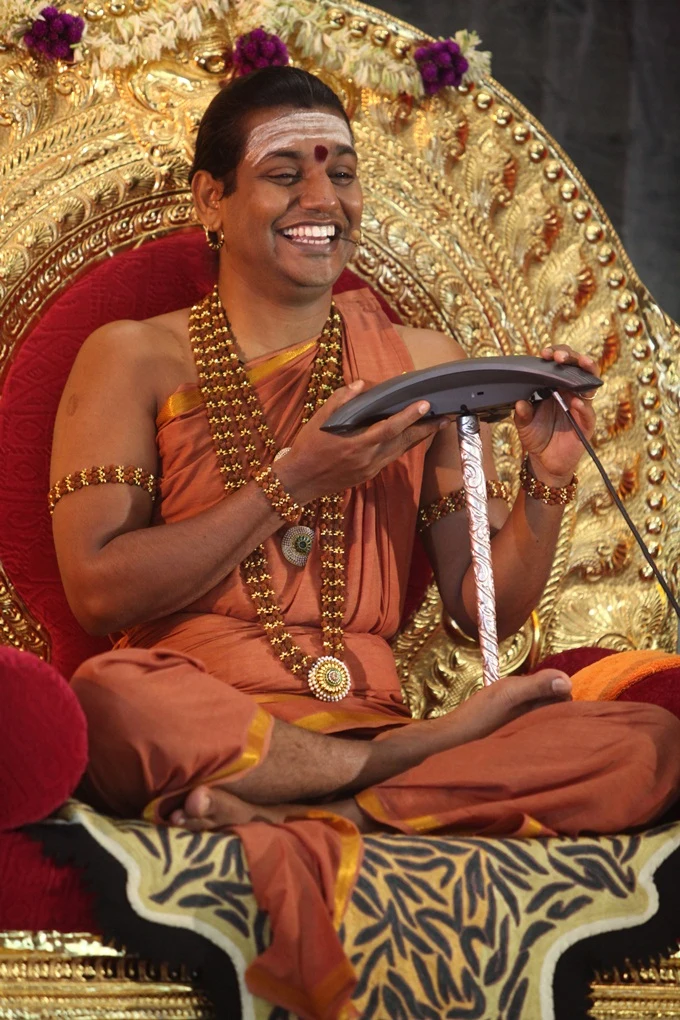
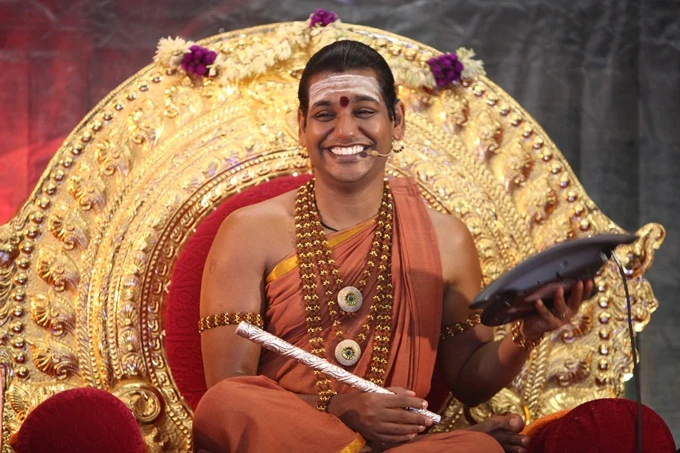
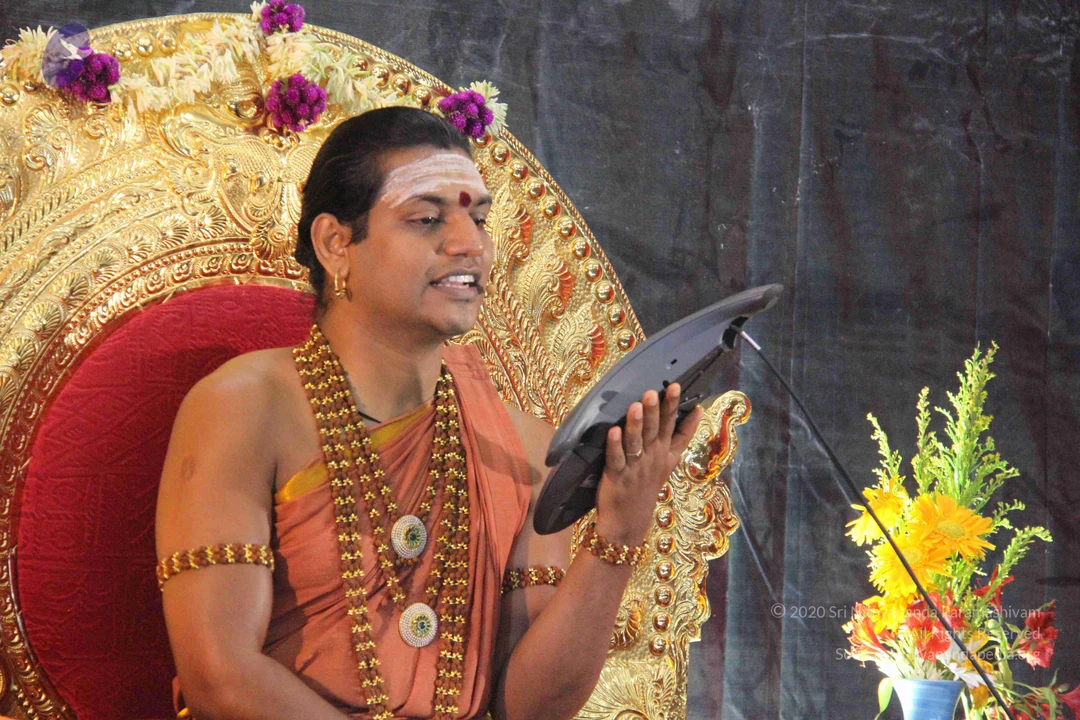
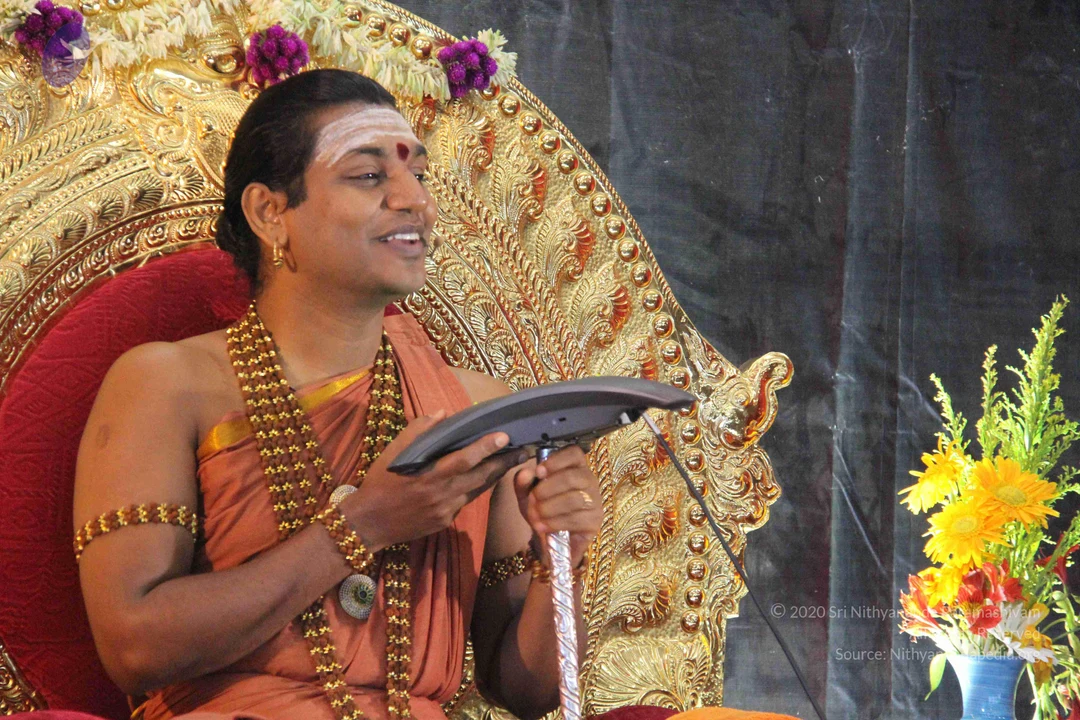
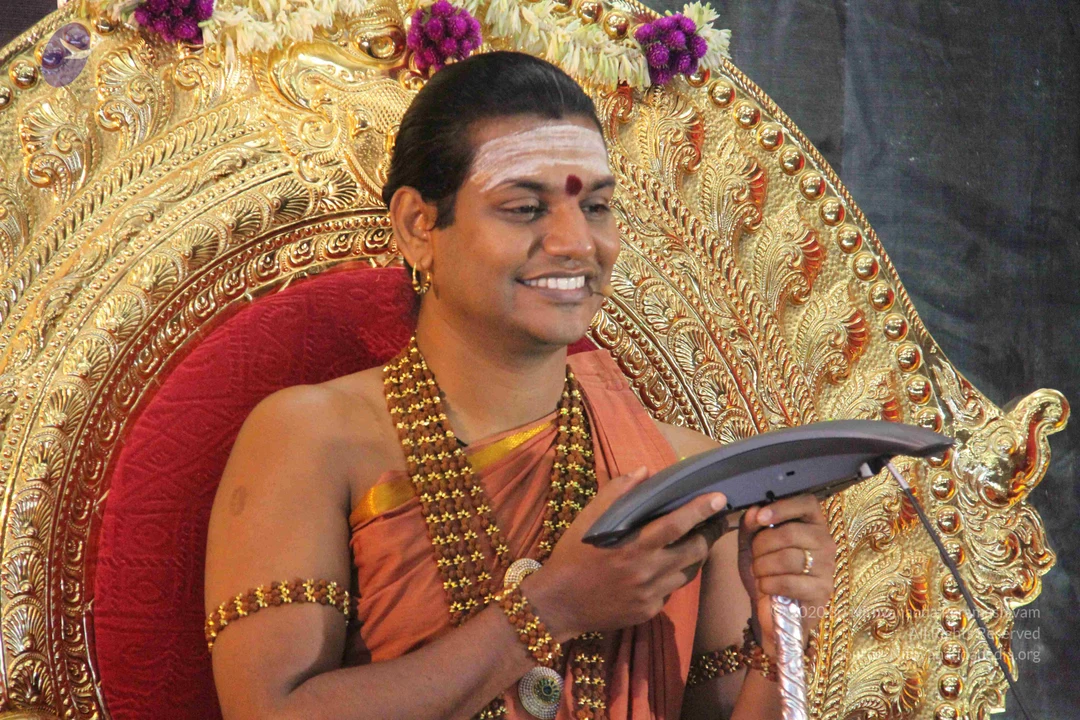
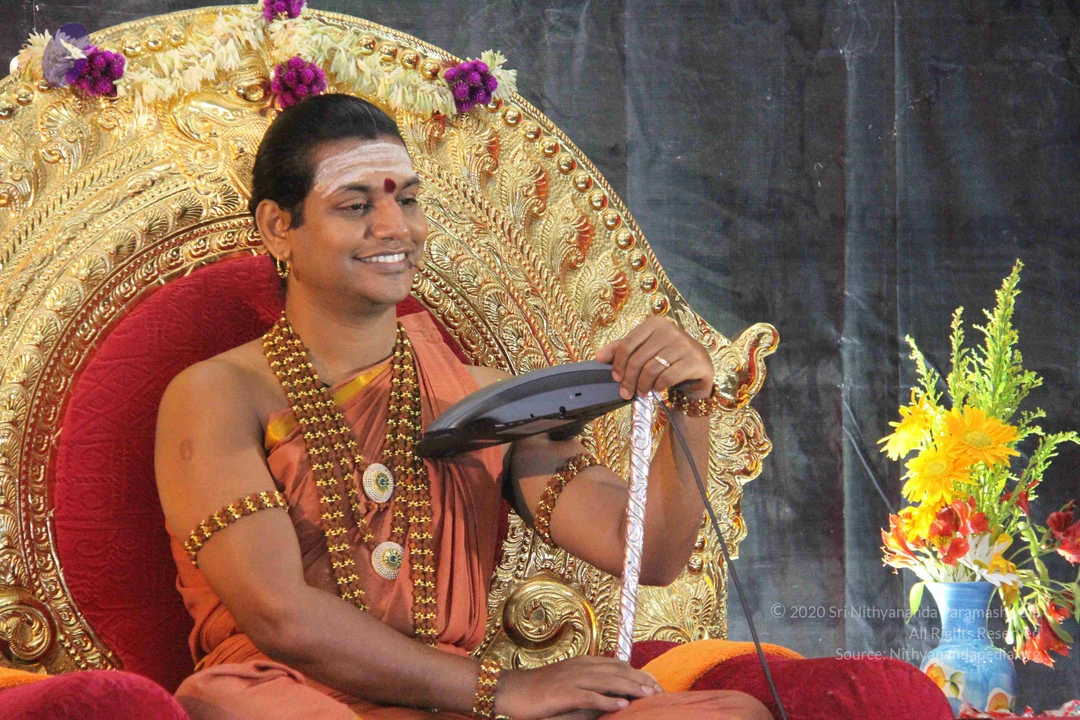
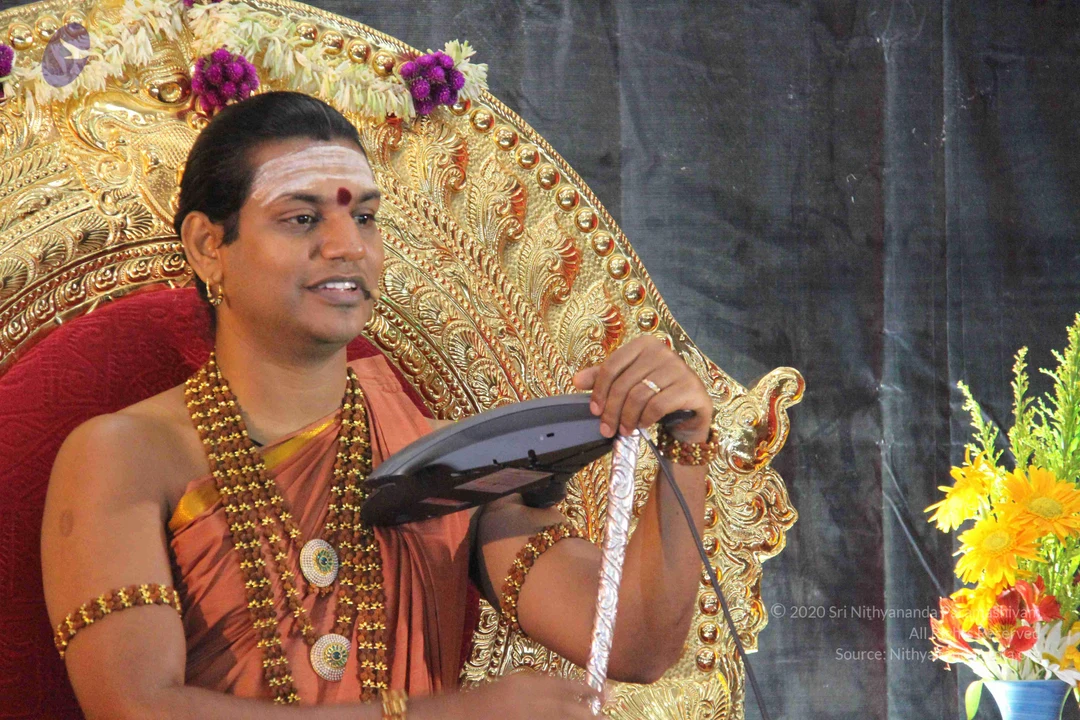
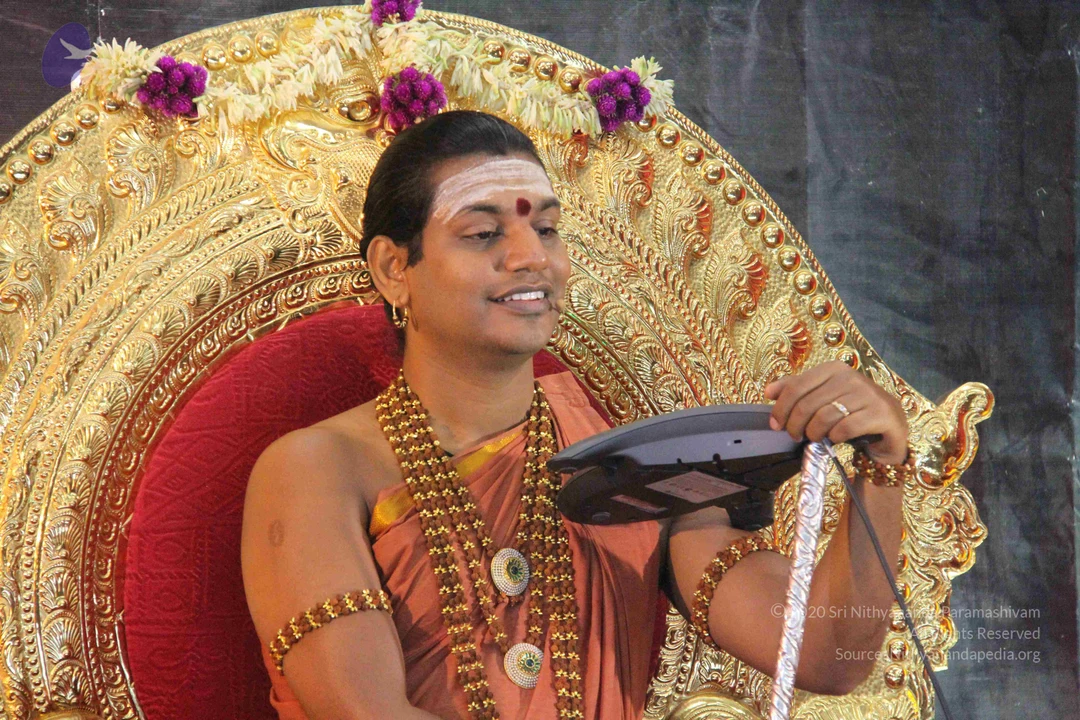
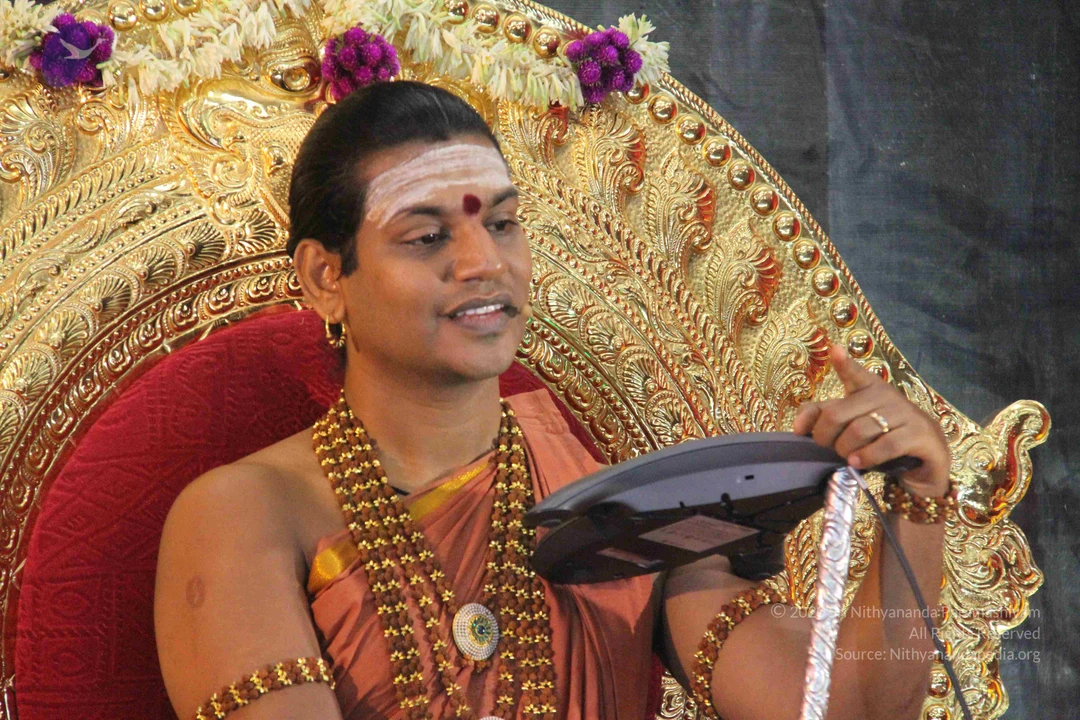
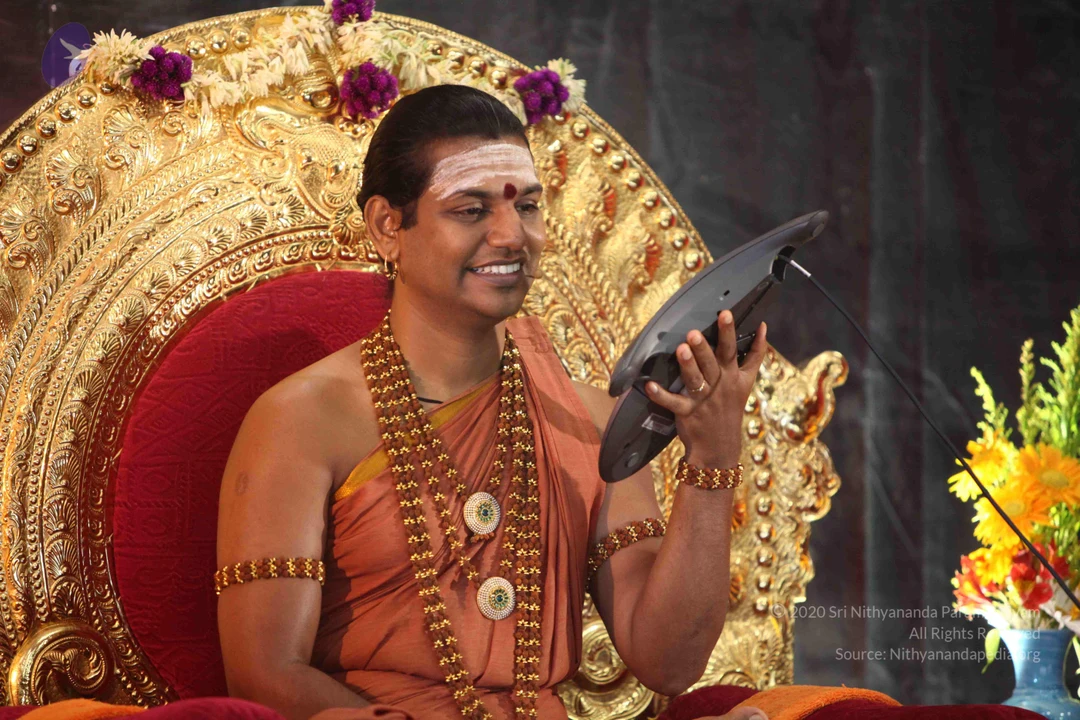
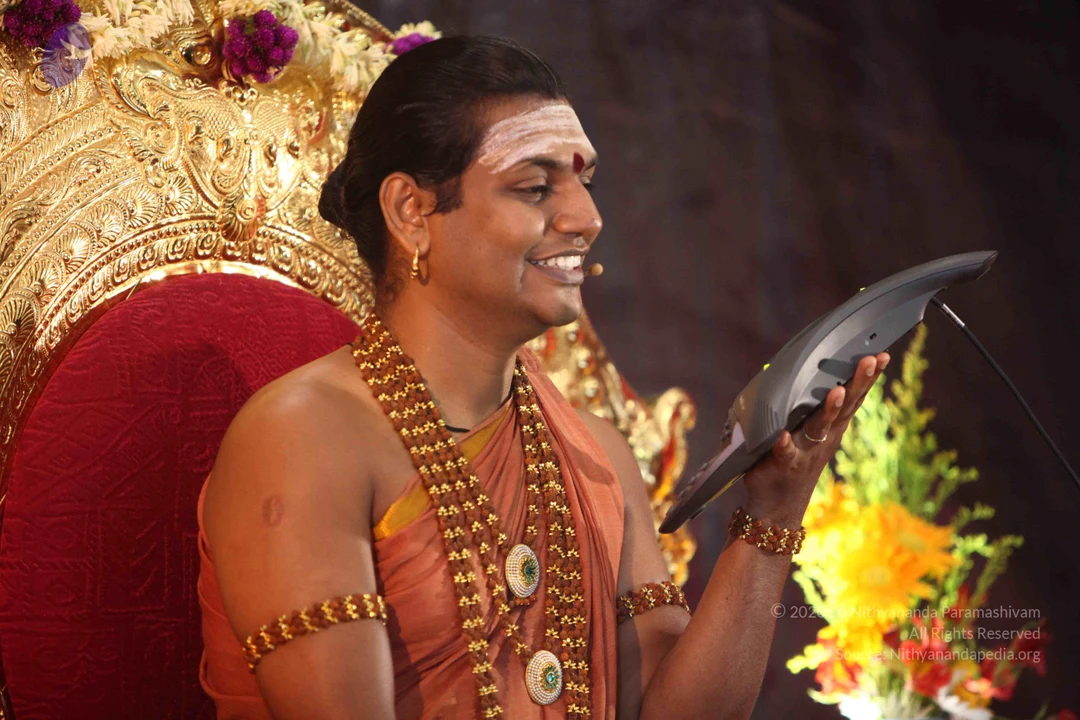
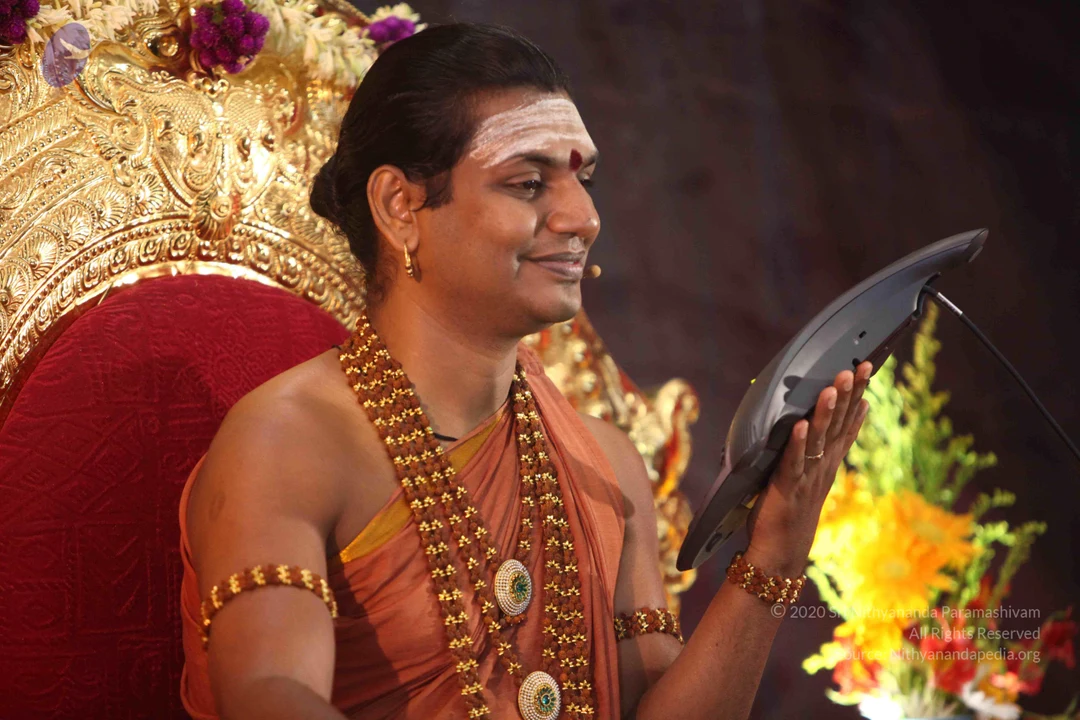
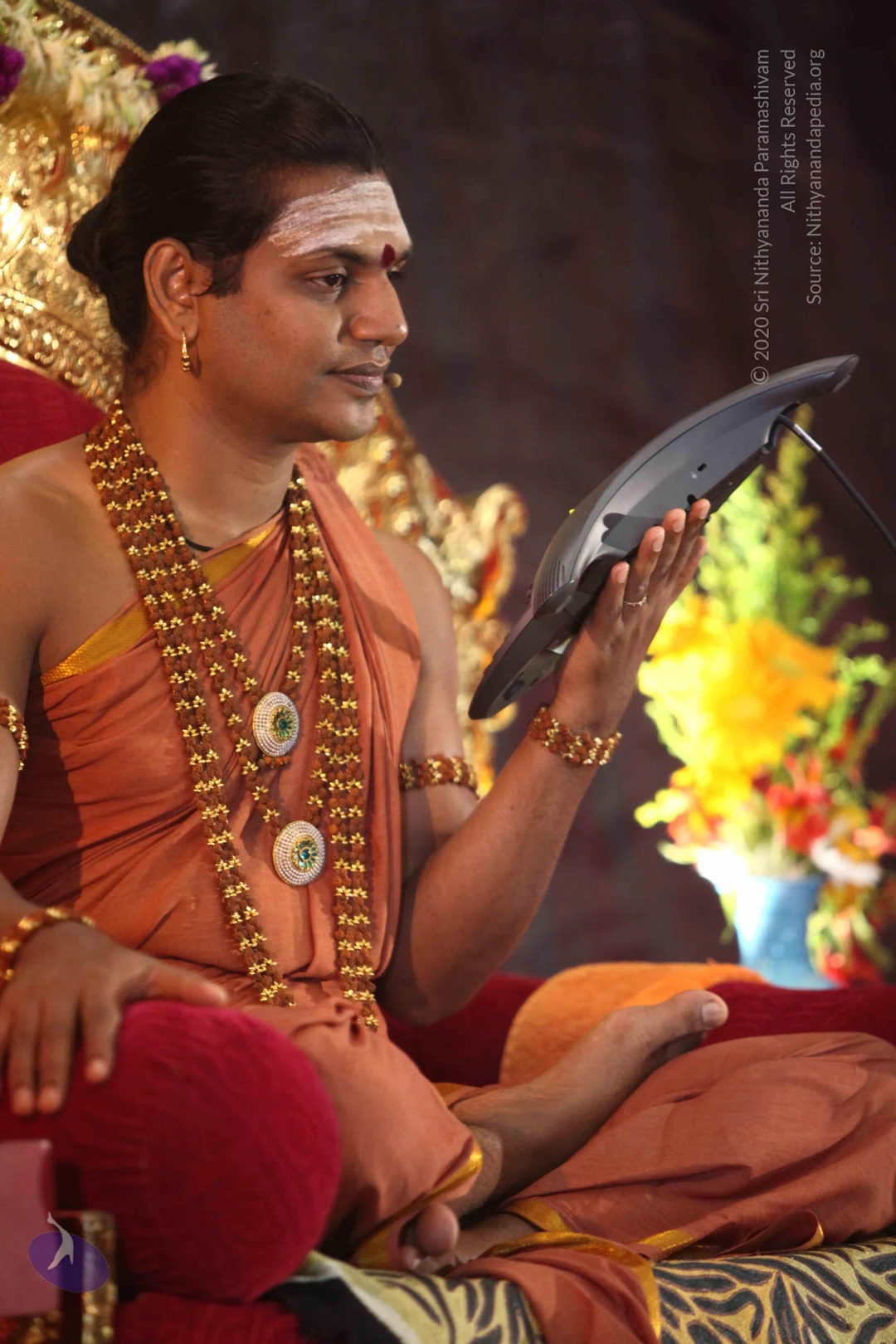
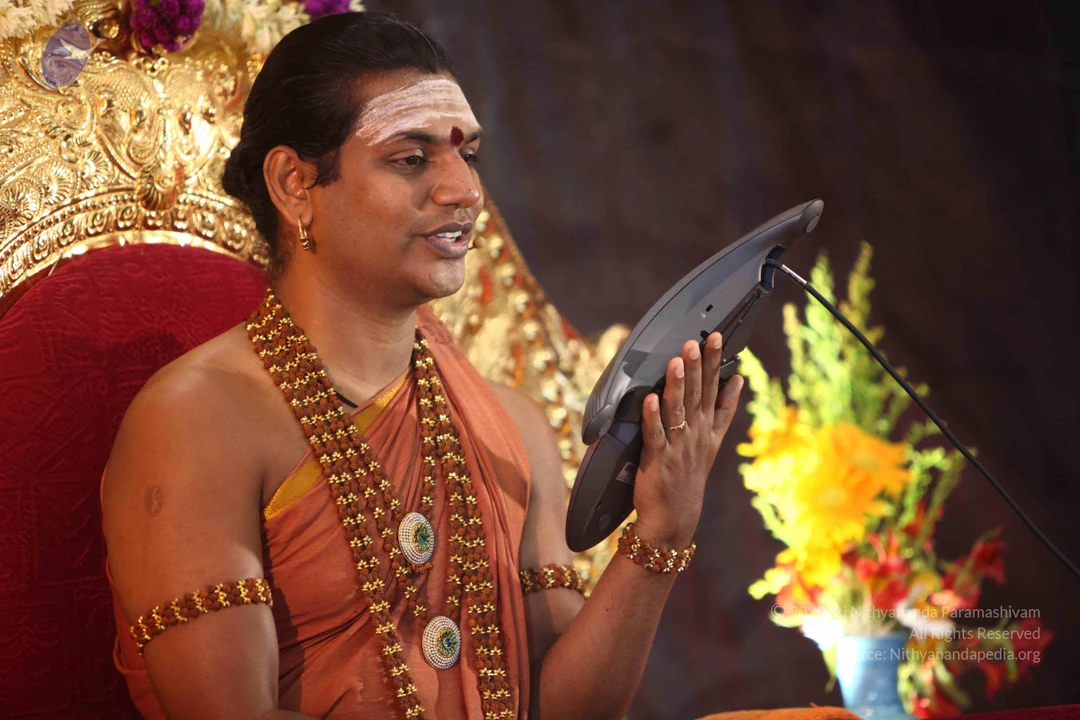
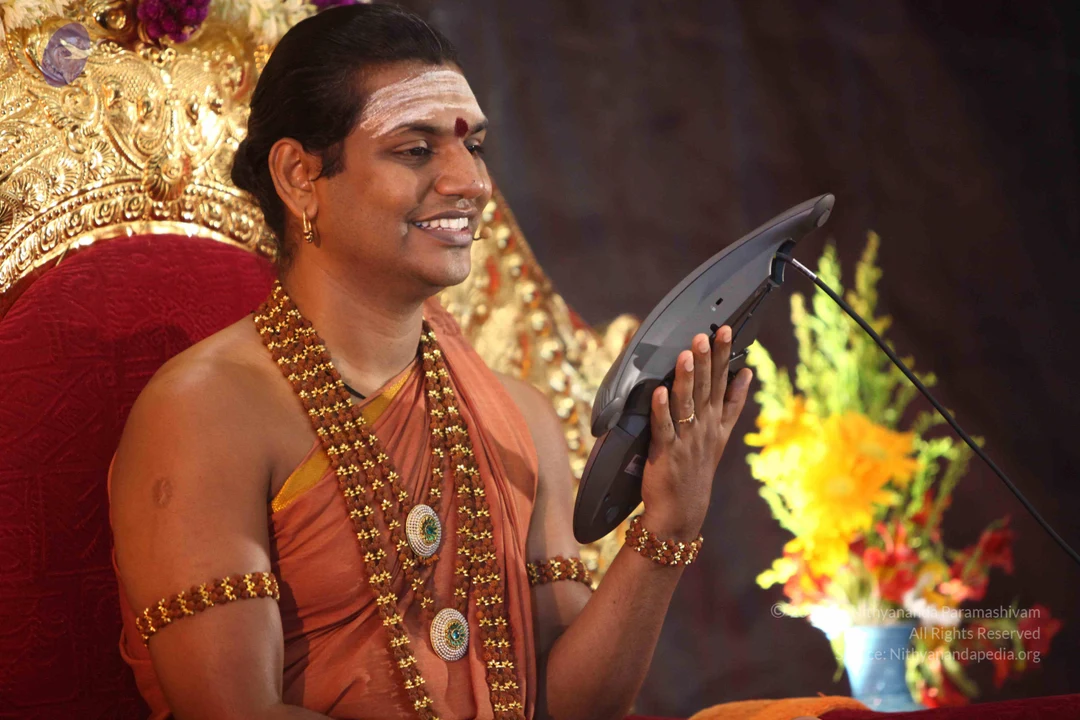
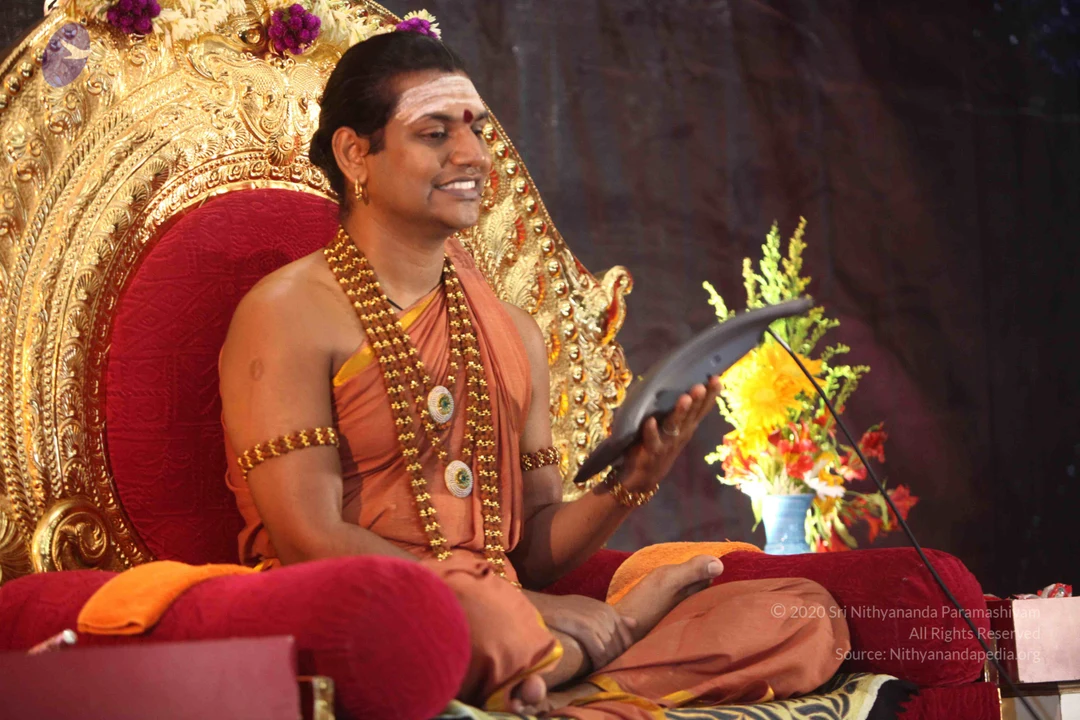
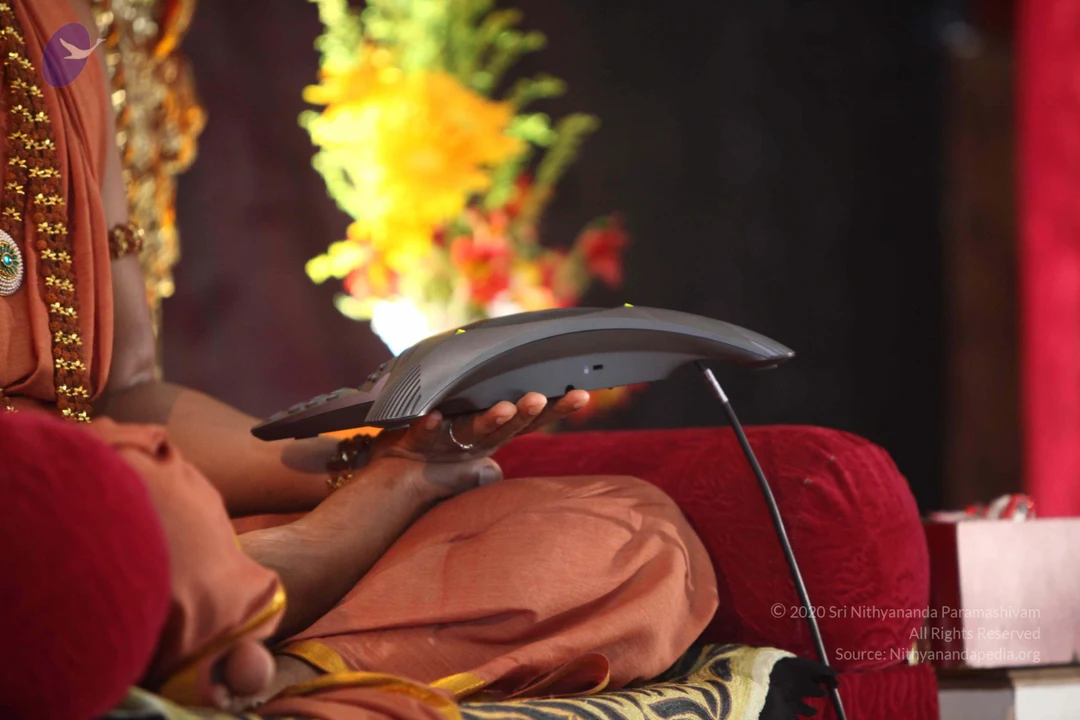
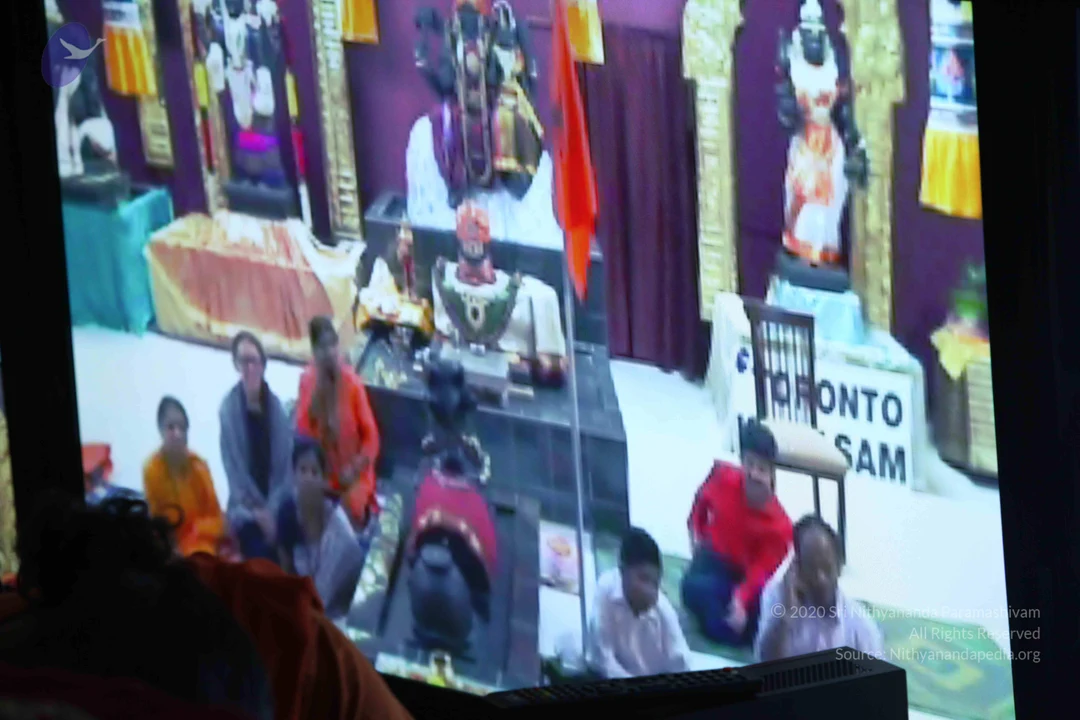
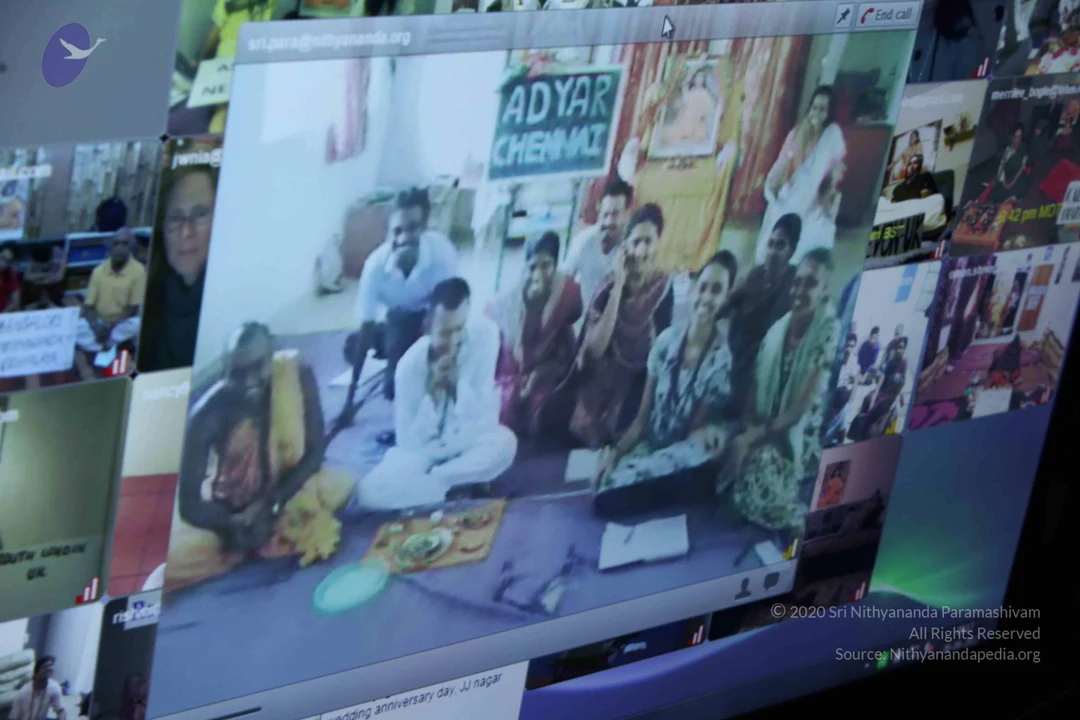
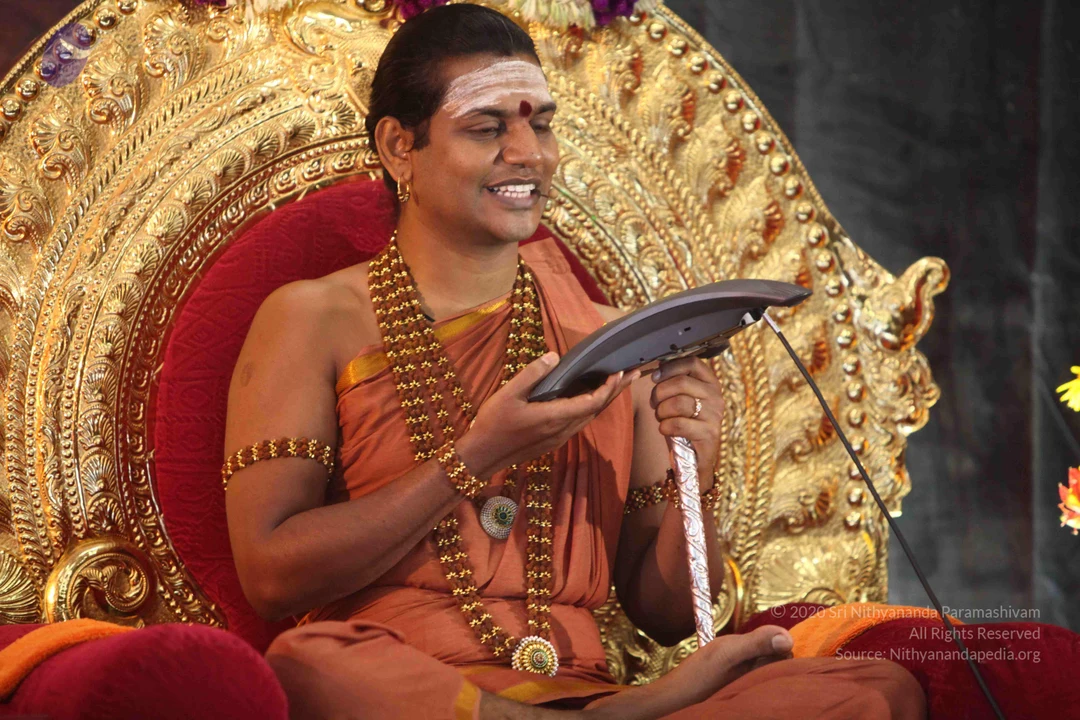
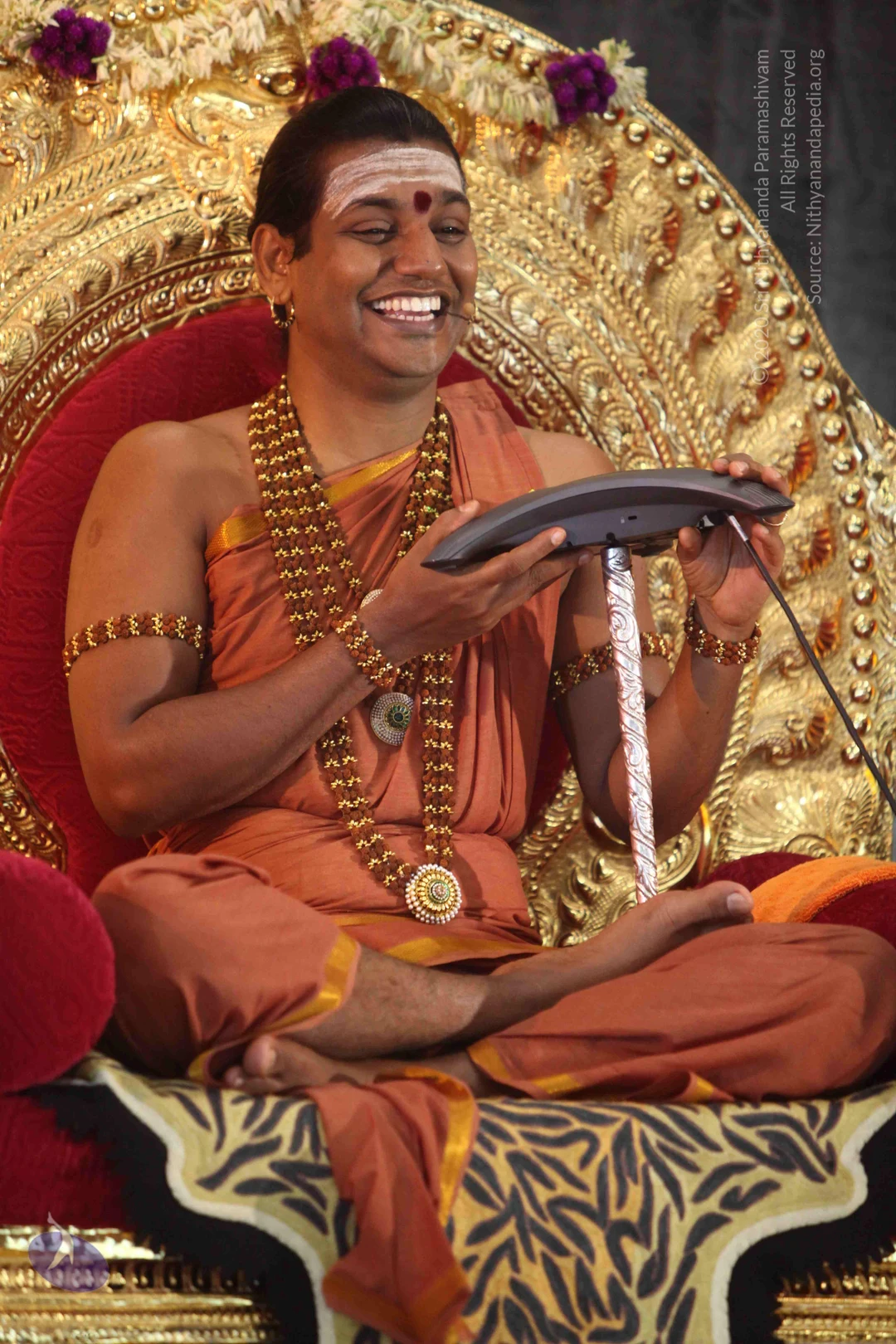
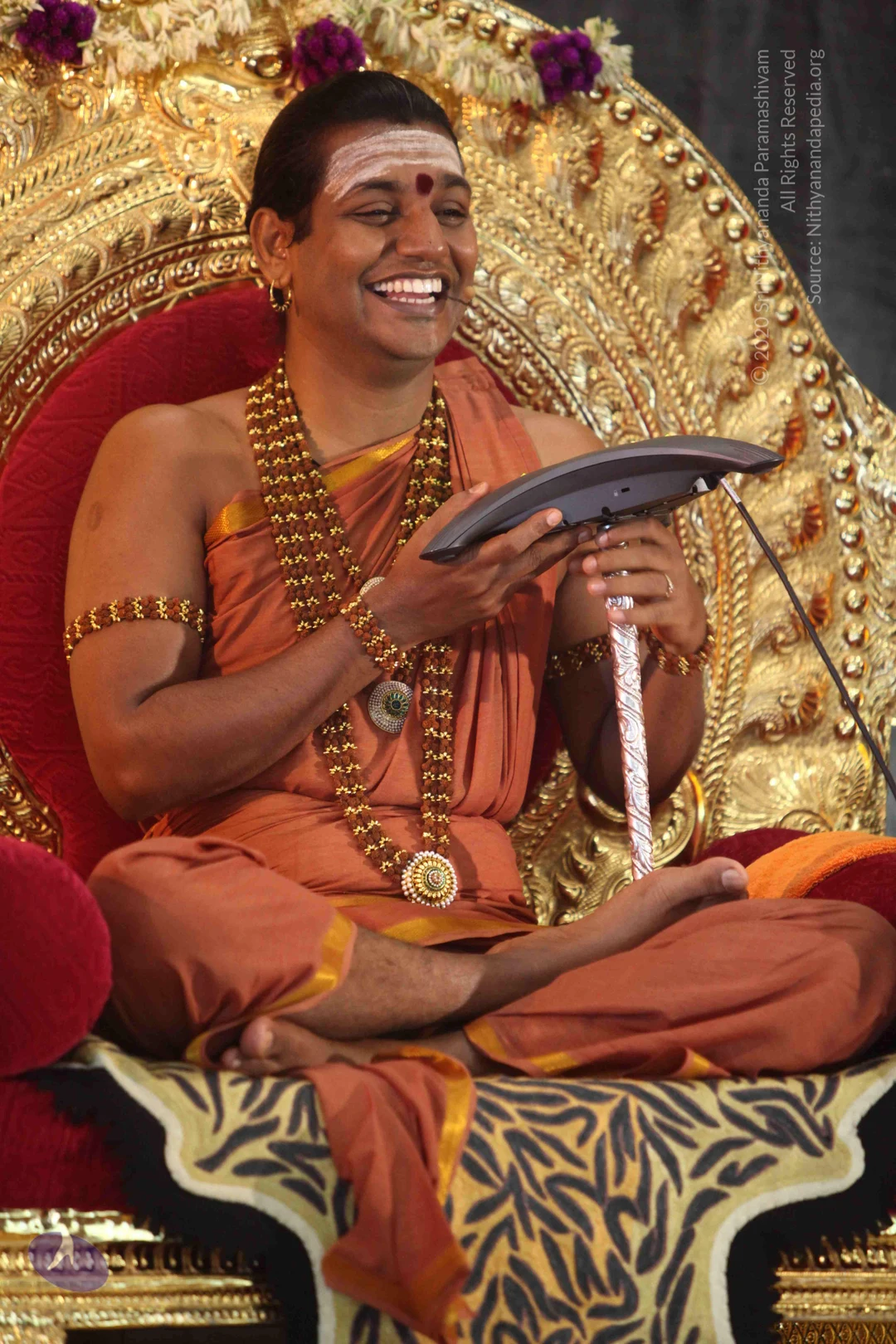
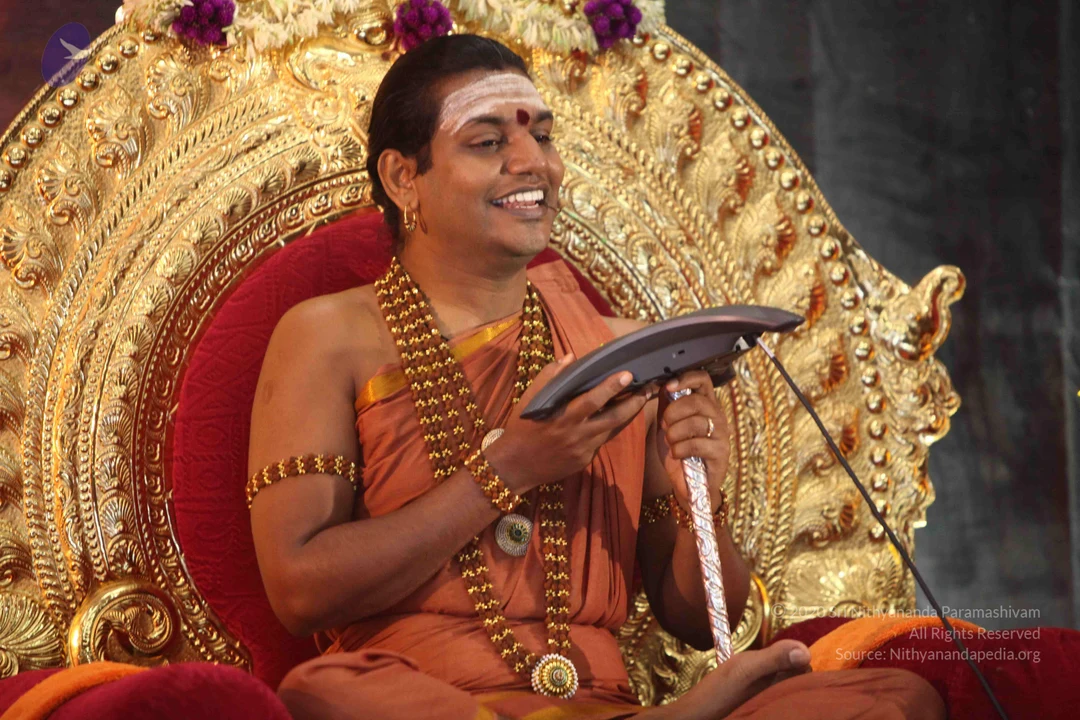
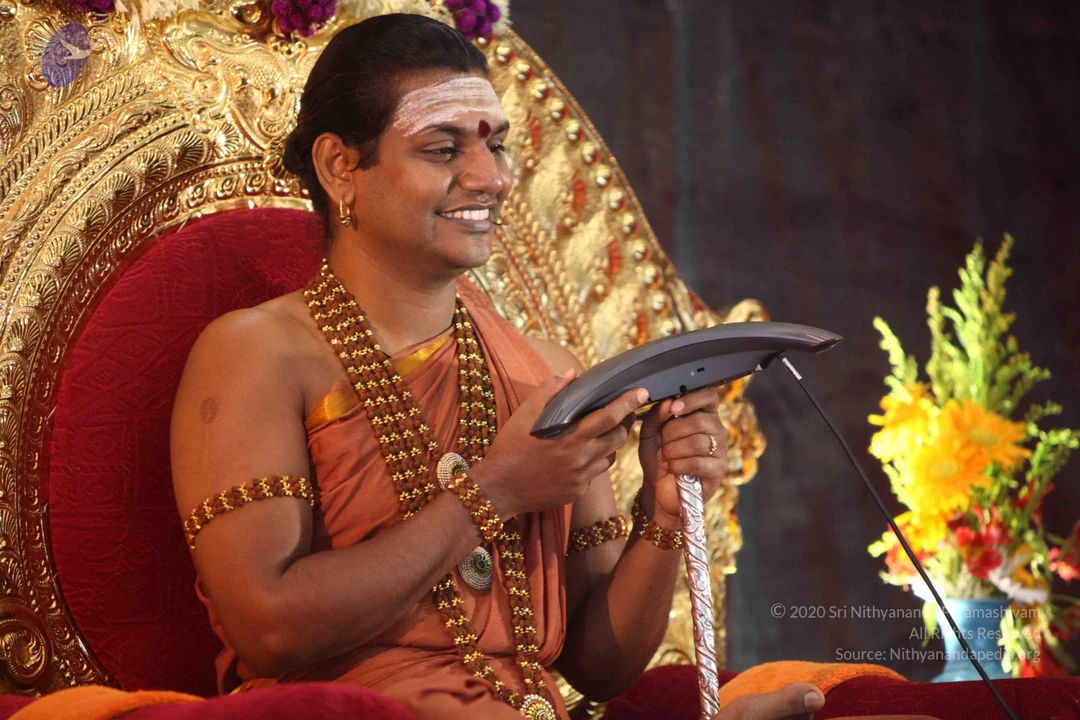
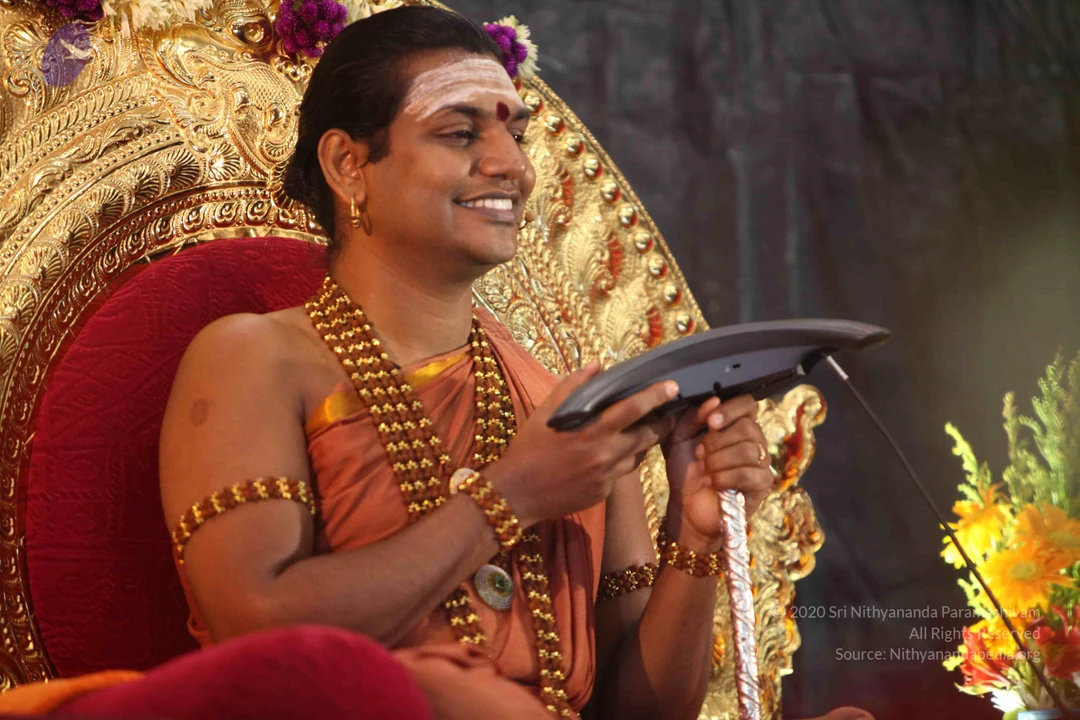
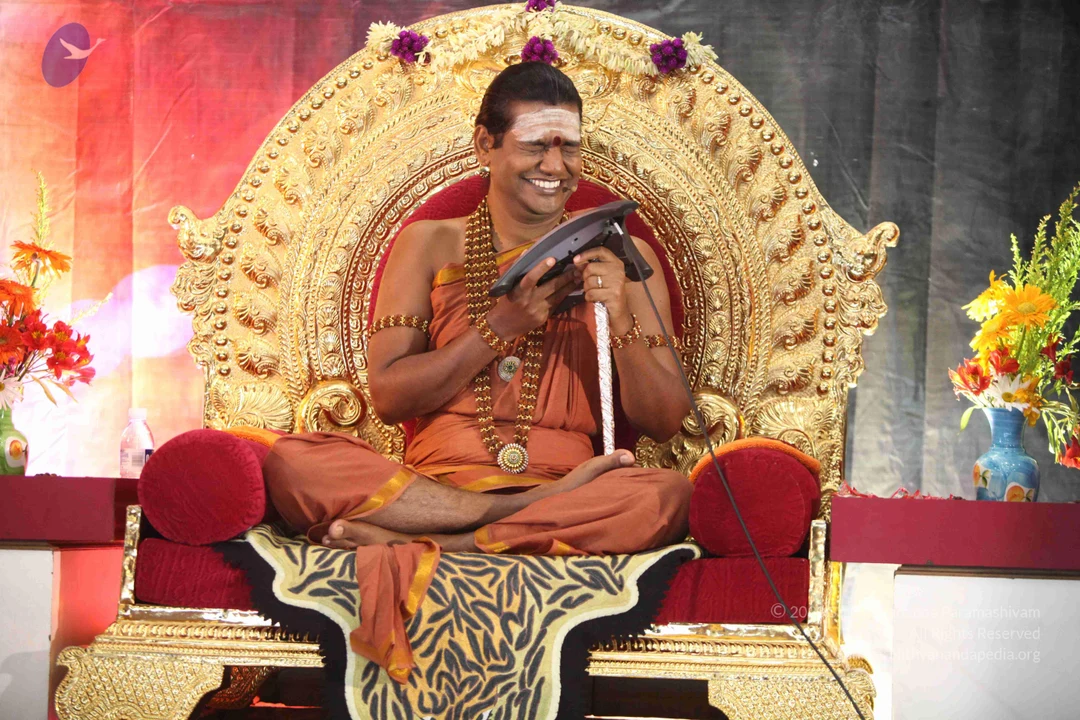
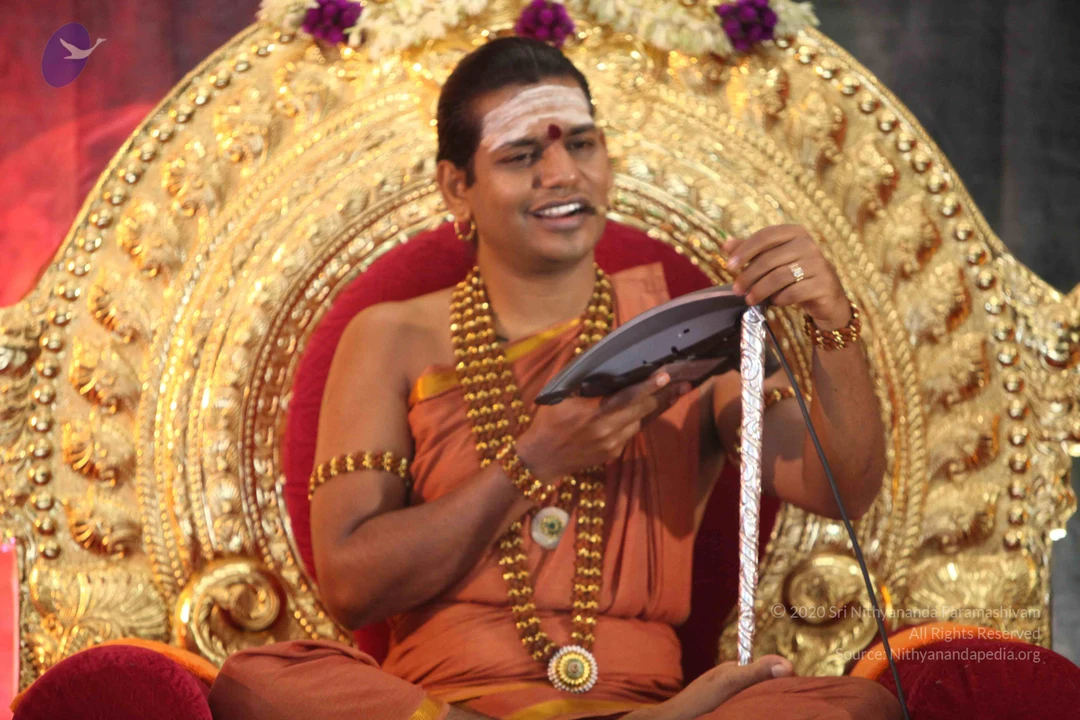
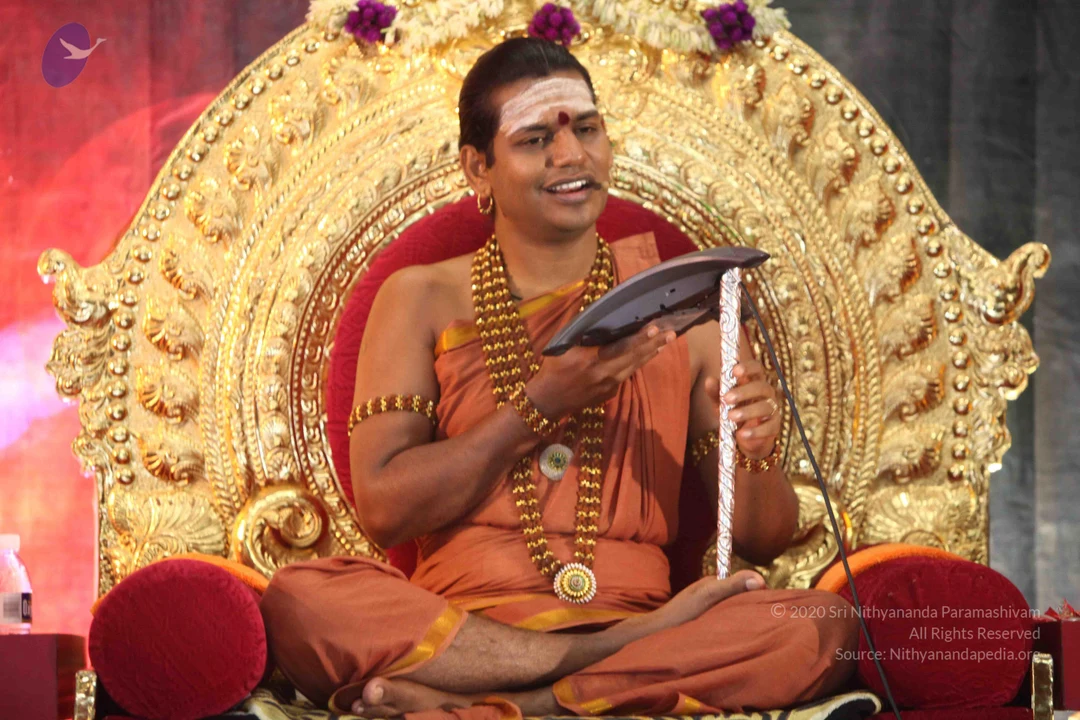
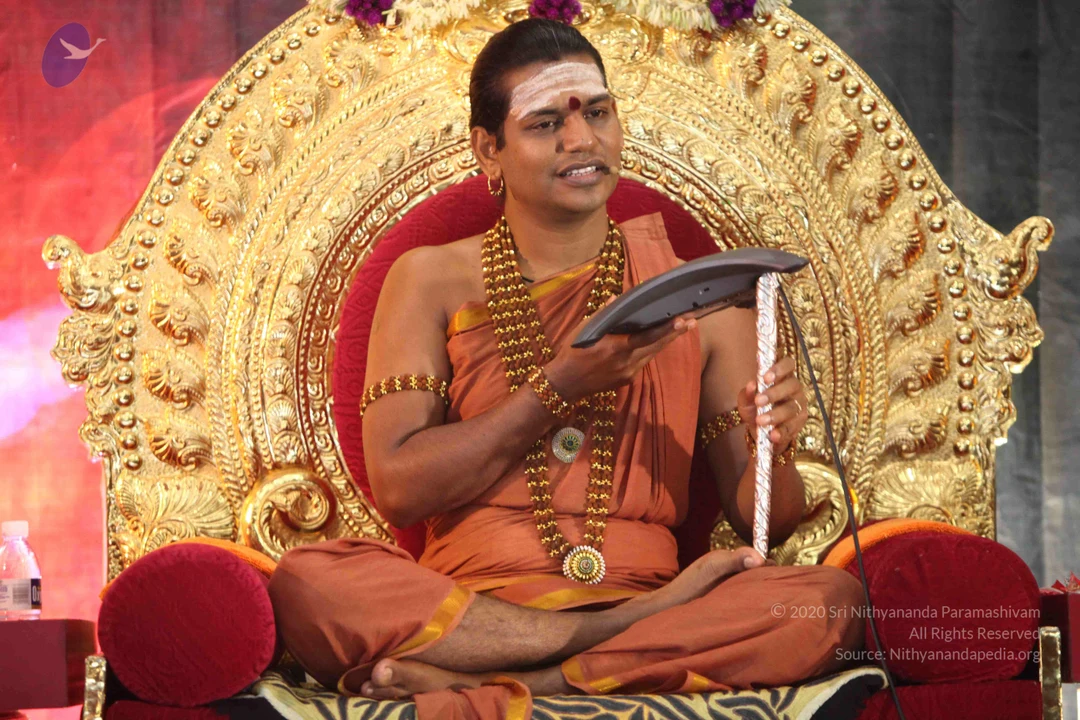
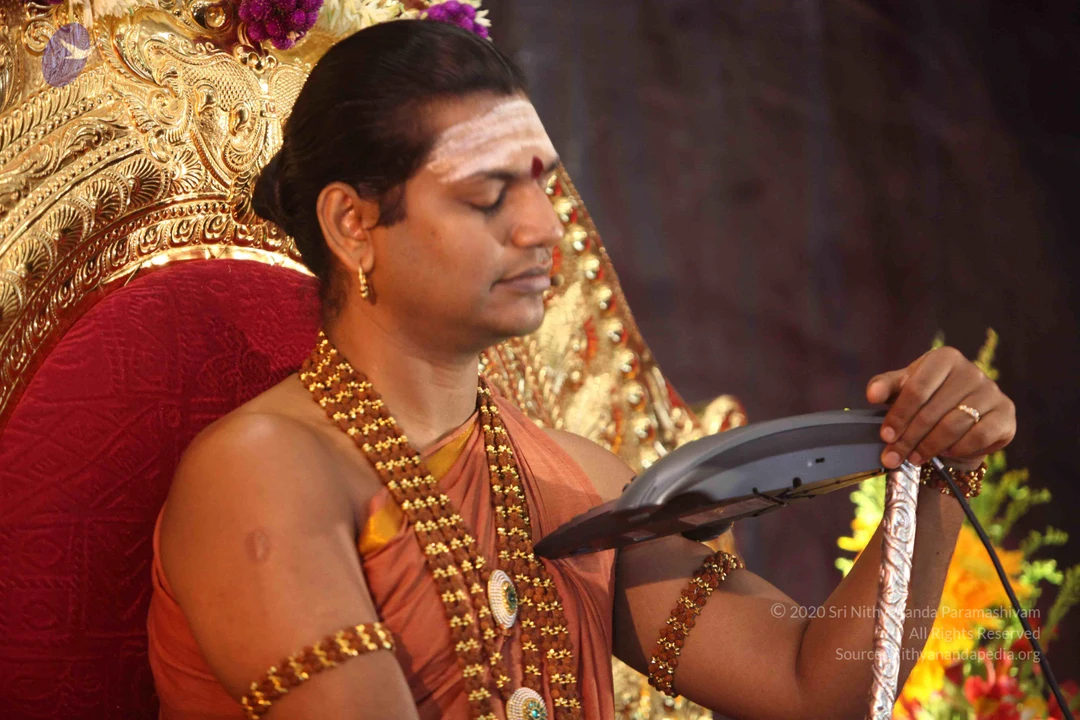
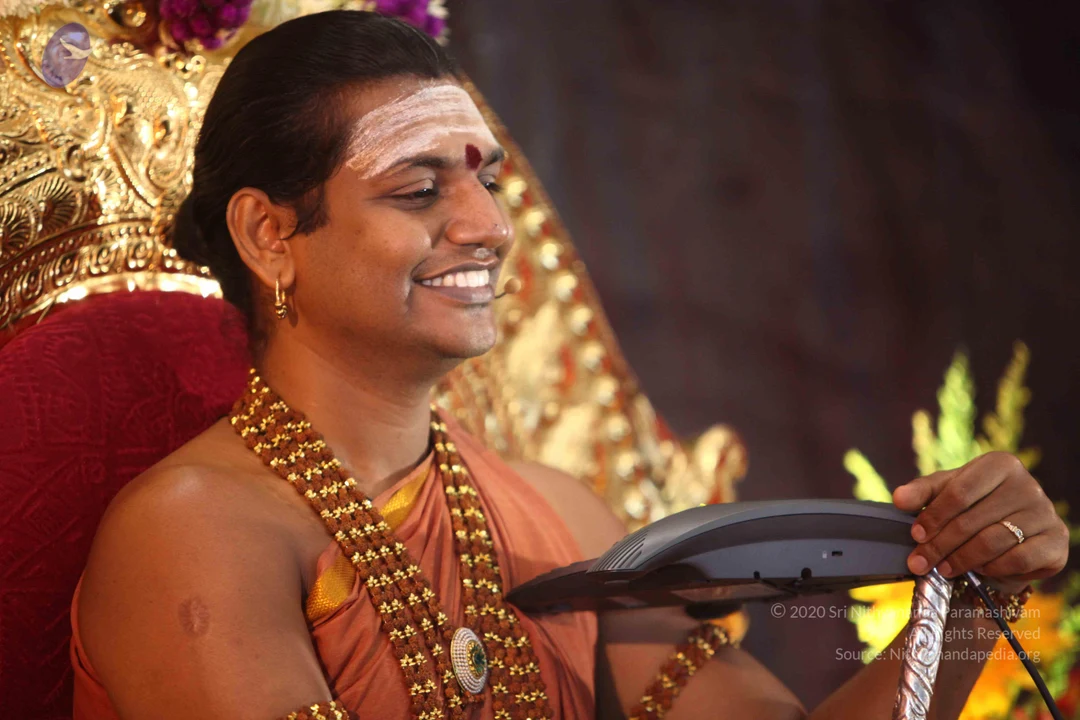
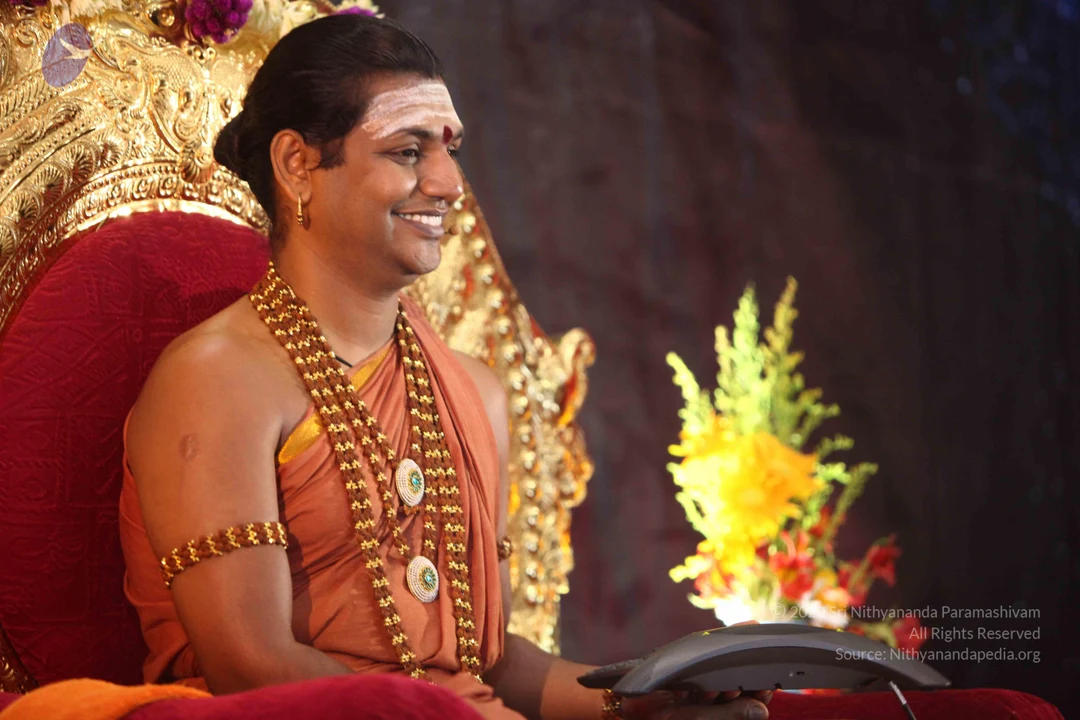
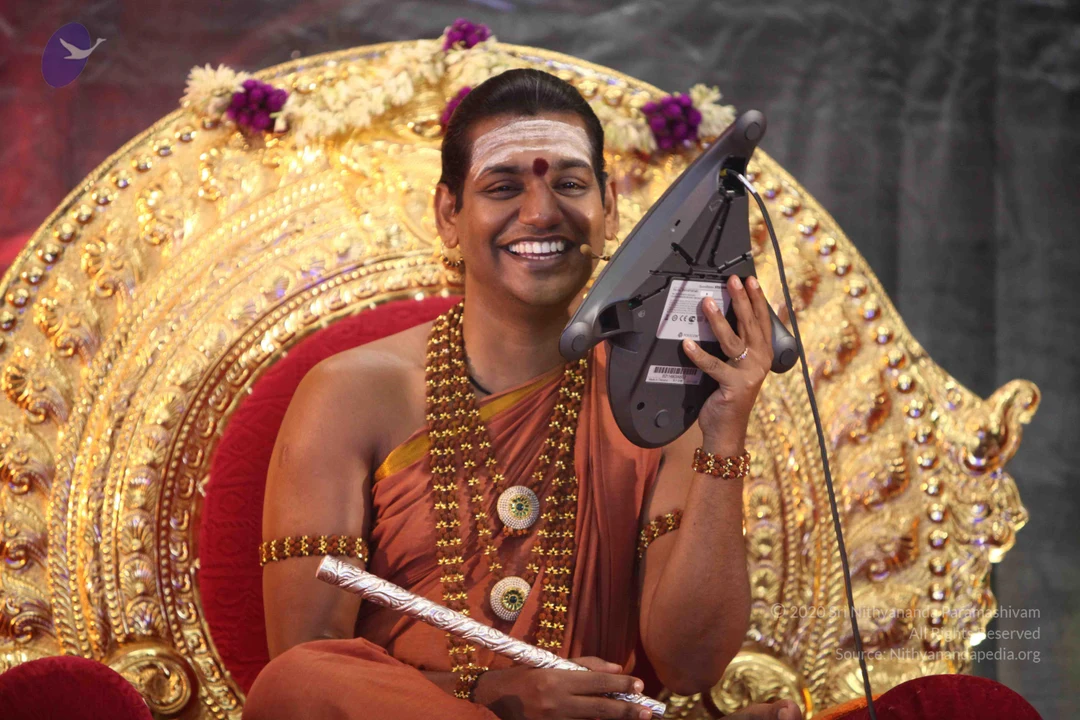
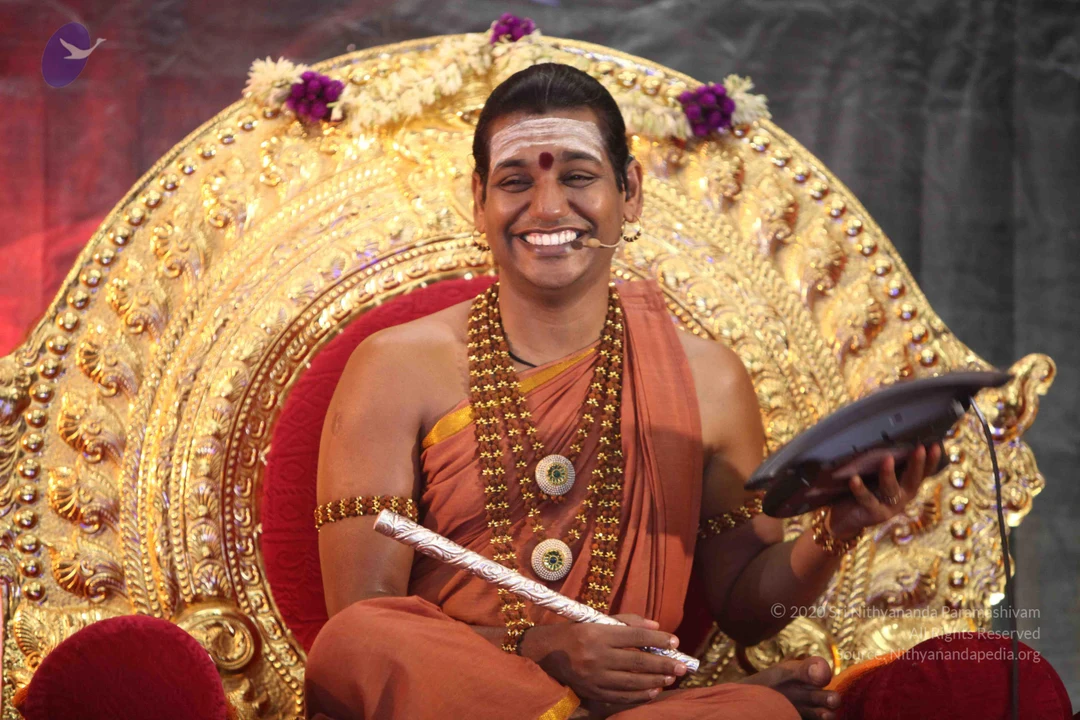
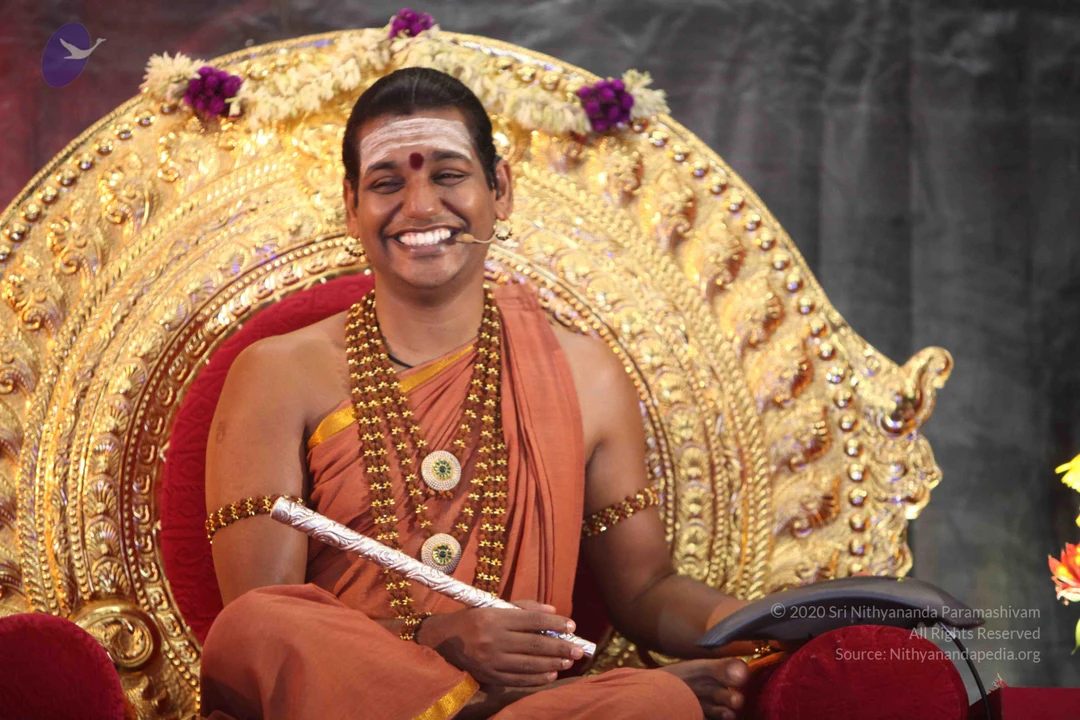
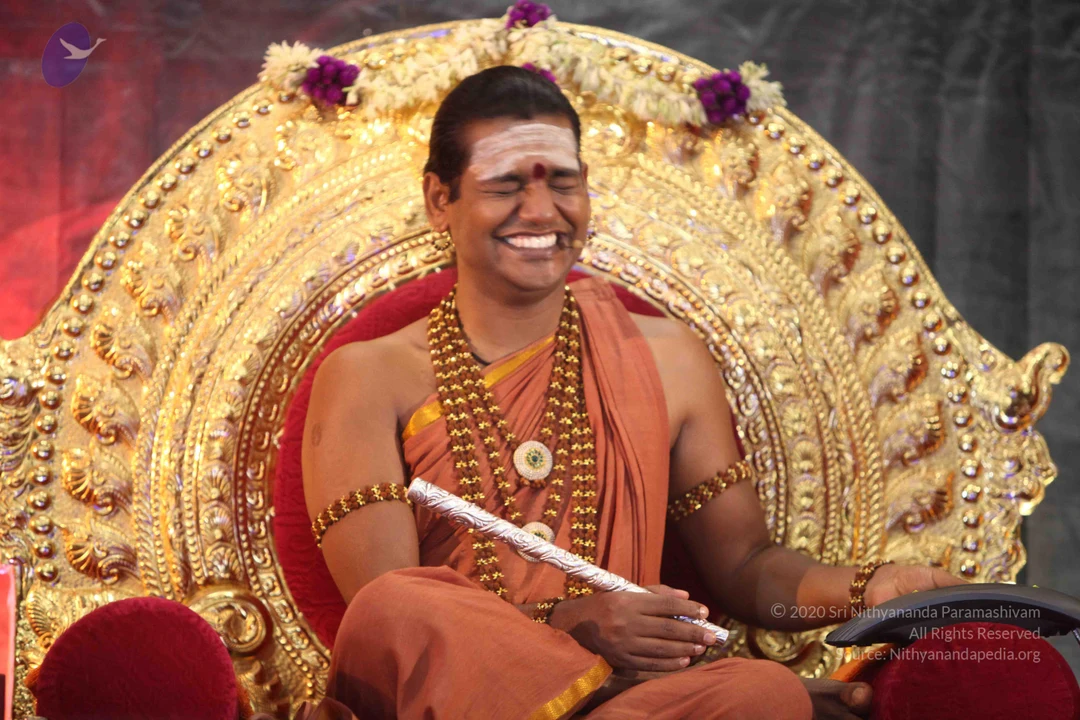
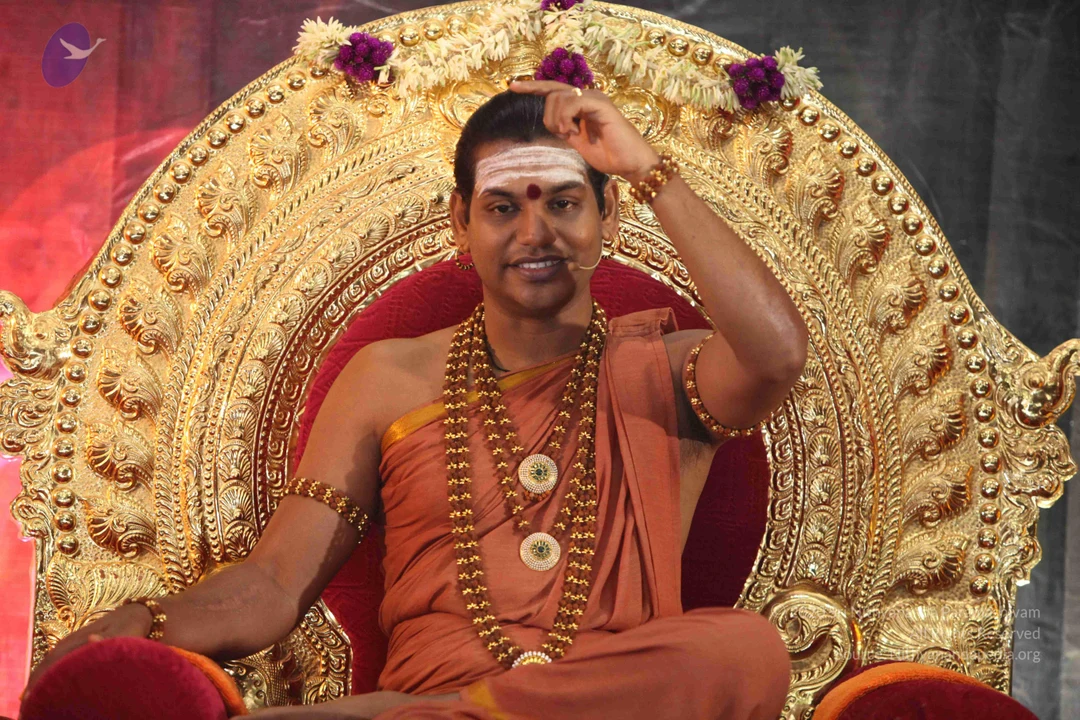
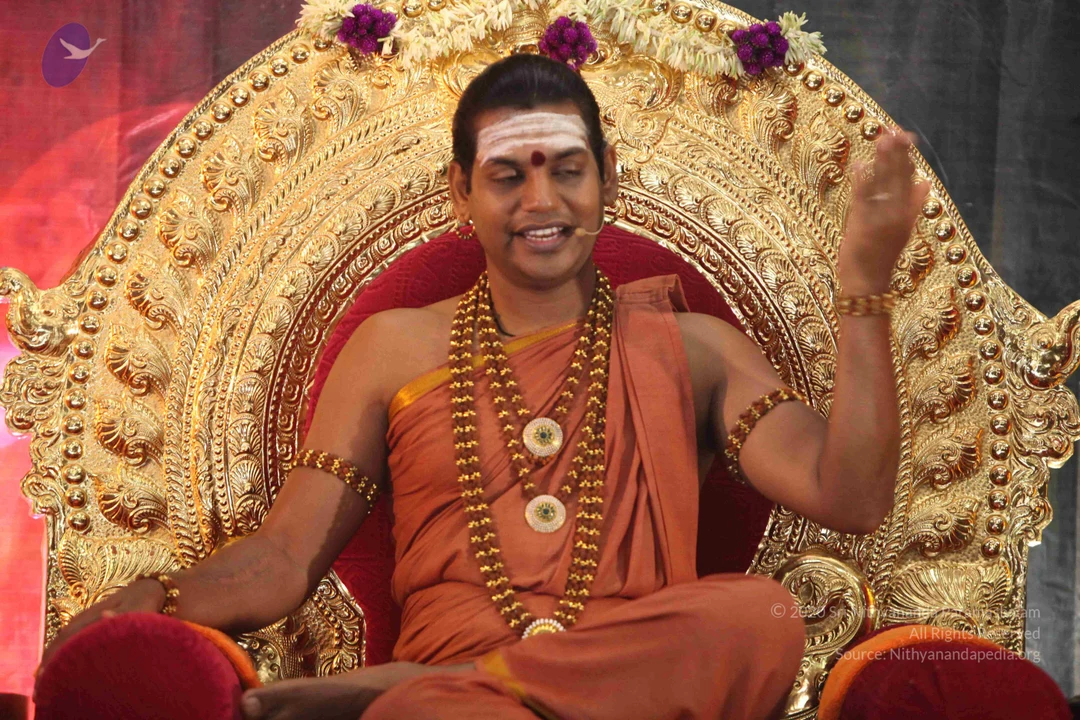
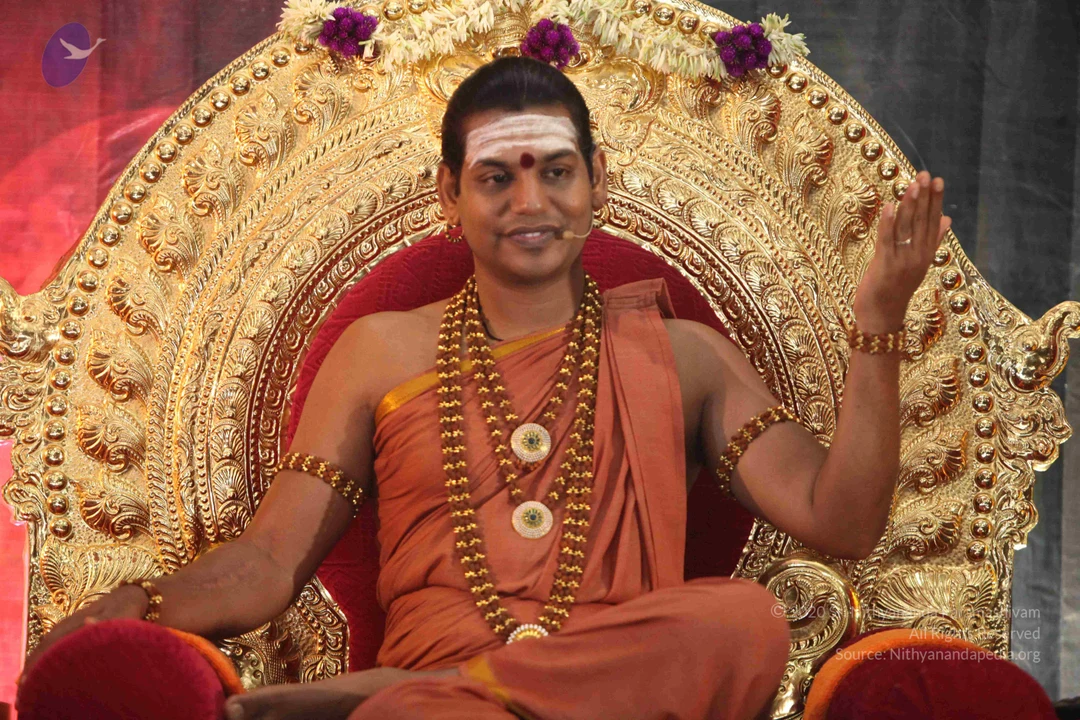
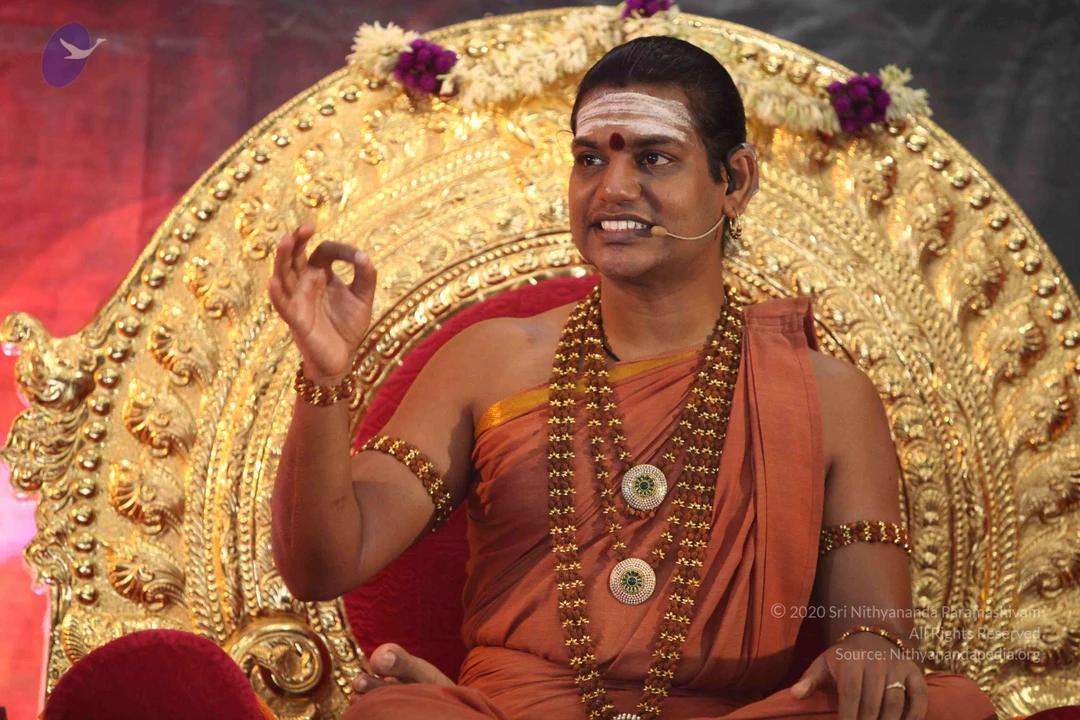
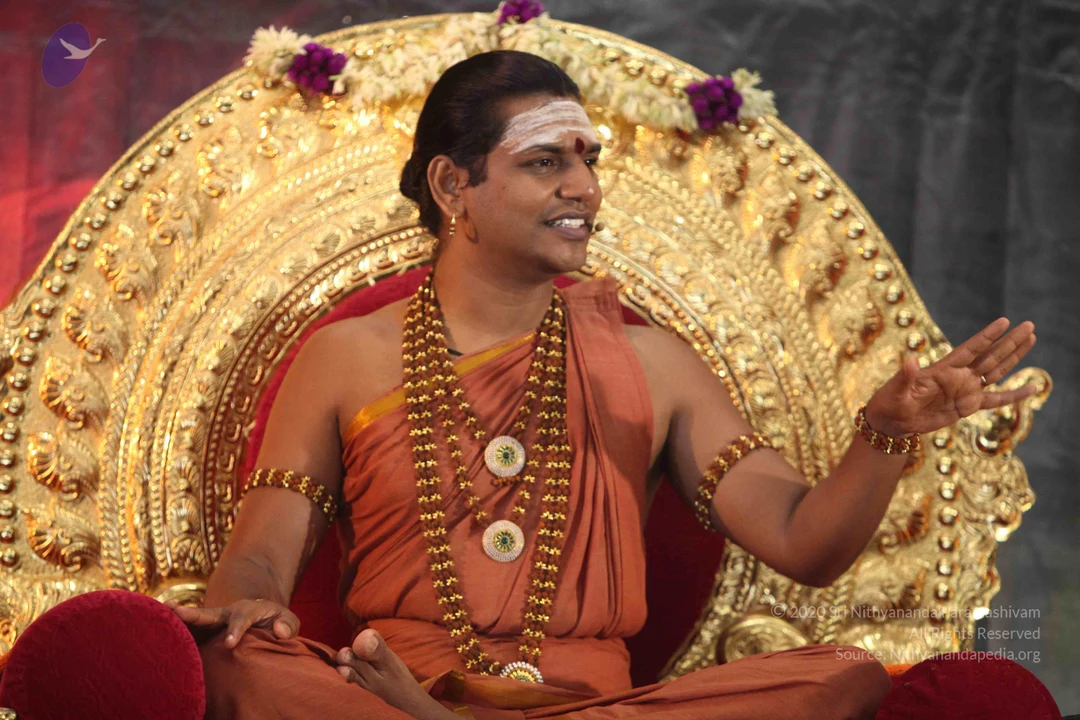
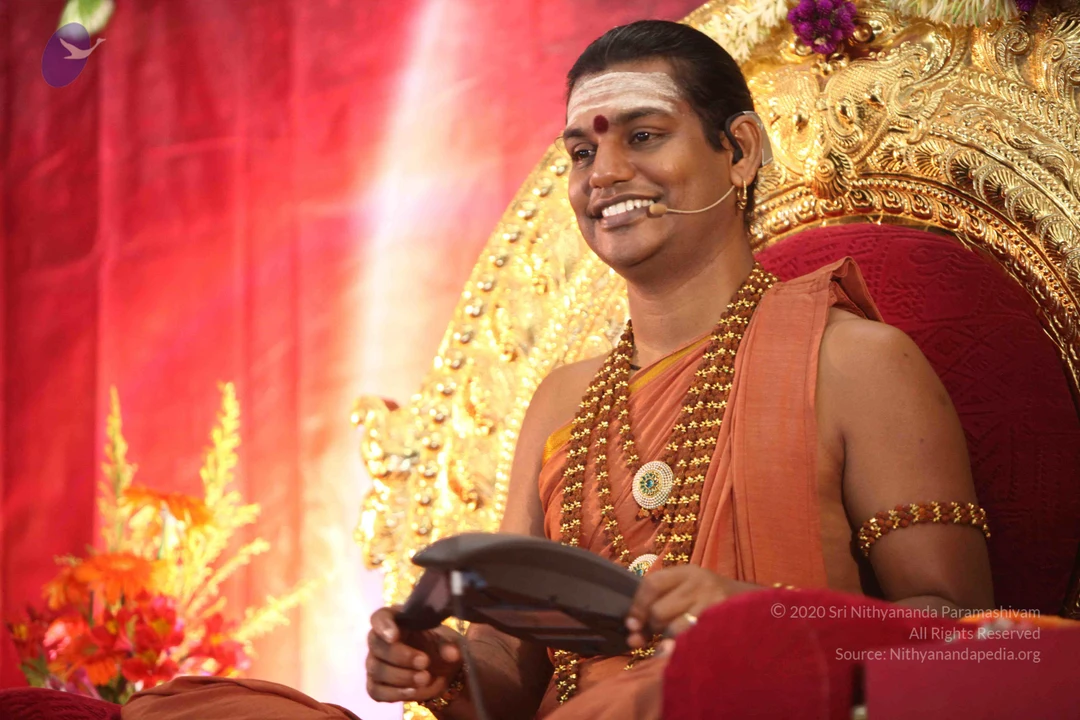
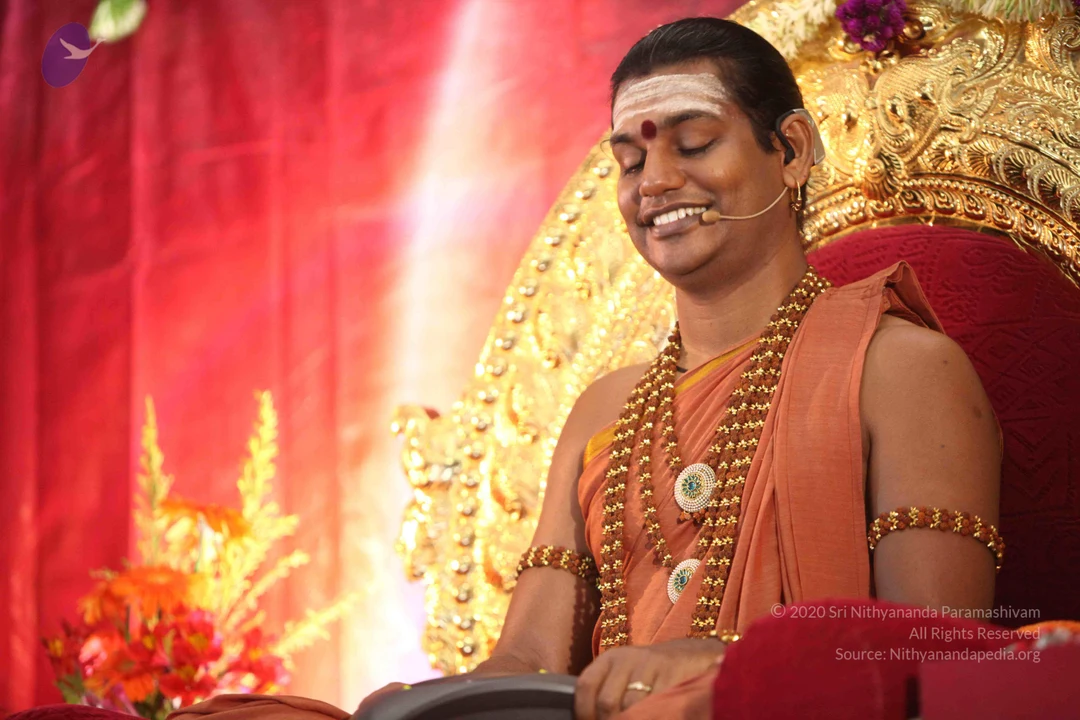
A man seated on an ornate gold throne with a red cushioned seat and floral garlands of purple and white flowers at its top. He wears a saffron-orange dhoti-style wrap draped over his shoulder, multiple long gold and beaded necklaces with a round pendant, gold armlets and earrings, a white sacred ash line and red dot on his forehead. He holds a dark tablet-like device and speaks toward a microphone stand, with a bright floral arrangement of yellow and orange flowers at right and a dark draped backdrop behind.A man seated on an ornate gilded throne with a red cushion, decorated with a garland of white flowers and purple globe amaranth blooms. He wears an orange-saffron cloth draped over his shoulder with a golden border, multiple strands of rudraksha beads, a gold ceremonial pendant, and a small earring. His forehead bears white vibhuti lines and a red kumkum dot, and a headset microphone is attached near his mouth. The background is a dark drape. Based on the satsang setting, this matches the presentation cues of a person, seated and speaking at a morning talk.A photograph of a man seated on an ornate gold throne with carved scrollwork and bead-studded edges, set against a dark grey draped backdrop. He wears an orange-saffron garment over his shoulder, long rudraksha-style beaded necklaces, a golden disc pendant, gold armlets and a gold earring. He has a white vibhuti line across his forehead and a red bindi, and his right hand is raised in a speaking gesture. a person is the speaker, shown in the role of a teacher giving satsang discourse.Photo of a man seated on an ornate gold throne with red cushioning, speaking into a handheld microphone held in his right hand. He wears an orange-saffron dhoti and shawl, multiple rudraksha-style beaded necklaces with a pendant, gold armbands and bracelets, and a white tripundra with a red mark on his forehead. A vase of yellow and red flowers stands at right against a dark gray backdrop. a person is seated, matching the page's dress and throne cues while appearance remains the only basis.A smiling man in orange saffron clothing sits on an ornate gold throne with a red cushioned seat, its back carved with floral and leaf motifs and studded with gold balls, topped by purple flower garlands. He wears a white vertical tilak with a red bindi, layered gold and rudraksha-style beaded necklaces, a gold armlet and bangles, and a ring. He holds a black handheld device or tablet and looks down at it. A silver rod stands beside him against a dark backdrop.A smiling man with a shaved-looking swept-back dark hairstyle sits on an ornate gold-and-red throne decorated with purple and white flower garlands. He wears an orange-saffron wrap and multiple gold beaded necklaces with round pendants, gold armbands and bangles, and a white vibhuti line with a red kumkum dot on his forehead. He holds a small black microphone and a white-and-silver rod. A vase of yellow and red flowers stands to the right against a dark draped backdrop. a person, seated as a speaker during a satsang discourse, with a ceremonial throne and flowers around him.
04-Sarva-Darshan

10 photosSource gallery
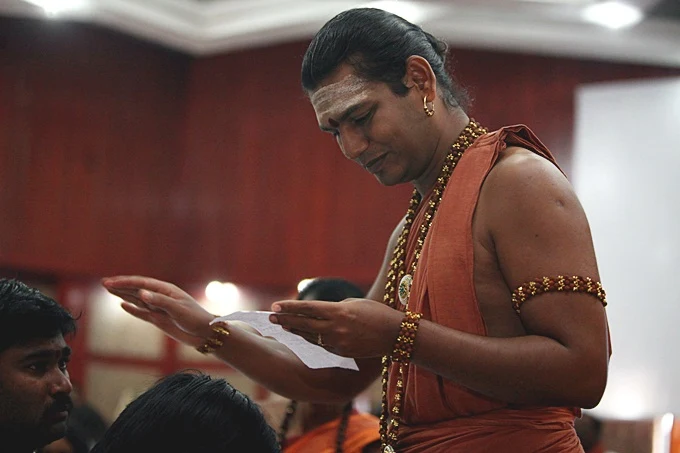
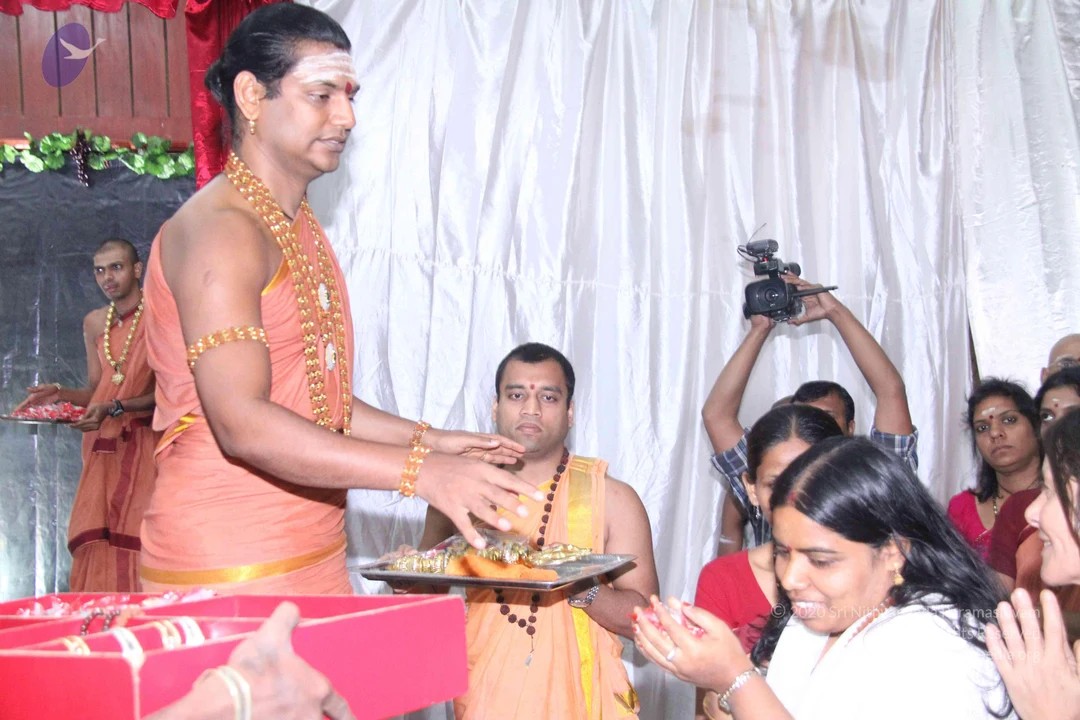
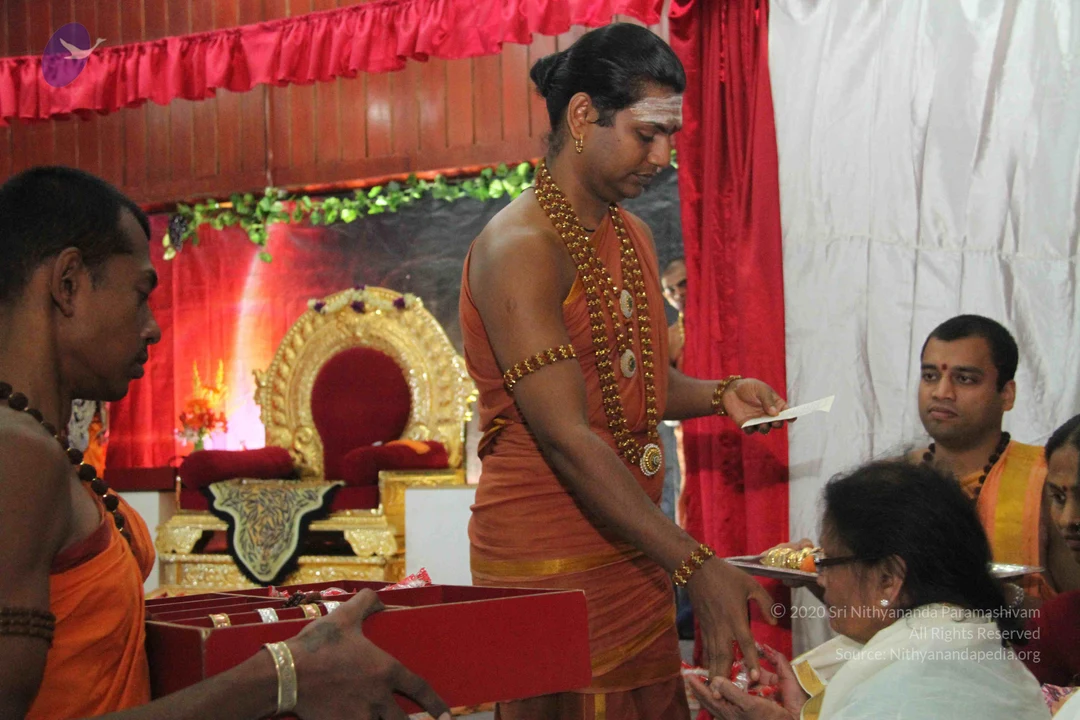
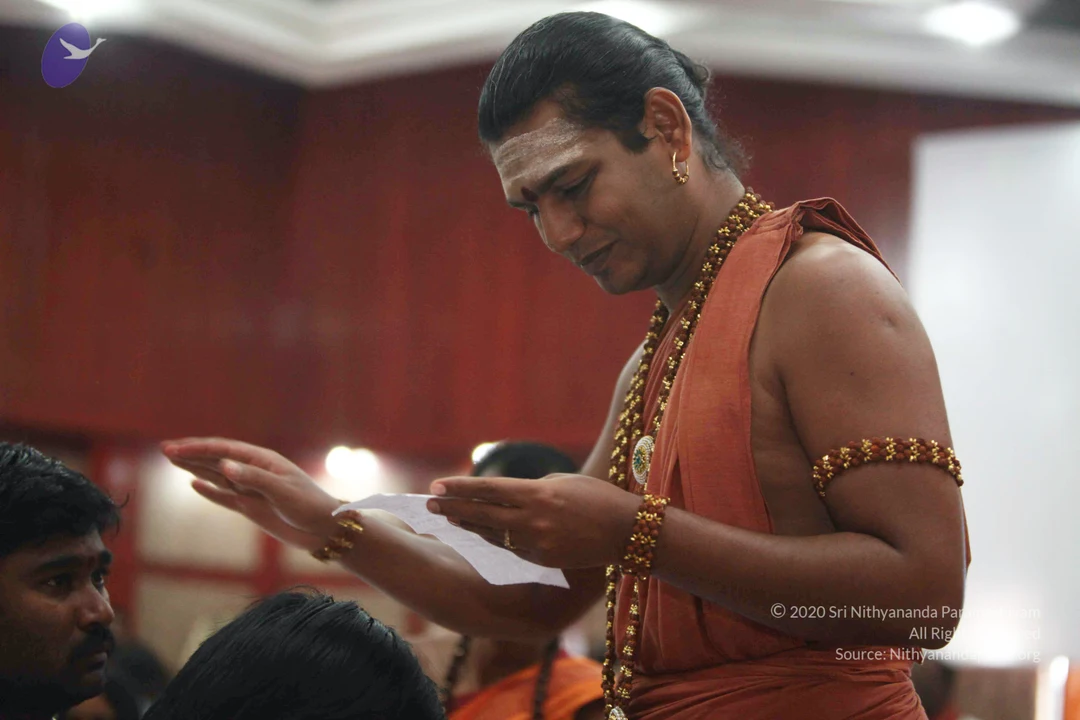
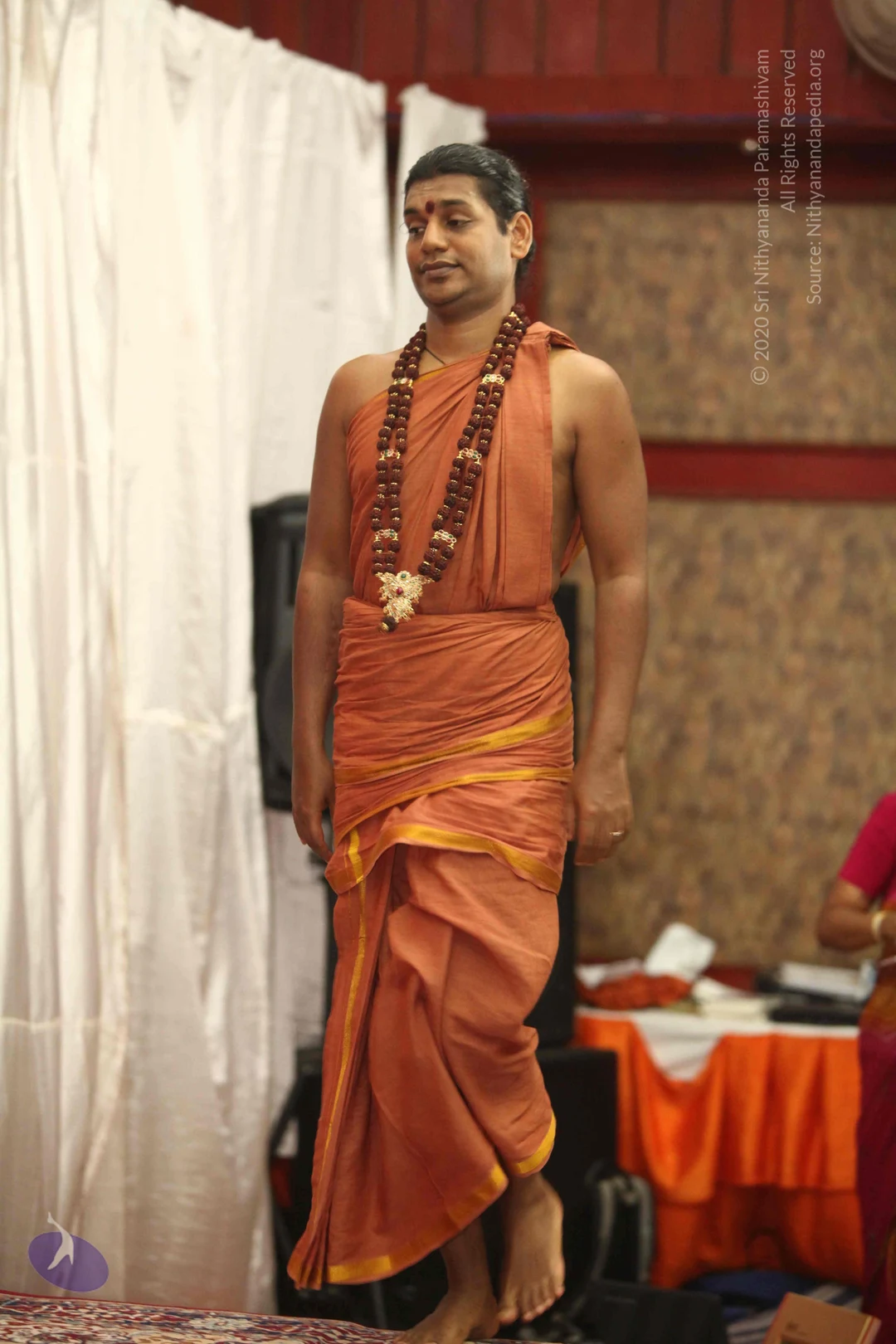
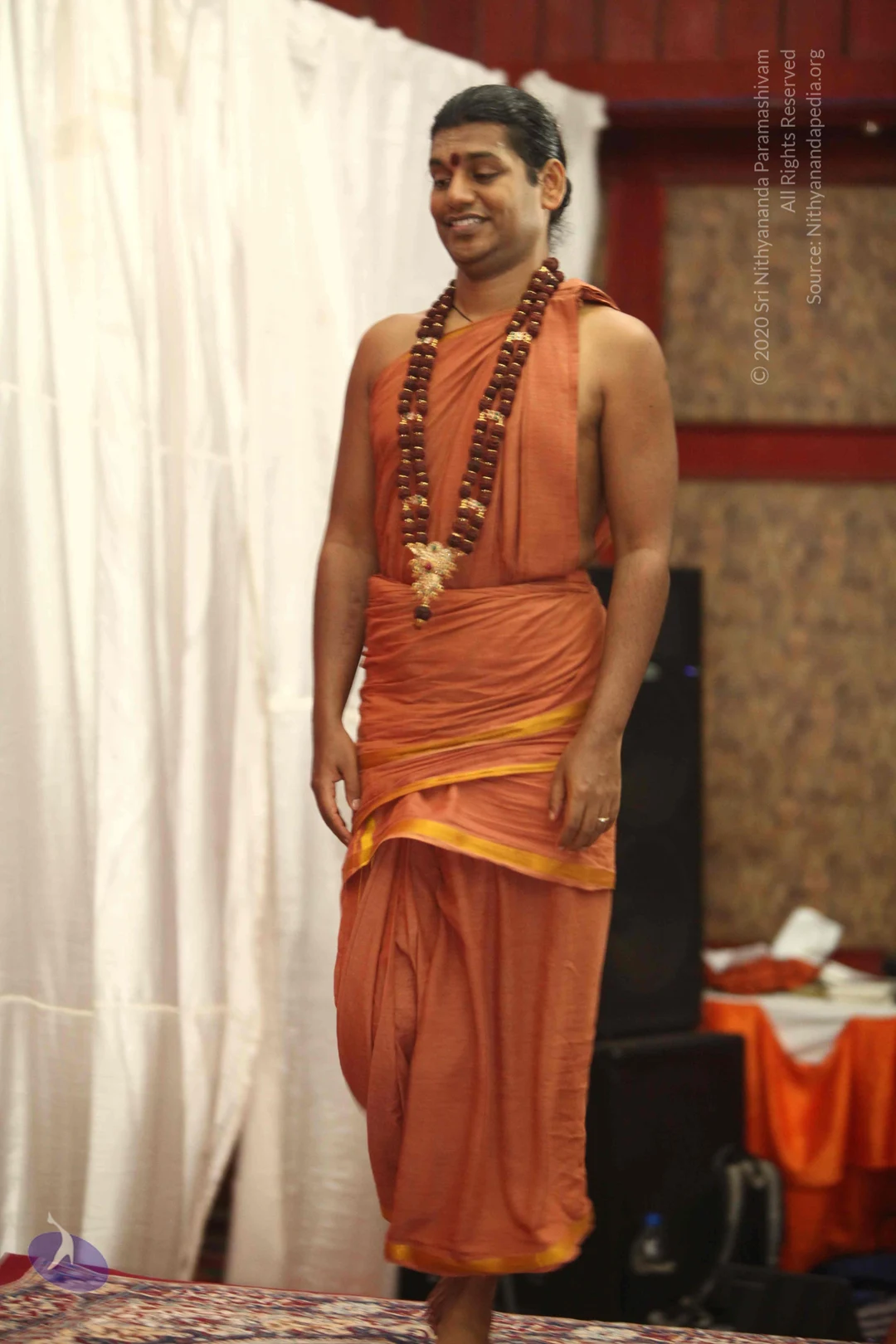
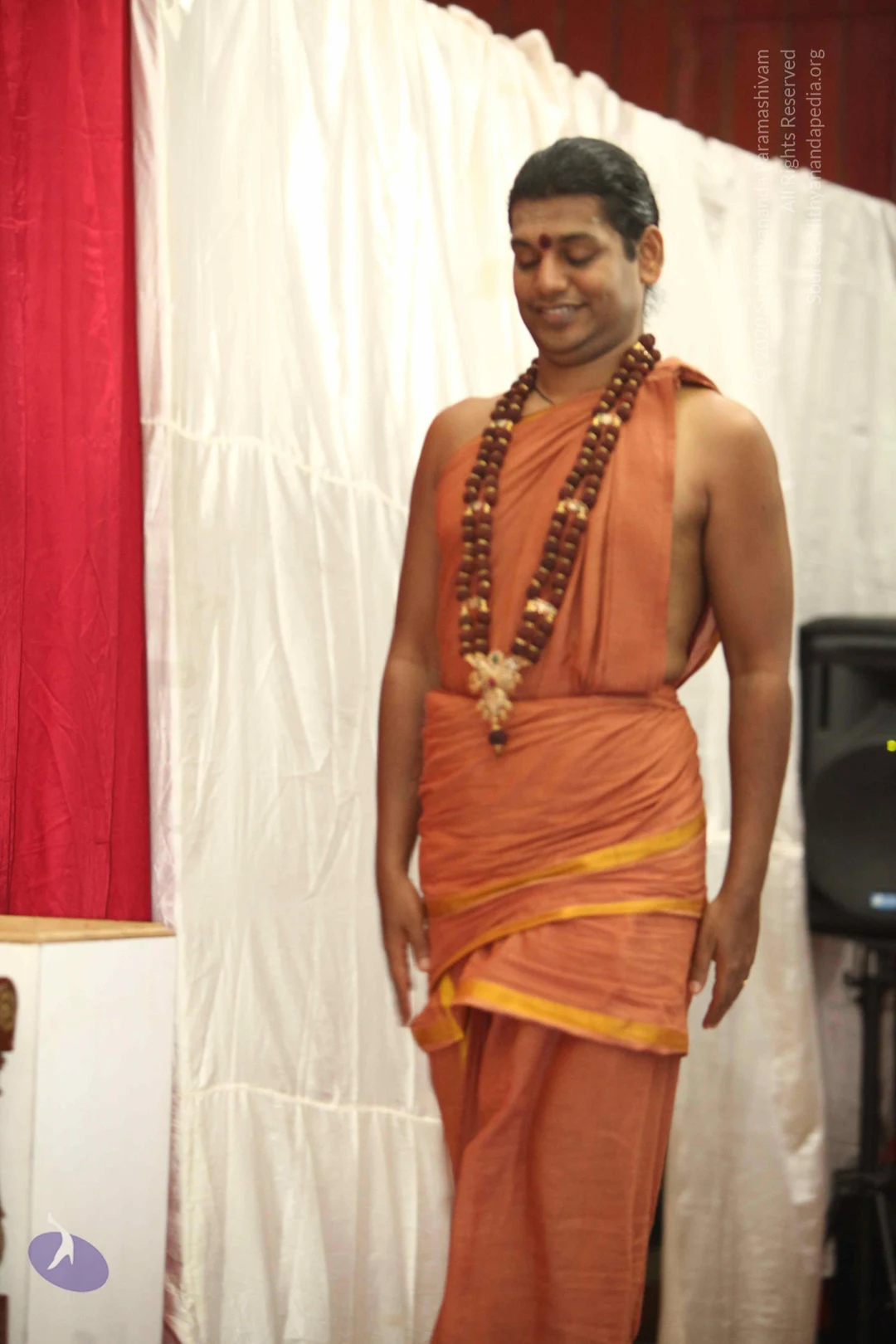
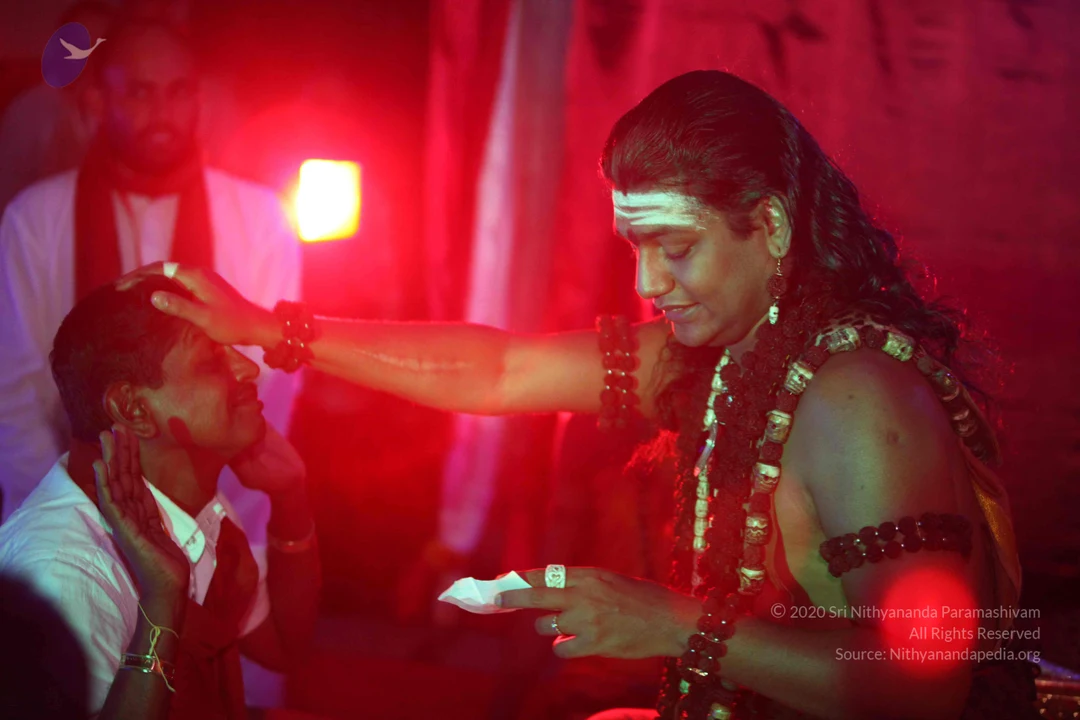
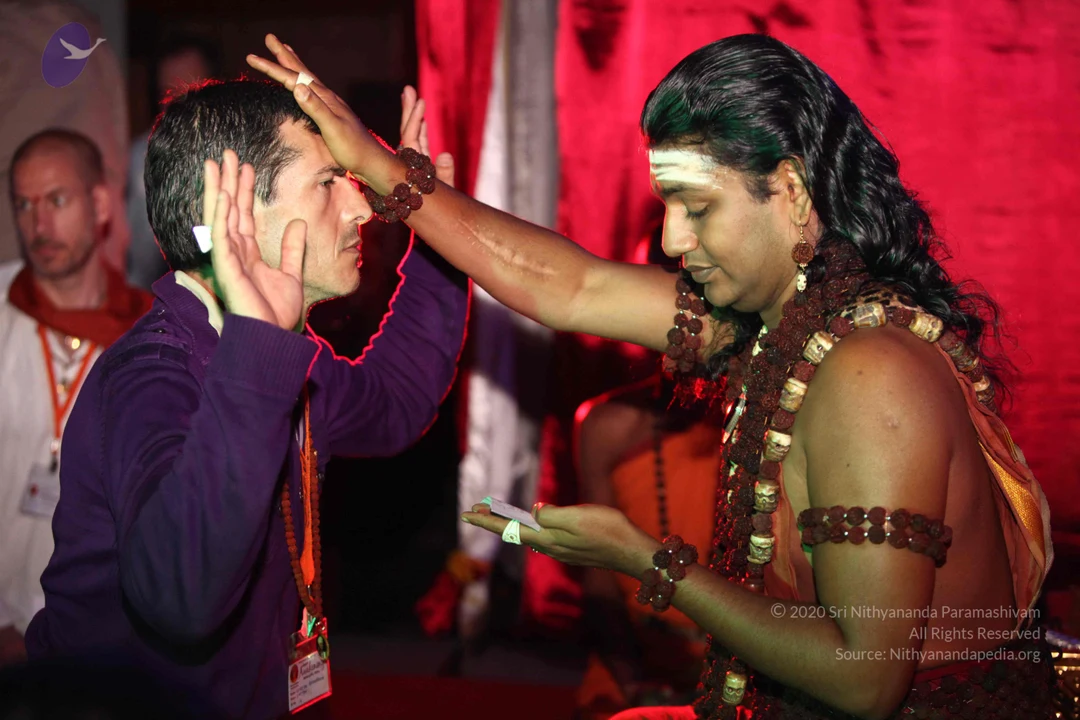
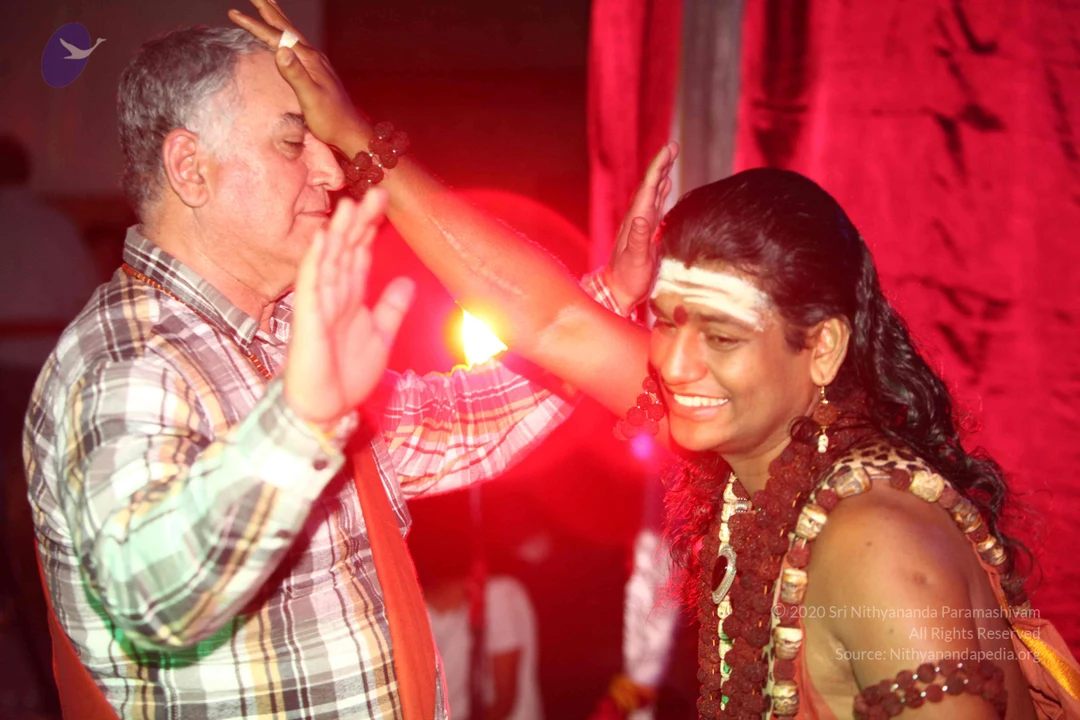
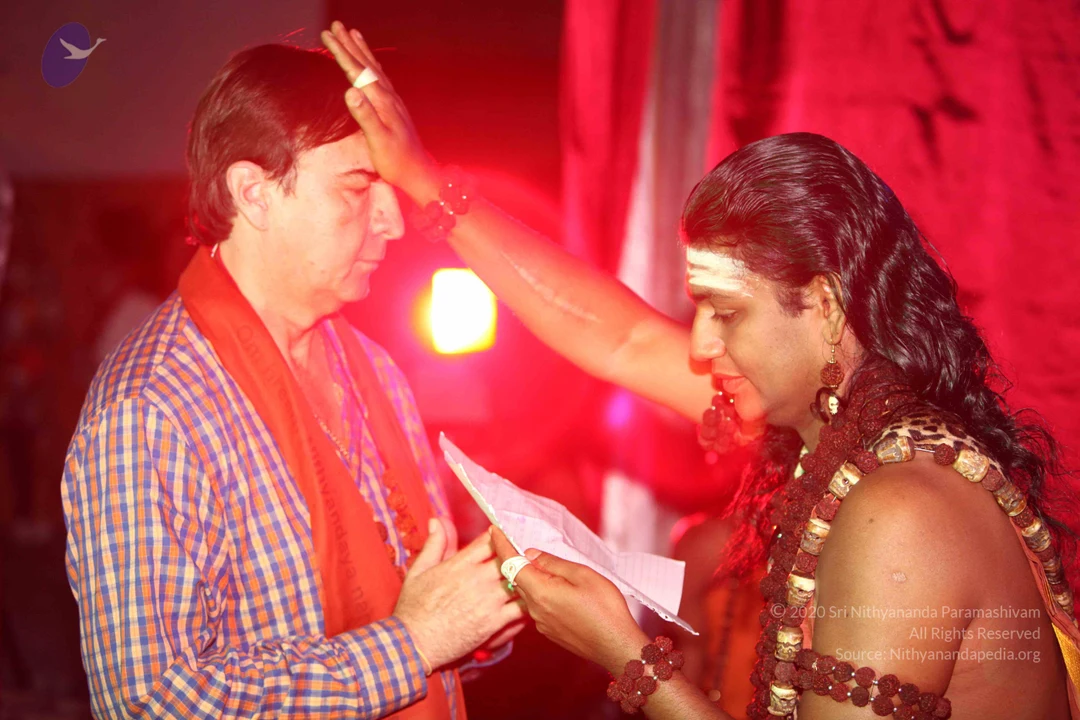
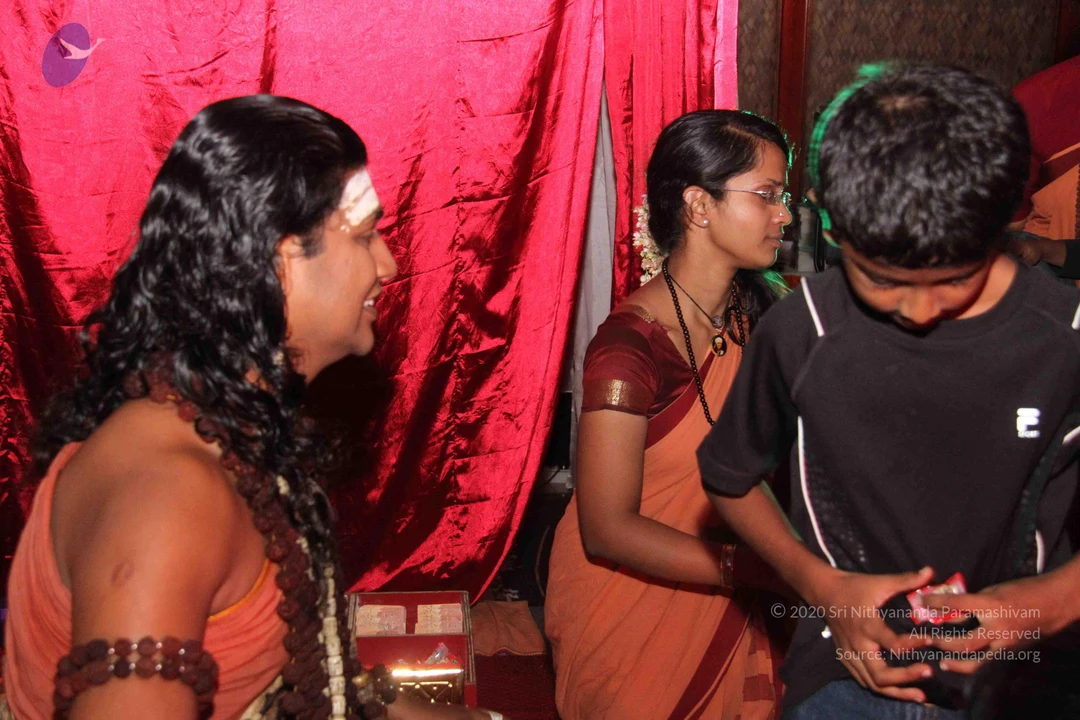
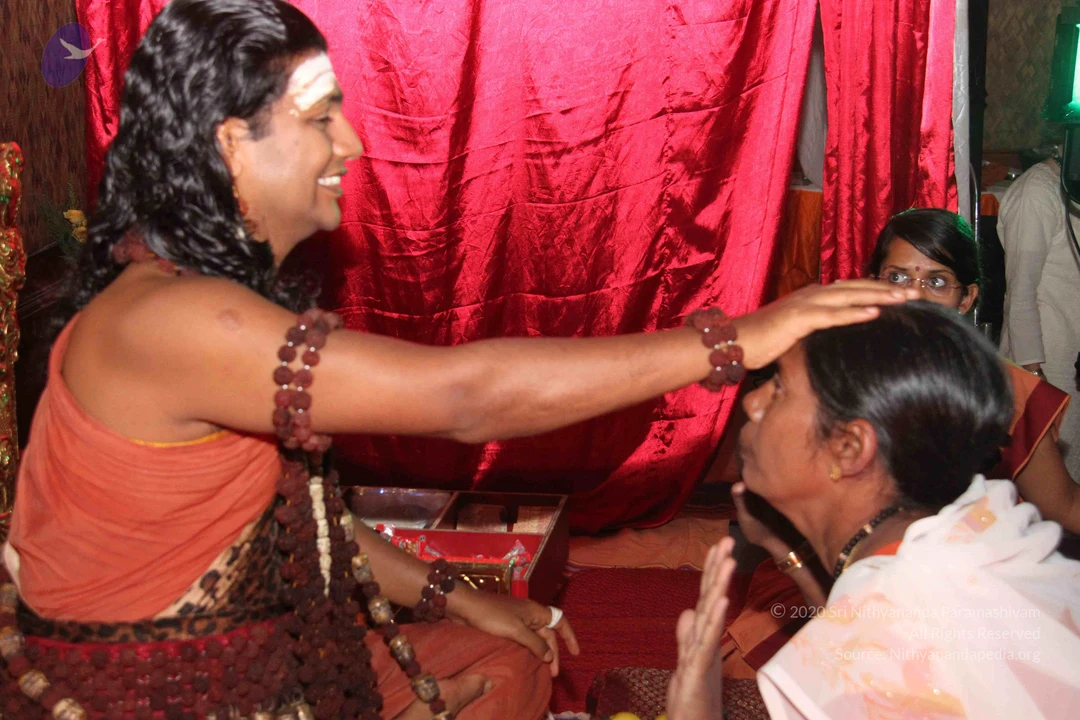
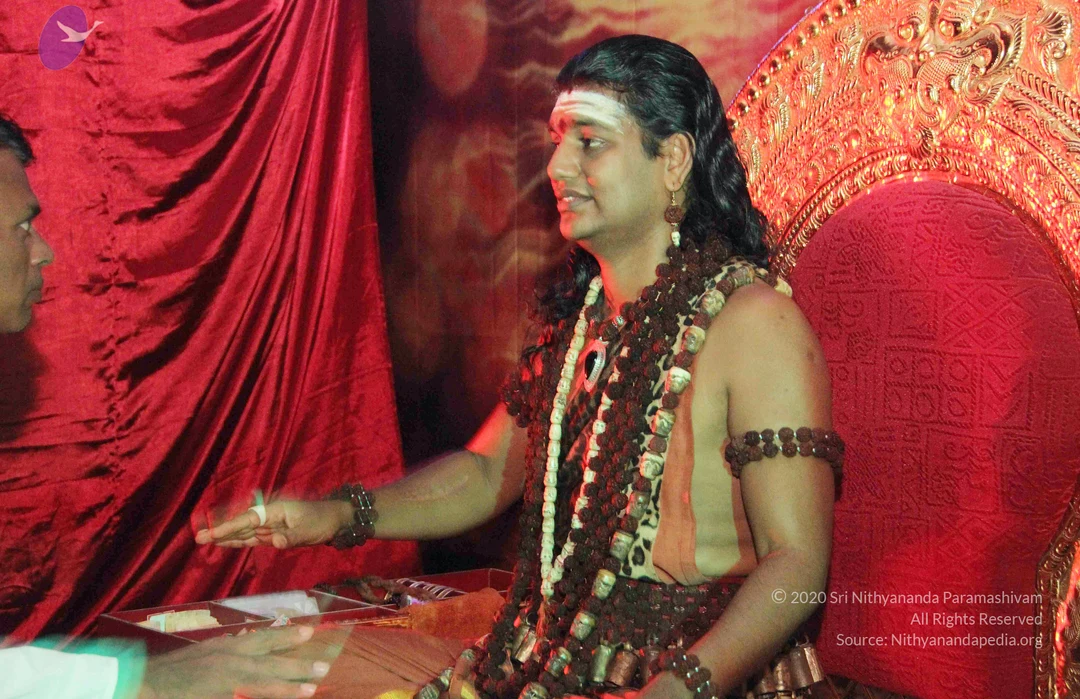
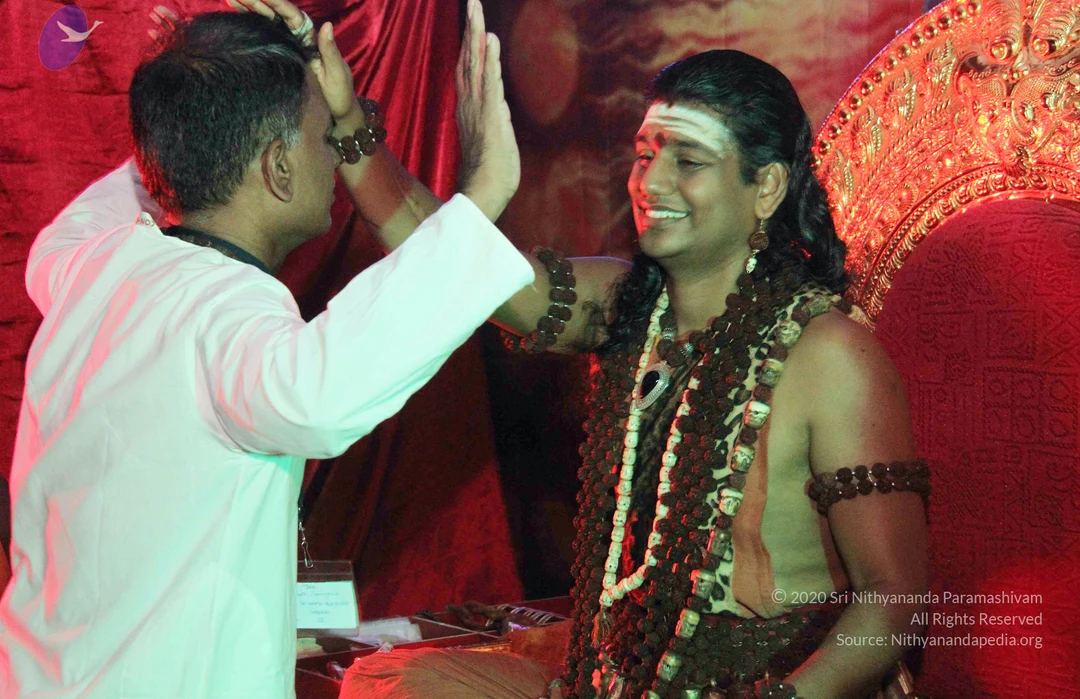
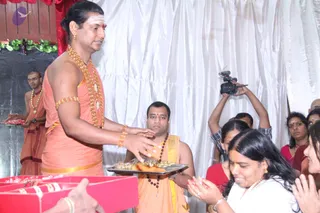
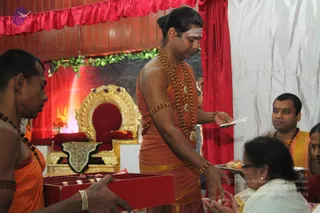
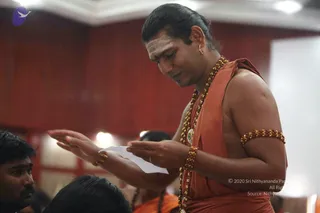
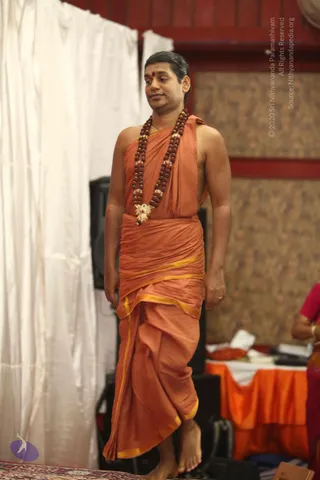
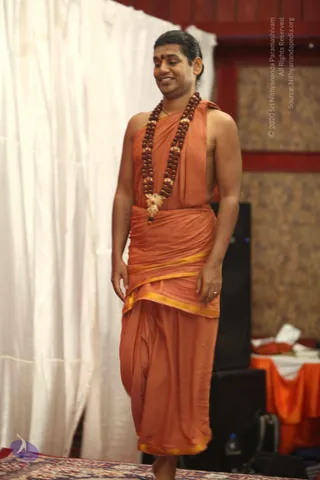
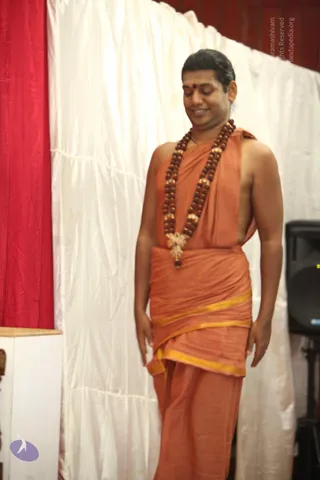
Photograph of a satsang or sarva darshan event with a white silk curtain backdrop and red draping. A central man in an orange-saffron dhoti and shawl, with a long-haired, swept-back style, a white vertical tilak and a heavy gold necklace, stands holding out his hands over a silver tray of gold and offerings. Behind him a man in saffron cloth with a rudraksha mala holds another tray, and a tray of red-wrapped items sits at lower left. A seated woman in white with folded hands and a man filming with a camcorder appear at right, with several devotees behind. Swamiji (probable) cues: saffron clothing, gold ornaments and long swept-back hair on the central figure.A photograph of a ceremonial gathering in a decorated hall with red drapes, a gold-framed red throne, and green foliage. A man in saffron-orange dhoti and shawl, wearing long multi-strand gold necklaces, gold armbands, and a rudraksha-style mala, stands centre-right holding a white card toward a seated older woman in a white sari who holds out her hands. Another man in orange on the left holds open a red wooden box, and a third person in orange with a mala stands behind at right. The appearance of the central standing figure with long swept-back hair and ornate gold adornments is a person candidate, present in person, though identity is uncertain from appearance alone.A photograph of a bare-chested man in an orange-saffron shawl wrapped over his shoulder, wearing a red-and-gold beaded mala necklace, a matching beaded armlet and multiple beaded bracelets, with a sacred mark on his forehead and a gold earring. He stands and looks down while holding a small white paper in both hands, with an open palm extended toward seated listeners in the foreground. Behind him, a red wooden wall and an orange-clad figure suggest a satsang hall. a person: the standing man wears distinctive saffron shawl, rudraksha-style beaded malas and ornate gold-and-red adornments, consistent with the page's account of a morning satsang talk.A barefoot man in a saffron-orange dhoti and shawl with gold-edged borders stands on a red-and-cream patterned mat in a hall with white curtains and a wood-panelled wall. He wears a long double strand of rudraksha beads with a gold ornamental clasp at his chest and a red bindi on his forehead. Behind him, a table draped in orange cloth holds papers and items, and a woman in a pink garment is partly visible at the right edge. The page identifies this as a satsang talk, and the man's distinctive saffron robes, rudraksha mala and gold ornament are consistent with the a person presentation, shown in person.A man stands on a raised platform in an indoor hall, wearing a saffron-orange draped garment with gold-bordered edges and sleeveless upper wrap, with a long rudraksha mala of dark beads and a gold pendant around his neck. He has a red tilak on his forehead, long swept-back dark hair, and is smiling while looking downward. Behind him are white curtains, a dark speaker, and an orange-draped table with items on it. a person cues: saffron clothing, rudraksha mala and ceremonial gold pendant, presented as the speaker at a satsang talk.a person: a man stands in front of a white draped backdrop with a red curtain at left and a black speaker at right. He wears an orange-saffron shawl draped over his shoulders and an orange wrap with yellow-gold borders at the waist, a long rudraksha mala with a gold ornamental pendant on his chest, and a red tilak on his forehead. His head is lowered with eyes closed and a faint smile.
05-Swamiji-and-Samyam-Participants

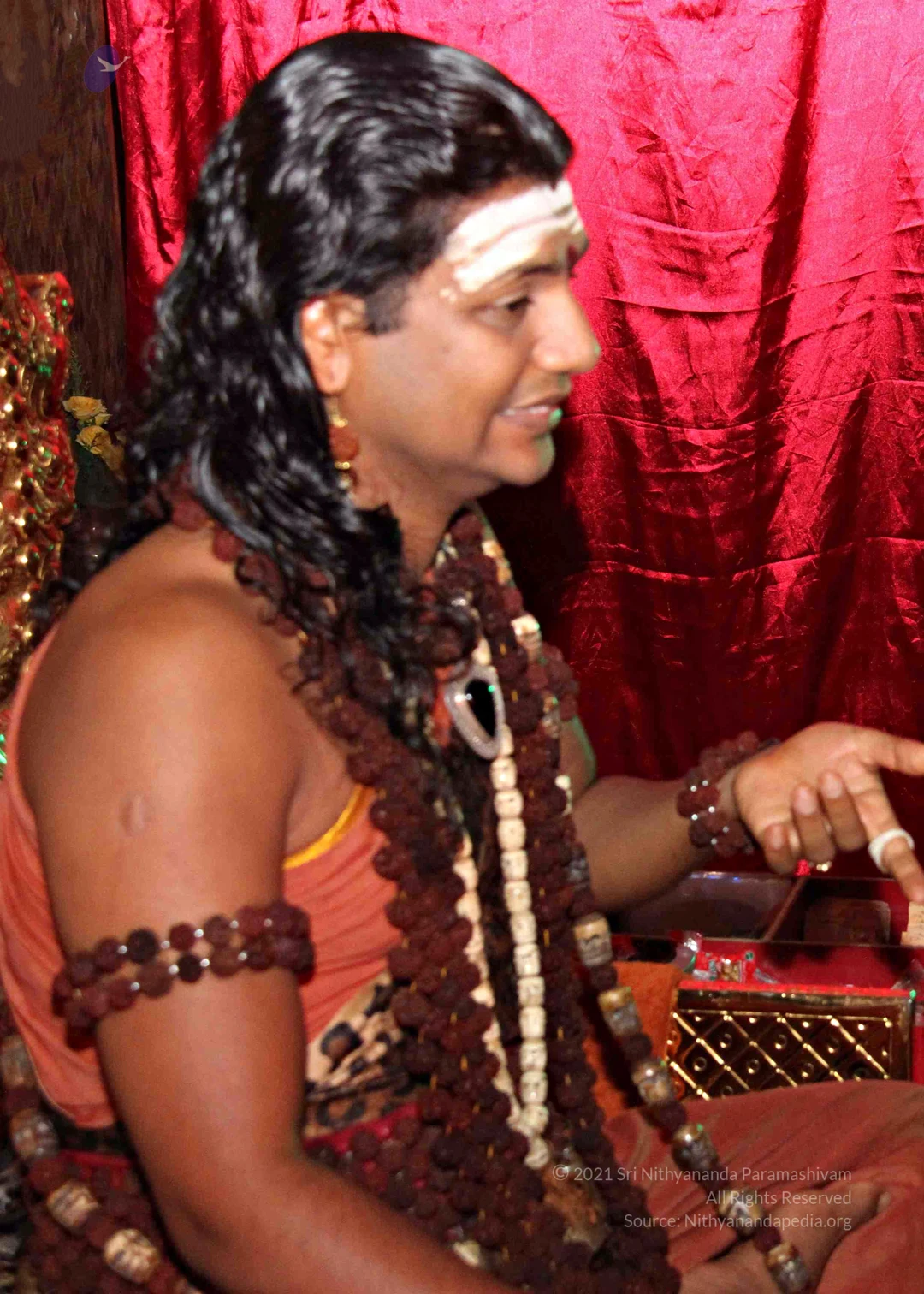
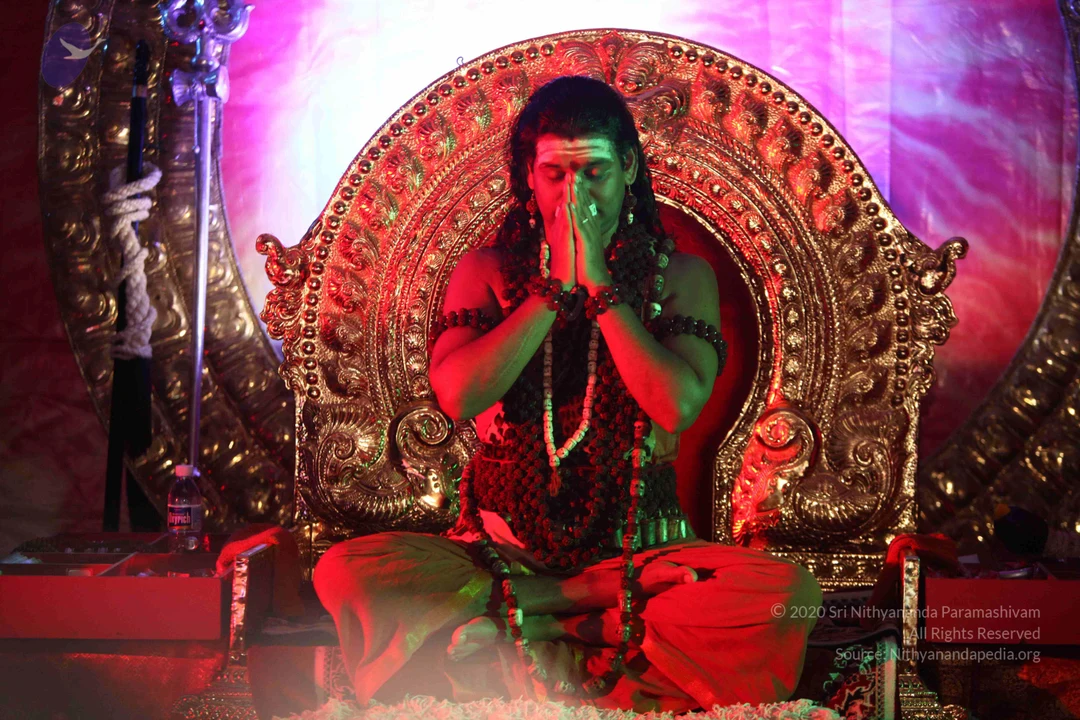
10 photosSource gallery
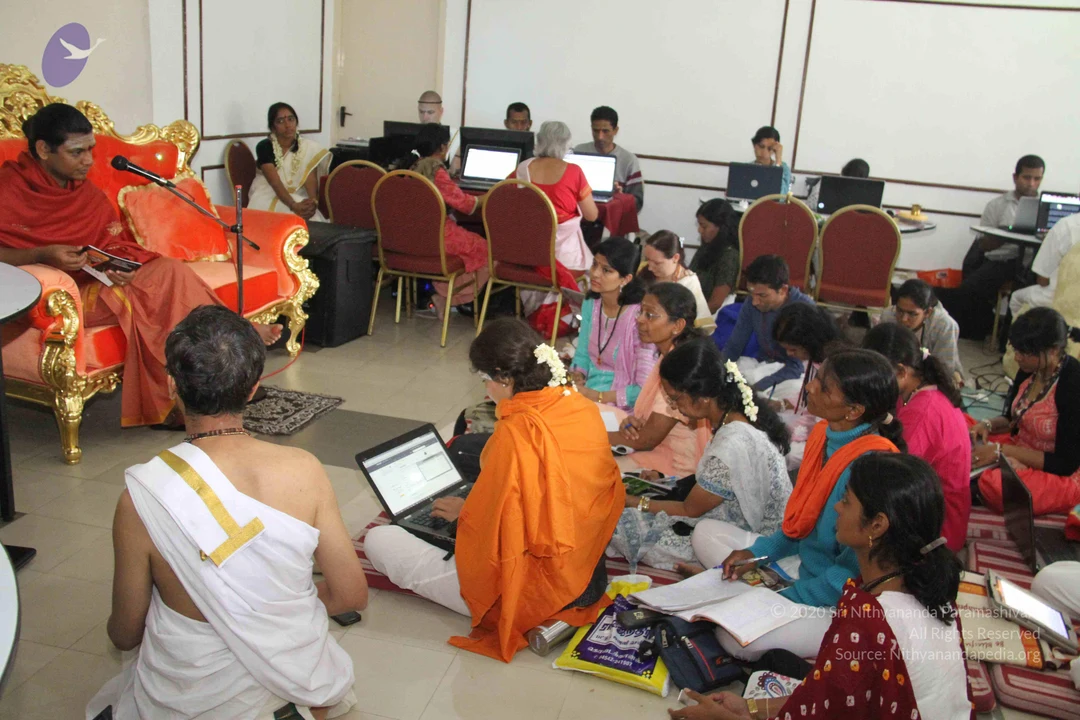
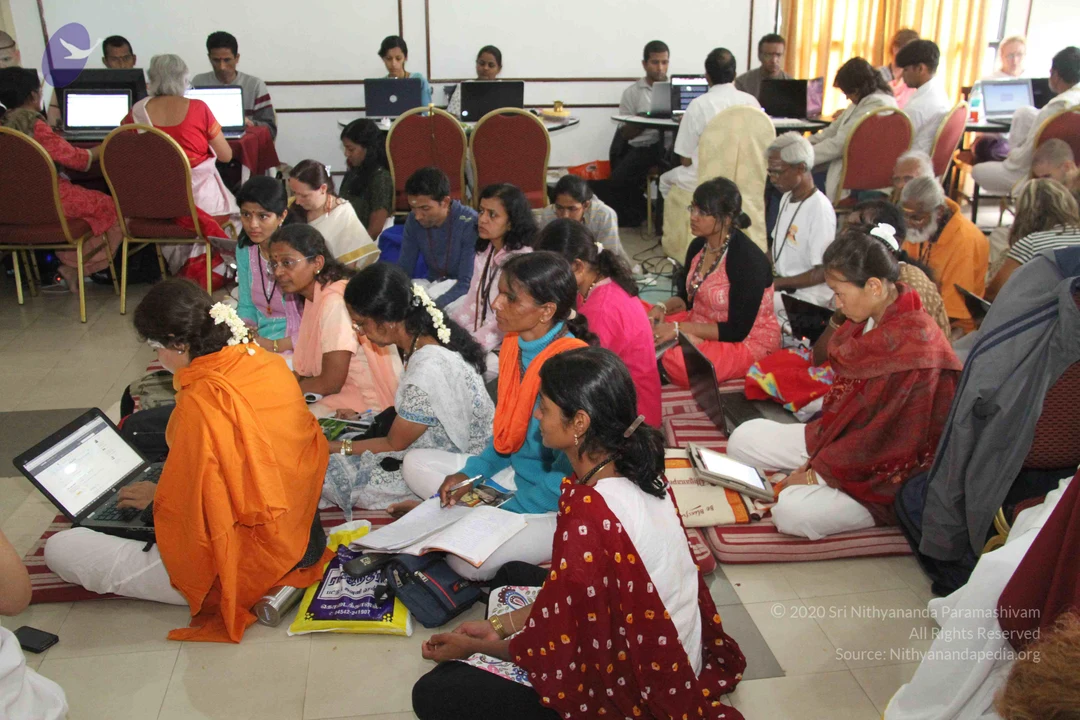
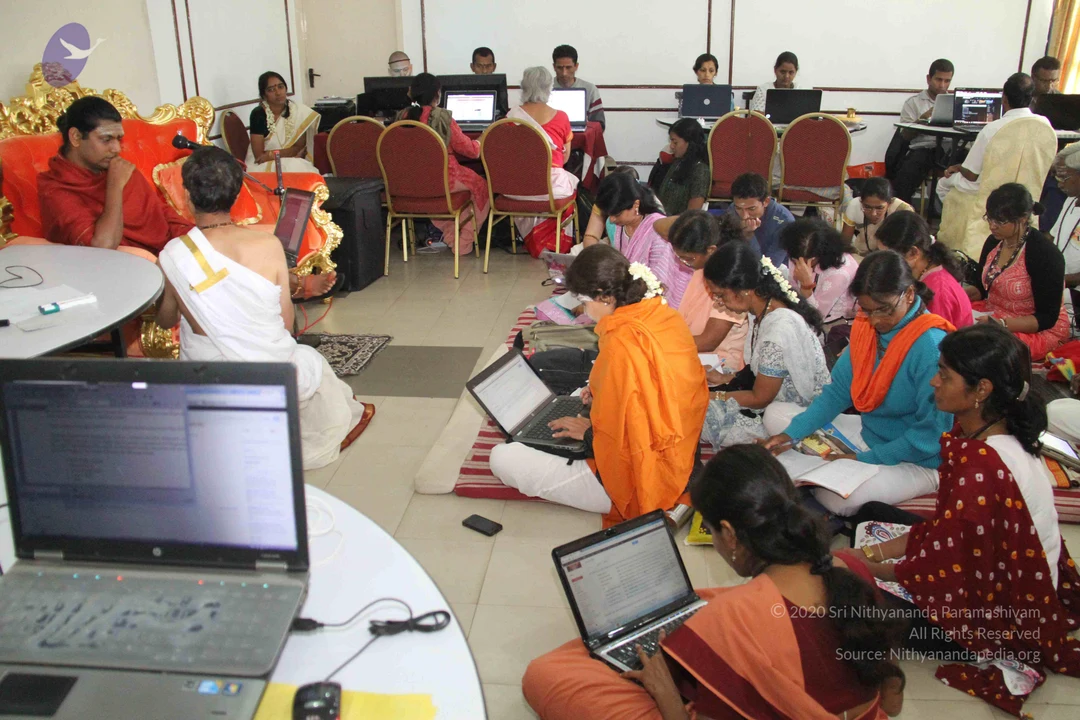
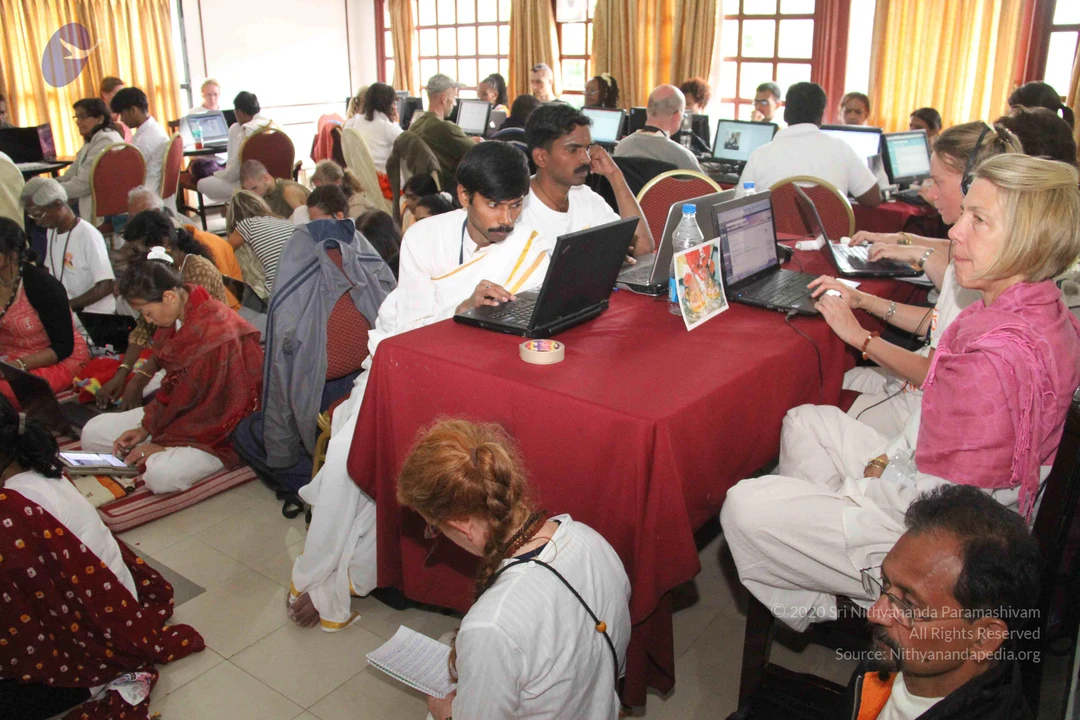
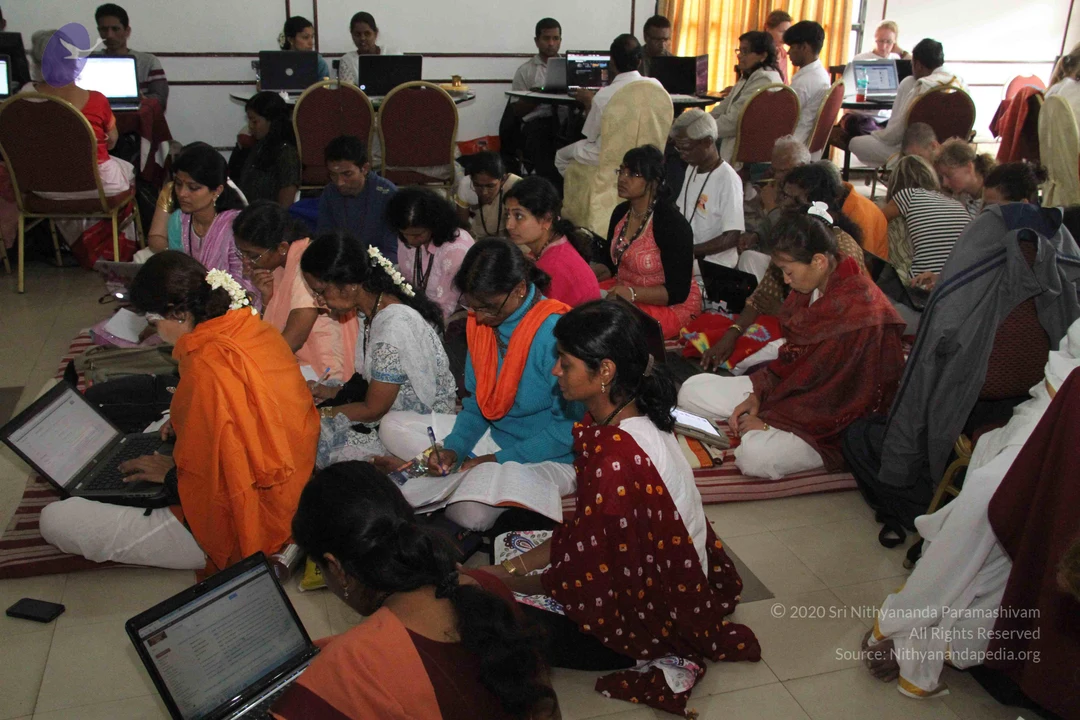
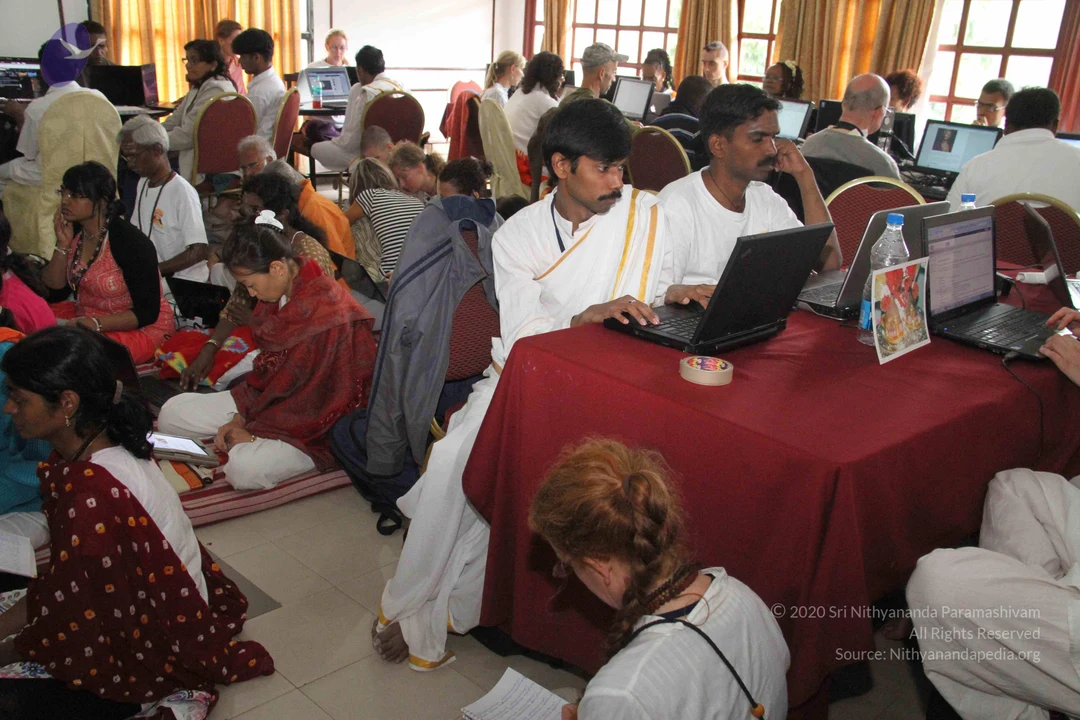
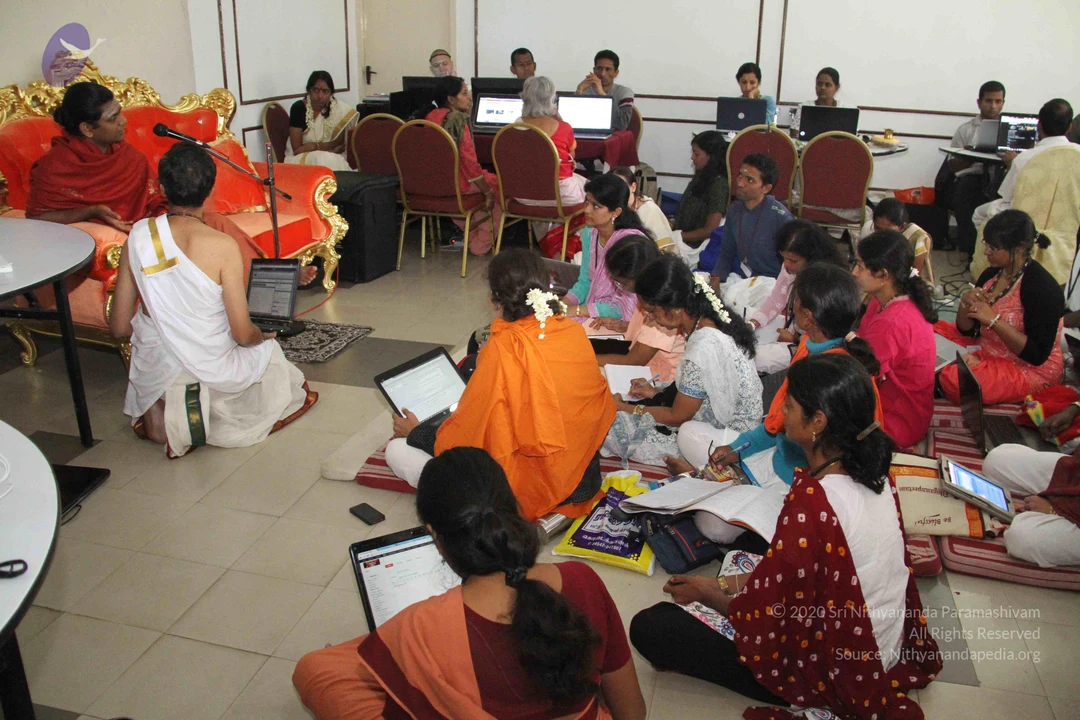
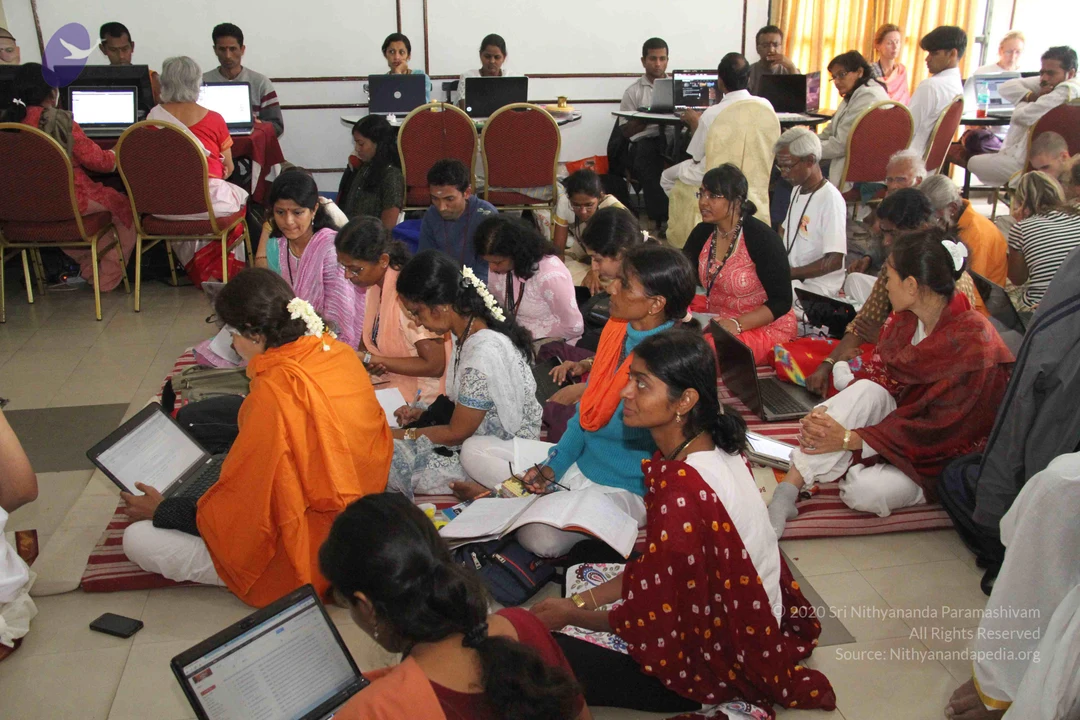
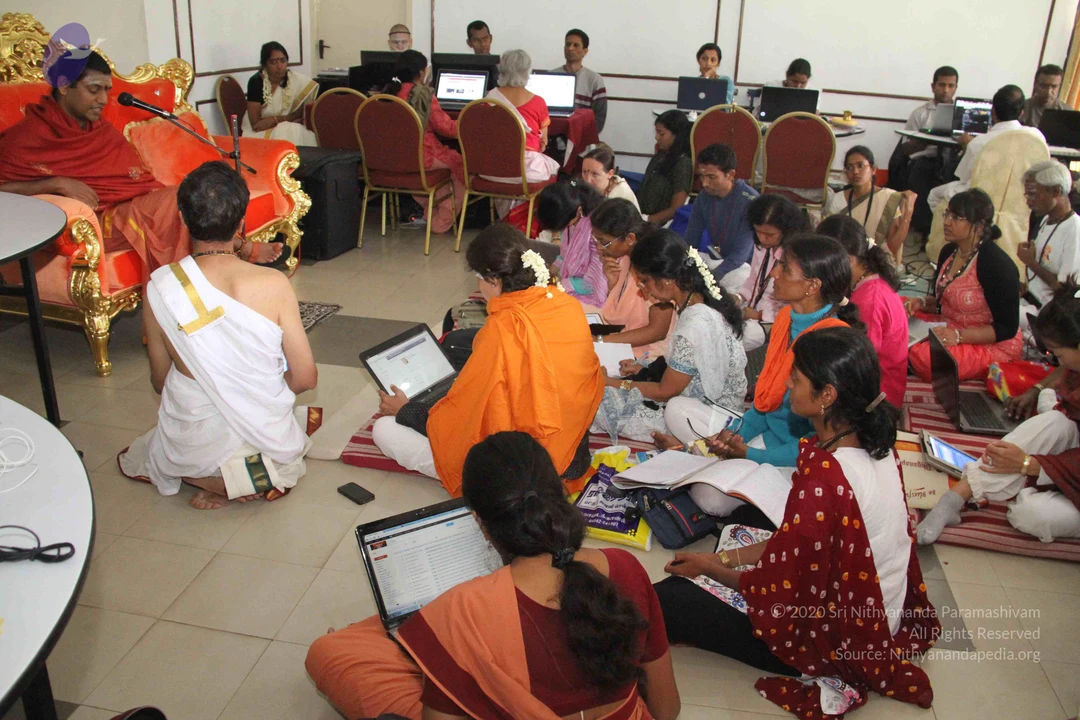
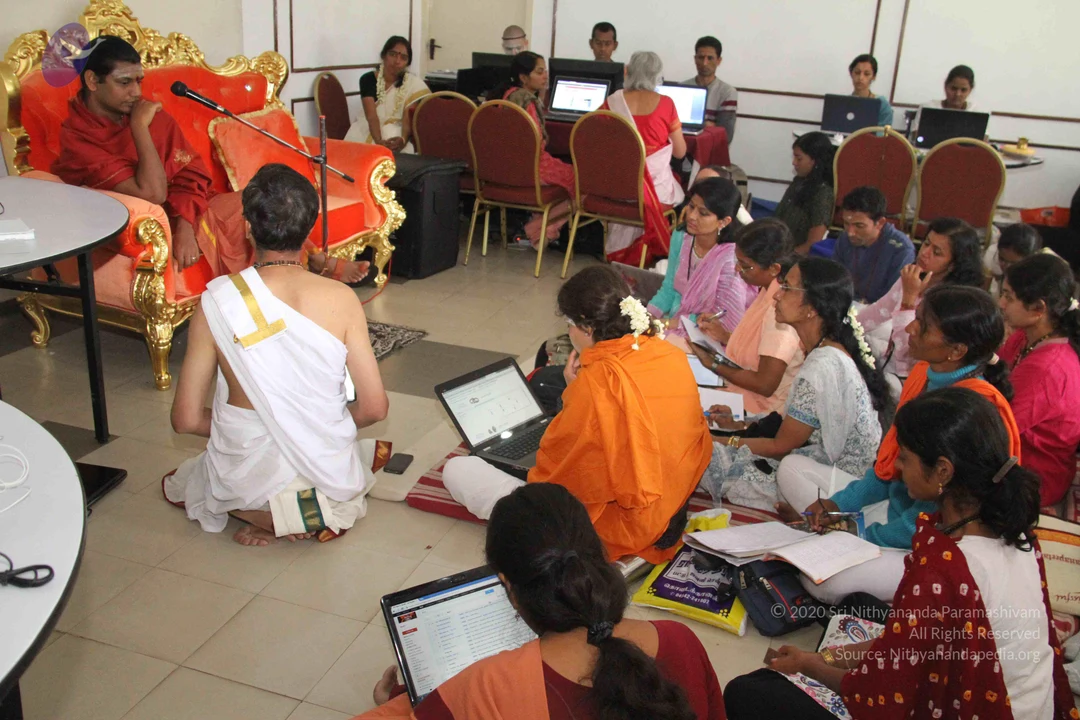
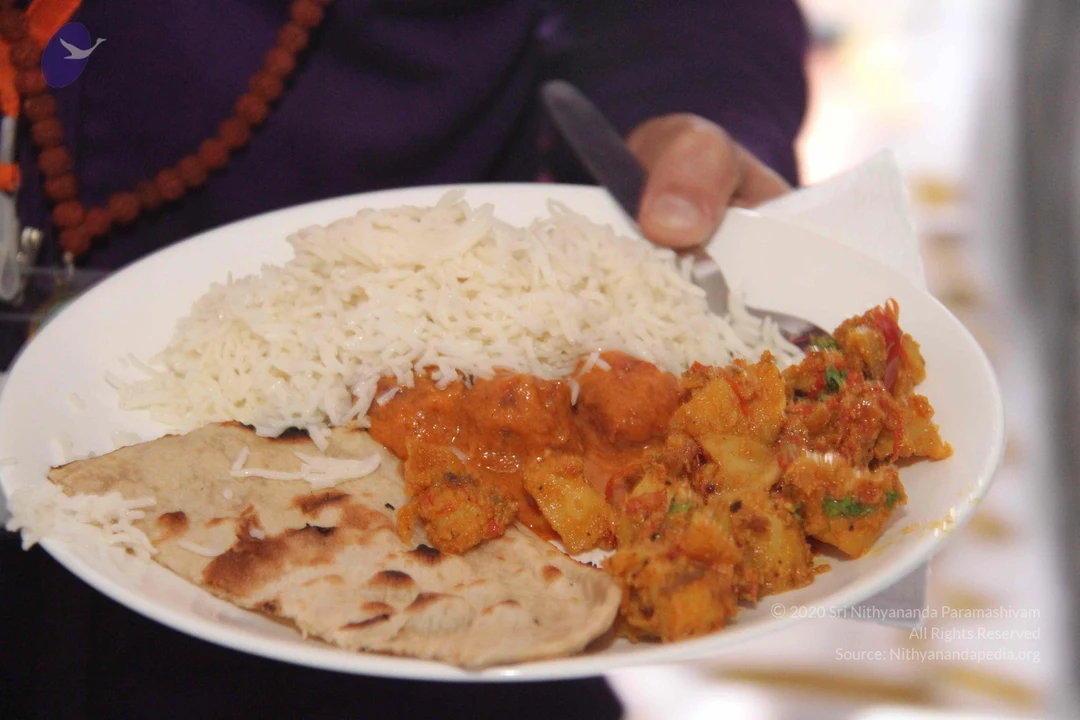
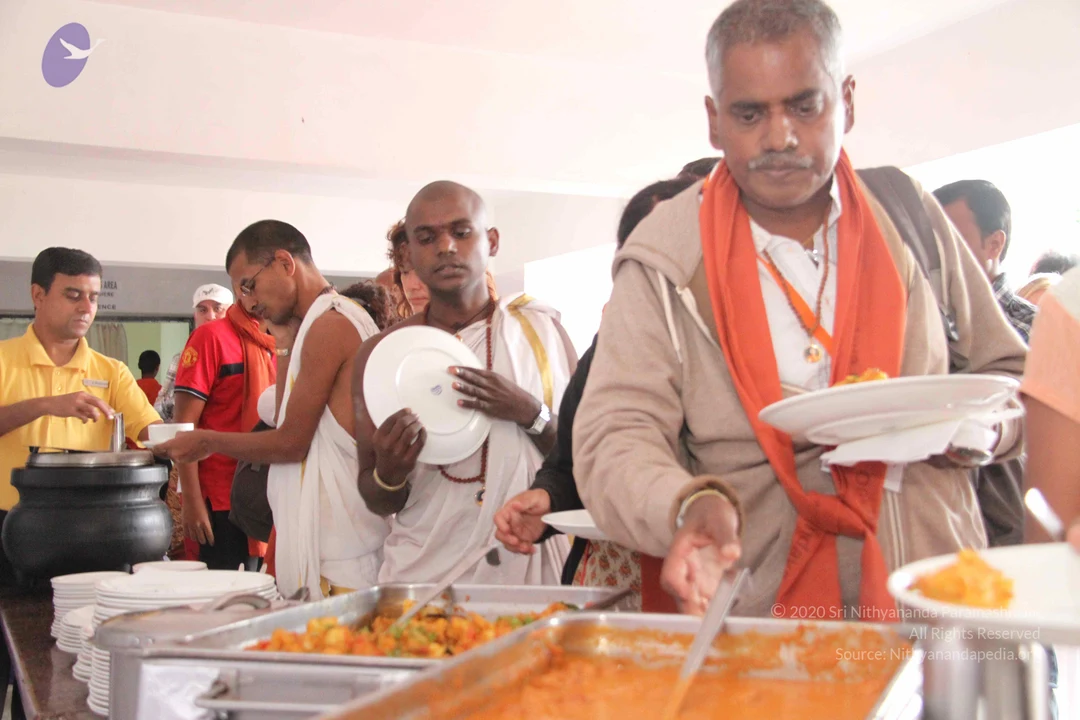
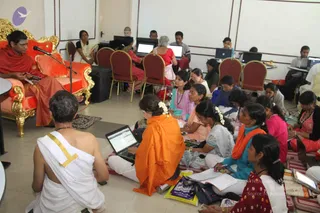
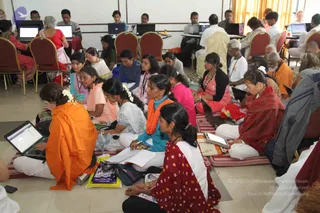
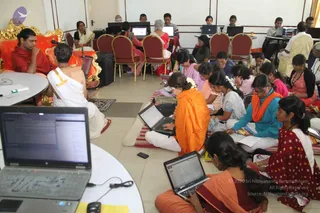
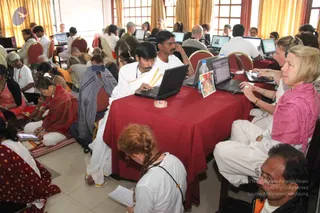
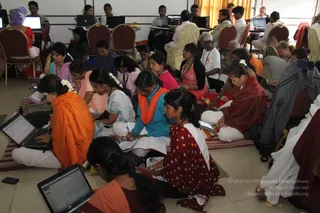
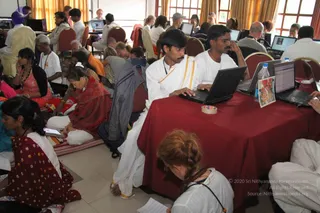
Photograph of a seated satsang in a bright, plain hall with a whiteboard behind. On the left, a man in a red-orange robe sits on an ornate gold-and-red throne-style chair with a microphone stand before him, holding a small booklet. Facing the speaker on the floor, a shaven-headed man in white dhoti and shawl with a gold border sits with his back to the camera. Women in orange, blue, pink and teal saris and salwar sit on cushions with open laptops and notebooks, and several rows of participants with laptops sit on chairs behind them. a person: the speaker wears an orange-red robe and sits on a gold throne, with short hair and no visible rudraksha or crown, so identification is uncertain.A photograph of a seated audience in a hall with cream walls and red-cushioned chairs, most people sitting cross-legged on mats on the floor. In the foreground, a woman in orange robes with white flowers in her hair works at an open laptop. Beside her, women in pink, teal, white and red bandhani-patterned shawls sit with notebooks and pens. Behind them, many people sit with laptops at tables and chairs, including men in white shirts and an older man in an orange robe. A small white nametag-style lanyard is visible on one person, and a bag of snacks sits on the floor.Indoor satsang hall where a seated man in red robes sits on an ornate orange-and-gold throne-style chair at left, with a microphone stand before him. Facing him, a bare-chested man wearing a white dhoti with a yellow stripe sits on the floor with a laptop. Rows of women and girls sit on striped mats in the foreground typing on laptops; one woman wears an orange robe and a white flower garland, another wears a teal top with an orange shawl, and a woman in a red sari sits at right. Rows of chairs and more laptop users fill the background, with several men in white and cream clothing standing or seated near the back.A photograph of a crowded indoor hall with yellow curtains and tall windows, where many people sit on chairs and mats working on laptops at tables draped in red cloths. A young man in a white kurta with a yellow-edged shawl types at a laptop in the centre, while a woman in a pink shawl and white clothes works at a laptop to the right. Others sit on the floor in white and red clothing, and a bald man in an orange shirt sits at the bottom right. Water bottles and a small framed image rest on the table. Many people are visible, though most are partly hidden by the crowd.A photograph of a large seated group in a hall with cream tiled floor and wooden-framed chairs with red upholstery. Many people sit on mats and cushions taking notes, several with open laptops on their laps or on low tables, while a few sit on chairs behind. Clothing includes orange and saffron shawls and robes, a bright turquoise salwar with an orange scarf, a red and maroon bandhani-patterned outfit, white dresses with jasmine flowers in the hair, and a white-bearded man in a white shirt with a lanyard. a person is not clearly visible; no identifiable candidate is shown.Indoor photo of a crowded hall during a satsang session, with many people seated on chairs and floor mats working on laptops. In the foreground, two men in white dhoti and shirt sit at a table draped in maroon cloth, one typing on a laptop with a water bottle nearby. A woman in a red shawl sits on a mat, a woman in a maroon bandhani dupatta sits in the lower left, and a woman with a braid in white clothes works at the bottom. Yellow curtains and windows line the back wall. No candidate for a person is clearly visible in the frame.
06-Upanishad

8 photosSource gallery
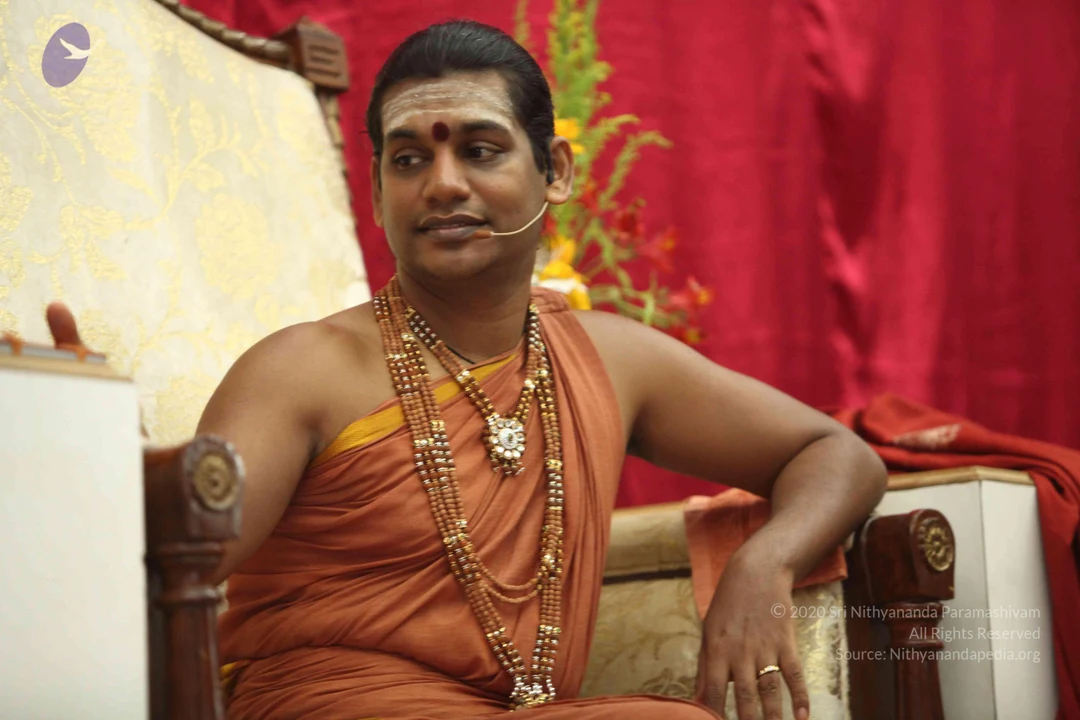
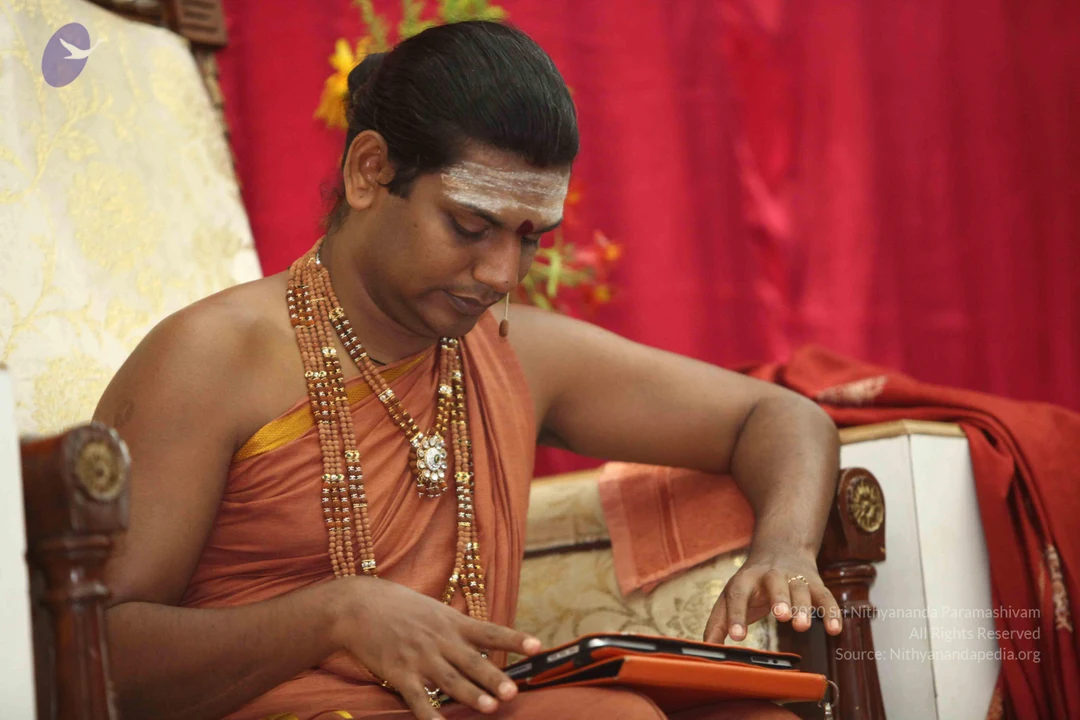
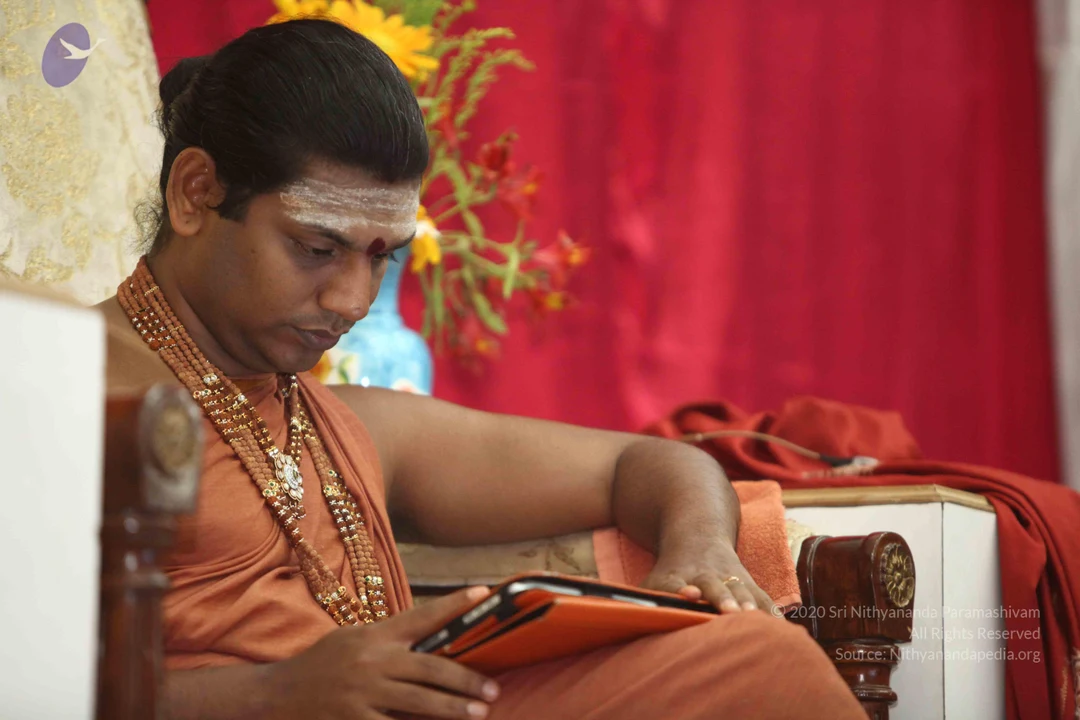
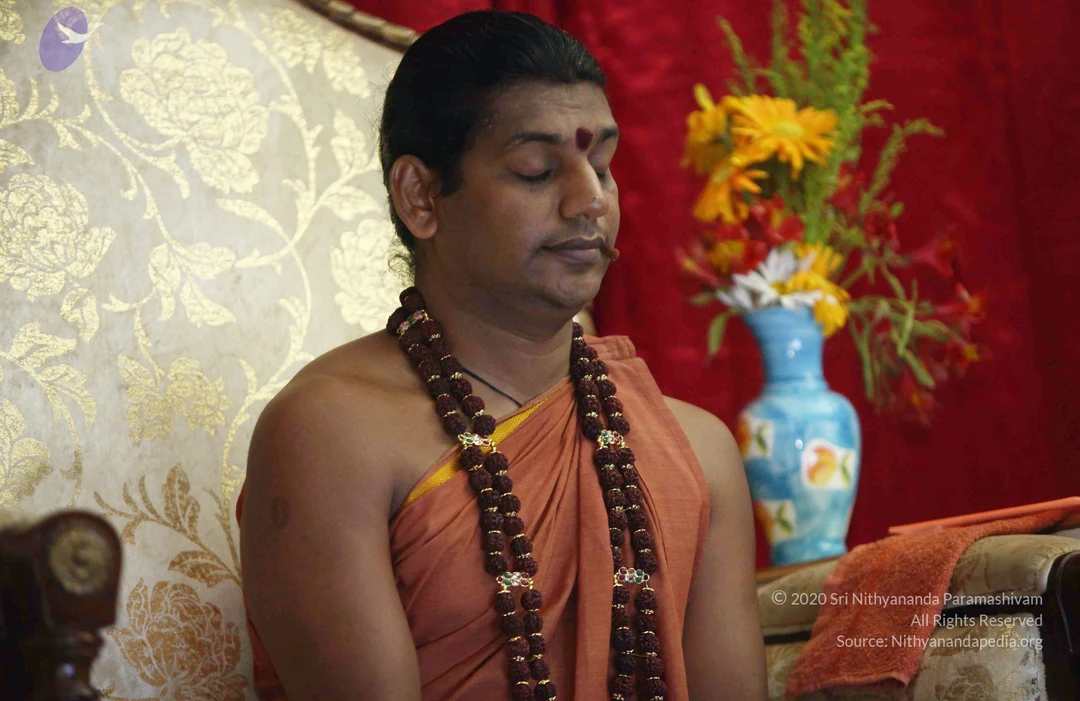
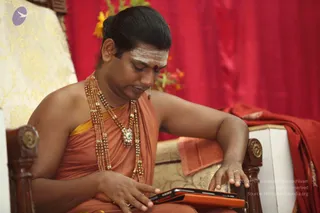
A man seated in a carved wooden armchair with gold-patterned upholstery in front of a red drape and yellow-orange flower arrangement. He wears an orange-saffron cloth draped over his shoulder and bare arm, multi-strand beaded rudraksha-style malas, a large ornate pendant necklace, a gold ring, and a small microphone clipped near his mouth. He has white vibhuti lines and a red dot on his forehead and is turned to one side, smiling. a person (appearance cues: saffron-orange robe, multiple malas, ornate pendant, seated on a throne-like chair with microphone, consistent with a satsang talk) in a teaching role.A seated man in saffron-orange robes sits in an ornate wooden armchair with gold-patterned upholstery before a red drape decorated with yellow flowers. He wears multiple strands of beaded rudraksha-style malas with a large ceremonial pendant, has white sacred ash markings on his forehead with a red dot, and looks down while tapping an orange tablet device resting on his lap.A man seated on a wooden armchair with carved details, wearing a saffron-orange robe draped over one shoulder, multiple strands of rudraksha beads, a gold ceremonial necklace with a pendant, and a sandalwood-paste tripundra with a red kumkum dot on his forehead. He looks down at a small orange tablet held in both hands. Behind him are a red drape, a vase with yellow flowers and a light blue vase, and a cream floral cloth. The man has a swept-back hairstyle and a bare right arm. Appearance cues (ornate gold necklace, rudraksha malas, saffron robe, swept-back hair) are consistent with the page's reference to a person, so this may be the a person probable candidate, present in person.A seated man with closed eyes sits on an ornate gold-patterned upholstered chair in front of a red drapery. He wears an orange-saffron unstitched cloth draped over one shoulder with a yellow border, and multiple strands of brown rudraksha beads with gold-coloured ornamental spacers hang across his chest. A red bindi is on his forehead. Beside him on a small table is a blue ceramic vase holding yellow and red flowers, and an orange cloth lies on the armrest. The setting suggests a seated meditative or discourse moment. Swamiji (probable): long, swept-back hair, saffron clothing and rudraksha malas fit the cues for this sannyasi figure, who appears in person.A man seated on an ornate gold-patterned chair in front of a red drape, with a blue vase of yellow and white flowers beside him. He wears an orange-saffron cloth draped over his left shoulder with a yellow border, and multiple strands of rudraksha beads with gold accents around his neck. A red dot marks his forehead, and he has one hand raised near his chest while gazing off to the side as if speaking or listening. Appearance-based label: a person, with rudraksha malas, saffron cloth and a seated teaching posture as the qualifying cues, shown in person as a speaker at a satsang setting.Photograph of a man seated cross-legged on a cushioned gold-patterned sofa, speaking as if giving a talk. He wears an orange-saffron cloth draped over his shoulder with a gold border, long double strands of rudraksha beads with gold and green-stone spacers, and a red tilak on his forehead. A small microphone is clipped near his mouth. Behind him are a red drape and a blue vase holding yellow and white flowers. Appearance-based probable Swamiji (long swept-back hair, saffron clothing, rudraksha malas) seated in a satsang setting.

07-eNGenius
27 photosSource gallery
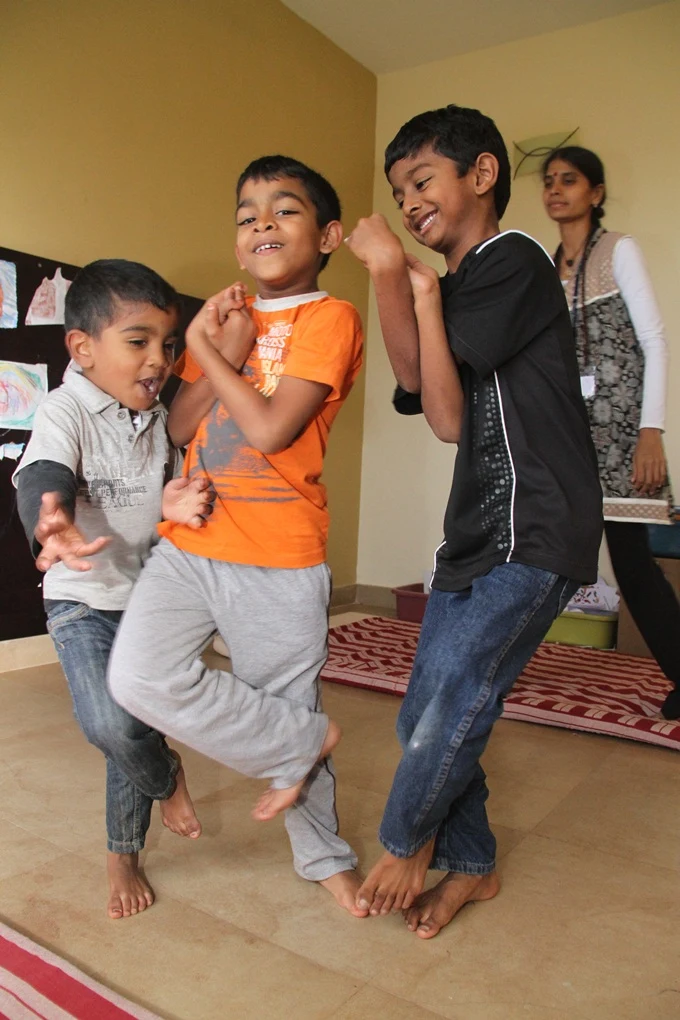
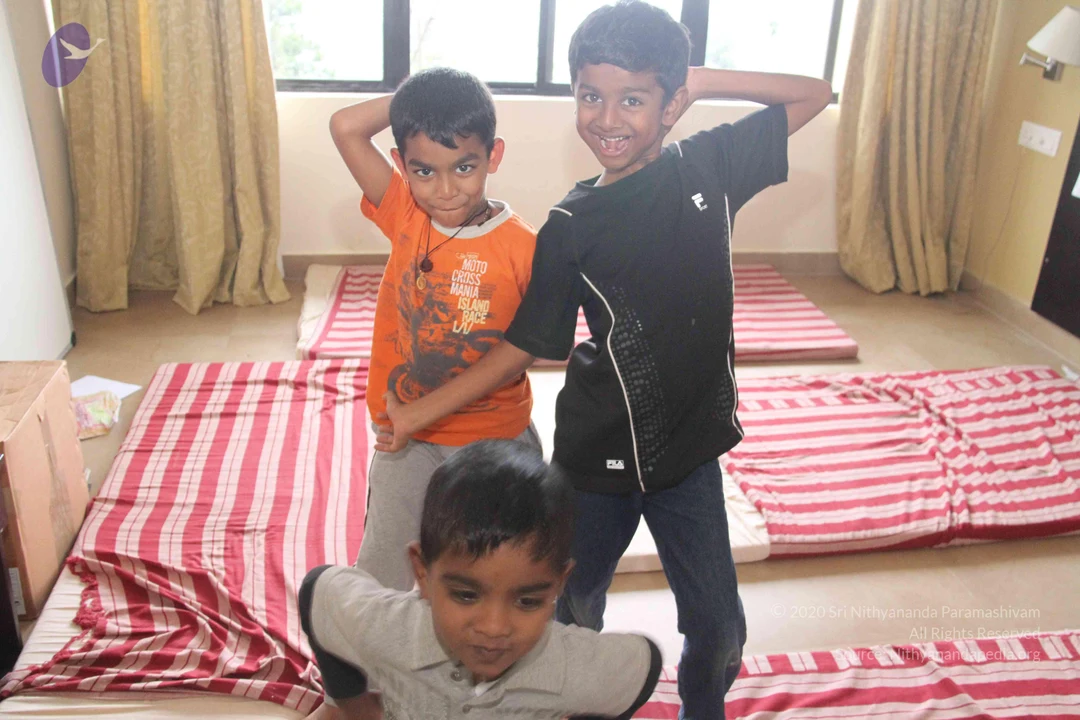
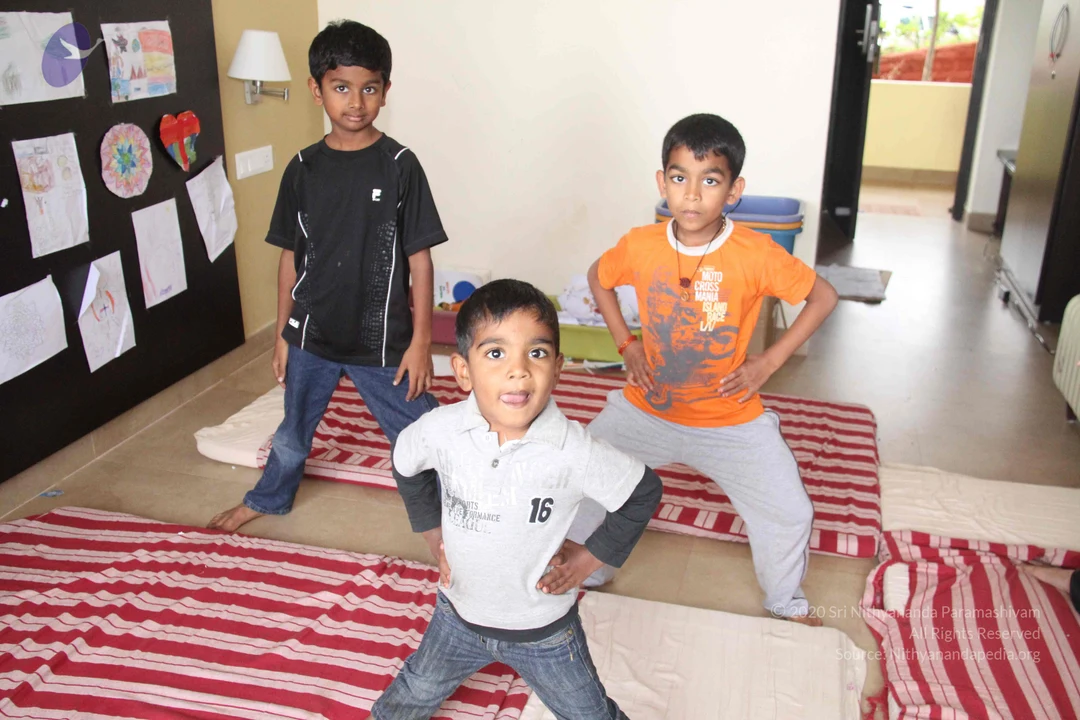
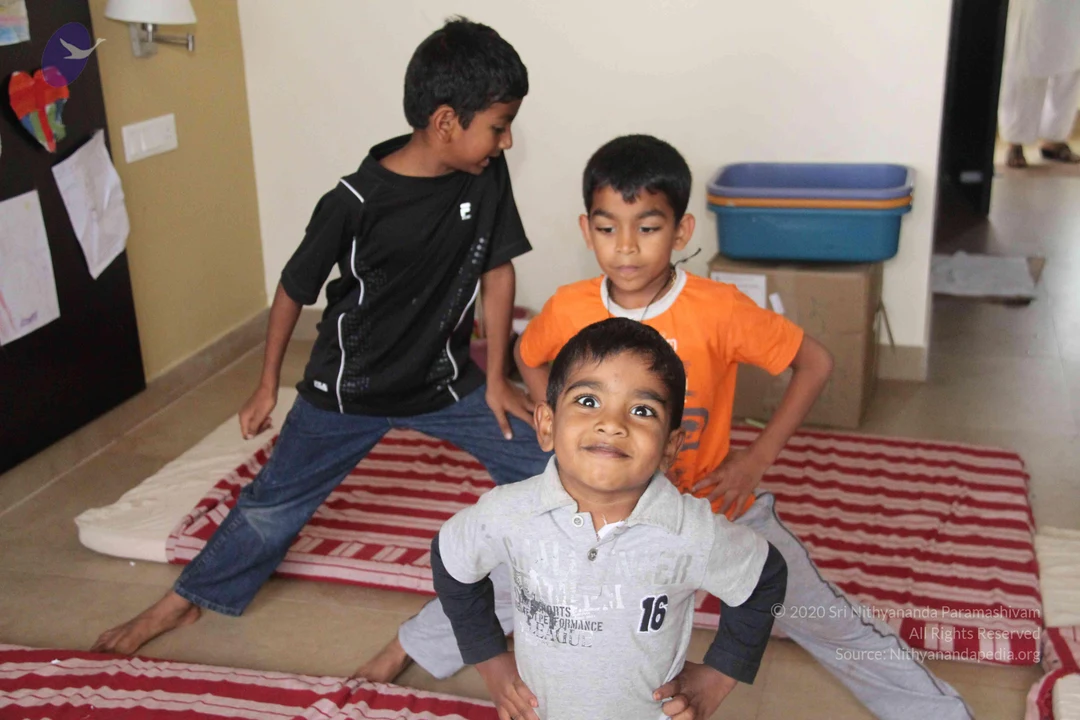
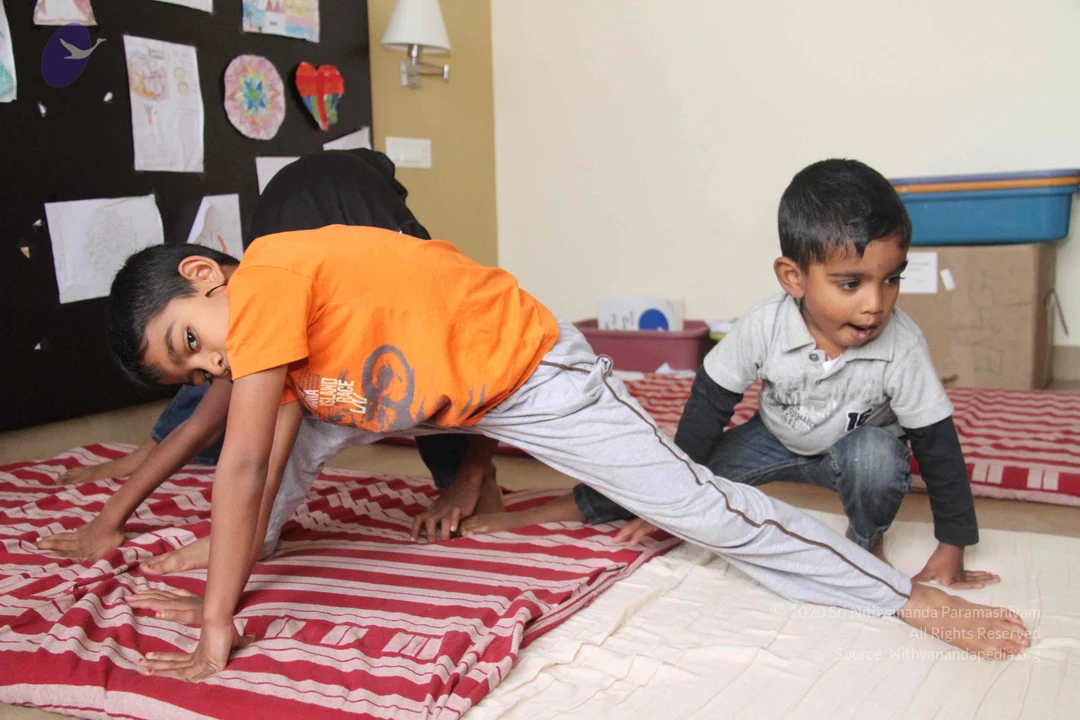
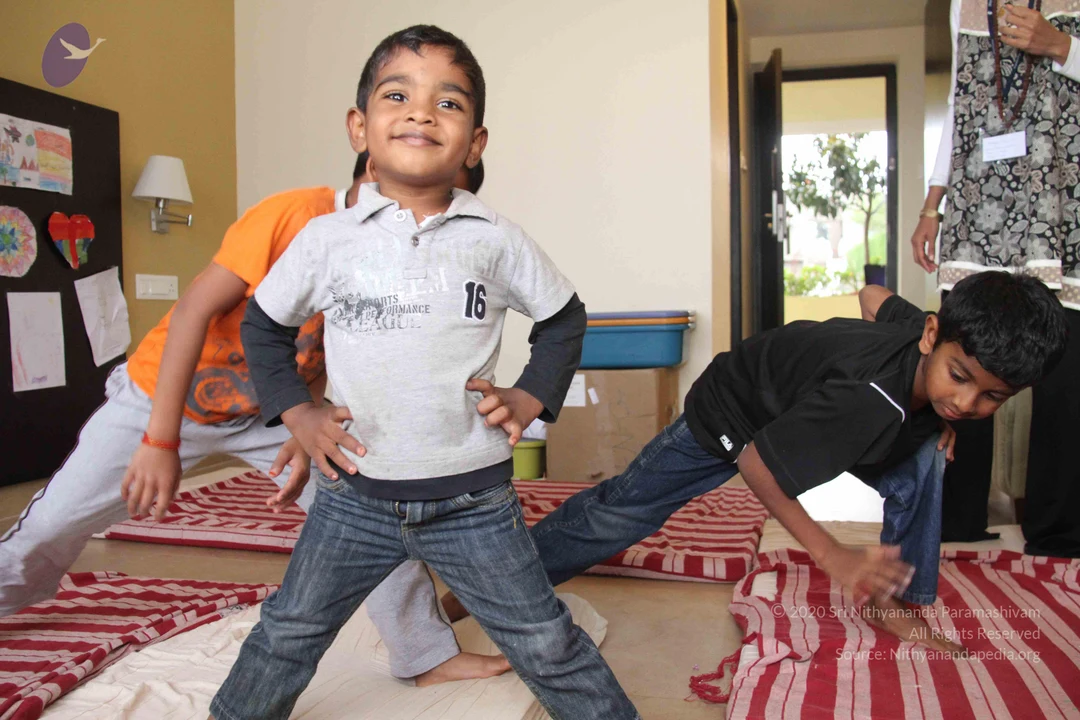
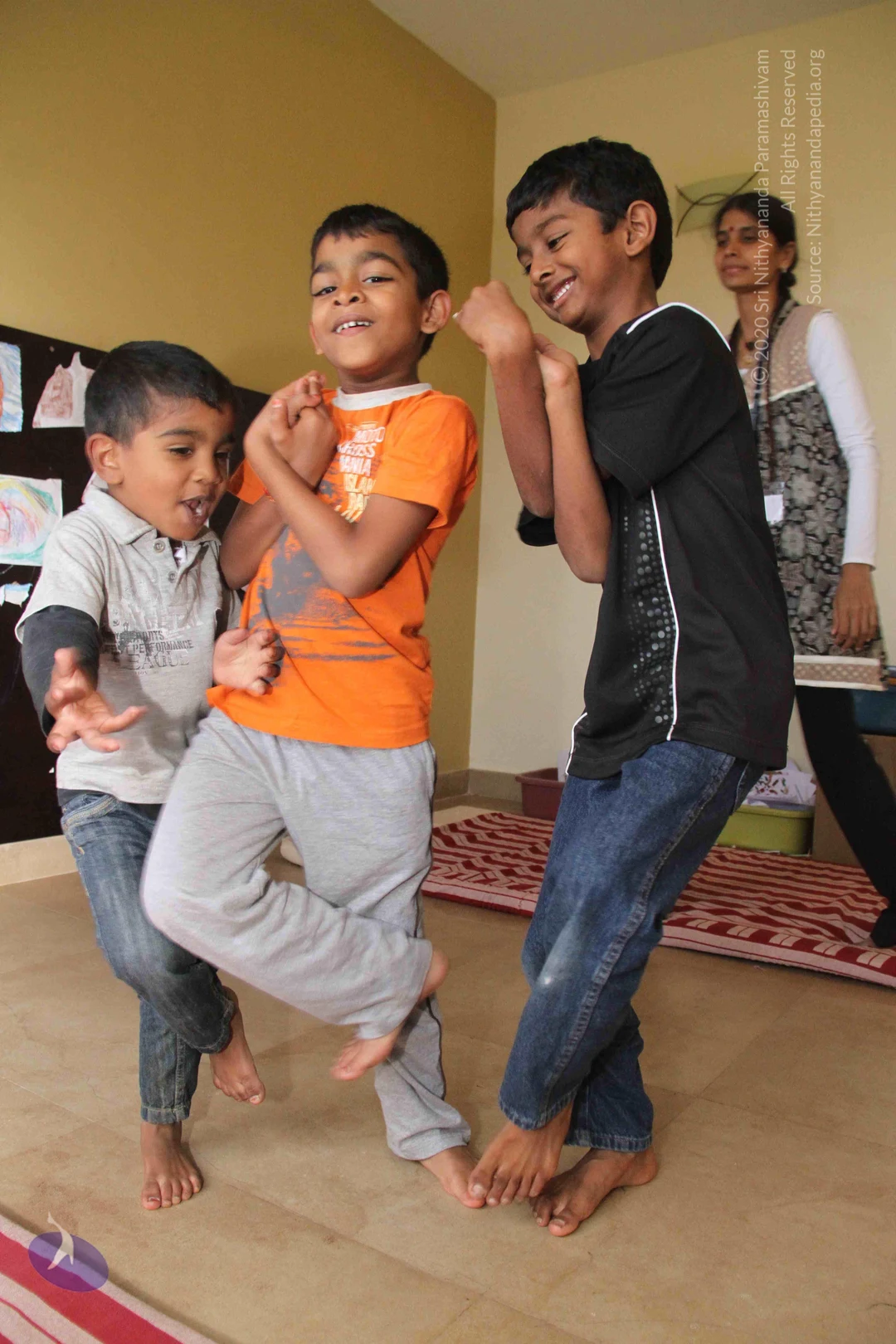
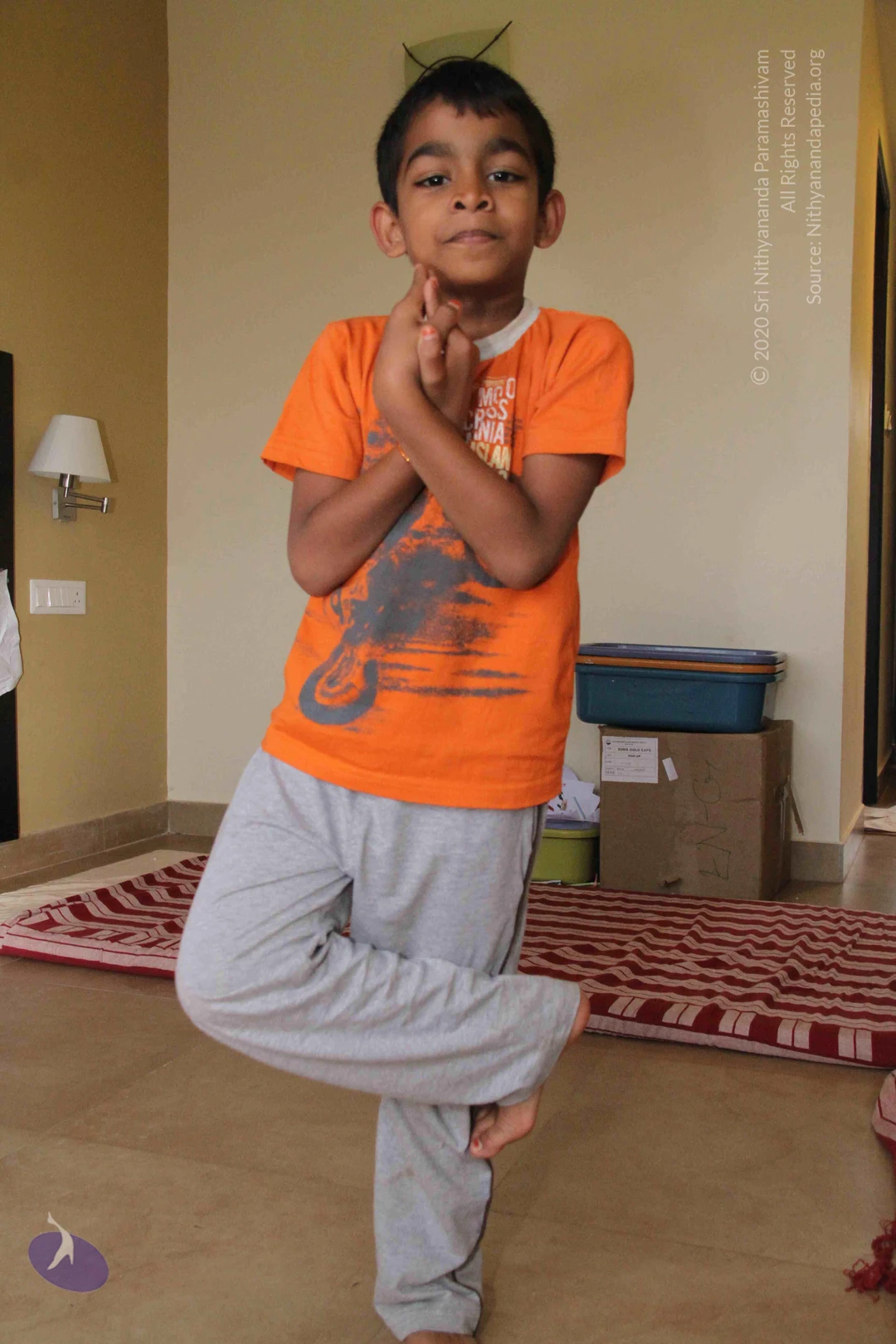
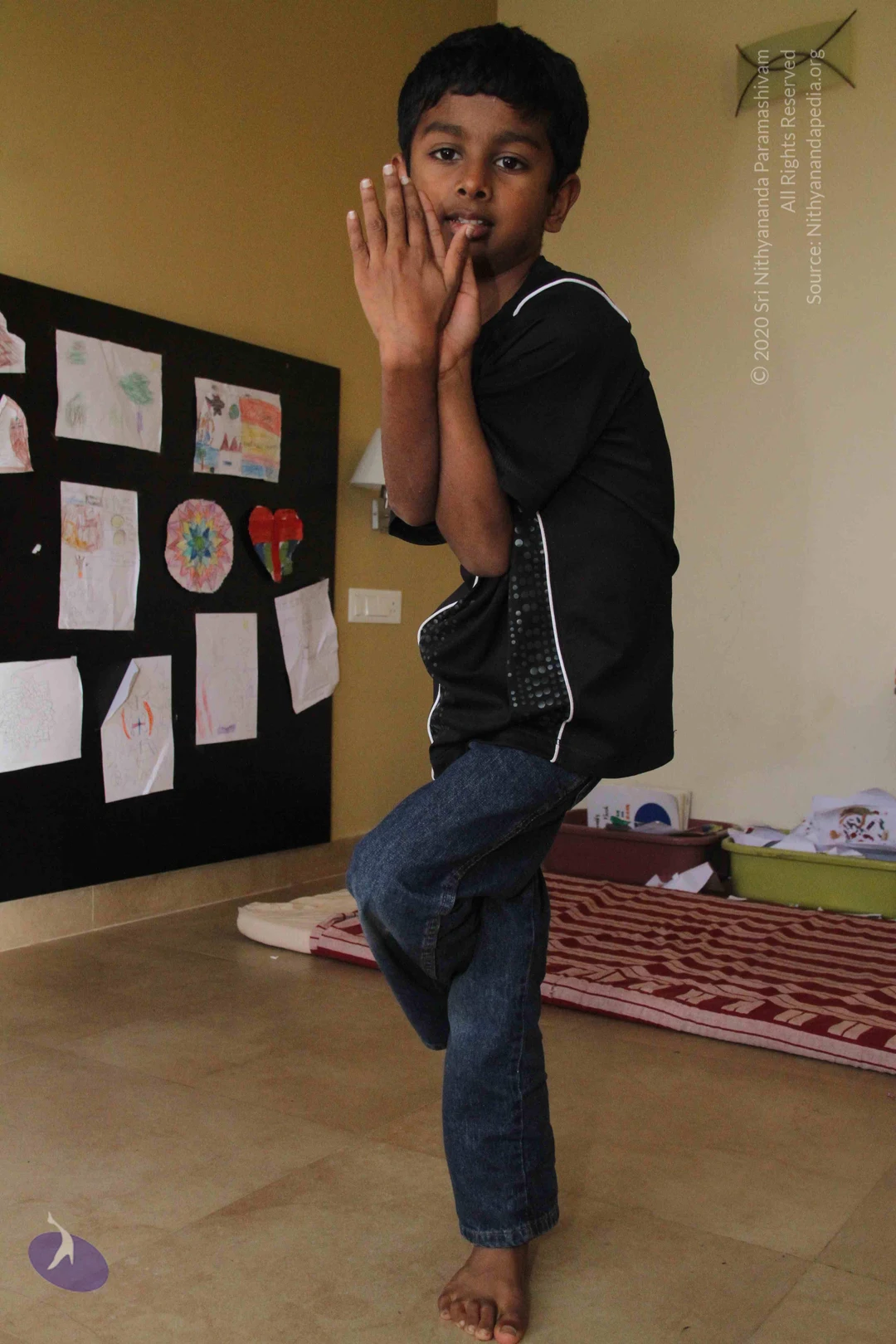
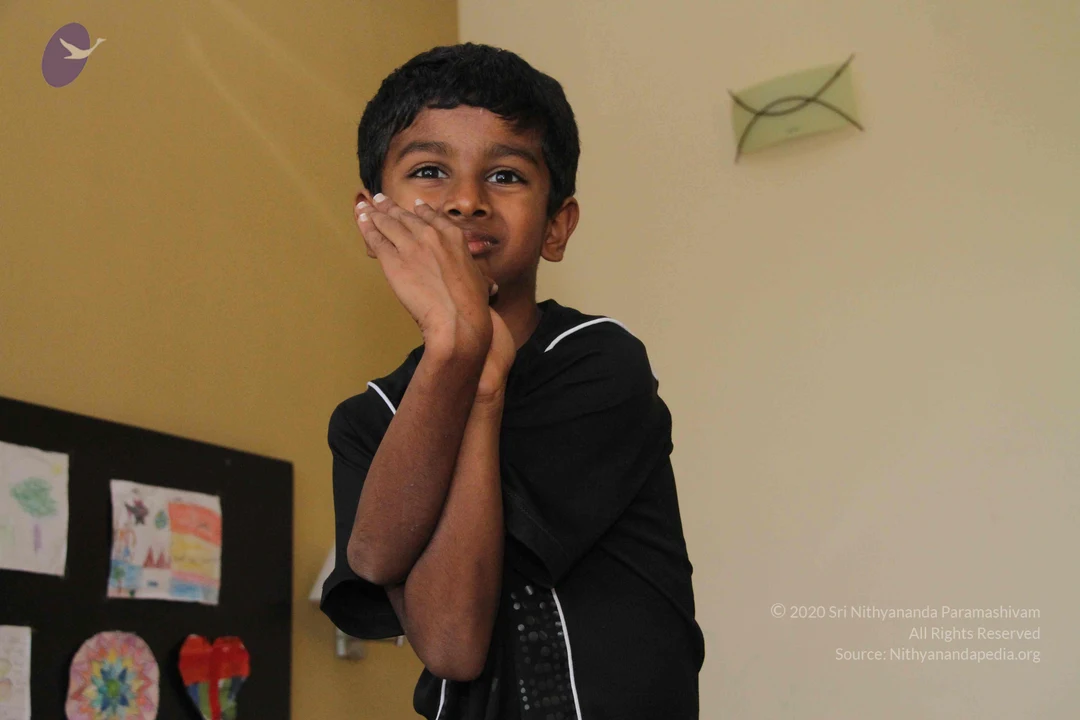
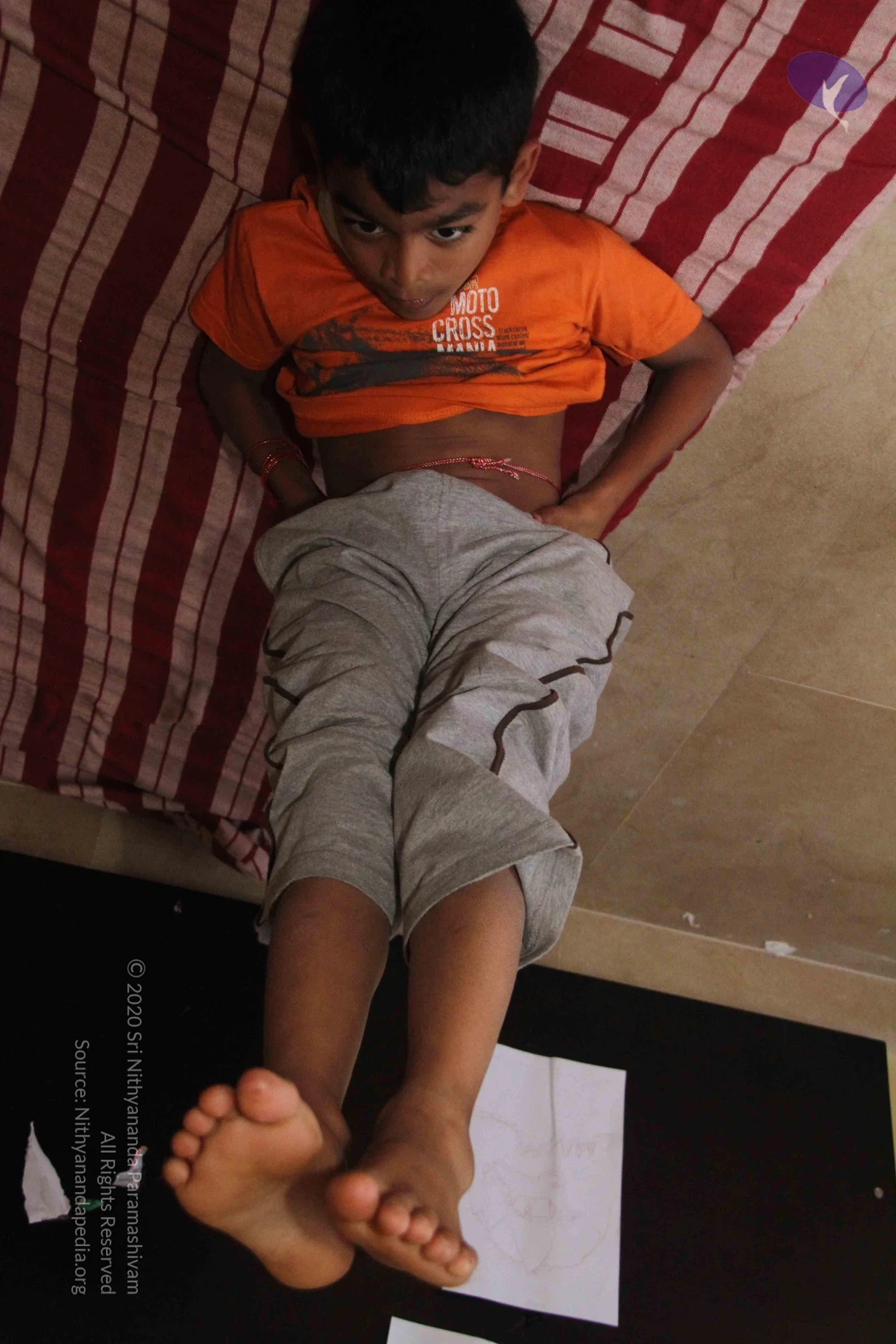
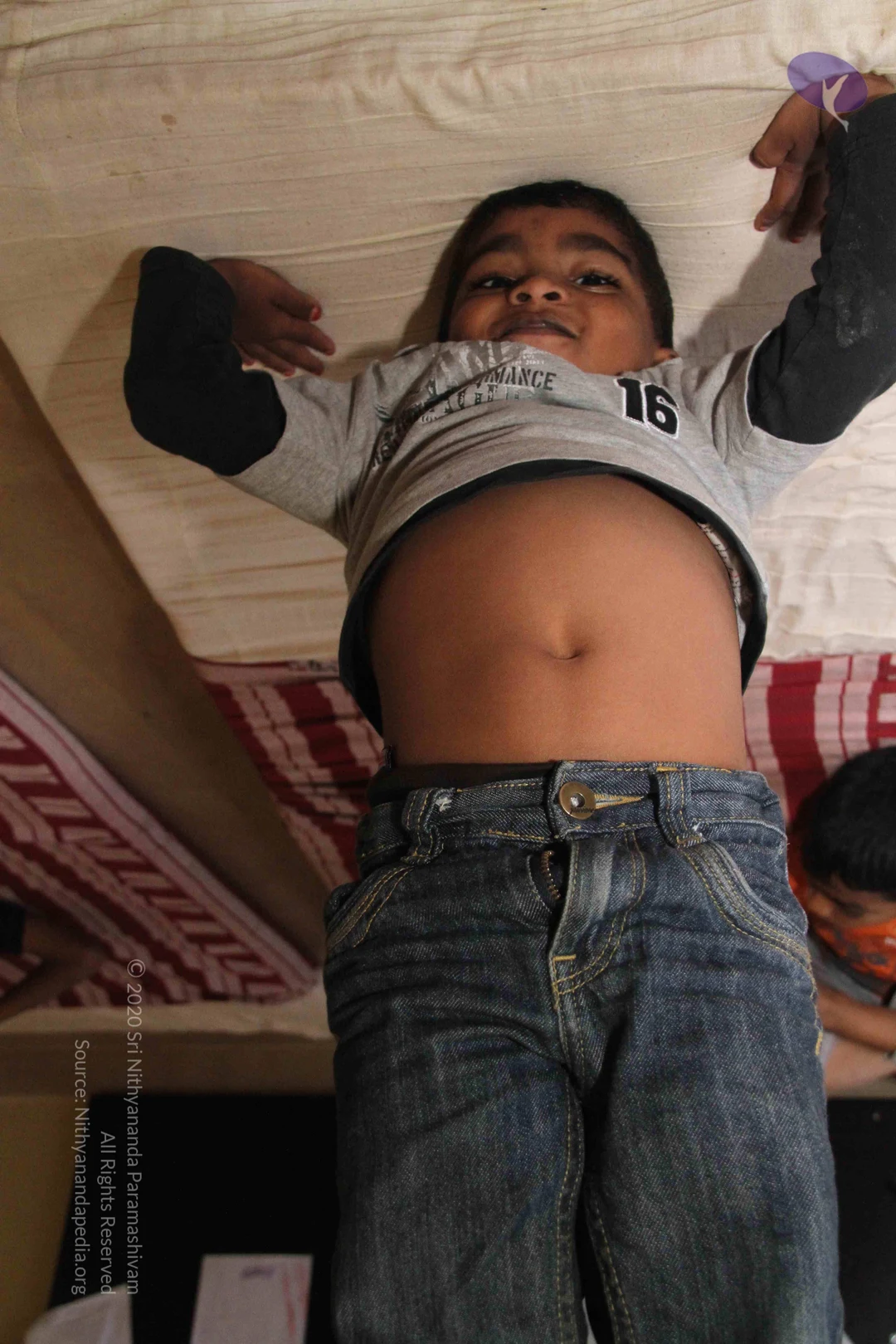
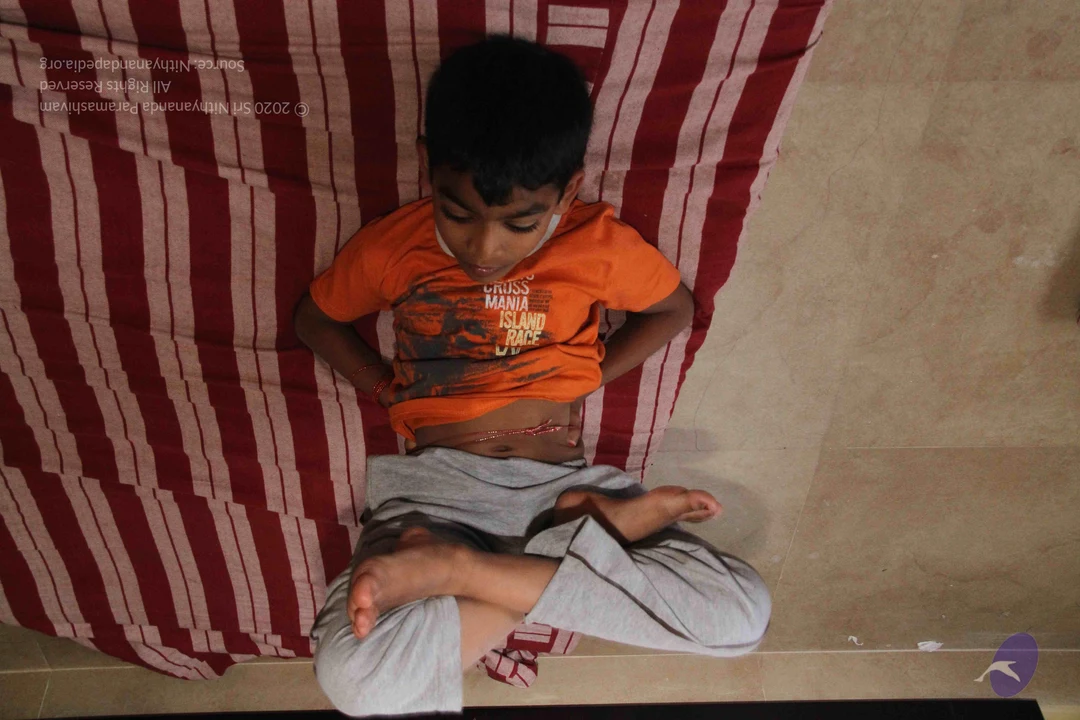
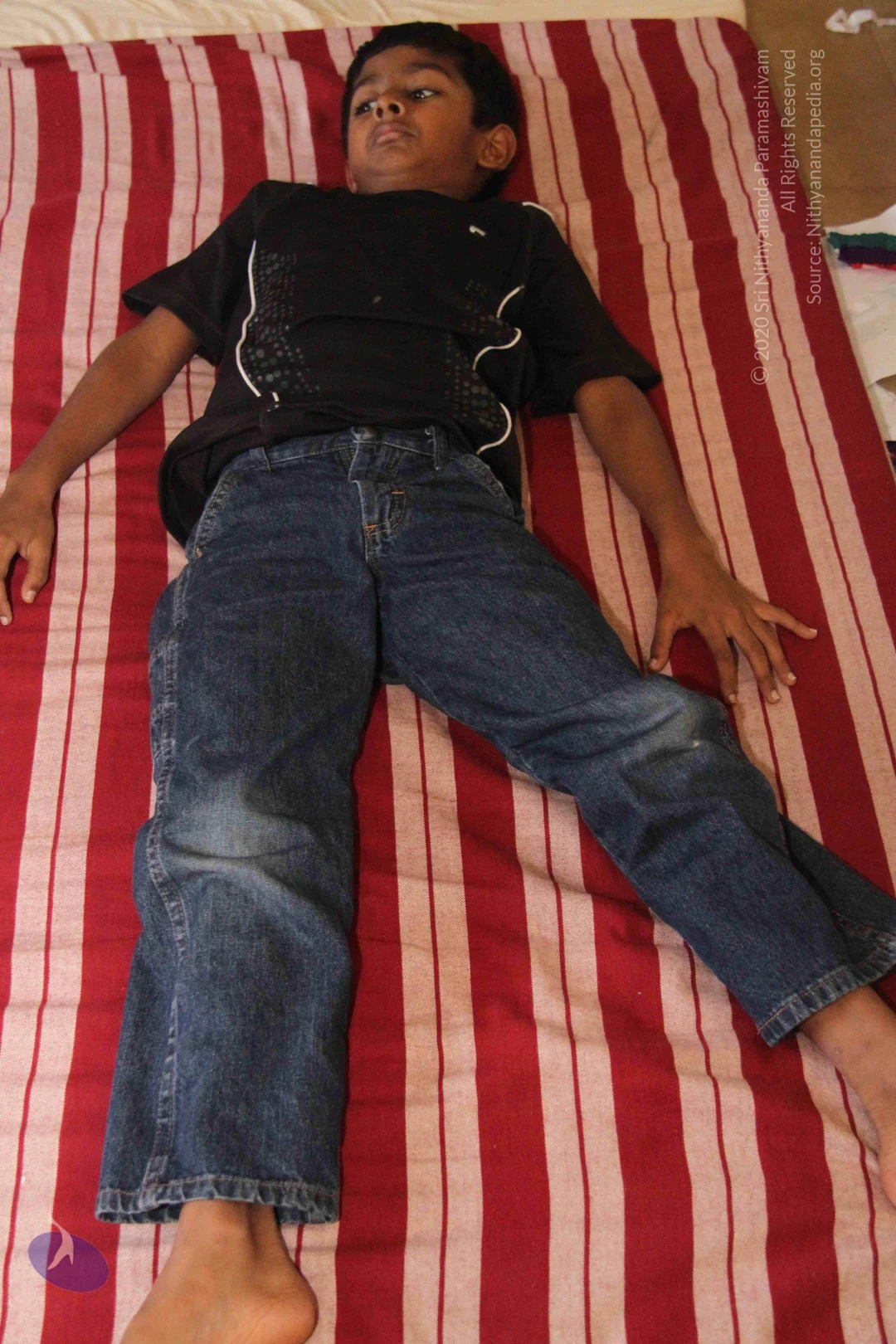
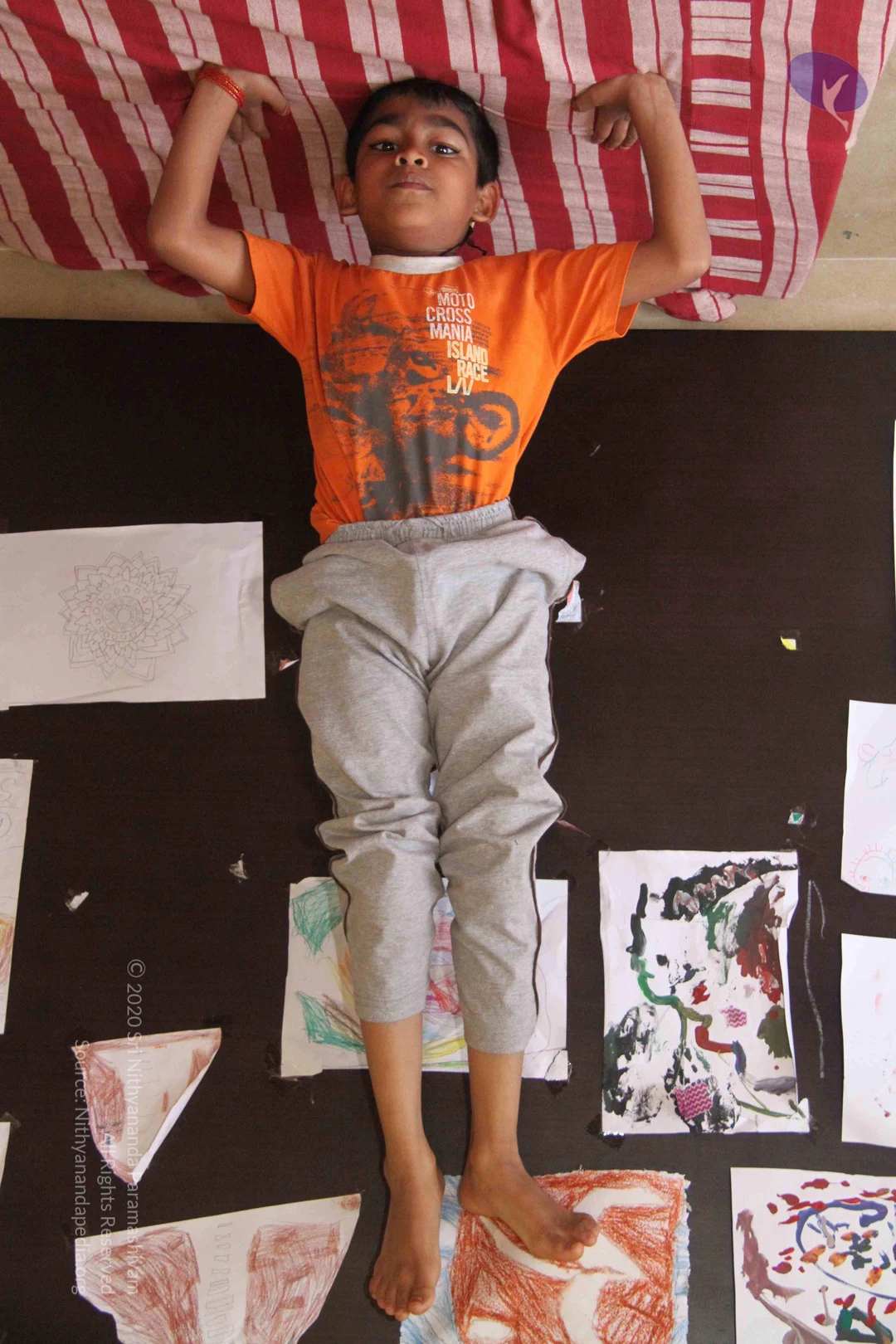
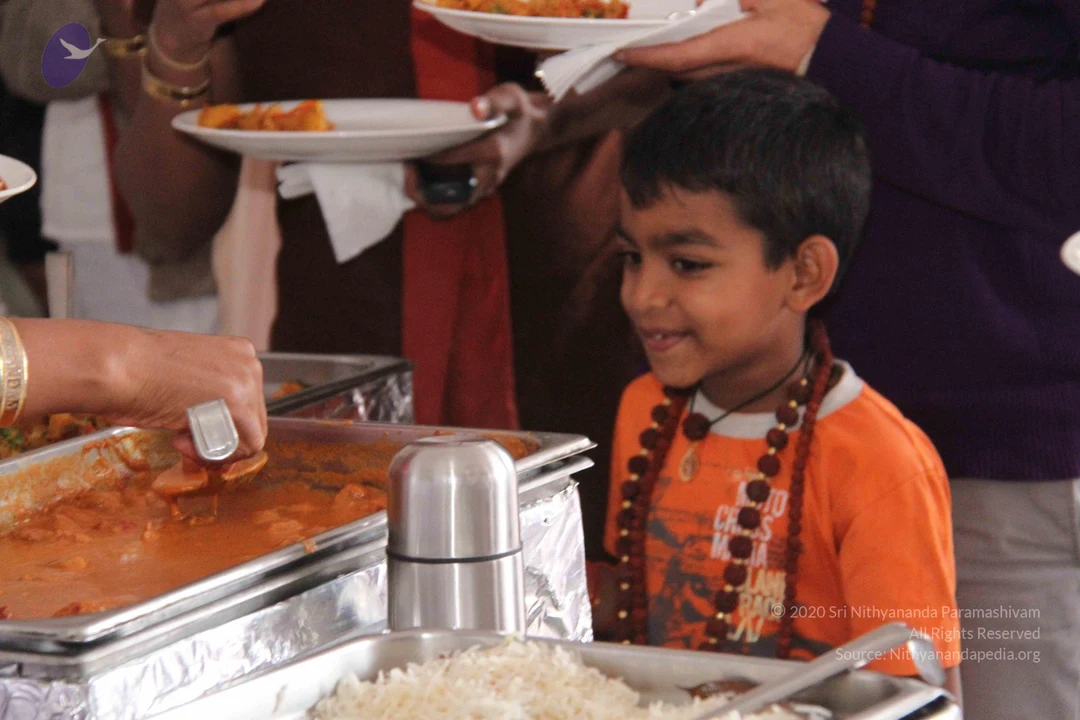
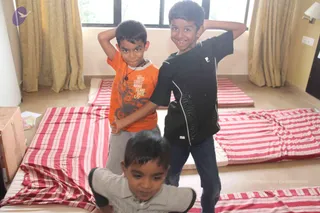
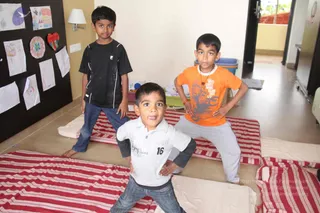
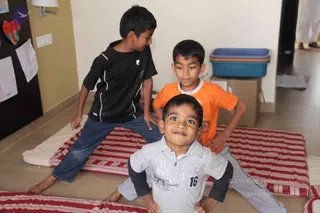
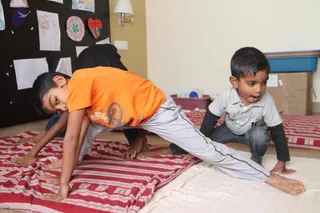
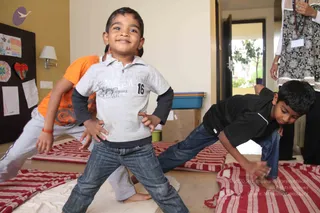
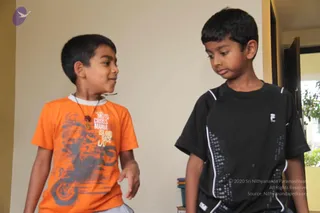
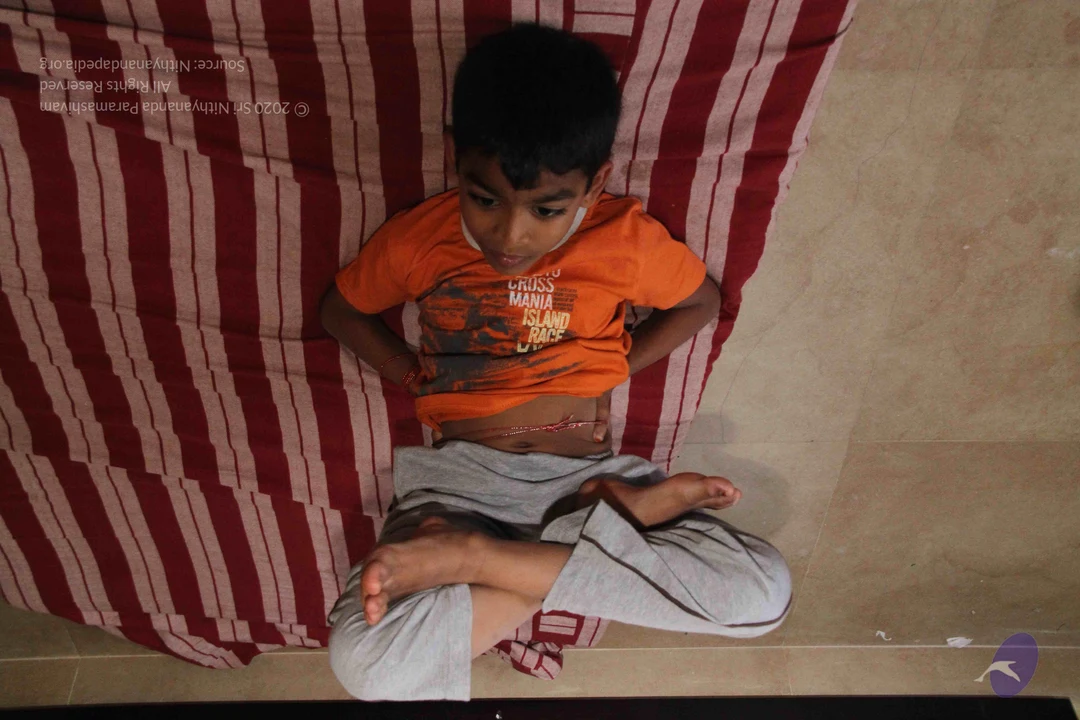
Three young boys stand in a room with striped red-and-white mattresses spread on the tiled floor. Two older boys stand behind, one in an orange graphic t-shirt with a pendant necklace and grey shorts, the other in a black sports top and dark trousers, both with arms raised behind their heads and grinning. A small boy in a grey shirt leans forward in the foreground. Beige curtains hang at a window, and a cardboard box sits at the left edge. The room appears to be a simple guest room.Three young boys stand on red-and-white striped floor mats in a bright ashram room with cream walls and a dark display board on the left covered with children's drawings, including a red heart and a circular painting. The boy in front wears a grey polo shirt with the number 16 and jeans, his feet planted wide and hands on his hips. The boy behind him in a black athletic shirt and jeans stands with arms at his sides. The boy on the right wears an orange graphic t-shirt, grey trousers and a beaded necklace, hands on his hips in a similar wide stance. A doorway and a folded stack of blue mats appear in the background.Three young boys stand on a striped red and white mat in a plain room with cream walls, doing a wide-legged yoga-style stance. The boy in front, in a grey polo shirt with a number 16 print, grins with hands on his hips. Behind him, a boy in an orange t-shirt and grey trousers stands with hands on hips, and a boy in a black t-shirt and jeans leans forward beside him. A blue plastic tub and cardboard box sit against the wall, with a corkboard of papers at left. No a person candidate is visible.Two young boys practise a yoga pose on red-and-white striped mats on a light wooden floor in a bright room. The boy on the left, in an orange t-shirt and grey track pants, is in a downward-facing stretch with hands on the mat and one leg extended back. The boy on the right, in a grey polo shirt and jeans, kneels beside him, watching. Behind them a black board is covered with children's drawings, and a blue plastic storage tub and cardboard box sit against the wall. No a person appears in the scene.A photograph of children in an indoor room practising yoga poses on red-and-white striped mats. A smiling boy in a grey polo shirt with the number 16 stands in a wide-legged stance with hands on his hips, while a boy in a black top and jeans leans into a side stretch behind him and another boy in an orange top stretches in the background. A woman in a grey patterned kurta with a lanyard stands at the right edge. Children's drawings are pinned to a dark board on the left, and a wall lamp, a doorway and a plant are visible. No a person candidate is visible.Two young boys stand indoors facing each other in a plain room with cream walls and a doorway to a green outdoor view. The boy on the left wears an bright orange t-shirt printed with a motocross rider and the words Moto Cross Mania, with a dark pendant necklace. The boy on the right wears a black athletic t-shirt with white piping and a small logo on the chest. Both are smiling or looking at one another; a stack of books sits in the lower corner.

08-Darshan
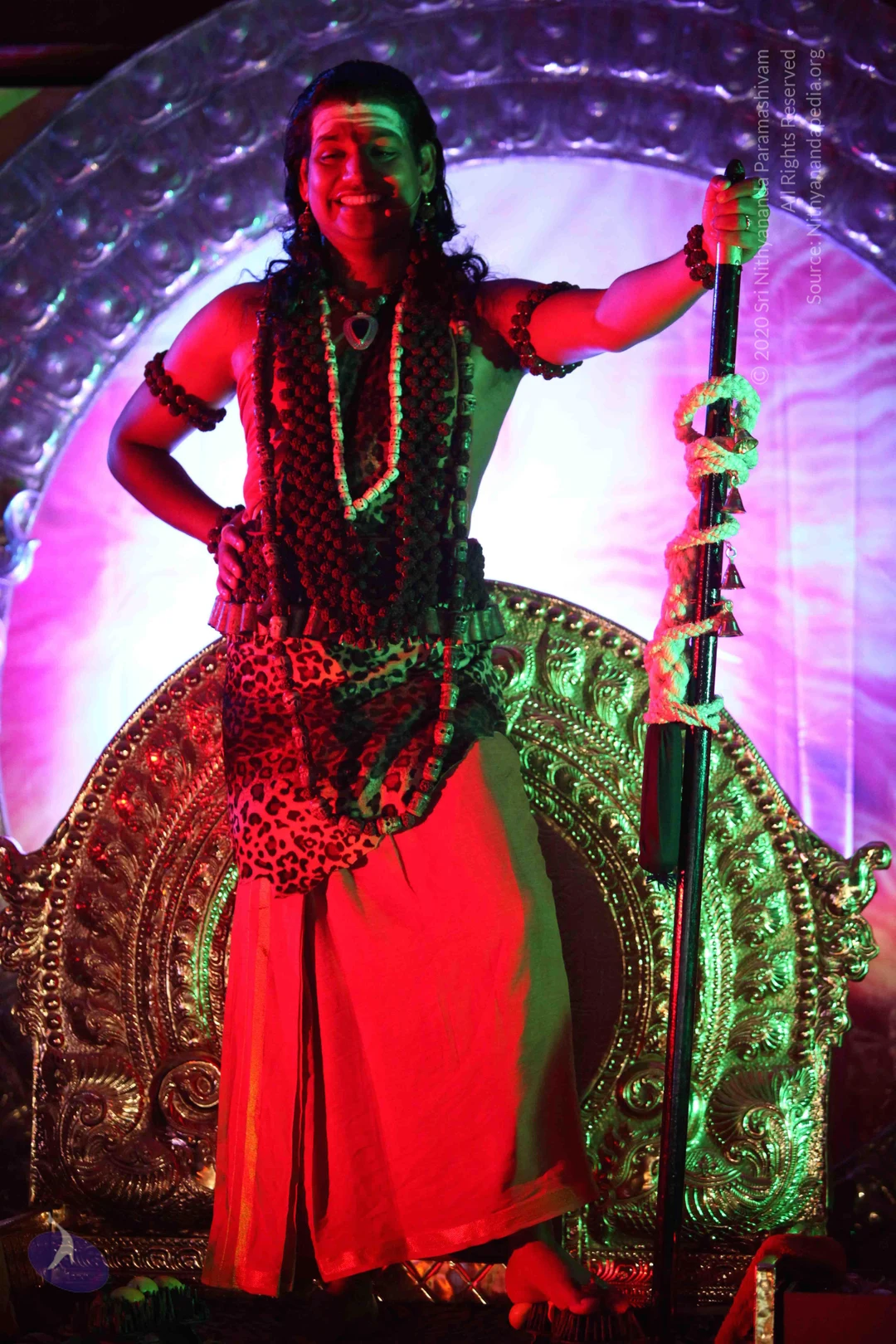
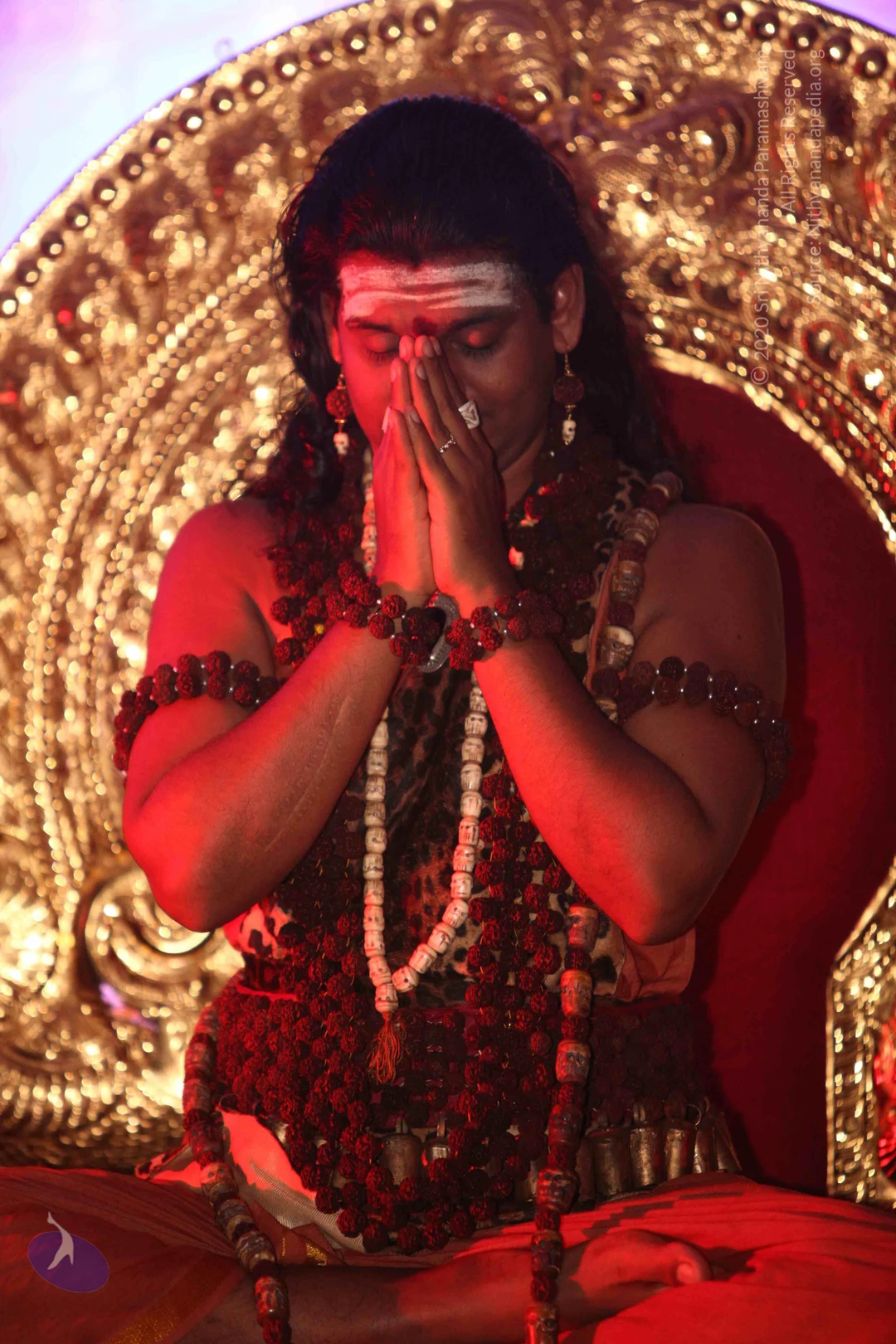
123 photosSource gallery
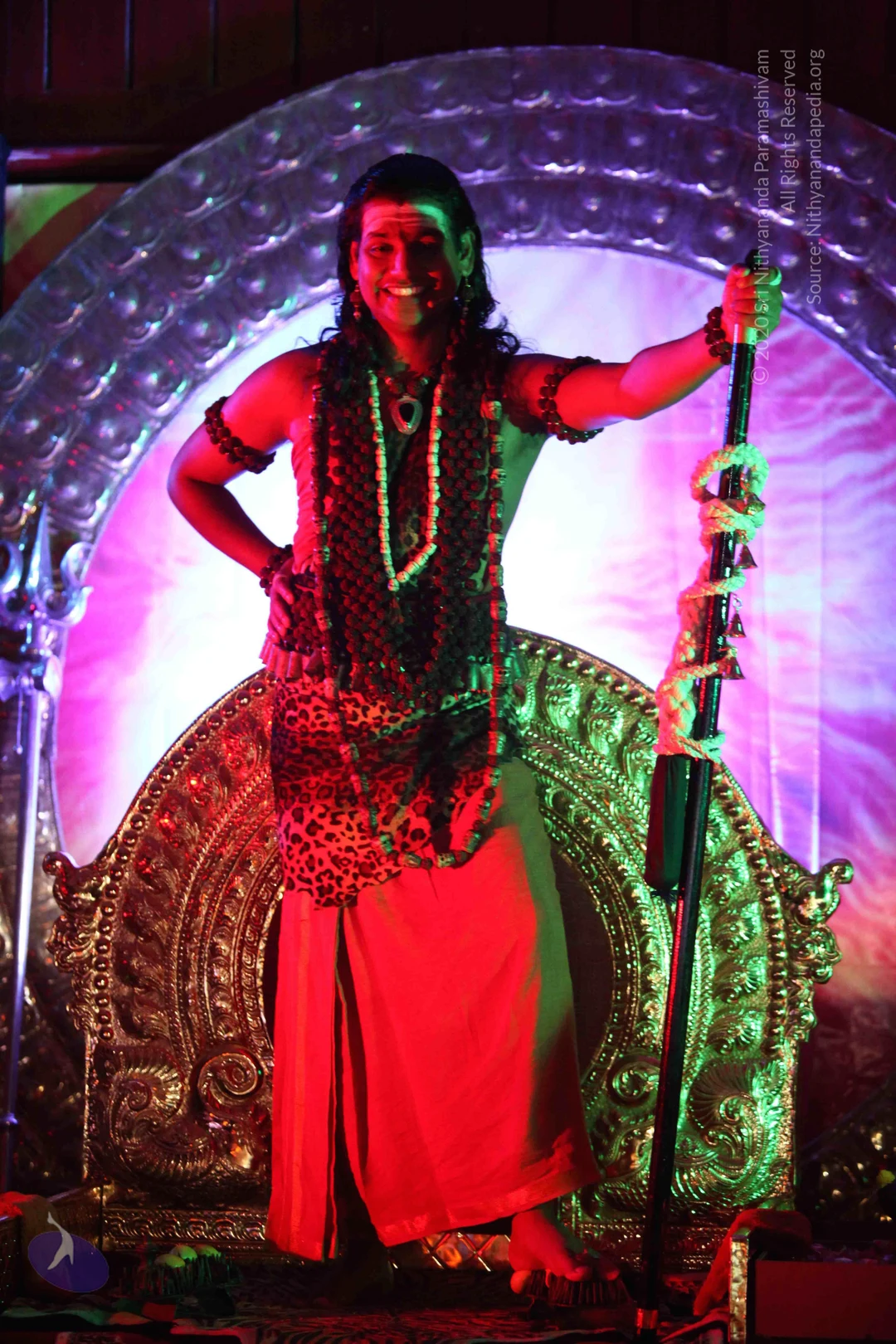
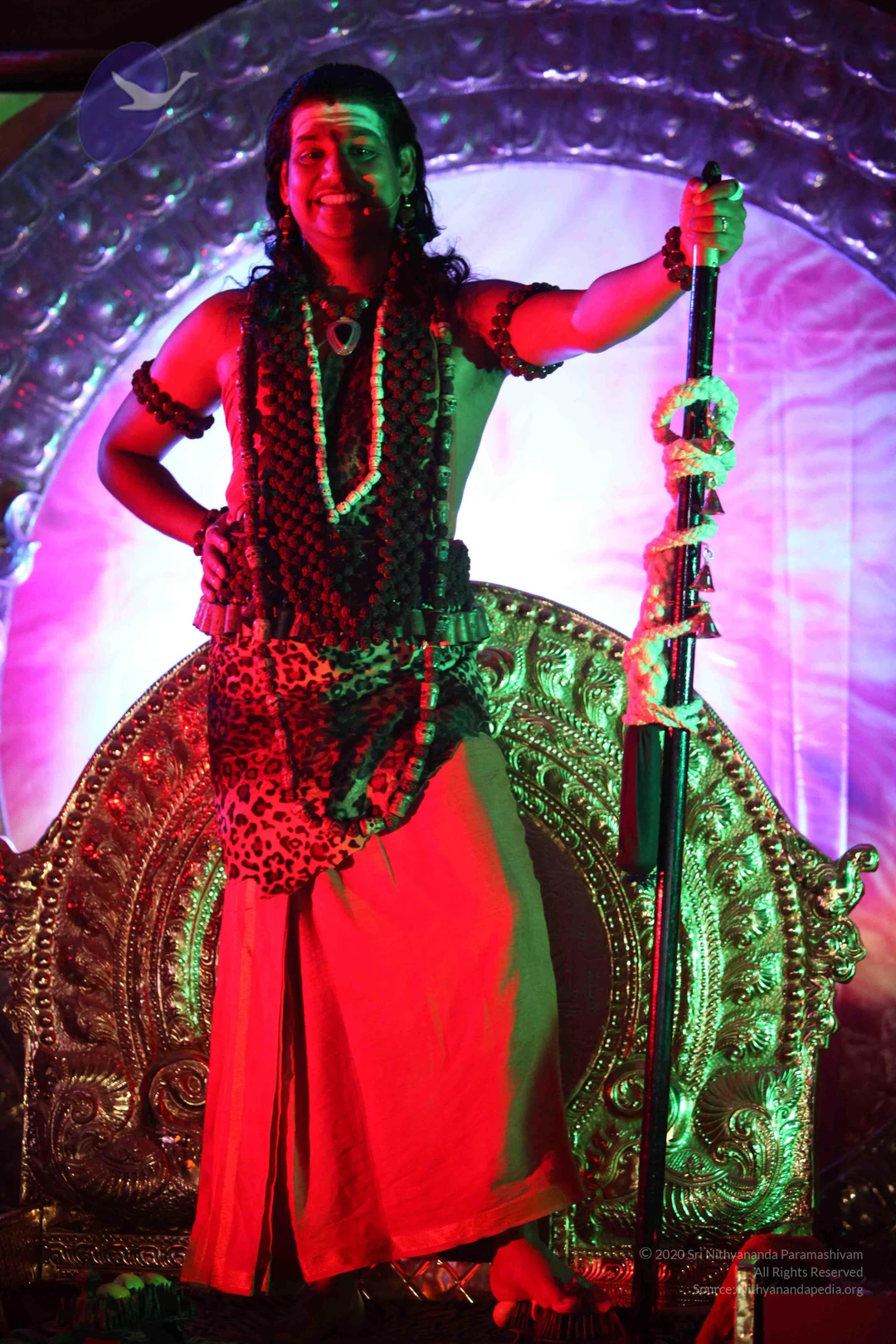
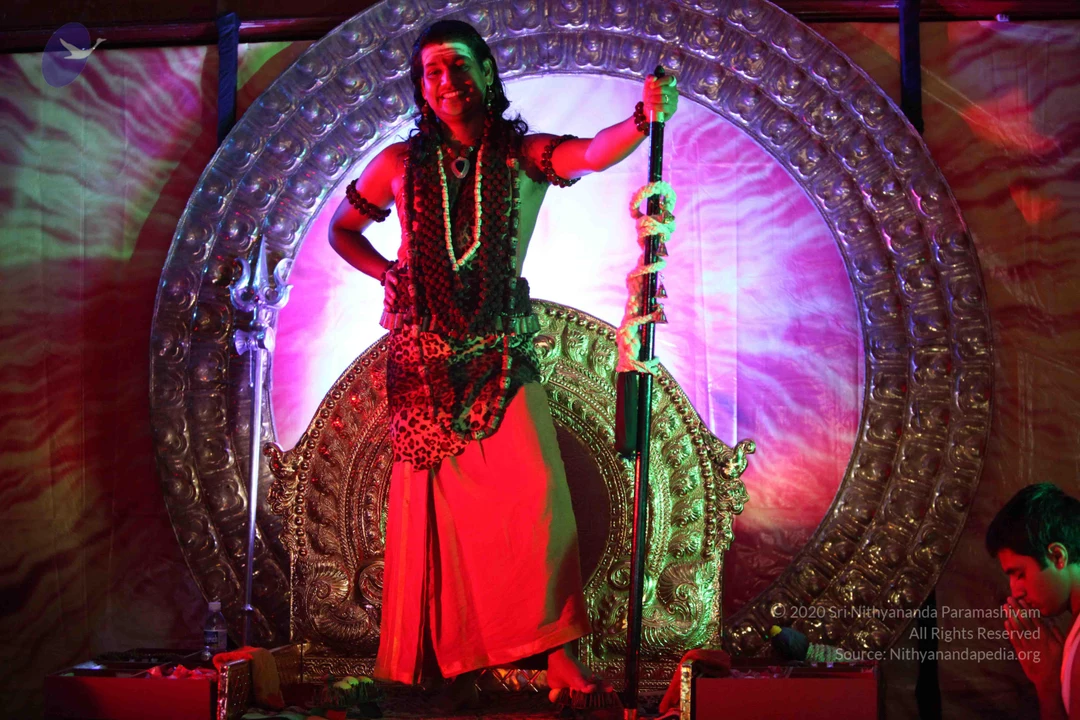
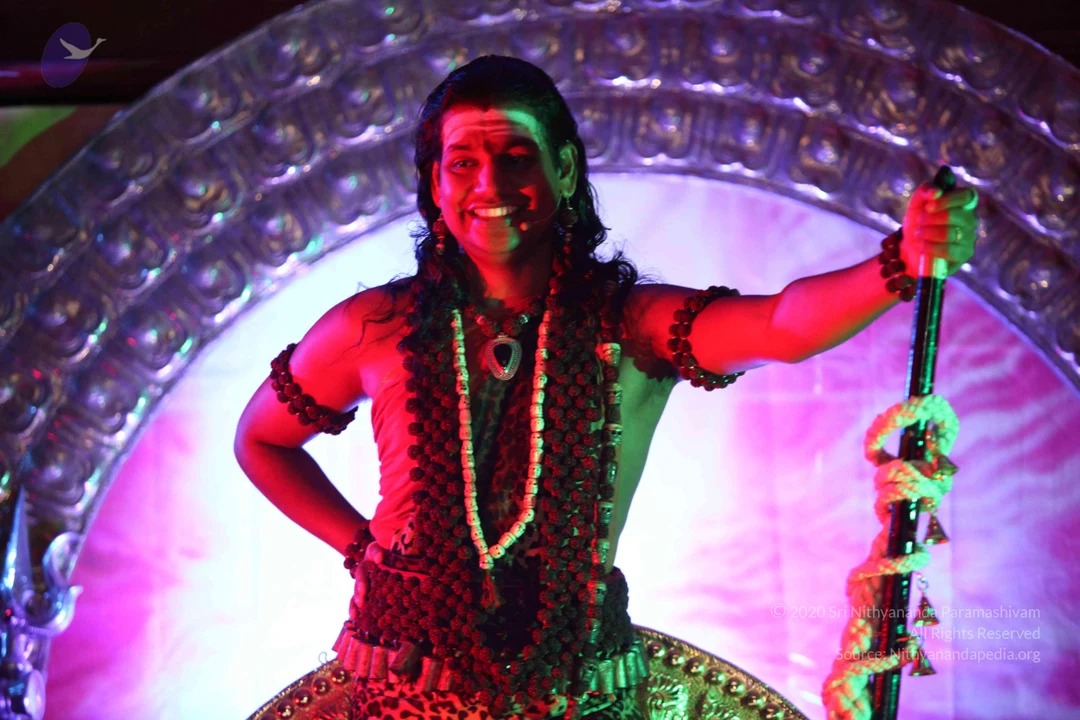
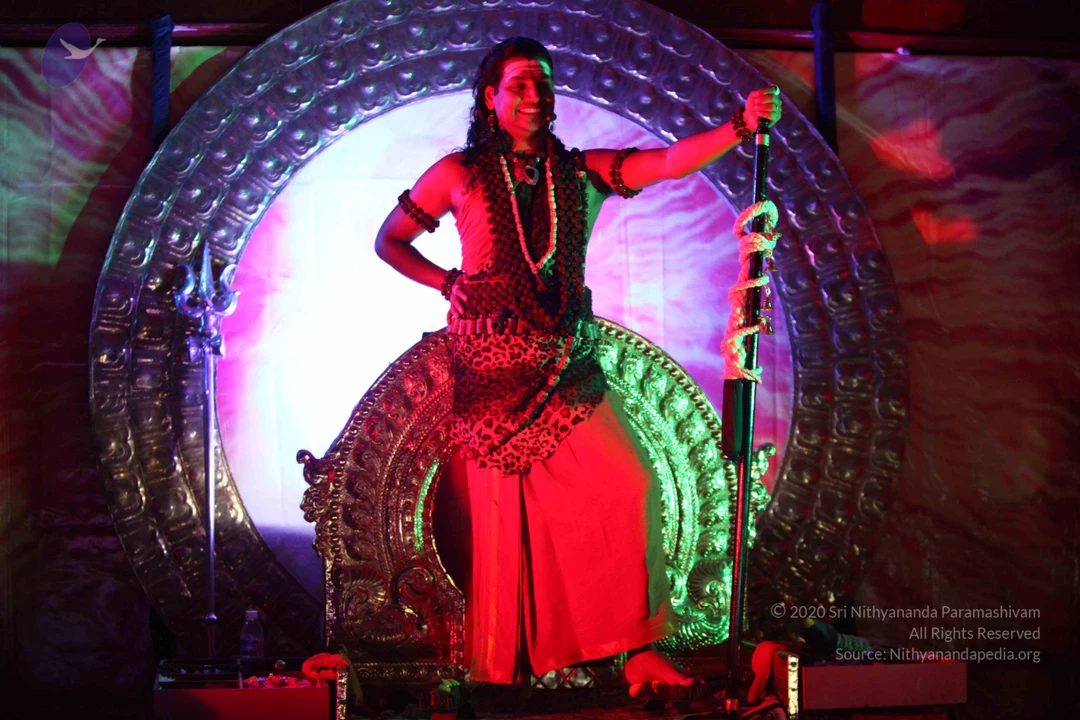
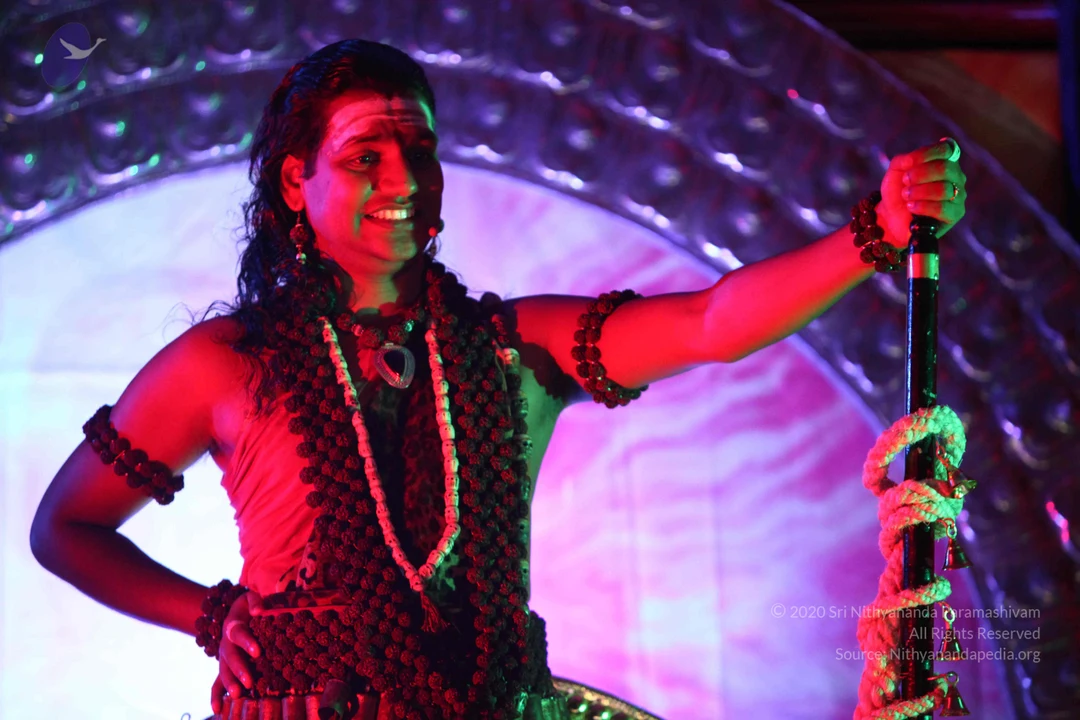
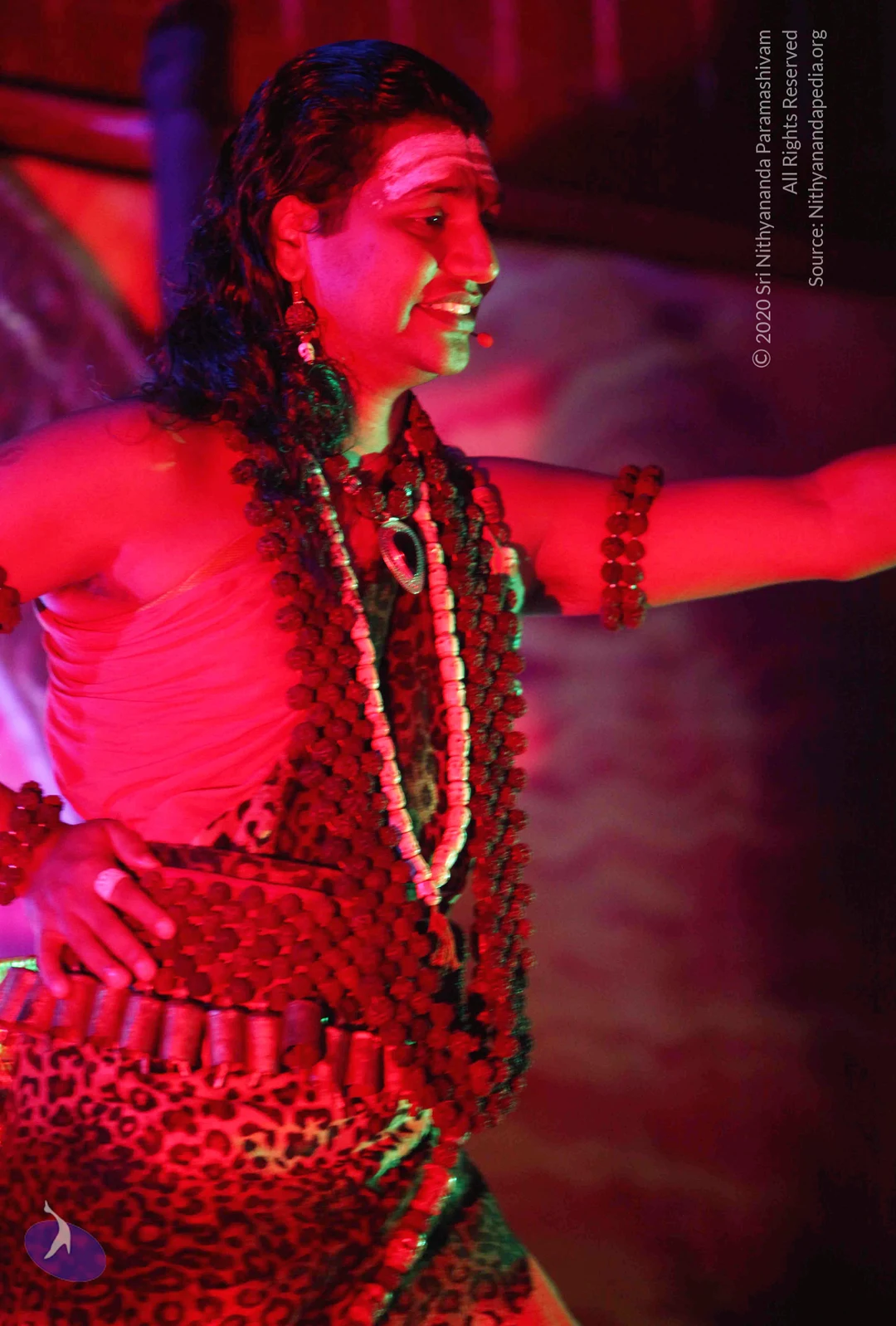
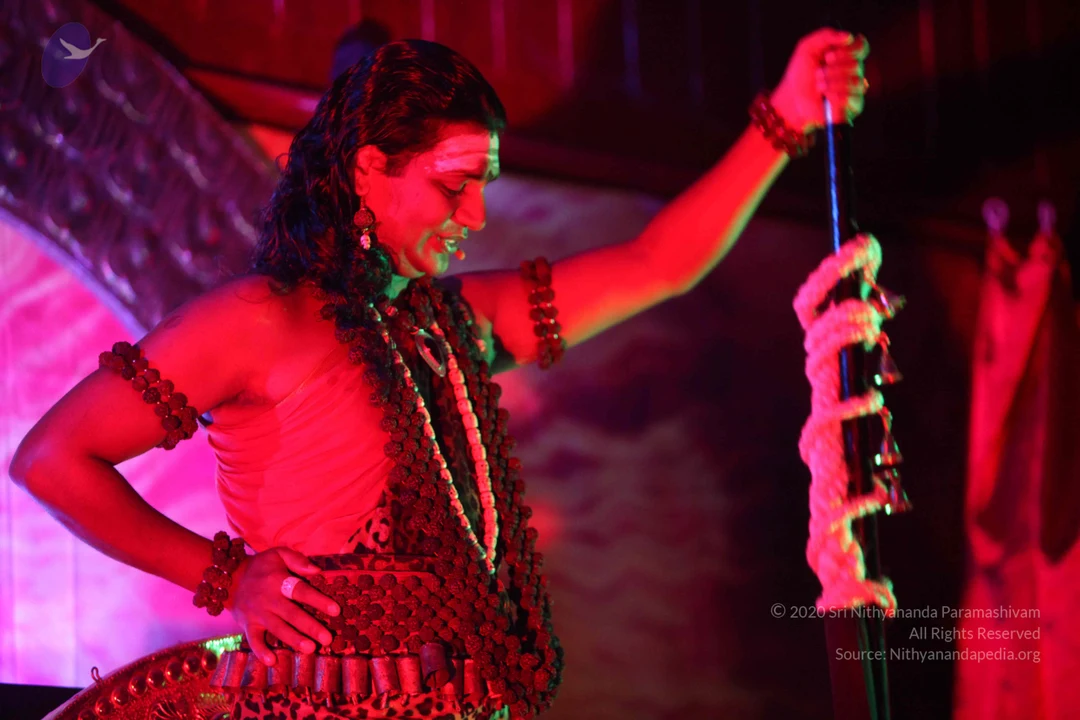
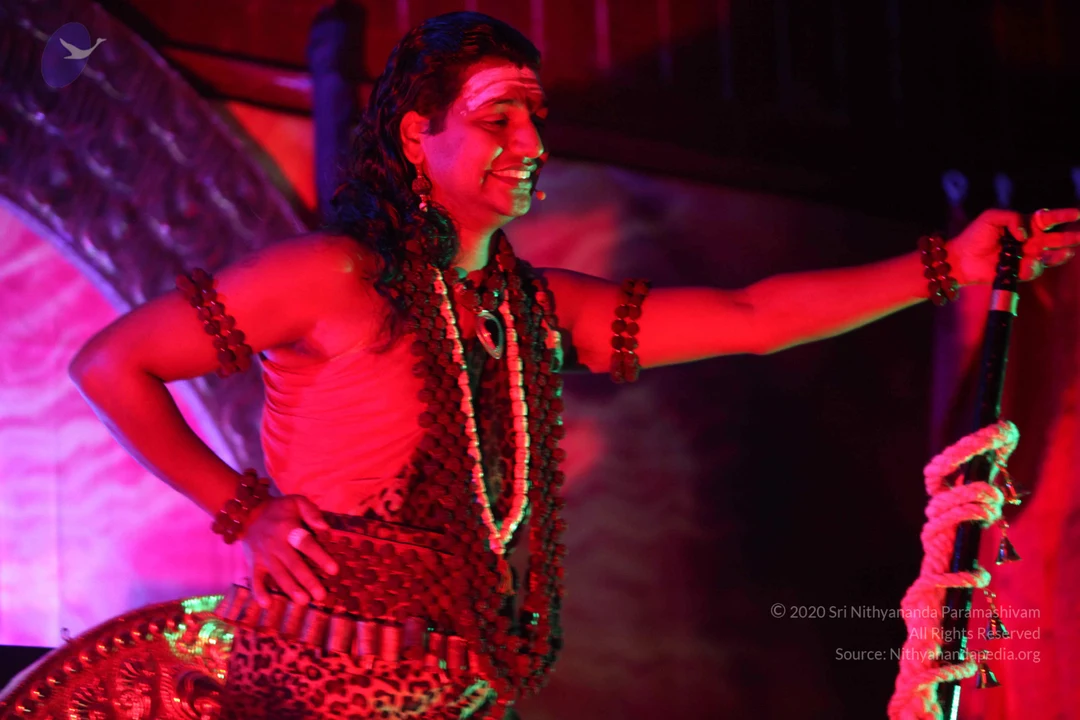
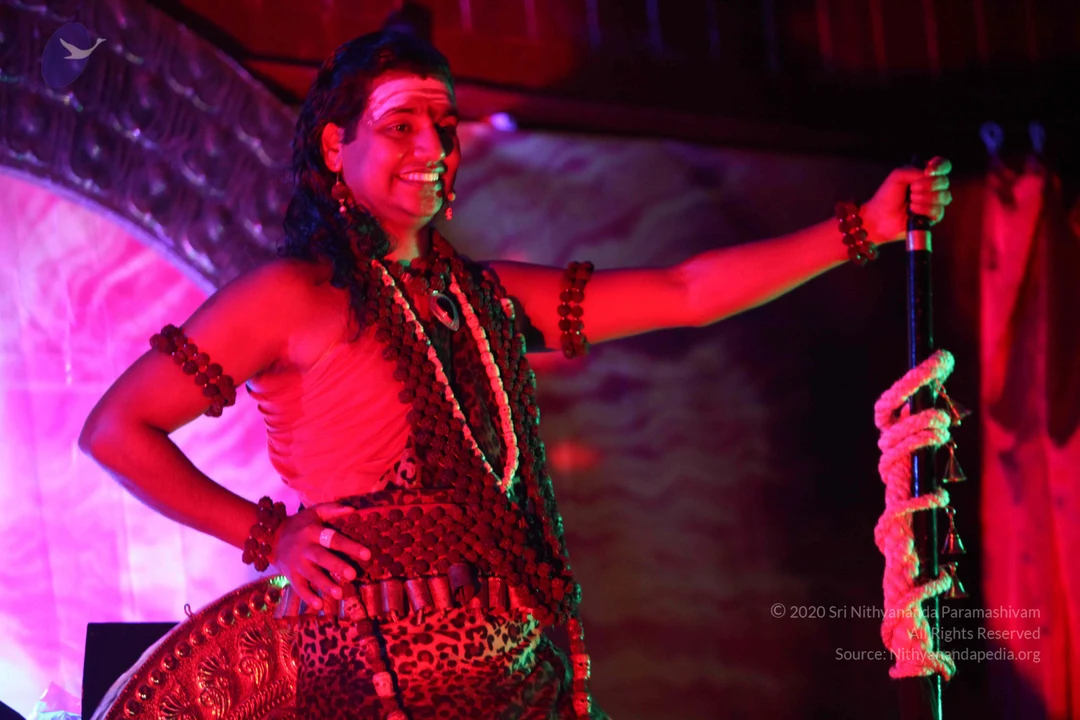
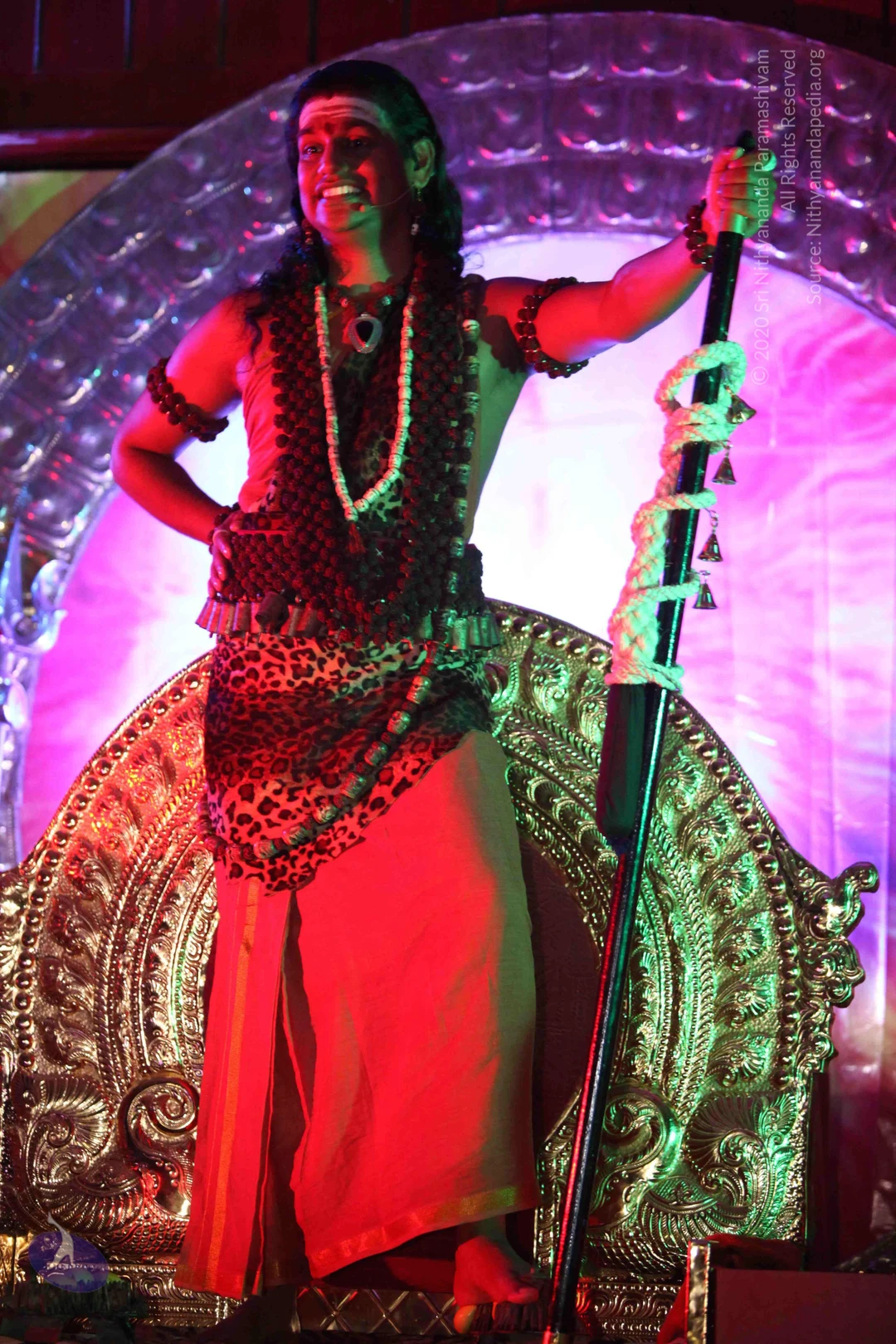
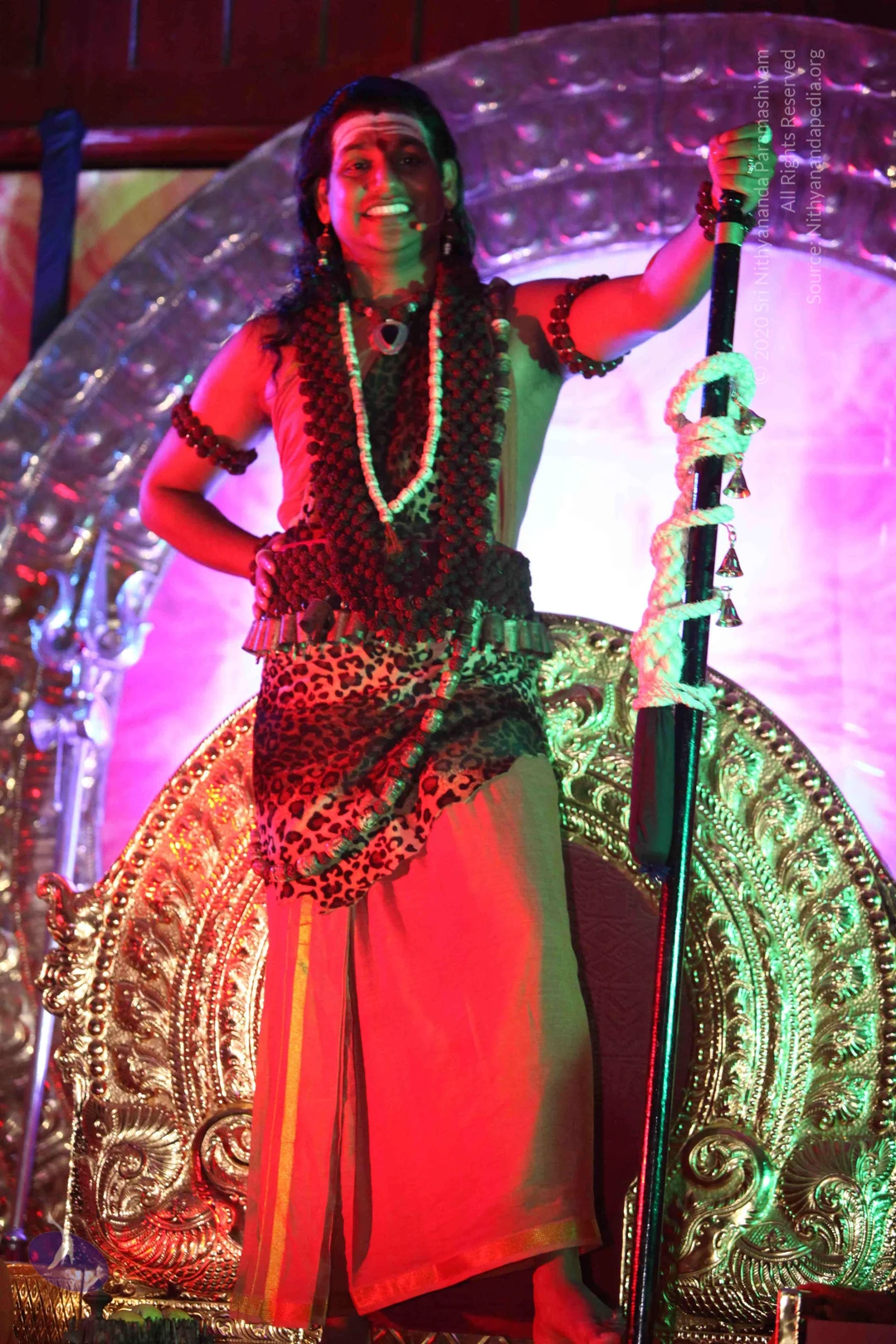
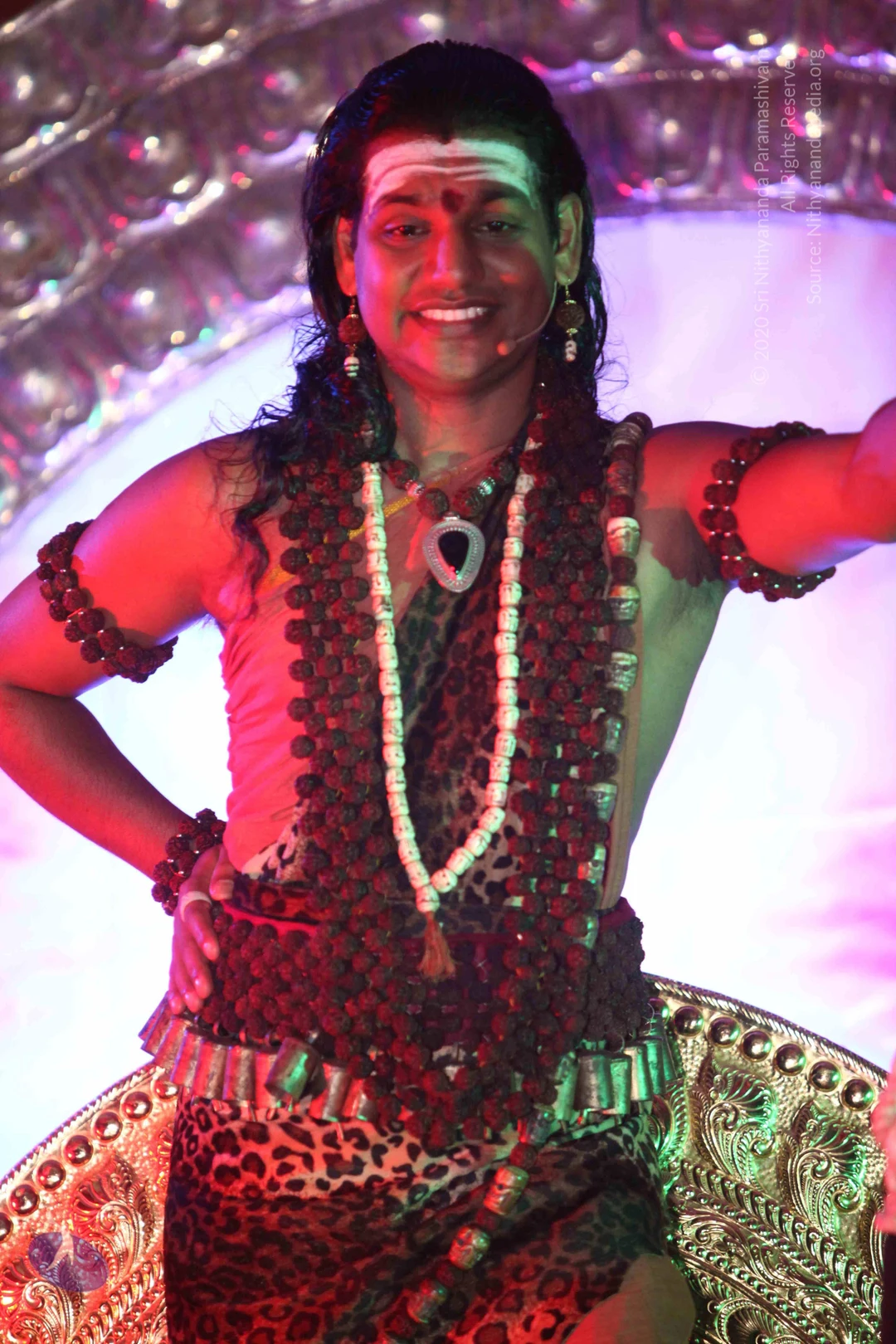
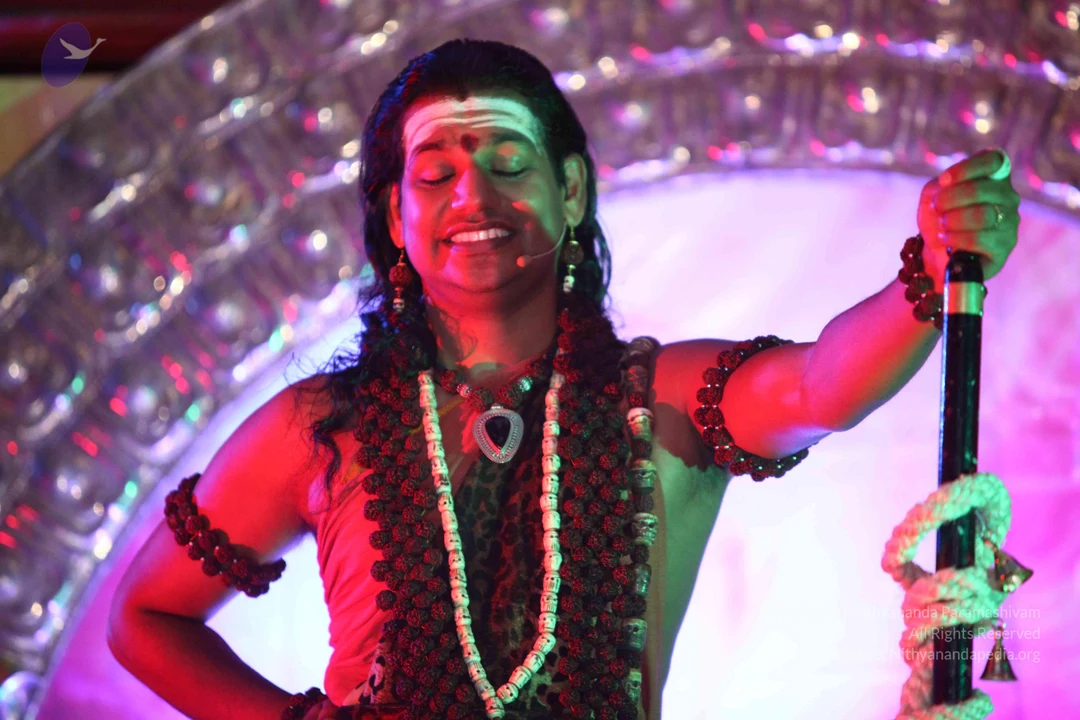
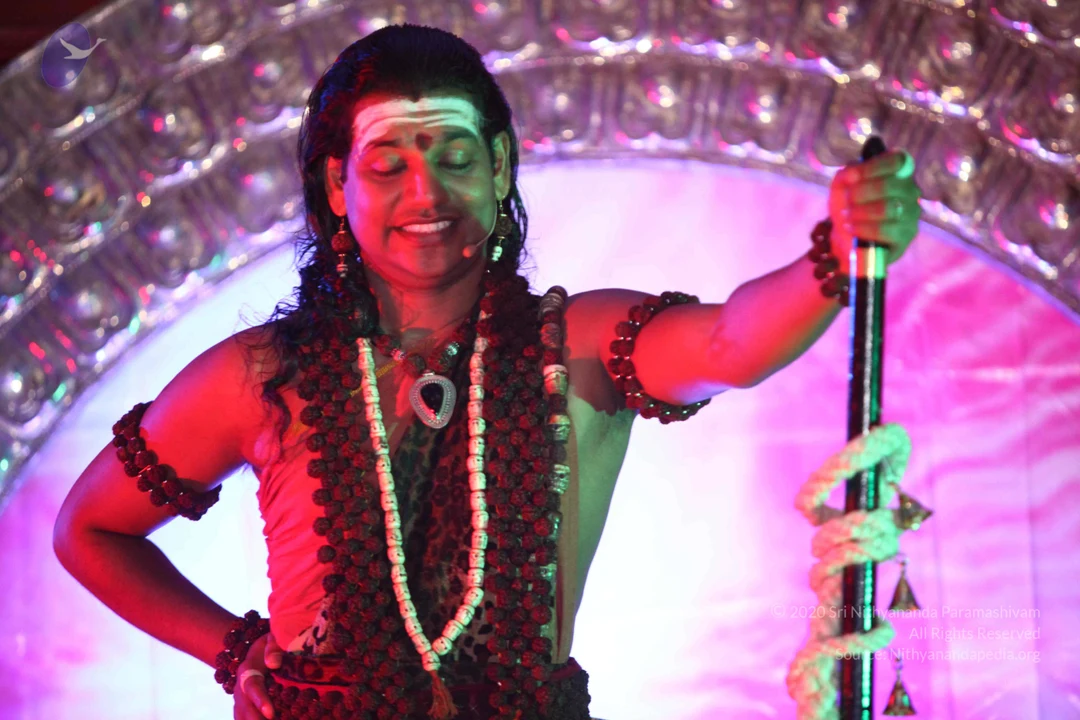
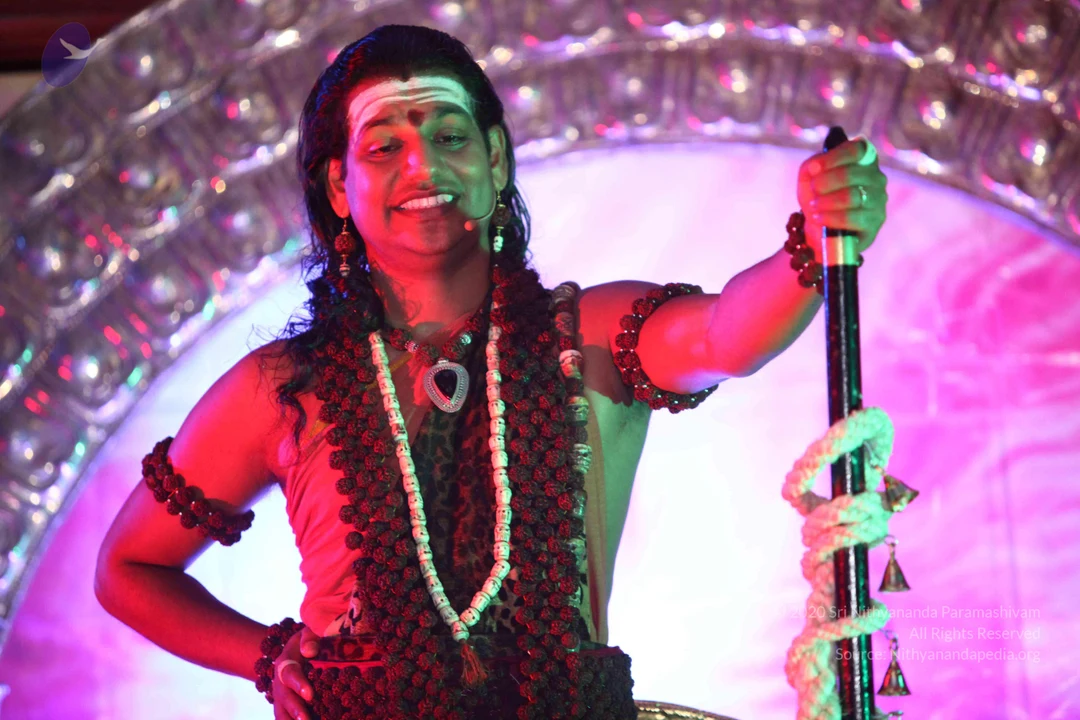
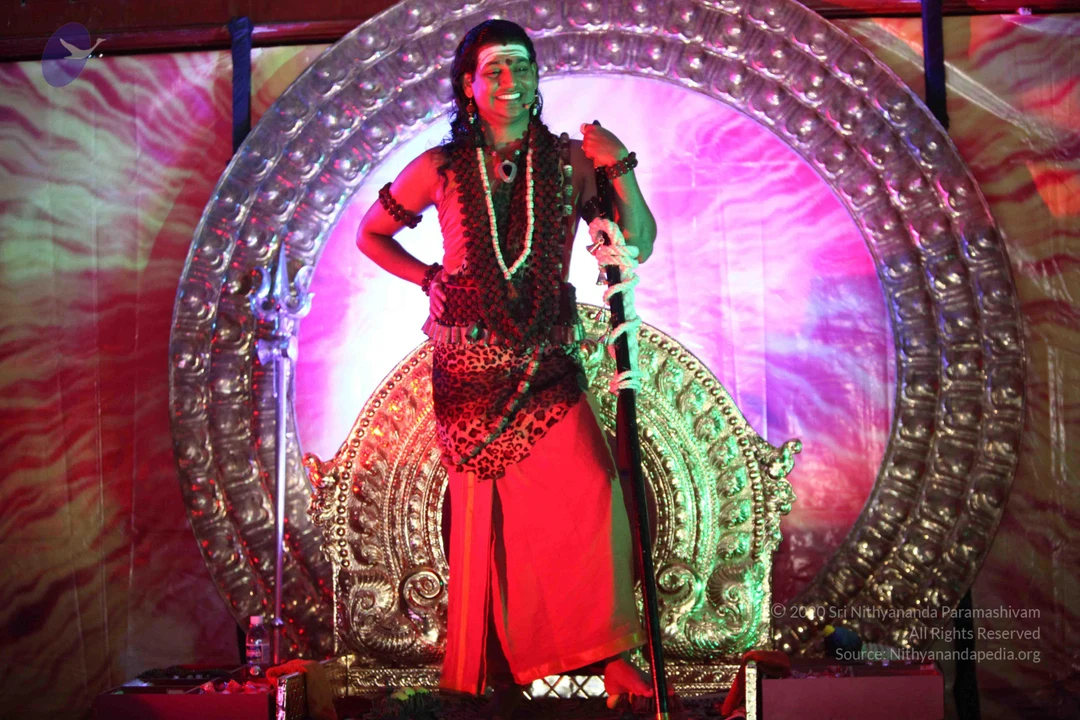
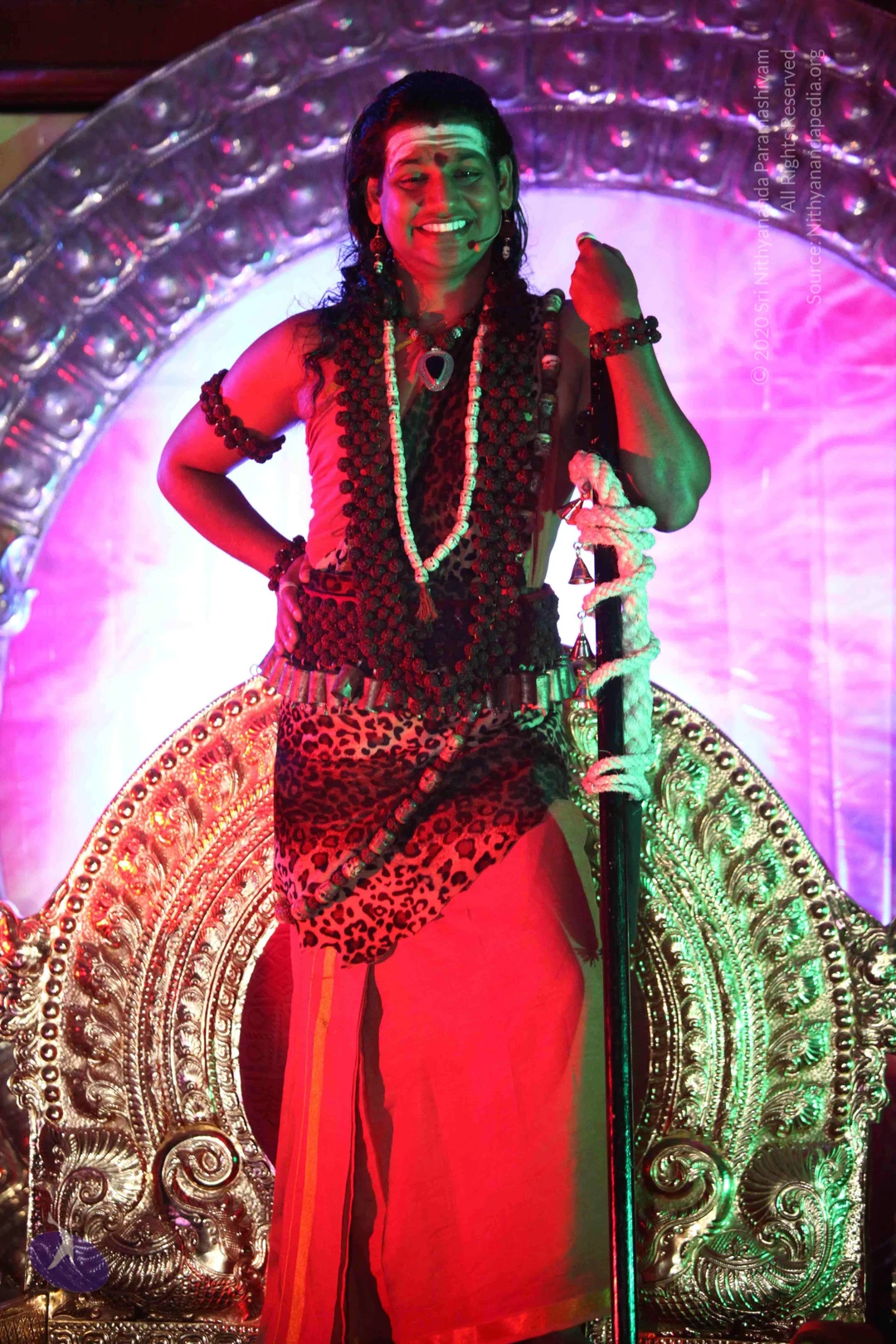
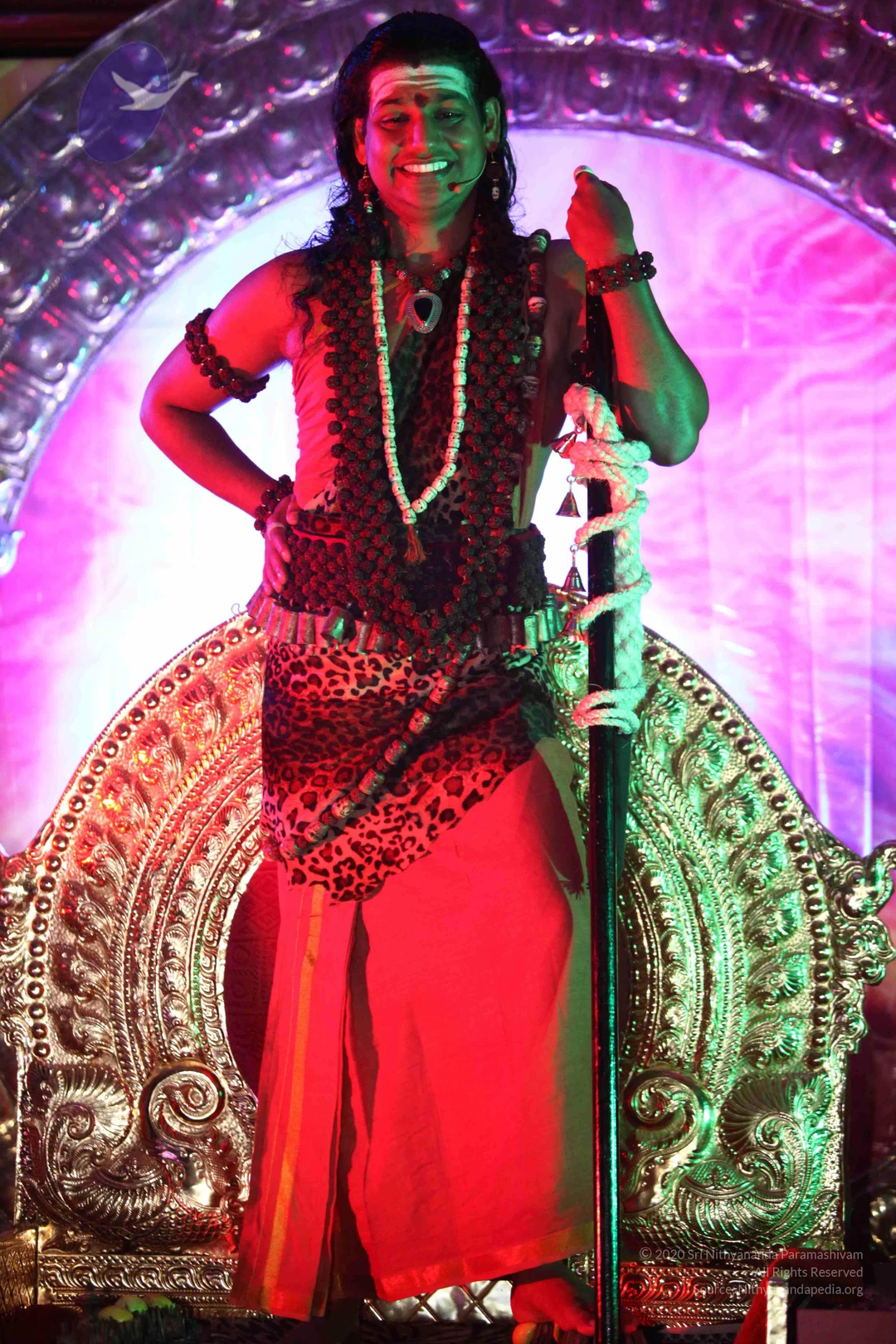
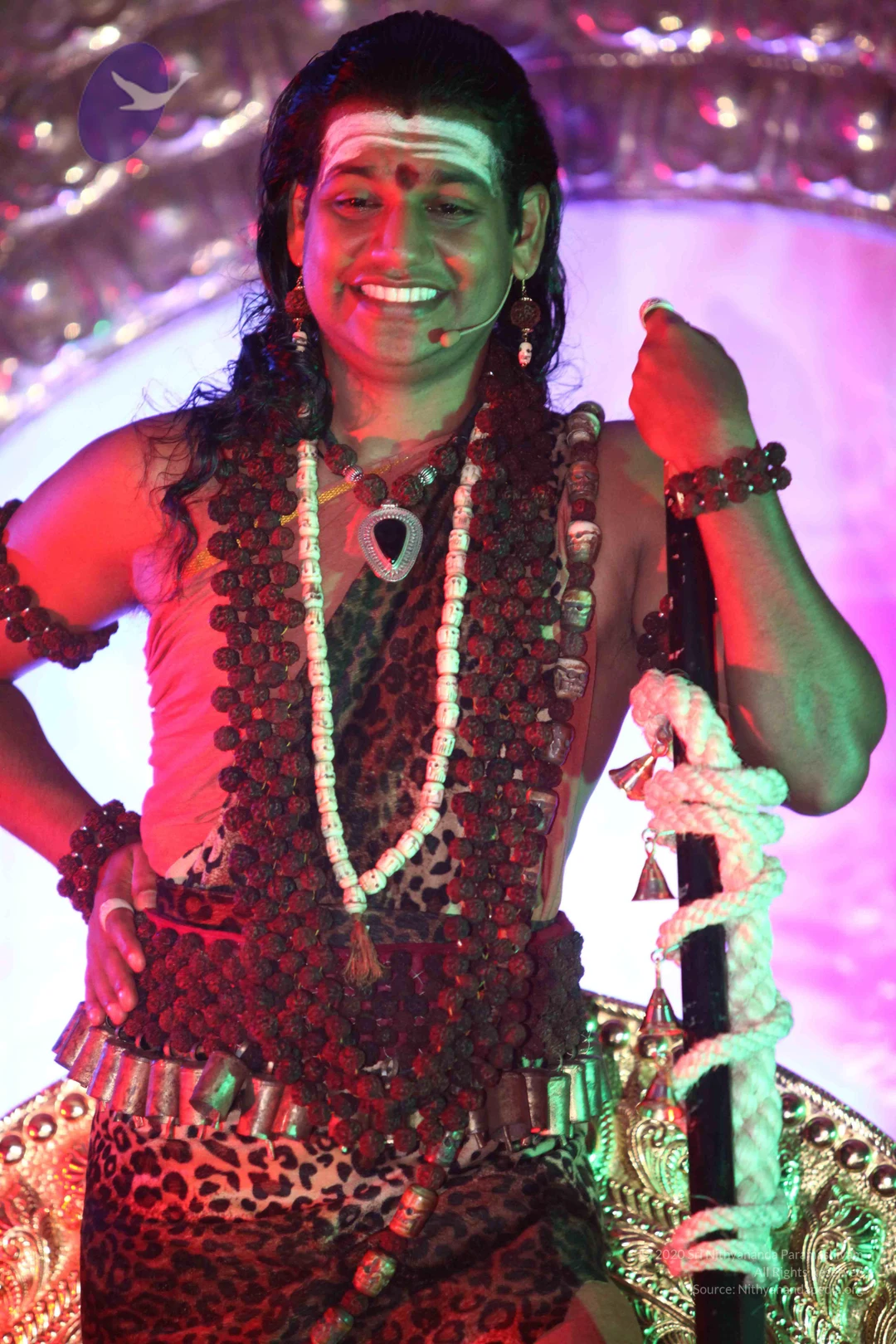
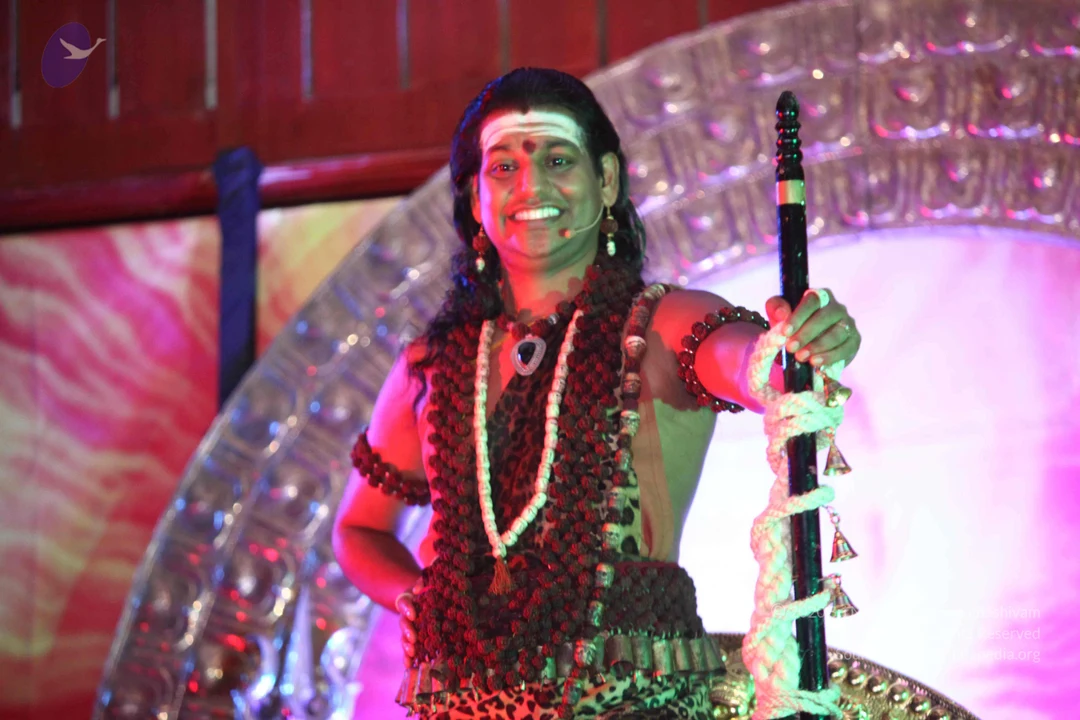
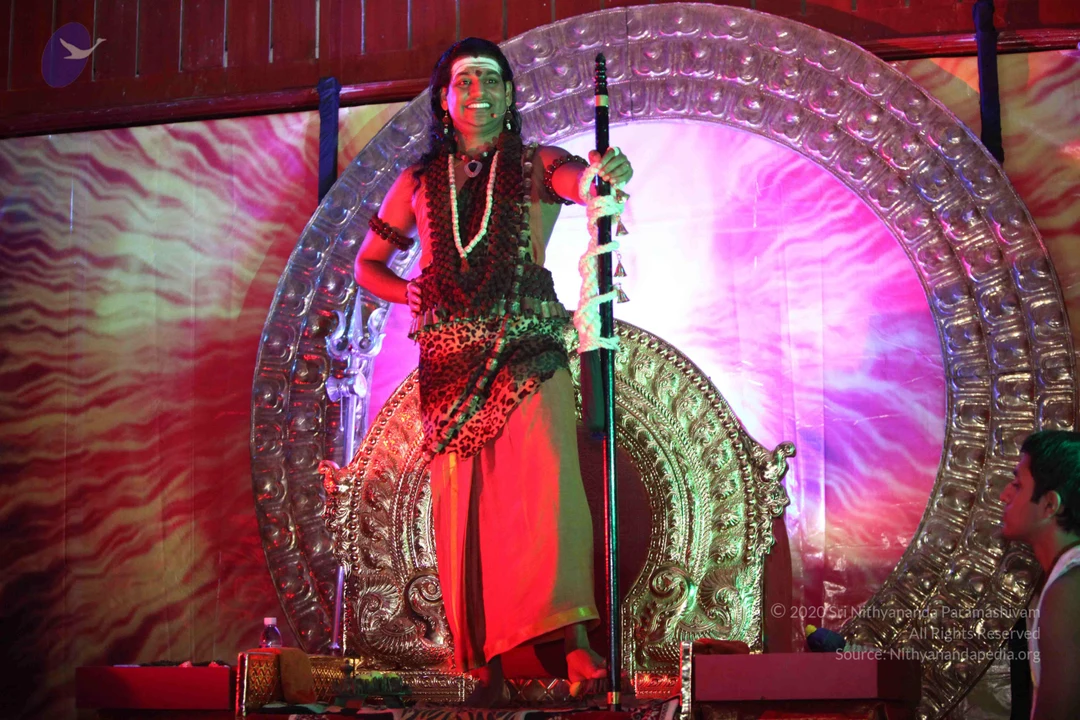
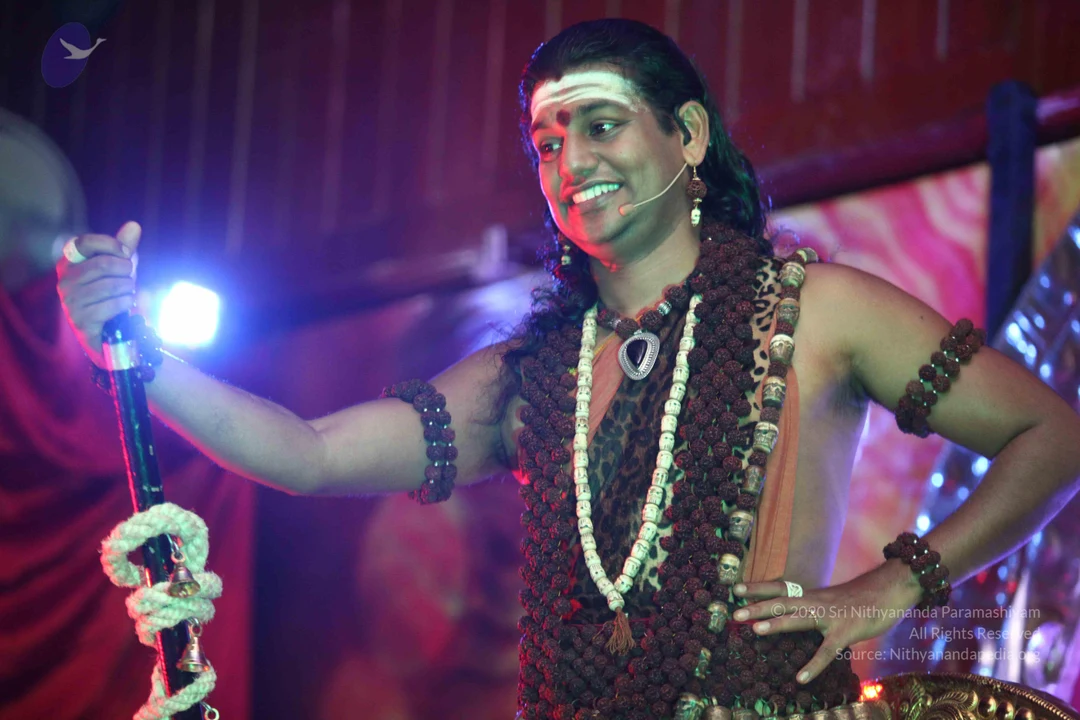
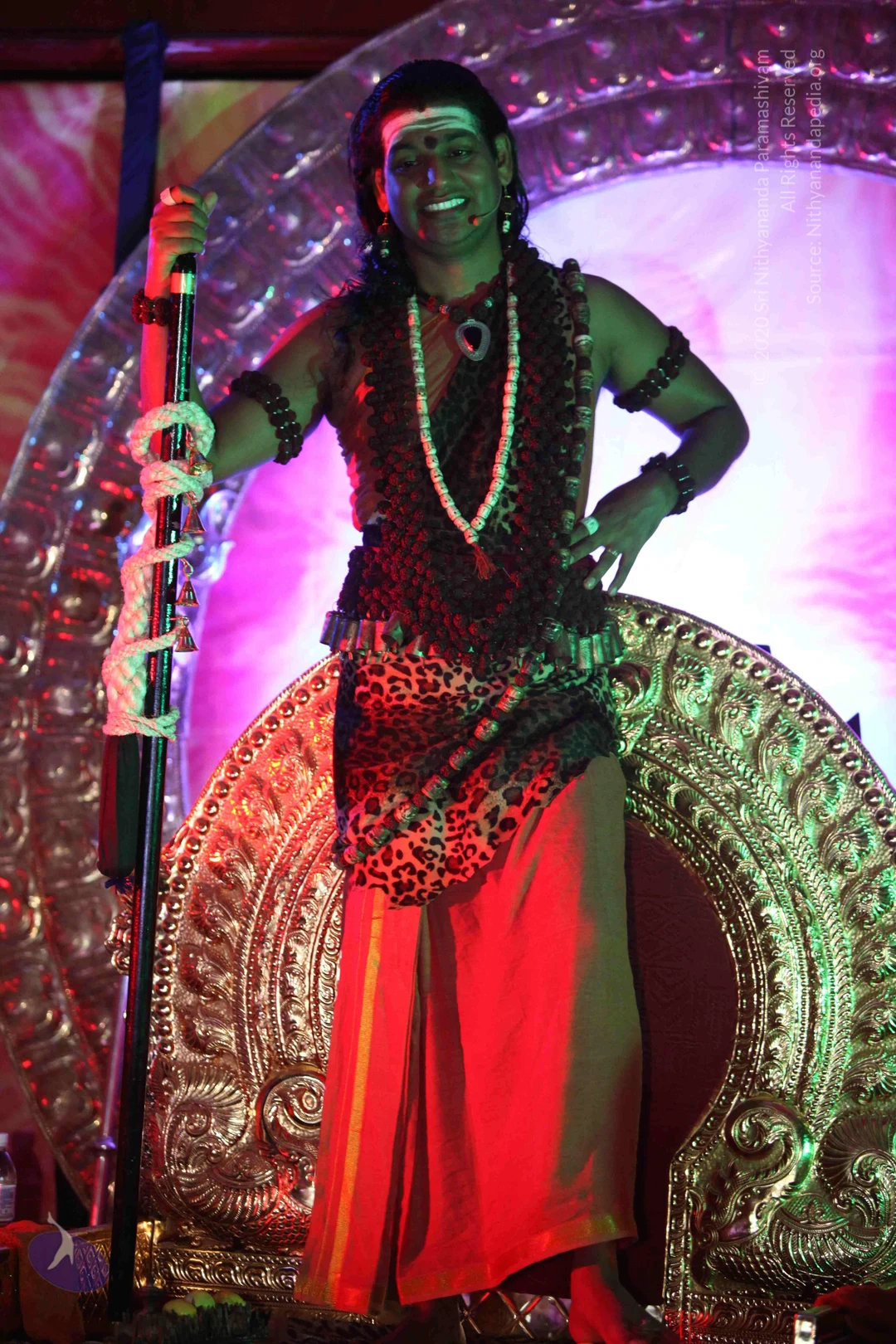
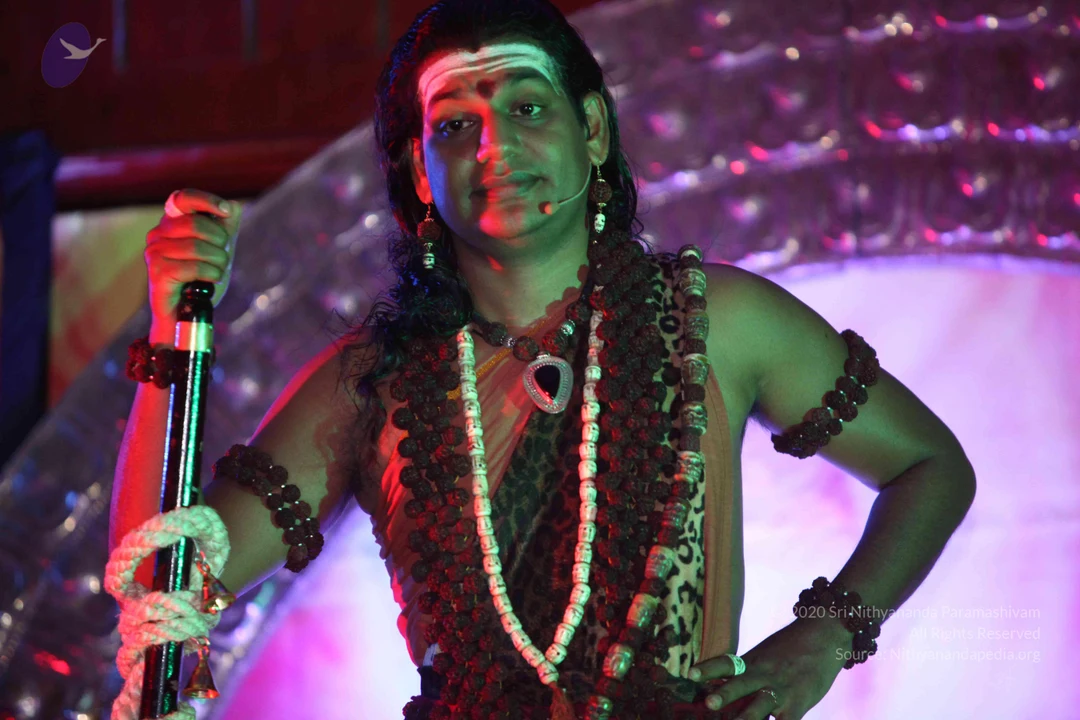
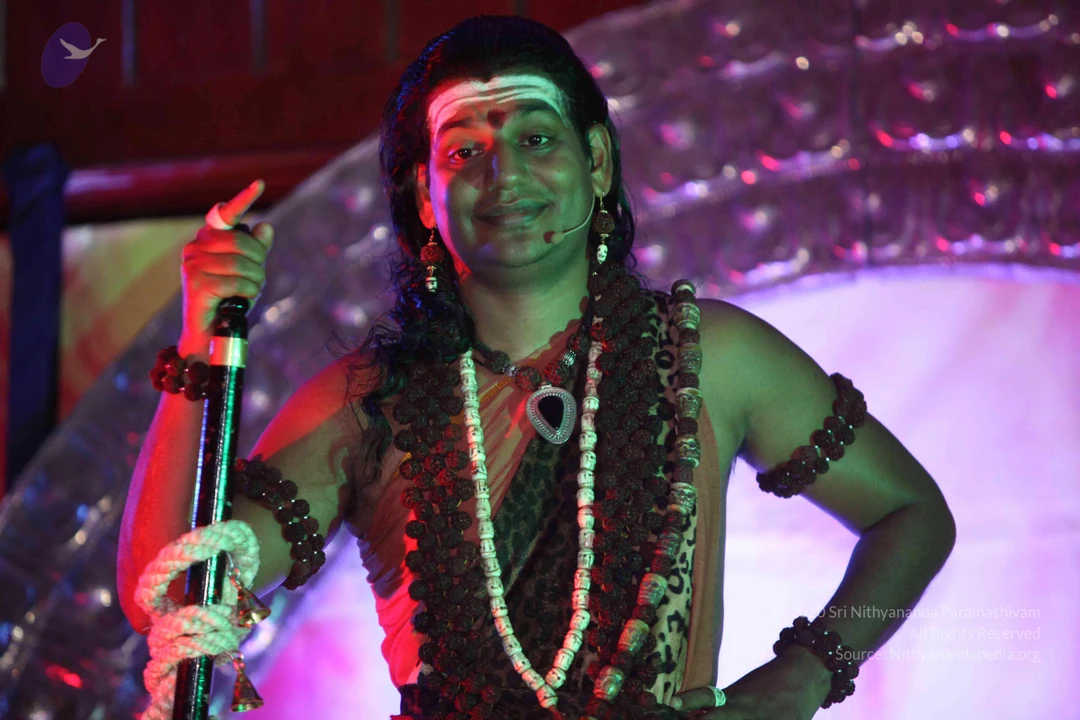
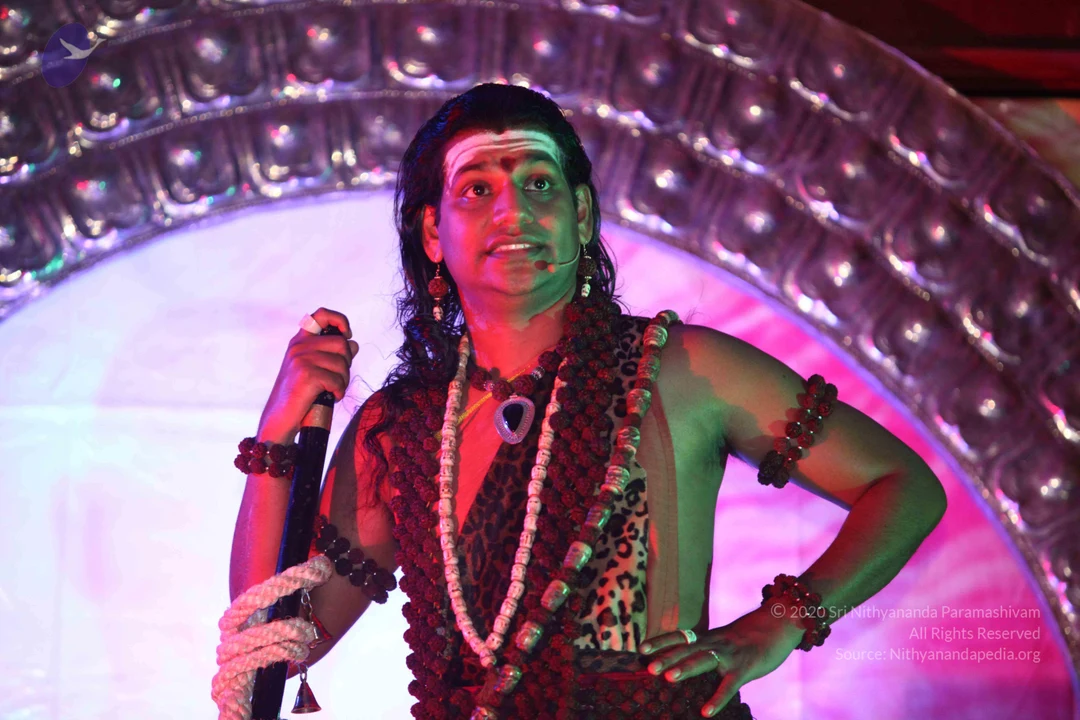
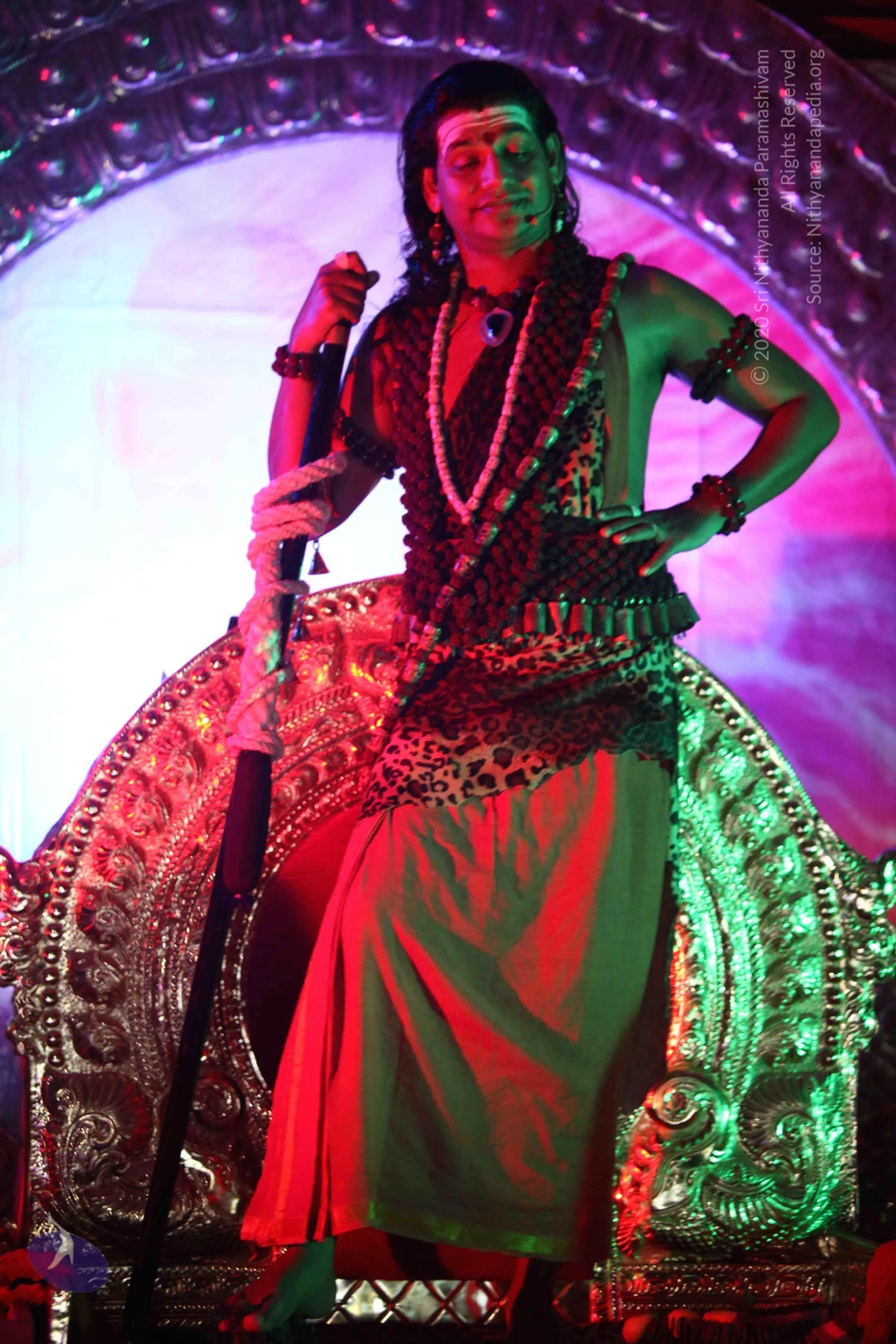
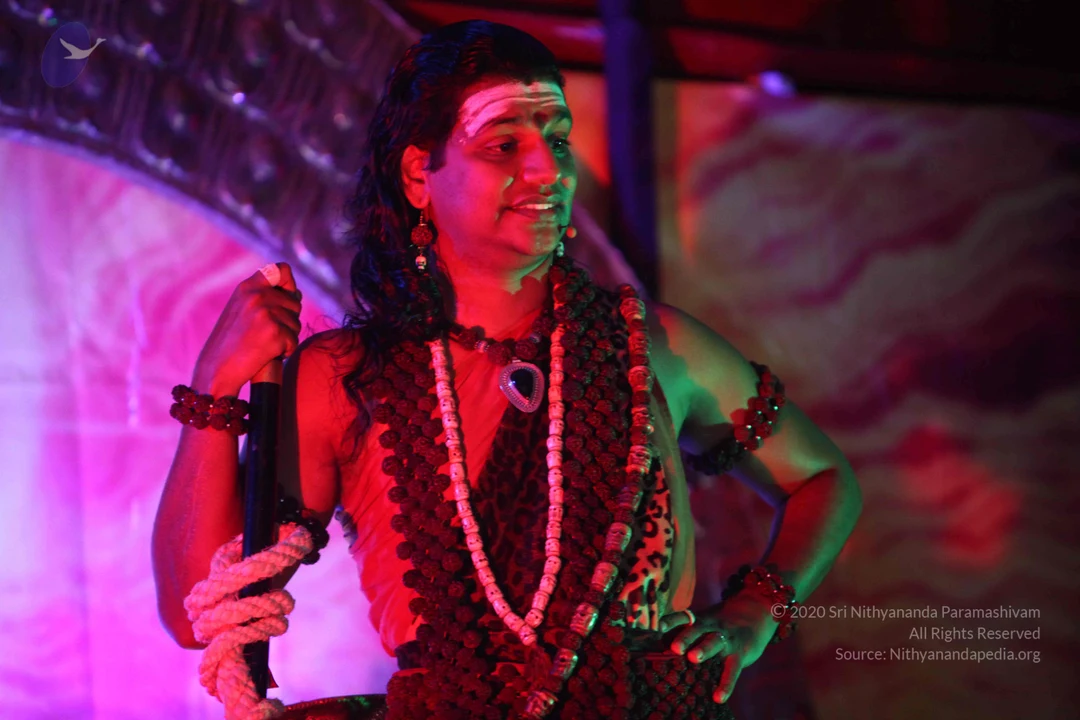
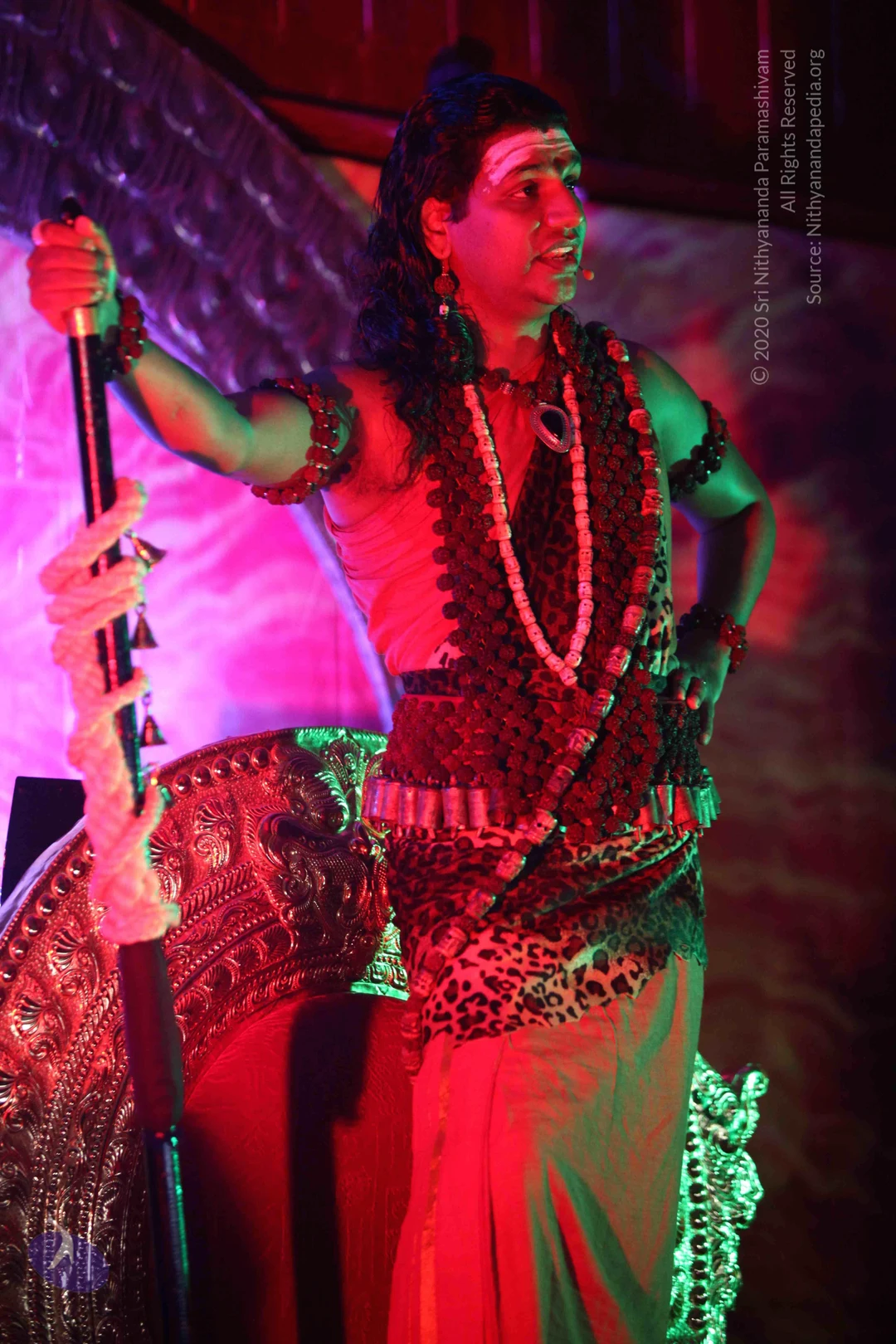
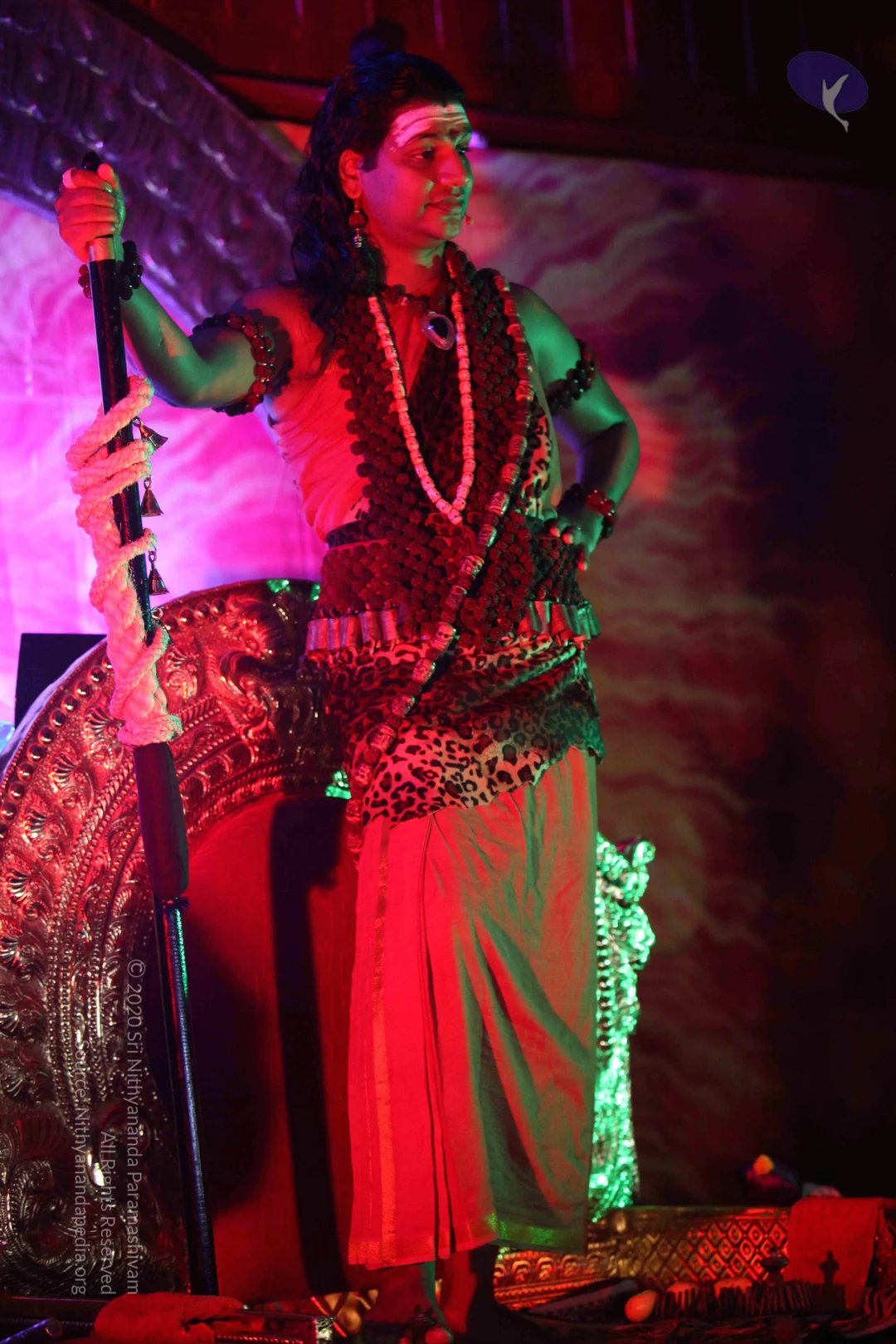
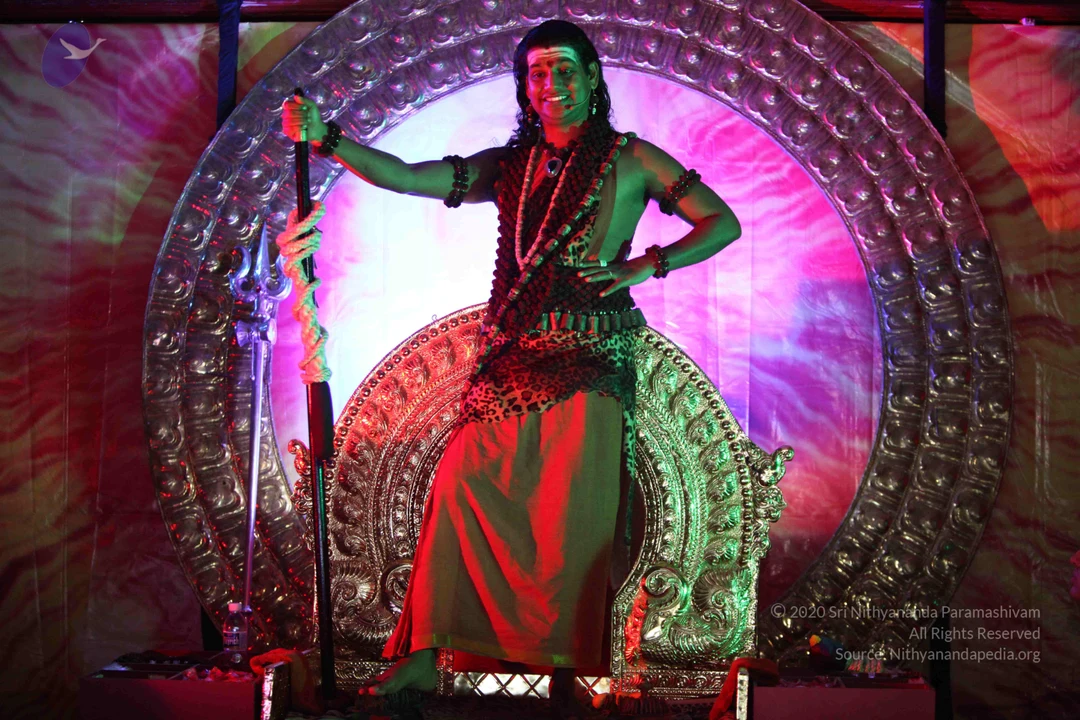
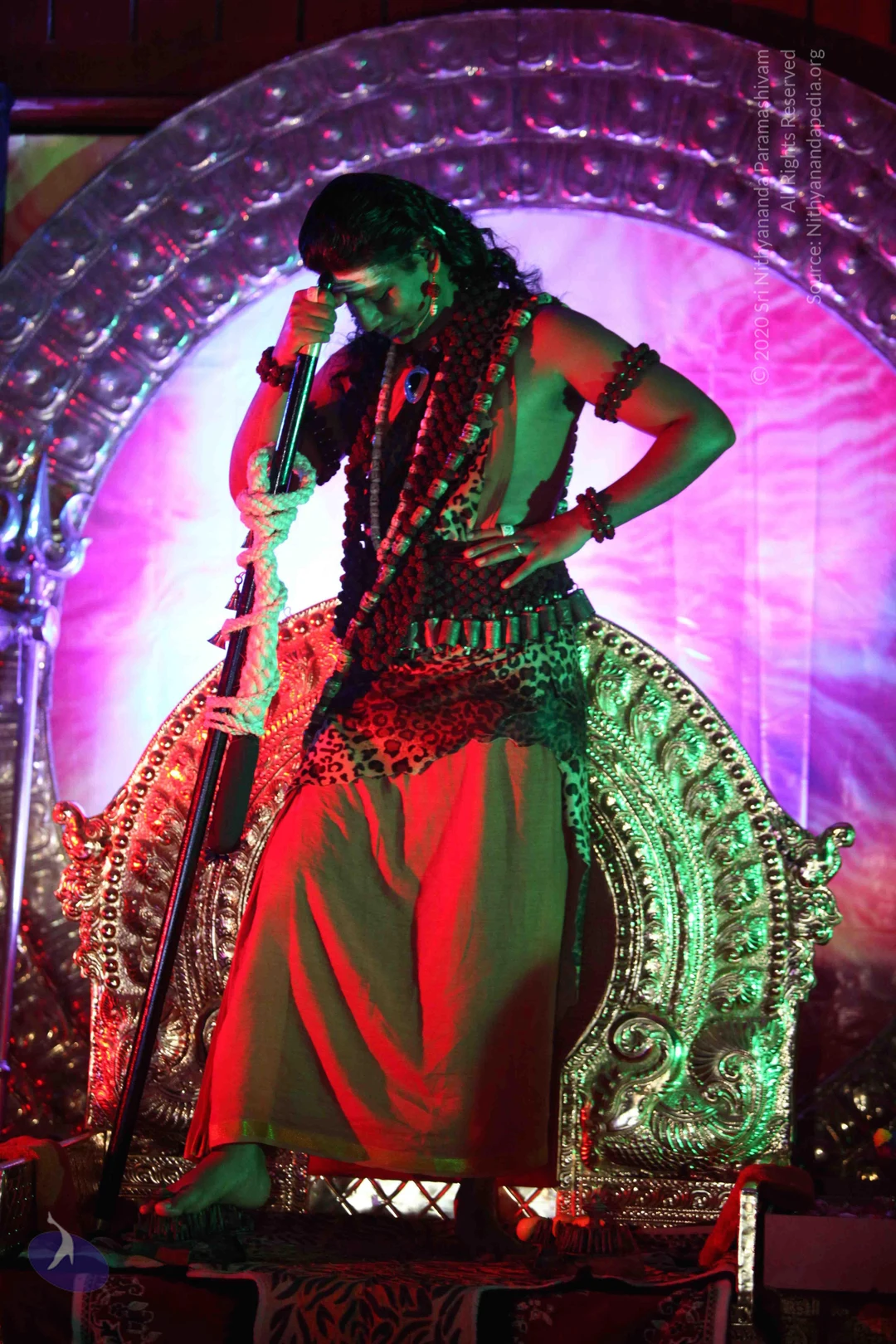
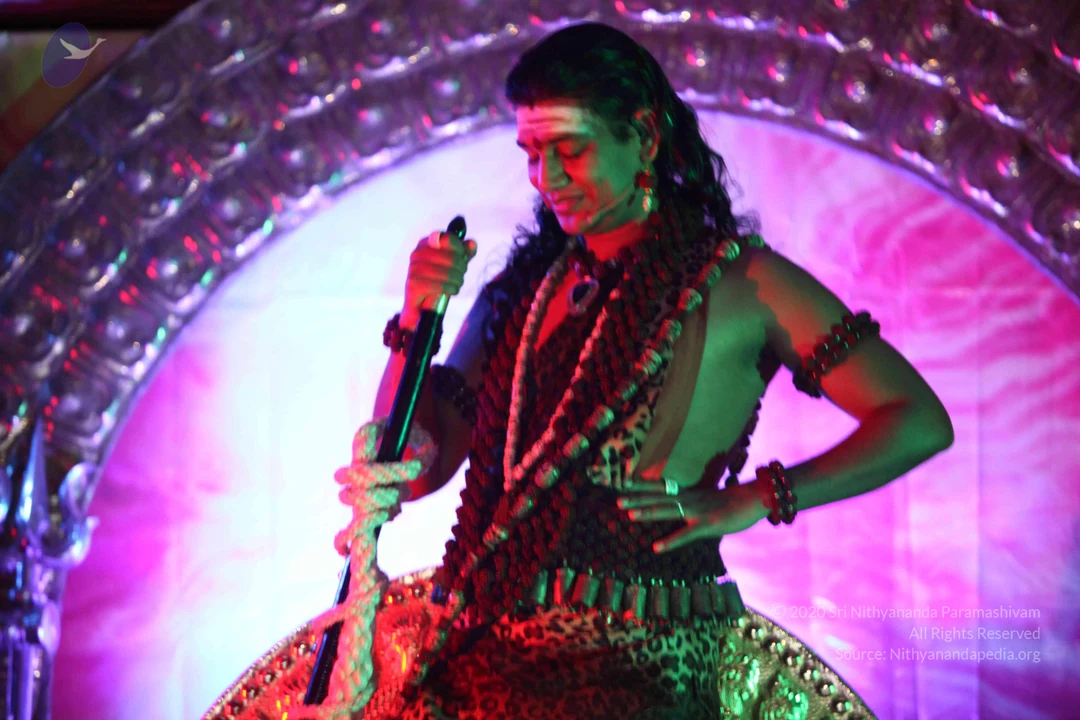
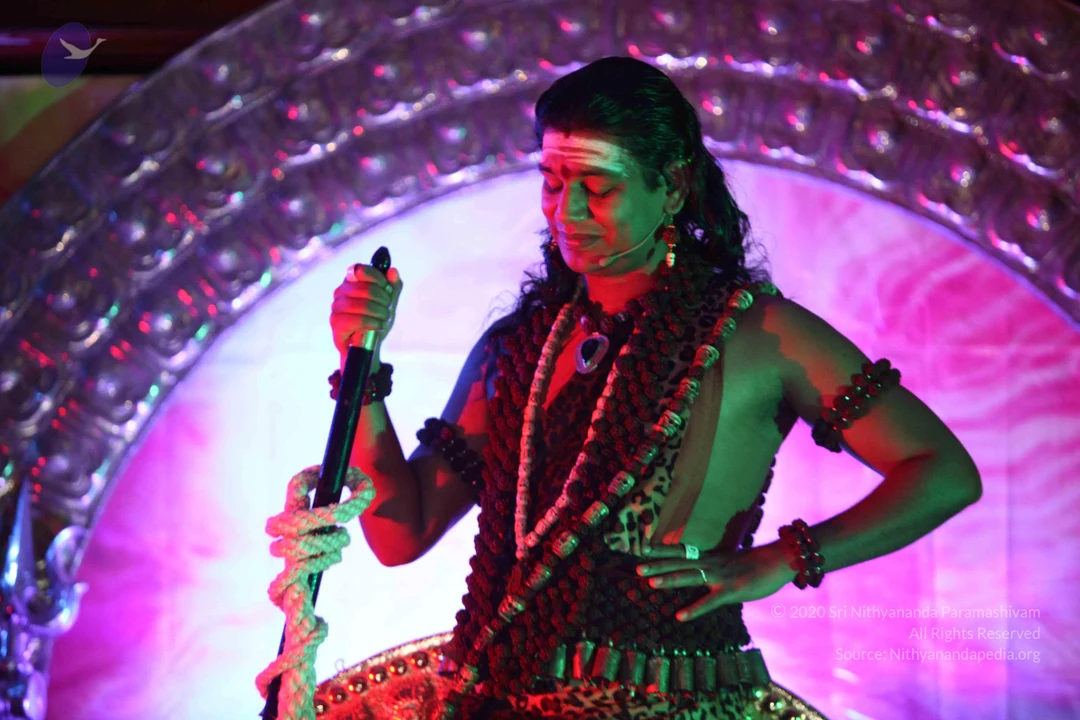
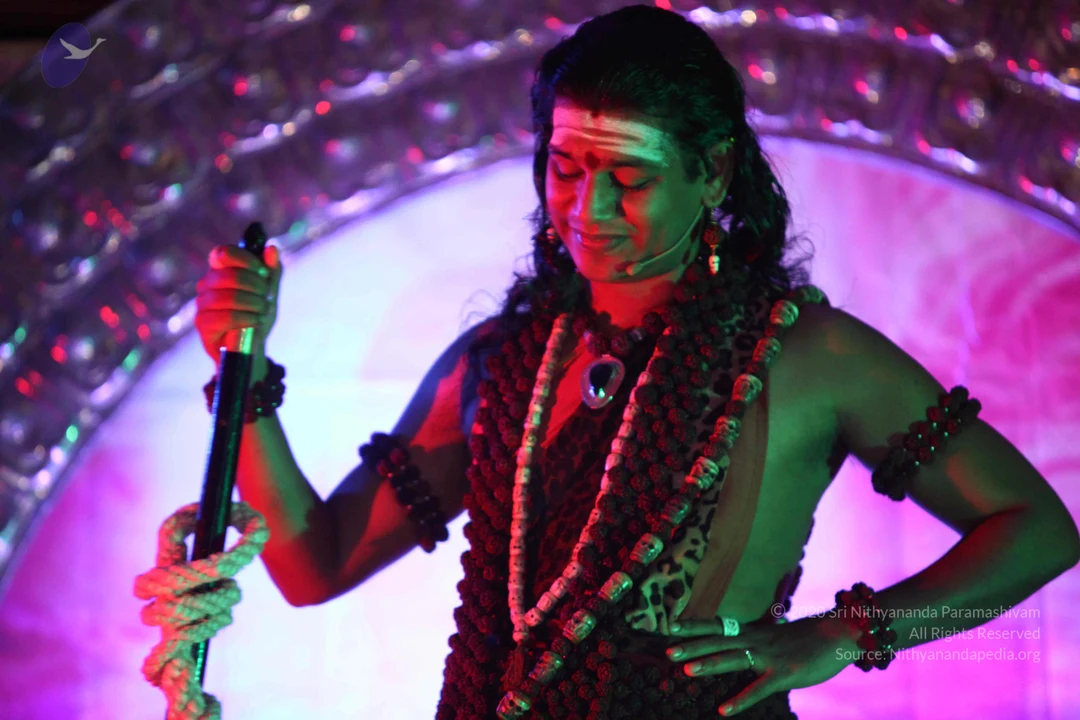
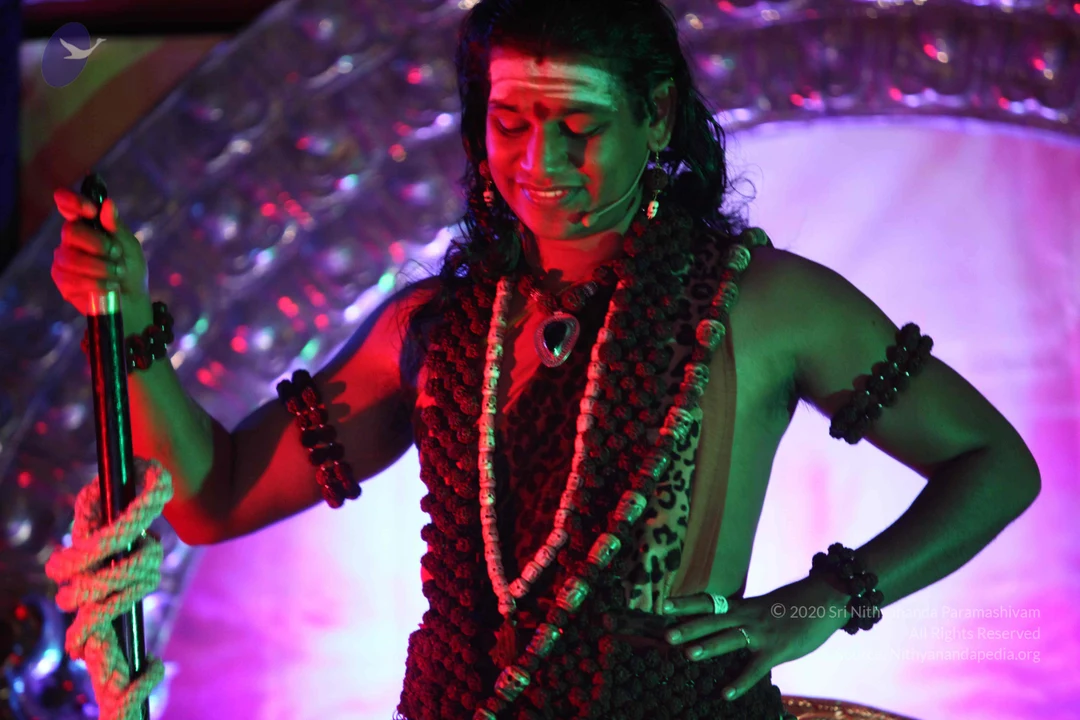
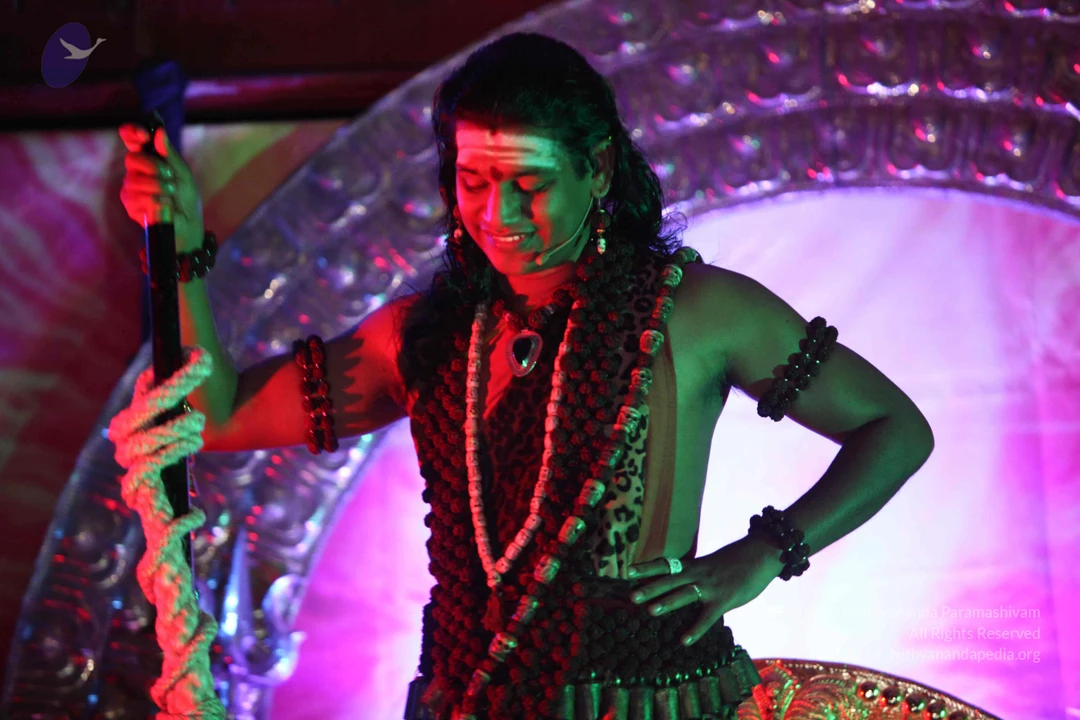
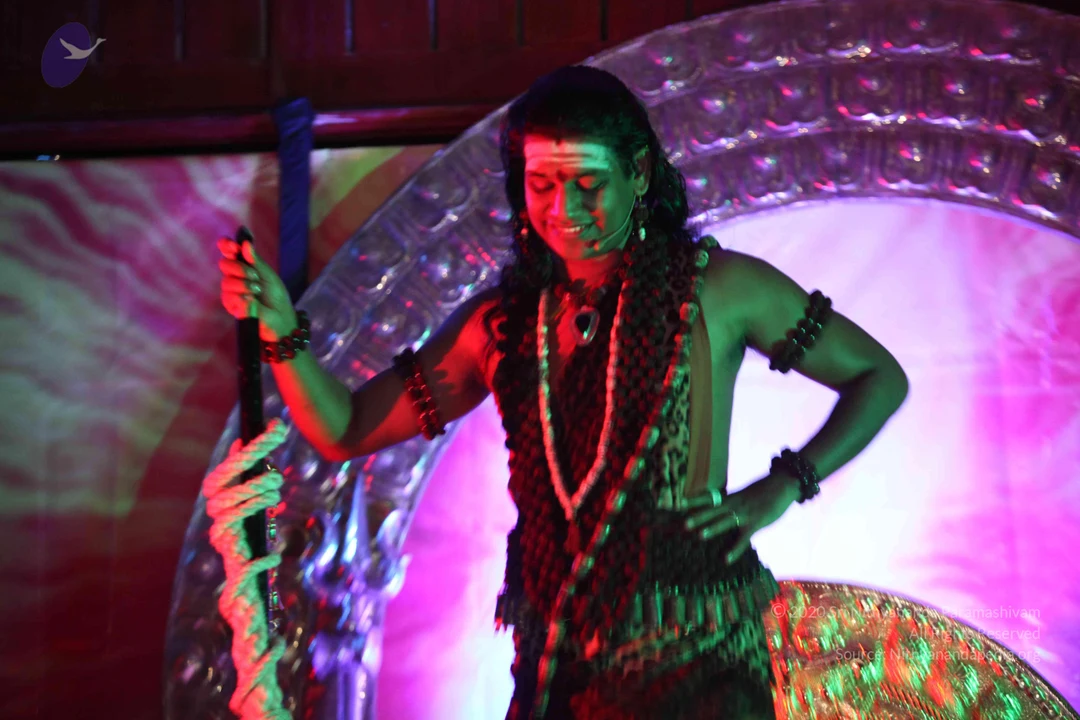
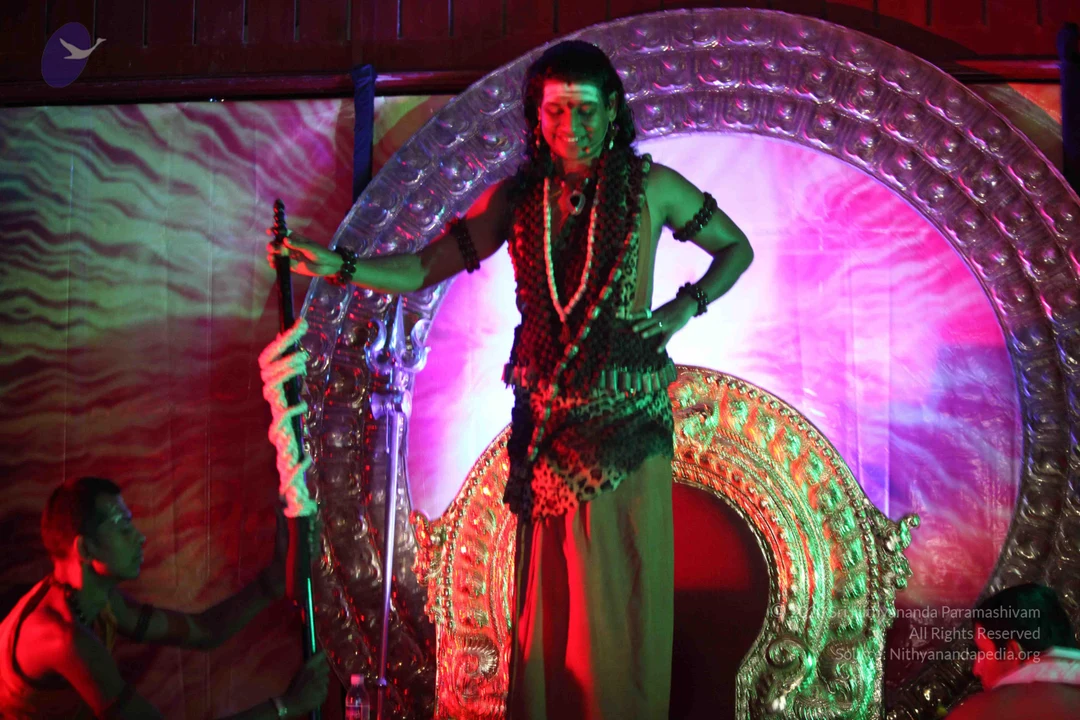
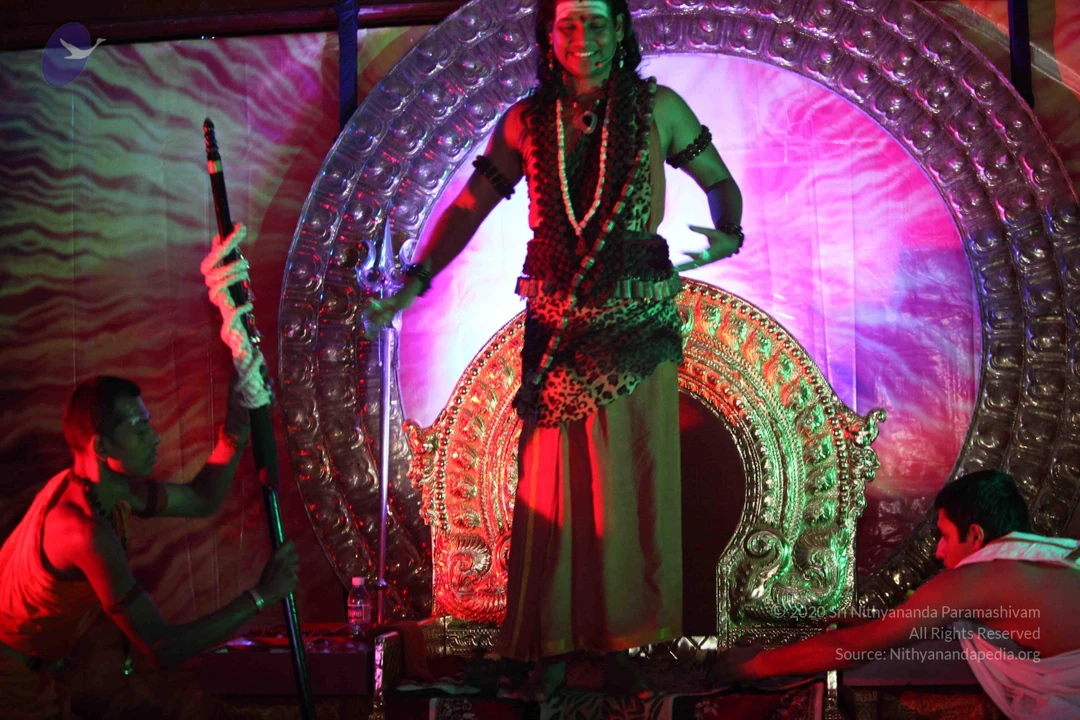
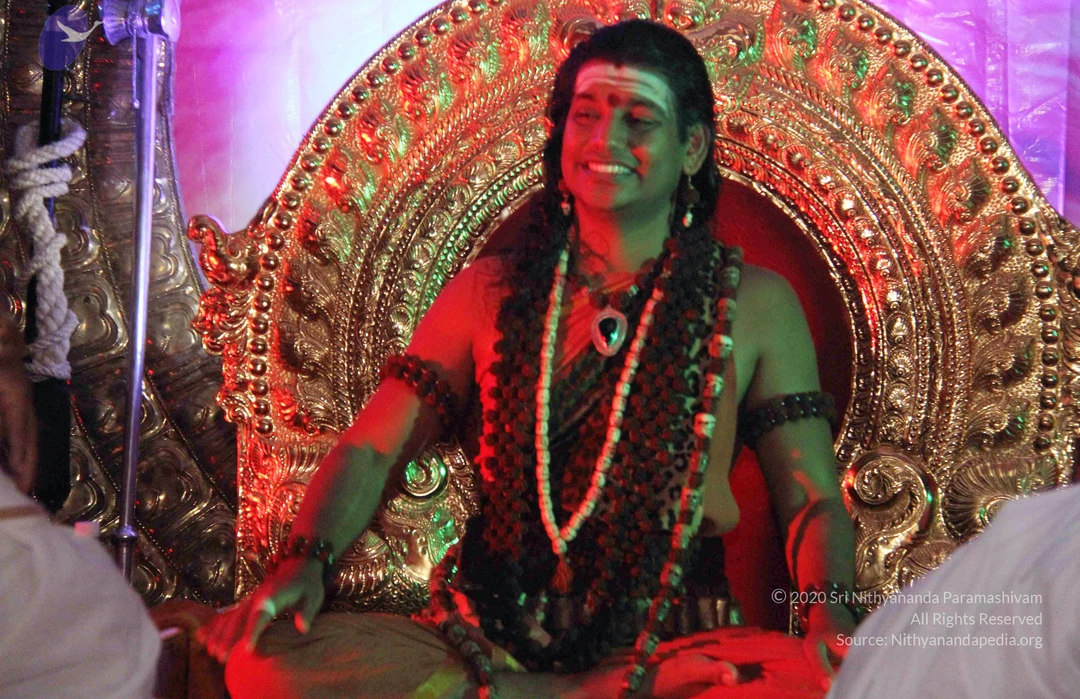
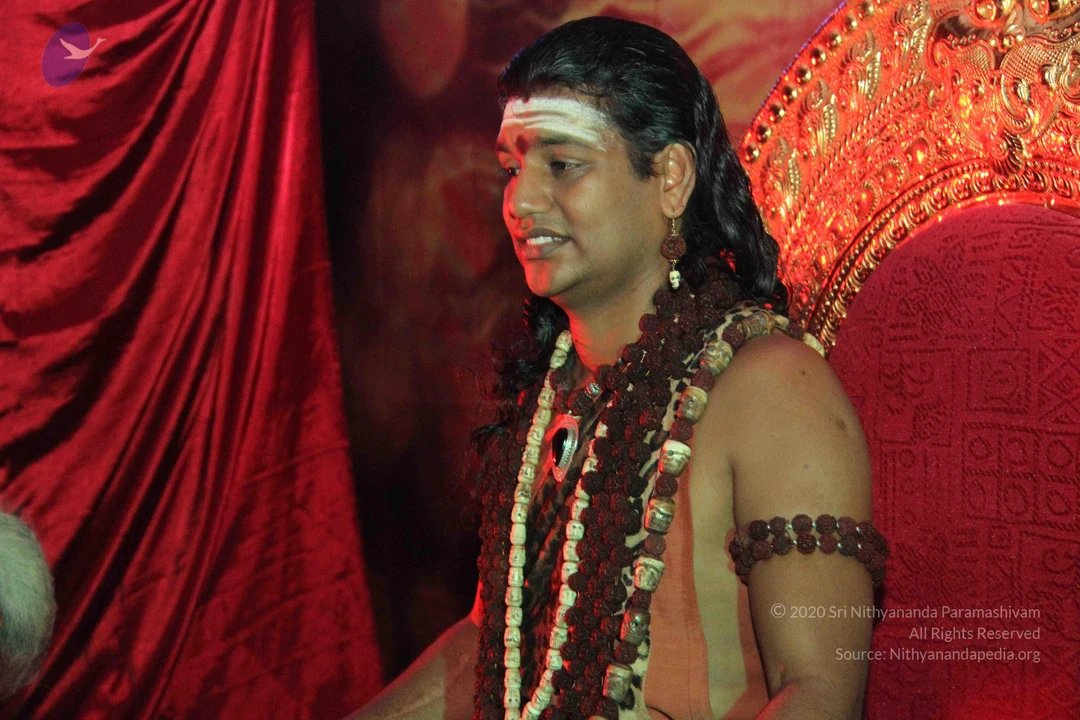
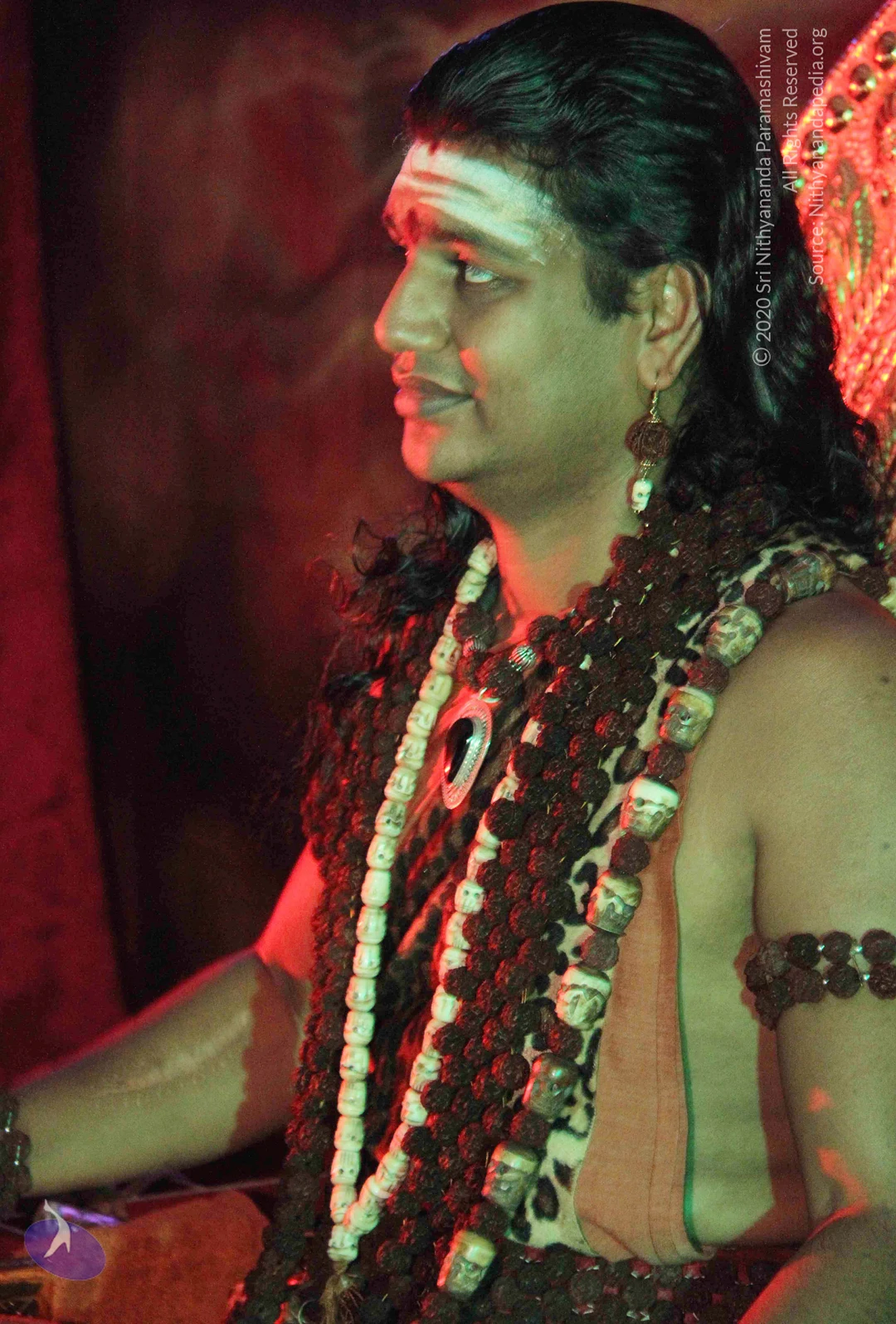
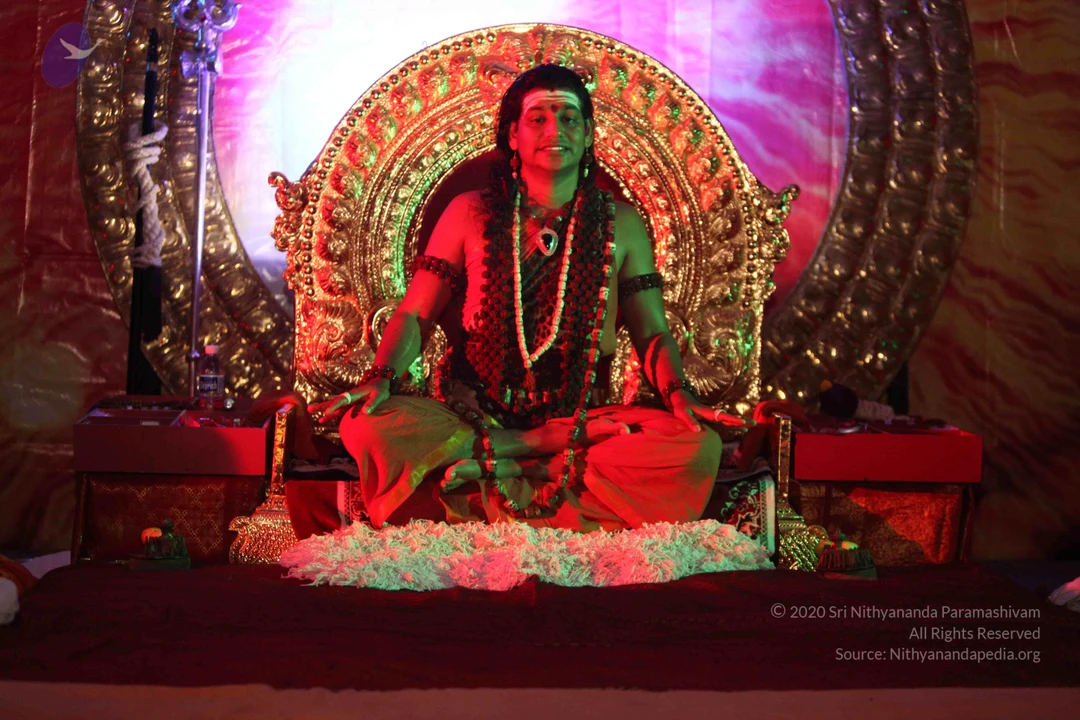
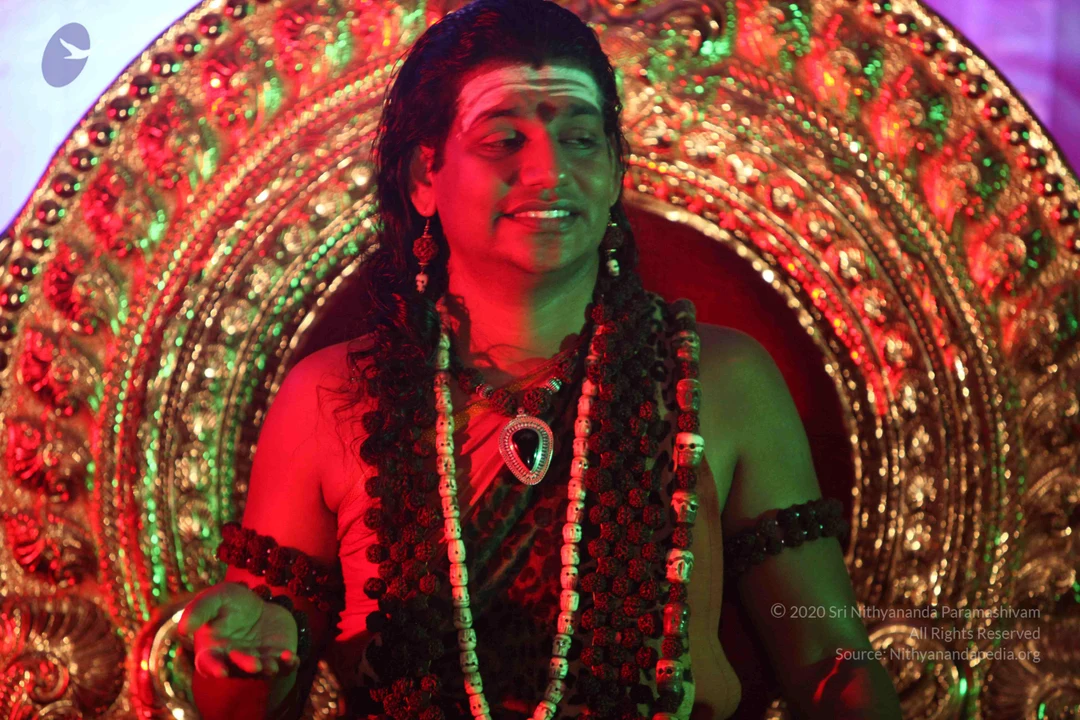
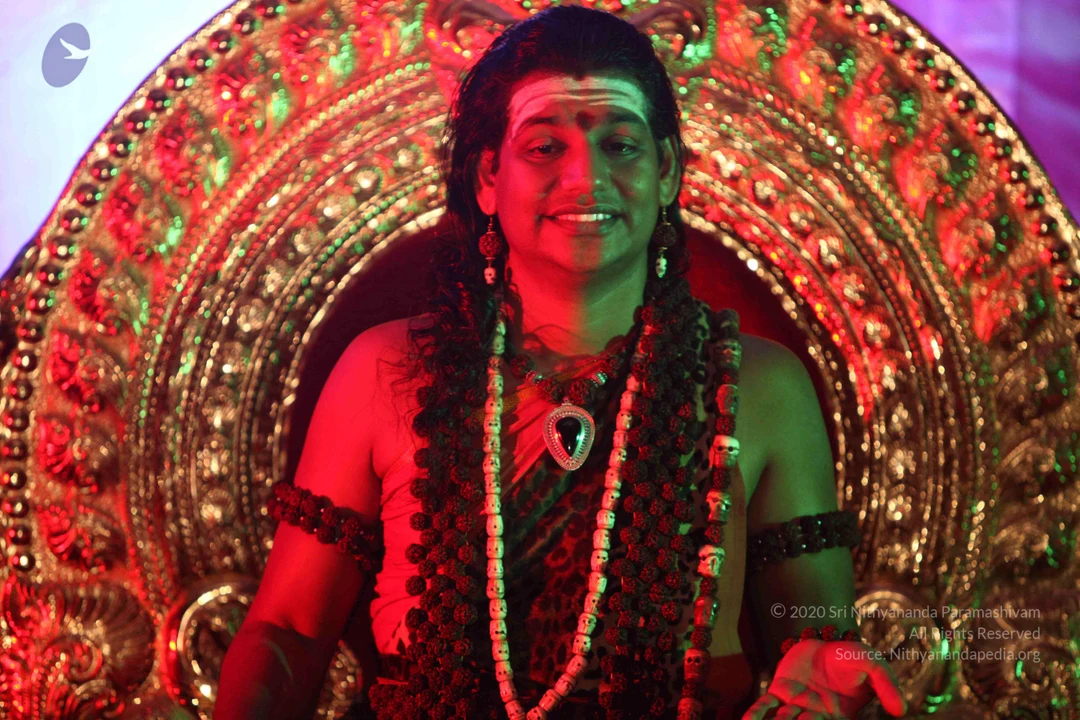
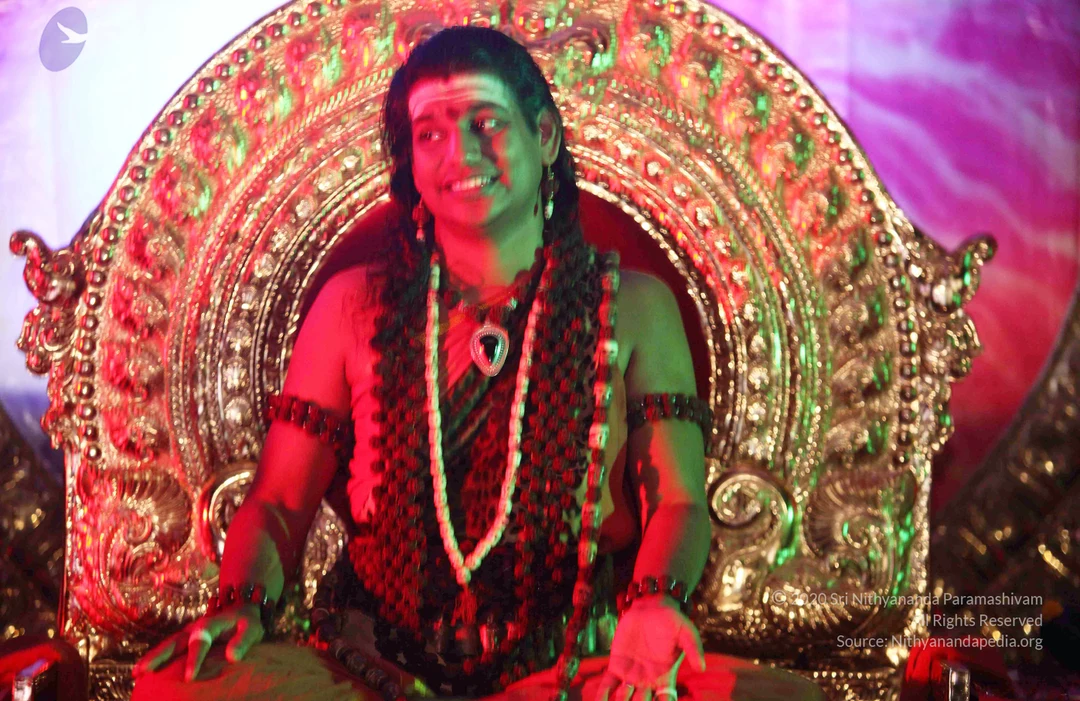
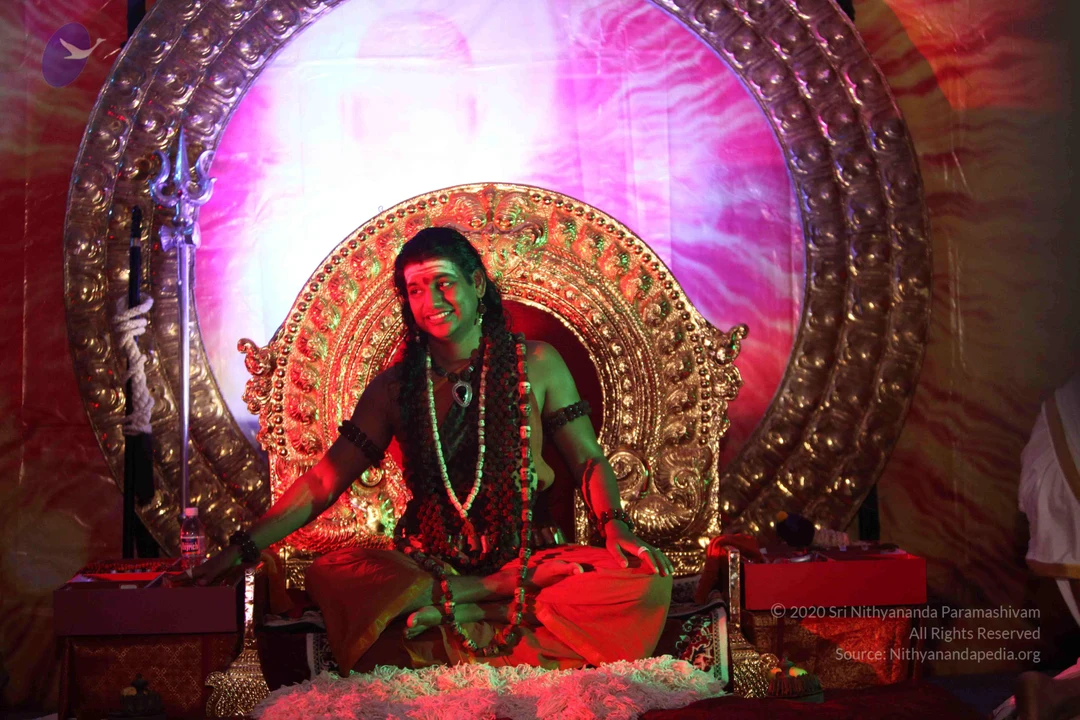
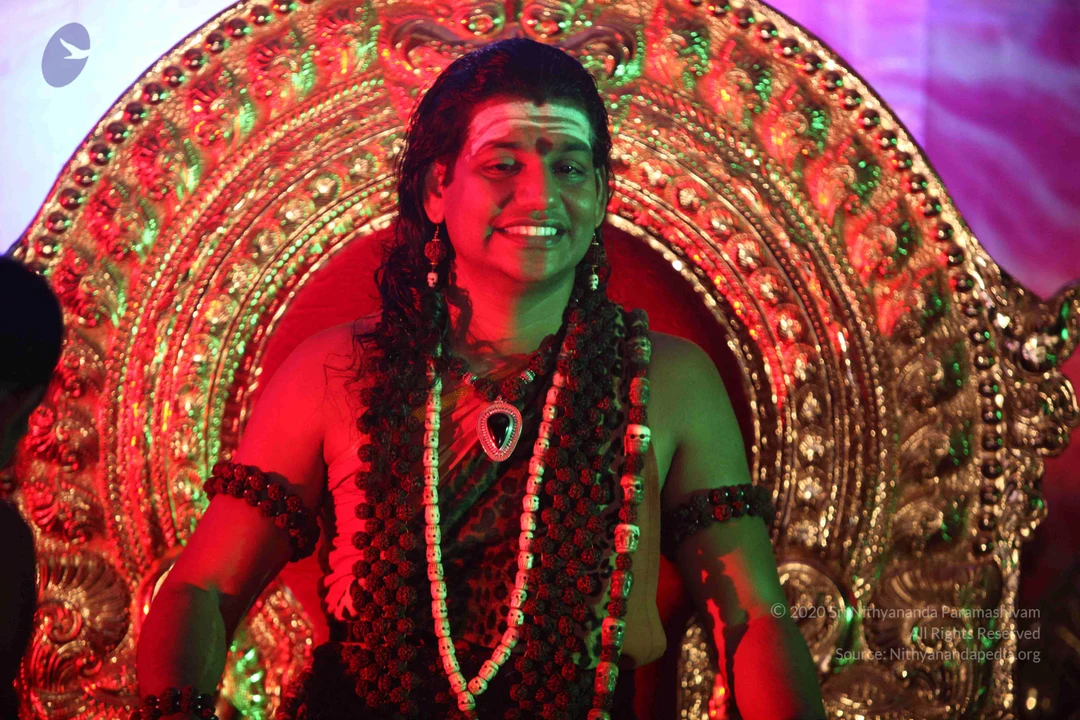
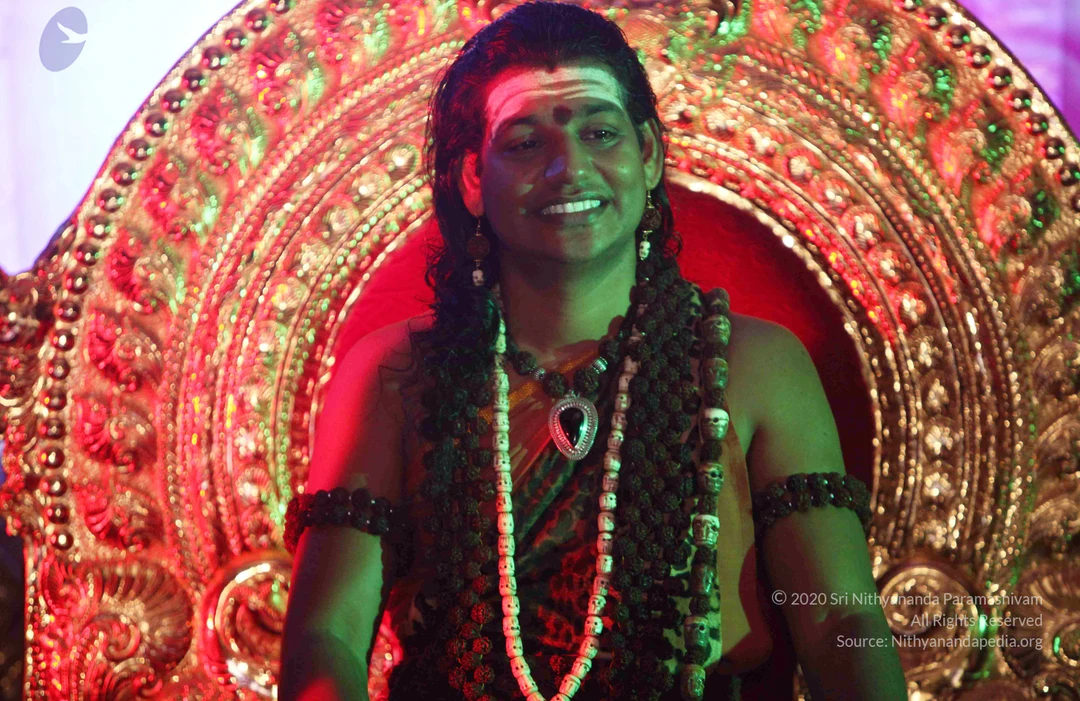
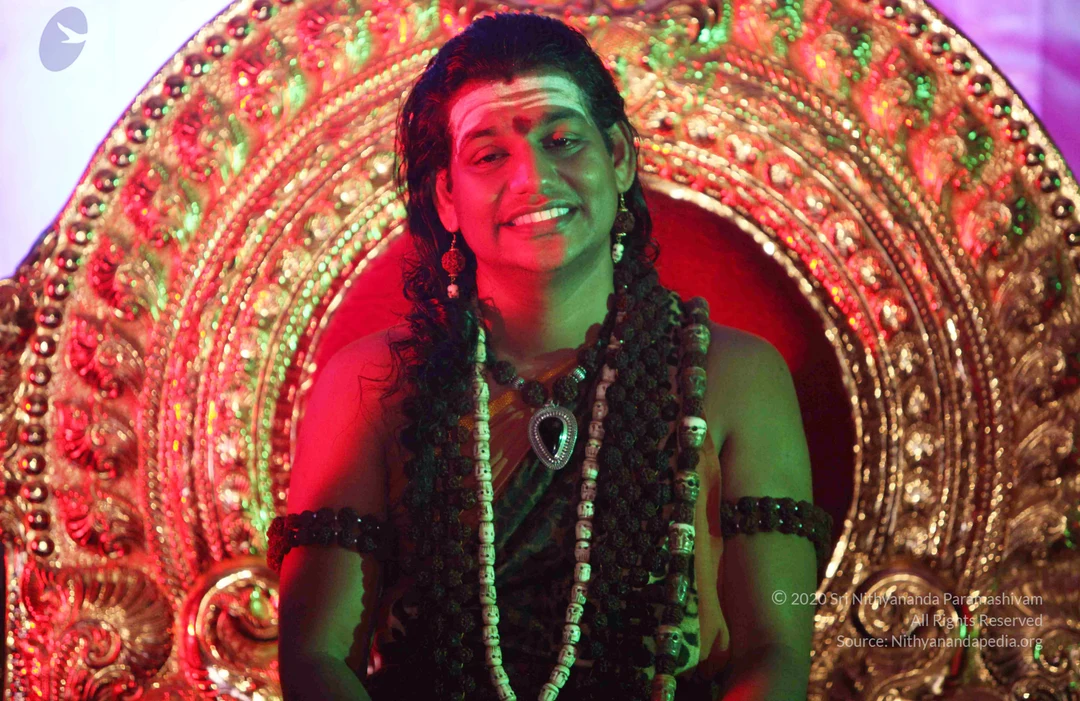
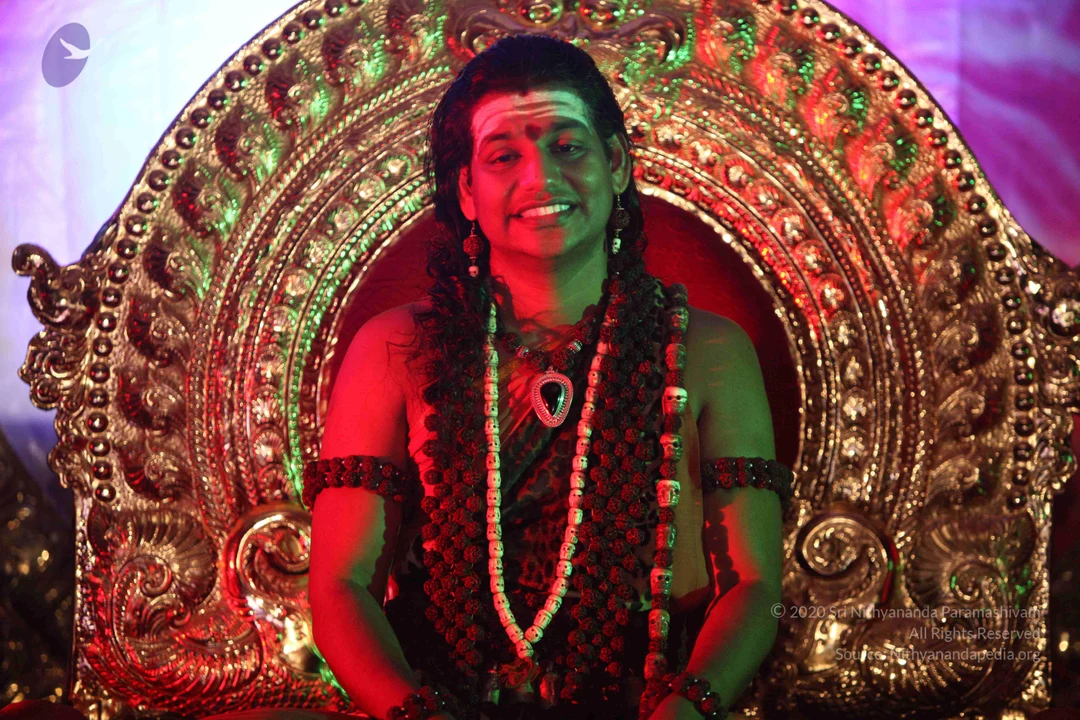
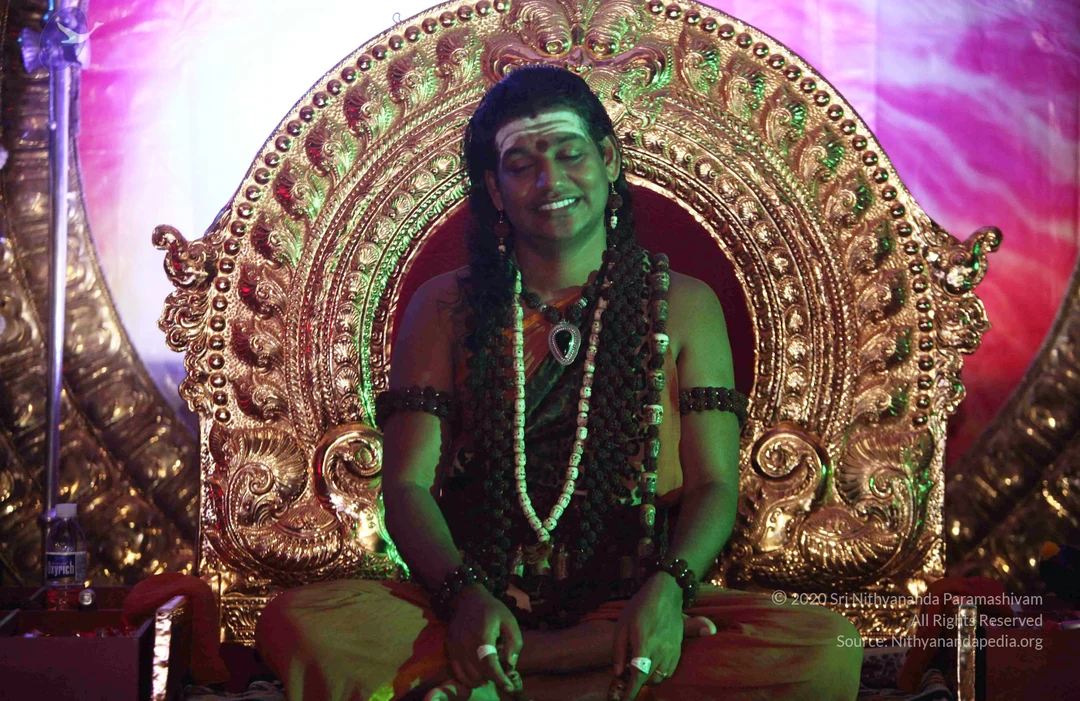
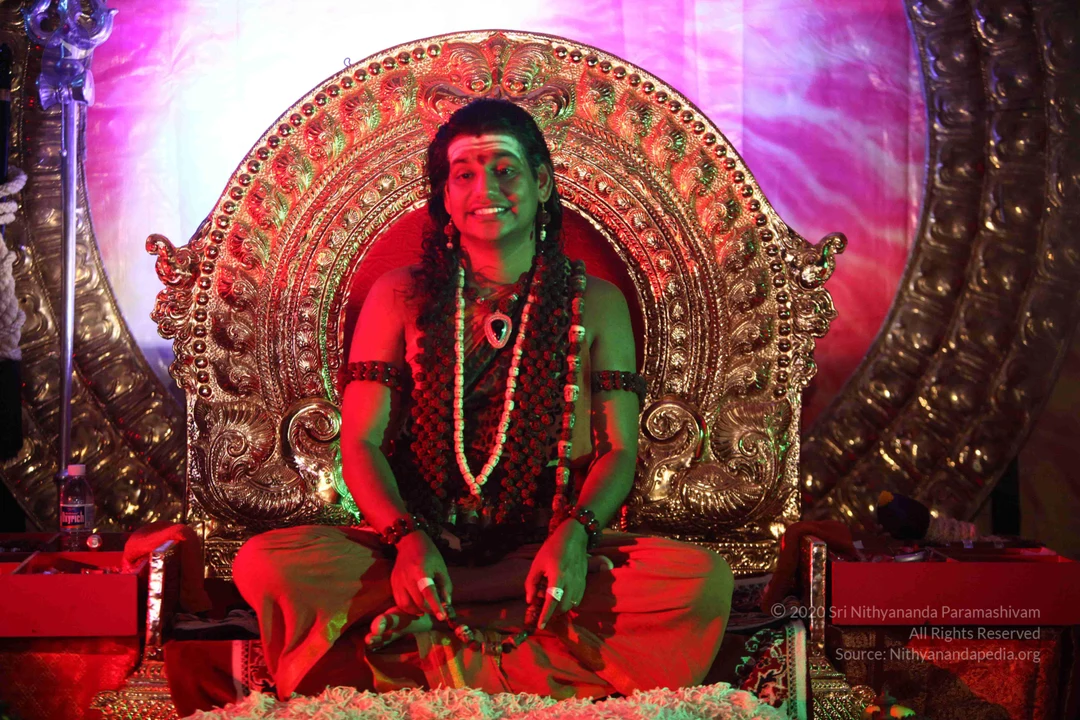
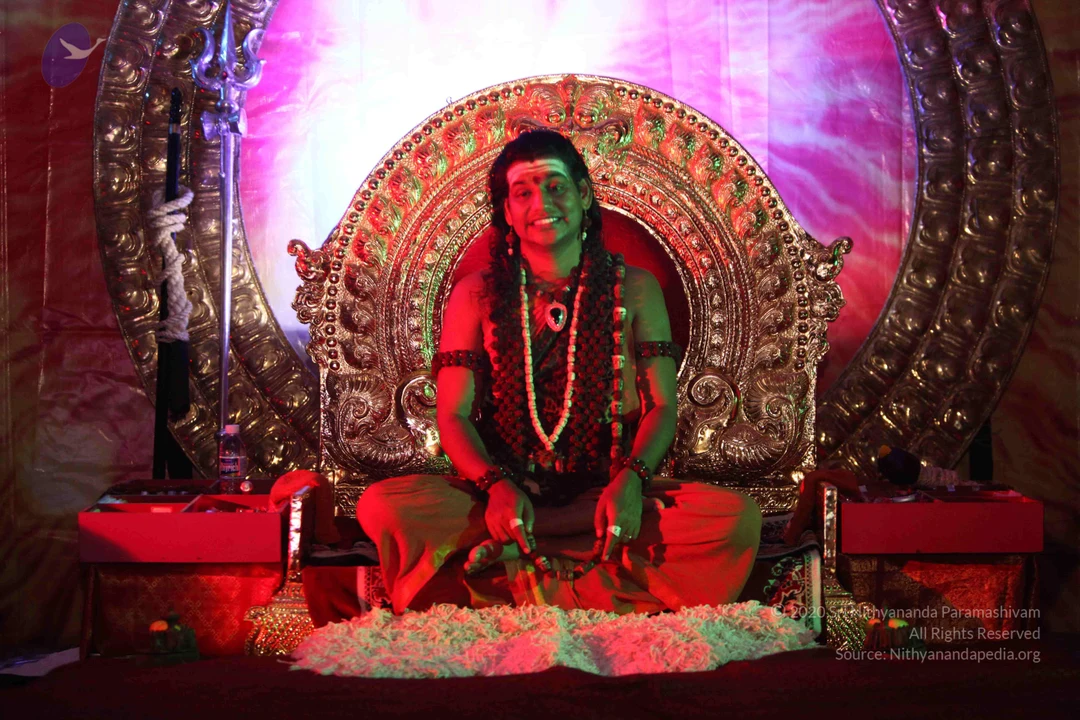
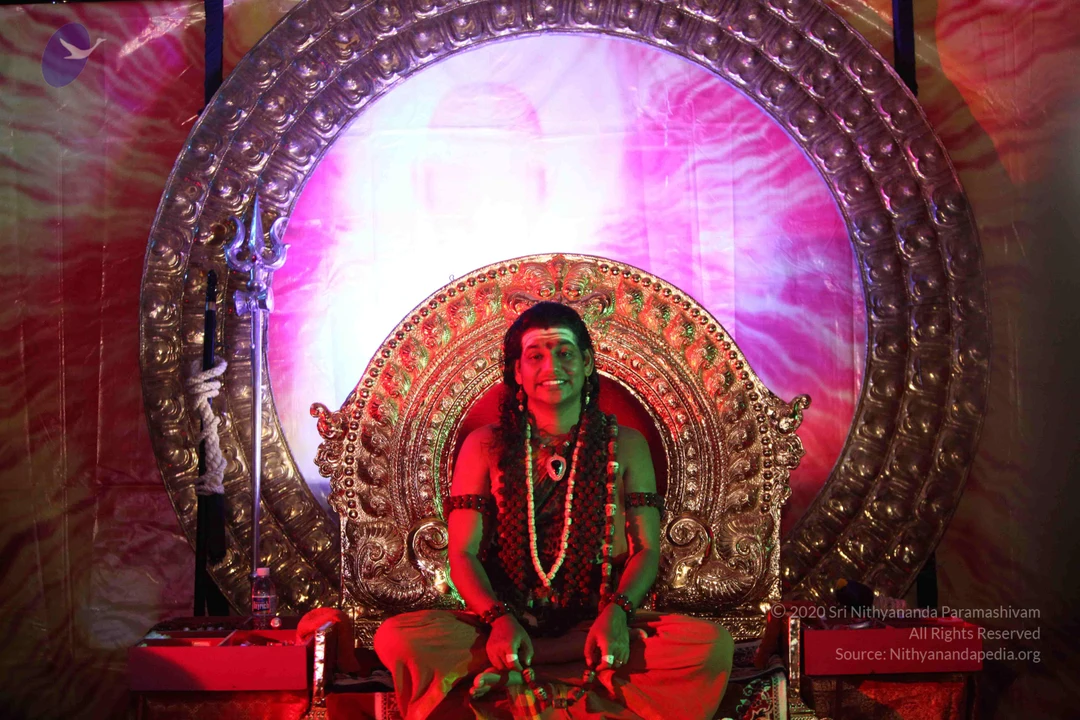
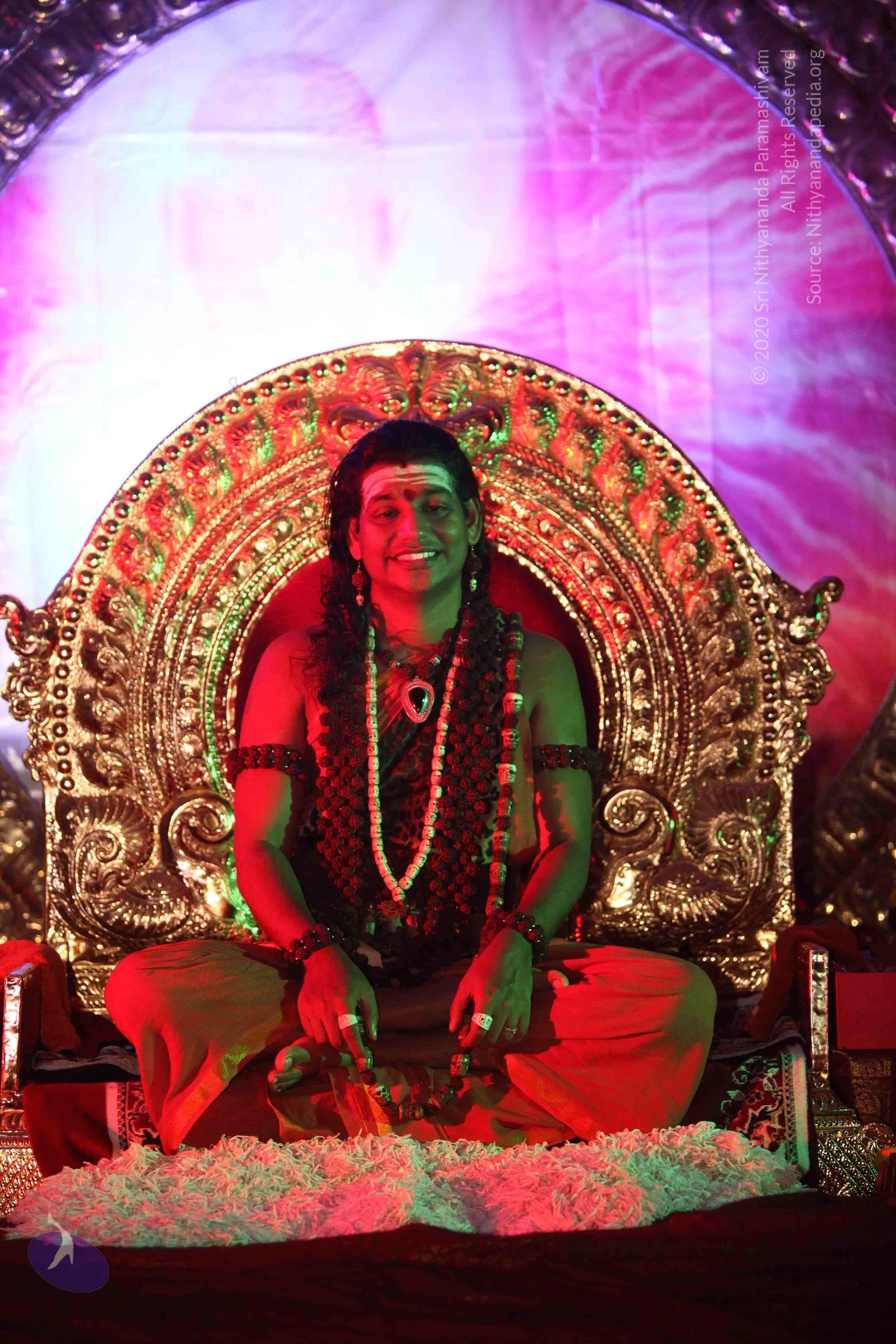
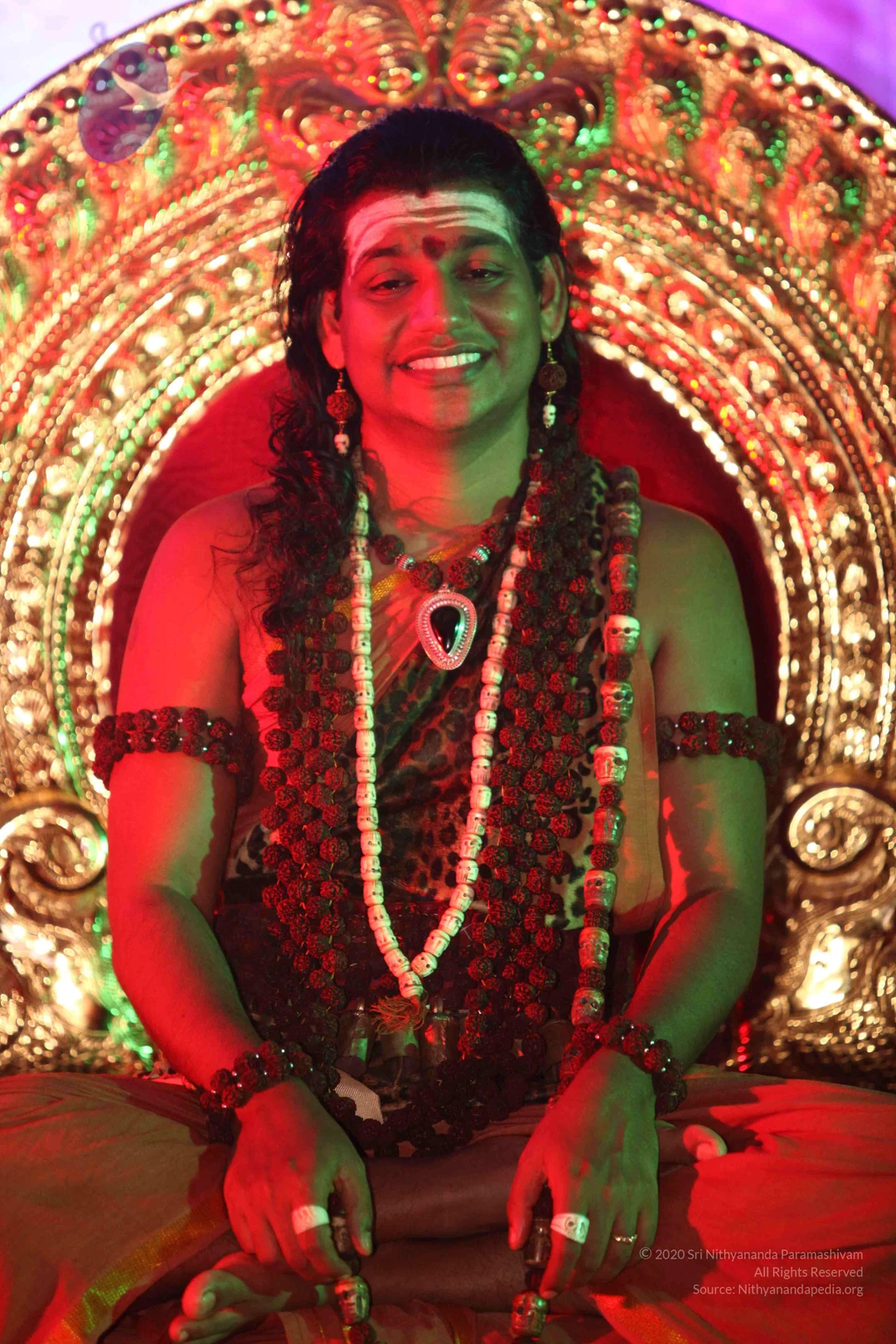
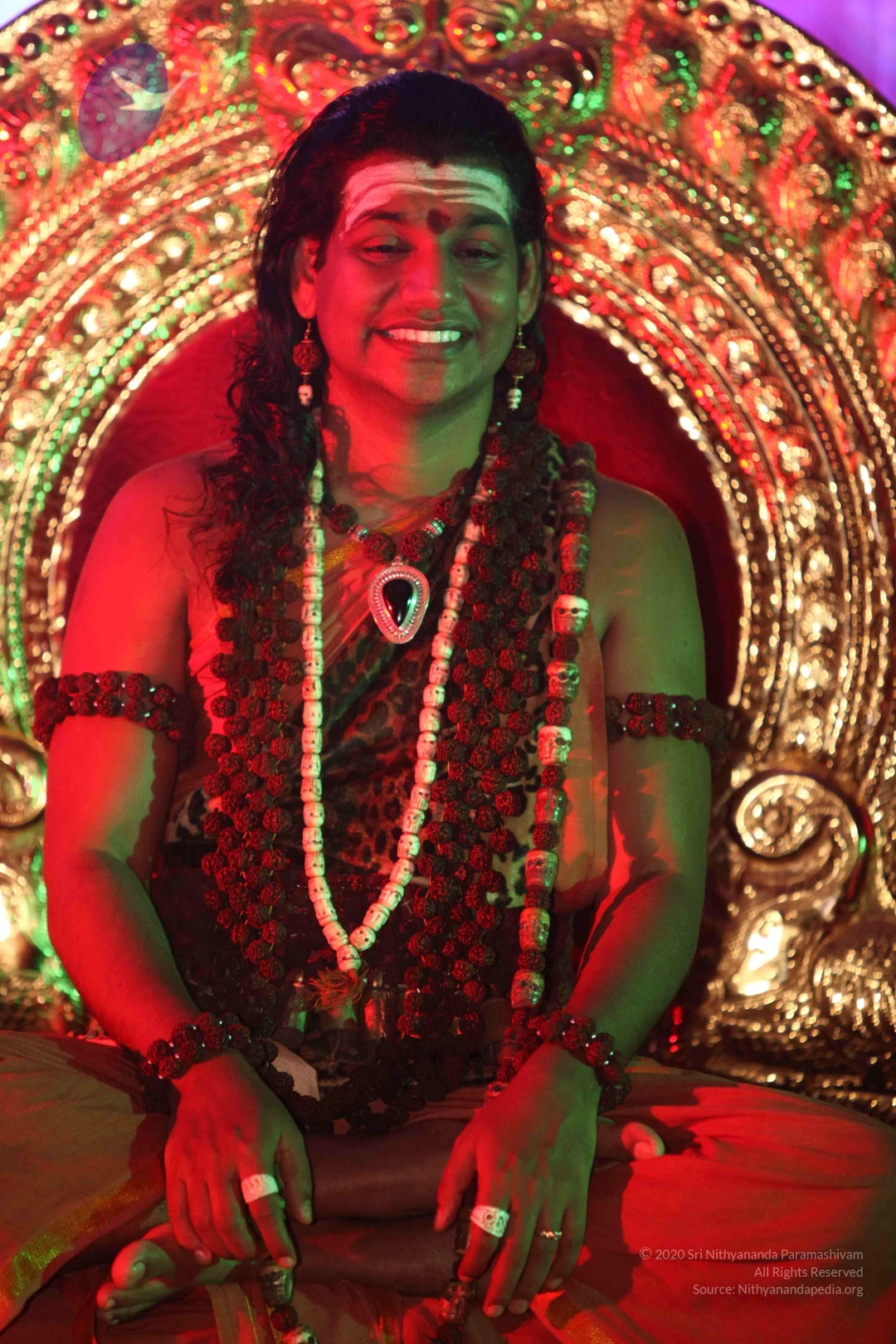
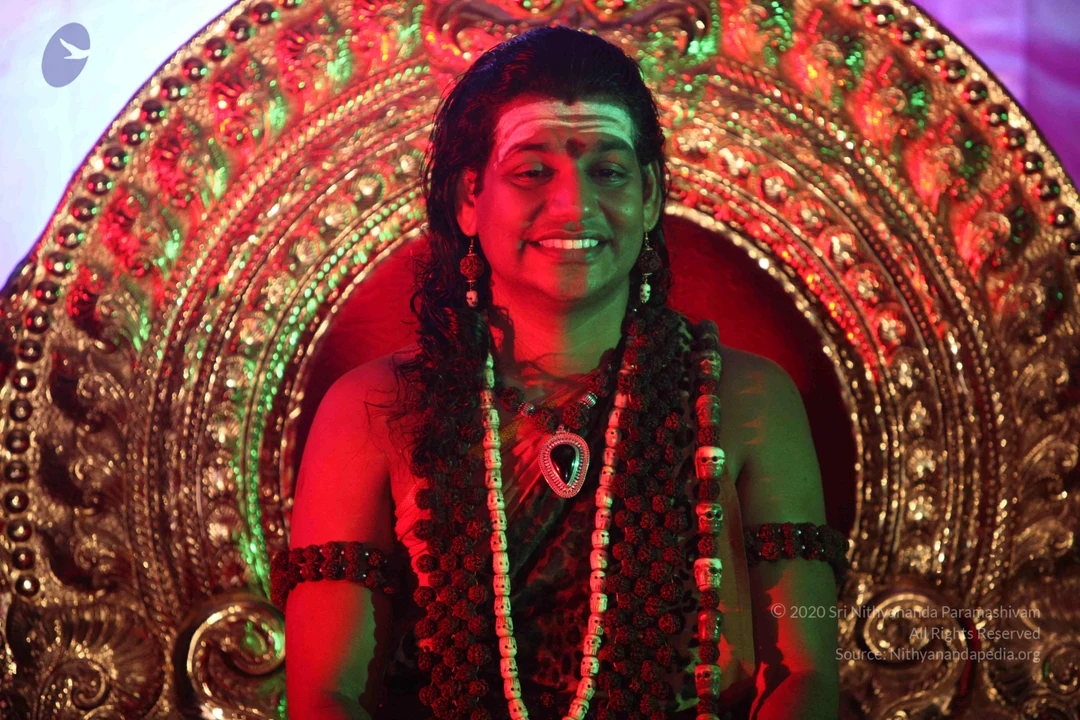
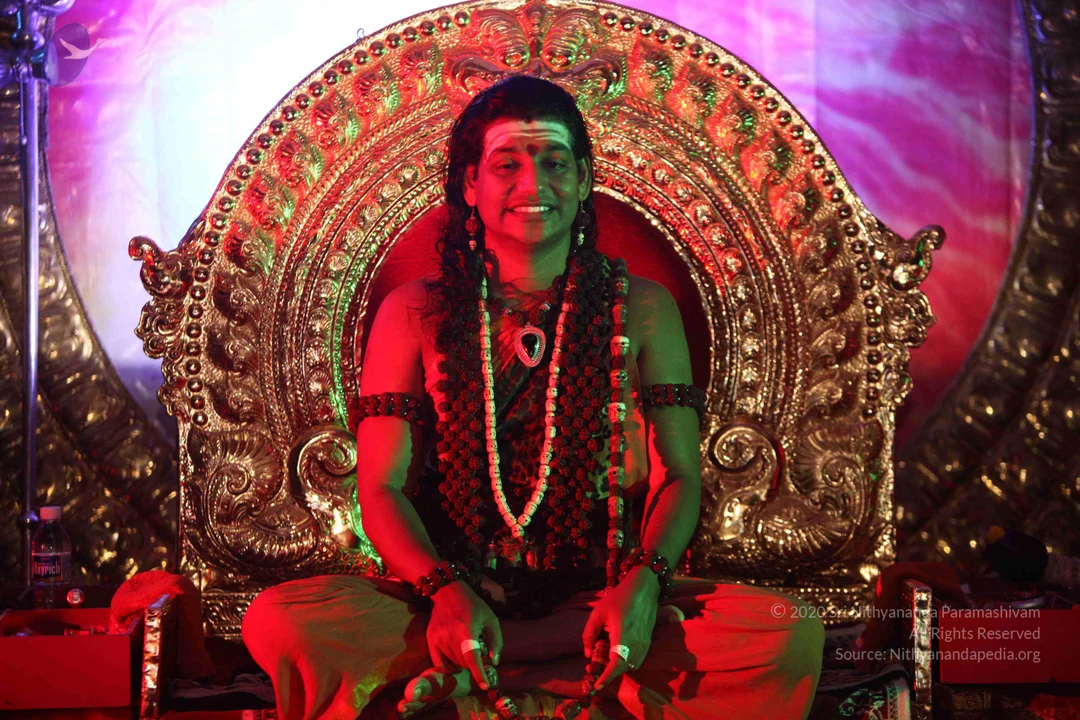
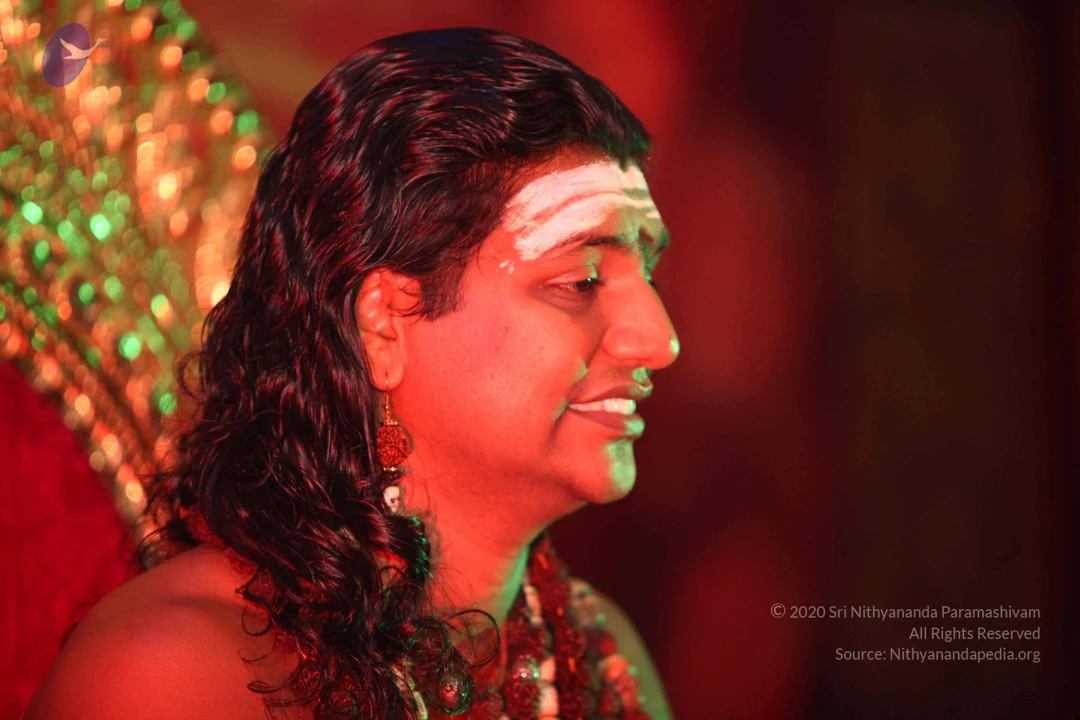
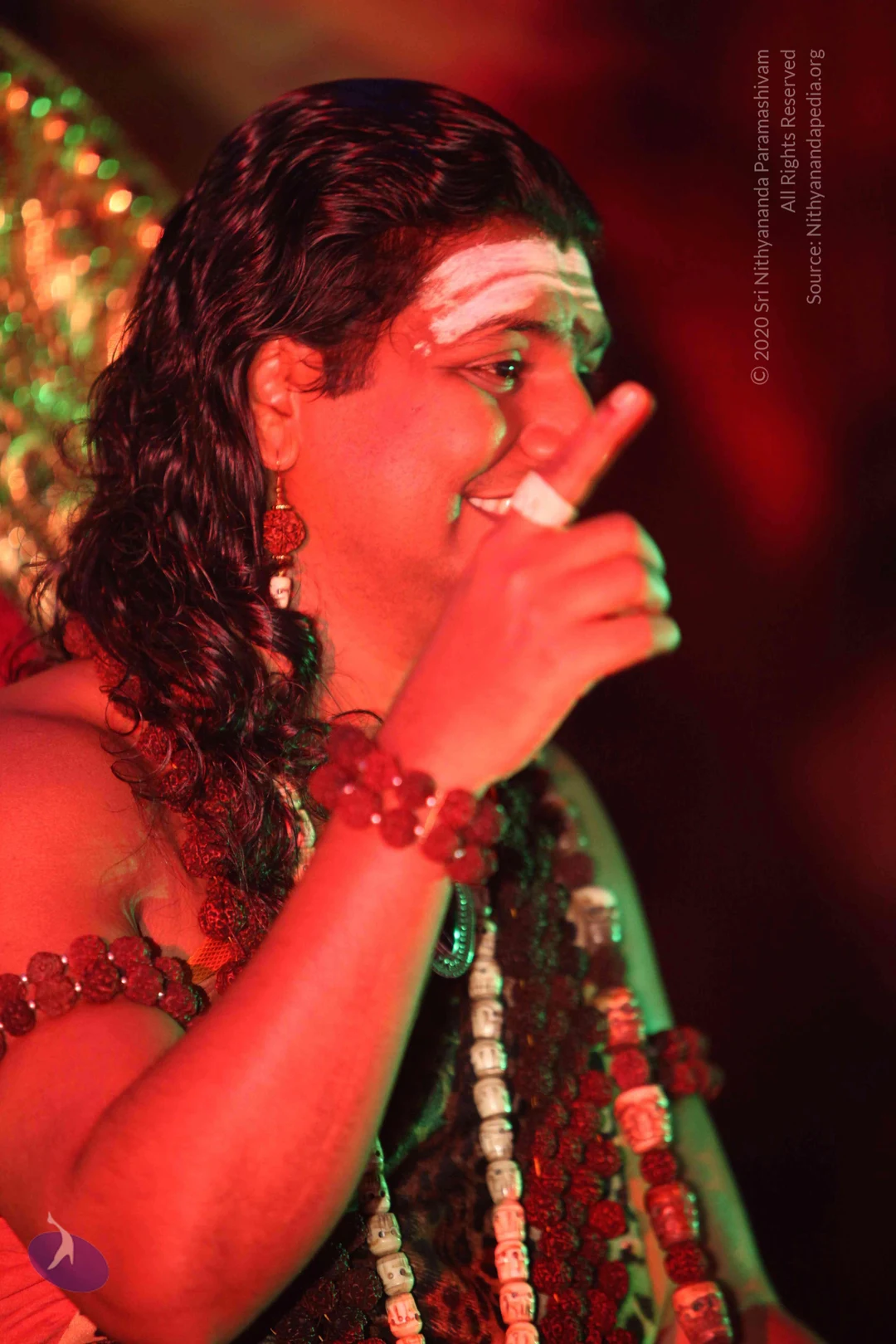
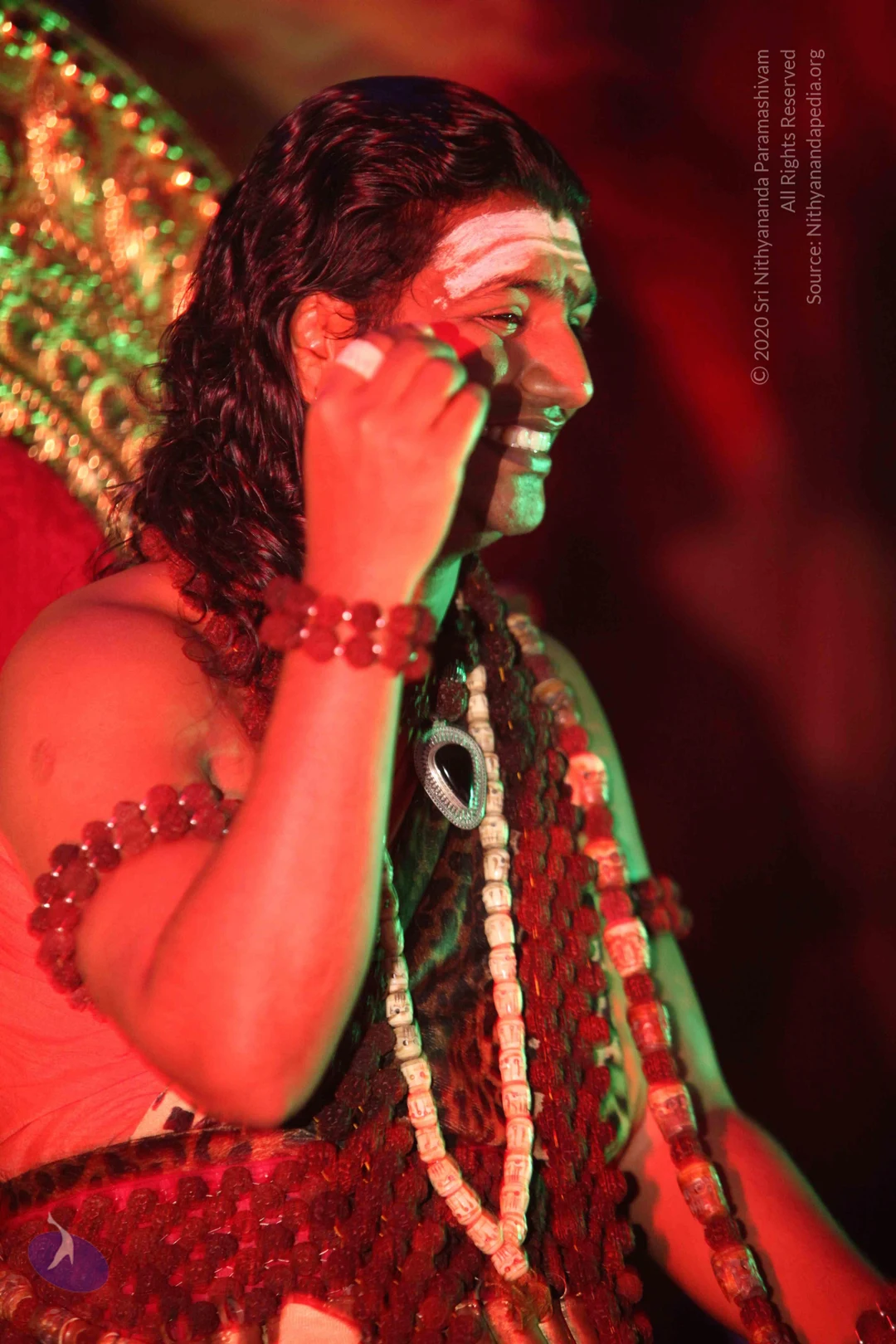
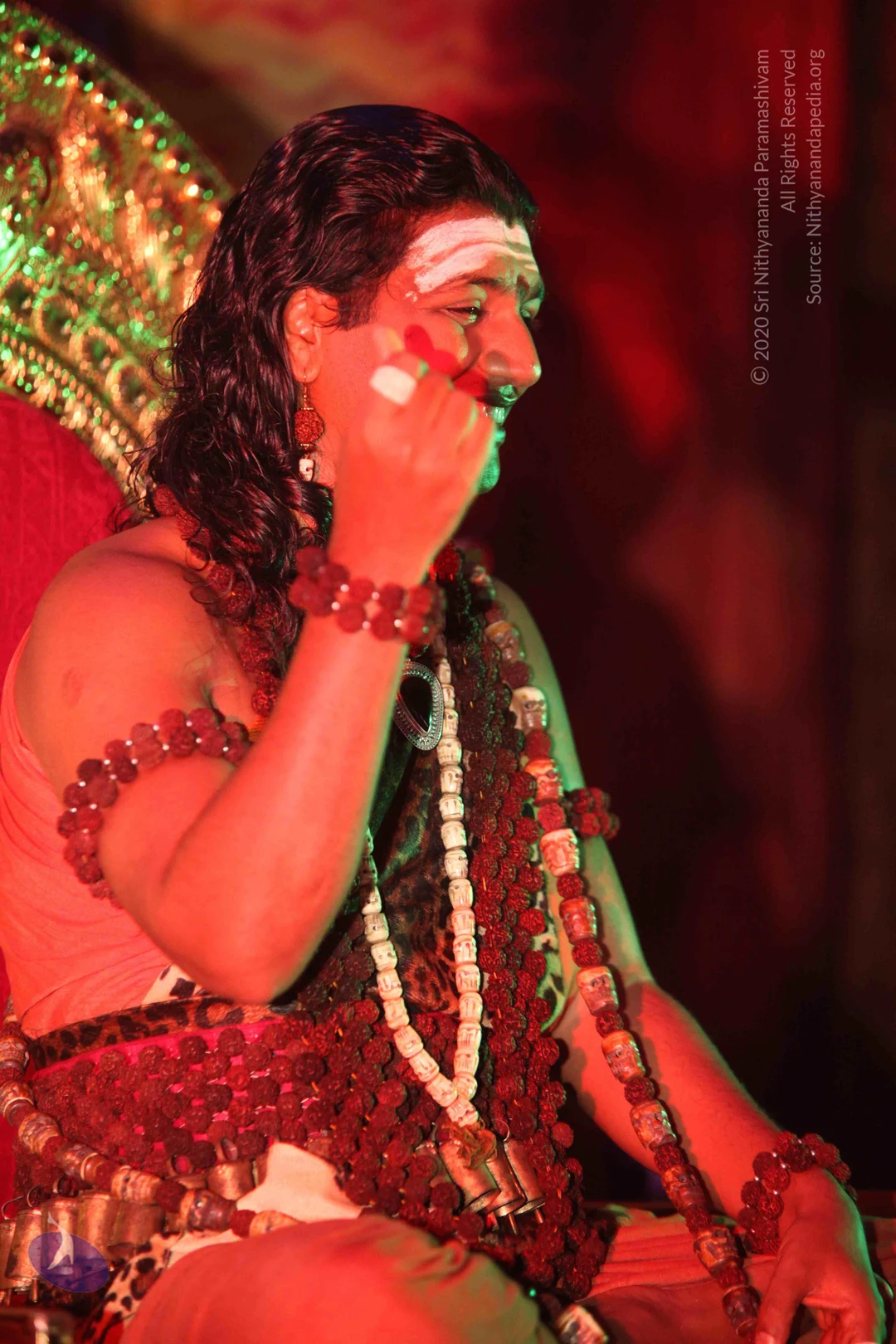
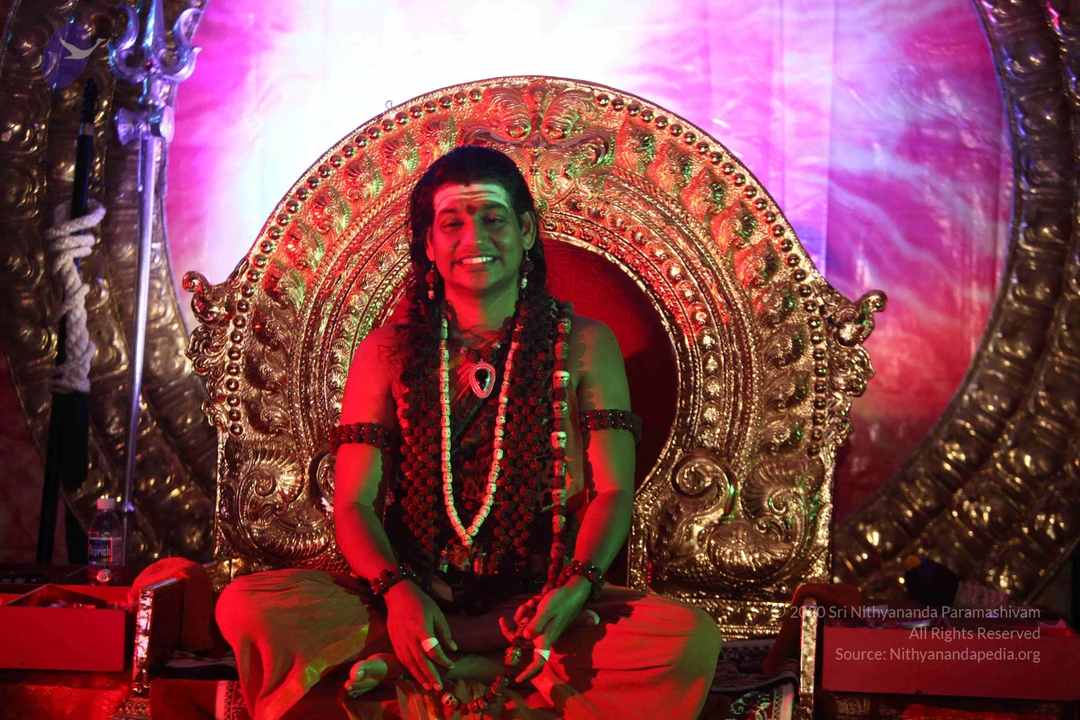
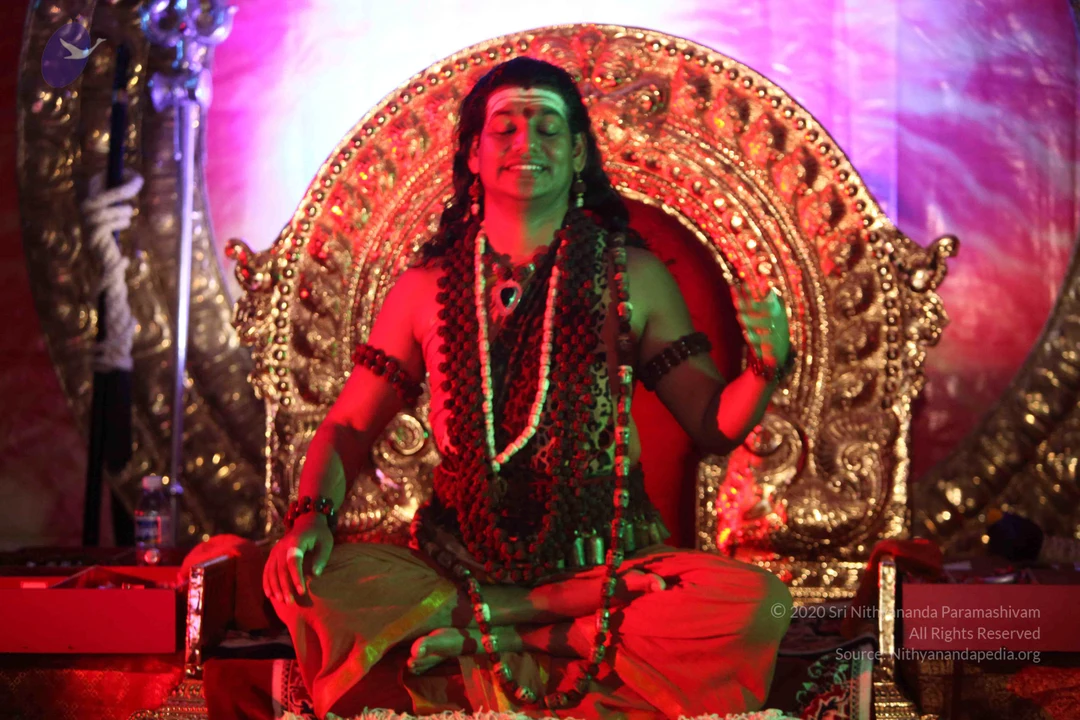
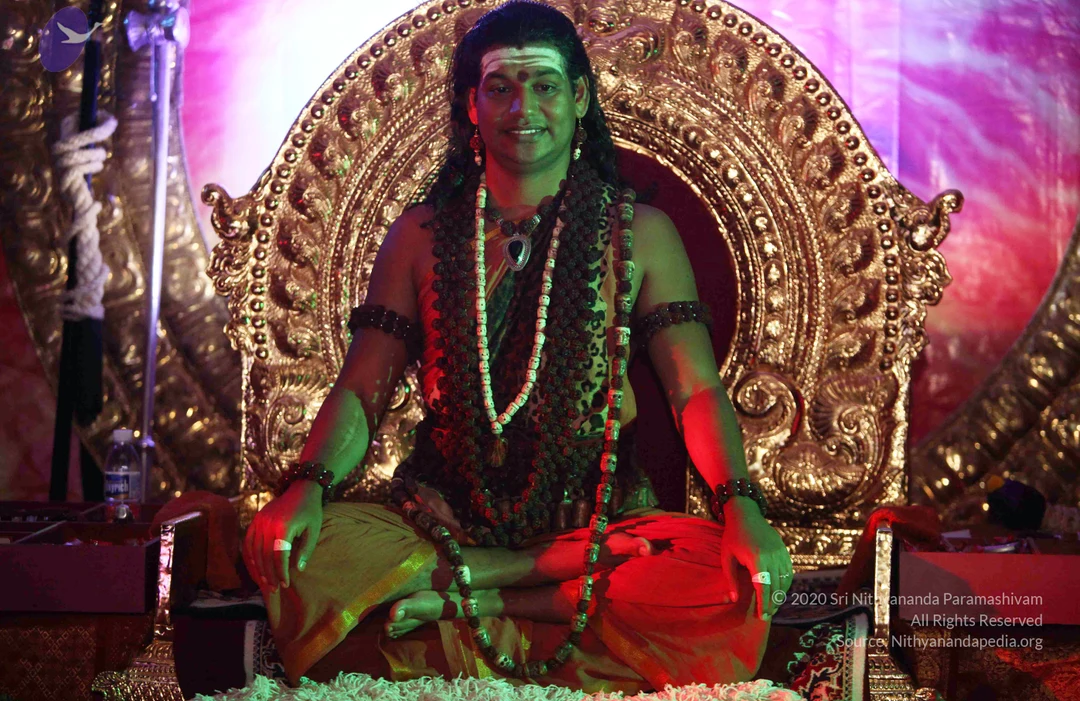
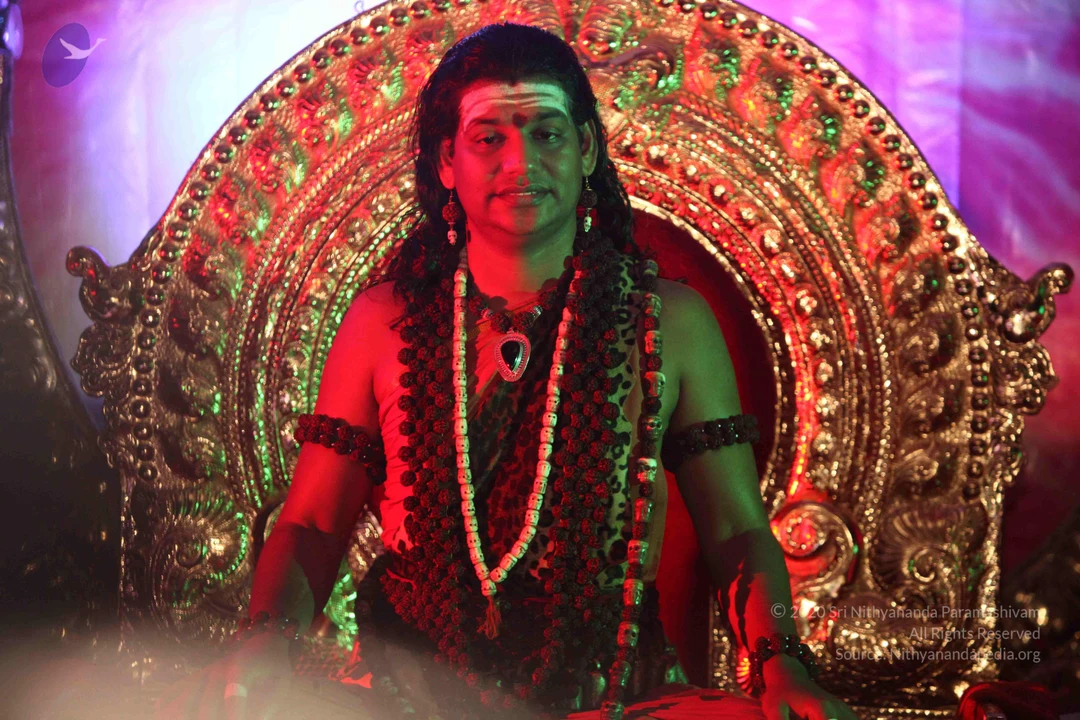
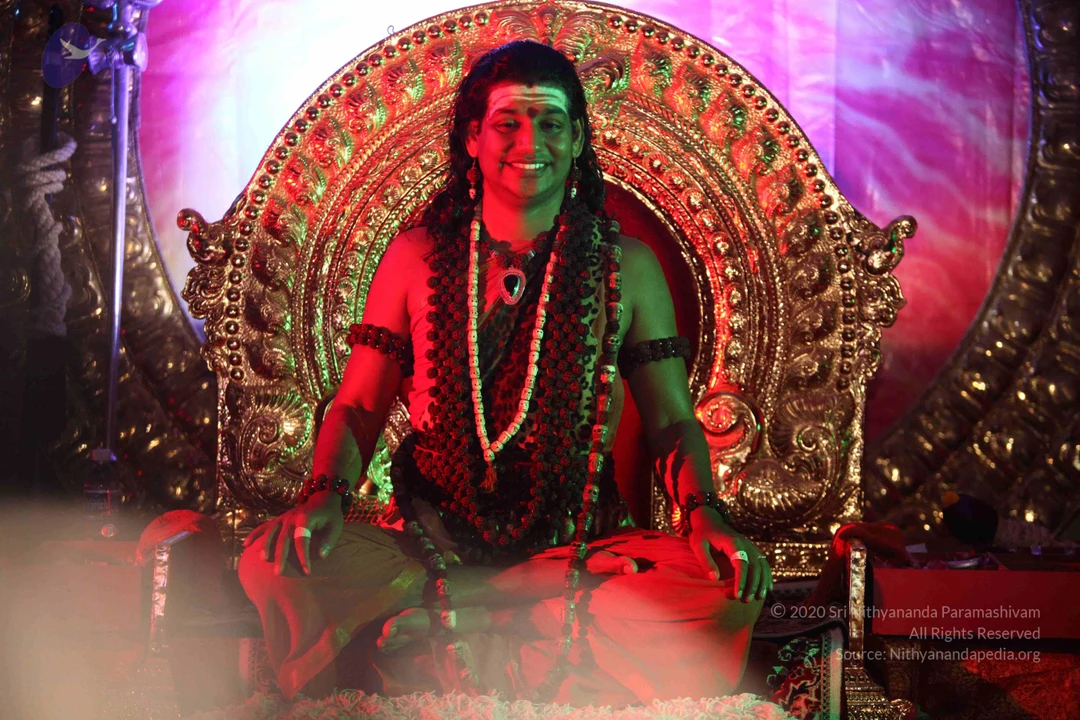
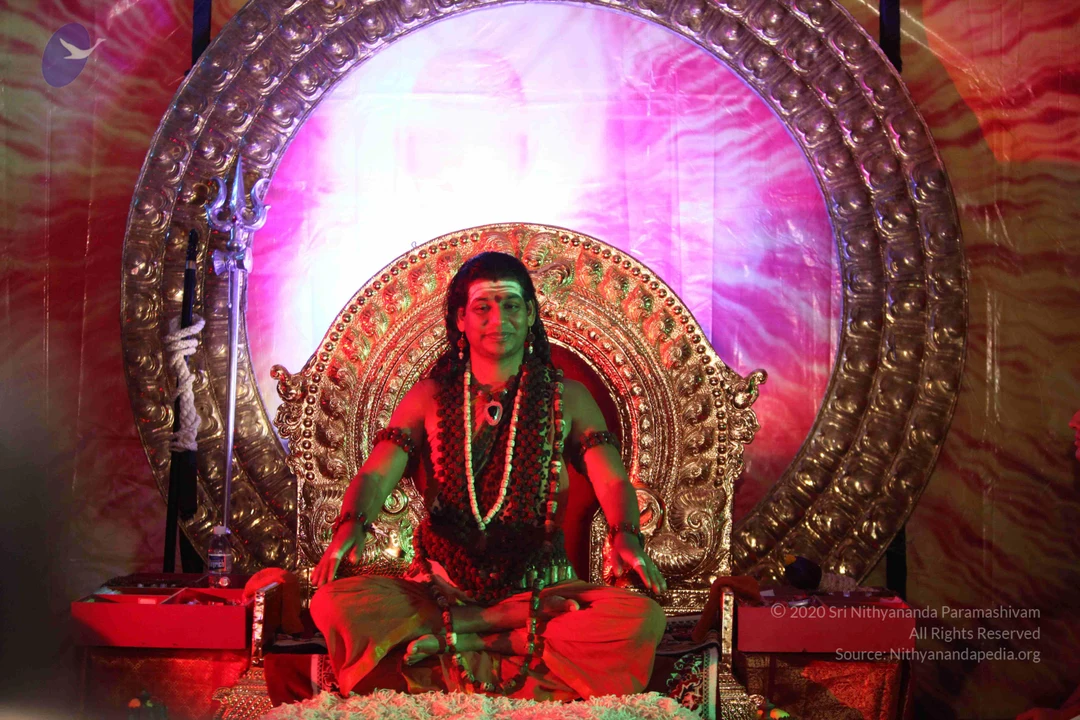
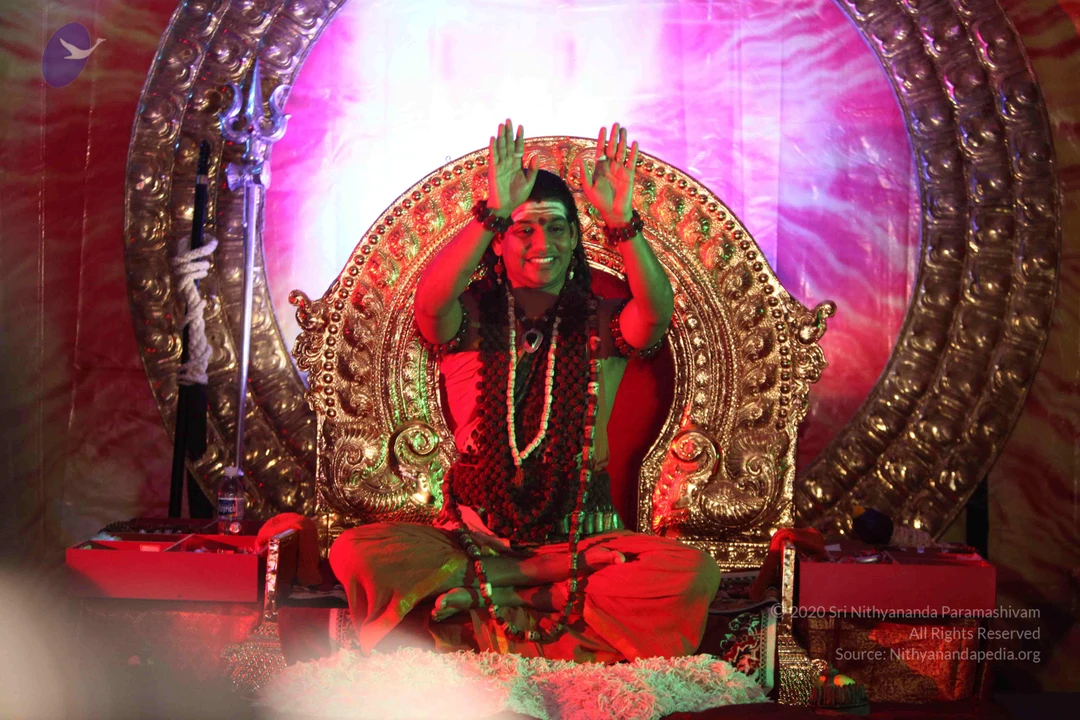
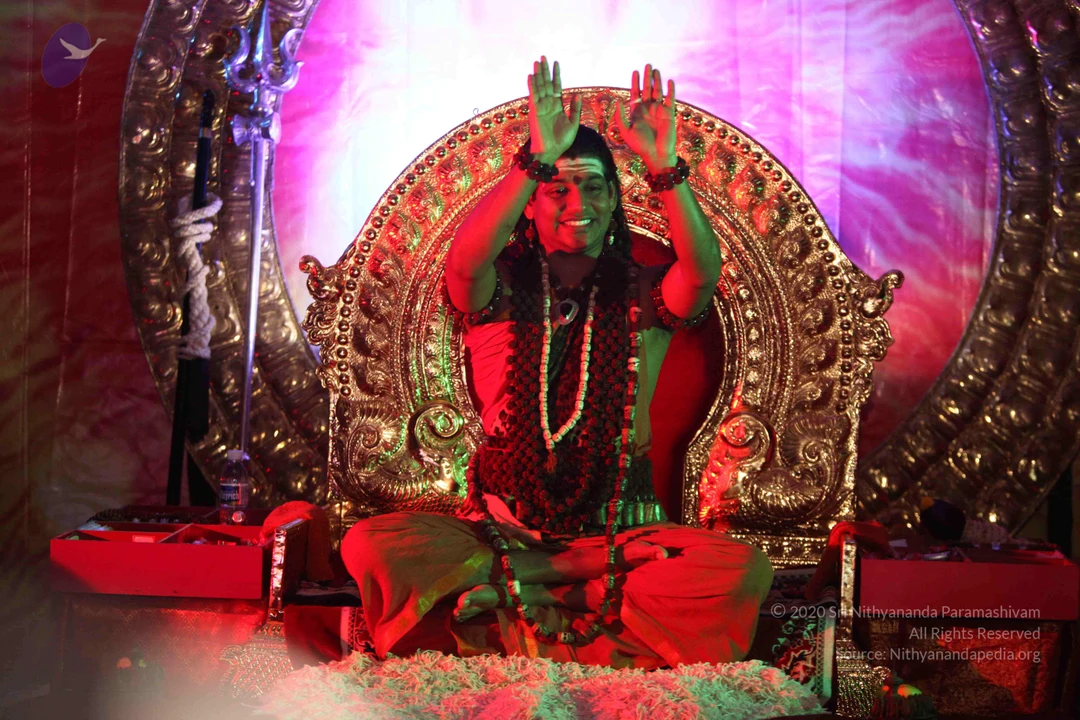
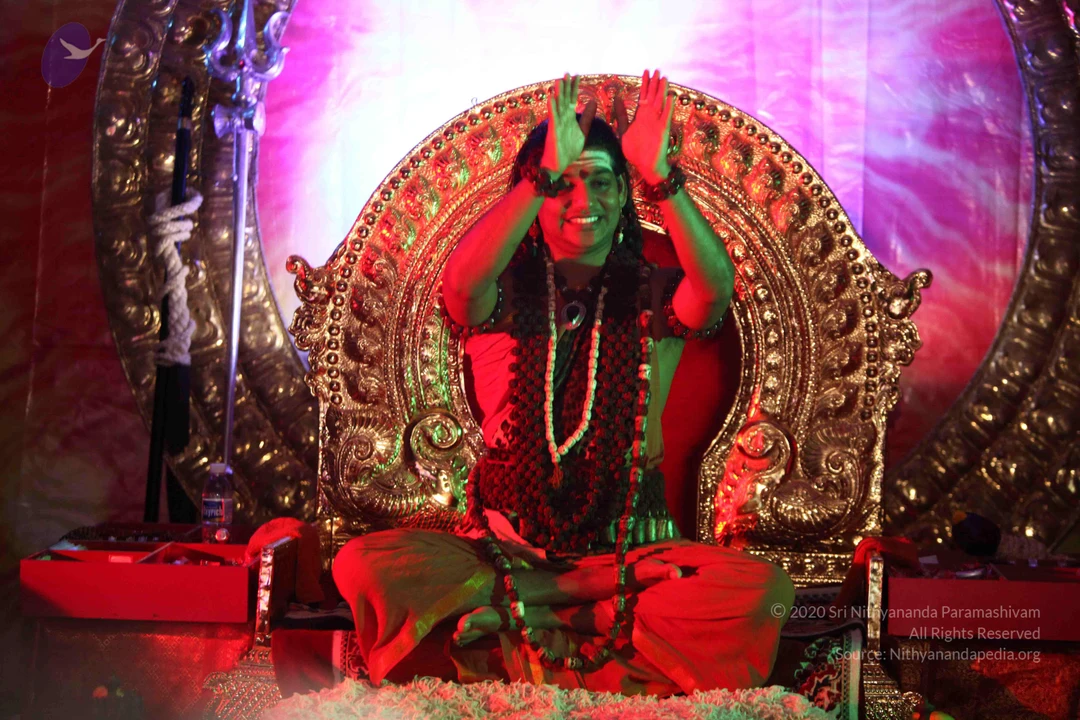
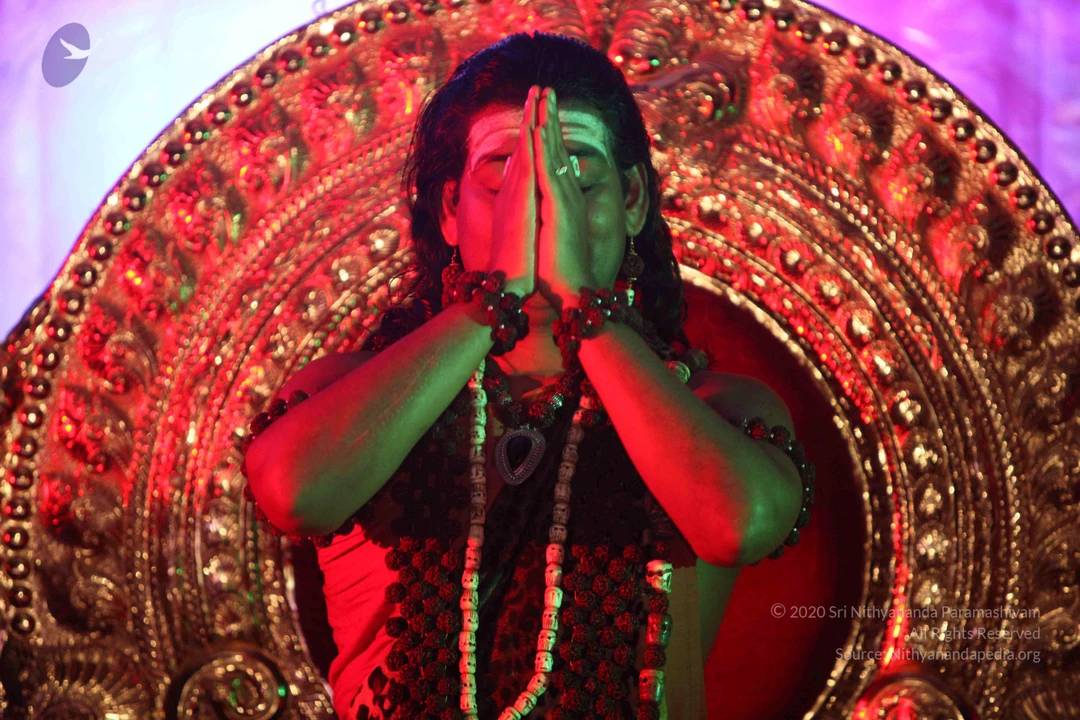
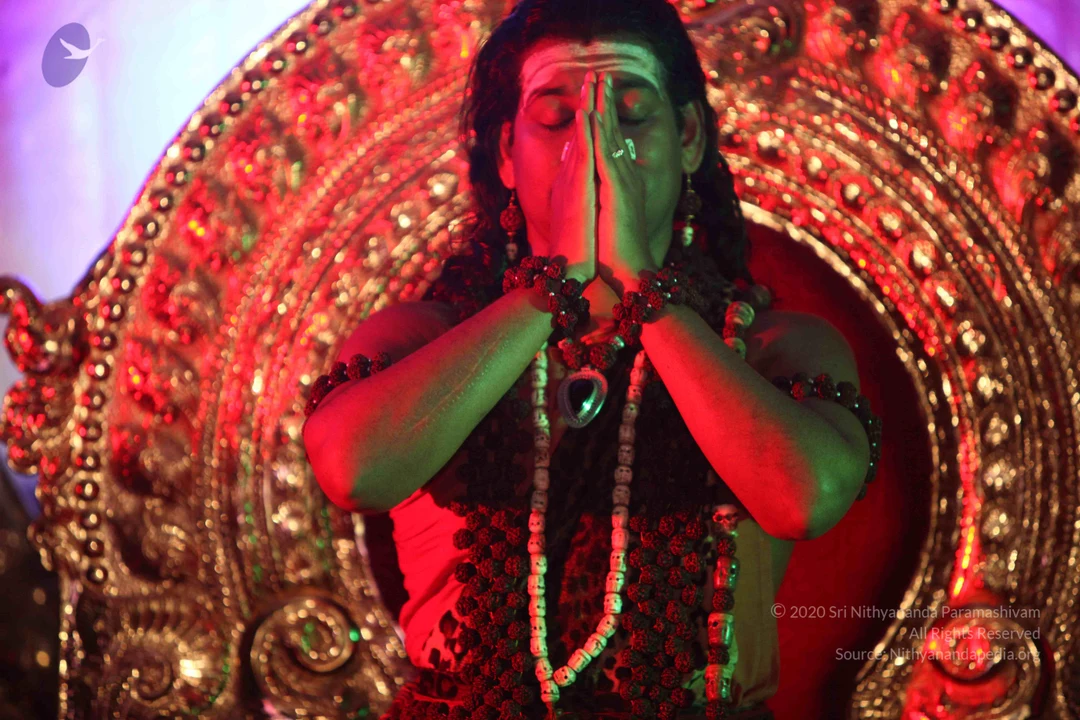
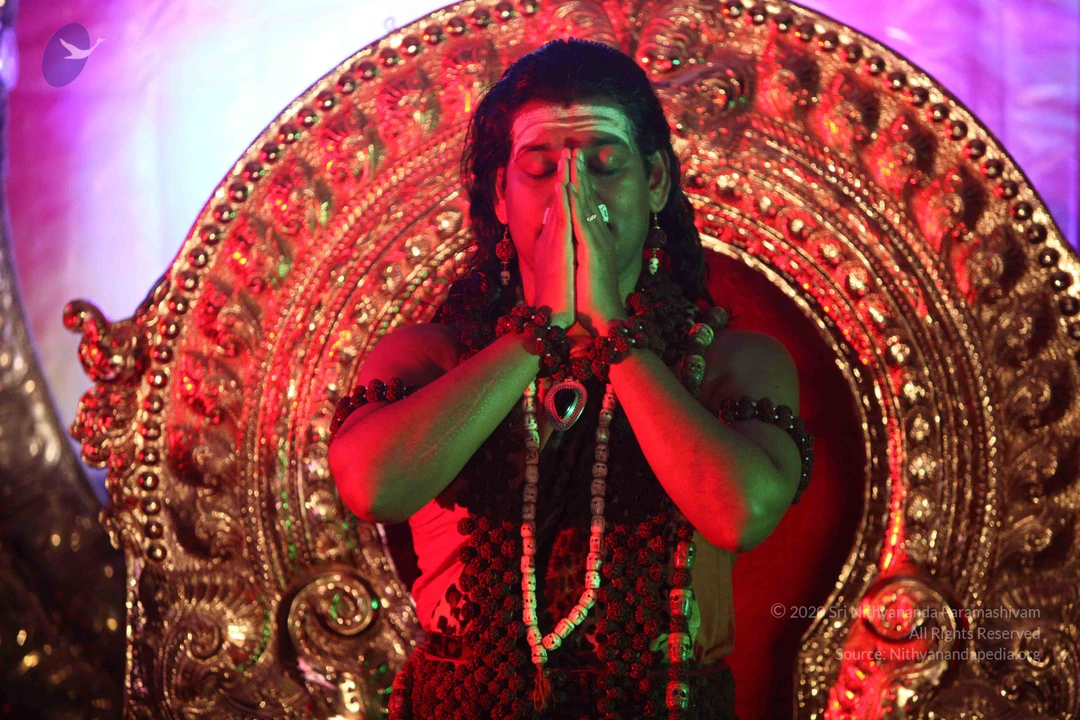
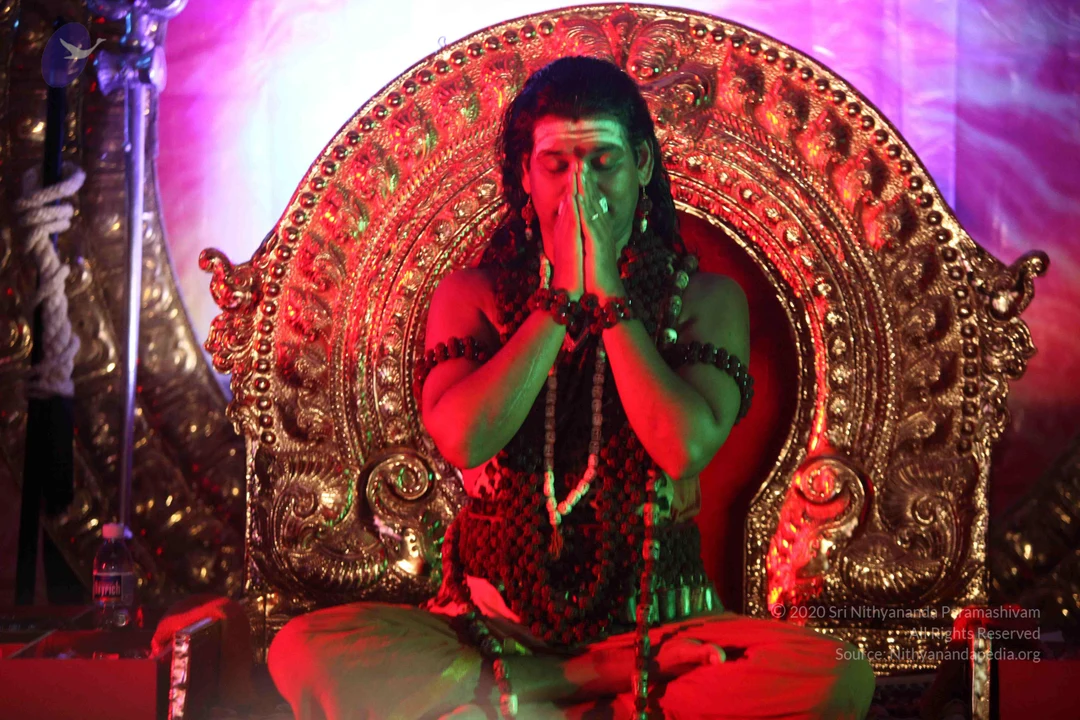
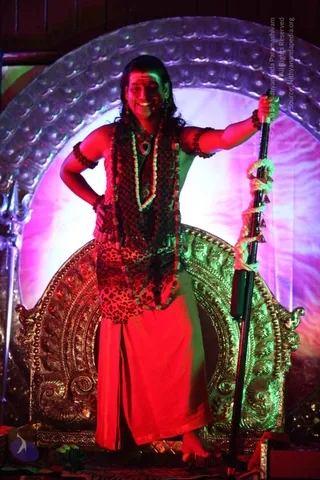
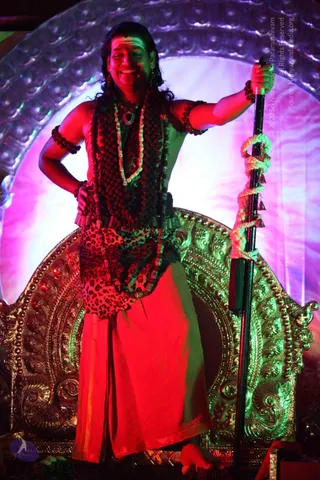
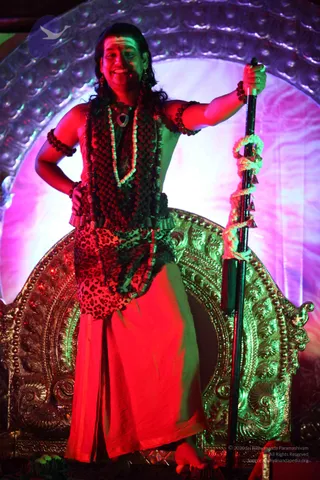
A performer stands on a raised platform before an ornate golden throne-like backdrop with a large silver arched frame behind him, lit in red and green stage light. He wears long dark rudraksha-style mala strands across his chest, bead bracelets on his upper arms and wrists, a leopard-print cloth around his waist, and a red-orange dhoti. He holds a tall black staff wrapped with white cloth and small bells, grinning, one hand on his hip. A trident is visible at the left edge. Swamiji (probable) appearance-based label applies: long swept-back hair and distinctive rudraksha adornments, shown in a costumed stage role, not a ritual sitting.A smiling man stands before an ornate silver-embossed throne-like backdrop lit in red and green. He wears layers of dark rudraksha mala beads across his chest and waist, a leopard-print cloth over a red-orange dhoti, and matching rudraksha bracelets on his arms. In his raised right hand he holds a tall black staff wrapped in white rope with small bells, reminiscent of a trident-like ceremonial staff. His hair is long and loose, with a tilak mark on his forehead. A pink and purple circular backdrop surrounds him. The page indicates the event was a morning satsang, but the image shows one physical person with a ceremonial staff in front of a decorated seat. Appearance-based a person candidate: long swept hair, rudraksha malas and ornate ceremonial adornments.A standing man on a stage, smiling, wearing a red-orange dhoti and a leopard-print cloth wrapped at the waist, with a dense layered rudraksha mala across his chest and rudraksha bracelets on his arms. He holds a tall black staff wrapped with a white-and-pink cord and small bells, while his other hand rests on his hip. Behind him is an ornate golden throne with repoussé floral carving, lit in red and green, with a shimmering silver-and-pink backdrop. Swamiji (probable): long swept-back hair, rudraksha malas and a red-orange garment identify a sannyasi-style presenter in ceremonial stage dress. A small green offering arrangement sits at the lower left.A performer stands on a red-lit stage in front of an ornate gold and silver throne-like backdrop with a large circular frame. The figure wears an orange-red dhoti-style garment, a green and red beaded rudraksha-style mala, layered green and red beads across the torso, a green pendant necklace, and a leopard-print wrap, with bangles on the arms and a tilak on the forehead. The performer holds a tall black staff with a green and white cloth streamer and rests one hand on the hip. A trident stands to the left. A young boy in a dark top sits at the lower right edge, and a water bottle sits near the stage. Warm pink and green lighting washes the scene.A smiling man with long dark hair stands before a large ornate silver arch with a pink-lit backdrop, dressed in a red sleeveless top, a dense layered garland of rudraksha beads, a white and beaded necklace, and red rudraksha bracelets on both upper arms. He holds a dark staff wrapped with red and white cloth and hung with small bells in his right hand, while his left hand rests on his hip. A trident stands at the left edge of the frame. a person is shown here in a performing, celebratory pose, wearing rudraksha malas, bracelets and a ceremonial necklace.A performer stands on an ornate silver-and-gold throne-like chair on a stage lit with pink, red and green lights. He wears a red-and-orange dhoti-style garment with a leopard-print wrap, a long rudraksha mala across his chest, an orange-beaded necklace, and wrist and arm bands. He holds a tall staff wrapped with a white cord in one hand and rests the other hand on his hip, smiling. A trident leans against the chair to the left and a small bottle sits on the stage floor. a person is the page's named speaker, shown in a stage performance with long swept-back hair and ornate ceremonial adornments.