Skip to content
Tuesday

1 May 2012

Mystic,Master,Avatar & God.

Dated photos
409
Source pages
1
Media
3
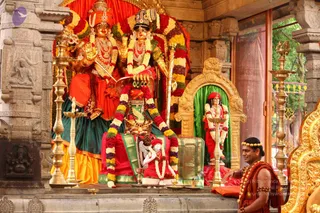
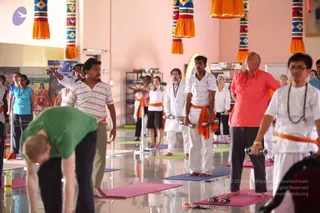
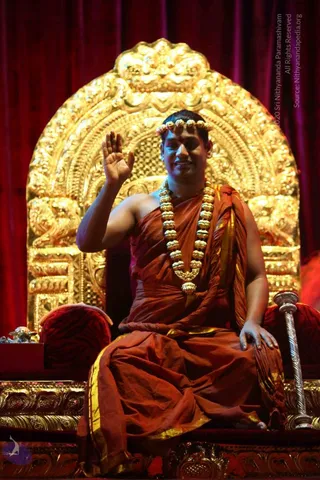
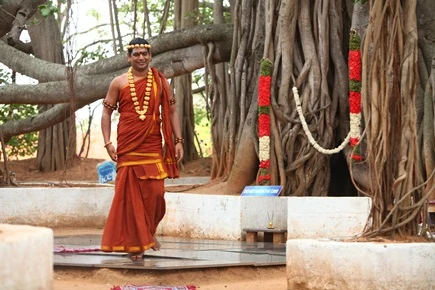
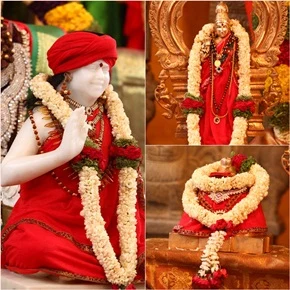
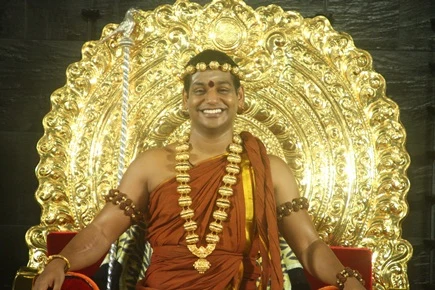
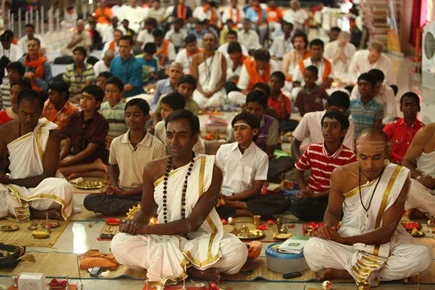
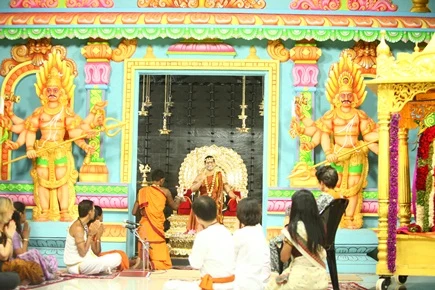
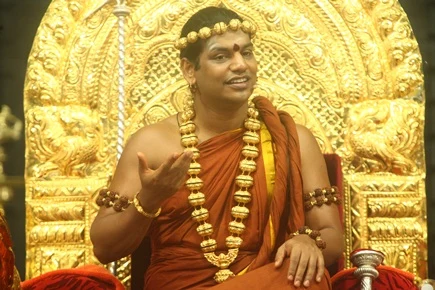
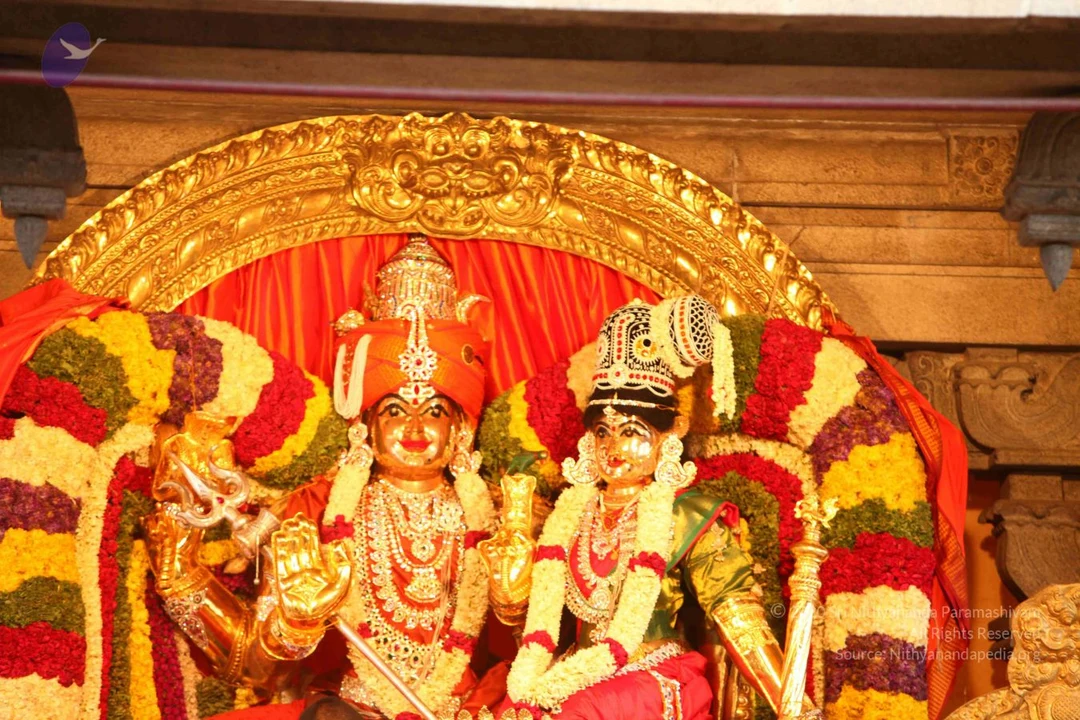
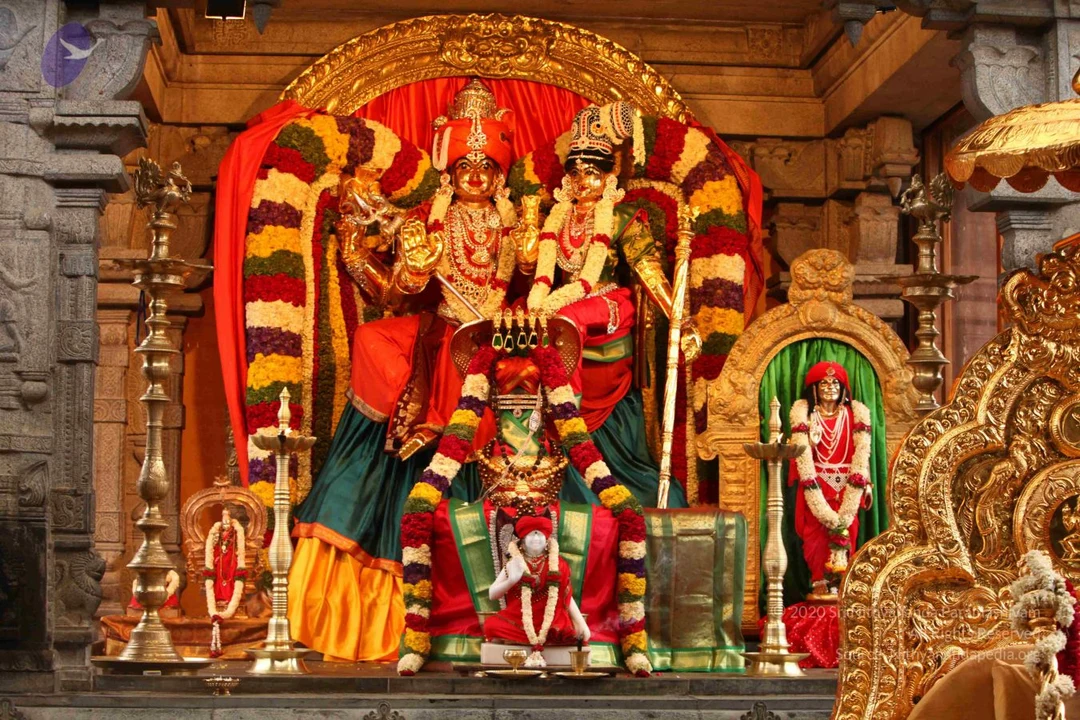
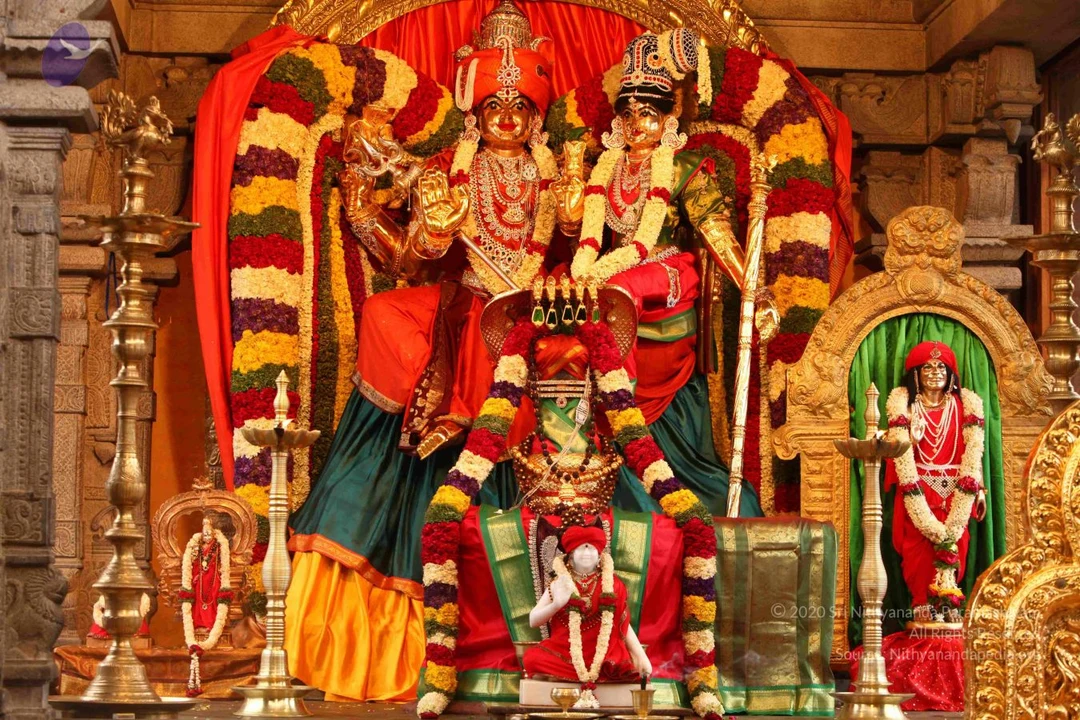
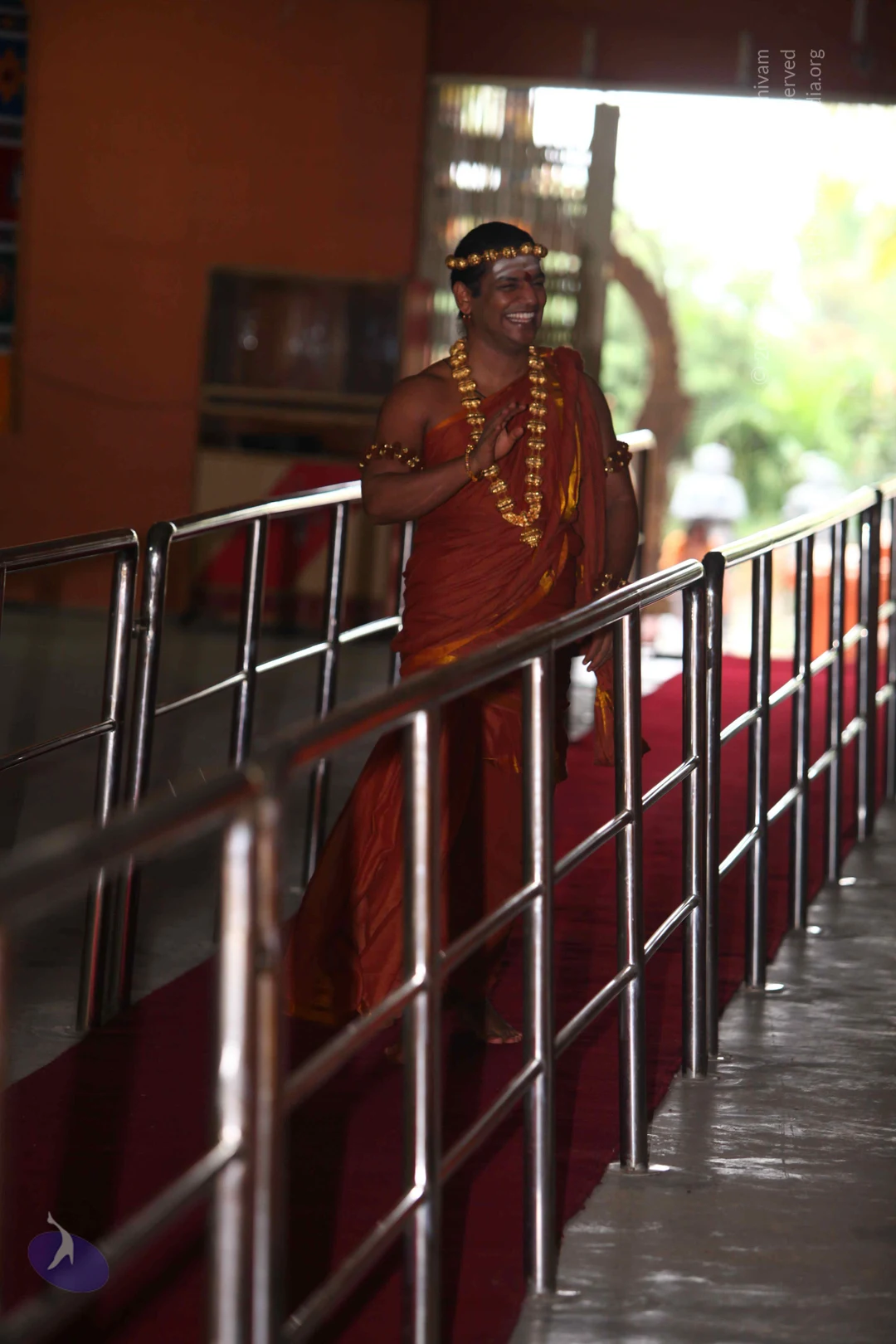
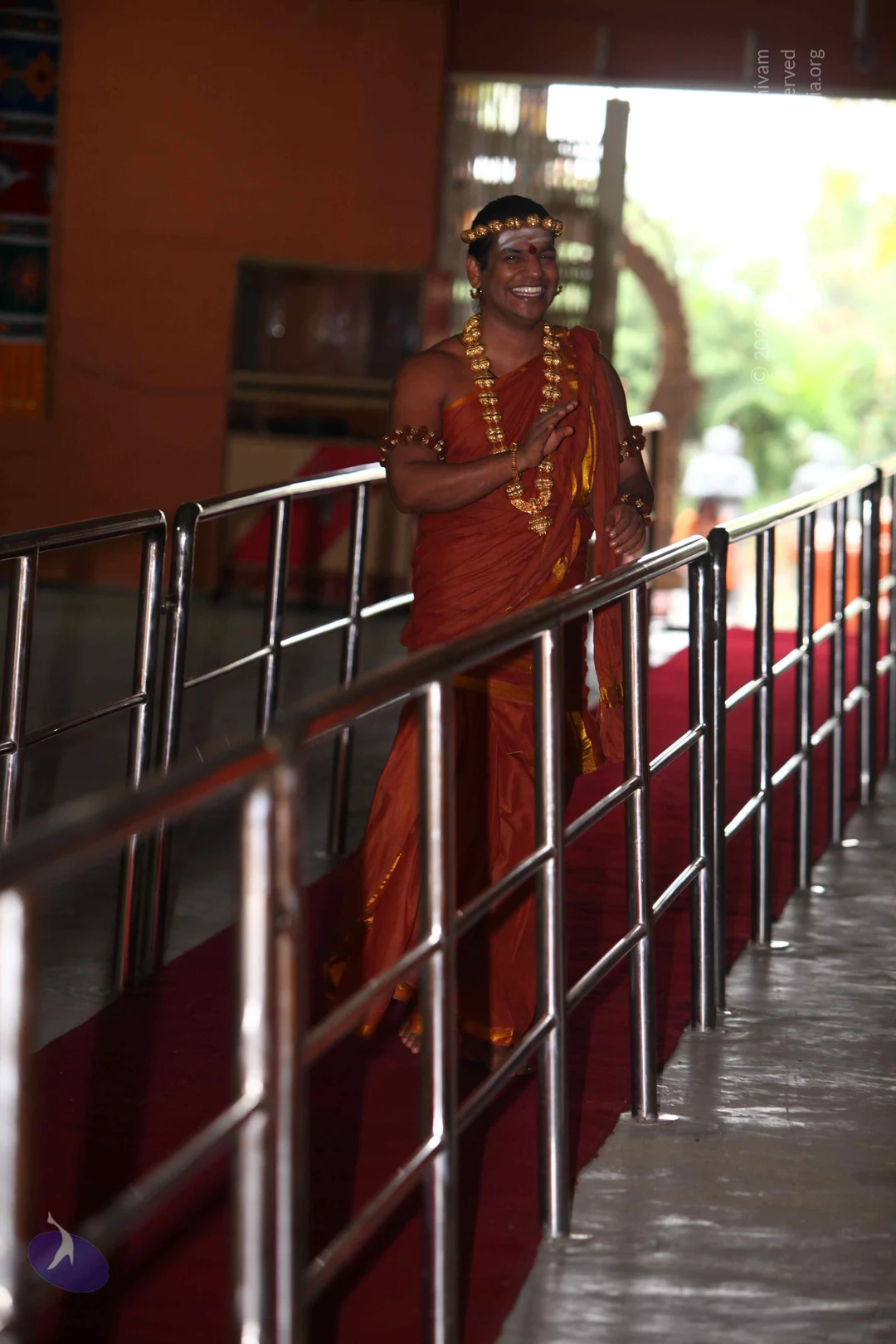
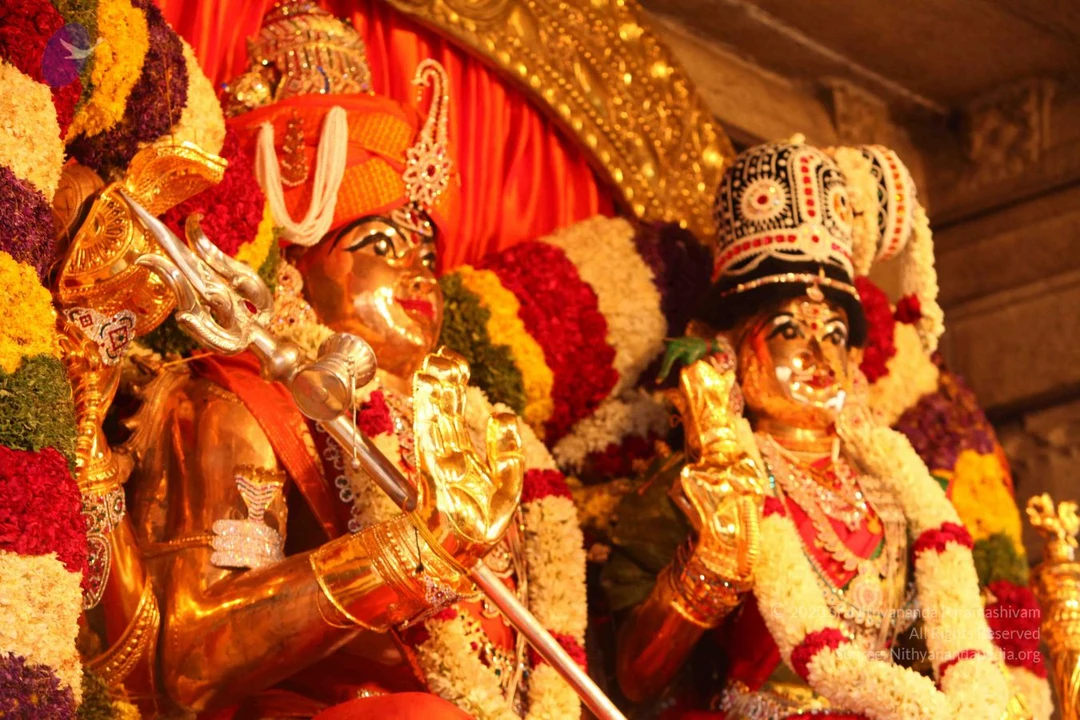
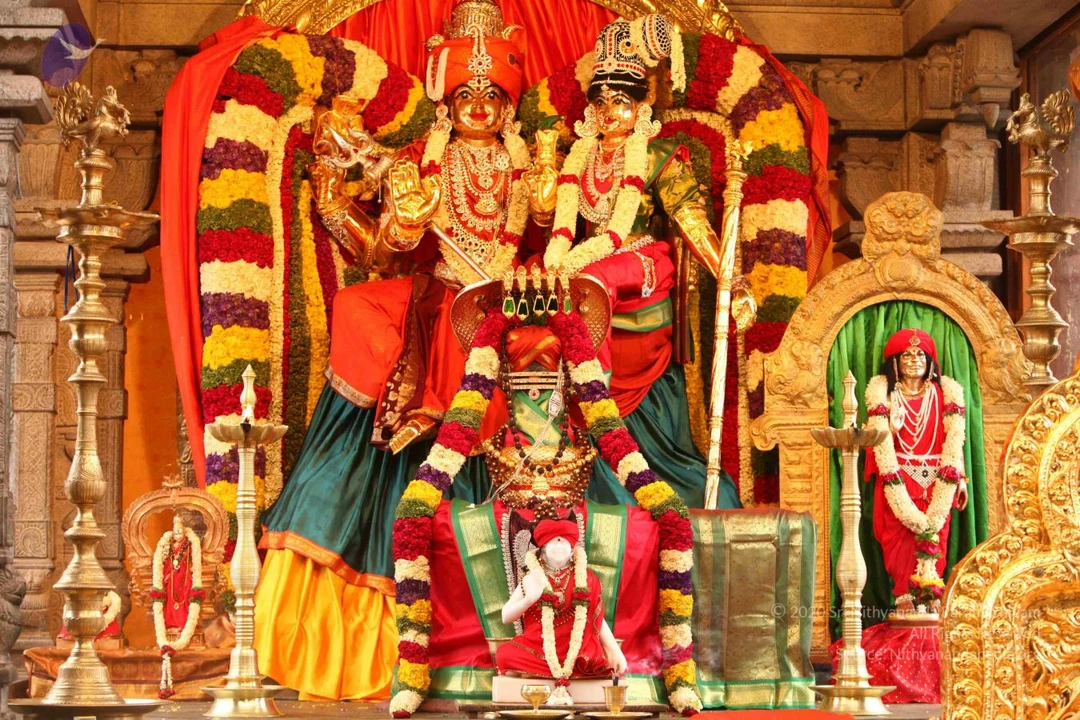
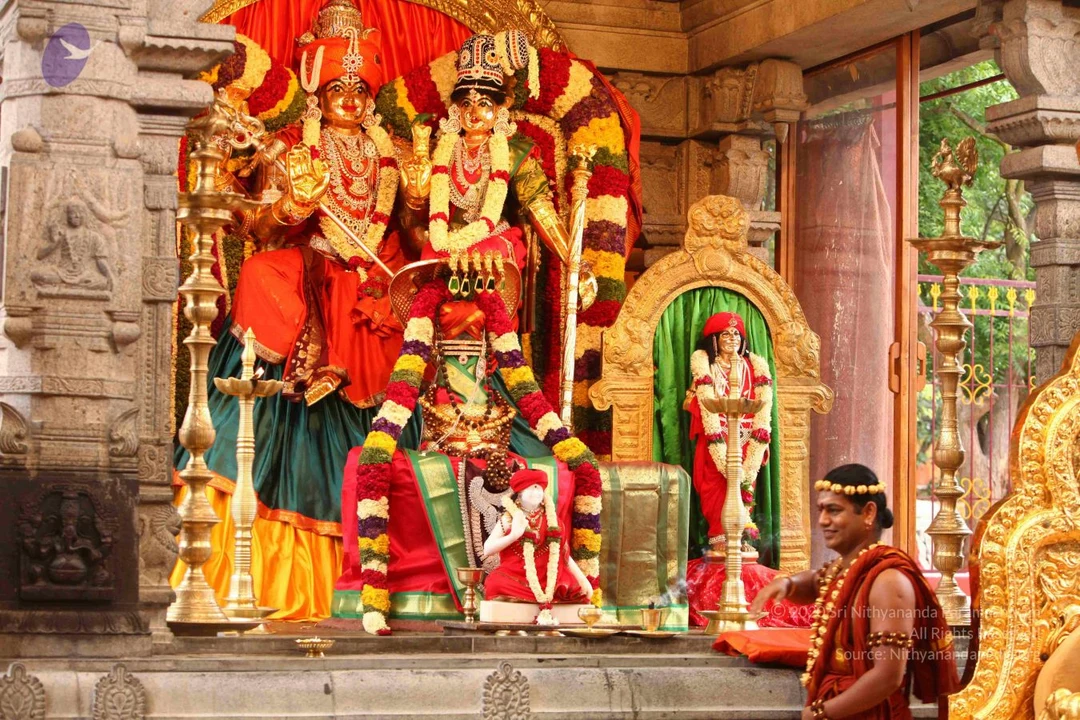
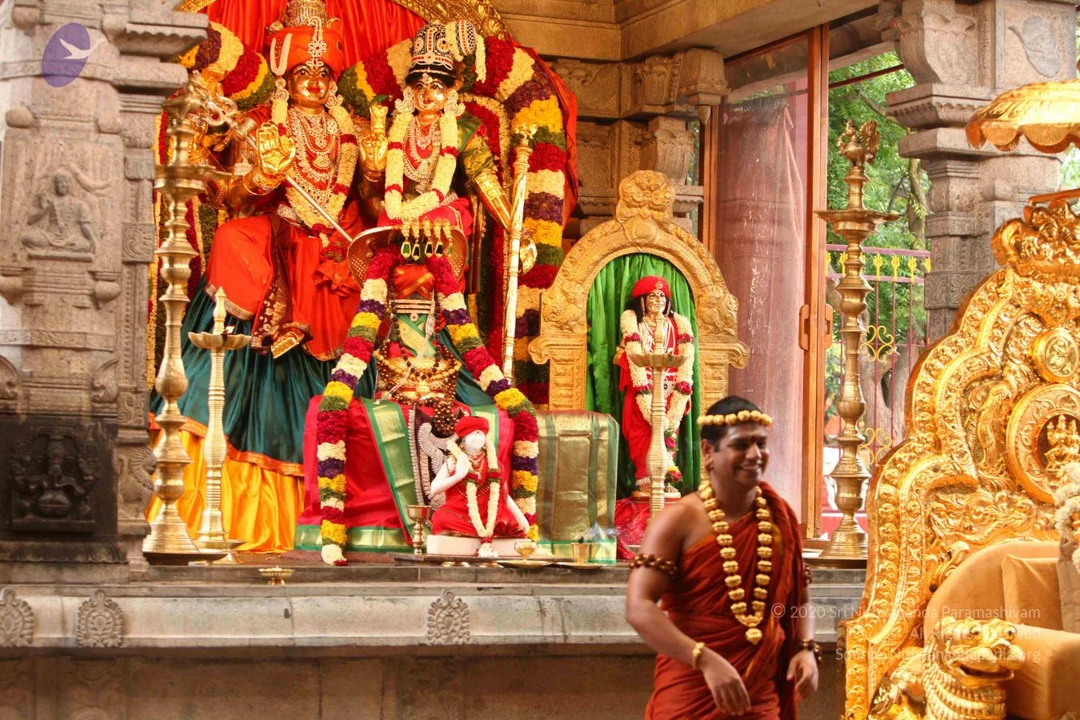
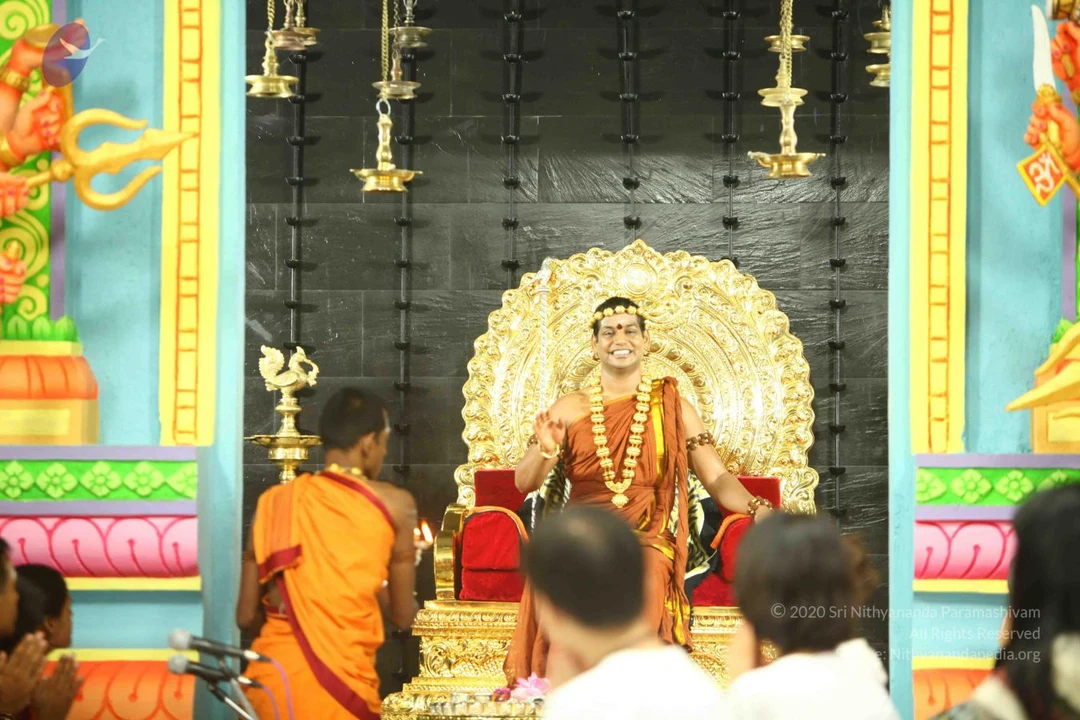
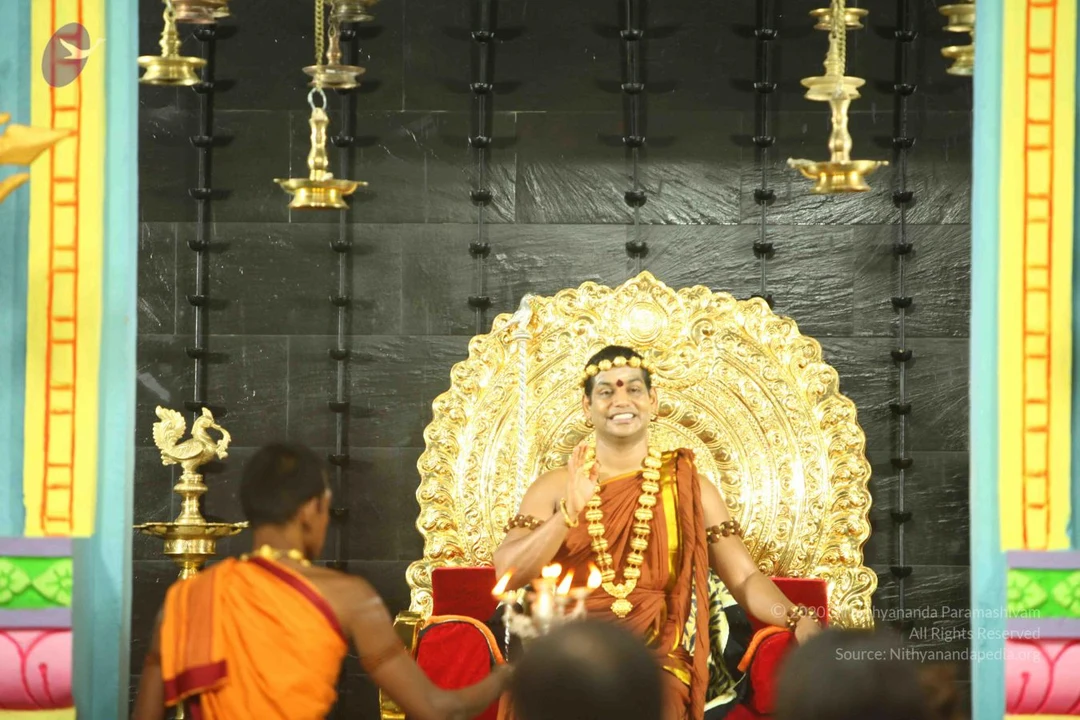
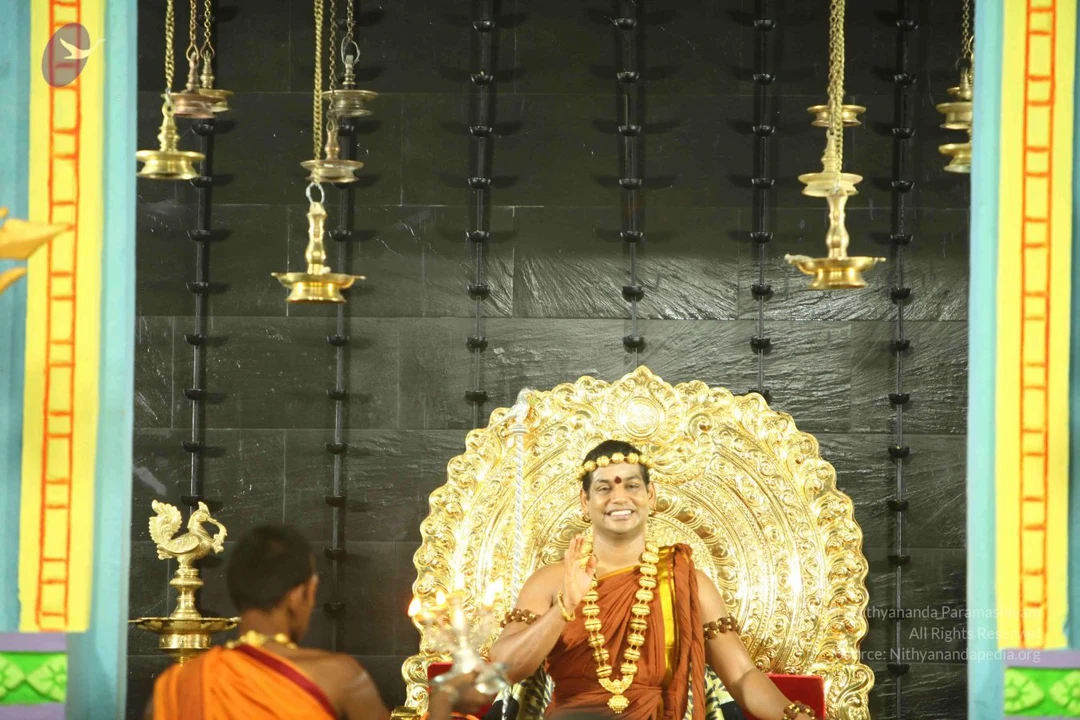
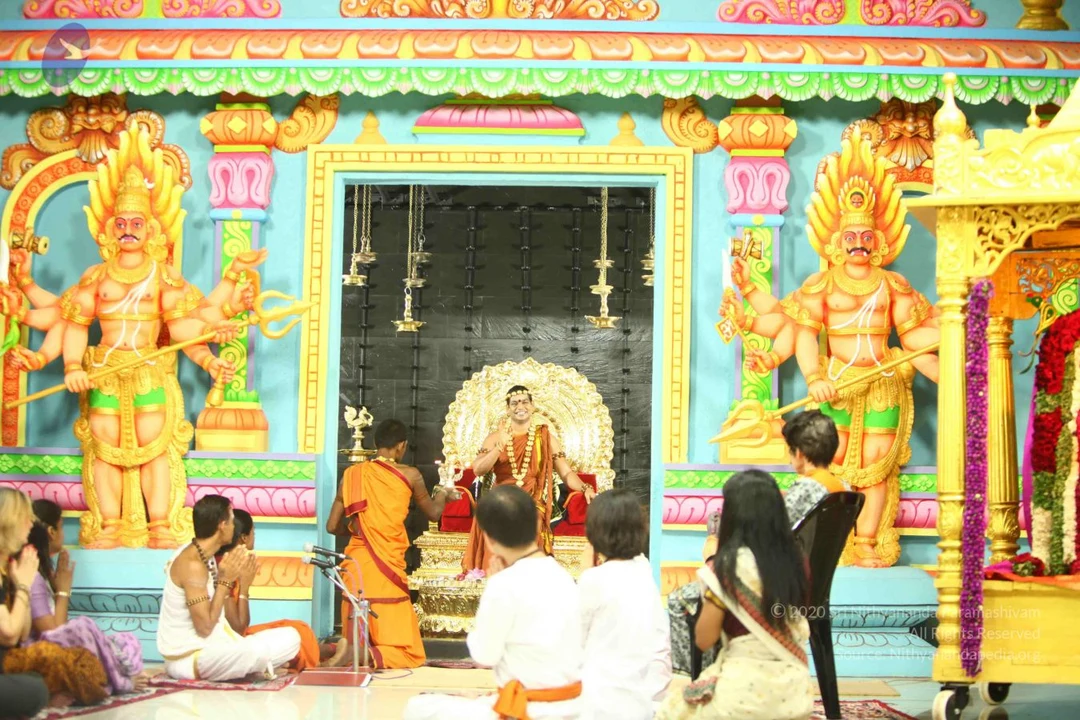
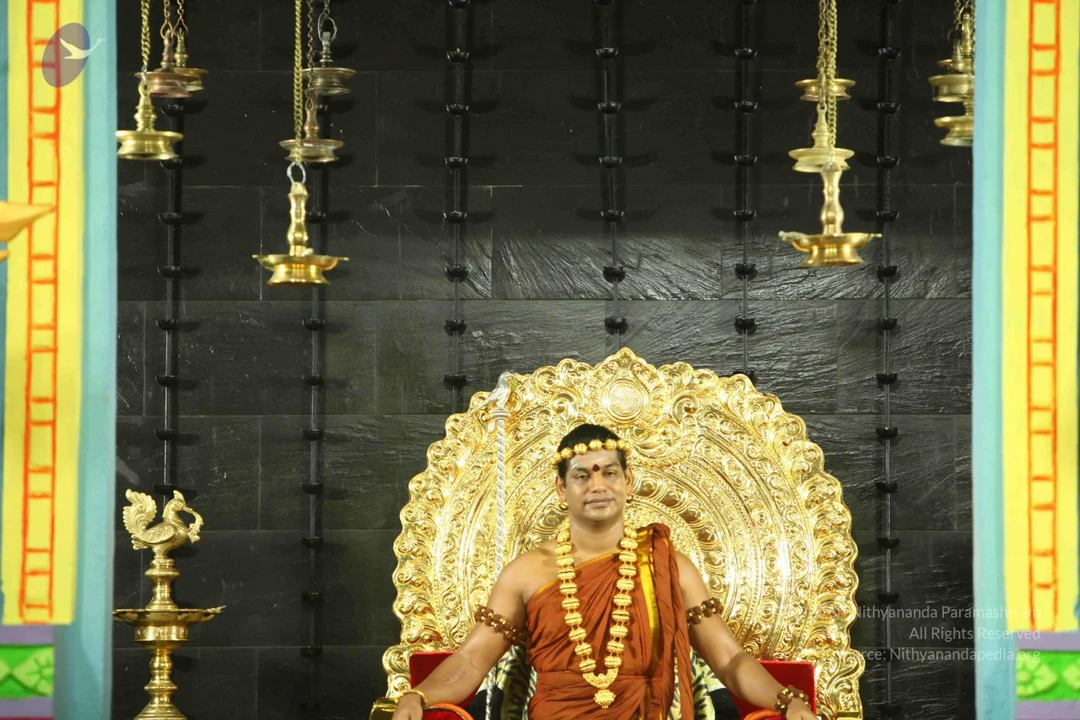
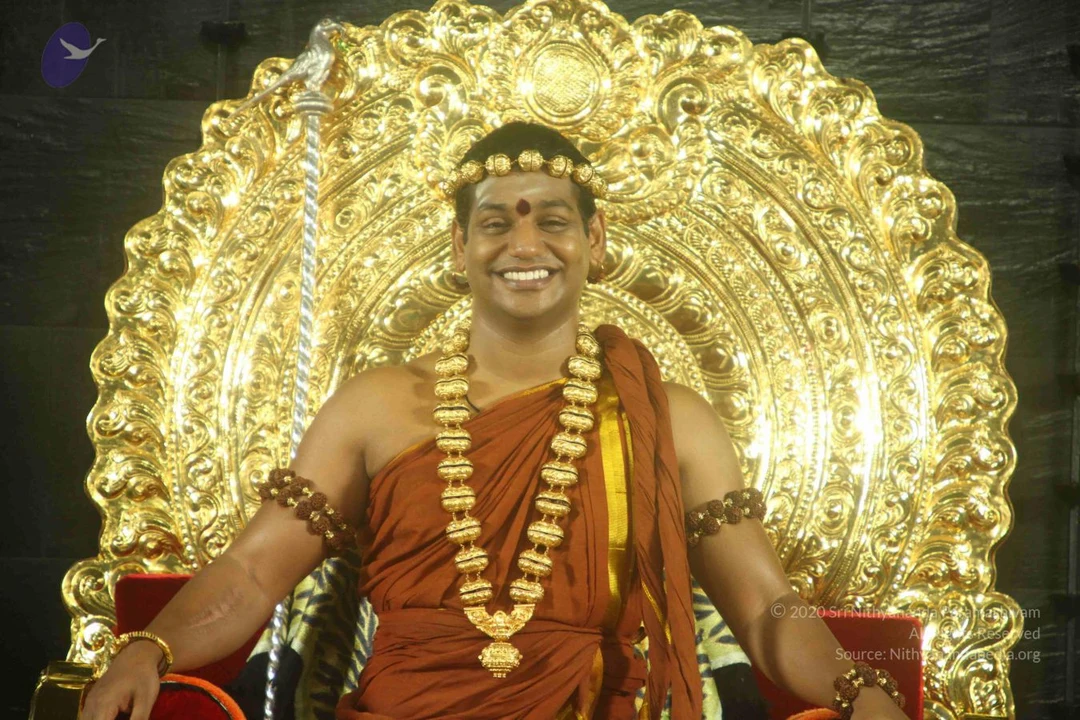
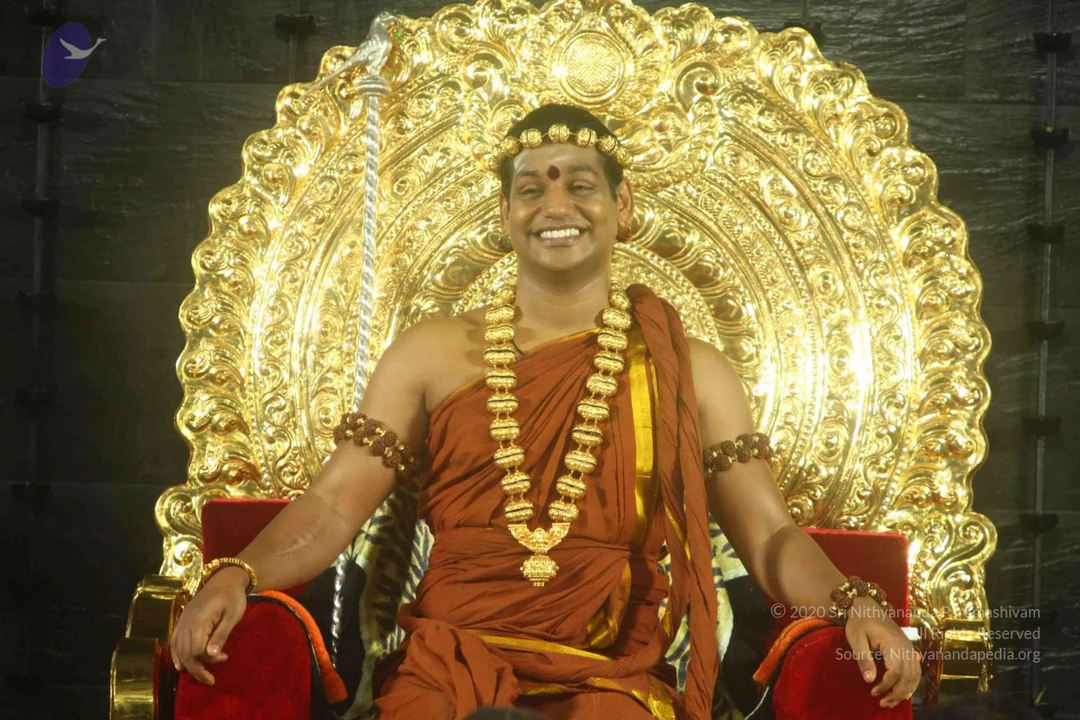
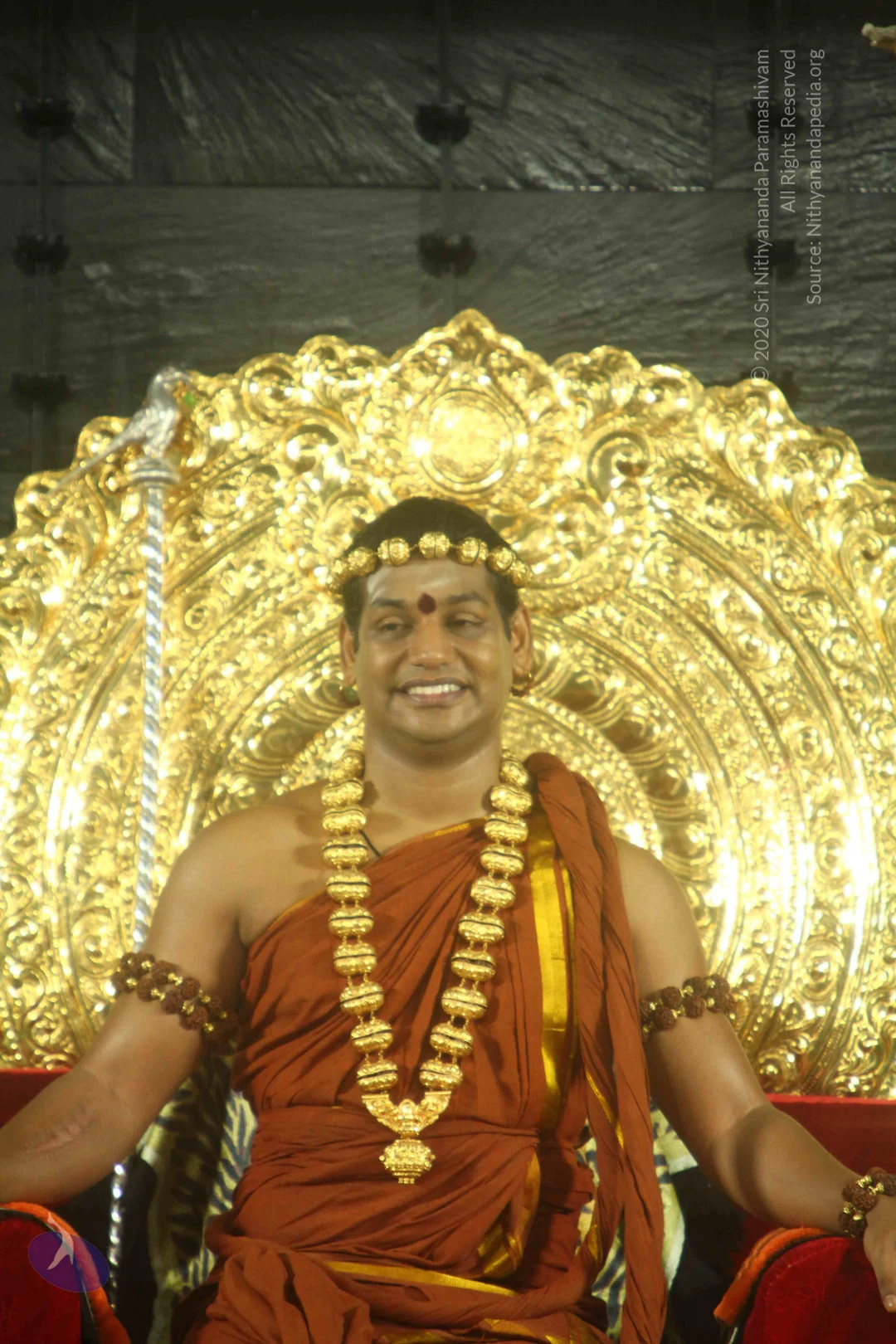
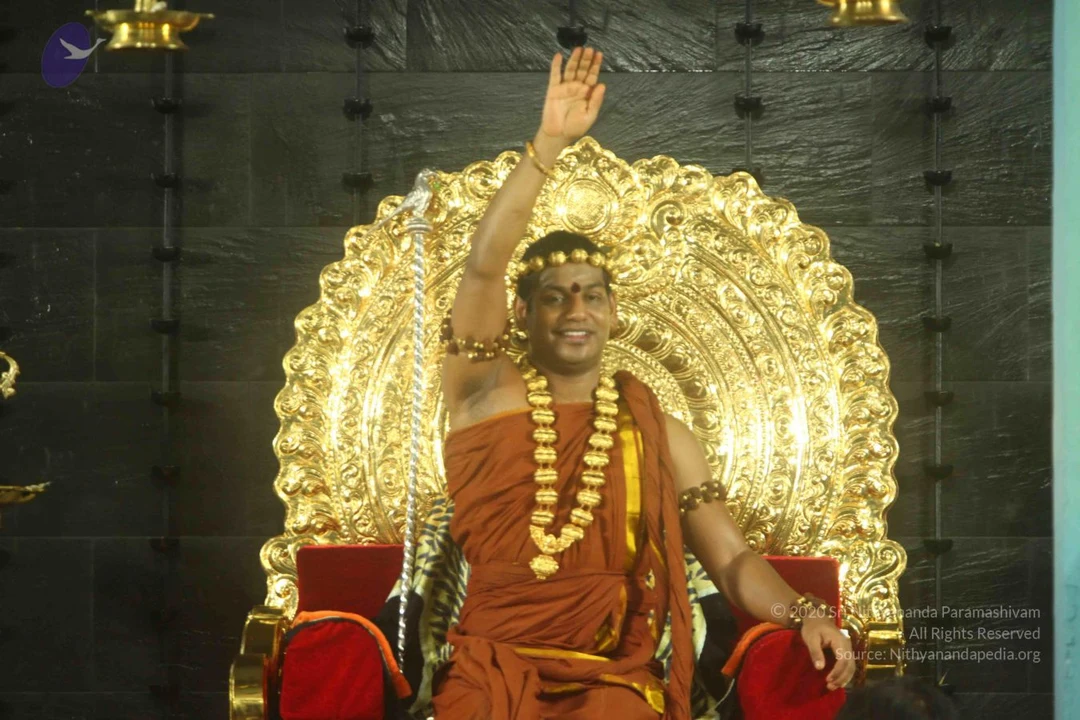
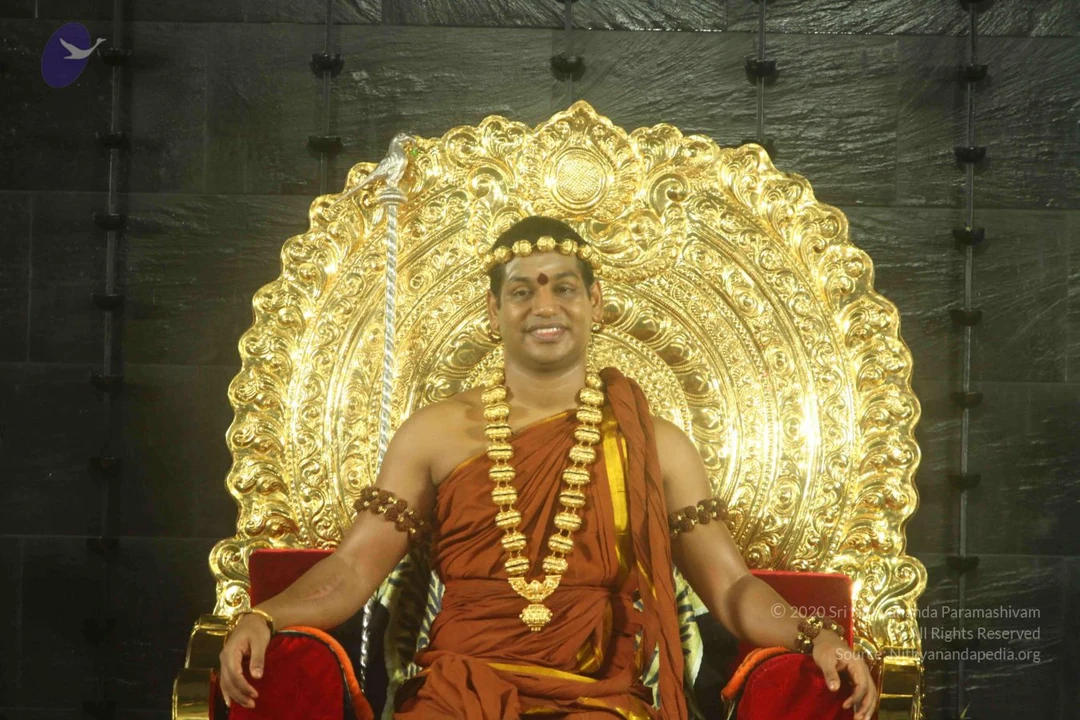
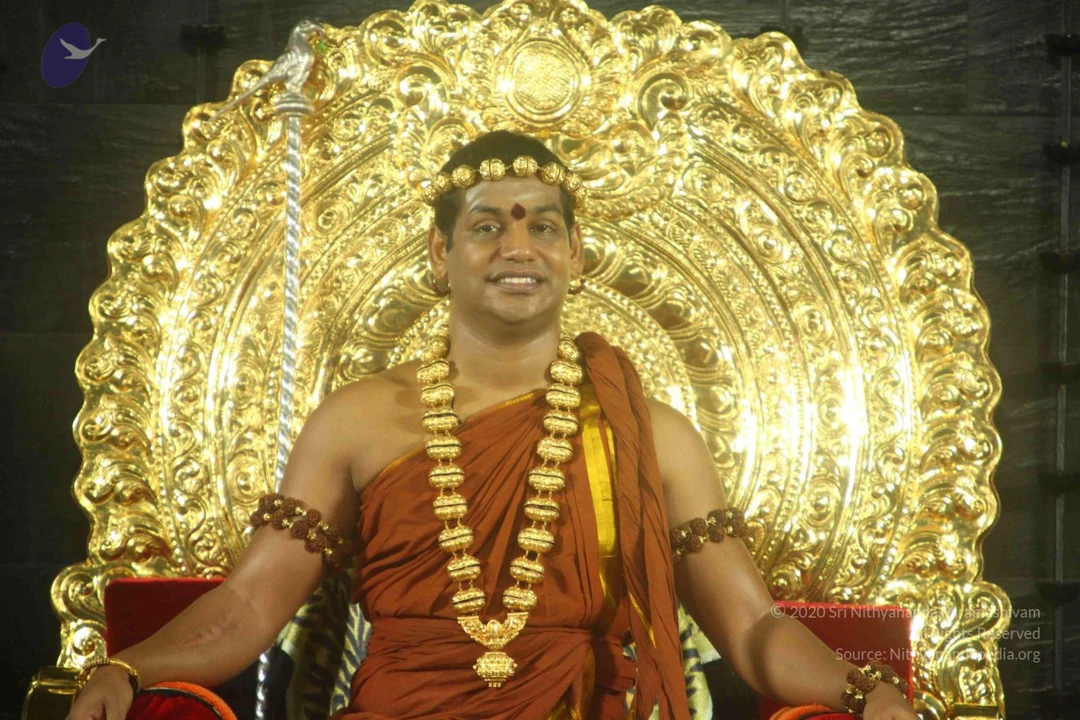
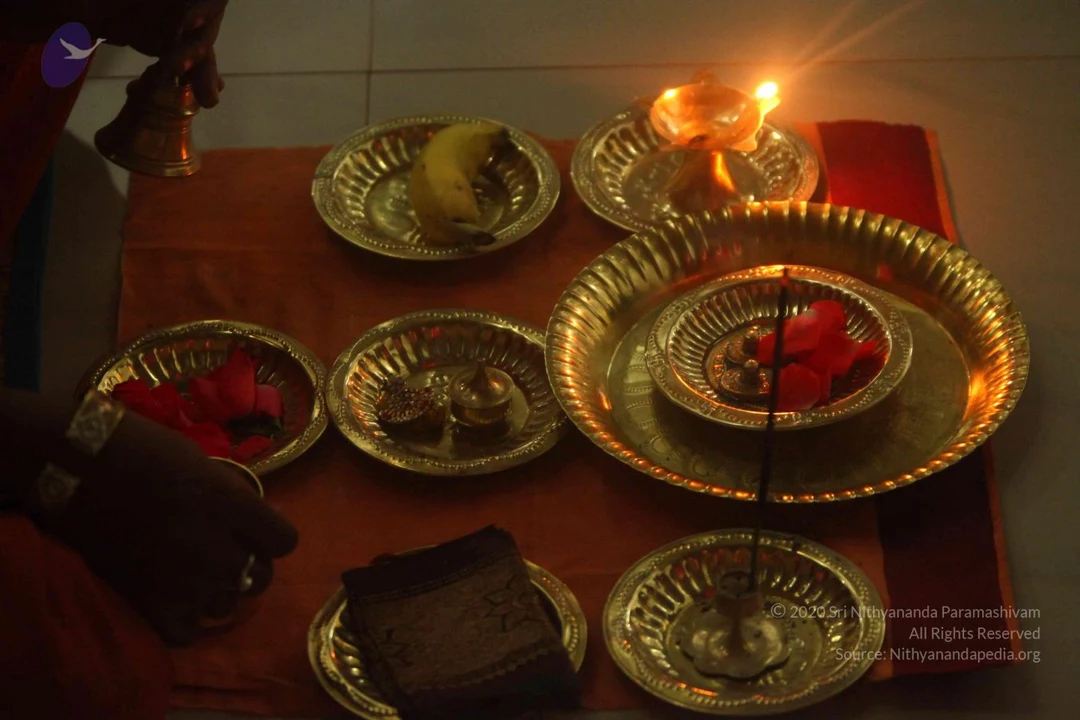
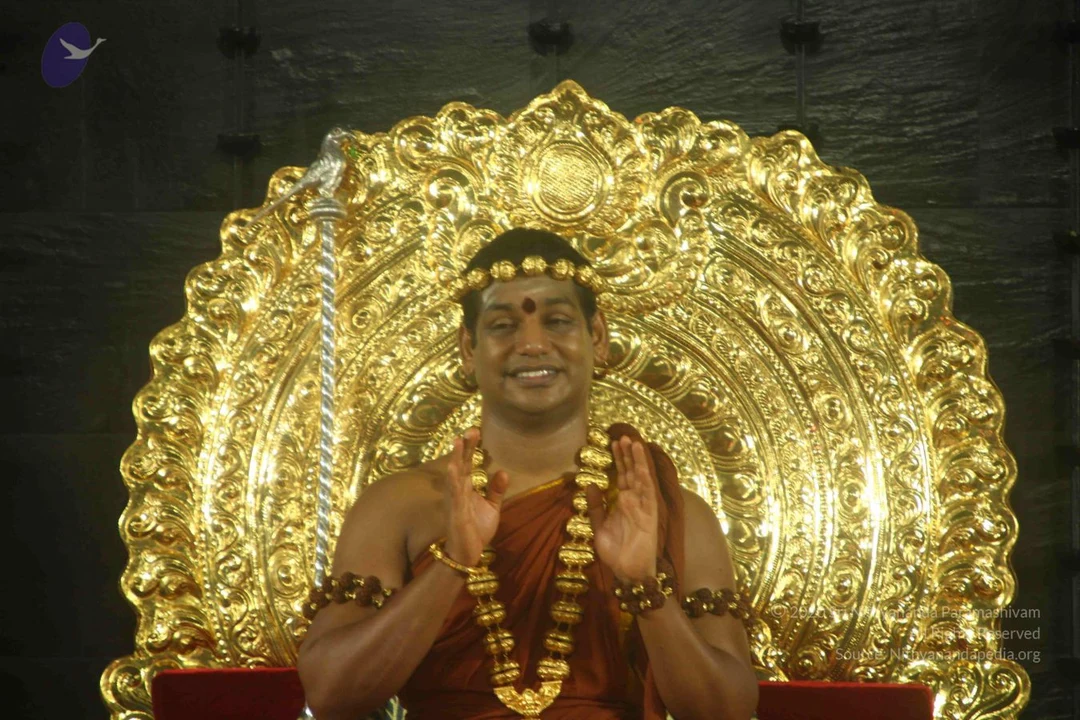
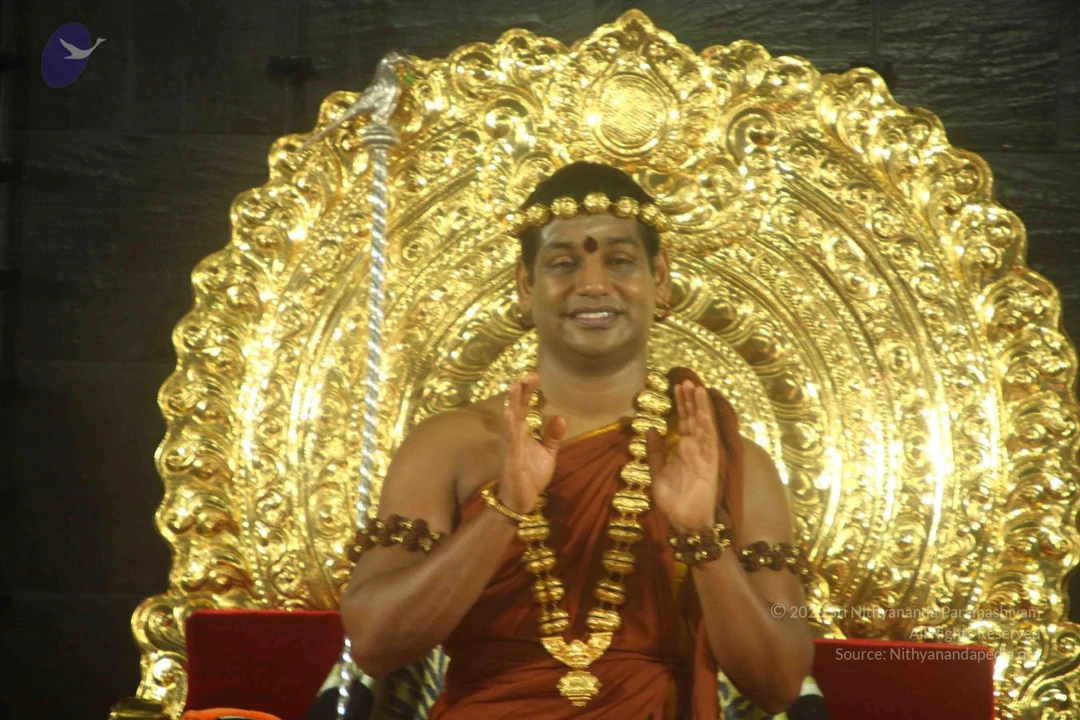
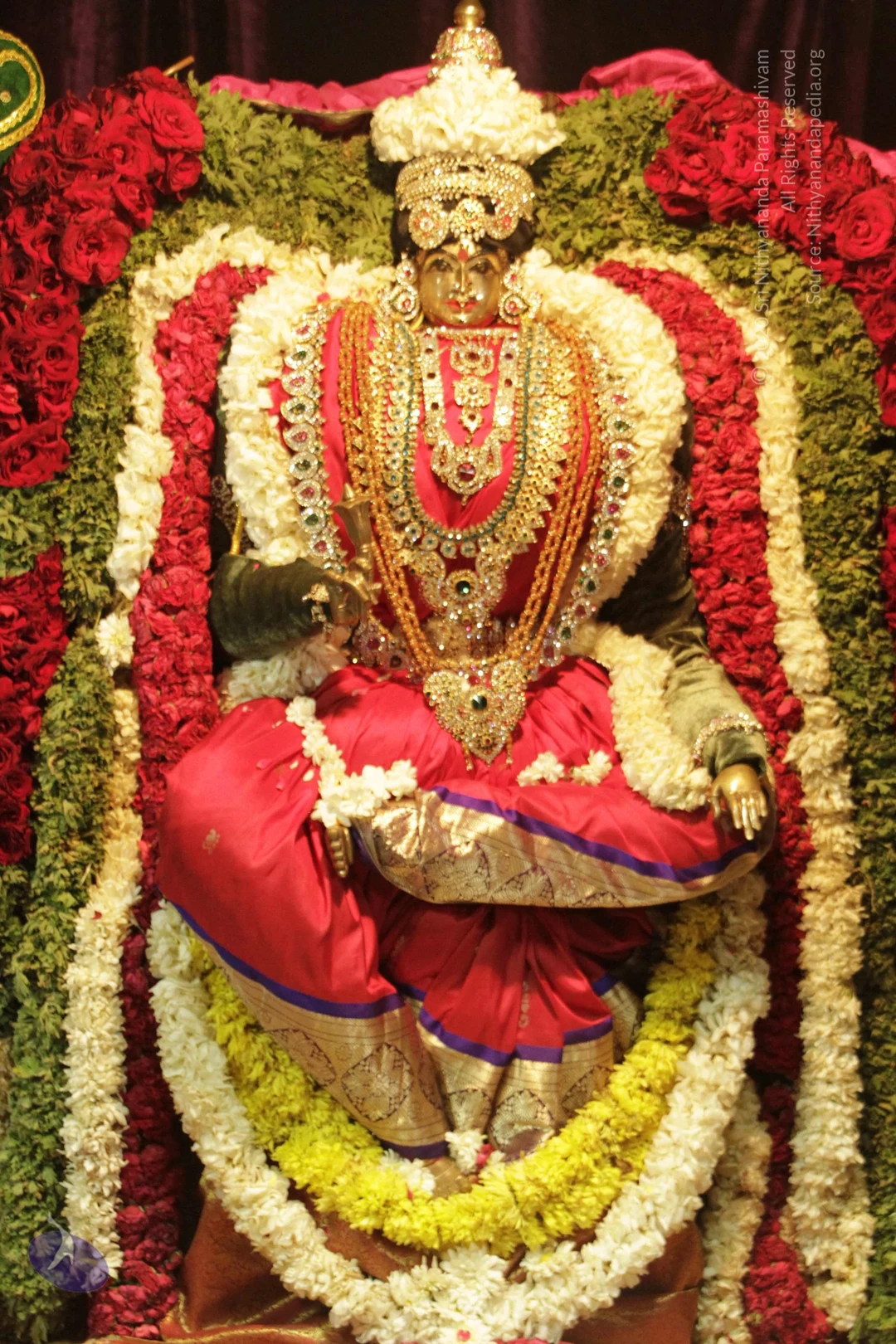
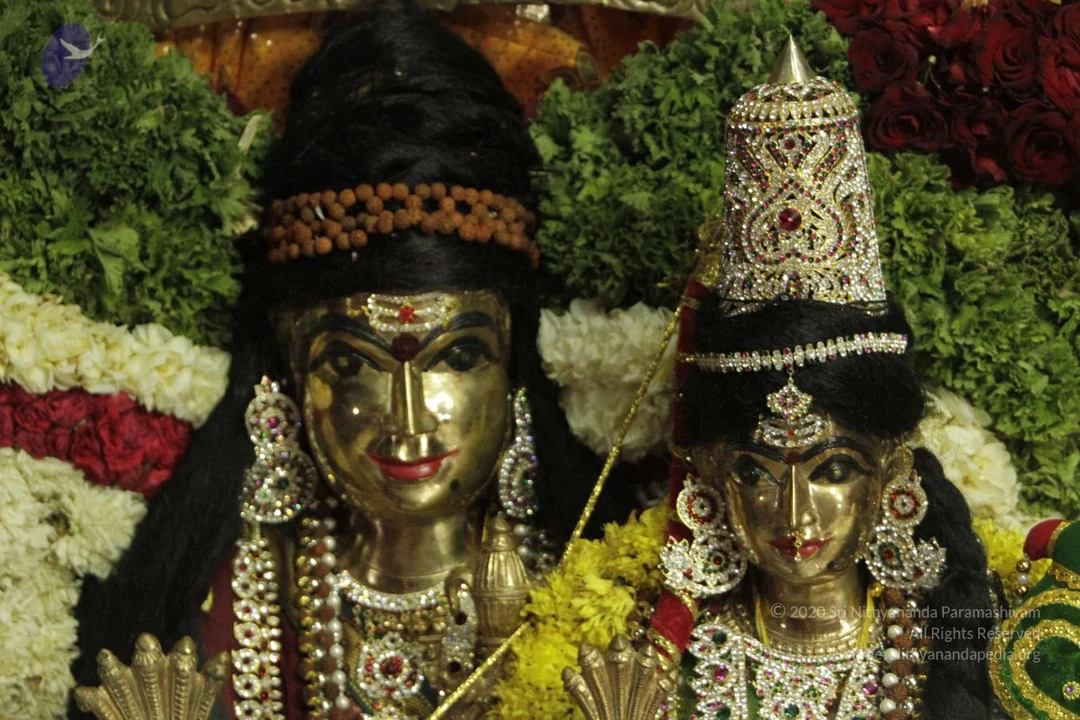
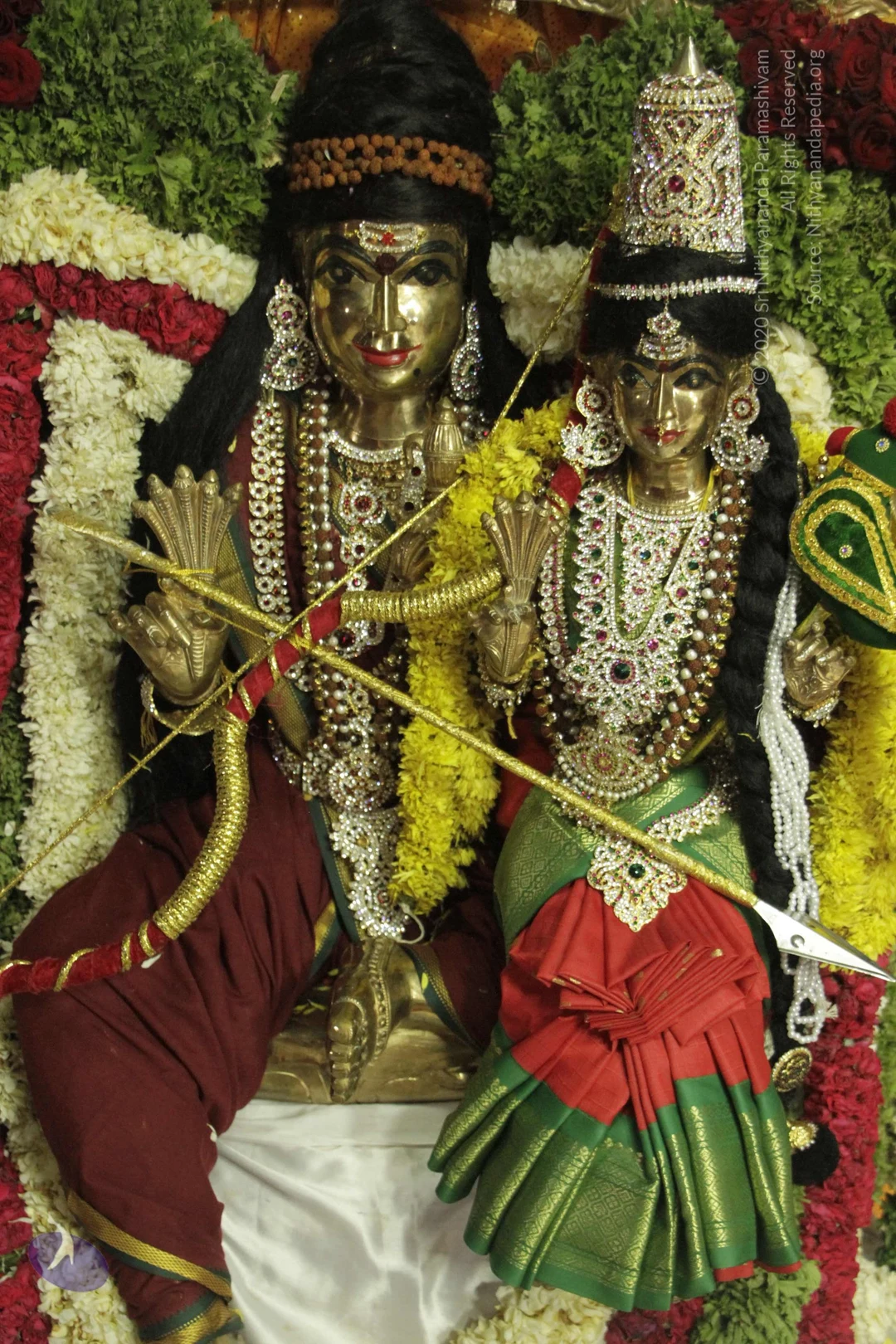
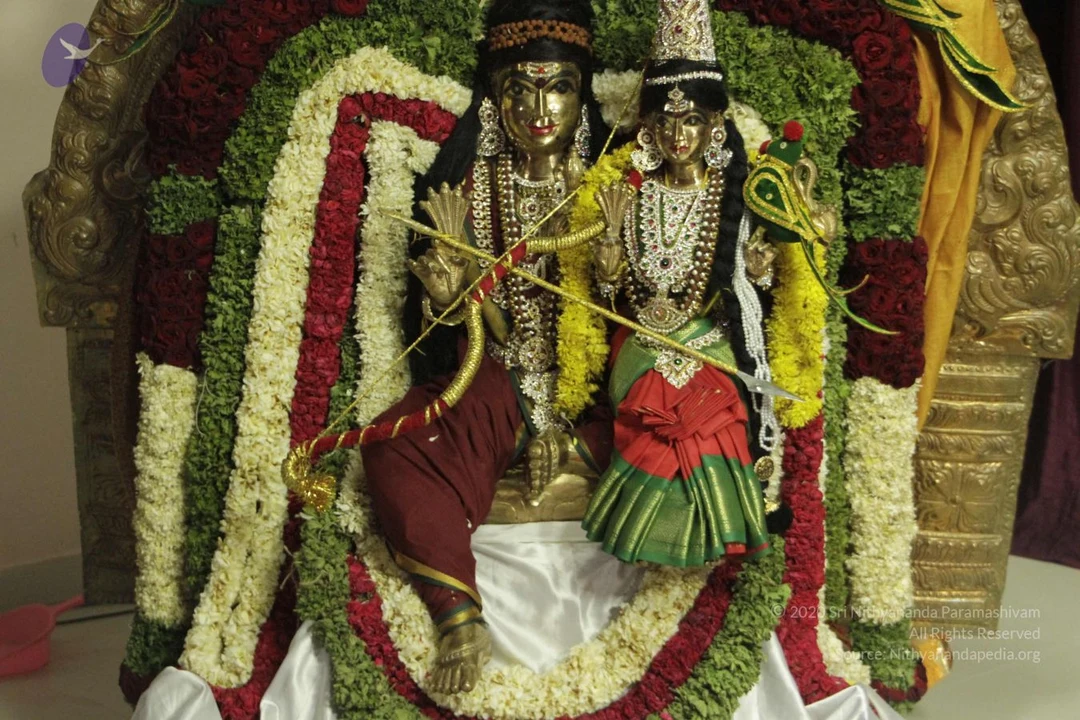
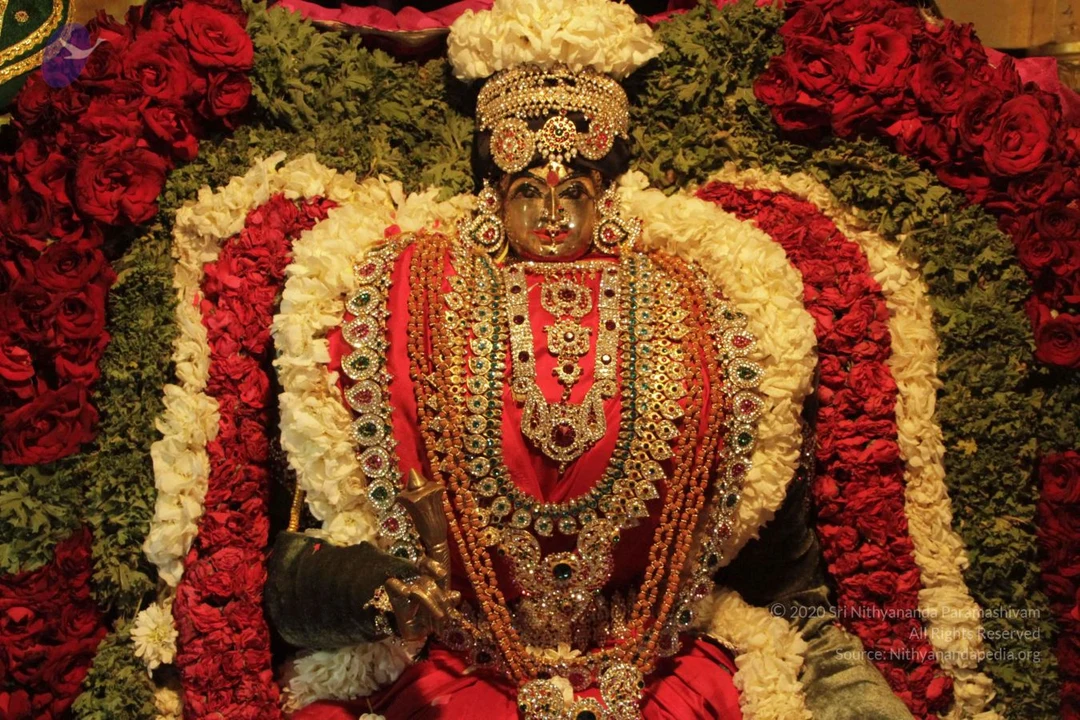
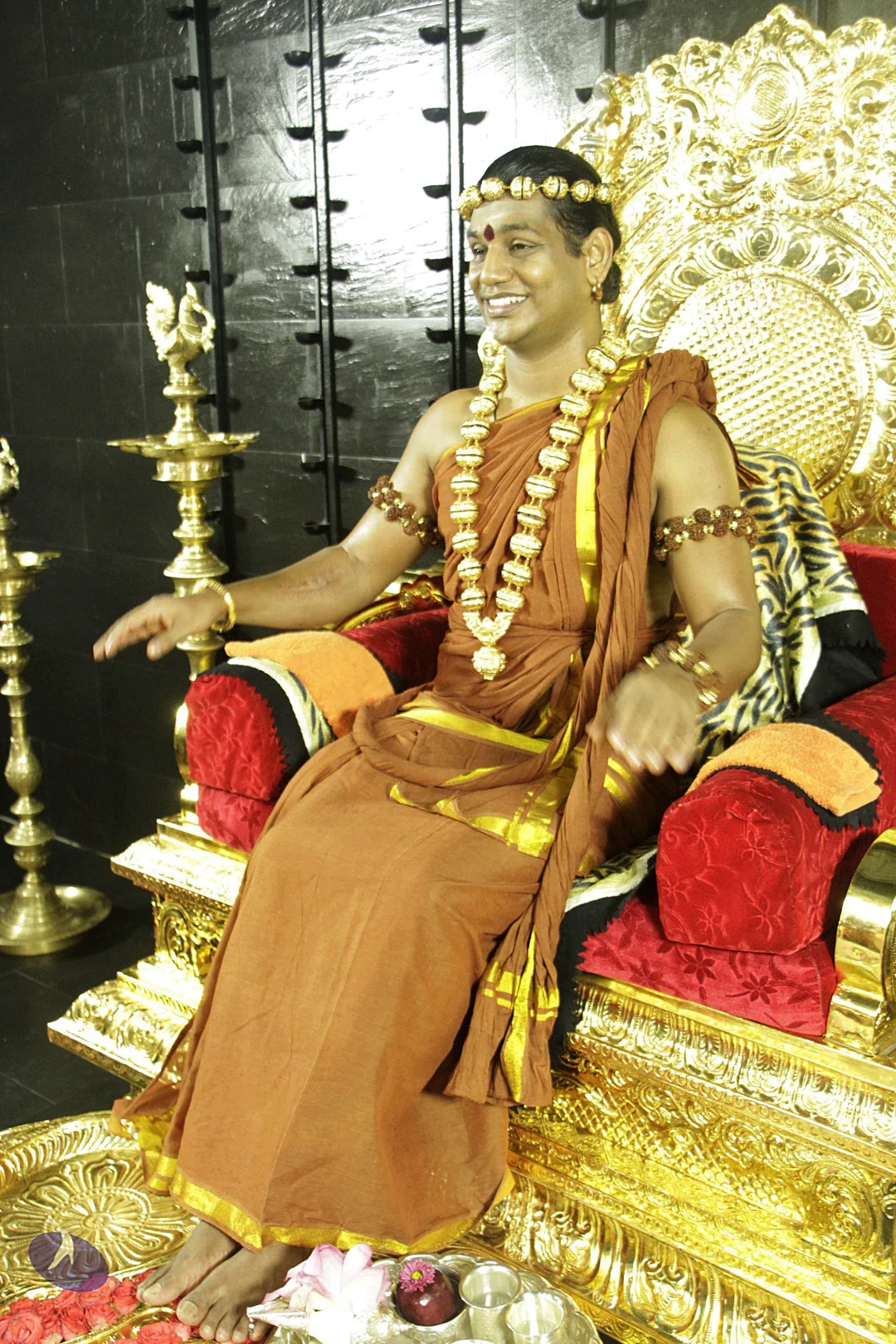
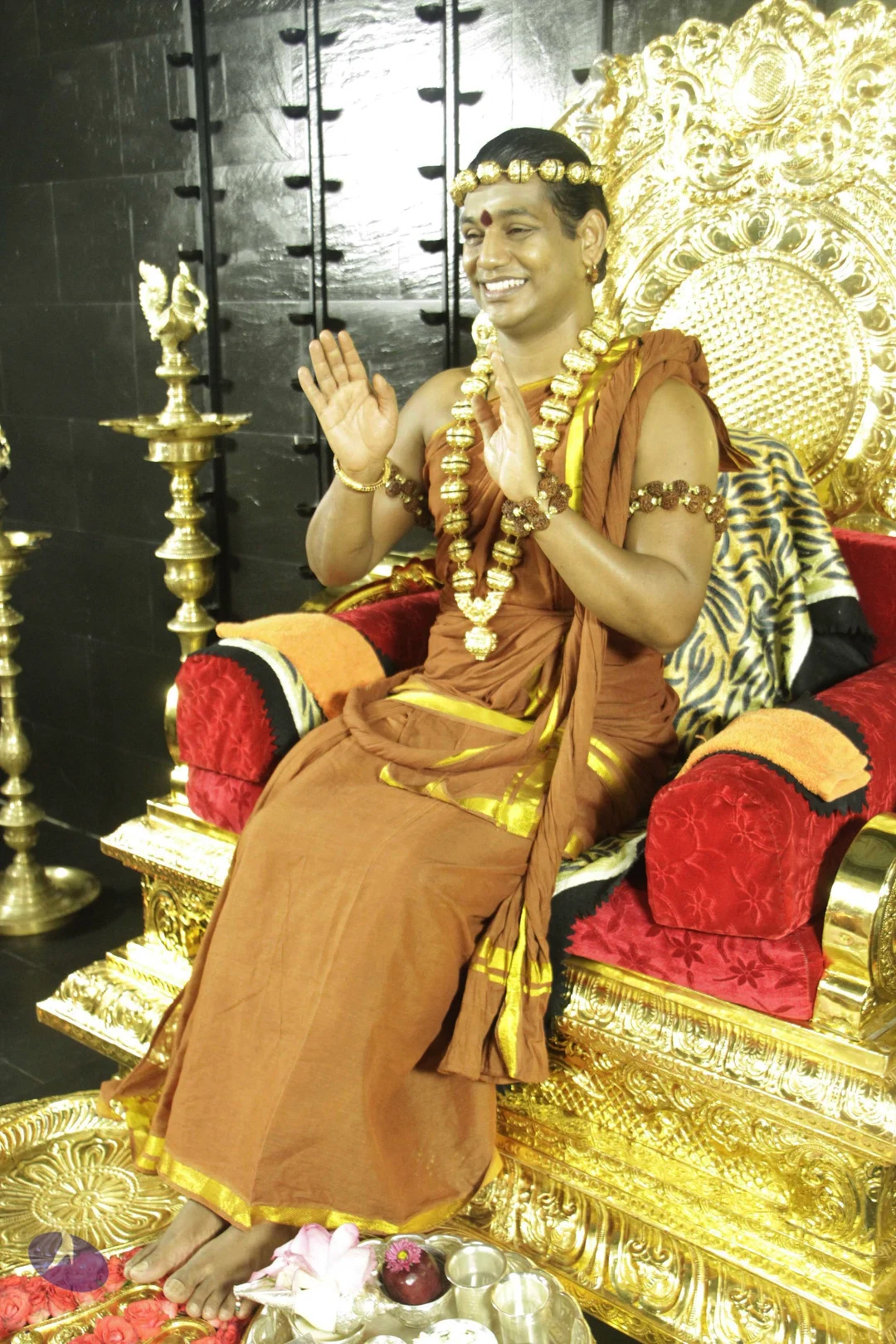
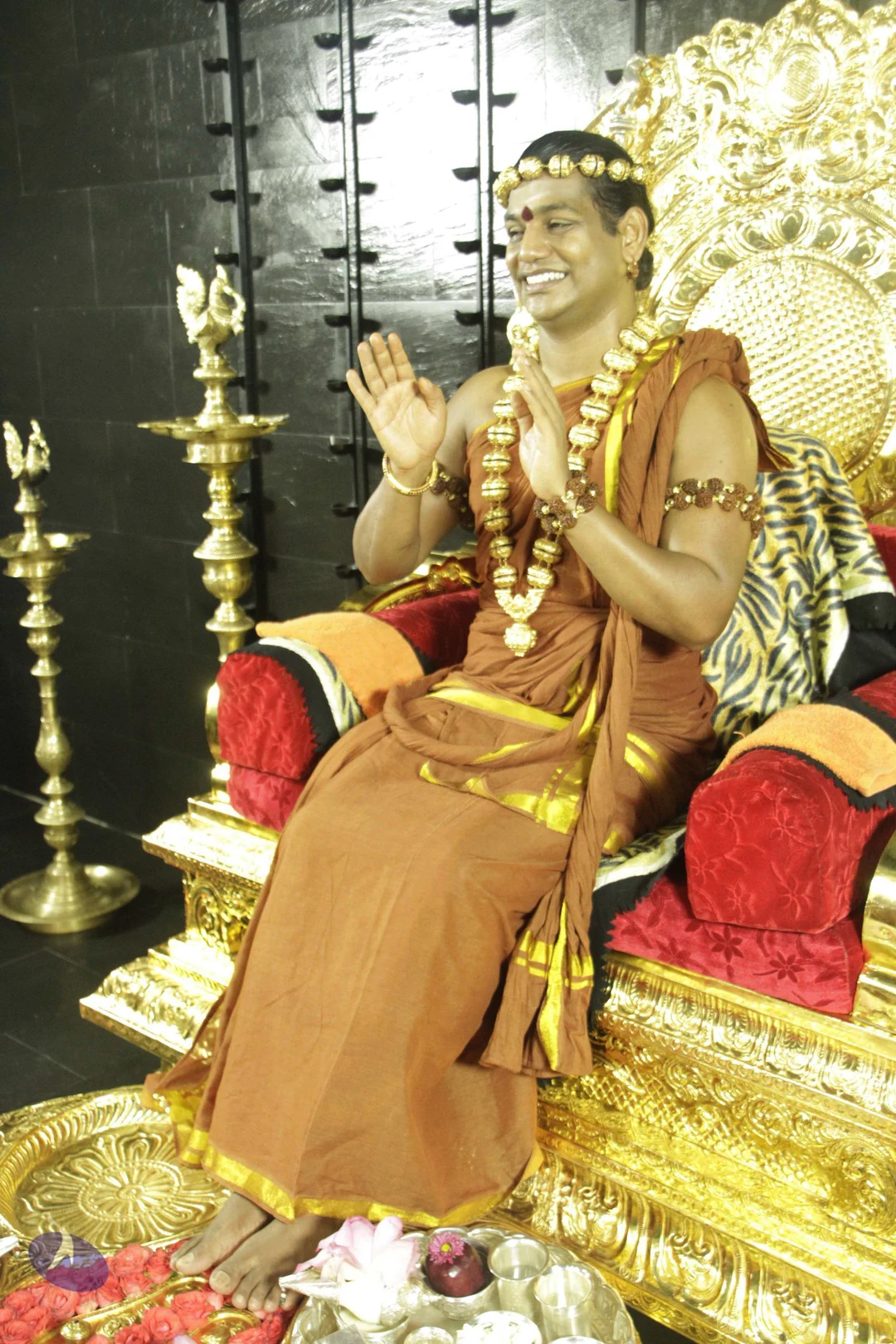
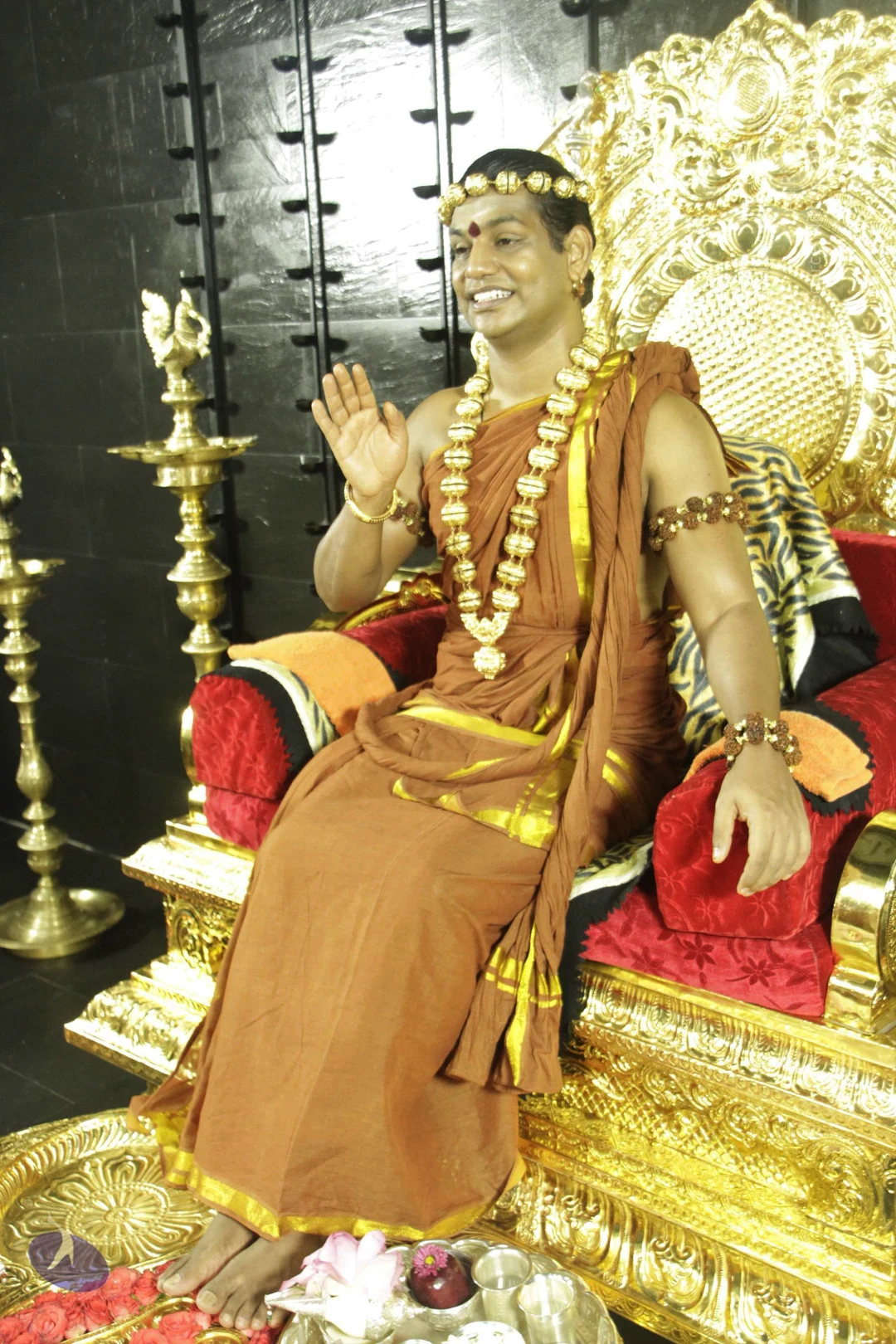
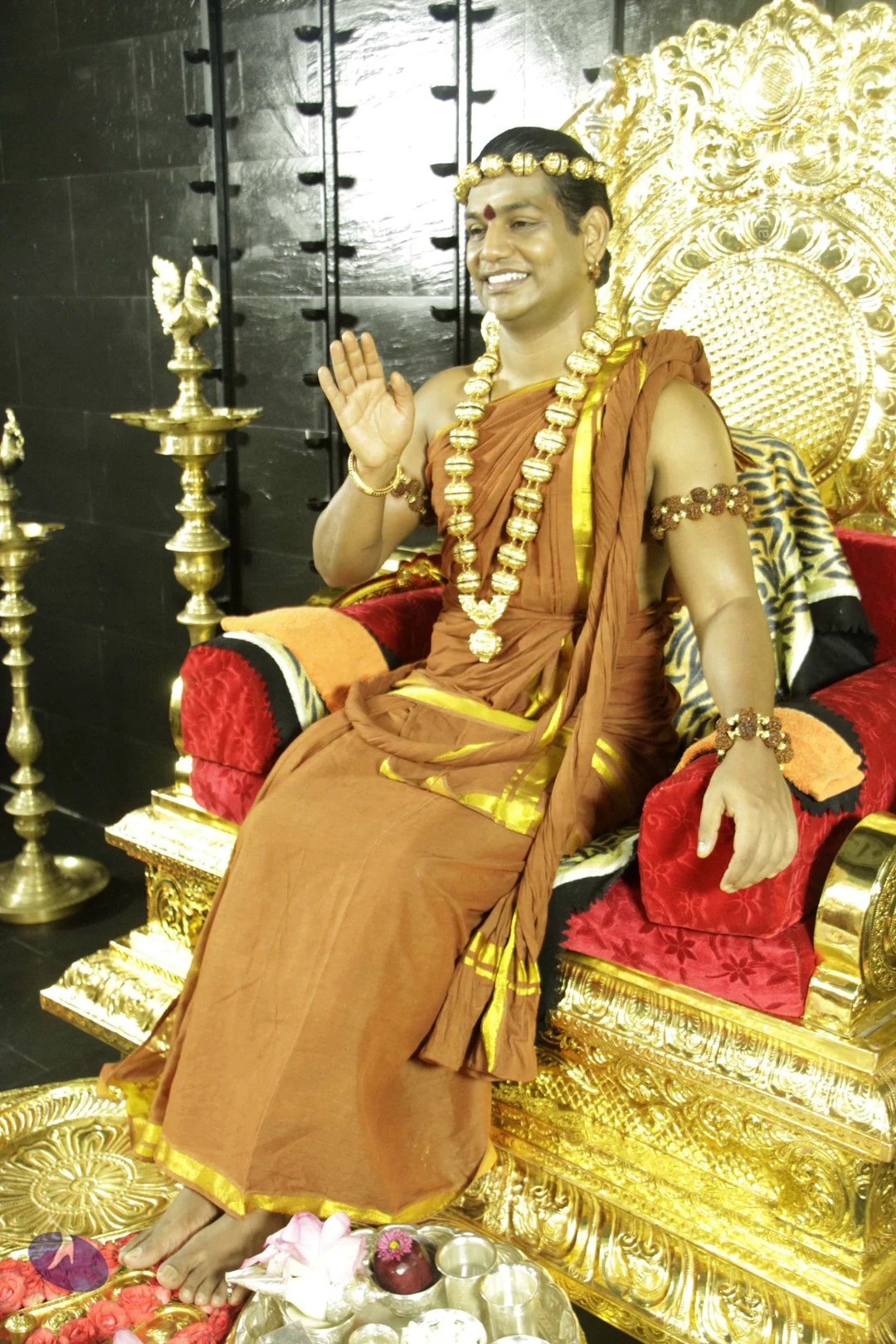
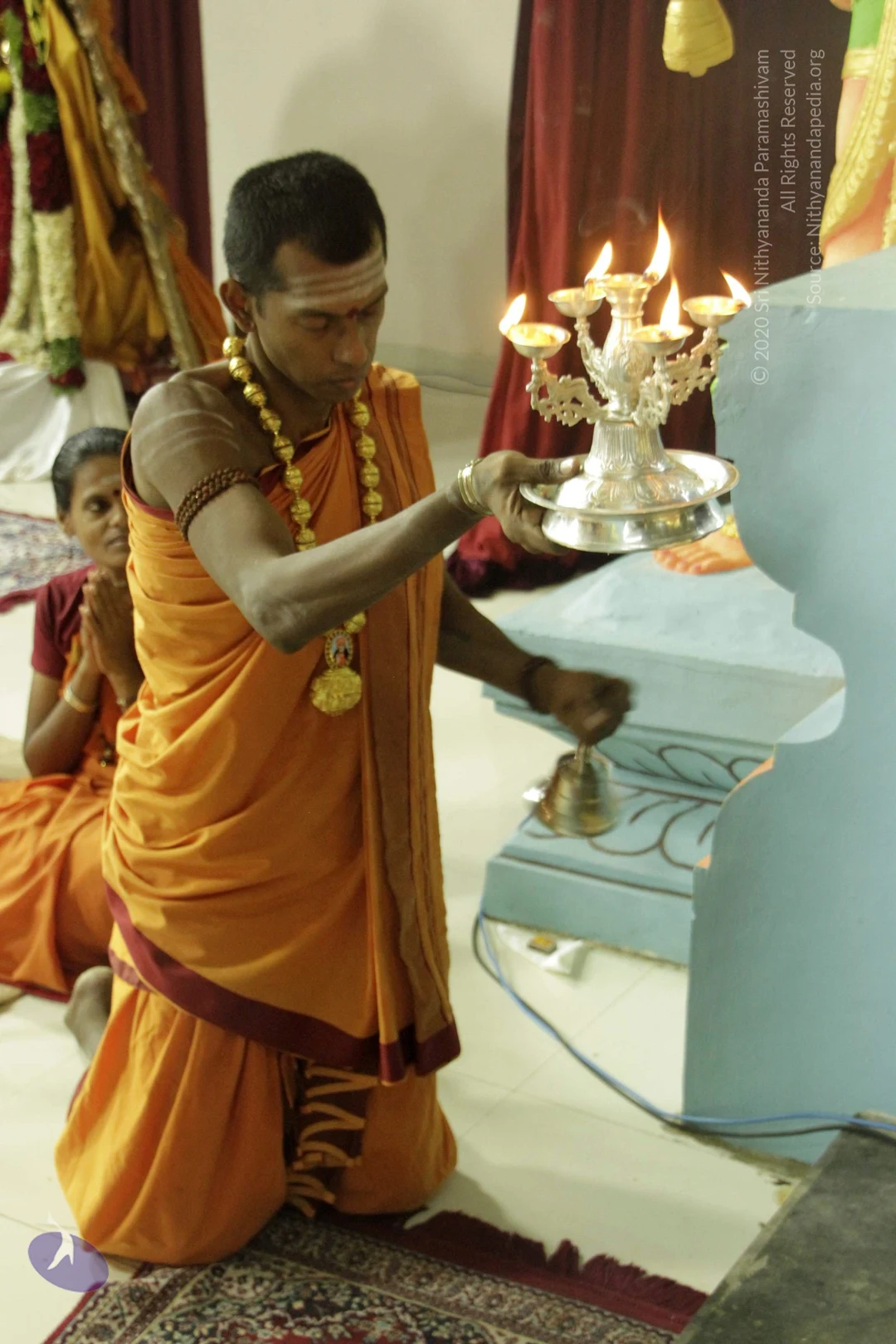
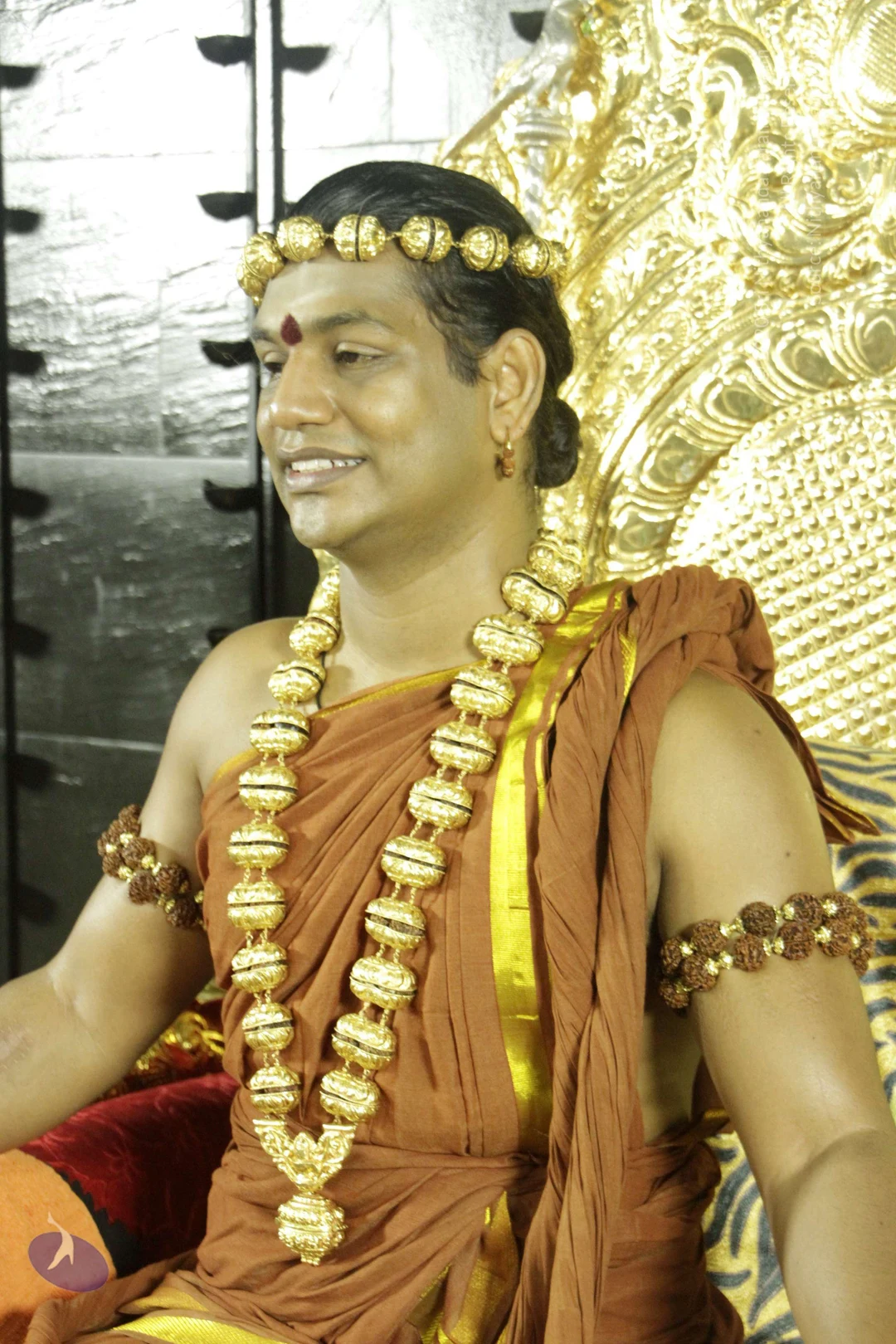
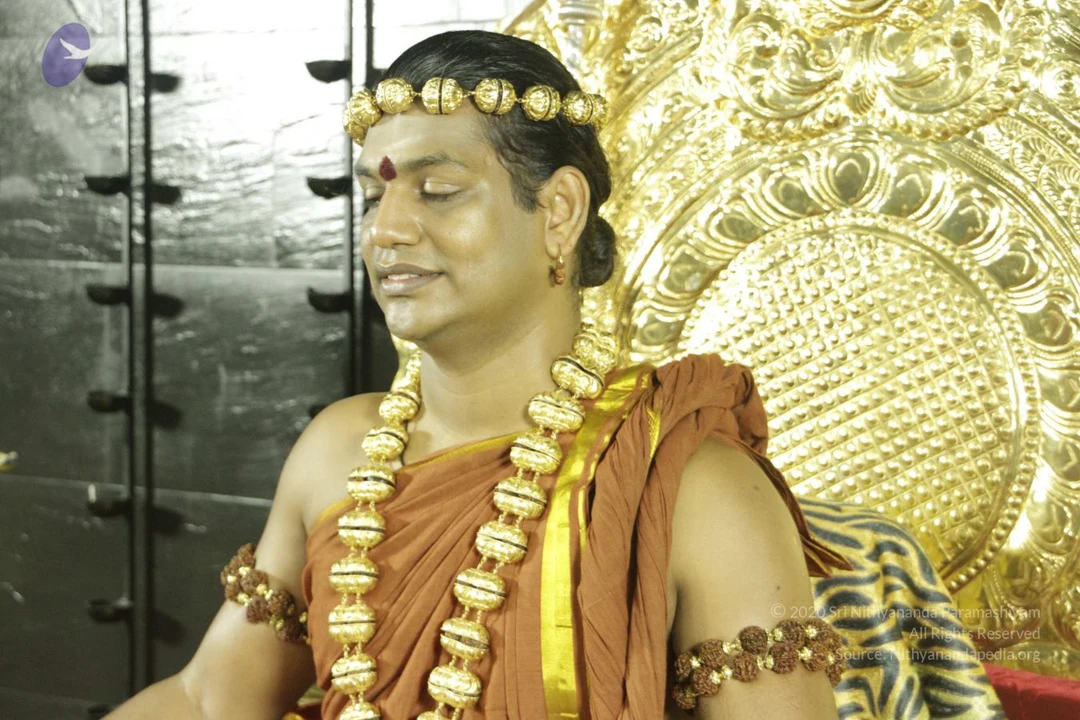
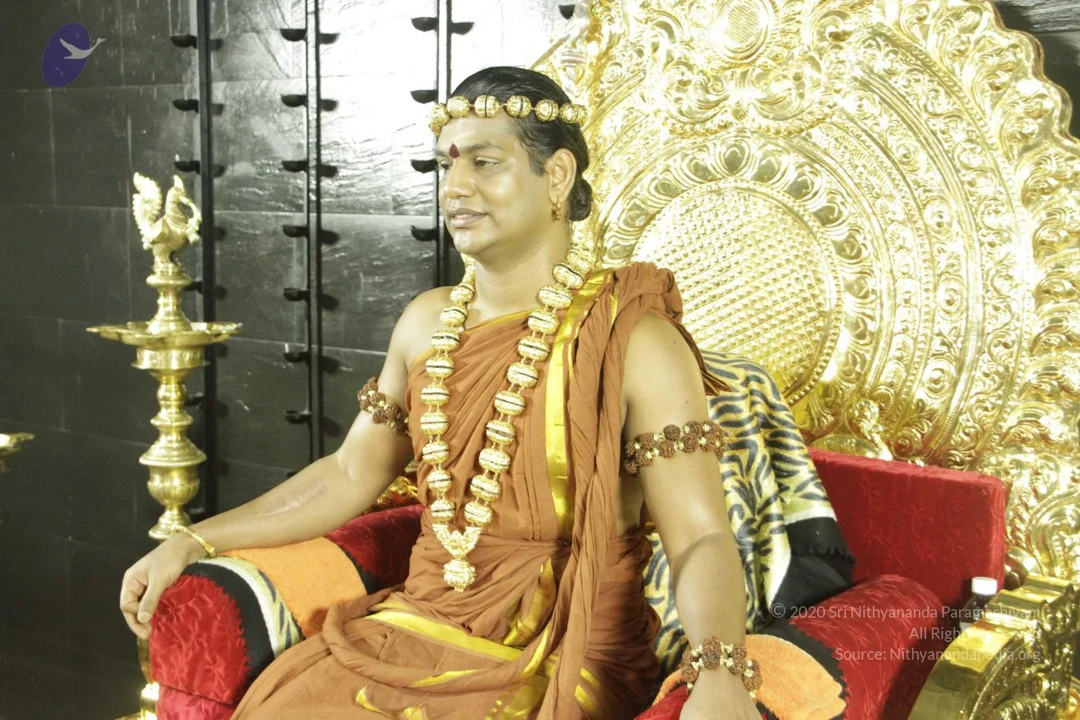
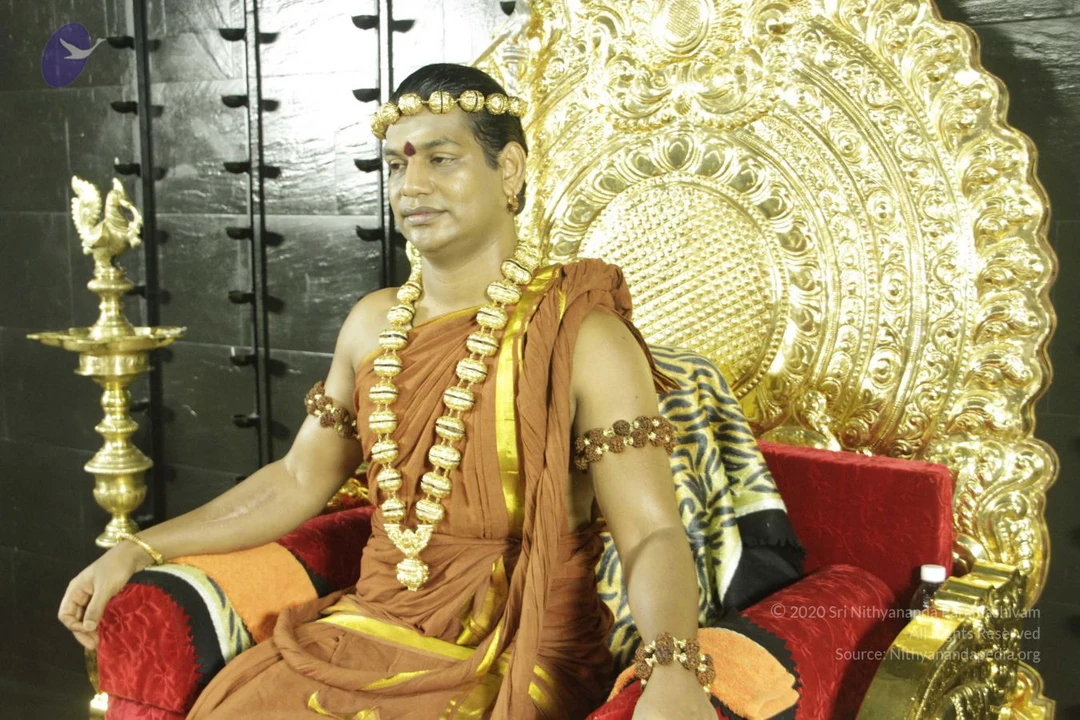
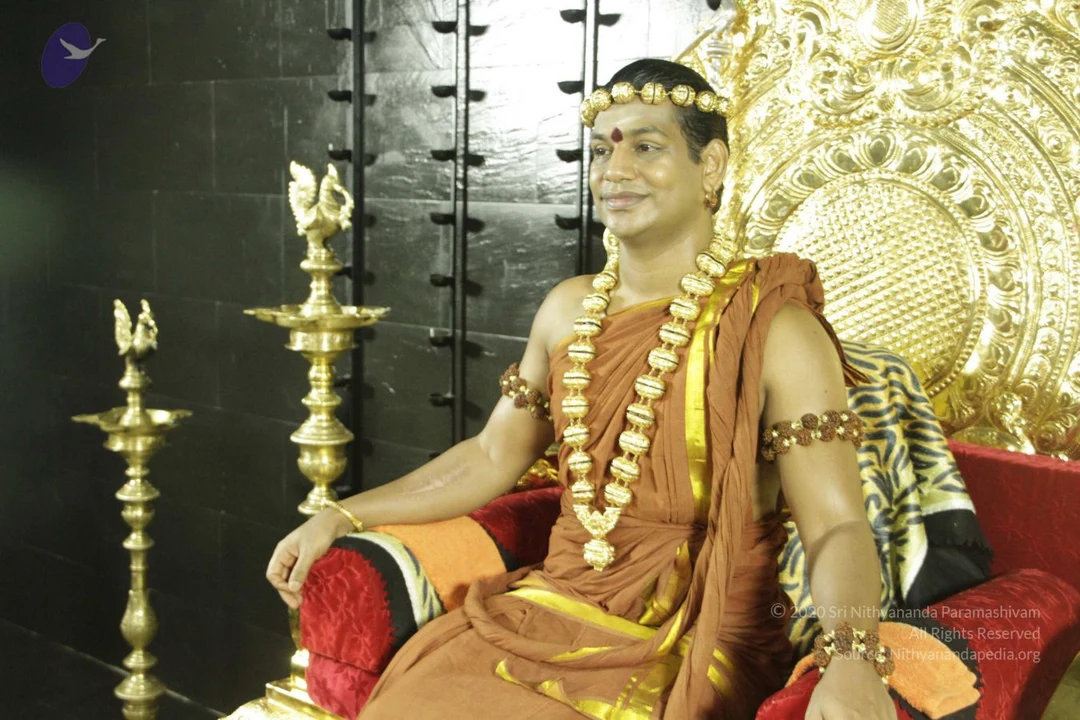
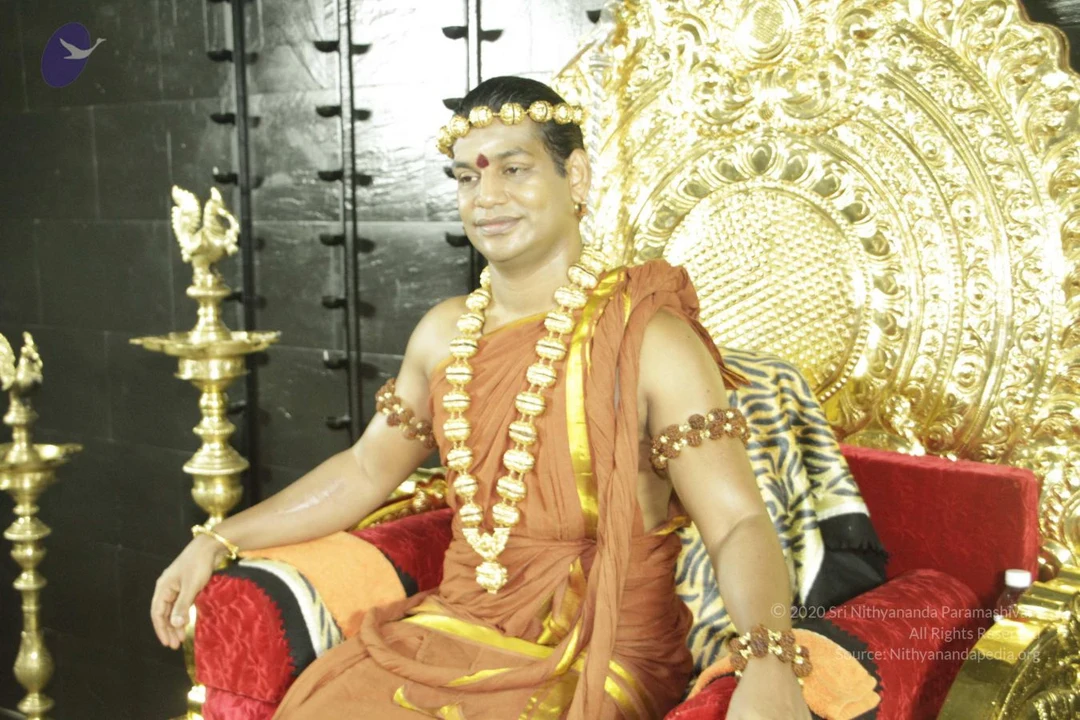
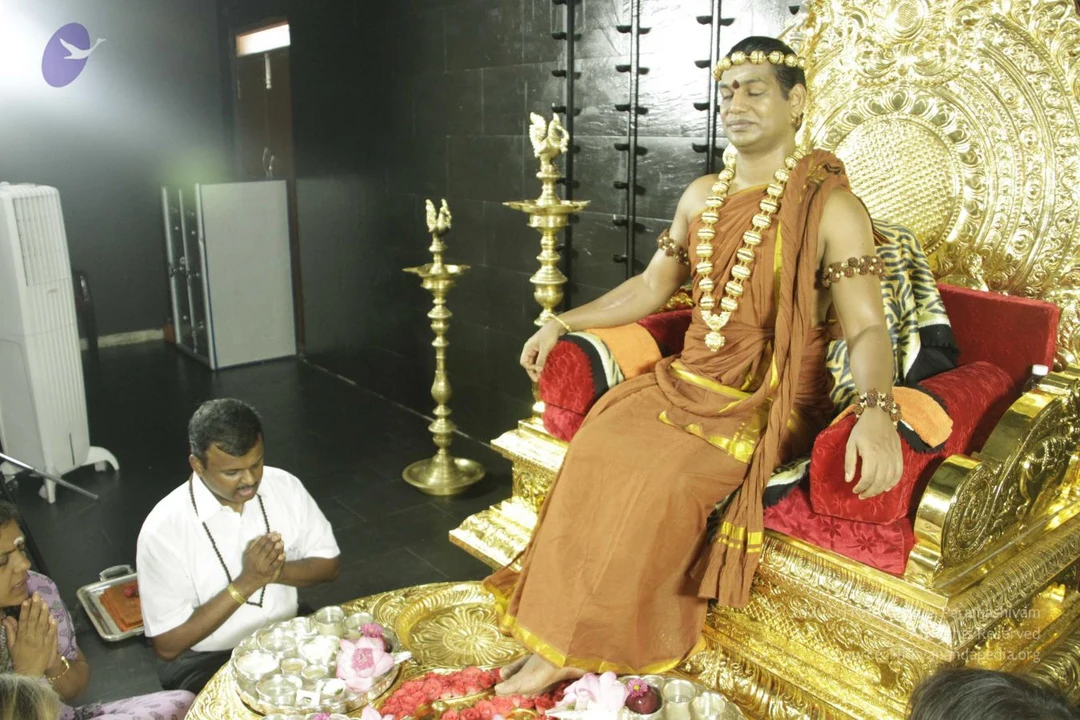
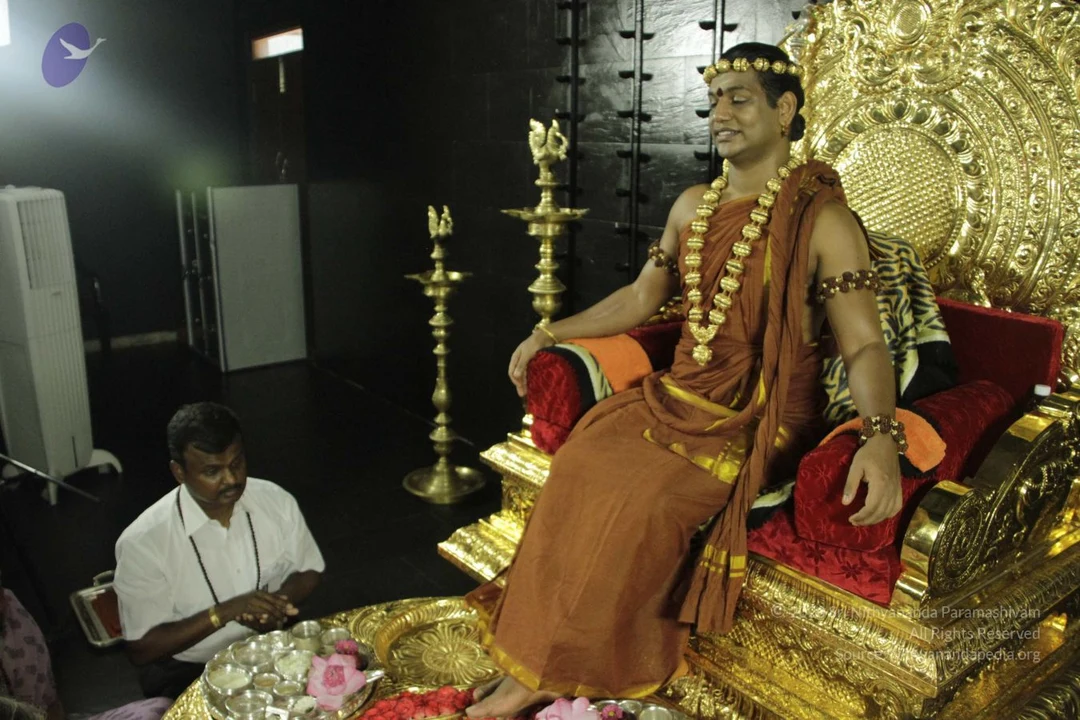
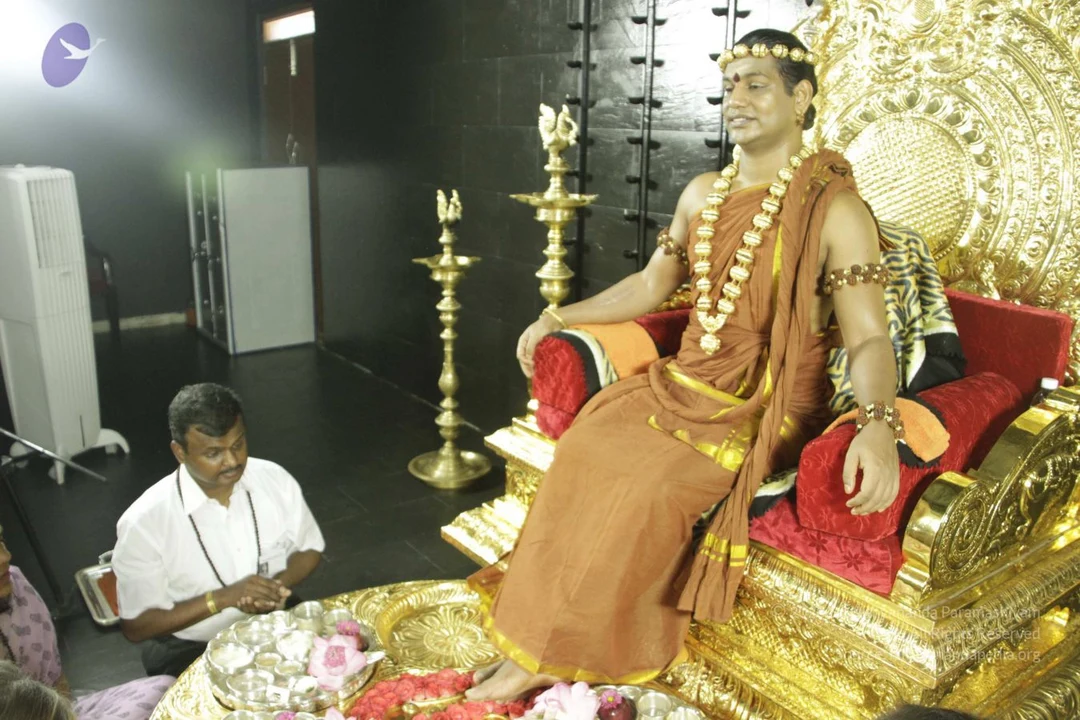
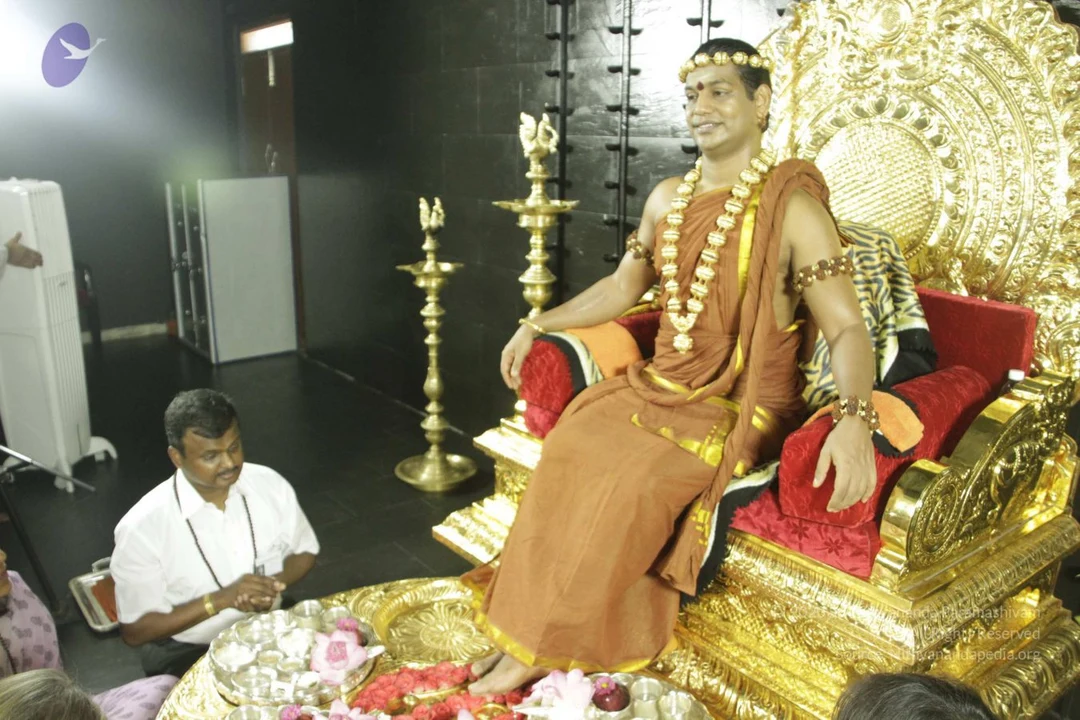
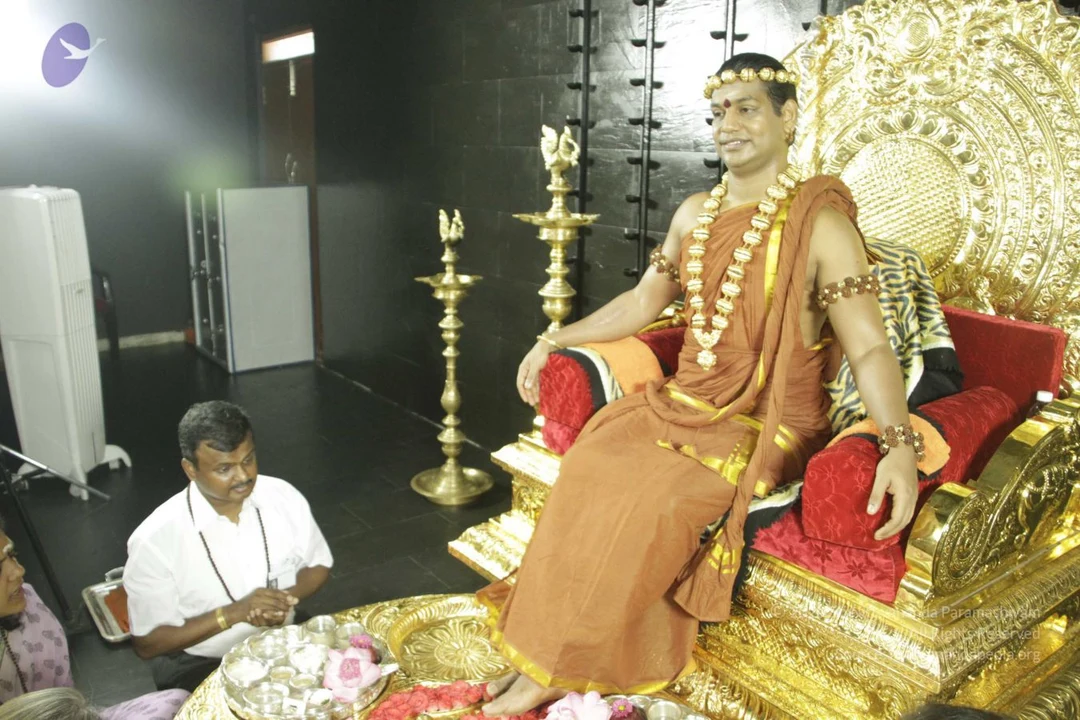
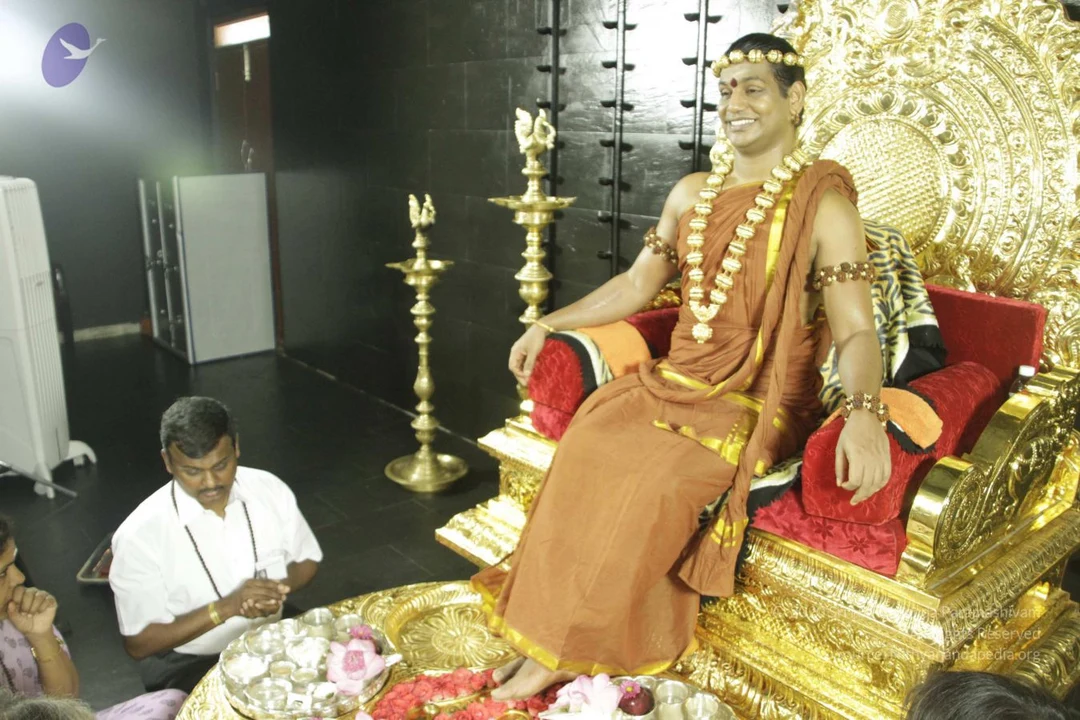
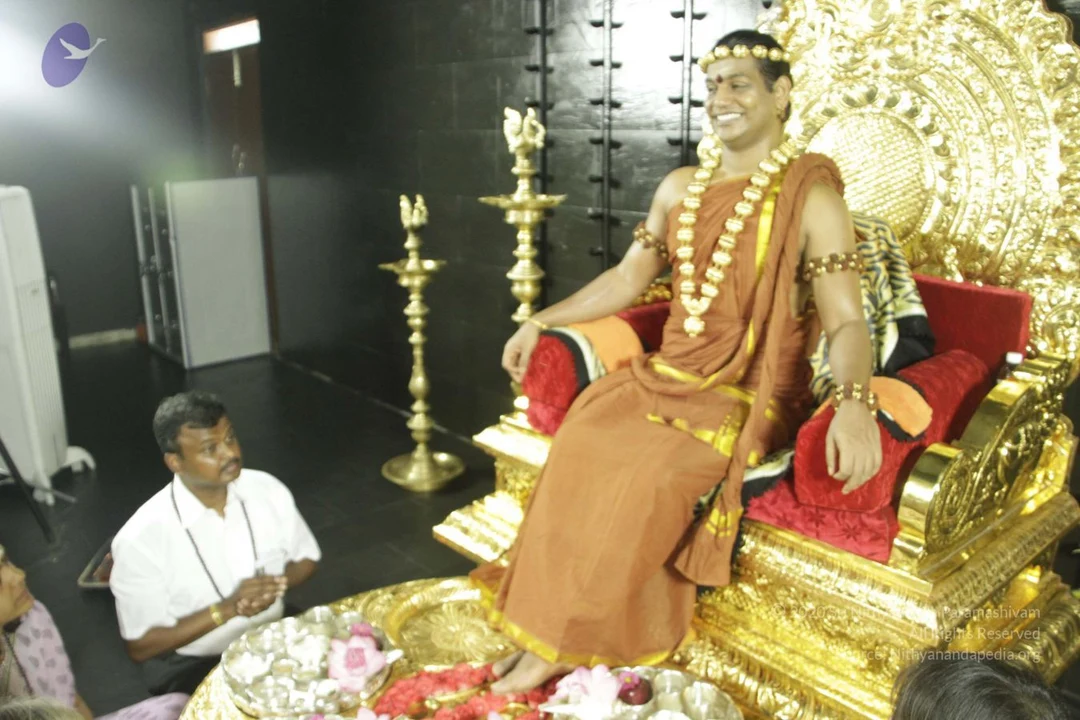
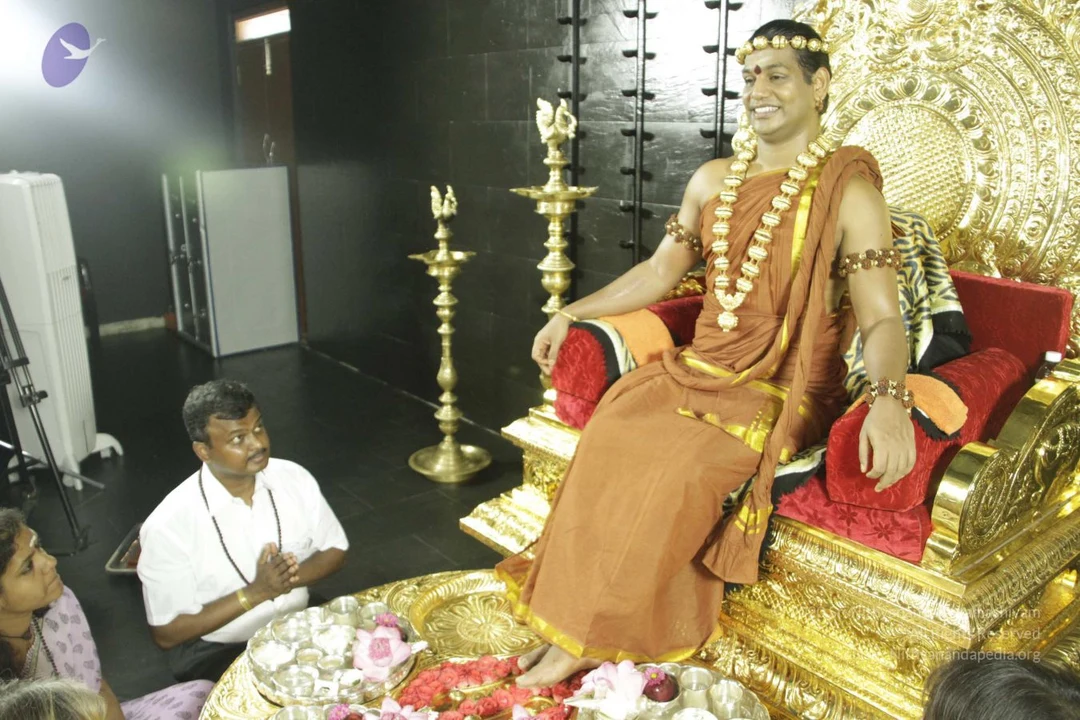
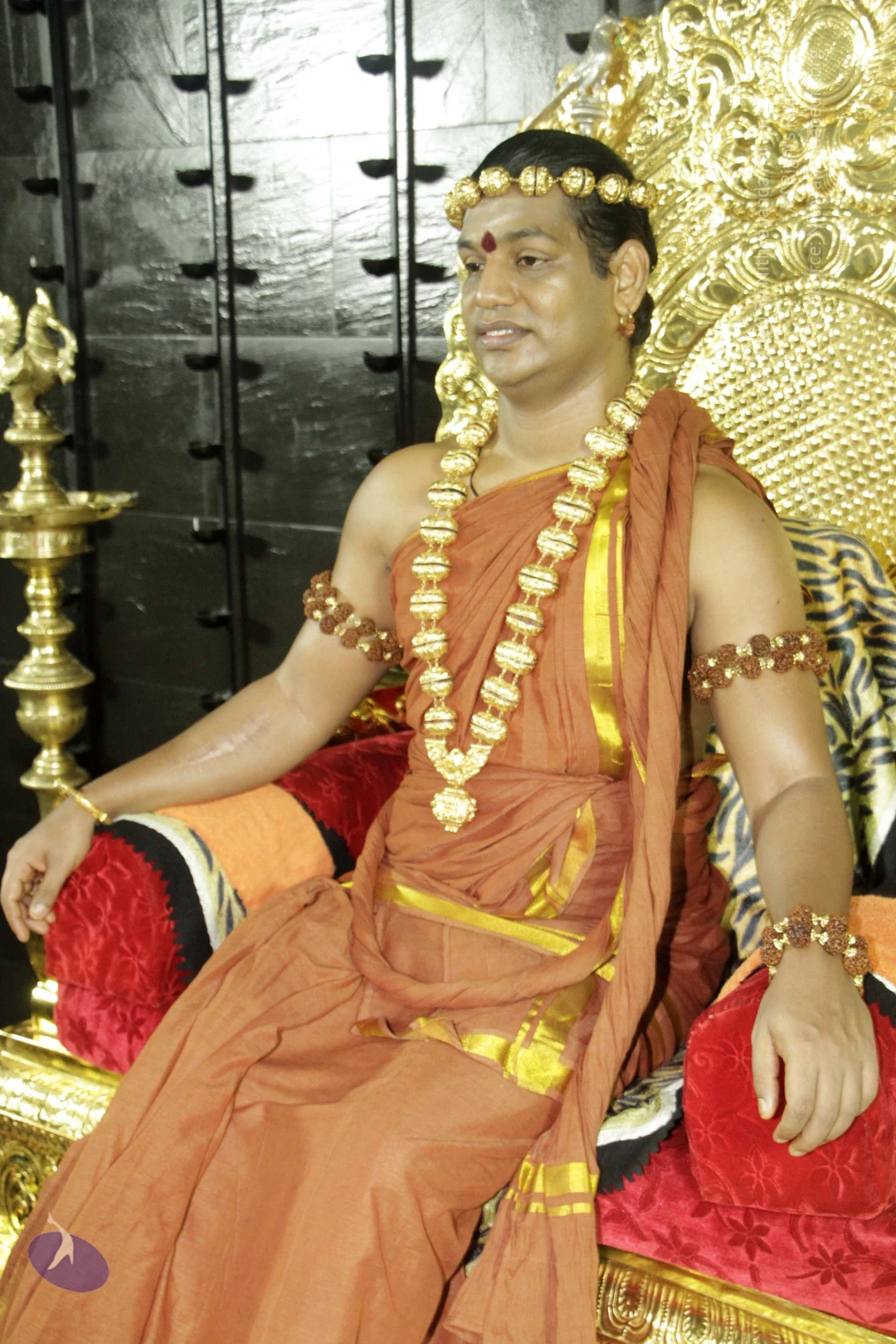
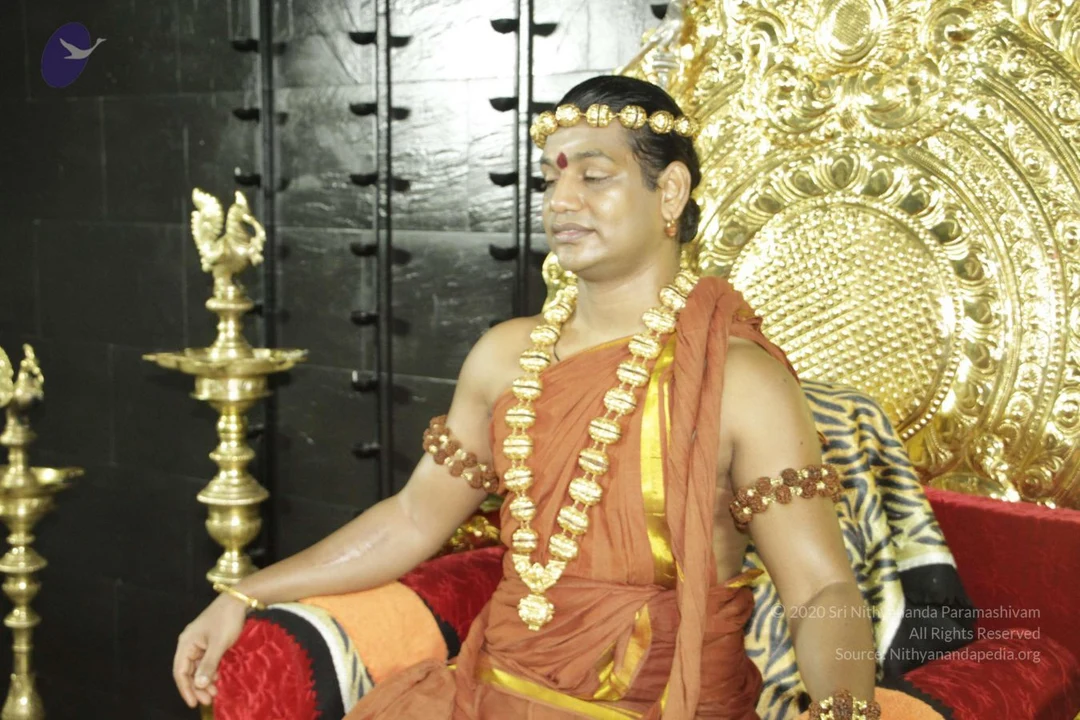
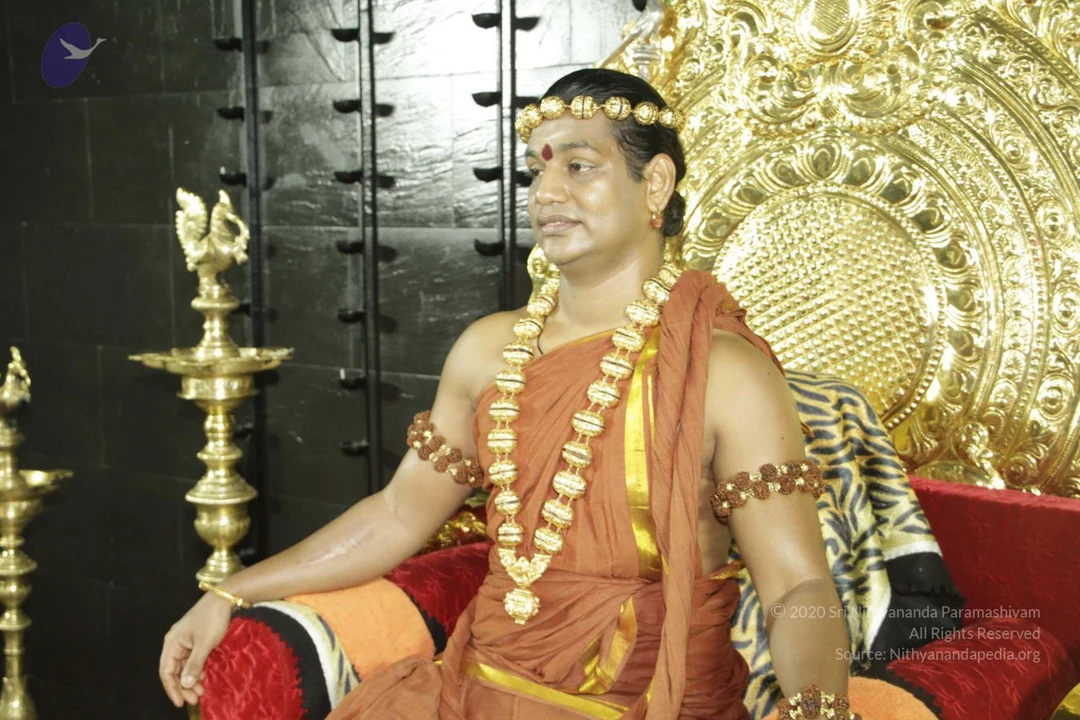
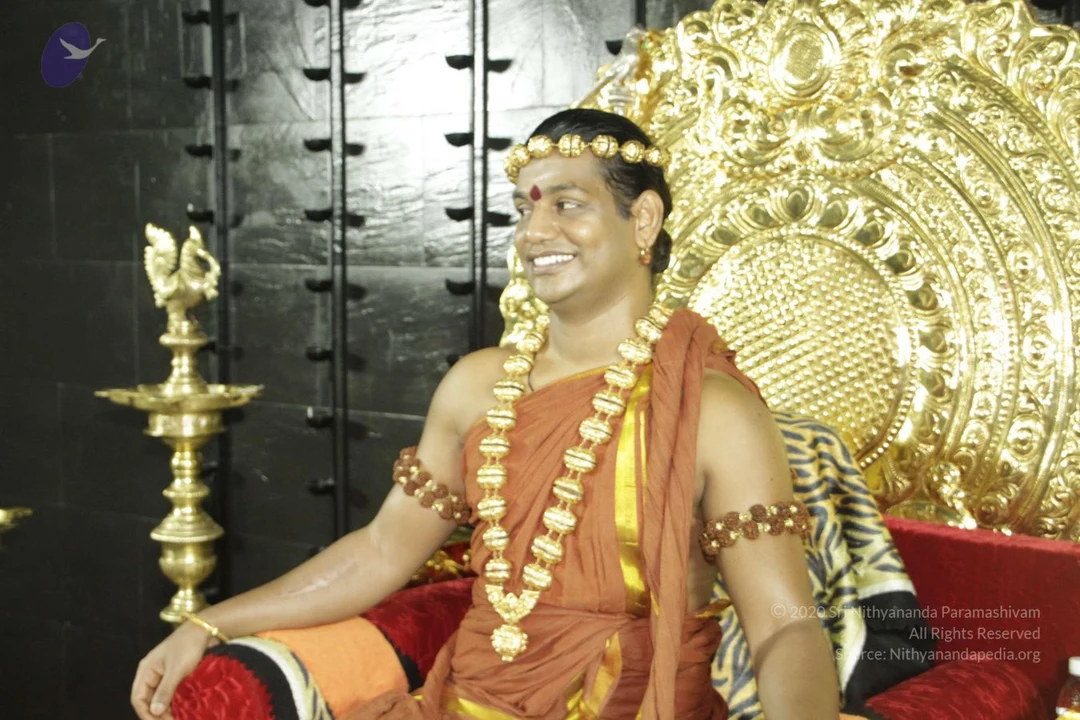
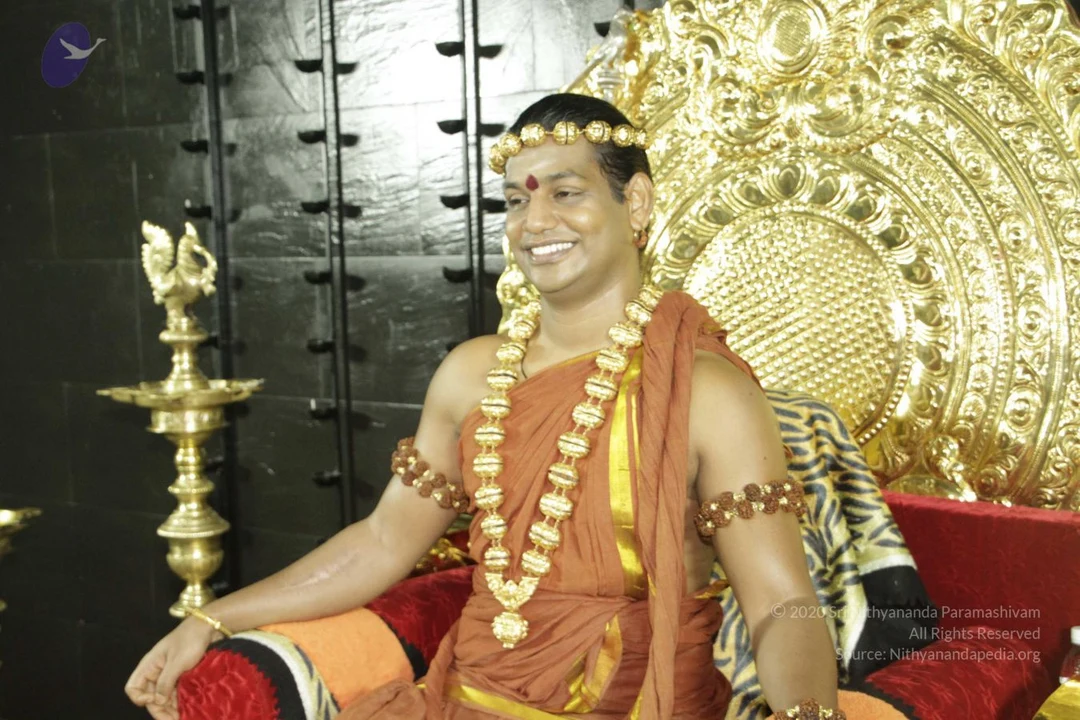
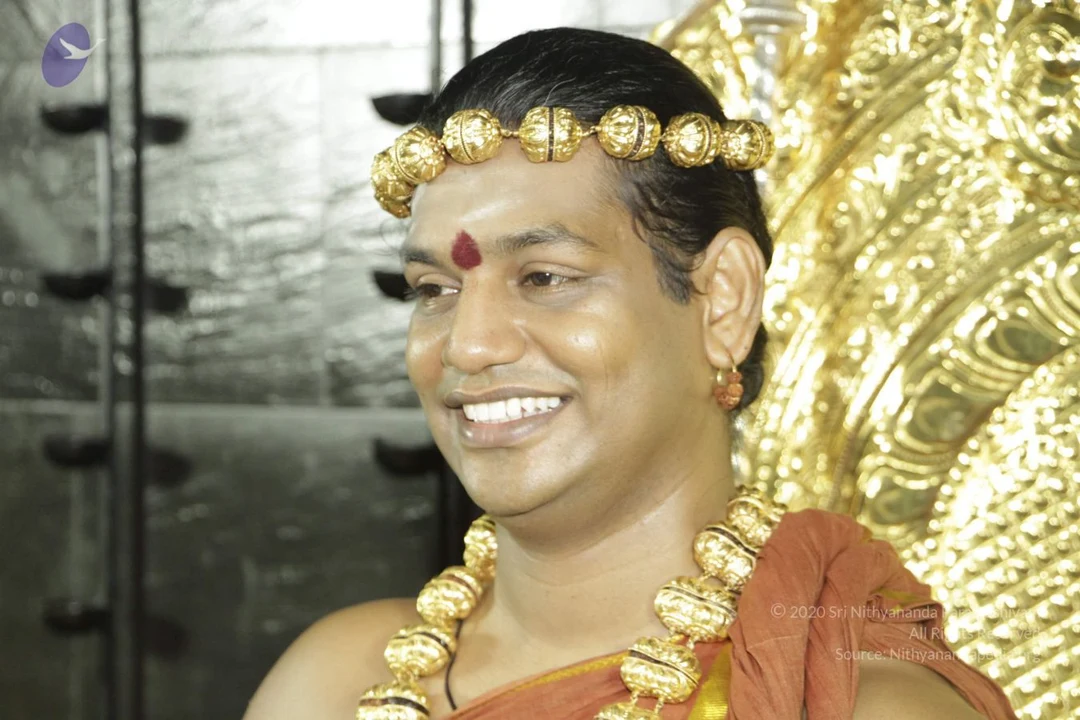
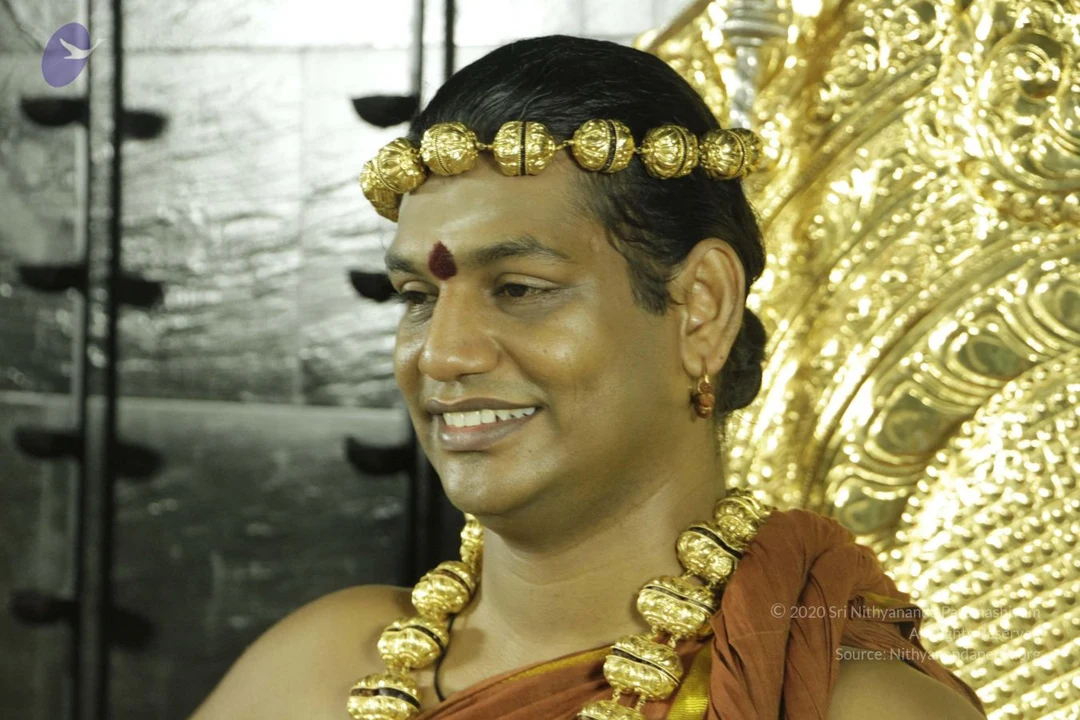
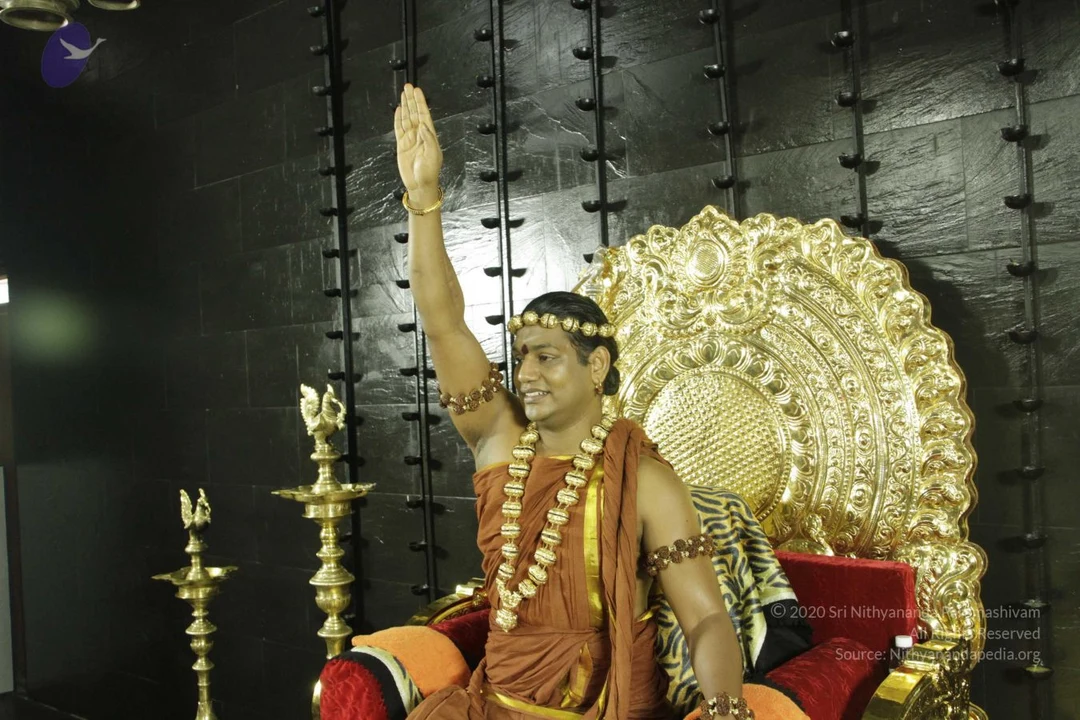
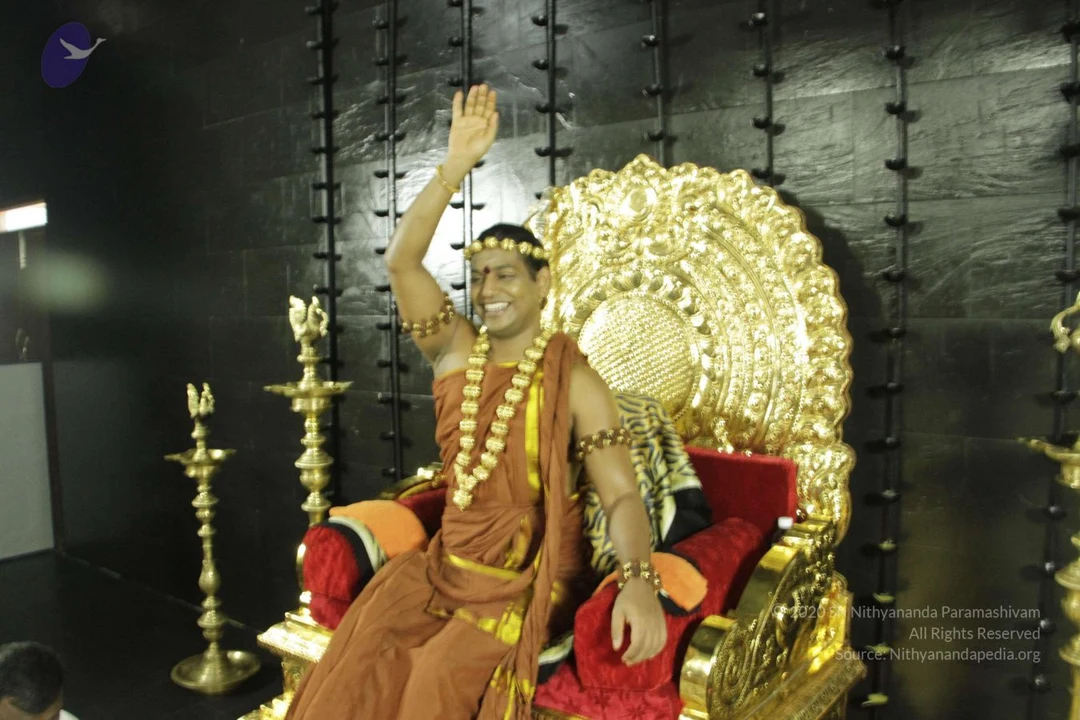
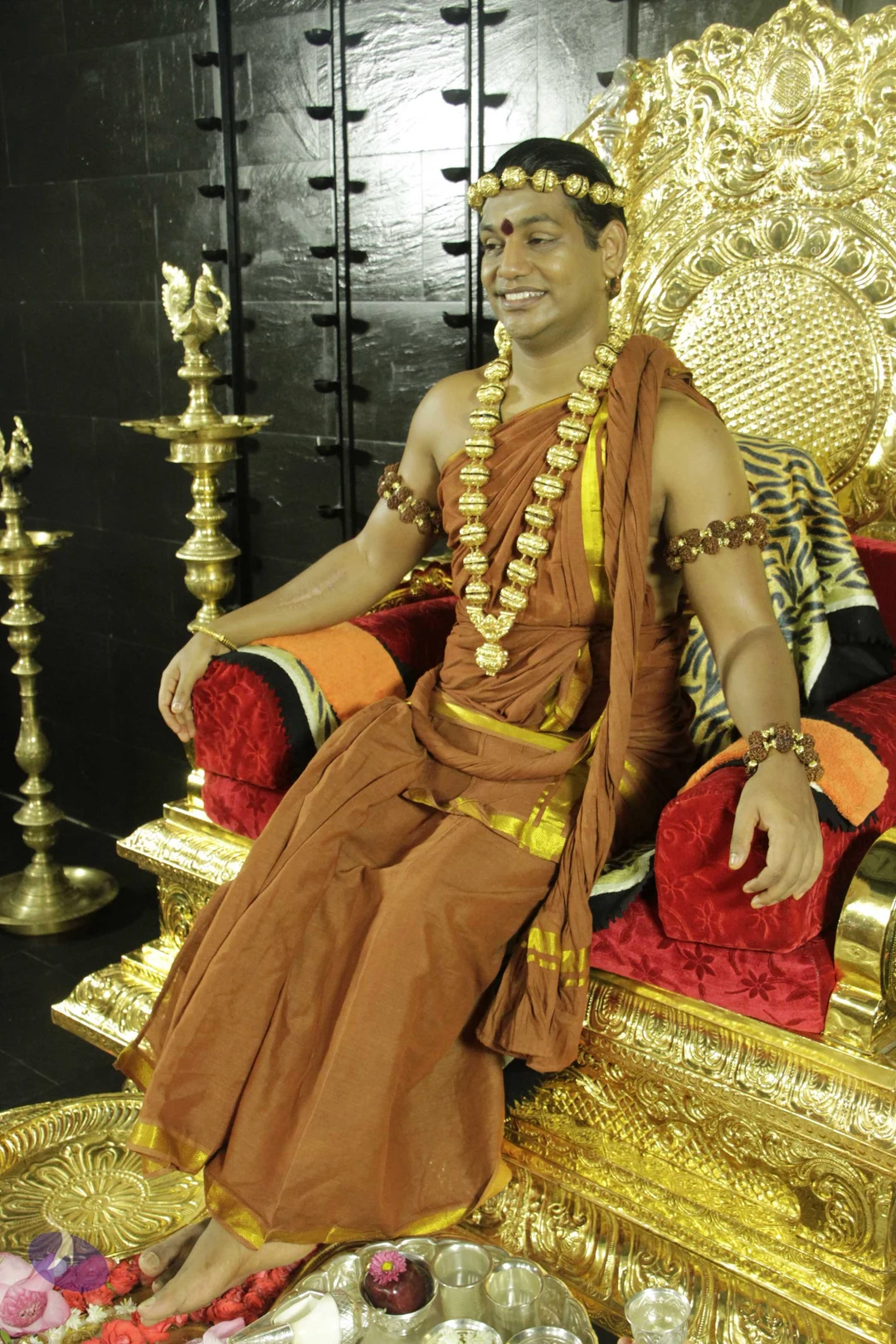
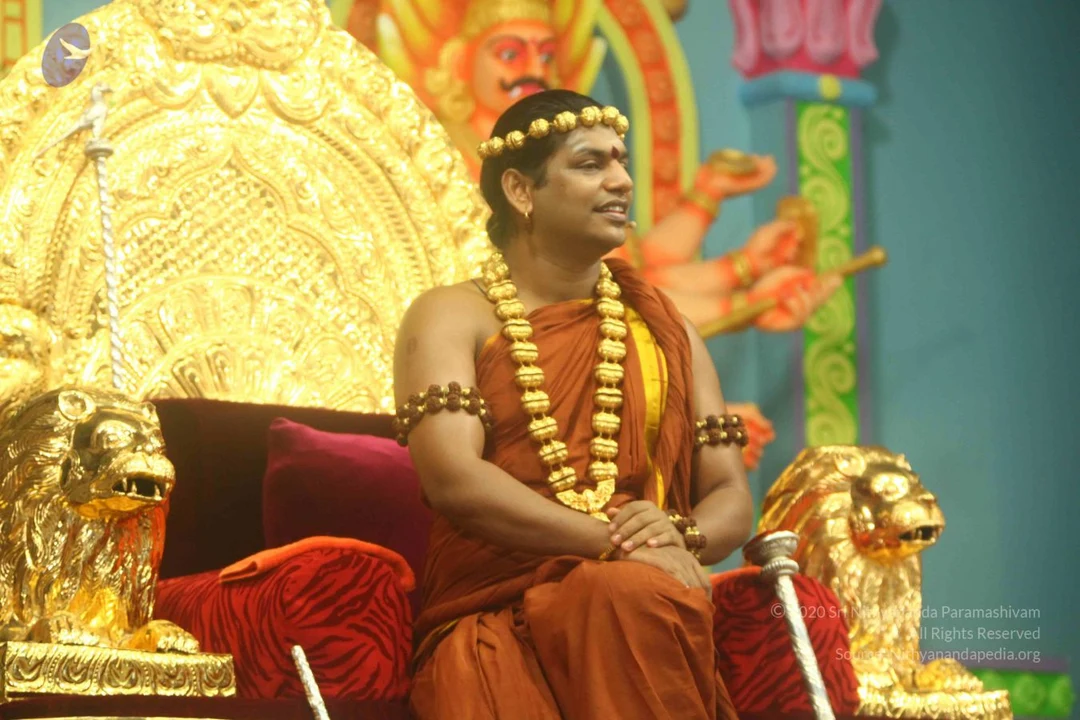
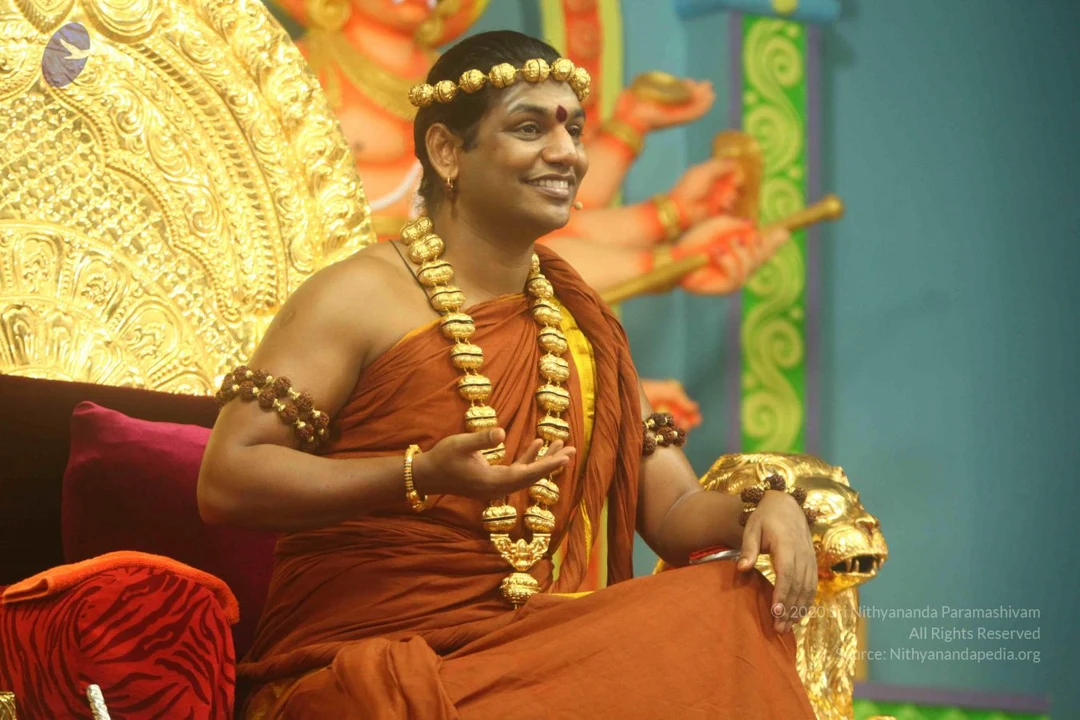
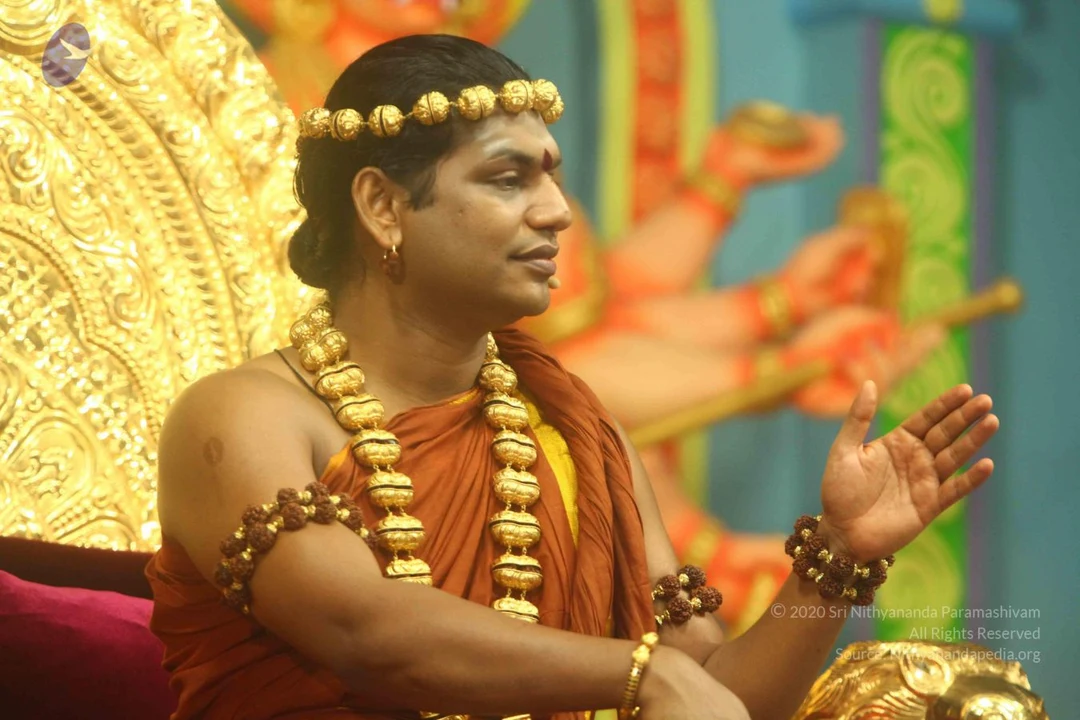
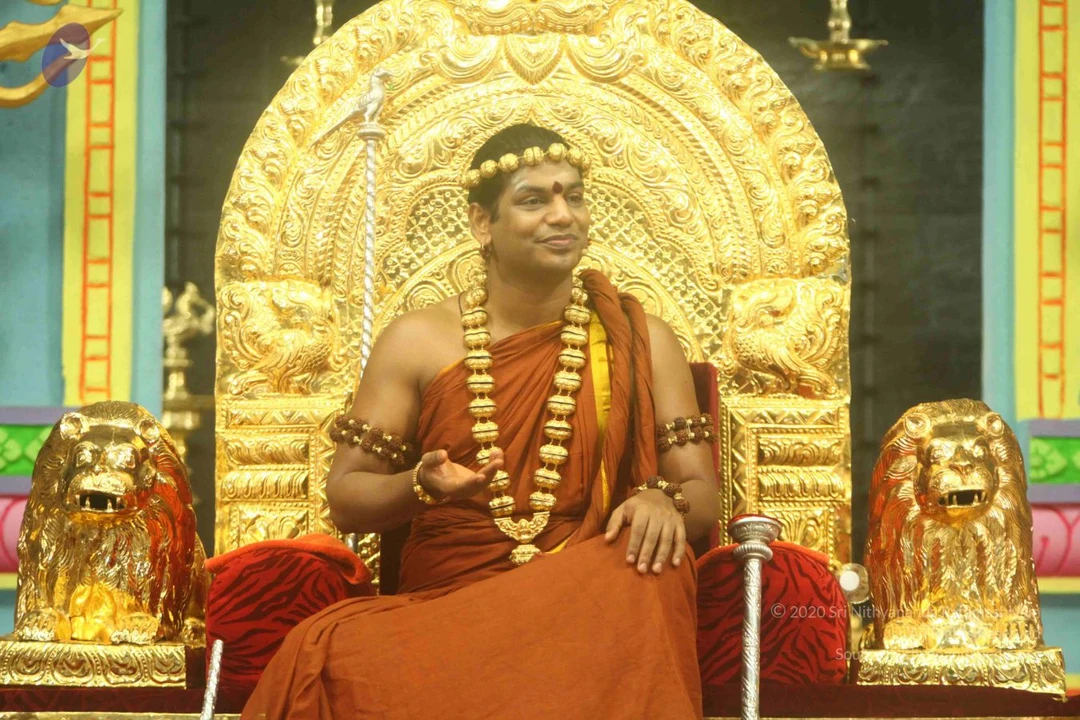
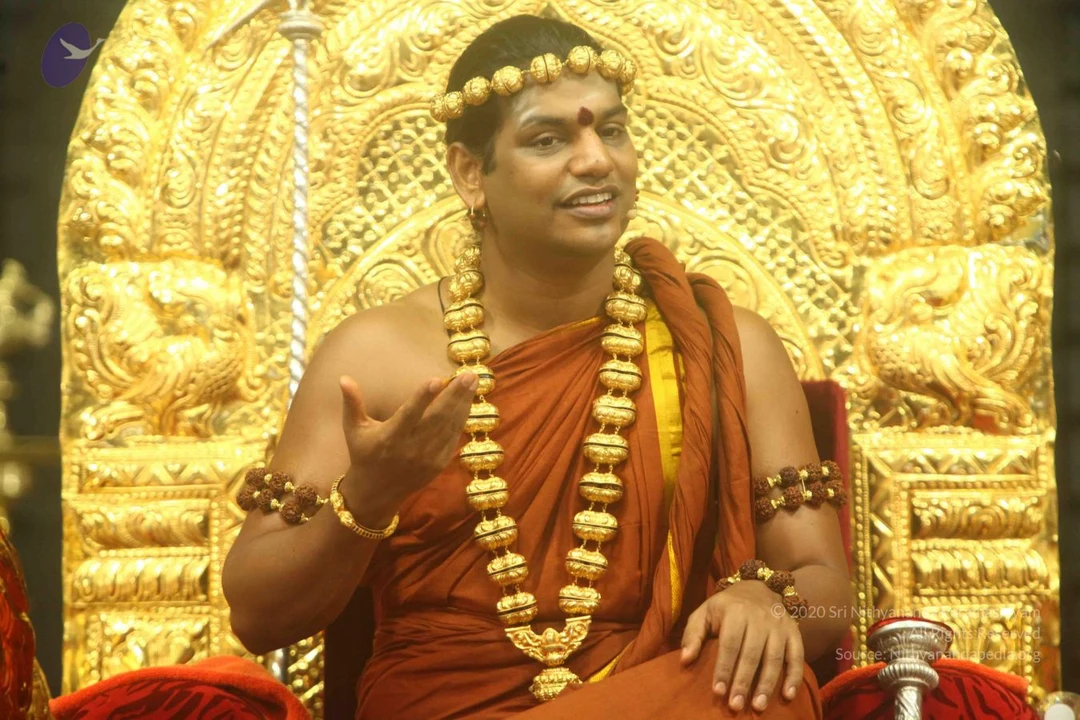
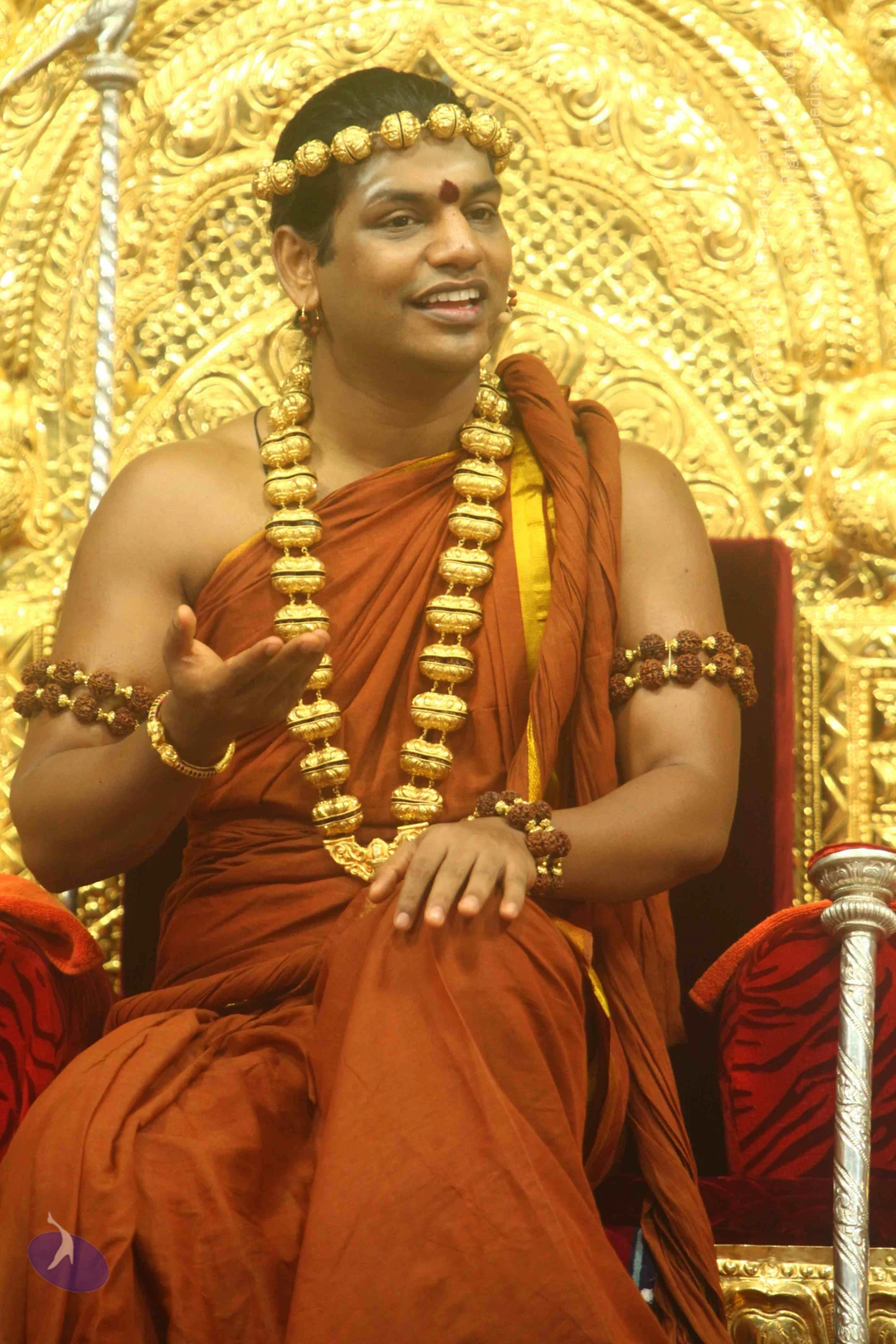
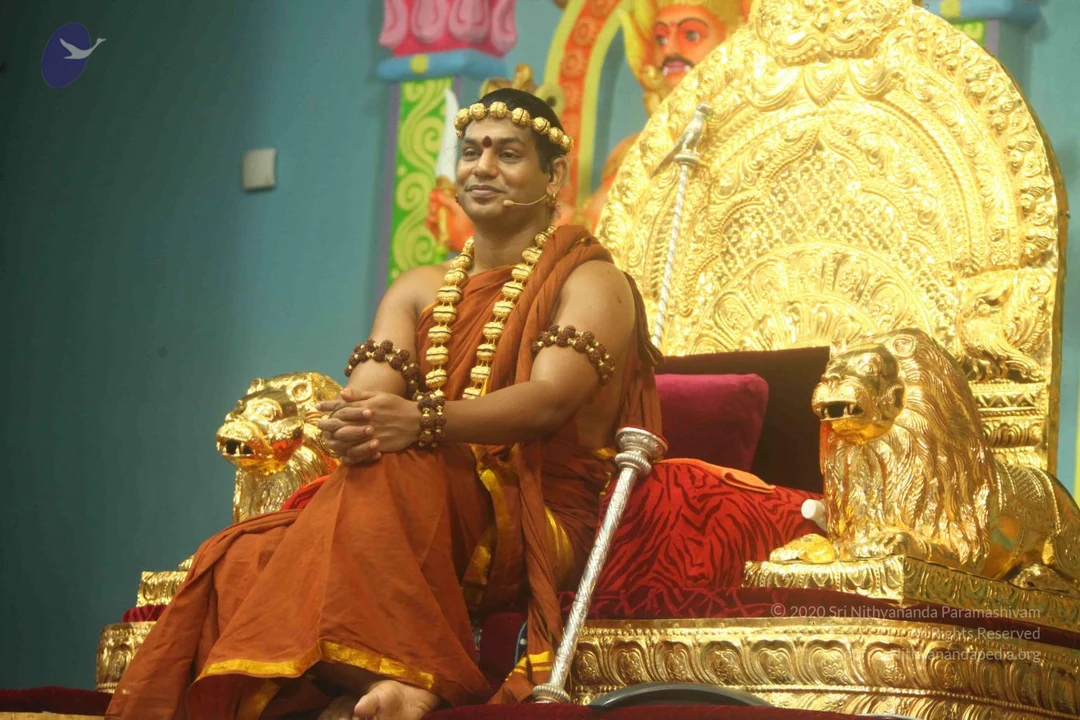
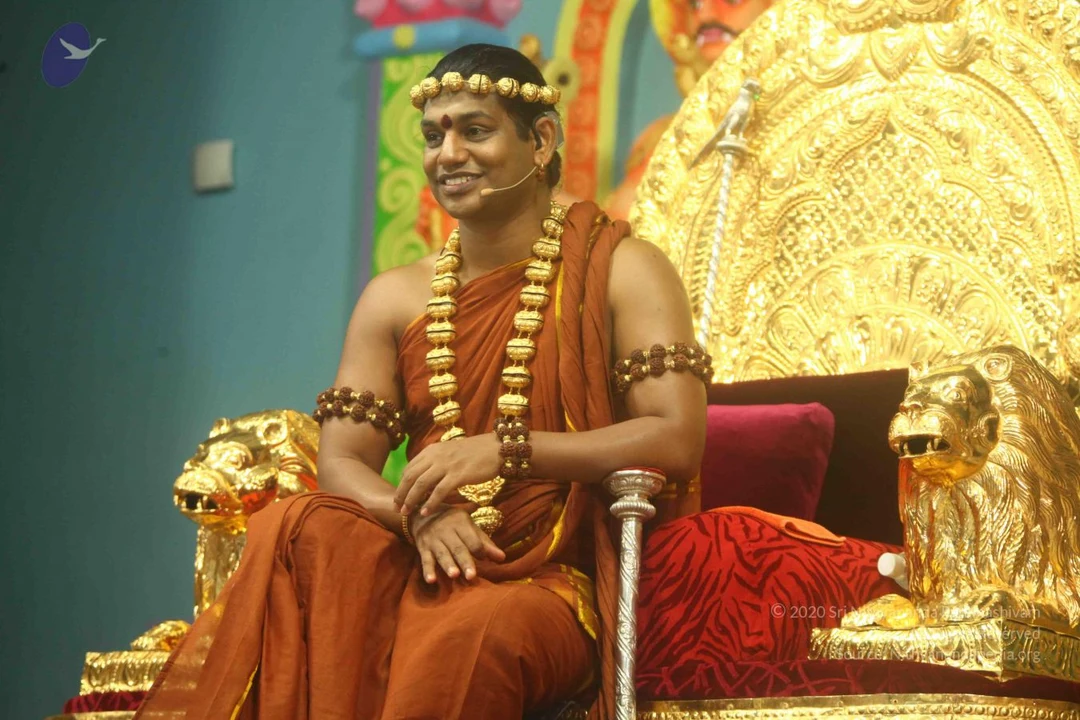
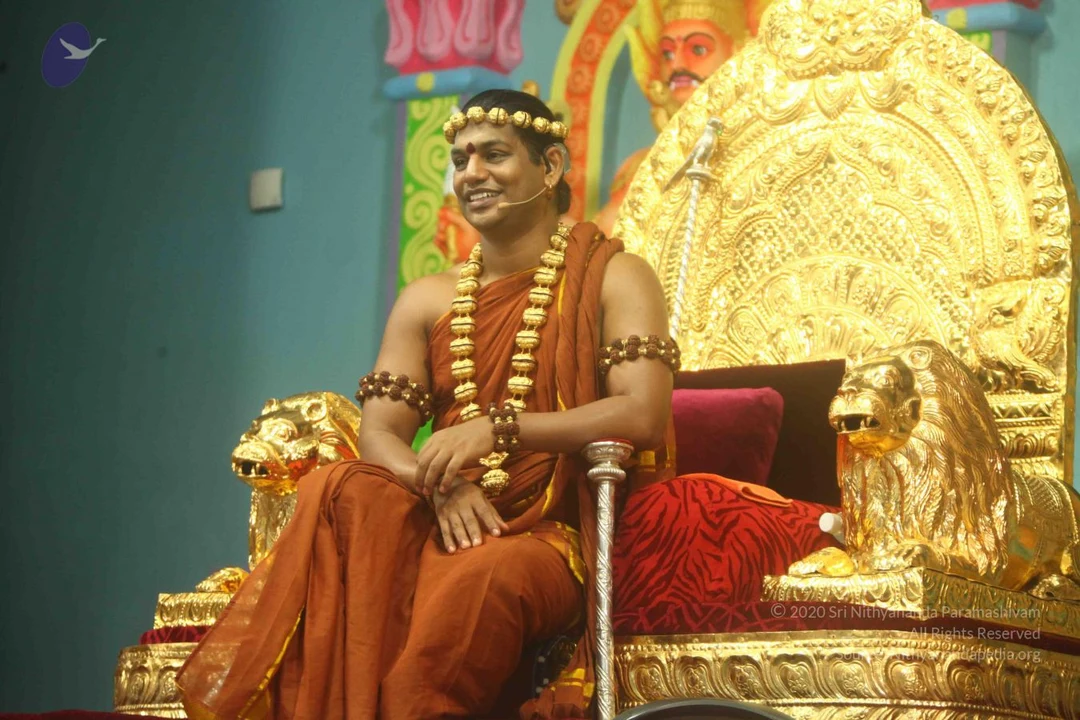
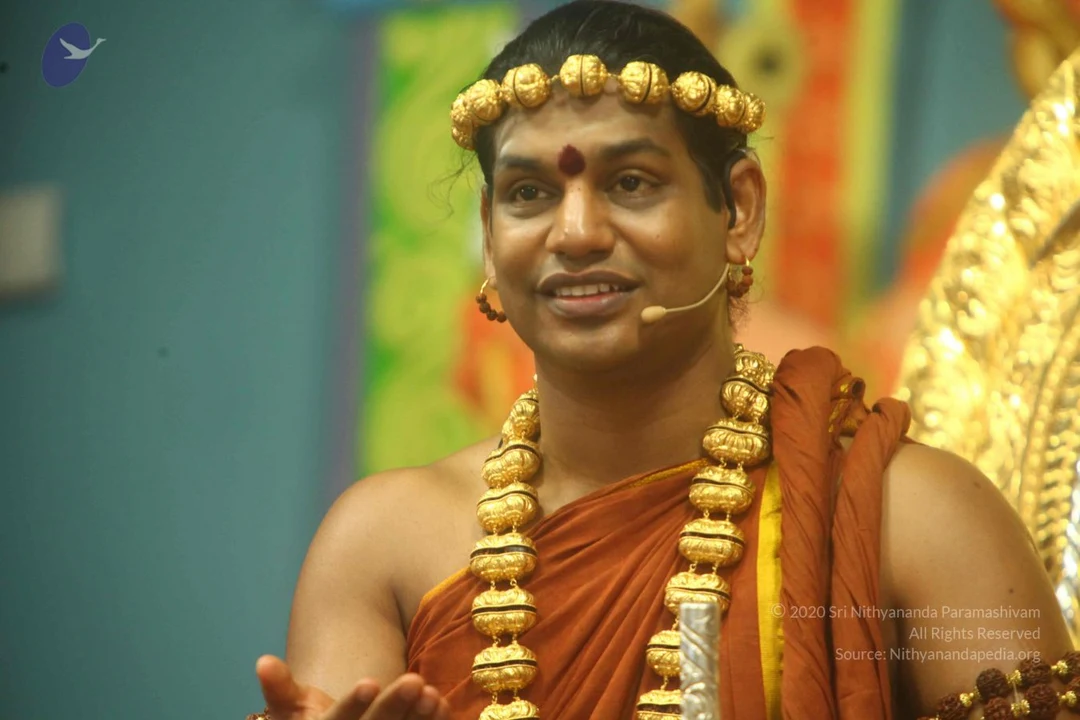
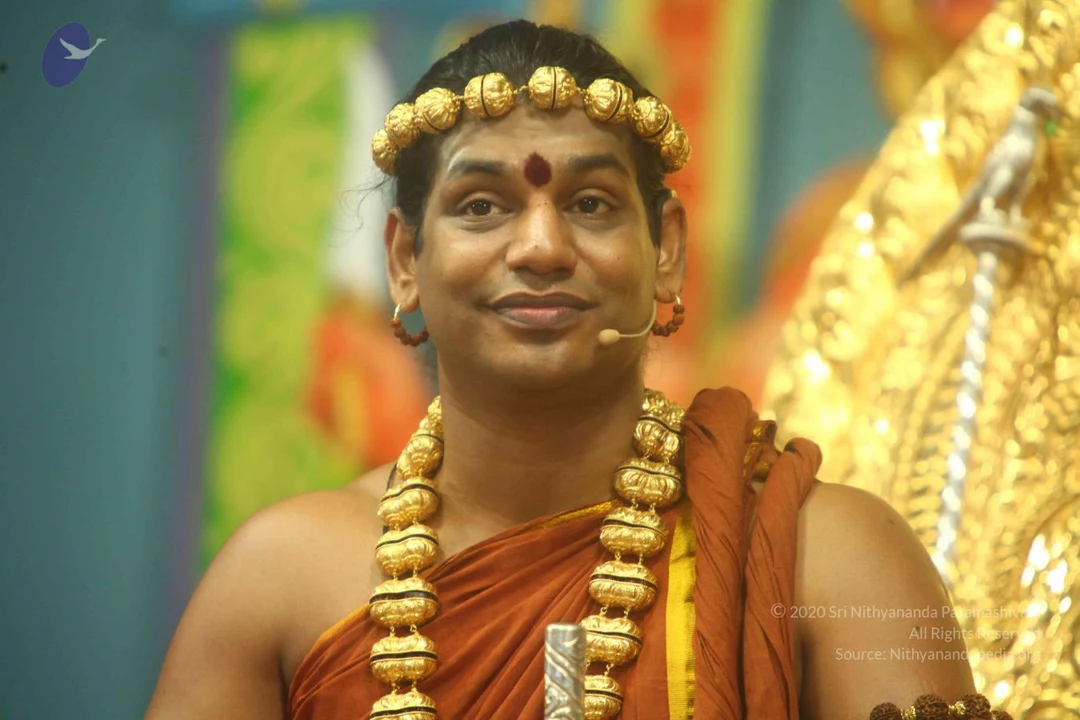
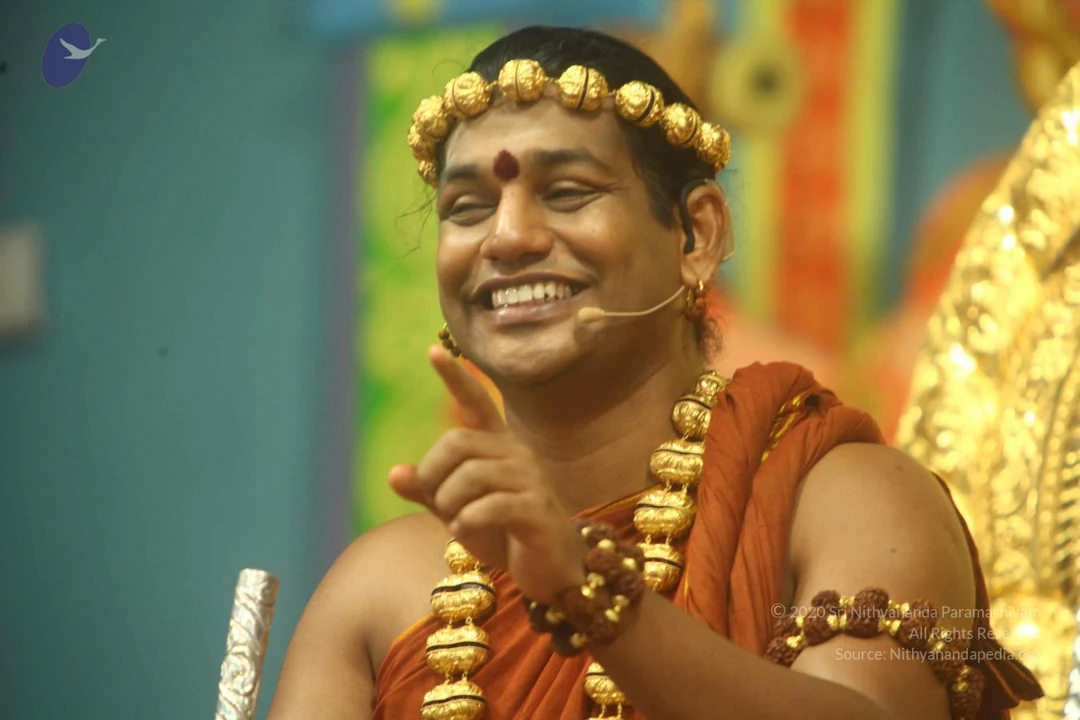
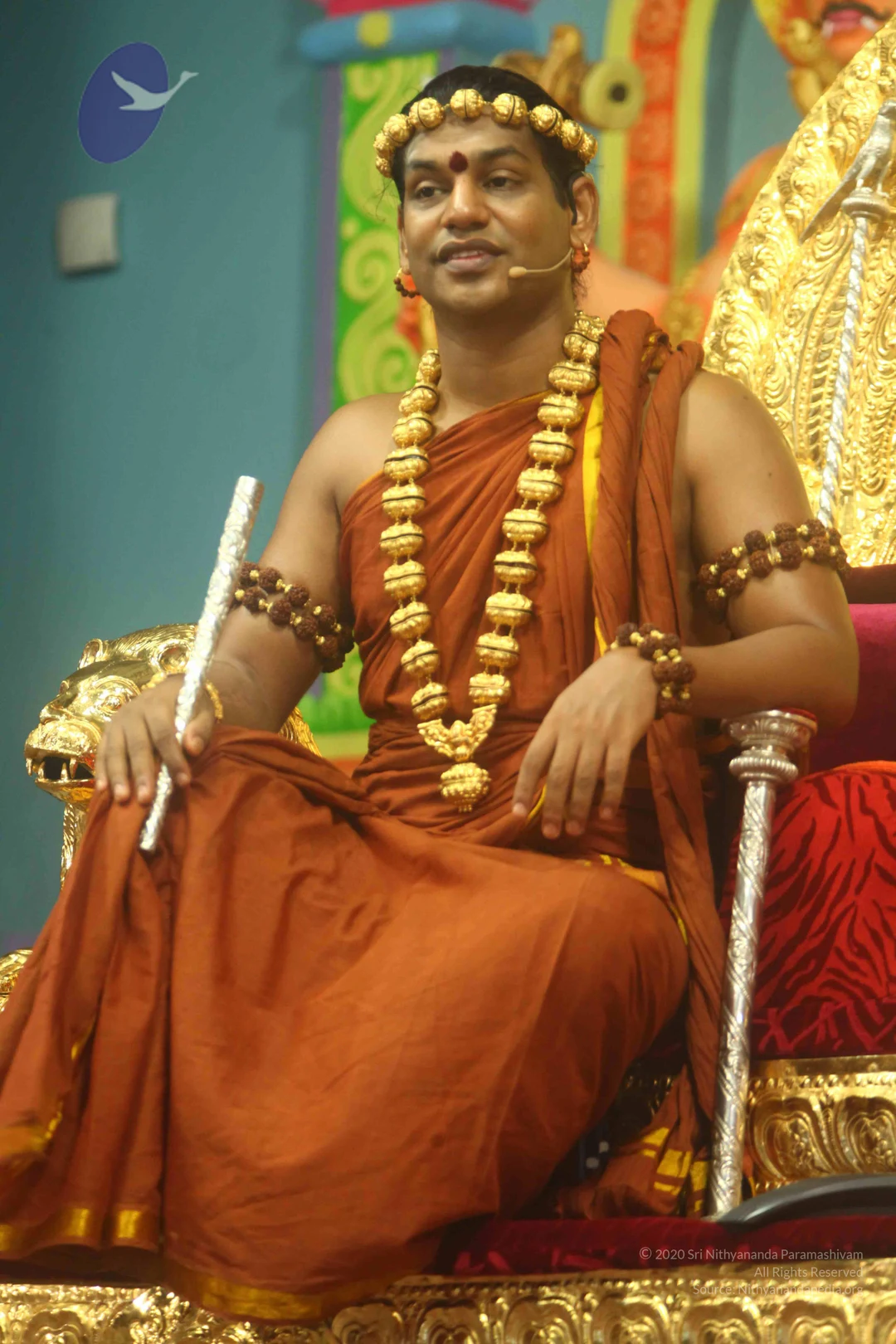
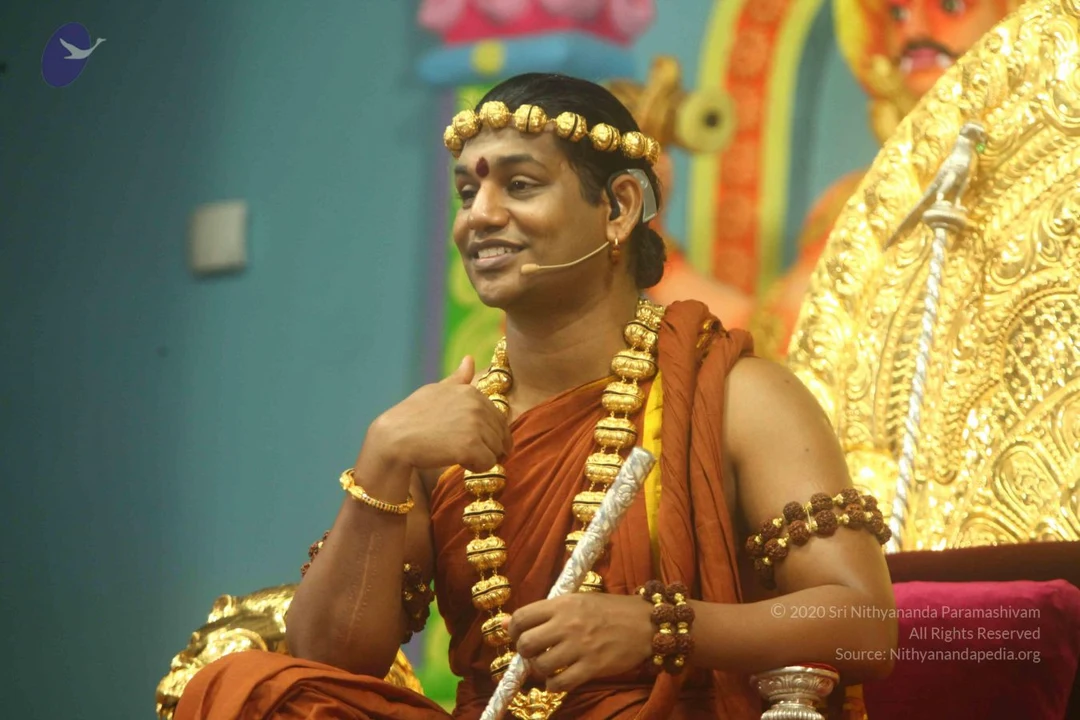
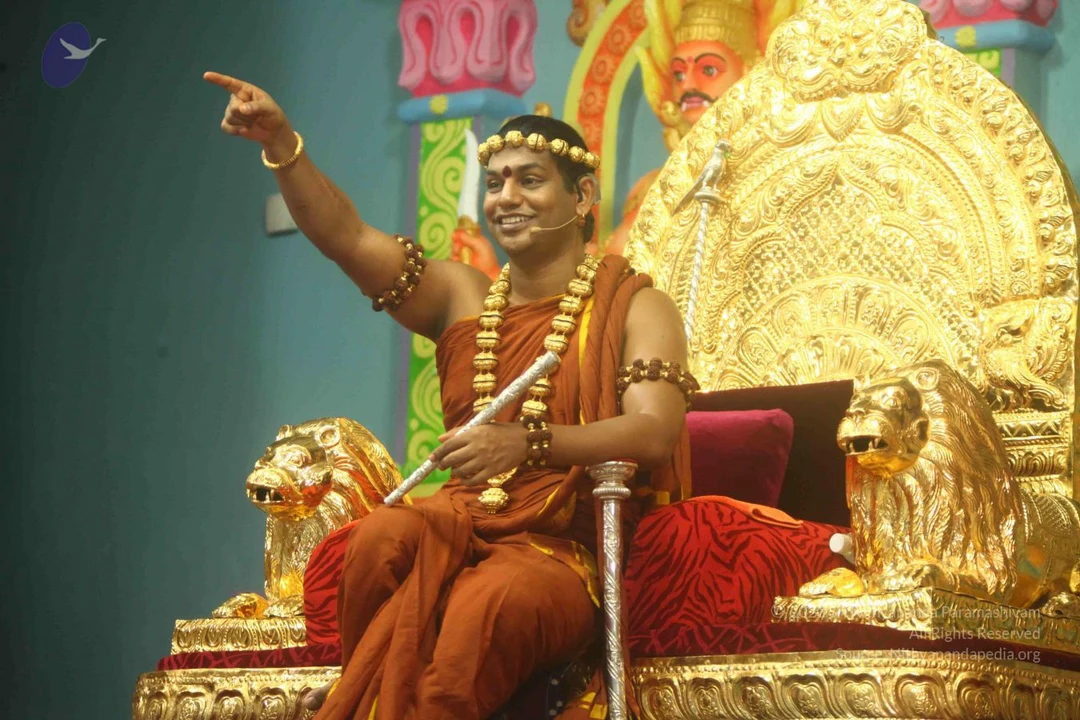
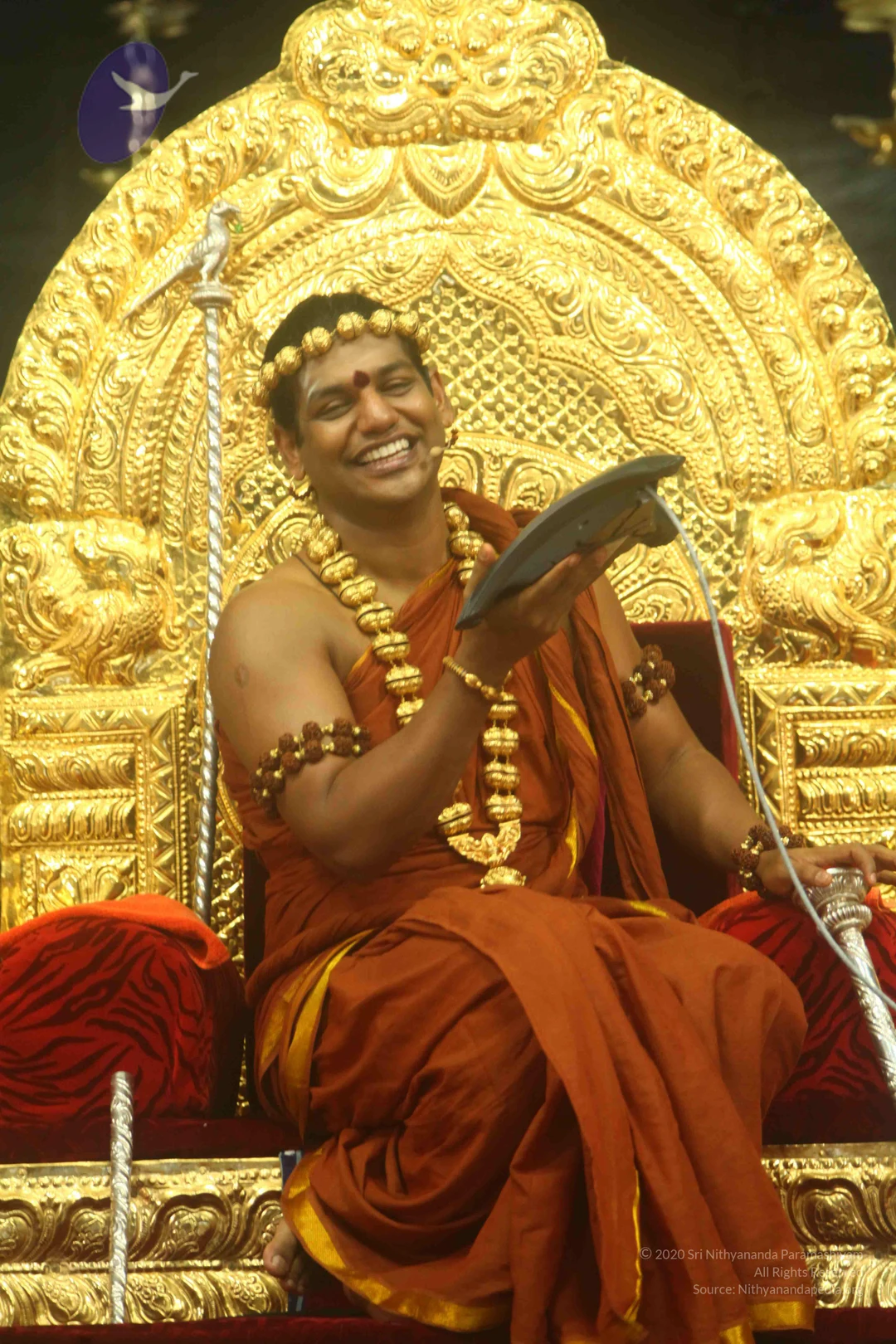
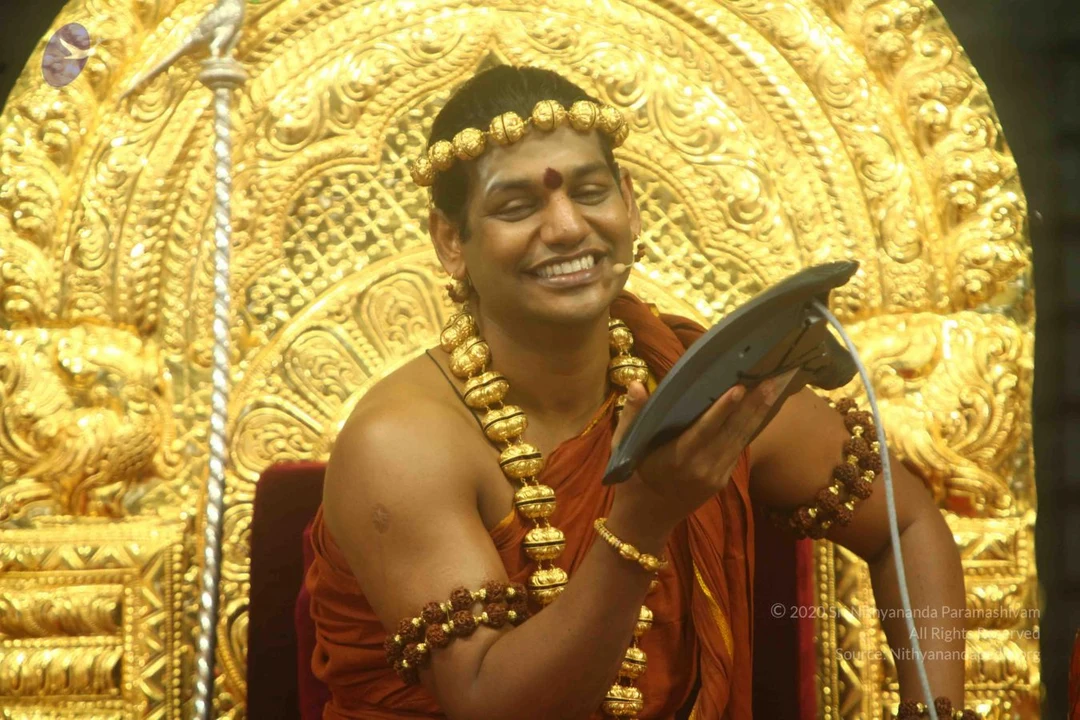
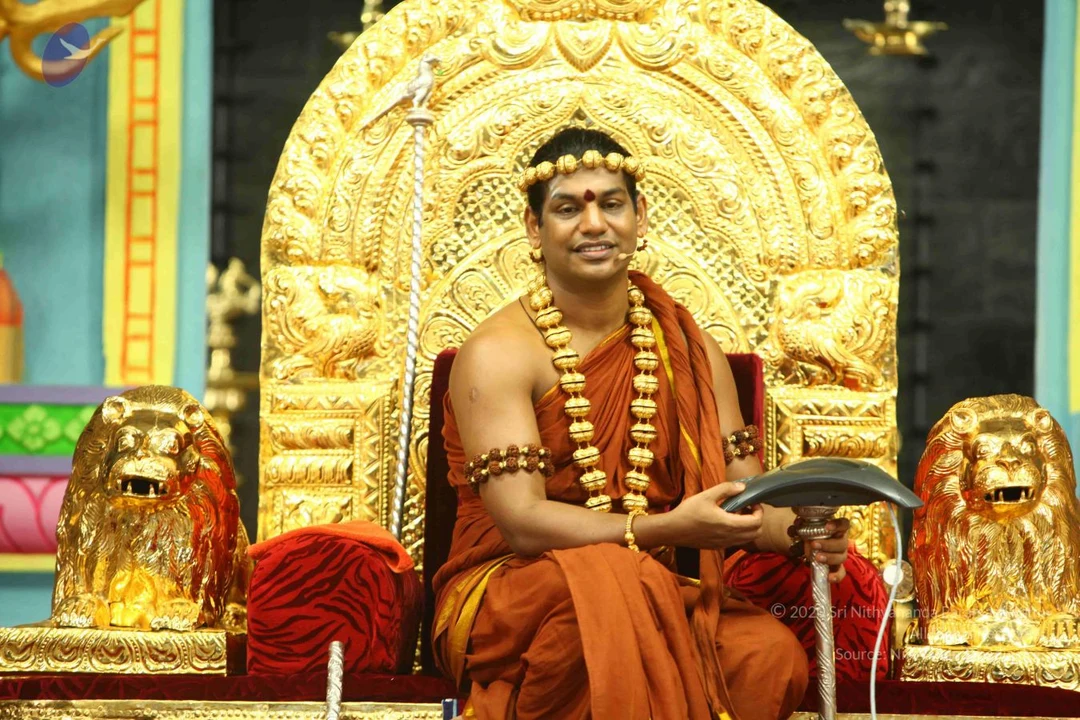
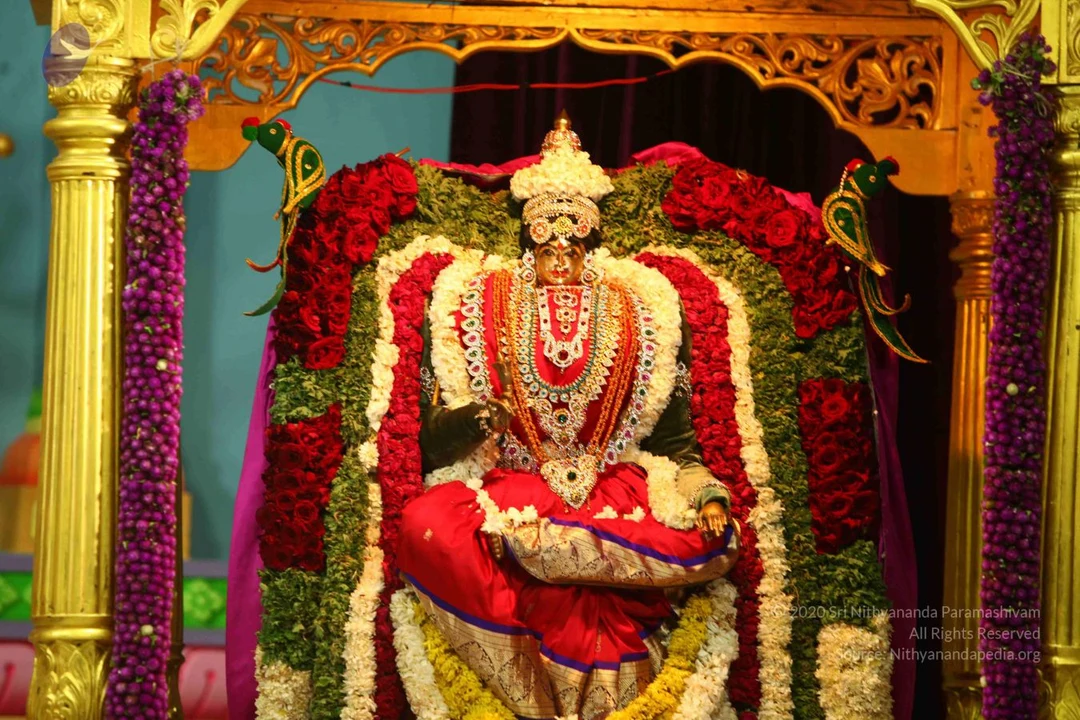
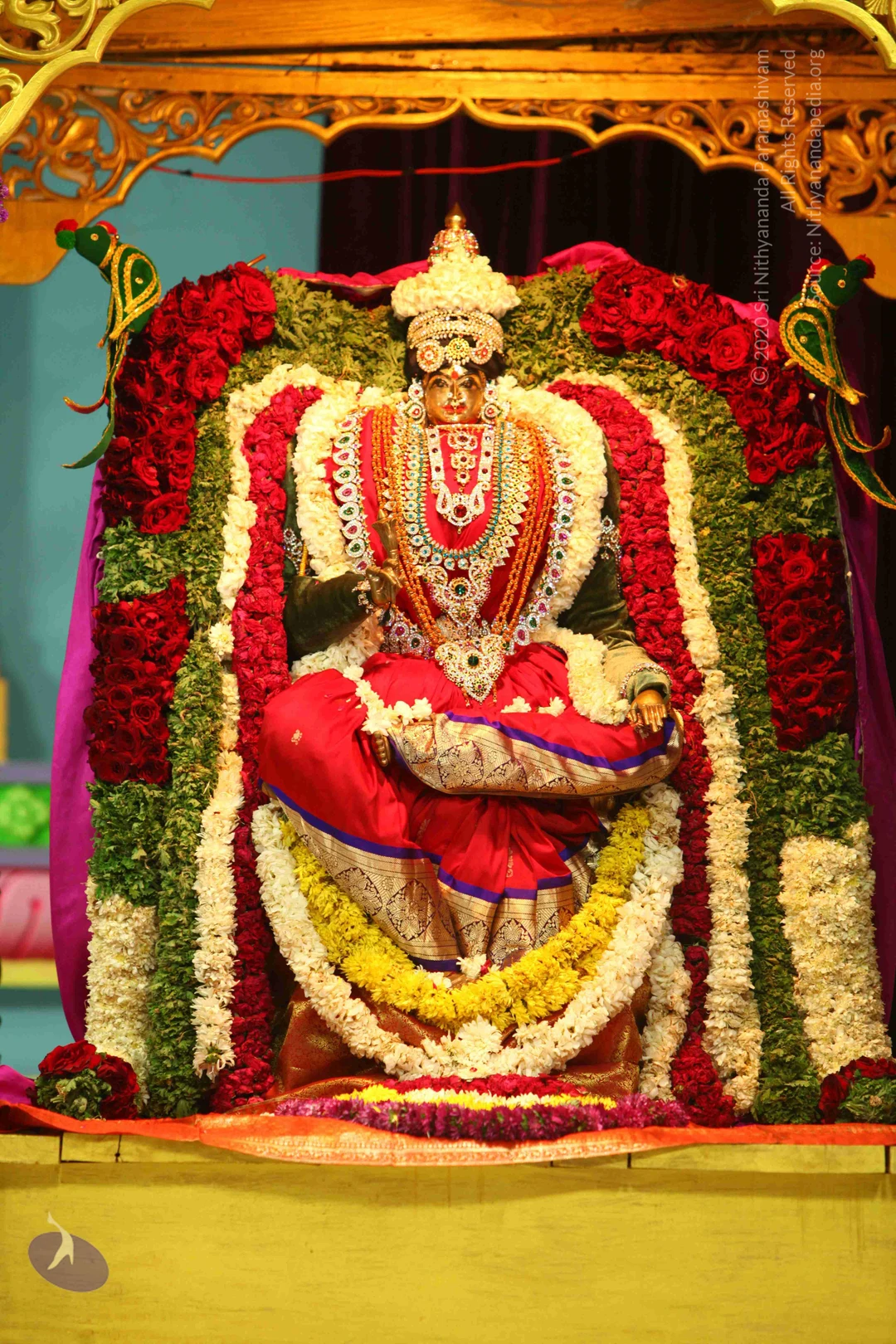
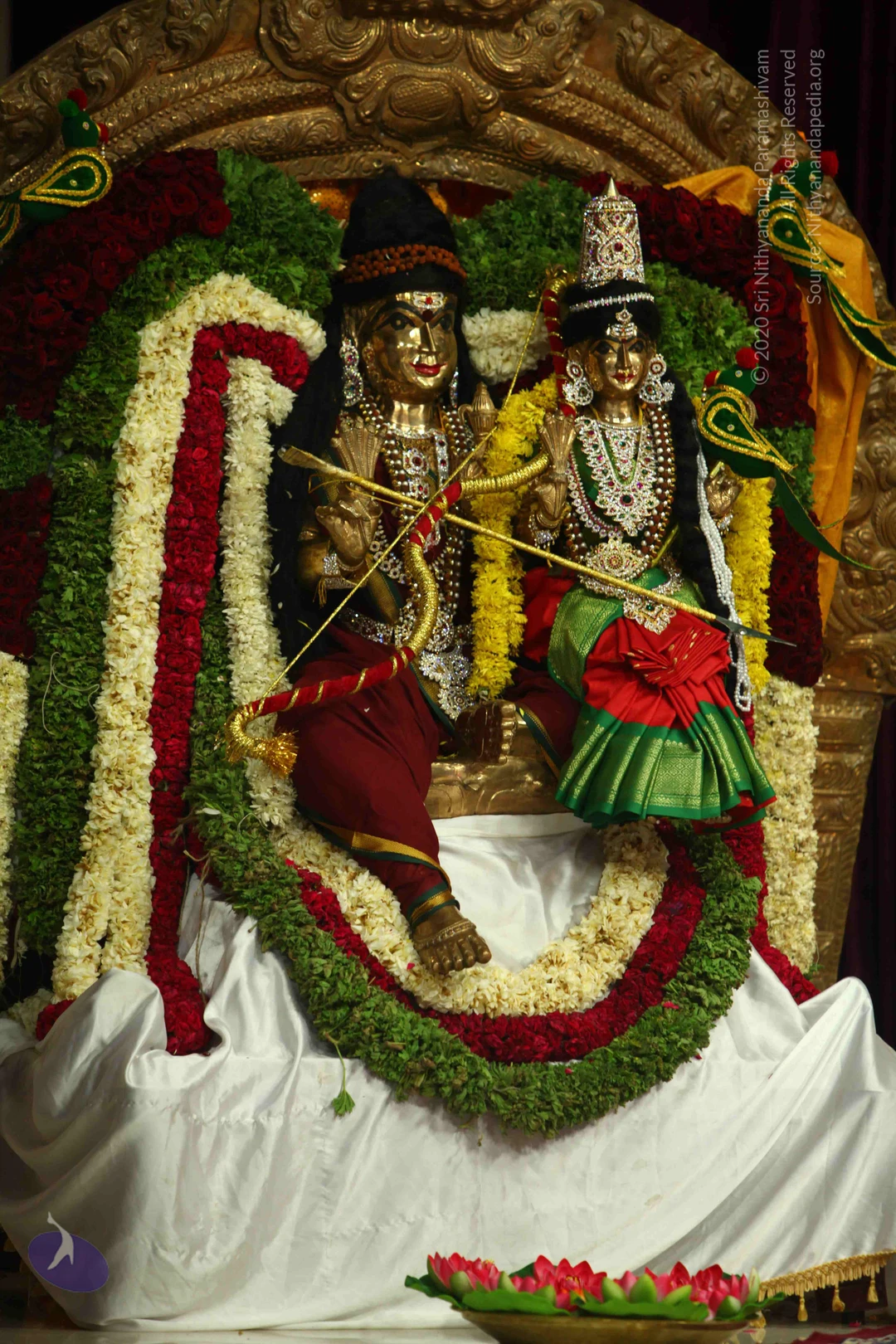
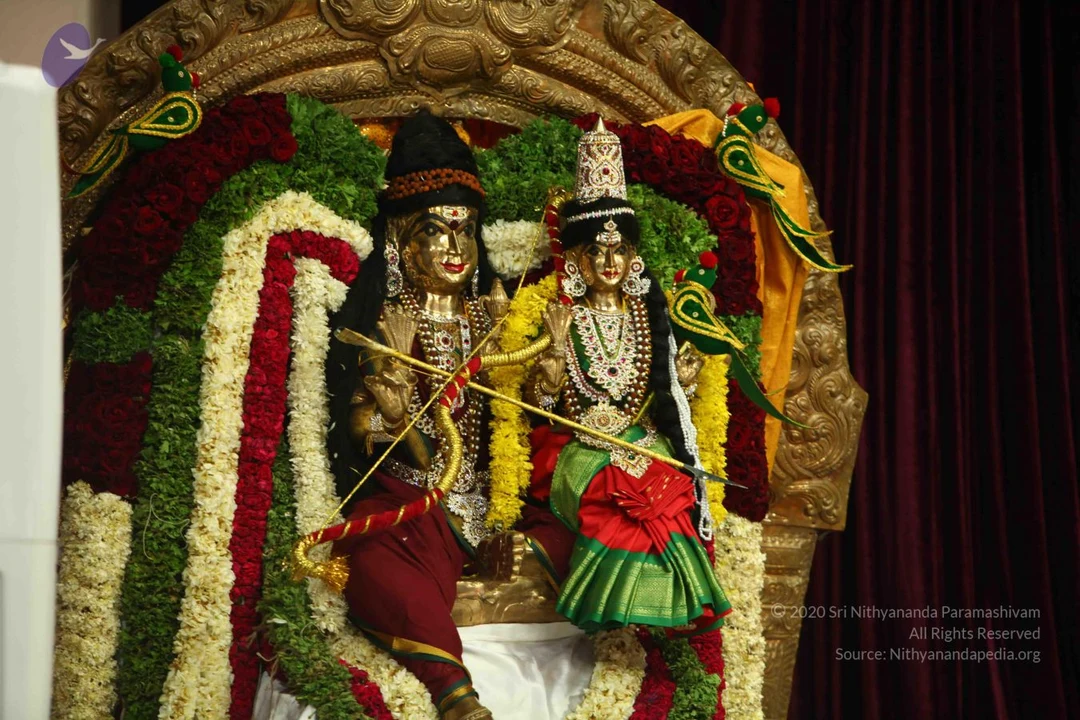
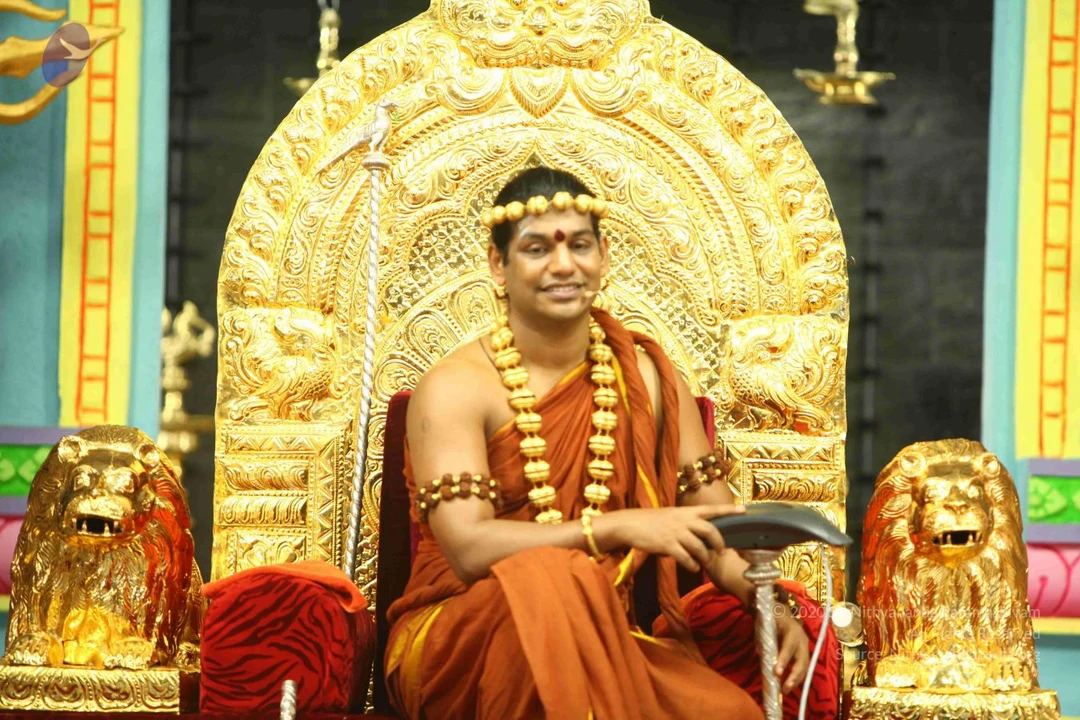
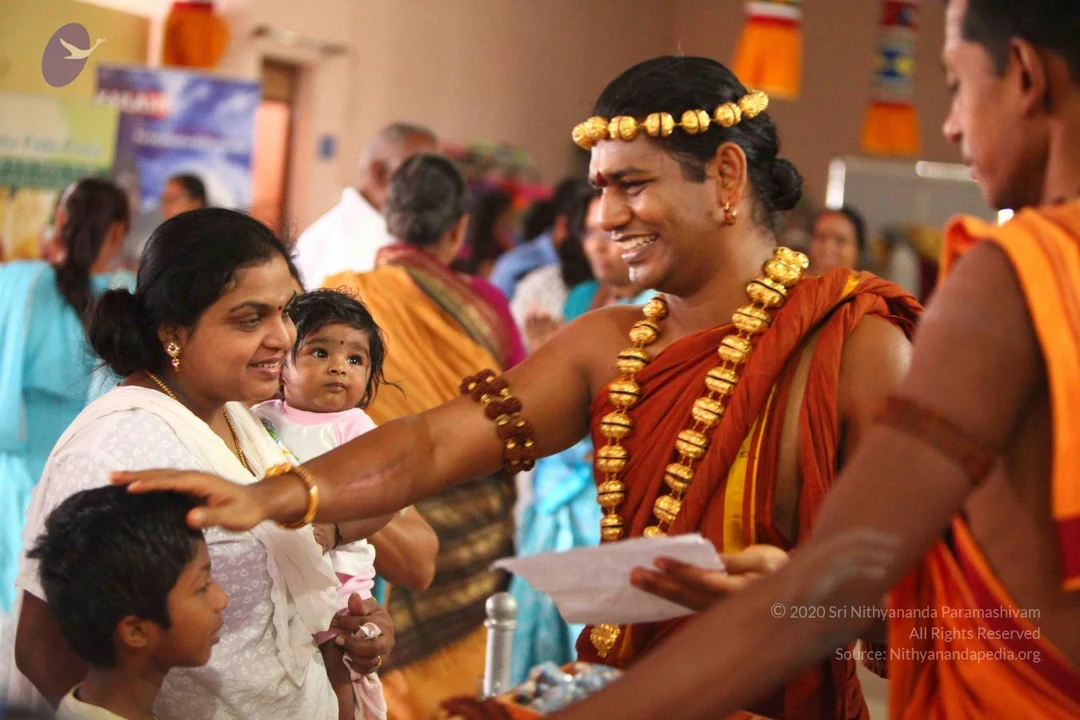
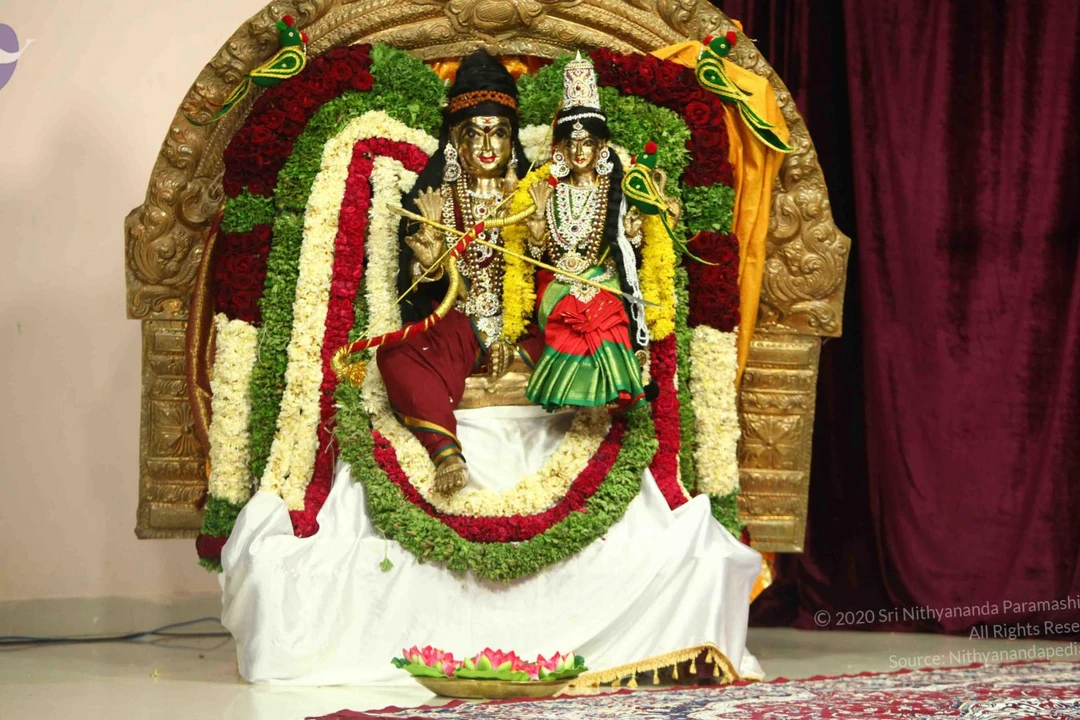
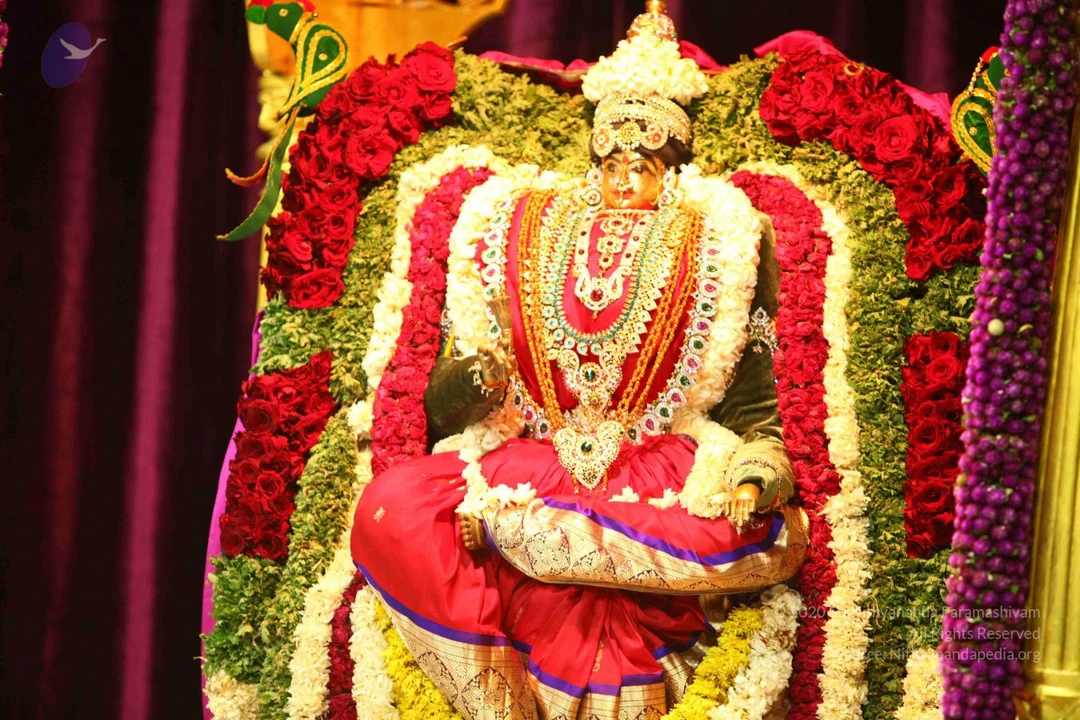
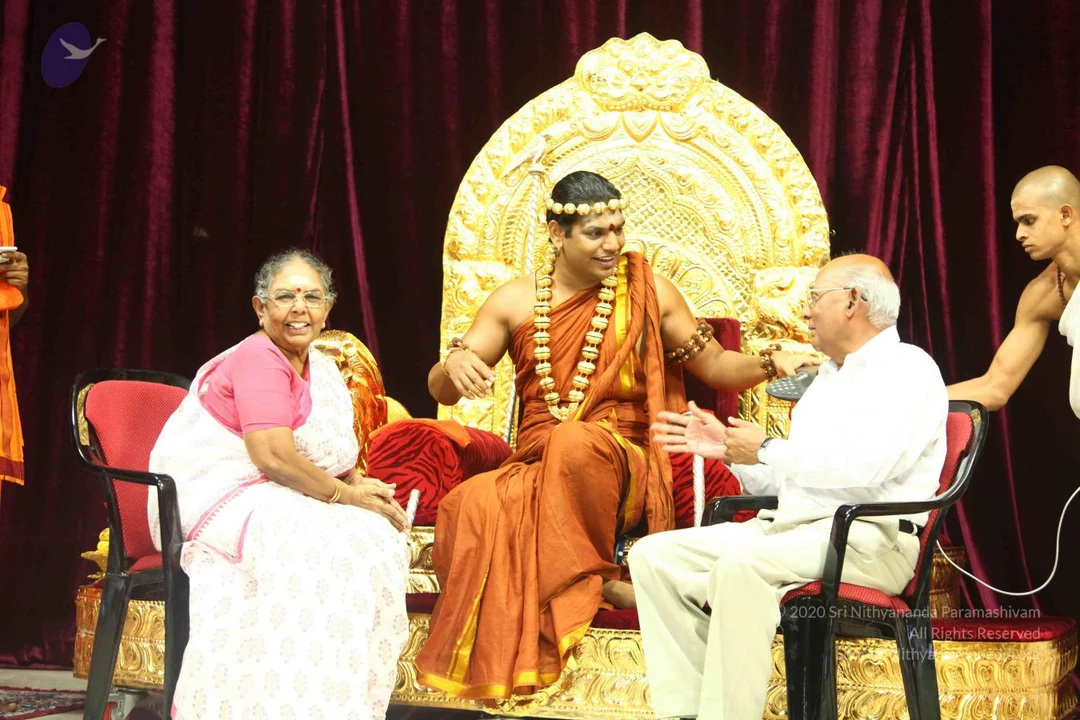
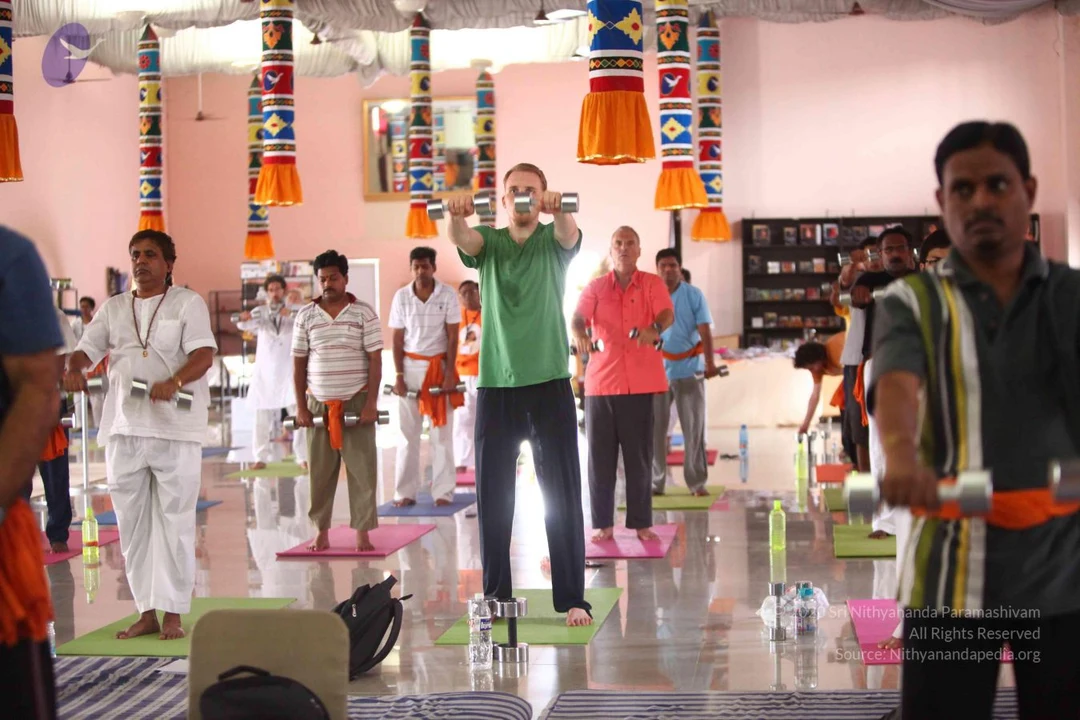
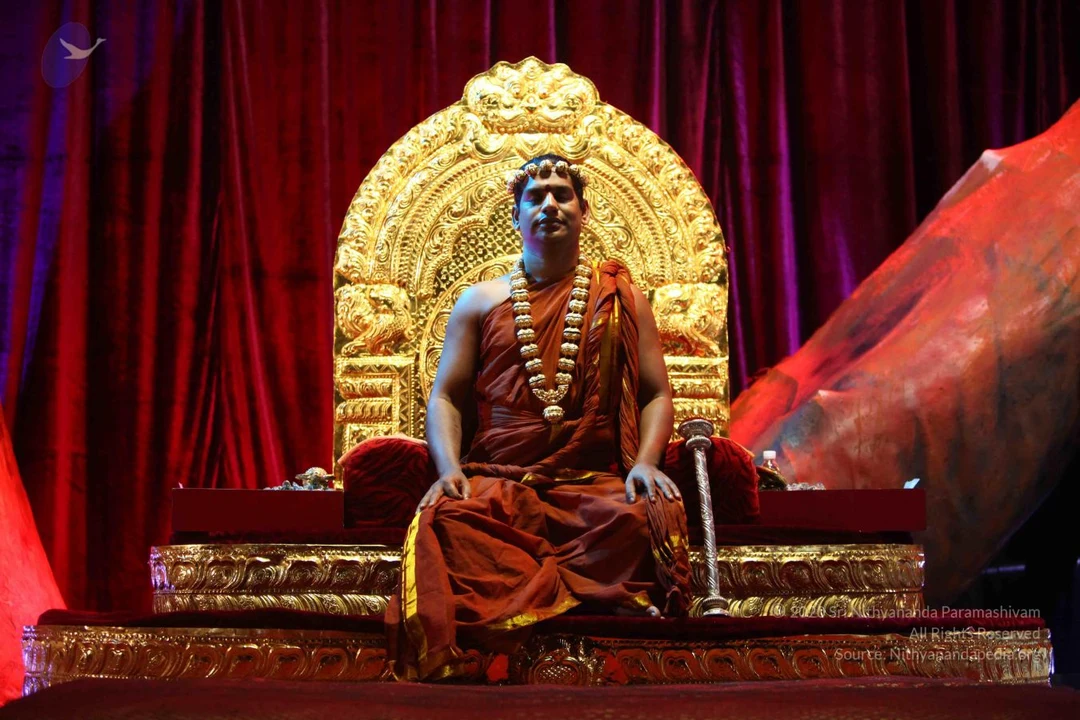
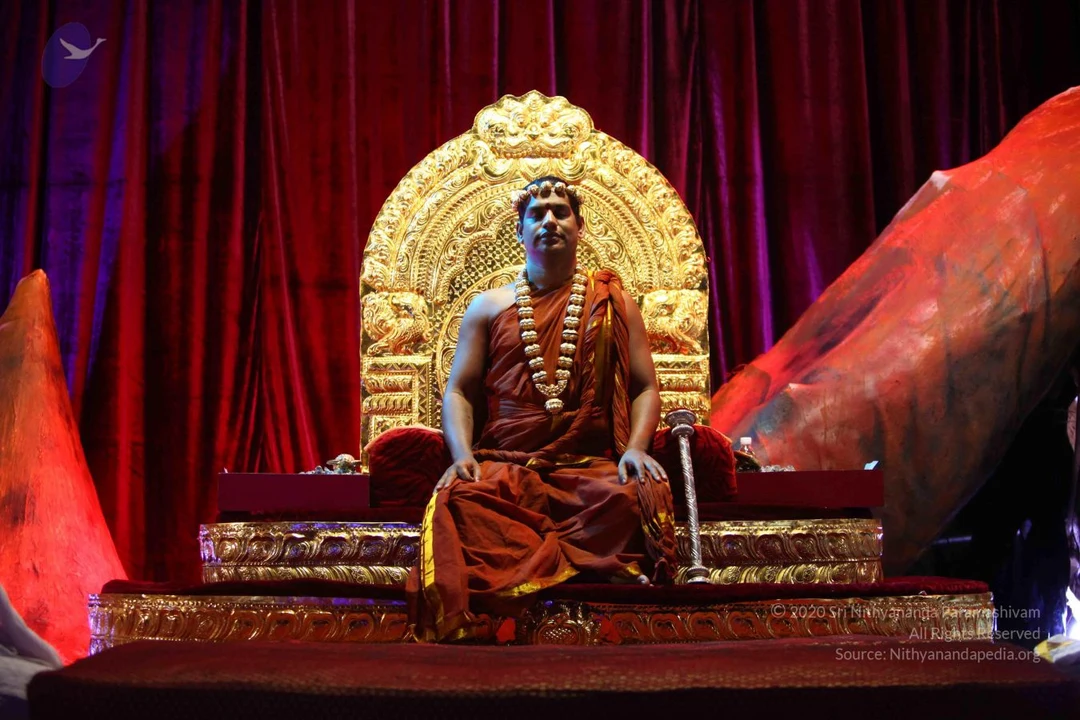
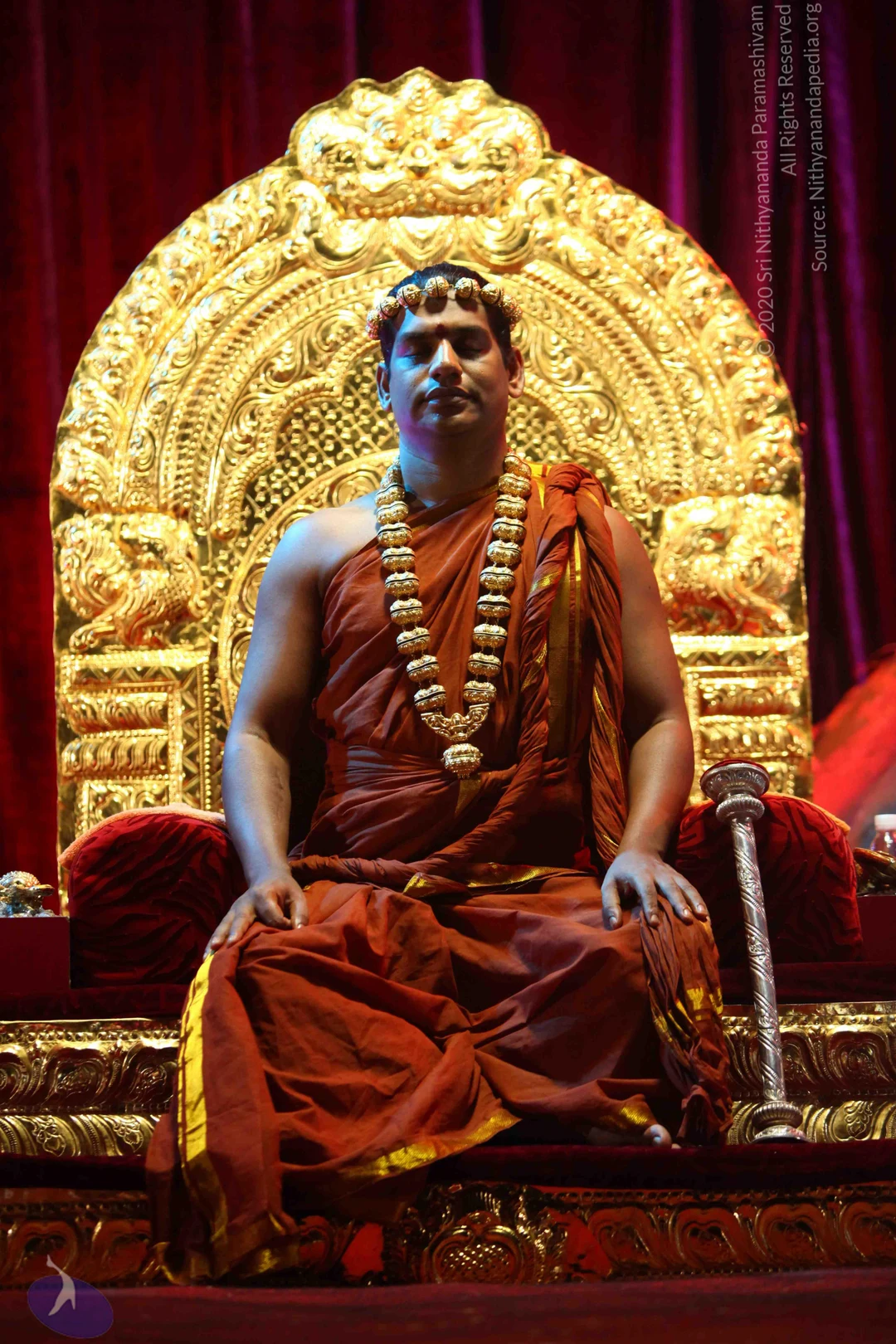
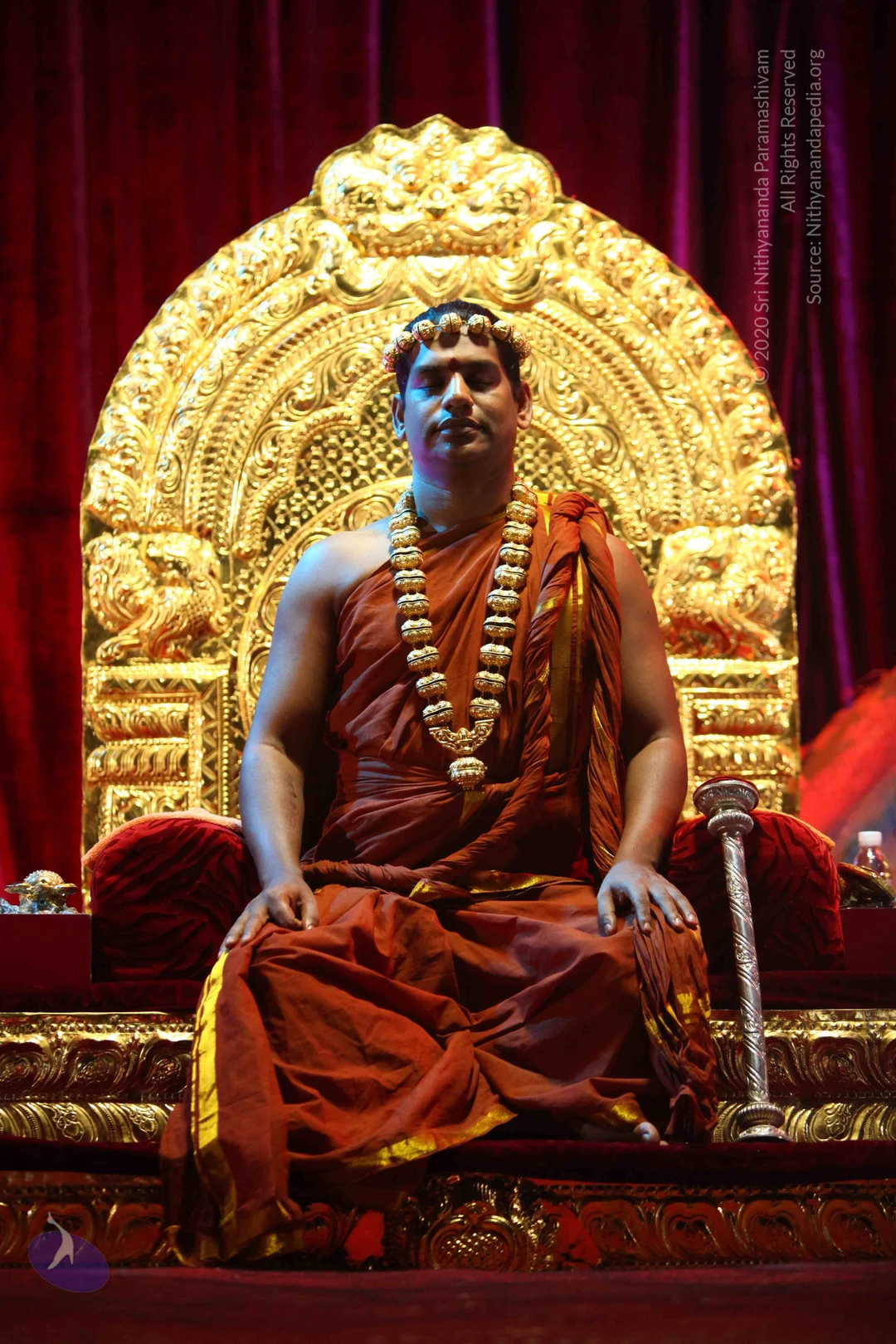
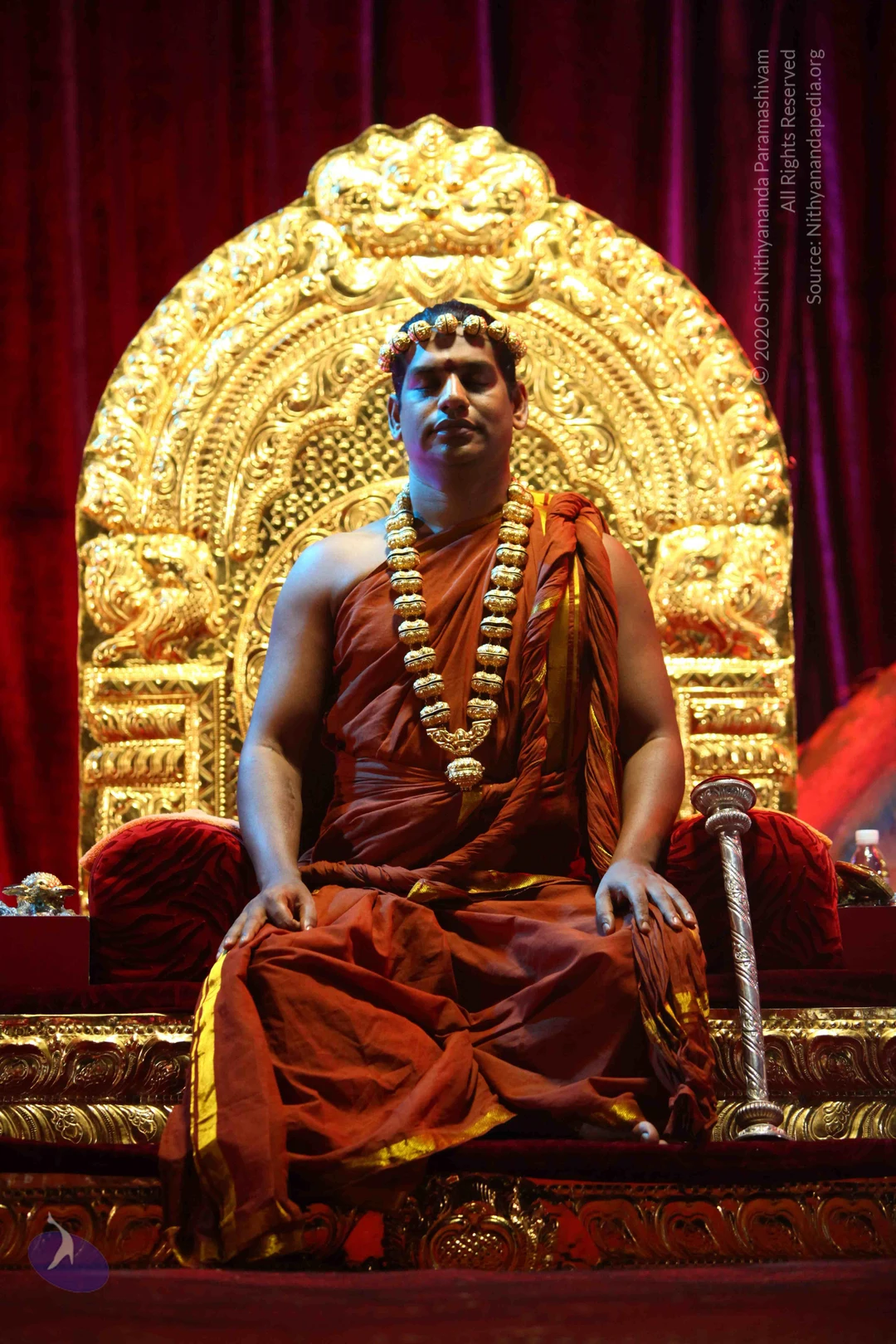
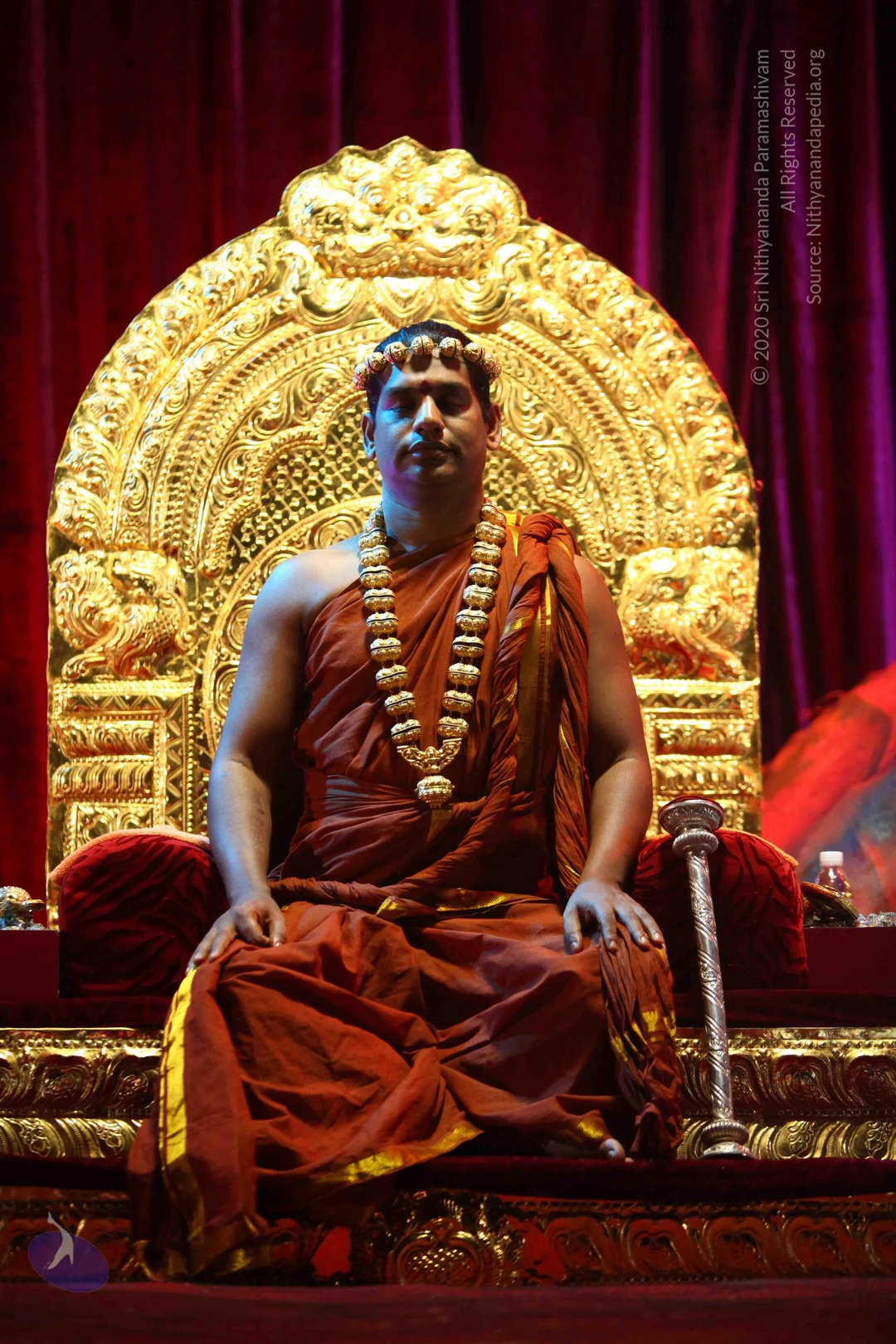
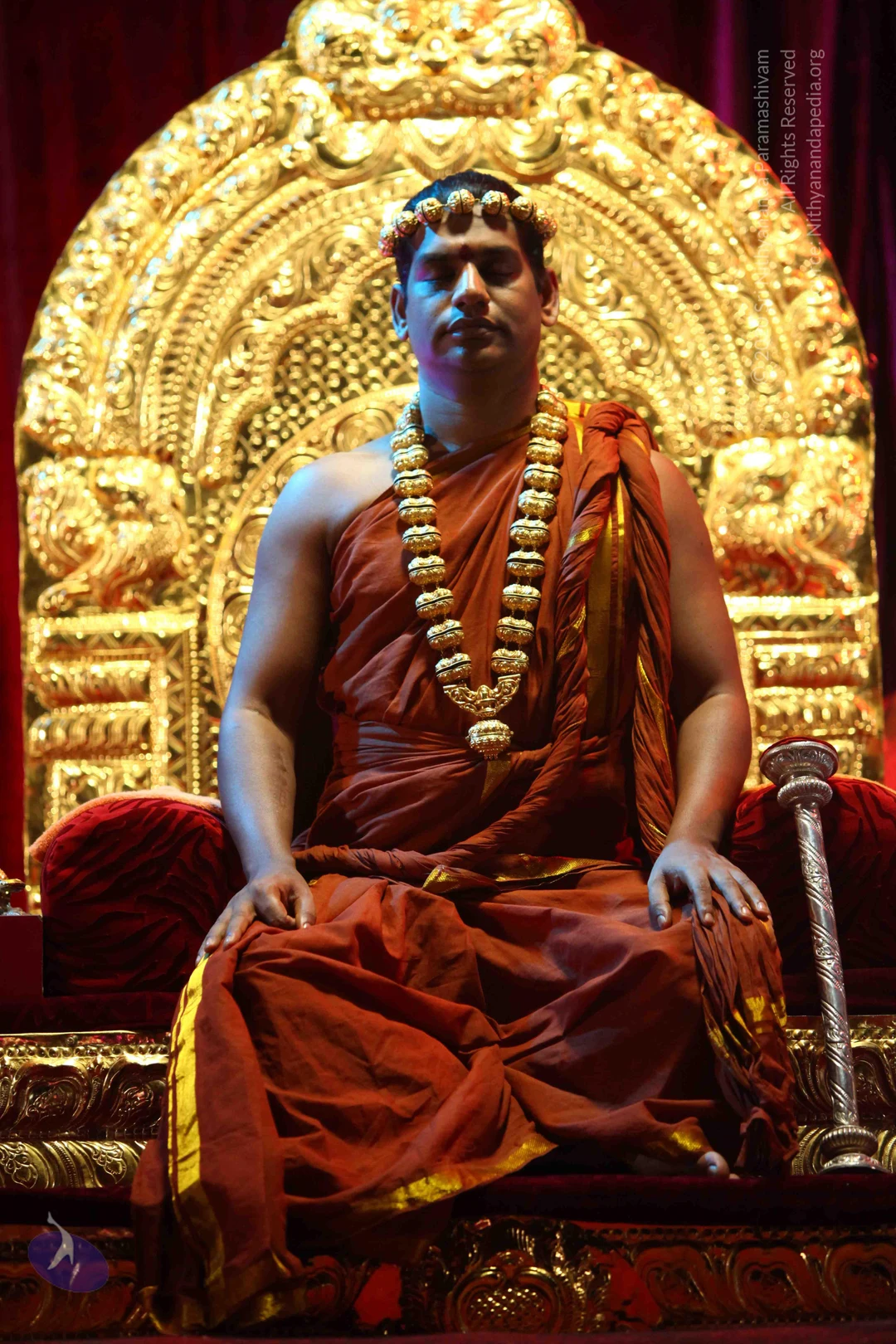
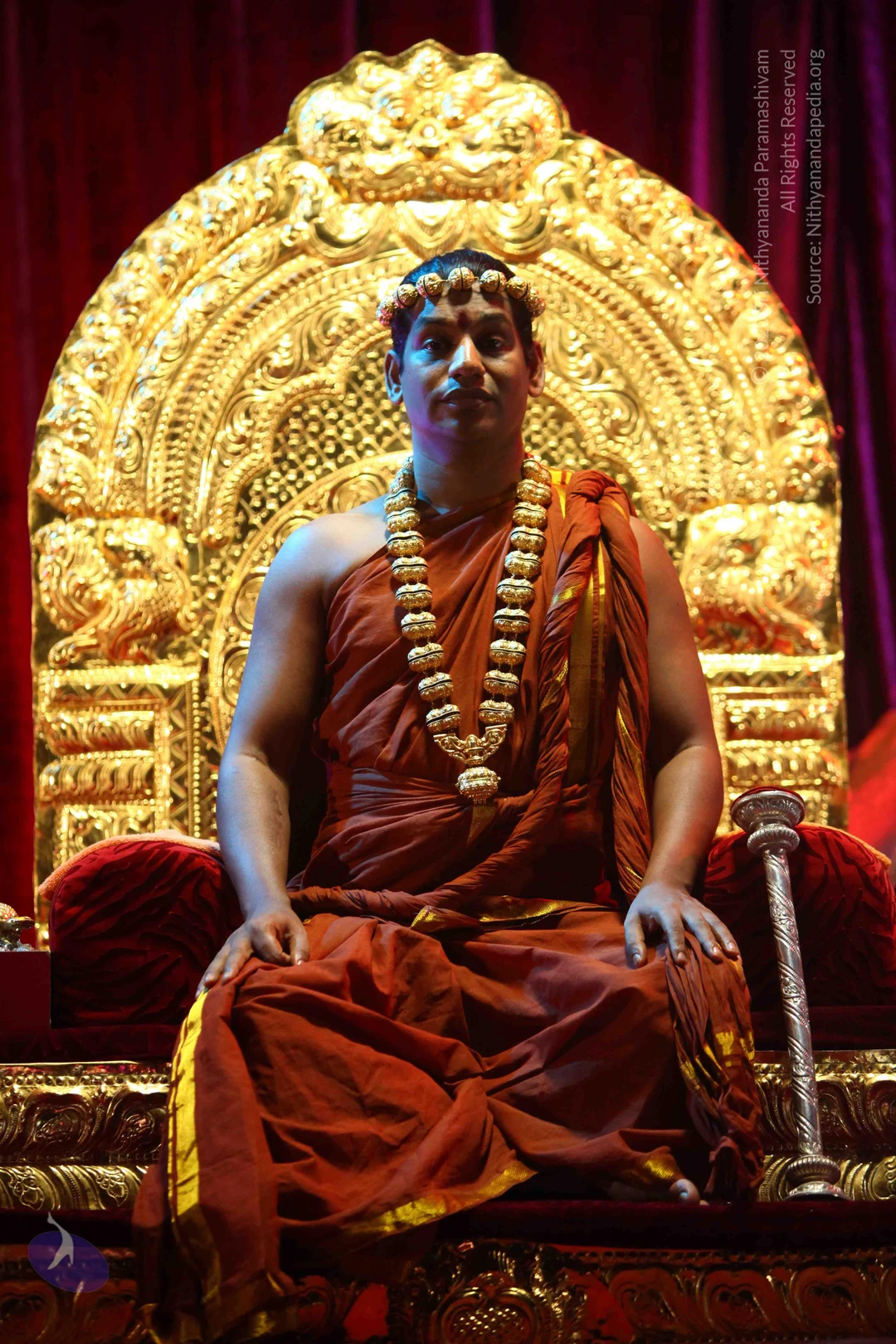
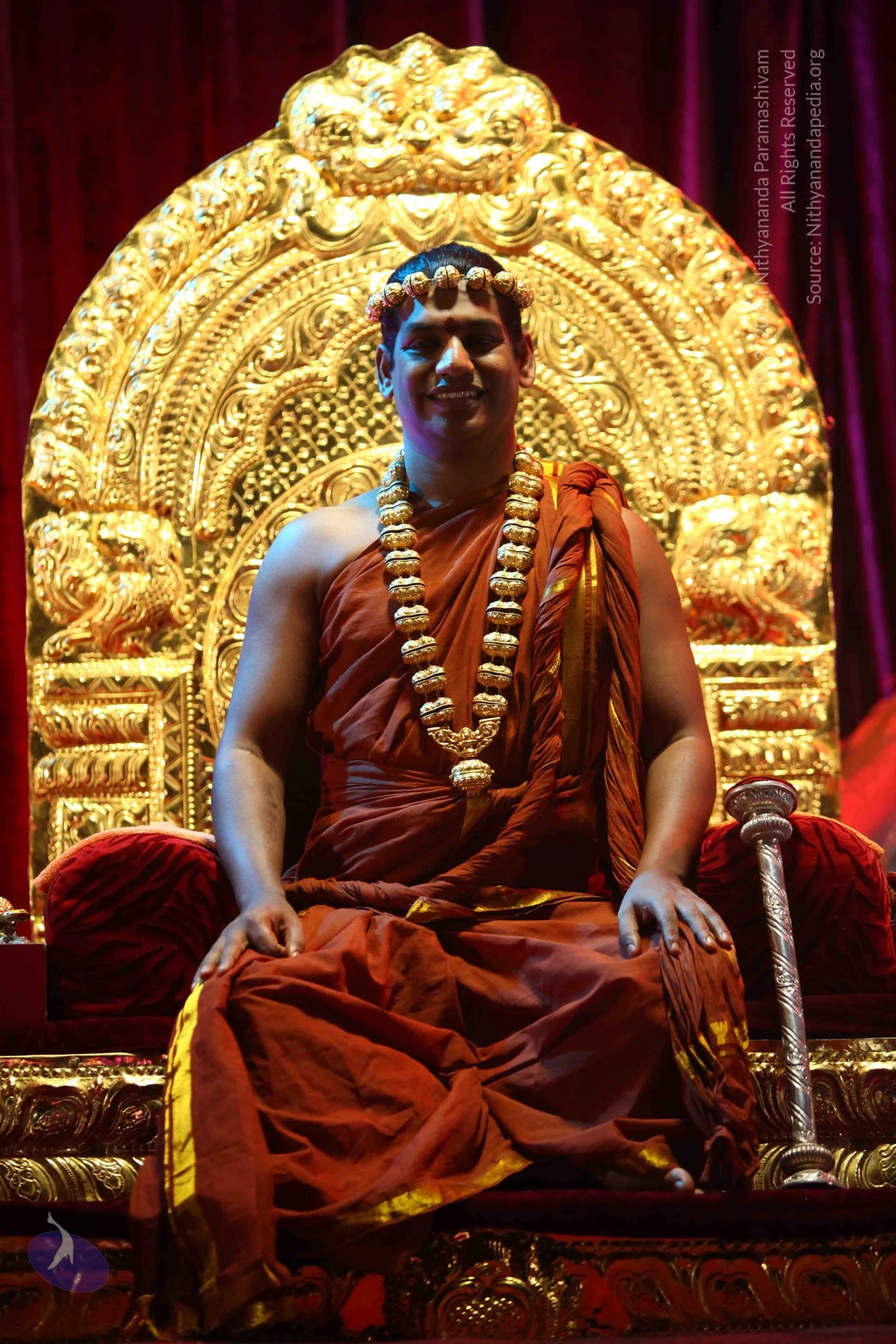
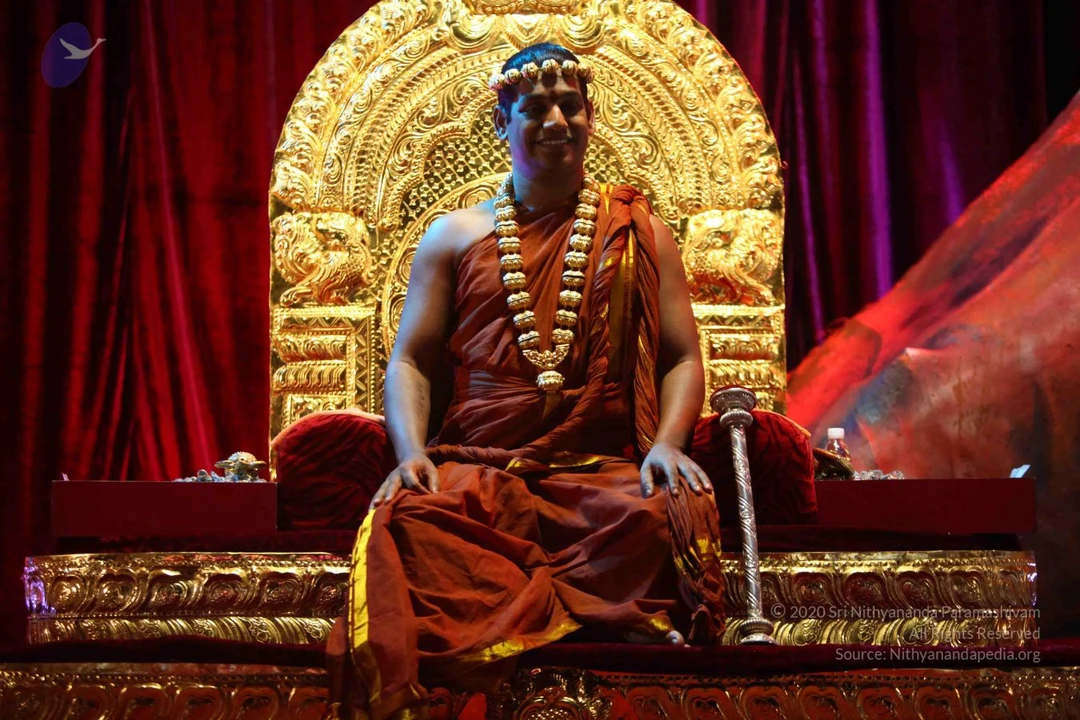
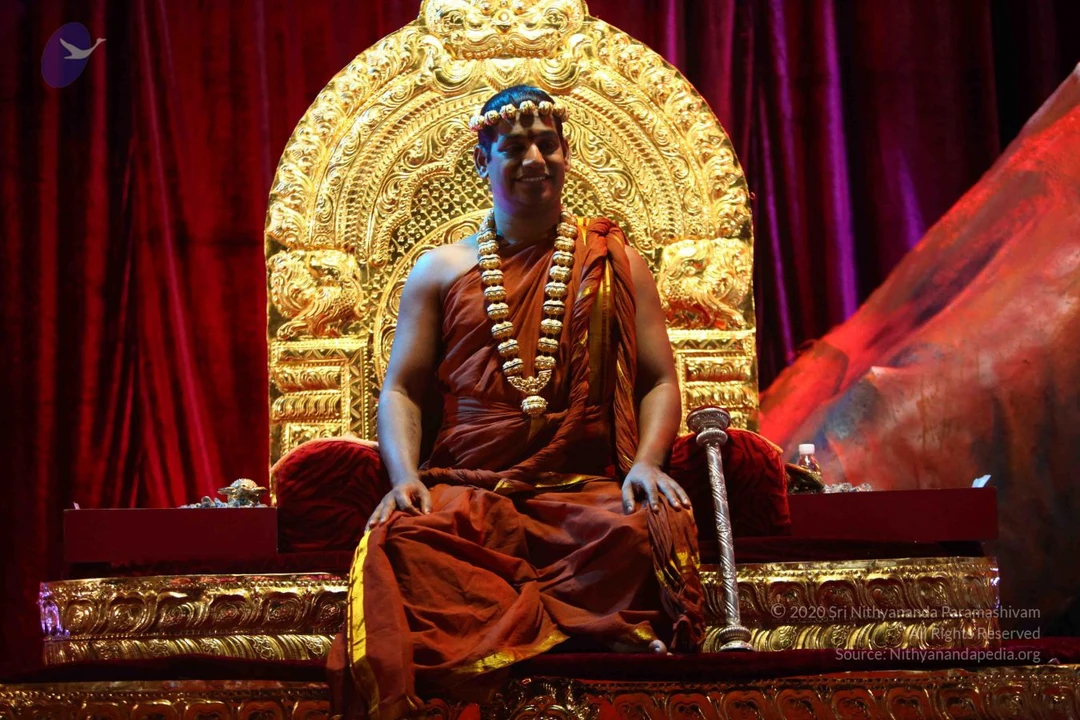
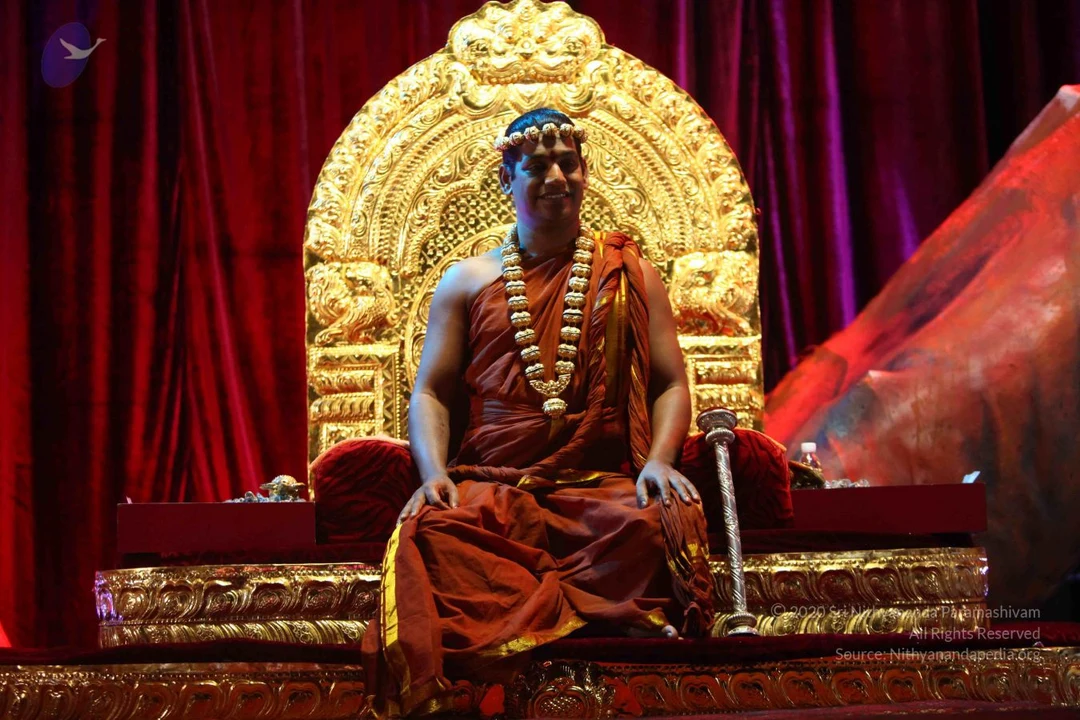
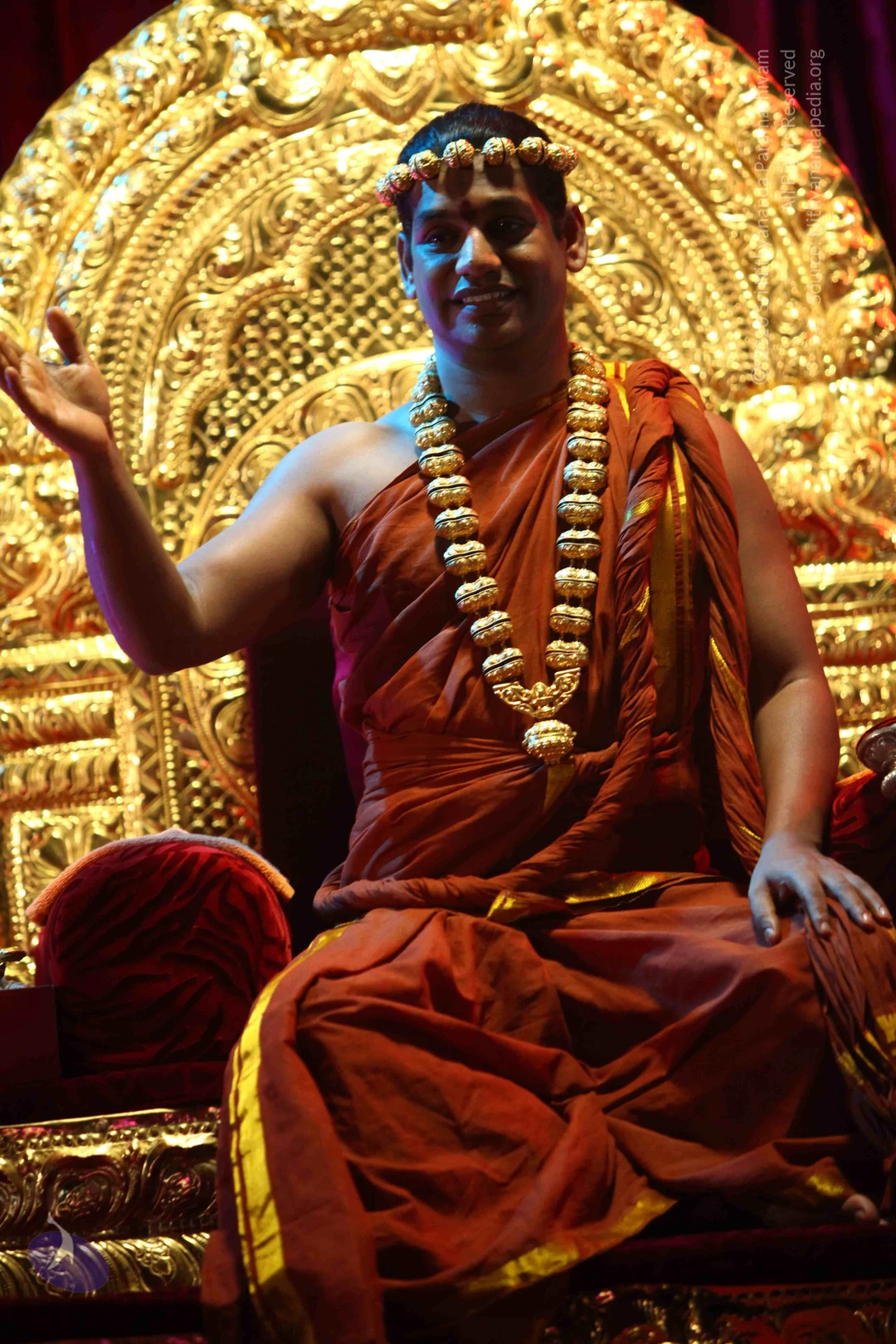
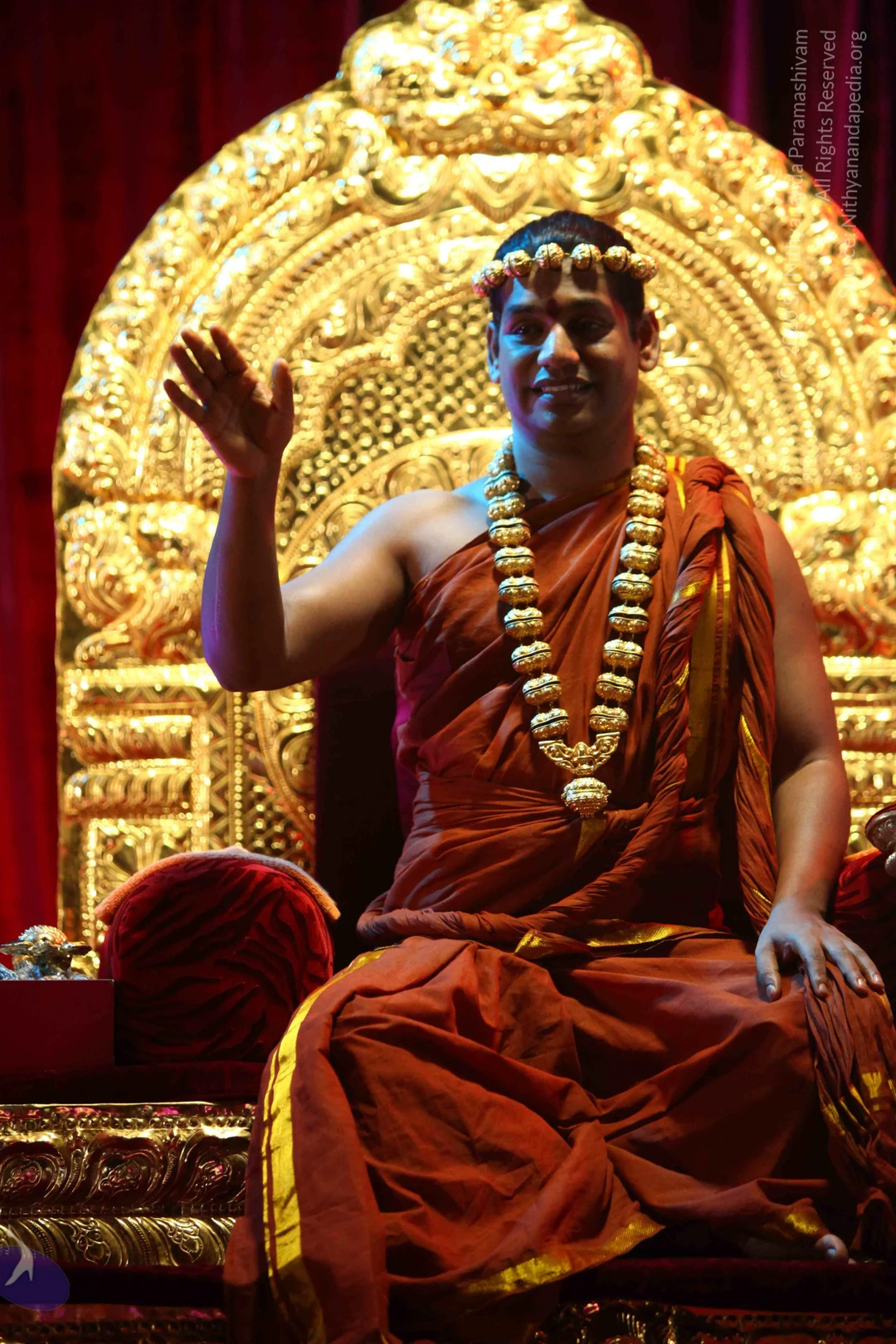
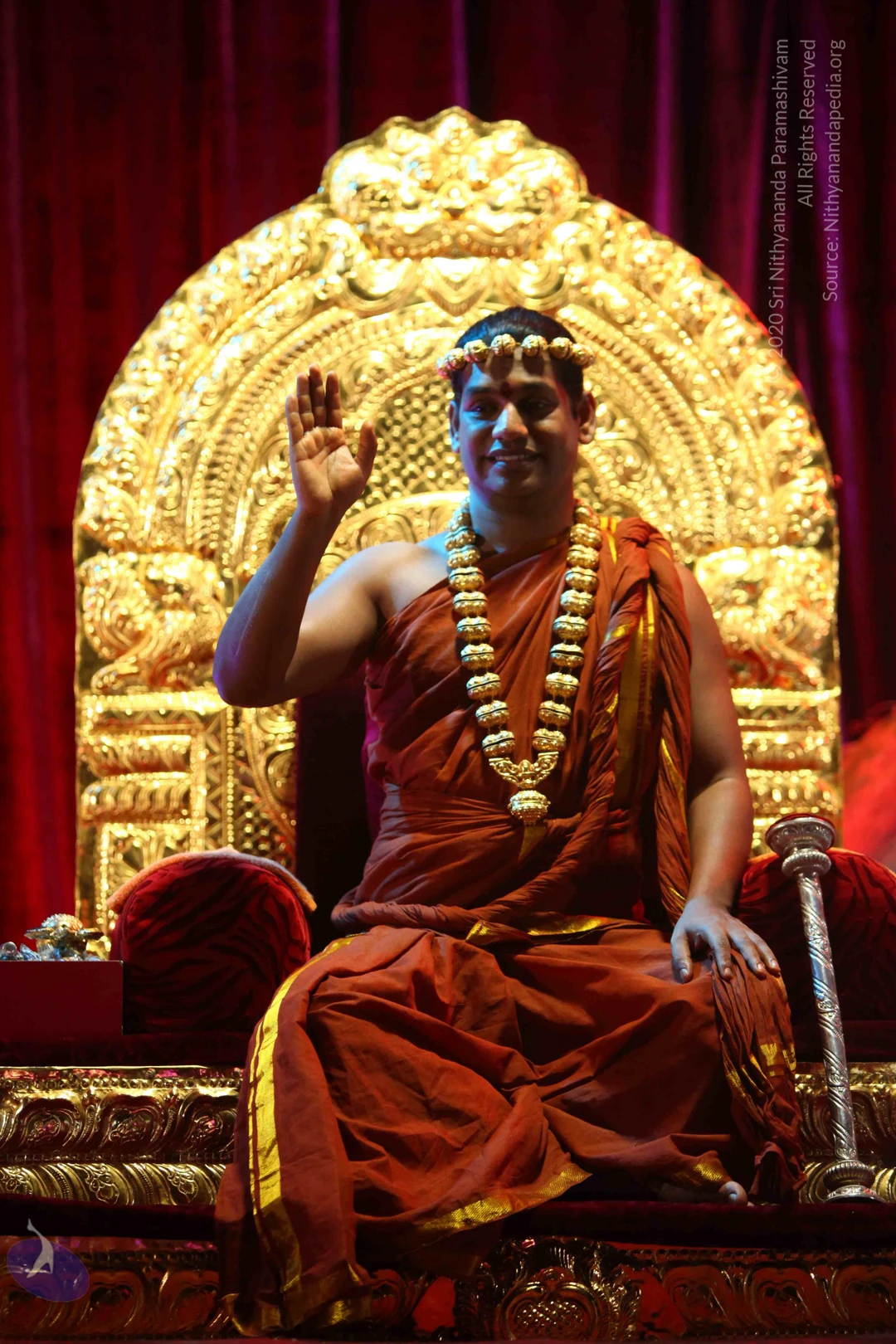
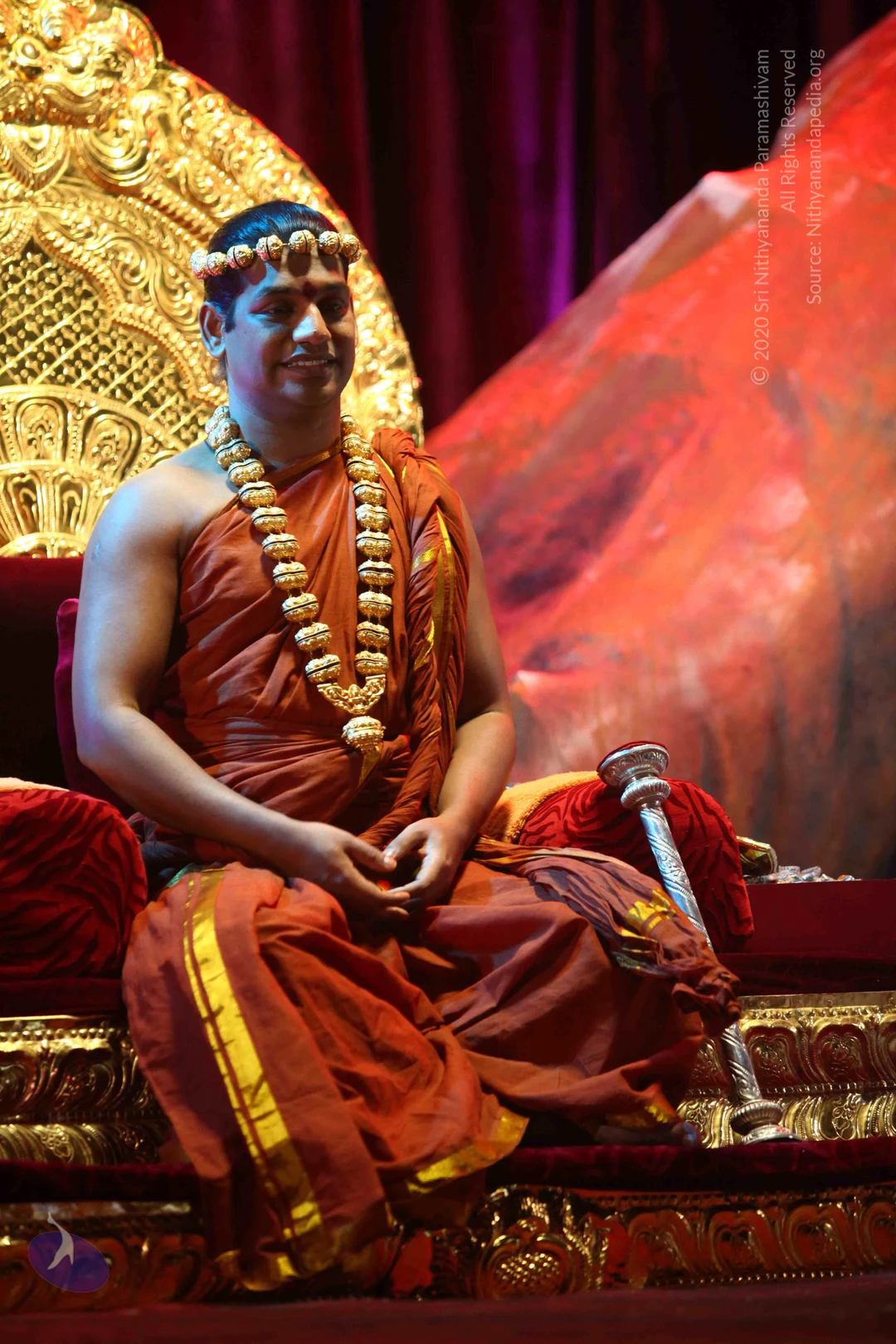
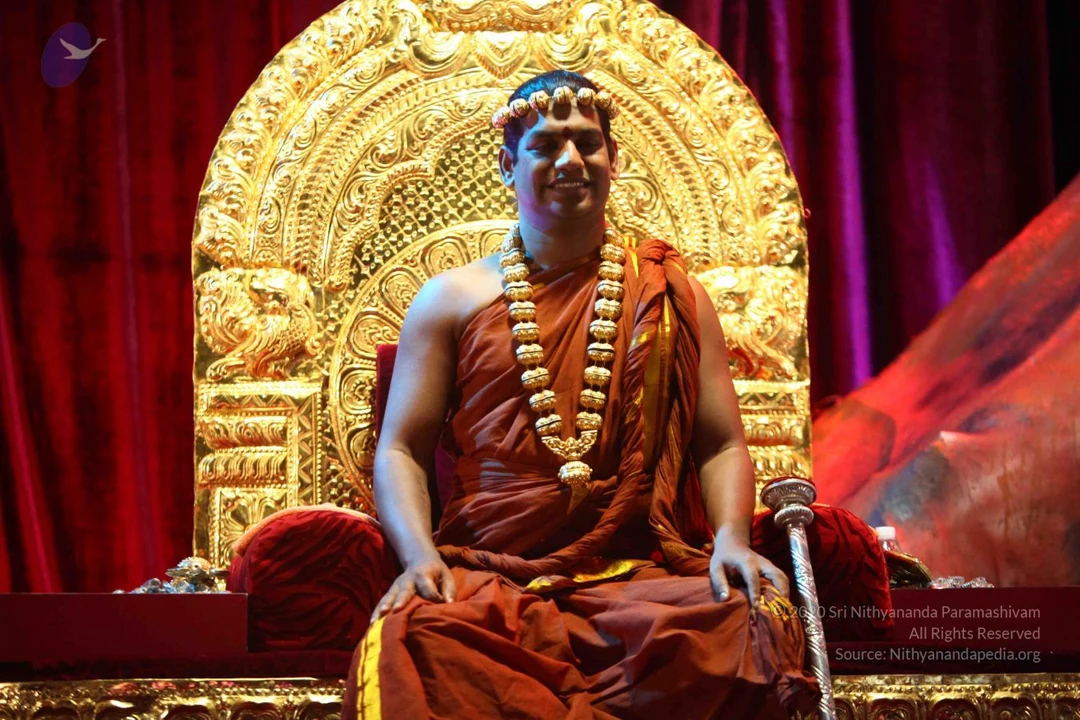
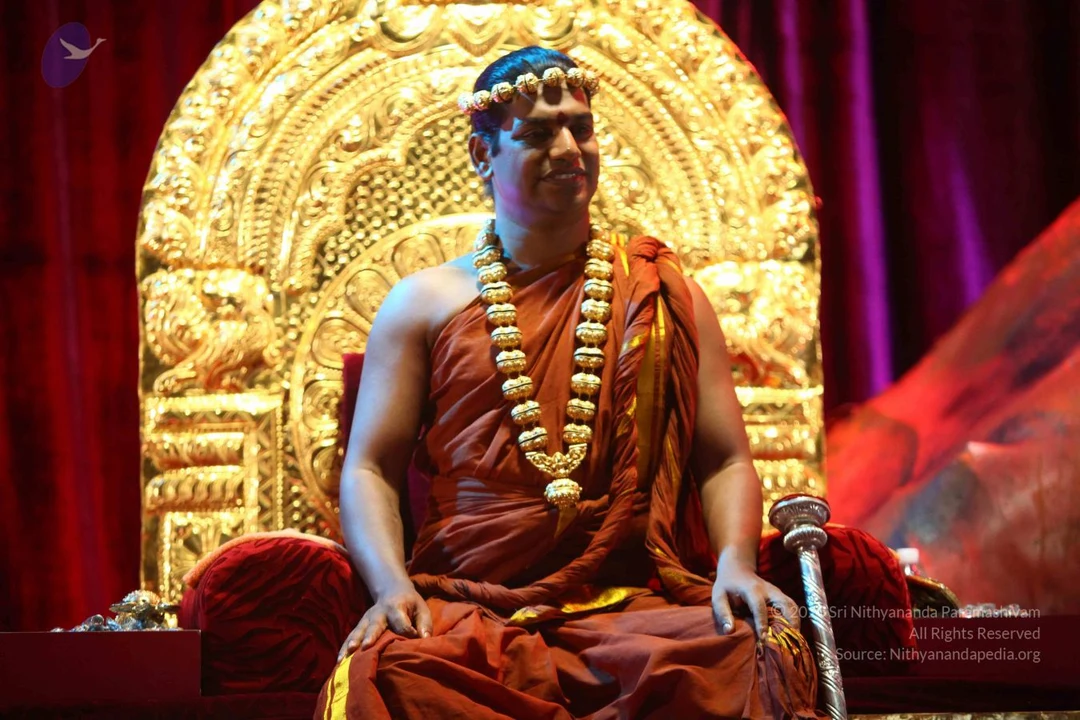
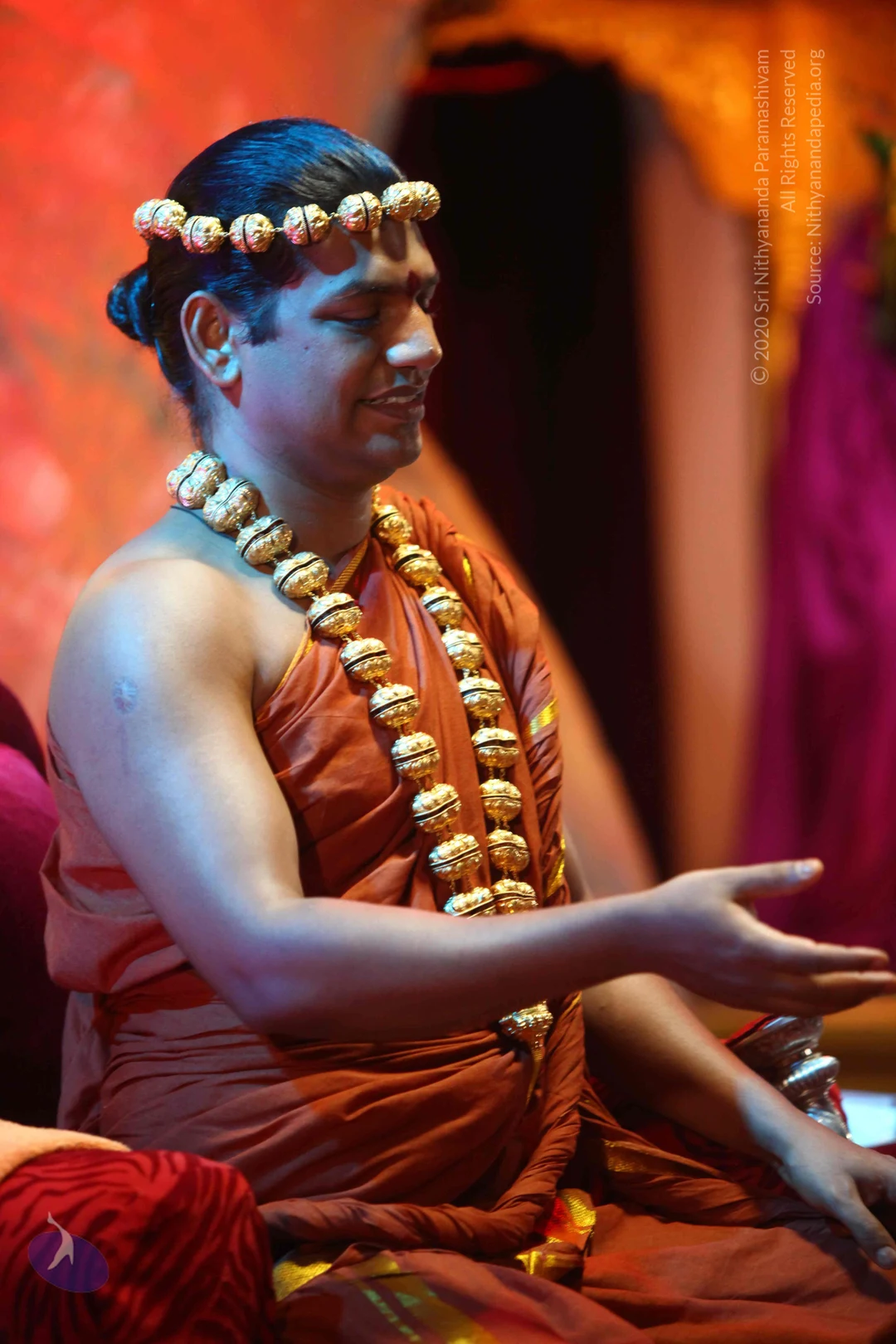
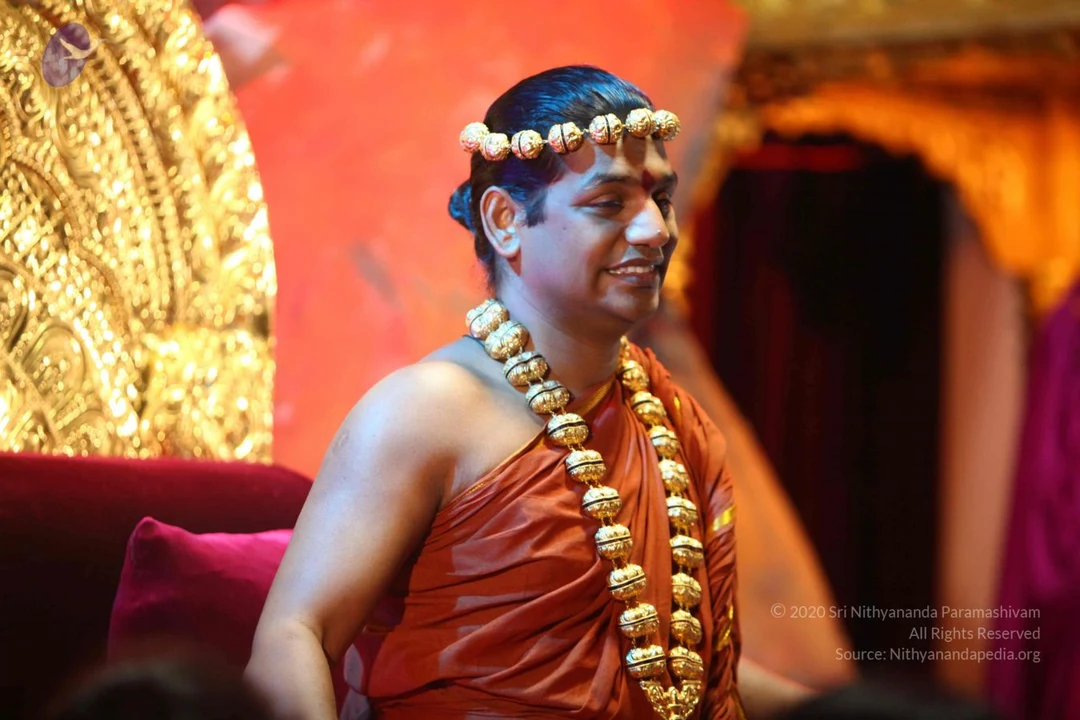
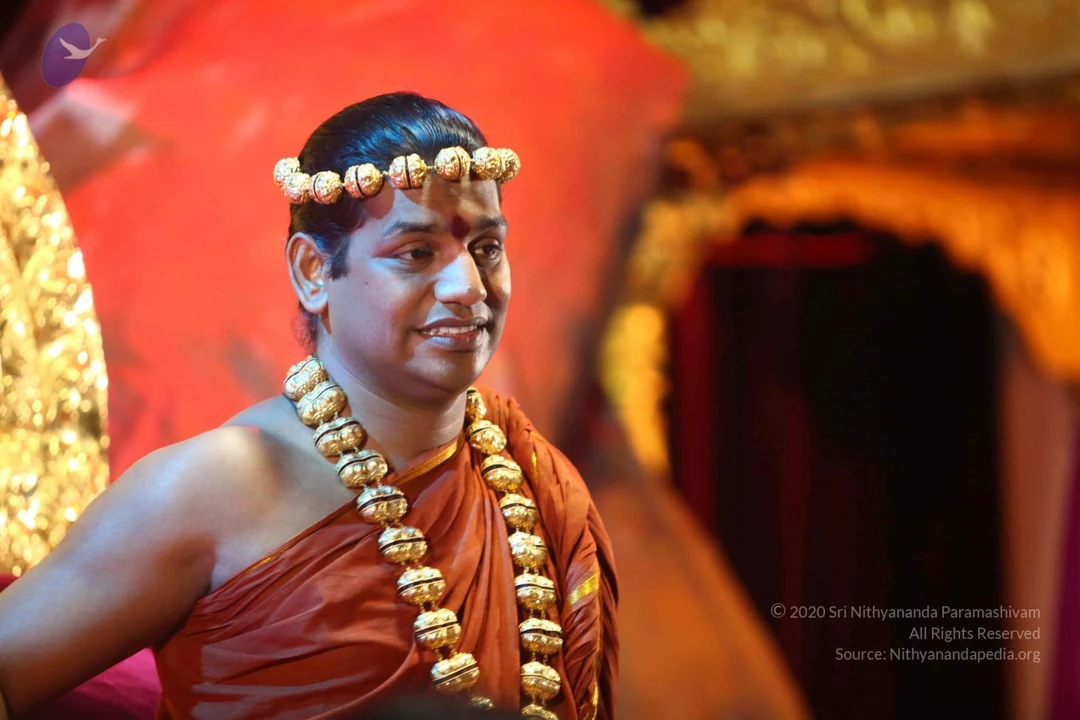
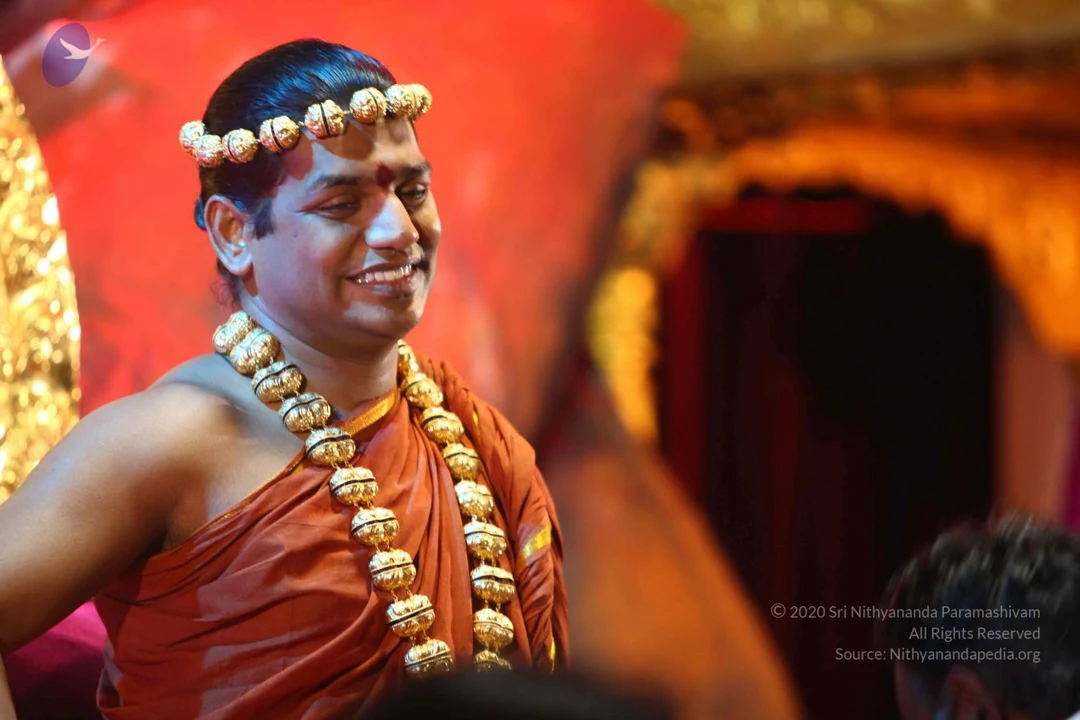
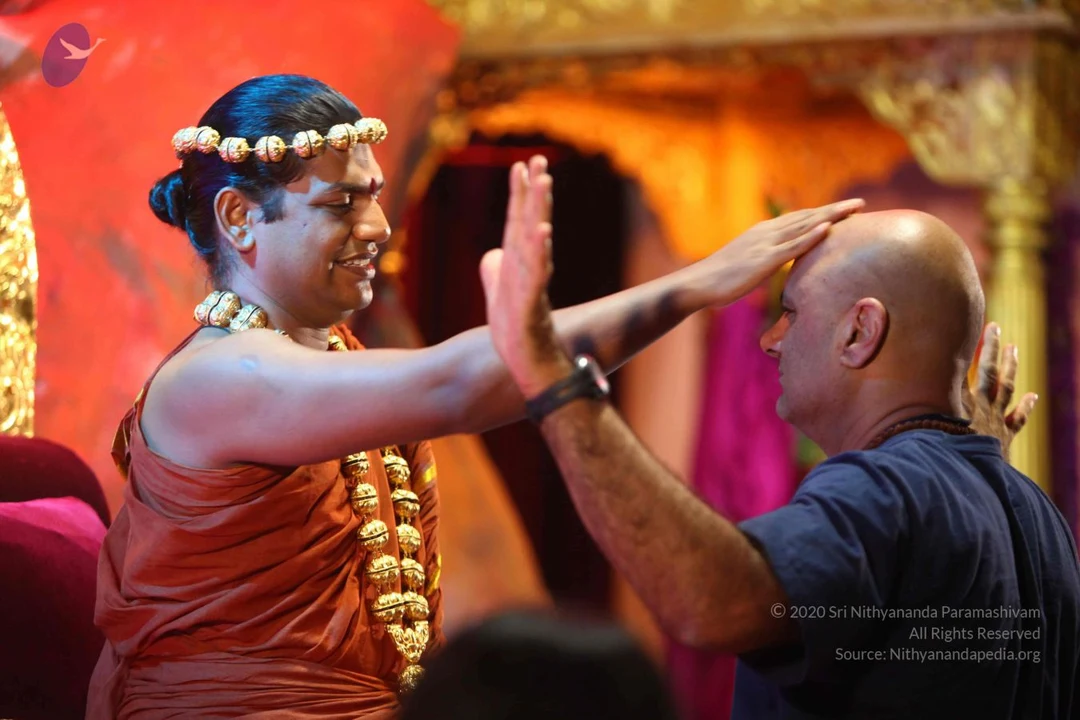
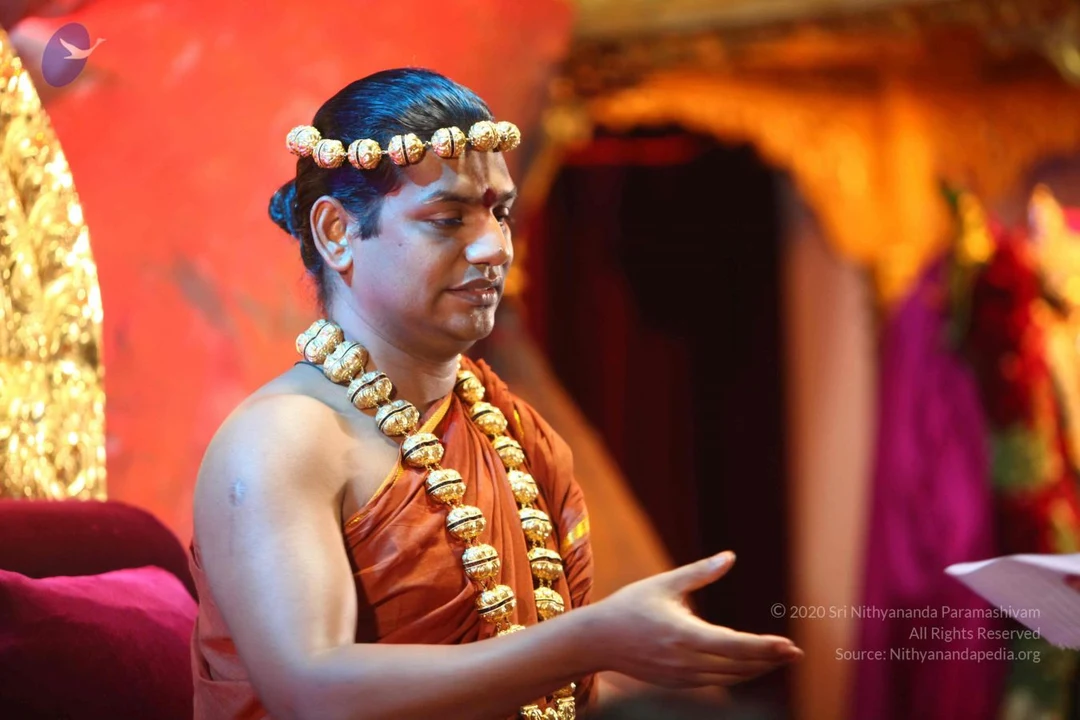
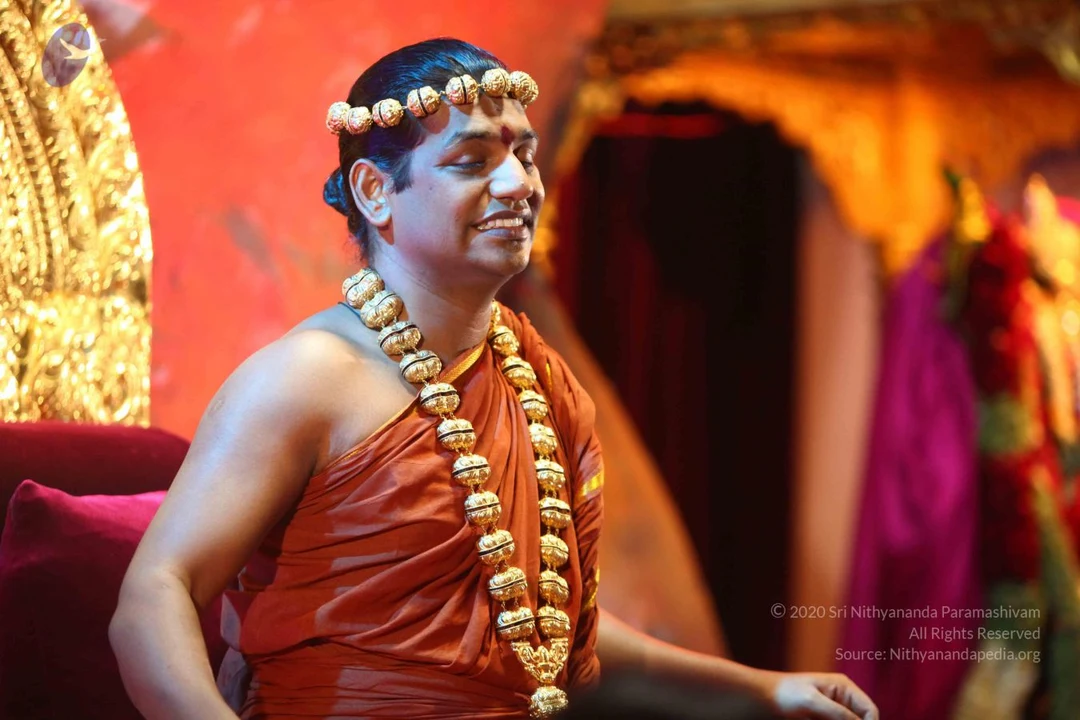
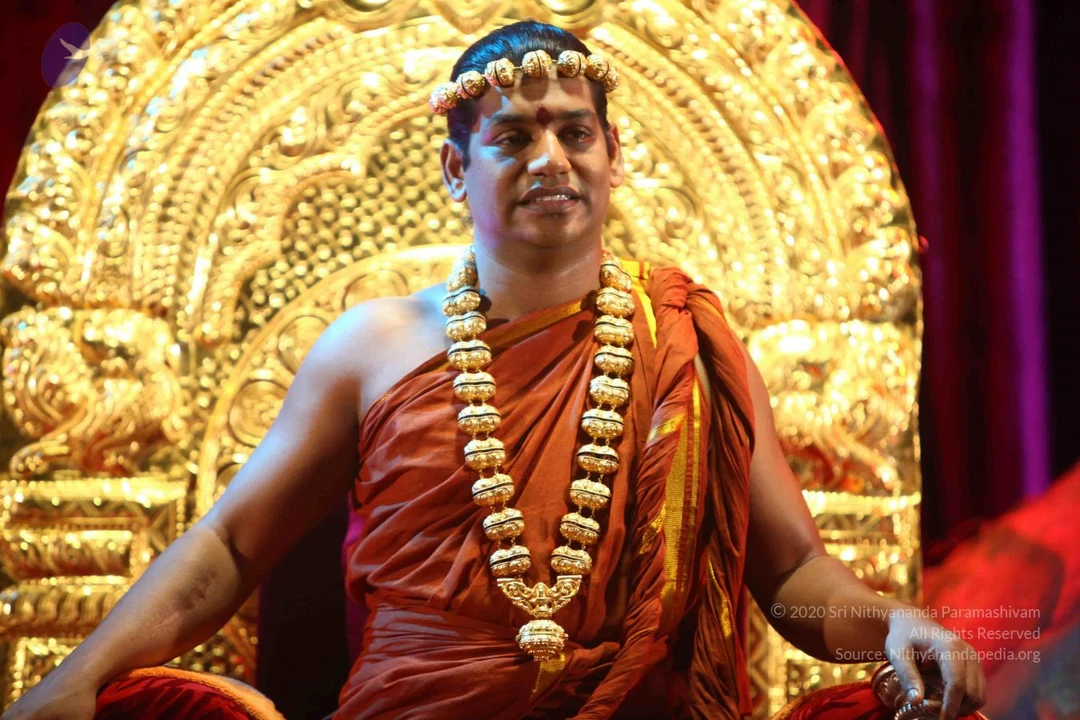
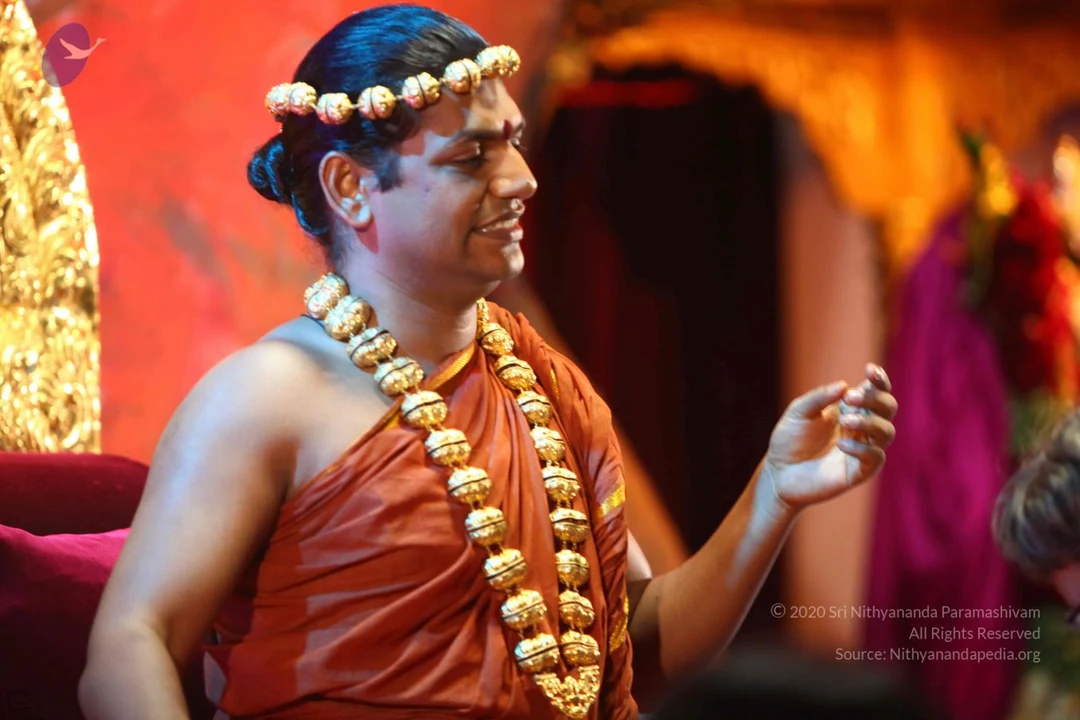
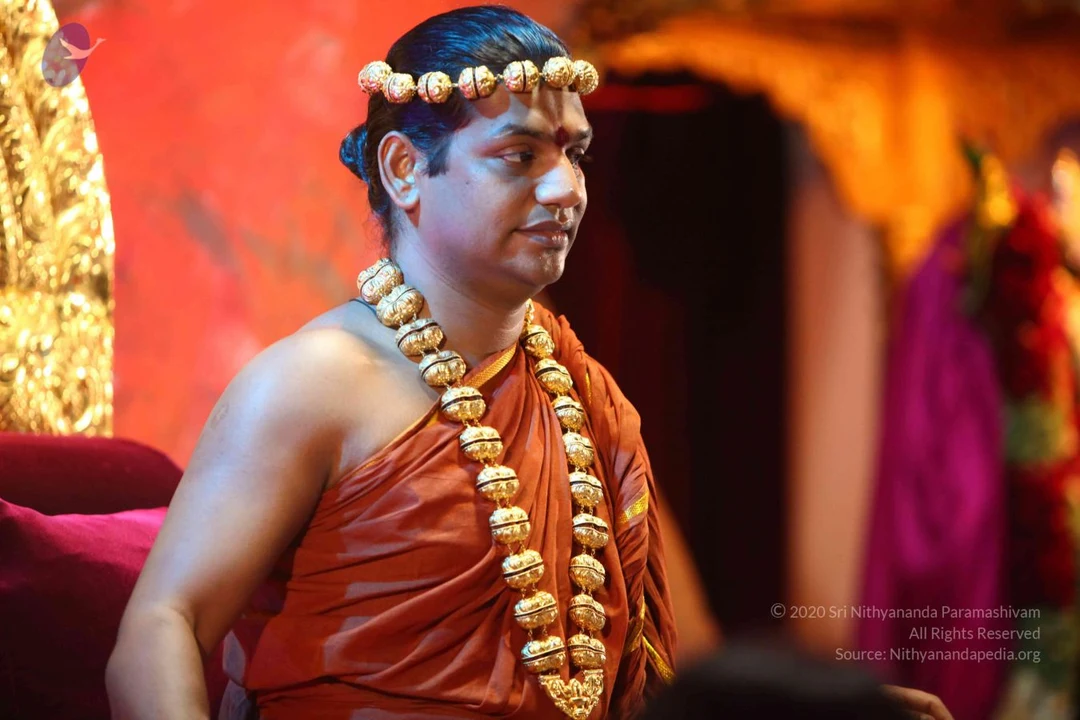
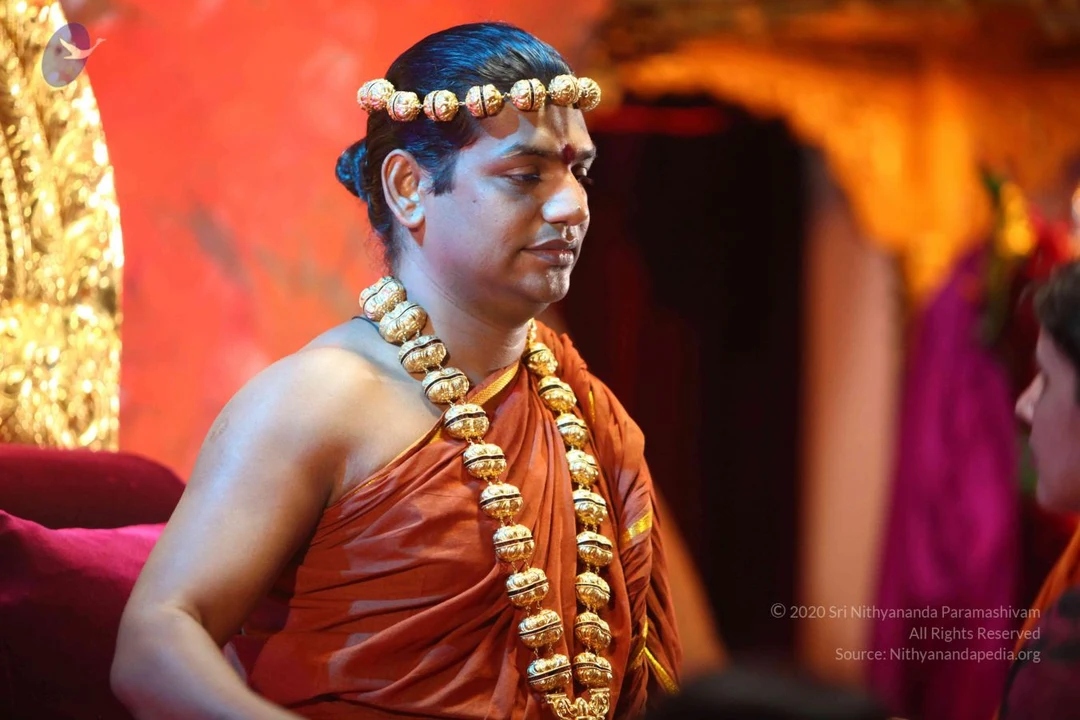
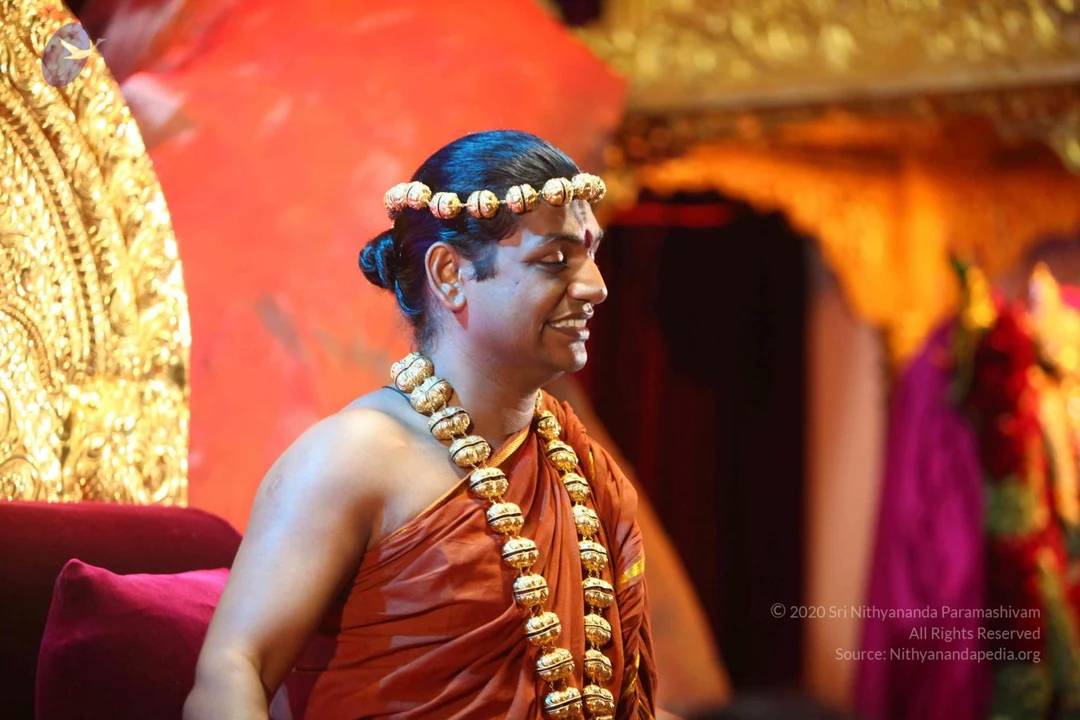
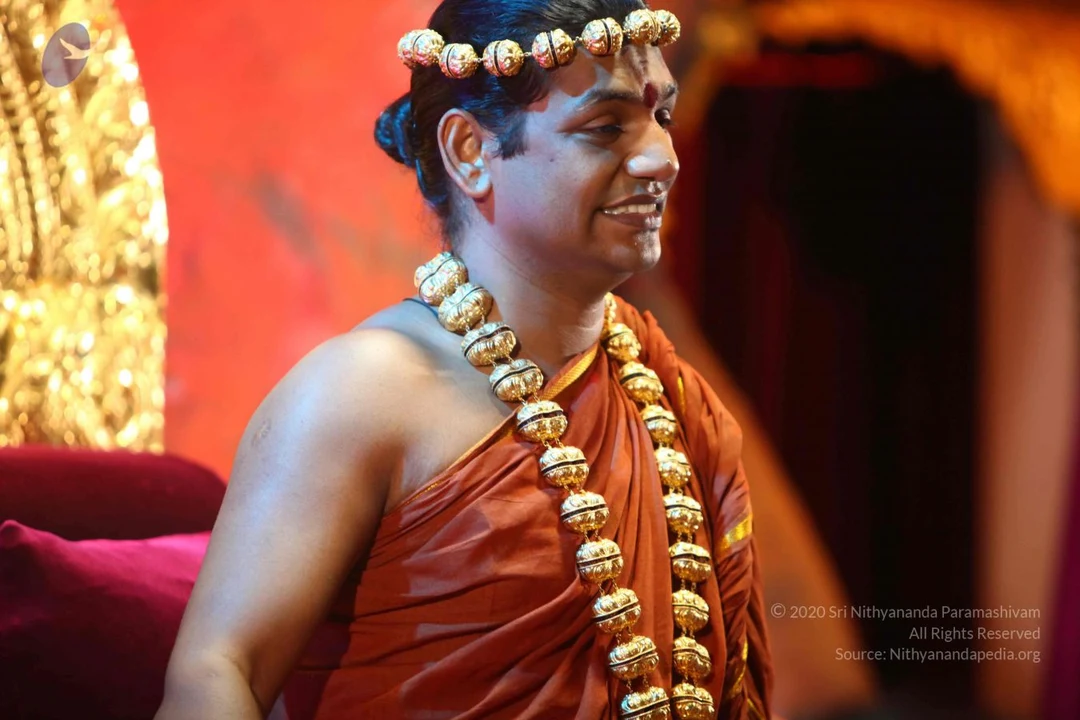
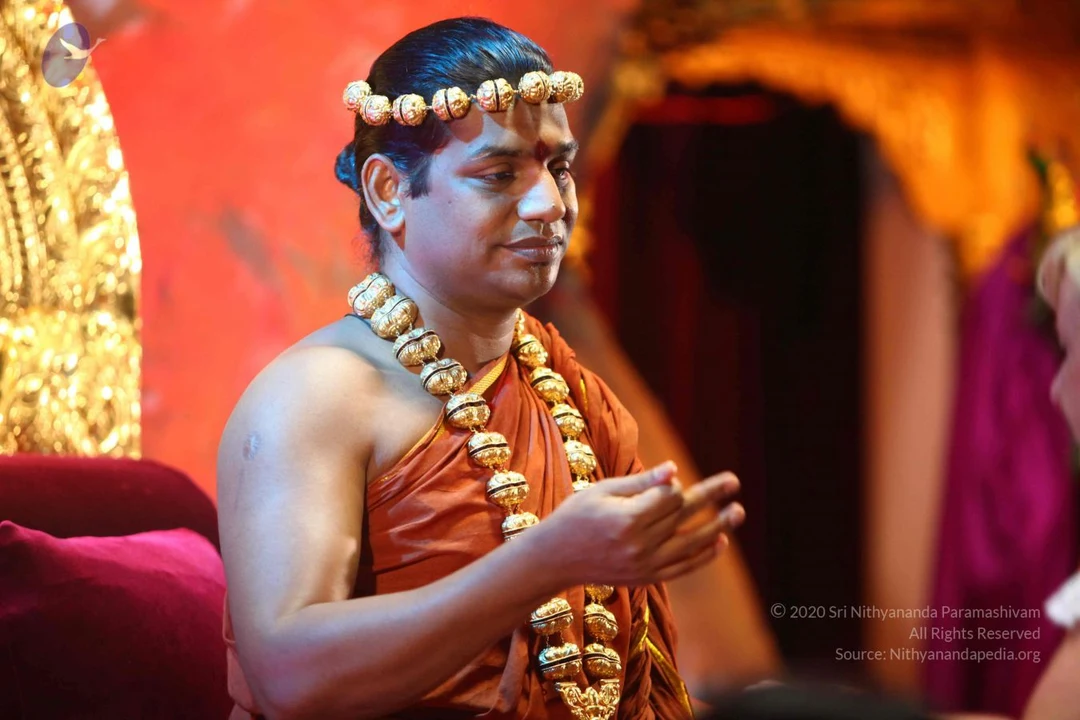
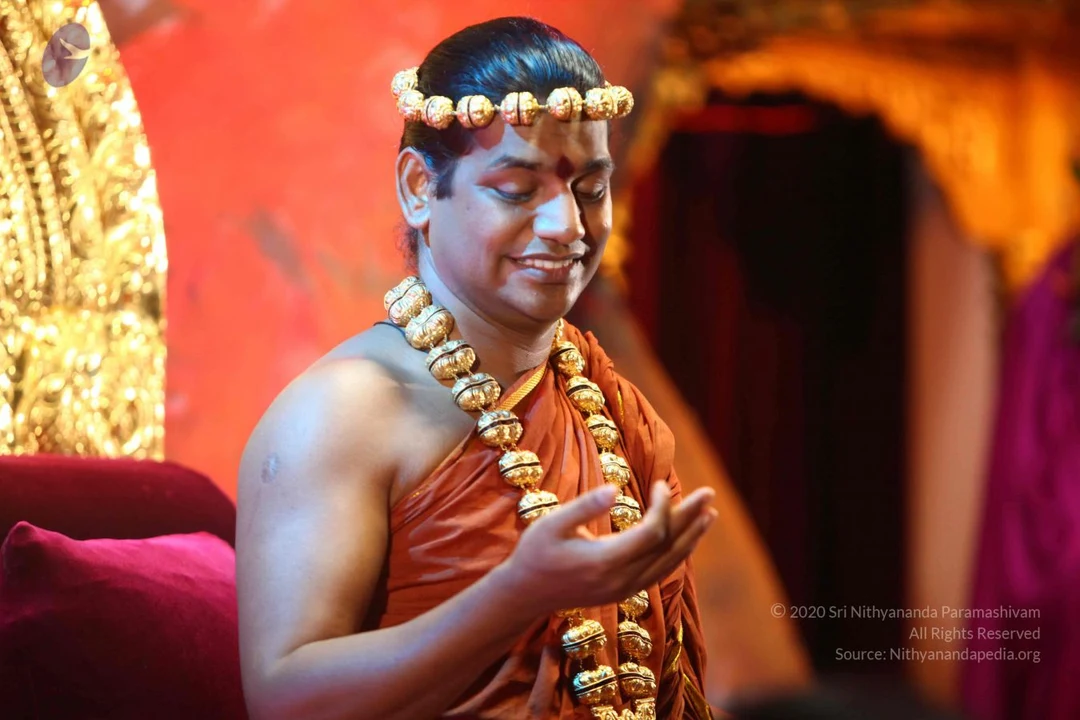
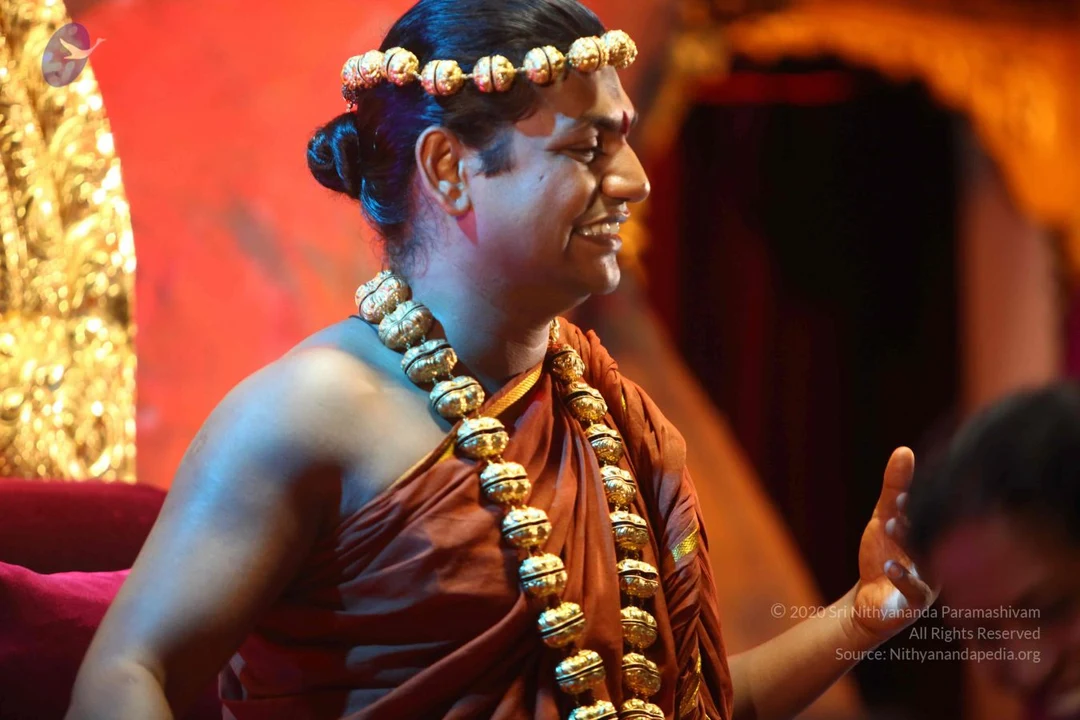
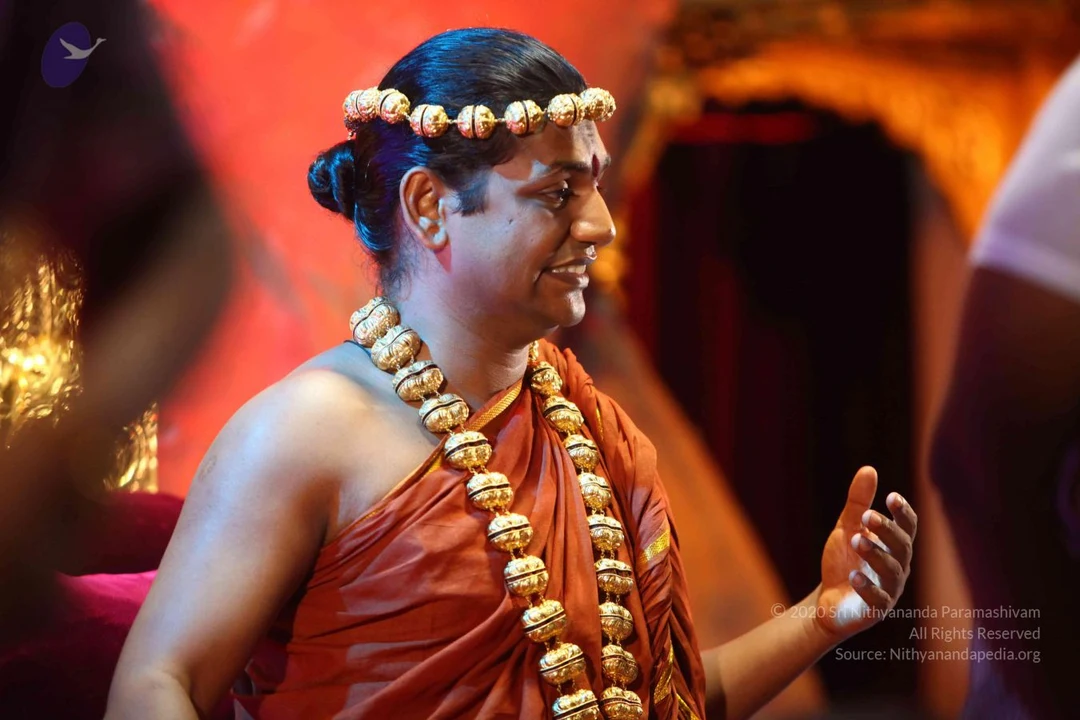
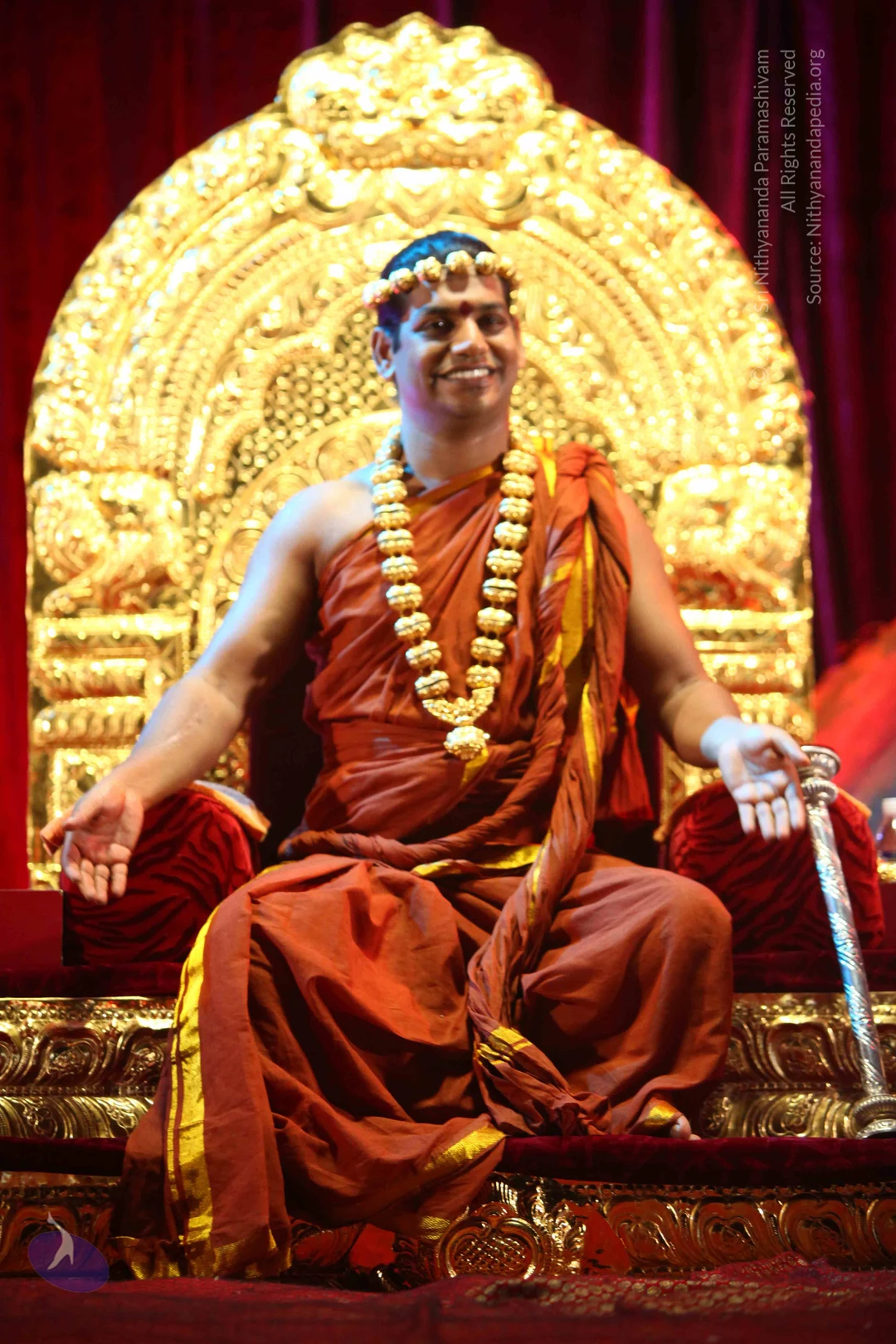
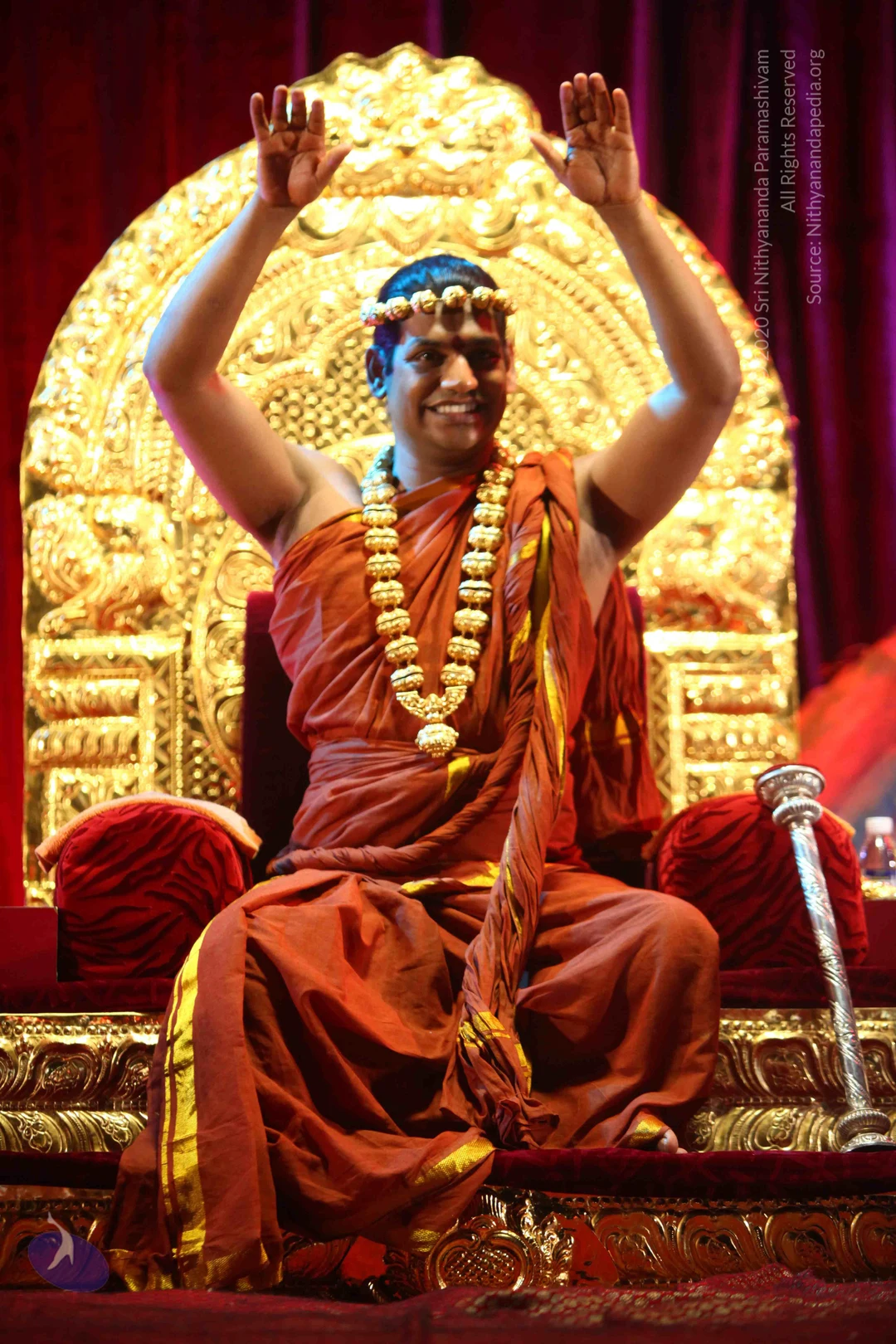
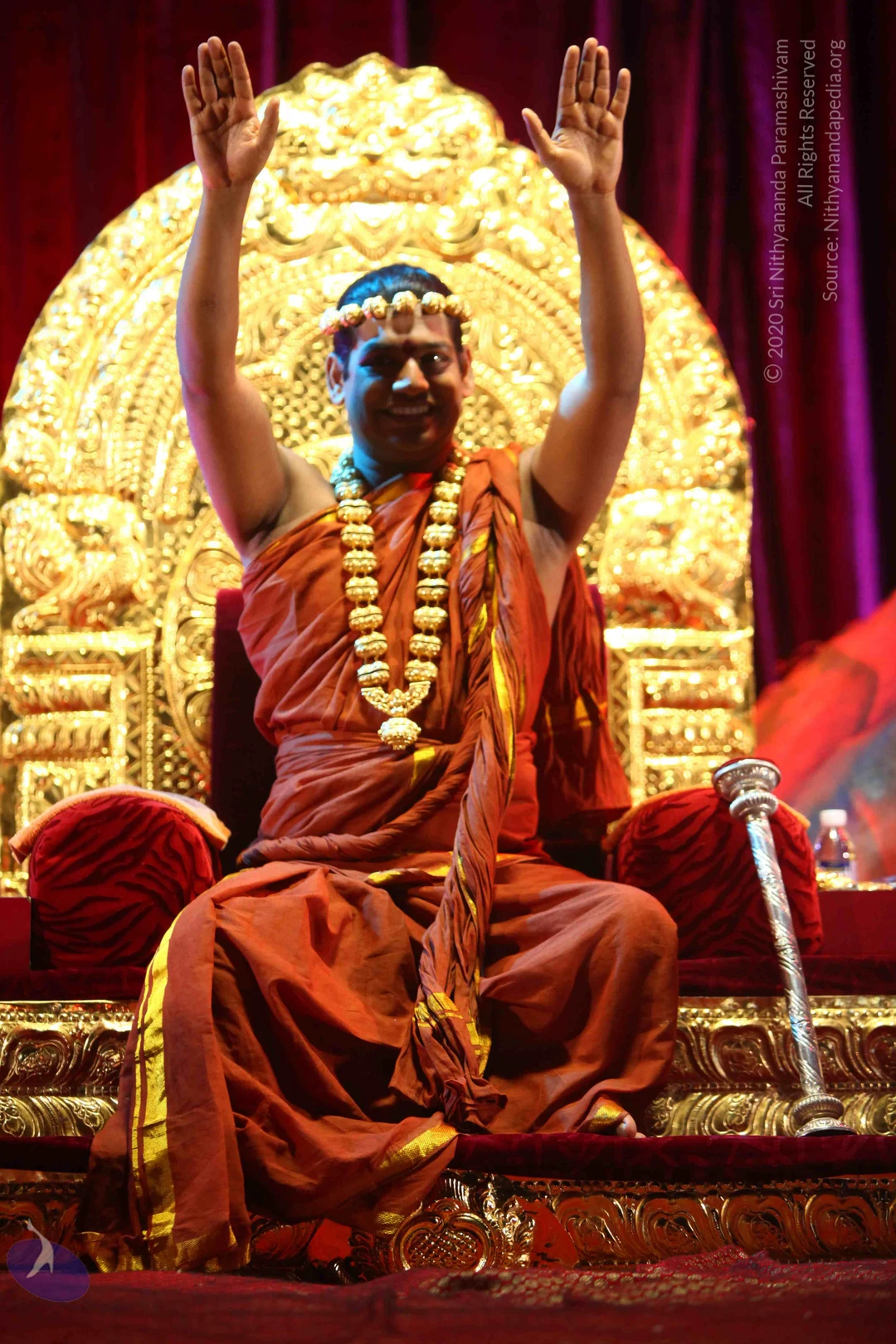
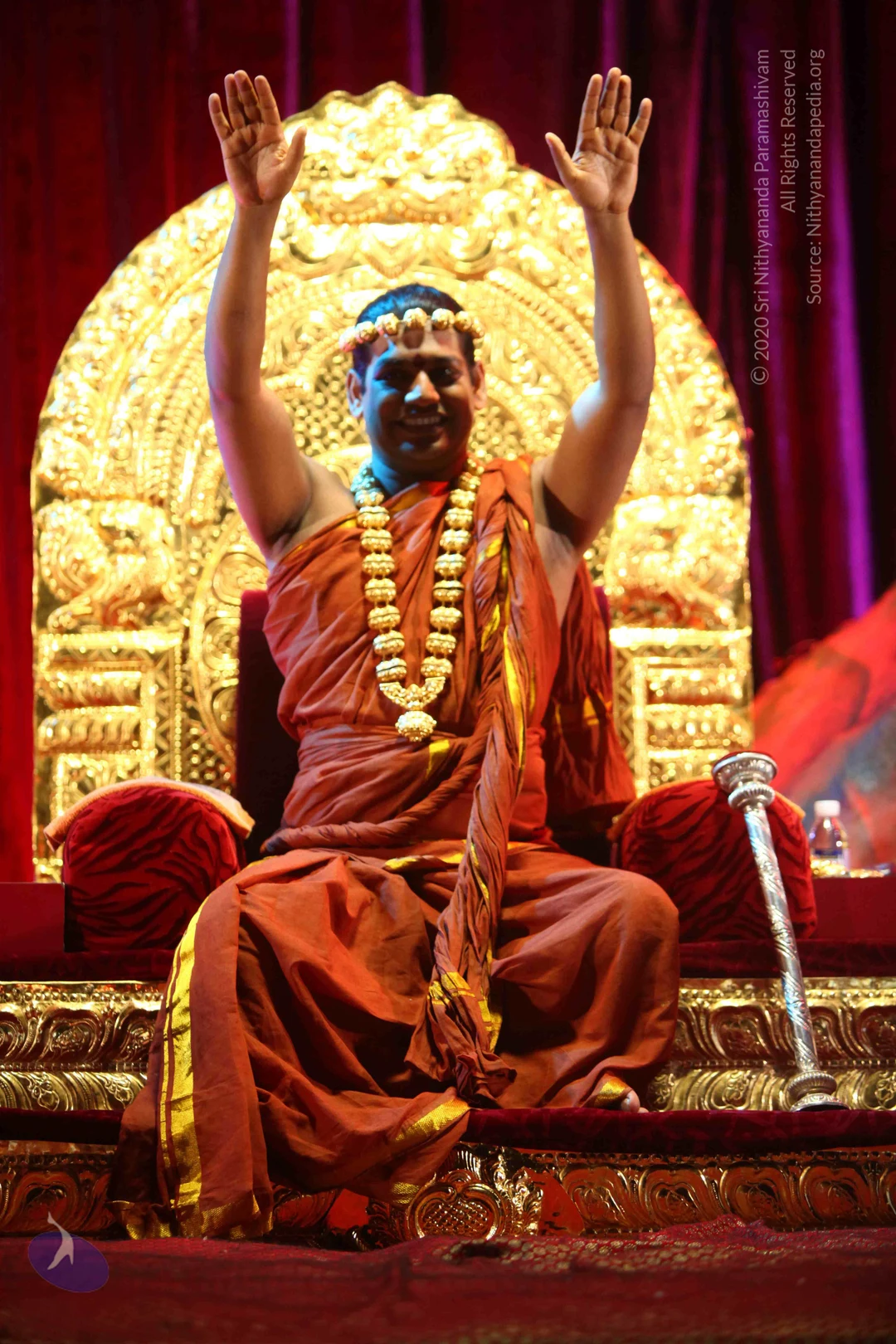
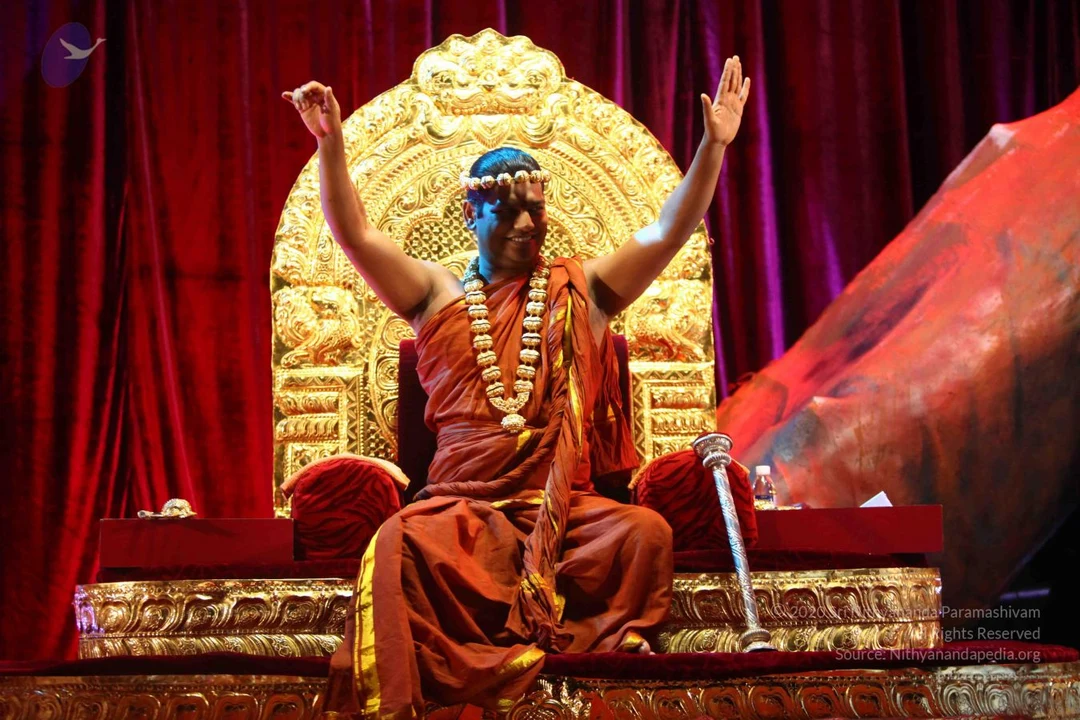
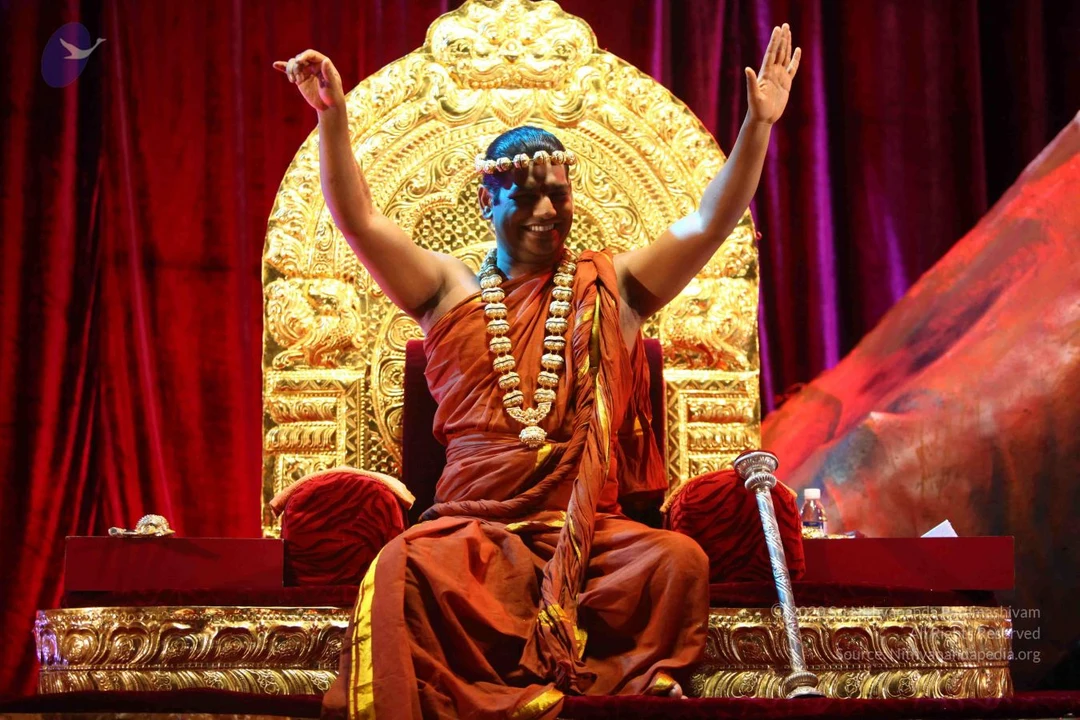
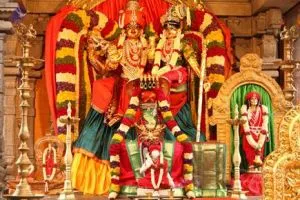
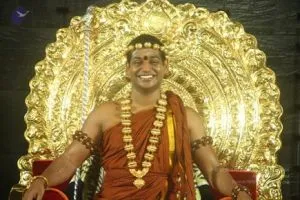
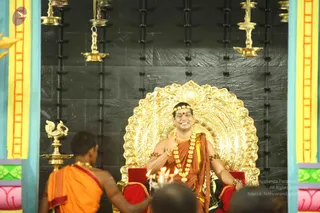
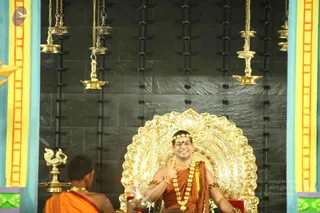
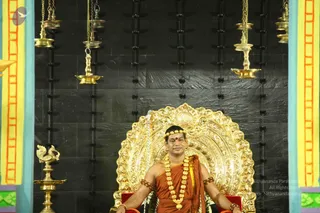
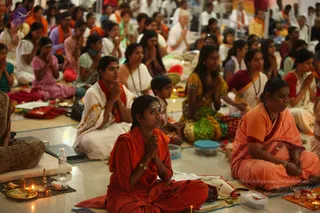
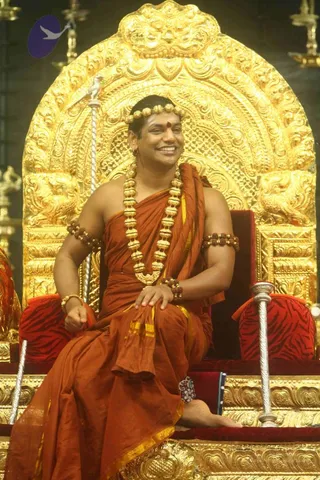
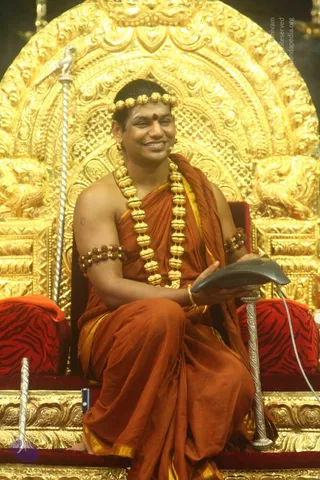
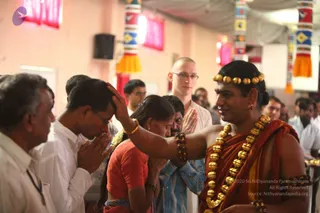
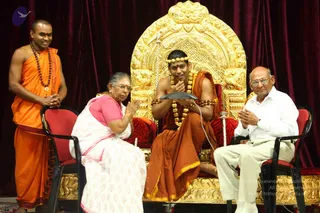
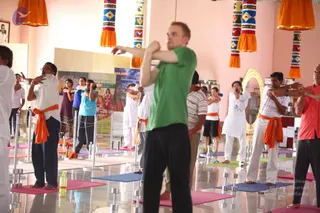
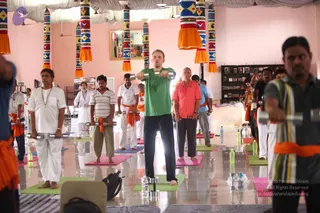
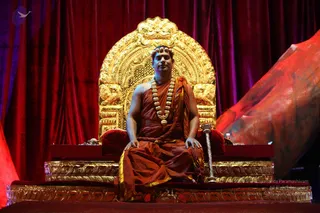
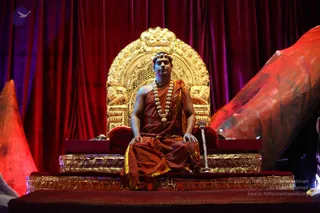
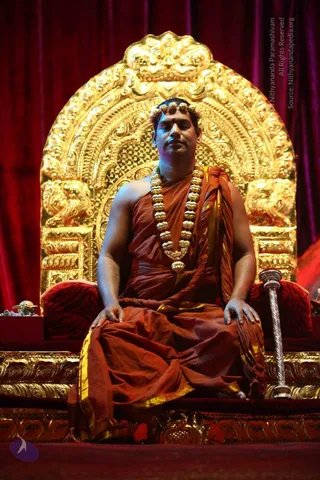
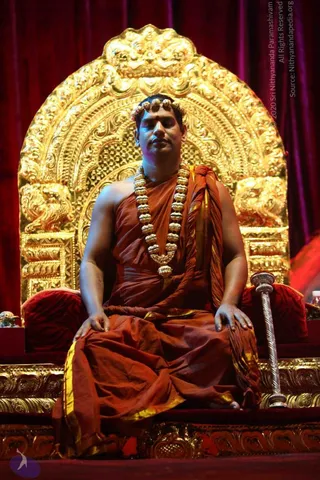
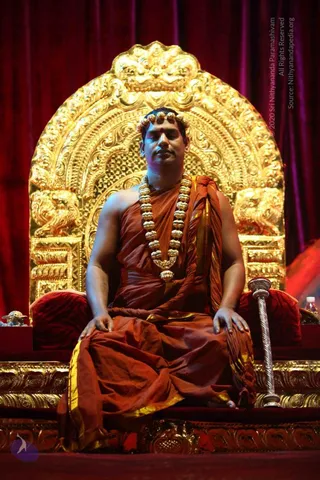
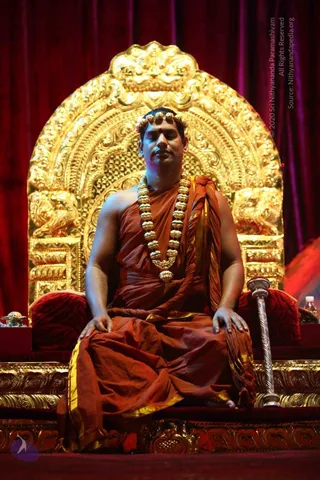
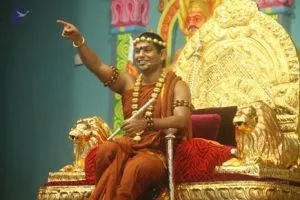
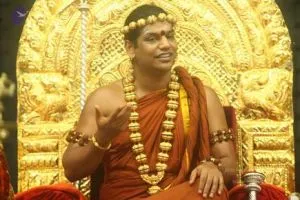
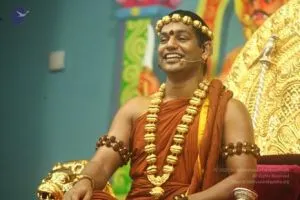
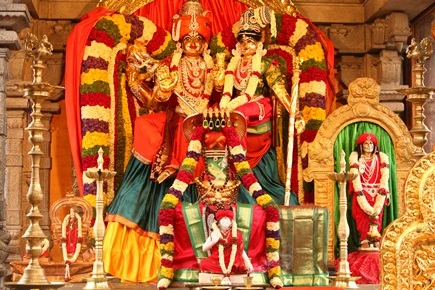
A photograph of a temple shrine with large deity murti figures decorated with red, orange and yellow flower garlands and gold ornaments. Two tall figures stand in the centre, one holding a raised sword-like staff, with a smaller red-dressed figure in a niche to the right. Brass oil lamps stand on both sides and a small puja tray sits in front. On the right foreground, a man in saffron clothing with rudraksha beads and a flower headband kneels smiling beside the shrine, with a gold-framed doorway behind him.A group yoga and exercise session in a bright hall with pink walls and hanging colourful fabric panels with orange tassels. Participants stand on blue, pink and green mats holding small silver dumbbells, and several wear white clothes with orange sashes. A man in a pink shirt stands at right looking upward, a man in a striped polo shirt and grey trousers stands at left, and a person in a green top bends forward at lower left. A man in white with a rudraksha-style mala stands at right foreground. Shelves of books and a framed poster are visible on the left wall.A seated man in an orange-red saffron dhoti and shawl with gold border sits on an ornate gold throne with an arched backrest, raising his right hand in a blessing wave. He wears a heavy gold bead necklace and a gold bead headband with a red tilak on his forehead. Behind him hang deep red drapes and a silver staff rests against the throne arm.

May 01 2012

Original wiki page
Contents

Title:

Mystic,Master,Avatar & God.

Description:

In today’s morning satsang, Paramahamsa Nithyananda (Swamiji) takes questions from devotees. The first question asks him to explain the various Sanskrit terms for Guru/divine: avatar, bhagwan, mystic, enlightened master. Paramahamsa gives a detailed description of “mystic”: one who is continuously creating, using powers beyond the five senses. He points out that we have two choices in life – to become mystics or to be mistakes. The second question concerns counseling. Since Paramahamsa is a master healer and provides life solutions for our difficulties, do his devotees need outside counseling? Paramahamsa replies that for counseling to be useful, counselors must have discovered and implemented effective answers for their own life problems. He is presently designing a training course for spiritual counselors. Until they are available devotees are to seek counseling only from him, for he has the resources to address all their concerns.

Link to Video:

VideoAudio

Transcript:

I welcome you all with my love and respects.

Today - an important celebration, Ashramites day.

11 yrs before on the same day 2001, Ma Nithya Sadhananda, first ashramite came and started staying with me. In half an hour late, Sri Nithya Sadhananda (Ayya) also came. So the first ashramites started coming and staying with me on the same day May 1st. So we celebrate Ashramites day as May 1st.

See the coincidence. Today is Labours Day. We are the ultimate labours for the world.

Understand, we give our physical work. We give our mental ability for society. We give our emotions dedicated to society. Finally ultimately we give our consciousness itself to the society. We are the ultimate labours. And one more thing. Coincidentally this is very day – May 1st - Ramakrishna Mission was established by Swami Vivekananda. May 1st is the date - inauguration of Ramakrishna Mission, Nithyananda Mission and Labours day.

Next, I have an important very mystical information; announcement to share with you all.

In yesterday’s Satsang I said, when I went to Madurai Adheenam, in the Garbamandir, where Guru Maha Sannidanam does his Parartha Pooja every day, inside, I saw one Shiva Lingam. I was enquiring everybody -“what it is? what it is?”. I could not get any answer because nobody knows. Then the night samadi I meditated.

Yesterday I announced, I found in the vision, in the Akashic reading, the darshan I saw, that is the “Adhi Chokkanaada”, the original Shivalinga on which Meenakshi Temple Sundareswara Temple was built and during the invasion, this Shivalingam was brought here and kept here to preserve, to be protected. So after the invasion was over, Muslims invasion, even after everything settled, this Shivalingam never went back to the Madurai temple. So this is what I saw in the vision. Now today I have a solid proof for all of you for what I said. Please understand, in Agama tradition, each Garbamandir is built based on the measurement of the Shivalinga. If the Sivalinga is one unit, the length will be 22 unit height will be 27 unit. The breadth will be 42 unit. Like that there is a dimension. The wall thickness everything there is a dimension.

Actually when I went to Madurai Adheenam, when I saw that Shivalinga, I took the measurement of the Shivalinga by my hand. I brought the measurement and gave it to one of the senior Stapathi who is expert in the Agama science. He already had Madurai Garbamandir’s measurements. He matched both the measurements. They are completely matching. Please understand, the Adhi Chokkanadar in Madurai Adheenam, that Sivalinga,and the Garbamandir of Madurai Sundareswara temple -both measurements are perfectly matching and one more information the present Shivalinga which is there in Chokkanadar temple, that Shivalinga measurement is not matching. It is smaller than the size which is supposed to be. The Garbamandir measurement unit size as per the Agama is perfectly matching without missing even one inch. The height, length, breadth everything is matching. By tomorrow I will release the document. The whole documentation in the own handwriting of the Stapathi.

So whatever I saw in the darshan is proved archeologically. I have archeological evidence now to prove to the society and I will present this whole data to our 292nd Guru Maha Sannidanam . If he feels, we will release it to public, if not we will not release it to public. But now I have solid archeological evidence that this Shivalinga is Adhi Chokkanadar.

Please understand all temples’ Garbamandirs are built based on the size of the Shivalinga. Shivalingas are usually Jyothir Linga. They come by themselves. They are molded, polished using the neem and lemon juice. This Shivalinga is also Swayambu, but molded and polished nicely without using any chisel and hammer. Just by neem and lemon. Neem and lemon juice will melt stone. If you add some more herbs with the neem and lemon juice, it will melt stone. That is the way this Shivalinga was polished and the present Chokkanadar temple’s Garbamandir and this Adhi Chokkanathar lingam, both are perfectly matching as per the agama science. As per the size it is properly matching without even one inch missing, but the present Shivalinga which is there inside Chokkanathar temple, which is worshipped as Sundareswara now - that Sivalinga’s size is not matching with the Garbamandir. It is smaller than the Garbamandir’s size; which is smaller than supposed to be. For this present Garbamandir, what size Chokkanadar has supposed to be, this present Shivalinga is smaller. Of course once you establish, everything radiates Chokkanadar. No doubt.

I am not questioning the sanctity. I am just saying we have some archeological evidence this Shivalinga was worshipped earlier as Chokkanadar. Of course when you install any Shivalinga inside the Garbamandir that starts radiating the same energy. I will present all the archeological evidence and the Agamic evidence to our 292nd Guru Maha Sannidhanam today and as per his advice, I will decide whether to release those evidences or not. It will be done based on the decision by 292nd Guru Maha Sannidhanam.

We will start the morning satsang. We will start with the questions.

Question: Can you please explain the following terms: Mystic, Enlightened Master, Avatar, Bhagawan, God, Atma, Paramatma.

Can you please explain the difference between mind and inner space?

Swamiji: The words which you are using, basically the base quality is almost same. May be, one or two superficial references can be given. Superficial differences can be given. Actually these words - more than differences they are more like a references. The word mystic and word enlightened master , avatar there is no much difference. It is just reference. Different reference. Please understand, there is a big difference between “difference” and “reference”. Here, the word Enlightened Master, Avatar, Bhagawan, Mystic, God, Atma, Paramatma - between all these words there is no difference but they are all different references.

Mystic is the word usually used for creators. Please understand, person who uses energies which are beyond 5 senses and creates is a mystic.

For eg. Materialization. If somebody uses the powers which is beyond the senses, beyond 5 senses, those energies,using that energies, and creating something which is beyond 5 senses.

For eg. when I materialize a diamond or certain object there, there is no normal human power is used. The powers known to the 5 senses are not used. The powers which is beyond 5 senses are used. Anybody who uses the powers beyond 5 senses and creates something is a Mystic. Don’t mistake. Person who ‘creates’ is a Mystic. A mystic constantly creates, creates, creates. Even in you, when the “transformed you” is created, you become a mystic. Mystic is a person who is constantly creating so many new, new, new, new, new things continuously using the extraordinary powers.

Actually, anybody who creates, contributes to society will be a mystic. Otherwise you are a mistake. In society only there are two kinds of human beings. One, who is a mystic; another one who is a mistake. I am seeing.

Suddenly yesterday, I saw few fellows here and there all over Tamilnadu giving statement that I should not become a Peetathipathi of Madurai Atheenam. Of course all the people who are socially responsible and creative are supporting highly. Just today morning I received a phone call from one of the biggest political party’s head. Today morning he called me personally to congratulate. For last 5 days he is calling me. I was not able to attend the phone. Today he called me and personally congratulated and on 6th May 2012 he is coming to Madurai to have the darshan of 292nd Guru Maha Sannidhanam and me.

Continuously all the responsible people, people who are creating, socially responsible are highly supporting. They are all highly supporting, respecting, revering. Please understand, only few people who have never created anything in the life - only they are trying to oppose; only they are trying to disturb. I saw the names of those fellows who are trying to abuse. They have not created anything in their life. It is like there are some people who get the attention of the society by creating and contributing. There are some people who get the attention only by abusing others. This is the difference between government and terrorists. All the creative people are continuously supporting me in a high way, in a very big way. Only these few terrorists who never created- only destroyed others-, only those few fellows are trying to abuse.

I tell you. All the fellows, 2,3 fellows who are trying to say that I should not become Peetathipathi, who are abusing my predecessor, 292nd Guru Maha Sannidhanam, to all of them I am saying, please understand - you guys are religious terrorists; you have not created anything; you never contributed anything; you all have reduced Hinduism just shouting slogans and protesting, standing in the streets and shouting. You never created anything. I wanted to tell all of them even if you have created 1/10 of what I contributed for Hinduism by creation, come on I will make you to sit on the thrown.

None of them have created anything. All of them have only destroyed. I could not understand, how these fellows have no idea about Hinduism. They are saying they are all Hindu organizations. What do you mean?

I have created 40 temples all over the world; inspired more than 1 crore 22 lakh people to follow Hindu traditions; converted more than 60,000 people formally, even though I don’t believe in conversion, I believe only in transformation, but people voluntarily took up this life style. Thousands and thousands are living, practicing Hindu tradition. I have created a university for Hinduism in USA. So much. More than 200 books which is sold more than 1 crore copies - 10 million copies - all over the world in 27 langauges. So much has been done to Hindu tradition and Hinduism.

I don’t understand what they mean by their Hindu organizations. So, then what about all of us?

All my sannyasis are creators. They have created and contributed to Hinduism. Understand, because we spent all our energy in creation, don’t think we don’t know how to answer your destruction. If you try to play the role of Nakkeeran, I know how to play the role of Chokkanathar.

Mystic is a person who goes on creates using mystical energy; Enlightened Master is a person who constantly showers enlightenment on others. Avatar is a person who is direct descendants, directly appeared from Super consciousness, radiates all the satgunas, all the auspicious qualities. Bhagawan is a being who radiates all the qualities including giving enlightenment. God is the formless energy. Atma is the formless energy reflecting on the form. Paramatma is the formless energy in its original existence and all its reflections put together.

I have defined all the technical terms. As I said, there are no differences between all these terms they are only different references.

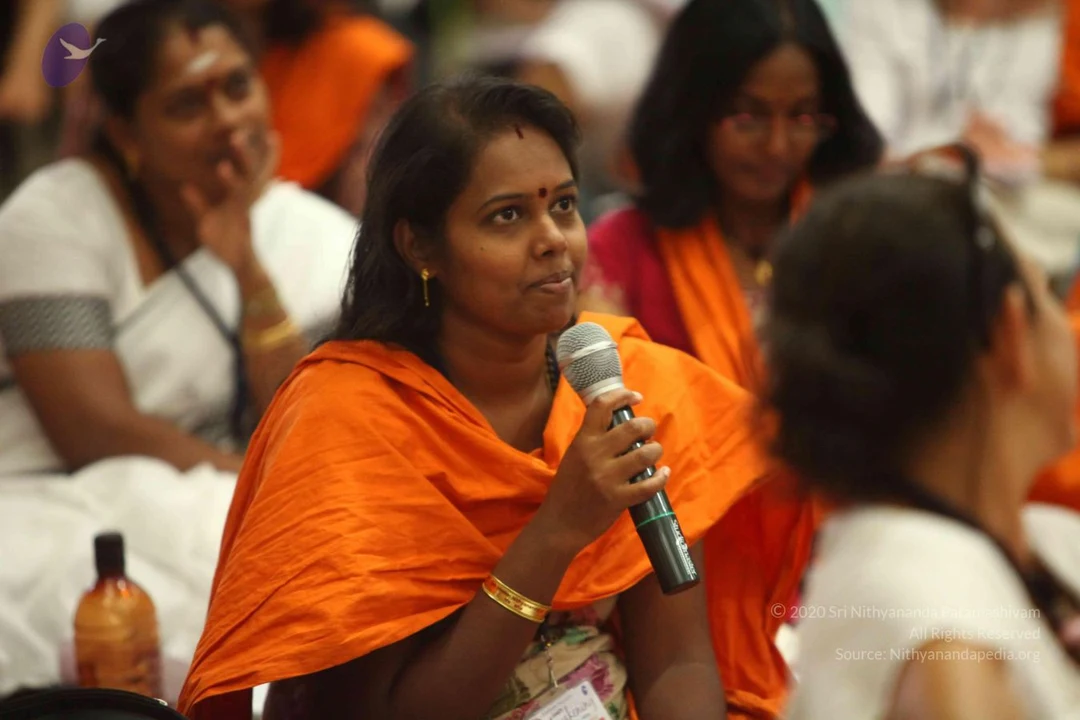
Question: I would like to get your advice on these 2 questions. What are the roles and limitations of counseling in today’s world. Since Swamiji can do all types of healing for all people, is counseling still needed for Swamiji’s devotees? What are the problems faced to heal more people?

Swamiji: Yes. And first thing, if the counselors do not understand the existence of the consciousness, they are going to heavily damage the people whom they are counseling.

Counseling is nothing but giving mental patterns. If you don’t have right patterns, you will be giving wrong patterns. If you have right patterns, you will be giving right patterns.

All the counselors in the world, first thing they should do, have right patterns. Means you should have answered all your inner questions with convincingly for yourself. Please understand all your inner questions like - why poverty, why differences in the world, why birth, why death, why world, why nature, who am I - all your basic questions, you should have a complete convincing non-hypocritical answers for yourself. That is the first step. If you have a non-hypocritical right answers for these basic questions you have right mental pattern. You will be able to answer, give right counseling.

Please understand, if you are not having the right mental patterns, if you yourself do not have many answers for the ultimate questions; be very clear- the mental patterns you are carrying is wrong, it will only create more and more suffering, trouble and torture to yourself and to others.

Understand, psychiatrists and counselors are the largest profession who commit suicide on the planet earth. Not even lawyers. Not even police officials. Not even suicide bomb terrorists. Even the suicide squad terrorists don’t commit suicide in this large number. Psychiatrists and counselors are the largest number of people who commit suicide. The profession in which largest number of people commit suicide is psychiatry and counseling. Why? Because, without having answers for all the important questions; having wrong, broken, incomplete patterns, they go on giving this patterns to others. But when they look back, when they relax, when they rest, they feel they are empty. They understand everything is a lie. They do not feel what is truth. They do not have hope for life. They do not know why life? What for life? What is life? So the immediate decision they take even with the small depression is suicide.

I tell you the roles and responsibilities of the counselors: first thing- have convincing right answers to your all internal questions. Your second question: “Since swamji can do all types of healing for all people, is counseling still needed for all Swamiji’s devotees? What are the problems faced to heal more people?” Please understand, for my devotees no counseling is needed. Be very clear. The person who is already into the flight does not need bullock cart. They are already in the flight. They don’t need bullock cart. My devotees do not need any type of counseling. May be for common people counseling will be really helpful, if you can have convincing answers internally for all the basic questions.

Now I am creating 100 videos which will give you completely understanding, convincing answers to all your major questions related to life. Anybody who masters all the great truths in that 100 videos and internalizes can become a spiritual counselor.

Spot Notes:

Tuesday, May 1st, 2012

“Sadashiva samarambam, Shankaracharya madhyamam asmadacharya paryantam vande Guru paramparam!”

I welcome you all with my love and respects! I welcome all the devotees, disciples, Samajis, Satsangis sitting with around the world at this moment in places 1002 through Nithyananda TV, 22 places 2 way Nayana Deeksha, in 239 cities, 25 countries!

Cities sitting with us in 2 way Video conferencing having Nayana Deeksha are – Madhurai Aadeenam – today our 292nd Guru Maha Sannidhanam Srila Sri Arungirinatha Jnana Sambandha Desiga Paramacharya Swamigal is also in two way connection. I offer my humble respects at the holy feet of 292nd Guru Maha Sannidhanam. I am very happy that he is also there listening to Satsang today J I ask for Swamiji’s blessings before starting the Satsang. Croatia, Tiruvannamalai Arunachalam, Hyderabad Bhagyanagaram, Guadeloupe Rameshwaram, Toronto Kailasam, Los Angeles Arunachala, Seattle Chidambaram, Malaysia Palani, Phoenix Kancheepuram, Ohio Prayag, Chennai Nungambaakam, Nagpur India, Oman, Austin, Charlotte Srisailam, Oklahoma Somanatham, Singapore Singapuram, Mexico City, Vancouver Puri. That’s it. I welcome you all with my love and respects!

Sri Saravani & family Phoenix – Blessings – I accepted your paada puja. I will talk to you during Dial the Avatar. Meena & Rajesh – Ohio, Donna Johansen Los Angeles - blessings for all of you – I accepted your paada puja, I will talk to you during Dial the Avatar. Vidya Maheshwari Los Angeles birthday blessings for you – I am with you, you will be with me. Blessings!

Today an important celebration Ashramites day! J 11 years before on this same day 2001 on this same day, means 11 years or 12 years now? 2001 on this same day Ma Nithya Sadananda first Ashramite came and started staying with me J In ½ hour late Sri Nithya Sadananda Ayya also came. So the first Ashramites have started coming and staying with me on this day – May 1st. So we celebrate Ashramites day as May 1st. See the coincidence - today is Labour’s day. We are the ultimate labours for the world. Understand, we give our physical work, we give our mental ability for society, we give our emotions dedicated to society. Finally, ultimately we give our consciousness itself to the society. We are ultimate labours. And one more thing this is the very day coincidentally May 1st is the very day Rama Krishna Mission was established by Swami Vivekananda. May 1st is the date inauguration of Ramakrishna Mission, Nithyananda Mission and labours day J Today all our Ashrams & Ashramites should celebrate the Ashramites day!

Next, I have an important very mystical information, announcement to share with you all. In yesterday’s satsang I said when I went to Madhurai Aadeenam, in the Garbha Mandir where Guru maha sannidhanam does his paraartha puja every day, inside I saw one Shiva Lingam. I did not know what it was. So I was enquiring everybody- what it is, what it is? I could not get any answer because nobody knows. Then in the night in samadhi I meditated. Yesterday I announced. I found in the vision, in the Aakashik reading, in the Darshan I saw – that is the Aadi Chokkanaadha – the original Shiva Linga on which the Meenakshi Sundareshwara temple was built and during the invasion this Shiva Lingam was brought here, kept here and preserved her to be protected. So after the invasion was over – Muslims invasion, even after everything settled, this Shiva Lingam never went back to the Madhurai temple. So this is what I saw in the vision. Now today I have a solid proof for all of you for what I said. Please understand, in Aagama tradition, each Garbha Mandir is built based on the measurement of the Shiva Linga. If the Shiva Linga is one unit, the length will be 22 unit, height will be 27 unit. The breadth will be 47 unit. Like that there is a dimension. The wall thickness, everything there is a dimension. I sent see yesterday actually when I went to Madhurai Aadeenam, when I saw the Shiva Linga I took the measurement of the Shiva Linga by my hand. I brought the measurement and gave it to the one of the senior stapadhi who is expert in the Aagama science. He already had Madhurai Garbha Mandir’s measurements. He matched both the measurements. They are completely matching! Please understand, the Aadi Chokkanaadhar in Madhurai Aadeenam that Shiva Linga and the Garbha Mandir of Madhurai Sundareshwara temple both are perfectly matching! And one more information - the present Shiva Linga which is there in Chokkanaadhar temple, that Shiva Linga measurement is not matching - it is smaller than what is supposed to be. The Garbha Mandir measurement unit size as per the aagama is perfectly matching without missing even one inch. The height, length, breadth everything is matching. By tomorrow I will release the document. The whole documentation in the own hand writing of the stapadhi. Please understand so whatever I saw in the Darshan is proved archaeologically. I have a archaeological evidence now to prove to the society. And I will present this whole data to our 292nd Guru Maha Sannidhanam. If he feels we will release it to public. If not, we will not release it to public. But now I have a solid archaeological evidence that this Shiva Linga is Aadi Chokkanaadhar.

Please understand, all temples Garbha Mandirs are built based on the size of the Shiva Linga. Shiva Lingas are usually Jyotir Linga – they come by themselves. They are moulded, polished using the neem and lemon juice. This Shiva Linga is also Swayambhu but moulded and polished nicely without using any chisel and hammer just by neem and lemon. Neem and lemon juice will melt stone. If you add some more herbs to the neem and lemon juice it will melt stone. That is the way this Shiva Linga was polished. And, the present Garbha Mandir – the Chokkanaadhar temple’s Garbha Mandir and this Aadi Chokkanaadhar Lingam both are perfectly matching as per the aagama science, as per the size - properly it is matching without even one inch missing. But the present Shiva Linga which is there inside the Chokkanaadhar temple which is worshipped as Sundareshwara now, that Shiva Linga size is not matching with the Garbha Mandir. It is smaller than the Garbha Mandir’s size. It is smaller than what it is supposed to be. For this present Garbha Mandir what size Chokkanaadhar is supposed to be, this present Shiva Linga is smaller. Of course once you establish everything radiates Chokkanaadhar – no doubt. I am not questioning the sanctity. I am just saying we have some archaeological evidence this Shiva Linga was worshipped earlier as Chokkanaadhar. Of course when you install any Shiva Linga inside the Garbha Mandir that starts radiating the same energy. I will present all the archaeological evidence and the aagamic evidence to our 292nd Guru Maha Sannidhanam today and as per his advice I will decide whether to release those evidences or not. It will be done based on the decision by 292nd Guru Maha Sannidhanam. We will start the morning Satsang. We will start the questions.

1) Sadhar Pranams, can you please explain the following terms 1. Mystic , 2. Enlightened Master, 3. Avataar, 4. Bhagawaan 5. God, 6. Atma, 7. Paramatmaa. Can you please explain the difference between mind and inner space. In love and Gratitude and regards – Hiranmaie – IA ID No. 12.

Hiranmaie, the words which you are using basically the base quality is almost same. Maybe one or two superficial references can be given, superficial differences can be given. Actually these words - more than differences, they are more like references. The word mystic and word enlightened master, avatar, there is no much difference. it is just reference – different reference. Please understand, there is big difference between difference and reference. Here the word enlightened master, Avatar, Bhagavan, Mystic, God, Atma, Paramatma - between all these words there is no difference but they are all different references. Mystic is the word usually used for creators. Please understand person who uses energies which are beyond five senses and creates is a mystic. For example, materialization. If somebody uses the powers which is beyond the senses, beyond the five senses, those energies using that energies and creating something which is beyond five senses. For example, when I materialize the diamond or certain object there – there is no normal human power is used. The powers known to the five senses are not used. The powers which is beyond five senses are used. Anybody who uses the powers beyond five senses and creates something is a mystic. Don’t mistake. Person who creates is a mystic. A mystic constantly creates, creates, creates. Even in you when the transformed you is created, you become a mystic. Mystic is a person who is constantly creating so many new, new, new, new things continuously using the extraordinary powers. Actually anybody who creates contributes to society will be a mystic. Otherwise you are a mistake. In society only there are two kinds of human beings - one who is a mystic another one who is a mistake.

I am seeing. Suddenly yesterday I saw few fellows here and there all over Tamilnadu giving statement that I should not become a Peetadhipati of Madhurai Aadeenam. Of course all people who are socially responsible and creative are supporting highly. Just today morning I received a phone call from one of the biggest political party’s head G.K.Mani in Tamilnadu. They have a party called Pattali Makkal Katchi – a very sizeable party. Today morning he called personally to congratulate me. For last five days he is calling me. I was not able to attend the phone. Today he called me and personally he congratulated and 6th he is coming to Madhurai to have the Darshan of 292nd Guru Maha Sannidhanam and me. Continuously all the responsible people, people who are creating, socially responsible are all highly supporting. They are all highly supporting, respecting revering. They are all highly supportive. They are all highly respecting, reverting and supporting. Please understand only few people who have never created anything in the life only they are trying to oppose. Only they are trying to disturb. I saw the names of those fellows who are trying to abuse. They have not created anything in their life. See it is like a there are some people who get attention of the society by creating and contributing. There are some people who get attention only by abusing others. This is the difference between Government and terrorists. All the creative people are continuously supporting me in a high way, in a very big way. Only these few terrorists who never created and trying to destroy others. Only those fellows are trying to abuse. I tell you all the fellows 2-3 fellows who are saying that I should not become Peetadhipati, who are abusing my predecessor 292nd Guru Maha Sannidhanam – to all of them I am saying please understand - you guy are religious terrorists! You have not created anything, you never contributed anything. You all have reduced Hinduism just shouting slogans and protesting, standing in the streets and shouting. You never created anything. I wanted to tell all of them even if you created 1/10th of what I contributed to Hinduism, my creation, come on! I will make you sit on the throne. None of them have created anything. All of them only destroyed. I could not understand how these fellows have no idea about Hinduism. They are saying they are all Hindu organizations. What do you mean? I have created 40 temples all over the world, inspired more than one crore 22 lakh people to follow Hindu traditions, converted more than 60,000 people formally even though I don’t believe in conversion, I believe only in transformation. But people voluntarily took up this life style, 1000s and 1000s are living, practicing Hindu tradition. I have created a university for Hinduism in USA. So much - more than 200 books which is sold more than one crore copies, 10 million copies all over the world, in 27 languages, so much has been done to Hindu tradition and Hinduism. I don’t understand what they mean by they are Hindu organizations. So then what about all of us? All my Sannyaasis are creators. They have created and contributed to Hinduism. Understand. Because we spent all our energy in creation, don’t think we don’t know how to answer your destruction. We will give you right answer if anybody tries to abuse or destroy. We know all the methods. I wanted to tell everybody. I wanted to make it very clear today. This chota chota small local rowdies, the street rowdies who come there for 50 rupee and 250 ml alcohol. I wanted to tell all of you guys - if you try to play the role of Nakkheeran, I know how to play the role of Chokkanaadhar. Understand, play the role of Nakkheeran, I know how to play the role of Chokkanaadhar ! But most of these fellows are not even in the standard of Nakheeran. They are in the standard of Dharmi. Just if they get few coins they will run away! Beggar fellows instead of begging, blackmailing beggars. They are not even decent beggars like Dharmi. If they come as decent beggars like Dharmi, I would have given like Chokkanaadhar. They have not come as decent beggars like Dharmi. They have come as a blackmailing beggars like the fellow who came to conquer the Madhurai by music this musician – in that way only they are trying to come. I know how to send the baanapatra and win this game J

I will make this fellows run away overnight. Mystic is a person who goes on creates using mystical energy. Enlightened master is a person who constantly showers enlightenment on others. Avatar is a person whose direct descendence - directly appeared from super consciousness, radiates all the sadgunas, all the auspicious qualities. Bhagavan is a being who radiates all the qualities including giving enlightenment. God is formless energy. Atma is the energy - formless energy reflecting on the form. Paramatma is the formless energy in its original existence and all its reflections put together. I have defined all the technical terms. As I said there are no differences between all these terms. They are only different references. Next question.

2) Swamiji I would like to get your advice on these two questions - a. What are the roles and limitations of counseling in today’s world? b. Since Swamiji can do all the types of healing for all people is counseling still needed for all swamiji’s devotees? What are the problems faced to heal more people? - Ong Kien An – ID No- IA No. 4.

He is asking - What are the roles and limitations of counseling in today’s world? First thing – Ong Kien An, if the counsellors do not understand the existence of the consciousness, they are going to heavily damage the people whom they are counselling. Counselling is nothing but giving mental patterns. If you don’t have right patterns, you will be giving wrong patterns. If you have right patterns, you will be giving right patterns. All the counsellors in the world, first - first thing they should do is have the right patterns means you should have answered all your inner questions convincingly for yourself please understand all your inner questions like - why poverty, why differences in the world, why birth, why death, why world, why nature, who am I - all your basic questions you should have a complete convincing, non-hypocritical answers for yourself. That is the first step. If you have a non-hypocritical right answers for these basic questions, you have right mental pattern. You will be able to answer, give right counselling. Please understand if you are not having the right mental patterns. If you yourself do not have many answers for the ultimate questions, be very clear - the mental patterns you are carrying is wrong. It will only create more & more suffering, trouble and torture to yourself and to others. Understand, psychiatrists and counsellors are the largest profession who commit suicide on the planet earth. Not even lawyers, police officials, not even suicide bomb terrorists, even the suicide squad terrorists don’t commit suicide in this large number. Psychiatrists and counsellors are the largest number of people who commit suicide. The profession in which largest number of people commit suicide is psychiatrists and counselling. Why? Because without answers for all the important questions, having wrong, broken incomplete broken patterns, they go on giving these patterns to others. But when they look back when they relax, when they rest they feel they are empty. They understand everything is a lie. They do not feel what is truth. They do not have hope for life. They do not know why life, what for life, what is life. So the immediate decision they take even with a small depression is suicide. I tell you the roles and responsibilities for the counsellors - first thing have convincing, right answers to your all internal questions.

2nd, your 2nd question - Since Swamiji can do all the types of healing for all people is counseling still needed for all swamiji’s devotees? What are the problems faced to heal more people? Please understand, for my devotees no counselling is needed. Be very clear. The person who is already into the flight does not need bullock cart. He is, they are already in the flight. They don’t need bullock cart. My devotees don’t need any type of counselling. Maybe for common people counselling can be very helpful if you can have convincing answers internally for all the basic questions. Now I am creating videos which will give you completely understanding, convincing answers to all your major questions related to life. Anybody who masters all the great truths in that 100 videos and internalizes can become a spiritual counsellor. I will make that happen now. I am also creating a series on guaranteed solutions. 1000 clips solving 1008 life problems like anger management, managing the greed, managing the lust, managing relationship issues, managing wealth. On all the major life solutions, the major problems you are facing for 1008 problems, I have already spoken 1008 important solutions. It will be called Guaranteed solution series. It is already getting organized. It will be available on the Internet by May, end of May it will be available. The 2012 project team is doing this work.

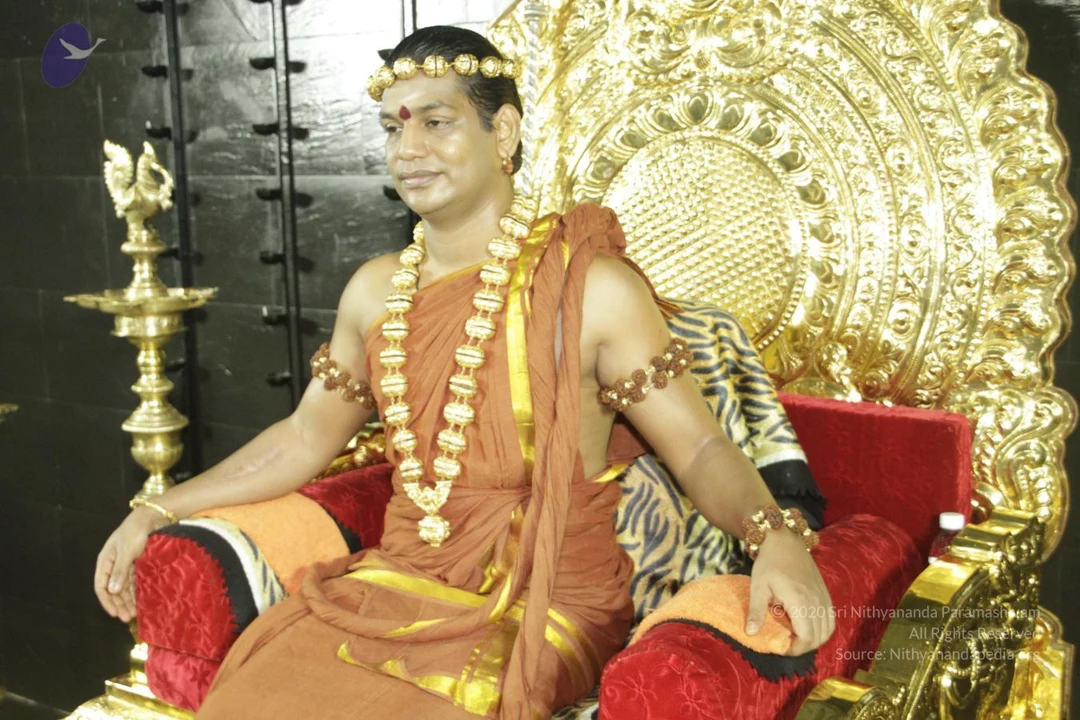
And I also have one more announcement for all of you, before forgetting I wanted to announce. From May 6th, May 5th we have function in Tiruvannamalai where we are offering the golden throne for 292nd Guru Maha Sannidhaanam. From May 6th to May 26th I am going to be staying in Madhurai Aadeenam J And I am also cancelling the South East Asia trip to be in Madhurai Aadeenam. All the devotees who have enrolled their names, please understand, sorry for the inconvenience. I sincerely apologize. I am not able to come with you all for the trip. We will have to cancel the trip. Two reasons – main one reason it is a sudden development that I have to be in the Madhurai Aadeenam assisting the 292nd Guru Maha Sannidhaanam in the administration in many other management of the Aadeenam’s affairs. That is one reason. 2nd if I don’t go and sit there now for 20 days there may be some reasonless losses, needless losses which I don’t want it to happen. So I wanted to stand by 292nd Guru Maha Sannidhaanam in the administration to express my support & solidarity. Myself and the whole 2012 team will be sitting in Madhurai Aadeenam with around 100 Sannyaasis and volunteers. Around 100 volunteers and Sannyaasis will be sitting in Madhurai Aadeenam from May 6th to May 26th for 20 days I will be sitting. And every day moring Satsang will be conducted from Madhurai Aadeenam. I will have my morning usual Satsang and the Dial the Avatar and all Kriya sessions will continuously happen. I will do my everyday morning Satsang from Madhurai Aadeenam itself. So one hundred Sannyaasis and myself will be sitting with 292nd Guru Maha Sannidhaanam supporting the administration and standing by him morally expressing our solidarity from May 6th to May 26th. It is already time we move to the next segment of the morning Satsang – Dial the Avatar. Ultimate reality next session today for Inner Awakening.

Dial the Avatar – 1) e-pada puja

I also request all devotees and disciples around the world whoever wants to spend 20 days around me please come to Madhurai Aadeenam. From May 6th to May 26th you can come and stay with me for Madhurai Aadeenam and assist in administrative responsibility. We will provide food and stay for all devotees who will come to Madhurai Aadeenam. I welcome all of you.

Our Guru Maha Sannidhanam is driving the royal enfield. Our Guru Maha Sannidhaanam is a very active person. He has one royal enfield bike, and he drives car, still he swims even at this age! He is very active and. Actualy many other Aadeenams, many other mutts are feeling jealous of our Guru Maha Sannidhaanam. How he runs the whole organization efficiently and how he has chosen the next person because see many other Aadeenams they just kill themselves in the name of orthodoxy and impractical ideas. Impractical ideas. Sitting inside the stone wall and suffocating. Just put an a/c over! They don’t do practical things – no, no a/c is not allowed! And that is outside, that should not be allowed. In Meenakshi and Chokkanaadhar’s time there was no a/c so they did not allow. If it was there they would have allowed. Now it has come, use it. There are so many things we don’t upgrade ourselves, we don’t go with the flow. We don’t raise ourselves. And I tell you only in all the destruction they follow all the orthodoxy and everything. In creation they don’t follow. Tradition also says you should continuously build temples, create more Sannyaasis, they are not able to do that. In creative work they don’t do anything. Only in destroying they follow all the orthodox rules. Very conveniently they pick up all the rules which are negative. What to do? Alright.

Announcement: Now the Tamil Sangham Bangalore would like to offer their respects to the 293rd Guru Maha Sannidhanam of Madhurai Adeenam - Srila Sri Paramahamsa Nithyananda Sri Jnana Sambandha Desiga Parmacharya Swamigal

I bless you all who are sitting with us at this moment around the world in 1098 places through Nithyananda TV, in 22 places through 2 way Video conferencing having Nayana Deeksha, in 266 cities, 25 countries around the world! And today’s minute for meditation is 90 minutes. Please enter it in minute4peach.org website. Blessings! Let you all achieve, experience, live, express, radiate and share and explode the eternal bliss, Nithyananda. Thank you!

Photos From The Day:
Sakshi Pramana:

Sharing from Inner Awakening

Tags:

question, explain, Guru, divine, mystic, enlightened, description, senses, power, choice, life, mistake, counseling, healer, provide, discover, implement, effective, answer, life problems, design, spiritual, counselor, address.

Photos Of The Day:

Temple

Pada-Pooja

Satsang

Dial-The-Avatar

Bangalore-Tamii-Sangam-Meeting-Swamiji

Sarva-Darshan

Aachi-Meeting-Swamiji

IA-Session

Engenius

IA-Afternoon-Yoga

IA-Darshan

Photos Of The Day:

Sarvadarshan

Photos from this day

View all 409 photos

Photos From The Day:
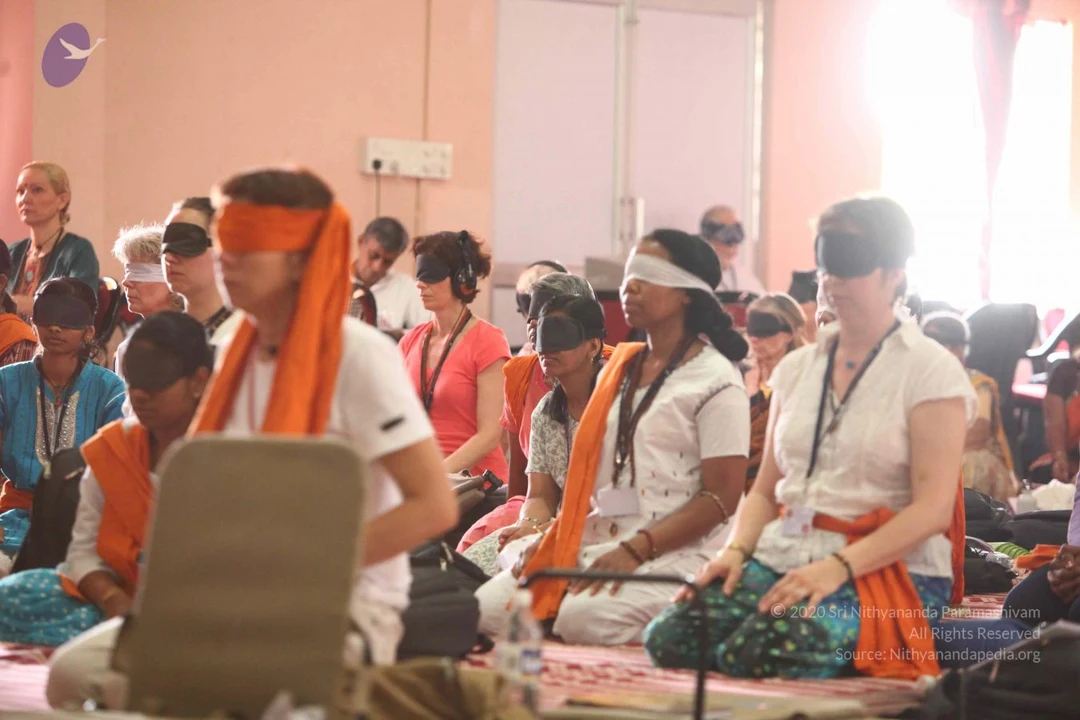
2 photosSource gallery
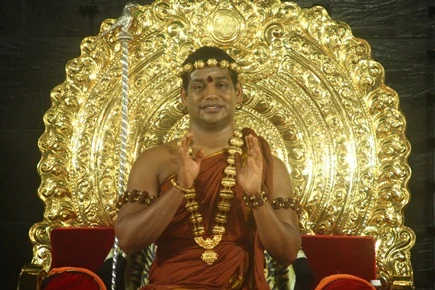
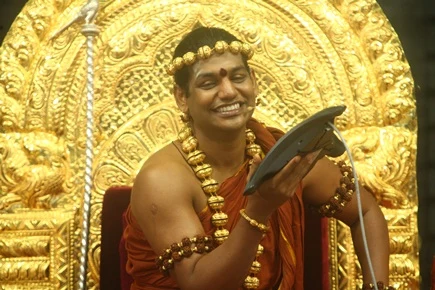
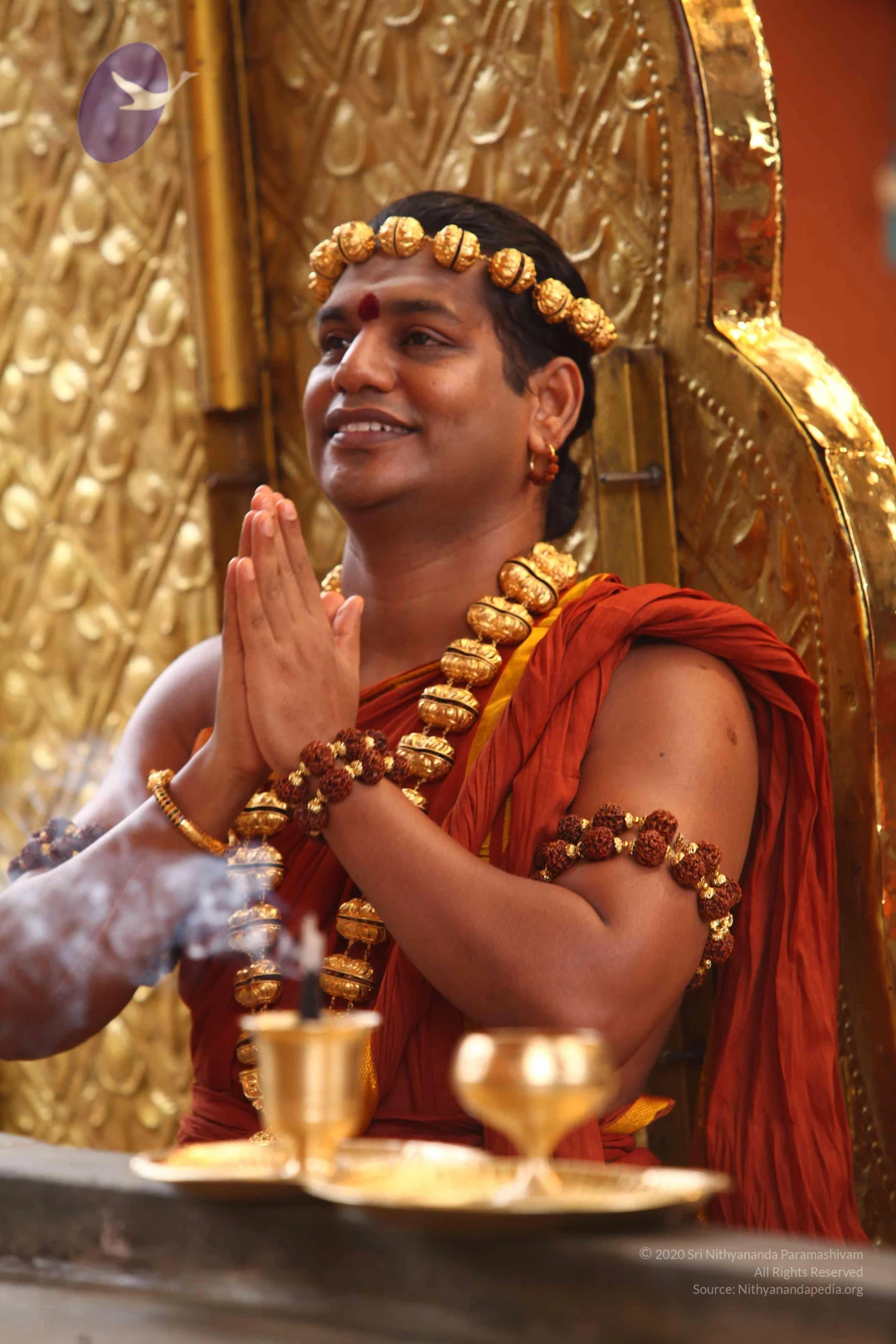
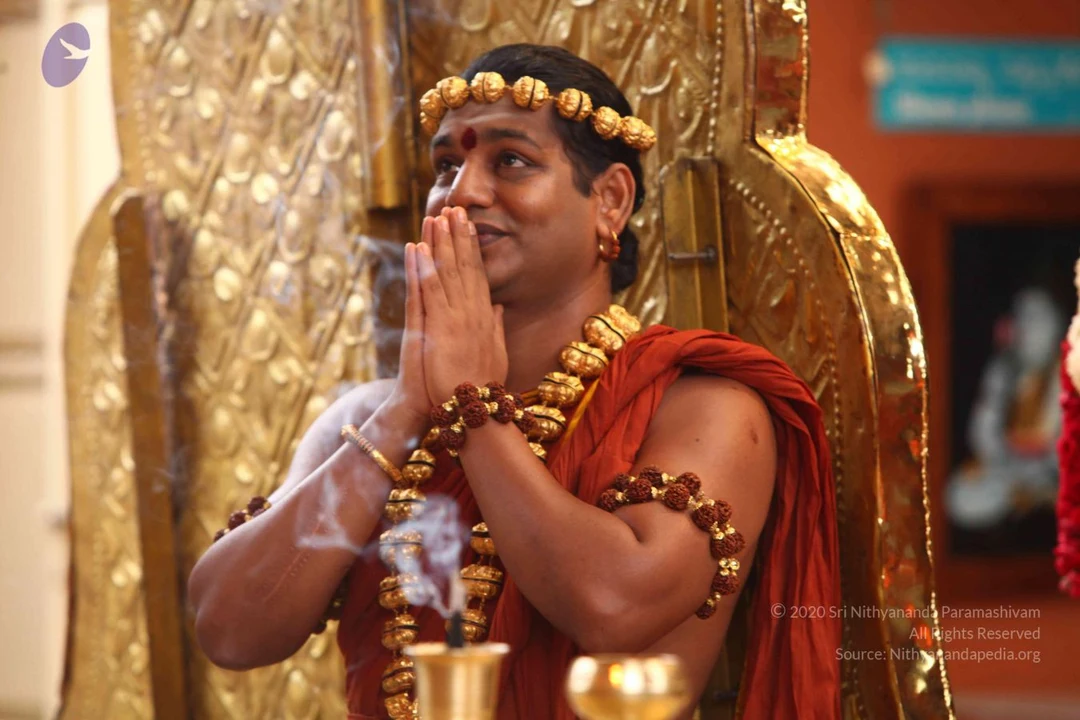
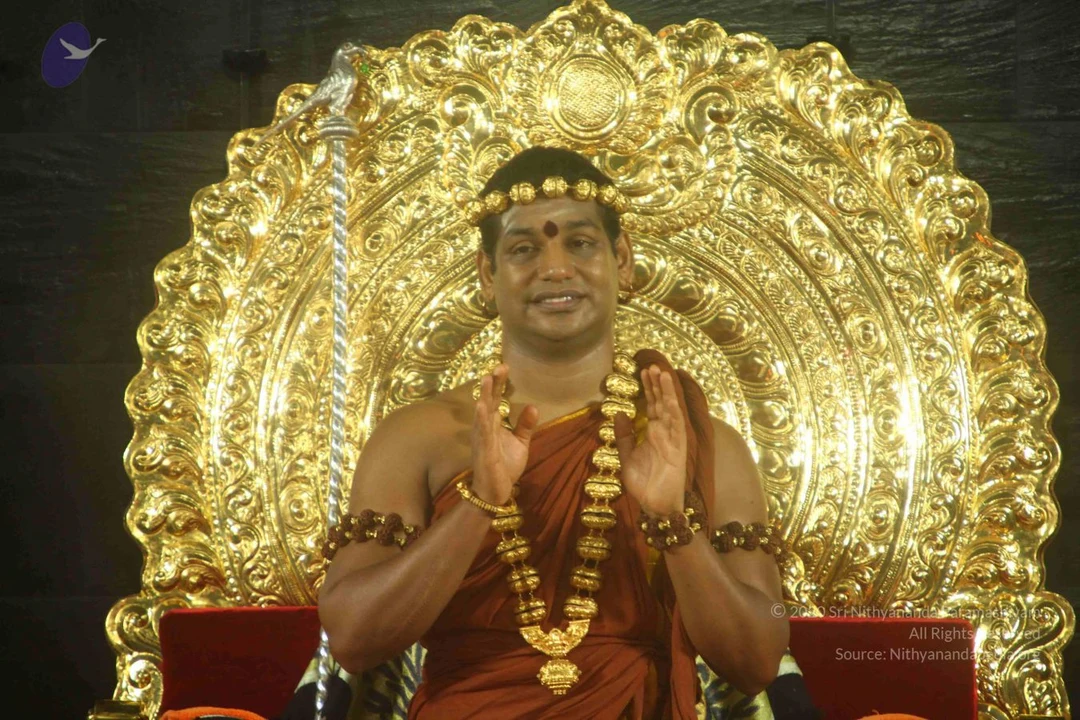
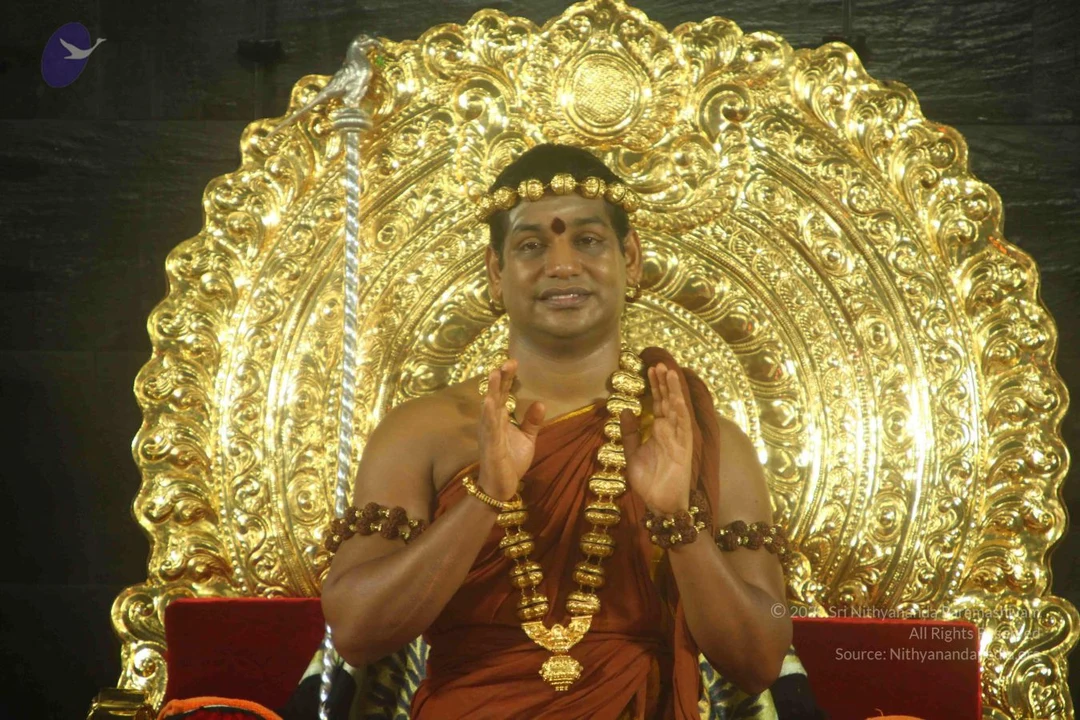
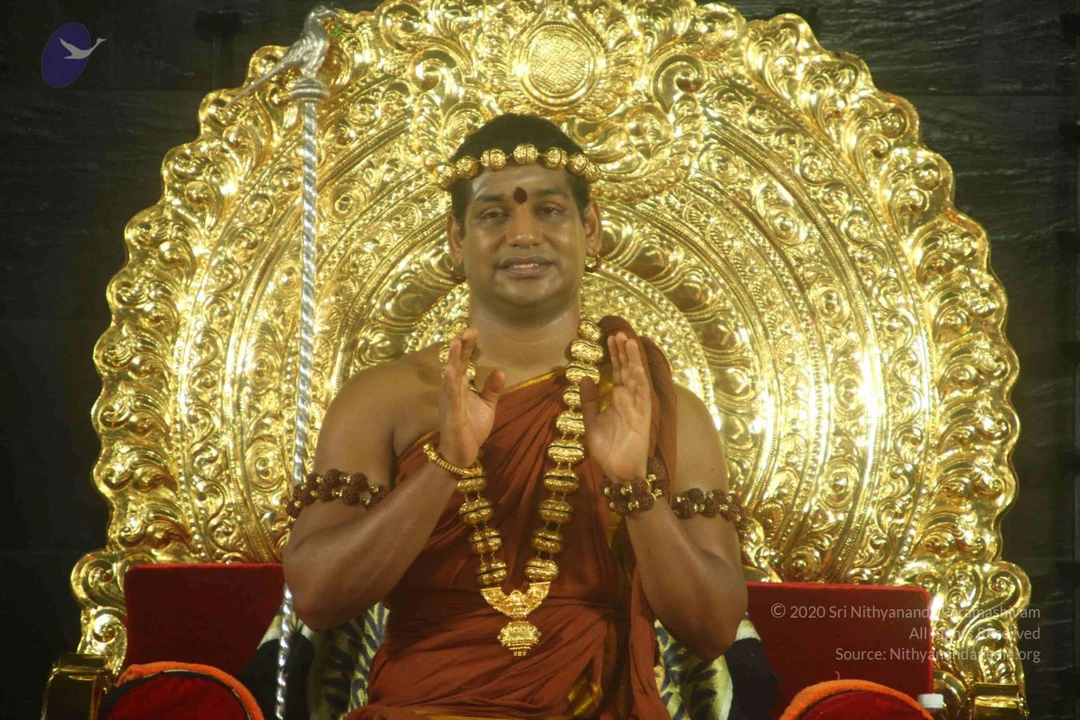
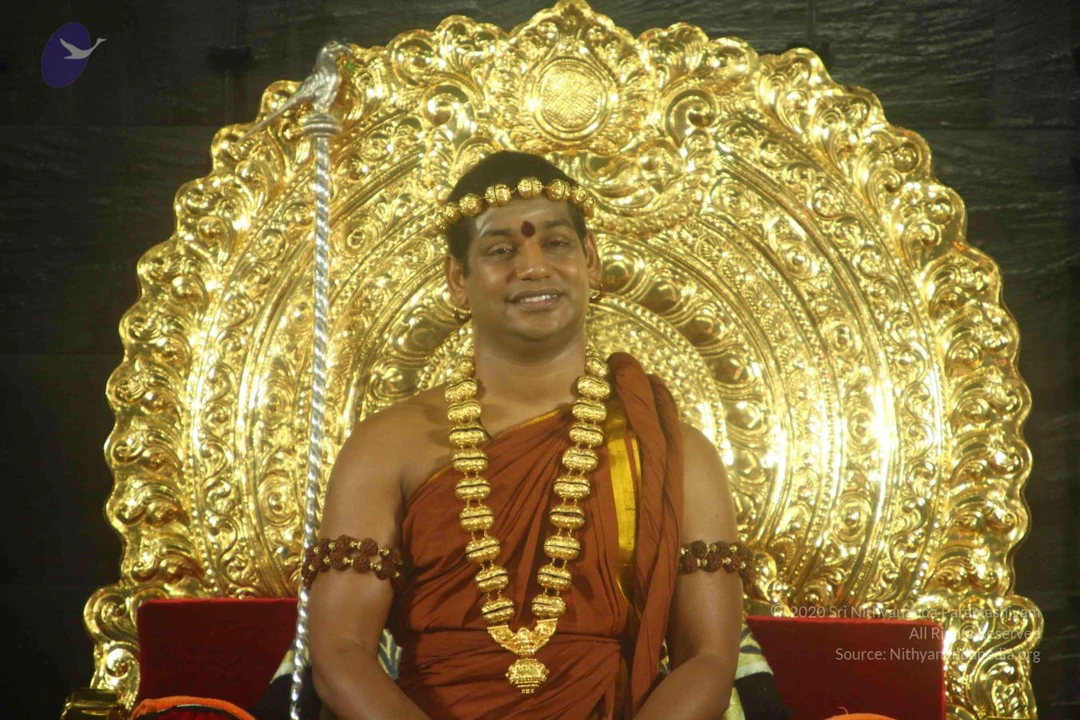
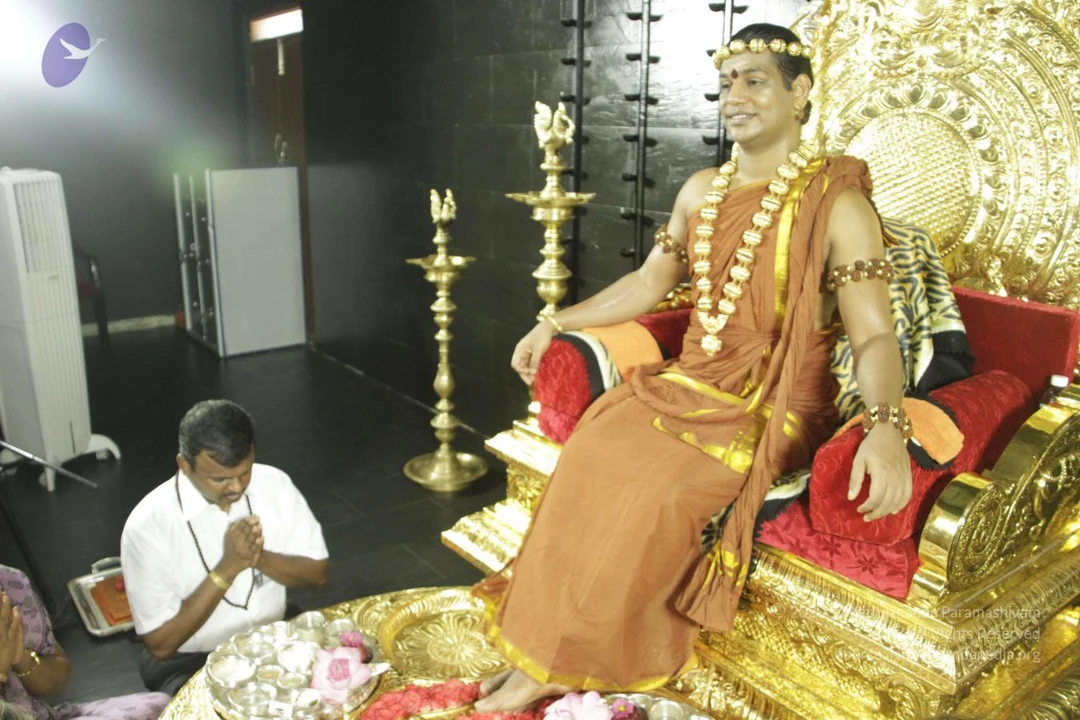
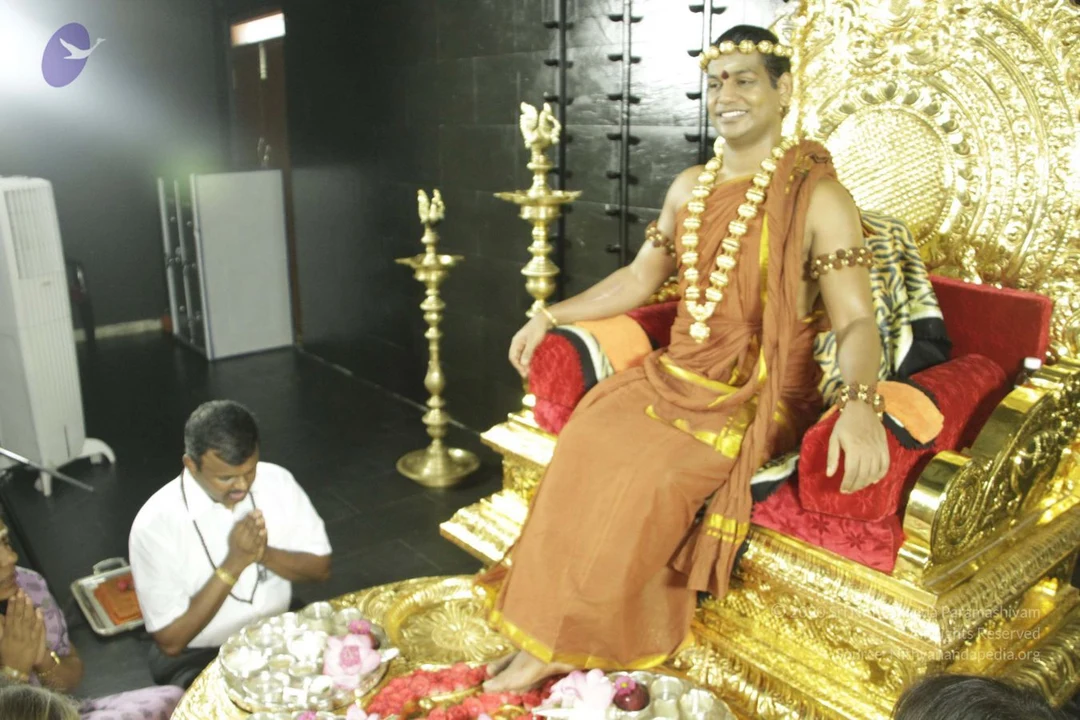
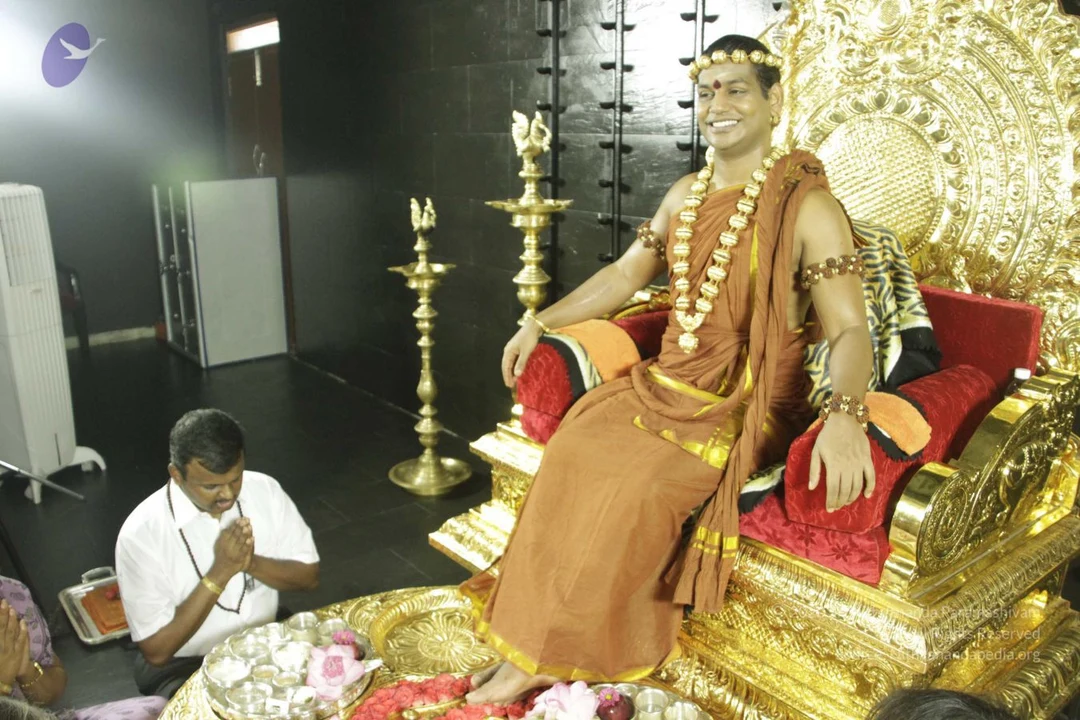
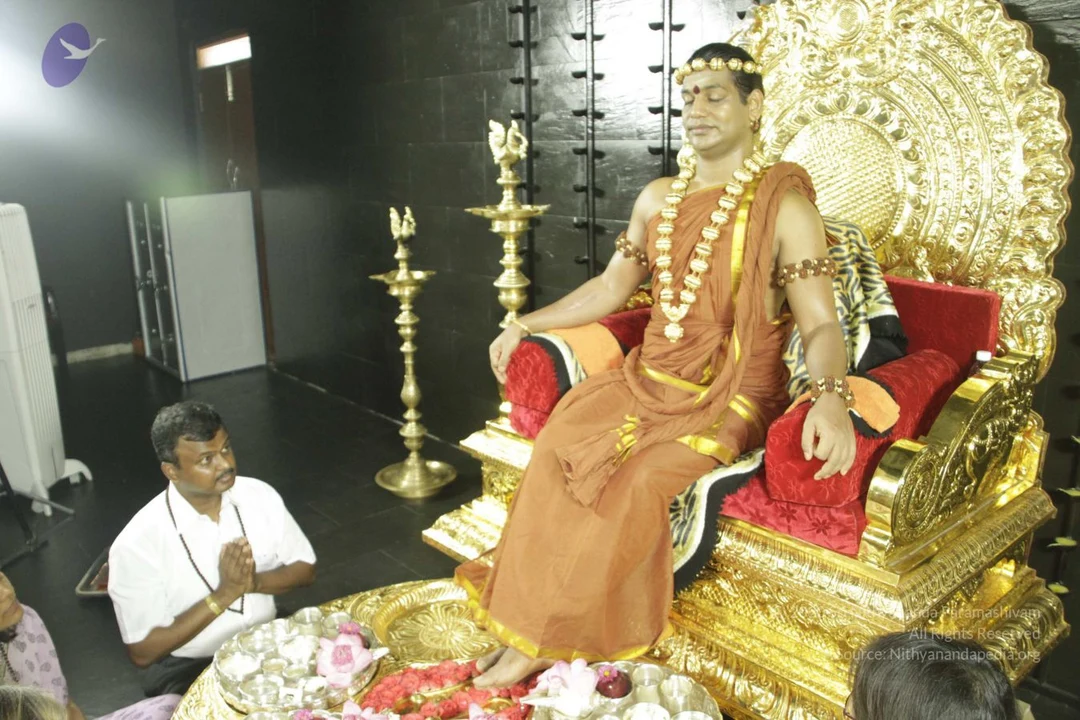
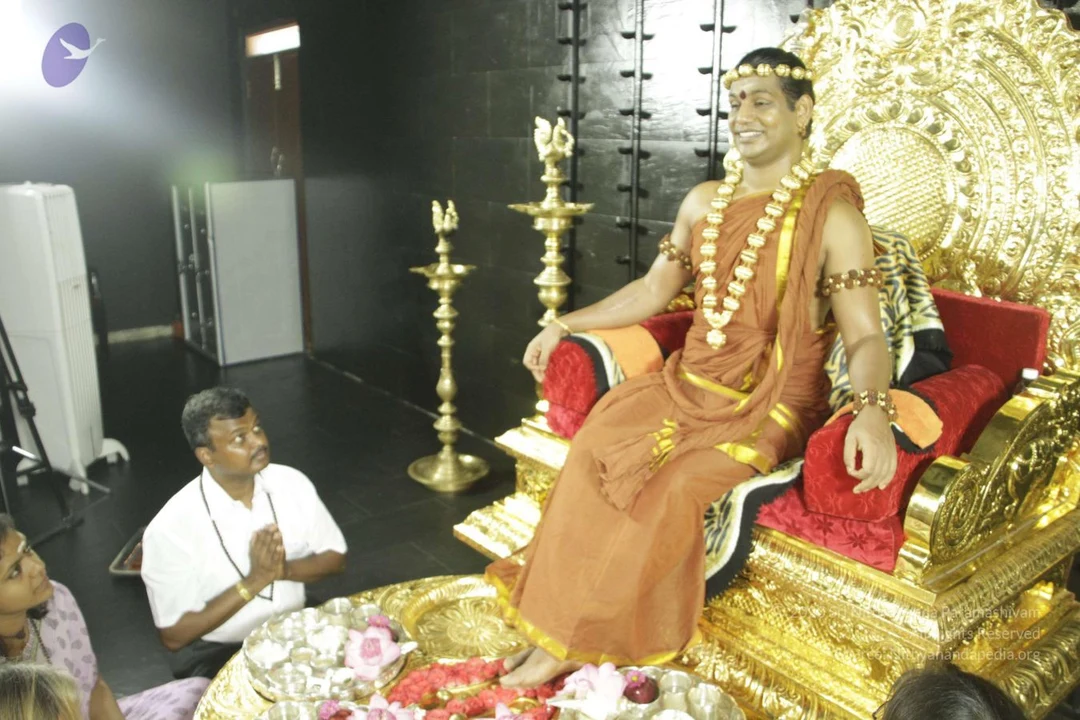
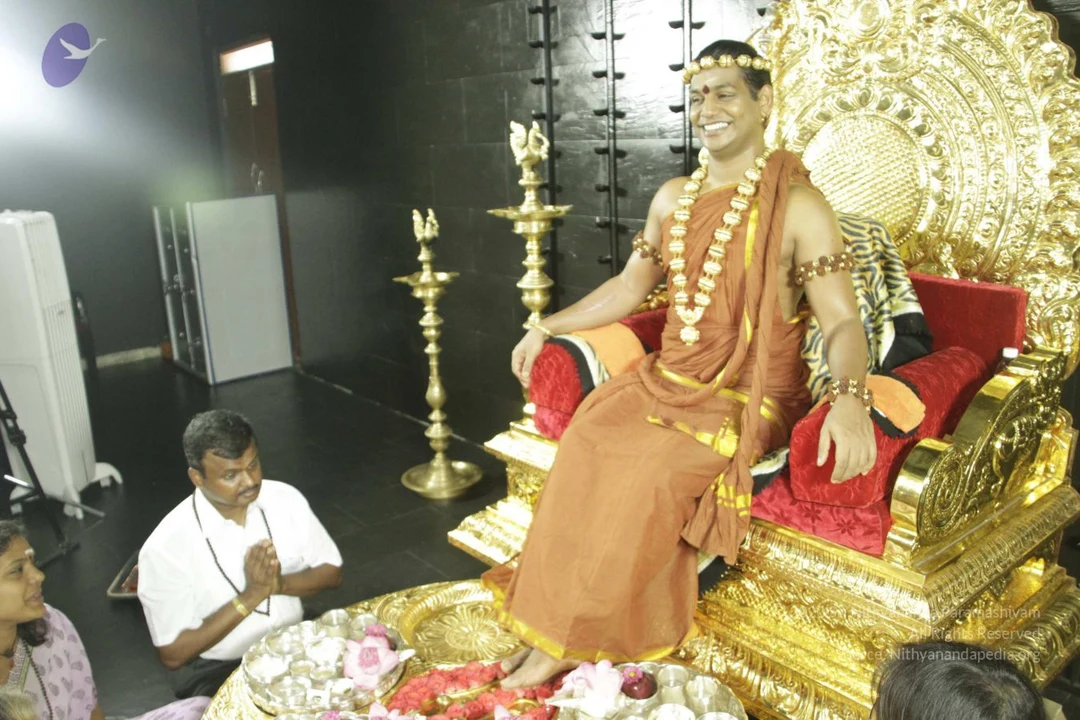
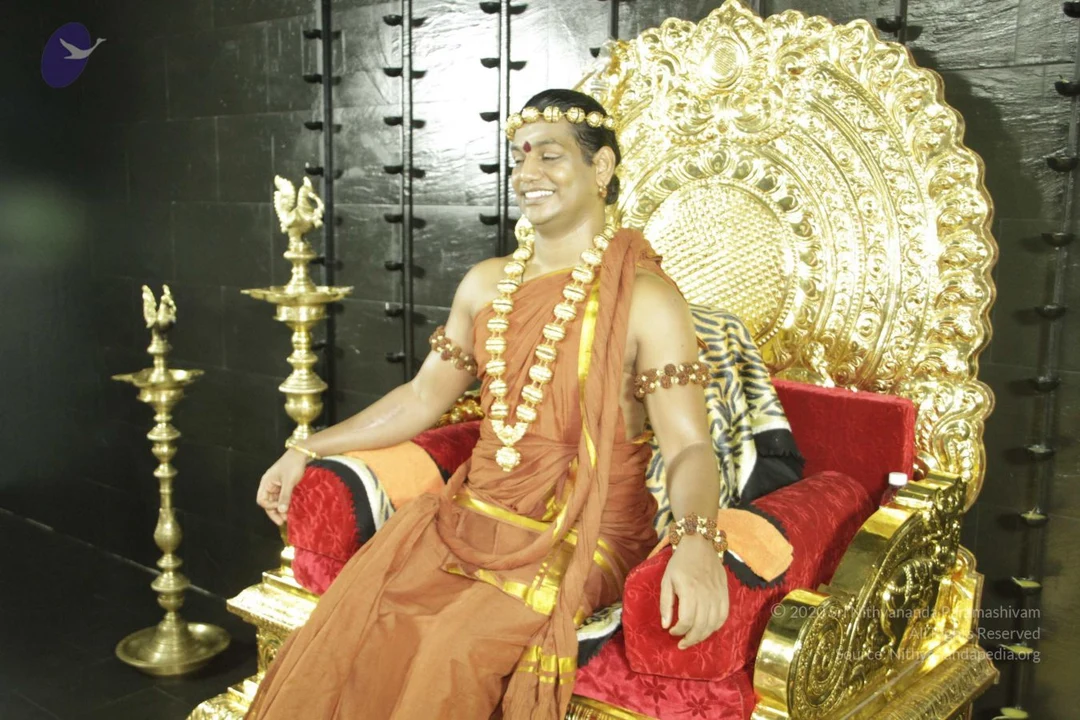
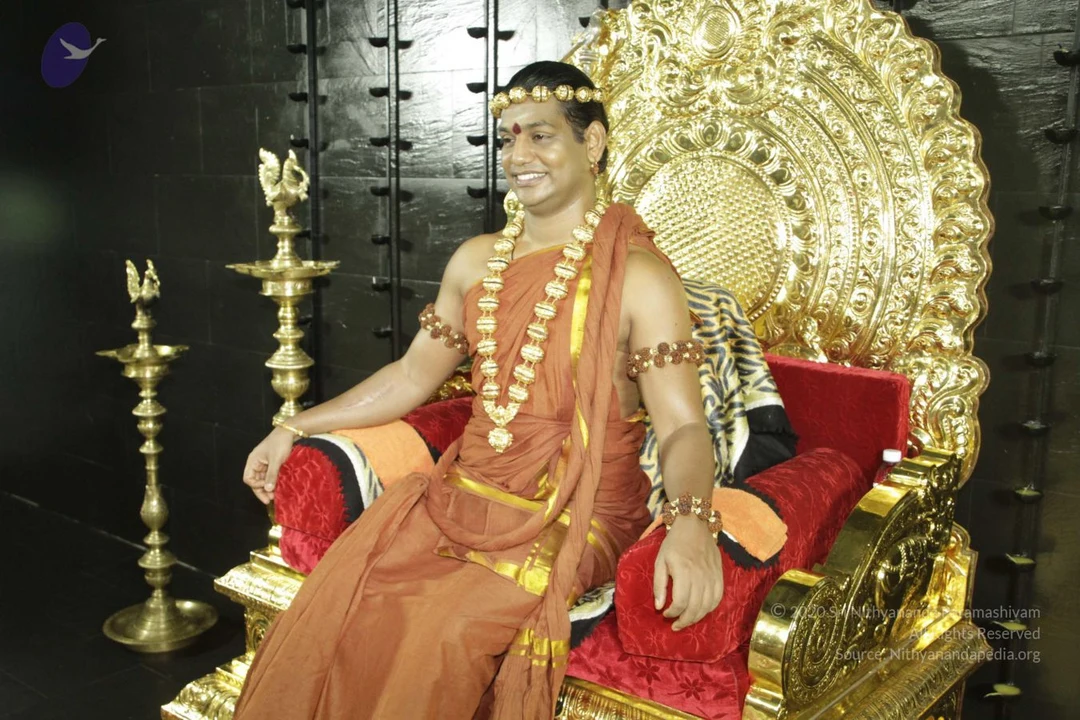
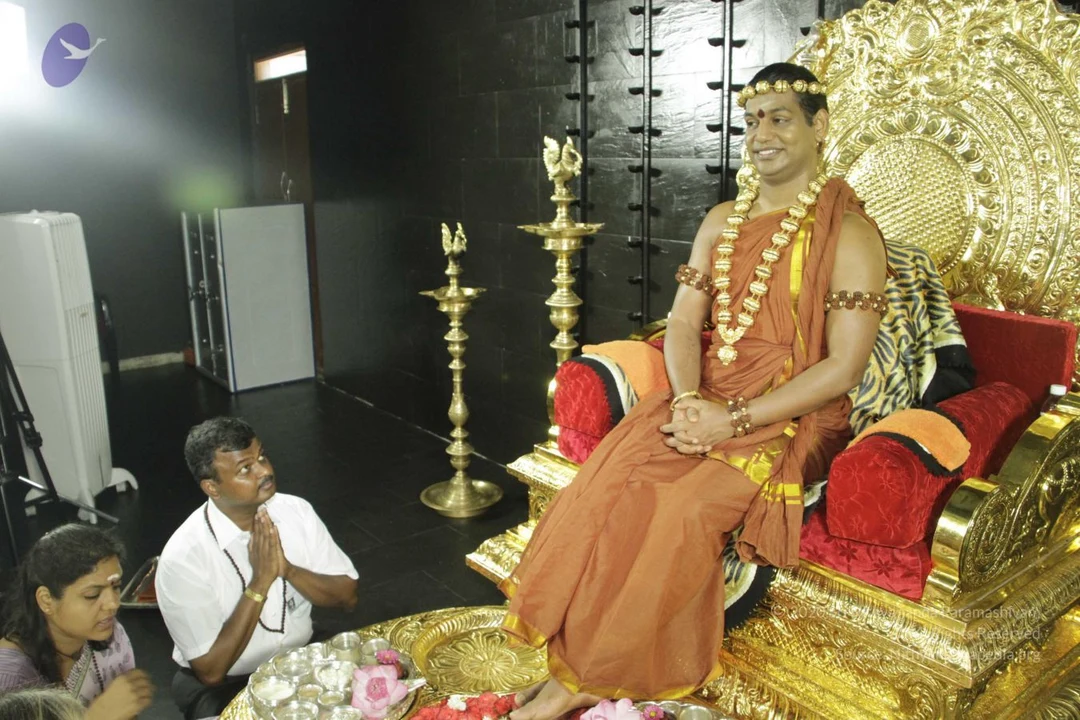
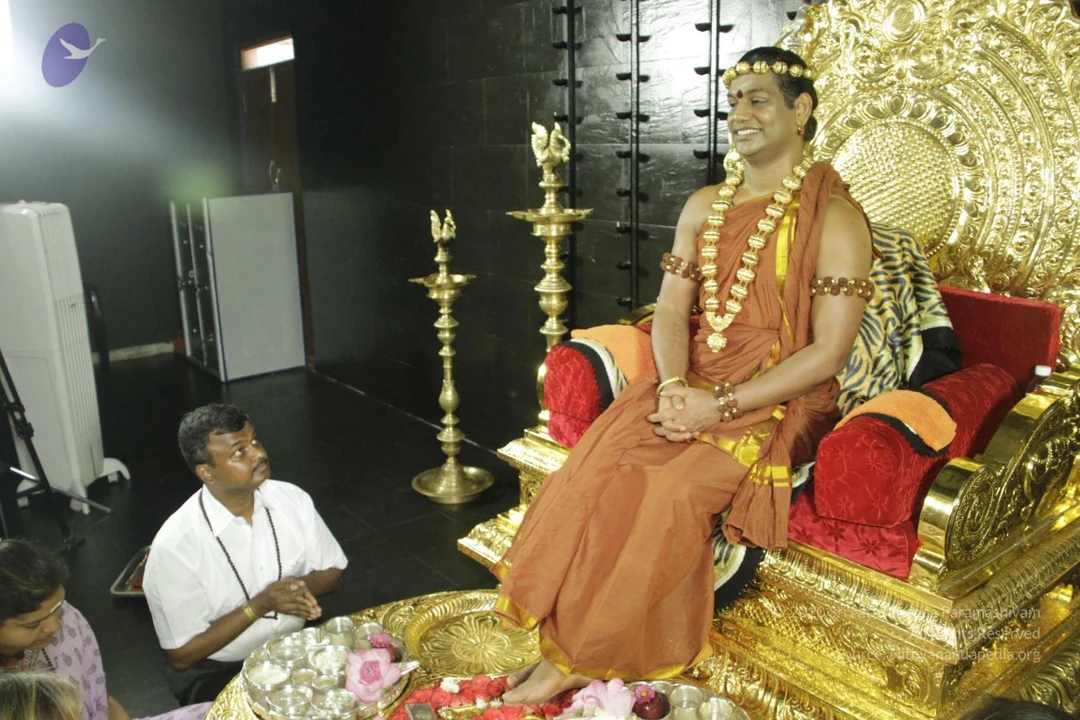
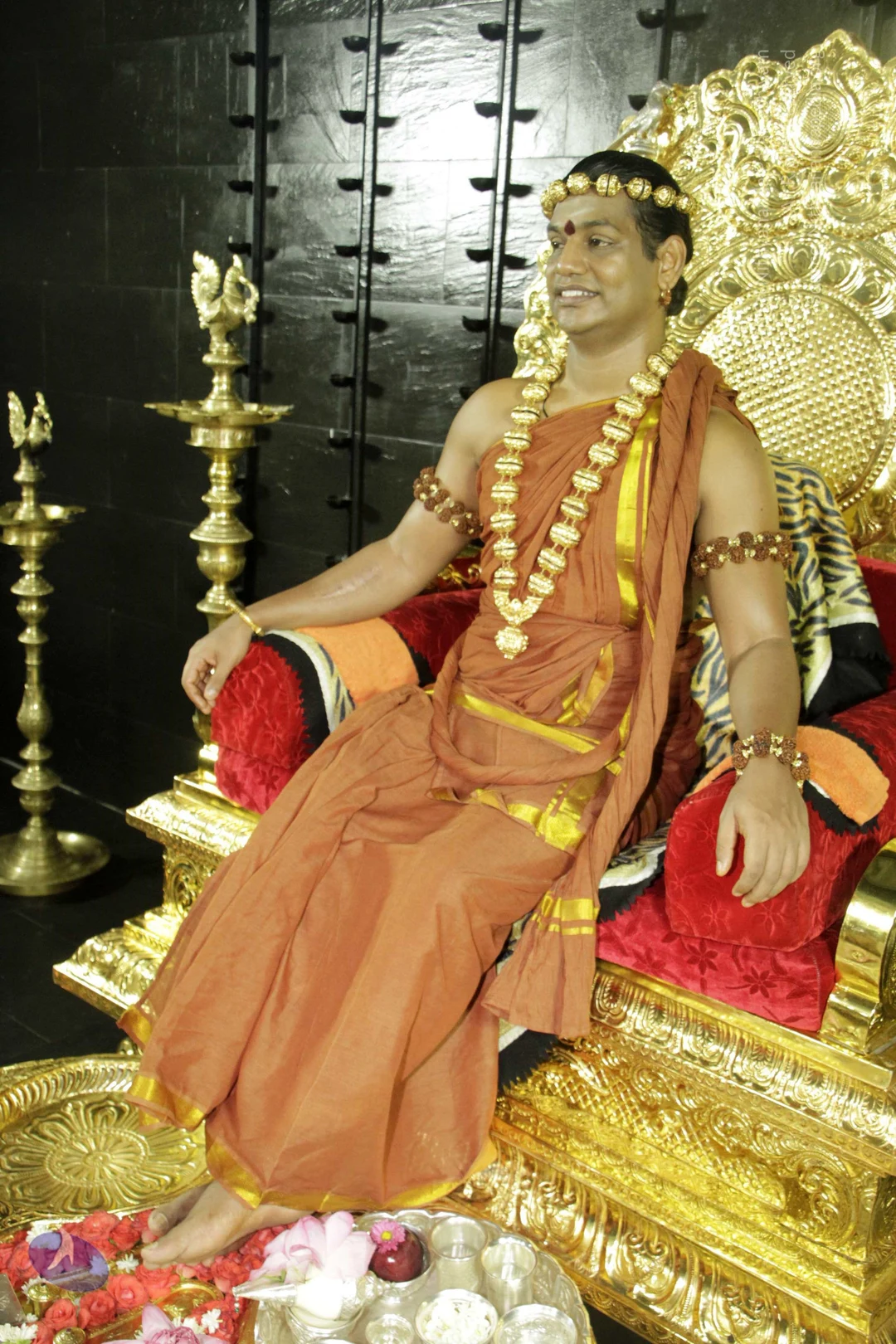
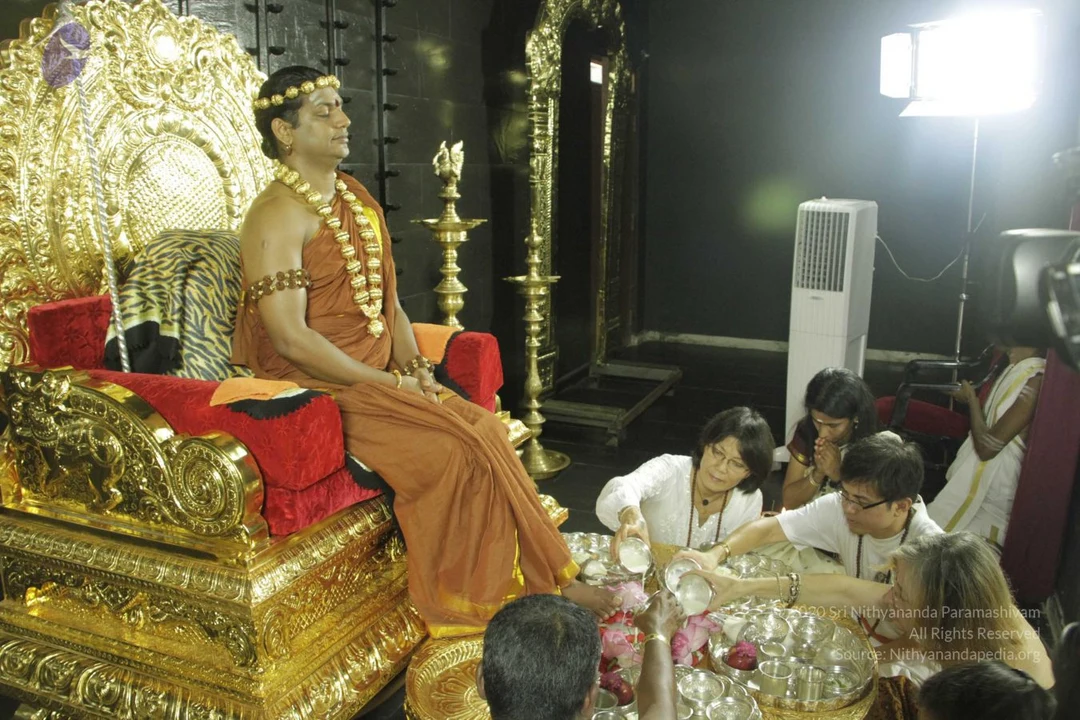
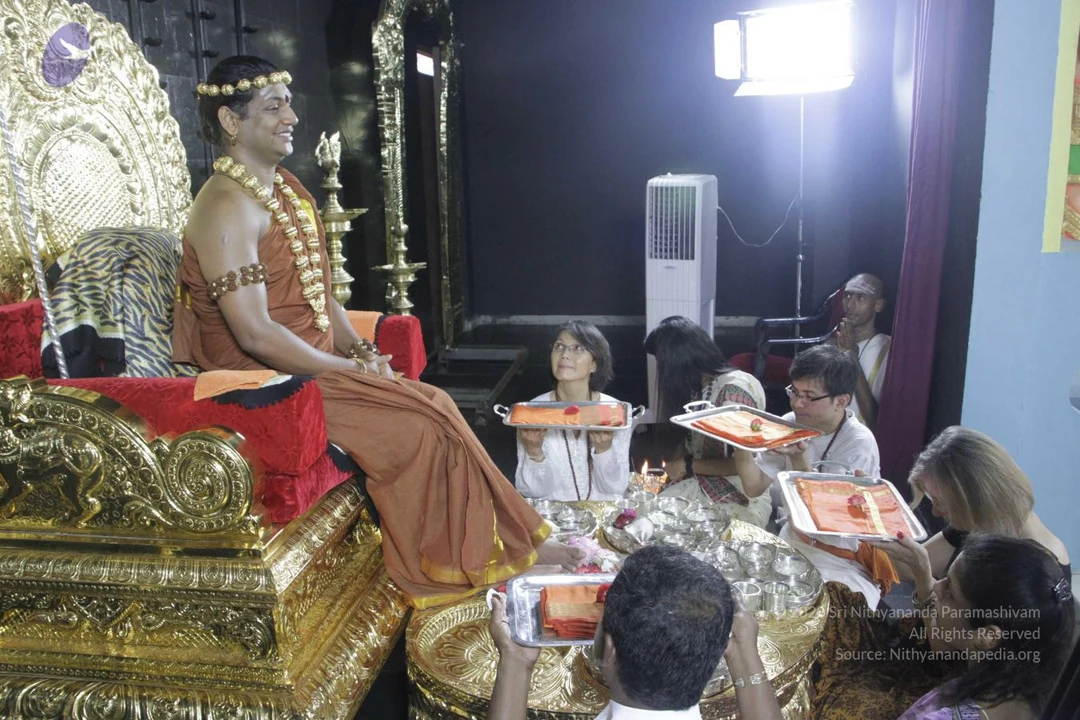
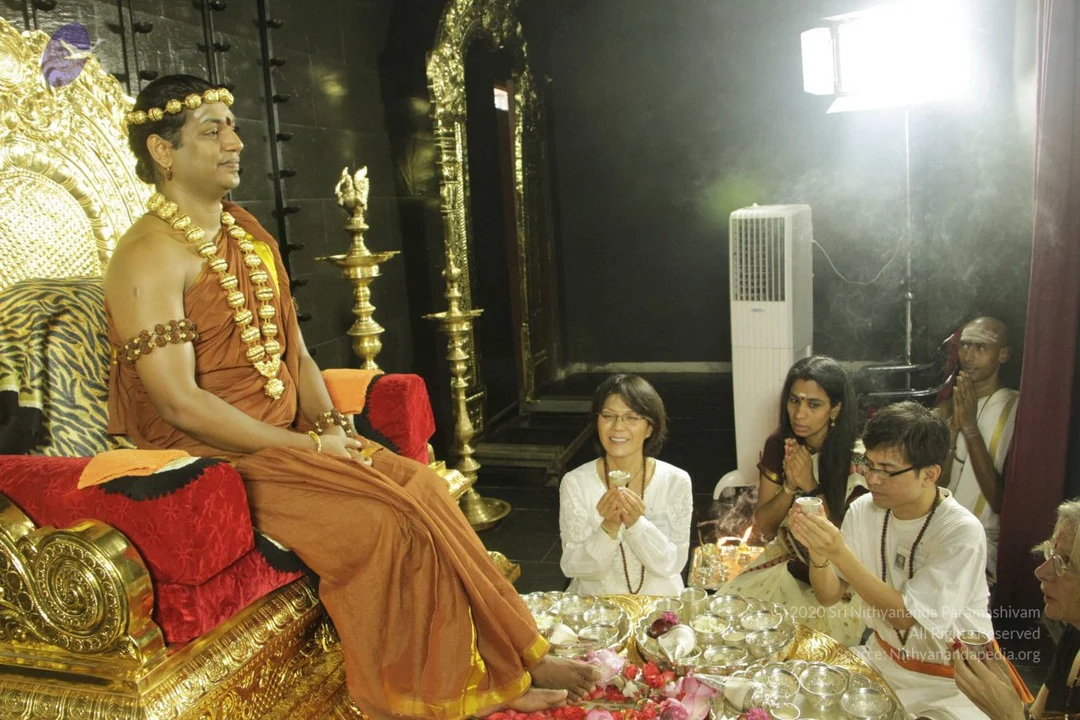
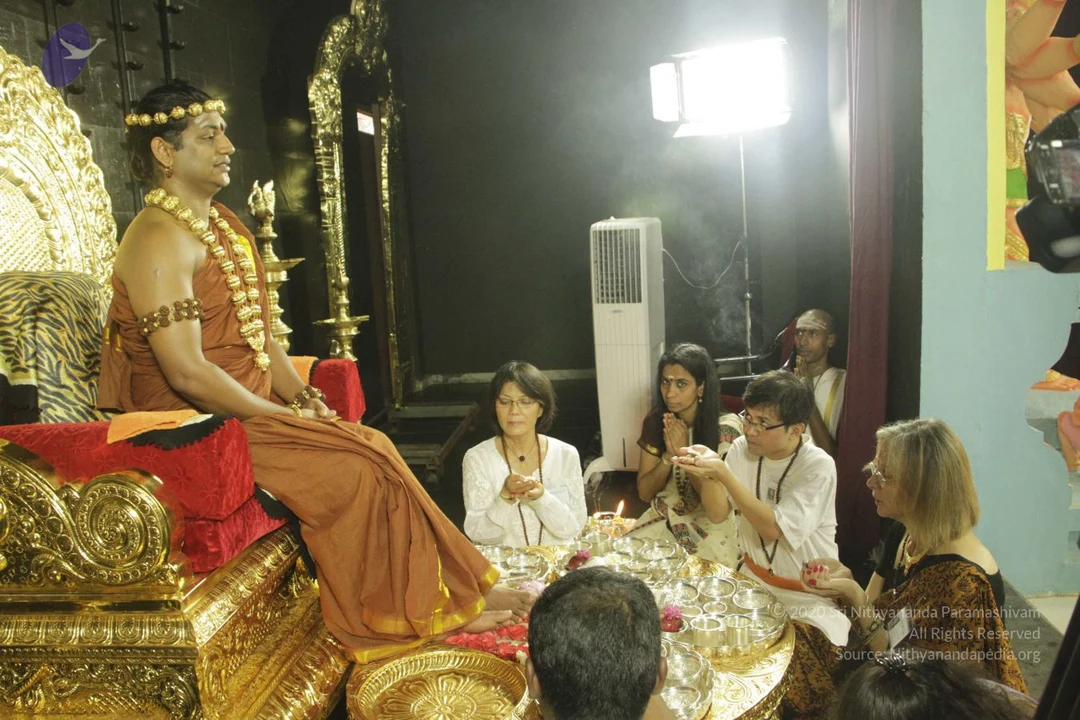
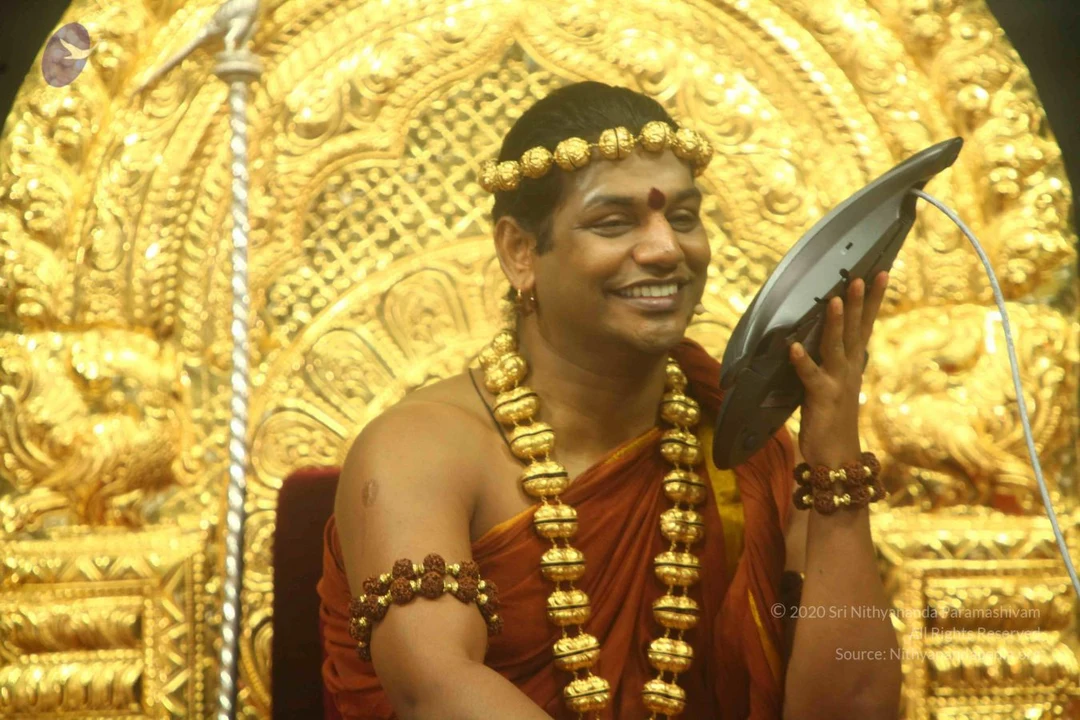
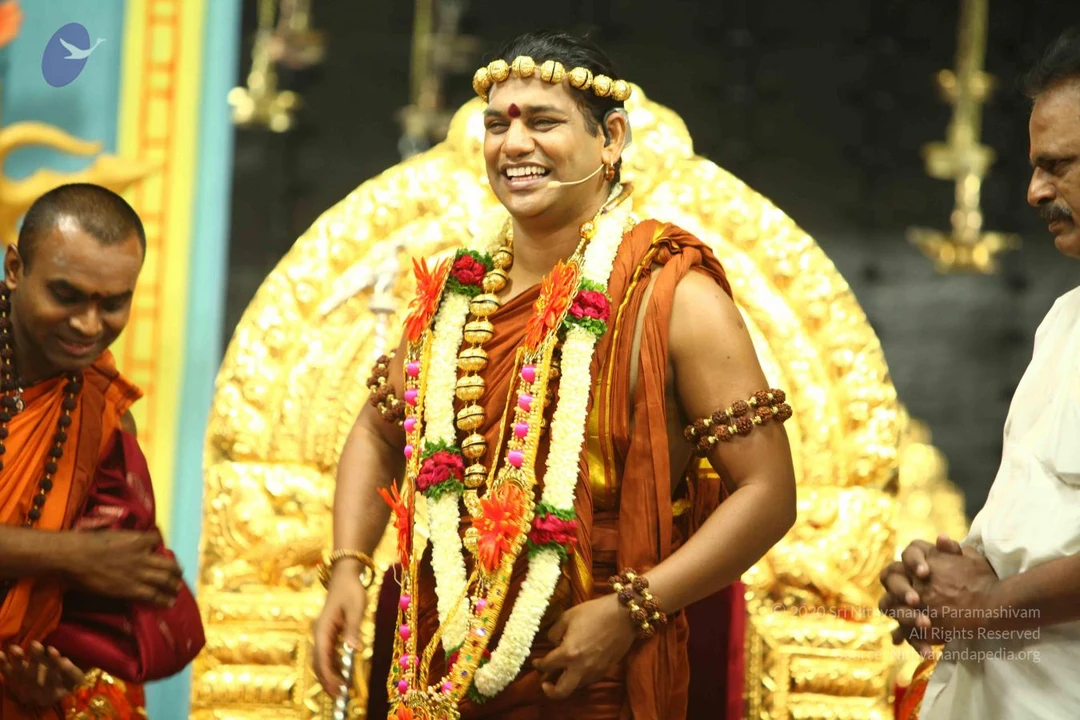
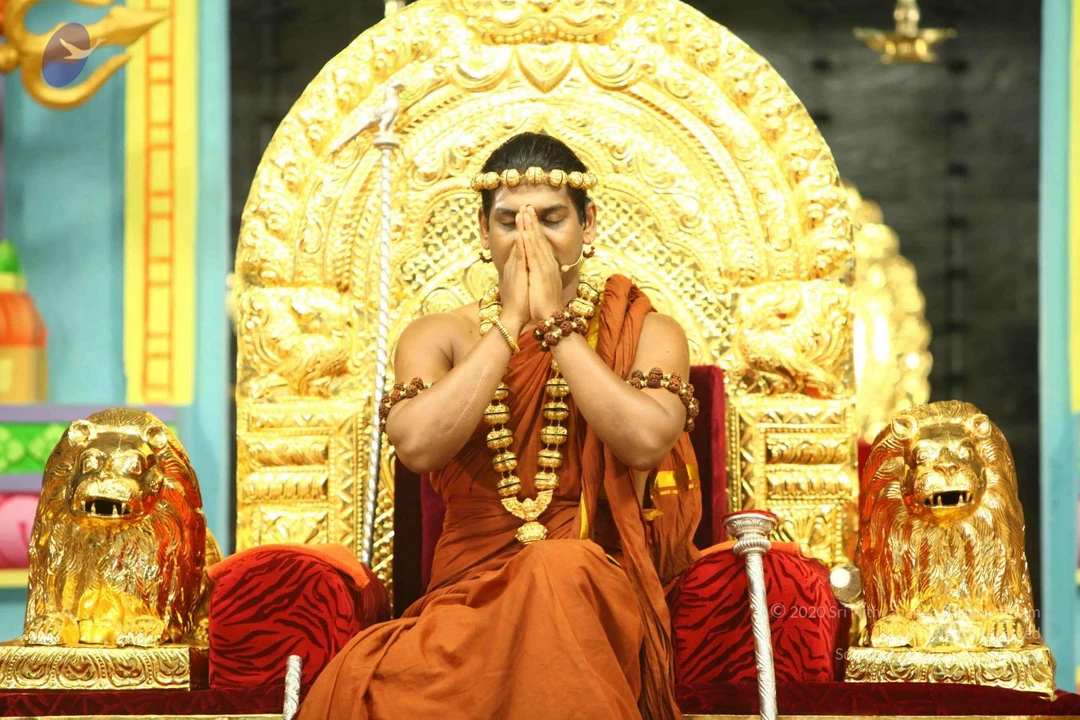
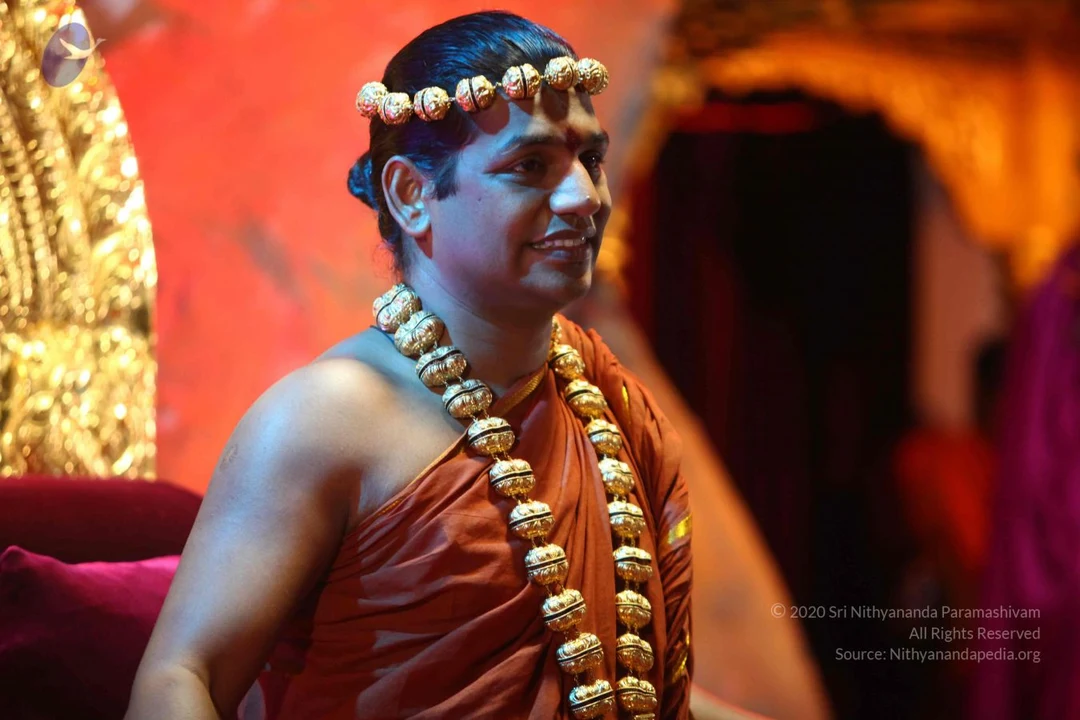
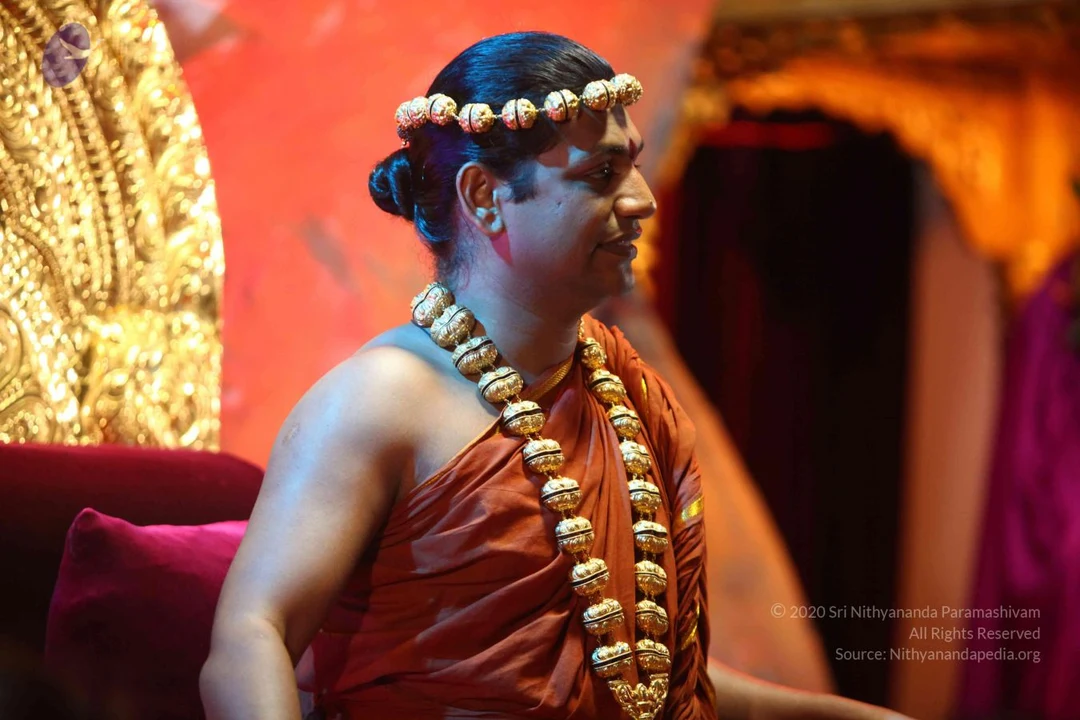
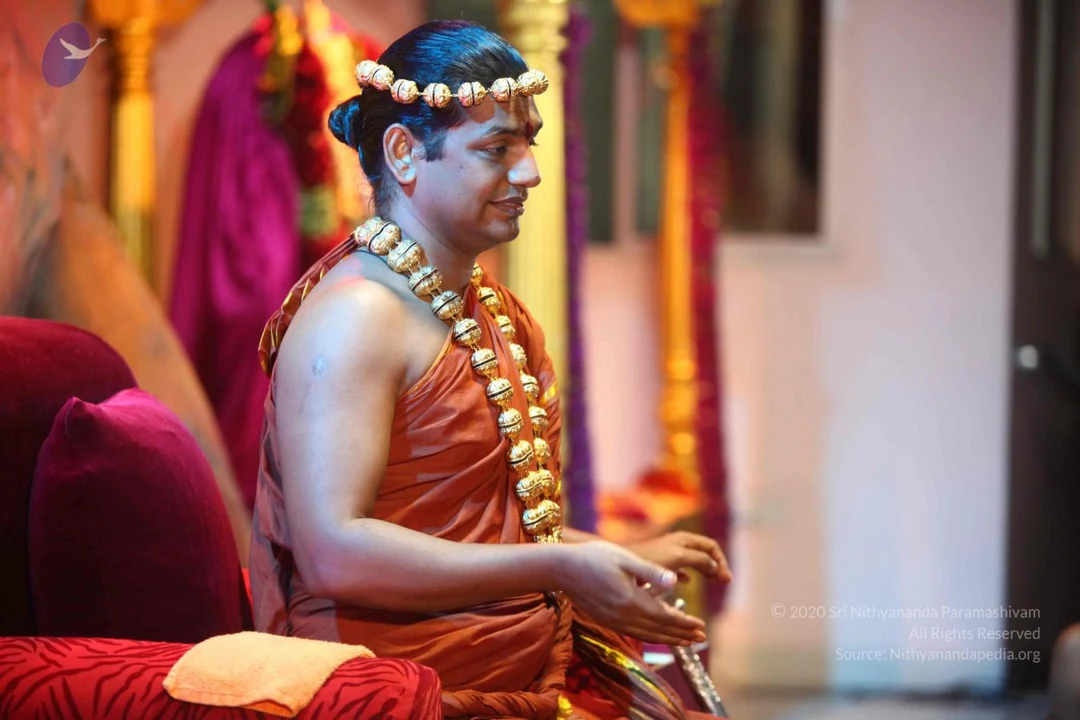
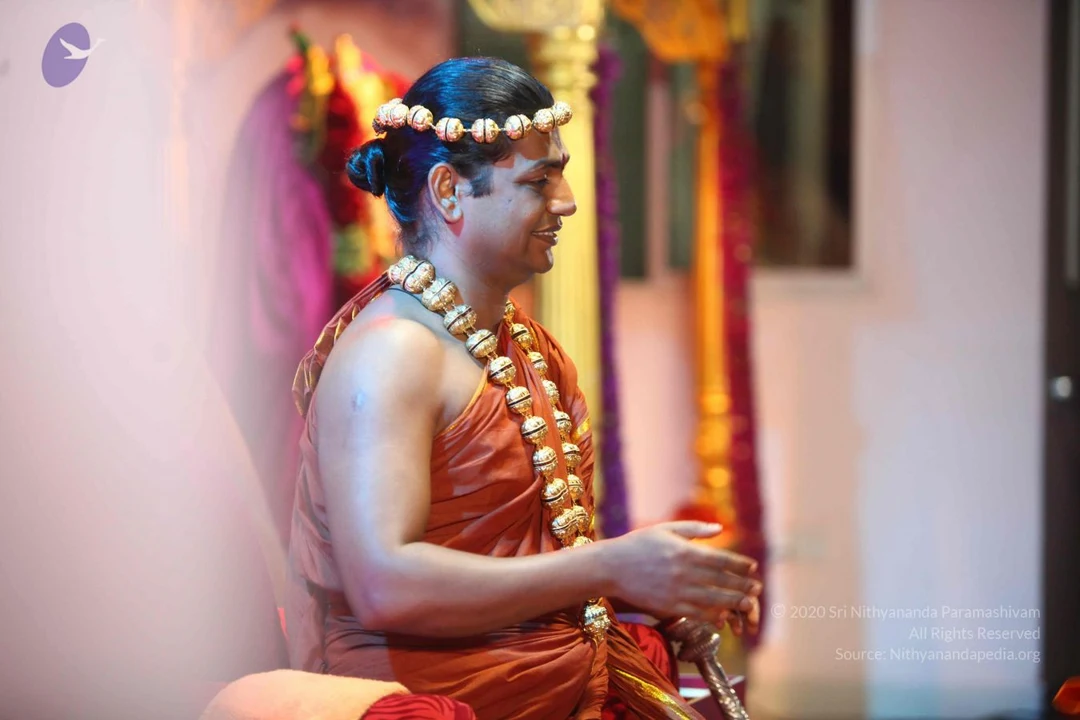
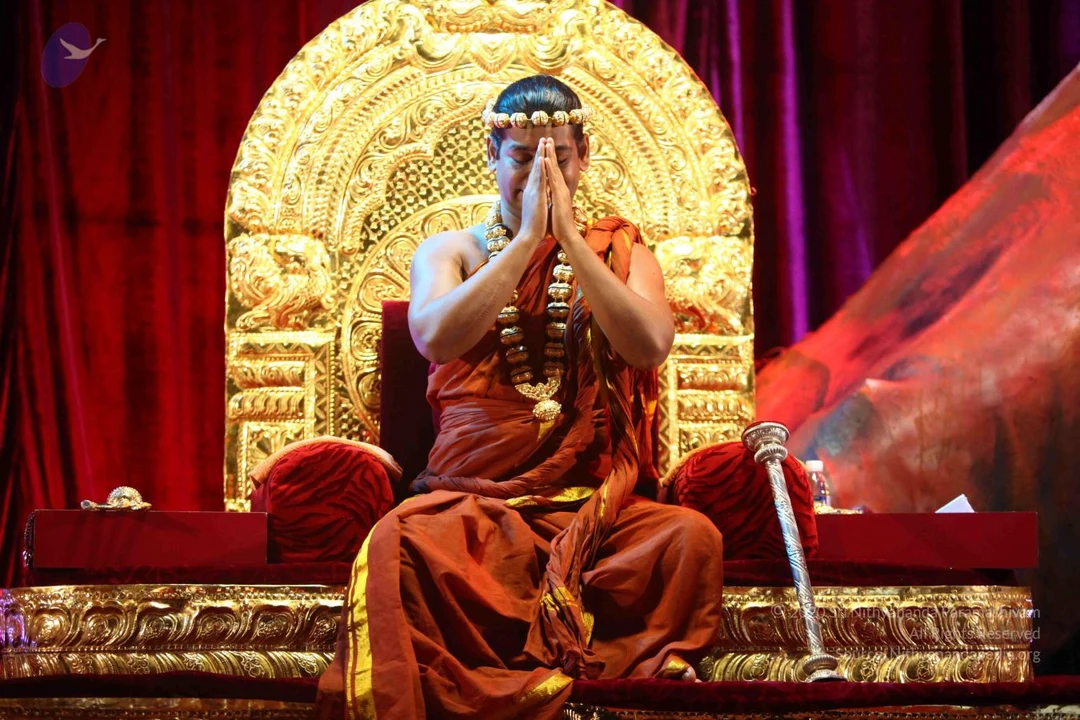
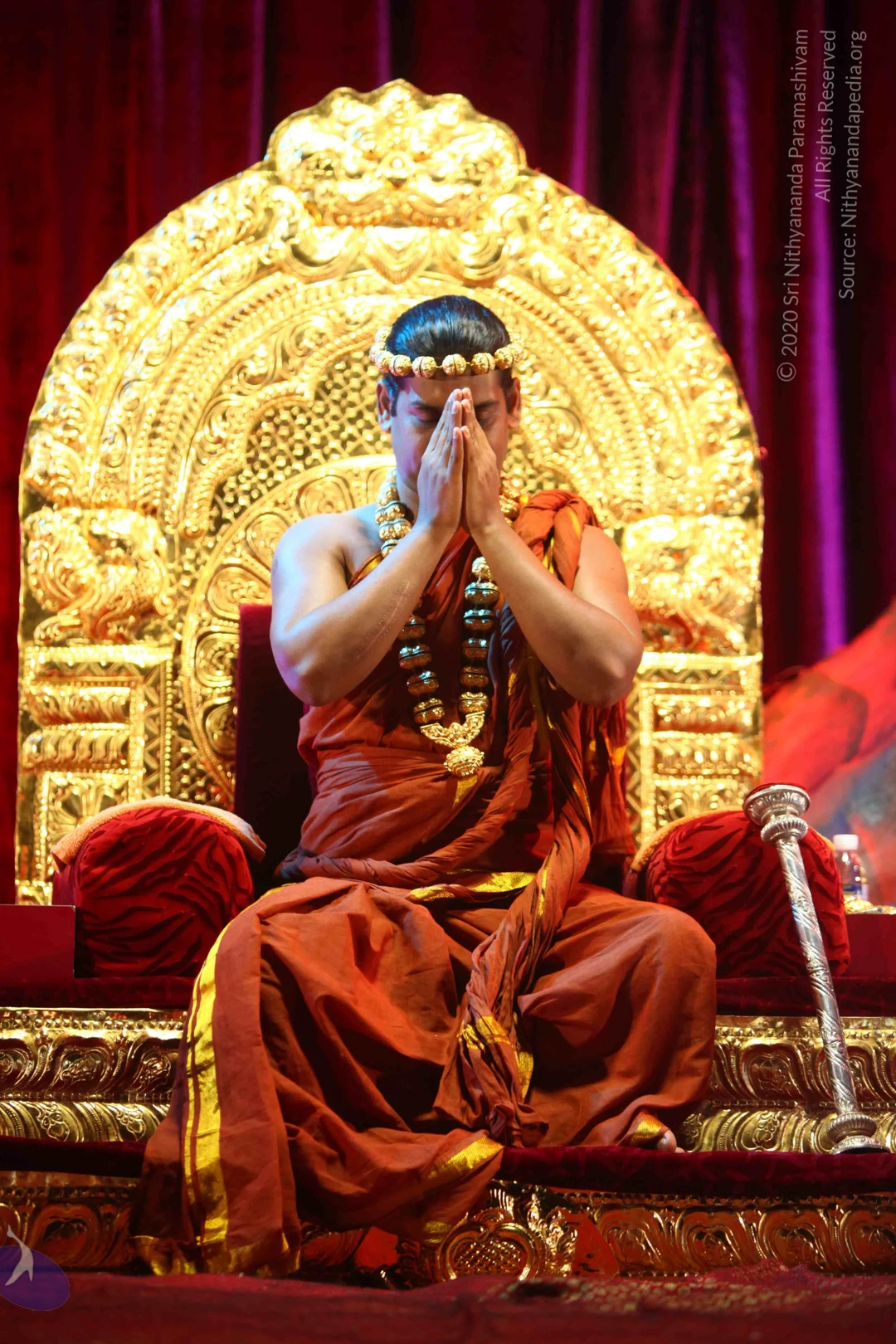
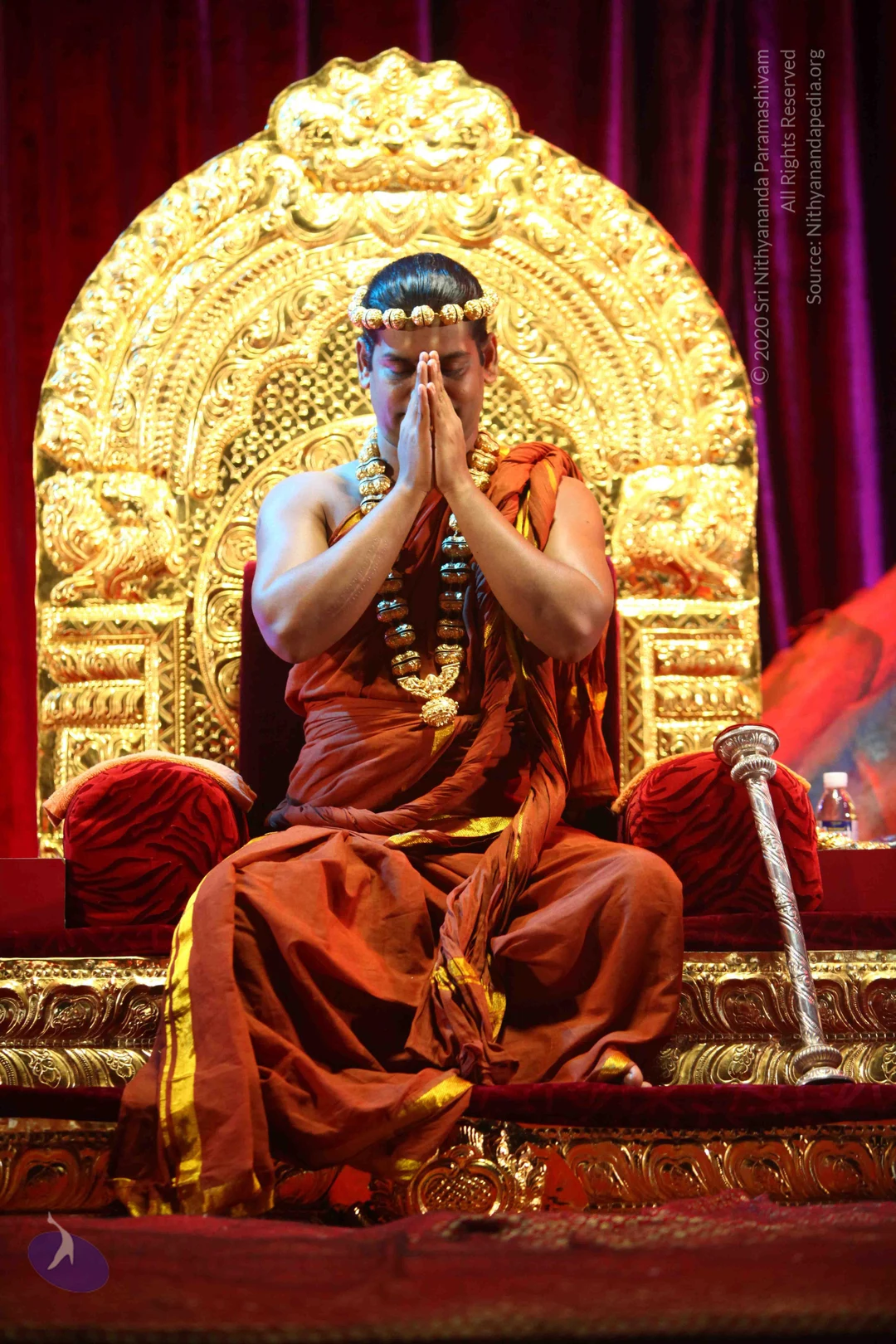
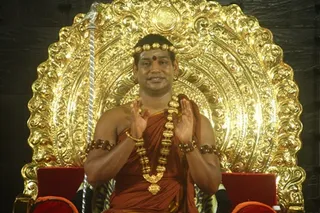
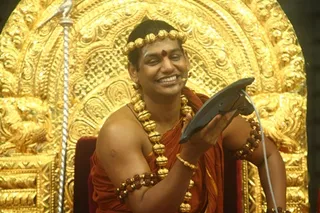
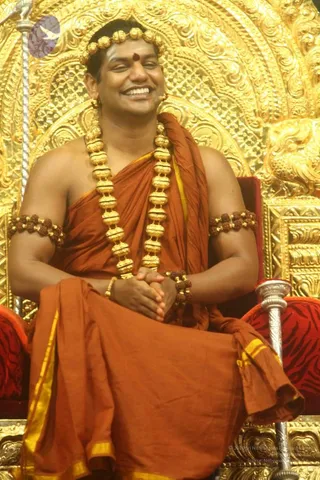
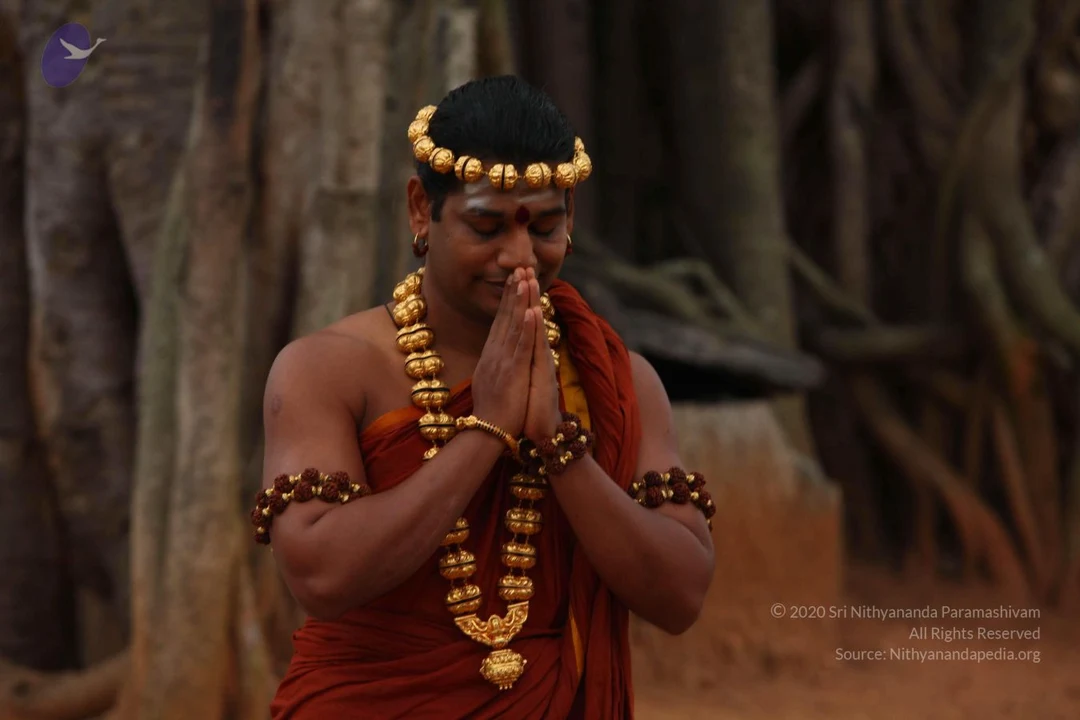
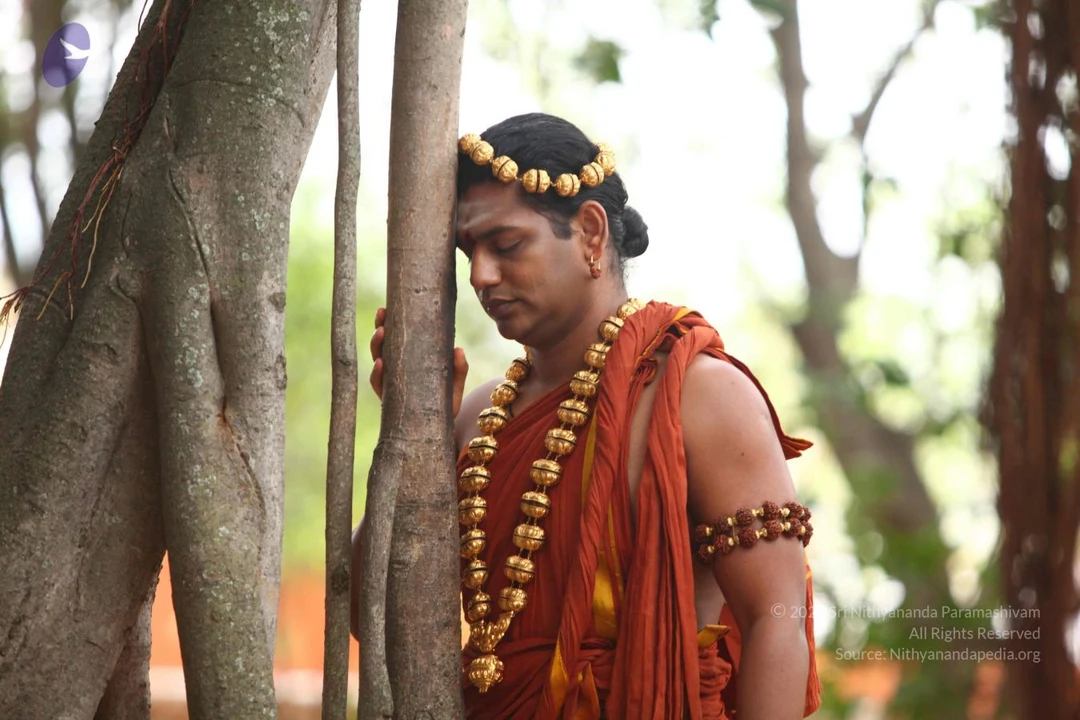
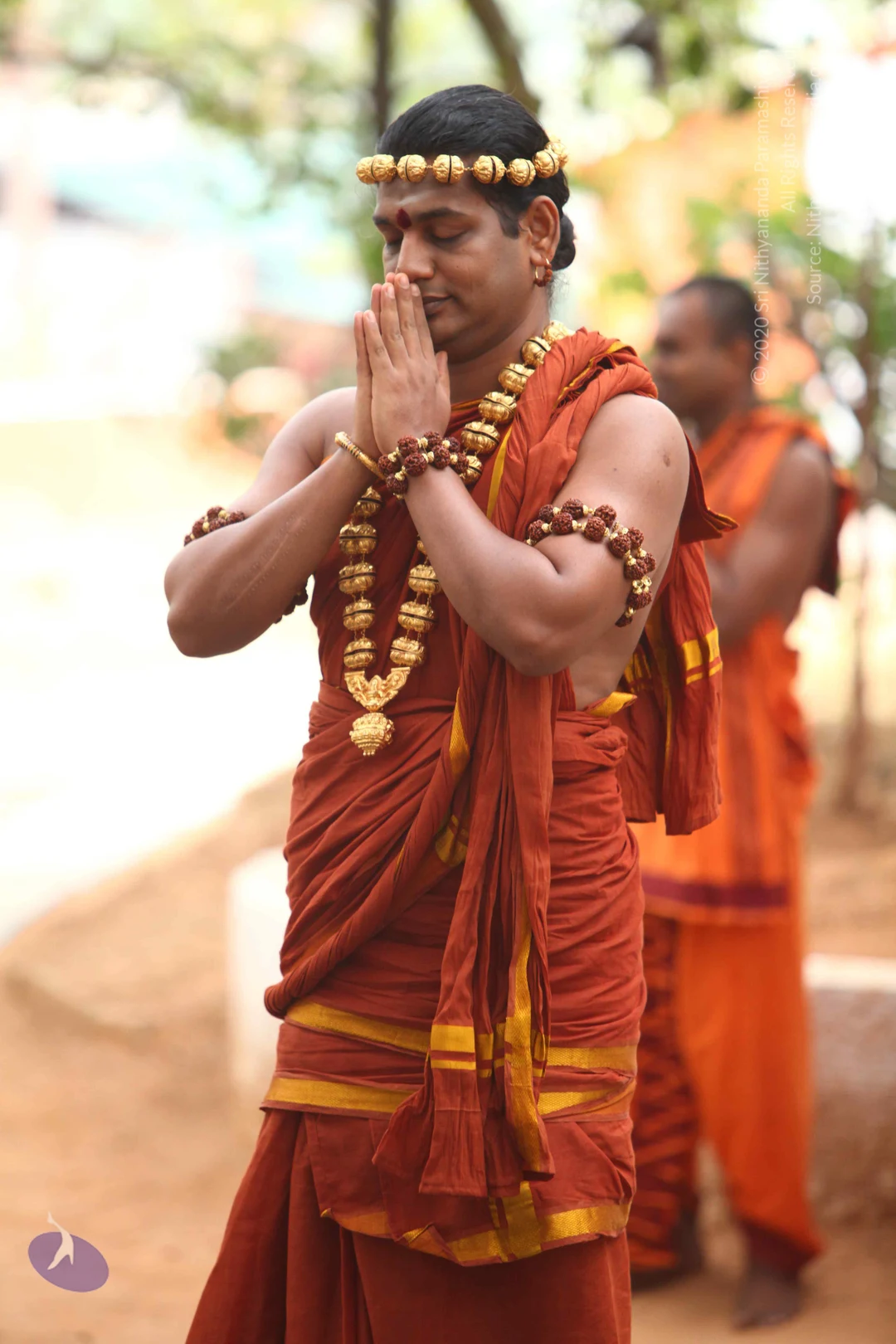
A man seated on an ornate gilded throne with a large, elaborate golden backrest, hands pressed together at his chest in an anjali gesture. He wears a saffron-orange dhoti and a matching shawl draped over his torso, a rudraksha mala and a gold ceremonial necklace with a pendant, bangle-style bracelets on his arms, and a gold band with a red tilak on his forehead. Red cushioned seats sit below the throne. The setting is dark and indoors. a person is described by these cues: saffron clothing, rudraksha mala, gold necklace and a throne. He is presenting himself in a satsang-style seating, with the figure in an in-person role.A smiling man sits on an ornate golden throne with an elaborately carved gold backdrop of lion-like figures and arches. He wears a saffron-orange cloth wrapped over his bare upper body, a gold headband with a central red bindi, and multiple ceremonial gold necklaces with rudraksha malas. Thick bracelets of beads adorn his upper arms. He holds a small round mirror-like object in one hand, appearing to look into it. Appearance-based a person: the saffron wrap, ornate gold necklaces, rudraksha malas and crowned headband on a throne match the page's a person reference.

Temple
45 photosSource gallery
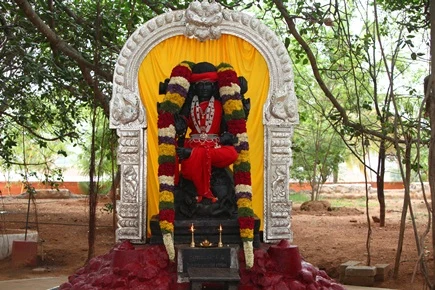
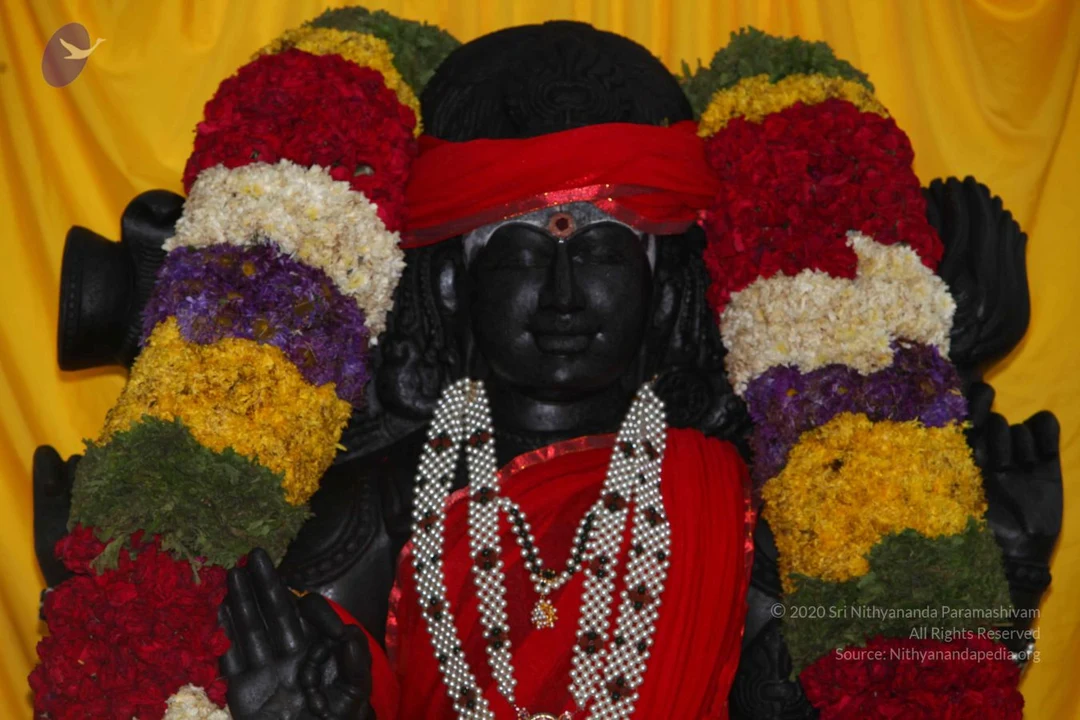
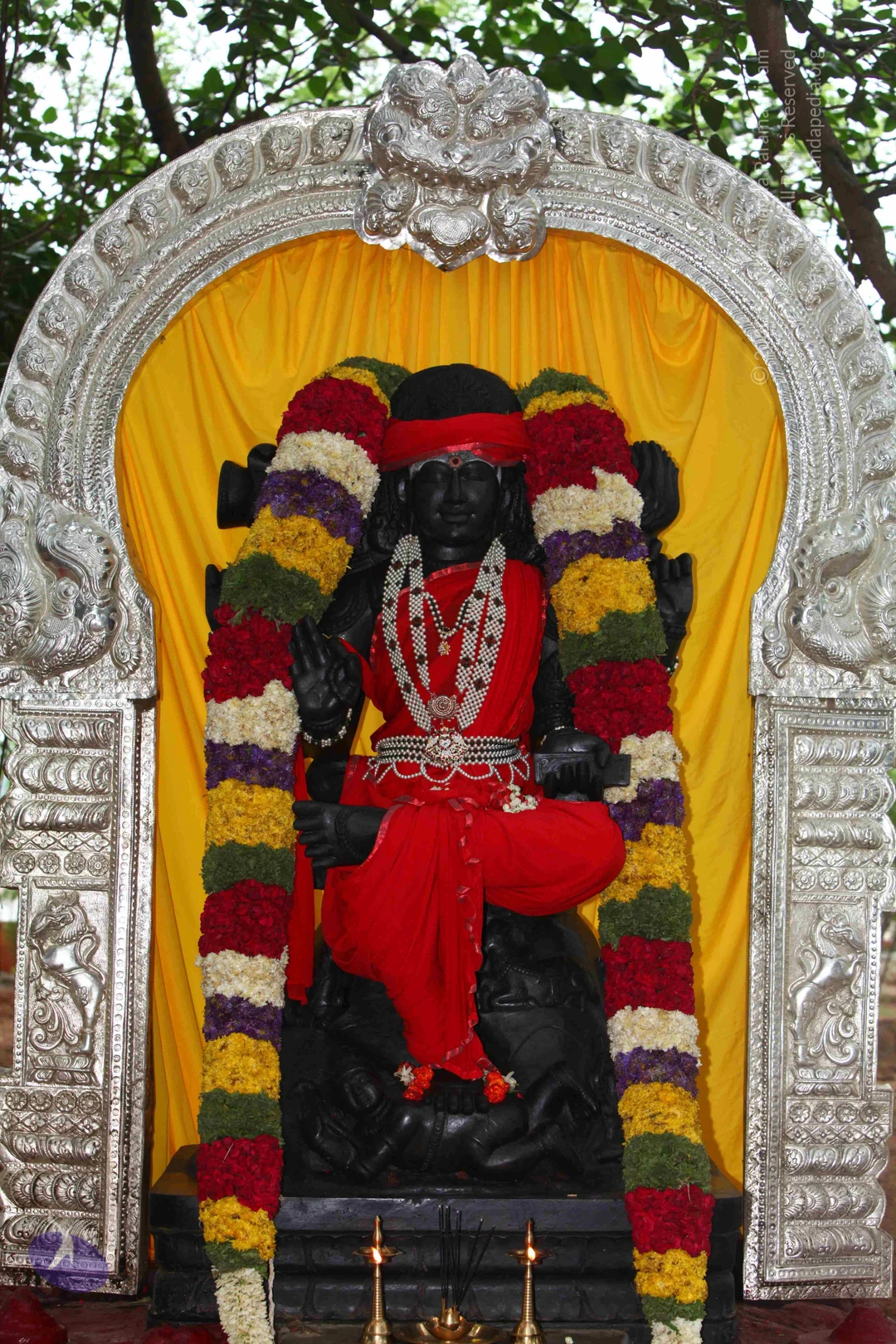
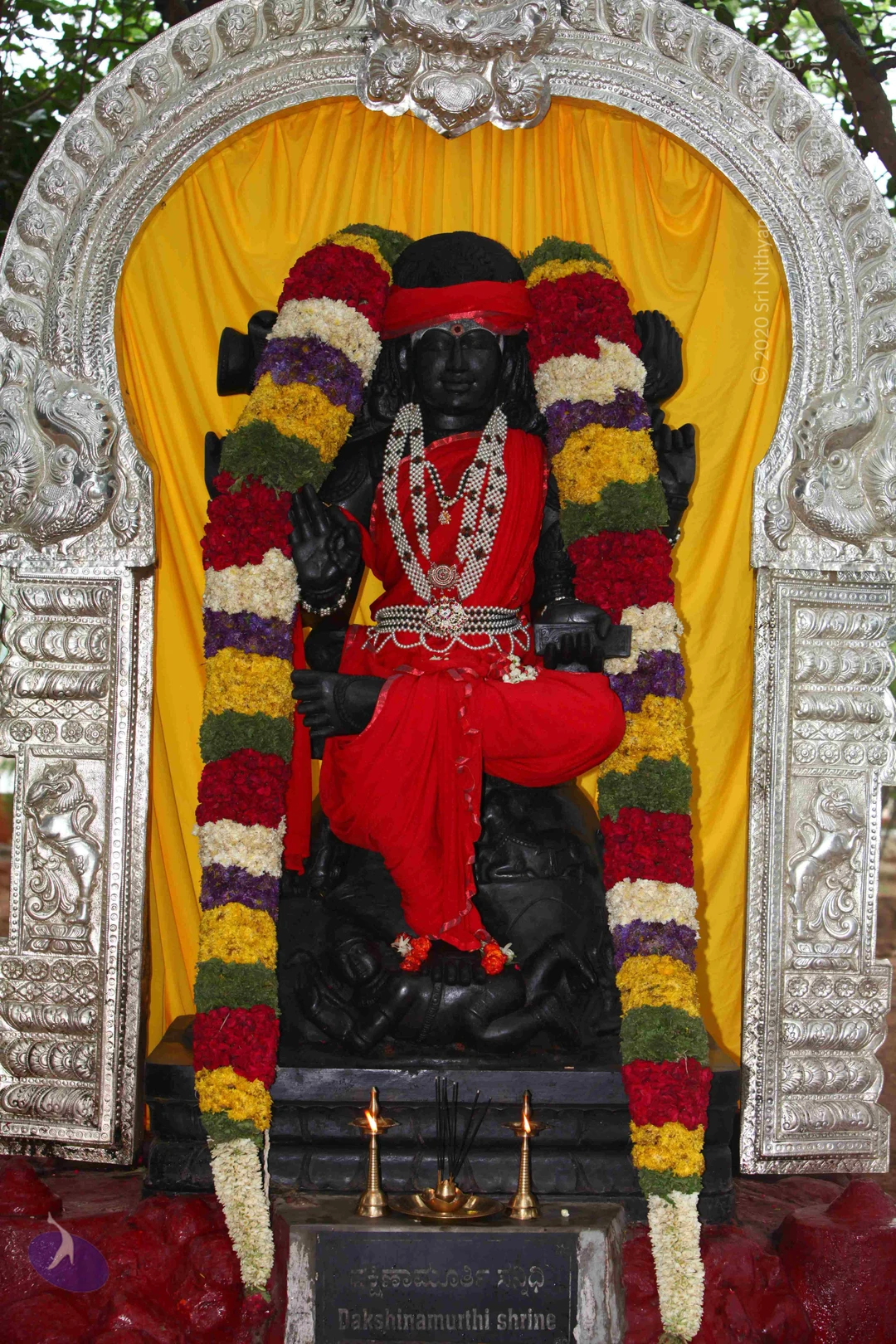
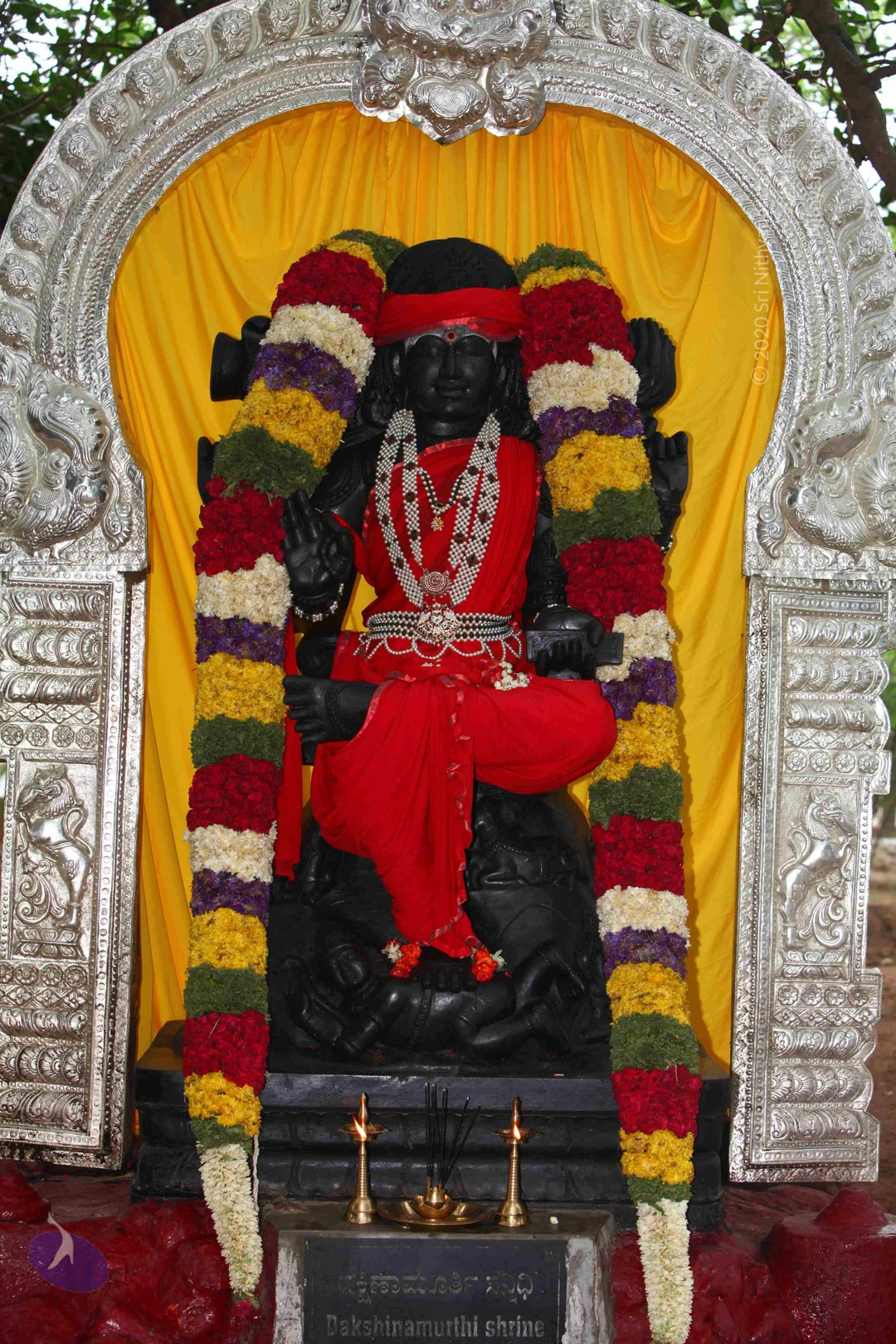
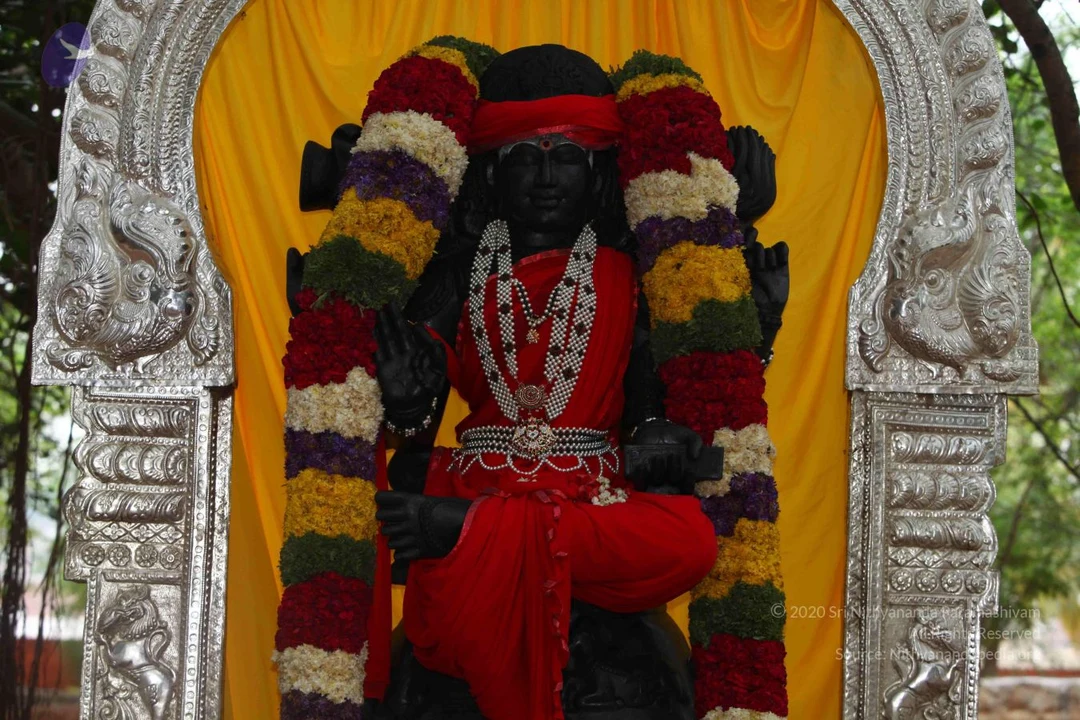
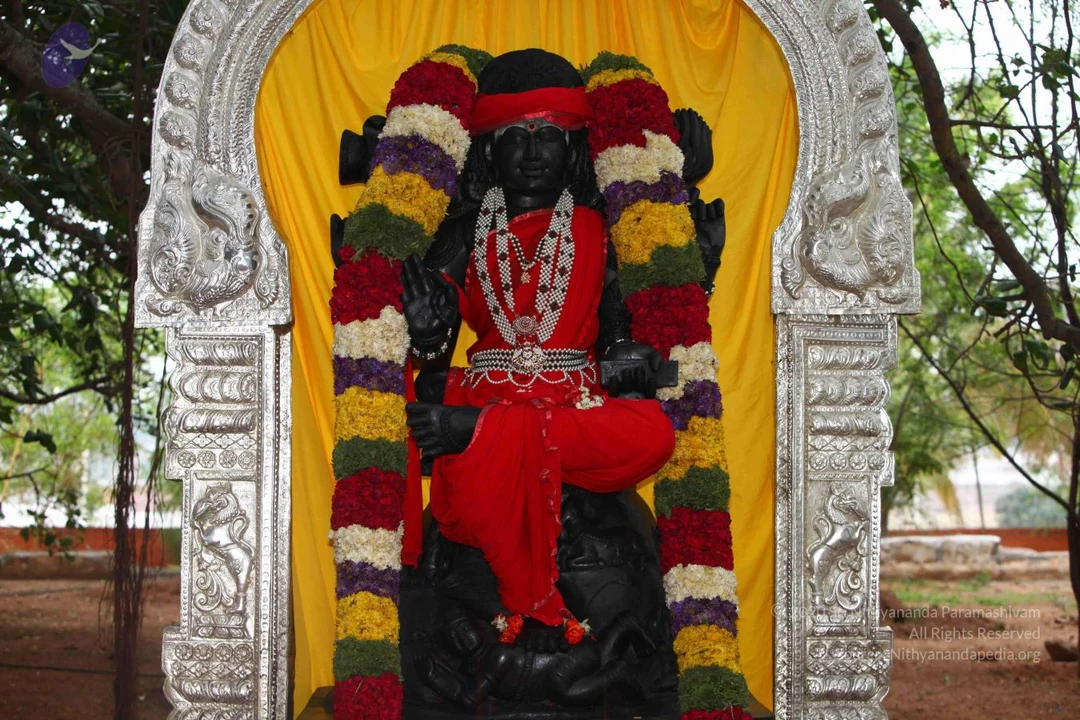
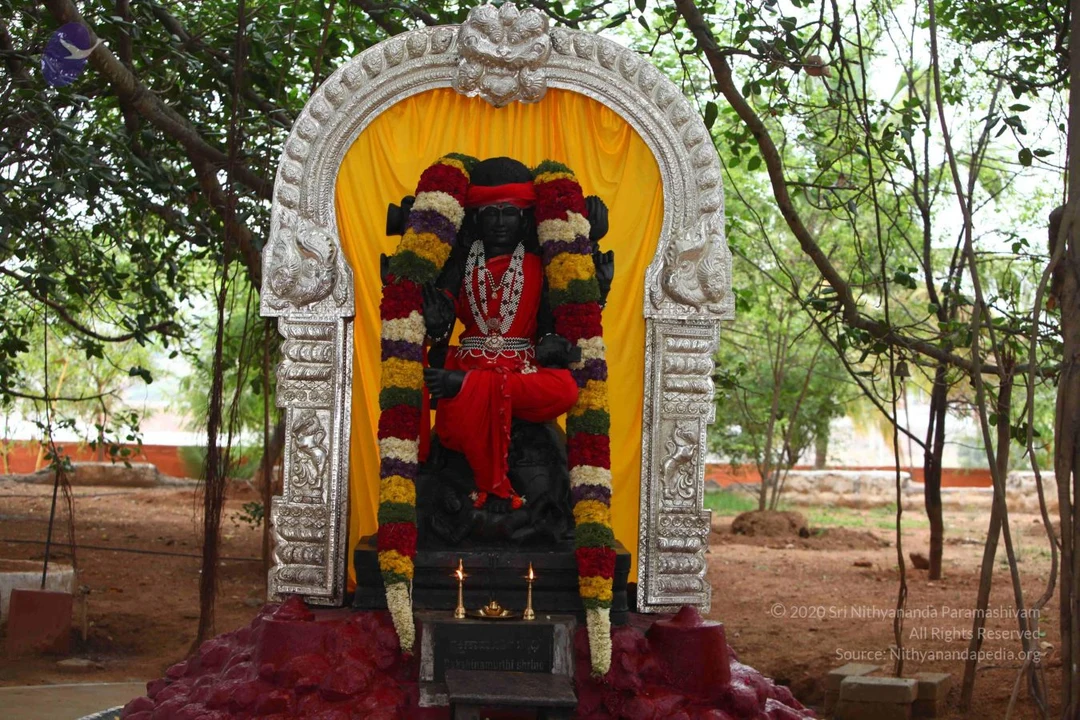
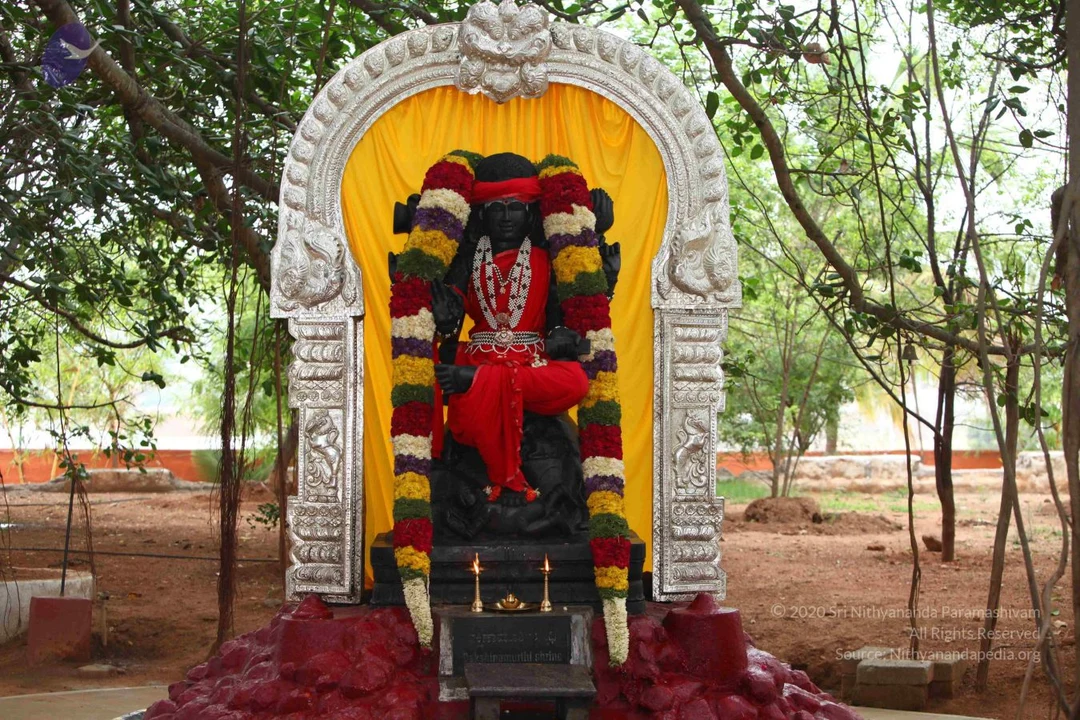
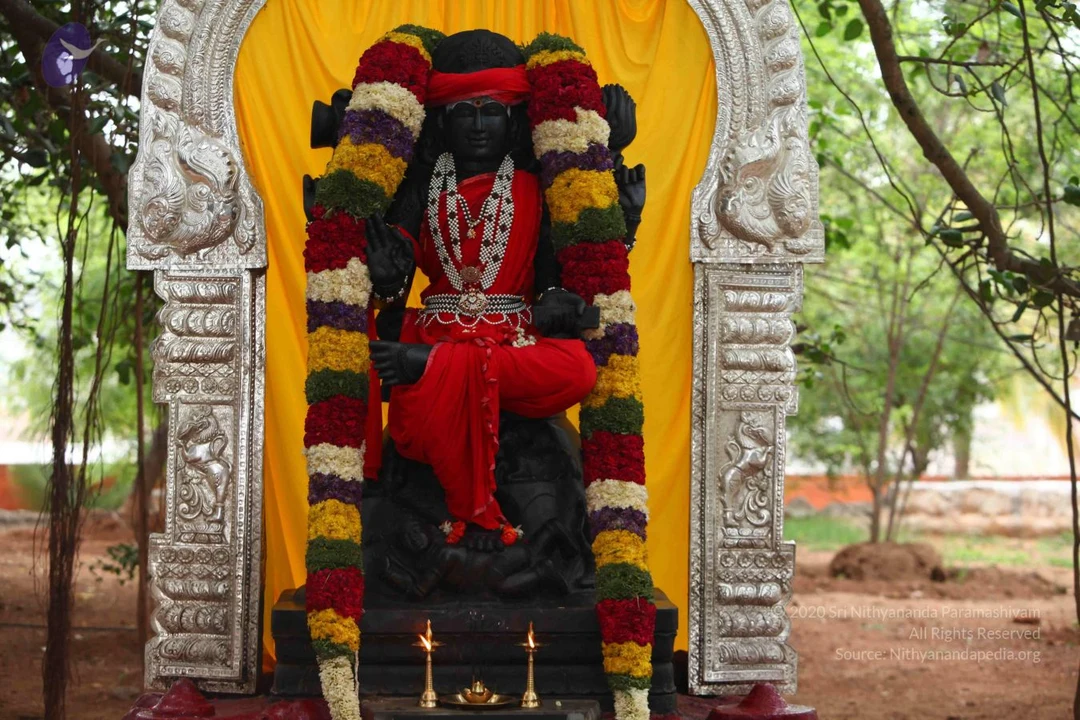
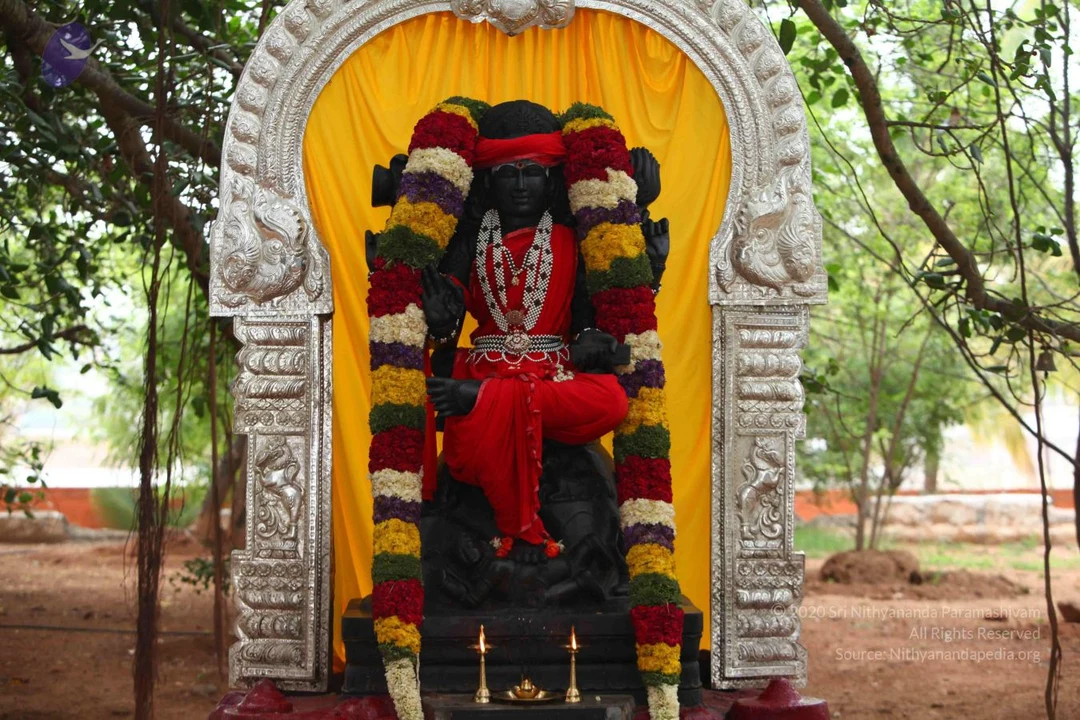
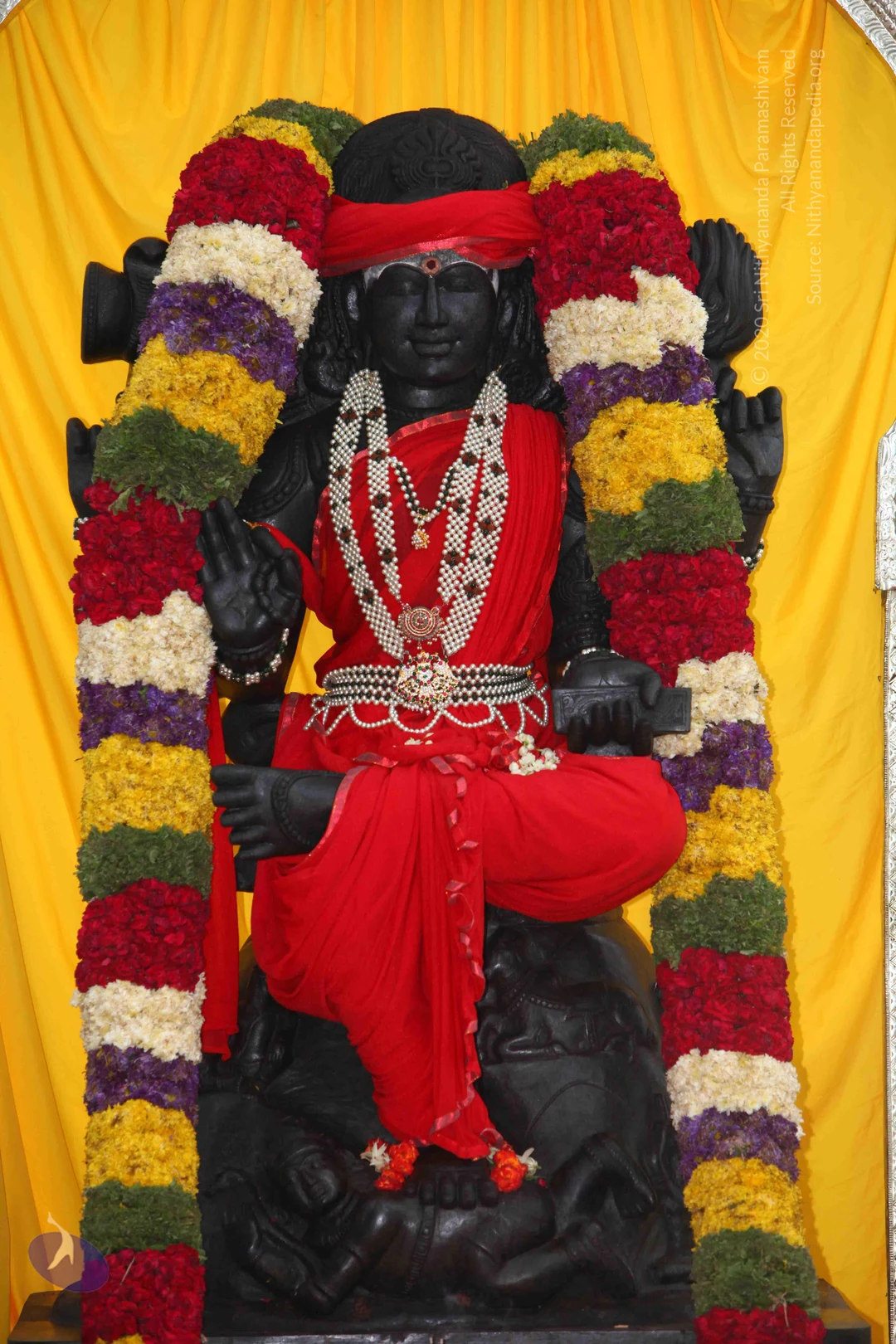
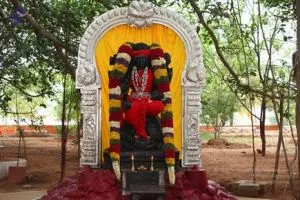
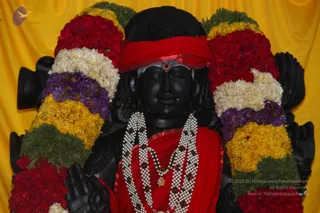
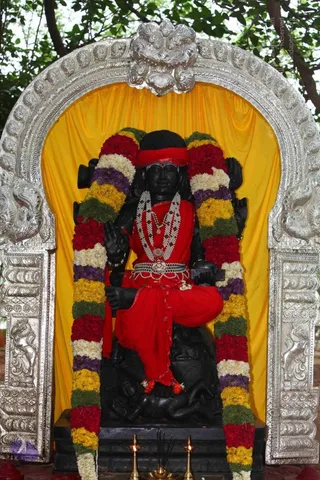
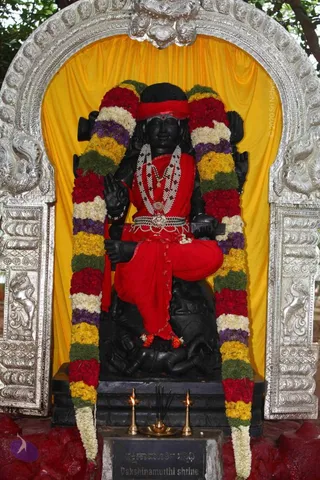
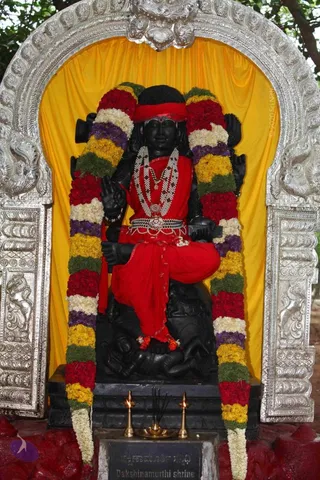
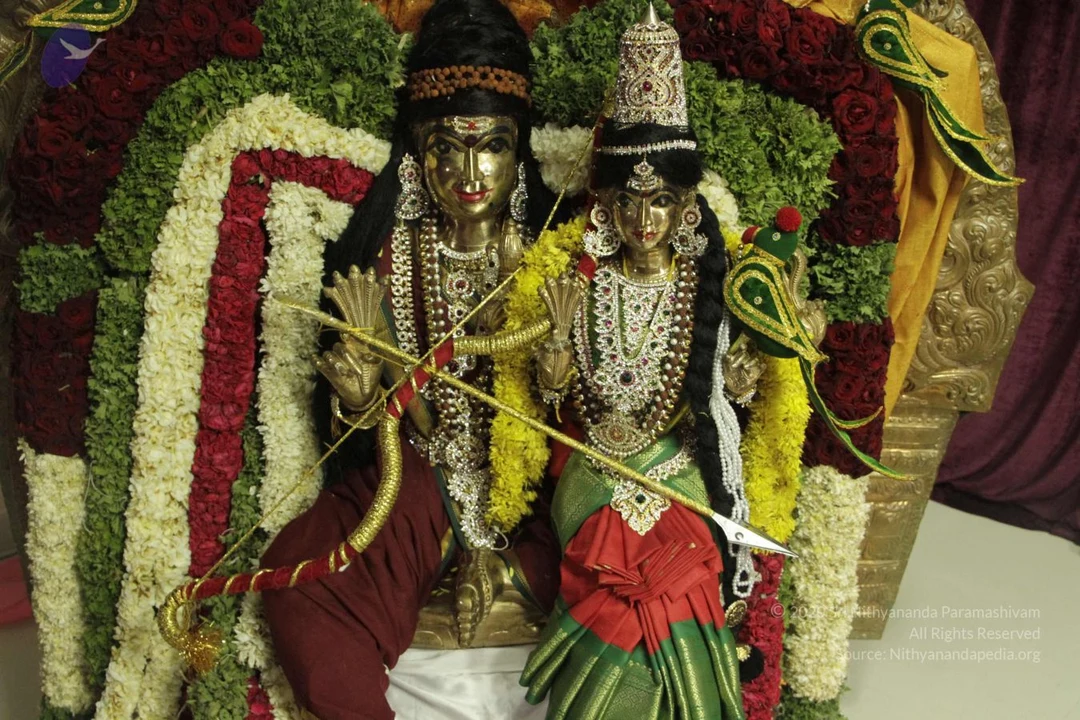
A black stone murti of a deity with a red cloth band across the forehead, a red and gold garment, and a long white beaded necklace with red accents. Multicolored floral garlands in red, white, purple, yellow and green drape over both shoulders, set against a yellow backdrop. A small red mark sits on the forehead. No people are visible; the image shows a statue only.A black stone murti of a seated deity stands in an ornate silver arched shrine against a yellow cloth backdrop, outdoors under trees. The figure wears a red headband with a red dot on the forehead, a red dhoti-style cloth, layered white pearl necklaces and a pearl-studded waist belt. It holds a ritual implement in one hand and has a raised hand gesture. The shrine is draped with a garland of red, yellow, white, purple and green flowers, and two brass oil lamps and incense sticks sit at the base. No people are visible, and the figure is a statue, not a person.A black stone murti of Dakshinamurthi seated in a shrine niche framed by ornate silver arch work, with a yellow cloth backdrop. The figure wears a red cloth draped over the body and a red headband, with layered white and dark beaded necklaces, a jewelled belt and a rudraksha-style pendant. Garlands of red, yellow, white, purple and green flowers hang down both sides. Two brass oil lamps burn in front, with incense sticks between them, and a stone plinth reads Dakshinamurthi shrine in Kannada and English. No people are visible.A black stone Dakshinamurthi murti sits in a shrine niche framed by ornate silver arch work, set against a yellow cloth backdrop. The deity wears a red cloth and red headband, a white and dark bead necklace, and a jewelled waist belt. Garlands of red, white, yellow, purple and green flowers hang down both sides. Two brass oil lamps and incense sticks rest before the shrine, with a plaque reading Dakshinamurthi shrine below. No people are visible.A black stone statue of a seated deity murti is the central subject, framed by an ornate silver arch decorated with carved peacock or swan motifs. The figure wears a red headcloth, a red dhoti-like garment, layered white and red beaded necklaces, a pendant and a jewelled red and silver waist belt. Garlands of red, yellow, orange, purple and green flowers drape over both sides of the statue. A bright yellow cloth hangs behind it, with green trees visible at the edges. This is a statue, not a living person.A black stone murti of a seated deity under an outdoor canopy, framed by an ornate silver arch with lion and floral carvings. The figure wears a red dhoti and a red headband, with layered white and beaded necklaces and a jeweled waist belt. Garlands of red, white, yellow, purple and green flowers drape down both sides, and a yellow cloth backdrop sits behind it.

Pada-Pooja

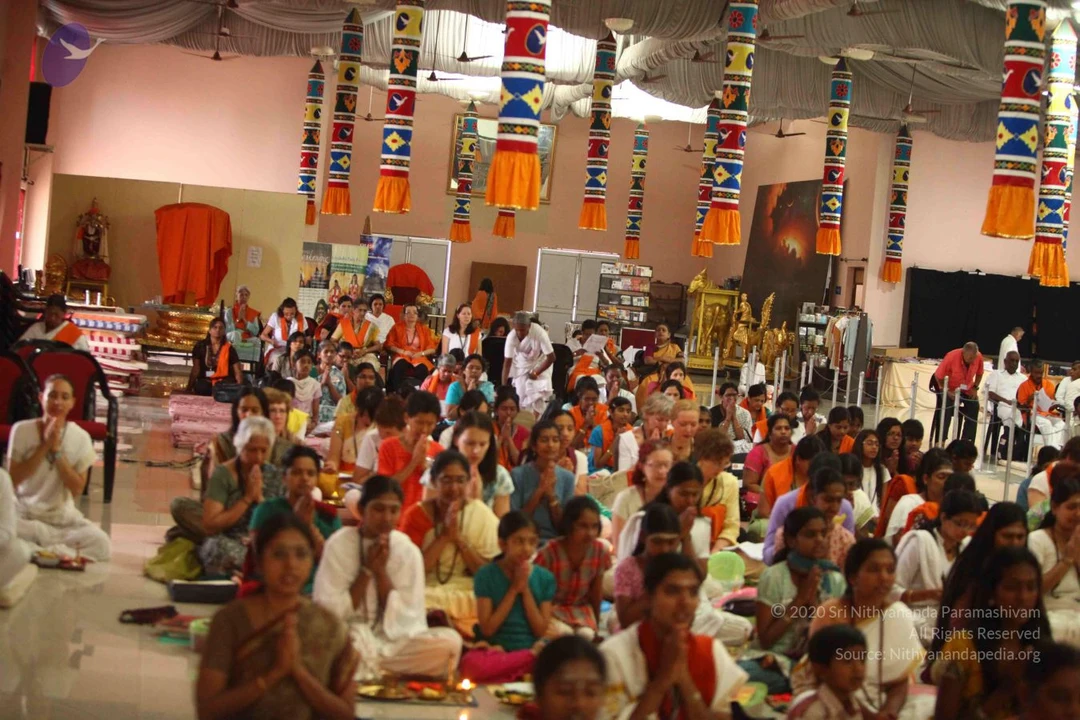
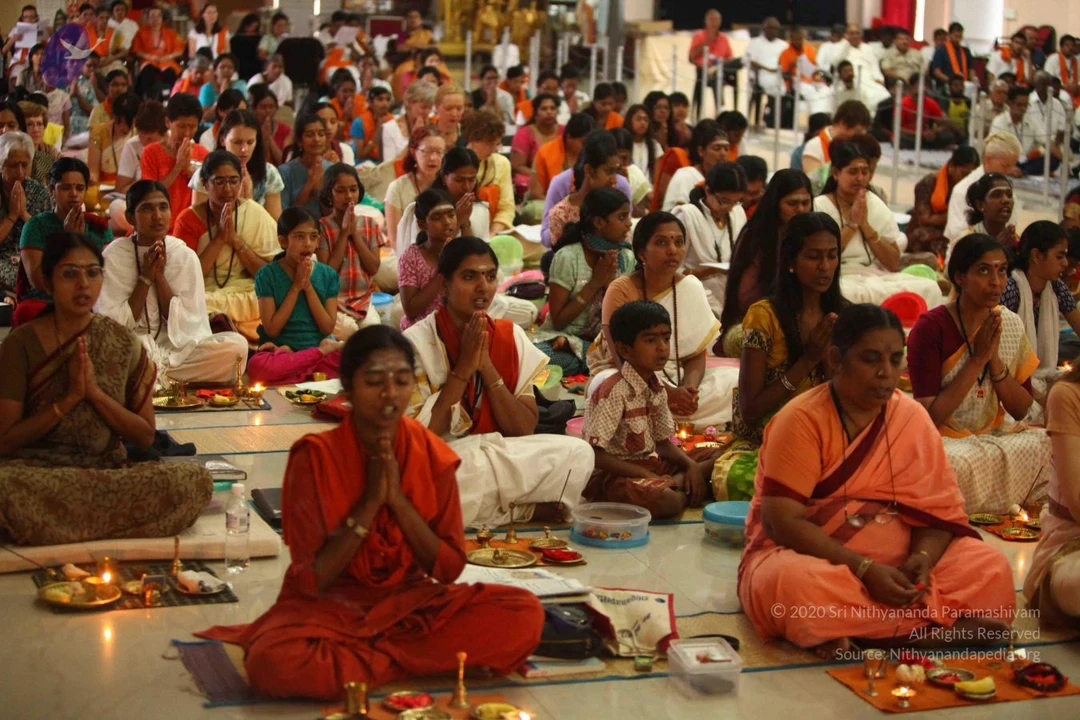
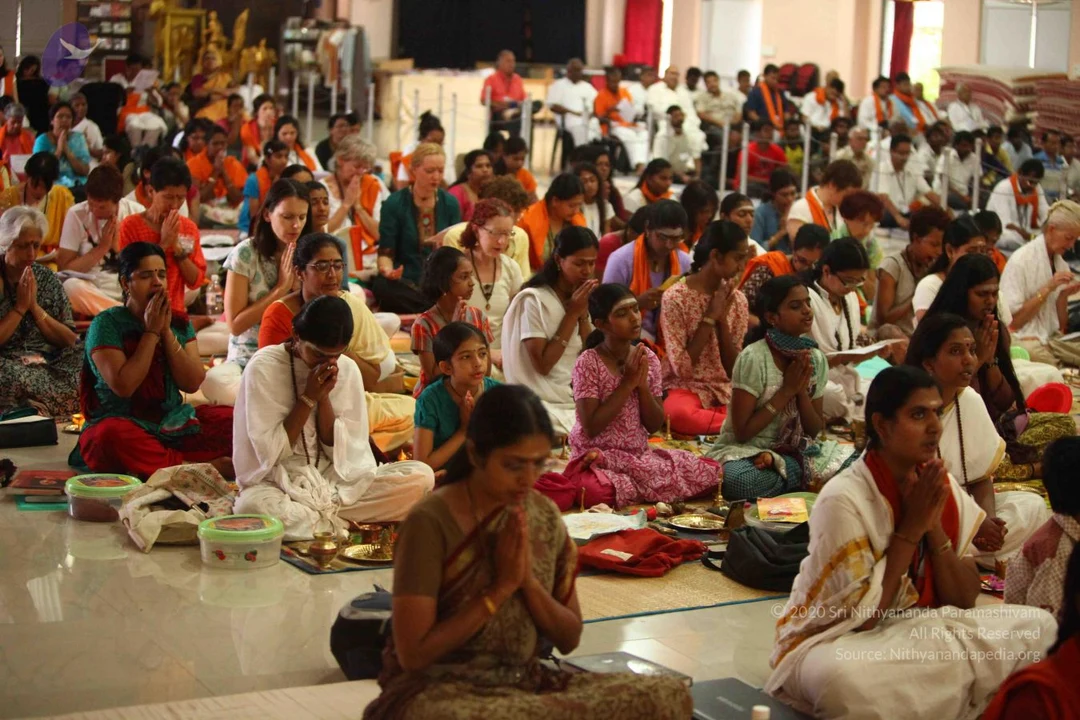
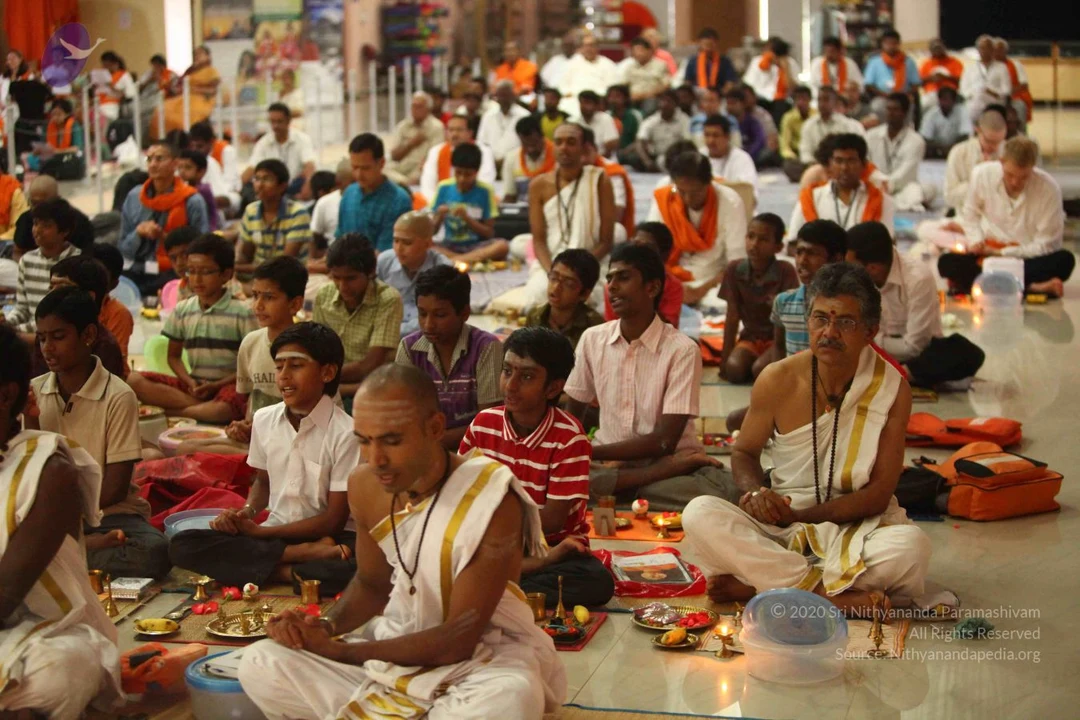
94 photosSource gallery
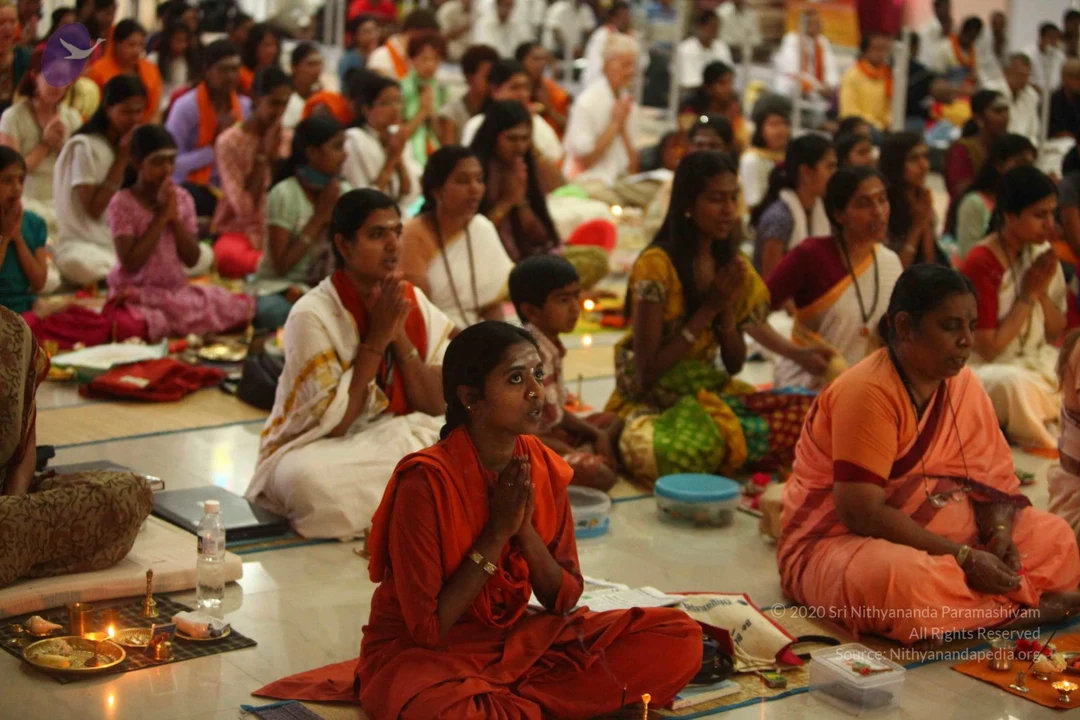
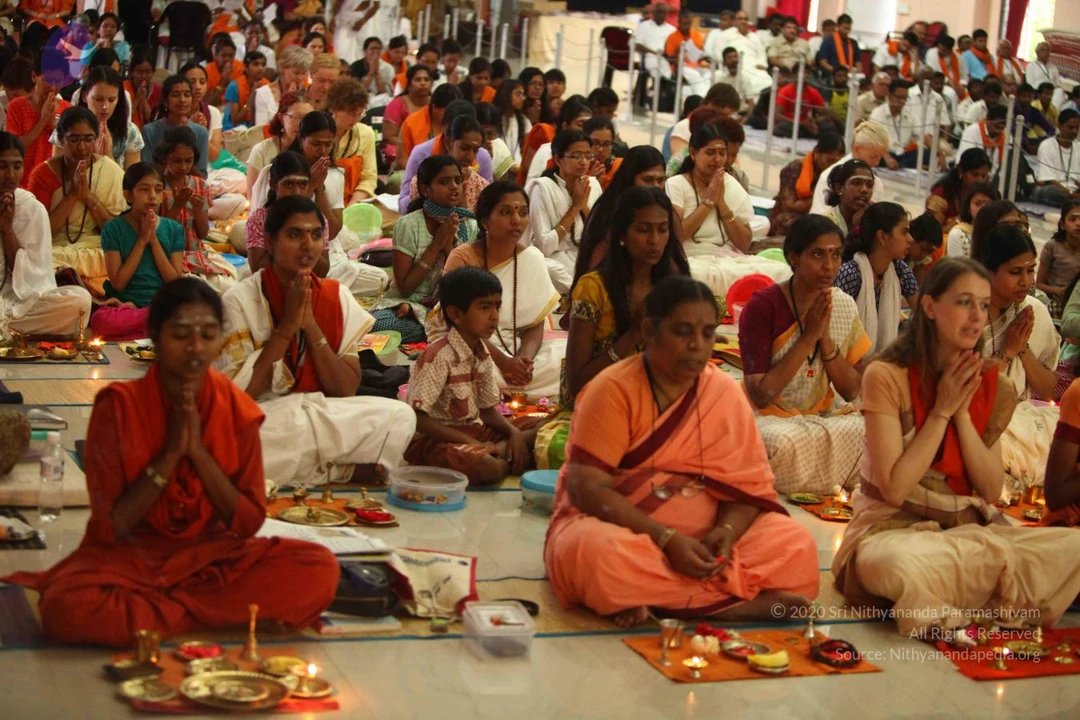
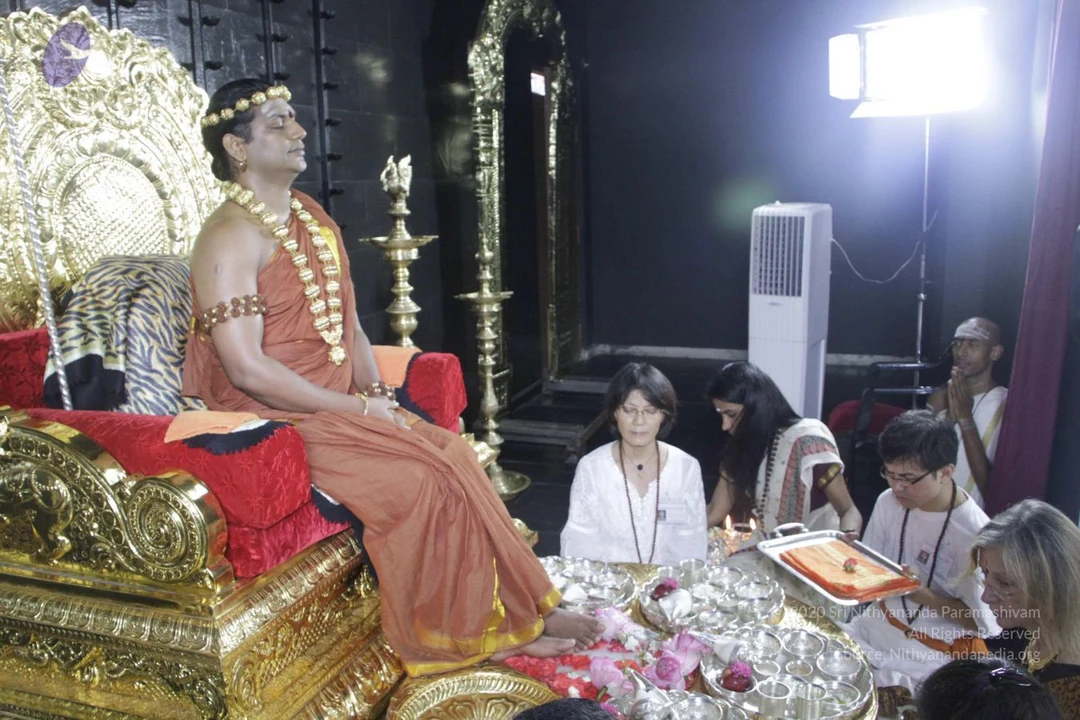
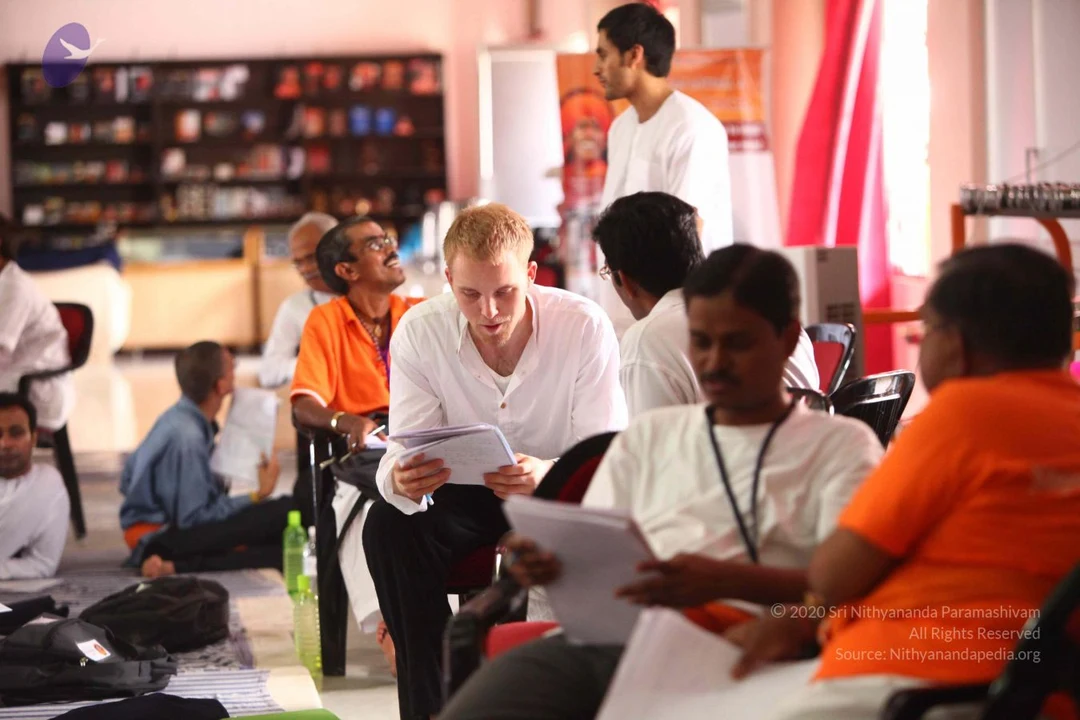
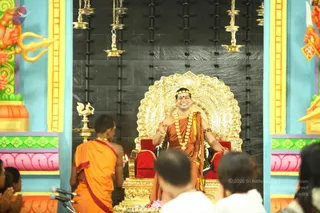
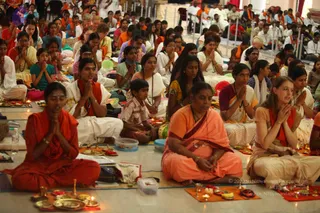
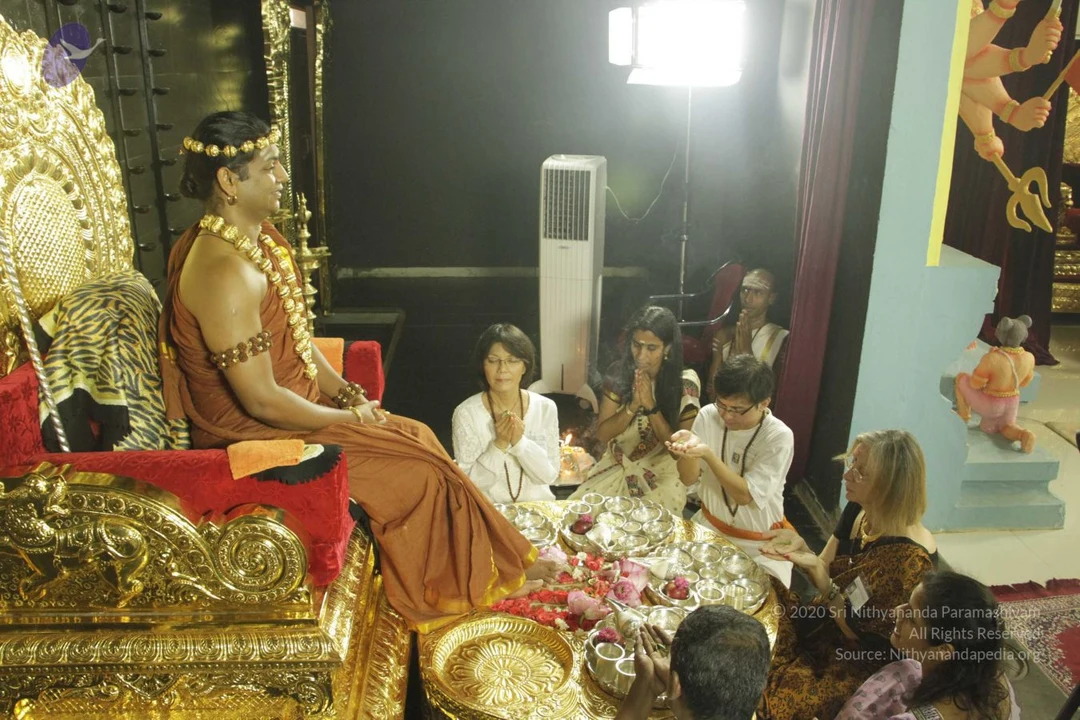
A seated man on an ornate gold throne with a red cushioned seat, in a bright blue, pink and green temple hall decorated with painted deity figures, a trident and a lotus motif. He wears an orange-saffron shawl over a bare upper body, a long gold-coloured garland, a headband with a red bindi, and gold bangles, and he gestures with raised hands while speaking. Hanging brass lamps are suspended from the black stone wall behind him. A priest in saffron robes stands at left holding a flame, and partially visible devotees in white sit in the foreground with folded hands, with microphones on stands before them. Appearance-based, a person is seated on the throne, identified by the saffron shawl, gold garland and headband cues, presiding over satsang.A seated man in saffron-orange robes and a rudraksha-style garland sits on an ornate gold throne with a large gold arched backrest against a dark stone wall. He wears a floral headband, red tilak on his forehead, beaded bangles and a long gold-beaded necklace, and gestures with his raised hand. In the foreground a younger man in orange garments with a red border, seen from behind, holds lit lamps or flames. Hanging brass oil lamps (deepams) and a golden lamp stand flank the scene, with framed panels of yellow, teal and pink. a person (appearance-based label) is seated in the centre; the lamp-holding attendant is a devotee.A seated man on an ornate gilded throne with a curved, floral-patterned back, set against a dark slate wall hung with brass hanging oil lamps. He is smiling and raising one hand in blessing, wearing a gold floral head ornament, a long gold garland, rudraksha-style bead bracelets on his arms, and an orange-saffron dhoti with a reddish shawl. A tilak mark is on his forehead. In the foreground at left, a second person in orange robes, seen from behind, holds a small ritual object, beside a brass oil lamp shaped like a bird. Yellow, red and green painted panels frame the scene.A seated man in a golden ornate throne with a large embossed gold backrest in front of a dark slate-patterned wall. He wears an orange-saffron cloth draped over his left shoulder, leaving his chest bare, with a gold-beaded necklace and a long garland of flowers, a small floral crown on his head and a red-and-white bindi on his forehead, and wide gold armlets on his upper arms. Hanging brass oil lamps (deepams) are suspended from chains above him, with a brass rooster-topped oil lamp on a stand to his left. Yellow and red patterned panels frame the scene. A portrait-style figure seated on a throne-like seat, appearing as a person depiction with saffron cloth, bare chest, floral garland and gold armlets, in a temple-style setting.A large seated congregation of devotees, mostly women and some men, sits on the floor of a white-tiled hall with palms pressed together in prayer. In the foreground a young woman in saffron-orange robes with a red shawl and bangles looks upward, while an older woman in orange sari with a beaded necklace sits to the right. Behind them women in white, yellow, pink and red saris, and a boy, join in devotion. Brass plates with offerings, small oil lamps and candles sit on mats in front of them, and open books lie on the floor. No prominent figure matching the page's a person reference is clearly visible, so no identification is made.A large seated congregation with palms pressed together in namaskar during a satsang or puja in a hall with a light floor. In the foreground a woman in orange robes and a red-edged shawl sits cross-legged with hands folded, beside her a woman in an orange sari and a woman in a red and maroon sari. Brass plates with lit oil lamps, flowers and offerings sit on the floor before the rows. Behind them many devotees in white, cream, orange and green clothing kneel and sit, with a woman in a white sari and a man in white near the front. No a person candidate is identifiable in the frame.
Satsang

28 photosSource gallery
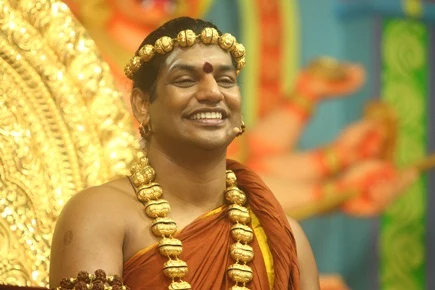
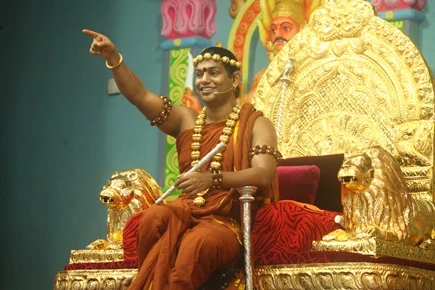
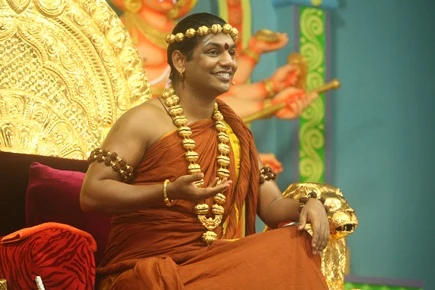
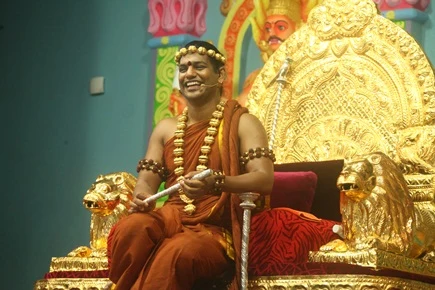
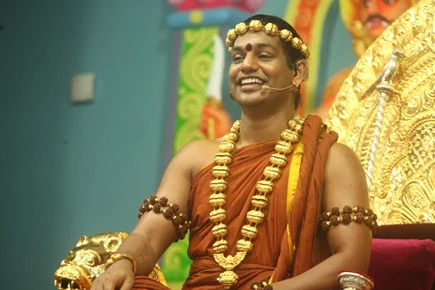
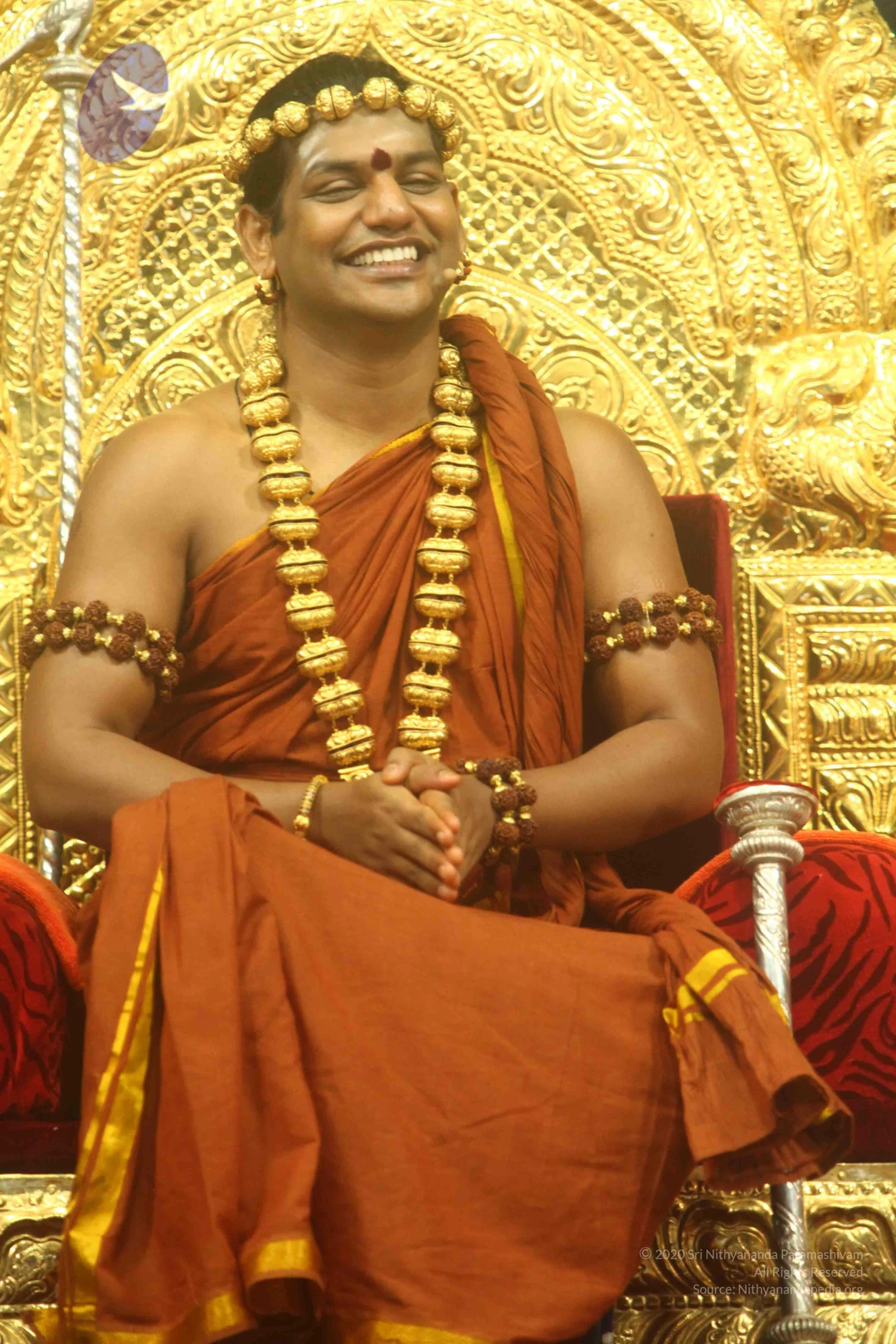
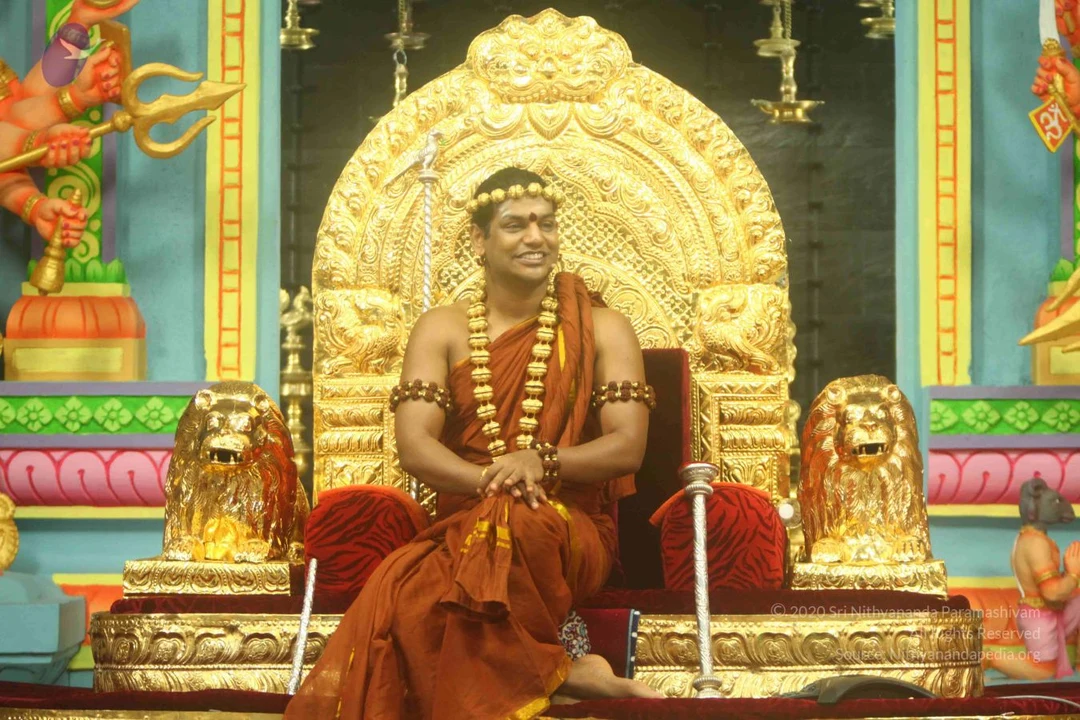
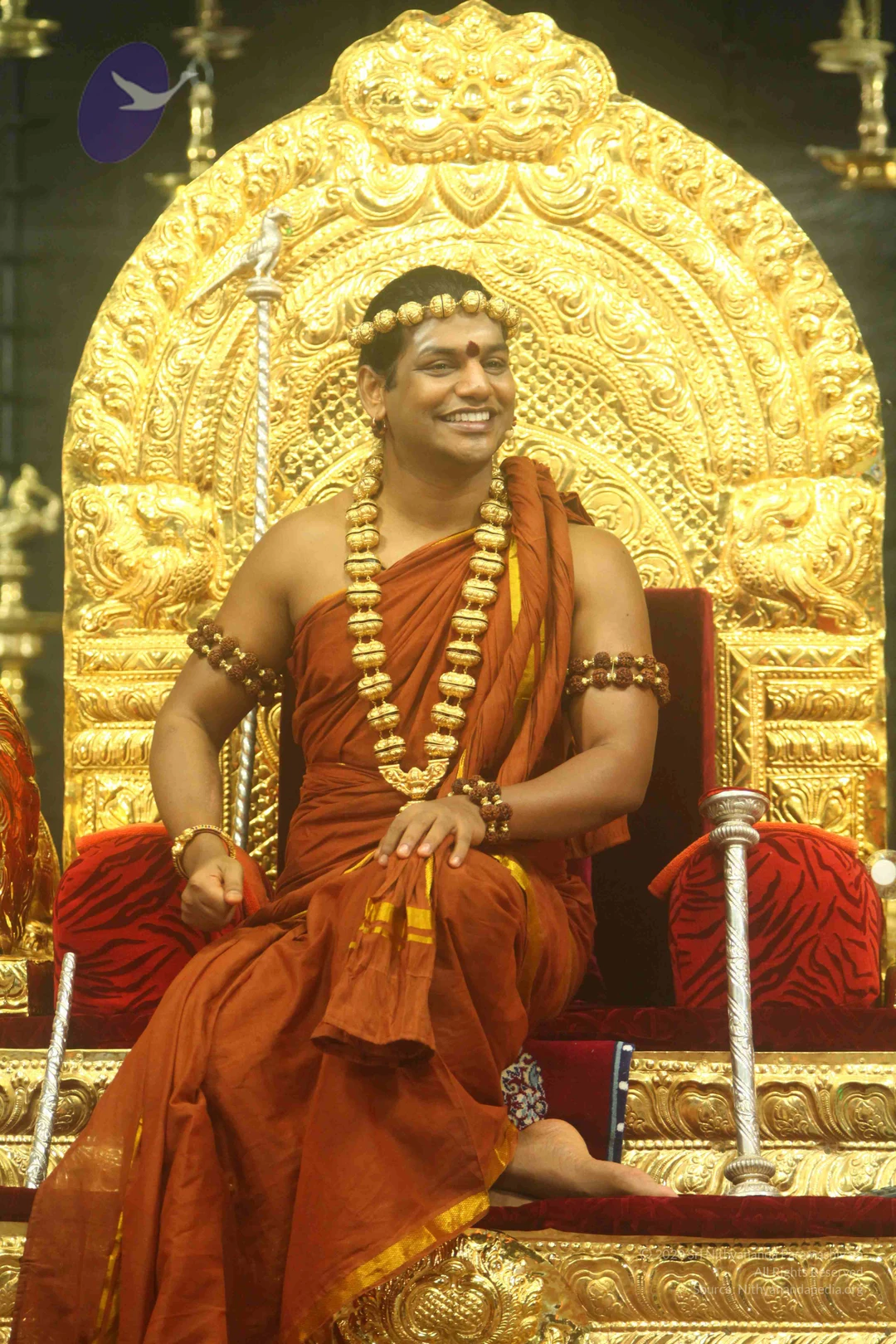
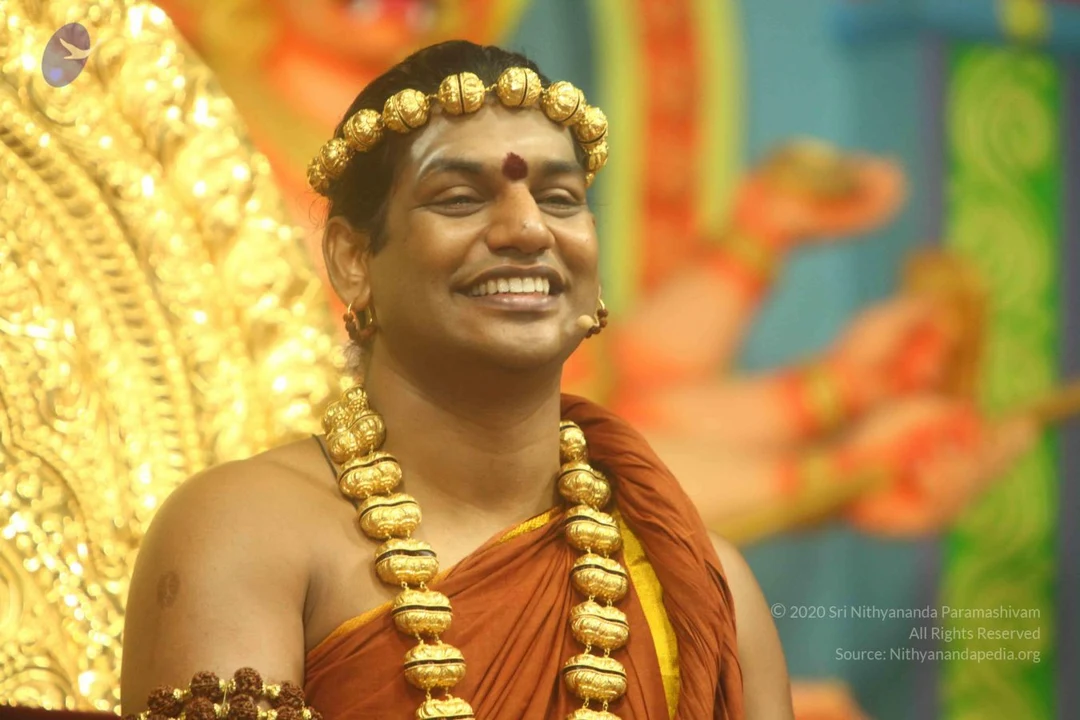
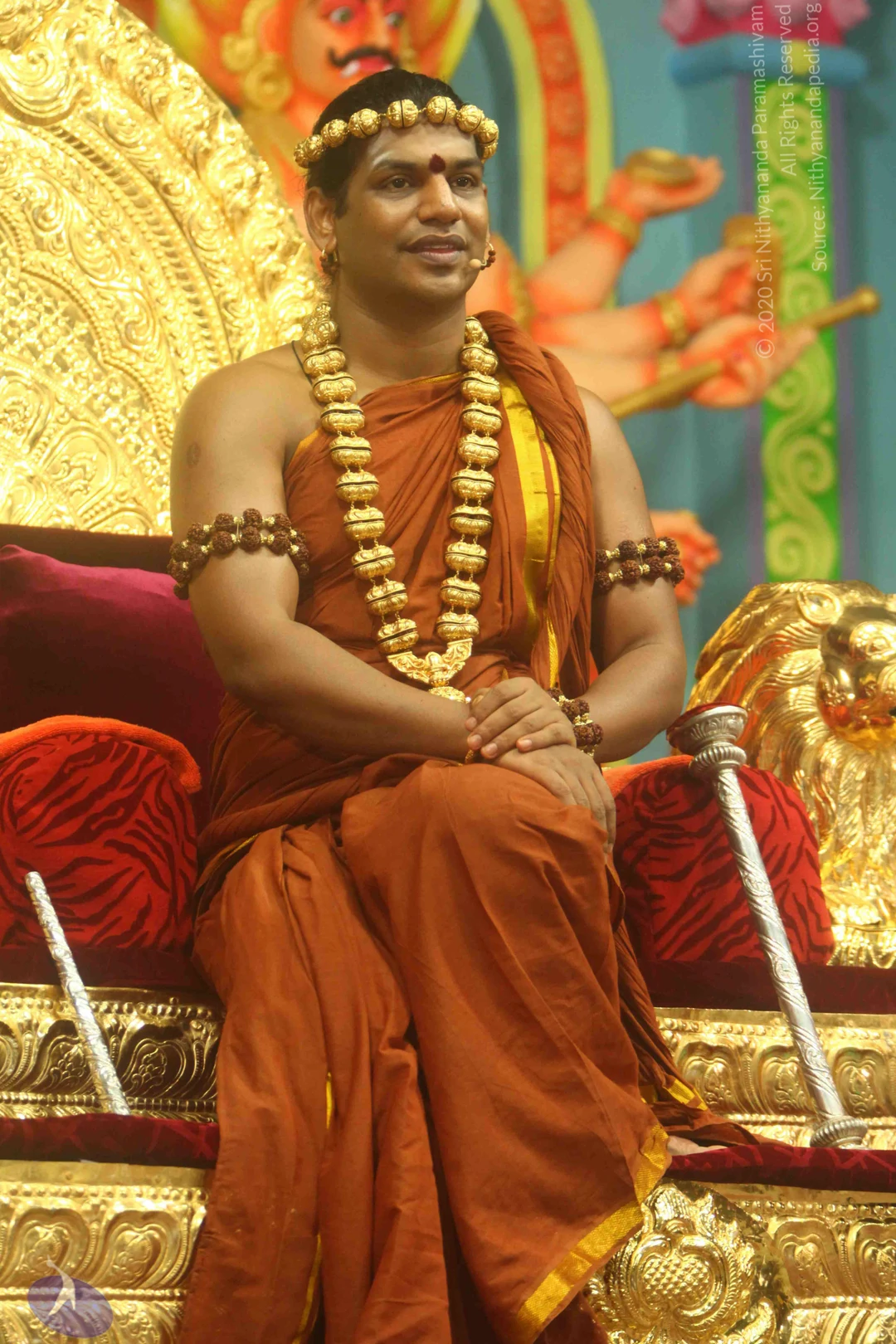
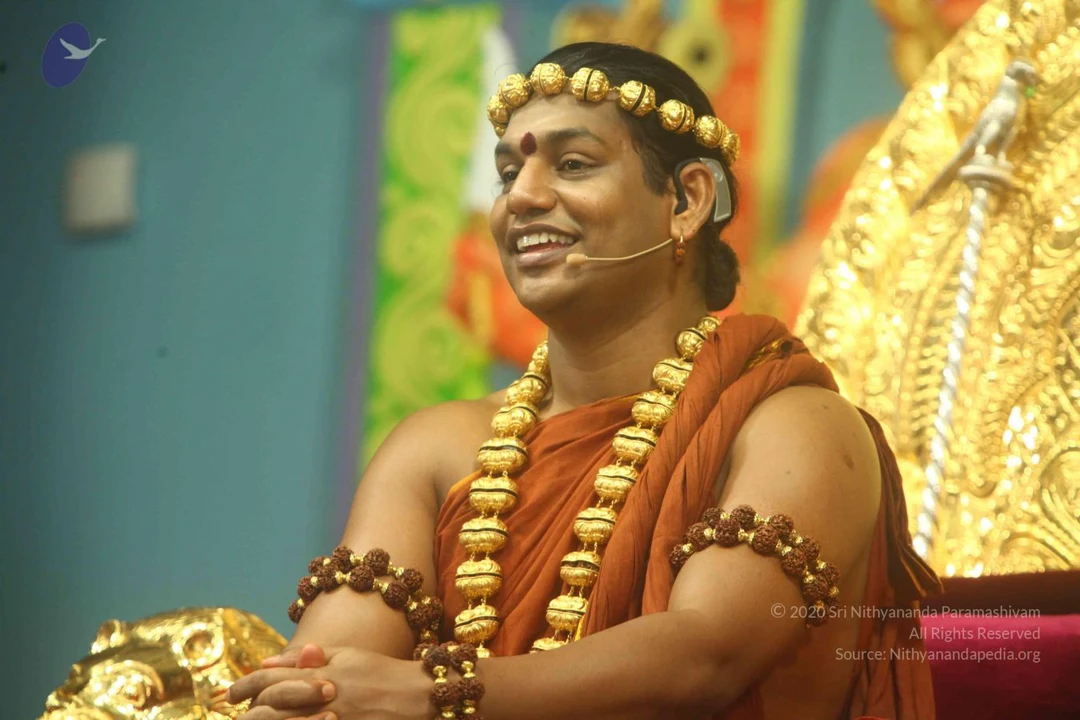
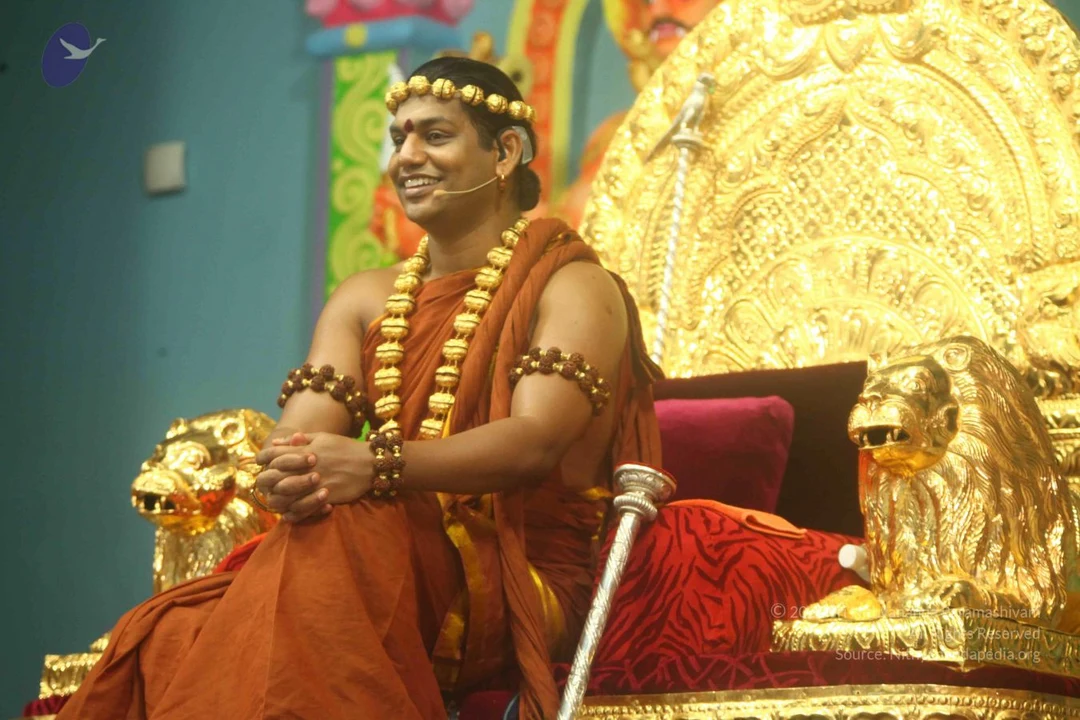
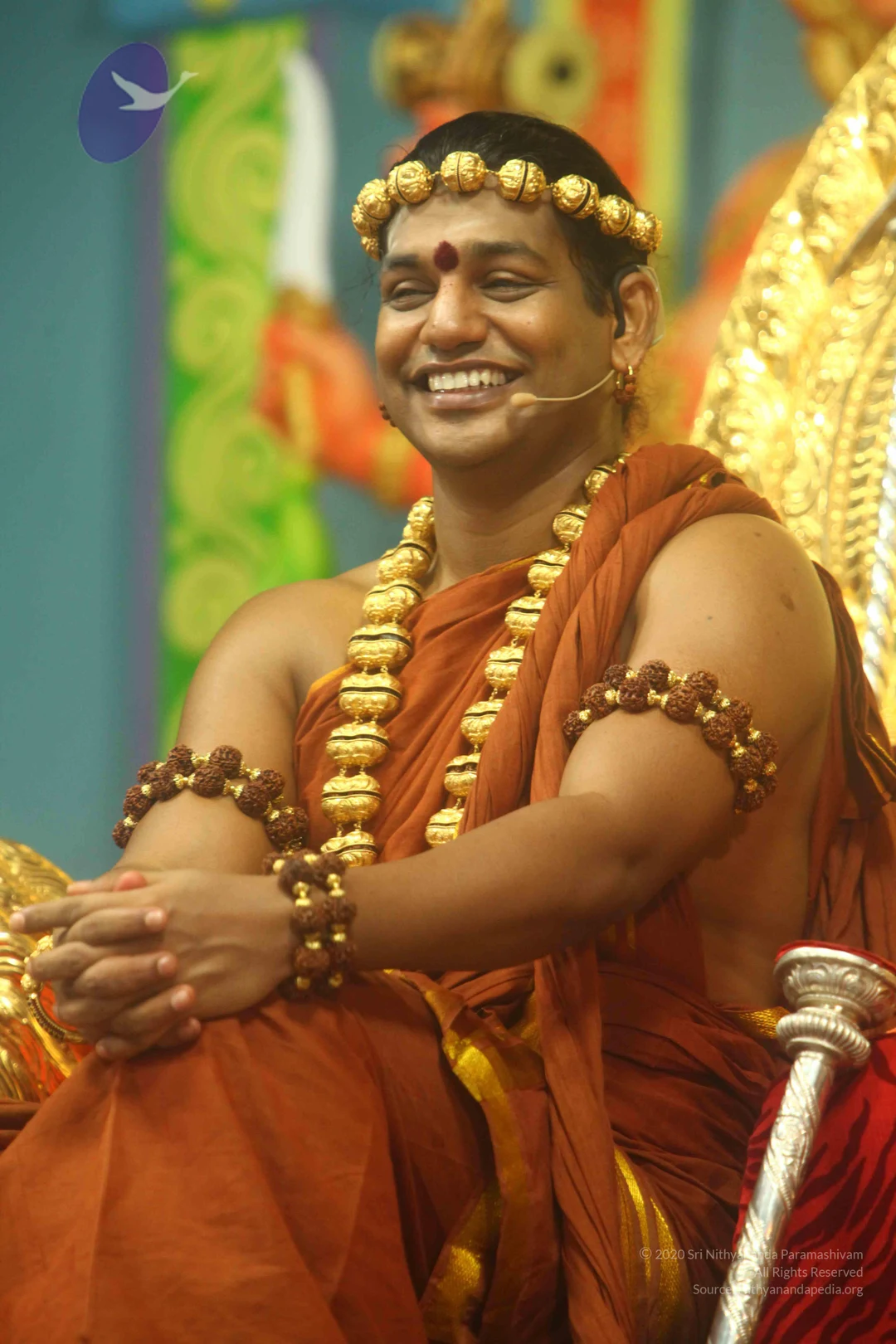
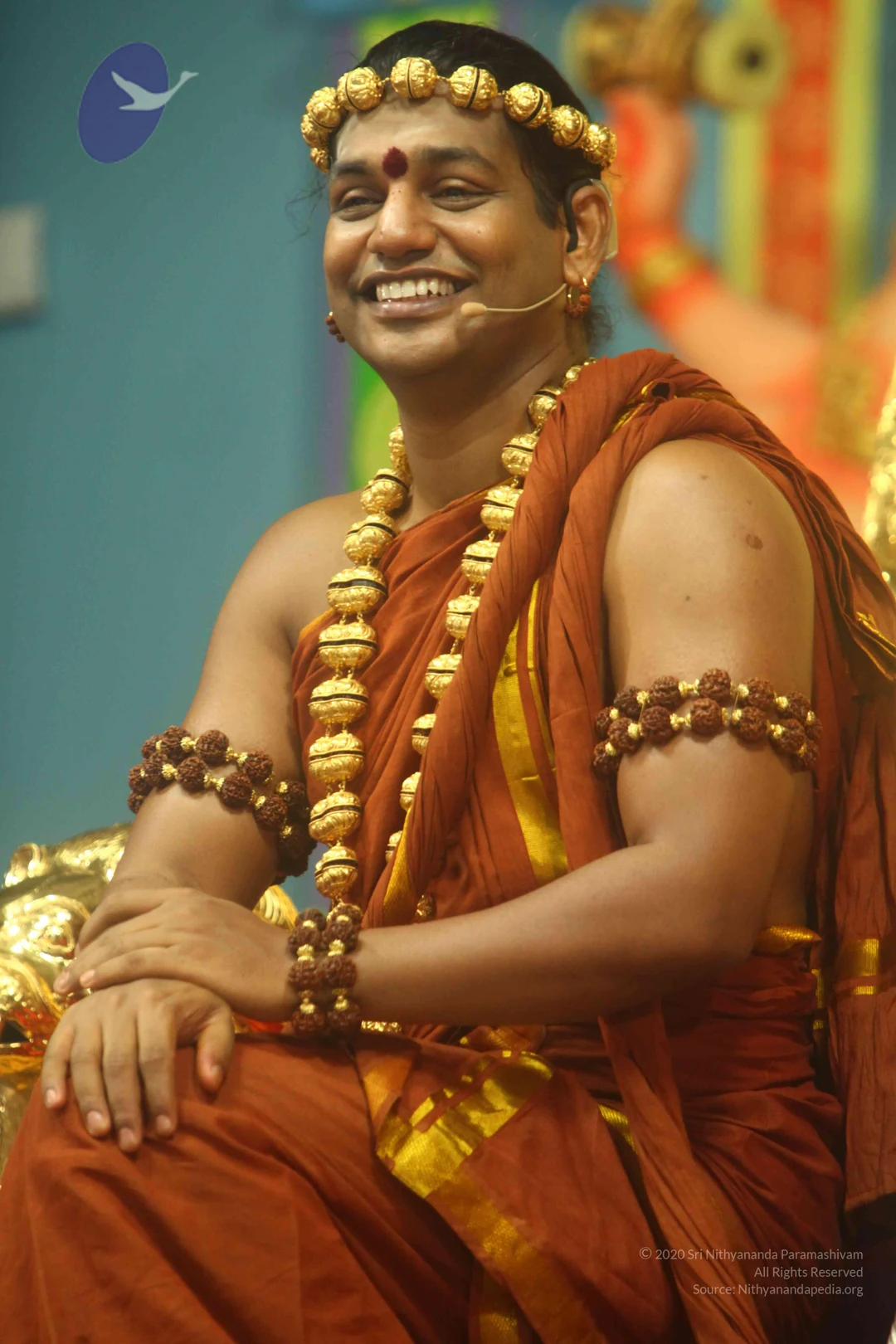
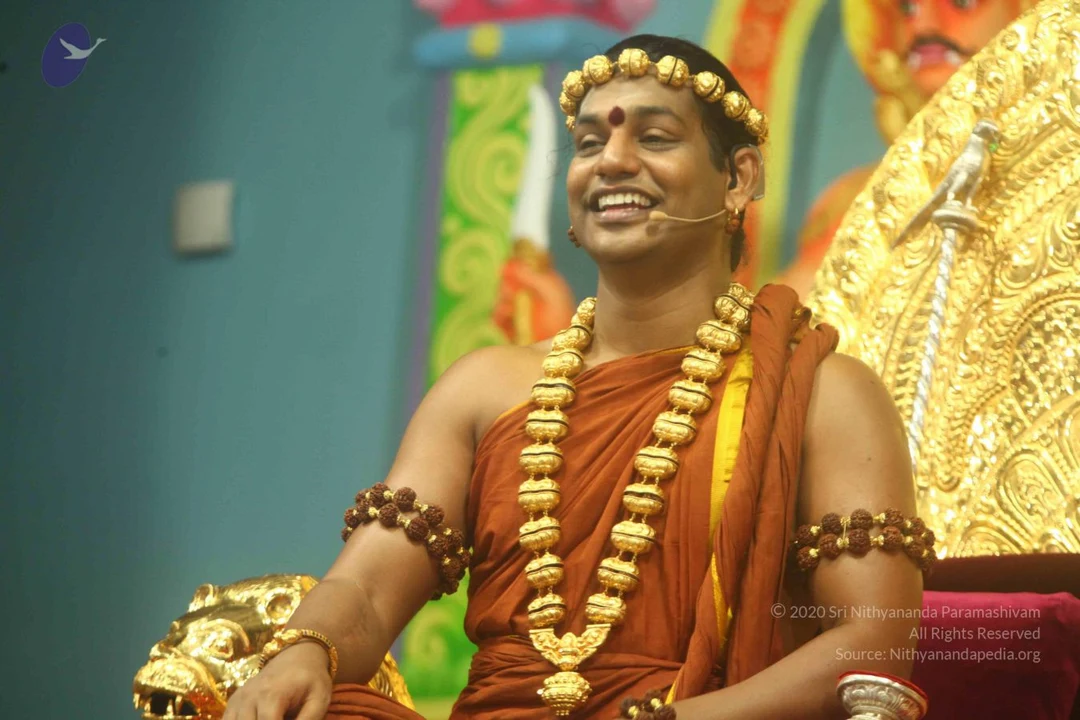
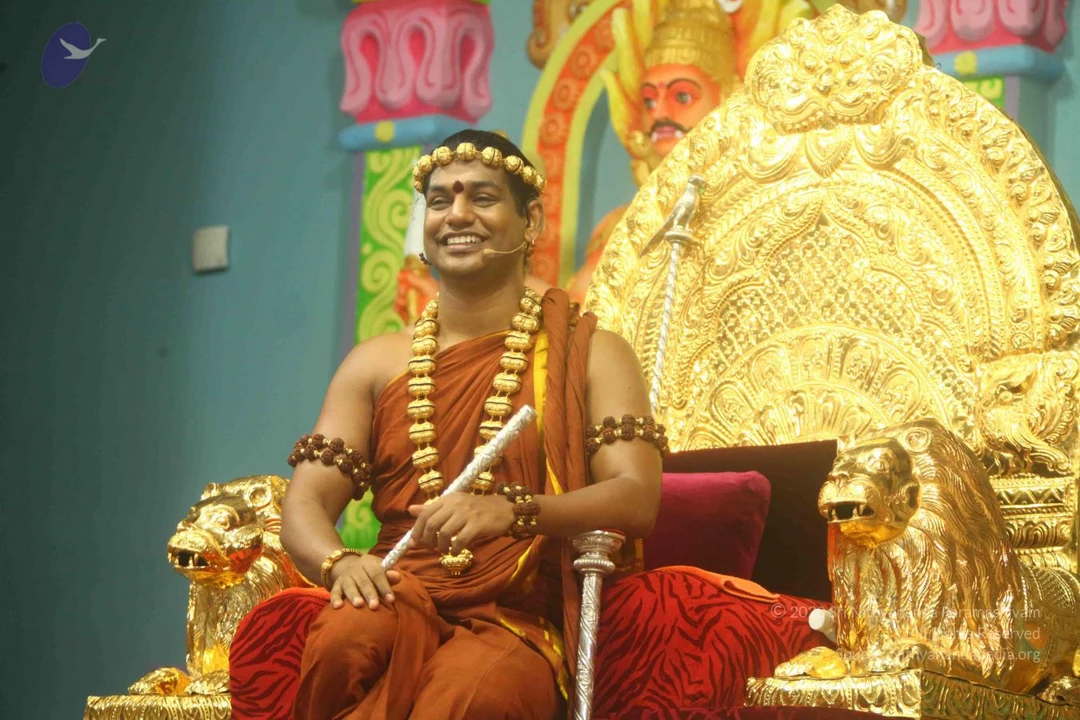
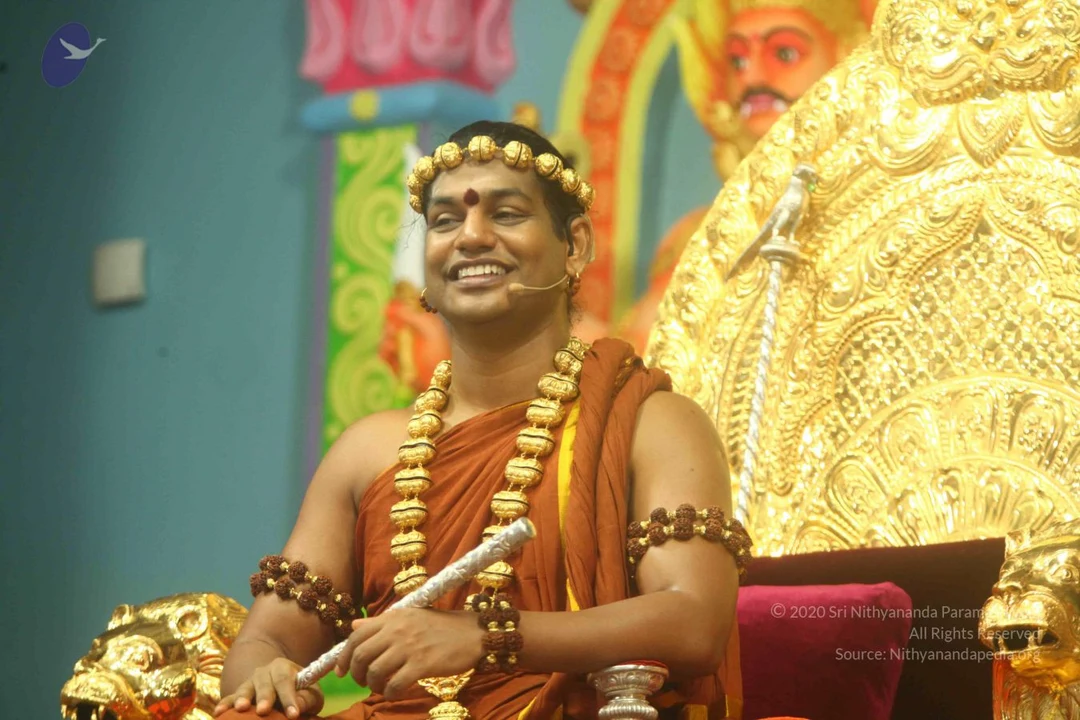
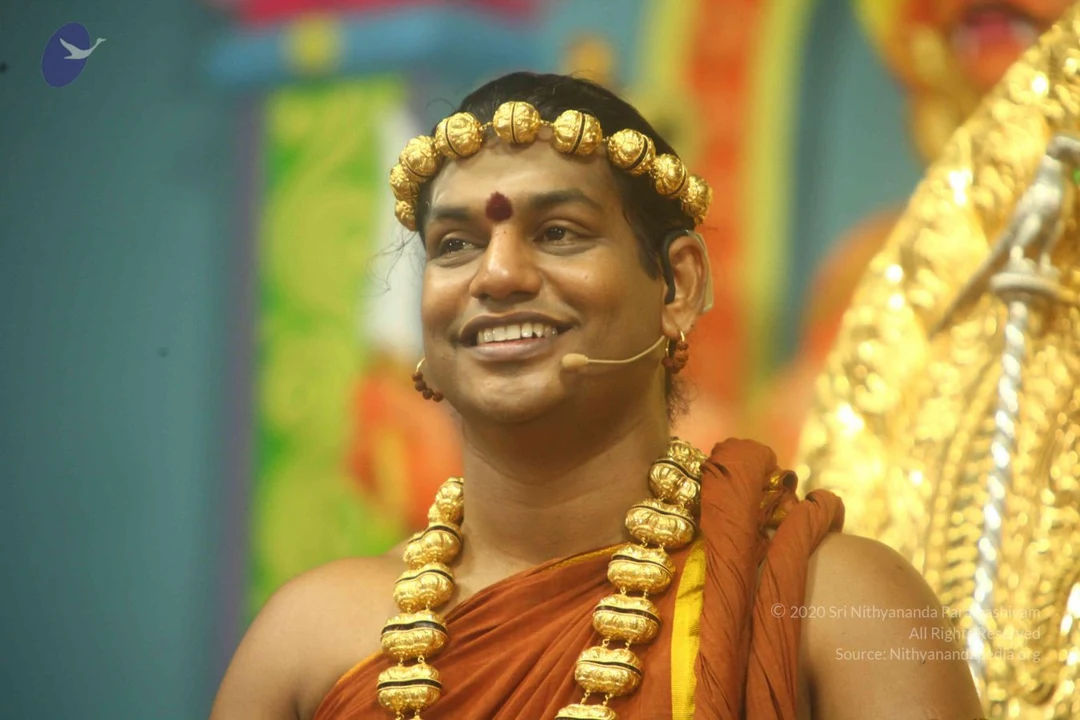
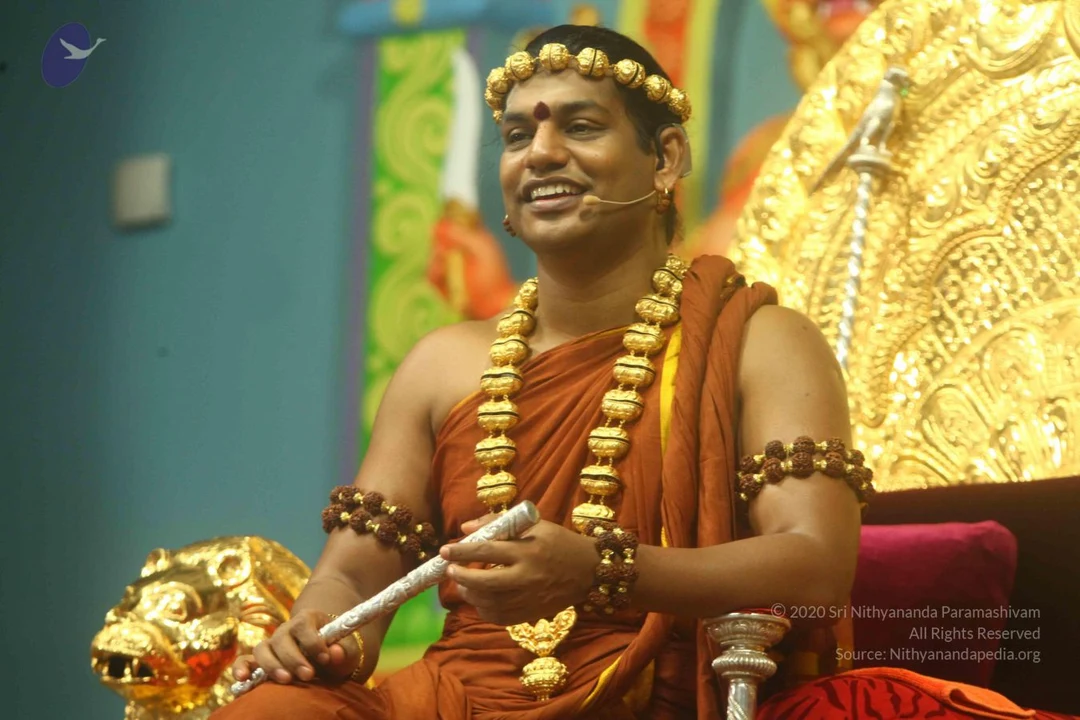
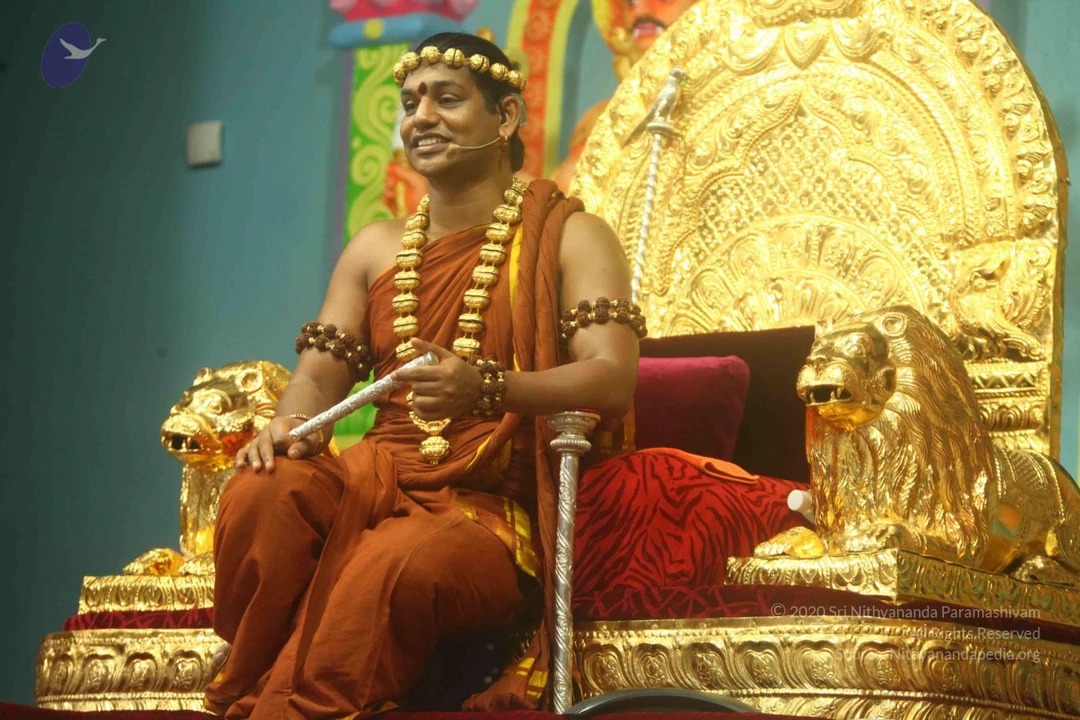
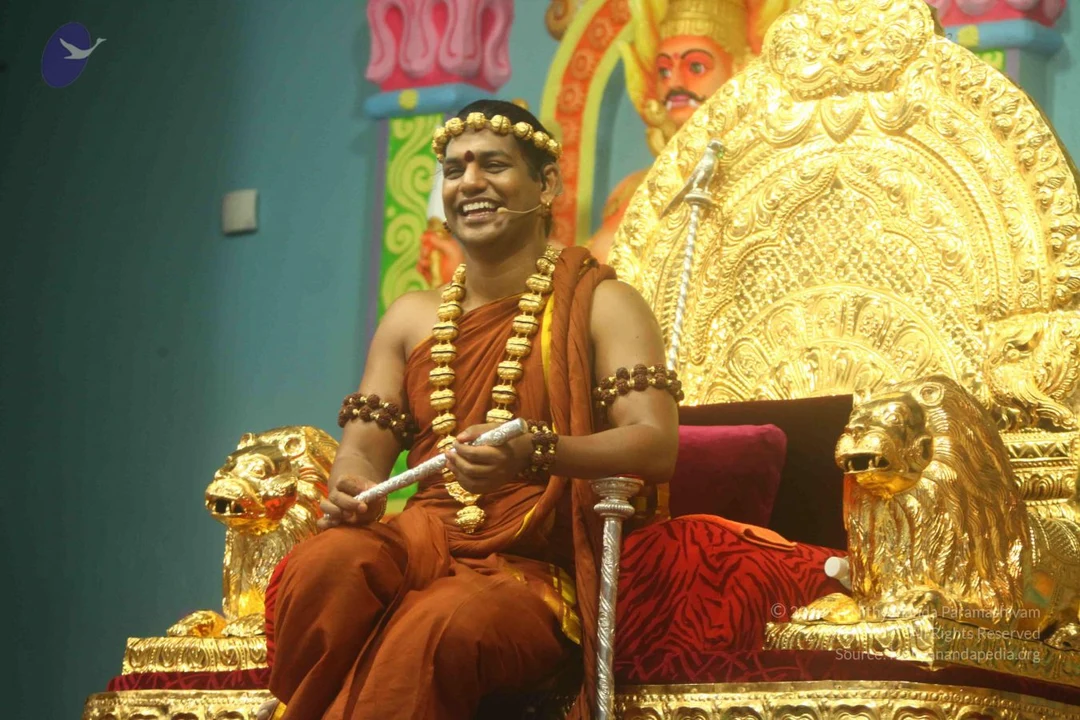
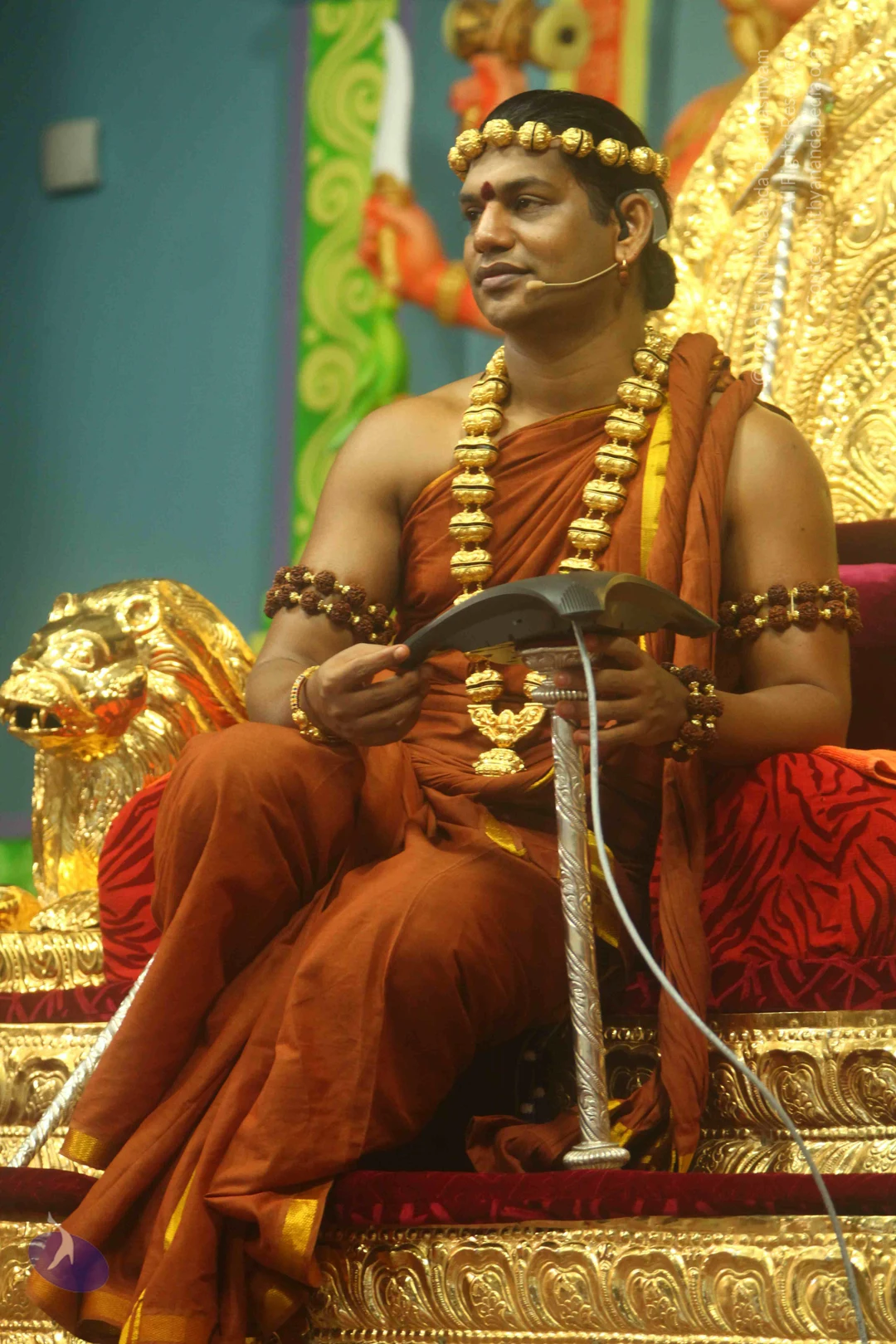
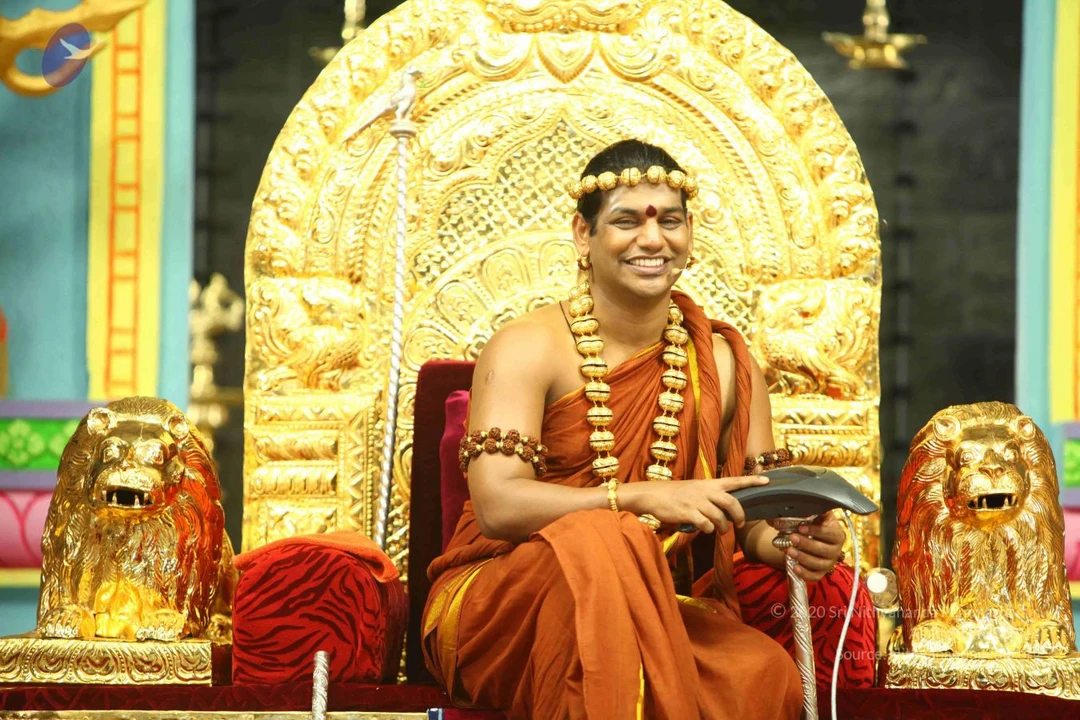
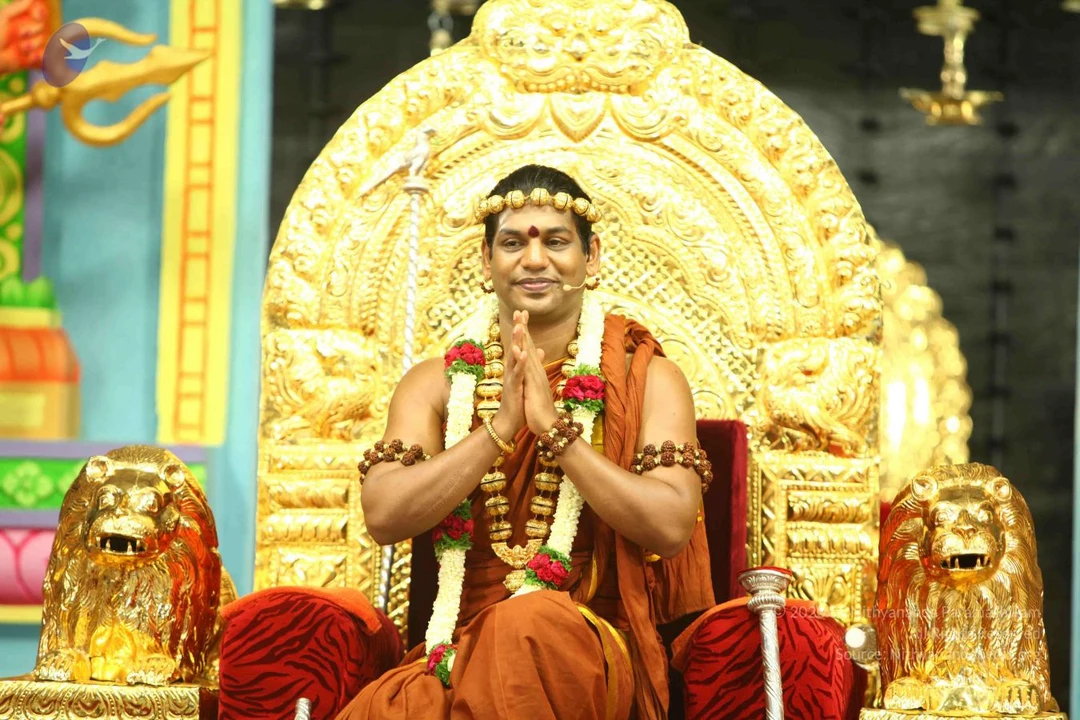
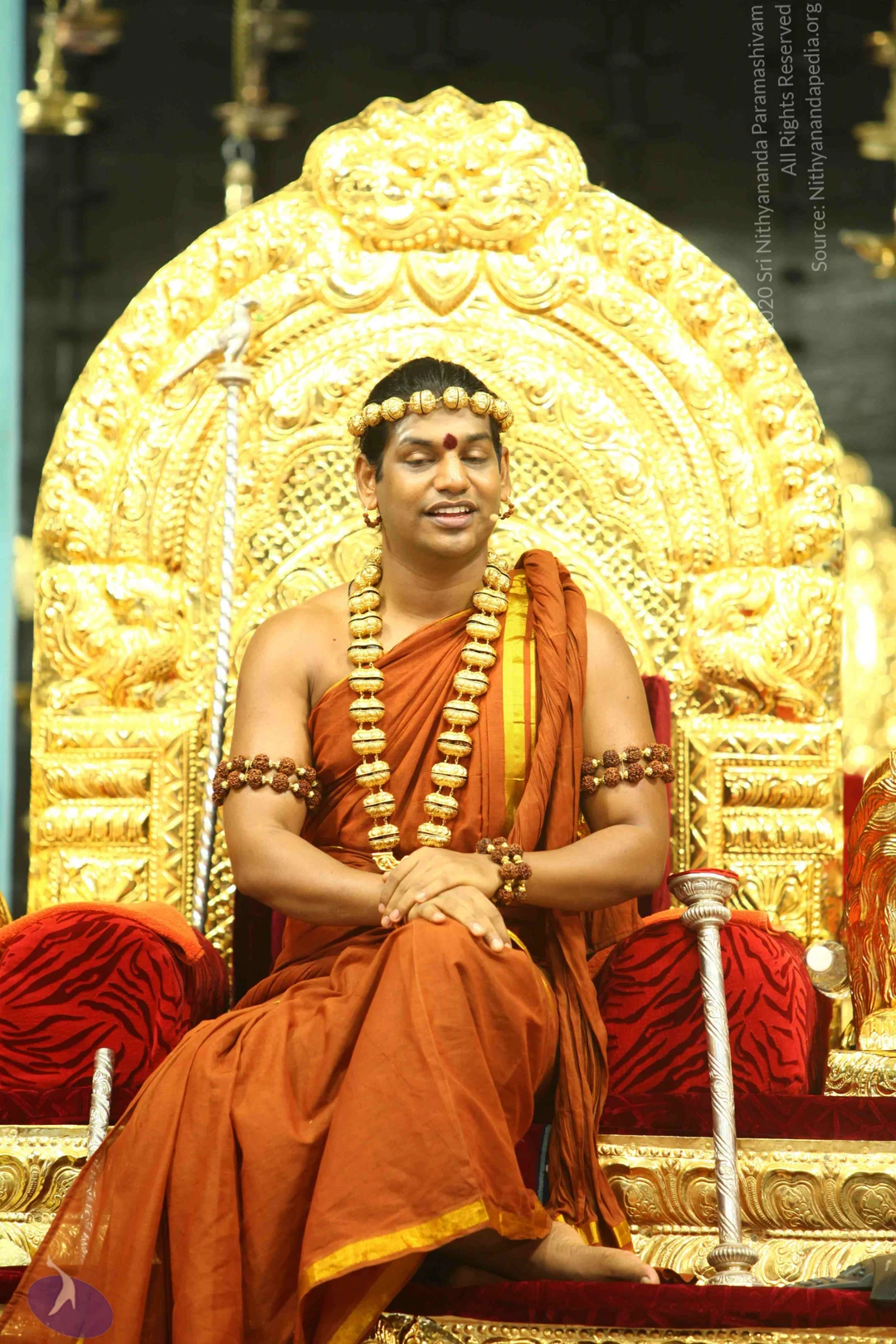
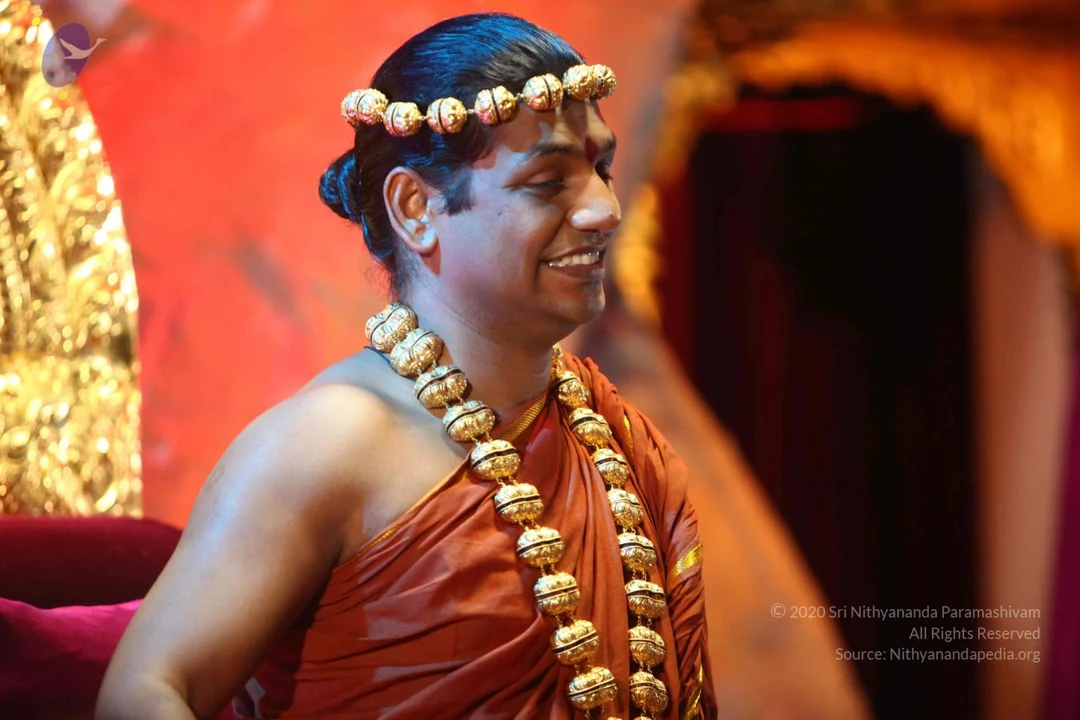
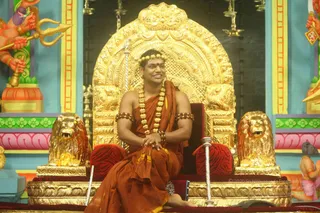
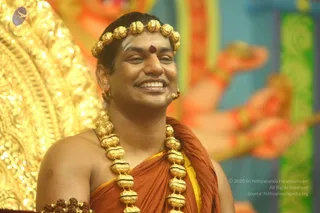
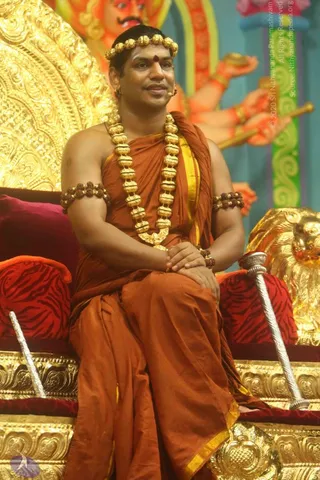
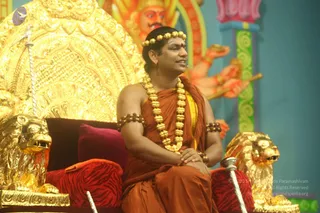
A smiling man seated on an ornate golden throne with a gilded arched backrest and red tiger-striped cushions. He wears an orange-saffron unstitched robe with a gold border draped over one shoulder, a gold bead garland with a matching gold crown-like headband, rudraksha armlets and rudraksha wrist bracelets. A red bindi marks his forehead and his hands are clasped in his lap. A silver staff stands beside the throne. He appears to be a person seated in ceremonial dress, with saffron robe, gold necklace and rudraksha cues; the setting suggests a formal satsang or discourse stage.A seated man on an ornate golden throne with lion-figure armrests and a golden arched backrest, in a richly decorated hall with pink, green and blue painted panels. He wears an orange-saffron shawl over his shoulders, a long garland of golden-yellow flowers, a rudraksha bracelet on each upper arm and a red tilak on his forehead, with a flower crown in his hair, and sits with hands folded in his lap. Golden lion statues flank the throne, and a painted deity figure holding a trident appears at the left edge. Swamiji (probable): the appearance cues of long swept-back hair, saffron clothing, rudraksha and ceremonial garlands with a throne are present, so this is a seated presiding figure, shown in a photograph.A seated man in a saffron-orange robe sits on an ornate gold throne with a carved arched backrest and red velvet cushions with zebra-stripe pattern. He wears a gold beaded crown-like headband, a heavy gold bead necklace, and rudraksha bracelets and armlets. A red bindi is on his forehead and he smiles while resting one hand on his lap. Gold oil lamps hang in the background.A smiling man sits in a close-up photograph, bare-shouldered, wrapped in a saffron-orange cloth draped over one shoulder and a yellow edge. He wears a gold crown-like headband of gold beads, a gold bead necklace of large ornate beads, large gold earrings, and a red kumkum dot on his forehead, with a small lapel microphone visible near his cheek. A rudraksha bracelet is on his wrist at the lower edge. Behind him, blurred golden ornamental drapery and an orange-and-green painted backdrop with a large orange deity figure suggest a stage. a person is the.A man seated on an ornate gold throne with red velvet cushions and a golden lion armrest, wearing a saffron-orange dhoti and shawl with gold borders, a heavy gold bead necklace, a gold bead headband, rudraksha armlets and bracelets, and a red bindi. He holds his hands folded on his lap and gazes to the side while a small microphone is clipped near his face. Behind him stands a painted multi-armed deity figure holding a sword and a mace in orange and gold, with a teal and green backdrop. Appearance-based label: a person, seated on the throne in saffron robes with gold necklace and rudraksha cues.A man seated on an ornate gilded throne with carved golden backrest and gold lion armrests, draped in saffron-orange robes with a yellow inner cloth, wearing a gold beaded necklace, gold headband with beads, rudraksha bracelets on the upper arms and wrists, and a red dot on his forehead. He sits with hands folded on his lap and gazes to the side. Behind him stands a painted deity figure with multiple arms holding a trident and other objects, against a teal and green painted backdrop. a person is indicated by saffron clothing, rudraksha adornments, gold necklace and throne-seated posture; the photo shows a satsang-style seated discourse.

Dial-The-Avatar

19 photosSource gallery
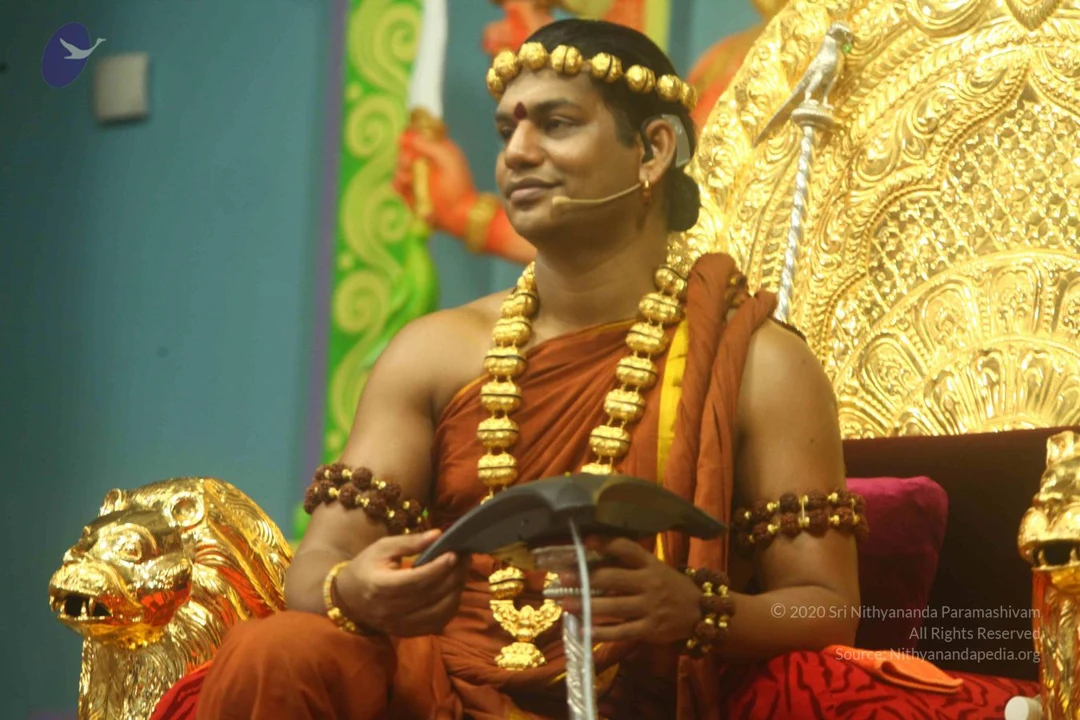
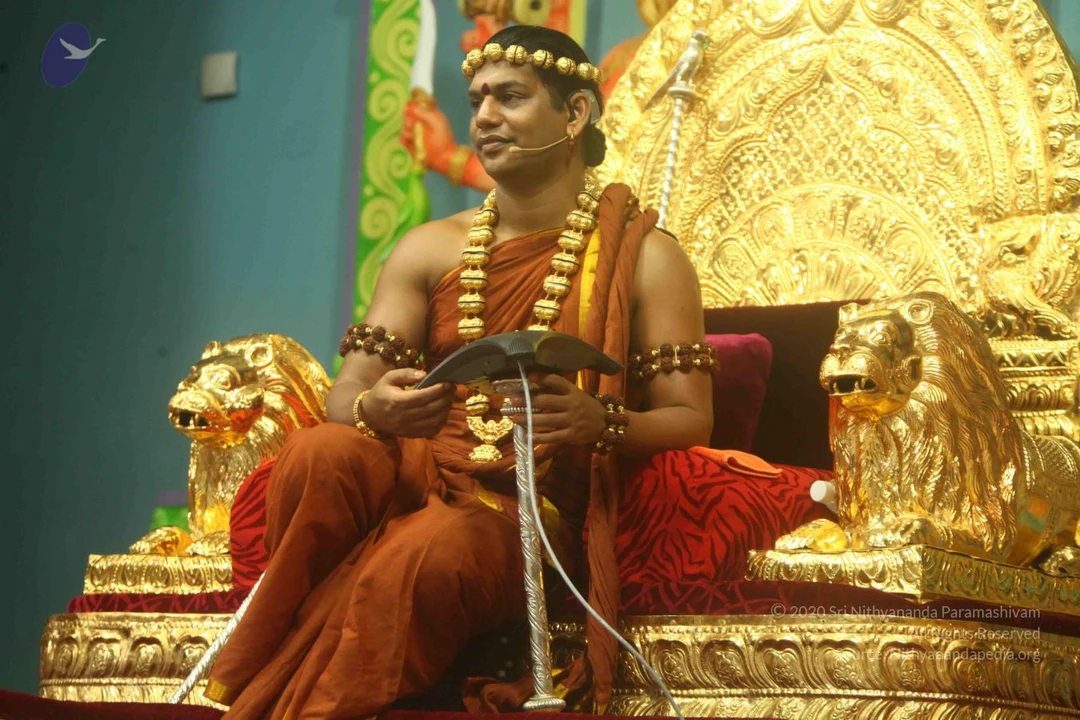
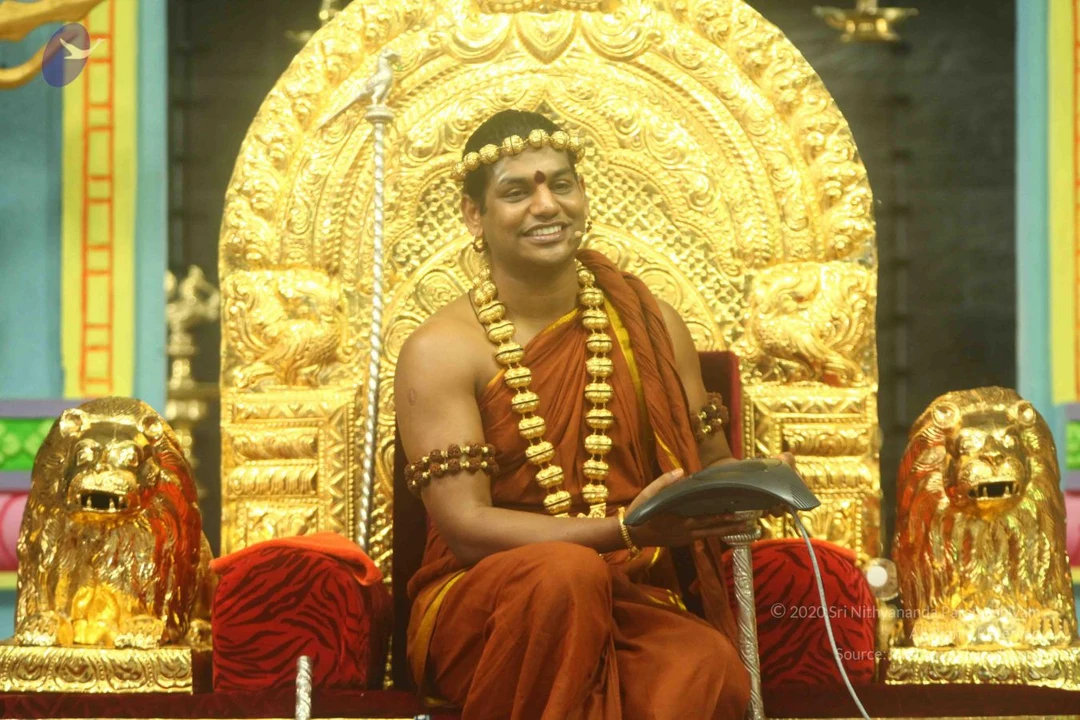
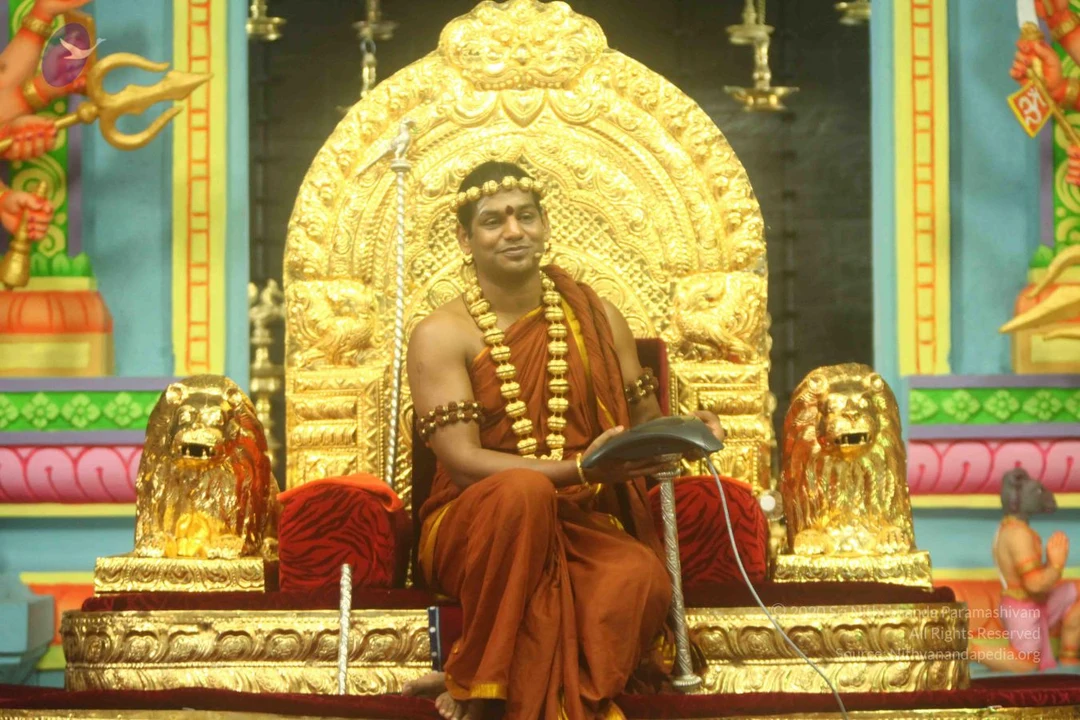
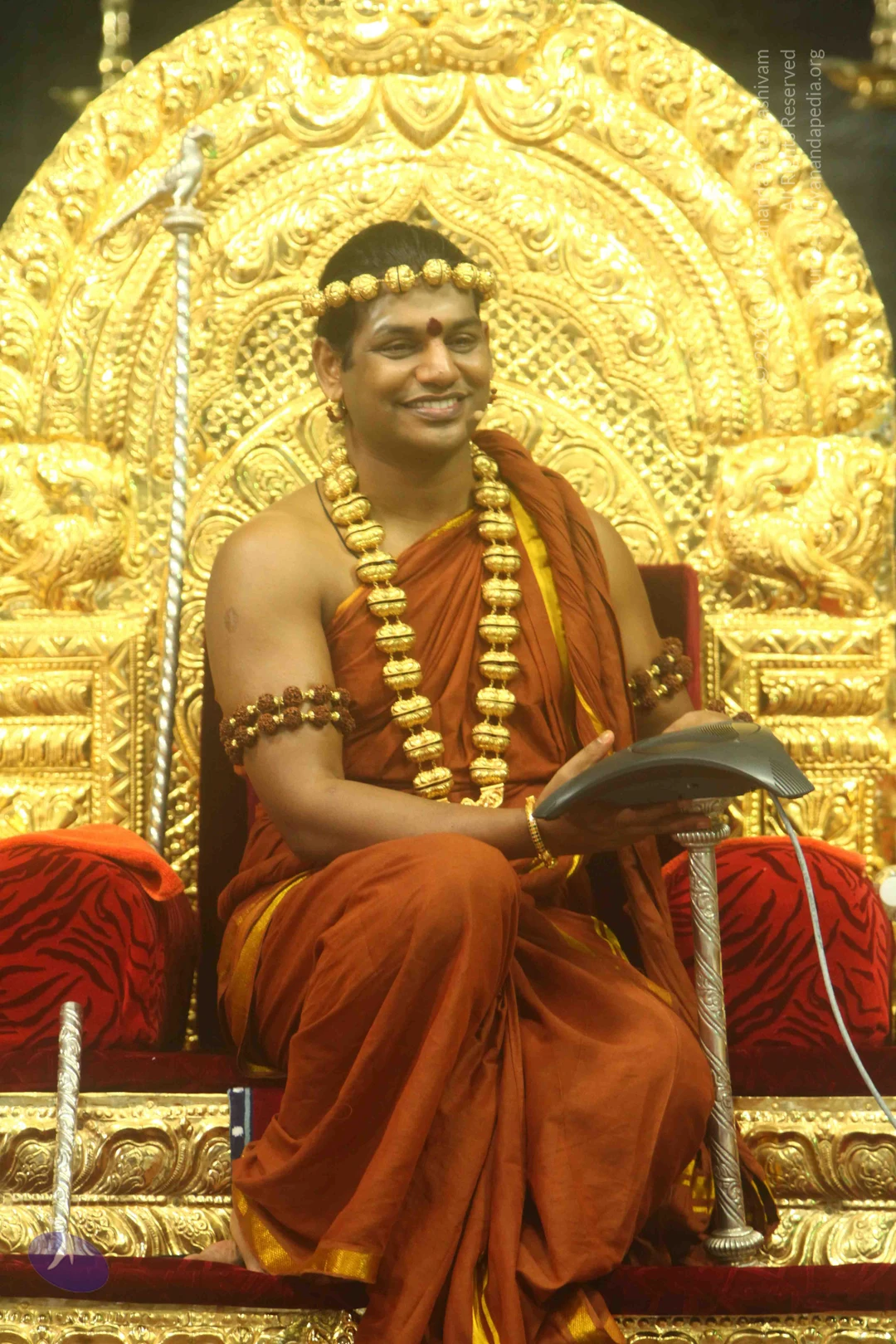
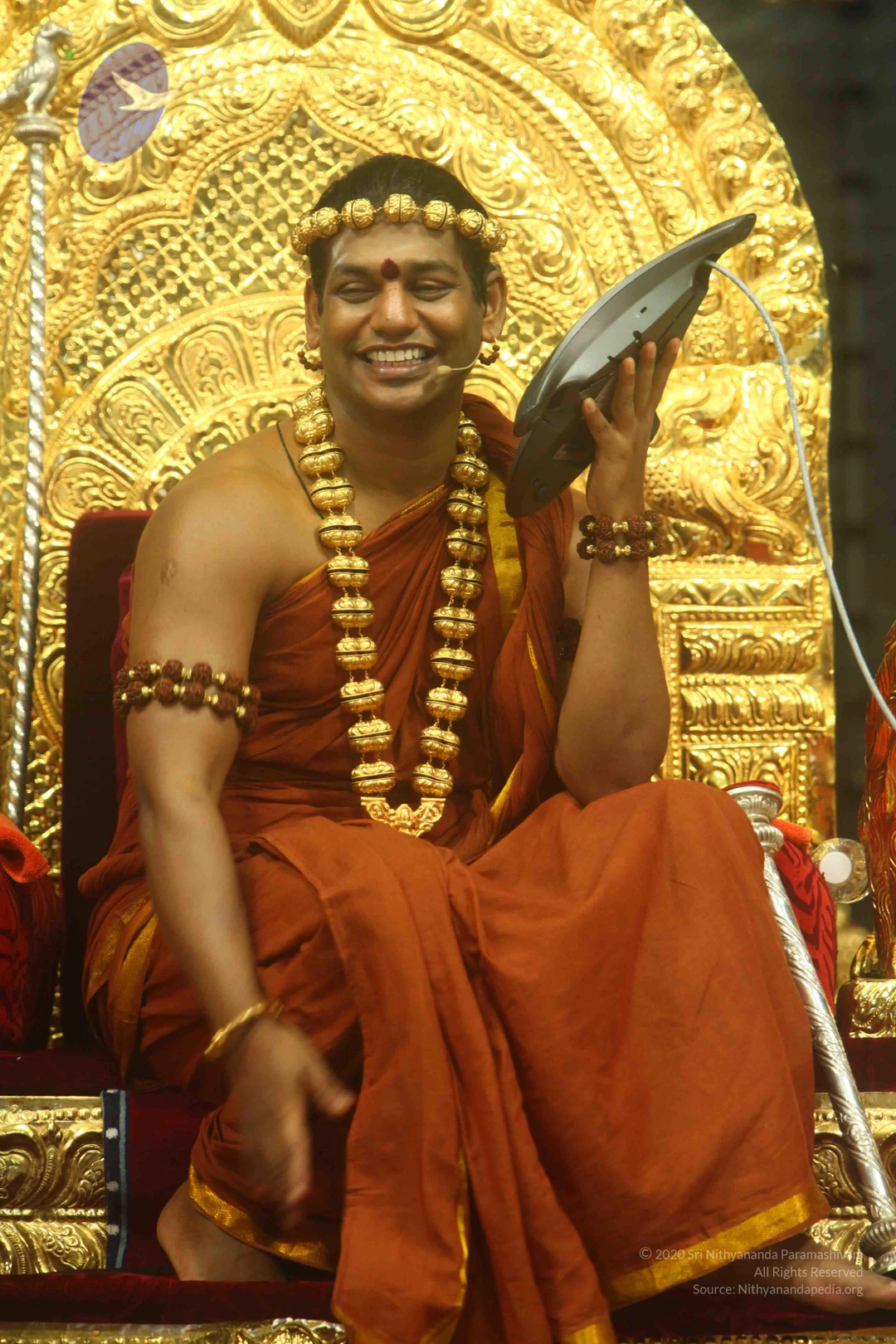
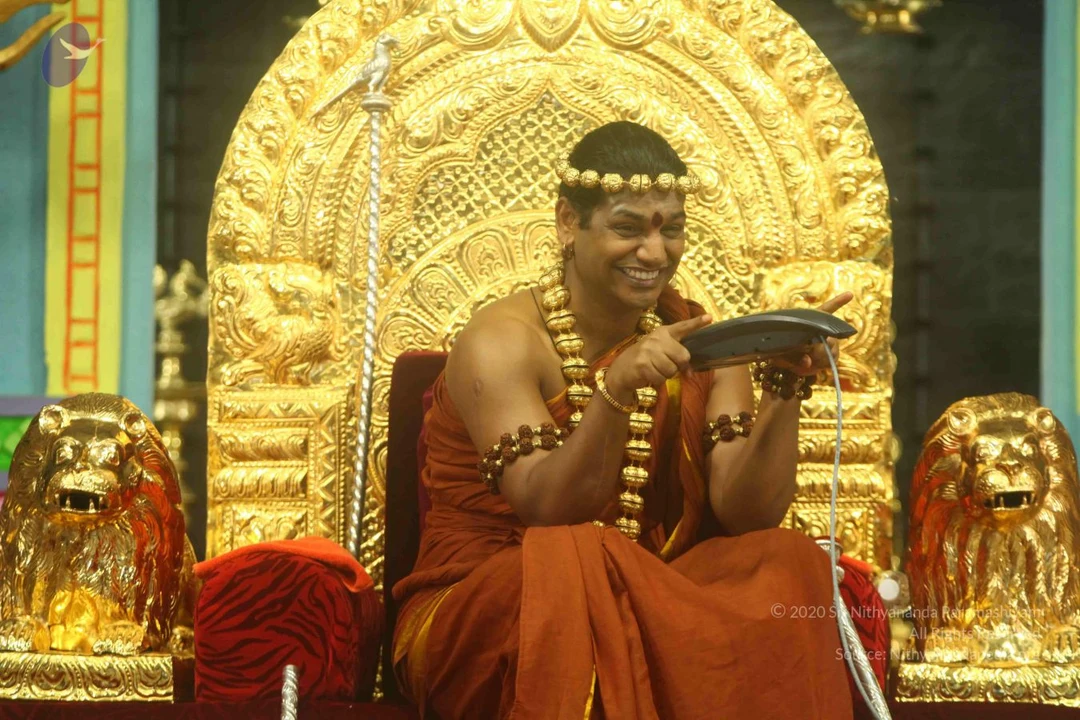
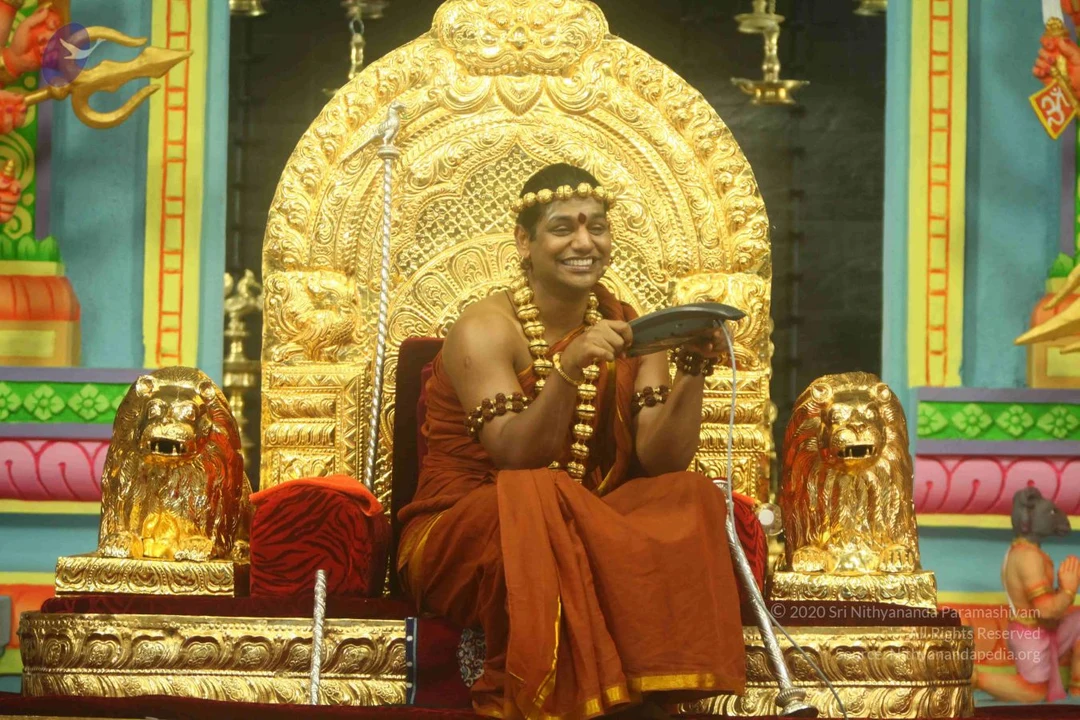
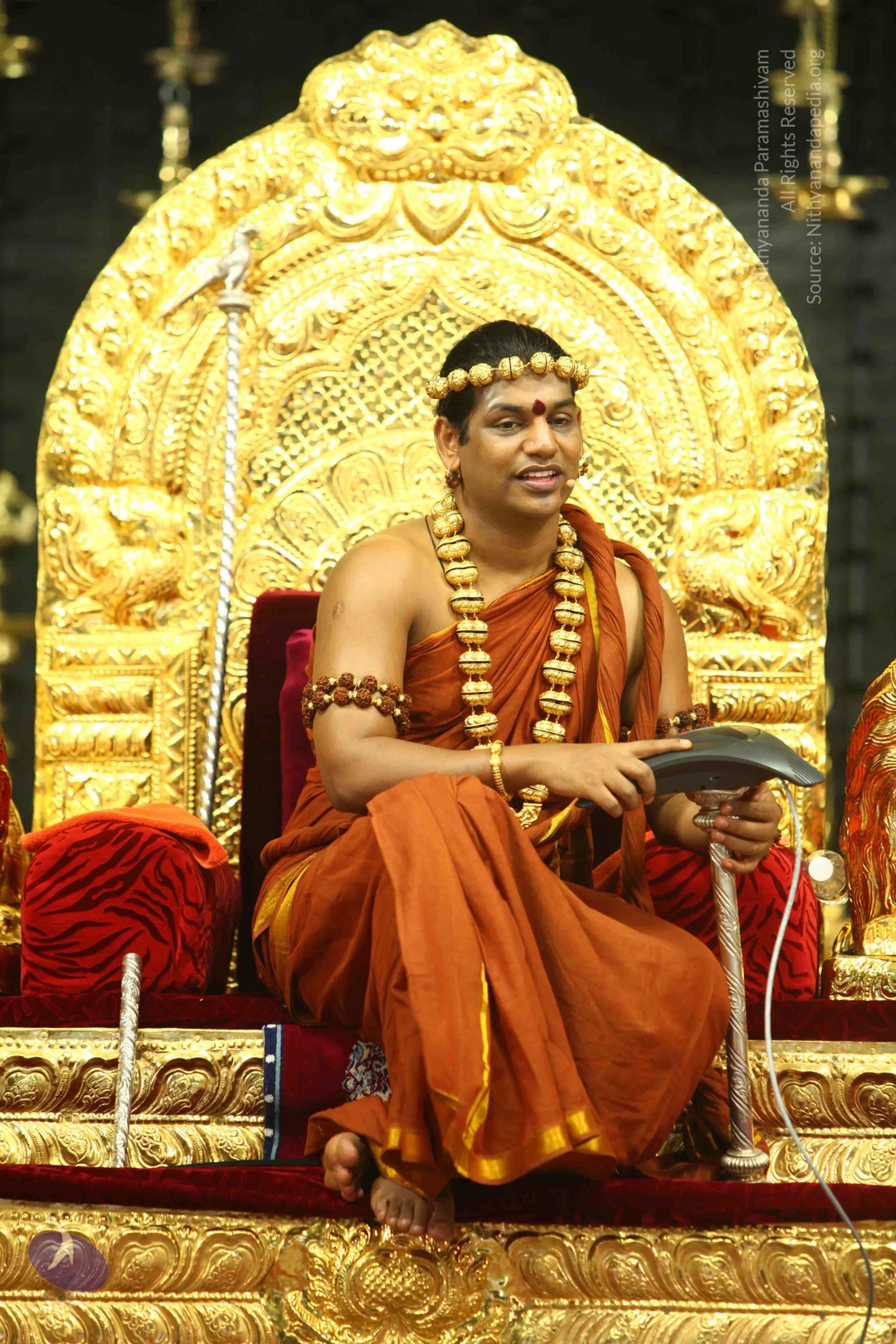
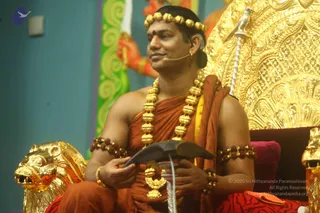
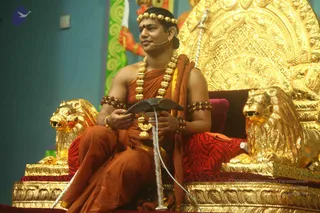
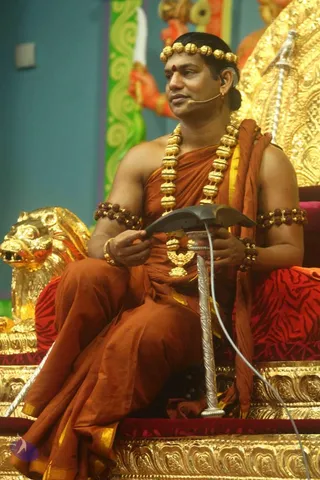
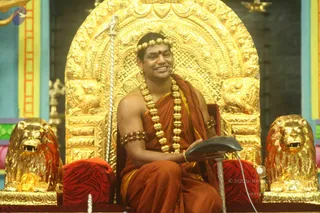
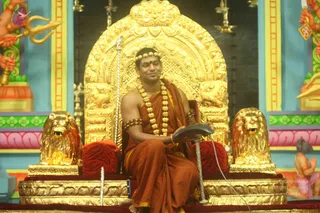
A man seated on an ornate gold throne with carved lion-head armrests, wearing an orange-saffron dhoti and shawl, a gold headband with beads, a long gold bead necklace, rudraksha armlets and wrist beads, and a small red bindi. He holds a dark curved object, possibly a tray or fan, while smiling toward the audience and wearing a headset microphone. Behind him are gold ornaments and a red-and-green decorated backdrop. Appearance-based label: a person, seated in a discourse setting with a throne, rudraksha mala and saffron clothing.A seated man in saffron-orange robes sits on an ornate golden throne flanked by golden lion figures, with red cushions and a red patterned throne covering. He wears a gold headband, a long ornate gold necklace, rudraksha bracelets on his upper arms and wrists, and holds a small dark object in his hands. A headset microphone is on his face and a silver-stemmed microphone stands before him. Behind him are golden decorative carvings and colourful painted panels in green, red and blue. a person is seated on the throne with cues including saffron clothing, gold necklace and rudraksha adornments; he appears to be giving a discourse.A seated man in an ornate golden throne with a gilded lion armrest, wearing a saffron-orange dhoti and shawl with gold borders, a heavy gold bead necklace with a gold pendant, a gold bead headband, rudraksha armlets and bracelets, and a red vermilion tilaka on the forehead. He wears a small headset microphone and holds a black handheld microphone with a silver stand. Behind him are gold-framed carved panels and a turquoise wall with a green decorative pillar. Appearance-based probable Swamiji (probable): long hair swept back, gold necklaces, rudraksha malas and saffron clothing, shown in a satsang-style seated discourse setting.A smiling man sits on an ornate gold throne with carved lion-head armrests flanking him, seated on red tiger-striped cushions. He wears an orange-saffron cloth draped over his shoulders and body, a gold-beaded garland on his head, layered gold beaded necklaces, a red bindi on his forehead, and rudraksha bead armlets. He rests his hands on a small lectern with a microphone. A golden arched backdrop and gold lion statues frame the stage, with a colourful blue and red panel behind. Appearance-based a person: the saffron robes, gold necklaces and rudraksha cues fit, but face-independent certainty is limited, so this is seated in a satsang setting.A seated man on a large gilded throne with lion-head armrests and a golden arched backrest, in a temple-style hall with painted pillars, a trident and a deity figure at the edges. He wears an orange-red saffron cloth draped over his shoulders, a long white flower garland and a strand of rudraksha beads on his upper arm, with a red-and-gold ritual tilak on his forehead. He holds a small black microphone. The appearance of this seated figure with saffron cloth, garland and beads matches the a person cues, and the photograph is part of the satsang-style event described on the page.A smiling man sits on an ornate gold throne with repoussé floral and lion carvings, wearing a saffron-orange dhoti and shawl with gold borders. He has a rudraksha headband, a gold ceremonial necklace of beads, rudraksha armbands, a red bindi, and a gold bracelet. He holds a black microphone in his lap, and a silver staff with a bird finial stands beside the throne. Red and black tiger-striped cushions flank him. The appearance of the seated man matches the presentation cues described for a person, with rudraksha, gold beads, saffron clothing and a grand throne, but identity remains uncertain from appearance alone.

Bangalore-Tamii-Sangam-Meeting-Swamiji

31 photosSource gallery
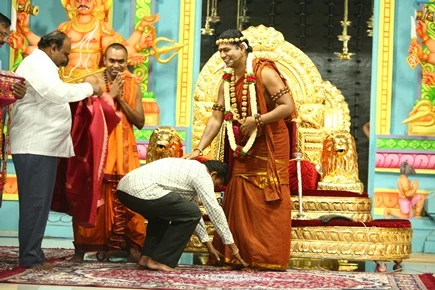
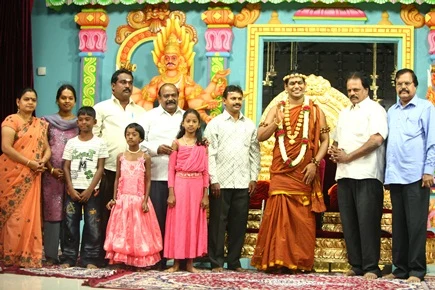
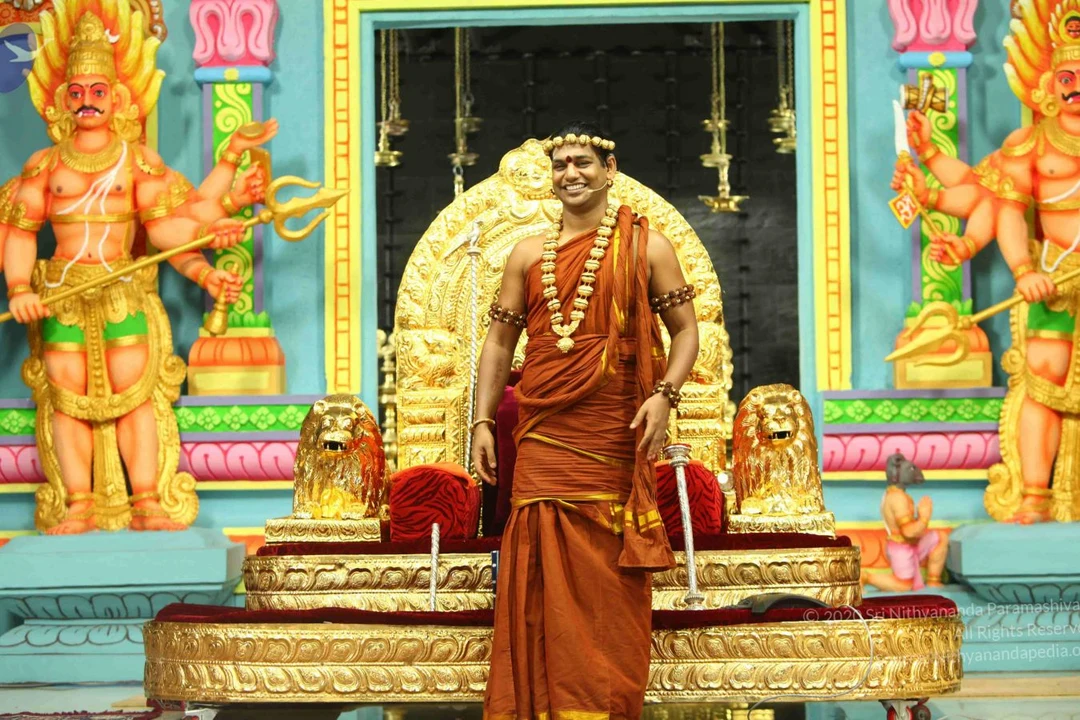
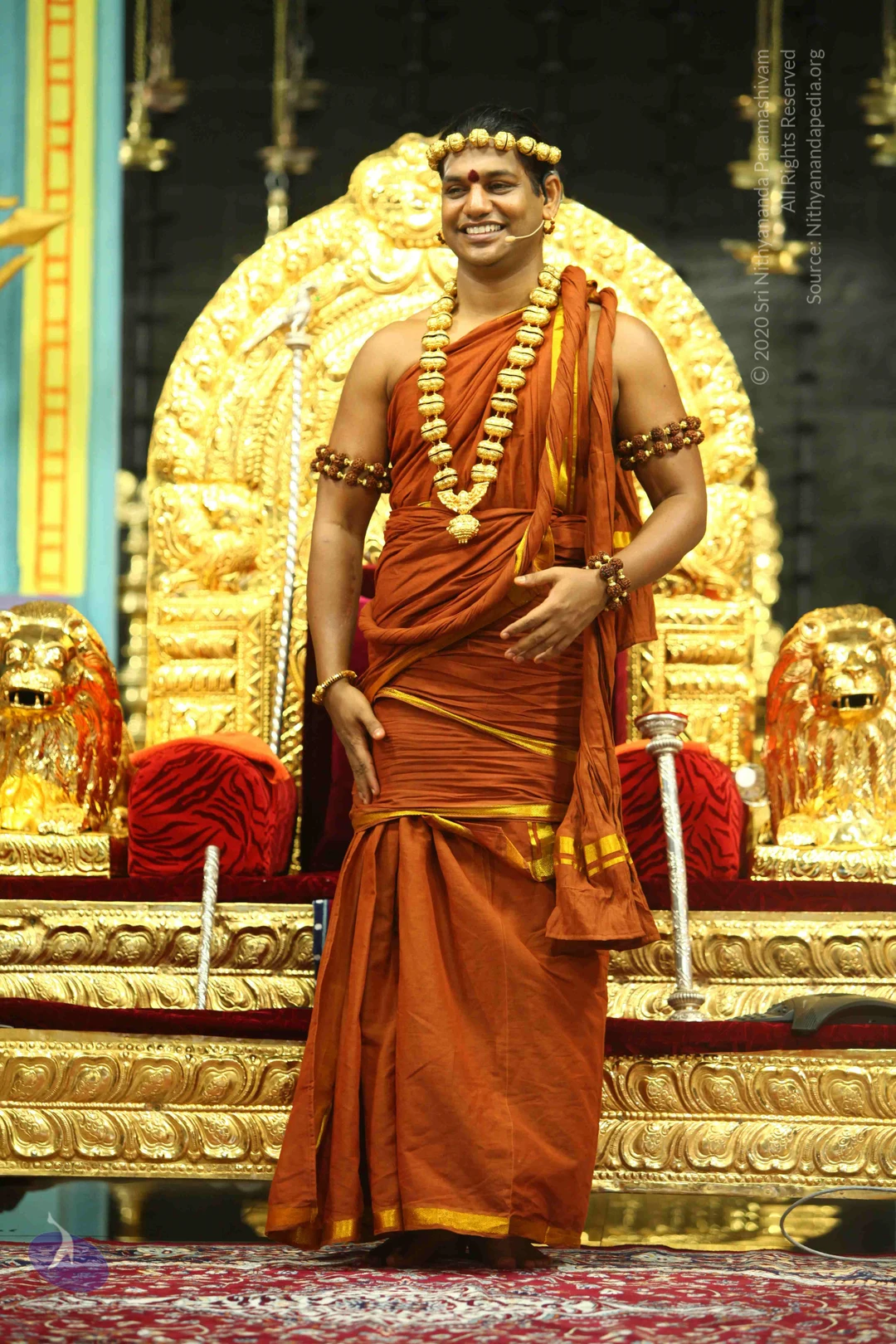
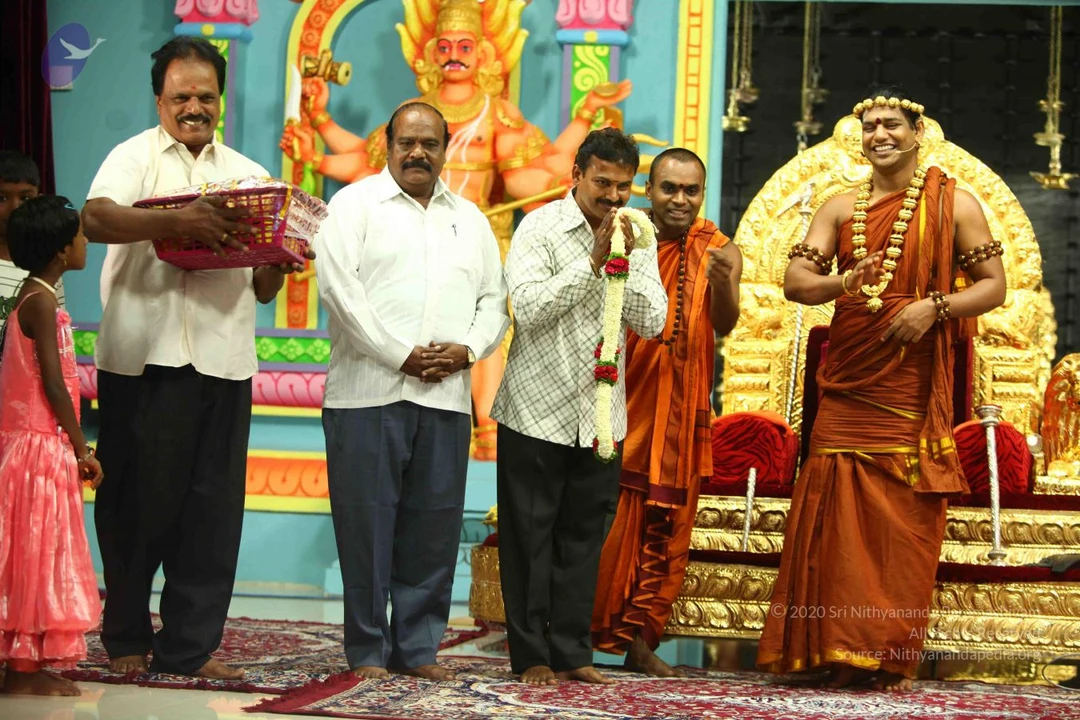
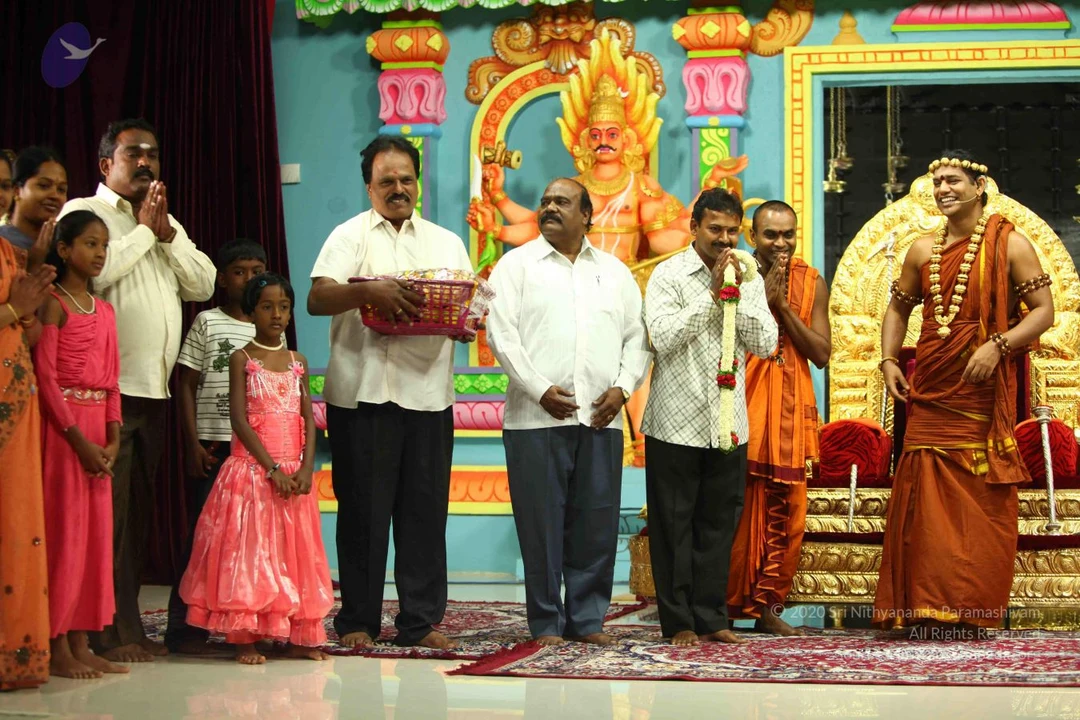
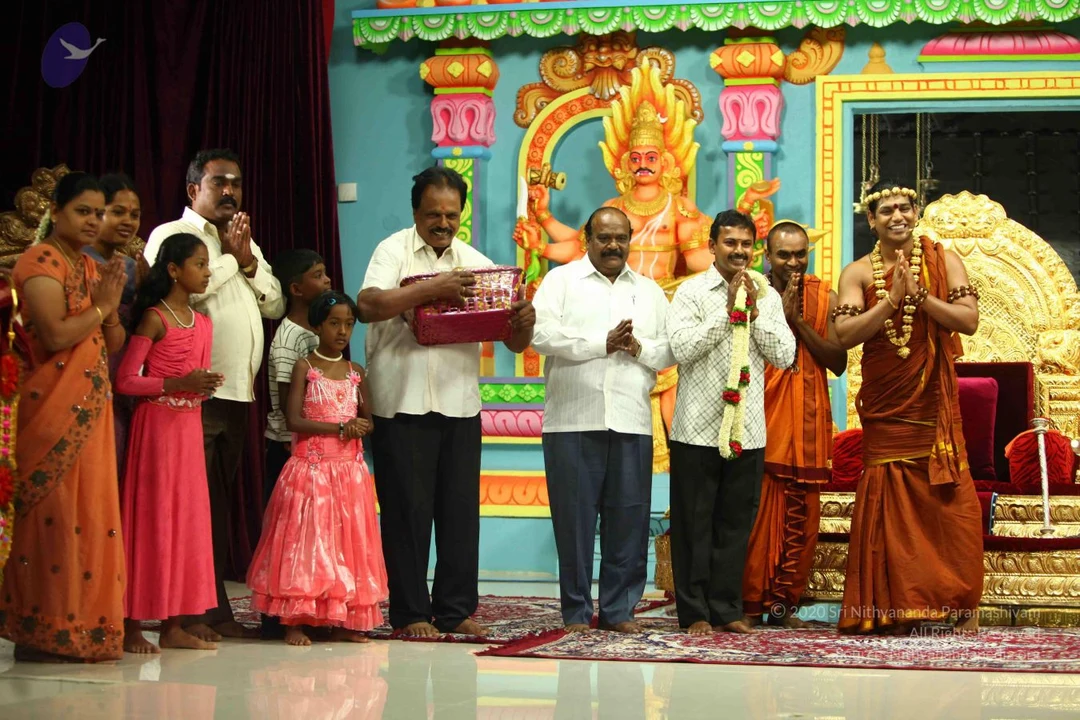
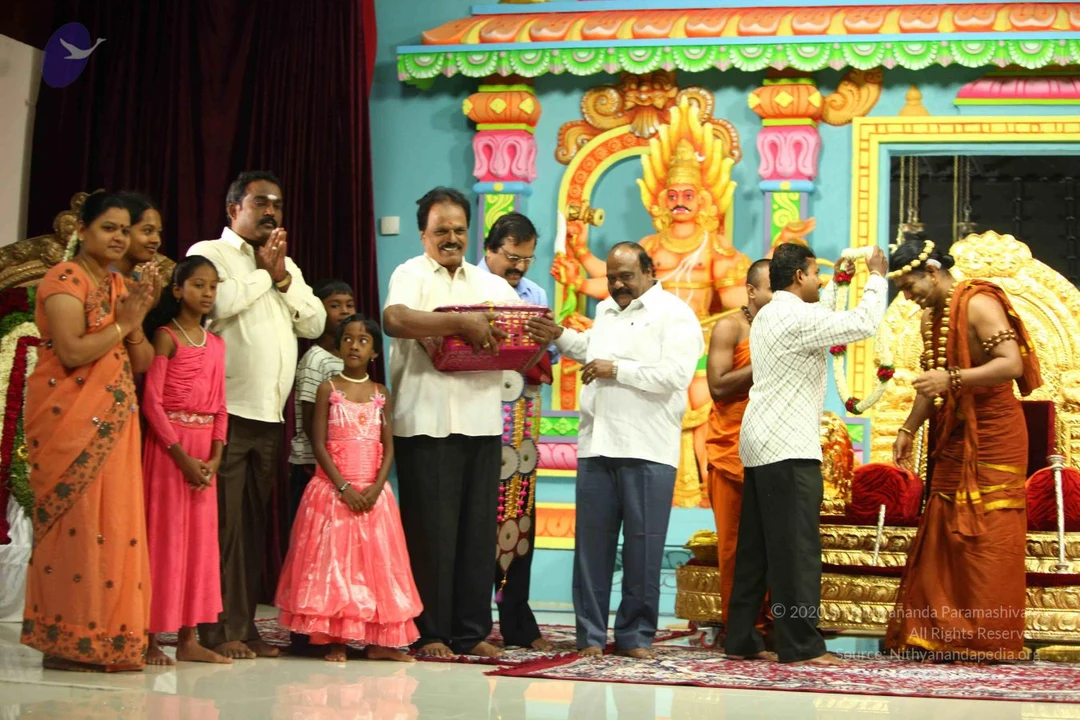
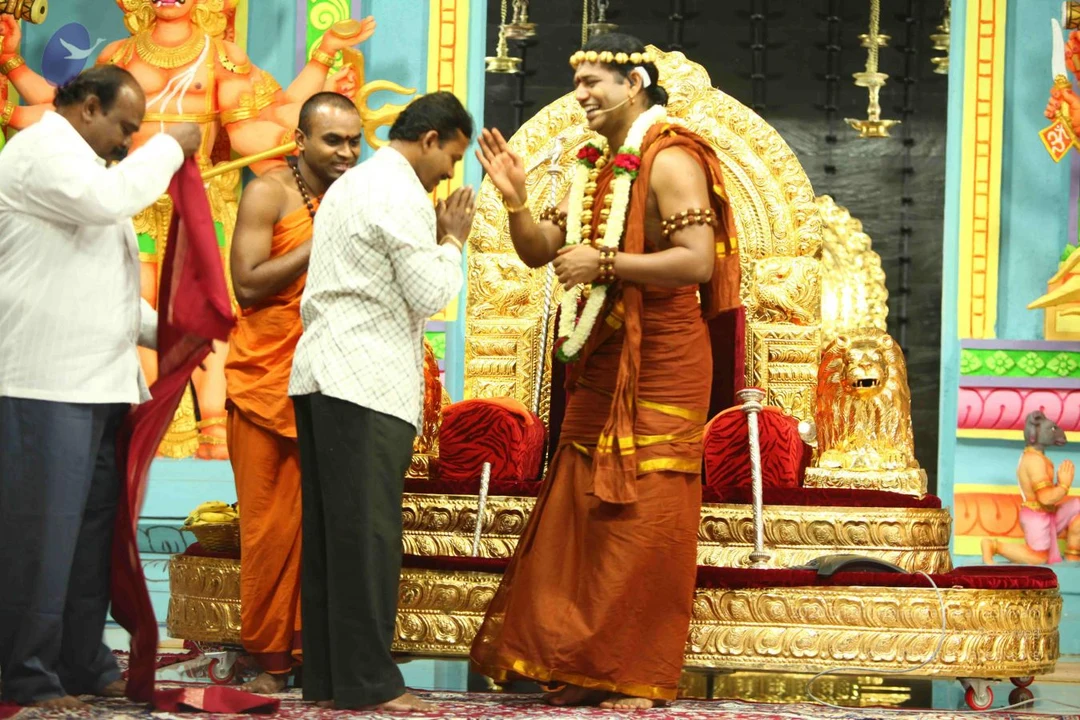
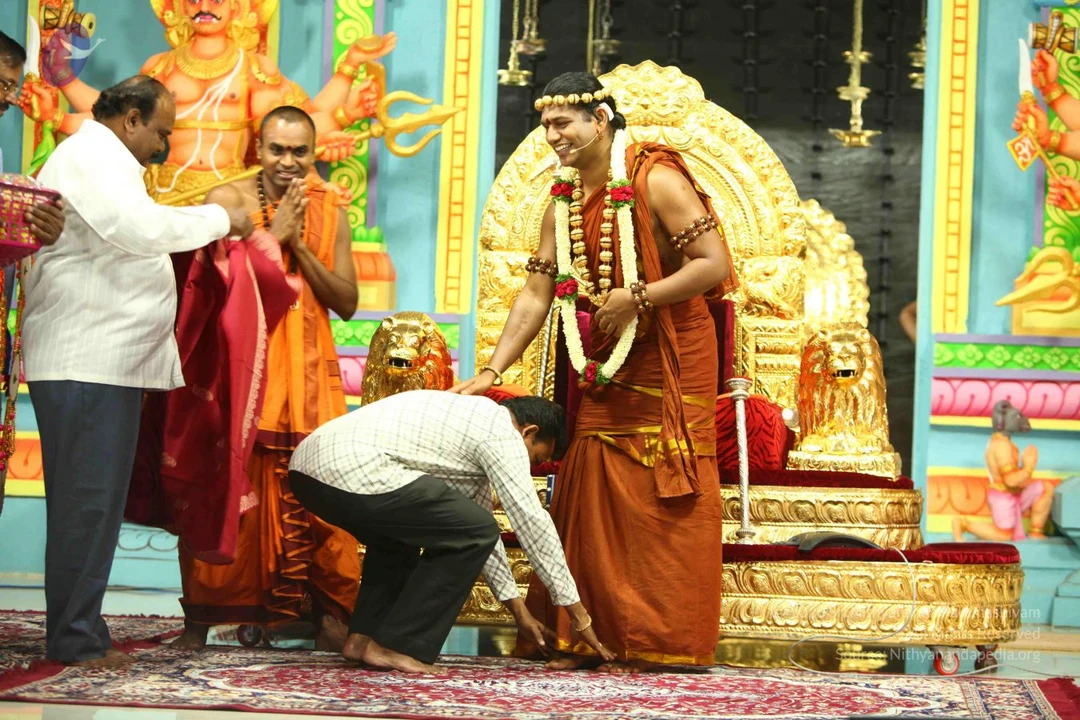
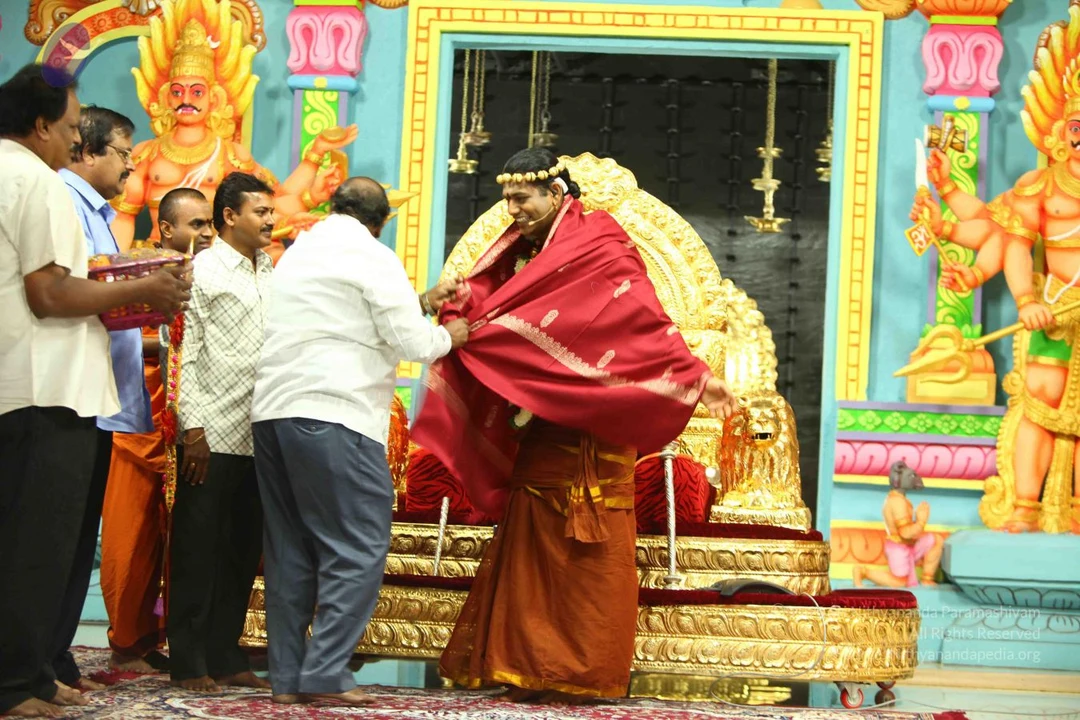
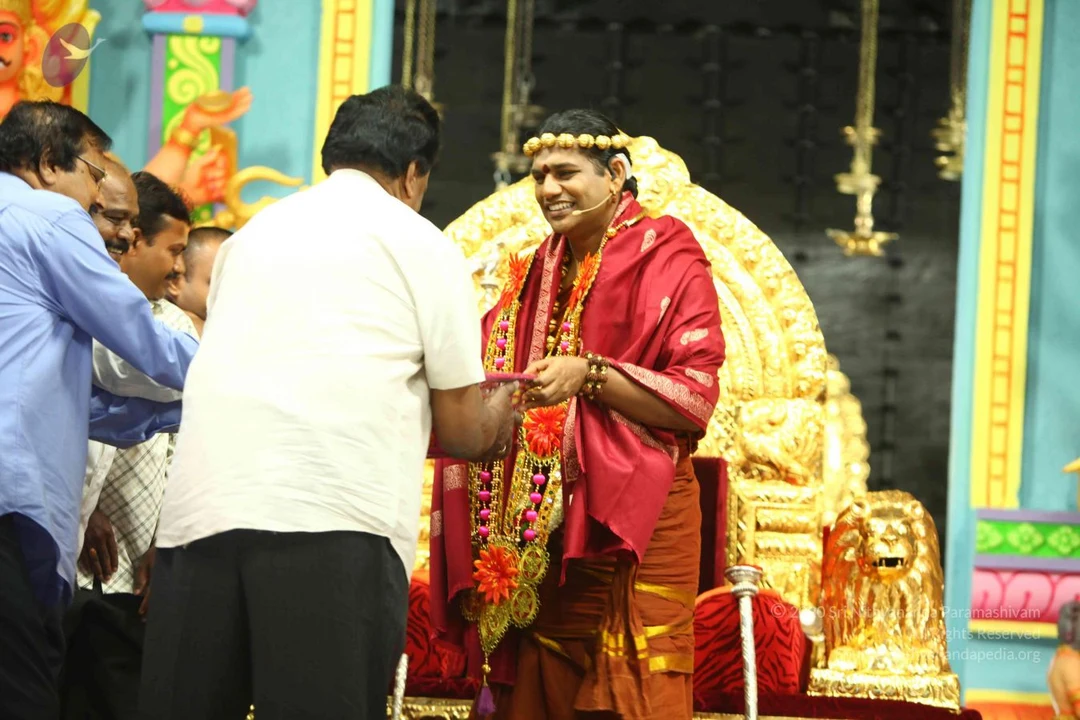
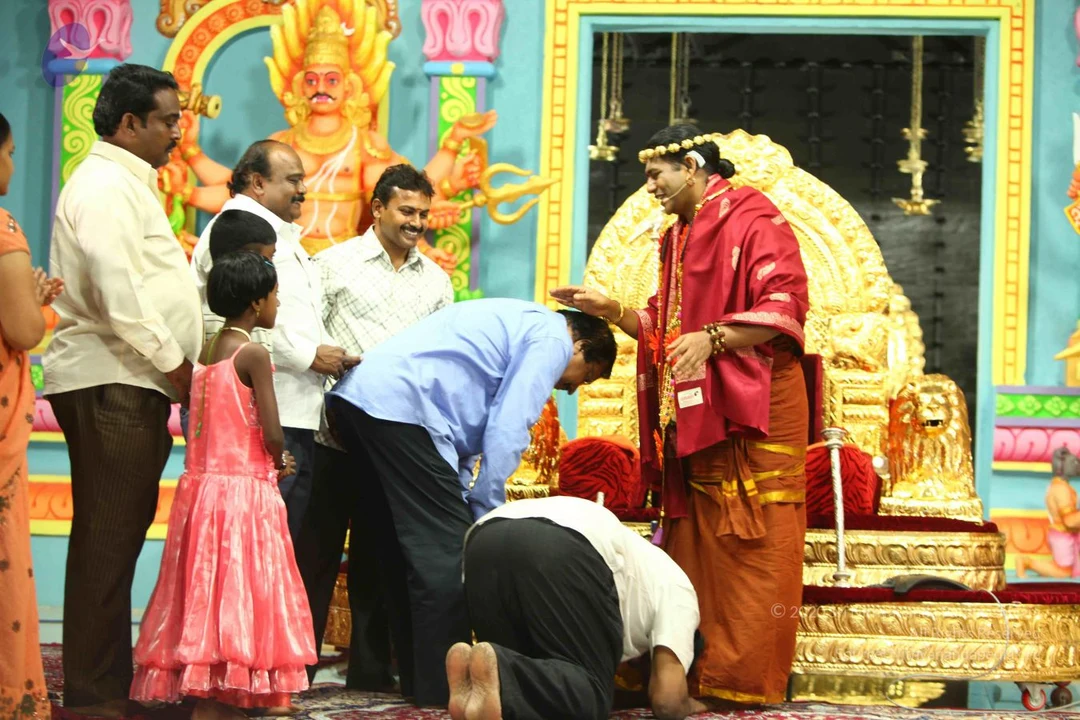
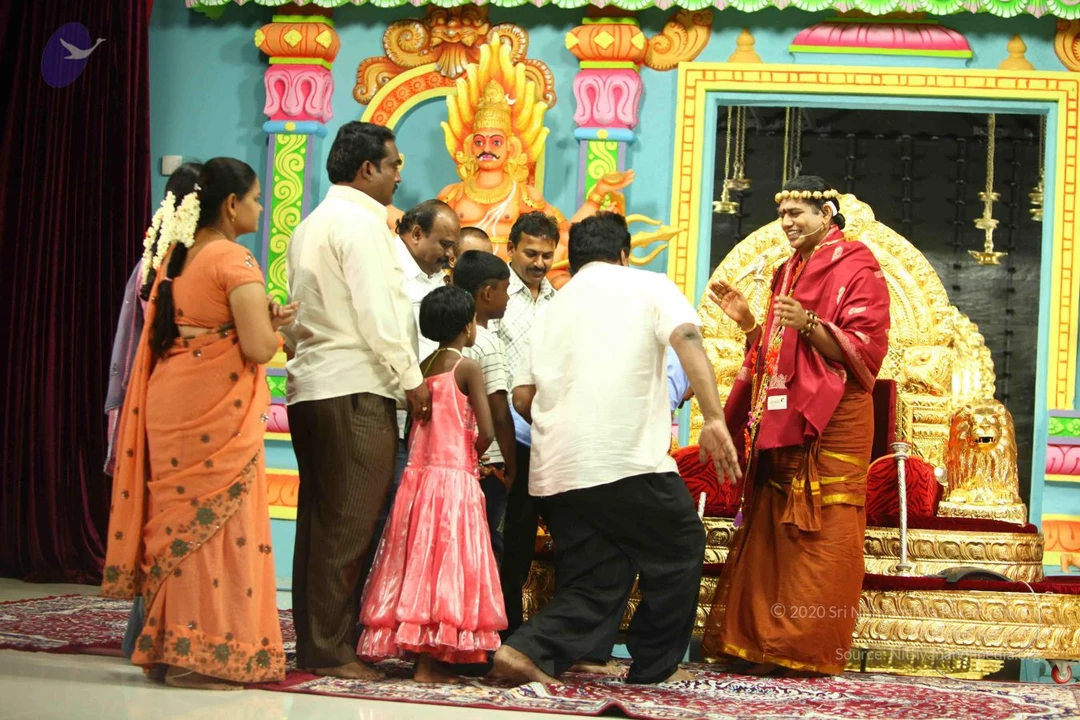
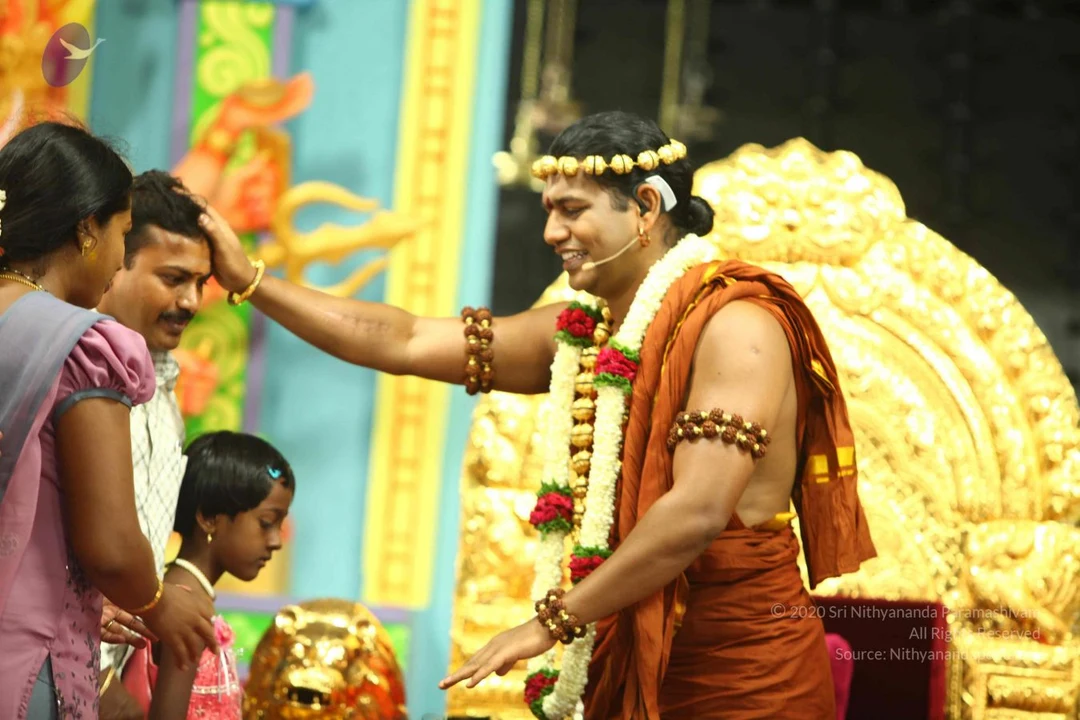
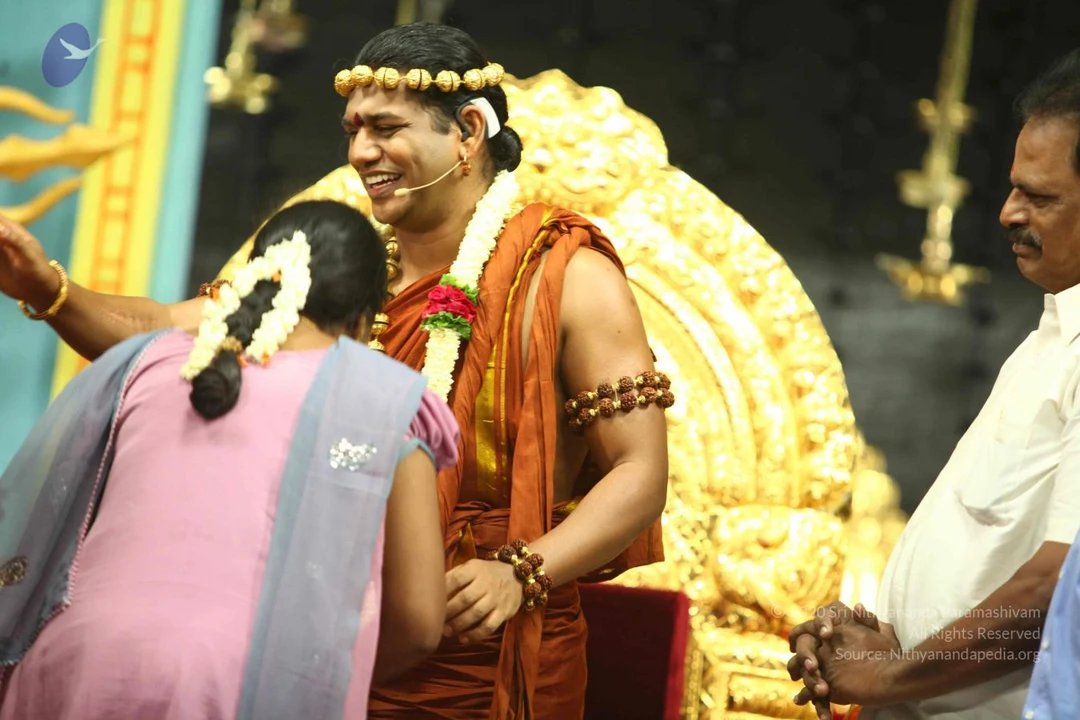
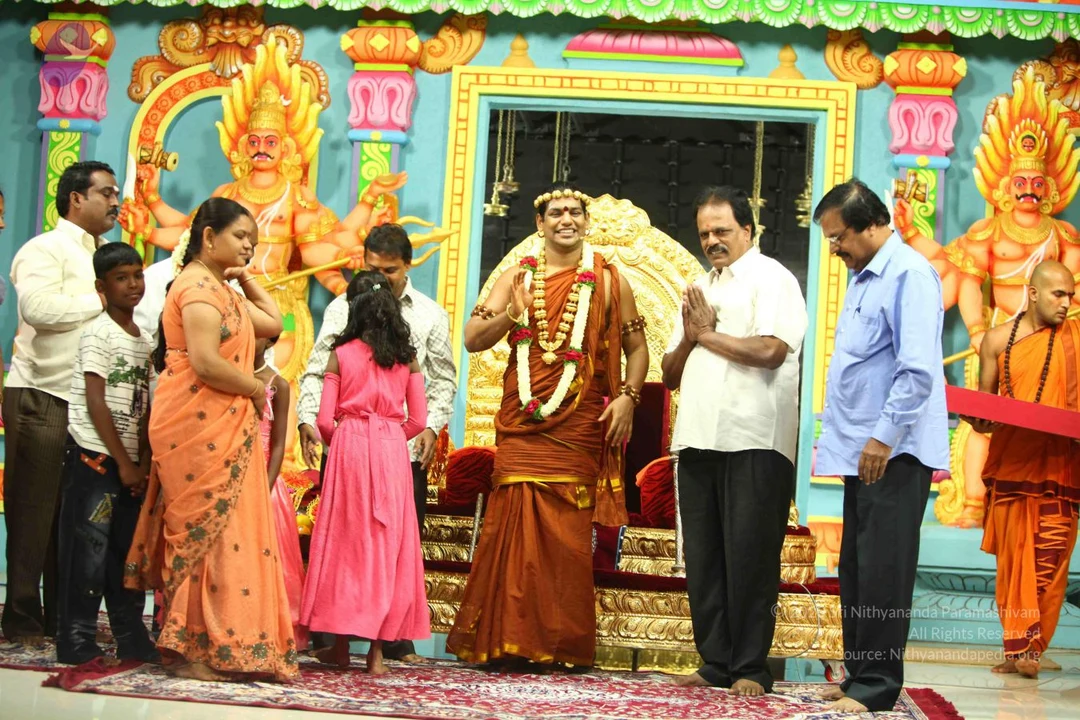
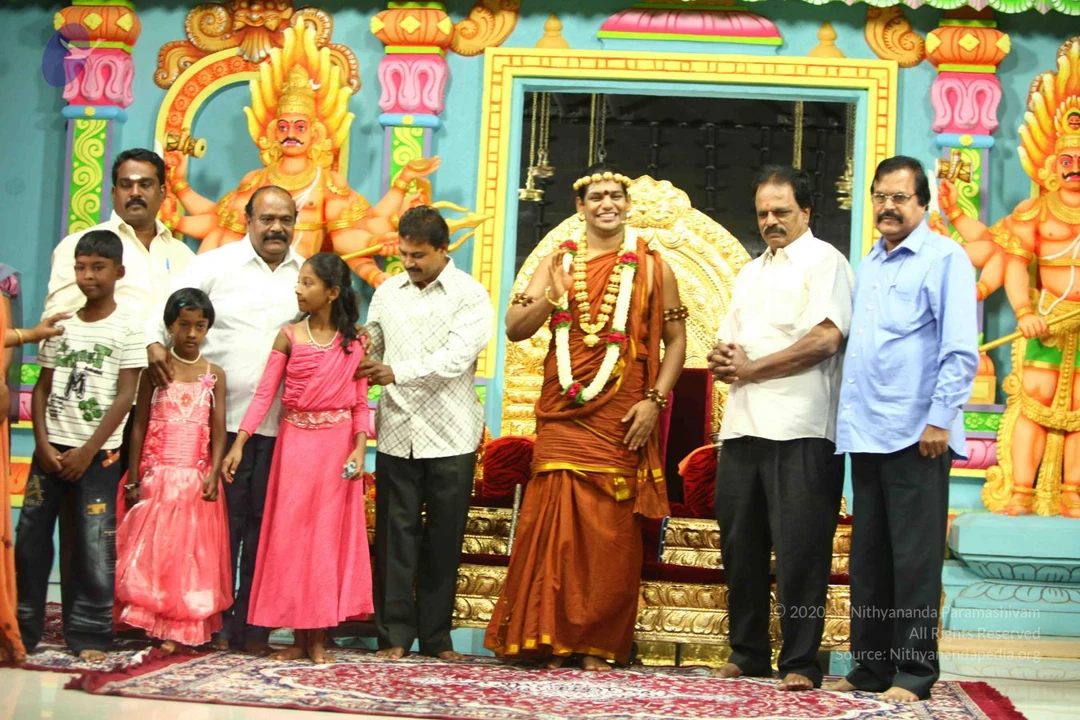
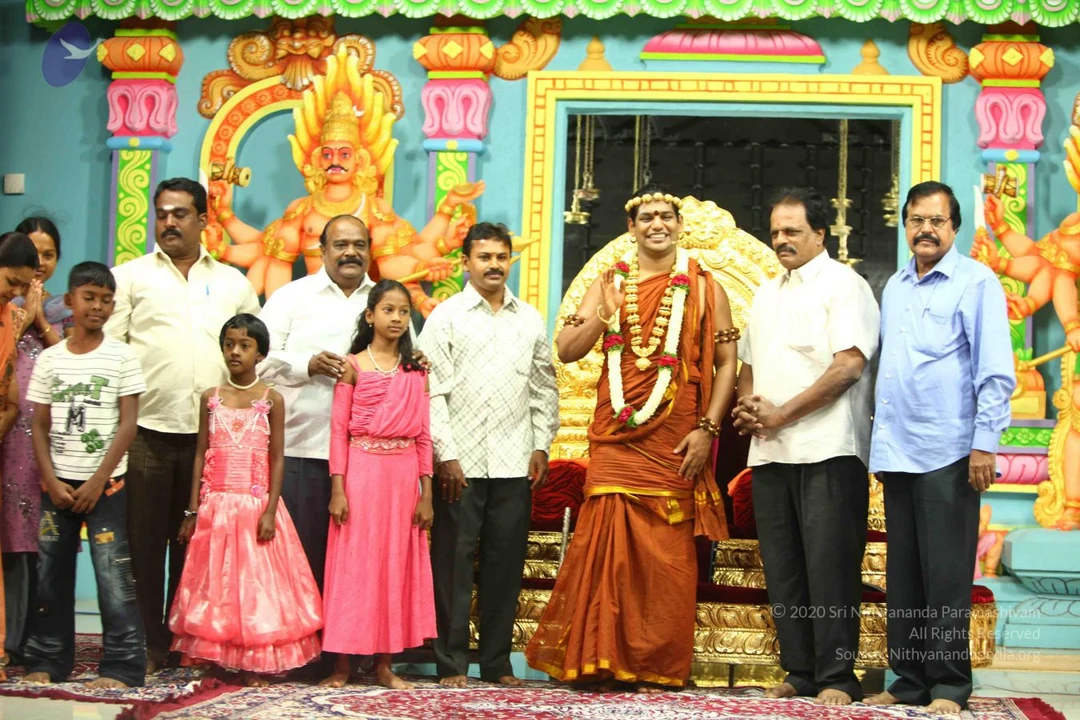
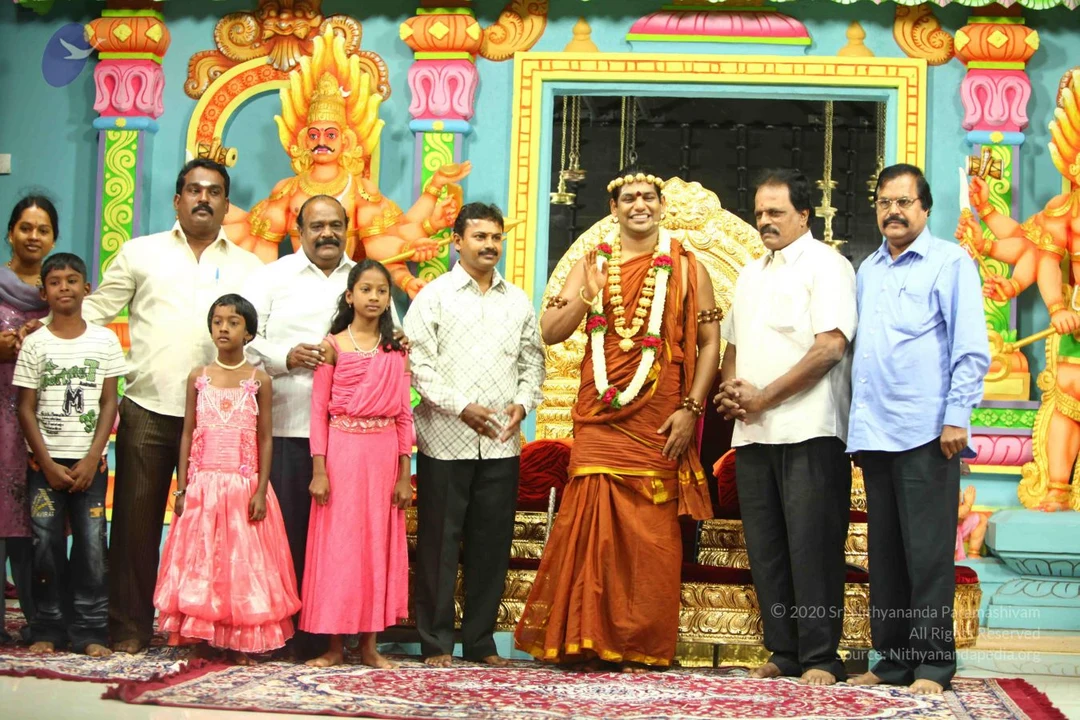
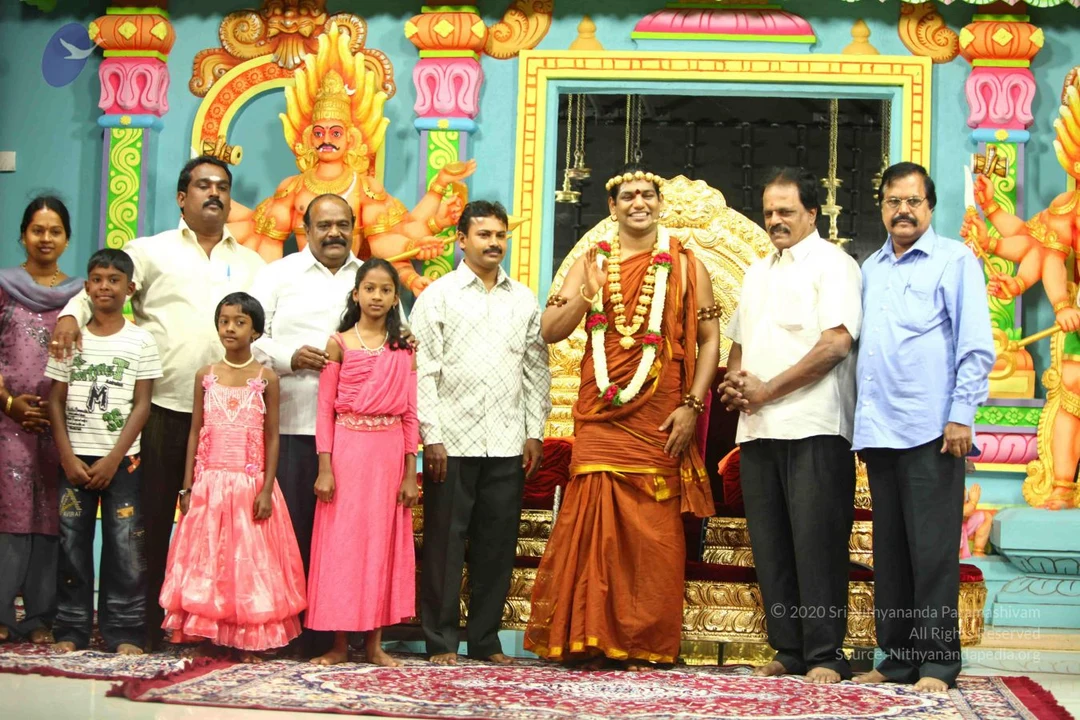
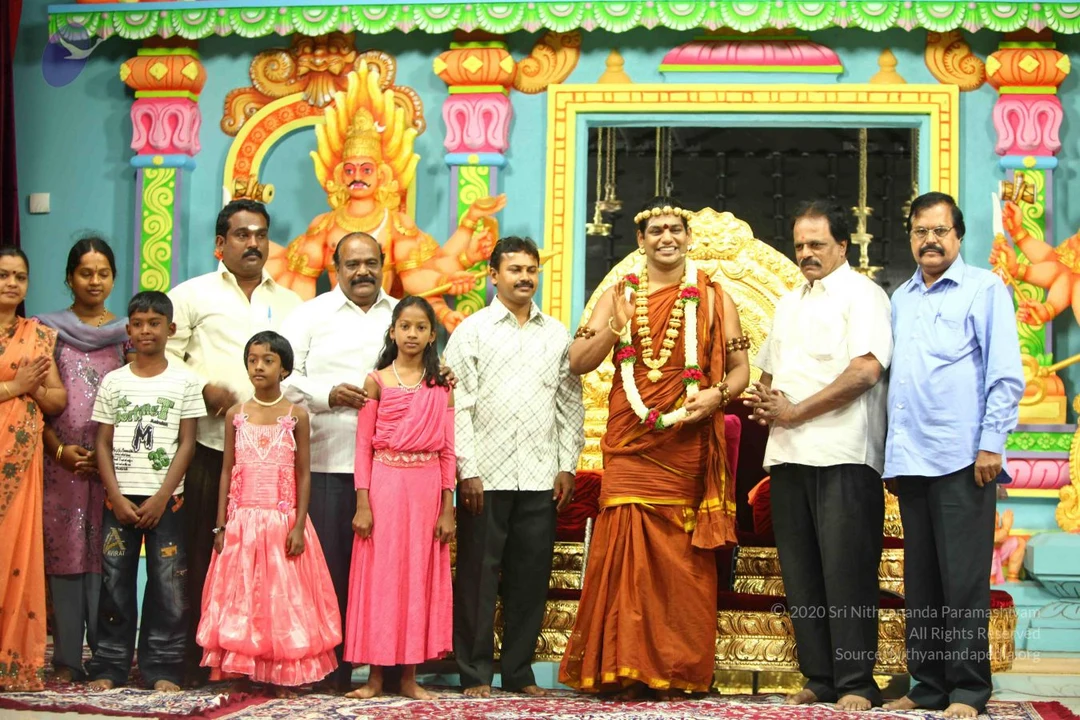
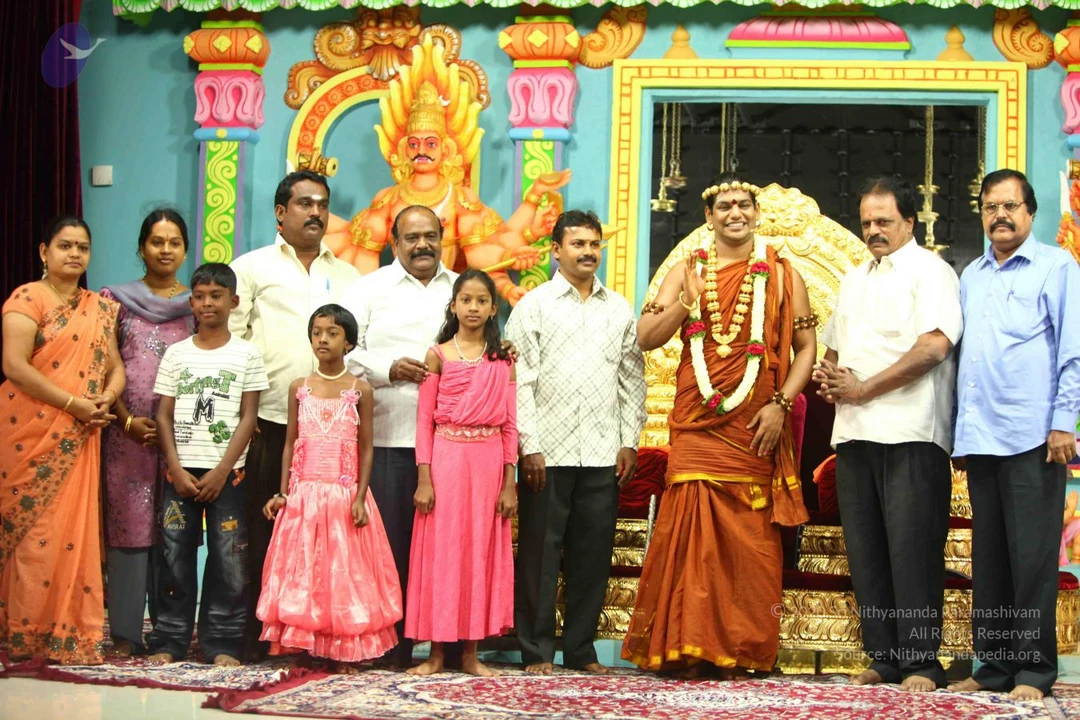
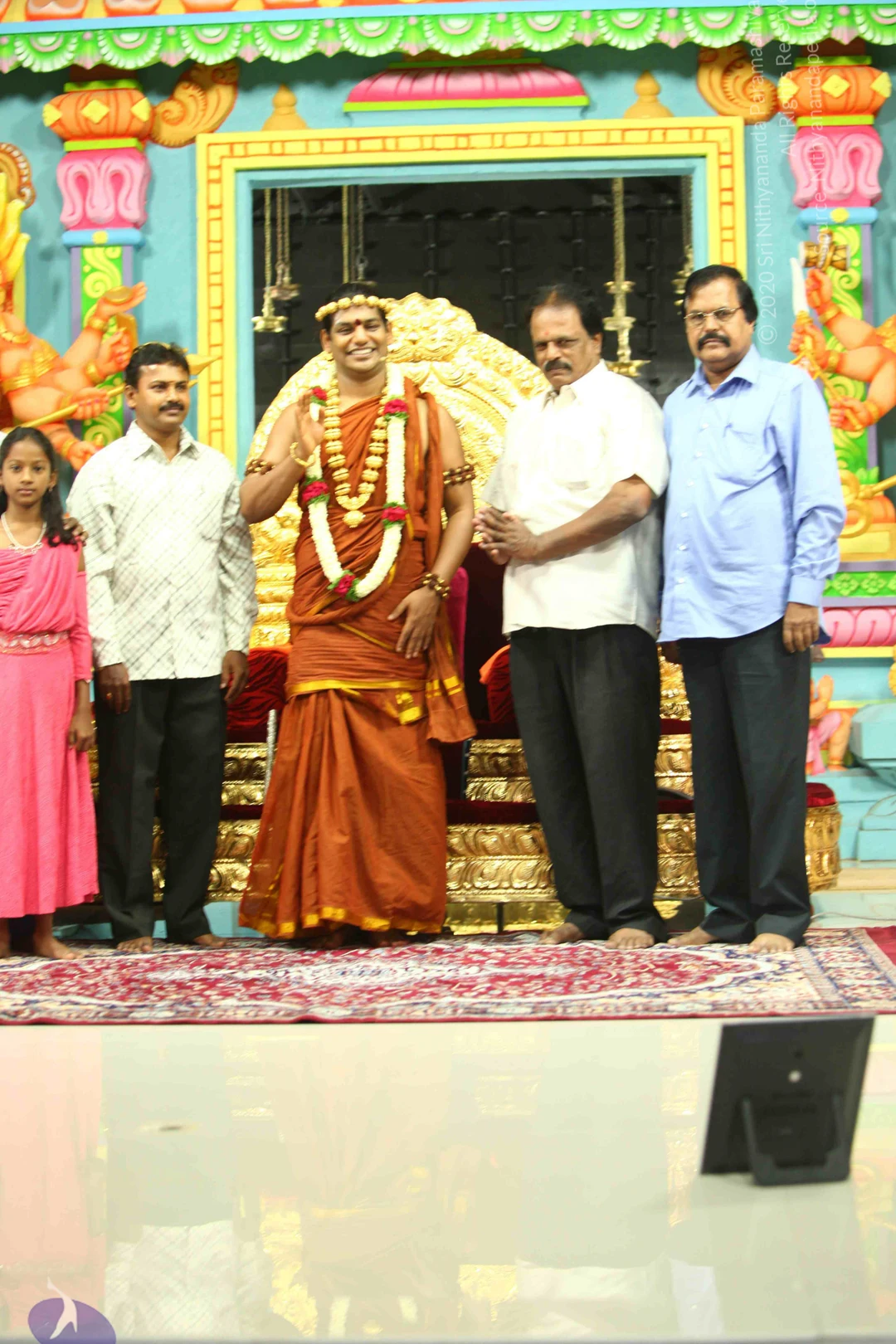
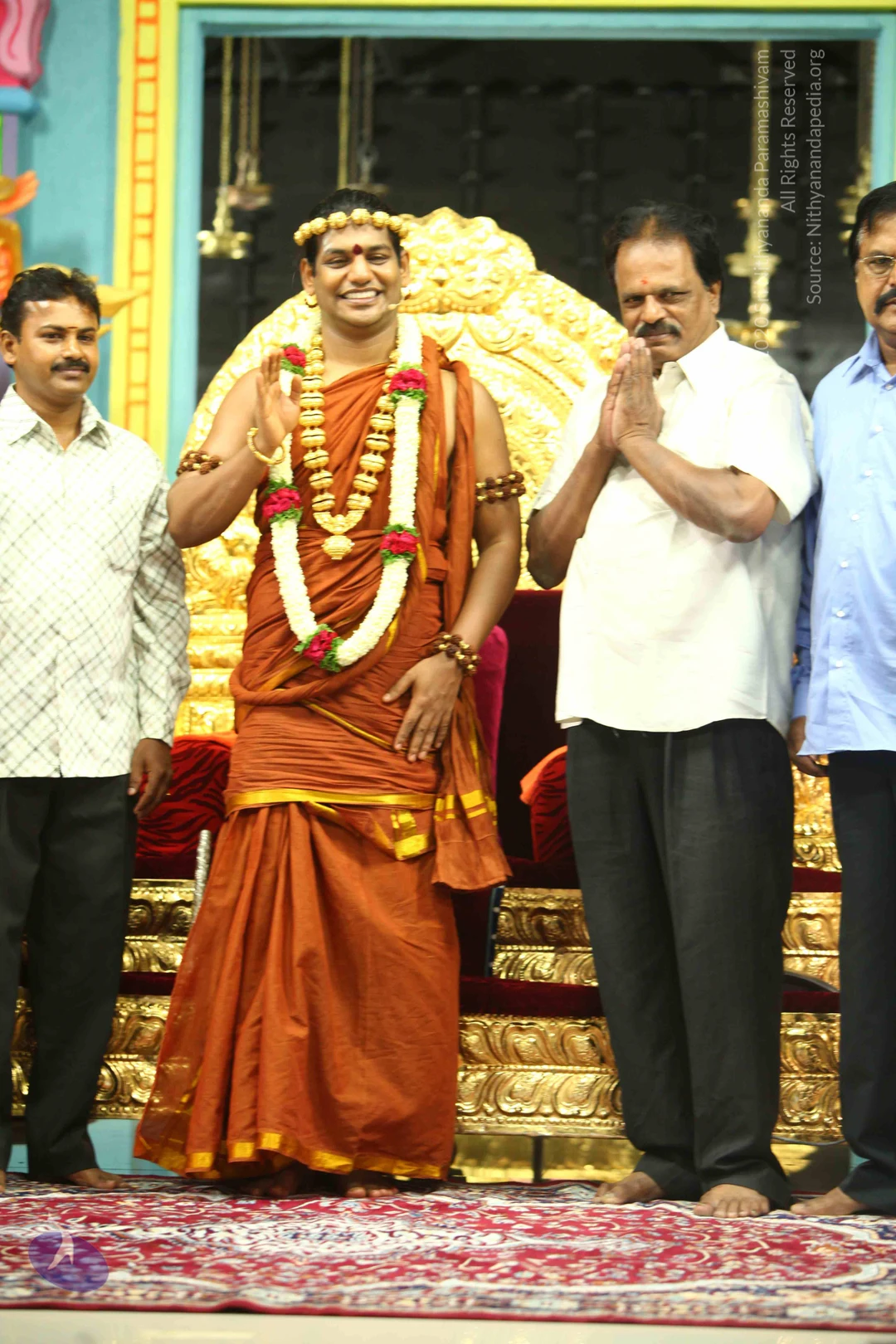
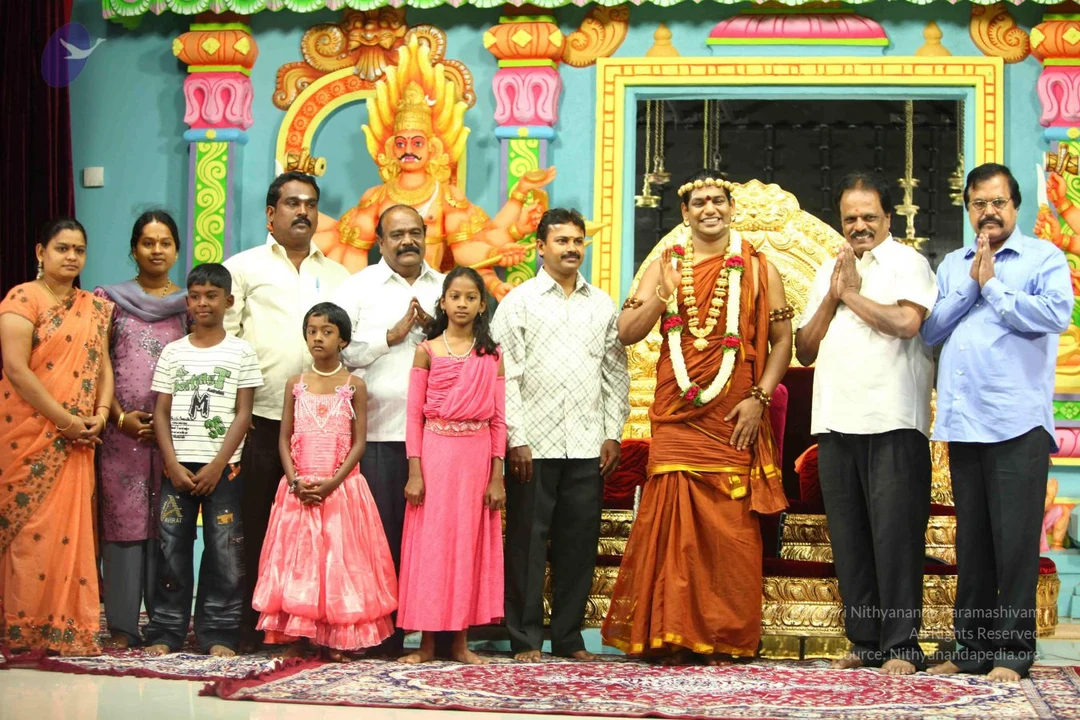
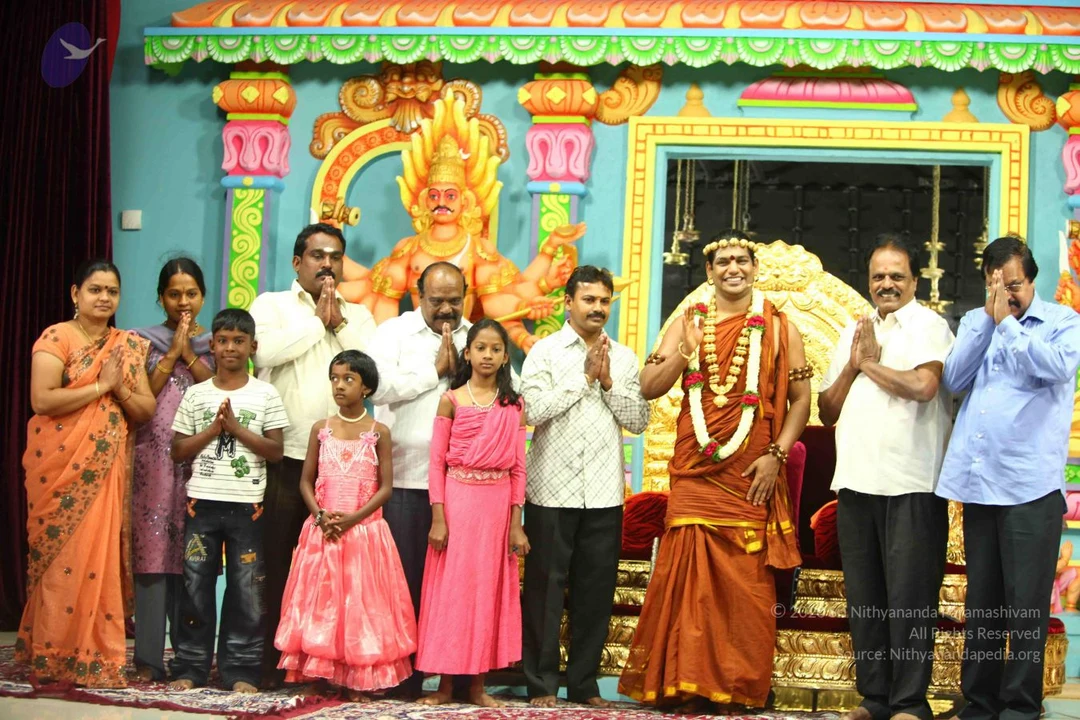
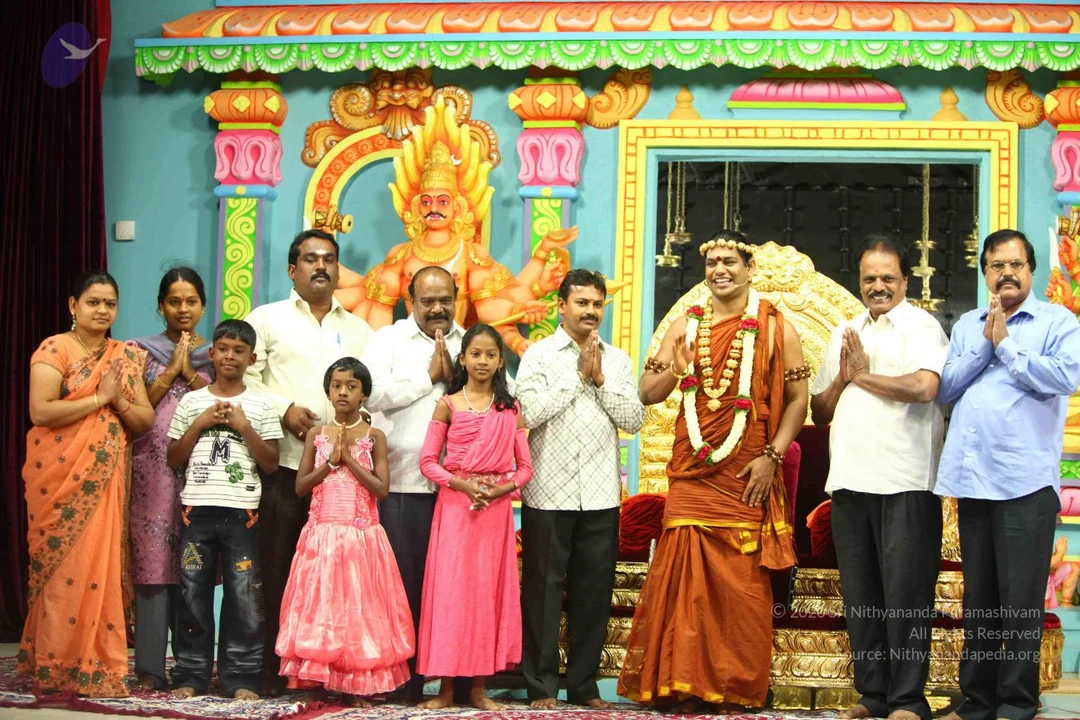
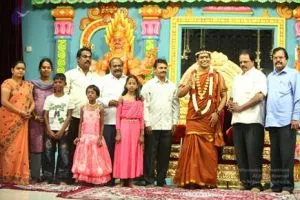
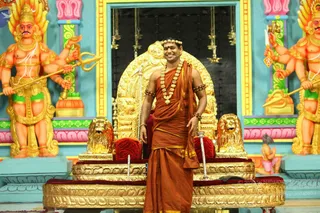
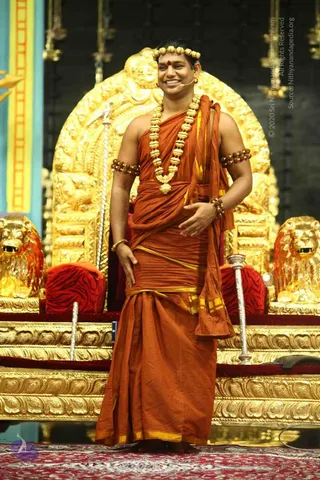
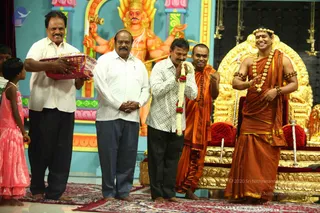
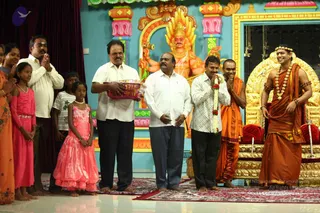
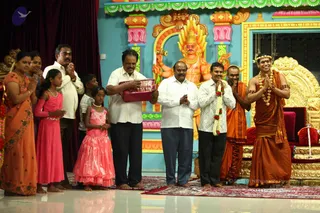
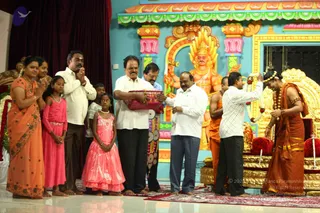
A smiling man in saffron-orange robes and a draped orange shawl stands before a golden throne flanked by two golden lion figures with red cushions. He wears a white flower garland over his head, a long flower garland around his neck, a rudraksha-style bead bracelet on his upper arm, and a ceremonial staff rests against the throne. Behind him a golden arch frames hanging brass lamps, and two large colourful painted guardian figures holding tridents stand on either side against turquoise and pink temple-style panels. The setting resembles a stage or satsang hall with ornate decor.A smiling man stands barefoot on a red patterned carpet in front of an ornate gold throne with carved backrest and gold lion figures flanking it. He wears a rust-orange sannyasi-style wrap with gold-bordered edges, a gold beaded garland, a gold beaded crown-like headband, rudraksha bracelets on his arms and wrists, and a red bindi. A small headset microphone is visible at his ear. The gold chair has red velvet cushions and silver posts in front. The scene appears to be a stage in a large hall with hanging brass ornaments above. Appearance-based cues including the beaded headpiece, gold garland, rudraksha adornments and orange ceremonial clothing are consistent with a person depiction on the throne stage, though identity is uncertain.A stage event before a painted backdrop with a large golden deity murti holding weapons and a trident-like staff. On the right, a man in orange-saffron dhoti and shawl, with a white floral garland, bead bracelets and gold chain, stands beside a gilded throne with red cushions. Before him, a man in an orange robe with rudraksha beads and a floral garland, and two men in white shirts and dark trousers stand on a red patterned carpet. A man in white shirt holds a red basket of gifts, and a young girl in a pink dress stands at left.A photograph of a devotional event in an ashram hall with a painted backdrop of a fierce multi-armed deity figure with a flaming halo and a gilded throne-like seat on the right. A man in orange robes with a flower garland stands on the right, wearing a long orange garment and multiple beaded necklaces, arms adorned with bangles, and a garland of flowers on his head. Beside him a man in an orange robe presses his palms together in greeting. In the centre, men in white shirts hold a red woven basket of offerings while another man in a checked shirt holds a garland and presses palms. A girl in pink and a child in a striped shirt stand on the left with people in saris and white shirts, all with palms joined. The floor has red and patterned rugs.A group photograph on a stage with a turquoise and green ornamental backdrop and a painted deity murti with a crown and multiple arms, standing beside a gilded throne with red cushions. On the right, a shaved-headed man in orange-saffron dhoti and shawl with gold necklaces and bangles stands with palms pressed together in greeting, next to a second man in orange robes with folded hands. In the centre, a man in a white shirt and dark trousers holds a red decorated box, while another man in white shirt gestures with folded hands and a man in a checked shirt wears a floral garland. On the left, a woman in an orange sari and a girl in a pink dress with others stand with palms pressed together, and a small girl in a coral dress stands barefoot on red carpet. Several people, mostly barefoot, are visible across the stage.A ceremonial presentation on a stage with a bright multicoloured temple-style backdrop featuring a golden deity figure with a crown and a flaming halo. A seated figure on a gold throne with red cushions, wearing an orange-saffron garment, rudraksha beads and a garland, is being honoured. A man in a white shirt holds a red-and-gold cloth-wrapped tray while another man in white offers a gift; a man in a checked shirt pours or applies something from a vessel. Two men in saffron robes stand beside the throne. On the left, a woman in an orange sari with hands folded, a girl in a pink dress, a girl in a pink outfit, a man in a white shirt and a boy stand in a group. Floral garlands decorate the throne area. Approximately ten people are visible.

Sarva-Darshan

10 photosSource gallery
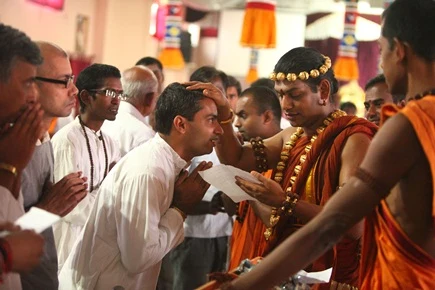
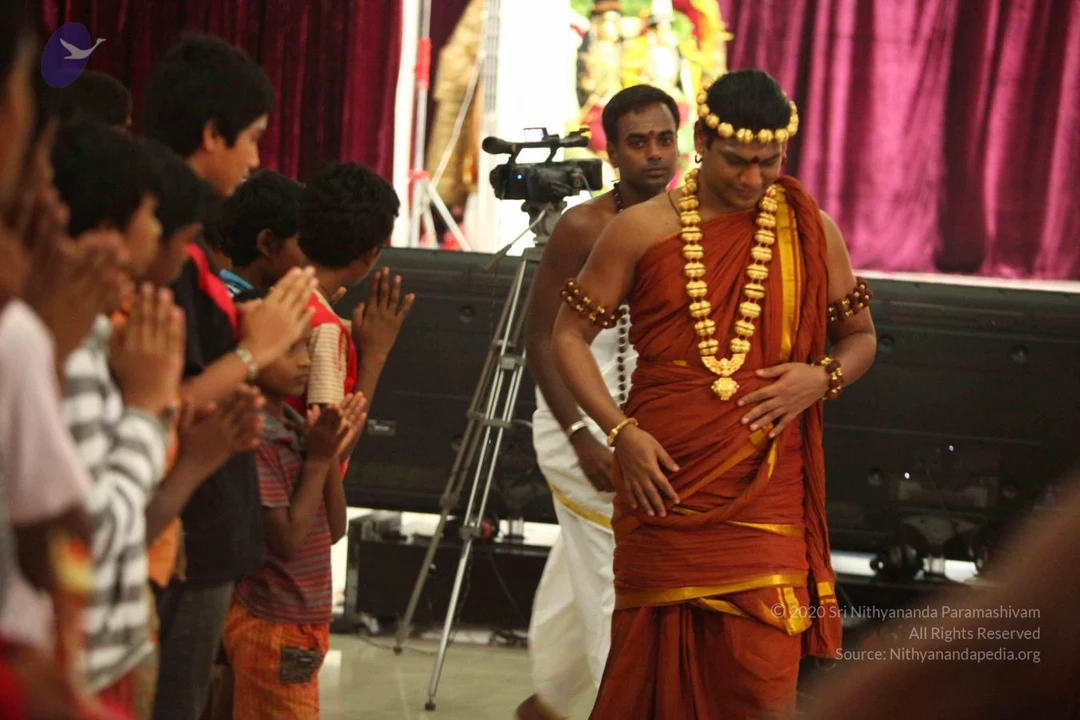
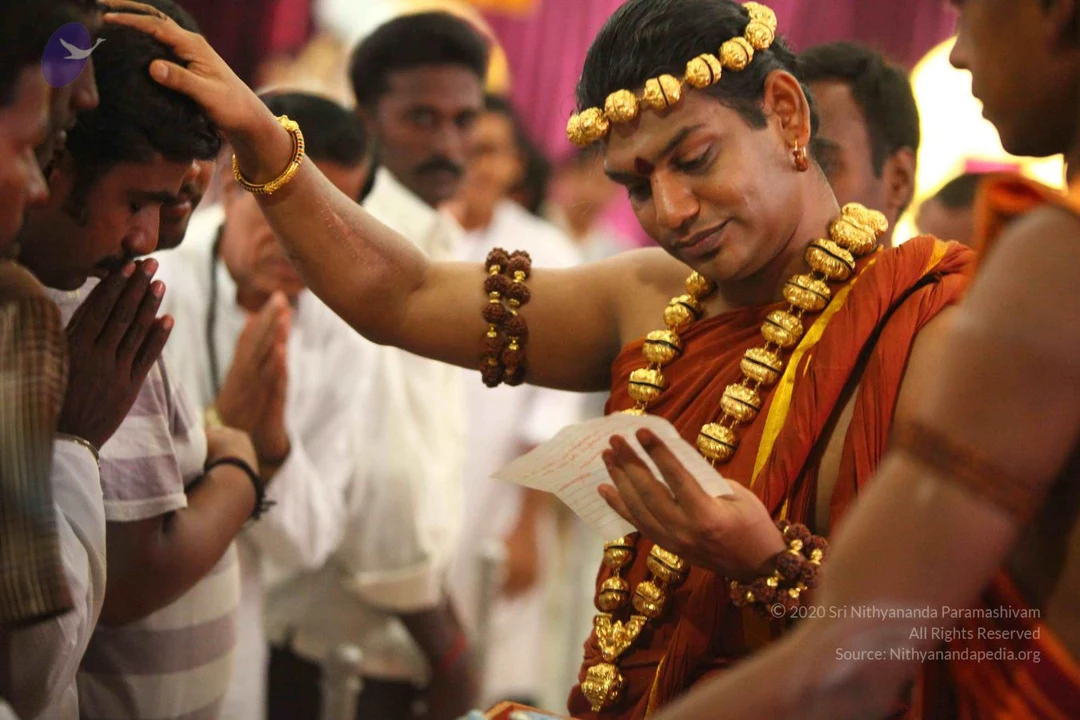
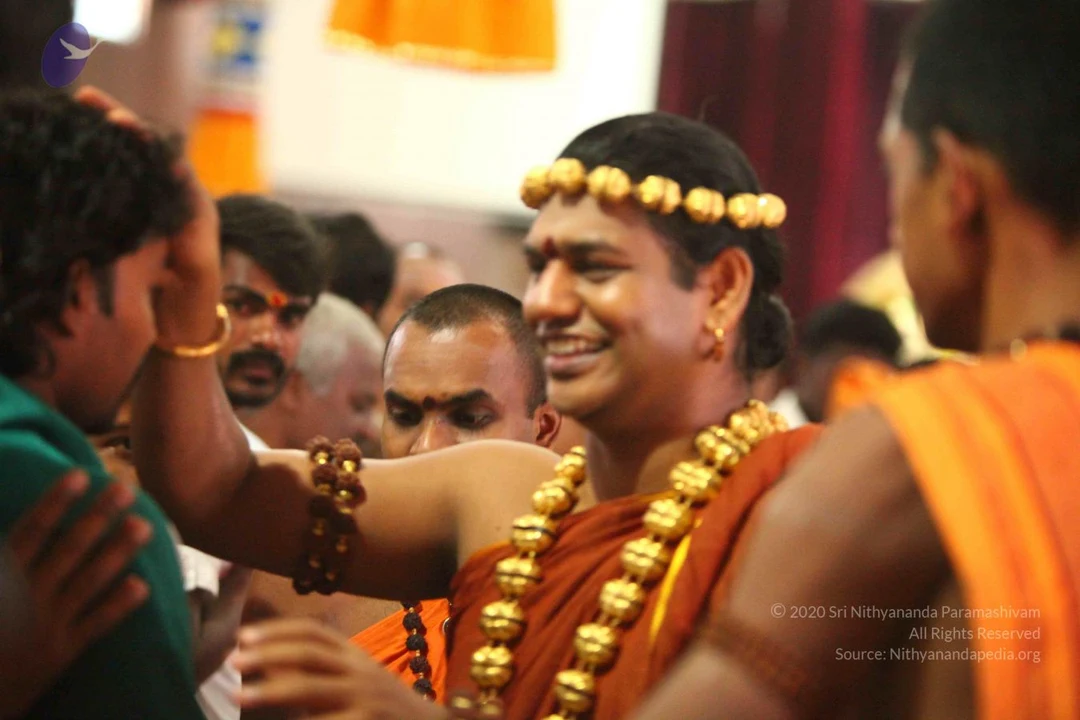
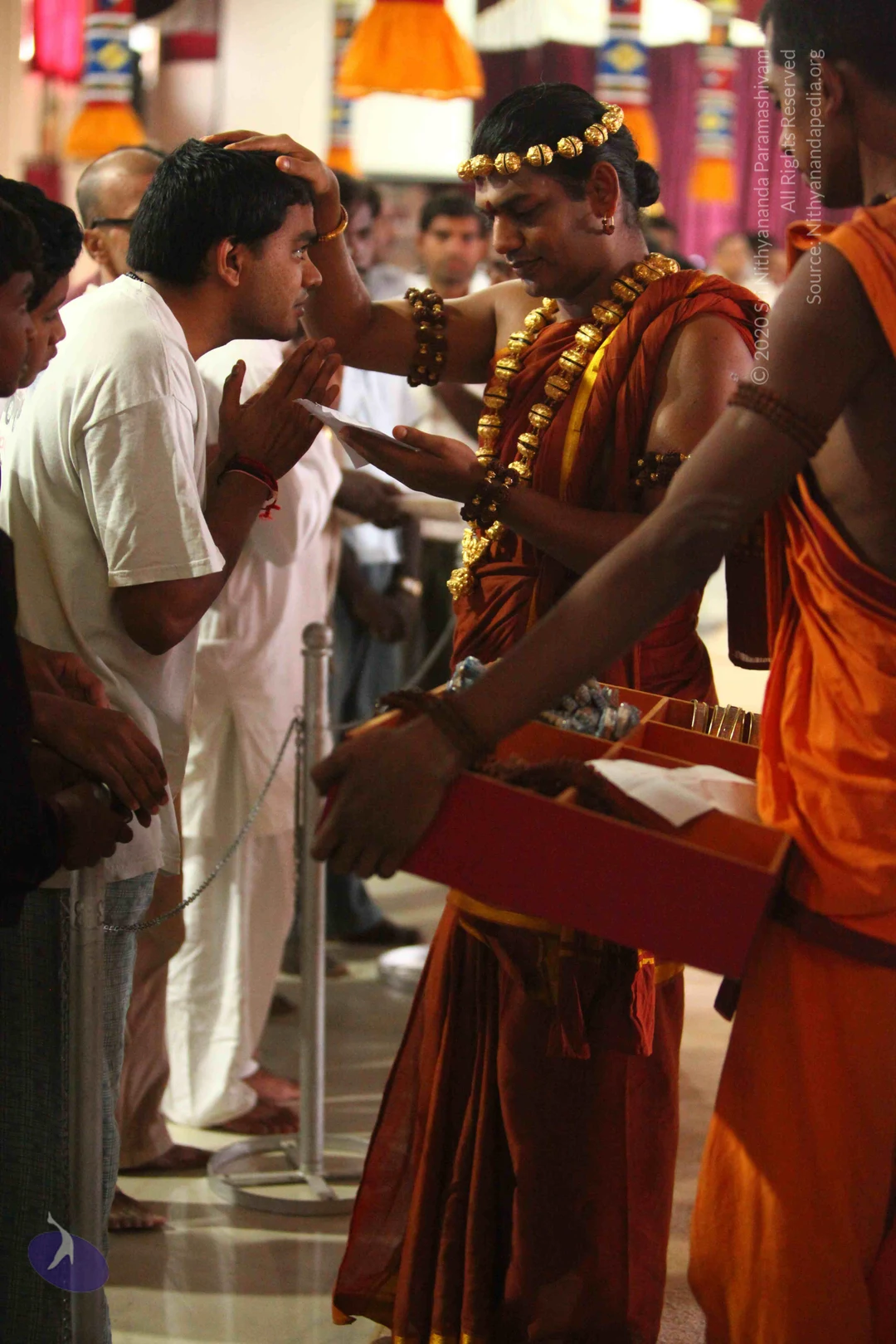
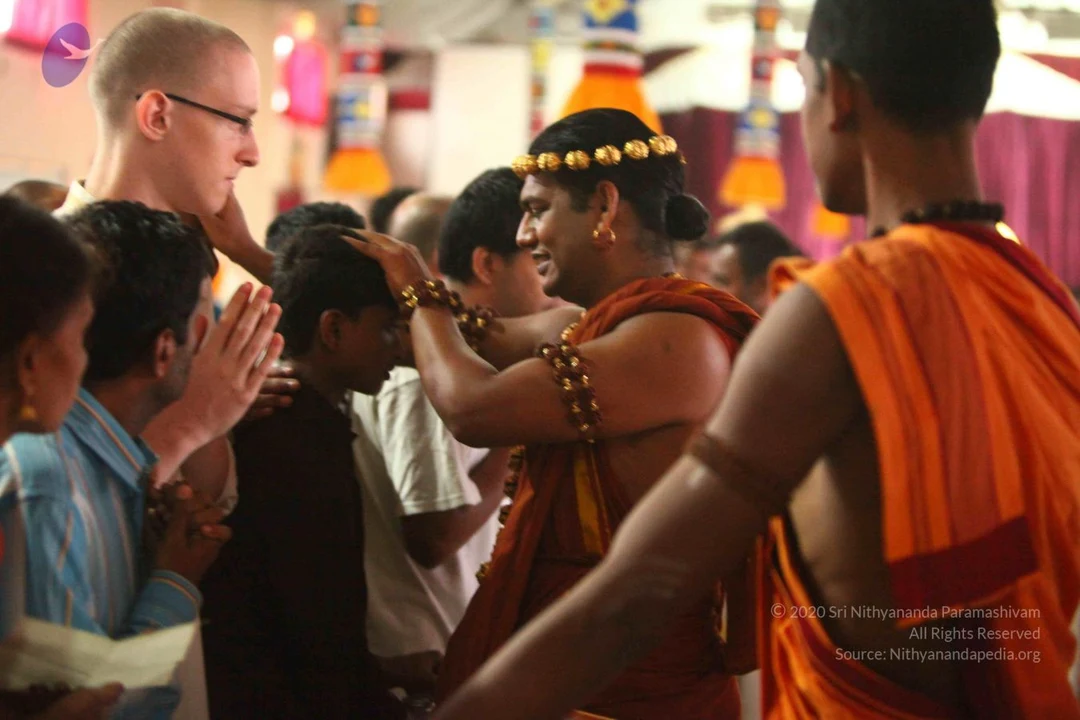
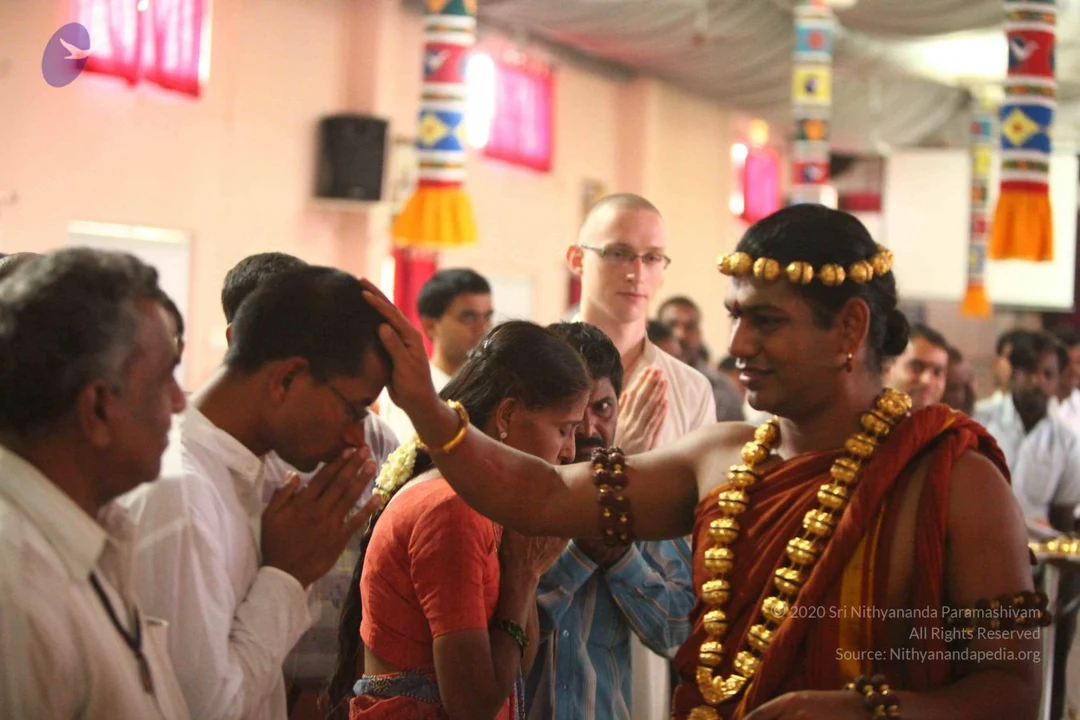
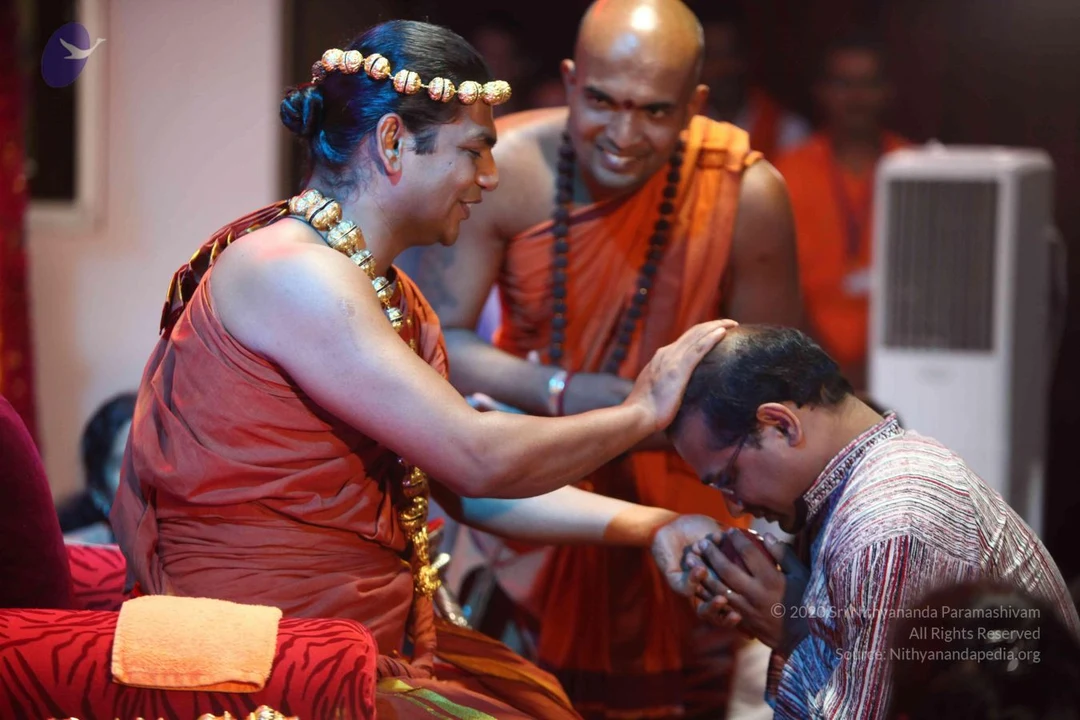
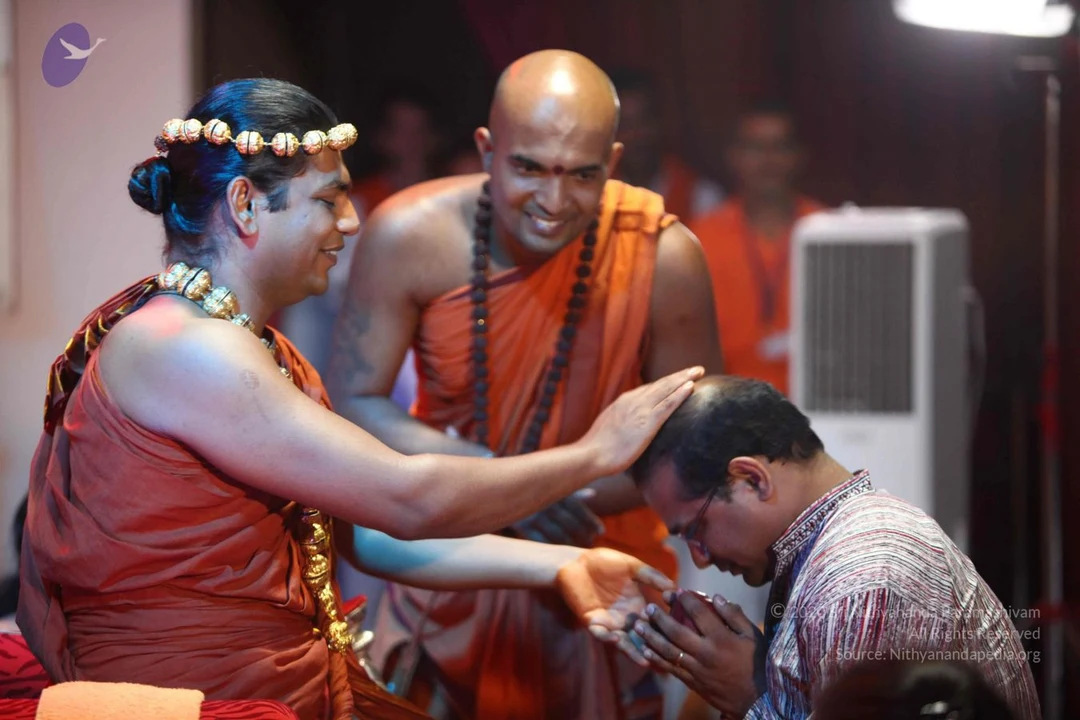
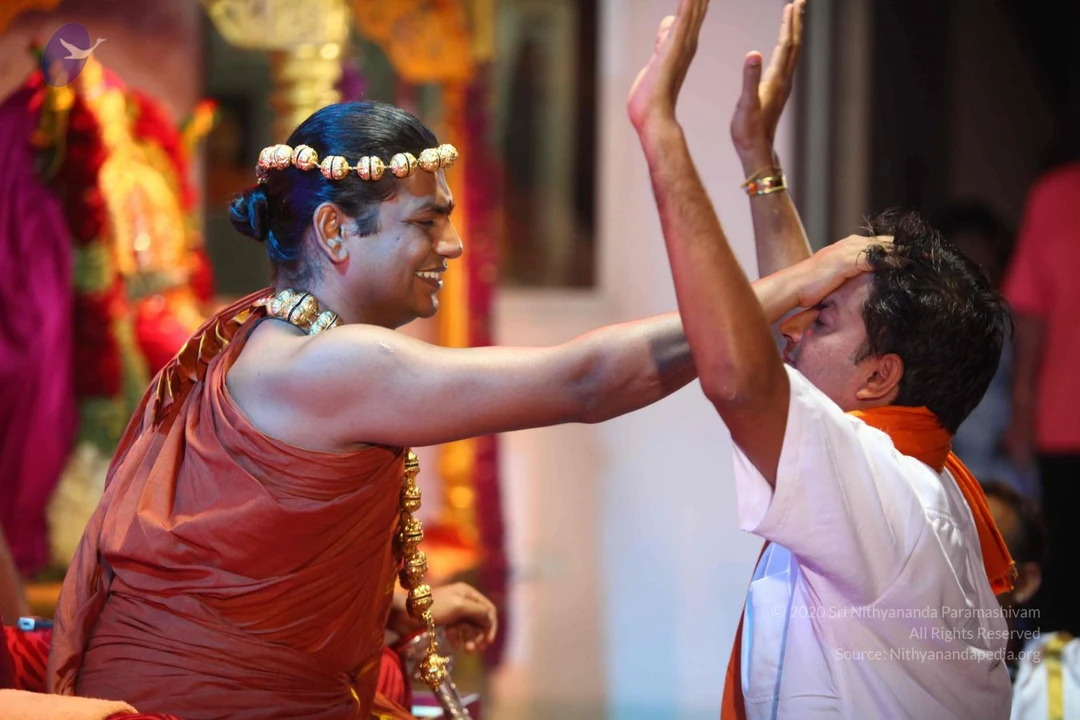
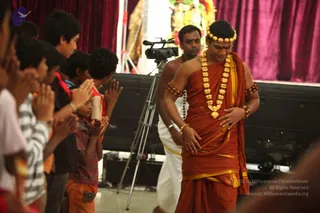
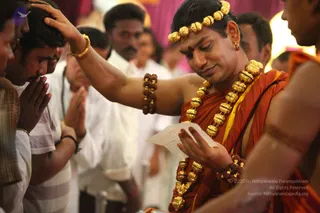
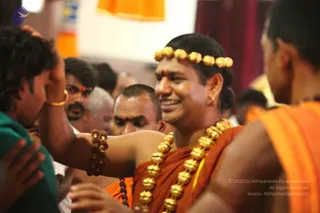
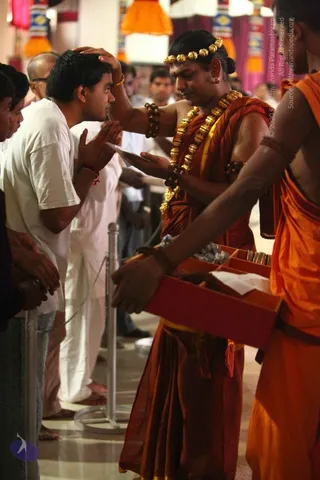
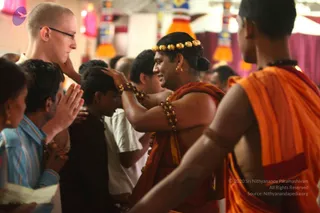
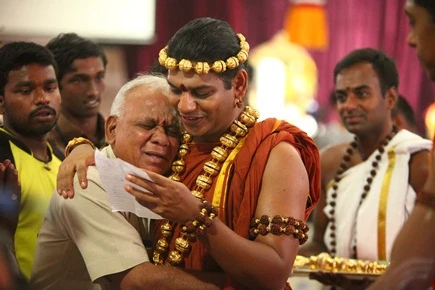
A photograph of a figure in saffron-orange robes with a gold floral crown and a heavy gold necklace walking across a stage, hands clasped at the belly. Several boys on the left stand with palms pressed together in greeting. Behind him a man in a white dhoti and bare chest walks beside a video camera on a tripod. Magenta drapes and a gold deity murti are in the background. Saffron-orange robes, gold necklace and gold crown are the visible cues of the central figure.A young man in saffron-orange robes wears a gold headband, multiple gold chains and gold bangles, with rudraksha mala bracelets on his arm. He holds a sheet of paper and places his hand on the head of a devotee in a white shirt, while other devotees with folded hands and white clothes stand around him. Appearance suggests a person in ceremonial attire giving blessing to a devotee during a satsang or darshan setting, with a pink backdrop behind. The scene shows a blessing ritual with ornate gold jewellery and rudraksha beads.Photograph of a smiling man in saffron-orange robes wearing a gold leaf-shaped headpiece or crown-like ornament, a gold bead necklace, and a gold earring, with a red tilak on his forehead and rudraksha beads on his wrist. He is surrounded by devotees in orange and green clothing, one of whom reaches toward him with a hand raised. A small group of other devotees and an elderly man with white hair stand nearby against a blurred background of orange and maroon fabric.A photograph of a devotee in a white t-shirt with palms joined receiving blessing at an ashram hall. A central figure in saffron-orange robes wears a gold bead headband, a long gold bead necklace, and rudraksha bracelets, placing a hand on the devotee's head while holding a folded paper. Beside him an attendant in orange cloth holds a red wooden tray with items. Orange and magenta hangings and onlookers in white are in the background.A photograph of a crowded indoor gathering with pink and orange hanging decorations. A man in saffron-orange robes with a gold-bead headband and rudraksha bracelets smiles while placing his hand on the head of a young devotee in a dark shirt who bows forward. A shaved-headed person in glasses on the left and a man in a blue shirt with palms pressed together watch. A third person in orange robes stands at the right edge, back partly turned.A photograph of a ceremonial blessing in an ashram hall. A man in a saffron-orange dhoti and shawl, wearing a gold-bead headband, a long gold-bead necklace and a tulsi-style wooden mala, places his right hand on the head of a bowed devotee with folded hands. Beside them a woman in a red-orange sari with a flower garland and gold bangles also bows with palms pressed together. Behind them a bald man in glasses and a white shirt stands with palms joined, and several men in white and light shirts stand in the background. Striped and red-white decorative pillars hang from the ceiling, and red banners and a white canopy frame the hall. a person wears the distinctive gold-bead headband, ornate gold necklace and saffron clothing, consistent with the page's record of him at this event.

Aachi-Meeting-Swamiji

12 photosSource gallery
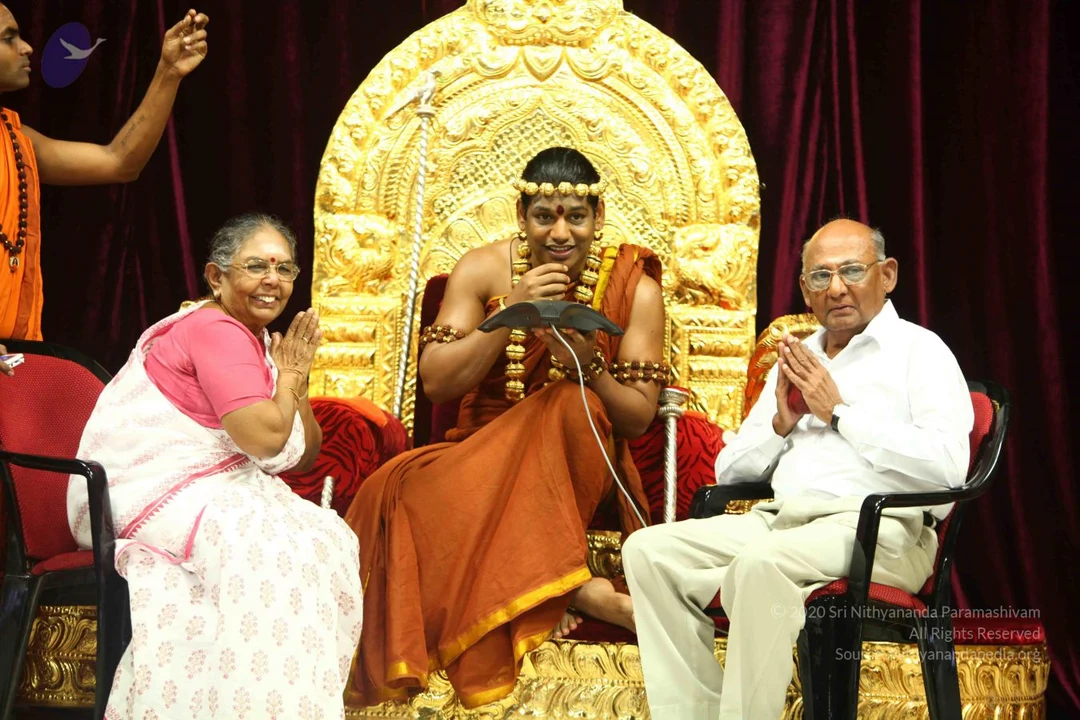
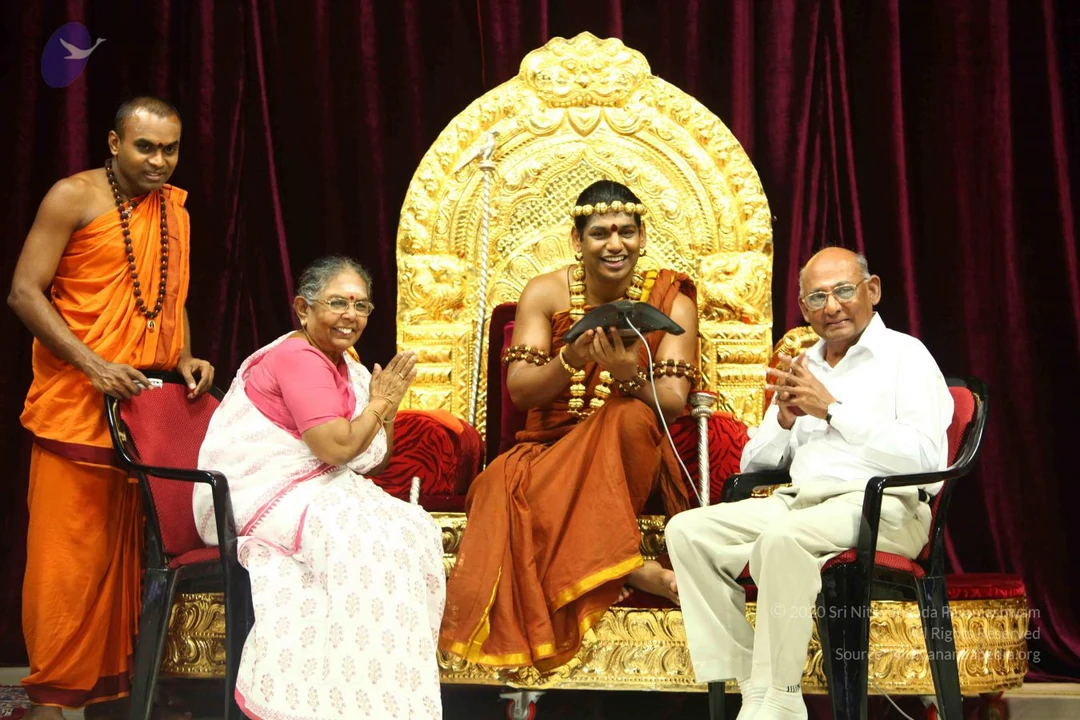
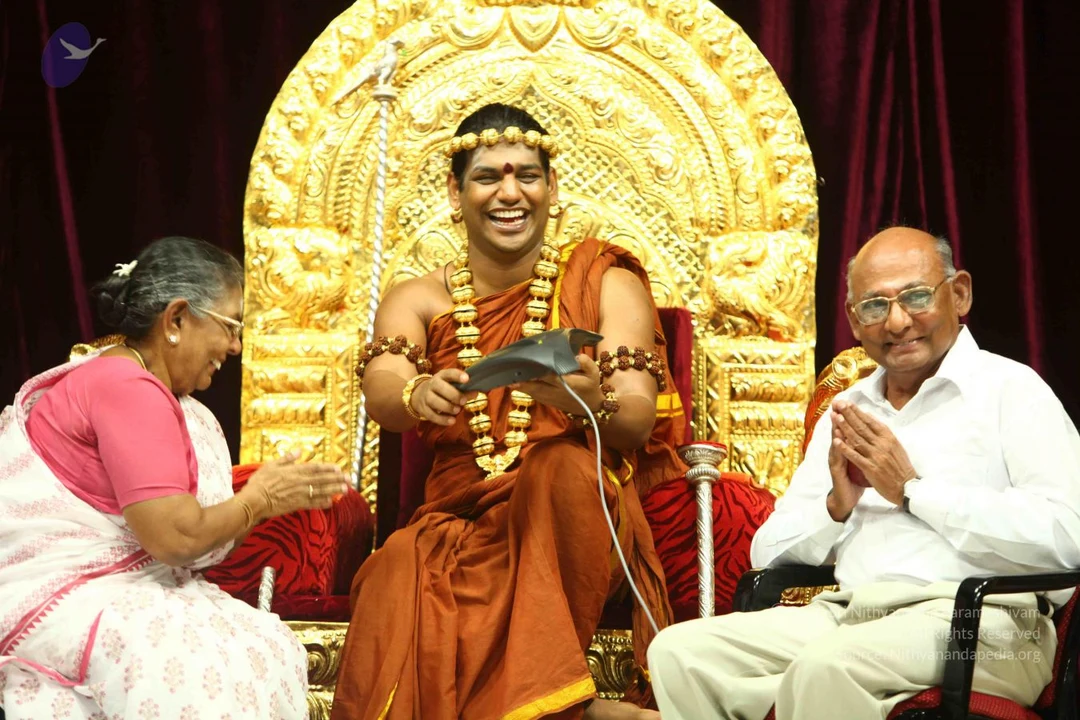
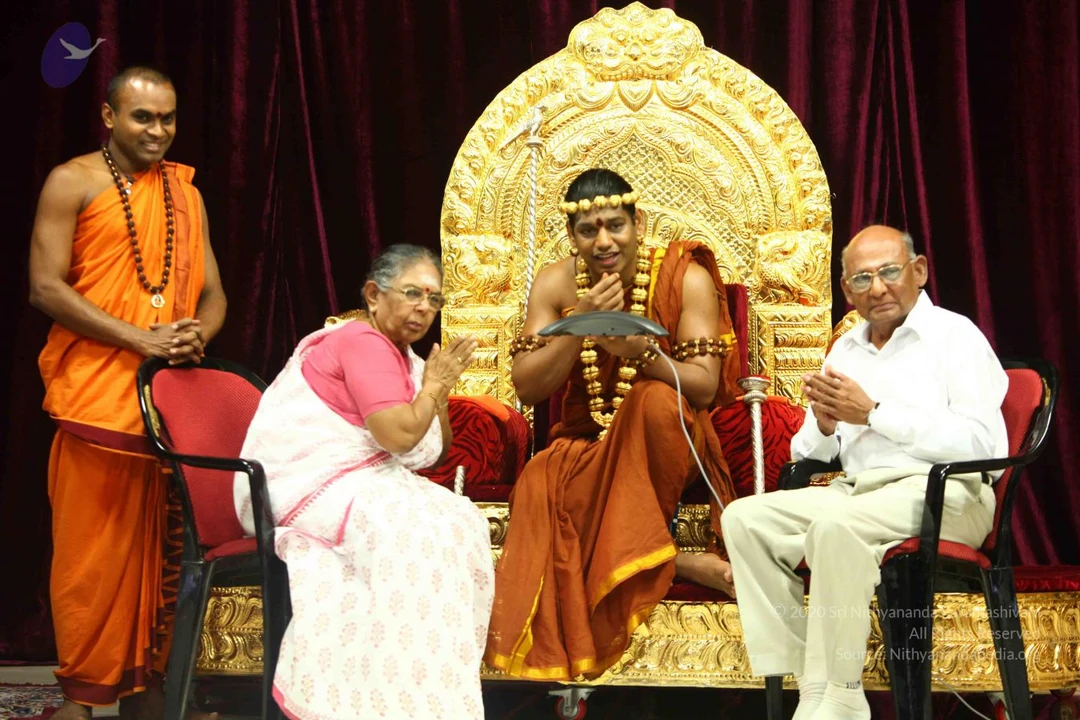
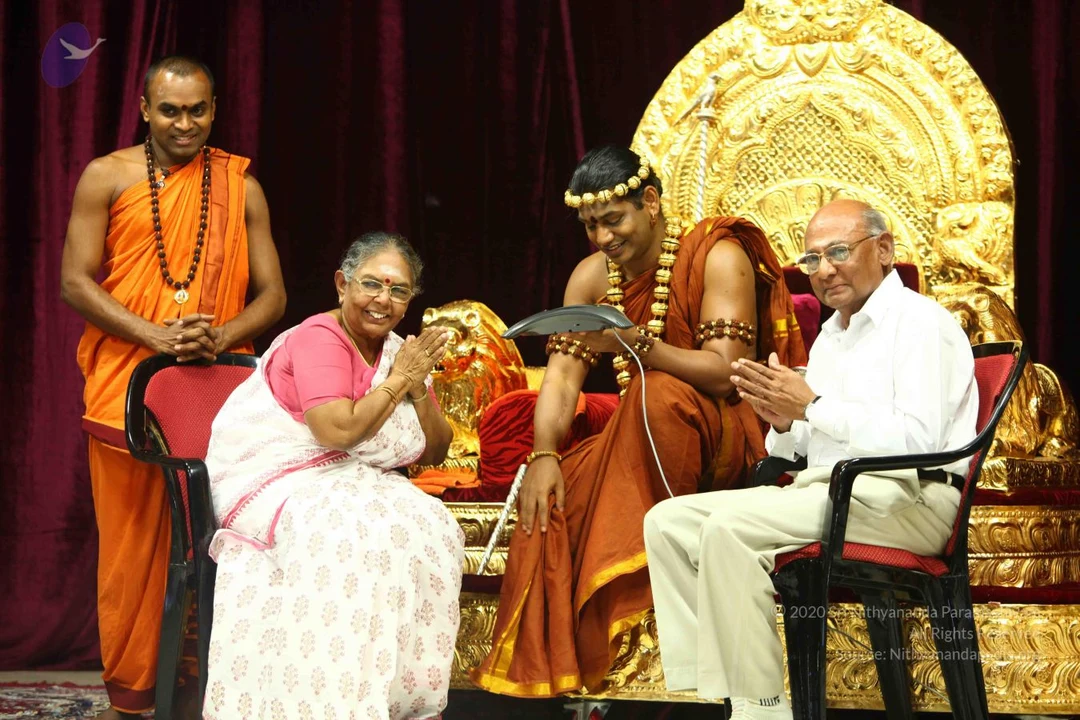
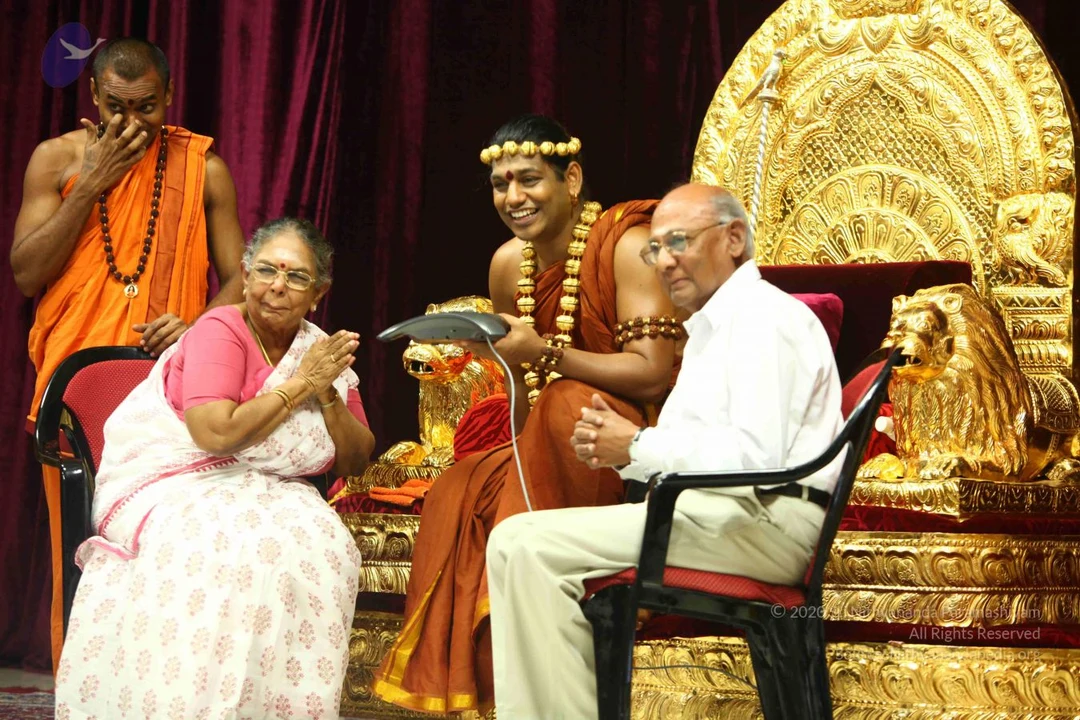
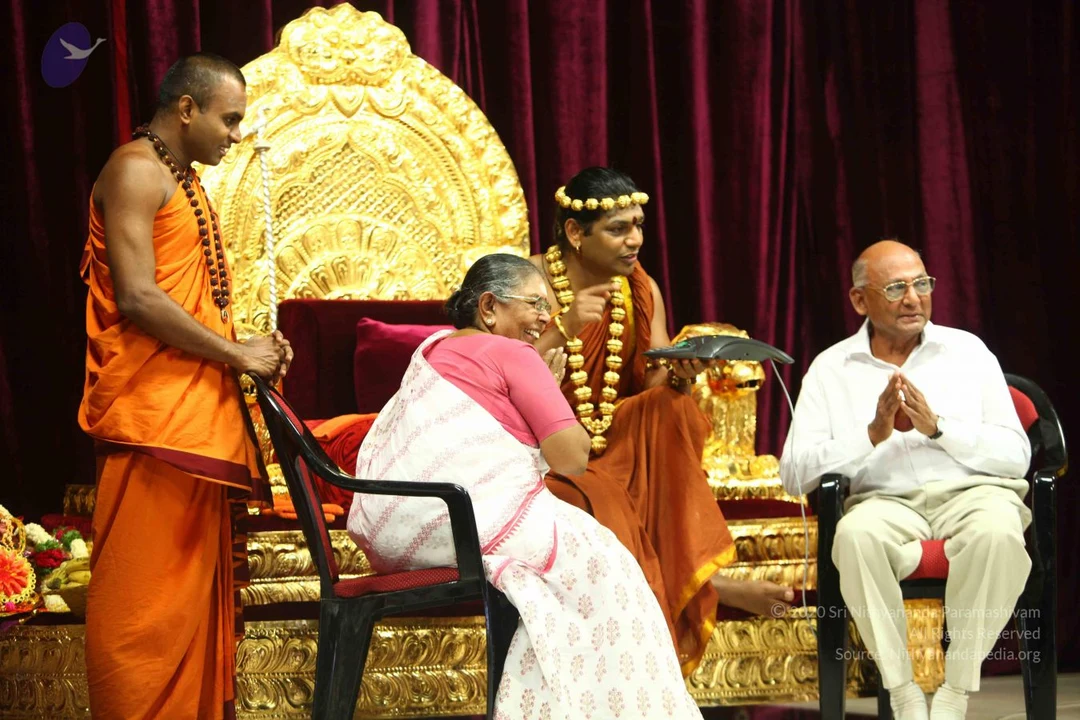
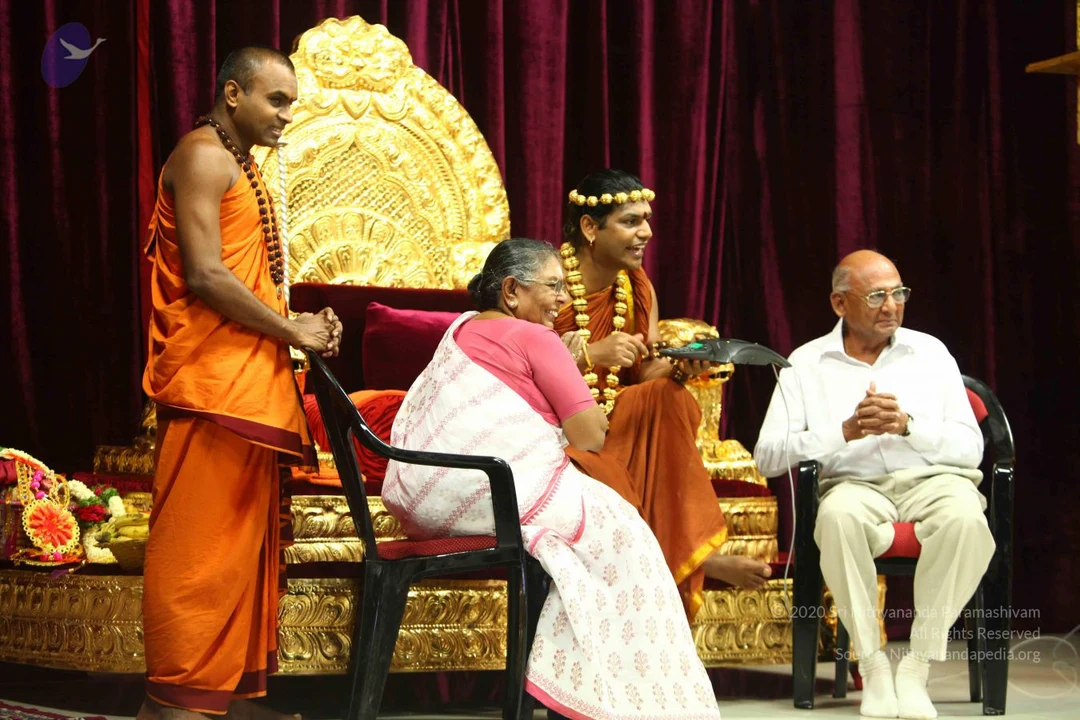
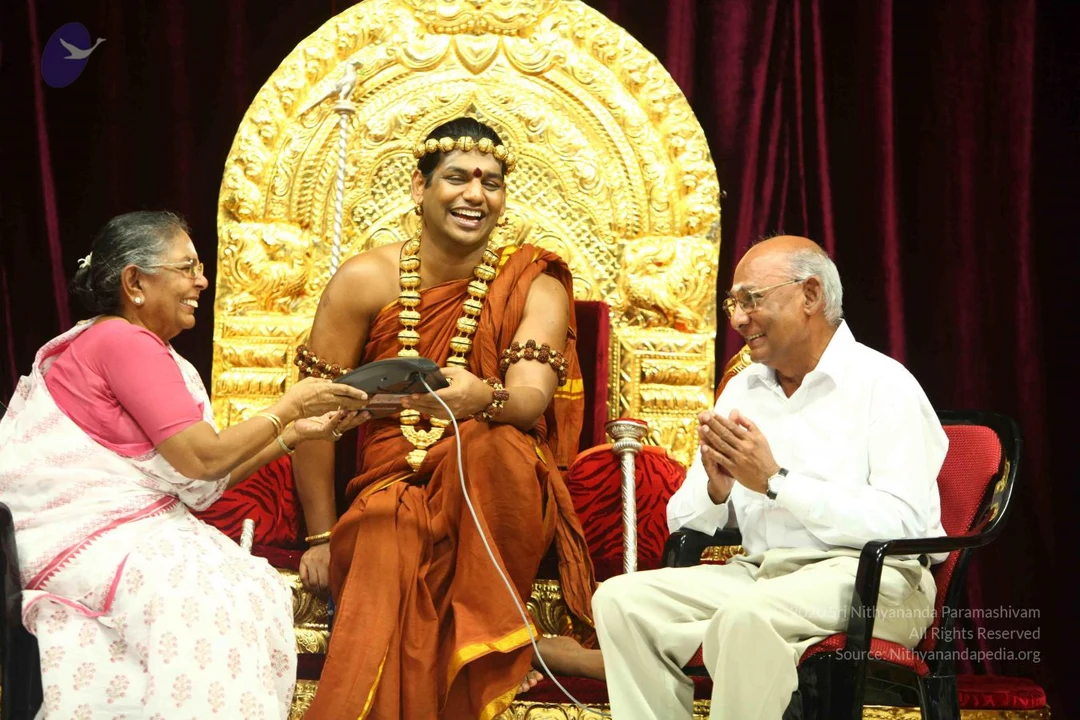
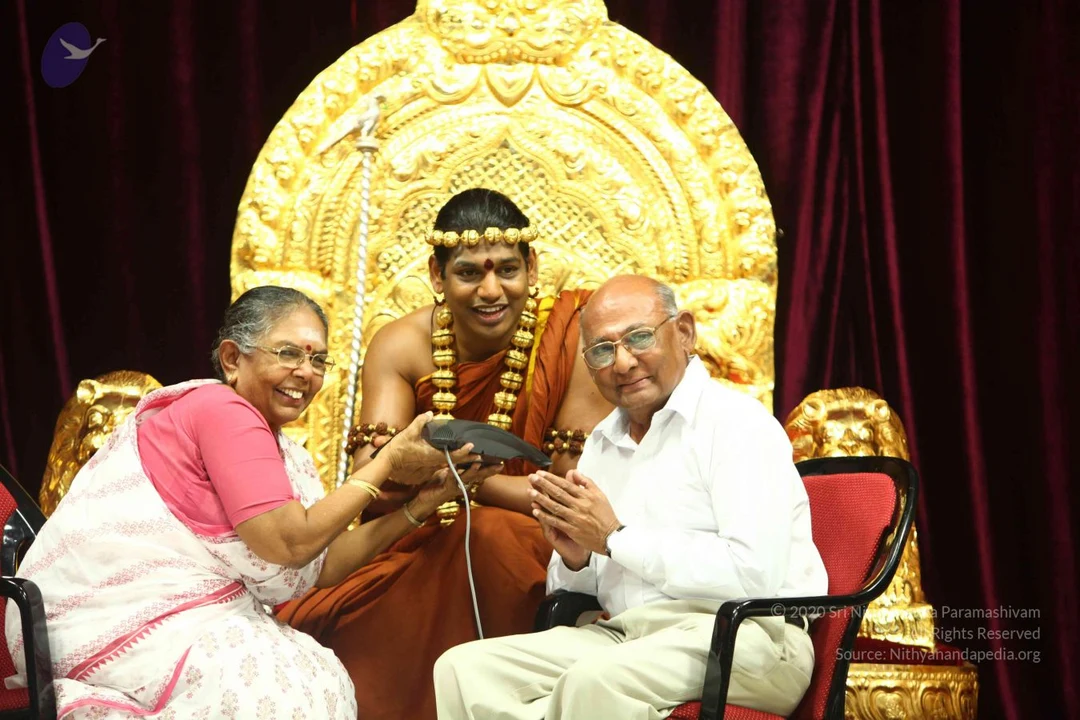
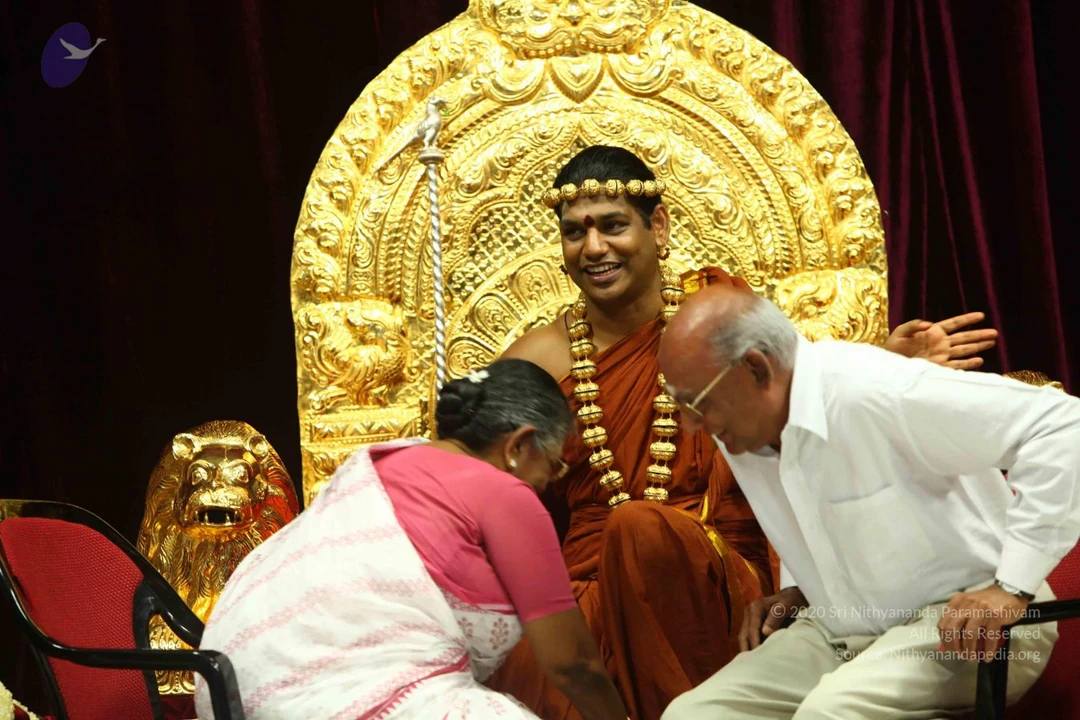
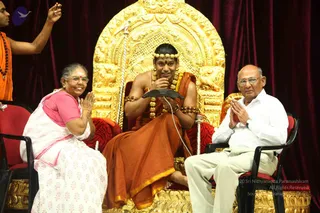
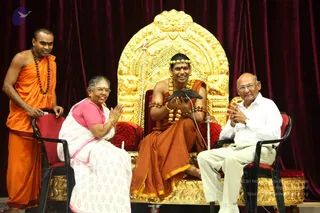
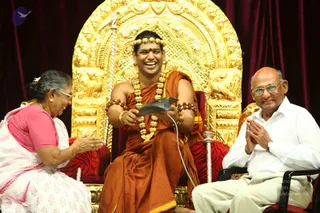
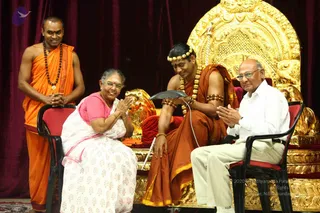
A photo of a satsang on a stage with a deep red velvet backdrop. A man seated on an ornate gold throne with a red cushion wears a saffron-orange robe, a long white-and-gold-bead garland, a flower crown, and beaded bracelets; he has long dark hair and gestures with his right hand while speaking to a man in white. Swamiji (probable) is the central figure: the throne, saffron robe, flower crown, beaded garland and bracelets are the qualifying cues. To his left an elderly woman in a white sari with a pink blouse and red bindi smiles, and to the right an older bald man in white shirt and trousers with glasses holds a microphone. A bald young attendant in a white top stands at the right edge, and a figure in orange is partly visible at the far left.A seated figure in the centre on an ornate golden throne with a red cushioned base, bare-chested, wearing a saffron-orange dhoti with a gold border, a gold crown-like headband, multiple gold necklaces, and gold armlets. He holds a small dark object in his hands and smiles. To his left, a woman in a white saree with pink blouse and glasses sits with palms pressed together in namaste. To his right, a man in a white shirt and cream trousers with glasses sits with palms joined. Behind the throne, deep maroon velvet drapery. At upper left, a person in an orange garment with rudraksha beads gestures with raised hand.A stage event with a red velvet curtain behind an ornate gold throne. Seated on the throne is a smiling man with long dark hair, a gold crown-like headband and gold necklaces and armlets, wearing an orange-red robe and holding a dark object in both hands. Two elderly devotees sit in red-cushioned chairs beside the throne: a woman in a pink blouse and white sari with a floral pattern, pressing palms together, and a man in white shirt and trousers with glasses, also in anjali. A young man in an orange robe with rudraksha beads stands at the left edge, hands resting on a chair. Visible person appearance suggests Swamiji (probable) on the throne, given the saffron-orange robe, gold ornaments, long hair and headband cues, with the attendant wearing orange sannyasi clothing.A photograph of a smiling man seated on an ornate gold throne with carved lion-like figures and red velvet backdrop, wearing saffron-orange robes, a gold-beaded necklace, rudraksha bracelets on both arms and a flower garland on his head, holding a black electronic device with a cord. To his left, an older woman in a pink blouse and white sari with floral print smiles and claps her hands. To his right, an older bald man in white shirt and cream trousers and glasses sits with palms pressed together in greeting. Three physical people are visible. The central man is a person candidate given the saffron robes, rudraksha malas, gold necklace and ornate throne cues.A seated man in saffron-orange robes sits on an ornate gilded throne with lion-carved arms and a tall arched backrest, set against deep burgundy velvet drapery. He wears a gold flower crown, layered gold and beaded necklaces, and bead bracelets, with a hand raised near his face as if speaking into a microphone on a stand. To his left, a woman in a white saree with pink floral print and a pink blouse sits with her palms pressed together in greeting. To his right, an older man in a white shirt and cream trousers sits with hands folded. A standing man in orange robes and a rudraksha mala stands at the left edge, smiling and holding his hands together. The seated man is a probable Swamiji candidate by appearance, with a gold crown, saffron robes and ceremonial gold necklaces.A seated man in an orange-saffron dhoti and shawl, with a crown-like gold-and-flower headband, long hair and layered rudraksha malas and gold necklaces, sits on an ornate gold throne with carved lion-like armrests in front of a deep maroon curtain. Beside him, a smiling woman in a white and pink sari and glasses sits with palms pressed together, and a man in white shirt and trousers with glasses sits in a black chair with hands folded. Standing behind on the left, a man in orange robes with rudraksha mala and a pendant holds his palms together in namaste. A small microphone stand is at the centre. The setting appears to be a stage-like hall with the figures greeting one another.

IA-Session

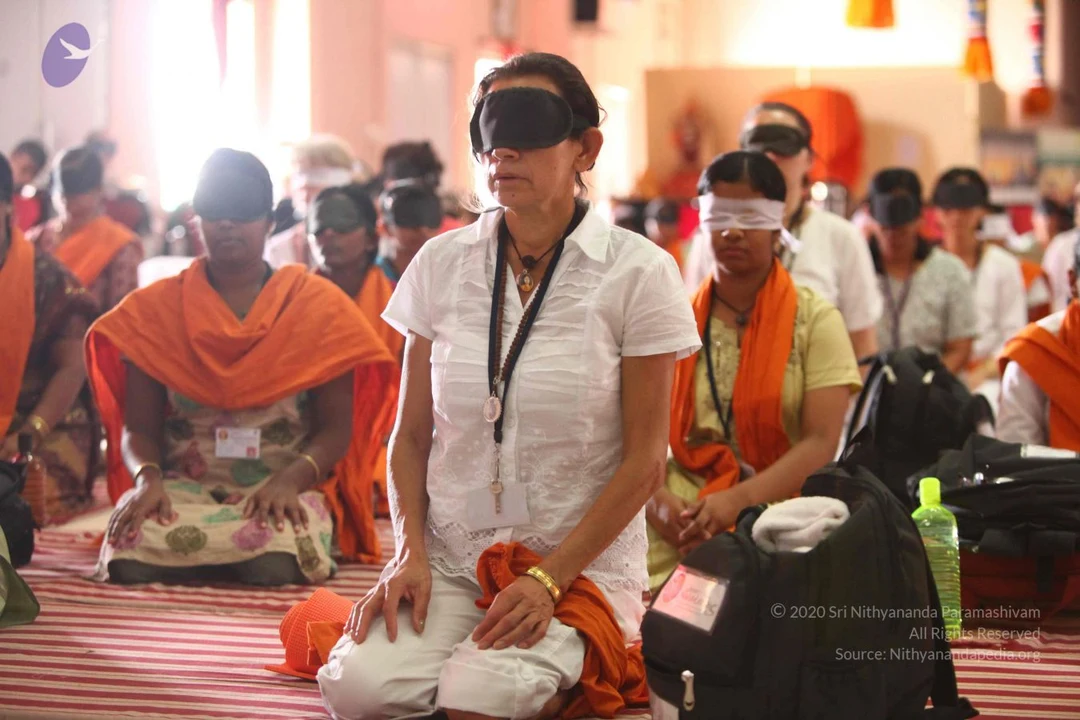
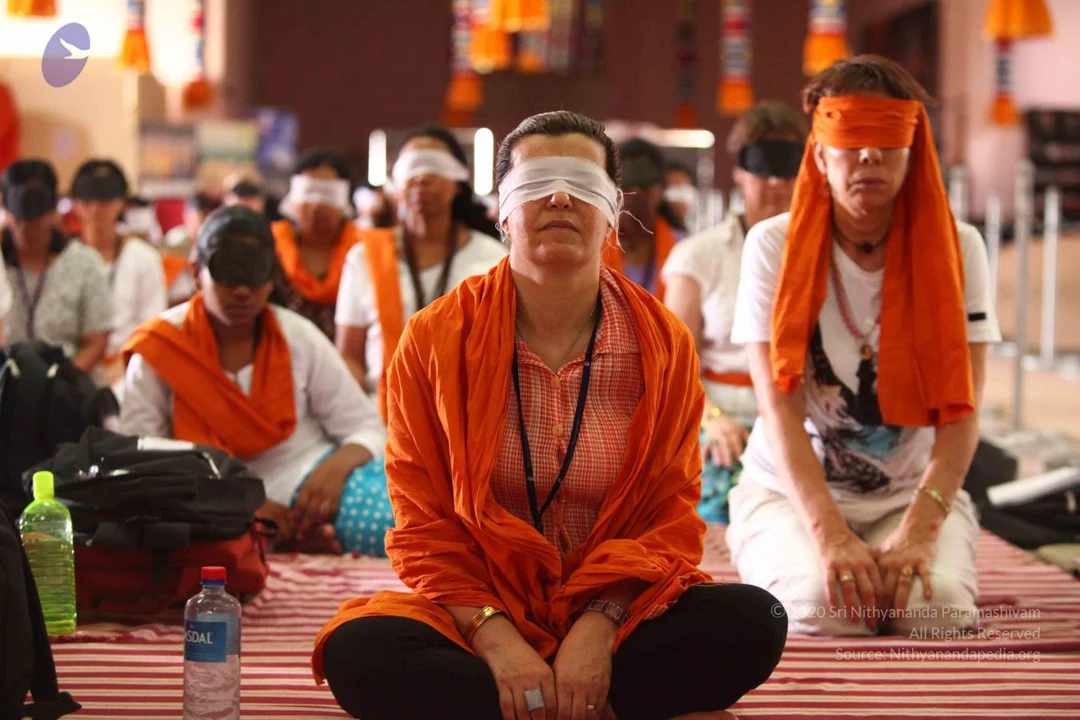
35 photosSource gallery
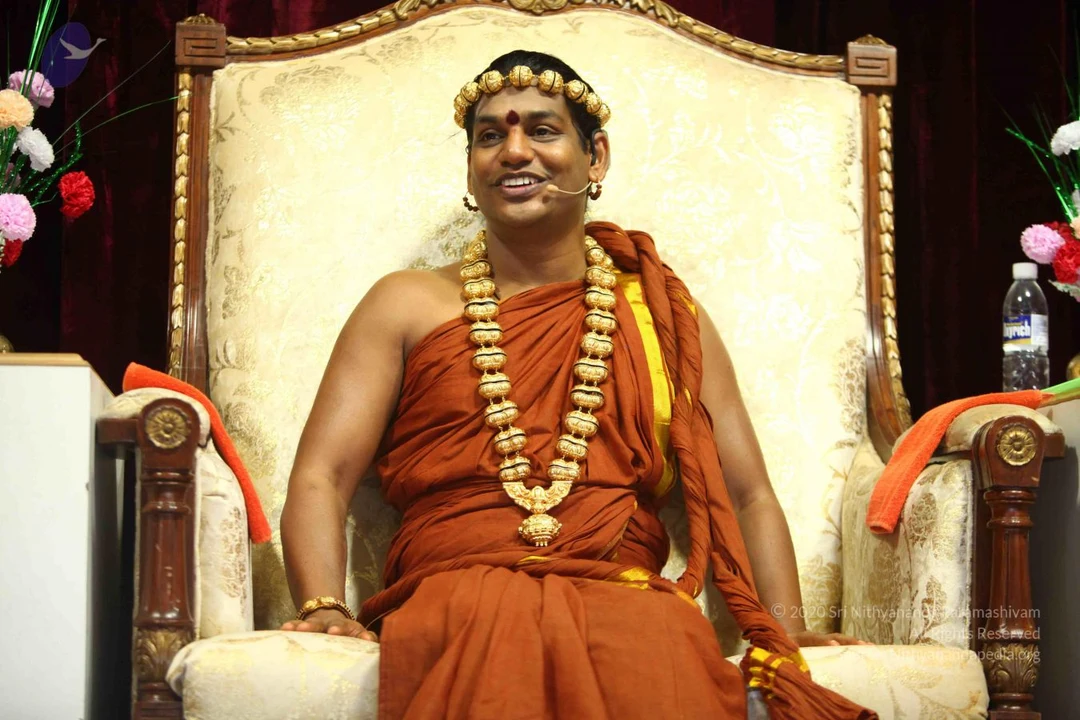
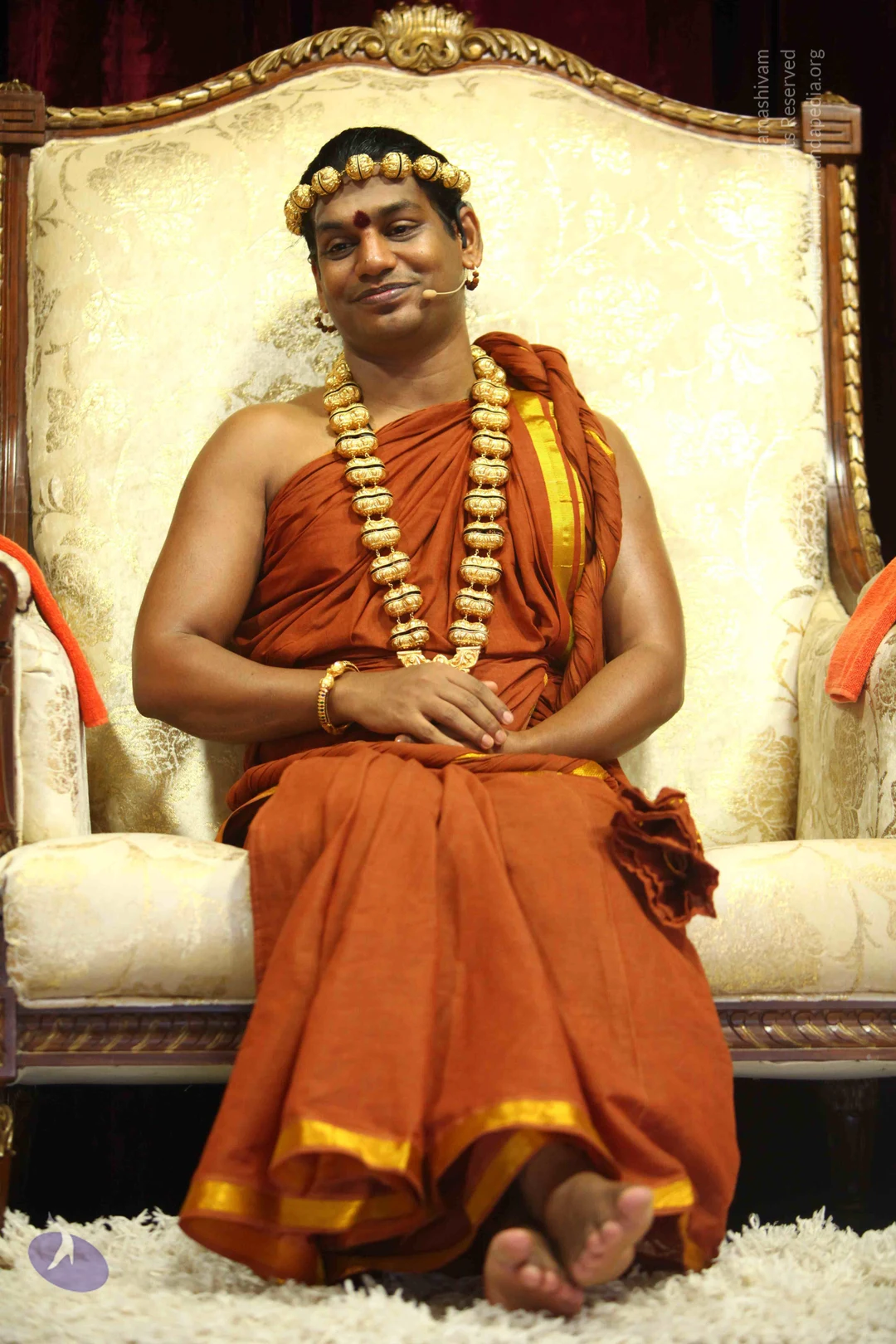
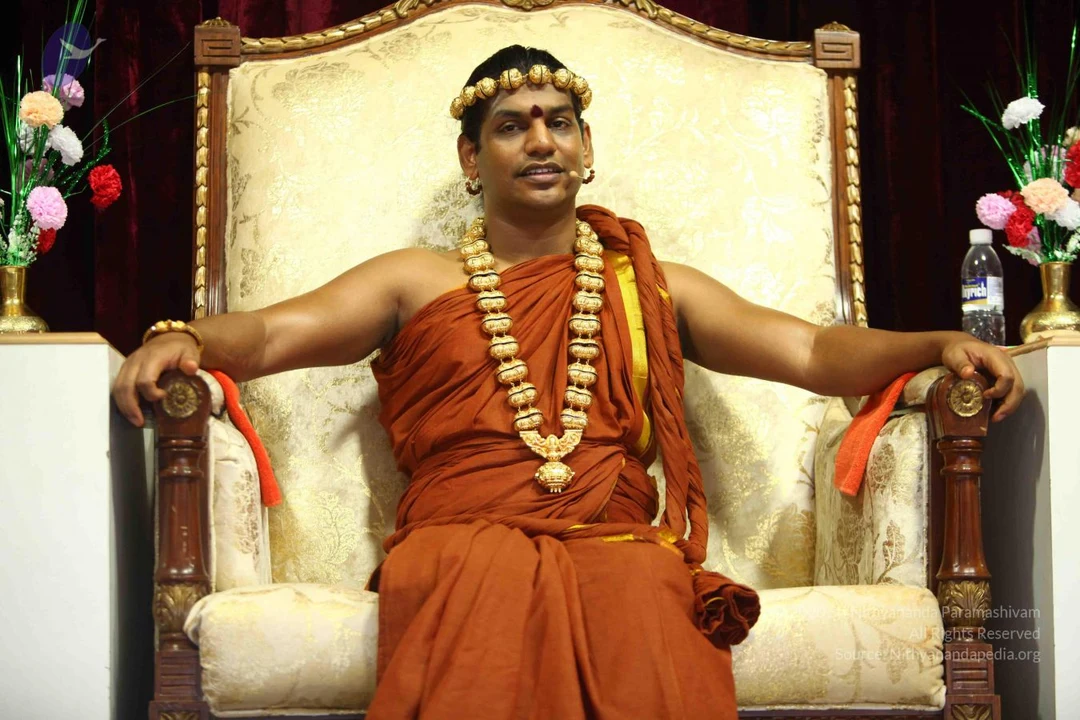
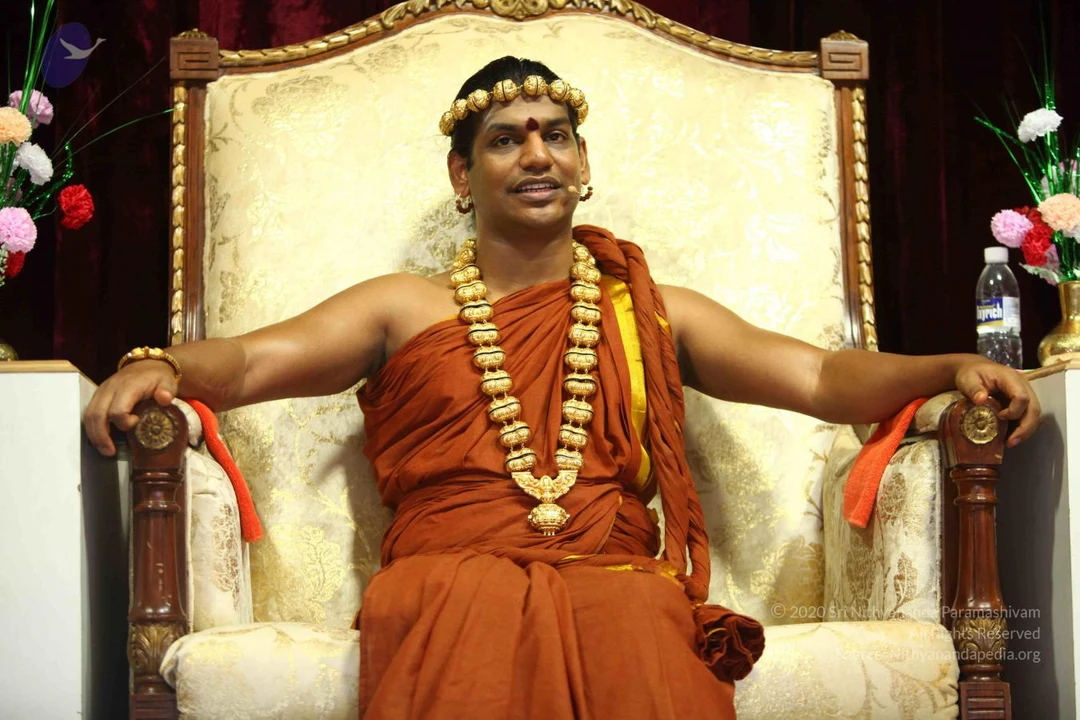
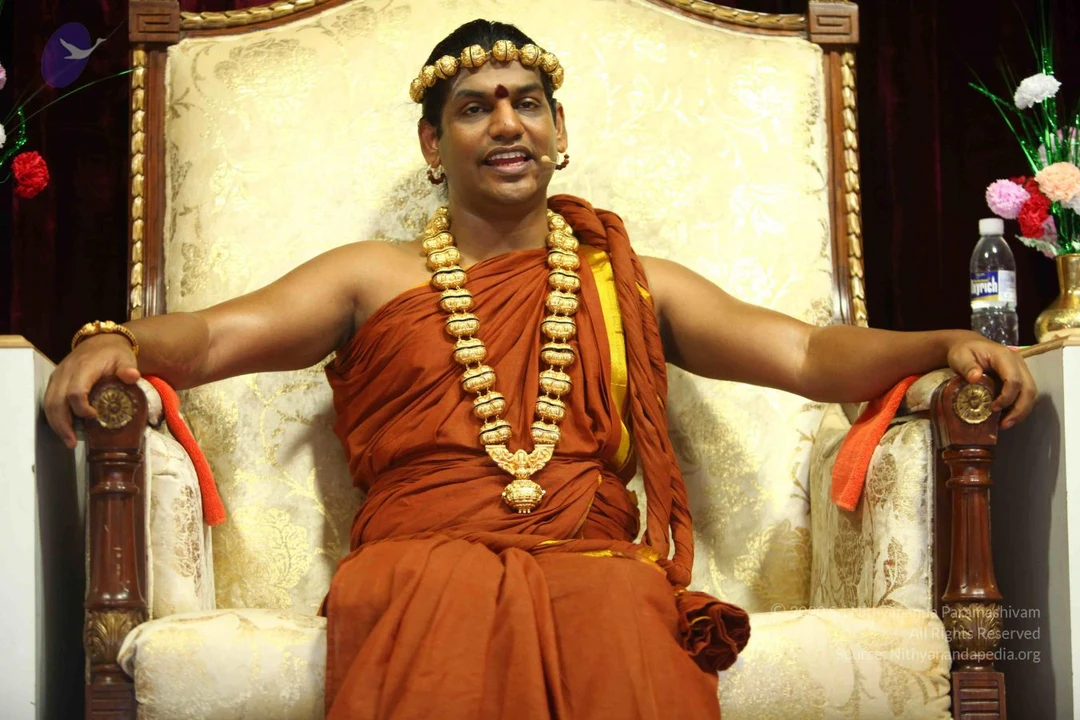
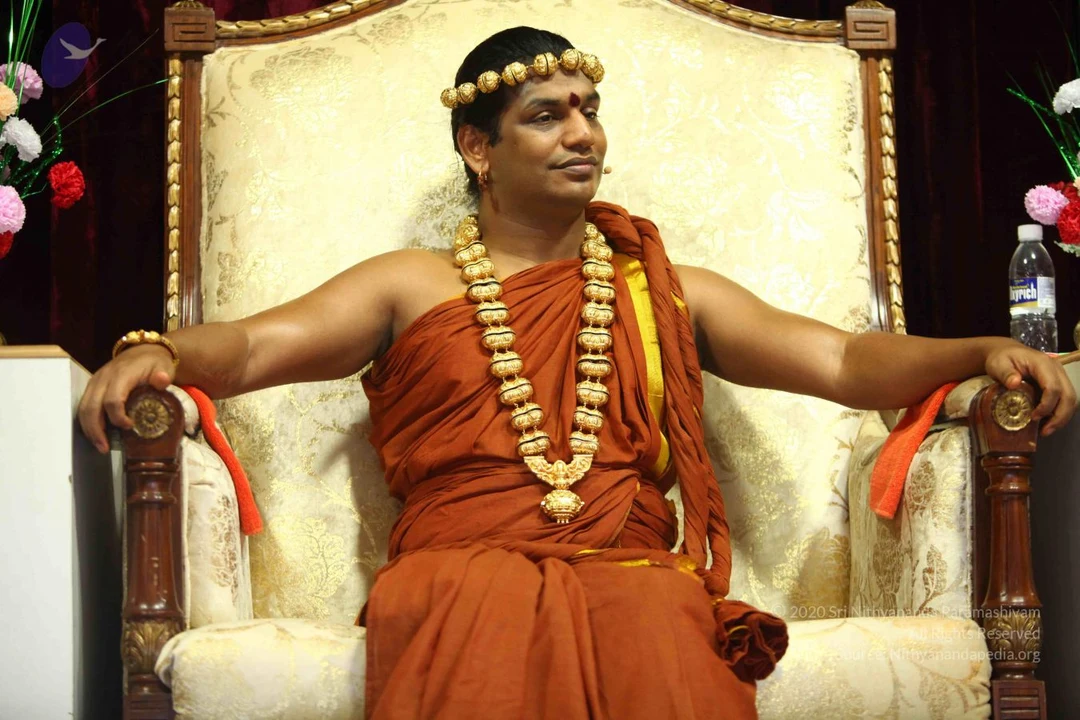
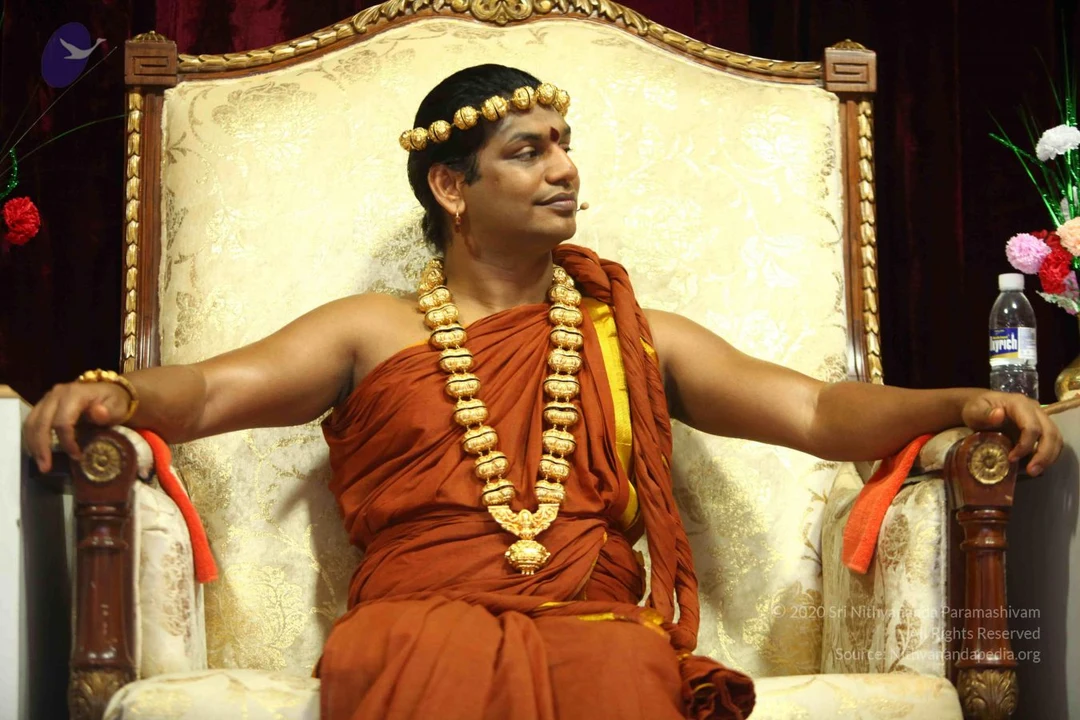
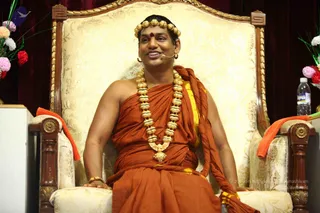
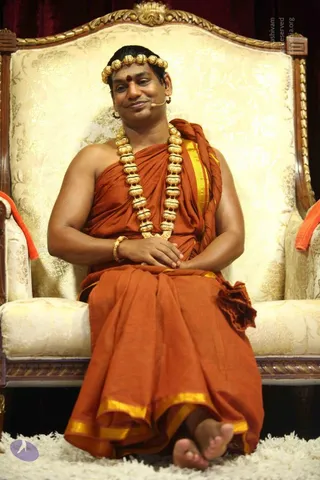
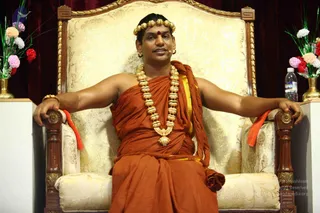
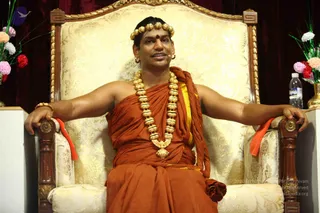
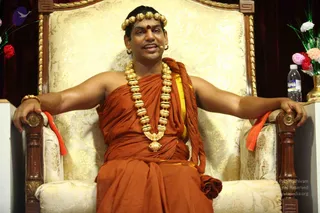
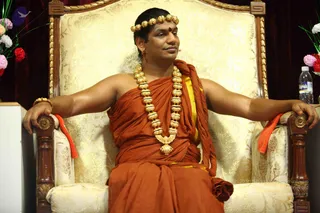
A smiling man sits on an ornate cream upholstered throne with gold-carved wooden armrests, speaking into a small headset microphone. He wears an orange-saffron cloth draped over his shoulders and body with a gold-yellow border, a long necklace of large gold-toned beads with a central gold pendant, a rudraksha-style bead crown on his head, a red bindi and a gold bracelet. Red and pink flowers and a water bottle stand beside the throne, with a dark red curtain behind.A seated man on an ornate cream and gold upholstered throne with gilded carved wooden arms, on a white shaggy rug in front of dark red drapes. He wears an orange-saffron cloth draped over one shoulder with gold borders, a heavy gold ceremonial necklace of beaded links, a gold bracelet, gold earrings, a gold beaded headband and a red kumkum bindi, and a small microphone is at his face. His hands rest folded in his lap and his legs are crossed. Both candidate cues are present: swept-back hair under a gold headpiece, saffron clothing and ceremonial gold necklace, so this is an appearance-based Swamiji (probable) seated in a discourse setting.A man in orange-saffron robes sits on an ornate cream and gold upholstered throne with carved wooden armrests, arms spread wide along the arms. He wears a gold crown-like headband, a heavy gold necklace of large beads with a central pendant, a gold bracelet, and small earrings, and a microphone is clipped near his face. Behind him are dark red drapes and vases of pink, peach and red carnations with greenery, and a water bottle sits on a side table. Appearance-based label: a person, seated in a throne-like chair in orange robes with gold ornaments.Photo of a single seated man on an ornate gold-and-cream upholstered throne with carved wooden arms, speaking as if addressing an audience. He wears a saffron-orange draped robe over his torso, a heavy gold multi-bead necklace with a central gold pendant, a gold headband with gold beads across his forehead, a red vibhuti-style mark on his forehead, and a gold bangle on his wrist. Both arms rest open along the chair arms, which have orange cloth draped over them. Behind him are red velvet drapes, and vases of pink, white and red flowers stand at each side; a water bottle sits on the right. The man appears to be the a person candidate in an in-person appearance, with a compatible presentation of saffron robes, rudraksha-style gold beads and ornate ceremonial jewellery.A man seated on an ornate cream and gold brocade throne with wooden carved arms, speaking with arms spread wide along the armrests. He wears an orange-saffron draped garment over his bare shoulder, a long gold multi-bead necklace with a large gold pendant, a gold headband crown, gold bangles and a red bindi, with a small microphone at his ear. Behind him are red and pink flowers in a gold vase and a water bottle on a side table. Appearance cues include the saffron clothing, ceremonial gold necklace and crown, so this is a probable depiction of Swamiji seated in a satsang setting.A photograph of a man seated on an ornate gold-and-cream upholstered throne with carved wooden arms, both arms resting outstretched on the armrests. He wears a saffron-orange draped robe with a yellow inner cloth, a thick ceremonial gold bead necklace with a gold pendant, a gold bead headband, a red bindi and a gold earring, plus a gold bangle. An orange cloth is draped over the armrests. Flowers in pink, white and red sit in vases at the sides, and a water bottle stands on a table at right. Swamiji (probable): long dark hair, saffron/orange clothing, gold ceremonial necklace and bead headband indicate a seated spiritual master presiding on a throne.

Engenius

52 photosSource gallery
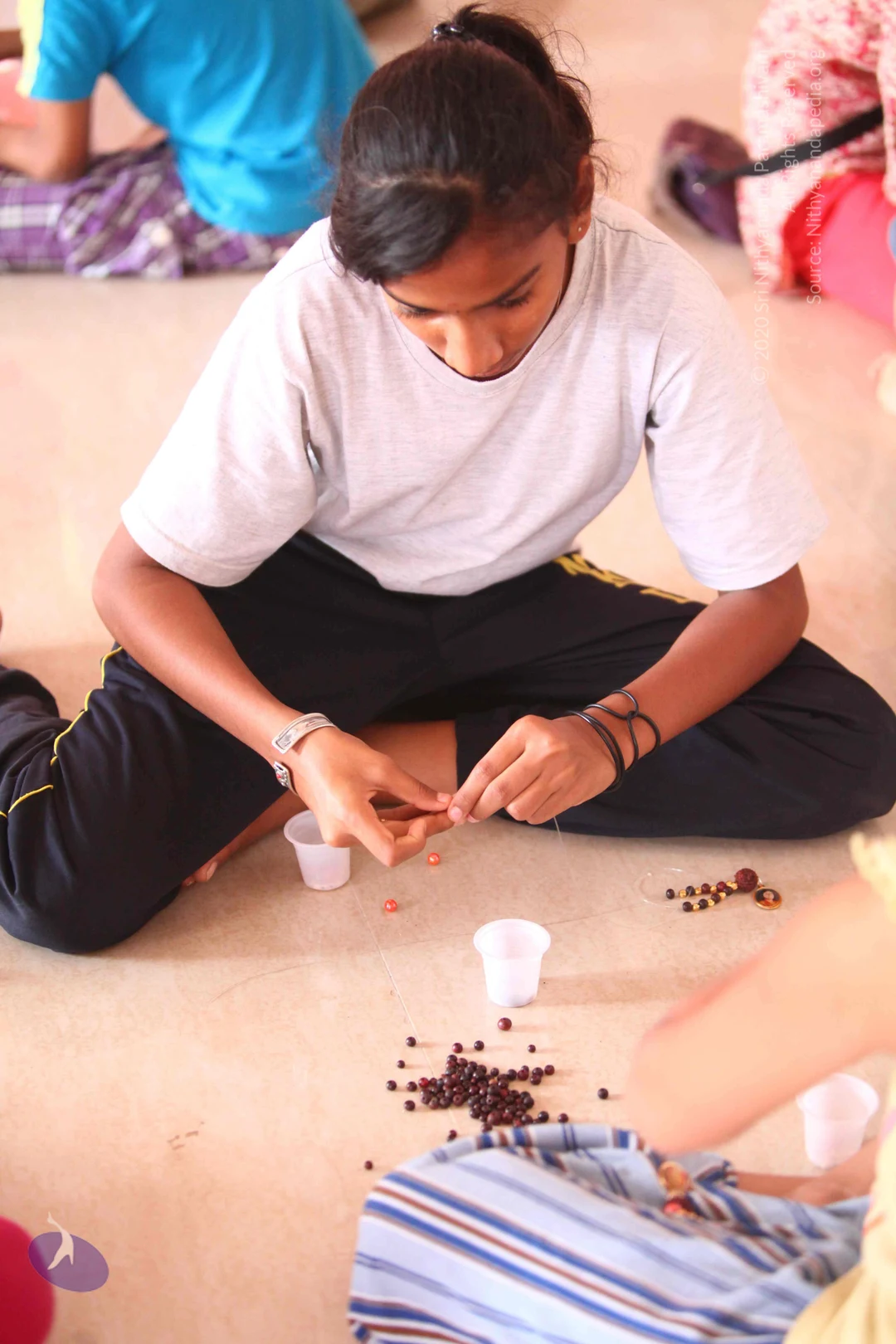
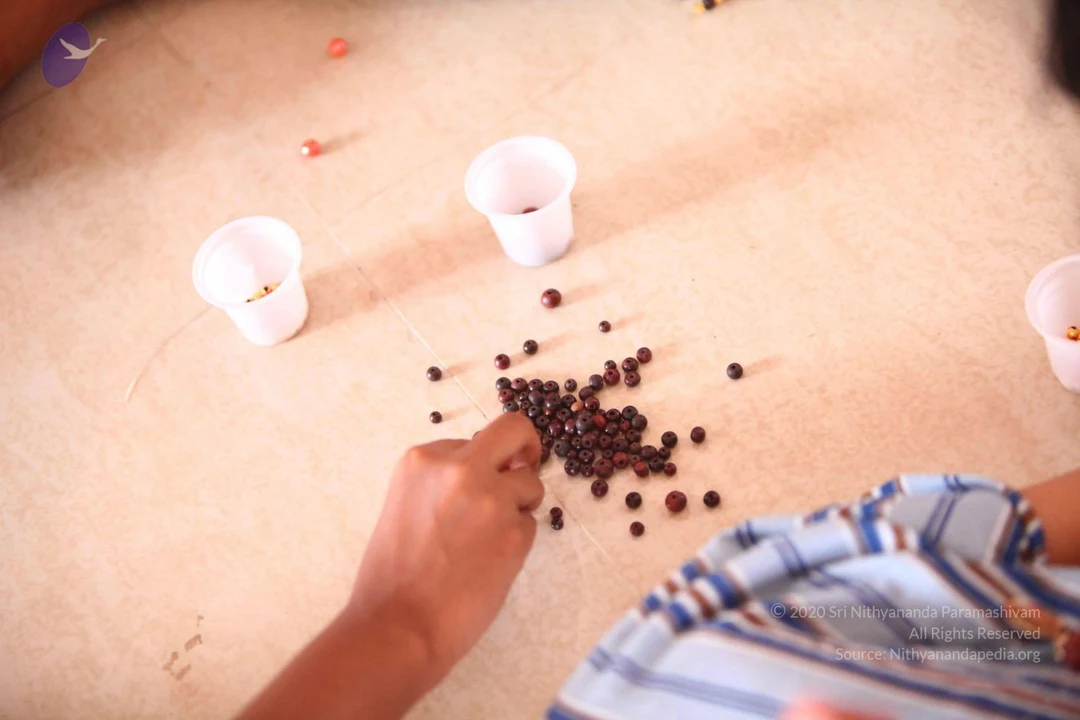
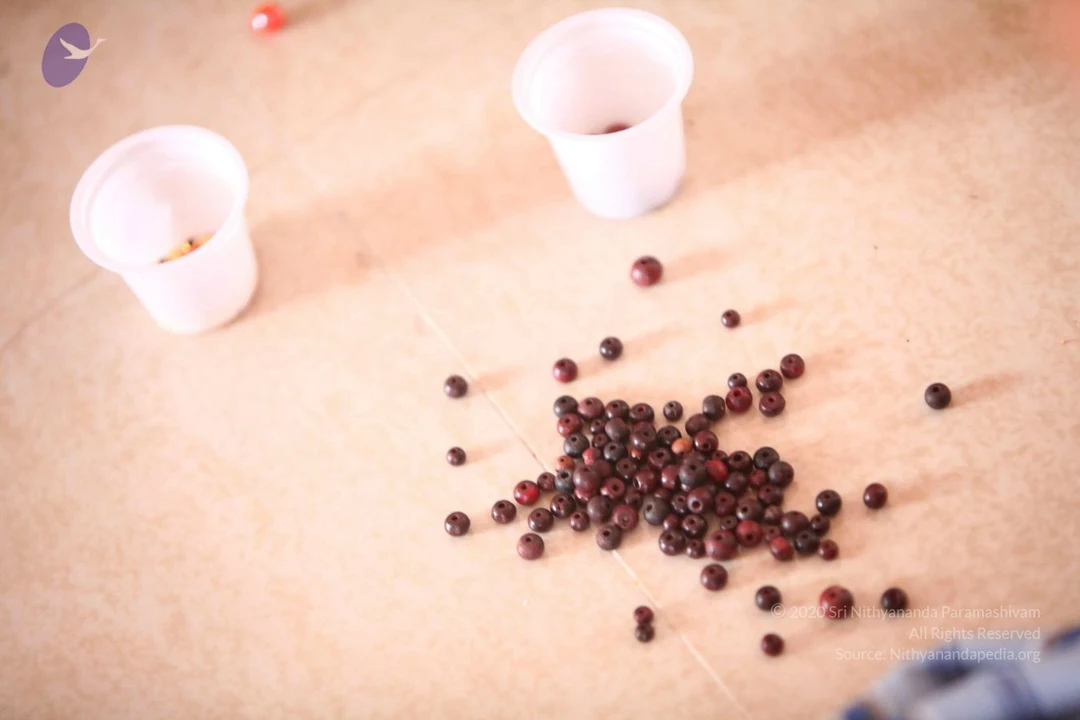
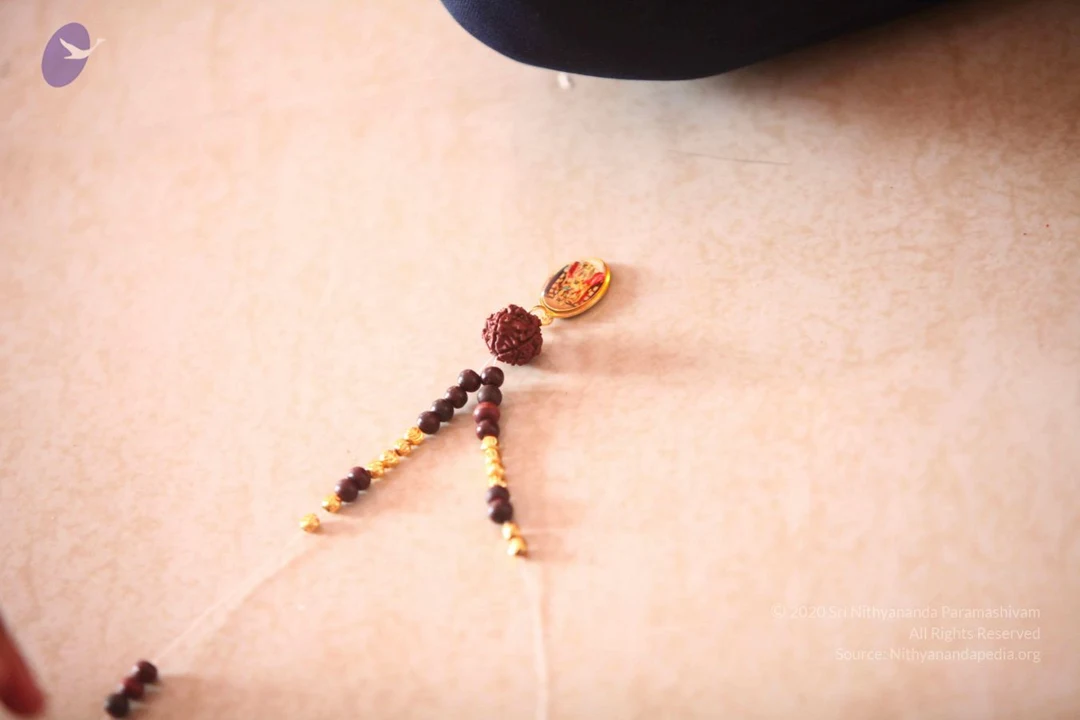
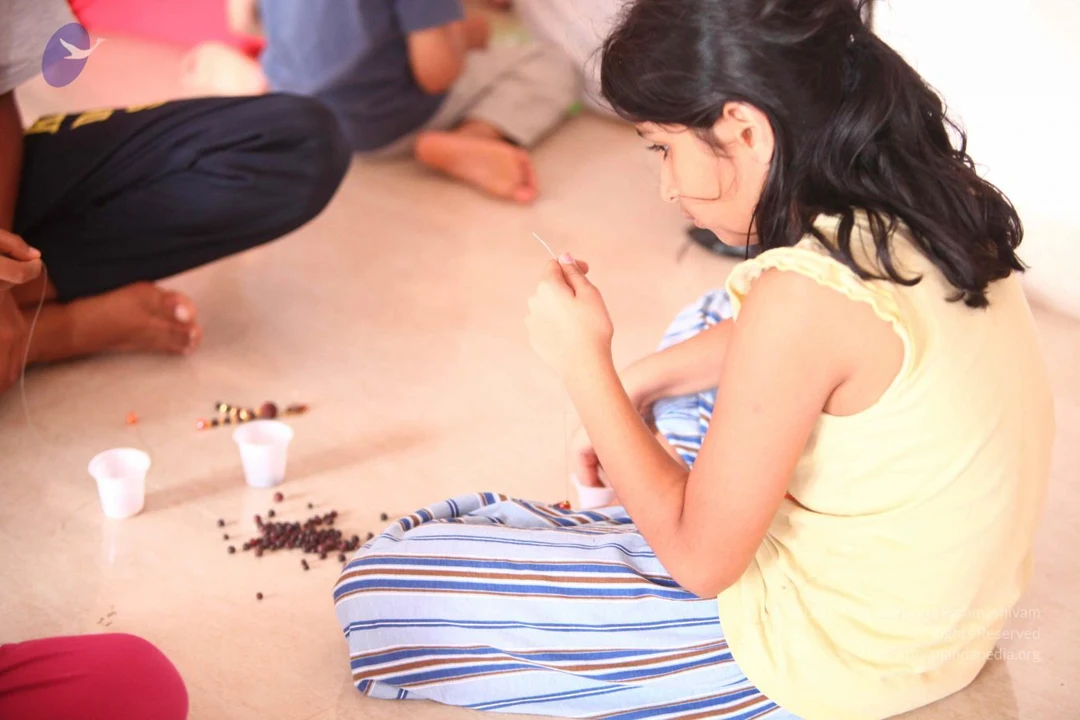
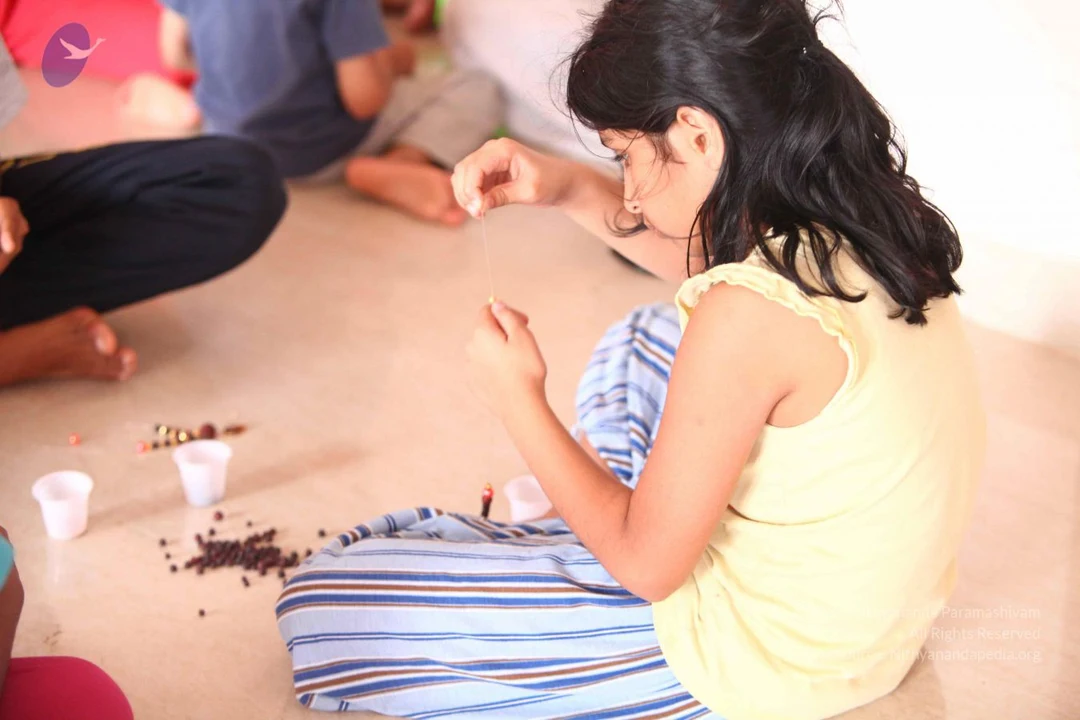
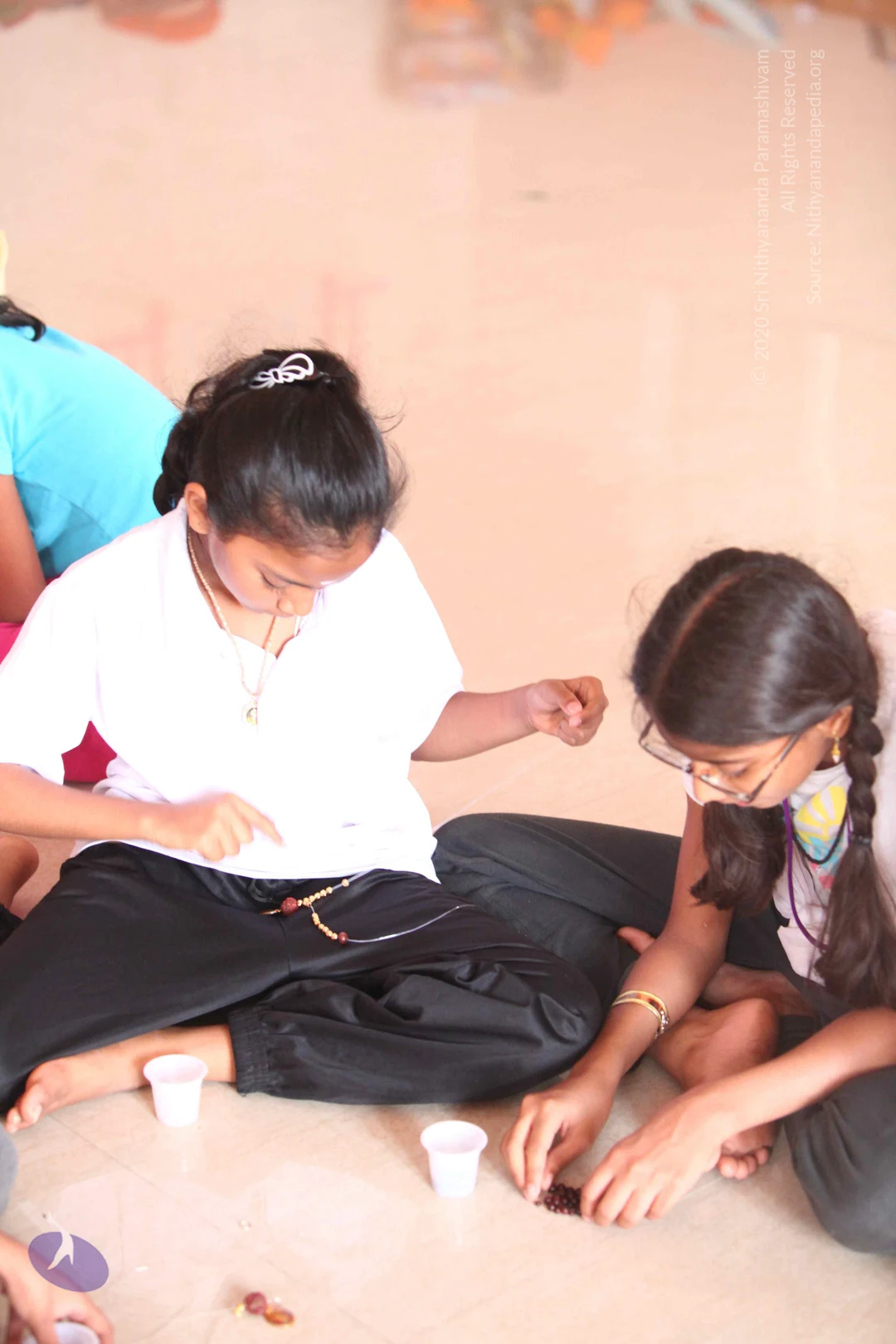
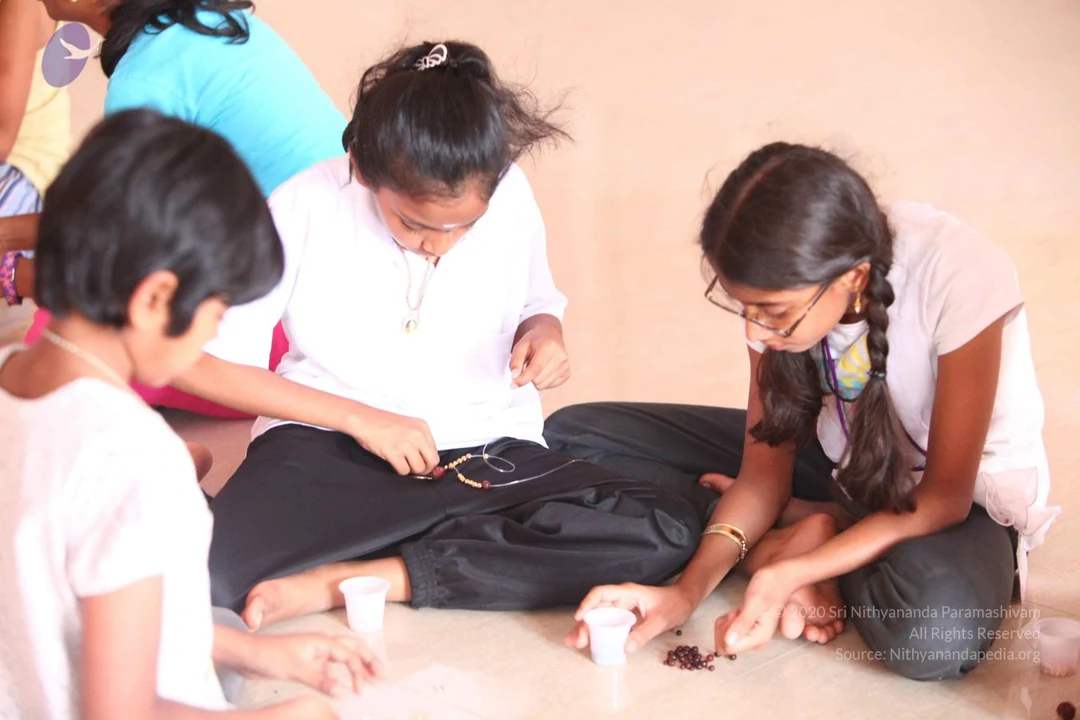
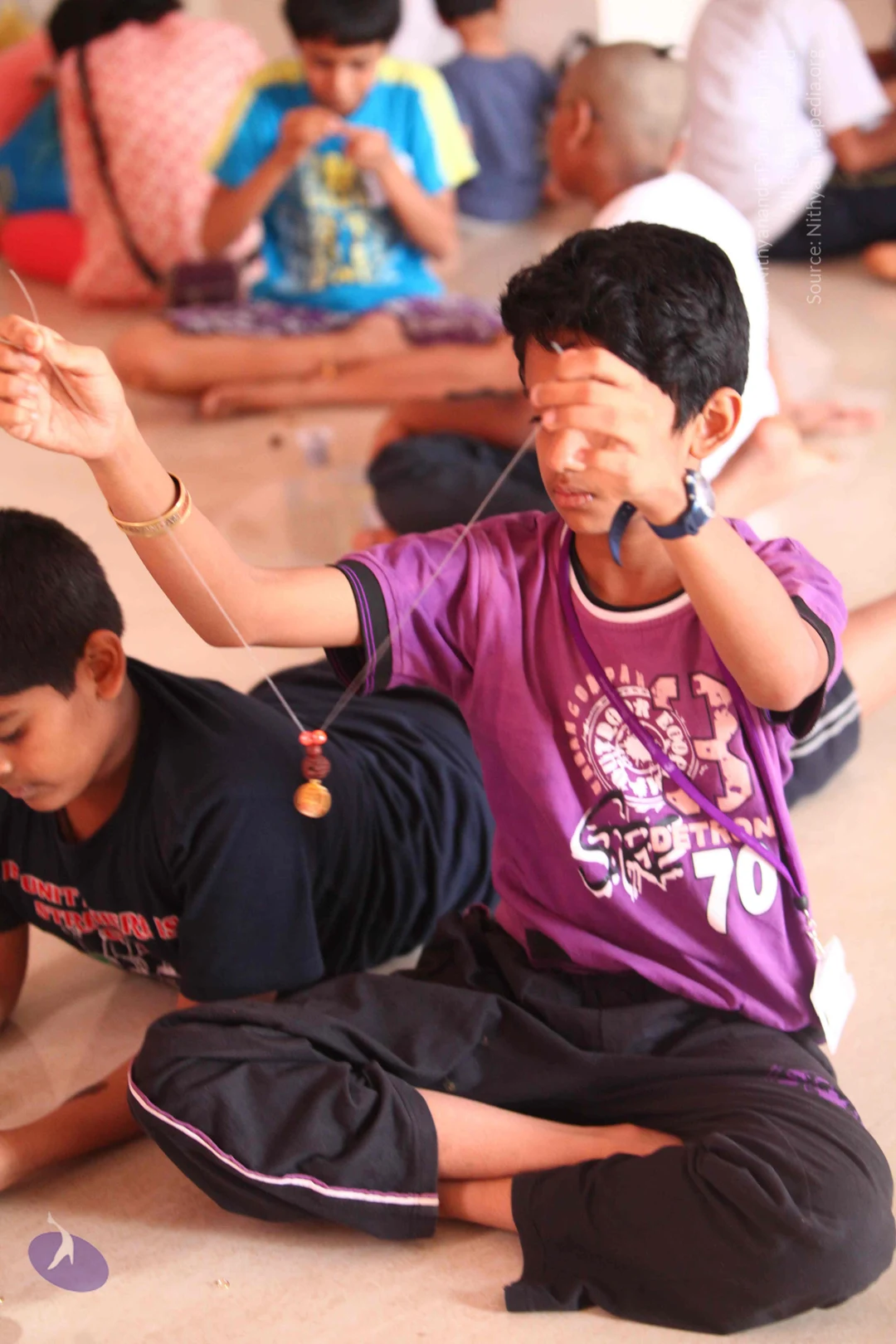
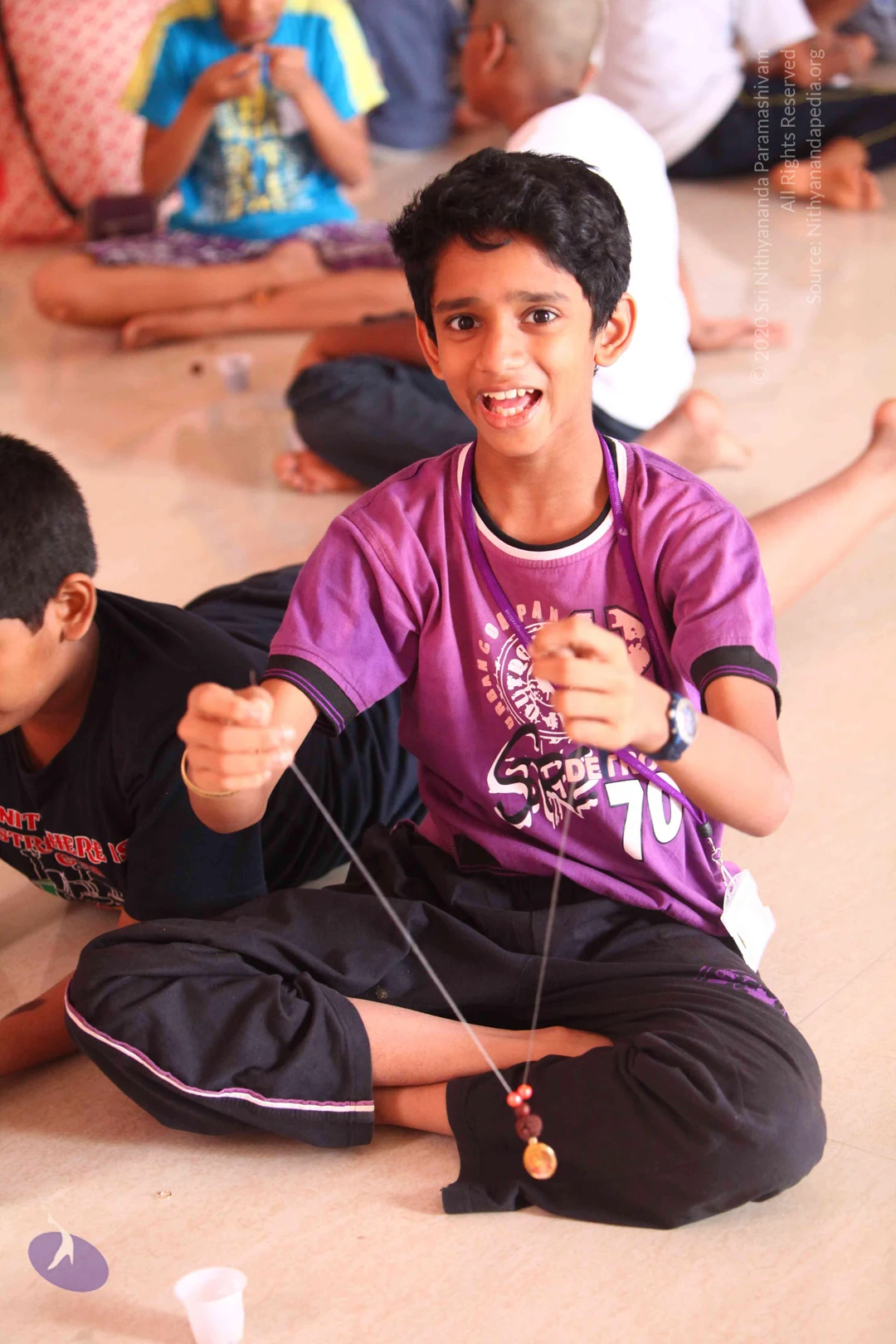
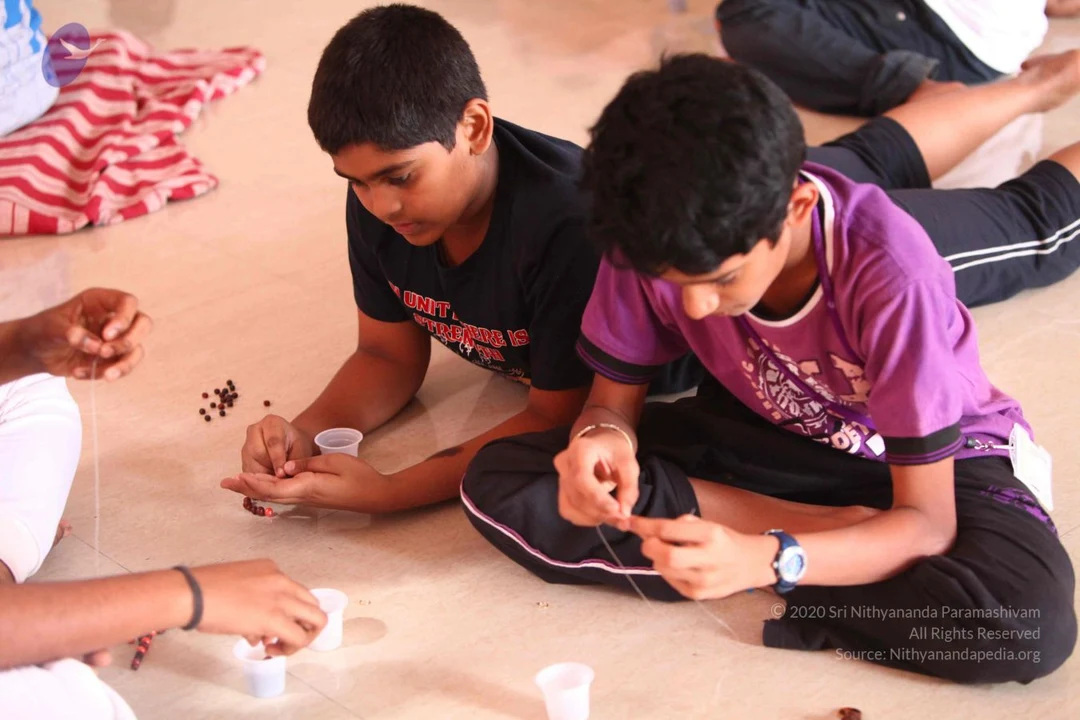
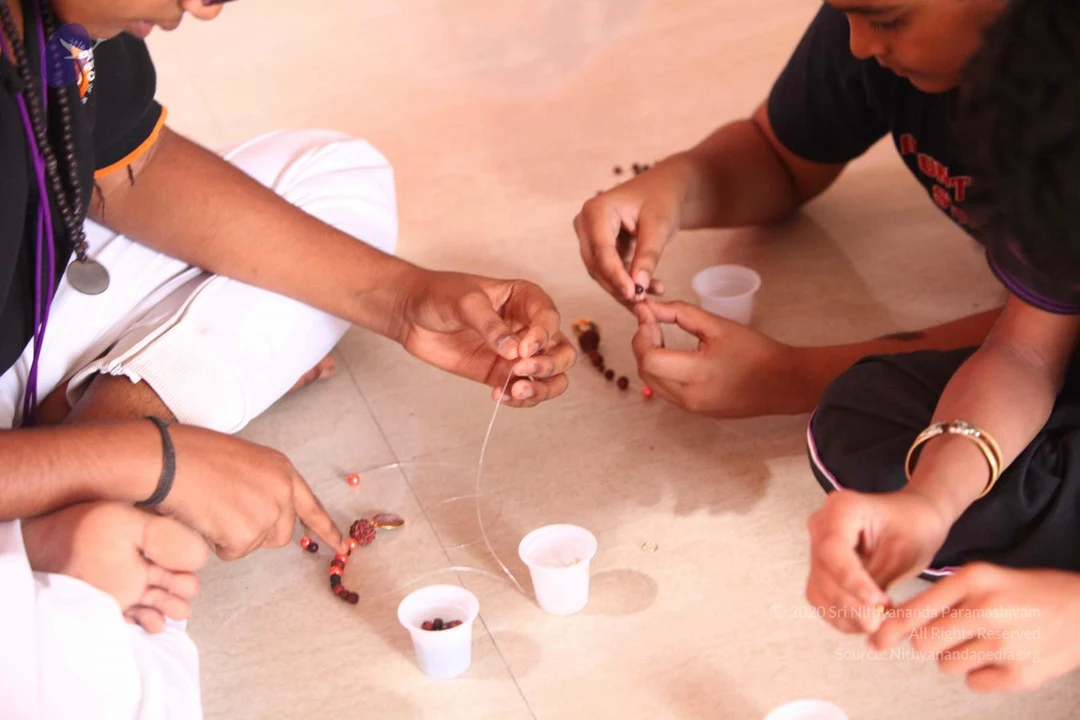
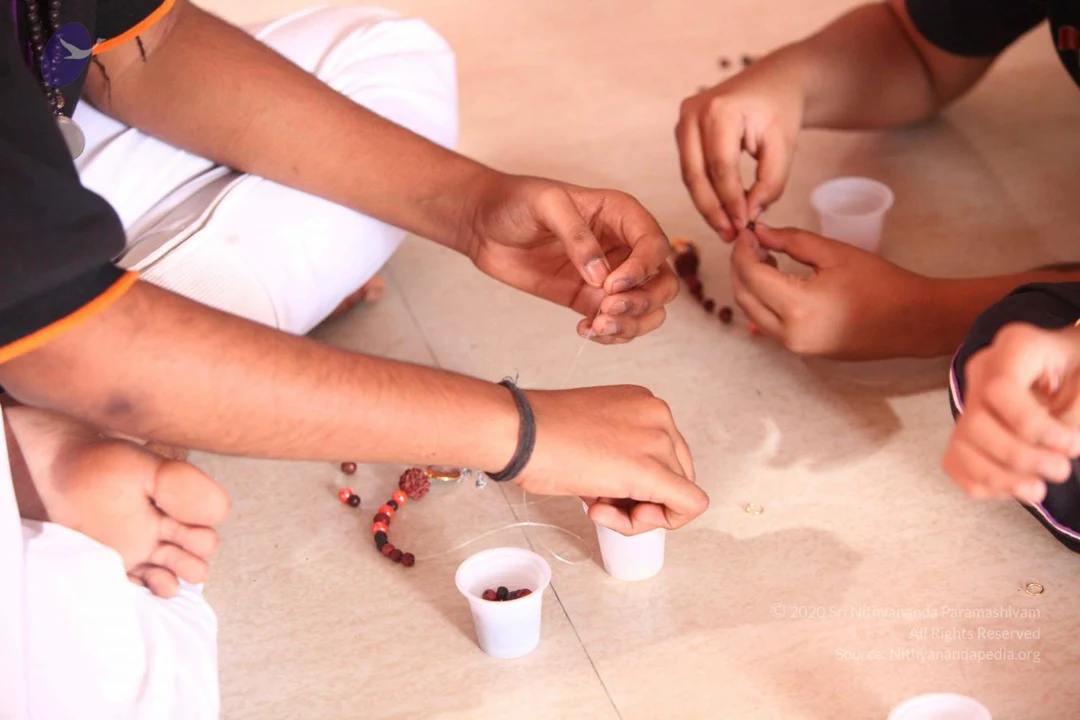
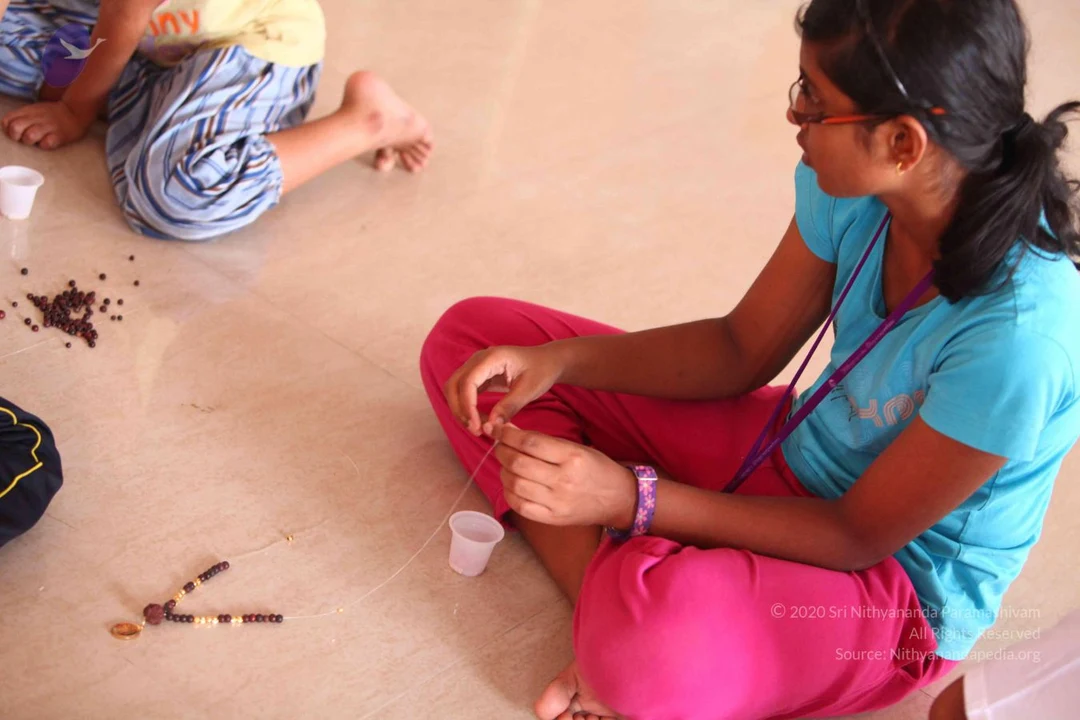
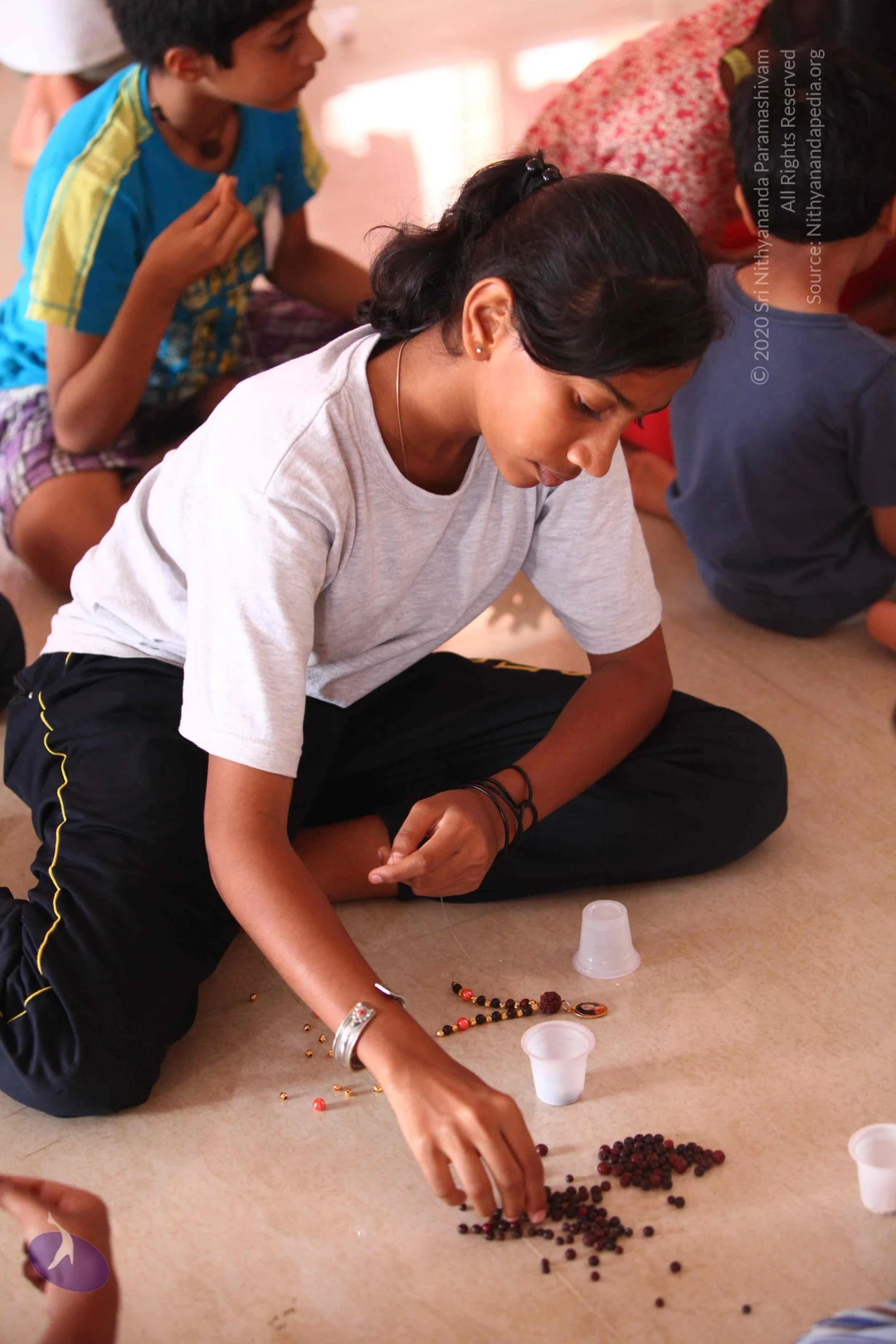
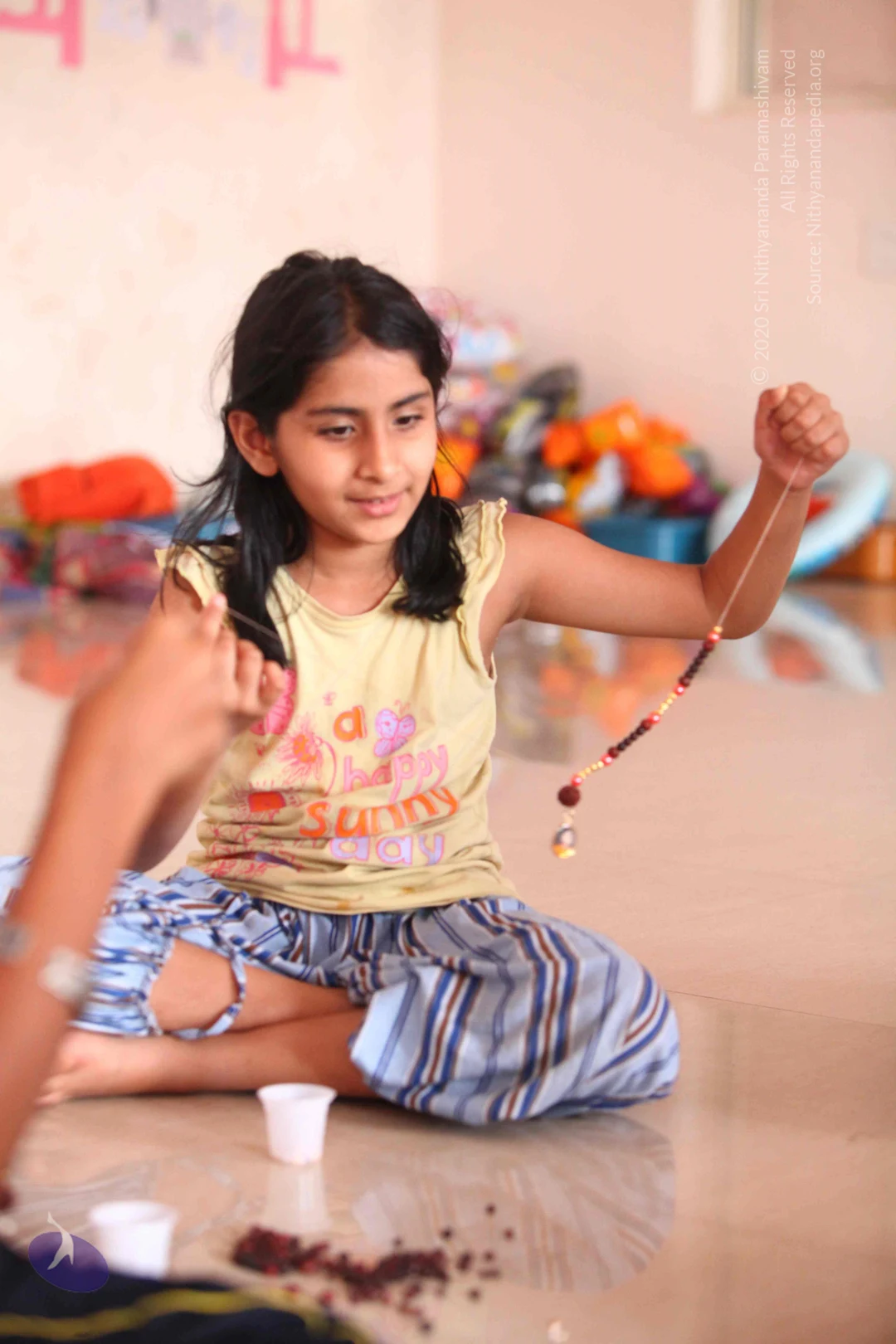
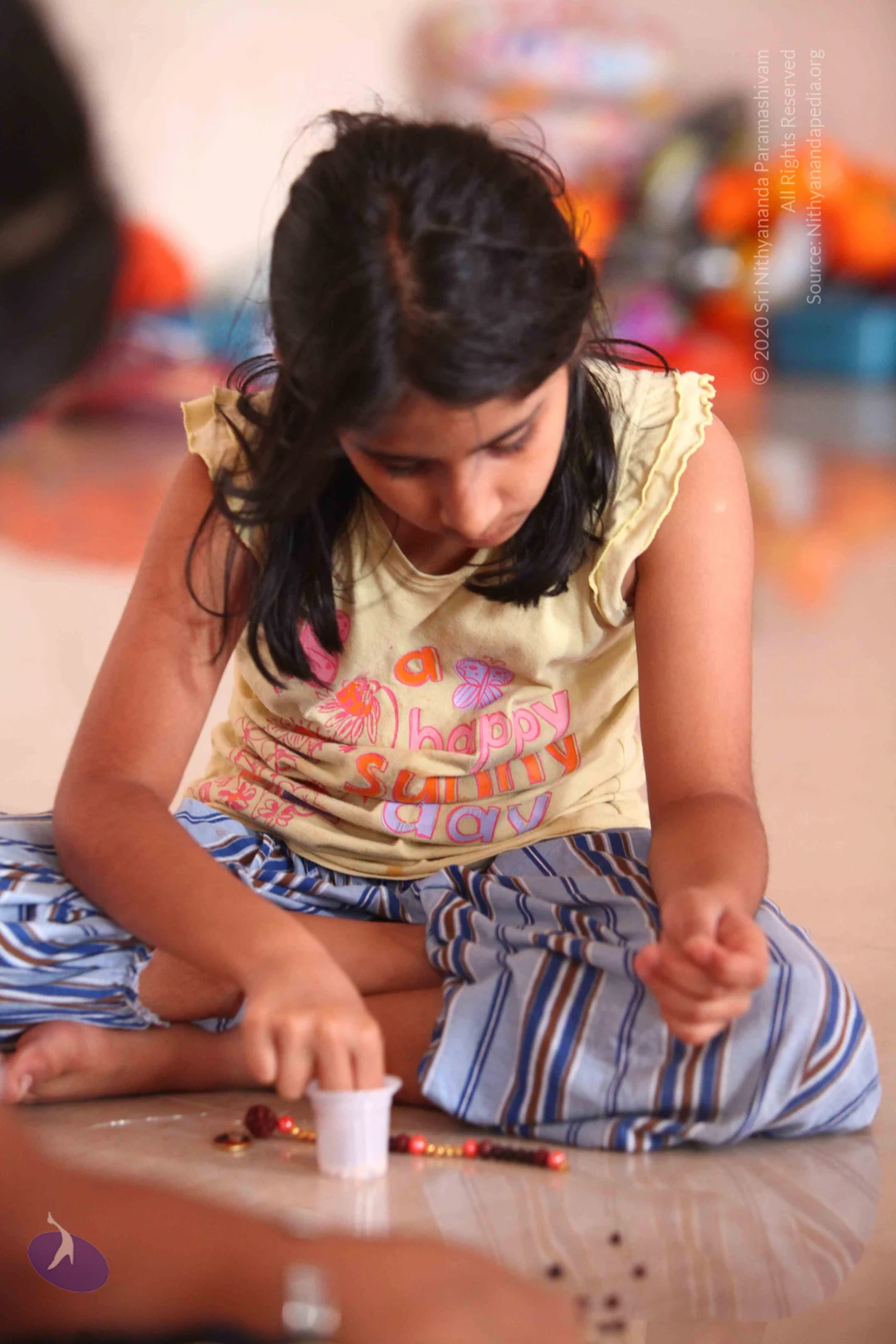
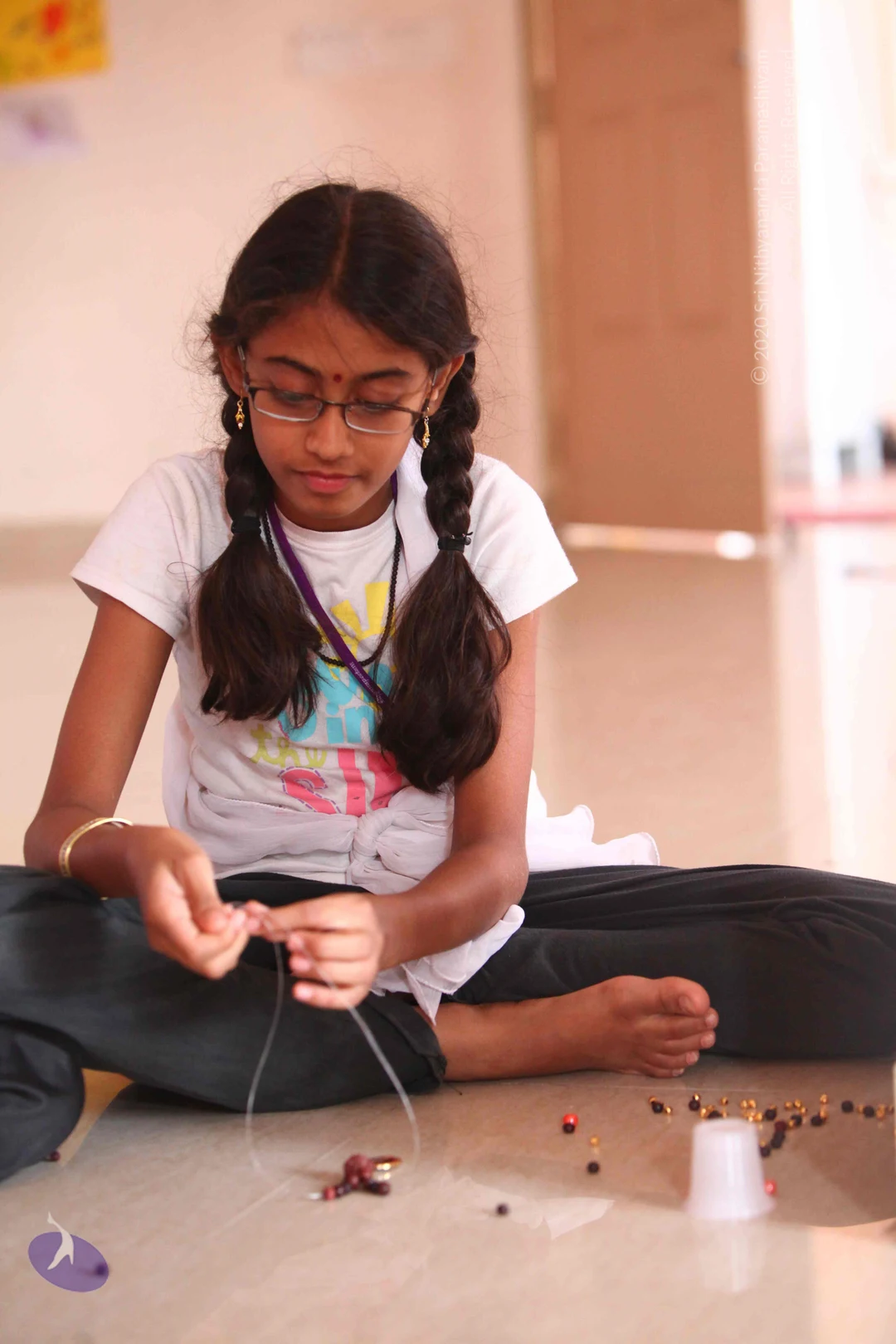
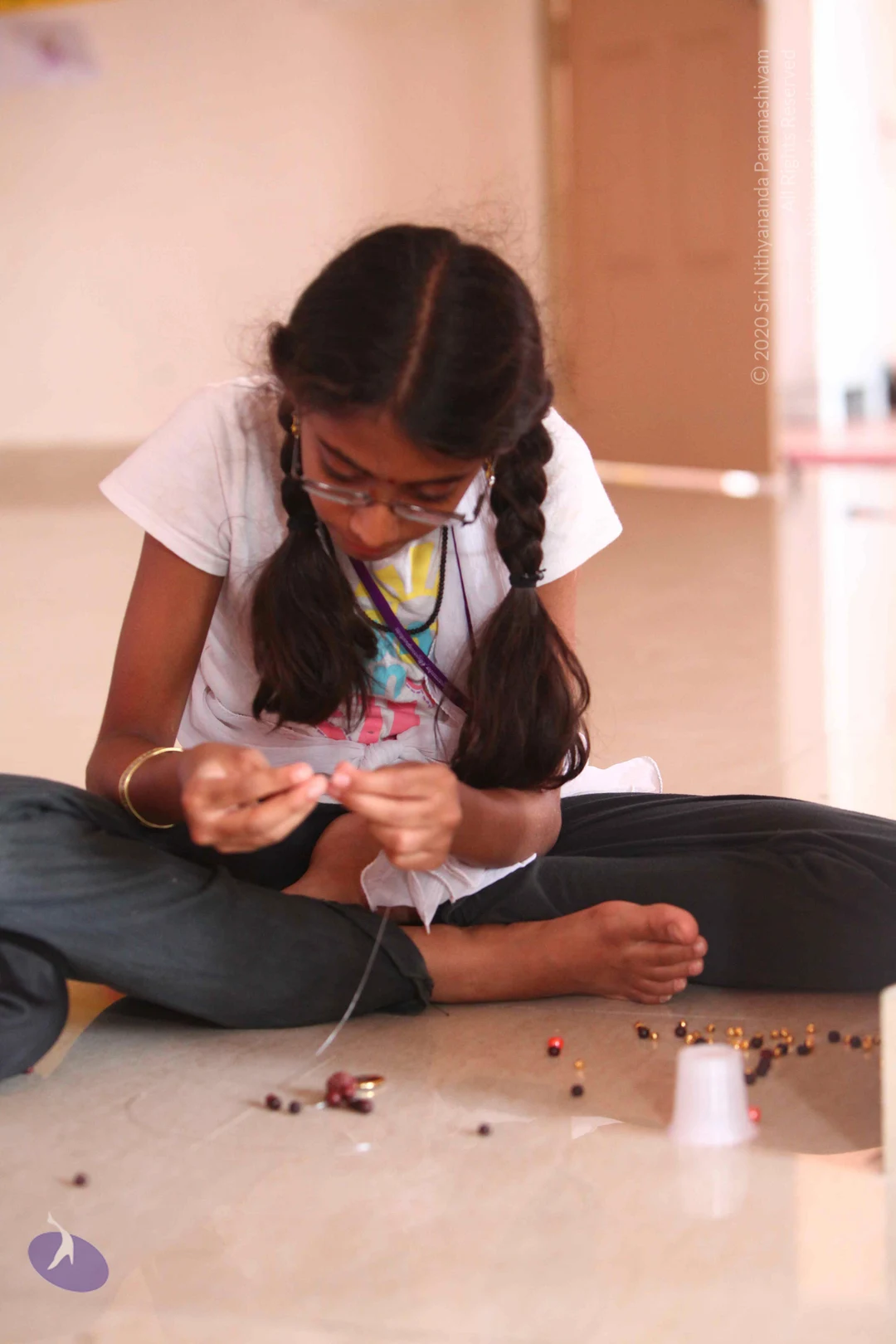
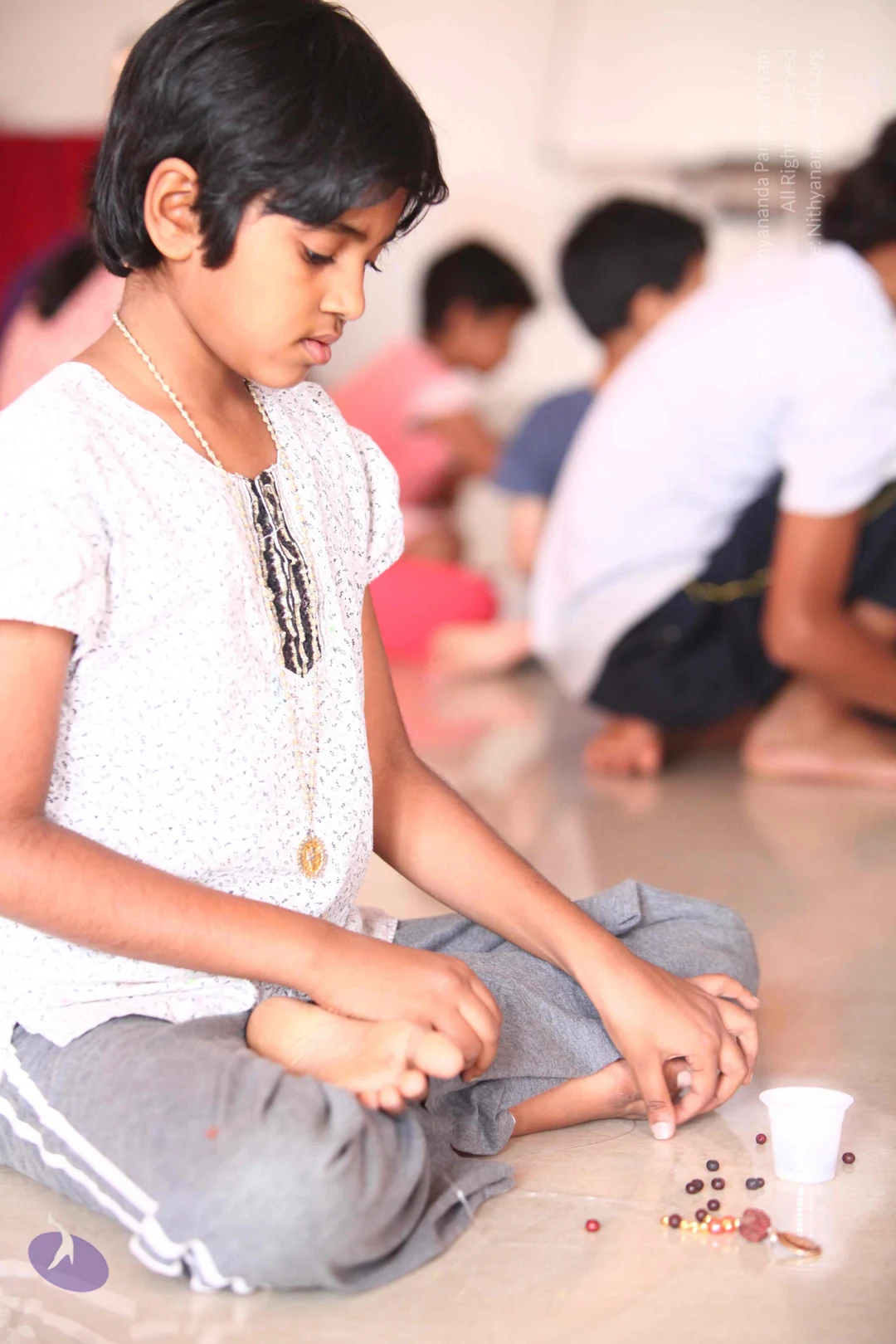
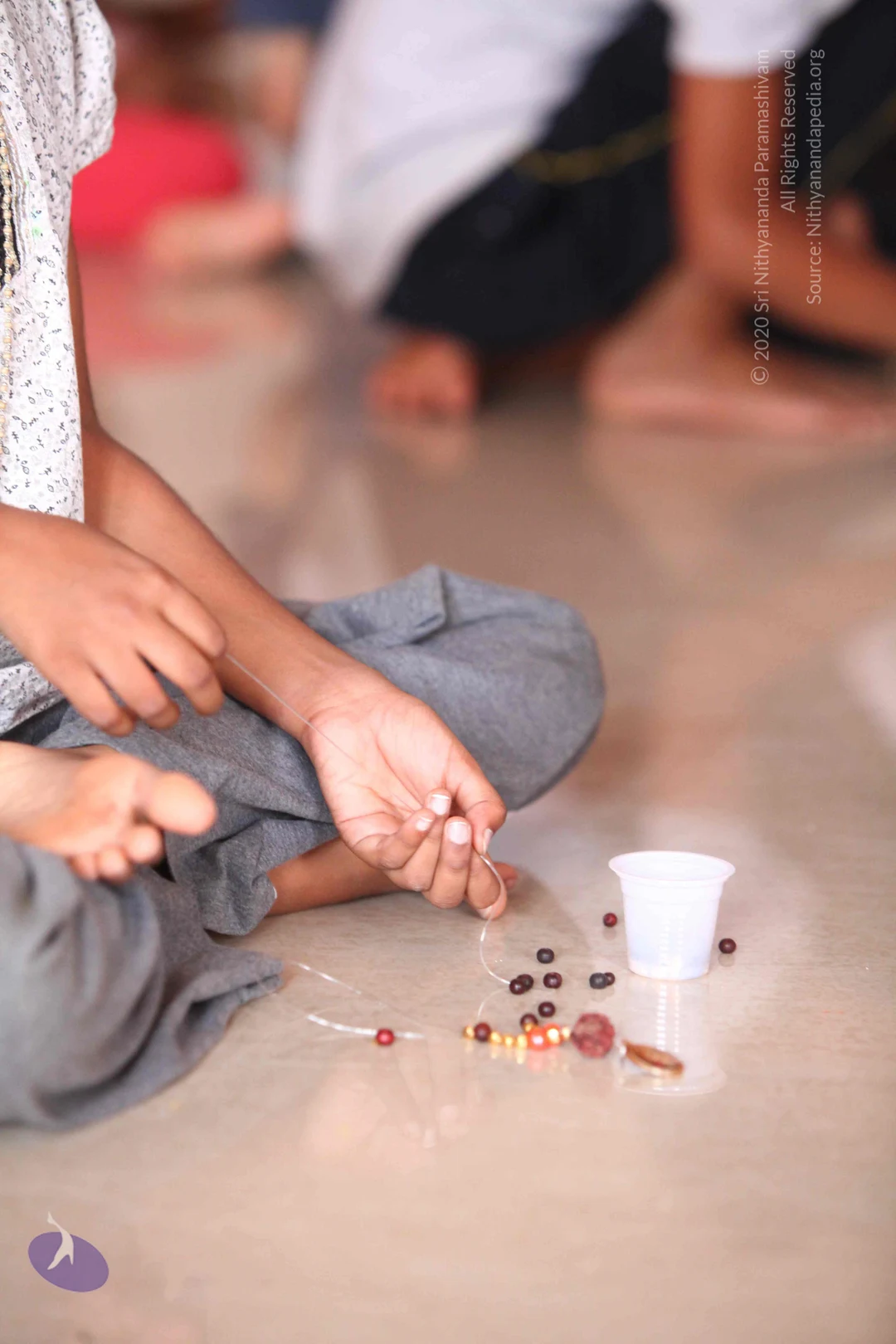
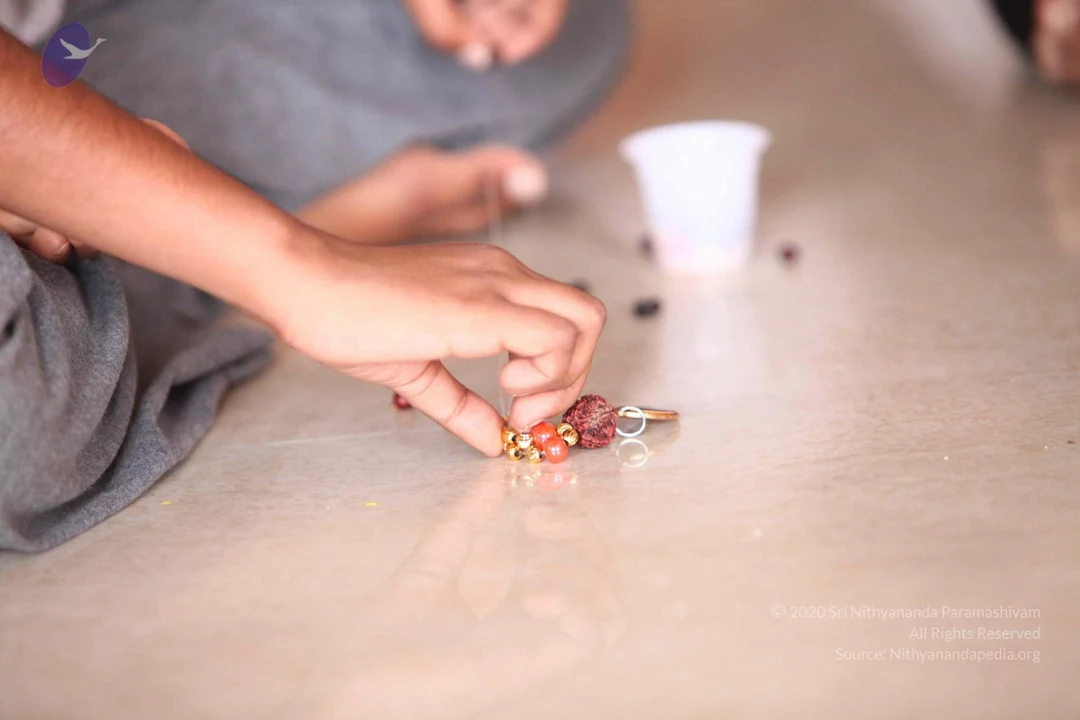
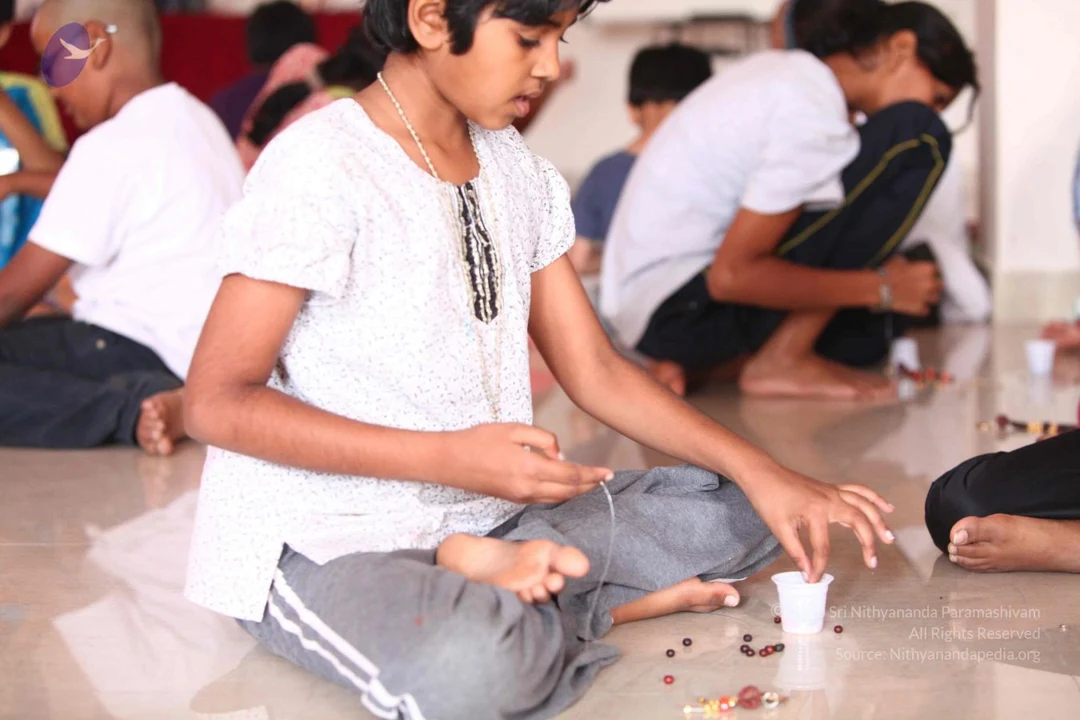
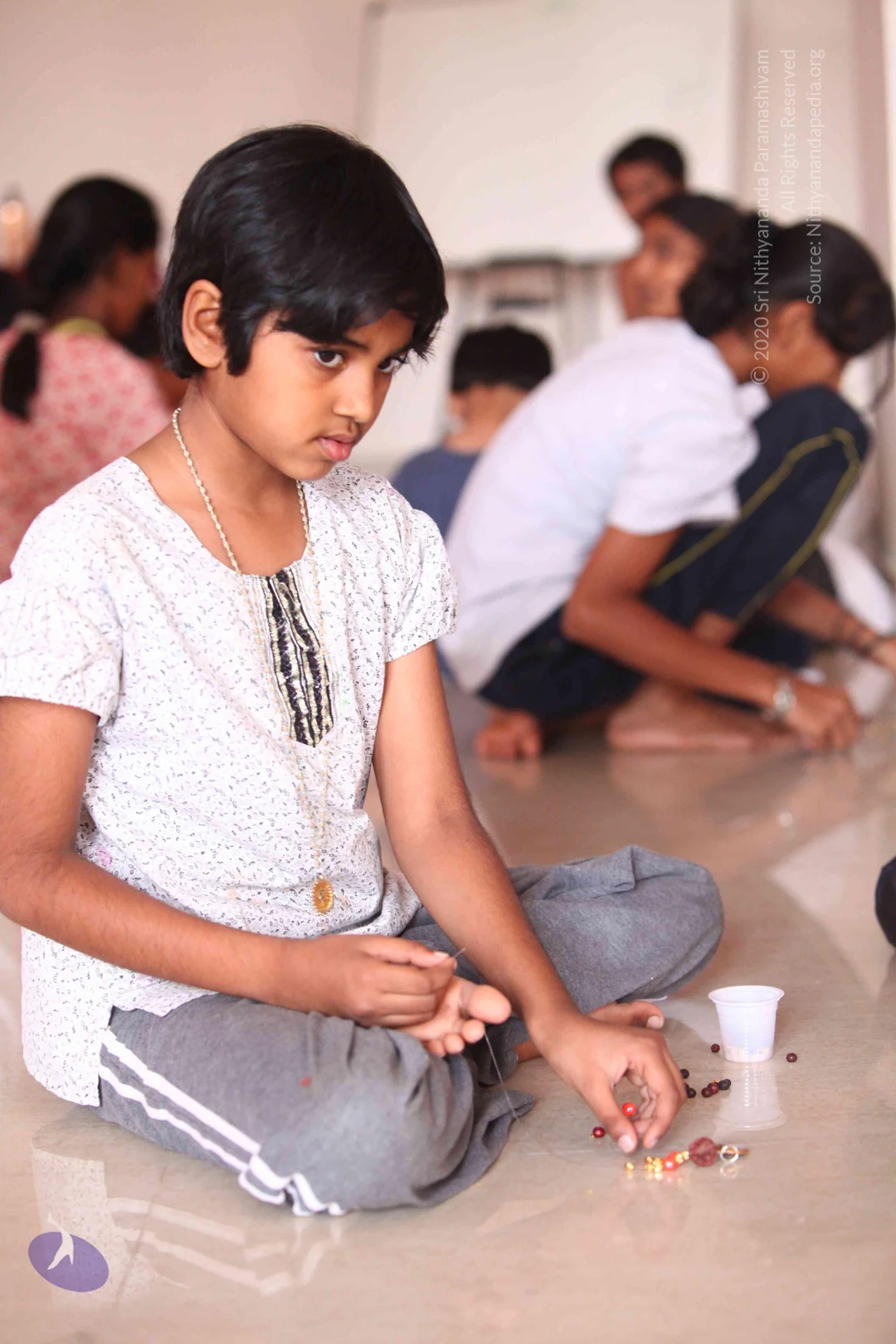
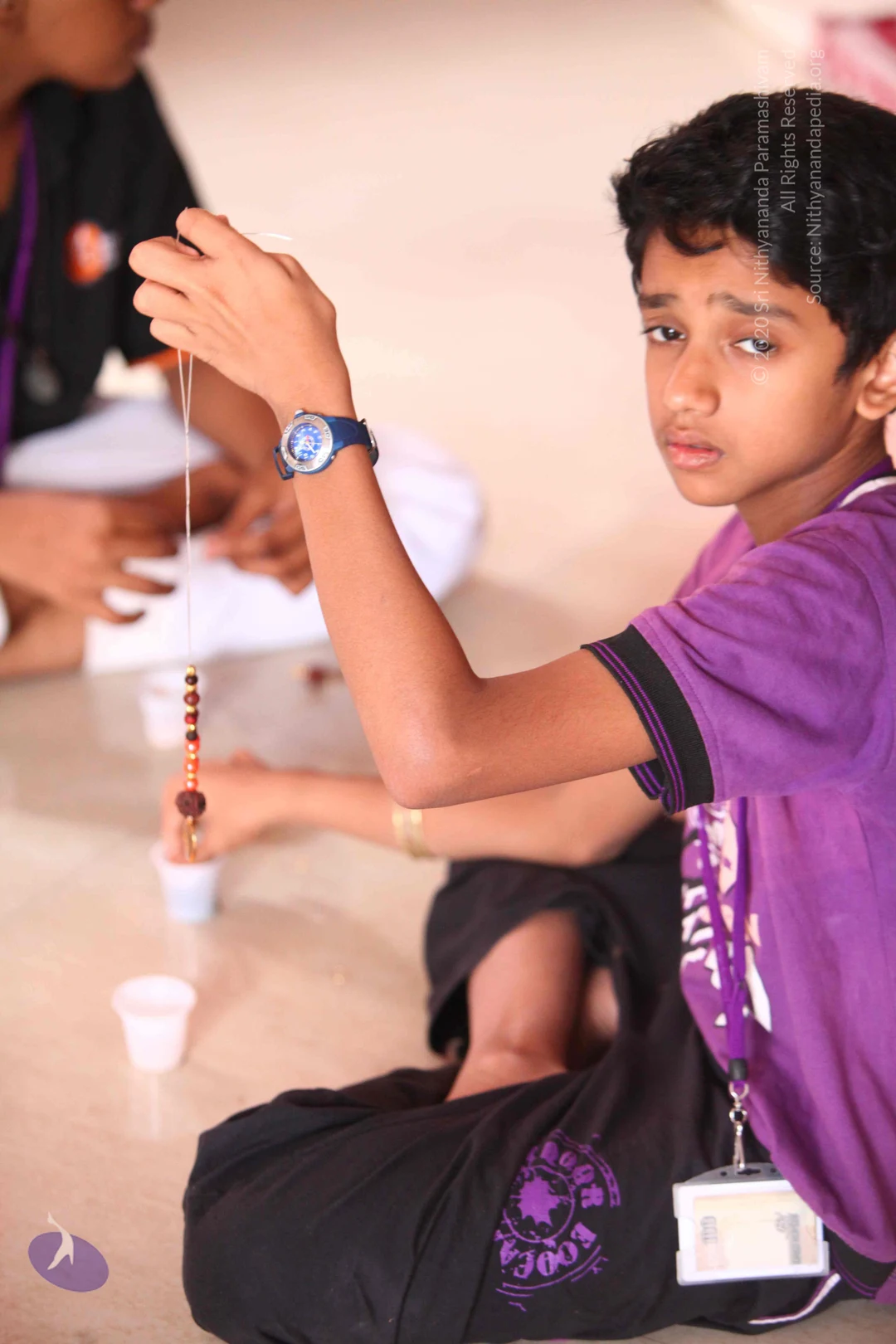
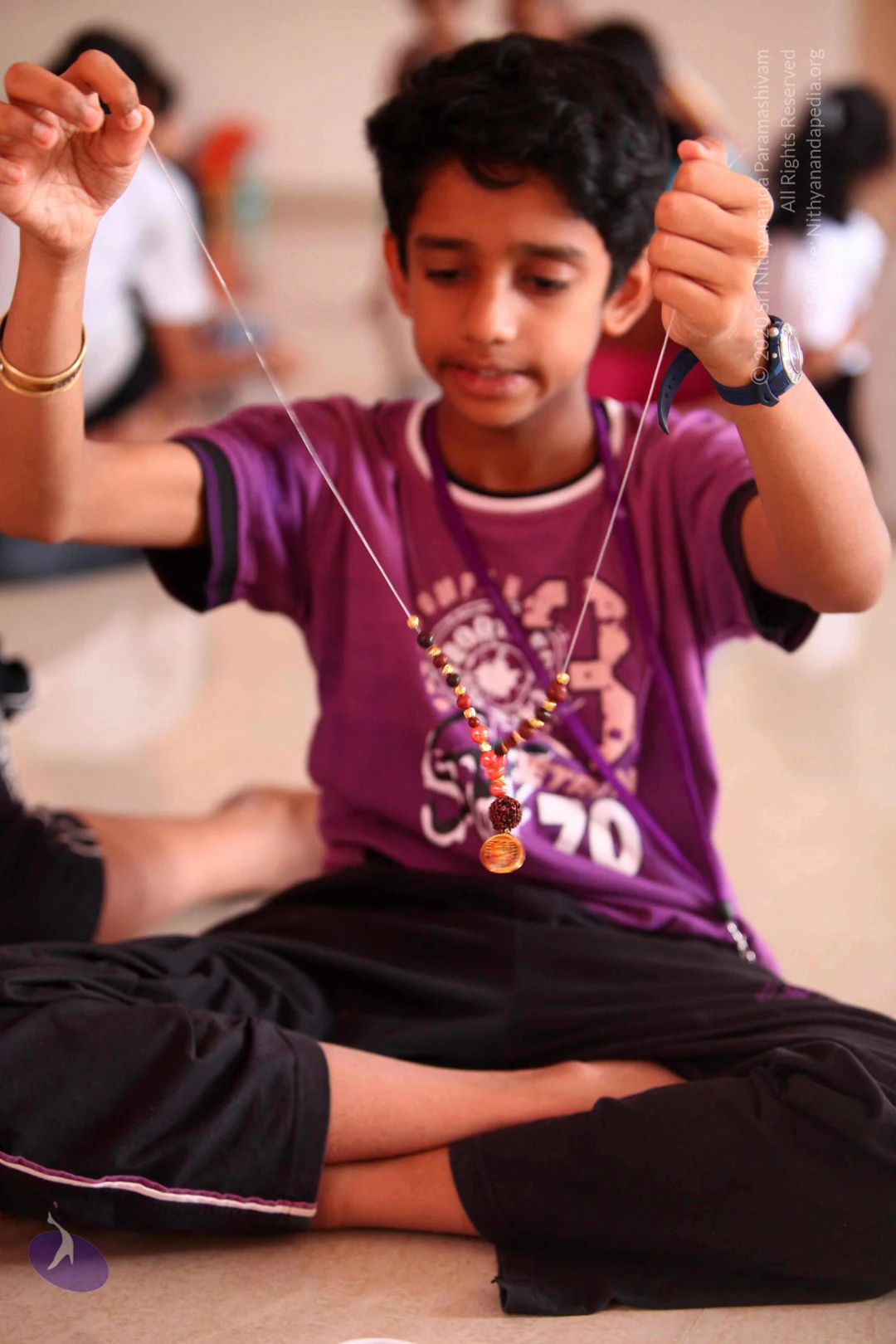
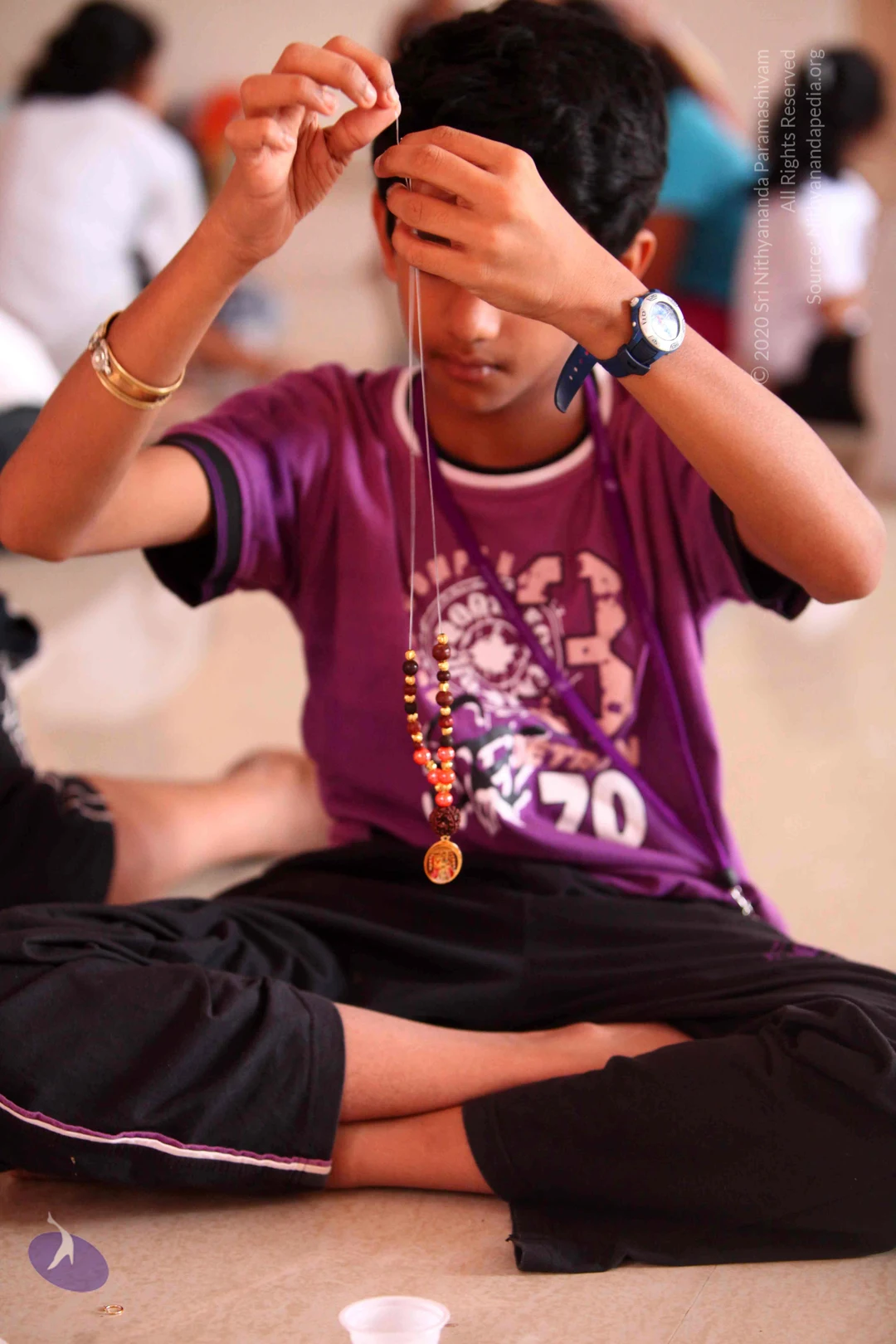
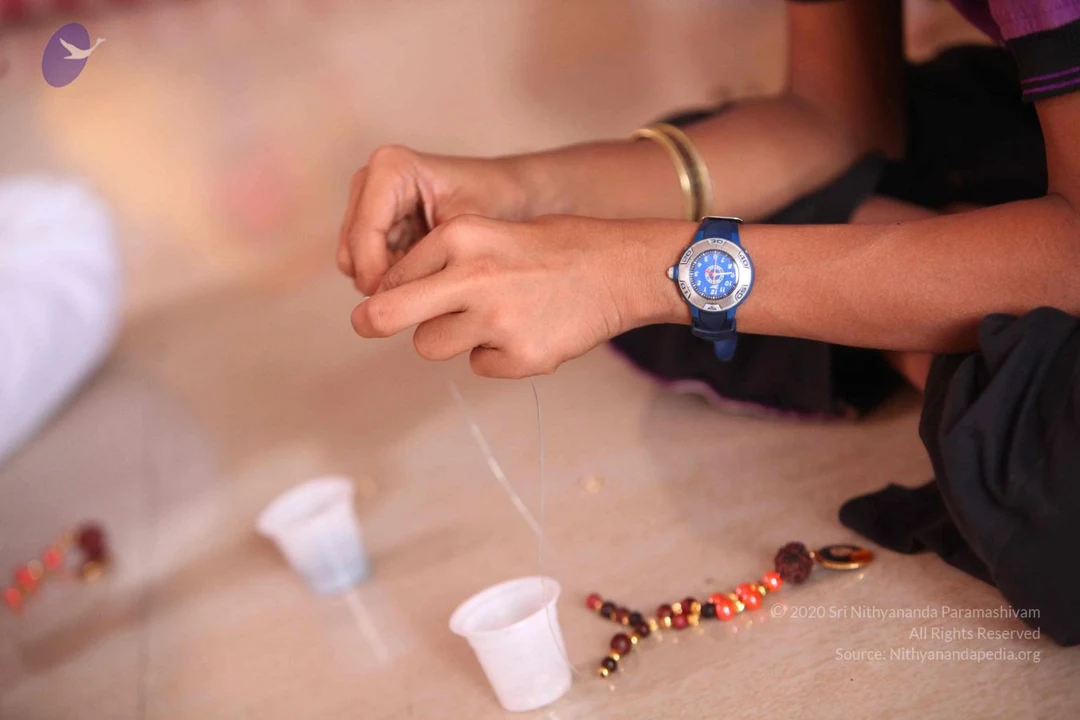
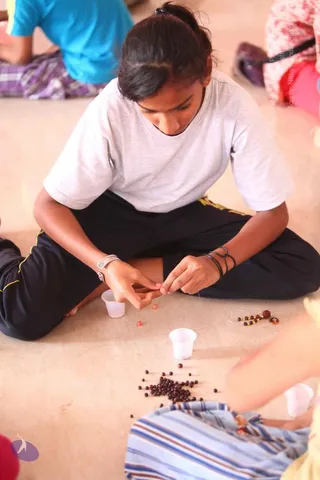
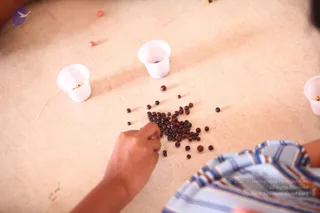
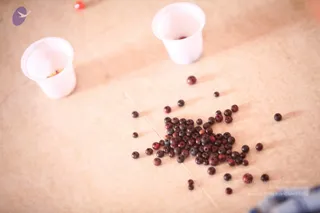
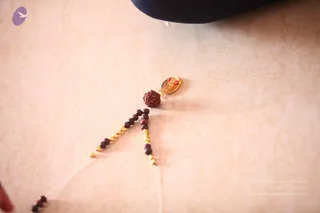
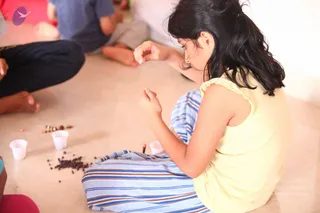
A young woman with dark hair tied back sits cross-legged on a pale floor, wearing a light grey t-shirt and black track pants with yellow stripes, and silver and black bangles on her wrists. She is threading small dark red-brown beads onto a thin string, holding a bead between her fingers. Small white plastic cups hold beads, and loose beads are scattered on the floor, with a finished strand partly visible on the right. A second person in a blue-and-white striped garment sits at the lower edge, and another seated person in blue appears at the top left. The setting looks like a hall for bead-stringing.Overhead photo of a person's hand sorting a pile of dark reddish-brown rudraksha beads on a beige floor. Three white plastic cups are placed around the pile, some containing a few beads. A blue-and-white striped garment is visible at the lower right edge. Scattered loose beads lie across the floor. No faces are visible.Close overhead photograph of a tan tabletop with a scatter of small dark brown and reddish-brown wooden beads, possibly rudraksha-style seeds or beads, spread in a loose pile at the right. Two white plastic cups sit at the upper left and upper top, one holding a few small orange-yellow pieces and one holding a single red bead. A small red bead lies separately near the top edge. A blurred blue-striped sleeve is visible at the bottom right corner. No people are shown in the frame apart from that partial sleeve, and no ritual or event is visible.Close-up photo of a rudraksha mala lying on a beige textured surface. A large dark brown rudraksha bead sits at the top, with a small gold pendant bearing a red and gold image of a deity beside it. Smaller dark red beads and gold spacer beads trail downward in a diagonal line. A dark object is visible at the top edge of the frame.A young girl in a pale yellow sleeveless top and blue-and-white striped skirt sits cross-legged on a light tiled floor, threading dark rudraksha beads onto a string with a thin needle. Scattered beads lie on the floor beside two small white plastic cups, and a partly strung bead necklace rests nearby. Other people sit at the edge of the frame, including a person in black trousers and a person in red trousers, with a bare-footed figure behind them. The scene suggests ashram life and a bead-stringing activity.A young girl in a yellow sleeveless top and blue-and-white striped skirt sits cross-legged on a pale floor, threading dark rudraksha-like beads onto a string. Scattered beads and two small white cups lie on the floor beside her, and other seated children in dark clothing are partly visible at the edges. The setting appears to be a simple indoor room, with a white wall behind.
IA-Afternoon-Yoga

8 photosSource gallery
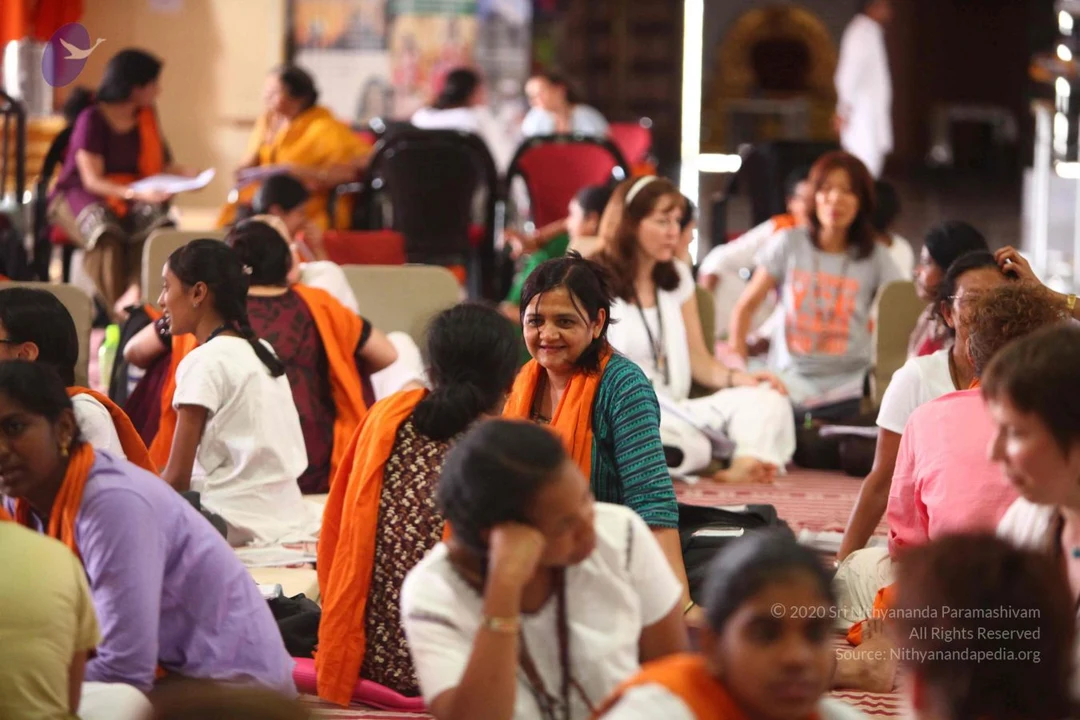
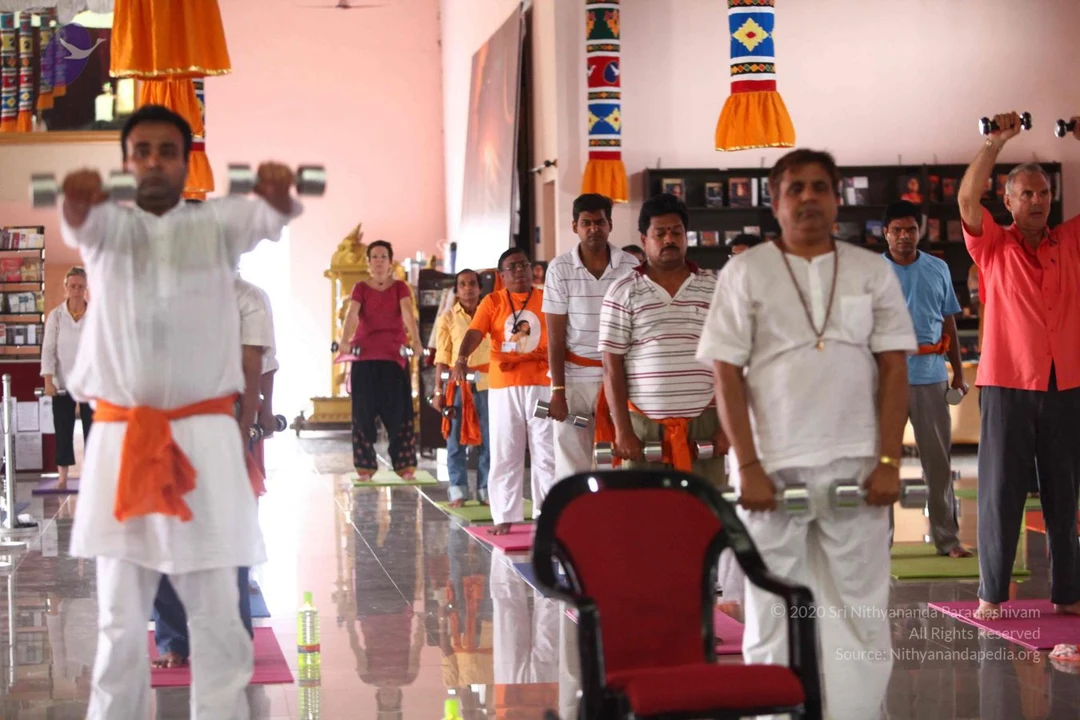
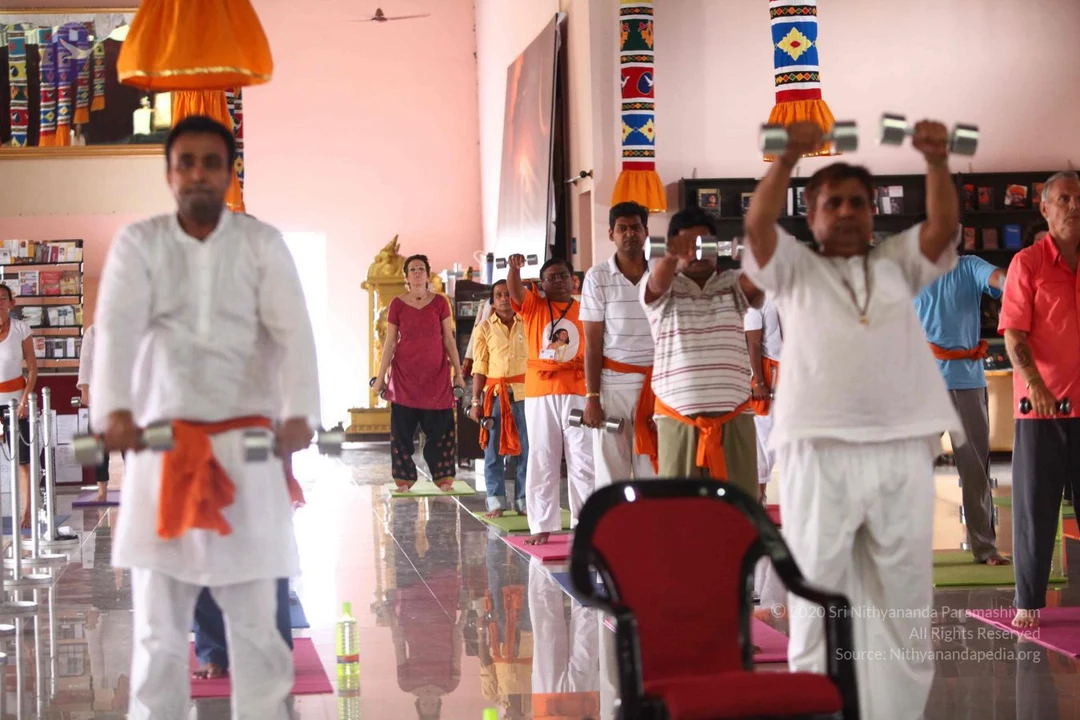
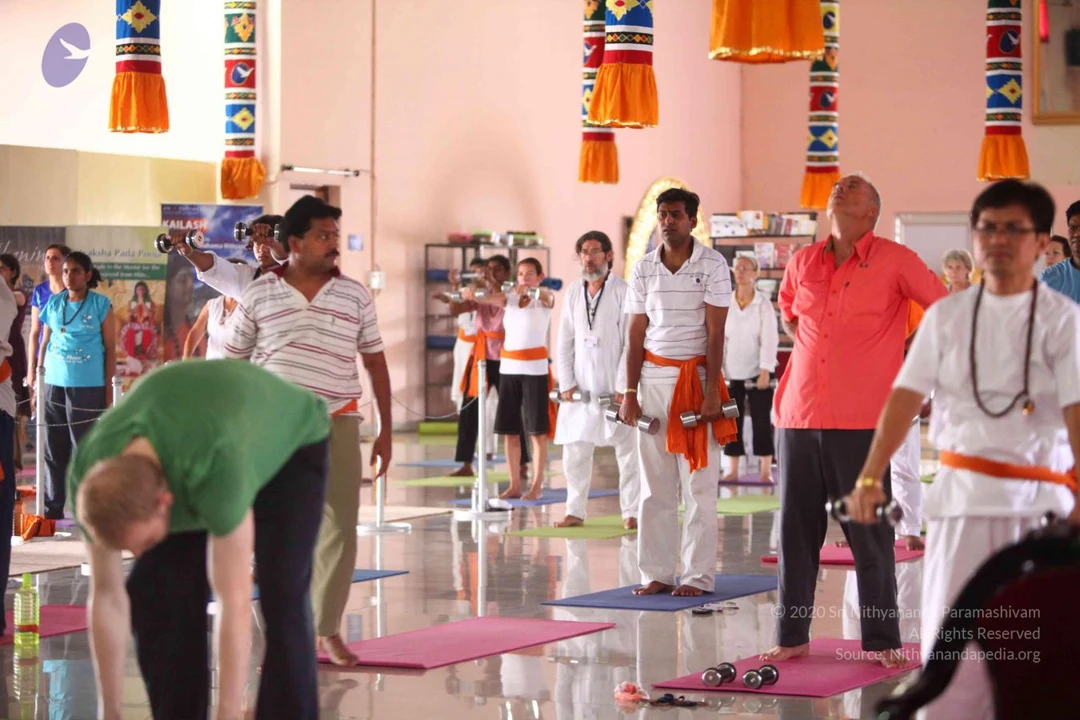
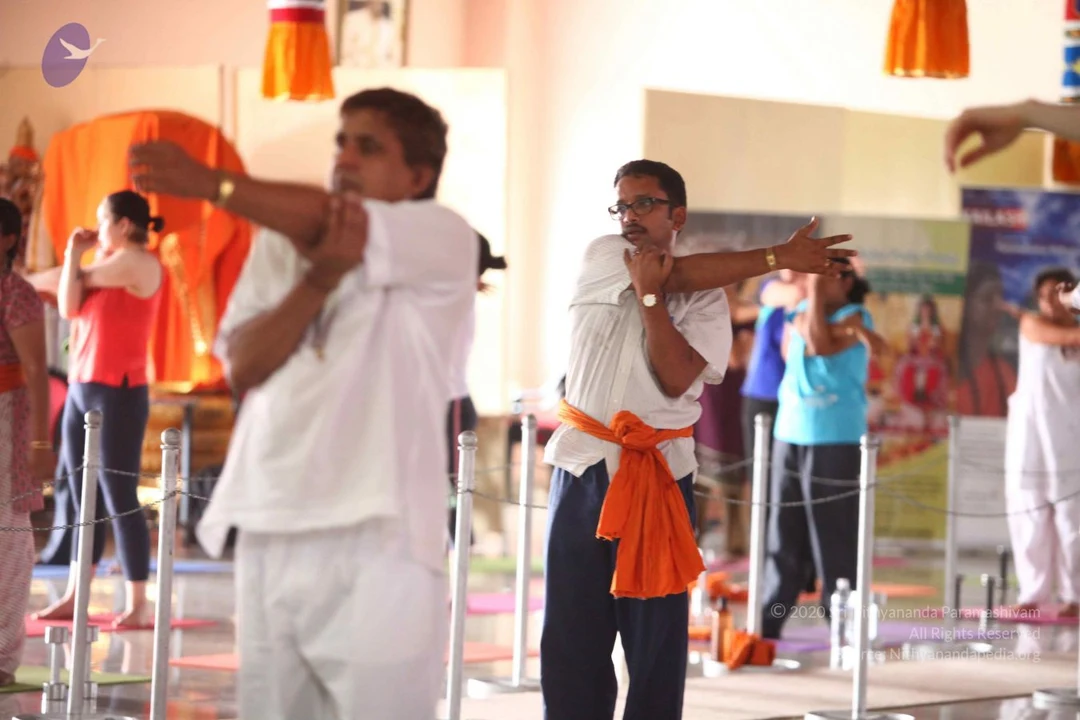
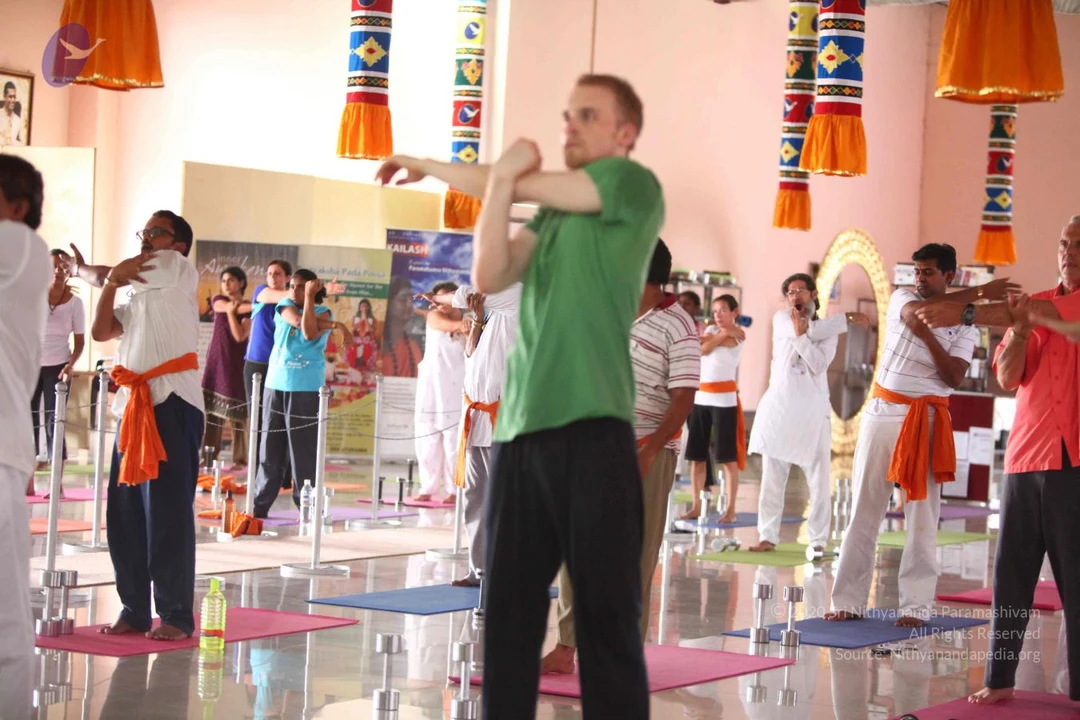
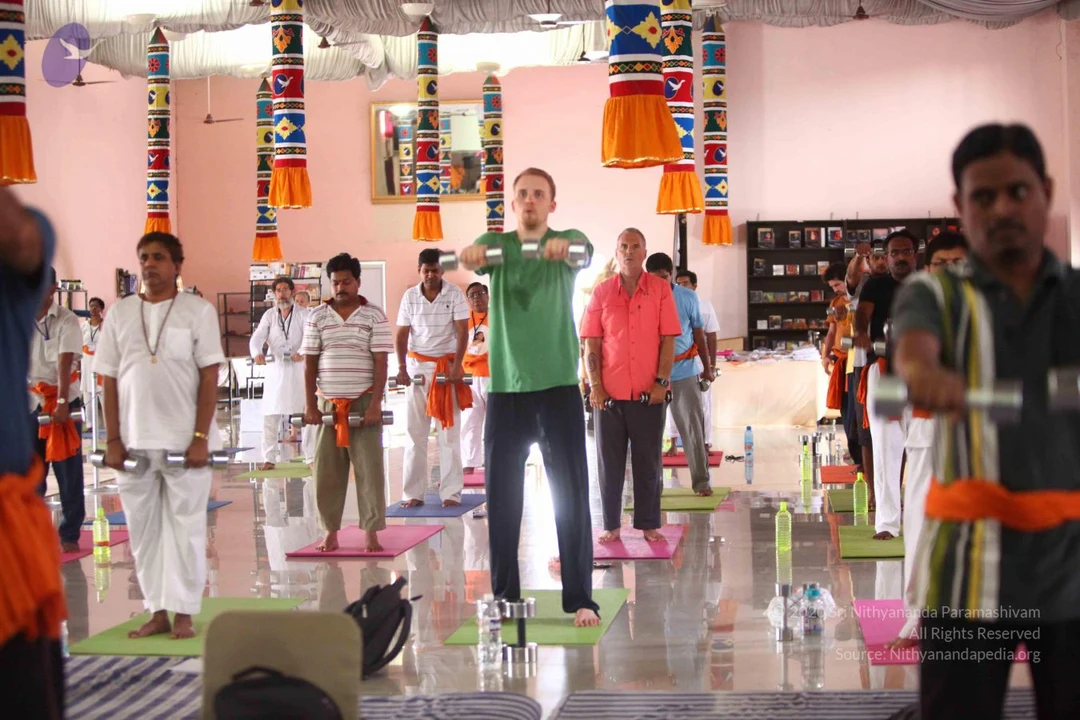
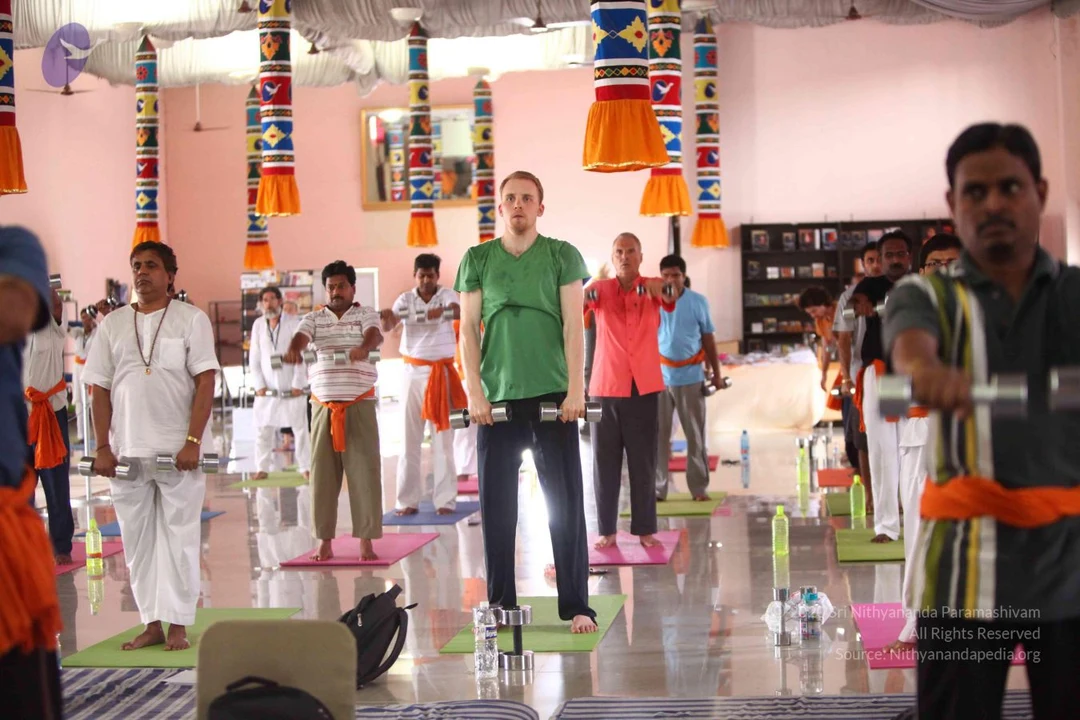
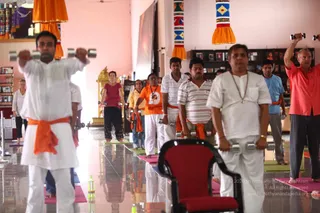
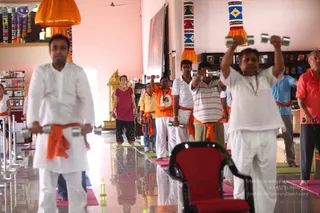
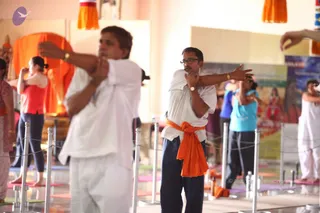
Men and women stand on yoga mats in a bright ashram hall with pink walls, orange and multicoloured hanging fabric panels, and a bookshelf in the background, doing dumbbell exercises. In the foreground a man in white kurta and orange waist sash lifts weights at chest level, and beside him another man in white holds dumbbells at his sides. Further back, a man in an orange top and white pants holds weights, and a man in a red shirt on the right raises a dumbbell overhead. A golden statue stands near the wall. The scene shows a group fitness or yoga session. No candidate for a person is clearly identifiable by appearance.A group of ashramites in a bright hall with pink walls and a glossy reflective floor performs an exercise session with hand weights on green and pink yoga mats. Men in white kurtas and white dhotis wear orange waist sashes, and a woman in a maroon top and dark trousers stands near the center. Several participants raise dumbbells overhead, and one man in a white kurta and orange sash stands in the foreground holding weights. Tall decorative pillars with woven patterns and orange fringed canopies flank the room, with a golden deity murti, bookshelves and a red chair visible.A group yoga and exercise session in a bright hall with pink walls and hanging colourful fabric panels with orange tassels. Participants stand on blue, pink and green mats holding small silver dumbbells, and several wear white clothes with orange sashes. A man in a pink shirt stands at right looking upward, a man in a striped polo shirt and grey trousers stands at left, and a person in a green top bends forward at lower left. A man in white with a rudraksha-style mala stands at right foreground. Shelves of books and a framed poster are visible on the left wall.A photo of a yoga or stretching session in a bright hall with a light pink wall and hanging orange tassels. Several people in mixed clothing do arm stretches on mats: a man in a white shirt and dark trousers with a saffron-orange cloth tied at his waist stands centre-right, arms extended, while a man in a white kurta-style outfit stretches in the foreground. Women in red and blue sportswear stretch behind metal stanchions with chain barriers. A large orange drape and a framed poster of colourful deities are visible behind them. No a person candidate is clearly identifiable from appearance.A photograph of a yoga session in a bright hall with pink walls and colourful woven hangings with orange tassels. In the foreground a man in a green t-shirt and black trousers stretches with both arms extended, while others around him in white kurtas and white clothes with orange sashes stand on pink, blue and green mats. Steel barrier posts and a framed poster reading KAILASH are visible in the background, with a round gold-framed mirror on the right. A man in a red shirt stands at the right edge. Roughly ten people are visible in the scene.A photograph of a group exercise session in a bright hall with pink walls and colourful woven hangings with orange tassels hanging from the ceiling. About a dozen participants stand on green, pink and blue yoga mats, each holding metal dumbbells at chest or shoulder height. Most men wear white dhotis or white and striped shirts with orange cloth sashes around their waists. A bald man in a green t-shirt and dark trousers lifts dumbbells near the centre, and a man in a coral shirt stands beside him. A bookshelf with framed pictures and bottled water sit at the right edge. The setting suggests an ashram fitness or yoga session.
IA-Darshan

61 photosSource gallery
A man seated cross-legged on an ornate gold throne (peetha) on a stage before deep red velvet drapes. He wears an orange-saffron cloth draped over his body with gold-edged border, a white flower garland (mala) around his neck, and a small crown-like headpiece. He rests his hands on his knees and looks upward. A silver staff stands beside the throne and a red sculpted backdrop appears at right.A seated man sits on an ornate gold-leaf throne with a large arched backrest carved with lion figures, set against deep red velvet drapes and large red sculptural forms at the sides. He wears a saffron-orange robe draped over the shoulder with a gold-edged wrap, a long white-and-green flower garland around his neck, and a flower garland on his head. His hands rest on his lap beside a silver staff or rod. The stage lighting is warm and dramatic. a person appearance cues are ceremonial saffron-orange clothing, flower garlands and a throne, with the man in the role of a seated guru receiving devotees.A seated man in a rust-orange sannyasi wrap with gold-bordered edges sits on an ornate gold throne with a carved arched backrest and red cushions against a red velvet drape. He wears a gold bead necklace and a gold bead headpiece, eyes closed, hands resting on his lap. A silver staff leans beside the throne. The gold-embossed backdrop and lion-like carvings frame him. Swamiji (probable): long hair is not visible, but the distinctive ceremonial gold rudraksha-style necklace, orange ceremonial wrap and throne seating match Paramahamsa Nithyananda's presentation; the page identifies the event as a satsang, and theA seated man in a rust-orange and maroon sannyasi-style robe with gold-bordered edges sits eyes closed on an ornate gold-leaf throne with a carved arched backrest. A heavy gold bead necklace hangs on his chest and a small gold bead garland rests on his head; a red-brown tilak marks his forehead. A silver staff rests beside the throne against a deep red curtain.A seated man in rust-orange robes with a gold-toned bead necklace and a gold-coloured bead crown sits with eyes closed and hands resting on his knees on an ornate red-and-gold throne. Behind him a large gilded arched backdrop with carved floral and lion-like motifs stands against red drapes. A silver staff rests beside the throne and a small silver vessel sits at the left edge. a person appears as a bead-crowned, saffron-robed figure enthroned in meditative posture; the appearance cues are the rudraksha-style mala and ornate gold necklace. The page links this image to a satsang on Ashramites Day, though the image itself shows no questions being taken.A seated man with eyes closed sits on an ornate gold-framed throne against a deep red curtain. He wears a rust-orange wrap with gold border, a large gold-bead rudraksha-style mala necklace, and a gold garland on his head. His hands rest on his knees in a meditative pose. A silver staff stands beside the throne and a small silver object sits at the left edge. The scene is a formal stage setting with the golden arch behind him. Appearance-based label: Swamiji (probable), seated on the throne with long hair, gold garland, rudraksha-style mala and saffron-orange wrap.
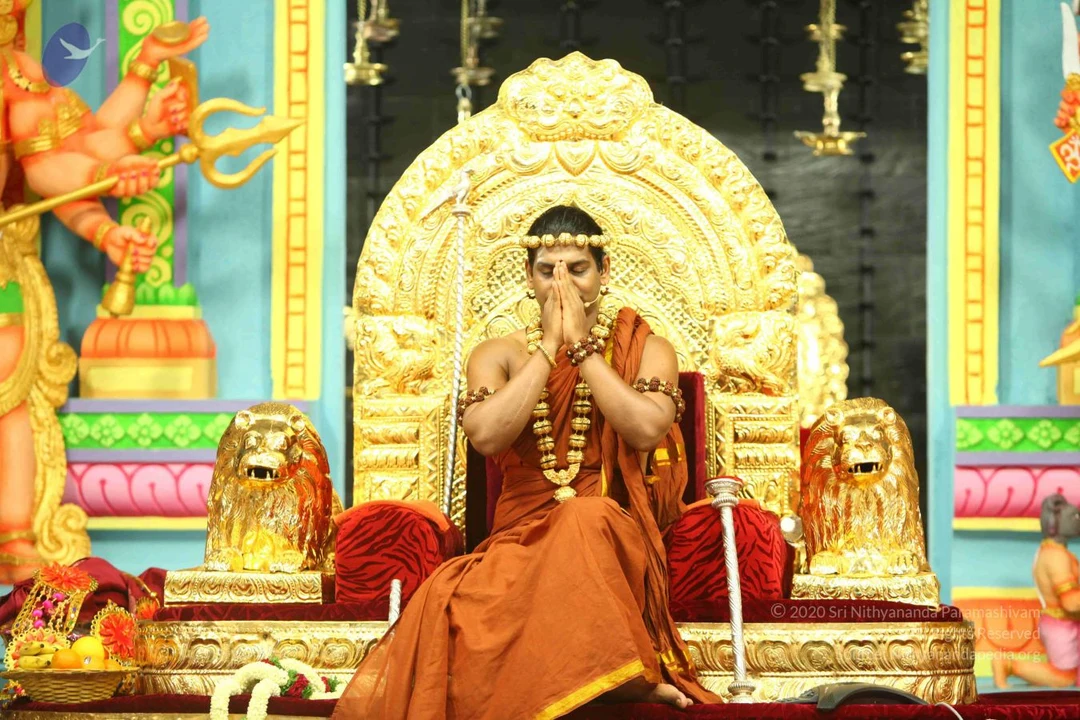
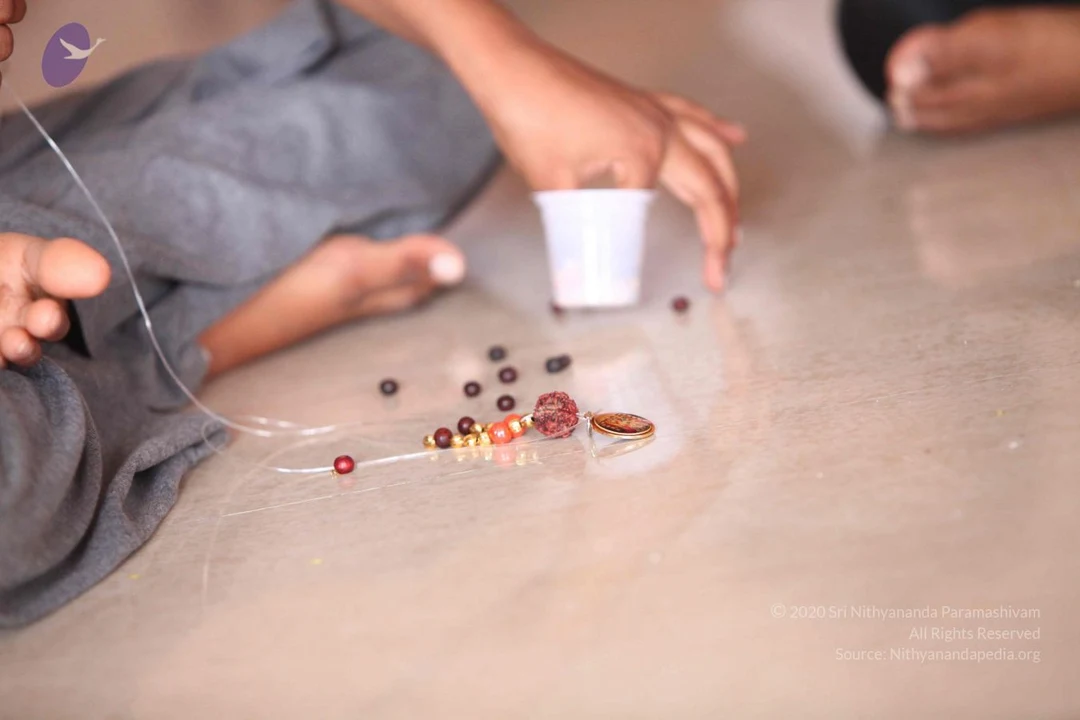
Sarvadarshan
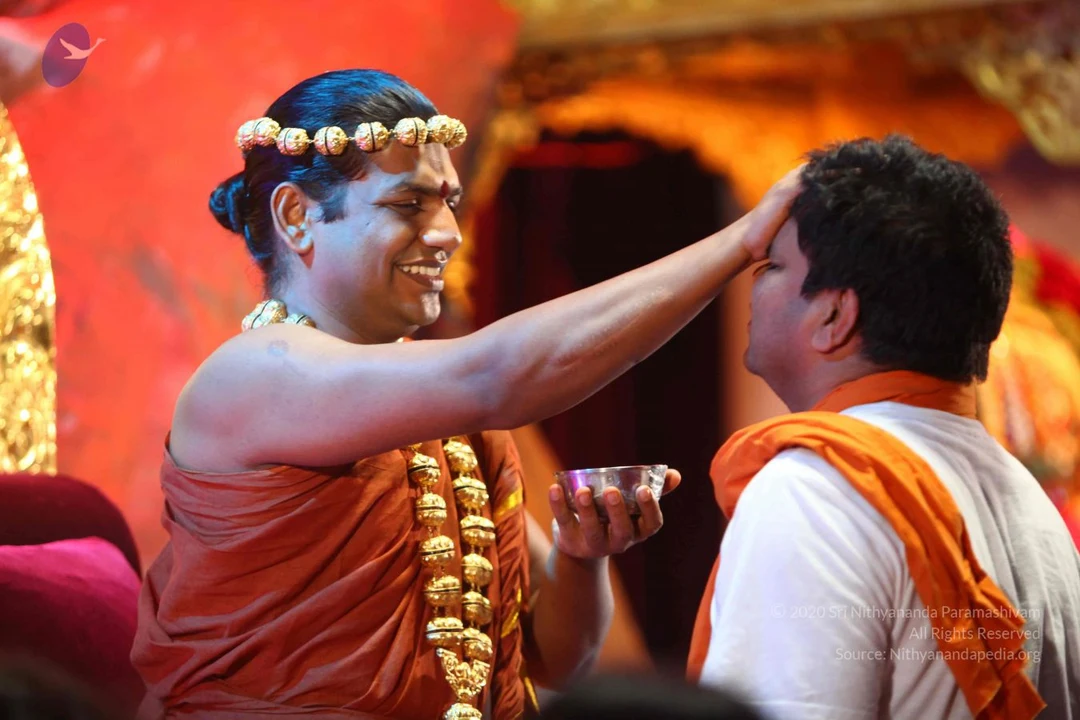
12 photosSource gallery
A photograph of an emotional embrace during a ceremony. An elderly man with white hair and a white shirt holds a man in a saffron-orange garment and a multi-strand gold necklace with gold bead ornaments, the second man's head tilted down toward his shoulder. Behind them, younger men in white and white-and-gold attire stand near a tray of offerings. The setting appears to be a temple or ashram hall with warm lighting.