Skip to content
Friday

6 April 2012

Newgen - A New Breed Of Youth

Dated photos
705
Source pages
1
Media
2
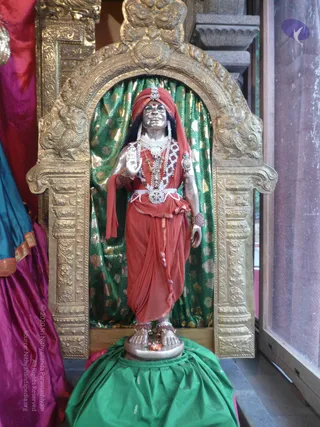
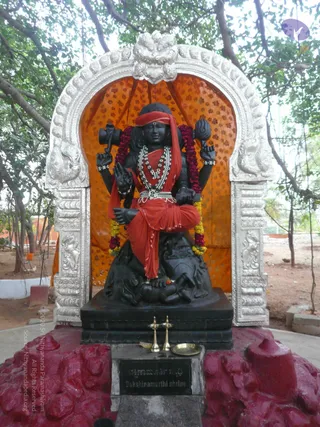
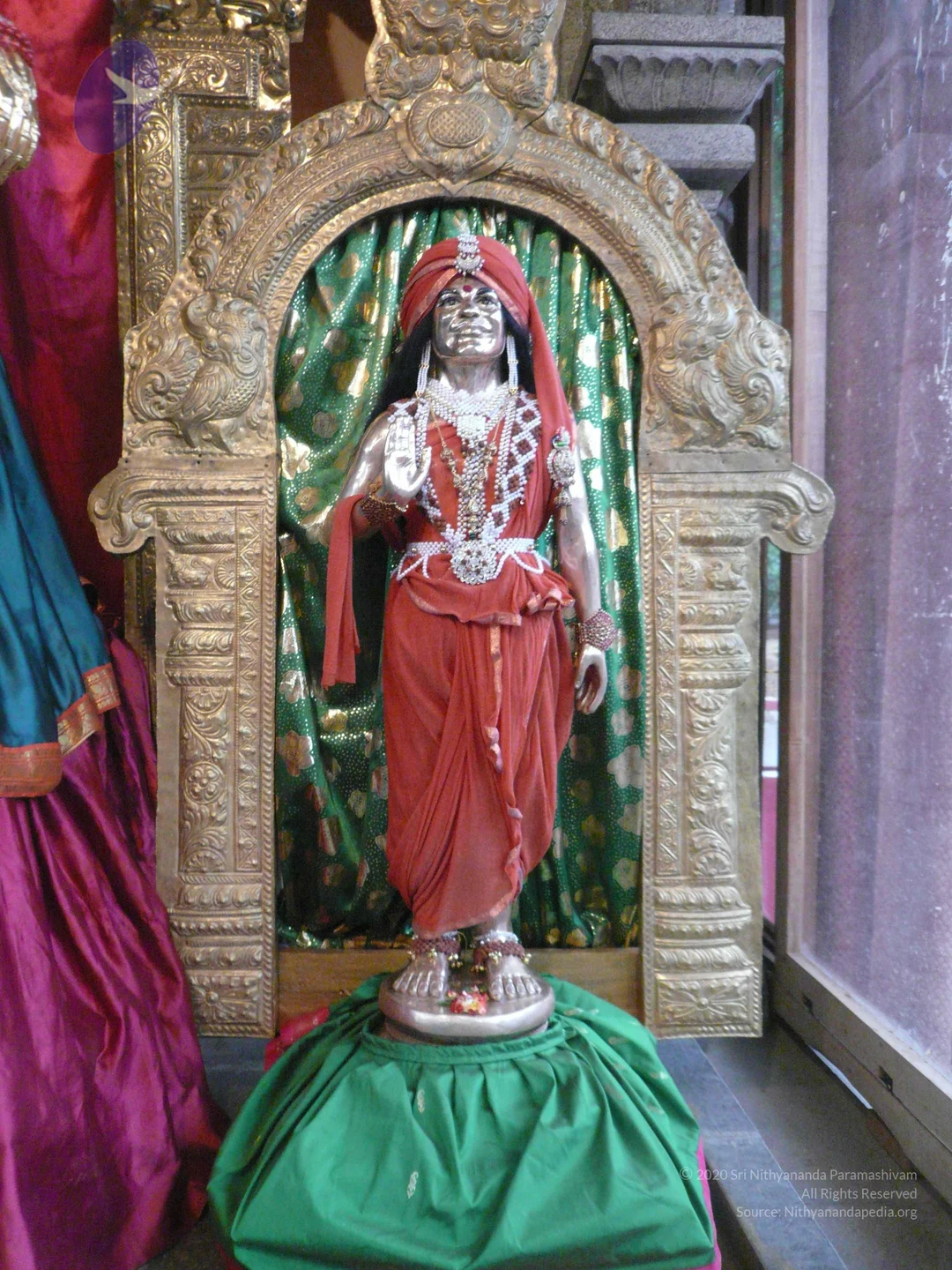
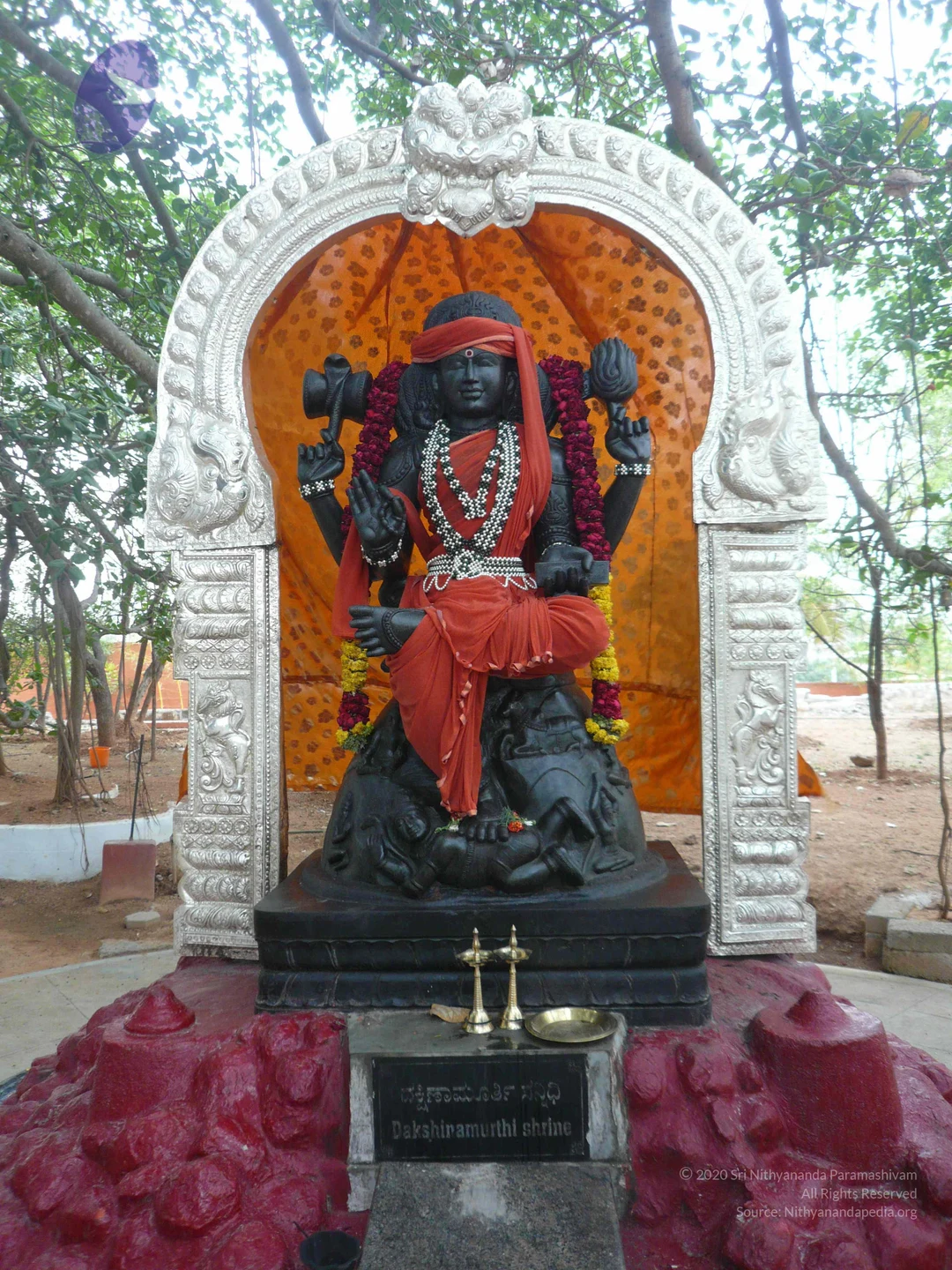
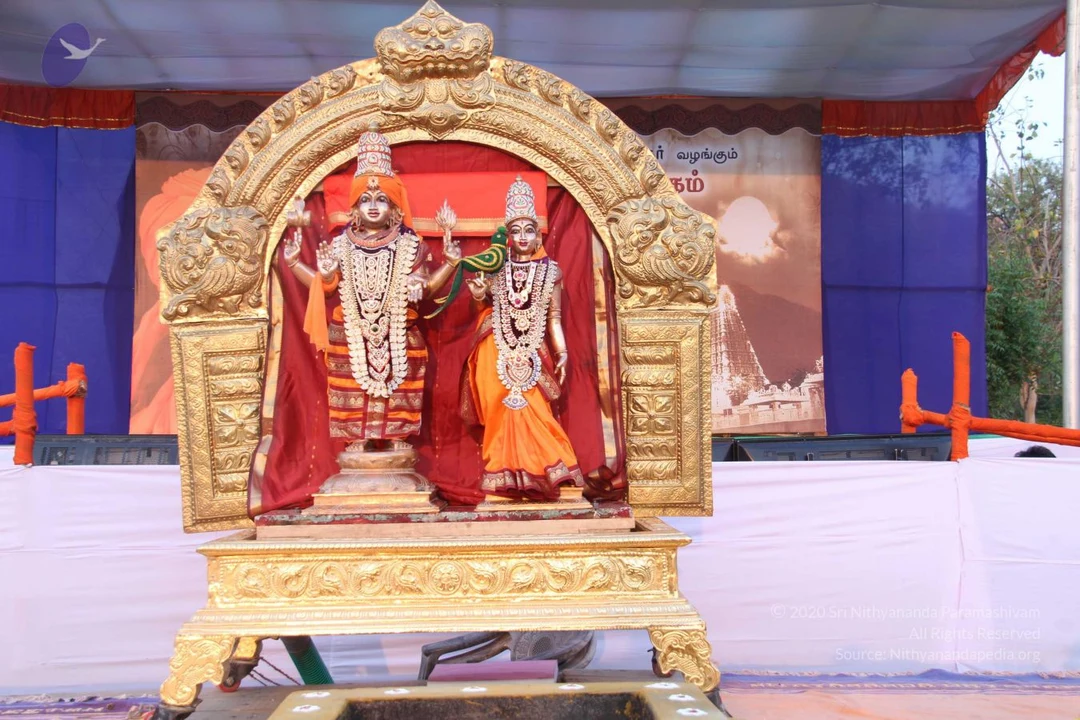
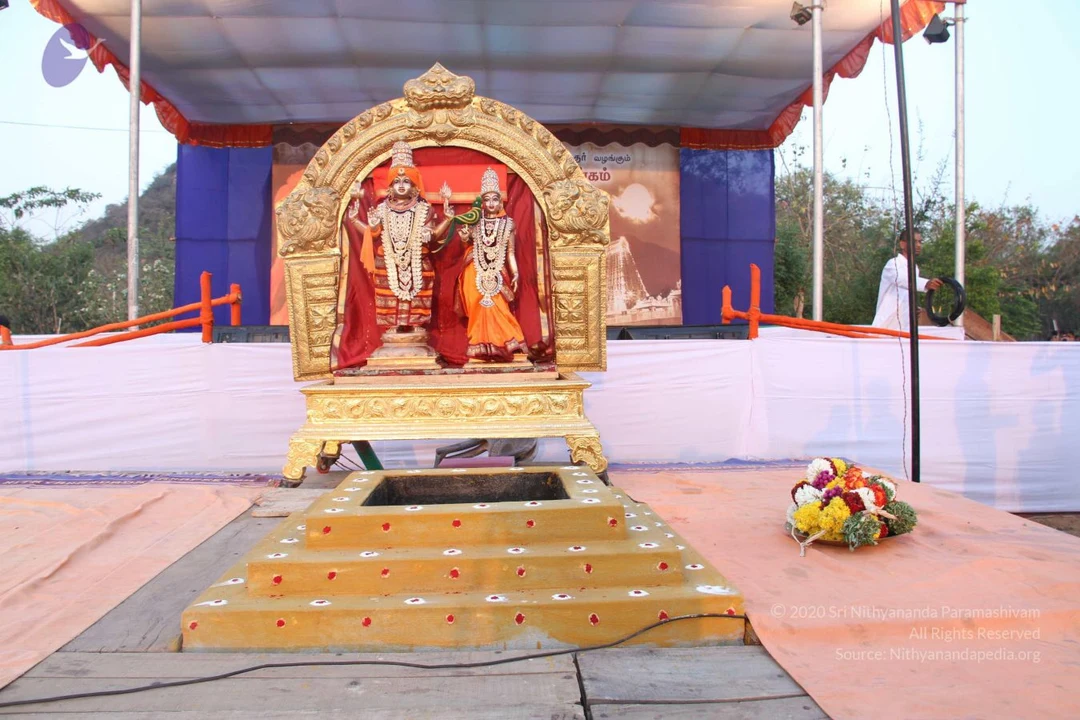
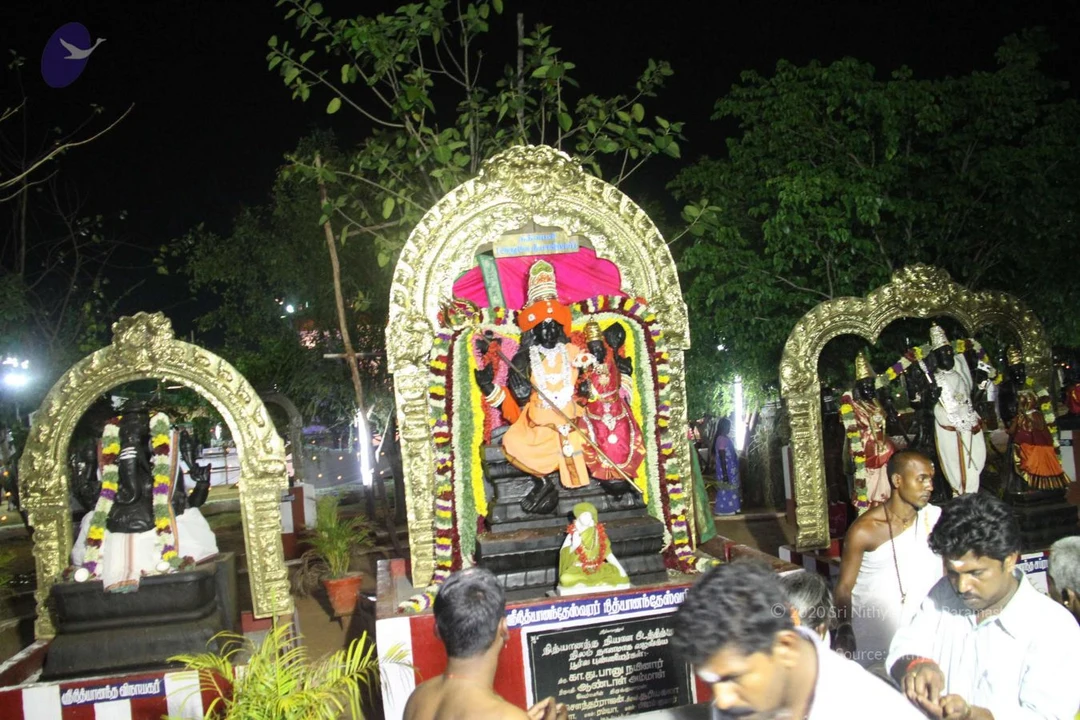
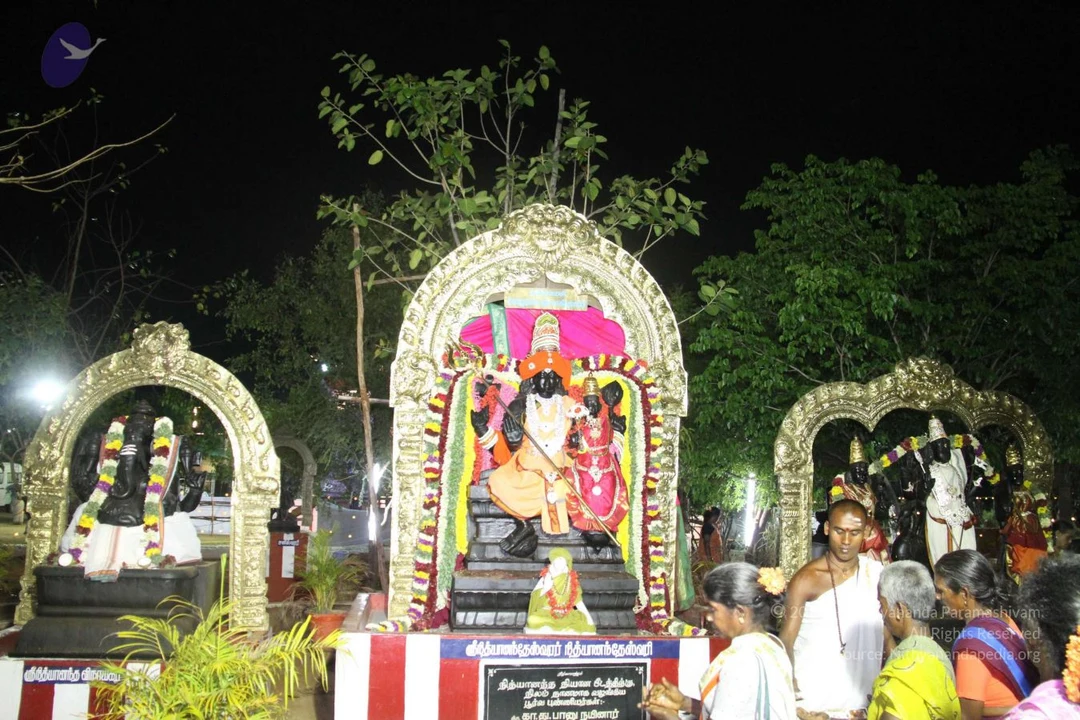
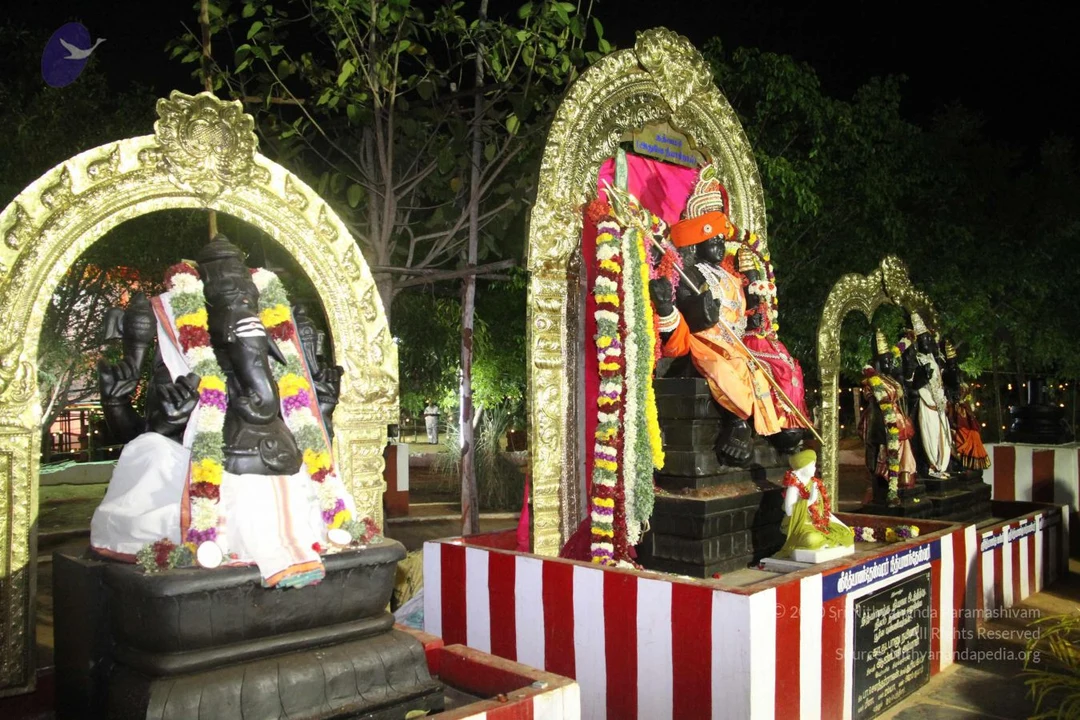
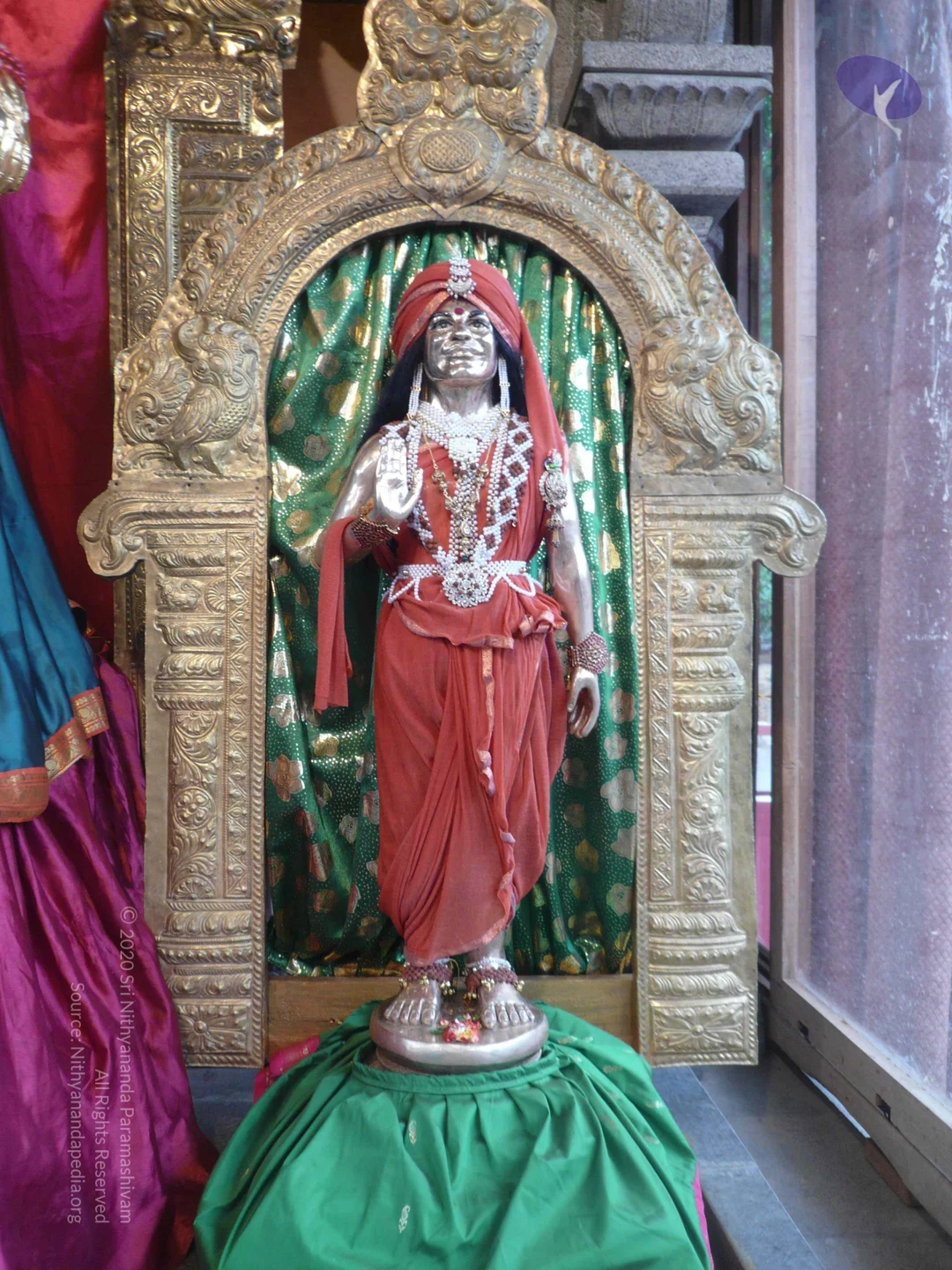
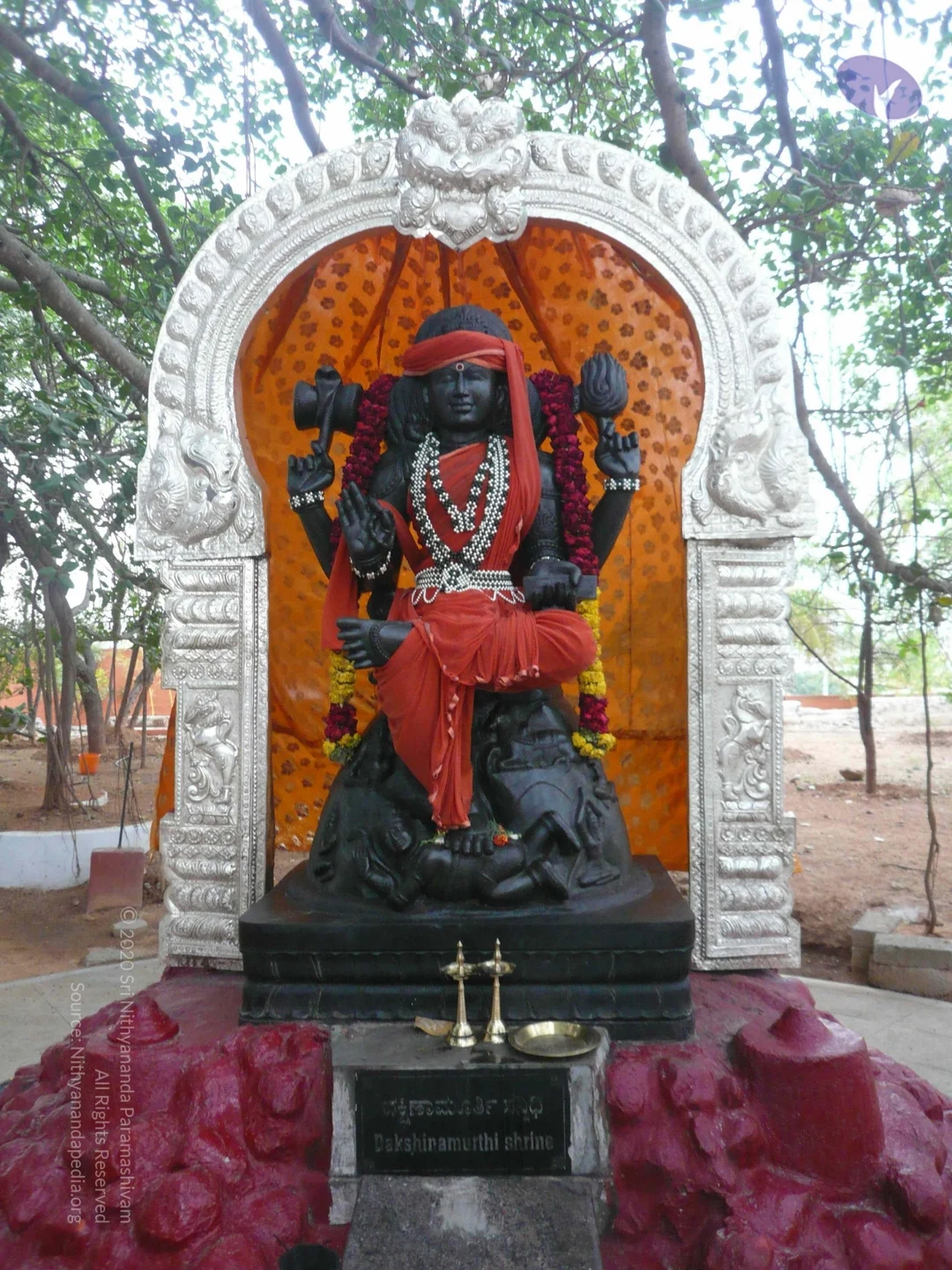
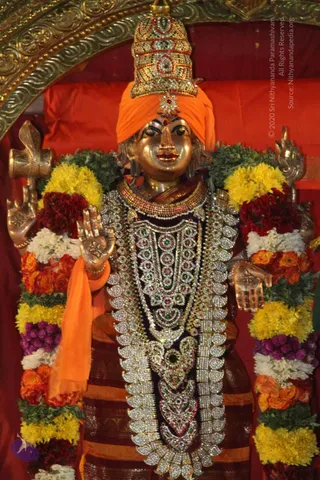
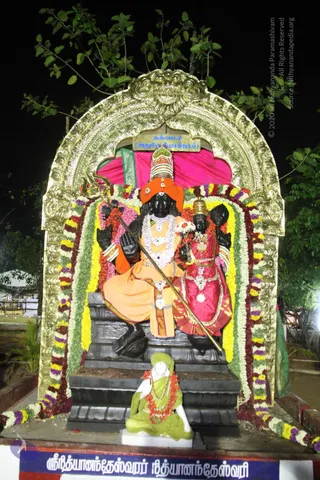
A standing silver statue, set in an ornate gold-toned arched shrine niche with green sparkling fabric behind it. The figure wears a red-orange turban with a jewelled ornament, a red-orange dhoti-style wrap, multiple strands of white pearls, a white beaded waist belt, red bangles and ornate ankle beads, and raises one hand in an abhaya-style blessing gesture. Pink and magenta silk drapes hang at the left edge and a green cloth covers the base. The figure is a statue or murti, not a living person, so this is a depiction.A black stone statue of a four-armed deity murti sits in a silver-framed arched shrine against an orange patterned cloth backdrop, under trees. The figure wears a red headcloth, red drape, white bead necklaces and a white waist cord, with garlands of red and yellow flowers draped over the shoulders. One hand is raised in a blessing gesture, and others hold a drum and a flame-like object. Two brass oil lamps and a brass bowl sit on a stone plinth before a sign reading Dakshinamurthi shrine, with red-painted rock around the base. No people are visible.A photograph of a black stone statue of Dakshinamurthy, a form of Shiva as teacher, seated in a shrine under trees. The four-armed deity murti wears a red head cloth, red drape, white bead necklaces and a waist belt, and red-and-yellow marigold garlands hang from its shoulders. Its hands hold a drum, a fire and a snake-like object, while the other hands are in a teaching gesture. An ornate silver arch frames the shrine against an orange patterned cloth. Two brass oil lamps and a brass bowl sit before the base, with a black plaque beneath reading Dakshinamurthi shrine.

April 06 2012

Original wiki page
Contents

Title:

Newgen - A New Breed Of Youth

Description:

http://www.nithyananda.org/ http://entv.nithyananda.org/live-streaming/ for more videos. 28th March 2012 Morning. In today's morning satsang, Paramahamsa Nithyananda (Swamiji) gave guidelines for how to live enlightenment, especially for the next generation. We become completely clear within ourselves about what we wish to be to ourselves and to others, what we wish to accomplish and how we intend to achieve our visions. This model allows us to act out of blissful confidence and to draw upon a limitless reservoir of stamina, since we are conflict-free. The assurance of our inner knowing radiates joy to all around us. We soak our environment in the highest frequency of positive energy.

Link to Video:

VideoAudio

Transcript:

Swamiji can you please talk about NewGen.

How I want new generation to be. Rather I can say, what kind of new generation I am going to create because I don’t stop with want to be, I just create what I want. I never stop with idea, I want this, I want that. And expect somebody else to take the responsibility. No, I want new gen to be completely stable and established about their identity with themselves, experientially, about their identity, with the people with whom you are living, about the identity, you’re with the human society and the universe. New generation should be very clear about themselves, what they want to do, what they are feeling like doing. The problem is many time, what they are feeling like doing they know. What they want to do they don’t know. Or how they are going to do, they don’t know. What you are feeling like doing. What you want to do, how you are going to do. The whole thing should be in aligned.

New generation should be very responsible about what they are creating around themselves. Not just constantly fighting with others, or fighting with themself. Not just constantly gribbing about the world. See modern youth means constantly complaining. Deeply dissatisfied. Feeling miserable, unfortunate about the whole world. That is what has become modern day youth. See the common picture of modern youth. Depressed, drunk, dying.

Youth was never, in this mess, ever, earlier in the planet earth. Because all the mechanisms, which gives little bit of training, for the youth, from the young age, is completely broken. One unfortunate thing, because of that, you guys stand as policy orphans, Identity orphans, Cultural orphans. One fortunate thing is, because of this, you can become enlightened.

One unfortunate thing, because of this, all the mechanisms which trains people are broken, you become identity orphans, Cultural orphans, policy orphans. You walk in front of huge temples. Which the whole country has built, but you do not even know why it is standing, what it means. What it means for your society.

The other day one devotee came to me. Not devotee, a youngster, came to me. And he was telling about some problem. I asked him you are from where and all that. He said in the Madurai. South our side, the temple south our side. I asked him where you are, he gave a internet café’s name and he said next to that house. I could not understand the internet café, I asked are you saying in the street where the south street board is there and the huge temple tower. There is a board, south tower. And after 10 min of conversation I realise the place where he is saying is the same thing. Where that big board is there on the tower. He has never seen that board, but he knows the internet café. The internet café is a small one room with one small board. He has seen that but he has never even looked up with awareness towards the tower where the huge board is there, south tower.

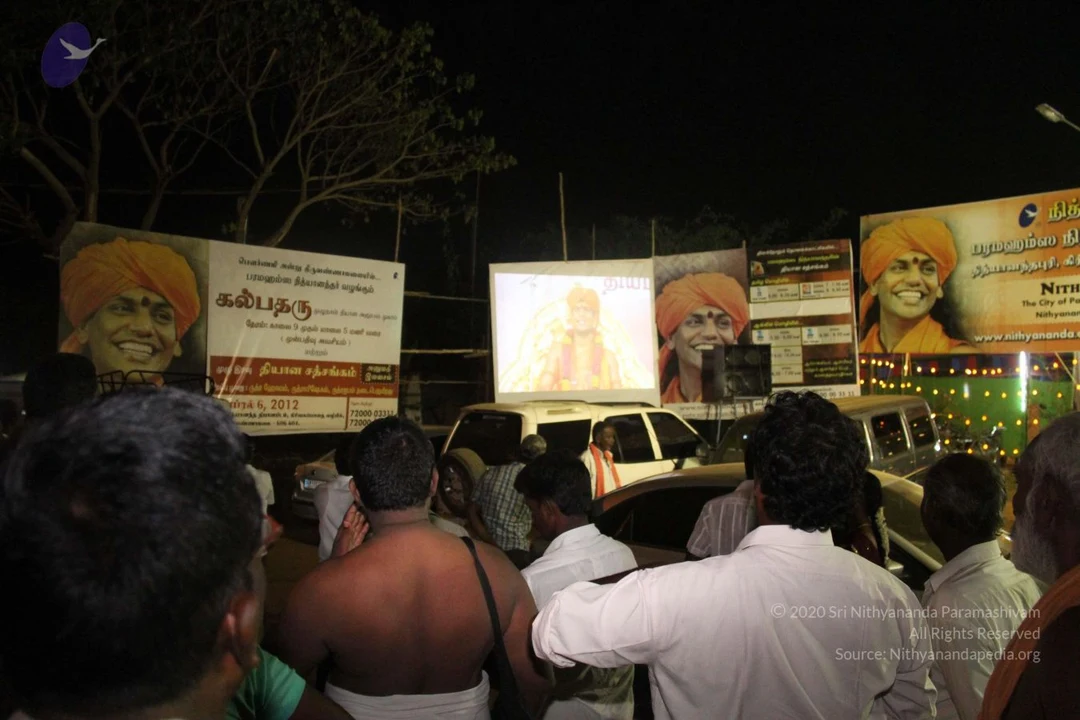
Does this fellow know, for 500 years the whole paandiya kingdom was building that building? If the whole kingdom is planning and building certain building then whole kingdom is obsessed with that concept. Of course, I should not be using the word obsessed maybe I should use the word devoted. Yes you guys can see this photograph. Exactly this is what I was telling. This huge board he has never seen. Same tower same board, there is a huge board you see, saying south tower. The fellow has seen the internet café just below this tower, so many times. But he has never seem this board. South tower and he has been living there for at least last 5 years.

The new generation has become identity-less. Cultural orphans. One side it is unfortunate you become cultural orphans. Other side in a way it is fortunate you can be easily led to enlightenment. You can move towards enlightenment. Basically, en living is newgen living. Enlightened living is new gen living. All over the country I want akhadaas to happen. Means the place where people practise the techniques for yogic body and vedic mind. Understanding the relationship issues. Not just relationships with people, relationships with the whole. New gen is my only hope. Next generation should be new generation or it is going to be degeneration. If next gen is not new gen, humanity is not going to have anymore generations. Because we have reached the possibility of destruction, the peak of destruction. If two mad people, not necessary 2, even 1 mad person becomes the head of one atomic power country that is enough, humanity will disappear, planet earth won’t be there. Ball is missing from the court. If you want to keep this beautiful planet for the next generation, next generation has to become new gen. We have to become yogis, naadha yogis. naadha yogis means having yogic body and vedic mind. Human civilisation has to understand its responsibility. Towards your happiness. Please understand, your happiness is not just a choice. You can have it or you may not have. No. Your happiness you being productive is an important thing necessary for humanity now. Because your depression cost too much for the country and the humanity.

Your depression, your un understanding, you being misguided costs country too much. Misguided 2, 3 youths can cause so much chaos to society. You can see. How many young boys from some of the fundamental religions, organisations are being used as suicide bombers. It creates so much chaos. I really can’t understand. If 5 youngsters travel from, all the way from Pakistan in the boat. Come to Mumbai, just to die.

That is such a big task, going and teaching meditation. When it comes to positive work, how disorganised we are, lacking we are, yawning, lazy. But when it comes to destroying, others, I don’t know, from where these youngsters, get power. You know, I really think, these same 5 fellows, I’m telling about the Mumbai terror attack, instead of dedicating all their life to killing people if they had this same dedication and devotion, serving the society, they would have created a huge social service organisation. Where they are ready to sacrifice their life. When you have the courage to sacrifice your life, you will do so much of positive work. I was really shocked, how so much of sacrifice, is misused, abused, by the fundamentalist, organisations.

Question is: Dear Swamiji, in yesterday’s satsang you spoke about live-in relationship as compulsory before marriage. Suppose after 1 year if I don’t feel compatible with my bf, should I dump him? How many men will I ‘try out’ like this before finding the right life partner? What is the solution?

Devaangi, the moment you are not ready to take the responsibility, I think mano is right for you. Don’t even look at the fellow you are going to get married before he ties a knot on your neck. Have a covering, let him cover himself. Tie the knot, after the knot, in the first night, in dim darkness, see him first. That is the solution for you. Come on! One side you want freedom, and the possibilities of life. The other side you are asking me to take the responsibility. Come, go on trying out till you’re forty, or take the responsibility, of getting settled with one person after one year. Within a year. See, see, use this one year not to decide, should I dump him or live with him. But to make yourself, settled with him, and make the other person accept you. That is why yesterday I used the word, tapas. Do this more like a tapas, than this trying out mode. I am not asking you to have this mental set up of trying out. I’ll try out this, then dump. Next I’ll try out, then dump. Next try out, no! I am asking you to do this as a tapas, where you are constantly working on it, yourself. If you are working on yourself, naturally the first one itself will click. At the most, second. You don’t need to be constantly trying out. Even for sanyaas I tell people, no, no, one year try out, see how it goes, how it flows, let’s see later on. Even for sanyaas I tell people. After all sanyaas any moment you can give up. It’s nothing wrong. After 5 years it is not that you have to live. You try, it did not work out, say bye, no problem! Nobody is going to be offended! If you drop your sanyaas, nobody is going to be offended because, it is between you and you. Even if you drop the sanyaas which I gave you, I’ll never be offended because, I don’t give, I’ll ask only you to take it. In sanyaas, nobody is going to be offended. It is just you! Even in that, I am asking you, at least one year try out. Because in the modern day, you became, you guys have become so “uak”. Mood swingy. That’s the right word. Vivekananda very nicely describes a monkey which has drank arach and which has been bitten by a scorpion and caught by the possessed by a ghost. How it’ll be? Your mind is like that only.

Devaangi either you take the responsibility, or give up your freedom. Don’t go on asking me, solution for every small point so that later on you can blame me. No. I can give only the options. You will have to make now, decisions.

Question is: I love my boy friend a lot, but sometimes he becomes, verbally and emotionally abusive. How do I respond to him, I don’t want to give him up.

Diana, first thing. When you love him, easily you will be able to inspire him, to look in. Inspire him to understand abusing, verbally and emotionally, is a wrong pattern. It is neither mental disorder, nor complete health. Wrong pattern. Don’t make it as a mental disorder. Then he will be in a bigger guilt. Wrong pattern. Make him understand. It is the wrong pattern, once he understands, it’s the wrong patterns, naturally, he will give it up. Or he will at least find a method to give it up. That’s all, but I tell you, just for this wrong pattern, giving him up, also is not right thing. As you said rightly, you yourself say you don’t want to give him up make him understand it’s a wrong pattern. Maybe, you tell him, provoking him is the wrong pattern you have. Being provoked is the wrong pattern he has. Both of you decide to give up the patterns. I think when you love somebody, You will be able to sit with that person, and make him understand. Surely he’s not enlightened guy, he’s not going to say no, I am completely as I am, if you want you surrender. OR you do what you want. He’s not going to tell that. He also wants to work with you. He must be ready to come down. To your level. So, Diana, make him understand. It is just a wrong pattern. Nothing more than a pattern. You also look deep, you will understand, exactly how, provoking pattern is inside you. You must be provoking him, unknowingly. Or sometime knowingly also. Make him understand, being provoked, is the wrong pattern. You also understand, provoking him is the wrong pattern you are carrying. When both of you decide, to drop the patterns, life becomes, spontaneous living.

I recently got married and had a good relationship with my in-laws. As time passed, things slowly changed and I can see changes in my mother-in-law’s attitude towards me. How can I ensure that the relationship stays on good terms? – Sita Venkat

First thing, Sita, the most difficult thing in the planet earth is to maintain relationship with mother-in-law. Indian mother-in-law. It’s almost like this, black magicians maintaining this relationships with ghosts, boothas and prethaas. Neither you can give up, nor you can completely maintain. You need to maintain, but can’t maintain. Anyhow, I’ll give you some practical suggestions, try whether these suggestions work with you or not, with your mother-in-law or not. First thing, decide very clearly, before the relationship gets sore, not to stay in the same house. If you stay in the same house, over-exposure. Familiarity breeds contempt. That’s the first lesson. Second, try to spend time. Please understand, when I say try to spend time, only meet and depart. Don’t stay together. If you stay together, the constant bickering, of our thinking and constantly being tortured by your thinking, for her, will become too much. See in her thinking, naturally a mother-in-law thinks, of holding whatever you have, and retiring. But the daughter-in-law is supposed to think, of high achievement. Your life is flowing towards high achieving, creativity. Her life is already retired, settled.

Naturally that clash will be too much. So only meet and try to spend time. Talk, talk, talk, try to make her understand, you are only going to add to her security. You are not going to add insecurity to her. Understand, you are not going to add insecurity to her. You are only going to add security to her. Look in, you also may be feeling, your honeymoon is over with your in-laws. Understand, honeymoon does not happen just with your husband or wife. The feeling goes away even with your in-laws, as time passes. Look where you are losing the newness of relationship, where the other person is losing the newness of relationship. When the newness of relationship is getting lost, you always feel the other person is a threat. This is the basic secret in relationship. When you are afraid of somebody, be very clear, that person is also afraid of you. Give that person the feeling, don’t be afraid of me. I won’t do anything. Then naturally you will see, you are free from your fear. Abhayam sarvabudepyo. When you make her understand, you are only going to add security to her life, you will not create any insecurity to her, naturally, your insecurity will be cleared.

Photos Of The Day:

Bidadi-Temple

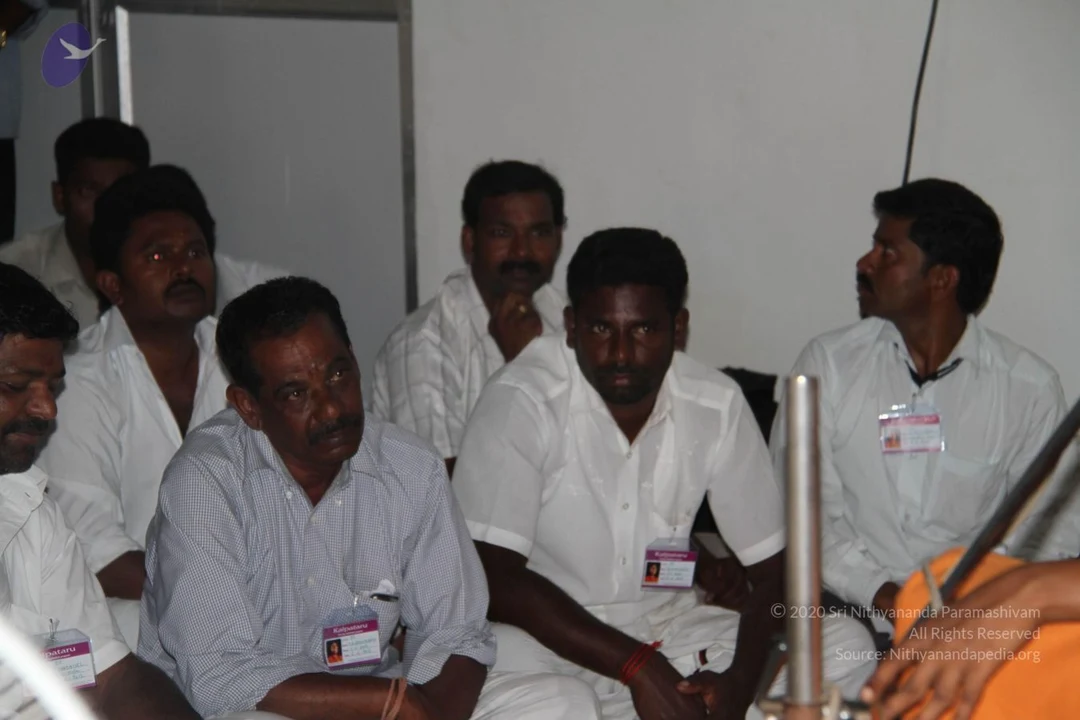
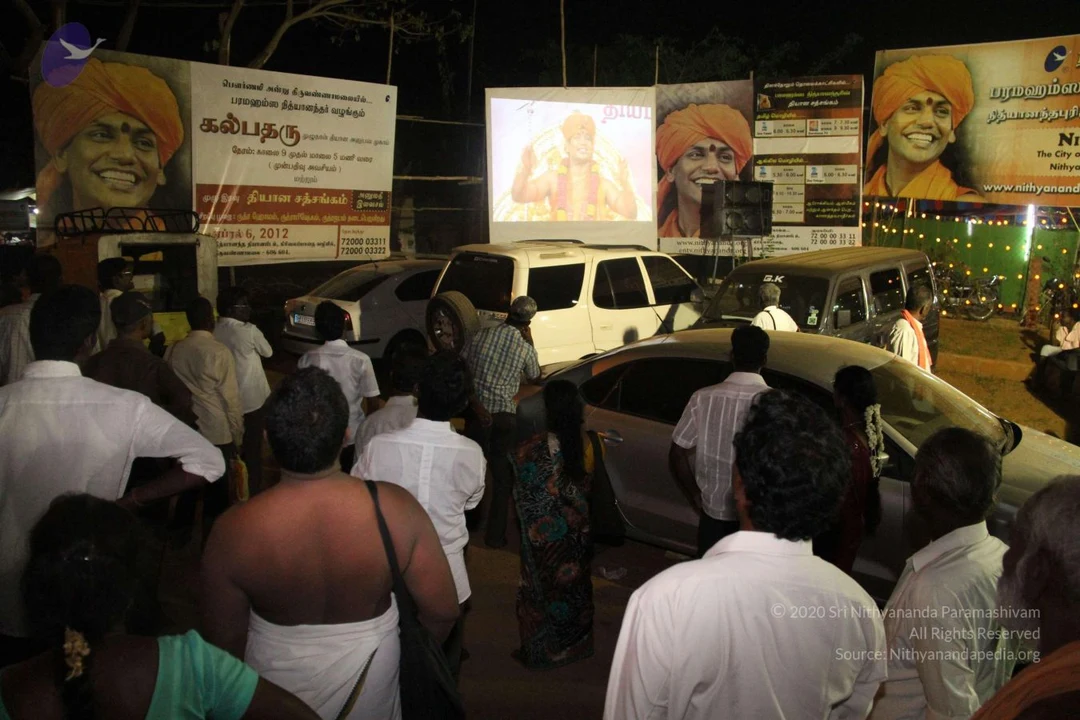
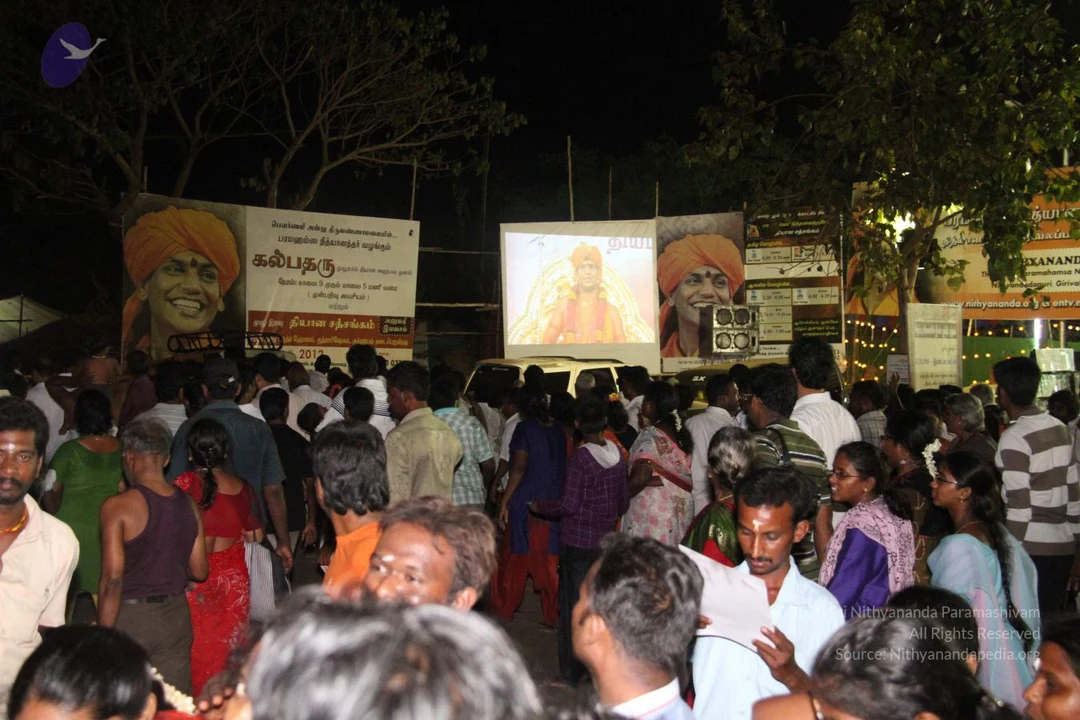
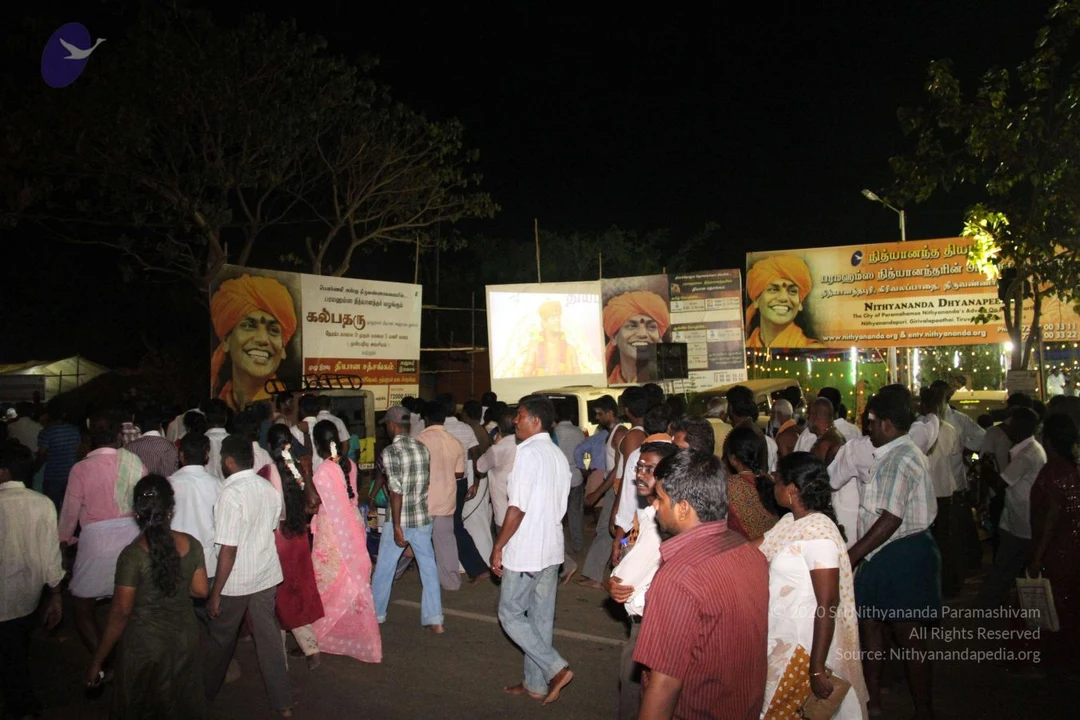
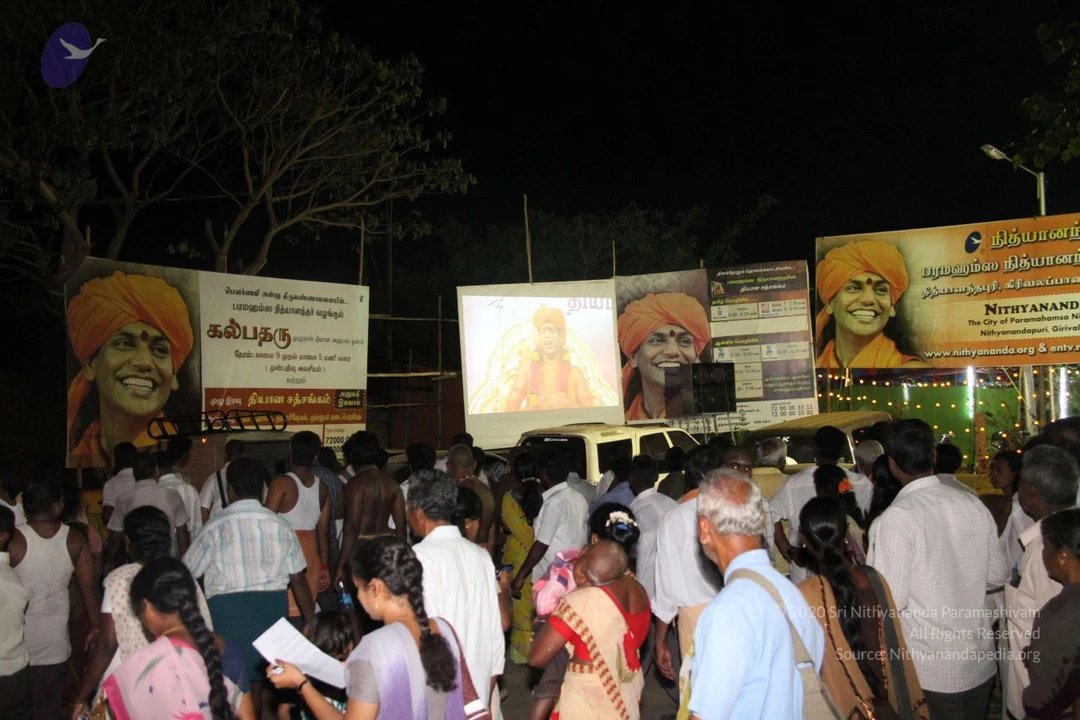
Thiruvannamalai-Kalpatharu-Darshan
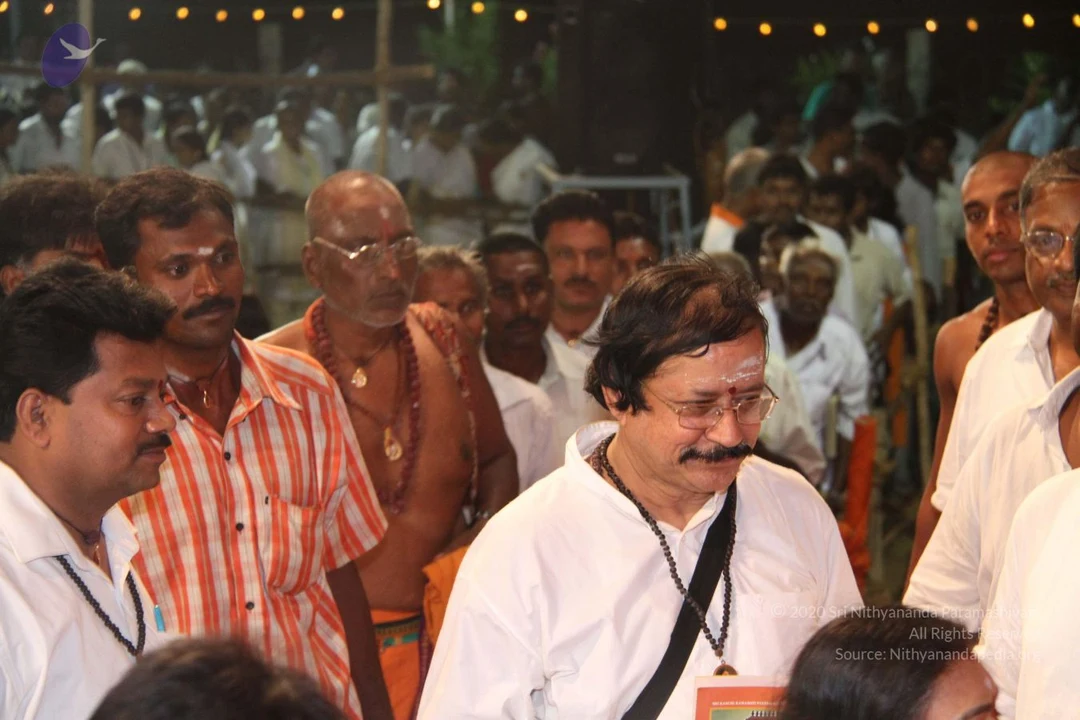
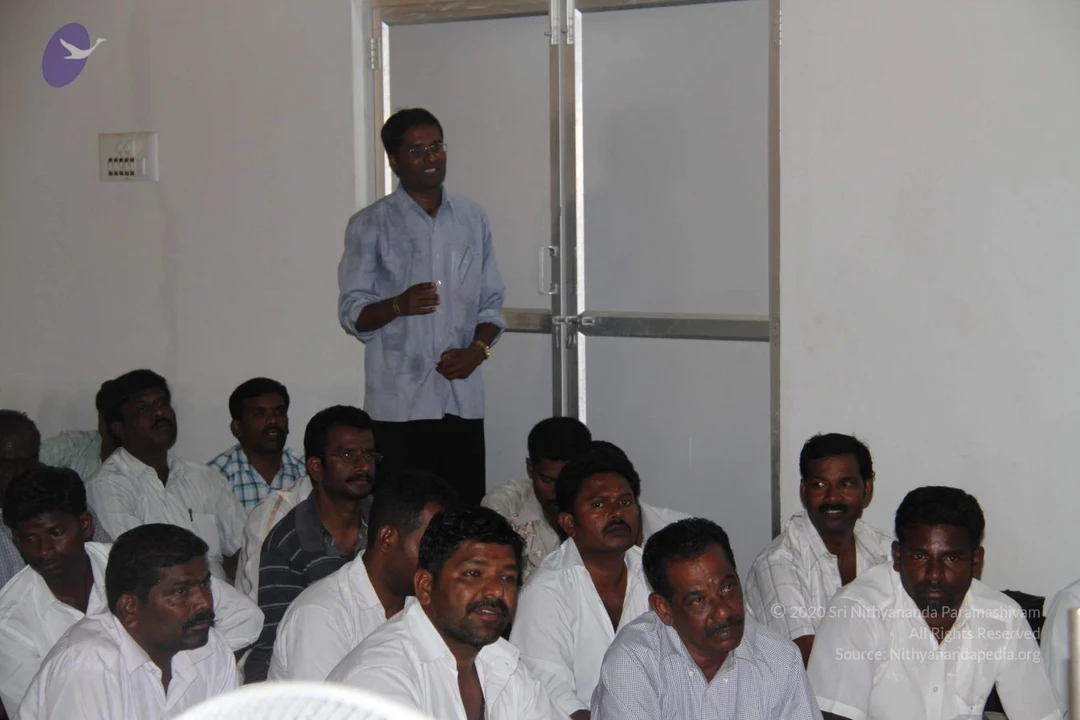
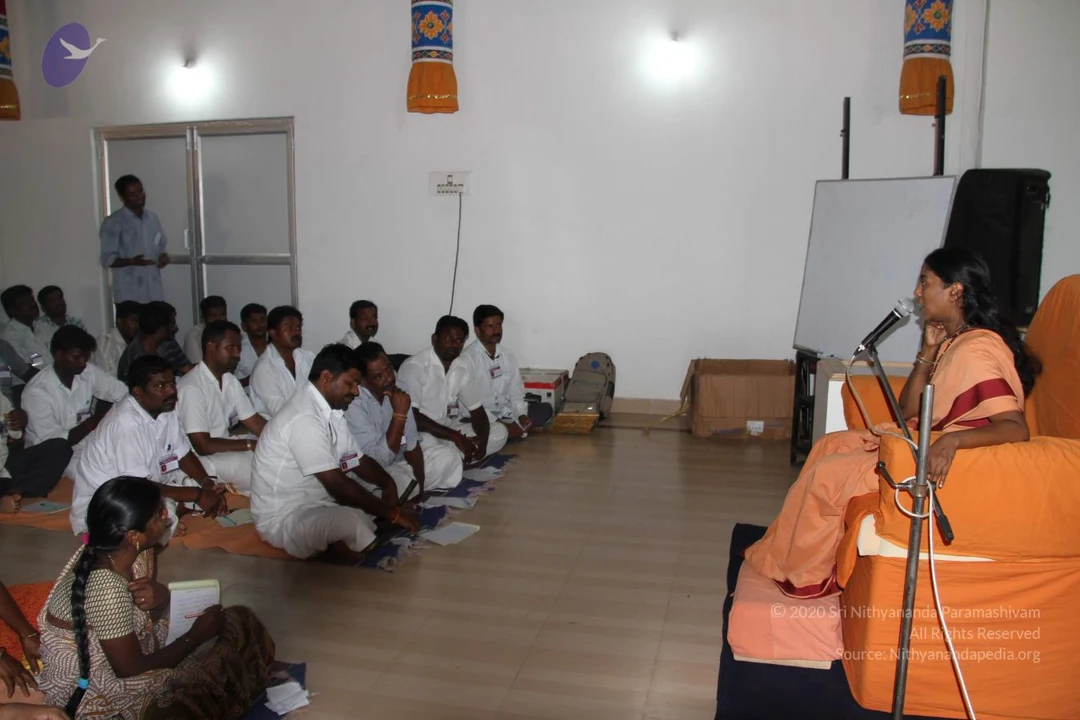
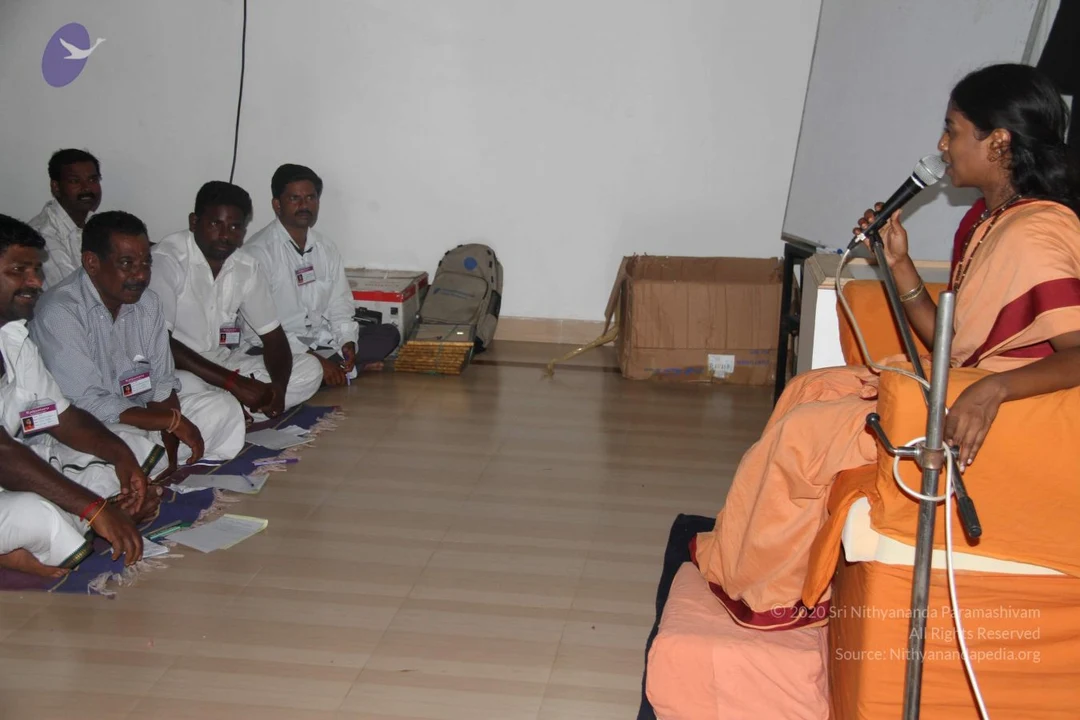
Thiruvannamalai-Organizers-Meet

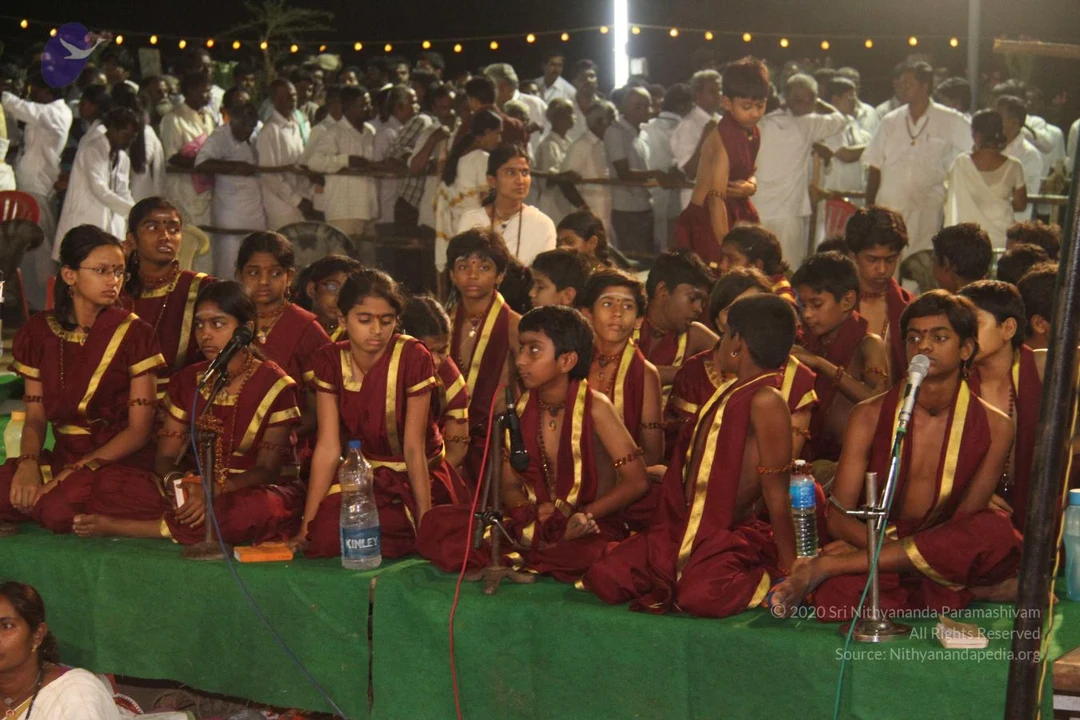
Thiruvannamalai-PaadaPuja-Satsang

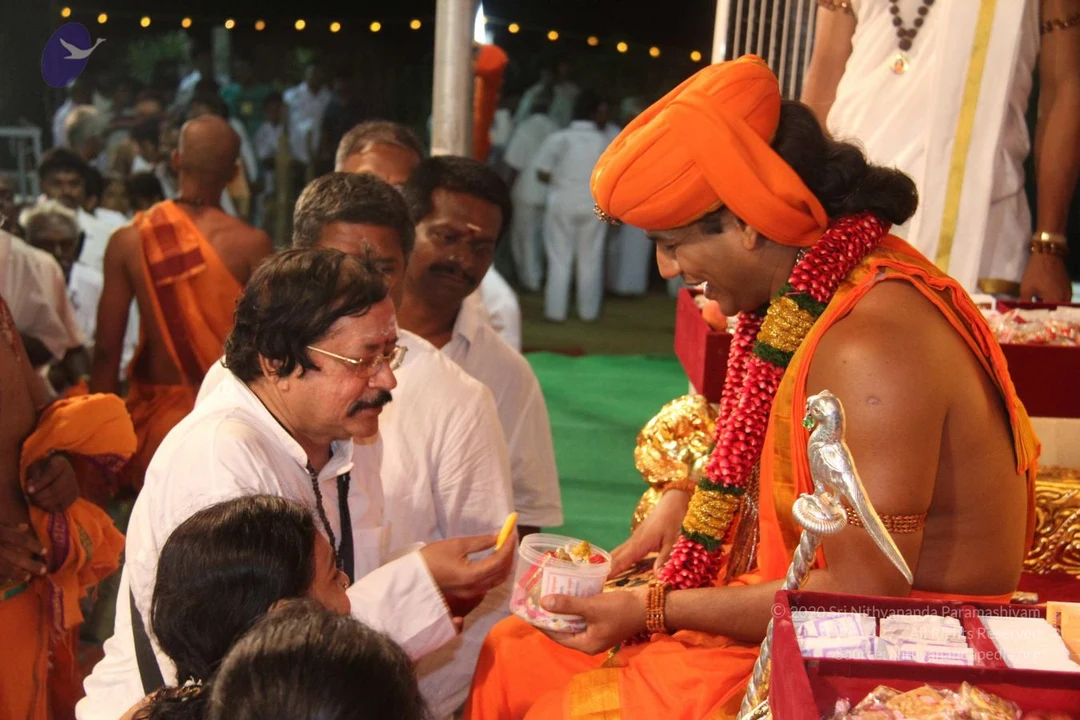
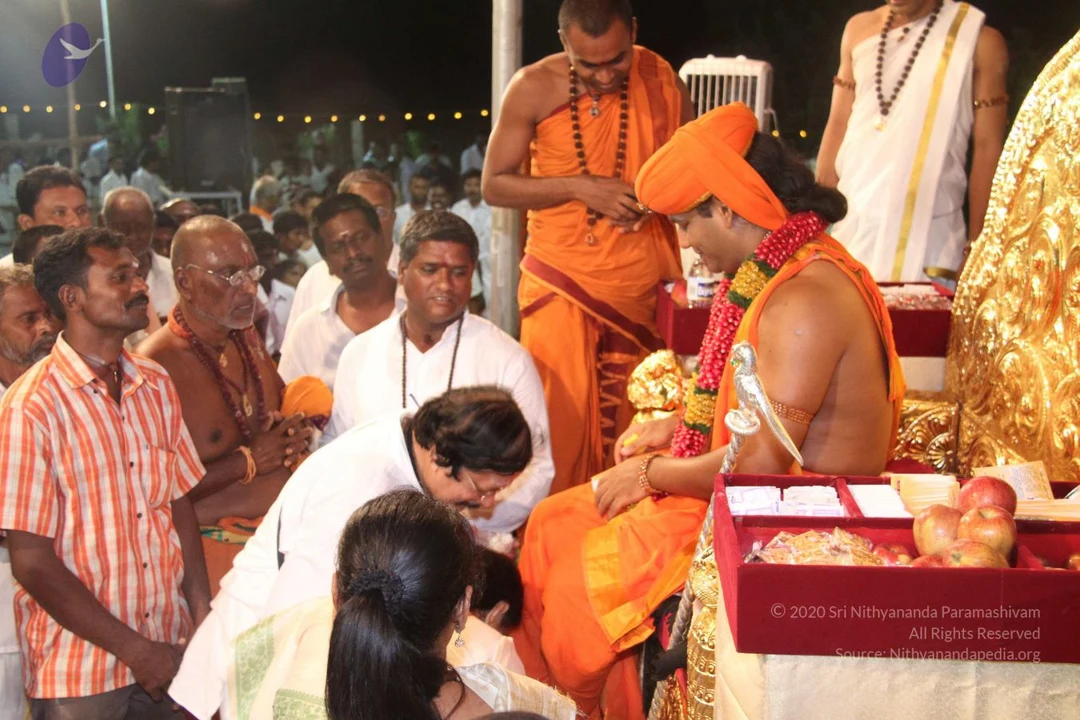
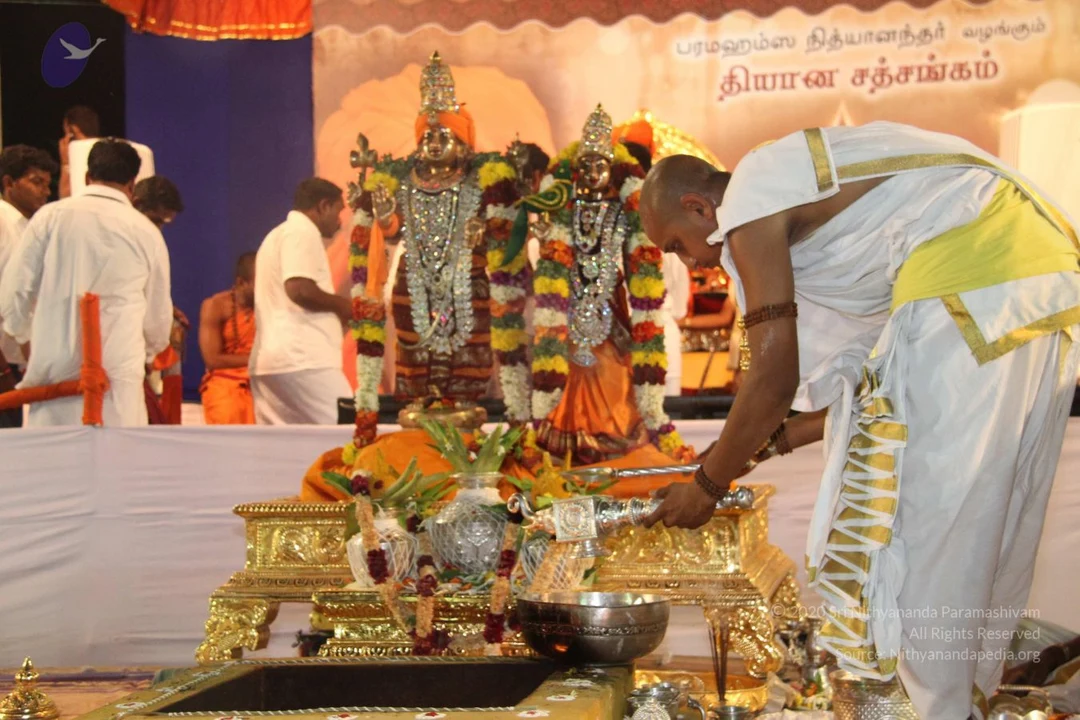
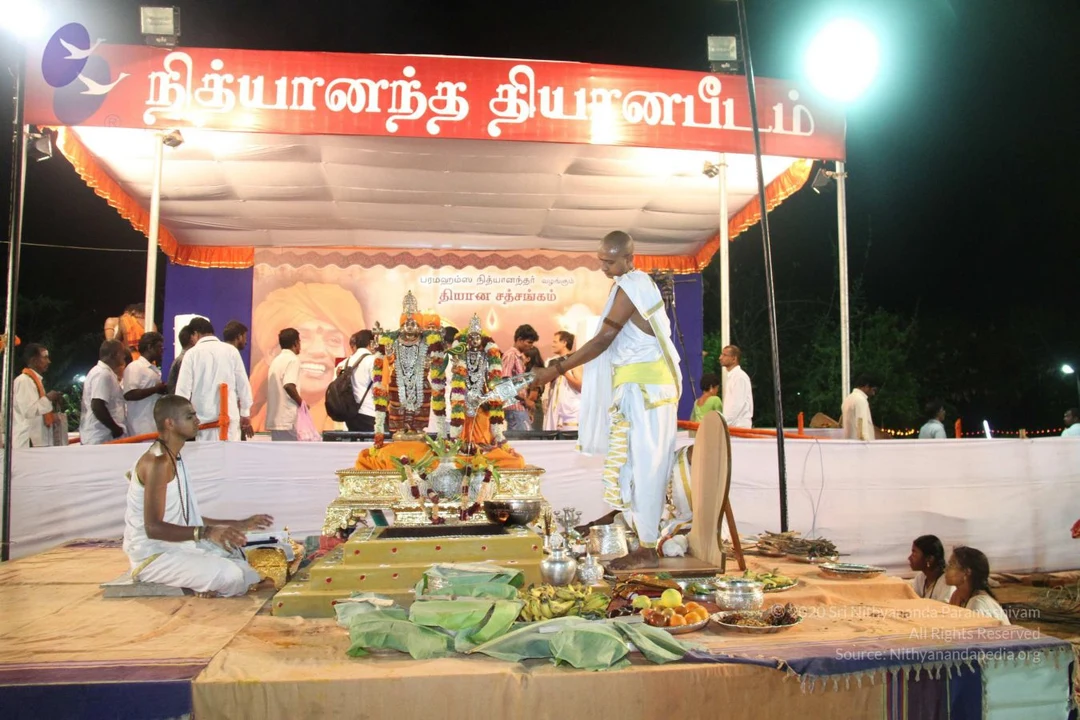
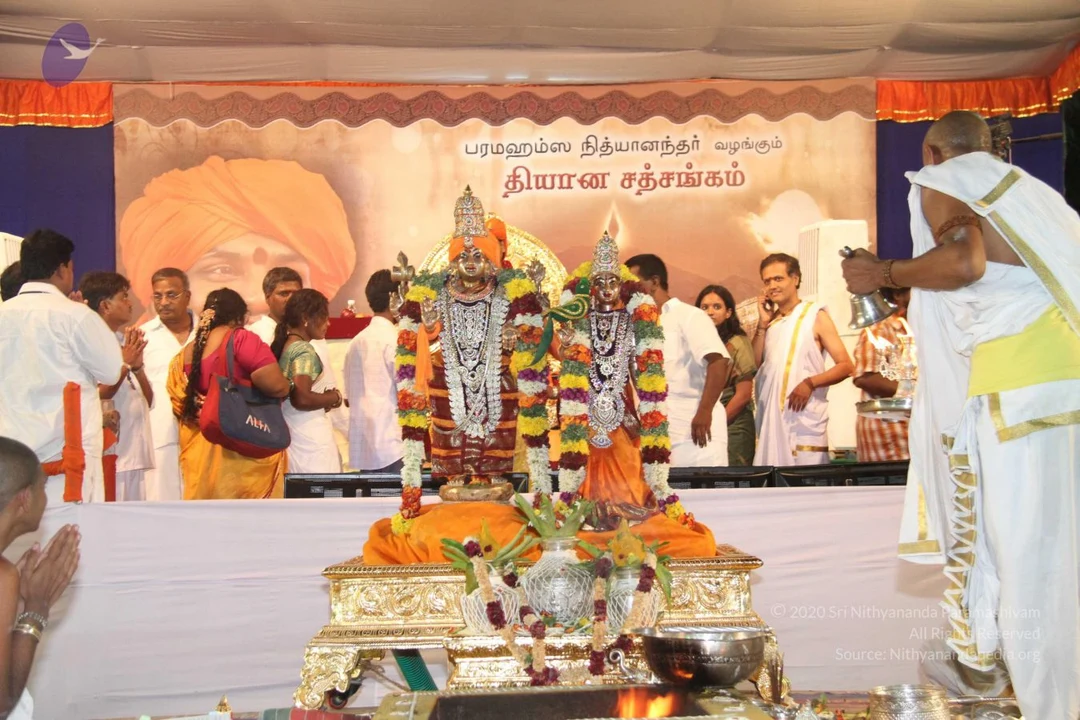
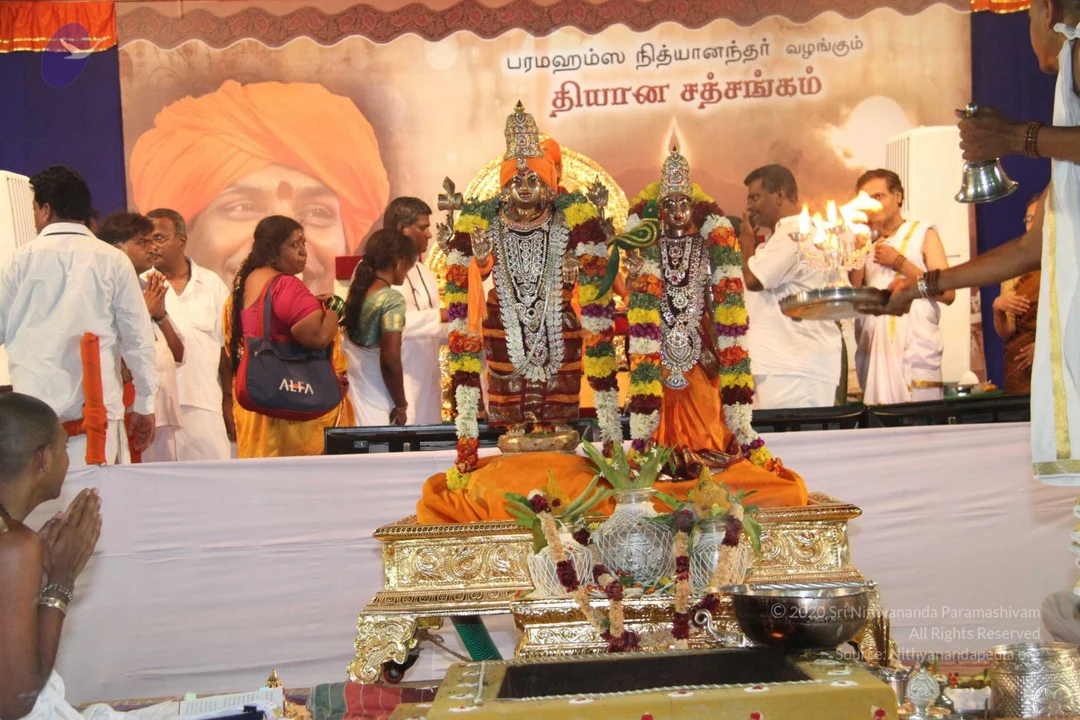
Thiruvannamalai-PublicDharshan-Rudrabhishekam

Tags:

Life enlightenment generation relationship love confidence "positive energy" "New gen" youth empowerment mind boyfriend responsibility "Paramahamsa Nithyananda" LifeBlissFoundation "Nithyananda Dhyanapeetam" "Living Incarnation" "Enlightened Master" Nithyananda

Photos Of The Day:

KALPATHAUR-CLASS

OTHERS

ANNA-MANDHIR-SERVICES

TV- MEETING-SUDDHA-MHJ

MEDICAL-CAMP

TEMPLE-SERVICES

Photos Of The Day:

Anna-Mandhir-Services

Kalpathaur-class

Medical-Camp

Temple-Services

01-Bidadi-Temple

02-Thiruvannamalai-Kalpatharu-Darshan

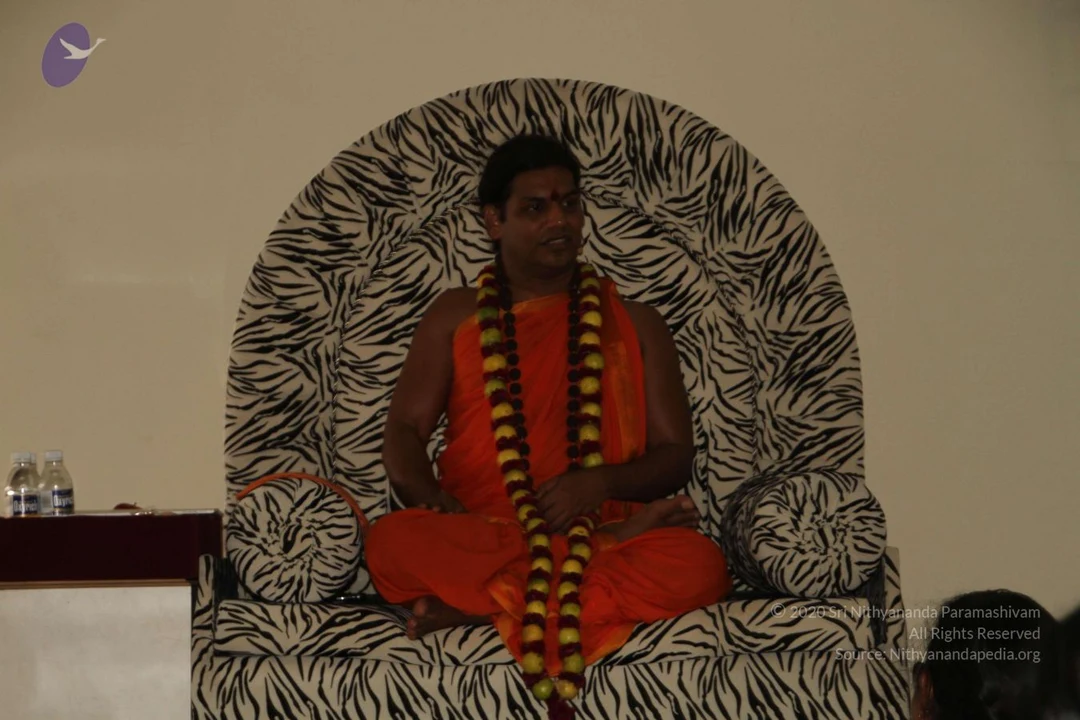
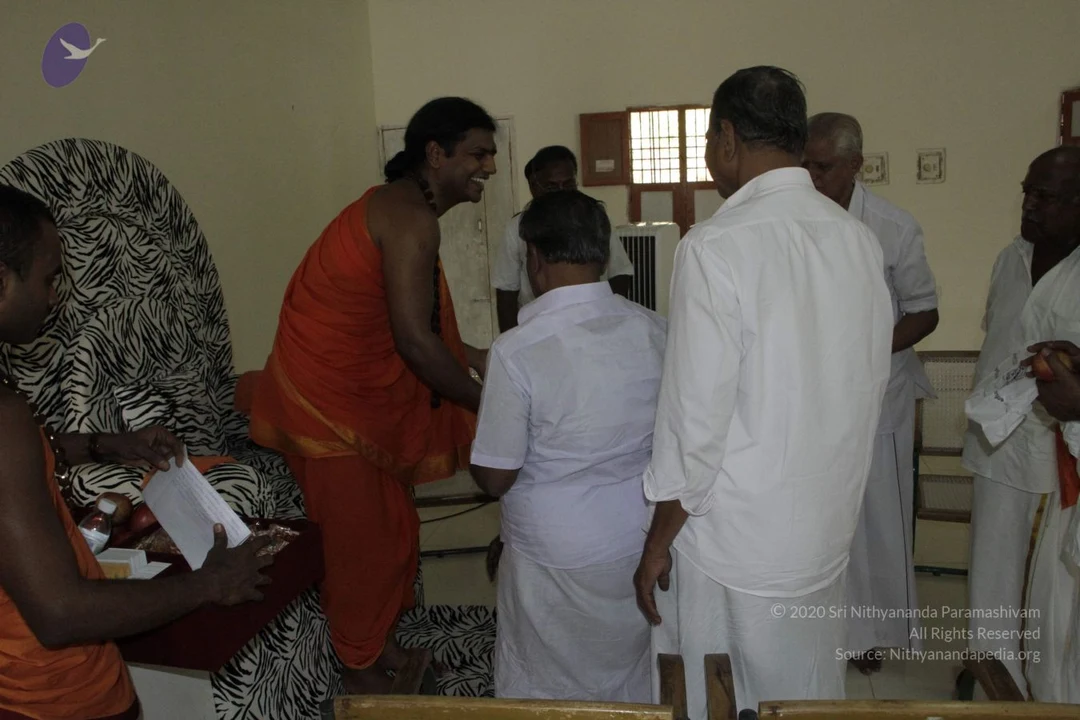
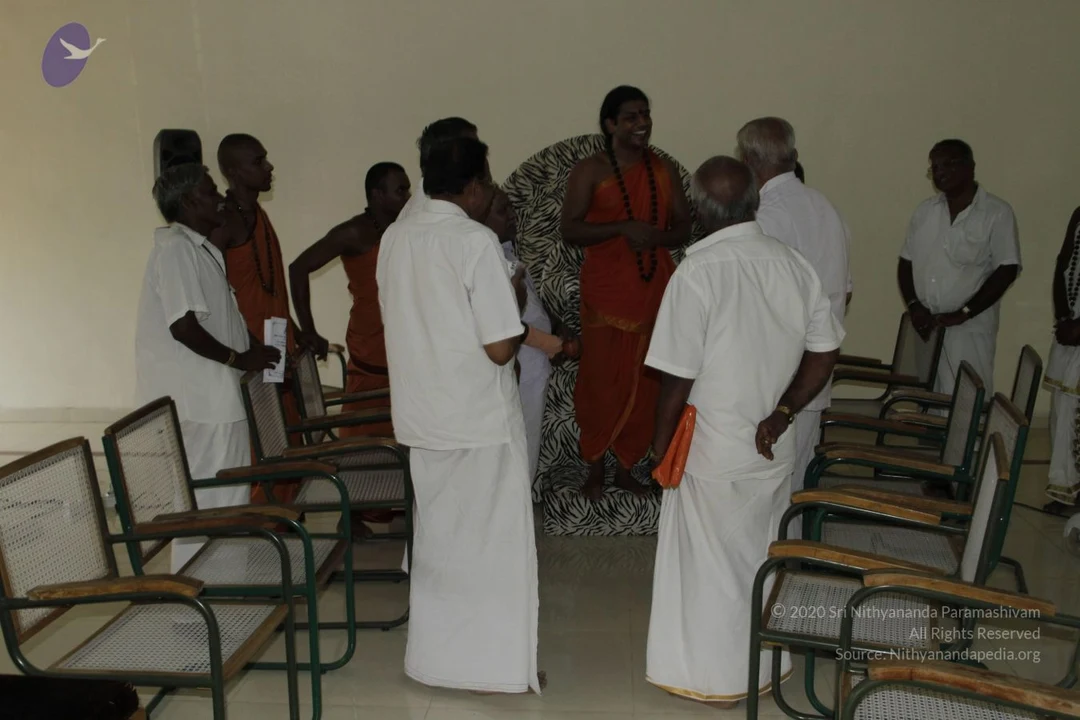
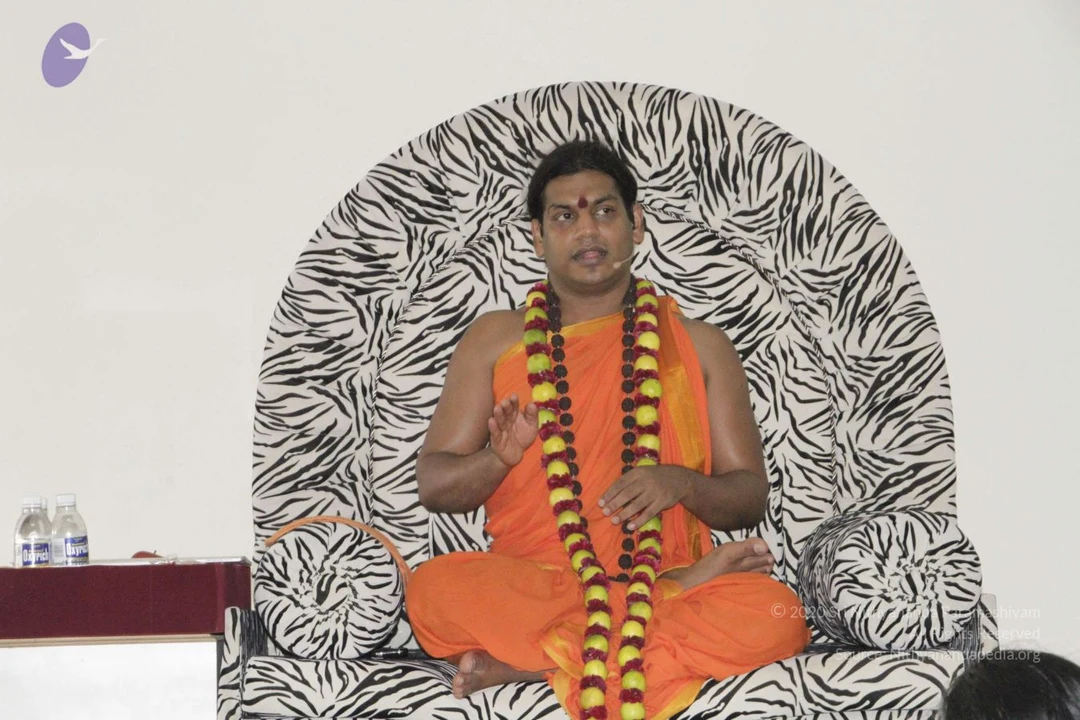
03-Thiruvannamalai-Organizers-Meet

04-Thiruvannamalai-PaadaPuja-Satsang

Photos from this day

View all 705 photos

Bidadi-Temple

15 photosSource gallery
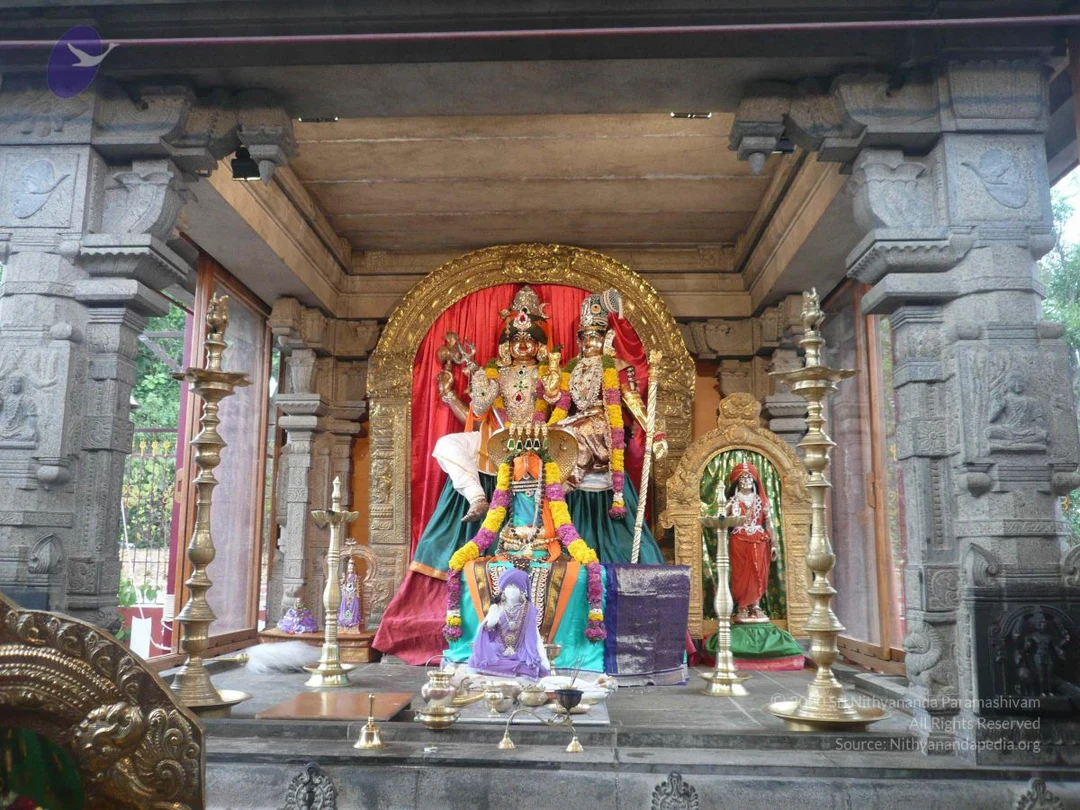
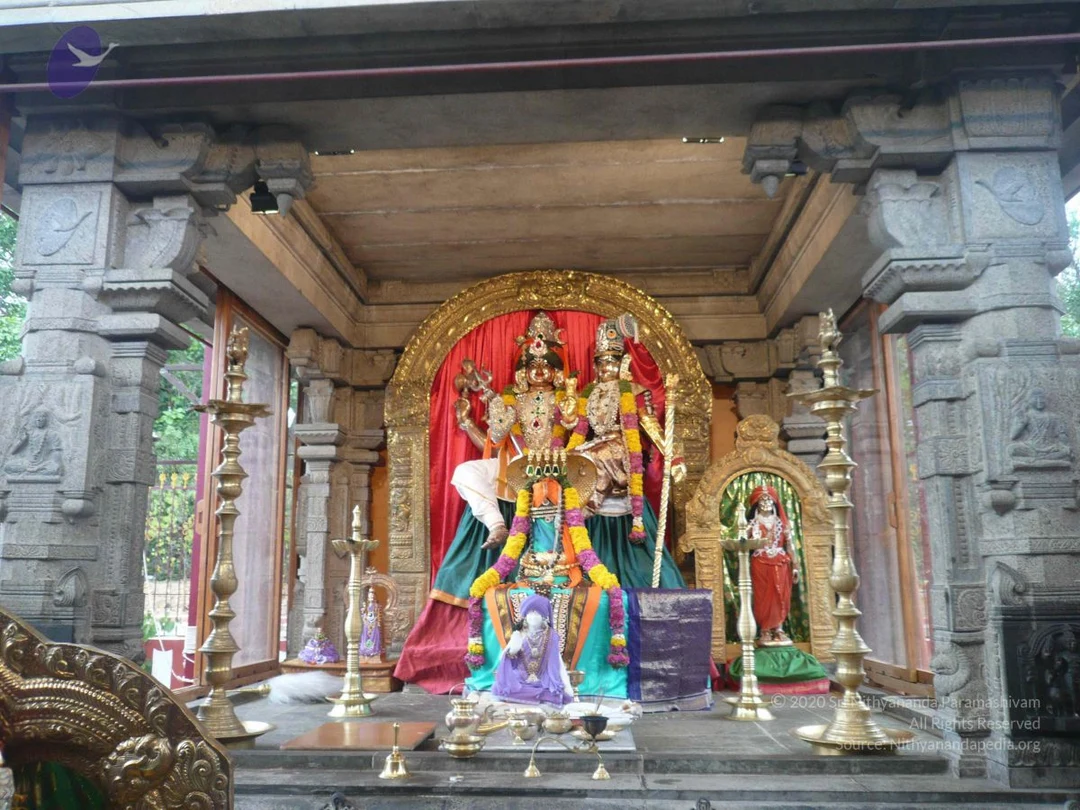
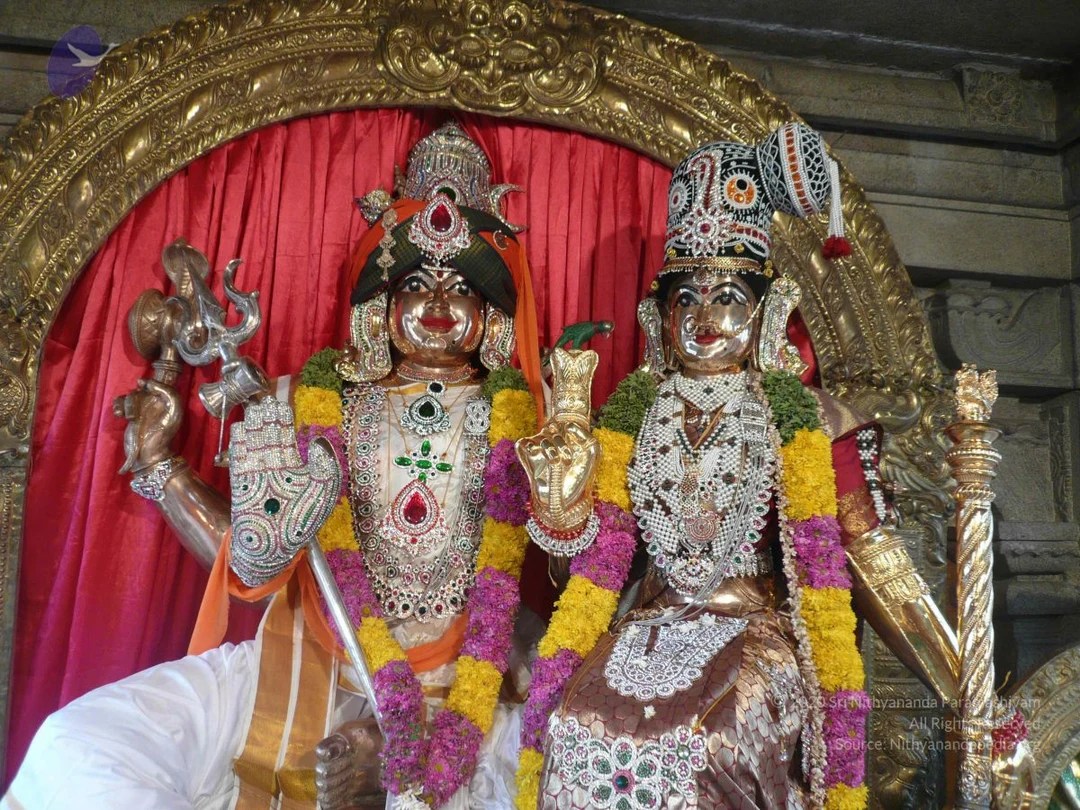
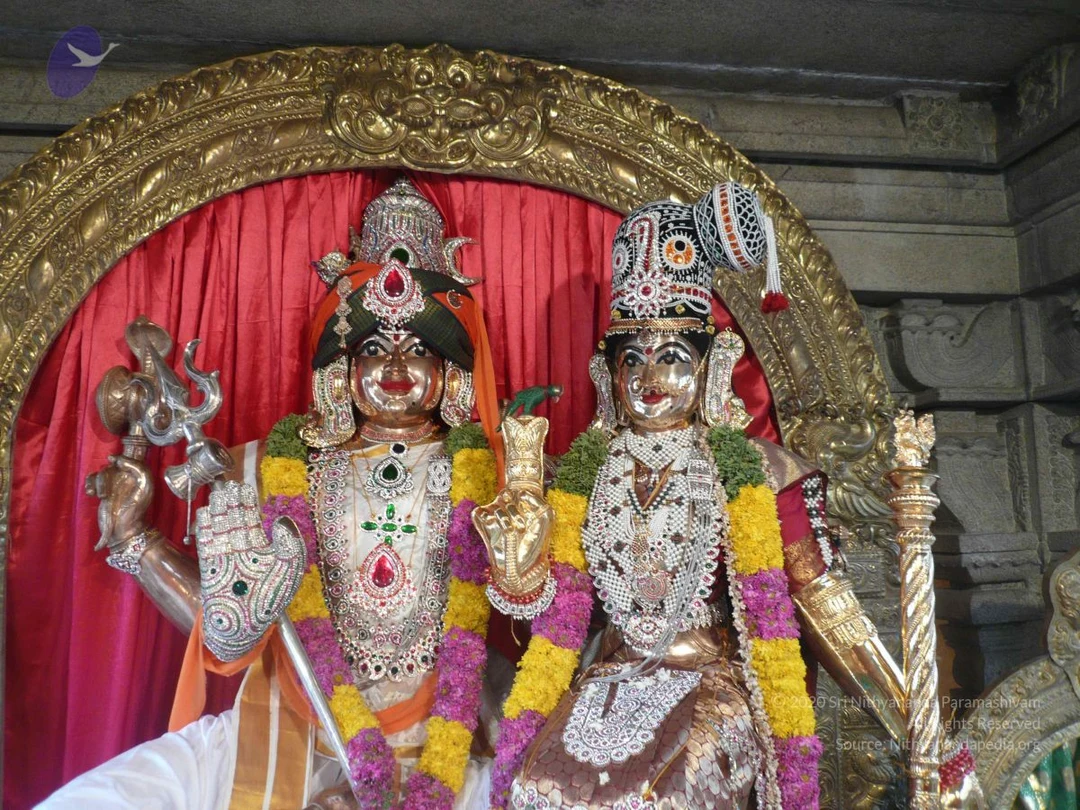
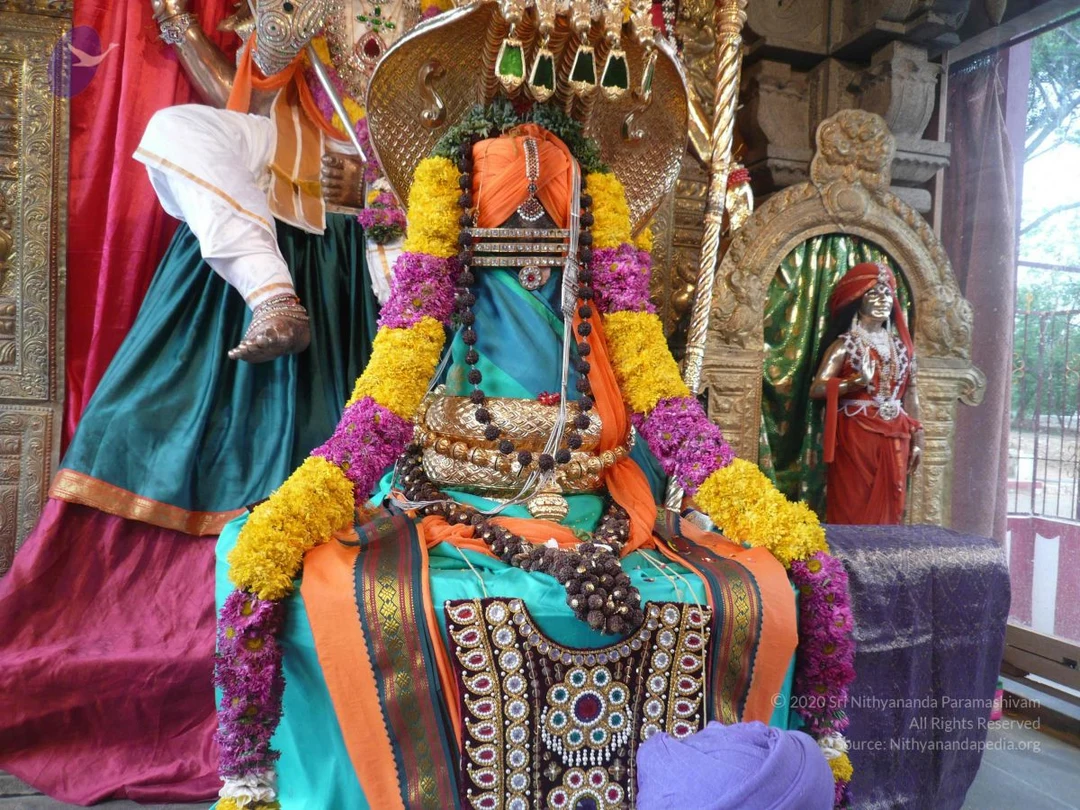
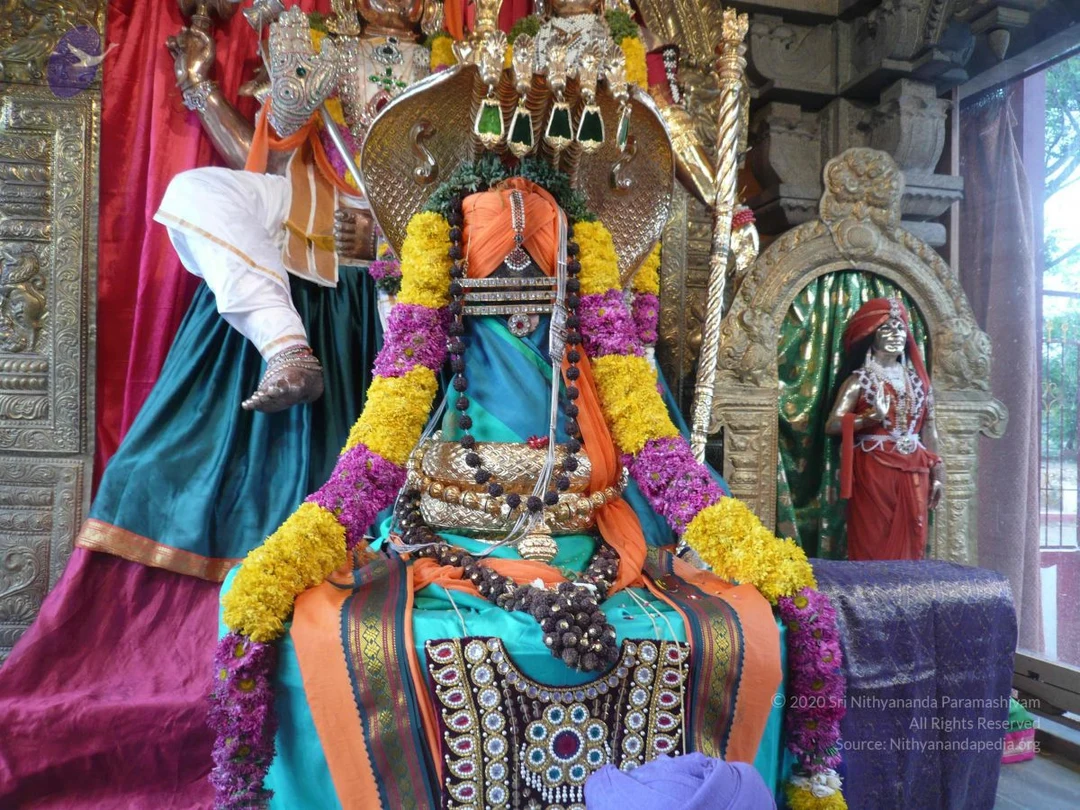
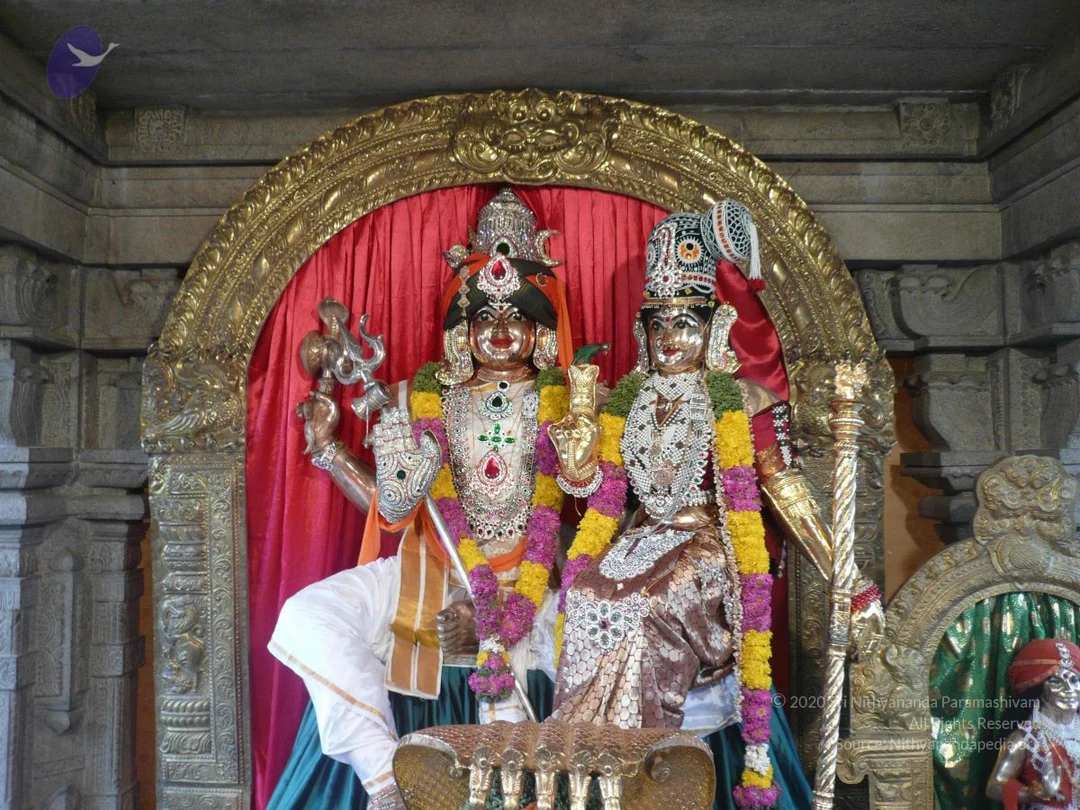
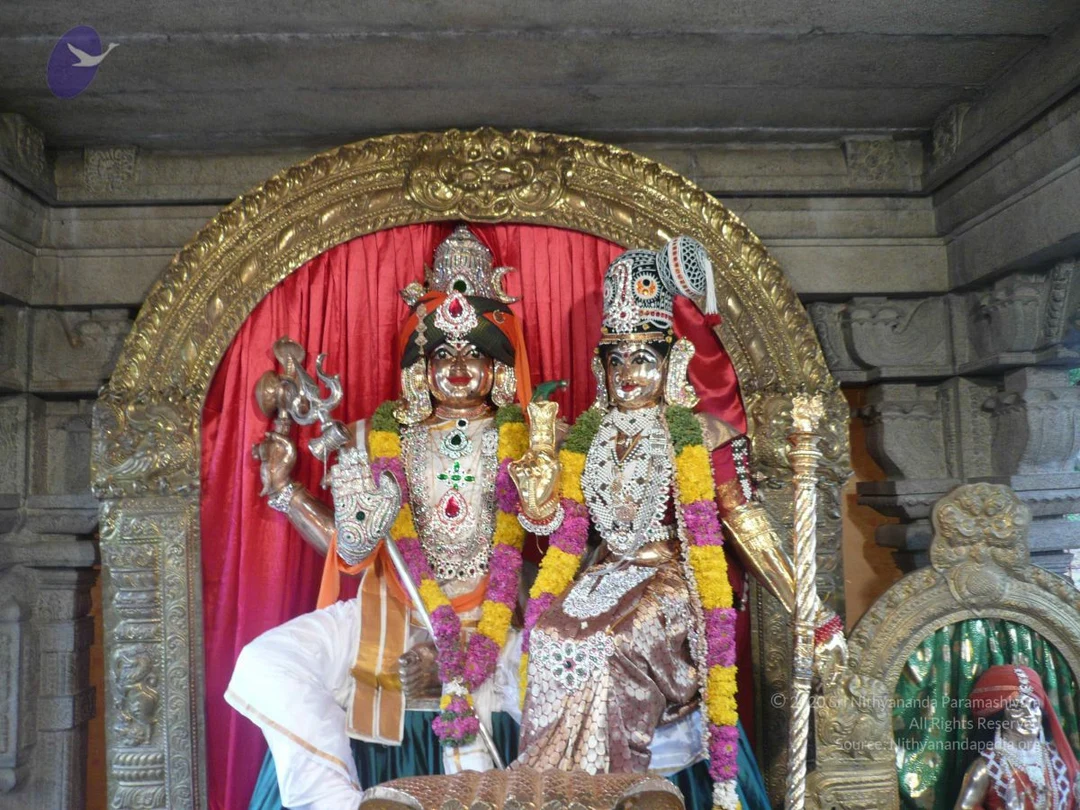
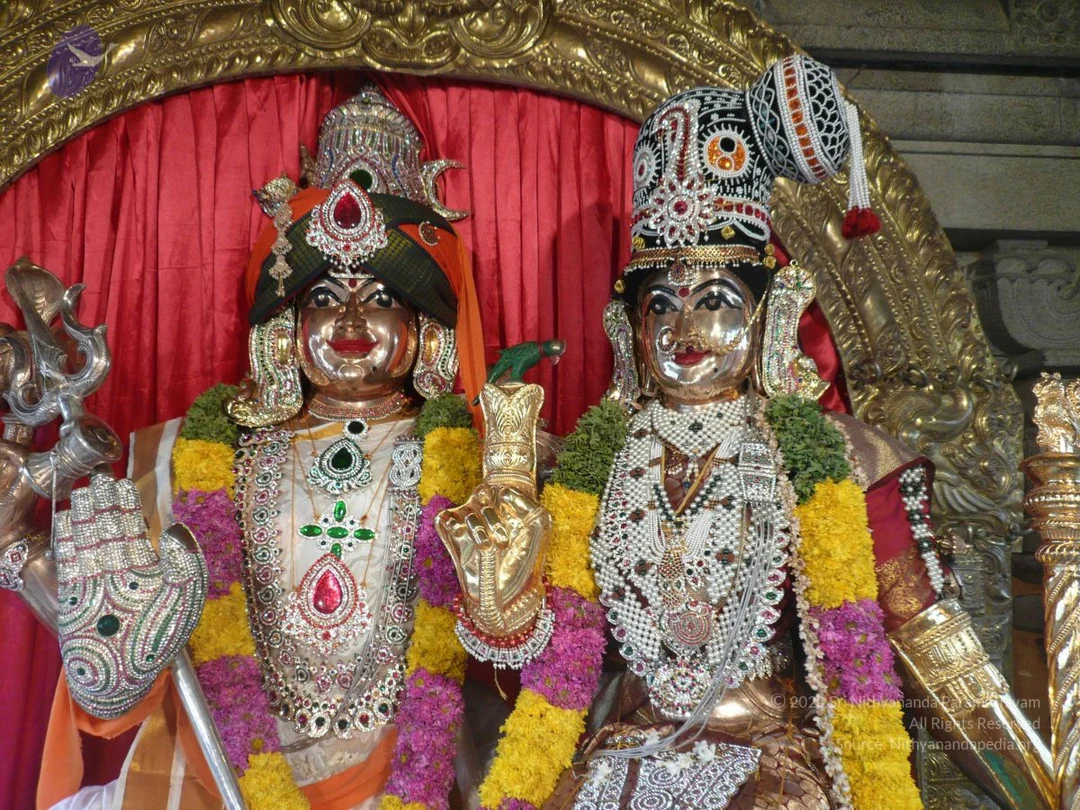
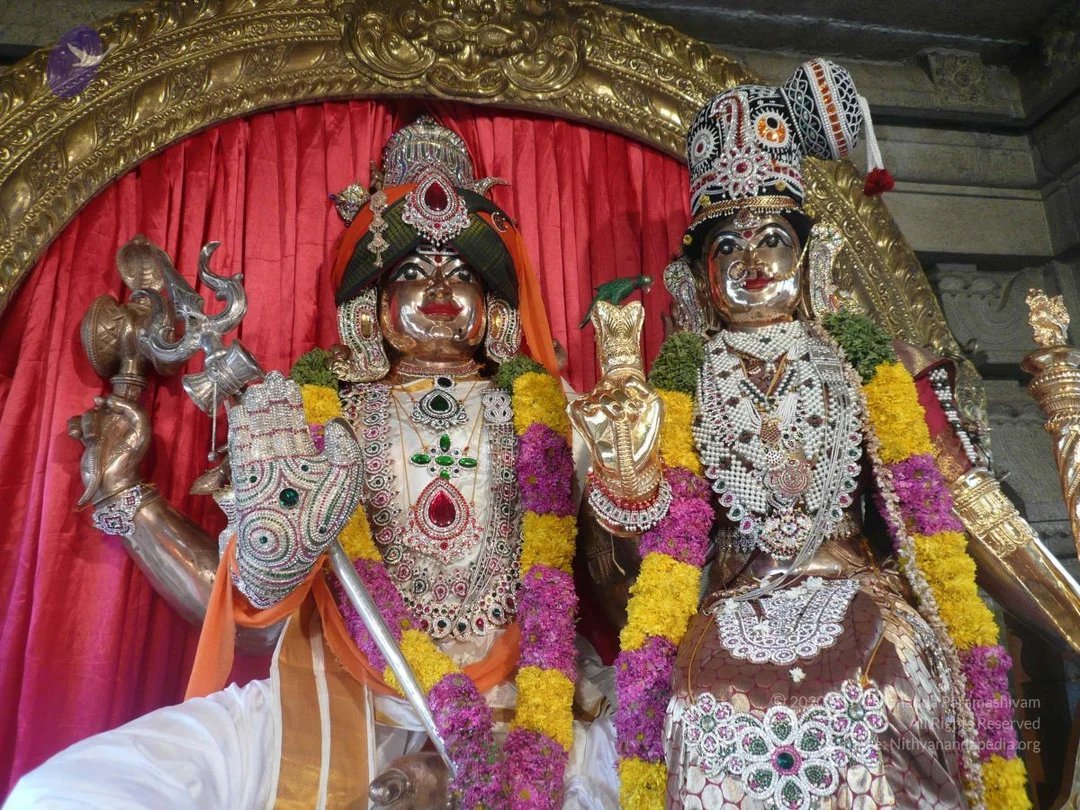
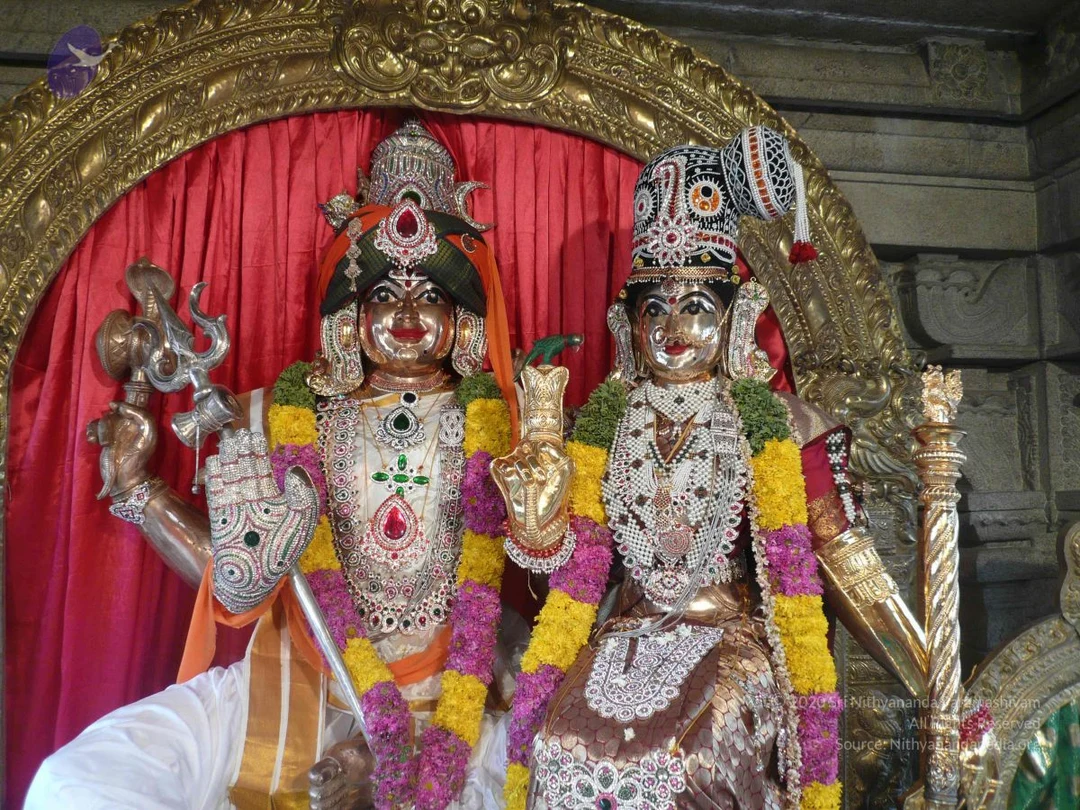
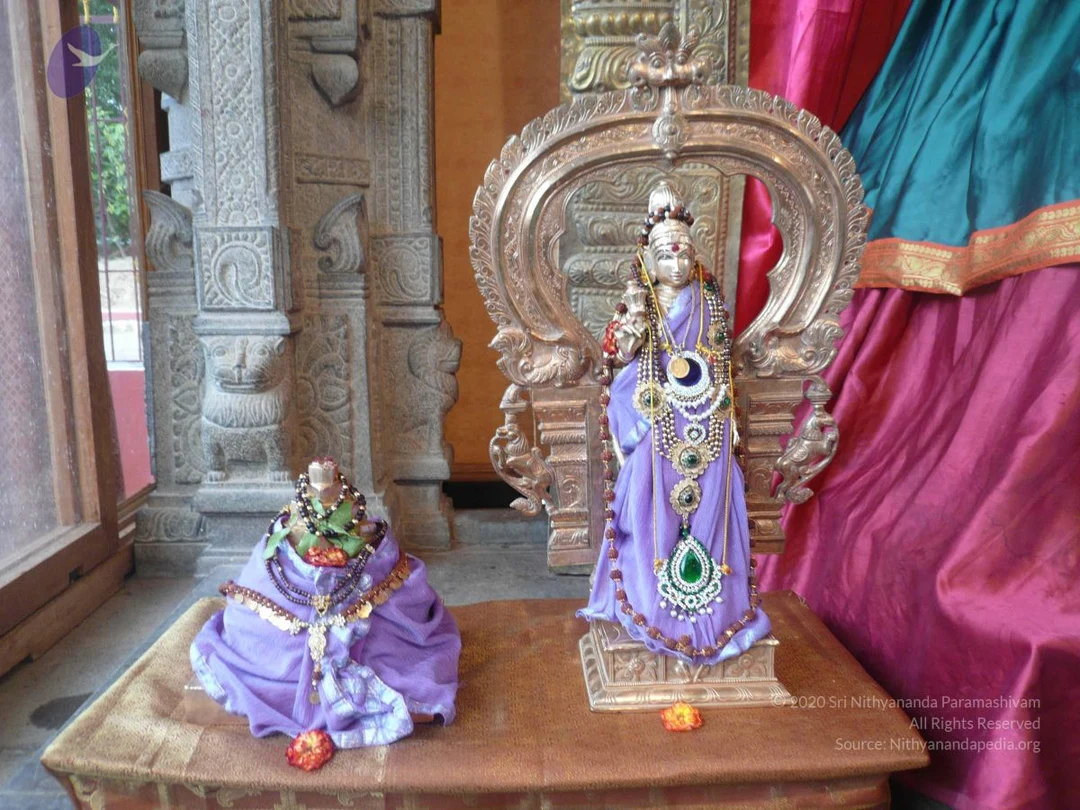
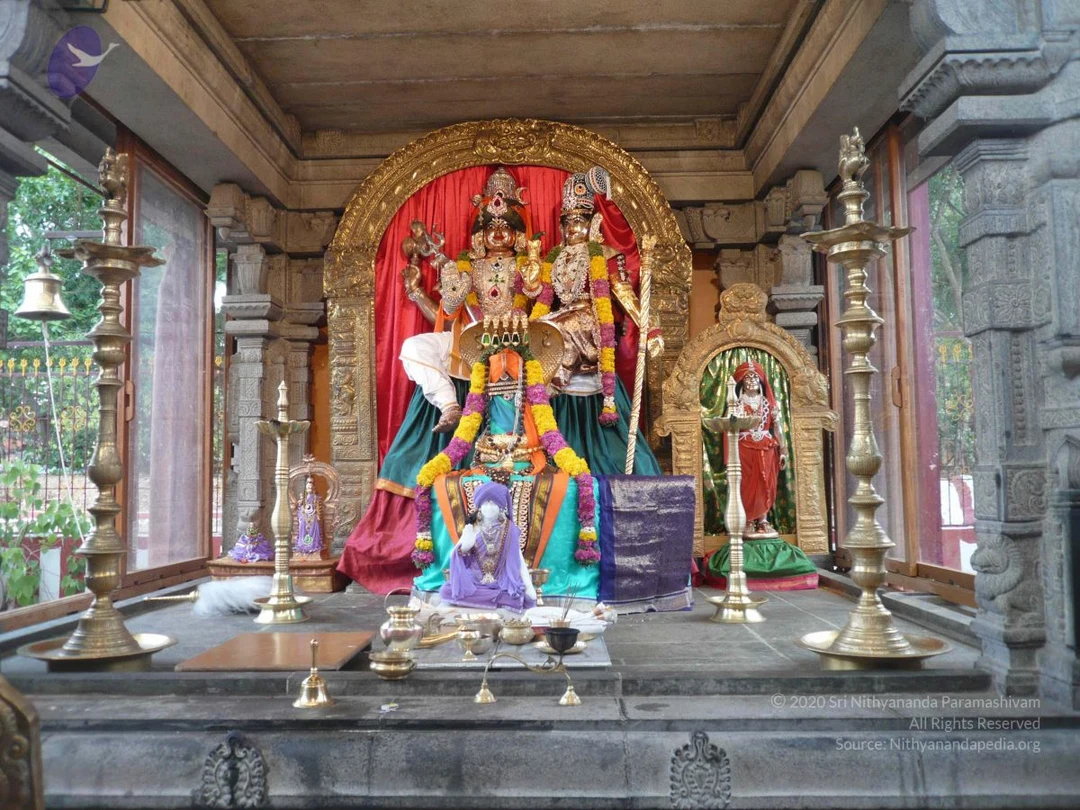
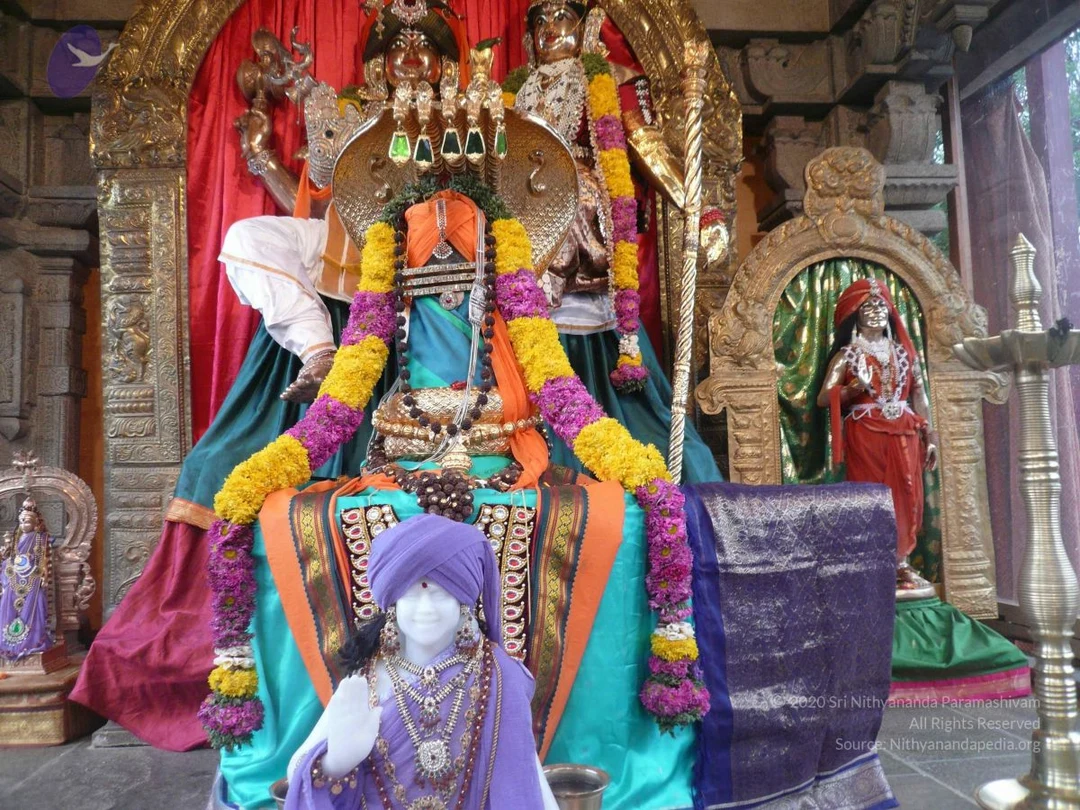
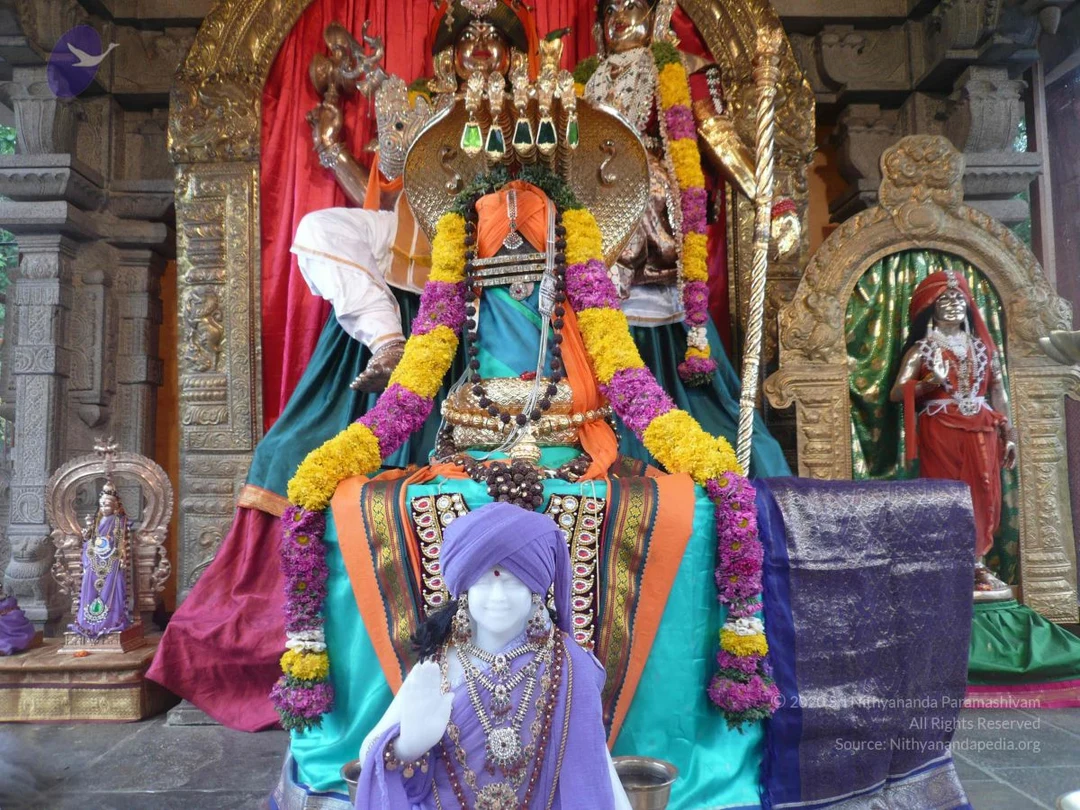
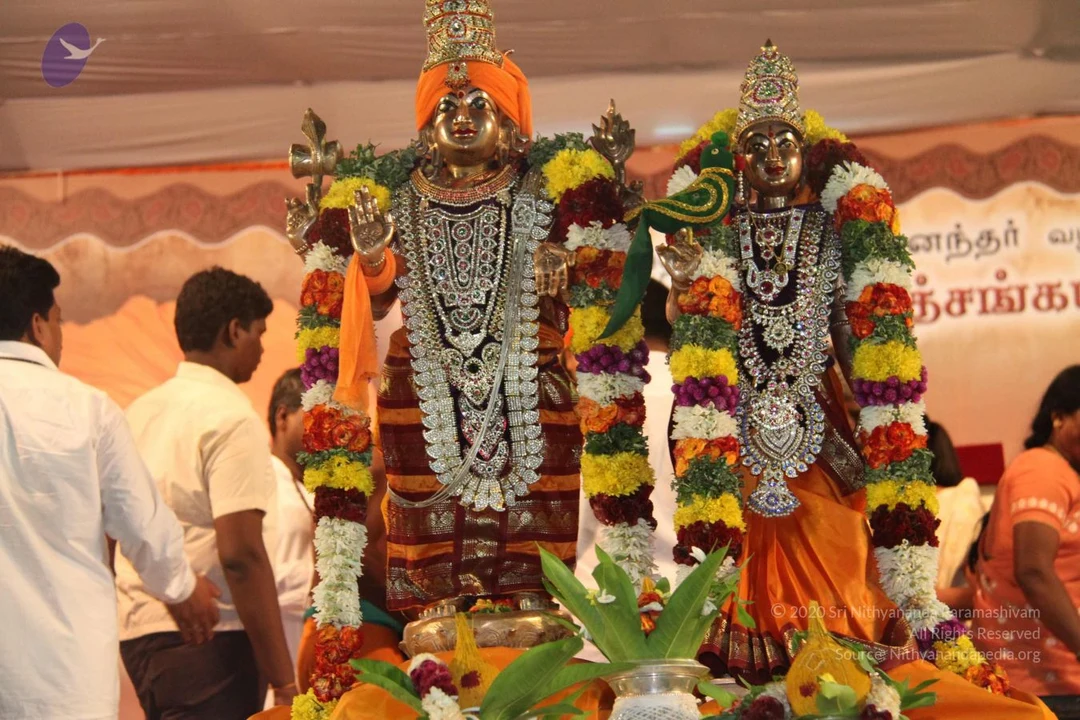
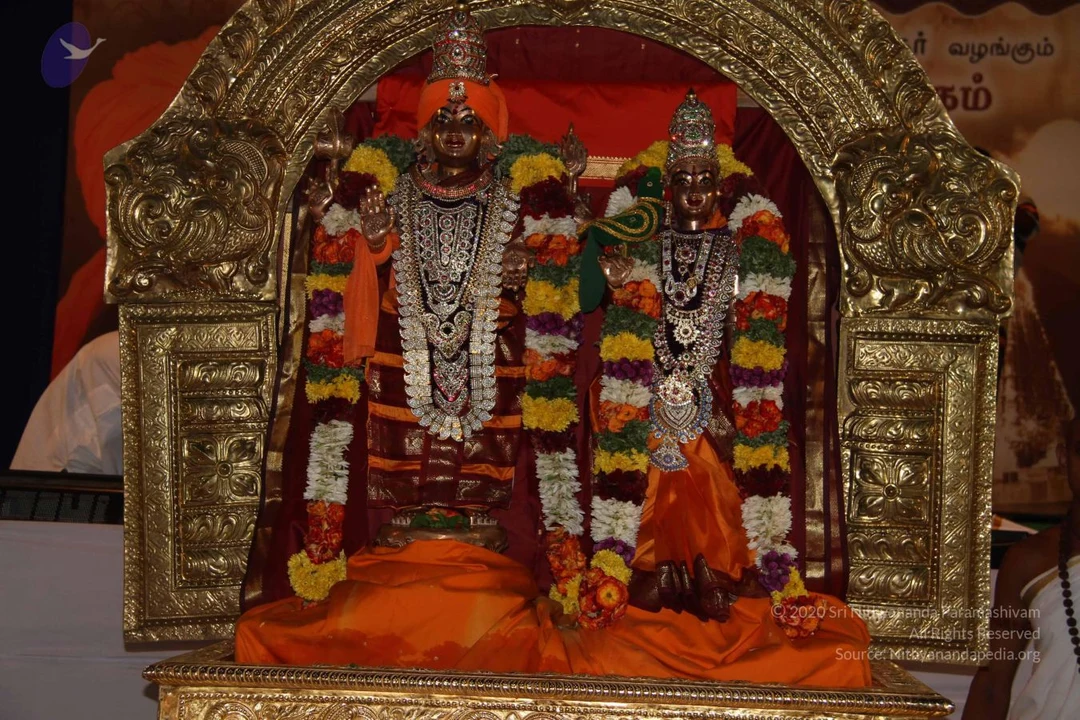
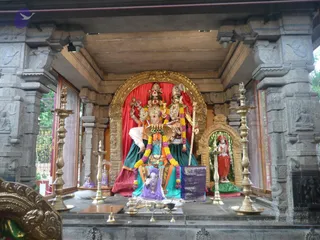
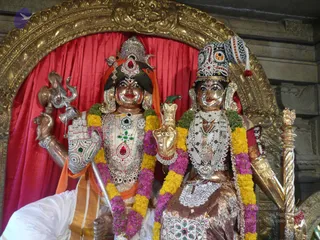
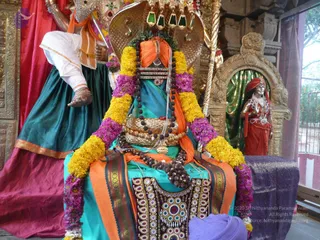
A photograph of a temple shrine with grey stone pillars and a gilded arched niche framing a red curtain. Two deity murtis stand together on a raised platform, adorned with multicolour flower garlands in yellow, pink and purple and gold crowns and jewellery; one holds a trident-like staff. A purple-clad small figure sits in front, with brass oil lamps (lamps) flanking the shrine and brass vessels and a kalasha-style pot on the floor. A small red-clad figure stands in a side niche. No people are visible in the shrine.A photograph of a stone-pillared temple shrine with carved granite walls and a wooden ceiling. At the centre stand two gilded deity murtis garlanded with magenta and orange flowers, set before a red curtain and a gold arched frame. In front are brass oil lamps (deepa stands), a brass kalasha-like vessel, small brass lamps and a purple-draped offering table. A smaller shrine figure appears to the right. No people are visible in the scene.A photograph of a stone-pillared temple shrine with gold-framed arch and red curtain behind a central deity murti draped in green cloth and multicoloured flower garlands. Two deity figures stand together with crowns and raised arms, one holding a staff. Brass oil lamps line the front of the shrine, with a small purple-clad figure and a red-robed attendant figure beside it. No living people are visible in the frame.A photograph of two metal deity murti standing before a red curtain framed by a gold arch. The figure on the left, in an orange wrap and crown, holds a trident and wears jewelled necklaces and a green-stone pendant. The figure on the right wears a black and gold crown with a red tassel, pearl and bead necklaces, and a brocade skirt; it holds a gold staff. Both are garlanded with yellow and purple flowers. A partially visible person in white dhoti stands at the lower left edge.A seated deity murti is the central subject, dressed in turquoise and orange cloth with a mustard-and-magenta marigold garland, a rudraksha mala, gold armlets and a jewelled breastplate. An orange headcloth and a gold crown-like headpiece sit above a decorated throne back. Behind it, a standing statue in red and white garments with a red headcloth holds a mala and wears a white flower garland, and a dark green draped backdrop and gilded arches frame the scene. A purple cloth covers the table at right. No living people are visible, and no a person candidate is present in the image.A seated deity murti. It wears an orange and teal draped cloth, rudraksha malas, a jewelled gold chest ornament and a gold crown or headdress. Behind it stands a large golden multi-headed cobra hood and a carved figure with a trident-like staff. To the right, a smaller statue in red robes and a red turban stands in an arched niche. The setting appears to be a temple shrine with draped red and green fabrics and metal carvings.

Thiruvannamalai-Kalpatharu-Darshan
45 photosSource gallery
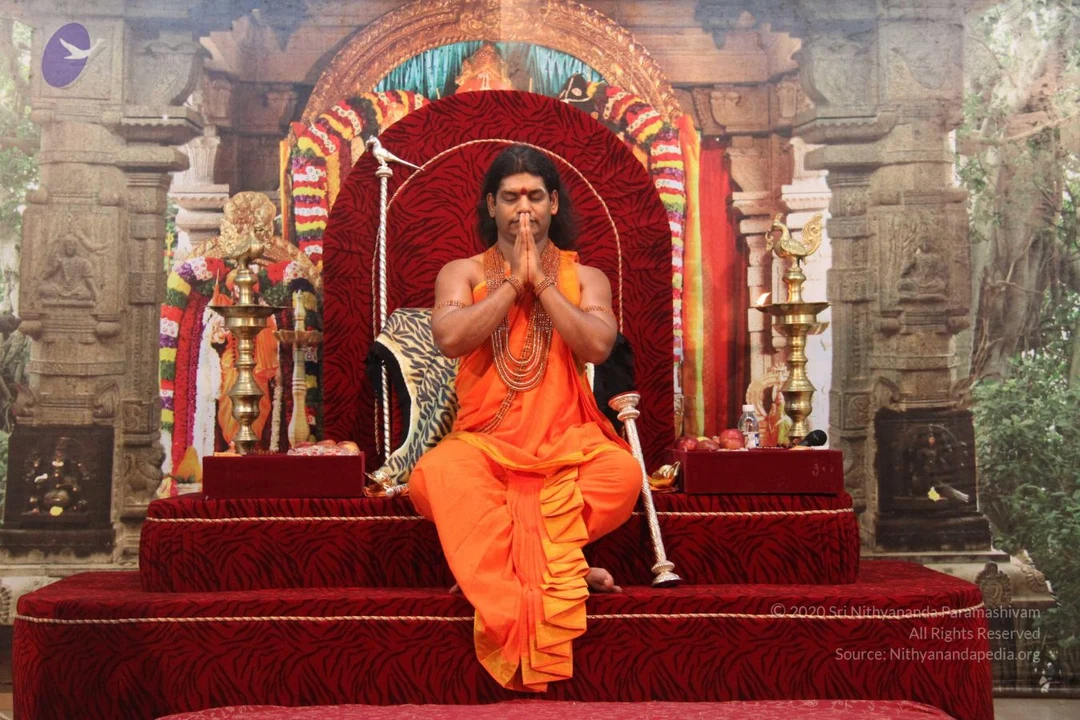
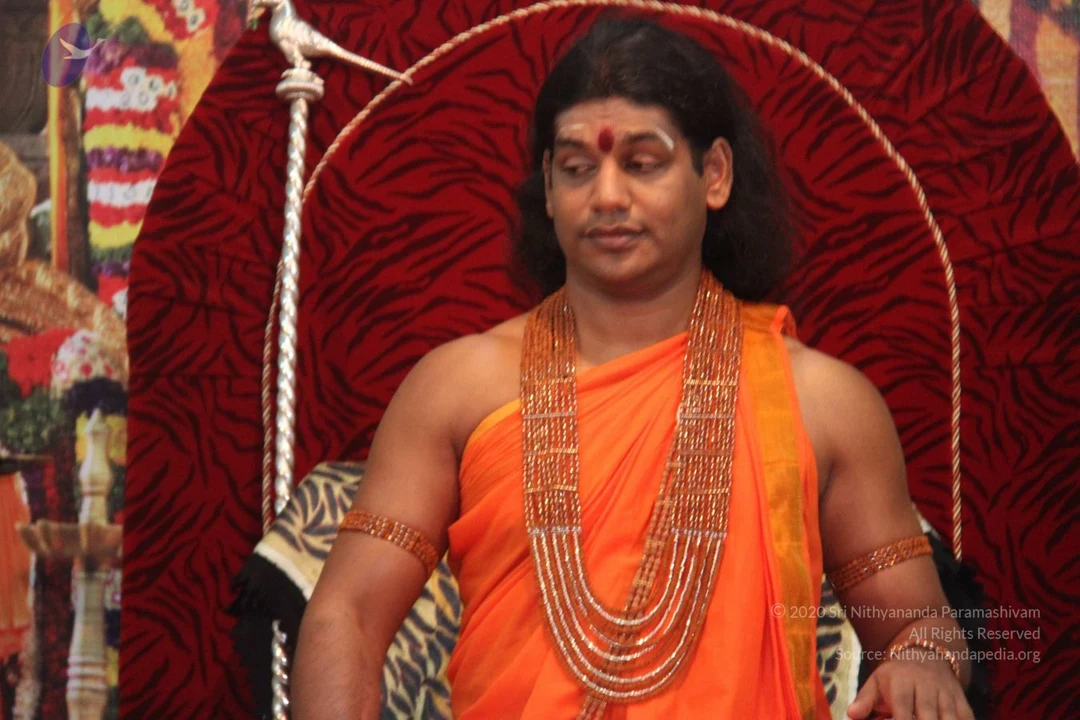
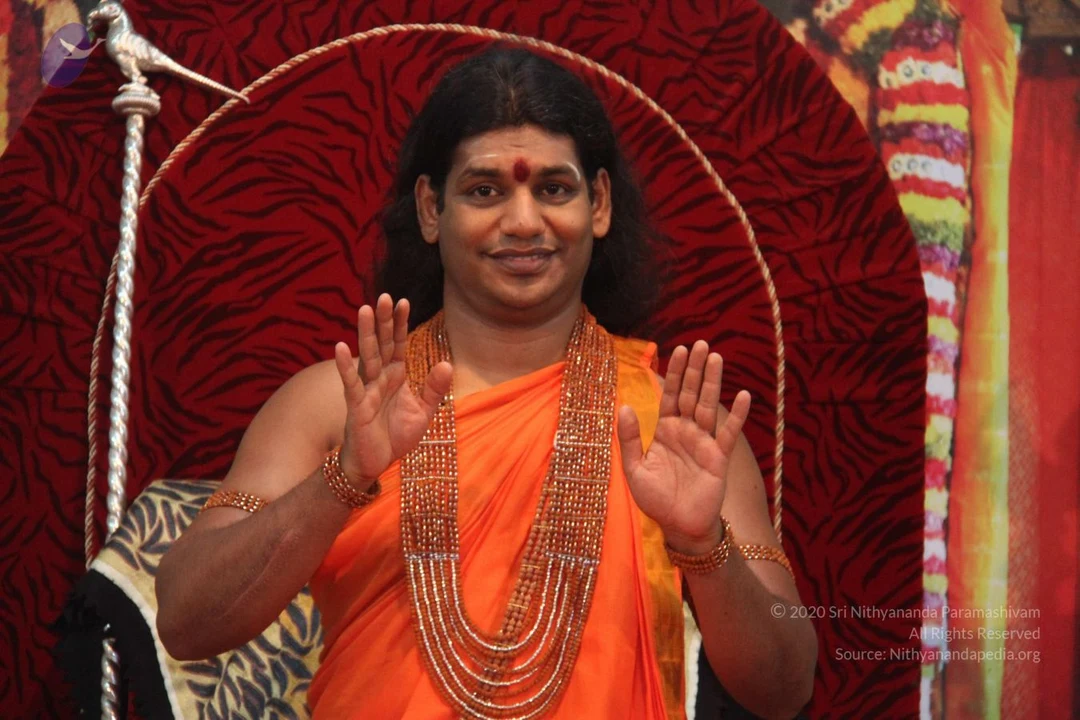
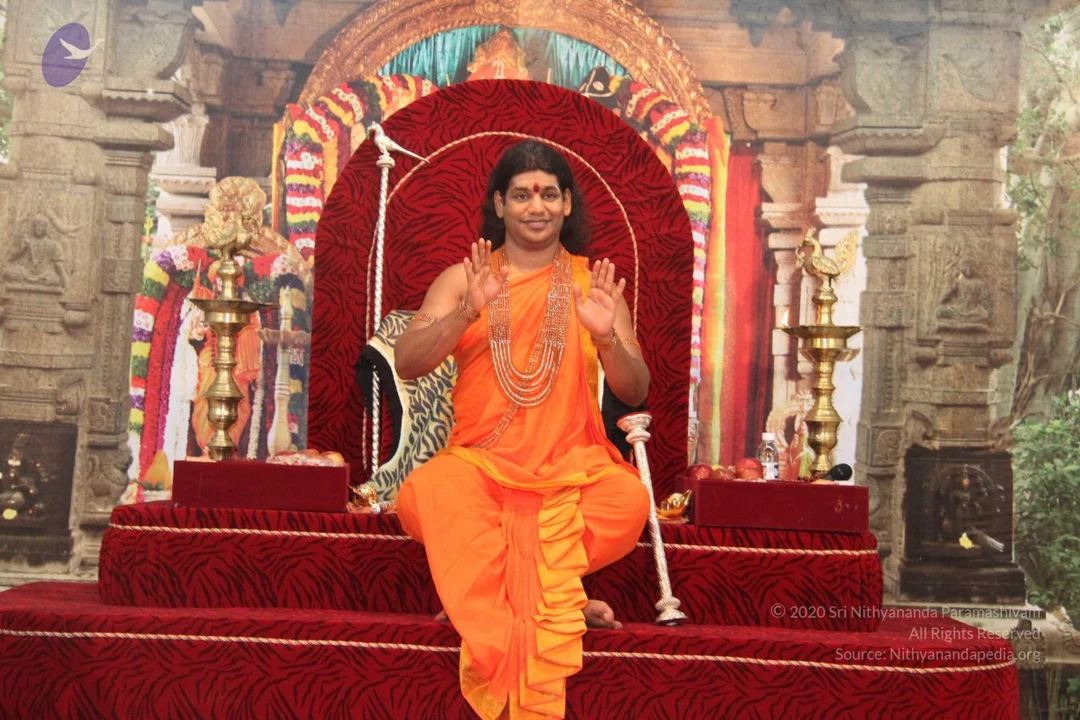
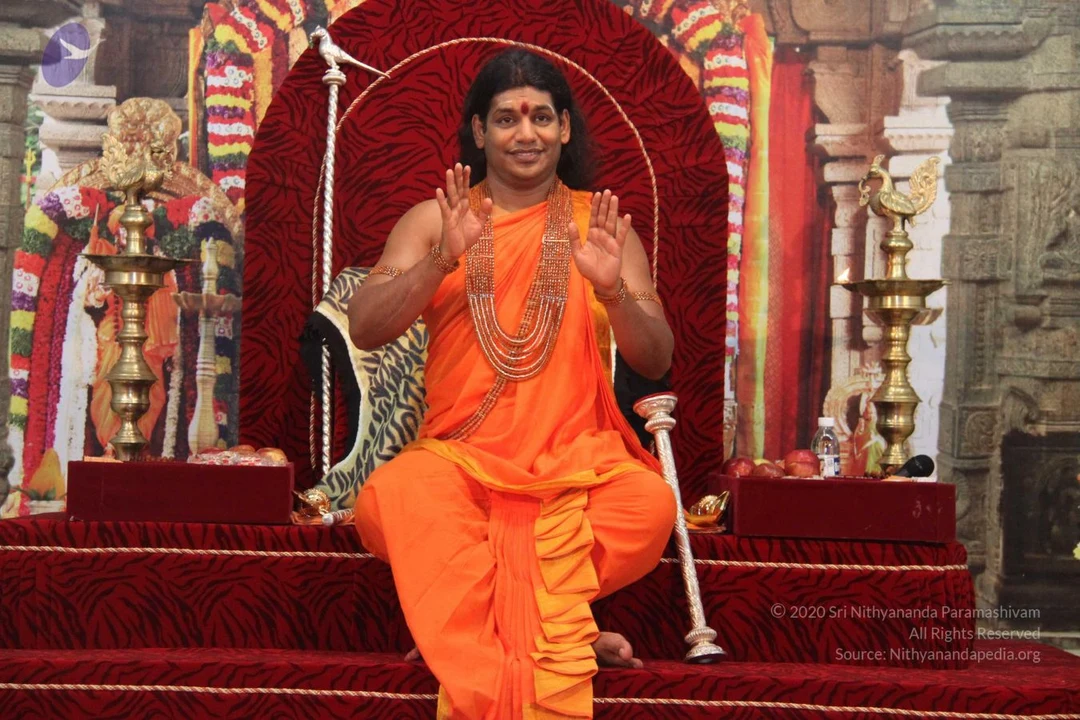
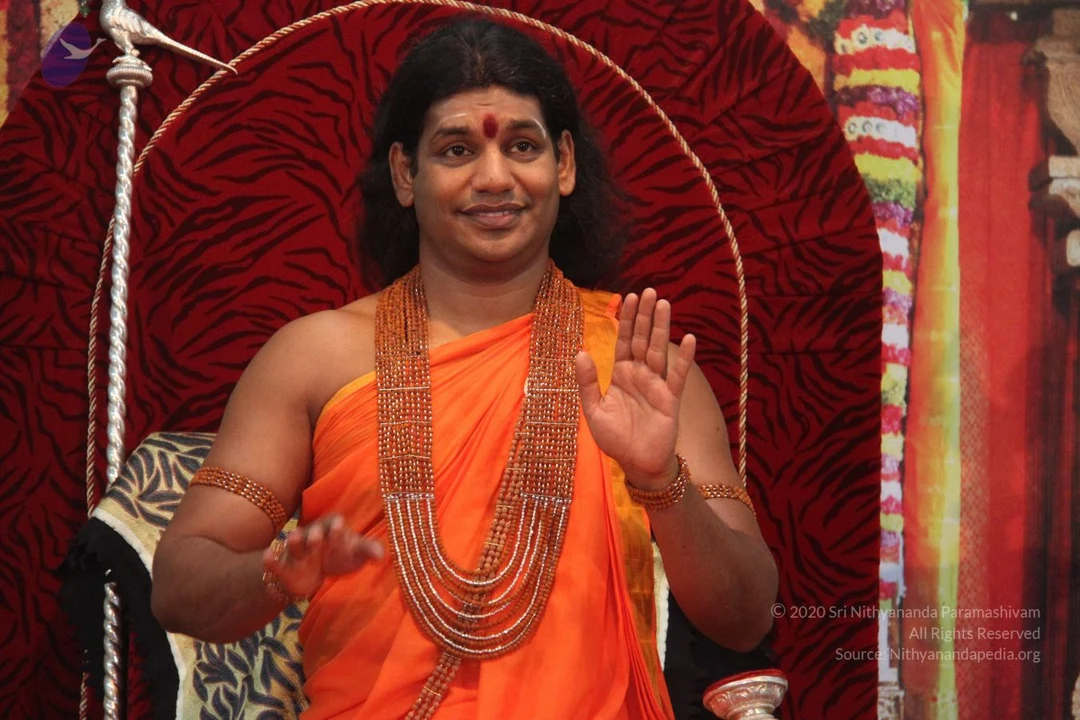
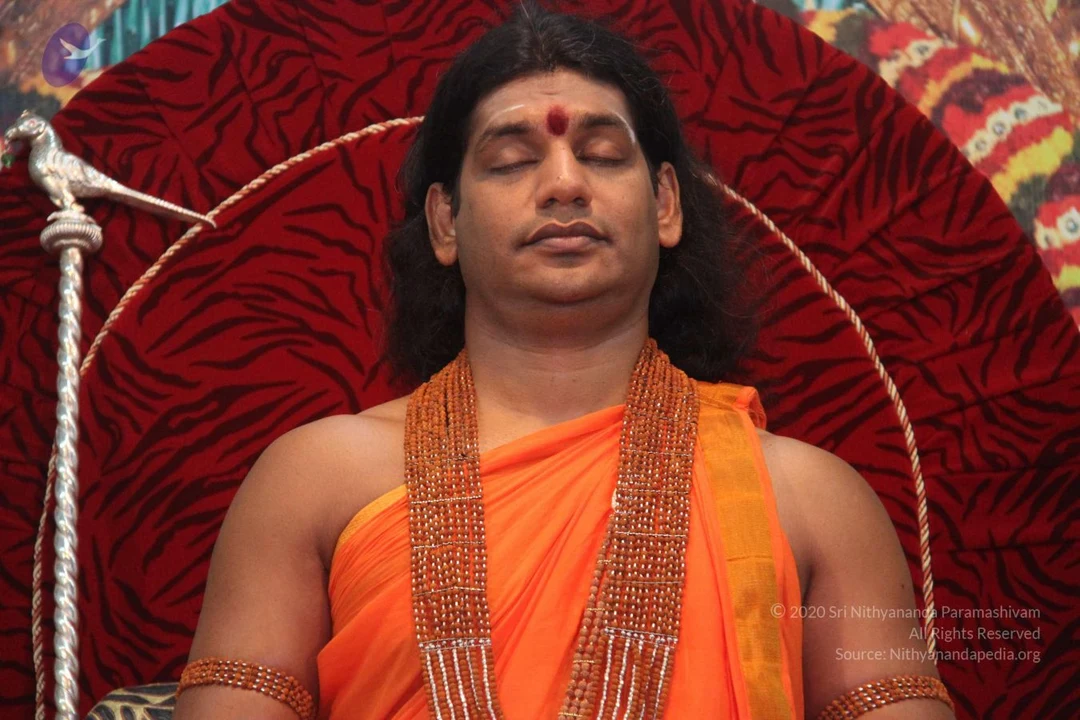
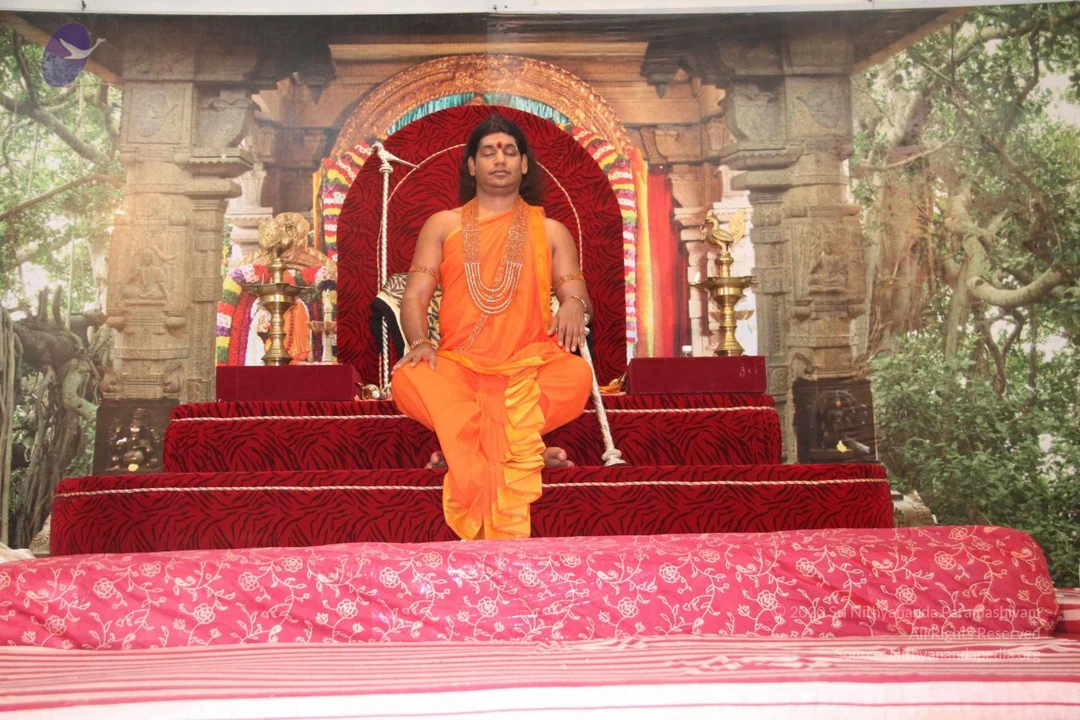
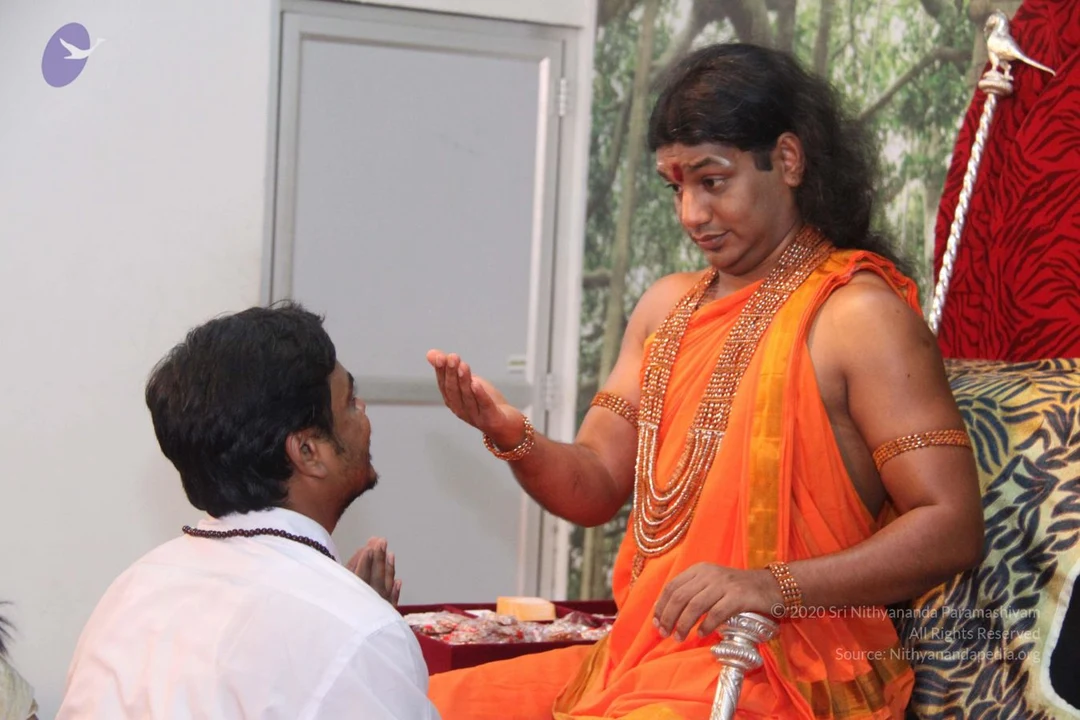
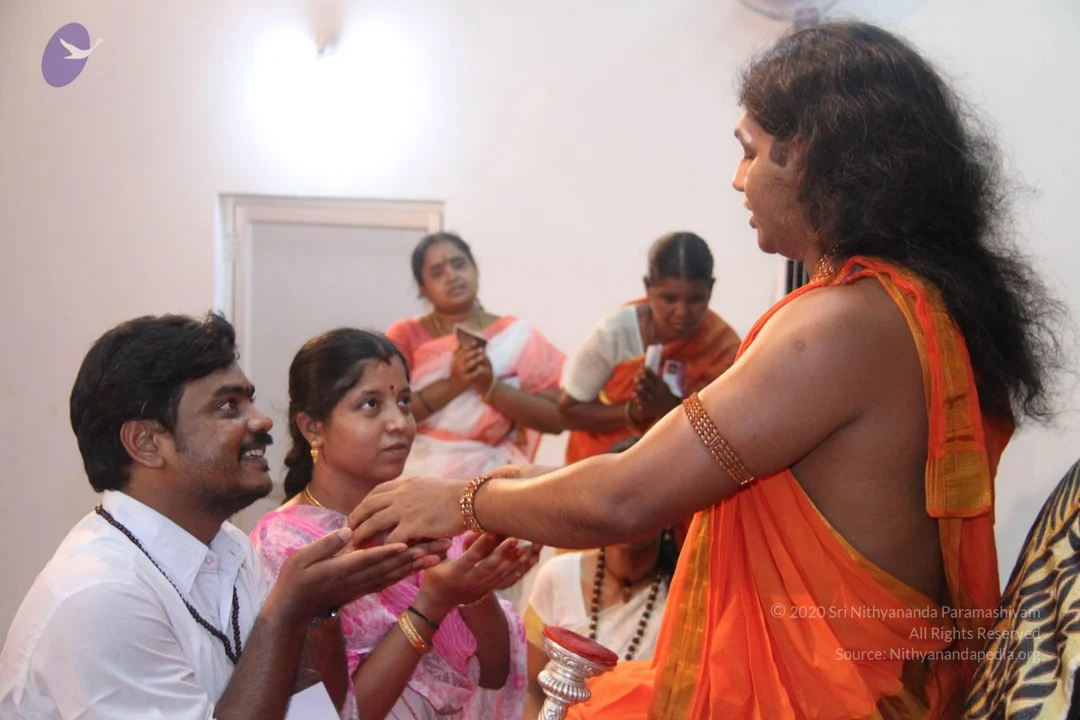
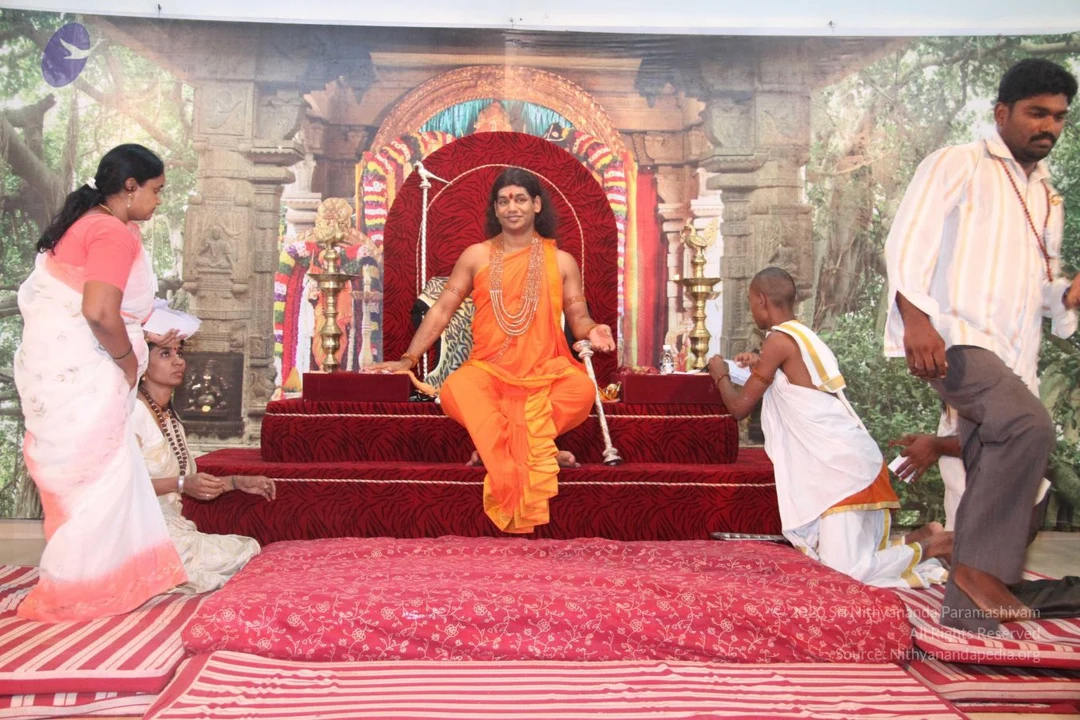
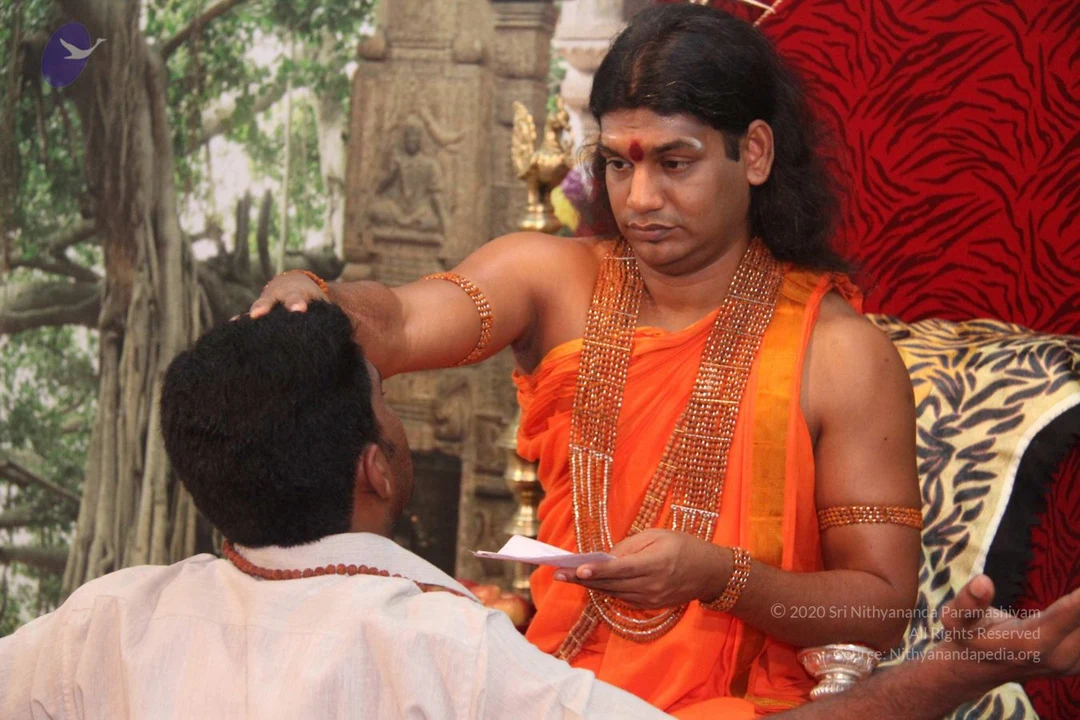
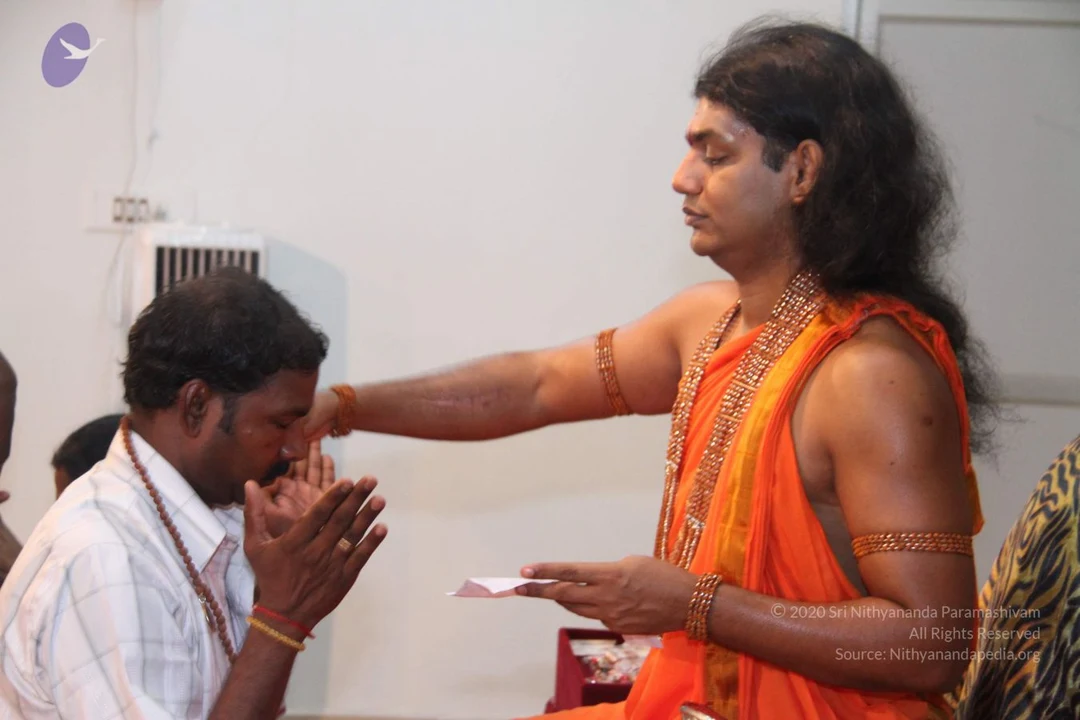
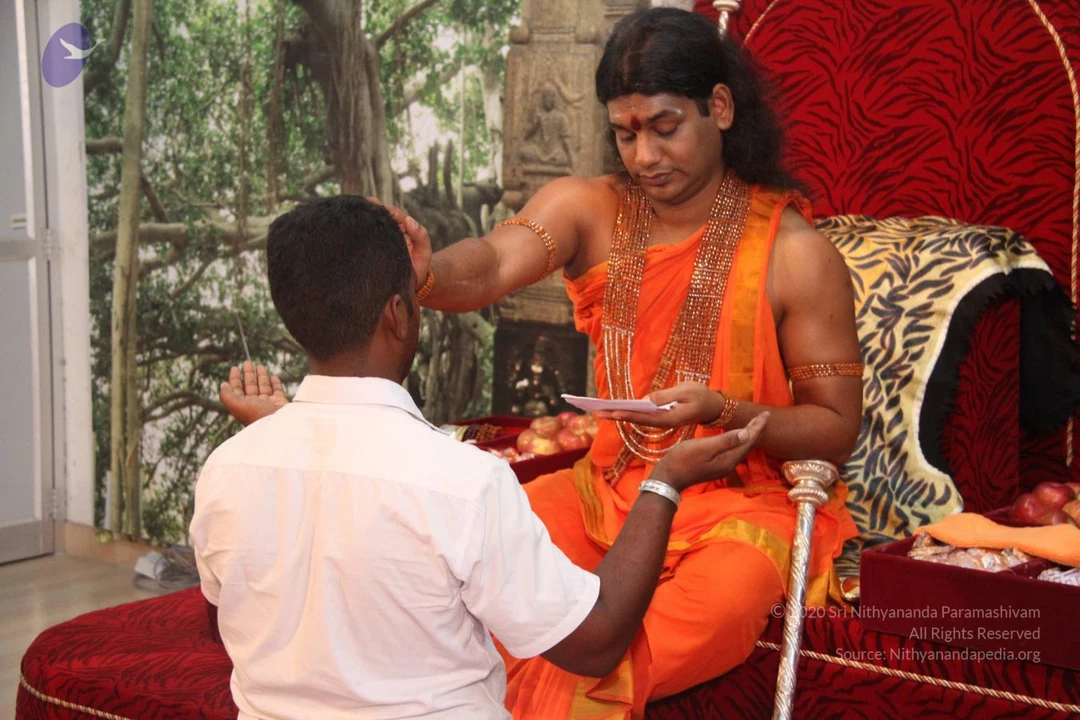
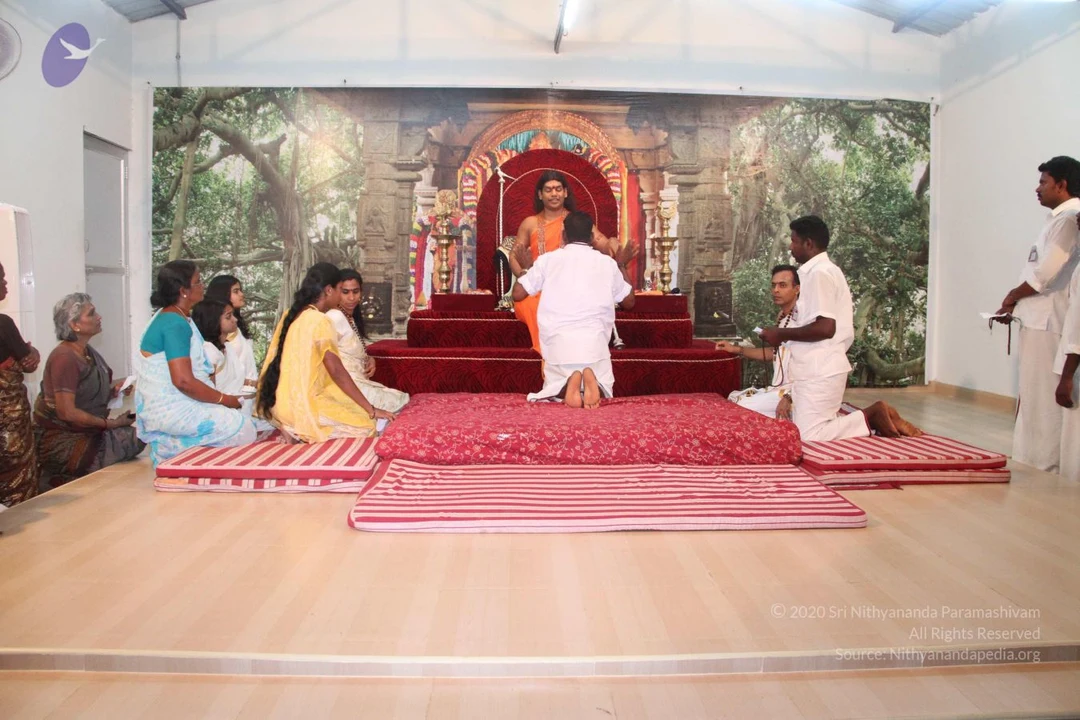
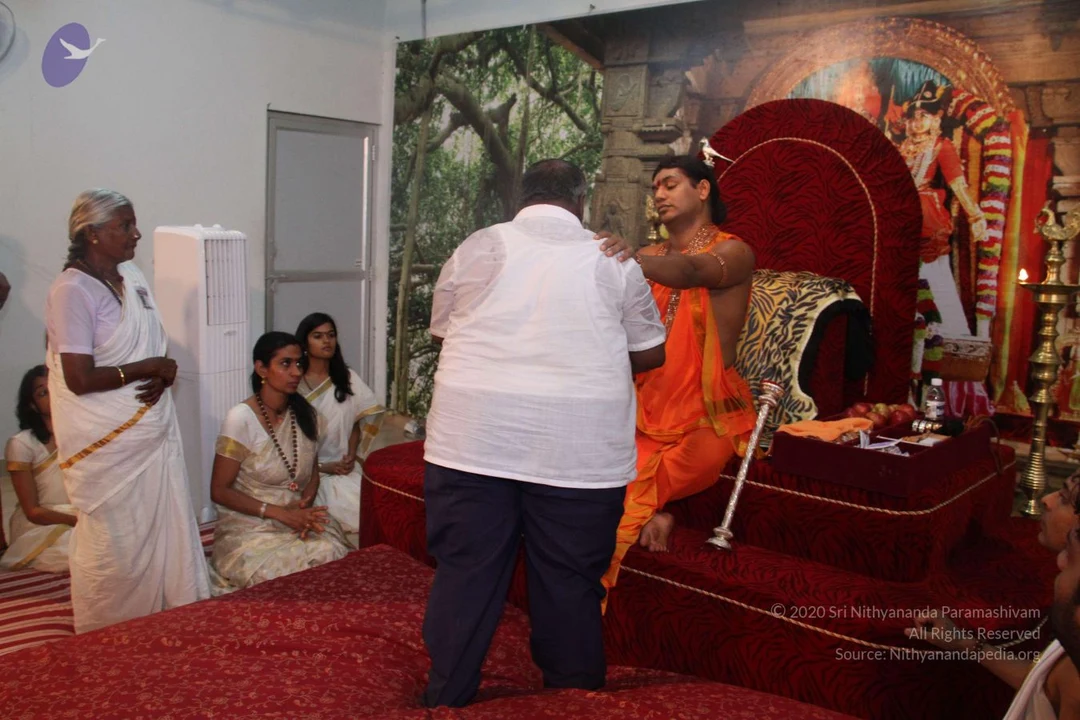
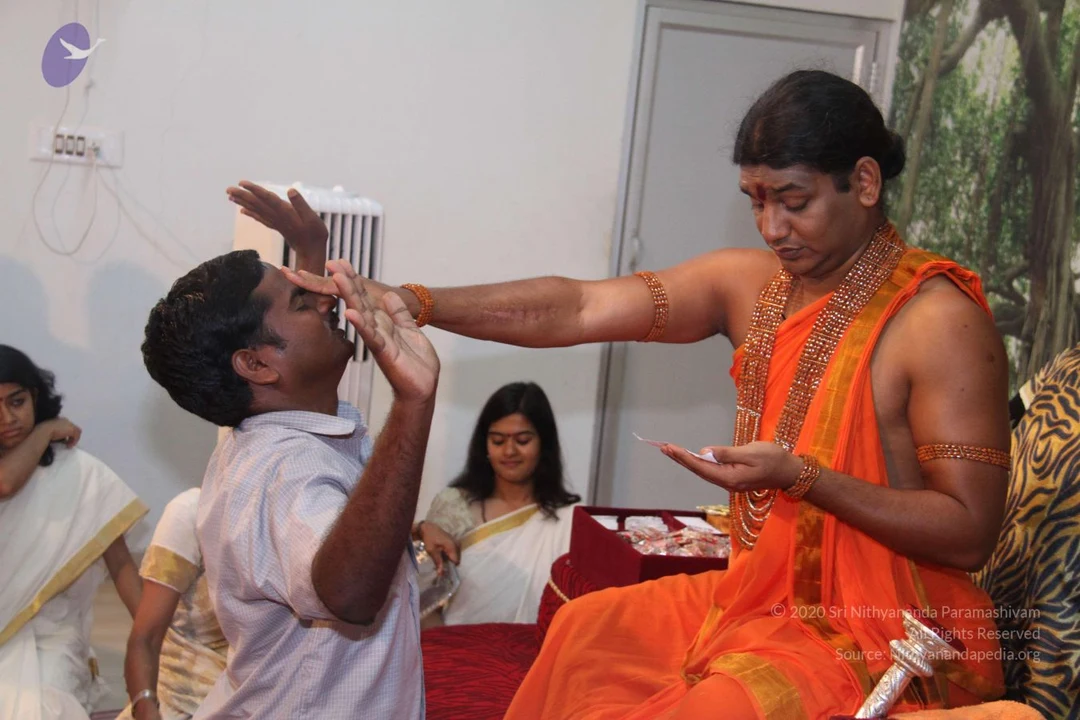
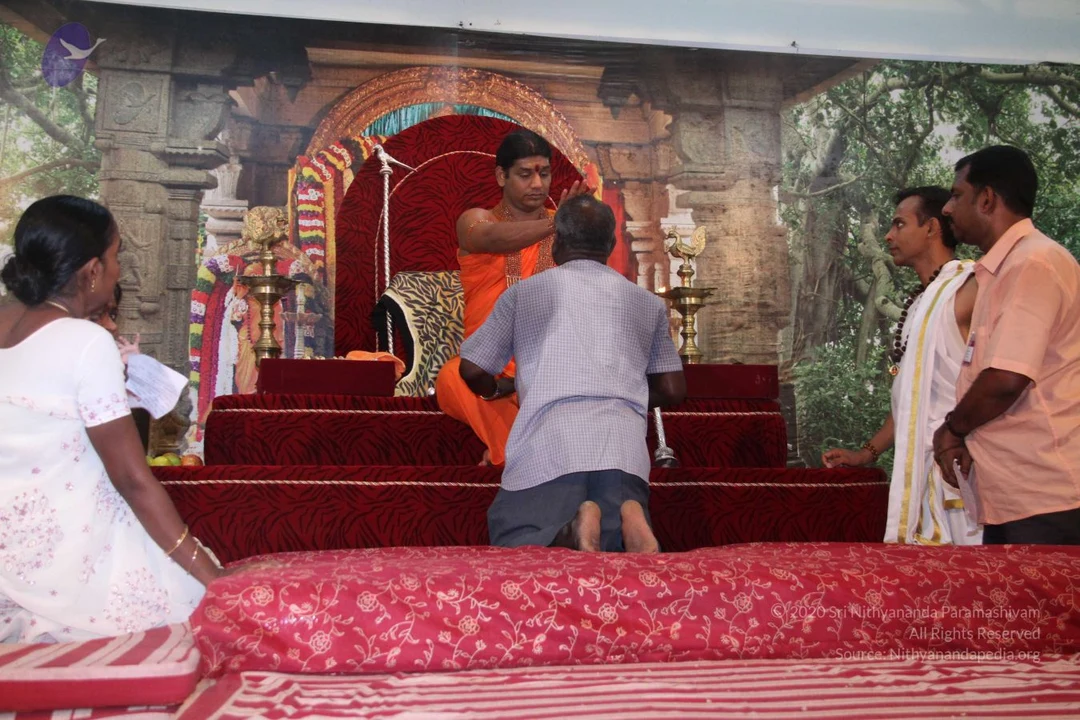
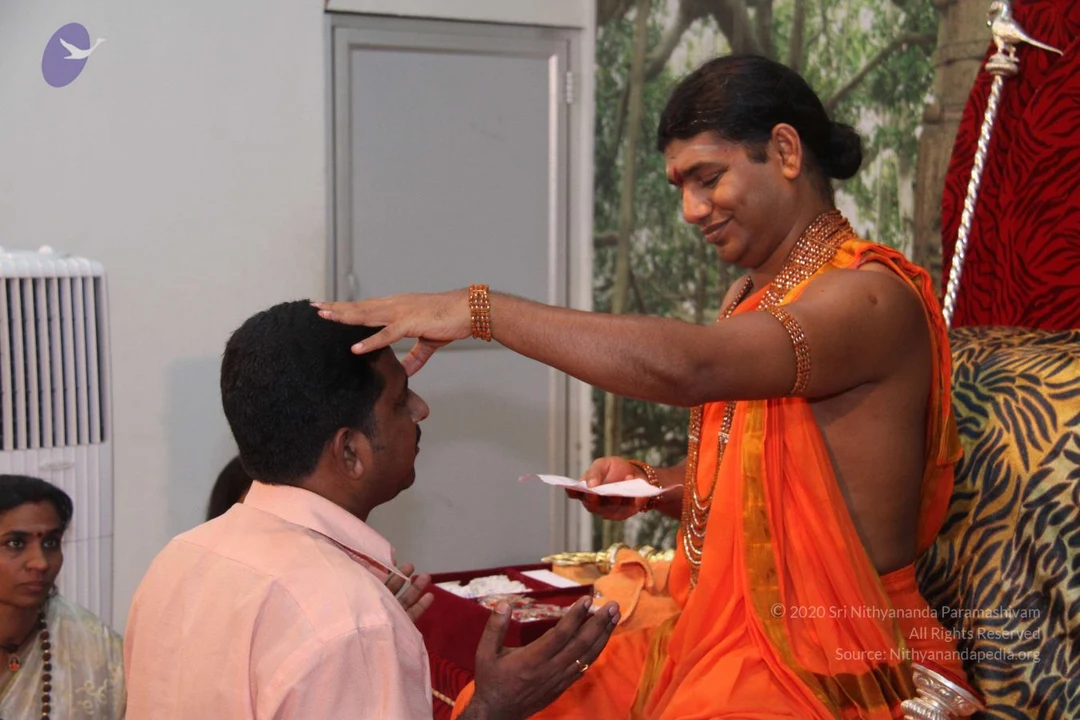
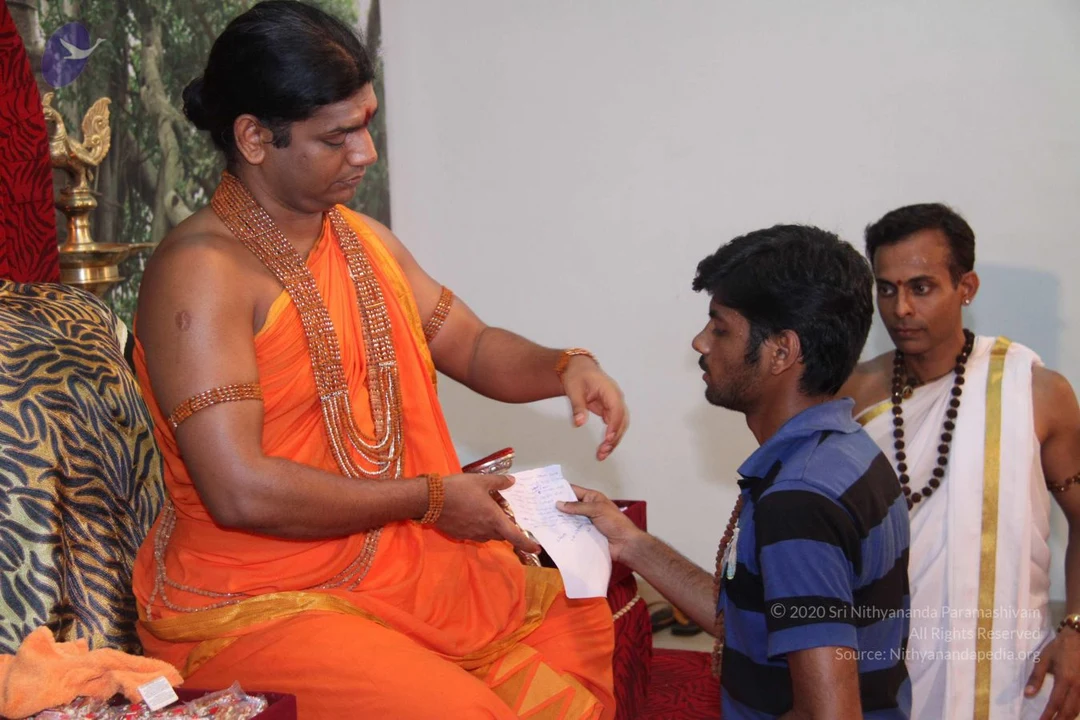
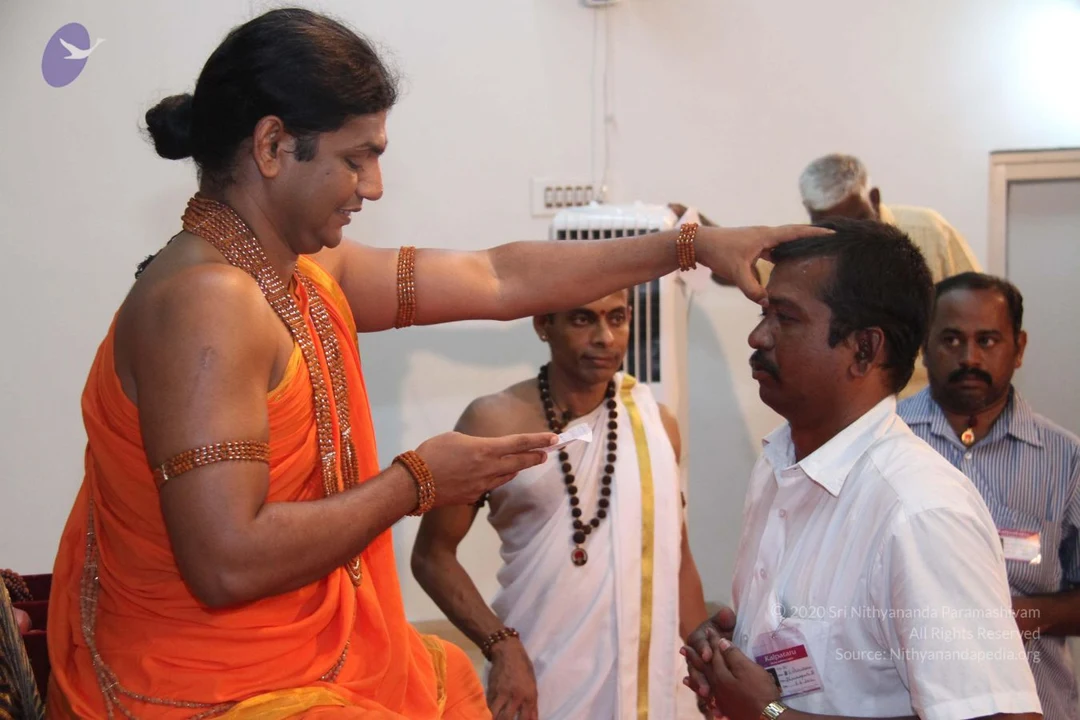
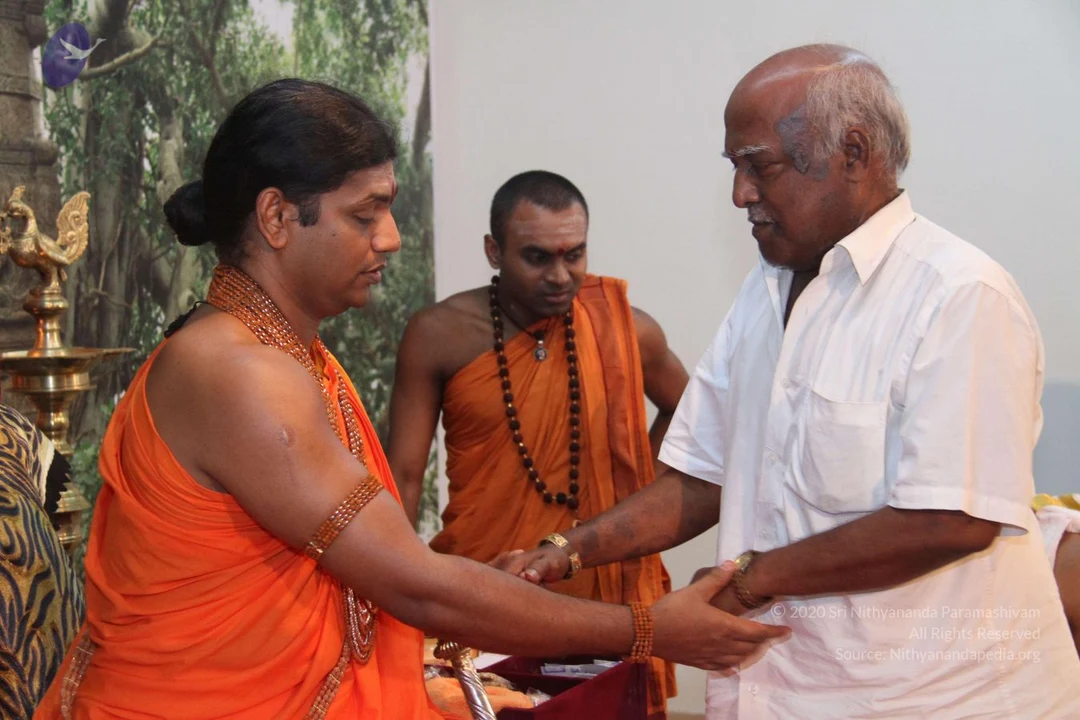
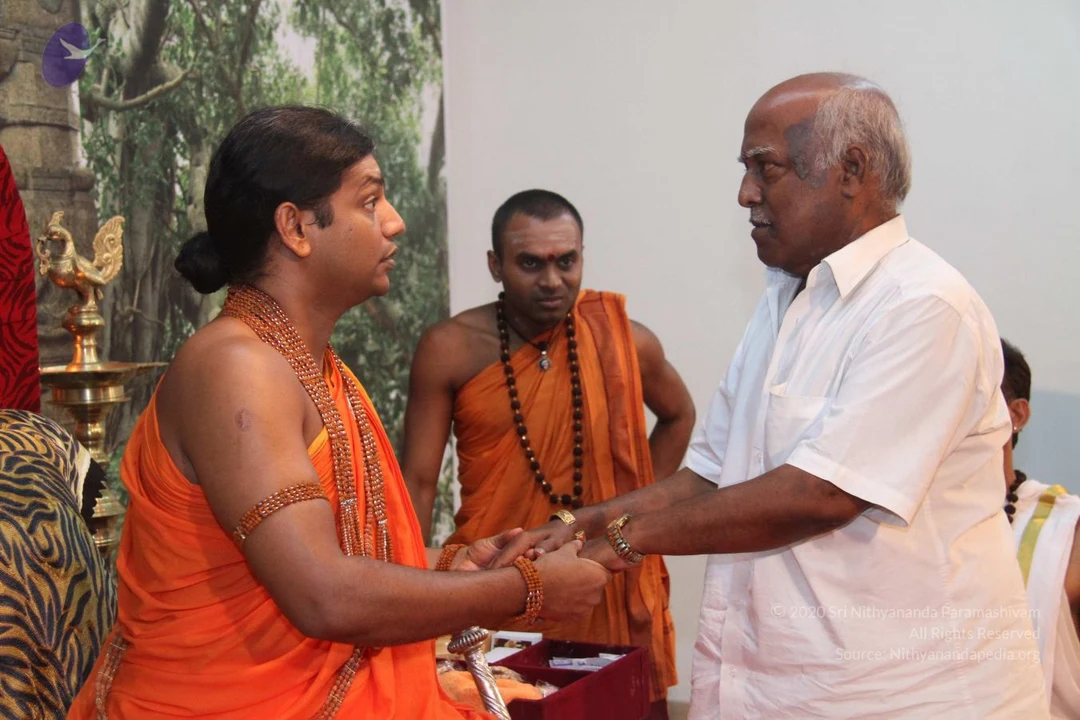
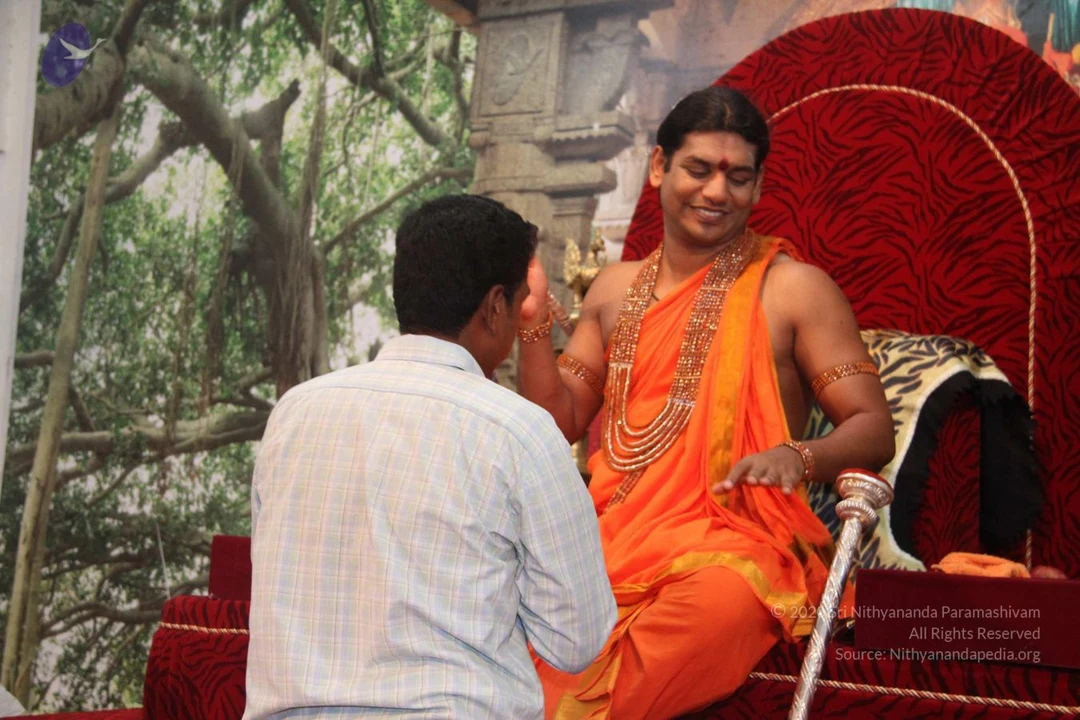
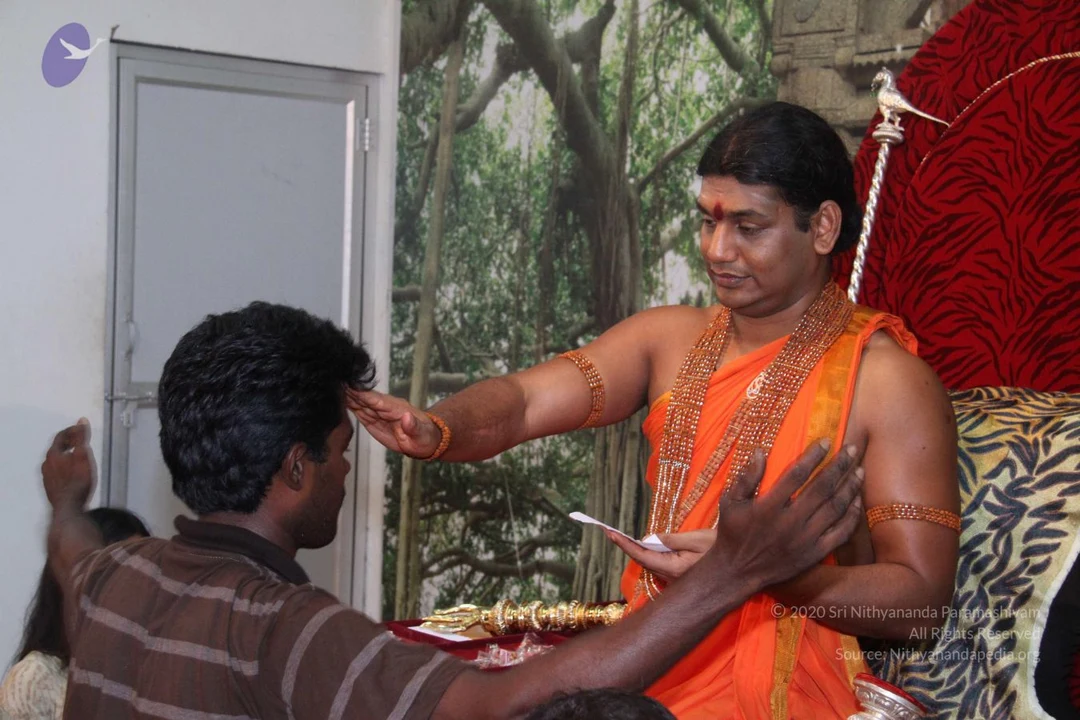
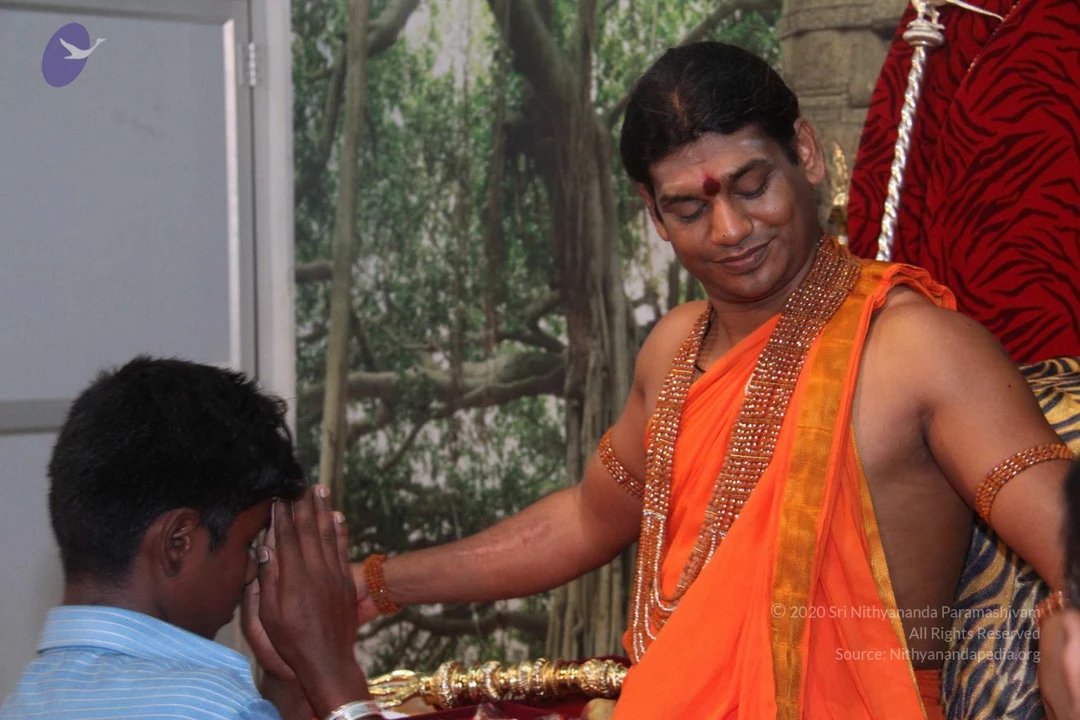
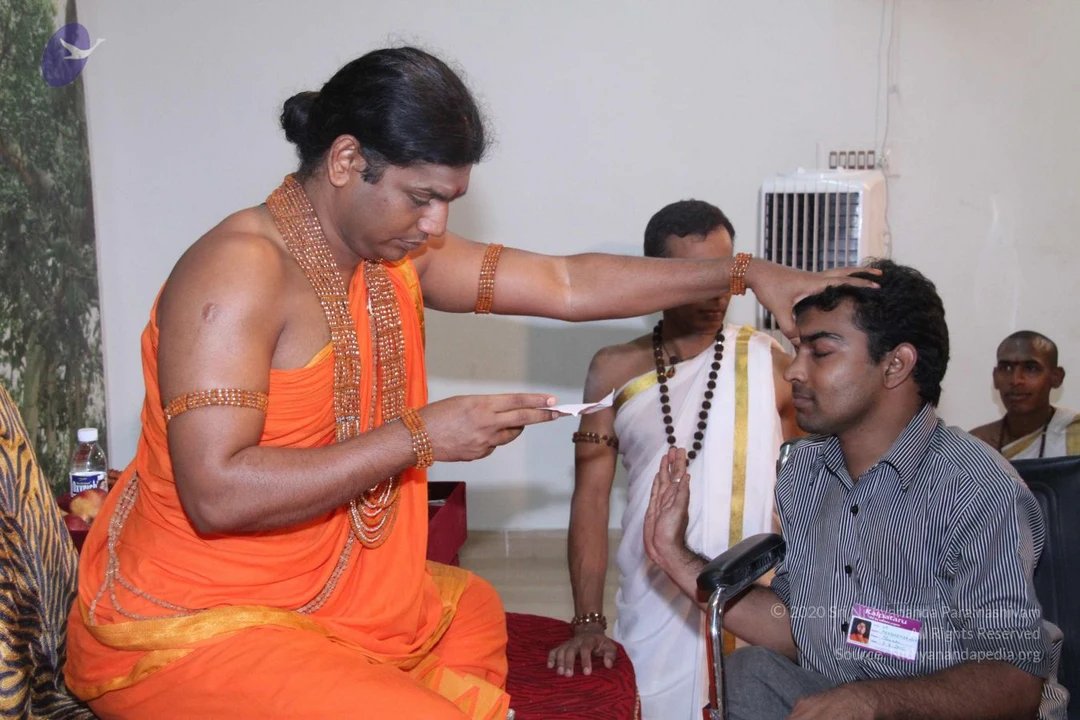
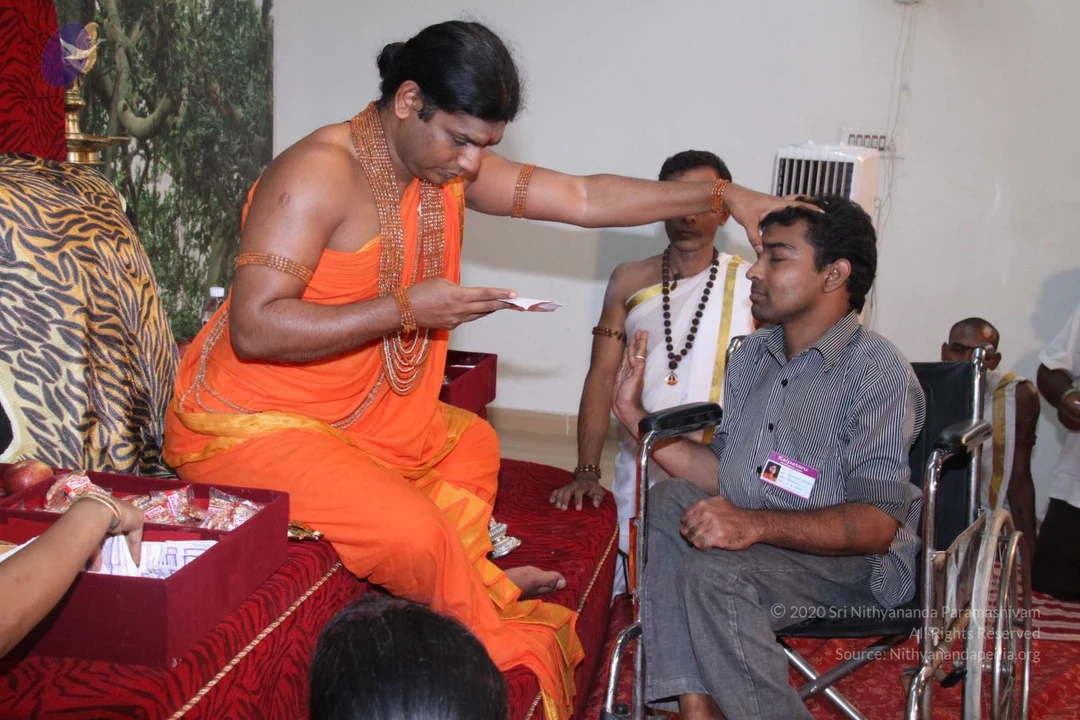
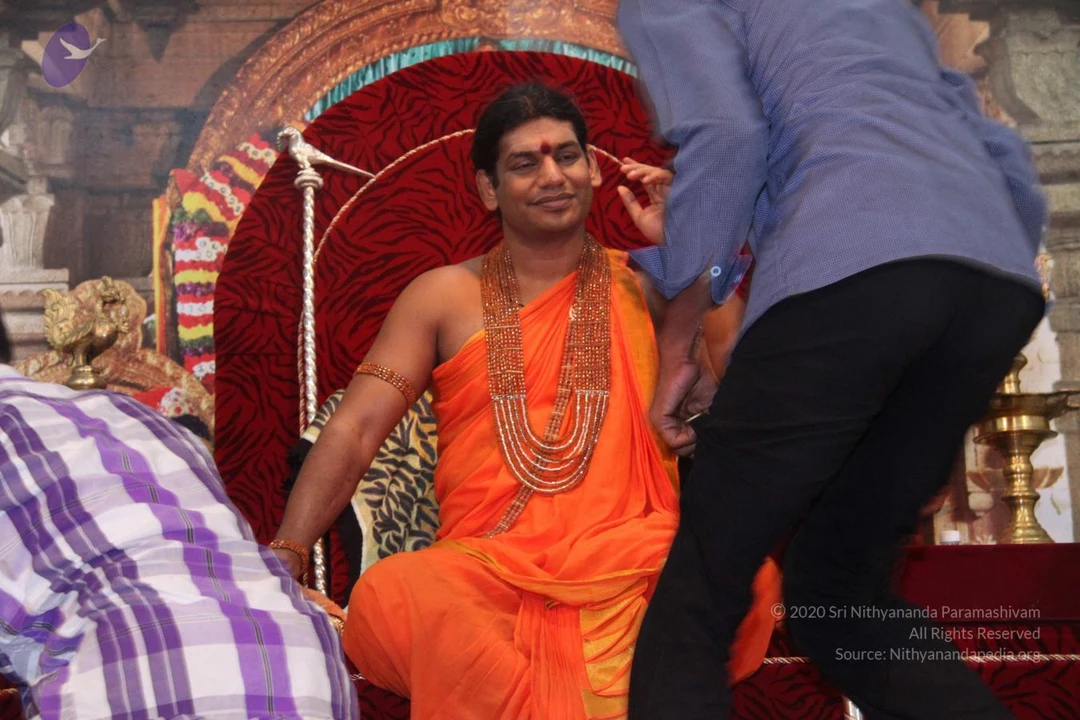
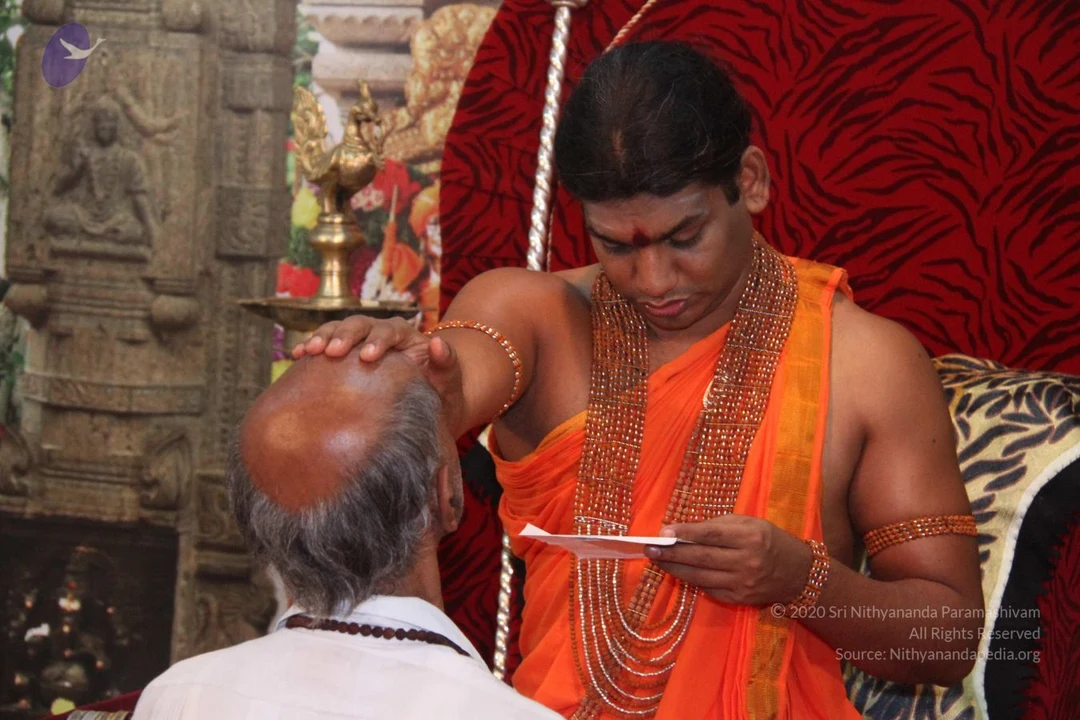
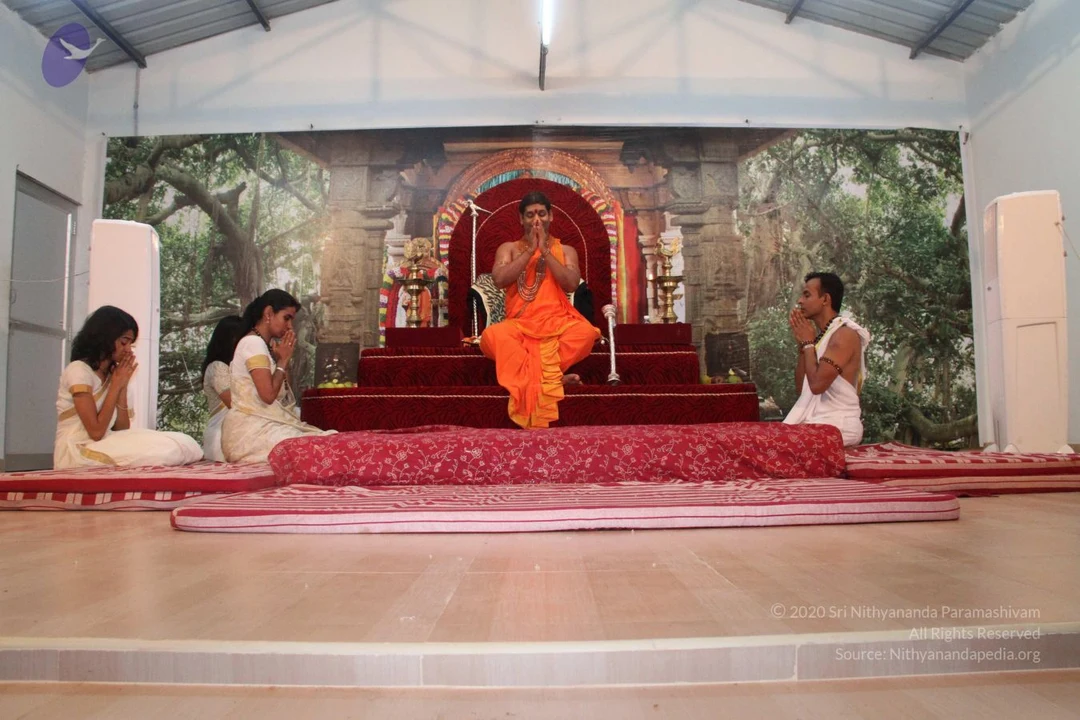
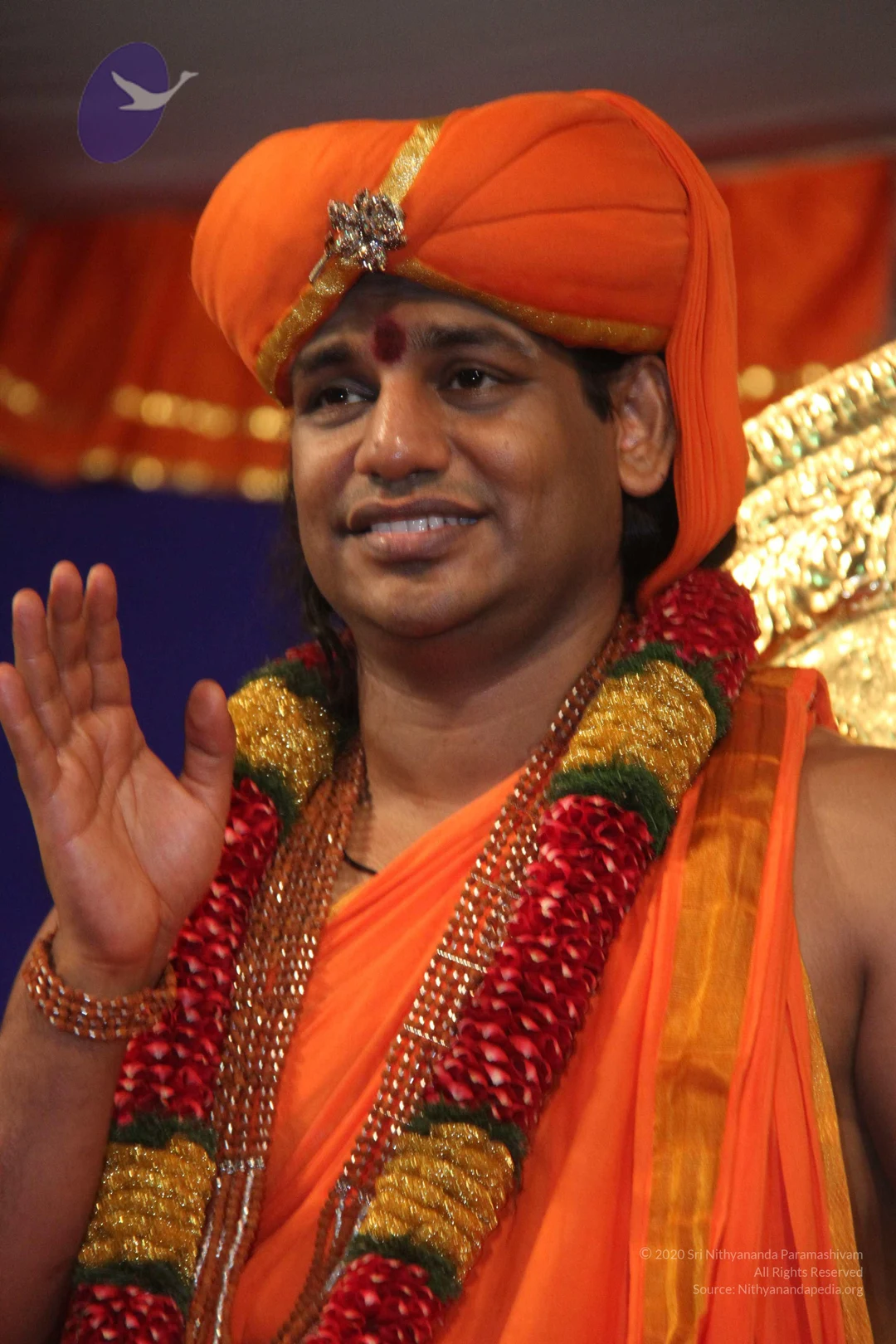
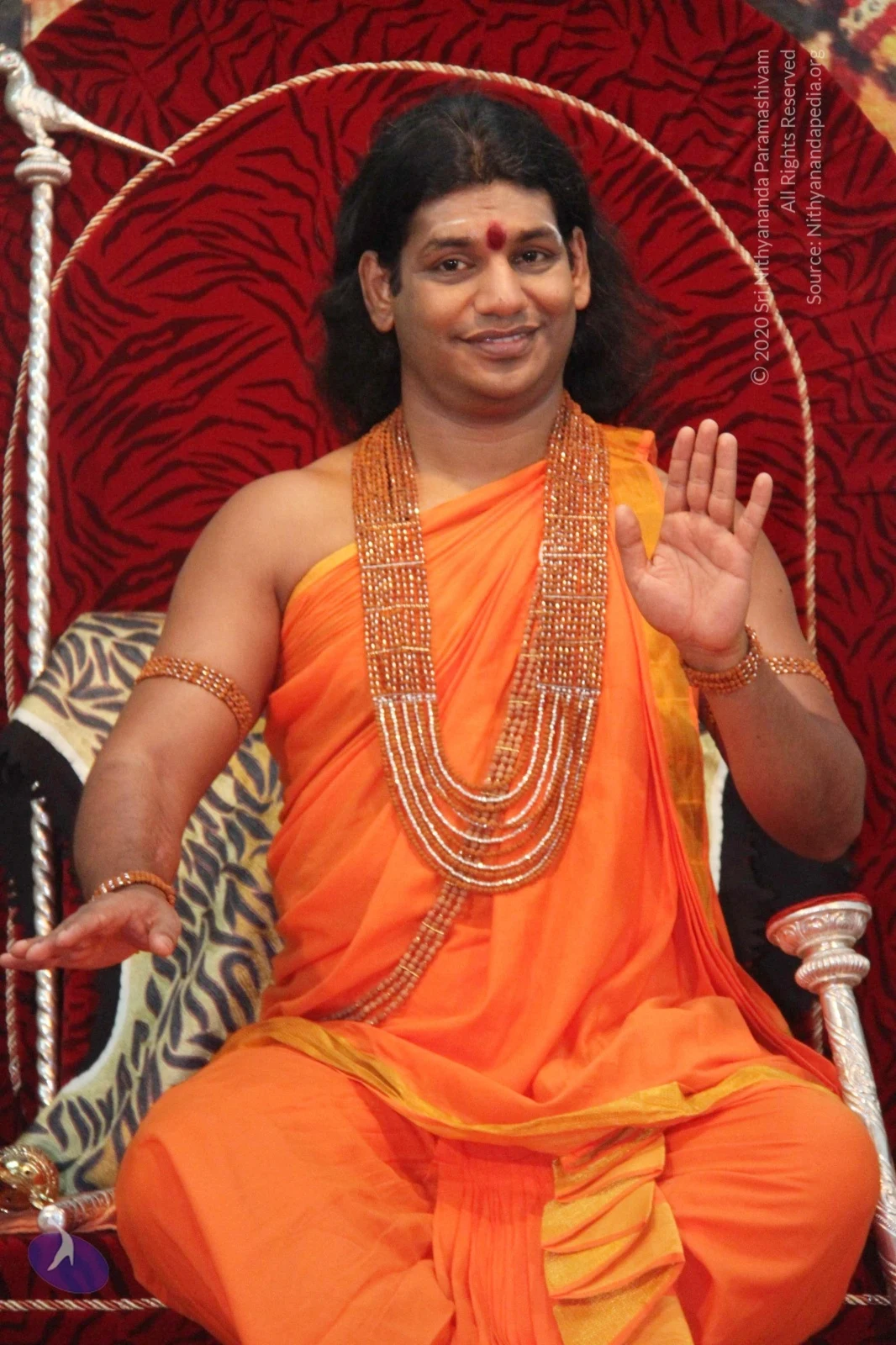
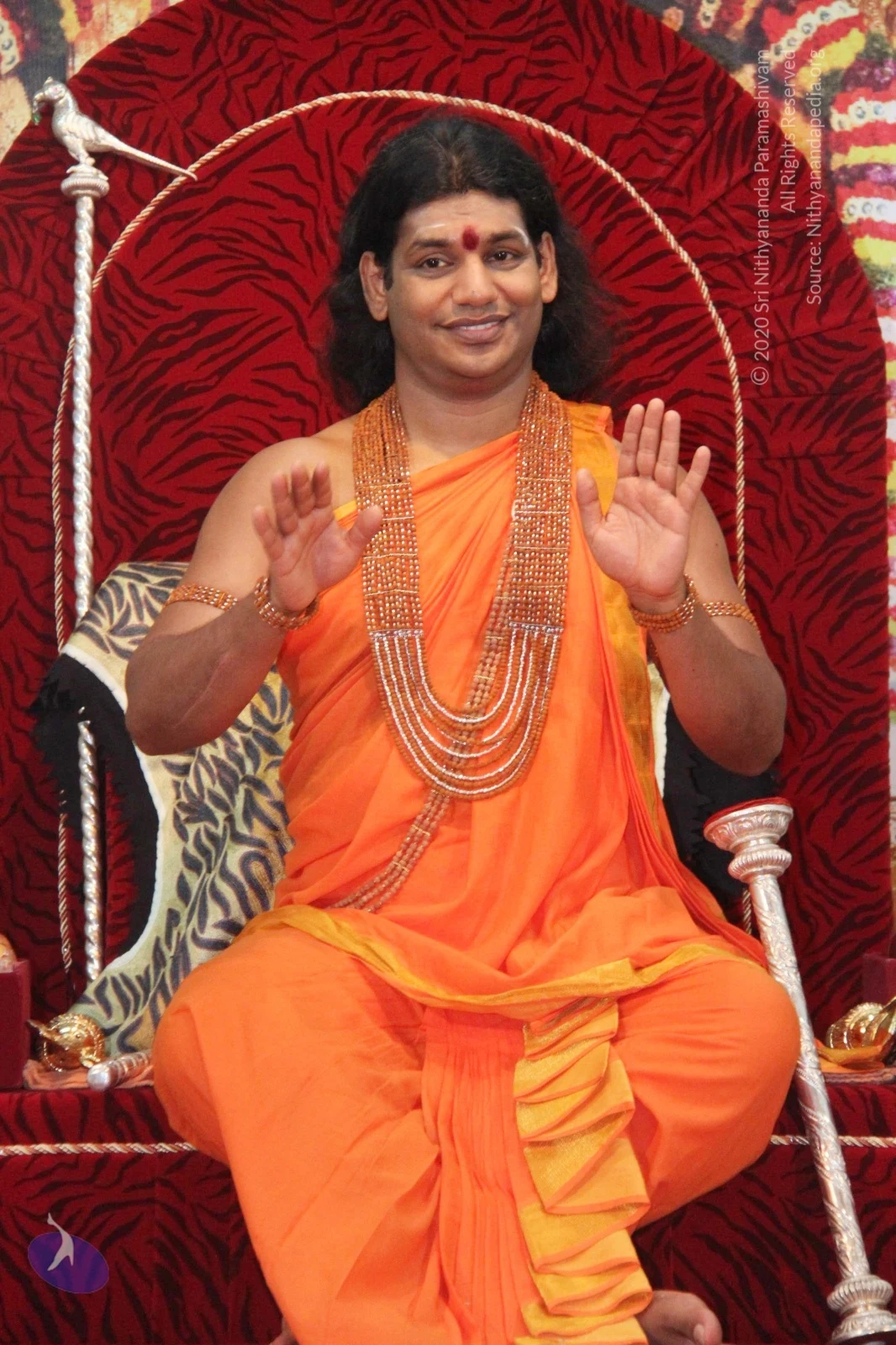
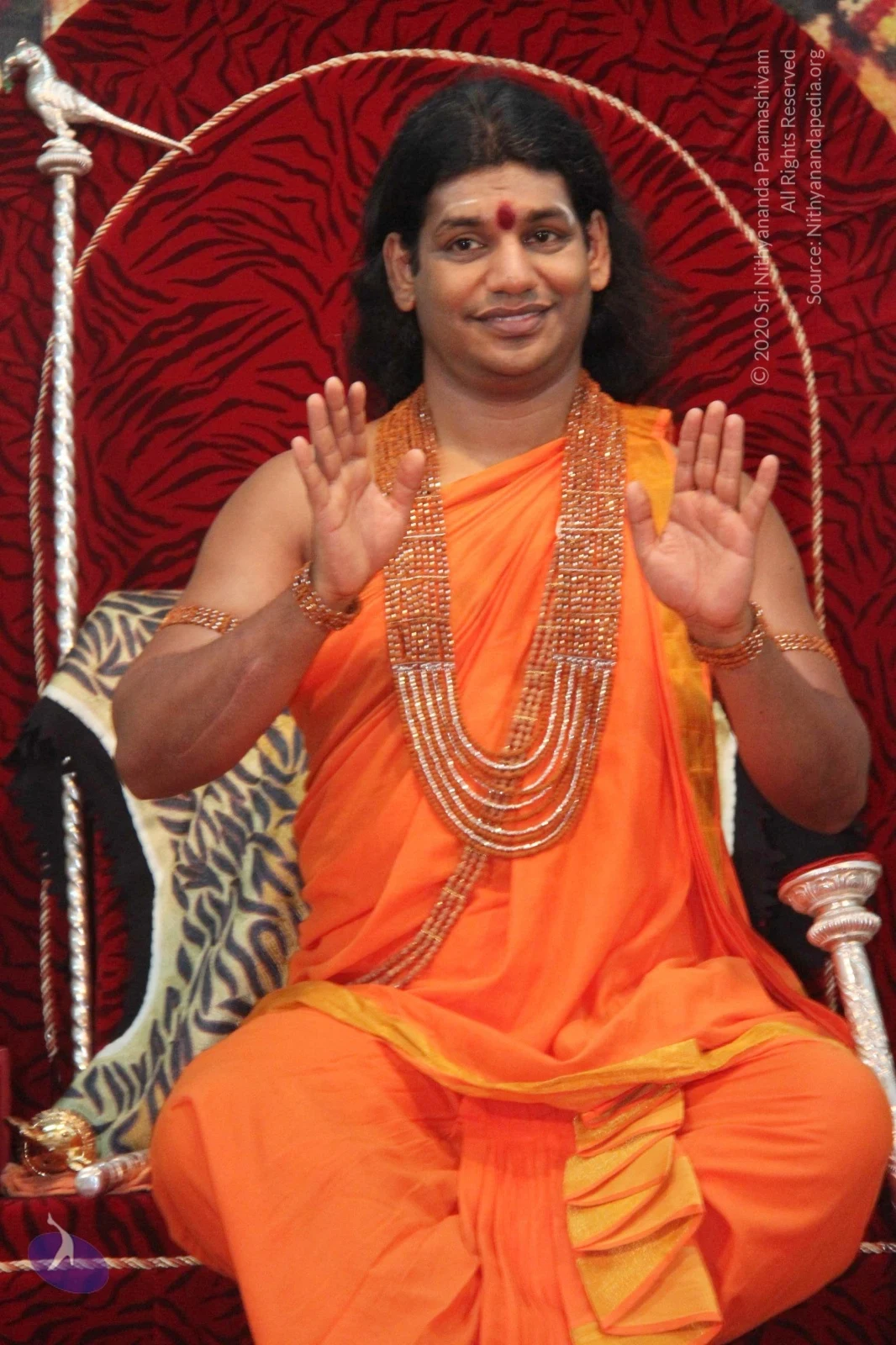
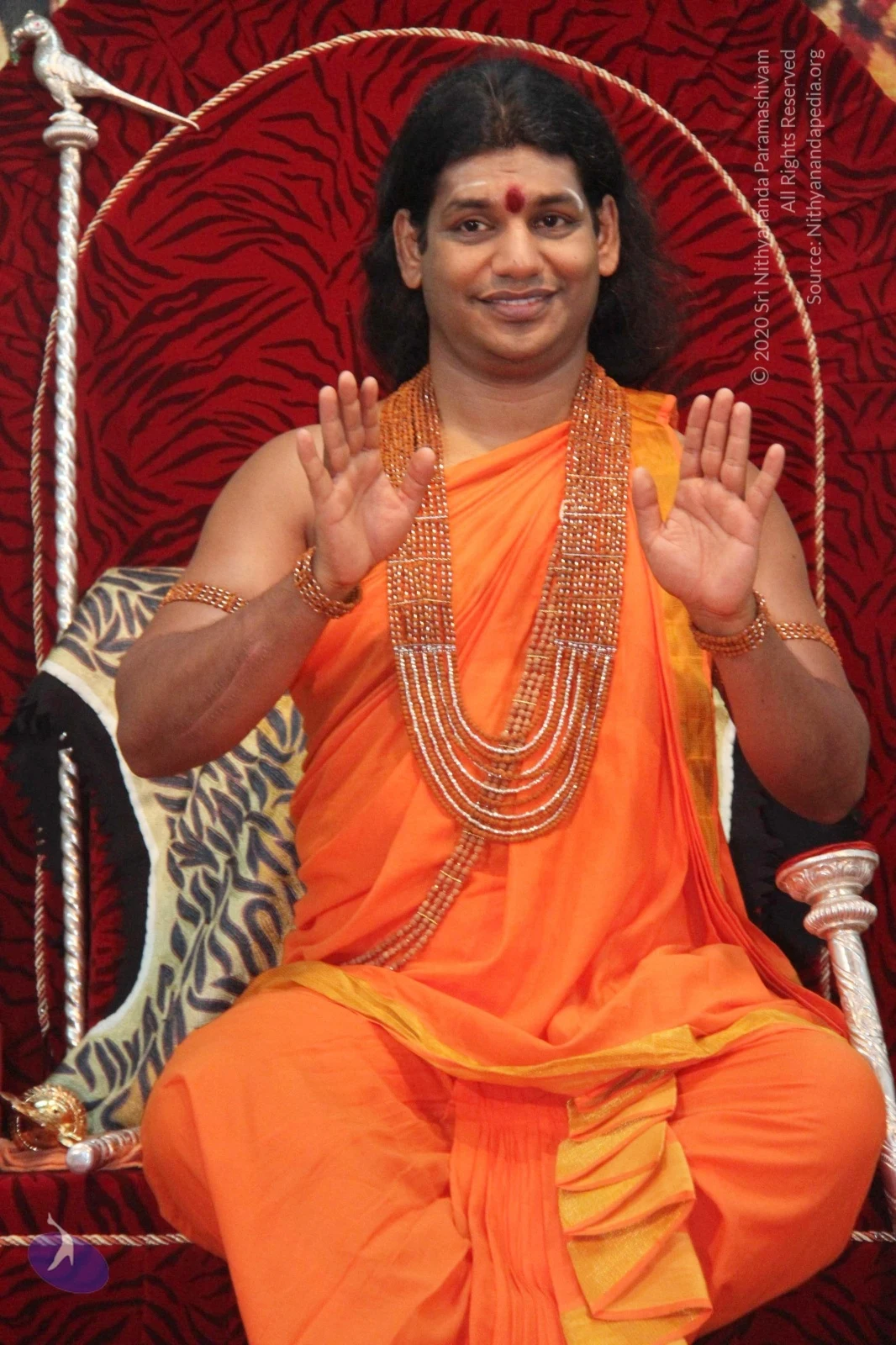
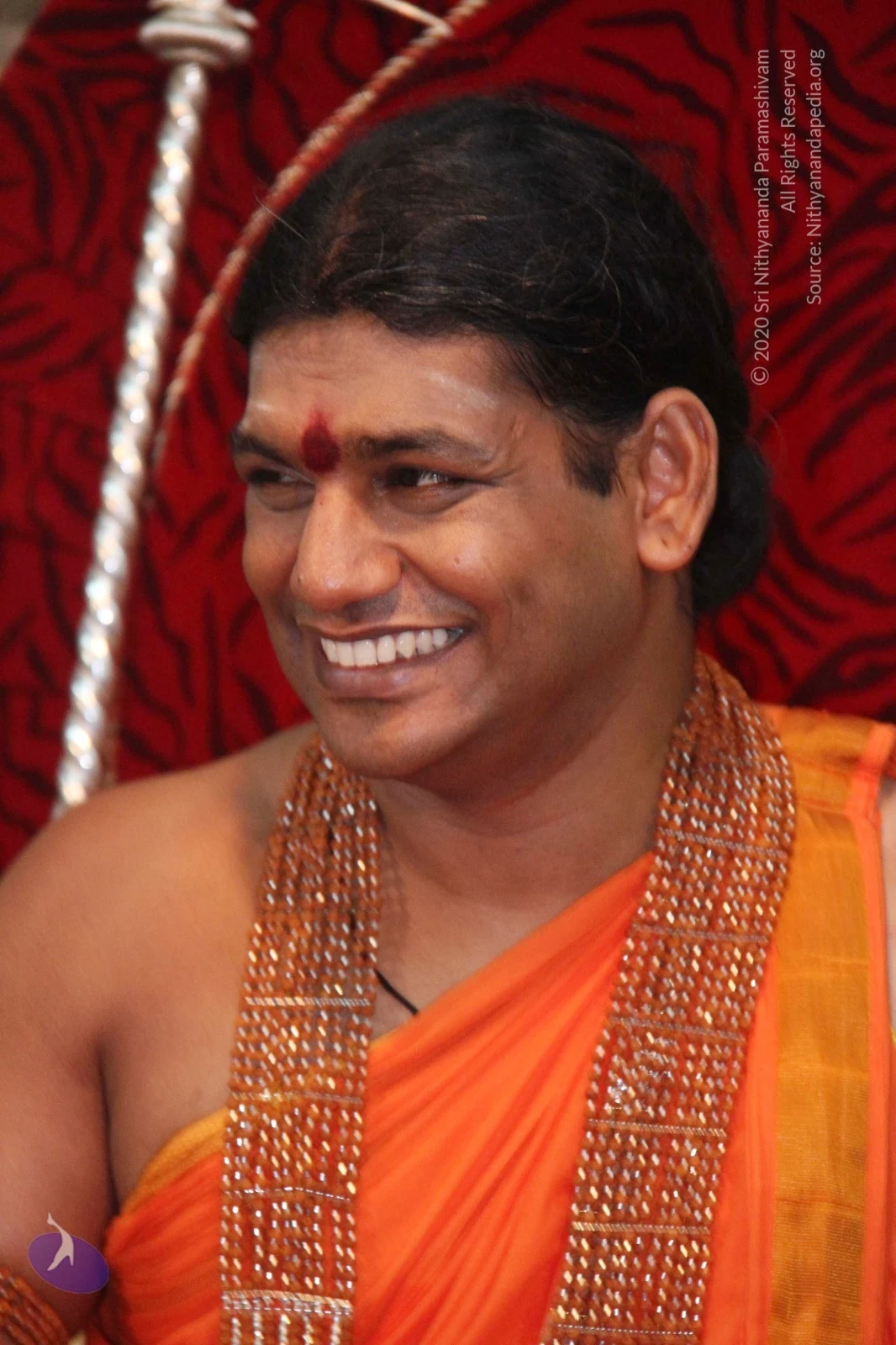
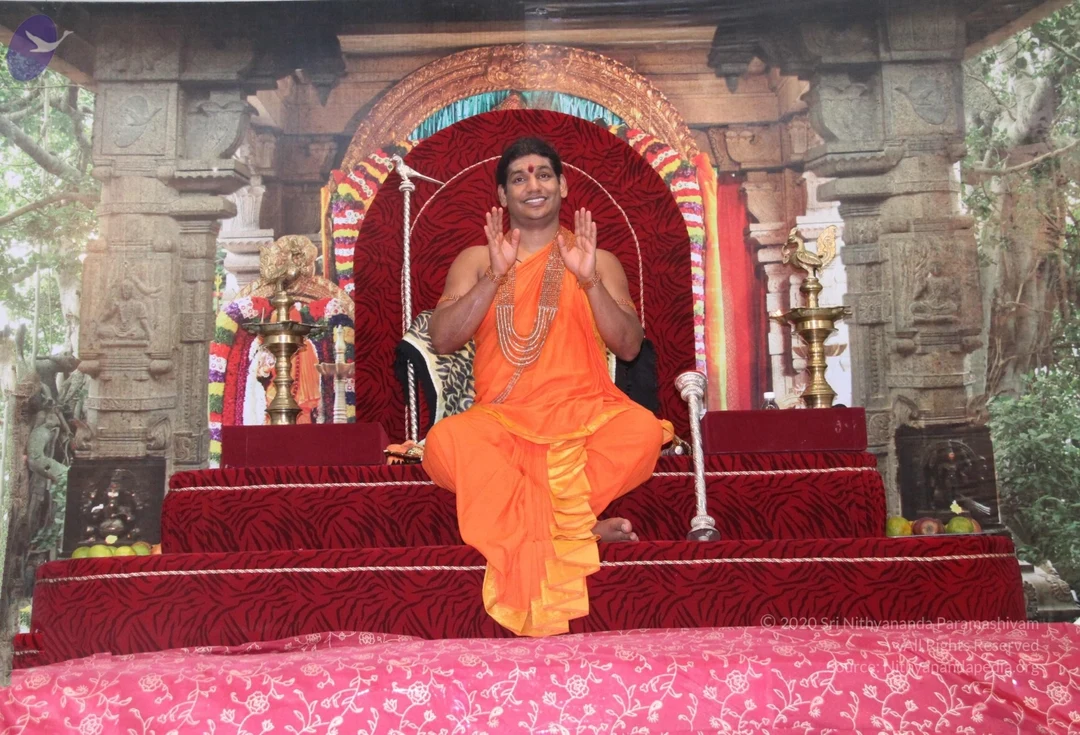
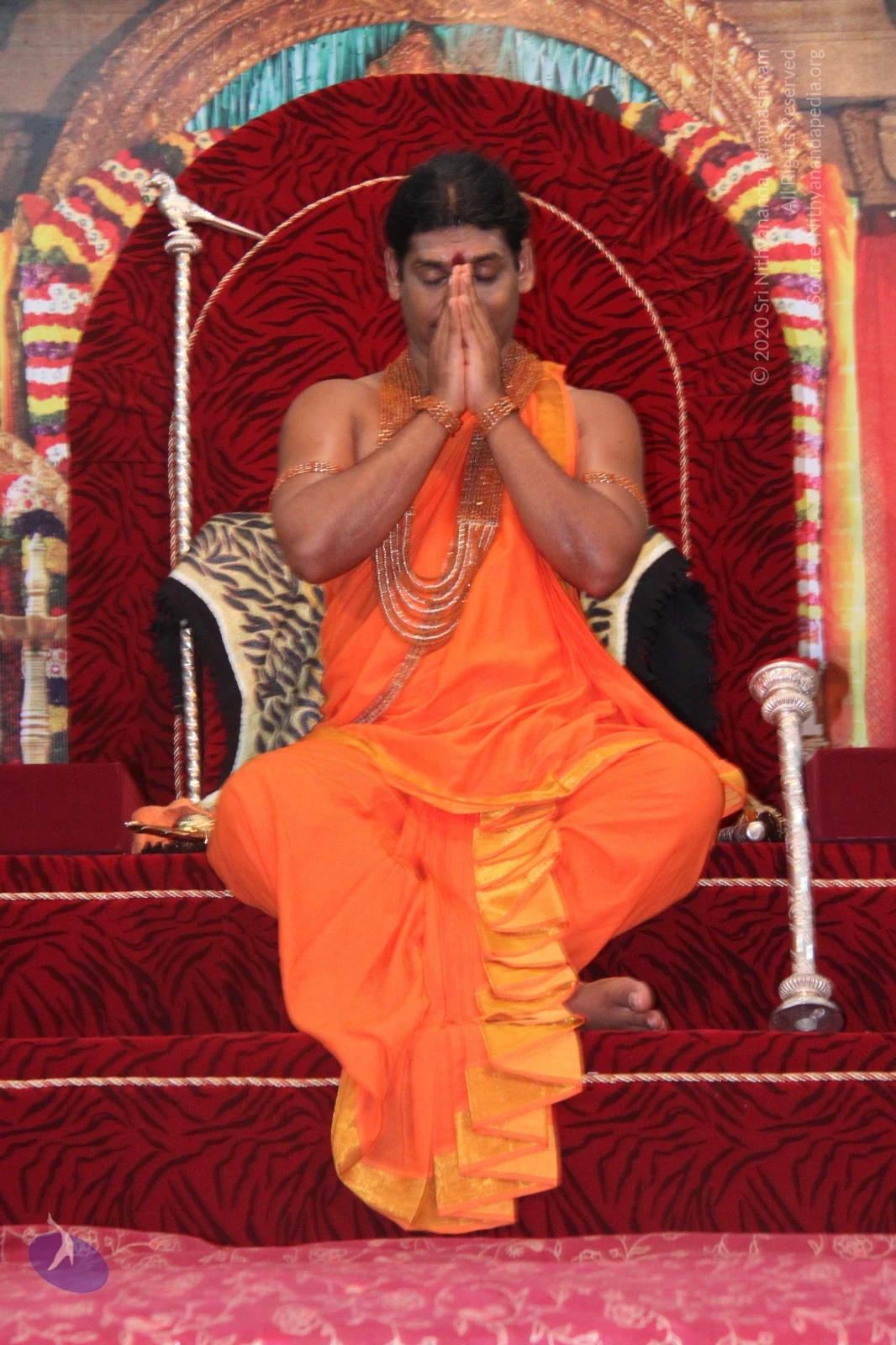
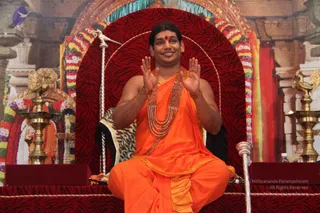
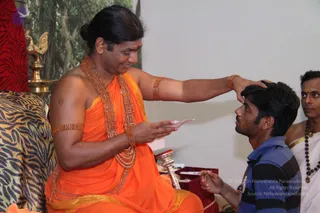
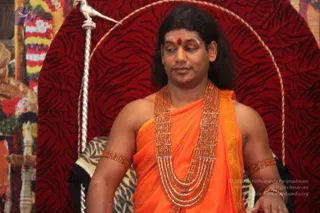
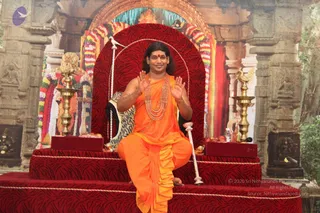
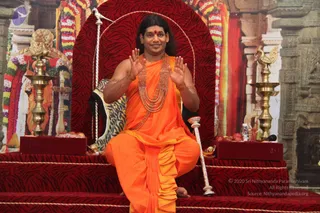
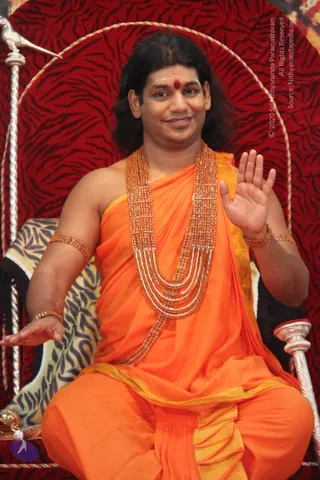
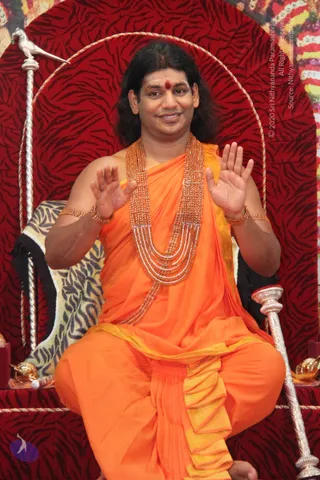
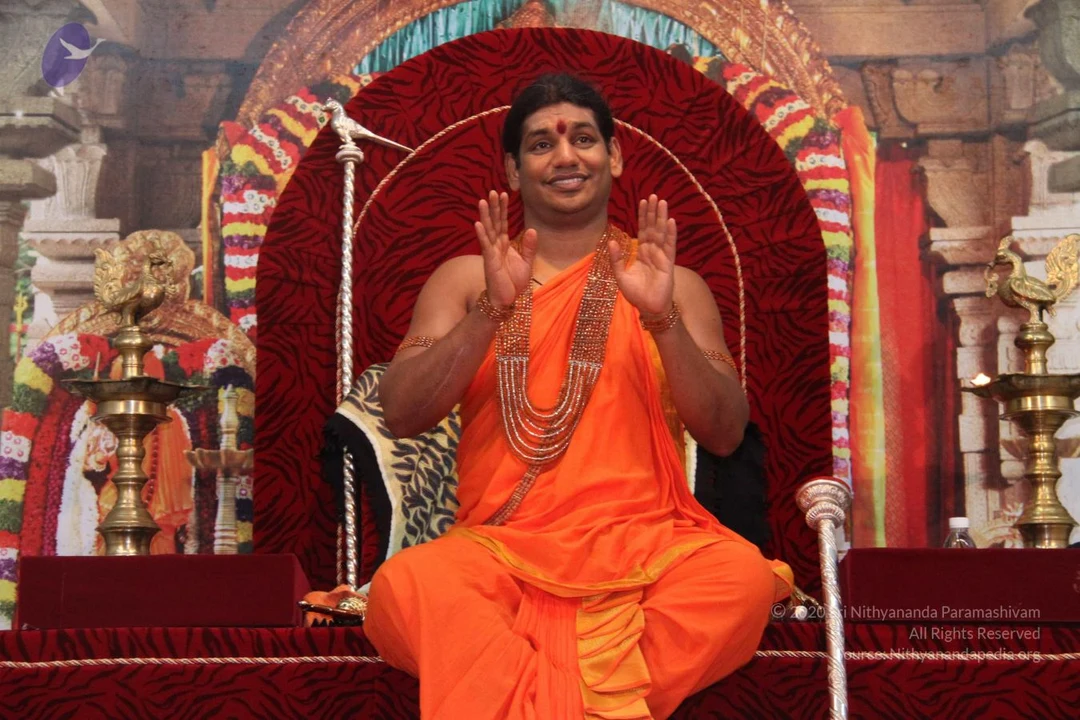
A man in saffron-orange robes and a long beaded rudraksha-style necklace sits on a red tiger-striped throne-style seat, smiling and raising both palms outward in a blessing gesture. Behind him are garlands of red, white and green flowers, an ornate temple-style backdrop, and brass oil lamps with decorative finials on either side of the platform. A small red tilak mark is visible on his forehead. The figure appears to be a person, identified by the saffron robes, the long layered beaded necklace, and the throne setting, with the page noting the event involves him. One physical person is visible on the stage.A photograph of a seated man in a saffron-orange robe with a layered beaded copper-toned mala necklace and matching beaded armlets, his hair tied back, a red bindi on his forehead. He holds a folded paper in one hand while his other hand rests on the head of a kneeling young man in a blue-and-black striped polo shirt who holds a rudraksha-style bead mala. Behind them a standing man in a white dhoti and white shawl wears a rudraksha mala and sacred marks. The setting includes a golden kalasha-style vessel, a red tiger-striped cloth, a gold-framed tropical tree backdrop and a red velvet box. a person: the seated saffron-robed figure wears distinctive ceremonial beaded adornments and orange clothing, consistent with the page subject, and is blessing the kneeling devotee.A man with long swept-back dark hair sits on a red tiger-striped throne with a rope-and-tassel railing and a bird finial. He wears an orange saffron dhoti and shawl, multi-strand gold beaded necklaces, gold armlets and a red bindi with white tilak marks. Behind him are floral garlands in red, yellow and white and a decorated backdrop. Appearance-based candidate: Swamiji (probable), seated in a throne setting with orange saffron clothing, long hair and ornate gold necklaces.Photograph of a single seated man in saffron-orange robes with a white beaded necklace and a red tilak on his forehead, seated on a red tiger-striped throne-like seat with gold lamps on either side. Arched floral garlands in red, yellow and green frame the seat, and a temple-style backdrop with carved stone pillars surrounds the stage. He holds both palms raised toward the viewer in a blessing gesture. A brass lamp and offering trays sit on the platform steps. Swamiji (probable): long dark hair swept back, saffron robes and a rudraksha-style bead necklace, seated in the main throne position of a satsang setting.A photograph of a man seated cross-legged on a red velvet throne with a zebra-striped pattern, in front of a backdrop of garlands and temple-style carvings. He wears saffron-orange robes, a multi-strand rudraksha-style beaded mala and bangles, with a red tilak on his forehead, and raises both palms outward in a blessing gesture. Brass oil lamps with a bird-topped finial stand on red-draped platforms beside him, with fruit offerings and a water bottle. Swamiji (probable): long swept-back hair, saffron robes and rudraksha malas mark him as the presiding teacher at a satsang setting.A man in saffron-orange robes sits cross-legged on a tiered red-and-black striped dais beneath a painted temple backdrop with carved pillars and a gilded arch. He wears a red bindi, multiple beaded necklaces and bangles, and rests his hands on his knees with eyes closed in meditation. Brass oil lamps stand on red pedestals on either side, and a red patterned cloth covers the front of the platform. Swamiji (probable): the long swept-back hair, saffron clothing and rudraksha-style beaded malas are consistent with the page's description of Paramahamsa Nithyananda, though the appearance is only a candidate match.

Thiruvannamalai-Organizers-Meet

31 photosSource gallery
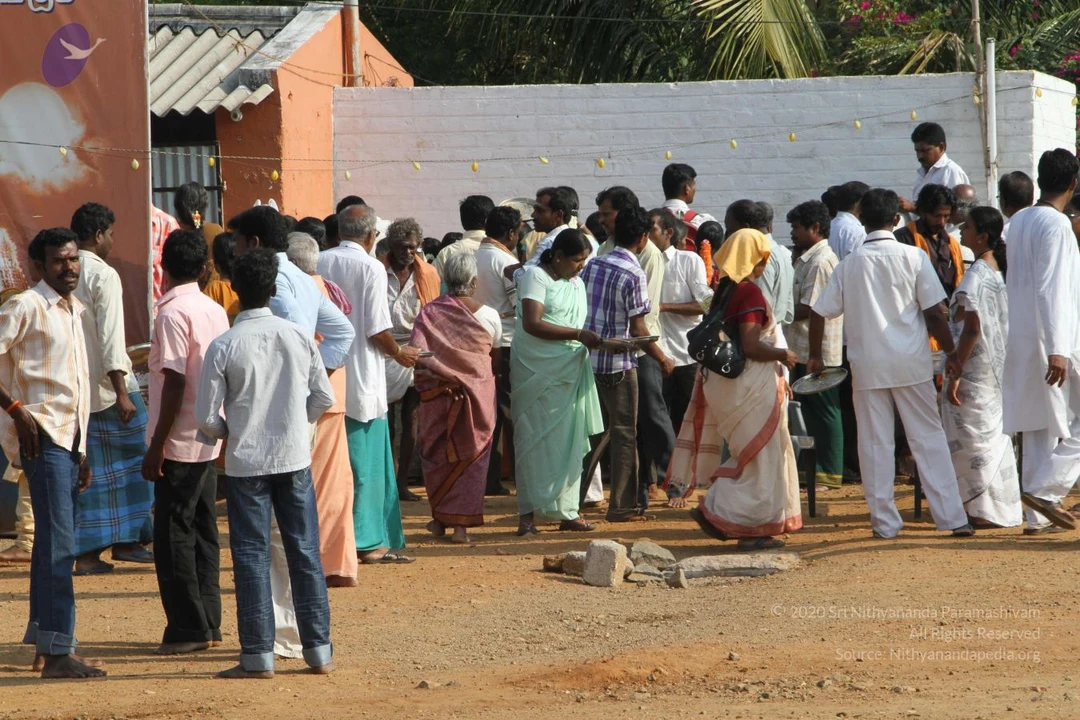
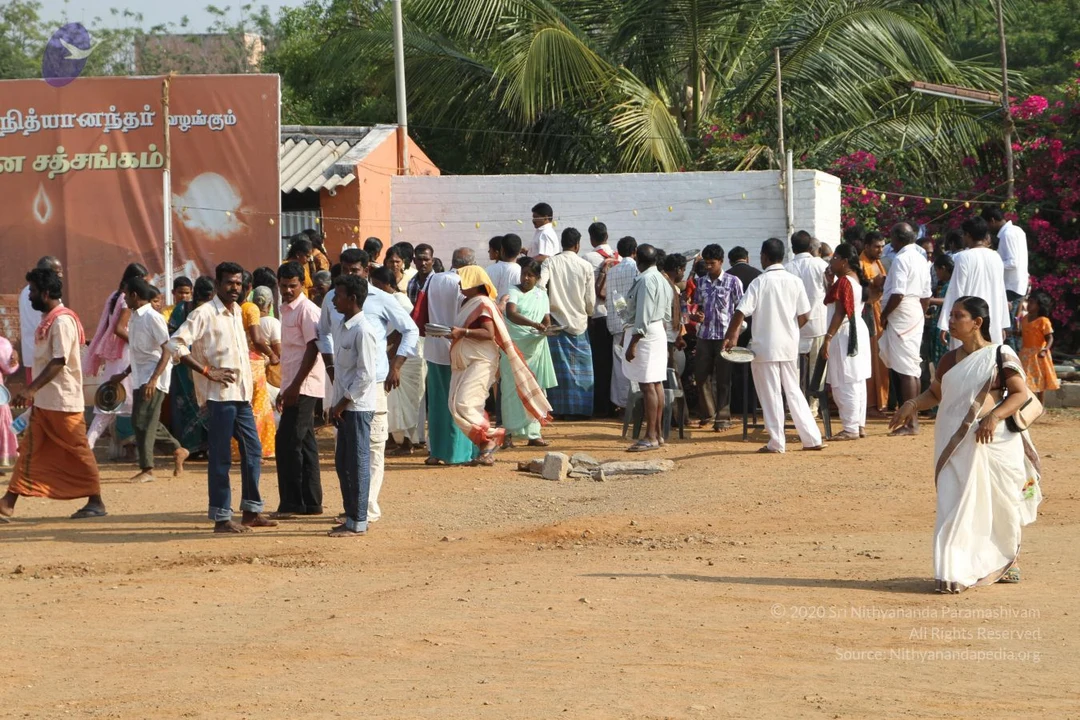
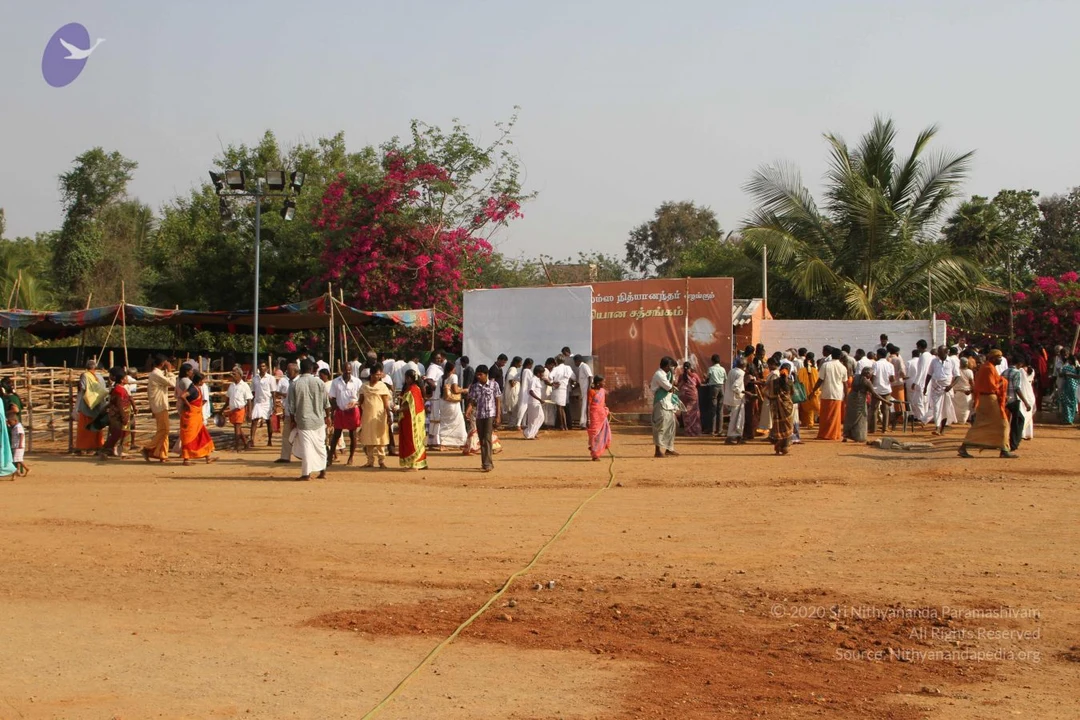
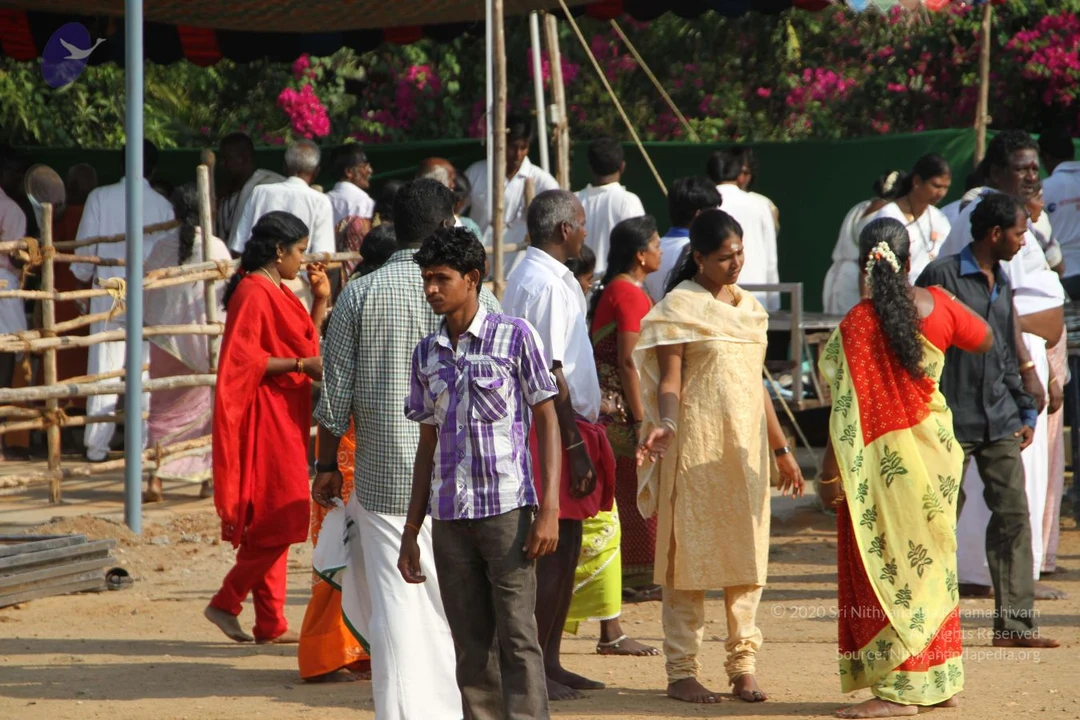
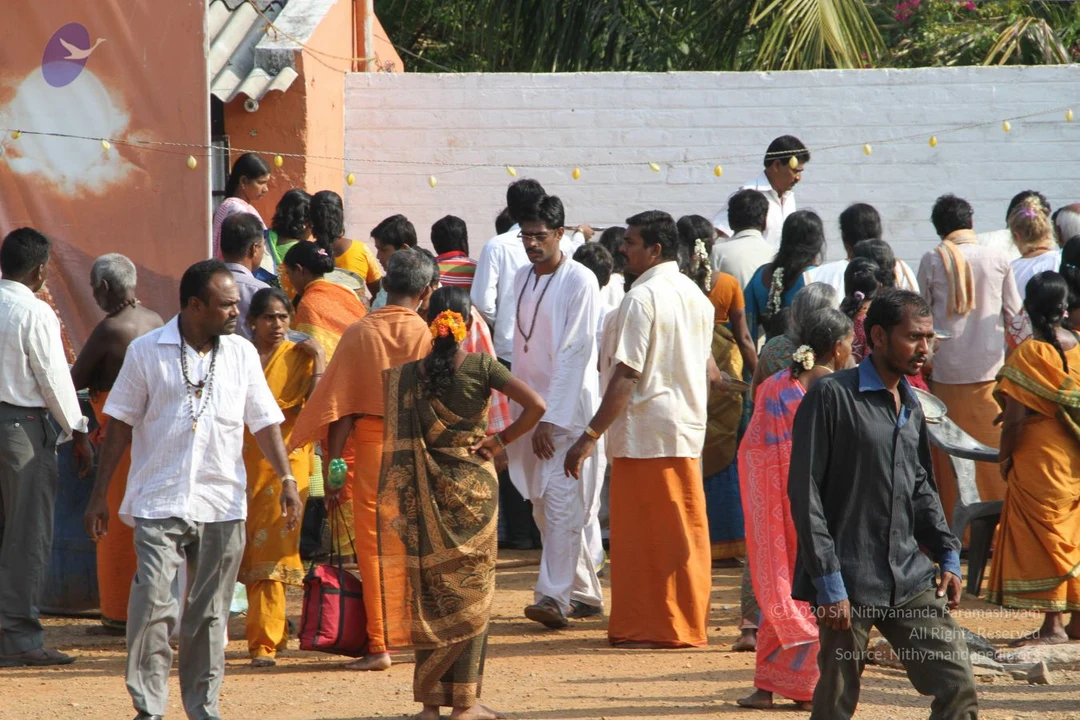
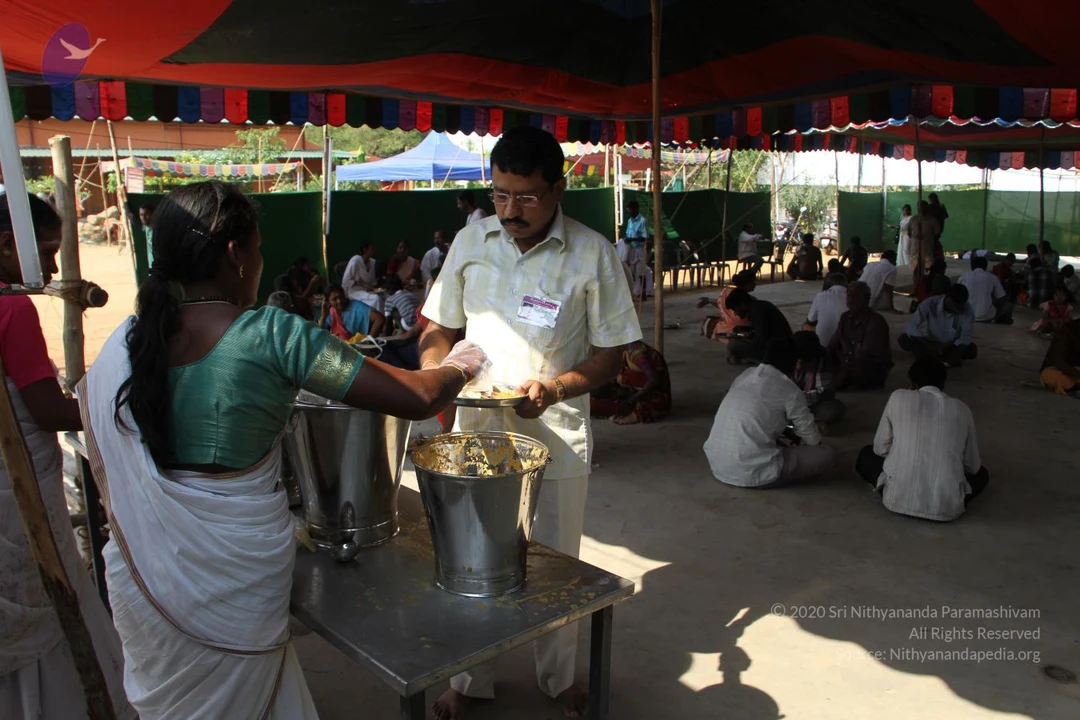
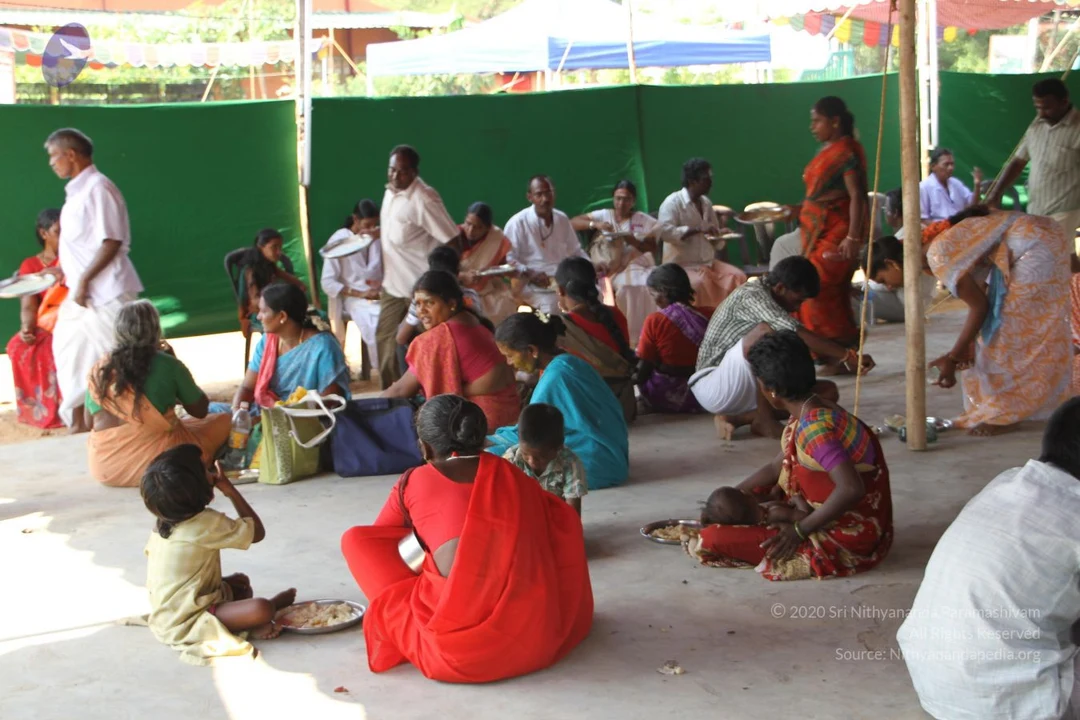
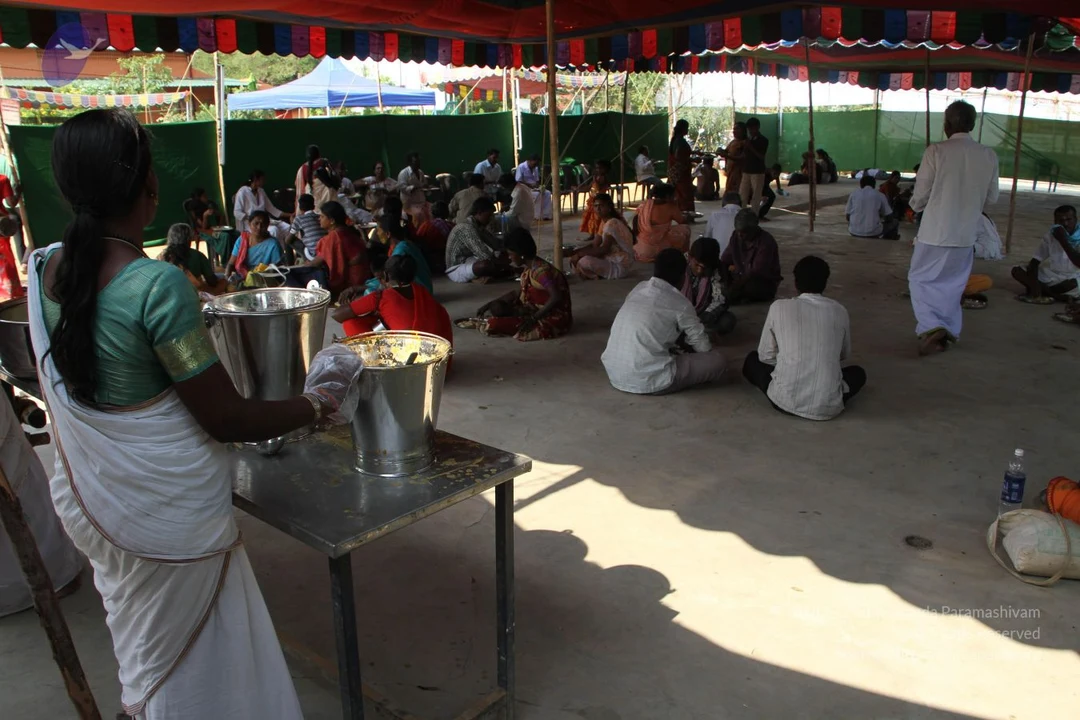
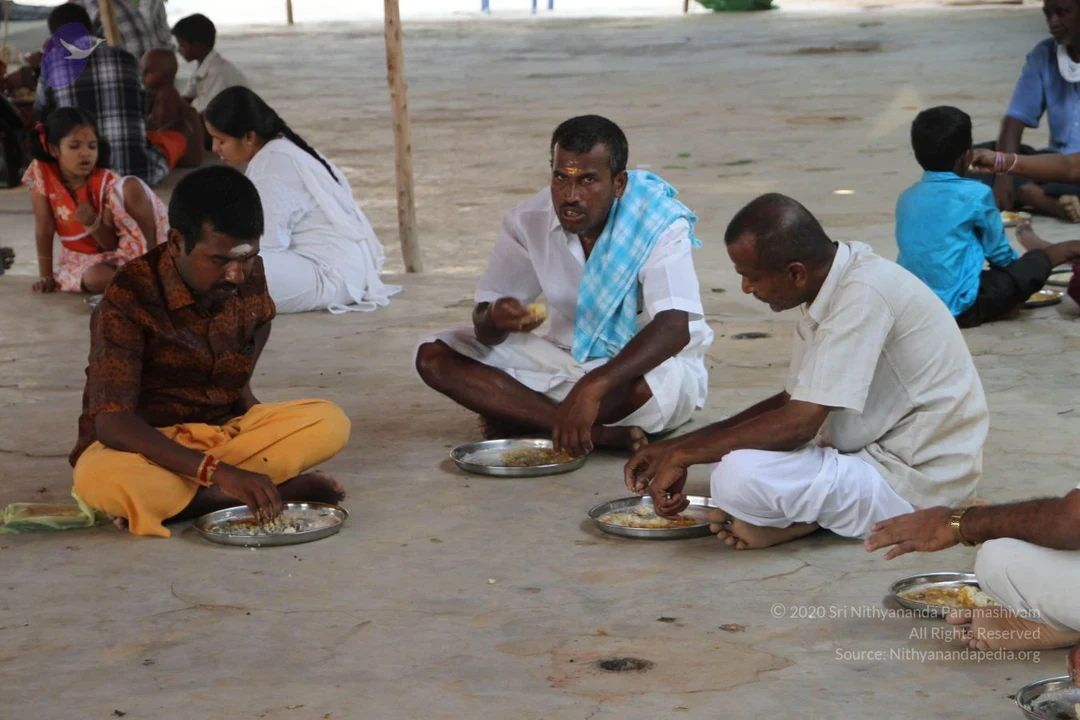
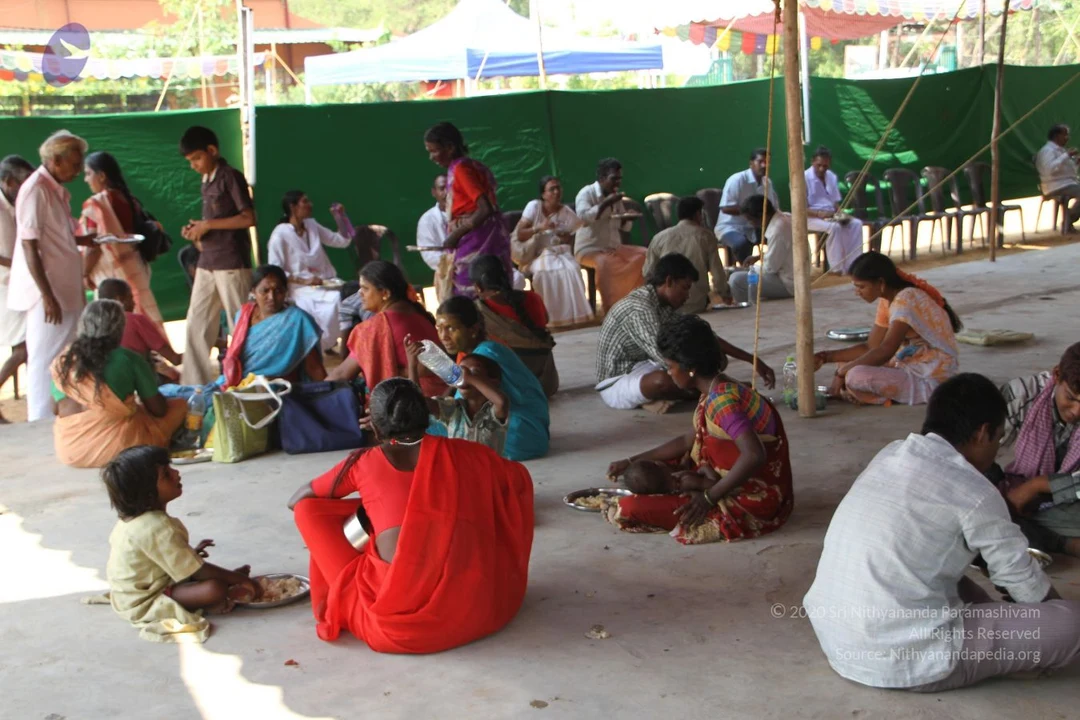
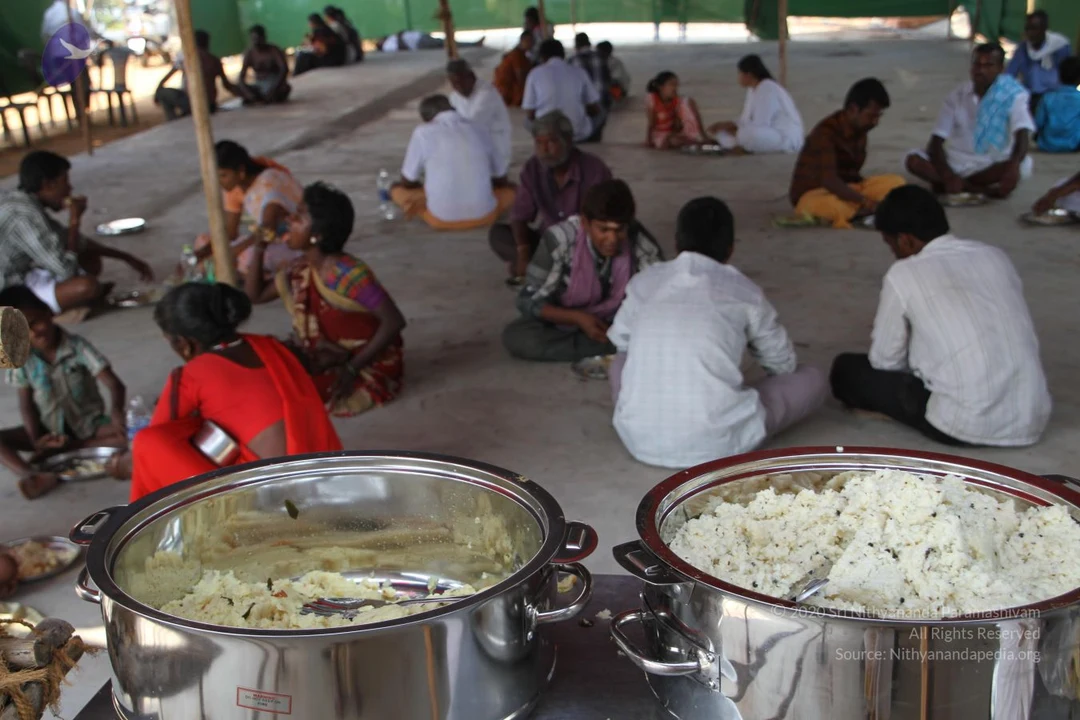
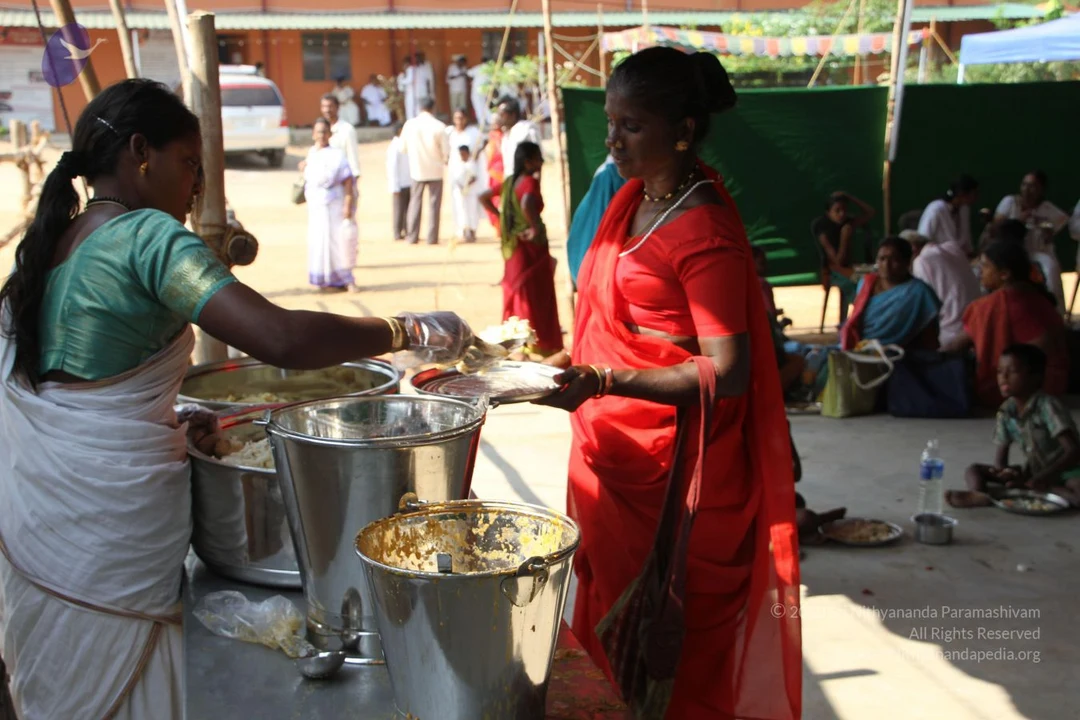
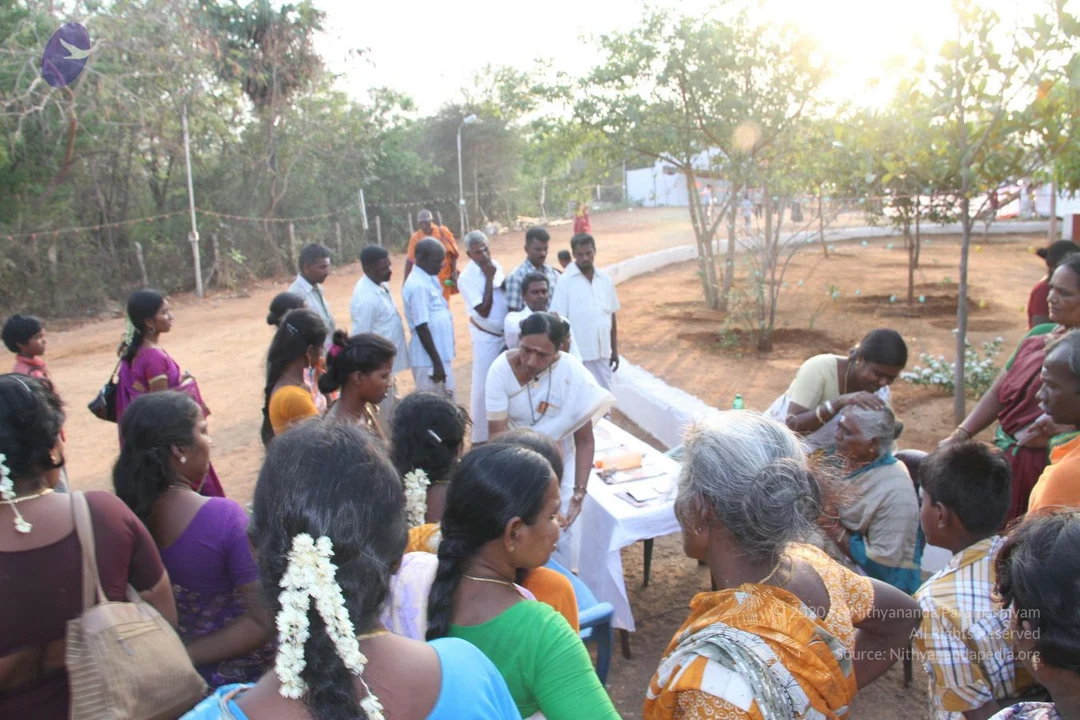
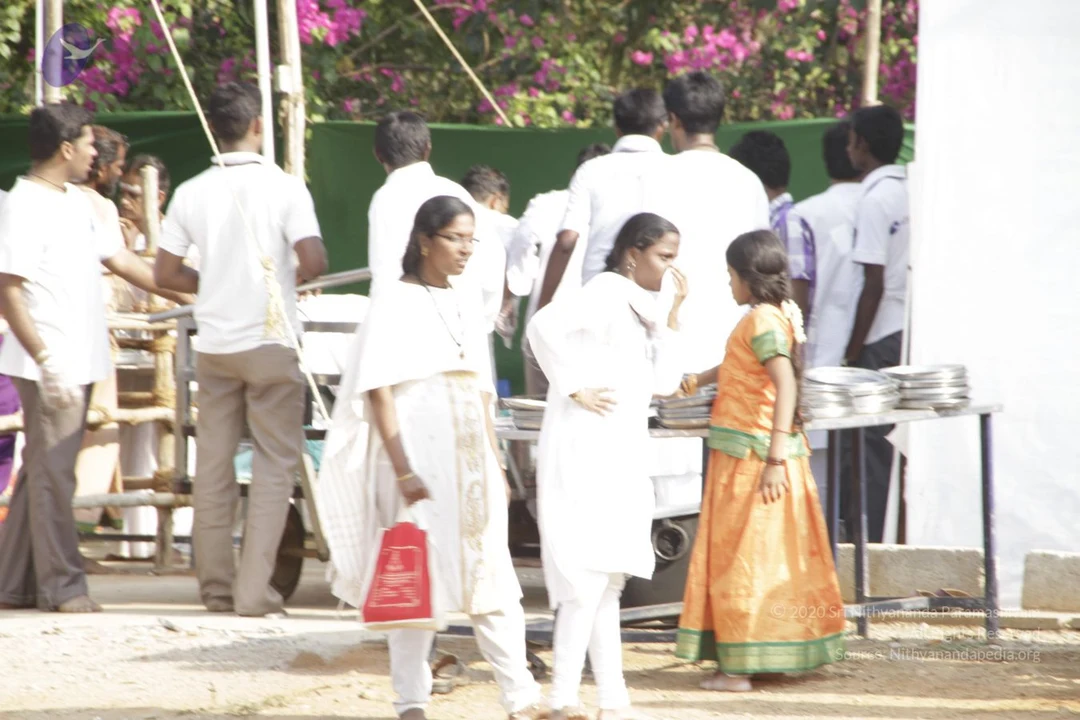
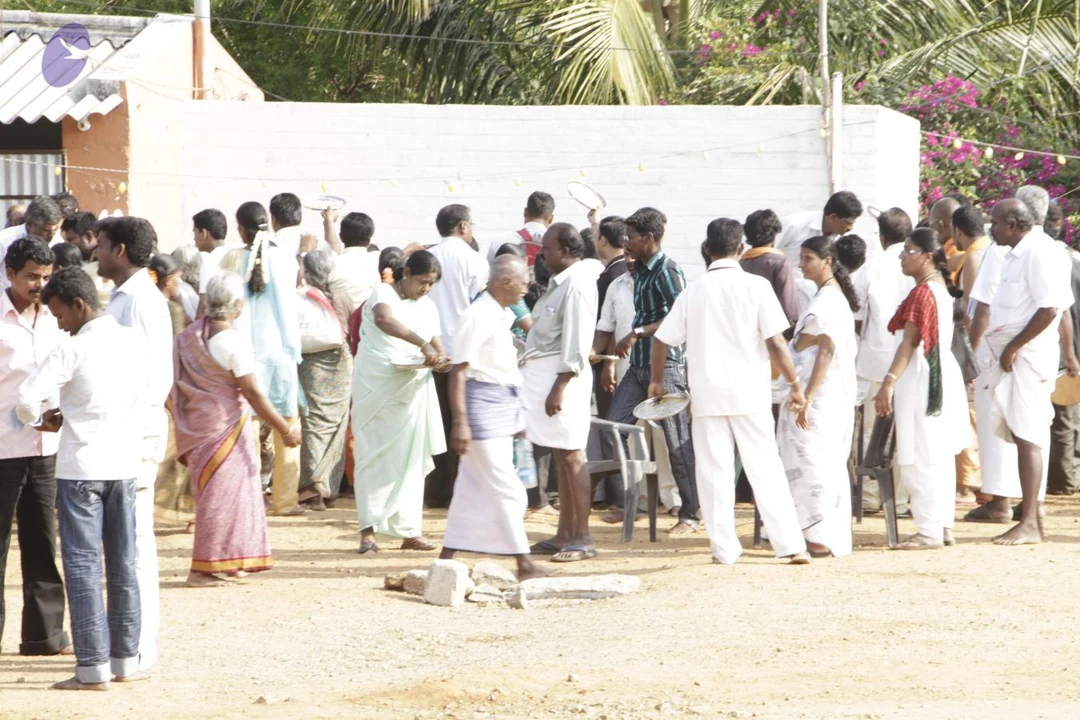
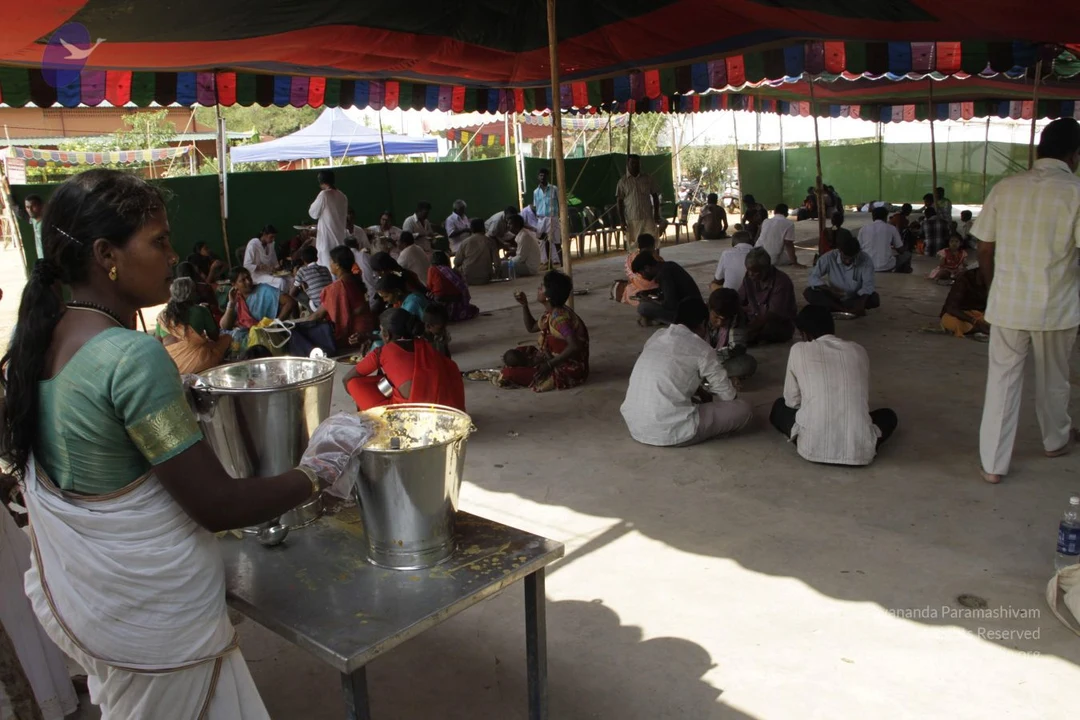
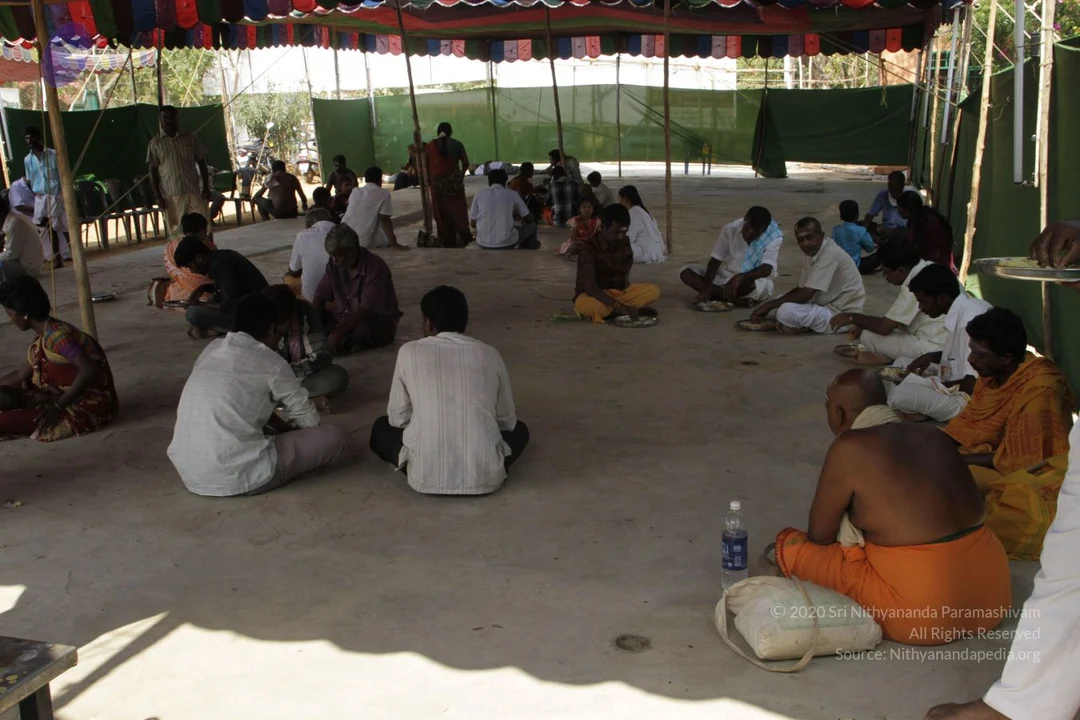
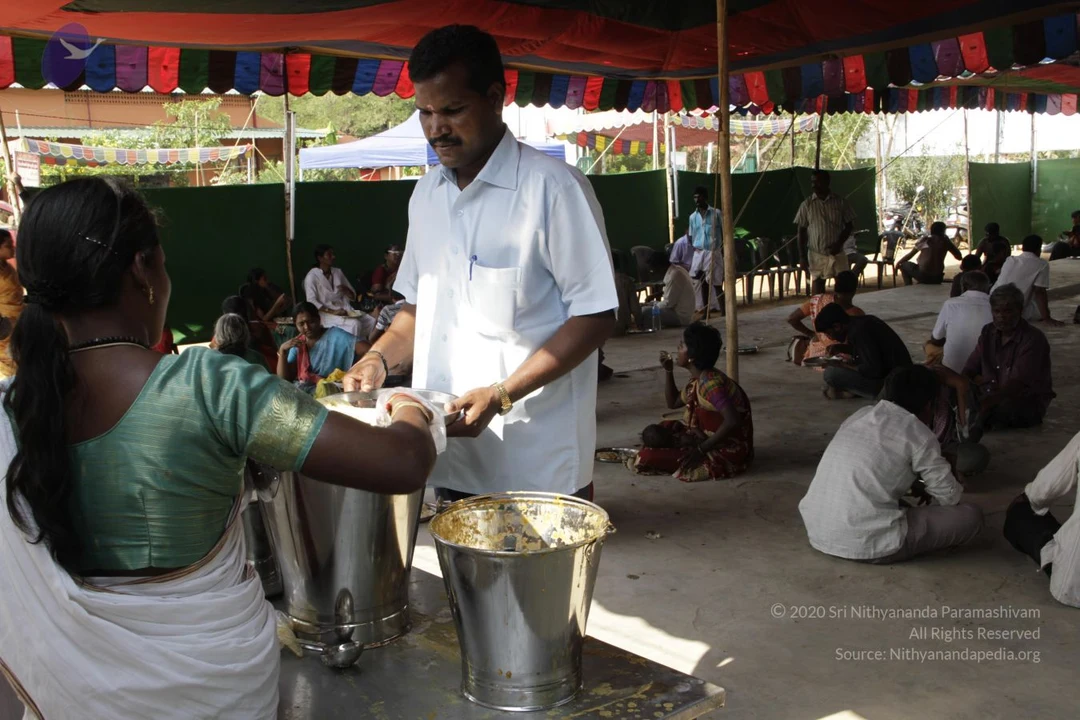
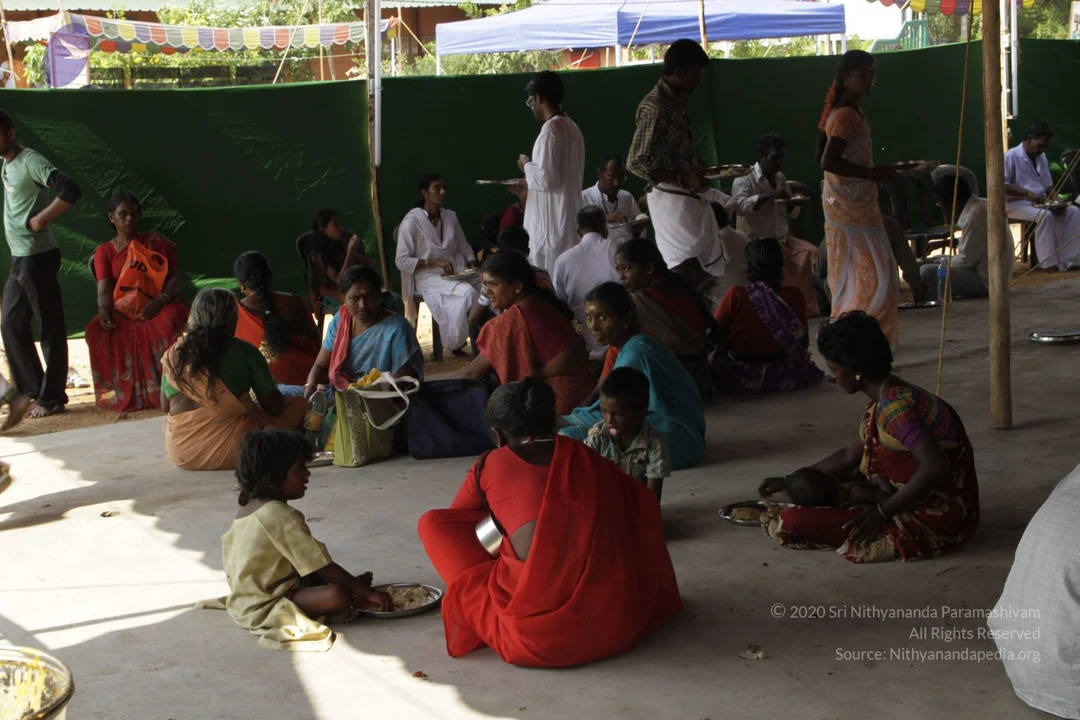
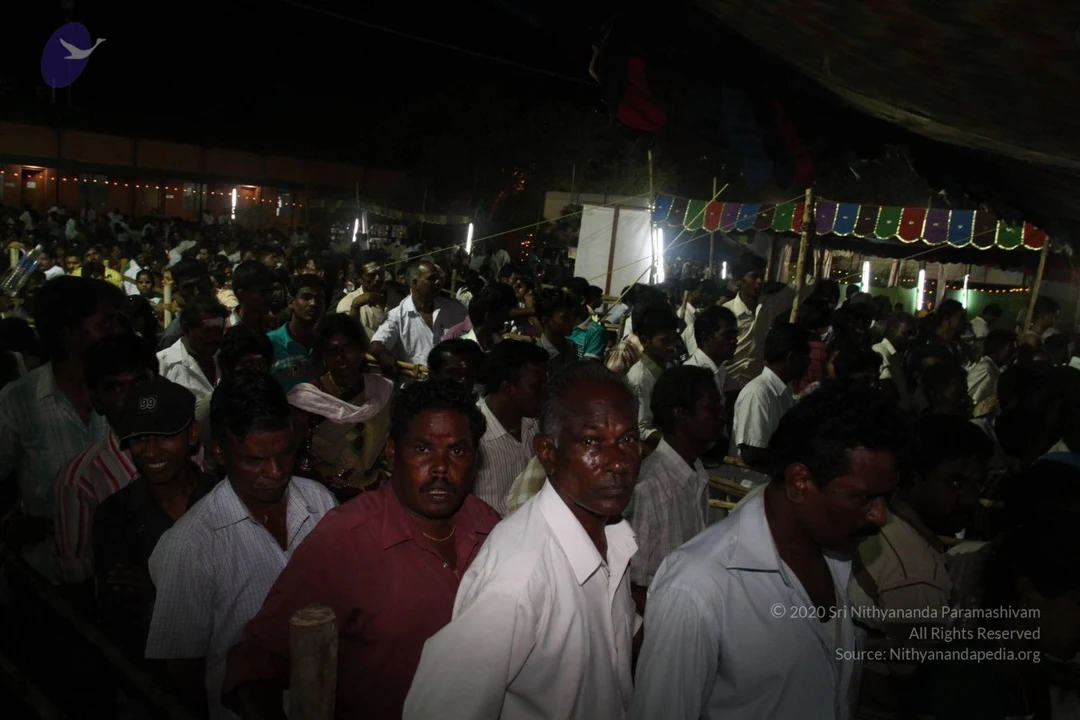
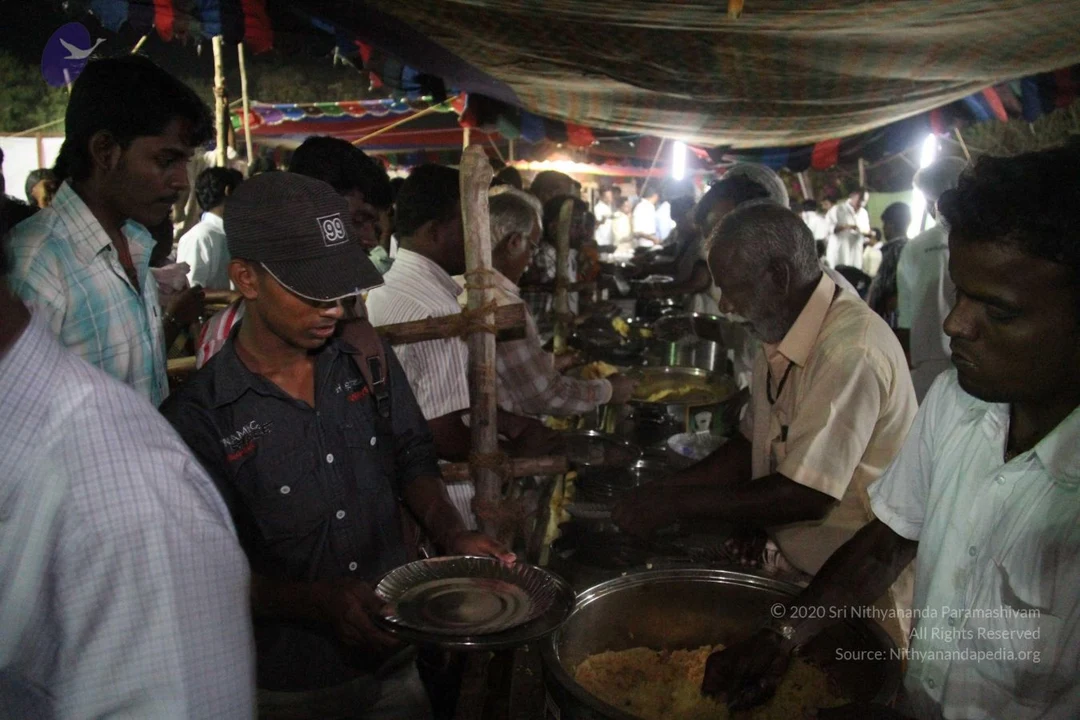
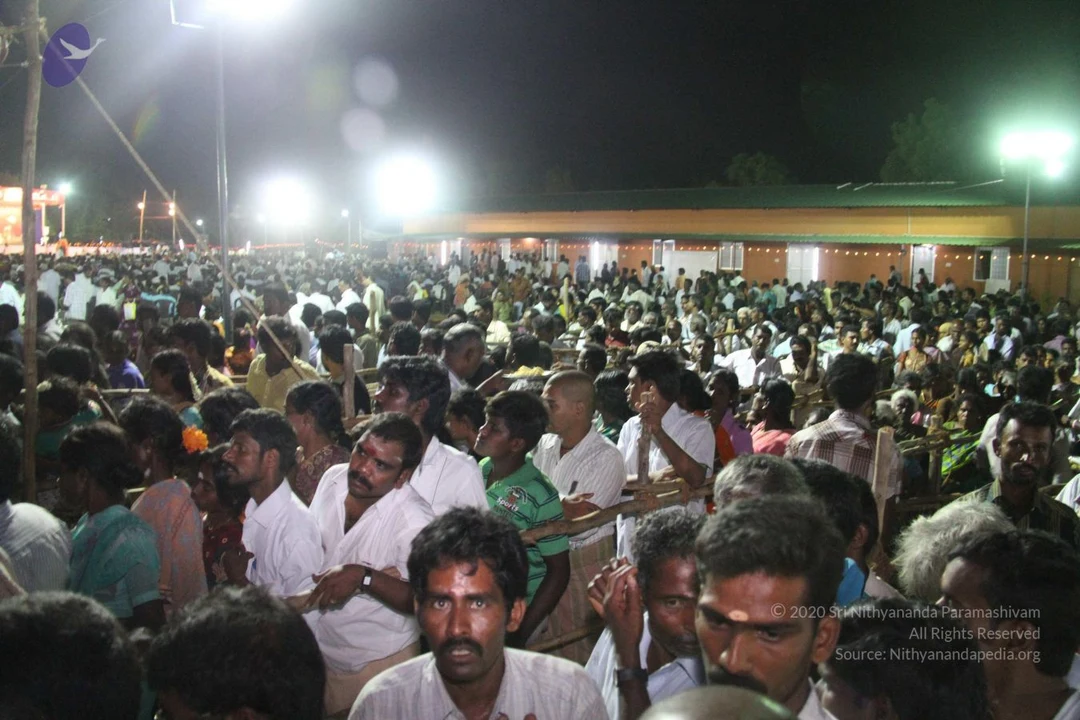
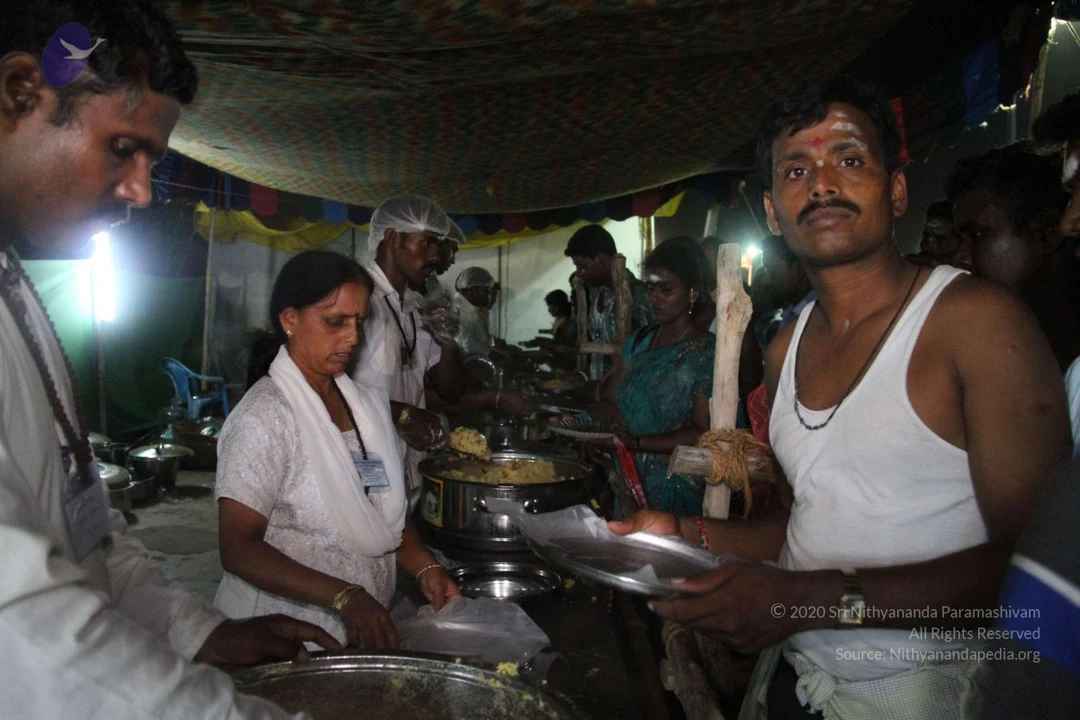
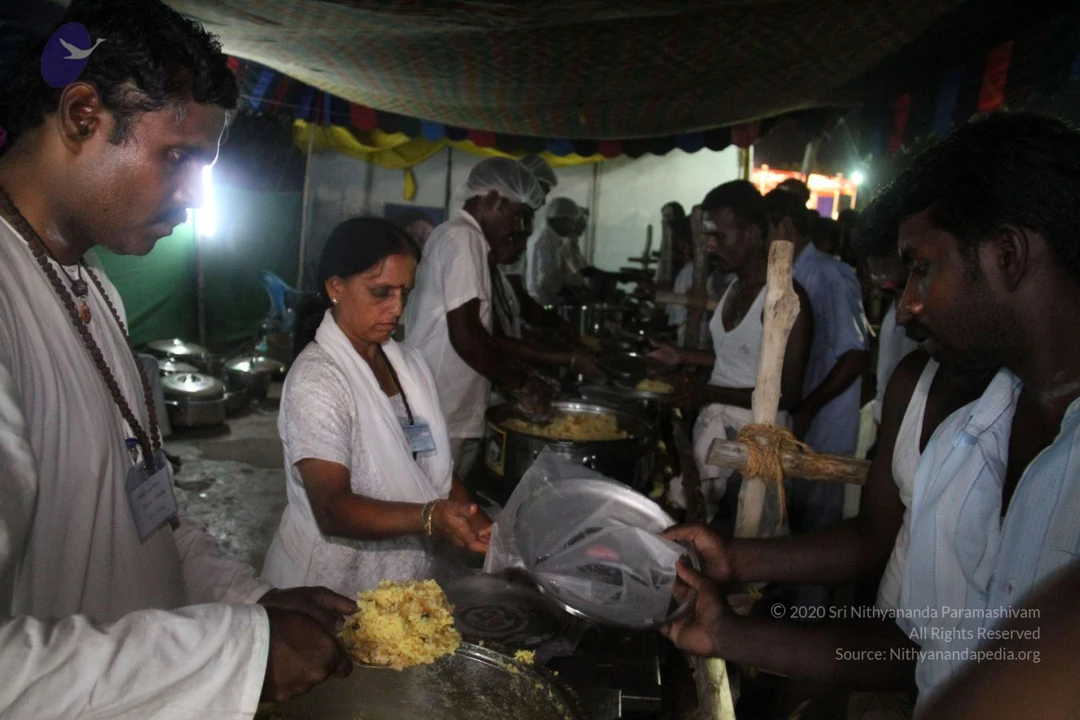
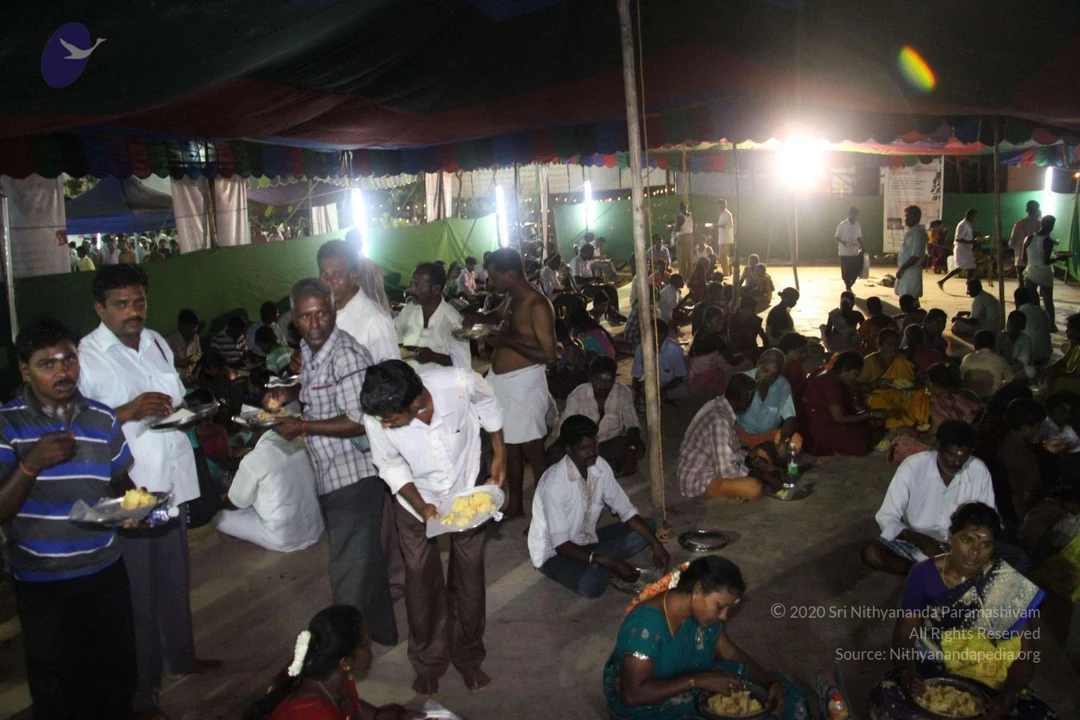
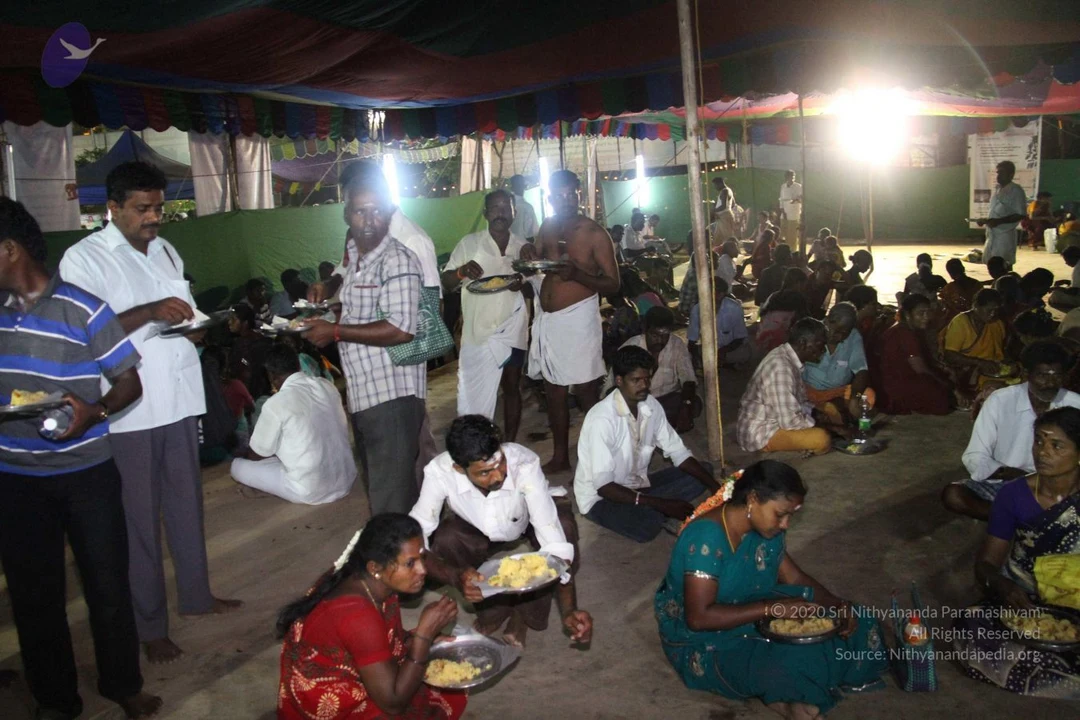
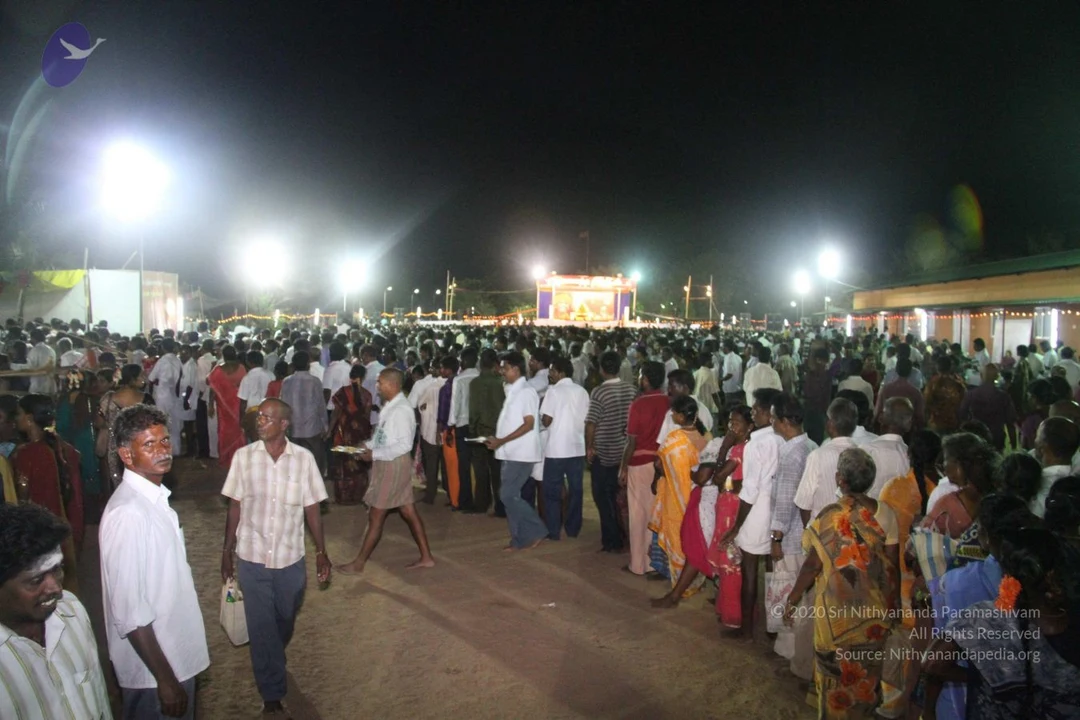
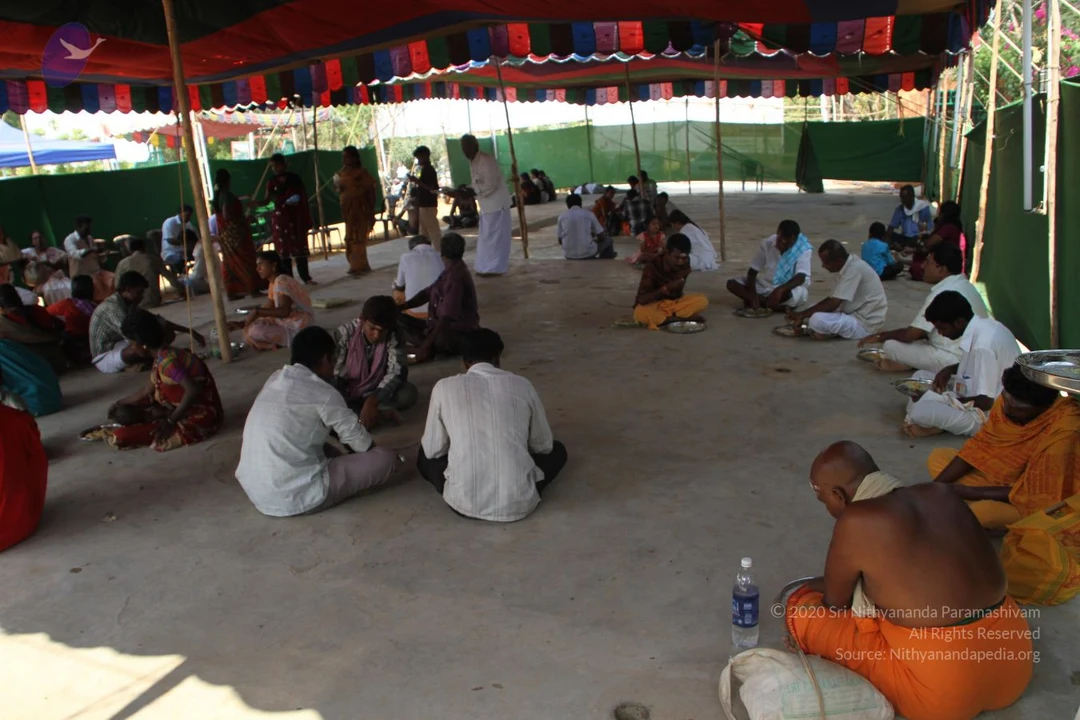
A large crowd of people gathers on a dirt ground outdoors beside a white-washed wall strung with small yellow lights. Many men and women stand in groups, some holding plates or steel trays and small items. A woman in a pale green sari stands at center, a woman in a white and red sari with a yellow head covering holds a silver tray, and men wear white shirts, checked shirts and jeans. On the left an orange and white banner with a bird logo hangs beside an orange-walled hut.Outdoor photo of a crowd on a dusty dirt ground at a community gathering. Many people mill about and queue near a low white wall with string lights, while others carry plates, one woman in a white sari with a red border walks forward holding a steel plate. A large orange banner with Tamil text sits at left beside a small orange-walled hut, and palm trees and pink bougainvillea frame the background. Men wear white dhotis and shirts, others wear checked lungis and orange dhotis. No clearly identifiable a person figure is visible.Outdoor crowd on a sandy ground at an open-air gathering, with bamboo poles and fencing at left and a green backdrop with pink bougainvillea behind. In the foreground a young man in a purple and white checked shirt stands among people. A woman in a red salwar kameez and red dupatta stands at left, and a man in a checked shirt and white dhoti is nearby. A woman in a beige embroidered churidar with a light shawl stands center-right, and a woman in a red blouse and yellow-green patterned sari with flowers in her hair stands at right. Several people in white dhotis and white clothes stand in the background. Roughly a dozen or more people are visible.Outdoor scene on a dirt ground in front of a white-washed wall and an orange-painted building with a white cloud-and-bird motif, strung with yellow lights. A large crowd of devotees moves about; many men wear white shirts and orange or cream dhotis, and women wear saris in yellow, orange, pink and olive. A man in a white shirt with rudraksha mala stands at left, a man in a white kurta and grey trousers with a rudraksha mala stands center, and an older bare-chested man with a mala stands left. A woman in a green-brown sari with an orange flower in her hair holds a pink bag. No clearly identifiable figure matches the a person appearance cues.Outdoor annadan meal service under a large tent with red, green and black canopy strung with colourful bunting. A woman in a white sari with a green blouse and a man in a cream checked shirt and white dhoti stand at a steel table, he holding a plate and she serving food from a steel vessel into a large steel bucket. Several people sit cross-legged on the sandy floor in white clothing, and others stand in the background among green screens and tents.Photograph of a communal meal under a open-sided tent with green fabric screens behind. Many seated women and children, some in red, orange, blue and pink saris, sit on a concrete floor eating from metal plates while others serve food. A woman in a red-orange sari stands at right carrying plates, and men in white shirts and dhotis move among the seated diners. Blue and white canopies and bunting show at the top.

Thiruvannamalai-PaadaPuja-Satsang

59 photosSource gallery
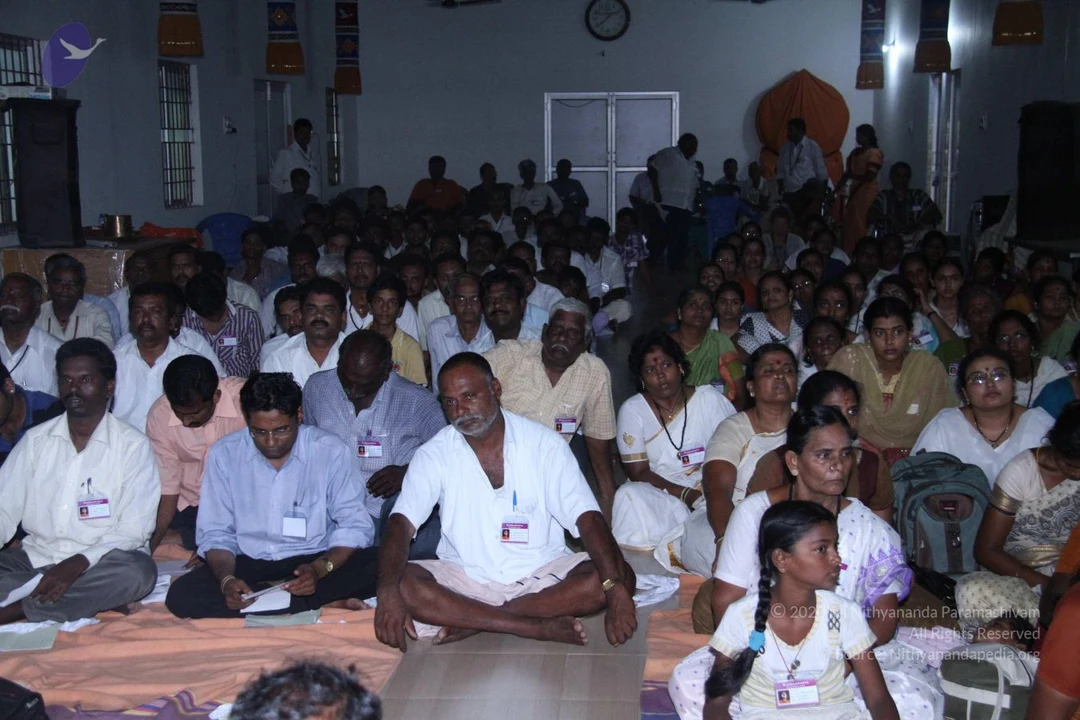
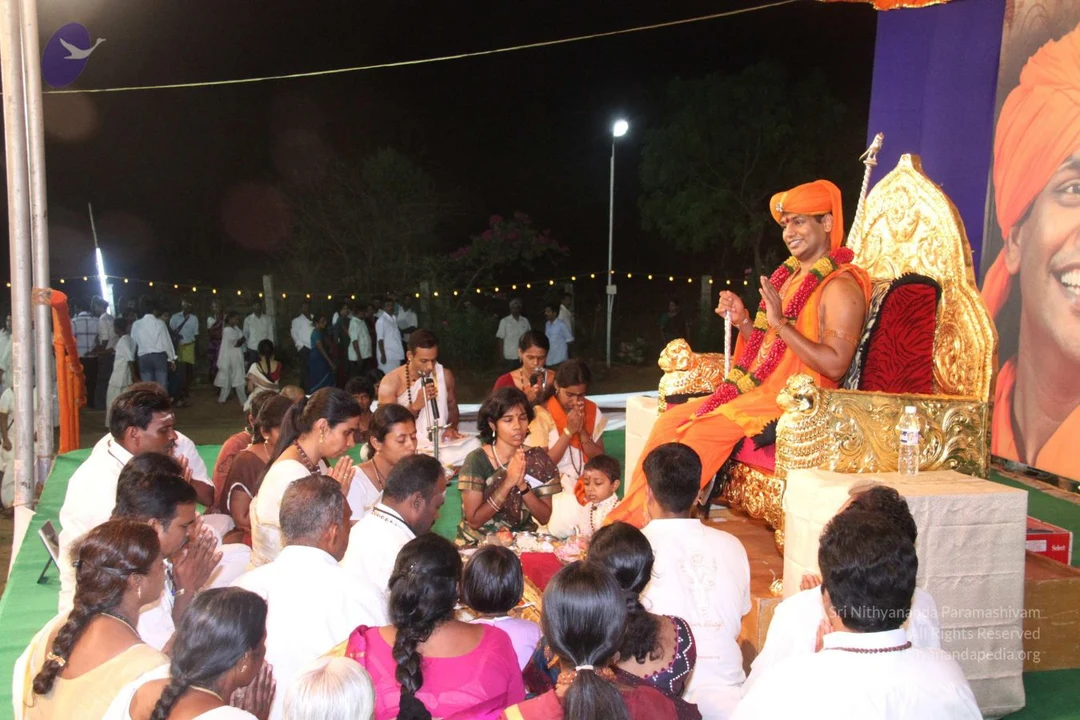
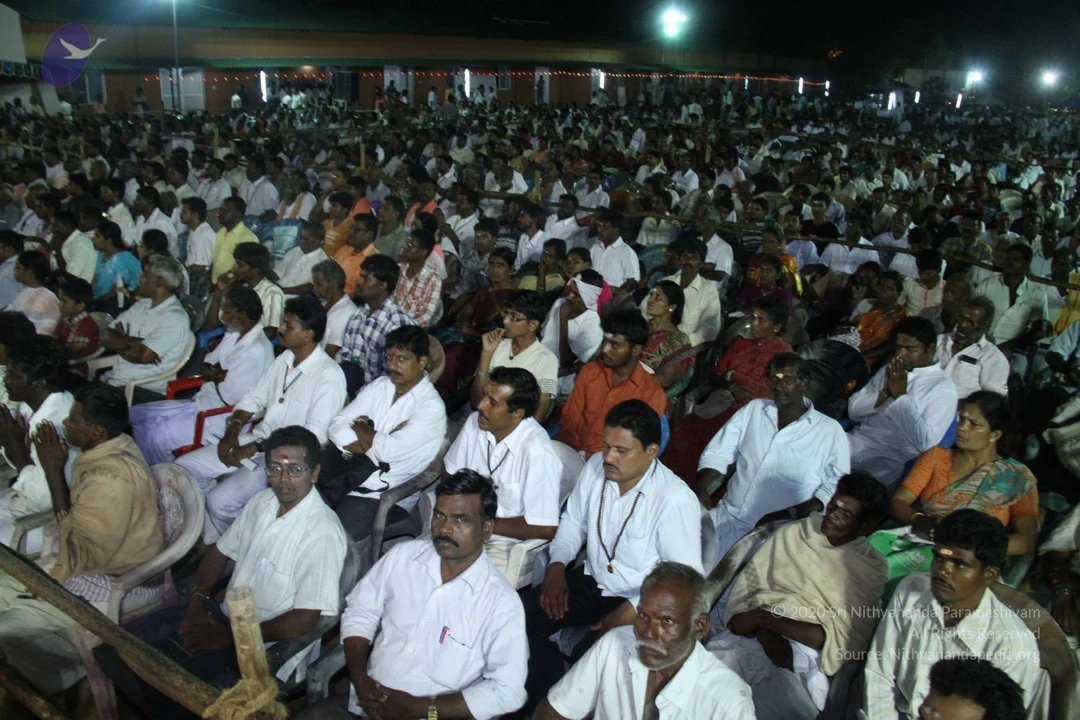
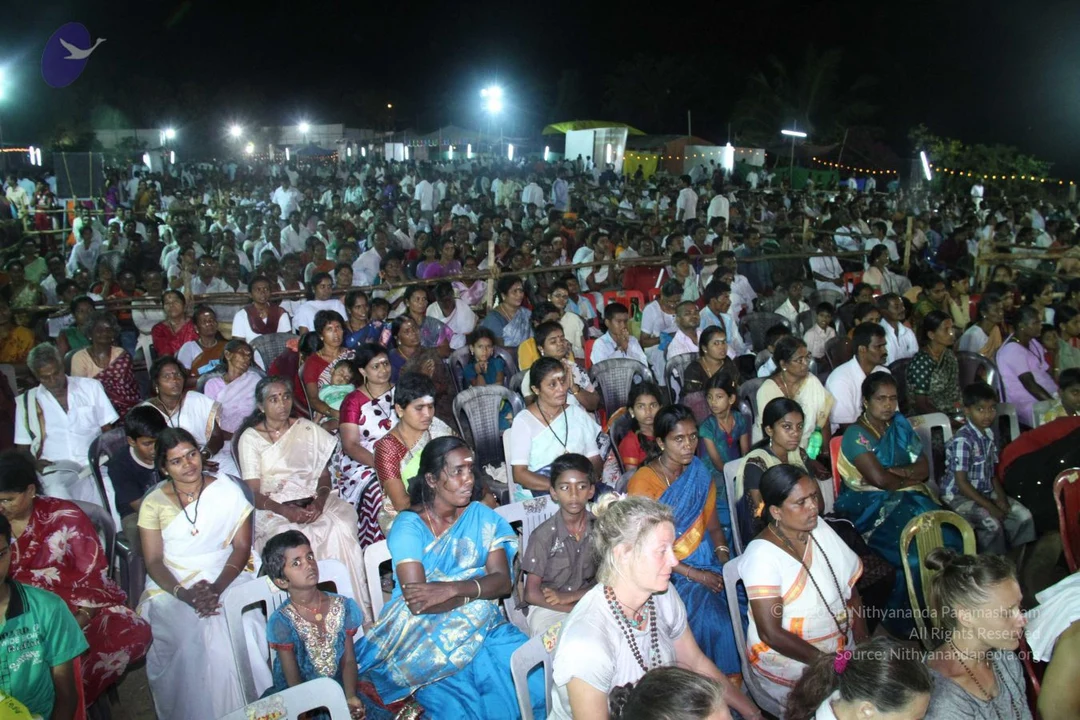
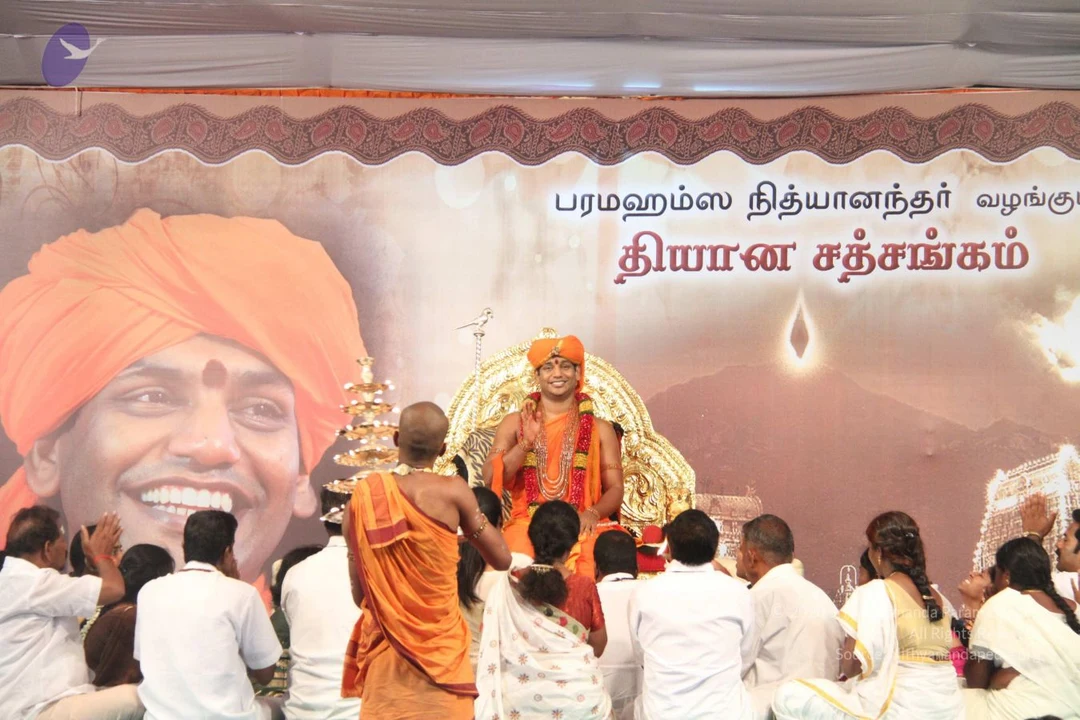
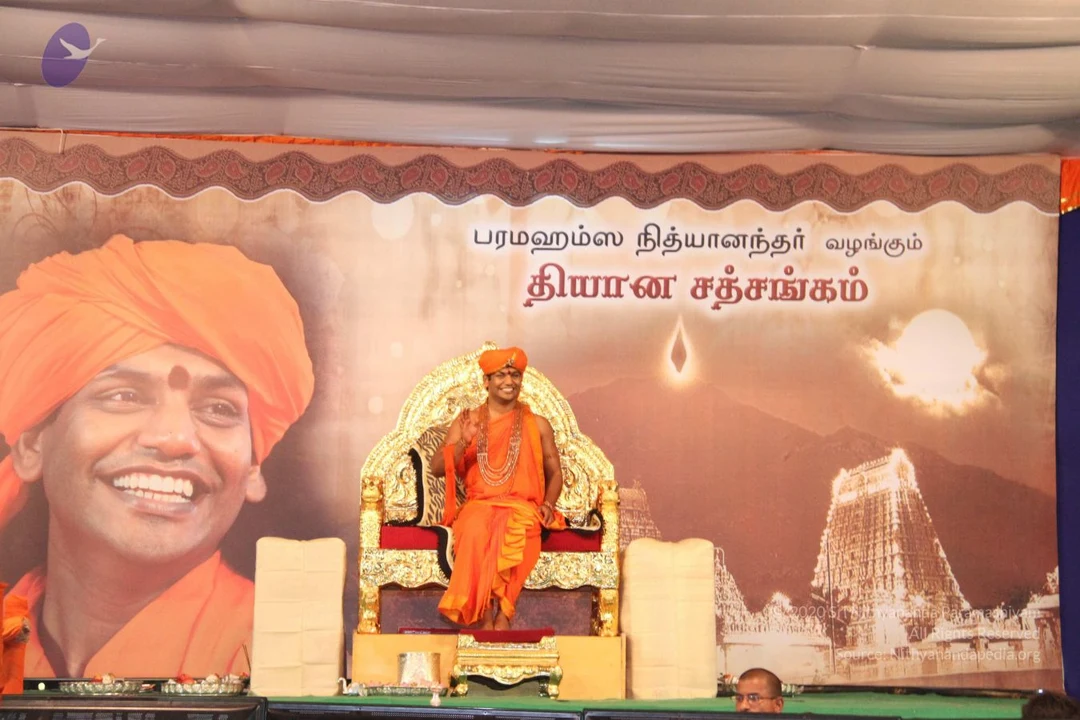
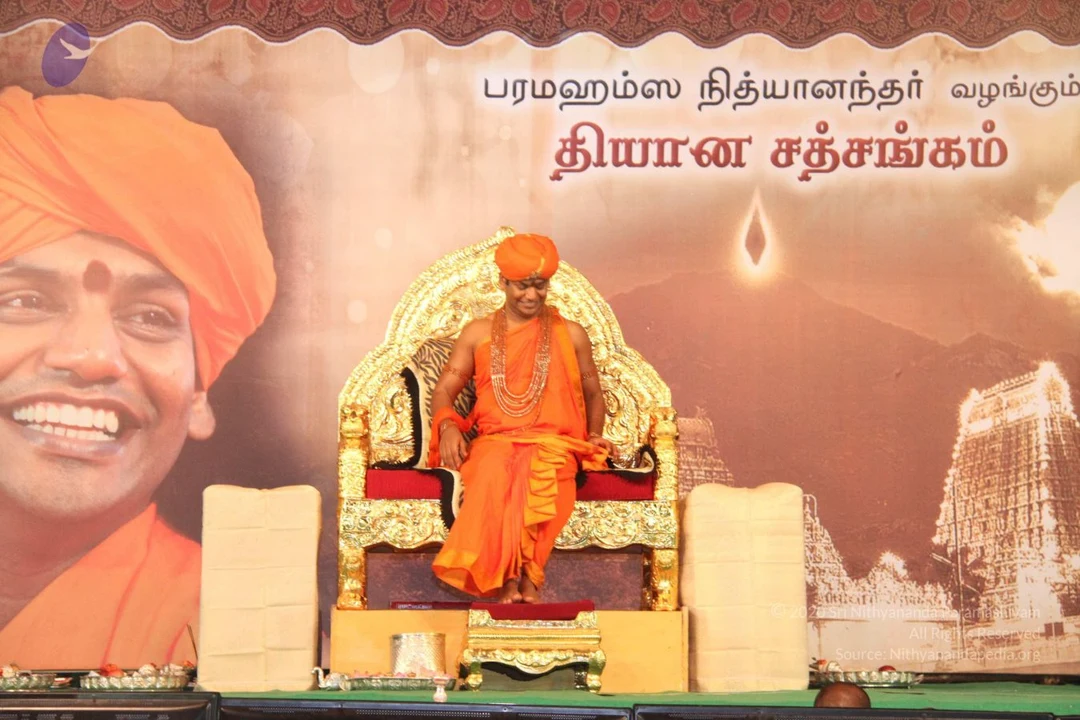
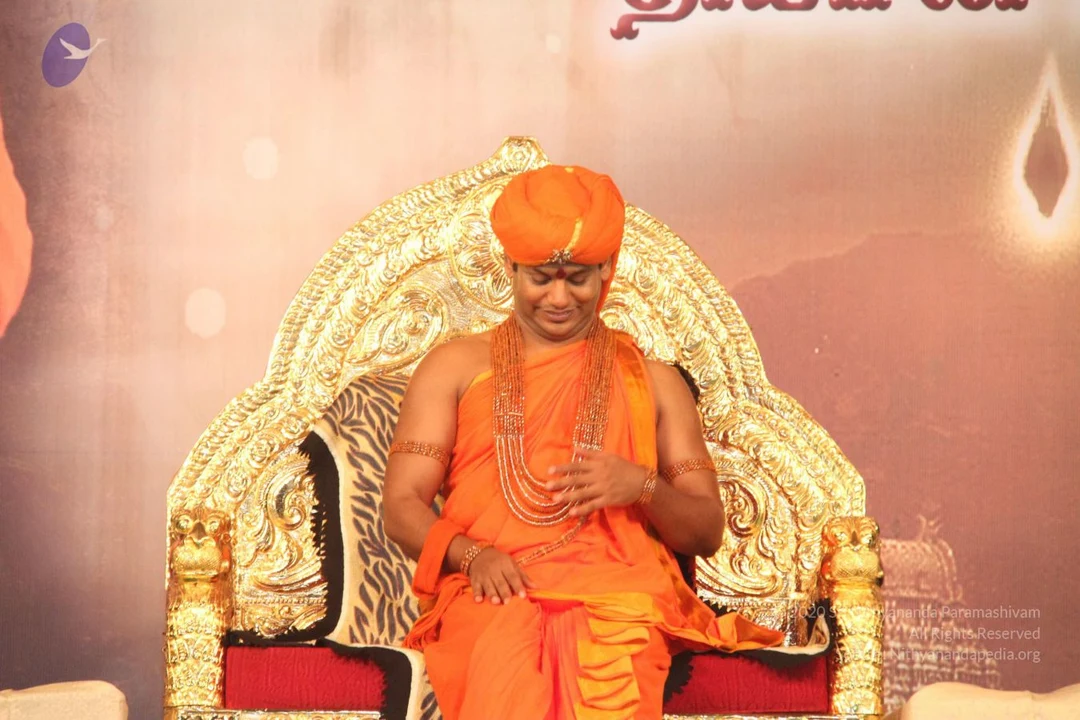
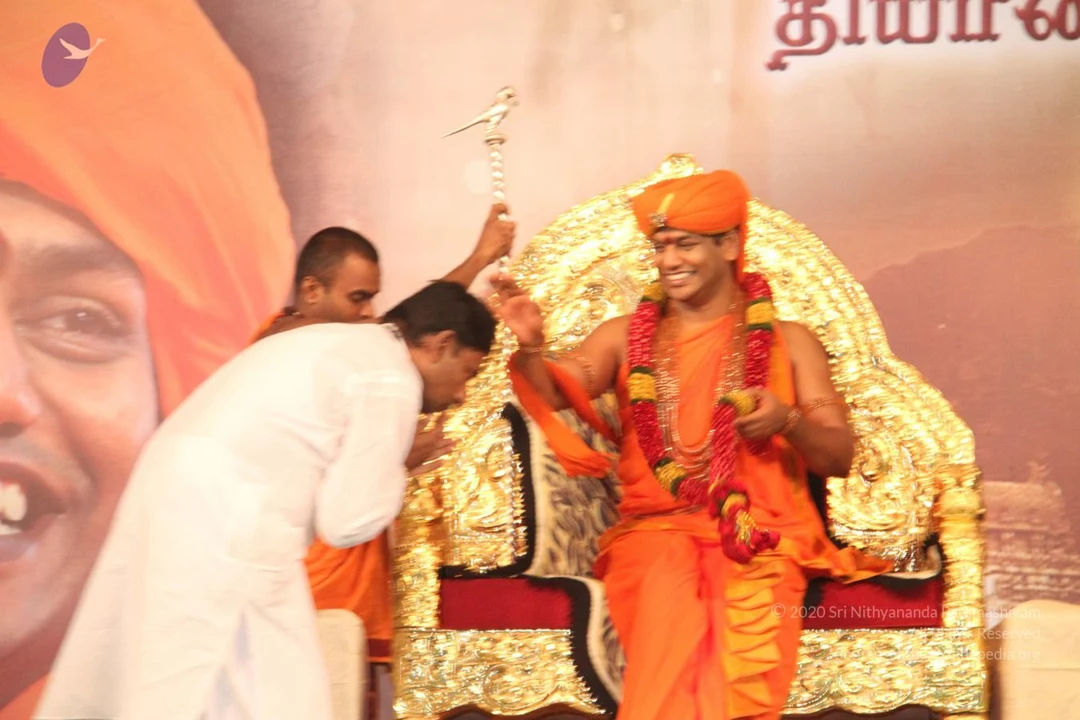
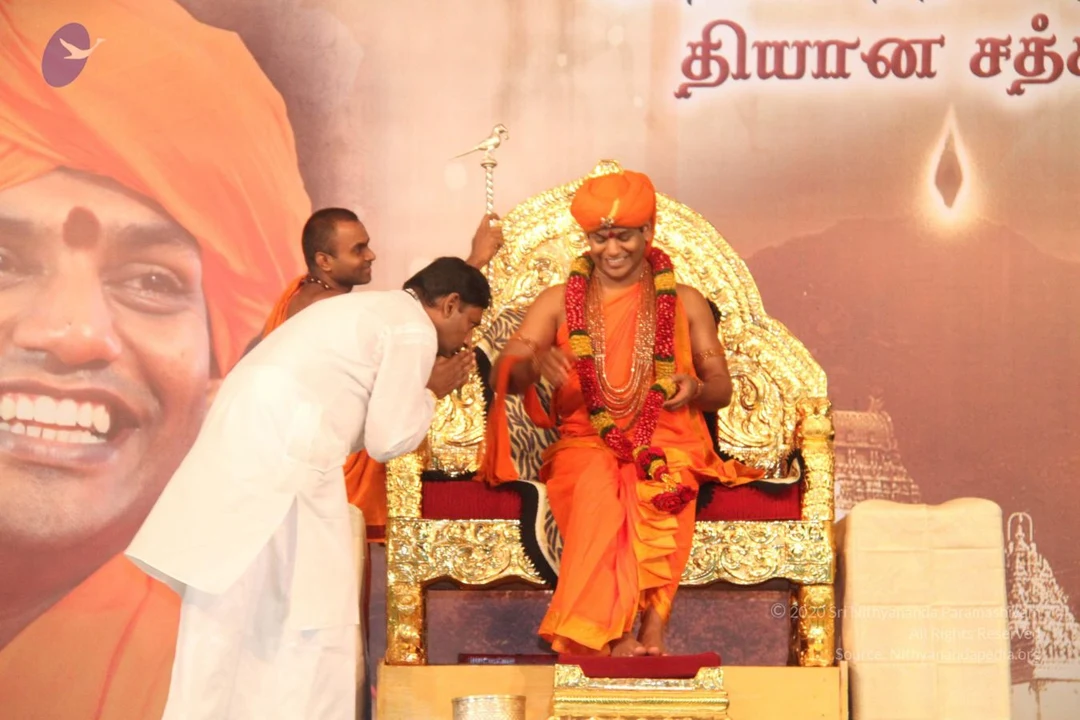
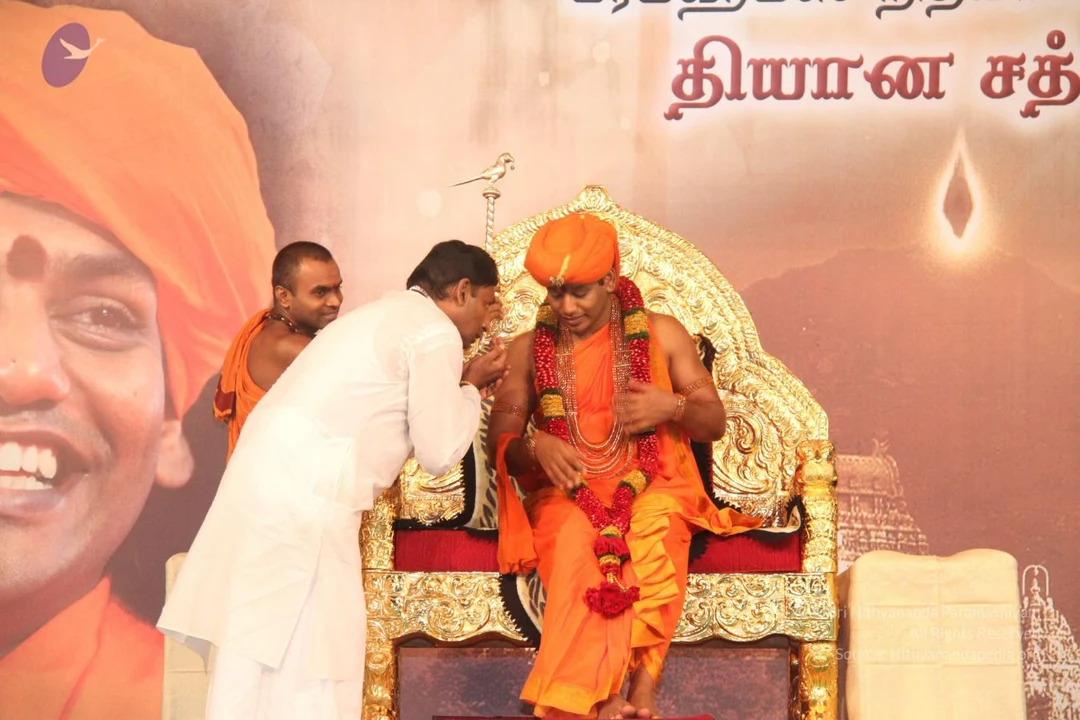
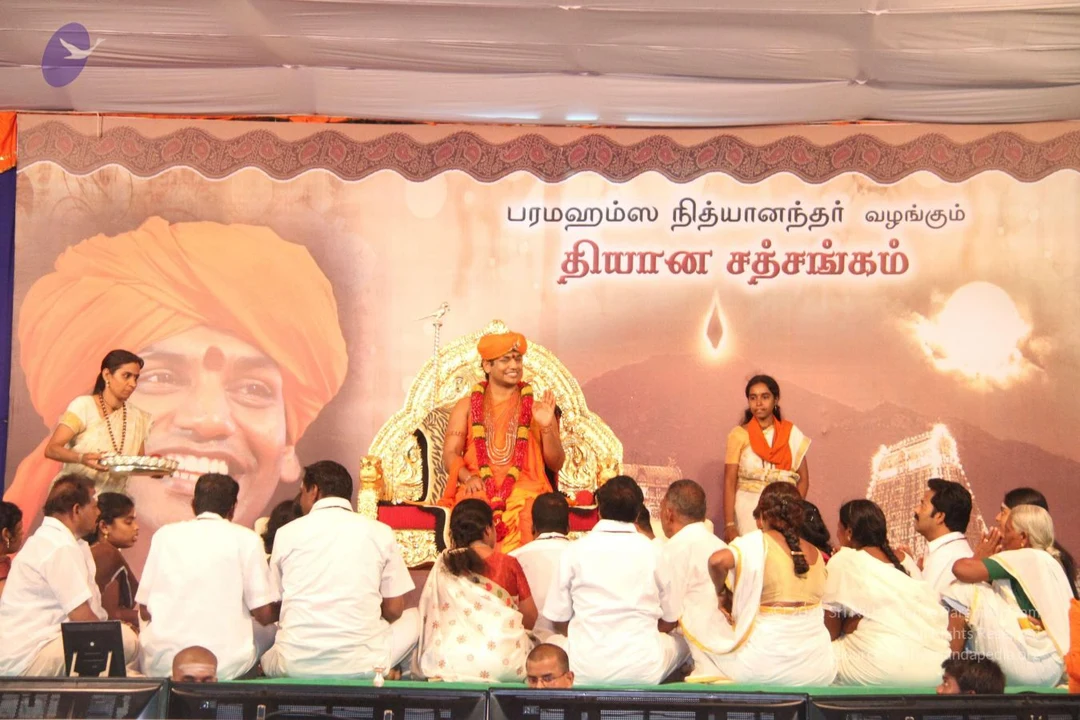
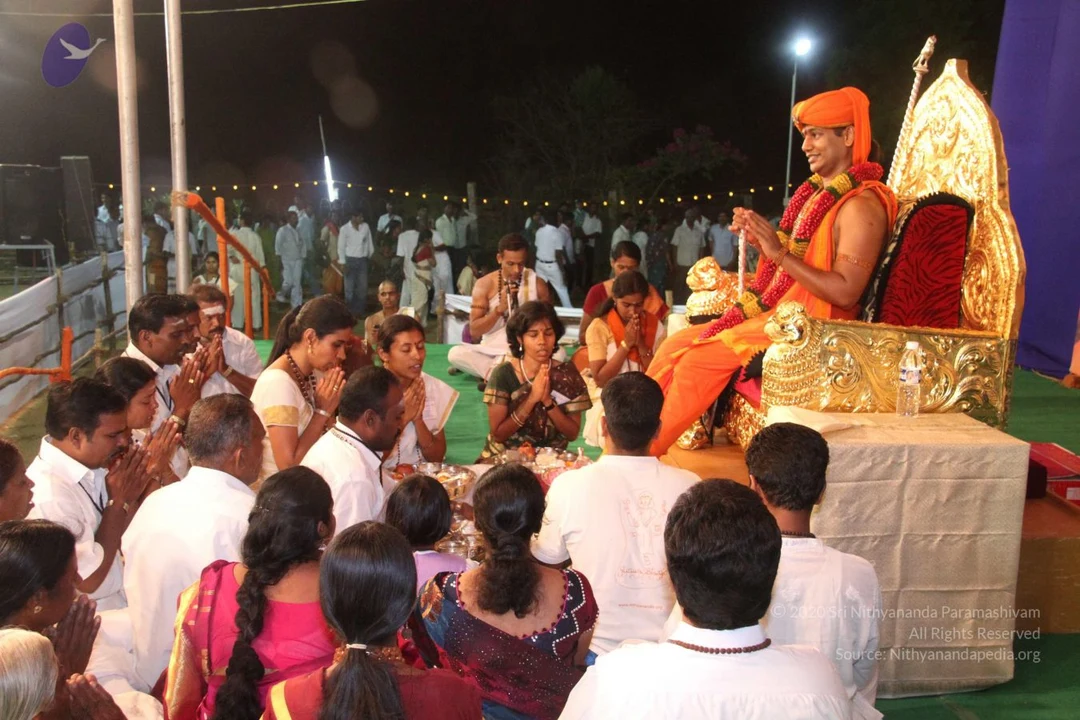
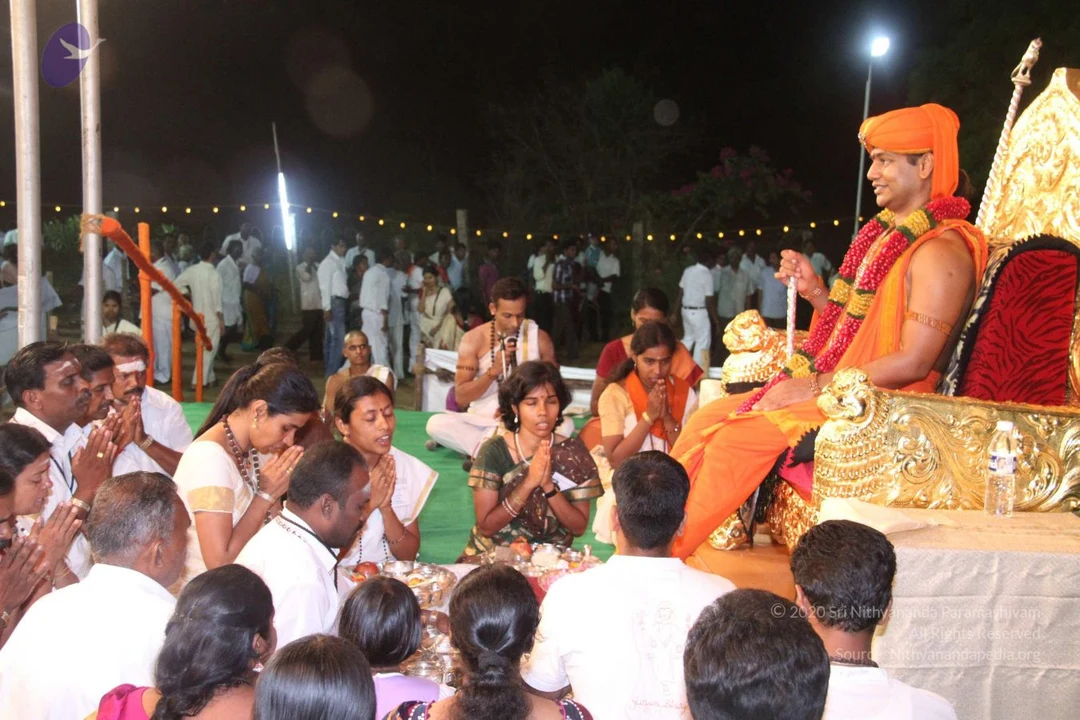
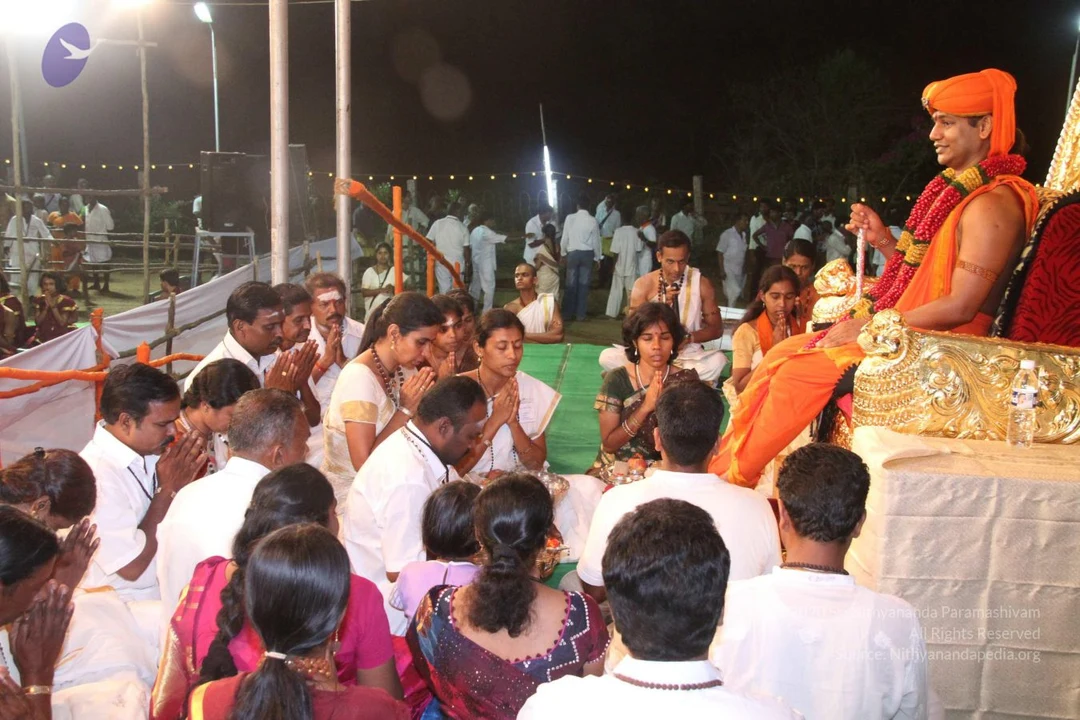
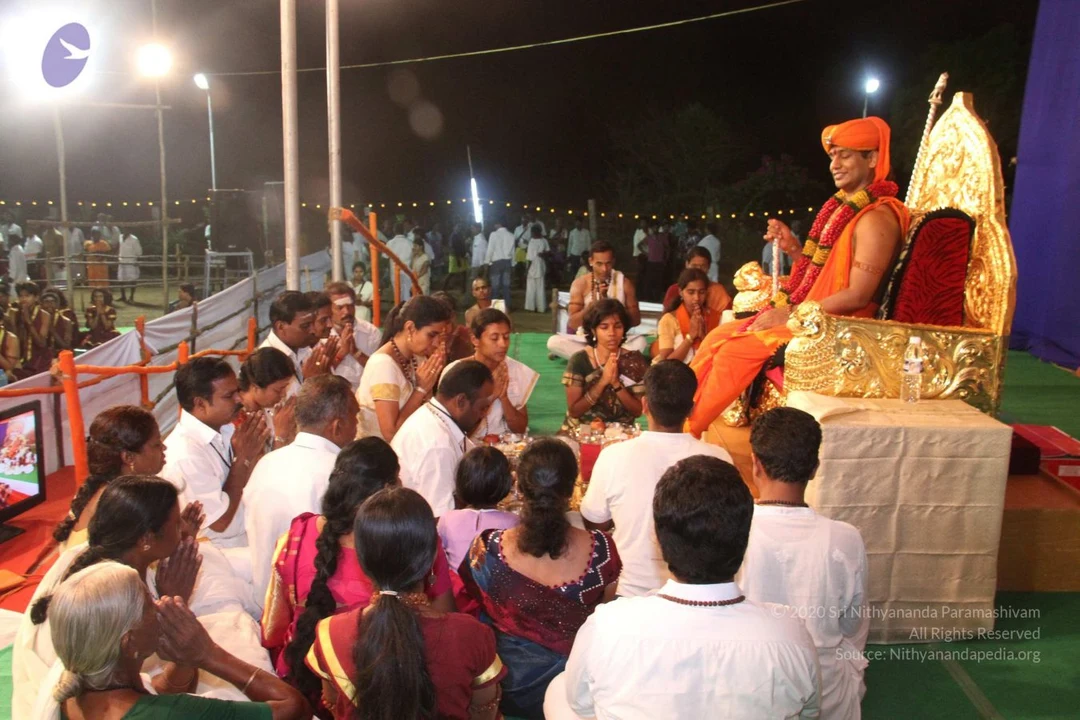
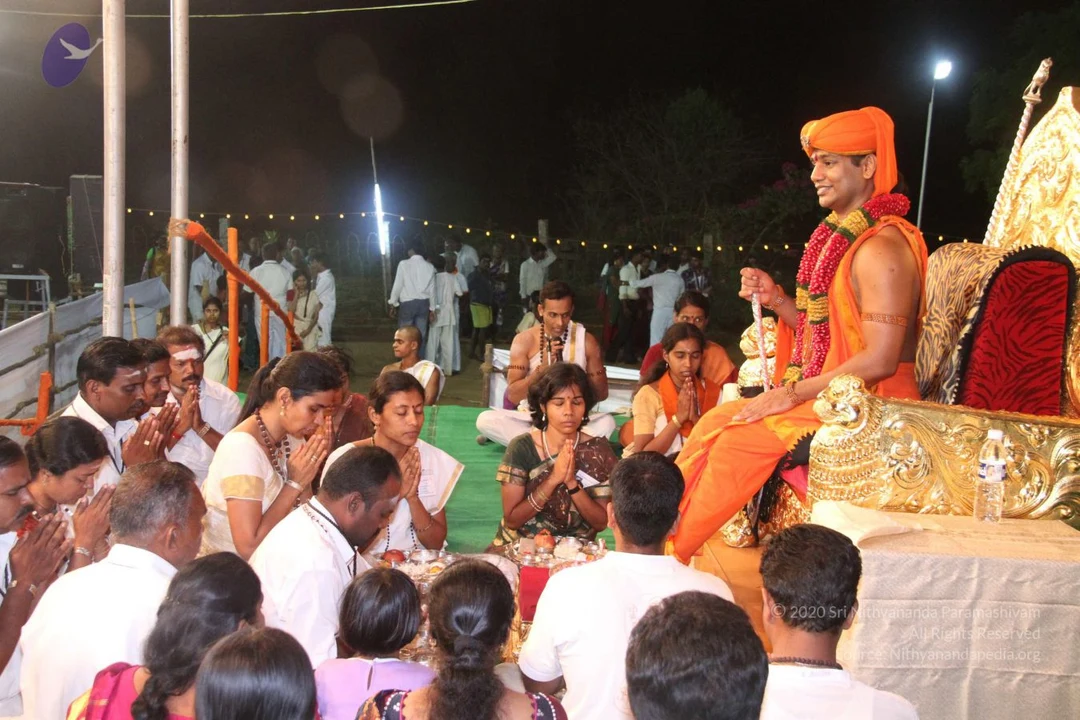
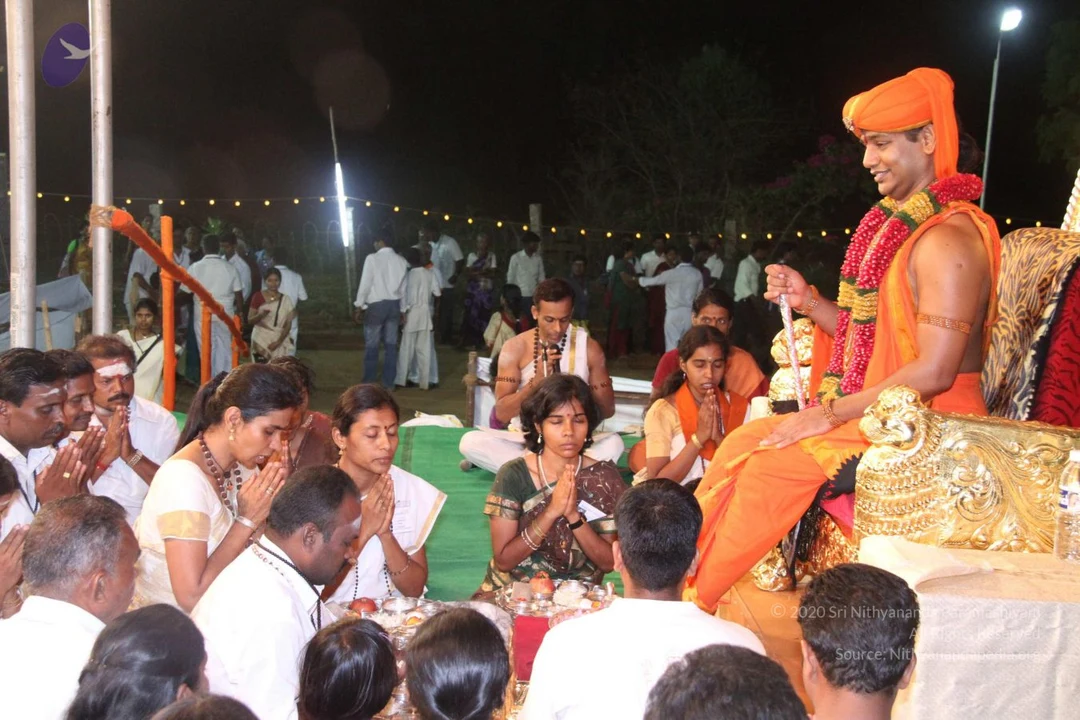
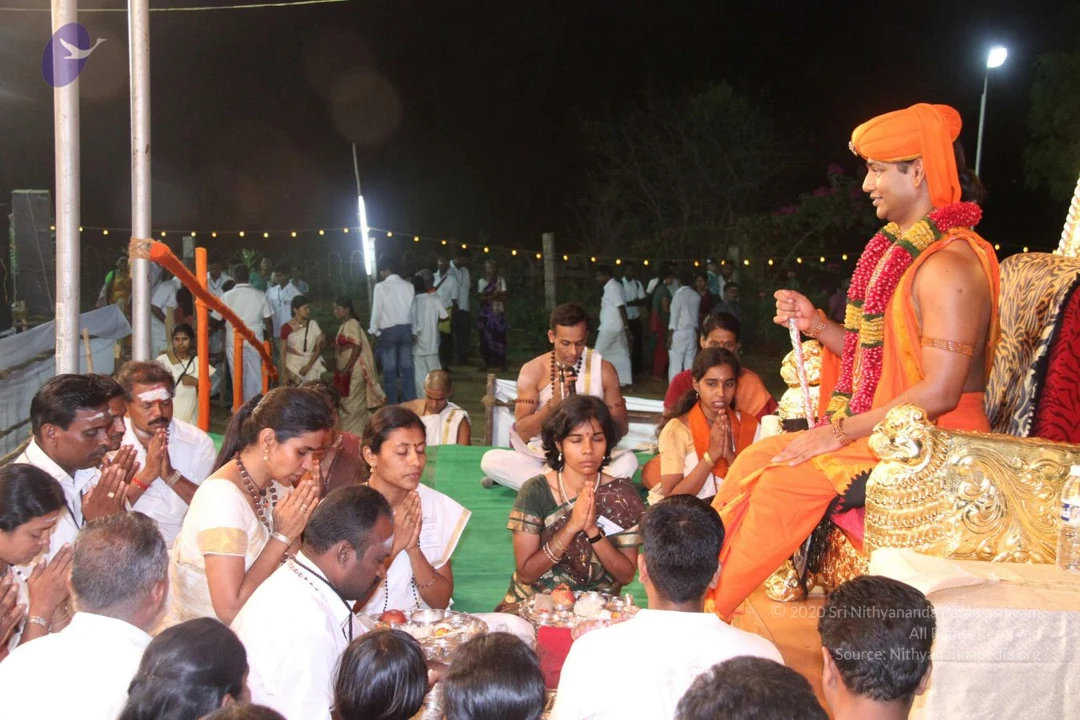
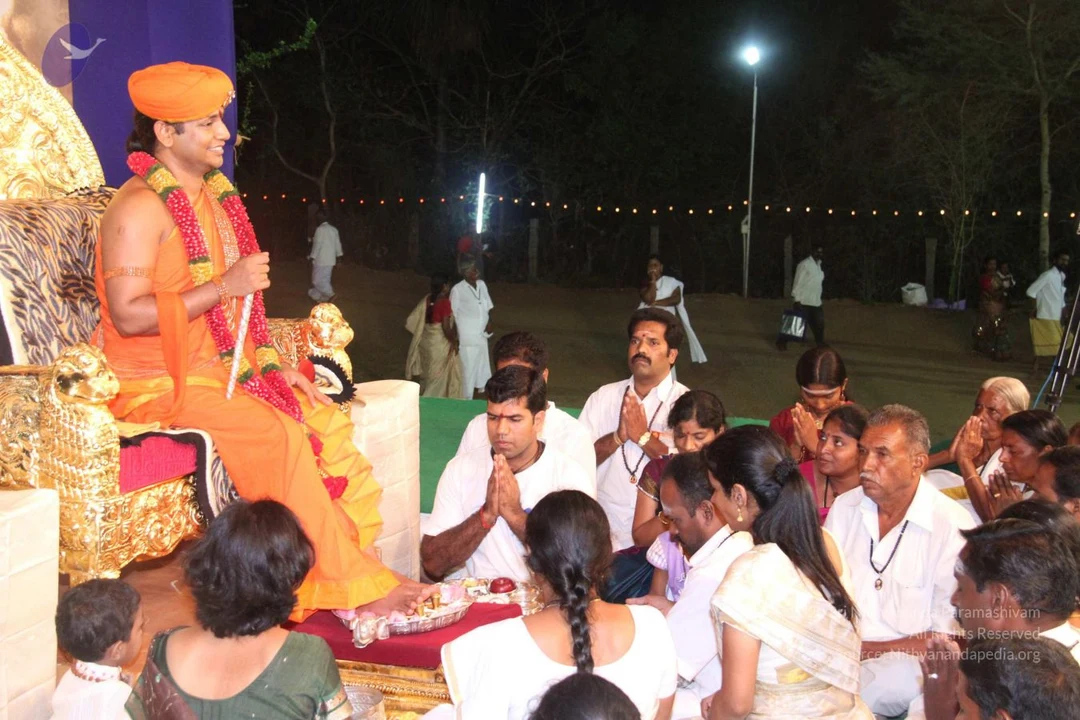
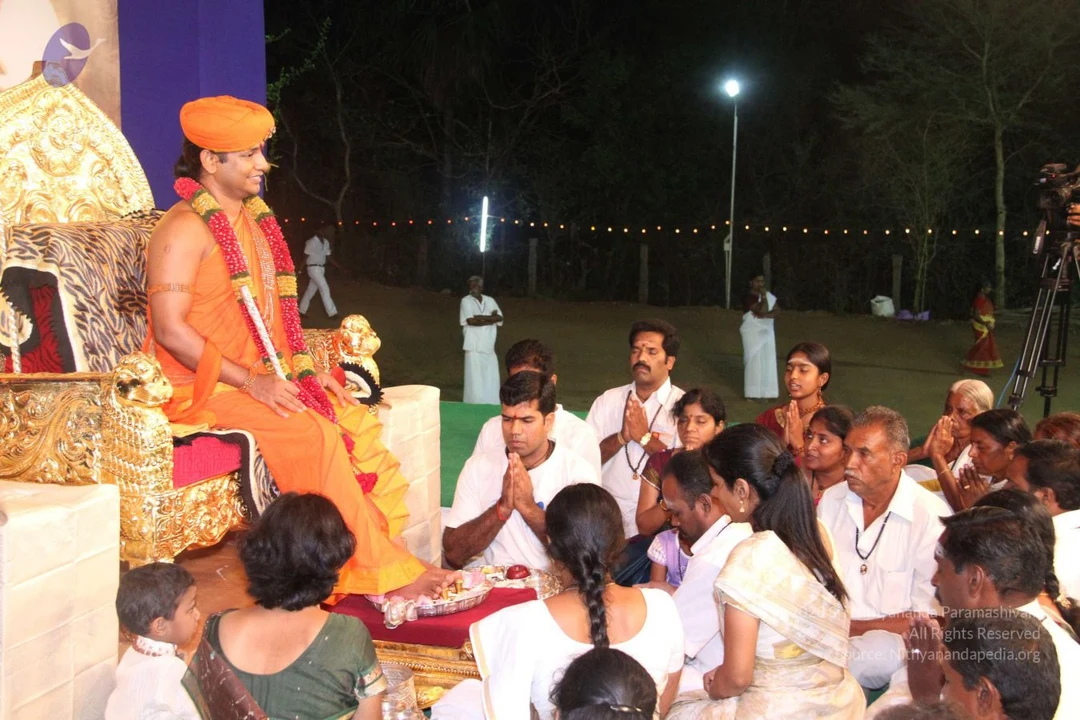
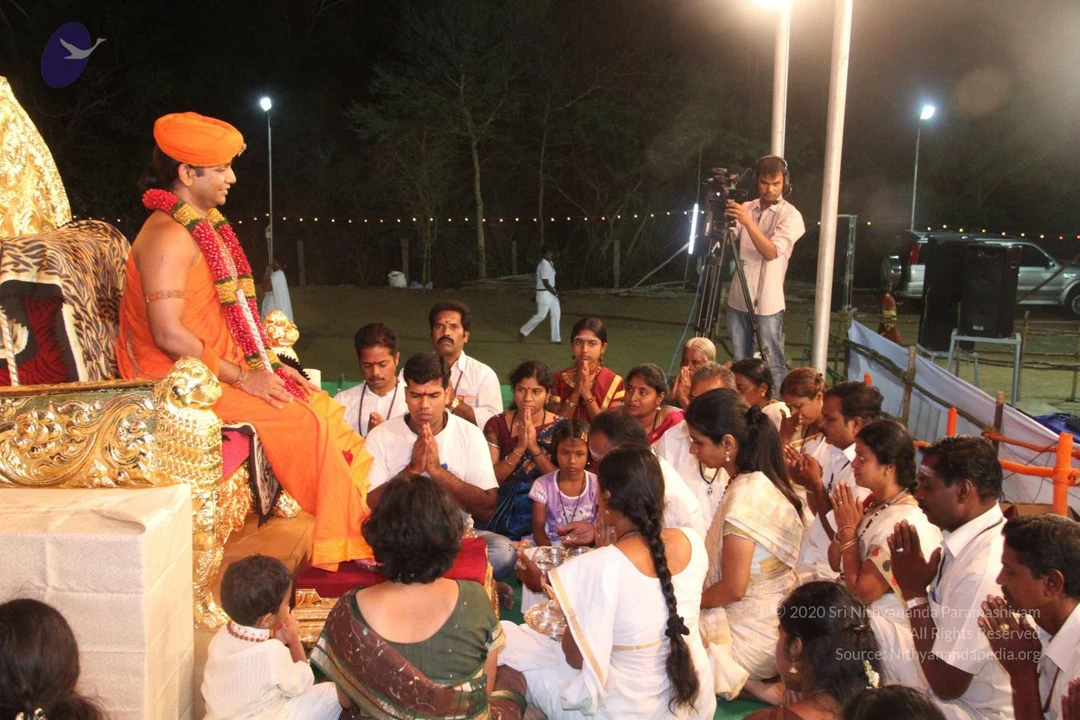
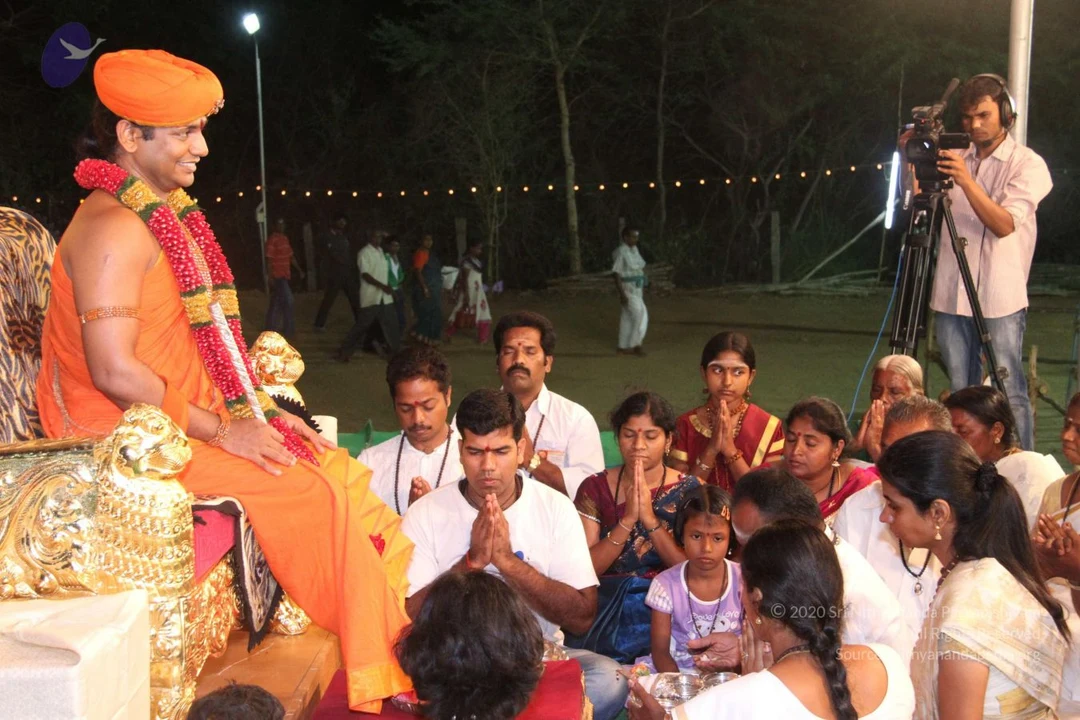
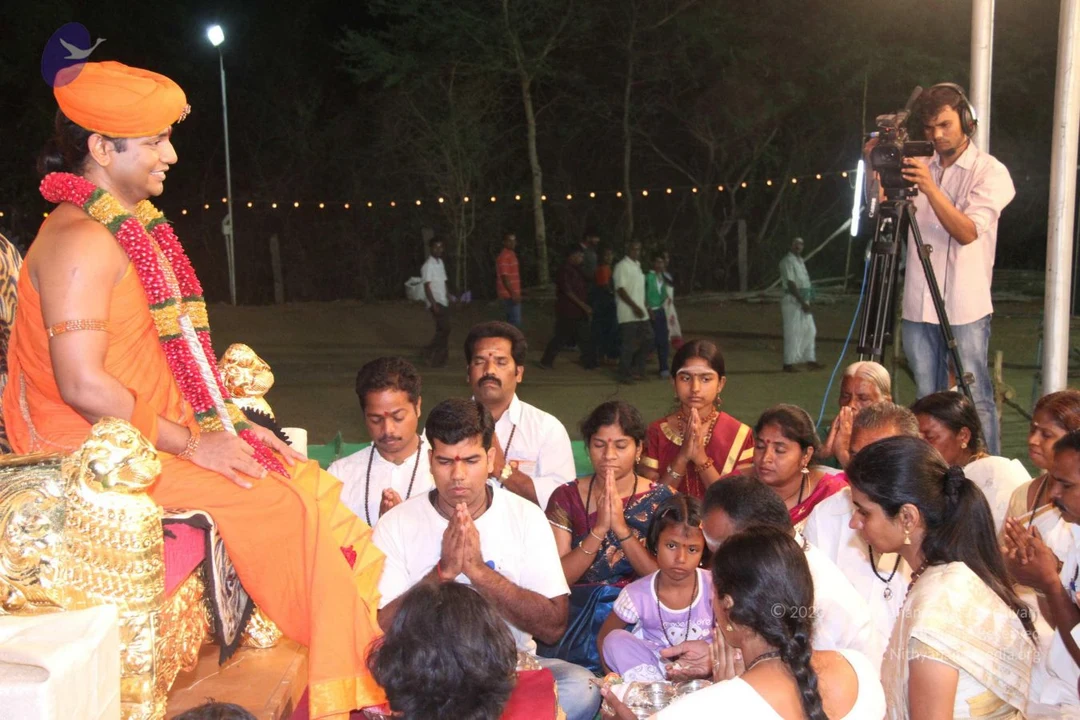
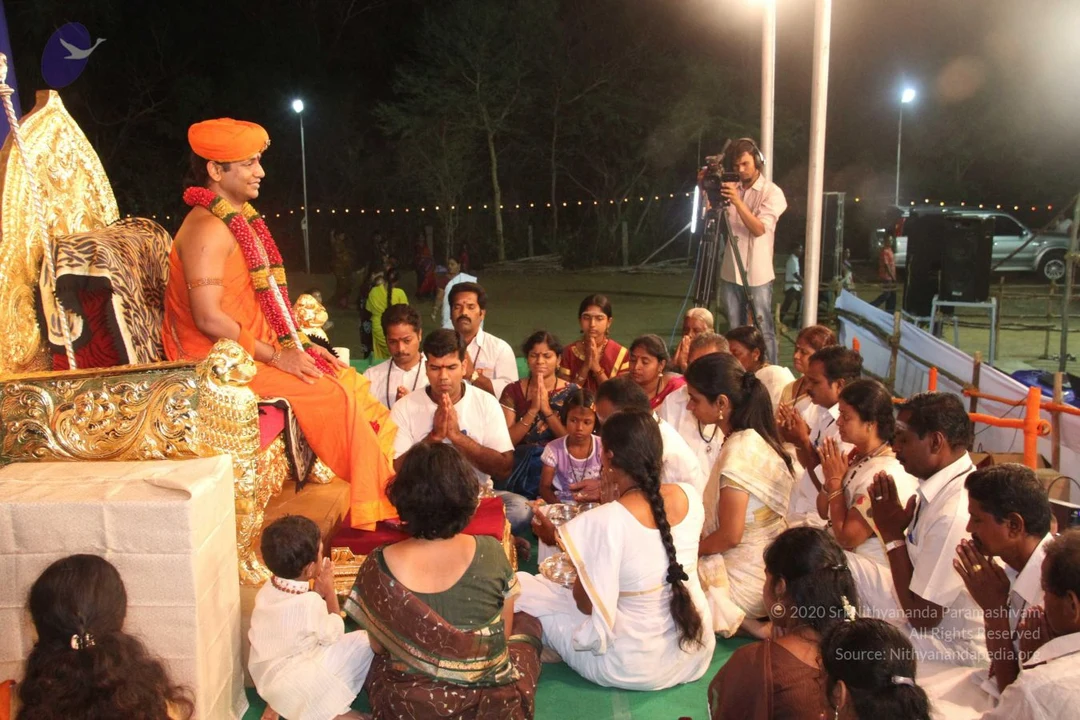
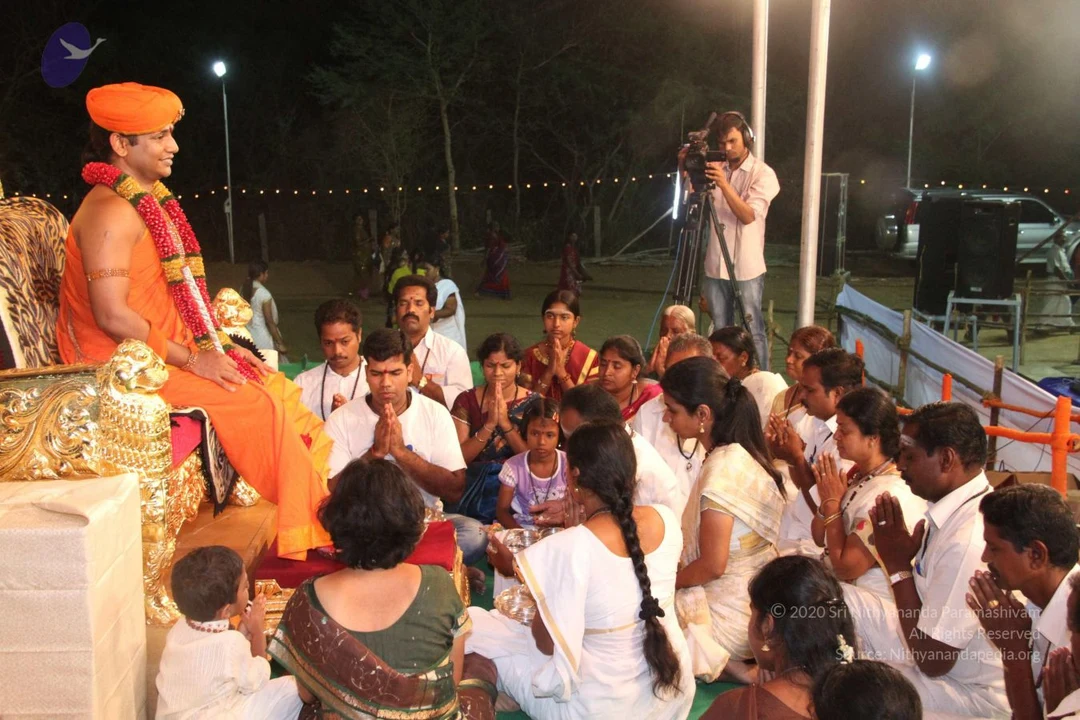
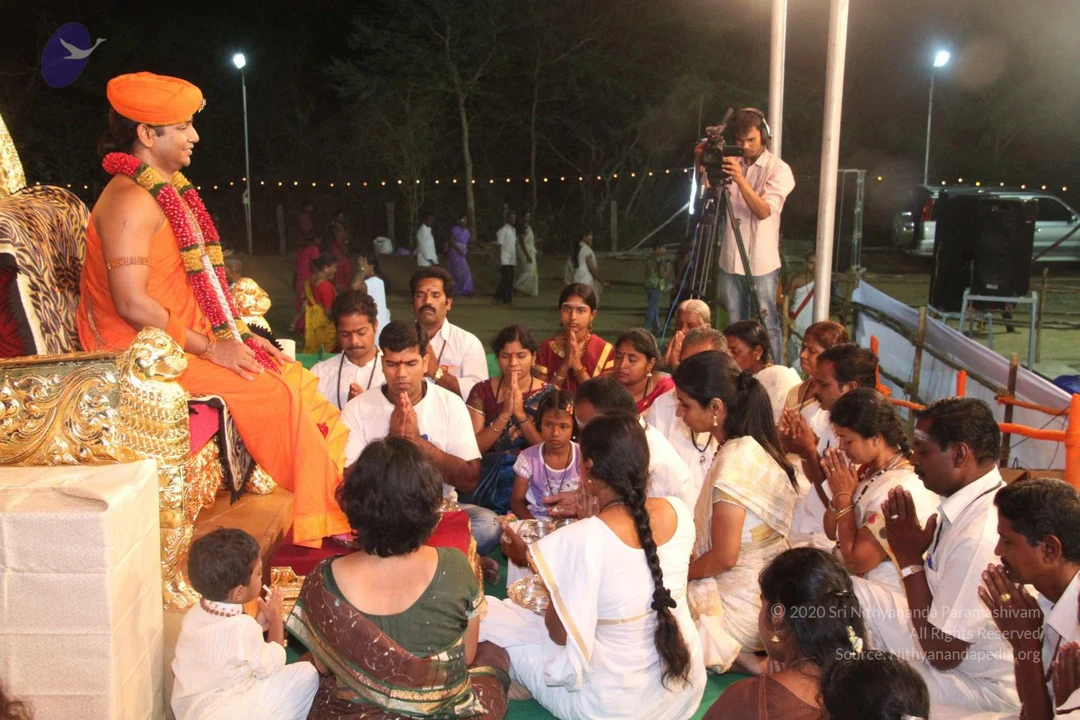
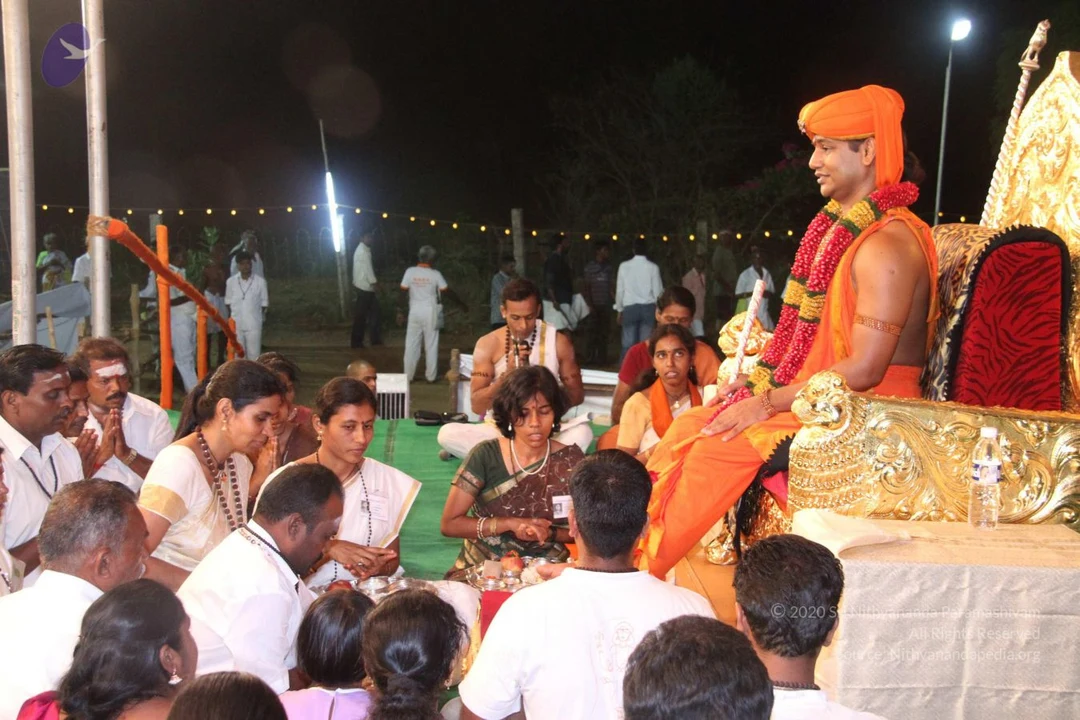
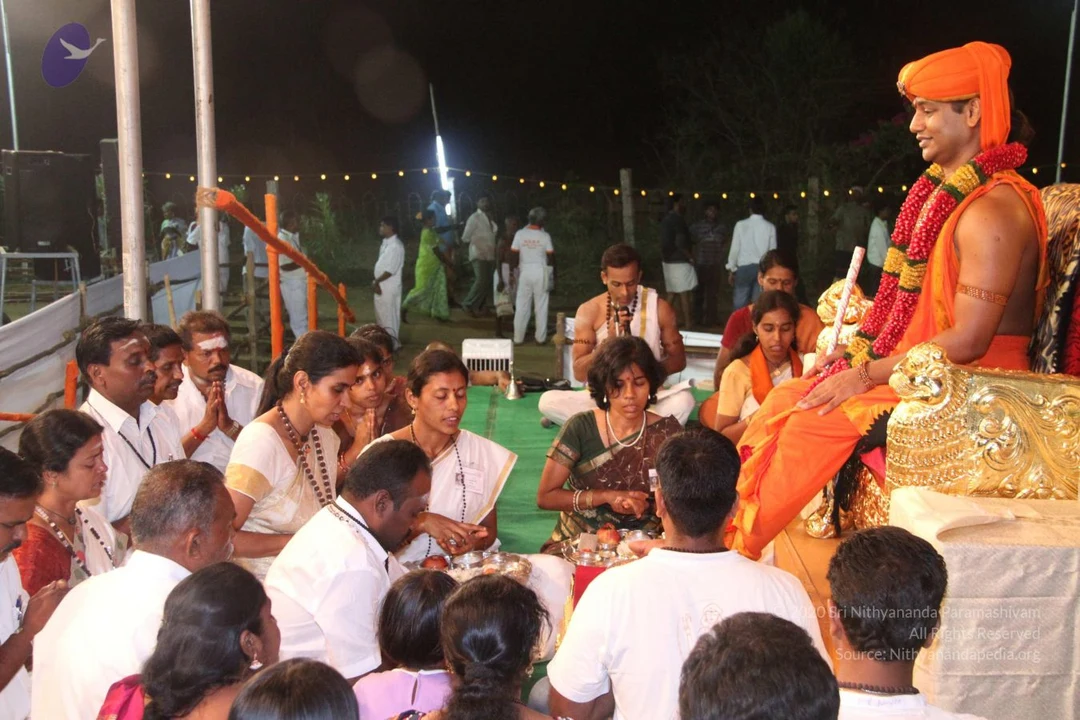
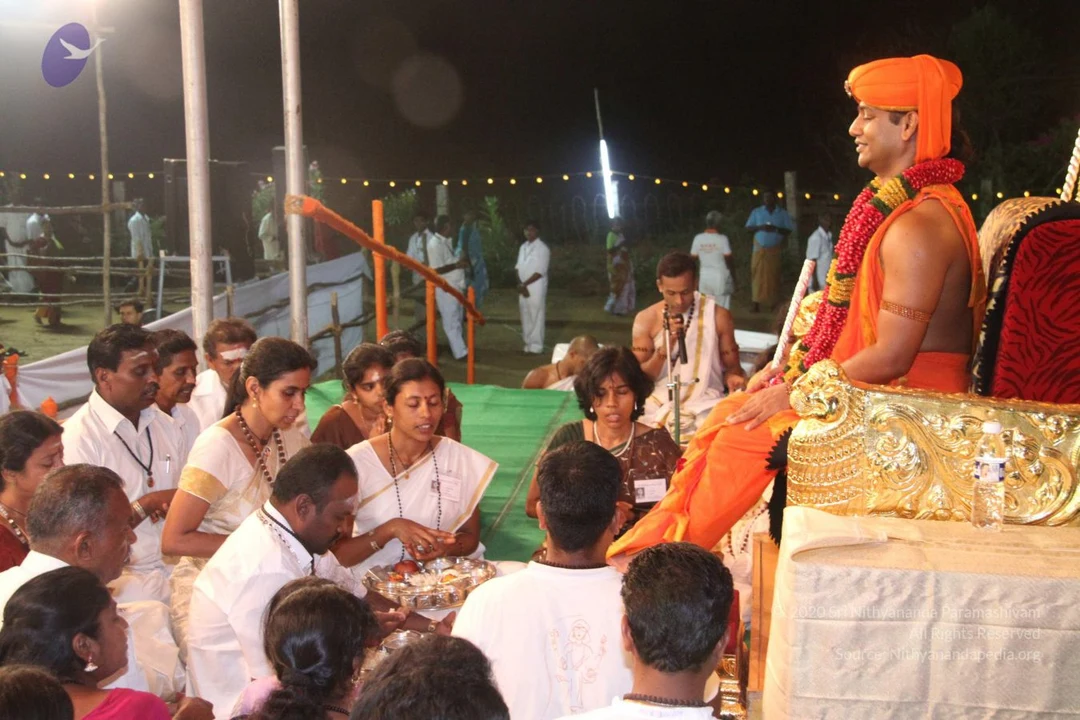
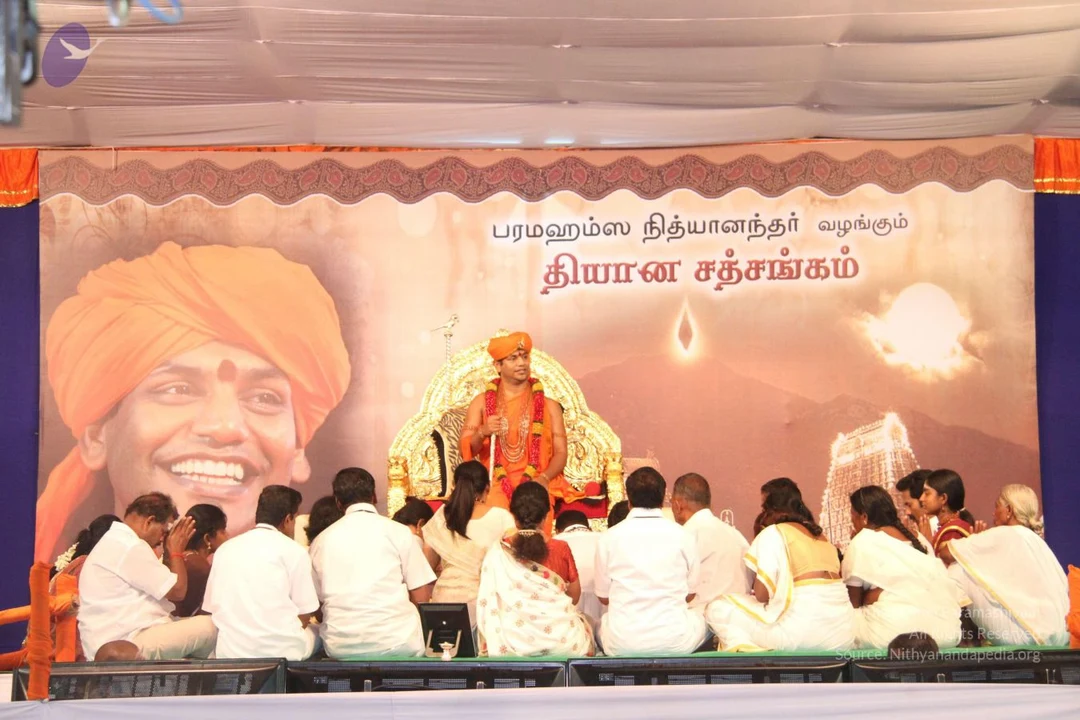
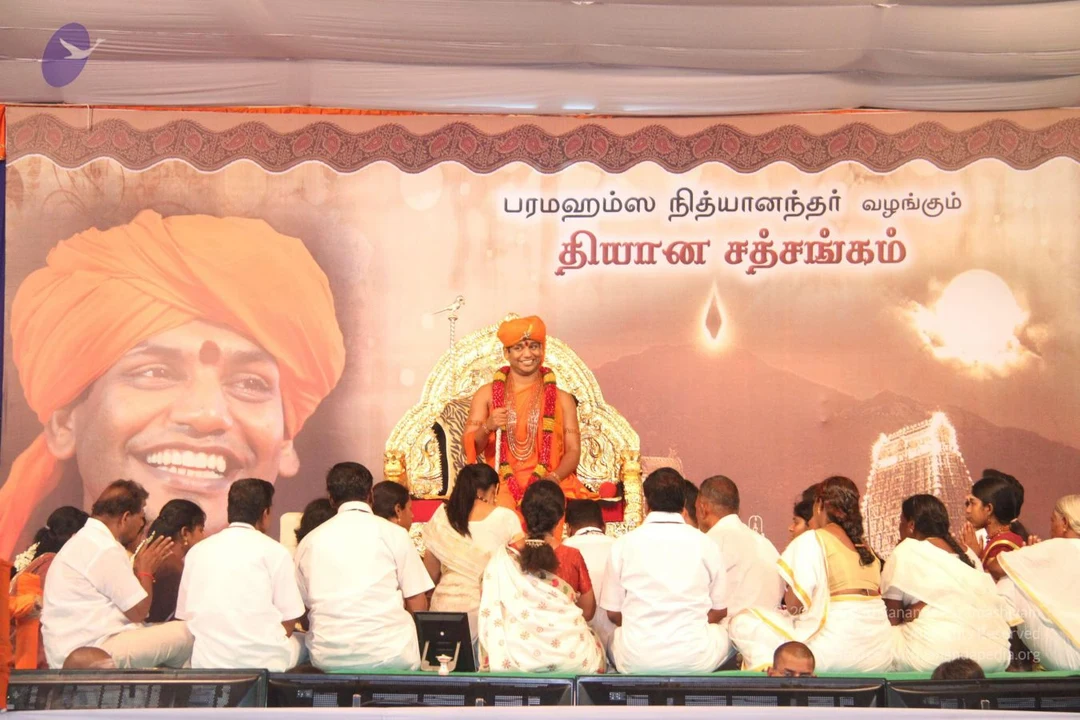
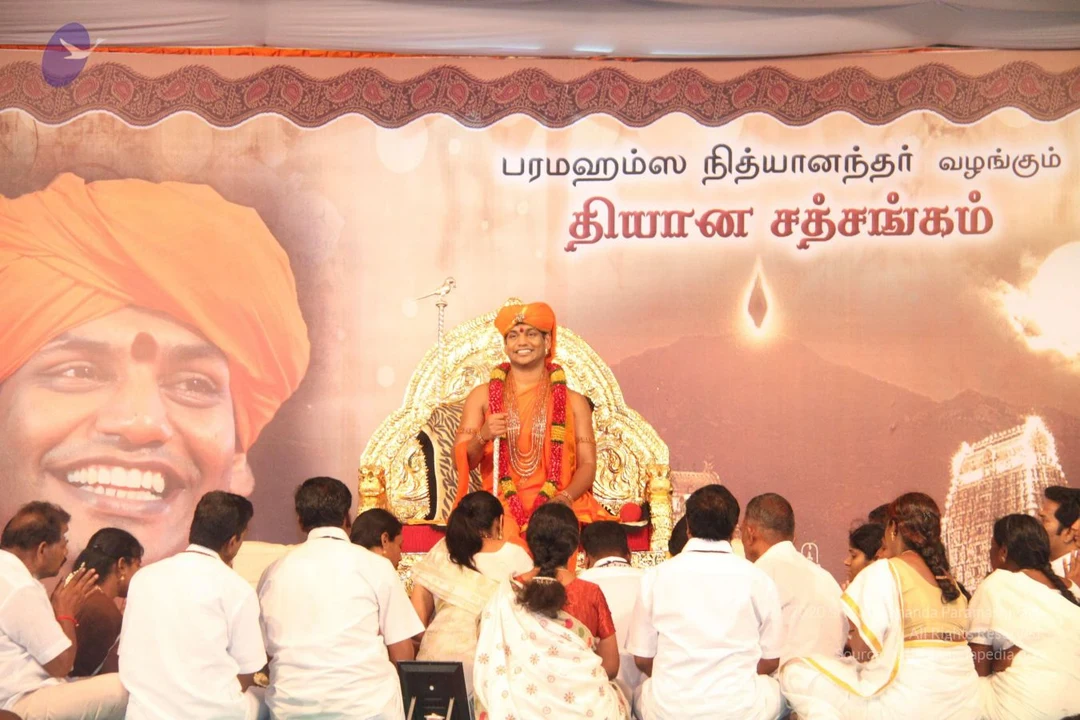
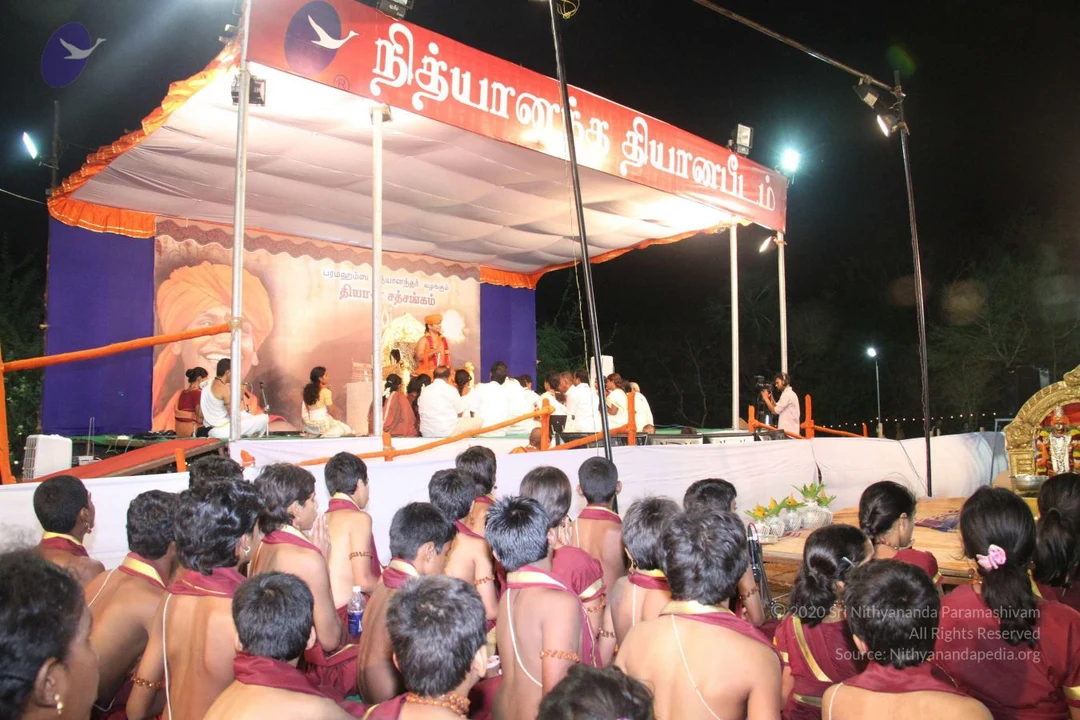
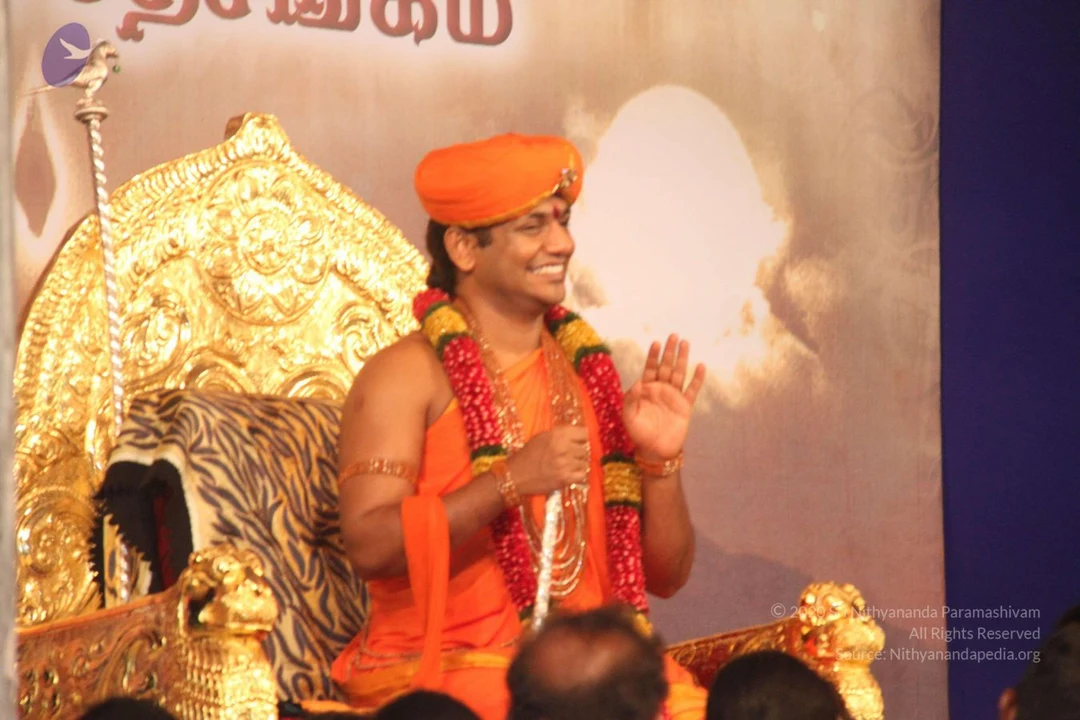
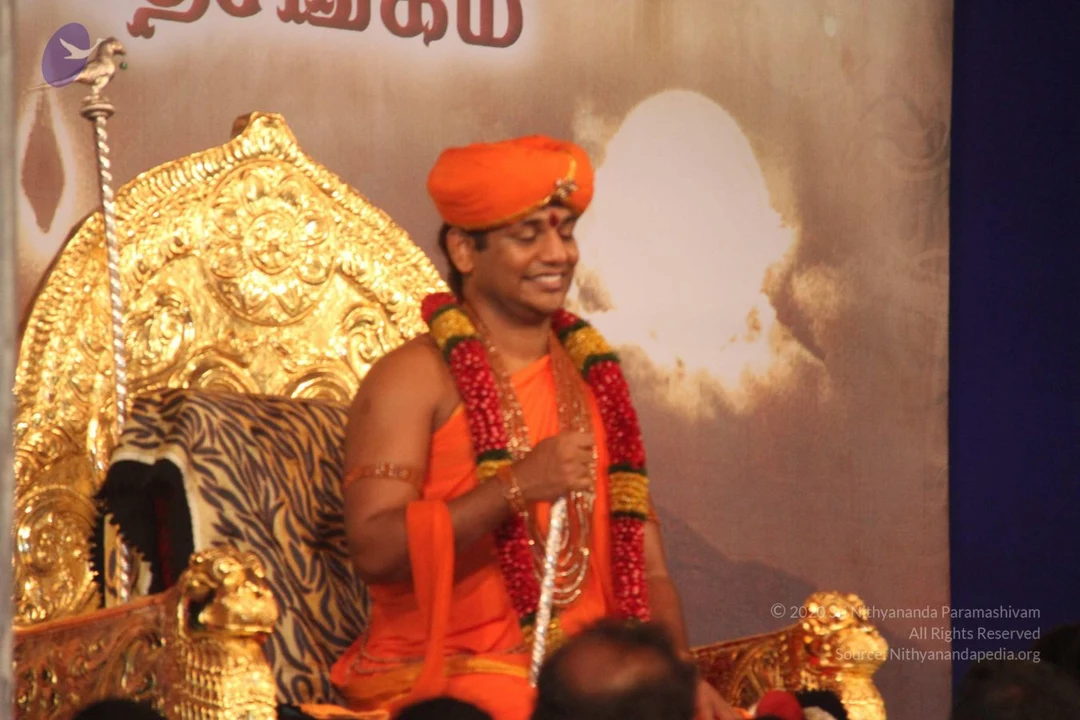
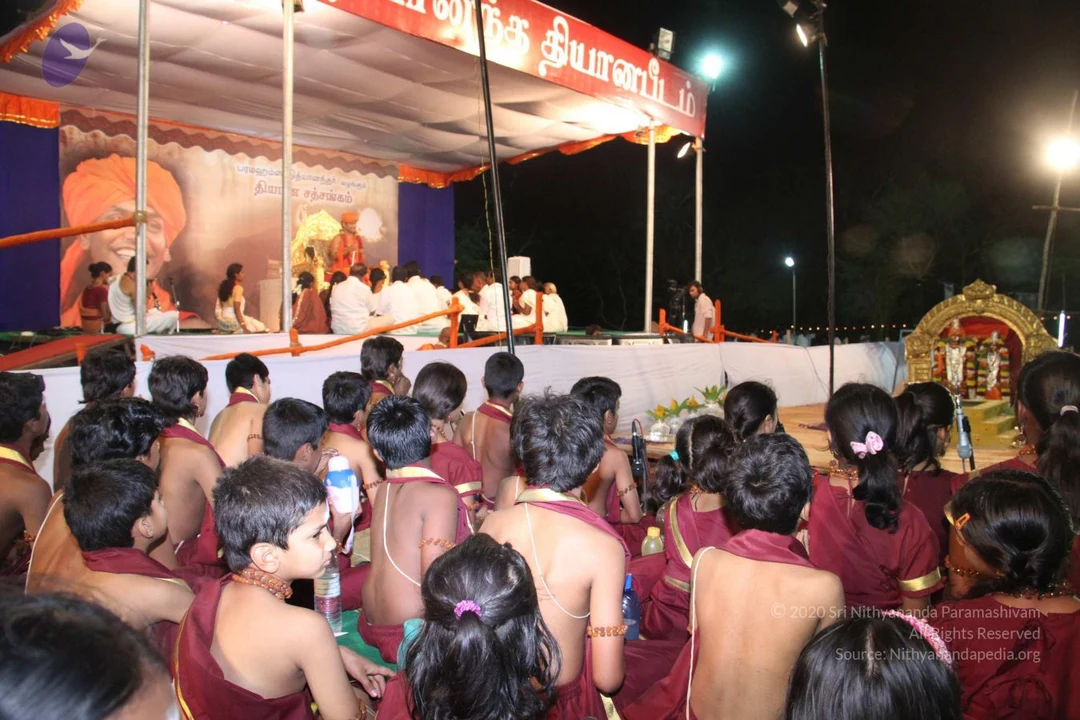
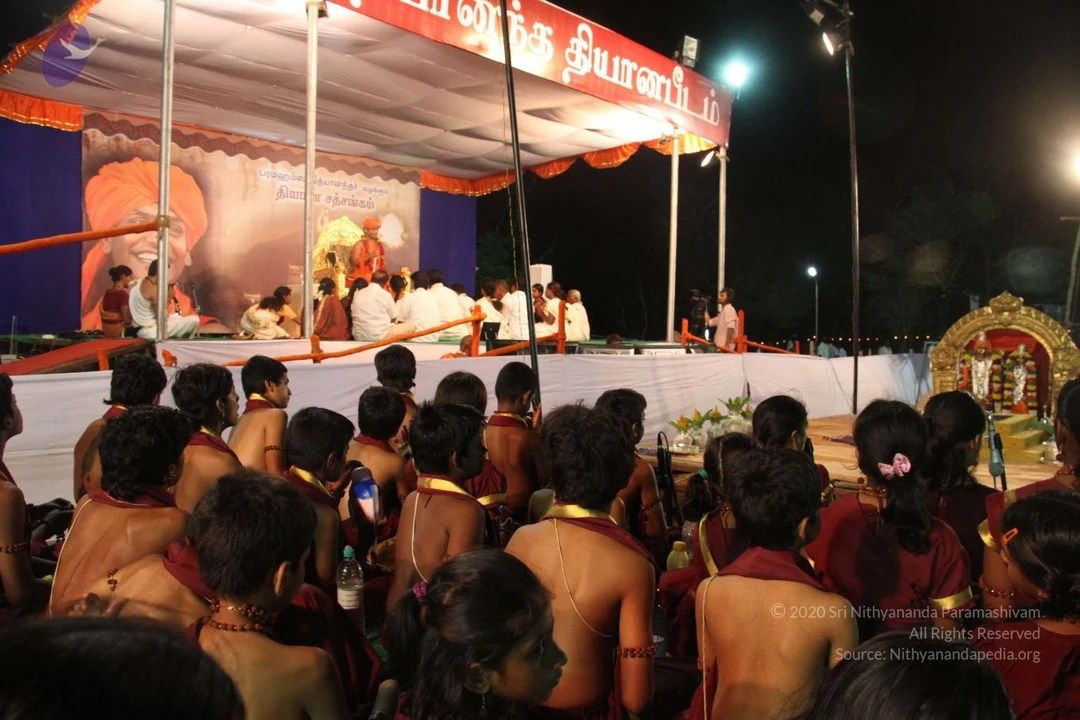
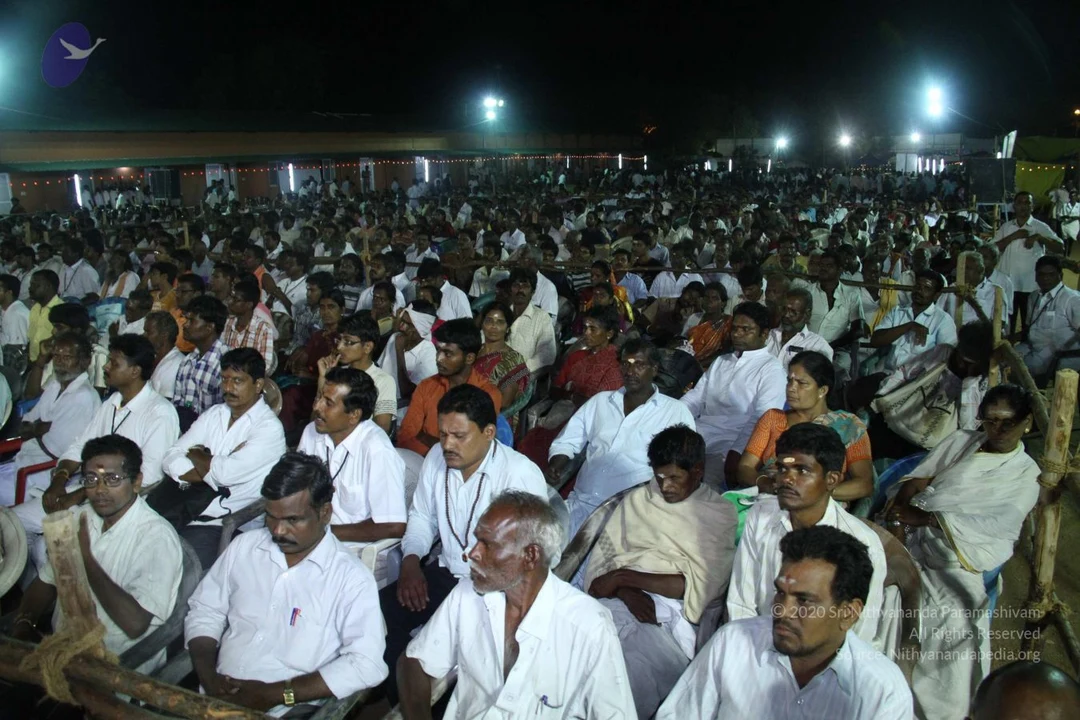
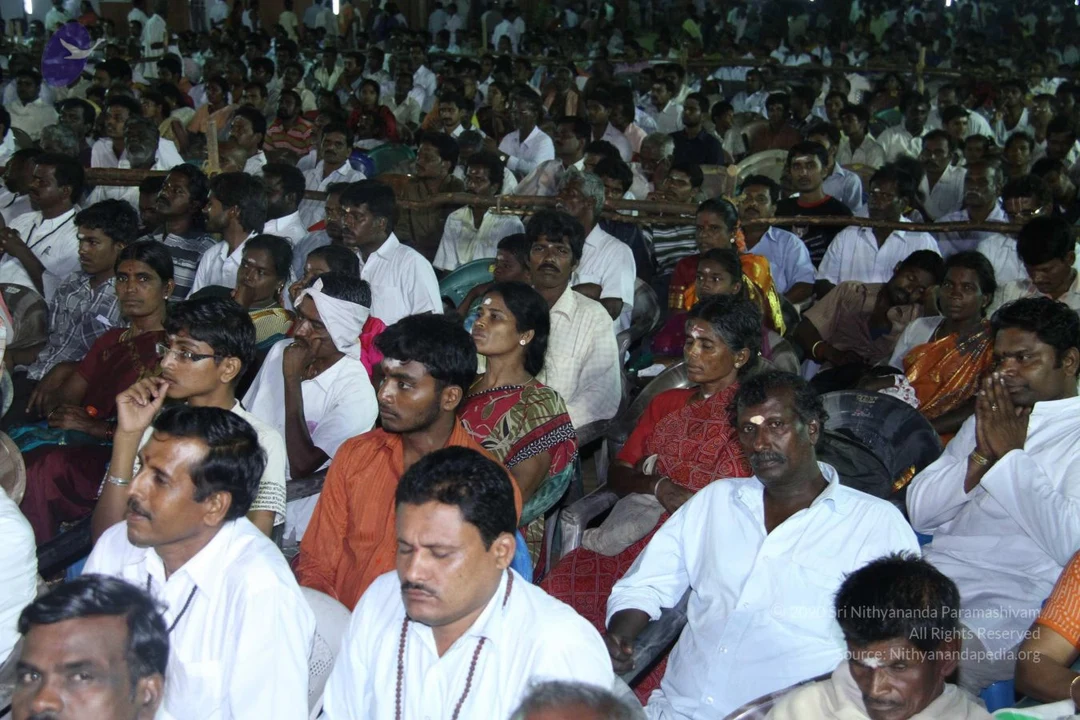
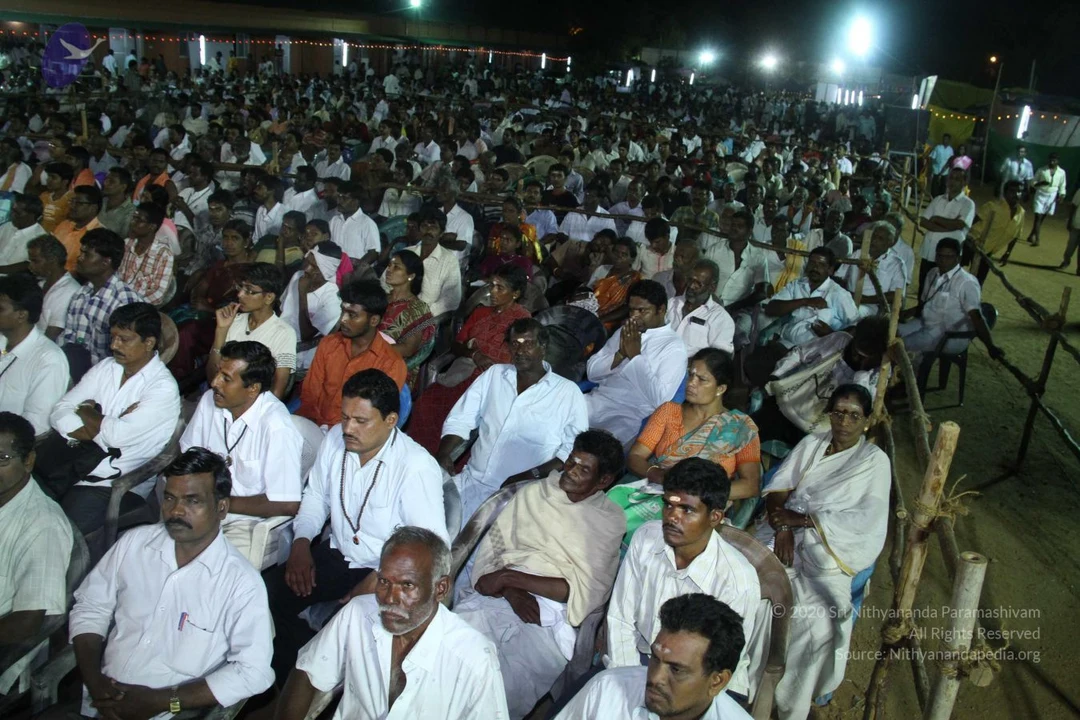
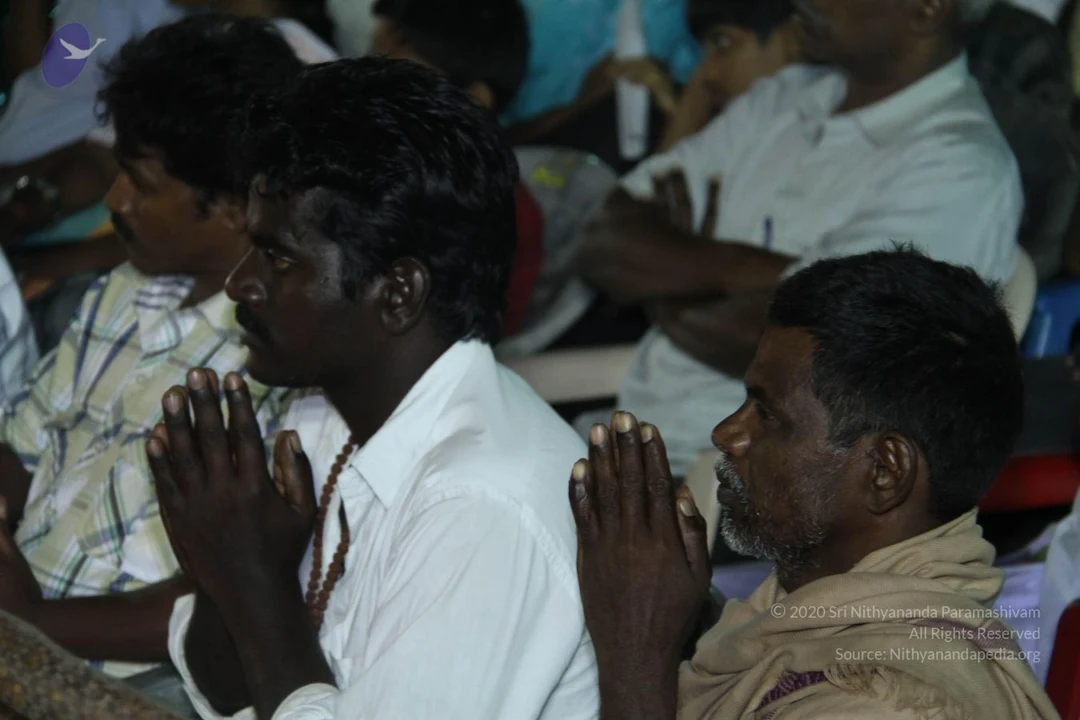
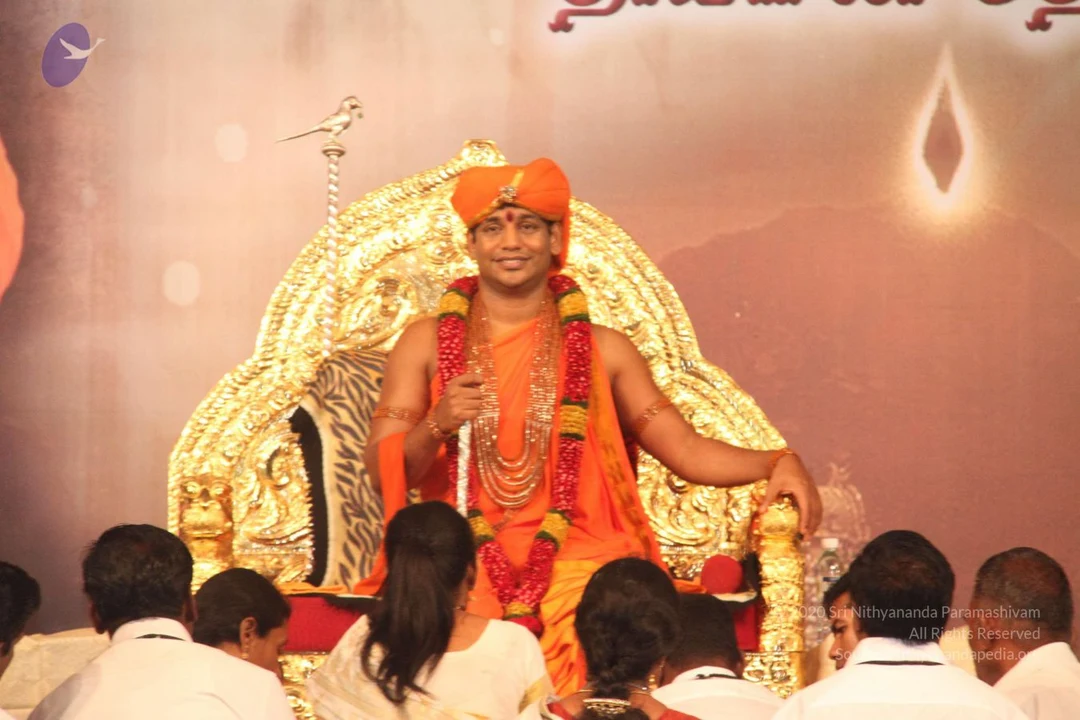
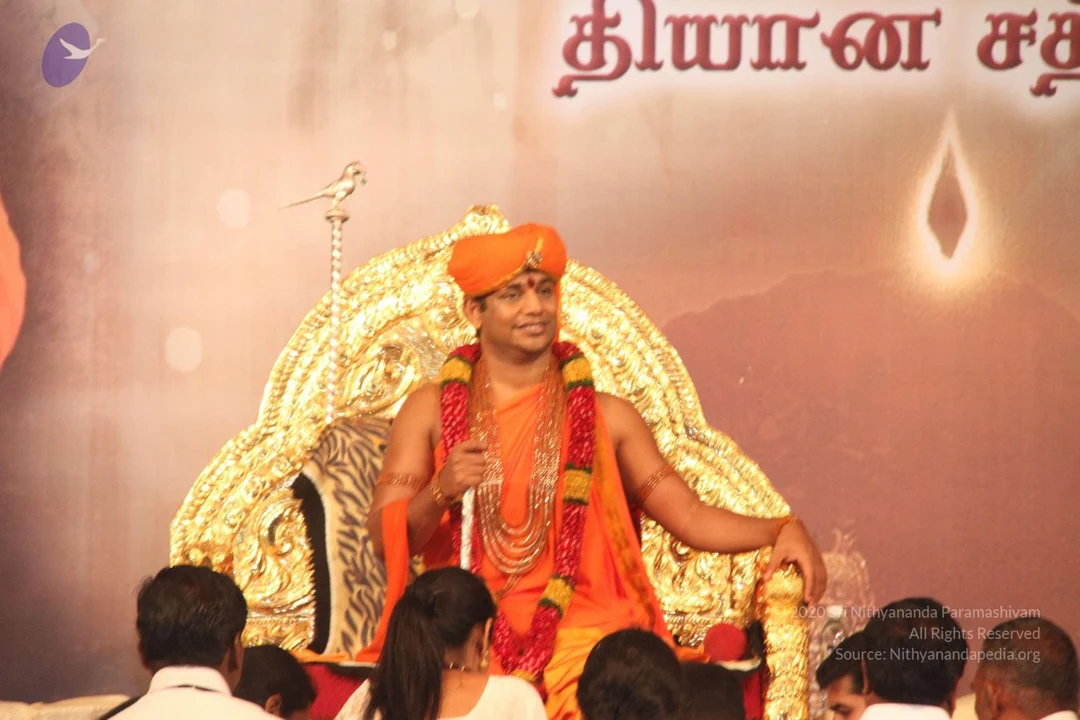
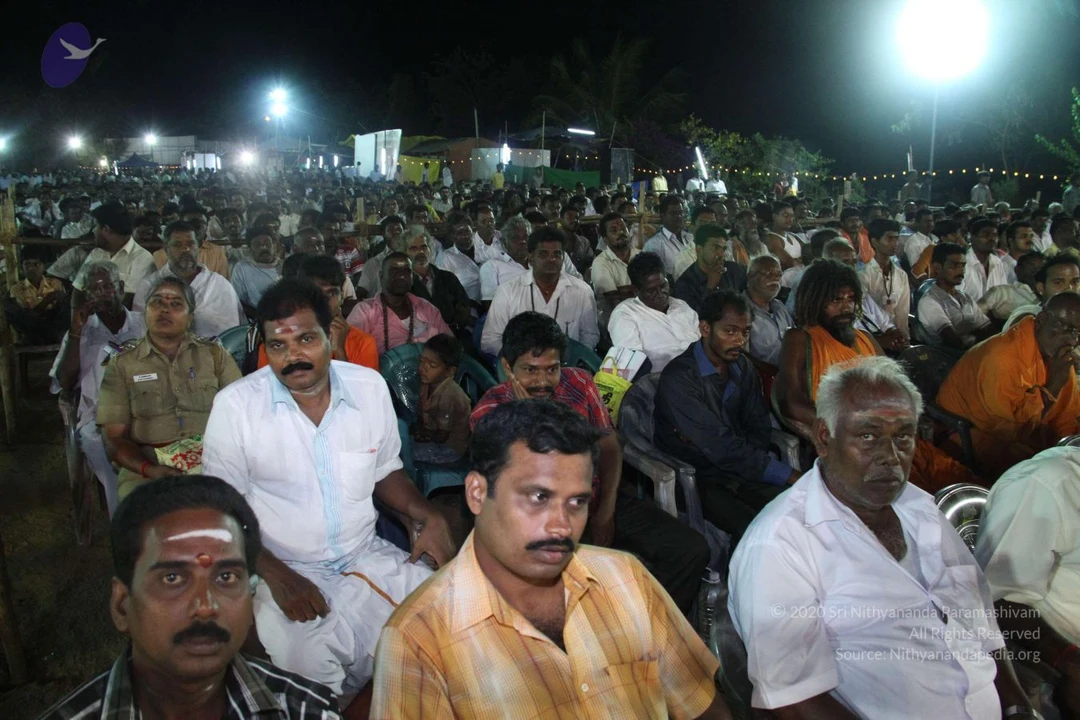
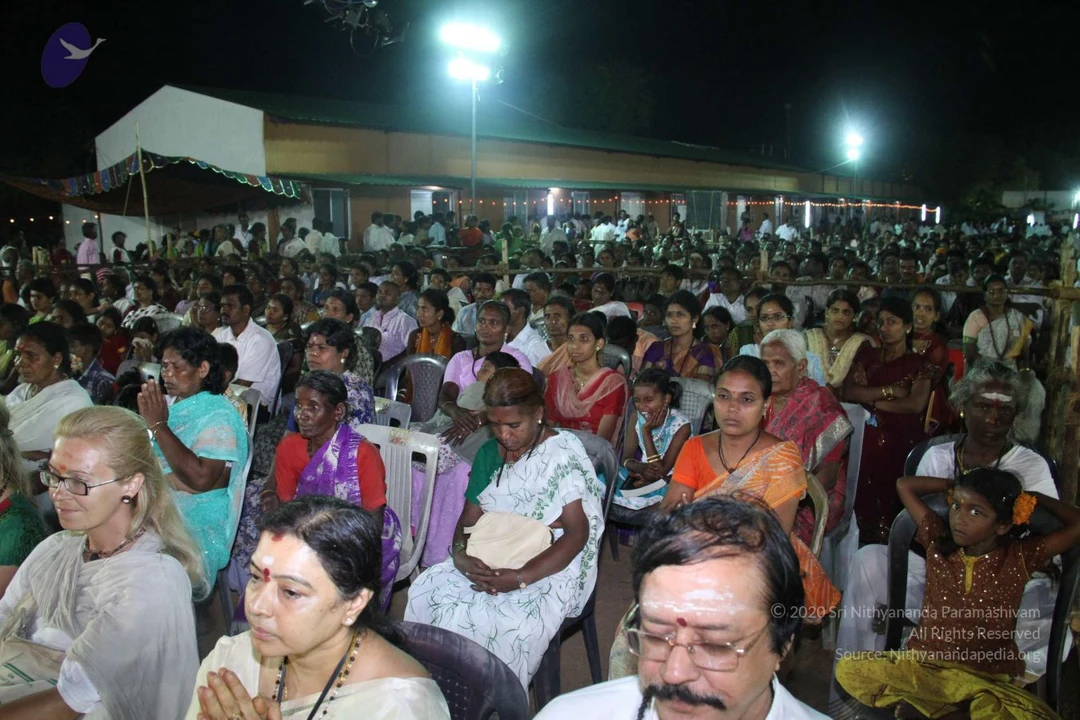
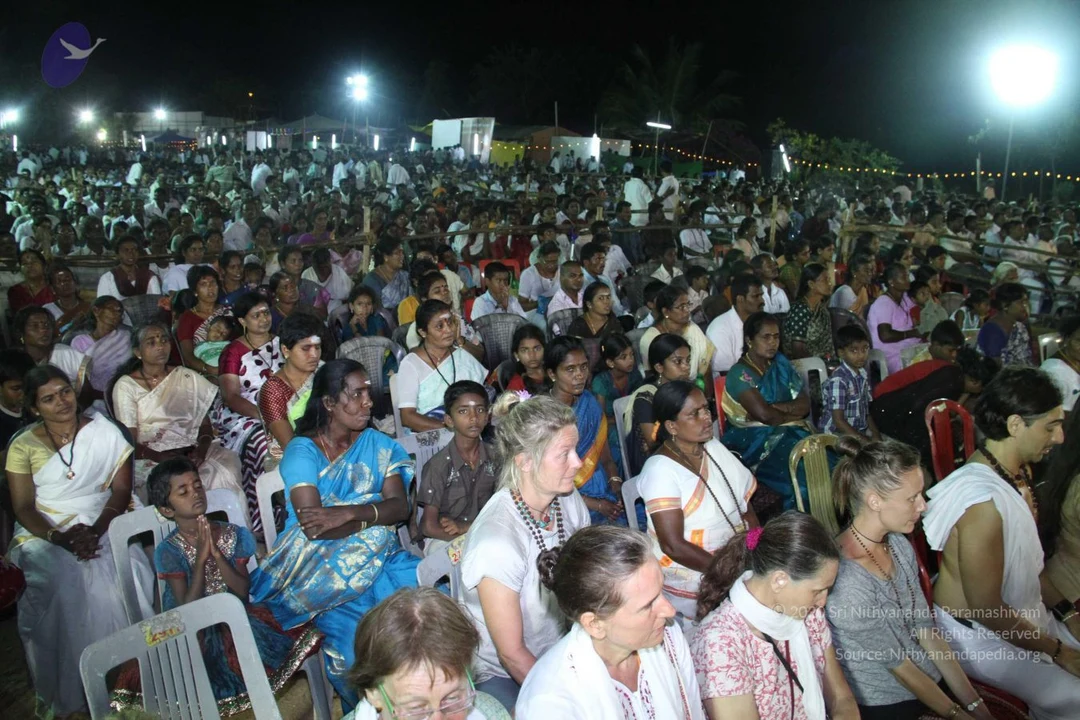
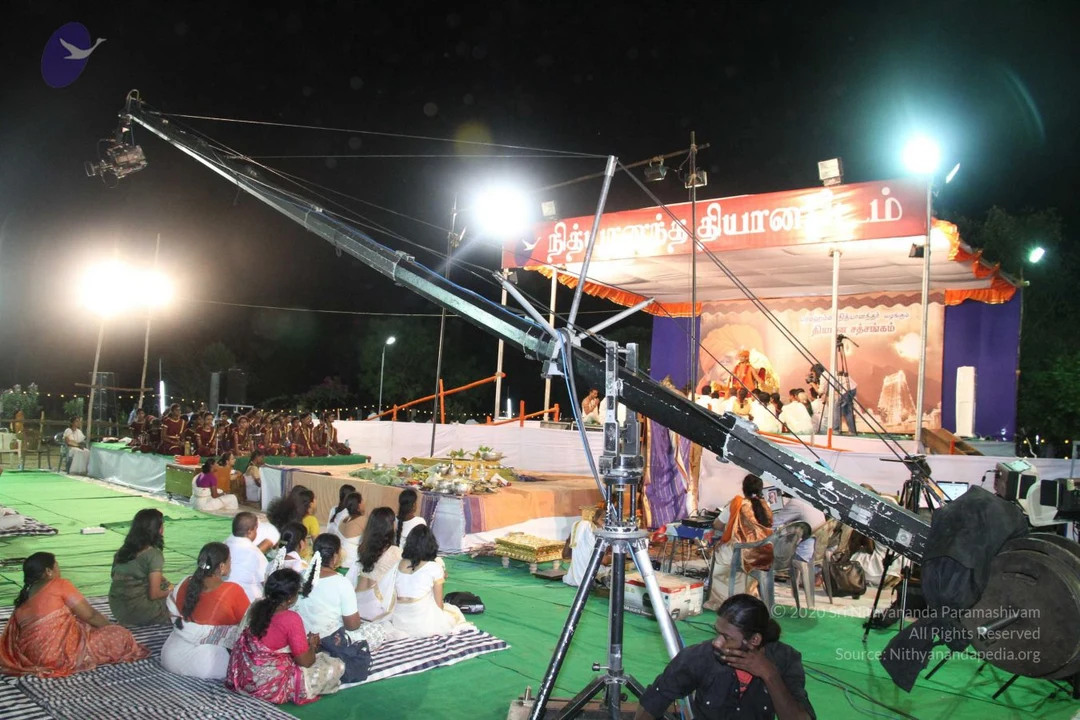
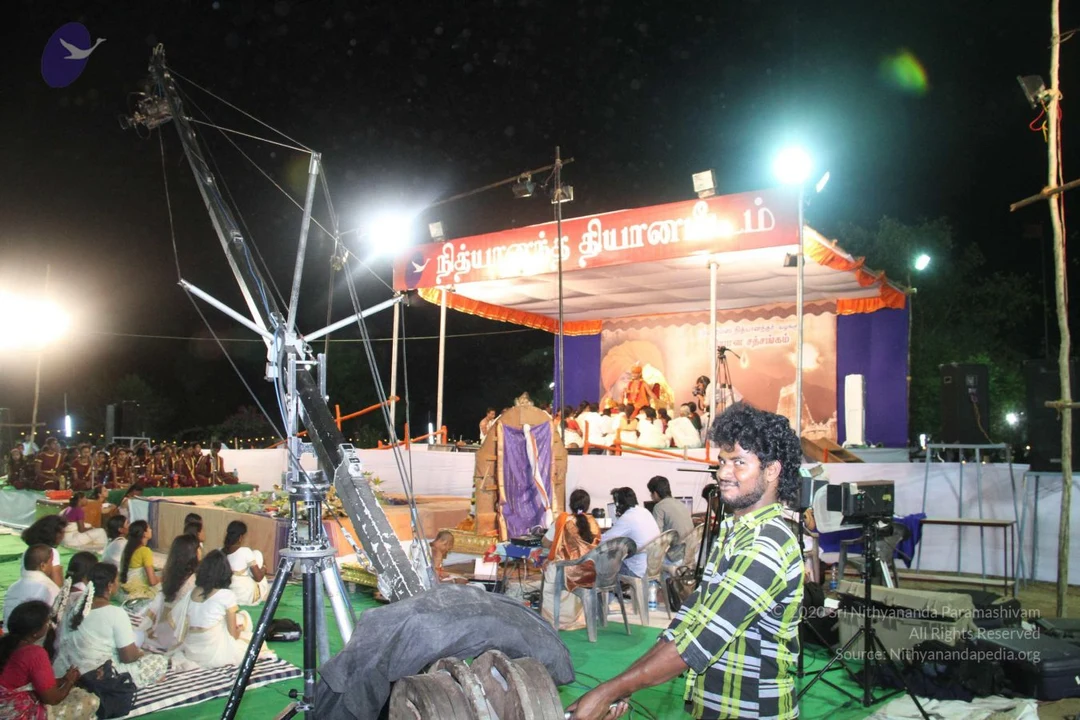
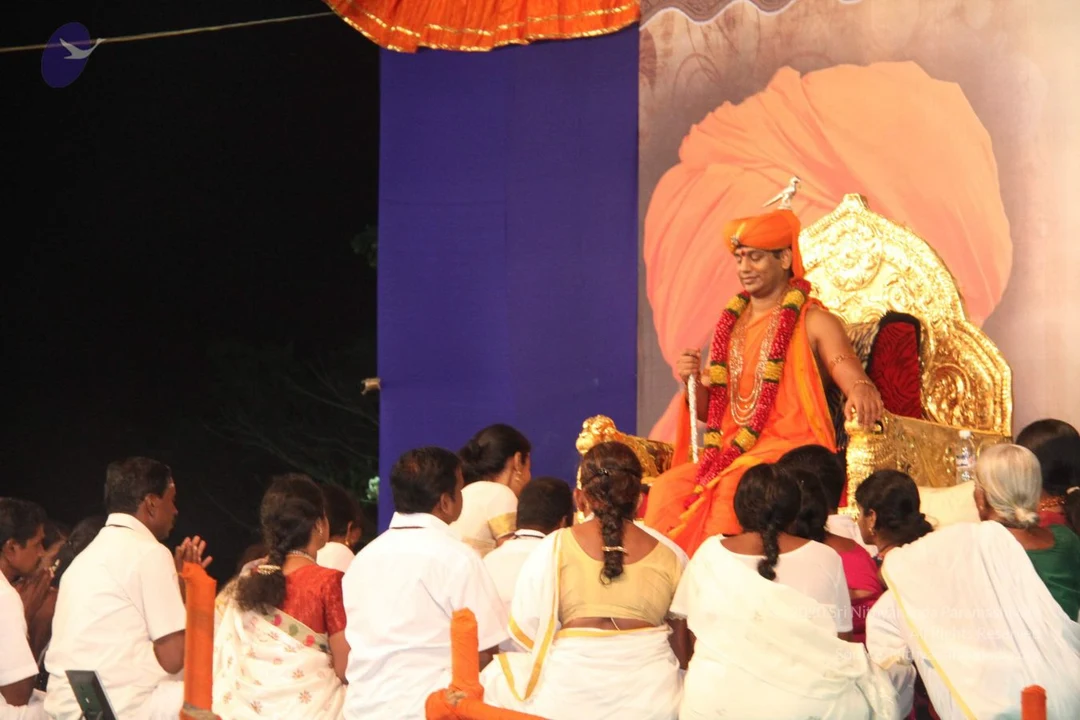
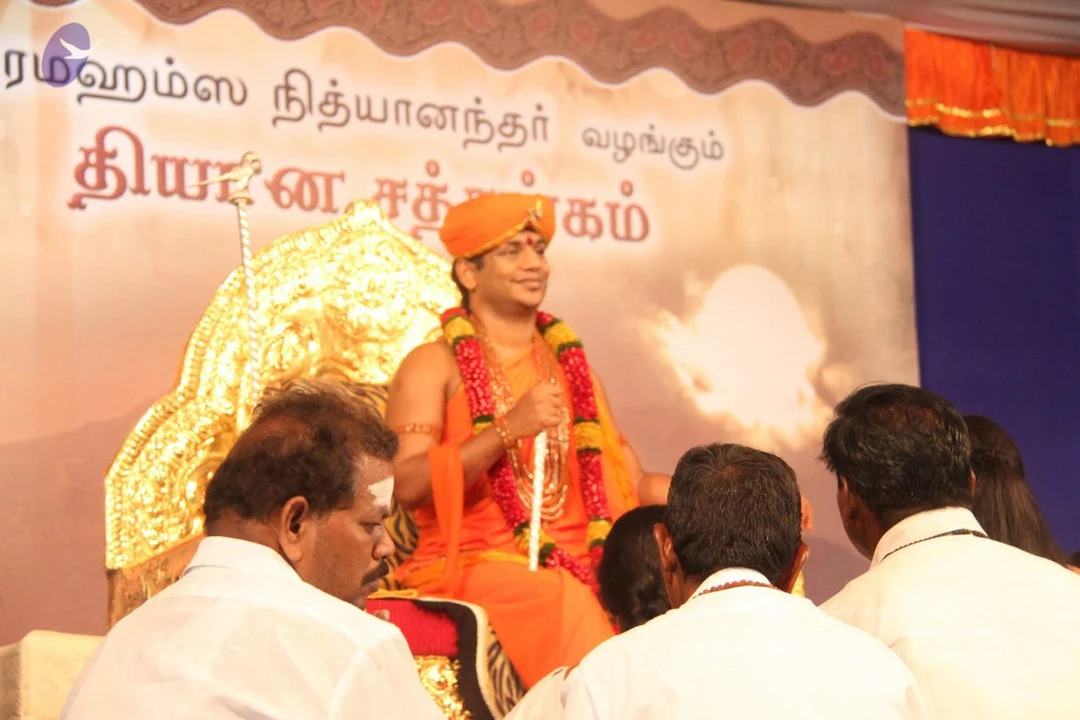
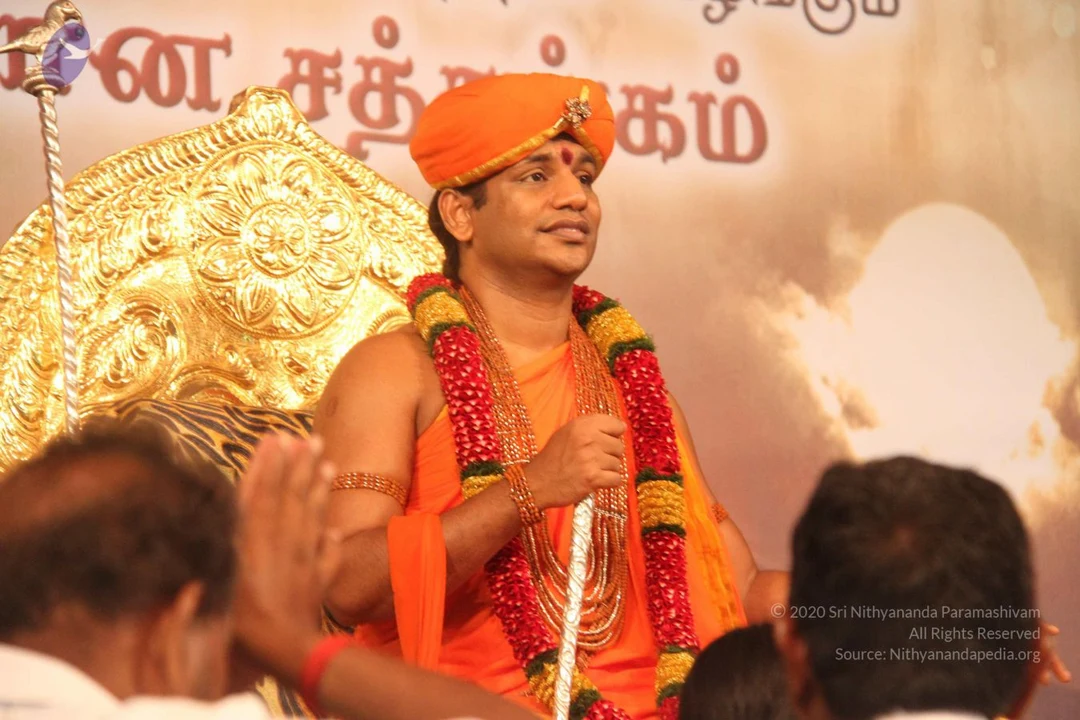
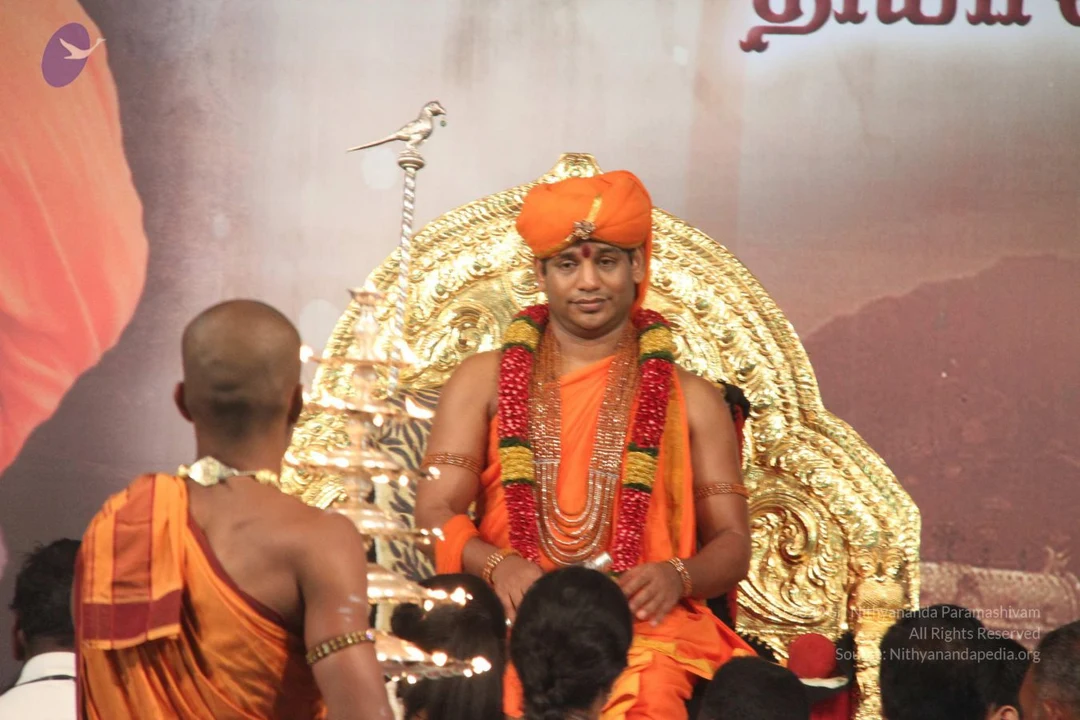
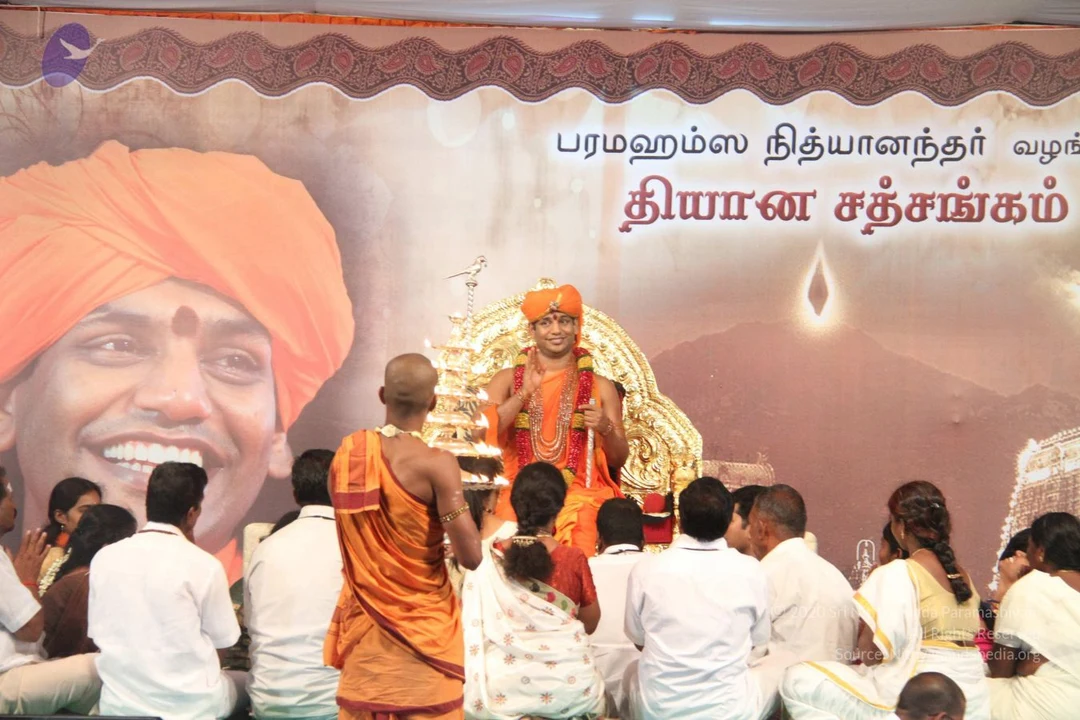
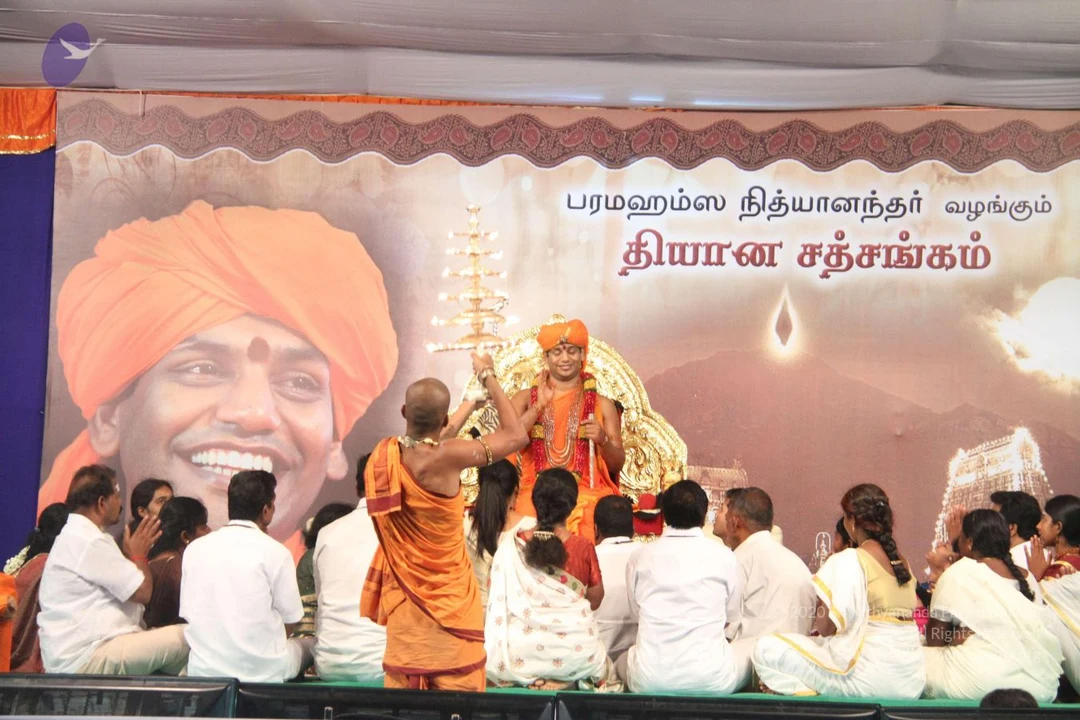
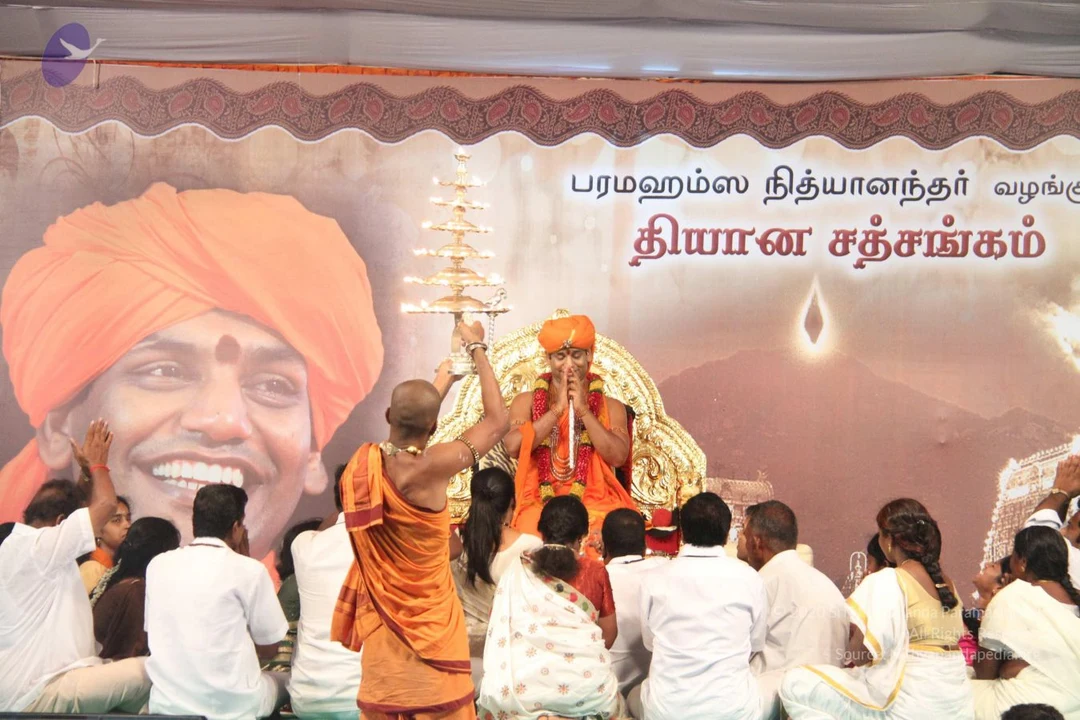
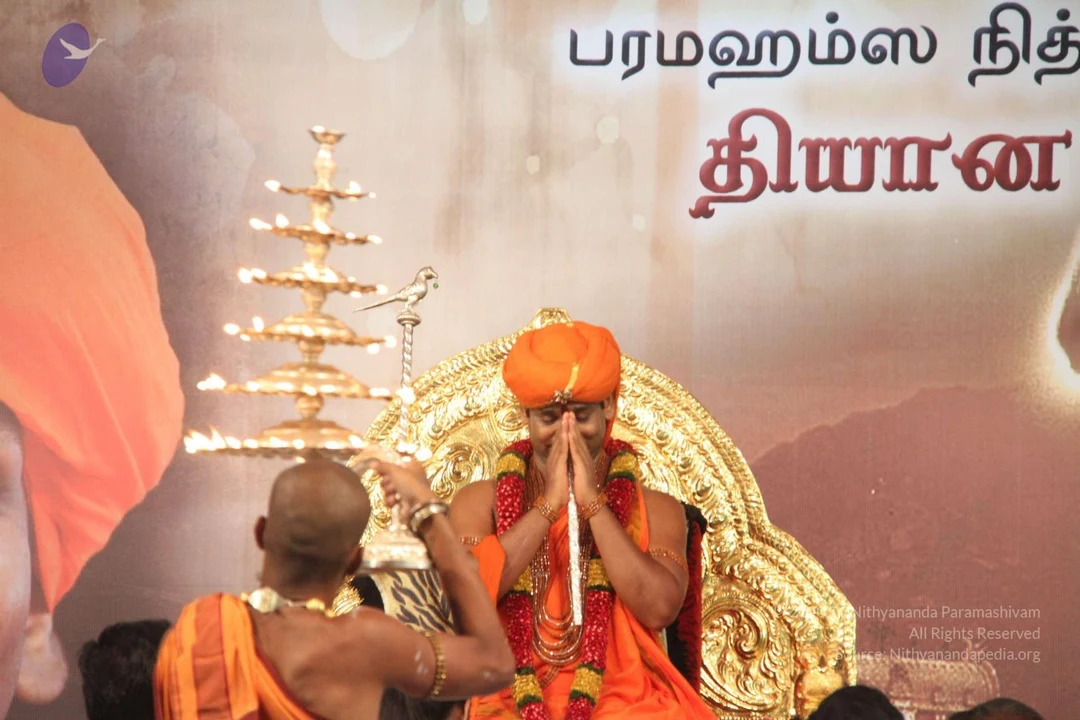
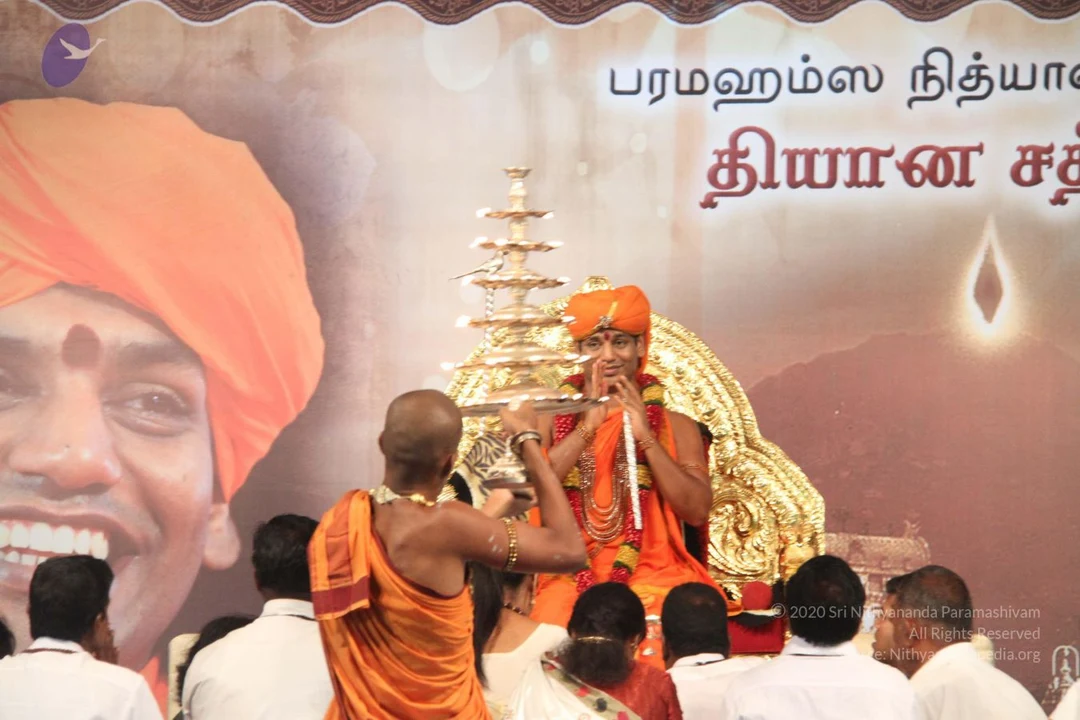
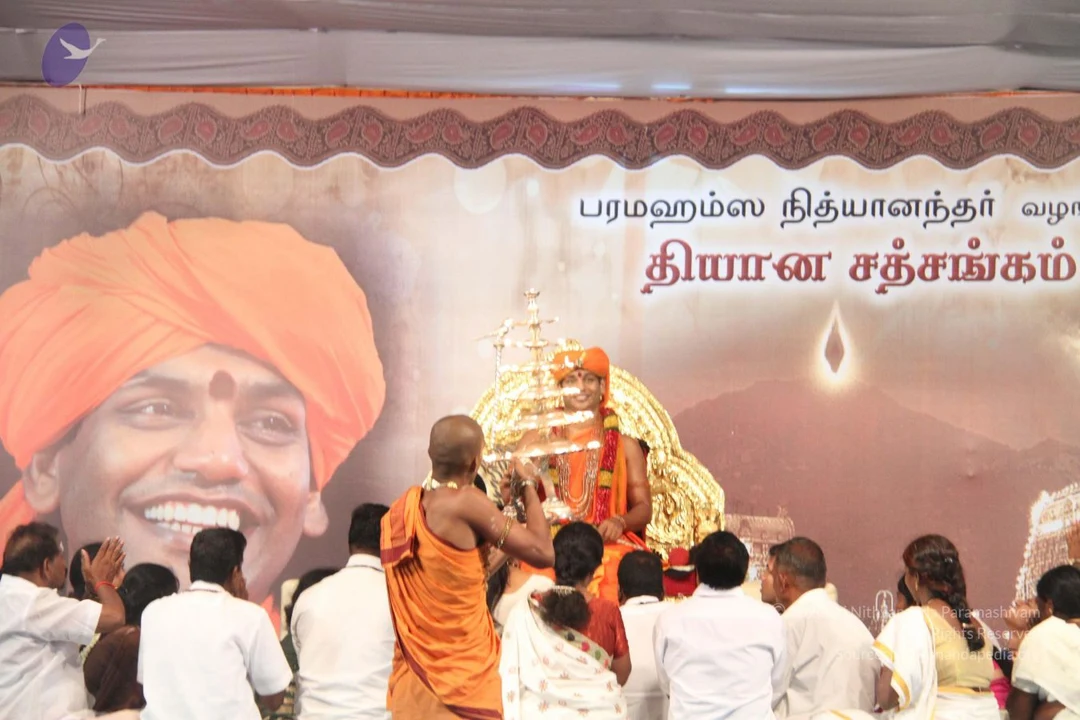
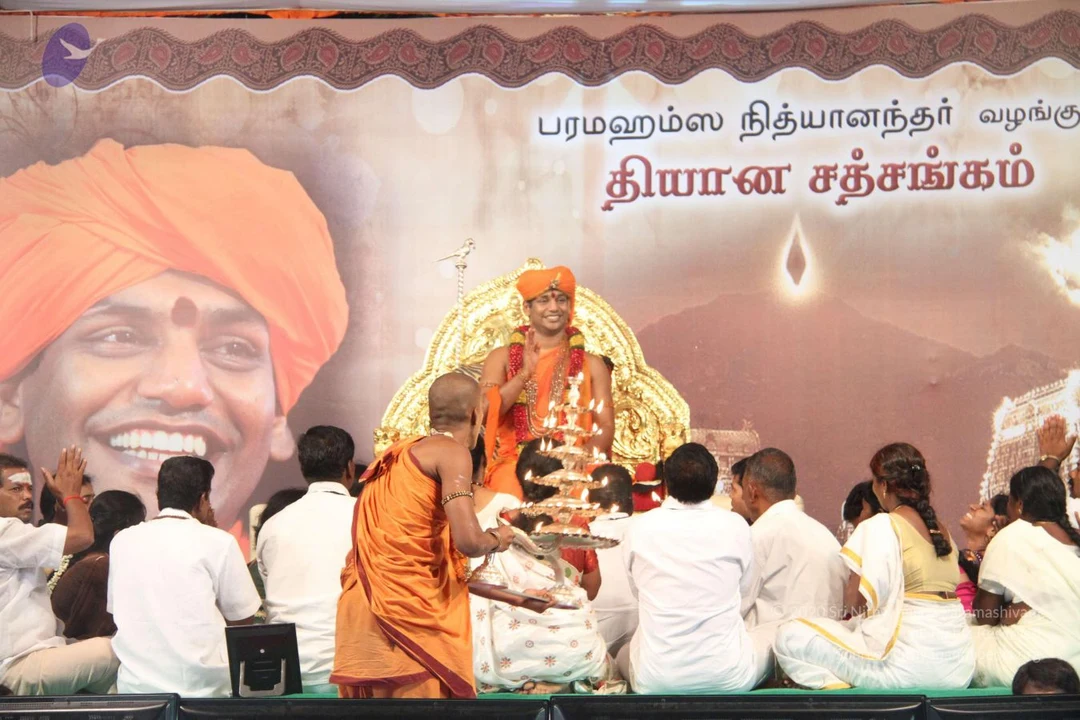
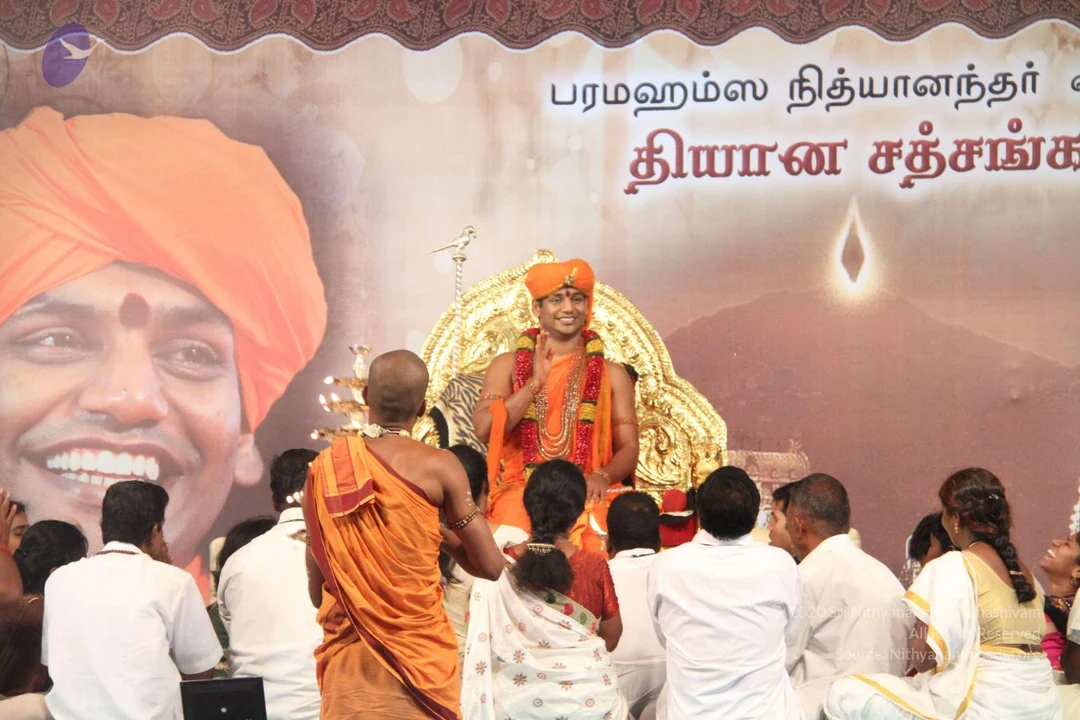
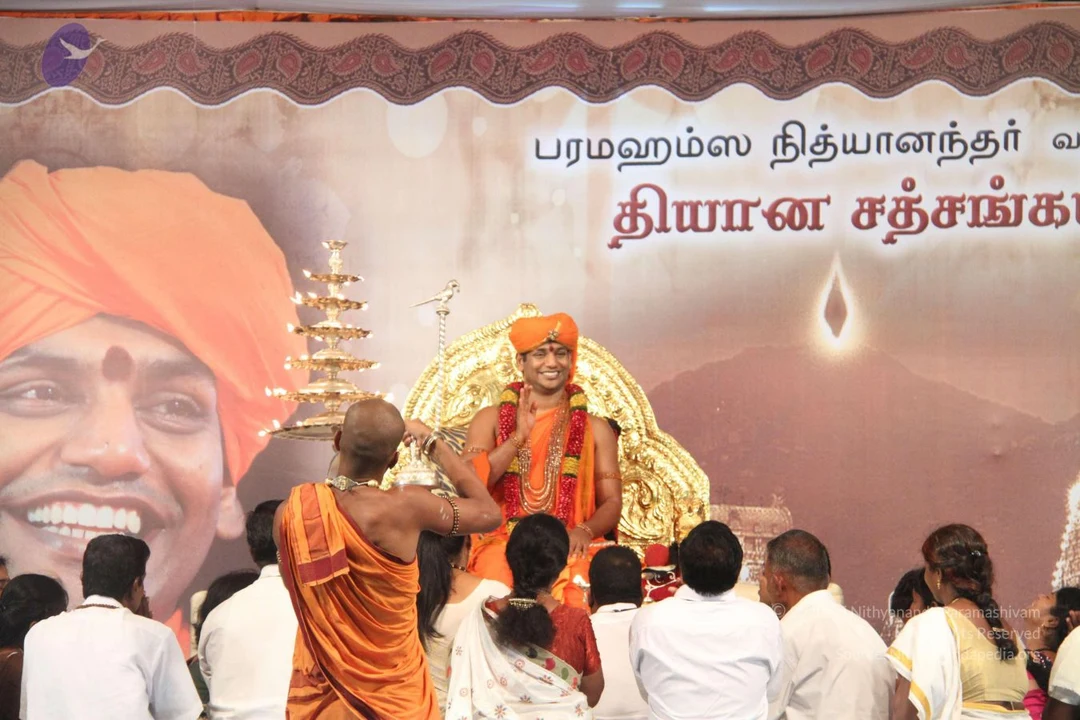
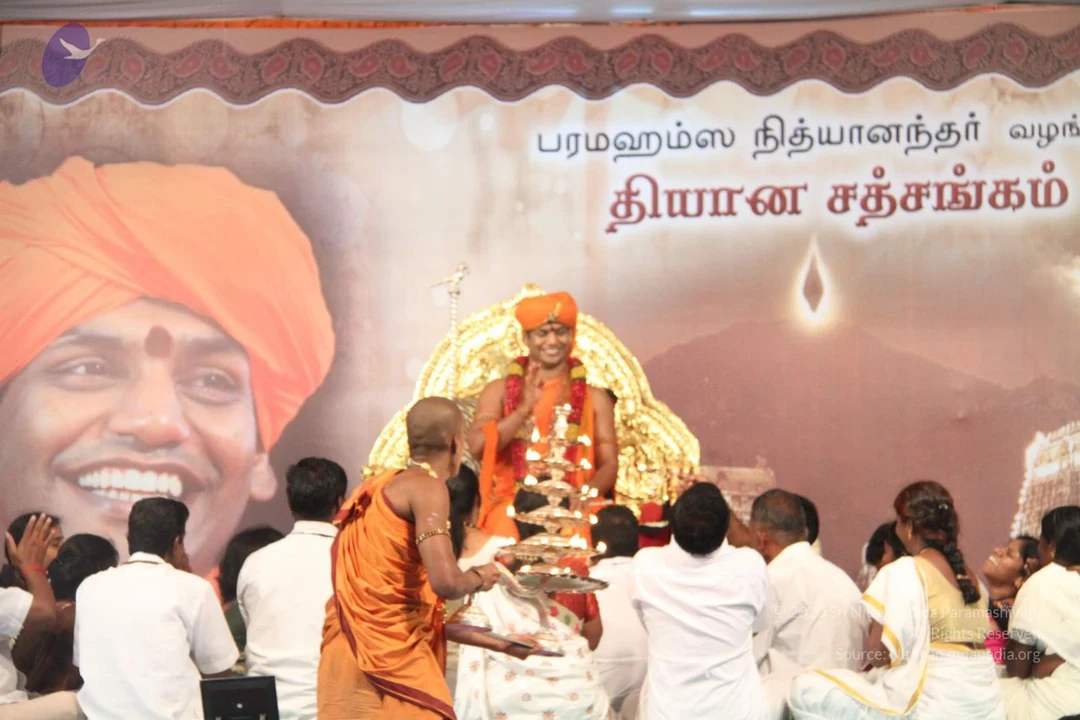
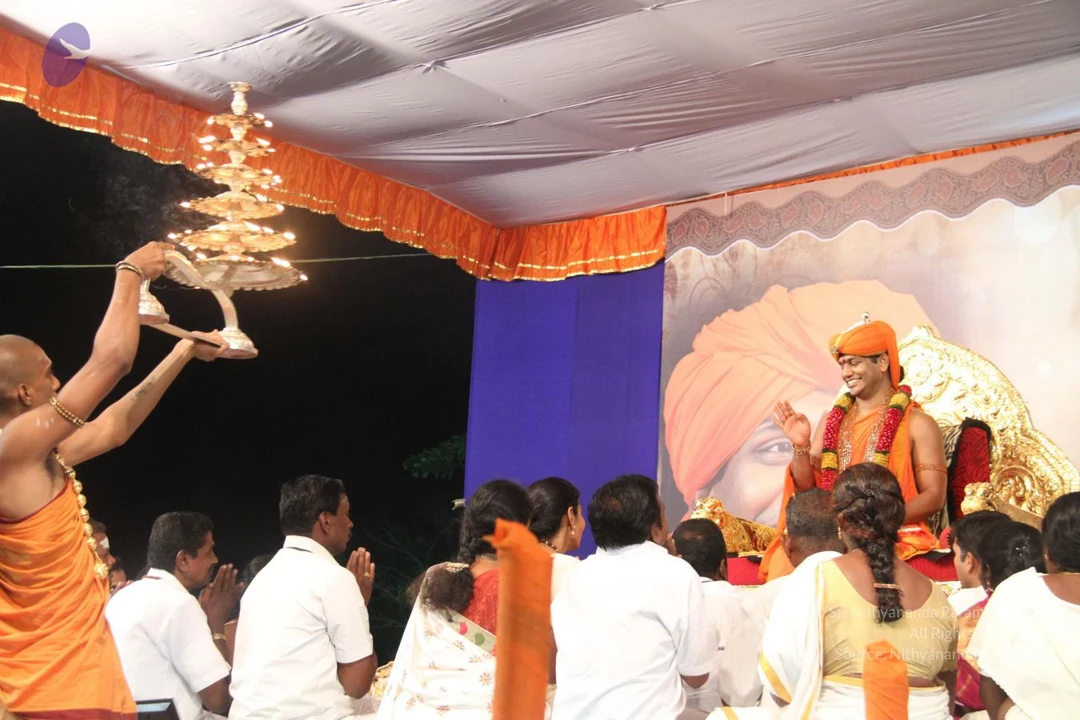
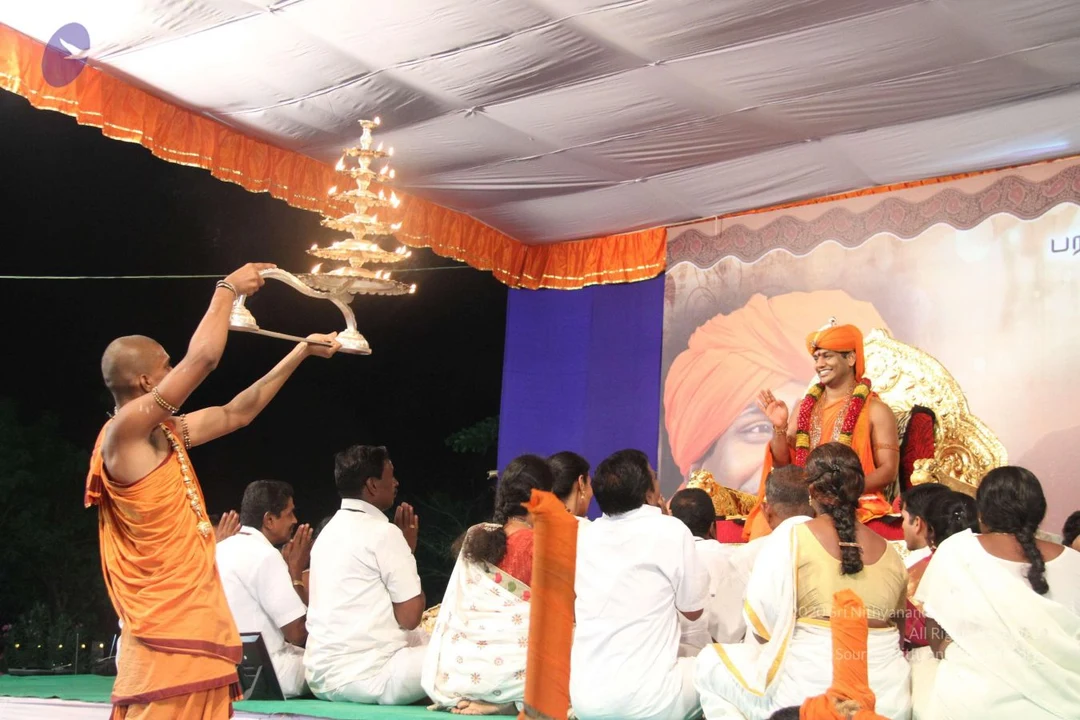
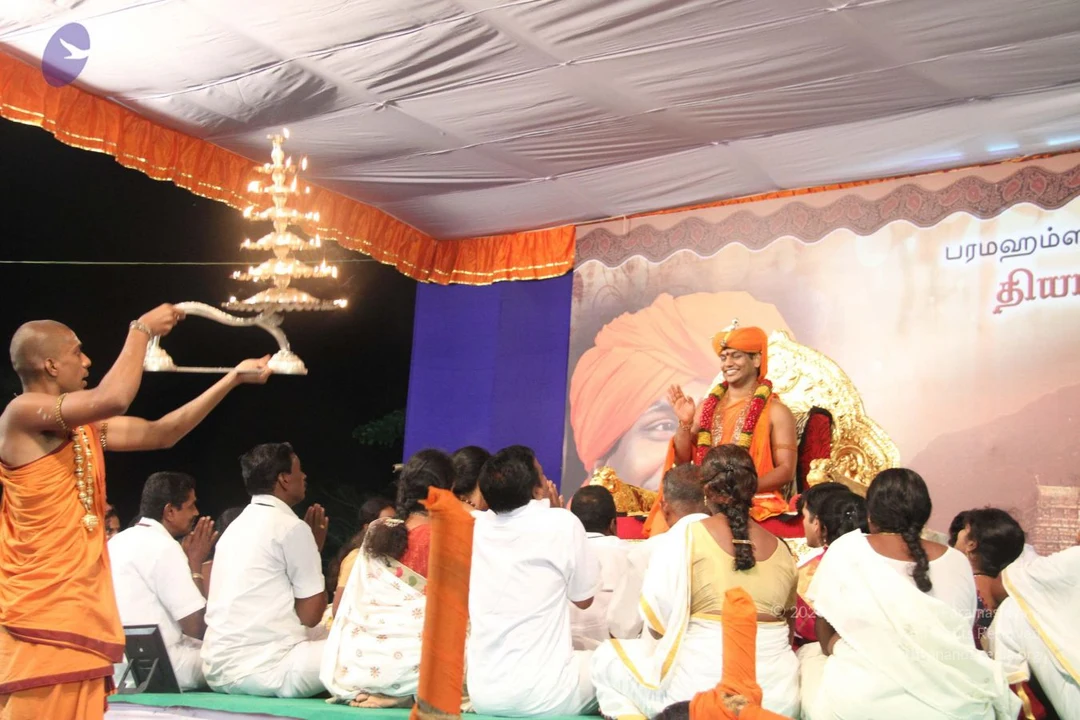
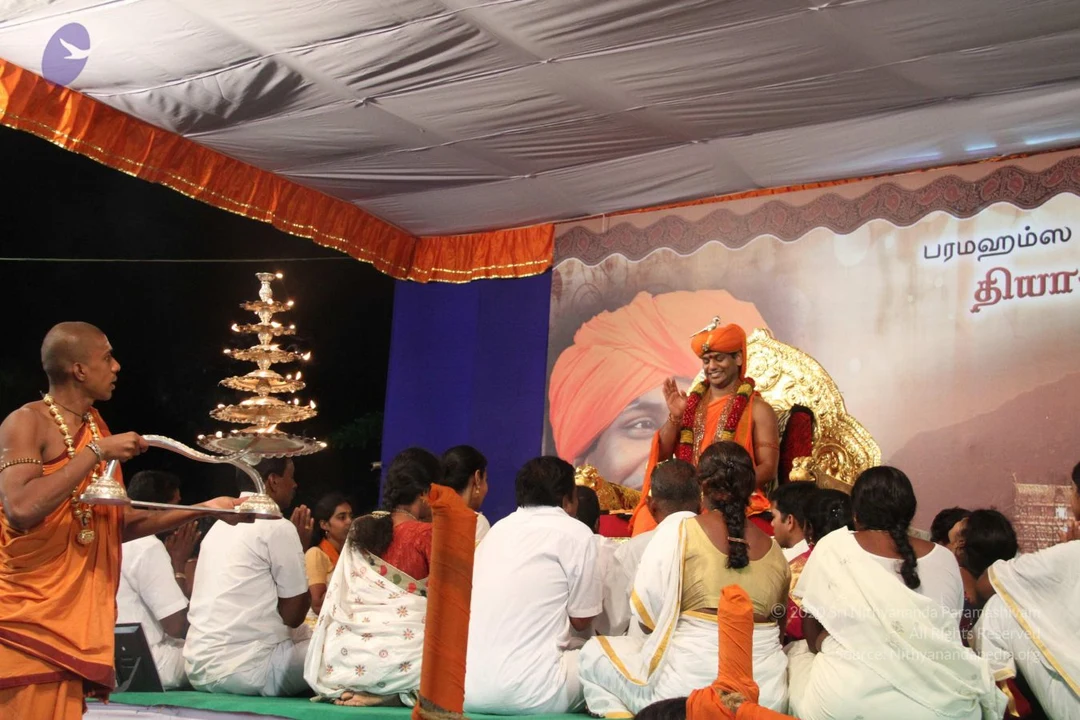
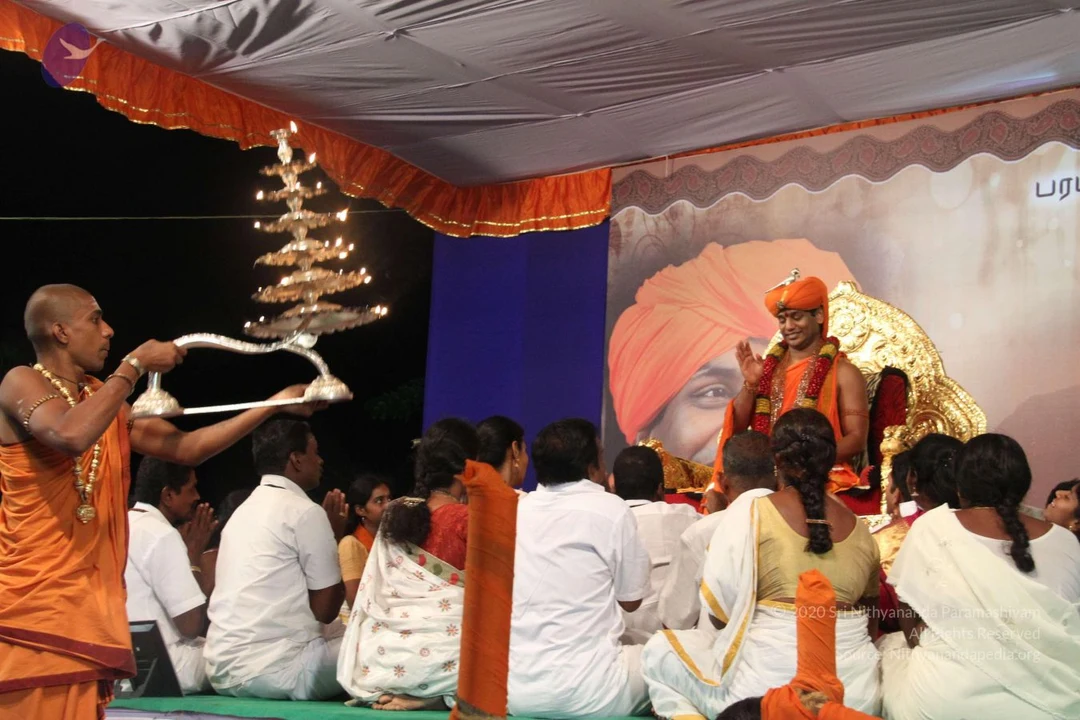
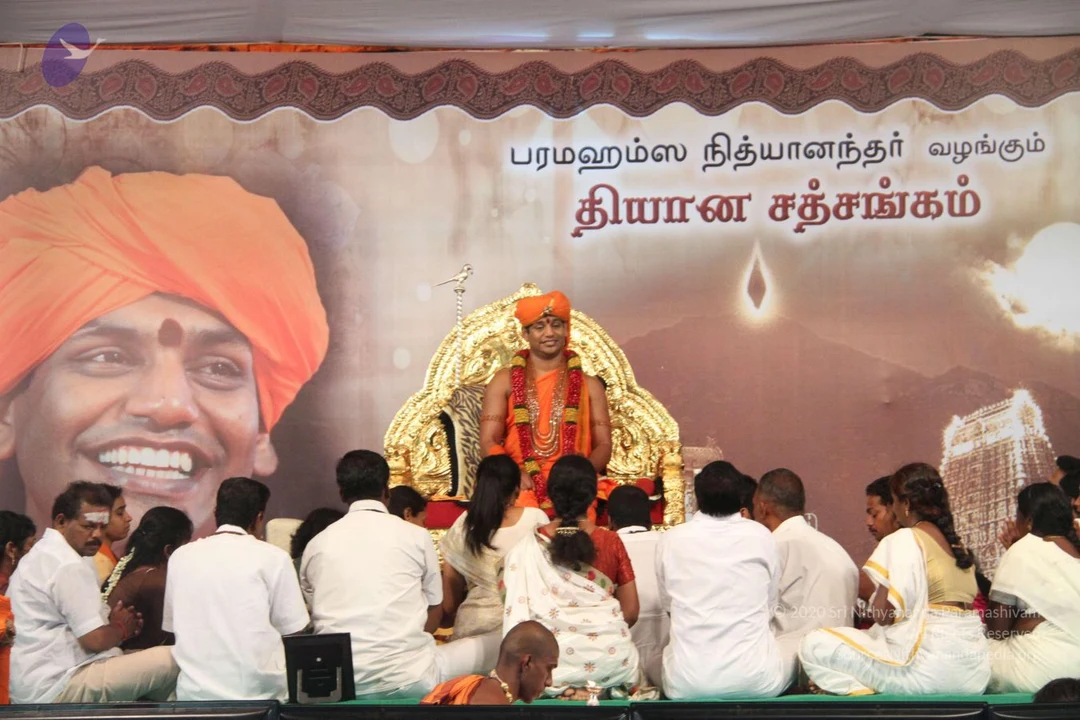
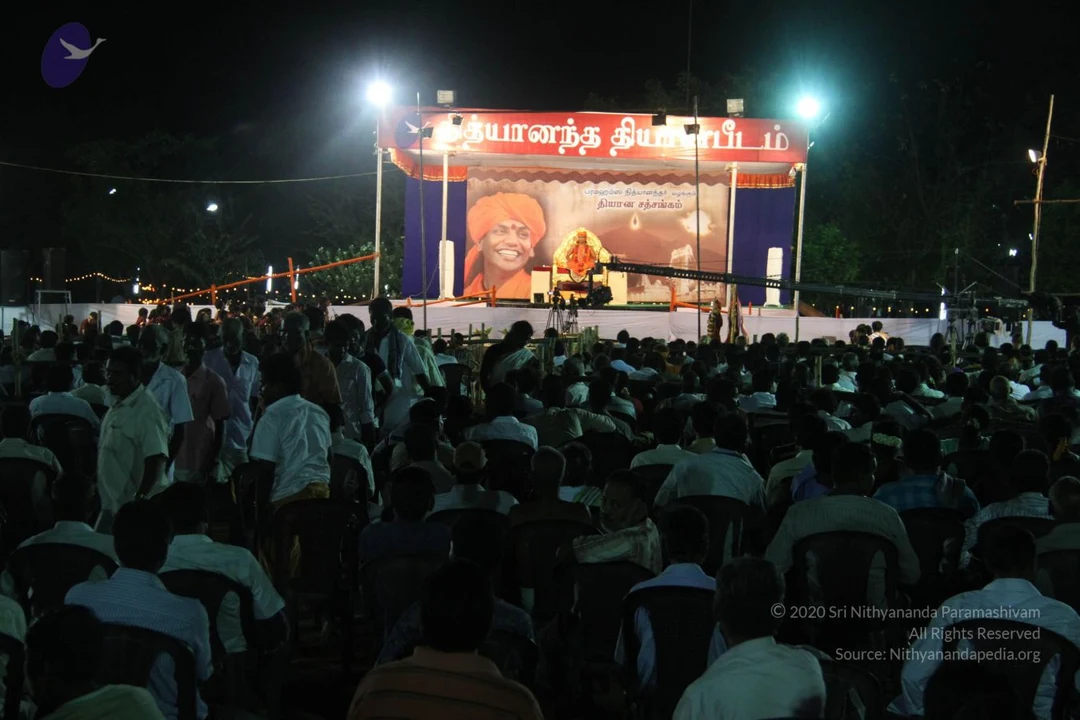
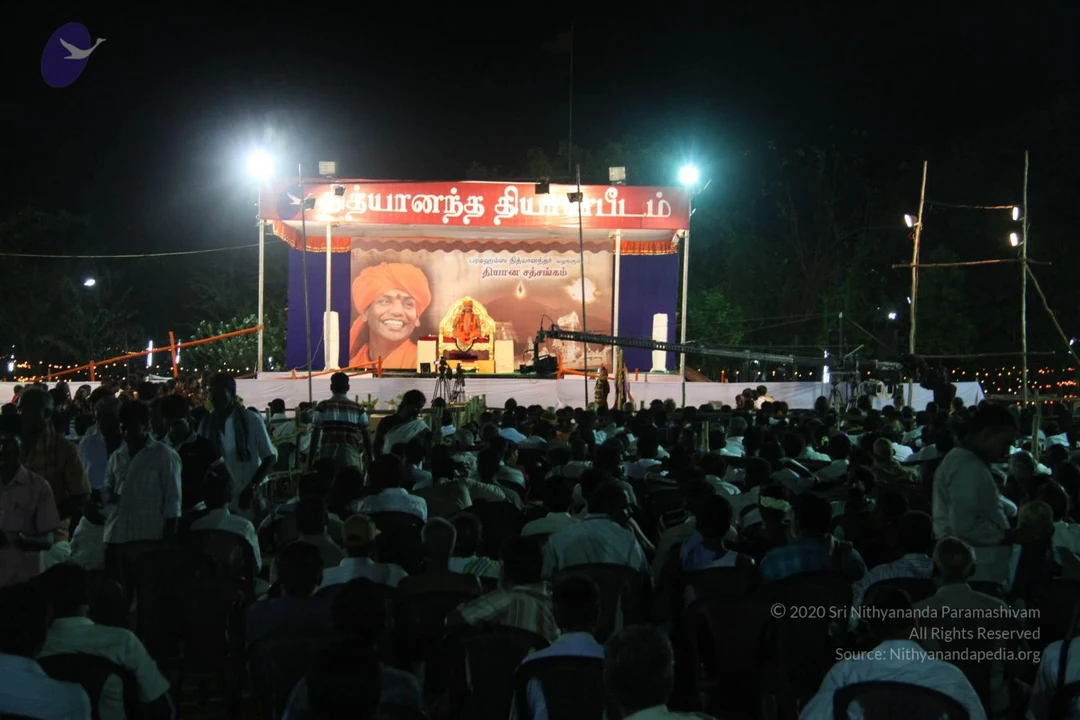
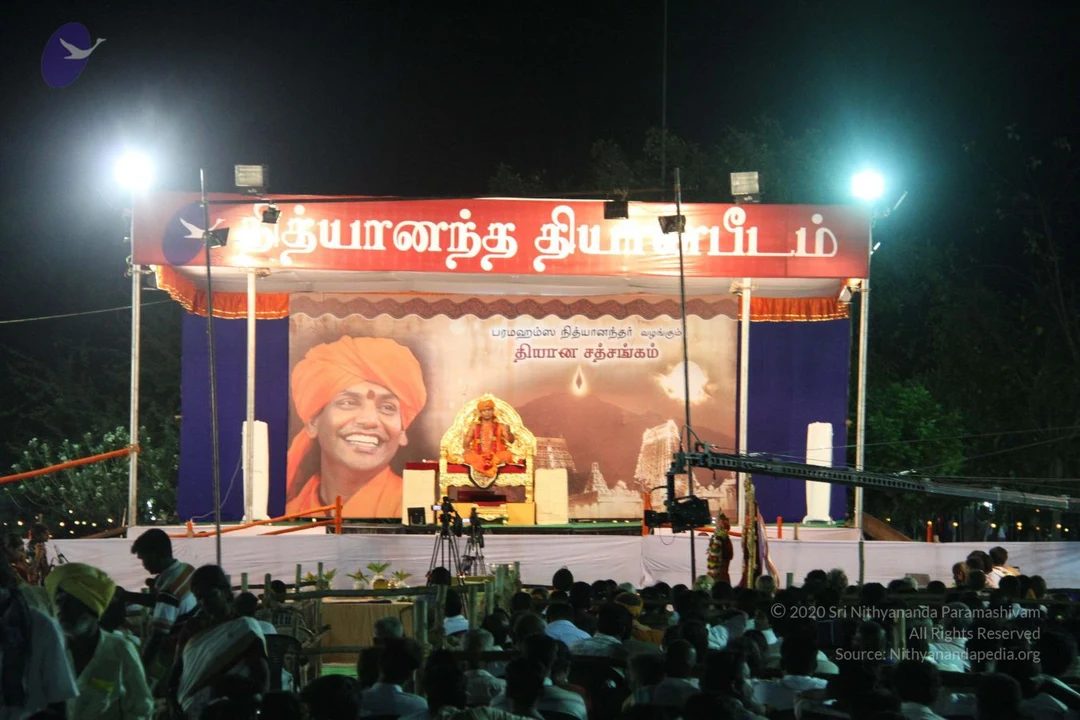
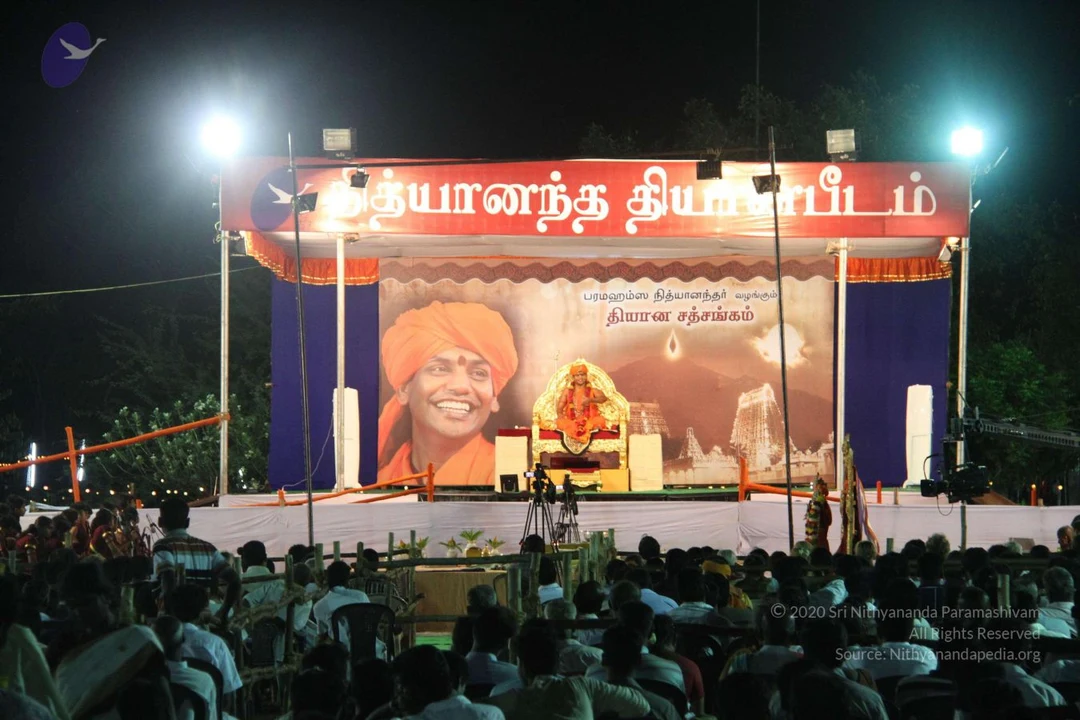
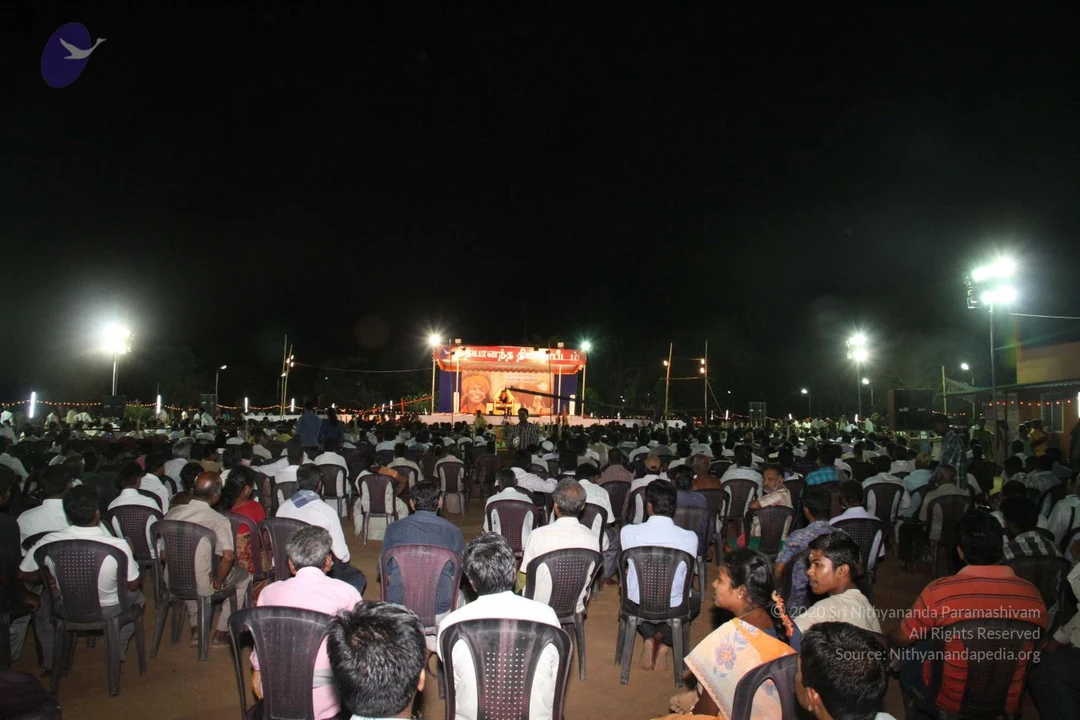
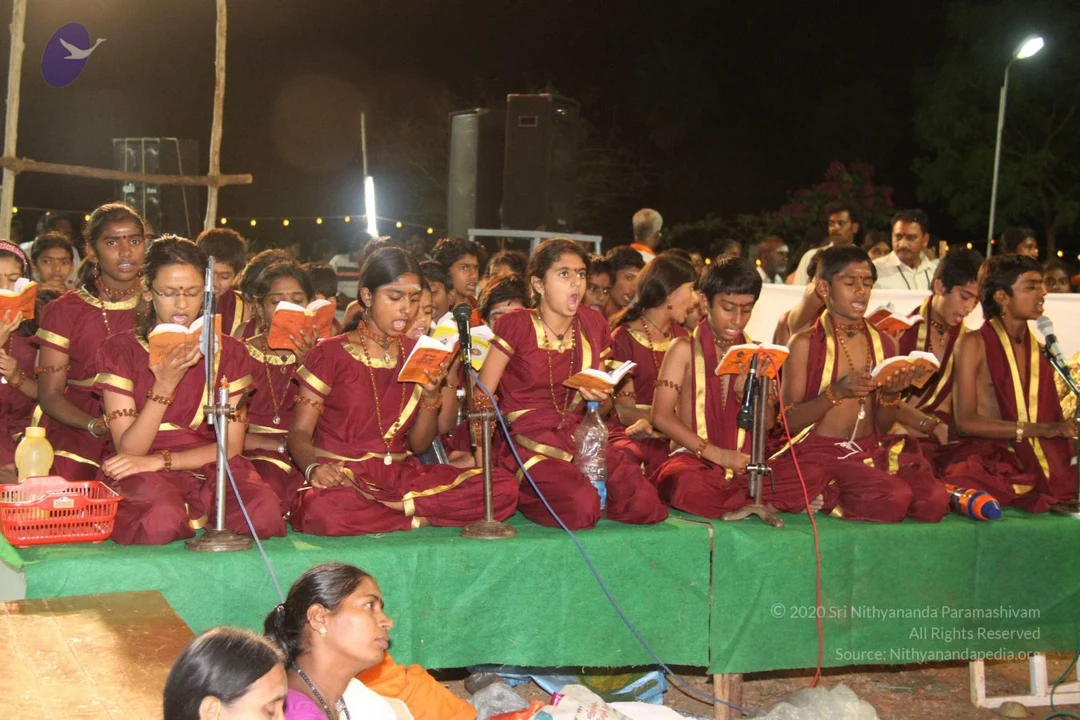
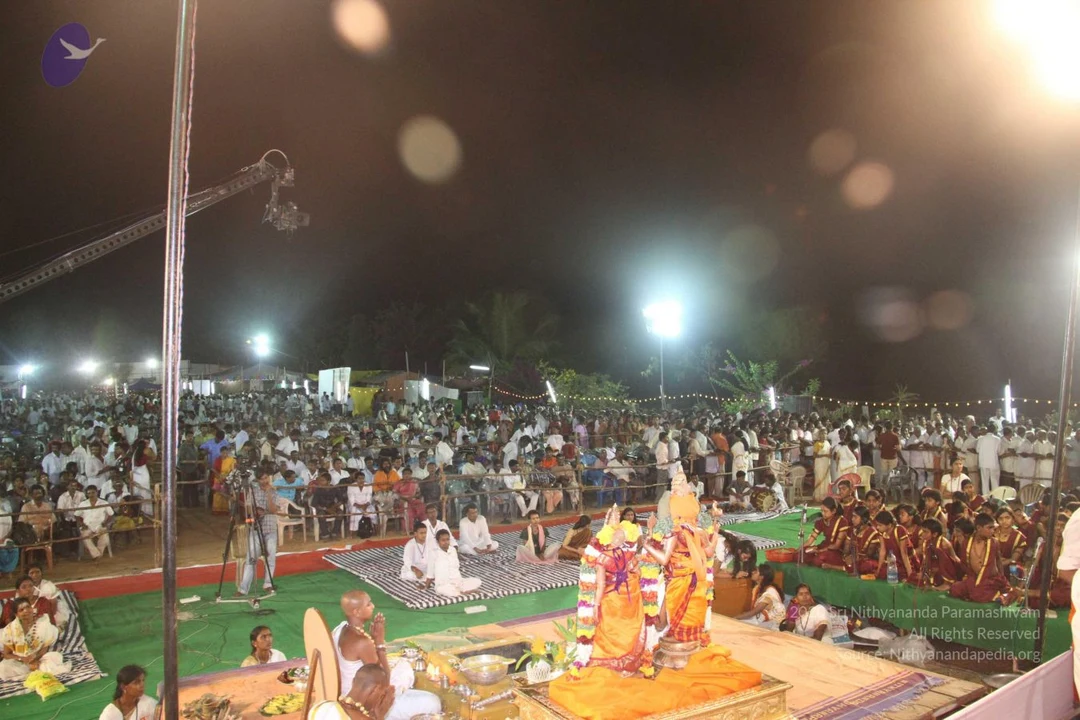
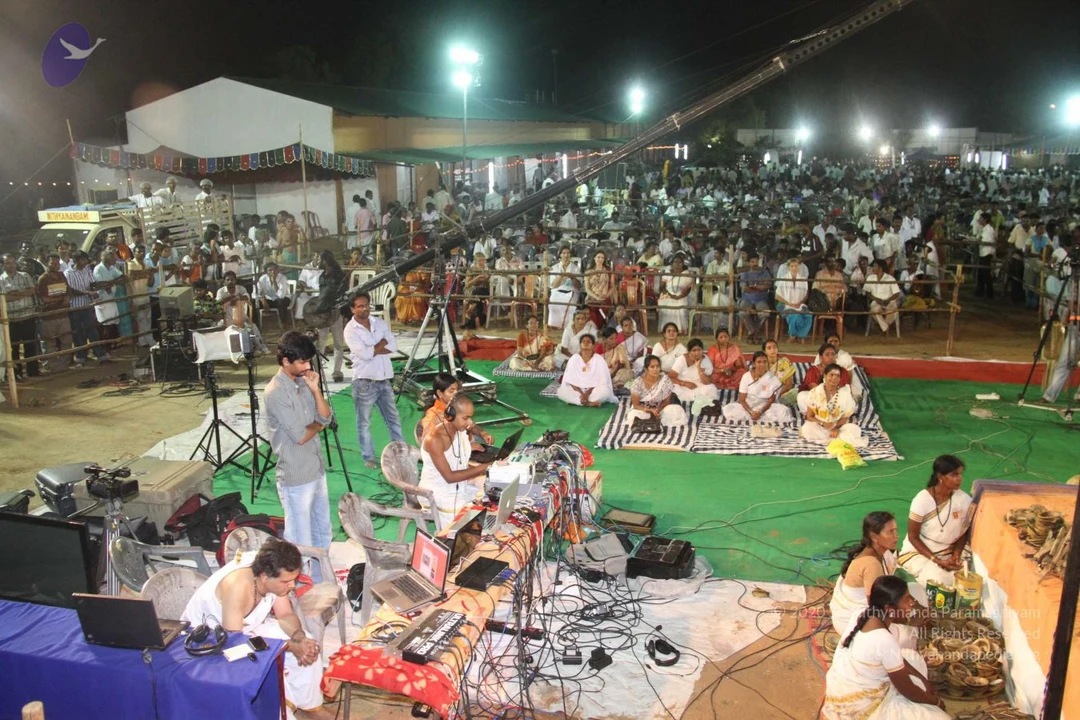
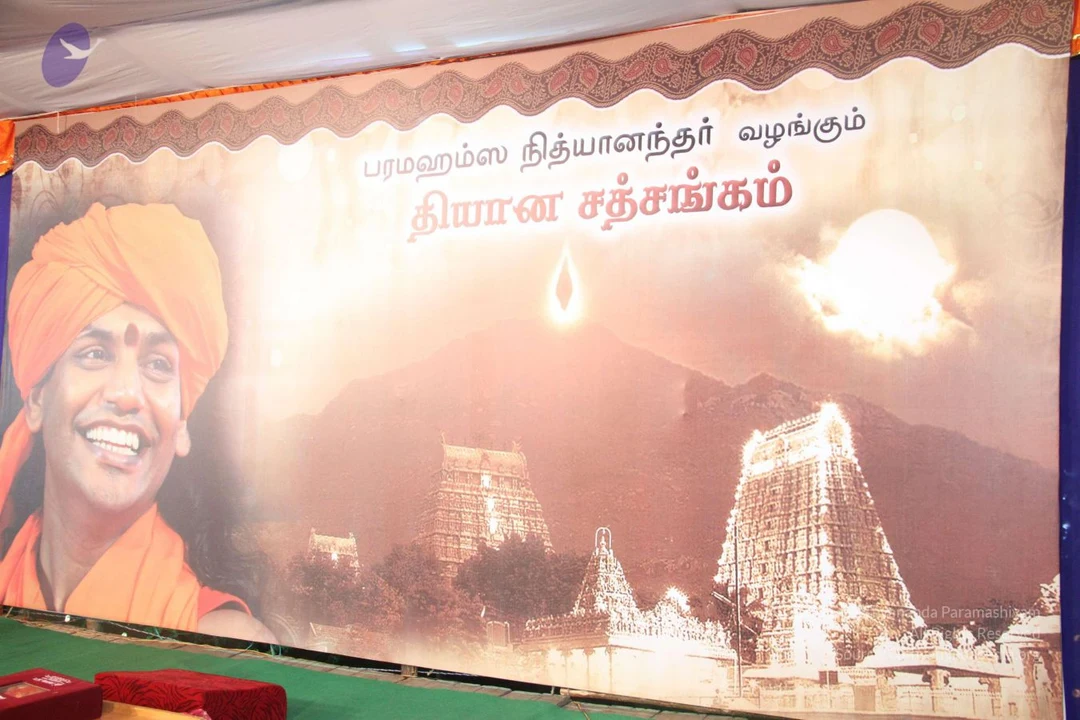
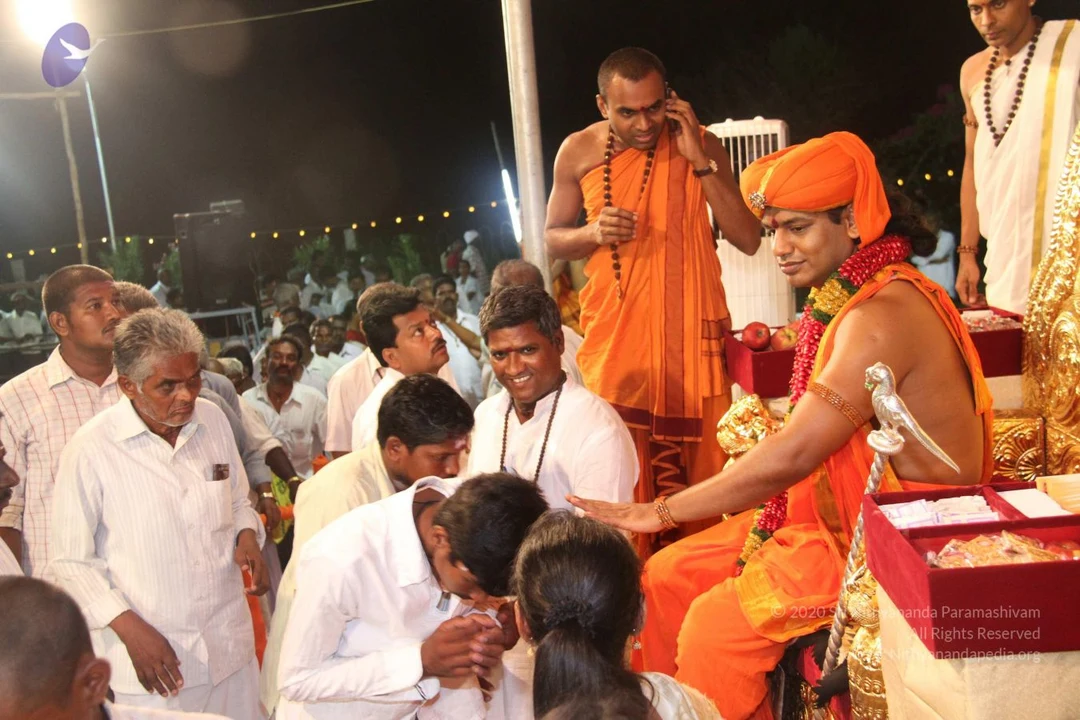
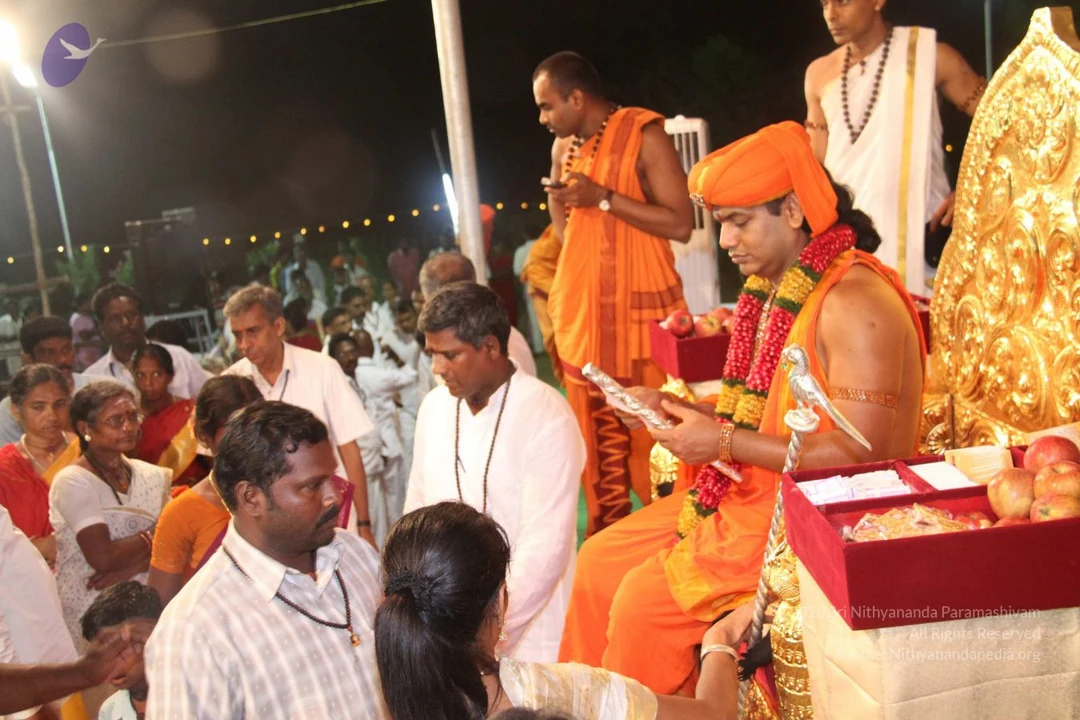
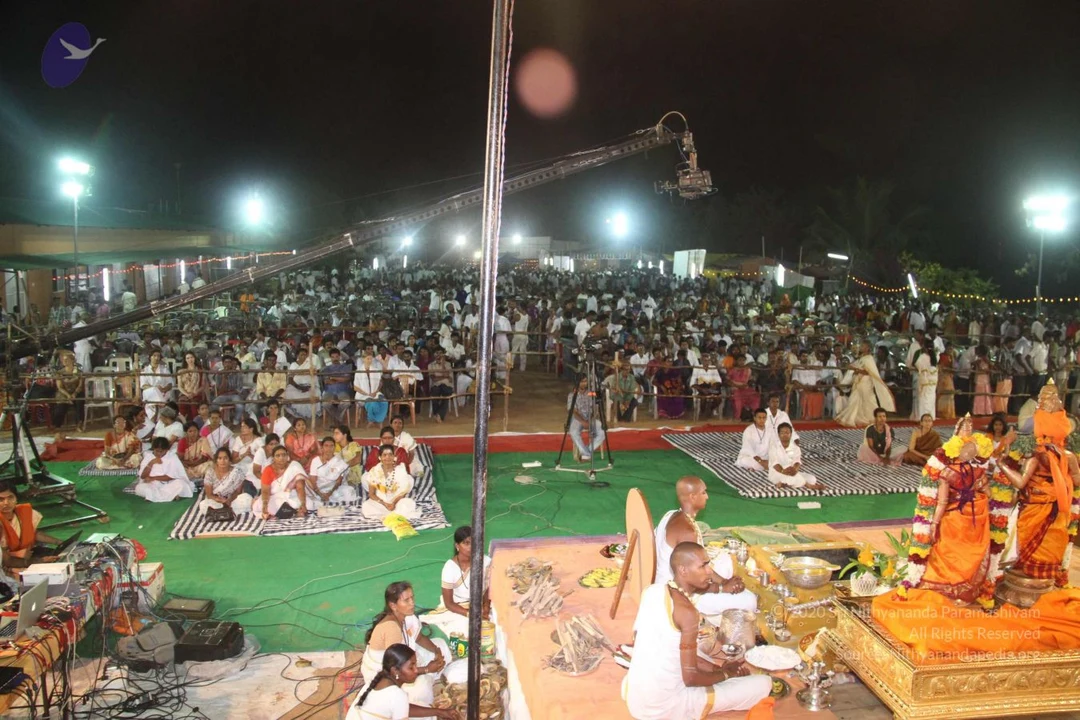
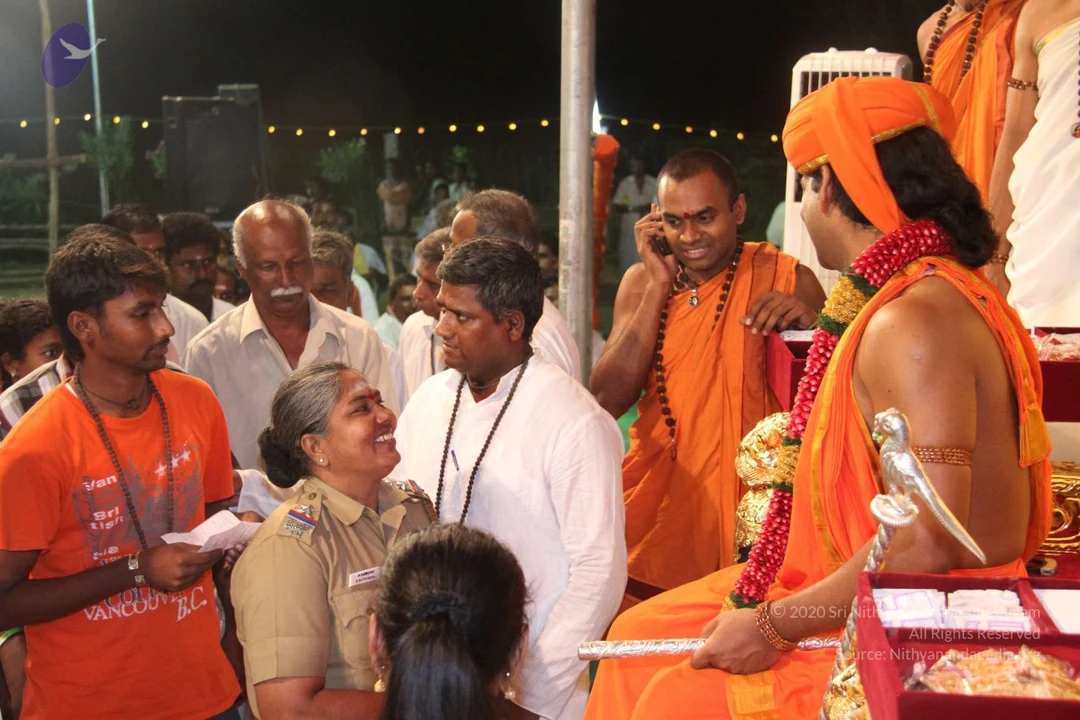
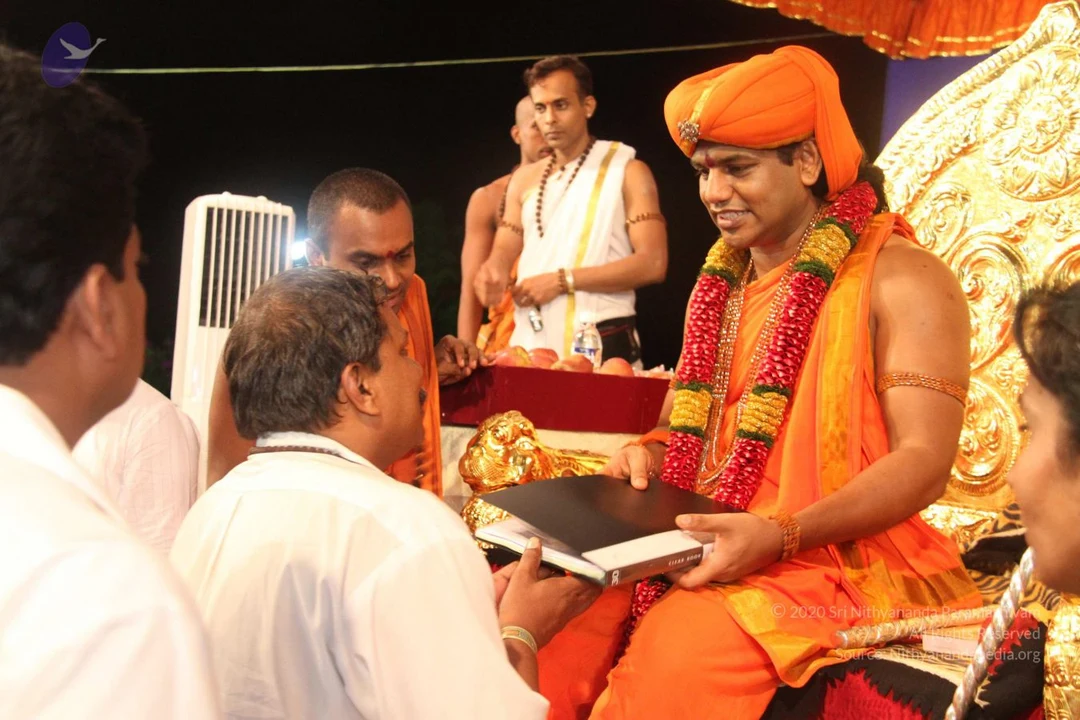
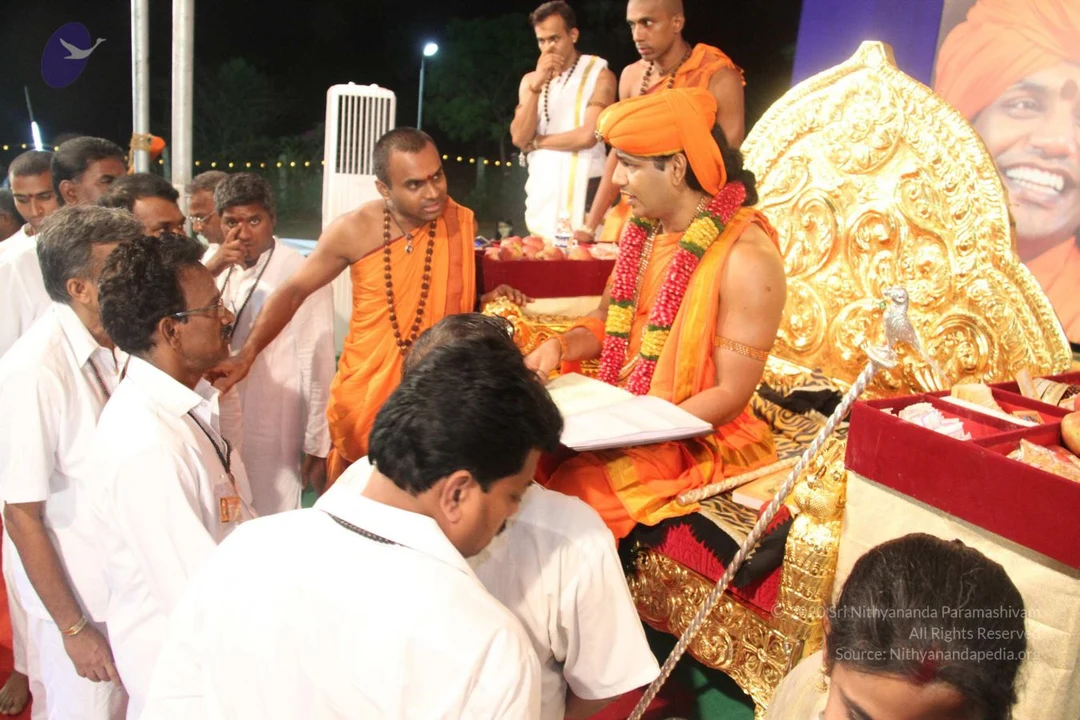
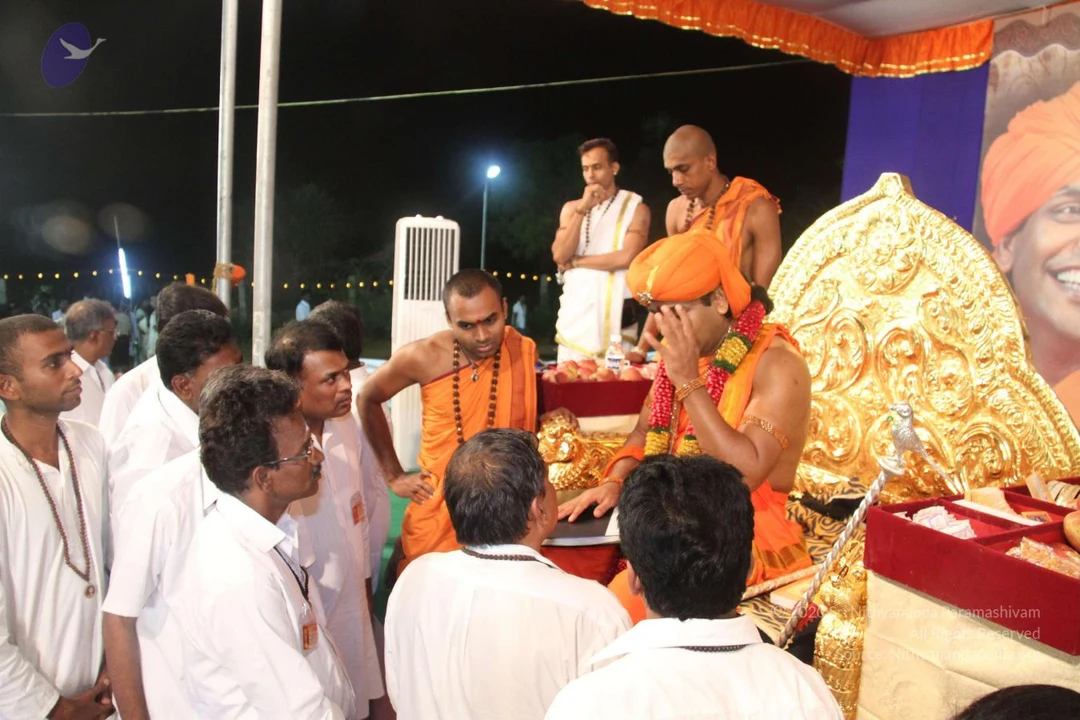
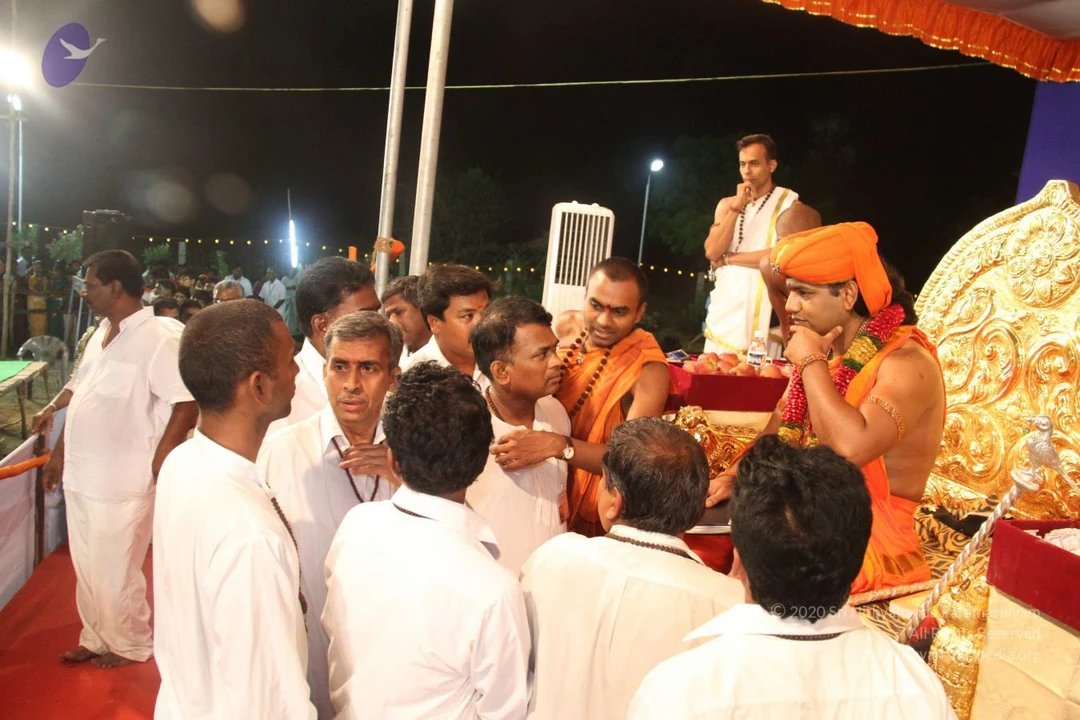
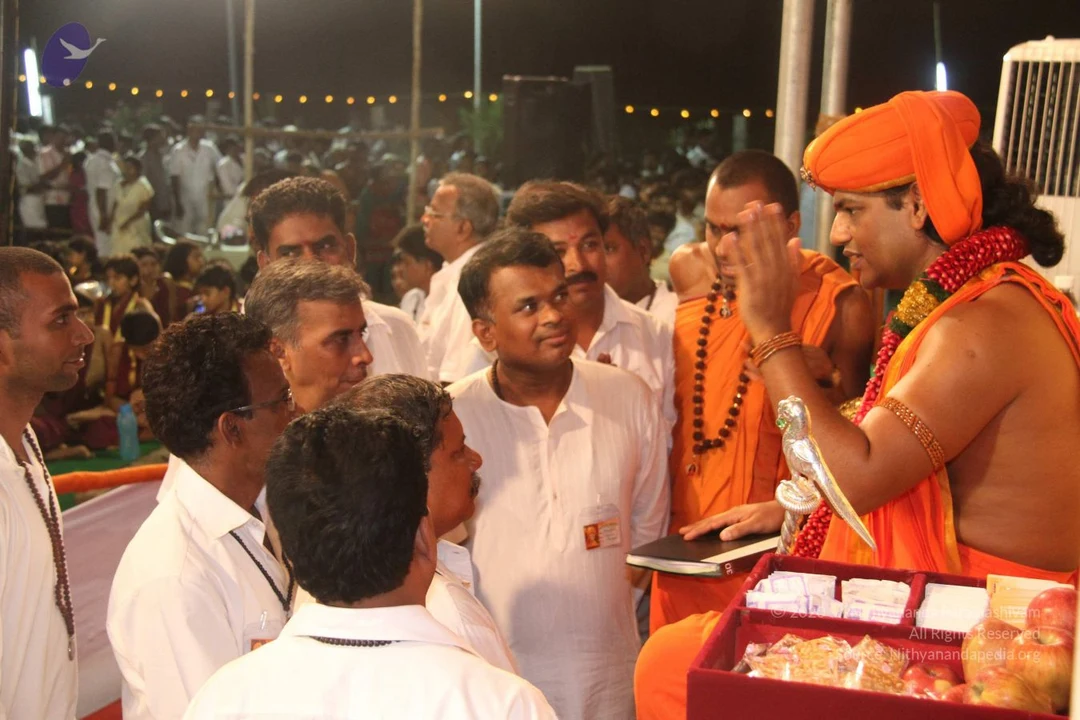
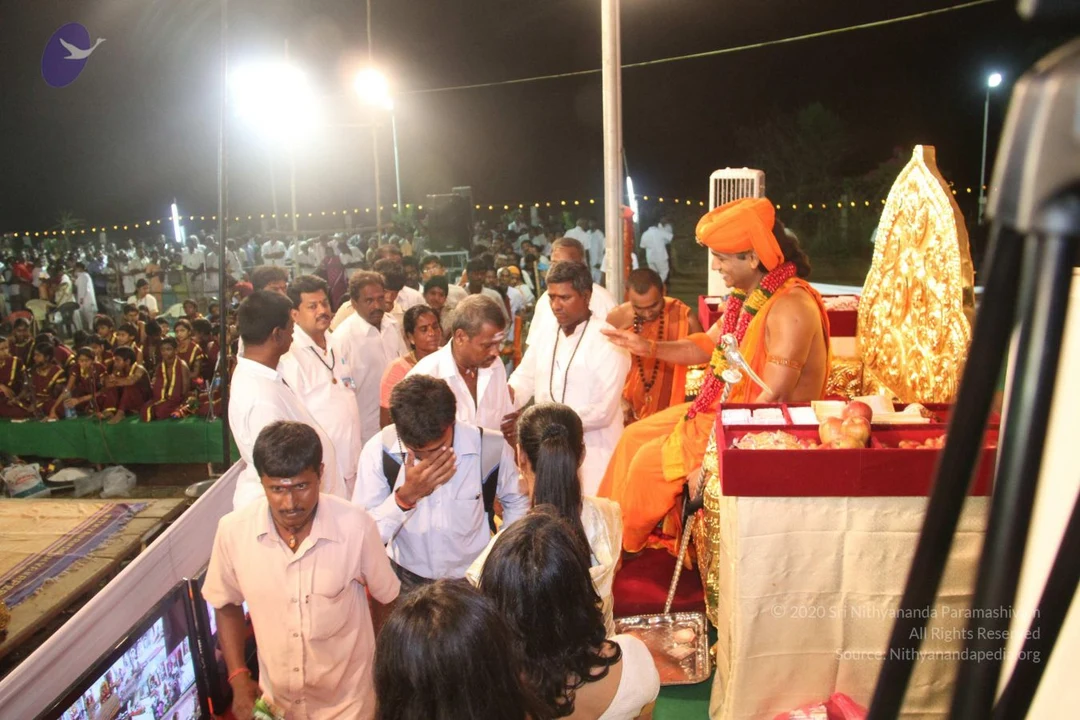
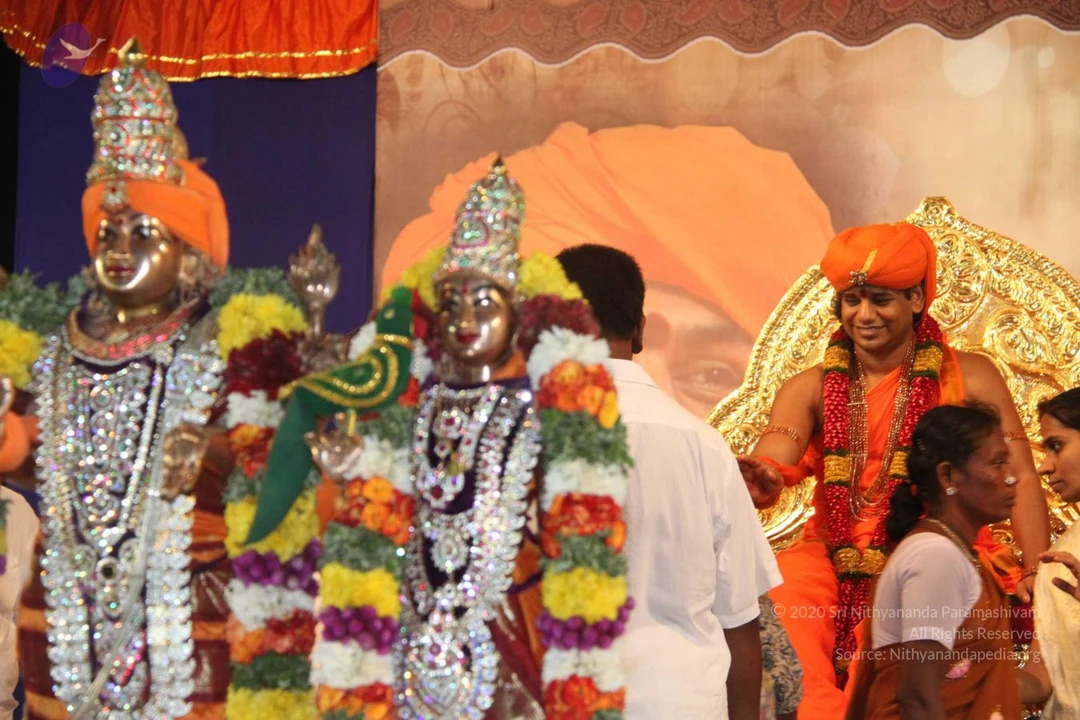
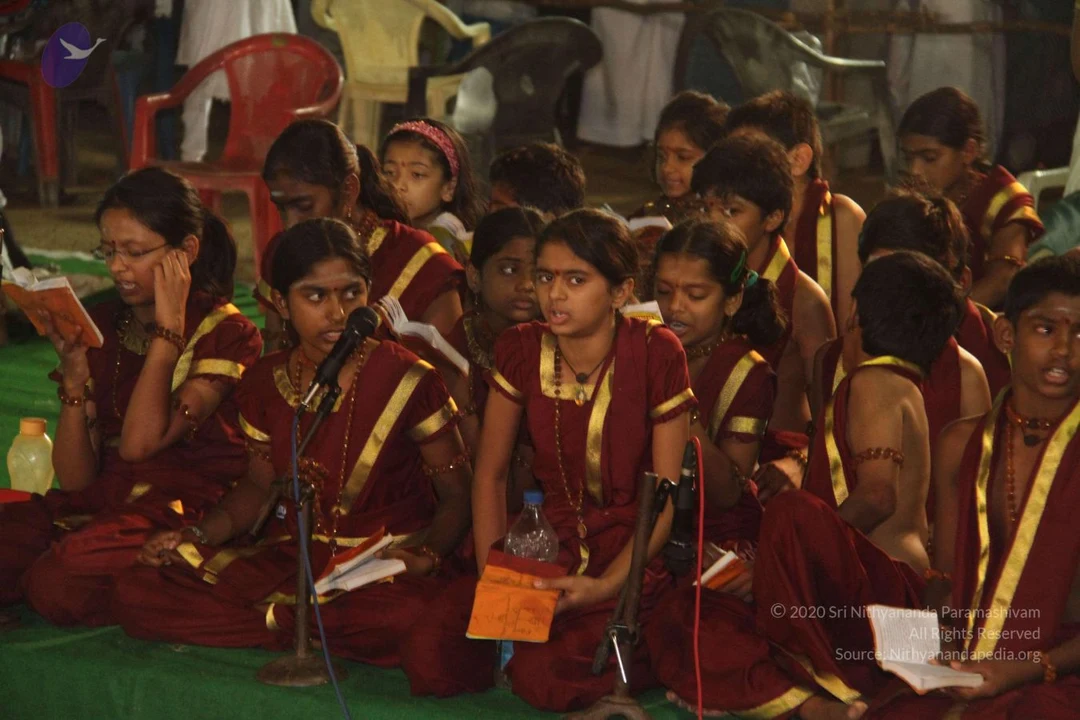
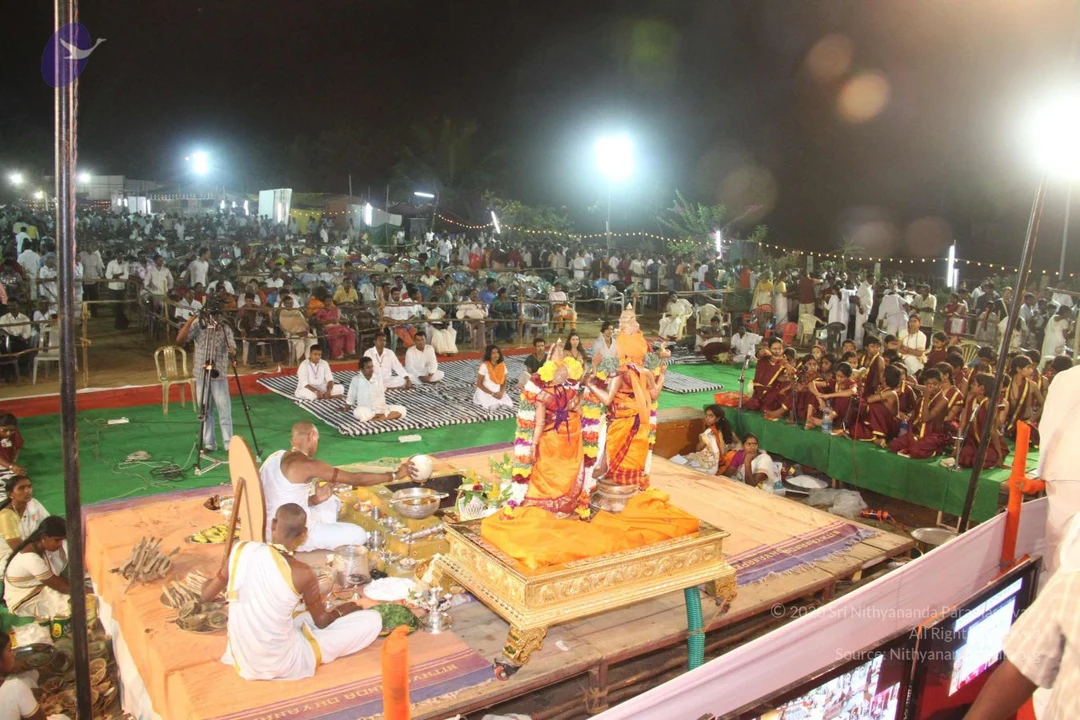
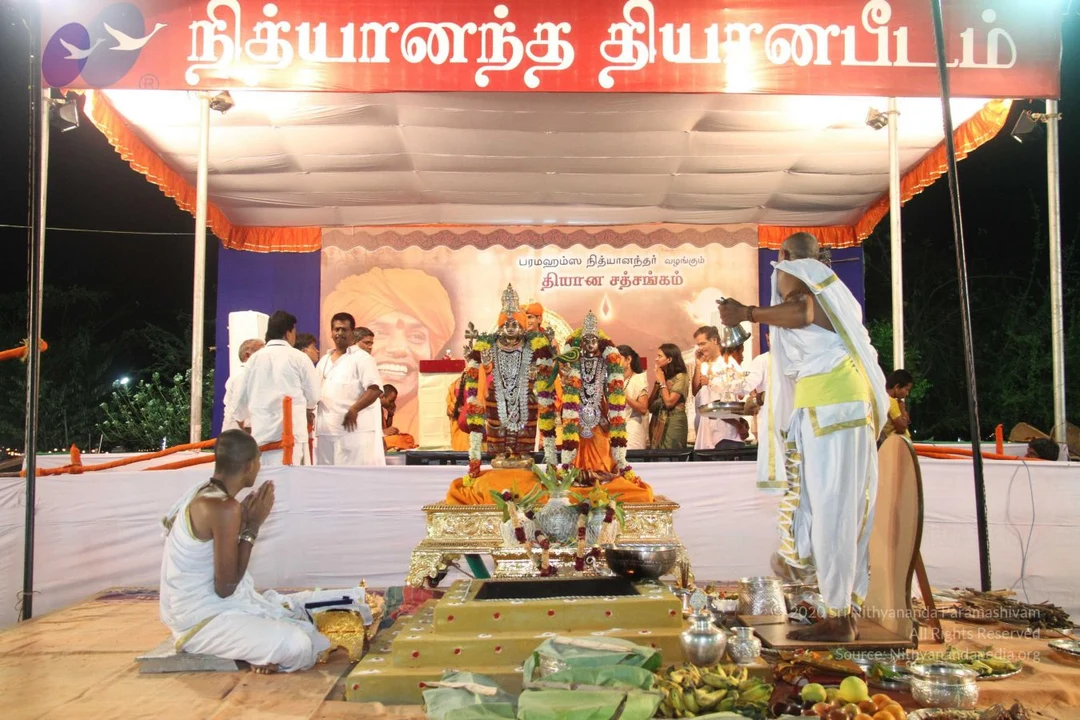
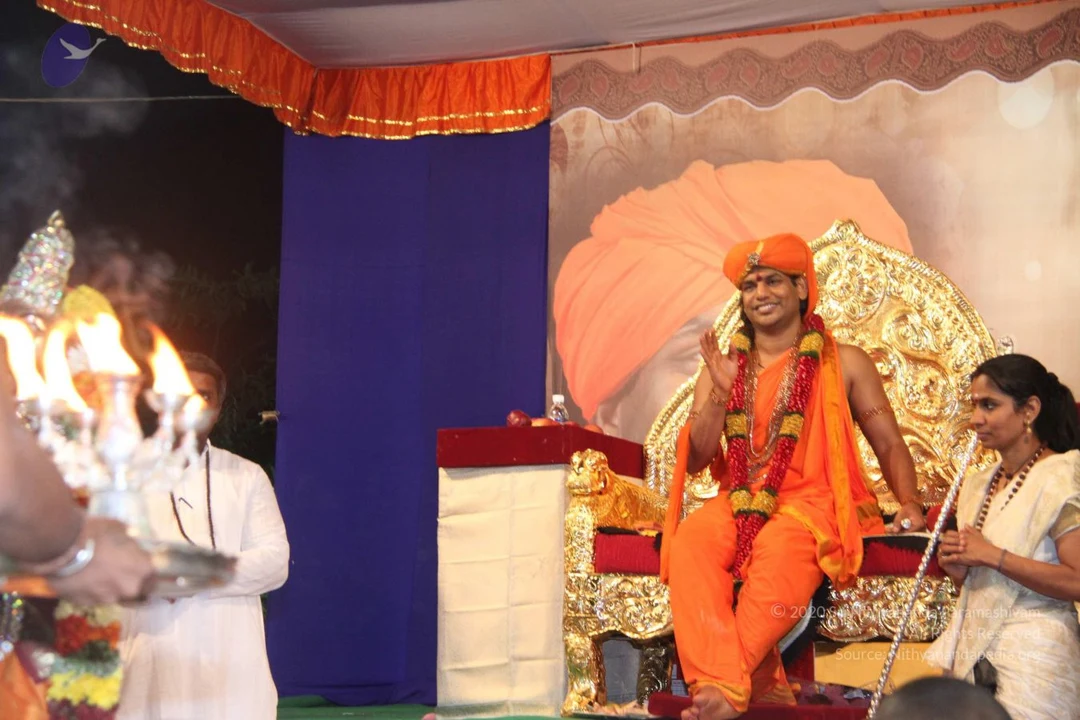
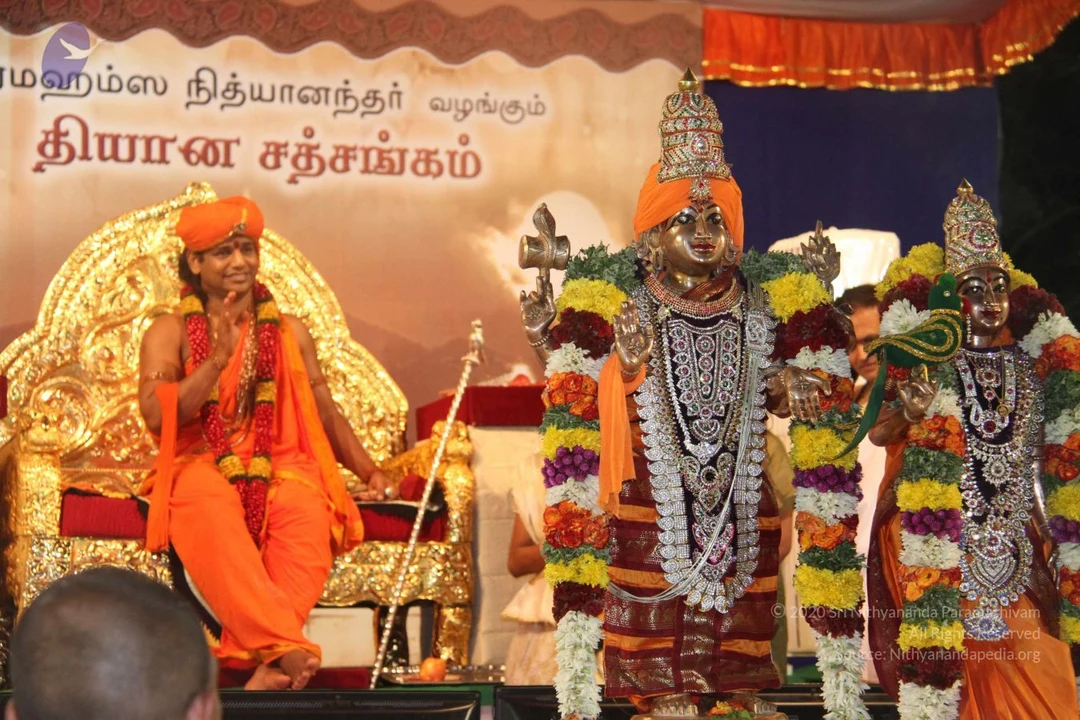
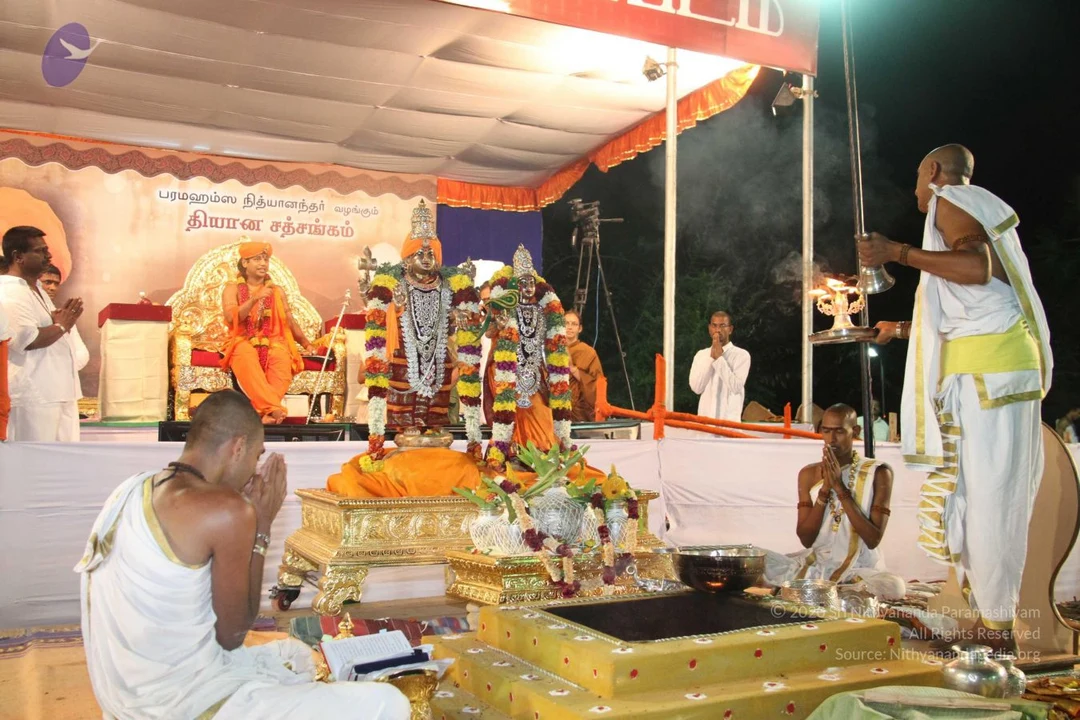
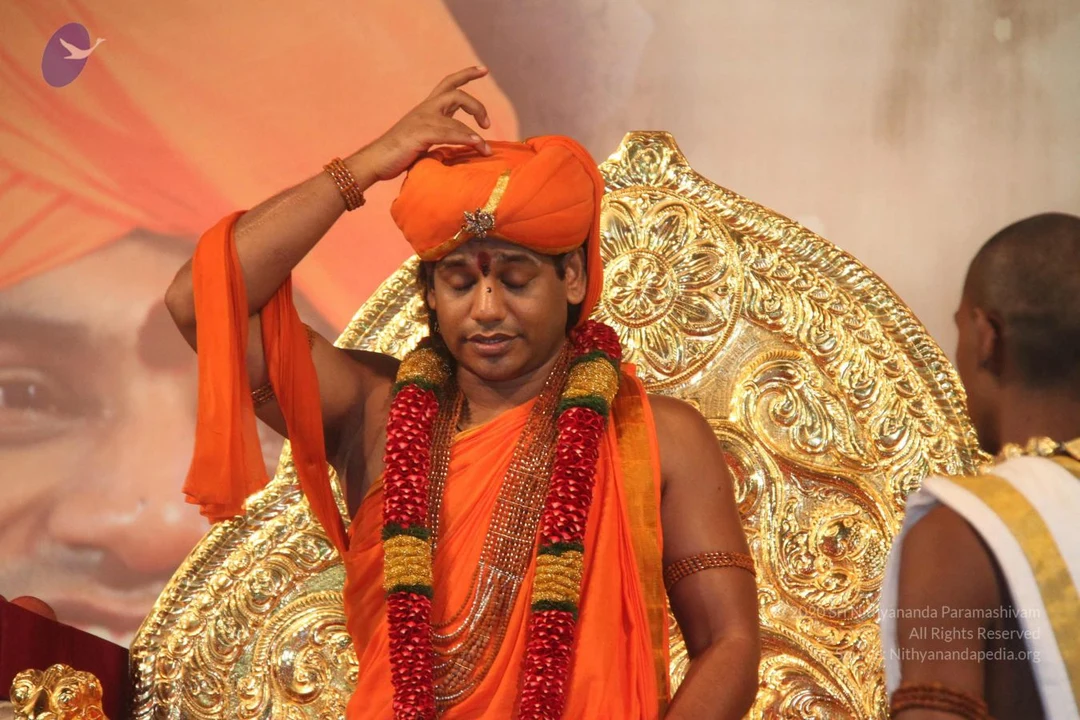
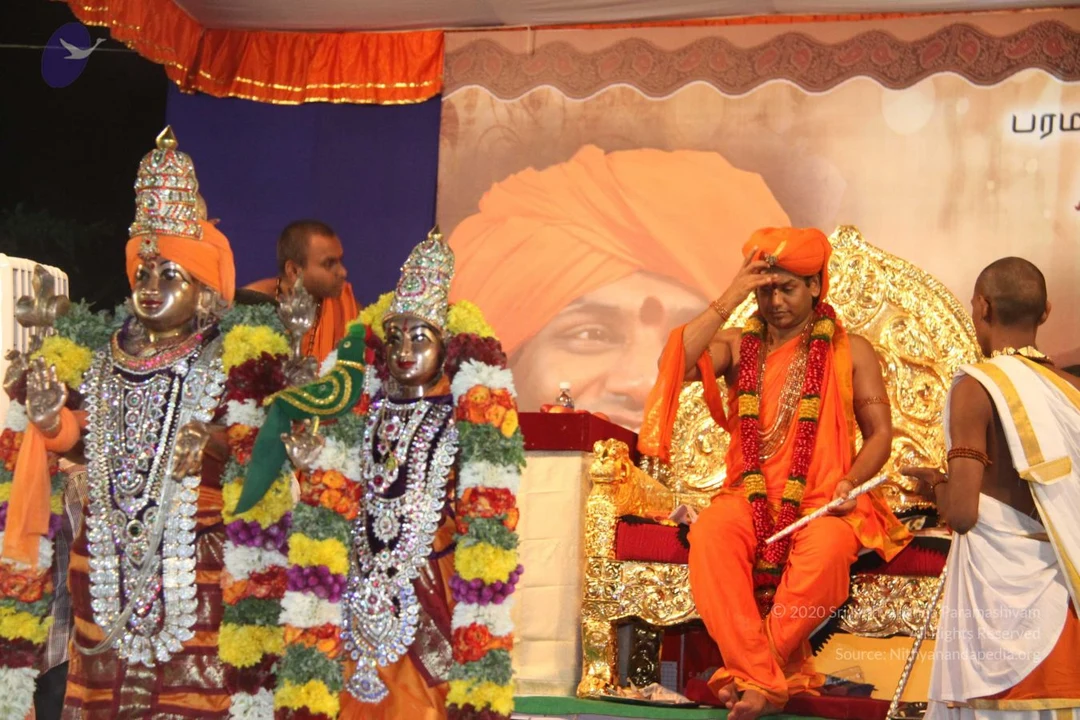
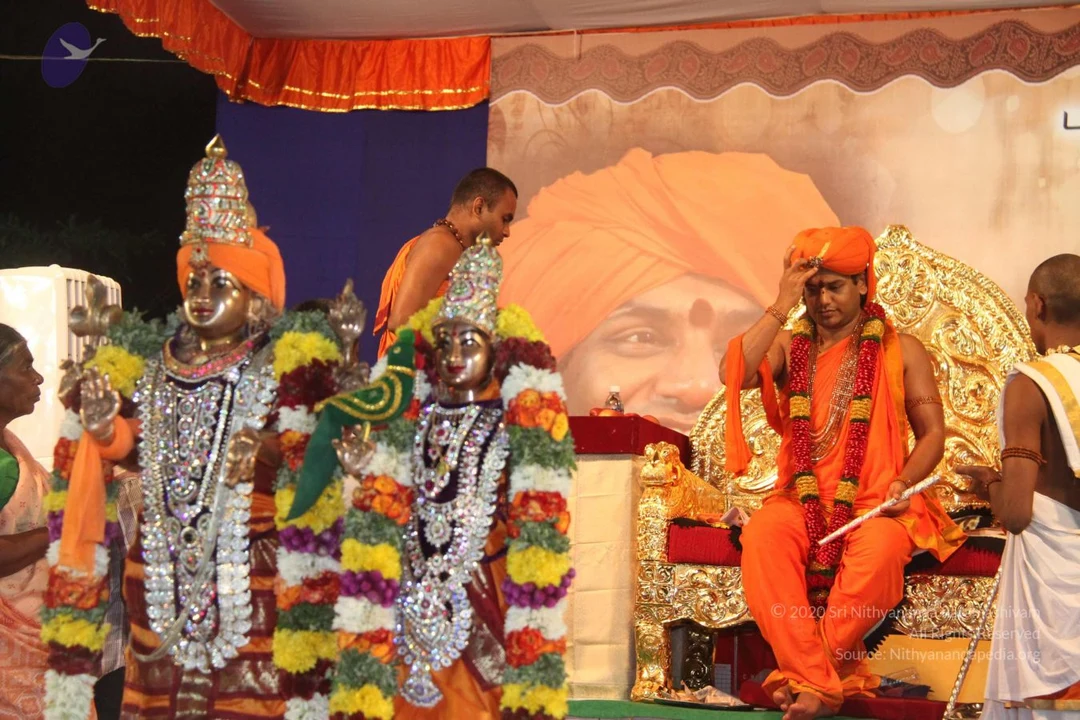
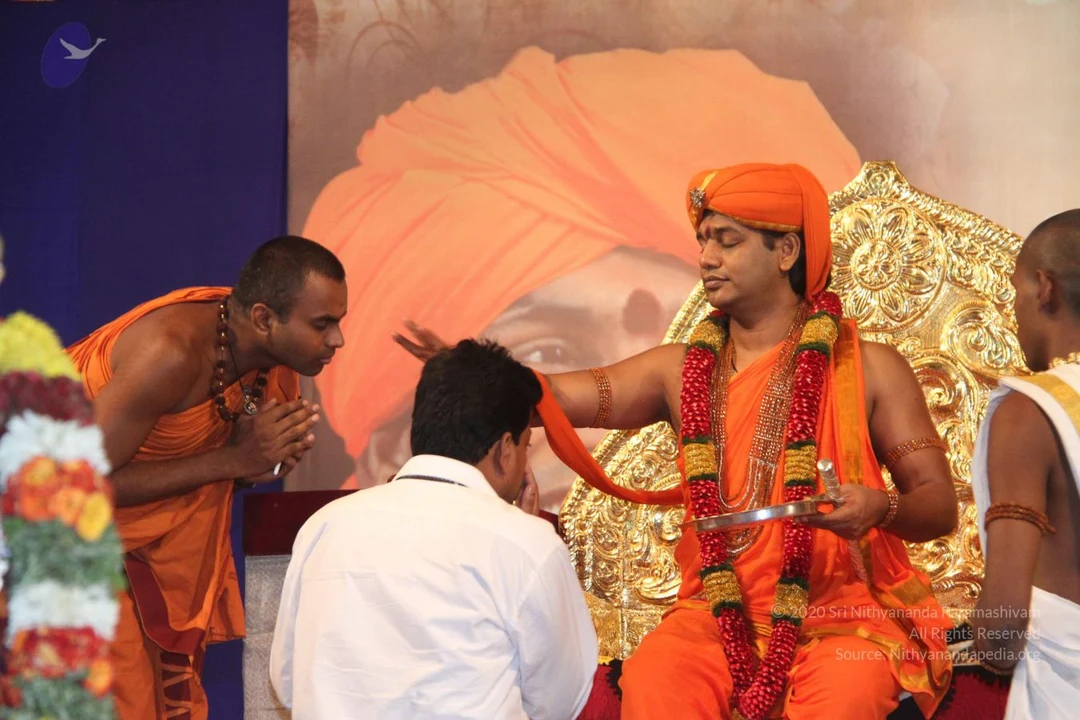
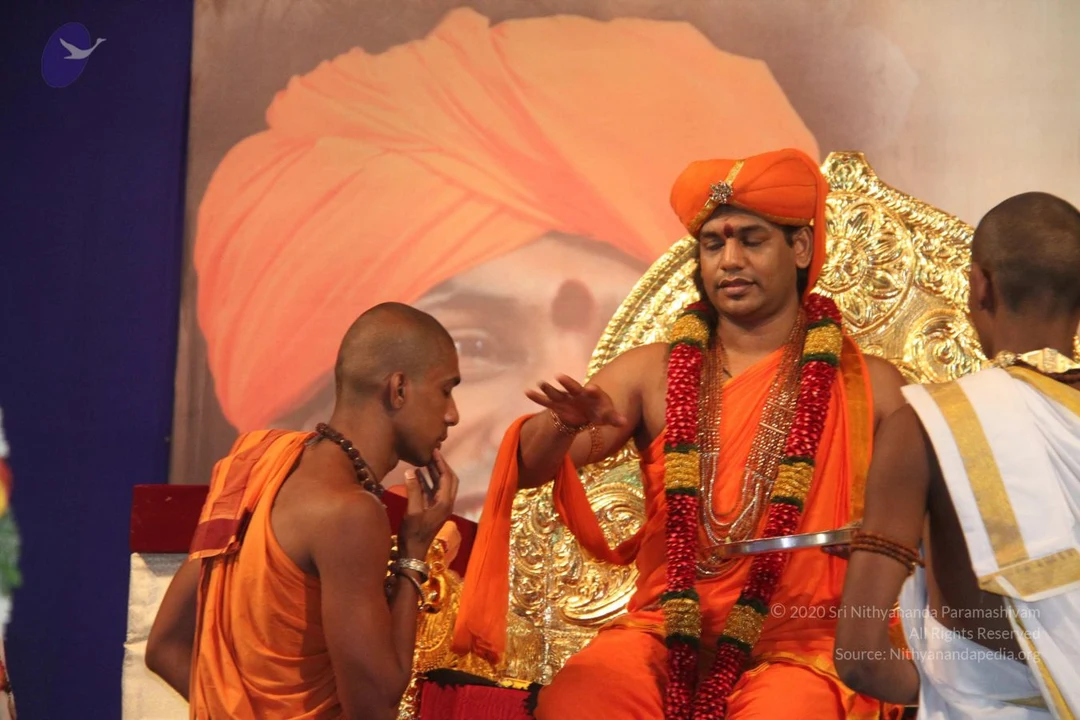
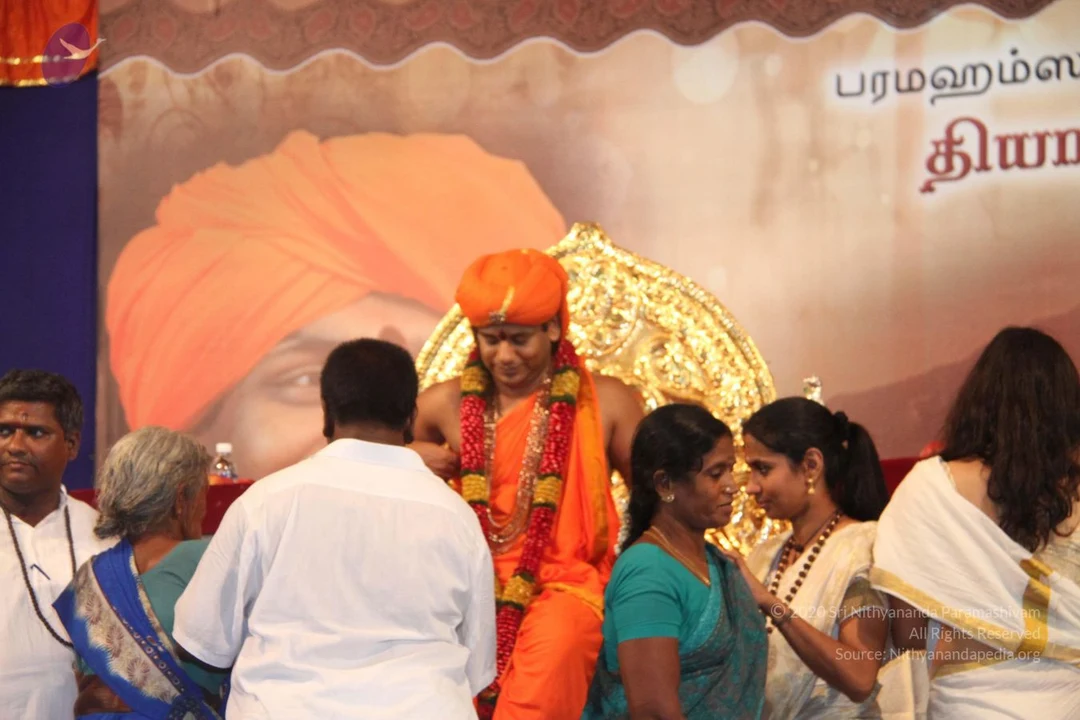
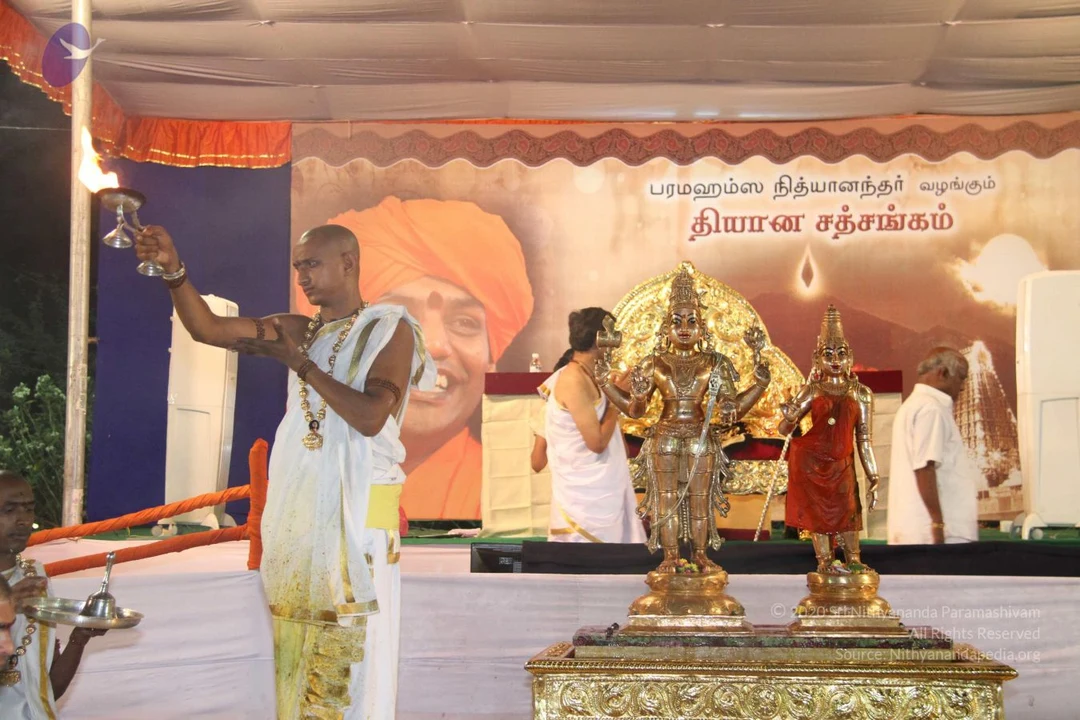
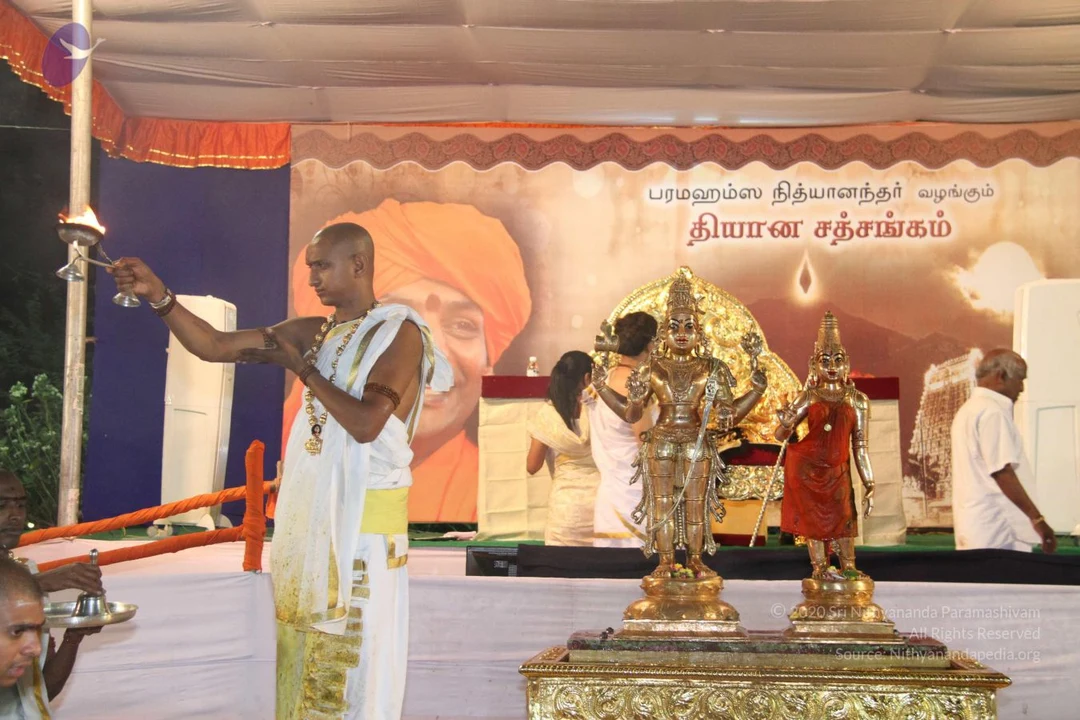
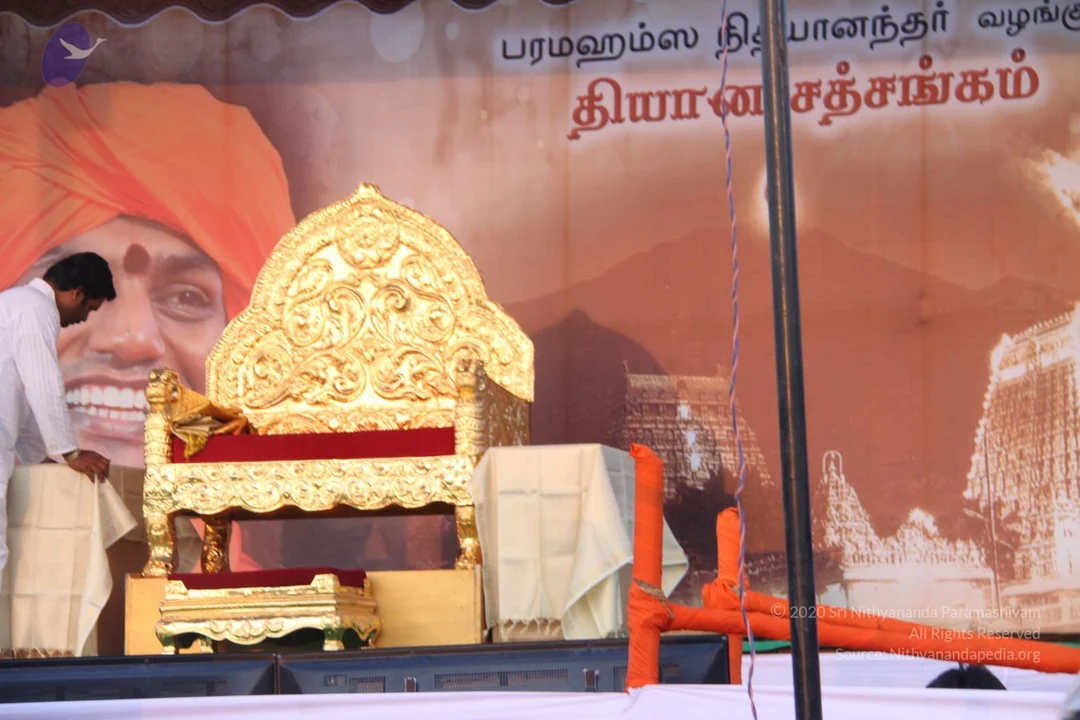
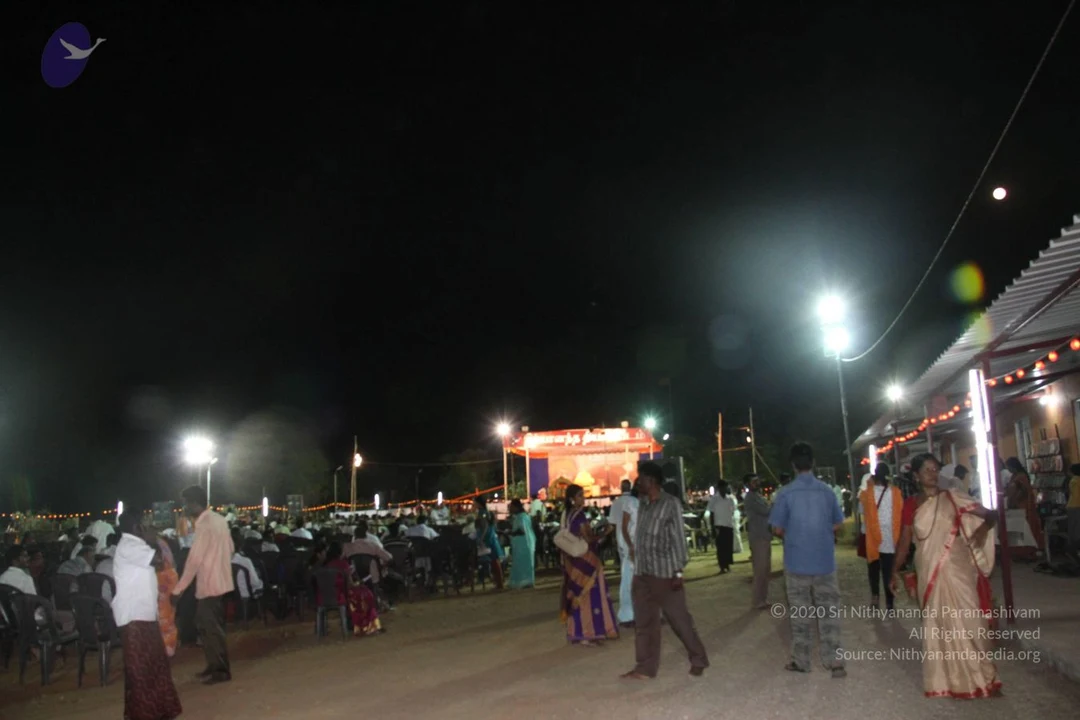
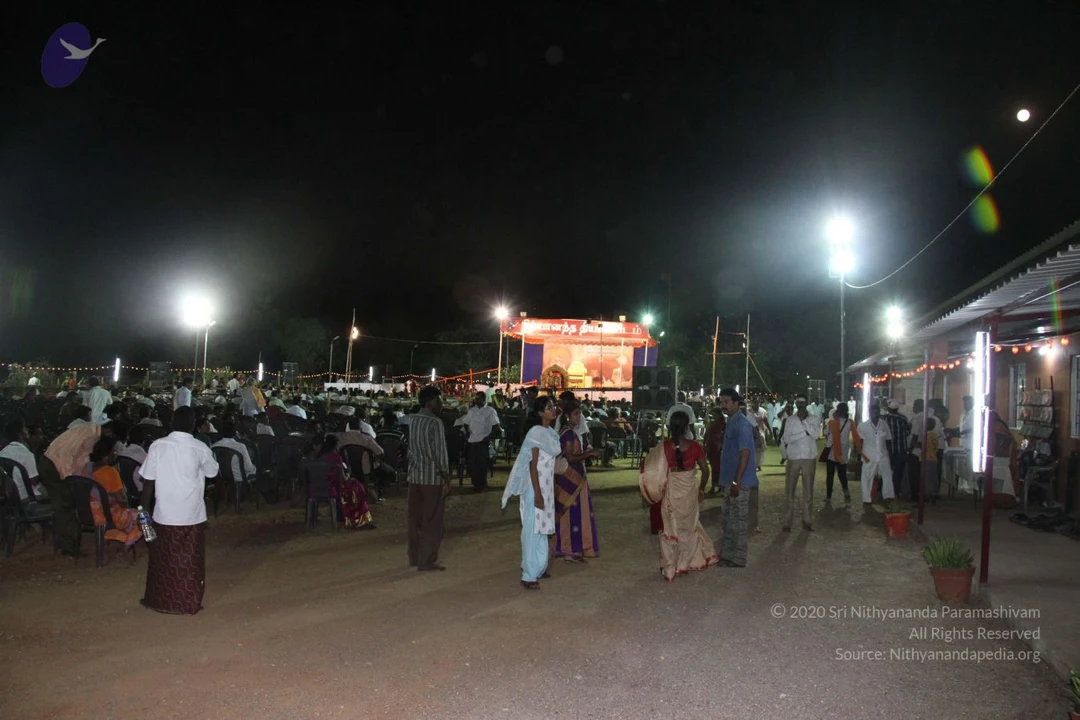
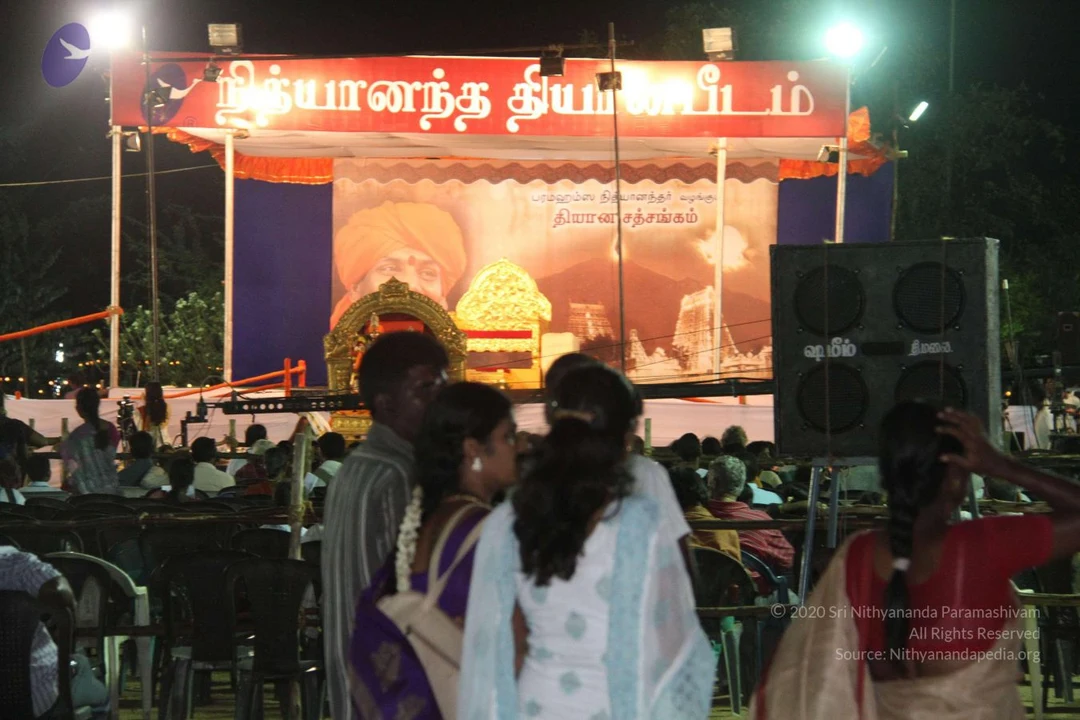
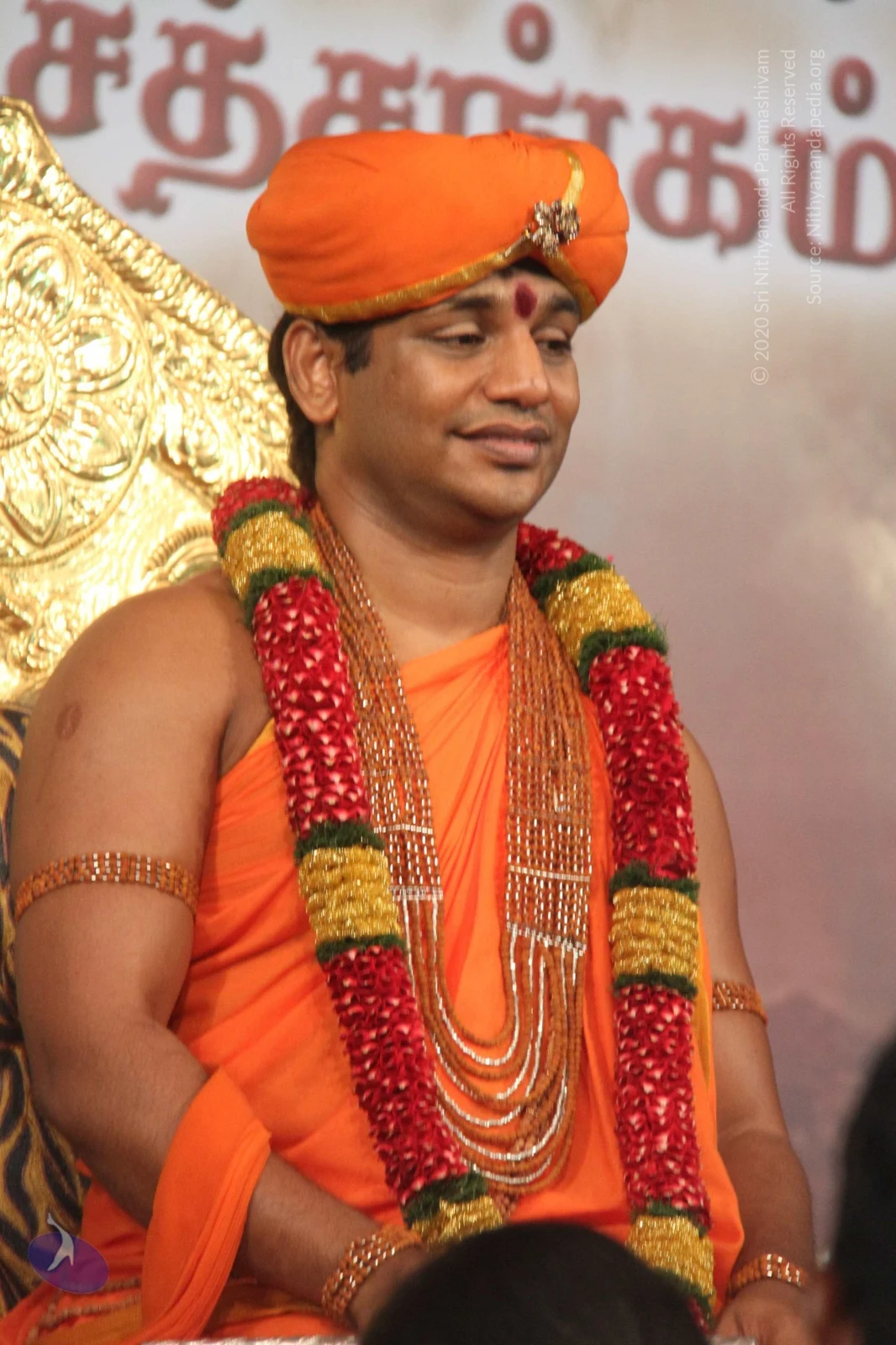
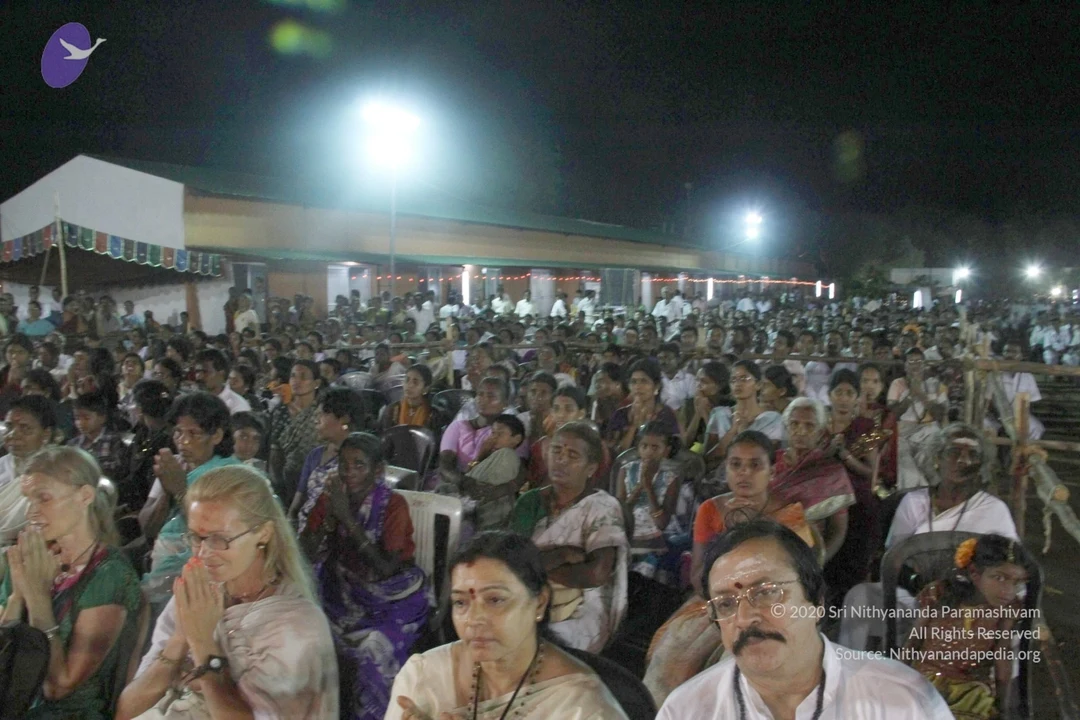
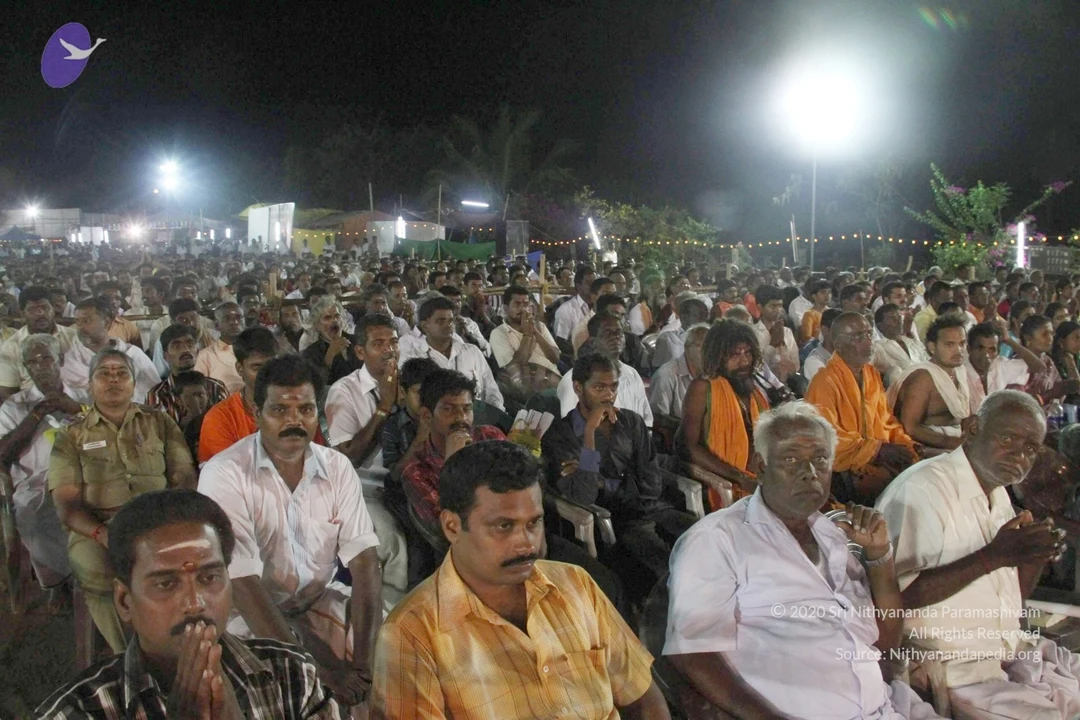
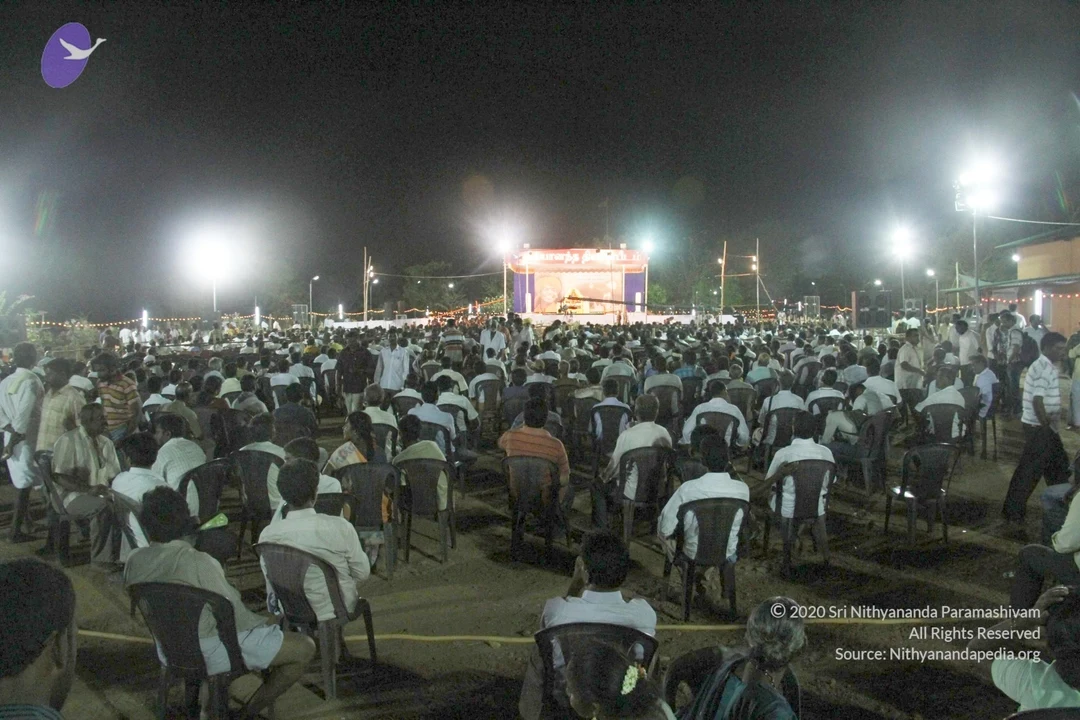
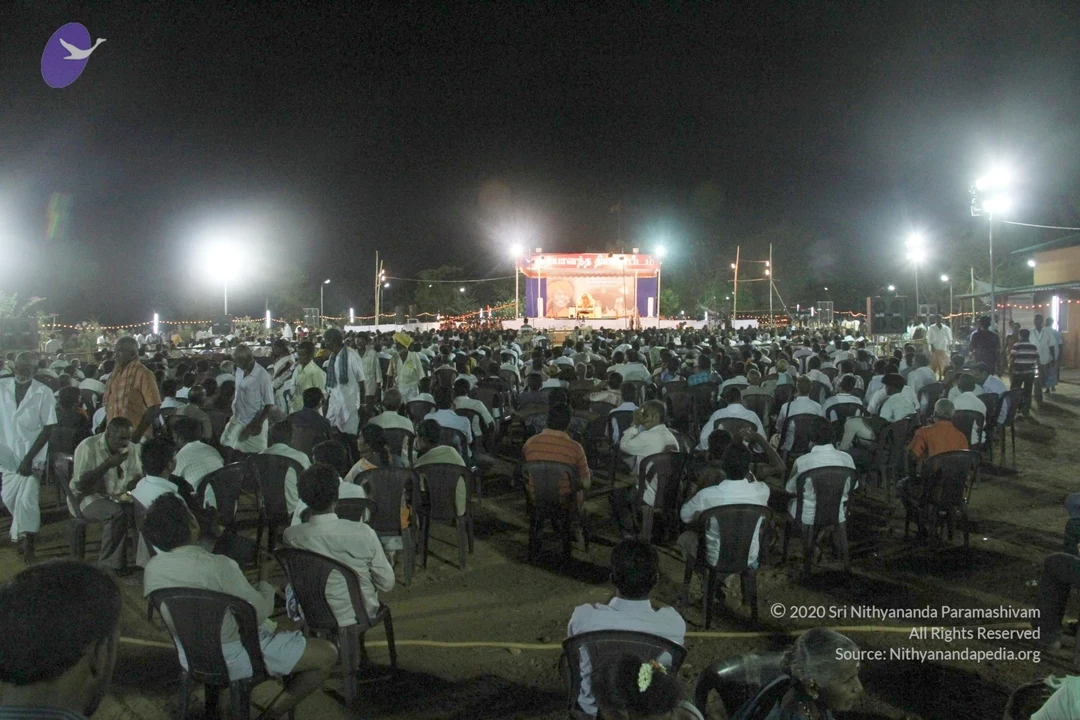
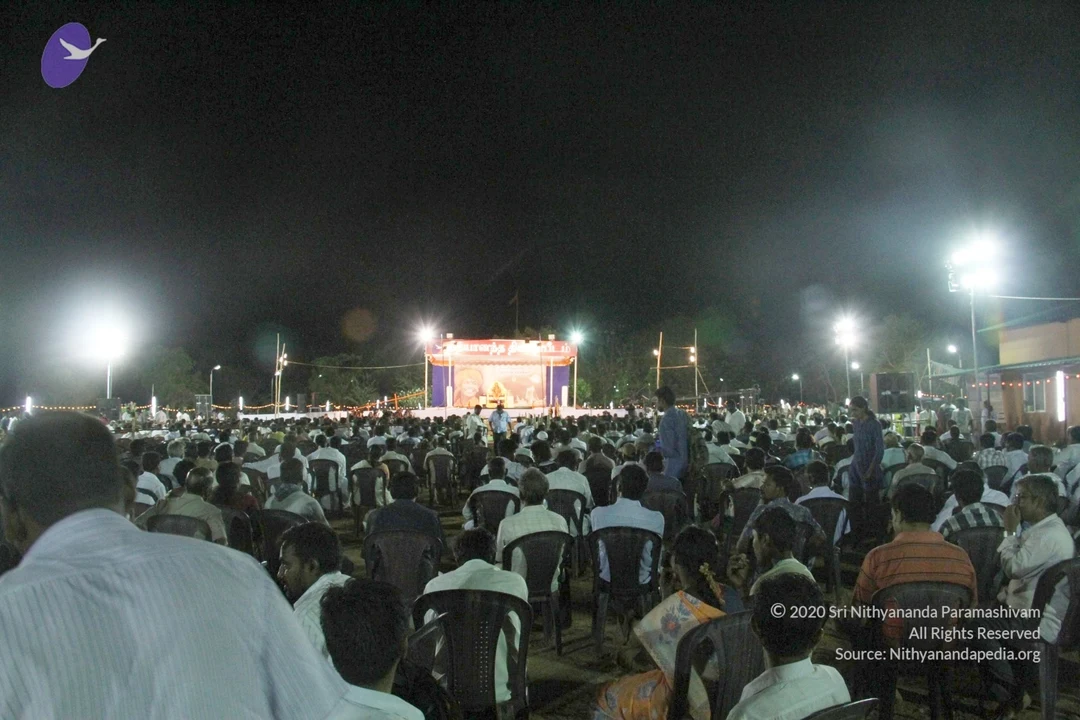
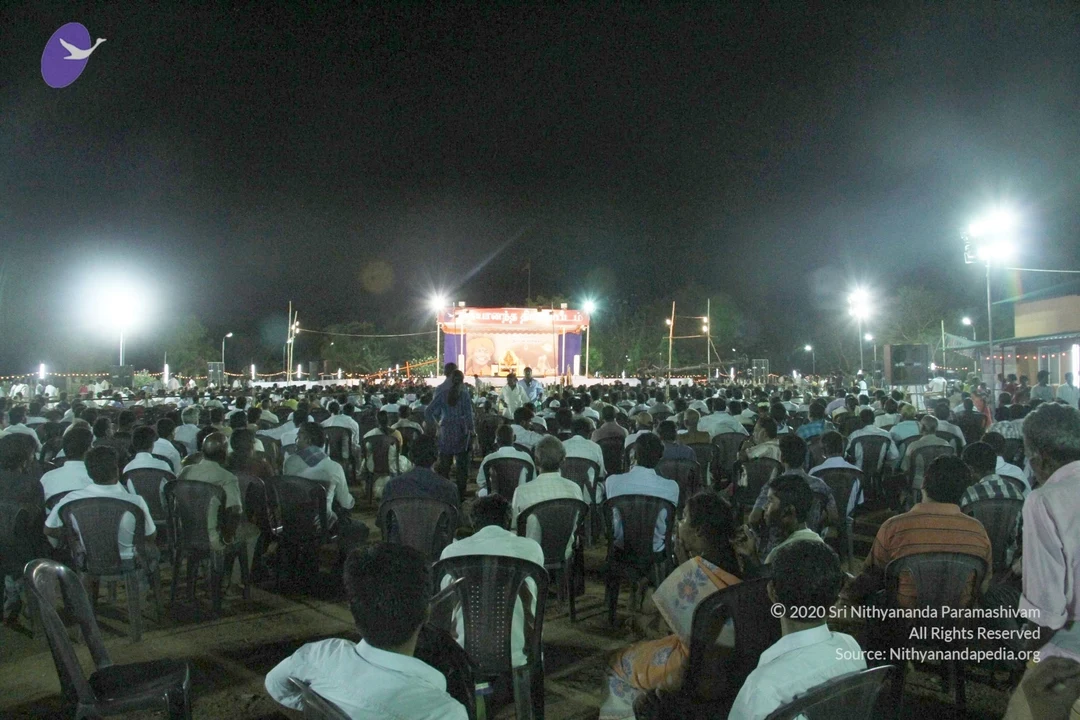
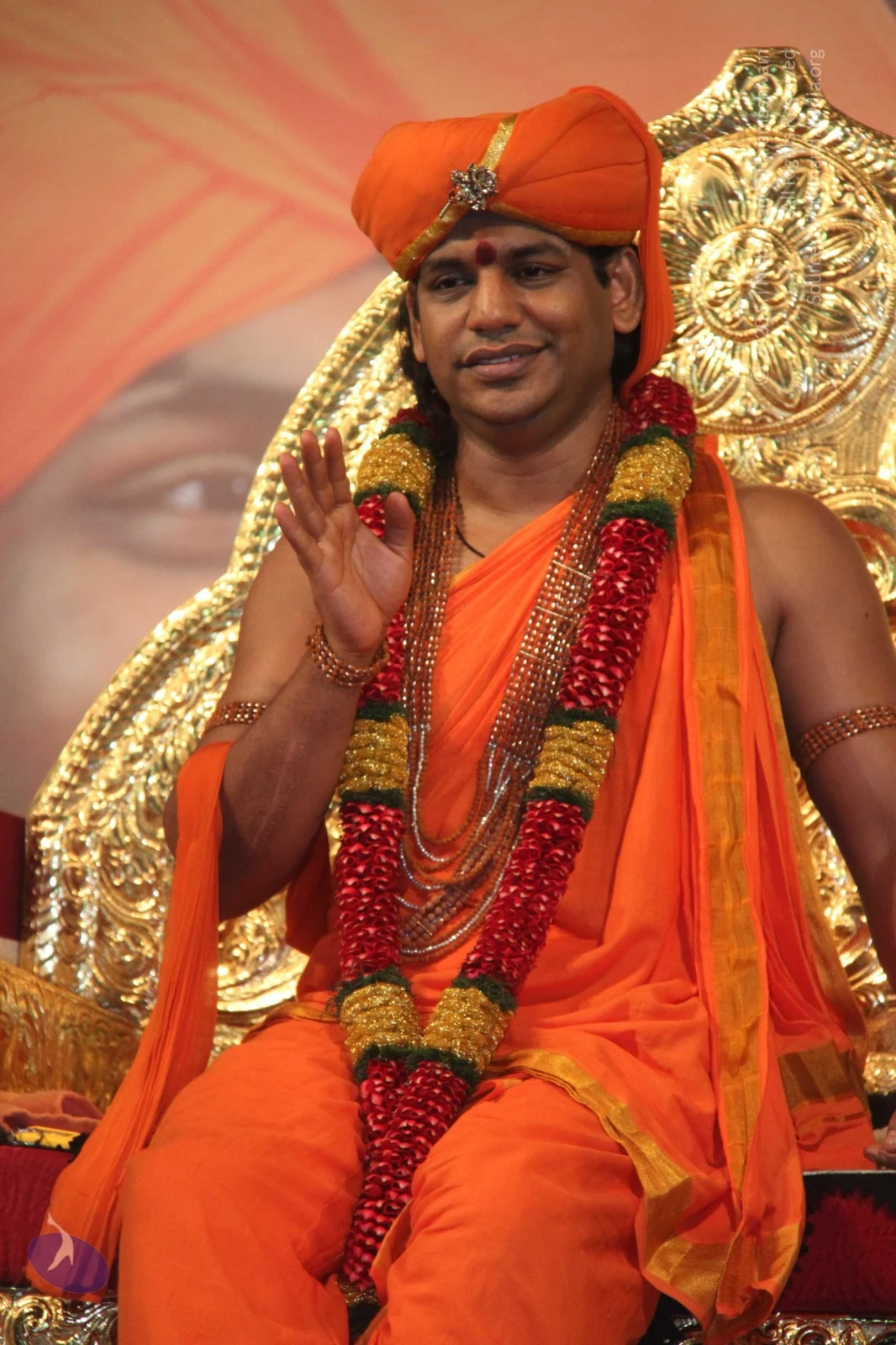
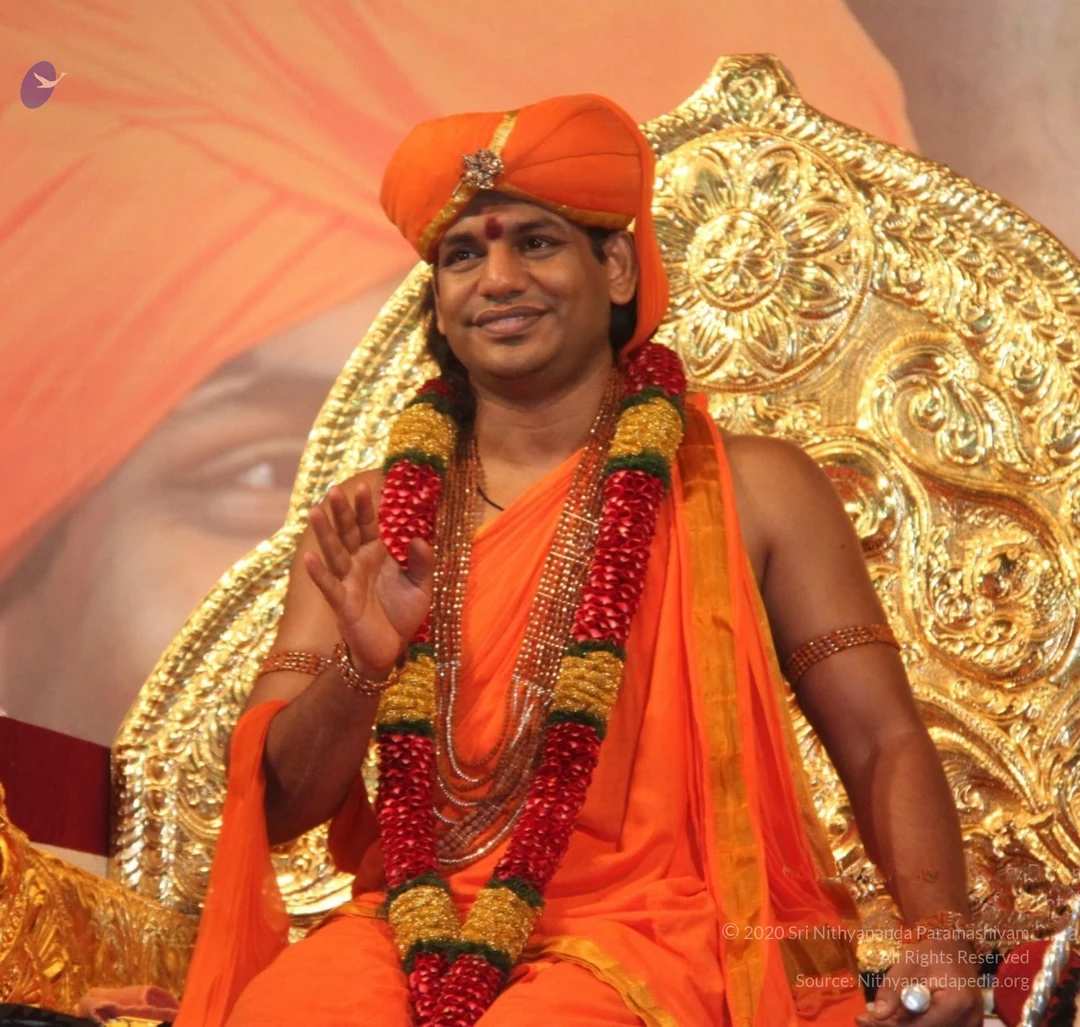
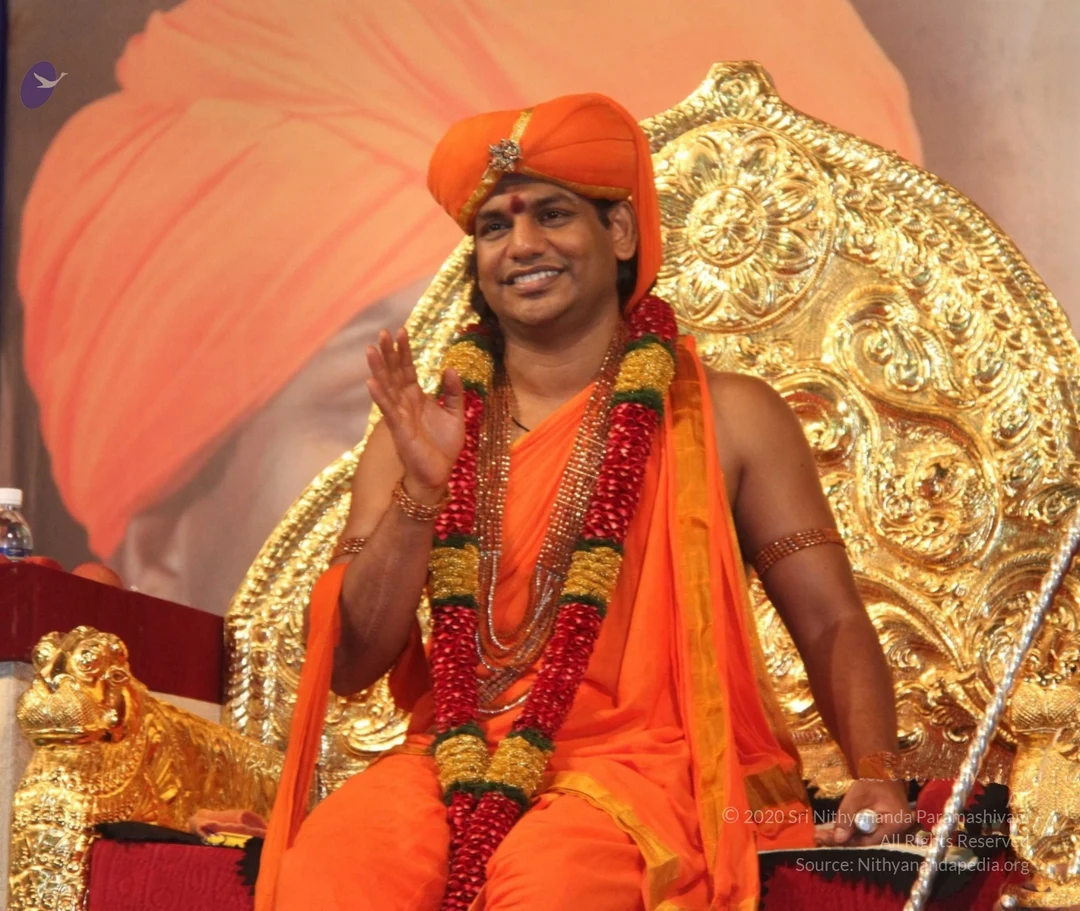
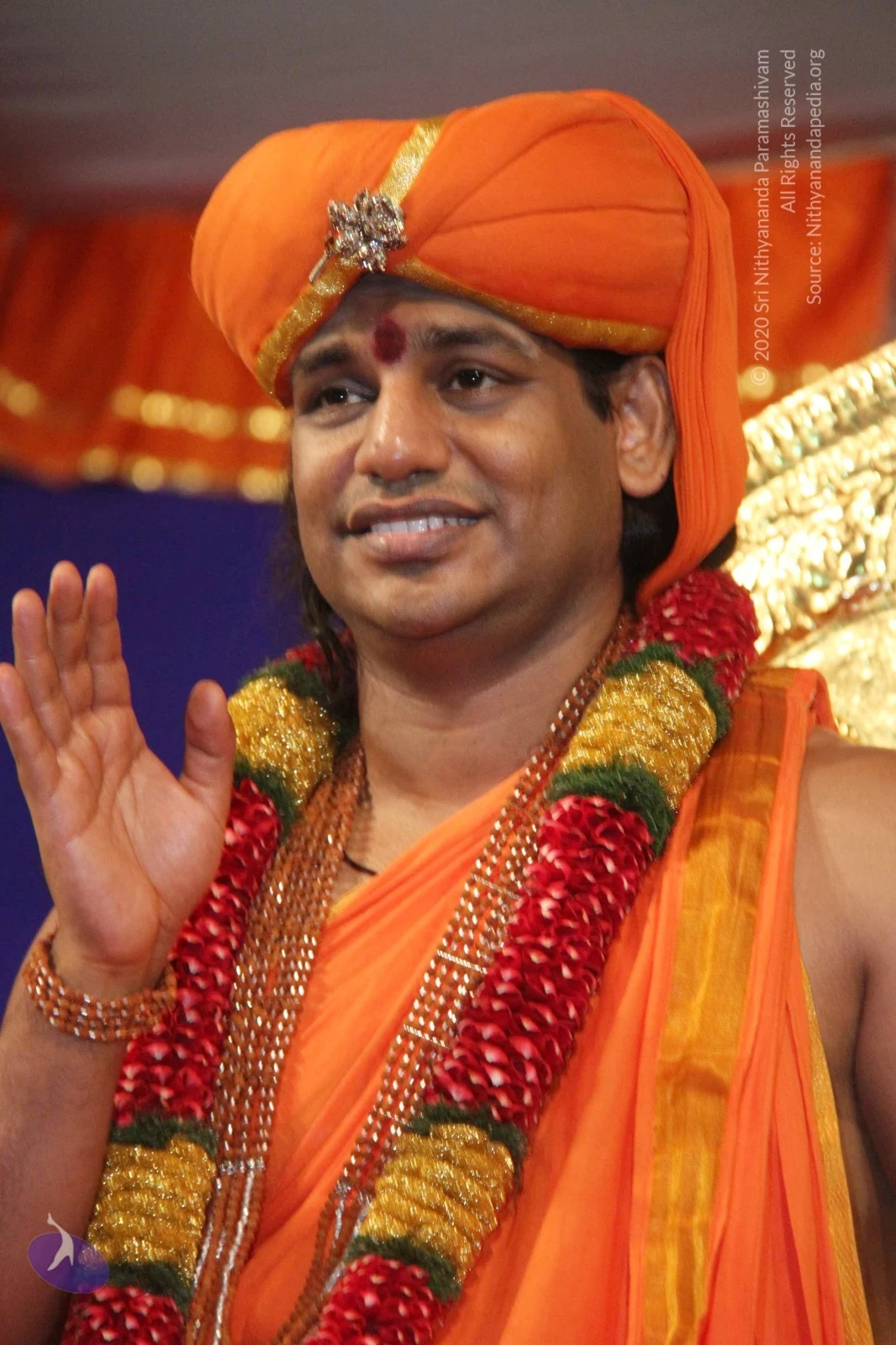
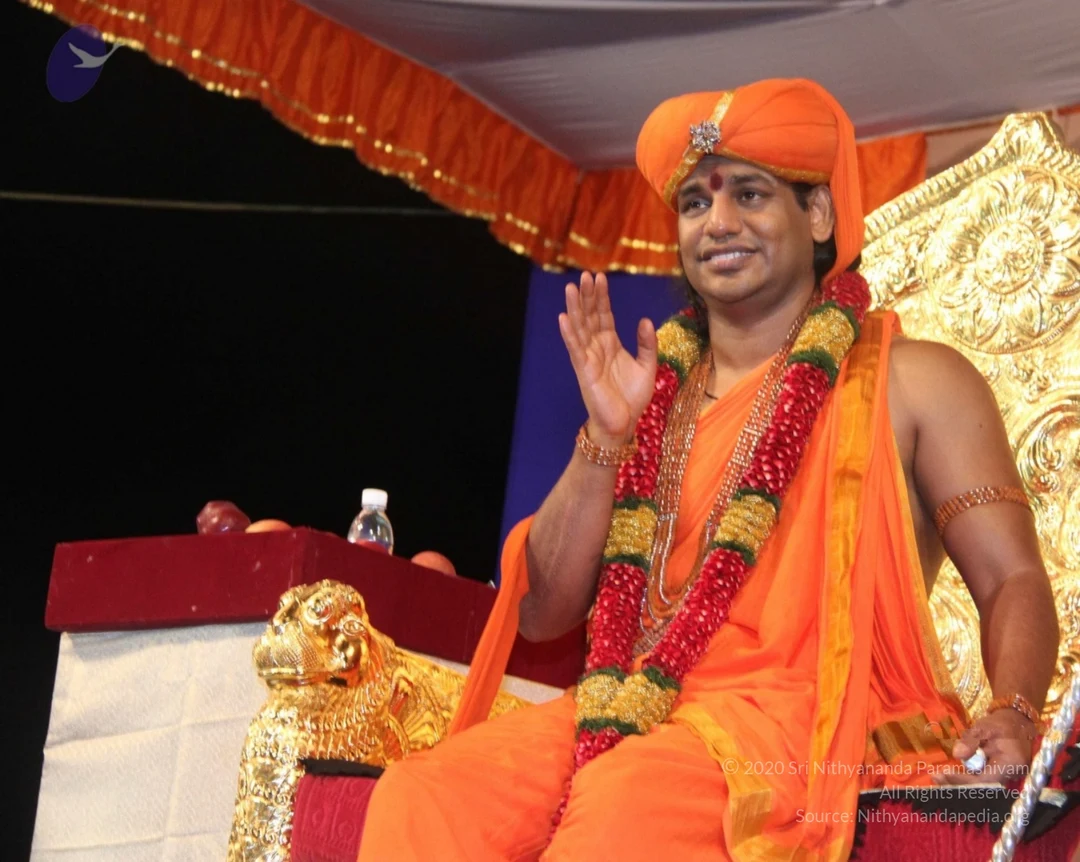
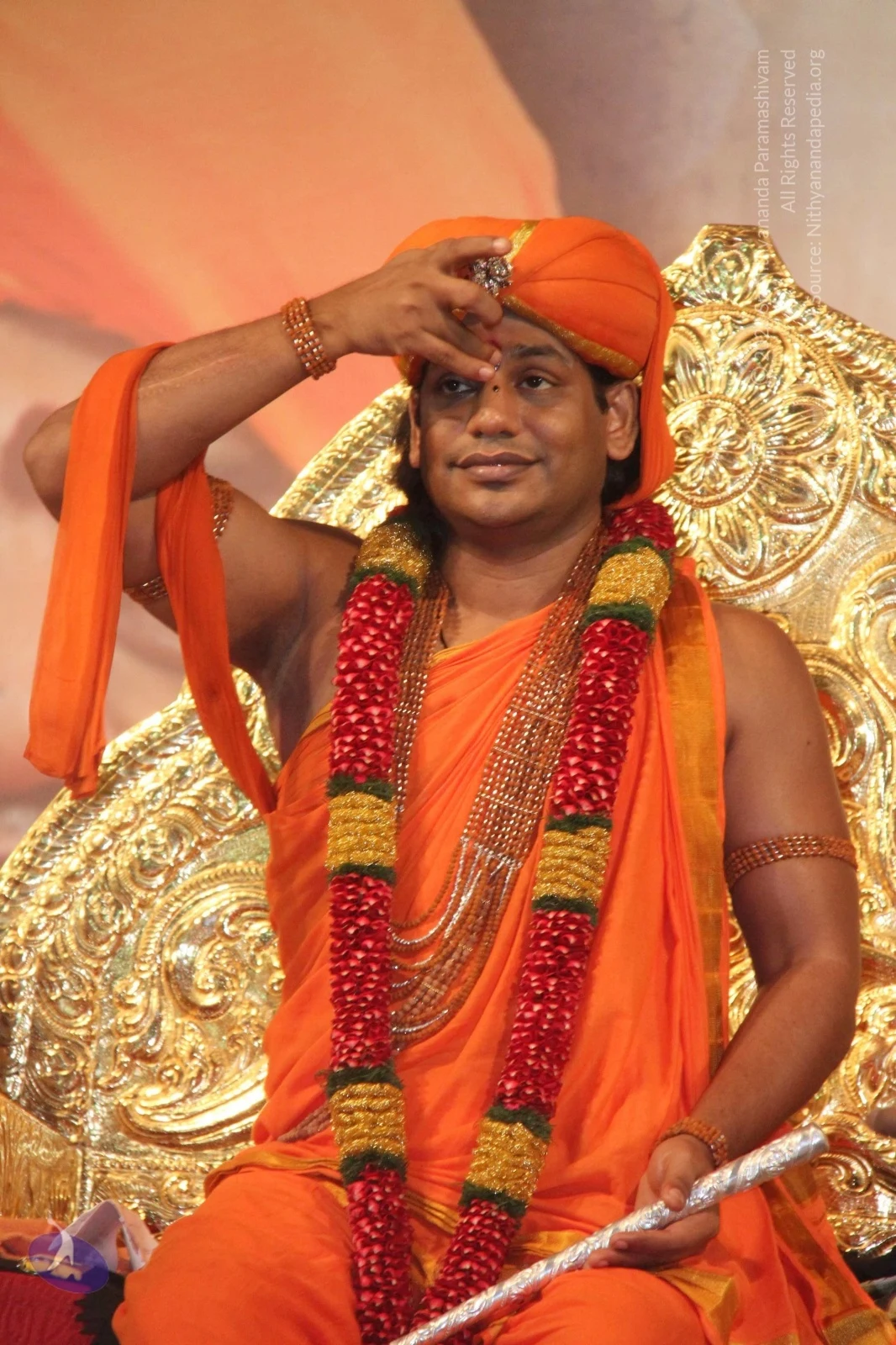
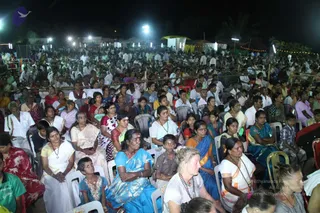
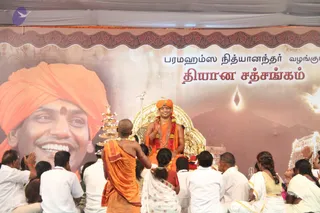
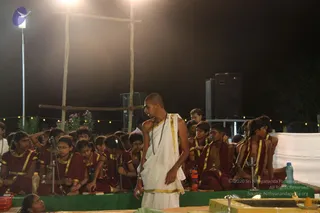
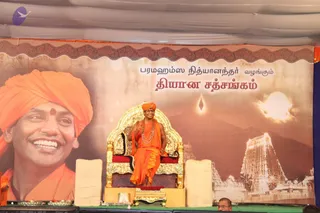
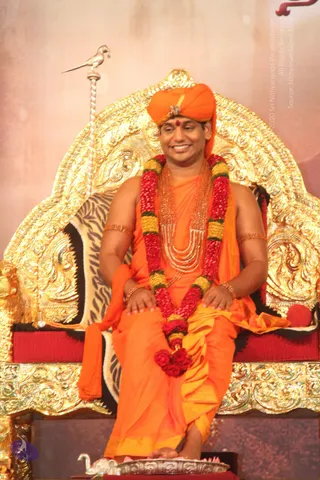
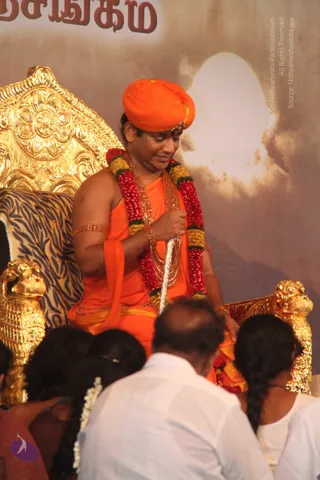
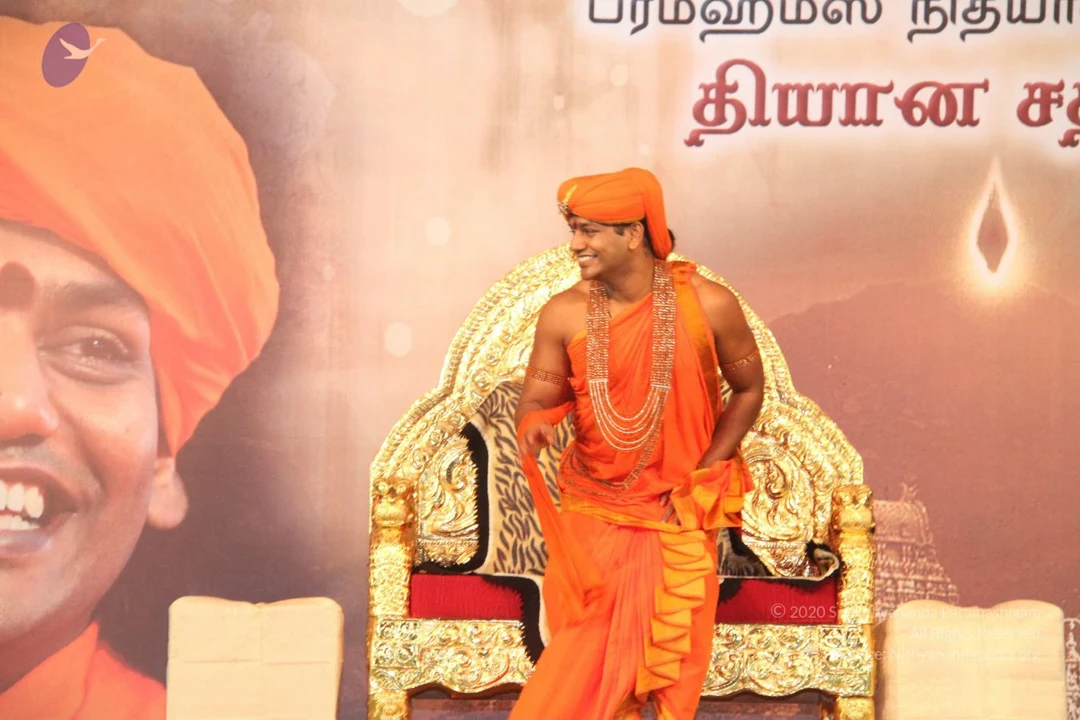
Outdoor evening satsang at night under a canopy, with strings of lights overhead. A man in an orange saffron robe, orange turban, and red and white flower garlands sits on an ornate gold throne with lion-head armrests, holding a small staff and making a hand gesture while smiling. a person is seated on the throne, which is consistent with the page. Seated devotees in white and colourful saris and kurtas, several with palms pressed together in anjali, face him on a green mat. A tall cloth backdrop beside the throne shows a large portrait of a smiling man in orange, labelled "Sri Nithyananda Paramashivam". Several people stand in the background, and a water bottle sits on a table beside the throne.A photograph of a large evening gathering of devotees seated in plastic chairs on an open ground at night, lit by overhead floodlights and strings of lights along a building. Most attendees wear white shirts and white dhotis, with some in saffron, orange and red saris and shirts. Several men wear rudraksha malas and tilak markings on their foreheads. The crowd fills the frame, with many people looking toward the front in attentive posture, some with hands folded in prayer. A stage or speaker is not visible in the frame.A large outdoor evening gathering seen from behind rows of white plastic chairs, with a crowd of mostly women and some children seated facing a stage out of frame. Many women wear sarees in blue, white with gold borders, pink and red, and some wear rudraksha or bead necklaces. A few men in white shirts and dhotis sit among them. Bright floodlights and string lights illuminate tents and pavilions in the background under a night sky. A white-clad older woman and a blonde woman in a white outfit with beads are prominent in the front rows. No readable text is visible in the scene.A photograph of a seated figure in saffron-orange robes and an orange turban with a red tilak, wearing a red and white flower garland and layered rudraksha-style beaded necklaces, seated on an ornate gilded throne with hands in greeting. A shaved-headed attendant in orange robes stands at left facing the throne, and a row of seated devotees in white and cream clothes fills the foreground, some with hands raised. Behind is a large banner with a painted portrait of a smiling man in an orange turban and red tilak, plus Tamil script reading 'பரமஹம்ச நித்யானந்தர் வழங்கும்' and 'தியான சத்சங்கம்'. A brass oil lamp stand and a glowing lamp flame appear on the stage. Probable Swamiji seated on the throne, identified by orange turban, saffron robes, layered beads and garland.Night outdoor gathering on a raised green-draped stage lit by a bright overhead lamp and string lights. A shaven-headed young man in white dhoti and shawl with gold border, wearing a rudraksha mala, stands center-front while gesturing. Behind him, thirty or more young boys and girls sit in rows wearing maroon kurtas and maroon shawls with gold trim, some with rudraksha malas. Loudspeakers, wooden poles, a water bottle and a brass puja tray with a lit lamp and flowers appear in the foreground. a person is not identifiable from appearance in this image.A saffron-robed man sits on an ornate gold-and-red throne on a stage, raising one hand in greeting. He wears an orange turban, a red bindi, layered beaded necklaces and an orange shawl. Behind him a large banner shows a smiling man in an orange turban and a glowing lamp over a temple tower. A partially visible seated person in dark clothing sits at the lower right edge. Tamil text on the banner reads 'Dhyana Satsangam' led by Paramahamsa Nithyananda. Swamiji (probable) is the seated throne figure, identified by his saffron robes, orange turban, beaded necklaces and throne seat, presiding over the meditation satsang.

Thiruvannamalai-PublicDharshan-Rudrabhishekam

68 photosSource gallery
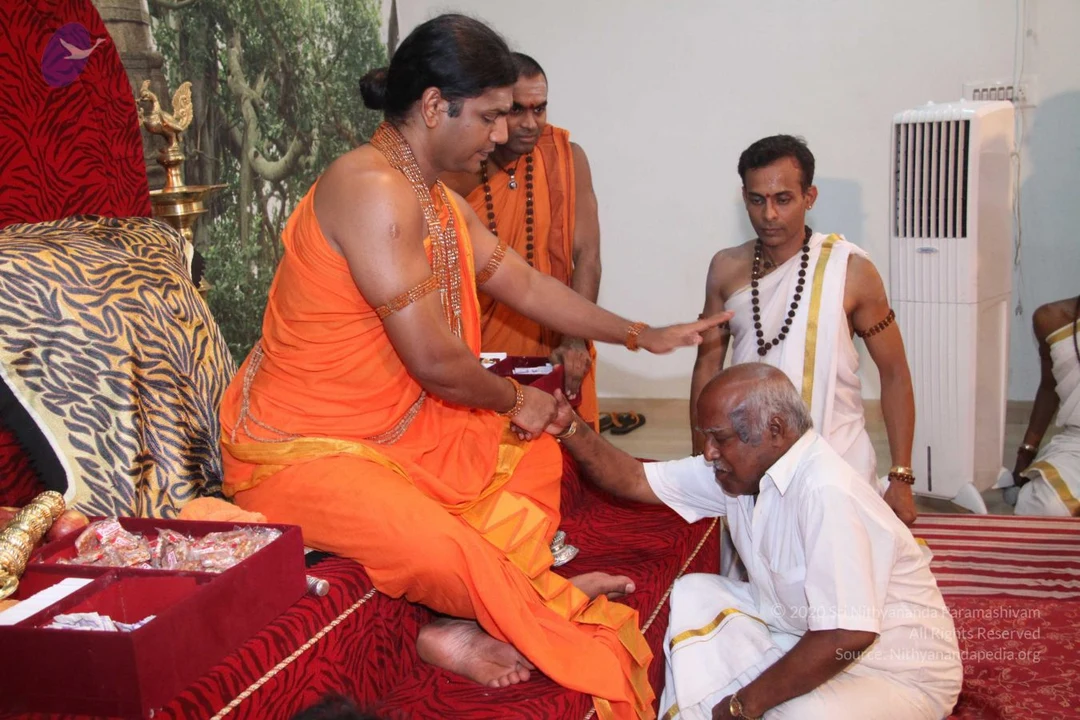
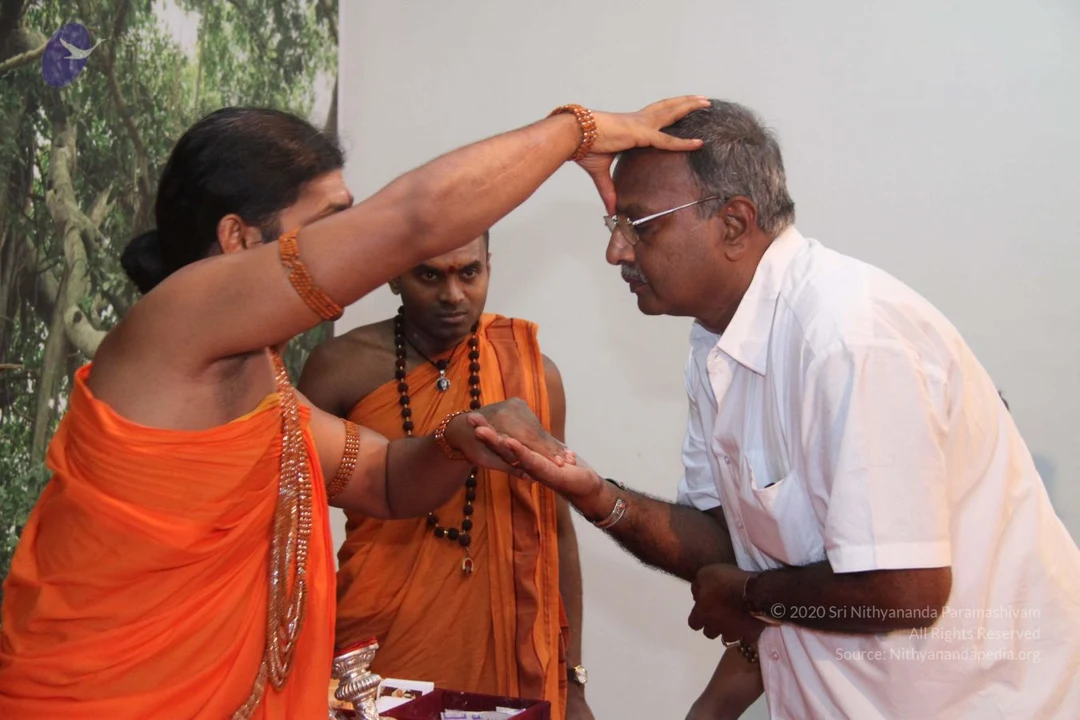
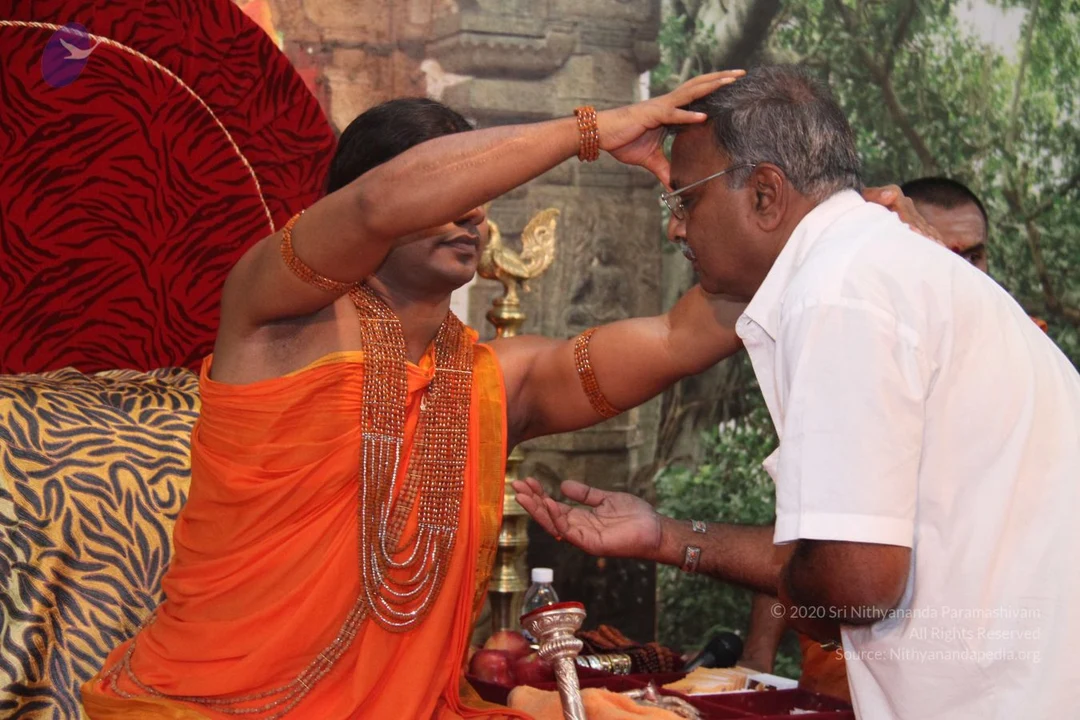
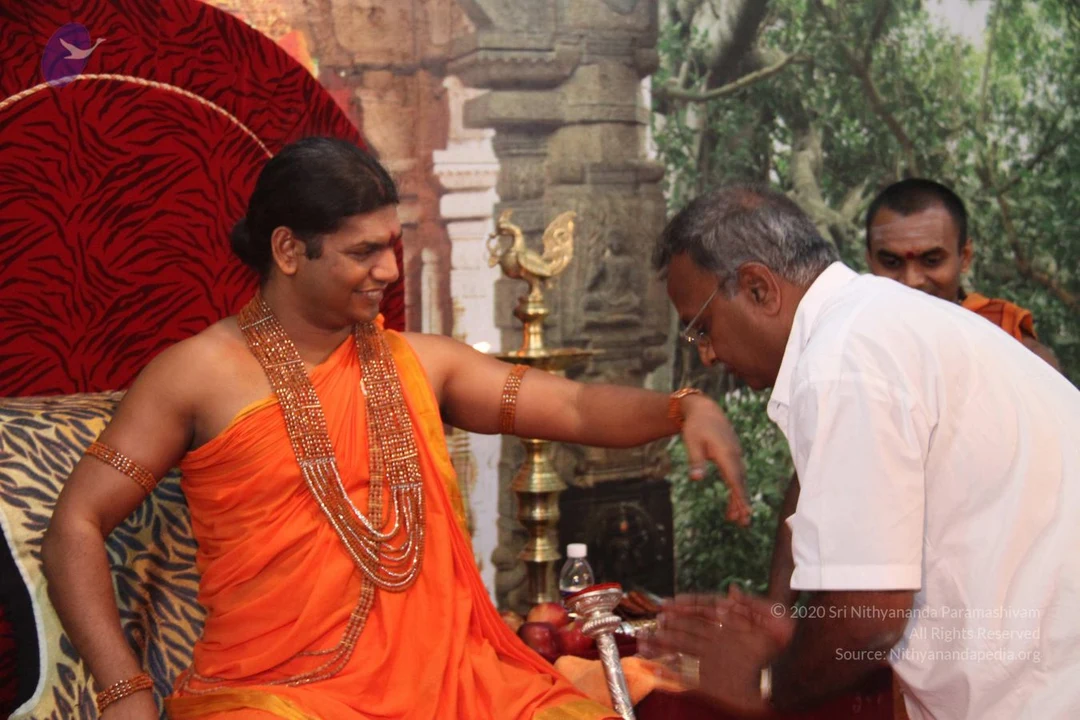
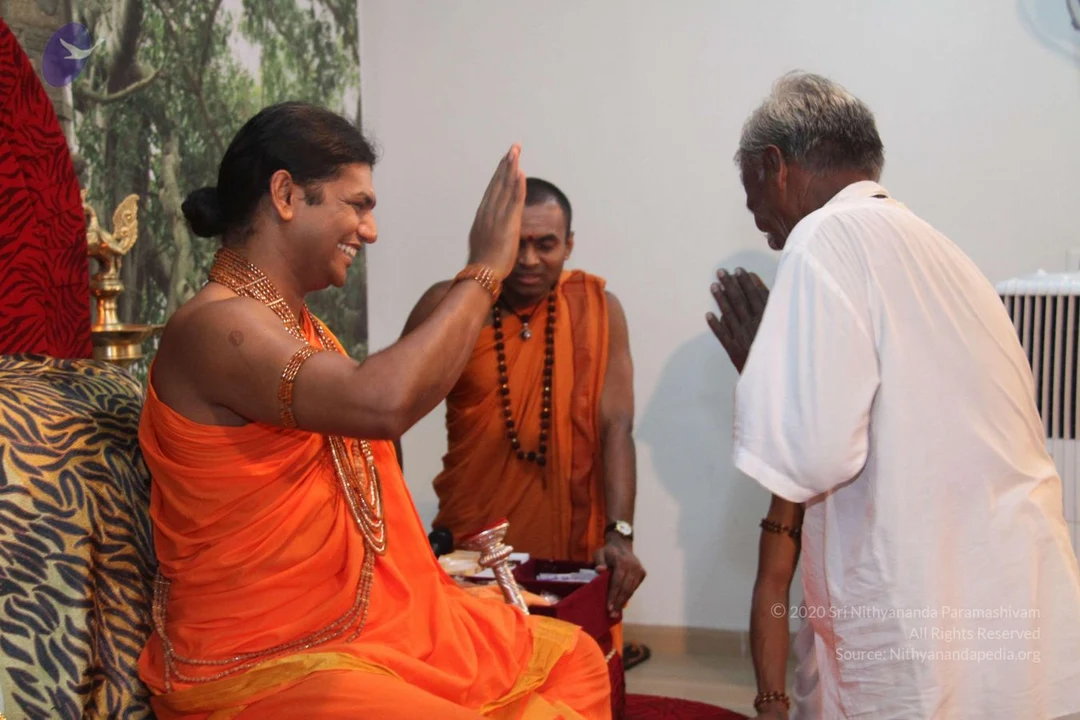
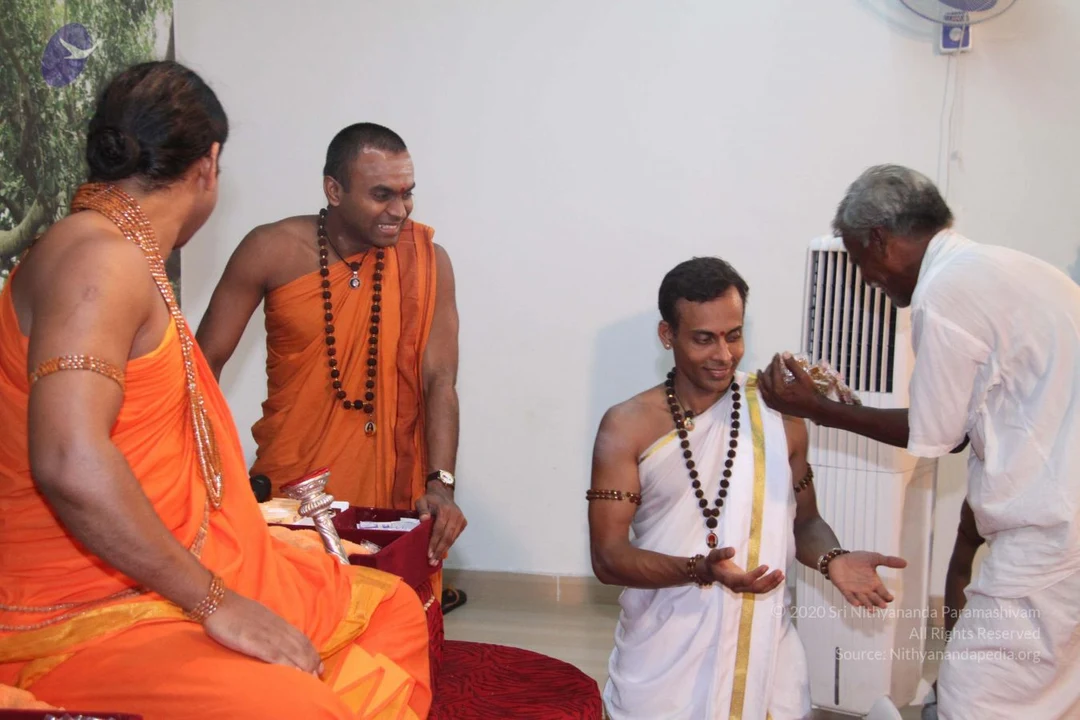
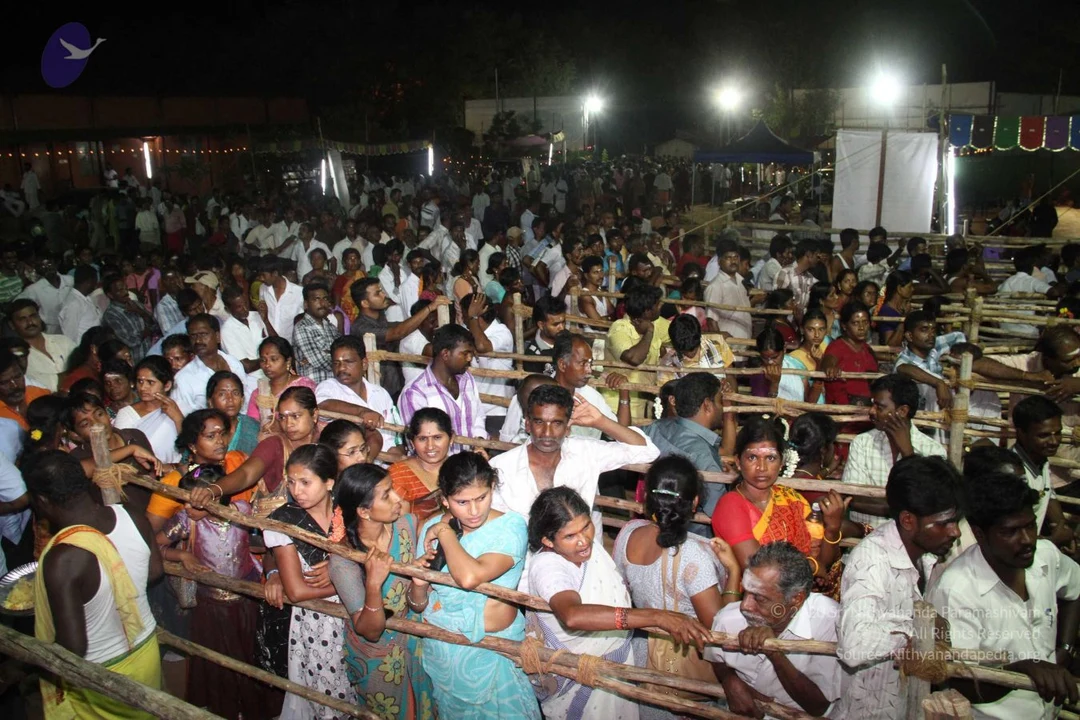
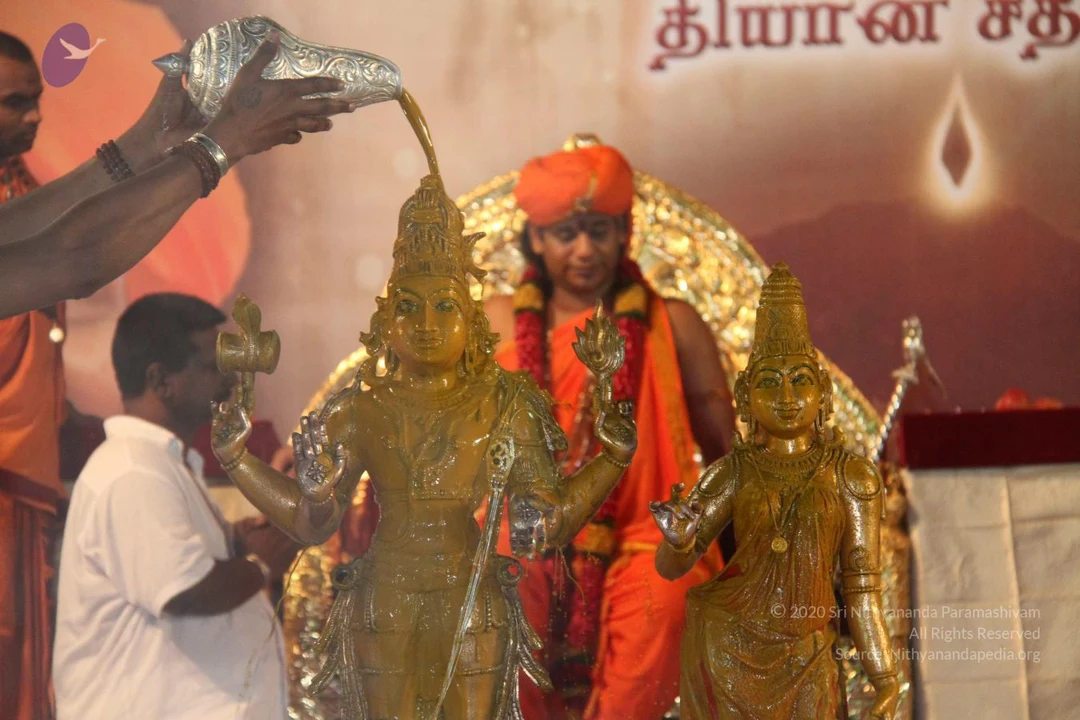
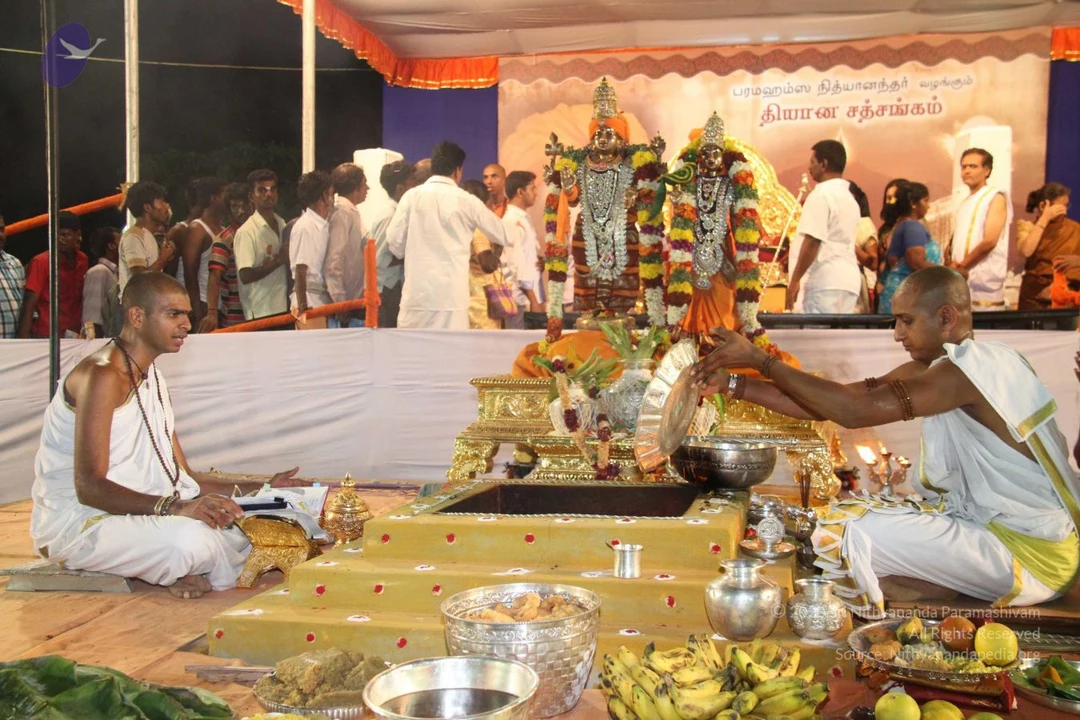
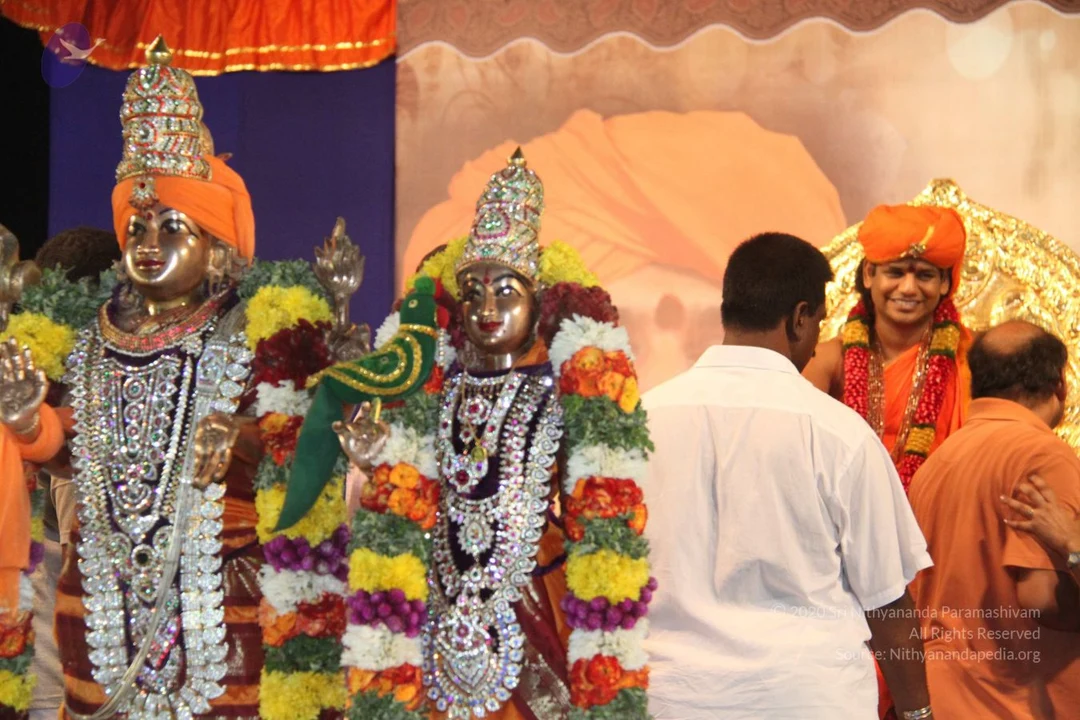
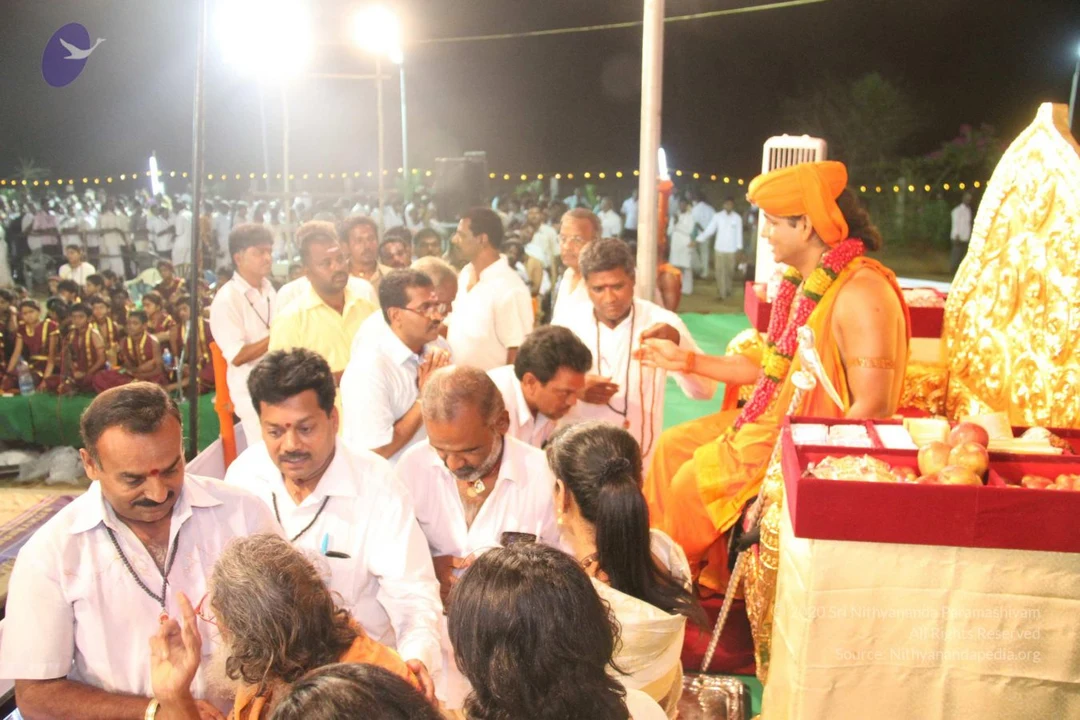
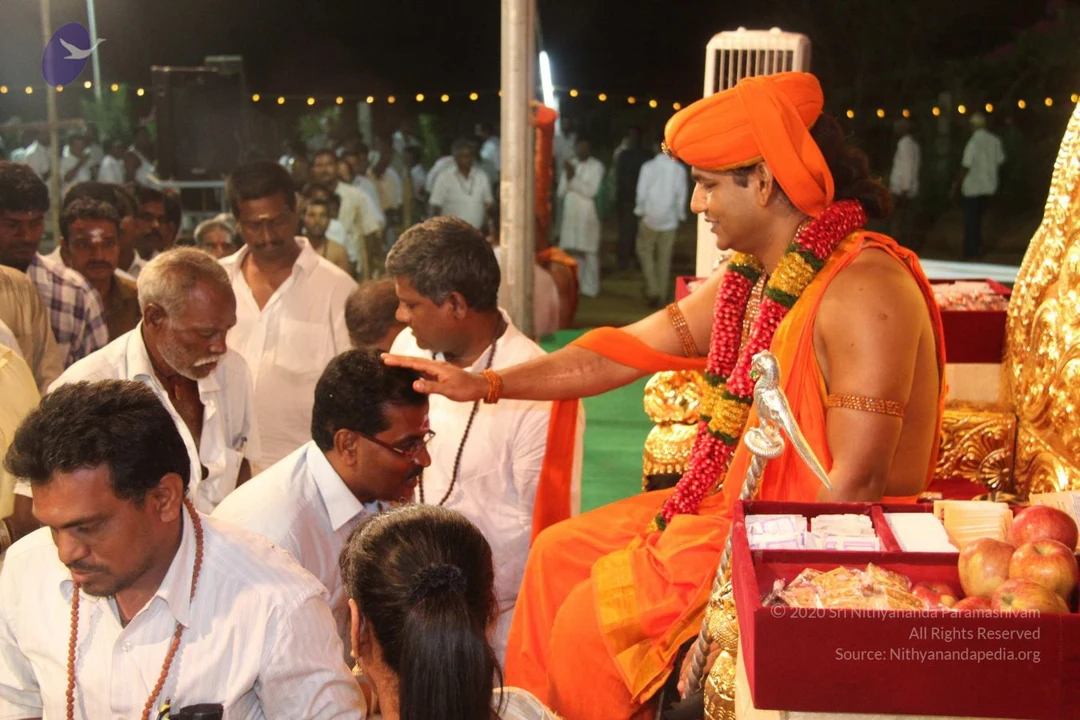
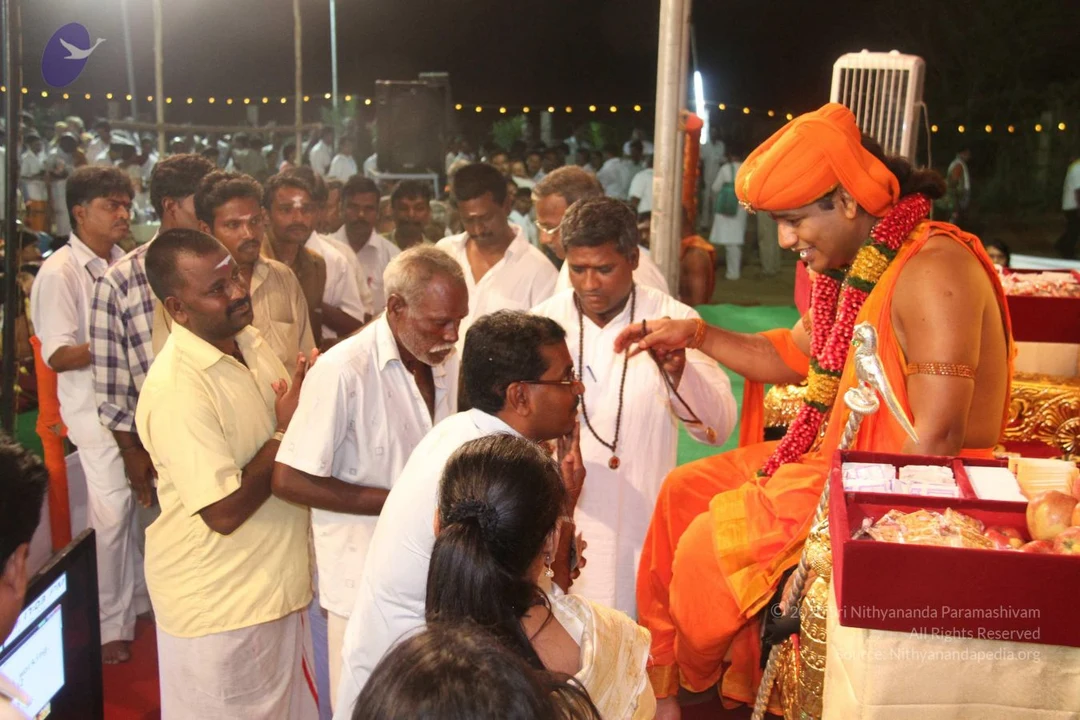
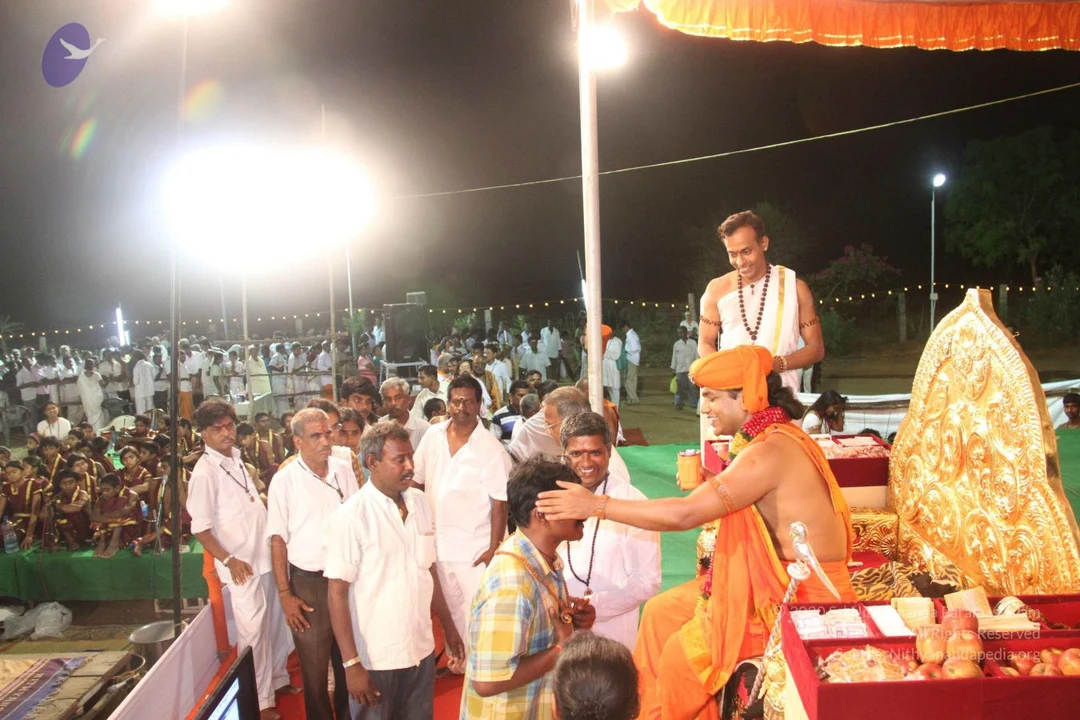
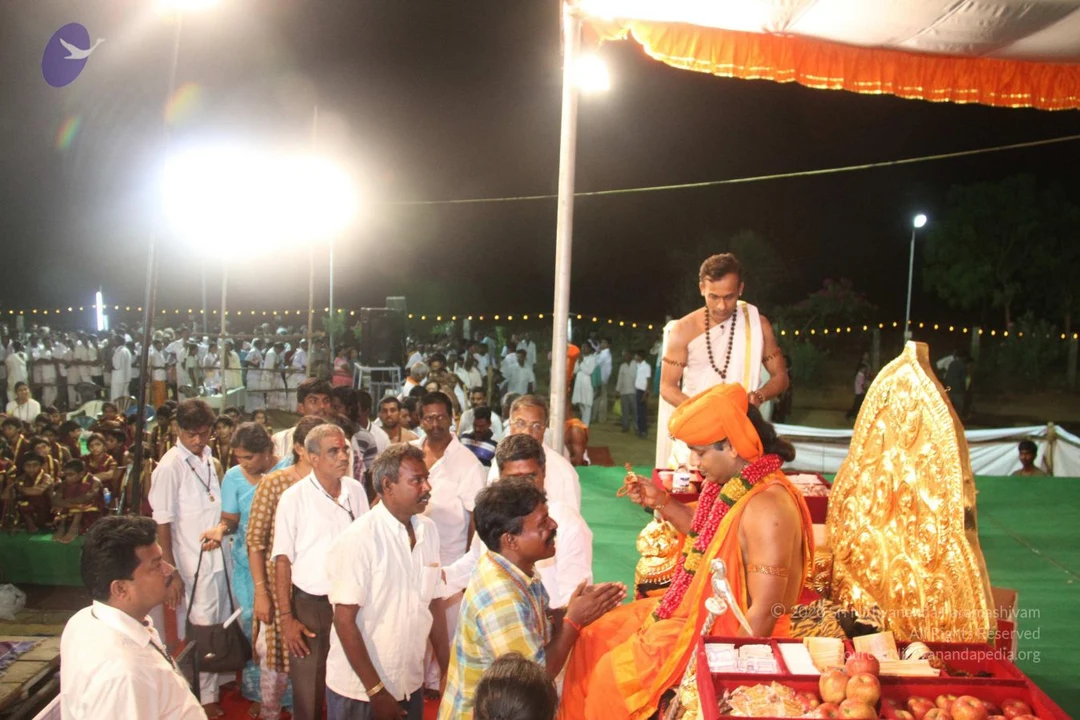
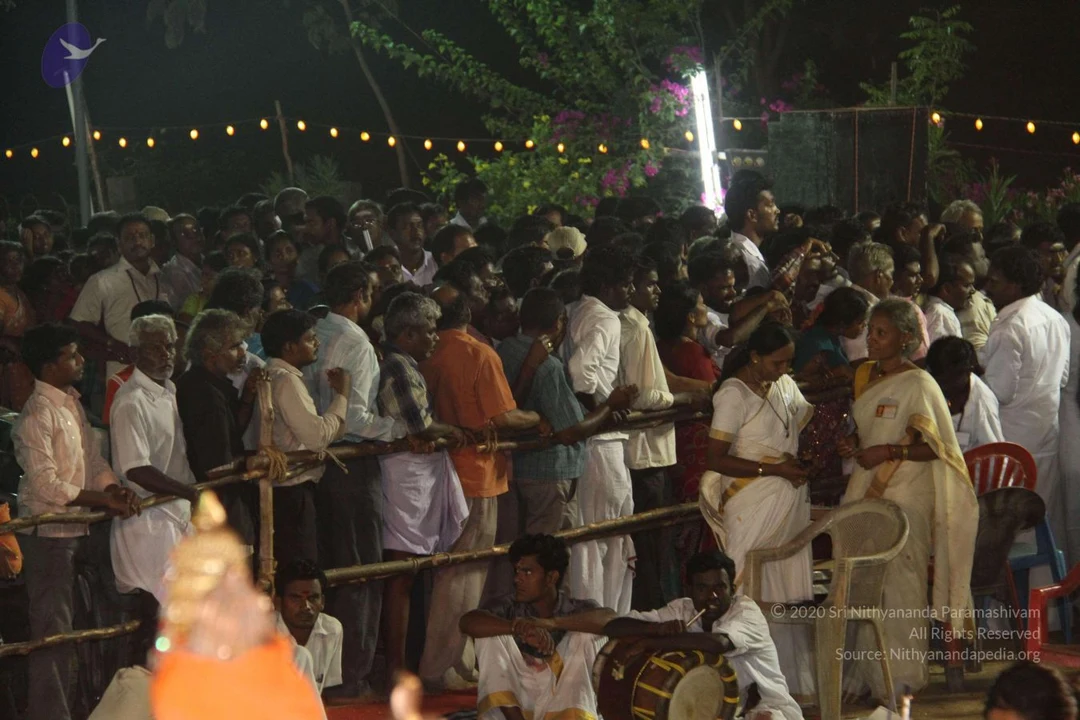
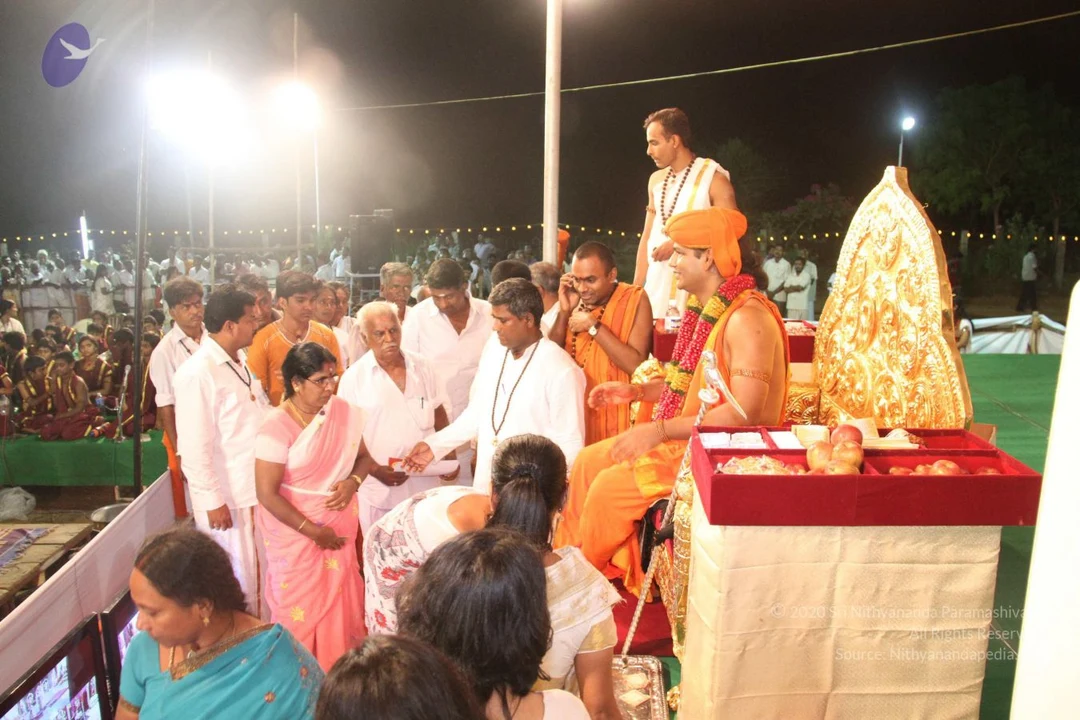
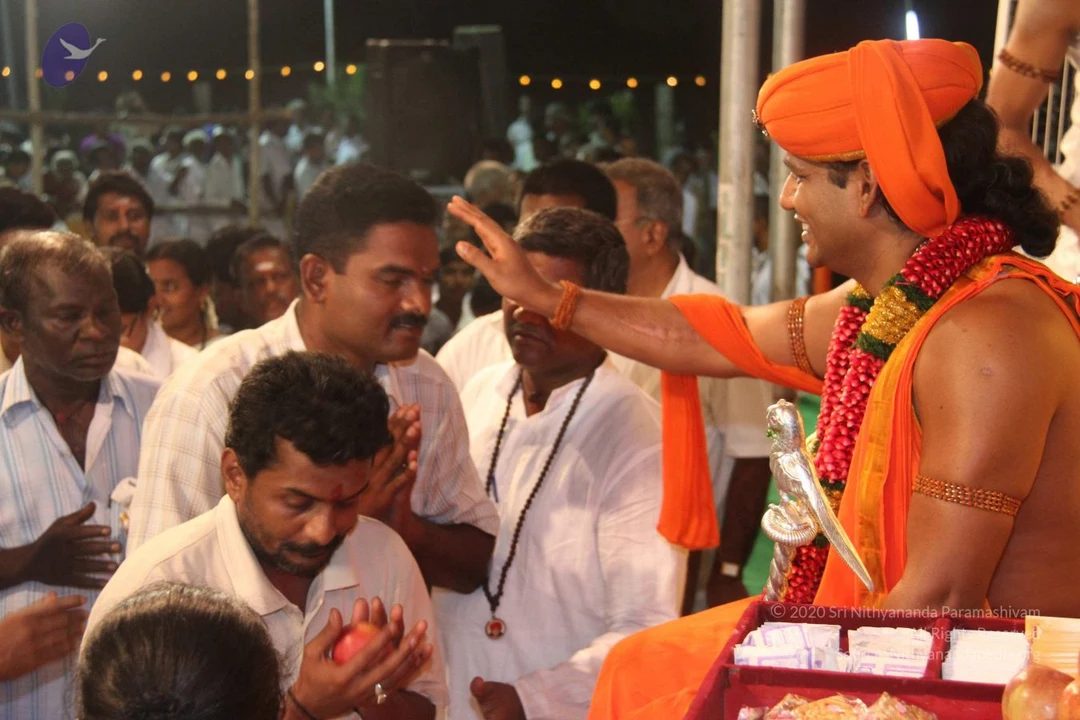
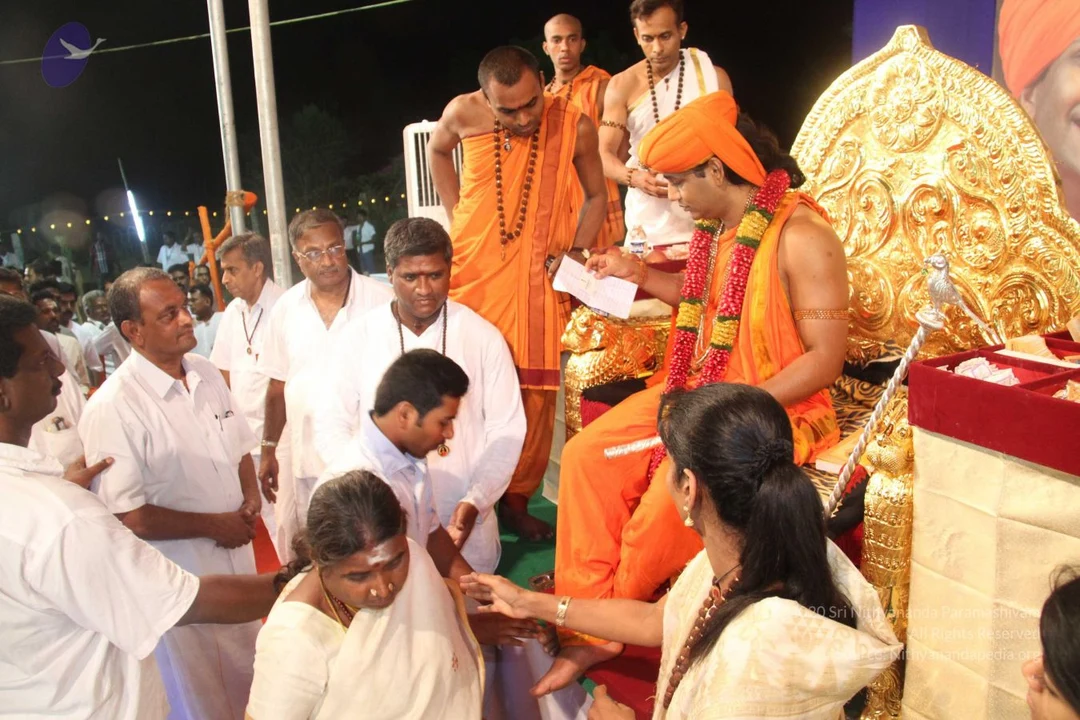
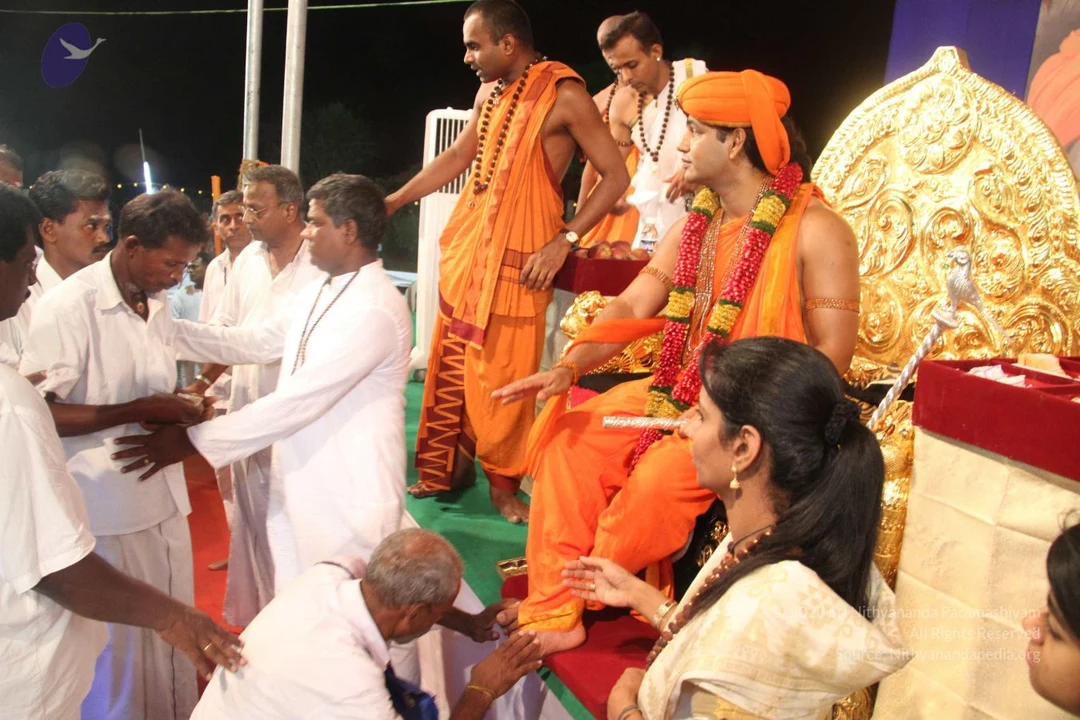
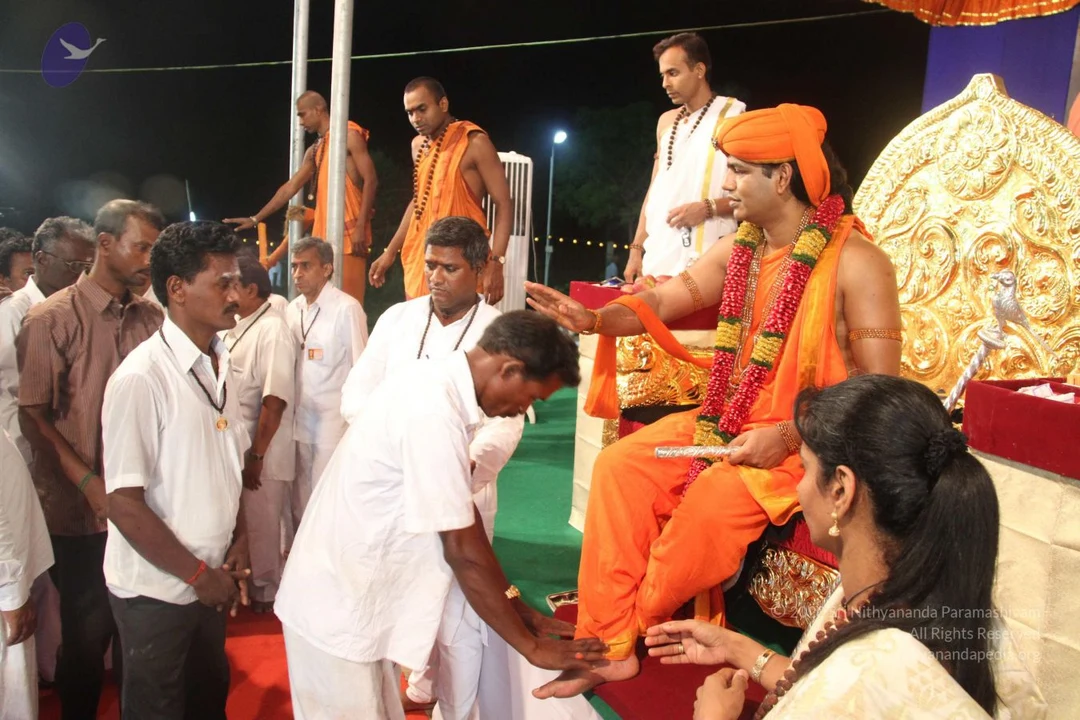
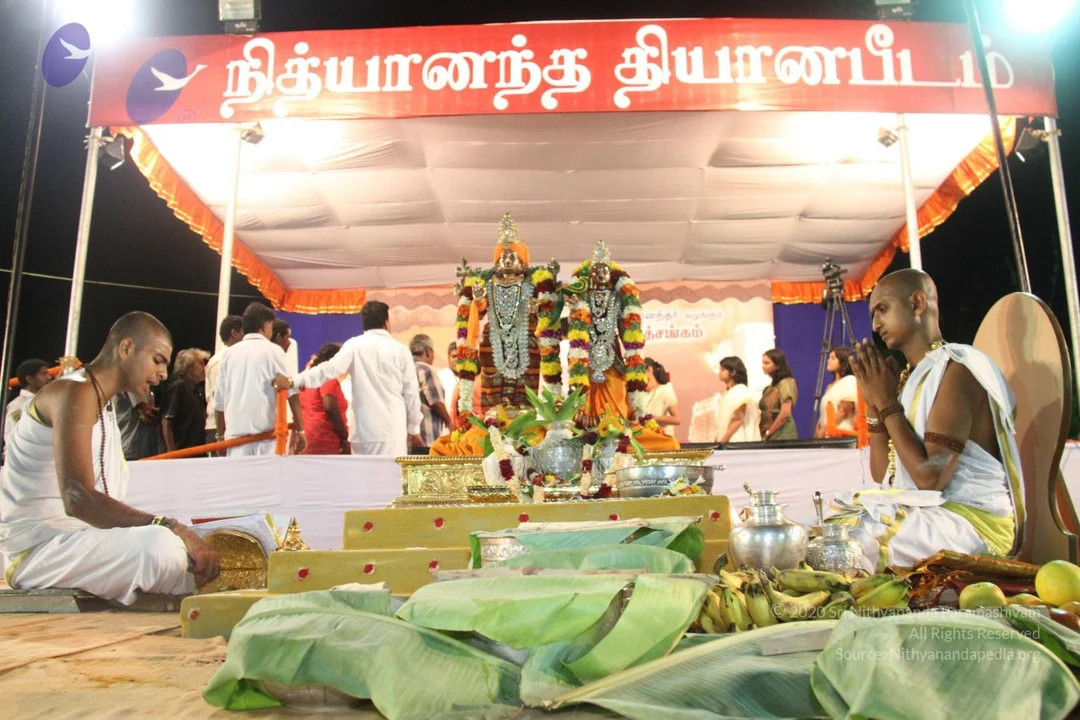
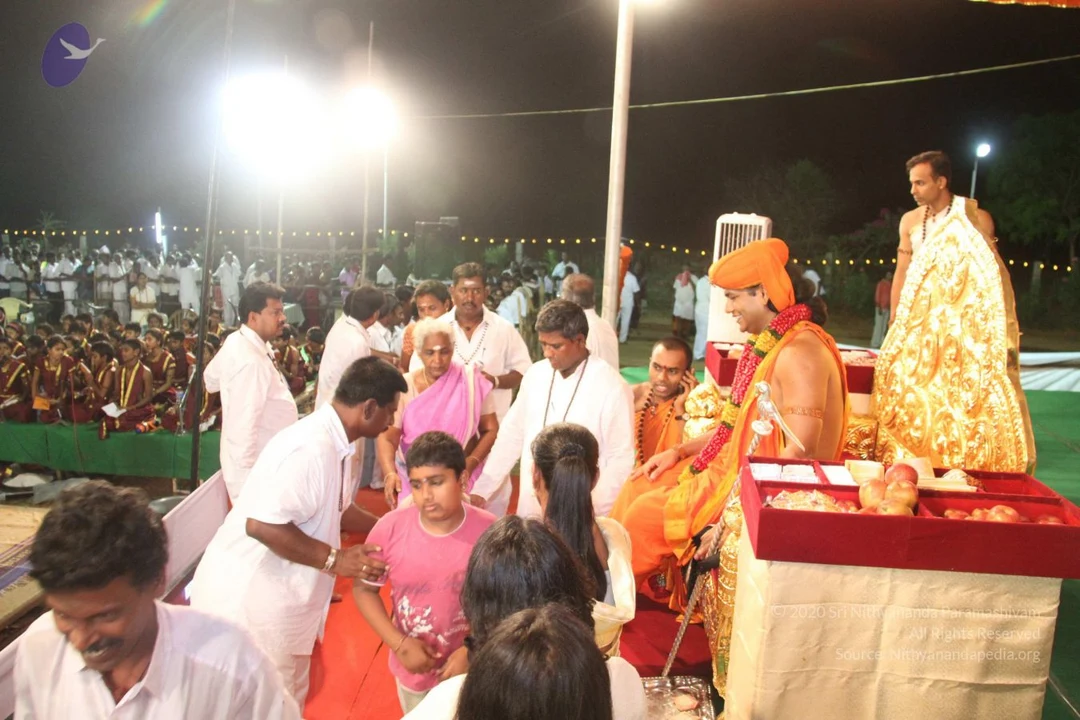
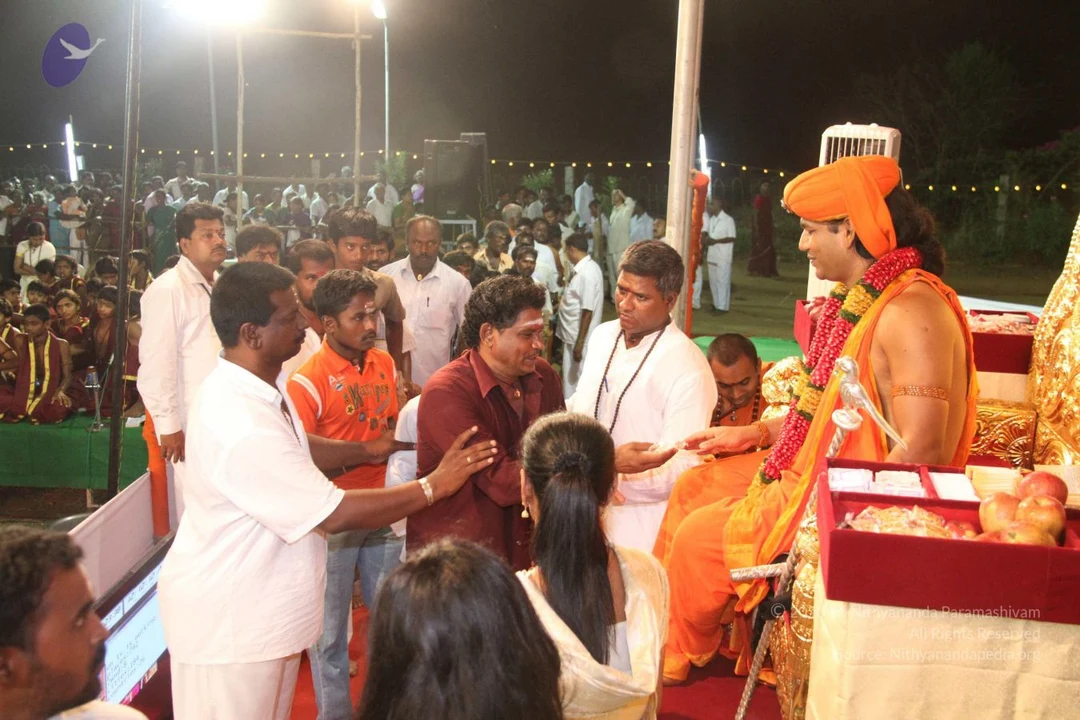
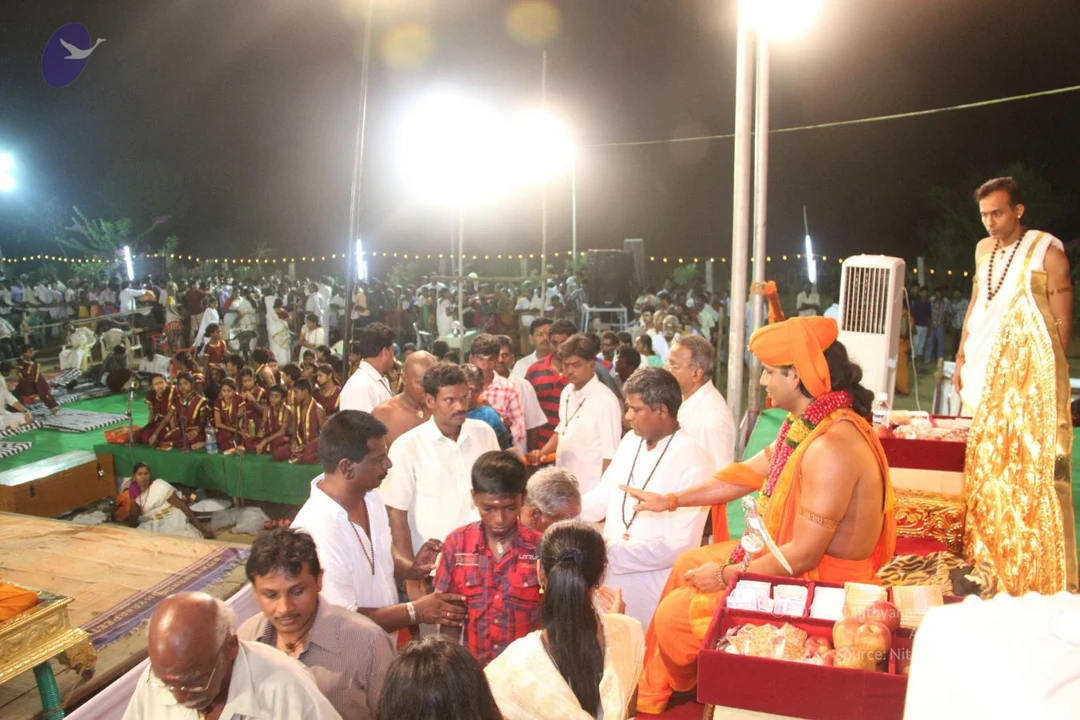
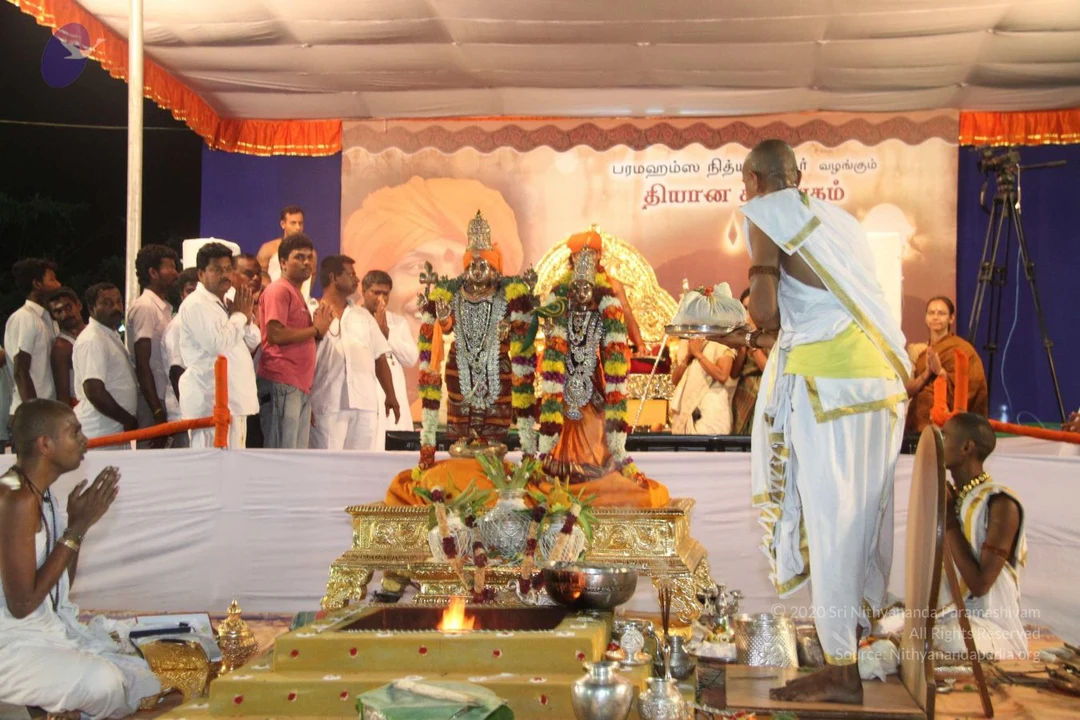
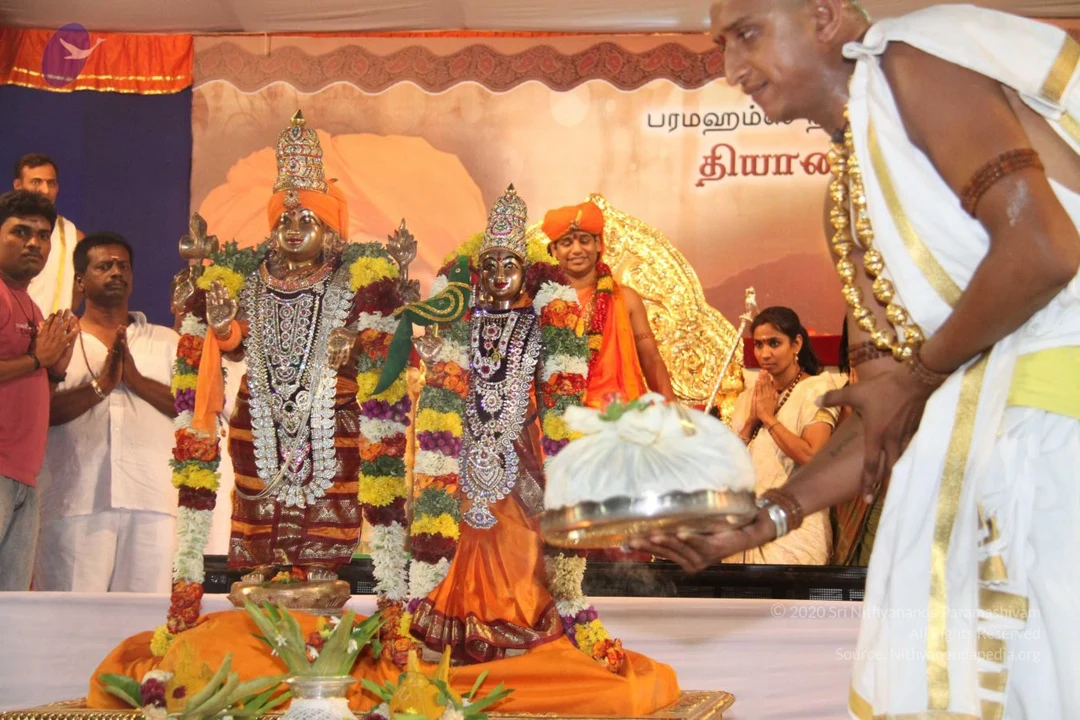
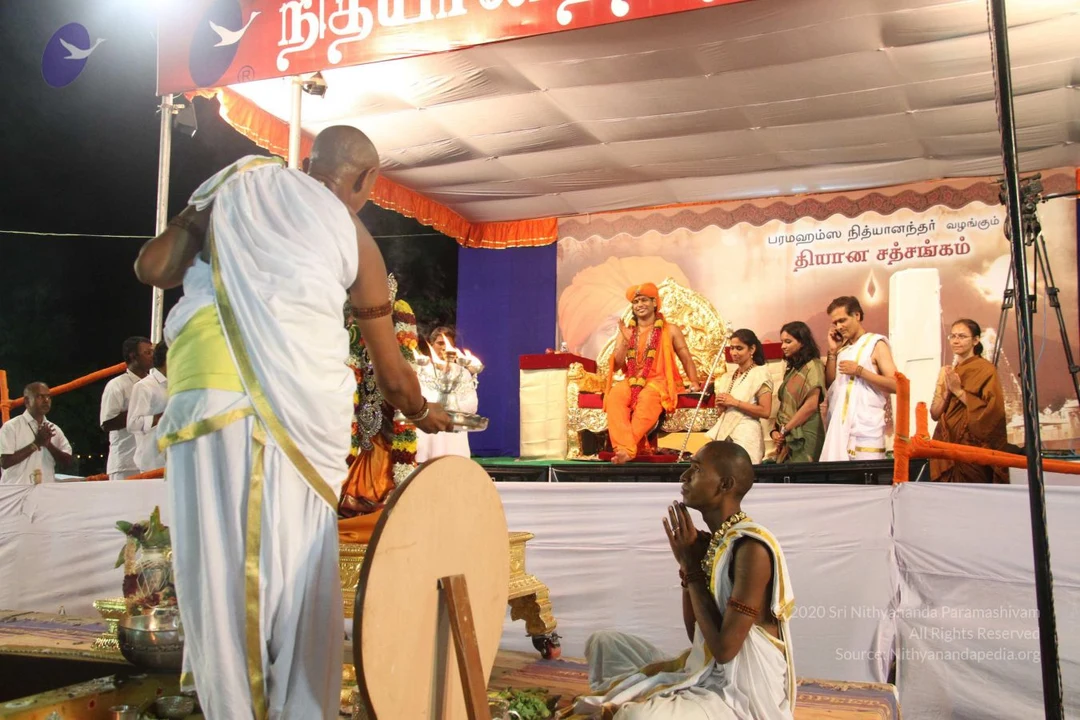
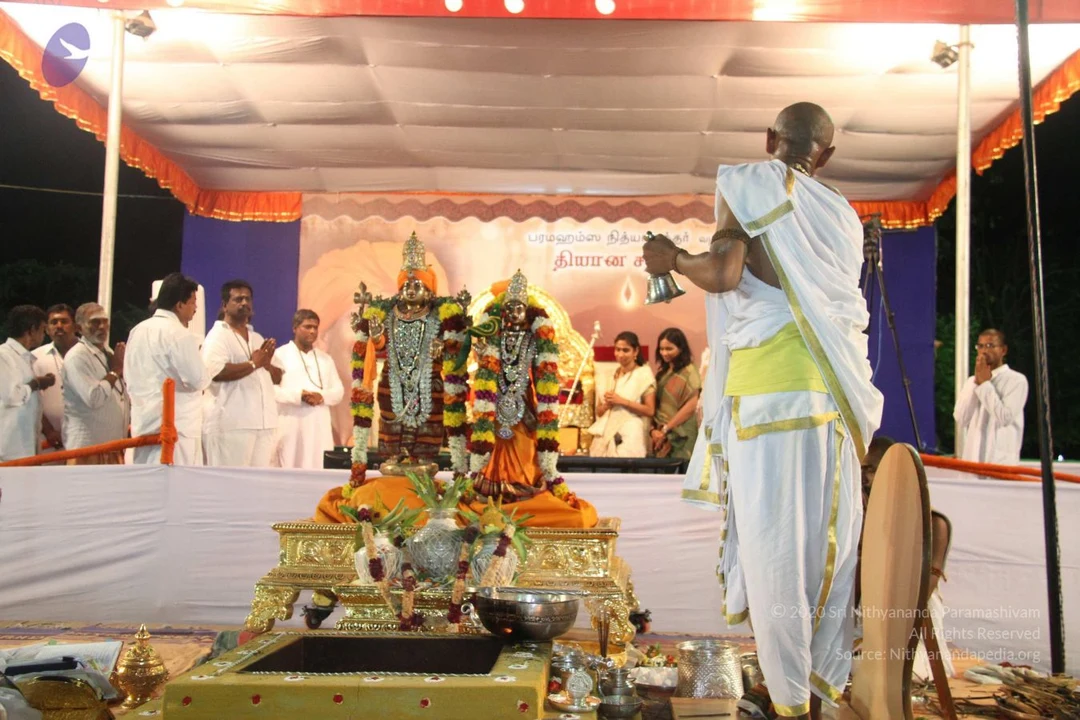
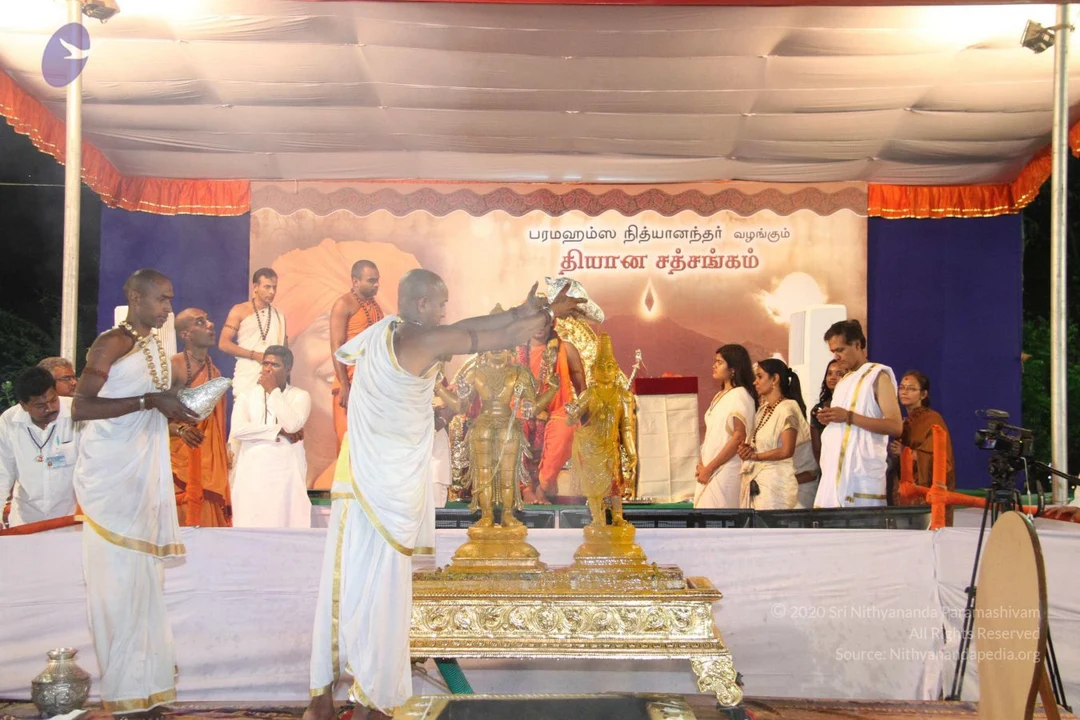
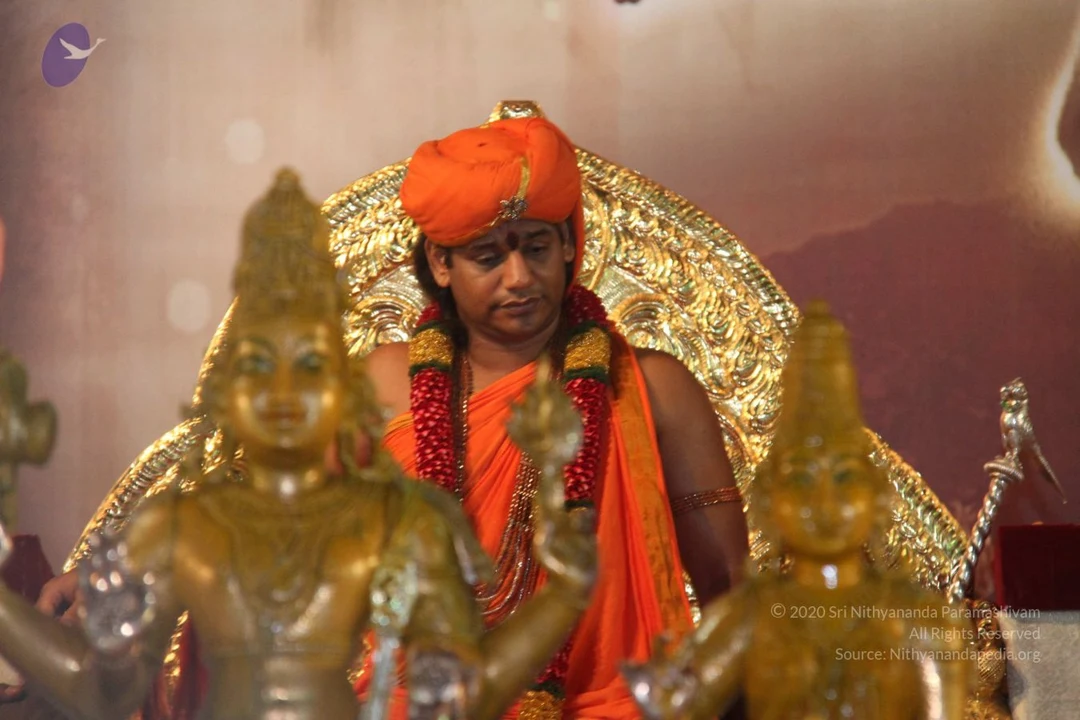
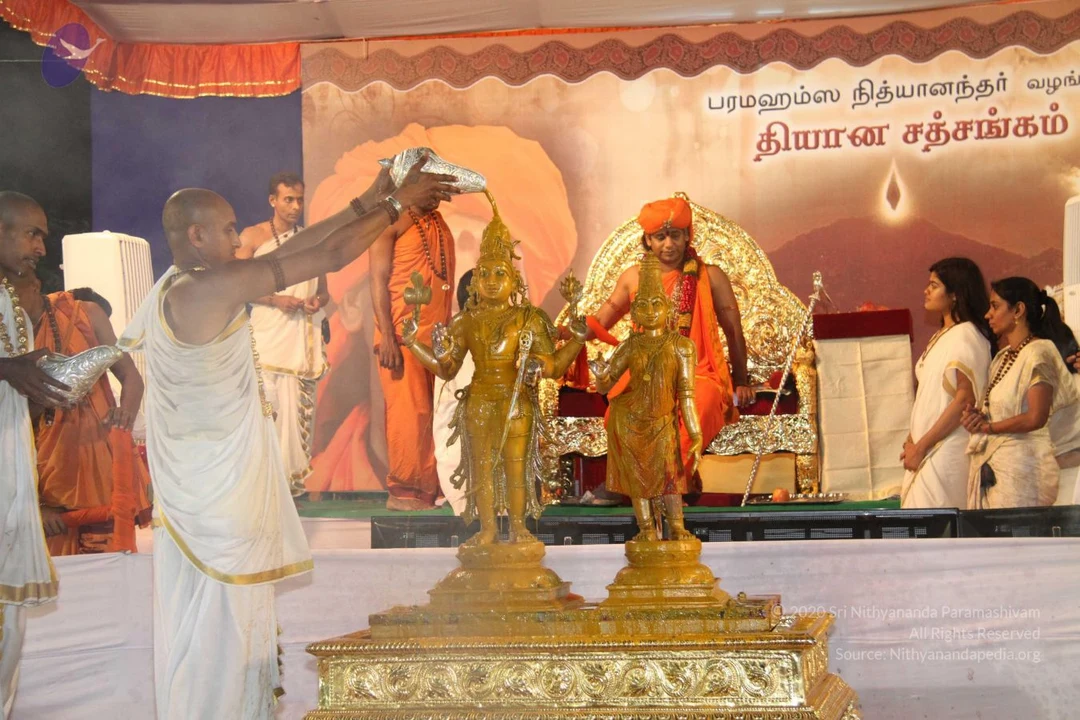
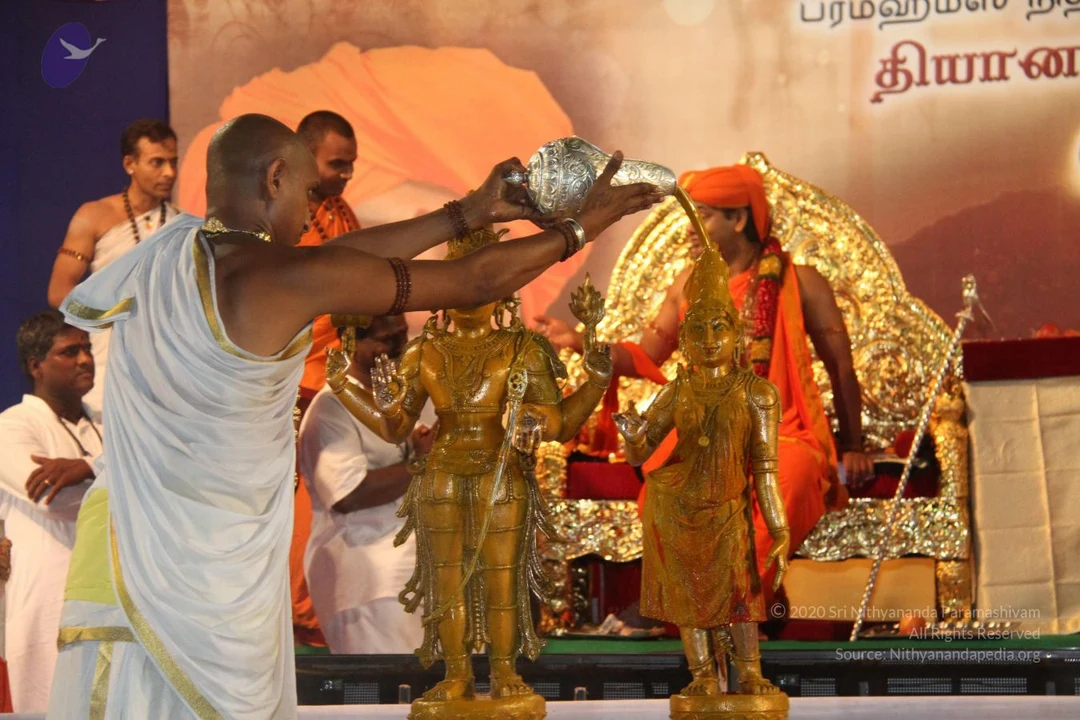
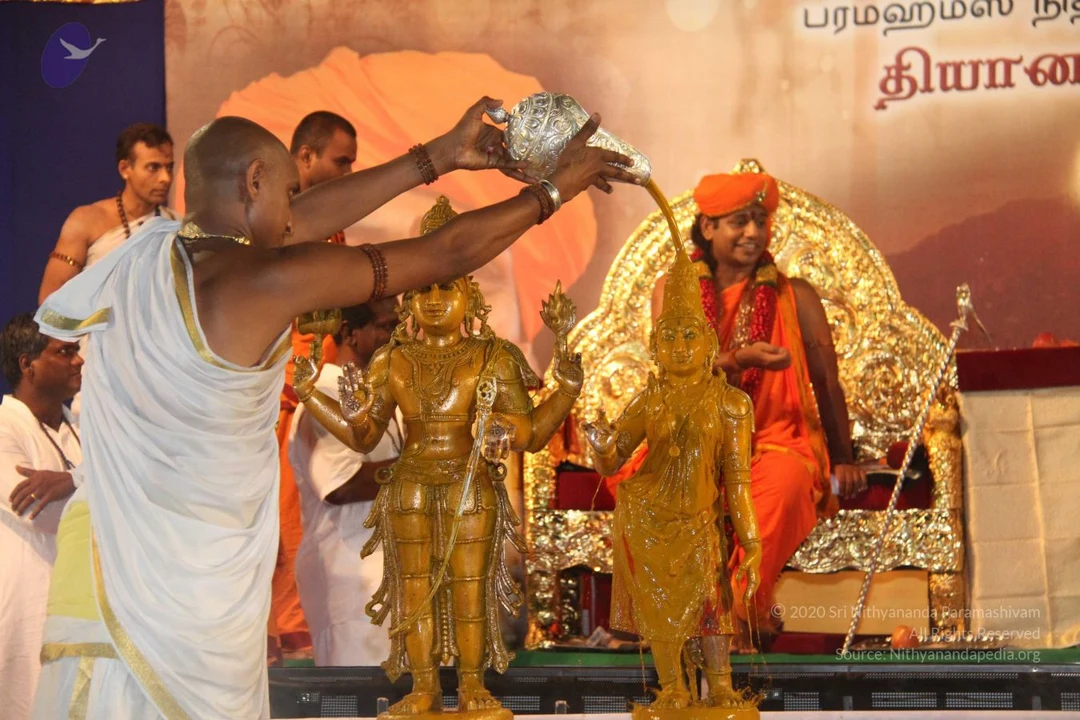
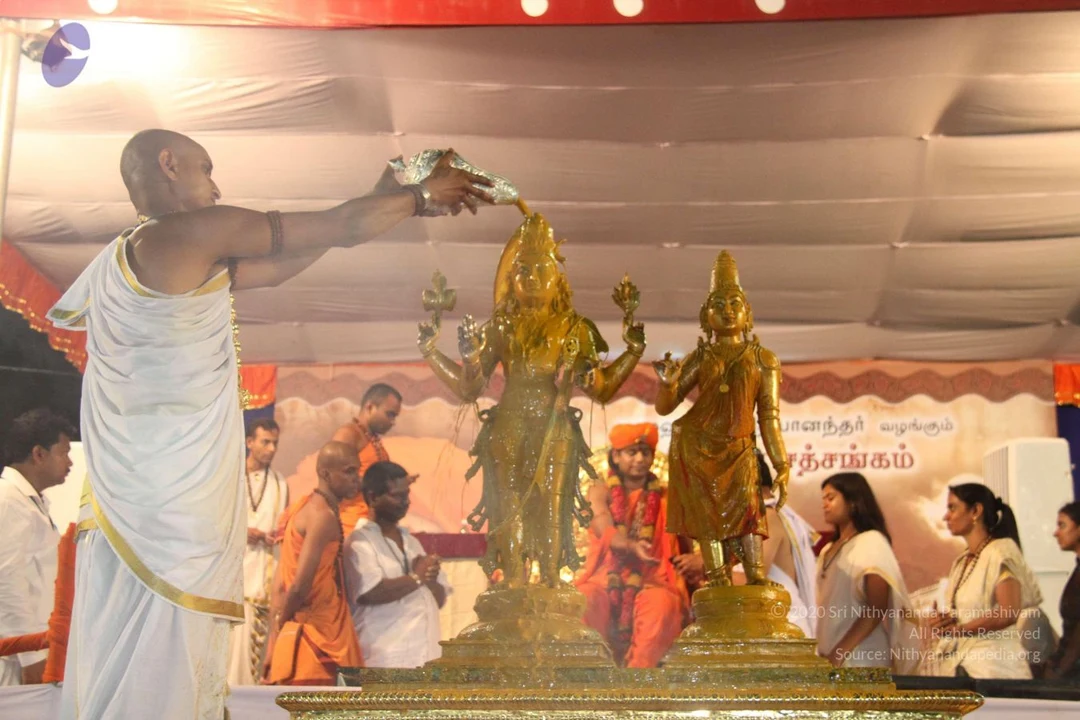
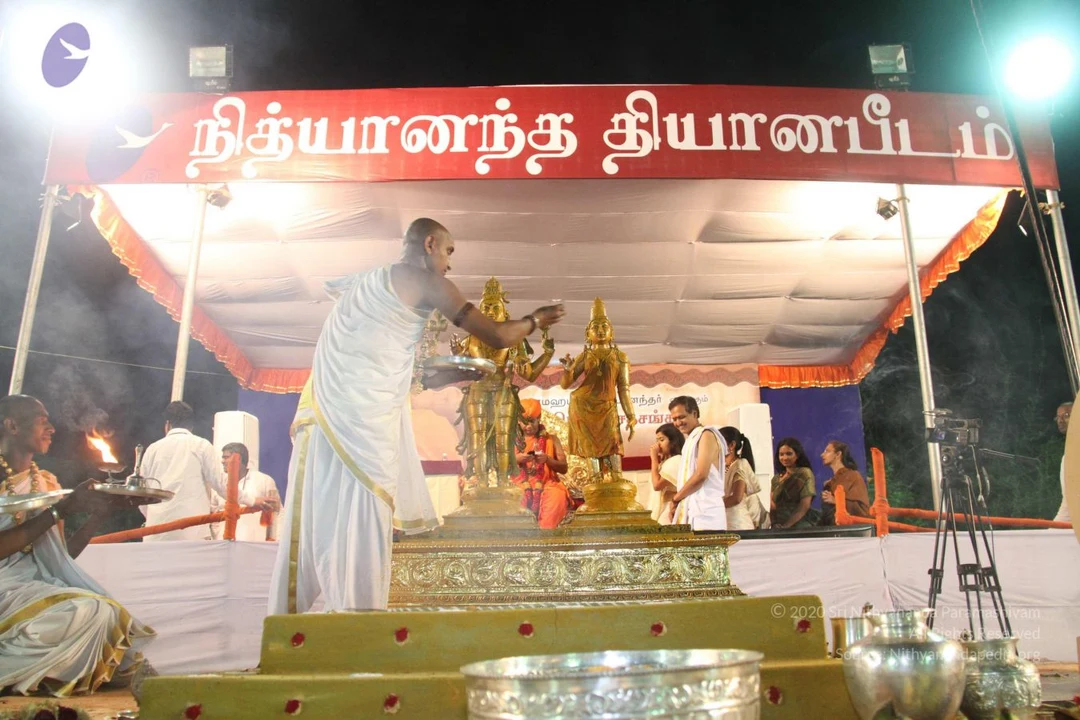
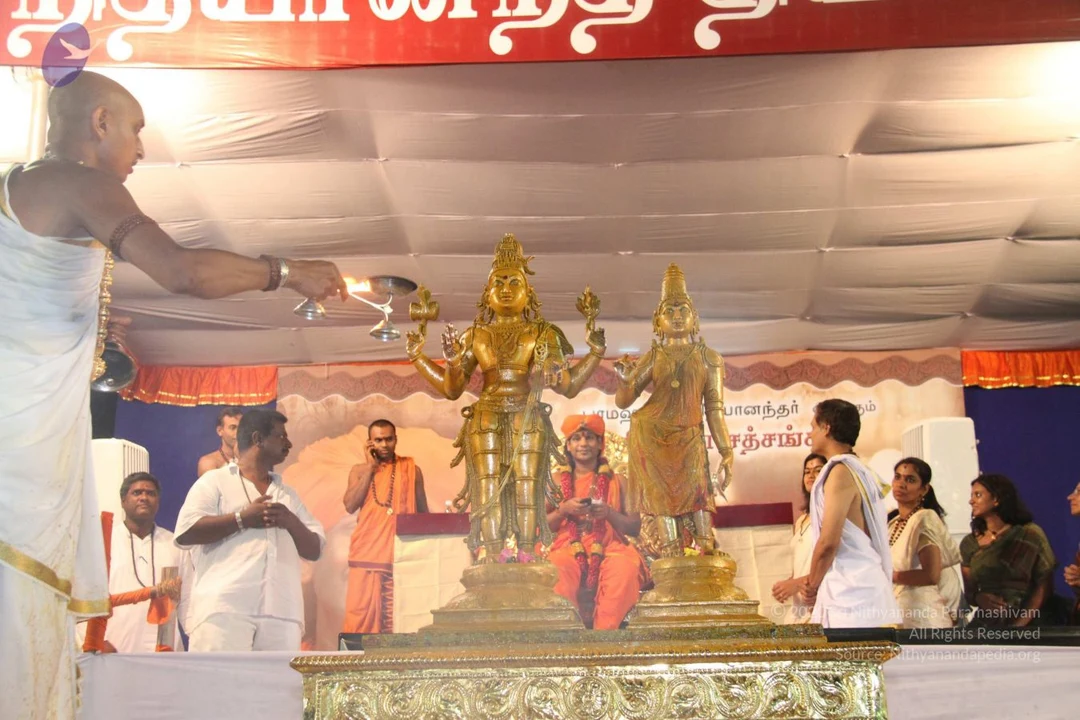
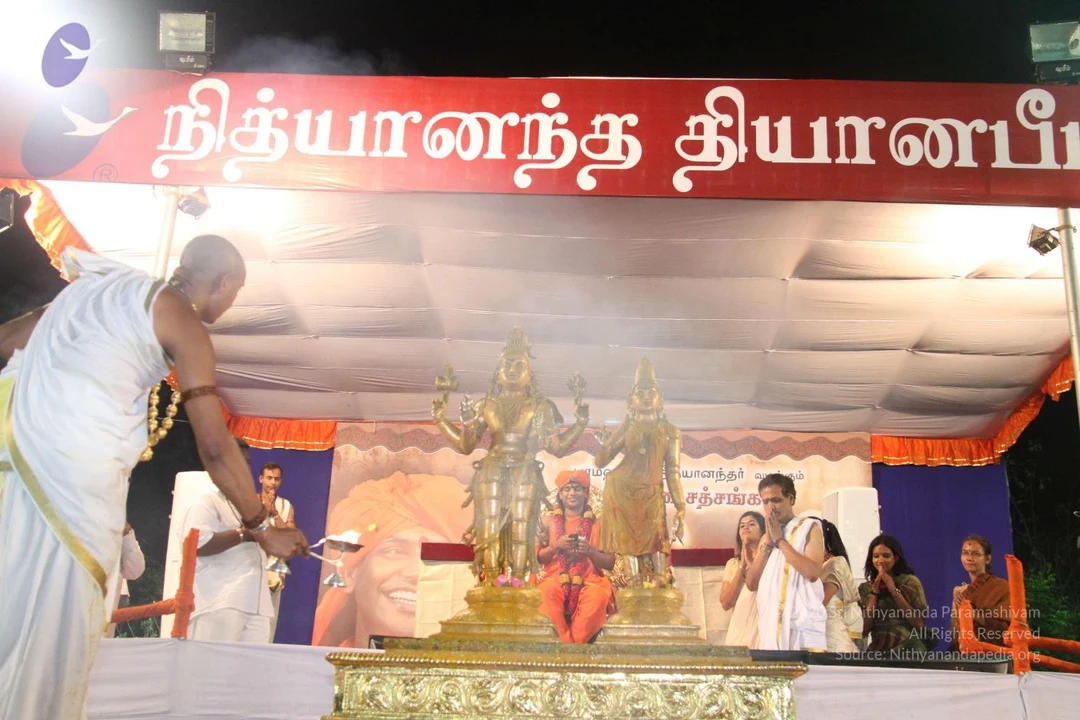
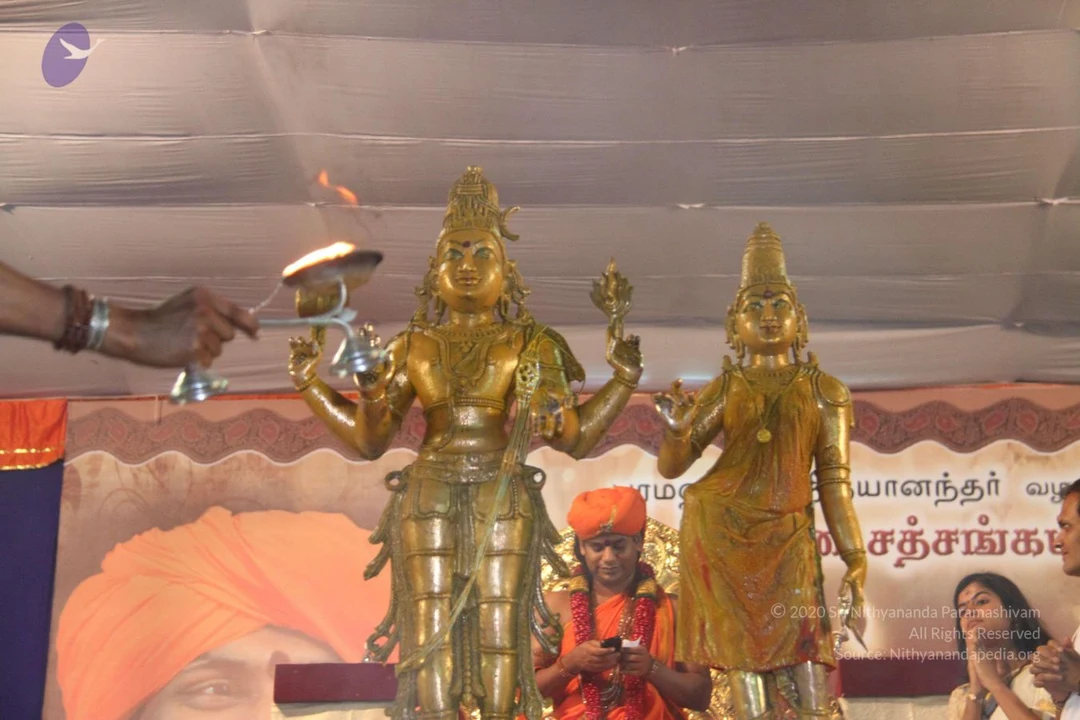
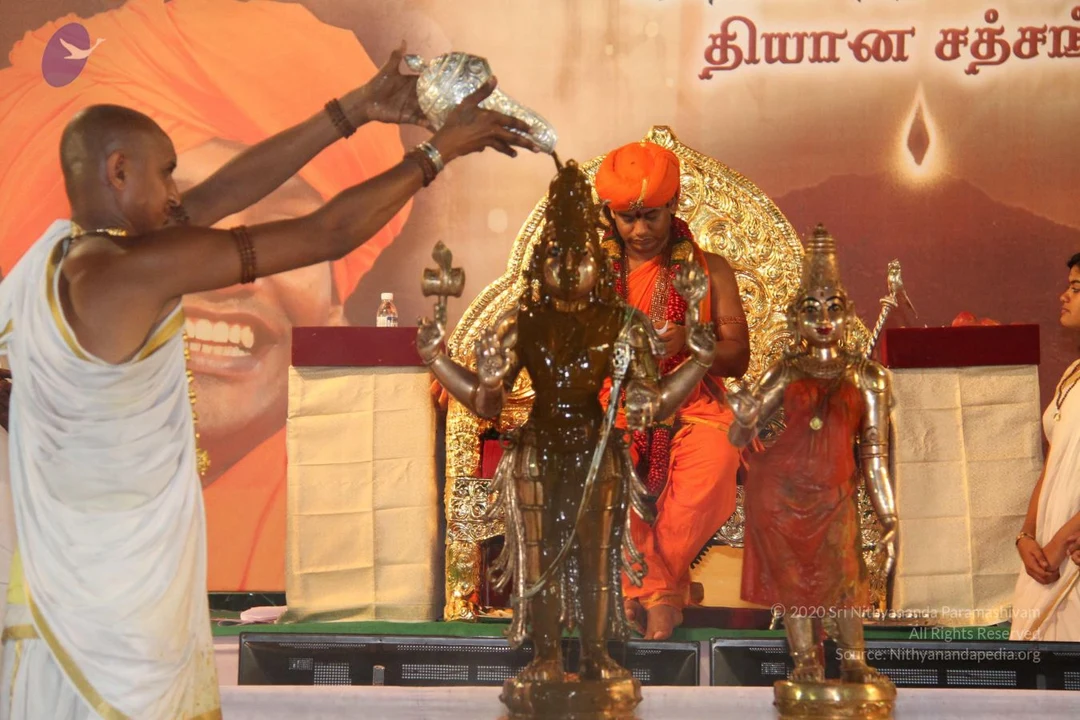
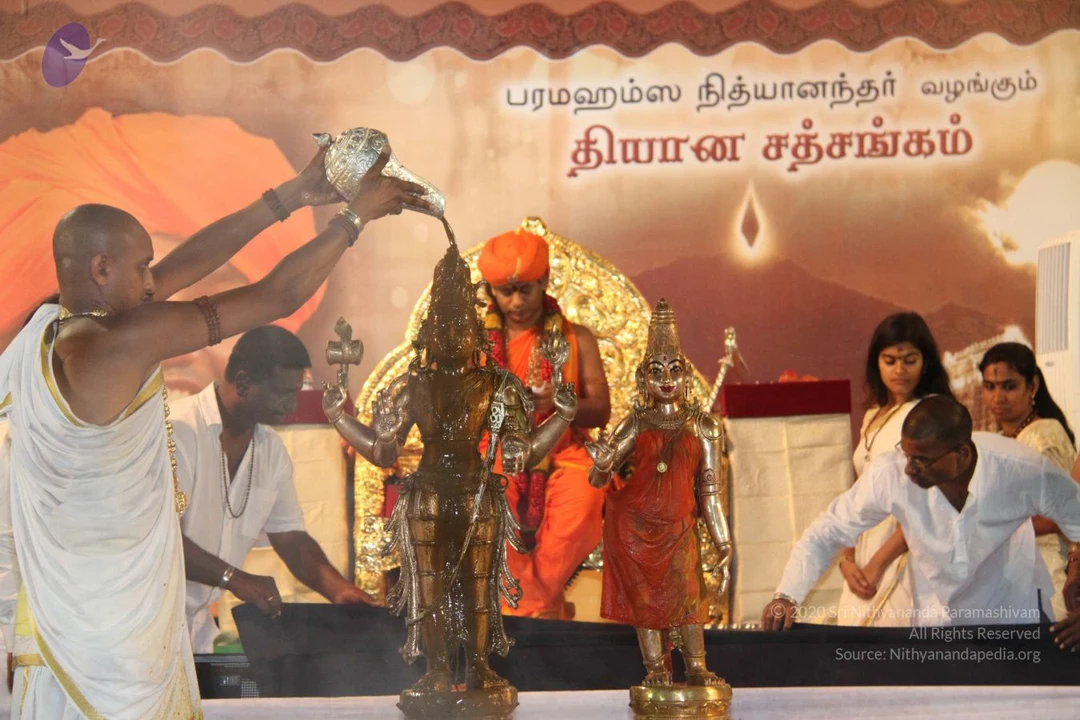
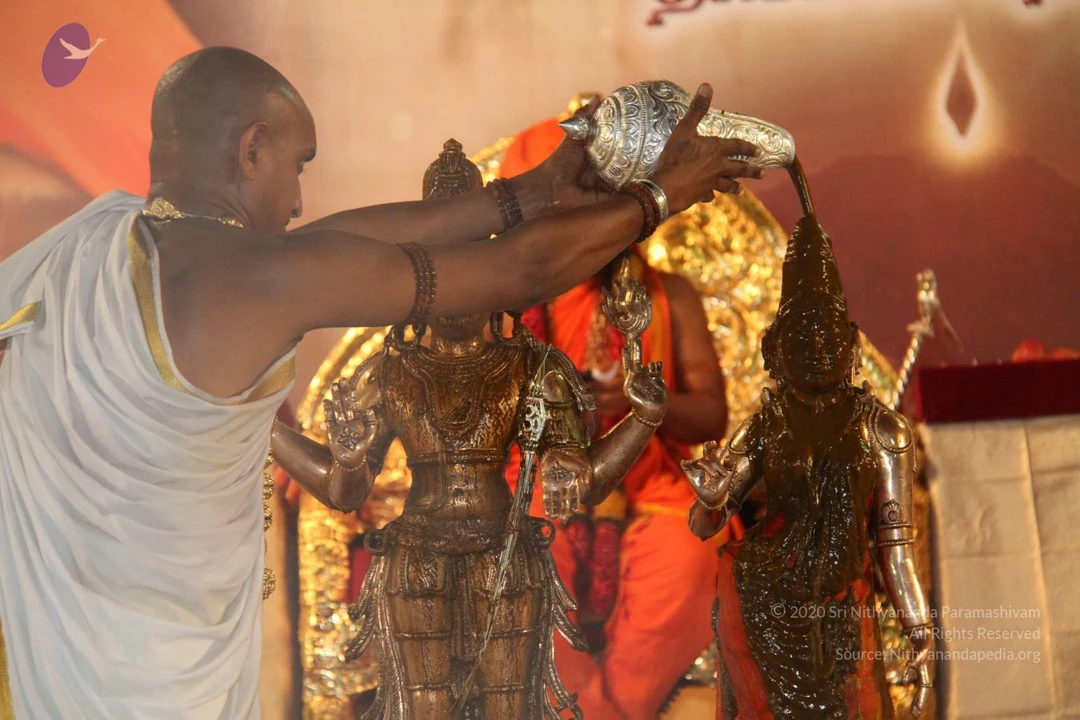
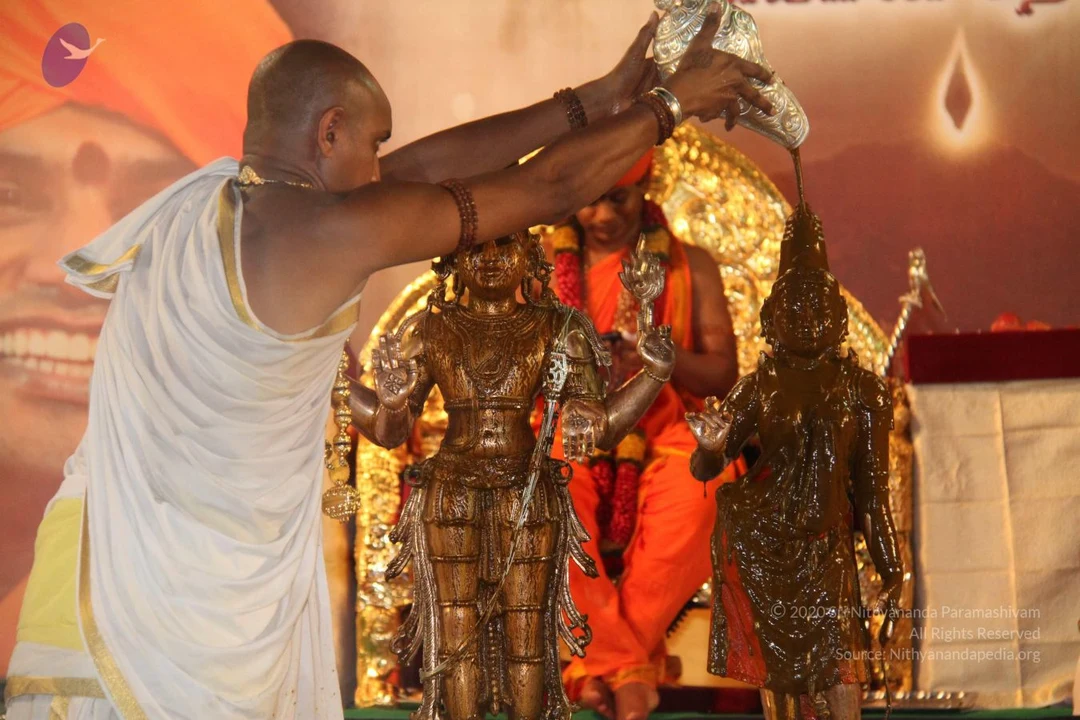
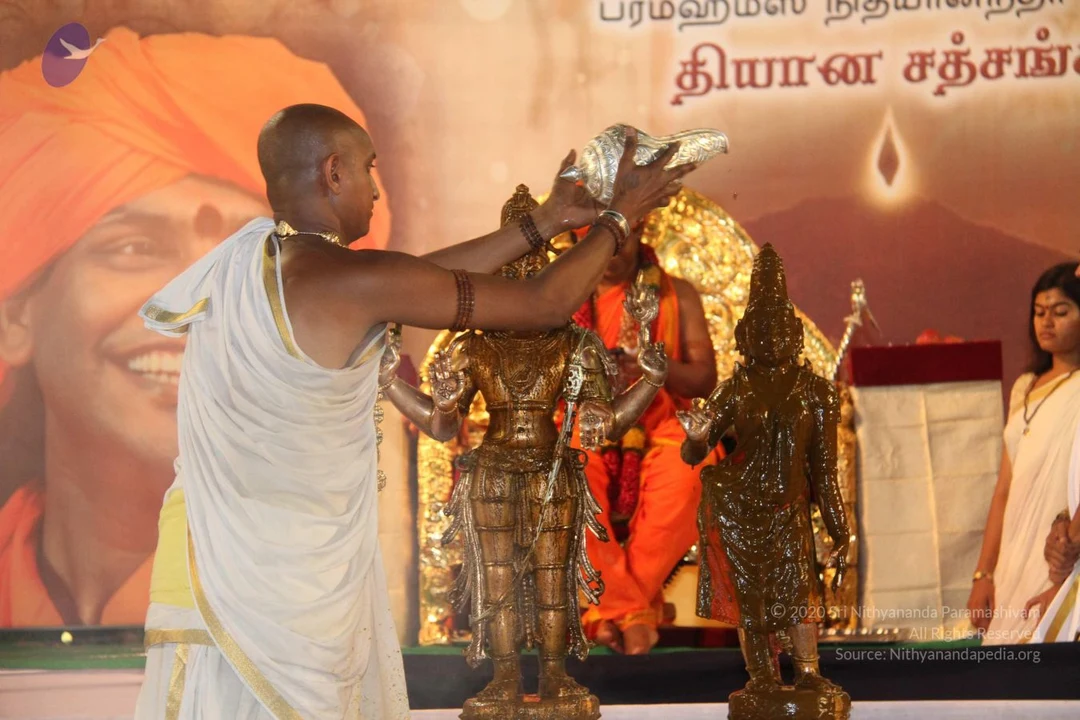
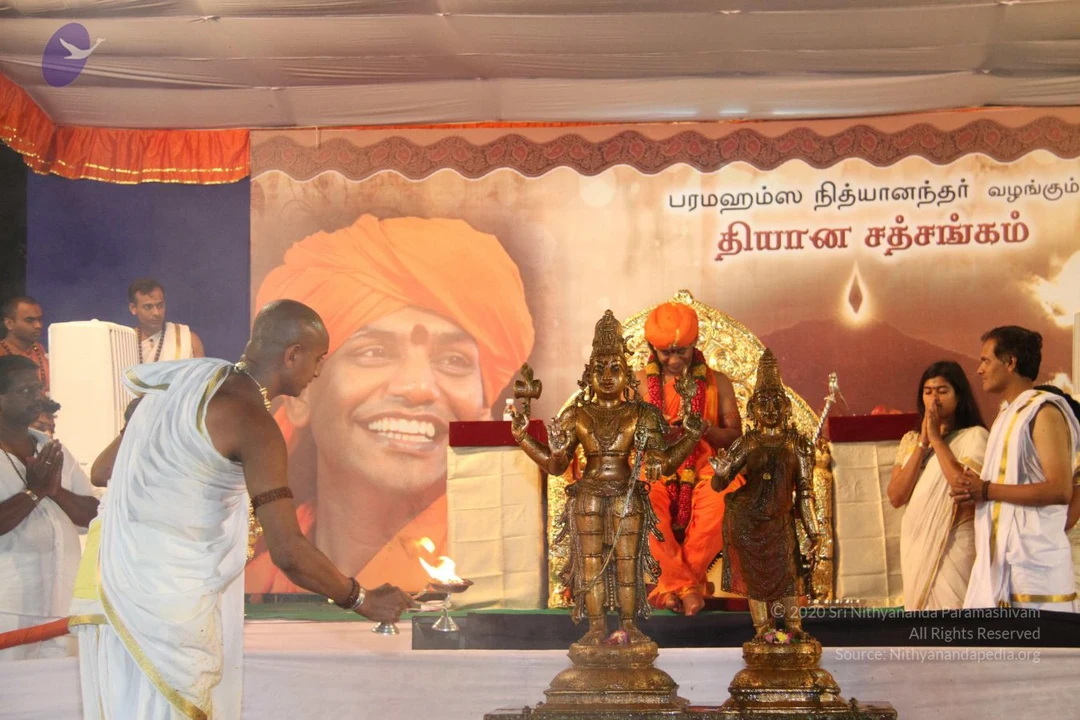
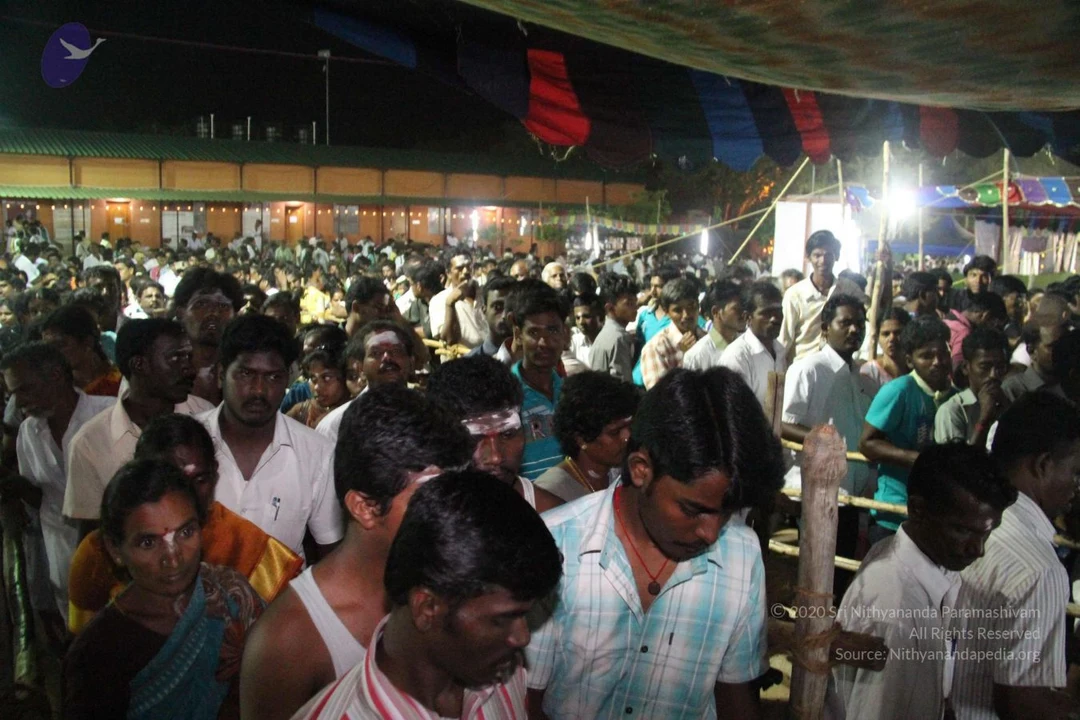
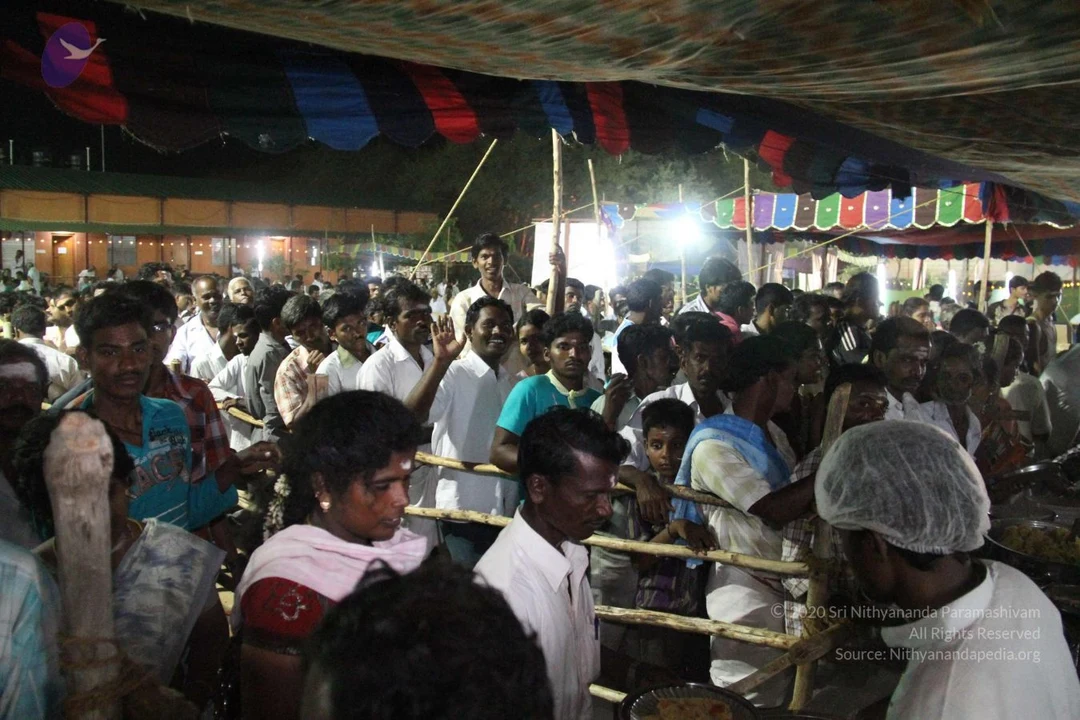
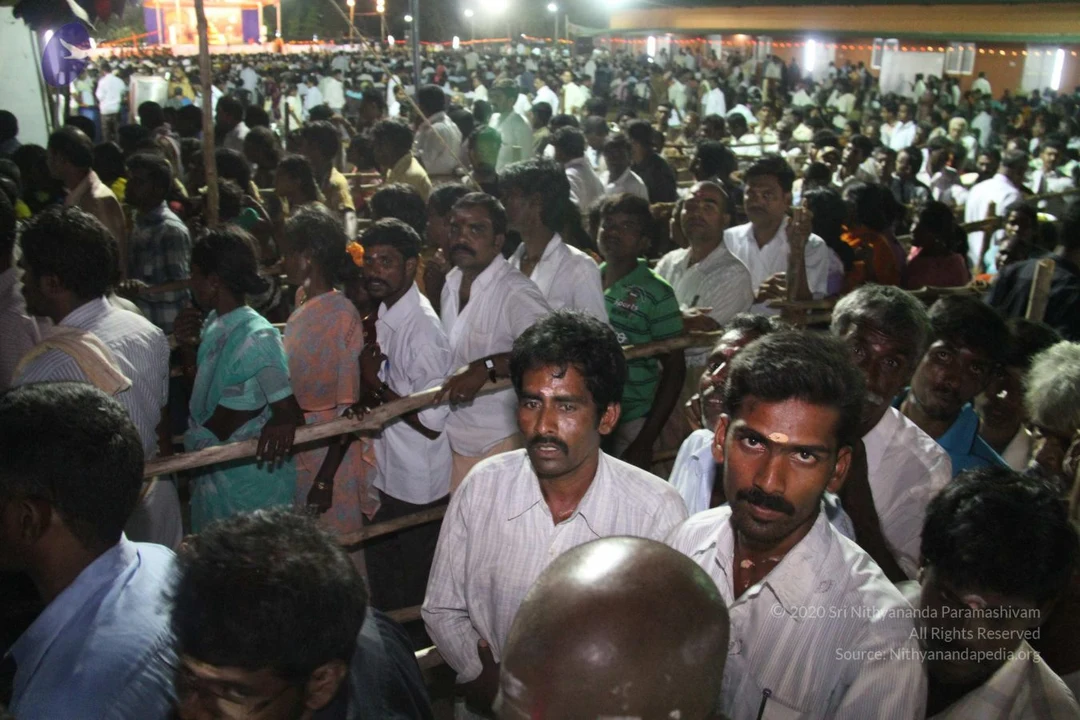
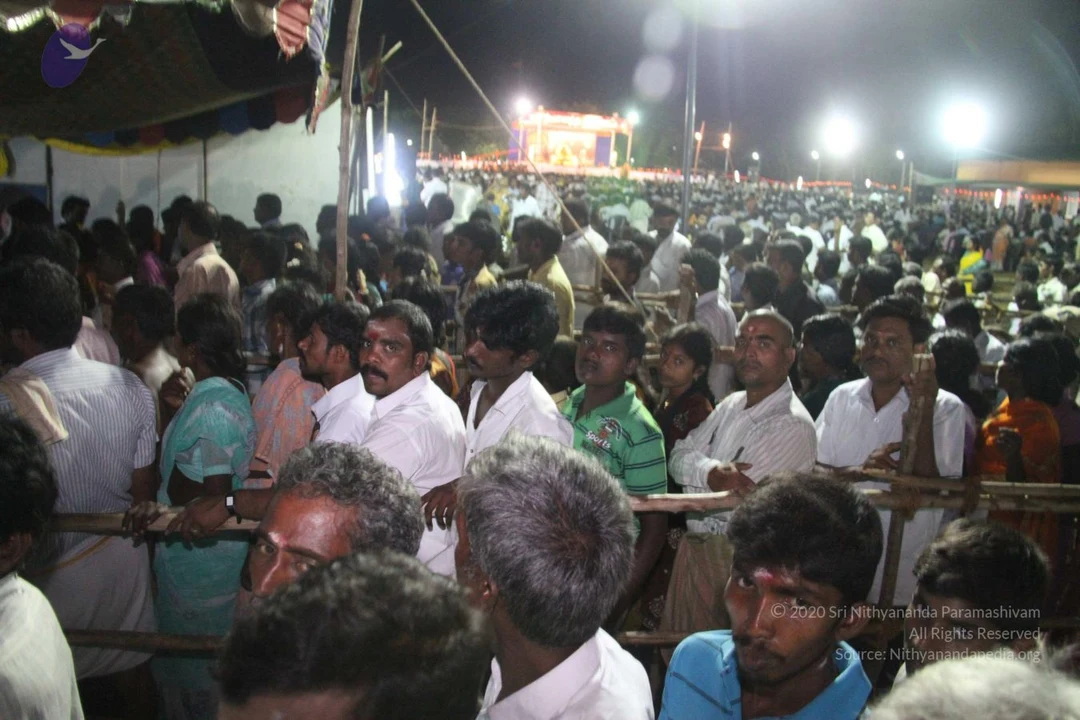
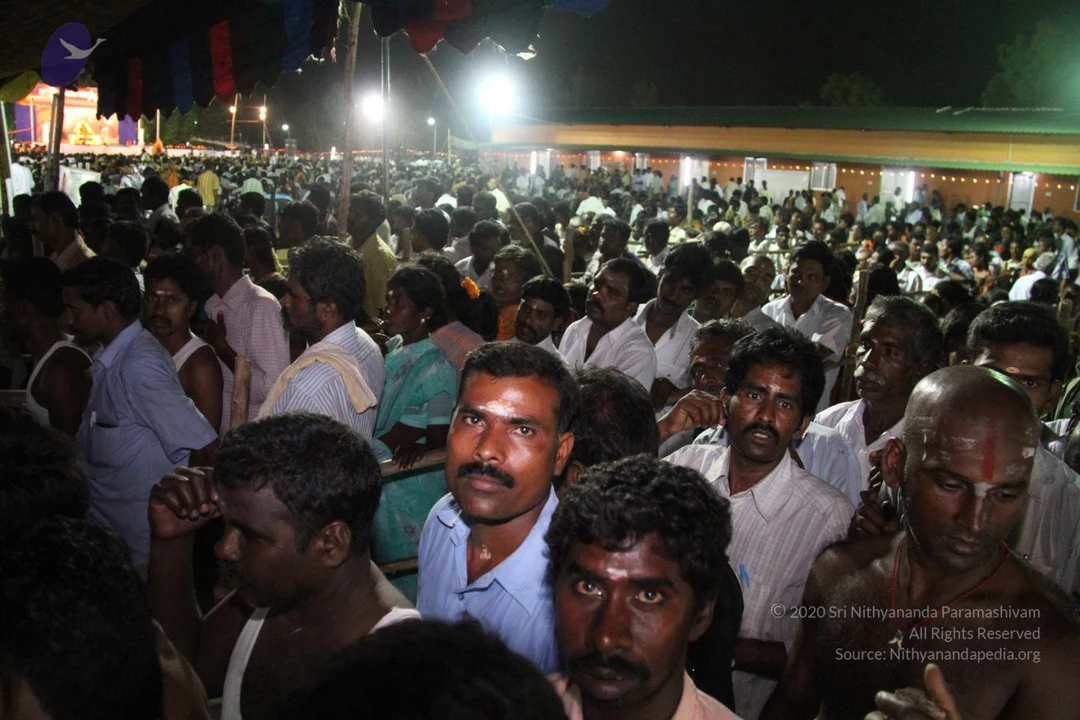
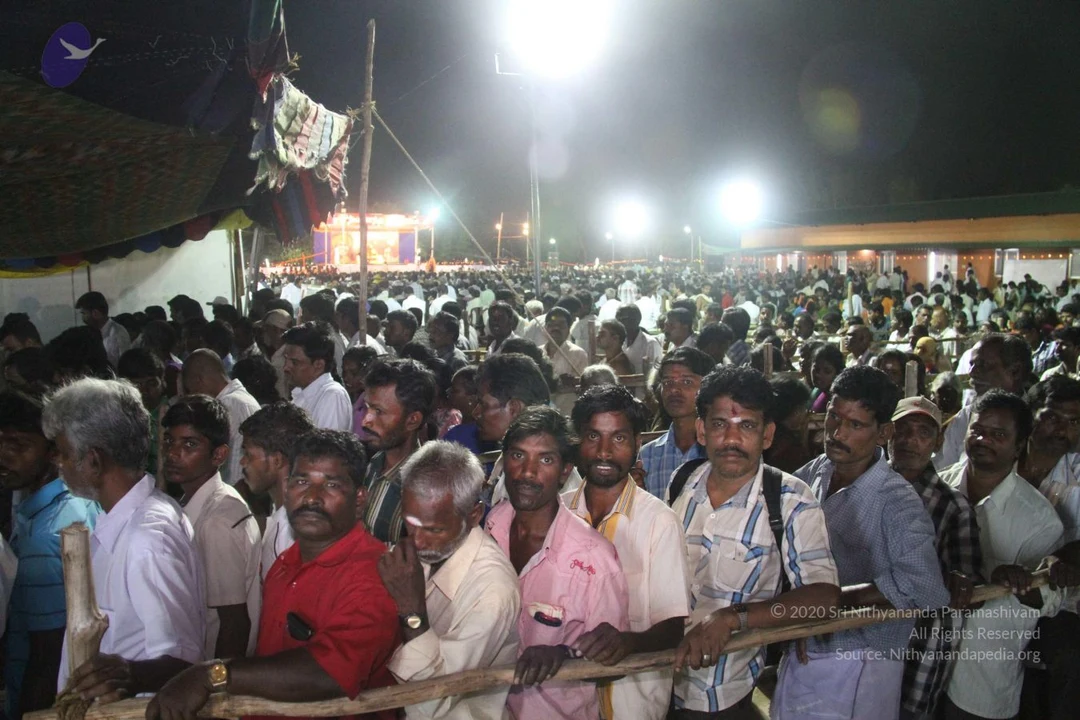
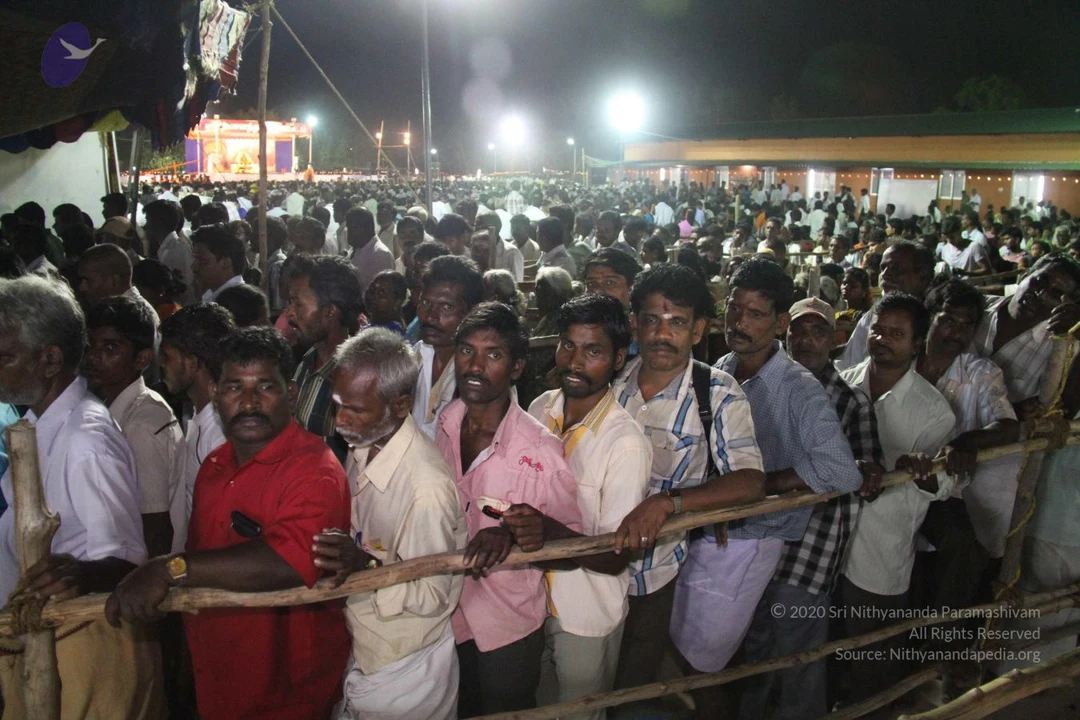
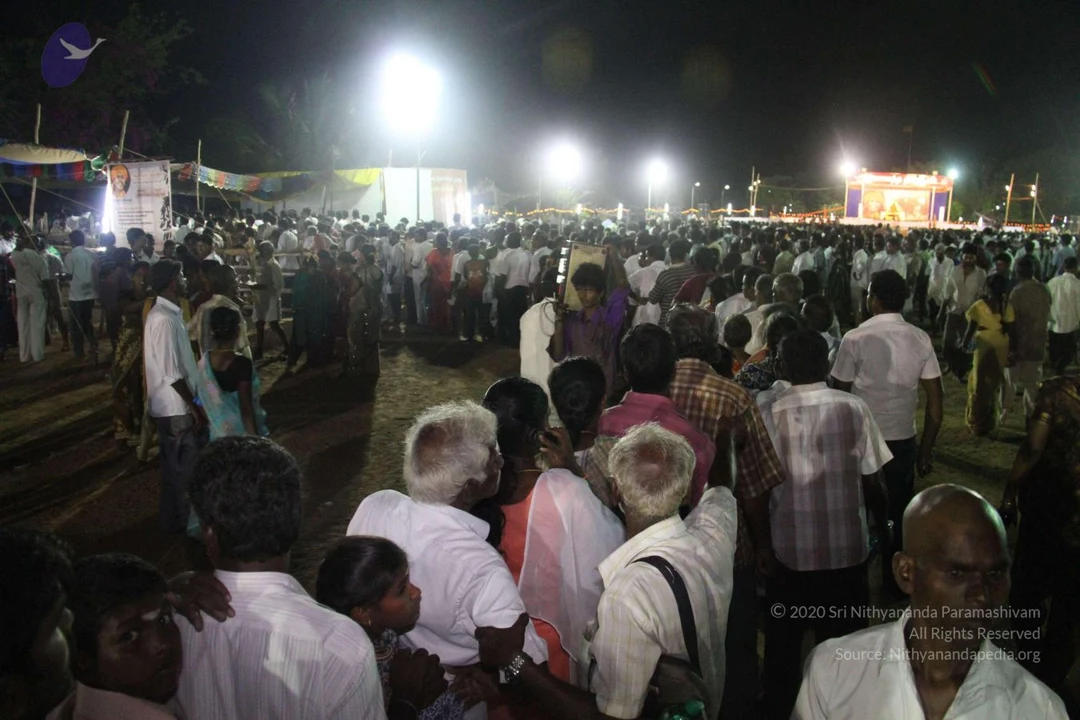
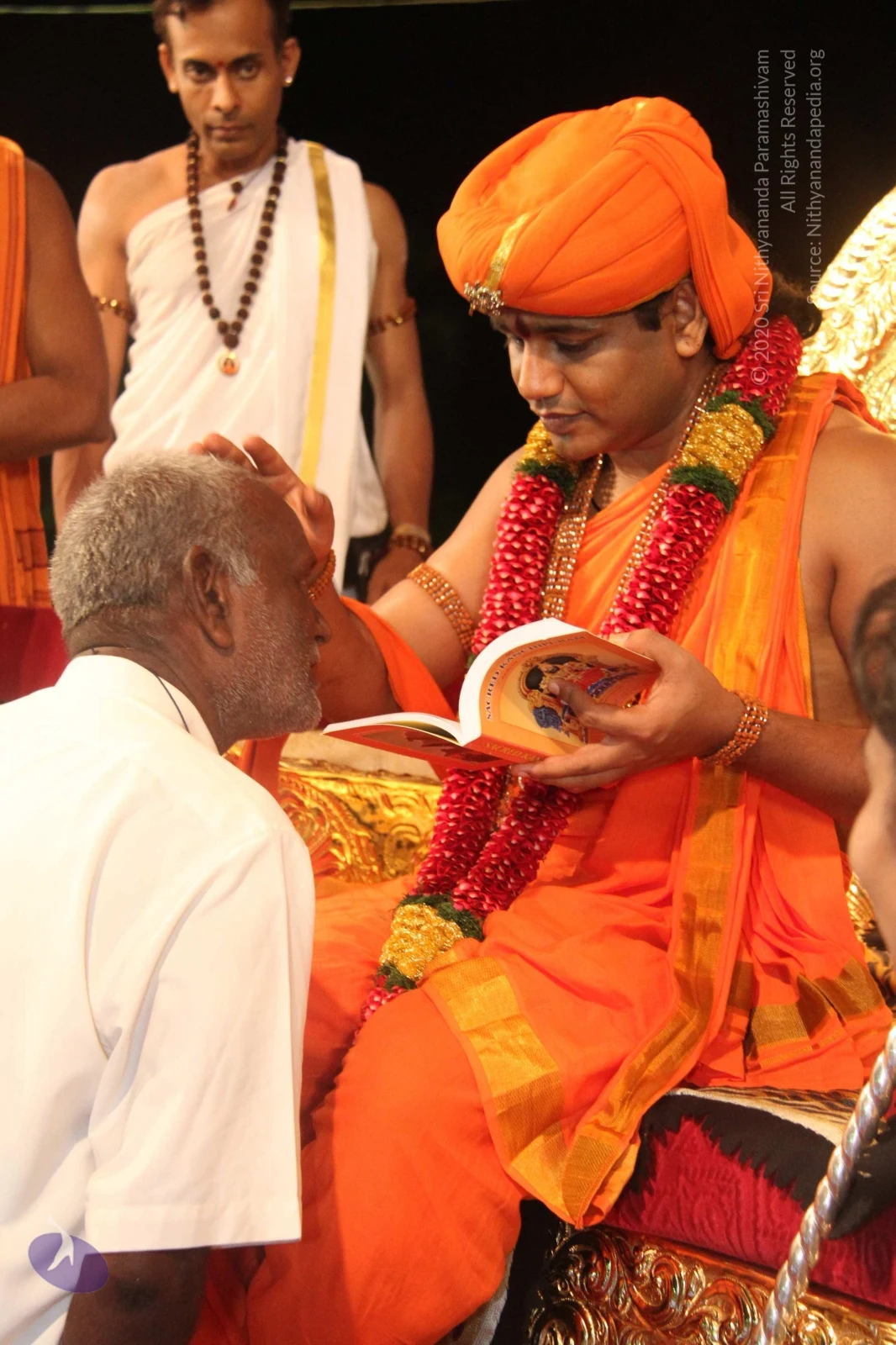
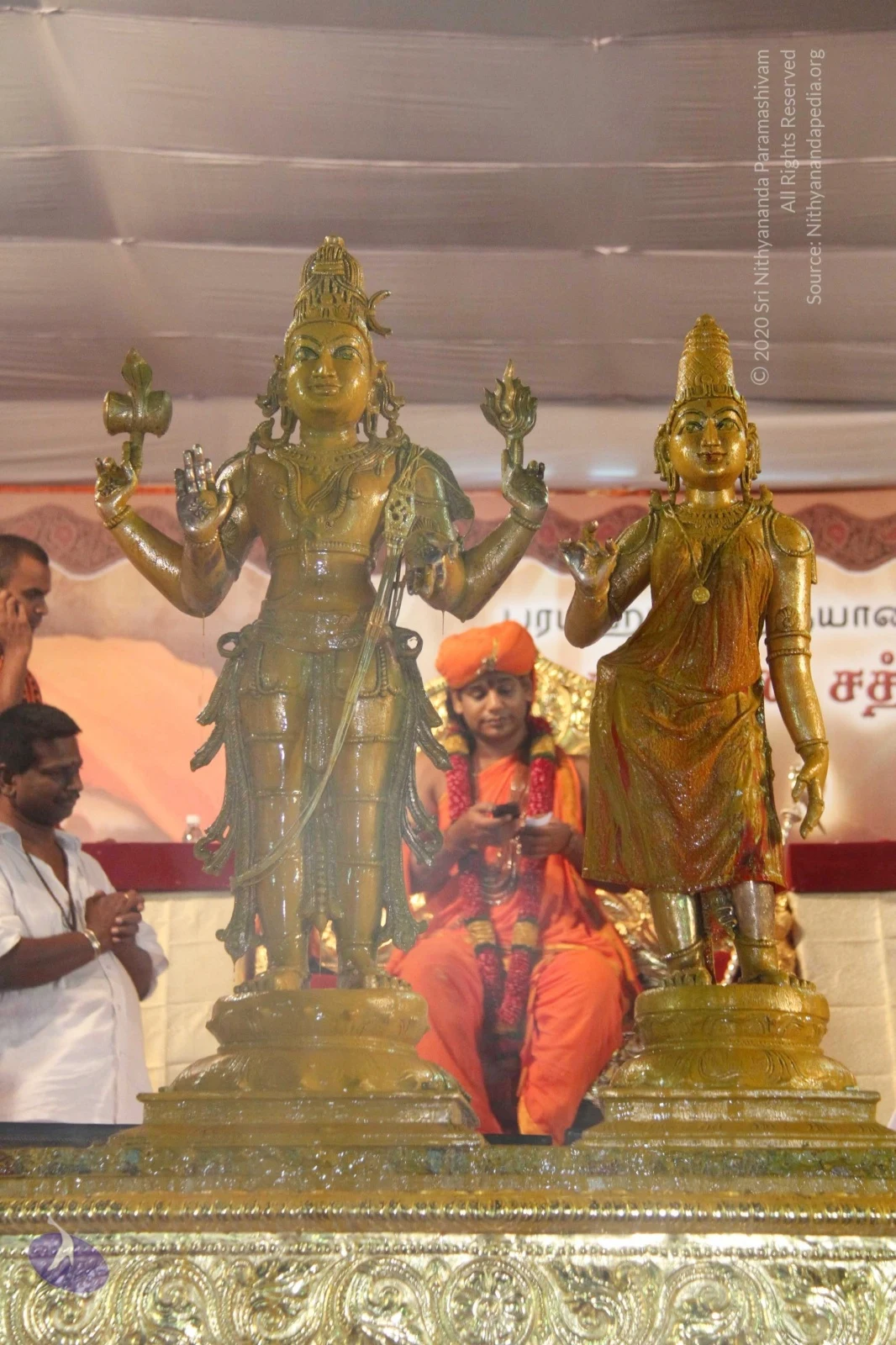
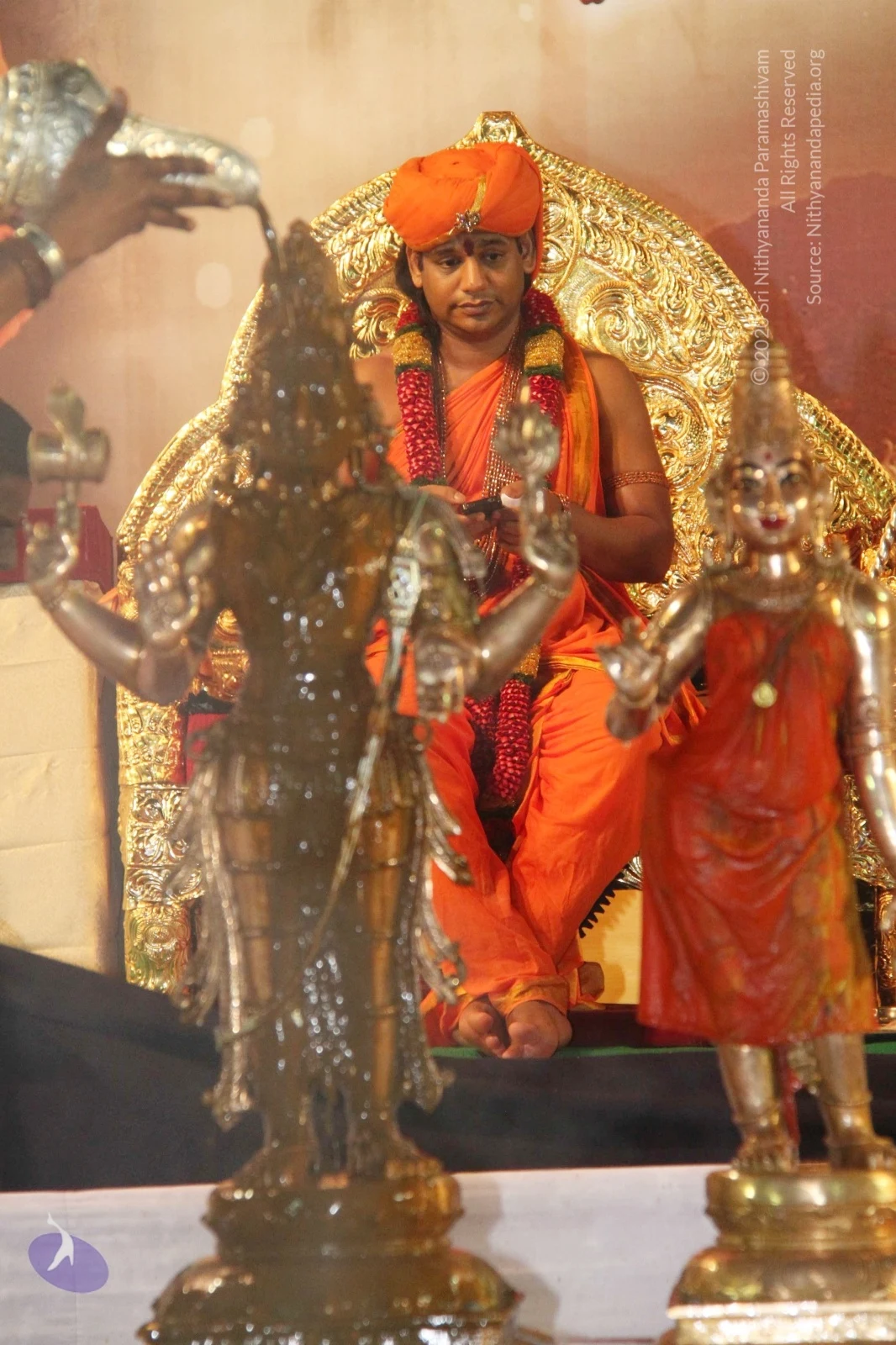
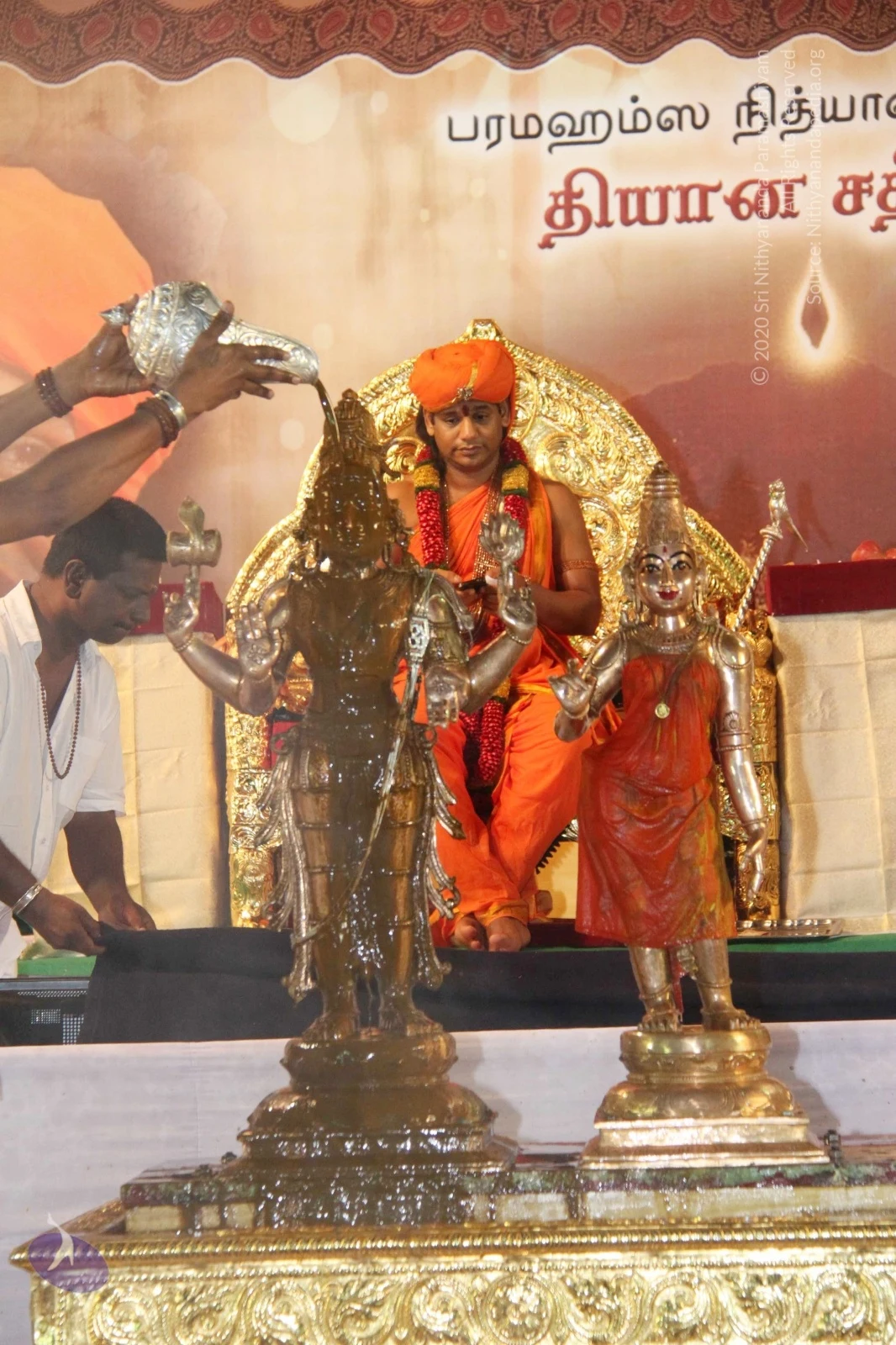
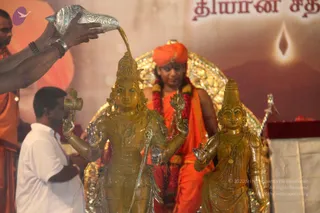
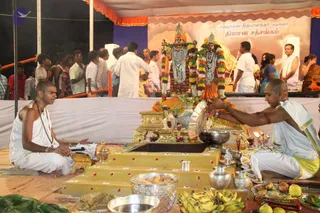
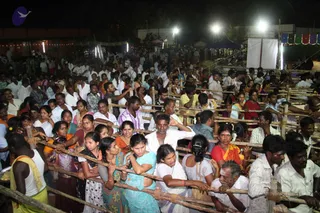
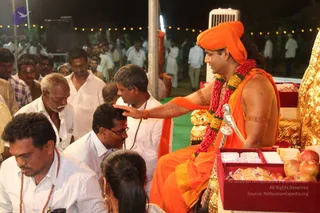
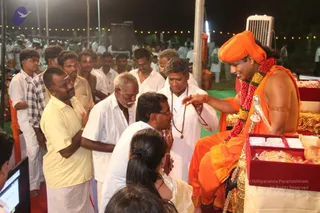
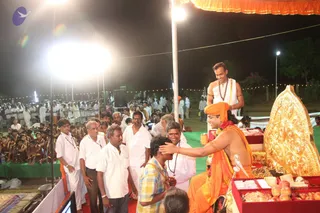
A photograph of a ritual abhishekam in progress. In the foreground, a bare arm holding a silver vessel pours liquid over two golden deity murti; the taller figure, with a crown and raised hands holding a trident-like staff and a lotus, stands beside a smaller female murti wearing a necklace. Behind them, a seated man in an orange-saffron robe, orange turban and a red-and-white flower garland sits in front of a golden arch. A man in a white shirt and a second figure in orange stand at the left edge. Tamil text is printed on the backdrop above.A night-time outdoor puja on a raised stage under a white canopy with orange trim. Two deity murtis stand on a golden throne, adorned with fresh flower garlands and silver necklaces, with a golden kalasha-style vessel and banana bunches, fruit and bowls of offerings arranged on a green yellow-tinted platform. A shaved-headed priest in white dhoti and shawl, wearing rudraksha and bangles, reaches out to offer a puja plate beside an oil lamp, while a second priest in white sits cross-legged at left with a tilaka. A crowd of devotees in white and bright shirts stands behind the barrier. A banner reads 'Dhyana Satsangam' in Tamil above a banner in Tamil script.A large crowd of devotees, mostly in white and bright cotton saris and shirts, press against long wooden barricade poles at night under floodlights. Many women wear saris in red, orange, teal and pink, and several men are in white shirts and dhotis. Some people raise hands or lean forward toward an unseen stage area, while a white backdrop and a blue canopy tent stand at right, with strings of colourful pennants overhead. The scene suggests a darshan queue or outdoor event gathering.Night outdoor gathering with string lights overhead and a crowd of men in white shirts and dhotis. A man in an orange turban, orange robe and red-and-white flower garland sits on a gold throne at right, his hand raised to a devotee's head in blessing. a person cues: orange turban and robe, ornate gold armband, floral garland. A devotee in white with a rudraksha mala bends forward to receive the blessing. Offerings on a red tray include apples, sweets and currency. Gold throne decorations and a silver-handled staff are visible at right.Night photo of an outdoor gathering under string lights. A seated figure on a gilded throne-like seat wears an orange-saffron turban, orange garments and a red and green flower garland, with a silver bird-shaped ornament on the seat's edge. He leans forward to touch a devotee's small object or rudraksha-style bead mala held by a man in a white shirt. Nearby, a red box holds fruit and packets, and a crowd of men in white dhotis and shirts stands behind. A woman in a white saree stands in the lower foreground.Night outdoor event on a raised green-and-red stage under string lights and a pale orange canopy. A seated man in saffron-orange robes and an orange turban, wearing a red-and-white garland and a rudraksha mala, rests his hand on the forehead of a kneeling devotee in a yellow-checked shirt. A standing attendant in white dhoti and cloth with a rudraksha mala looks on. Beside the seated figure is an ornate gold throne-back, and in the foreground a red tray holds fruit, flowers and offerings. Many men in white shirts and dhotis, plus rows of uniformed schoolchildren seated on the grass, watch from the lit field.

KALPATHAUR-CLASS

18 photosSource gallery
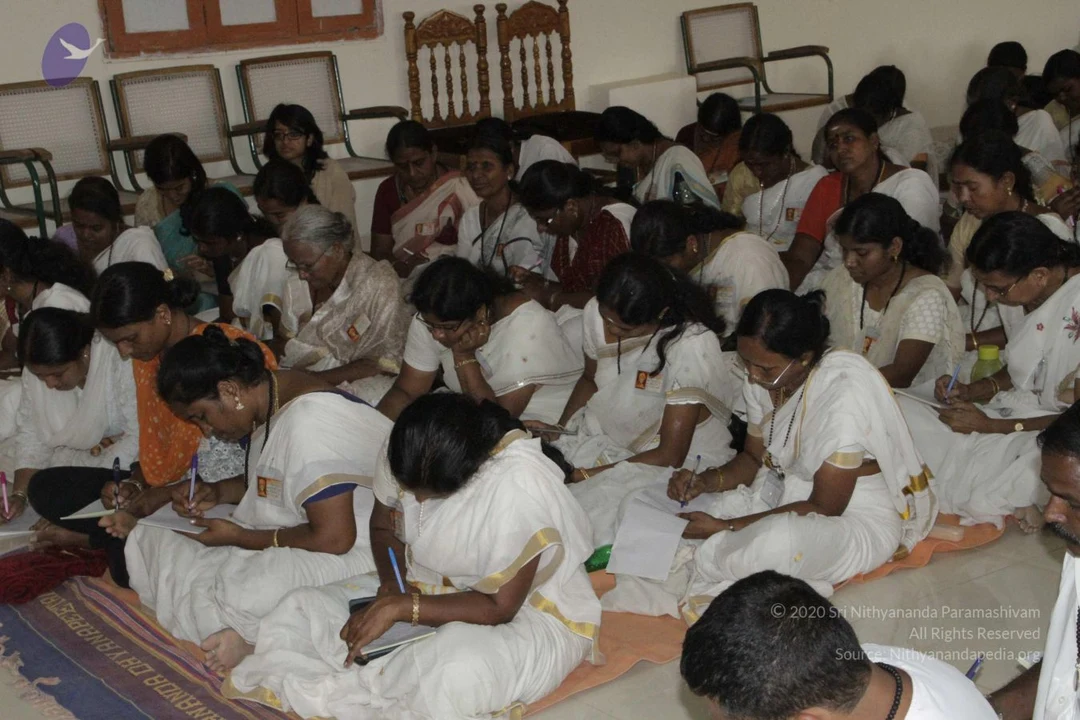
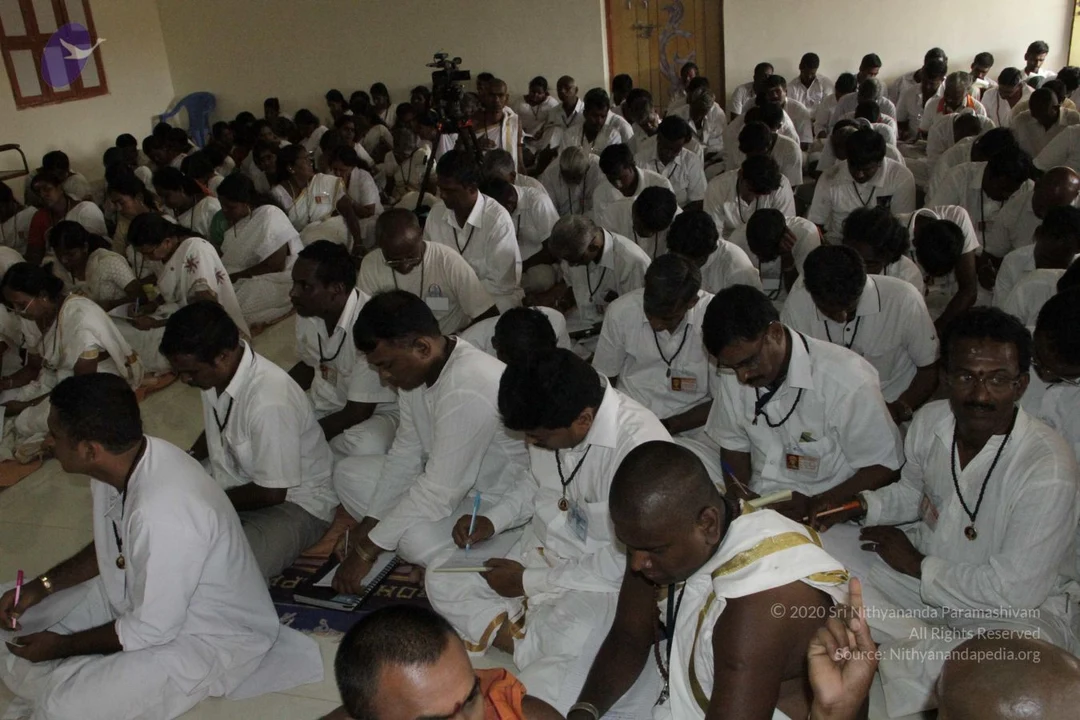
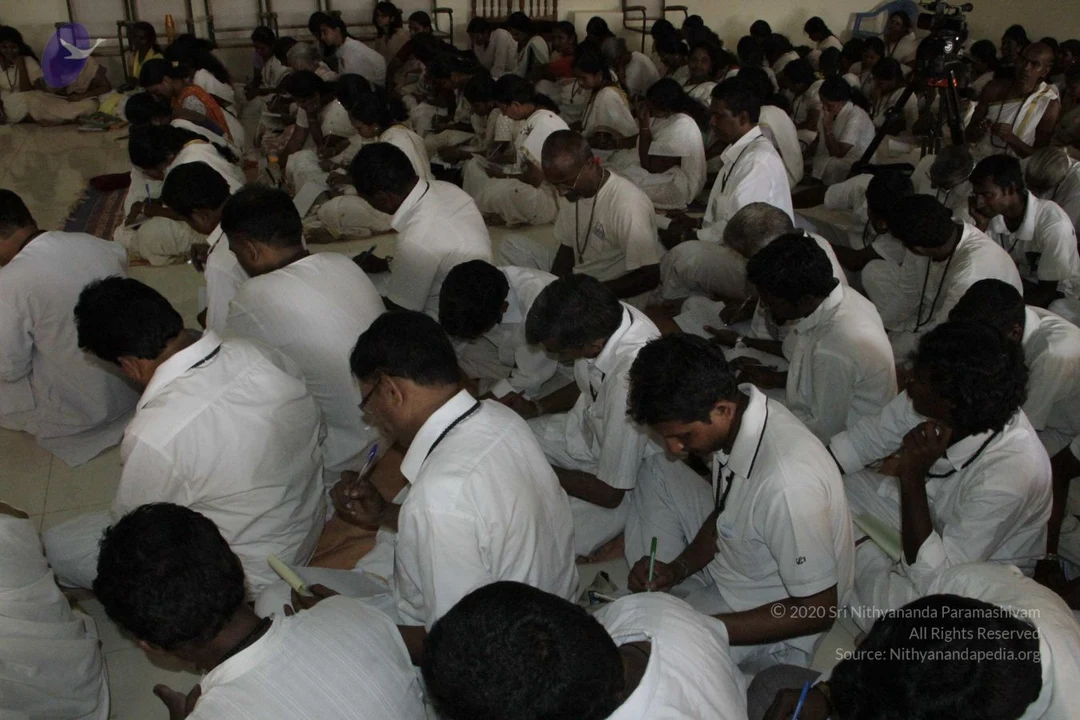
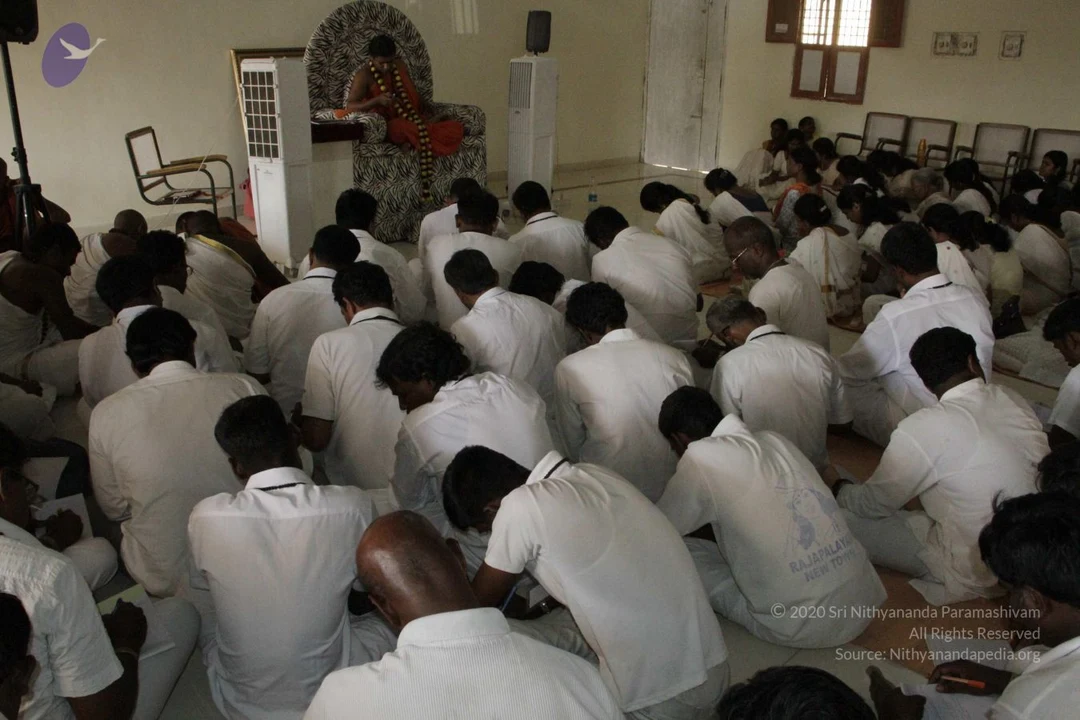
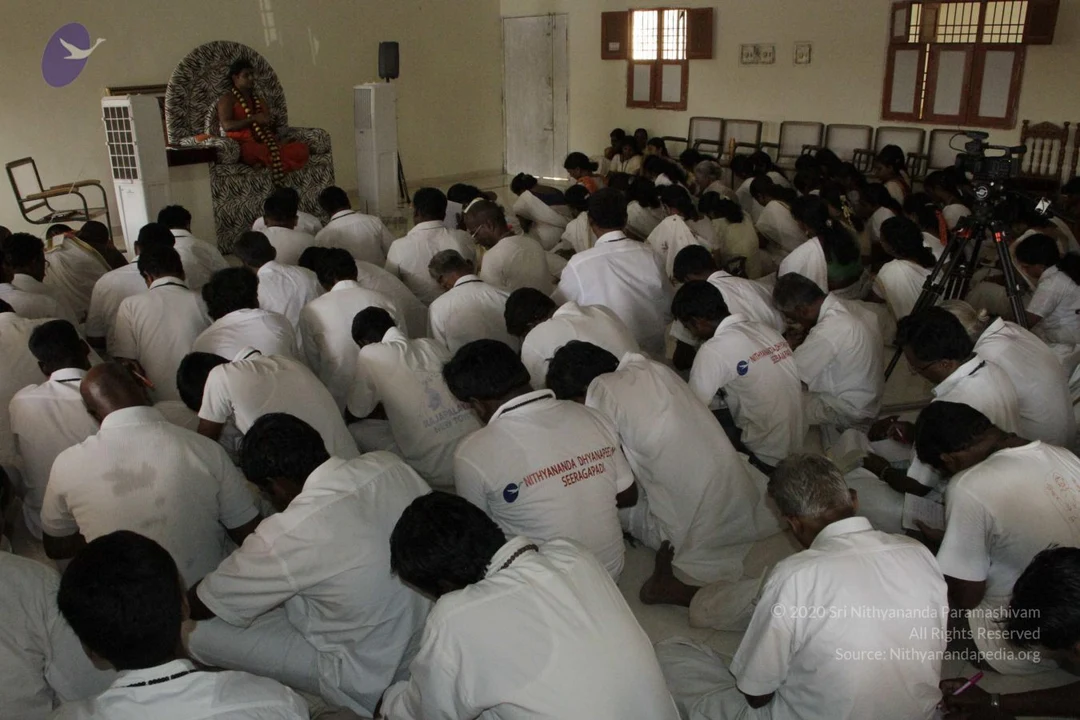
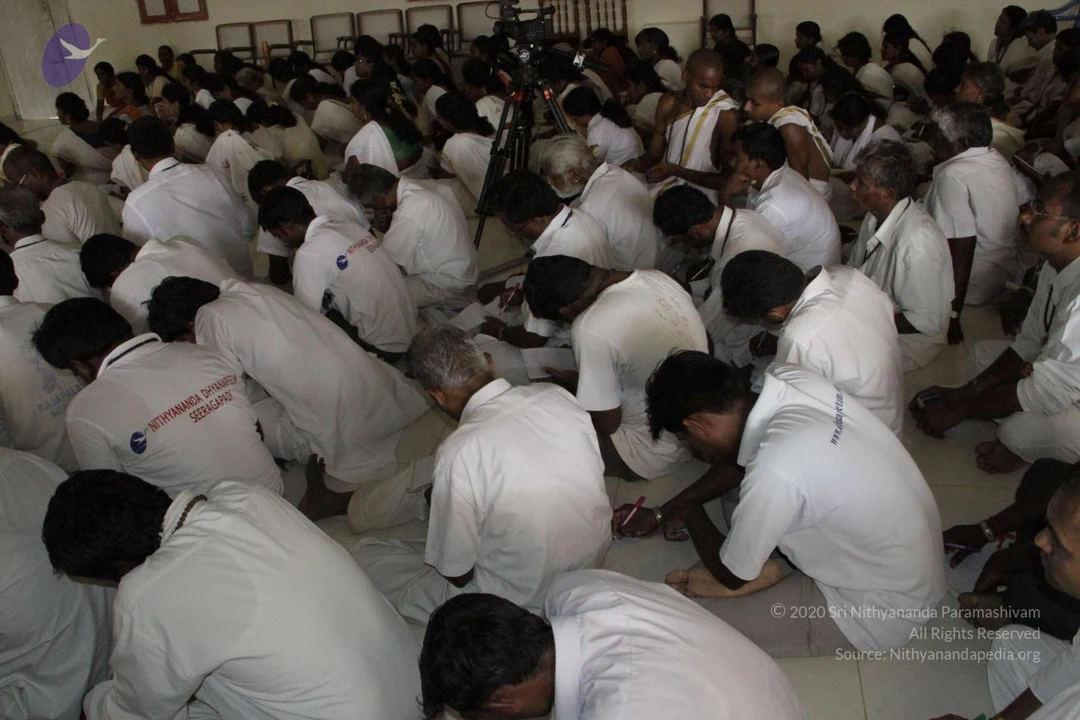
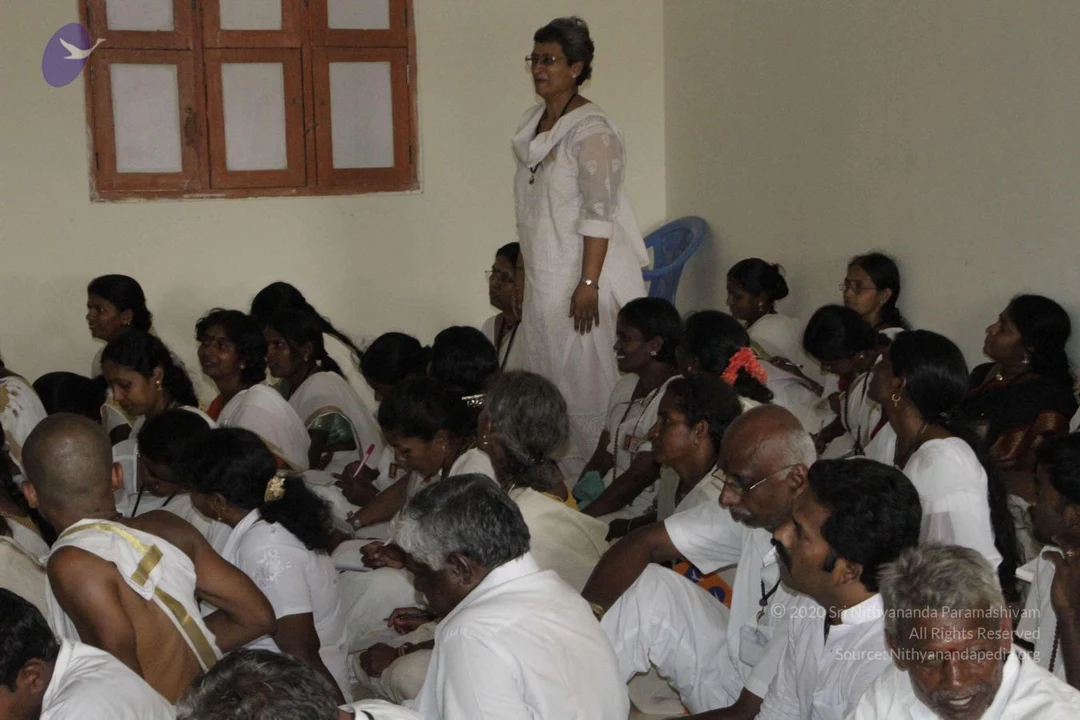
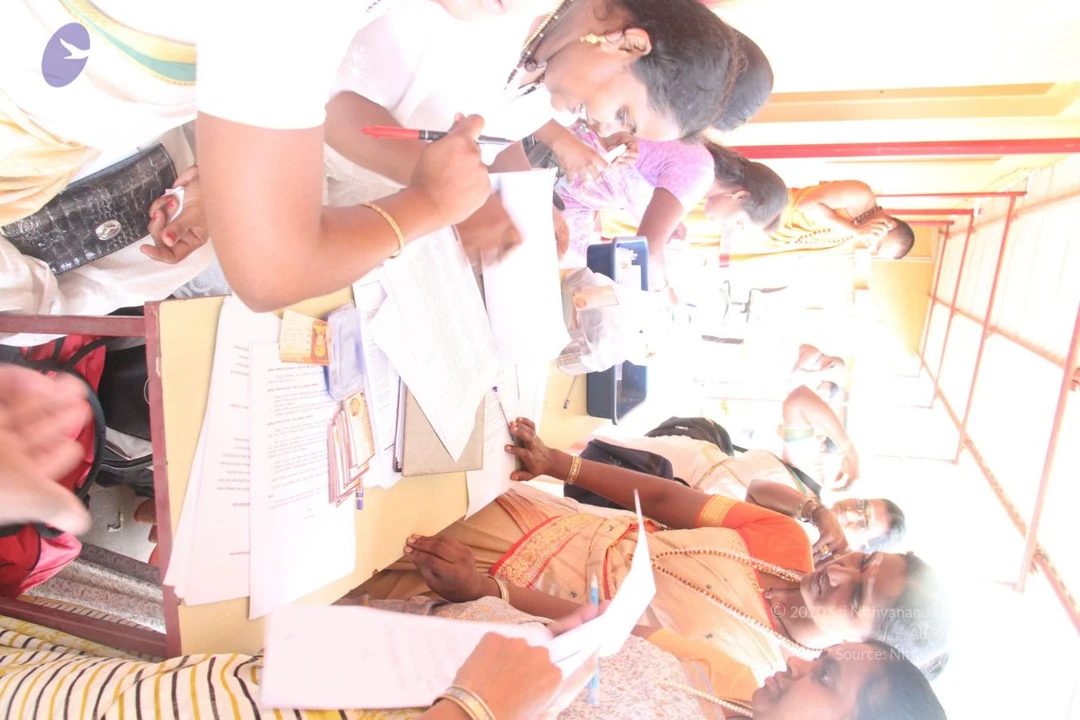
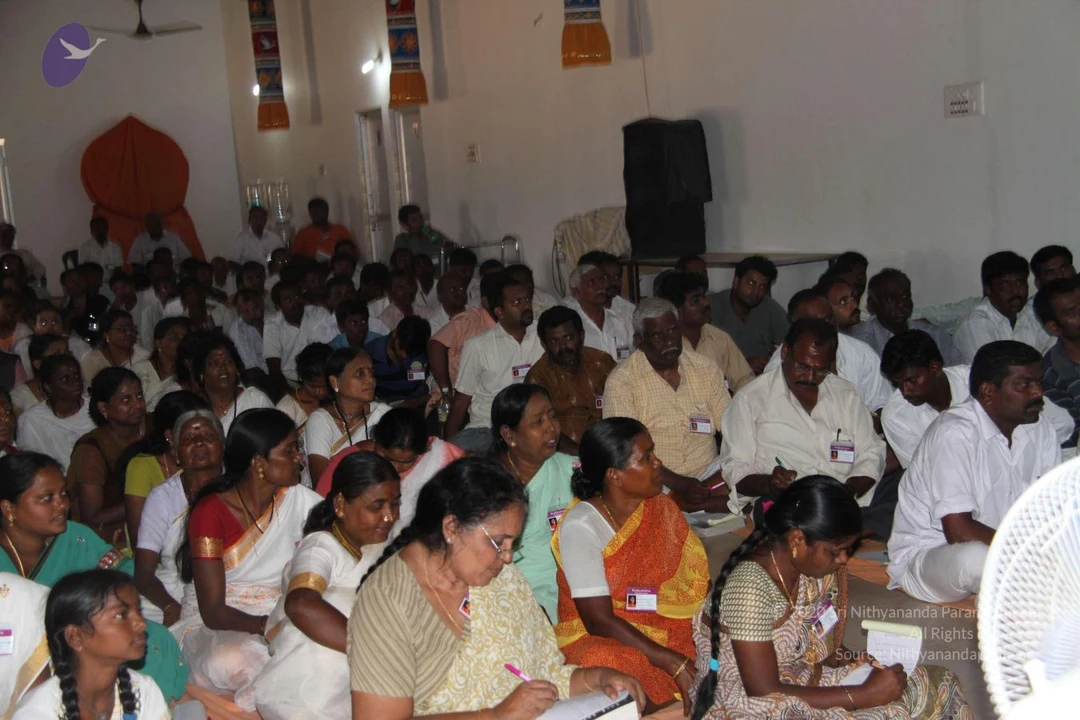
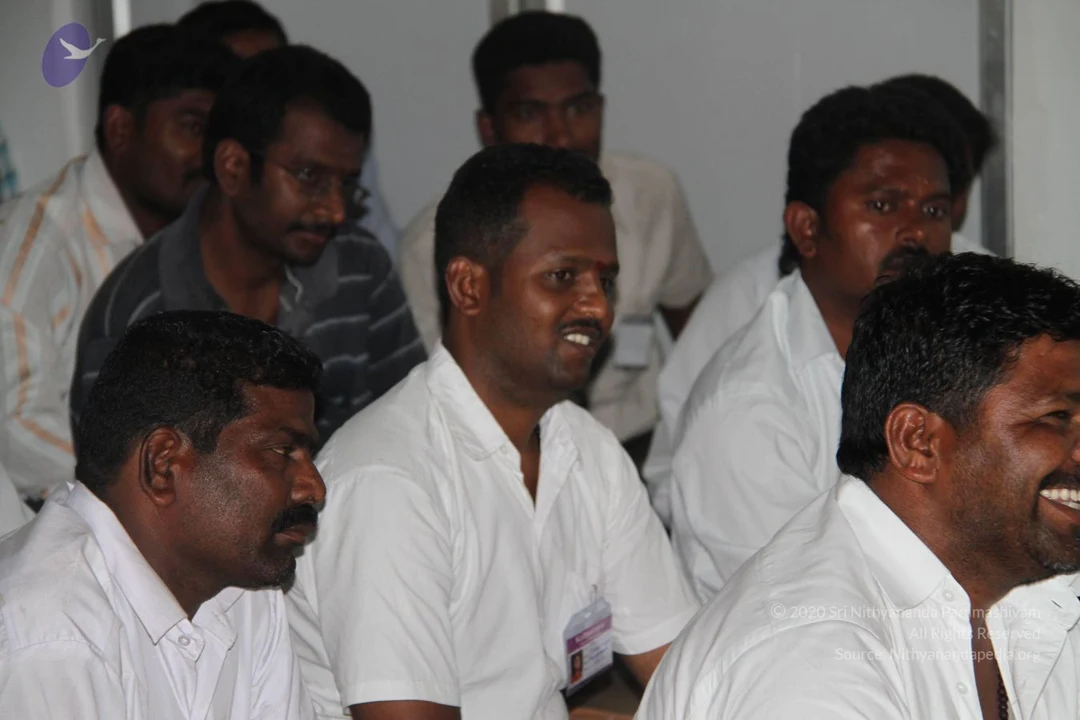
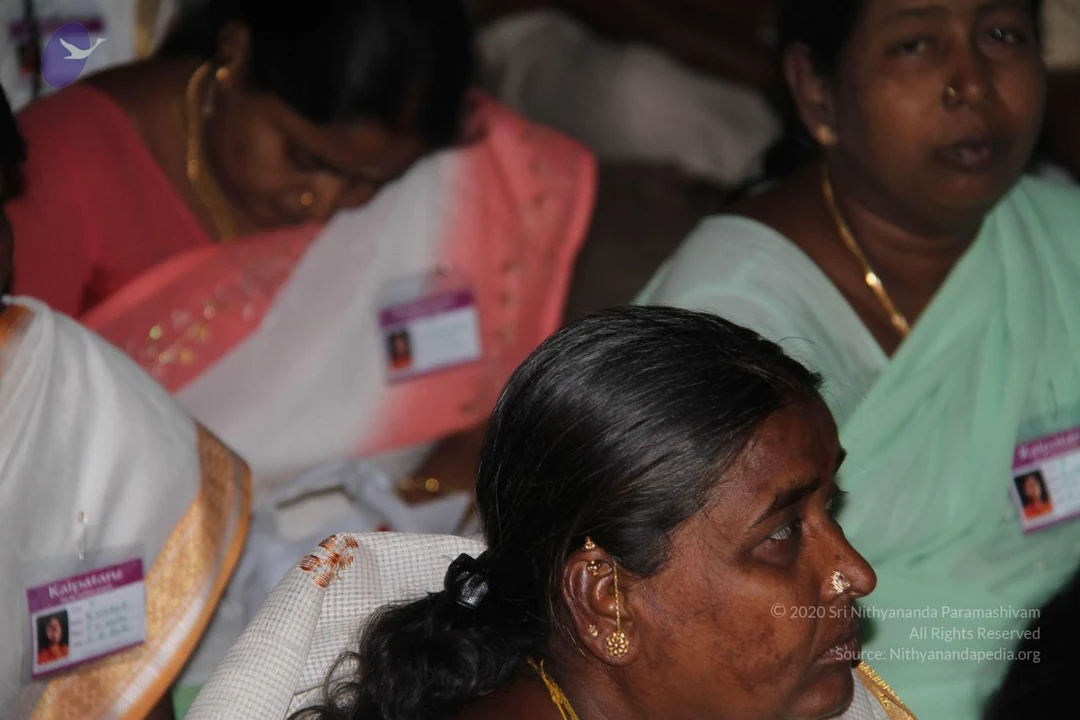
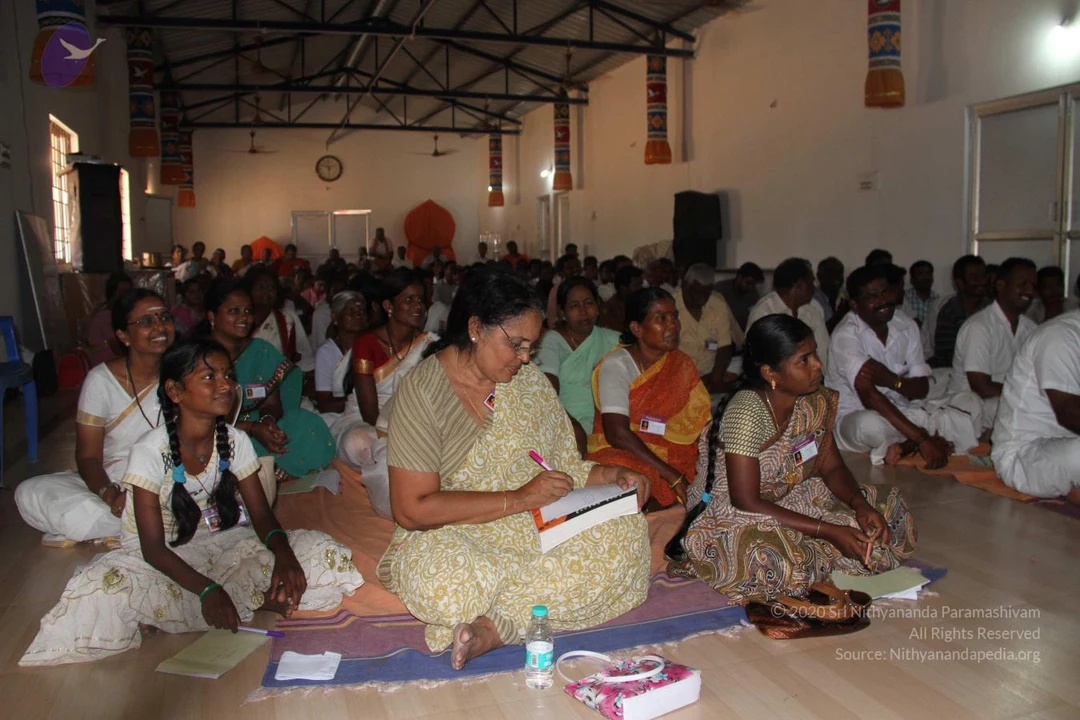
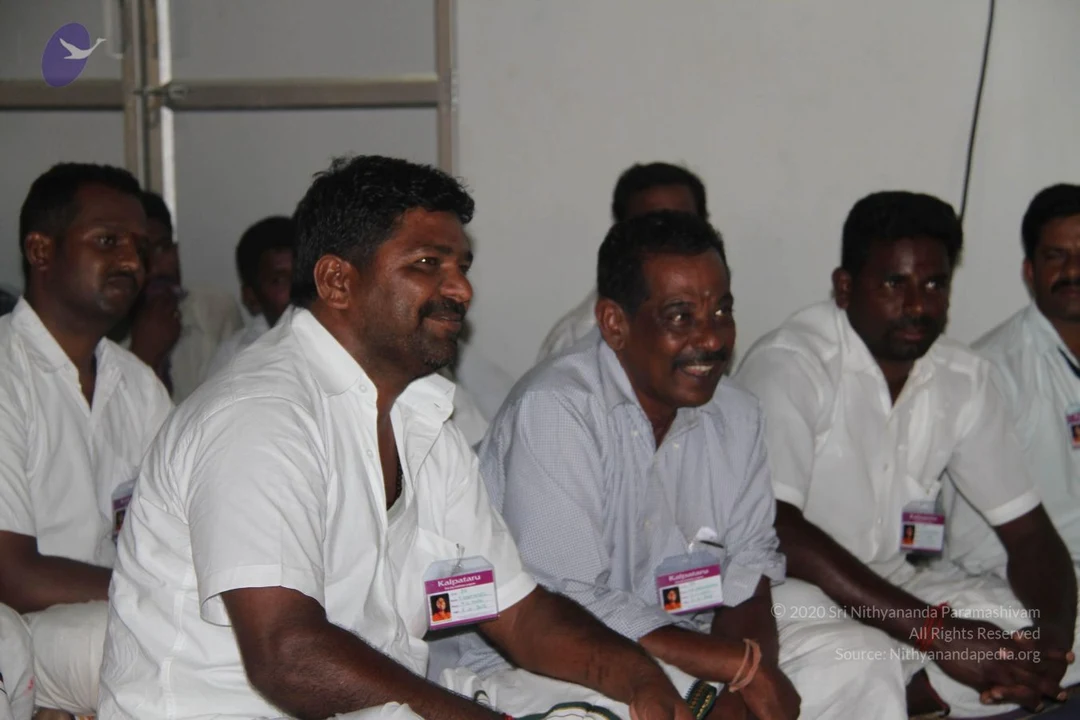
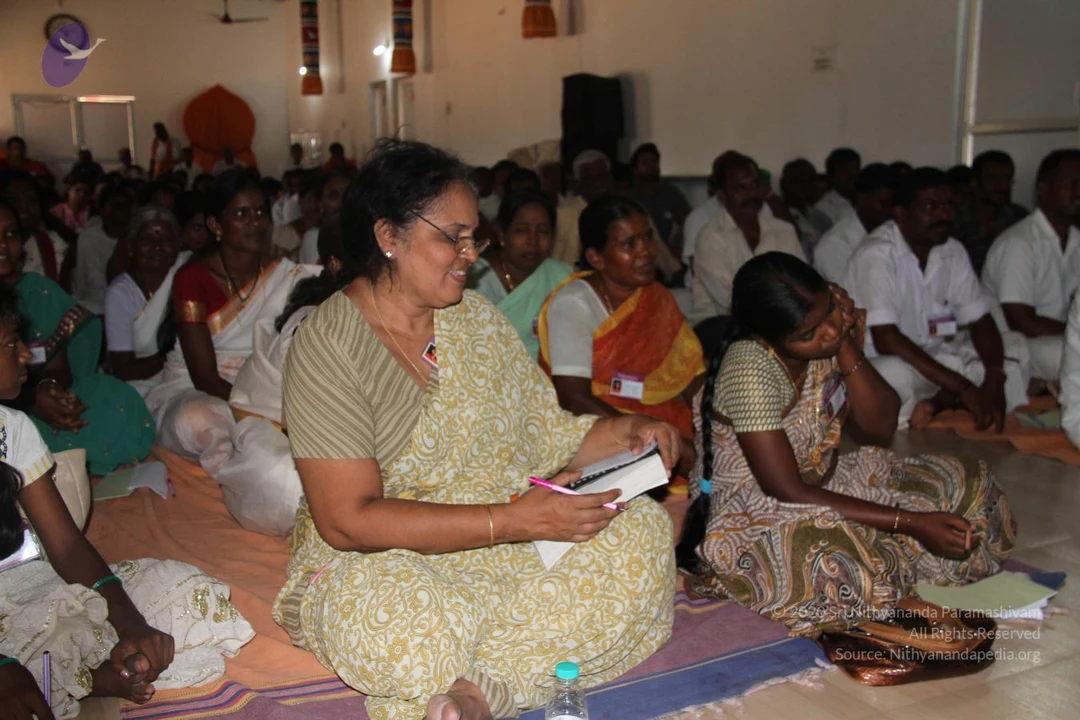
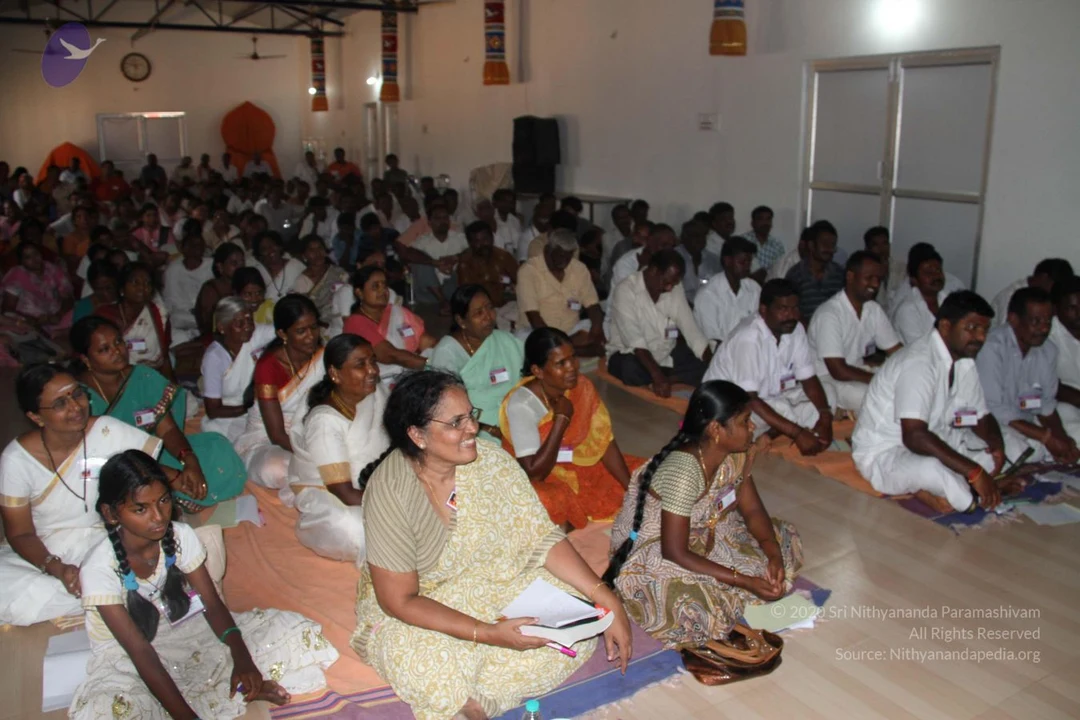
A blurred close-up photograph of hands at a table. A woman in a lavender and white patterned sari with gold bangles writes with a white pen on a sheet of paper, while another woman's hand rests on the paper. At the left edge, a hand wearing a gold ring rests on the table beside a dark pen. A blue object sits at the top edge. The image is faded and washed out.A photograph of women seated at a table writing with pens in a bright room with peach-coloured walls. In the foreground, a woman in a white blouse and white saree with a red bindi and a dark beaded necklace leans over a sheet of paper, holding a pen. Beside her, a younger woman in a pink top and a beaded necklace writes in a notebook. Behind them, another woman in white writes, with a blue plastic tray of pens on the table. A woman in a yellow striped saree stands at the left edge. No a person candidate is visible.A blurred, warm-toned photograph of a woman in a white top with gold-toned bangles and a gold earring, bent over a table with papers, holding a pen. A second person's arm in a pink sleeve and a bracelet reaches into the foreground. No a person candidate is clearly visible; the figures appear to be devotees or volunteers doing paperwork at a desk.Close-up photo of a registration or enrolment table with several people's hands and arms reaching across it. Loose white forms with printed lines, a clipboard, a blue pen, and a stack of small orange-and-white cards with a circular yellow emblem sit on a light wooden table. Partial figures stand at the edge in a sari with red and gold border and a light pink outfit. No identifiable face is visible and no one can be confidently identified as a person.A rotated photograph of a registration or documentation desk indoors. A woman in a white top and gold bangles writes on paper with a red pen at a wooden table covered with loose forms and folders. Seated across from her, a woman in a cream and orange sari with a beaded necklace and gold bangles looks down at the papers. Other women in saris and salwar, one in pink, stand or sit behind the table, with red-painted metal railings and yellow walls in the background.A photograph of a seated audience inside a plain white-walled hall during a satsang-style gathering. Many people sit on the floor in rows, most wearing white or pale clothes, with women in saris and cotton dresses, some in red, orange and green. Several attendees write in notebooks with pens, and name badges hang from their necks. Behind them an orange draped cloth and two decorative woven wall hangings in orange and blue are visible, along with a black speaker box on a table and a white fan in the lower right. Many more seated people fill the background.

OTHERS

72 photosSource gallery
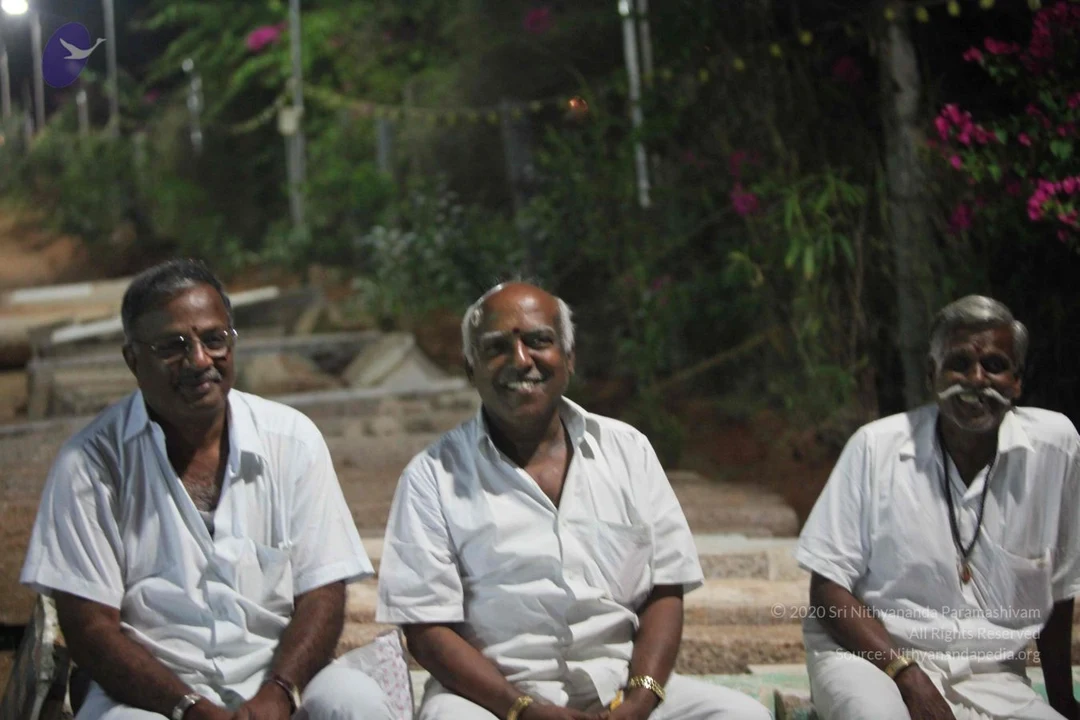
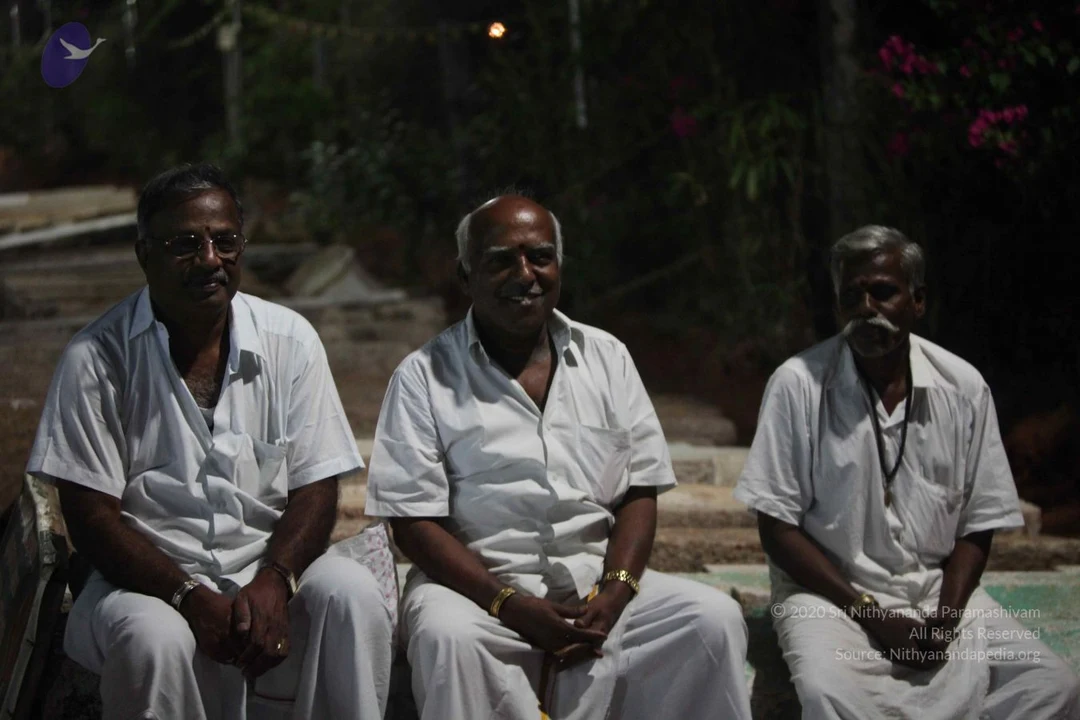
Three smiling men sit side by side on stone steps outdoors at night, all dressed in white short-sleeved shirts and white dhotis. The man on the left wears glasses and a wristwatch; the man in the centre has a gold wristwatch and a bald head with white hair at the sides; the man on the right has a white moustache and wears a dark cord necklace. Behind them are flowering bougainvillea bushes with pink blooms, foliage, and a string of small lights strung across the garden. The setting appears to be a garden or courtyard area with stone slabs.Three older men in plain white shirts and white dhotis sit side by side on a stone step outdoors at night, smiling toward the camera. The man on the left wears glasses and a wristwatch and rests his hands on his knee. The man in the centre wears a gold bangle and holds his hands together in his lap. The man on the right has a white moustache and a dark cord around his neck. Dark foliage and pink flowers stand behind them, with a warm light glowing in the trees.A blurred close-up photograph of hands at a table. A woman in a lavender and white patterned sari with gold bangles writes with a white pen on a sheet of paper, while another woman's hand rests on the paper. At the left edge, a hand wearing a gold ring rests on the table beside a dark pen. A blue object sits at the top edge. The image is faded and washed out.A photograph of women seated at a table writing with pens in a bright room with peach-coloured walls. In the foreground, a woman in a white blouse and white saree with a red bindi and a dark beaded necklace leans over a sheet of paper, holding a pen. Beside her, a younger woman in a pink top and a beaded necklace writes in a notebook. Behind them, another woman in white writes, with a blue plastic tray of pens on the table. A woman in a yellow striped saree stands at the left edge. No a person candidate is visible.A blurred, warm-toned photograph of a woman in a white top with gold-toned bangles and a gold earring, bent over a table with papers, holding a pen. A second person's arm in a pink sleeve and a bracelet reaches into the foreground. No a person candidate is clearly visible; the figures appear to be devotees or volunteers doing paperwork at a desk.Close-up photo of a registration or enrolment table with several people's hands and arms reaching across it. Loose white forms with printed lines, a clipboard, a blue pen, and a stack of small orange-and-white cards with a circular yellow emblem sit on a light wooden table. Partial figures stand at the edge in a sari with red and gold border and a light pink outfit. No identifiable face is visible and no one can be confidently identified as a person.

ANNA-MANDHIR-SERVICES

73 photosSource gallery
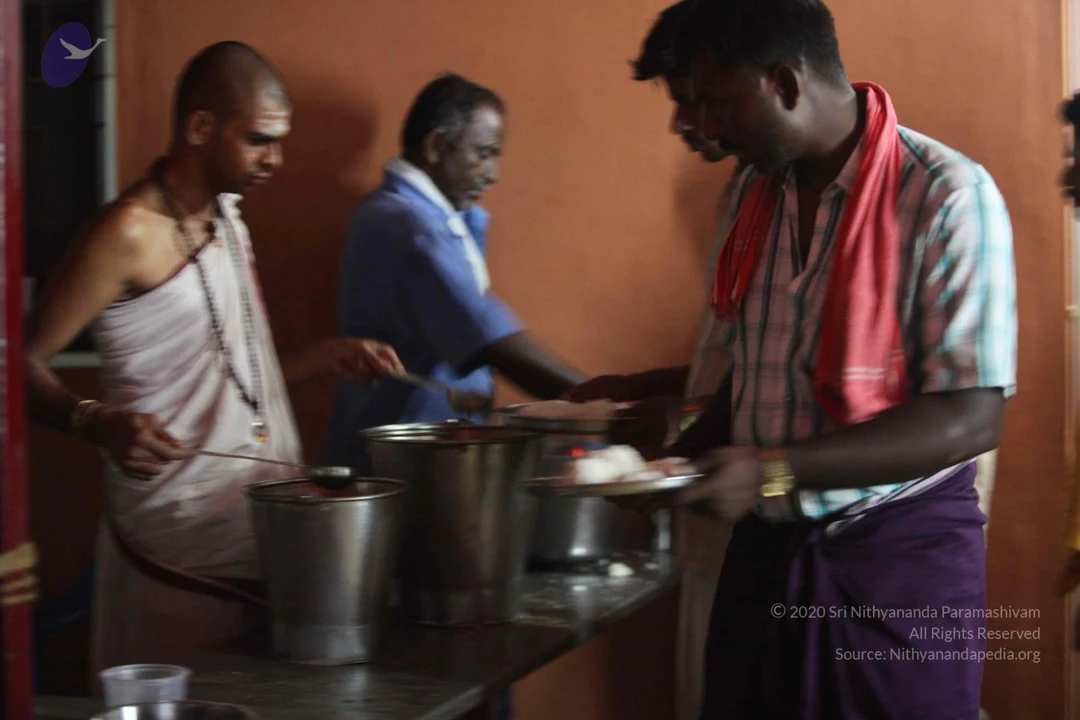
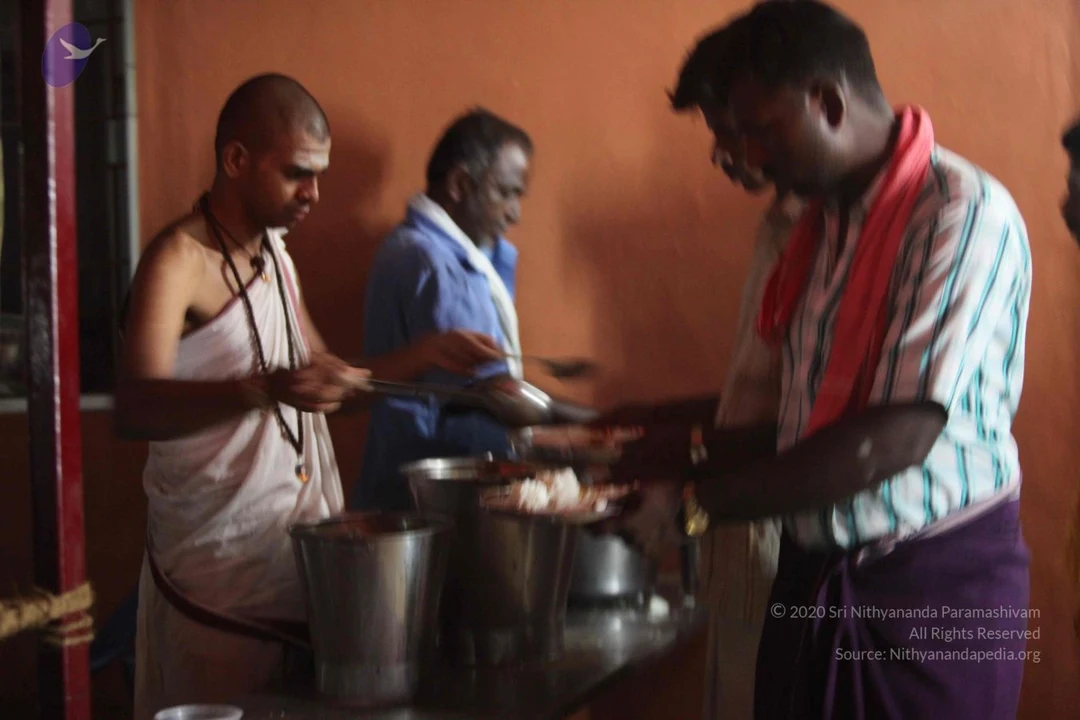
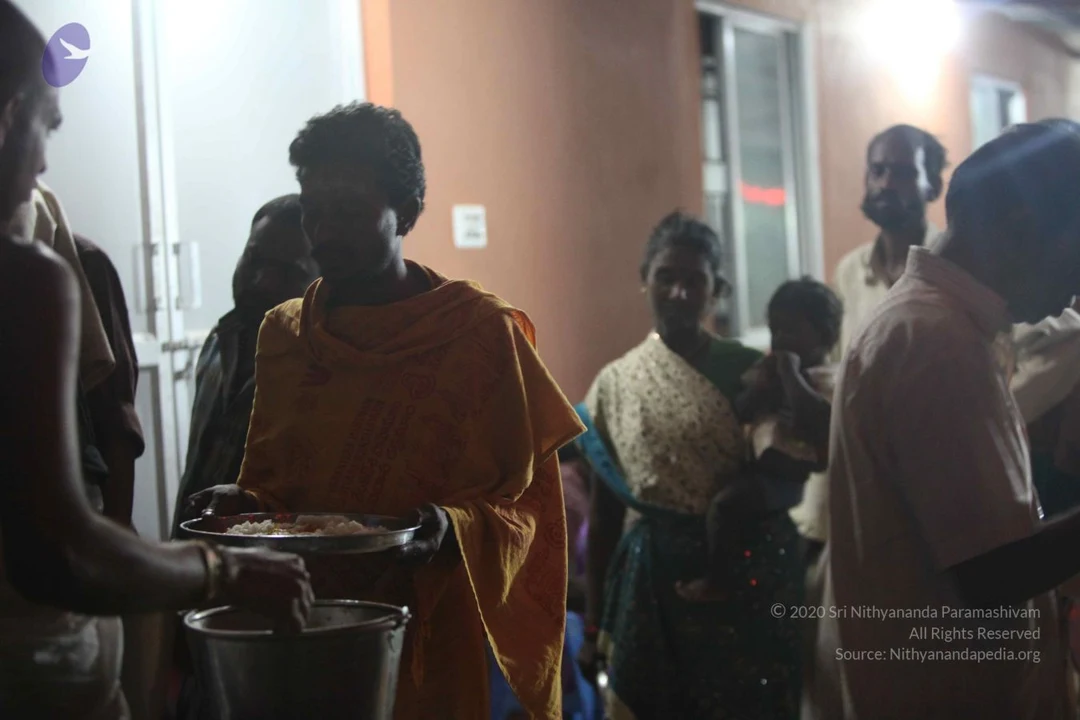
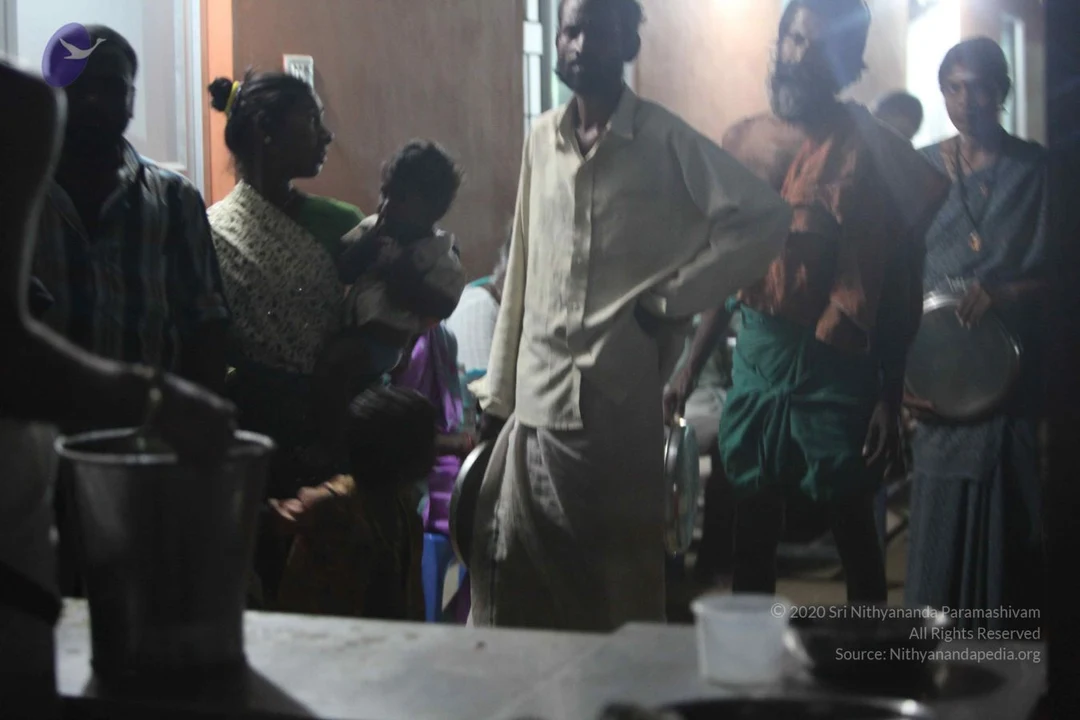
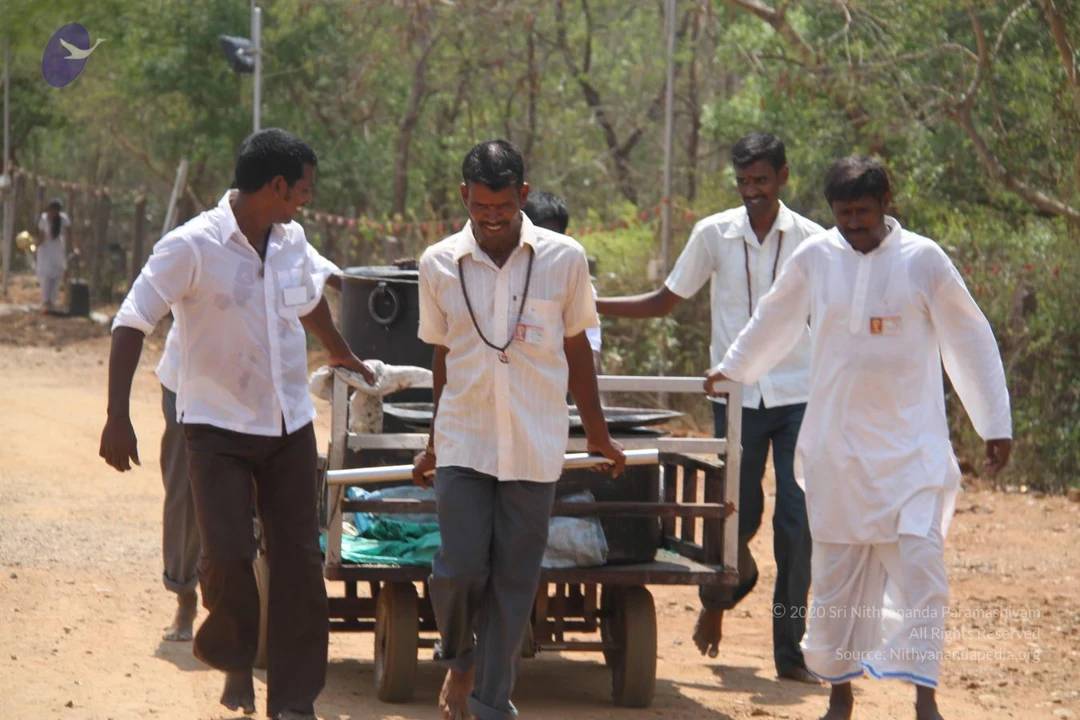
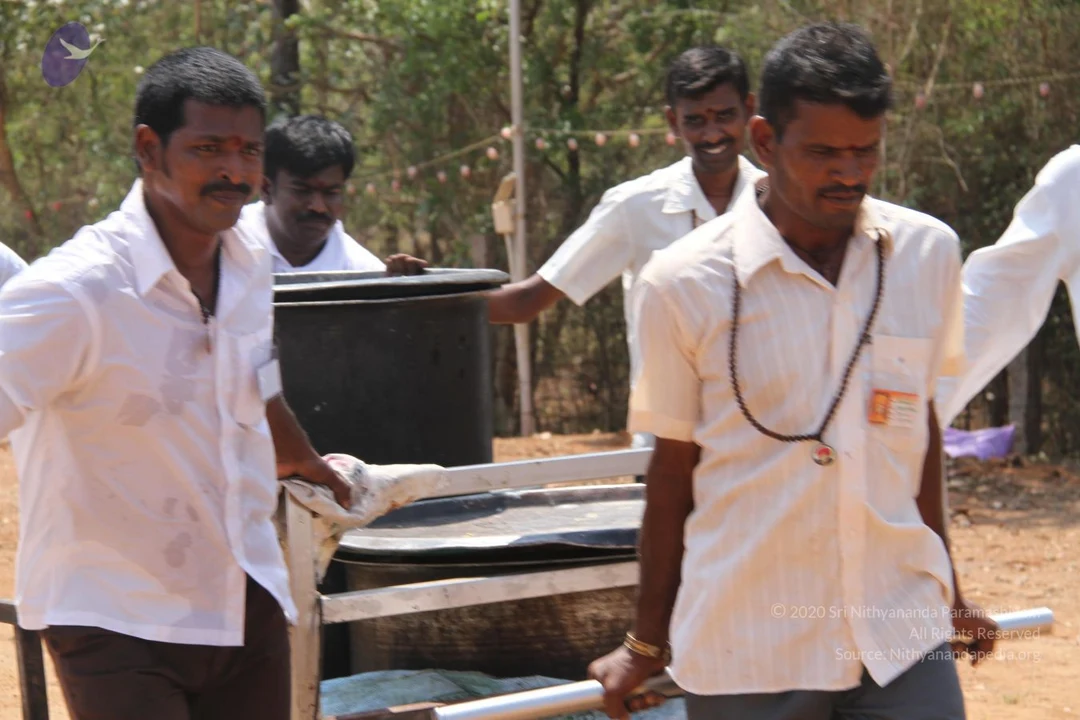
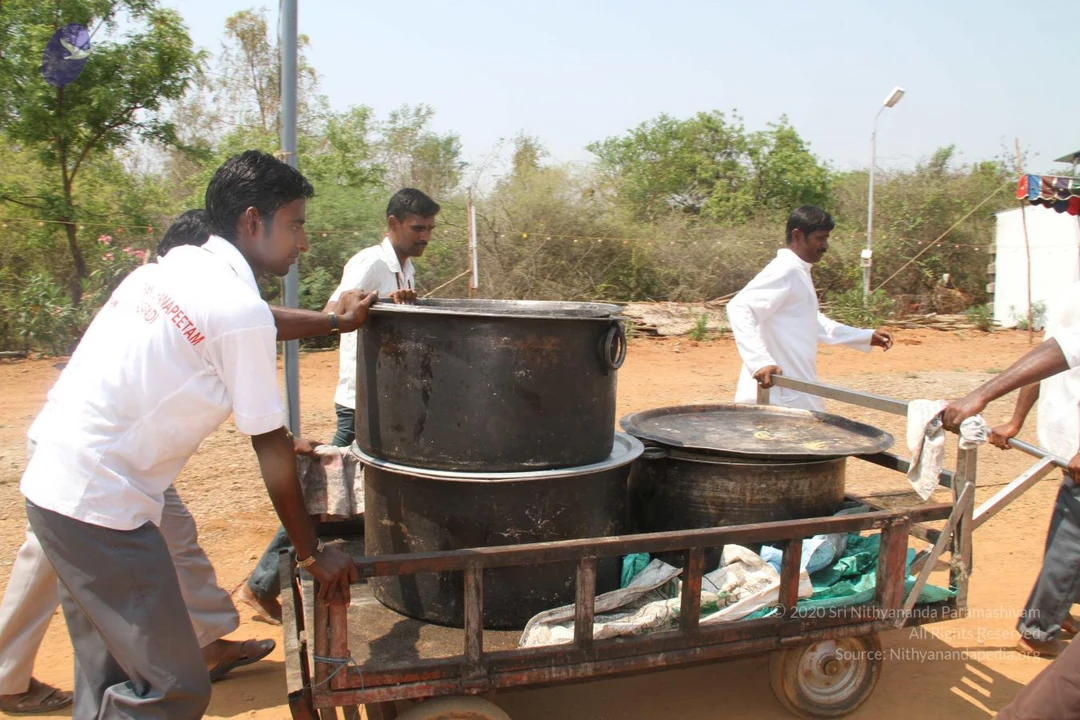
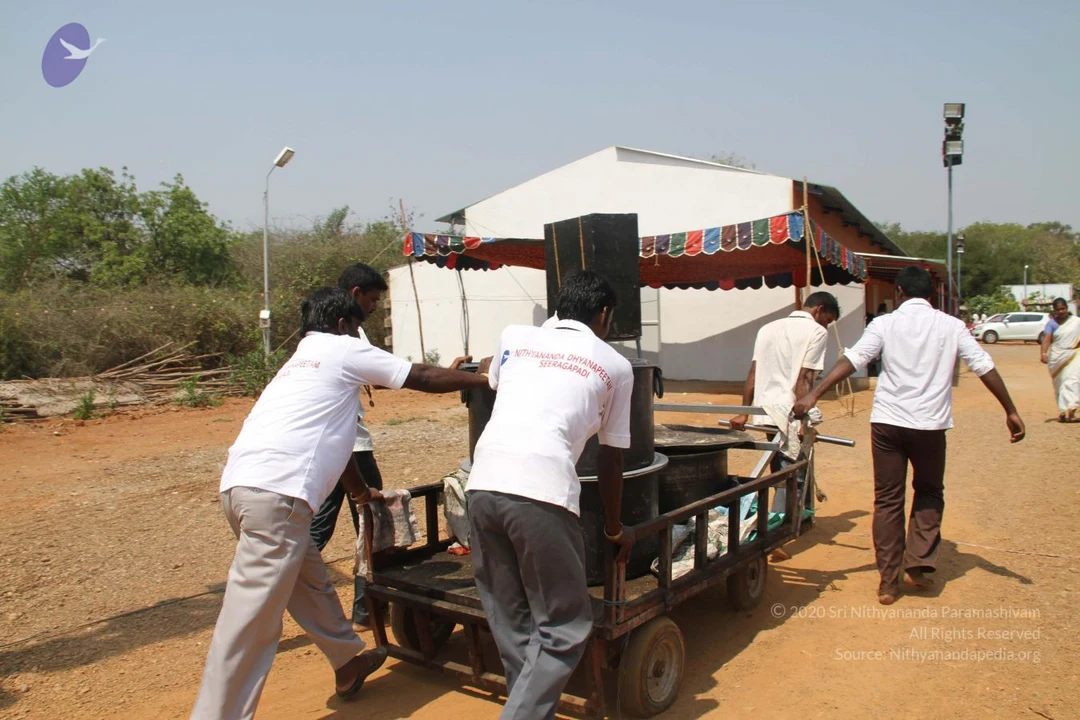
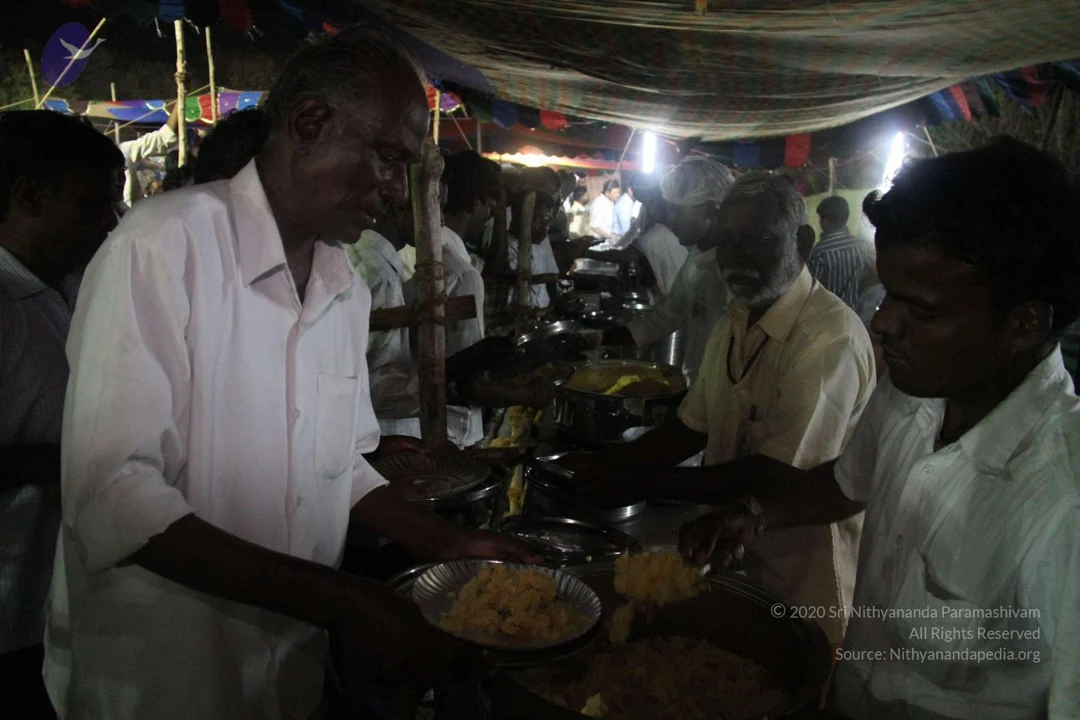
Men serve food in a kitchen with orange-painted walls at a steel counter holding large stainless steel pots and a plate of food. On the left, a shaved-headed man in a white dhoti and a rudraksha mala with a pendant is ladling from a pot. Beside him, an older man in a blue shirt and white cloth stands at a pot. On the right, a man in a plaid shirt with a red shawl and purple lungi holds a plate and receives food. Blurred figures are partly visible behind. The setting suggests a kitchen service for annadan.Night-time photograph of a food distribution line in an indoor corridor with pale pink walls and a white door. A man in an orange-yellow shawl holds a steel plate of rice, while another man in a white shirt pours from a steel bucket at left. A woman in a cream blouse and teal sari stands smiling, holding a small child. Other people wait behind, one man in a pink shirt at right.A photograph taken at a food distribution line. Several people wait in a doorway: a woman in a white shawl with green blouse holds a small child, a man in a cream shirt and white dhoti stands centre with hands at his waist, and a bearded man in an orange shirt and teal lungi holds a steel plate. A woman in a blue sari and necklace on the right holds a steel plate. Five people are visible, along with partially visible figures behind them.Blurred motion photo of large stainless steel cooking vessels with lids set on a wooden cart or trolley with metal railings. A man in white dhoti with a yellow cloth at his waist walks at left, and another person in white shirt stands at upper right. Behind them is a reddish-brown earthen wall.A blurred photograph of a wooden hand cart carrying large stainless steel vessels with lids, a smaller steel pot and a bucket, with some green leaves on the lower shelf. A partially visible person in white clothing with a yellow border stands at the left edge. Rough brown rock walls form the background.A photograph of men in white shirts pushing a metal cart loaded with large black cylindrical containers. The man in front left wears a red-and-white forehead mark and a dark cord necklace; the man in front right, in a striped white shirt, wears a rudraksha-style bead mala and holds the cart handle. Behind them, two more men in white shirts walk and smile, one with his hand on a container. No one is identifiable as a person in this scene.

TV- MEETING-SUDDHA-MHJ

8 photosSource gallery
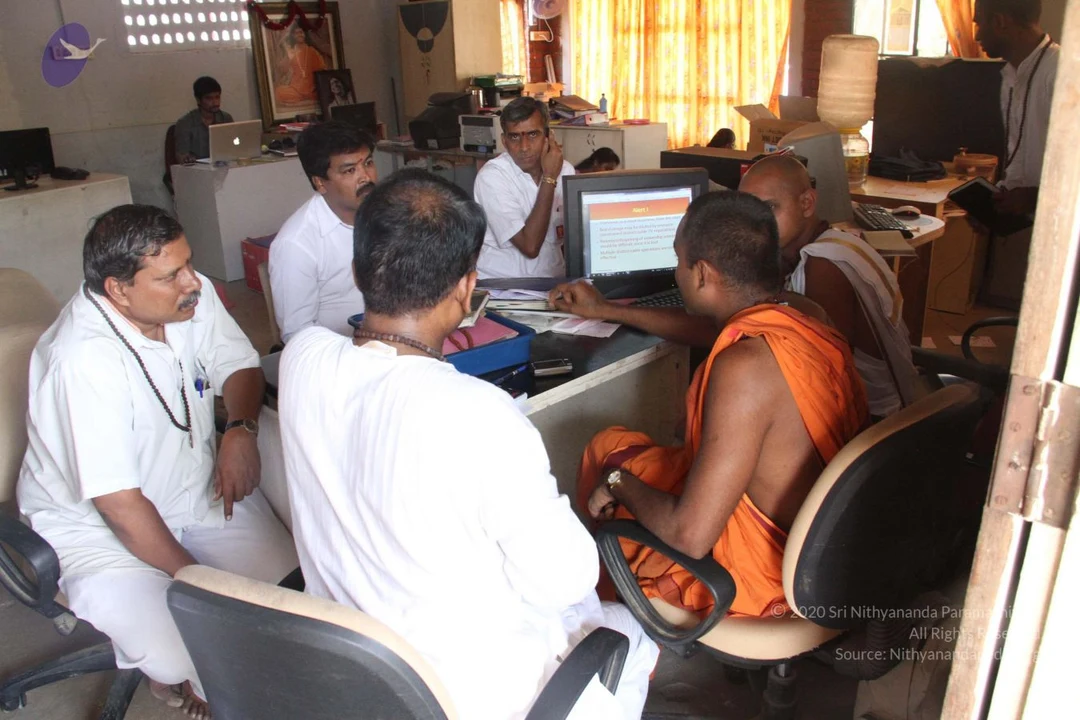
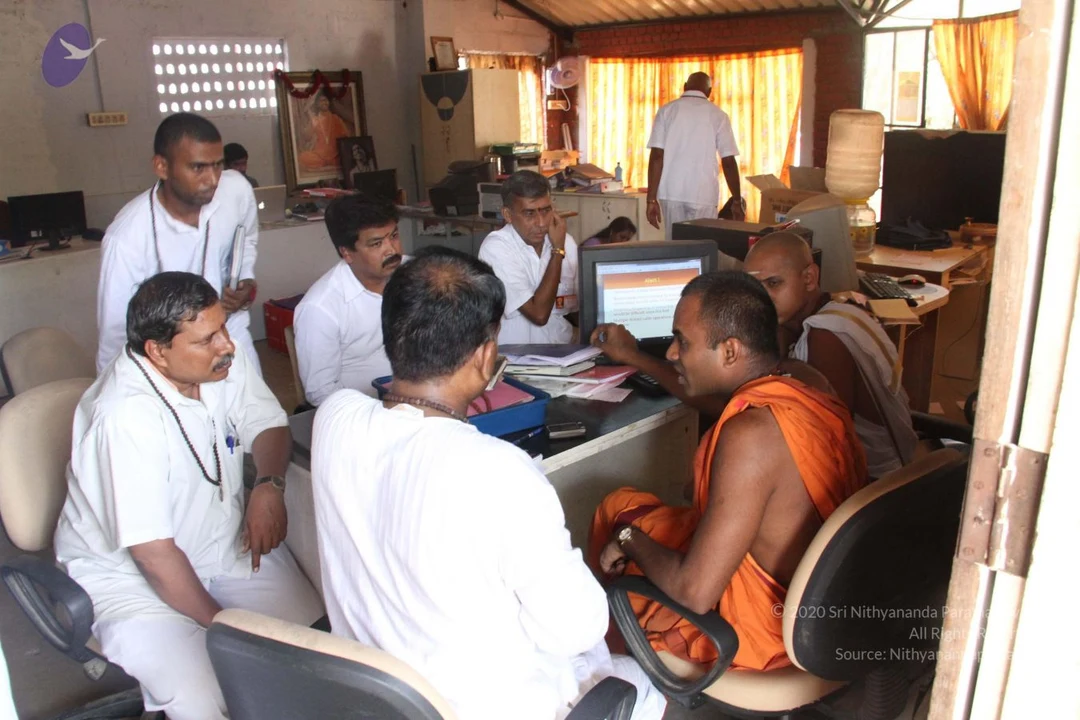
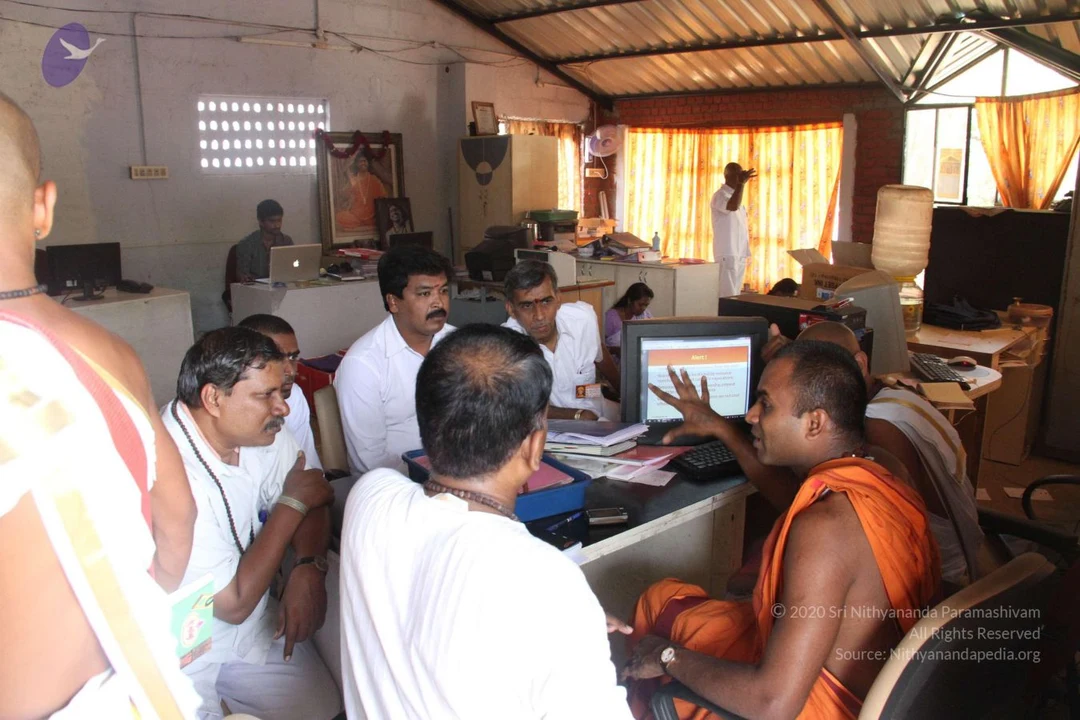
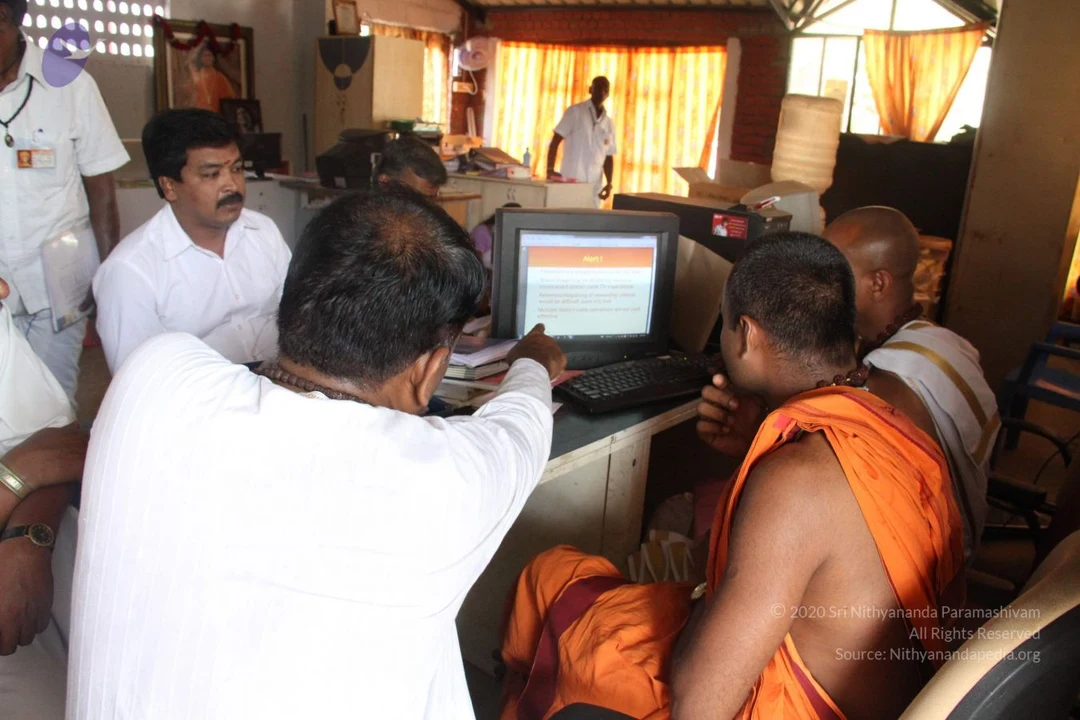
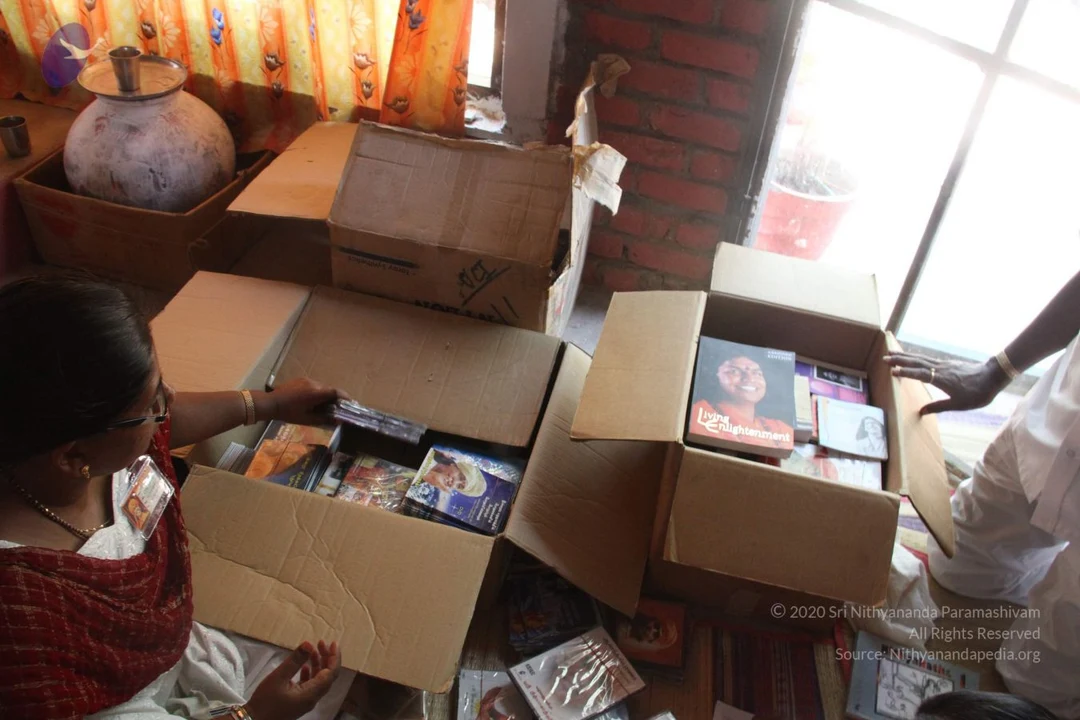
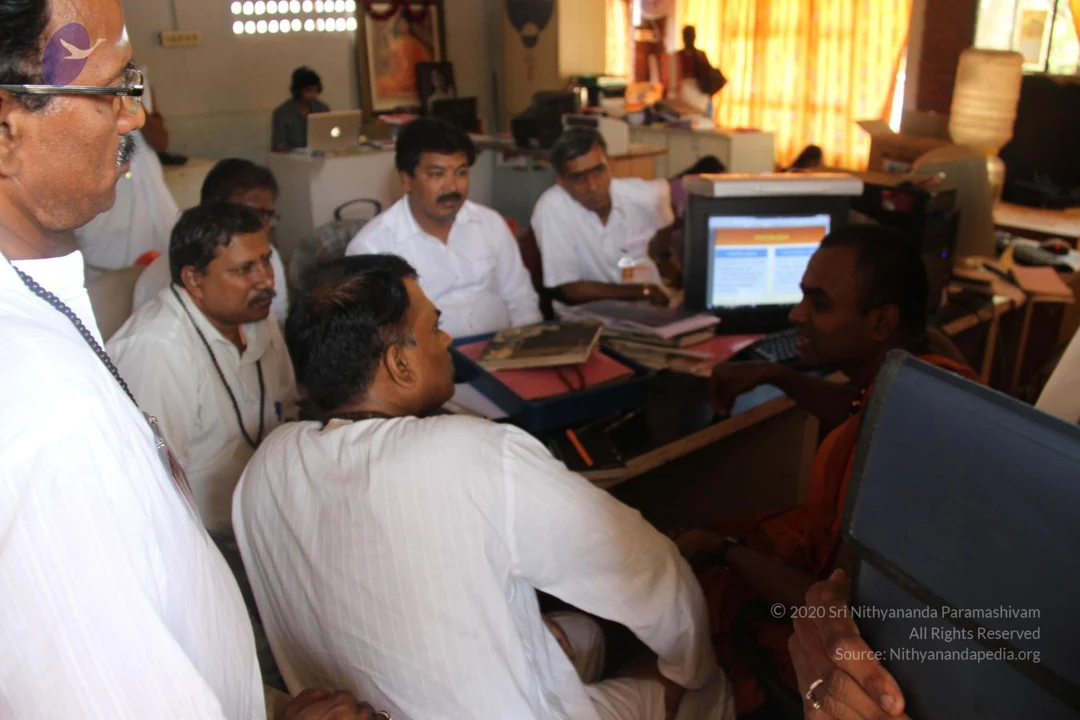
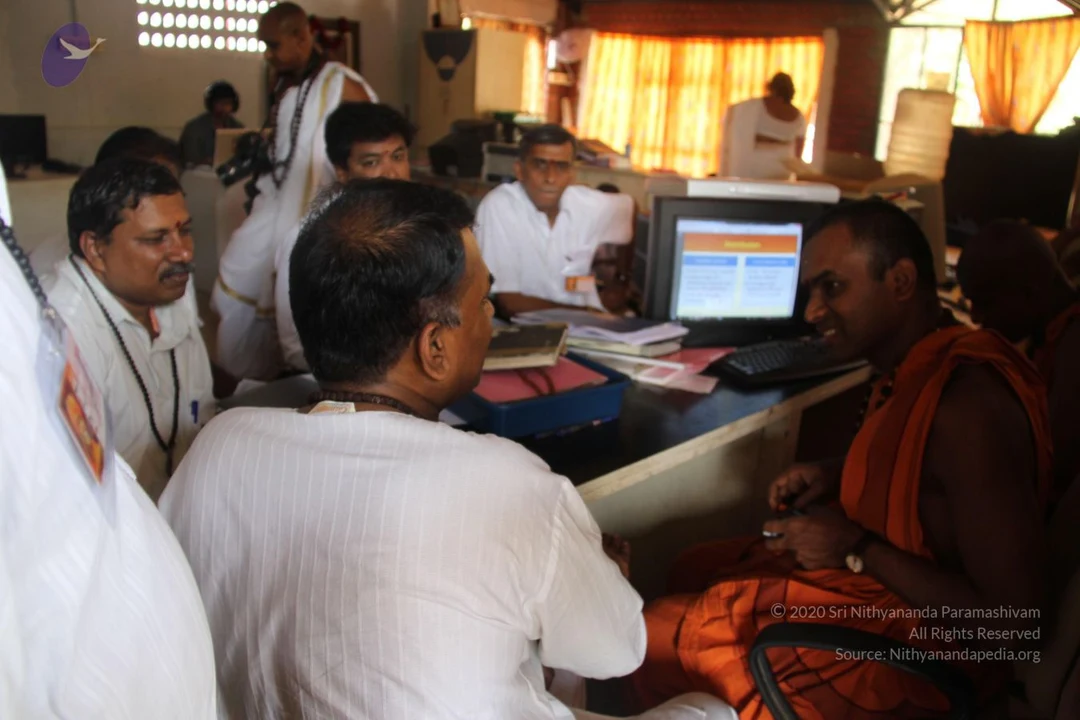
A busy office interior where several men gather around a desk with a computer monitor showing a slide with orange and white text. On the left, a man in white shirt with a rudraksha mala and wristwatch gestures while speaking. A man in a white shirt holds a phone to his ear at the center. On the right, a bald man in a saffron-orange robe sits at the desk, his hand on the keyboard, and another bald man in white stands beside him. A framed portrait with a garland hangs on the wall behind, with orange curtains and a ceiling fan visible. Several other people sit in the background.Photograph of an office interior with several men gathered around a desk and computer monitor. A bald man in orange saffron robes and a bare upper body sits at the desk, working at the keyboard, while a man in white shirt and rudraksha mala leans in beside him. Other men in white shirts and a man in orange garments stand or sit around the room. A framed portrait of a saffron-robed figure hangs on the back wall, decorated with red garland, and orange curtains hang at the windows. Papers, folders and a pink tray sit on the desk.A photo inside a simple office with a corrugated metal roof, brick walls and orange curtains. In the foreground a monastic in orange robes, bare-chested with a wristwatch, sits at a desk pointing at a computer monitor showing a slide. Around him several men in white shirts and trousers, one with a rudraksha mala, lean in to view the screen. A man in white stands at the back near a window, and another person sits at a desk at left beside a framed portrait of a saffron-clad figure. Papers, folders and a laptop cover the desks. Six people are visible.A photograph of people gathered around a large old CRT computer monitor in a plain room with white walls and a window letting in bright light. On the left, a shaved-headed man wears an orange-saffron garment and a beaded mala necklace, seated close to the screen. Beside him, a man in plain white clothes sits and looks toward the monitor. On the right, several men in white shirts and a man with a red tilak on his forehead lean in to look at the screen; one holds a gold watch. A woman in a white sari with an orange border stands in the background, and a man in white stands near the center. A framed religious picture hangs on the back wall, and a stack of papers and a folder sit on a desk.Indoor photo in a small office room with a cream-painted wall and an orange floral curtain at the window. A bald man in white dhoti and shawl with tilak and beaded mala sits at left, while a man in saffron/orange robes with rudraksha mala and a wristwatch sits centre, both with hands at chins in conversation. Two men are seen from behind or in profile at right and foreground, one in white shirt. A blue plastic tray on the desk holds a book with a sepia portrait cover, a red-brown mala and papers. A desktop monitor and keyboard sit at left.A photograph of a room with several open cardboard boxes filled with books, CDs and booklets. A woman in a white blouse with a red-and-maroon checked shawl and glasses sits at left, sorting items from a box. At right, a man in white clothing with a gold bracelet reaches toward the boxes. One box holds a book titled Living Enlightenment showing a smiling young woman on the cover. A large clay pot with a metal lid stands on a table near orange-and-yellow curtains, and a red bucket sits by a window with brick walls.

MEDICAL-CAMP

7 photosSource gallery
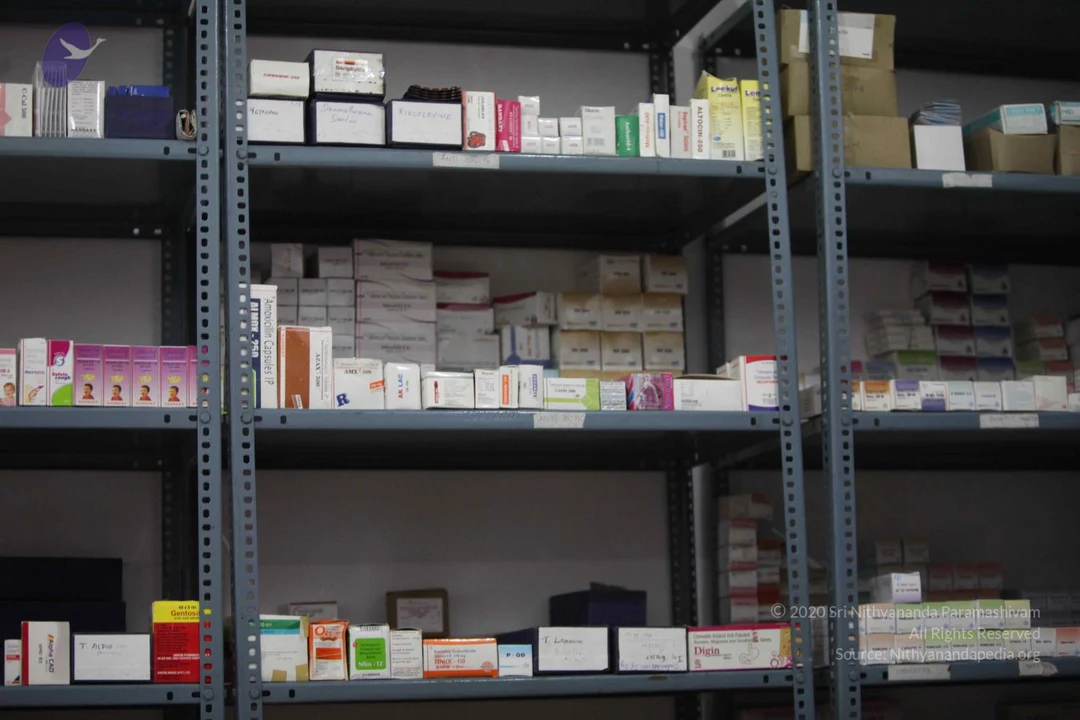
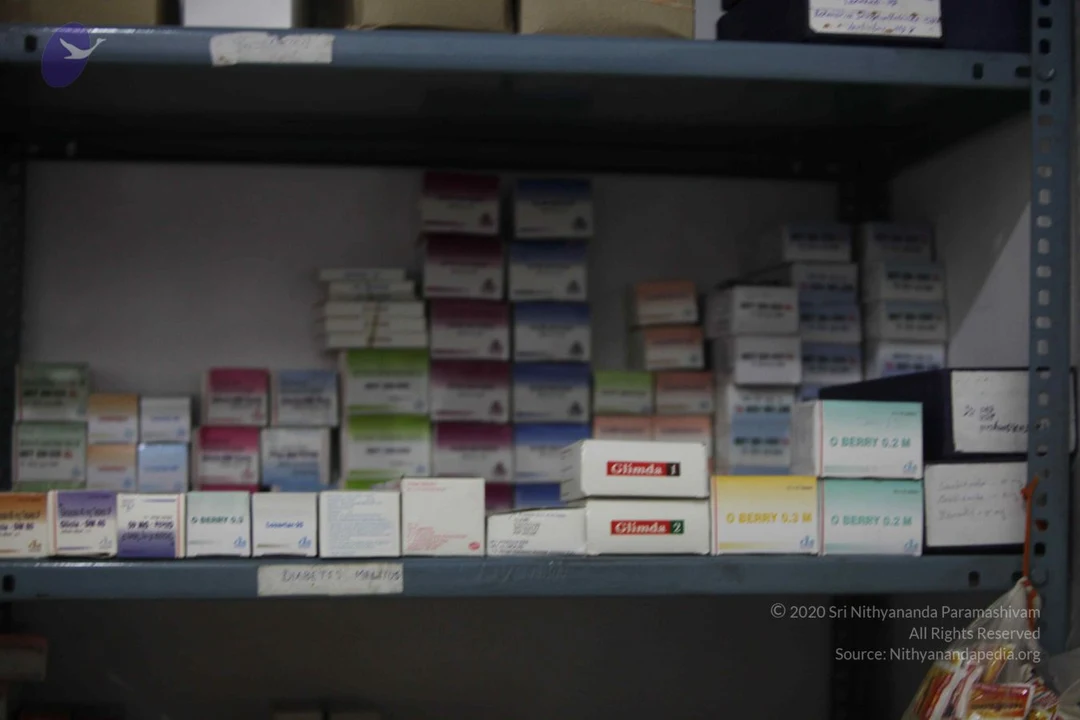
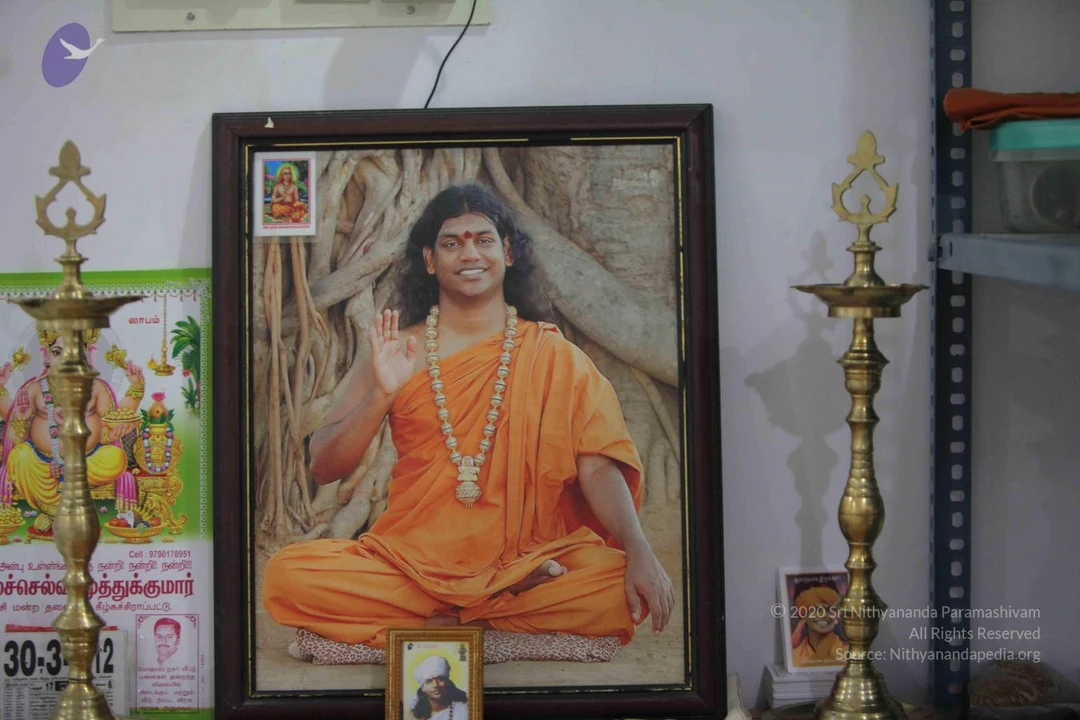
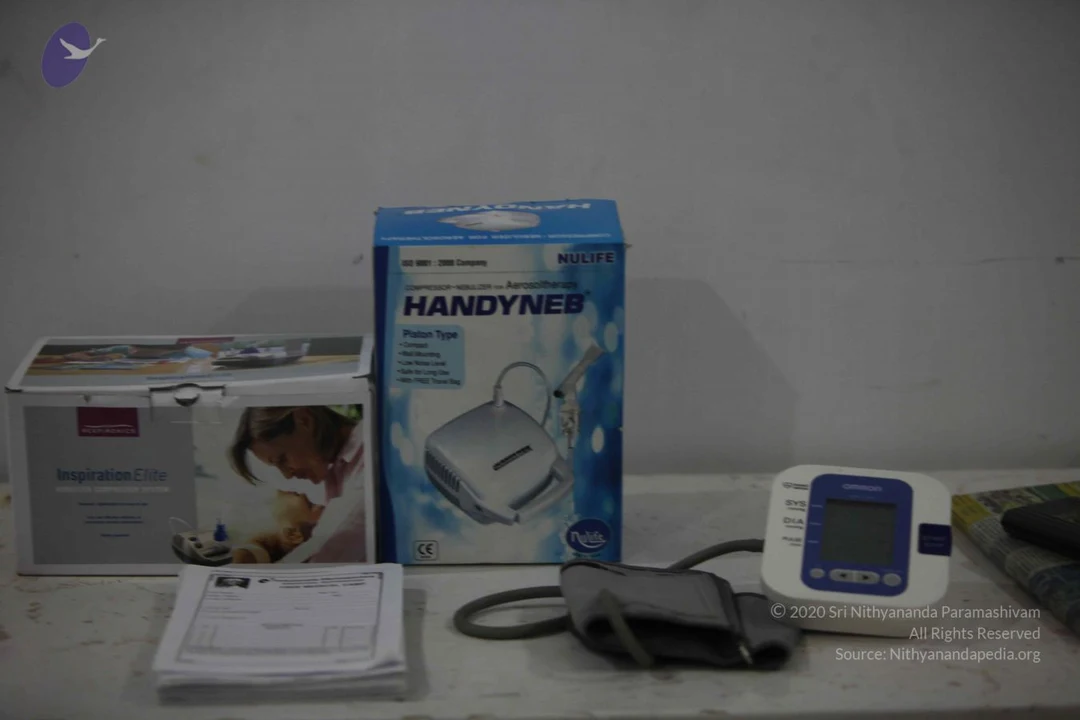
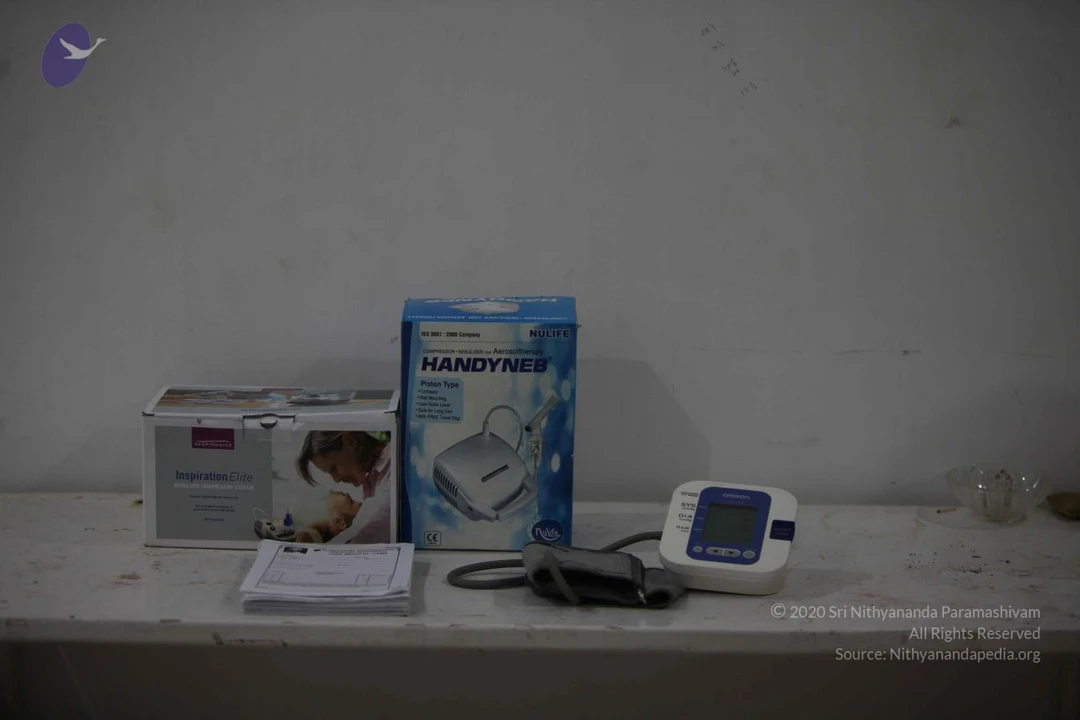
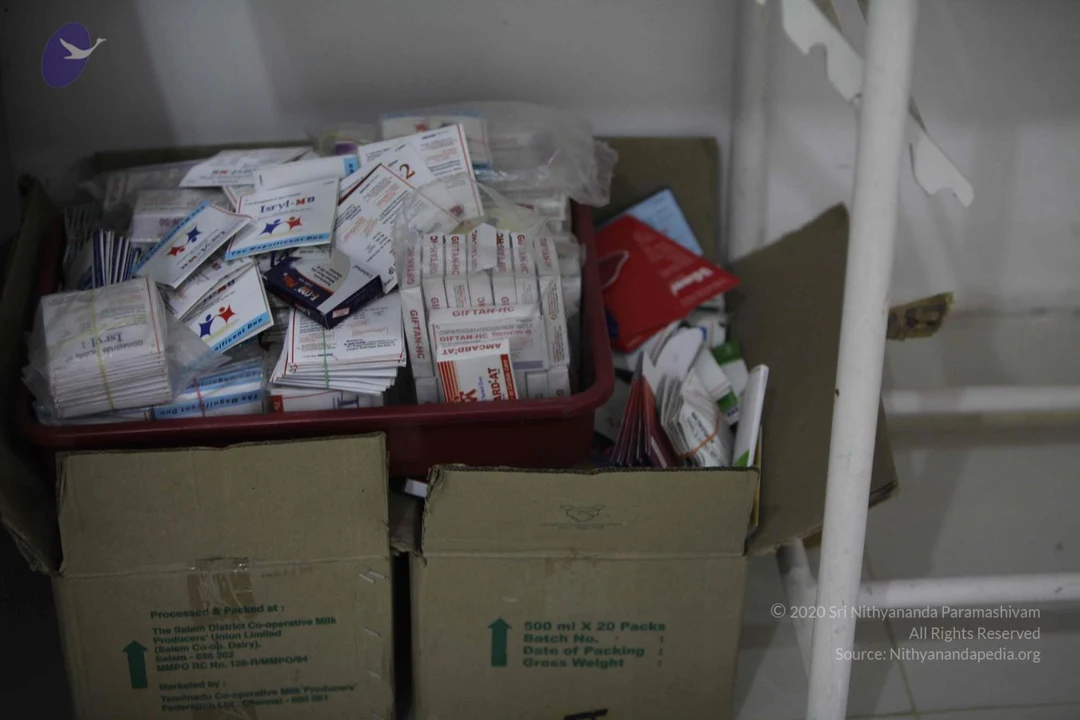
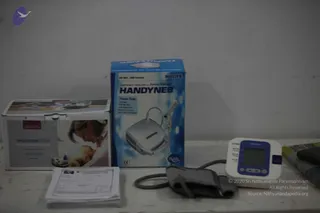
A photograph of metal storage shelving in a stockroom filled with boxed medicines and pharmaceutical packs. Boxes in white, pink, green, yellow and orange packaging sit on several shelves, with cardboard cartons stacked at the top right. Handwritten labels mark some shelf sections and product boxes. No people are visible in the scene.A photograph of a blue metal storage shelving unit stocked with rows of boxed medicines and pharmaceutical packaging. Many small cardboard boxes in pink, blue, green, yellow and white are stacked on the shelves, including several boxes labelled Glimda 1, Glimda 2, and G Berry 0.2 M and G Berry 0.5 M. A handwritten label on the lower shelf reads Diabetes Medicines. No people are visible.A framed photograph of a smiling man with long dark hair, wearing an orange robe and a rudraksha-style bead necklace, seated in lotus position before a large banyan-type tree with exposed roots. He raises one hand in greeting and has a red bindi on his forehead. The framed picture hangs on a white wall, flanked by two tall brass oil lamps. To the left is a wall calendar showing a deity in yellow and a Tamil business advertisement, and a small framed photo sits at the lower centre. A printed portrait of the same figure sits on the shelf at right. Several small framed and loose devotional prints are visible on the shelf.A photograph of medical equipment on a white table against a plain grey wall. In the centre stands a blue and white box labelled HANDYNEB, a compressor nebulizer aerosol therapy unit by Nulife, with an image of the device on its front. To the left sits a white box labelled Inspiration Elite, a nebulizer with a cartoon illustration on its lid and a photo of a woman holding a child. A stack of printed manuals lies in front. To the right is a white Omron blood pressure monitor with a dark cuff and blue buttons, beside a folded newspaper. No people are visible.A photograph of a red plastic tray filled with loose pharmaceutical packets and blister-style cards stacked in a cardboard box. Many small white and blue packets are visible, including ones printed with the names Isryl-MB, Giftan-HC and Amcrid-AT, along with a red and white leaflet at the right edge. No people are present and no one is shown in ritual or ceremonial activity.A photograph of cardboard boxes and a red plastic tray filled with medicine packets, blister strips and small pharmaceutical boxes, stacked in a corner beside a white metal rack. Several cardboard cartons are printed with shipping text and arrows, and one box carries packaging details for 500 ml milk packs from a dairy co-operative. No people are visible; the scene shows medical supplies stored in a room.

TEMPLE-SERVICES

40 photosSource gallery
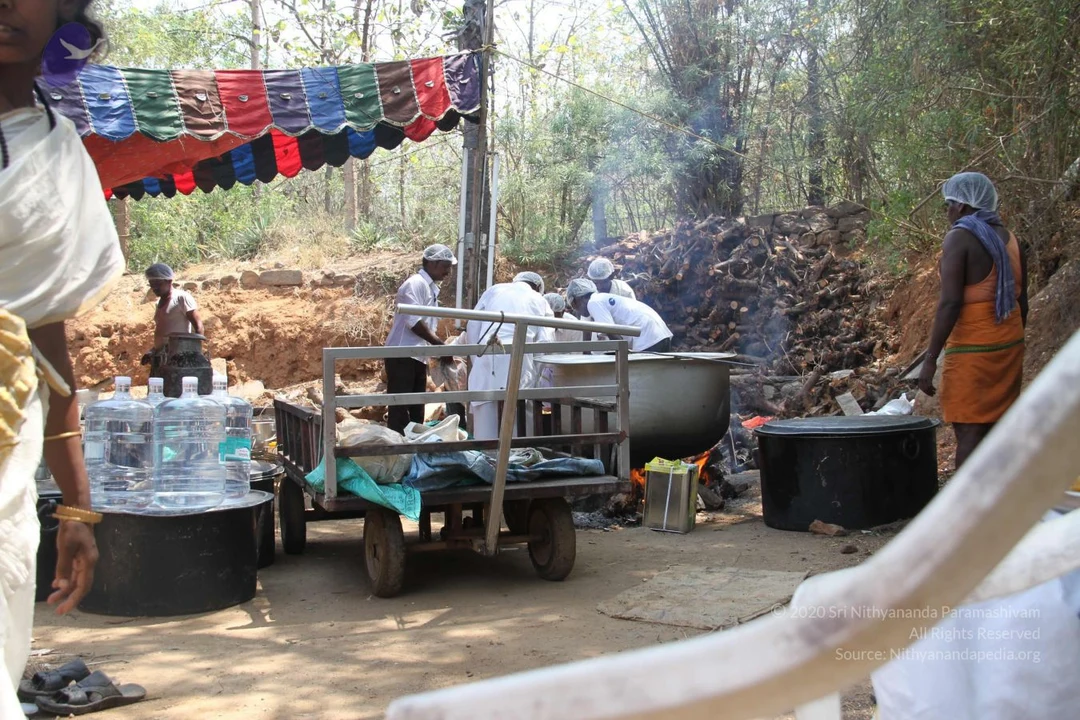
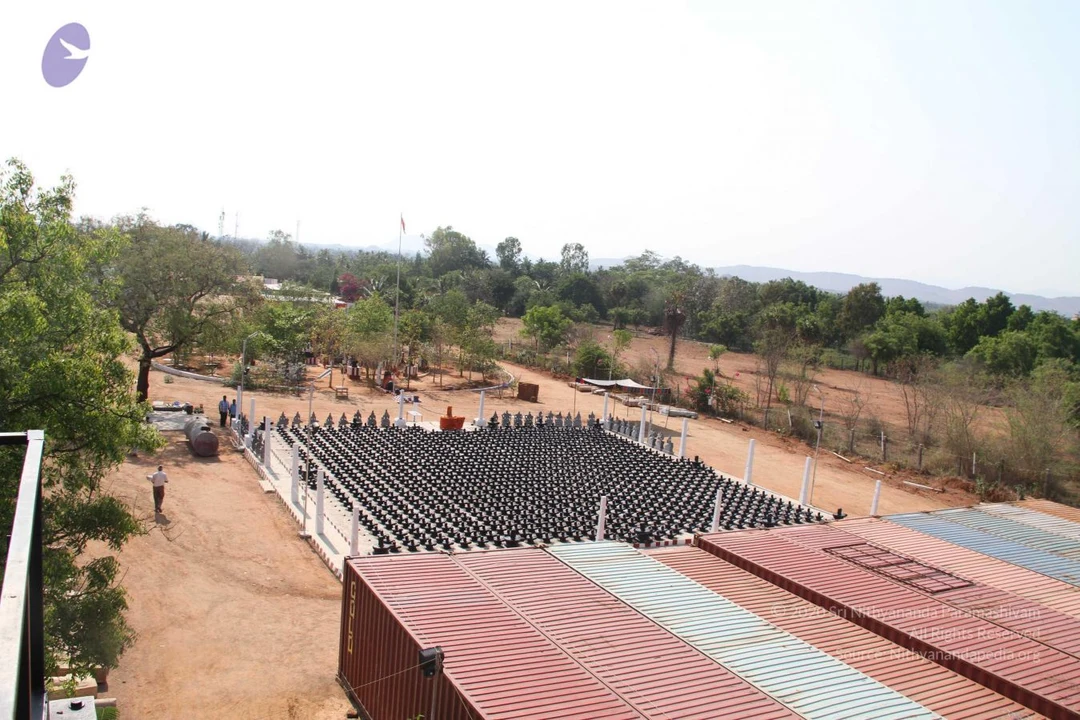
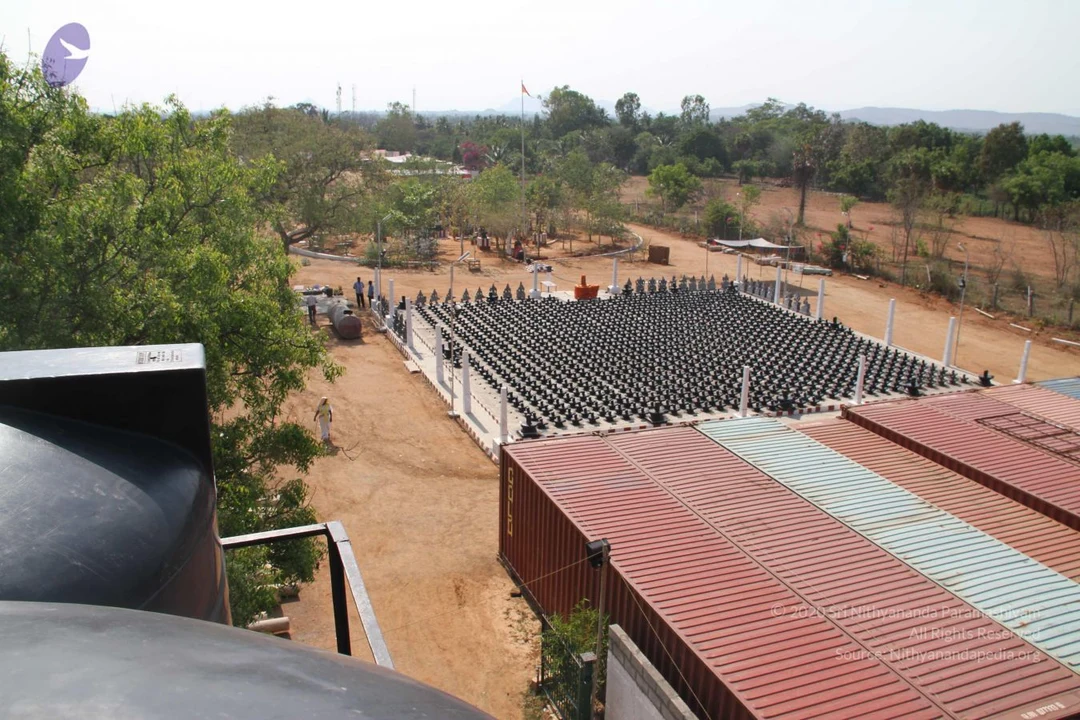
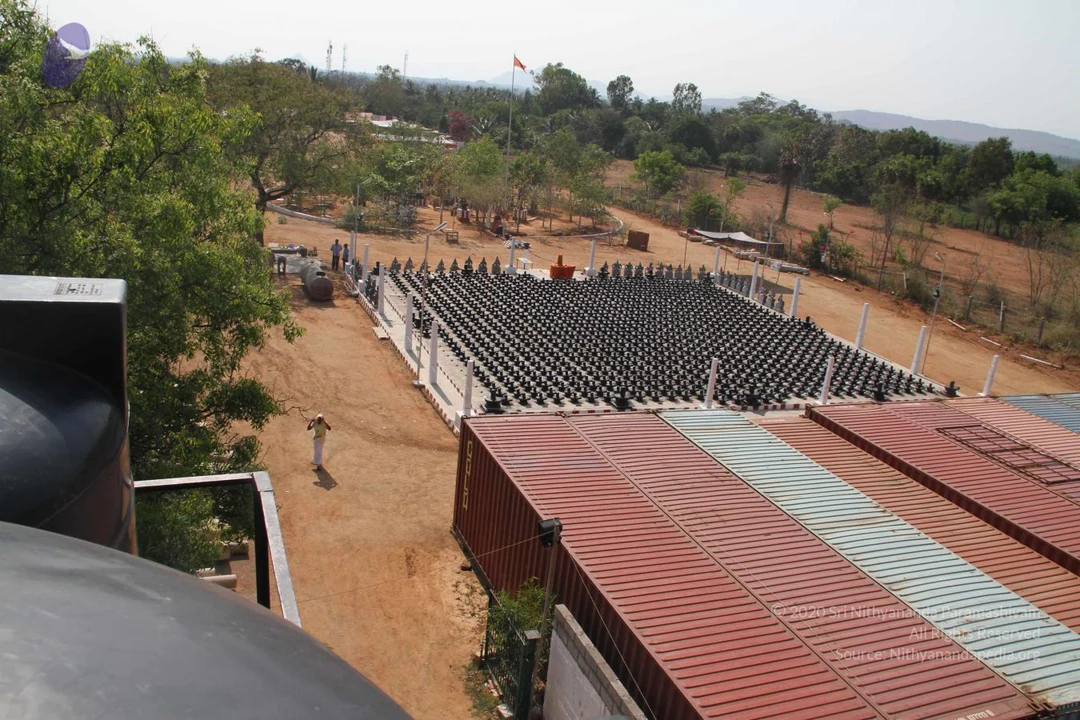
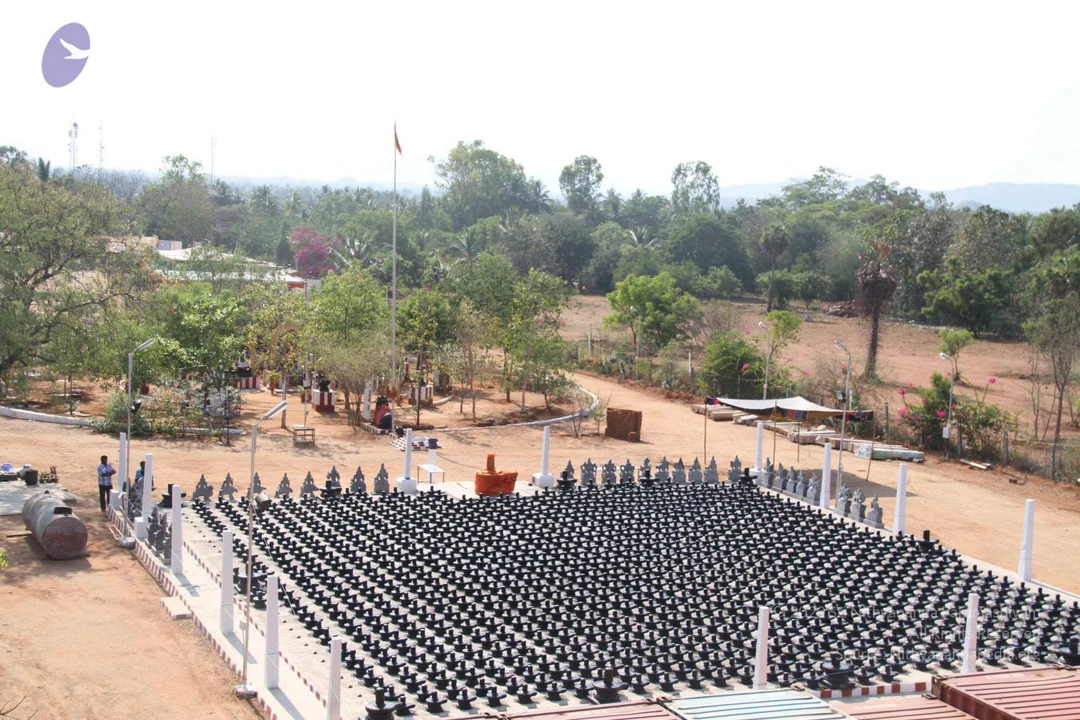
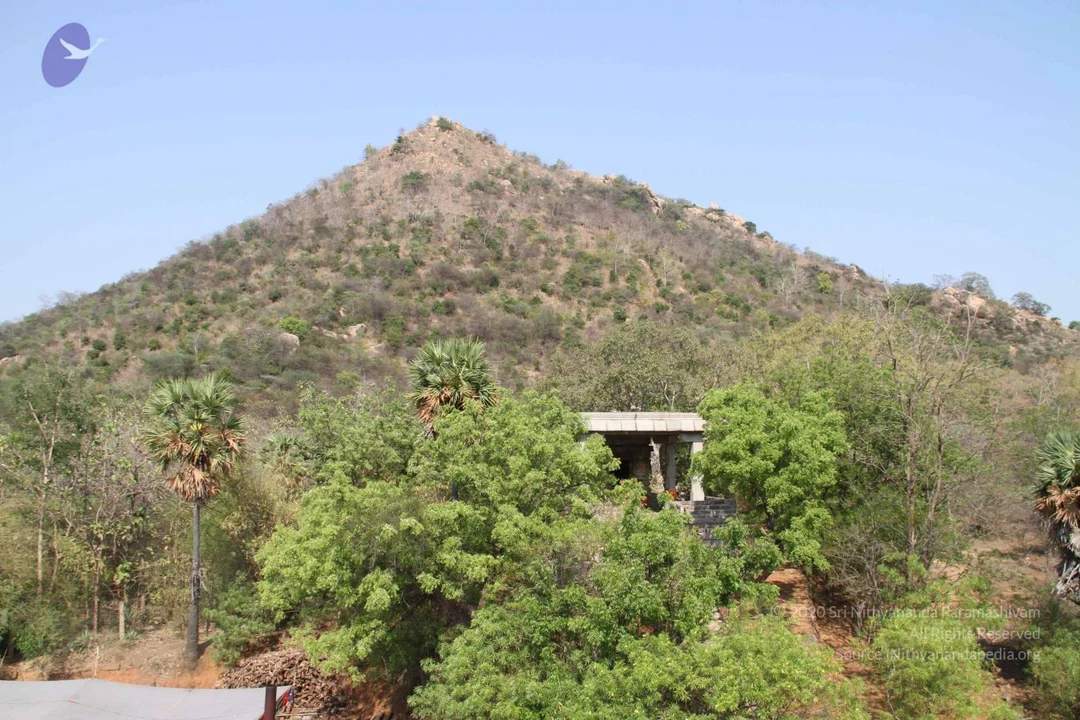
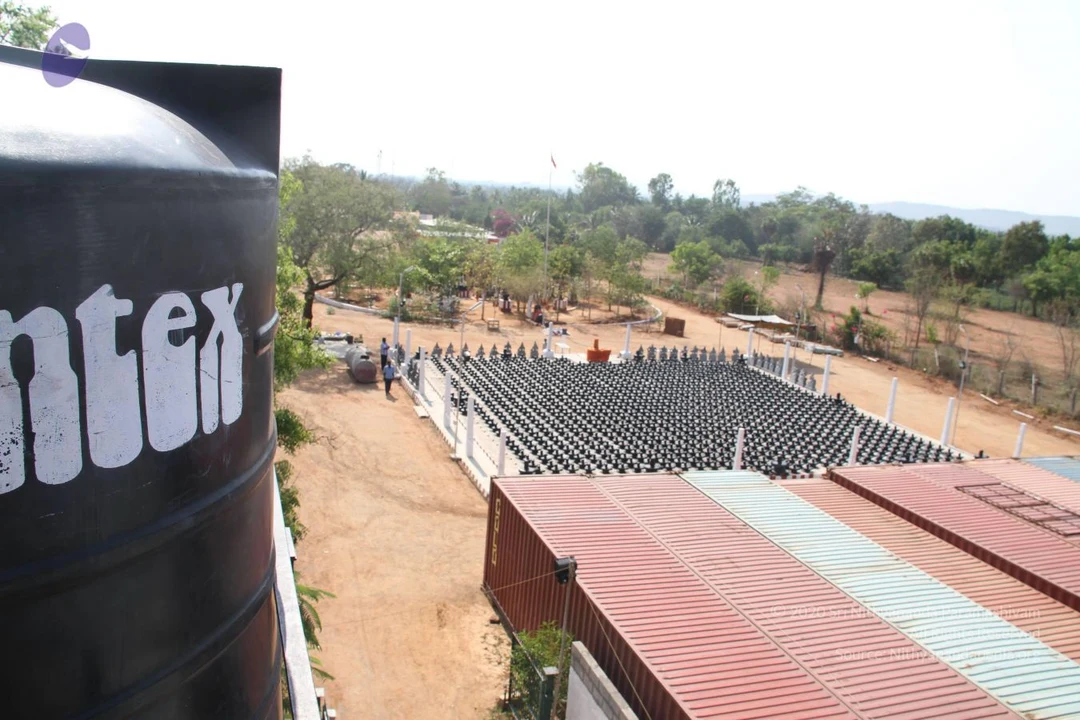
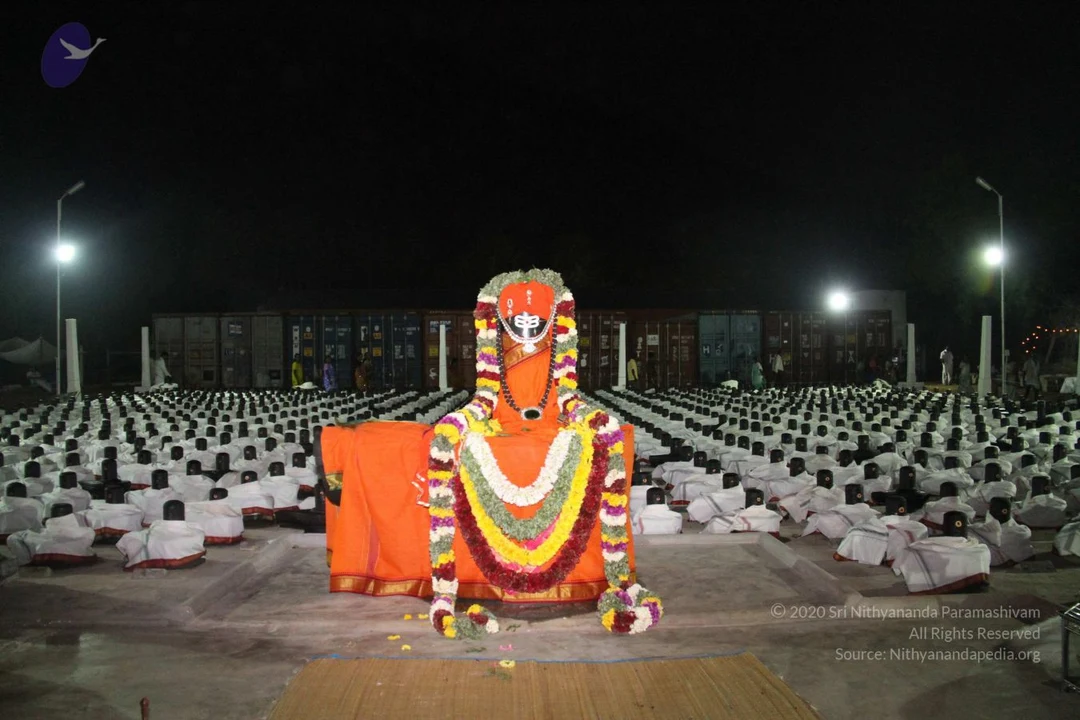
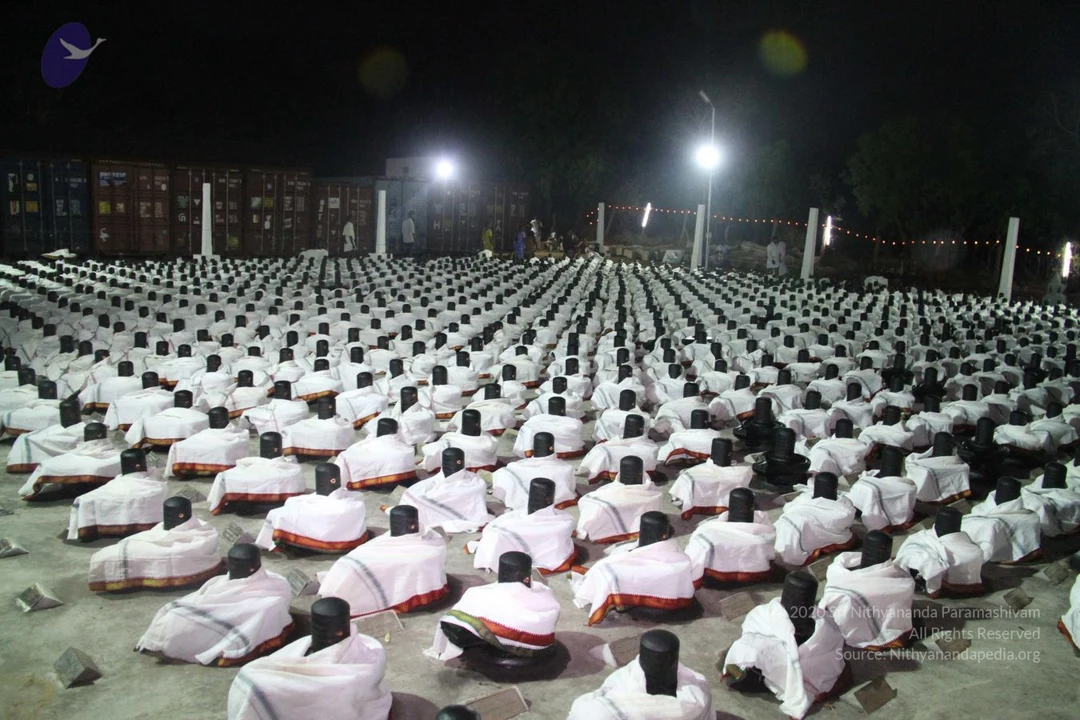
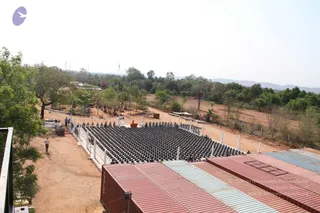
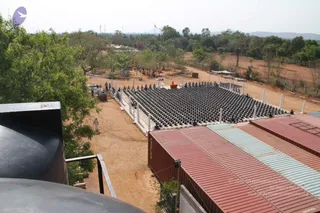
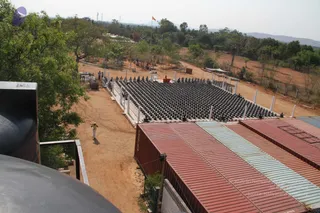
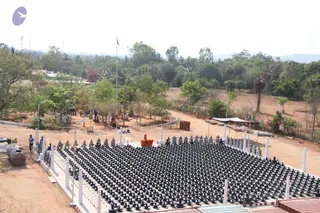
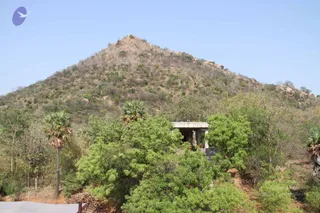
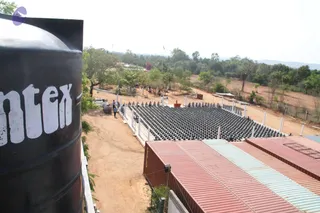
Aerial view from an elevated balcony over a dry, dusty compound toward a hilly green landscape. In the foreground, corrugated metal roofs of red, white and blue-green sheets cover shipping-container-style structures. Beyond them, a large grid of rows of identical black cylindrical objects, possibly water tanks or drums, is set out behind a low white railing on bare earth. A small figure in light clothing walks along the left edge near a tall tank, and a red flag flies on a pole in the distance among trees. No identifiable a person depiction is visible.Aerial view of an open dusty ground at an ashram compound, seen from an elevated rooftop. A large rectangular field is filled with rows of black plastic or stone seats, possibly chairs, arranged in neat rows. Corrugated metal roofs of shipping containers or sheds sit in the foreground, and a black water tank is at left. Trees, scattered buildings and a tall flagpole with a red-and-white flag stand among the greenery, with low hills on the horizon under a pale sky. No people are clearly visible except one small figure in white near the left path. The scene is an outdoor event or seating area being prepared.Aerial view of an outdoor ashram ground with a large grid of rows of black chairs or seating blocks arranged in front of a white-railed platform area, set between red and multicoloured corrugated metal roofs of shipping-container-style structures. A lone person in white clothing walks on the dusty dirt path at left. An orange and white flag flies on a pole among green trees, with hills in the distance.Aerial view of a large outdoor ritual ground at the ashram, with hundreds of rows of black shivalinga-style stone lingams set out in a grid on a white-tiled platform, bordered by white pillars and small lamps. An orange kalasha or pot sits near the centre front. Beyond, a tall flagpole flies a red flag among trees and a dirt path, with a small tented shade structure and a seated figure in orange at the far edge. A single worker in blue stands at the left edge. No identifiable a person figure is visible.A rocky, scrub-covered hill rises under a clear pale-blue sky. In the foreground, dense green trees and two tall palms surround a small open-sided stone pavilion with a flat roof and pillars, set on a hillside terrace. A few stacked logs and a corrugated metal roof edge appear at the lower left. No people are visible.Elevated view of an outdoor site on a dry dirt ground. In the foreground a large black water tank with the partly visible white lettering 'ntex' stands beside rows of rusty red and teal corrugated metal roofs over containers. Beyond, a large grid of black cylindrical items is arranged in rows behind white fencing and white posts, with a few small figures walking along the dirt paths. Tall trees, a flagpole and distant low hills form the background under a pale sky. No clear ceremony, deity or a person depiction is visible.

Anna-Mandhir-Services

6 photosSource gallery
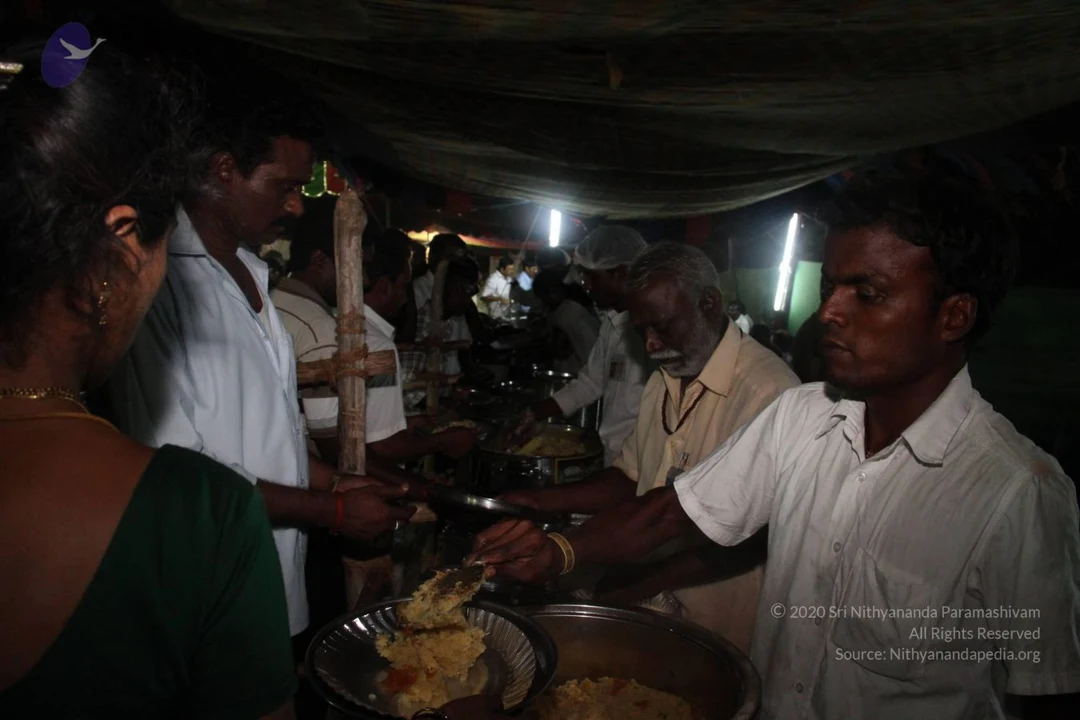
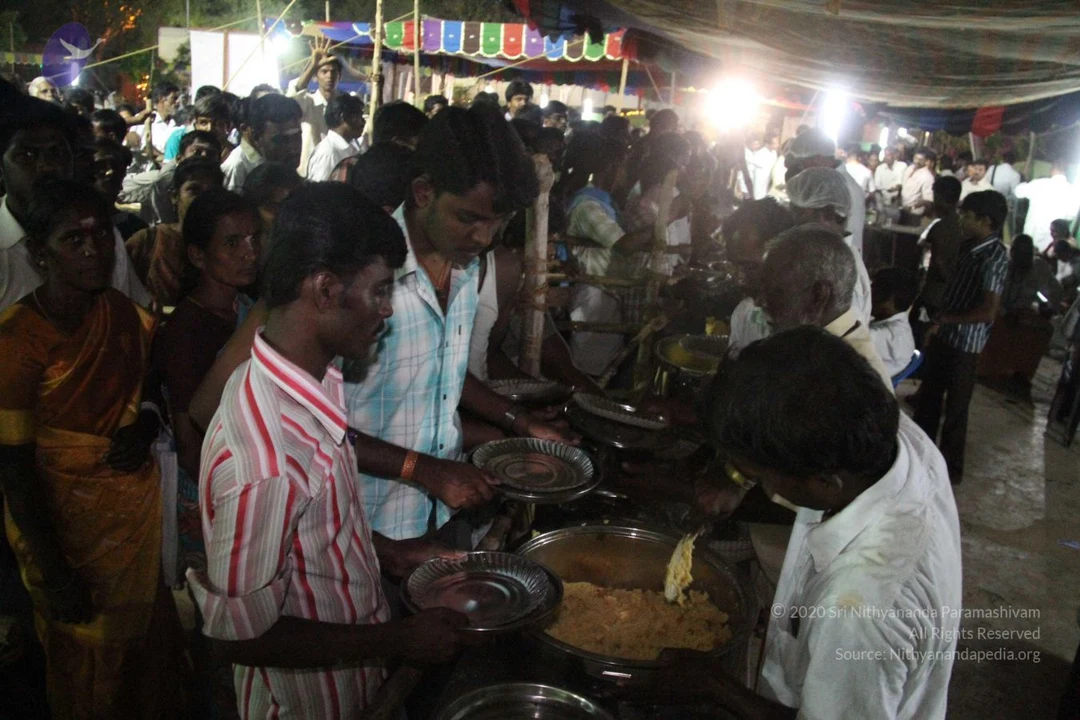
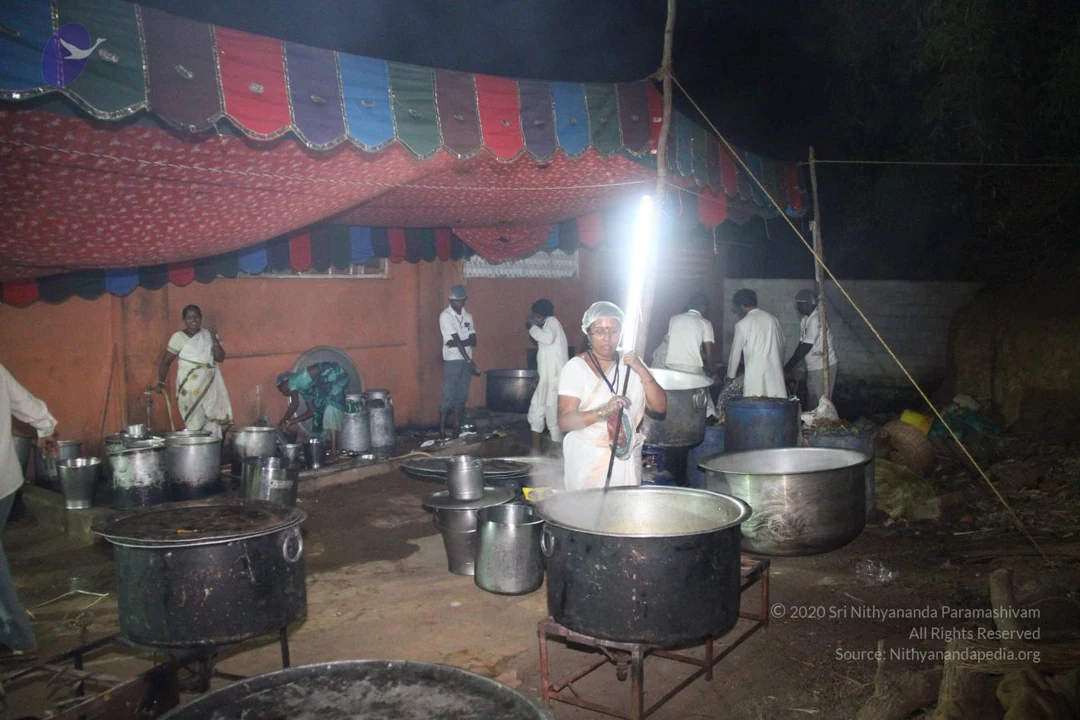
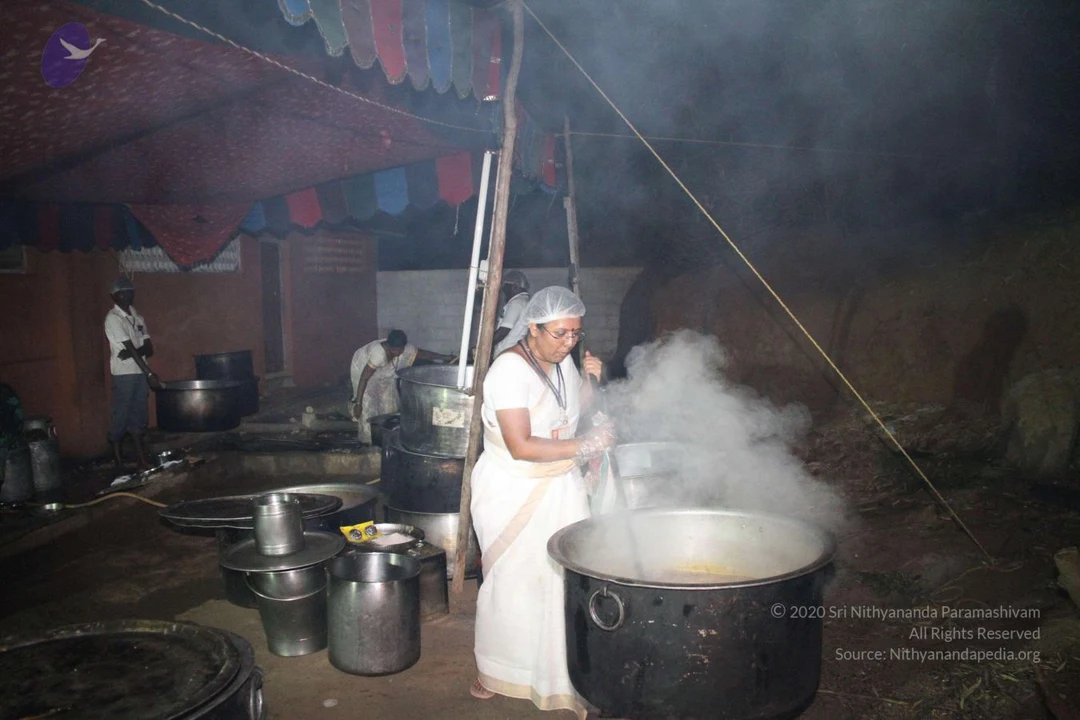
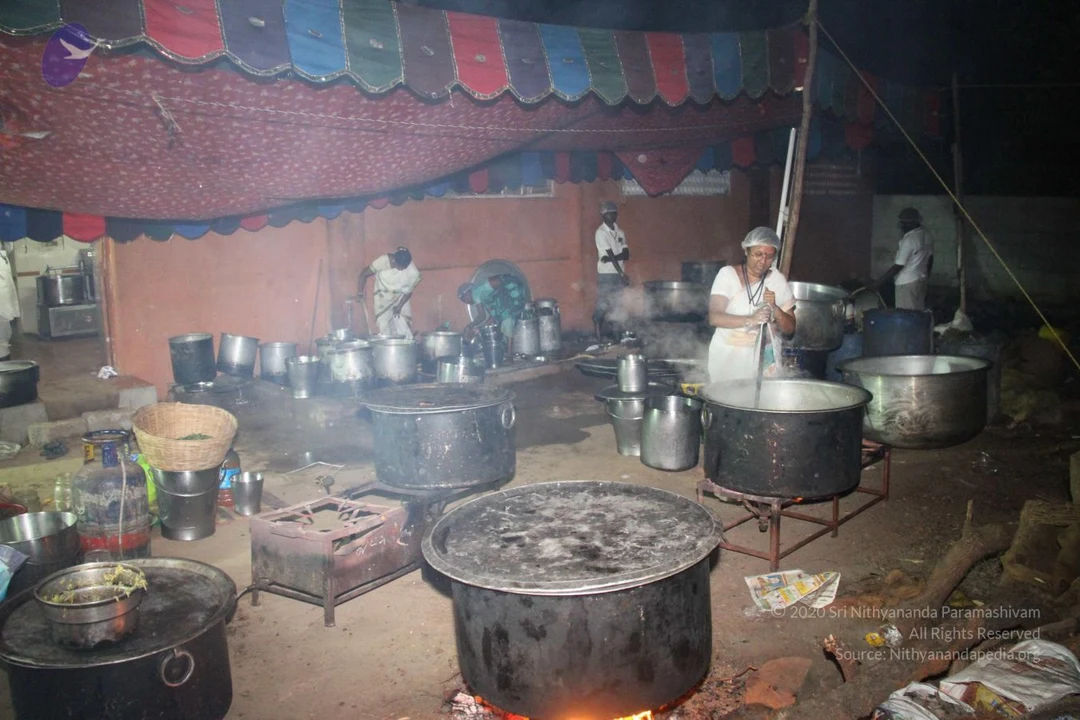
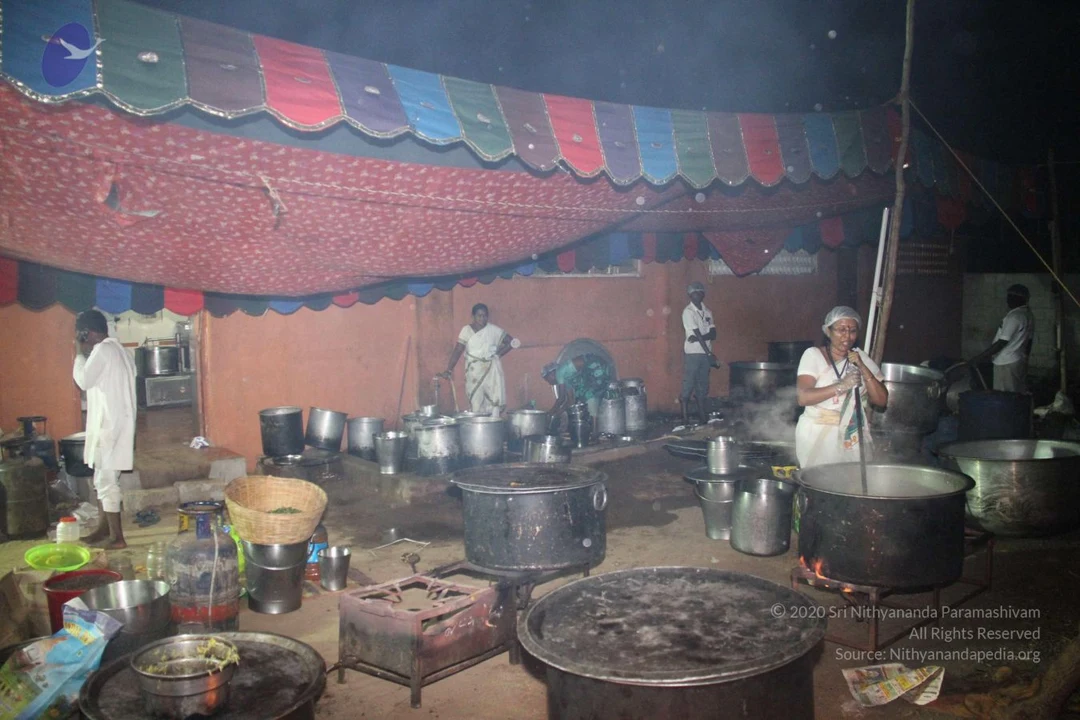
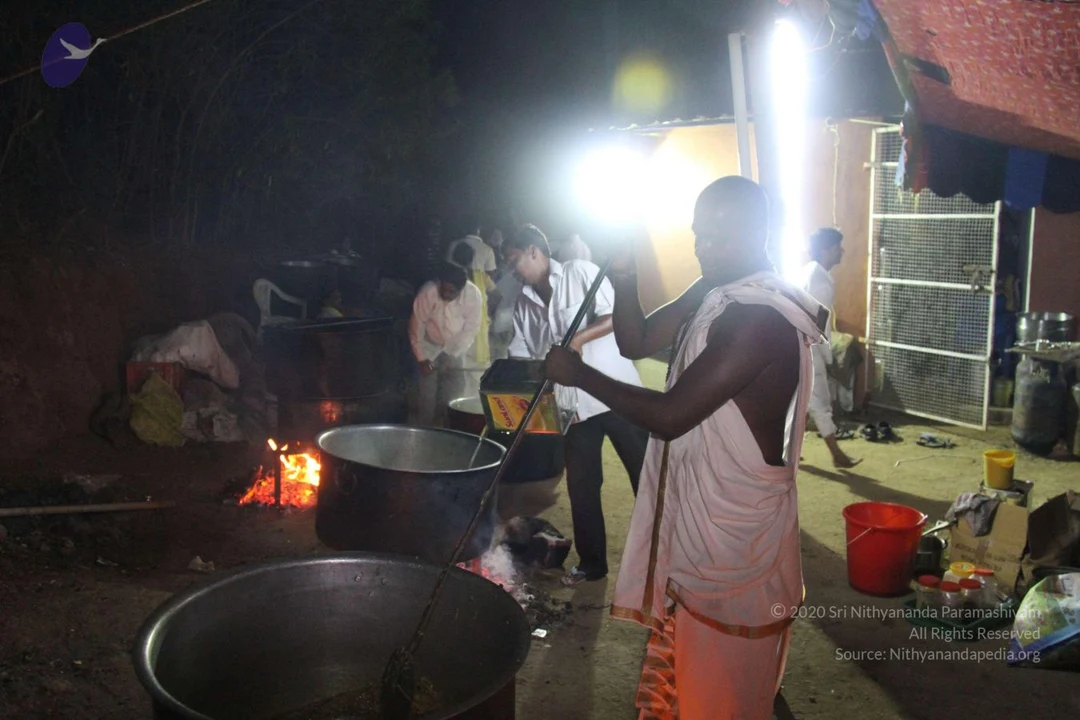
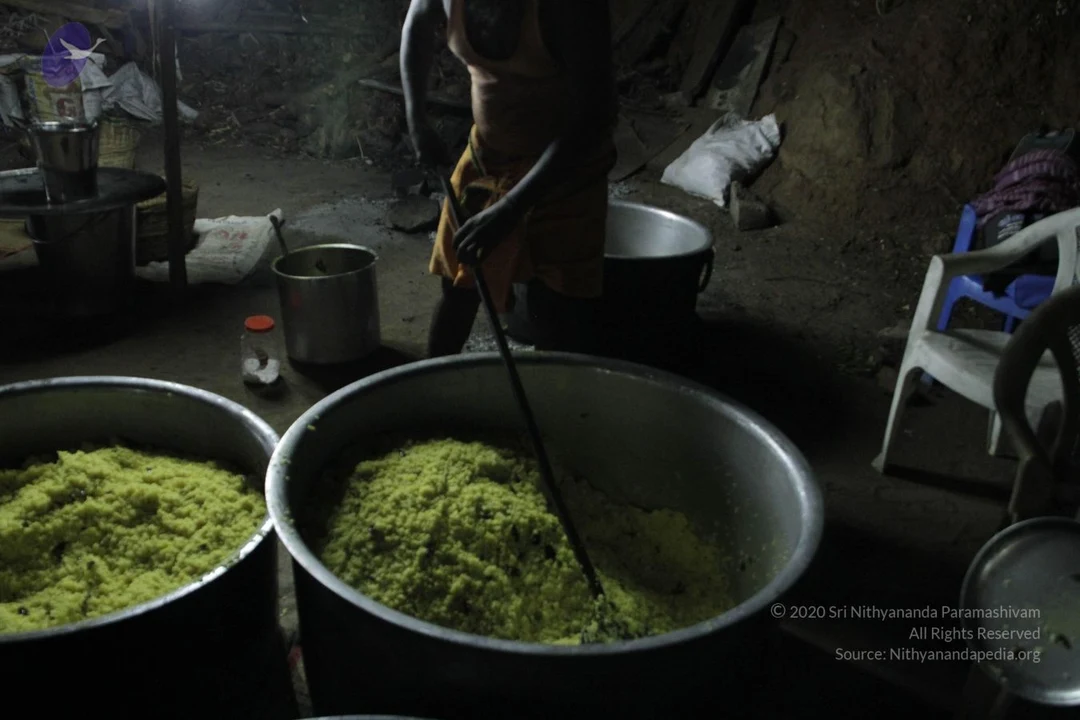
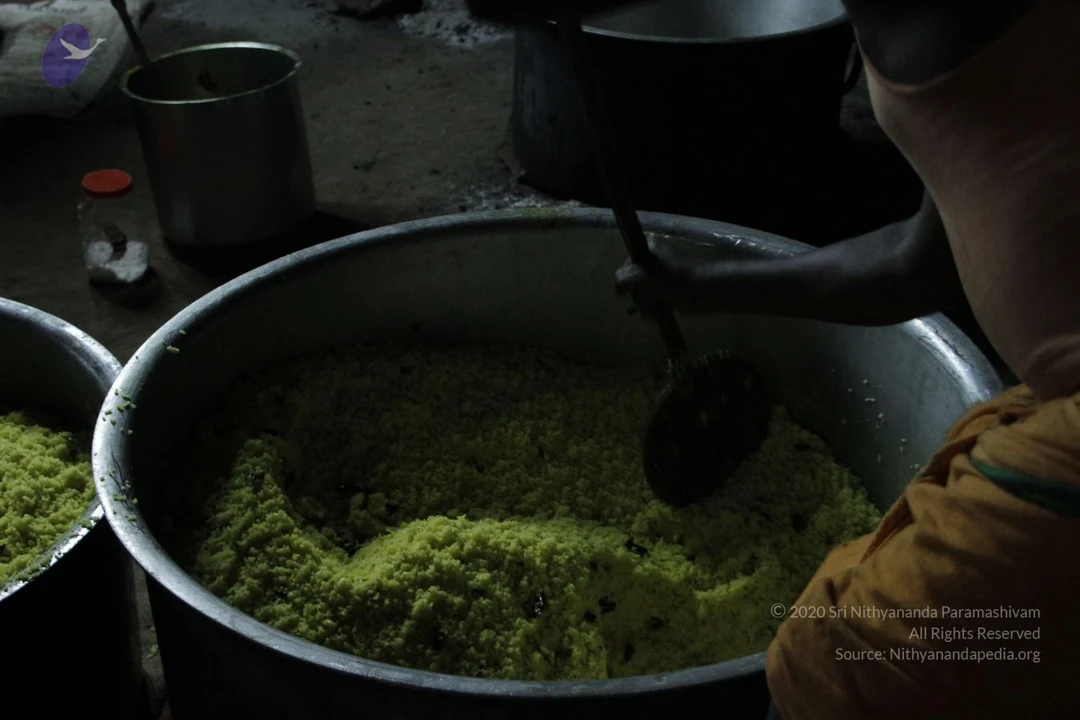
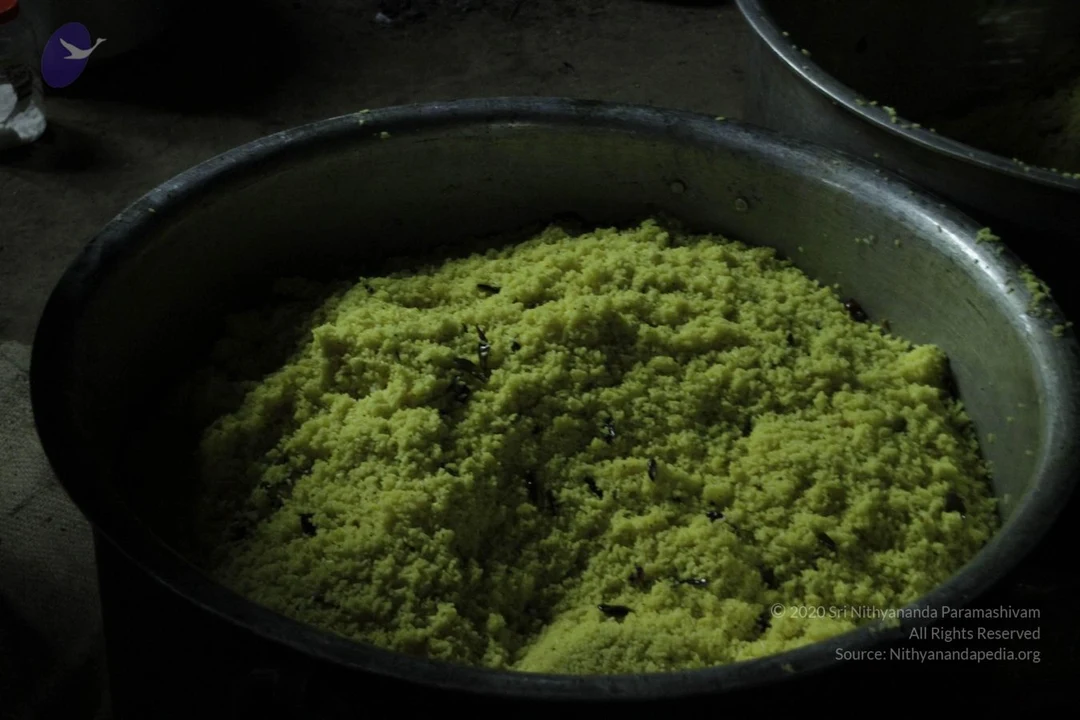
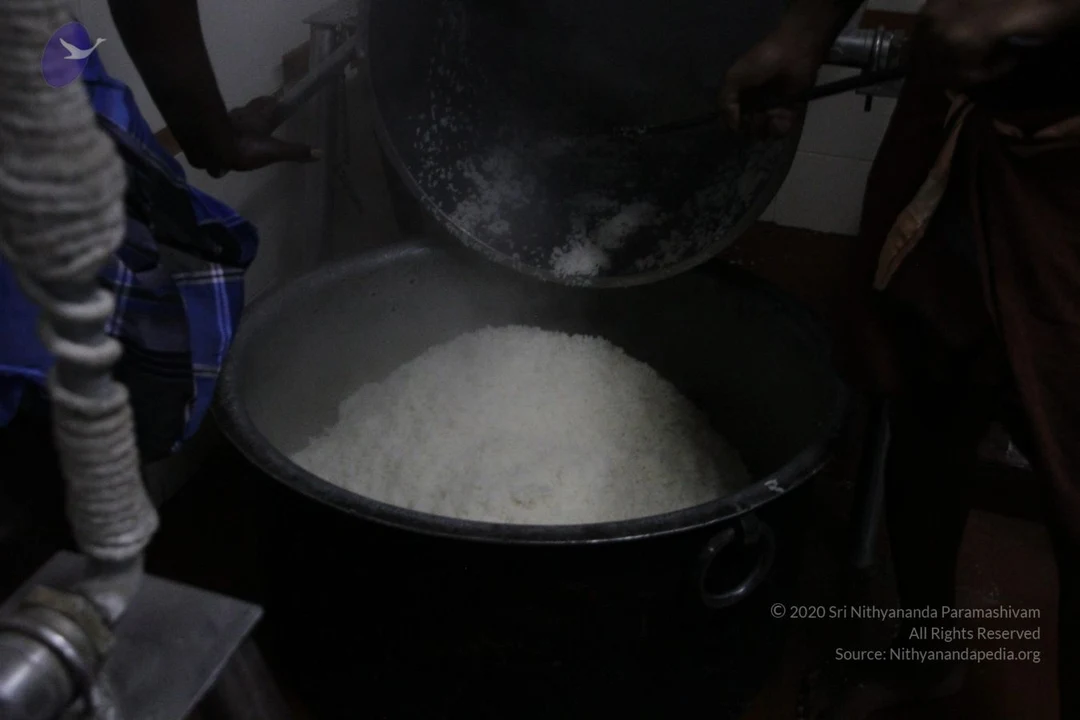
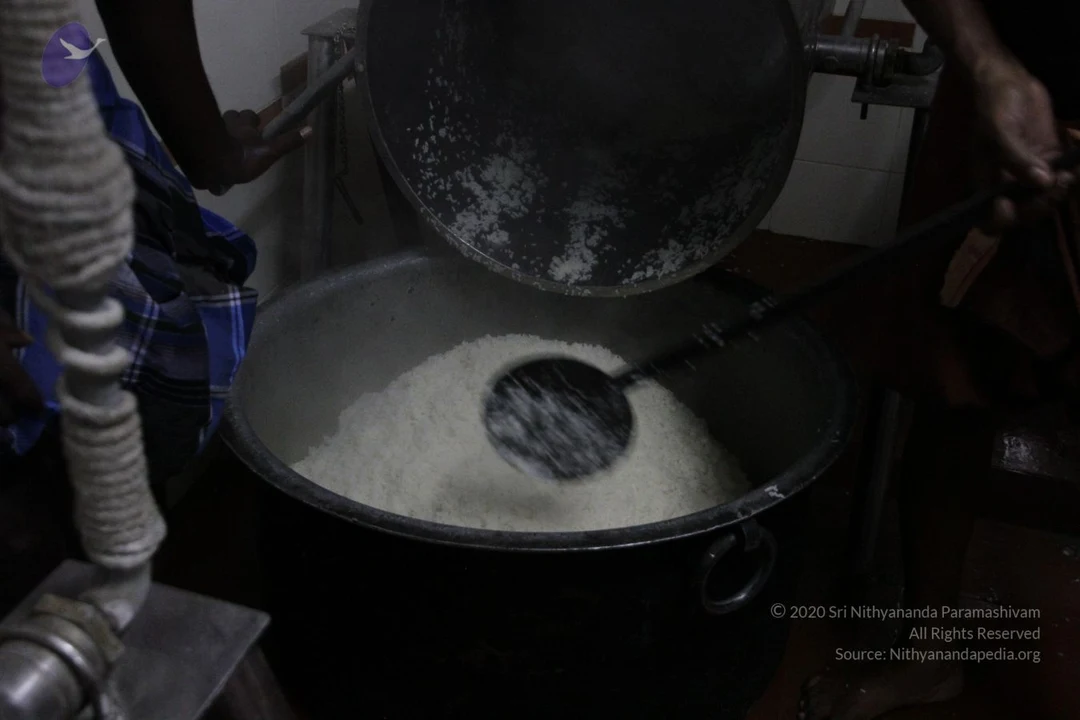
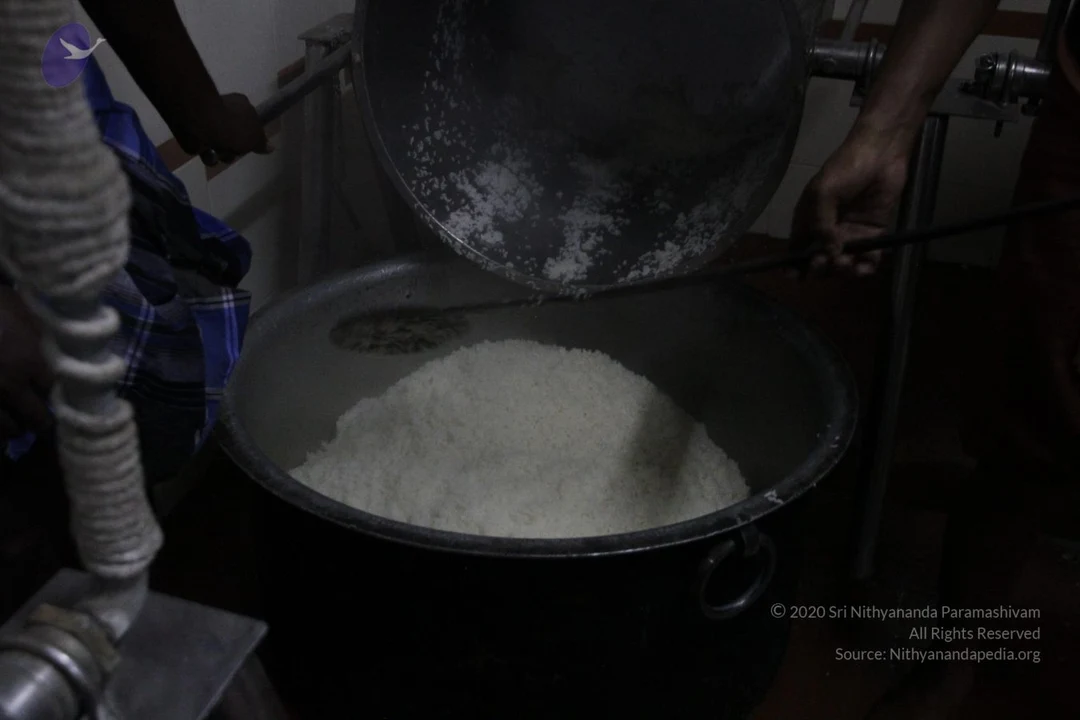
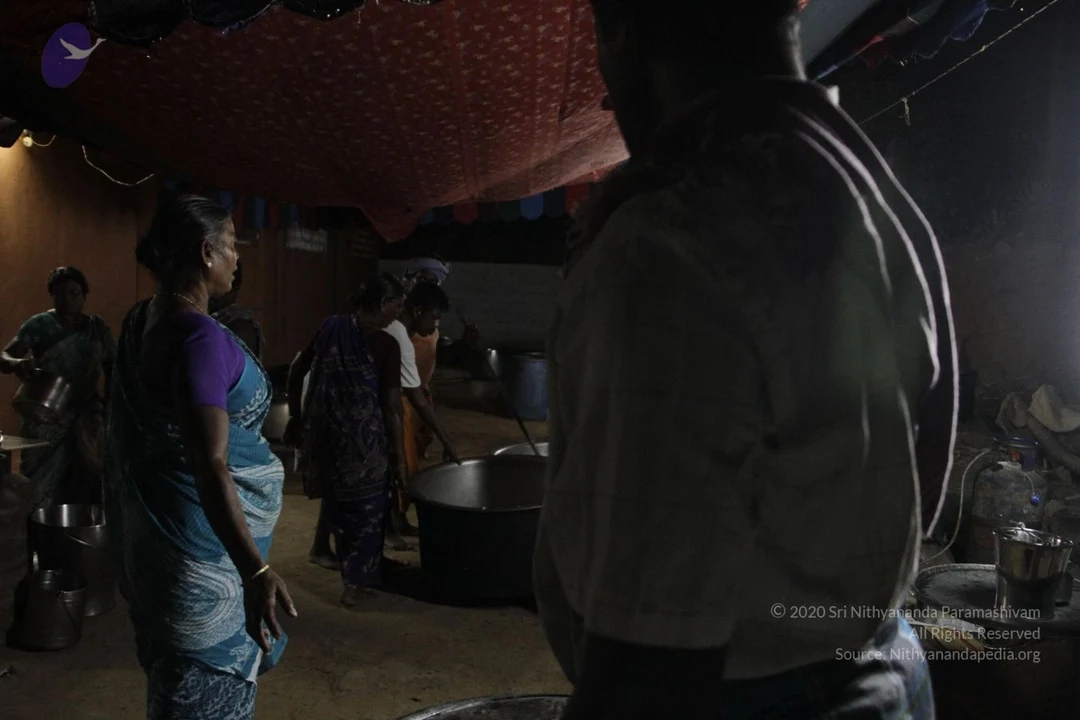
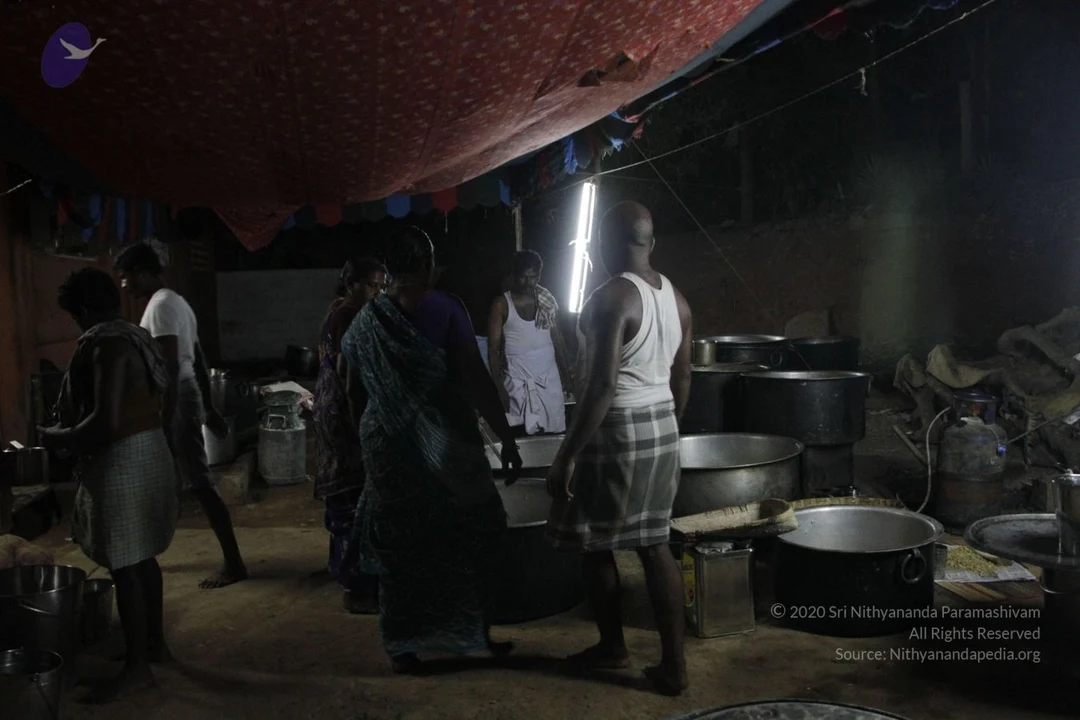
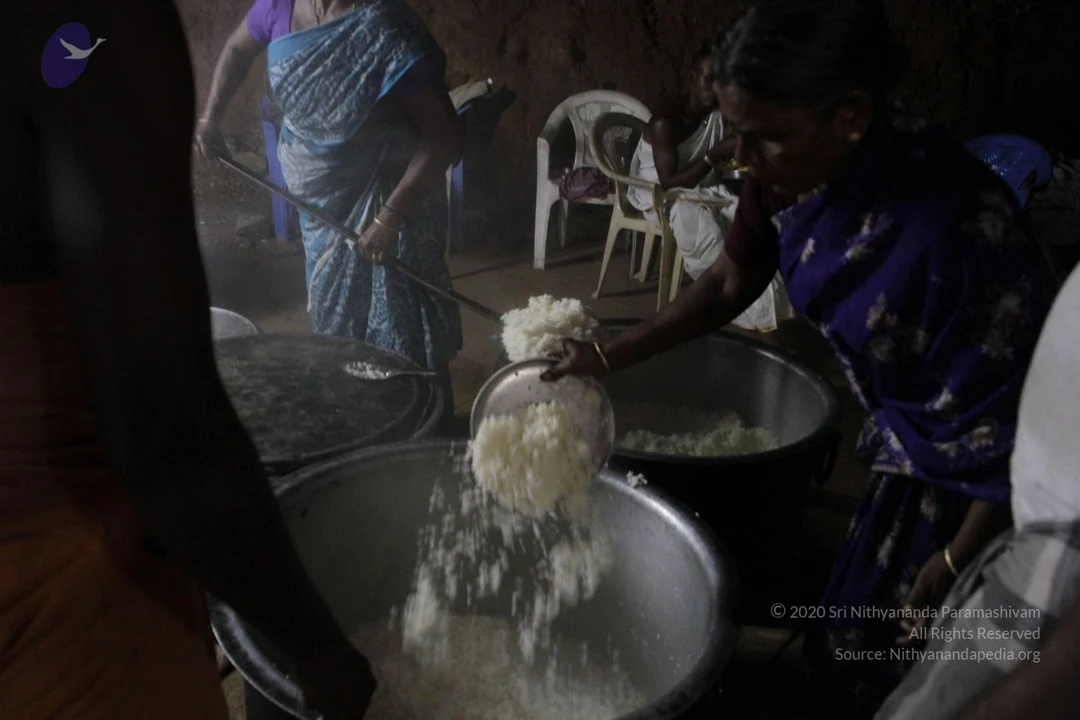
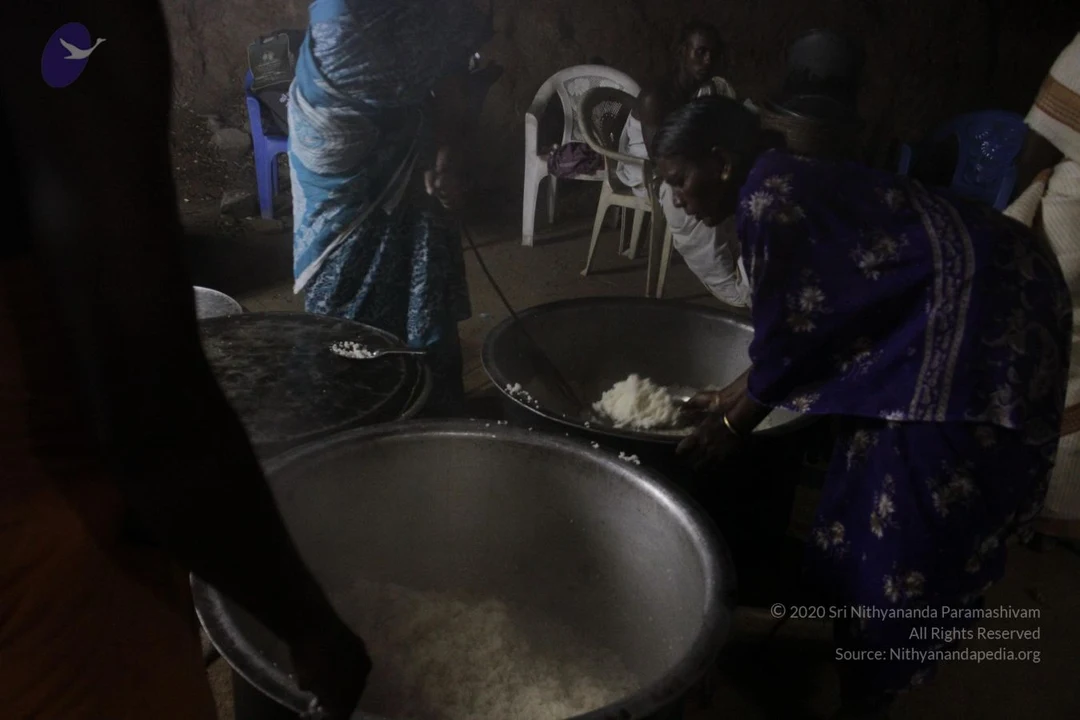
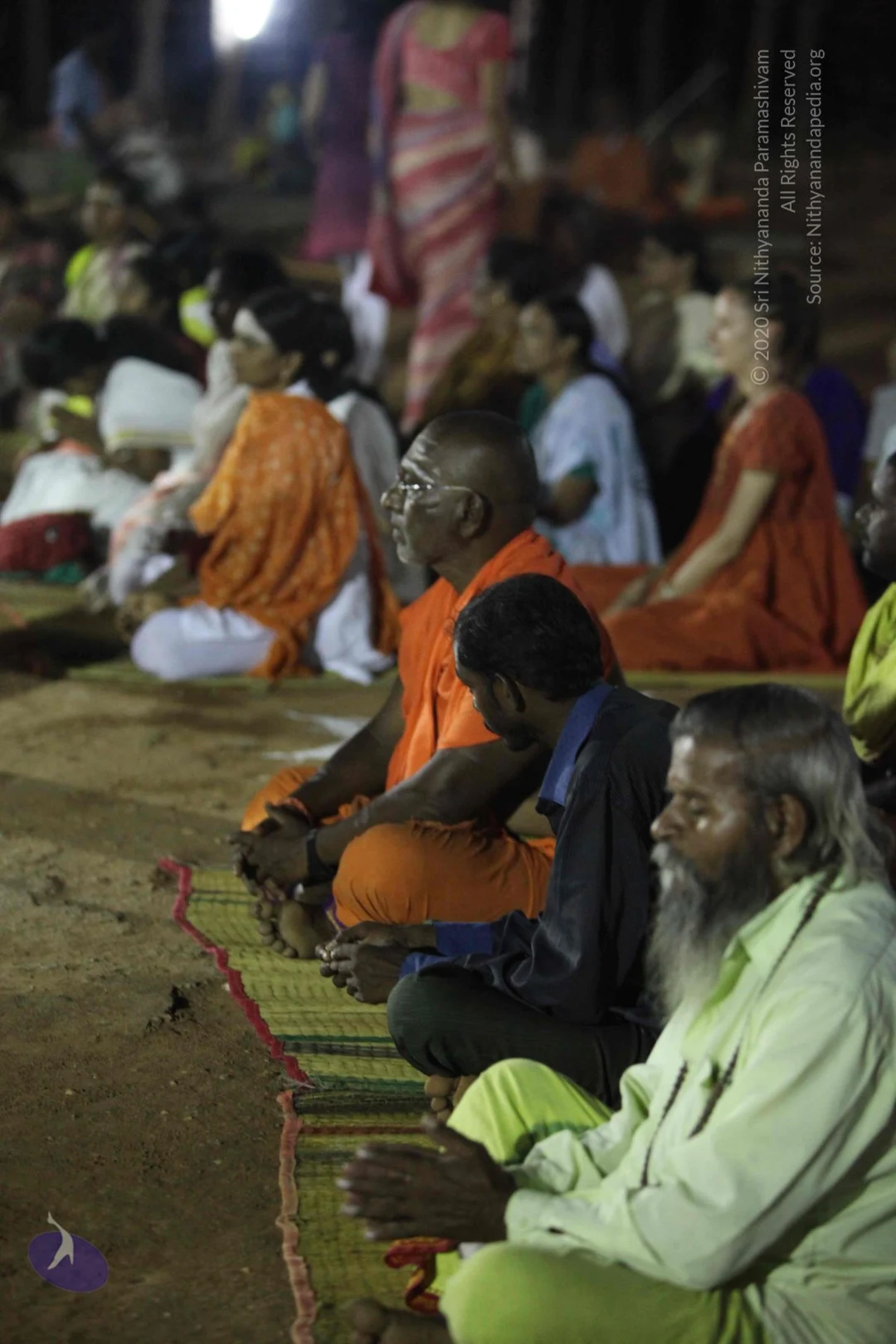
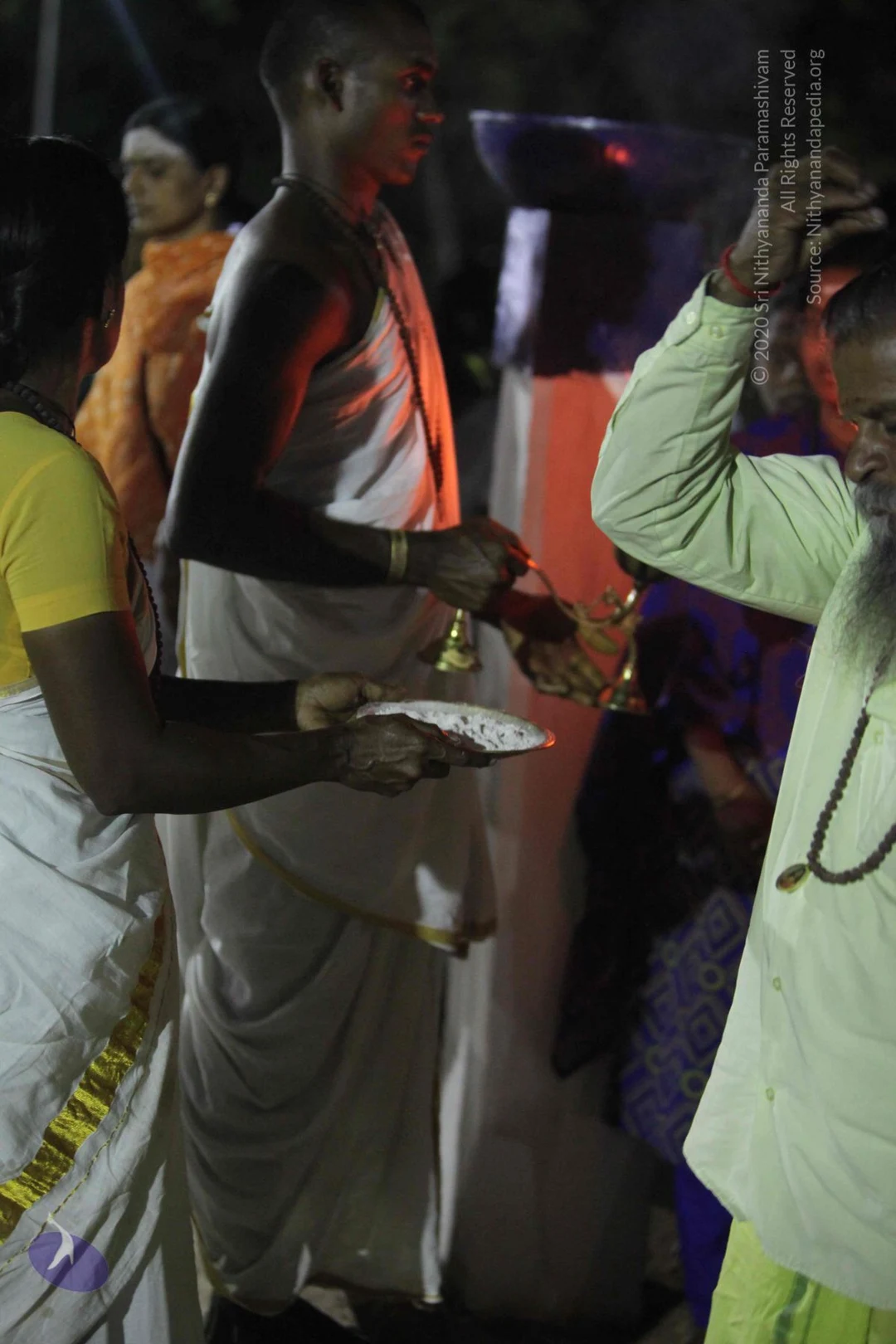
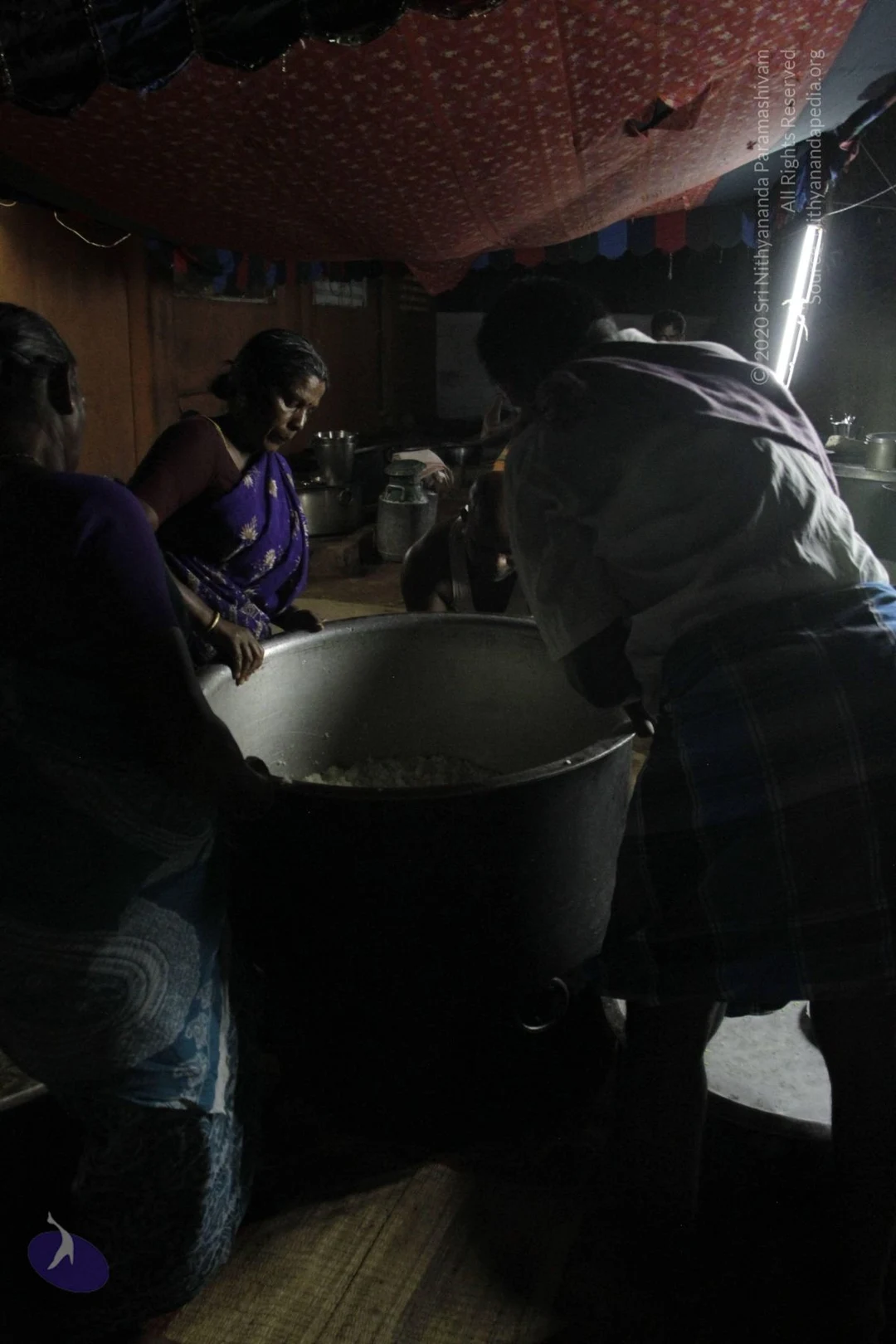
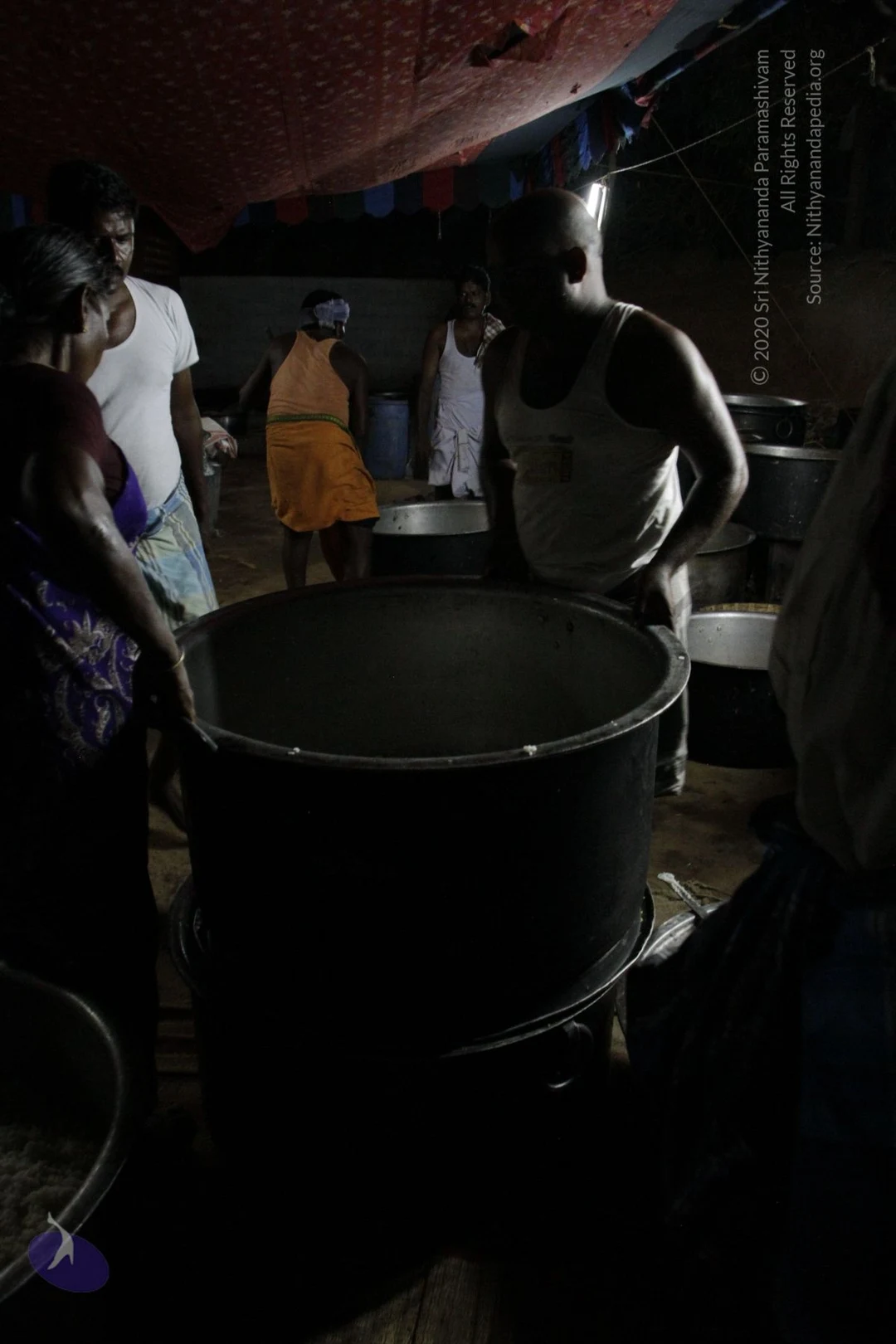
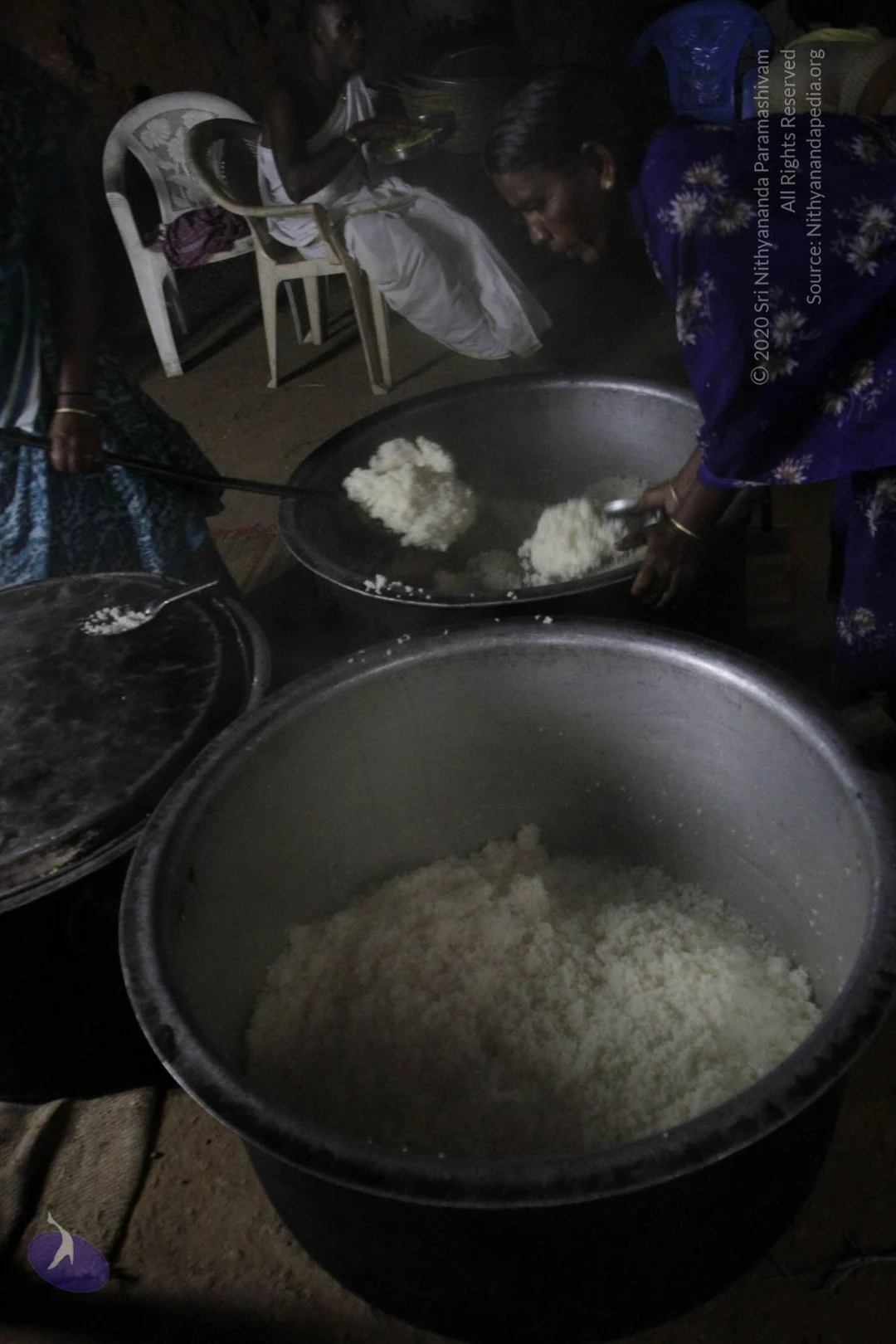
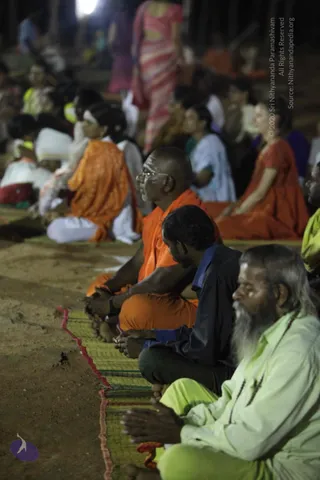
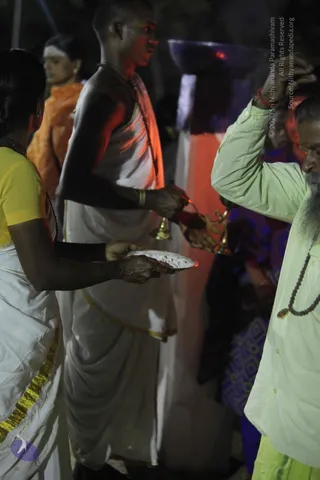
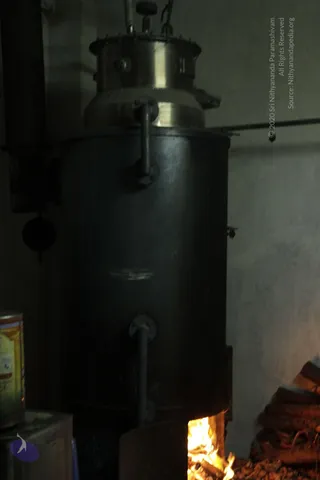
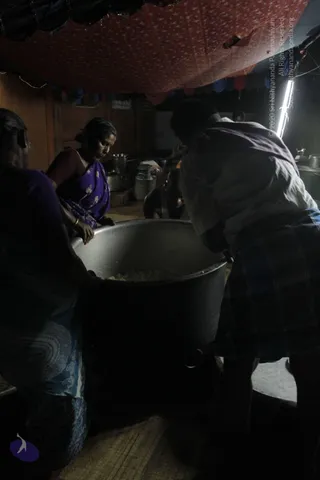
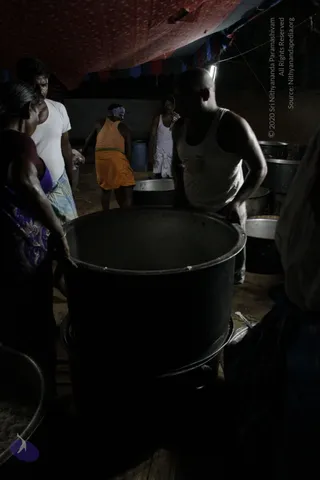
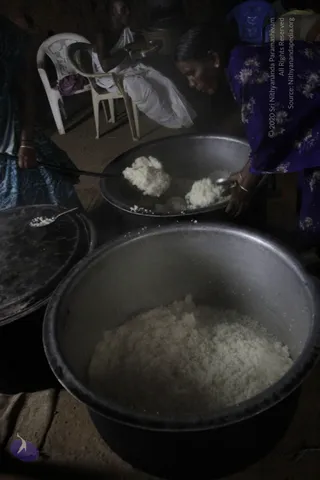
A night-time gathering of devotees seated on woven mats on bare ground, watching a satsang. In the foreground, a bald man with glasses wears an orange robe and holds his hands together in prayer with a mala of beads, while beside him a man in a dark shirt sits with clasped hands. At the front right, a bearded elder with long grey hair wears a pale green shirt and green trousers and sits with hands folded. Behind them, rows of people in orange, white and red saris and garments sit in meditation, and a woman in a red and pink striped sari stands in the background. The setting is dim, lit by a single bright light at the top.Night-time ritual photograph. A shaved-headed priest in a white dhoti and white shawl, with a rudraksha mala, holds a small brass or gold vessel and pours or offers from it near a standing lamp. To the left, a woman in a yellow blouse and white sari with gold border holds a silver plate. At right, a bearded man in a light green shirt and rudraksha mala raises his hand toward the vessel. Behind them a woman in orange with tilak stands in the background, and red and orange lighting shows through the scene.A dark cylindrical steel boiler or distillation vessel with a domed lid, valves and pipes stands in a dimly lit room, sitting over a wood fire whose flames glow at its base. Stacked firewood lies to the right and a metal canister with a yellow label sits at the left edge. No people are visible.A dim, makeshift kitchen under a red floral cloth canopy with strings of bunting and a tube light. In the foreground a large aluminium cooking vessel holds cooked rice or grain. A woman in a purple and white floral sari stands beside it, with a second woman in a dark maroon blouse at left, and a person in a white shirt and checked lungi leaning over the pot at right. Steel vessels and a scale sit on a counter behind them. No a person candidate is visible.Dim interior of a makeshift tent with a red patterned cloth canopy overhead, where several people work around large black cooking vessels. In the foreground a woman in a purple patterned sari and a man in a white sleeveless vest lean over a large dark pot. Behind them a man in an orange lungi and a headcloth and another man in a white vest and white dhoti tend more pots and a blue drum. Roles suggest community kitchen cooking, possibly annadan food preparation, with no visible deity, dais or a person depiction.A dimly lit photograph of a community meal being served. In the foreground, large aluminium vessels hold cooked white rice, with steam rising from one. A woman in a purple floral sari leans over a smaller steel basin, scooping rice with a ladle. Another person in a teal patterned garment stands at the left holding a long ladle, and a person in white dhoti and shirt sits on a white plastic chair in the background. Plastic chairs and a bare floor surround the scene.

Kalpathaur-class

3 photosSource gallery
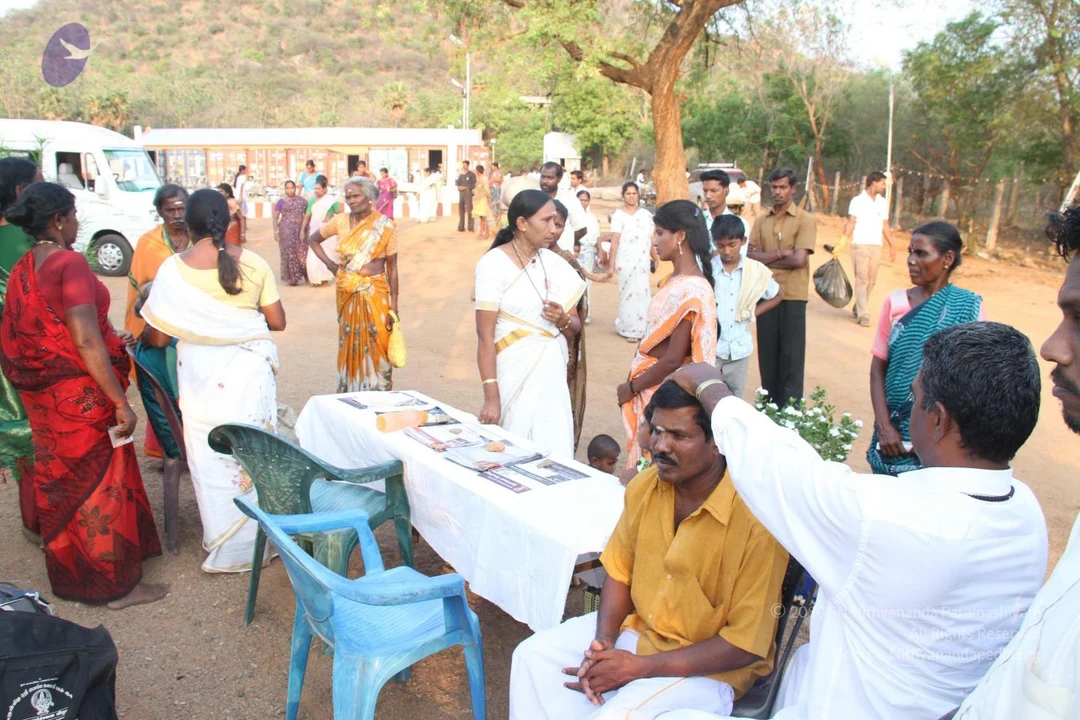
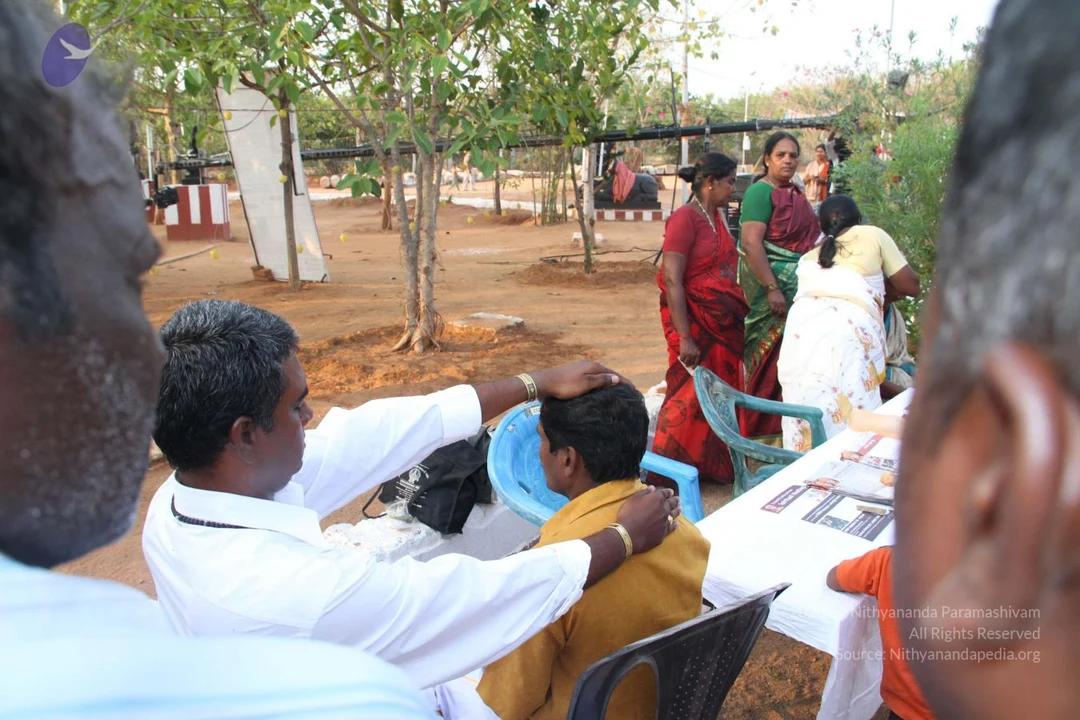
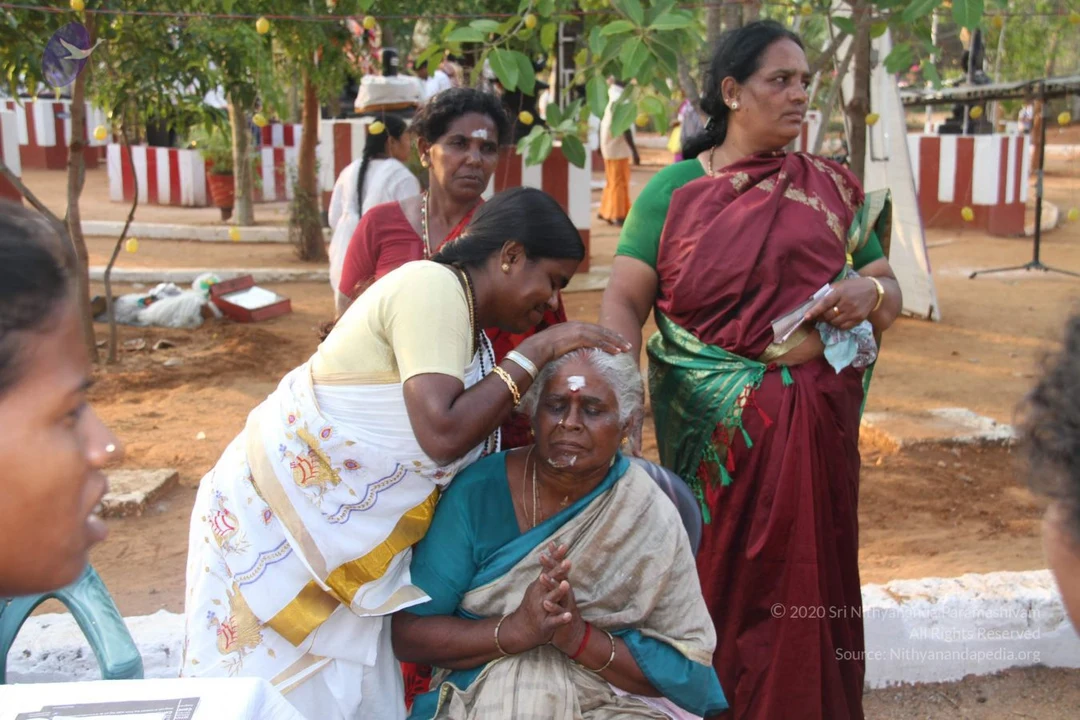
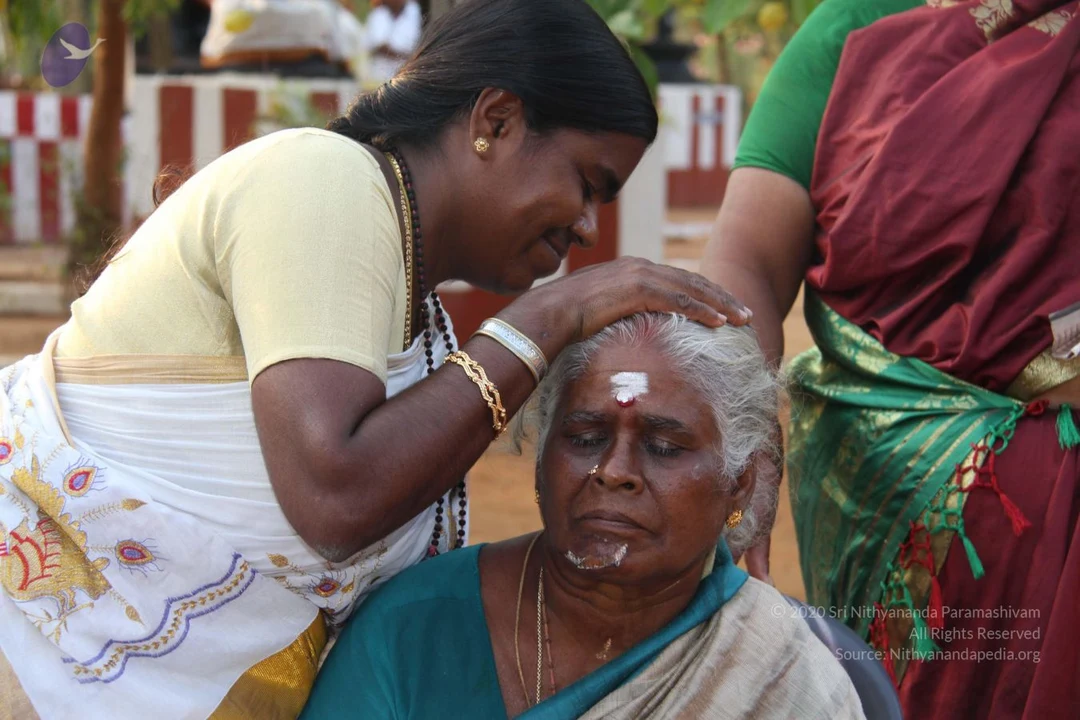
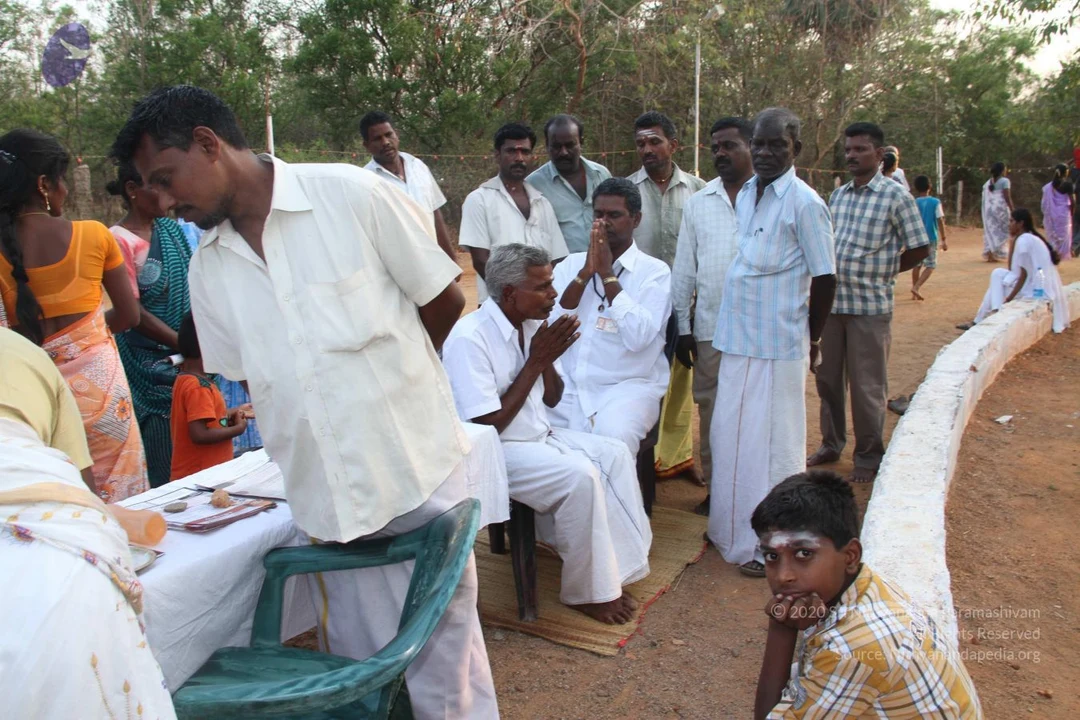
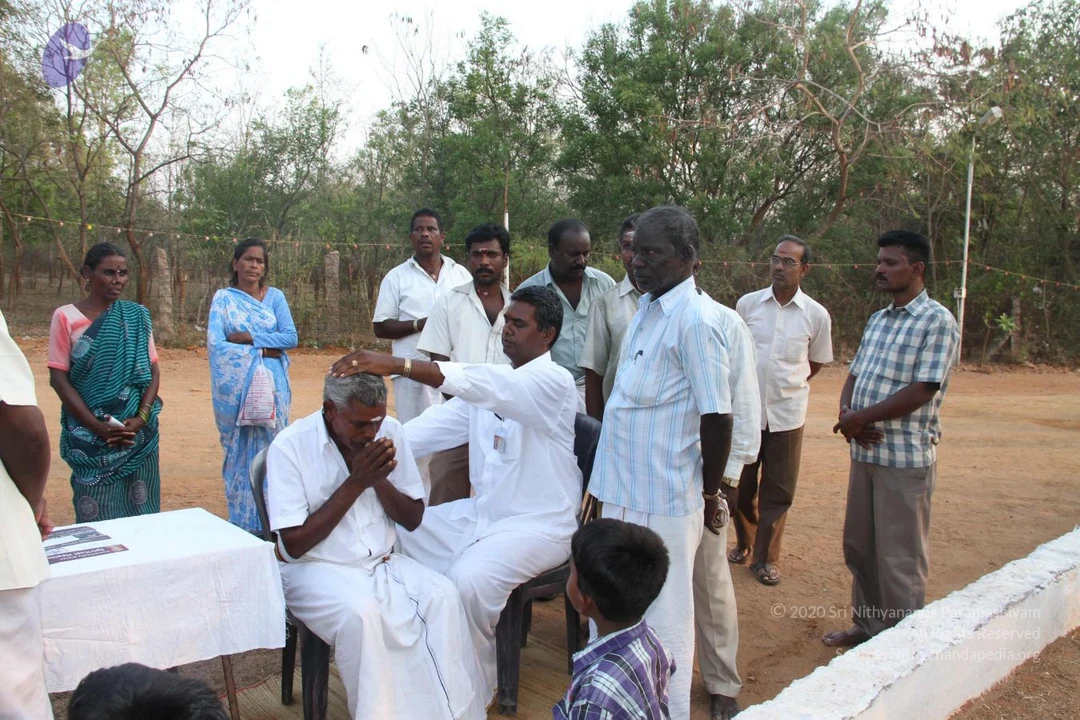
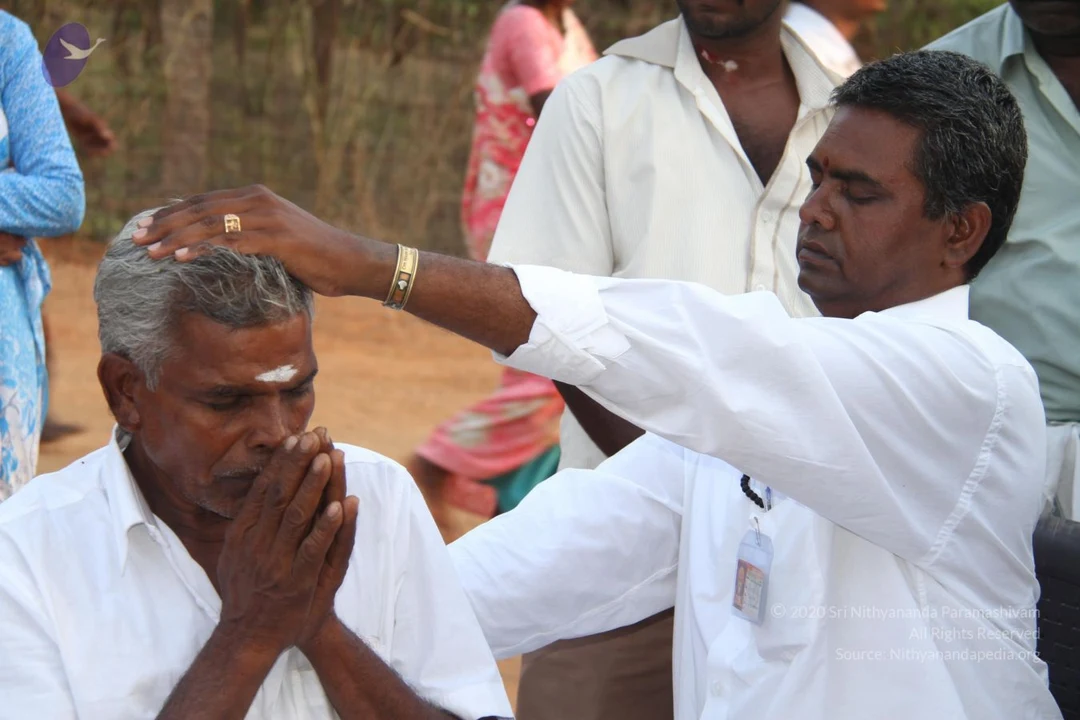
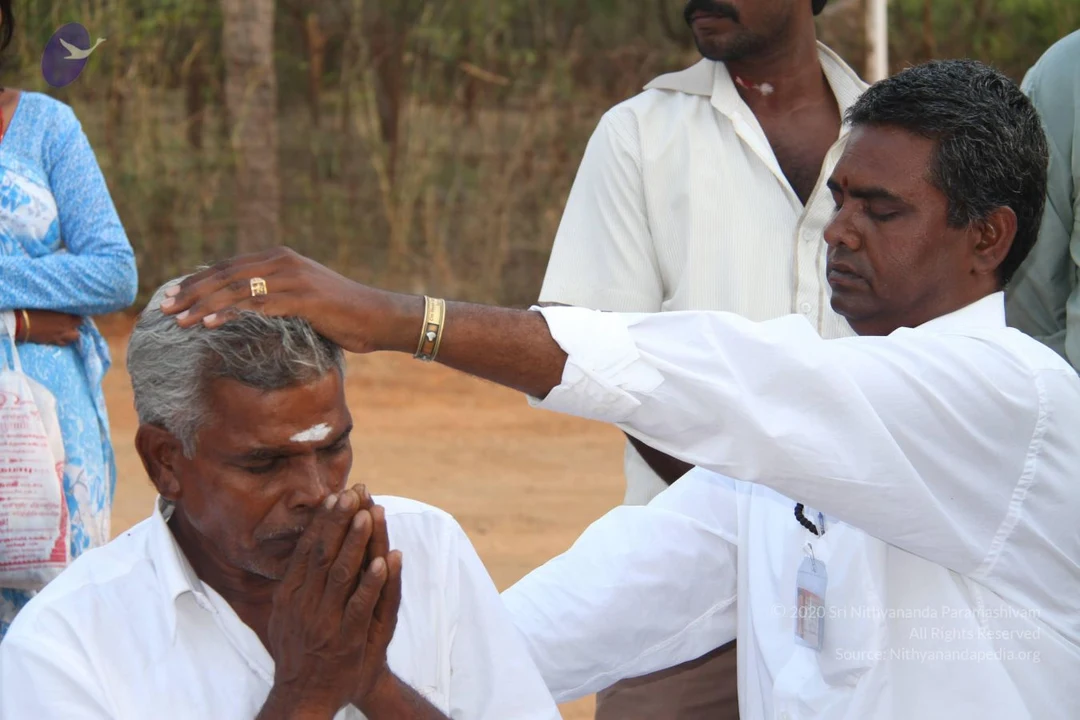
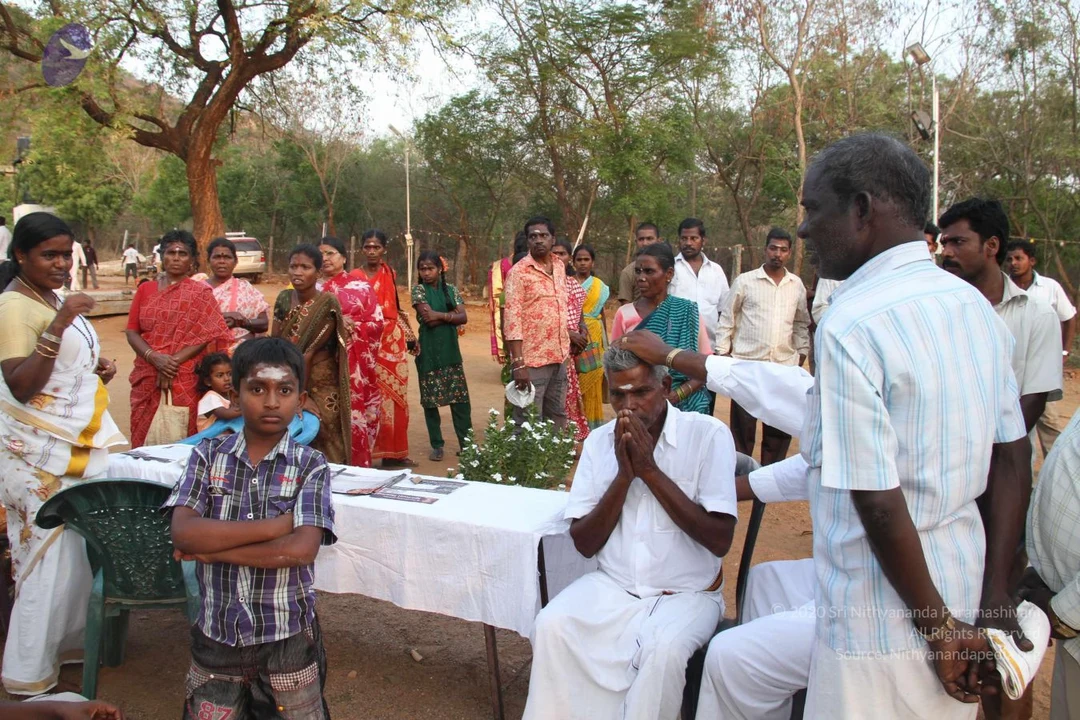
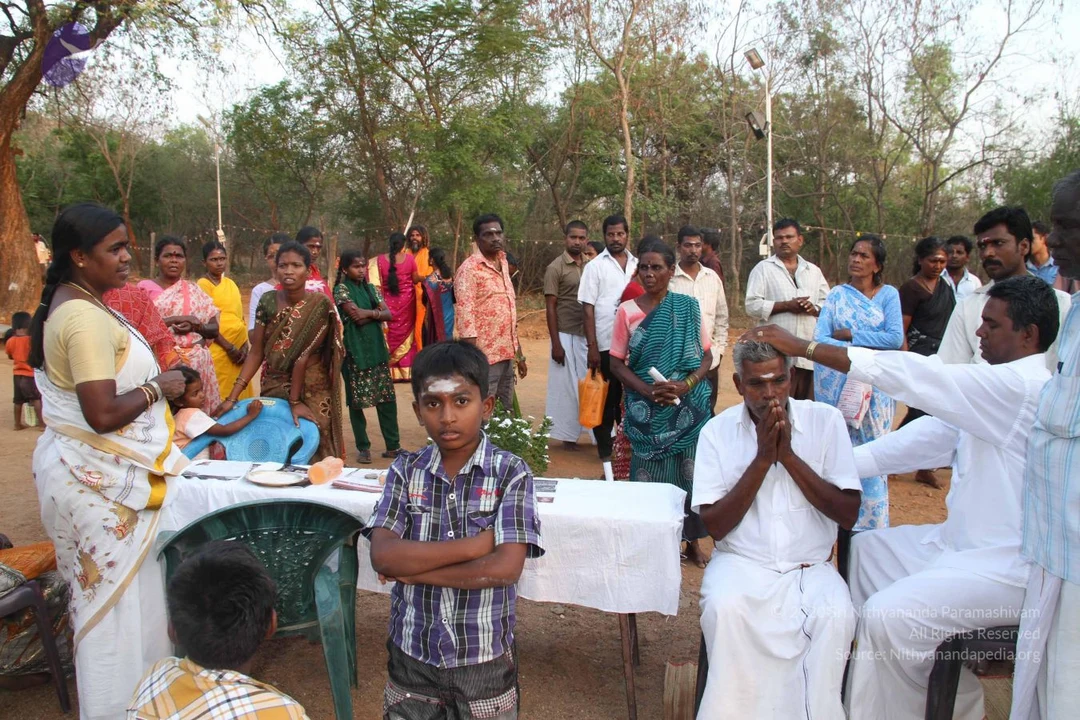
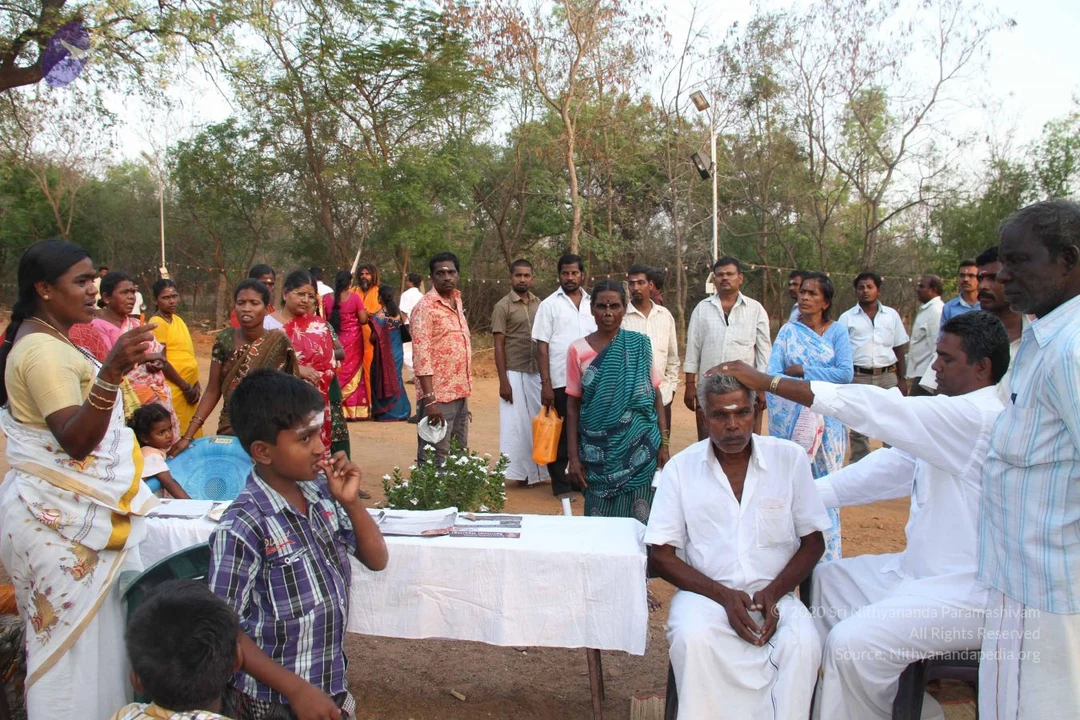
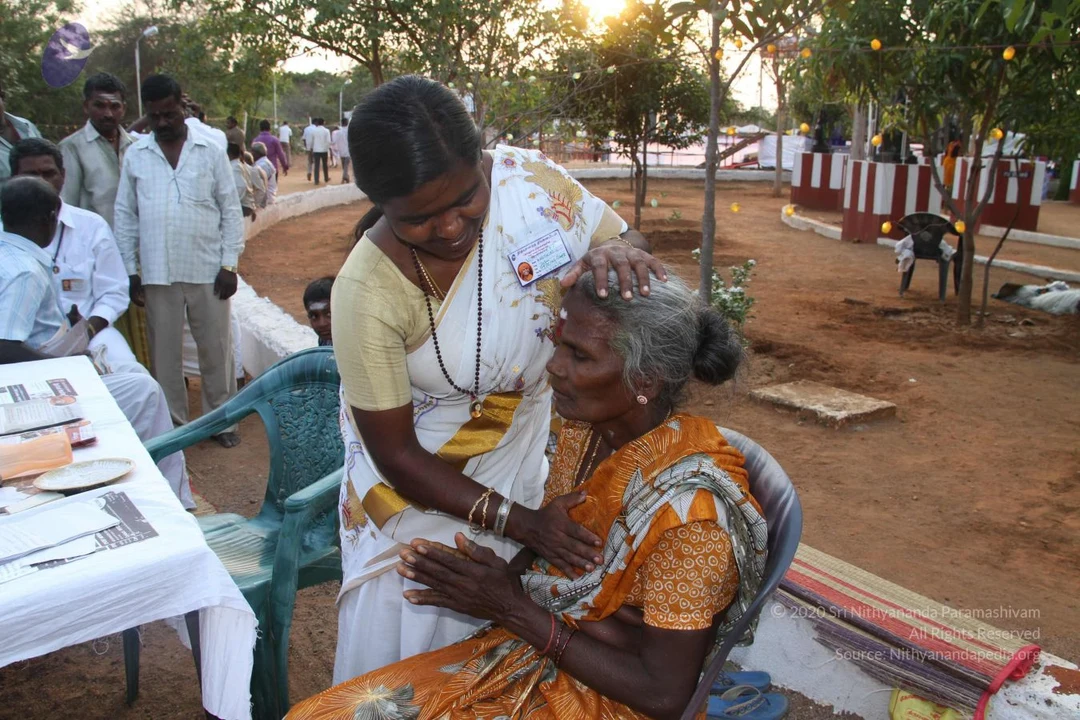
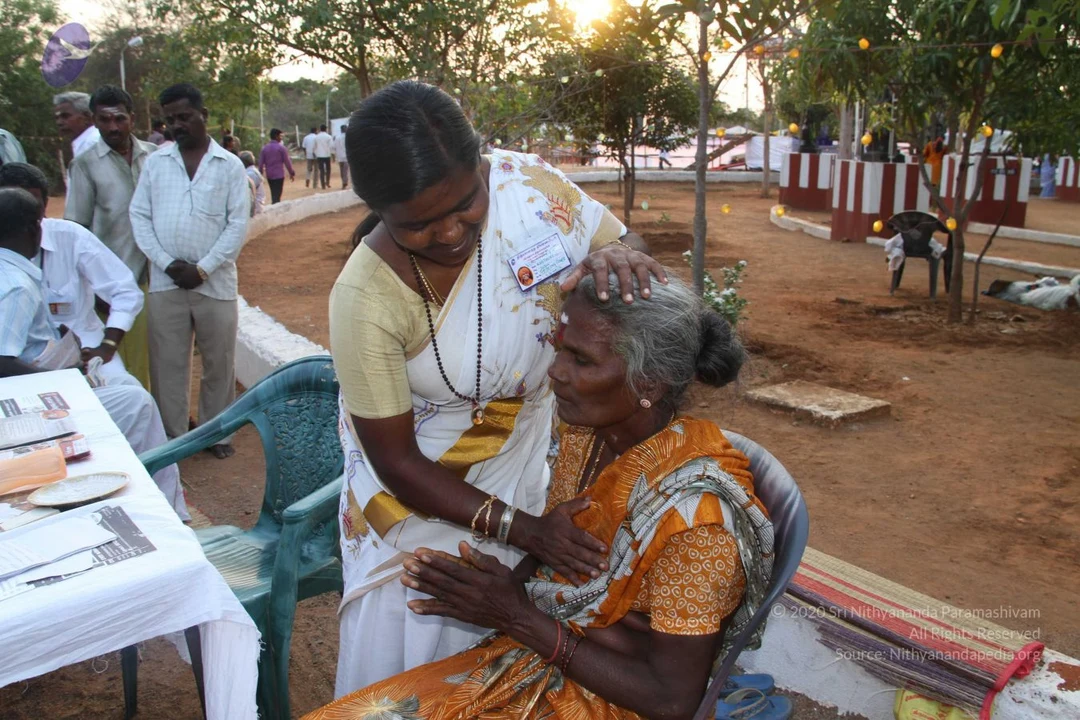
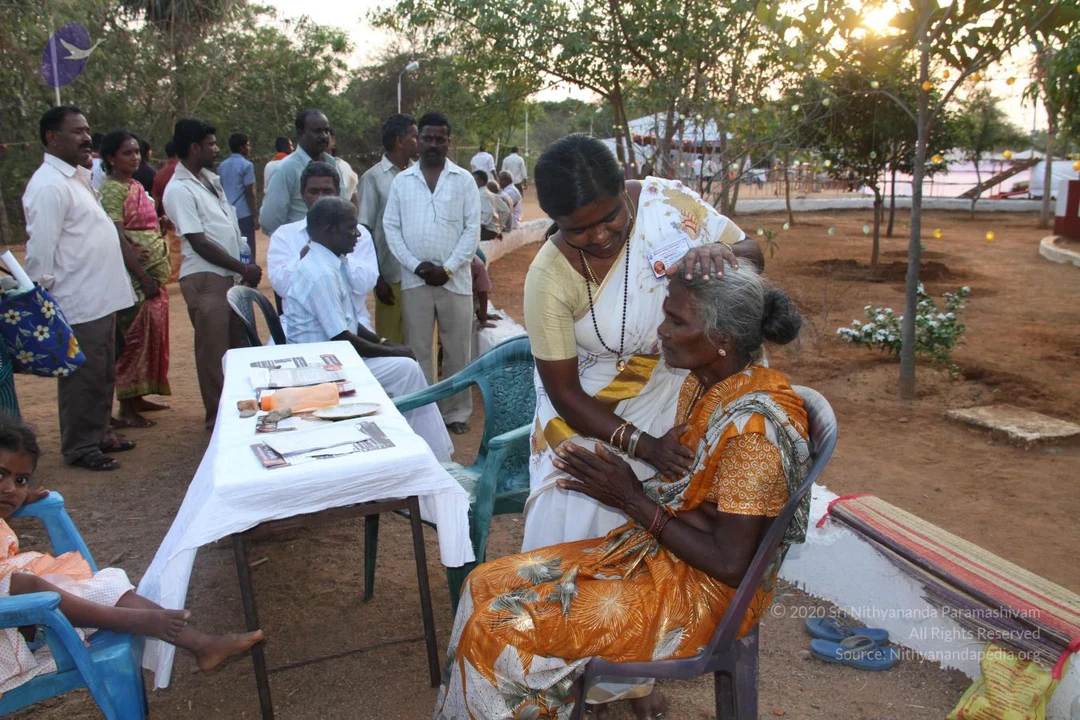
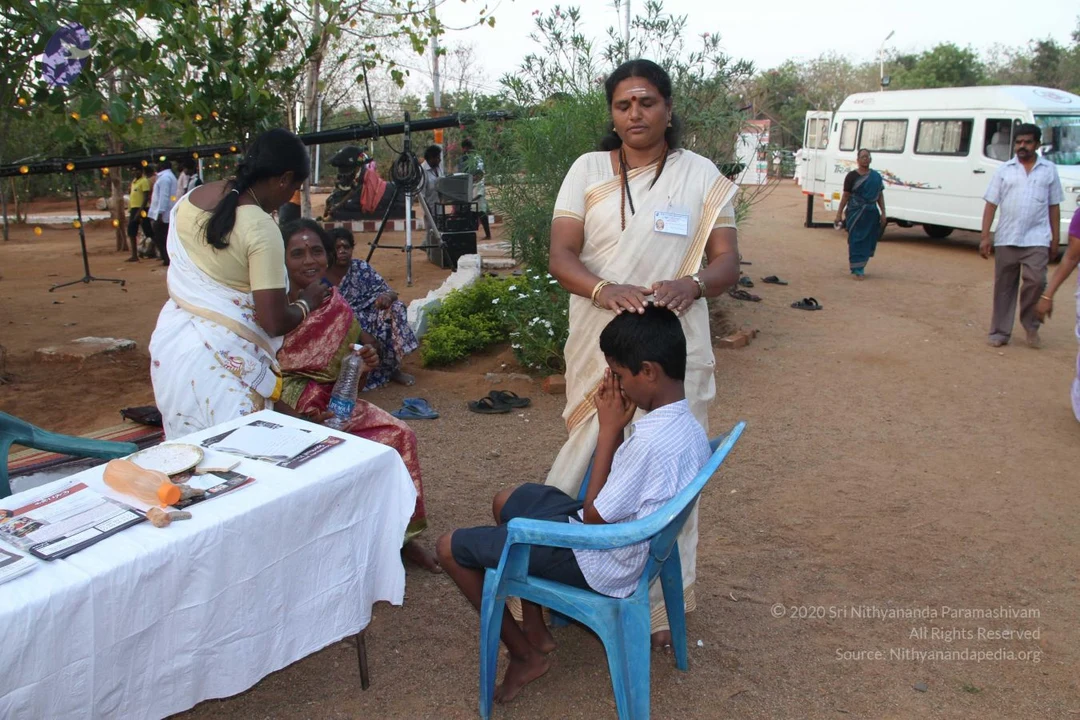
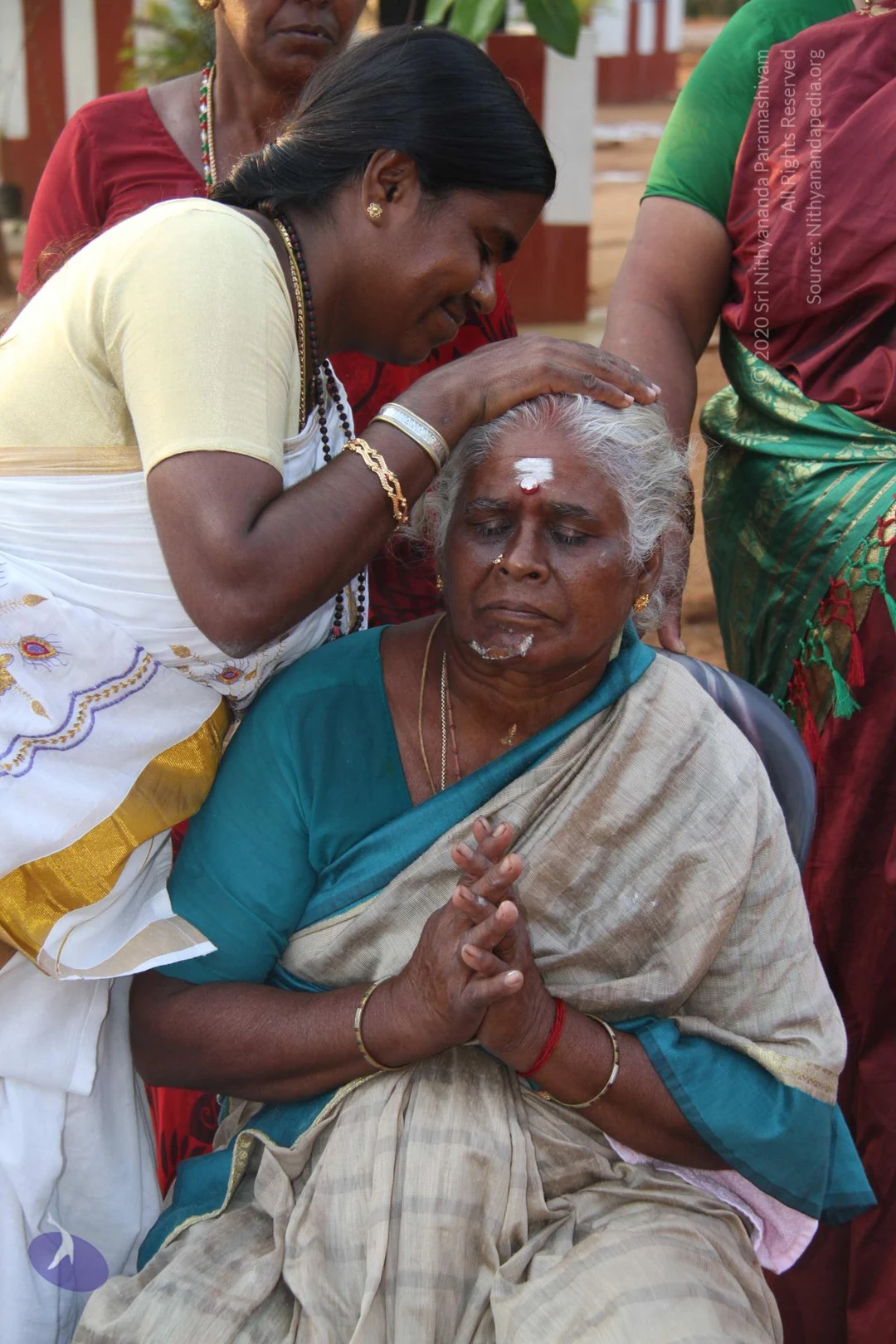
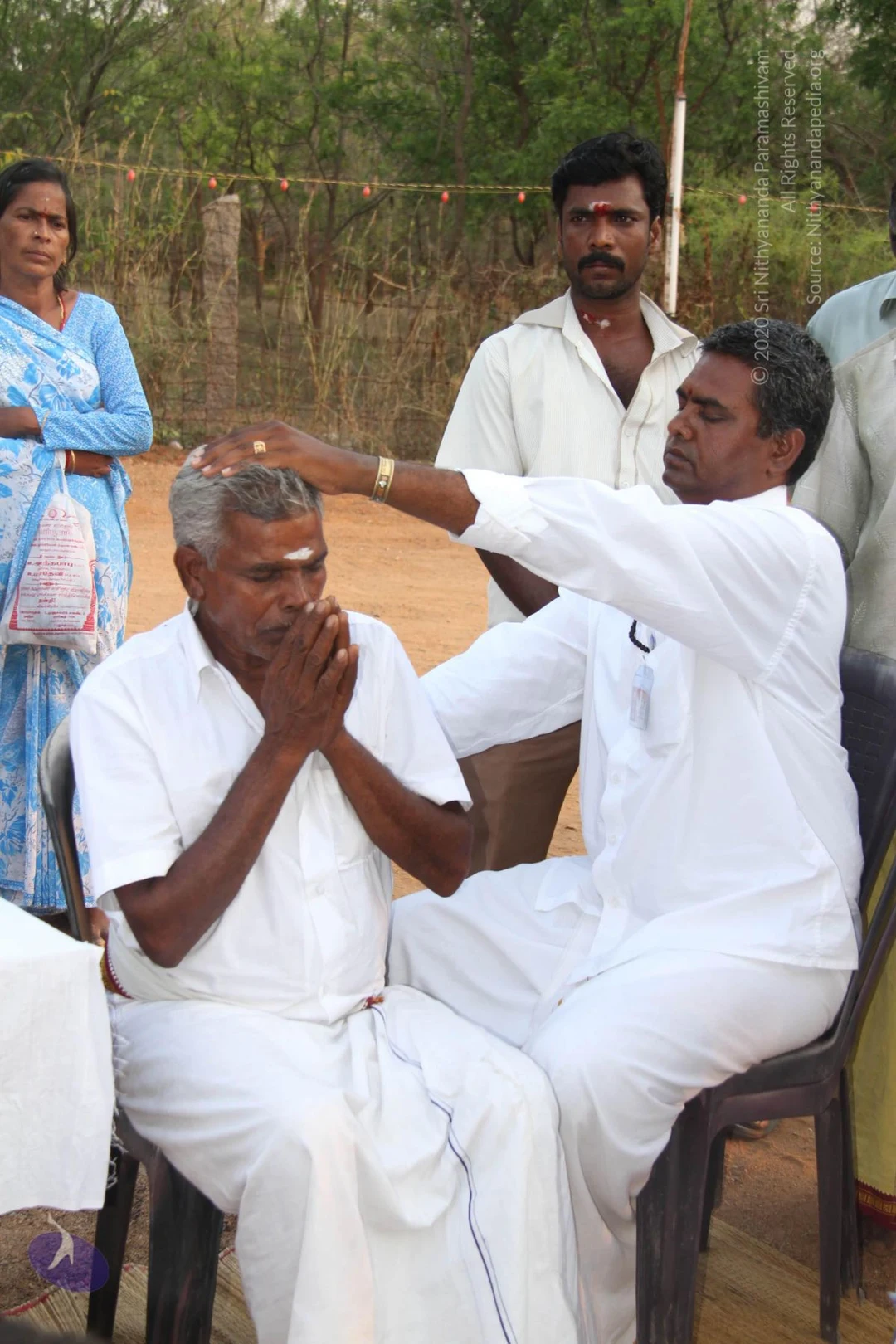
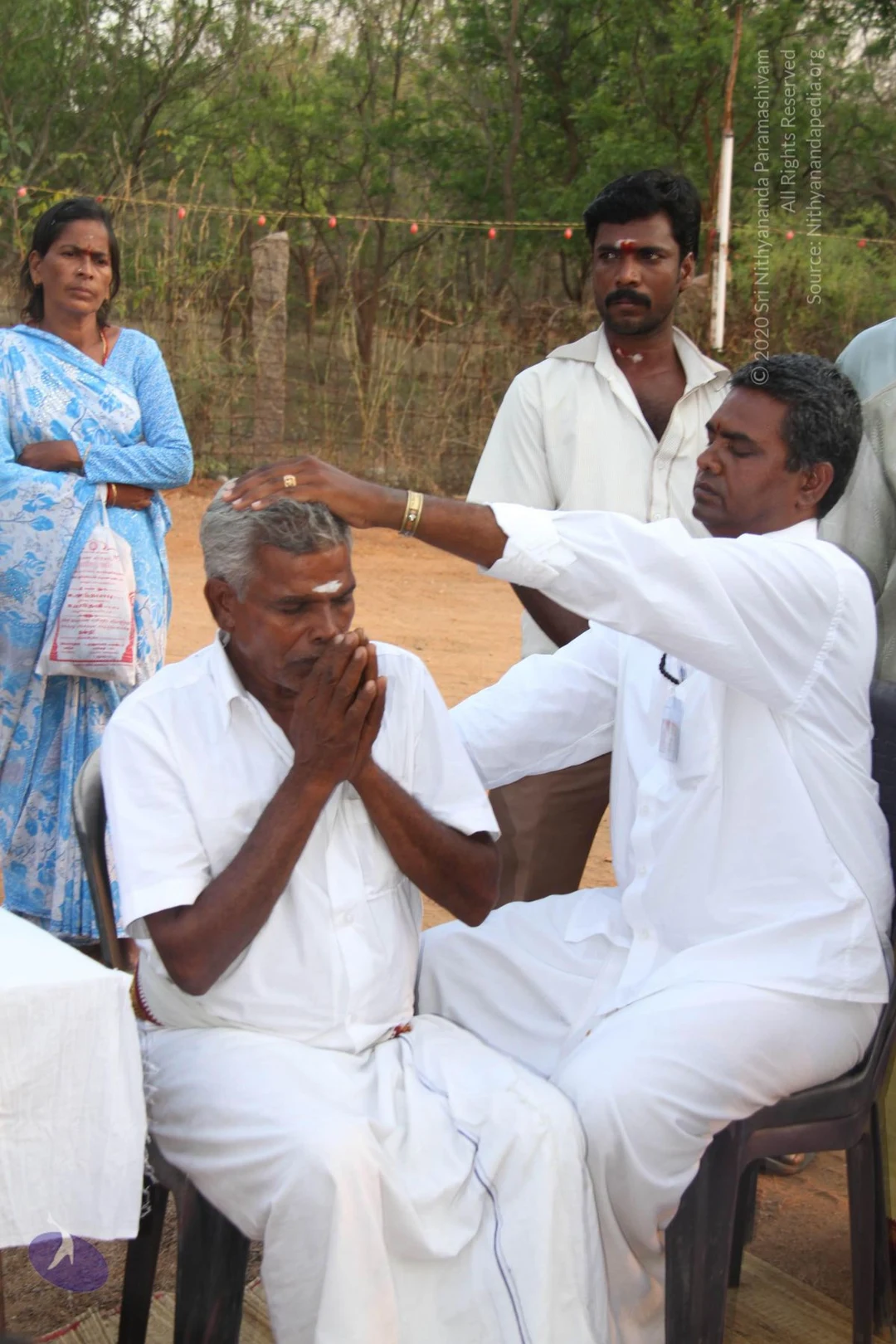
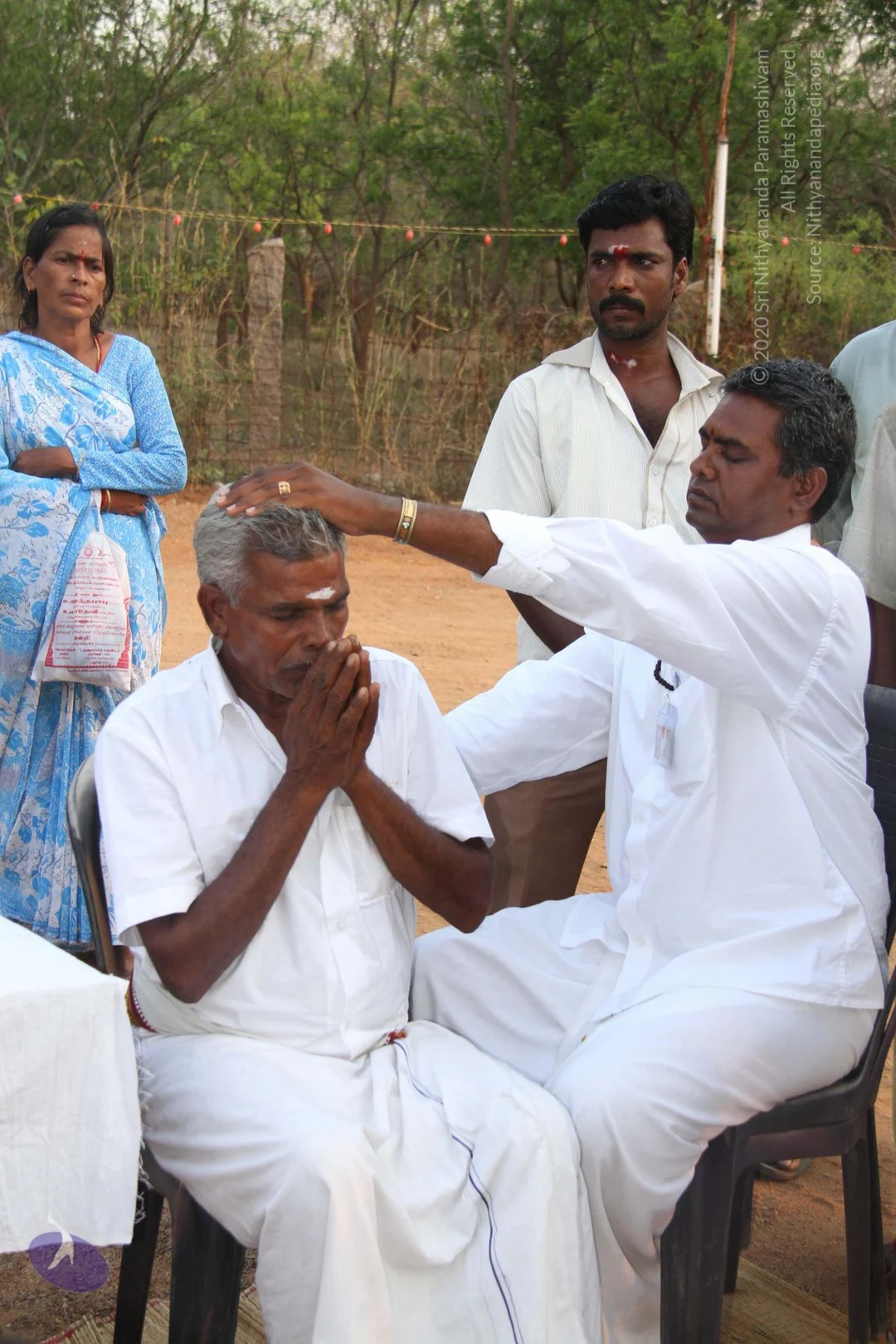
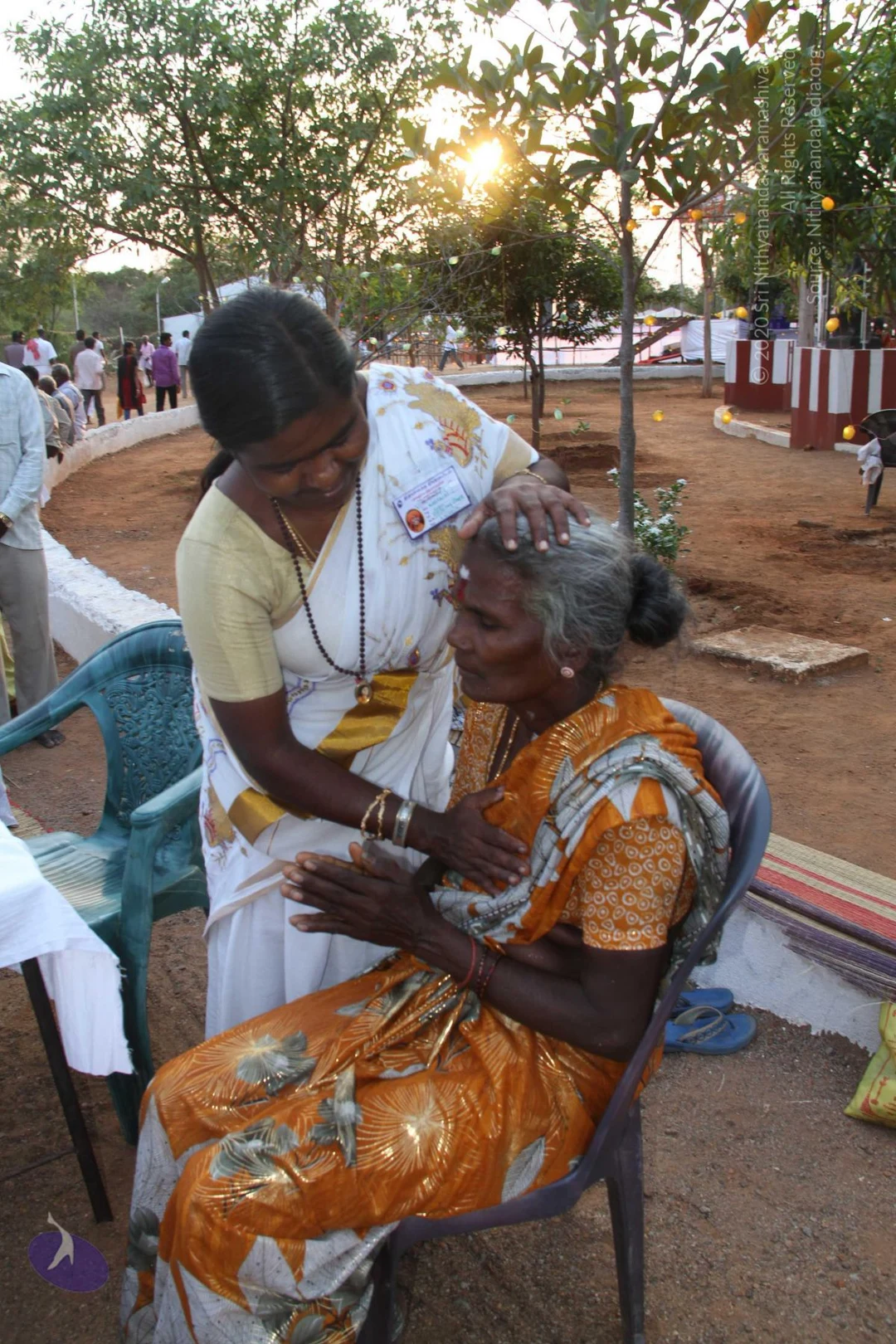
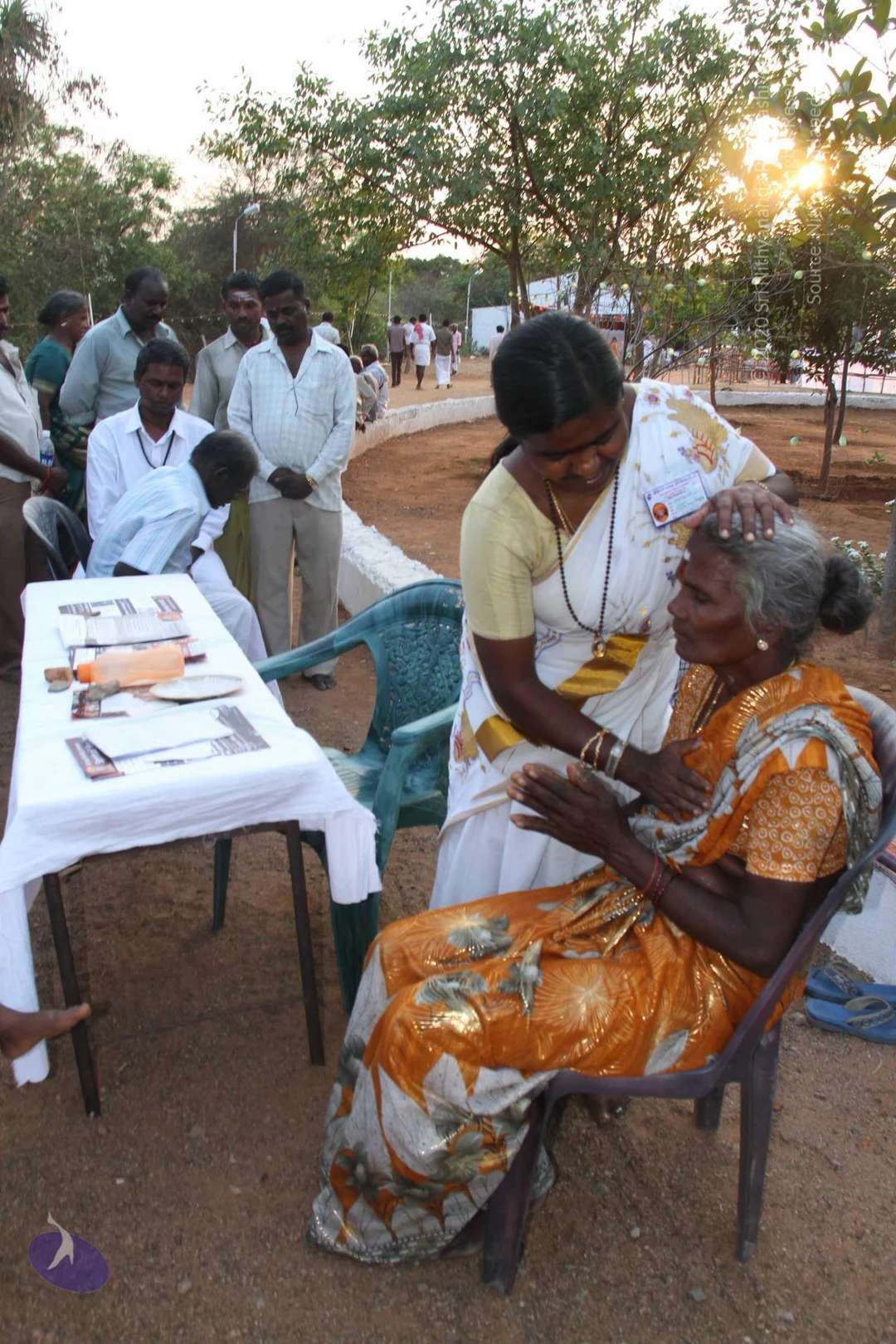
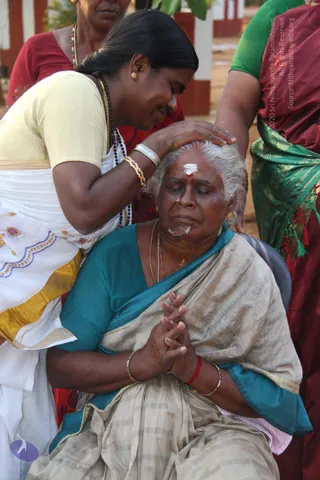
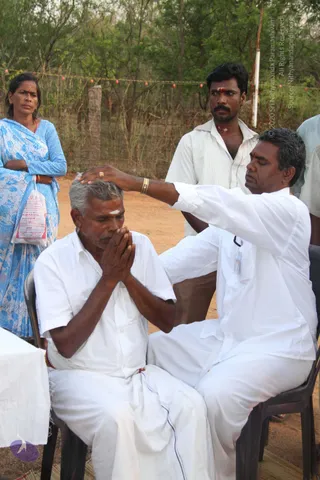
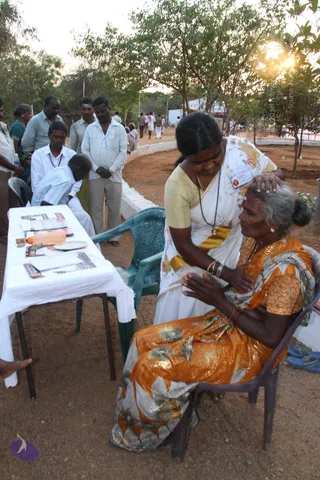
Outdoor photograph of an elderly woman with white-grey hair seated with her eyes closed and palms pressed together in prayer. She wears a teal blouse and a beige checked sari, gold bangles and a red thread on her wrist, with a white and red vibhuti and kumkum mark on her forehead. Standing behind her, a younger woman in a white sari with a gold border and a black-and-red beaded mala places her right hand on the elder's head in blessing. Other women in red and green saris stand in the background beside red-and-white pillars. No a person candidate is visible.Outdoor scene on bare red earth beneath green trees and a strung line of small red lights. A seated older man with grey hair and a white vibhuti mark on his forehead sits with palms pressed together in prayer, eyes closed. A younger man in white shirt and white dhoti sits beside him and rests his right hand on the older man's head in blessing. A third man stands behind in a white shirt with a red tilak, and a woman in a blue floral sari with a plastic bag stands at left watching. A white cloth-covered table edge appears at lower left. No identifiable a person candidate is visible; the blessing figure is shown as a priest-like devotee in white.Outdoor photo at dusk on a dirt ground beneath trees, with the sun low in the sky. A woman in a white sari with a gold border and a lanyard badge stands behind a seated elderly woman in an orange and gold patterned sari, placing her hand on the elder's head while the elder sits with hands pressed together in prayer. A row of plastic chairs and a white-draped table holding brochures and small items sits to the left. Several men in light shirts and trousers stand and one man bends over the table in the background, with more people walking among trees in the distance. Blessing-style giving of touch and devotion is visible, with a white perimeter wall and tents beyond.

Medical-Camp

2 photosSource gallery
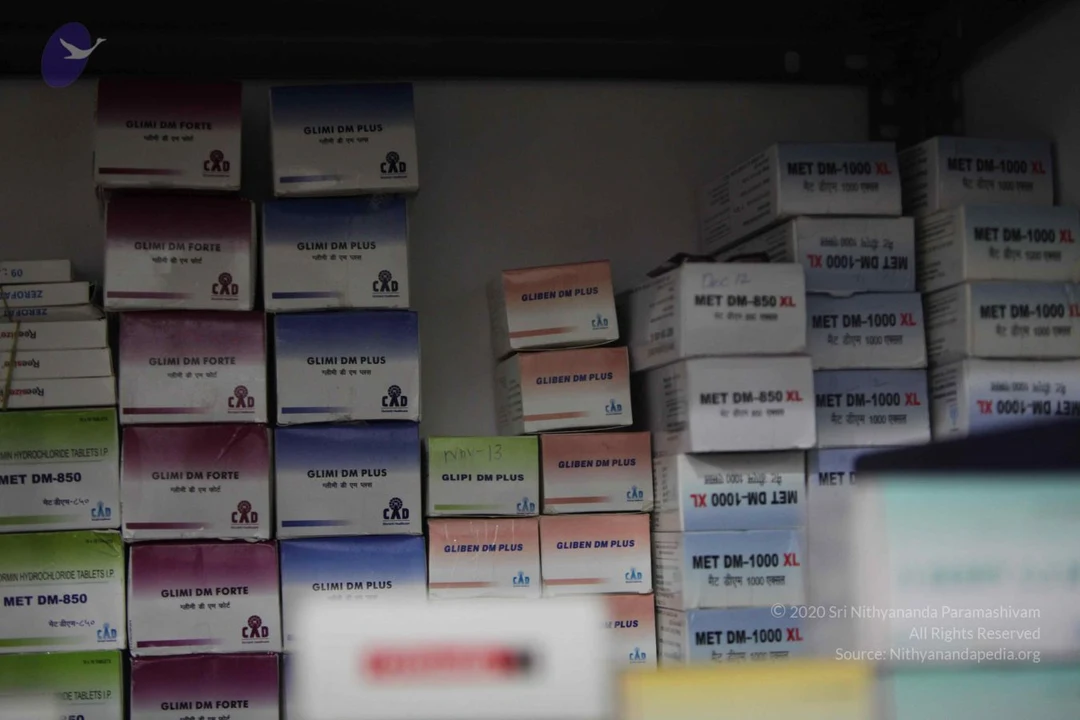
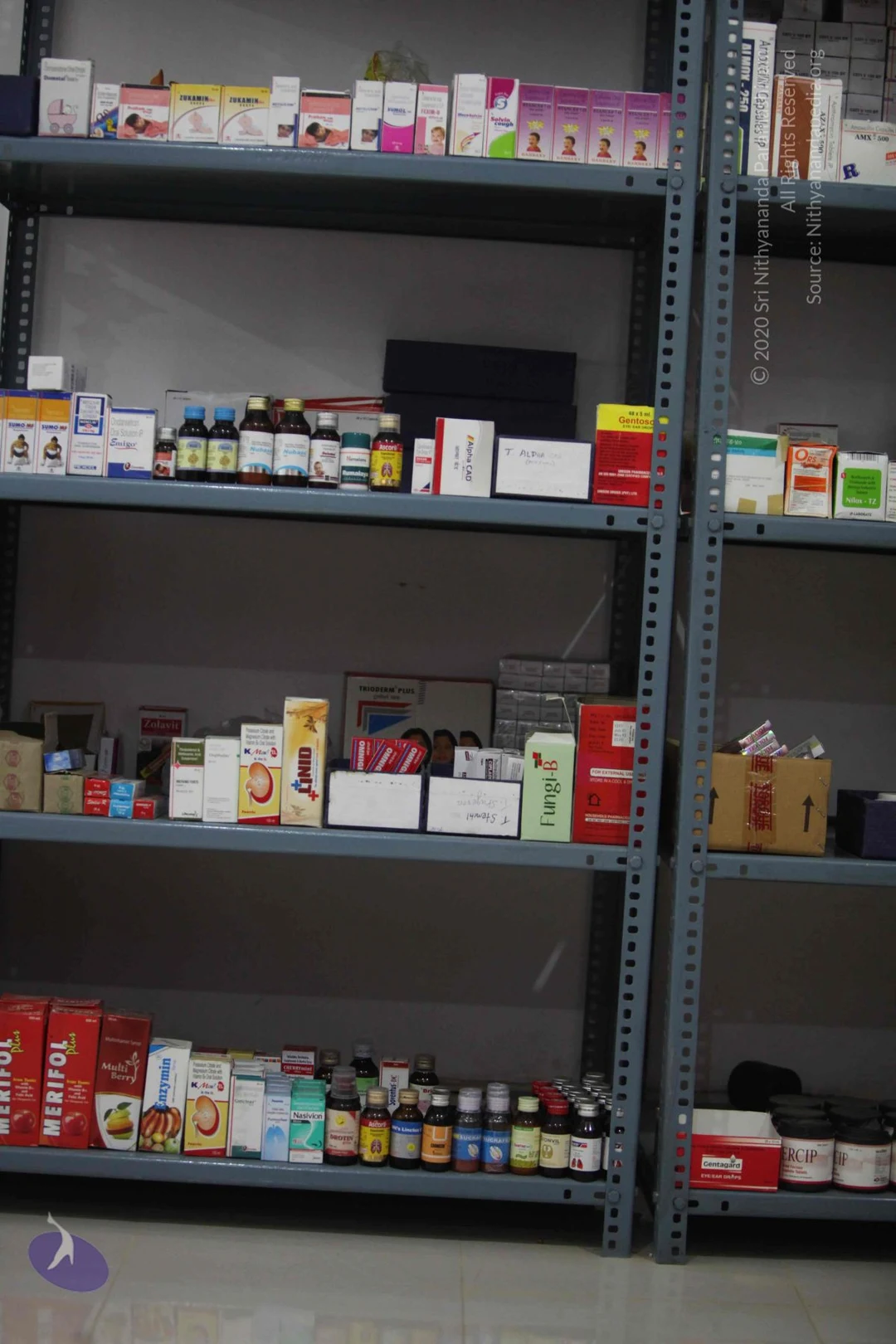
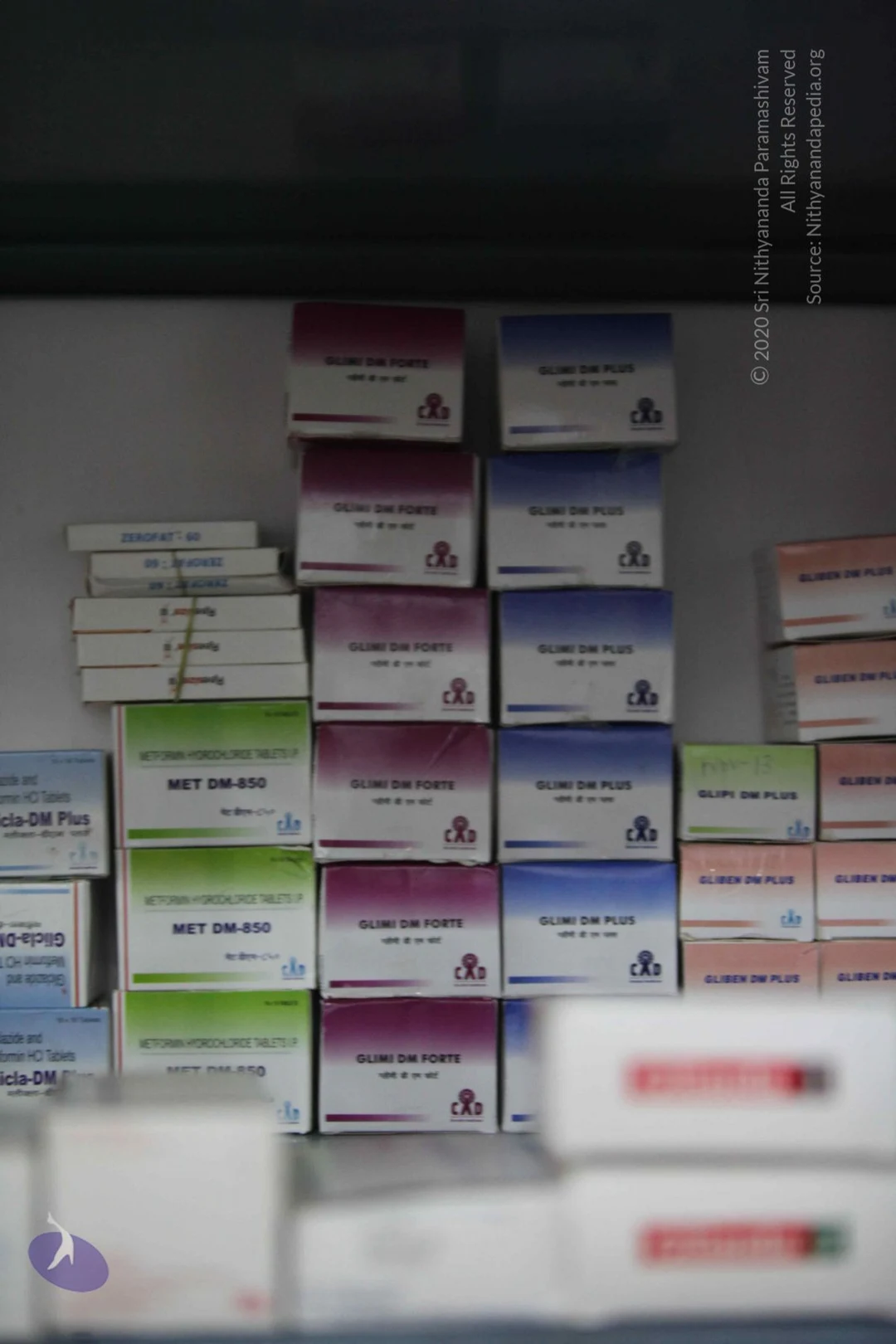
A photograph of storage shelving in a stockroom with grey metal uprights and blue-grey shelf frames. The shelves hold rows of boxed medicines and products in white, orange, pink and red packaging, plus cardboard cartons and bottles of pink and red liquid at the bottom. No people are visible. A small framed picture sits on a middle shelf. The page's Newgen youth satsang context is not visible in the image.A blurred photograph of a wall shelf stacked with pharmaceutical medicine boxes. Pink-and-white boxes labelled GLIMI DM FORTE alternate with blue-and-white boxes labelled GLIMI DM PLUS. Green boxes read MET DM-850, and blue and peach boxes show GLIBEN DM PLUS and Glicla-DM Plus. Stacks of white packets labelled ZEROPAT and others sit at the left. No people are visible, and the scene shows only medicine packaging.

Temple-Services

6 photosSource gallery
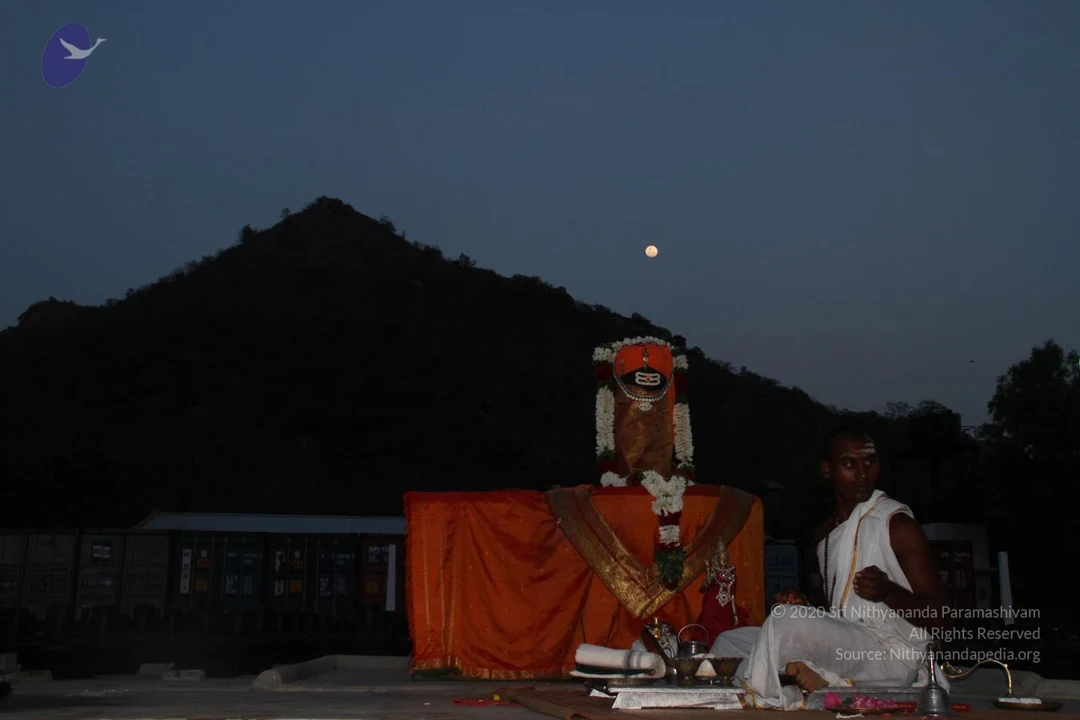
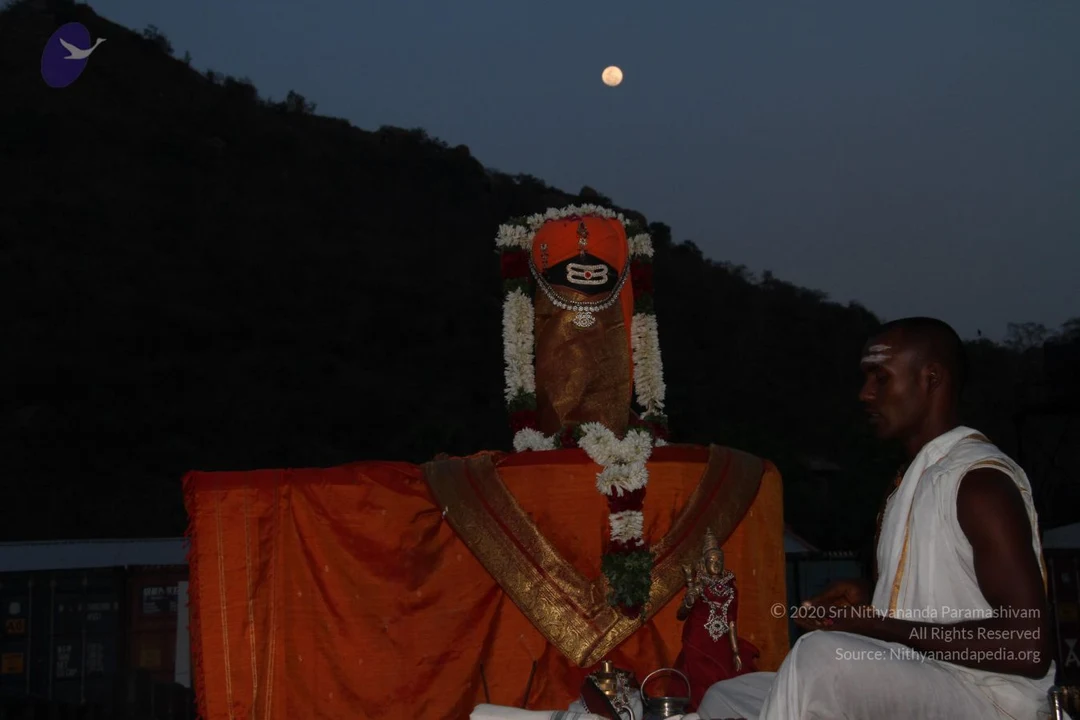
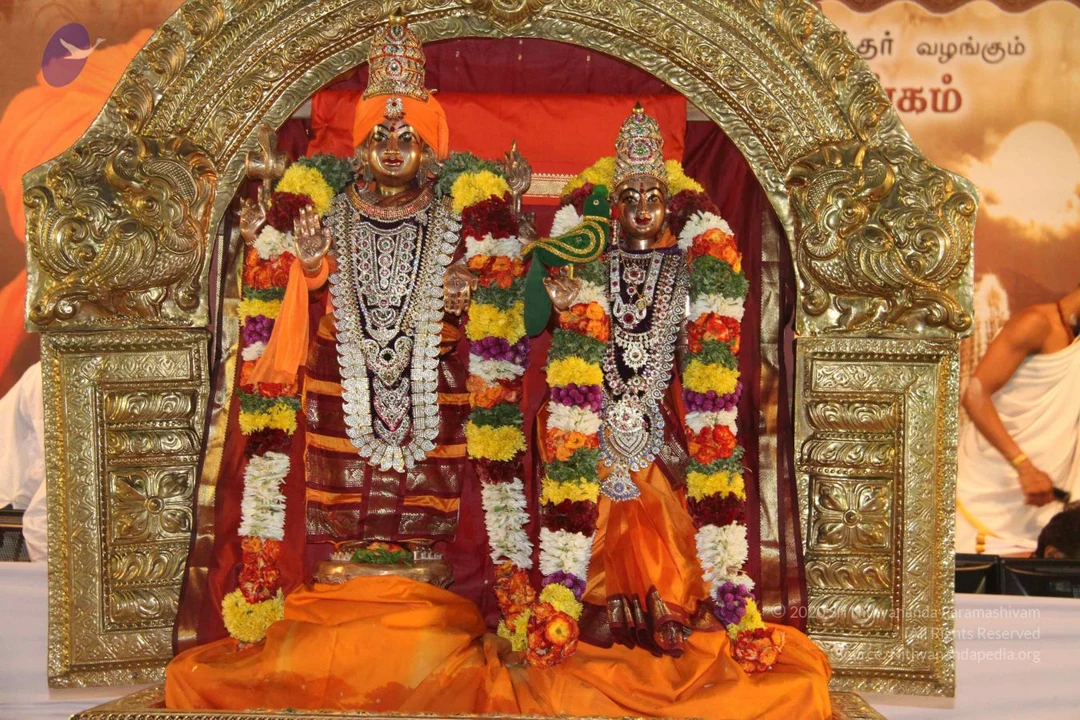
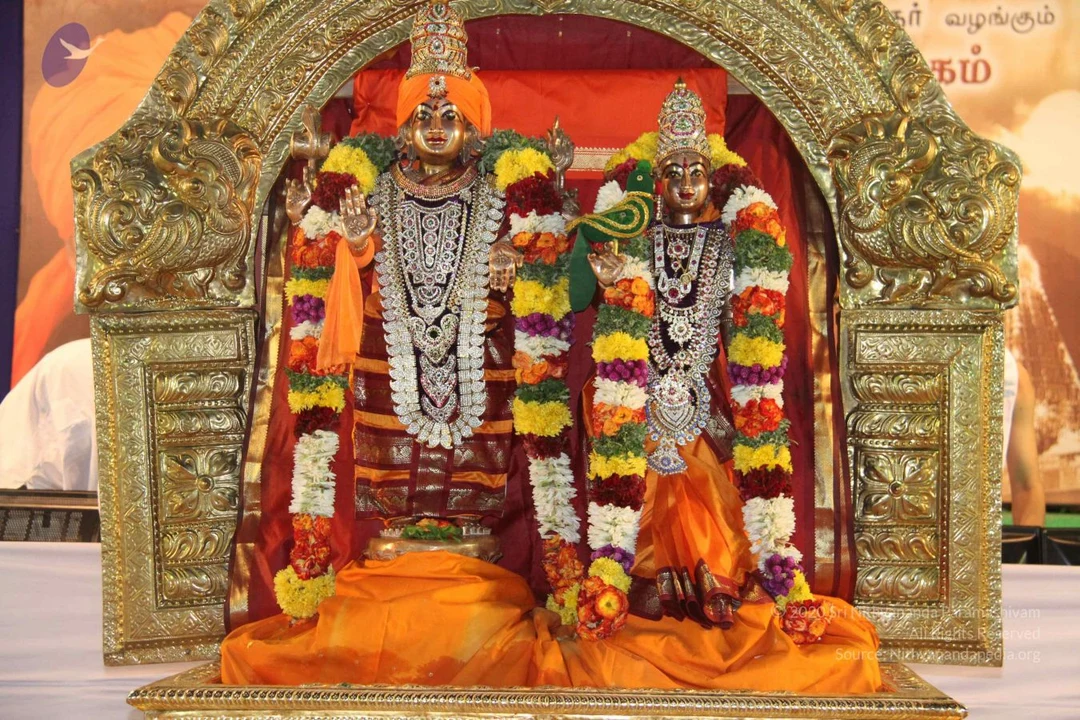
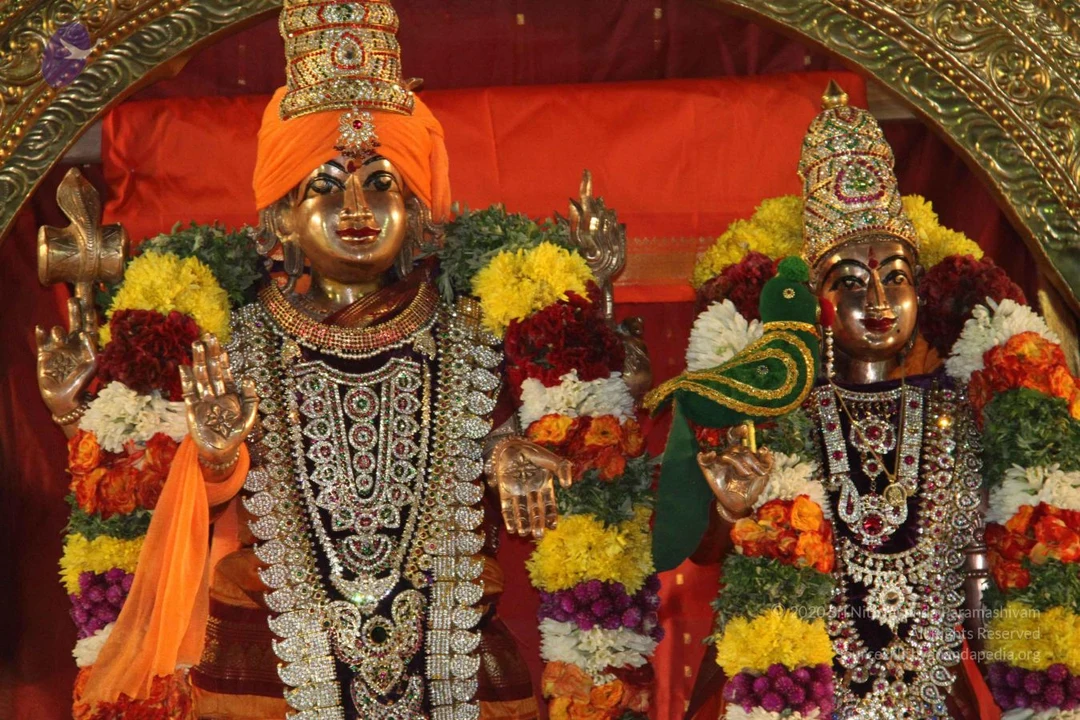
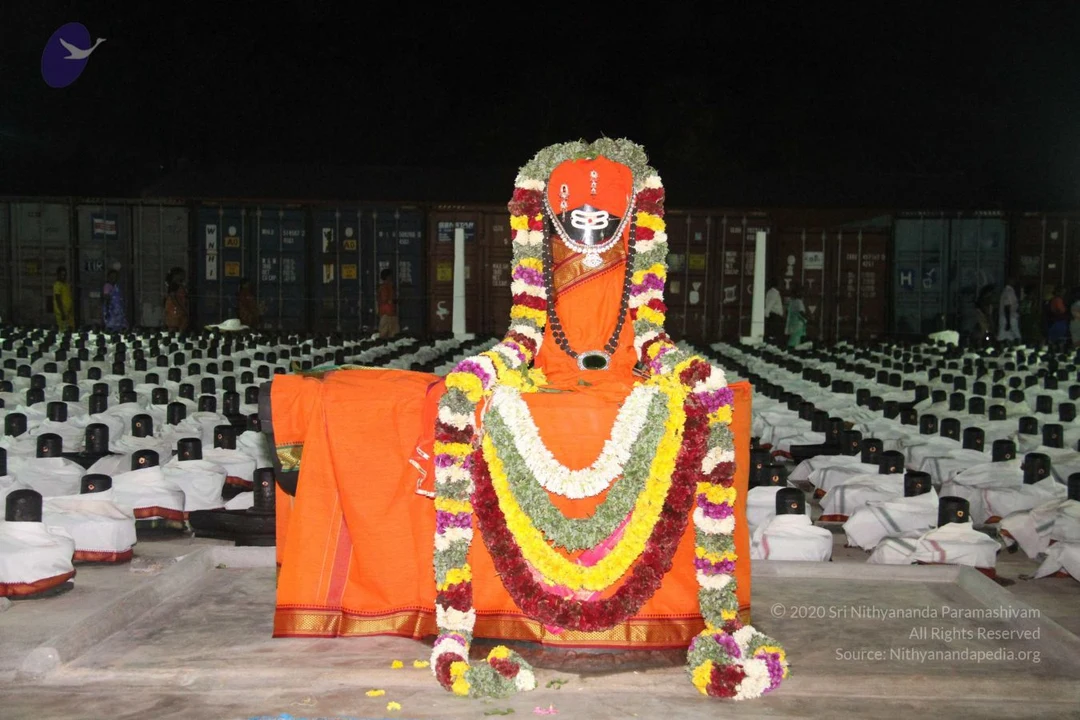
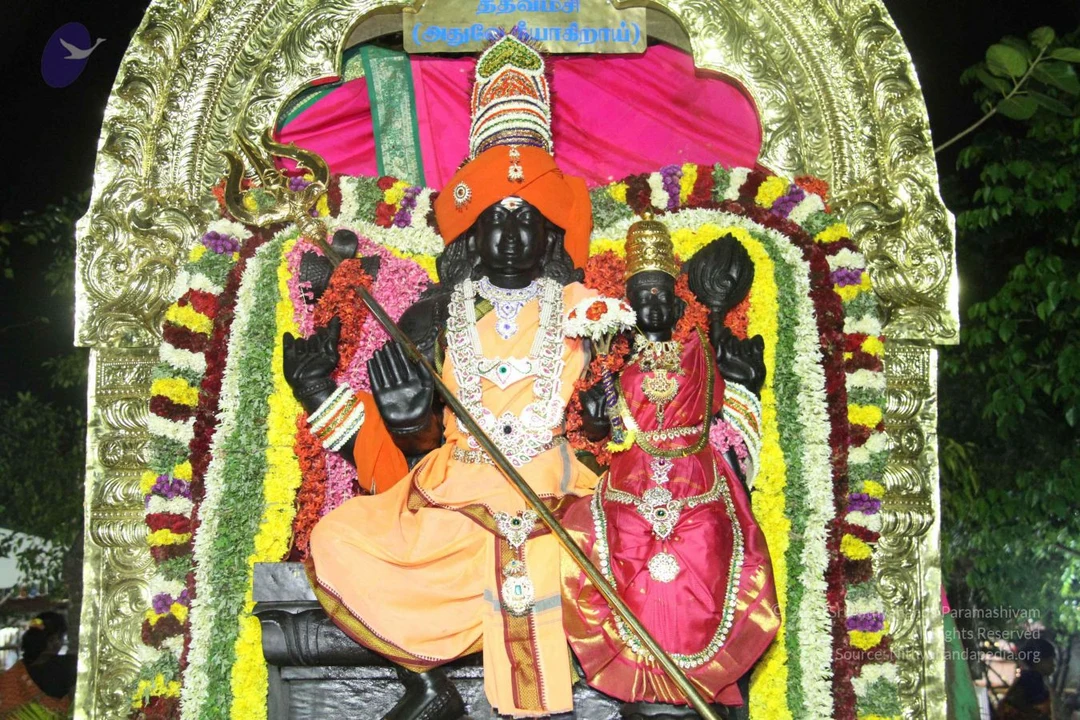
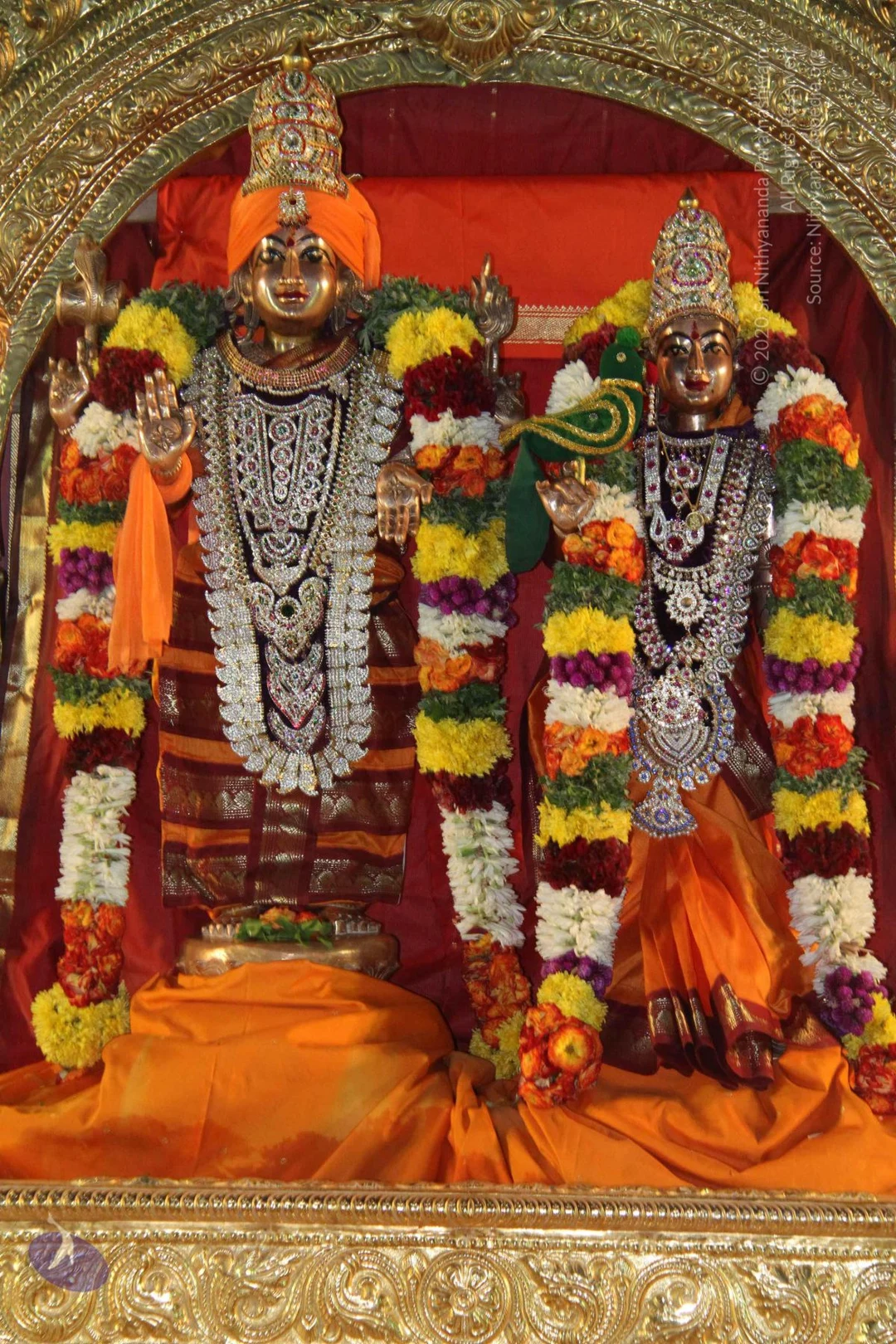
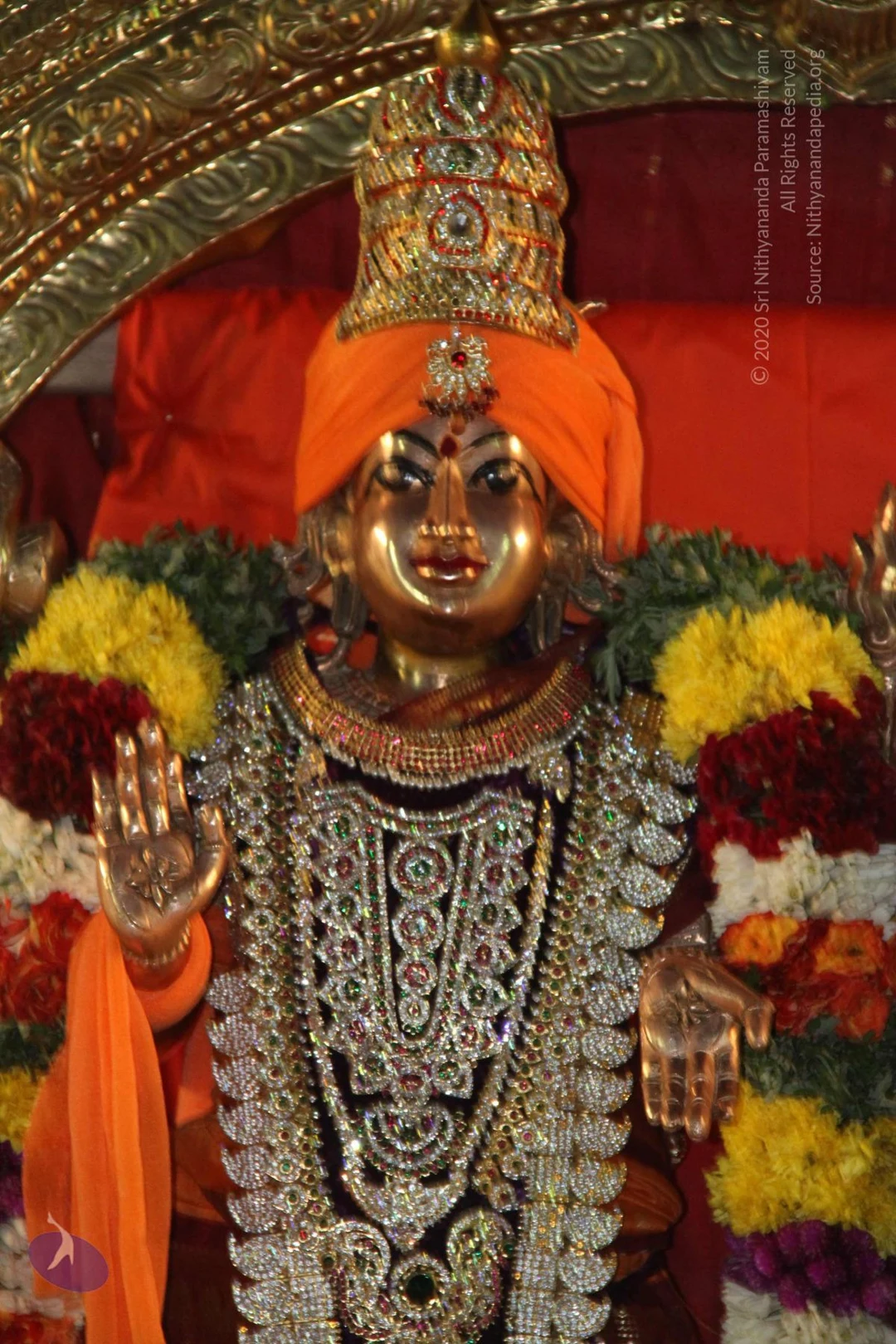
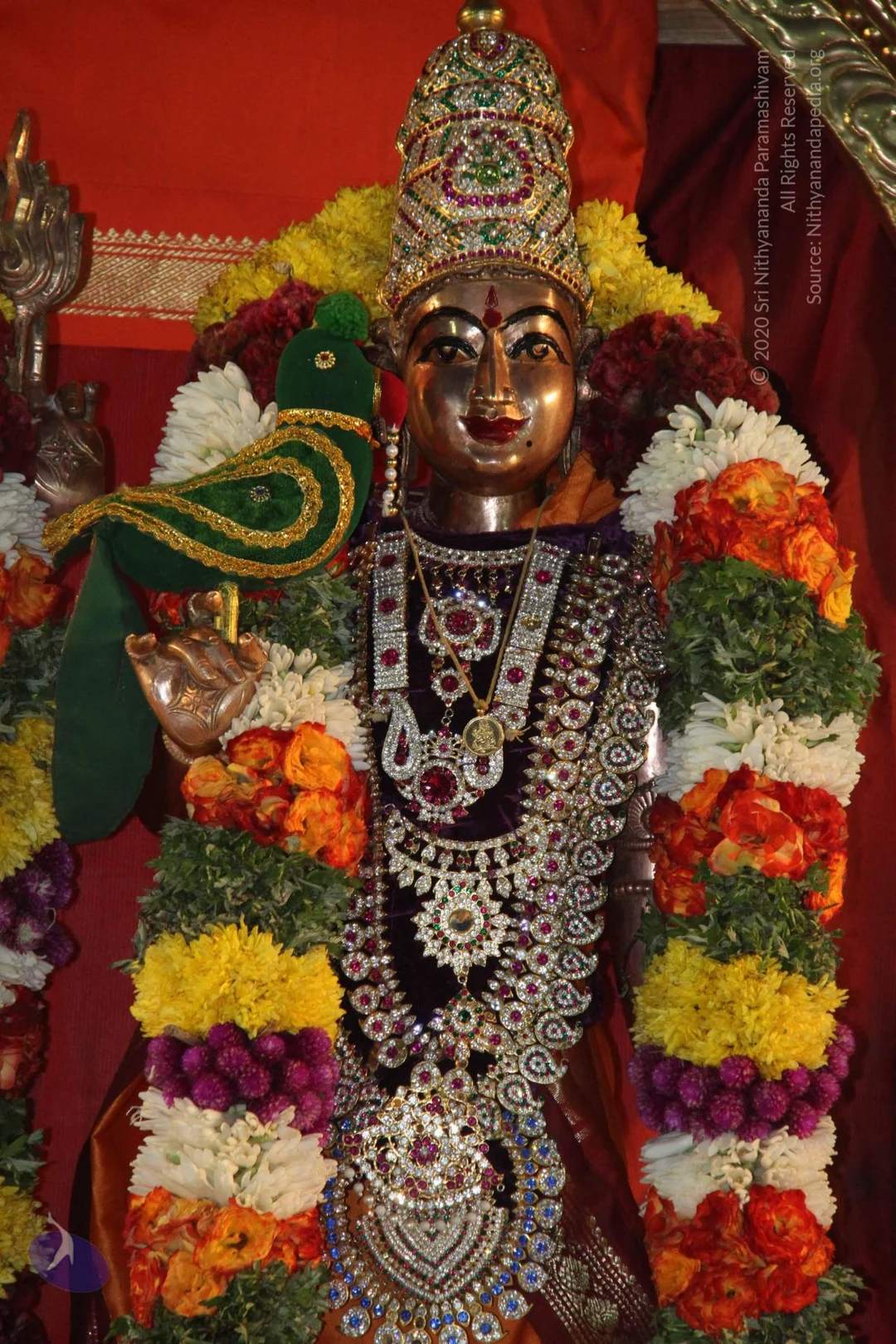
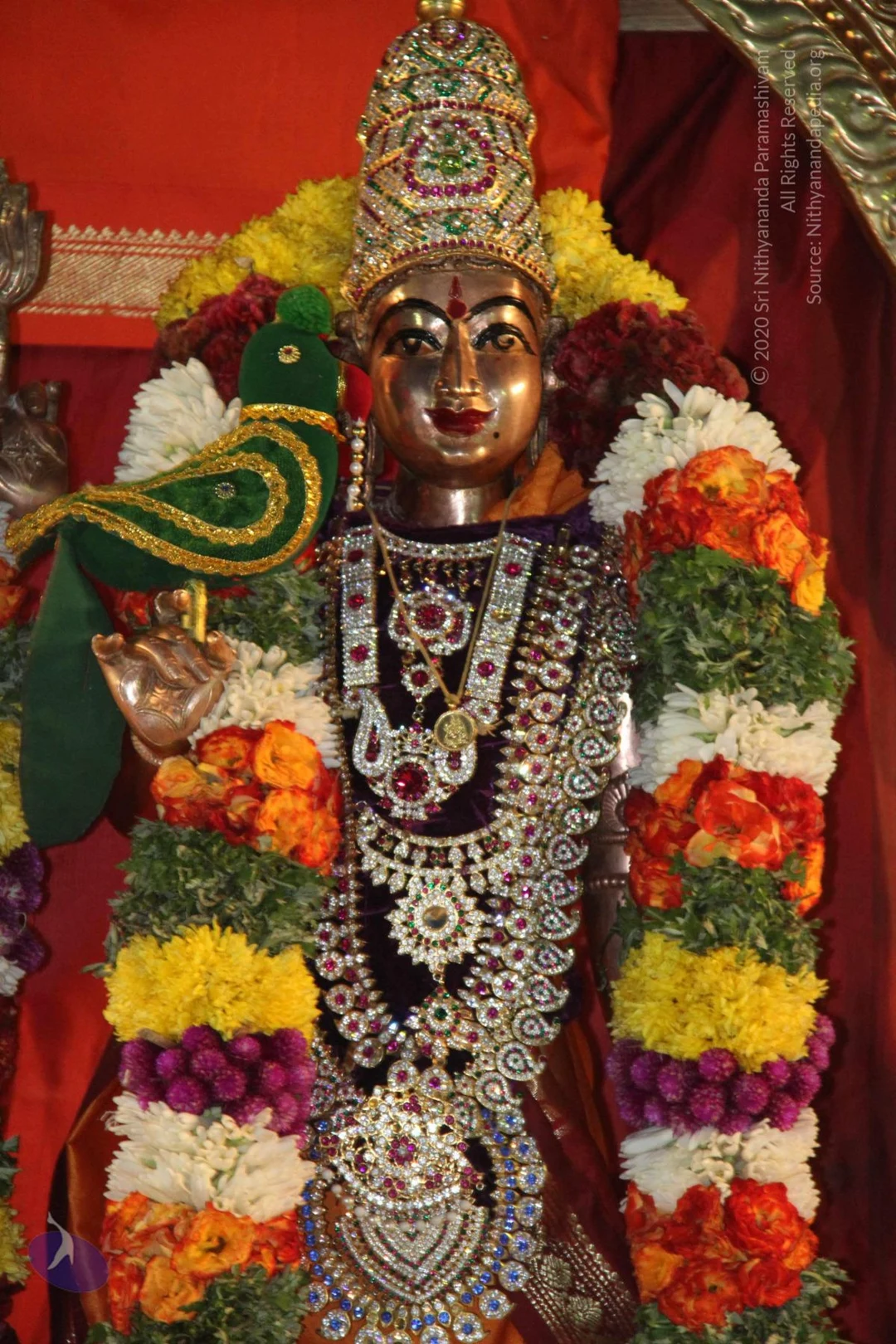
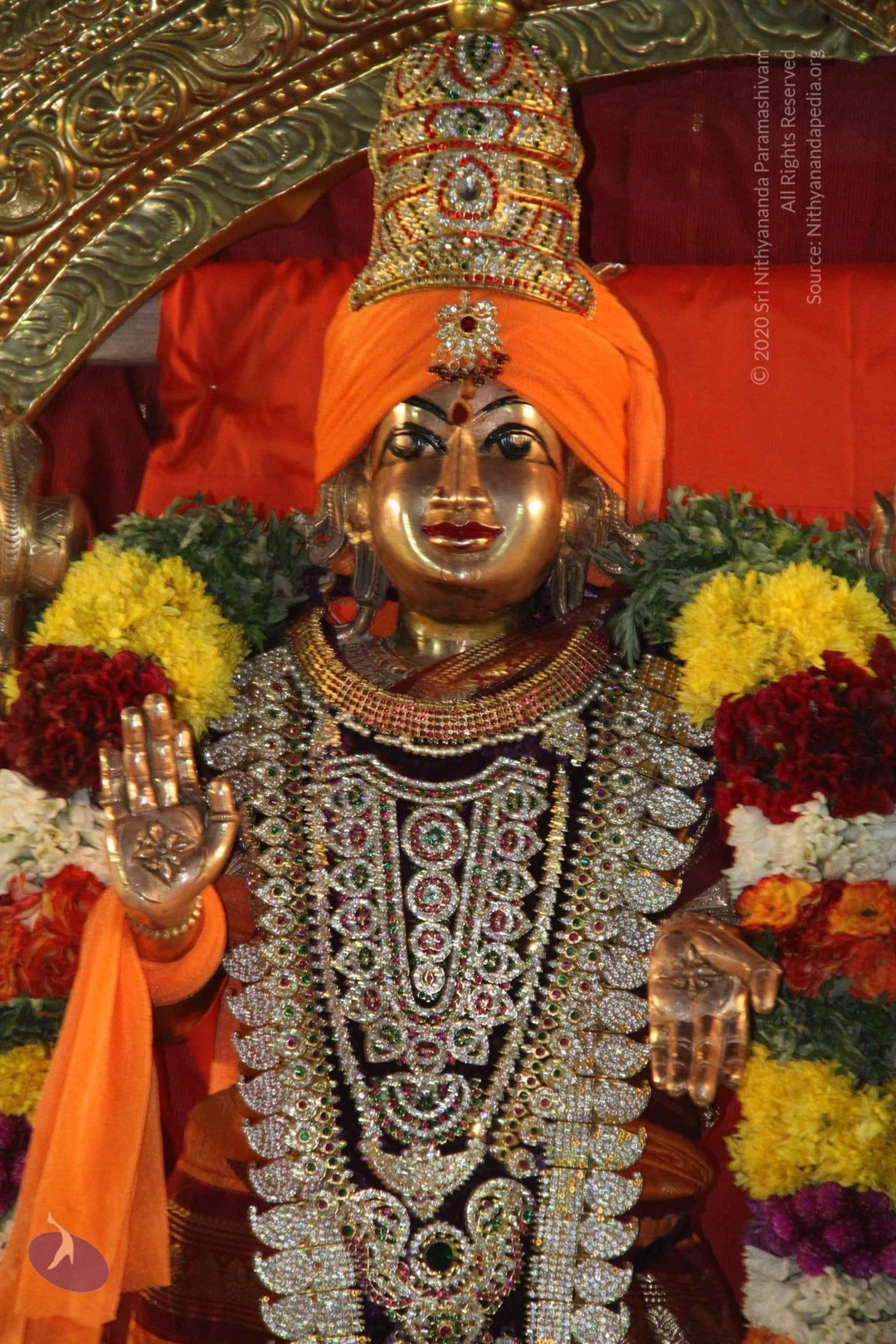
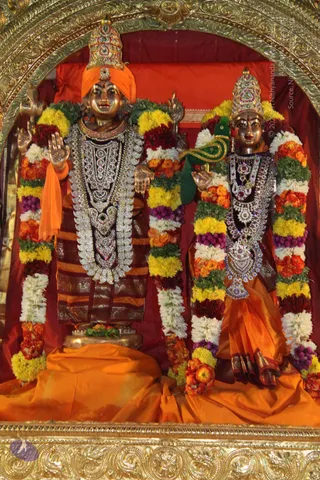
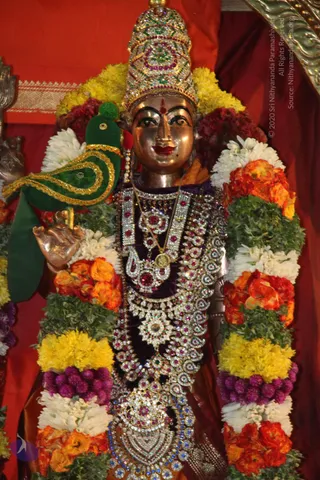
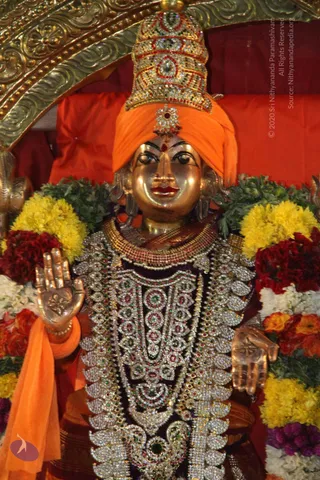
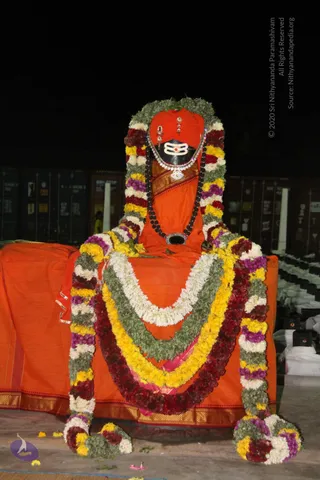
A photograph of two metal deity murtis standing side by side in a gilded arched shrine. The figure on the left wears an orange turban with a jewelled crown, a silver-and-gem necklace, a brown and gold dhoti, and holds a trident and raised hand. The figure on the right wears an ornate jewelled crown, layered silver and gem necklaces, and an orange sari, holding a green and gold object. Both are draped with garlands of yellow, orange, white and purple flowers, and orange silk cloth covers the base. Red fabric forms the backdrop.A golden metal deity murti stands in a red-draped shrine, adorned with a jewelled crown, a dense necklace of diamond-like stones with red and green gems, and a dark velvet garment. It holds a green velvet parrot with gold trim on its left arm and is draped with garlands of yellow marigolds, white jasmine, orange roses, purple globe amaranth and green leaves.A golden metal murti of a deity-like figure, shown frontally with a raised right hand in abhaya gesture and the left hand resting near the body. The head wears a tall orange turban topped with a jewelled crown set with red, green and white stones, plus a forehead ornament with a red centre. The body is covered in heavy layered jewellery: a jewelled collar, ornate multi-strand necklaces set with diamond-like stones, red and green gems, and a large pendant. Garlands of yellow, red and orange marigold flowers surround the figure, and an ornate gilded arch frames the top. The background is red fabric.A gilded metal statue of a standing deity figure stands in a red and gold shrine niche, adorned with an ornate jewelled crown set with red and green stones and an orange turban-like cloth. The statue wears layered silver-toned and gem-studded necklaces over a maroon garment, with a red tilak mark on the forehead. Its hands hold a trident-like staff and a sword on either side, while an orange shawl drapes from one arm. Yellow, red, orange and purple flower garlands frame the figure. This is a statue, so it is not a physical person, and the statue's identity is not established from the image.A photograph of a large orange-draped figure seated against a dark night background with shipping containers behind. The figure wears an orange turban-like cloth, a silver-and-diamond frame with a white tripundra mark and red bindi on the forehead, a dark rudraksha-style mala and a black pendant. It is layered with thick garlands of yellow marigolds, white jasmine, green leaves and magenta and maroon flowers, with petals scattered on the floor. The figure appears to be a decorated murti or statue rather than a living person, so no physical people are present.Night photograph of an outdoor shrine framed by an ornate gold-coloured arch with floral garlands in yellow, purple, white and red. Two dark stone murtis sit on a tiered black pedestal: a male deity in an orange turban and orange dhoti holding a trident-like staff, and a female deity in a magenta sari with gold jewellery. A small white and green seated figure with a garland kneels at the base. A plaque above reads Tattvamasi (Adhulee Jyothiraay). Foliage and tents appear in the background. No people are visible in the scene.

01-Bidadi-Temple

4 photosSource gallery
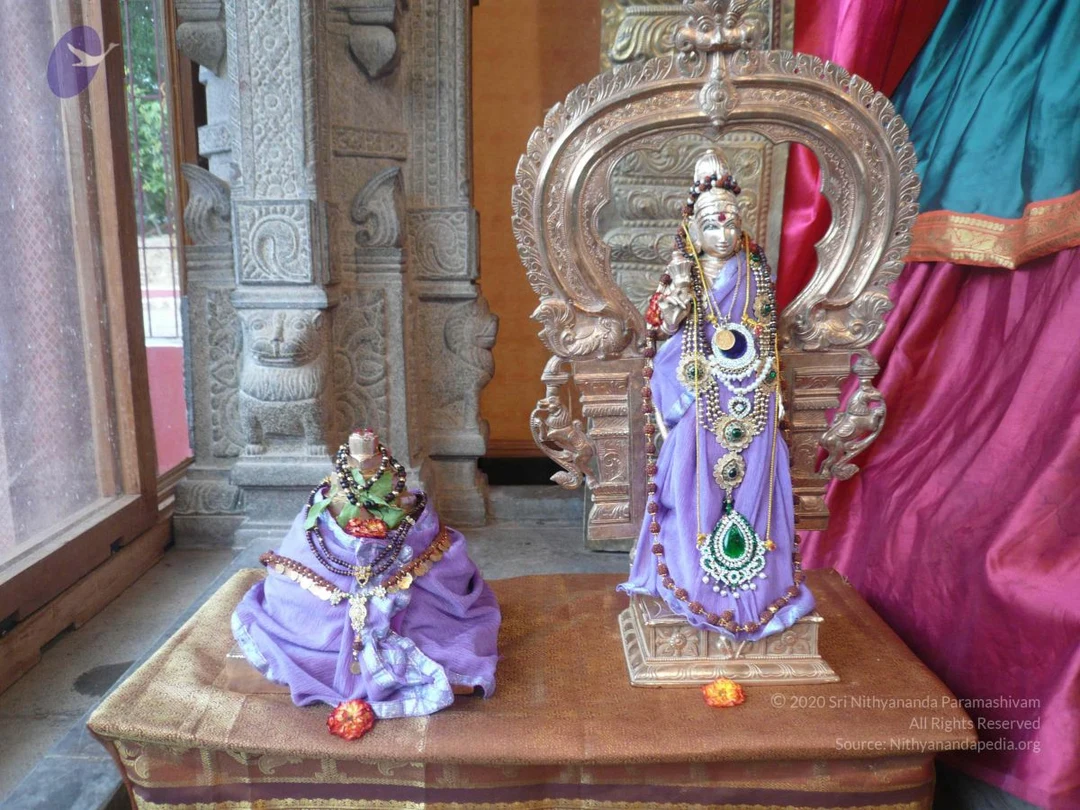
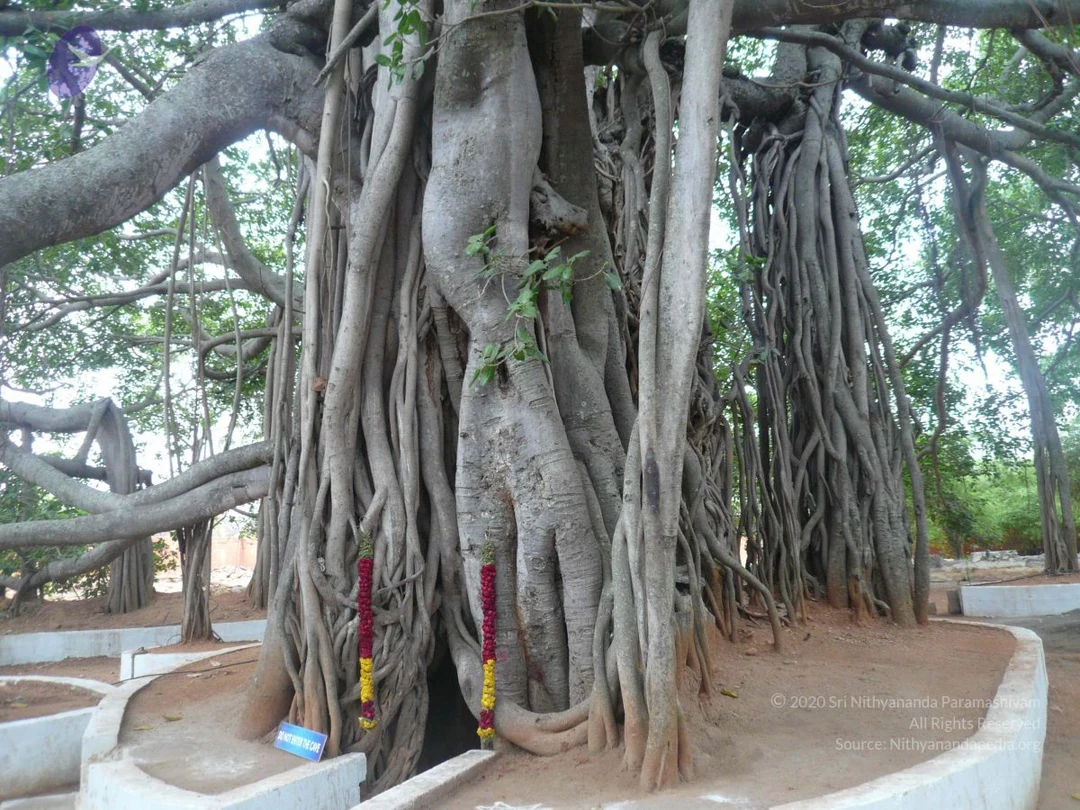
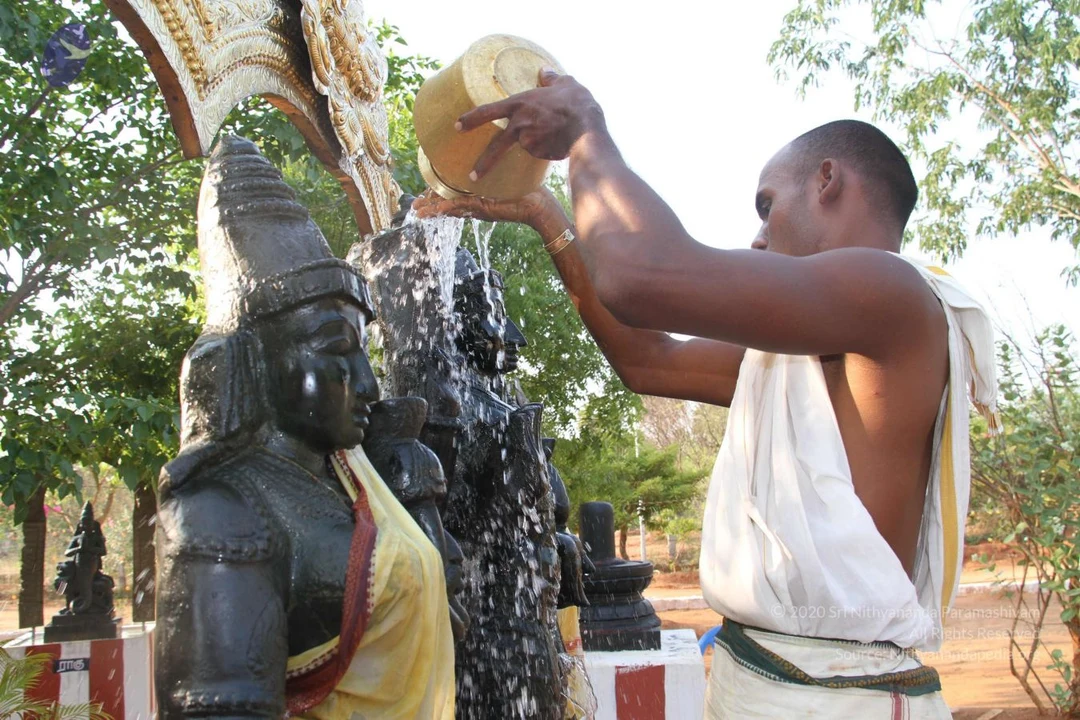
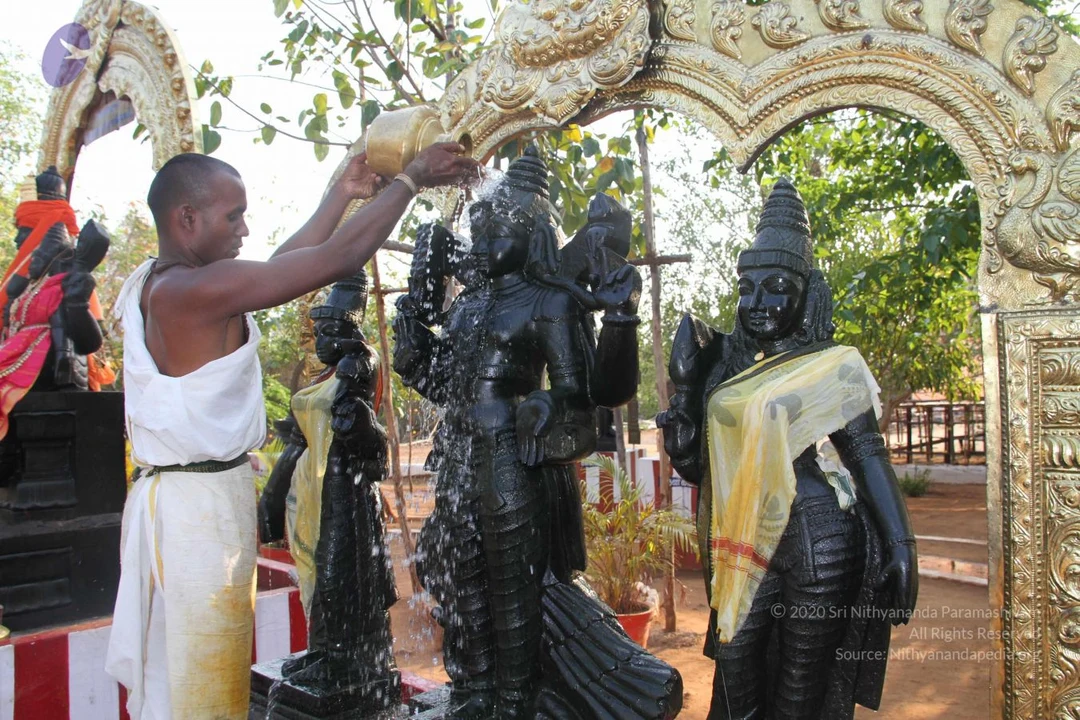
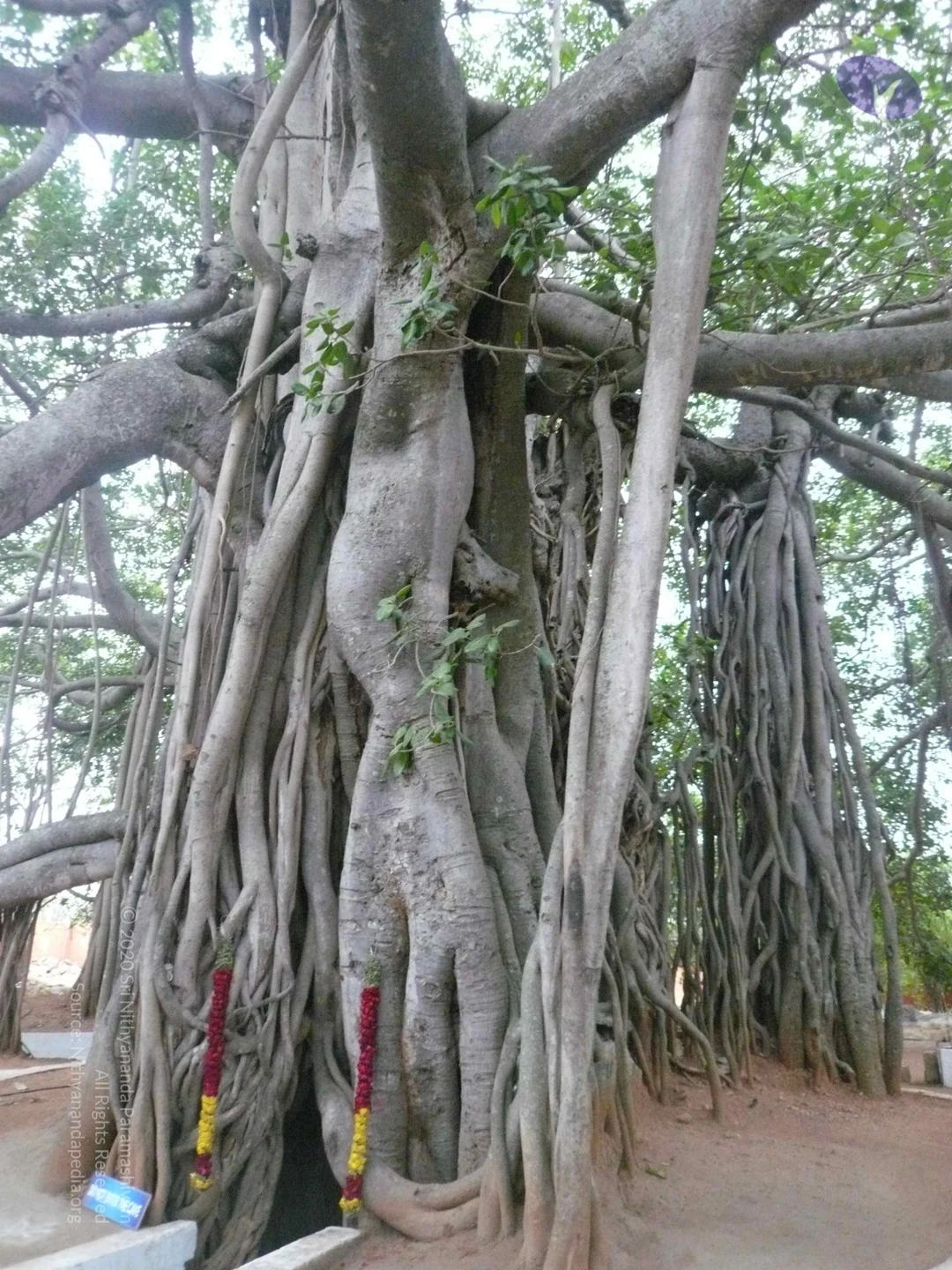
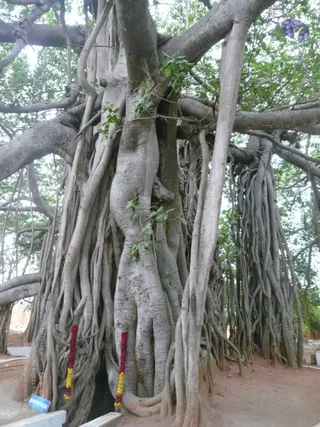
A standing silver statue, set in an ornate gold-toned arched shrine niche with green sparkling fabric behind it. The figure wears a red-orange turban with a jewelled ornament, a red-orange dhoti-style wrap, multiple strands of white pearls, a white beaded waist belt, red bangles and ornate ankle beads, and raises one hand in an abhaya-style blessing gesture. Pink and magenta silk drapes hang at the left edge and a green cloth covers the base. The figure is a statue or murti, not a living person, so this is a depiction.A black stone statue of a four-armed deity murti sits in a silver-framed arched shrine against an orange patterned cloth backdrop, under trees. The figure wears a red headcloth, red drape, white bead necklaces and a white waist cord, with garlands of red and yellow flowers draped over the shoulders. One hand is raised in a blessing gesture, and others hold a drum and a flame-like object. Two brass oil lamps and a brass bowl sit on a stone plinth before a sign reading Dakshinamurthi shrine, with red-painted rock around the base. No people are visible.A photograph of a black stone statue of Dakshinamurthy, a form of Shiva as teacher, seated in a shrine under trees. The four-armed deity murti wears a red head cloth, red drape, white bead necklaces and a waist belt, and red-and-yellow marigold garlands hang from its shoulders. Its hands hold a drum, a fire and a snake-like object, while the other hands are in a teaching gesture. An ornate silver arch frames the shrine against an orange patterned cloth. Two brass oil lamps and a brass bowl sit before the base, with a black plaque beneath reading Dakshinamurthi shrine.A photograph of a massive old banyan tree with a thick, multi-trunked form and many hanging aerial roots forming pillar-like columns. Two garlands of red and yellow flowers hang from the roots on the trunk, and a small blue sign is visible at the lower left. Sunlight filters through green leaves above, and the ground is bare reddish earth. No people are visible.

02-Thiruvannamalai-Kalpatharu-Darshan
27 photosSource gallery
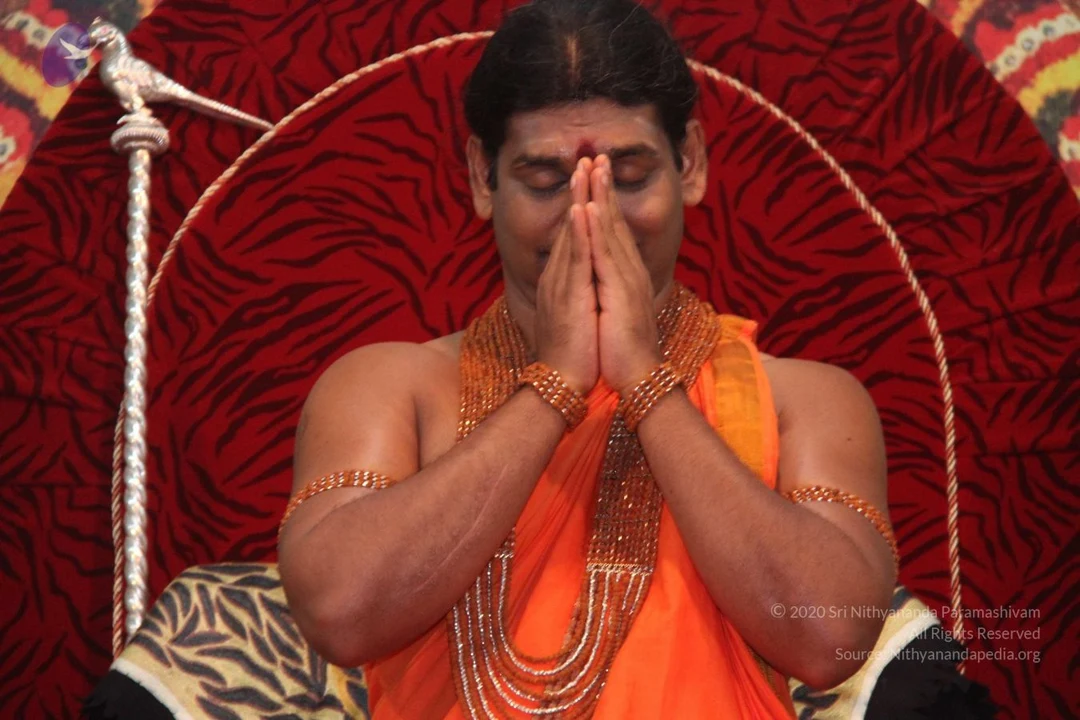
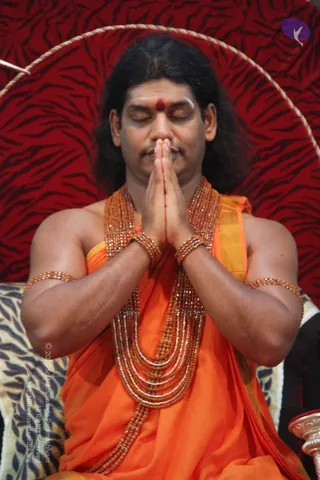
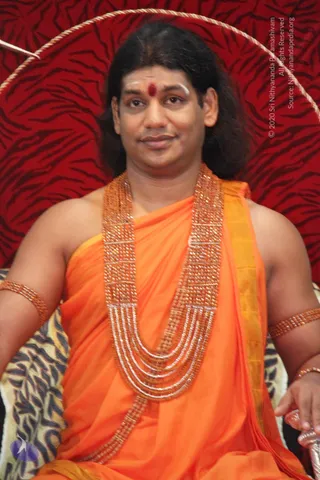
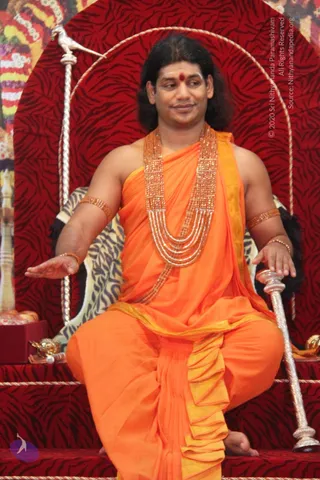
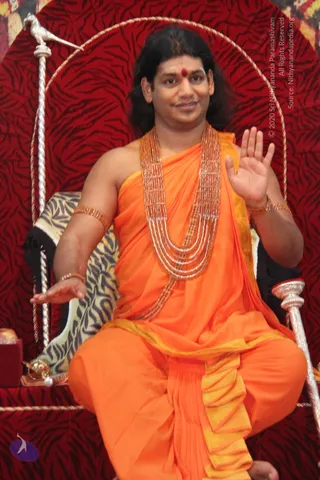
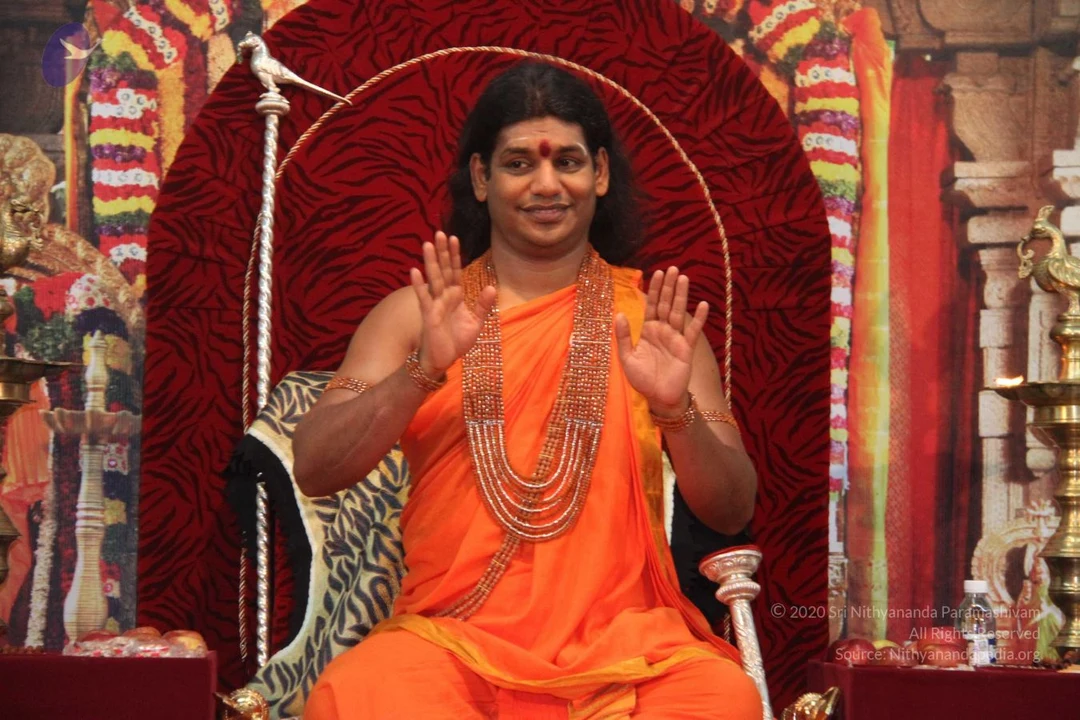
A man with long dark hair sits with eyes closed and palms pressed together in namaste at the chest. He wears an orange saffron garment with a yellow-orange border, multiple strands of rudraksha and silver-toned beaded necklaces, matching beaded bracelets and armlets. A red tilak mark and white vertical line adorn his forehead. He sits before a red and black tiger-striped cushioned backdrop, with a silver-toned vessel at the lower right edge.A seated man with long, swept-back dark hair wears an orange saffron shawl over bare shoulders and multiple strands of beaded rudraksha-style malas with silver accents, plus beaded armlets. He has a red bindi and white vertical tilak on his forehead. He sits in front of a red throne-like backdrop with a tiger-stripe pattern and a gold-edged arch.A photograph of a seated man on a red tiger-striped throne with a carved white bird on its arch. He wears orange-saffron robes with a gold-edged drape, multiple strands of beaded orange and gold necklaces, beaded bangles, and a red tilak on his forehead. His long dark hair falls to his shoulders, and he holds a silver-topped staff in his right hand while extending his left palm outward. Behind him is a red and gold floral backdrop, and a red-draped table holds fruit and a brass vessel. Swamiji (probable): the orange robes, long swept-back hair and ornate beaded necklaces on a throne match the presentation of Swamiji, though the identification is based on appearance cues only; he is seated in a satsang or darshan setting.A man seated on a red throne with a tiger-striped cushion and silver arms, against a red and dark patterned backdrop with a silver bird finial. He wears a saffron-orange dhoti and shawl with gold-edged borders, multiple strands of orange and silver beaded mala necklaces, orange beaded bangles, and a red tilak on his forehead. His long dark hair falls past his shoulders, and he raises his right hand in a blessing gesture while his left hand rests open on the armrest.Swamiji (probable) seated on a red and gold throne with a tiger-stripe patterned backrest and silver armrests, wearing an orange saffron robe, multiple strands of beaded rudraksha-style mala necklaces, and beaded arm bands. He has long dark hair swept back, a red bindi on his forehead, and raises his right hand in a blessing gesture while smiling. He is the only person in the frame.A seated man in an orange saffron robe and layered beaded necklaces sits on a red tiger-striped throne with silver armrests and a silver bird finial, palms raised toward the viewer in a teaching gesture. A red bindi marks his forehead, and he wears orange beaded bangles on his arms. Behind him is a red and patterned backdrop with floral garlands. Swamiji (probable): the long swept-back hair, saffron clothing, rudraksha malas and throne match the page's claim, so he is treated as an in-person candidate.
03-Thiruvannamalai-Organizers-Meet
14 photosSource gallery
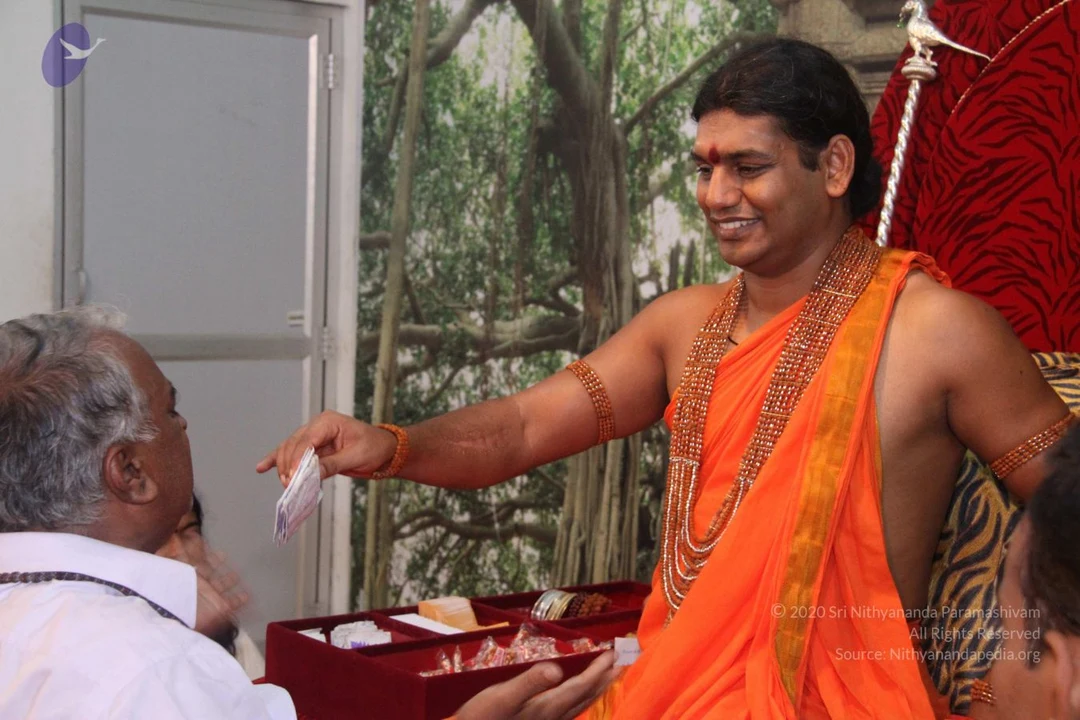
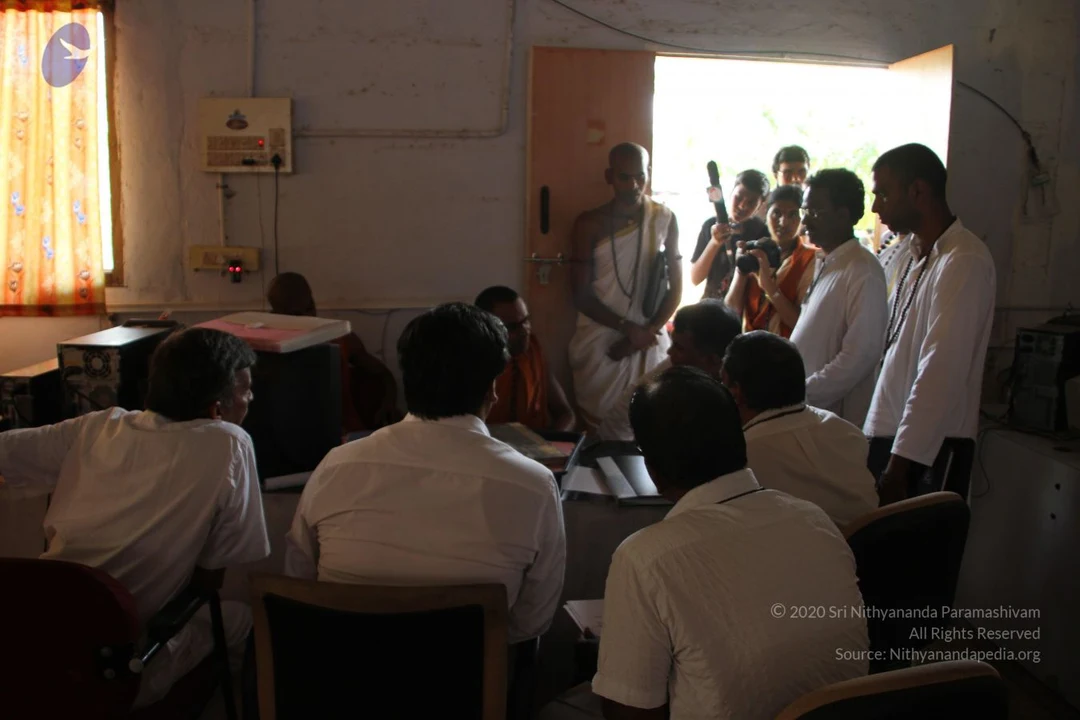
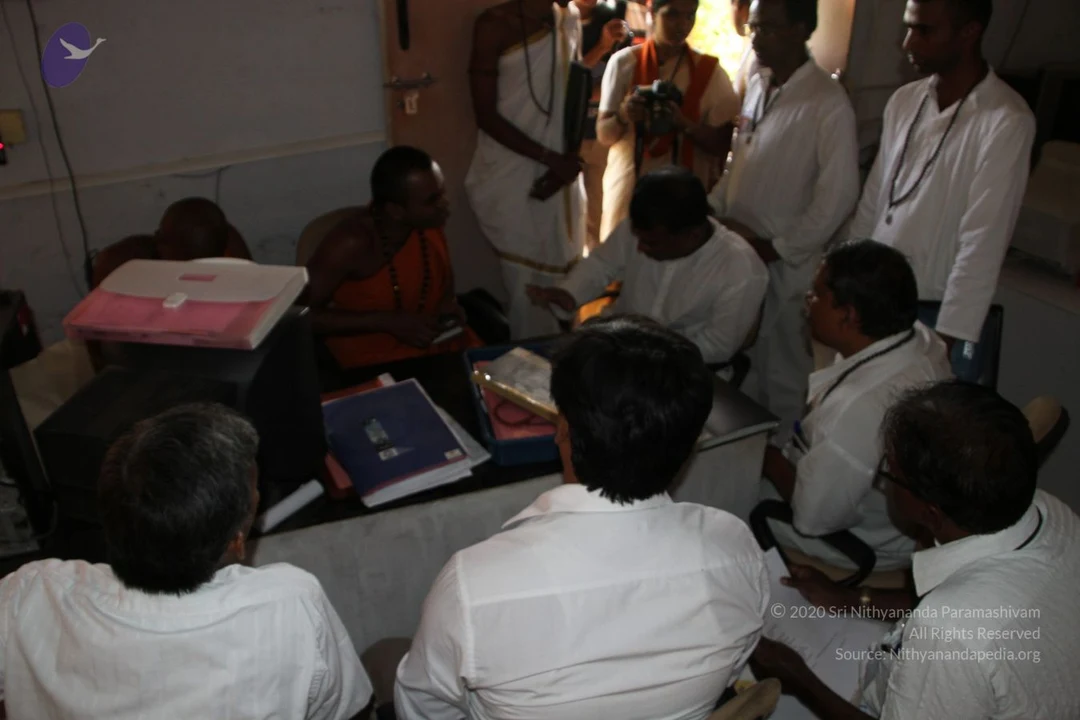
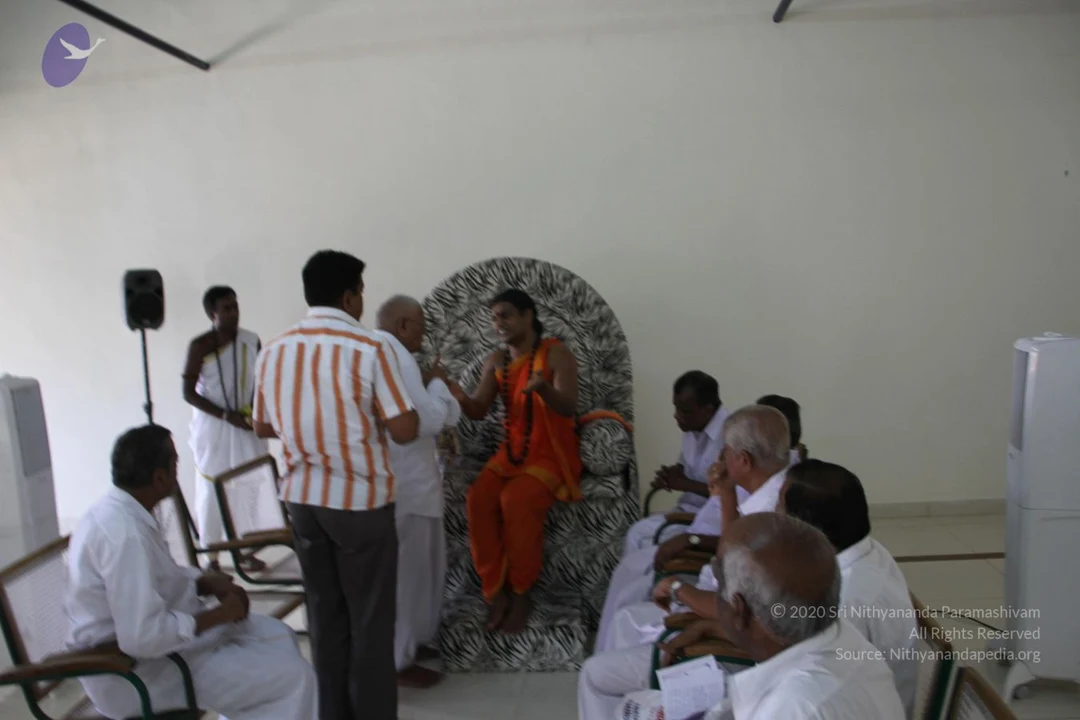
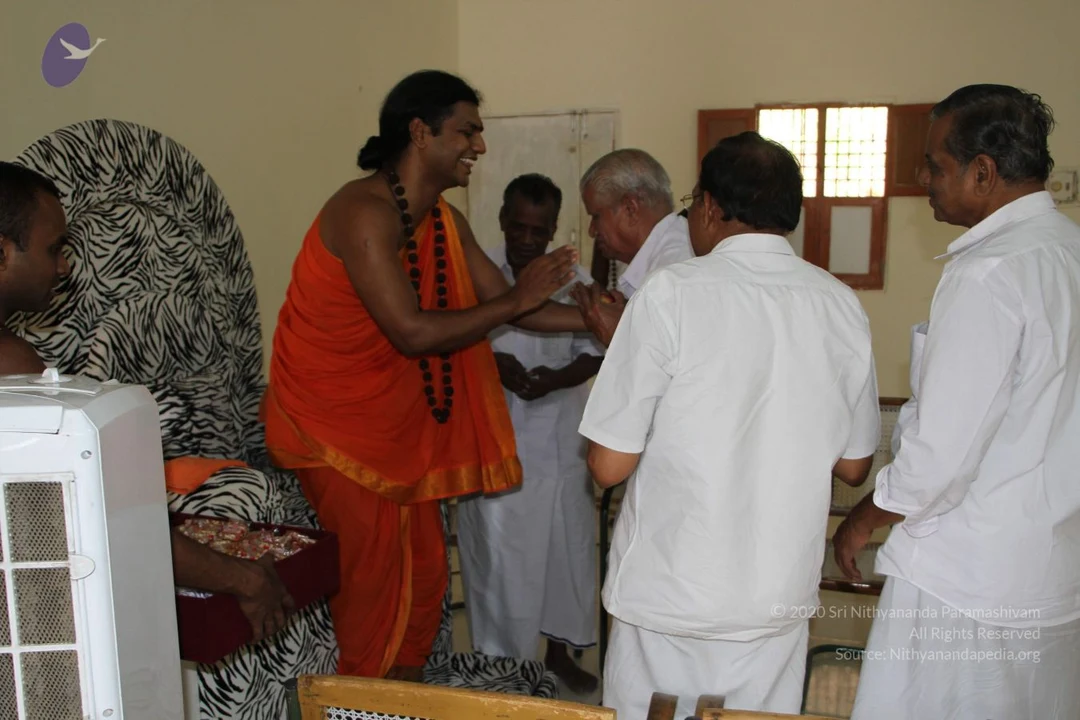
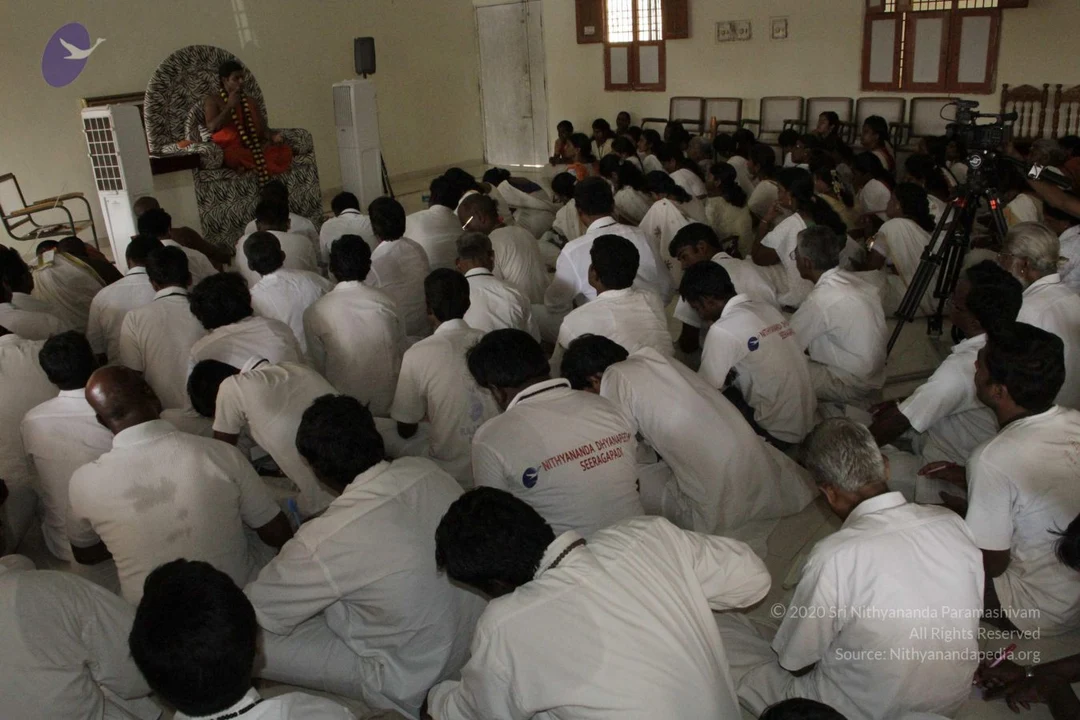
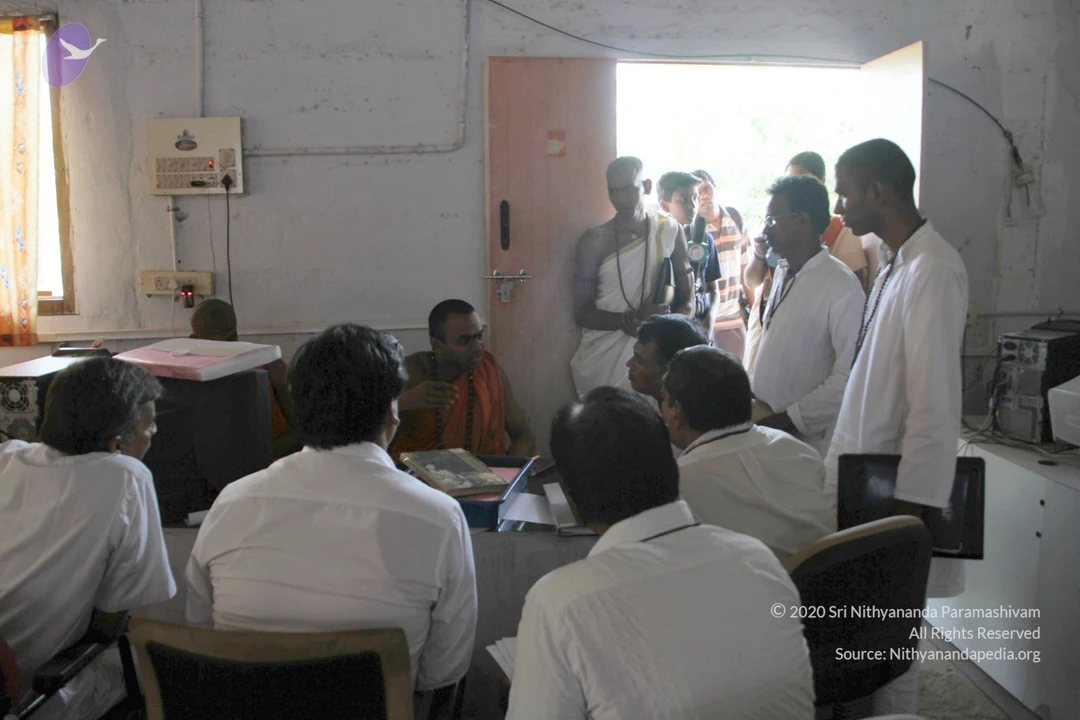
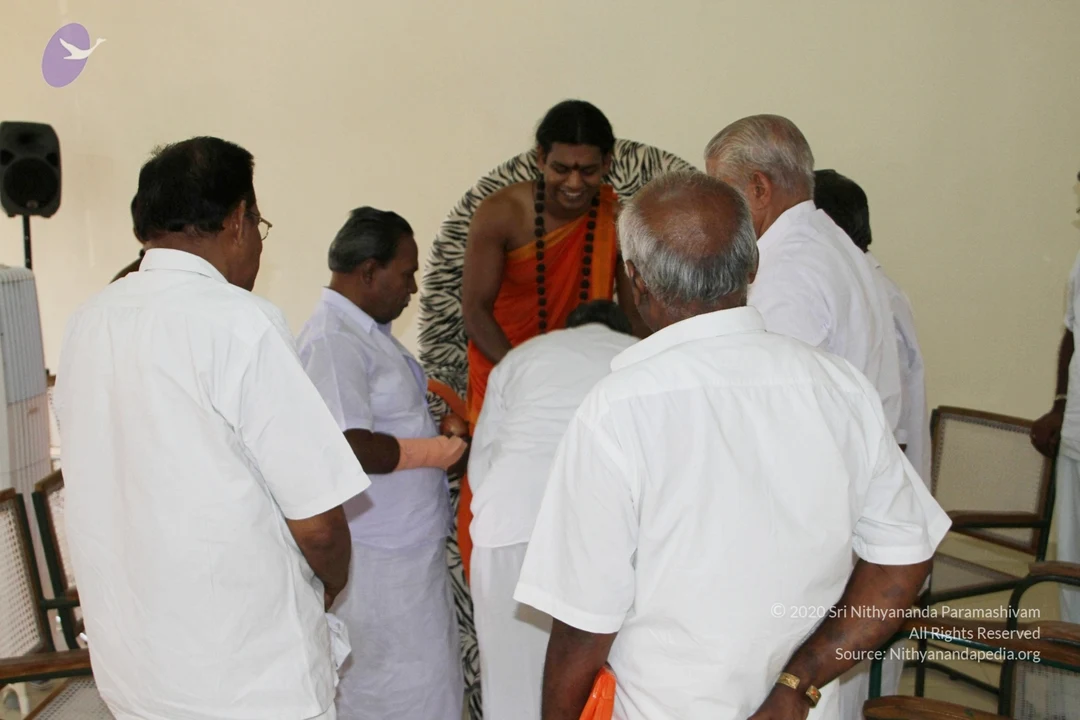
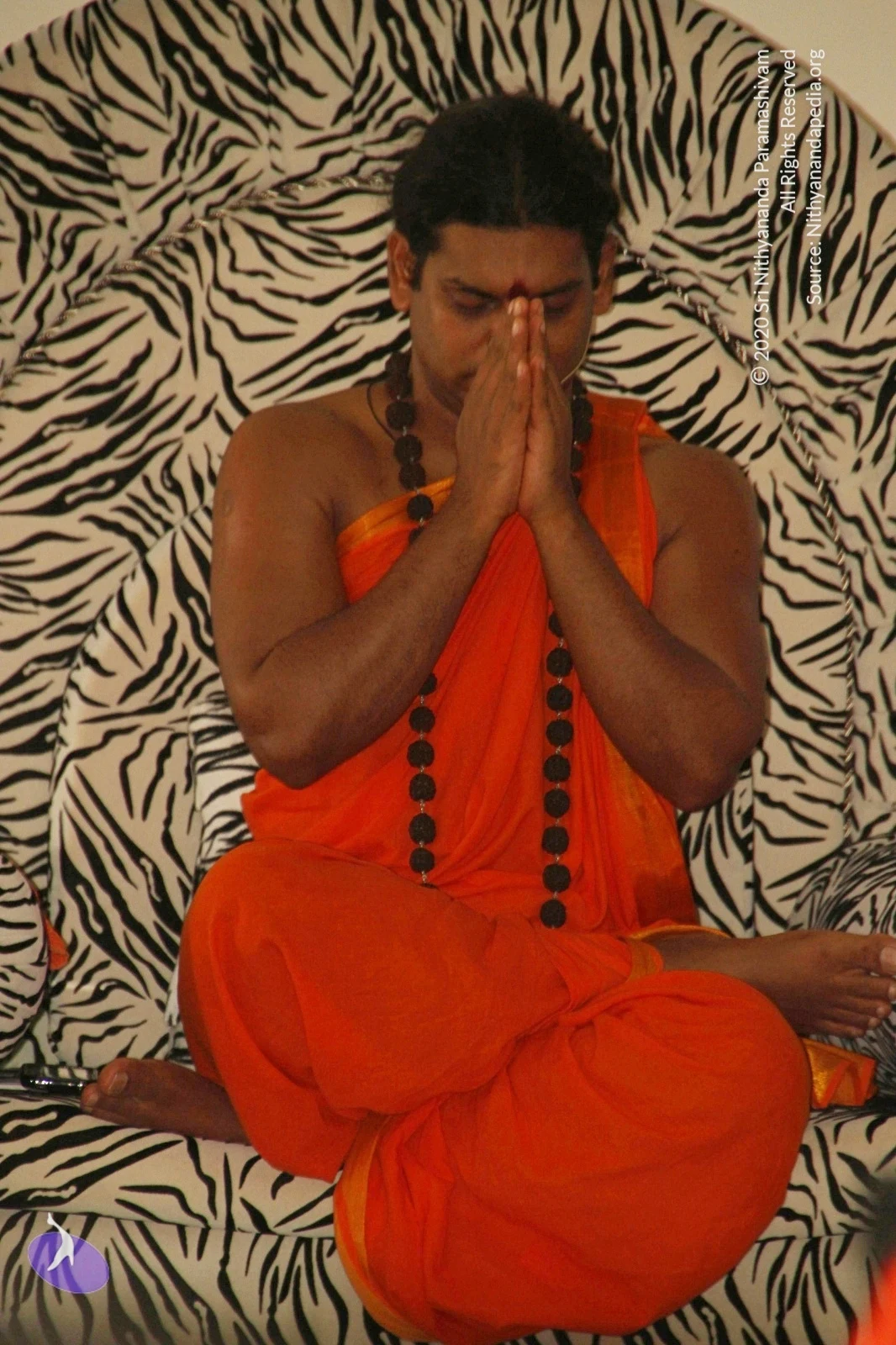
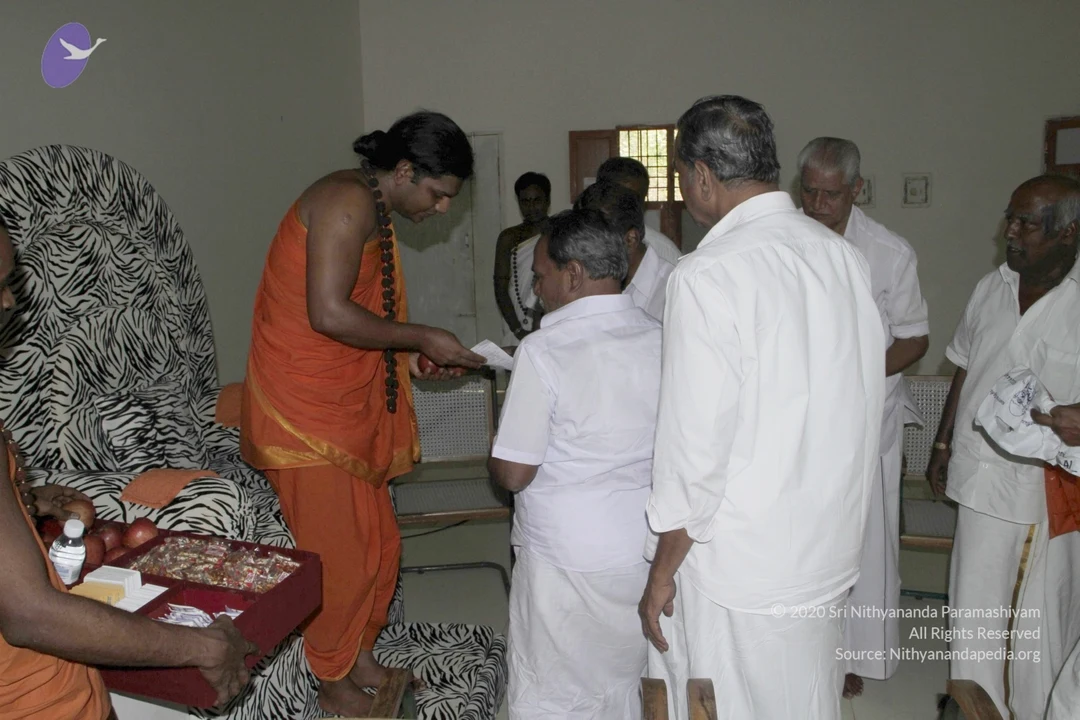
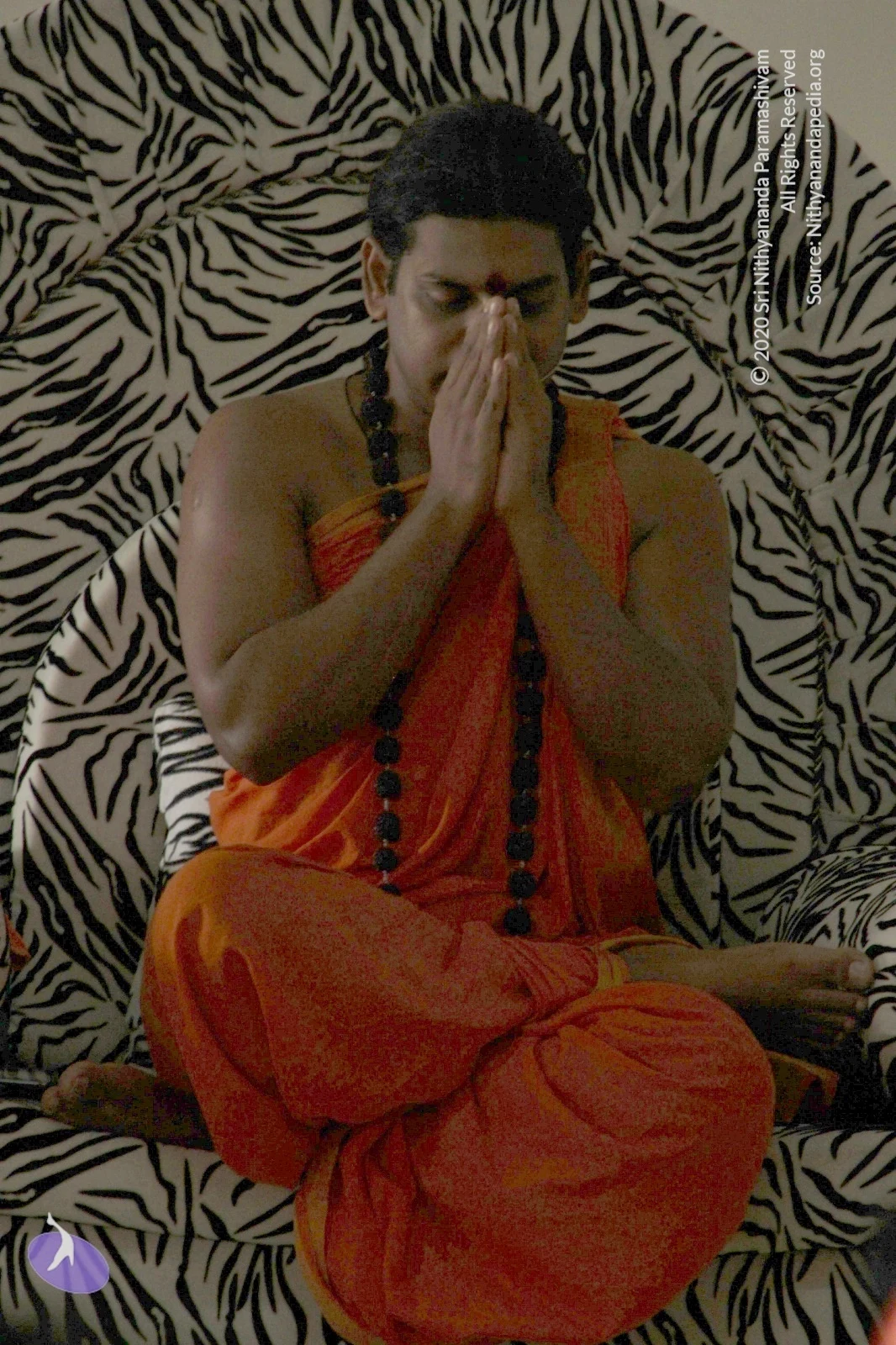
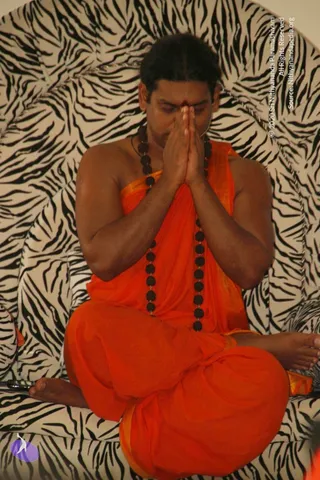
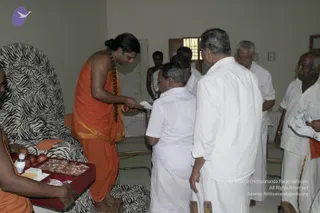
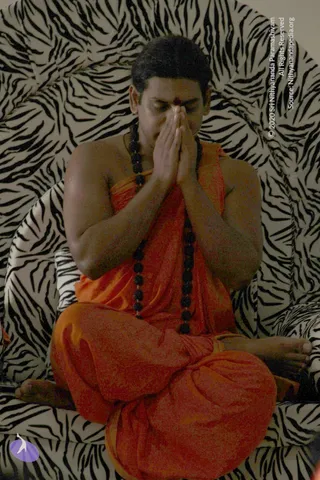
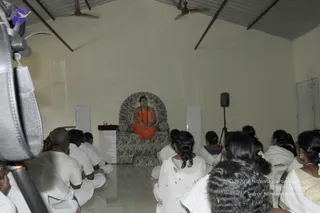
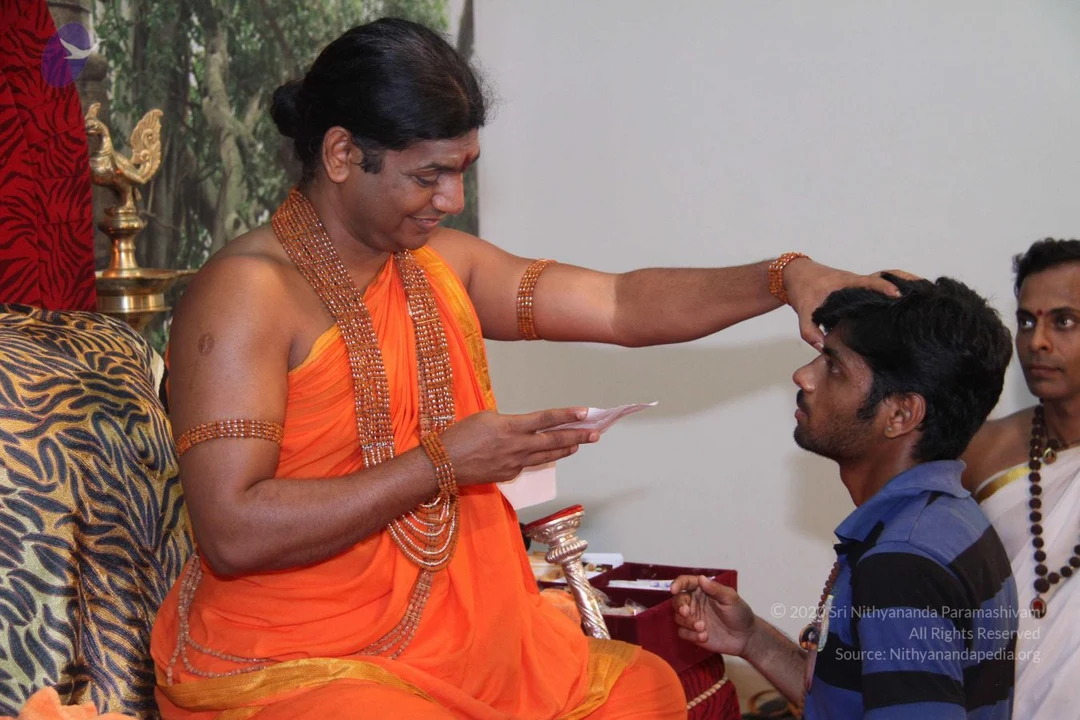
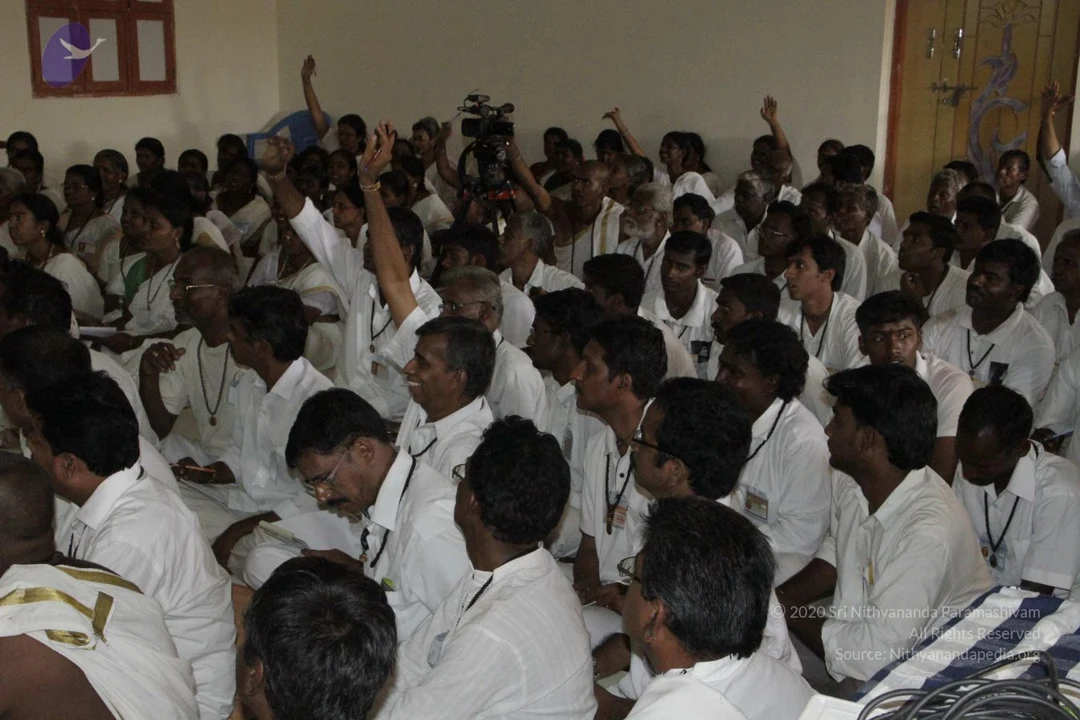
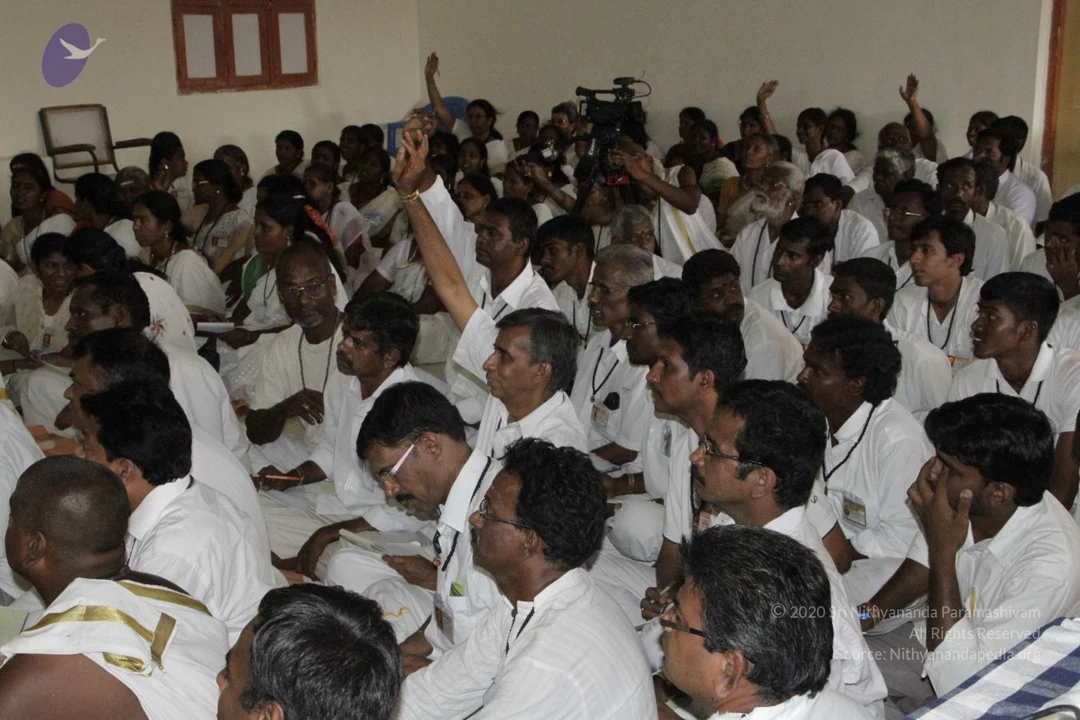
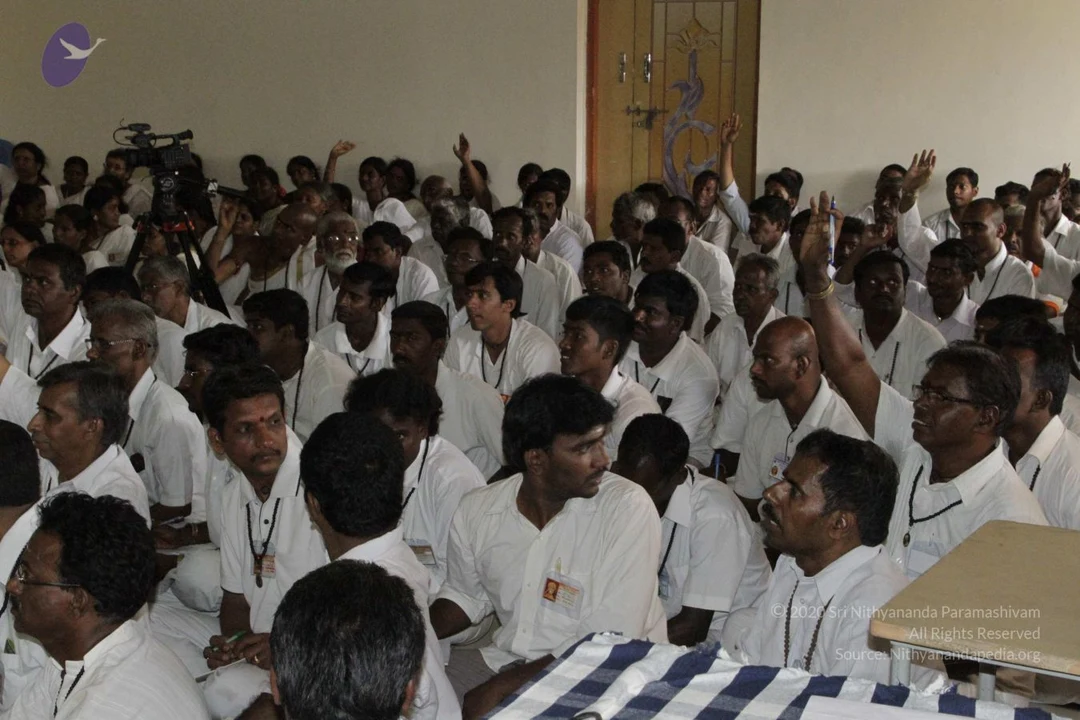
A photograph of an indoor meeting room with white-washed walls, a window with orange curtains, and a wall-mounted electrical panel. A seated man in saffron-orange robes with a rudraksha mala sits at a table with an open folder, speaking. Around the table, several people in white shirts and white dhotis-style clothing sit or stand, one standing figure in a white dhoti and shawl wears a sacred thread and holds a microphone. Two people in white shirts stand at right near a desk with a computer monitor. A bald figure in orange sits partially visible at left edge. Light enters from an open doorway in the background where more people stand.Indoor photograph of a seated figure in an orange saffron garment with a rudraksha mala necklace and long swept-back dark hair, smiling, on a zebra-striped seat or cushion against a plain cream wall. Around him, several men in white shirts and white dhotis or trousers stand and bend forward with hands folded or touching his feet, in a respectful darshan-like gathering. Some wear wristwatches and glasses. A black speaker sits on the left and empty wooden-framed cane chairs line the edges of the room.A man sits cross-legged on a zebra-striped upholstered throne-style chair with his palms pressed together at his chest in namaste, eyes closed and head bowed. He wears an orange-saffron cloth draped over his shoulders and body, with a red tilak mark on his forehead and long dark rudraksha mala beads hanging across his chest. His bare feet rest on the chair. a person based on the saffron robes, rudraksha malas and seated presentation; the frame is a single close photograph with no other people visible.A photograph of an indoor room with pale walls and a window with a grille. A man in an orange saffron robe with long dark hair in a bun and a dark beaded mala around his neck stands before a zebra-striped upholstered chair, reaching forward to take a folded paper from a devotee. Beside the chair, another person in orange holds a red tray containing sweets, a bowl of fruit and small packets. Several older men in white shirts and white dhotis stand around him, watching. A man in a white shirt stands in the right foreground, and a few others are in the background.A seated man in orange saffron robes sits cross-legged on a zebra-striped black-and-white upholstered throne with a high tufted back. He has his palms pressed together in namaskar at his chest with eyes closed, and wears long black rudraksha malas over his shoulders with a red tilak on his forehead. His bare feet are visible. a person in devotional posture on the throne.A seated satsang in a plain whitewashed hall with ceiling fans and a tiled floor. At the centre, a figure in orange robes and a rudraksha mala sits cross-legged on a zebra-striped armchair, with a small table and a microphone stand beside it. Devotees in white clothes sit on the floor facing him, several with flowers in their hair, and a camera is visible at left. A swept-back hairstyle and saffron-coloured robes are visible on the seated figure; the appearance is consistent with a person, though the figure is small in frame.
04-Thiruvannamalai-PaadaPuja-Satsang
31 photosSource gallery
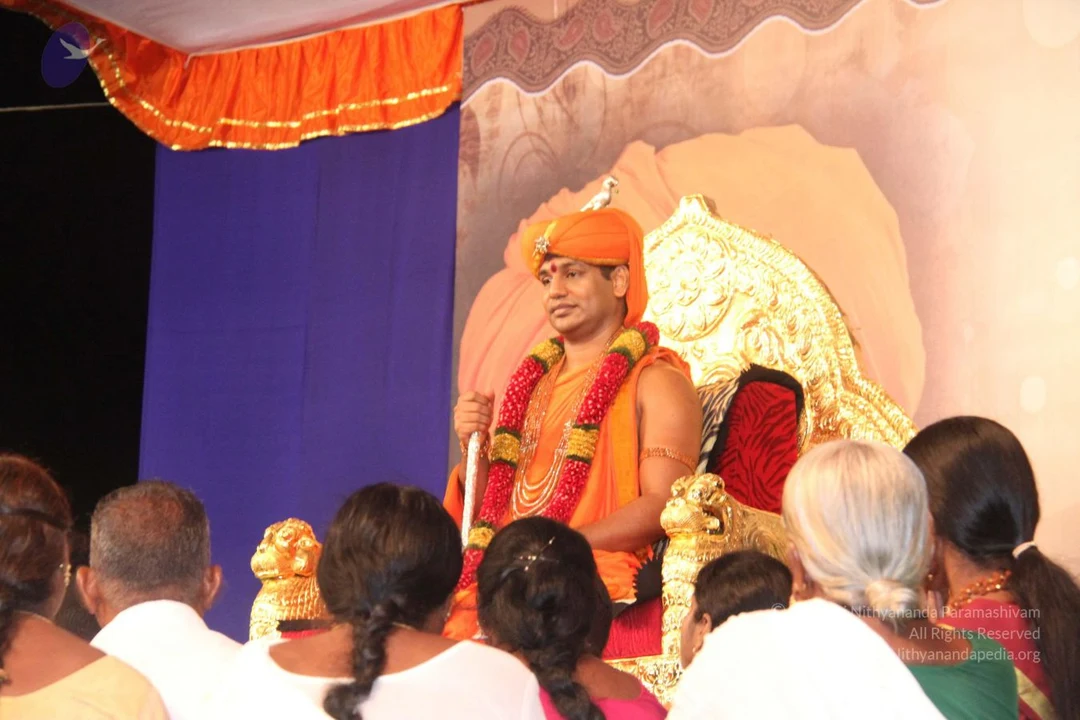
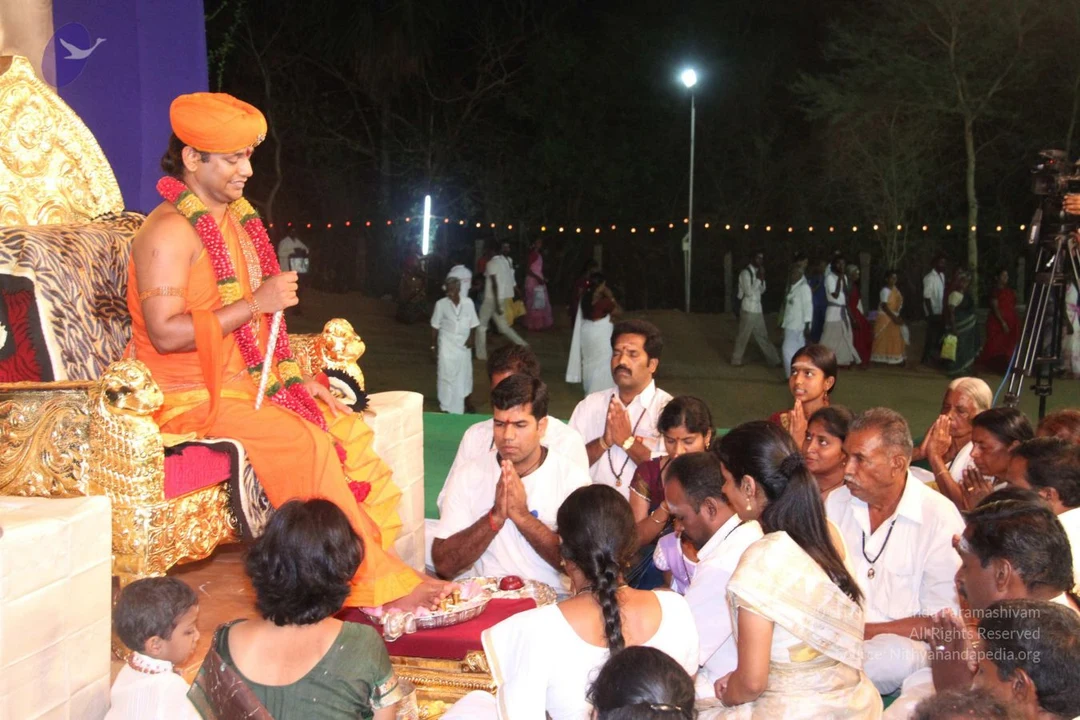
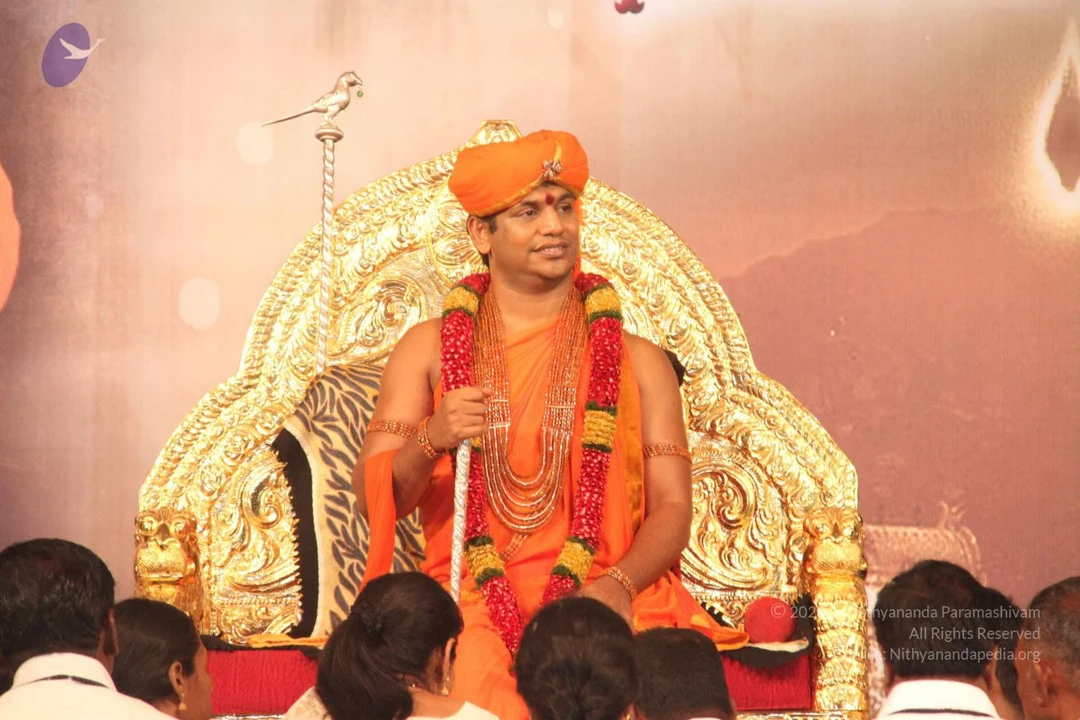
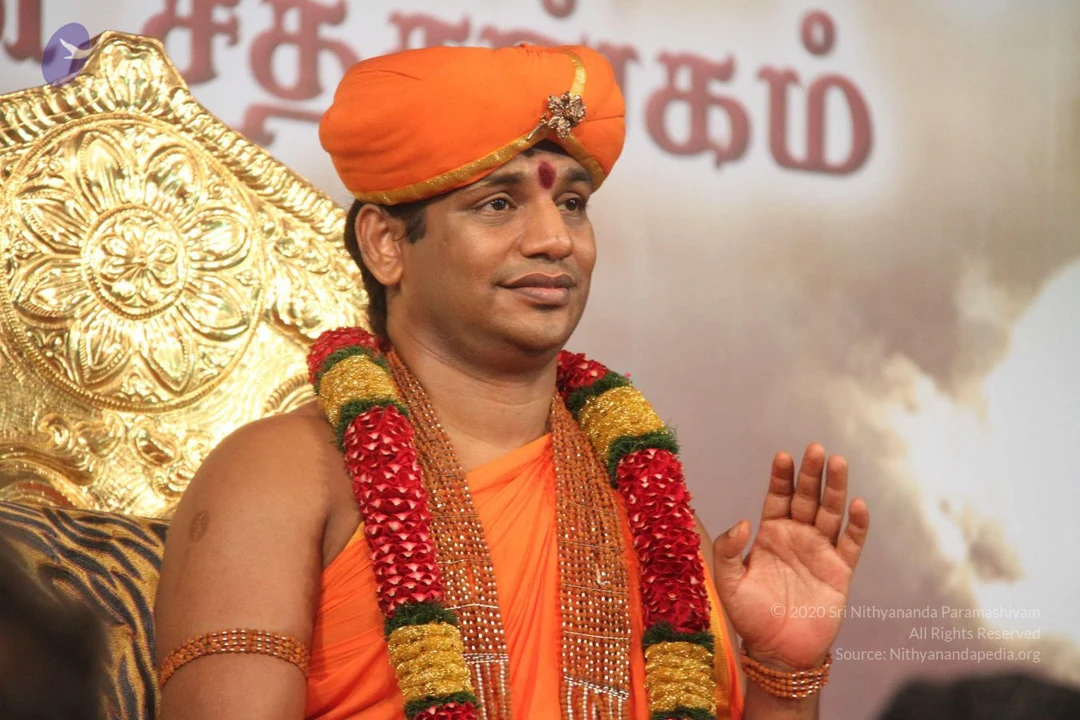
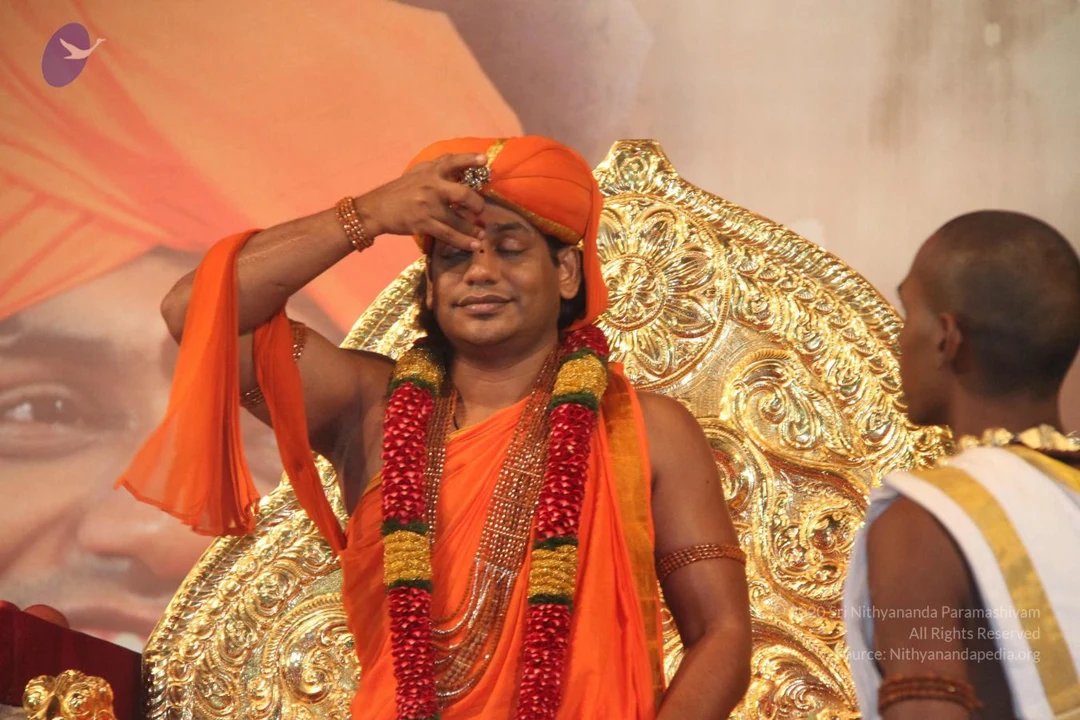
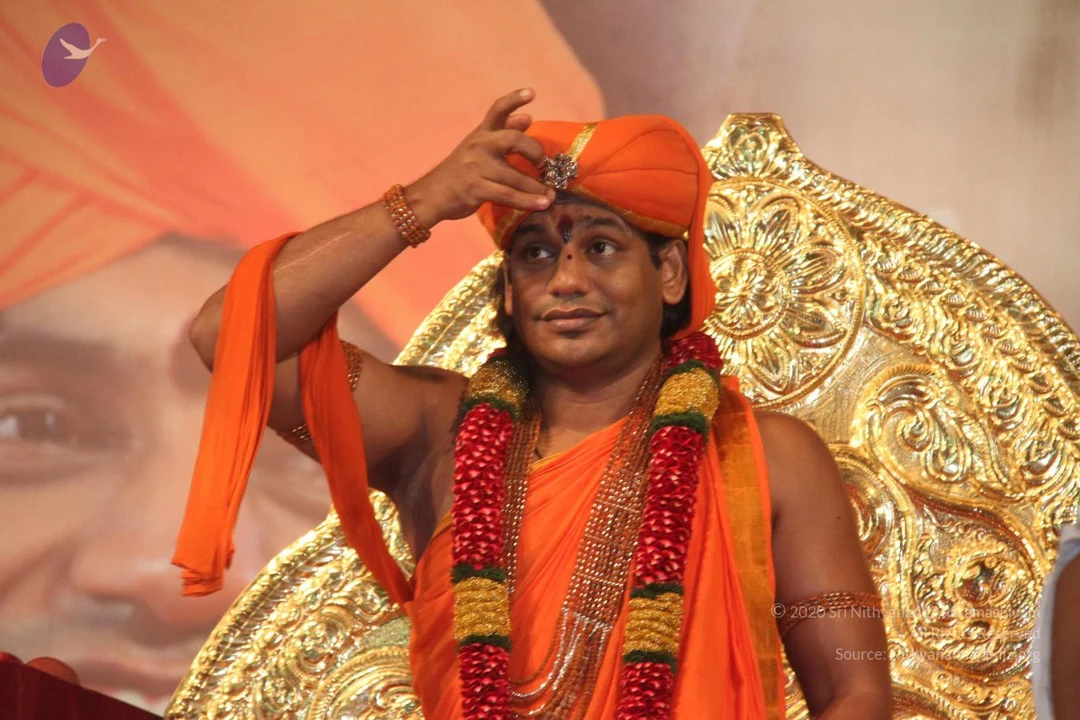
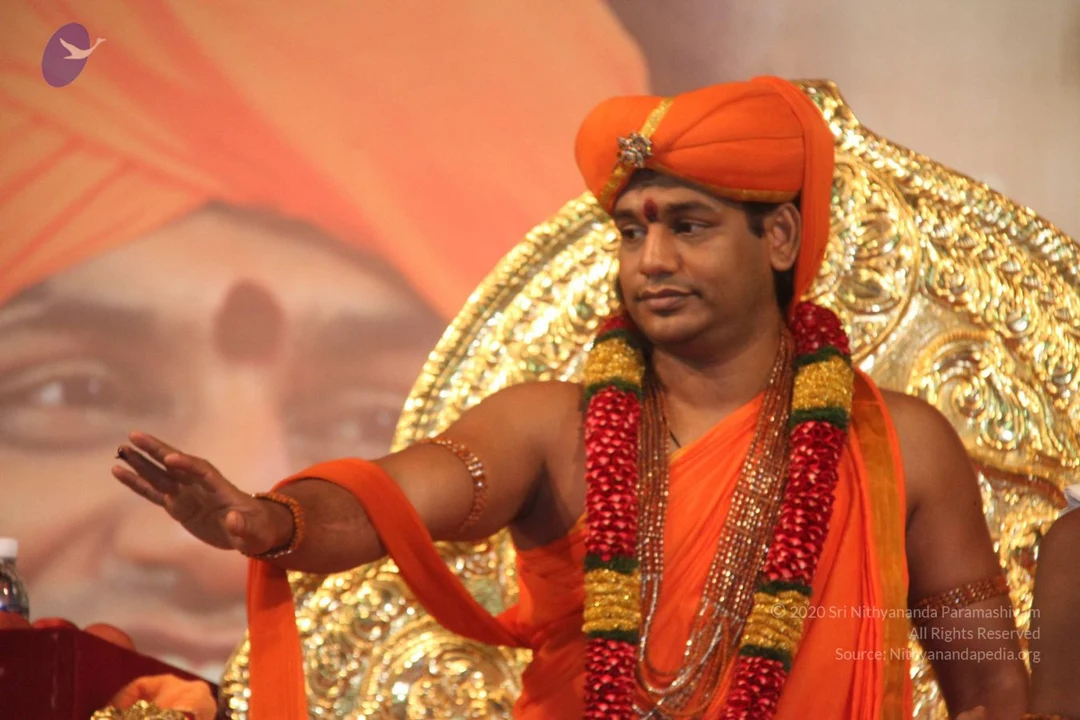
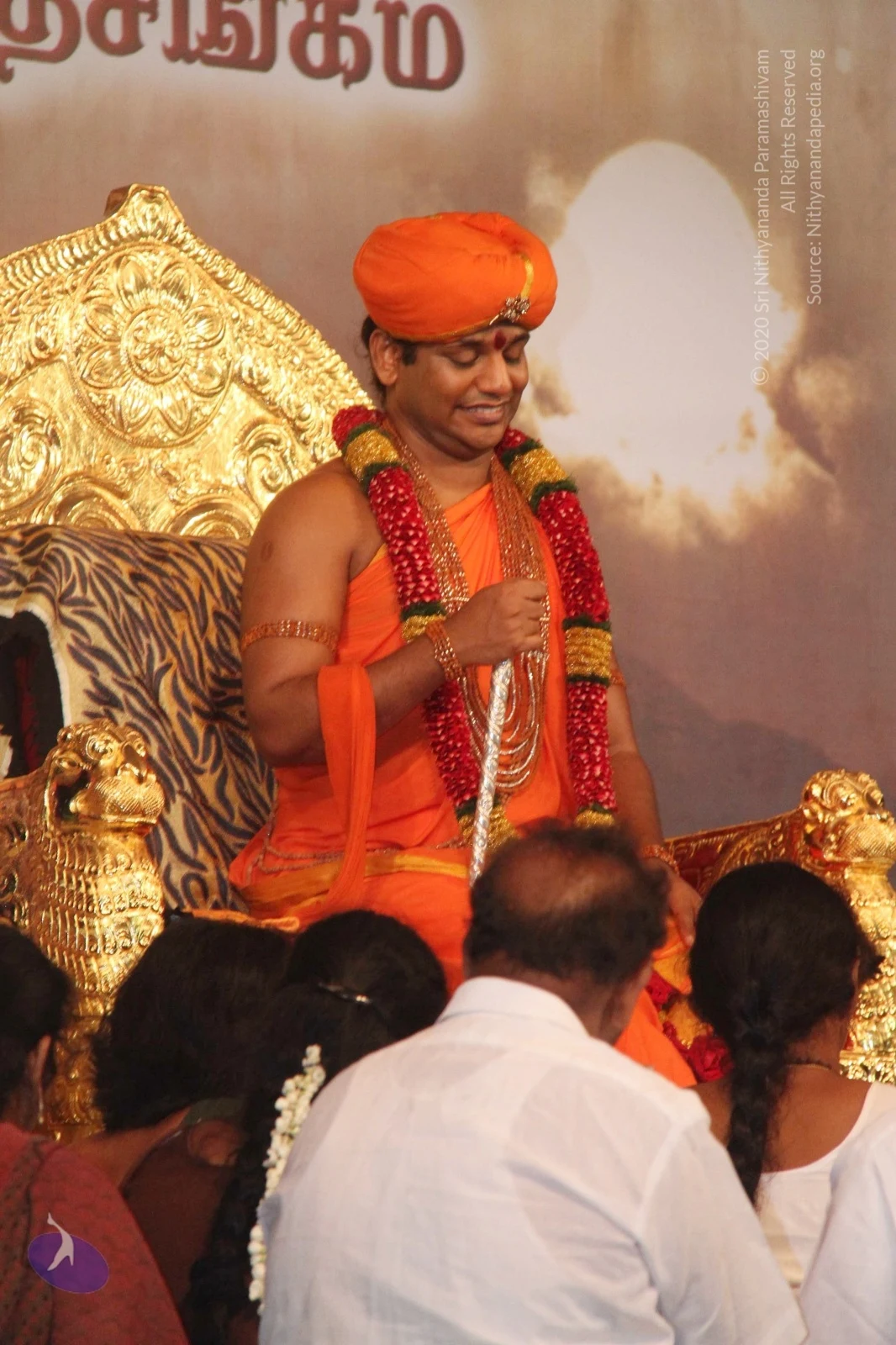
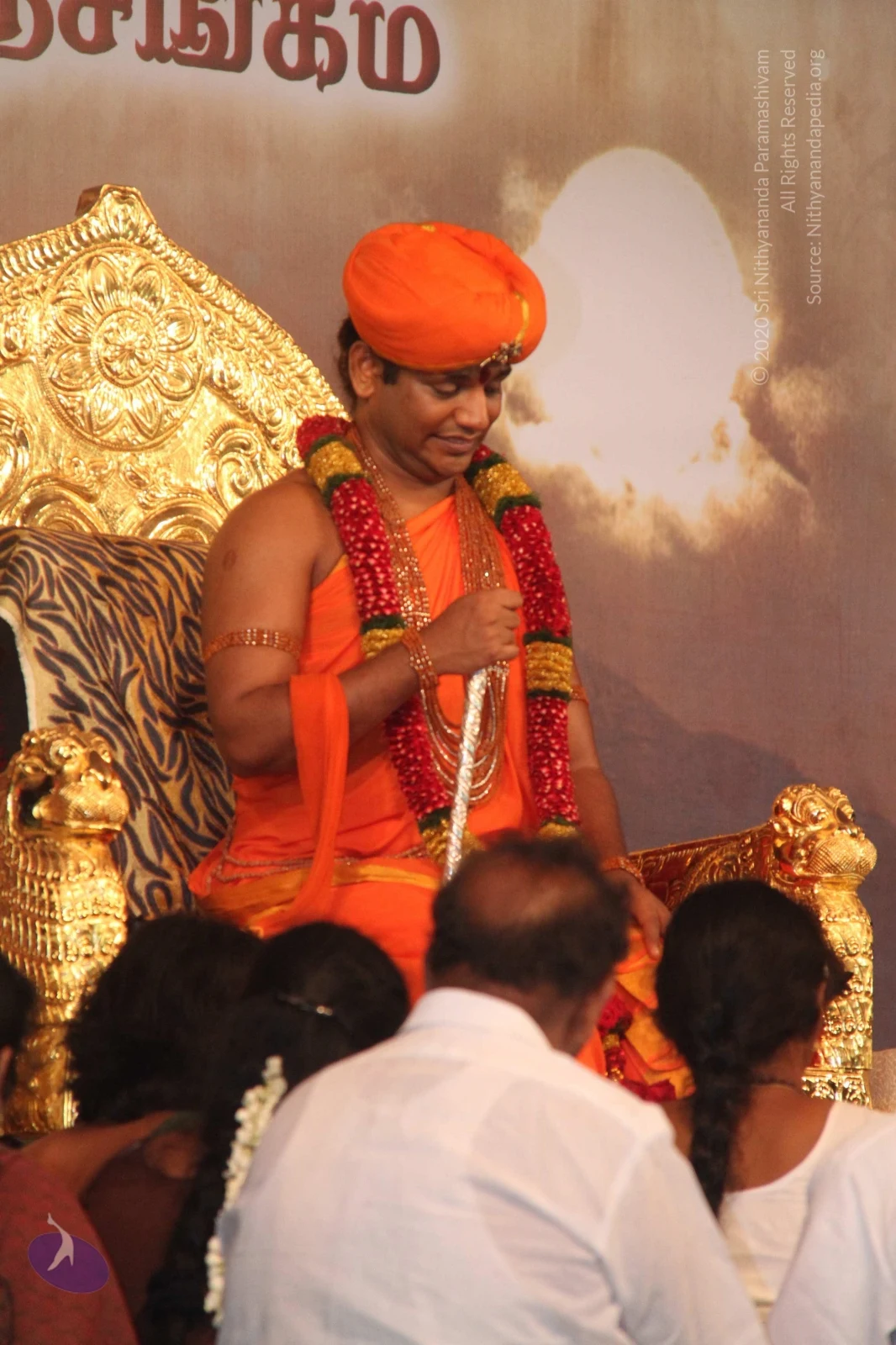
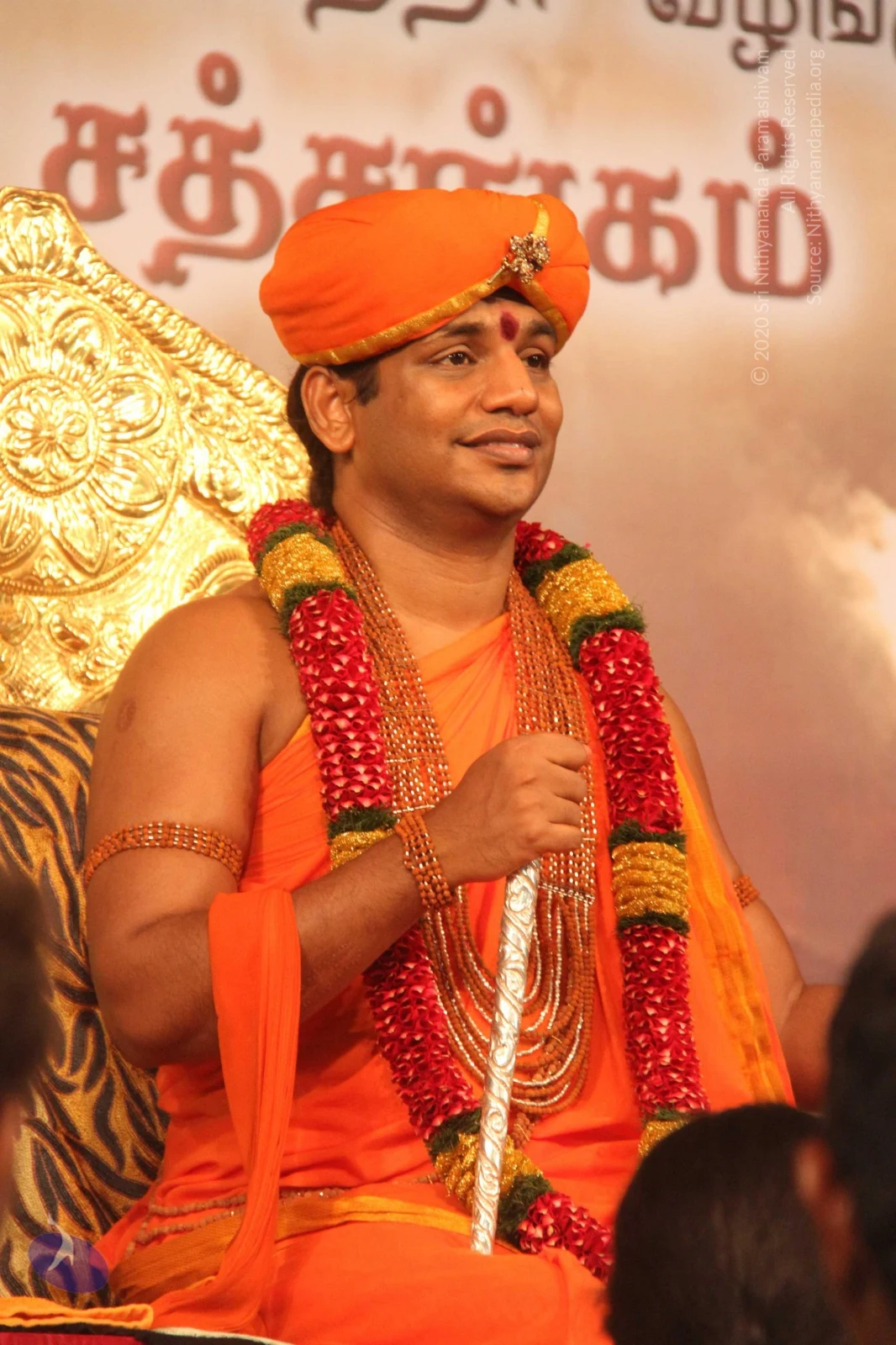
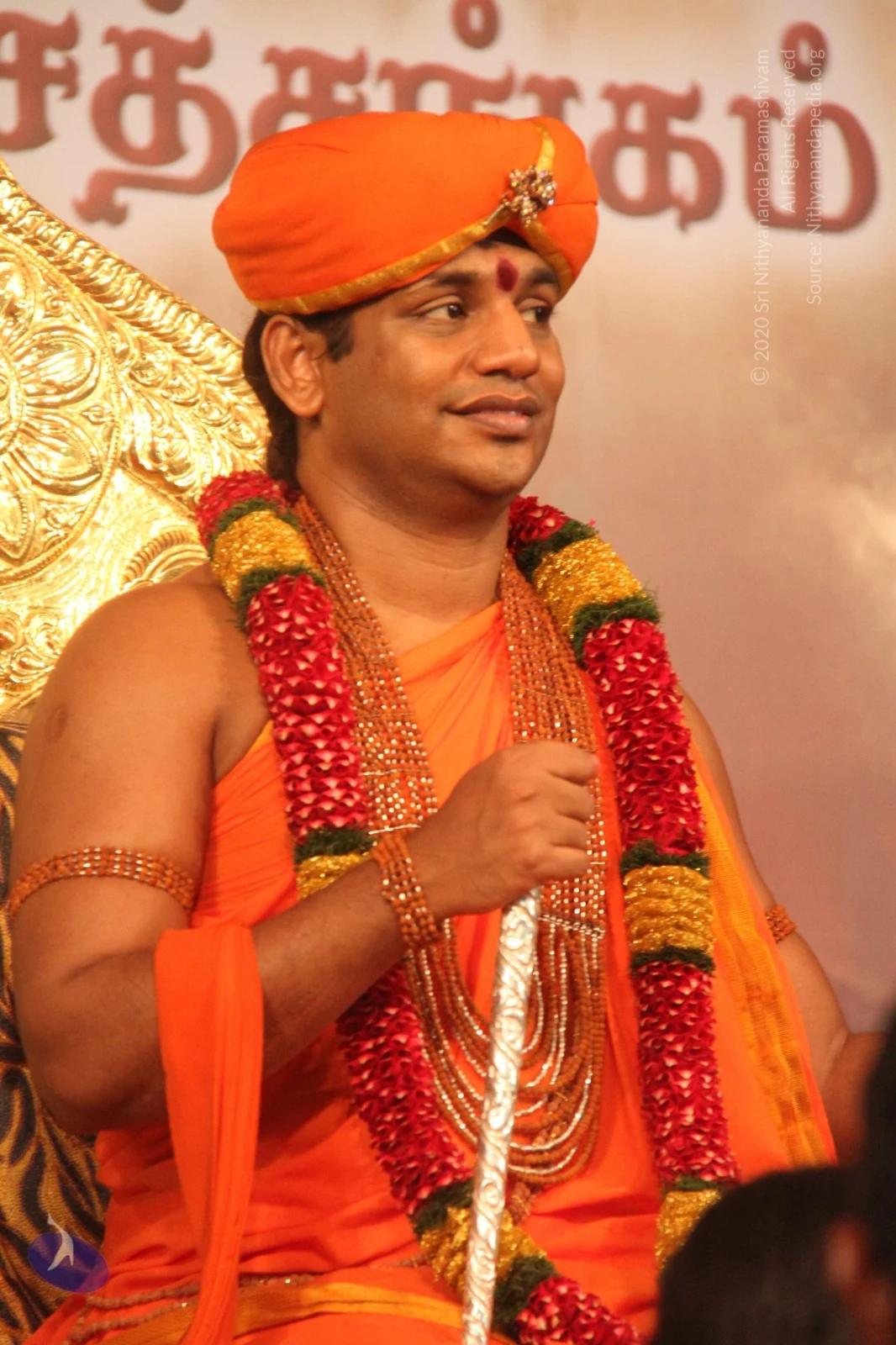
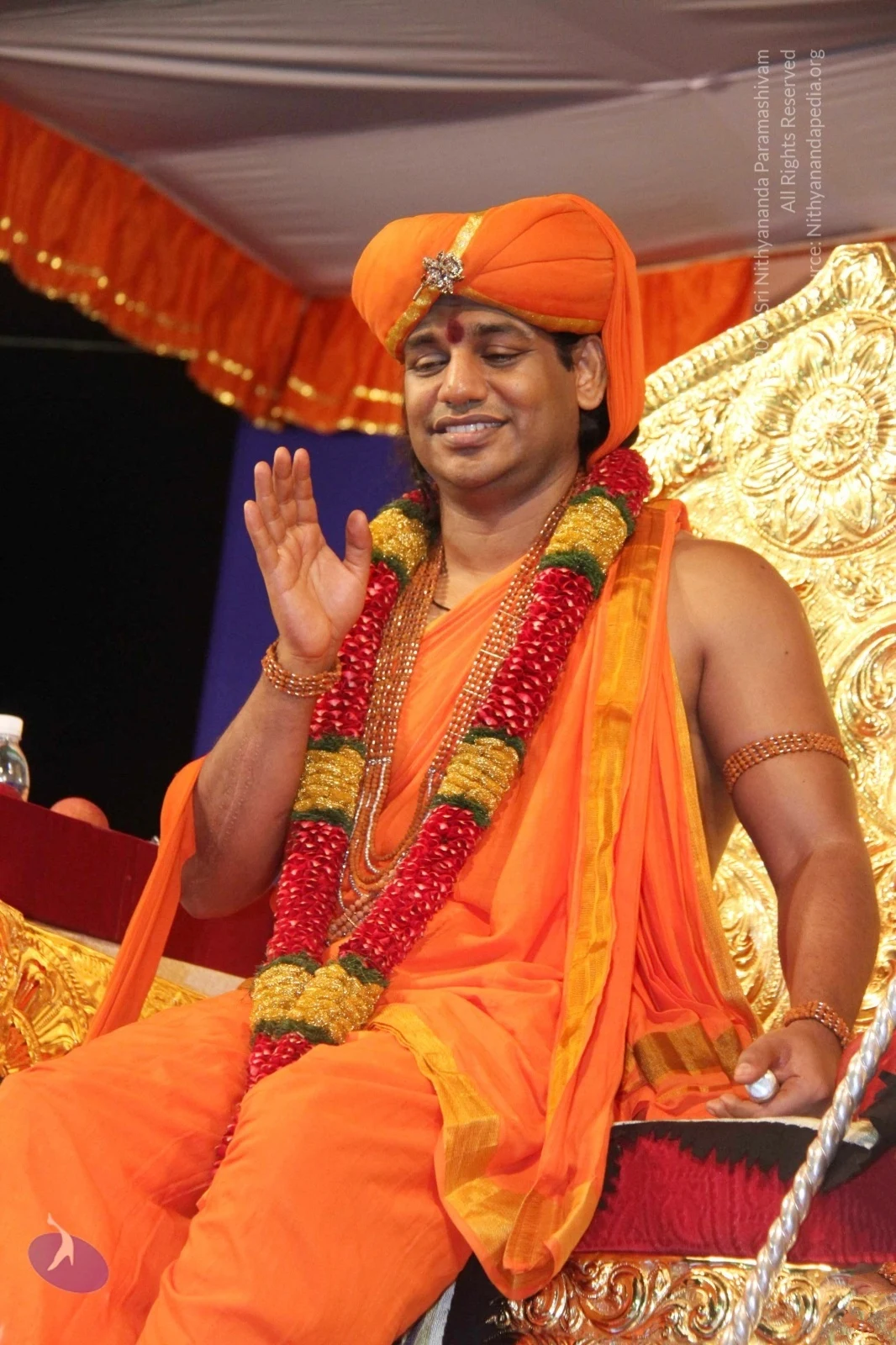
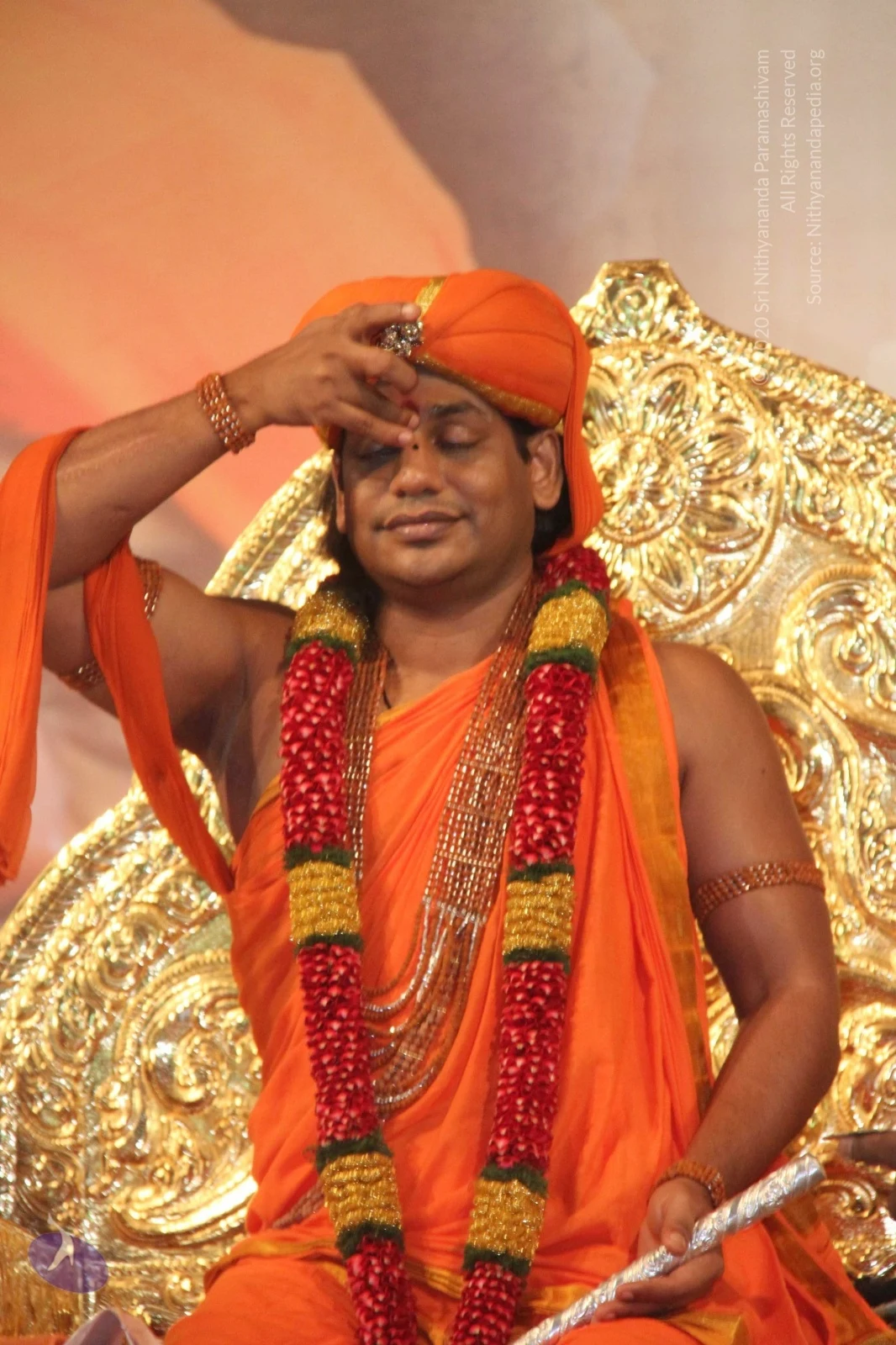
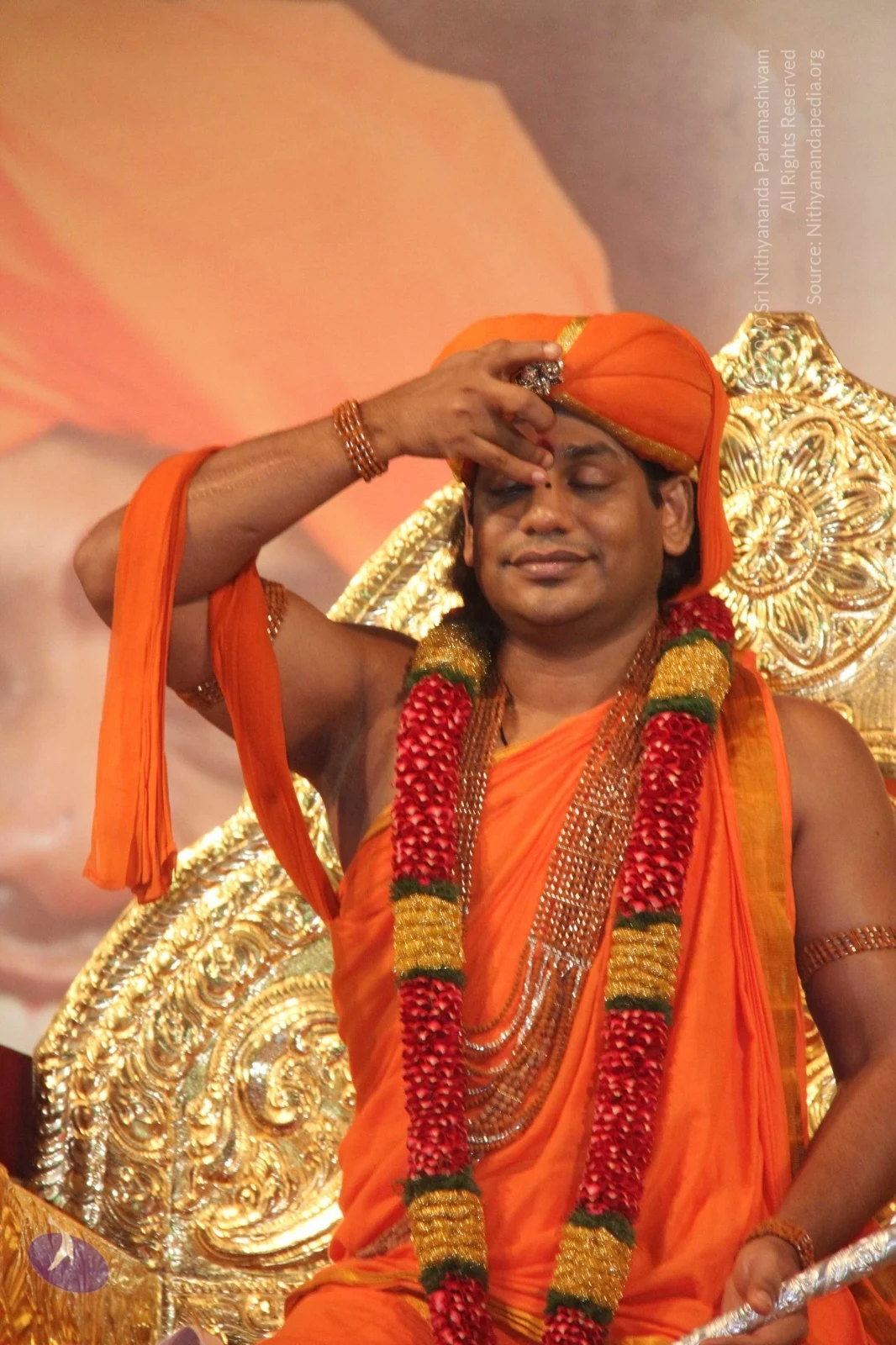
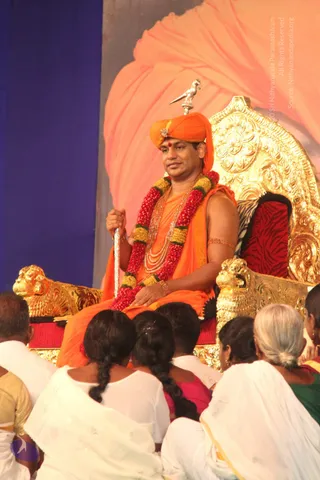
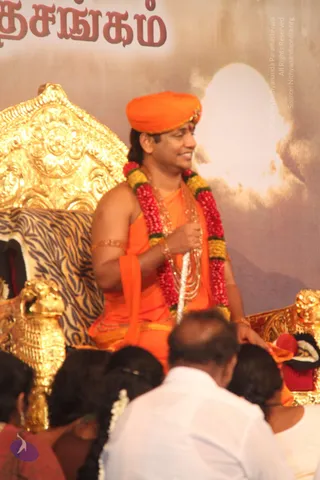
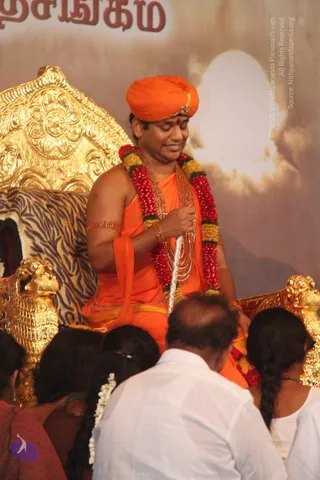
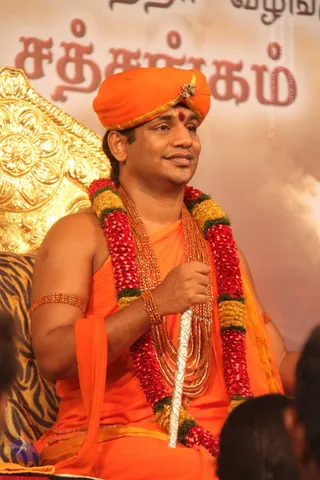
A seated man in an orange turban and saffron robes sits on an ornate gold-carved throne with red cushions and a silver bird finial on a staff behind him. A red-and-yellow flower garland hangs across his chest, with multiple strands of silver beaded necklaces and gold armlets. A red bindi marks his forehead, and his bare feet rest near a silver tray with flowers. a person cues are the orange turban, saffron robes, layered ceremonial necklaces and ornate throne, but the image is not clear enough to confirm identity.A seated man in saffron-orange robes and an orange turban with a silver bird finial sits on an ornate gold throne with carved lion arms and a red zebra-patterned cushion. He wears a red and yellow marigold garland, layered beaded necklaces and gold armlets, holds a silver staff upright, and has a red mark on his forehead. In front, several women in white and cream saris sit with their backs to the camera, one with a long braid, against a large peach-coloured drape and blue backdrop. The scene appears to be a satsang gathering on stage. Swamiji (probable): the saffron robes, orange turban, layered beads and garland match the appearance cues, seated as a teacher on the throne.A smiling man in an orange turban and orange robe sits on an ornate gold throne with zebra-striped upholstery, wearing a red and yellow marigold garland and multiple gold necklaces, holding a white beaded mala in one hand. A devotee in white shirt sits in front of him with the back of his head toward the camera, and other seated devotees are visible at the bottom edge. Behind the throne is a beige backdrop with a large pale cloud-like motif and a Tamil banner heading reading satsangam. The scene appears to be a satsang. The seated man has distinctive orange turban, saffron robe, garland and rudraksha-style mala cues, so he is a probable Swamiji candidate in an in-person setting.A seated man in an orange turban and orange robe stands on an ornate gold throne with a tiger-striped cushion and gold lion-shaped arm rests. He wears a red and green flower garland, layered gold and beaded necklaces, and a gold armlet, and holds a silver staff against his chest while smiling with eyes lowered. In the foreground, several people in white clothes and women with braided hair are seated with heads bowed toward him, and a Tamil banner with a faint sunlit backdrop sits behind the throne. Swamiji (probable): the orange turban, saffron robe, rudraksha-style beaded and gold necklaces, garland and throne indicate a sannyasi-style presentation, so the in-person candidate is marked as probable.A man in an orange turban and orange robe sits on an ornate gold throne with a leopard-print cushion, wearing red, yellow and green flower garlands and multiple gold necklaces and bangles, holding a silver staff. Several people in white clothes and a woman with a braid are seated or bowing in the foreground, their heads lowered toward him. Behind is a backdrop with a glowing white sun-like disc and a Tamil banner reading சத்சங்கம். The man has distinctive orange turban, swept ceremonial garments and gold adornments, consistent with Swamiji (probable), seated in a satsang setting.A man seated on a gold-embossed throne at a satsang, wearing an orange turban with a jewelled brooch and a red bindi, an orange garment, multiple rudraksha mala strands and a red-and-green flower garland. He holds a silver staff in one hand and wears a beaded armlet. Behind him a banner reads Tamil satsang text. Two audience members are partly visible in the lower right. Swamiji (probable): orange turban, rudraksha malas and garland cues match the page's Swamiji context, so the seated man is a probable Swamiji candidate.