Skip to content
Sunday

6 April 2014

Dated photos
90
Source pages
1
Media
2
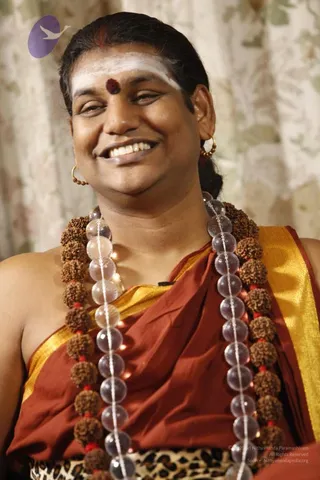
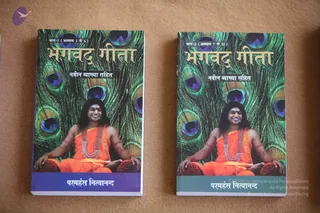
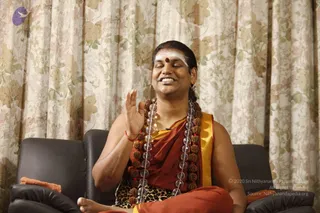
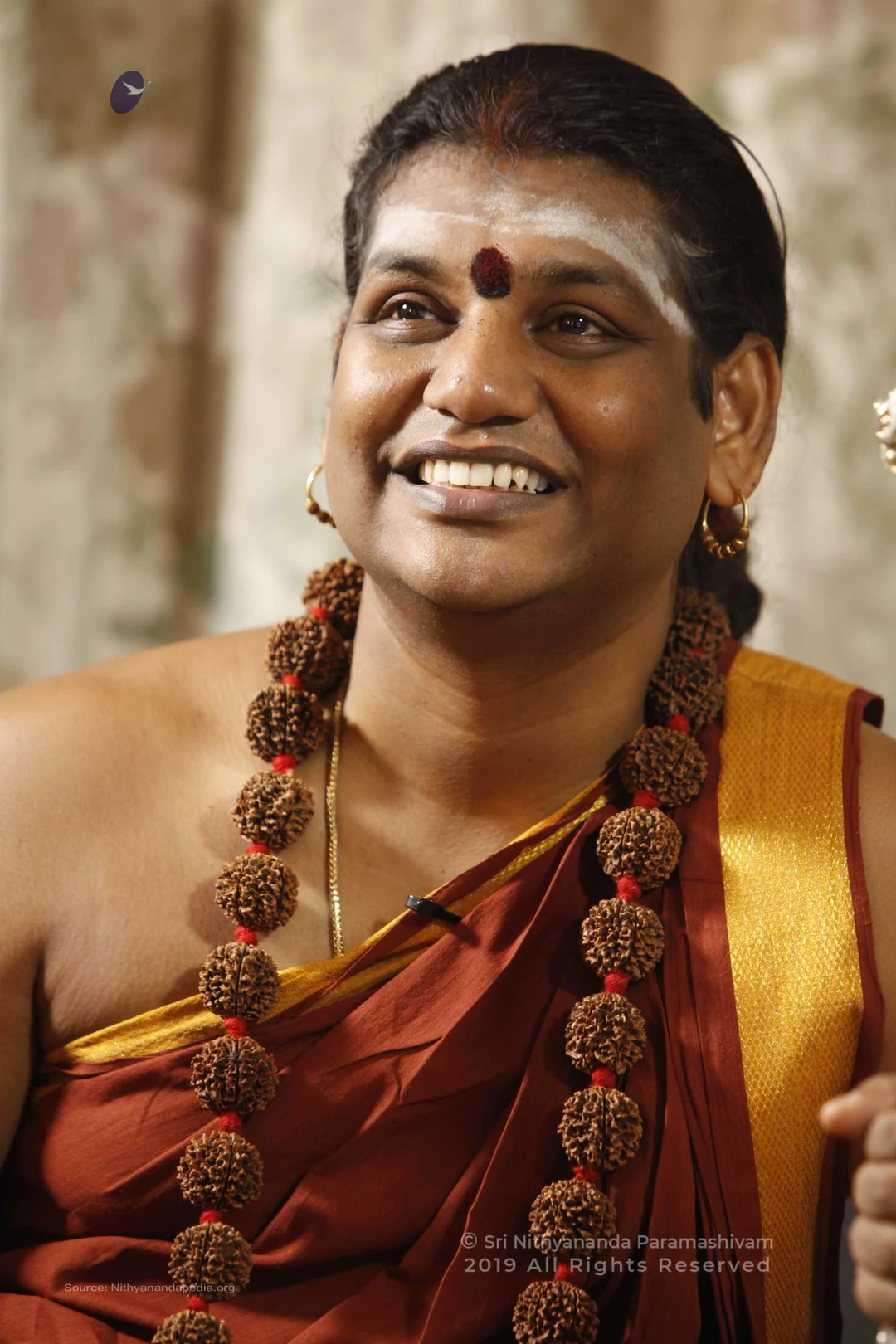
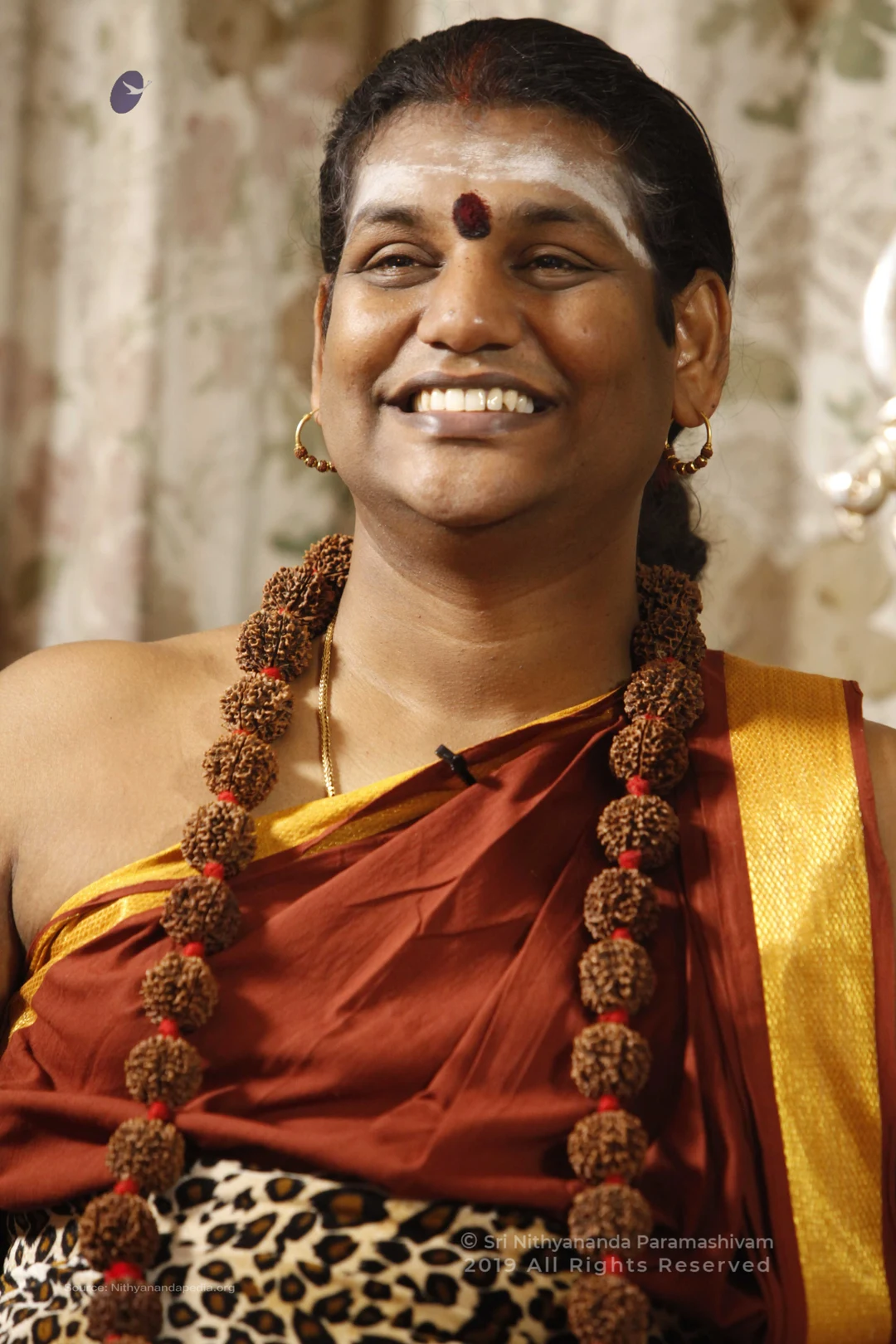
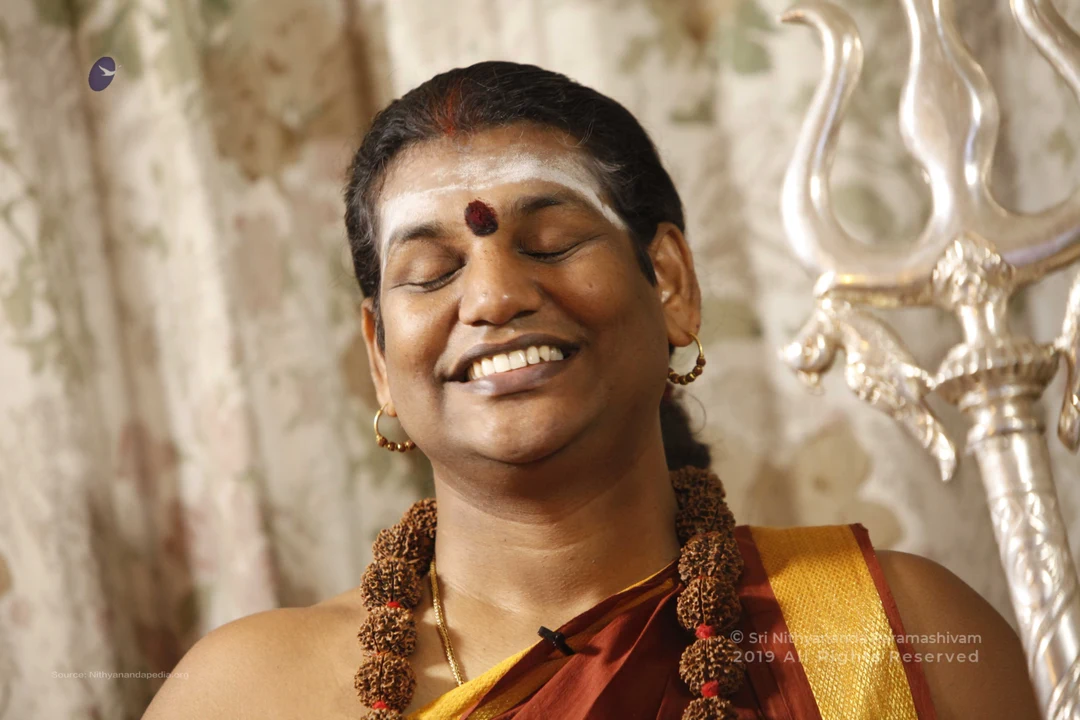
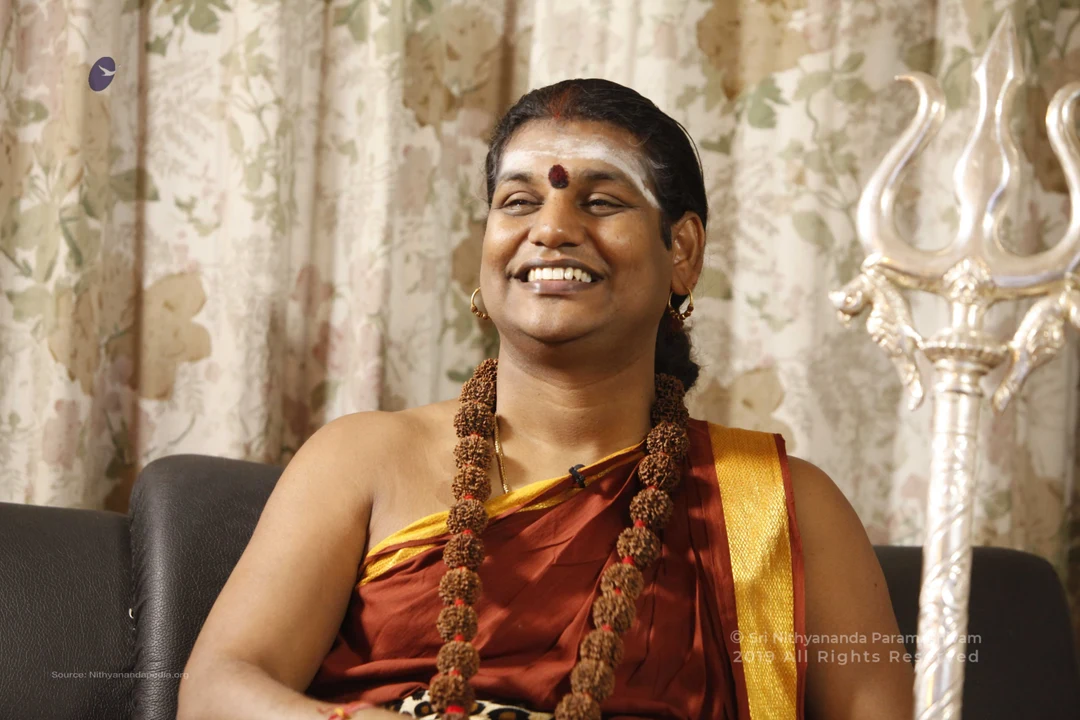
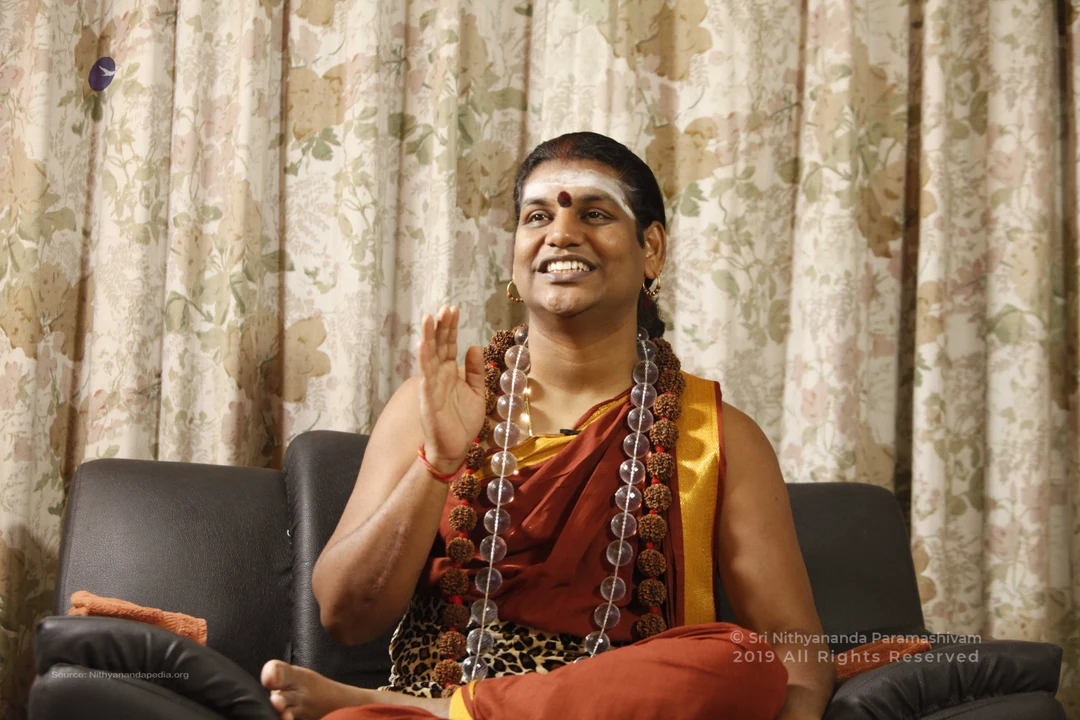
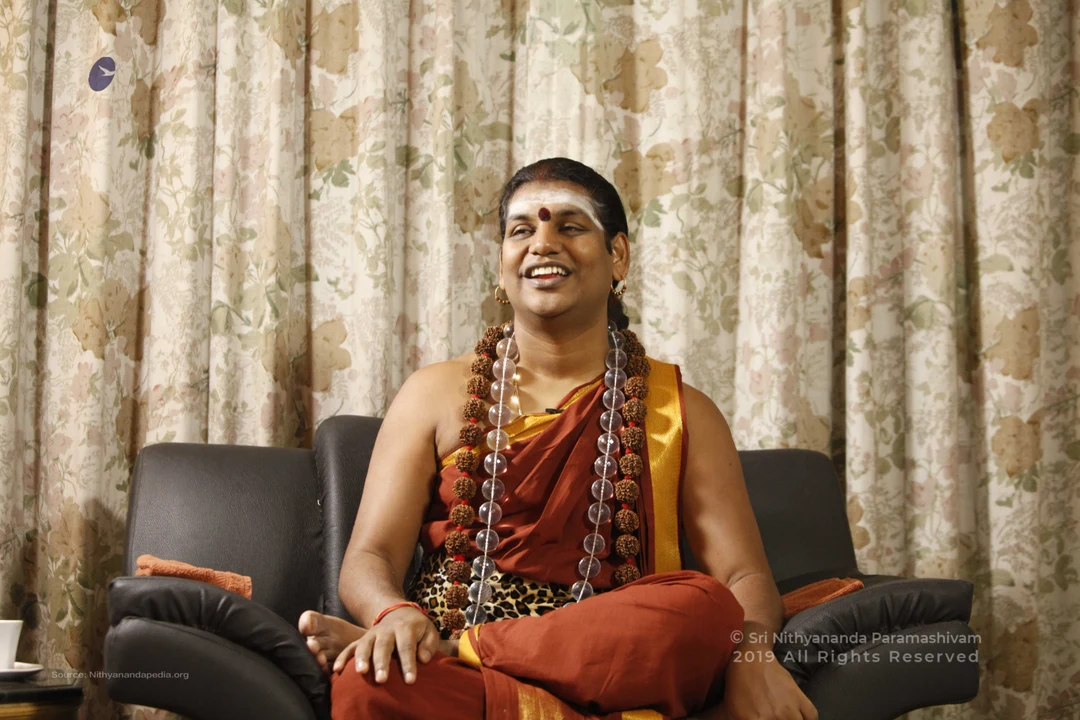
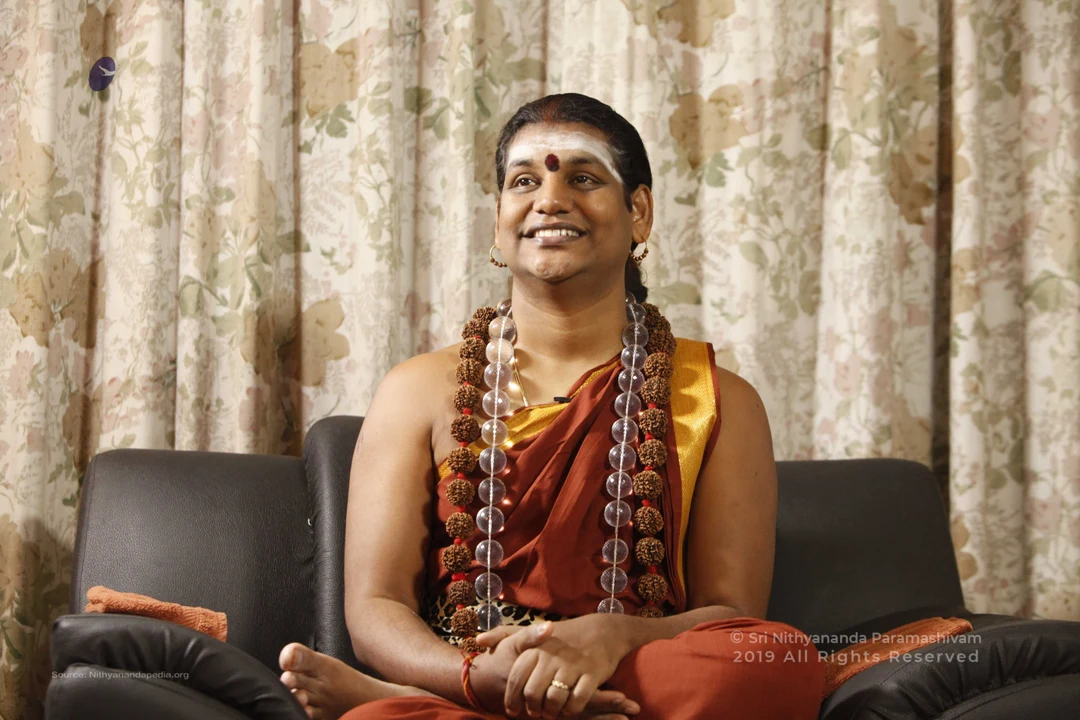
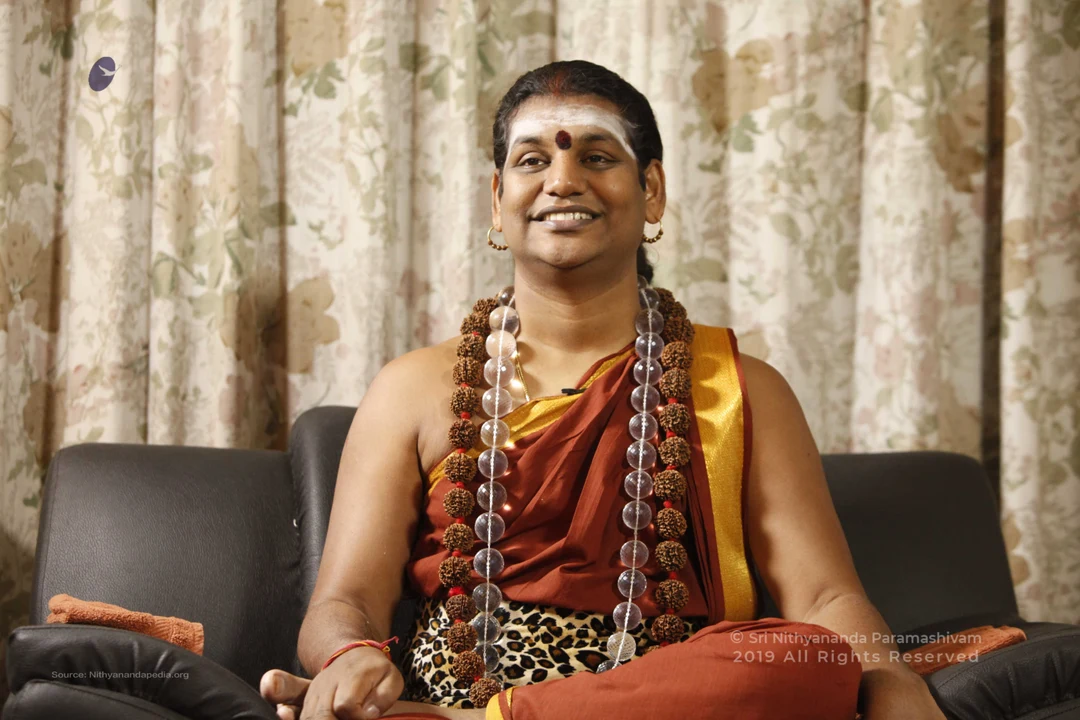
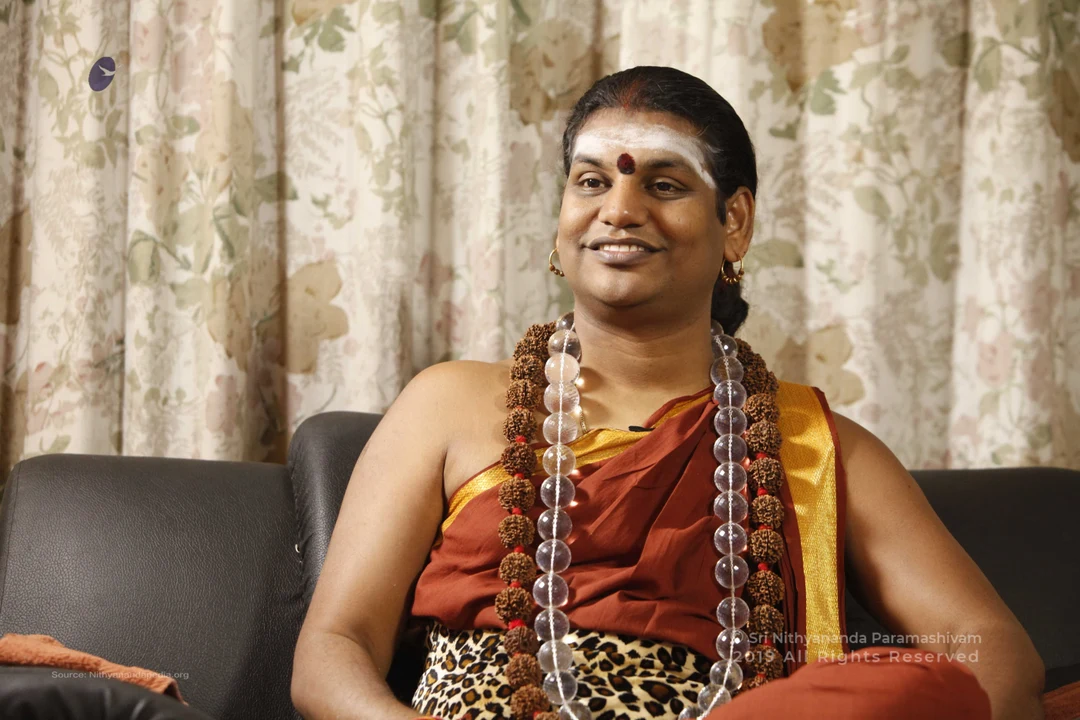
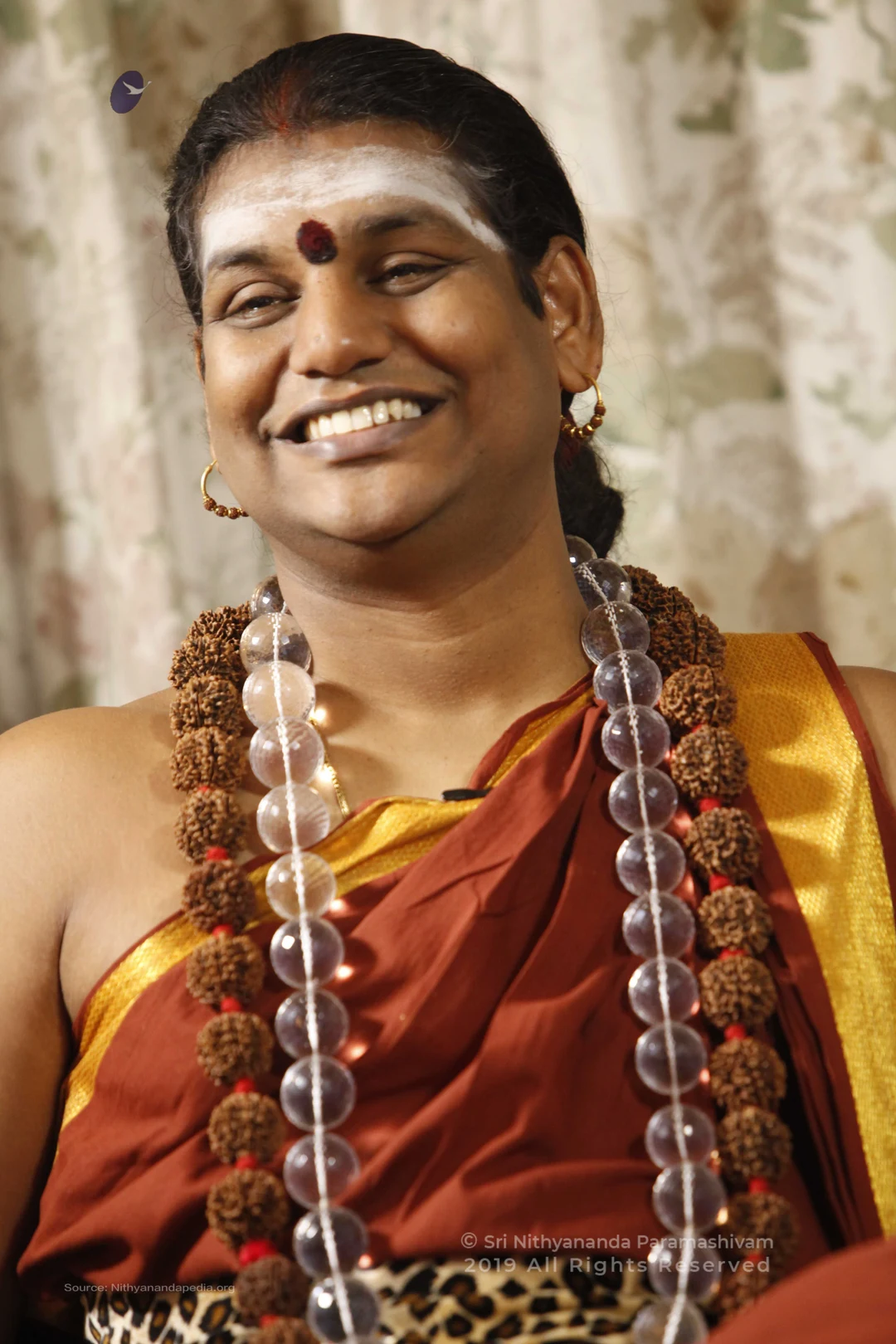
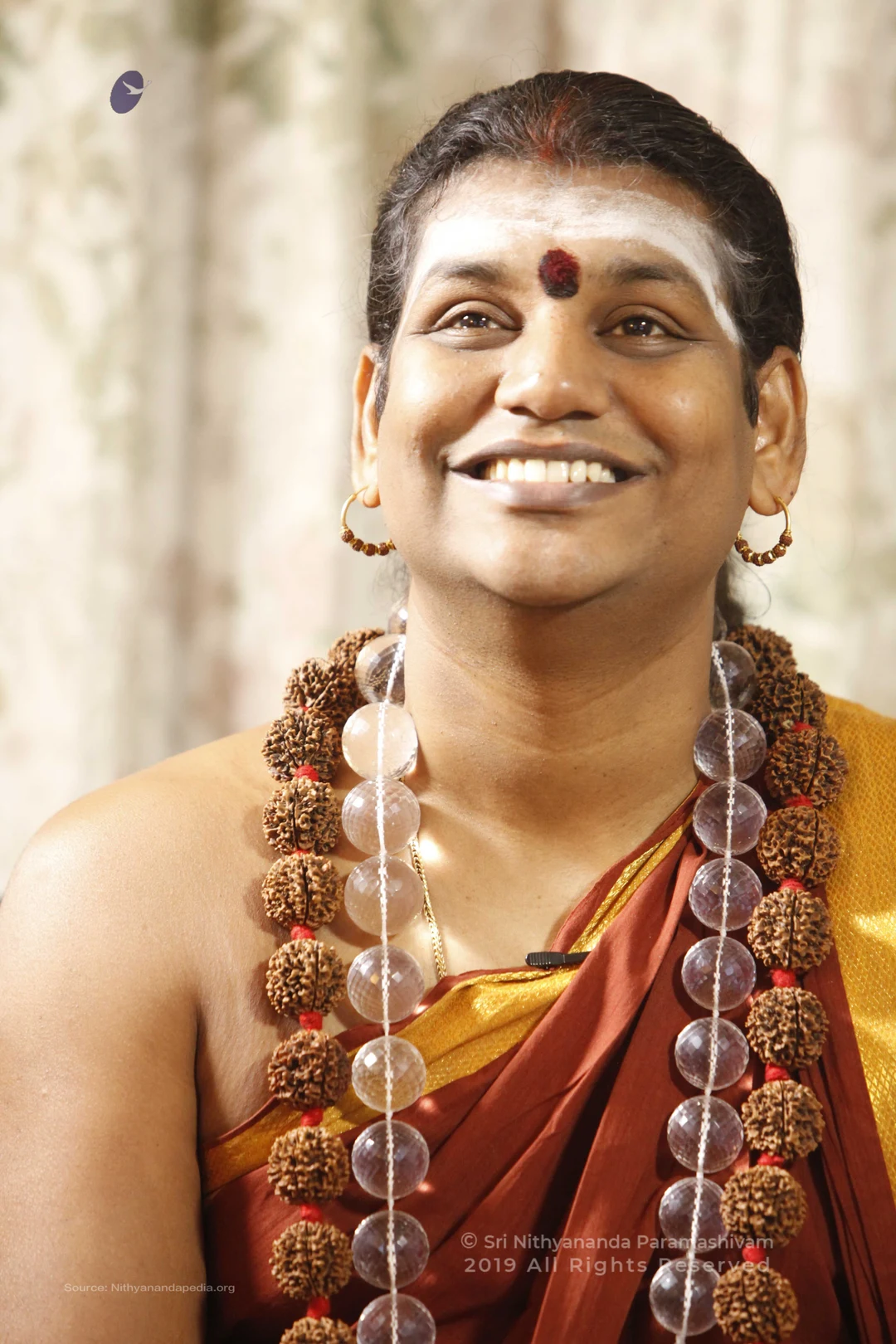
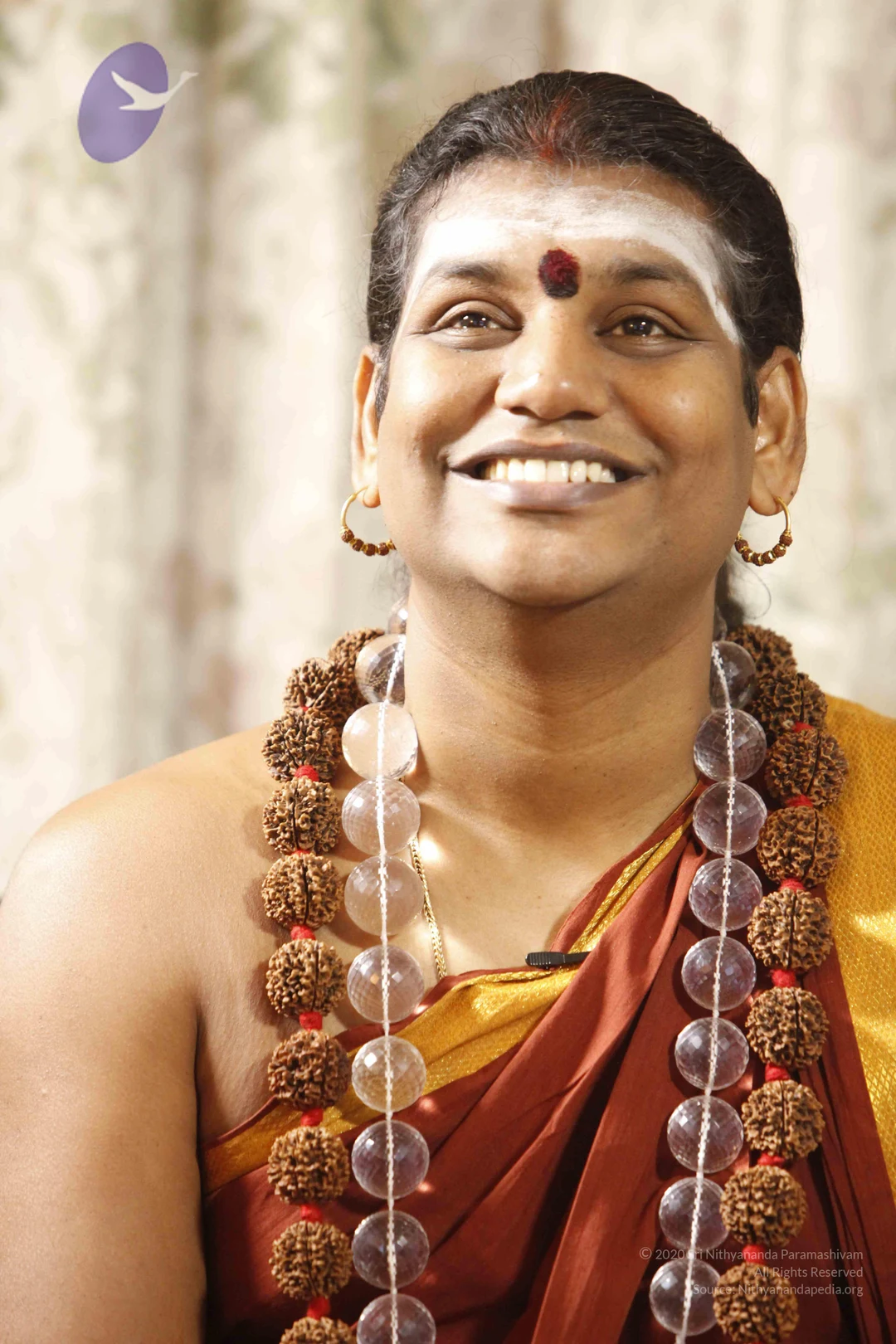
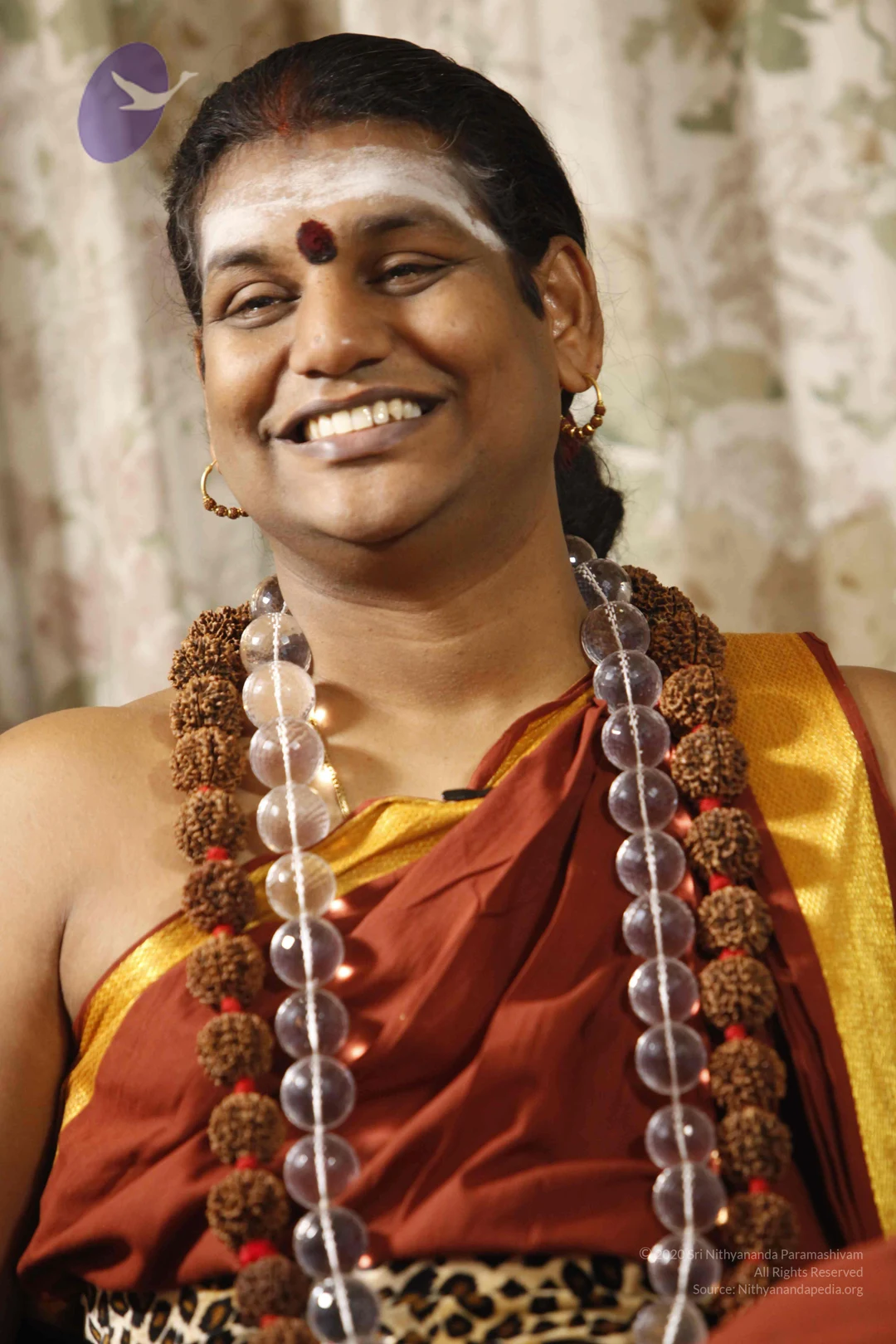
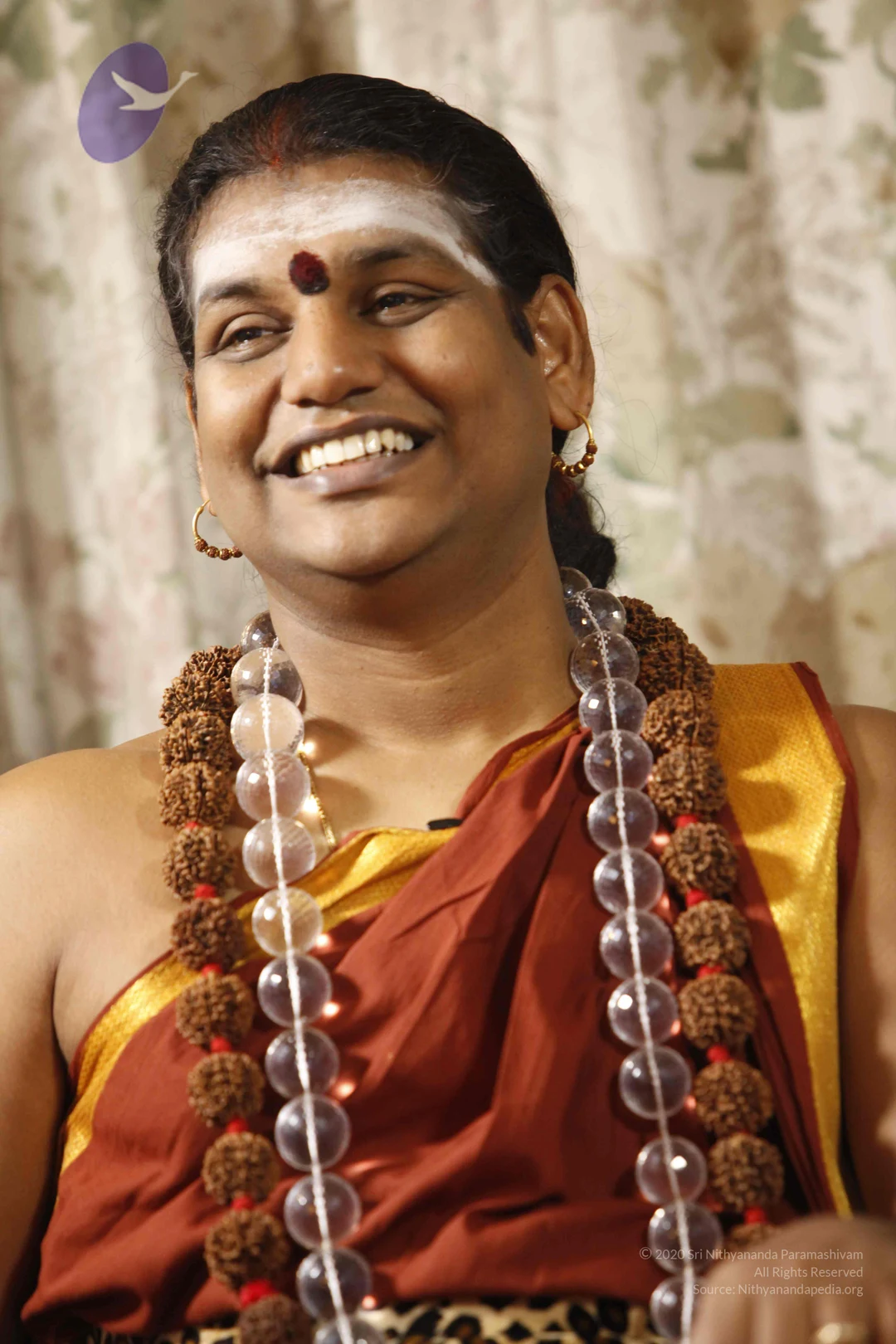
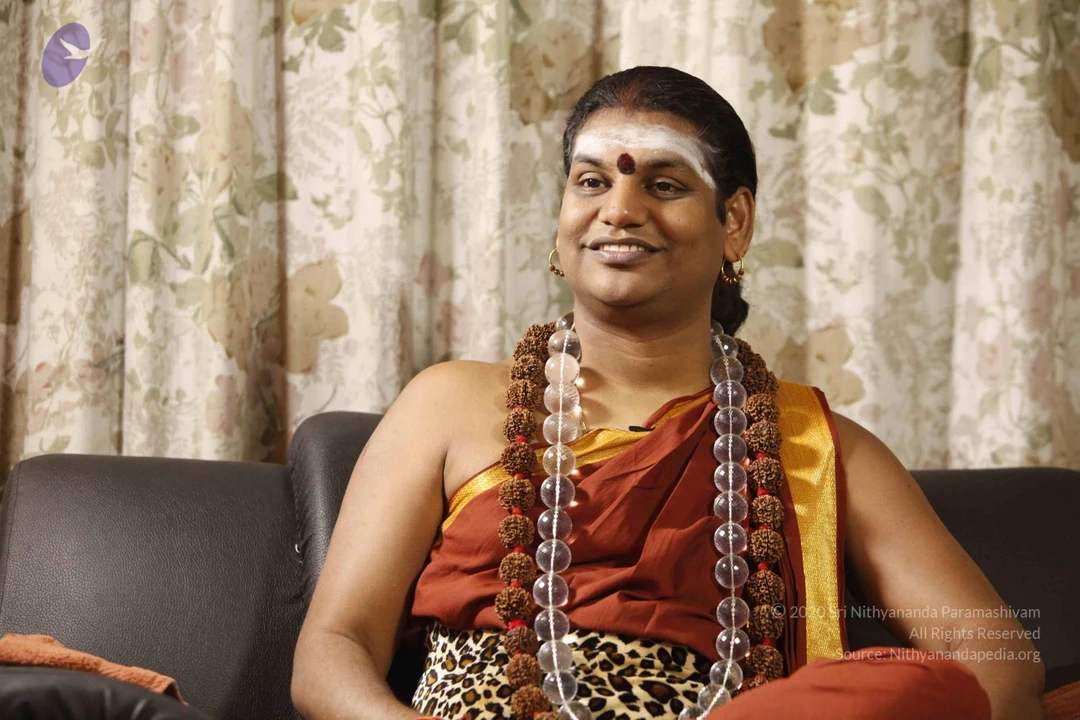
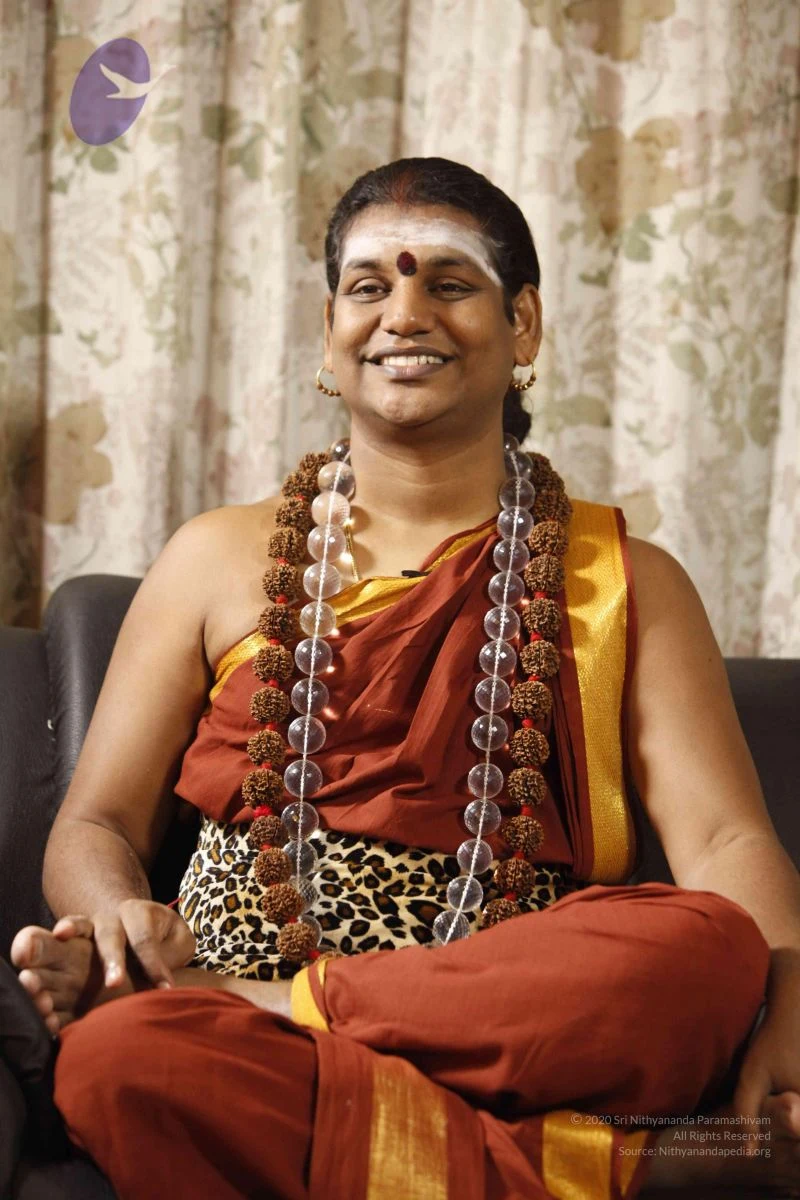
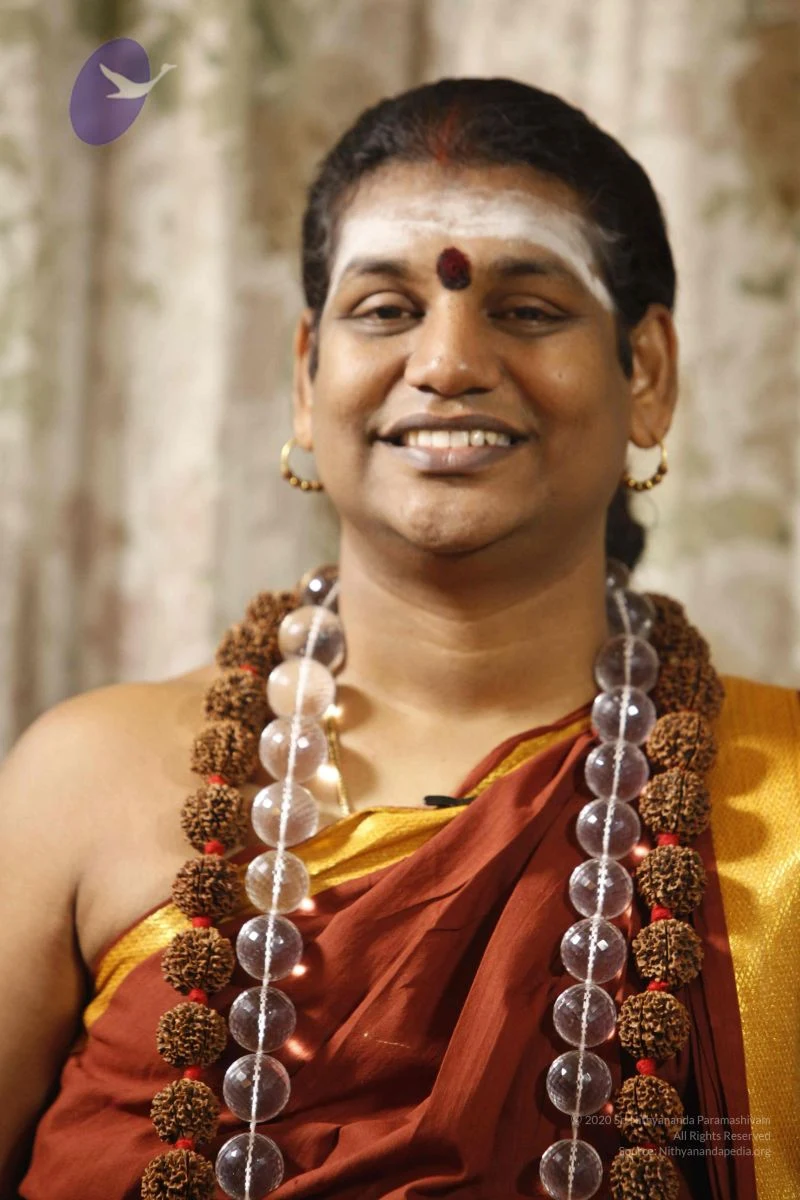
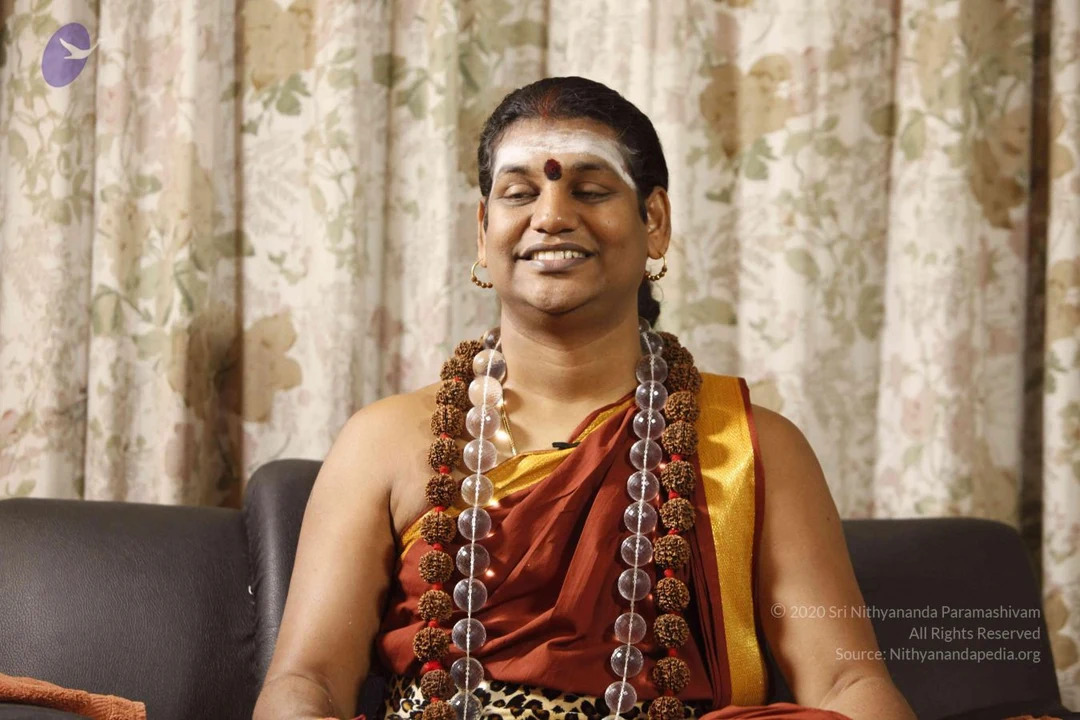
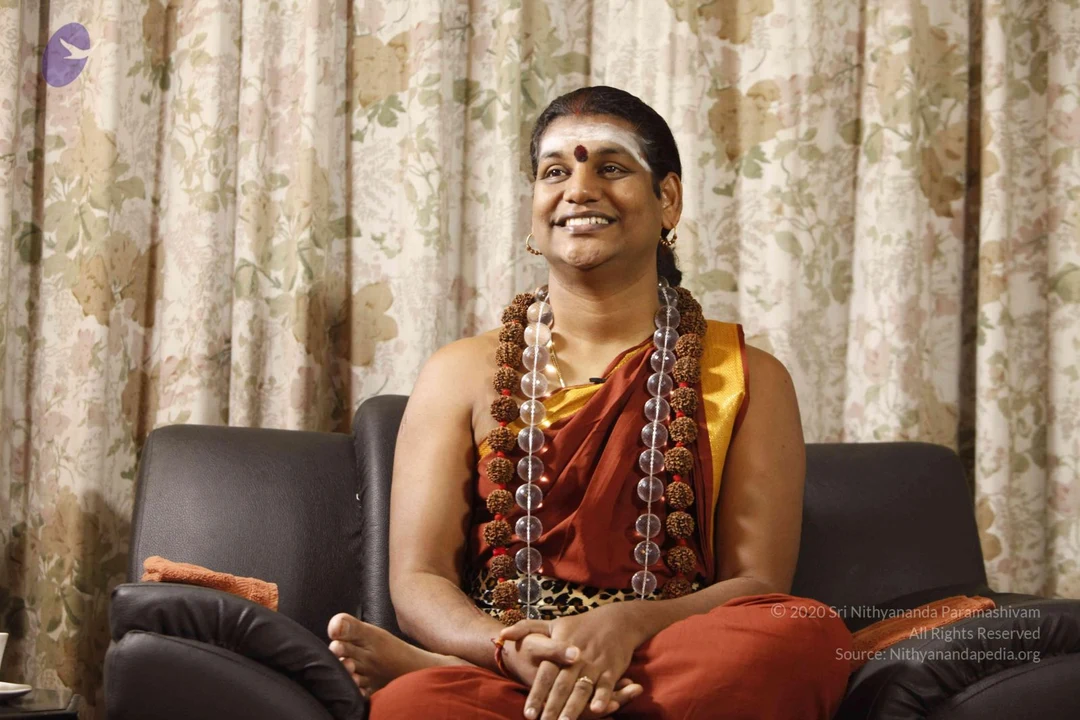
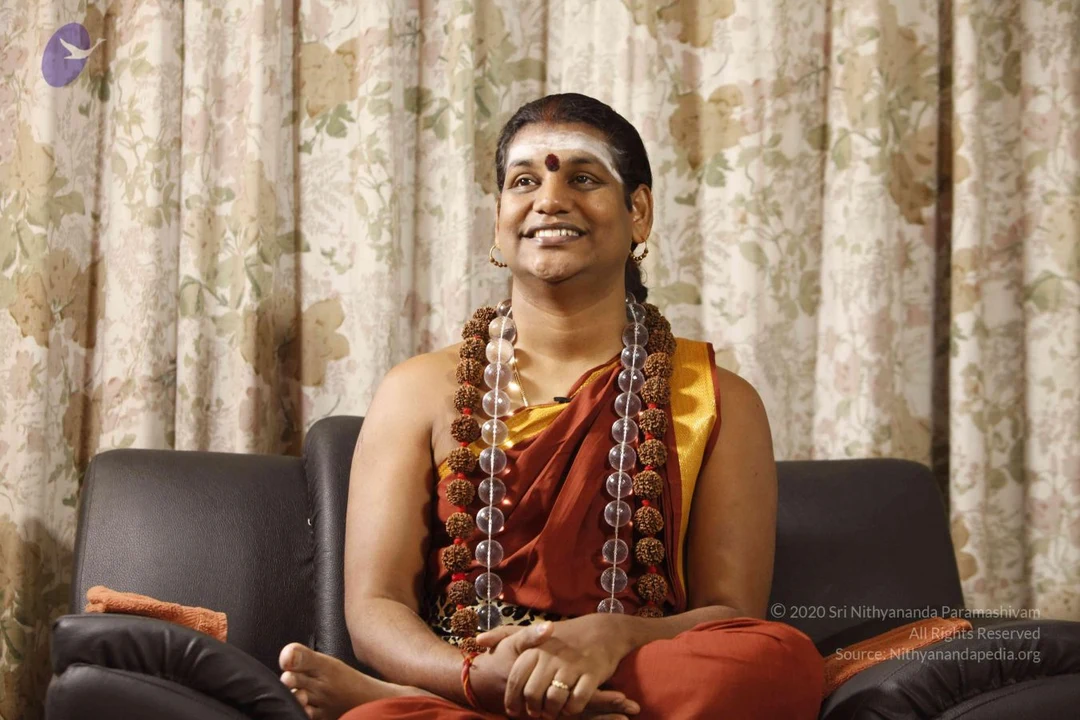
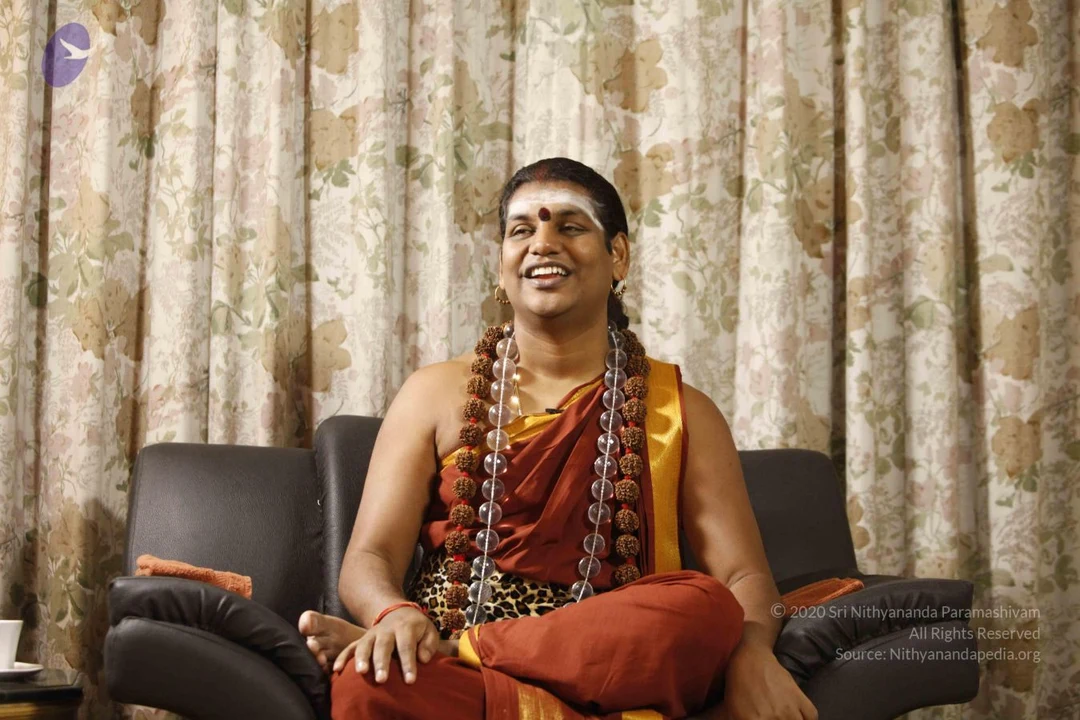
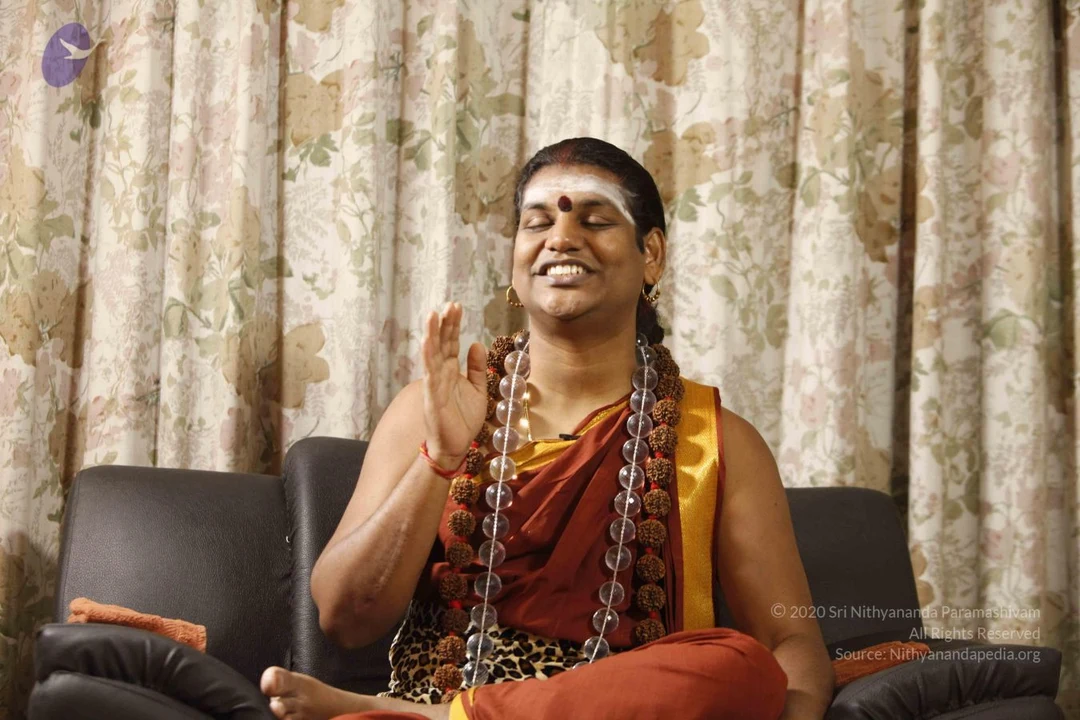
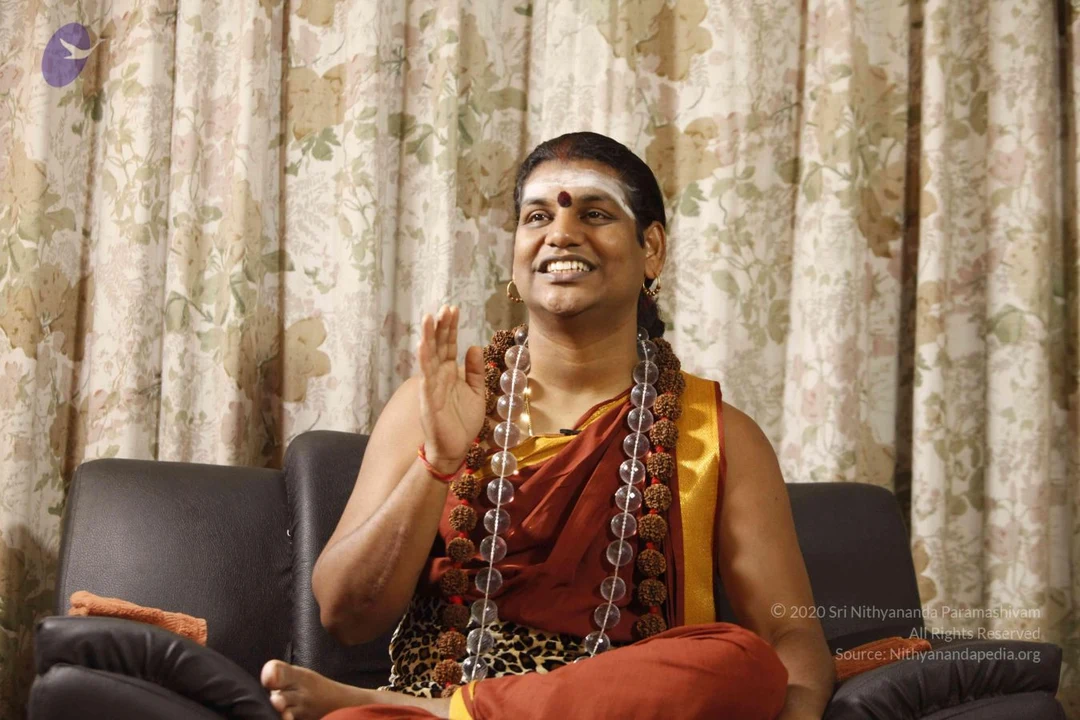
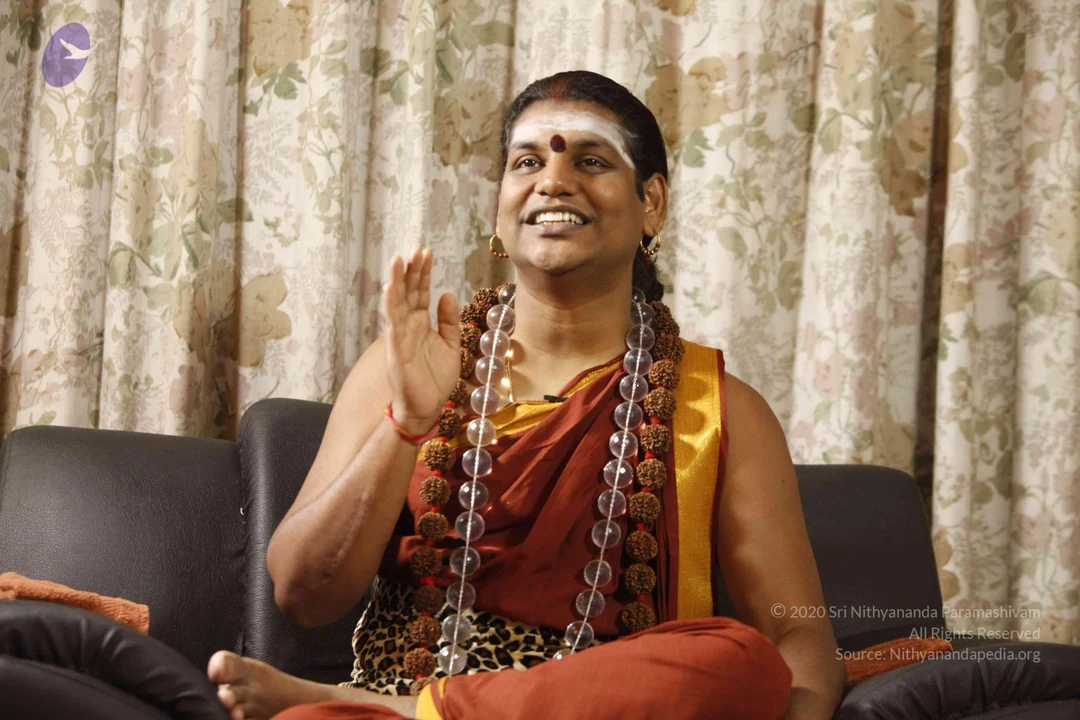
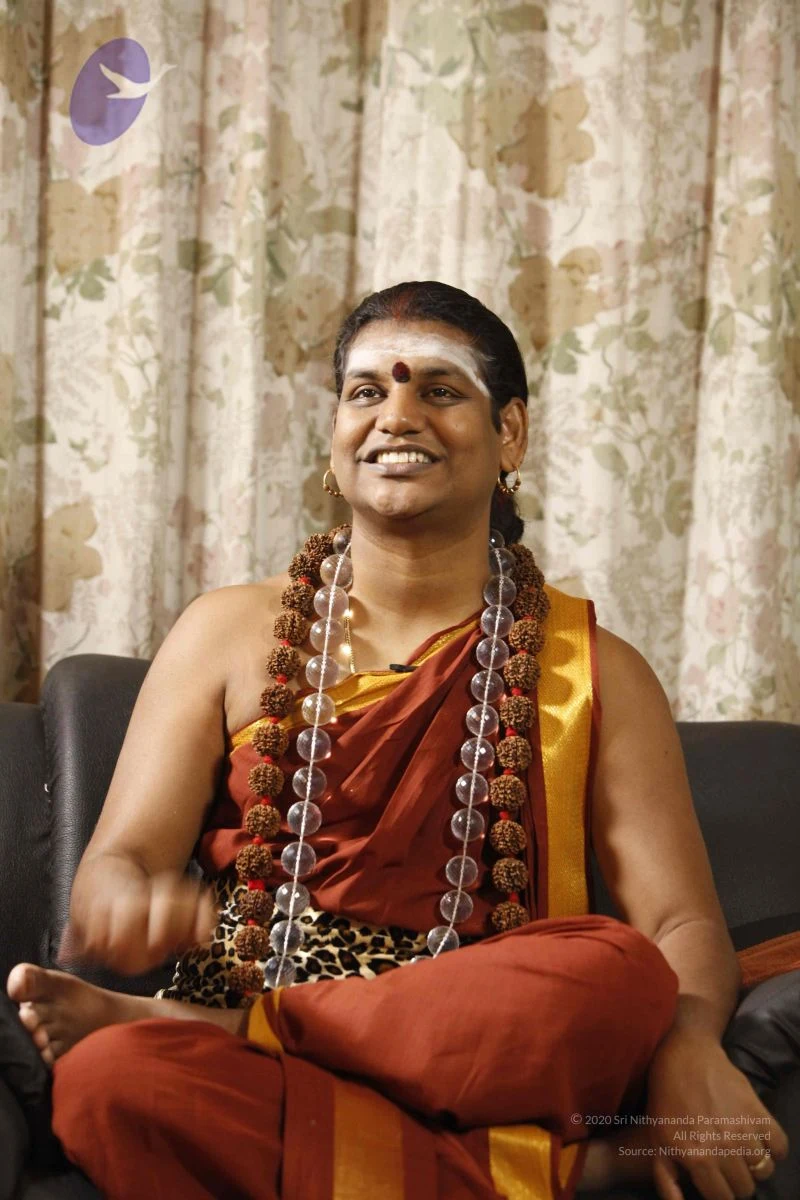
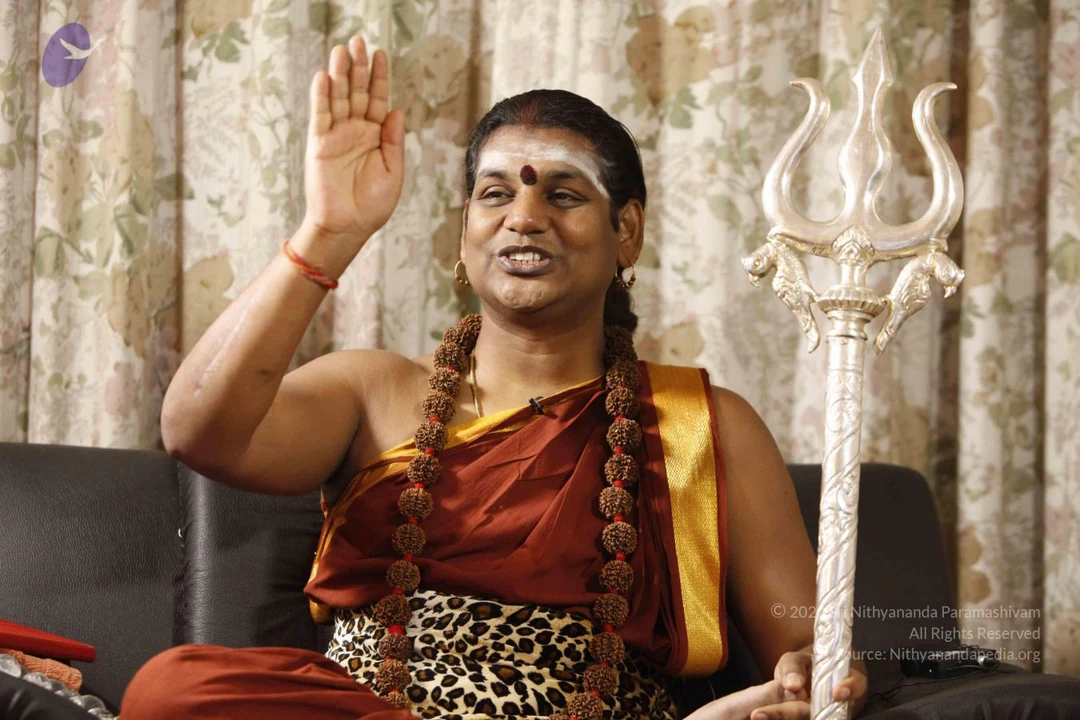
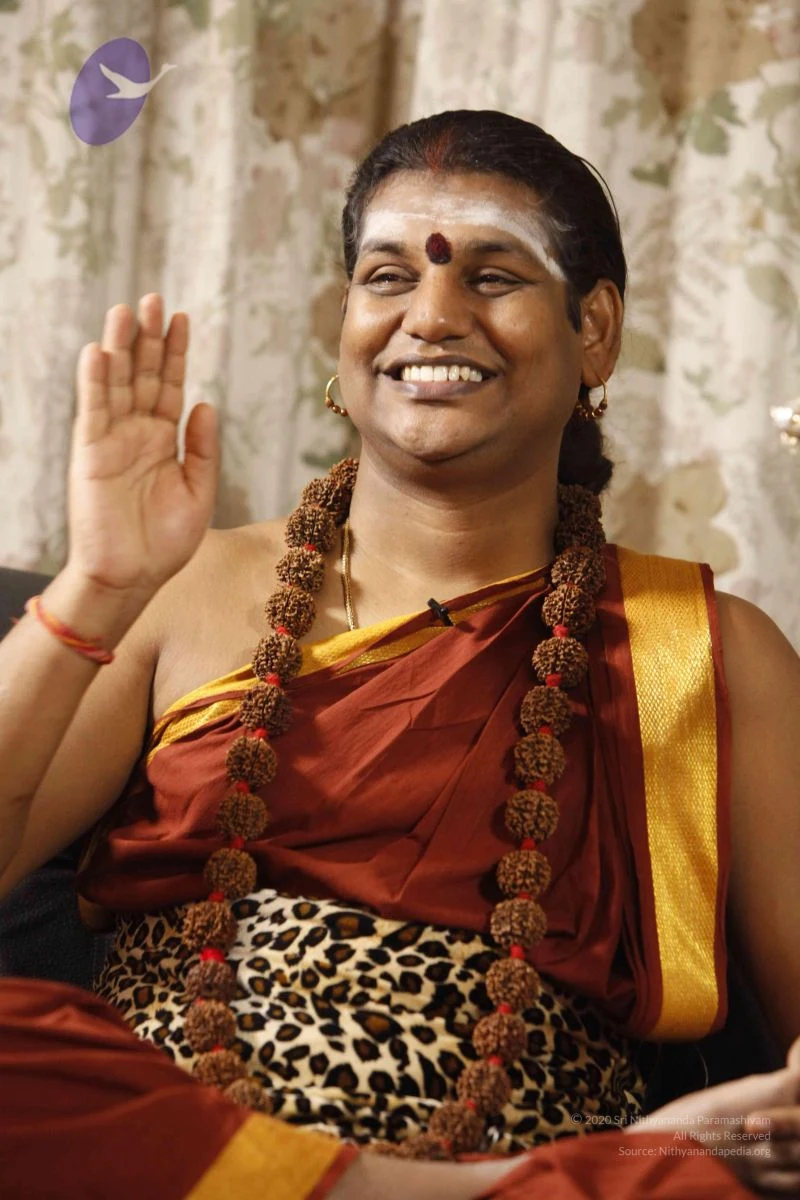
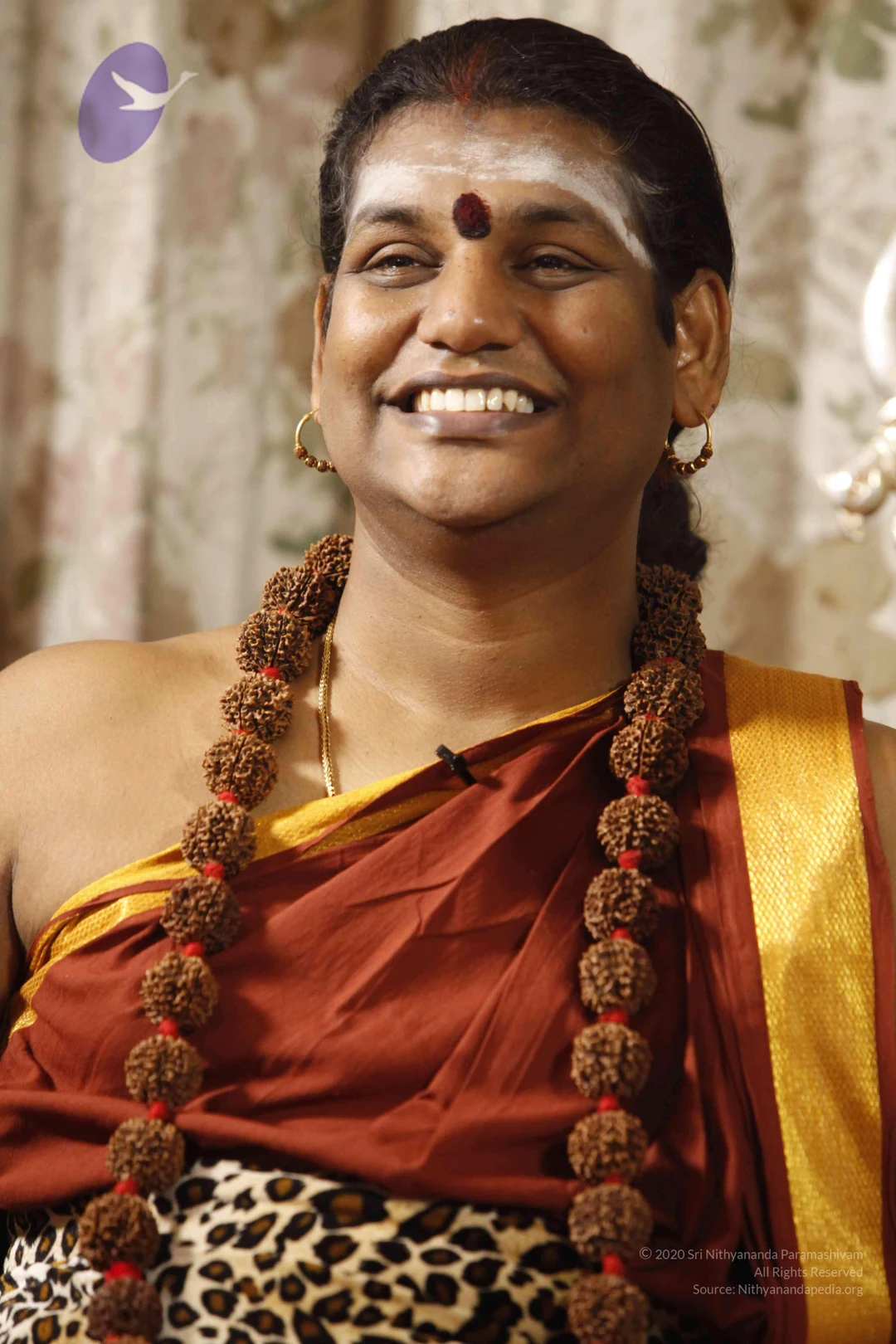
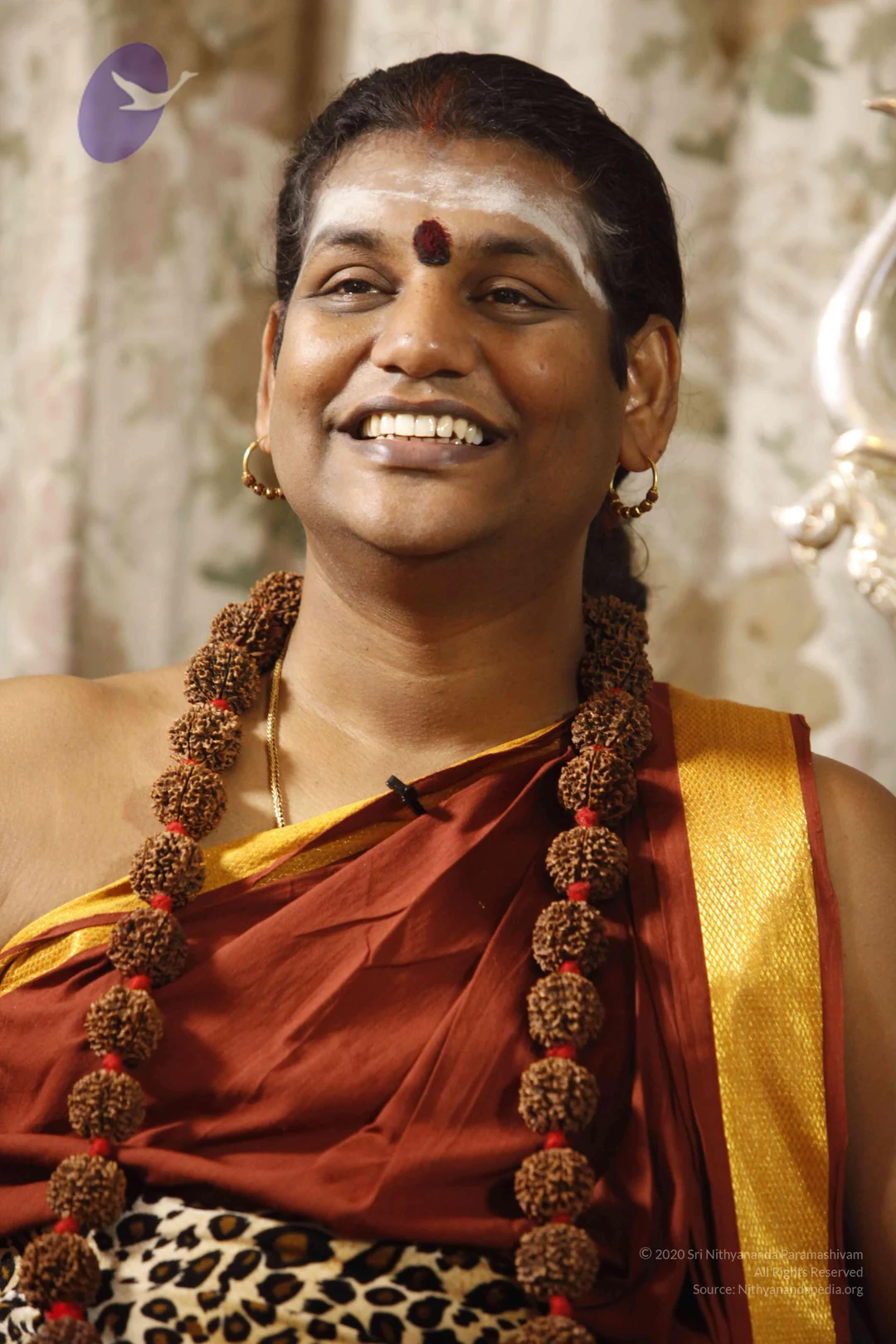
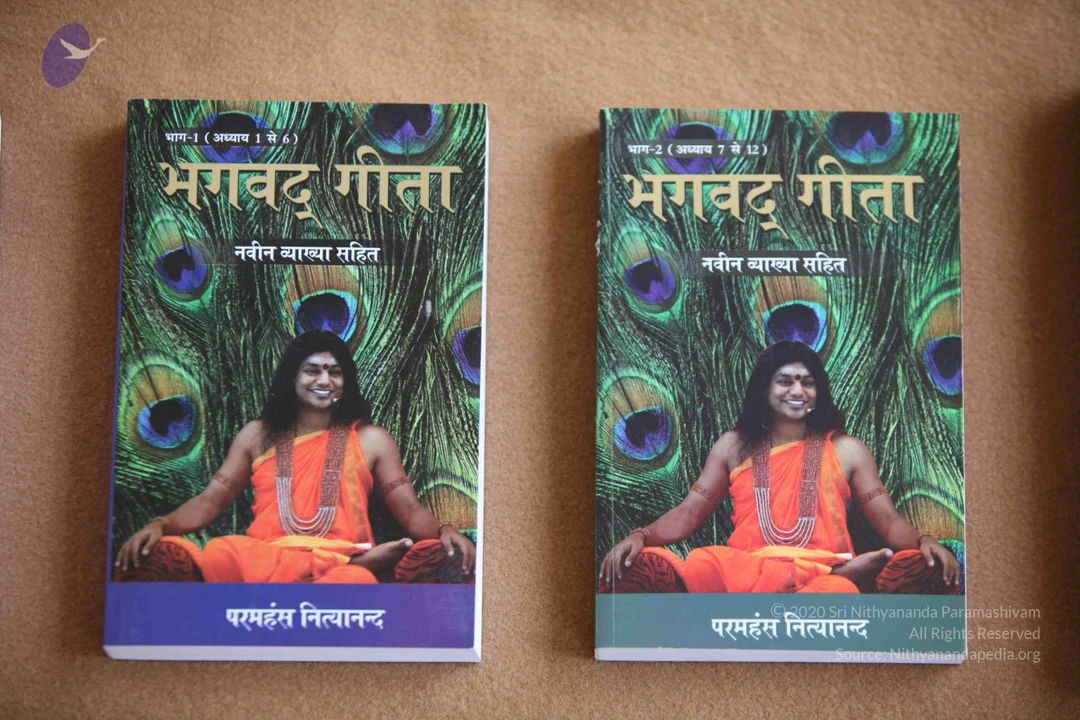
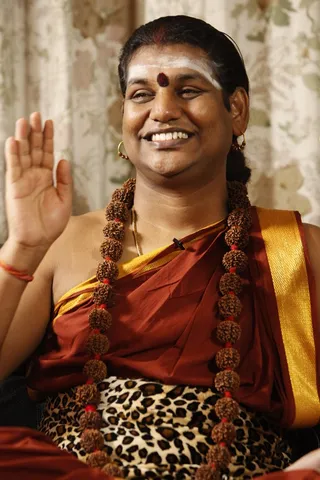
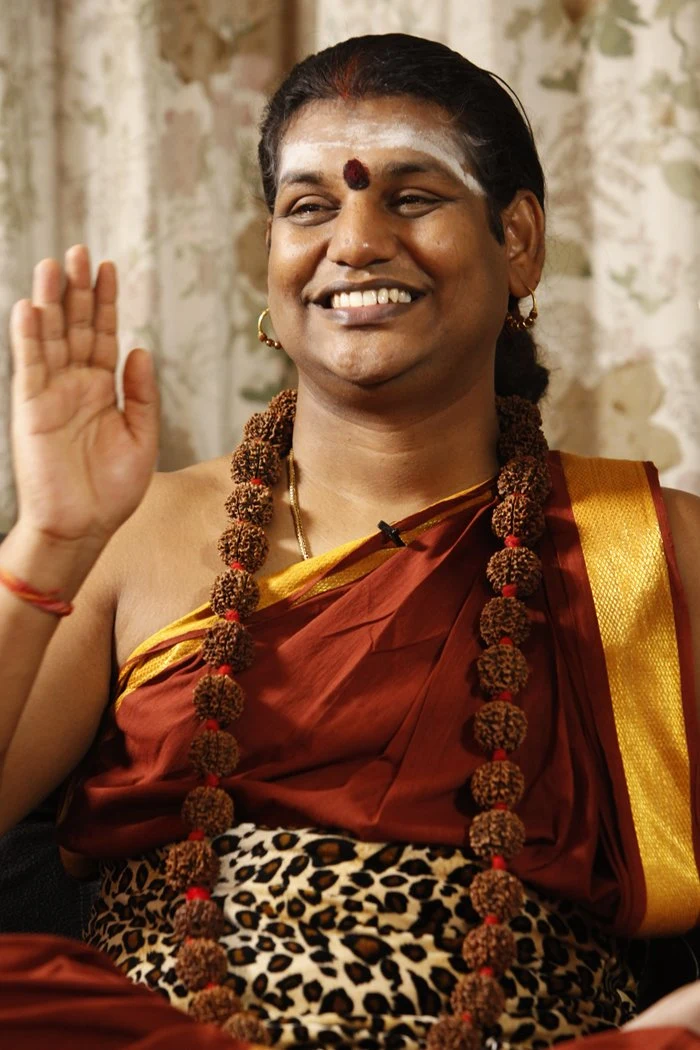
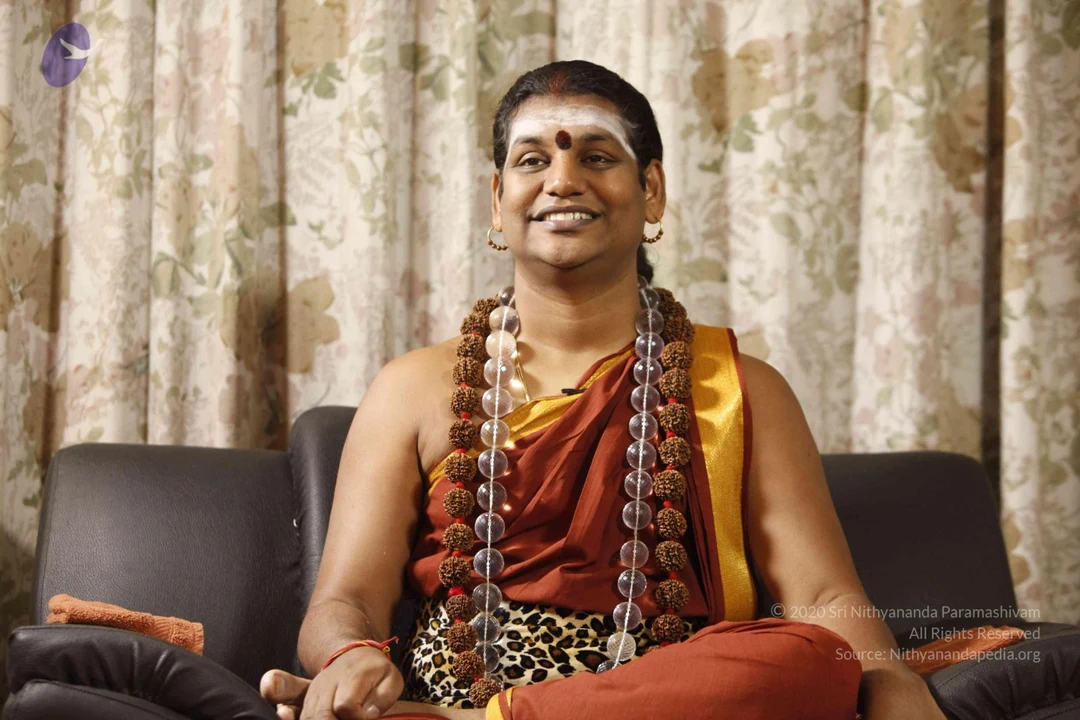
Close-up photo of a smiling man with swept-back dark hair, white forehead markings and a red dot on his forehead. He wears gold hoop earrings, multiple strands of rudraksha beads and clear crystal beads, and a red-brown garment edged with gold. A floral curtain forms the background. A purple bird logo sits at upper left. a person: long swept-back hair, rudraksha malas and ornate saffron-gold clothing fit the page's a person context, though the match is uncertain.Two paperback books lie side by side on a tan surface. Both are Bhagavad Gita volumes with peacock-feather backgrounds; the left is Part 1 (chapters 1 to 6) and the right is Part 2 (chapters 7 to 12). Each cover shows a smiling man in orange robes and a rudraksha-style necklace seated in a meditation pose, with a red tilak on his forehead; a depiction of a person on the book covers, which may be Swamiji (probable) per the page, based on the long hair, orange clothing and ornate necklace. The covers carry Devanagari titles and the name Paramahamsa Nithyananda in the lower band. No people are physically present in the scene.A man sits cross-legged on a black leather armchair in front of a floral curtain, eyes closed and smiling, one hand raised in a gesture of address. He wears a rust-red and saffron-gold robe over a leopard-print cloth, with a long strand of clear crystal beads and rudraksha beads around his neck, a red bindi and white tripundra marks on his forehead, and gold earrings. A red thread is tied on his wrist and a small microphone is clipped to his robe. Bare feet rest on the seat. The scene suggests a seated satsang talk in a home-like setting.

April 06 2014

Original wiki page
Contents

Experience Advaita the Practical Way

Description:

In today’s (6th April, 2014) morning Satsang, Paramahamsa Nithyananda elaborates on what is a ‘Teamily’. The fusion of family plus team equals Teamily. It is composed of the people in which we share our lives, including pets and nature. The Teamily is a fundamental component in the path leading to the space of Advaita, bringing us to a space of completion and non-duality.

VideoAudio

Transcript:

(00:15)

Nithyānandeśvara samārambhām Nithyānandeśvari madhyamām | asmat āchārya paryantām vande guru paramparām ||

(00:36)

(In Hindi)

Iss samay hamare sath upasthit sabhi darshoko aur bhaktho Me prem evam aashirwad sahit swagat karta hun. इस समय हमारे साथ उपस्थित सभी दर्शकों एवं श्रद्धालुओं का मैं प्रेम एवं आशीर्वाद से स्वागत करता हूं।

(00:45)

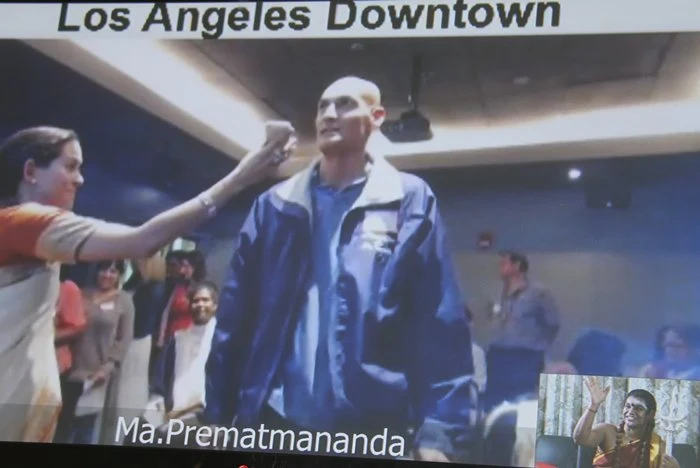
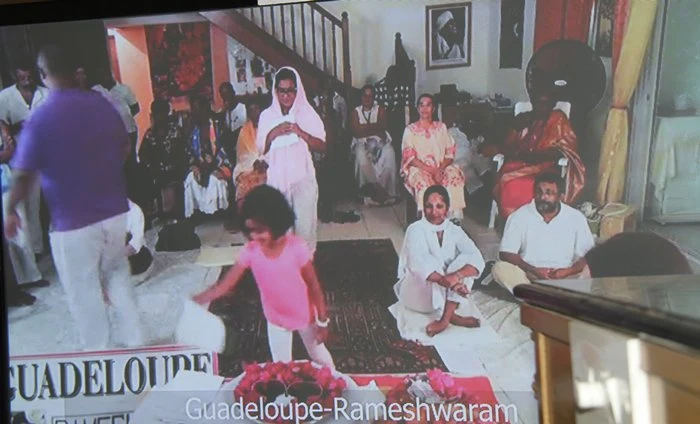
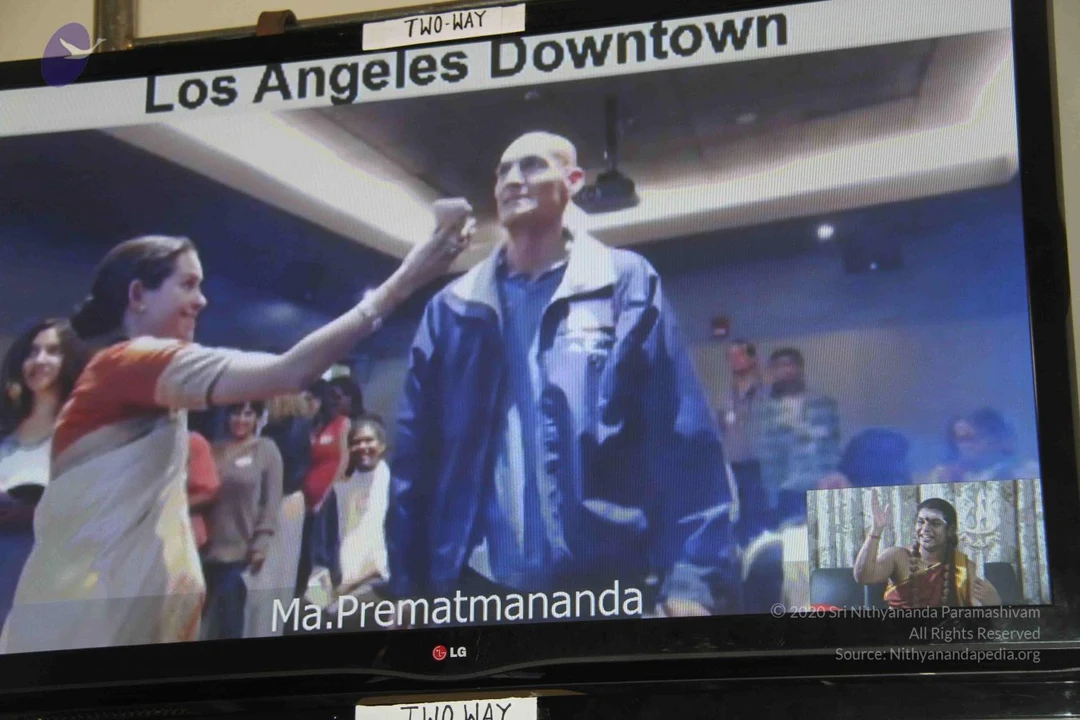
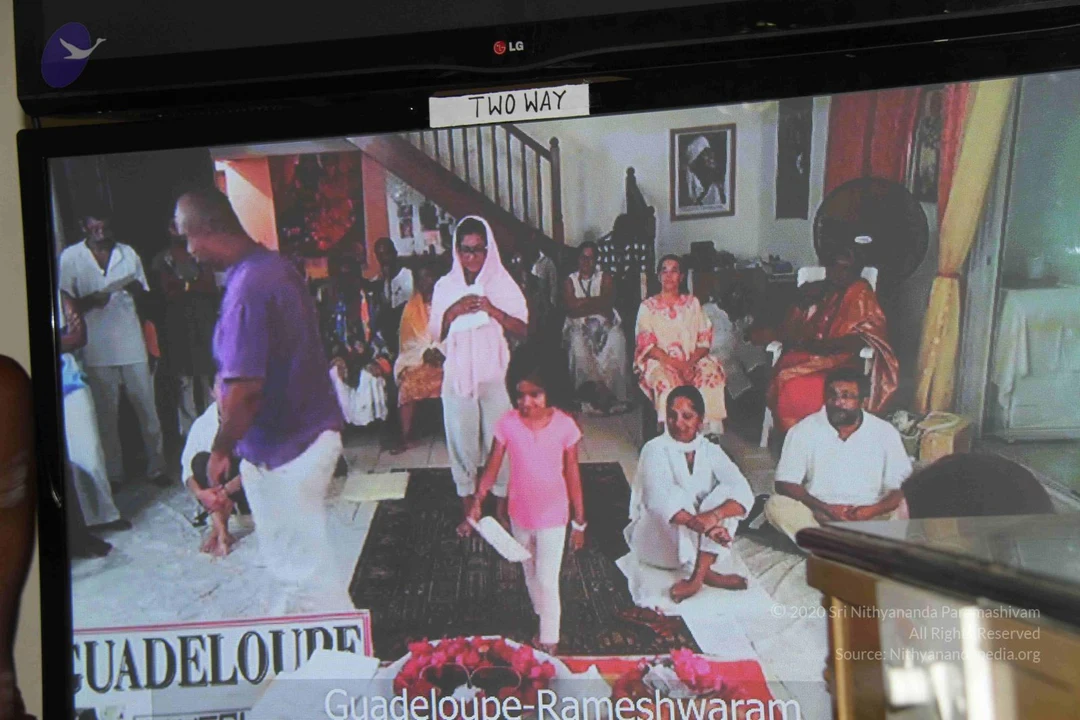
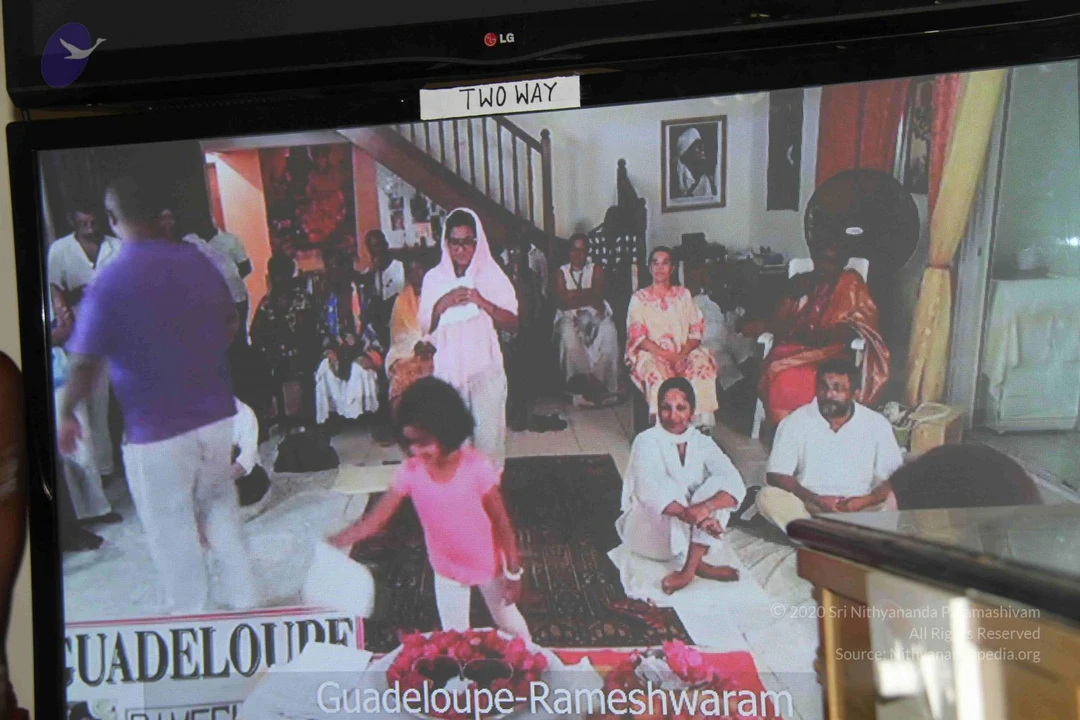
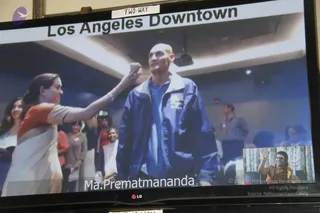
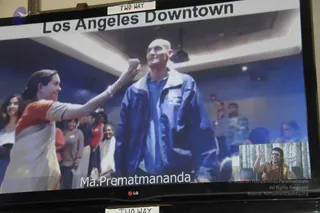
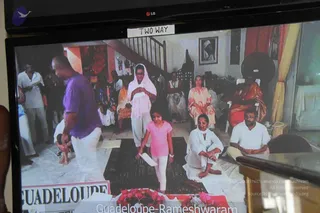
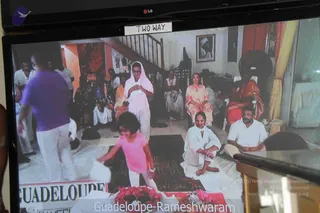
I welcome all the devotees, disciples, samajis, satsangis sitting with us through Nithyananda TV, two-way video conferencing, Ishwara TV, Janashera TV, Lotus News Channel and Sadhna TV all over the world. The cities sitting with us in two-way video-conferencing all over the world: Nithyananda Nagaramu-Hyderabad, Kuala Lumpur-Palani, Avadi-Chennai, Simi Valley-California, Oklahoma-Somanatham, Ohio-Prayag, Washington DC-Sripuram, Simi Valley-California, Seattle-Chidambaram, Mattakalappu-Ilangai, Toronto-Kailasam, Vancouver-Bhuvaneswar, Ohio-Ma Shivananda, Singapore-Singapuram, Nithyananda Vedic University-Los Angeles, Nithyananda Nagaramu-Hyderabad, Haridwar, New York-Varanasi, Auckland-New Zealand, Kilinochchi-Ilangai, Indrani-New Jersey, Jorpati-Nepal, San Jose-Madurai, Austin, Dubai-Vaidyanatham, San Antonio-Texas, New York-Varanasi, Hyderabad-Gupta Kashi, London-Kashi, San Diego-Tirualavai, Nithyananda University-Paris, Tuen Mun-Hong Kong, Colorado Springs-USA, Oman-Sivagangai, Bangalore-Gangamma Circle, Philadelphia, Dakota Dunes, Phoenix-Kanchipuram, Guadeloupe-Rameswaram, High Point-North Carolina, Houston-Kalahasti, Downtown LA-California, Avadi-Chennai, Simi Valley-California.

(03:00)

I welcome all of you with My love and blessings. Actually, it is so exciting to work and see all your questions live. I literally feel whole day I am giving satsang through the Facebook. So, I will try to answer many of your questions. I just wanted to remind the people who joined the satsang today, if you are joining, through Sadhna TV or any other channel, I just wanted to tell you, I am continuing the satsangs, earlier satsangs on the space of Advaita, on the space of Advaita, helping people to experience the space of Advaita in a practical way. Some people asked Me, “Can we have pets in the teamily?” The teamily we create, you can have pets, you can have pets. You can even have trees, hills; rivers are energetic enough, conscious enough, spirit enough to respond to you. So, a river or mountain or a pet or a tree can be added into your teamily. That’s the first question.

(04:41)

For the newcomers the word “teamily”. Teamily means Family and Team together. Unfortunately human-beings have lost connection even with themself. Forget about having connection with the family, even with themself they lost the connection. The strong, deep-rooted, grounded lifestyle is lost. Due to various reasons we became very unconscious. Now making us come back to consciousness and created, complete, centered, grounded with yourself and with your family and team together – Teamily. Means teamily is the people with whom you share your life. People who share their life with you is teamily. Literally, people who are part of your living, your existence, only those people I call them as teamily. Pet, your trees, rivers, mountains can be part of teamily.

(06:19)

I have some questions. I will try to answer. These are from Bela Patel, California. She is asking, “Is interaction with teamily members a must on a daily basis?” See, sometimes you will have a friend with whom you have not spoken for ten years but that friendliness is there alive in you. So, with teamily, whether you interact every day or you don’t interact, that is not a problem. But the experience of Advaita should be alive, that’s all. That’s all. Nothing else. There is no such thing as just because you speak to somebody they are your teamily. I know many people; they live in the same house, they don’t talk to each other! No! just because you live in the same place or you talk to them. There are some people, every day you talk to each other, but it is only fight....dut--dut-dut....gun! No! You talking to somebody every day, or not talking to somebody every day all that does not count.

Please understand, Bela Patel I want you to know I am not a ‘good-relationship’ teaching guru. No! Please understand, I am not teaching you to have a good, great relationships. No, hell with your relationship! Even if you have a best husband, best wife, you are just going to die leaving him. Neither he is going to come with you or you are going to go with him. No, no I am not the guy who is teaching how to have a great relationship, like how to win friends and influence people. No! Understand the good relationship happens as a side-effect. But the context I am teaching to all of you is establishing yourself in the spiritual space of Advaita.

(08:35)

When you feel oneness, because of the oneness, you will know whatever insecurity other person is feeling, you will know whatever desire or greed the other person is feeling, you will know the other person’s space. Because of your knowledge, you will have love and compassion. Understand anything becomes known to you, anything becomes part of your knowledge, you start loving it. Because you know the desire, greed, struggle, fear the other person is going through when you experience Advaitic space with them, because of that non-duality, you love them, you become compassionate towards them, the relationship may become better. But, My purpose is not making just your relationship better.

(09:45)

Understand the utilities of Advaita is not Advaita. Siddhis of Advaita is not siddhi of Advaita. Siddhis of non-dual consciousness is not non-dual consciousness itself. So, whether you talk to somebody every day, or not talk to somebody and all, all that does not matter. There are thousands of I can say lakhs of people who don’t get to talk to Me. But they are so fulfilled just seeing Me. I can see in the Facebook and the Twitter, the amount of messages pouring. The amount of messages pouring. I don’t know how many lakhs of people’s teamily I am. At least few thousands the first member of their teamily is Me only! No wife, no husband, no son, no daughter; all of them are second, third only. For so many people. It’s not that all of them talk to Me every day. They may get to talk to Me even maybe once a year. Some people, not even that. Thanks to Facebook and Twitter giving people the experience that they are at least able to convey whatever they want to convey and they can be sure it has reached Me, that experience. Please understand, there are some people, all the names in their teamily is only Nithyananda Swamiji, Nithyananda Swamiji, Nithyananda Swamiji, Nithyananda Swamiji, that’s all.

(11:53)

So, please understand there is no need that you need to be talking to your teamily or not talking to your teamily. It is the space you carry, hold about them. Sometimes you may be talking lovingly, sometimes you may not be talking, sometimes you may just avoid, sometimes you may fire. Whatever it is, the space you carry about them, that is all matters and that only makes you powerful and you as a strength to your teamily. ‘Teamily’ means the way you carry them in you. Outside you may be loving, flowing, but inside if you are having deep incompletion and anger about them......no! So, I tell you, it has nothing to do with action; it is all about some decision you have about people. I can see in My life, with so many Swamis, whenever they are not efficient it is not that they are inefficient; they are arrogant. They have a abusive nature inside. Means inside their space, they have a deep anger and arrogance towards life and Sangha. So, please understand it is when your decisions change about life and every one only then the teamily gets formed. It is the change of your decision not your action.

(14:10)

Second question, “At minimum, how frequently we should be seeing them?” This question, I think, I have already answered, Bela Patel. The third question, “What should I do or not do? For example, if it is my friend, father, how can I be good friend, father, daughter?” Again Bela Patel, this whole, all these questions I have already answered in one answer. It is the space you carry. See when you are alone inside your bedroom, if you remember them, how you feel about them inside you, that decides whether they are your teamily or not. You are all alone, you just suddenly get to remember the person. How you feel inside you about that person, it is all that matters whether somebody is your teamily or not.

And the fourth question, “I have listed people of my family. However, they are not connected with the Sangha, Nithyananda Sangha. Do they need to be or is it better to select the Nithyananda Sangha people, so later on, if Swamiji wants to interview them, there is no conflict?” Please understand do not ever imagine that if you select people of the Sangha you will not be having conflict. Conflict is present based on your experience of Advaita. You can be in the space of Advaita with anybody. So, you do not need to choose the members of the Sangha. You should choose the people with whom you are living, your day-to-day life is happening. All of them should be your teamily and you should be strong enough, powerful enough to teach them the science of Completion. And don’t worry that they are not part of the Nithyananda Sangha.

(16:30)

The moment you teach them about Completion and they start understanding, they belong to Nithyananda Sangha. They may not accept Nithyananda, but they have to accept Nithya-Ananda! Please understand they may not accept Nithyananda, but they have to accept Nithya-Ananda! Means, they may not accept the form of Nithyananda, but they have to accept the substance of Nithyananda. So, when somebody understands Completion and wants to complete, they already, they are part of Nithyananda Sangha. Don’t worry about it. So, first thing you need to do, you have to choose your teamily who are everyday working with you, with whom you share your life, with whom you share your house, you share your bed, you share your food, you share your work, you share your office, you share all the moments of your life whether good or bad. So, they don’t need to be mandatorily belong to the Nithyananda Sangha.

(17:57)

First thing, what is Nithyananda Sangha? Let Me define it, whoever accepts this science of Living Enlightenment and radiates it in their life and enriches people with this great dhamma, they are all, I call them only as Nithyananda Sangha. So, I don’t call somebody as Nithyananda Sangha just because they wear My rudraksha mala or the bracelet. There are many people, only when they come to see Me, or come to Kalpataru, they wear that mala! It is just make-up, ashram-going make-up, office-going make-up. When they go to office how they wear a tie, like that, when they go to ashram or temple they wear rudraksha mala. No! Understand your teamily should be the people with whom you are sharing your food, job. In your office, whether somebody is working above you or below you, if they are working with you, they should be your teamily. With whom you share your life, food, house, office, bed, these people should be your teamily. So, you become sincere enough to imbibe this Science of Completion and start sharing it with your teamily. And when you share, when they start understanding the Science of Completion and start learning, living, I tell you, naturally they become part of the Nithyananda Sangha, that’s all. So, you don’t need to worry that somebody who doesn’t belong to Sangha, you are keeping them as a teamily member. You should only give priority to with whom you live.

(20:23)

Next question, “If they want me not to go to Nithyananda Sangha, am I obliged to do that?” No! You are not obliged to do that. Ramakrishna says very clearly. Ramakrishna is one of the greatest masters. He says very clearly, ‘For Enlightenment, for spirituality, you can give up anything. No Karma comes to you!’ He says, ‘You can give up any relationship, anybody, anything. Personality like Ramakrishna who always stood in the space of truth, He Himself declares very clearly, ‘For Guru, for spirituality, for Enlightenment, anything can be given. Anything can be given up. But don’t give up Guru for anything!’ So, you don’t need to - you don’t. Actually you need to bring Completion to them; you will not get into their incompletion.

And the next question from Bela Patel, “If they want me to start attending their religious gatherings, do I do that?” You should be powerful enough to teach them and tell them what is exactly right and what exactly makes somebody realize their highest possibility; that’s all. So, you don’t need to bend at all for anybody. Creating Advaitic space does not mean you becoming powerless.

(22:04)

Understand today I wanted all of you to continue to do your Completions. Yesterday all of you would have written, penned down all the incompletions; you would have started. I am 100% sure you will not complete in one day, Completion with your whole teamily. So, all you guys start doing it sincerely. And today I wanted all of you to continue to do the Completion. Continue with your Completion with your teamily. And whoever has added Me as part of their teamily, you can just keep My photograph and complete with it. And I 100% guarantee, you will be completed. I am always in the space of Completion, don’t worry. Because I am always in the space of Completion. You sit and complete. You have My photograph as part of your teamily for your Completion process you will be complete.

(23:24)

You also need to understand it is not difficult, but you have to ‘DO it’. Just by thinking about it and not doing it is not going to help. Many people have an unconscious pattern: ‘Oh, I know this. I will practice it directly. Why should I go through all this process?’ No! Then you are in a delusion. If you know it, then why you are not able to practice all this while? Because, the knowledge has not penetrated every corner of your being. So, understand this process will make the knowledge to be assimilated every part of your being, knowledge to be digested as an experience in every part of your being. So, I wanted today also every one of you will continue with the process of Completion.

(24:43)

Let Me describe the process of Completion: Sit with your teamily members with the decision to bring Completion. Second, don’t confront them. Tell them very clearly what all the incompletions you are feeling and how you started building this pattern from your young age. The other person is not at all responsible for your incompletion. It is the patterns you built is responsible. Understand you always carry a mold. Anybody comes in your life, you just take them and slap them on that mold and you tell them, ‘See My mold is all incompleted because of you!’ The incompletion is not from, because of the person, because of the mold you carry, because of the pattern you are carrying. So, let the other person know the patterns which you developed from the young age which is responsible for your incompletions. This discussion, this Completion should go on incident by incident with the other person, step by step, till both of you are completely complete.

(26:20)

Understand Master is the eternal space of Completion. That is why he completes you in every incompletion. Whether you have incompletion with your mother or father or a friend, the presence of the Master, the space of the Master completes you. But with ordinary persons your incompletions create more incompletions with them. So, please understand, now decide to be a space of Completion. Now decide to be a space of Completion. Today, continue to have Completion with your teamily. Sit with the teamily and in the night again sit with yourself. This next one month, literally the space of Advaita happen in every one of you.

I can say that, from this Guru Poornima till Navaratri, we will have it as ‘Advaita Rithu’ – the ‘Season of Advaita’. And now itself let Me prepare all of you and do all this process so from Guru Poornima and Navaratri, that two-three months, you are all established in the space of Advaita, we are all established in the space of Advaita. From the Guru Poornima, the space of Advaita should start and by Navratri, the shakti of Advaita should start expressing in you.

(28:29)

Essence of today’s satsang: Start the Completion! Start the Completion! Start the Completion! Listening about it – great. Thinking about it – great. But DOING it is greatest. Listening about it is great. Listening about Completion is great. Thinking about Completion is greater. DOING the Completion is the greatest! So please understand, move to the space of DOING the Completion. I Bless you all. Let you all radiate with Integrity, Authenticity, Responsibility, Enriching and Causing Eternal Bliss, Nithyananda. Thank you.

(29:29)

Photos

Nithya Satsang and kalpataru Darshan
Photos Of The Day:

NithyaSatsang--Kalpatharu

SriRameshwarpurii--Mahraj--Visits

Book--Pics

01-NDY-DAY3-SHIVOHAM-SESSION1

02-NDY-DAY3-SHIVOHAM-SESSION2

Photos from this day

View all 90 photos

Nithya Satsang and kalpataru Darshan
7 photosSource gallery
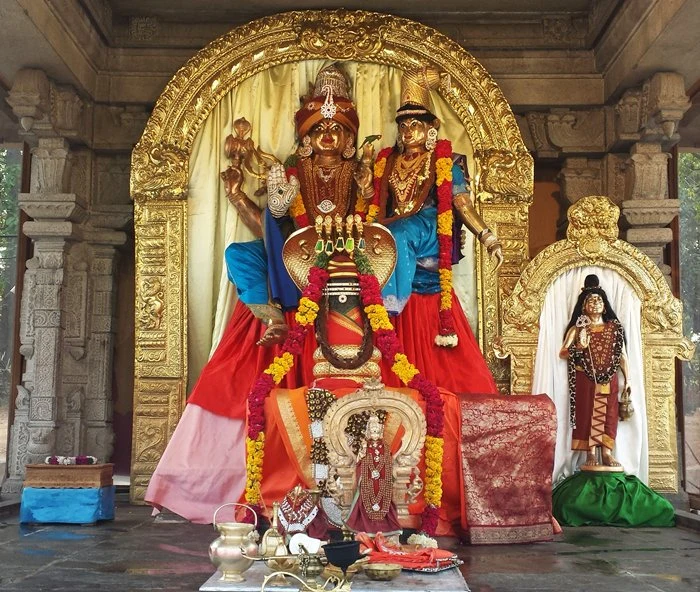
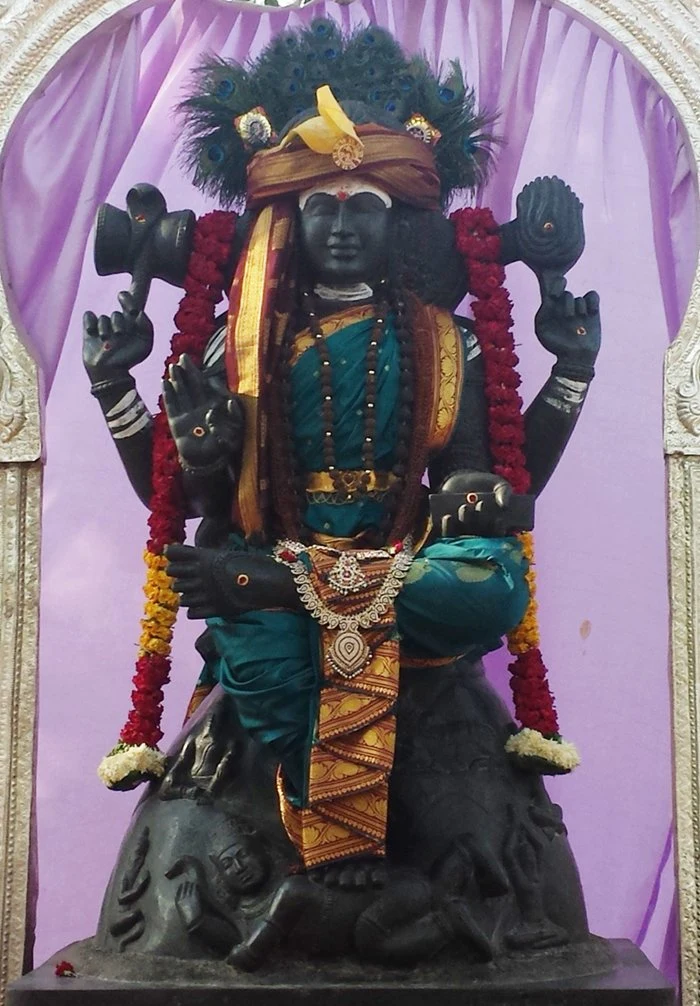
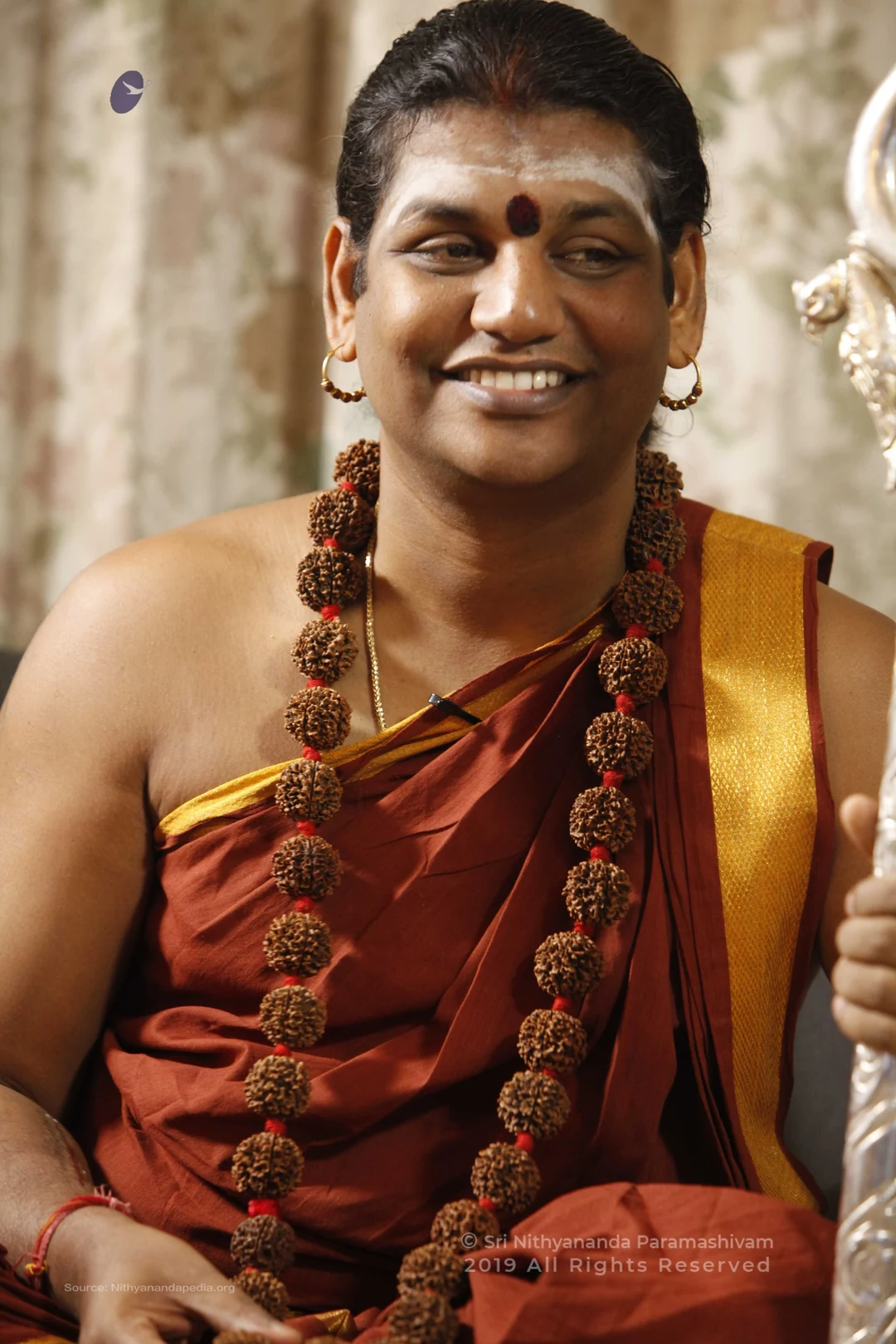
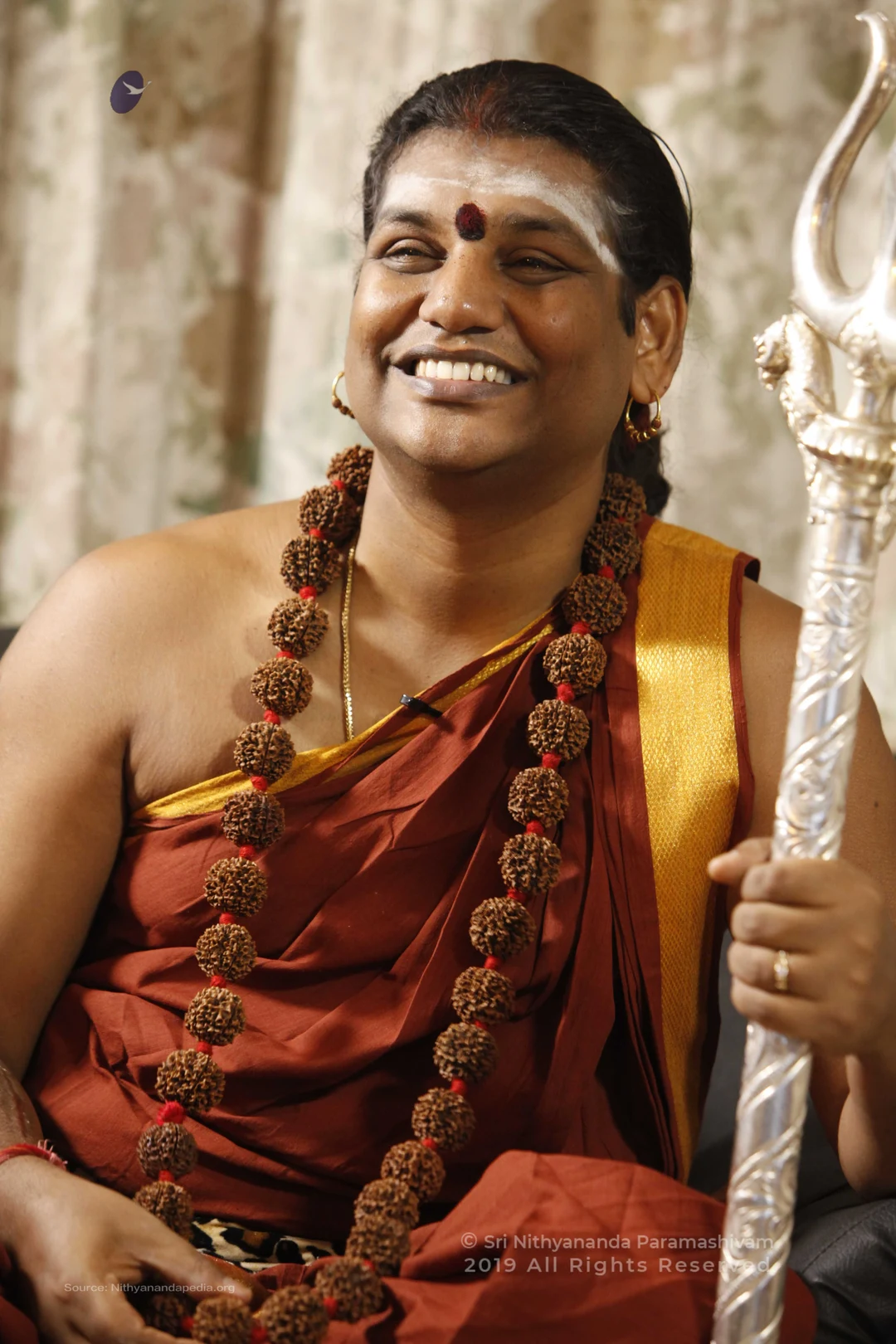
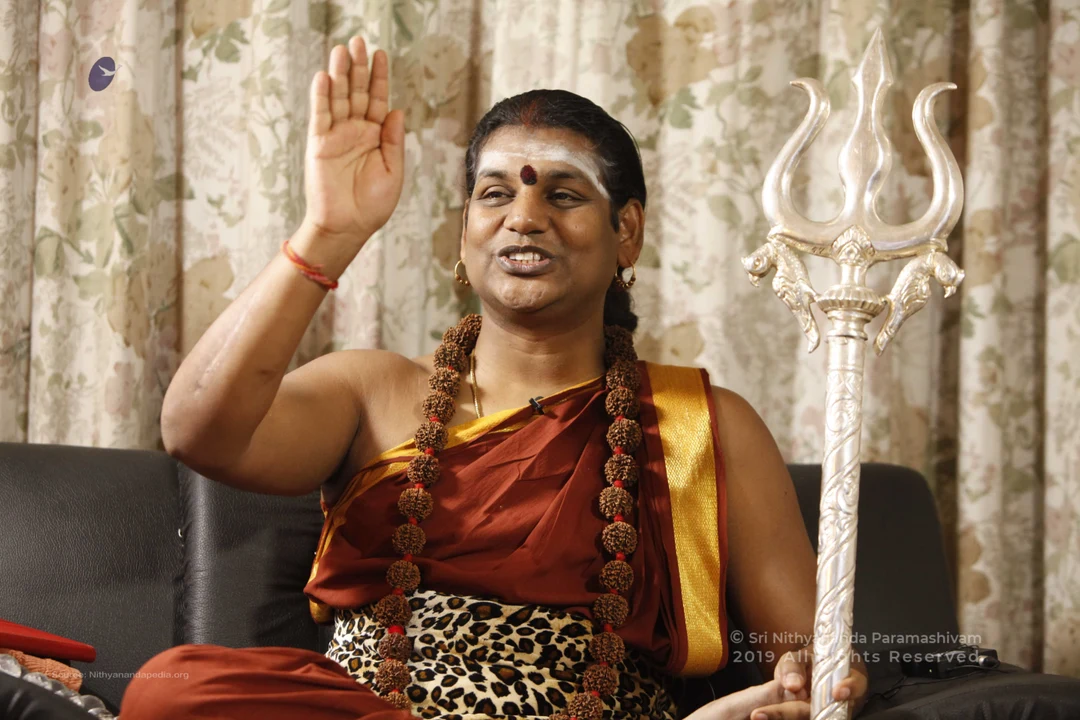
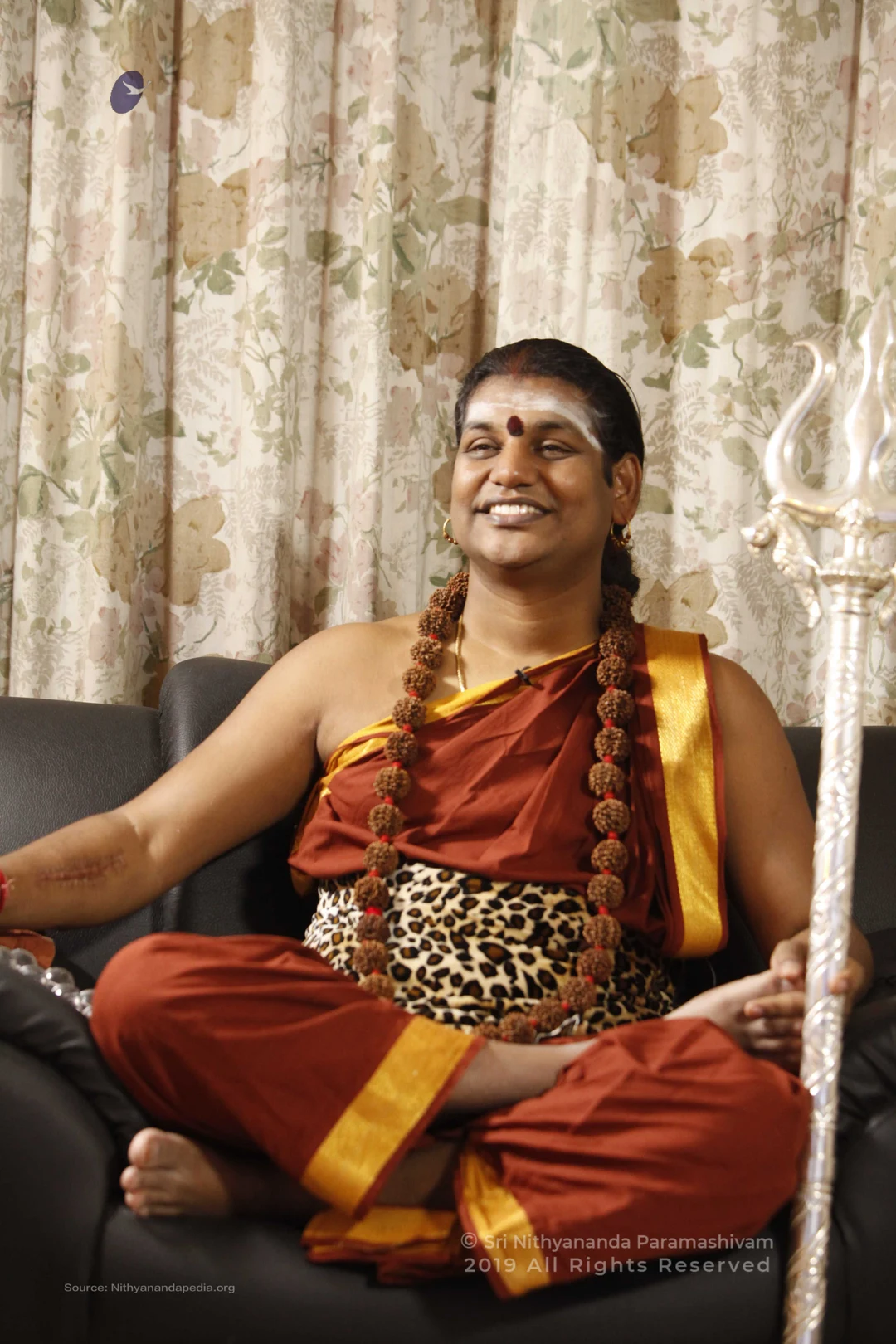
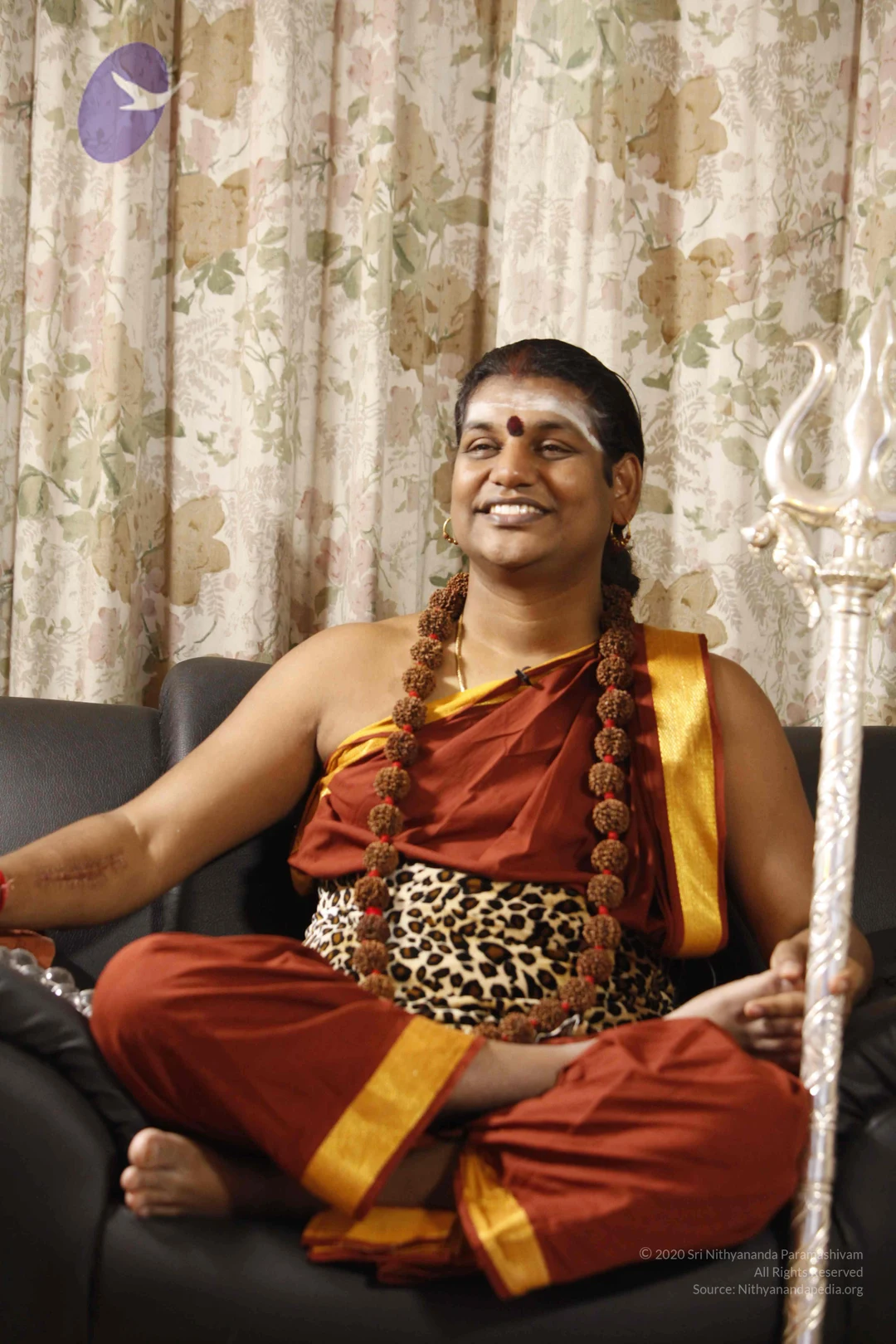
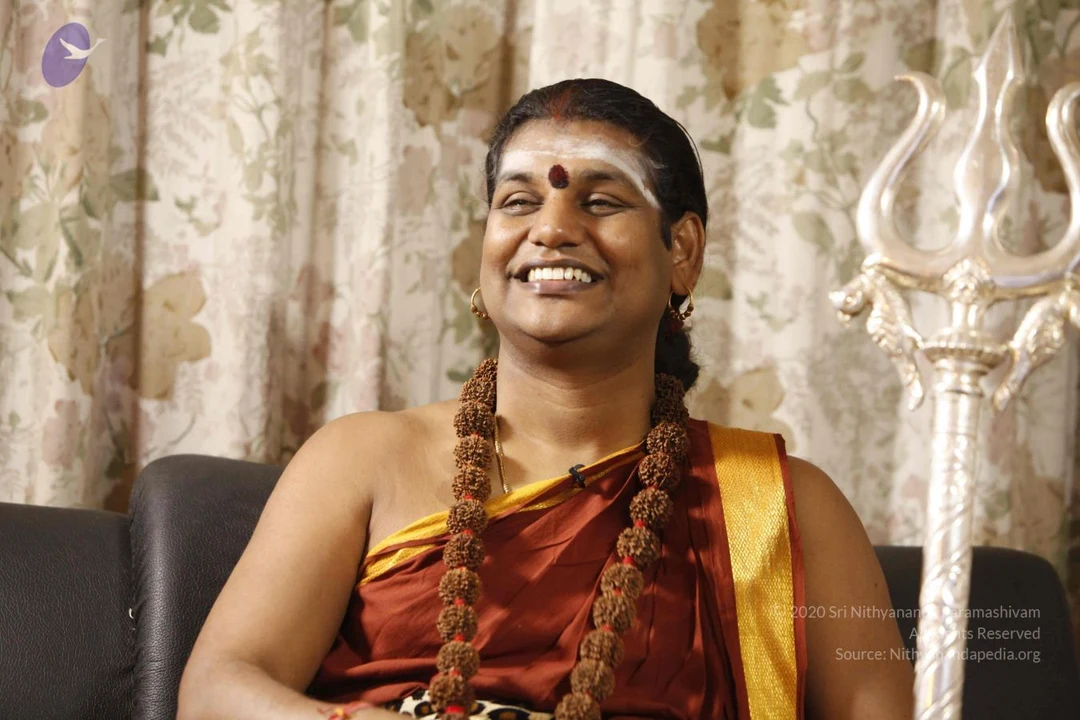
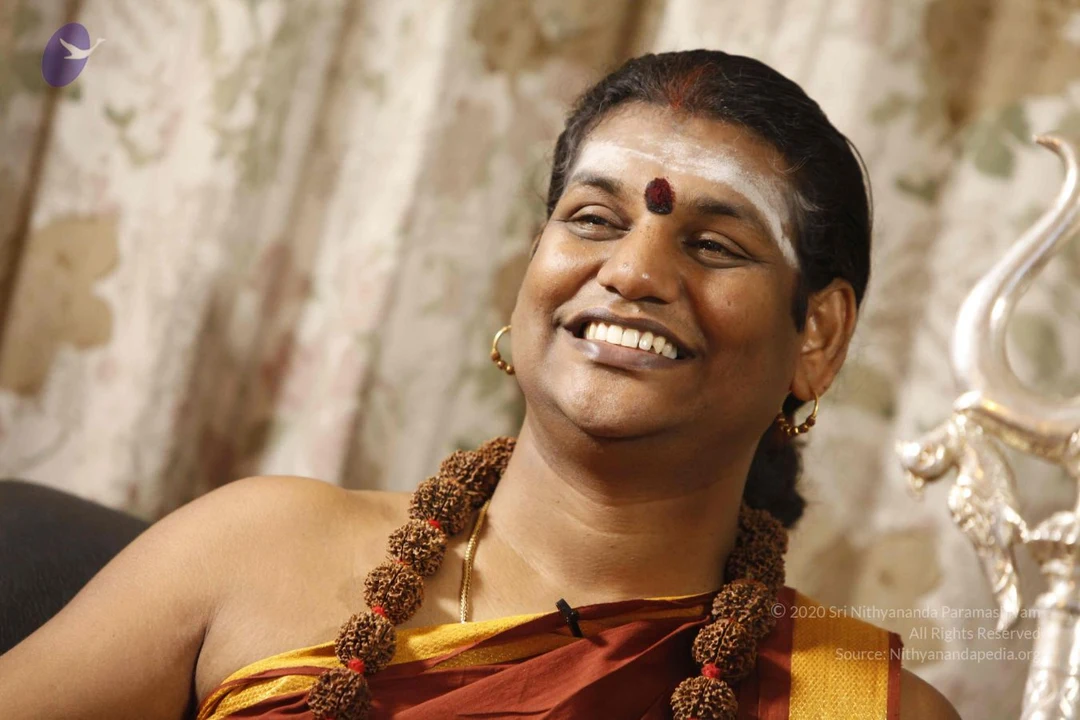
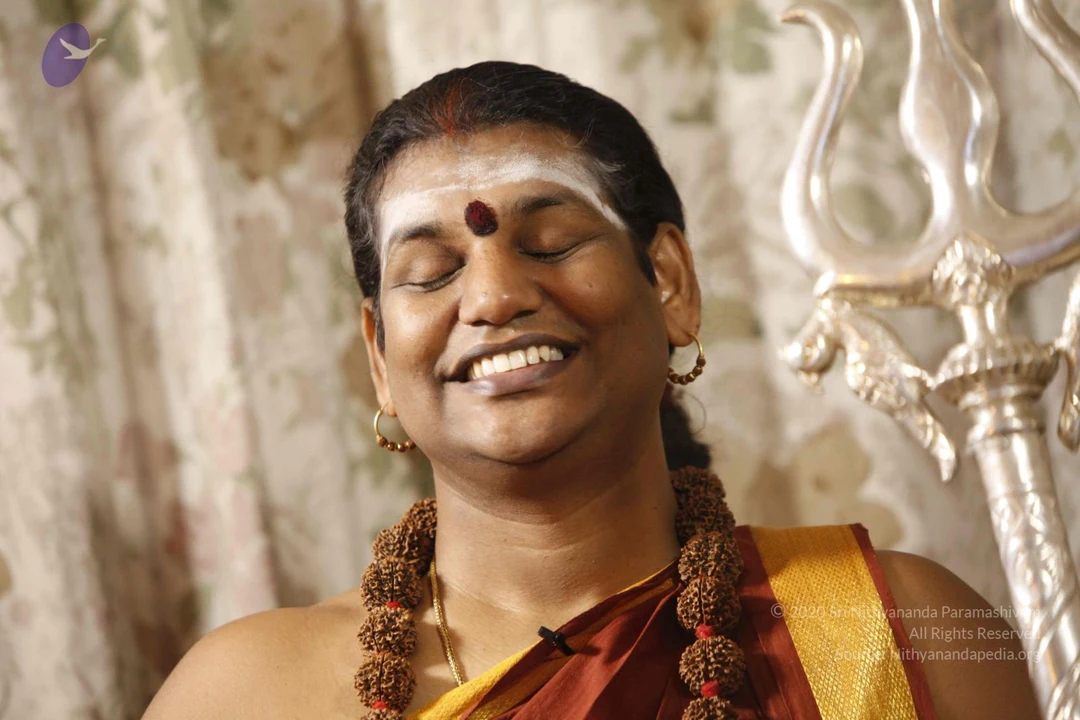
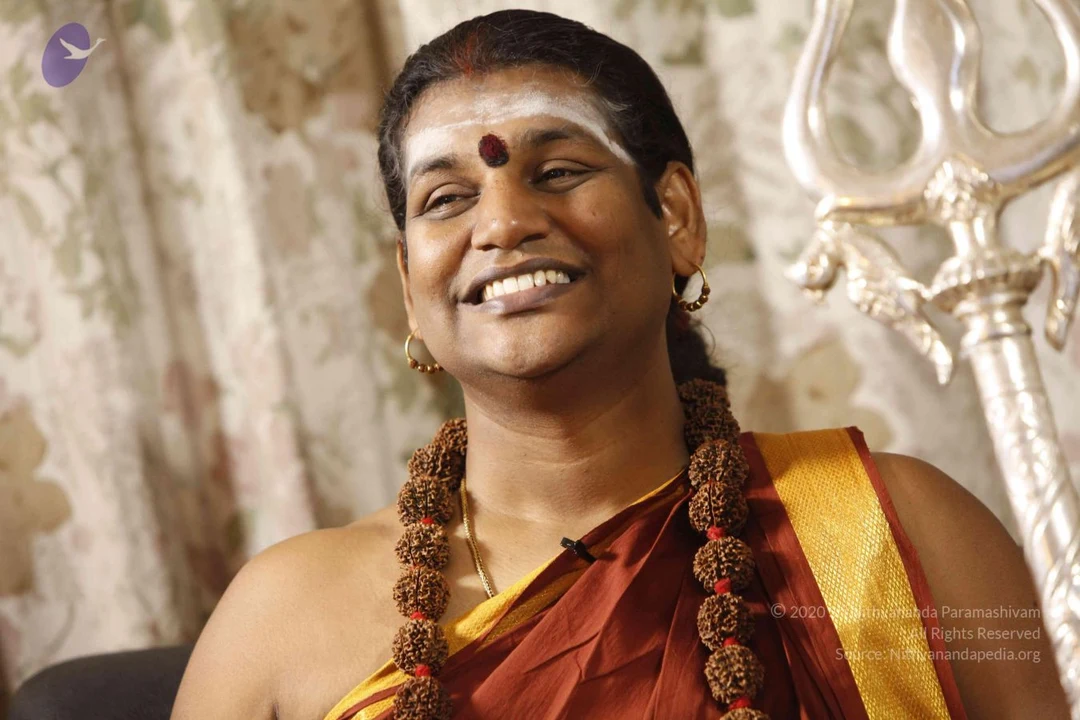
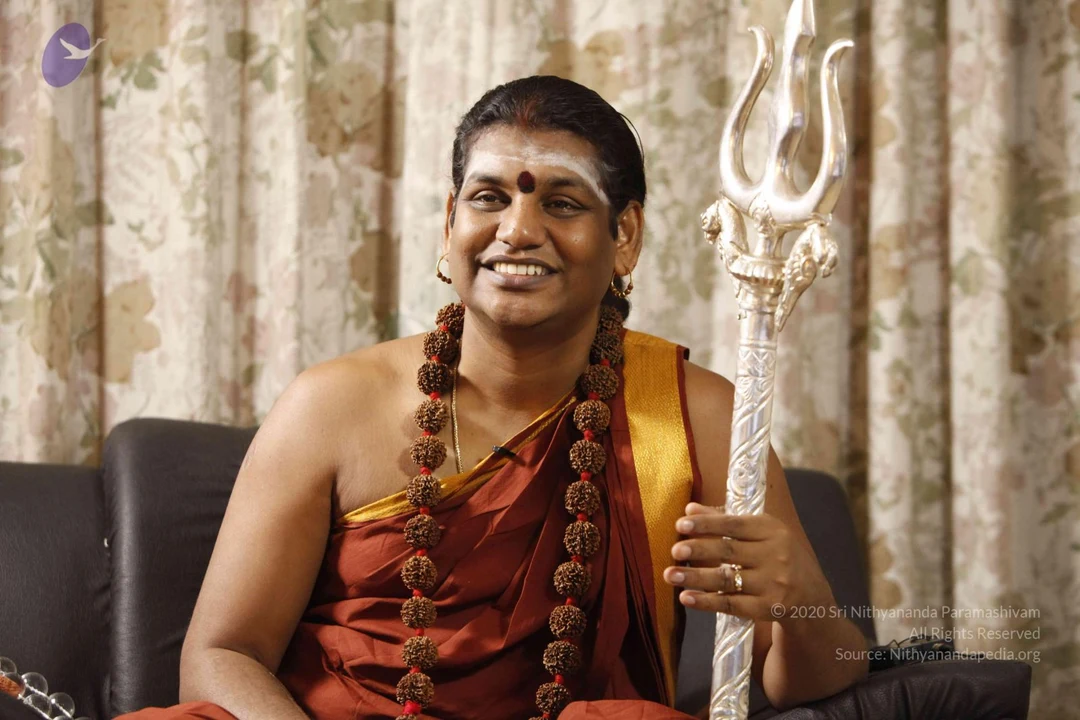
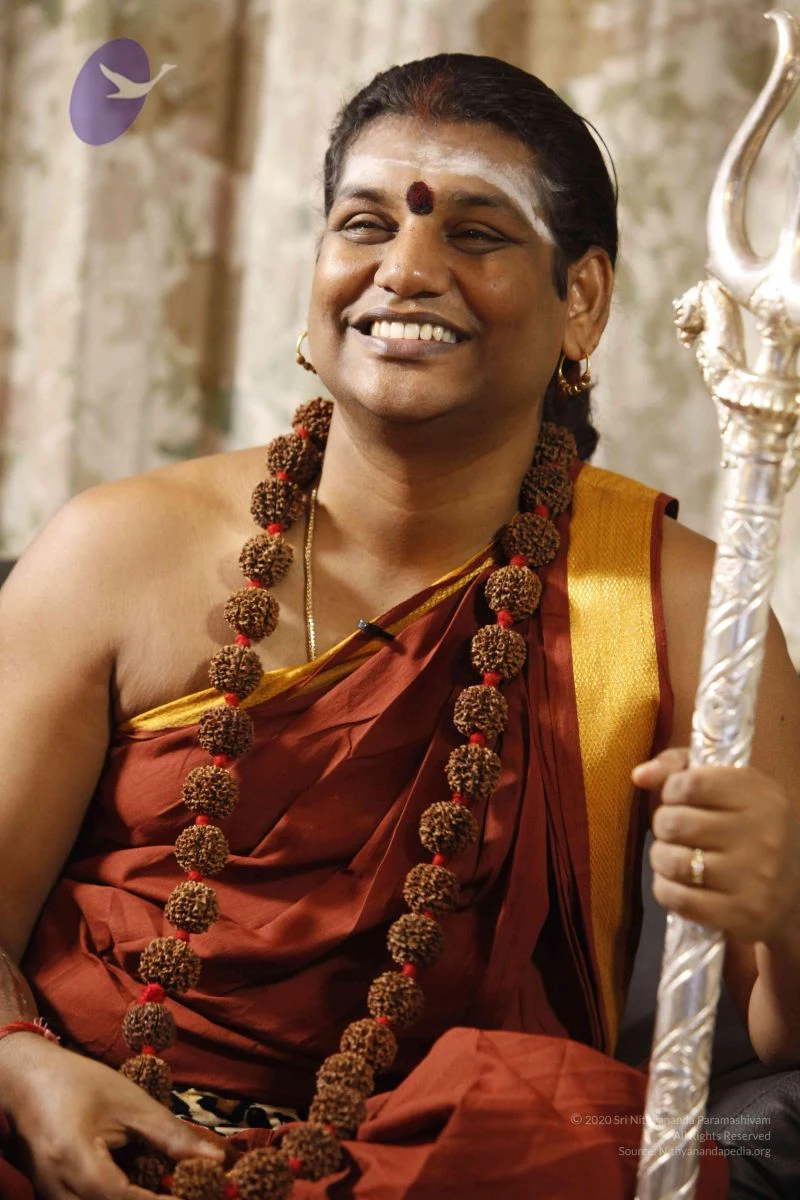
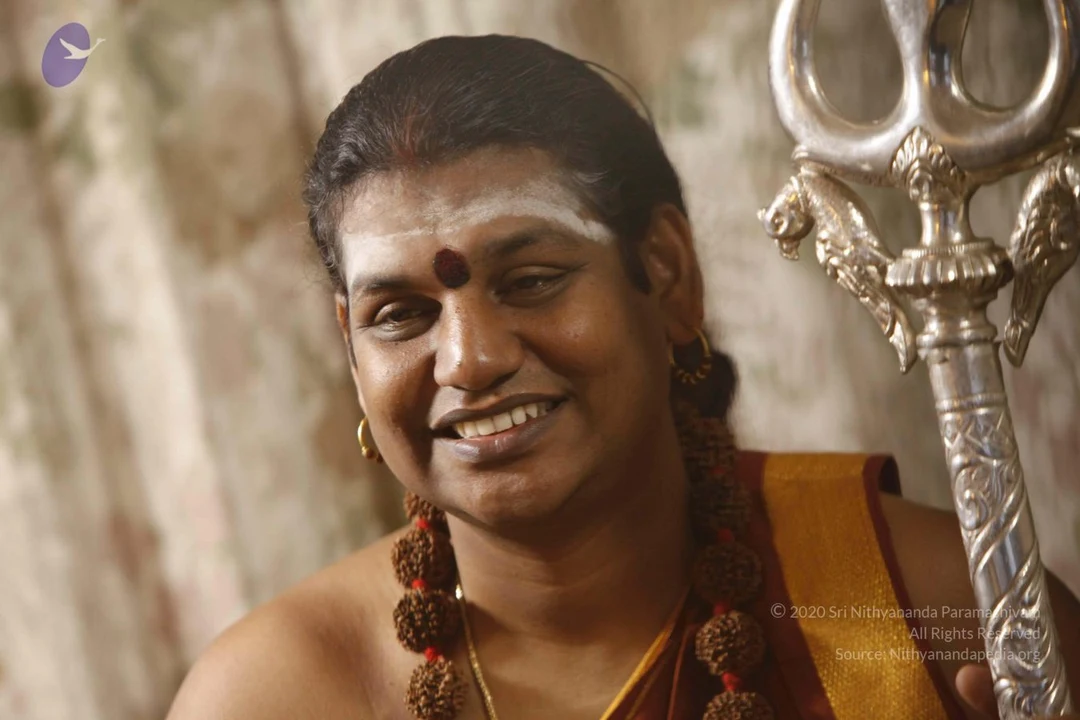
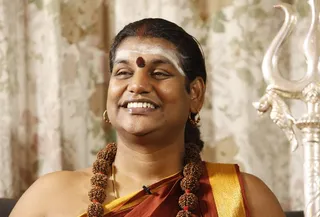
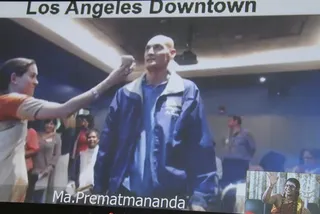
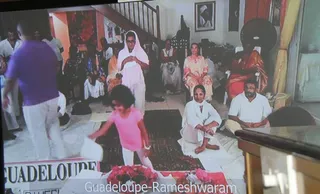
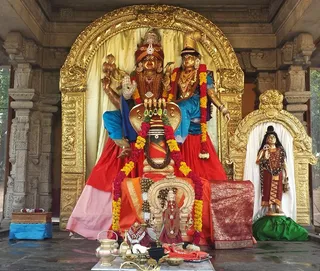
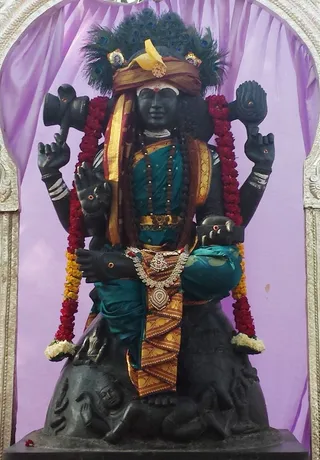
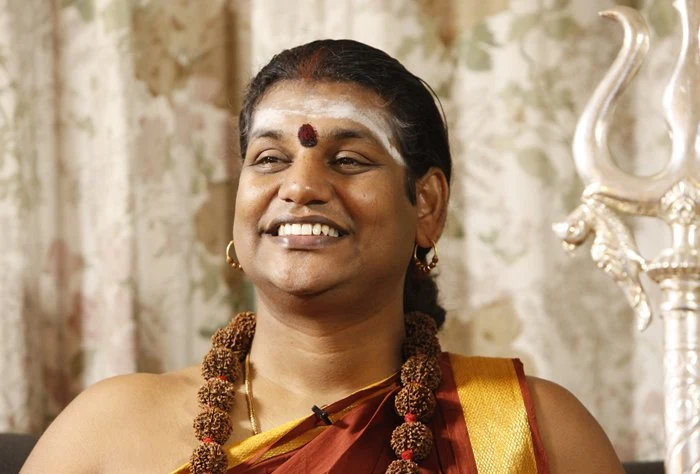
Close-up photograph of a smiling man seated before a floral-patterned curtain, with a silver trident (trishul) with ornate finials visible at the right edge. He wears a red and gold saffron-toned garment with a gold border, multiple large dark rudraksha mala beads around his neck, a gold chain, and gold hoop earrings. A white sacred mark is on his forehead with a red bindi above the brows. a person: the rudraksha malas, gold necklace, saffron-toned garment and ceremonial setting are compatible cues, but the appearance is not conclusive enough to confirm identity, so this is a seated devotee-style presentation with a trident beside him.A photograph of a projection screen showing a live video-conference feed labelled "Los Angeles Downtown" with a caption reading "Ma.Prematmananda" at lower left. On the feed, a bald man in a blue zip-up jacket stands in a room while a woman in an orange top reaches toward his head; several onlookers stand behind him. A small inset at lower right shows a woman with dark hair raising her hand, possibly the speaker. The camera and screen show a seminar setting with a projector mounted on the ceiling.A screen capture of a two-way video conference feed showing a room in Guadeloupe. A small child in a pink top and white pants stands on a rug in front of a low table decorated with pink and red flowers. A woman in a white sari sits cross-legged on the floor to the right, and a man in a white shirt sits beside her. Behind them, several seated people wear white and pale clothing, while a woman in an orange-red sari sits near a window with a red-curtained backdrop. A woman in a white head covering stands near the staircase. A banner reading GUADELOUPE is visible at the bottom left, with a caption naming Guadeloupe-Rameshwaram.A temple shrine with two large painted deity murtis seated side by side on a red-draped platform, one in a blue garment with a crown and the other in red with a tall orange-and-gold headdress, each wearing gold jewellery and marigold garlands. Between them stands a tall striped lingam-like object wrapped in a golden hood, draped with yellow and orange flower garlands. Brass lamps, kalasha-style vessels, a small flower-decorated dais and a red and gold cloth sit in the foreground, with a smaller standing figure in a red and white dhoti at the right beside an ornate gold arch. No people are visible.A dark stone statue of a four-armed deity seated on a rocky pedestal in front of a lilac drape within an ornate silver-framed niche. The murti wears a peacock-feather crown and a saffron-and-maroon turban with a gold ornament, plus a teal garment with gold border and a rudraksha mala. Red and orange marigold garlands hang over its arms, and a jewelled gold necklace rests on its chest. Its hands hold a drum, a snake-like object and other implements. A small figure lies at the base of the rock, and a red flower sits on the floor in front. No people are visible.

NithyaSatsang--Kalpatharu
34 photosSource gallery
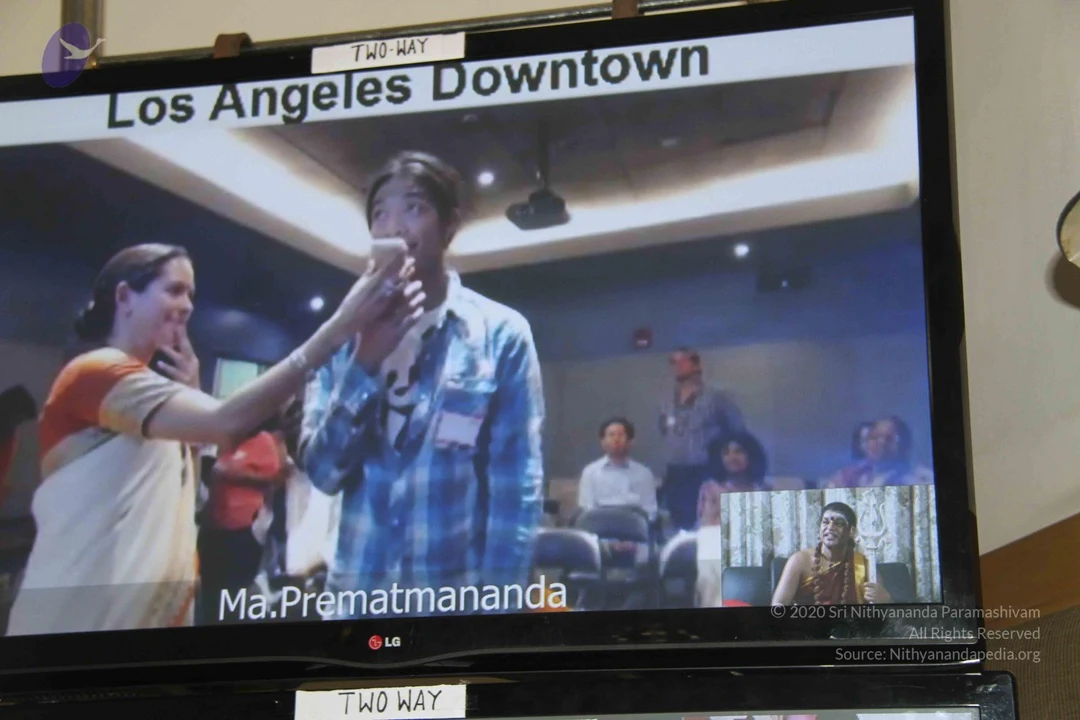
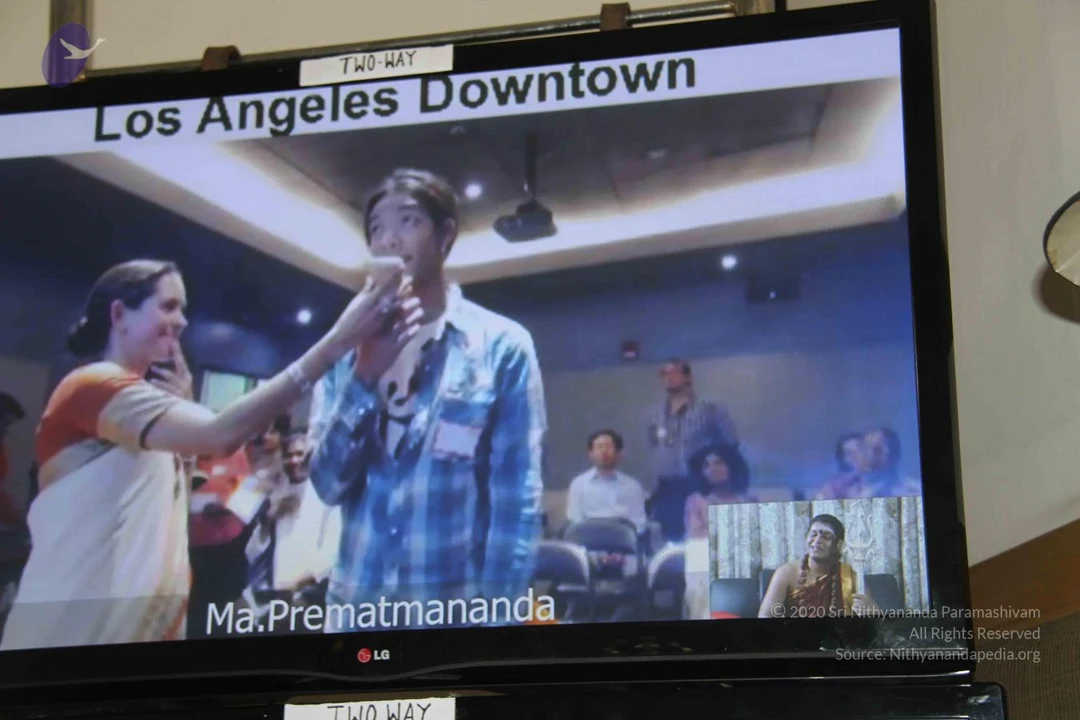
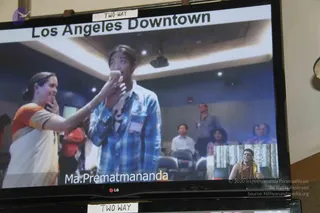
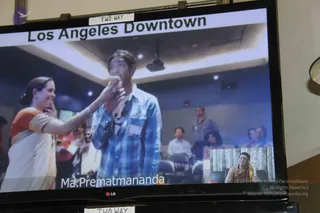
Photograph of a flat-screen TV on a stand, displaying a two-way video link captioned "Los Angeles Downtown" with a name caption reading "Ma.Premathmananda". On screen, a woman in a white and orange sari holds a small object toward a young man in a blue plaid shirt with a name badge, while seated attendees and a standing man in a grey shirt watch in a conference room. A small inset at lower right shows a speaker with long braided hair and a dark outfit in front of a patterned curtain. A paper label reading "TWO-WAY" is taped above the screen and another "TWO WAY" label sits below it.A photograph of a flat-screen TV showing a two-way video conference feed labelled "Los Angeles Downtown" on a top banner, with a caption reading "Ma.Premātmananda" at lower left. On screen, a woman in an orange-and-cream sari holds a cup to the mouth of a young man in a blue plaid shirt, while other people sit in a room in the background. In the inset at lower right, a figure wearing a red-and-gold garment and beaded necklaces sits before a curtain, with a trident-like emblem visible behind. A paper label reading "TWO-WAY" is taped above and below the screen.A photograph of a flat-screen TV showing a two-way video conference feed labelled "Los Angeles Downtown" with the caption "Ma.Prematmananda". On the screen a woman in a cream and orange sari reaches toward a bald man in a blue zip jacket, with onlookers behind them in a room. A small inset in the corner shows a woman in a saffron and gold sari raising her hand. A paper sign reading "TWO-WAY" is taped above the screen.Photo of a flat-screen TV in a room, showing a two-way video link labelled "Los Angeles Downtown". On screen, a woman in an orange-and-white sari reaches toward a bald man in a blue zip jacket, with a group of people standing behind them in a meeting room. A caption on the screen reads "Ma.Premaatmananda". In the bottom-right inset, a woman in a red-and-gold sari with a long braid raises her hand in a trident-patterned setting. Labels reading "TWO-WAY" are taped above and below the screen.Photograph of a television monitor showing a two-way video link: a group in a room at Guadeloupe, with aA photograph of a television screen showing a two-way video link to a room with a small group. A man in a purple shirt and white trousers stands at left. A young girl in a pink top stands on a dark patterned rug near pink flower offerings. A woman in white with a white head covering stands near the stairs, and a seated woman in white sits on the floor with a man in white beside her. A woman in orange and red sari sits on a chair at right, with a framed portrait of a bearded turbaned man on the wall above. Visible at bottom is the caption Guadeloupe-Rameshwaram on the screen. No a person candidate is clearly identifiable by appearance.

SriRameshwarpurii--Mahraj--Visits
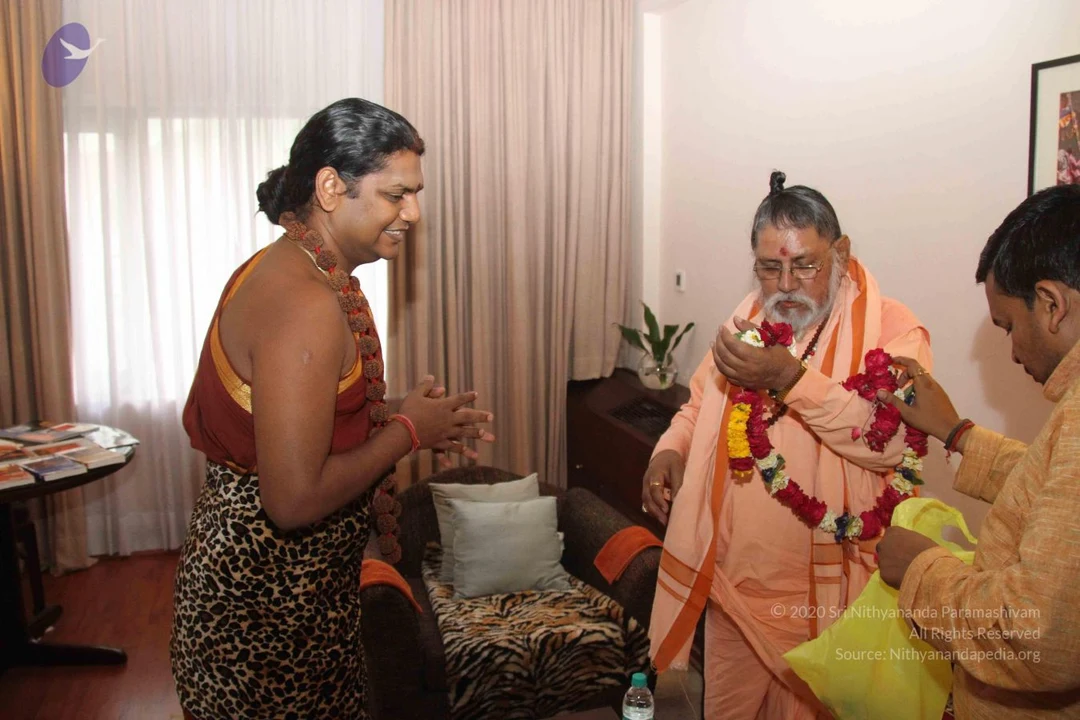
9 photosSource gallery
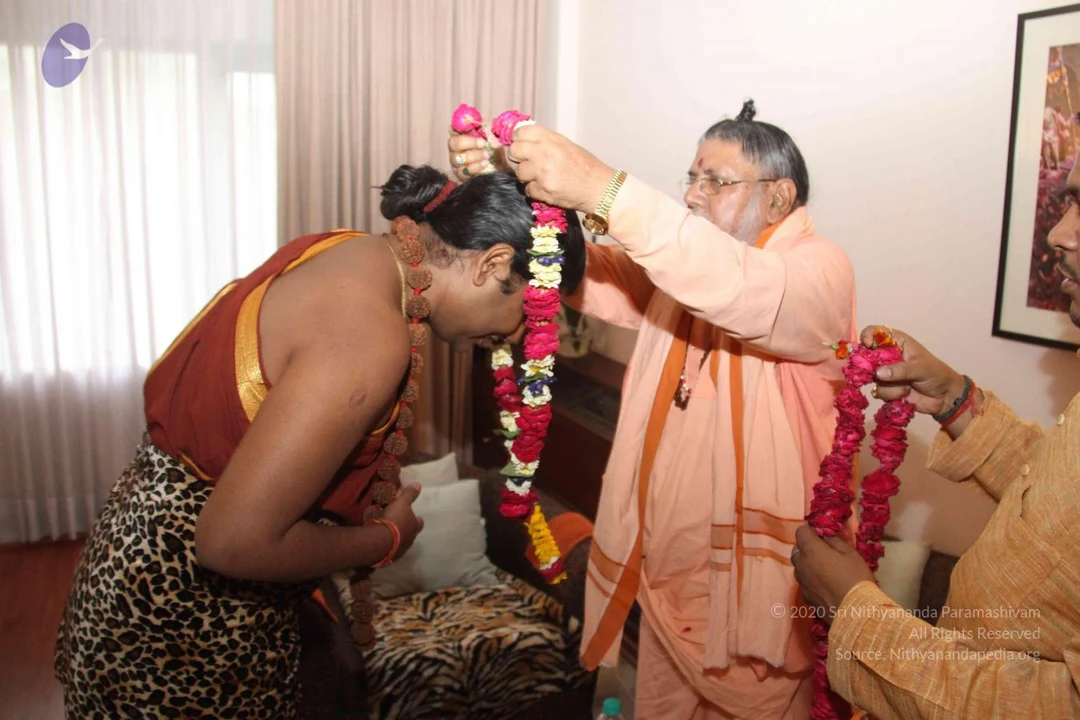
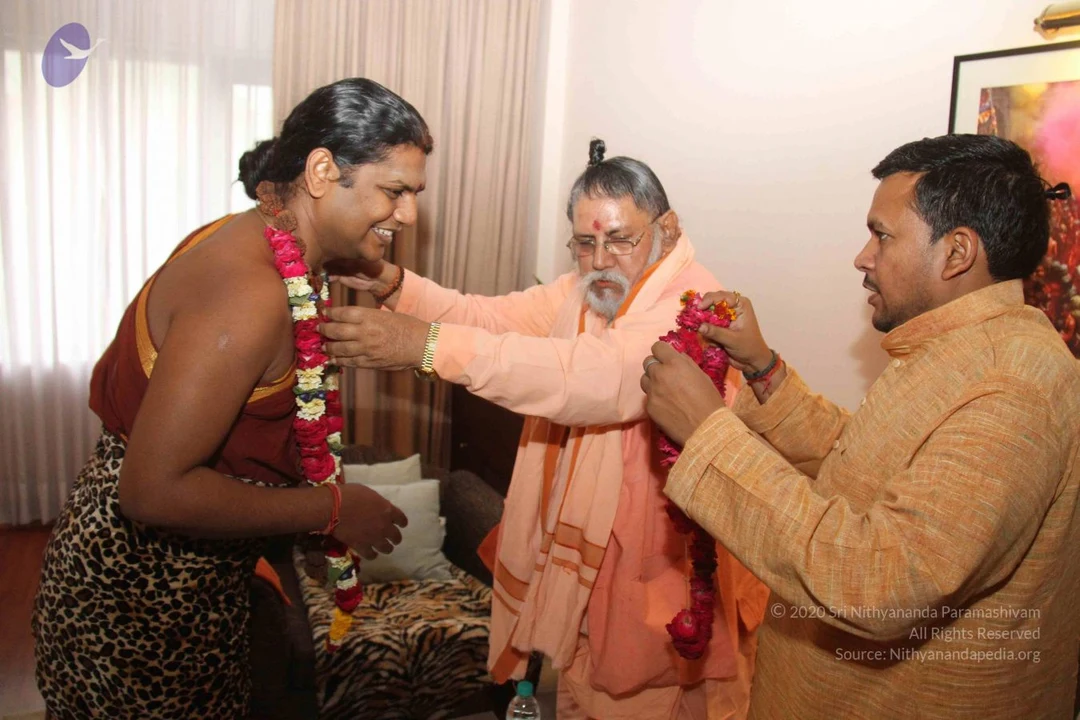
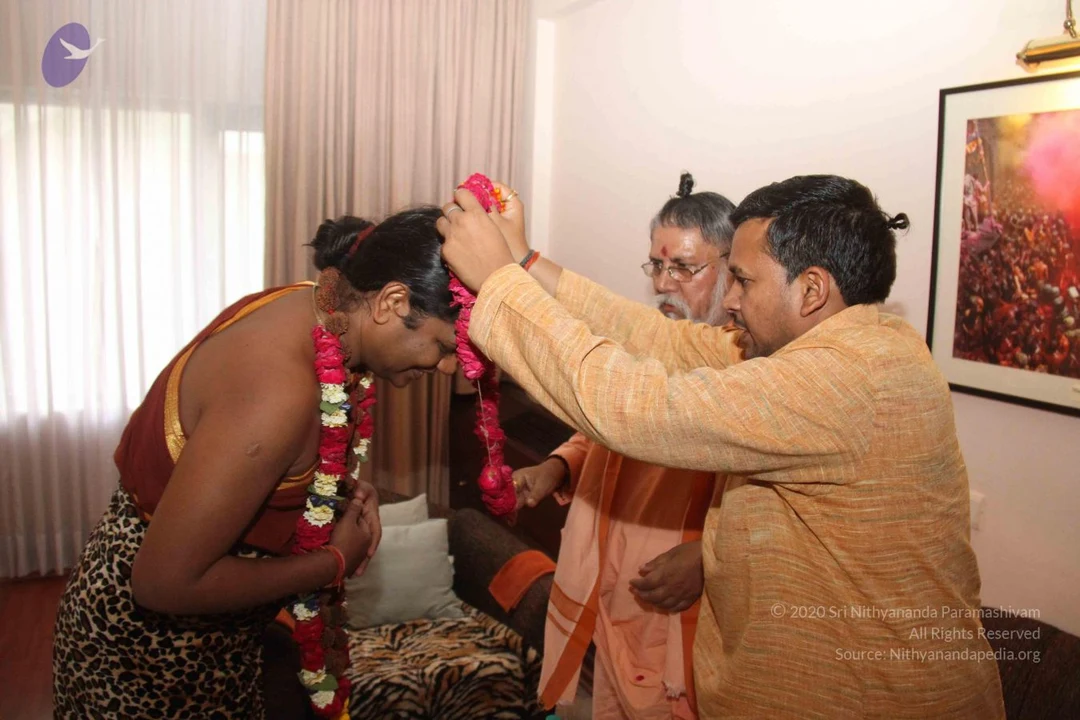
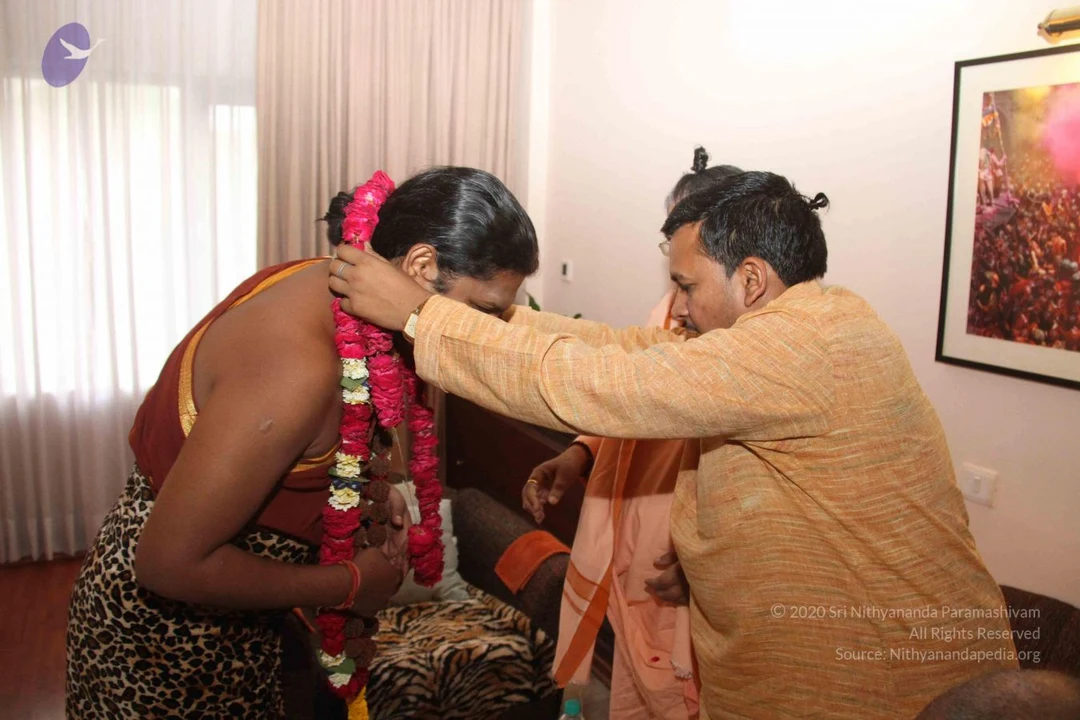
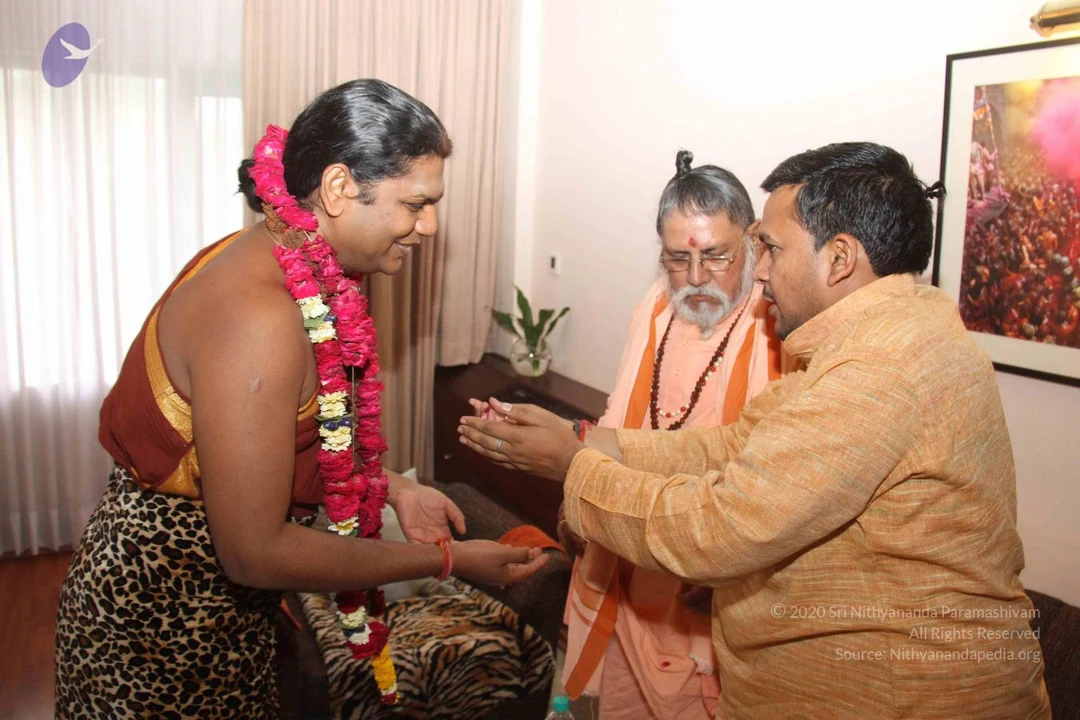
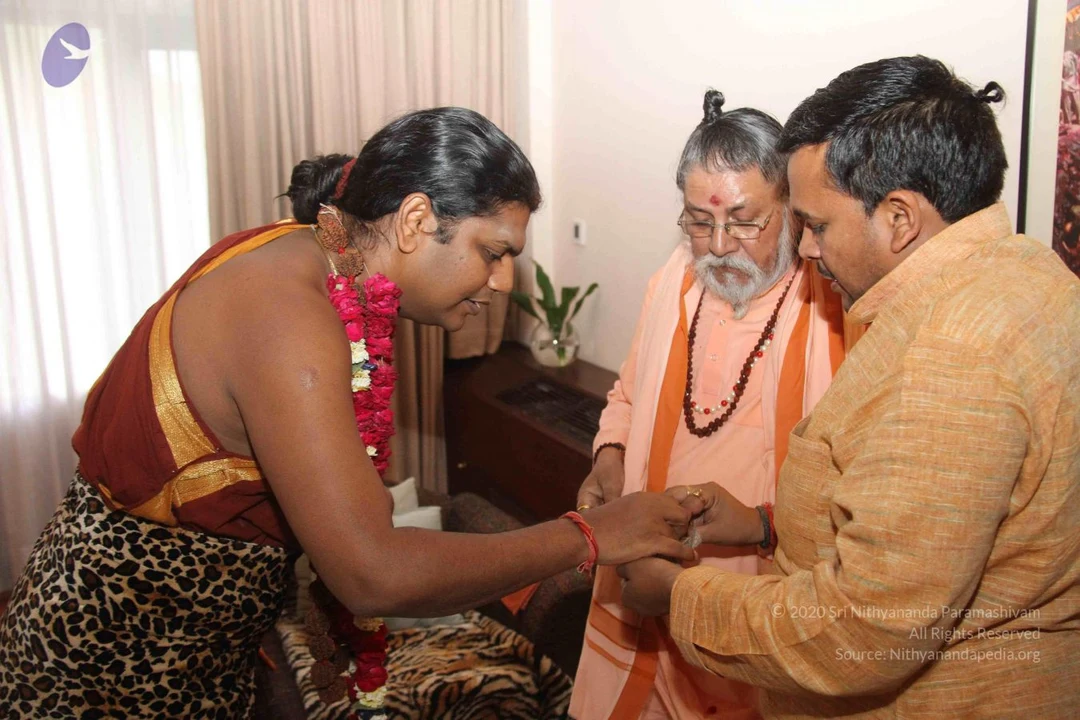
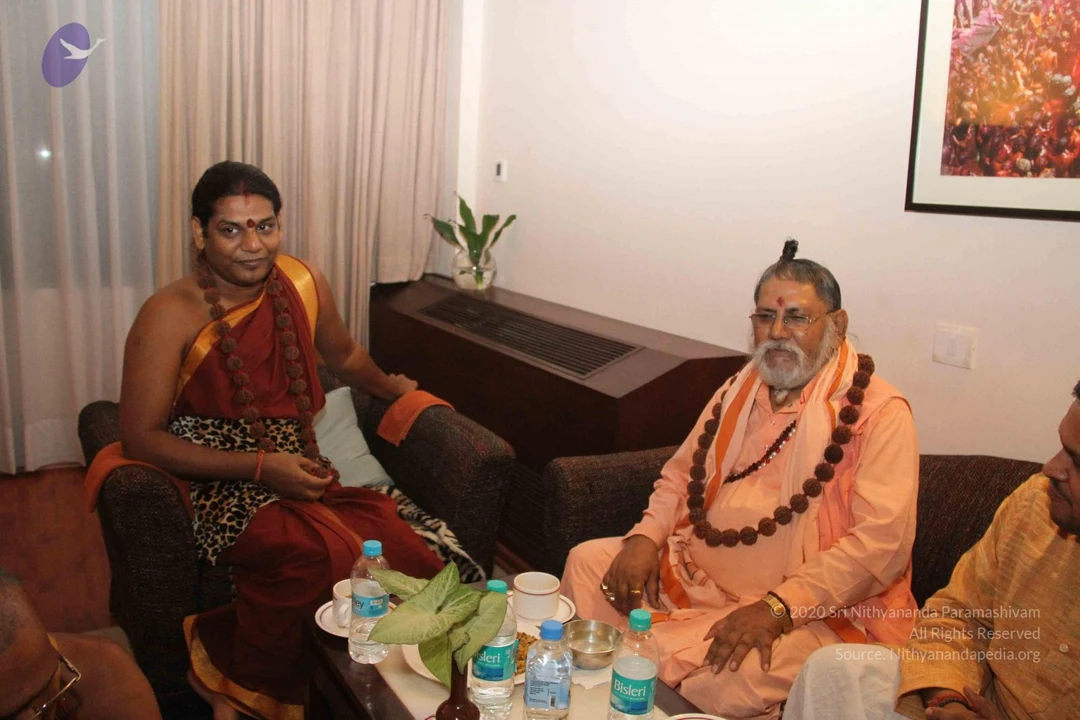
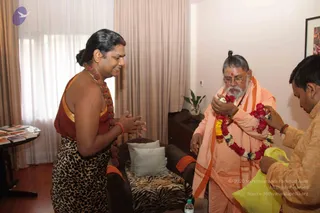
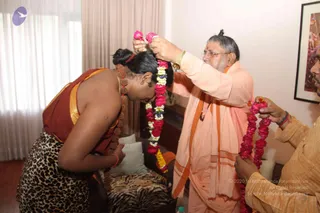
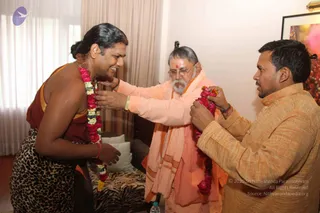
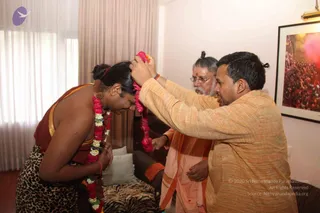
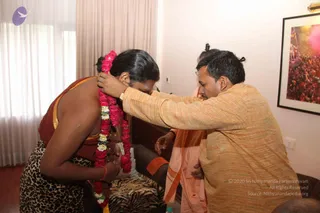
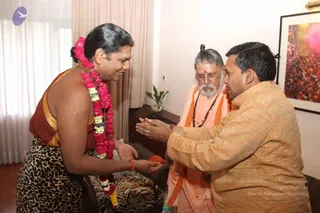
Indoor photo in a bright room with sheer curtains and a tiger-striped armchair with cushions. A woman in a rust-red top and leopard-print wrap, with rudraksha beads around her neck, stands with palms pressed together in greeting. An older man with a white beard and a topknot, dressed in saffron-orange robes and wearing spectacles, holds a garland of red roses and yellow marigolds. A younger man in an orange kurta, at right, handles a yellow carry bag beside him. A bottle of water sits on the floor and printed pamphlets lie on a side table.A woman in a rust-red blouse and leopard-print wrap bends forward at the head while an older man in a pale peach-orange robe with an orange shawl places a garland of pink, white and yellow flowers over her head. Another man in an orange-brown kurta holds a pink flower garland at the right edge. The setting is a living room with a striped cushioned sofa, white cushions, sheer curtains and a framed picture on the wall. The older man has a shaved head with a pulled-back tuft, glasses and a red forehead mark, and wears a gold wristwatch. The garlanding is a welcome gesture of honour. a person identity is not established from appearance.A photograph taken in an indoor room with cream curtains, a patterned sofa with white cushions, and a framed picture on the wall. A smiling person with long dark hair in a low bun, wearing a maroon top and a leopard-print wrap, has a long pink and white flower garland placed around their neck. A man with grey hair, glasses and a grey beard, dressed in a saffron-orange shawl and robe with a red tilak, is placing the garland with both hands. On the right, a man in a light orange textured kurta is holding a pink flower garland. Two people are fully visible, and one more man is partially visible at the right edge, making three physical people in total. The garland-giving suggests a welcoming gesture, but no identity is established from appearance.A photograph in an indoor room with white curtains and a cushioned couch covered in a leopard-print cloth. A person in a rust-red top and leopard-print skirt, with a red flower garland around the neck and a gold-coloured ornament in the hair, bows forward. A man in a light orange-beige kurta holds a red and pink flower garland over the bowed person's head. Beside him, an older man with grey beard and glasses, wearing an orange-saffron cloth and a red tilak mark, watches. A framed photograph of a crowd covered in pink powder hangs on the wall.Indoor photo in a bright room with sheer white curtains and a framed colour photograph of a crowd covered in pink powder on the wall. A woman with a red-and-gold blouse and leopard-print wrap stands bent forward, hands clasped, while a man in a light orange kurta-style shirt places his hand on her shoulder and drapes a long garland of pink and white flowers with rudraksha beads around her neck. Behind them a person in orange-saffron robes and a hair knot stands near a brown armchair. Two physical people are clearly visible, plus a third partly seen in orange clothing.Indoor photo in a bright room with white sheer curtains and a framed photograph of a crowd with pink powder on the wall. A bare-chested man with long swept-back dark hair and a leopard-print lower garment wears a thick garland of pink, white and yellow flowers and stands with hands together. Facing him, a man in a peach-orange kurta with hands pressed palm to palm is offering a greeting. Between them an older bearded man in orange robes and rudraksha beads, with grey hair tied up, stands watching. A tiger-print cloth lies on a sofa and a small potted plant sits on a table.

Book--Pics
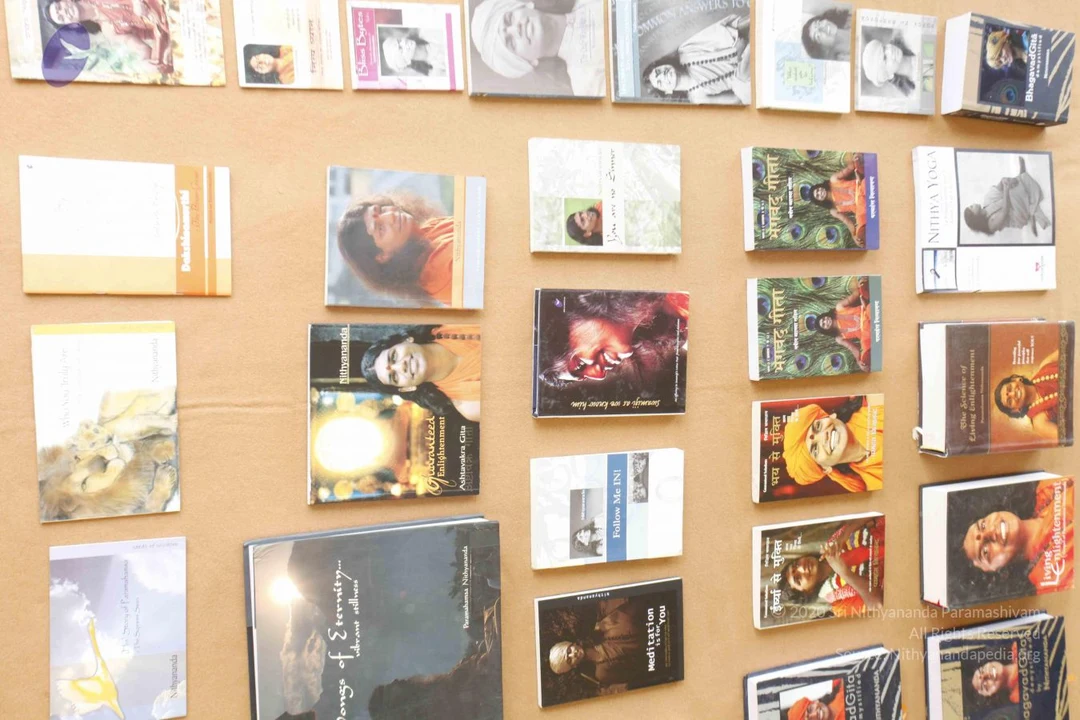
20 photosSource gallery
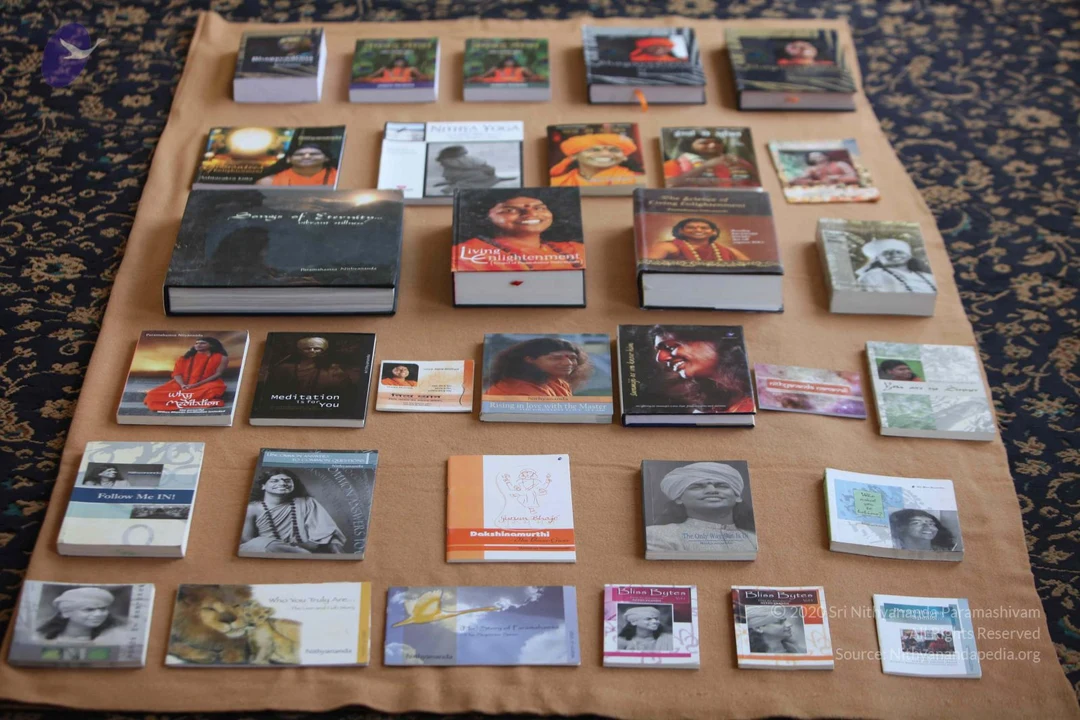
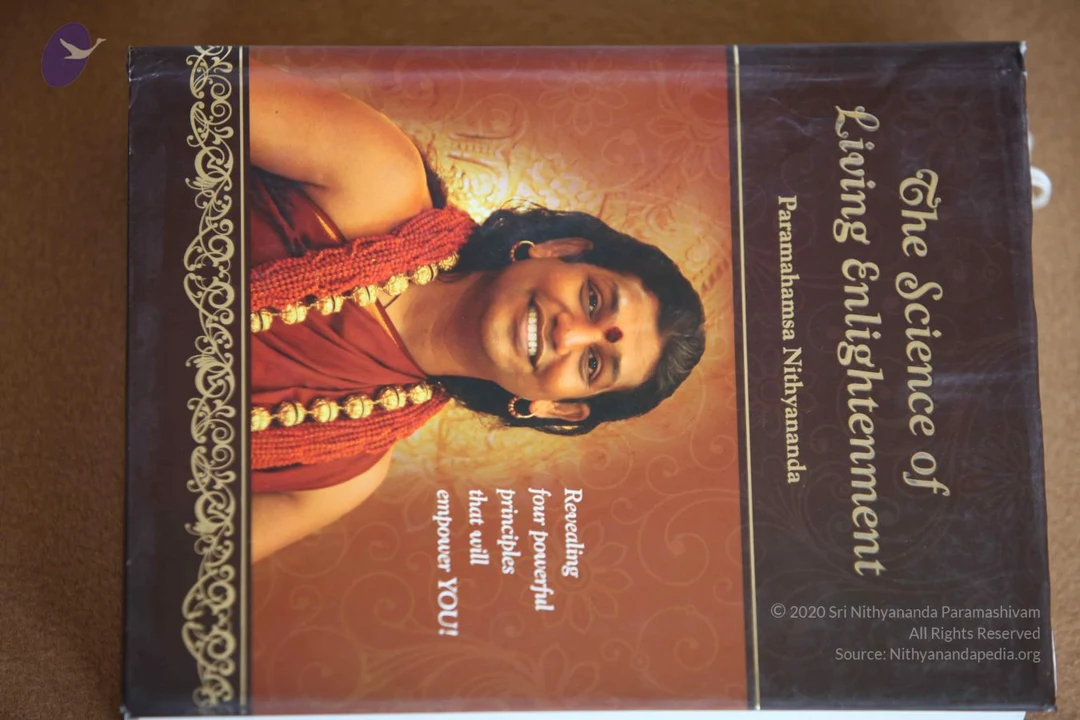
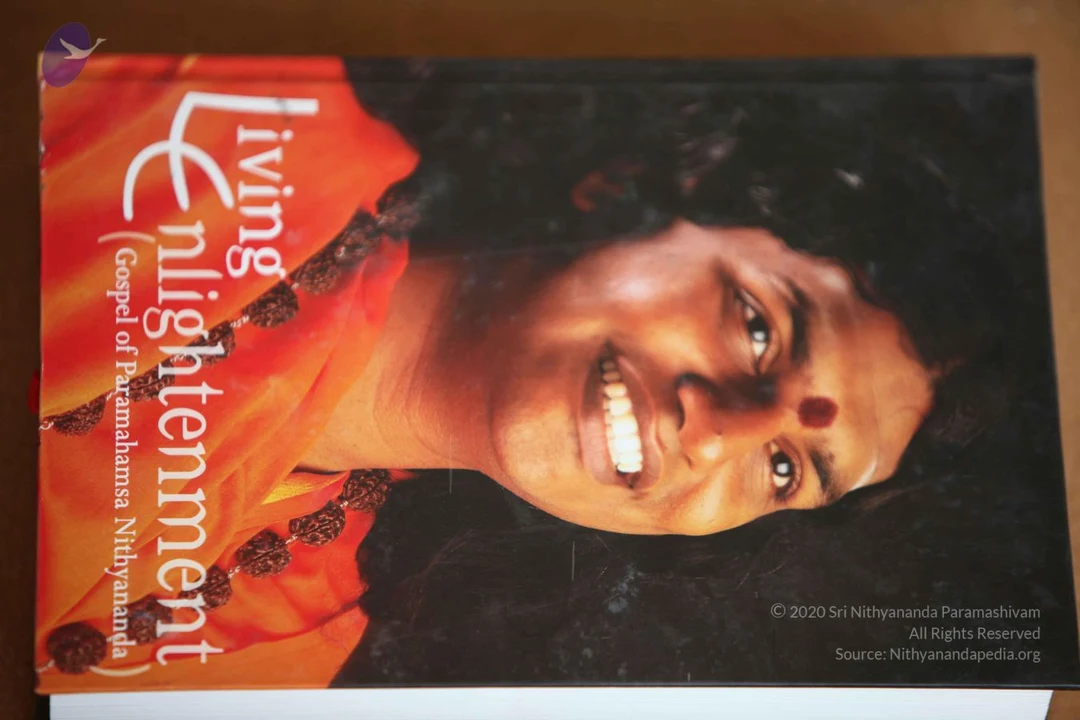
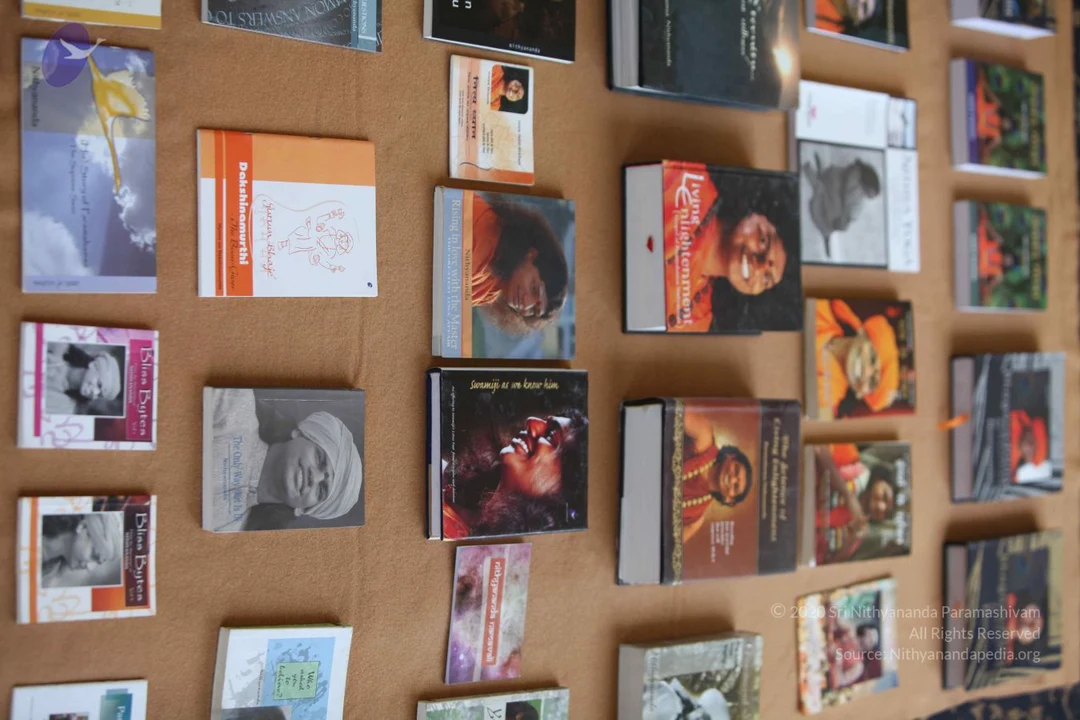
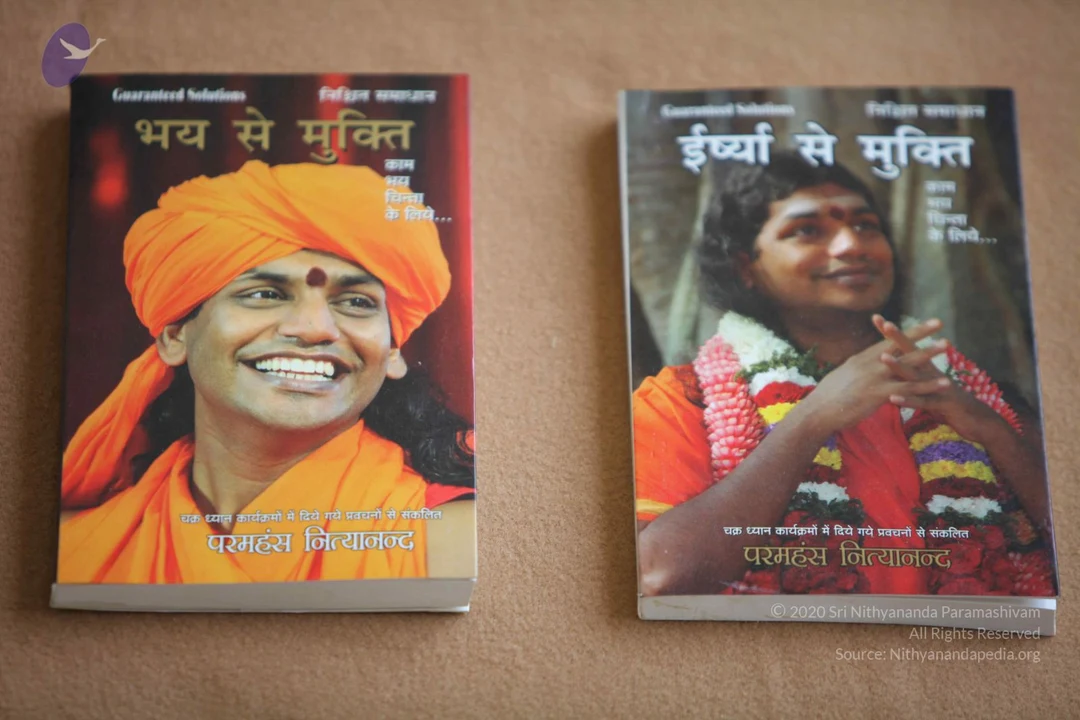
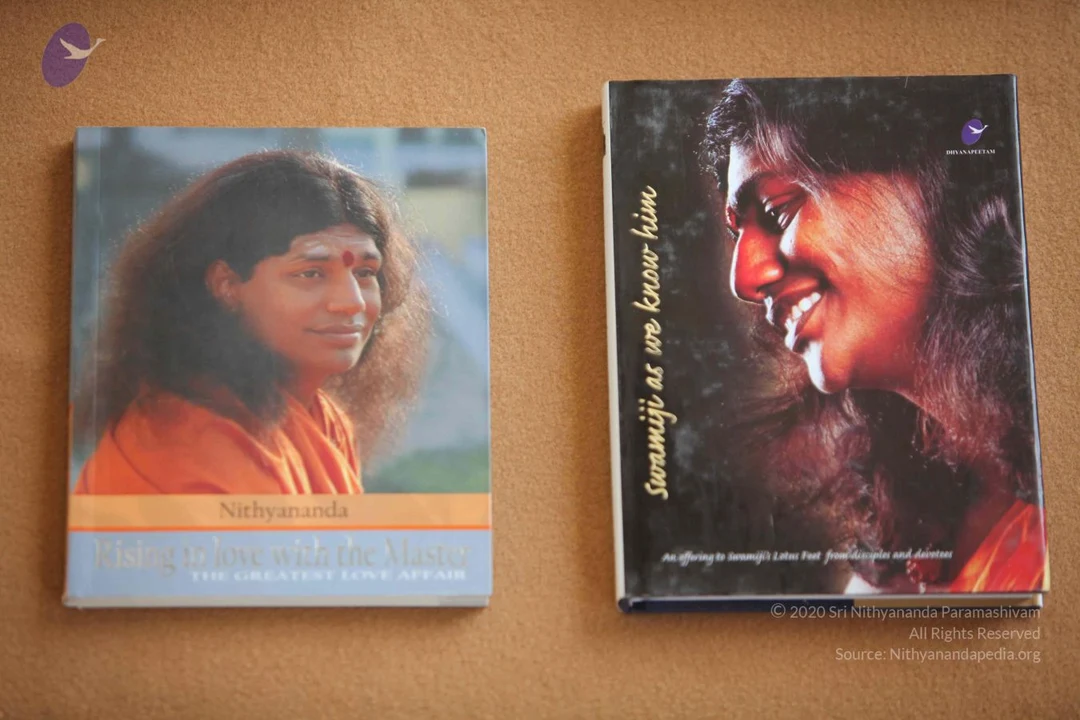
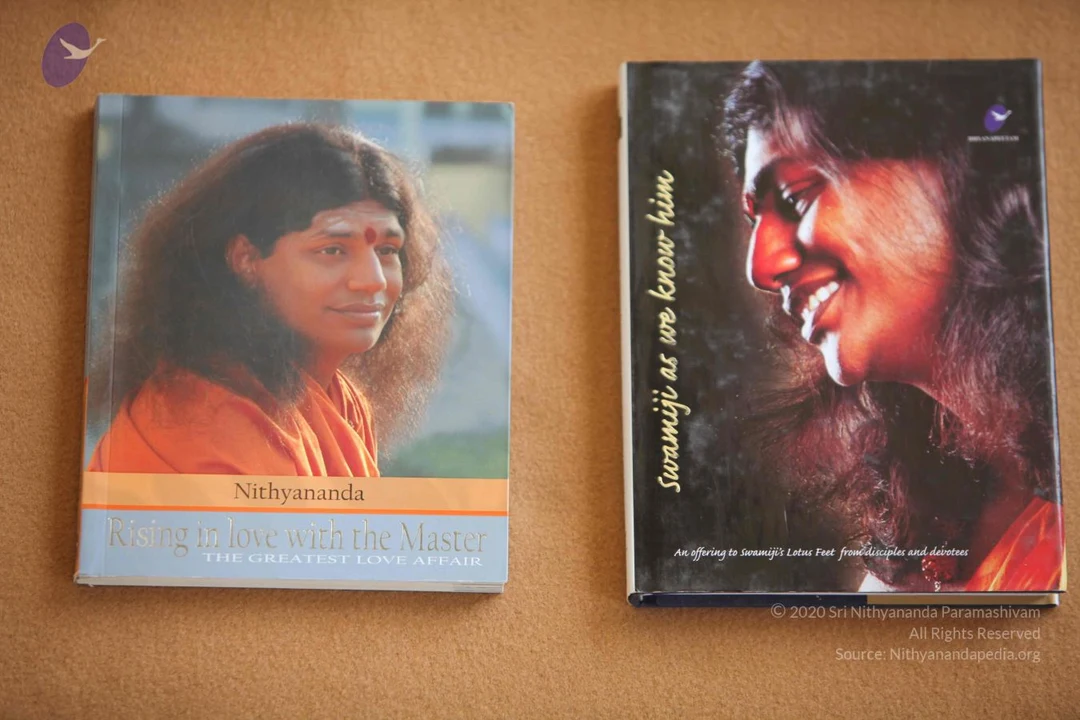
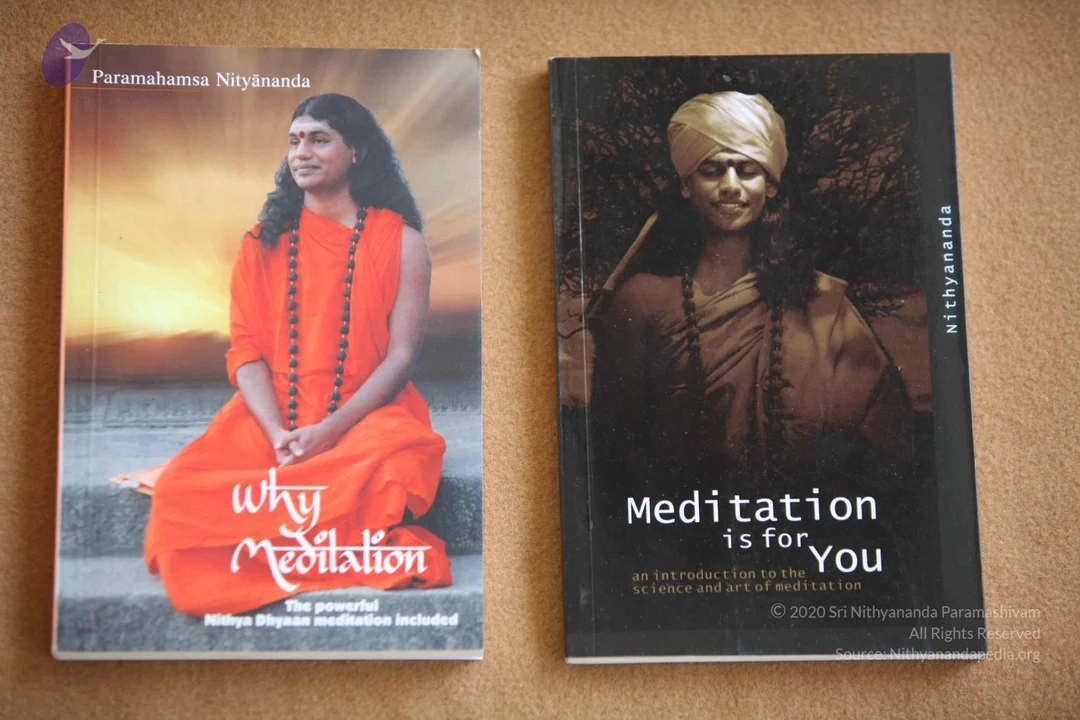
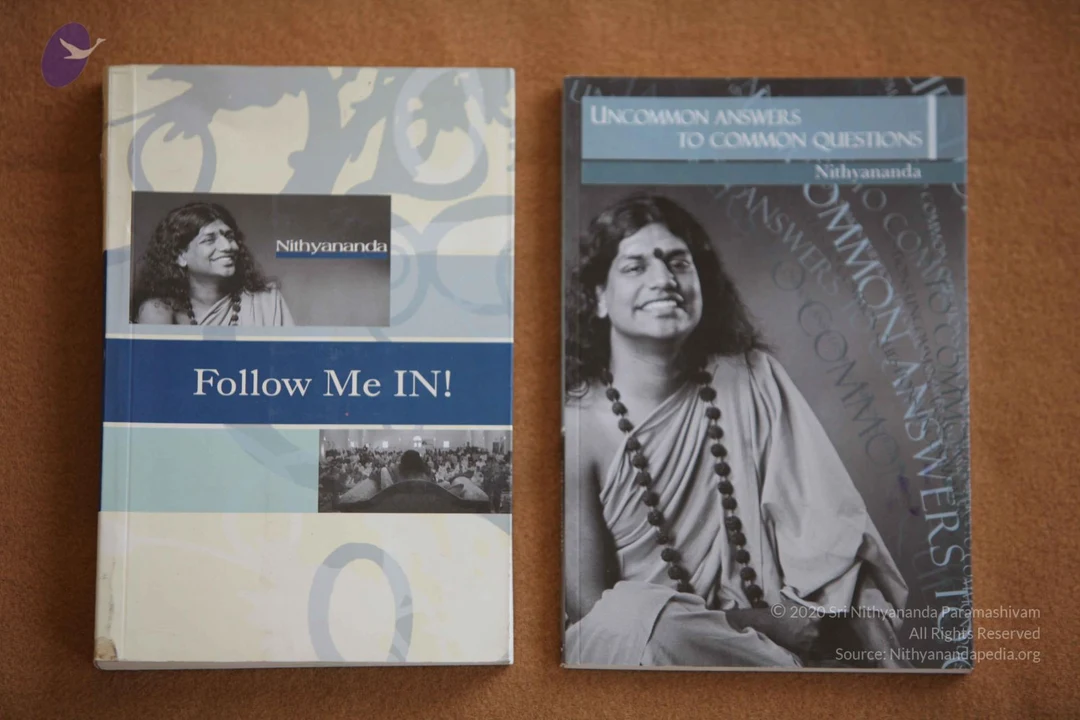
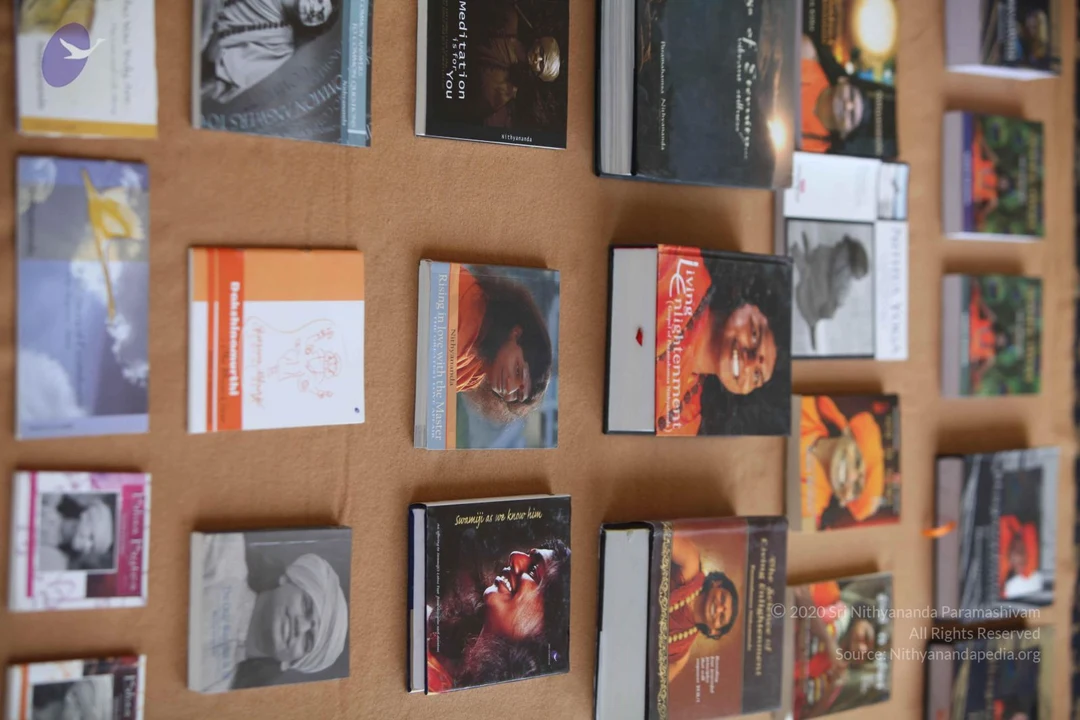
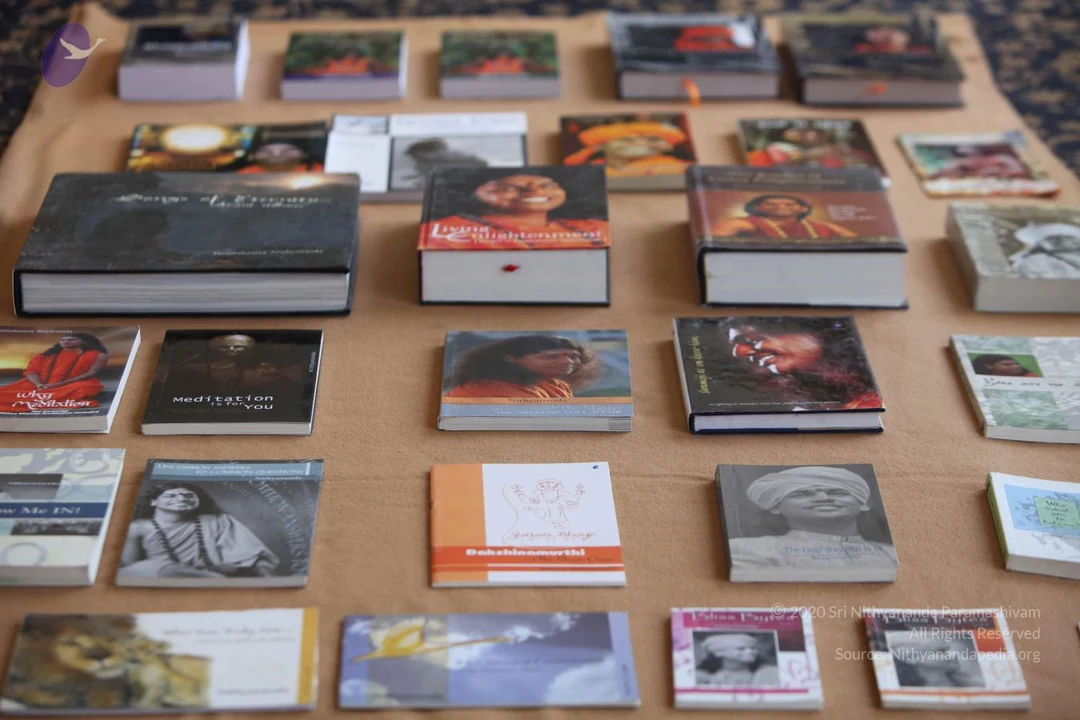
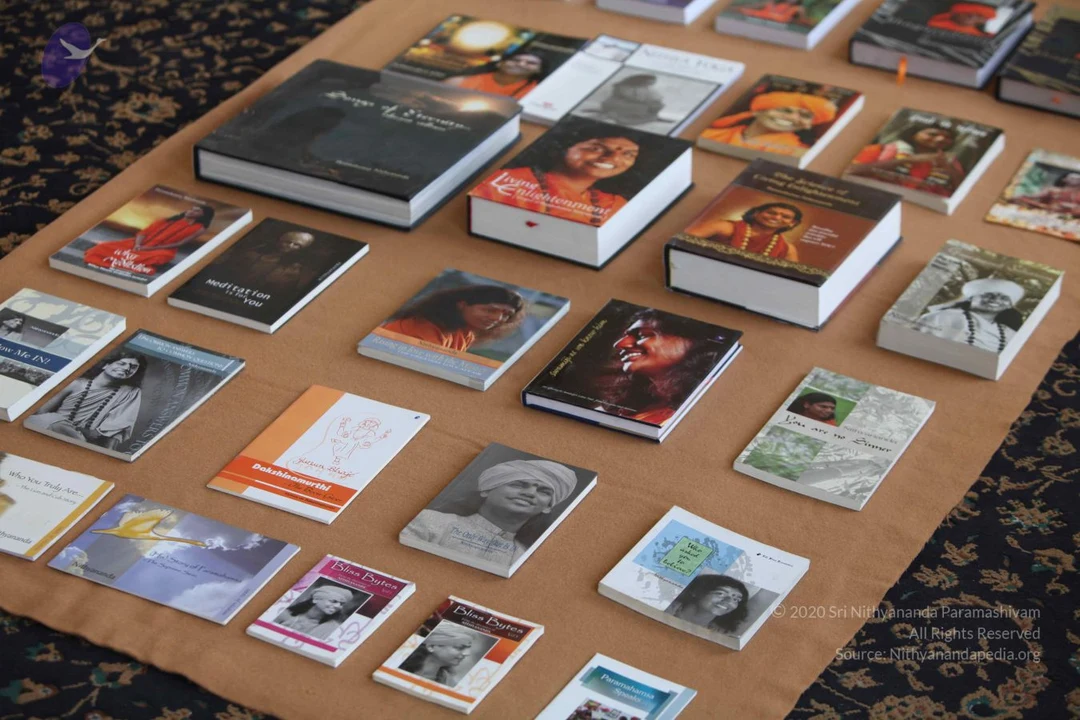
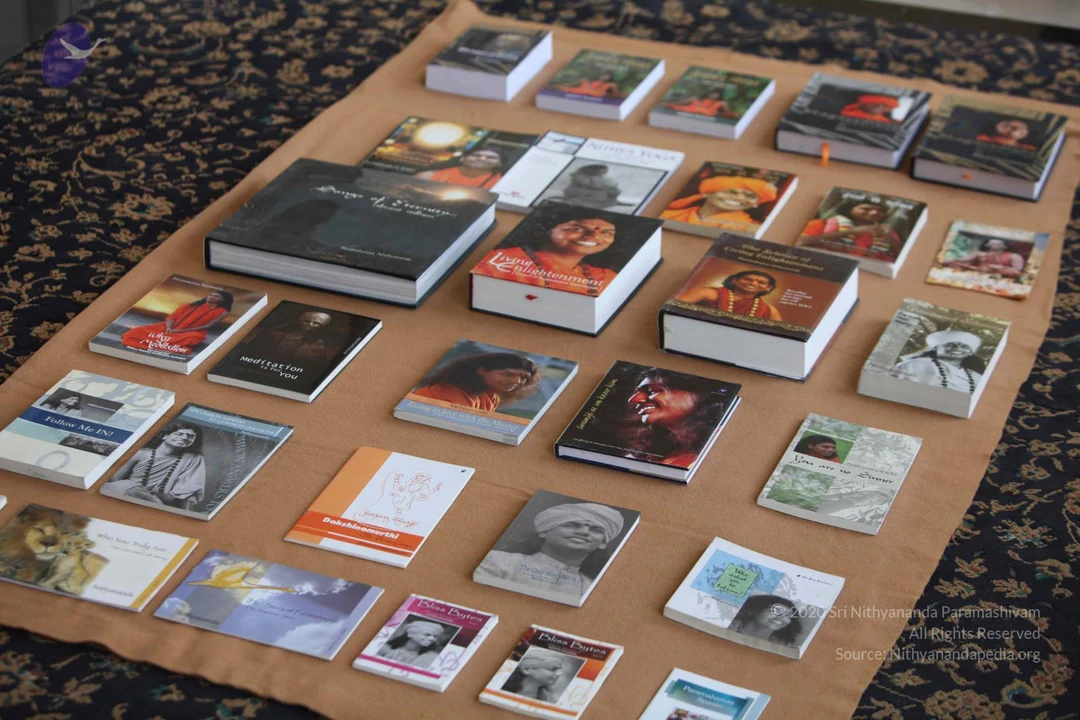
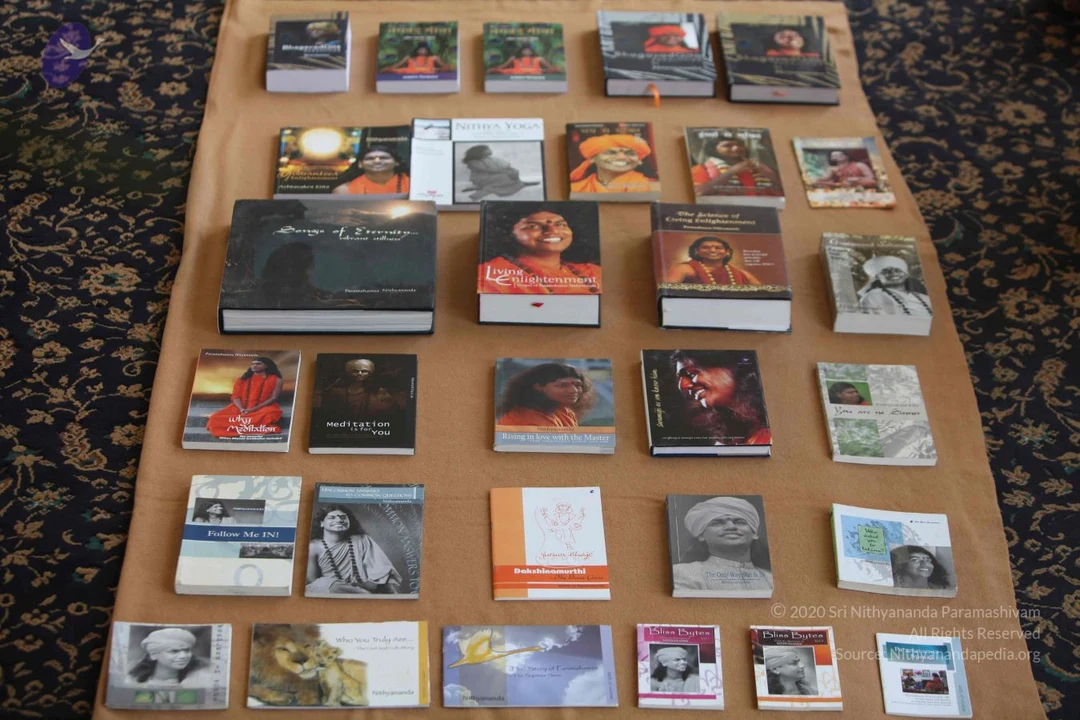
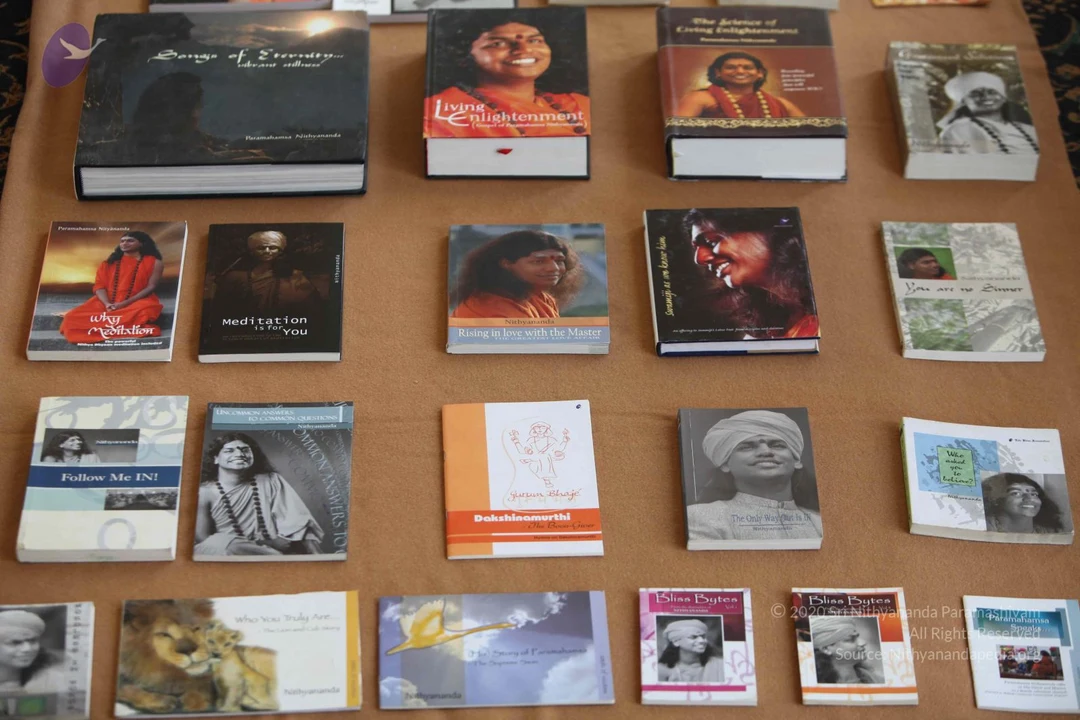
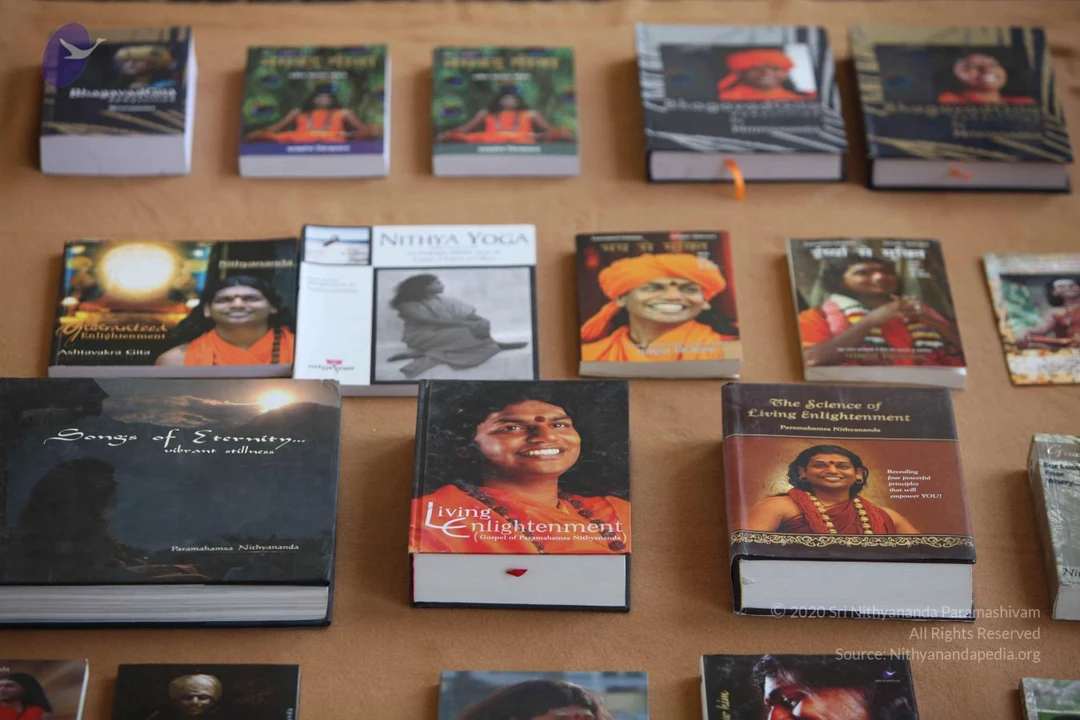
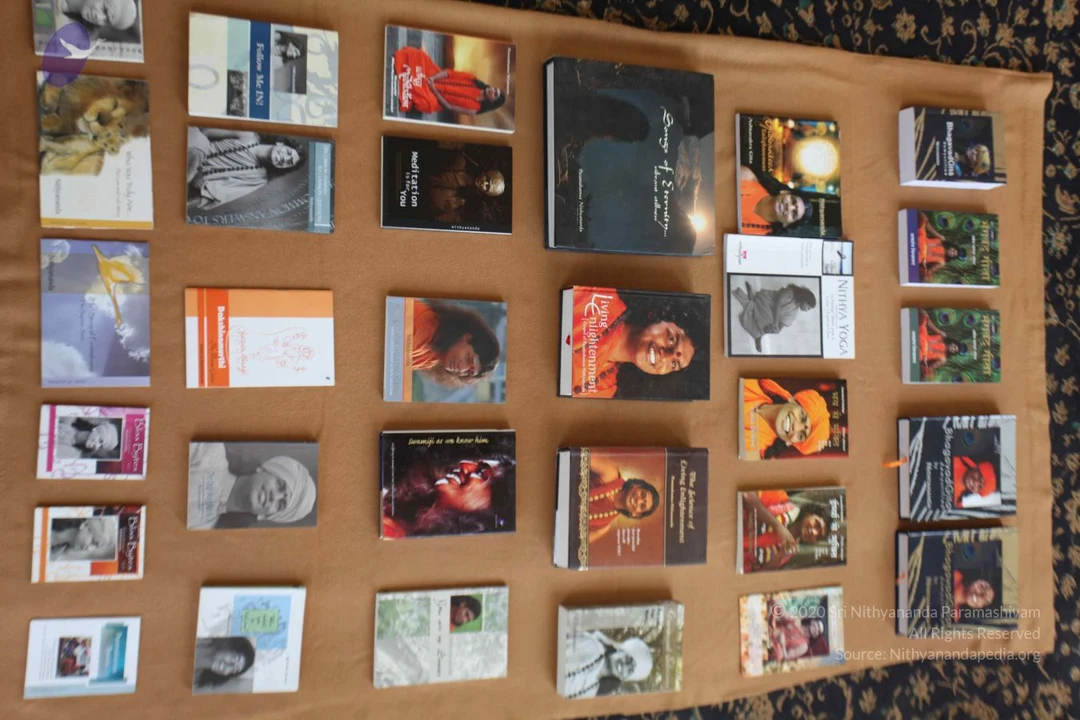
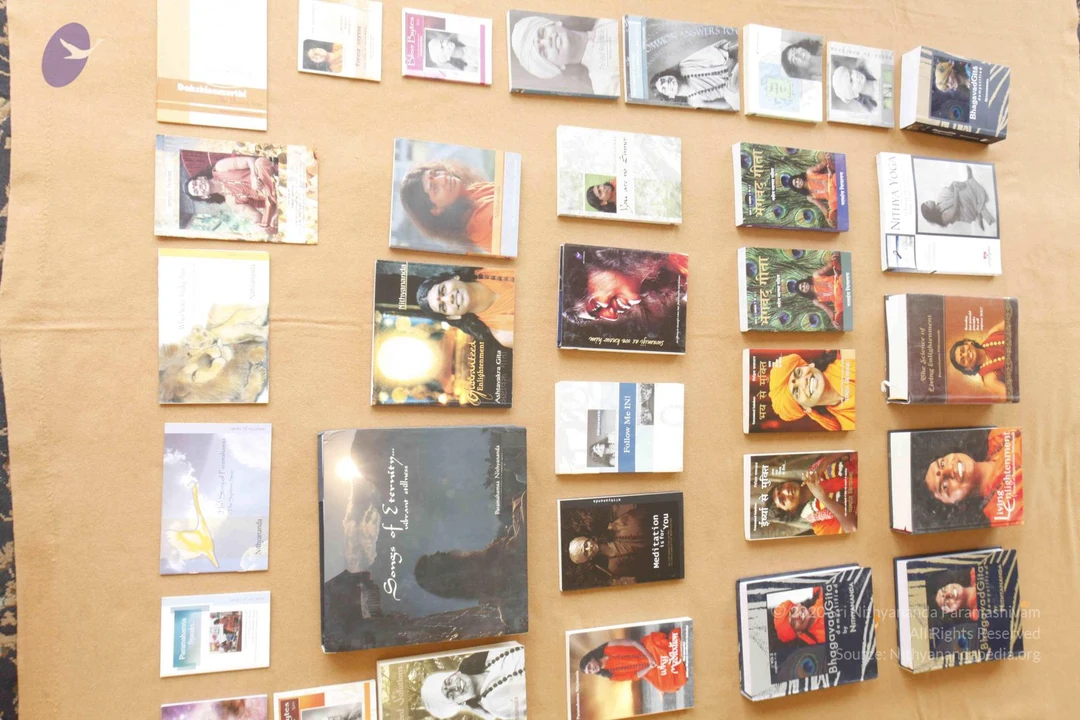
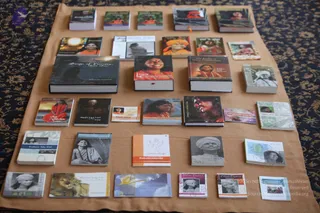
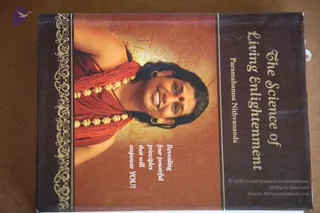
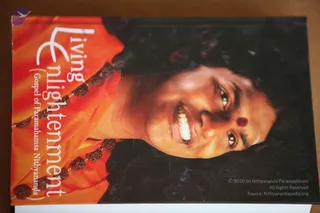
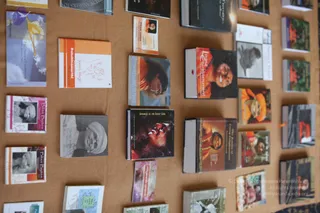
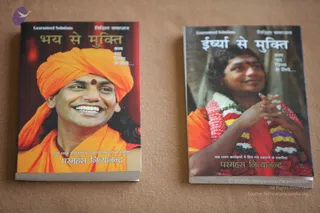
A photograph of a large display of books and booklets laid out in rows on a tan cloth over a dark patterned floor covering. Hardcover volumes and paperback booklets feature covers with portraits of a figure in saffron or orange robes, a bearded figure in a white turban, and a smiling woman with long hair. Titles visible include Living Enlightenment, Meditation Is Within You, Way of Meditation, Follow Me In, Dakshinamurthi, Blissbytes, and Who You Truly Are. The covers are a mix of photographs, paintings and graphic designs.A printed book cover titled "The Science of Living Enlightenment" by Paramahamsa Nithyananda, lying flat on a brown surface. The cover shows a smiling woman with long dark hair, a red dot on her forehead, a red beaded necklace and gold beaded jewellery, against an orange ornamental background. The tagline reads "Revealing four powerful principles that will empower YOU!" The cover is printed, so the portrait on it is not a physical person in the scene.A photograph of a hardcover book titled "Living Enlightenment" with the subtitle "Gospel of Paramahamsa Nithyananda" printed in white on the cover. The cover shows a smiling face with a dark red bindi and dark hair, wearing an orange shawl edged with dark brown rudraksha beads. The book rests on a wooden surface. No physical people are present in the scene.A display board covered in a grid of printed books and booklets pinned or set against a tan fabric backdrop. Covers show orange, white, black and grey designs, a yellow bird illustration, a sepia-toned portrait, and a pink-bordered cover. Several covers show close-up portraits of a man with long, swept-back dark hair in orange clothing, and a dark cover labelled "Swamiji as we know him". No people are visible in the scene.Two paperback books lie side by side on a tan surface. Both are Bhagavad Gita volumes with peacock-feather backgrounds; the left is Part 1 (chapters 1 to 6) and the right is Part 2 (chapters 7 to 12). Each cover shows a smiling man in orange robes and a rudraksha-style necklace seated in a meditation pose, with a red tilak on his forehead; a depiction of a person on the book covers, which may be Swamiji (probable) per the page, based on the long hair, orange clothing and ornate necklace. The covers carry Devanagari titles and the name Paramahamsa Nithyananda in the lower band. No people are physically present in the scene.Two paperback books lie side by side on a plain brown fabric surface, photographed from above. The left book, titled in Hindi, shows a smiling man in an orange turban and orange robes with a red bindi against a red background. The right book shows a smiling woman with long dark hair, wearing an orange top and a garland of pink, white and yellow flowers, with hands clasped near her chest. Both covers carry the author name Paramahams a person in Devanagari and the series subtitle 'Guaranteed Solutions'. No physical people are present; only the two book covers depict people.

01-NDY-DAY3-SHIVOHAM-SESSION1
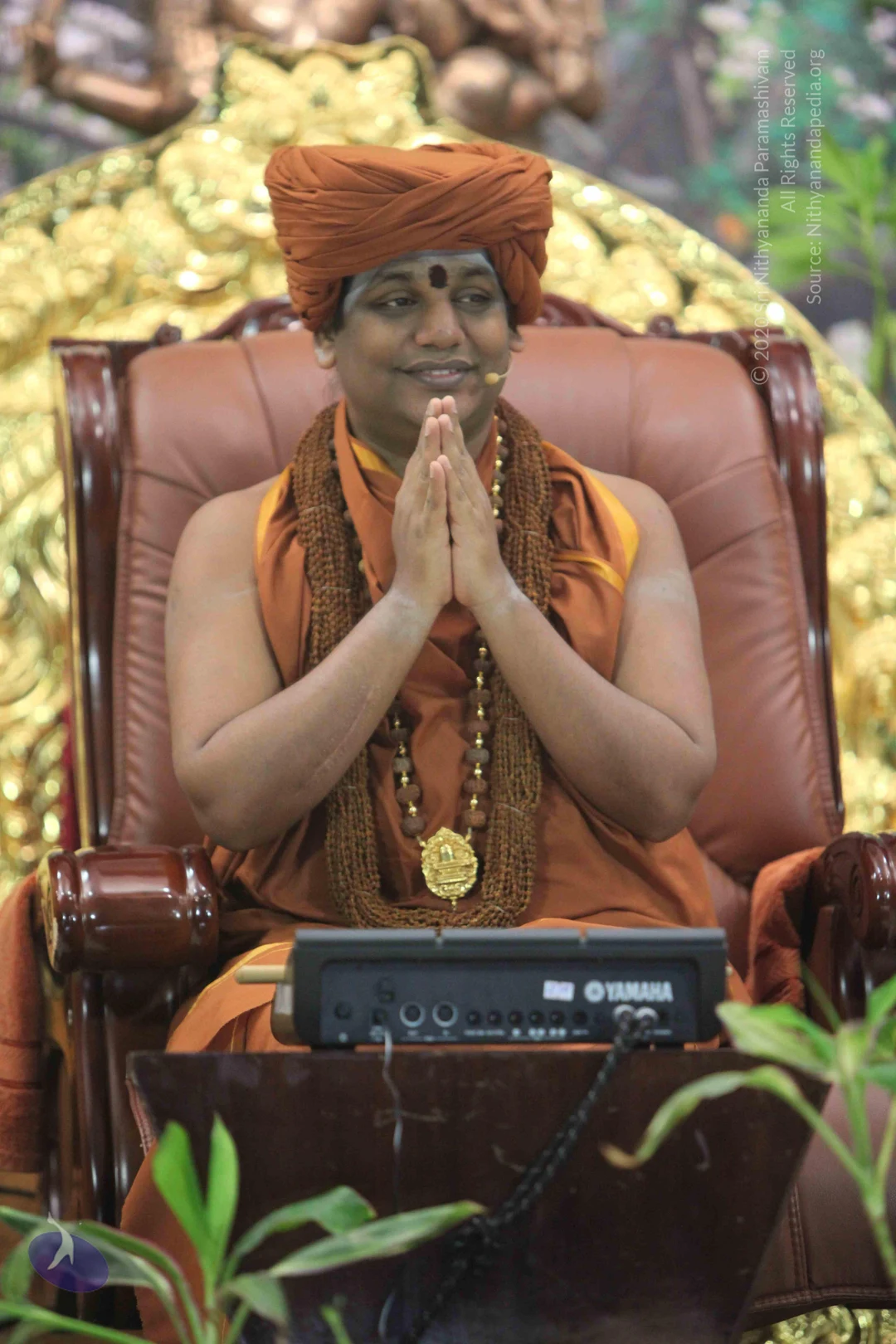
13 photosSource gallery
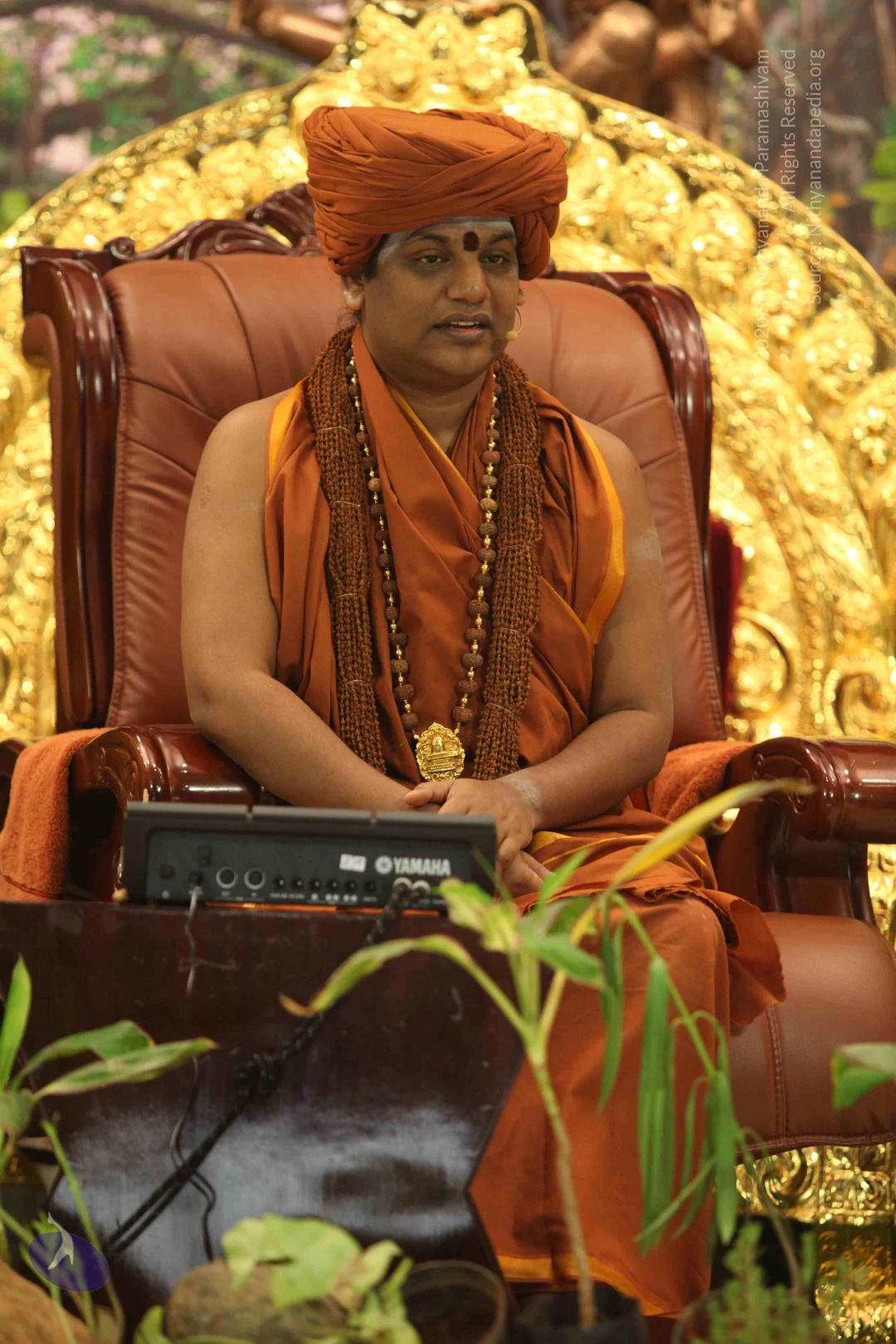
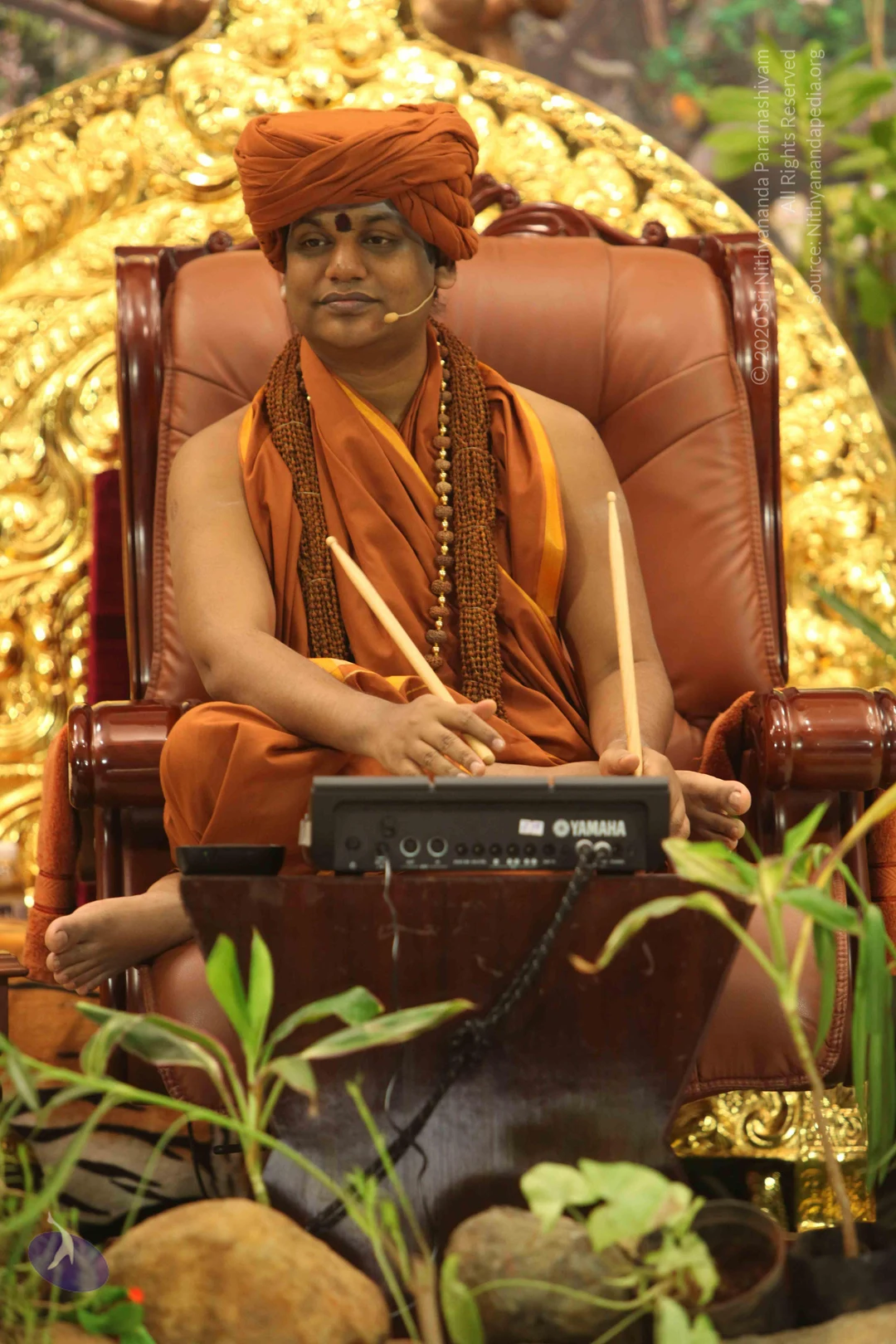
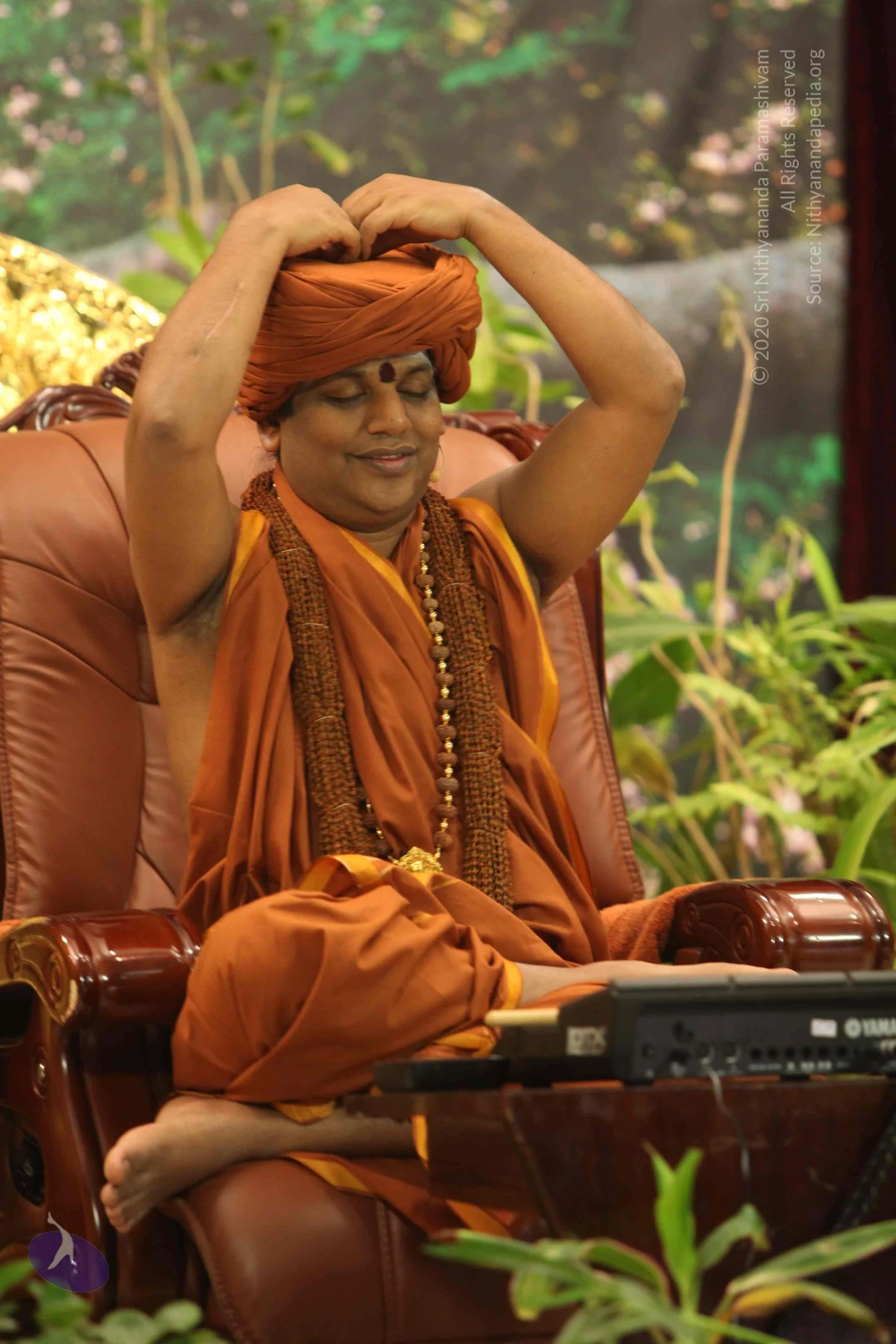
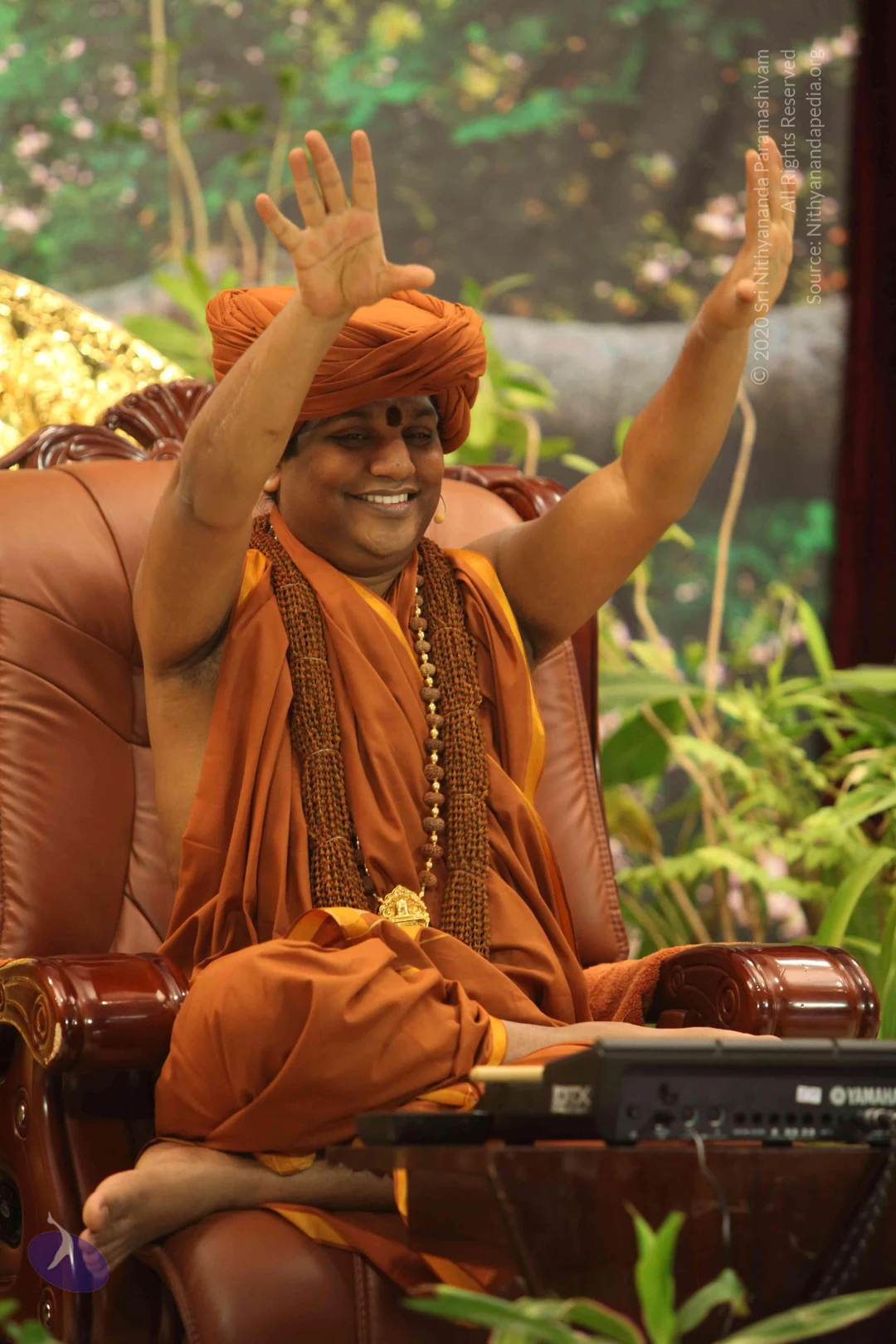
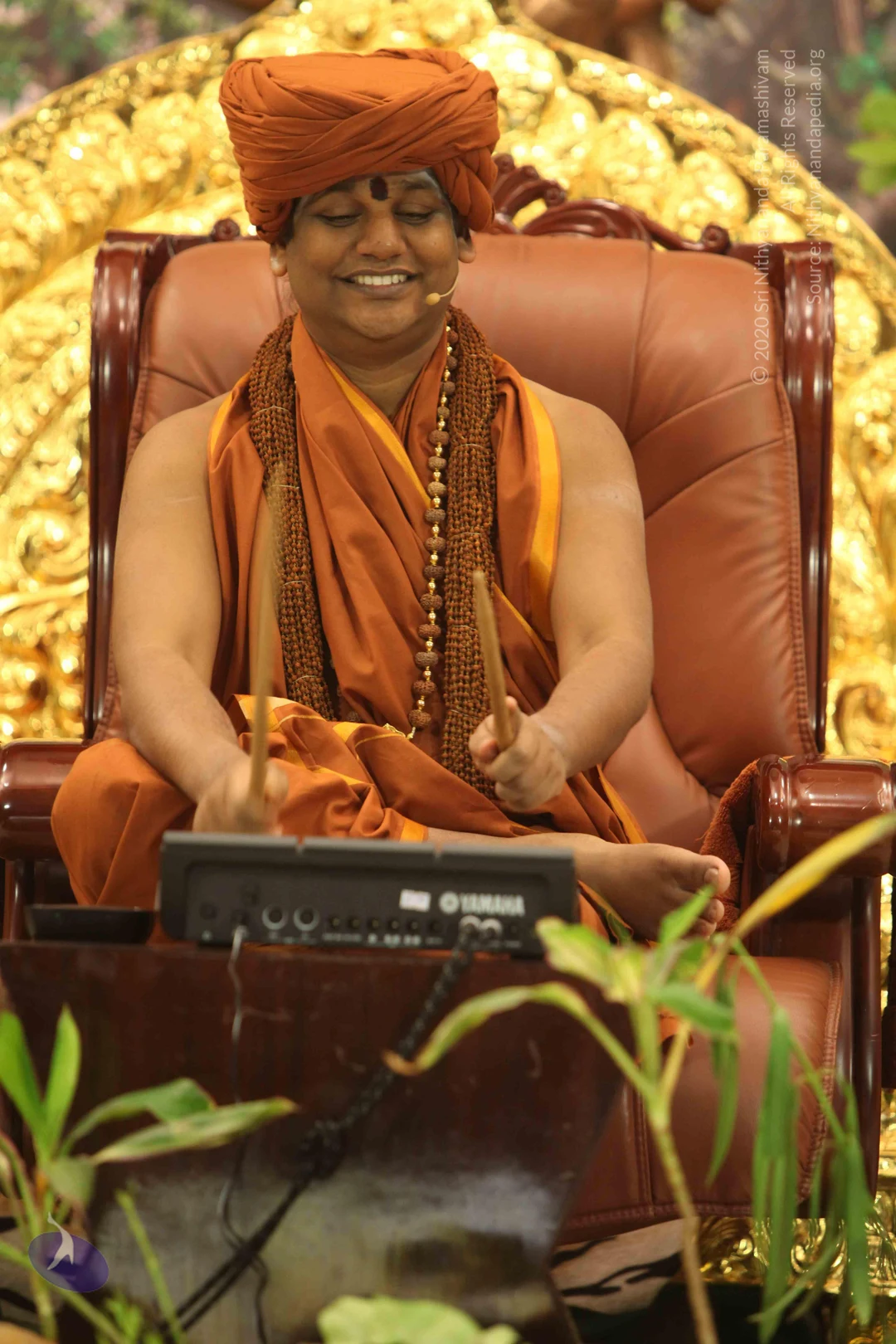
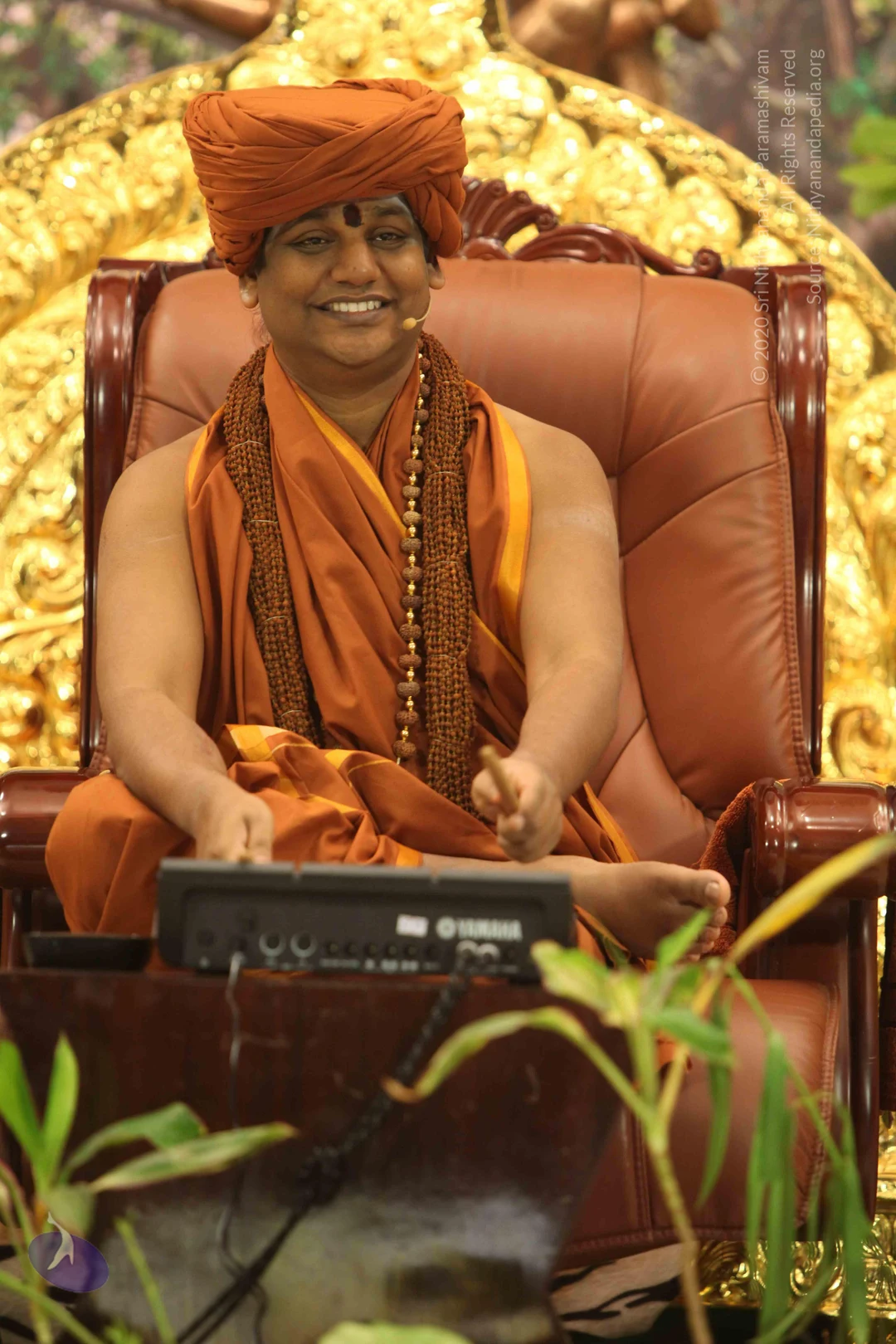
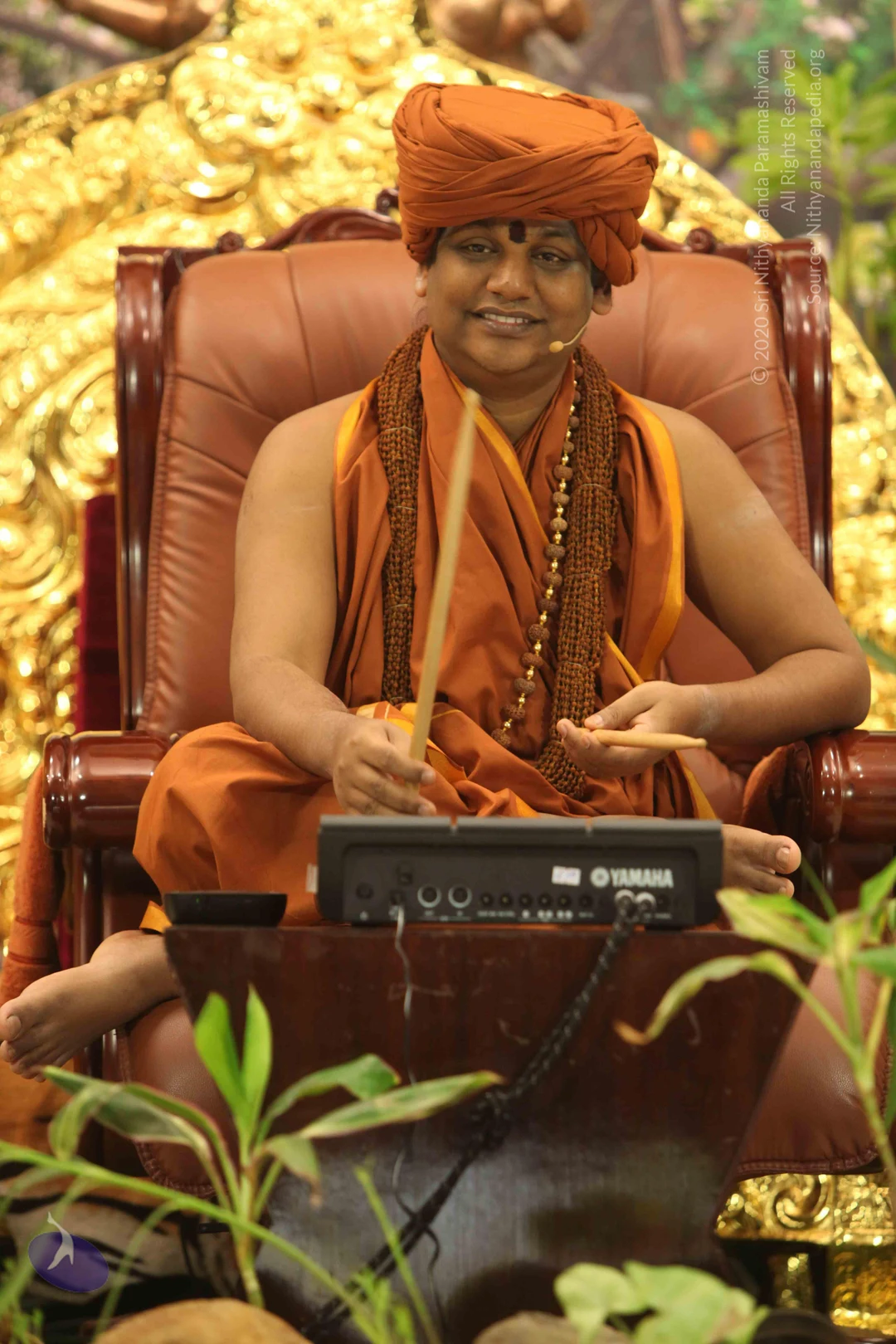
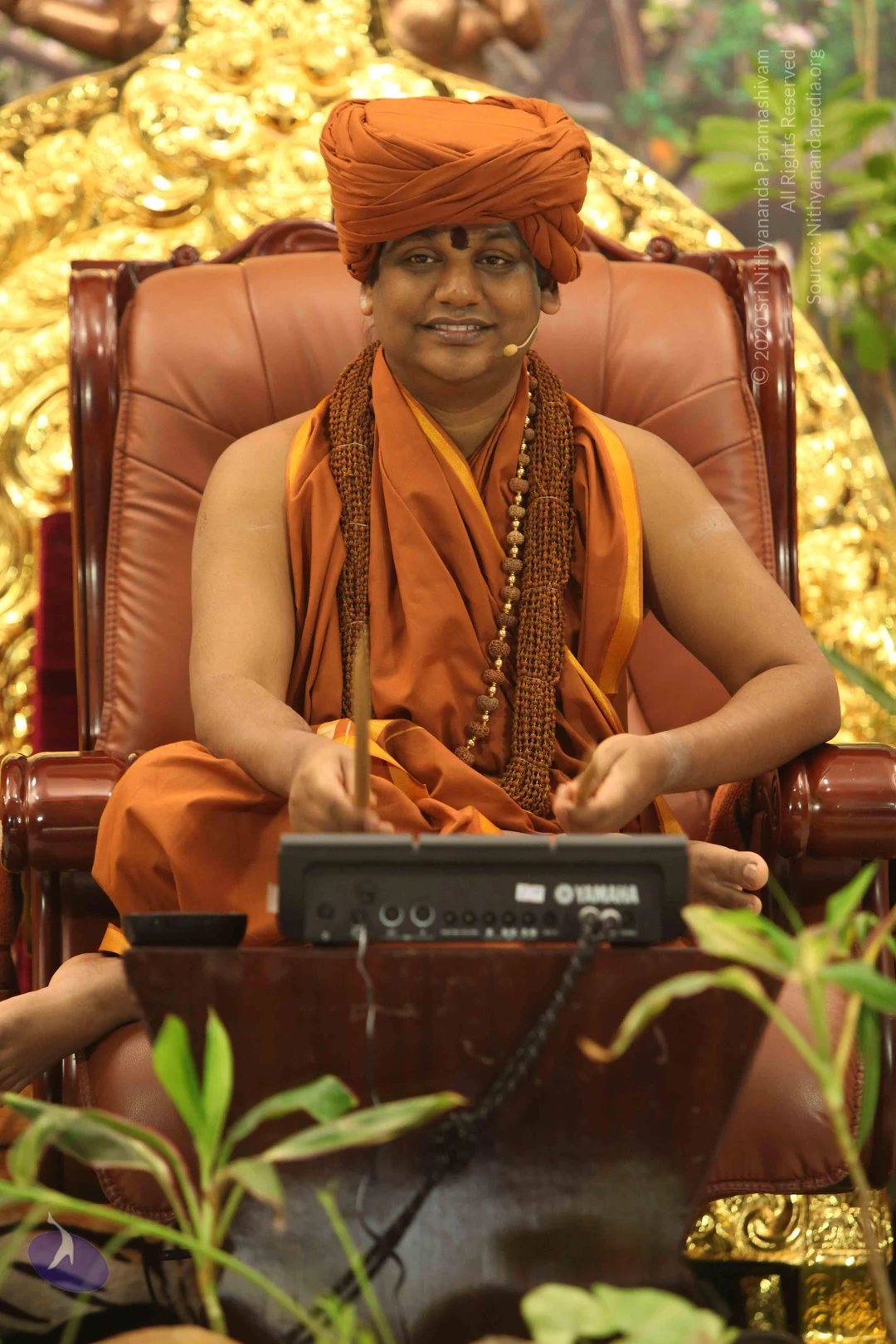
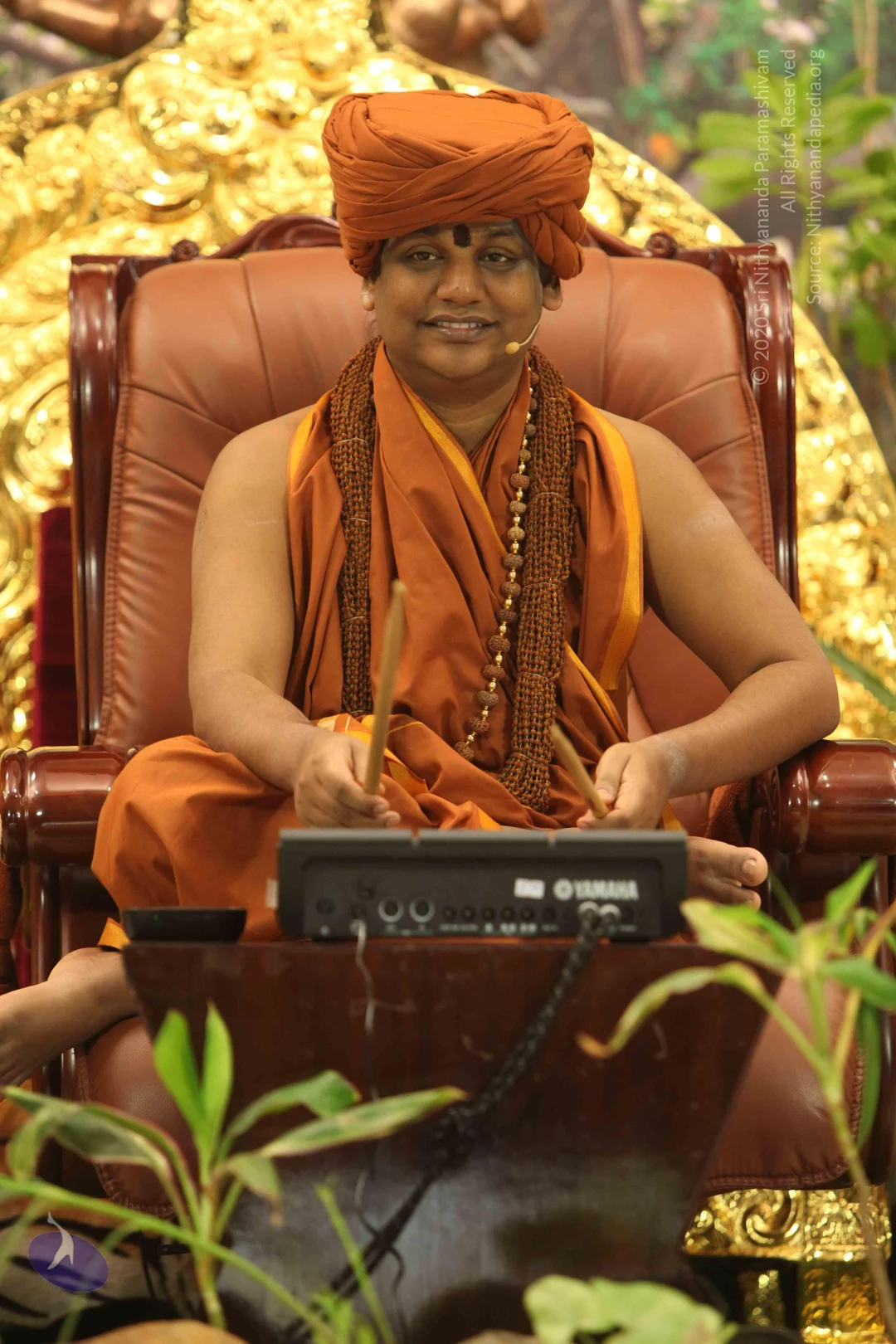
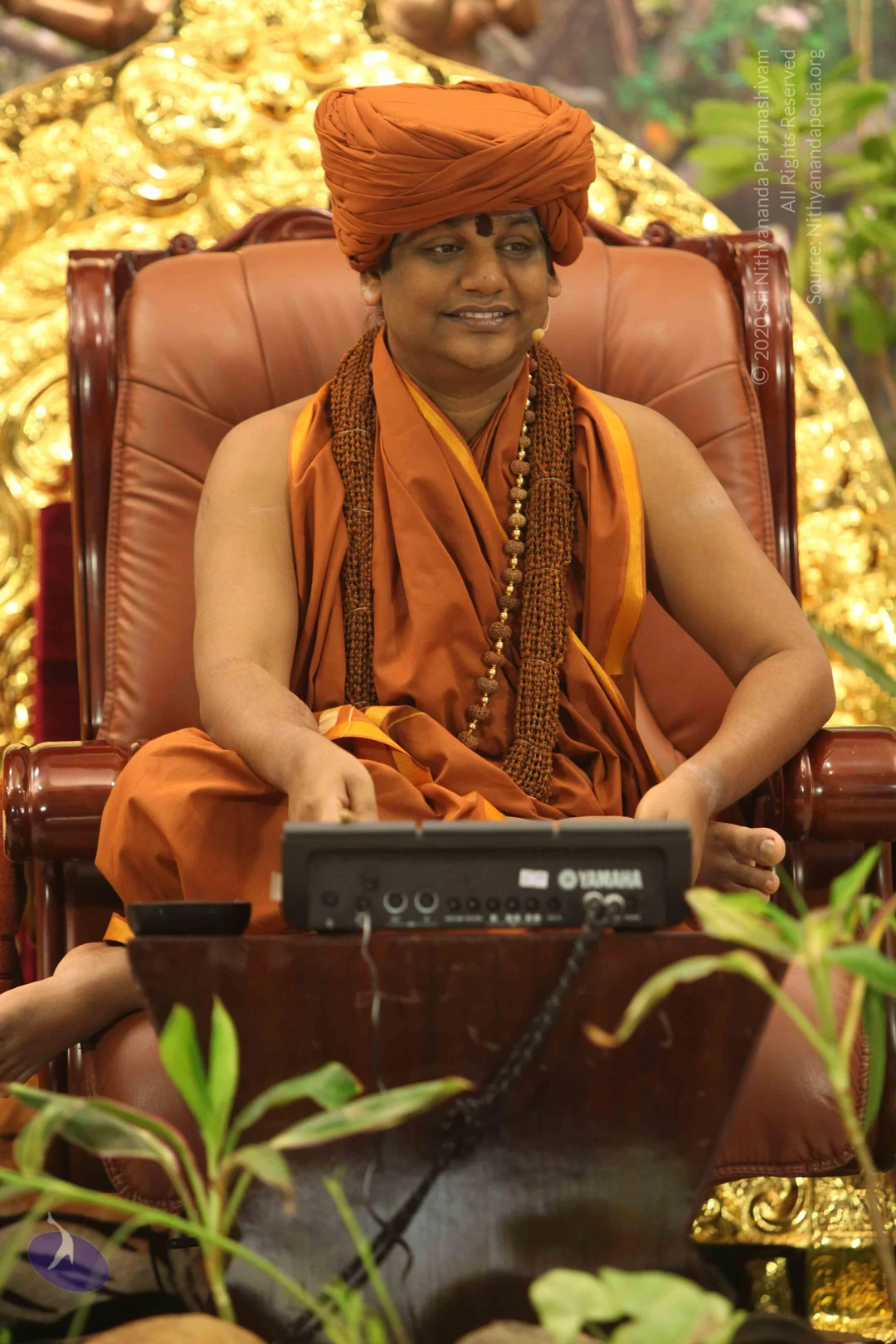
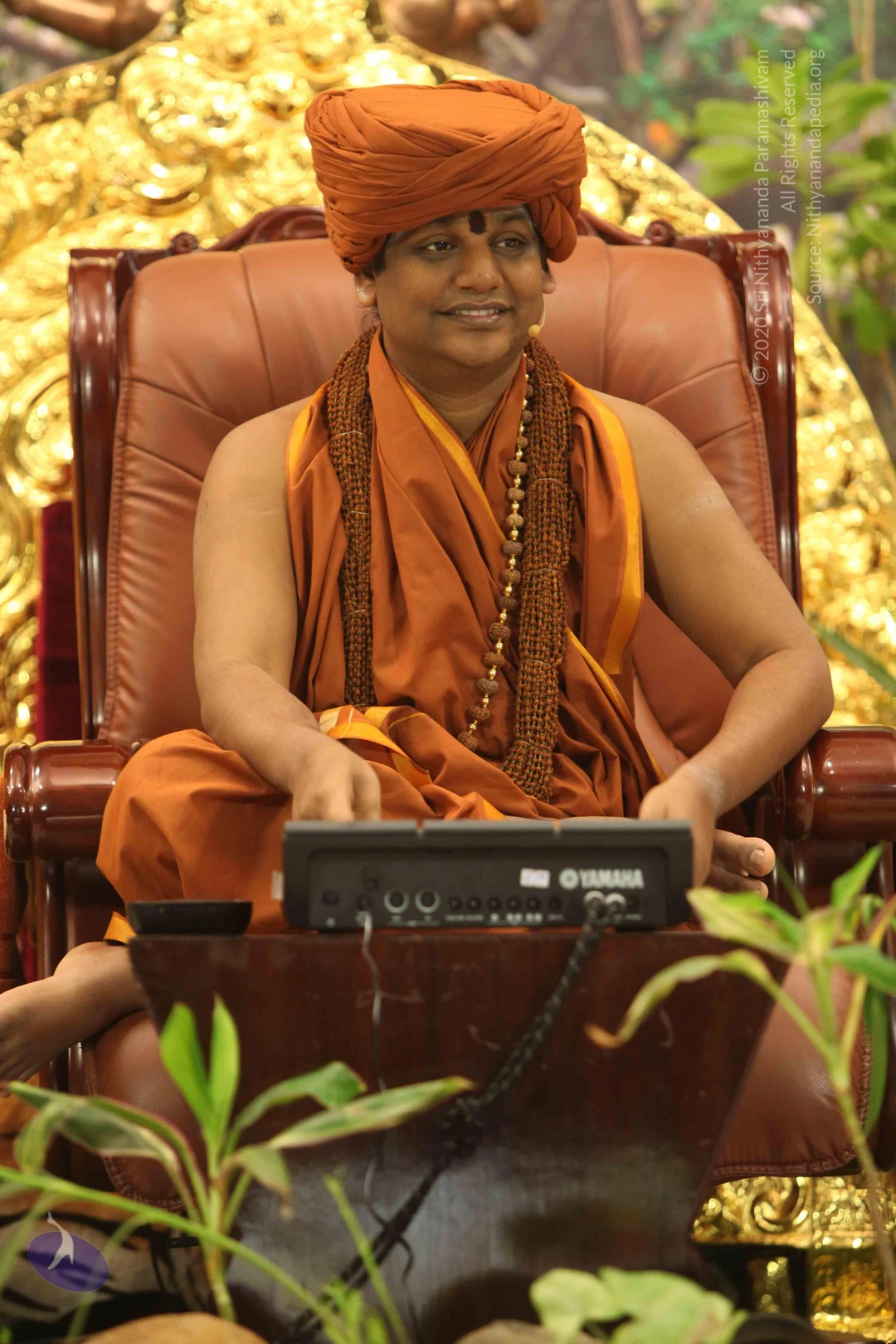
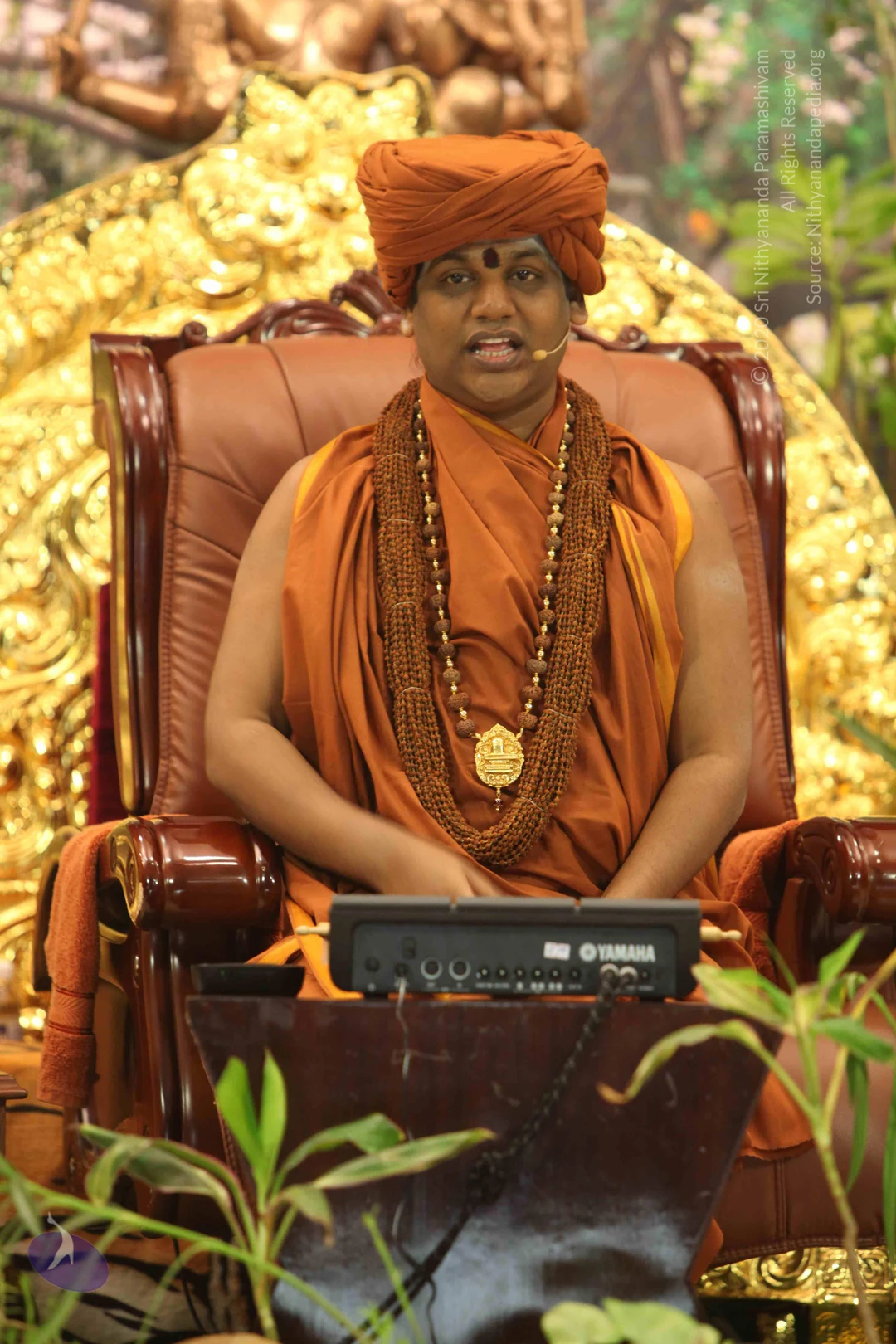
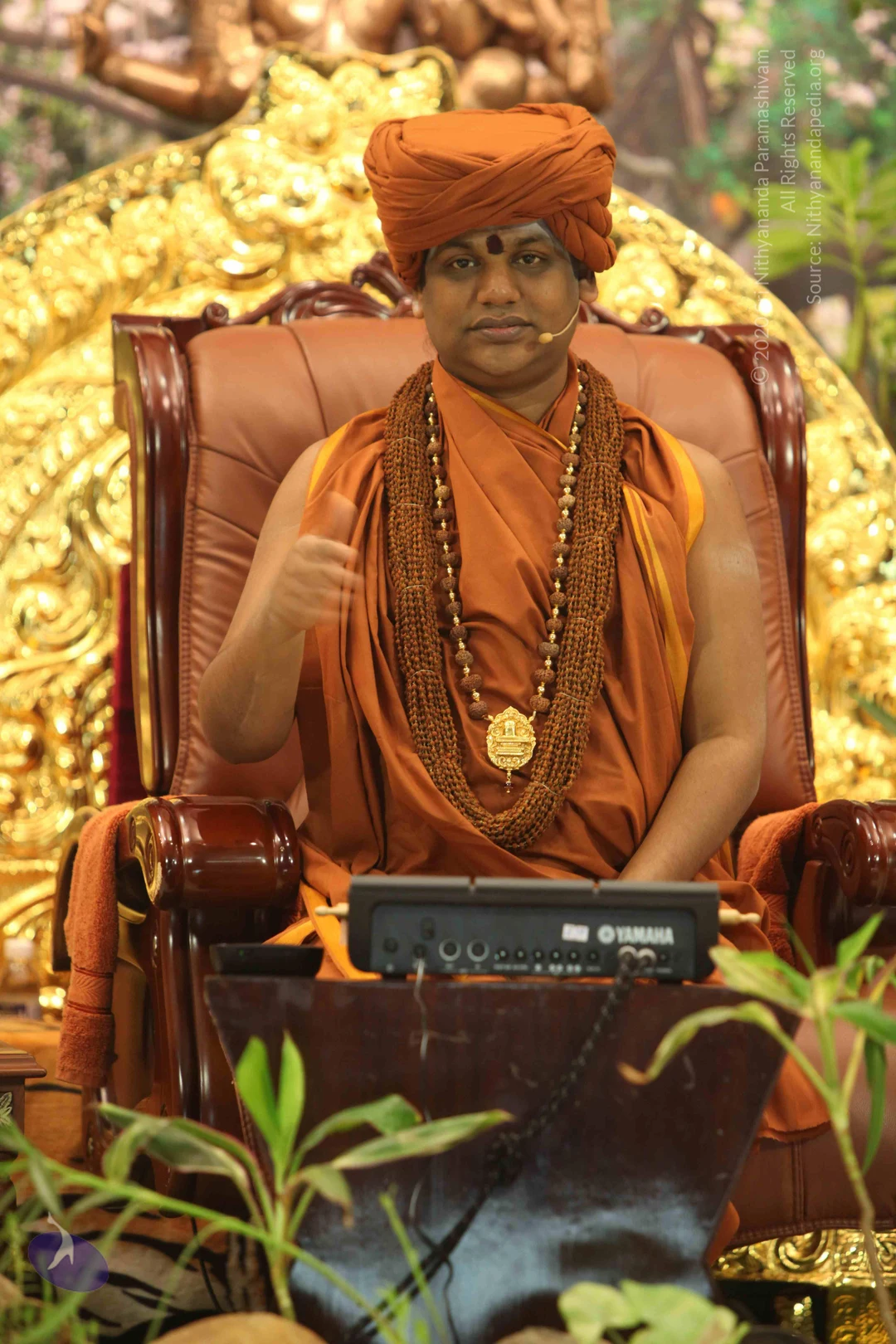
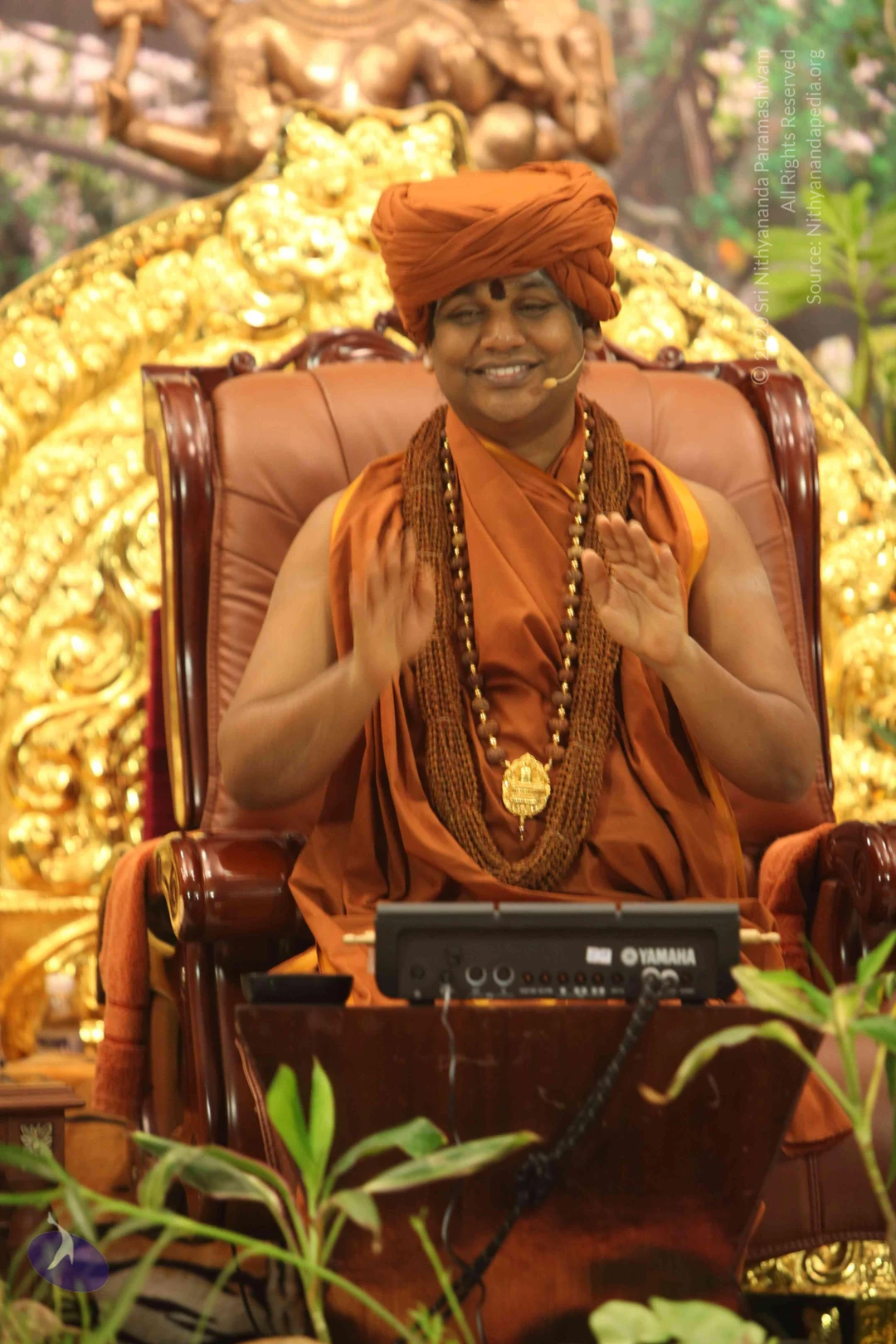
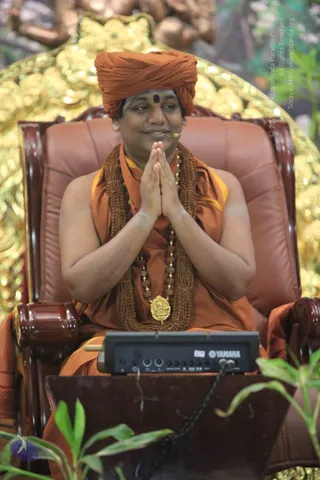
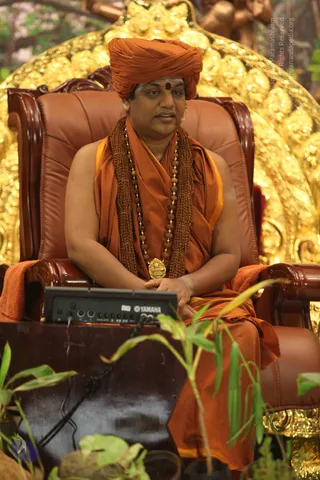
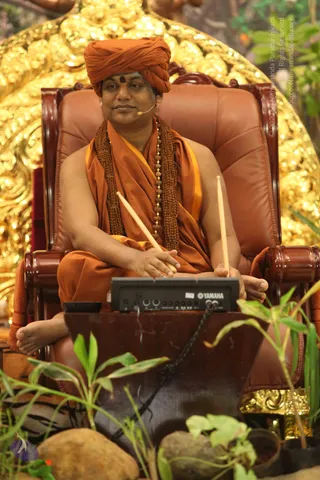
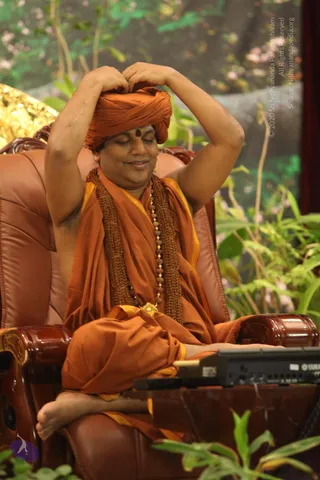
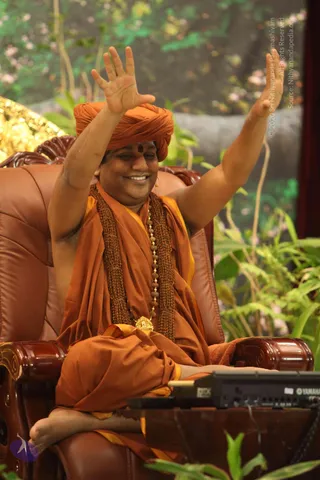
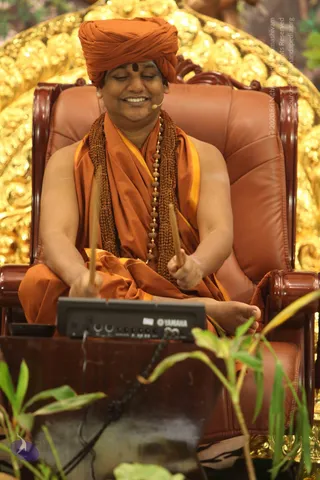
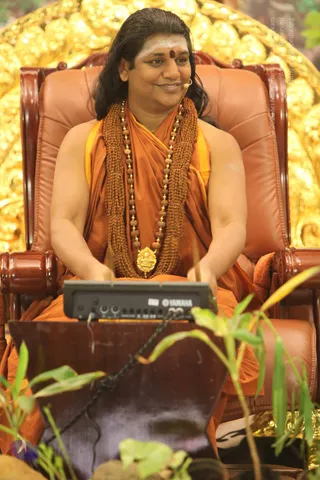
A seated man in an orange-saffron turban and matching saffron sleeveless robe with a golden-yellow edge sits in a brown leather armchair with carved wooden arms, palms pressed together in namaste. He wears a rudraksha mala with a gold pendant and a small red tilak on his forehead, and a small headset microphone is clipped near his face. In front of him is a black Yamaha mixing unit on a dark wooden stand, with green plants in the foreground. Behind the chair is an ornate gold throne back and carved gilded figures.A seated figure in saffron-orange robes and a matching orange turban sits in a brown leather throne chair before an ornate gold backdrop. He wears a red bindi, a dark rudraksha mala with a multi-strand beaded necklace, and a gold pendant. His hands rest folded in his lap, and a Yamaha mixer sits on a dark table in front of him, with green plants in the foreground. The image is a photo of a single person at a satsang-style event.A seated figure sits cross-legged on a large brown leather throne-style chair in front of an ornate gold-leaf backdrop, with green plants and rocks in the foreground. He wears an orange turban with a red bindi, an orange robe with yellow trim, and a long brown rudraksha mala. He holds two wooden drumsticks over a black Yamaha electronic pad on a dark wooden stand, and a headset microphone is clipped near his face. Bare feet are visible.A seated person in an orange saffron turban and orange robe with a yellow-edged wrap, wearing a rudraksha mala and a gold pendant, adjusts the turban with both hands raised above the head, eyes closed and smiling. A red bindi marks the forehead. They sit barefoot in a brown leather armchair in front of a painted backdrop of green foliage and pink blossoms, with a black audio mixer and potted plants in the foreground. Appearance-based a person cues: orange turban, saffron robe and rudraksha mala on a throne-like chair. Single physical person.A smiling man in an orange turban and orange robes sits cross-legged in a brown leather armchair with both arms raised high, palms open. He wears a red tilak on his forehead, a dark rudraksha mala and a gold pendant. Behind him are green foliage and pink blossoms on a painted backdrop, with a Yamaha keyboard or mixer on a table in front.A smiling man in saffron-orange turban and draped saffron garments sits in a brown leather throne chair before an ornate gold backdrop. He wears a long rudraksha mala with gold beads and a red tilak on his forehead, and a small headset microphone. He holds two wooden sticks and plays a drum or pad set, with a Yamaha device on a stand in front of him. Green potted plants frame the lower foreground.

02-NDY-DAY3-SHIVOHAM-SESSION2
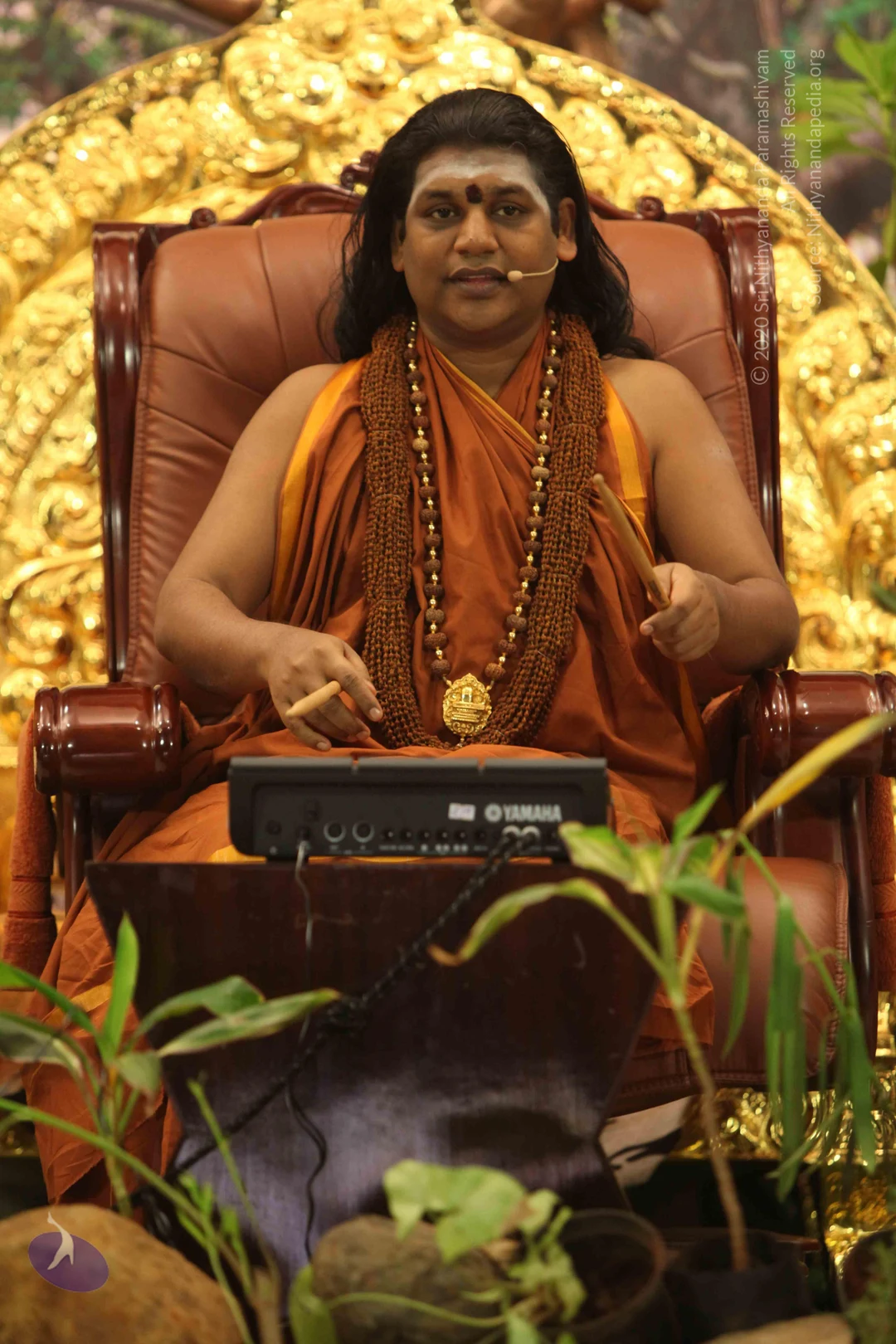
7 photosSource gallery
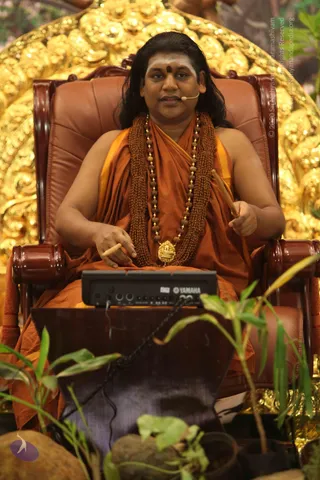
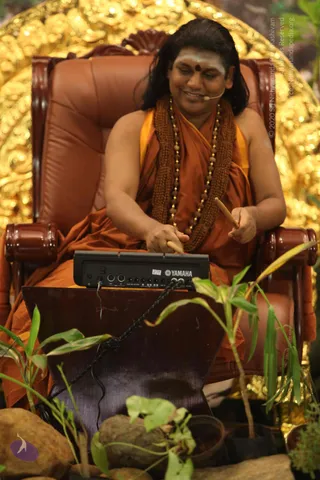
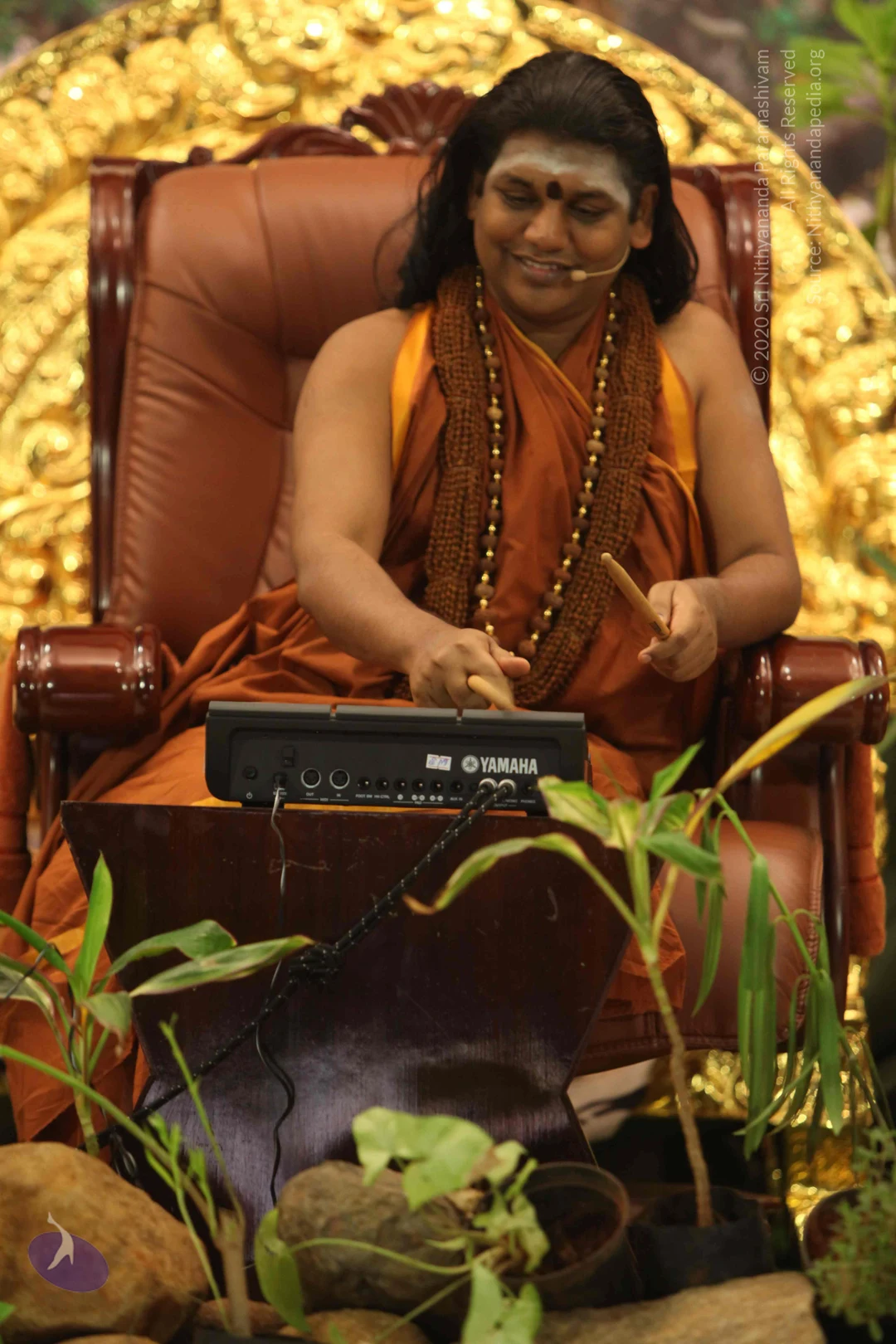
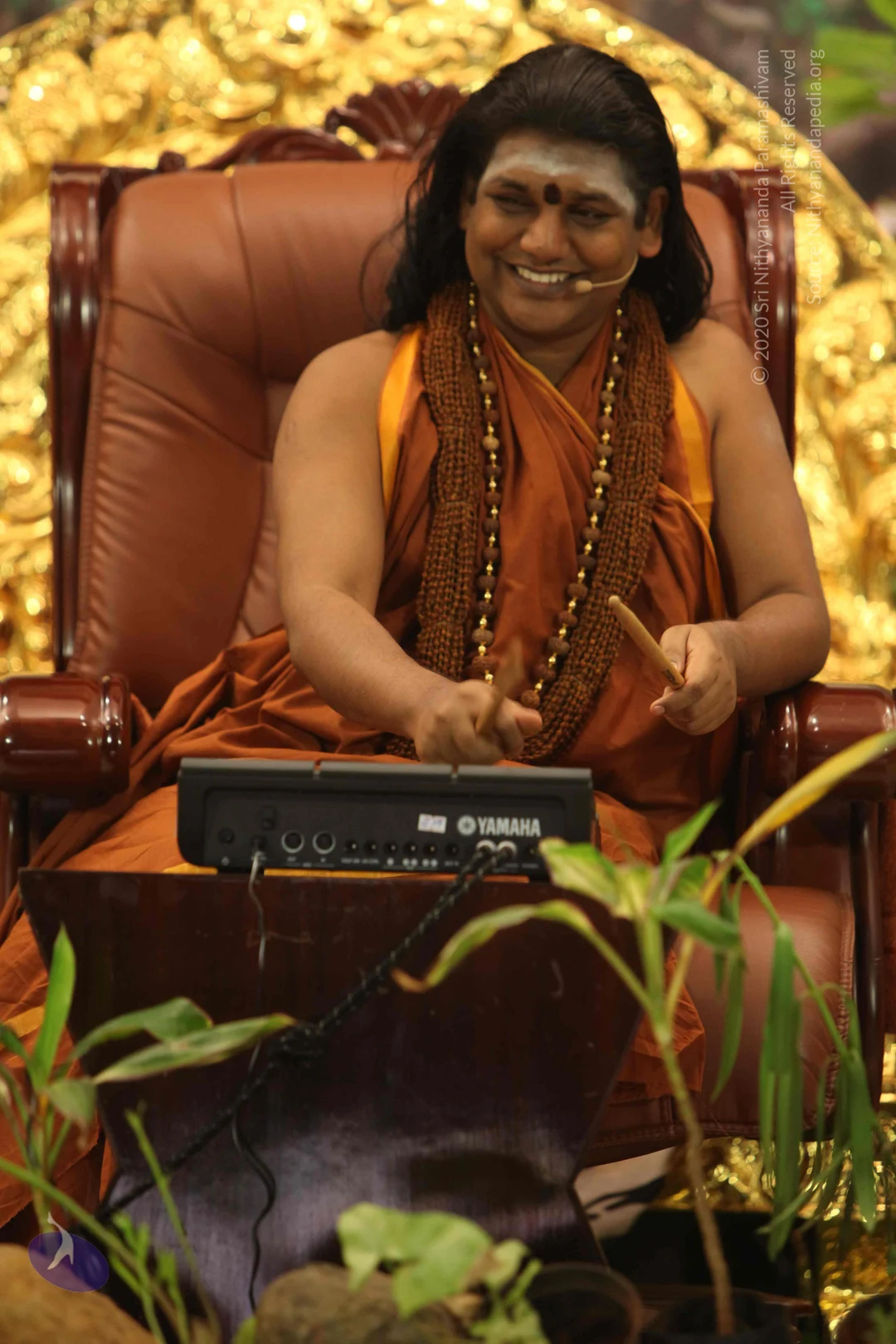
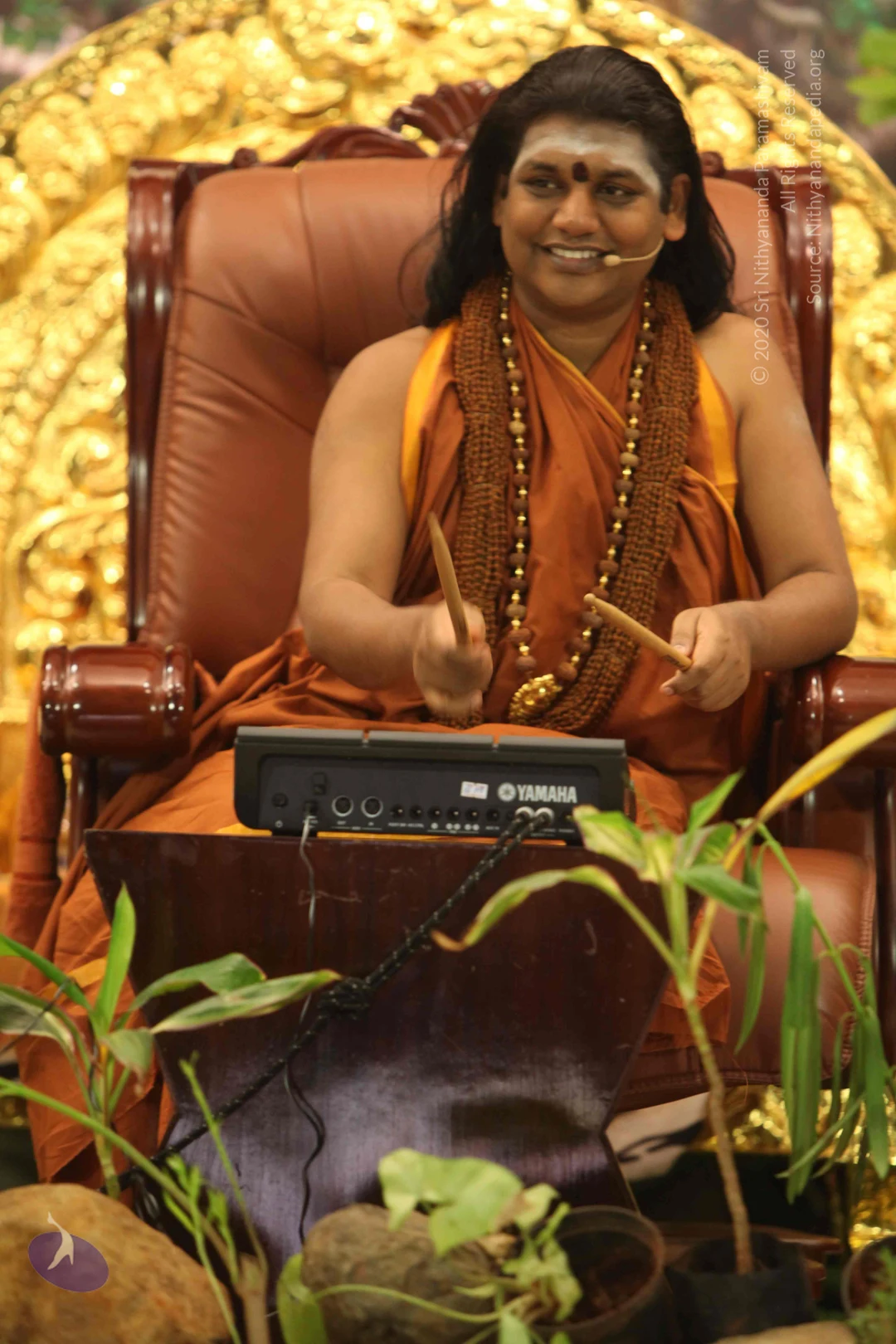
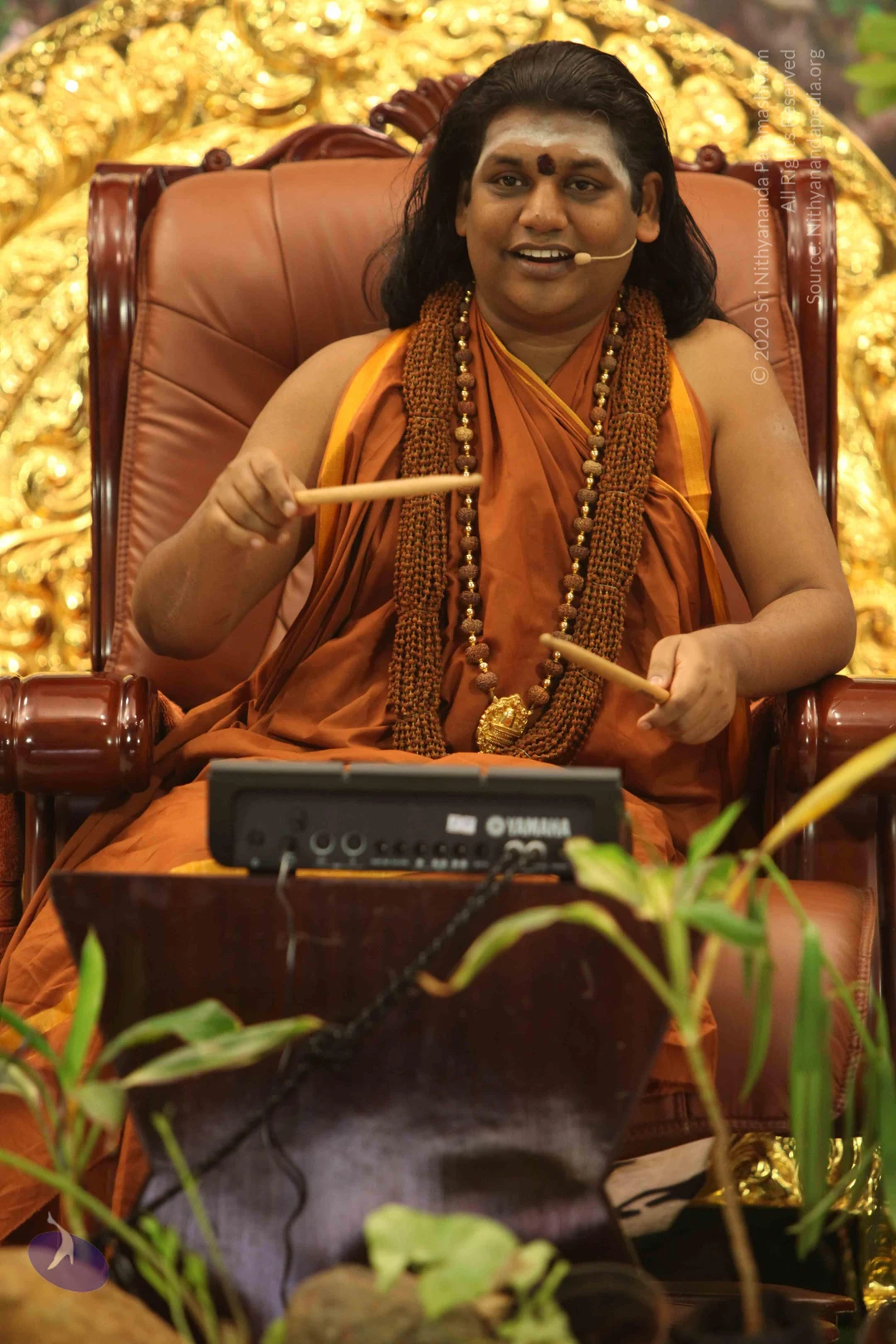
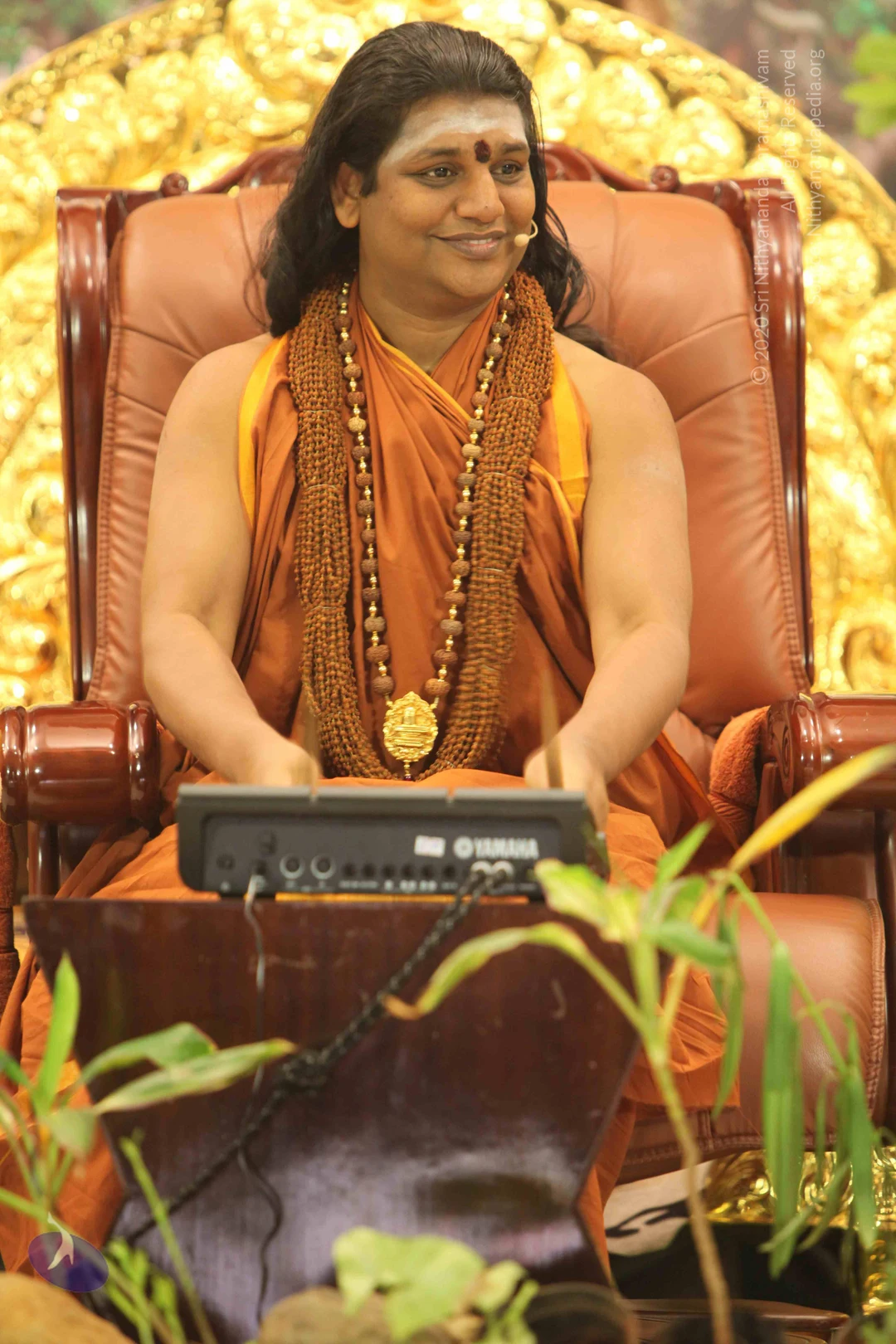
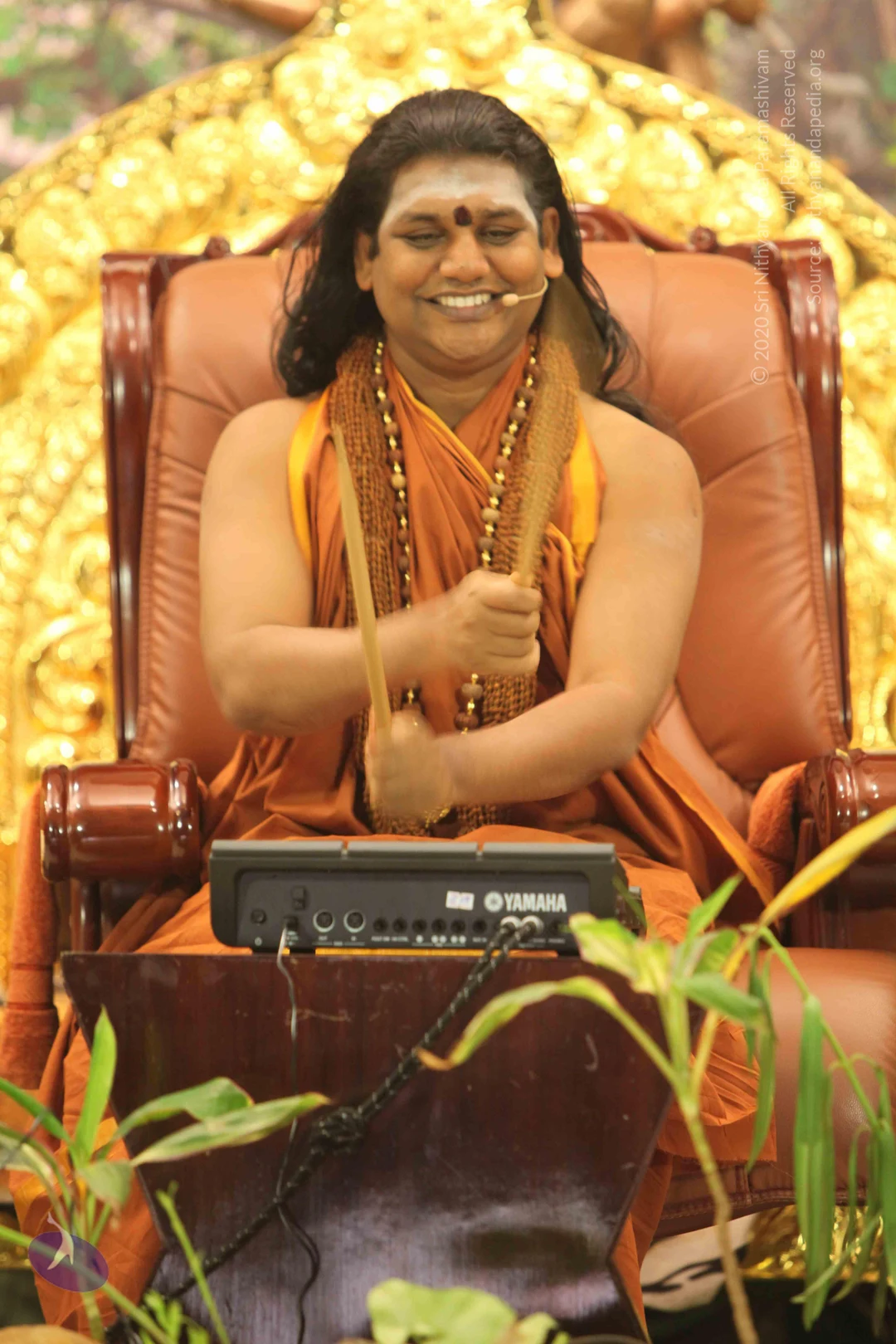
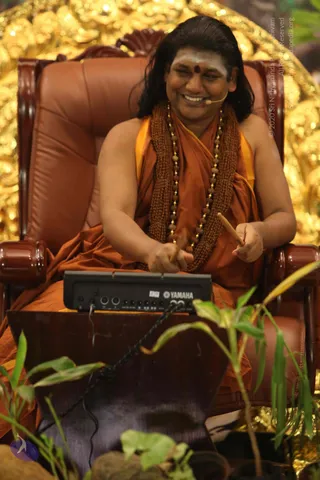
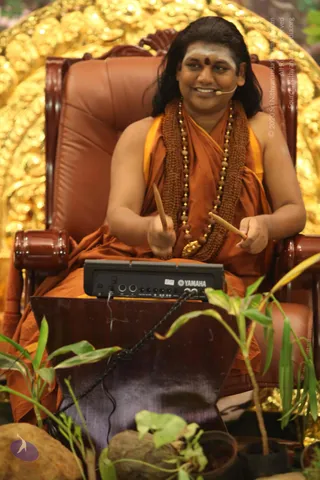
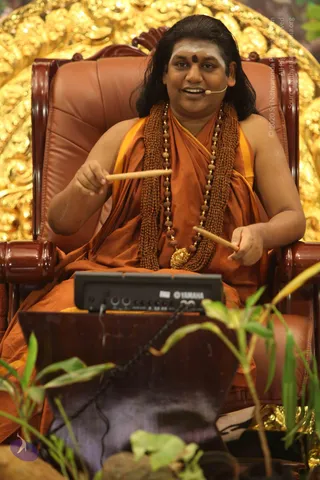
A seated man in orange ochre robes sits in a brown leather throne-style chair in front of an ornate gold-leafed backdrop. He wears a headset microphone, a red bindi and white markings on his forehead, long dark swept-back hair, multiple rudraksha mala necklaces and a large gold pendant. He holds drumsticks over a black Yamaha electronic keyboard unit on a small stand, with green potted plants in the foreground. Probable Swamiji: long swept-back hair, rudraksha malas and gold ceremonial pendant on saffron clothing, seated on a throne during a satsang.A man seated in a brown leather armchair in front of an ornate gold-leaf backdrop, playing a Yamaha electronic drum pad with wooden sticks. He wears saffron-orange robes with a yellow edge, a long brown rudraksha mala, a white and red forehead marking, and a headset microphone, with long swept-back hair. Potted green plants and stones sit in the foreground beside the pad on a dark wooden stand. Appearance-based candidate: Swamiji (probable), seated and performing, with the robe, mala and long hair as cues.A smiling man with long, swept-back dark hair sits on an ornate brown leather throne-style chair in front of a gold-embossed backdrop. He wears saffron-orange robes with a yellow edge, layered brown and gold rudraksha malas, and a headset microphone, with a white and red forehead mark. He holds small wooden sticks over a black Yamaha electronic drum pad on a dark stand, with green potted leaves in the foreground. Given the Swamiji cues of swept-back hair, saffron robes, rudraksha malas and a throne setting, this is a probable Swamiji in person.A photograph of a long-haired man in saffron-orange robes seated on an ornate brown leather throne with carved wooden arms, in front of a gold-embossed backdrop. He wears a dark red bindi, a headset microphone, a long rudraksha mala with gold beads and a gold pendant, and holds two wooden drumsticks while smiling. In front of him sits a black Yamaha electronic drum pad on a dark wooden stand, surrounded by potted green plants and stones. The Swamiji (probable) cues here are the long swept-back hair, saffron robes, rudraksha mala and ceremonial gold pendant, in the role of a seated speaker at a satsang-style event.A seated man in orange saffron robes with a draped shawl and a long rudraksha mala with gold ornaments sits on an ornate brown leather throne before a gold-embossed backdrop. He wears white and red forehead markings, has long swept-back dark hair, and wears a headset microphone. He holds two wooden sticks in both hands above a black Yamaha digital mixer on a dark stand, with green plants in the foreground. The appearance of the seated figure matches the page's Swamiji claim on several cues: long hair, saffron clothing, rudraksha mala and gold ornament, so this is a probable Swamiji seated in person giving a satsang. Ornate throne and gold backdrop also present.A seated man in an orange-saffron robe and a rudraksha mala with a gold pendant sits in a brown leather throne-style chair before a gold ornate backdrop. He has long swept-back hair, a white vertical mark and a red dot on his forehead, and a small headset microphone. Green leaves and a black Yamaha device on a wooden stand sit in the foreground. Appearance-based label: Swamiji (probable), with long hair, saffron robe, rudraksha mala and gold pendant as the qualifying cues, seated as a speaker during a satsang.