Skip to content
Thursday

9 January 2014

Science of rewriting your future

Dated photos
41
Source pages
1
Media
3
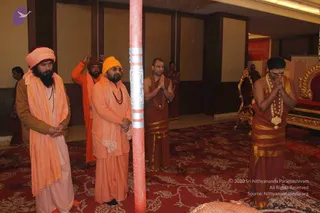
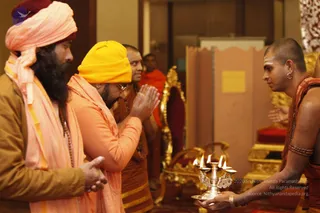
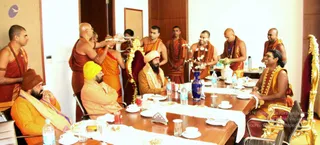
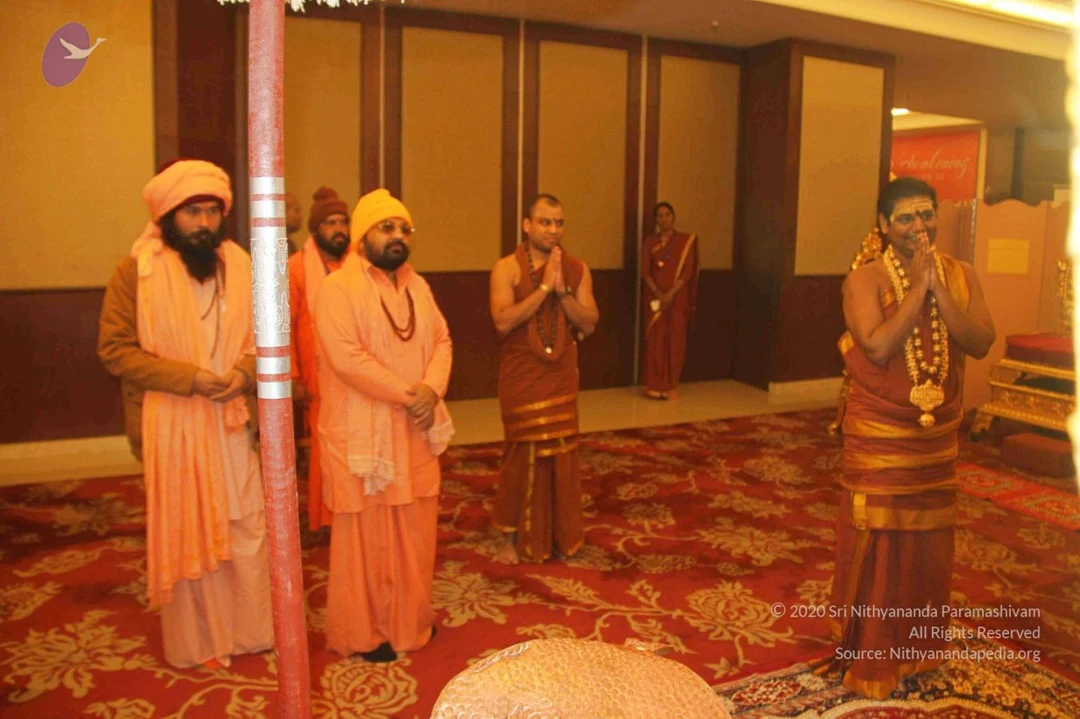
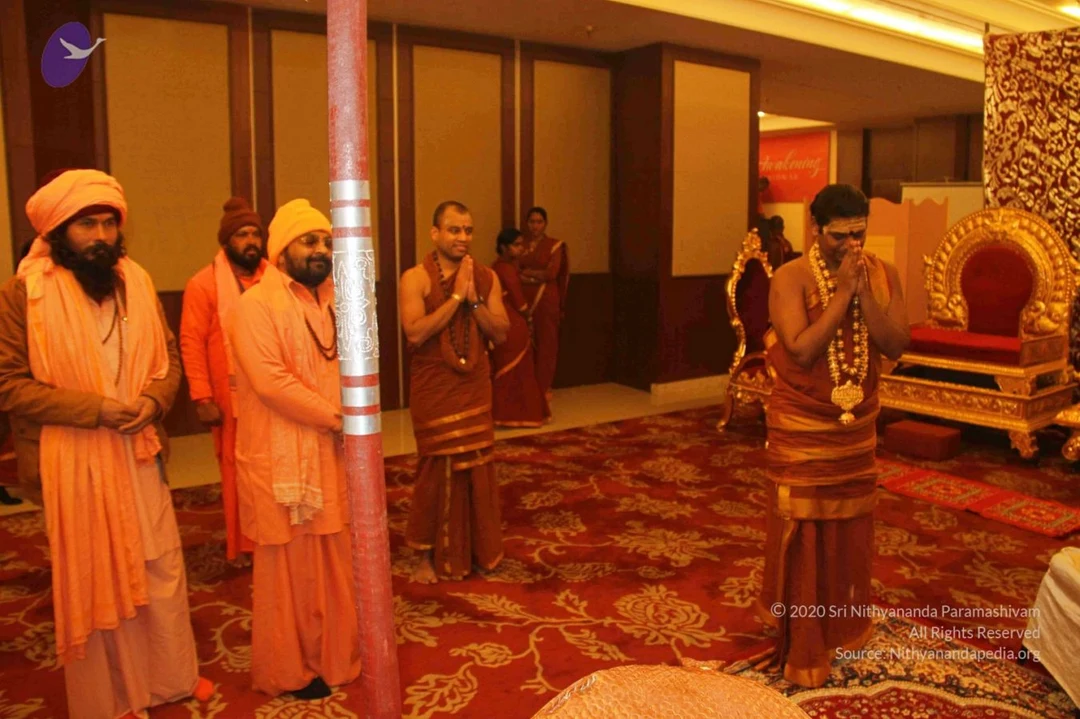
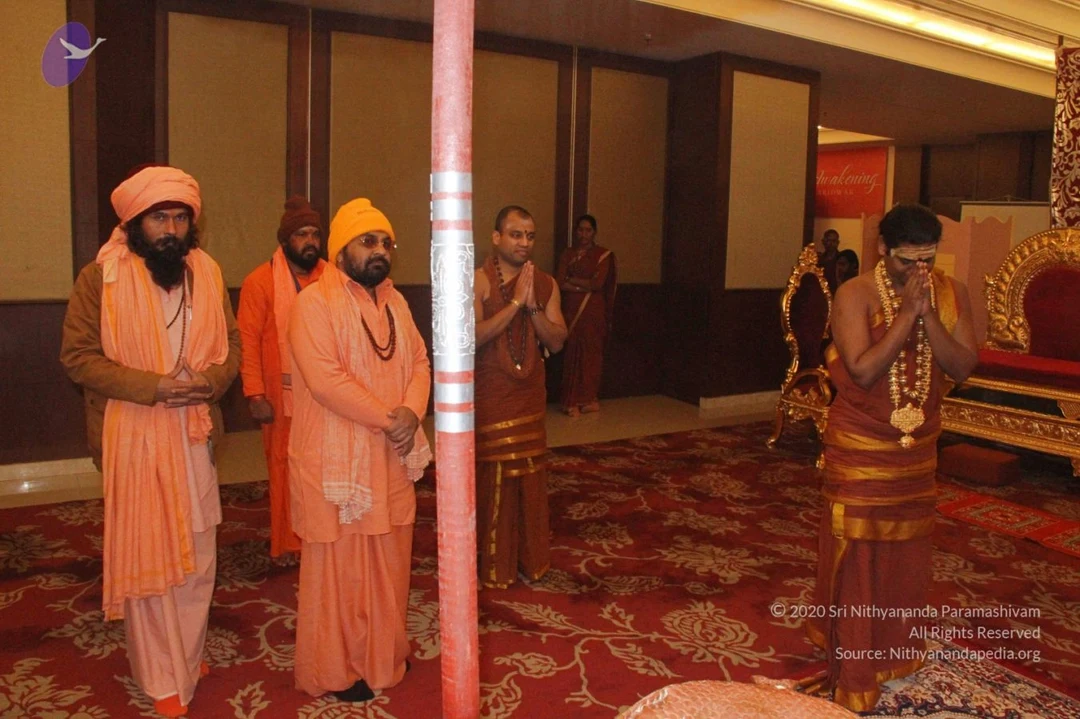
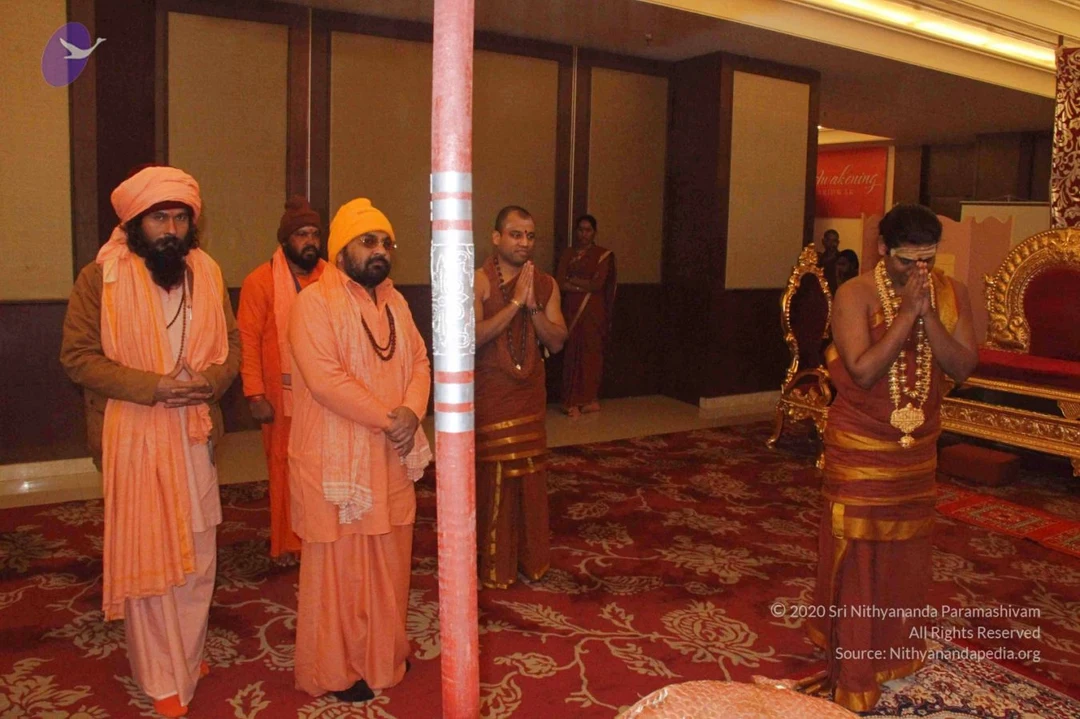
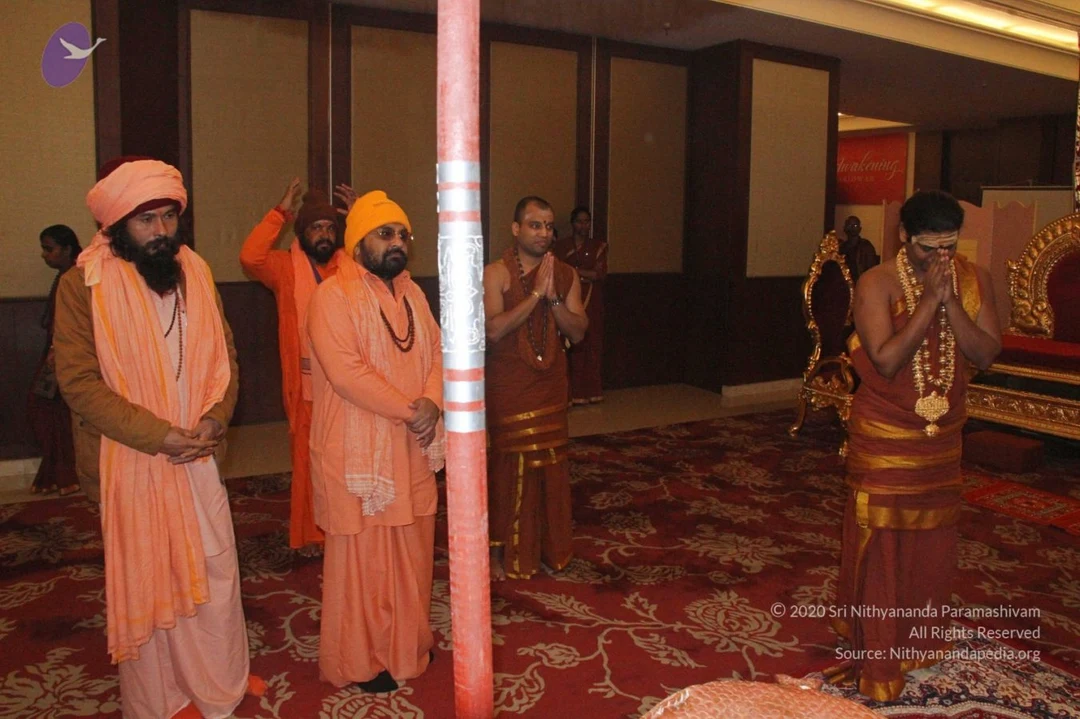
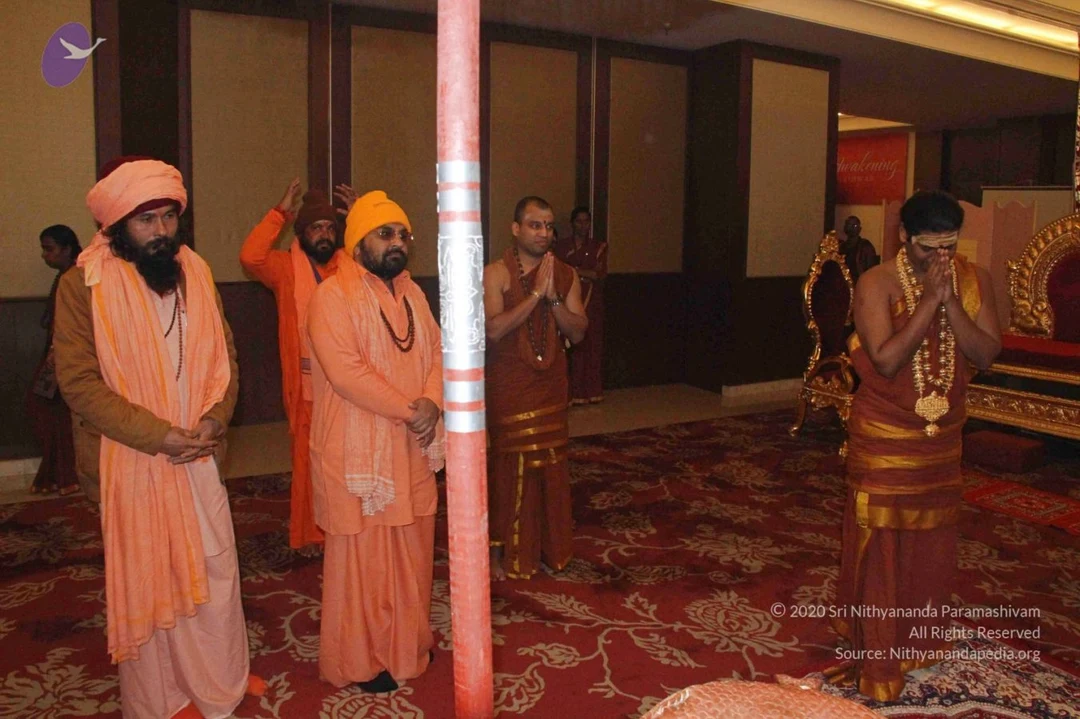
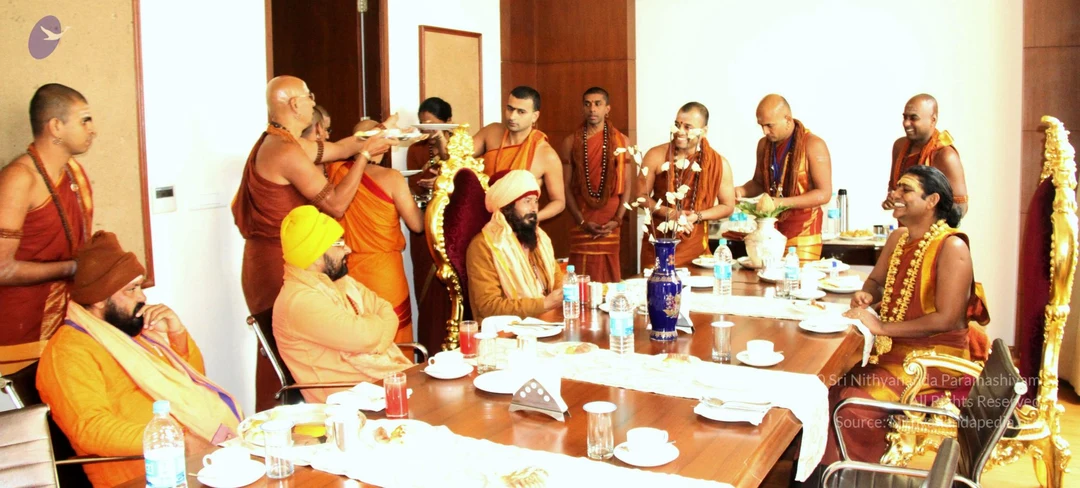
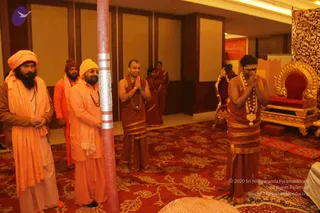
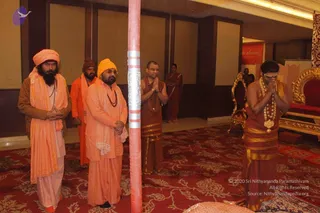
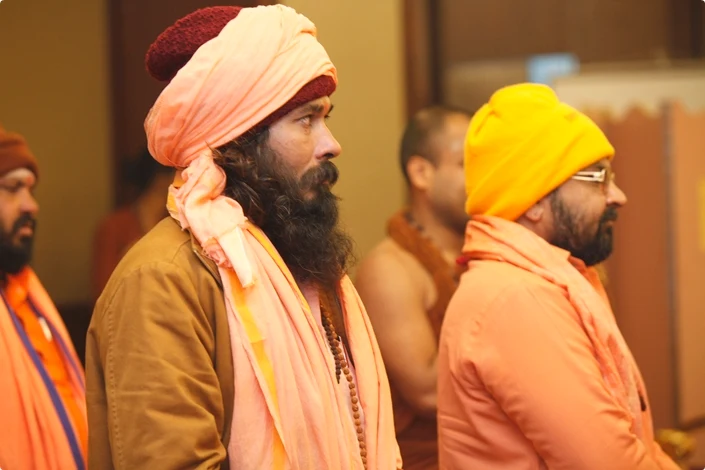
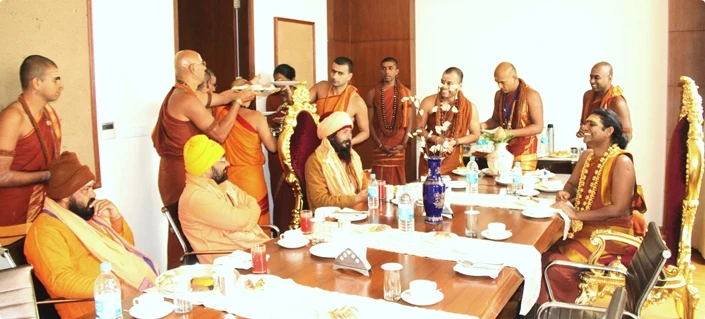
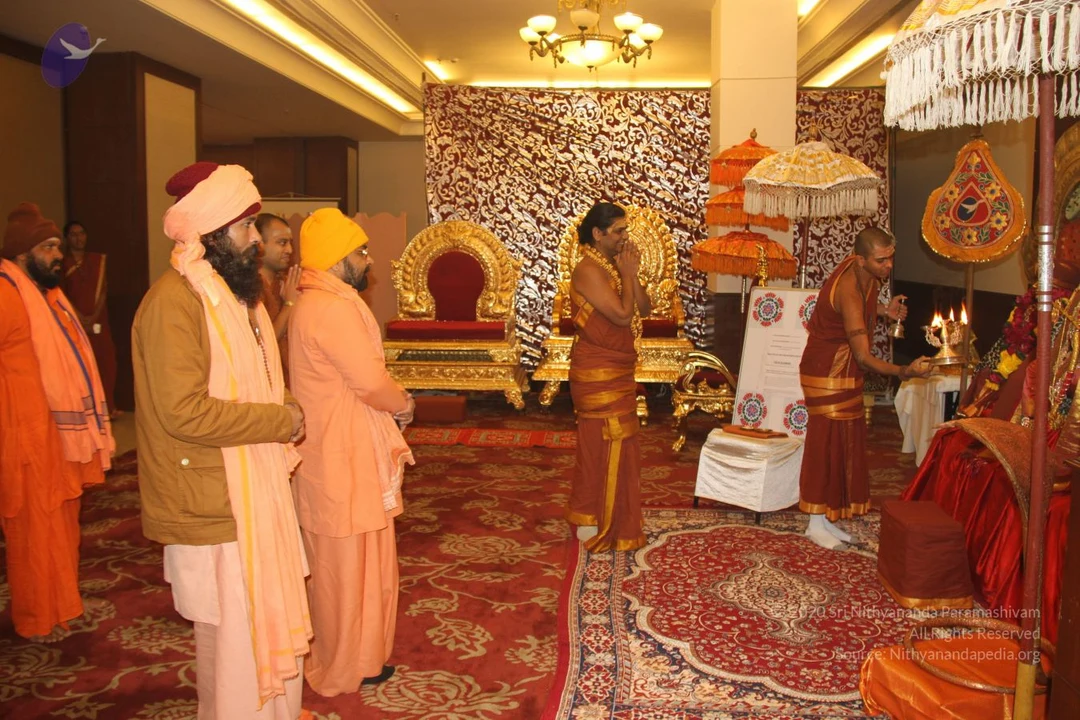
A photograph of a hall with red patterned carpet and gold-framed thrones at the back. Five men stand in a row, most with palms pressed together in namaskar. The man on the far left wears a peach-orange shawl over pale clothing and has a beard. Next is a man in a saffron-orange robe and shawl with a rudraksha mala. Beside him a man in a yellow turban and dark glasses holds his hands together. Further right a man bare-chested with a wooden mala and rust-coloured dhoti stands with hands folded, and at far right a man in a rust-coloured dhoti and ceremonial gold necklace kneels with hands pressed together and a marked forehead. A tall pink-and-silver pole stands in the centre.A photograph of a ritual aarti in a gilded interior with golden thrones and a red-draped chair in the background. On the right, a shaved-headed priest in an orange-red dhoti with a rudraksha mala and bare chest holds a silver five-flame oil lamp with lit wicks, offering it forward. Three men stand with hands folded in anjali at left: one in a pink-orange turban and tan jacket with a long beard, one in a yellow knit cap and orange robe with glasses, bowing, and one in orange robes with a rudraksha mala. A fourth figure stands behind them.A photograph of a formal meeting room with a long wooden table covered in white cloth, cups, glasses and water bottles. Several men in saffron and orange robes stand and sit around it, some wearing rudraksha malas. A bald man in orange holds a plate of offerings while another attendant stands nearby. At the centre-right, a bearded man in a white and orange turban sits in a gold-trimmed chair beside a blue vase of white flowers. On the far right, a man with a flower garland and a red-marked forehead sits in an ornate gold chair. A watermarked-style caption reads Sri Nithyananda Paramashivam at the lower right. a person is the man in the gold chair at right, identified by his garland, ornate chair and placement, though his appearance is only partially visible.

January 09 2014

Original wiki page
Contents

Title

Science of rewriting your future

Description

In today’s morning Satsang, Paramahamsa Nithyananda gives us the science of rewriting our future. Normally, we operate from what is our default flow of life, created by the root patterns we carry. This only increases our incompletions, binding us to more karmas. When we complete with our root patterns, we can live life from our prarabdha – the reason we took birth. If we continue making decisions based on past patterns, we deny the possibility of the future, denying life itself! Let us complete with all past incompletions and rewrite our future!

Video and Audio - Science of Rewriting your Future

VideoAudio

Transcript

Nithyanandeshwara Samaarambhaam Nithyanandeshwari Madhyamaam | Asmadaachaarya Paryanthaam Vande Guru Paramparaam ||

(0:15) I welcome all the devotees, disciples, samajis, satsangis sitting with us all over the world at this moment through Nithyananda TV, Sadhna TV, Eshwar TV, Janashree TV, and through two-way video-conferencing having Nayana Deeksha in many cities in many countries around the world. Cities sitting with us: Toronto-Kailasam, San Jose-Madurai, Nithyananda Nagara-Bangalore, Hosur Dhyanapeetam, Houston-Kalahasti, Winnipeg-Canada, Ohio-Prayag, Los Angeles-Arunachalam, Vancouver-Bhubaneswar, Monterrey-Kedarnath, Adi Nithyananda Dhyanapeetam-Avathipalayam, Hyderabad-Gupta Kashi, Johore Bahru-Tiruchendur, Tiruvanmiyur-Chennai, Oklahoma-Somanatham, Indrani-New Jersey, Enriching Temple-Bidadi, Madurai Dhyanapeetam, Coimbatore Dhyanapeetam, Philip Island-Australia, Oman-Sivagangai, Kanchipuram Nithyananda Dhyanapeetam, Kulim-Tiruttani, Jorpati-Nepal, Tallahassee-Florida, Seattle-Chidambaram. I welcome all of you. Some more cities have joined. Kuala Lumpur-Palani, London-Kashi, Nithyananda Nagaramu-Hyderabad, New York-Varanasi, Singapore-Singapuram, With this I welcome all of you with My love and blessings.

(02:09)

I will continue to expand on Mahabharata characters and the various stories. Bhishma, embodiment of Righteousness, finds few remains like a weapons of the Pandavas, and sees the dead bodies of that cooks, mistaking them as Pandavas; Pandavas are dead, is the depression everyone faces during the spiritual practice. Please listen, listen and understand. When you are doing your spiritual practices, when you live Integrity, Authenticity, Responsibility and Enriching, many time you will have a self-confusion – “Whether I am living Integrity, Authenticity, or I really lost everything and just interpreting whatever I want to do as Integrity and Authenticity” – this confusion happens to righteousness. Every individual goes through that confusion.

(03:37)

Listen. I will expand on this one important problem. Every human-being goes through this problem during this journey. We call this as ‘dark night of the soul’. The righteousness itself gets confused - “Really the Integrity and Authenticity is not saving us. Are they really dead?” That doubt goes almost into the depths of your being. Please understand, look into yourself.

I wanted to define about ‘fanaticism’. You may think why I am talking about fanaticism here. It will be very useful if you understand the concept of ‘fanaticism’ with the ‘dark night of the soul’. Listen. ‘Dark night of the soul’ means, even your own righteousness losing the confidence over your Integrity and Authenticity, feeling like you lost it, you lost the game, all your hopes are destroyed, now you are hopeless, you have nothing more to live, you have no future.

(05:16)

Listen, now I am defining ‘fanaticism’. Fanaticism is, if you have transformed yourself and then causing transformation in others - it is teaching, preaching, transforming, causing. But, without even you are convinced you trying to convince others, is 'fanaticism'. At some part of you, you are not completely convinced, but you are trying to convince others by force - is 'fanaticism'. Whether your righteousness is causing or fanatic, that test is done by the Existence at some time taking away all your hopes. Whether Bhishma himself is transformed and causing, or he is only fanatic, at that time the Intelligence – Vidura comes and supports, saying, “Don’t worry.” Intelligence gives the hope.

(06:37)

Please understand, the whole Hindu infrastructure itself is such, by the time you evolve as Guru, you would have suffered, struggled enough. Only if you are really, really authentically using Integrity, Authenticity, Responsibility and Enriching inside your system, you will even be able to stand up. You will be polished, molded, acid-washed so many times in so many ways. By the time you sit as Guru, you are qualified, made to qualify! Here, Cosmos is testing Bhishma by giving the wrong evidences that maybe his Integrity and Authenticity, Responsibility and Enriching have failed, maybe his hopes cannot be achieved any more. Understand, only during these moments, you need a Sangha, Sangha bala.

Please understand, Átma bala alone is not enough for a person to reach the ultimate. You will be able to have more Átma bala than Bhishma? But, even Bhishma is in depression. It is Vidura’s support brings Bhishma back to strength. That is why I am telling you, Sangha is one of the very important component necessary.

(08:35)

Same way, spirituality also needs Sangha, Sangha bala. See, if you want to achieve the complete performance in the body, like ultimate health, you need that company, that Sangha. If you want to build your body, you need that kind of that gym goers, health freaks, as a Sangha... through the ‘dark night of the soul’. Many time, you have not convinced even some parts of you, but entered the journey. So, when you face the life, those parts will be exposed to you, those tumors will be exposed to you. At that time, you yourself may not be able to handle those tumors independently just by your own Átma bala. You need Sangha bala.

(09:45)

I tell you, just yesterday night, all of the Swamis, Kotharis and Mahants, we were sitting in the banks of Ganga and having a session. We were discussing on this subject only. How structure of the Sangha constantly reminds you about your higher purpose and inspires you, raises you to the highest possibility. I have seen sometime the spiritual seekers, till the end of their life, they only had their default flow of life; never conquered, completed their prarabdha and rewrote their future.

(10:53)

Please listen. The default flow of your life because of your root-pattern is ‘default future’. That is there for all of you. It is called ‘default future’ - the side-effect and after-effect - the how your life will flow with these root-patterns. It is happening. All of you have a default future. If you completed with all the root-patterns and you are running your life, that is called Prarabdha. The default future because of your root-patterns is called Ágámya. Root-patterns are so powerful, you are going to accumulate more and more suffering and karma; that is Ágámya. They are so incomplete, you are going to accumulate more and more incompletions. The more and more incompletions you are going to accumulate, the more and more incompletions you are going to accumulate your root-patterns, and naturally they are not going to keep quiet. You will constantly accumulate more and more karmas. That is what is Ágámya, the default future. If you complete with all your root-patterns, the default future you will experience is Prarabdha. If you complete with all your root-patterns and create a new space and re-write your future that is called Eshwaratva. You conquer your own life. Rewriting your future, rewriting your future is what is all about Inner Awakening. This is the right one-liner for Inner Awakening: Rewriting your future.

(13:03)

Please listen. Now Bhishma decides to re-write the future. How he rewrites, we will see in the further satsangs. But I wanted all of you to understand these few things. Don’t live your default future! Your default future is not going to help you. It is not going to work. Don’t support your root-patterns to win over you. Don’t help your root-patterns to succeed over you. Default future is what we call Ágámya. And, when you complete with your root-patterns, the flow of your life is called Prarabdha. Only when you rewrite your future, you achieve Eshwaratva.

(14:13)

Please understand, Jivan Mukthi comes only for the people who achieve Eshwaratva; because, for Jivan Mukthi, exhausting your Ágámya and Prarabdha alone is not enough, you have to complete even your Sanchita. So, complete with your root-patterns, complete with your Prarabdha. Completing with your root-patterns liberates you from the default future. Liberating yourself from the default future is what is liberating yourself from disease, poverty, depression.

(15:07)

Please listen, in the Inner Awakening I am not teaching you to develop your life, the best techniques to develop your life, develop yourself, change yourself. No! You need to know, till the root is not burnt, even if you try to change your life, develop your life, whether you succeed or fail, you will continue to be struggling. For example, if you change the time you wake up and the Yoga you do, even if you are successful in changing it from 7:30 to 4:30, you will be struggling with some other pattern. You will be struggling with smoking pattern. Even if you are successful in giving up smoking, you will be struggling with depression pattern. Whether you win or fail, you continue to struggle. That is what is the Law of Development or Change. Even if you change yourself successfully five times, you will become more greedy to change yourself in different places. So, that will continue to make you struggle. I am not teaching you the science of change or the science of developing yourself.

(16:38)

My programs are not Self-Development Programs. My programs are not Personality Development Programs. Understand, I’m teaching you to re-write your future! Simply re-write: “Till yesterday, you were sick, broke, sleeping till 10 o’clock, lazy, fat, ugly, all--------”. Just from today you start rewriting the whole future as you want. Understand, Inner Awakening is all about giving you that breakthrough. It is not about teaching you the science of change. It is teaching you the science of rewriting your future - burning the roots from which your old personality is established, and giving you the free space to re-write your new personality.

(17:54)

Understand, take the power of rewriting your future in your hands. How world occurs to you, how you perceive the matter. Please understand, matter is not reality. How it occurs to you is reality. The good news is - your occurrence can be changed. How it occurs to you can be transformed. The bad news is - you are in a reality illusion. What you think as reality is not reality, it is illusion. It is the way the matter occurs to you. It is not fact. It is the way the matter occurs to you. Please listen! Your reality is the way matter occurs to you. Transforming, rewriting the way the world occurs to you, rewriting the way the world occurs to you, transforming the way the world occurs to you is what I call rewriting the future. When you complete with yourself and complete with others, the way the world occurs to you becomes different. When your root-patterns loses power over your thinking, please listen, even if you discover your root-pattern, you know whenever your default thinking starts, “Hey, it is because of my root-pattern; I will not encourage this thinking”, even that is a great liberation for you! Once the root-pattern completely disappears, that liberation is next. Even remembering, whenever your root-patterns guide your thinking, “Hey, I am not being driven by the petrol car, I am being driven by the bullock cart, I am not being flied by the pilot who knows flying, I am being flied by some fellow who is in the workshop”, you will know the difference!

(20:32)

Please understand, rewriting your future. Look in! Look in! Look in! I tell you, continuously Grace is flowing. Life means possibility of future. What is life? Possibility of future! But what are you doing? You keep saying, “It is...nothing new is possible. It is all going to be the repetition of the old.” It means what? You denied yourself the possibility of life! Every decision you make for your future from the past pattern, you denied that component of life for yourself once for all. If you think creating wealth is difficult based on some of your past failure, you have denied the possibility of wealth for you once for all. If you think health is not possible for you in the future due to your past diseases, you have denied the greatest possibility of health in your life once for all. If you think enlightenment is impossible for you based on your past failures, you have denied the possibility of enlightenment once for all in your life. Understand, whenever you deny the possibility, you deny your future, you deny your life to you.

(22:17)

Anything is possible. Re-writing your future starts with this clarity: ANYTHING IS POSSIBLE! All your impossibility is the projection of your past into the future; projection of your past into the future. Listen! Don’t deny the future. Don’t deny life. Don’t deny life because of past incompletions. If at all you have to put all your struggles in one direction, that is only in one direction liberating your future from your past. Rewriting your future - that is the only direction you have to put your energy. That is the only direction you have to put your effort. That is the only direction you need to think, you need to work, you need to act.

(23:38)

Kalpataru is initiating you into the science of rewriting your future. Kalpataru is helping you to complete with your past incompletions. I tell you, Ganga has opened even for Me a new future! She is so powerful, so alive! Many time My great past disciples have made Me lose hope on training new disciples. But Ganga washes away all that and gives me the new hope - I can, I have a possibility, I have a future, I don’t need to deny that future, I don’t need to deny that possibility. I am enjoying Ganga, Haridwar, so much, really, really, that I have decided to have even March Inner Awakening in Haridwar again. The March Inner Awakening, the date... see, February we have next Inner Awakening - that is in Bidadi. March Inner Awakening – March 6 to March 26 – we are going to have it again in Haridwar. If you missed Inner Awakening in the banks of the Ganga, Inner Awakening in the breathing space of Completion... when Ganga breathes, she completes you. See, the area Ganga breeze reaches, Ganga’s wind reaches, carrying the Ganges, carrying the sacred water, that itself is the breathing space of Ganga. So, even being in the breathing space of Ganga completes you. If you have some most difficult incompletions and you are struggling with it, just come to Ganga, Ganga will wash it away! So, if you have missed Inner Awakening this time, come for March Inner Awakening, March 6 to March 26, 2014, next Inner Awakening in Haridwar. Please listen, Ganga washes away every incompletion, every impossibility.

(26:30)

With this, I will move to the Kalpataru Darshan. Sit straight. Close your eyes. Decide with your Integrity, Authenticity, declare with your Integrity and Authenticity, “I complete with all the past incompletions and I will not allow any of my incompletions into the future, into the possibility of the future.”

Namah Shivaya! Again and again and again complete with your all past incompletions, all the past failures. Declare to yourself, “I will re-write my future.”

KALPATARU MEDITATION IN PROGRESS..................... (28:12)

Photos

Morning Paduka puja in Progress
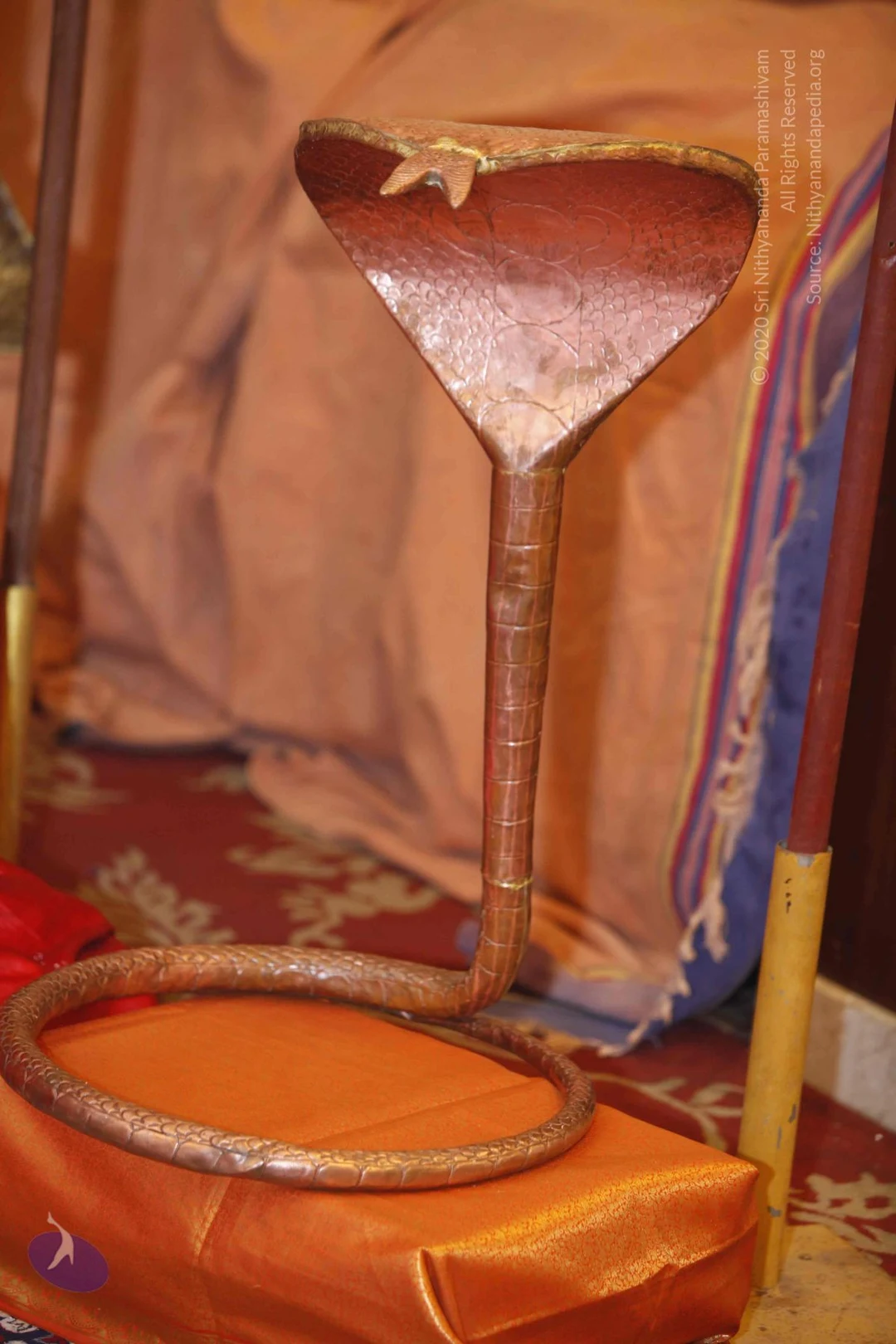
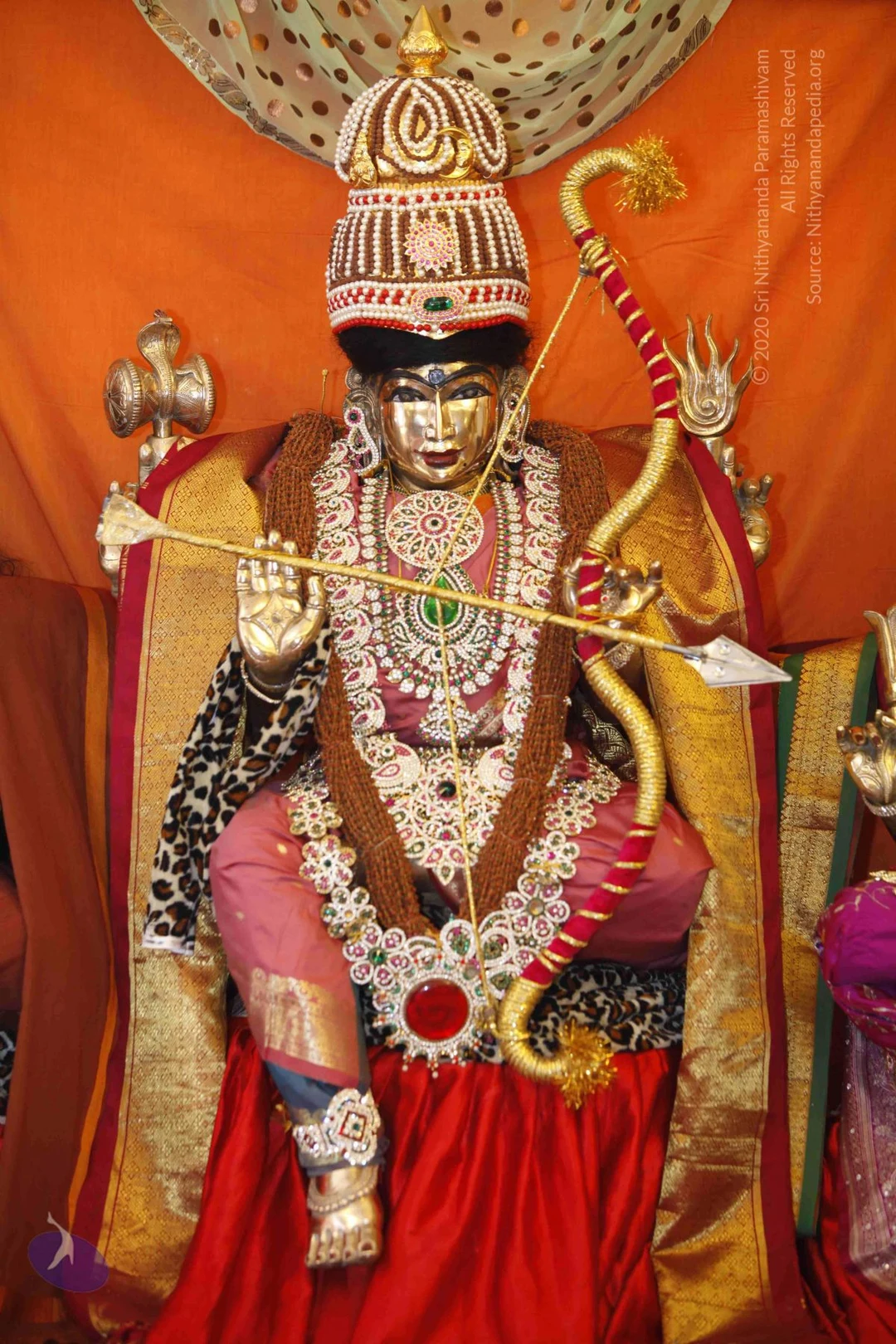
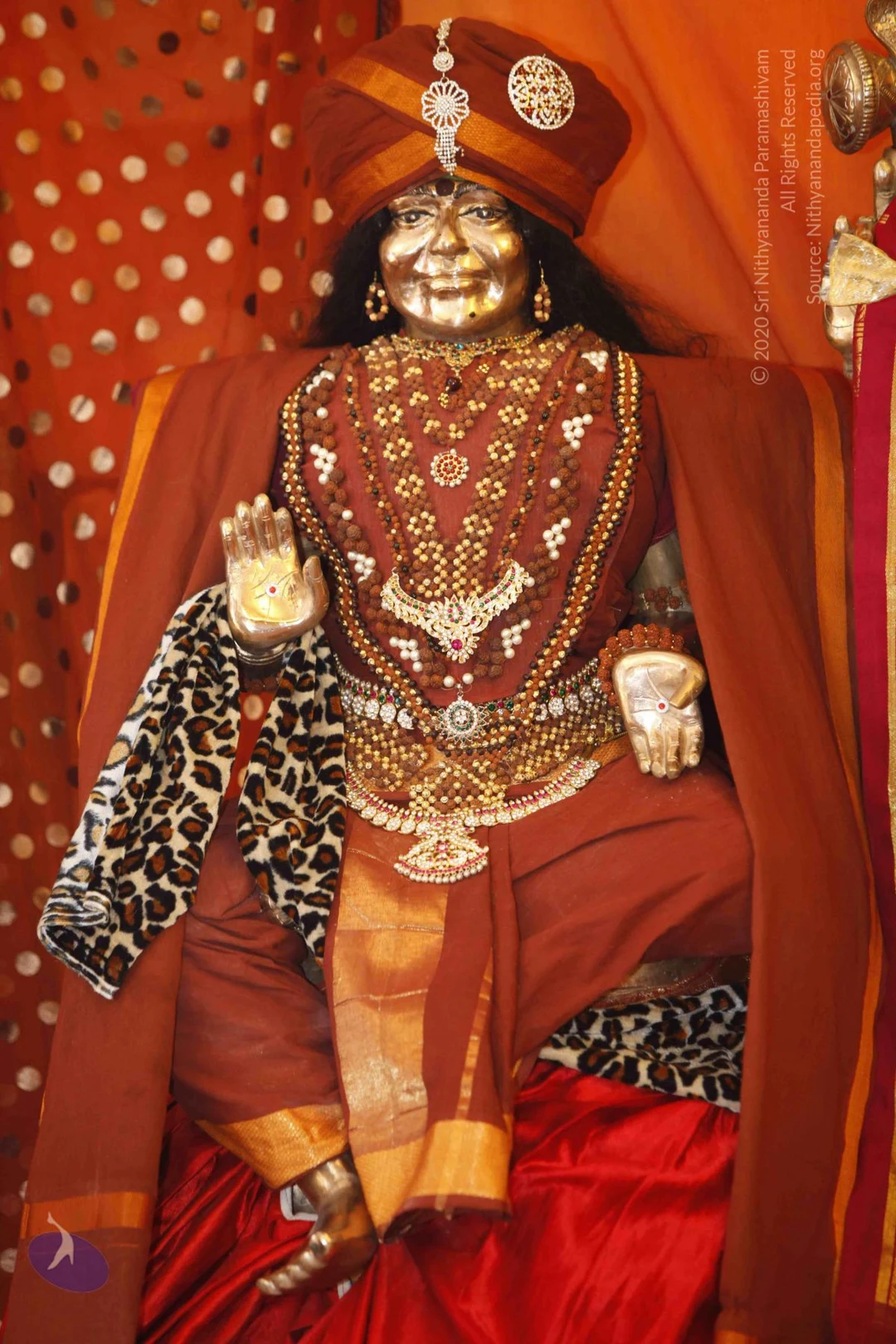
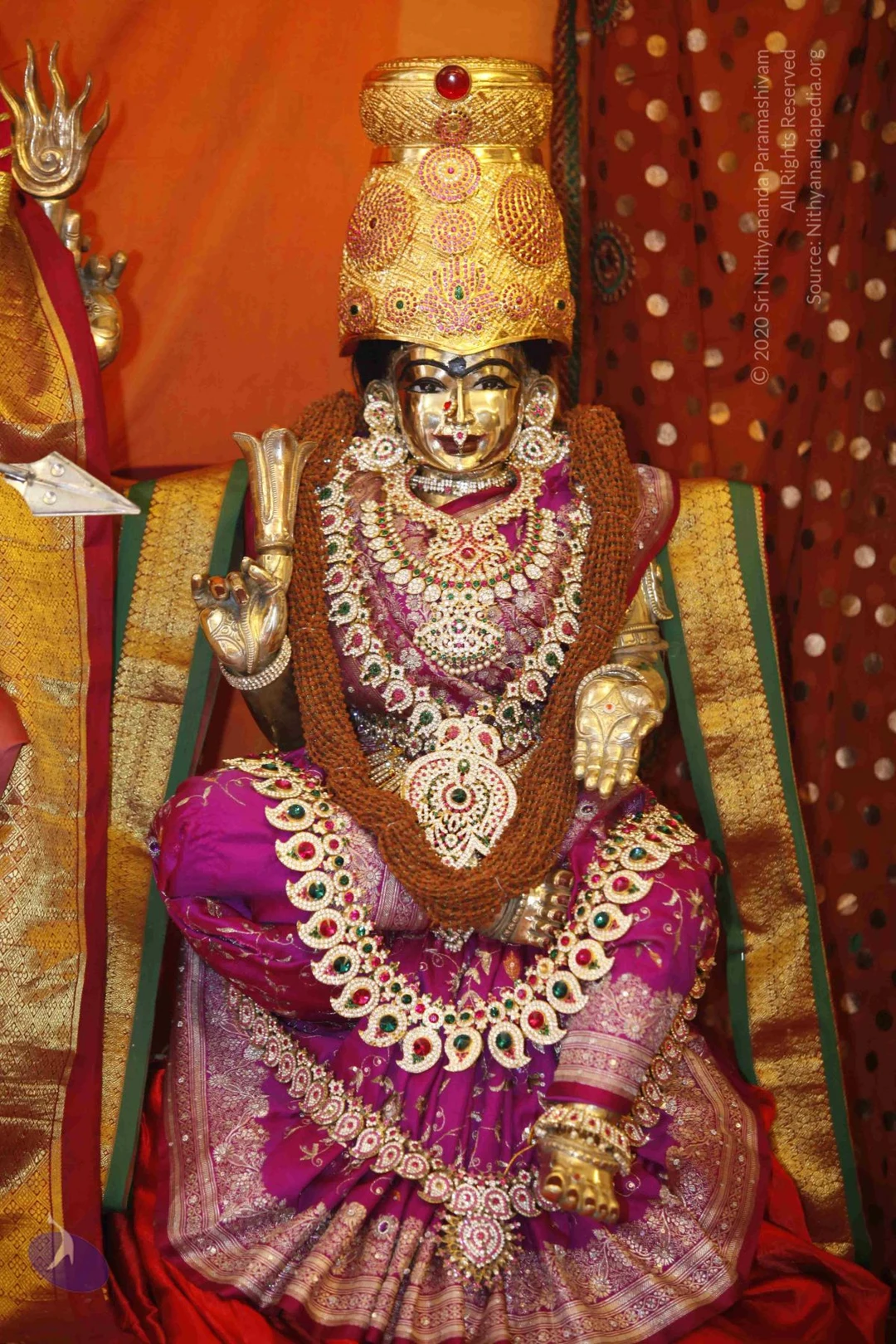
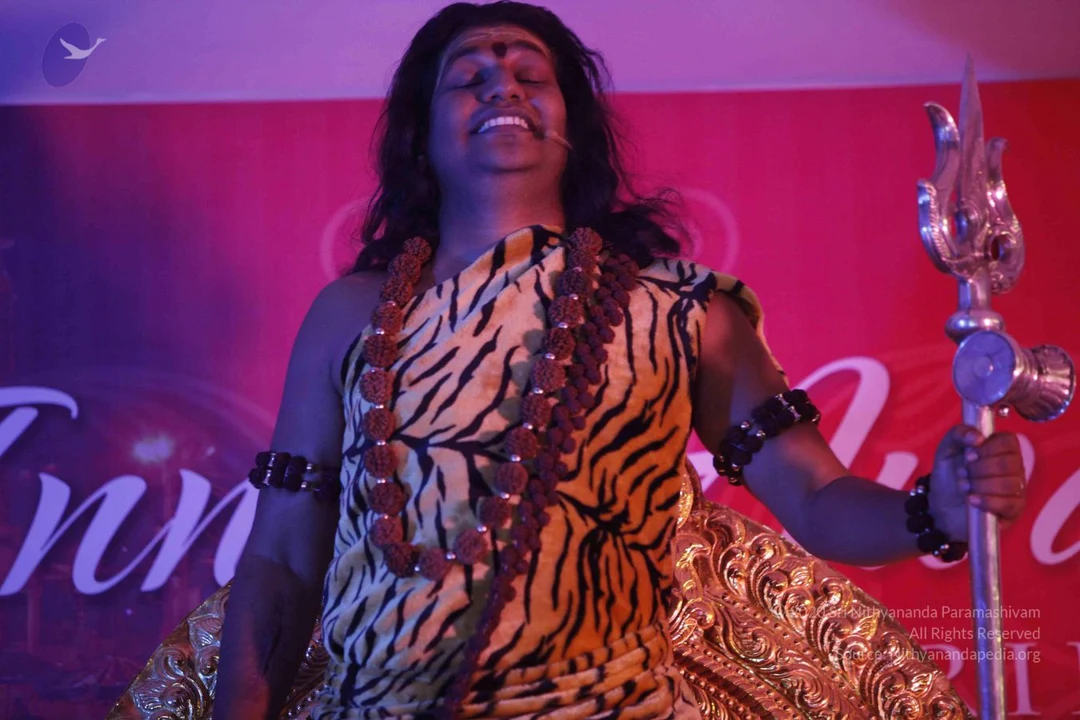
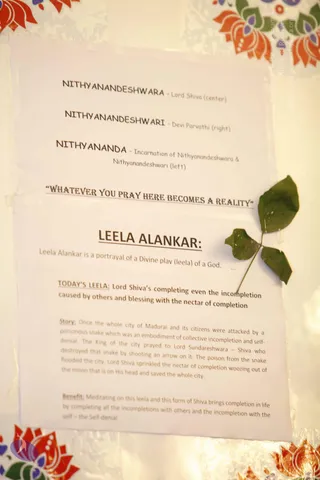
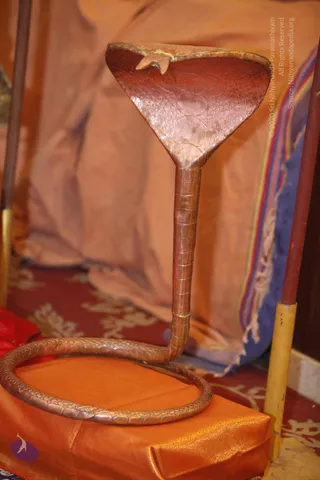
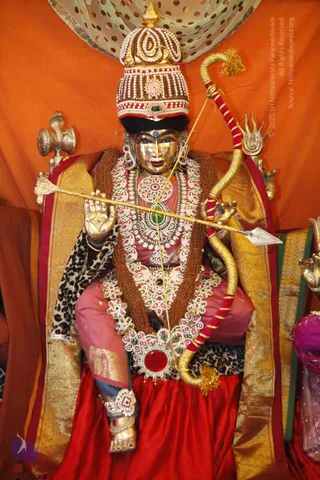
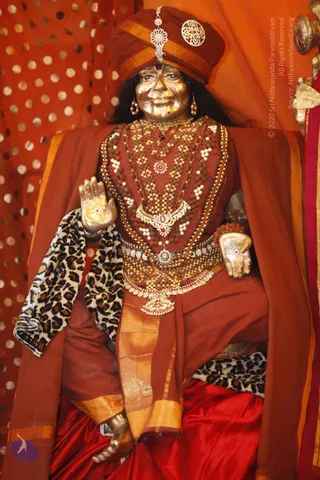
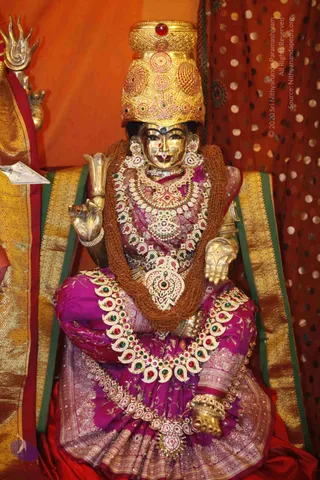
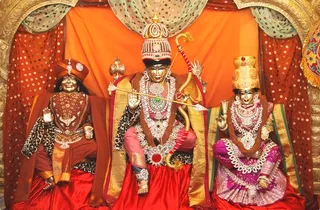
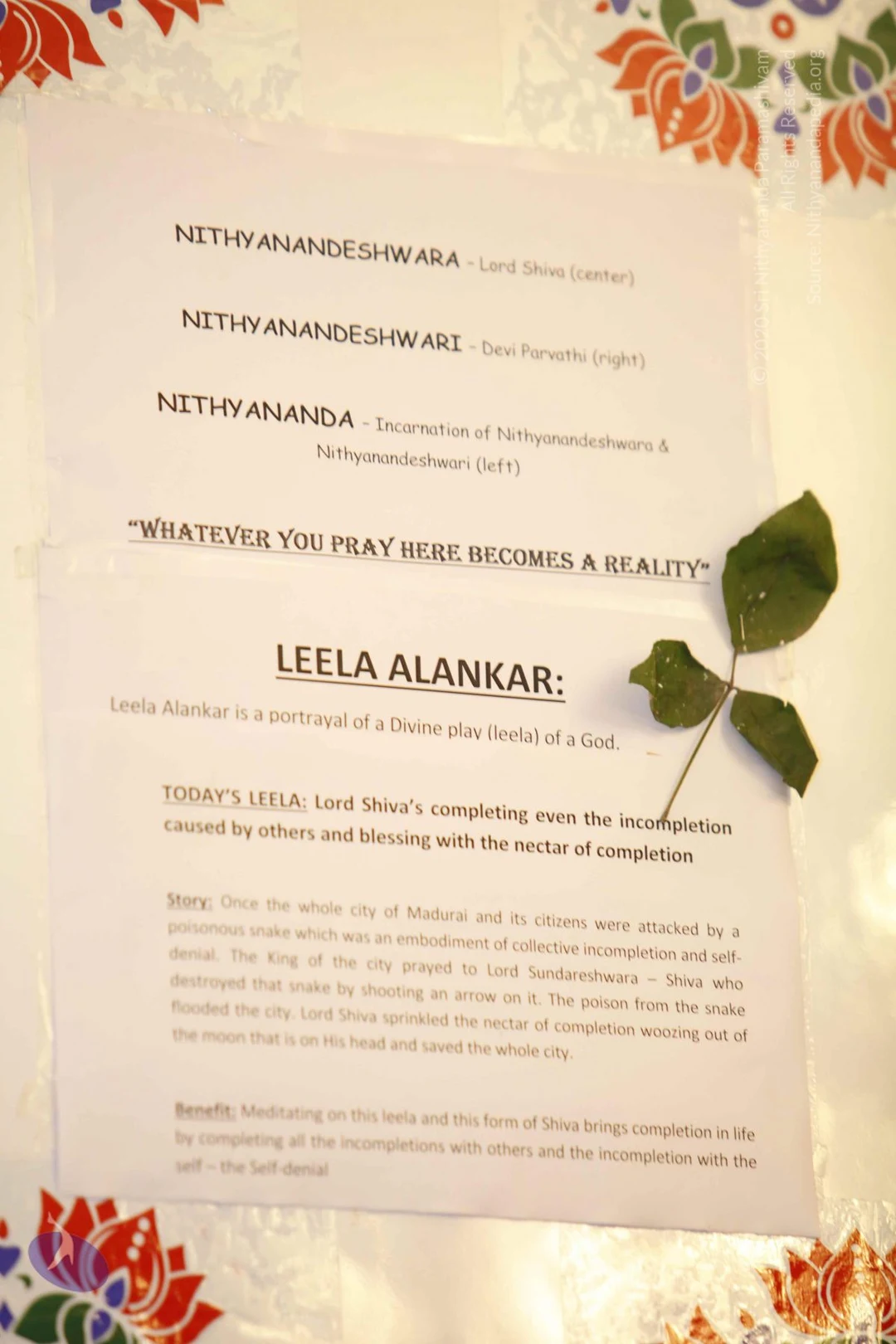
Todays Leela Alankar:Lord Shiva
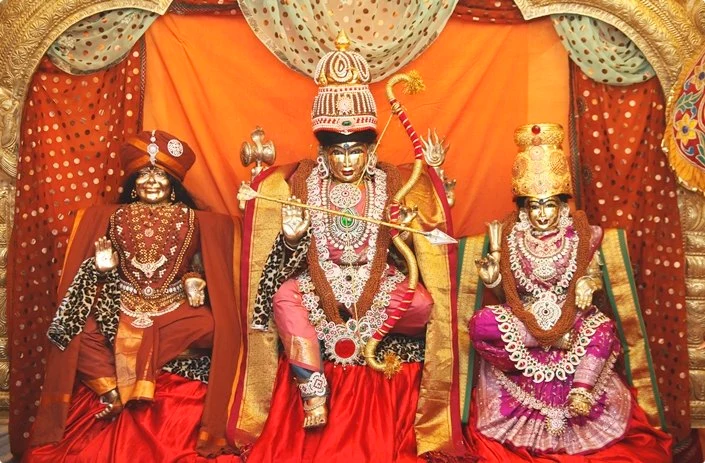
Todays Leela Alankar:Lord Shiva's Completing even the Incompletion Caused by Others and Blessing with the Nectar of Completion

Nithya Satsang continuation of Mahabharata characters and the various stories
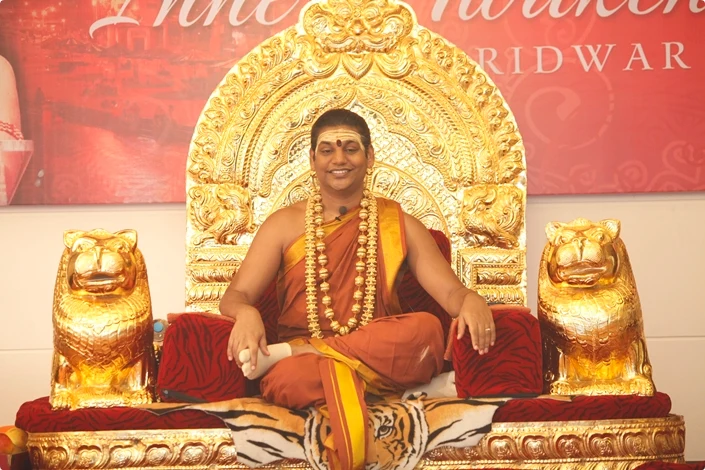
Kalpataru Darshan
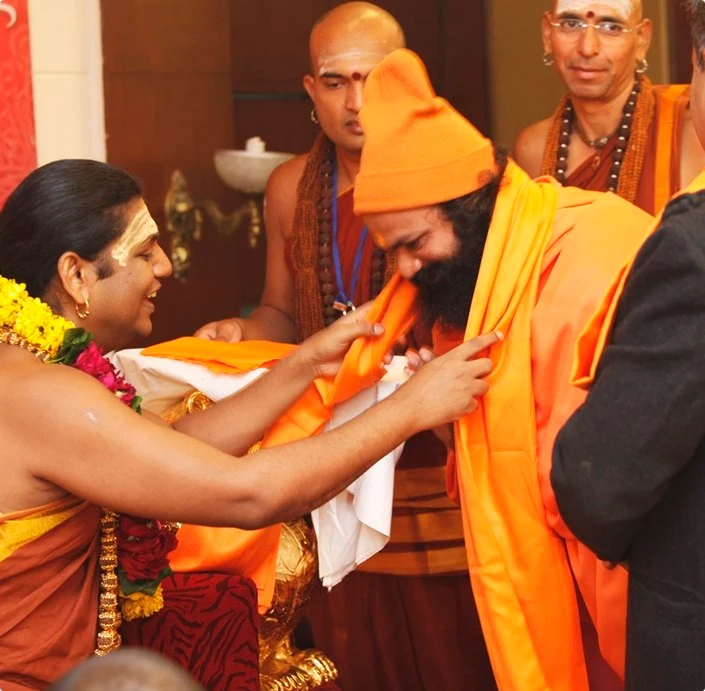
Nithyananda_Swami-Ravindra-puri-yamuna-puri-ramesh-giri
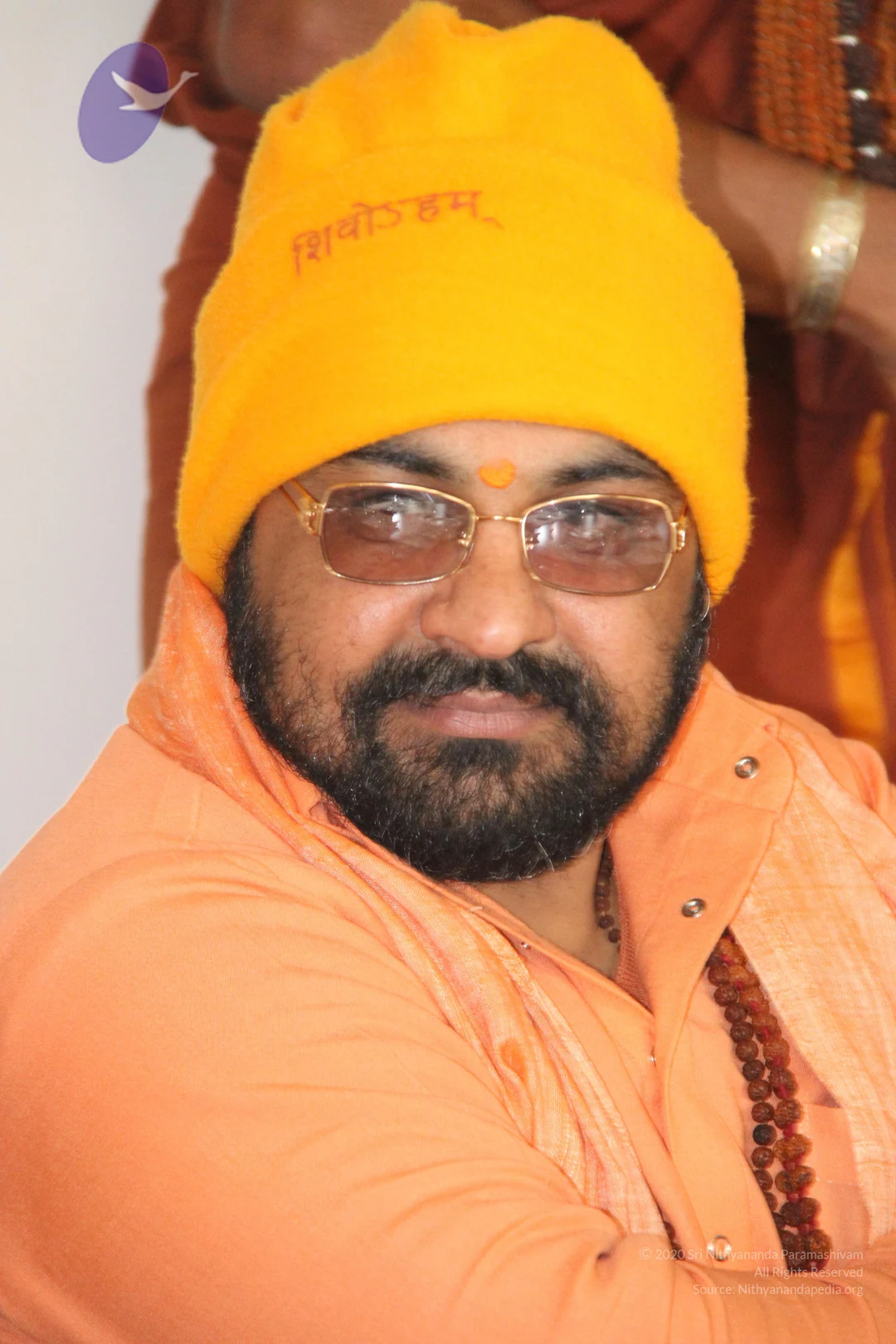
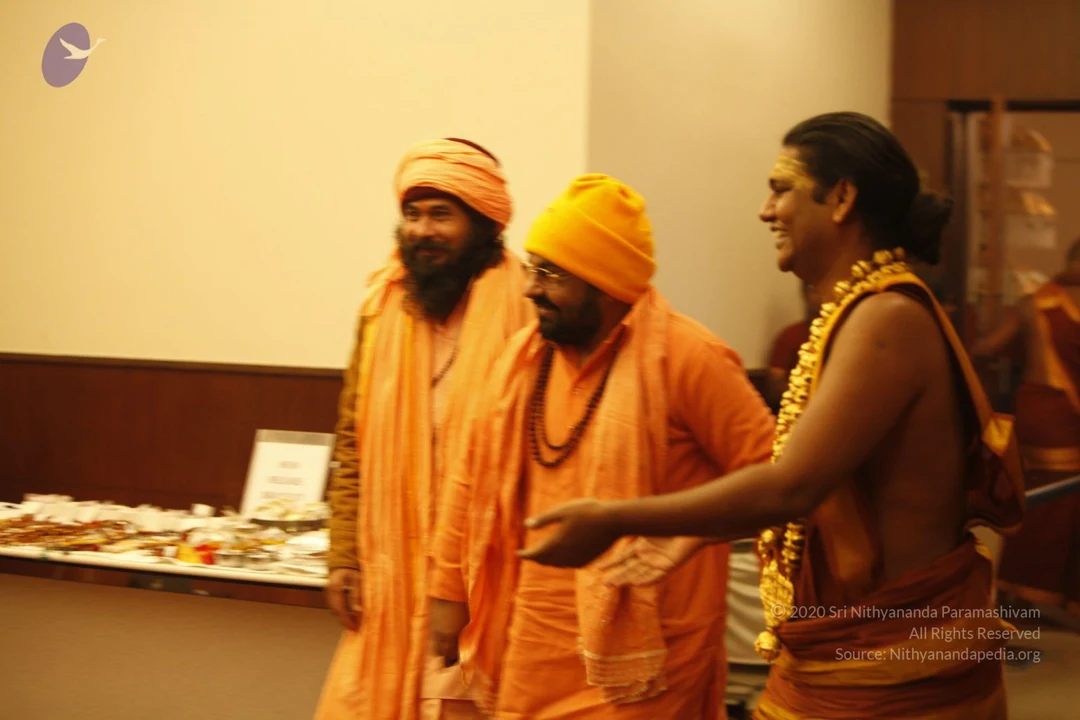
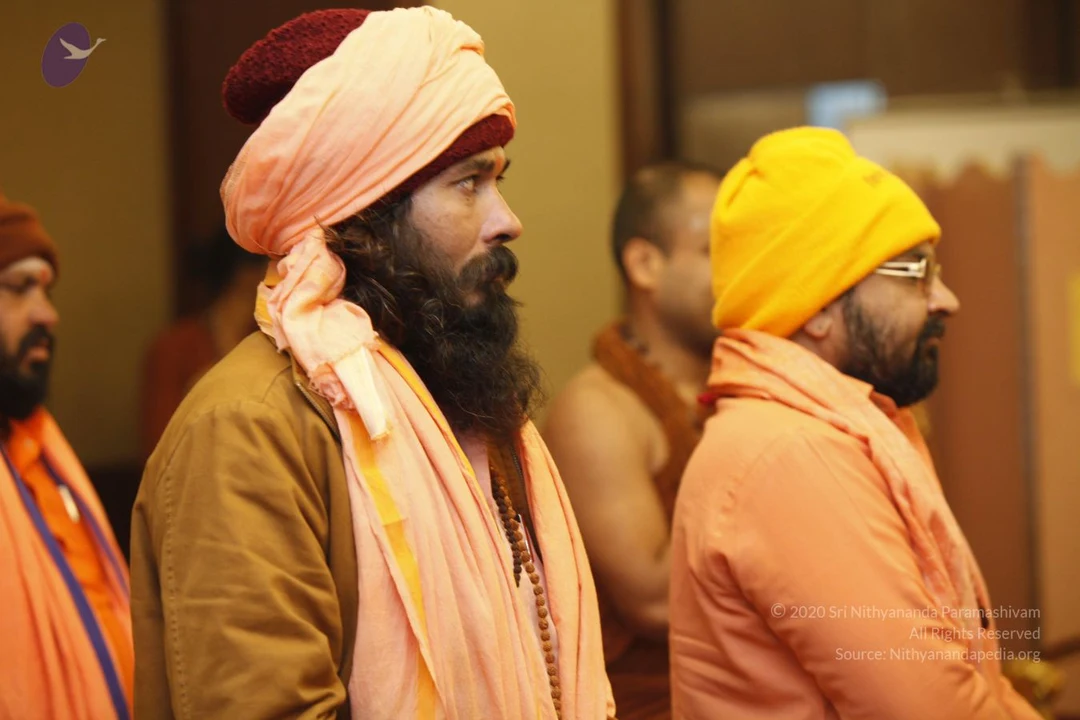
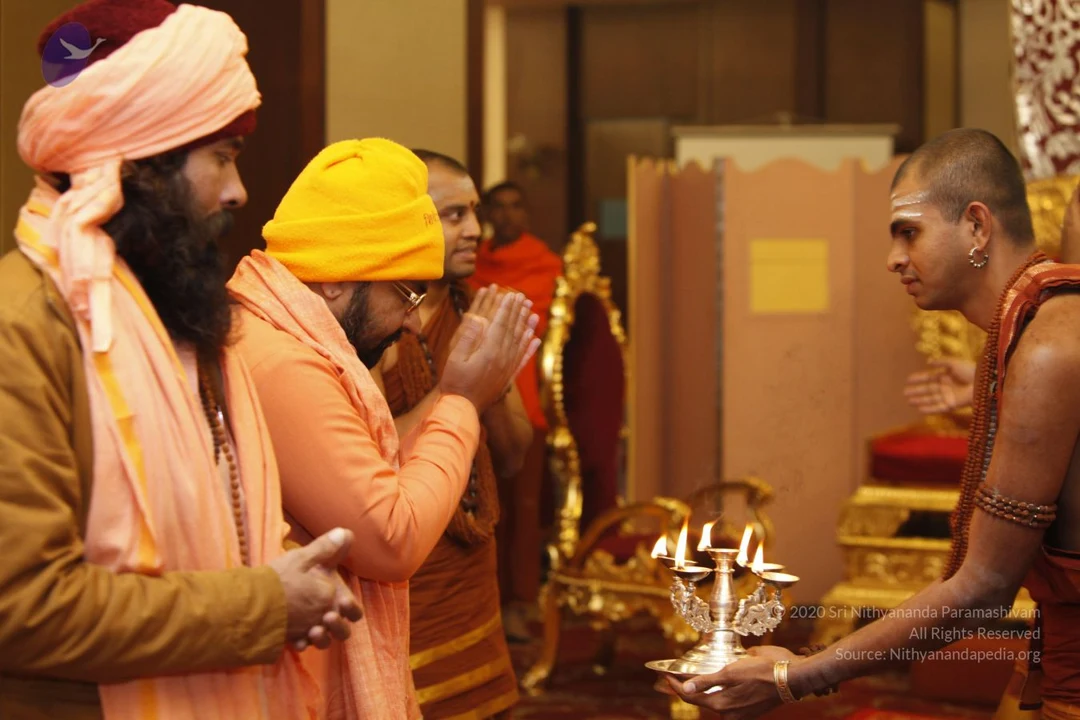
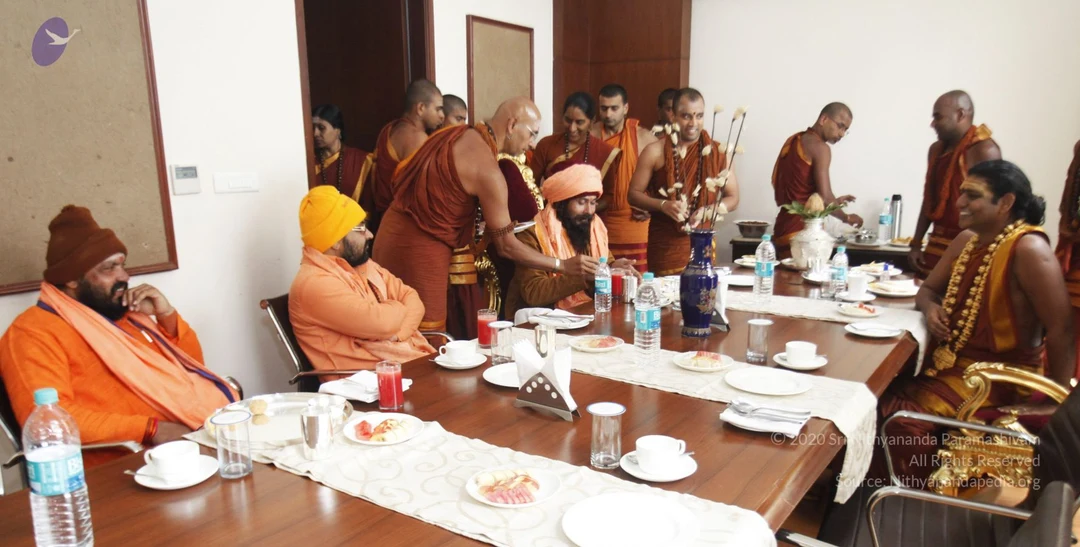
Swamiji with Sachiv Mahanirvaniakada Sri Ravindrapuri Mahraj,Sri Mahant Yamuna puri and Sri Mahant Ramesh giri of Nirvani akada
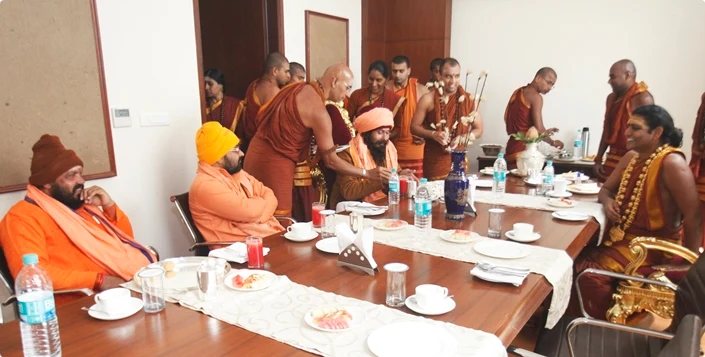
Nithya Satsang
Nithyananda Times

Tags

Paramahamsa Nithyananda, science, future, incompletions, karmas, root patterns, prarabdha, birth, patterns, future, life.

Photos Of The Day:

Ravindraji-Visiting-To-Adheenam
Photos Of The Day:

Satsang
Kalpataru-Darshan
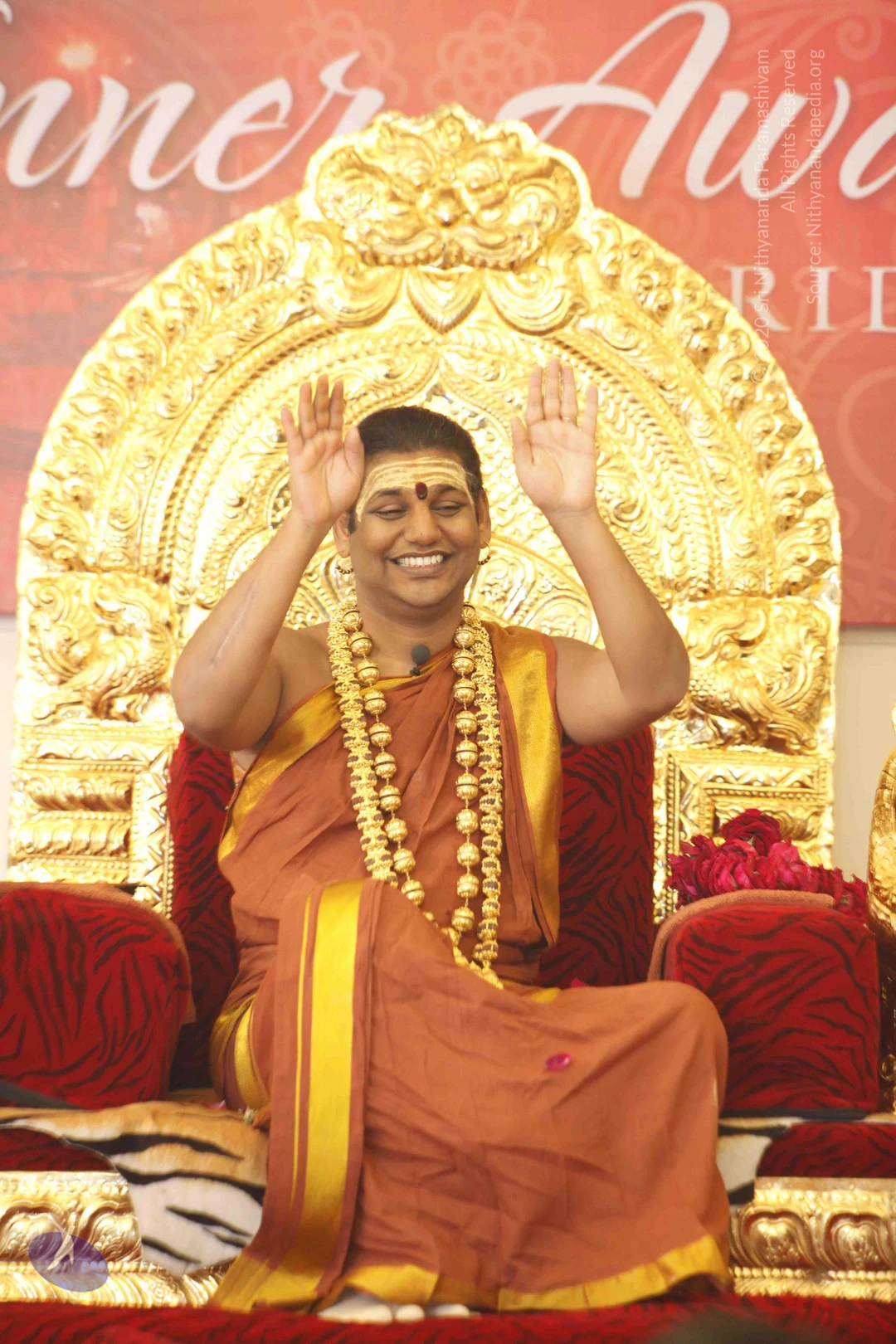
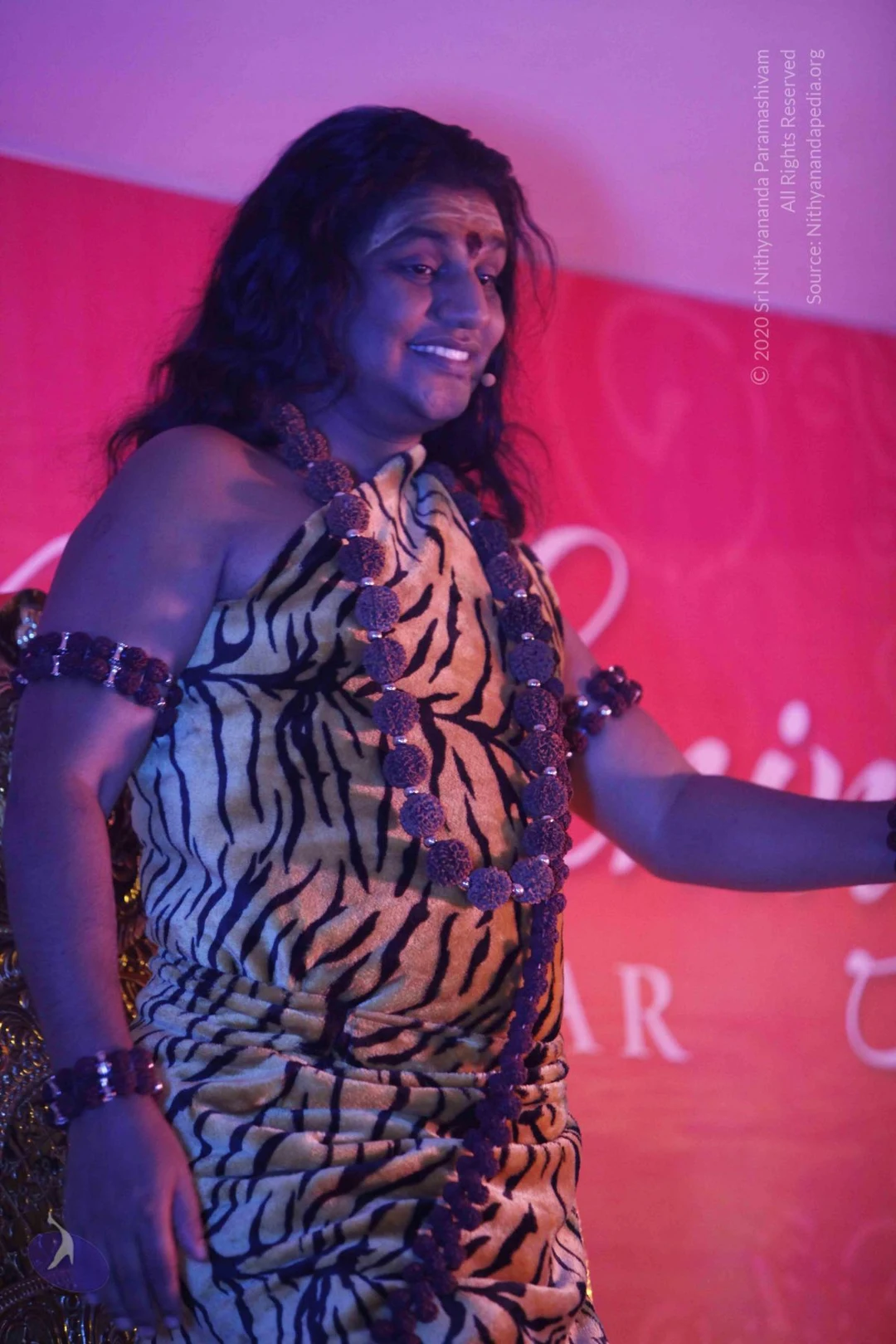
Kalabhairava-Darshan
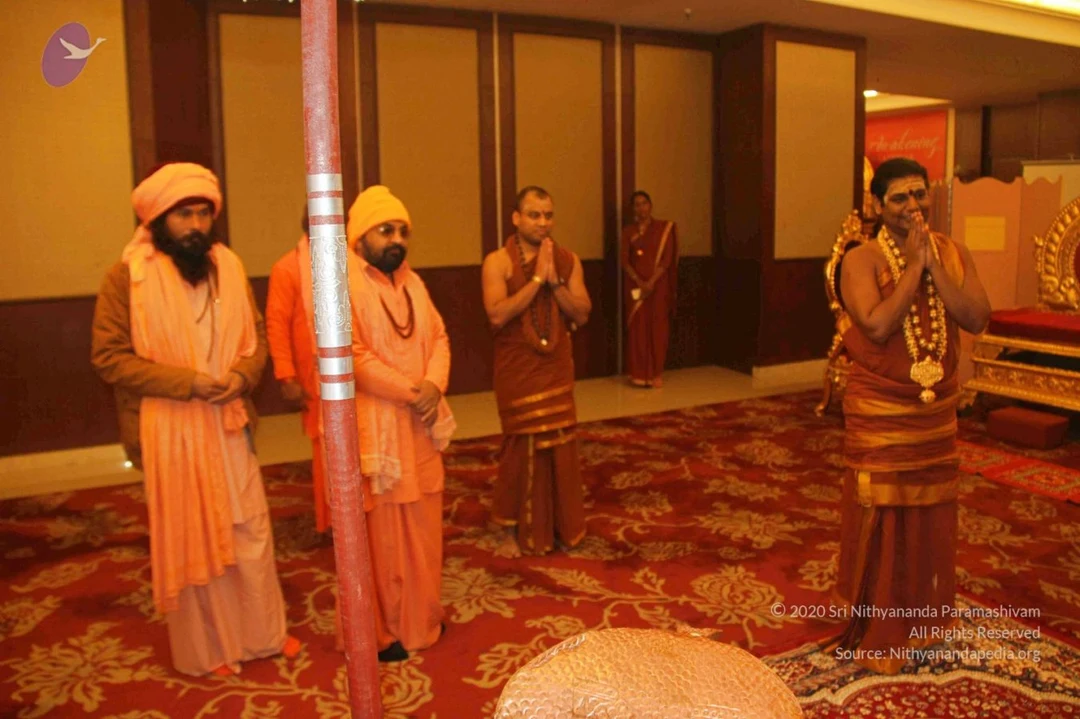
RAVIDRAPURI-MJ-VISIT
Photos from this day

View all 41 photos

Photos

3 photosSource gallery
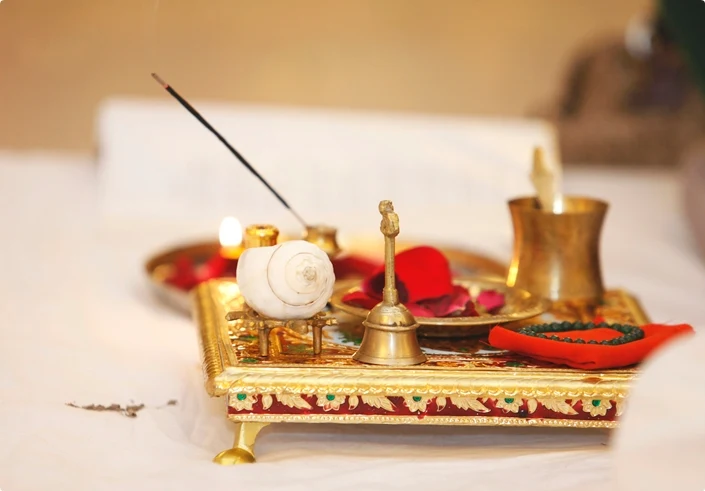
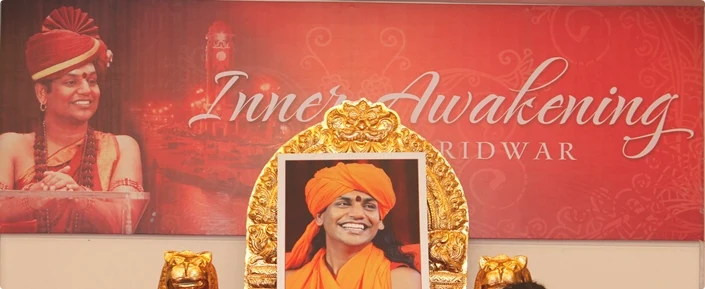
A photograph of an event stage backdrop with a red banner reading "Inner Awakening" and "HARIDWAR" beside a city skyline. At left, a large printed image shows a smiling figure in a red turban, white garment and rudraksha-style necklace holding his hands together. In the centre, a framed portrait labelled with no readable caption shows a smiling figure in an orange turban and orange robe, set within an ornate gold frame flanked by two gold lion-head sculptures. Only a partial dark-haired head is visible at the bottom edge, so physical people are minimal. The main subject is the framed portrait display on the stage.A close photograph of an ornate silver or silver-toned tray filled with red rose petals, with a small gold ornamental object and a gold-toned figure resting among the petals. The tray sits on a red cushion with black zebra-stripe pattern, and a blurred orange-clad figure appears in the soft background. No people are clearly visible in focus.A close photograph of a gold-coloured puja tray on a white cloth. On the tray sit a white conch shell, a brass hand bell with a ornate handle, a brass cup, an incense stick smoking in a holder, and red rose petals with a red cloth holding a green bead mala. A small oil lamp burns in the background on a plate with more red petals. No people are visible.

Photos

2 photosSource gallery
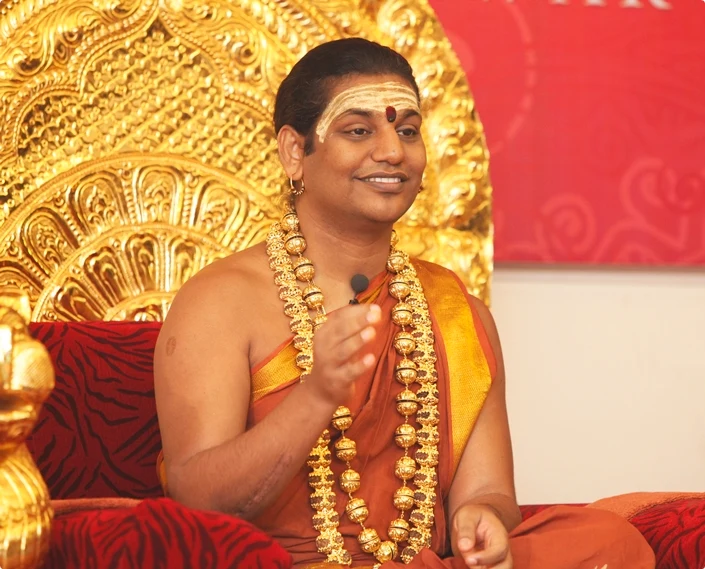
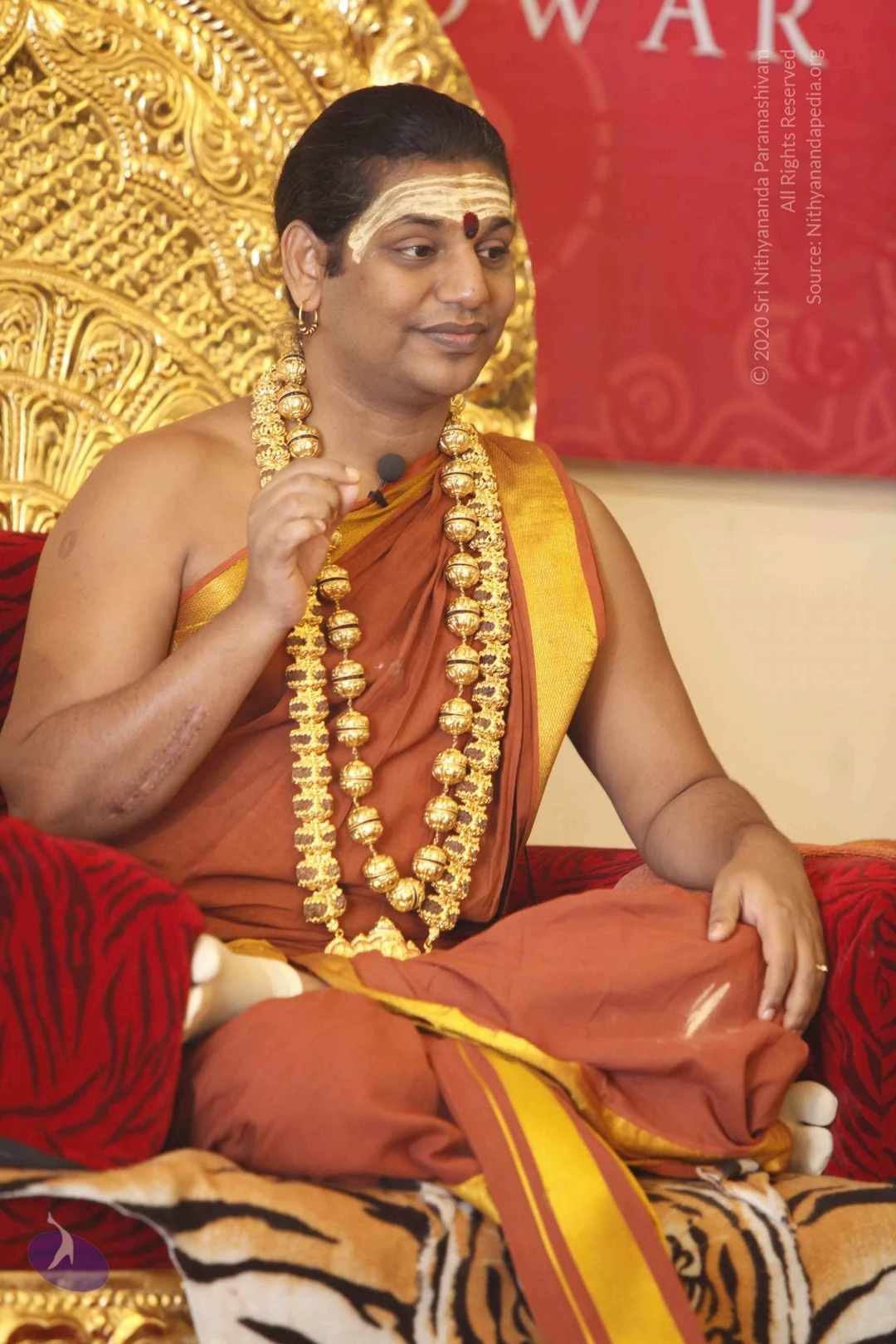
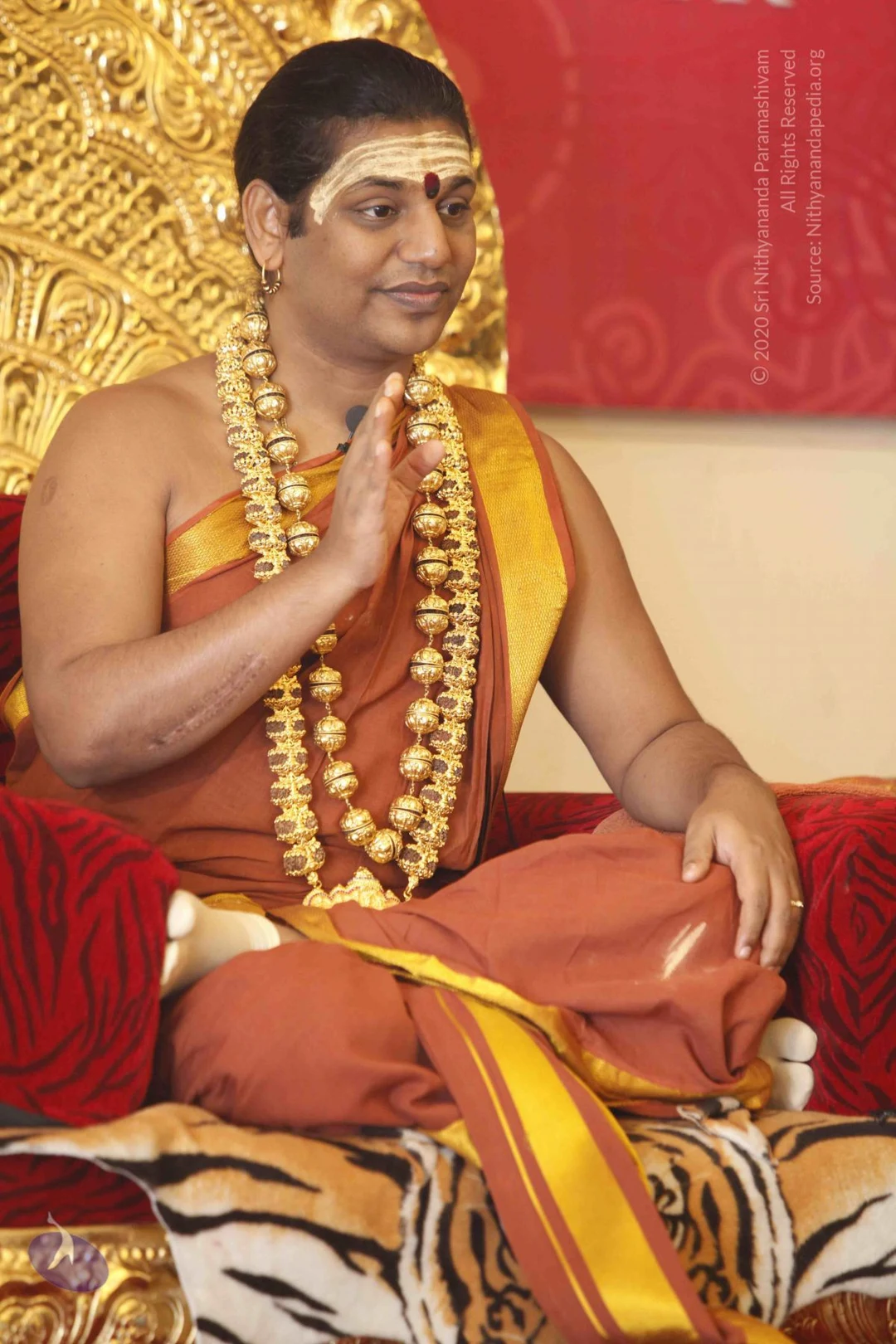
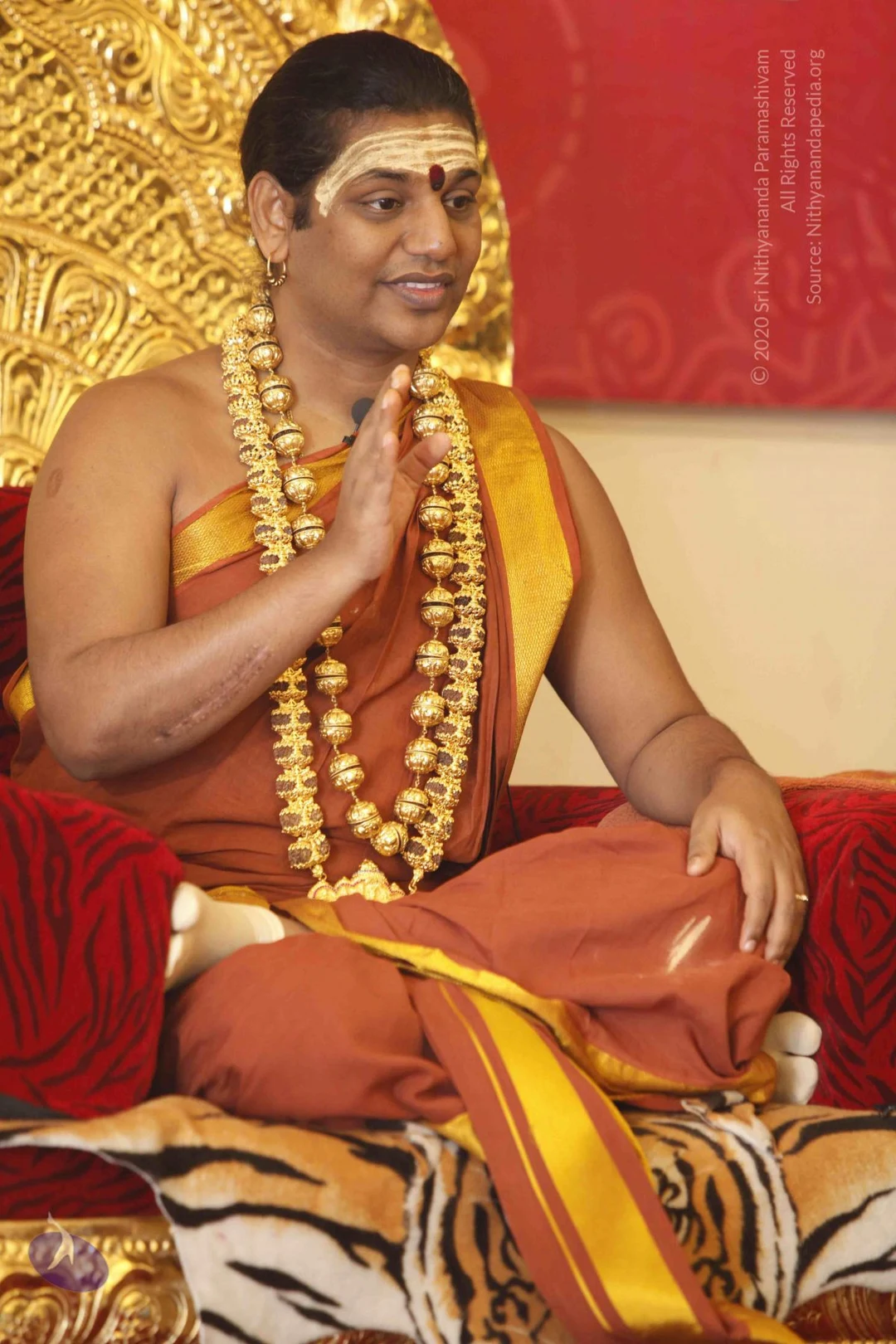
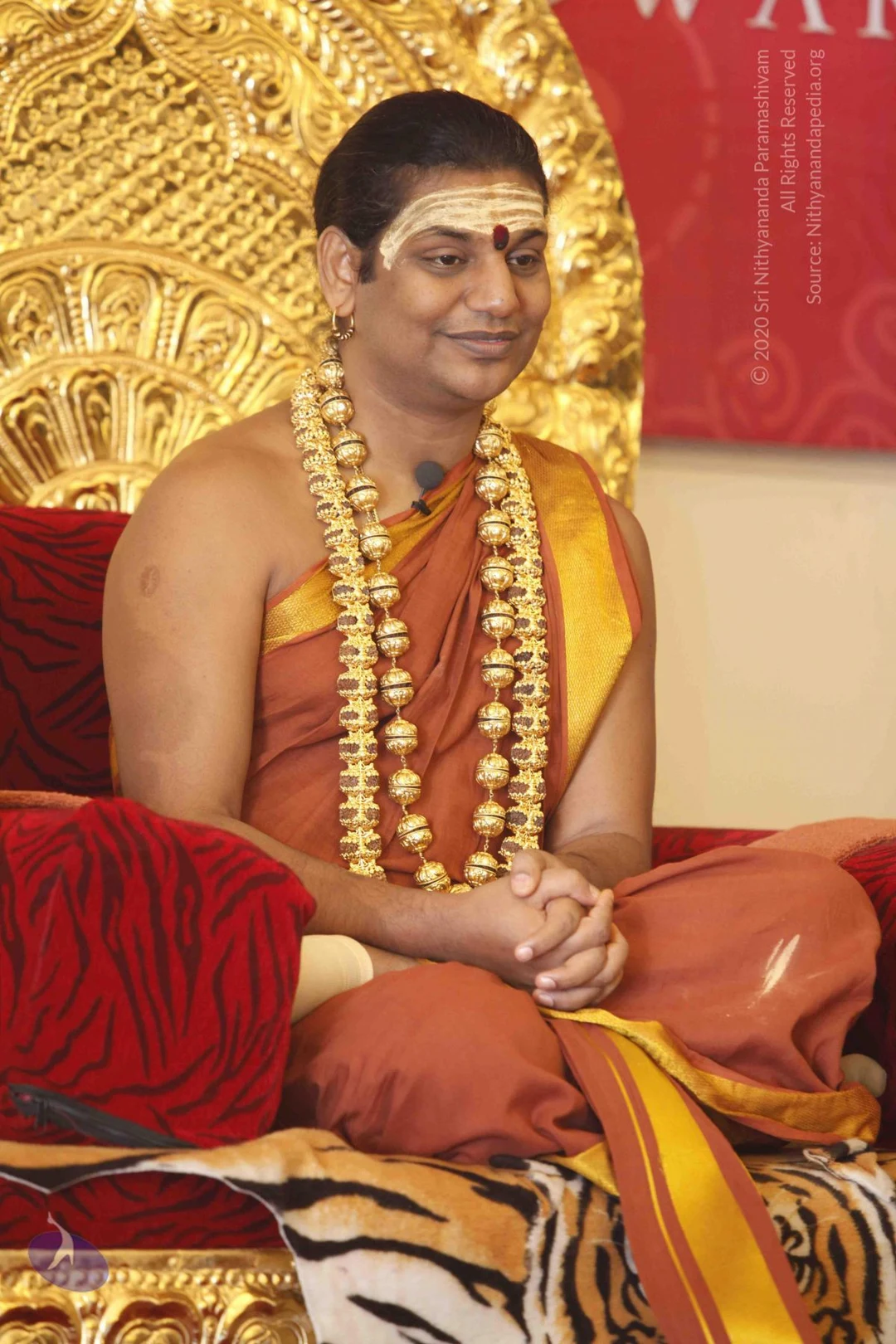
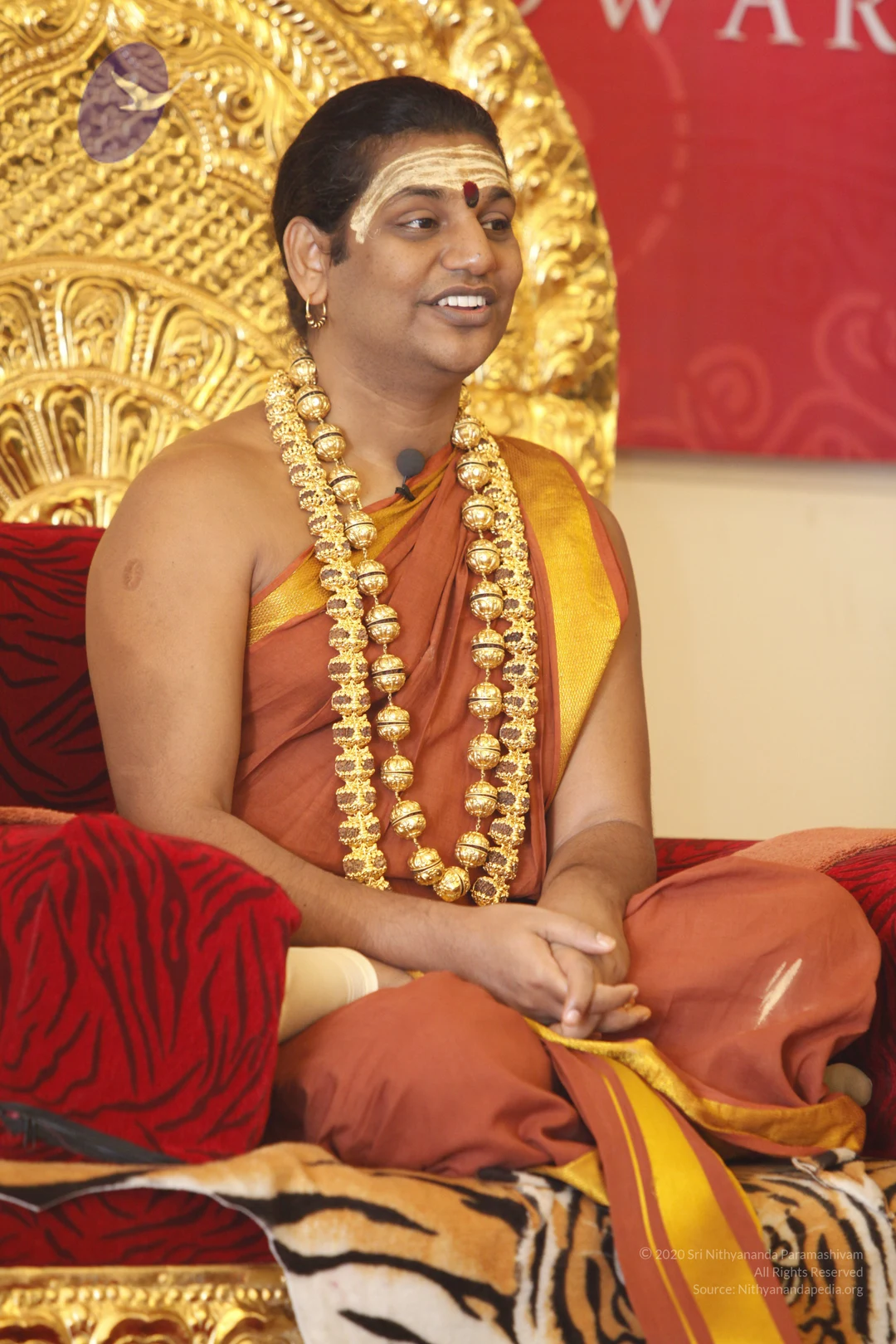
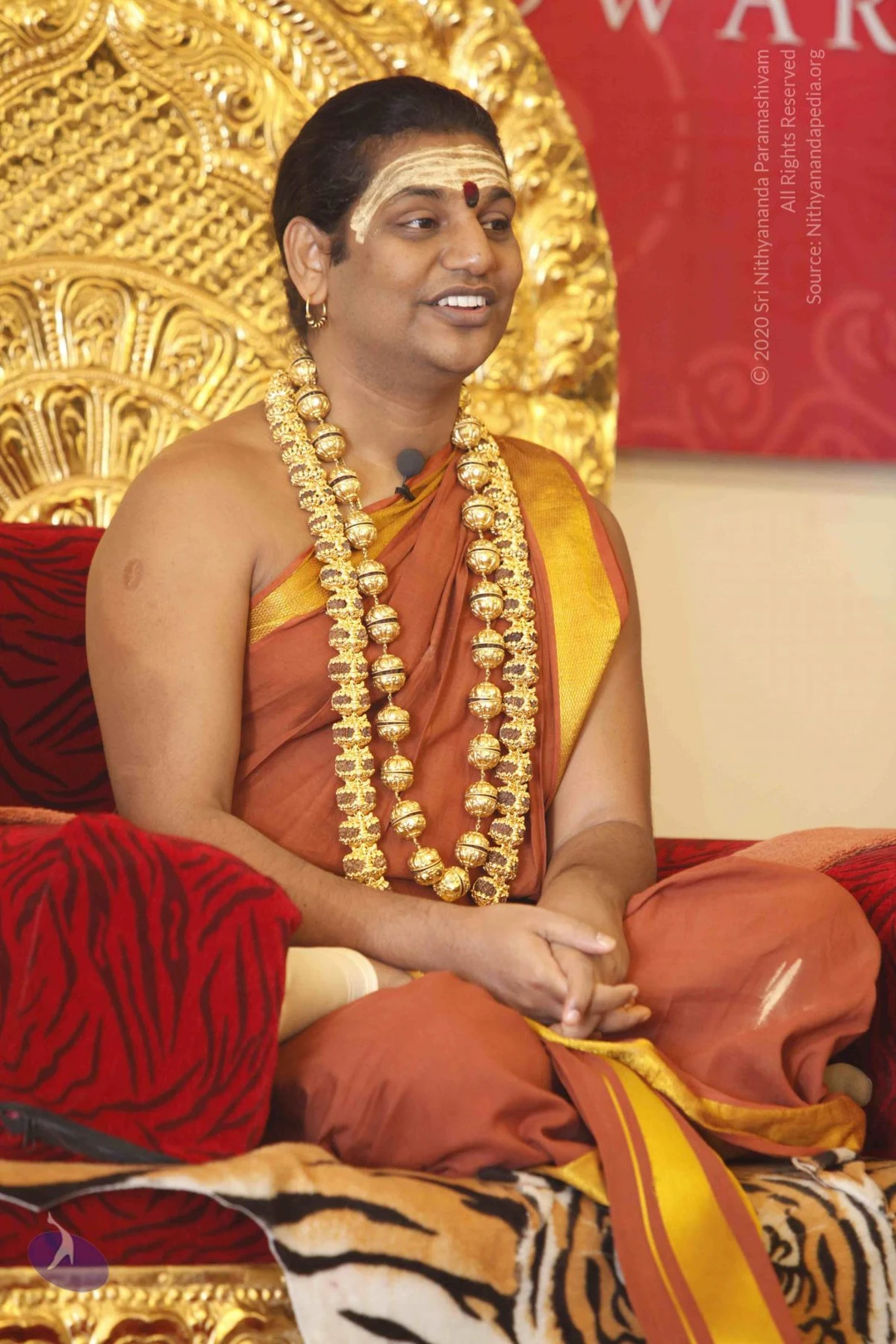
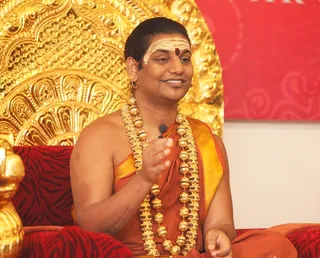
A seated man in saffron-orange robes with a gold-bordered shawl speaks while gesturing with his right hand, a small lapel microphone clipped to his chest. He wears heavy gold ceremonial necklaces of beaded spheres, gold earrings, and white vertical tilak with a red bindi on the forehead. Behind him is an ornate gold throne with a fan-shaped backrest and red tiger-striped cushions, and a red wall panel is visible on the right.

Photos

4 photosSource gallery
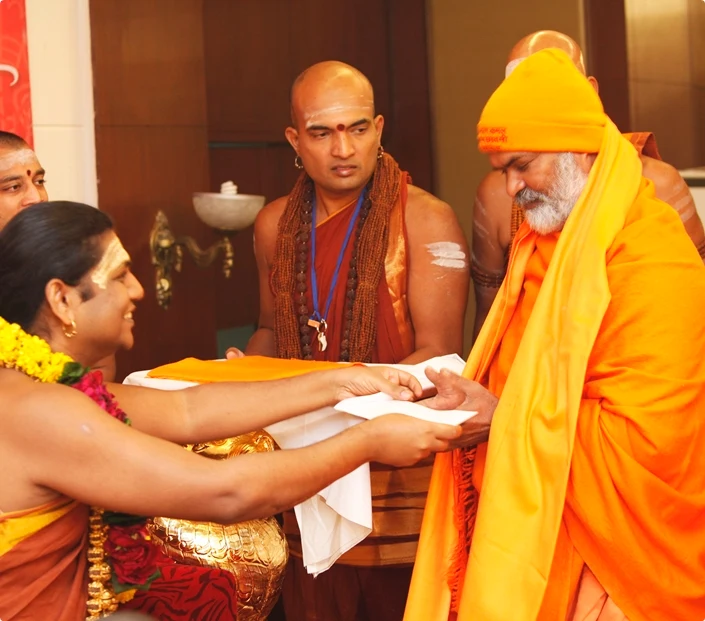
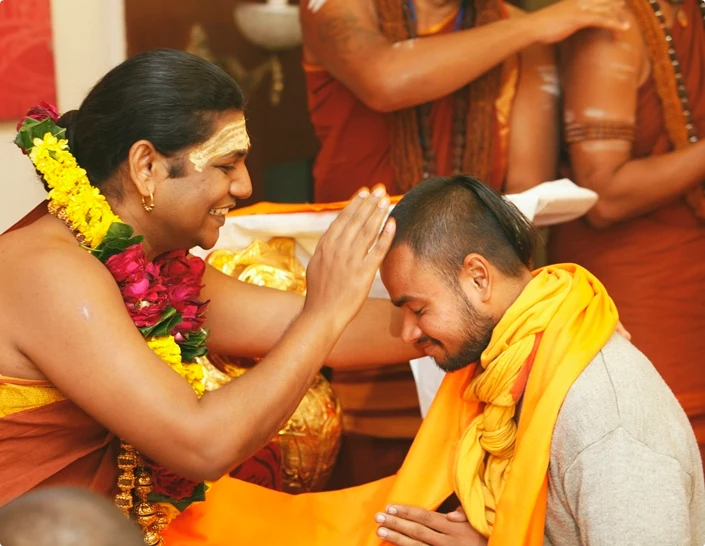
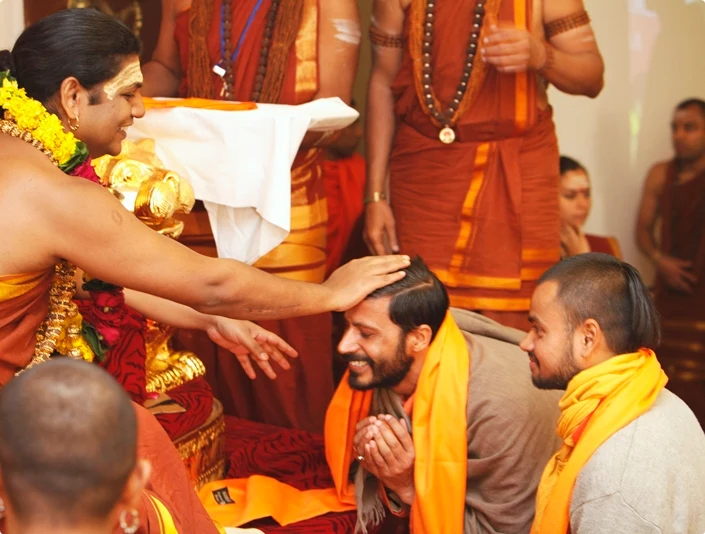
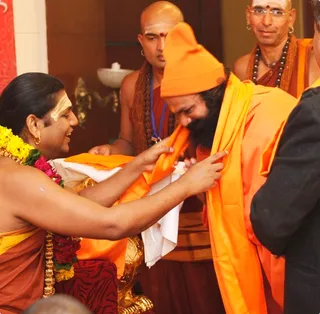
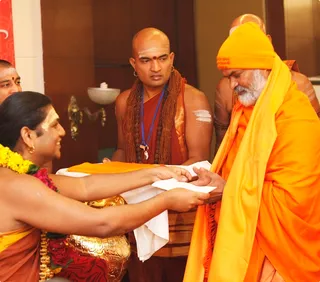
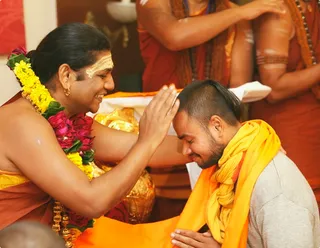
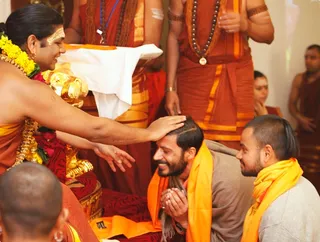
A photograph of an indoor ritual exchange. On the left, a man with a bare chest, wearing a golden-yellow dhoti and a garland of yellow and pink flowers, sits on a gold-trimmed seat and reaches forward to drape an orange shawl over a bearded man standing centre-right. The standing man wears an orange sannyasi cap and orange robes with a rudraksha mala. Behind them, two men in saffron and orange robes with white forehead marks and beaded necklaces watch, and a man in a dark jacket stands at the right edge. A white cloth lies over the seated man's lap and a white basin is mounted on the wall behind.A photo of a ceremonial exchange indoors beside a dark wooden wall and a wall sconce. On the right, a bearded man in a bright saffron-orange turban and saffron shawl leans forward and accepts a folded white paper from a woman. She kneels at left, wearing a red-bordered sari, a yellow flower garland and a white tilak, and holds an ornate gold-coloured vessel draped with white cloth. A bald priest in rudraksha mala and orange-brown robes stands behind, with a blue lanyard and a white cloth on his shoulder, while another man with a white tilak stands at the upper left. Four people are visible in total.A photograph of a ceremonial blessing. A woman with her hair in a bun, wearing a yellow and pink flower garland, gold earrings, a bare upper body and white vertical tilak on her forehead, presses her palm to the head of a kneeling man. The man has a short hairstyle and stubble, wears an orange-yellow shawl over a grey top, and bows with eyes closed and hands folded. Behind them, two people in orange-red robes with white markings on their arms stand near a white cloth and a gold-colored vessel. The setting is a warm indoor hall.A seated figure in saffron and orange robes with a gold ornament, flower garland, and white tilak on the forehead extends a hand in blessing onto the head of a kneeling bearded man in a grey top with an orange shawl, who has his palms pressed together in namaste. Beside him a younger man with a shaved head, grey top and yellow-orange shawl smiles and watches. Behind them, standing figures in saffron dhotis with rudraksha malas and tilak, plus a gold kalasha on a white-draped table, suggest a puja or blessing setting.

Photos

1 photoSource gallery
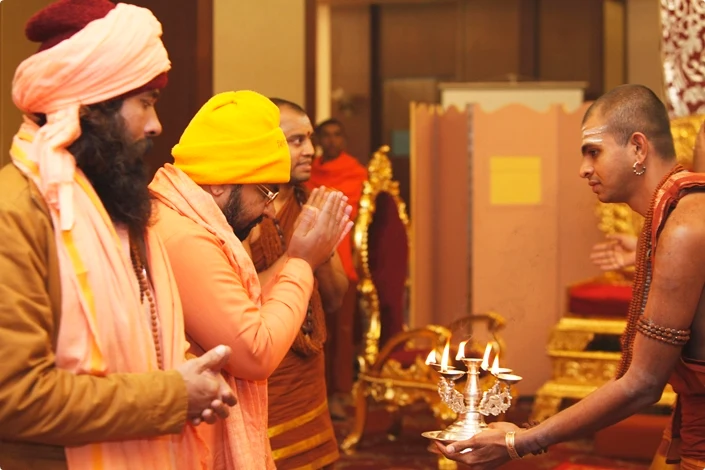
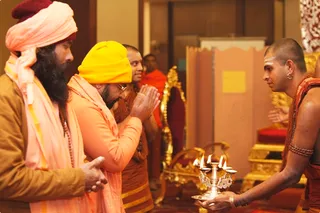
Photograph of a devotional aarti in an ornate hall with gold-trimmed chairs and a red-cushioned throne behind. On the right, a shaven-headed priest in orange and saffron robes with rudraksha beads and an upper-arm band holds a silver multi-flame lamp toward the group. On the left, a bearded man in a pink-and-white turban and tan shawl stands with palms pressed together. Beside him, a bearded man in a yellow cap and saffron robe, glasses on, joins his hands in namaste, and a third man in orange stands behind. a person appearance is uncertain; no crown or ceremonial adornment is clearly visible on the seated-area figures.

Ravindraji-Visiting-To-Adheenam

5 photosSource gallery
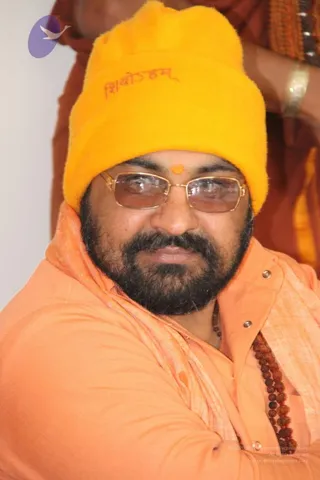
A photo inside an ornate hall with a red and gold patterned backdrop and two gold thrones with red cushions. A woman in a brown sari with gold border and a gold necklace stands with hands folded in front of a wooden stand, while a man in a brown dhoti with gold border lights a lamp in front of a decorated seated figure under an embroidered umbrella. On the left, several men in saffron and orange robes and turbans stand, one in a green-brown jacket over white. A fringed embroidered parasol and a decorated fan hang on the right. Orange and red floral patterns cover the carpet.Close-up photograph of a bearded man wearing a bright yellow knitted cap embroidered in red Devanagari with the words शिवोऽहम्, gold-rimmed tinted glasses, a small orange tilak on his forehead, and an orange-saffron shawl and kurta with rudraksha beads visible at the neck. His arms are folded across his chest and he gazes slightly to one side with a faint smile. A blurred orange-clad figure stands behind him at the top right. a person appearance-based label applies only to the visible cues of orange clothing and rudraksha mala; the person is shown in a close portrait with no throne or setting, so identity remains uncertain.Three men in saffron and orange clothing walk together indoors past a table of offerings and a small placard. The man on the left wears an orange turban and a long beard, with an orange shawl over his shoulders. In the centre, a man in a yellow-orange cap, wire-rimmed glasses and a rudraksha mala walks beside him. On the right, a bare-chested man with swept-back hair, a yellow tilak on his forehead and a gold ceremonial necklace gestures with his hand while smiling, wearing an orange dhoti. Behind them stand other people and display cases. Whether the right-hand figure is a person cannot be confirmed from appearance alone, so he is described by role only.A photograph of a ritual aarti in a gilded interior with golden thrones and a red-draped chair in the background. On the right, a shaved-headed priest in an orange-red dhoti with a rudraksha mala and bare chest holds a silver five-flame oil lamp with lit wicks, offering it forward. Three men stand with hands folded in anjali at left: one in a pink-orange turban and tan jacket with a long beard, one in a yellow knit cap and orange robe with glasses, bowing, and one in orange robes with a rudraksha mala. A fourth figure stands behind them.

Satsang

12 photosSource gallery
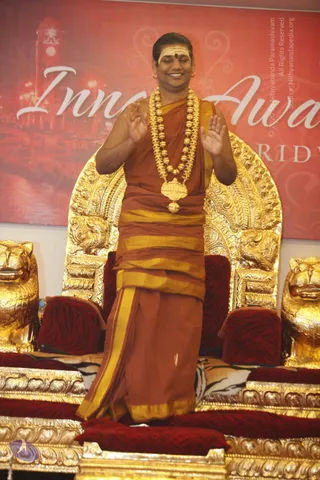
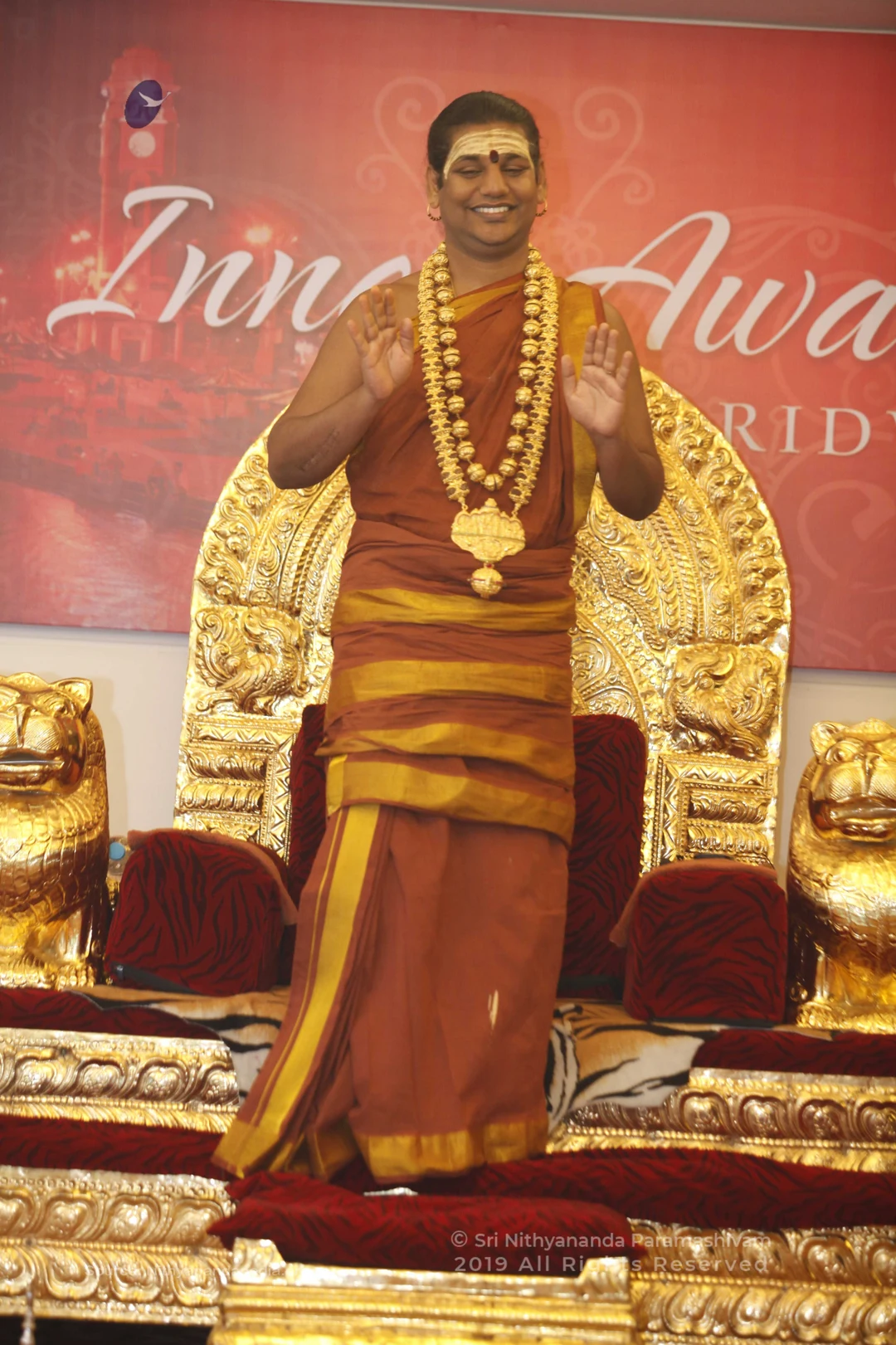
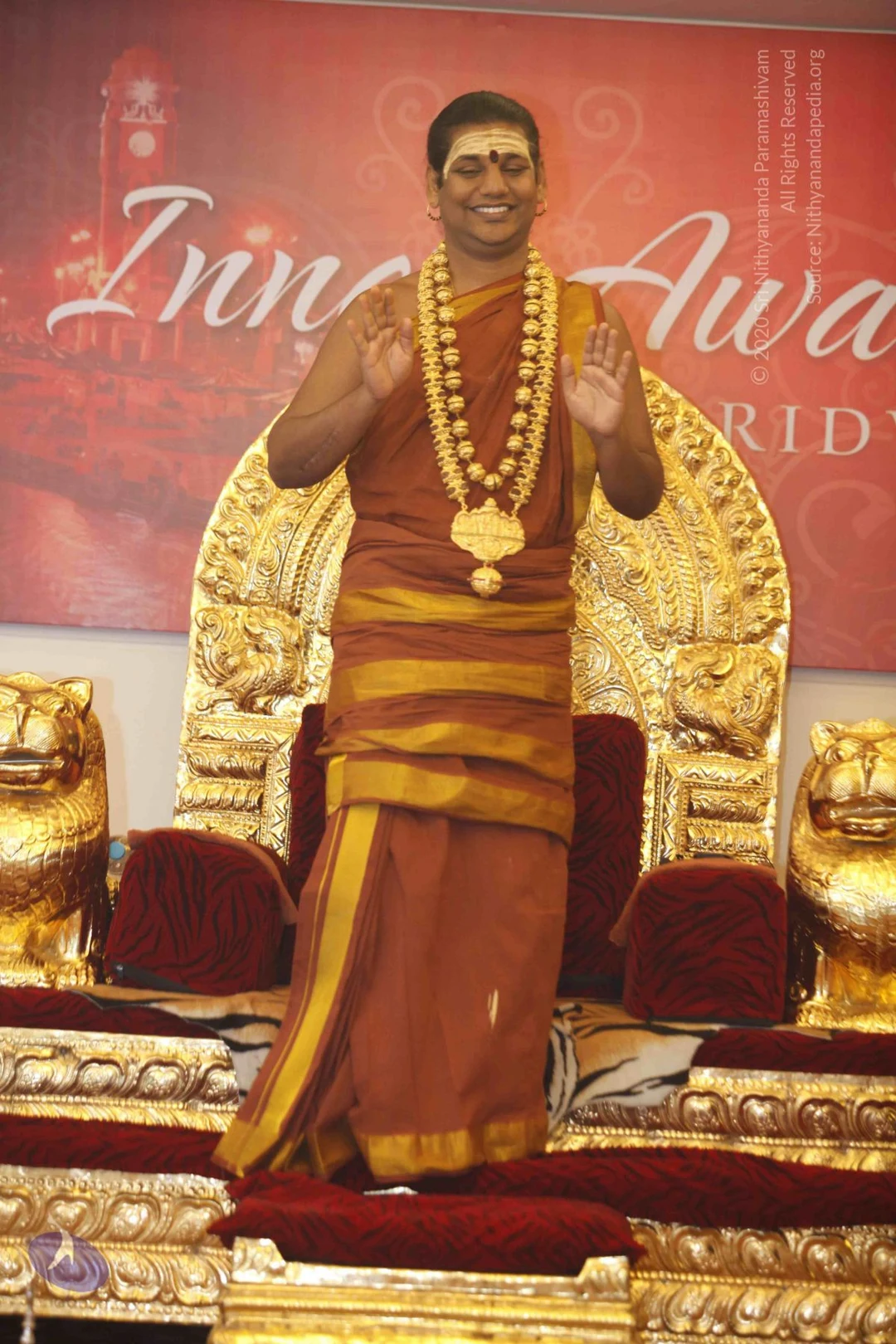
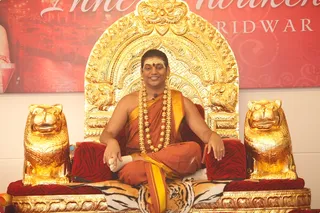
Photograph of two printed paper signs taped to a wall with a decorative red, orange and purple floral border. The upper sign lists NITHYANANDESHWARA as Lord Shiva (center), NITHYANANDESHWARI as Devi Parvathi (right), and a person as incarnation of Nithyanandeshwara and Nithyanandeshwari (left), with a quote below. The lower sign is titled Leela Alankar, describing a divine play of Lord Shiva and its story and benefit. A green leaf with three leaves is taped across the lower sign. No people are visible.A golden-faced deity murti seated on a throne against an orange backdrop with a gold-dotted fabric canopy overhead. The figure wears a tall pearl-and-red-beaded crown, layered jewelled necklaces, a brown rudraksha-style garland, and a leopard-print cloth over the shoulder. It holds a golden bow with a red-wrapped grip and an arrow across its body, with a trident and a snake-topped staff beside the throne. Red and gold drapery covers the seat. The image is a photograph of an idol, with no people visible.A man stands before an ornate gold throne flanked by gilded lion sculptures with red and black tiger-striped cushions. He wears rust-orange robes with gold borders, a heavy multi-strand gold necklace with a large gold pendant, and has white sacred ash markings with a red dot on his forehead. His eyes are closed, he is smiling, and both palms are raised outward in a blessing gesture. A red banner behind him reads partially 'Inno... Awa...' with 'RIDY' visible. a person appearance cues include saffron/orange robes and ornate gold necklaces, with the figure standing in the seat's central position.

Kalpataru-Darshan

2 photosSource gallery
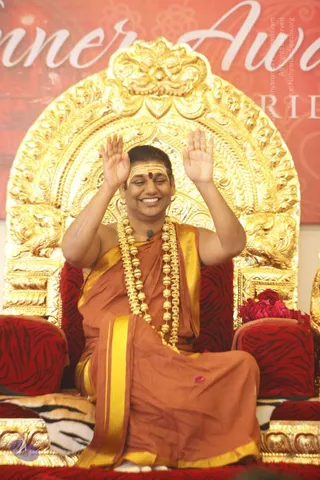
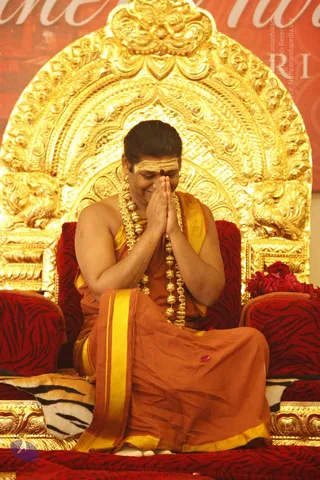
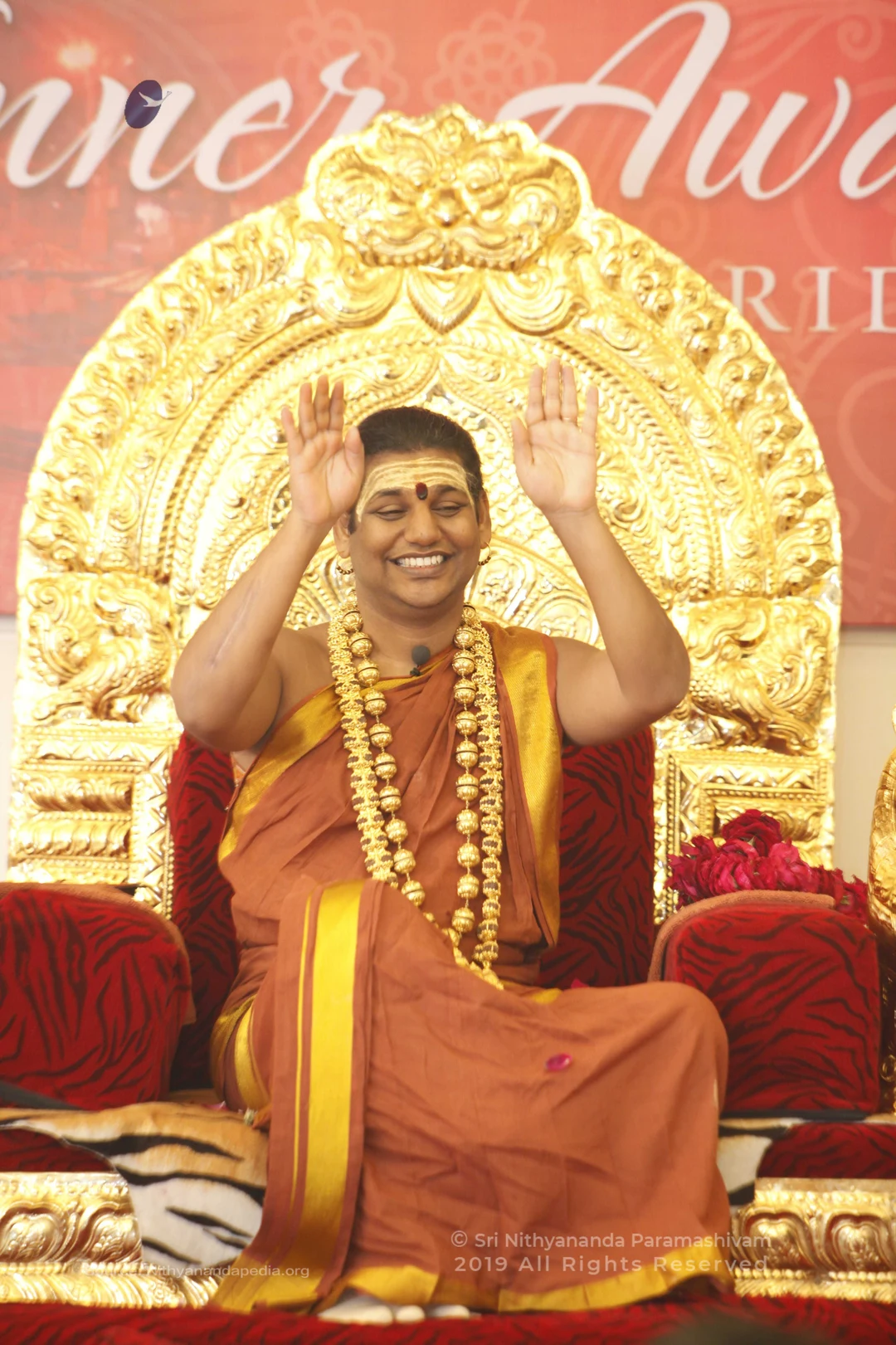
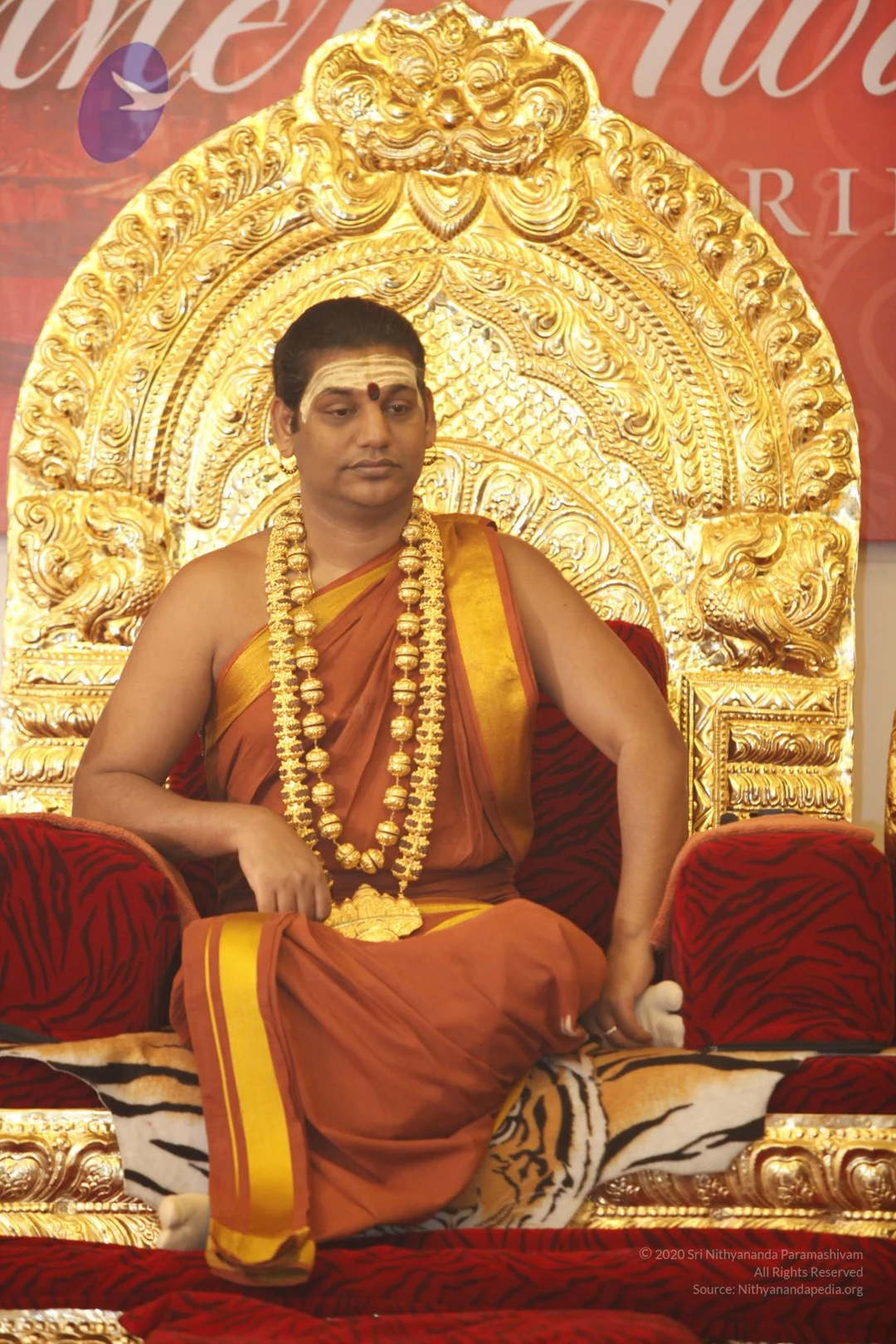
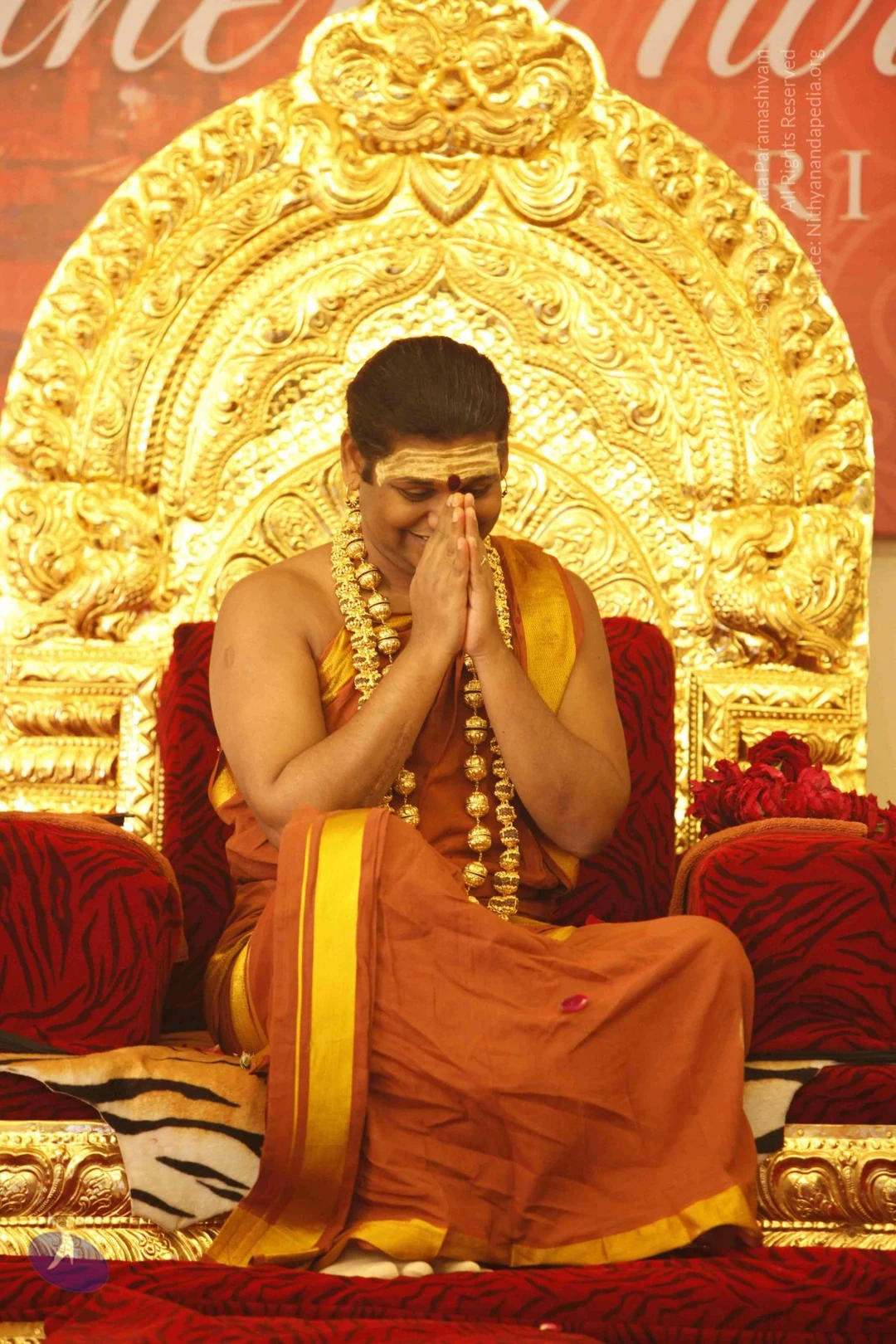
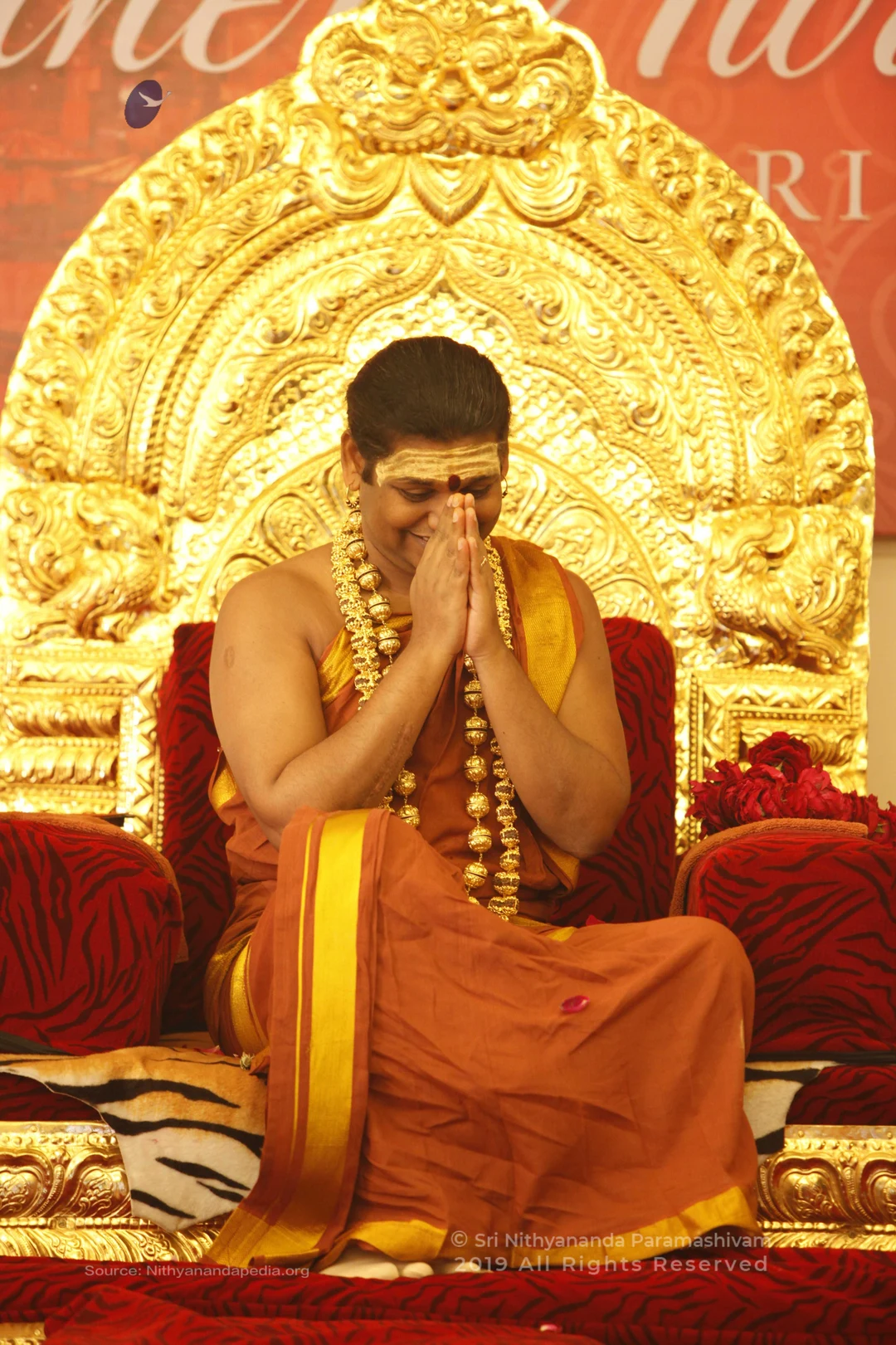
A seated man in saffron-orange robes with gold border sits on an ornate gold throne with red and black tiger-striped cushions. He raises both palms overhead, smiling with eyes closed, wearing layered gold beaded necklaces and a white-and-red tilak on his forehead. A red banner behind reads 'Inner Awa...' with partial 'RID...' text. Flowers rest on the side armrest. The seated figure matches the appearance of Swamiji (probable) from visible cues: long swept-back hair, saffron robes and multiple gold malas.A seated man in saffron and orange robes with gold borders sits on an ornate gold throne with red tiger-striped cushions, his palms pressed together in anjali namaskar with eyes lowered. He wears a white vertical tilak with a red dot on the forehead, multiple tiers of gold beaded ceremonial necklaces, and gold earrings. Red flowers rest on the armrest beside him, and a red backdrop with white calligraphy is behind the throne. The appearance-based label is a person, seated in a ceremonial role, with saffron robes, gold ornaments and a throne as the visible cues.

Kalabhairava-Darshan

4 photosSource gallery
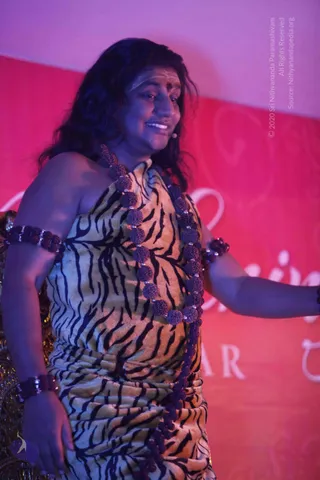
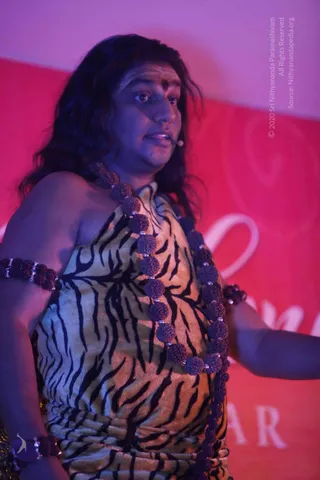
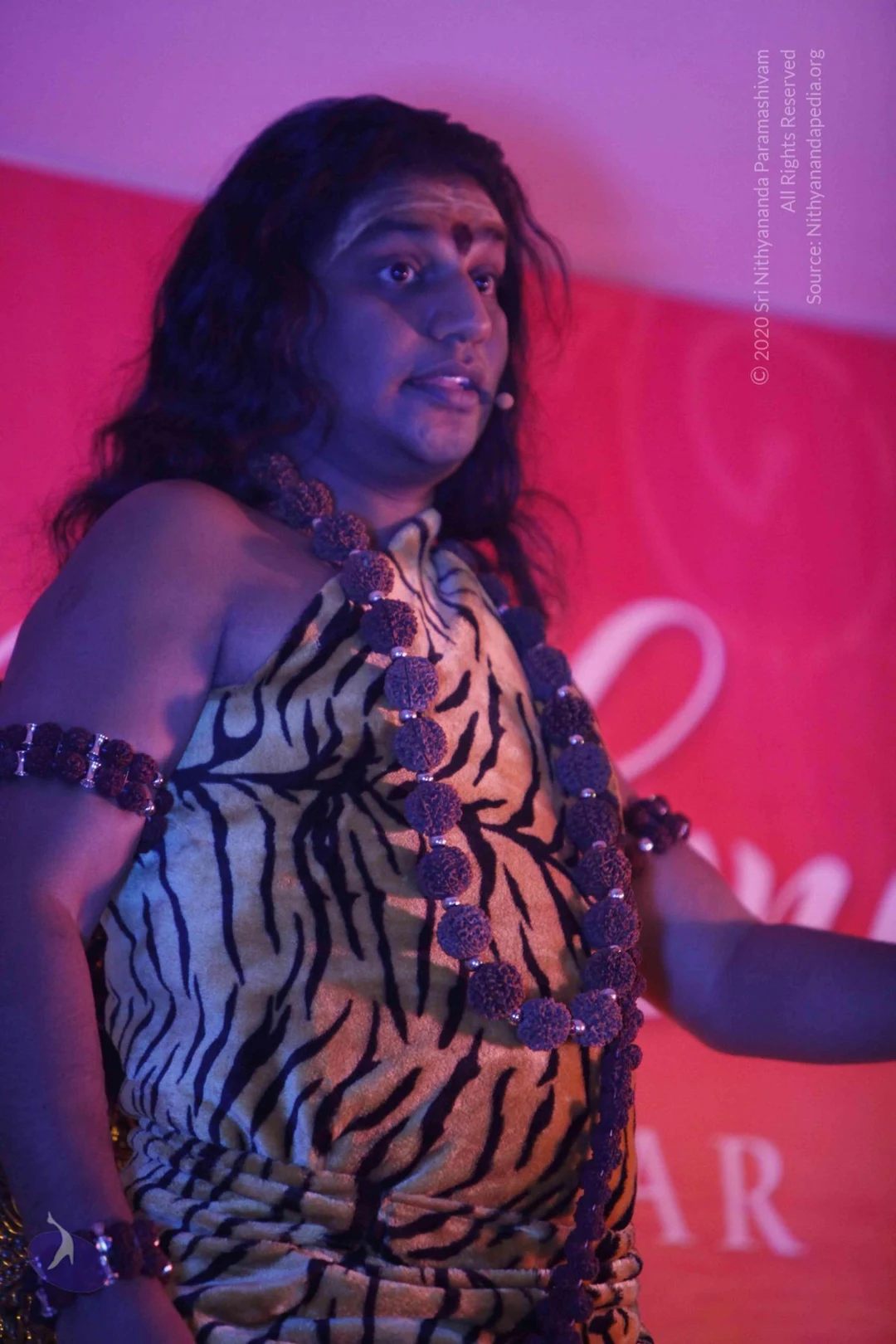
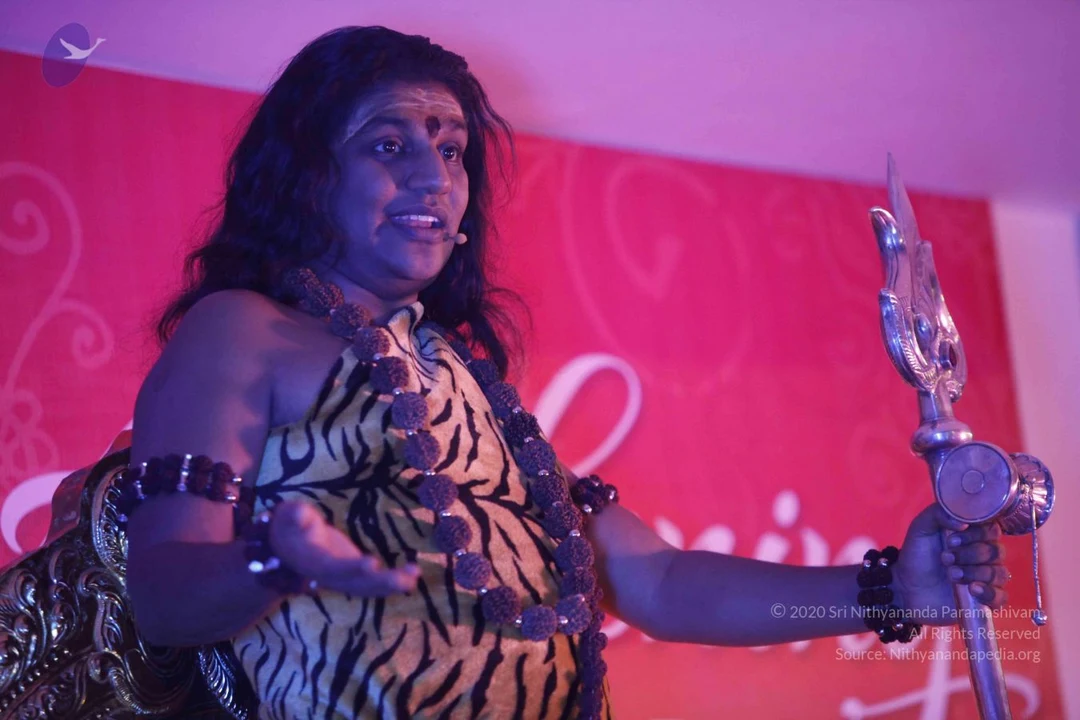
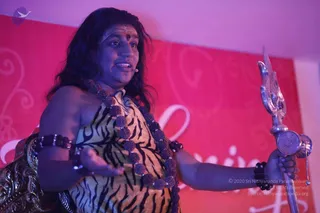
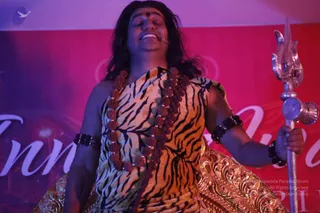
A smiling person with long dark hair and a white-and-red forehead mark stands on a stage before a pink backdrop, wearing a tiger-striped halter garment and multiple strands of rudraksha malas with silver spacers, plus rudraksha bracelets on the arms. The person gestures with an outstretched arm, and a small lapel microphone is visible.A photograph of a man with long, swept-back dark hair and a vertical tilak mark on his forehead, wearing a sleeveless tiger-striped velvet top with a large rudraksha mala draped across the chest and rudraksha bracelets on his wrists. He wears a small headset microphone and gestures with one arm while speaking against a bright red backdrop with large white lettering partly visible. a person cues here are the long hair, rudraksha malas and distinctive adornments, and he appears to be giving a talk on stage. The visible white text on the backdrop is cropped and not fully legible.A person seated on an ornate silver-and-dark throne speaks into a headset microphone against a pink backdrop with white decorative script. The person has long, loose dark hair, a vertical tilak and red bindi on the forehead, and wears a black-and-cream tiger-striped garment with multiple rows of rudraksha mala beads and rudraksha bracelets. The right hand holds a polished silver trident aloft while the left hand is open in an explanatory gesture. Stage lighting gives the scene a purple-pink cast.A man with long swept-back dark hair and a vertical tilaka on his forehead stands with eyes closed and a broad smile, wearing a tiger-striped orange and black garment over one shoulder with gold brocade draped at his waist. He wears multiple strands of rudraksha mala around his neck and black beaded bracelets on his wrists, and holds a silver trident with his right hand. A red and pink backdrop with large white script lettering is behind him. The appearance of a long swept-back hair, rudraksha malas and saffron-style clothing matches the Swamiji (probable) cues, with a trident emphasizing a Shiva-associated presentation, so this is a person presented as Swamiji in a performance or satsang setting.

RAVIDRAPURI-MJ-VISIT

7 photosSource gallery
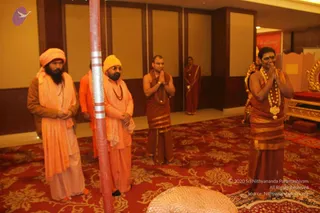
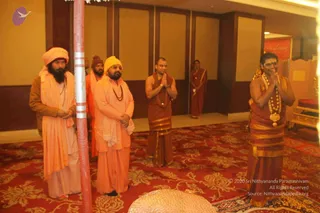
Indoor hall with red patterned carpet and gold-trimmed golden throne at right. Five men stand in a row in saffron, orange and ochre garments with pink or orange turbans and shawls; several have beards and rudraksha malas. At right, a man in deep red-brown dhoti with gold border and a large ornate gold necklace stands with palms pressed together in namaste. A woman in red-brown sari stands behind. A decorated metal kalasha sits in the foreground beside a silver-banded pole. A banner with a welcoming message is partly visible.Indoor photograph in a hotel-style hall with a red patterned carpet and beige wall panels. A group of about six men stand near a tall red-and-white striped pole with a metal ring at its base and a brass vessel at the bottom edge. The man on the far right wears a rust-red dhoti with gold border, a rudraksha mala and a long beaded garland, with palms joined in namaste. Next to him stands a bearded man in rust-red robes and a red-and-white shawl, also with hands joined. Further left, a bearded man in a saffron-orange shawl and tan jacket stands, and a man in a light peach robe with a yellow turban is beside a bearded figure in a saffron turban. A woman in a red sari stands in the background, and an ornate golden seat with red cushions sits at the right edge.A photograph of a ceremonial hall with red floral patterned carpet. Several men in saffron and orange robes stand with hands folded in anjali, and one man on the right wears a brown-red dhoti and a long gold necklace with rudraksha, standing with palms pressed together before an ornate gold and red throne. Beside a silver-banded red pole, a bearded man in an orange shawl and a yellow turban stands. Behind them, other people in brown and rust robes stand near the wall, and a white-draped table sits at the lower right. a person candidate appearance is uncertain given the distance and resolution, so the figure is described by role only.Indoor ceremonial scene in a hall with a red patterned carpet and gold-trimmed red throne at right. Five men stand in prayer posture beside a tall pink pillar with silver bands. The man second from left wears a saffron-orange shawl over saffron robes, a yellow turban and a rudraksha mala, and his hands are folded at his chest. The man at far left wears an orange turban and orange shawl. The man third from right wears a brown-red dhoti with gold border and palms pressed together with a rudraksha mala. The man at far right kneels in a red-gold dhoti with hands folded, wearing a long white-and-gold garland, his eyes closed. A woman in a dark red sari stands in the background. No identity is attributed to any figure from appearance alone.A photograph of a hall with red patterned carpet and gold-framed thrones at the back. Five men stand in a row, most with palms pressed together in namaskar. The man on the far left wears a peach-orange shawl over pale clothing and has a beard. Next is a man in a saffron-orange robe and shawl with a rudraksha mala. Beside him a man in a yellow turban and dark glasses holds his hands together. Further right a man bare-chested with a wooden mala and rust-coloured dhoti stands with hands folded, and at far right a man in a rust-coloured dhoti and ceremonial gold necklace kneels with hands pressed together and a marked forehead. A tall pink-and-silver pole stands in the centre.A photograph of a formal meeting room with a long wooden table covered in white cloth, cups, glasses and water bottles. Several men in saffron and orange robes stand and sit around it, some wearing rudraksha malas. A bald man in orange holds a plate of offerings while another attendant stands nearby. At the centre-right, a bearded man in a white and orange turban sits in a gold-trimmed chair beside a blue vase of white flowers. On the far right, a man with a flower garland and a red-marked forehead sits in an ornate gold chair. A watermarked-style caption reads Sri Nithyananda Paramashivam at the lower right. a person is the man in the gold chair at right, identified by his garland, ornate chair and placement, though his appearance is only partially visible.

January 09 2014

1 photoView all
Three seated deity murtis on a decorated altar against an orange and red draped backdrop with gold embroidered borders. The central figure wears a tall crown, a mala of rudraksha beads, a flower garland and a red gem pendant, holding a bow and arrow and a trident-like staff in a pink and gold outfit. To the left, a figure in a red turban, patterned orange and gold garment and beaded ornaments sits with a hand raised. To the right, a figure in a gold crown, pearl necklaces and a magenta and gold sari sits with one hand raised. Statues, not living people.