Skip to content
Friday

10 January 2014

Dated photos
193
Source pages
1
Media
2
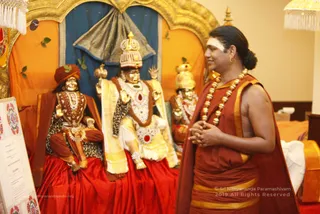
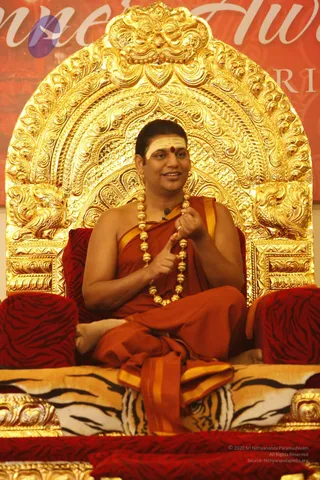
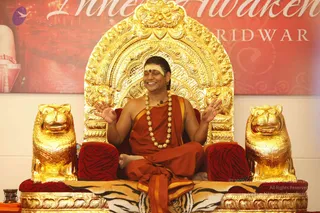
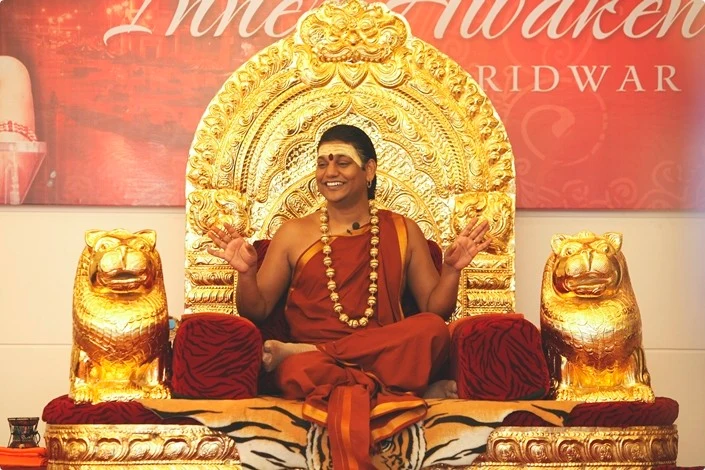
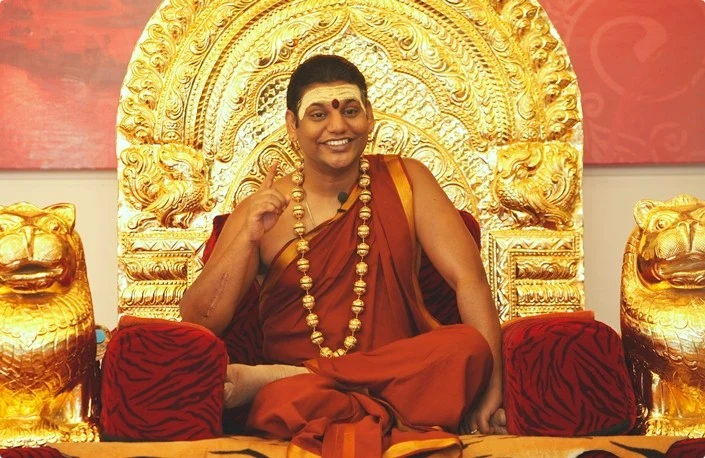
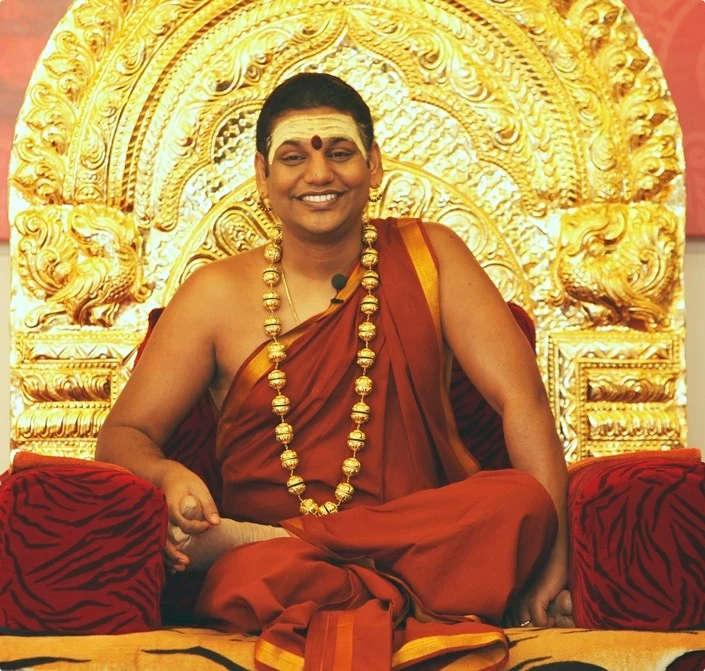
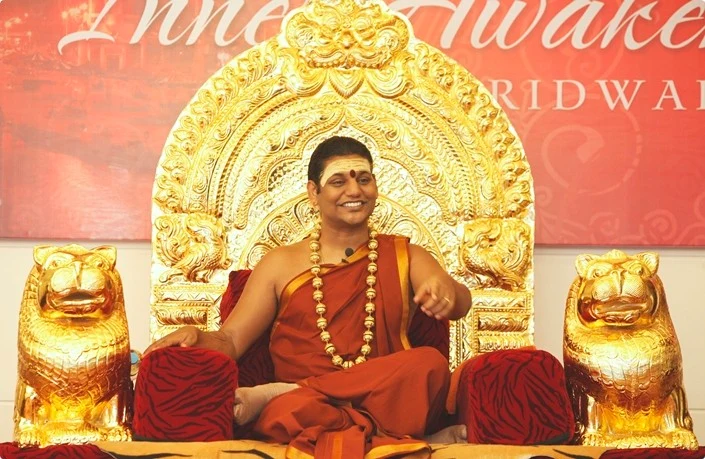
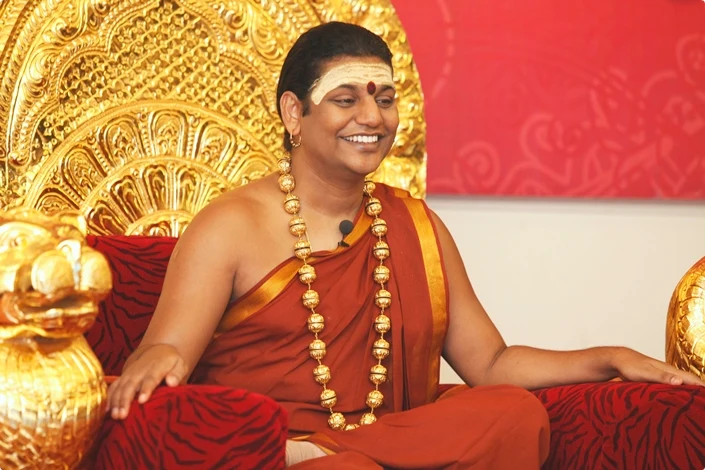
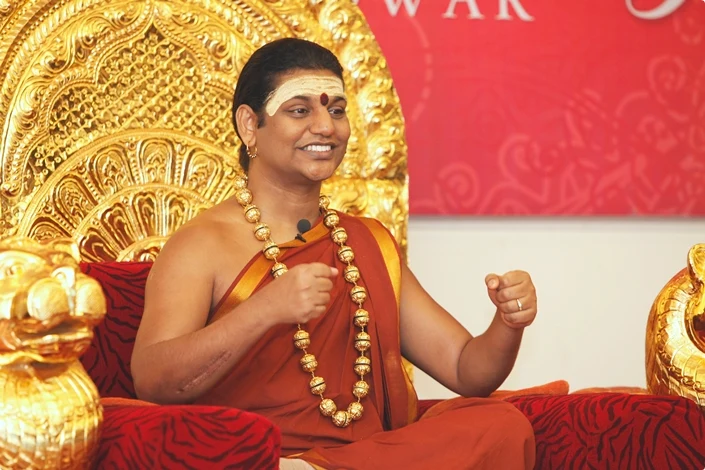
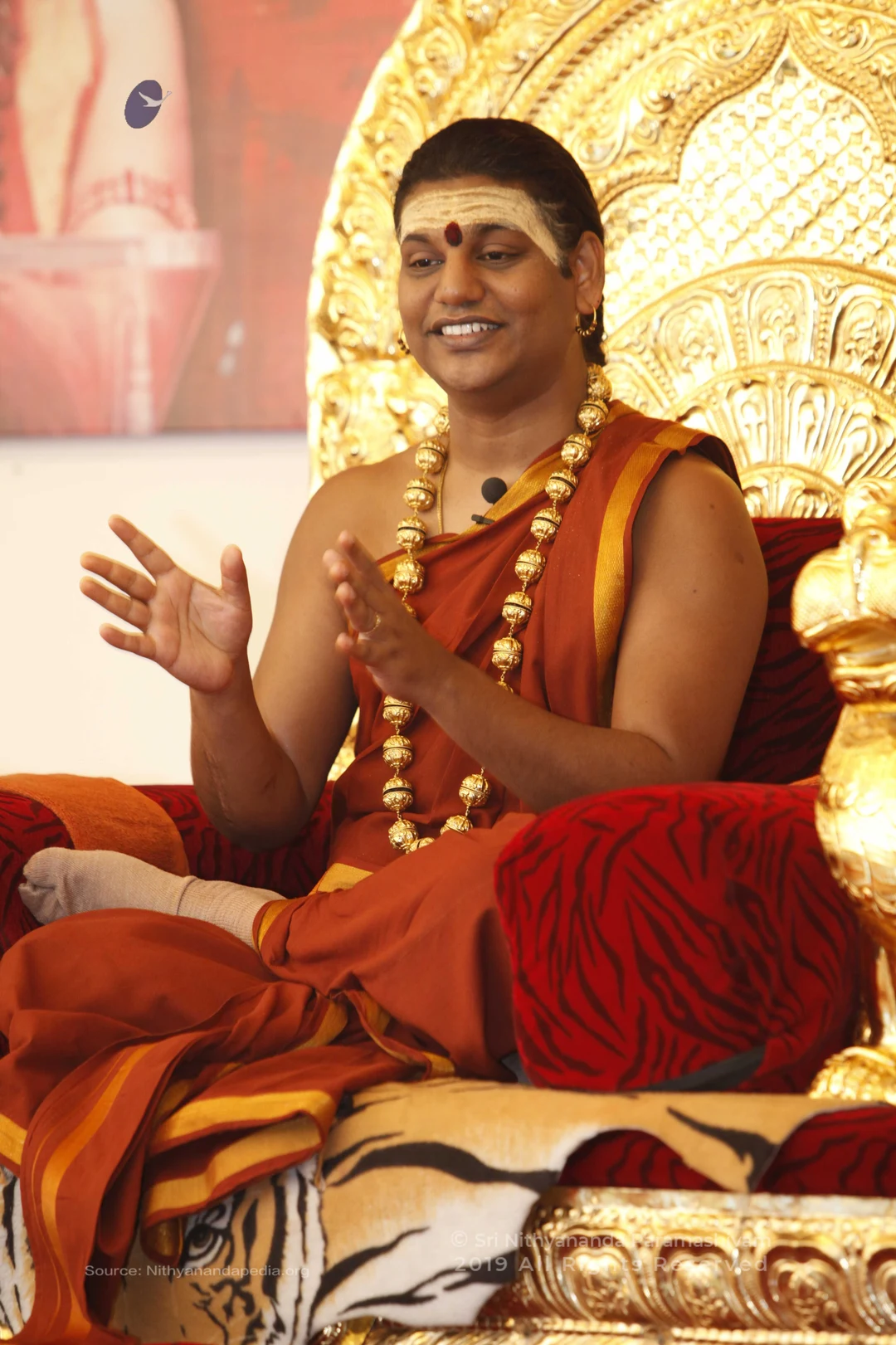
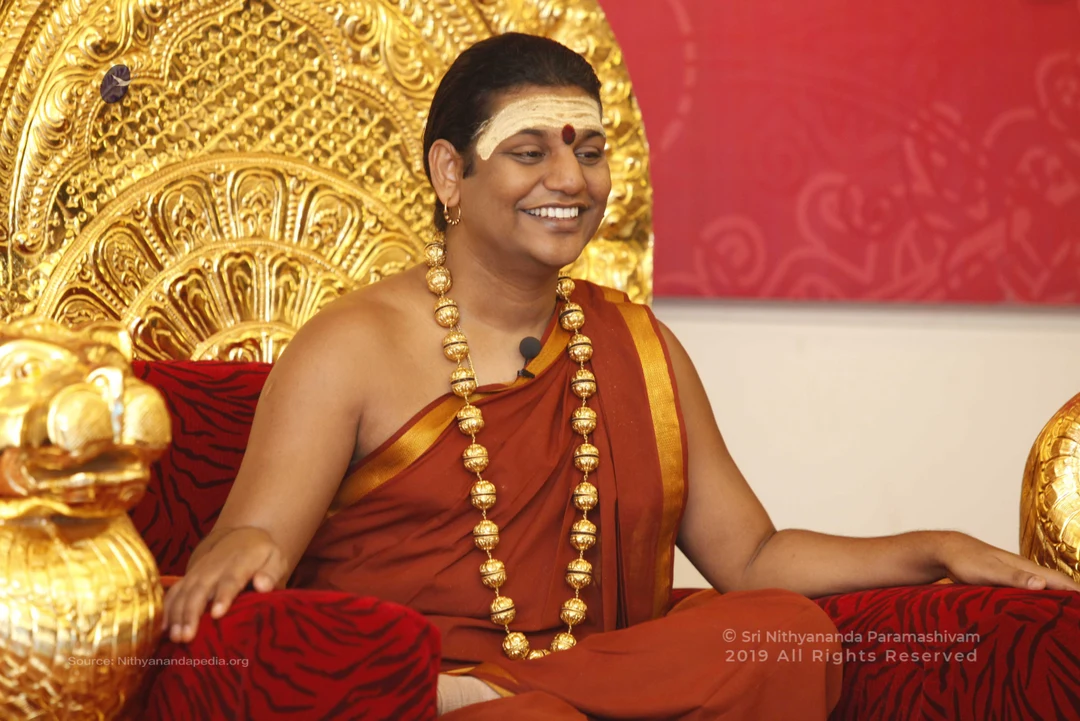
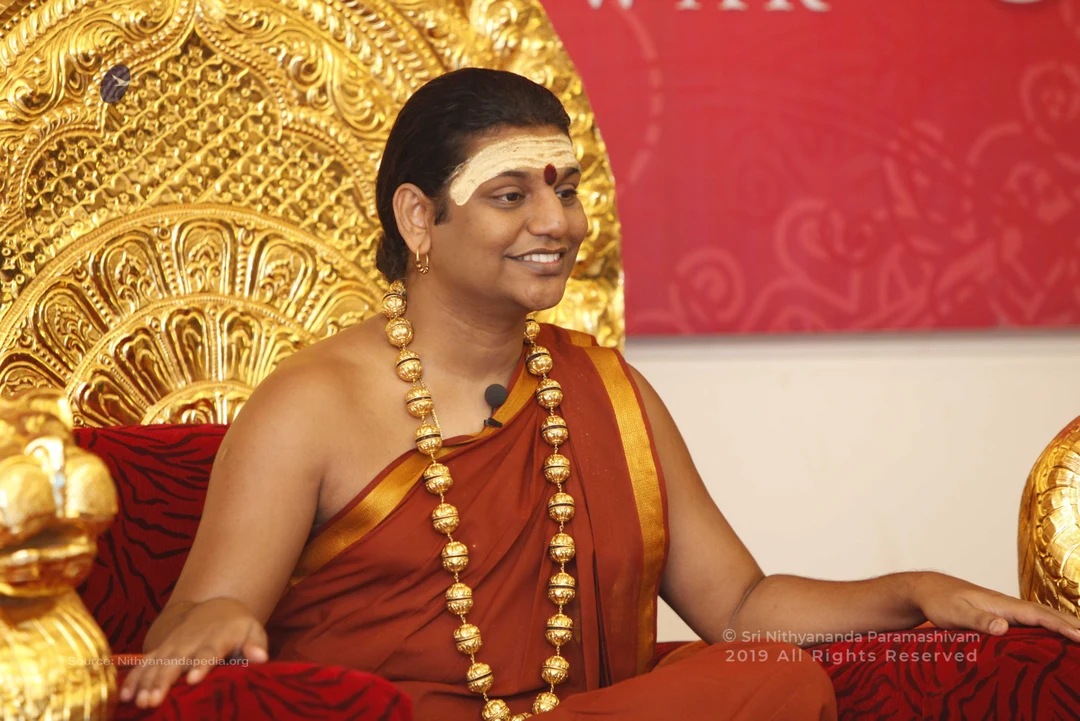
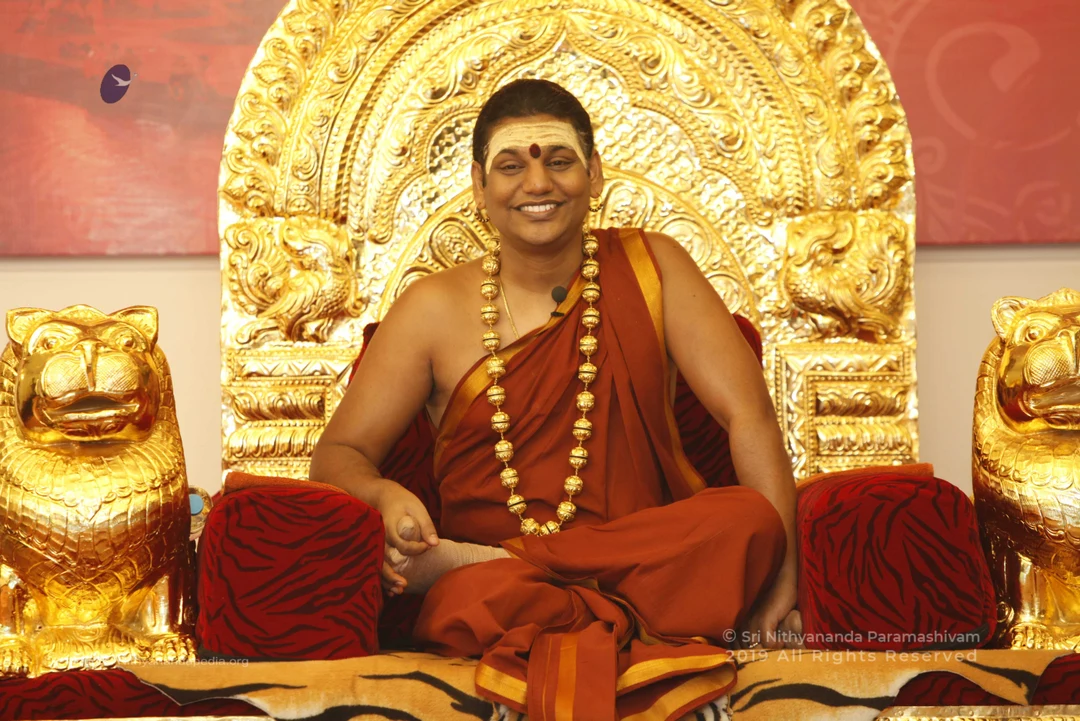
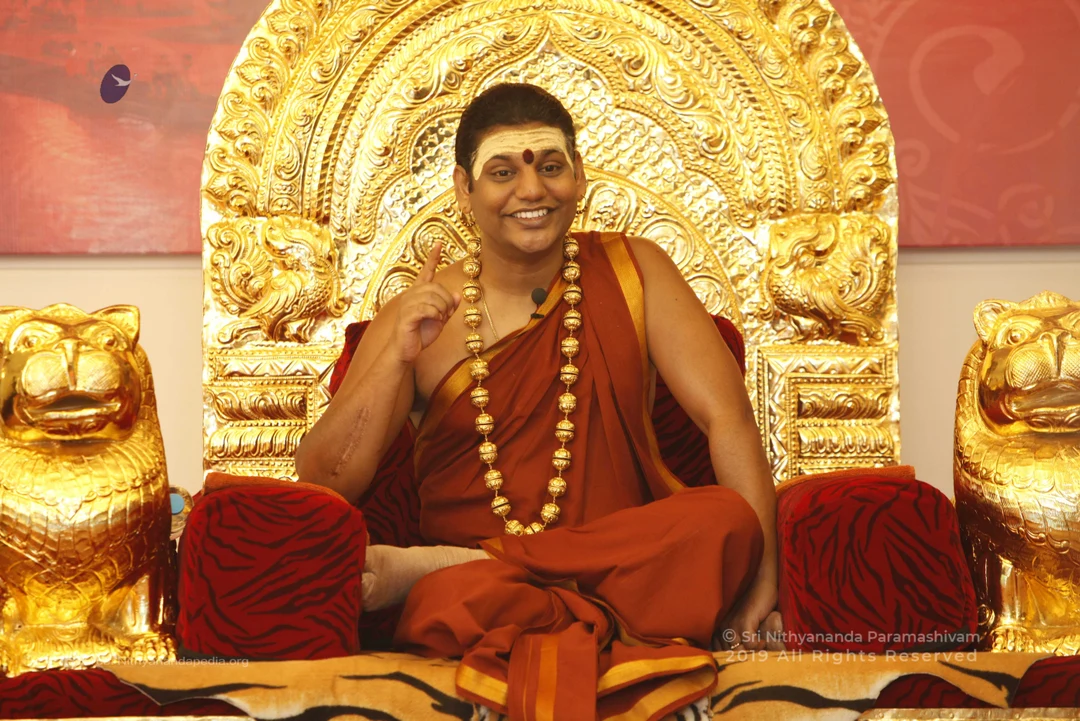
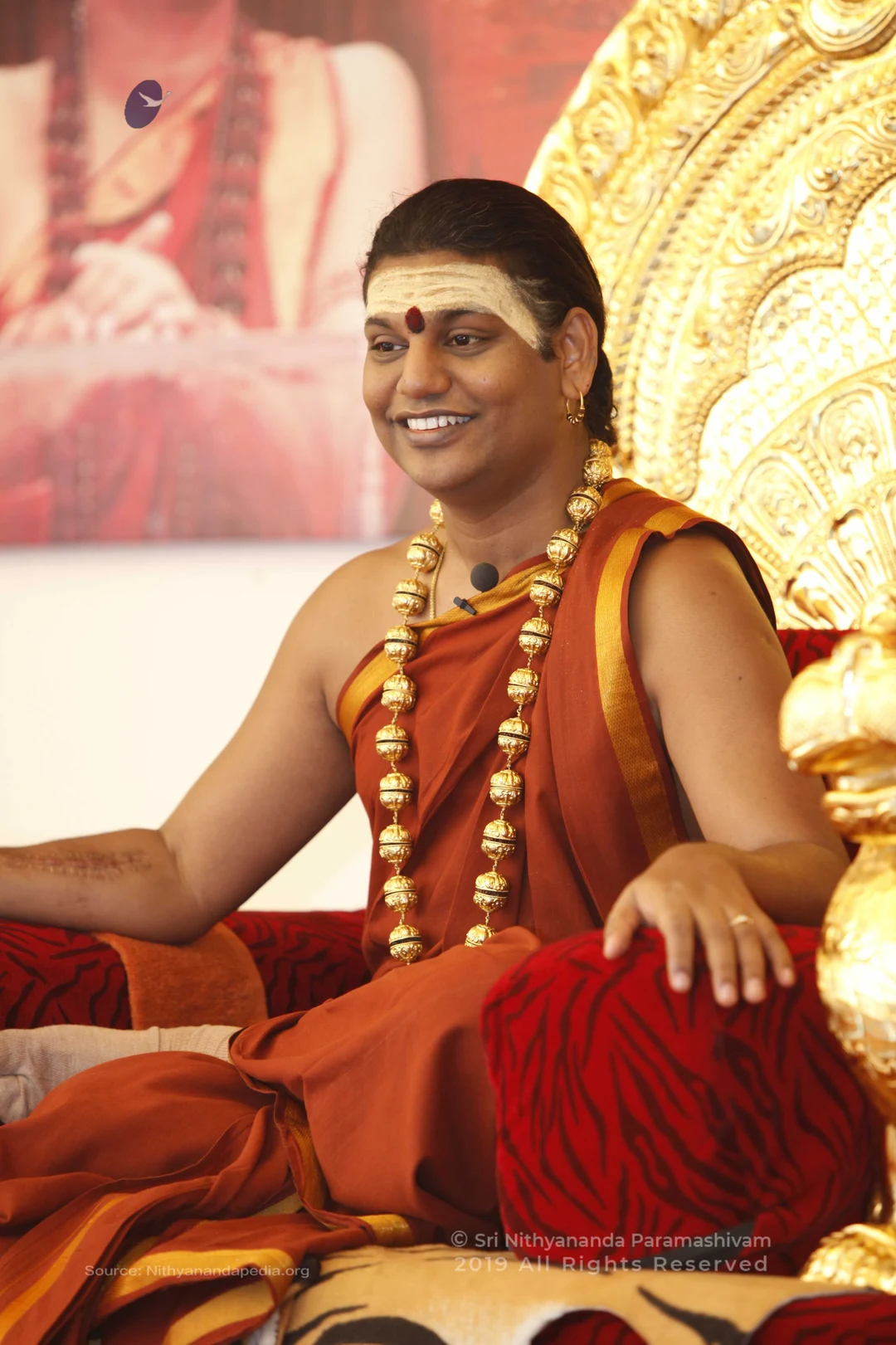
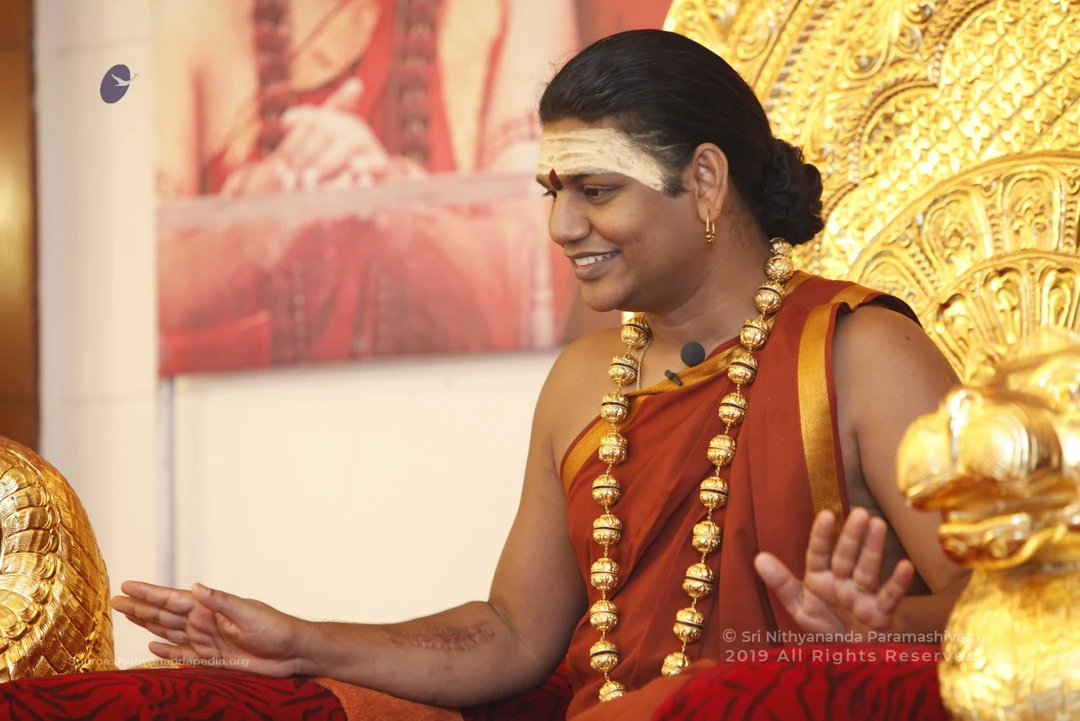
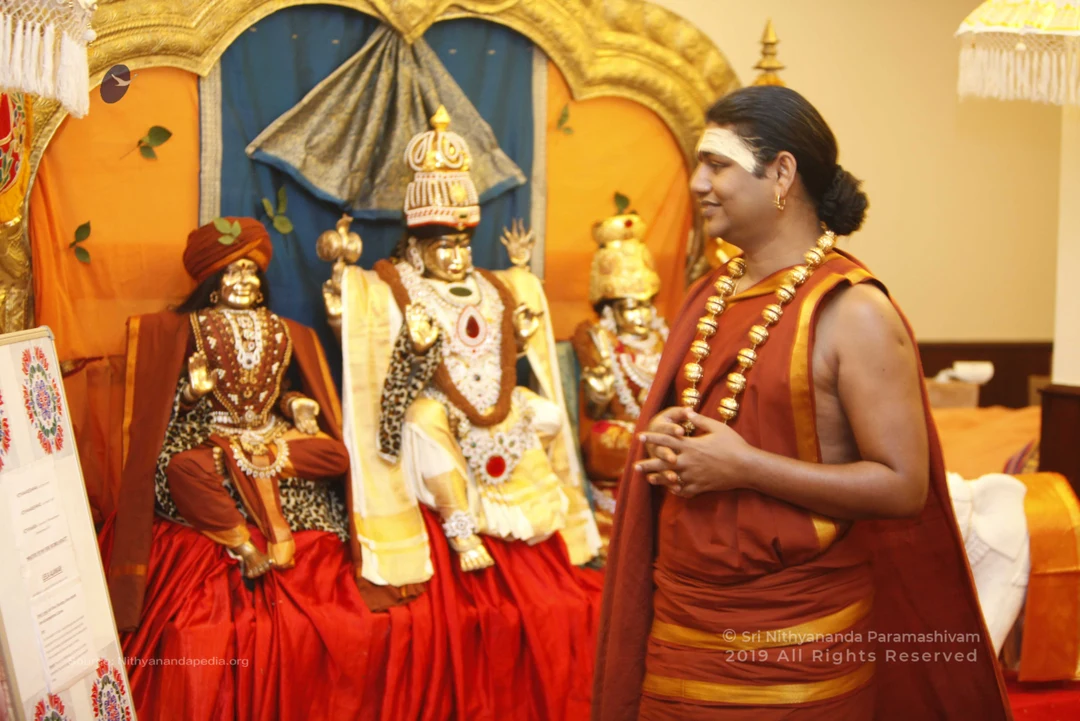
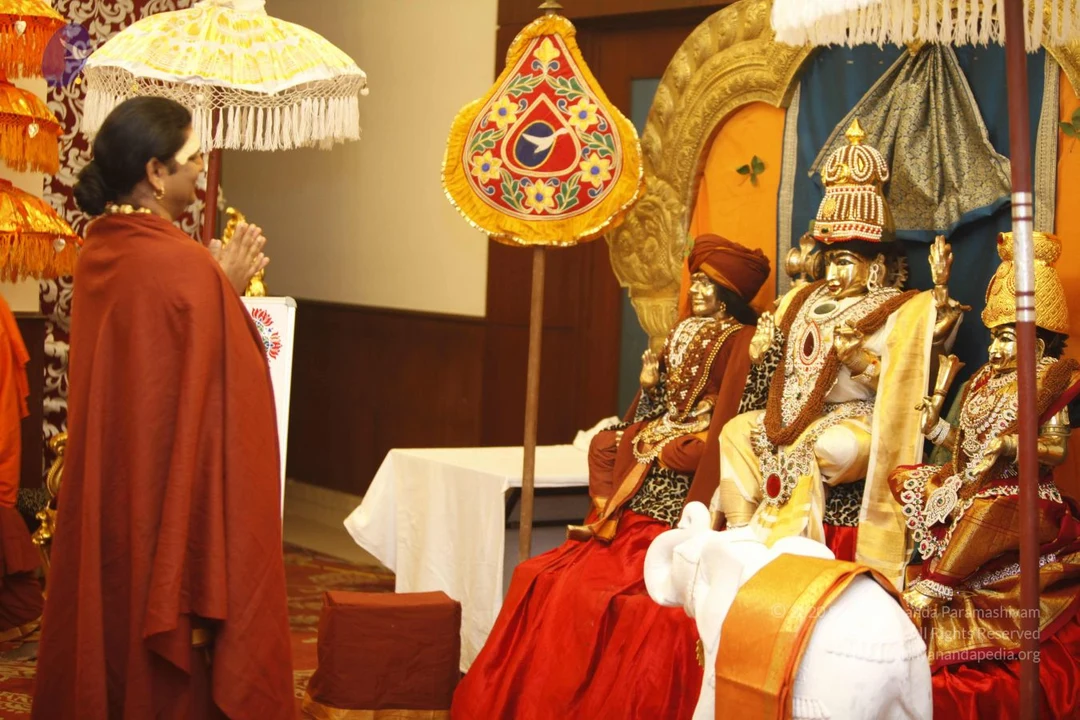
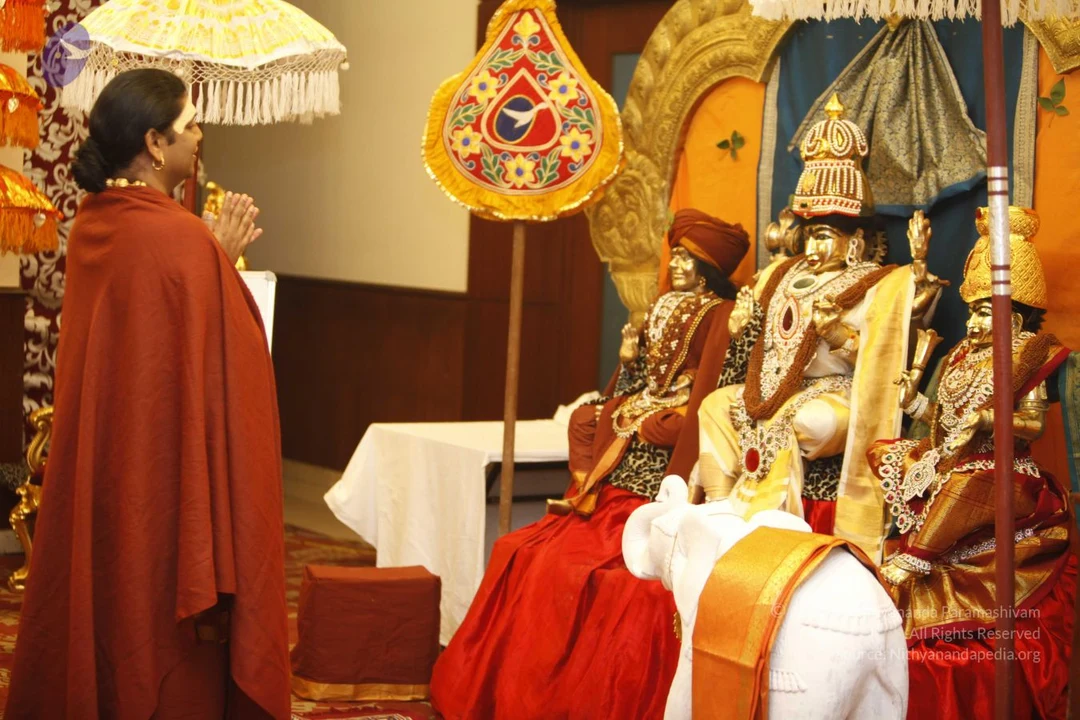
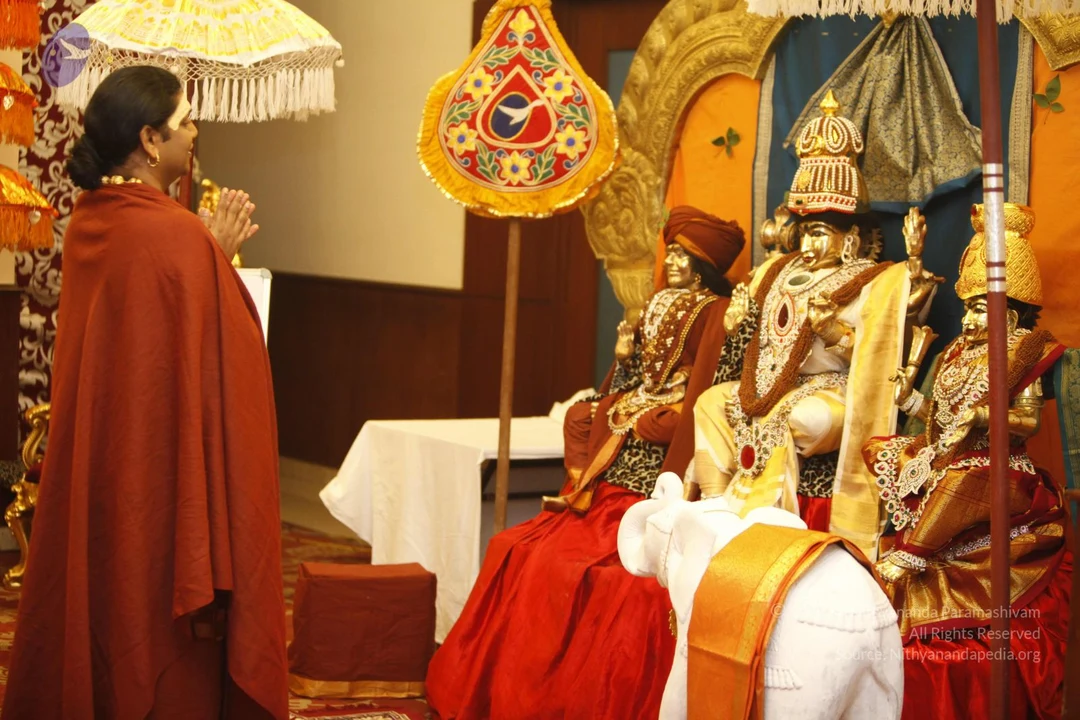
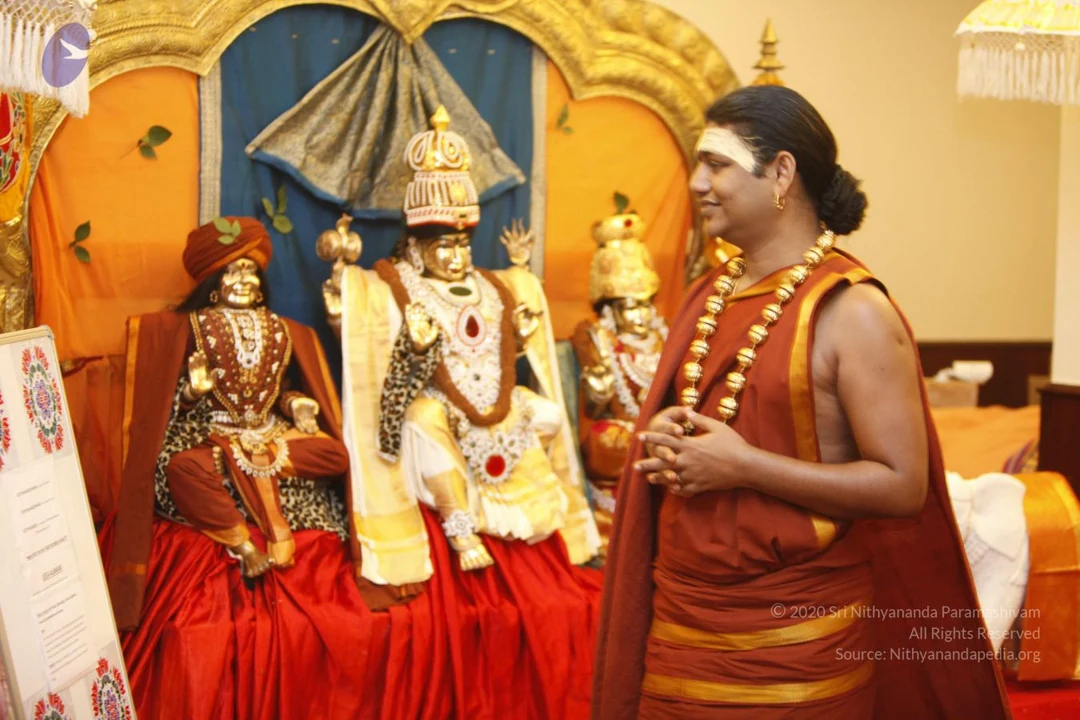
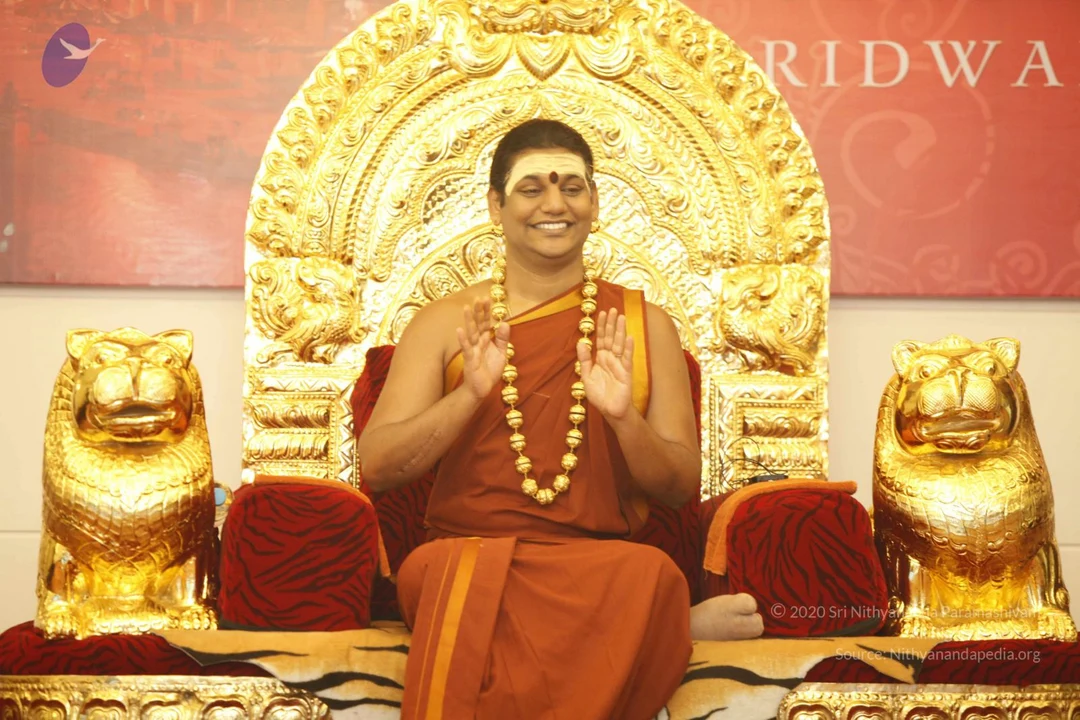
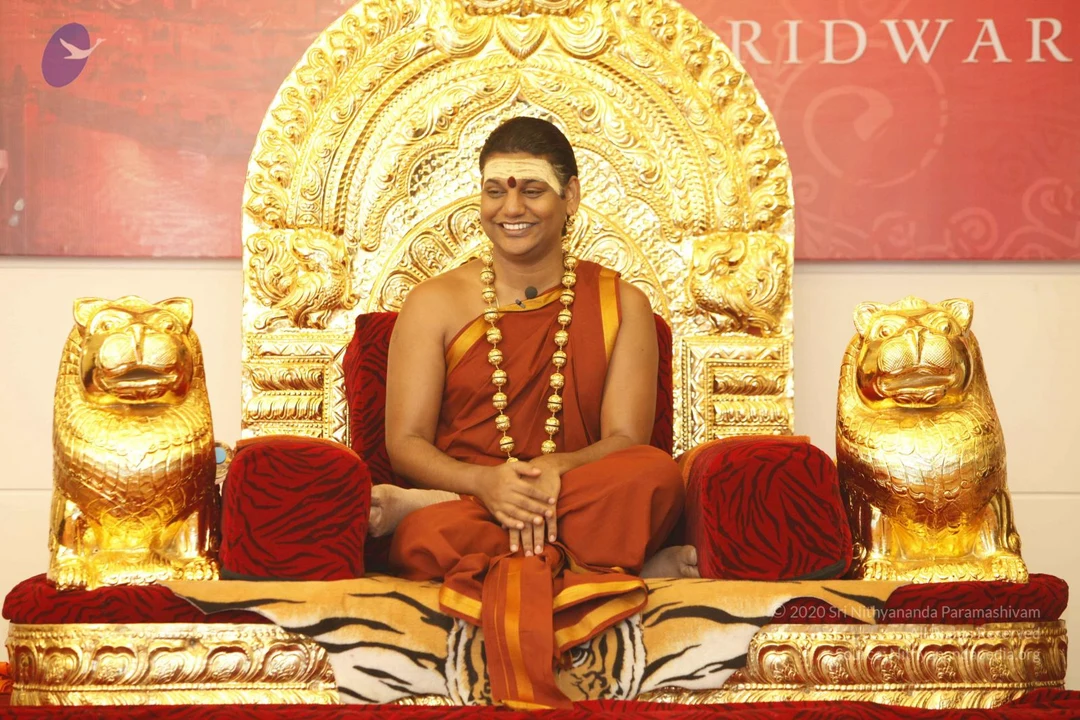
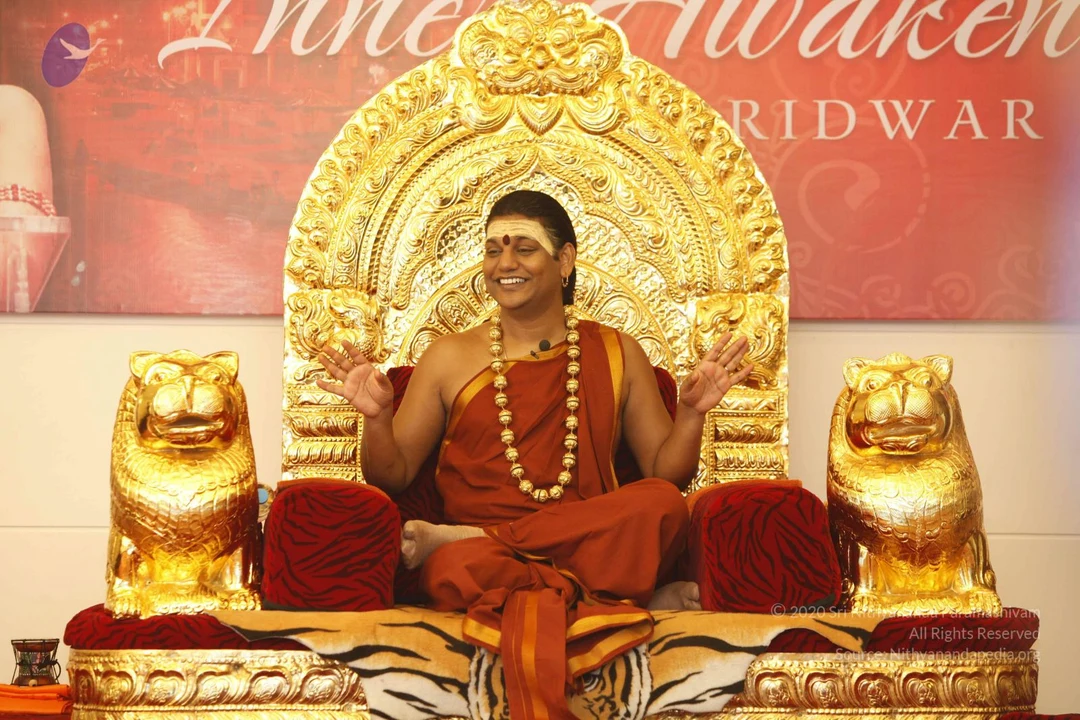
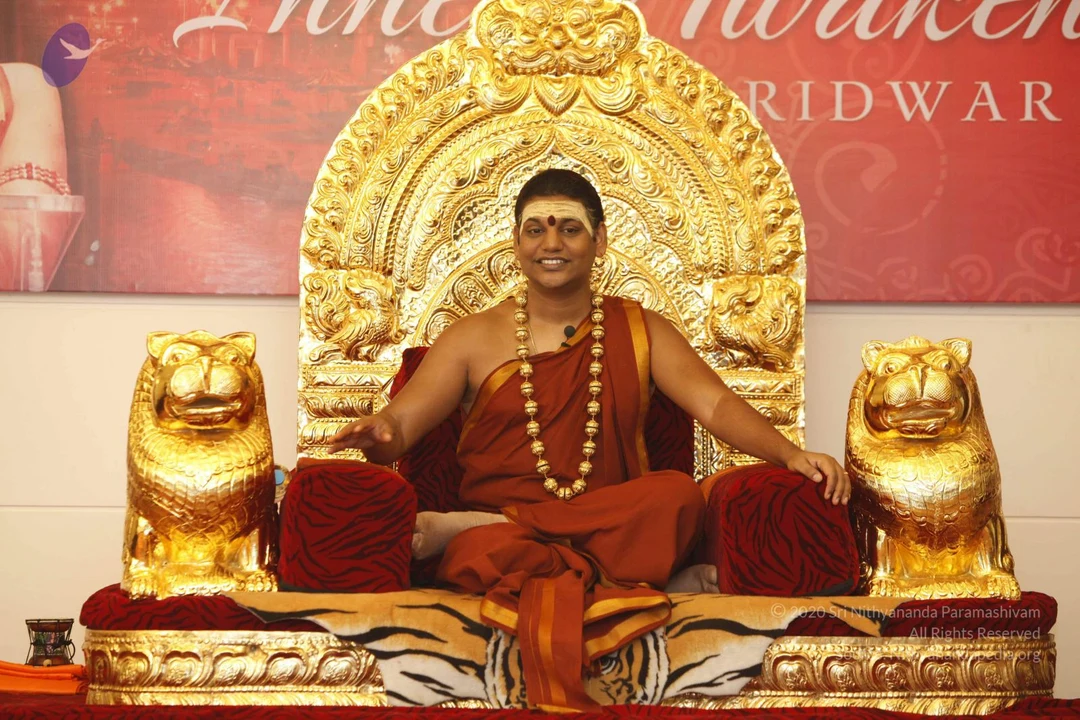
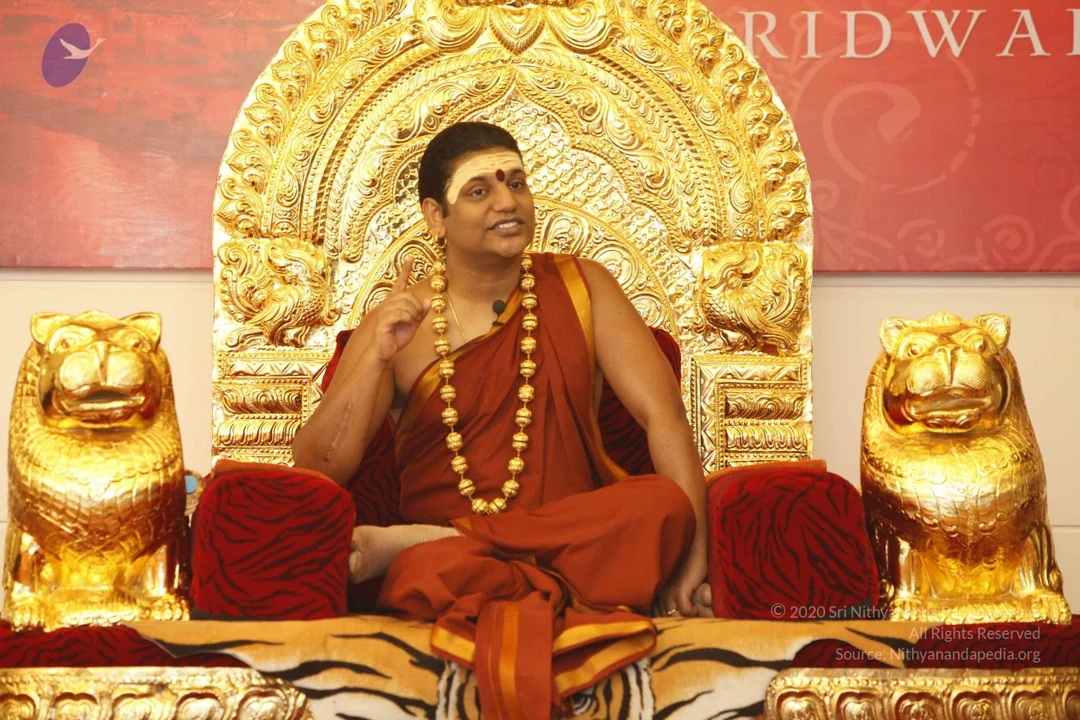
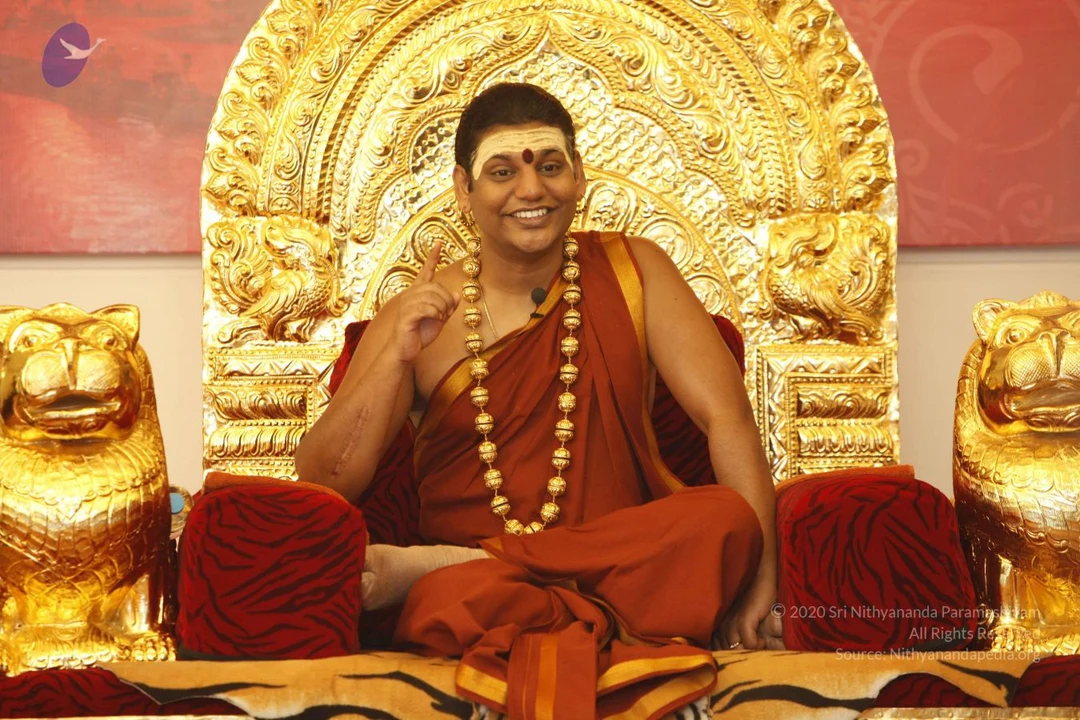
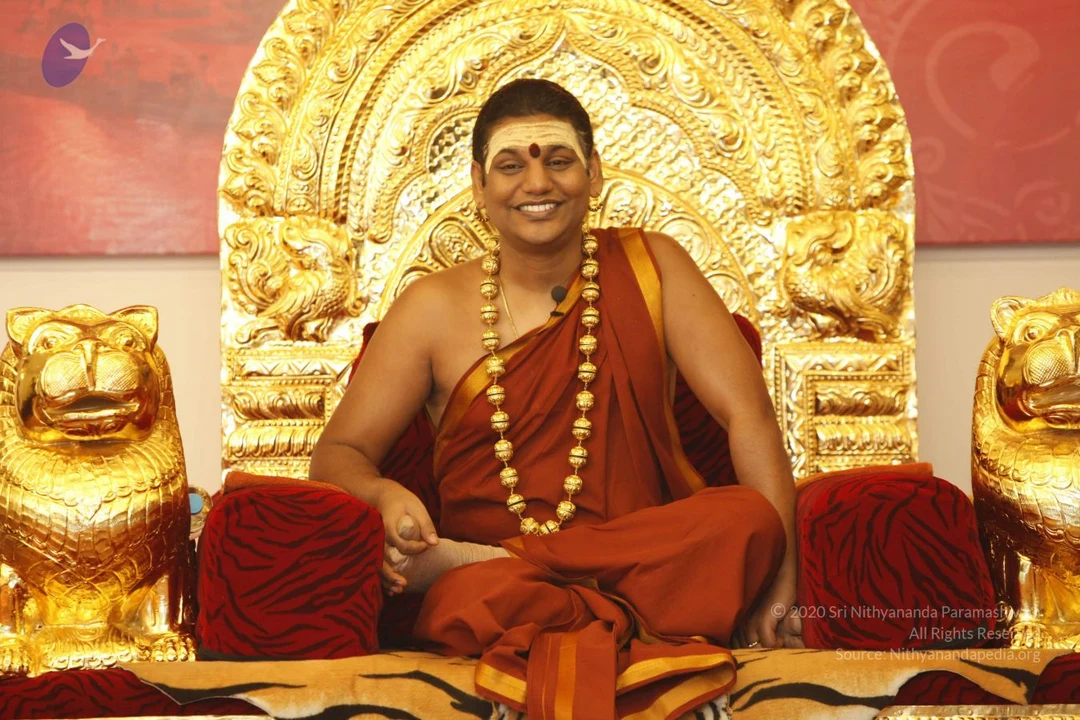
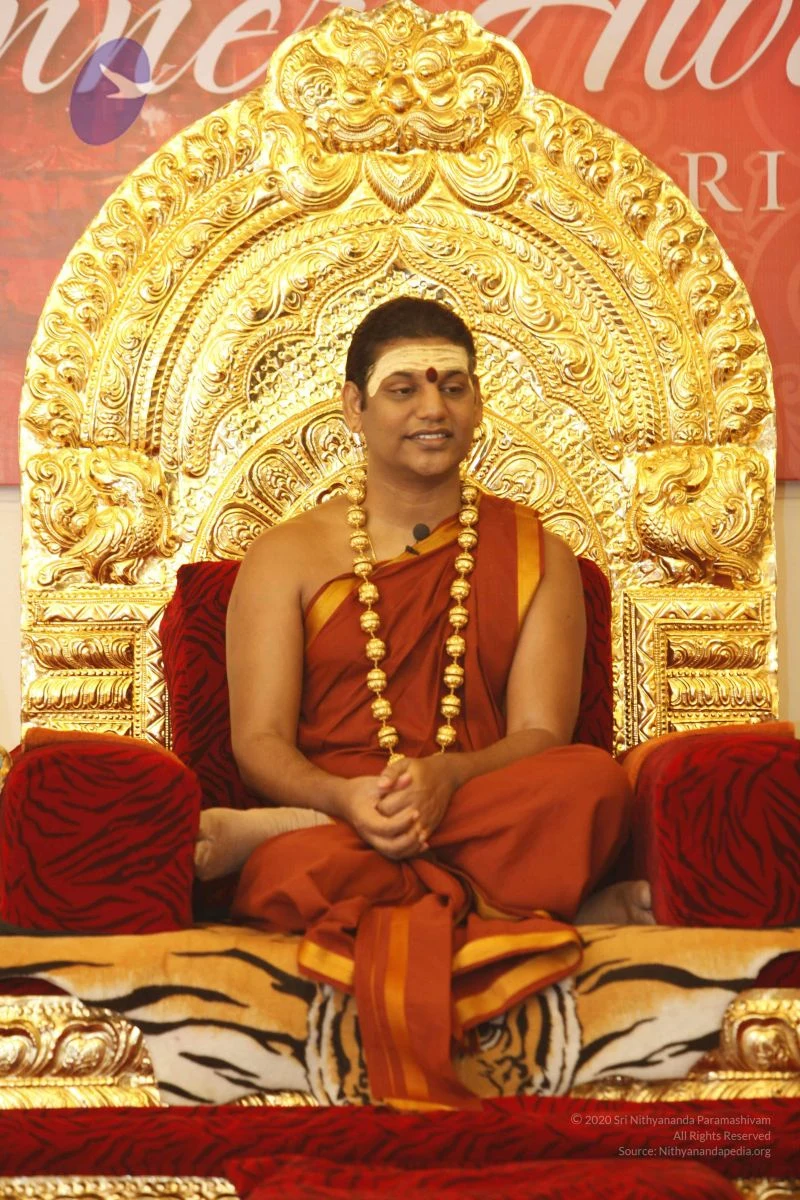
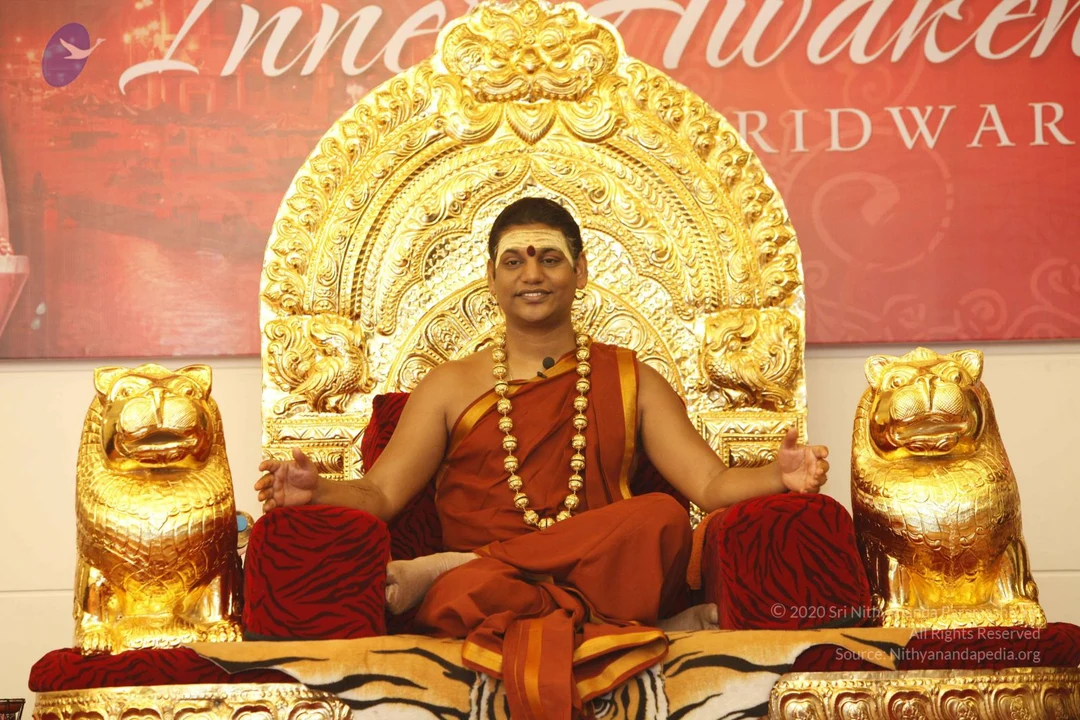
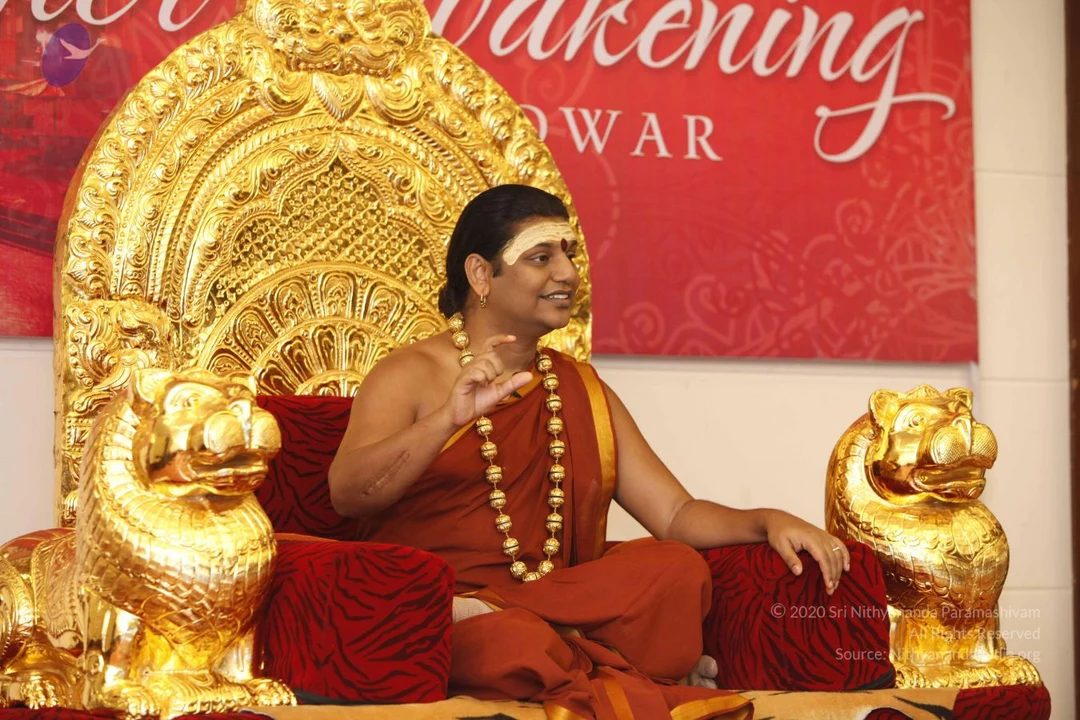
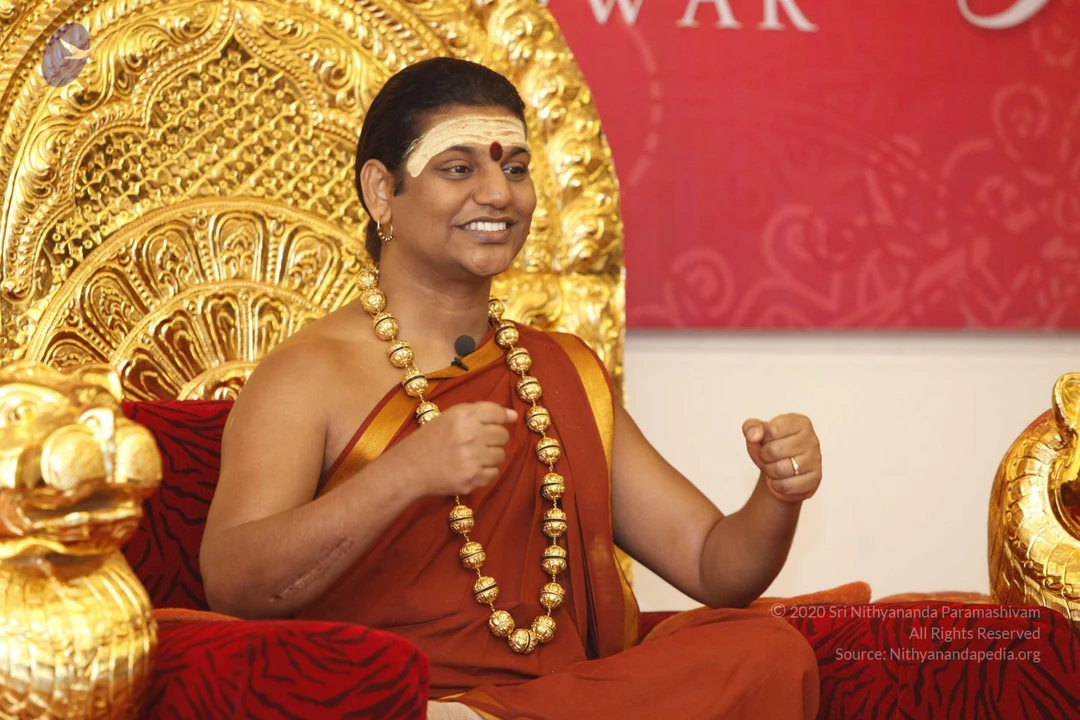
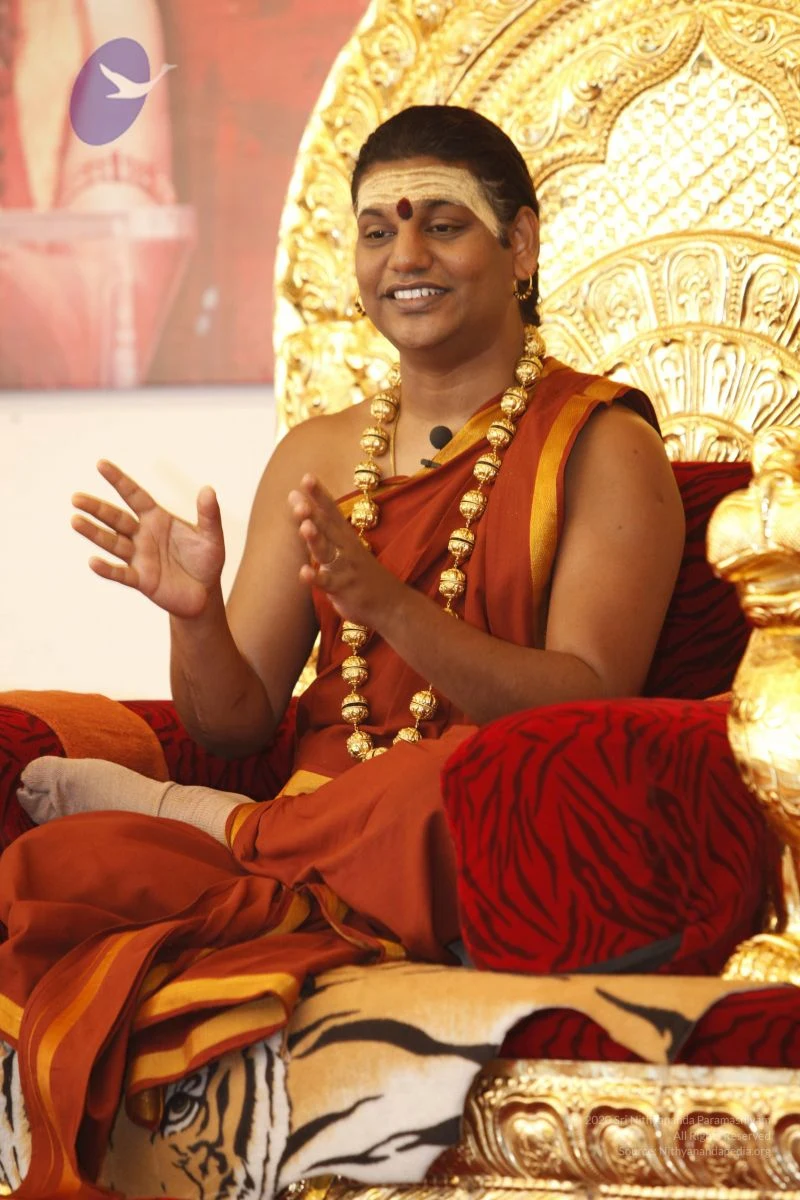
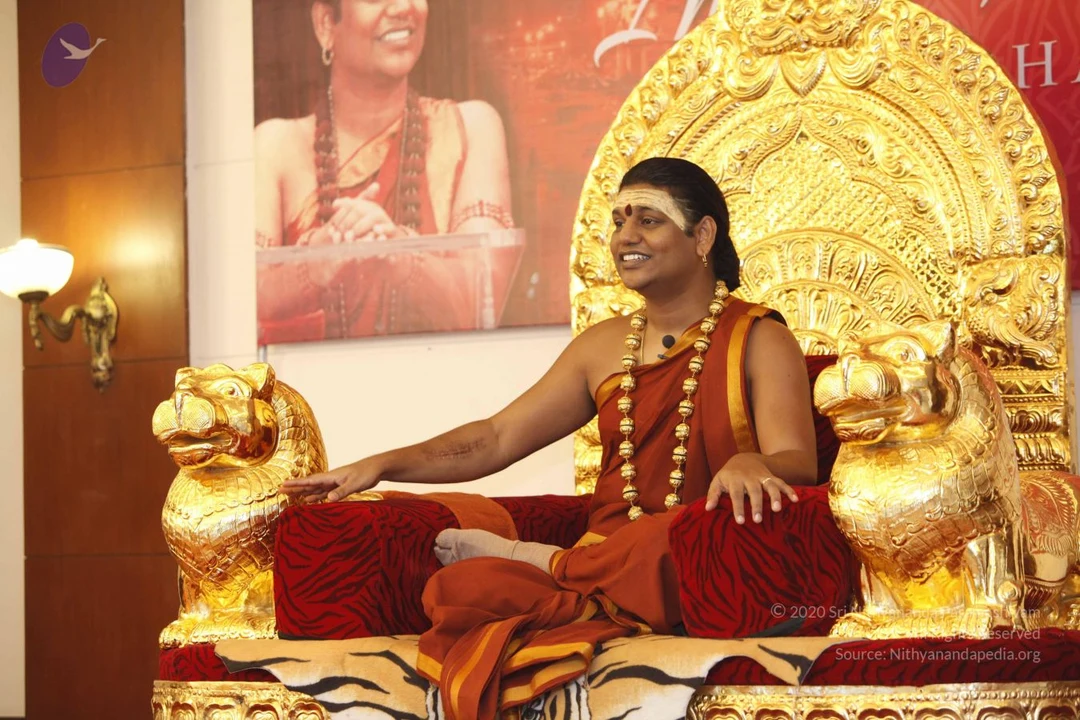
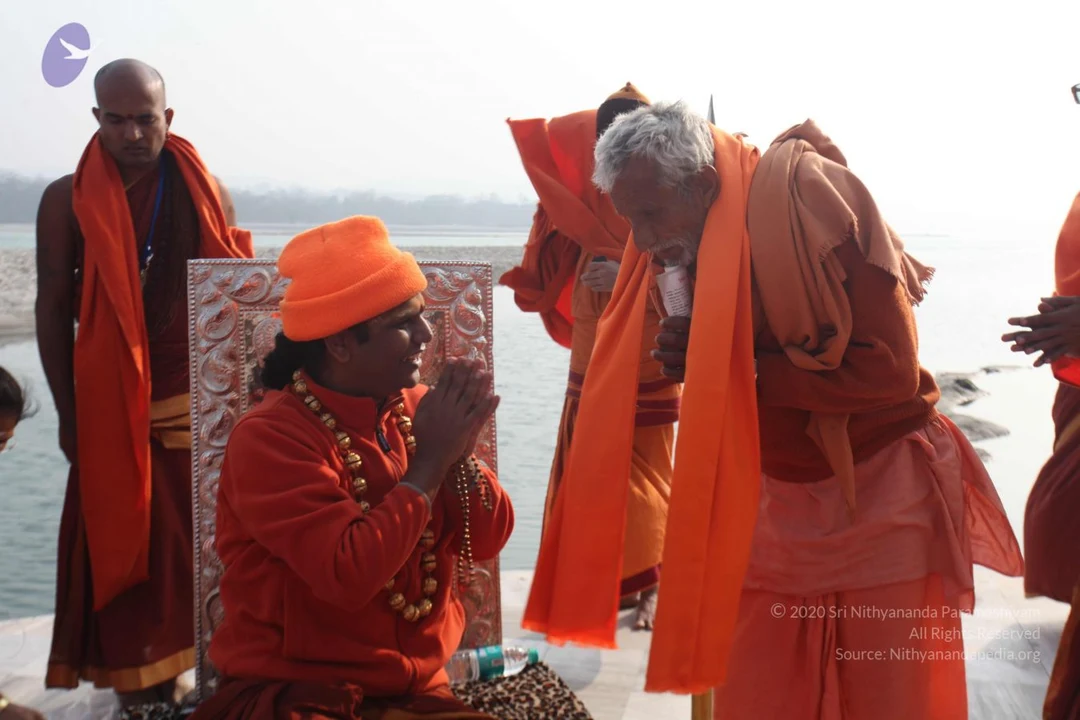
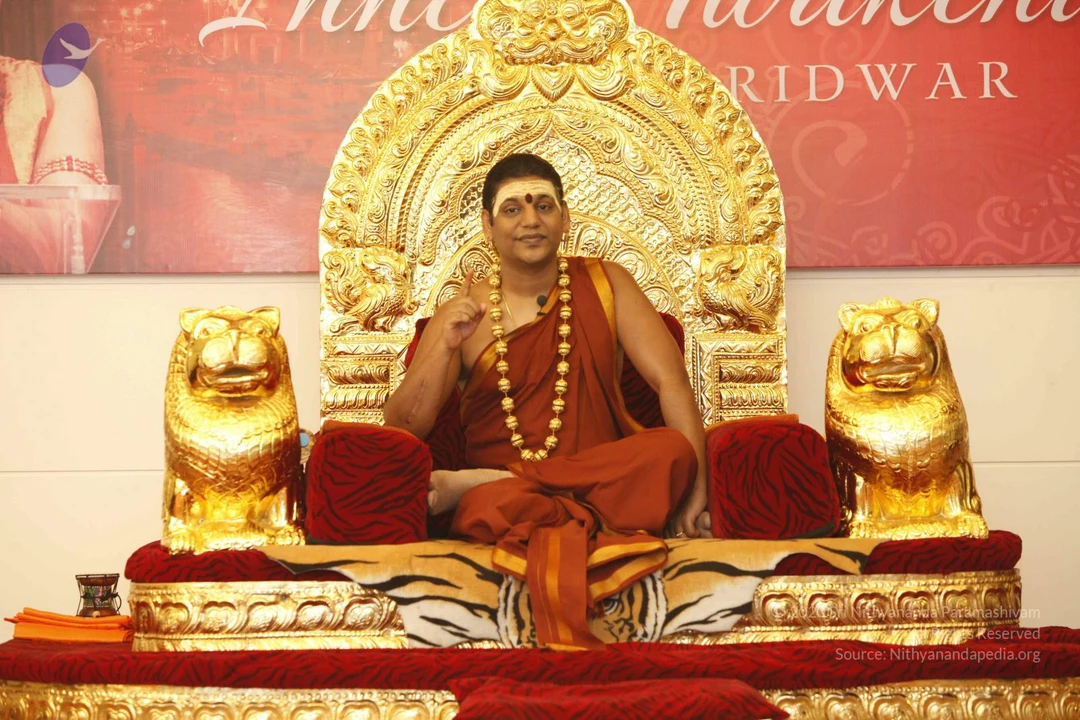
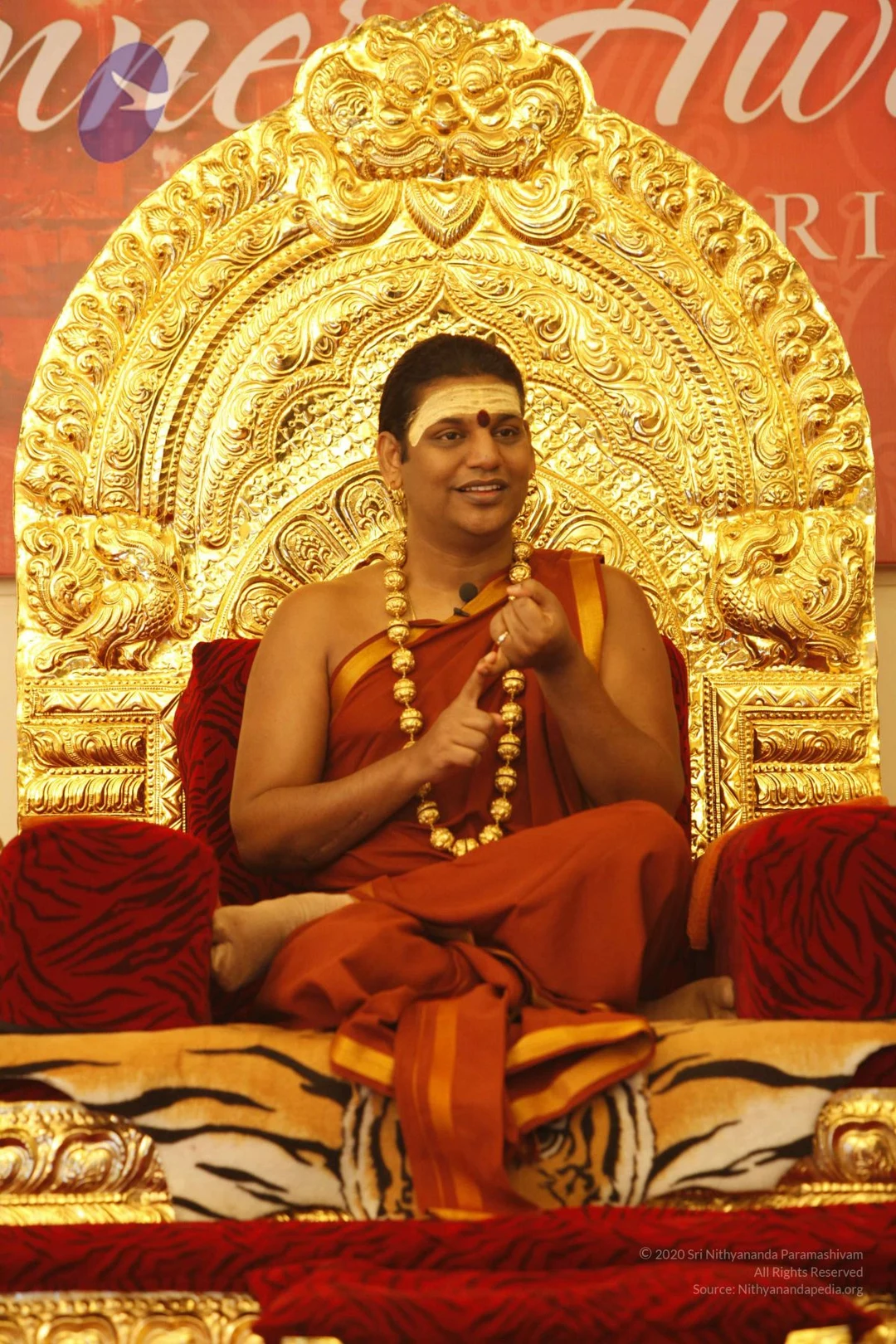
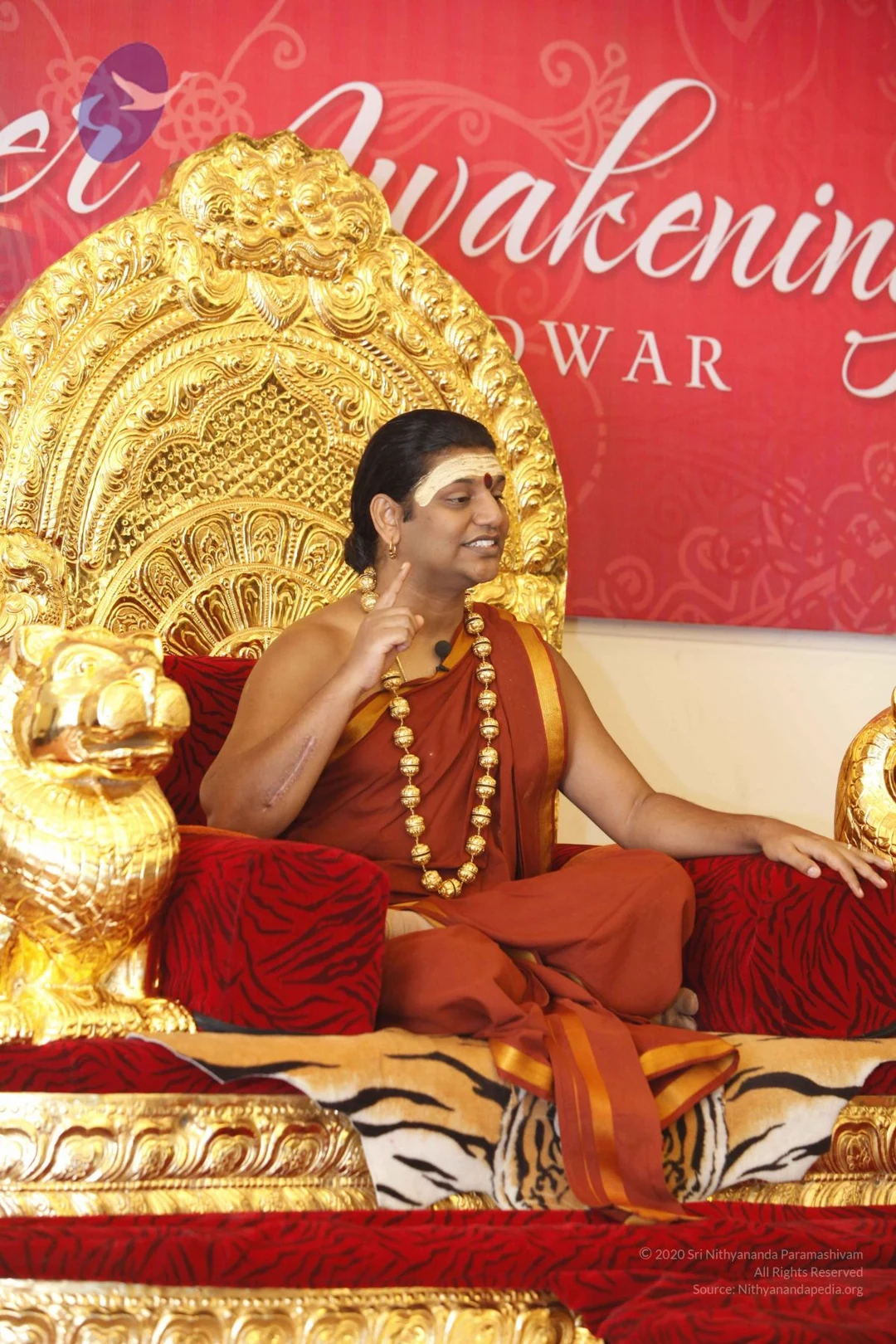
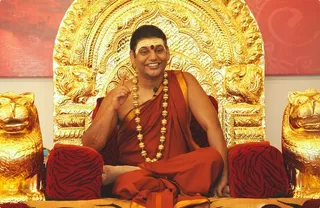
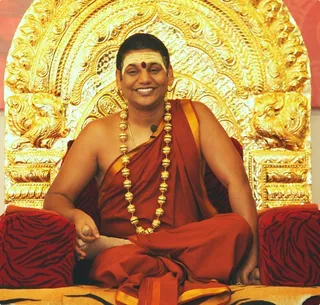
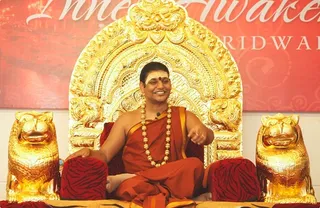
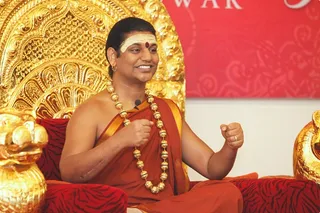
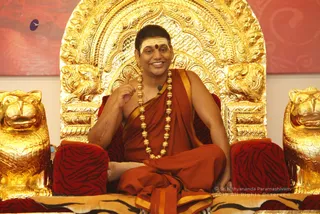
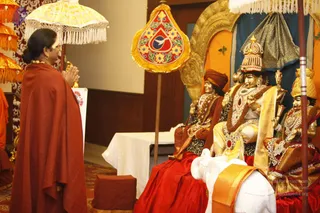
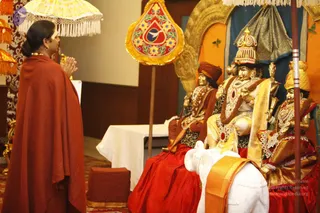
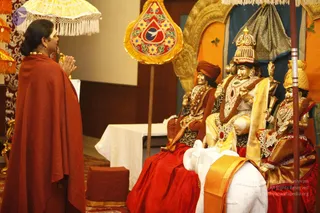
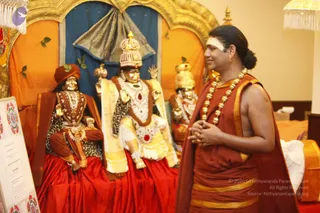
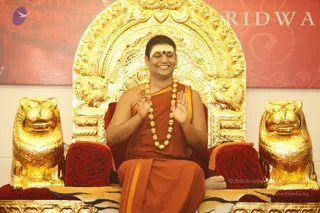
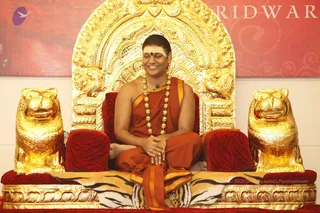
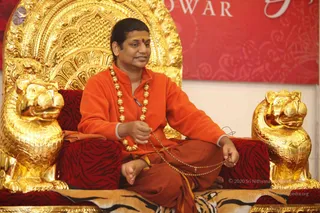
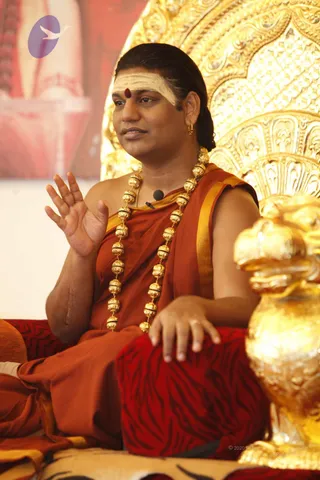
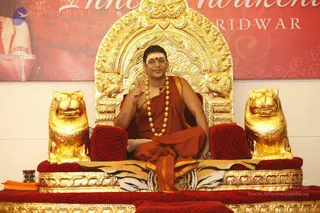
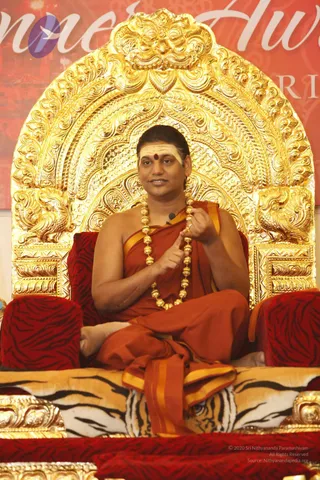
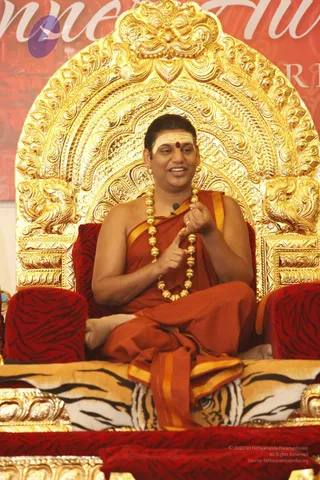
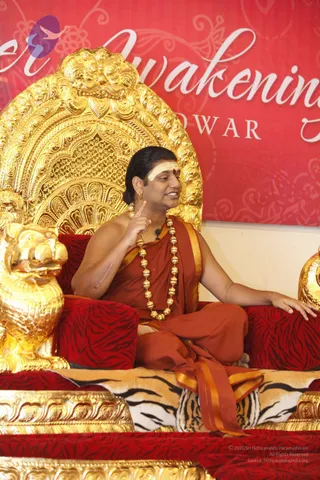
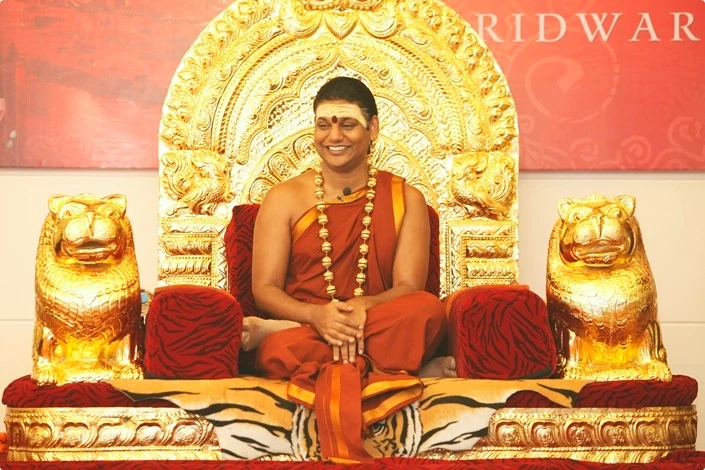
A standing man in a rust-red and saffron-bordered dhoti and shawl, with a white forehead band, a gold bead necklace, gold earrings and a hair bun, stands at right with hands joined, facing left toward three golden murti figures seated on a red-draped throne in a gold-framed alcove with orange and blue drapery. The central figure wears a tall golden crown, a white and gold garment, a red gem pendant and a jeweled necklace. The figure at left wears a red turban and leopard-print garment. A framed printed information sheet stands at left edge.A seated man in an ornate gold throne with carved arched backrest and lion-like side ornaments, draped in red-orange saffron robes with gold borders. He wears a long gold bead necklace, a white vertical forehead mark with a red dot, and a small lapel microphone. He gestures with his right index finger raised while speaking. The throne rests on a tiger-striped fabric and red velvet cushions, with a red banner behind. Partially visible red banner with white script at top.A seated man in an ornate golden throne with an arched gilded back, flanked by two golden lion-shaped armrests, sits on a tiger-striped cloth over red velvet cushions. He wears orange-saffron robes with a gold-edged shawl, a long beaded rudraksha mala, and a white-and-red forehead marking. He smiles with both hands raised palms-out in an animated gesture while addressing an audience. A red banner behind him shows partial text and a city image. A small brass object sits at the lower left of the throne.

January 10 2014

Original wiki page
Contents

Description

In today’s morning Satsang, Paramahamsa Nithyananda describes how many various groups in the world exploit us by reinforcing our SDHD – self-doubt, self-hatred, and self-denial. These three alone keep us from expanding and having success in life. Advaita Vedanta is the only religion that teaches us the science of completion, giving us the exact tools needed, not only to excel in life, but to allow enlightenment to flow in us!

Video and Audio - What Is Stopping Your Success?

VideoAudio

Transcript

(0:11) || nithyānandeśvara samārambhām nithyānandeśvari madhyamām | asmat ācārya paryantām vande guru paramparām ||

(0:39)

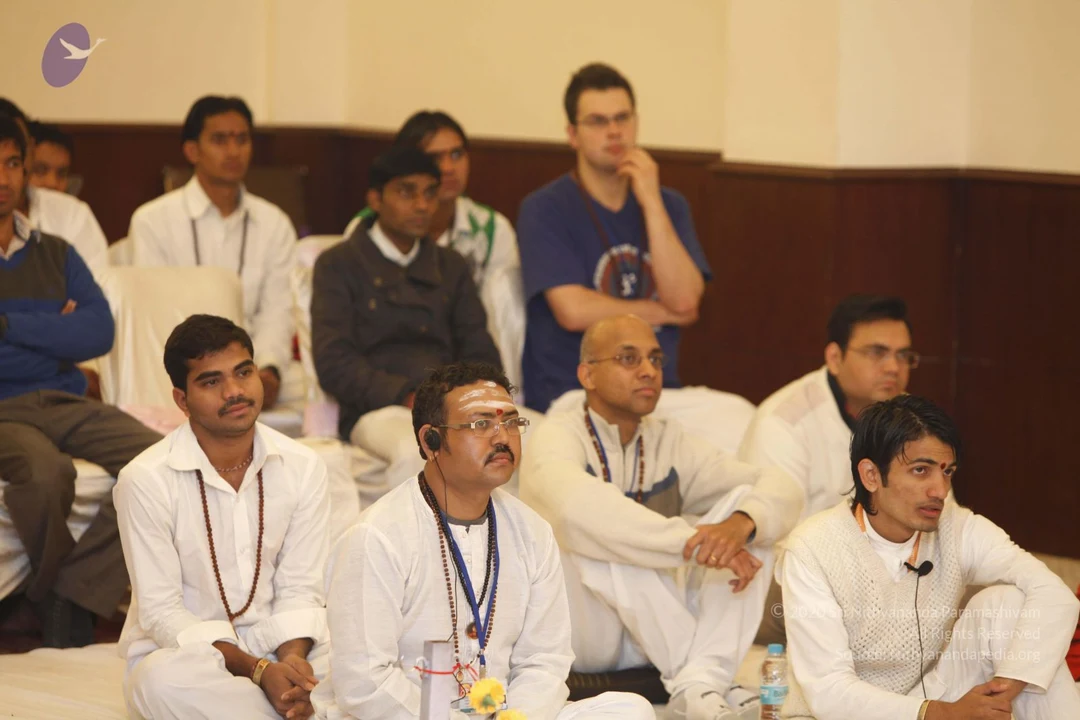
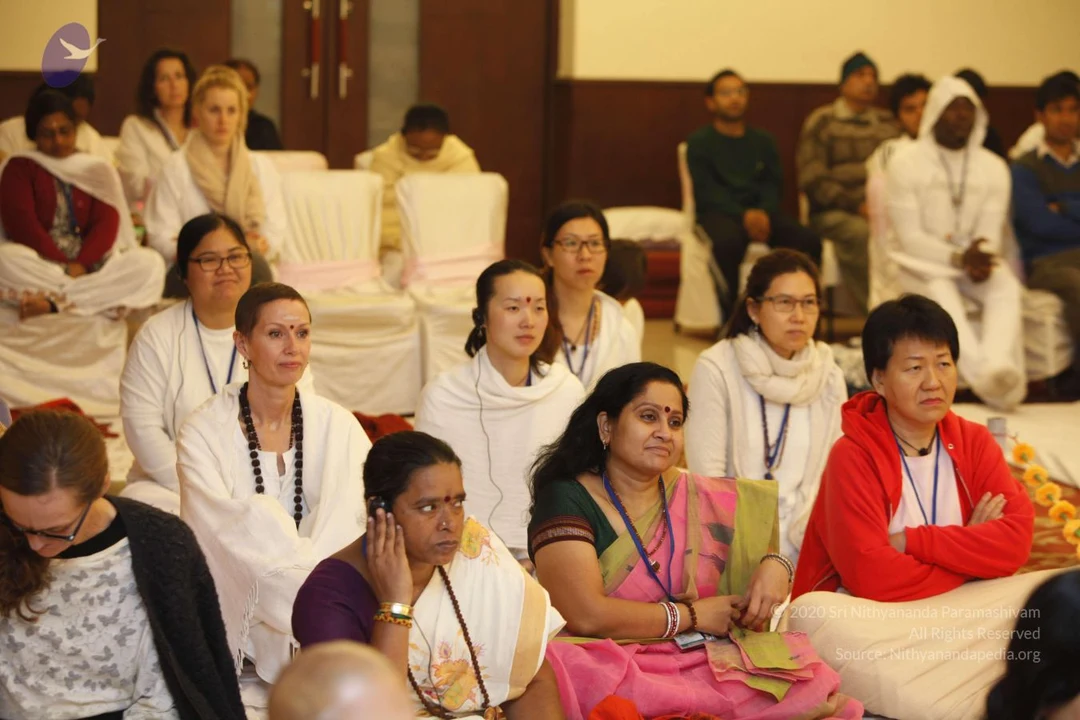
I welcome all the devotees, disciples, samajis, satsangis sitting with us through Nithyananda TV, Sadhna TV, Eshwar TV, Janashree TV, and through two-way video-conferencing having Nayana Deeksha in many cities in many countries around the world. Cities sitting with us in two-way video-conferencing: Winnipeg-Canada, Oklahoma-Somanatham, Santa Fe-New Mexico, Guadeloupe-Rameshwaram, Los Angeles-Arunachalam, Hyderabad-Gupta Kashi, Nithyananda Nagara-Bidadi, Ohio-Prayag, Seattle-Chidambaram, Kuala Lumpur-Palani, Bangalore City Center, Thiruvanmiyur-Chennai, Ardinithyanadna Dhyananpeetam, Indra New Jersey, Bogotá- Colombia, Dubai Vydyanathan, Charlotte Srisailam, Austin, New York-Varanasi, Dakota Dunes, Kathmandu-Nepal, Kulim-Tiruttani, Oman-Sivagangai, Redmond-Washington, Jorpati-Nepal, Enriching Temple-Bidadi, Phillip Island-Australia, Mollieres-France, Coimbatore Dhyanapeetam. I welcome all of you with My love and blessings. And when I say ‘I welcome all of you’, I mean here - some enthusiasts at Haridwar. No, I am answering him only. When I say, ‘I welcome all of you’, I mean here. It’s OK go ahead with the fiasco.

(2:40)

But over enthusiasm is always good then being dead. It’s OK. Hinduism needs overdose of enthusiasm actually, because we are too under-dose of enthusiasm and excitement. Even in teaching style we are the only religion who have the style of sitting and go on speaking. I tried; at least I’ll change that style. Standing and teaching or walking and teaching but somehow Hindus are not able to accept, because almost all teachers or preachers are with a big belly - that is why big cushions, to hide the belly only cushions. And nice bed kind of a seat and you don’t know whether they are sitting or lying down. And covered in the front also with a table! Somehow if you stand and talk or walk and talk, it doesn’t feel like a Hindu way. Anyhow, what to do? Hinduism needs enthusiasm. Come on.

(03:58)

Today, I will expand on Kalpataru. Some of the important things you need to understand in life is – I wanted to insist on this truth again and again even if you have heard it from Me earlier – everything, every suffering you have in your life, even not getting what you want in the life, everything boils down only to one thing: your Self-Doubt, Self-Hatred, Self-Denial - SDHD. It is the SDHD only demon in the life. Somehow, so strongly you believe that you cannot get it. Your intellect says you cannot get it. Your emotion says you should not get it. Your life says you did not get it. No, really, I am telling you, after the Shivaratri. See, till coming Shivaratri, “Shravana Ruthu” – Listening, Listening, Listening; after Shivaratri till Guru Purnima, “Completion with SDHD Ruthu”. The Sanskrit we’ll phrase it; maybe we will come up with a new word – “Poornatwa Ruthu”. Please understand, once you complete with SDHD, you don’t need any spiritual practice. If you don’t complete with SDHD, no spiritual practice will work on you. See, in a deep part of our being, the Self-Doubt, Self-Hatred, Self-Denial has gone so deep, you strongly believe no spiritual practice will work for you. I have a big group around Me, I know. They are all so clear, ‘My Kundalini will not be moved. I will not have any experience. Whatever Swamiji says I will believe, I’ll try to practice, but no spiritual practice can transform me.’ They are very clear. Please understand, sometimes the transformation means even you entering into a zone where you don’t know what is going to happen to you. That is what you are afraid of. You can’t handle. You become too compassionate than you wanted because, when the transformation comes, there is no limit. It is not going to be limited. Transformation is not Private Limited. No, really, I am telling you. It is not going to work.

(07:13)

First, I launched MahaMantra Meditation, then Seven Chakras Meditation, then Seven Koshas Meditation. Then Pancha Kosha Meditation. Then Unclutching, the great contribution. Then comes the Science of Completion. Then comes Integrity, Authenticity, Responsibility and Enriching. Now comes SDHD, completion with SDHD. No, how many ever new things I may go on inventing, you will have a clear, ‘No, whatever Swamiji says works for others; it works. For me ahh, for me nothing works. I don’t know what to do.’ Understand, the bad news is, with SDHD no spiritual practice will work for you. Good news is, SDHD can be completed. Understand, bad news is: no spiritual practice, whether you try to complete, or unclutch, or...No spiritual practice will work for you, because you have a strong belief. The bad news is, with SDHD no spiritual practice will work. The good news is, SDHD itself can be completed, please understand you can really, really complete SDHD.

(09:12)

From Shivaratri to Guru Purnima, “Ruthu of Completion”, Season of Completion with SDHD. But, that does not mean you need to wait till Shivaratri. Start now! I tell you, a person who has completed with SDHD is a most graceful and handsome, beautiful being. What is “grace”? See, “beauty” is when you see from distance how skin looks – the shape of the body and the skin – that is “beauty”. “Grace” is, when you spend time with that person, when you are around that person, what is the material out of which that person is made, what is the principles out of which he is made, what is he radiating, what is he believing as himself and others? How he holds himself and others, that is “grace”; Beauty of that is “grace”. I tell you, Completion with SDHD will give you a big breakthrough. That will only make you write, re-writing your future.

(10:54)

Please understand, always the transformation comes quantum, not step-by-step. When I started following Integrity in My classes, programs, I did not do like ‘Oh, seven sessions a day! First, I will start coming to the class for one session on time; then after a month, two sessions on time; then after two months, three sessions on time.’ No! Integrity comes NOW! Actually, that is one of the biggest jumps I took, because I live in such a timeless zone. I tell you, please understand, nine years I did not remember the year, date, time. That is why, when I am putting things back about My biography, I have so much of confusion about time, date. I have so much confusion. Only based on the circumstances I am trying to remember the time and date. Because, I never remembered month, sometimes I did not even remember the year, which year I am in. Really, I tell you, that nine years I didn’t know who is the Prime Minister, Chief Minister of any State or country. I did not know which month I am in. The good thing from that is, I did not, My body did not suffer due to weather change, I did not know which month it is, what kind of weather it will be. Early morning sun rises. If the is up, I know it is day; if the sun is down, I know it is night; that’s all! And, I tell you, India is such a beautiful sweet, country, if you are a sadhu or pilgrim, yatri or sadhu – “yatri” is the word in Hindi – yatri or sadhu, people don’t have any problem in giving whatever you want – food or a blanket. Especially in this area, this Uttarakhand, really, they won’t! I tell you, if you are a sadhu you can go to any shop, ask “bhiksha” for anything, anything. You can say, ‘Give me toothpaste, give me brush, or give me a “kambal”’. Never ever a shop will say ‘No’. Actually, with Integrity I can say. I am so confident of these people.

(14:26)

Yesterday, two of My Swamis went to take bath in Ganges. They saw a beautiful walking stick. They did not have money. And even if they have money, they will have to take approval and only then they can spend. They went to that shop and said, ‘This stick is so beautiful. We want to give it to our Guru. Please give us.’ That fellow said, ‘Alright please take it.’ That all! Just because those fellows are sadhus. I tell you, the whole Uttarakhand people are sadhus! Everyone is a sadhu.

(15:06)

You don’t need to know time... I remember many times when it is cold, nearest house I’ll go there and ask, ‘I am sadhu and I am travelling.’ The moment they see, ‘Oh, Baba, you don’t have kambal?’ They’ll give kambal. I don’t need to even ask. They will give food and kambal, something. So when I am travelling, and when it is not cold any more, when I see somebody wants, I will give that kambal and go. Then again, if it is cold, somewhere, any house – you don’t need to choose some rich man’s house or nothing. Walk into any house, whatever they have is yours. This one place still Mahadeva is keeping it as he wants. That much I can be sure. Mahadeva and Ganga Mata, both are keeping this place as they want. I have not found a single exemption. At least in My life I have not come across with any exemption incident like a some sadhu asks somebody and they did not give. At least in My life I have not come across, or I have not heard.

(16:28)

This remembering Time was such a big thing for Me. Time, date, year, it was not at all there in my inner-space. Actually, it is good in a way, because it keeps you young. You don’t know how many years old you are. Your body does not demand many things. Only when it is really cold, you need some warm clothing. Only when you are really hungry, you need food. Actually, if you forget time, your body will be very healthy, because you will not eat as per time; you will eat as per hunger, you will drink as per thirst. That was one great thing. I still remember, sometimes when I am travelling – I went to Kedar, Badri, all these places – if I am staying in some small hut, some villager if I ask him some little “tulasi” or anything, he will go all the way some three or four kilometers and bring that and come! Such amazing people! Because, here, in many places you will not have road to have bicycle and all that; you will have to walk up and down. Such beautiful people. I tell you, no other part of the world produced so many number of Enlightened Beings like this part of the world. This part of the world produced the maximum number of Enlightened Beings in the Planet Earth. That is why, even though politically we are not that intelligent guys, we never had the suffering which Tibet is having. We are also not politically savvy or politically intelligent people. Mahadeva can give up Kailash, but not the Himalayas! Not this area.

(18:58)

Please listen! I lived that kind of life, never remembering time, date, everything. But when I decided to be in the space of Integrity, it’s a quantum jump! I decided, yes, I was in the timeless zone, because I did not need to share My life with others; it was all for Myself. Now I am committing I am going to enrich the people, cause something for people. So, I have to care about the time zone they are living in, the space they are living in. If I am going to cause enlightenment for Nature, and the animals, and the trees and hills and plants, then I don’t need to care about time. But I am going to be cause for human-beings who have certain structures. So, naturally, what should I do? I have to sacrifice My structure and enter into this structure. The day I decided, till today, by Kaala’s grace, Integrity is happening. The grace of Kaala, Kalabhairava.

(20:30)

Understand, all transformations are quantum jump. Just complete with SDHD... I am giving you this as a beautiful process. Now sit down and pen down what all you want in life. Listen, please listen first – the moment you think you want something, immediately one part of you already declares, ‘I am not going to have it. I am not qualified to have it. It is going to be very difficult. How can this happen?’ All that, mind will tell, be very clear! Please understand, now the moment you see the Self-Doubt, Self-Denial, Self-Hatred coming up, look back when it started, that “I am not qualified, I am not enough, I am not going to get it”, the pain. Listen, even if renunciation is because of that pain, that renunciation will be only Self-Destruction, like Gandhari. Do not renounce because of that pain you won’t get it, Self-Denial you will not get it, Self-Hatred, you will not get it. No. Renouncing should be out of powerfulness, Shiva’s renunciation, not Gandhari’s. Listen. Somebody asked Me in the session, ‘Who is Madri? Is she a Tyaga? No, listen, Tapas-based Vairagya. See, Tapas has a certain kind of a strength when Vairagya is attached to it. So, Madri is Vairagya, Vairagya of powerfulness! Madri strengthens Kunti. Finally, she disappears into Kunti. That is what is meant when she dissolves herself.

(23:22)

Listen, even your Vairagya, if it is out of SDHD Self Denial, Hatred, Doubt, it is not Vairagya. So, first thing you need to complete is Vairagya, the SDHD has to be completed. Self-Doubt, Hatred, Denial. I tell you, no religion other than Advaita Vedanta gives you this sacred secret of completing with SDHD, because all religions exploit you based on your SDHD. Because you have a deep Self-Doubt, Hatred, Denial, that is why they are able to tell you that you are a sinner, you are a slave. Many religions exploit you because of your SDHD, never allow you to complete with that and get out of it. Advaita is the only tradition, boldly. That is why I tell you, it is such a sacred tradition, such an amazing tradition, never built for exploiting people. See, it’s like how the modern-day medicine, your body has become an income source for the doctor. Why will he cure you? Your body has become income source for the pharmaceutical companies. Why will they completely heals you? And why will they give you medicines which have no side-effect? Same way, your SDHD has become source for many religions’ income. Your SDHD is the income source for many religions. Why will they cure you? Why will they help you to complete it?

(25:34)

Advaita is such an auspicious tradition; that is the “Kalyana” happened to the whole world. The “Mangala” that has happened to the whole world is Advaita. Again and again, I bow down to this land. I am so fortunate that I am born in this land. I bow down to this land for giving Me place in this land, where I am taught to complete with SDHD. Nobody is exploiting My SDHD. Same way, I also live, helping people to complete with their SDHD, not exploiting their SDHD. Exploiting people’s SDHD in living is the cheapest life you can live. It is like, you know the medicine for HIV, but you don’t give it to him. You find an alternative medicine which only controls the disease but never cures and give only that controlling medicine and never giving cure. What an exploiting lifestyle!

(26:50)

I tell you, the biggest message, greatest message of Sanatana Hindu Dharma is: “Complete with your SDHD. Self-Denial, Hatred, Doubt. Self-Doubt, Hatred, Denial.” Remember, “Amritasya Putraaha”! We are all “Sons of Immortality”! Listen, “Shrunvanthu Vishwey” – “Listen, O the World”! “Amritasya Putraaha” – “Sons of Immortality”! You are not “Sons of Sin”! No! “Sons of Immortality”. Complete with SDHD. Go back to where that Self-Doubt, Hatred, Denial started. See the painful Self-Denial, where with lot of pain you collapsed. Please understand, every time you collapse, you strengthen your Self-Denial. Every time you fall down, you strengthen your Self-Denial. Don’t allow that.

(28:10)

One police officer threatened Me: ‘We know how to frame you and put you in jail forever! What will you do?’ I just laughed at him, ‘I know how to make life out of time.’ I told him, ‘If someone knows how to make thread out of cotton will he be afraid of losing few meter thread? So, I know how to make life out of time, and the time is the eternal supply I have.’ I have a eternal supply of the raw material. I told him First of all, you can’t do. I trust the Judiciary and God. First of all, you can’t do. Even if you think you can do, understand this, I can make life out of Time. I’ll extend My life as I want and do what for I came down.’ He was shaken. Really. He said, ‘What do you mean?’ I said, ‘What I said, I mean that!’

(29:35)

I tell you, just complete with Self-Doubt, Self-Hatred and Self-Denial; all the great truths of Advaitha will become reality for you. You can live as you want, as long as you want! Like a Bhishma. You’ll become “Iccha Mrityu”. Means, you can choose your death as you want, when you want, the way you want! You don’t need to do any big, big, big tapas. Sit, trace back when you started the painful collapsing and giving up on you. Is the moment that Self-Denial starts sprouting in you. It may be just a small candy your elder brother is not ready to give you. A small sweet your mother is hiding it to give you tomorrow. Or a small piece of cloth your elder sister is saying, ‘No, I will not give you now.’ It might have started at that moment. Go back. See how you collapsed, cried bitterly and decided you are not qualified to get it. Complete with that Self -Denial. If you just relive and relieve, you will complete with it. I tell you just complete with that self-denial you will have everything you want. Not only that all these great truths of Advaita Vedanta like, Dharma, the power to make life out of time.

(31:40)

Please understand, with Integrity and Authenticity I tell you, this science of making life out of time is not My monopoly. Just complete with yourself. The Self-Doubt, Self-Hatred and Self-Denial. Keeping Kalabhairava as a witness, I tell you, this science every one of you can experience it and use it. I am not lying and giving you some encouragement. As I said I am not a personality development Guru. Just complete with your Self-Denial, Self-Doubt and Self-Hatred. Go back and see how many times you fell into you, collapsed into you, the inner implosion has happened and you strengthened your Self-Denial, Self-Doubt, Self-Hatred. You lost your self-confidence; your shoulder bones are consciously broken. Pen down every one of that. Relive and complete with it. You will wake up like a Phoenix bird, I tell you. You will wake up like a Phoenix bird. You will raise like a Phoenix. Re-writing of your future begins when you complete with all the self-doubts, self-hatred, and self-denial and raise as a new being, because that is the source of all the ignorance and in-auspicious in you.

(33:42)

Today, in the Inner Awakening class, we will be working on this Self-Doubt, Hatred and Denial, completing with them. All over the world, I wanted all the devotees, disciples, Samajis, Satsangis... Start working on completing with your Self-Doubts, Self-Hatred and Self-Denial. Put little time and intelligence and energy, intention to complete with your Self-Doubt, Hatred and Denial. I tell you, I have seen in My life, many of the sadhus, brahmacharis, they struggle with the Lust pattern. But actually, the Lust pattern is not the real enemy. It is their Self-Doubt and Self-Hatred and Self-Denial allows the lust pattern to be a parasite on them. If they complete with that Self-Doubt, Hatred and Denial pattern the Lust will become like a parasite which has lost the root; it will just dry down and die. Just complete with your Self-Doubt, Self-Hatred and Self-Denial, I tell you, Enlightenment will flow in you like a Ganga! It will flow in you like a Ganga. That is the exact word I will use: It will flow in you like a Ganga. I bless you all to have Jnana Ganga, the Enlightenment Ganga in all of you.

(35:53)

I tell you, you guys are fortunate enough to get connected to a great tradition, Sanatana Hindu Dharma which does not exploit you knowing your disease. It is so sincere in completing you. Blessed are those who go to a doctor who doesn’t exploit a patient based on the disease; he’s sincere to cure the disease. Same way, blessed are you guys who are attracted to a great tradition which does not exploit your SDHD, which completes your SDHD, which is constantly inspiring you to complete with your SDHD. So, don’t miss it. You are blessed enough to be attracted to a tradition which teaches you to complete with SDHD – Self-Doubt, Hatred, Denial. You are blessed enough to go to a Guru who experientially radiates that science to you. So, let’s complete.

(37:15)

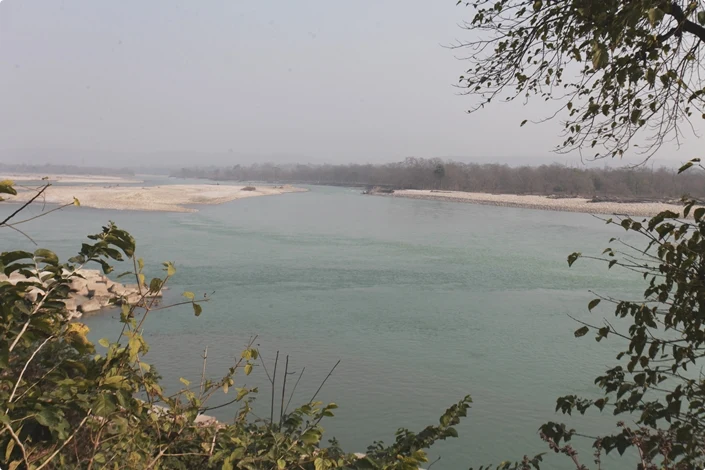
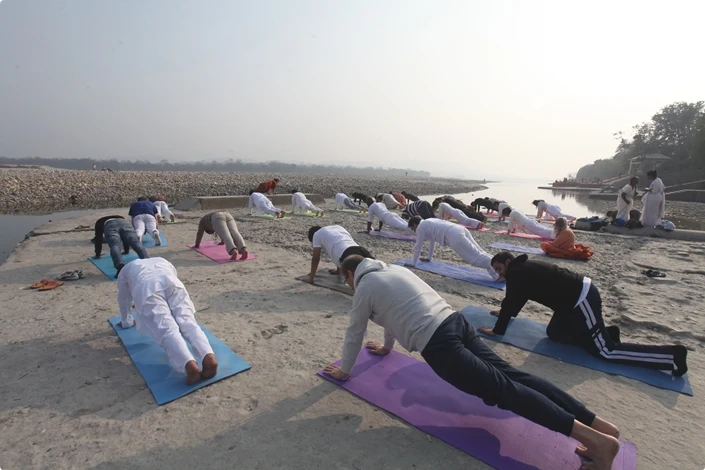
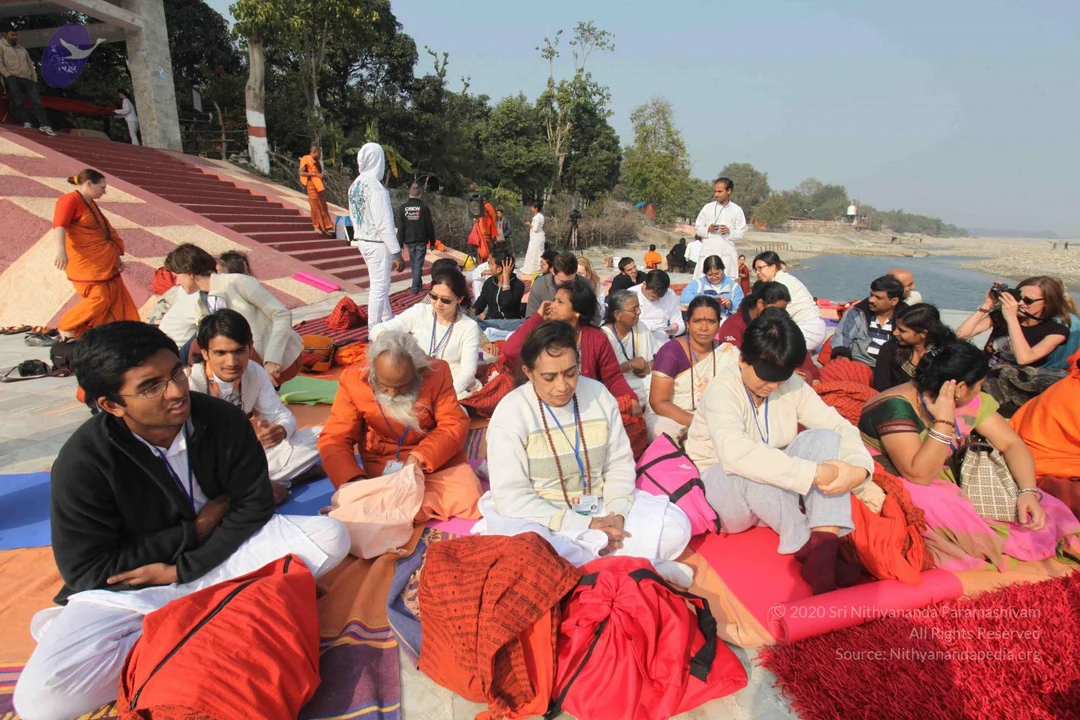
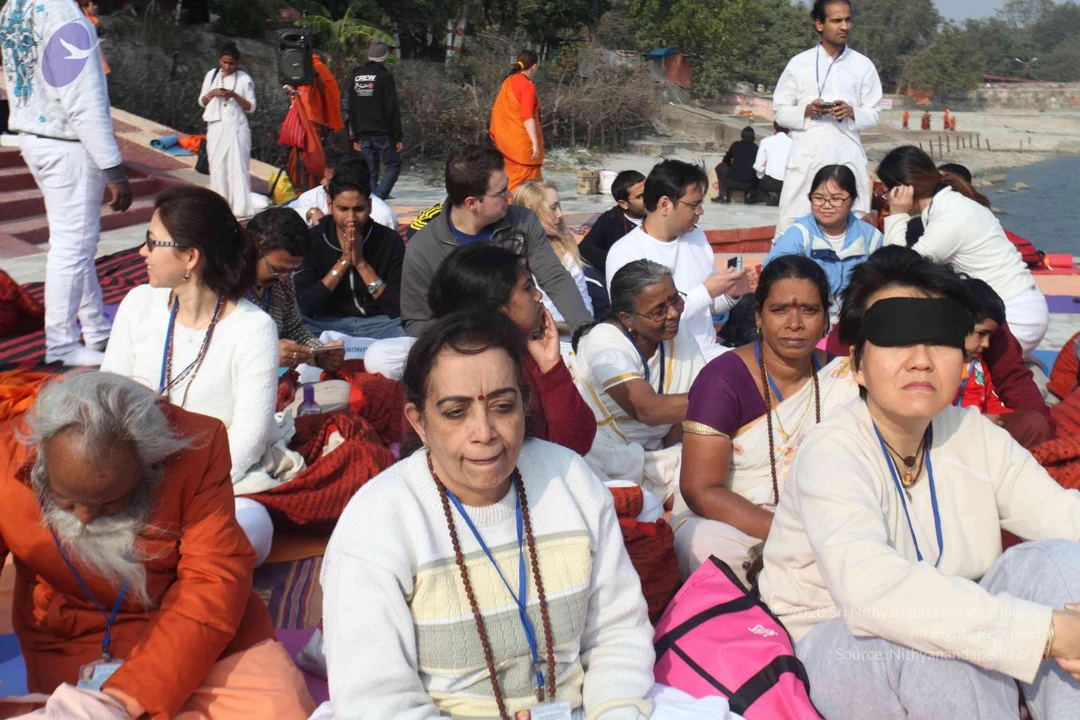
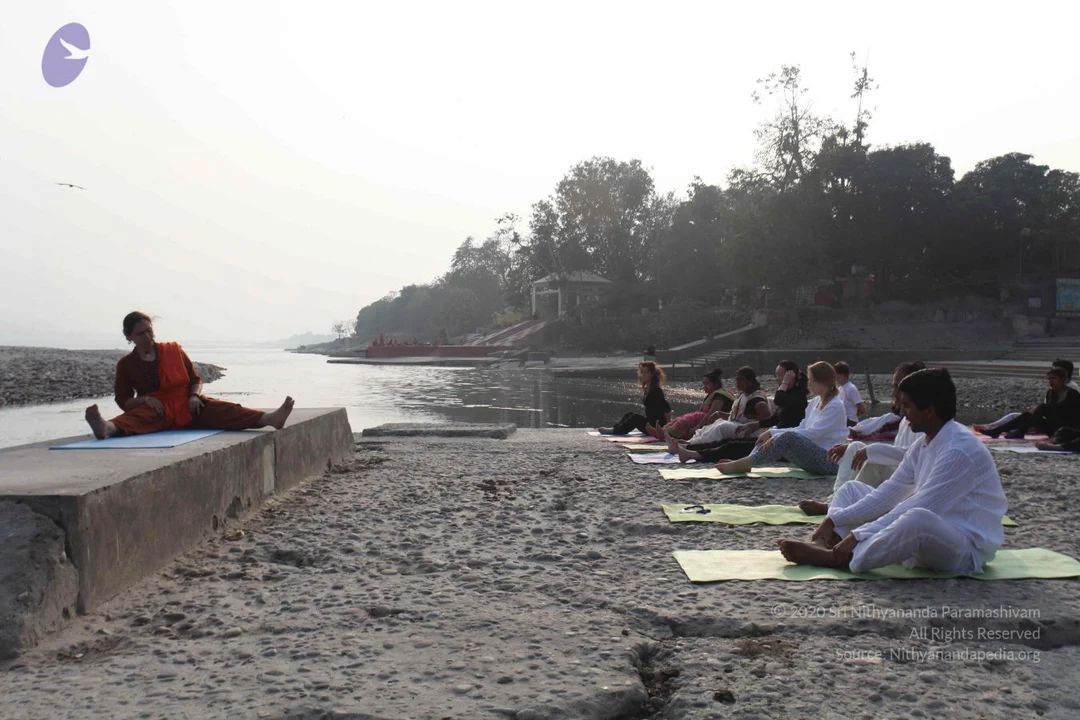
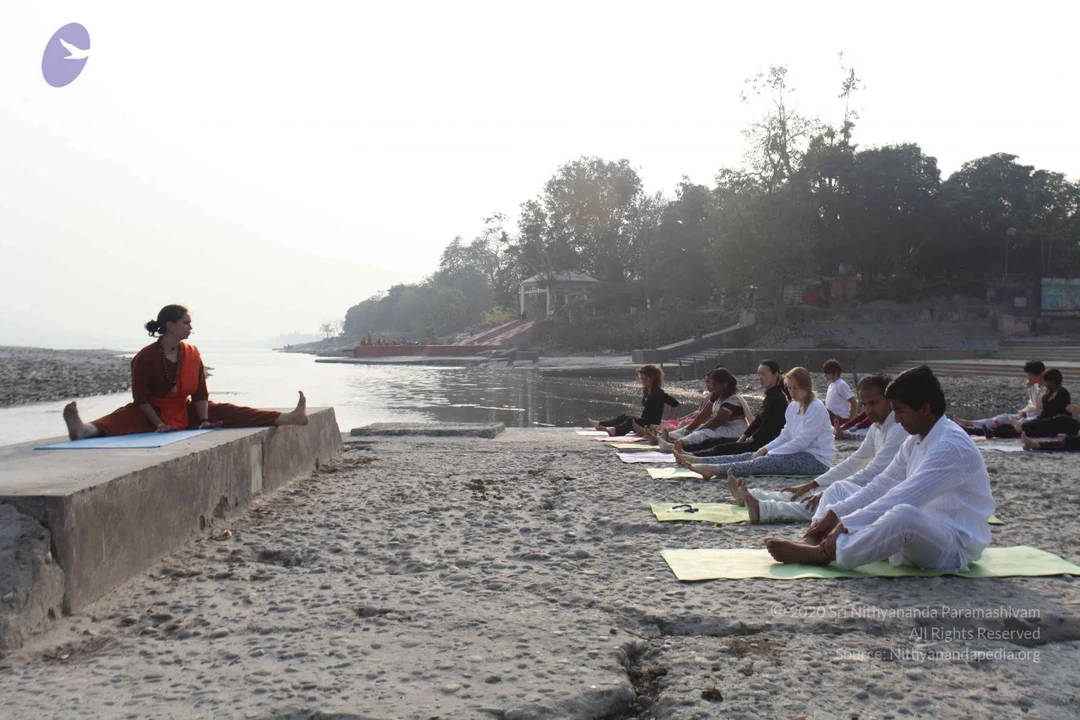
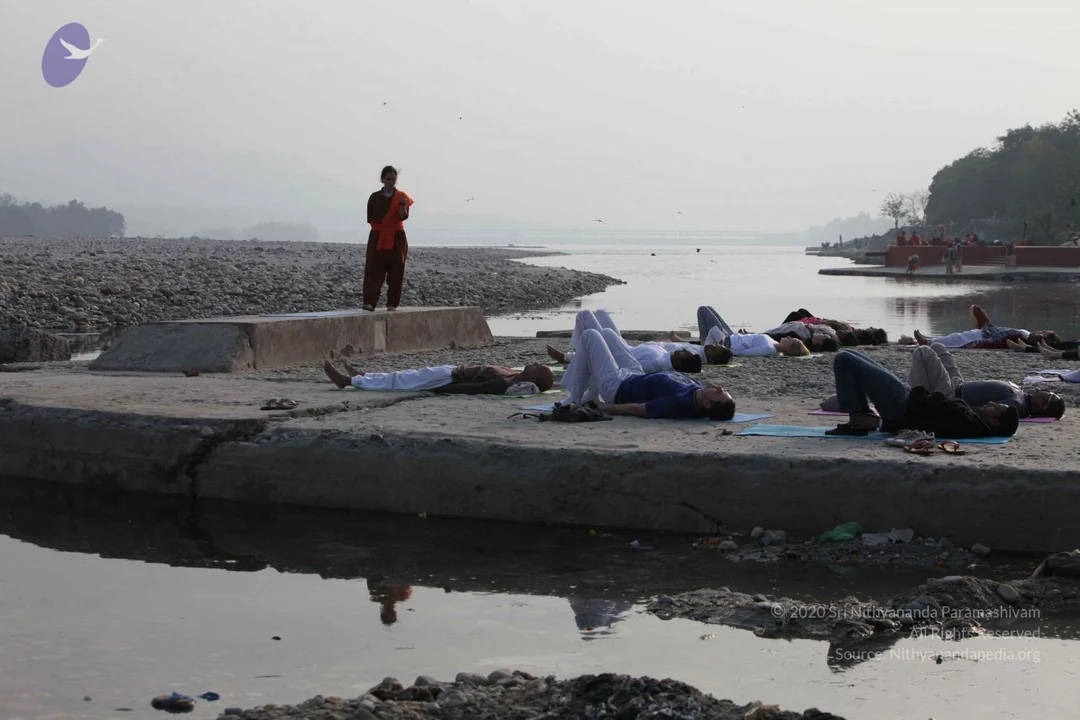
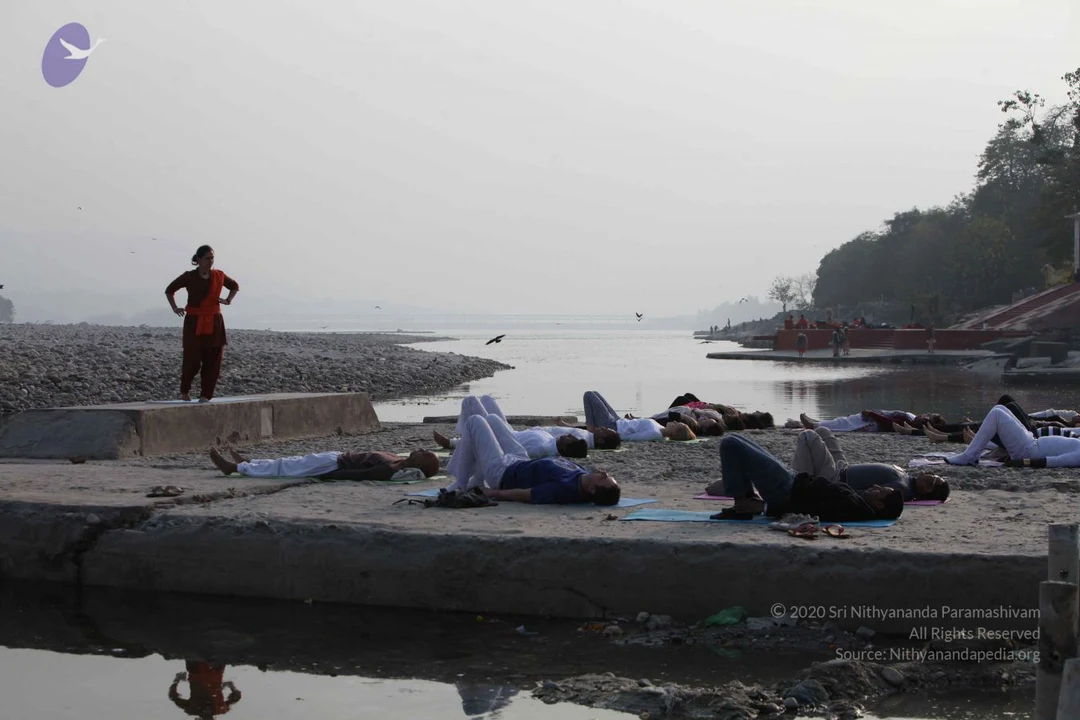
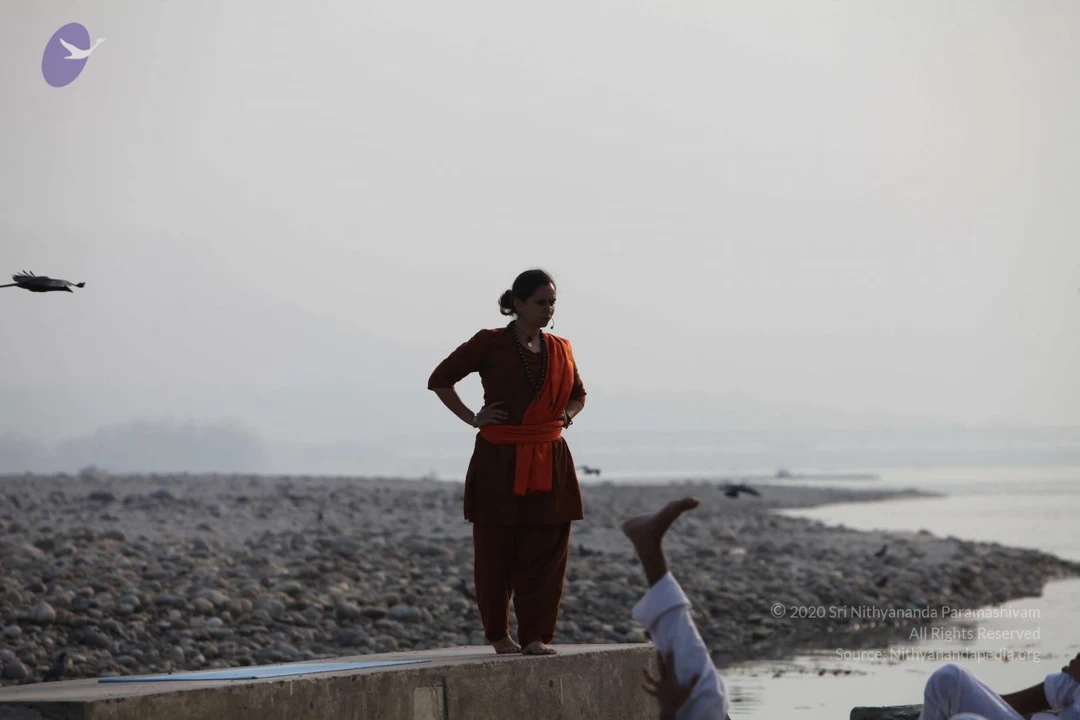
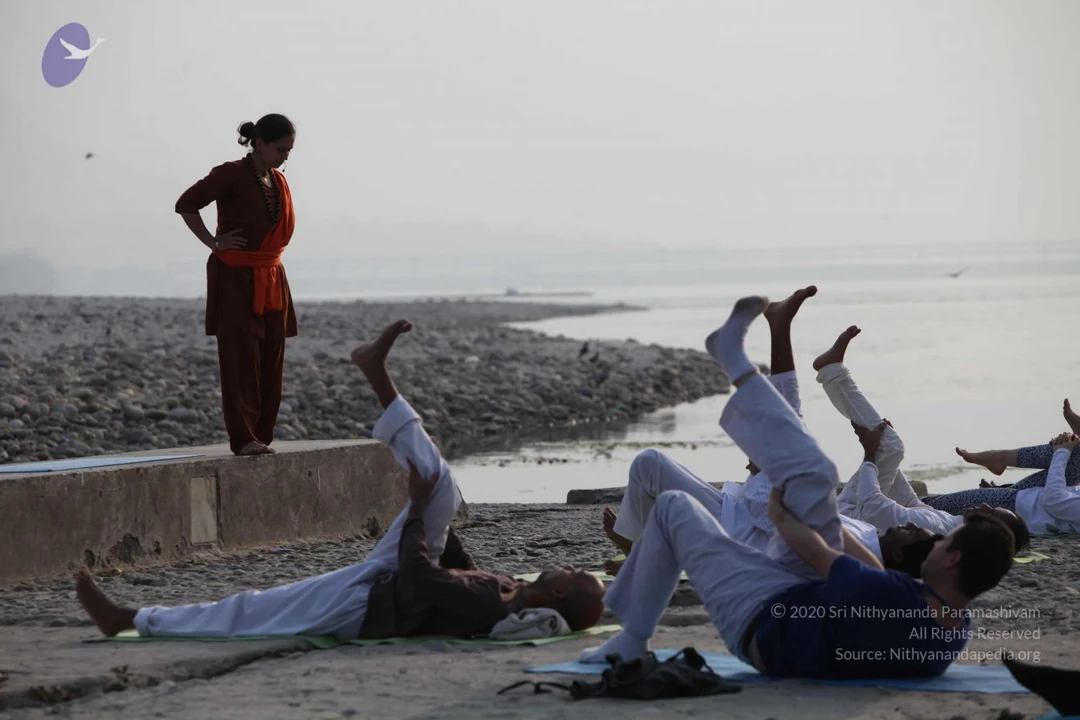
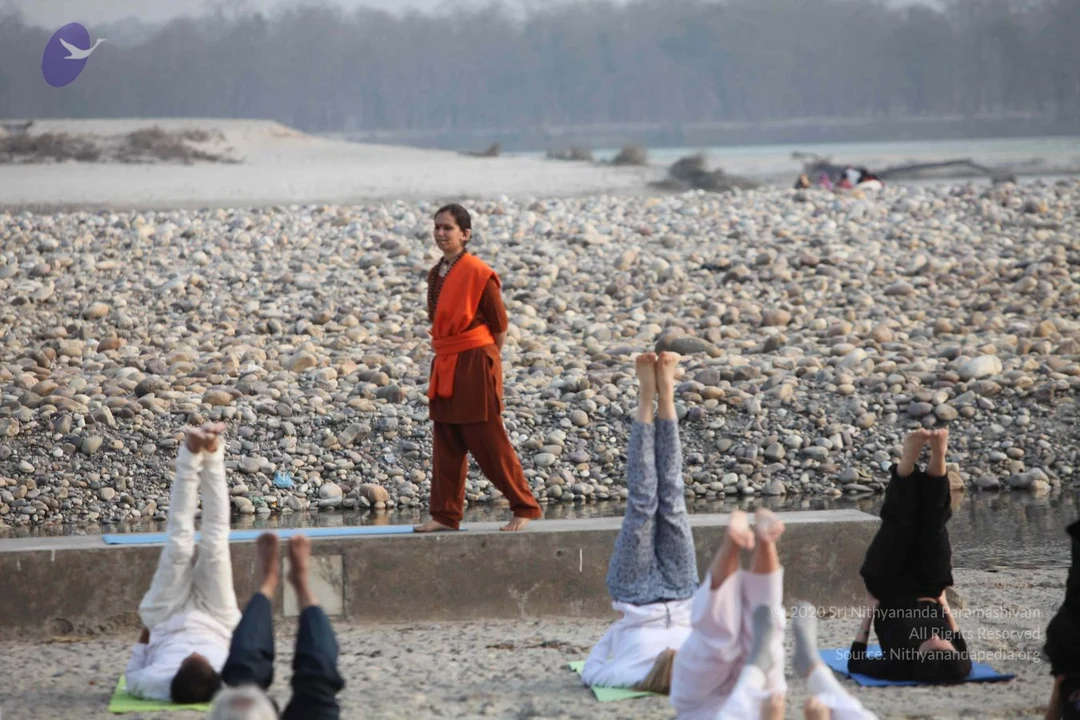
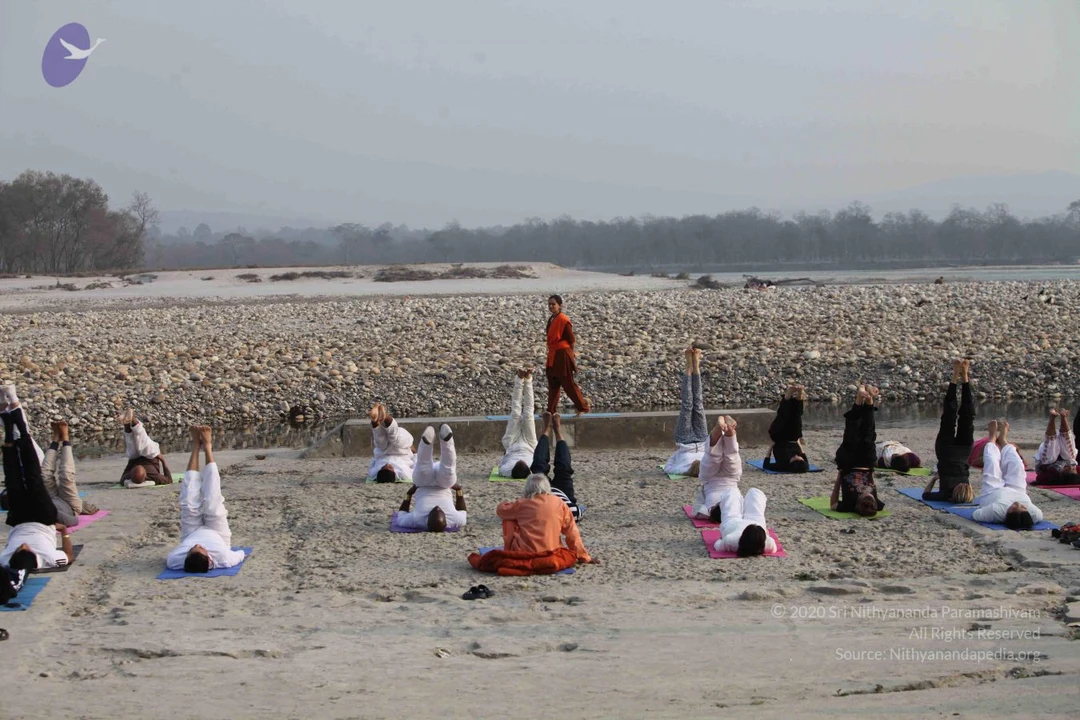
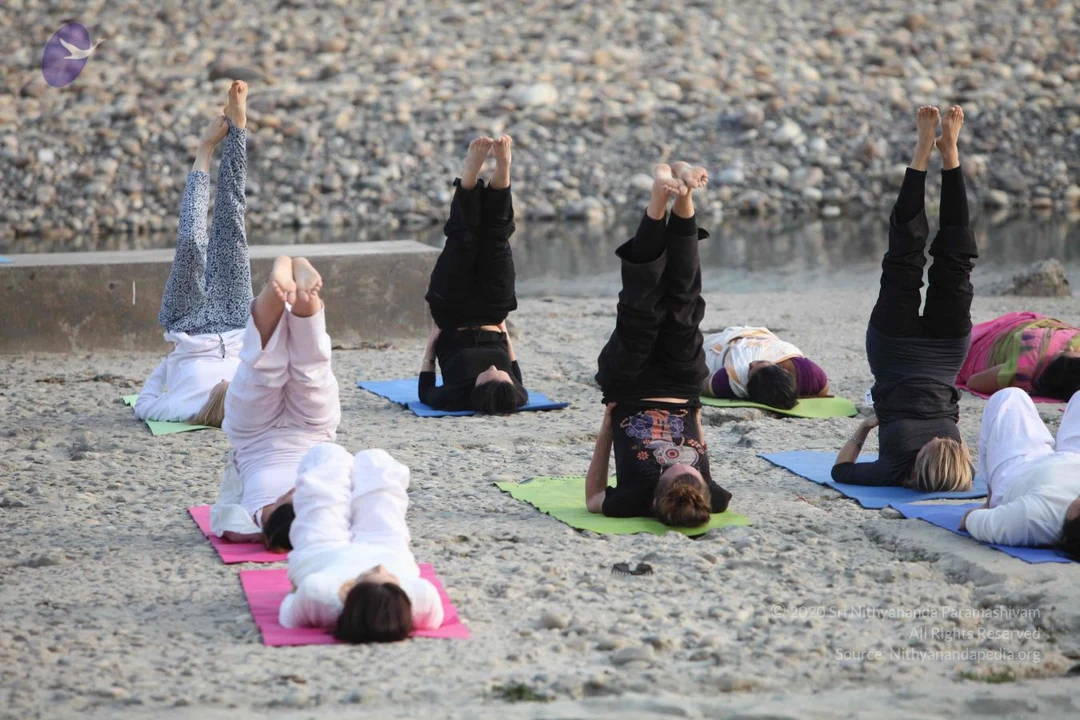
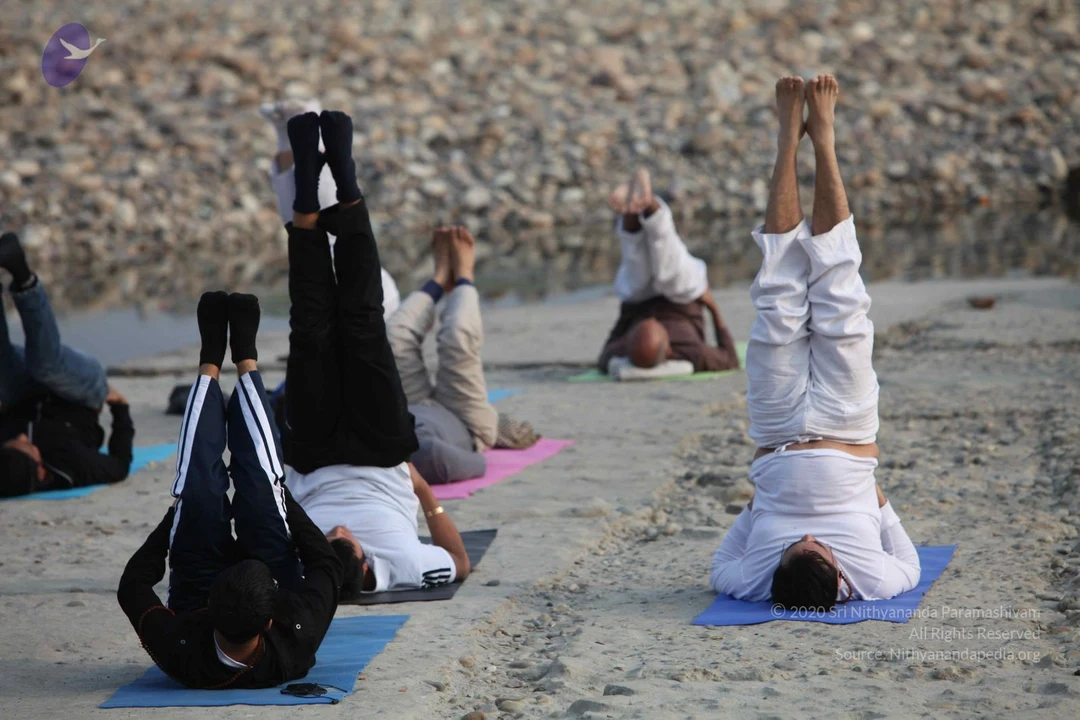
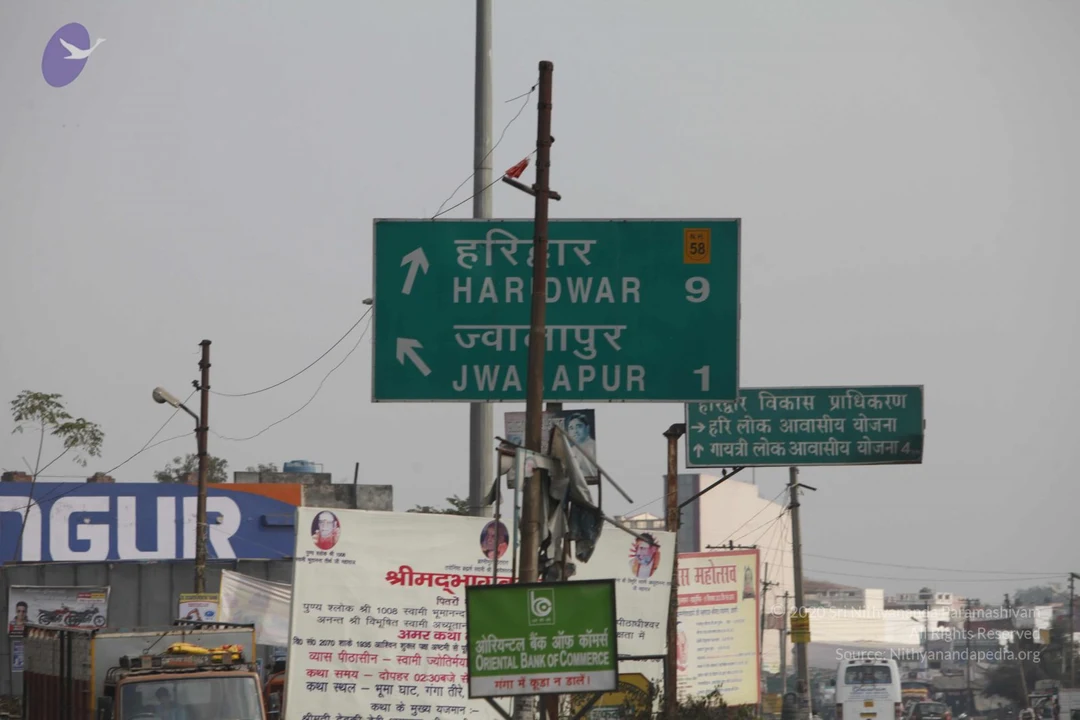
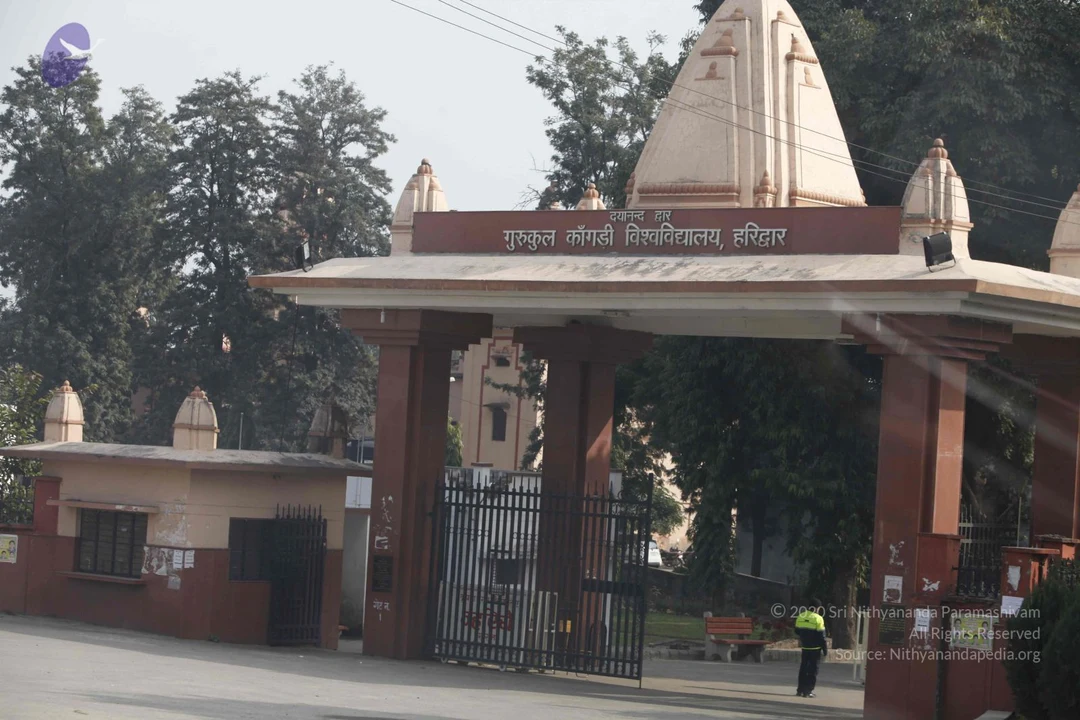
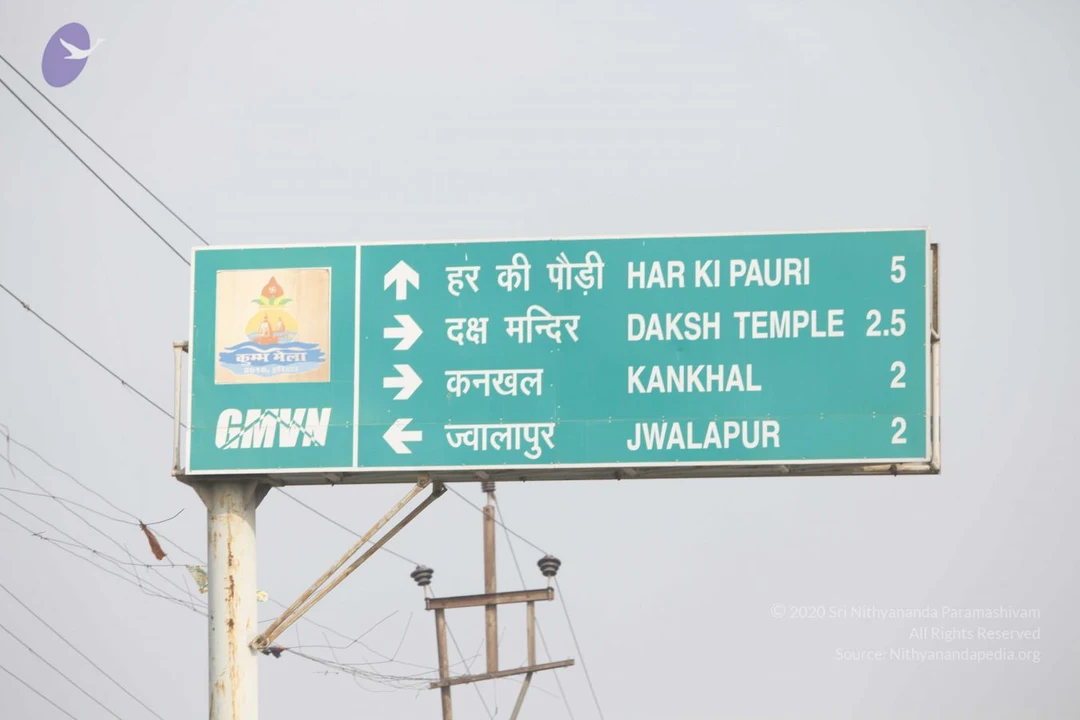
Before entering into the Kalpataru Darshan, a small short video of Haridwar and IA session in the banks of the Ganga. Teaser, please have it.

(Video Clip)

(39:00)

Sit straight. Close your eyes. Declare with Integrity, Authenticity, Responsibility and Enriching, you will complete with all Self-Doubt, Hatred, Denial. Completing even the self-doubt whether you will be able to complete with your Self-Doubt or not. I bless you all! Let you all complete with all the Self - Doubts, Hatred, Denial. Namah Shivaya.

(Video Clip)

Let you all achieve, experience, live, express, radiate, share and explode in Eternal Bliss, Nithyananda.

(44:48)

Photos

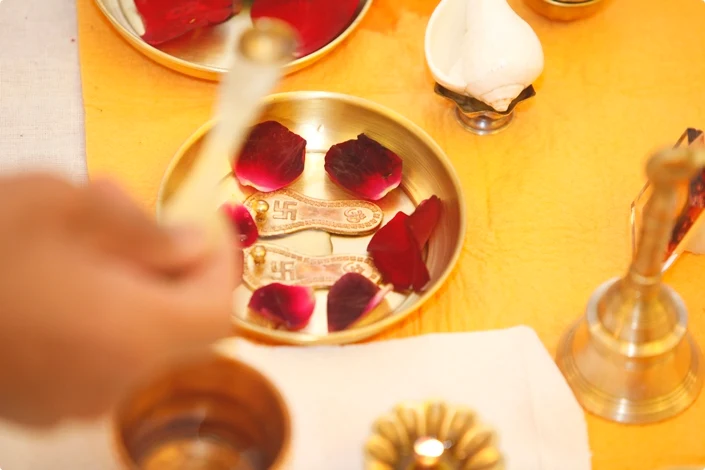
Padukapuja in Progress
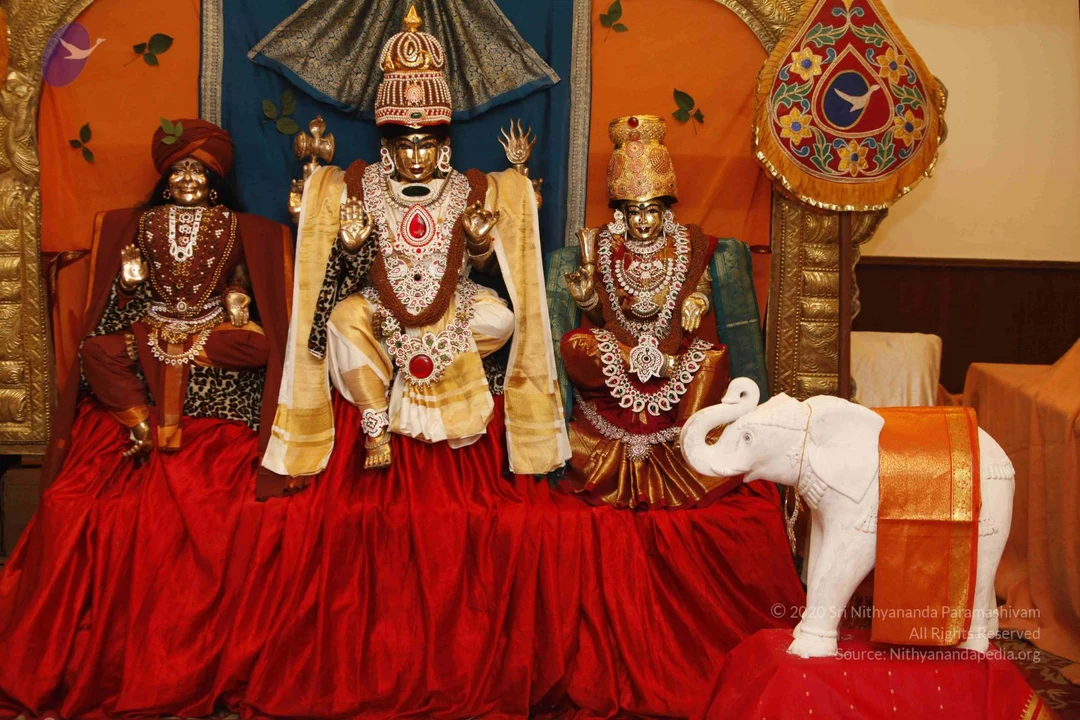
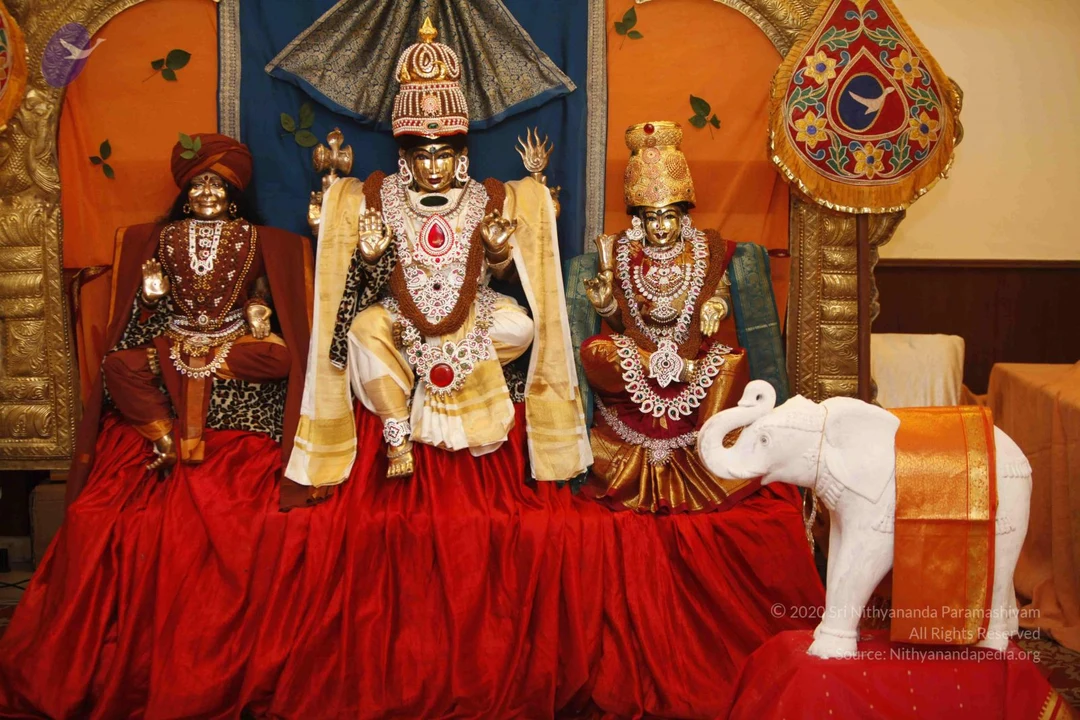
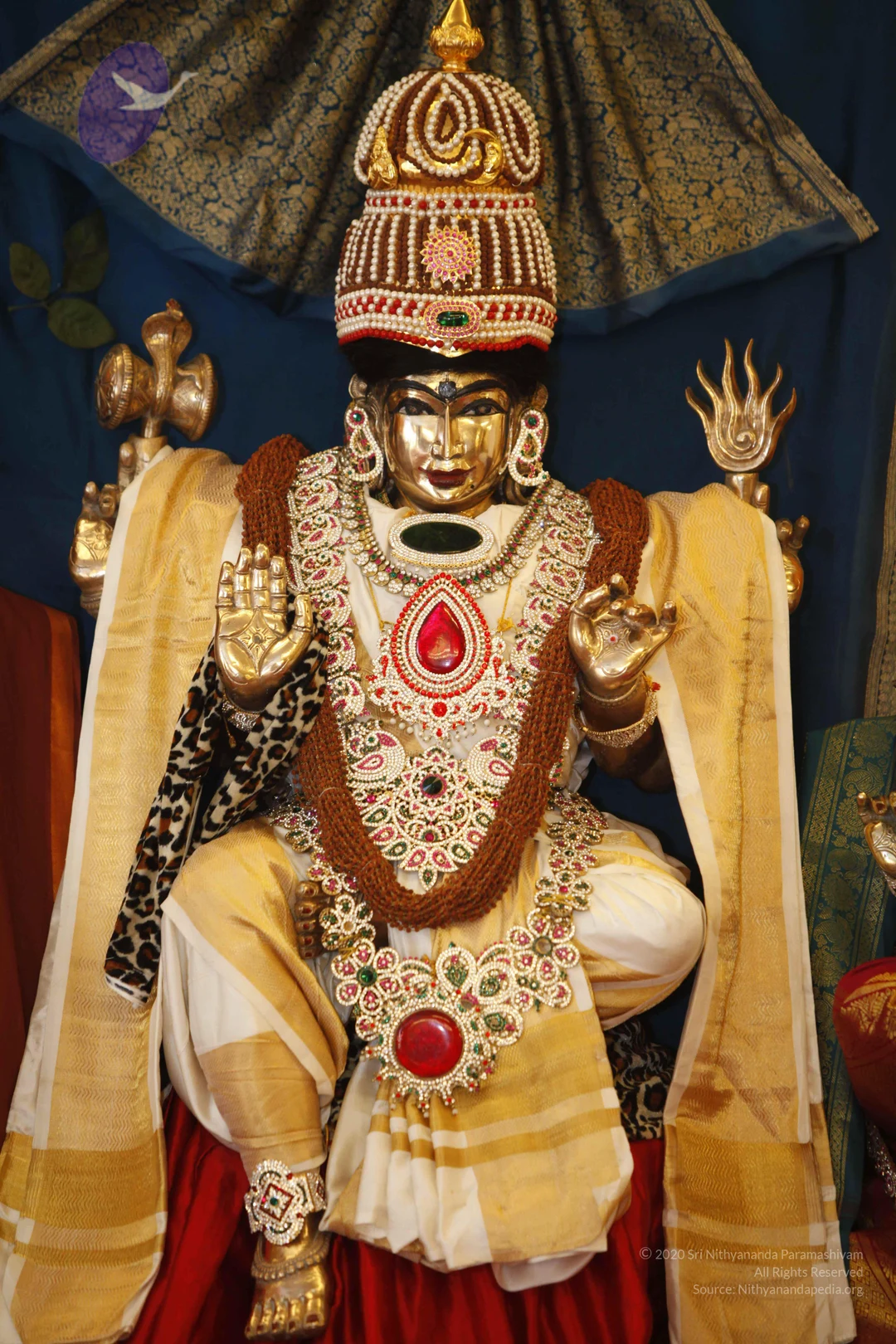
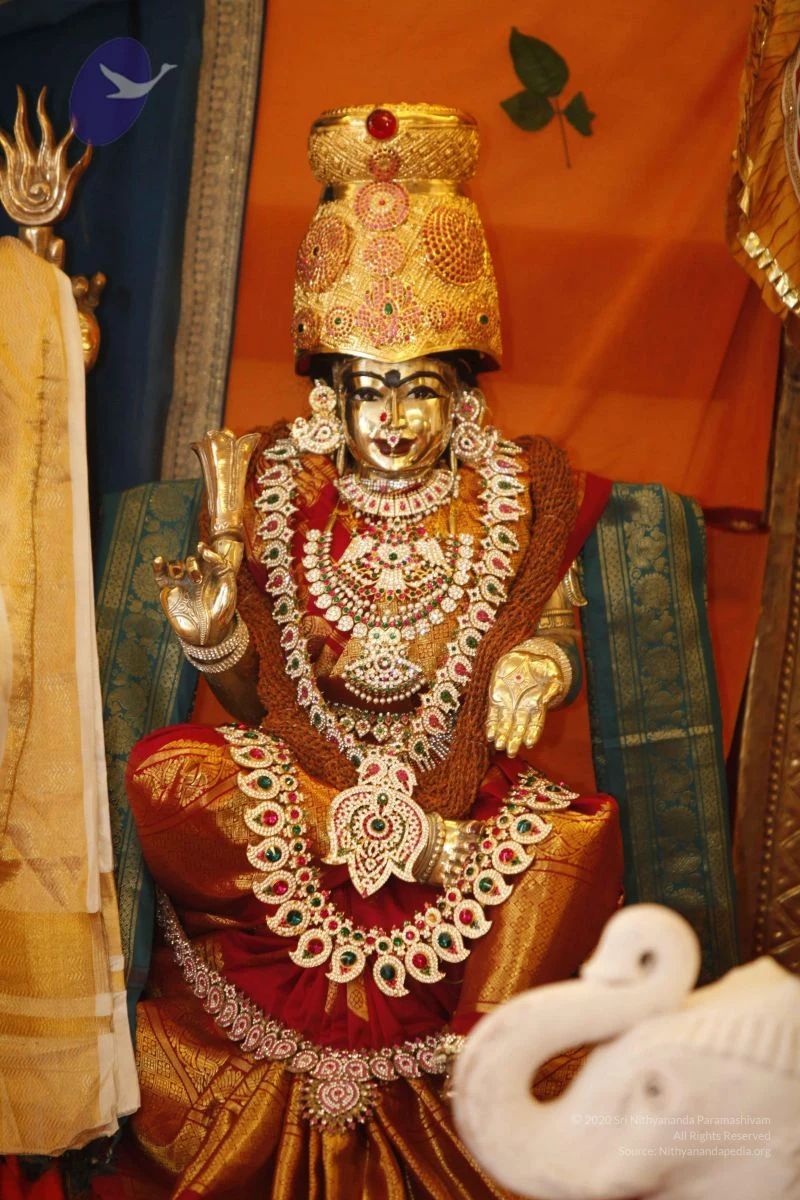
Todays Leela Alankar
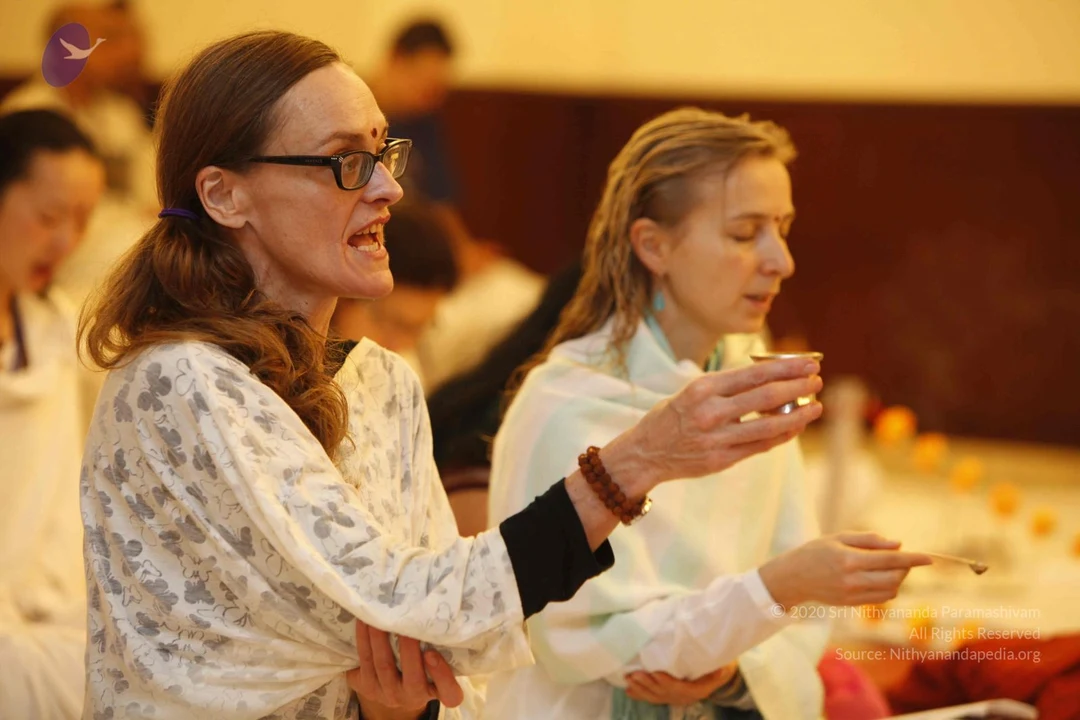
Inner Awakening Session
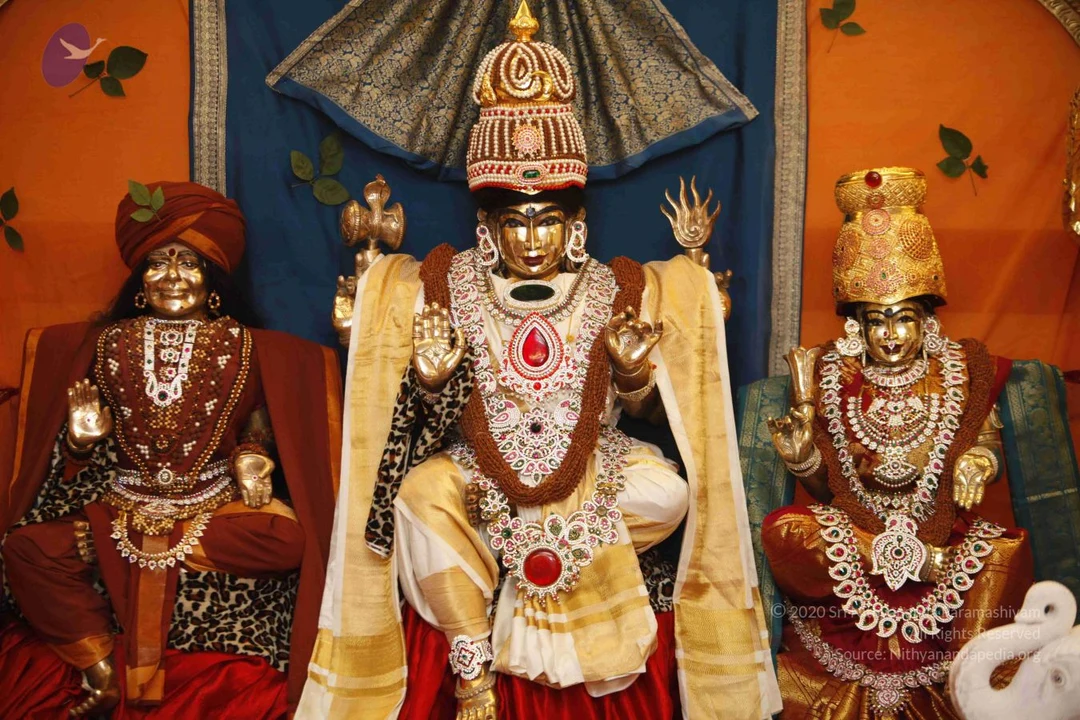
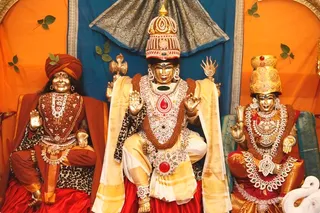
Nithyanandeswara
Nithyanandeswara

Nithyanandeswari
Nithyanandeswari

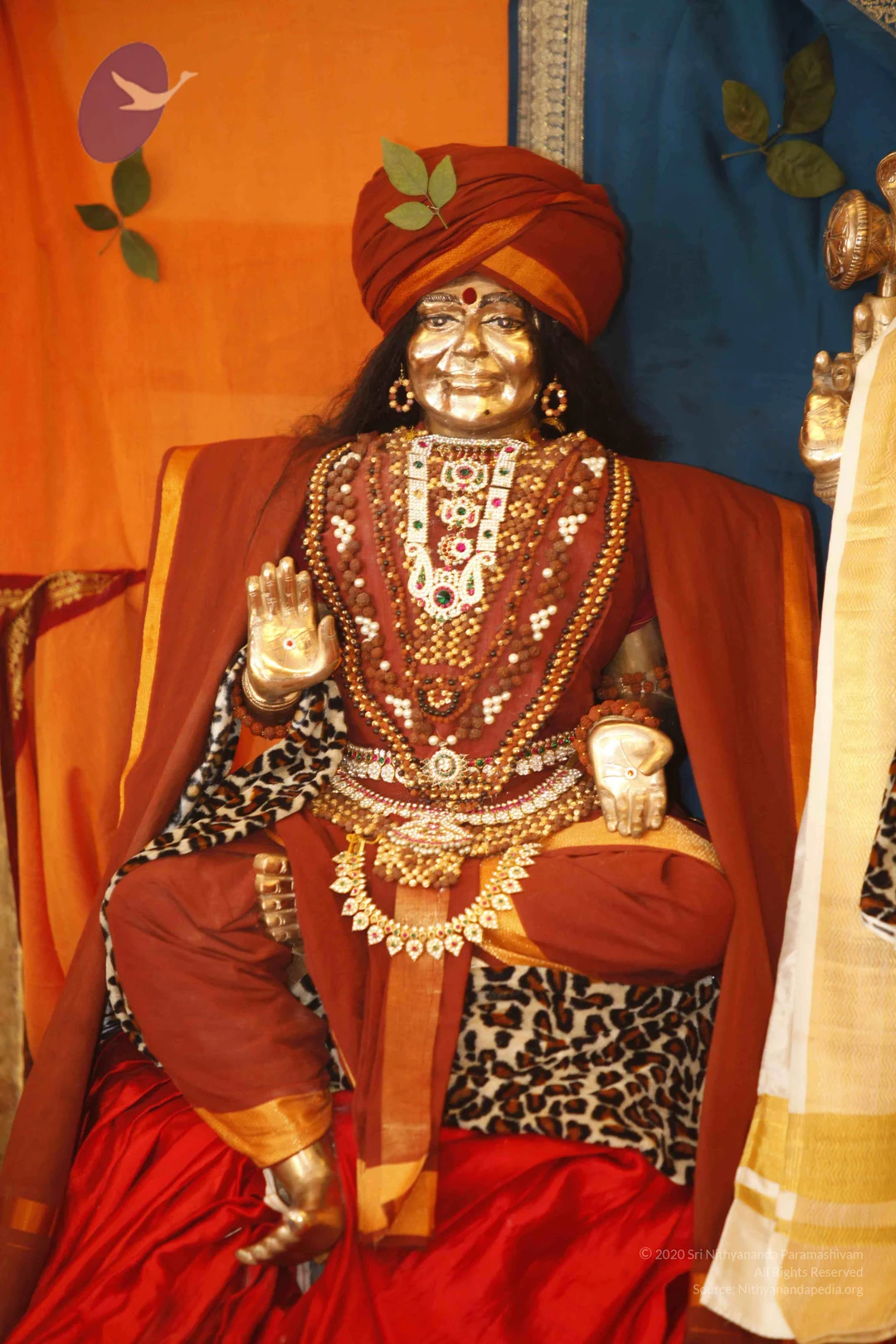
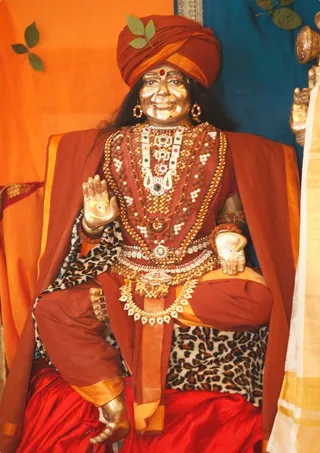
Swamiji's Murthy

Swamiji during Inner Awakening Class
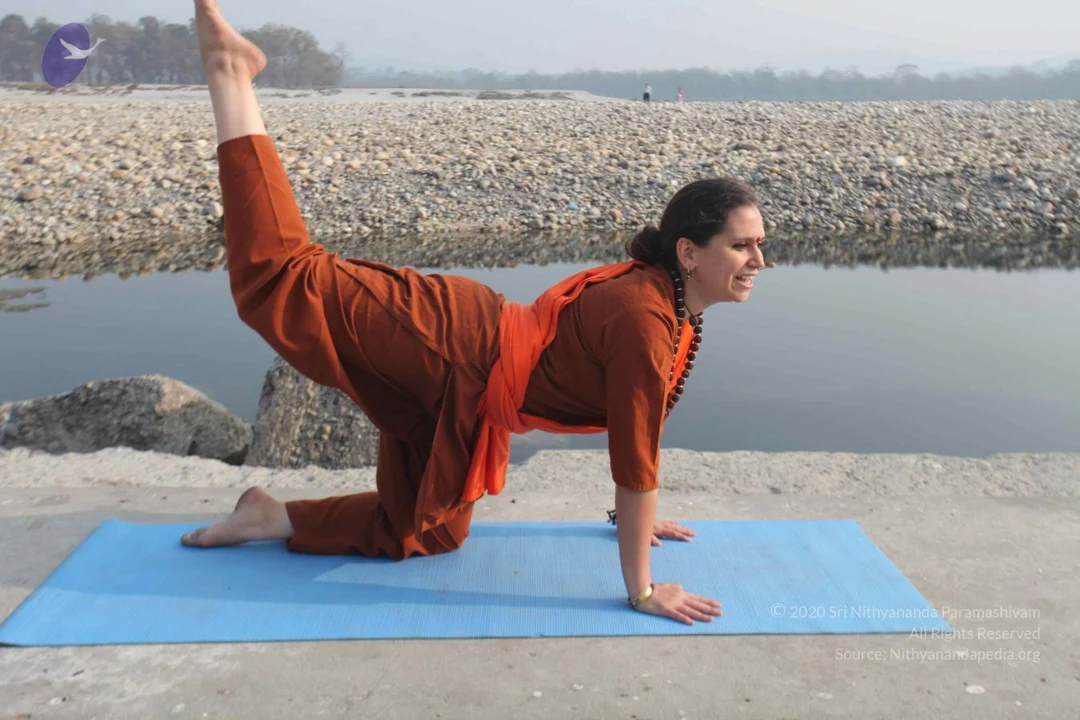
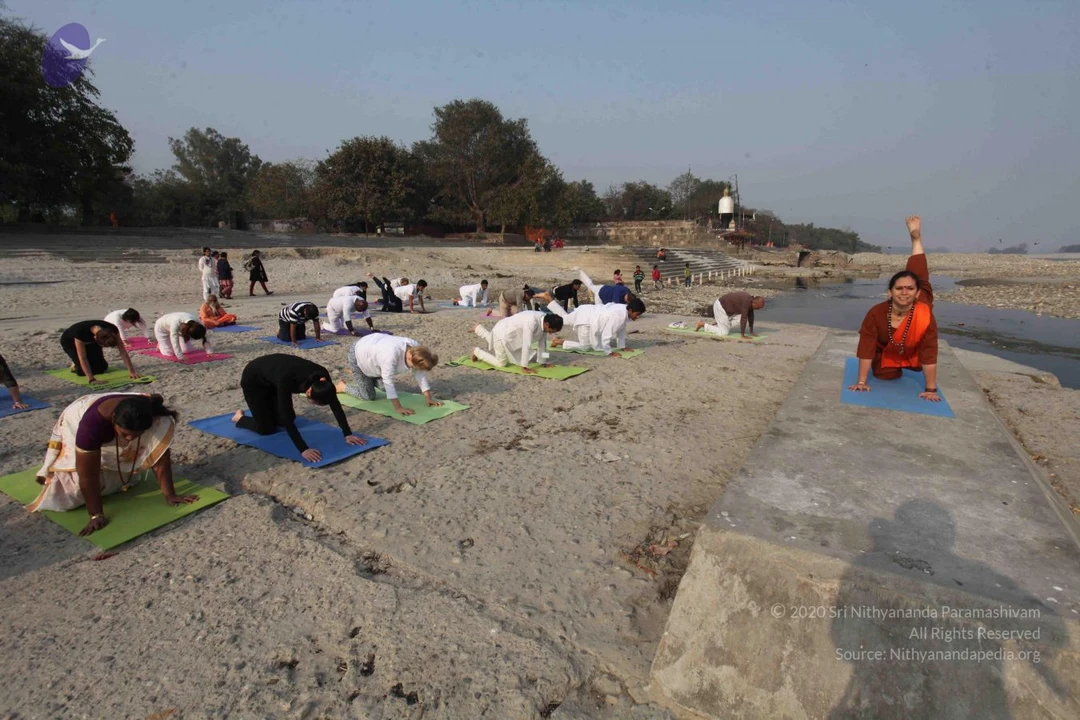
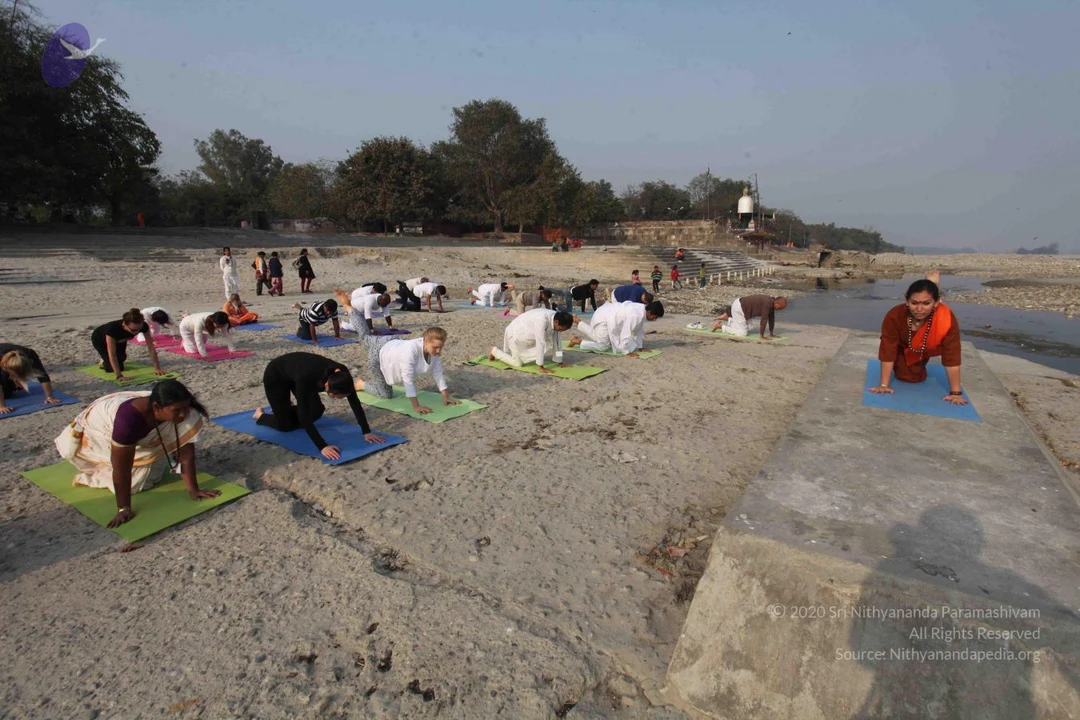
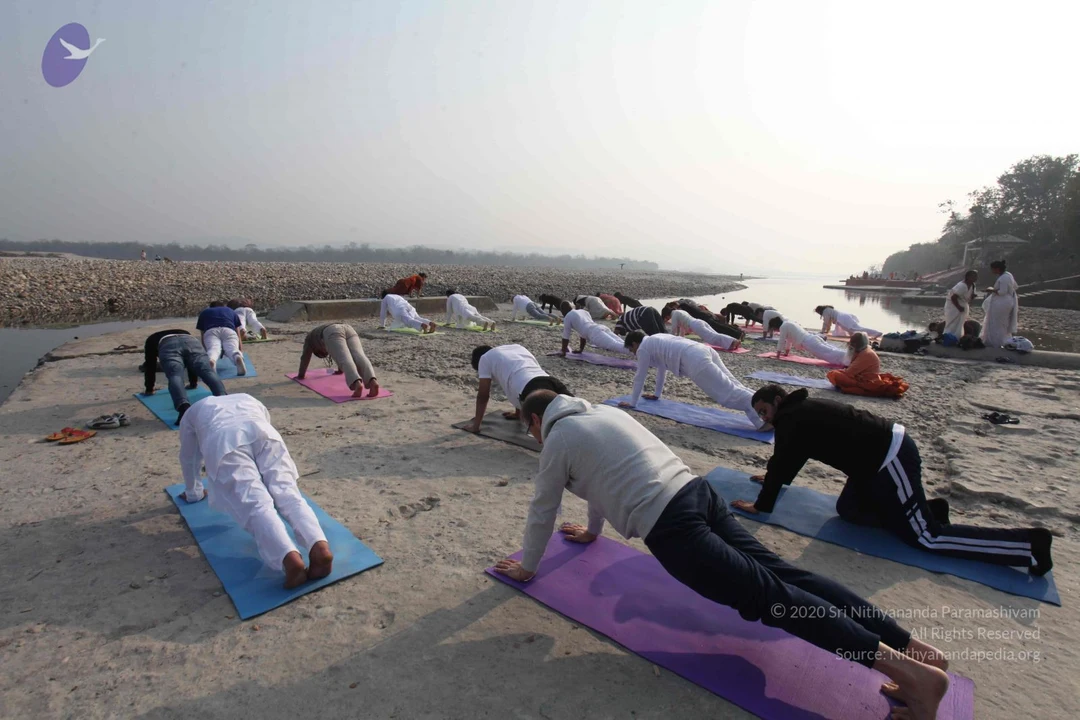
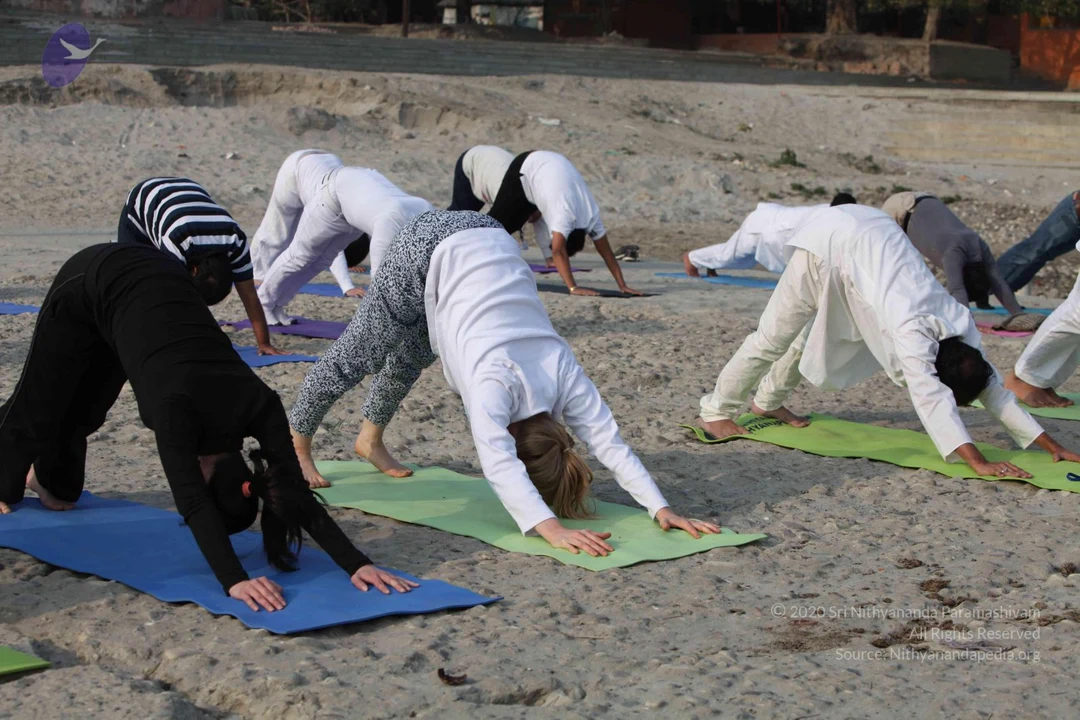
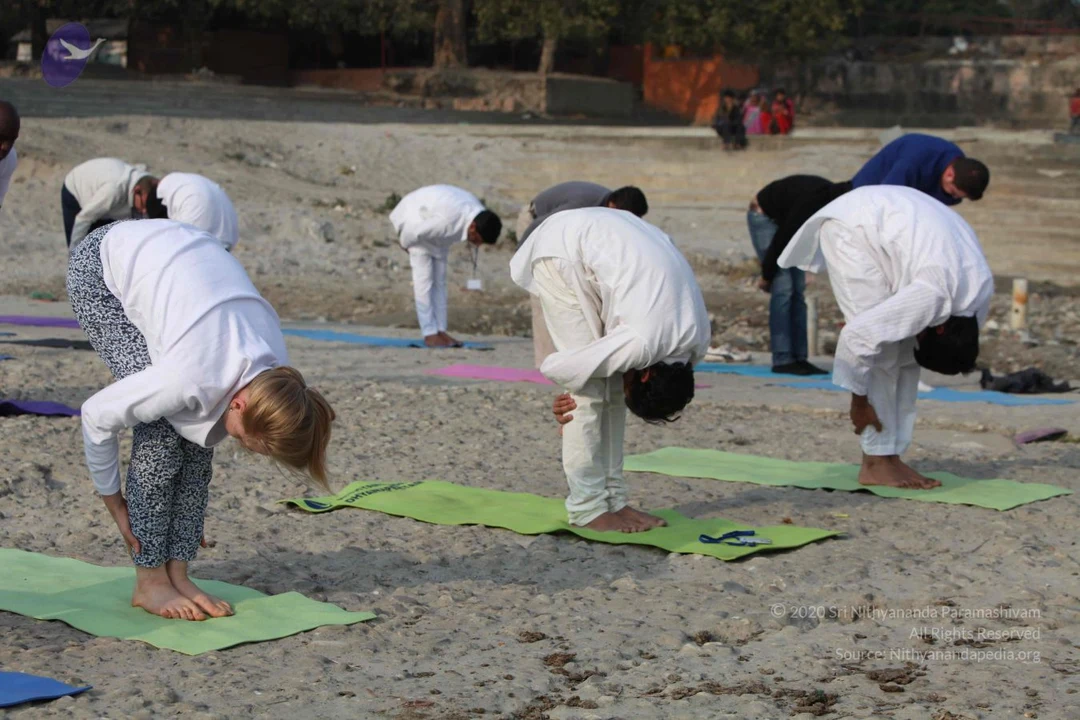
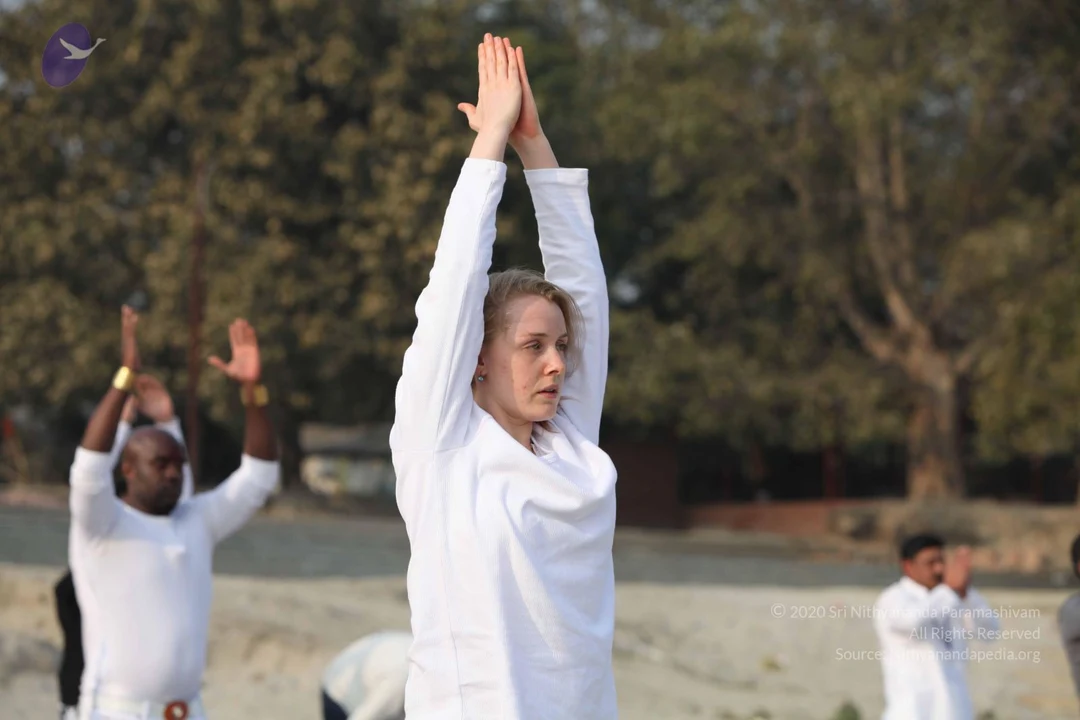
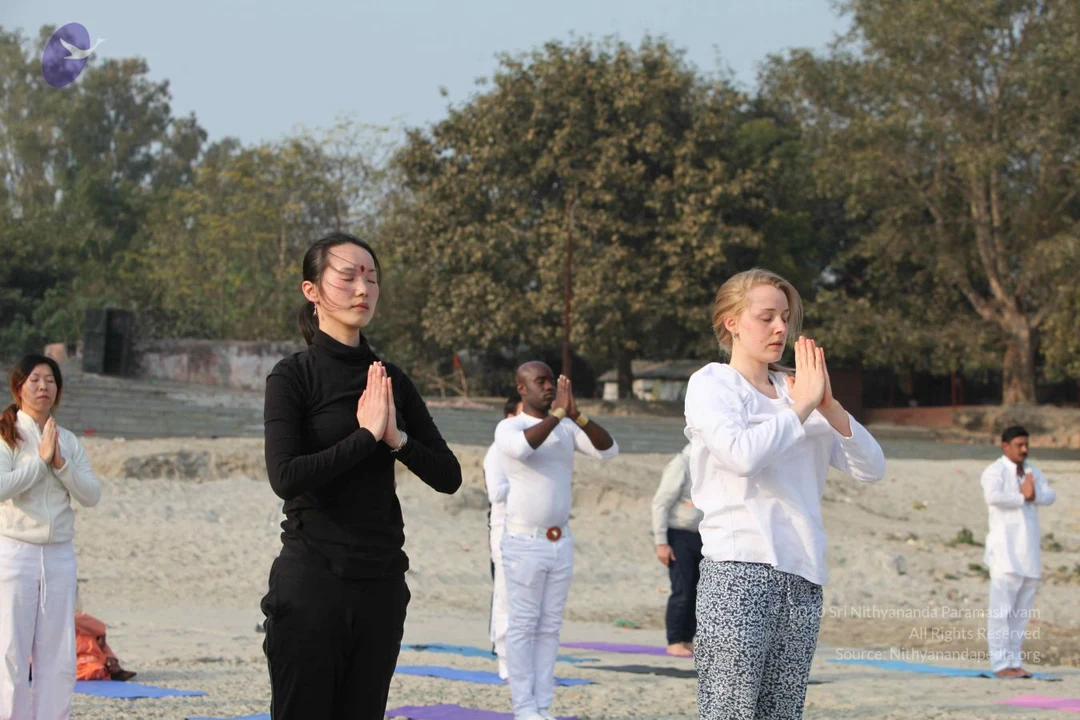
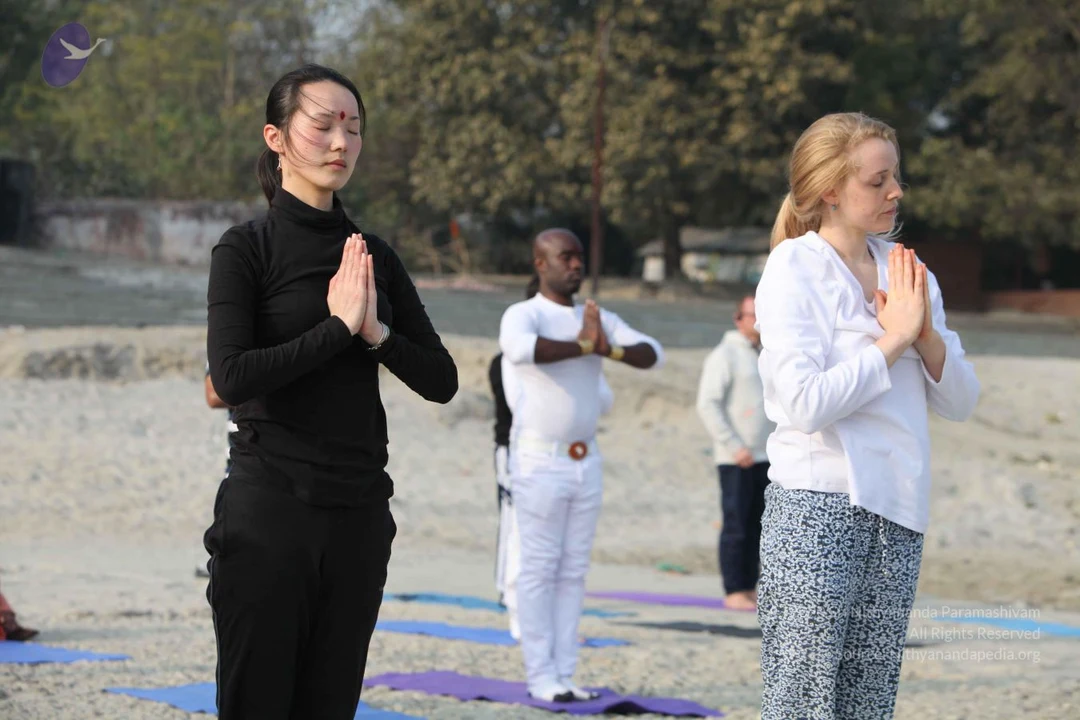
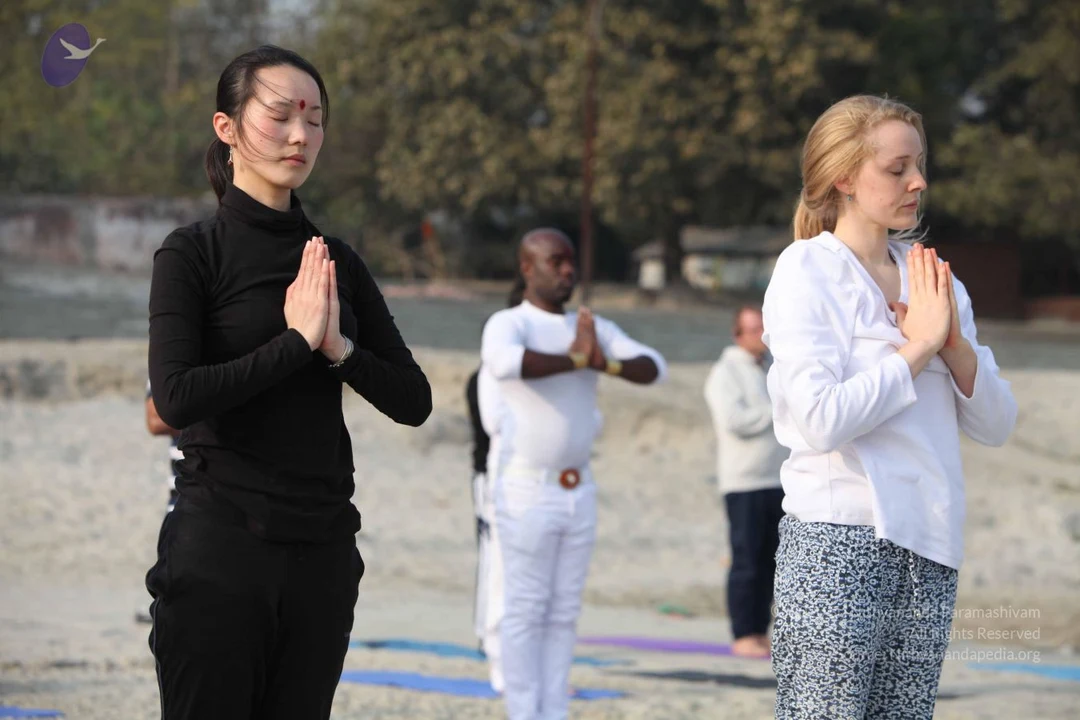
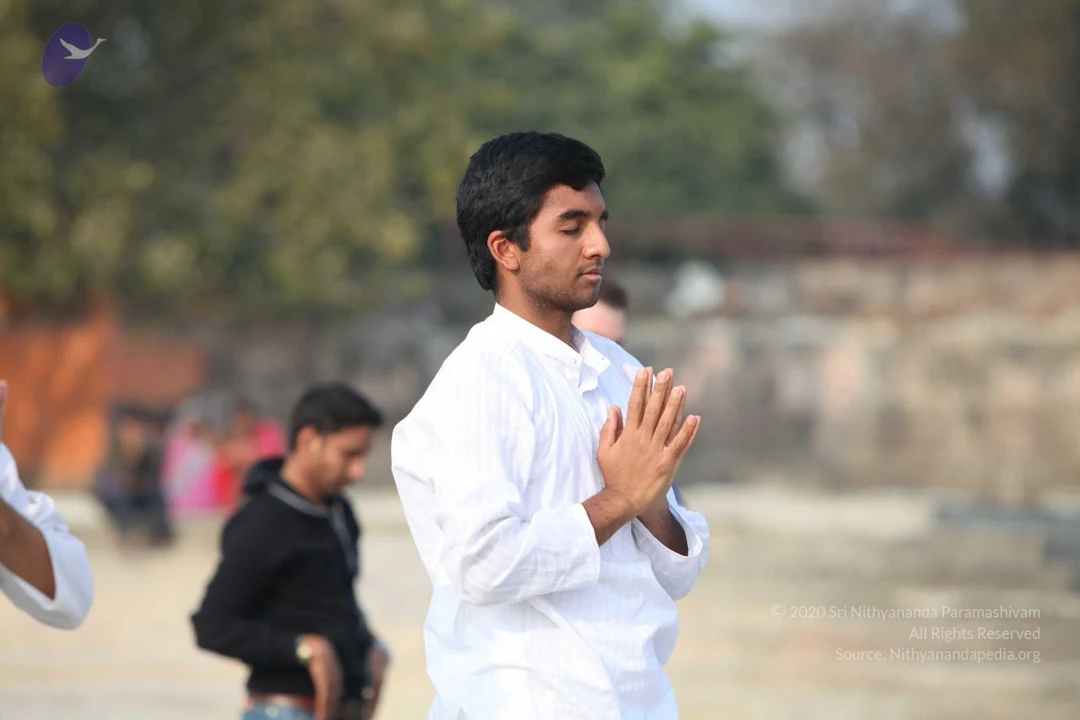
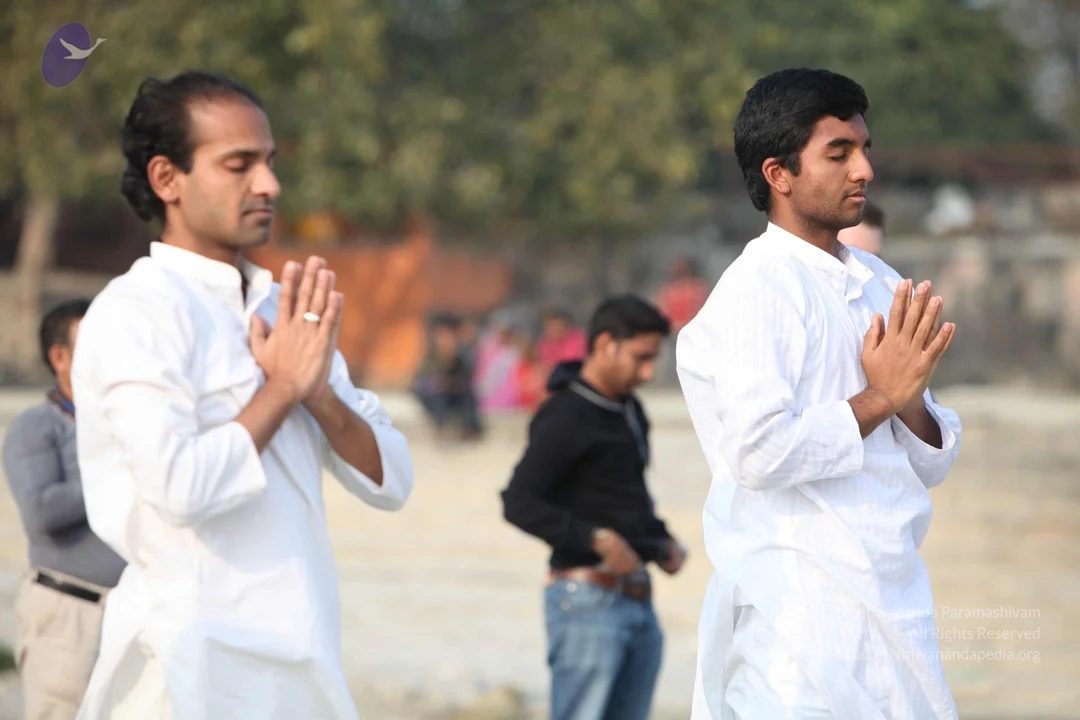
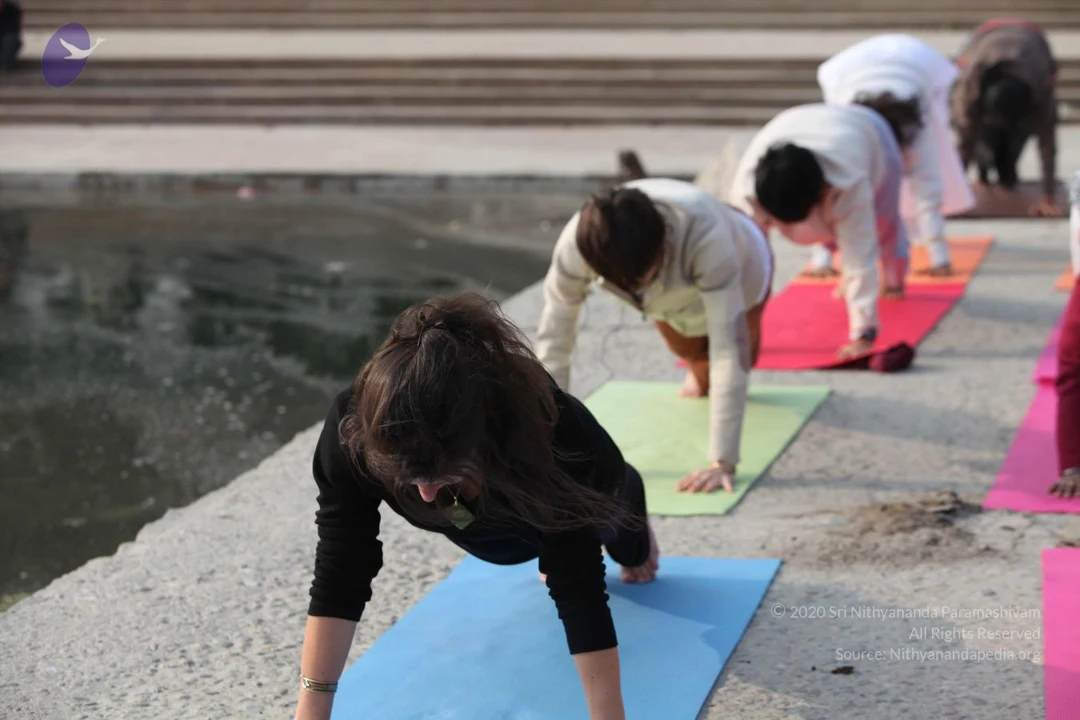
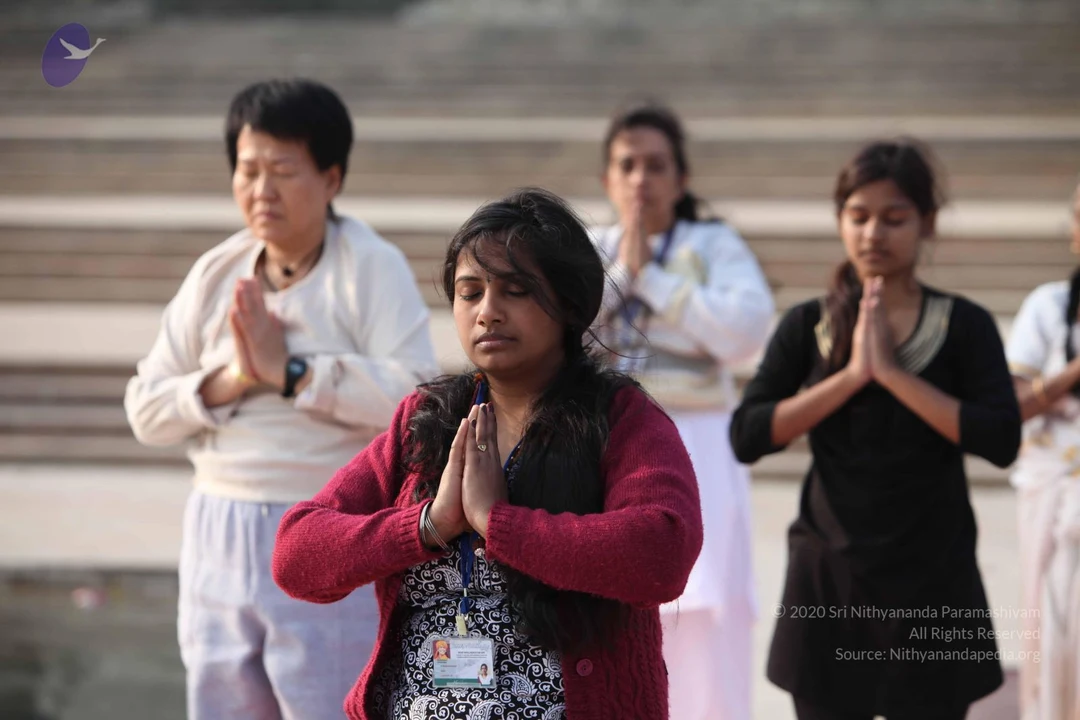
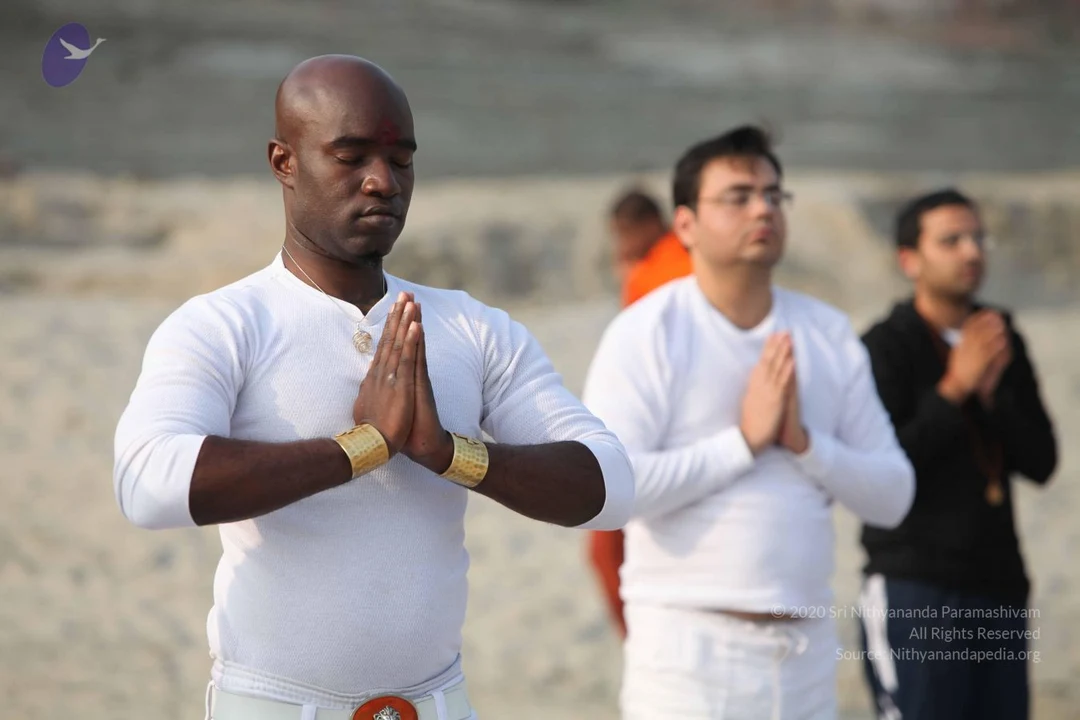
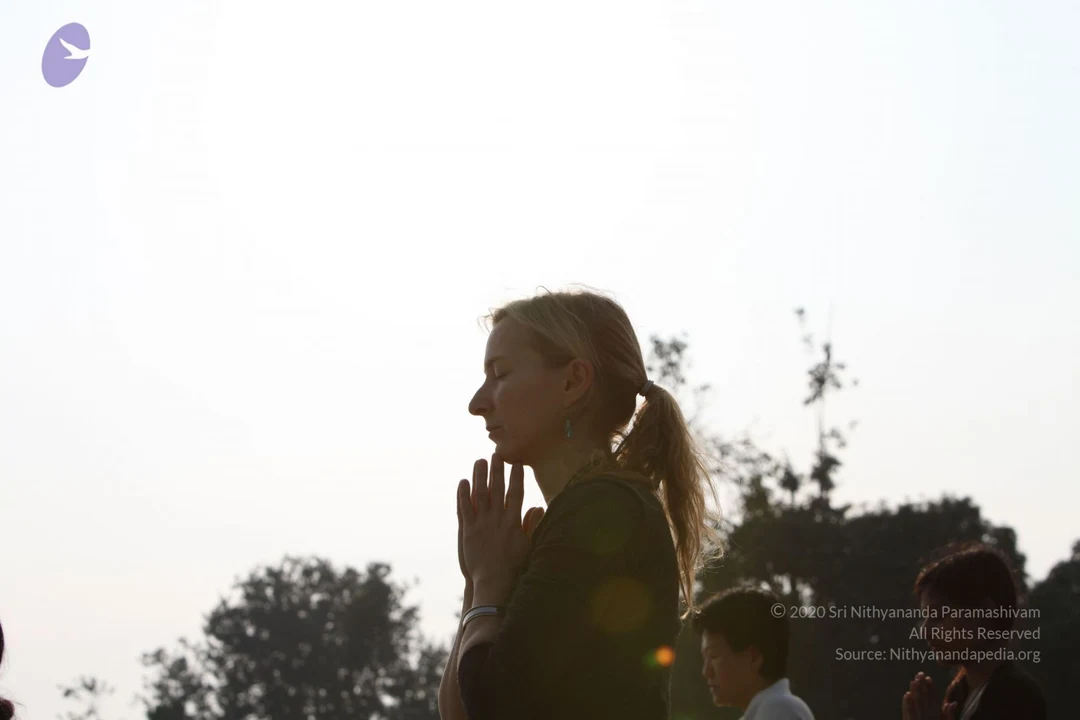
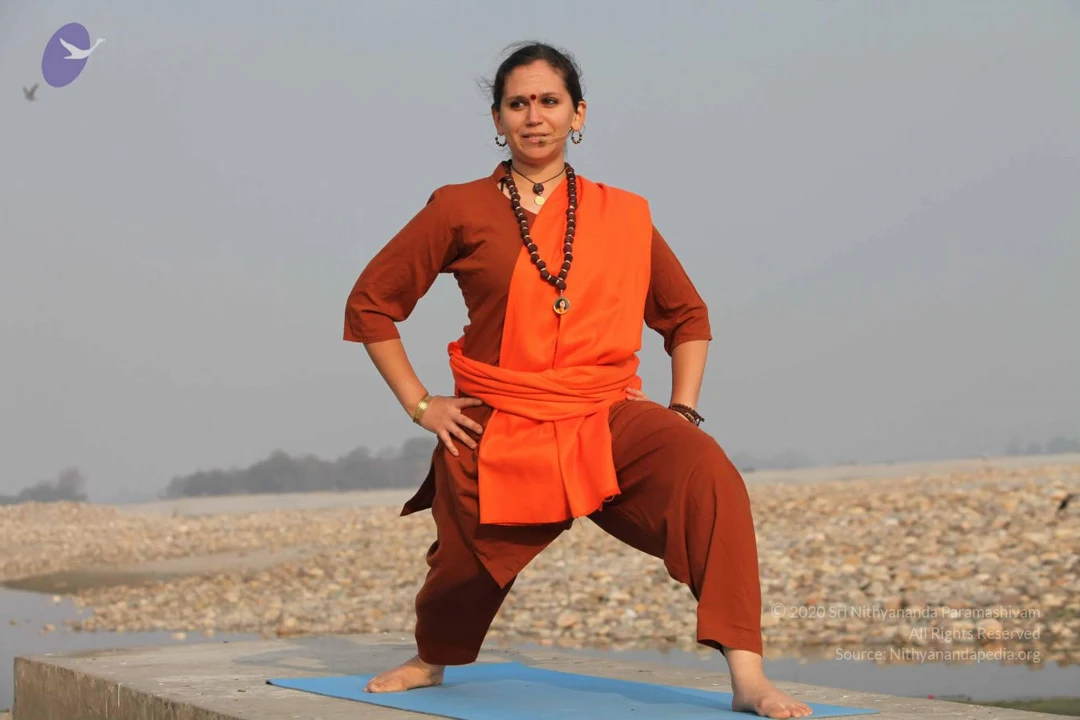
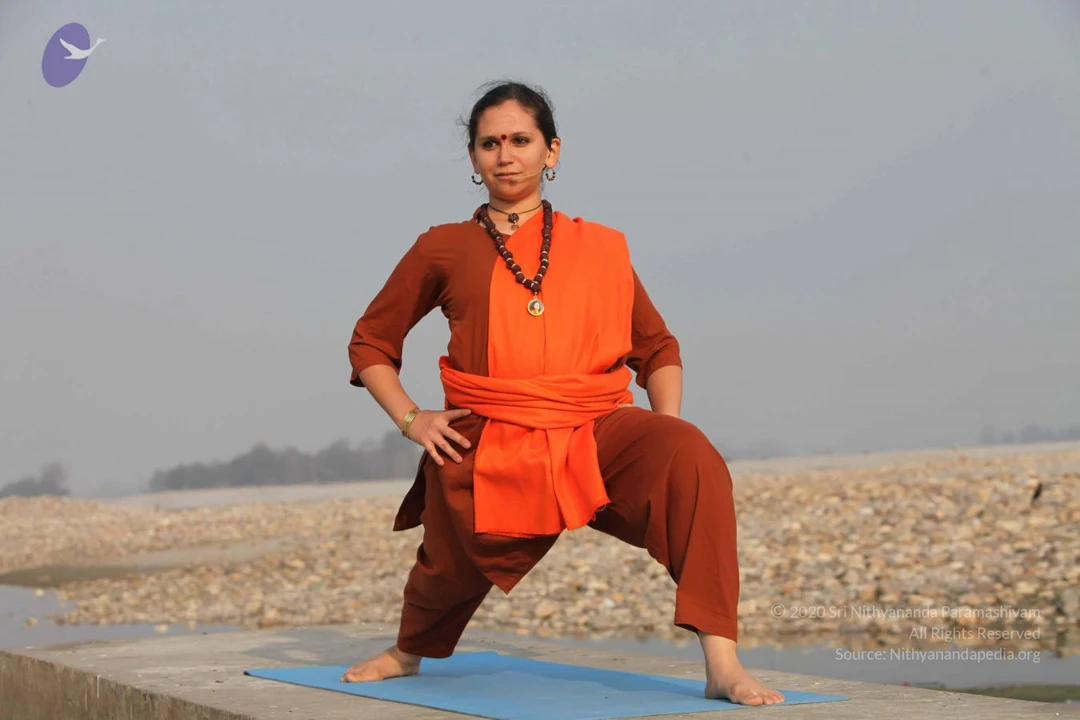
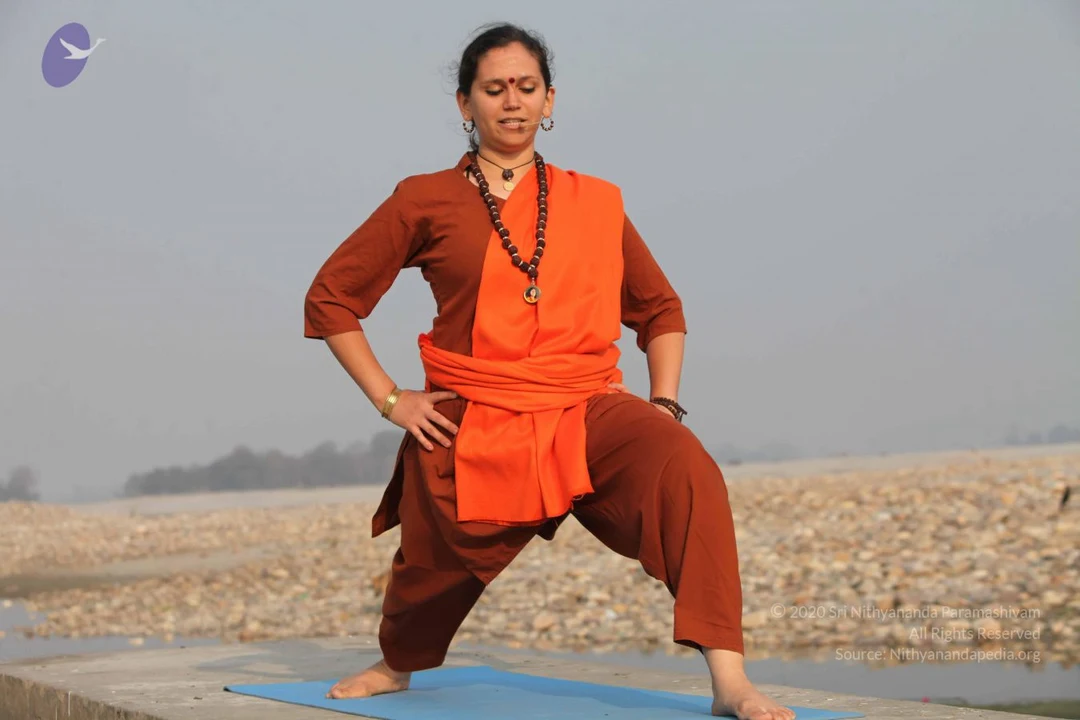
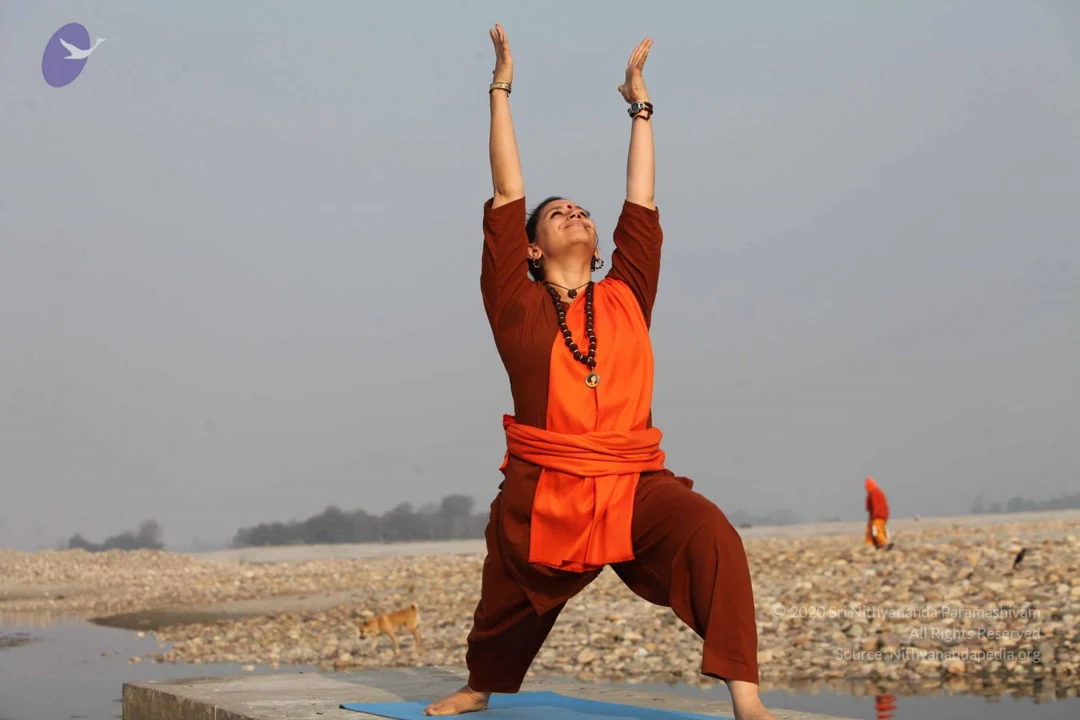
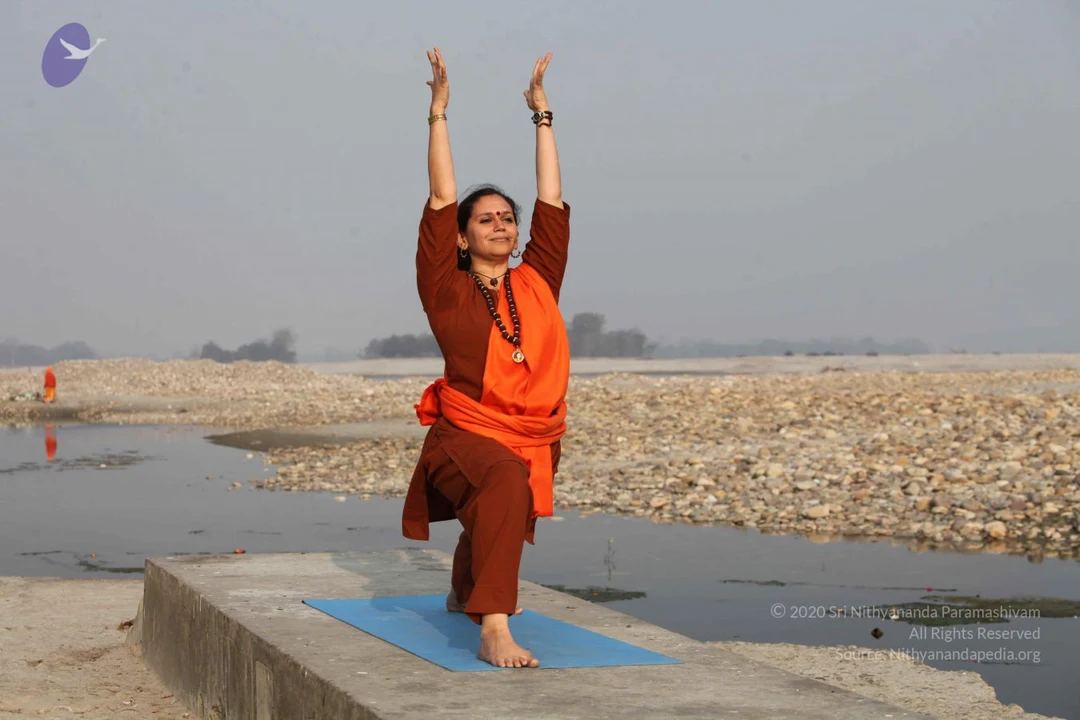
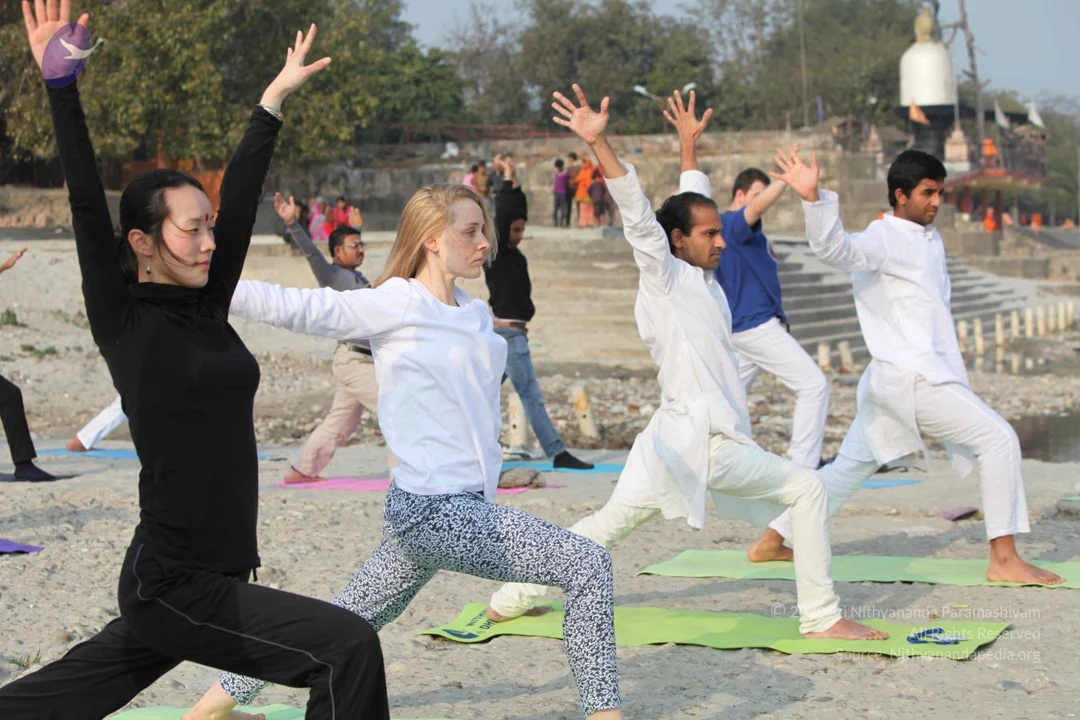
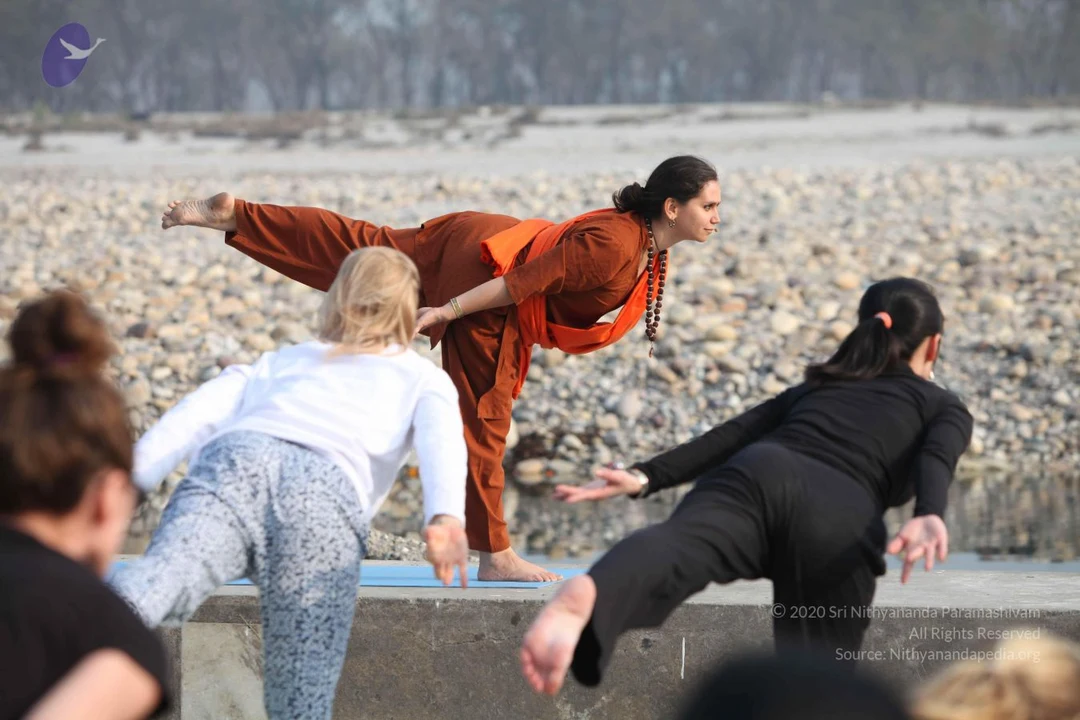
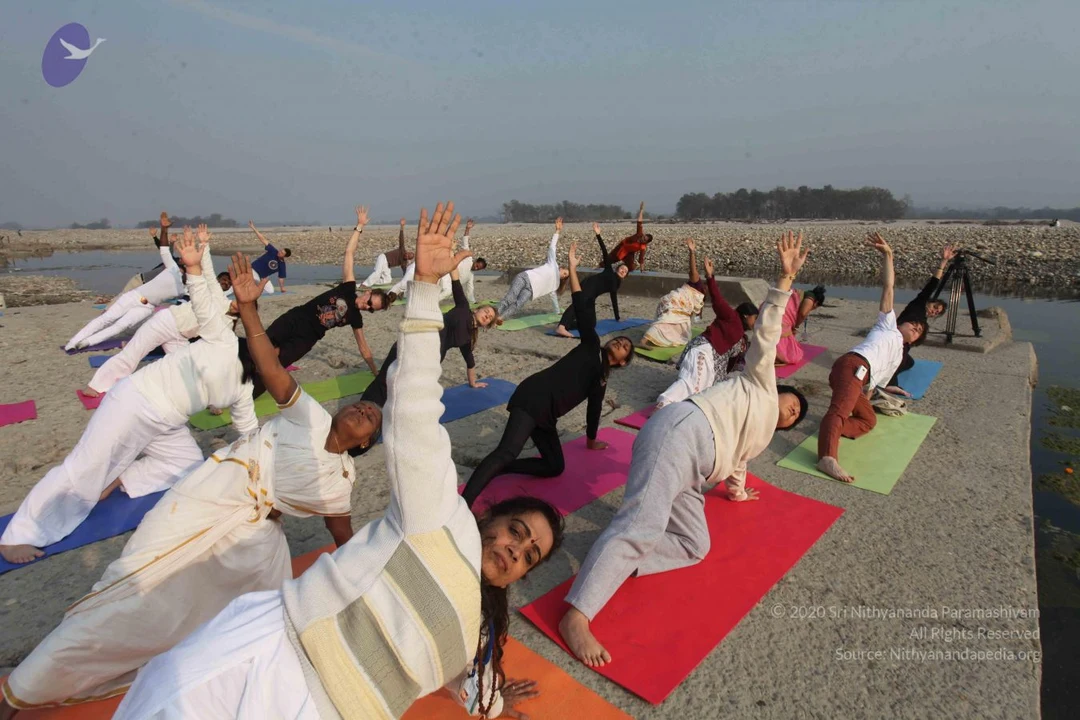
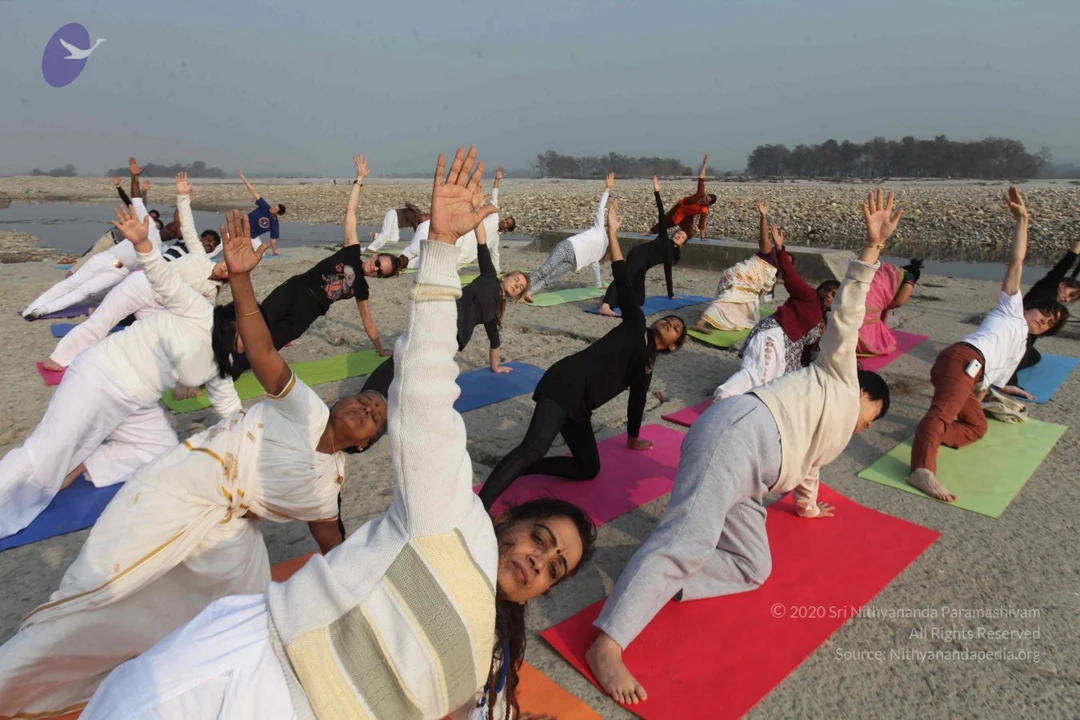
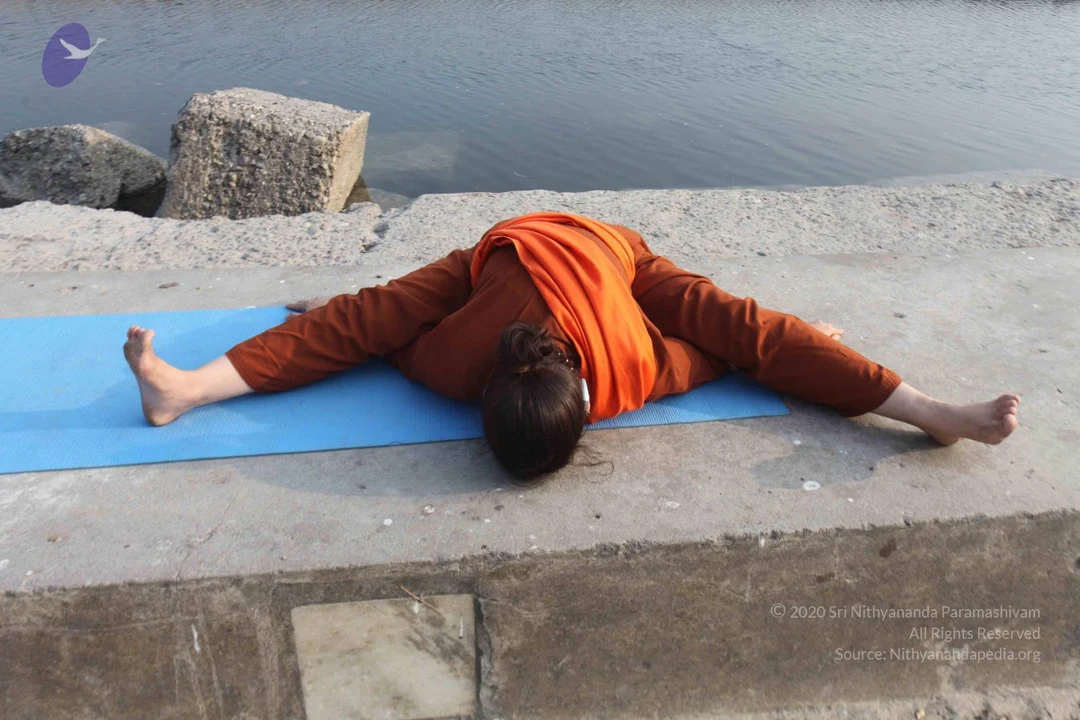
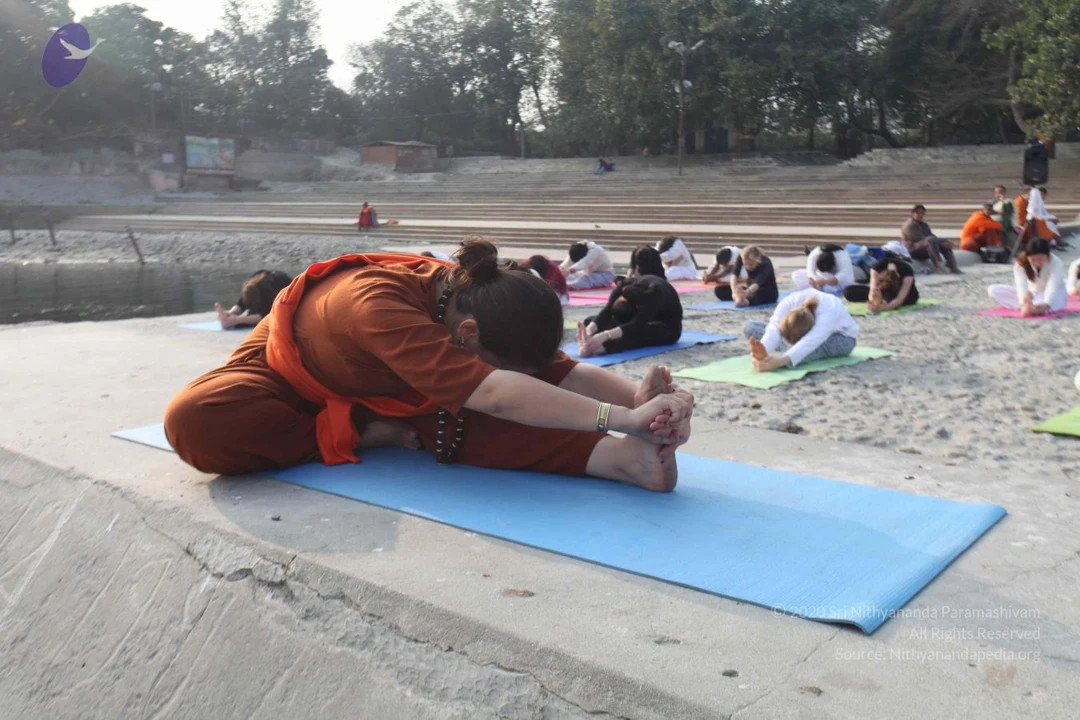
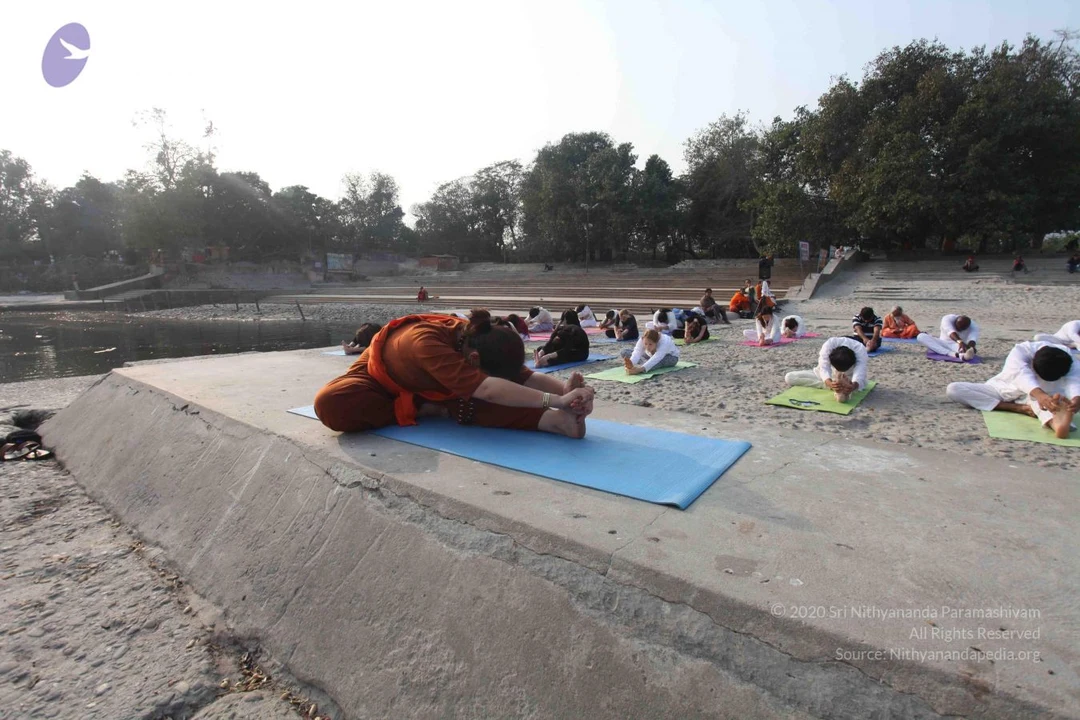
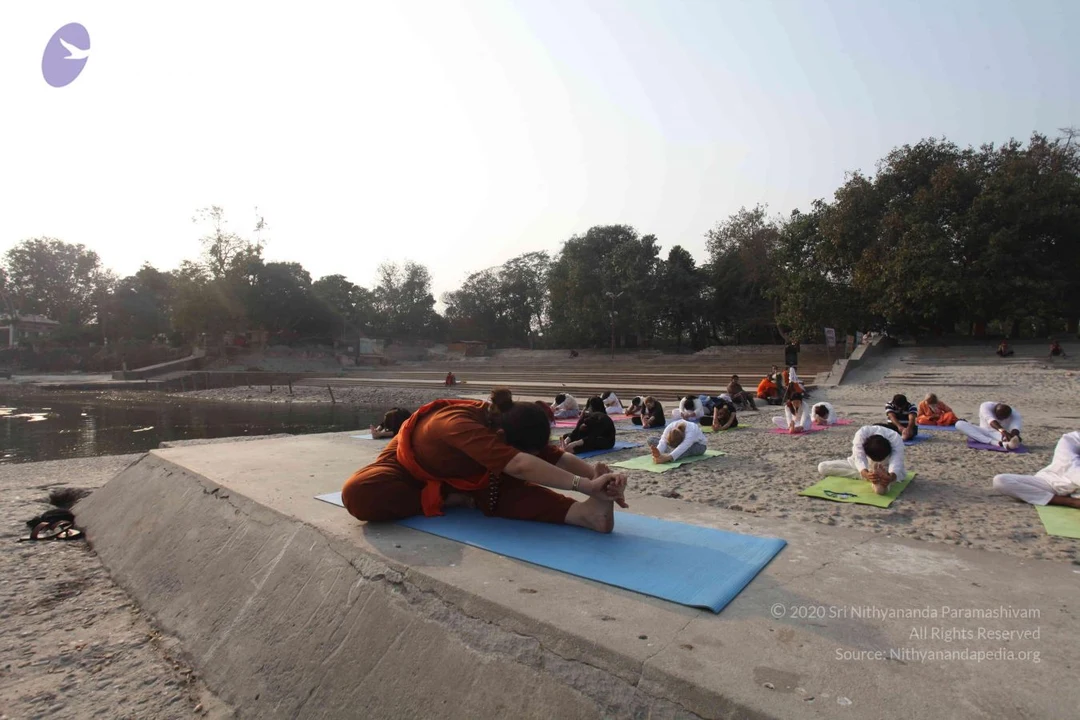
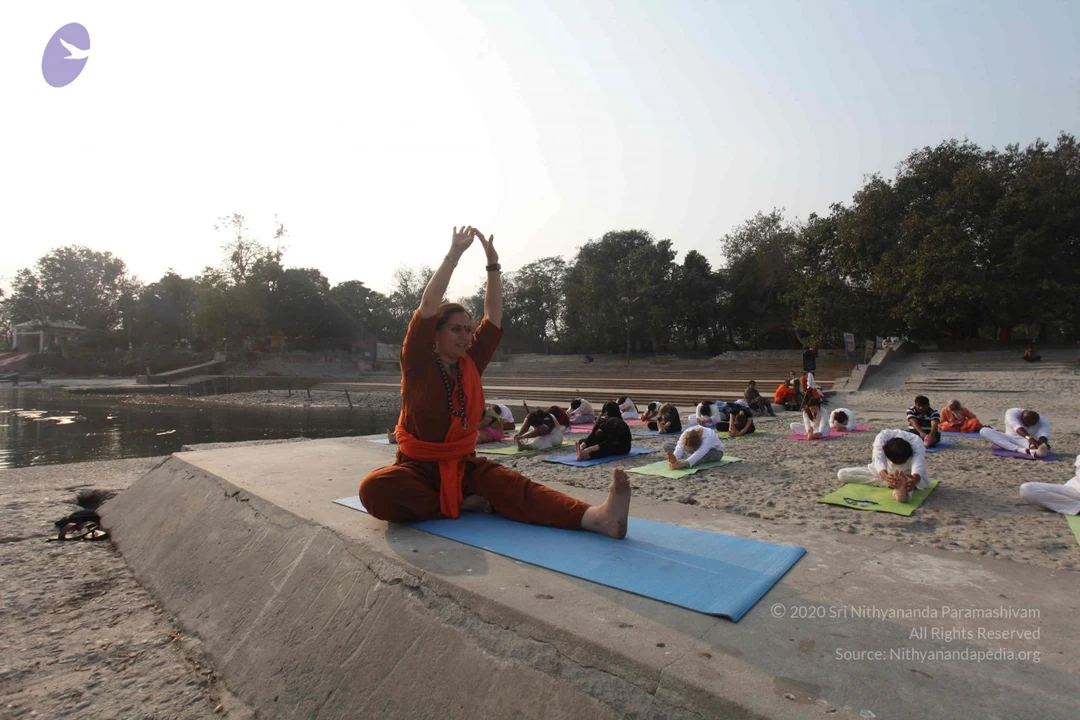
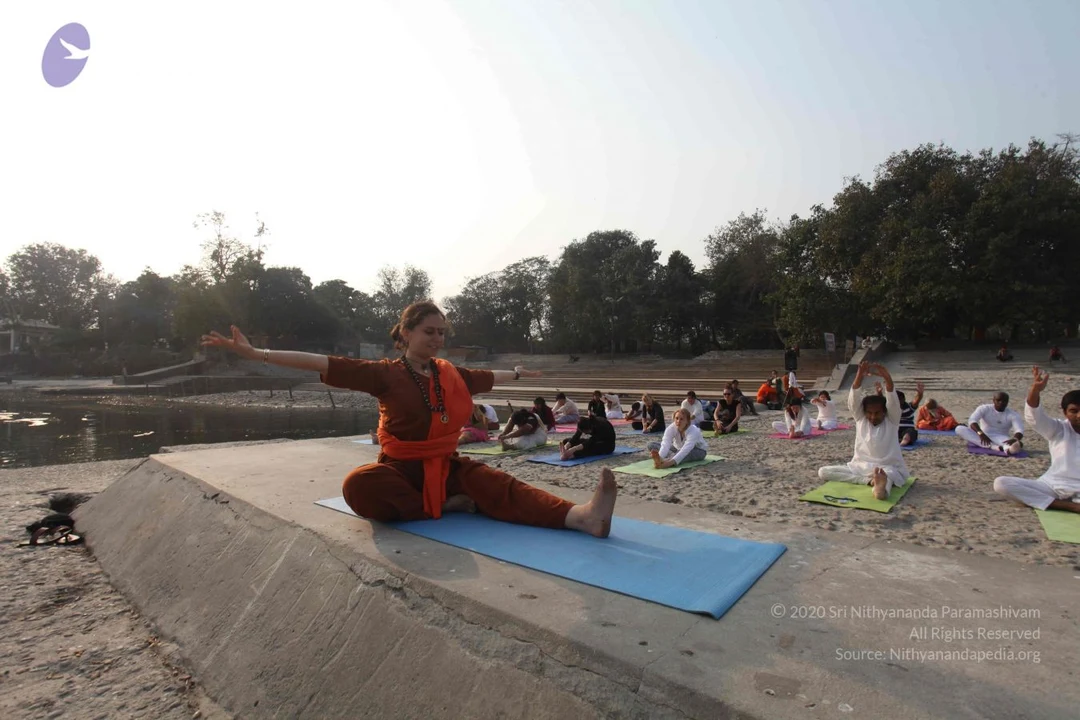
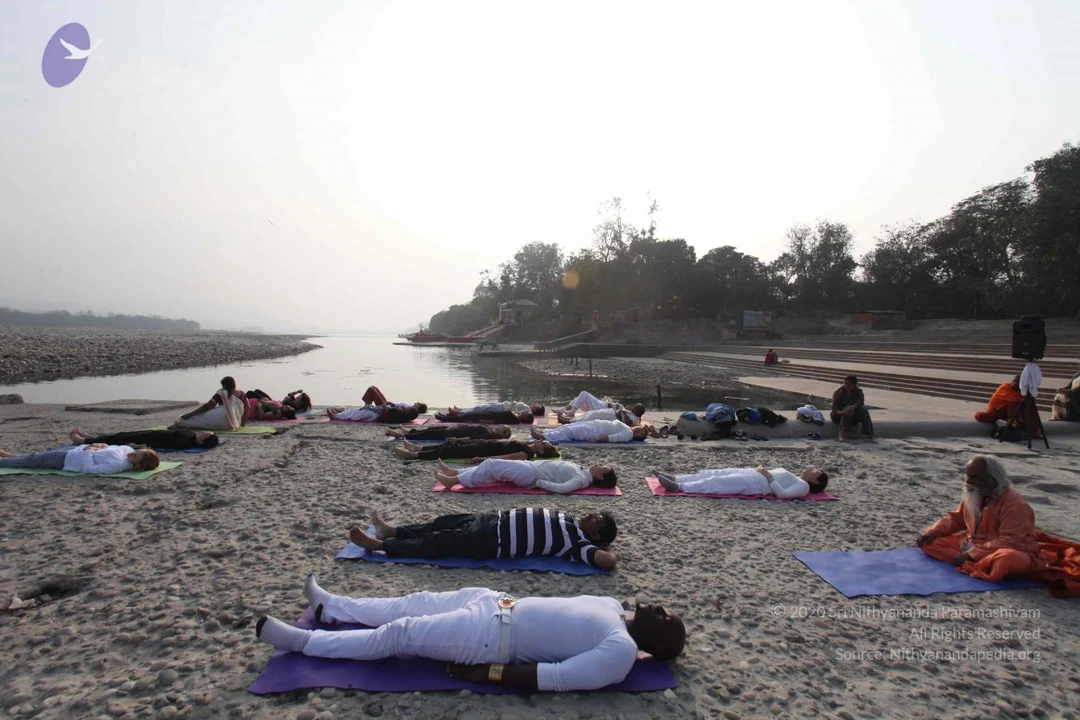
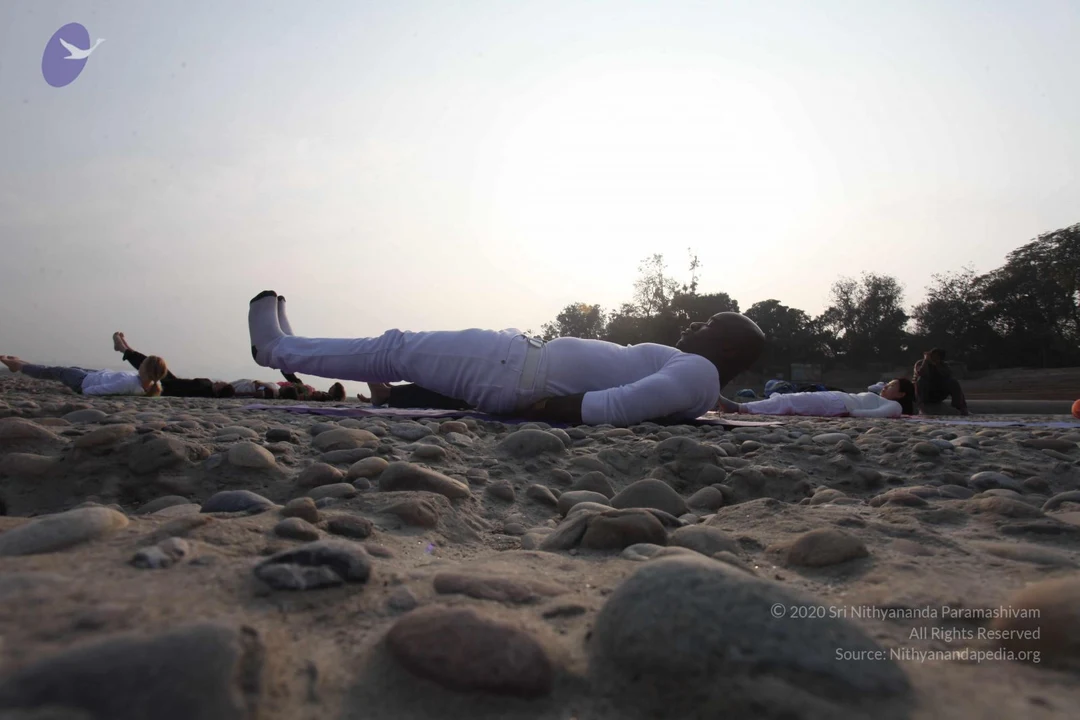
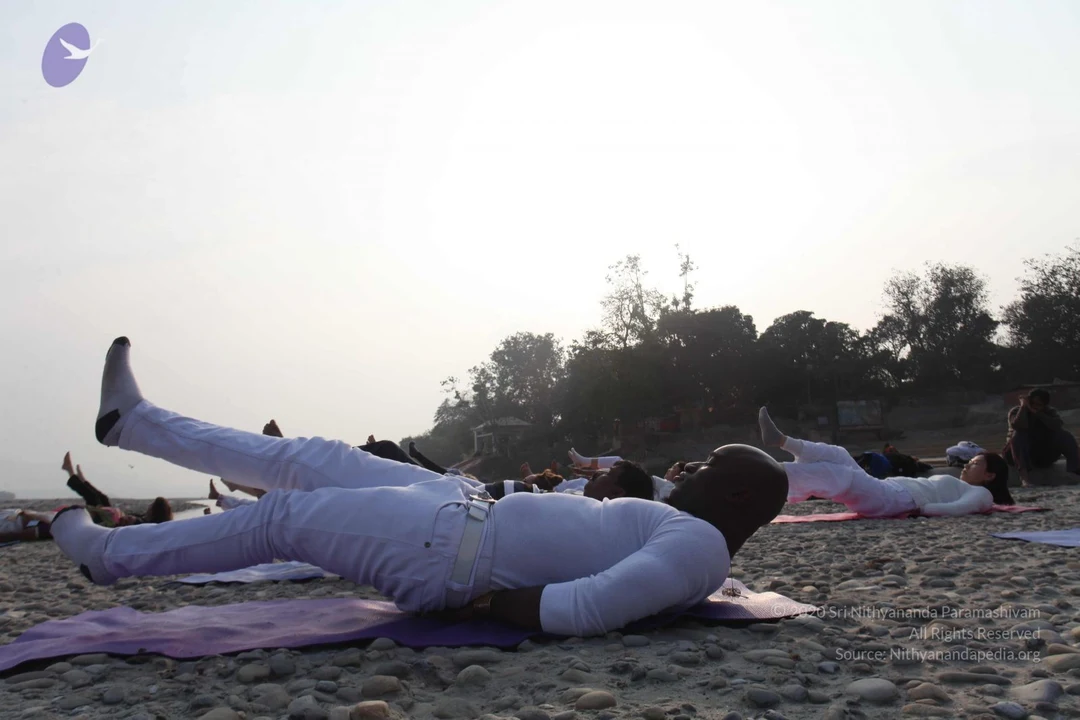
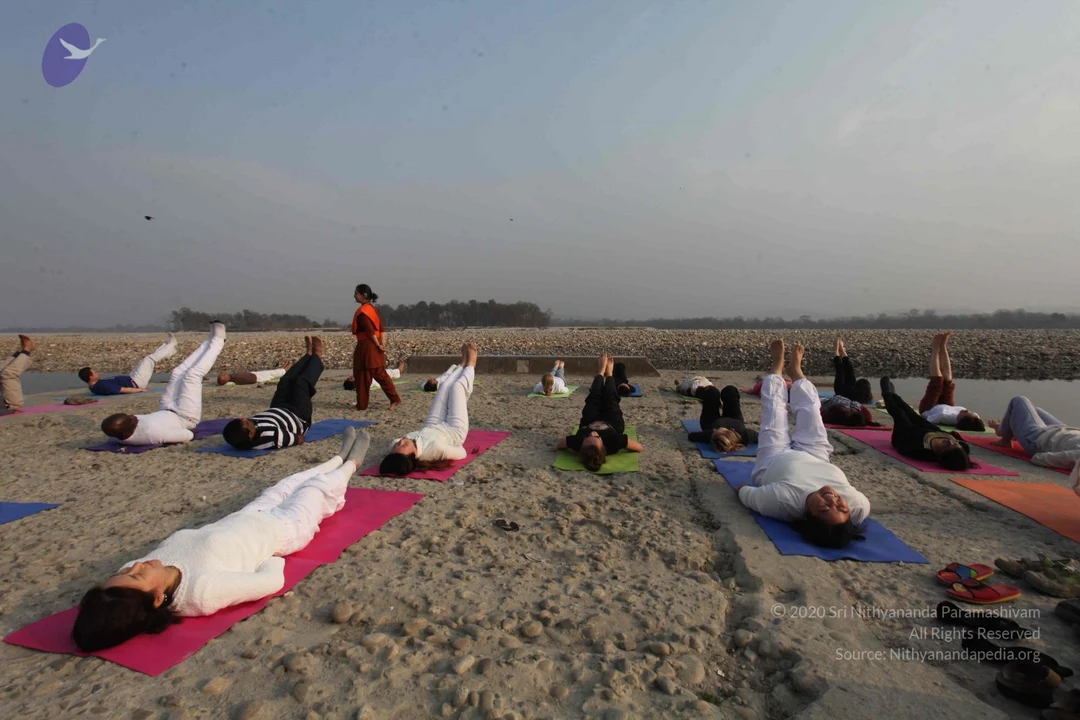
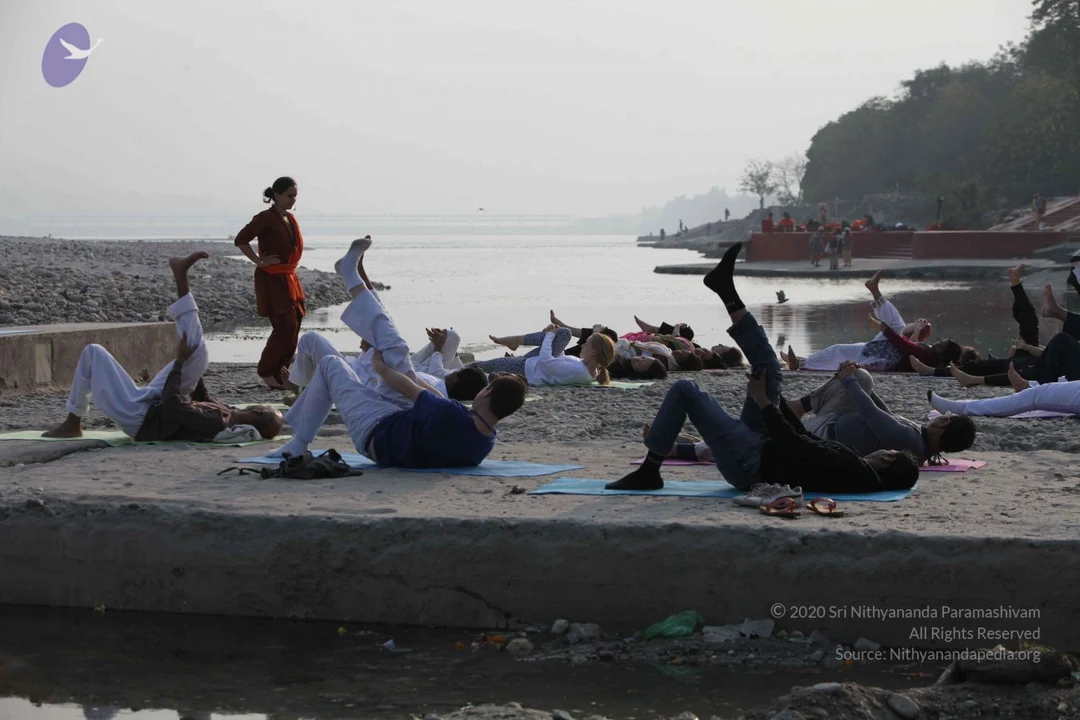
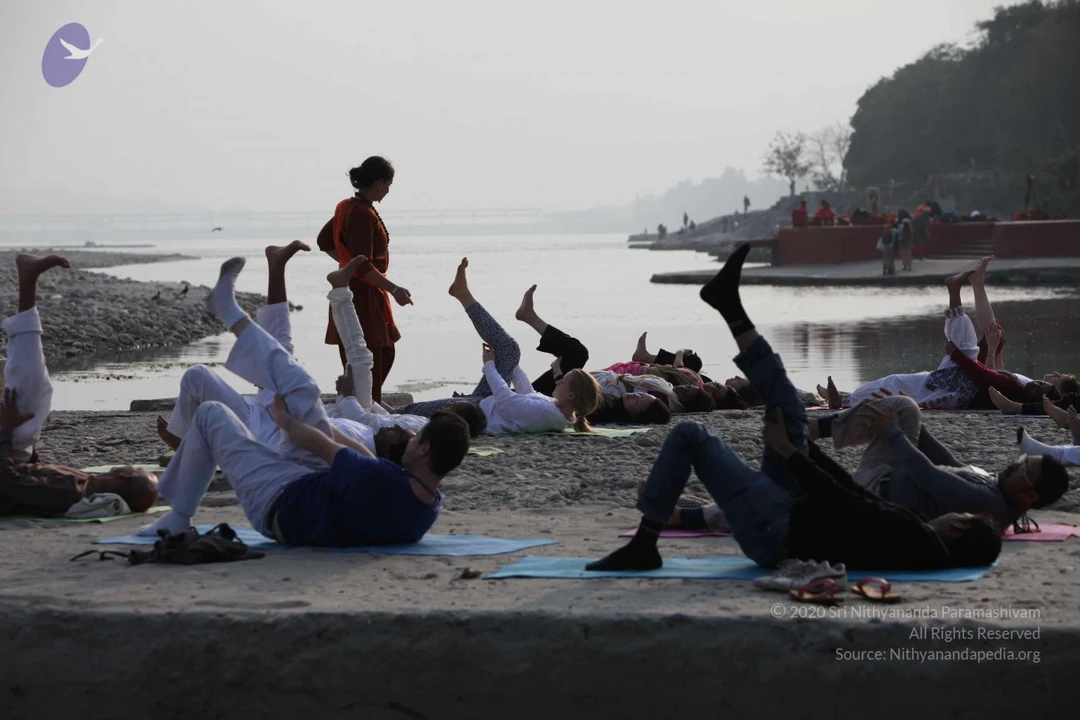
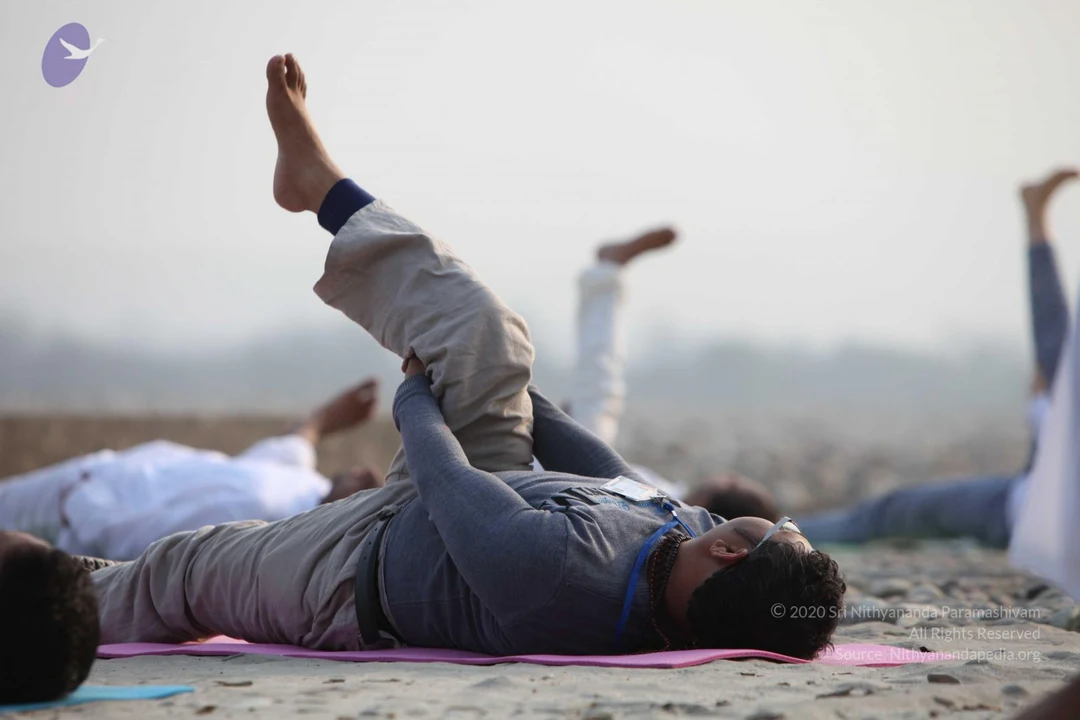
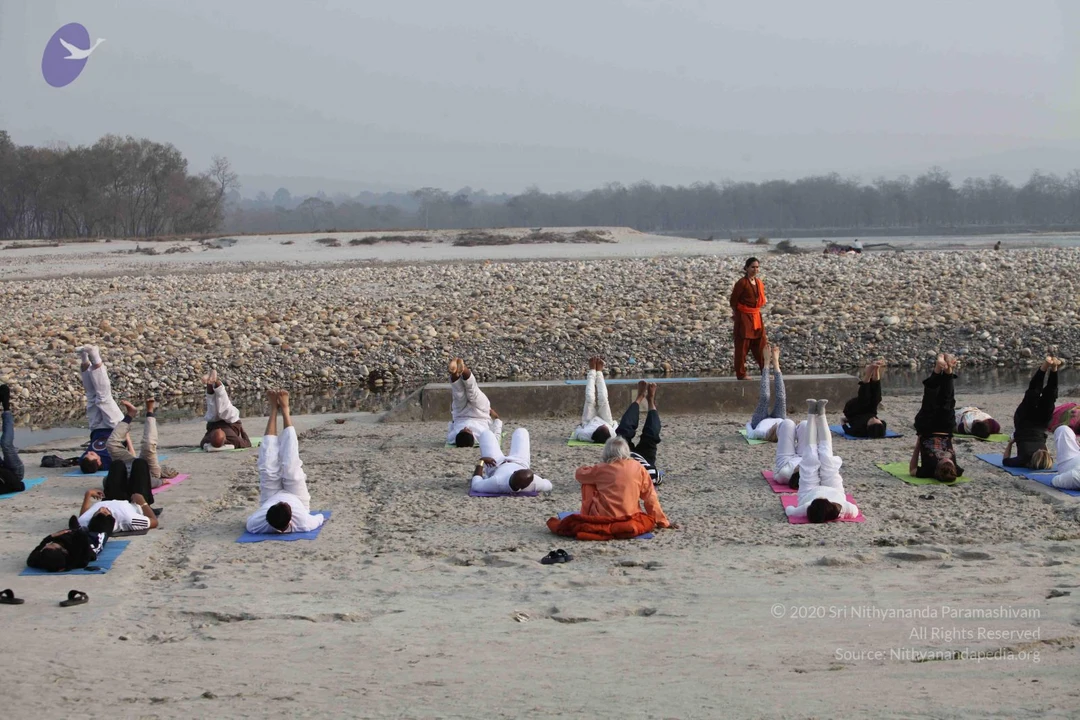
Yoga on the Banks of Ganga

Nithya Satsang

Tags:

Paramahamsa Nithyananda, world, self-doubt, self-hatred, and self-denial, success, Advaita, Vedanta, religion, completion, life, enlightenment.

Photos Of The Day:

Nithya_Puja

Satsang

Darshan

Ganges-trip

Photos Of The Day:

Nithya-Puja

Satsang

Darshan

Ganges-trip

Photos from this day

View all 193 photos

Padukapuja in Progress

1 photoSource gallery
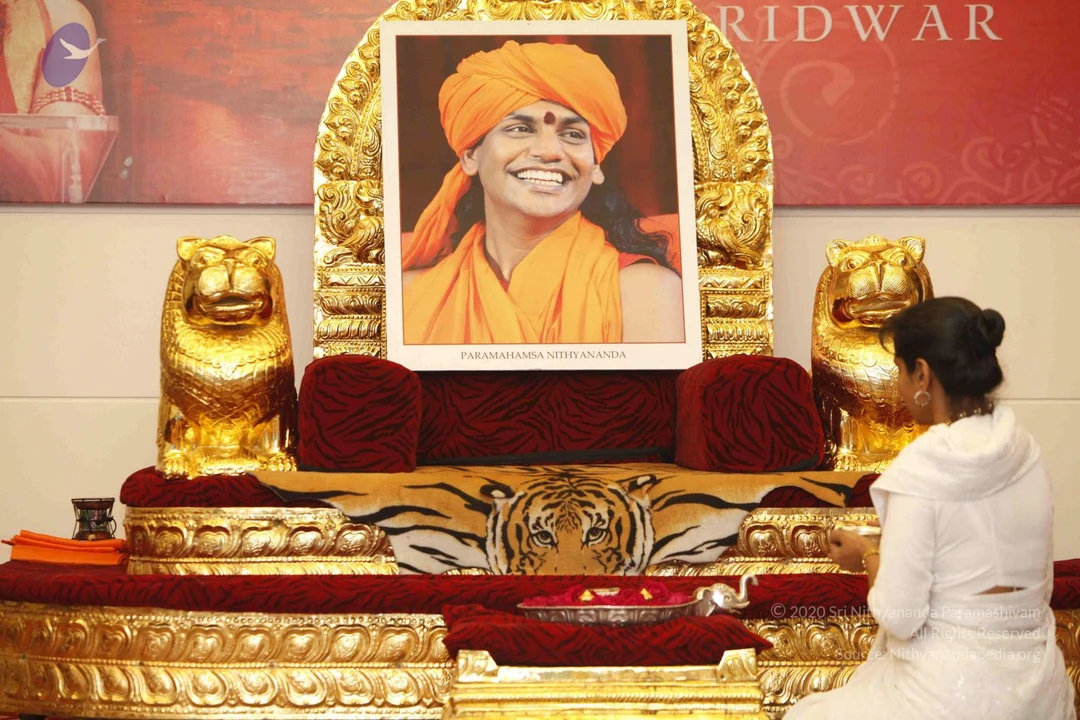
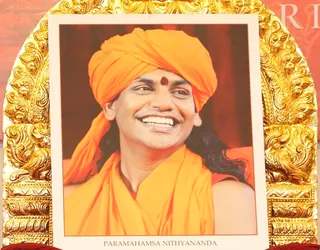
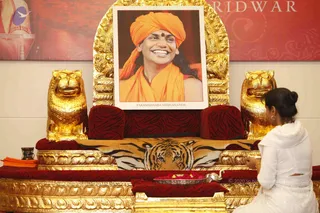
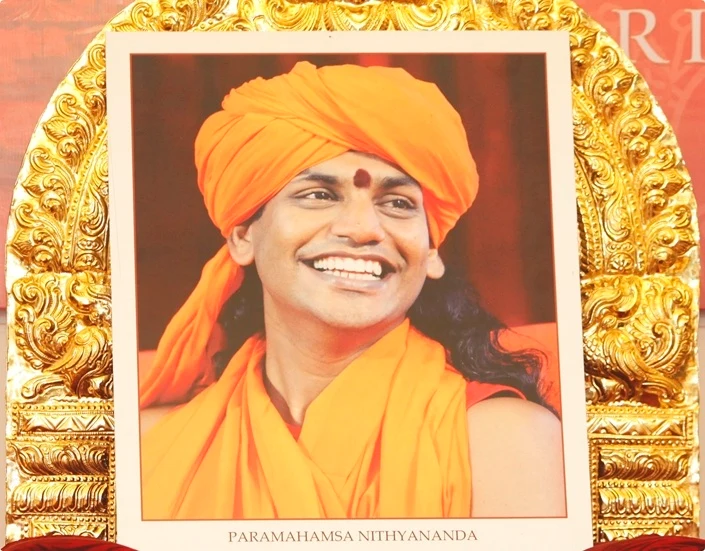
A printed portrait photograph mounted in an ornate gold carved frame, showing a smiling man in an orange turban with a red bindi and orange shawl draped over his shoulders, with long dark hair visible at the side. The printed caption beneath the portrait reads Paramahamsa Nithyananda. The frame sits against a red and orange background with ornate gold decoration around it.

Todays Leela Alankar

1 photoSource gallery
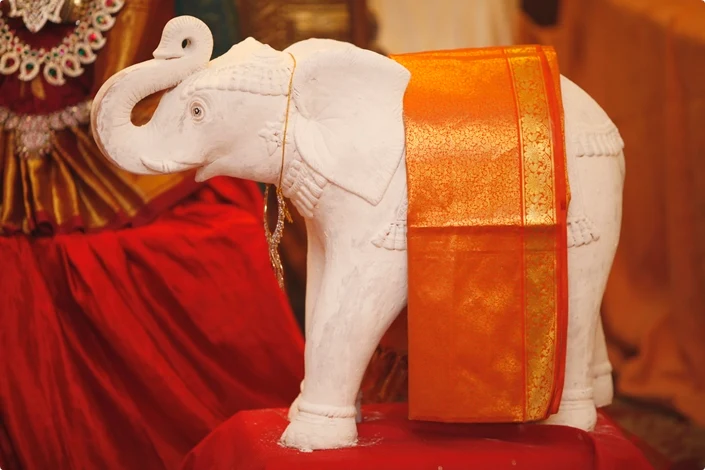
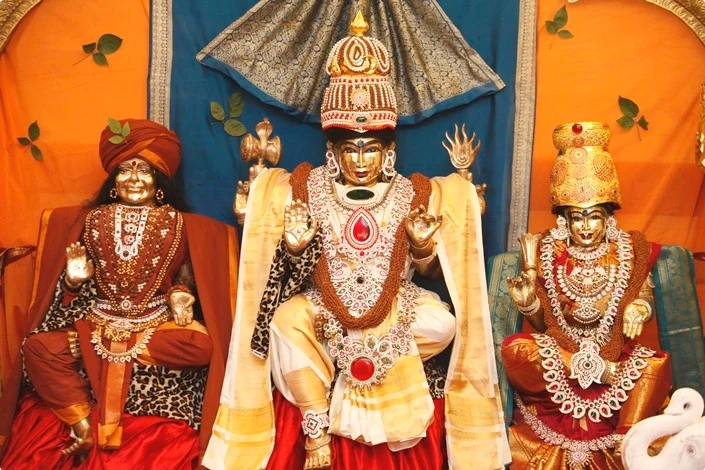
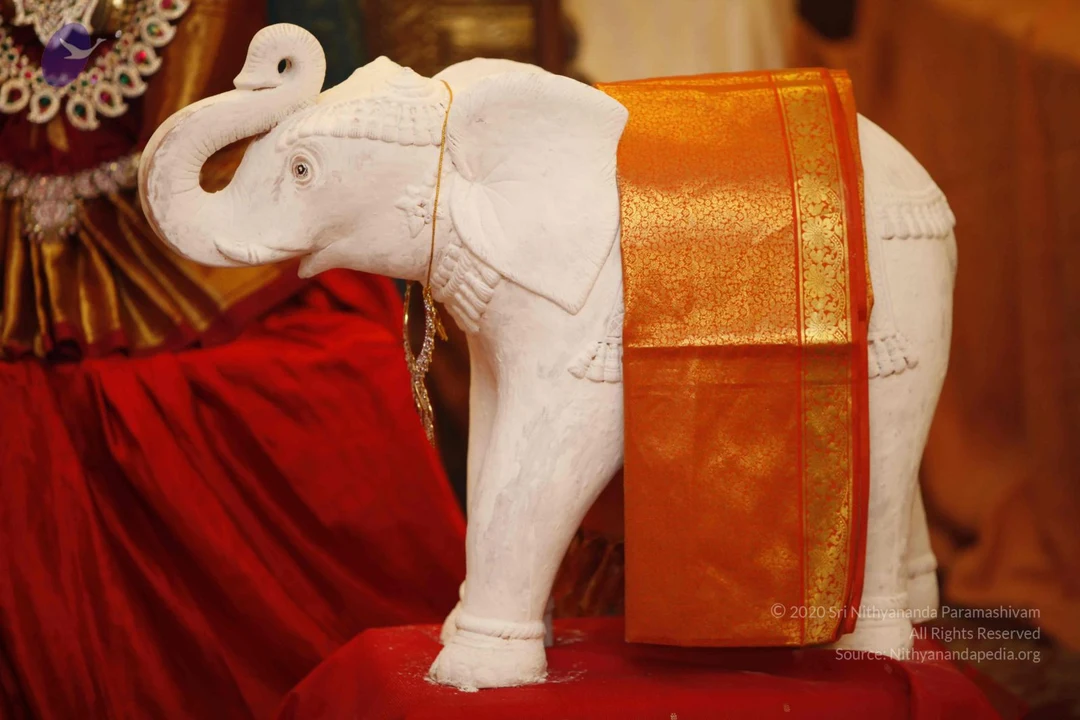
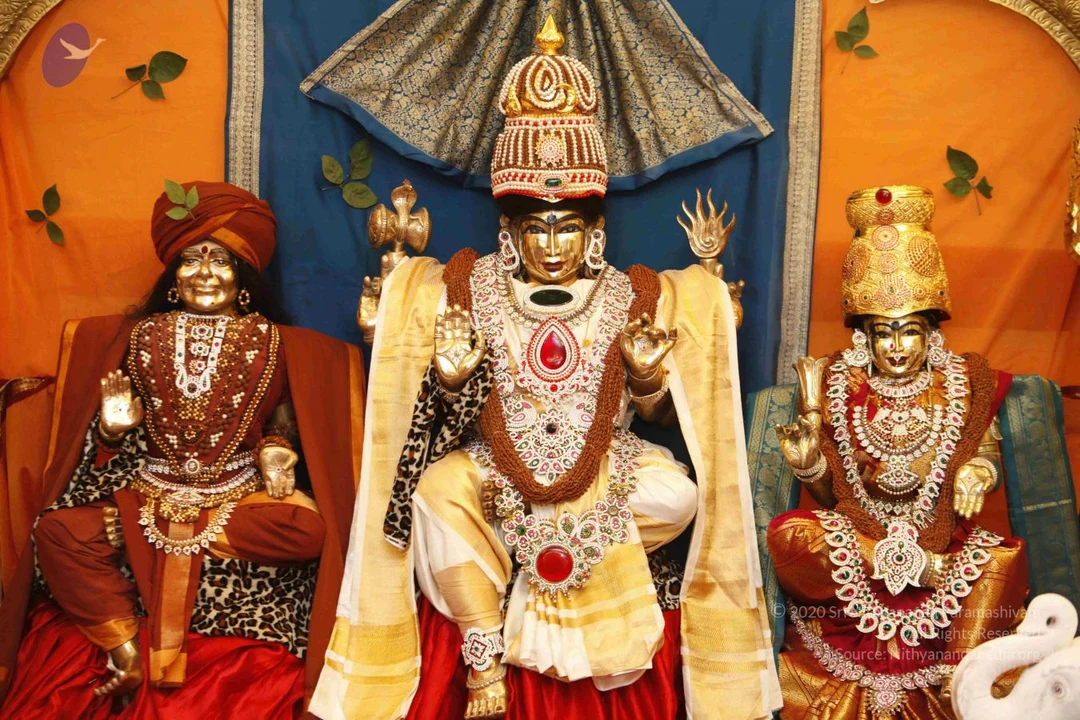
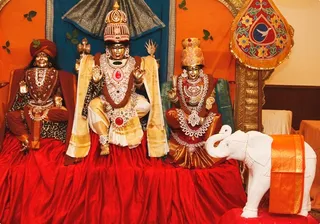
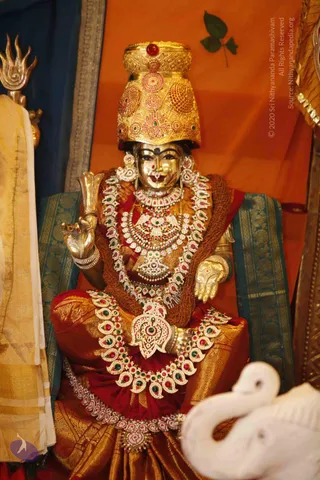
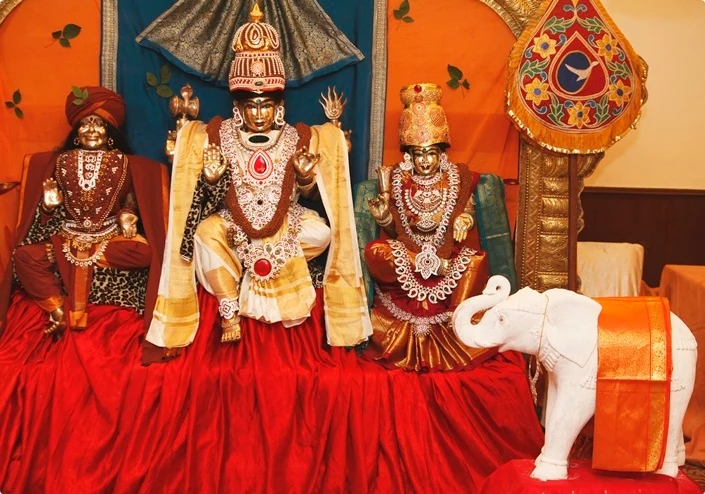
A decorated shrine display of three deity murti on a red draped platform. The central seated figure wears a tall ornate crown, a golden-white dhoti with gold border, a red jewel at the chest and a heavy multi-strand bead and gold necklace. Flanking him, a female figure in a red and gold sari with a gold crown and layered jewelry, and a smaller male figure on the left in a dark red turban and bead ornaments. A white elephant statue with an orange and gold cloth sits at the front right. Behind, an orange and blue backdrop and a decorated umbrella with a painted bird-and-flower emblem frame the scene. No people are visible.

Inner Awakening Session

6 photosSource gallery
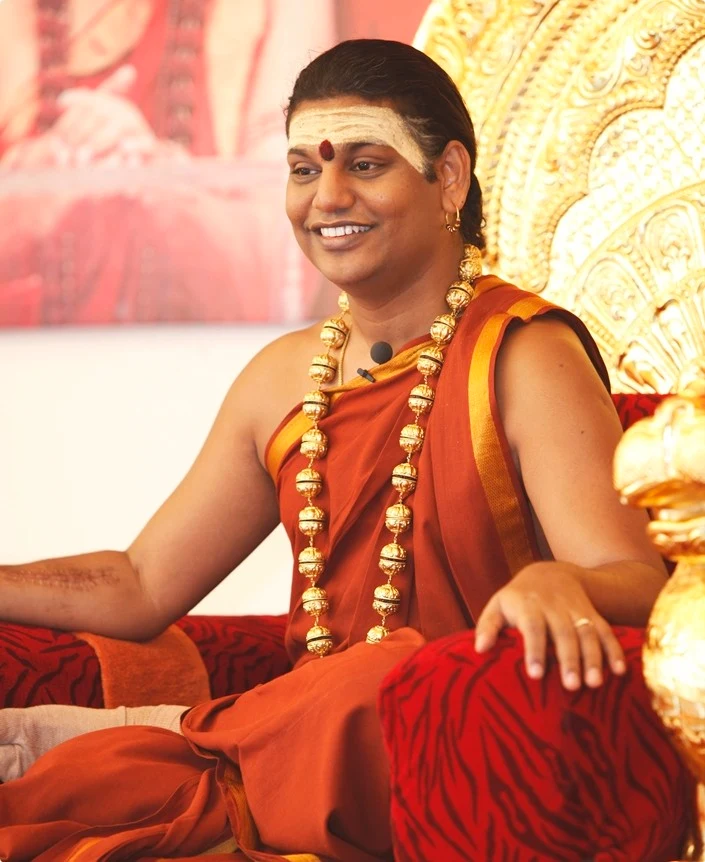
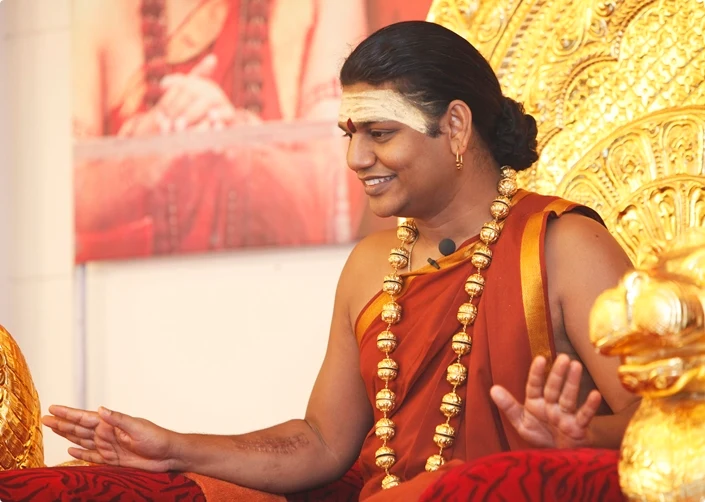
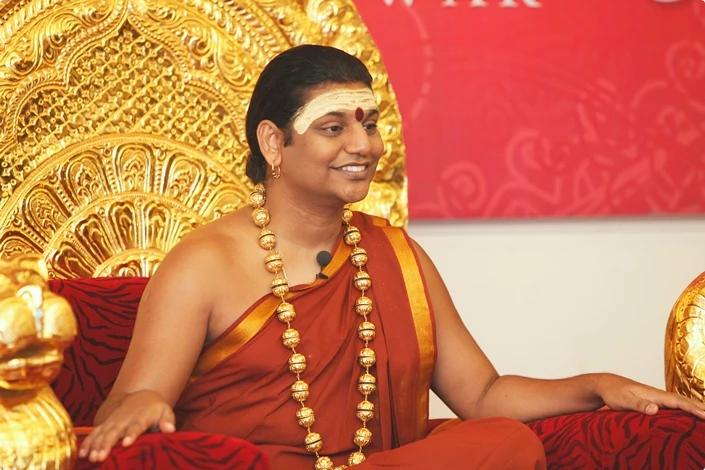
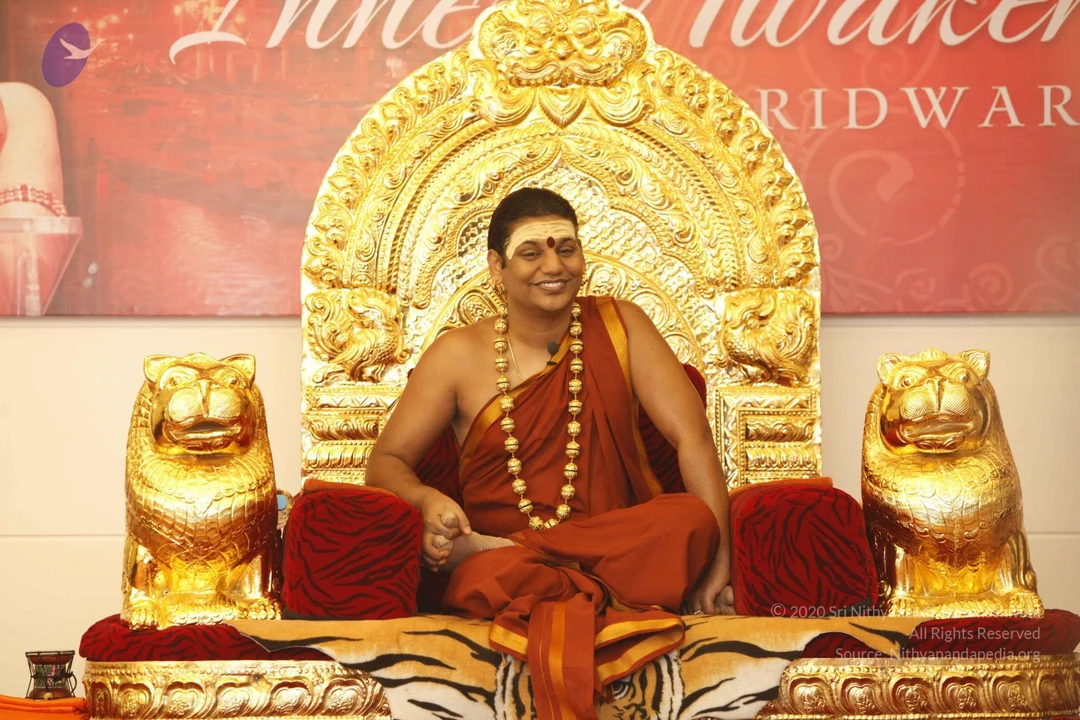
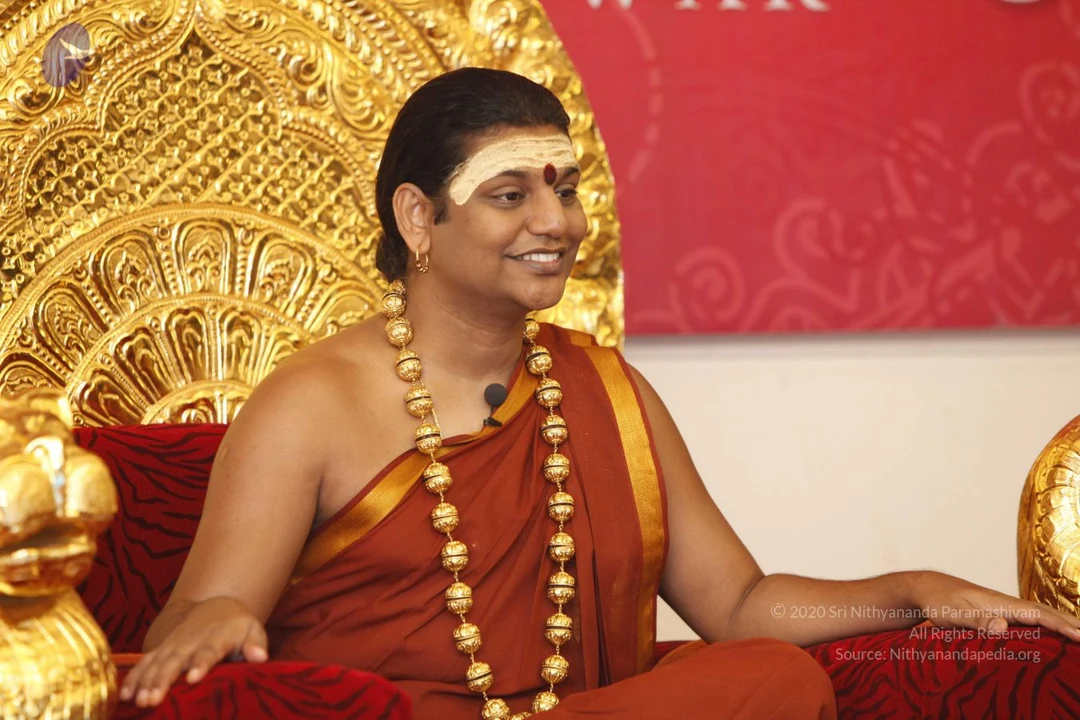
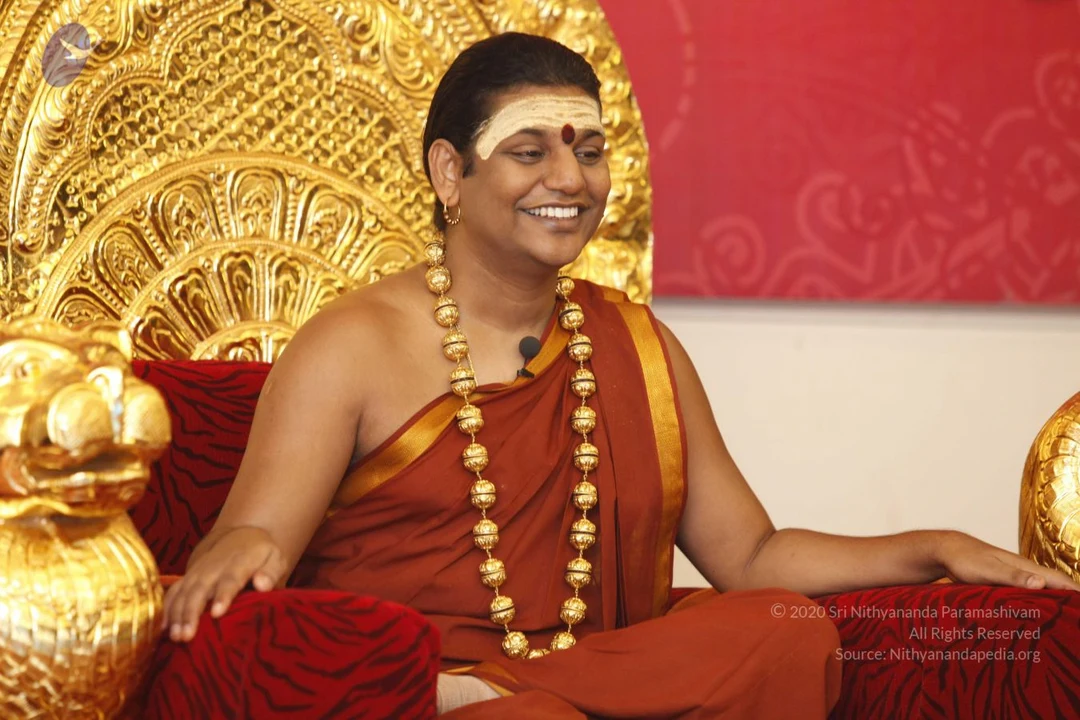
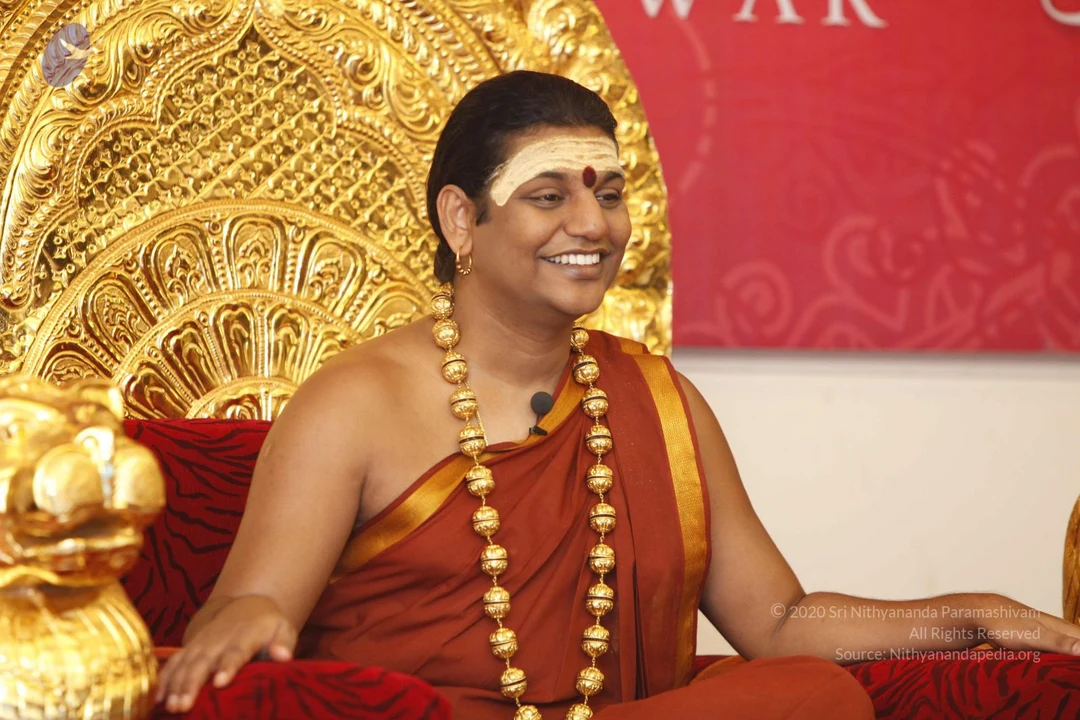
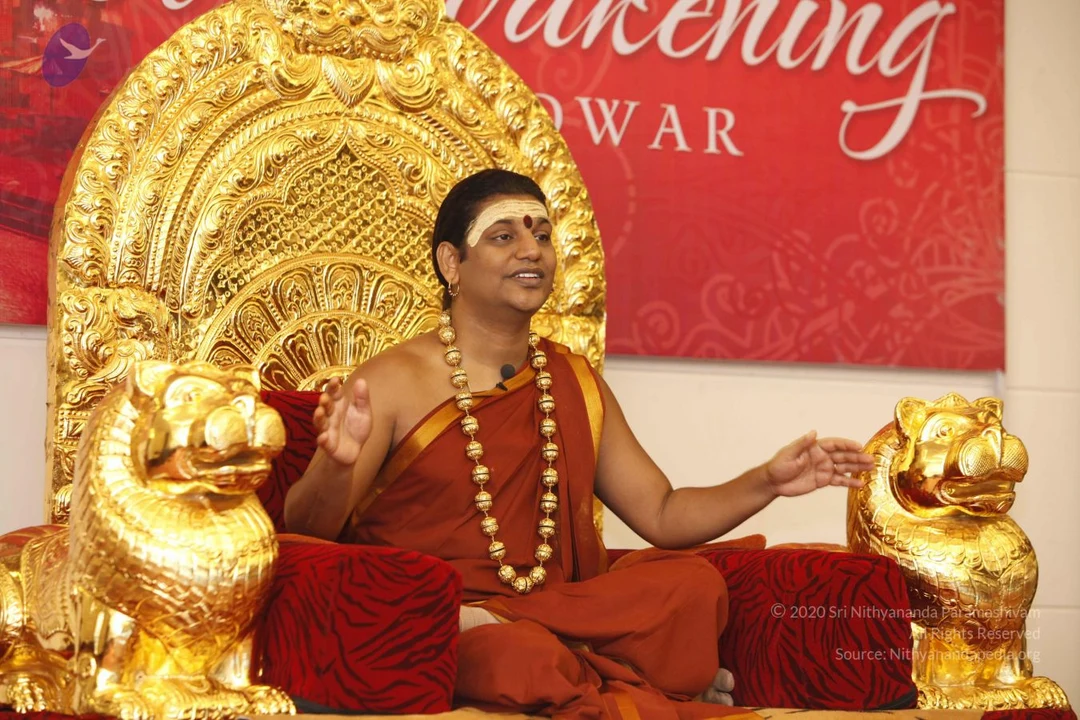
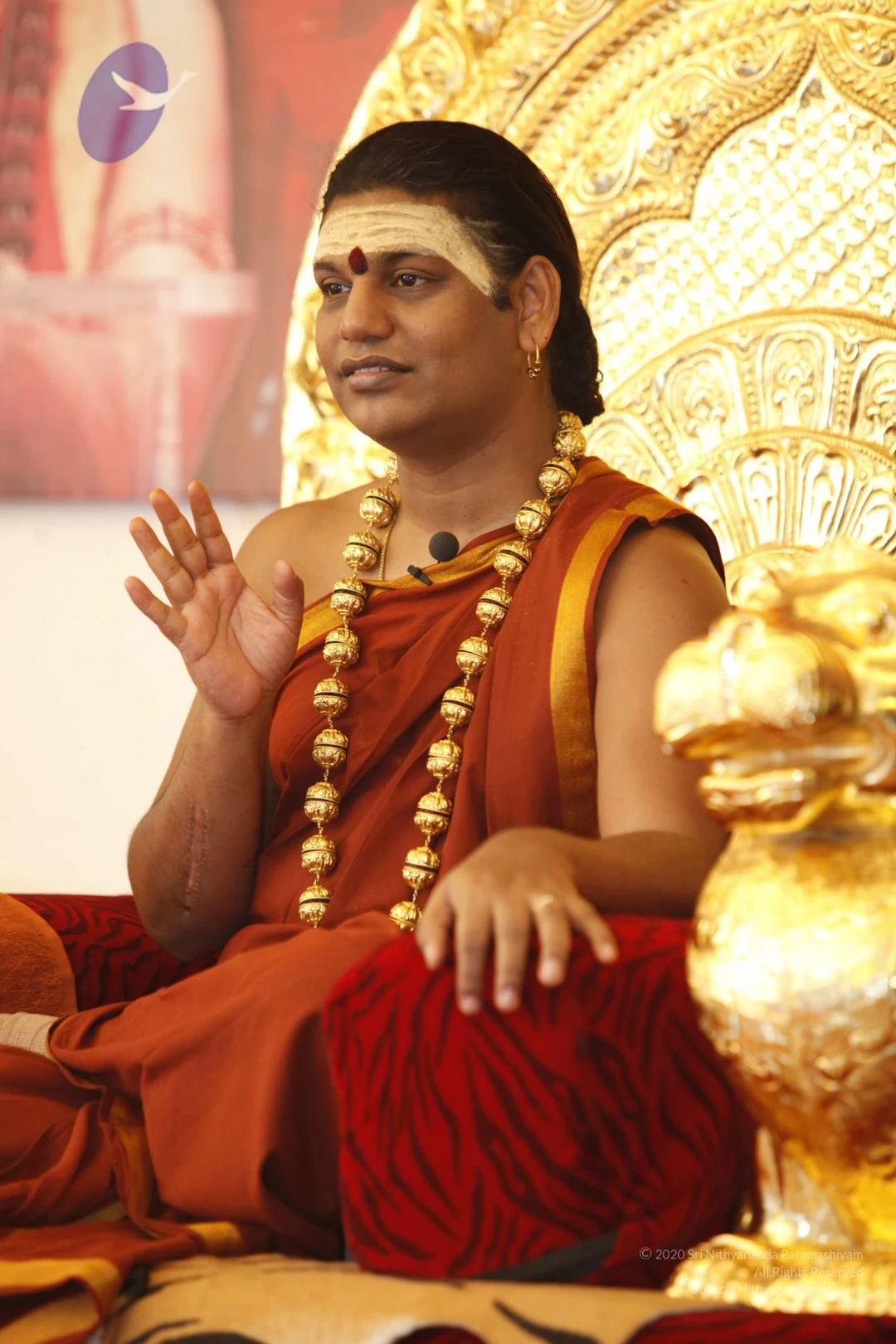
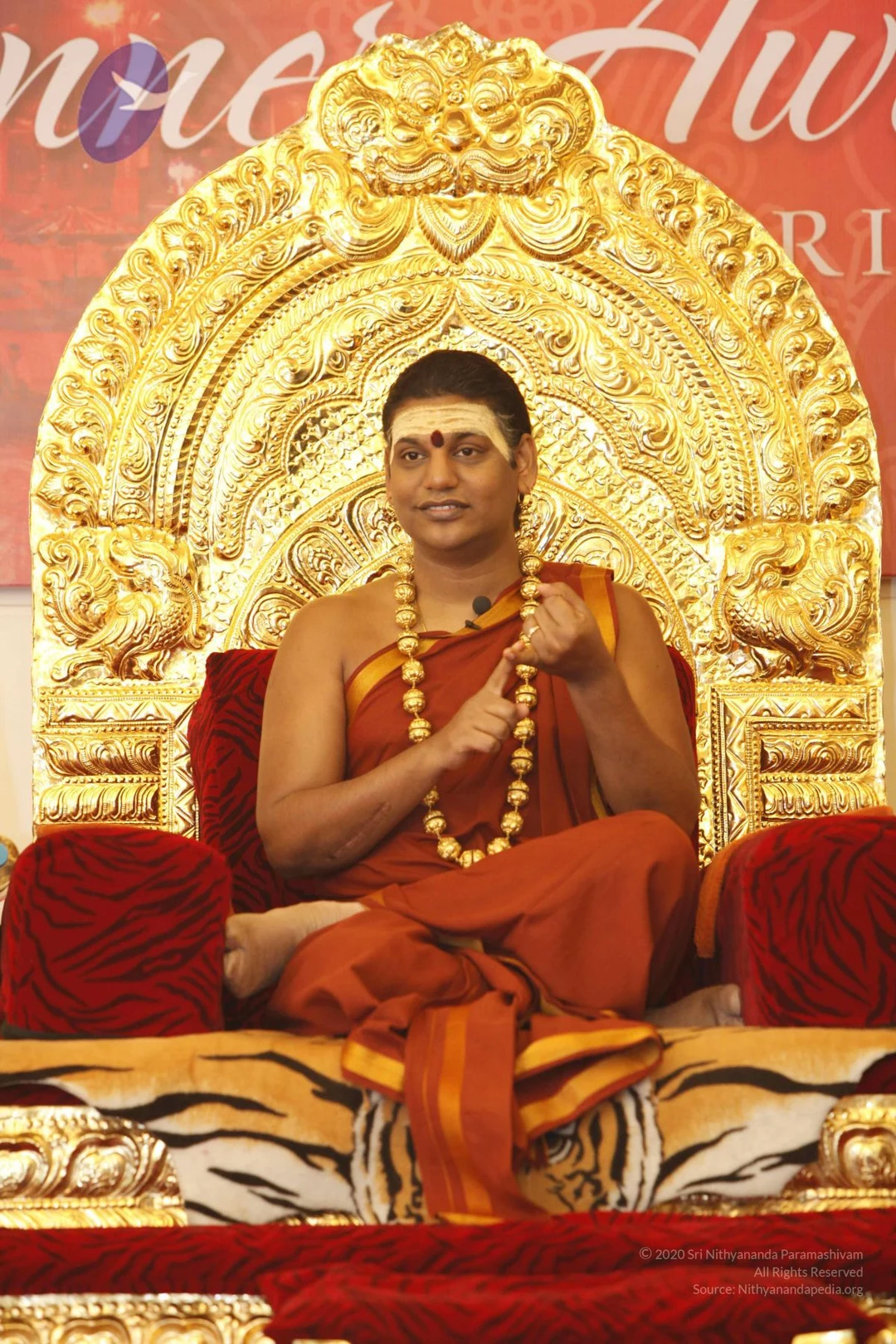
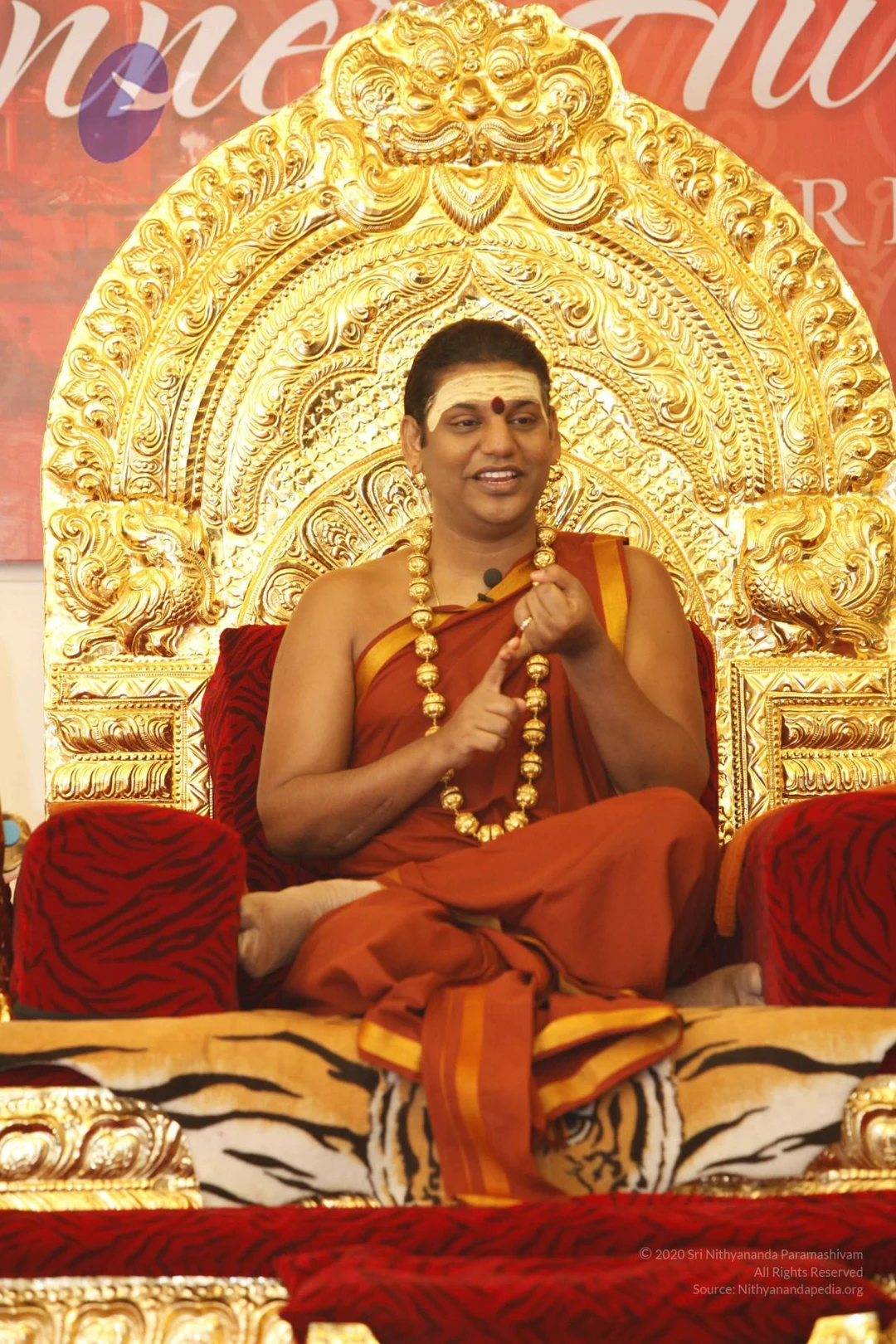
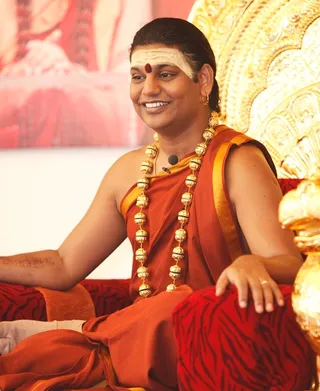
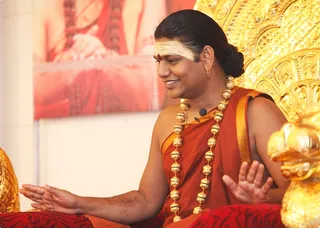
a person seated on a golden throne with a gold-embossed backrest, smiling, wearing an orange-saffron shawl with gold border over an orange garment, a long gold bead necklace reaching the chest, gold earring, white sandalwood tilak with red dot on forehead, and a small clip-on microphone at the collar. Red and black tiger-striped cushions rest beside him, and a red-toned devotional painting hangs in the background. He gestures with one hand resting on a cushion.A seated man in an orange-red garment speaks during a satsang, smiling with both hands open in a gesture of explanation. He wears a white vertical tilak on his forehead, a small gold earring, and a long necklace of large gold beads, with a small clip microphone at his collar. Behind him is a gold ornate throne with a red cushioned seat, and a large red-toned painted portrait hangs on the wall. The appearance matches the page's description of Swamiji, a probable in-person presence from the swept-back hair, gold beaded mala and saffron-orange clothing.A seated man in an orange-saffron robe with a thin orange shawl sits cross-legged on a golden throne richly carved with floral and scroll patterns, flanked by two gilded lion sculptures. He wears a long multi-strand gold bead necklace, a red-brown bindi and white tripundra marks on his forehead, and a small microphone clipped to his robe. He raises his right index finger while smiling. Red-and-black striped cushions sit on the armrests, and a red wall forms the backdrop. Only one physical person is visible.A smiling man sits cross-legged on an ornate golden throne with a large embossed gold backrest carved with scrolls and figures. He wears a saffron-orange shawl over bare shoulders, a long gold bead necklace, and a white vertical tilak with a red bindi on his forehead. A small clip-on microphone is attached to his garment. Red tiger-striped cushions flank the throne, and his hands rest loosely on his lap. a person: the seated figure has a ceremonial throne, saffron shawl and gold mala cues, consistent with the page's description of a person in satsang.A smiling man with short dark hair and a red bindi sits cross-legged on an ornate gold throne carved with lion heads and a decorative arched backrest. He wears an orange-saffron robe draped over his shoulder and a long beaded necklace of gold-tone beads, with a small lapel microphone clipped to his robe. Two gold tiger sculptures flank the throne, and its red velvet cushions have zebra-stripe patterns. Behind him is a red banner with gold script.A man seated on an ornate gold throne with a carved gold backrest and red patterned cushions, speaking and gesturing with both hands. He wears an orange-saffron robe draped over his shoulder, a long necklace of large gold beads, a white vertical forehead mark with a red dot, and a small microphone clipped to his robe. The red backdrop behind him has partially visible white lettering. a person: the robe, gold beads, forehead marking and throne are consistent with the page's description of a satsang discourse.

Swamiji's Murthy

2 photosSource gallery
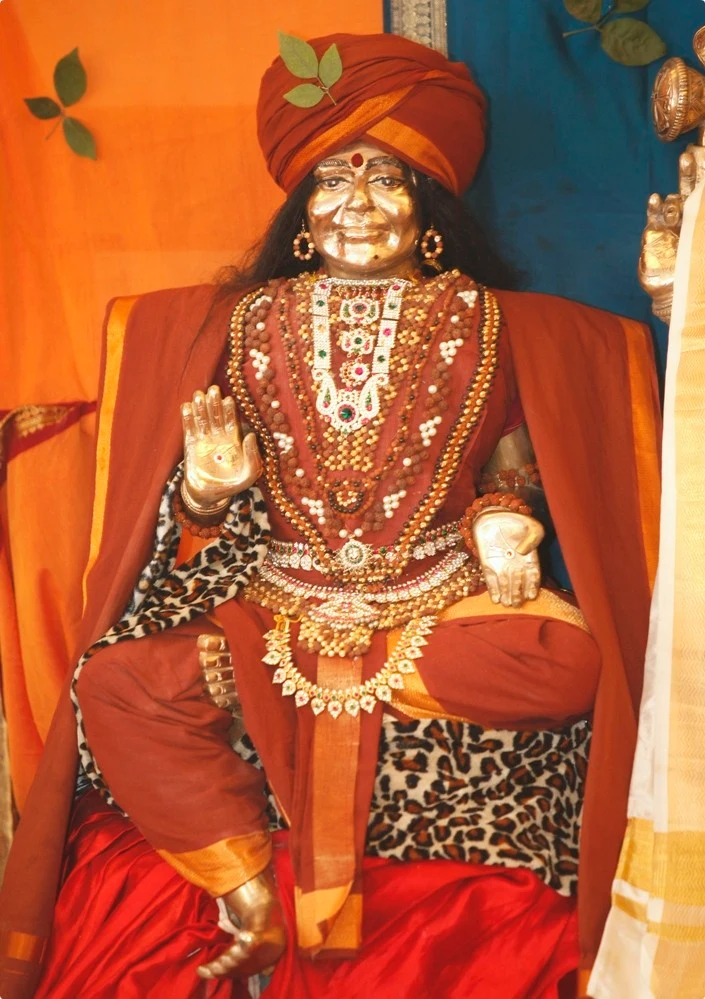
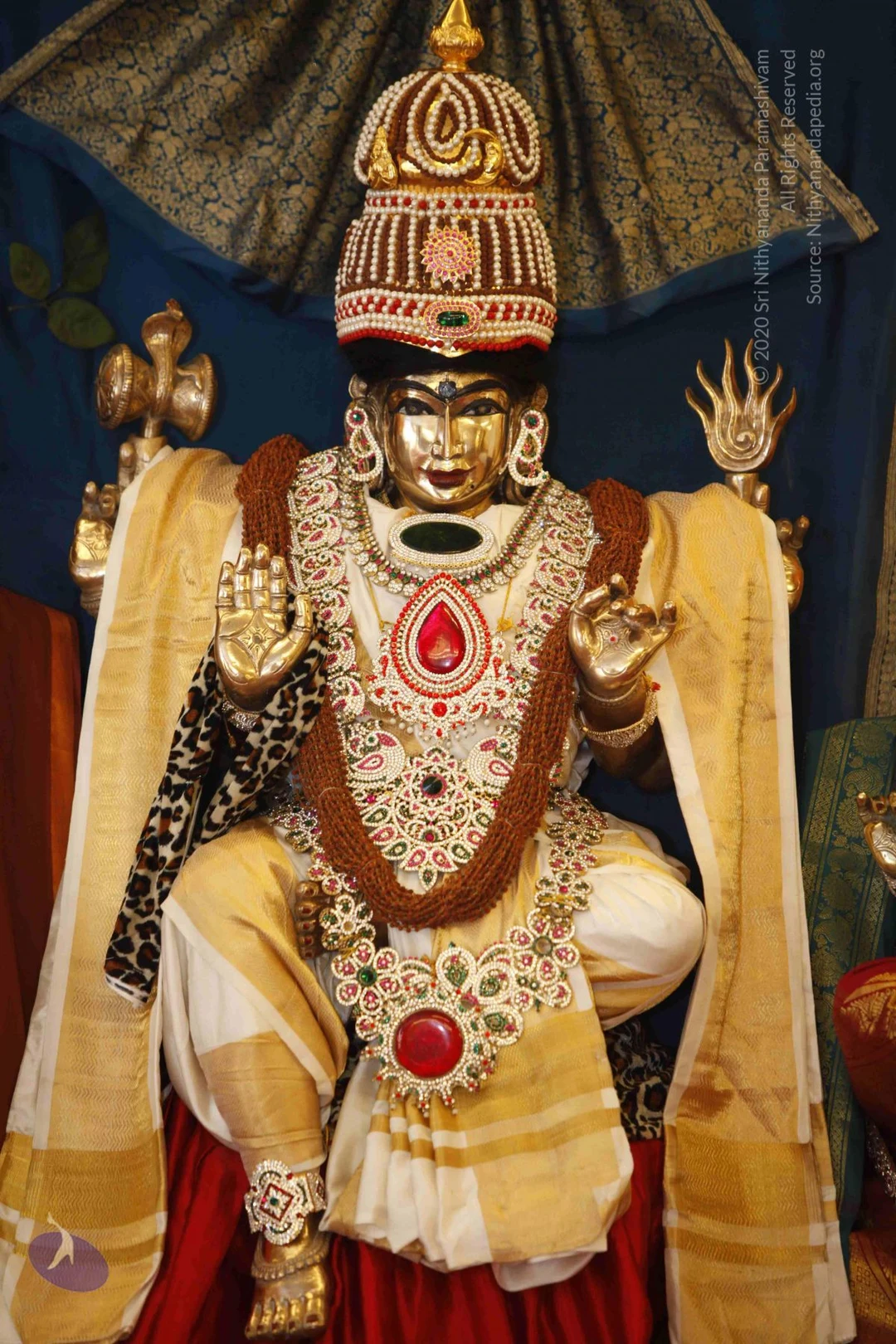
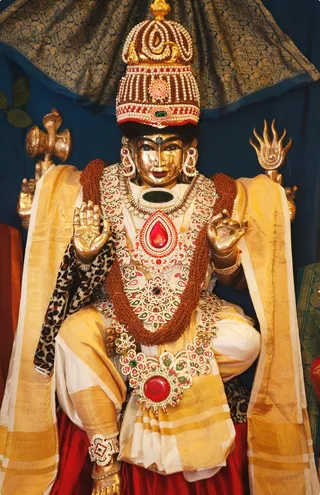
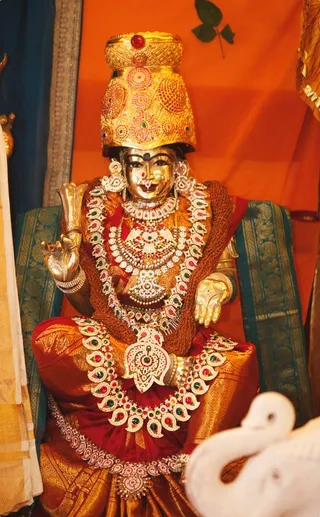
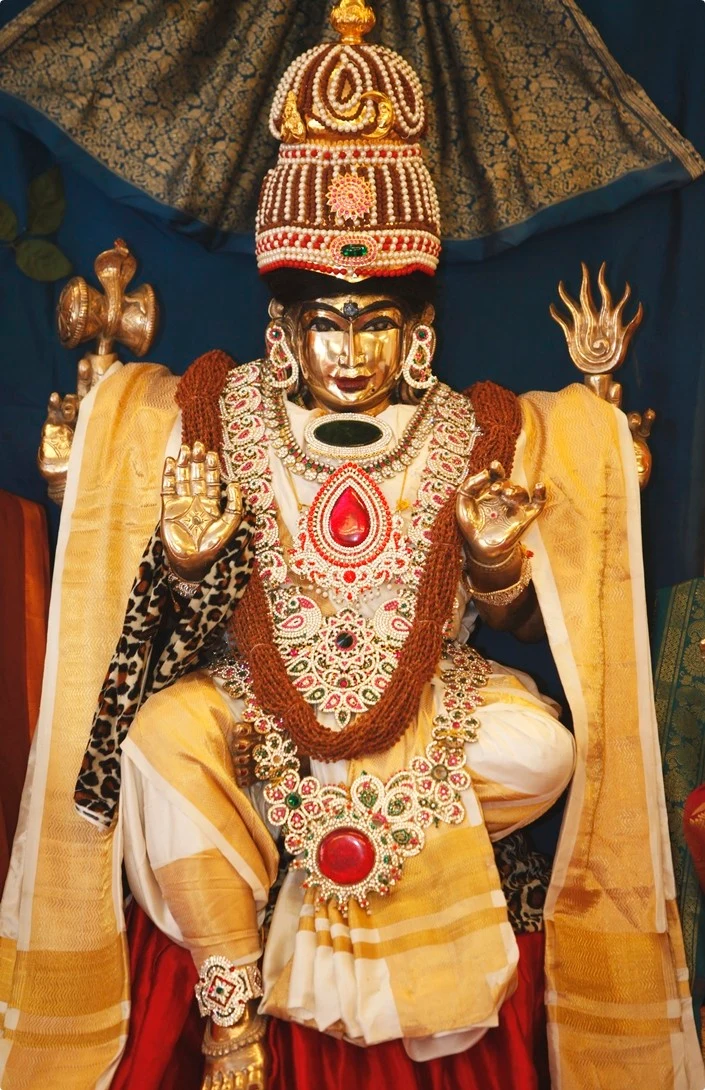
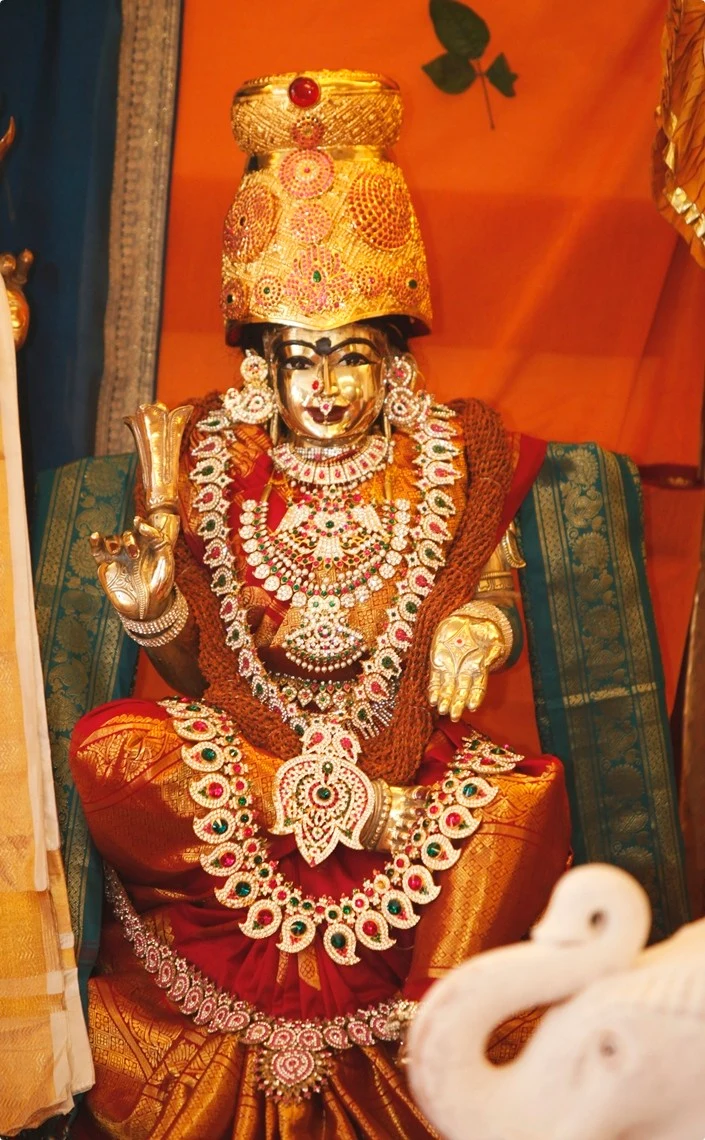
A seated golden statue of a figure wearing a red-orange turban with a green leaf tucked in it and a red bindi. The figure has golden skin, long dark hair, and ornate jewellery including layered rudraksha malas, a multi-strand gold and jewelled necklace with green and red stones, and a gold waist belt. The statue wears rust-red robes with gold borders and sits on a red cloth over a leopard-print mat, with its right hand raised in a blessing gesture. Orange and blue fabric hangs in the background, with gilded hands visible at the right edge. This is a photograph of a statue, not a living person.Three ornately decorated statues sit in a shrine against an orange and blue backdrop with green leaves. The central figure, a golden deity murti in a tall jeweled crown, white and gold dhoti-style garment, and a large red stone pendant, sits cross-legged with hands in mudra. The figure to the left wears a red-orange turban and a red and gold robe layered with beaded garlands; the figure to the right wears a tall golden crown with a red jewel and a red-and-gold saree with heavy white and gold necklaces. Trishula and other ritual objects appear behind the central figure. These are statues, not living people.

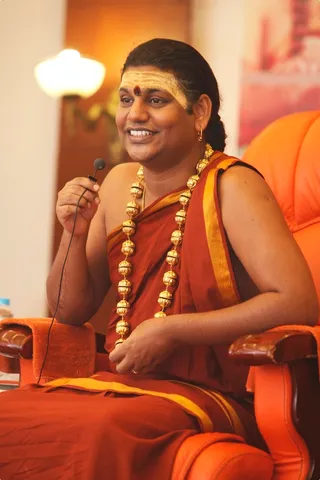
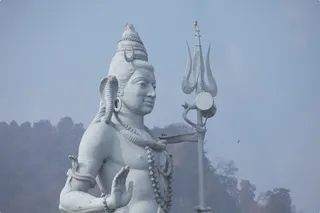
Swamiji during Inner Awakening Class
3 photosSource gallery
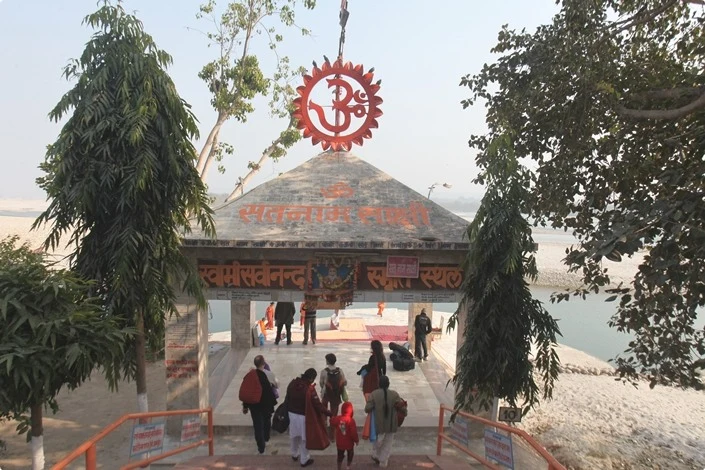
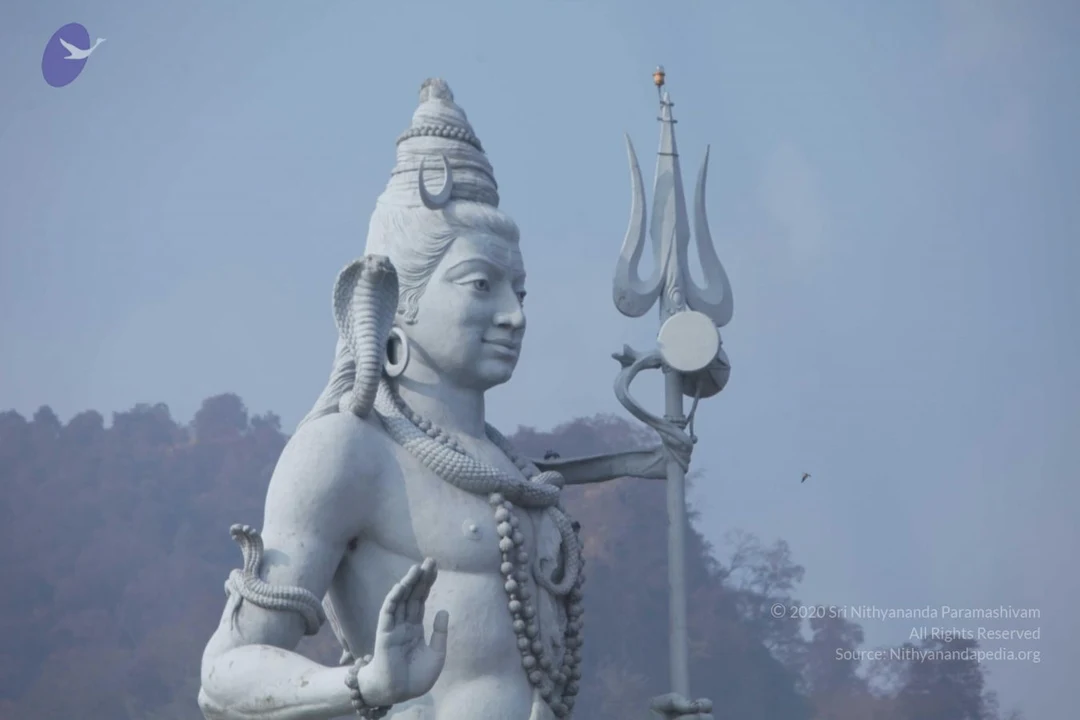
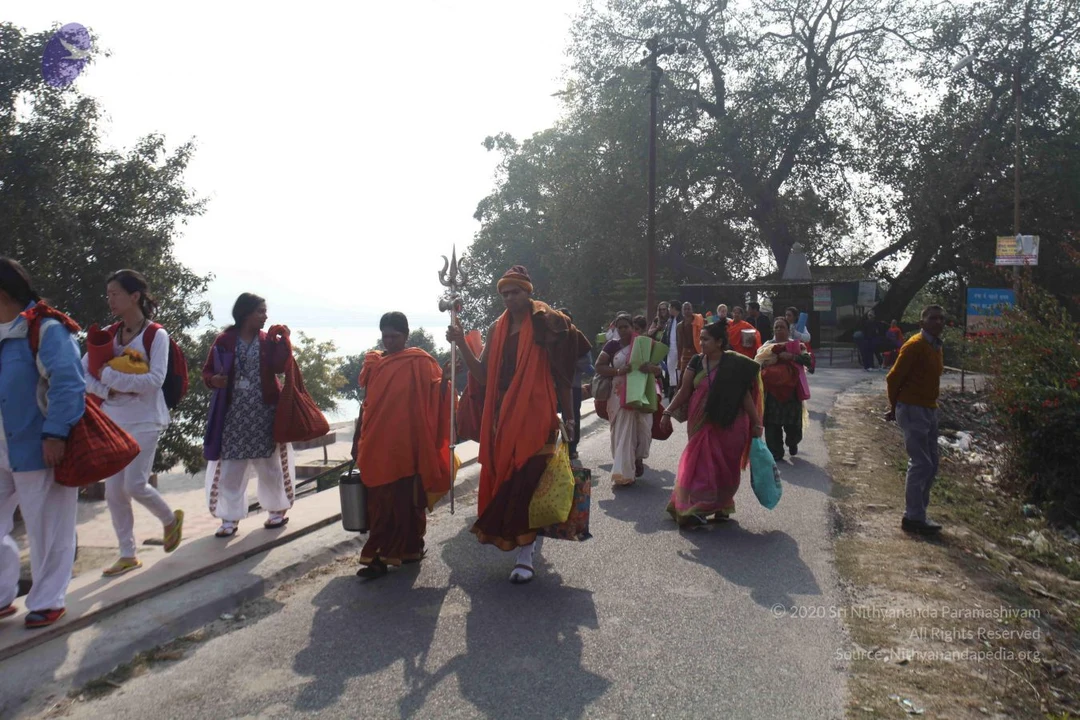
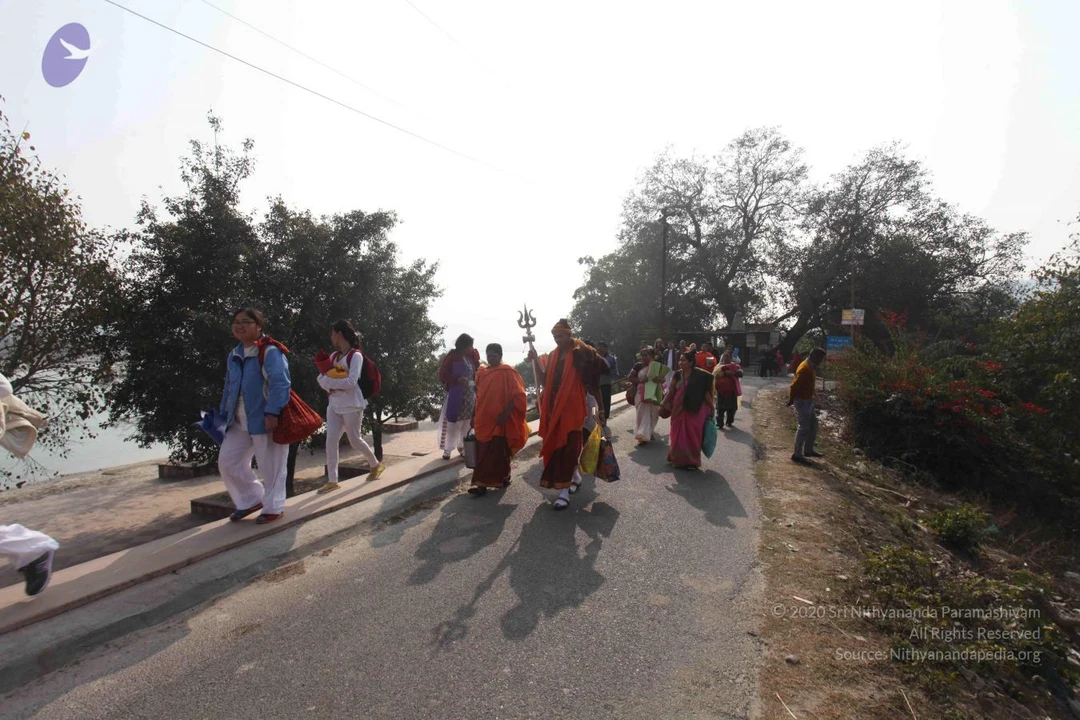
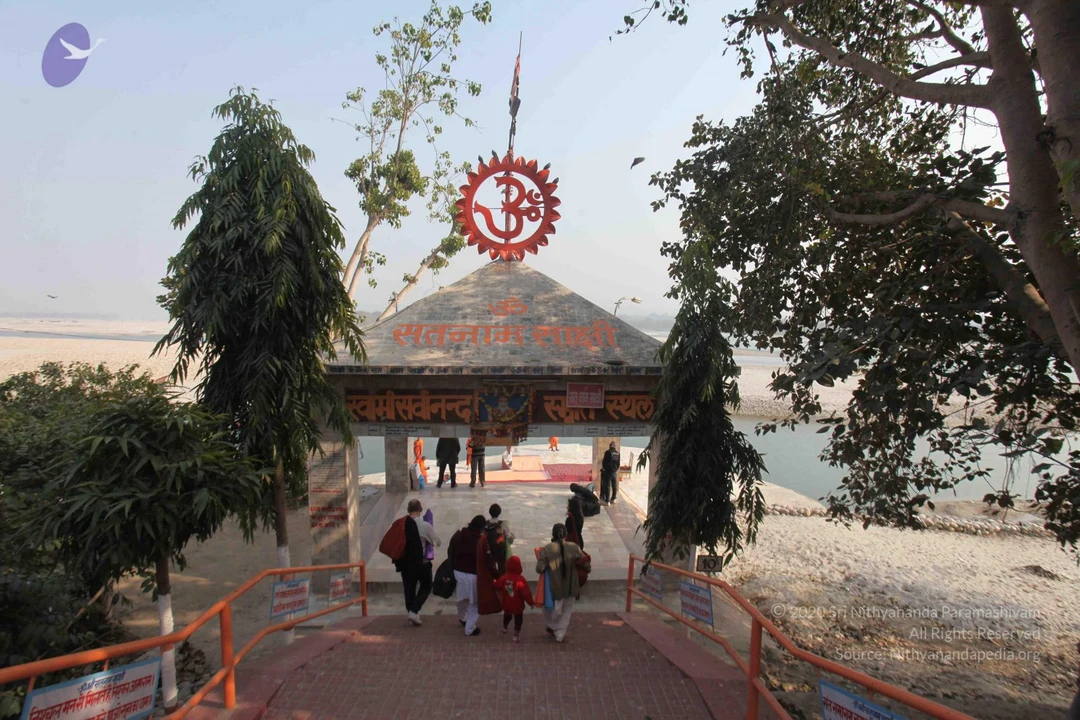
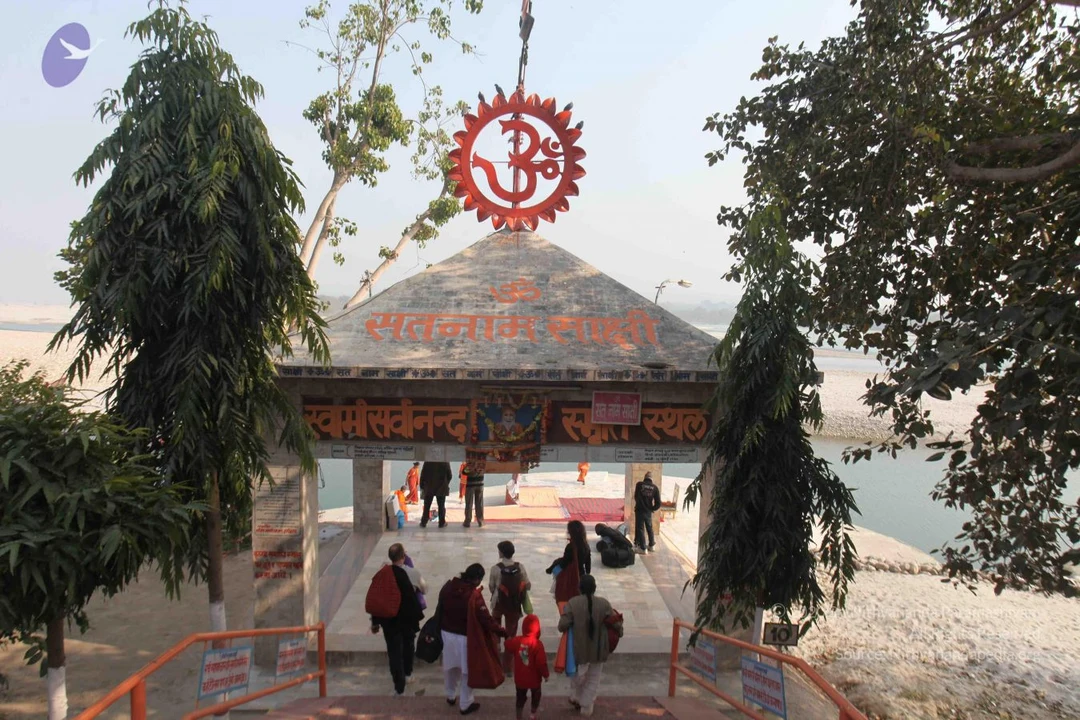
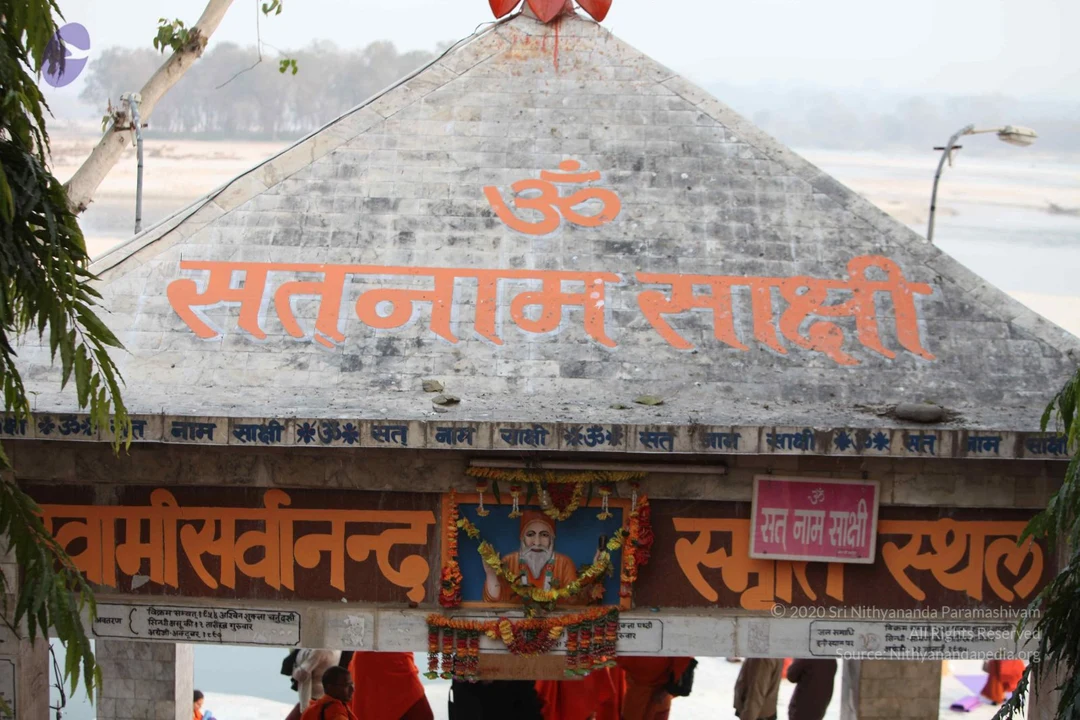
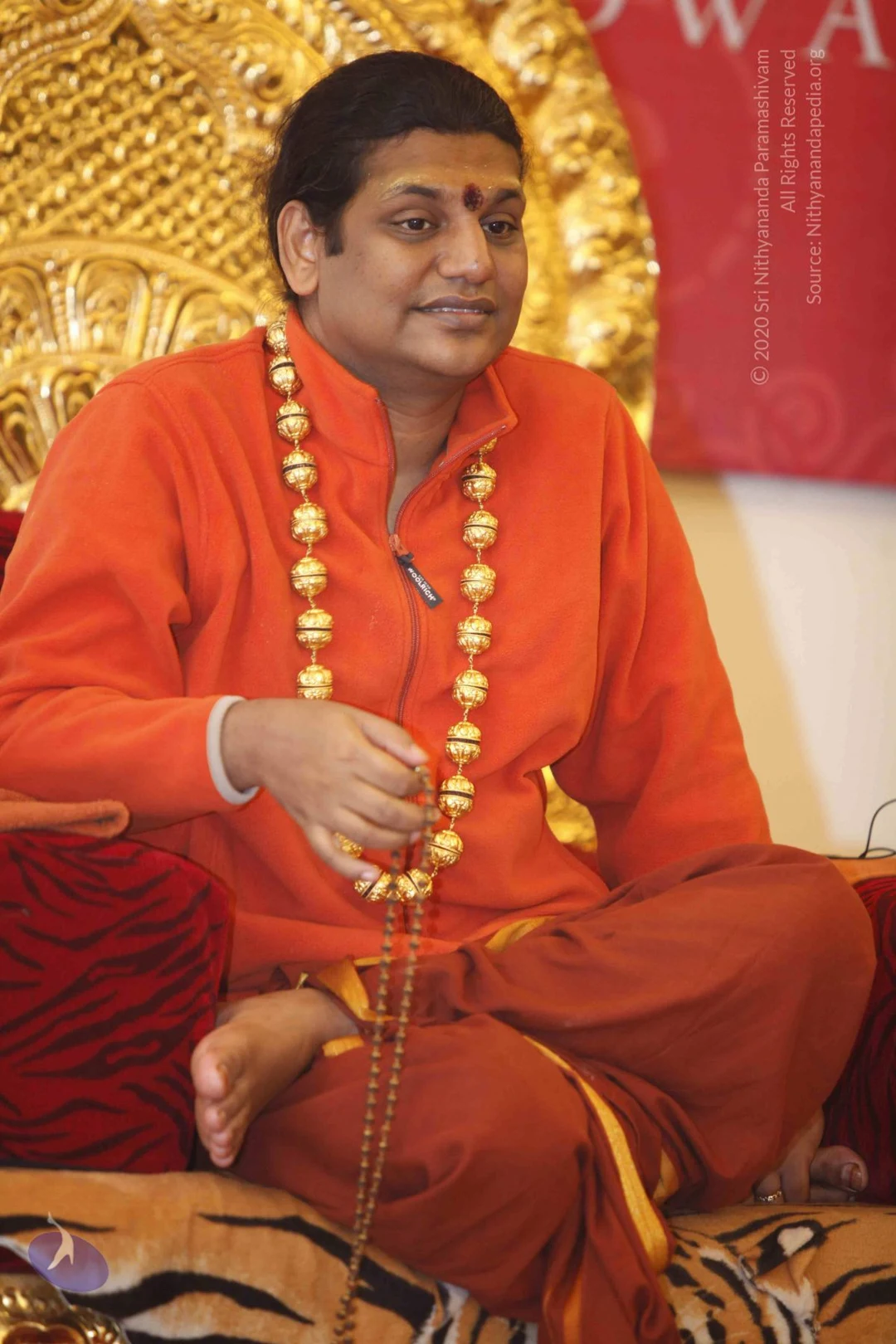
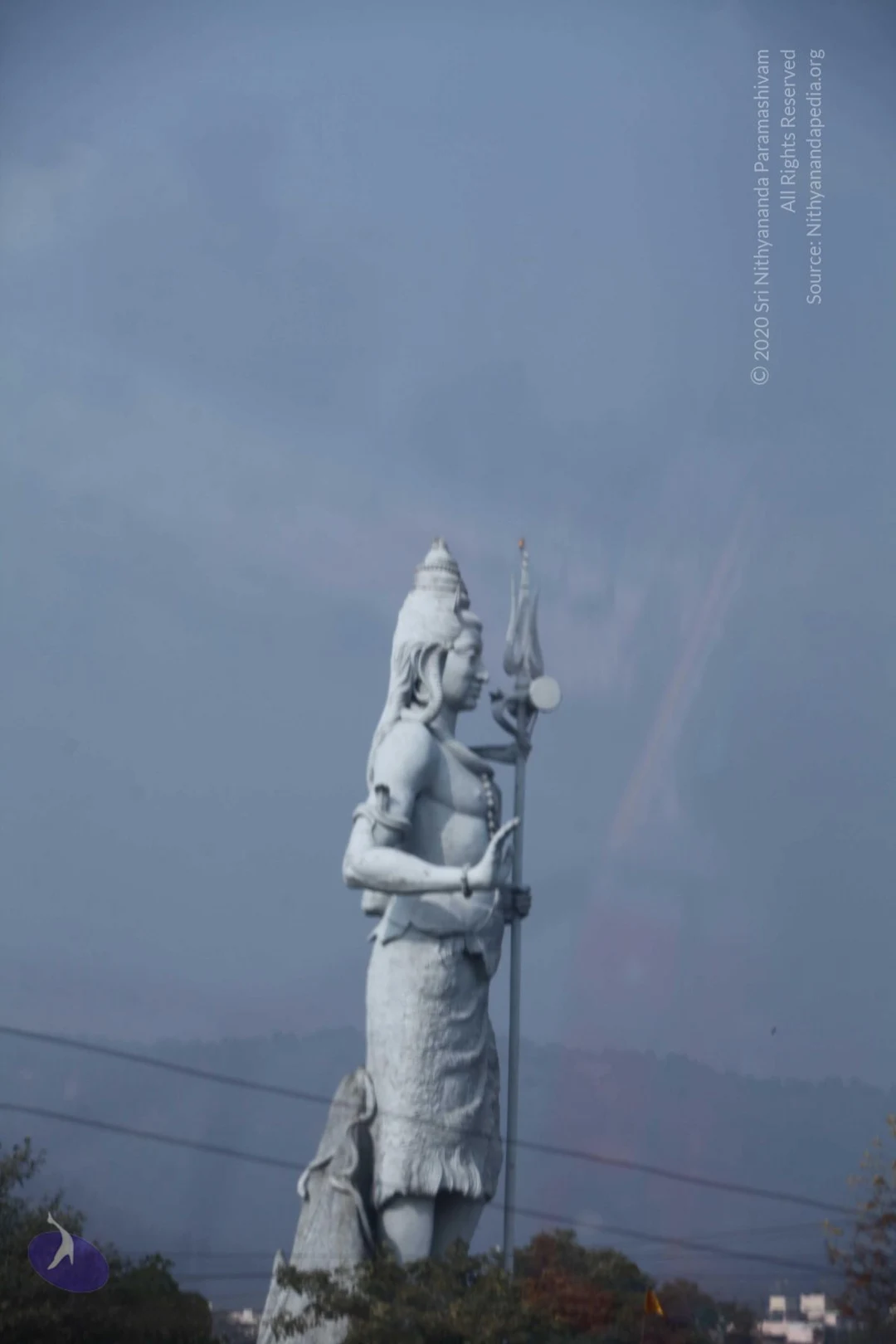
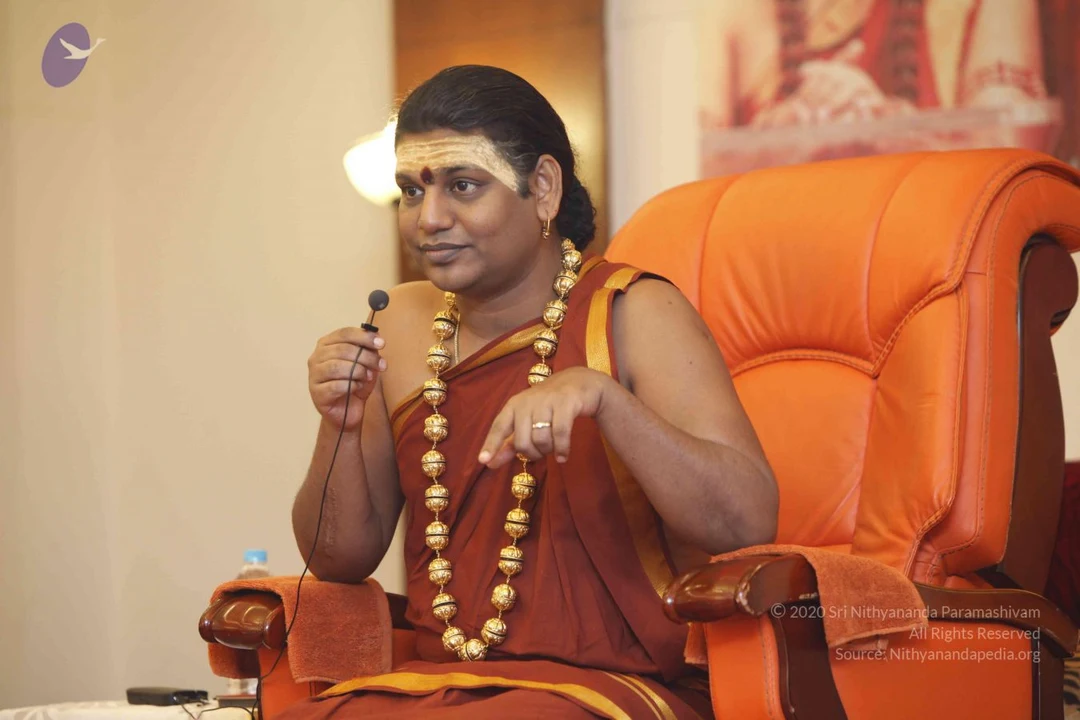
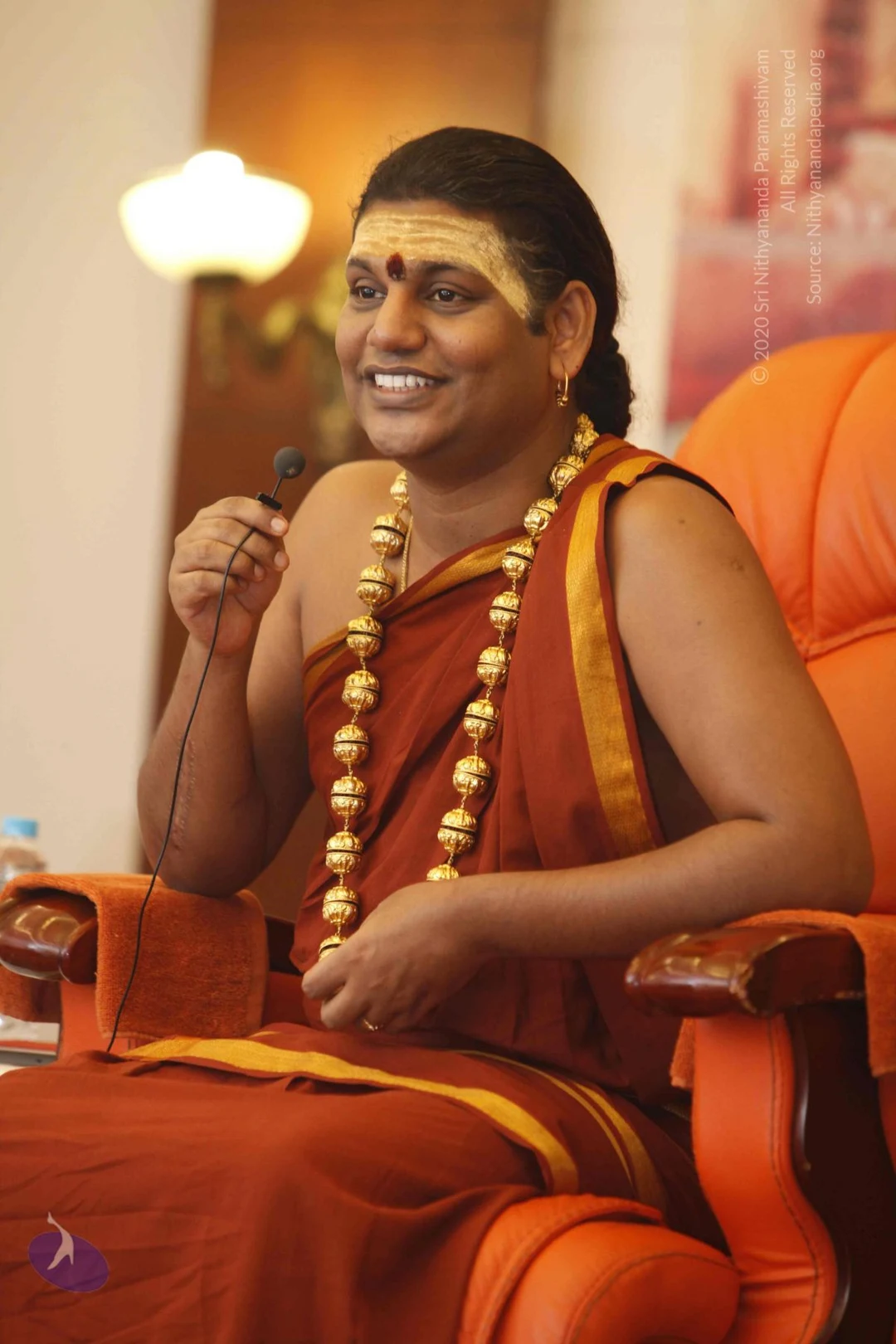
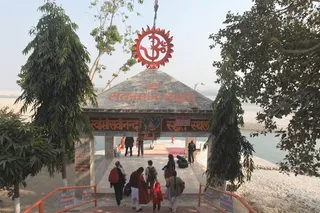
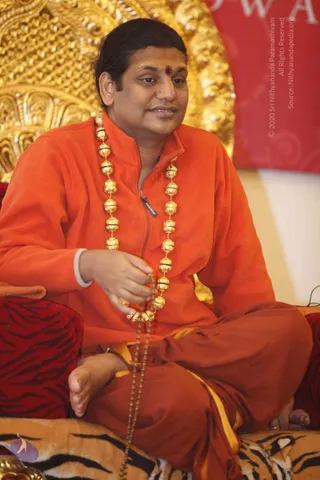
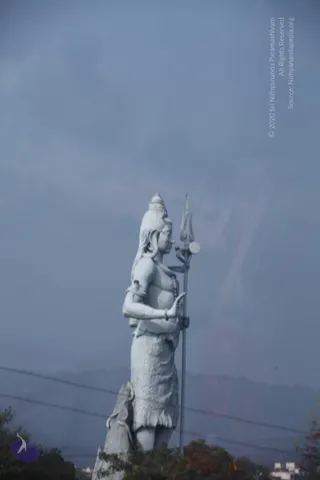
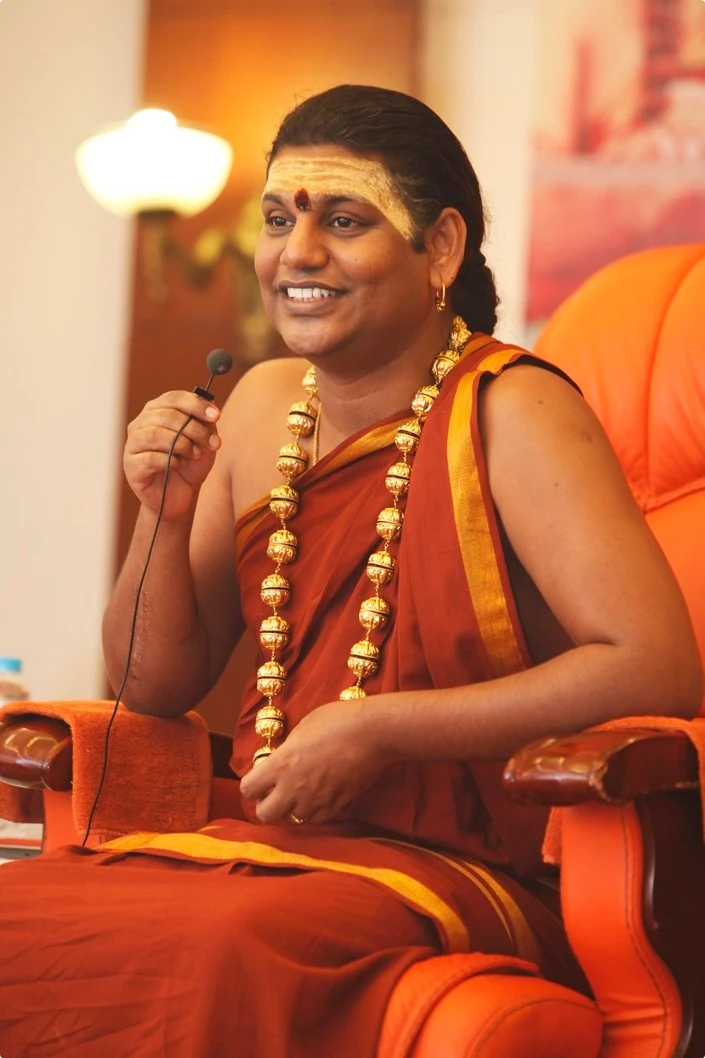
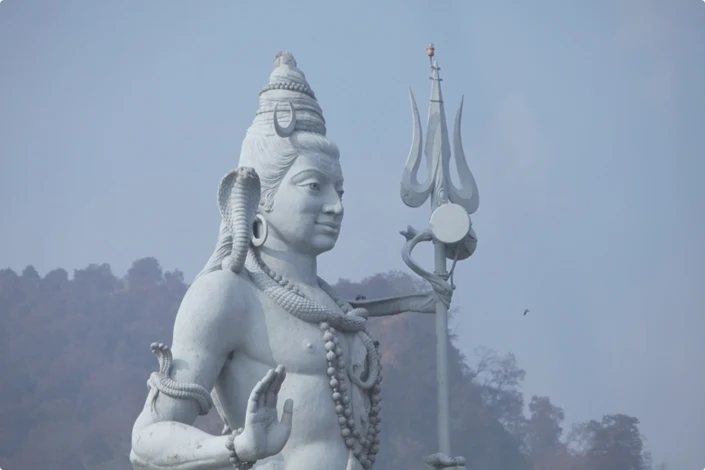
A smiling man sits in an orange leather armchair, holding a small clip-on lapel microphone near his chest with one hand. He wears a rust-orange wrap with gold-bordered edges and a long strand of large gold beaded necklace, with gold-edged shawl draped over the shoulder. His forehead bears a white sandalwood-style band with a red dot, and his dark hair is swept back into a long braid. Behind him a warm lamp glows on the wall and a red-and-white poster is partly visible at the right. The setting suggests a seated talk or satsang.A large white stone statue of Shiva stands against a hazy blue sky with a wooded hillside behind it. The deity murti has a tall matted topknot, a coiled cobra over the shoulder, a bead mala and ornaments, and holds a tall trident with a small round disc at its shaft. The right hand is raised in a blessing gesture. No people are visible.A photograph of a riverside ghat structure with a pyramidal stone roof, painted red and orange Hindi lettering, and a large red-orange circular emblem bearing Om symbols hanging above the entrance. Several people walk up a stone path and steps toward the entrance, some carrying bags, one in a red top with a small child in red. The water and sandy riverbank are visible behind the structure, with trees framing both sides. No one is identifiable as a person in this scene.

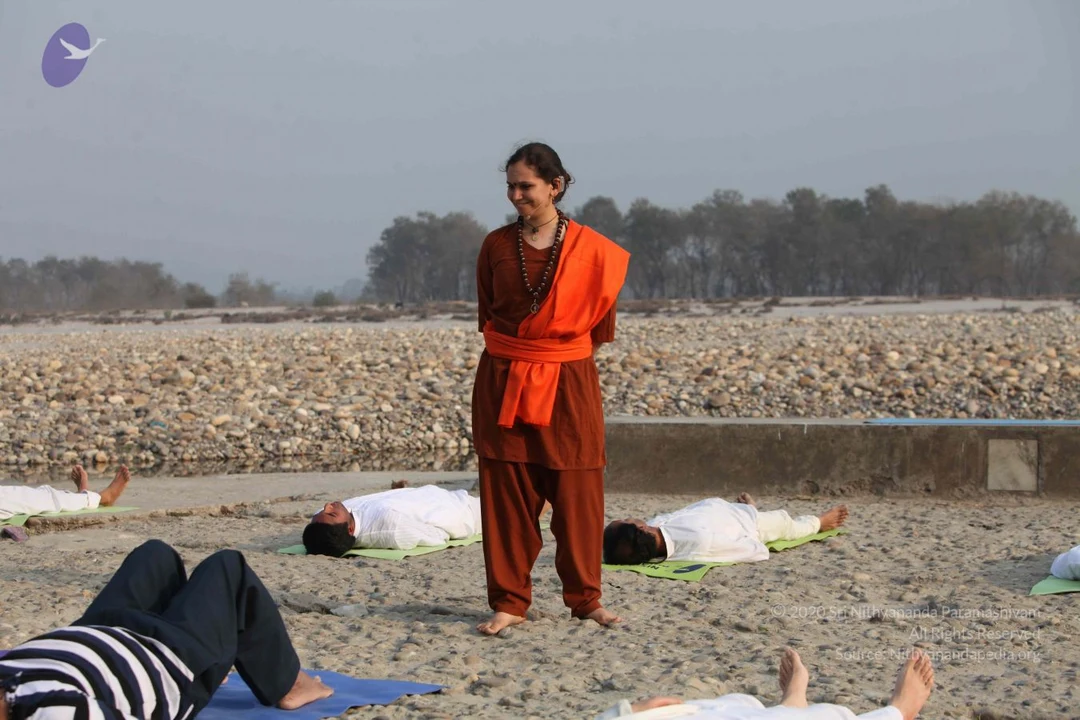
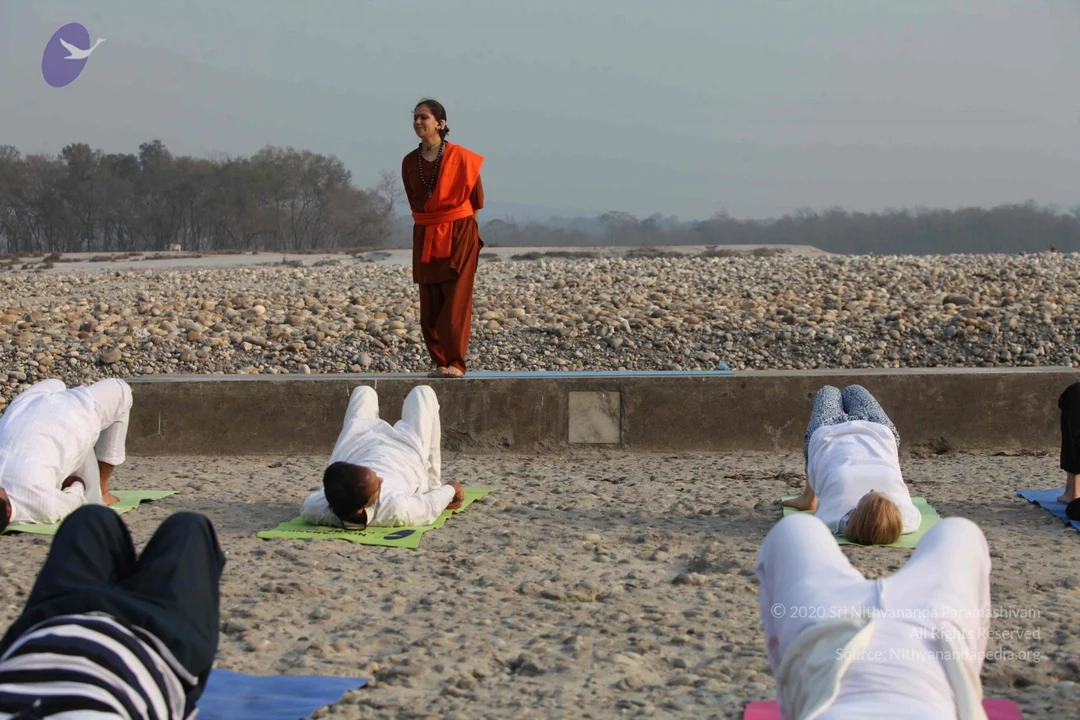
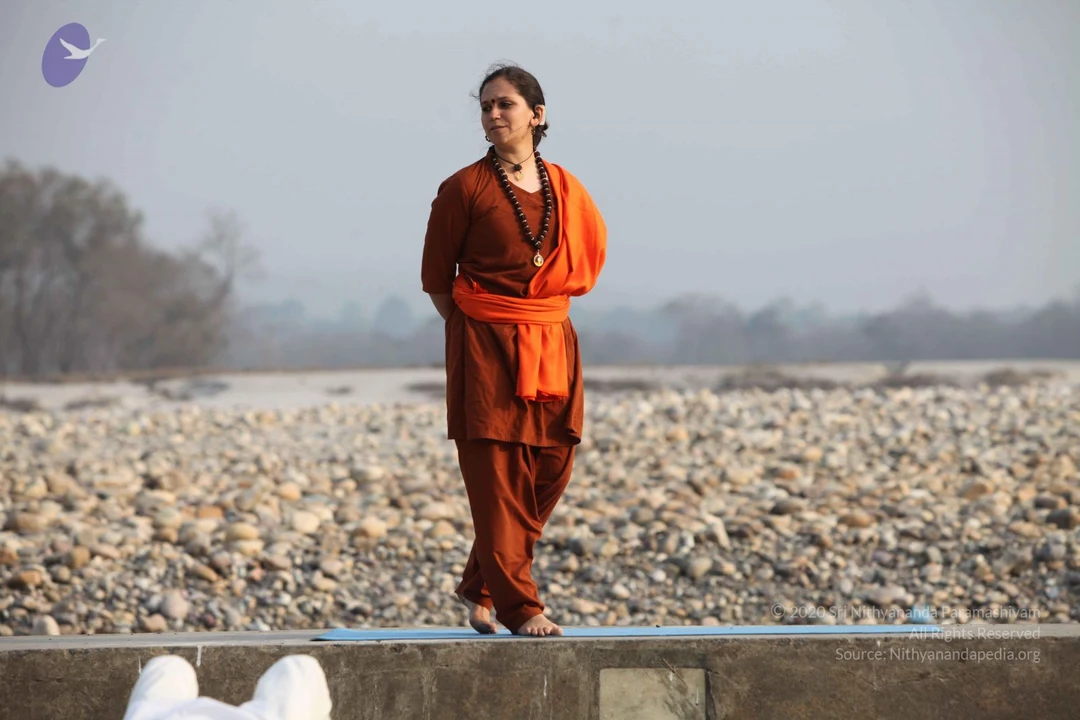
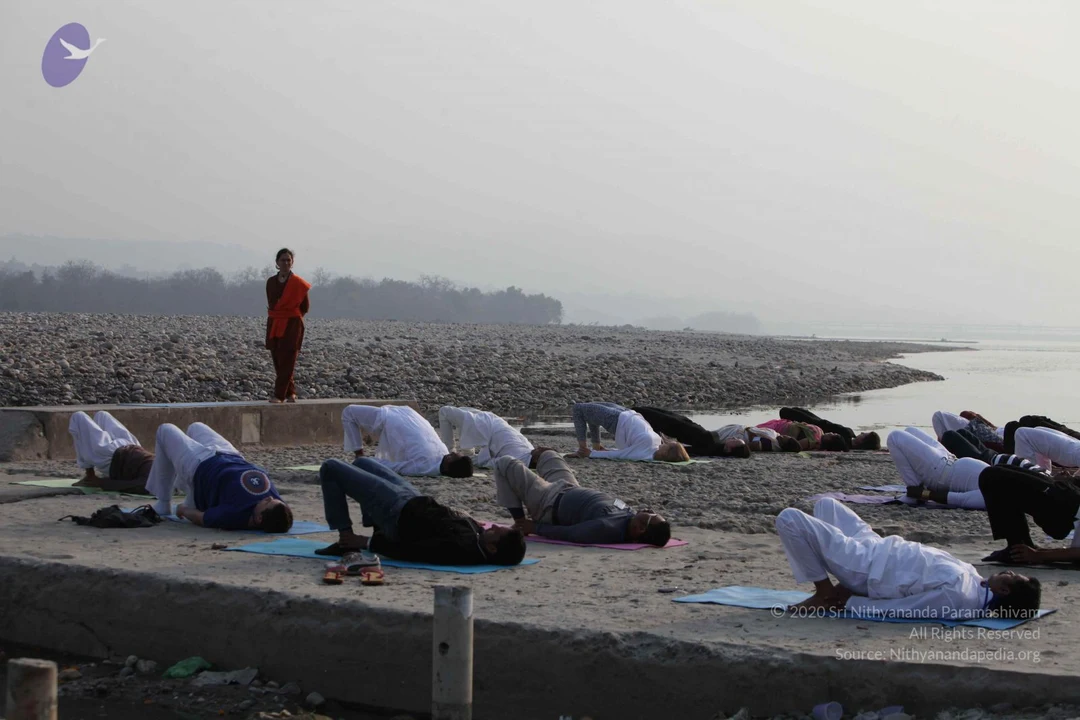
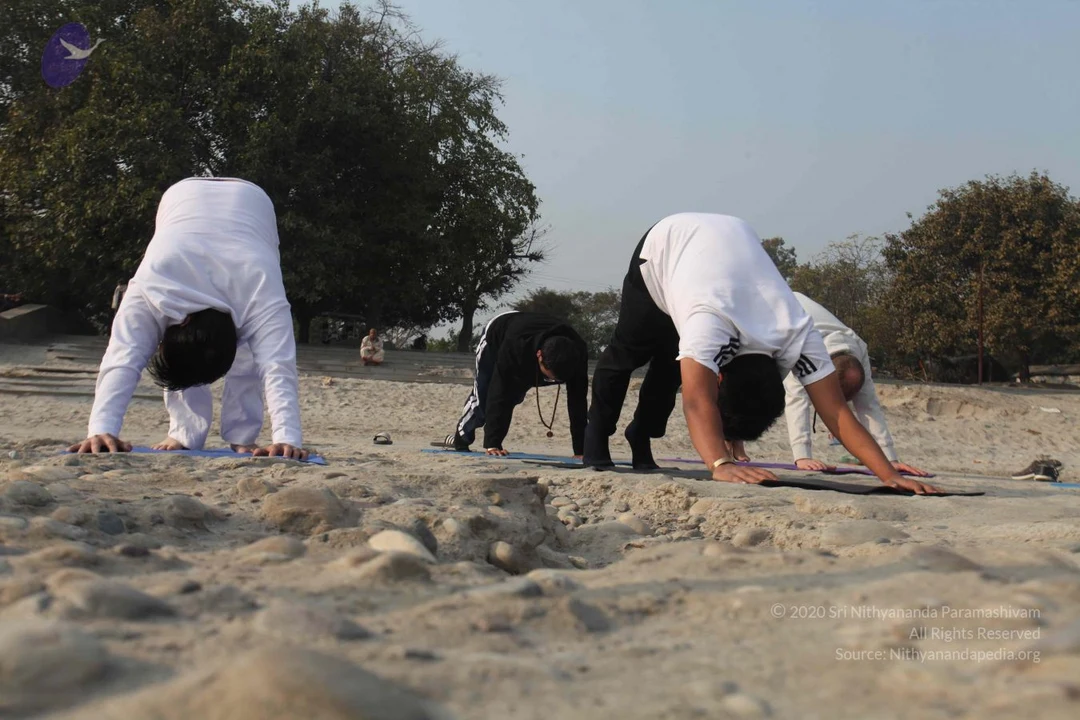
Yoga on the Banks of Ganga

1 photoSource gallery
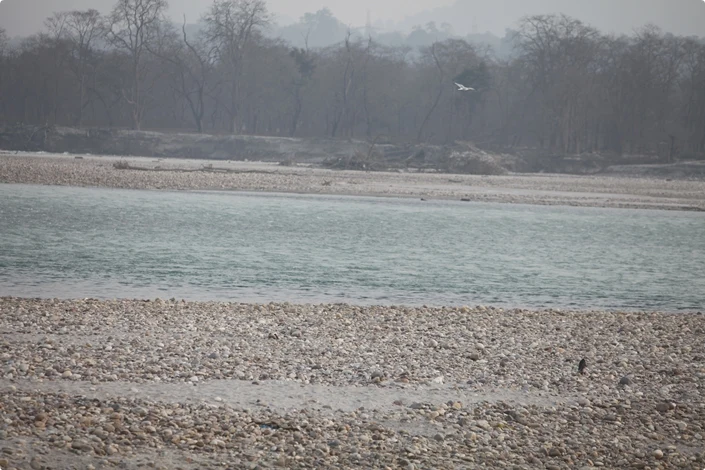
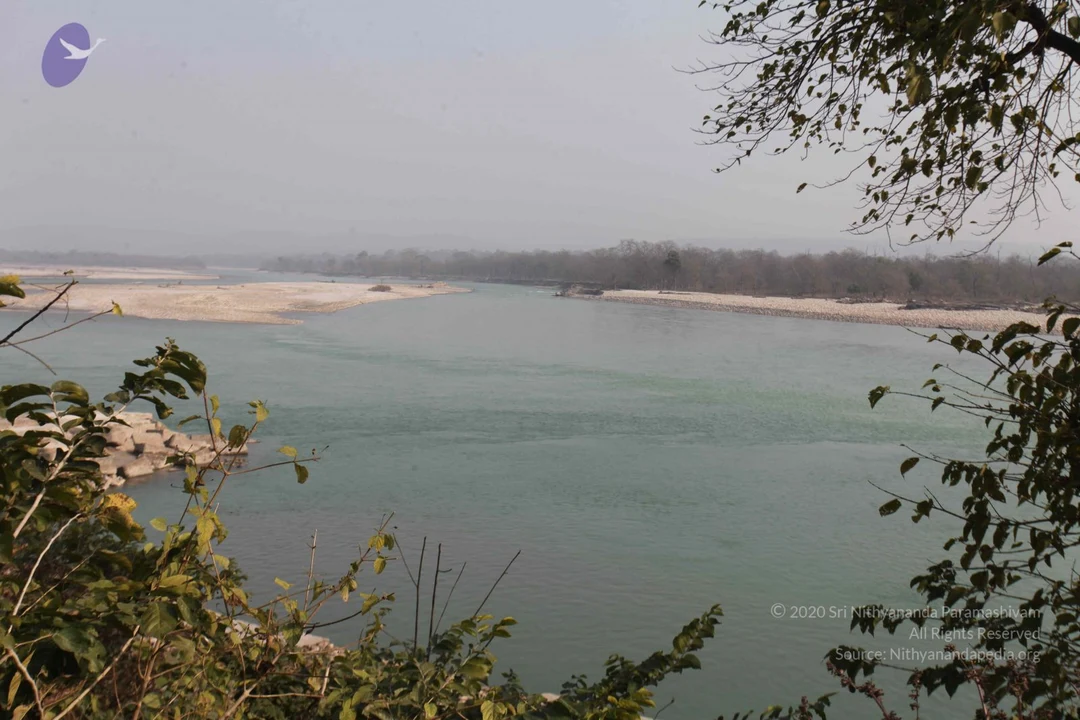
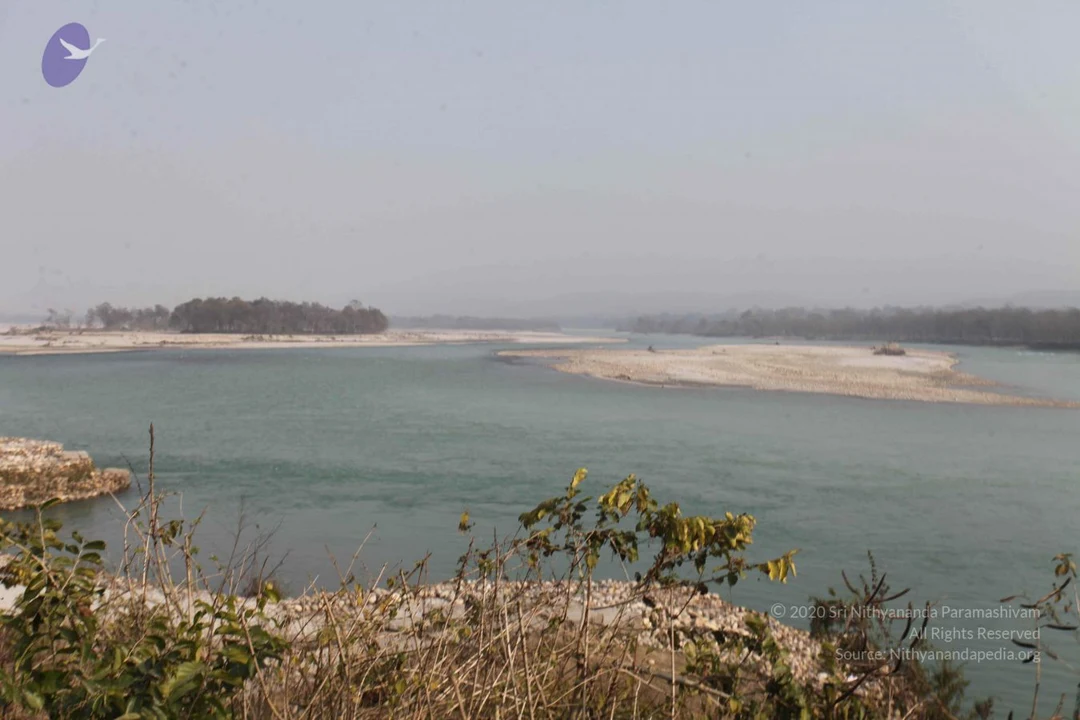
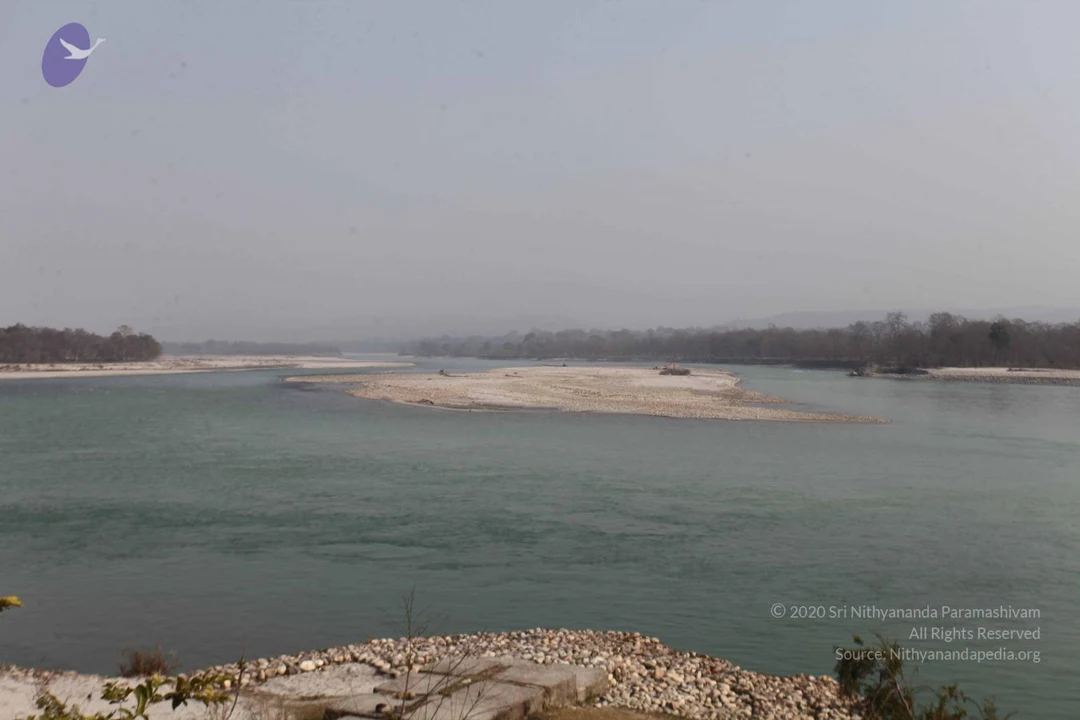
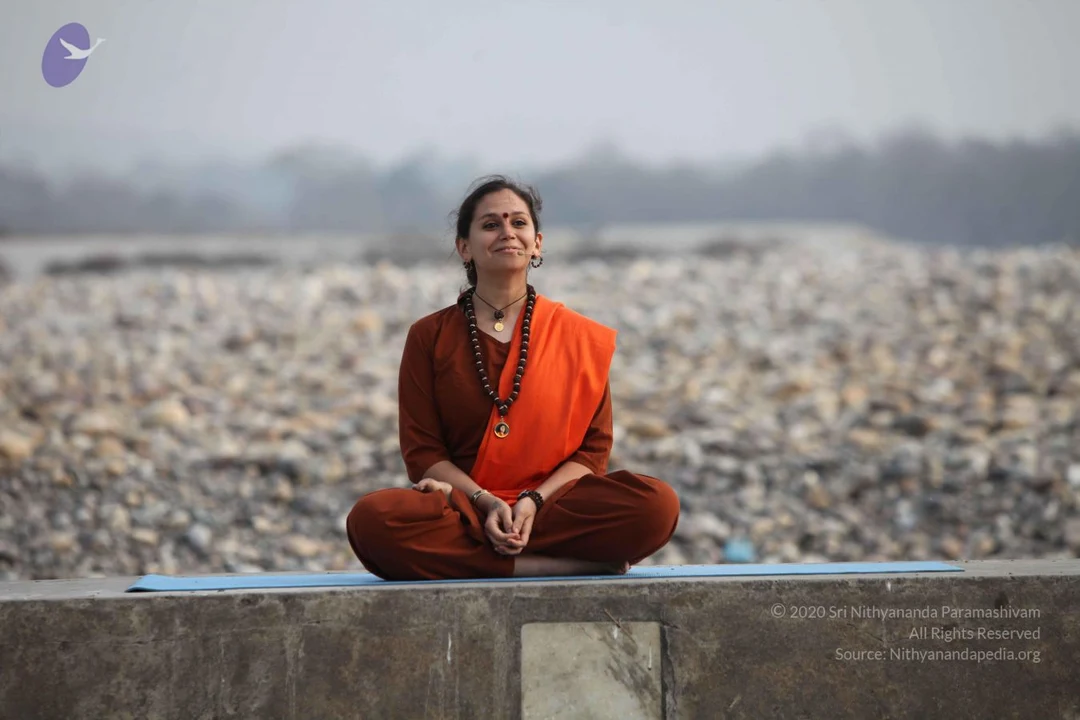
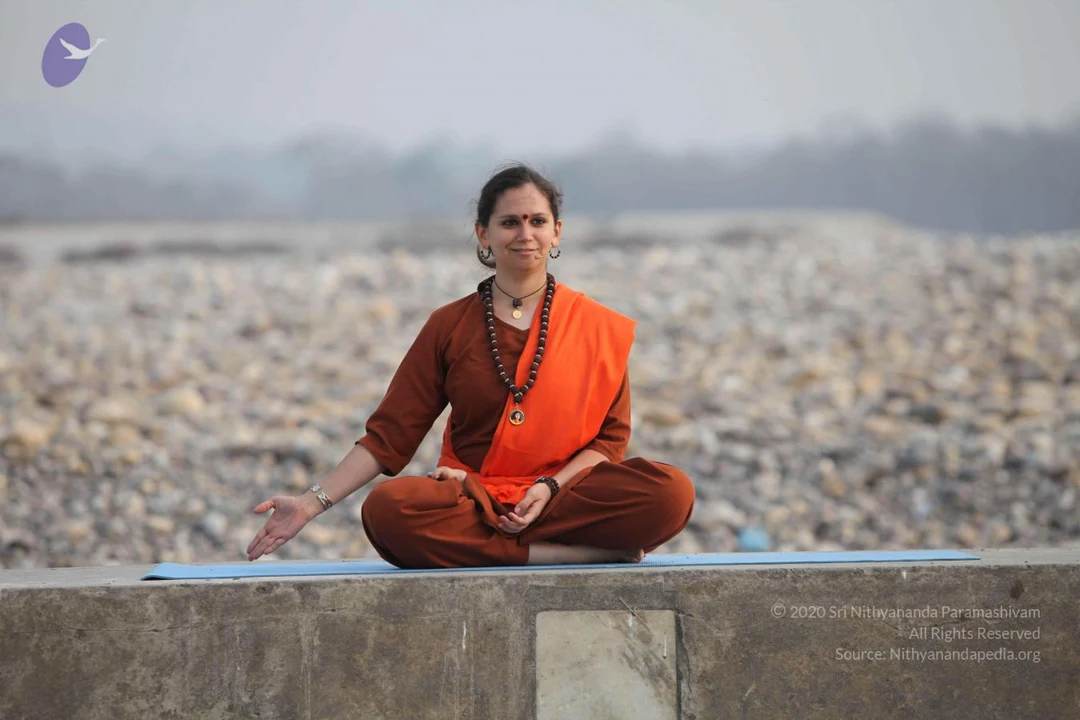
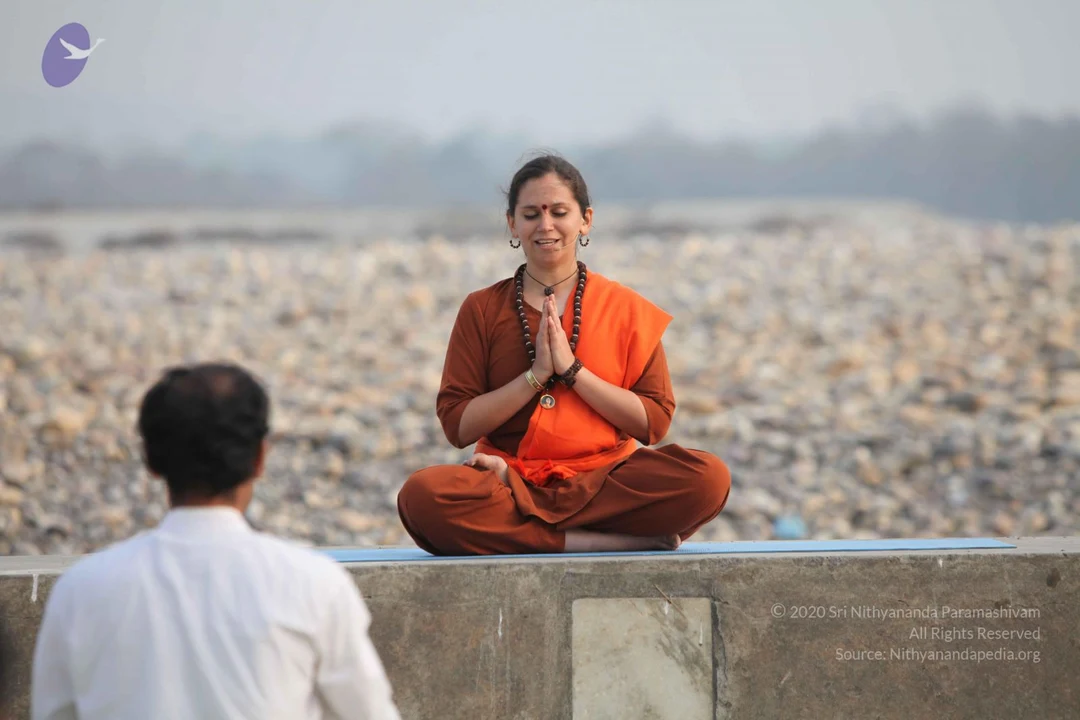
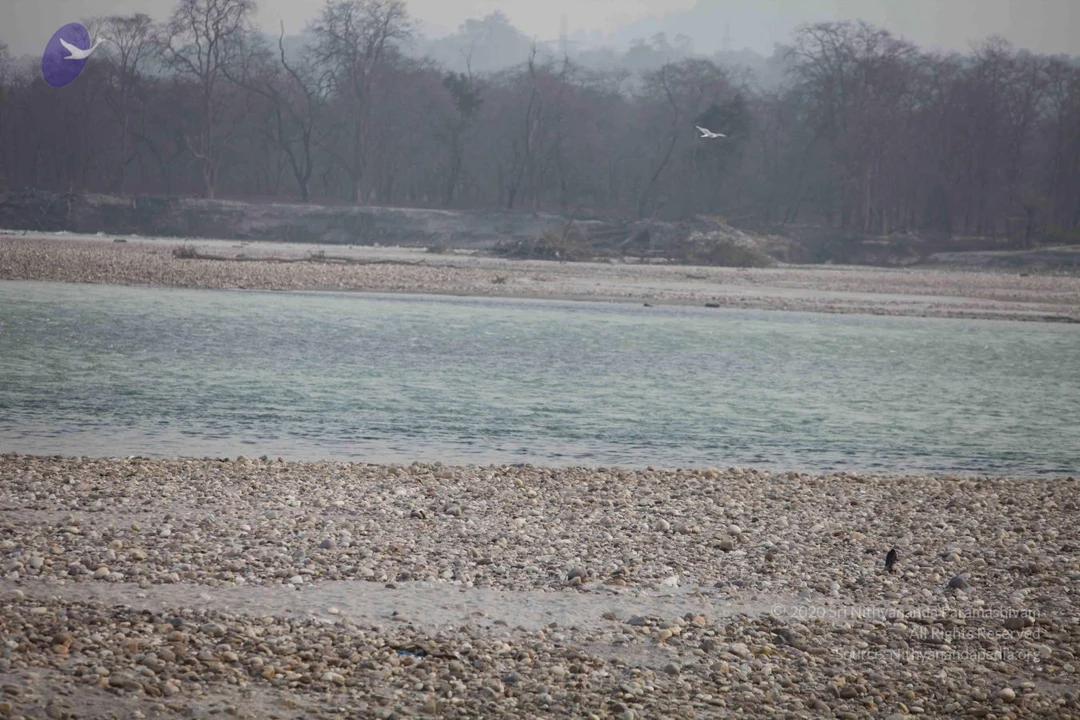
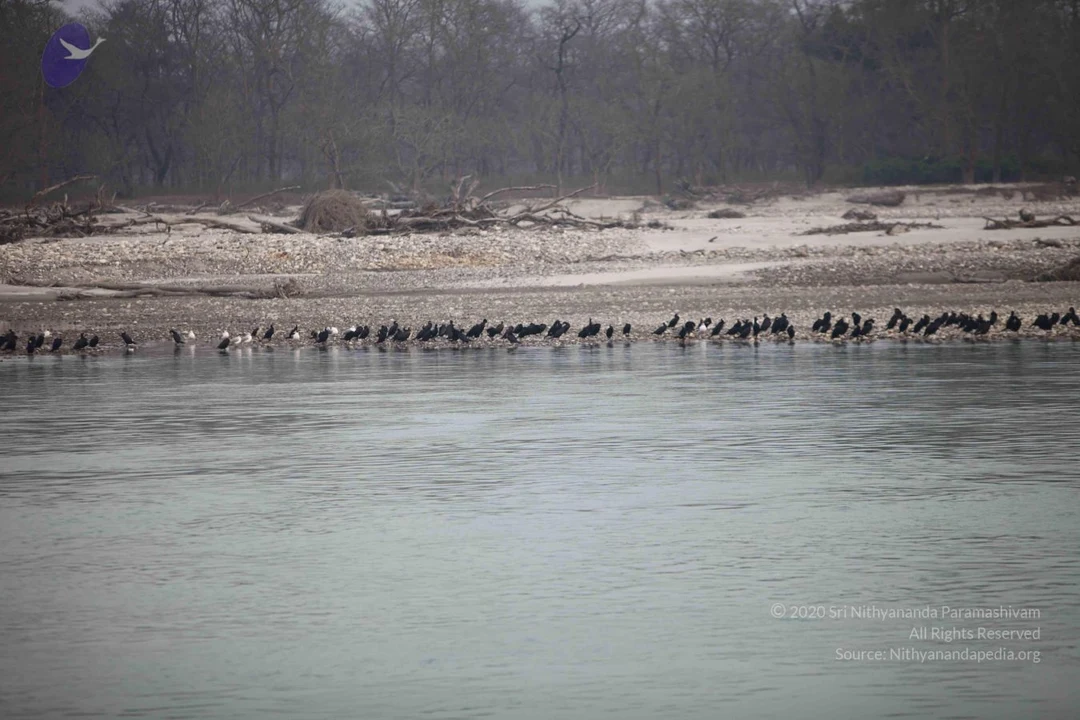
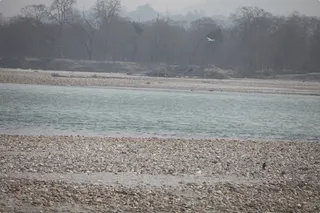
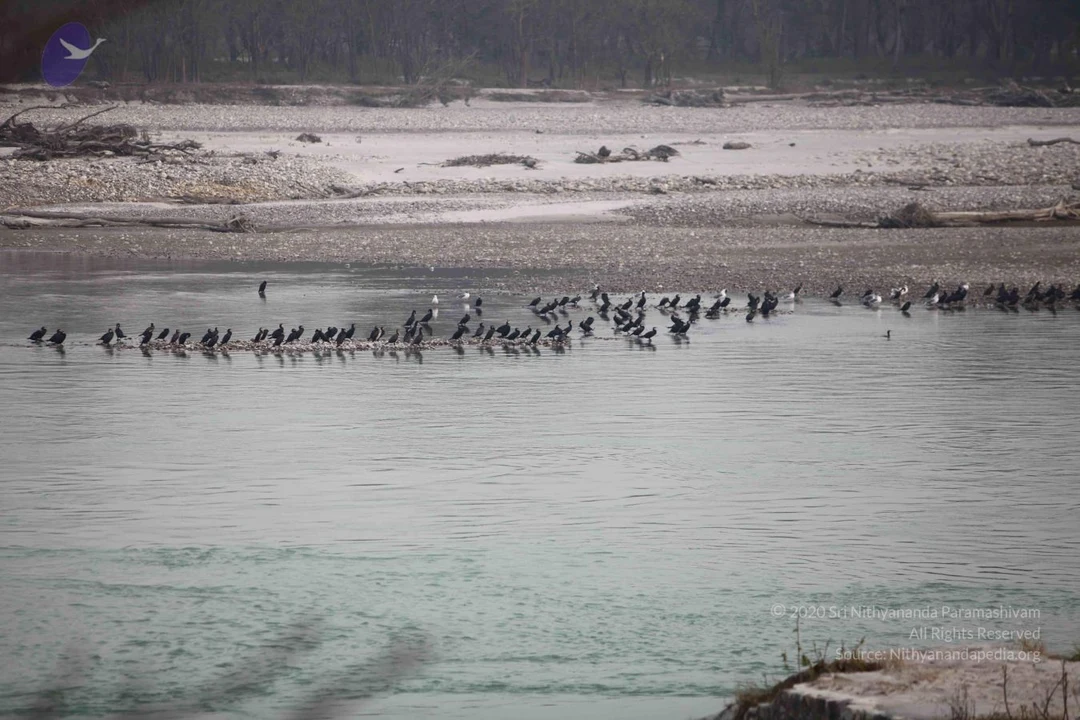
A hazy landscape photograph of a wide river with pale turquoise, calm water running across the middle of the frame. In the foreground a broad bank of smooth grey and white pebbles stretches across the bottom edge, with a small dark bird standing among the stones. Beyond the water, a sandy bar and a line of bare, leafless trees and dense woodland fill the background under a grey, misty sky, with a white bird in flight above the trees. No people are visible.

Nithya Satsang
2 photosSource gallery
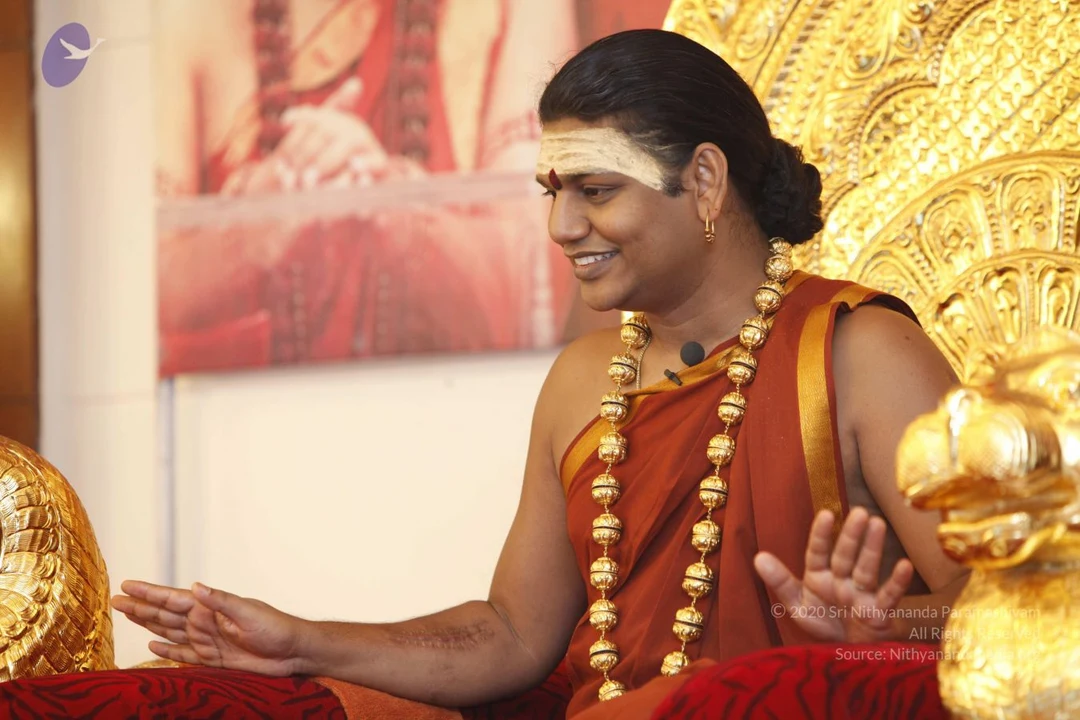
A smiling man sits on an ornate golden throne with carved lion-head armrests and a gilded arched backrest, a red-and-black tiger-striped cushion beneath him. He wears a saffron-orange robe with gold trim, a long gold bead mala around his neck, and white tripundra vibhuti with a red kumkum dot on his forehead. He raises his right index finger as if making a teaching point. A small microphone clips to his robe. Swamiji (probable): a person presented with long hair, saffron clothing, gold malas and a ceremonial throne, consistent with Paramahamsa Nithyananda in a satsang setting. Single person visible.A standing man in a rust-red and saffron-bordered dhoti and shawl, with a white forehead band, a gold bead necklace, gold earrings and a hair bun, stands at right with hands joined, facing left toward three golden murti figures seated on a red-draped throne in a gold-framed alcove with orange and blue drapery. The central figure wears a tall golden crown, a white and gold garment, a red gem pendant and a jeweled necklace. The figure at left wears a red turban and leopard-print garment. A framed printed information sheet stands at left edge.

Nithya_Puja

21 photosSource gallery
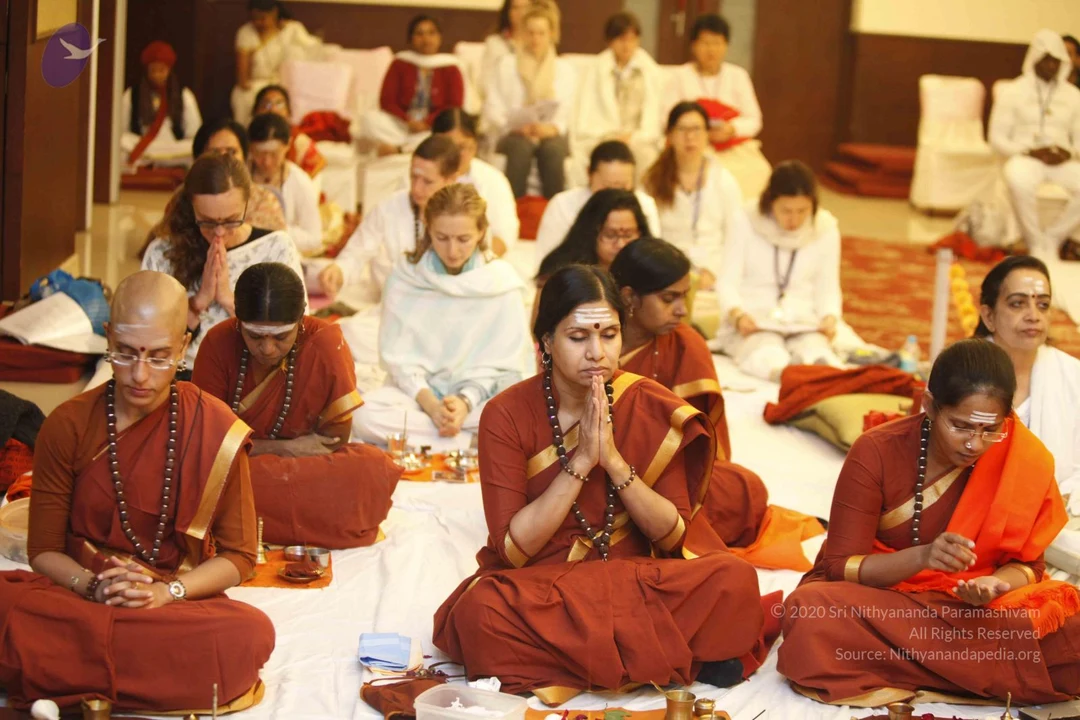
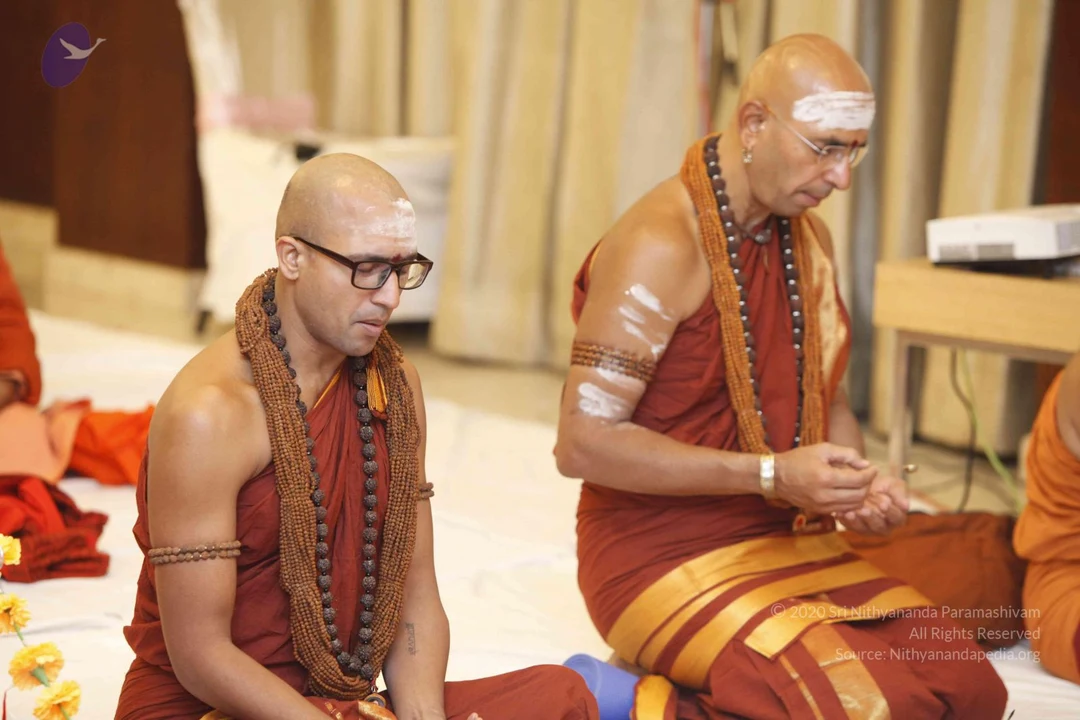
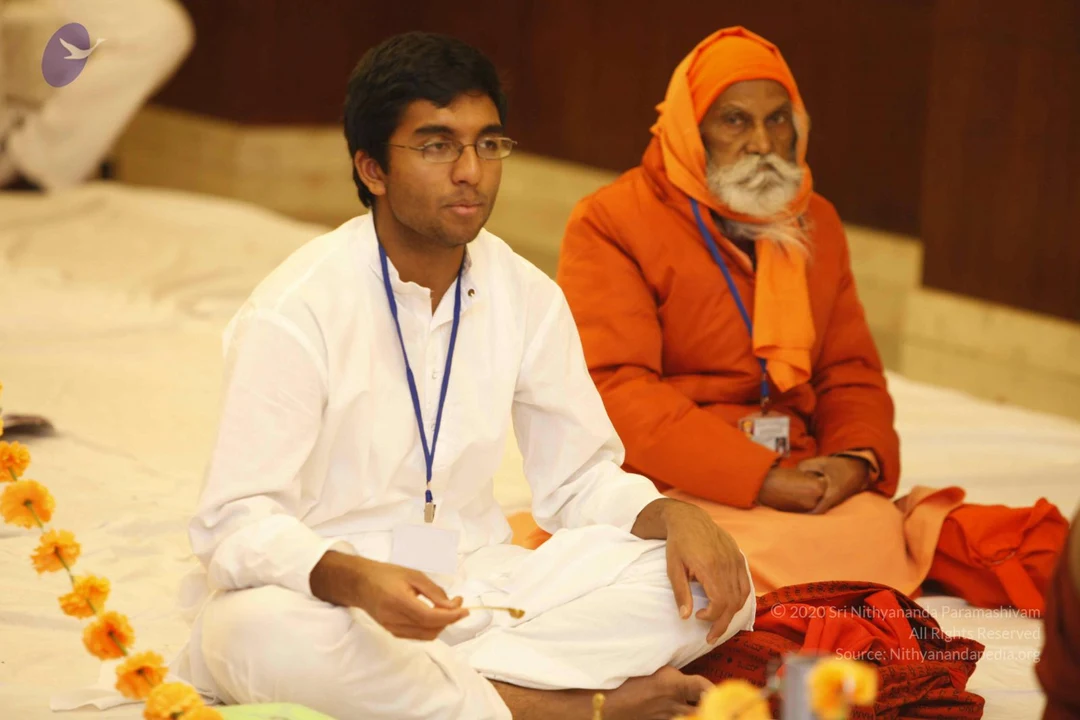
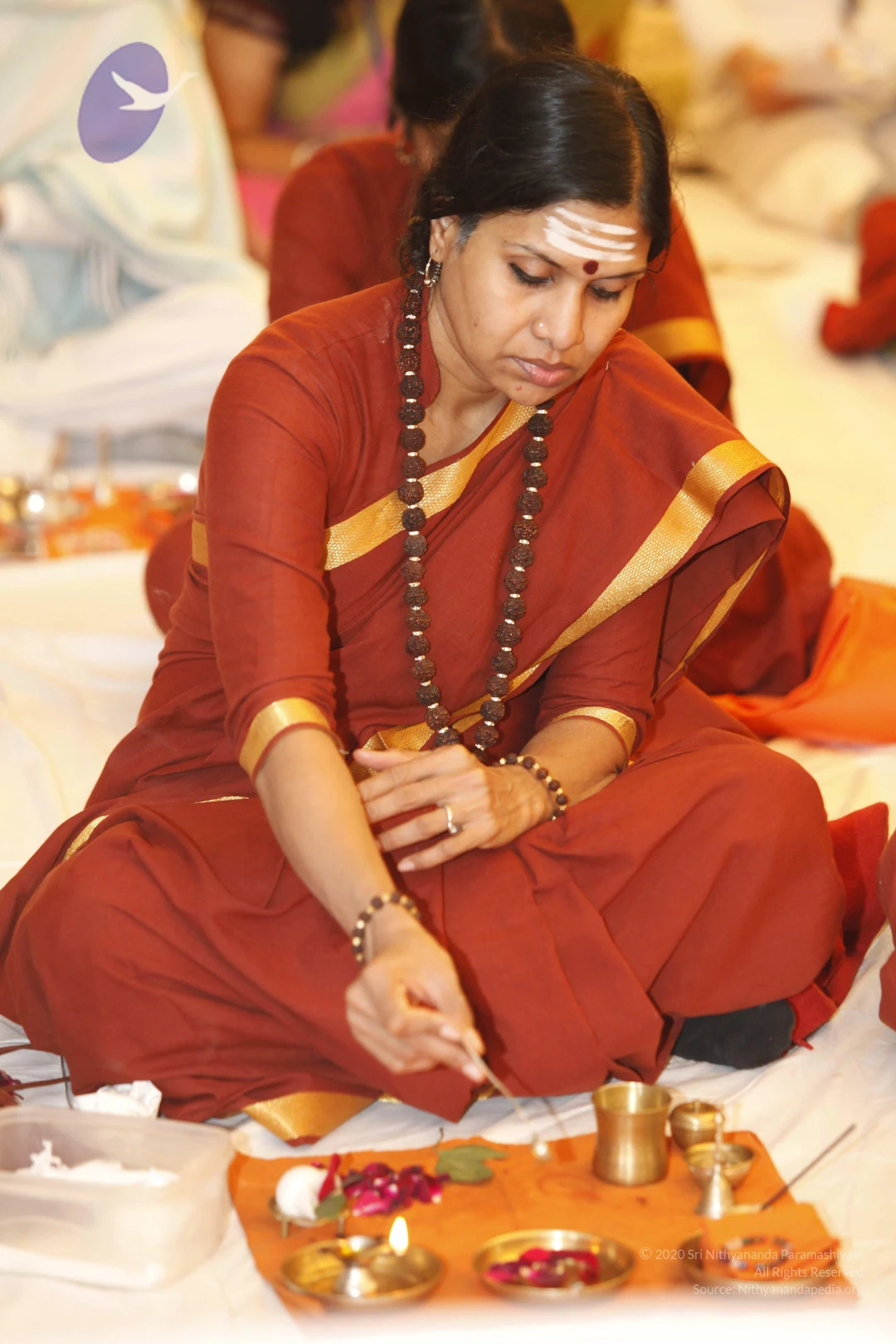
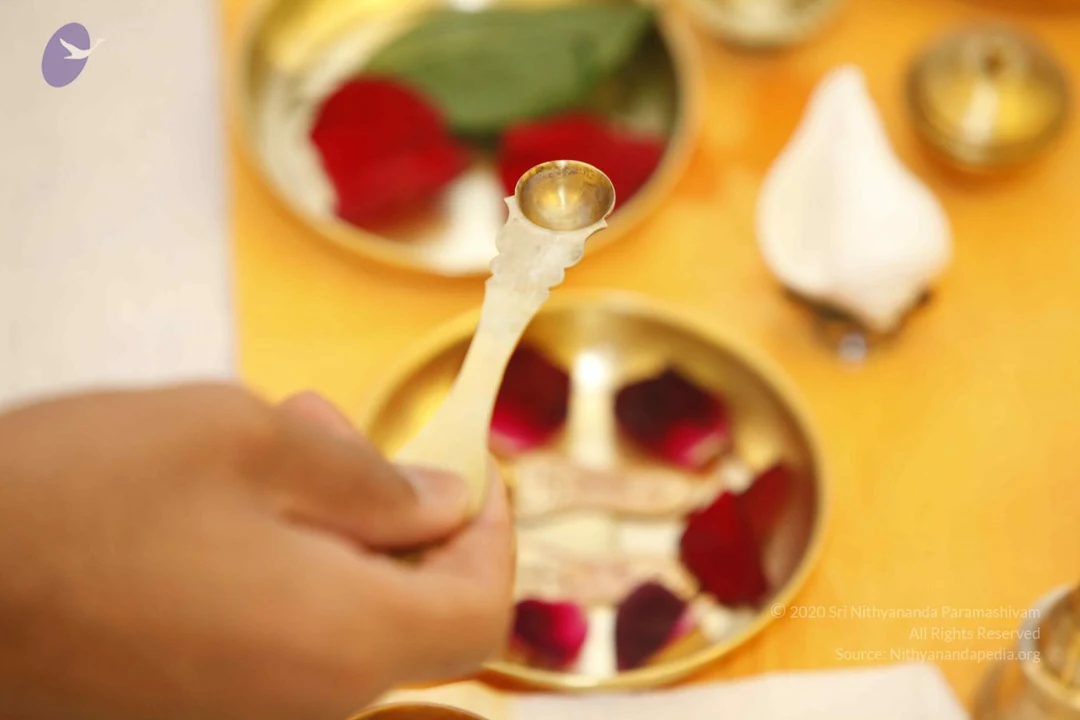
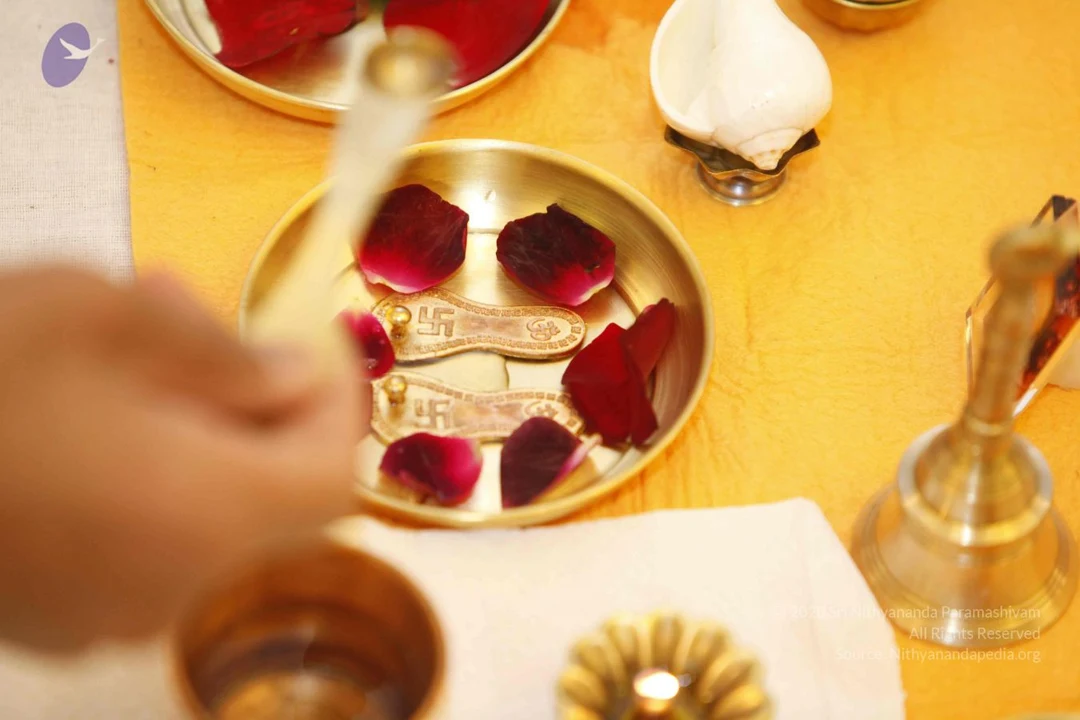
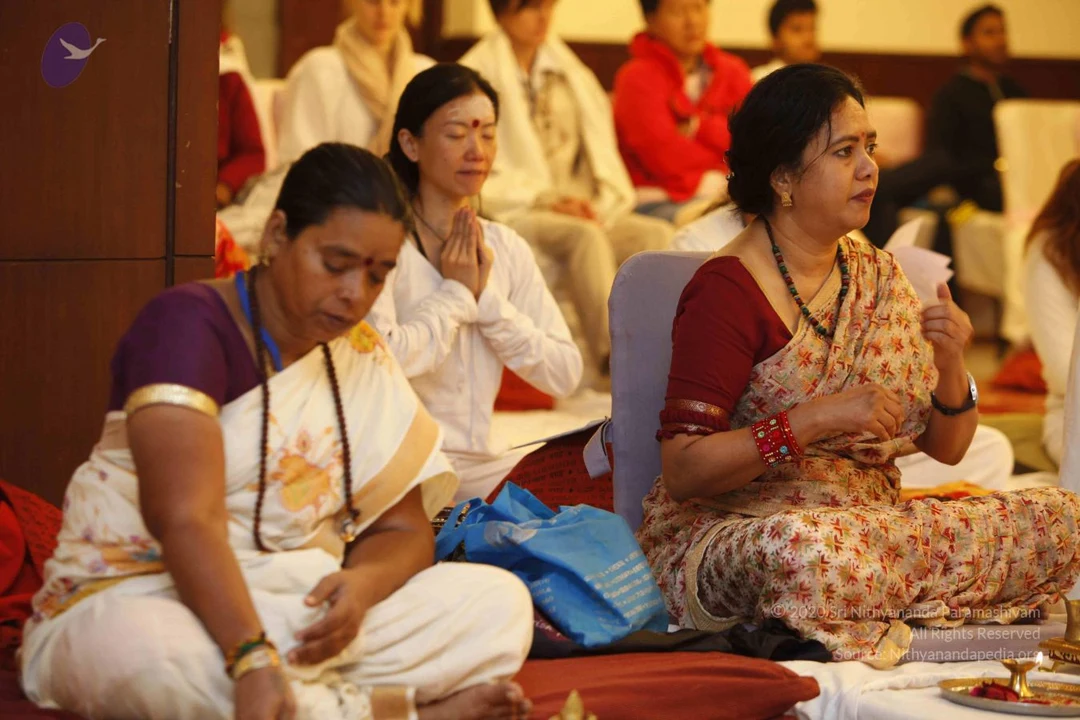
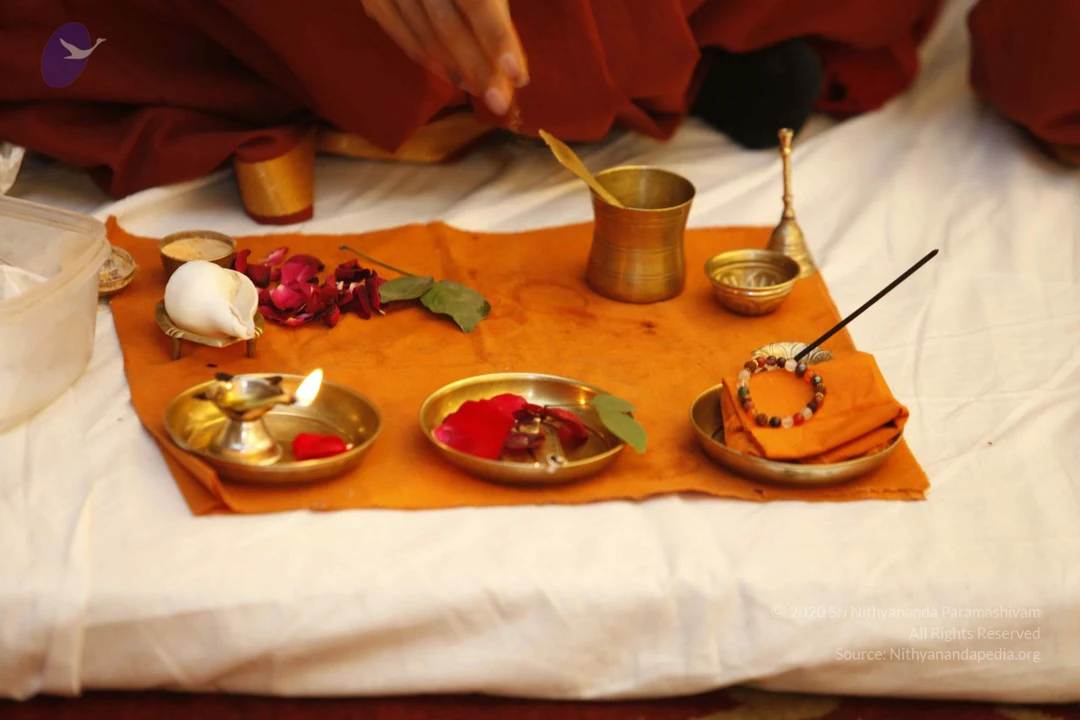
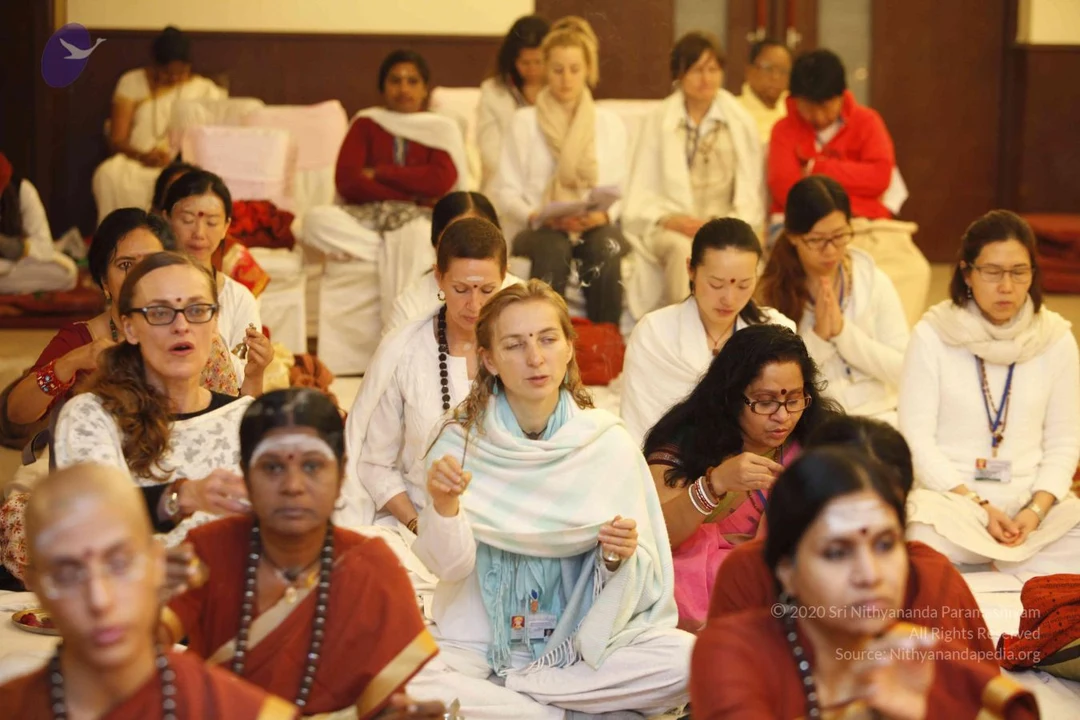
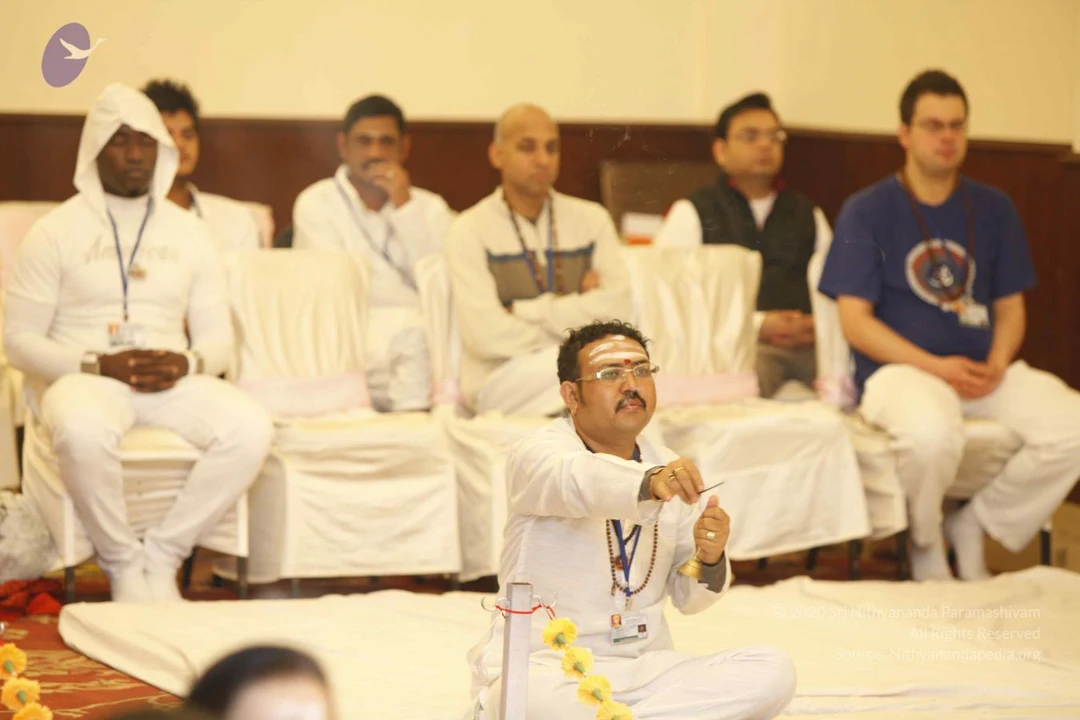
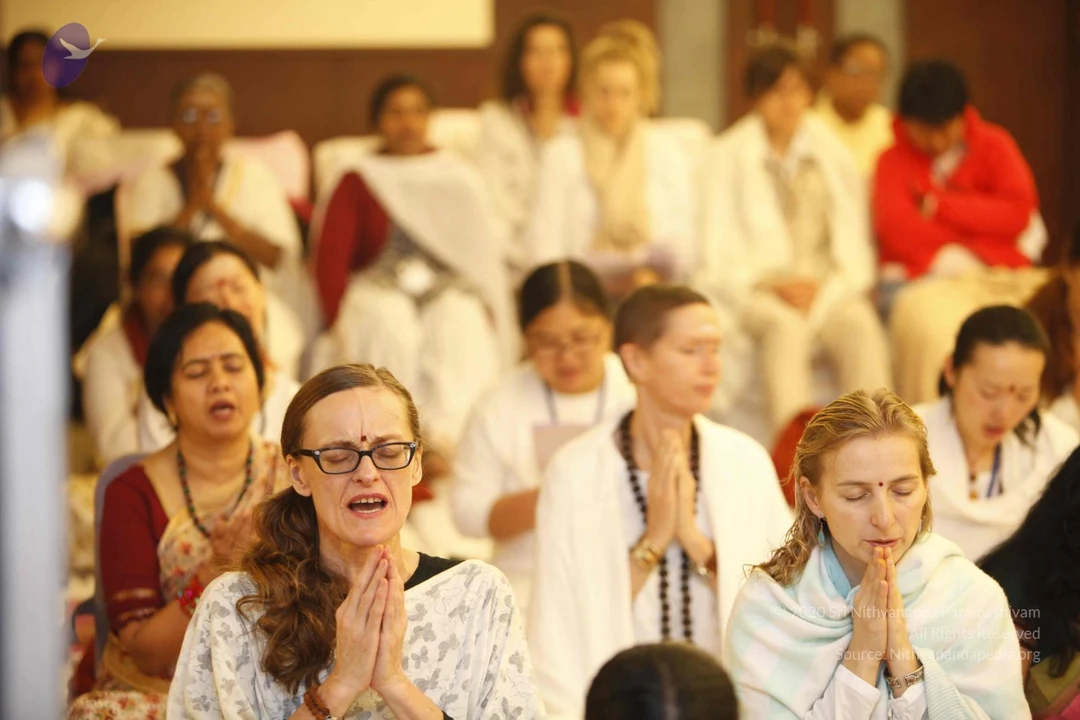
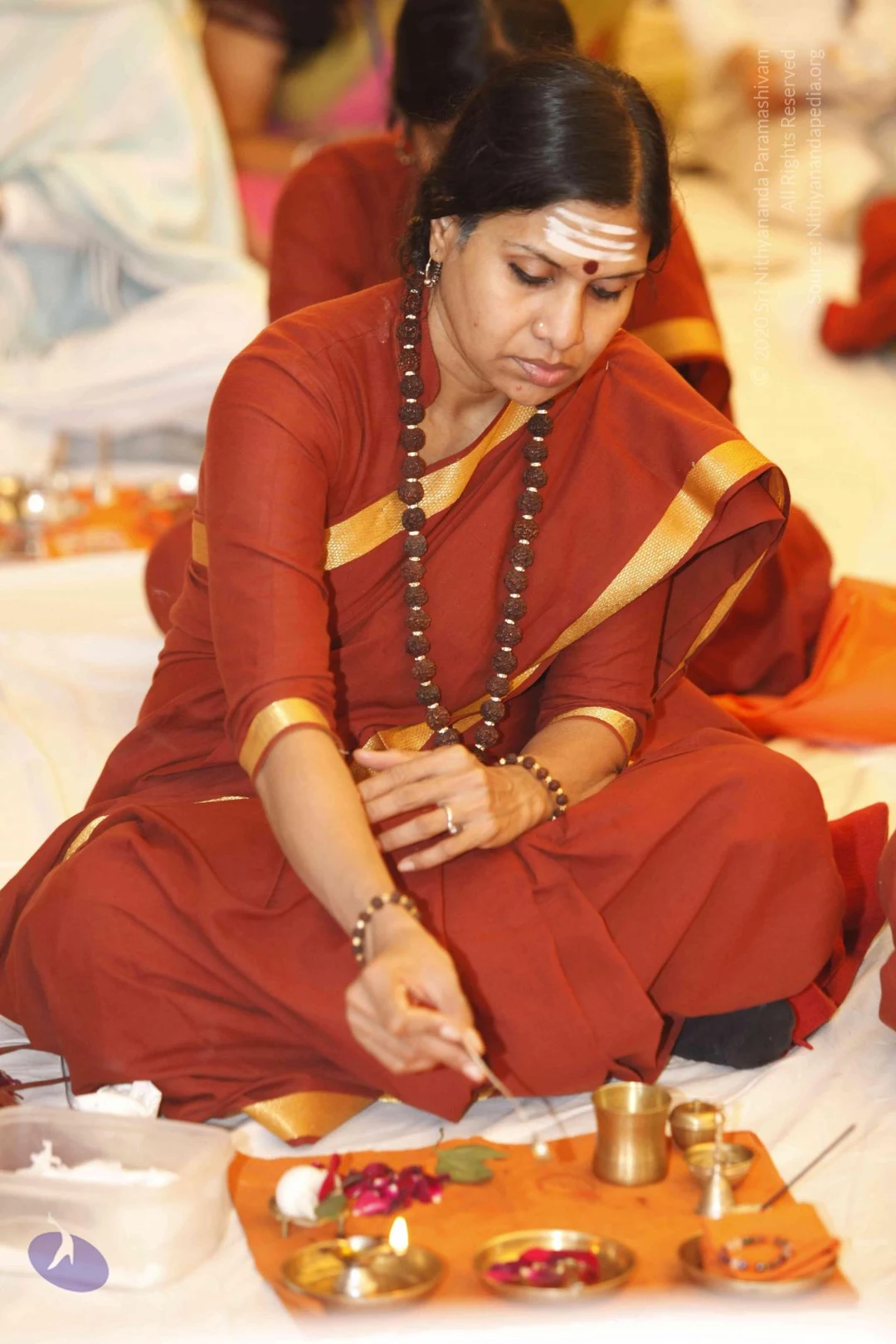
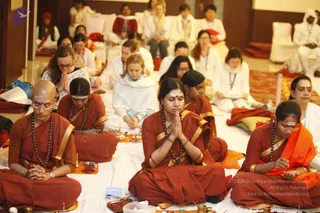
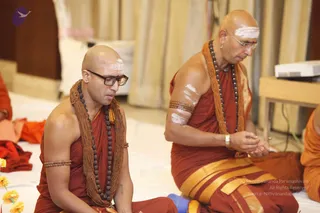
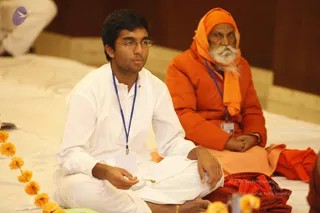
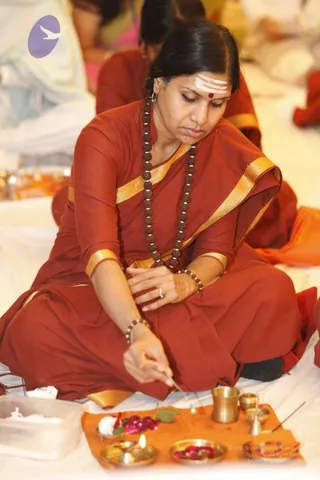
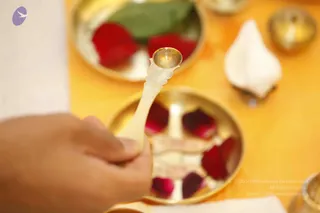
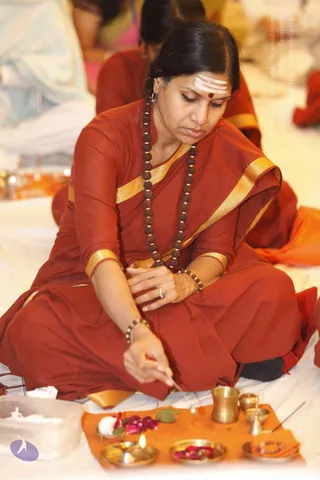
A seated group of devotees in a hall during a ritual gathering. In the foreground, several women and one shaved-headed man wear rust-red and orange-brown robes with gold borders and rudraksha malas, sitting cross-legged on white cloth with brass vessels, small cups and oil lamps before them. The central woman has a horizontal white tilak and presses her palms together in anjali. Behind them, rows of people in white clothing sit on chairs and mats, some with hands folded, some reading. A red cushion and gold-trimmed fabric lie to the right, and a patterned floor cloth and flowers appear near the front. No identifiable a person is clearly present.Two shaved-headed men in rust-red and orange robes sit cross-legged on a white cloth in an indoor hall, with curtains behind them. The man on the left wears dark-rimmed glasses and a long rudraksha mala over his shoulder, with a beaded bracelet on his upper arm and a horizontal white tilak on his forehead. The man on the right, also wearing glasses and a rudraksha mala, has white ash bands on his forehead and arm, a gold-edged dhoti, and a gold wristwatch, and his hands are folded in his lap. Yellow marigolds lie at the lower left and a small white device sits on a wooden table at the right. A partly visible person in orange robes sits at the far right edge. No recognizable a person candidate is clearly established by the visible cues, so the identity is left uncertain.A photograph of two seated men on a white cloth-covered floor at an indoor gathering, with marigold garlands visible at the lower left. A young man in white kurta and pants, wearing glasses and a blue lanyard, sits cross-legged with his hands resting near his lap. Beside him, an older man with a long white beard and moustache wears an orange head wrap, an orange robe and a blue lanyard with an ID badge, his hands folded. The scene is calm and attentive, with a wooden wall behind them.A woman in a maroon-red sari with a gold border sits cross-legged on a white cloth, performing a puja at a small orange-draped altar. She wears a long rudraksha mala with silver spacers, rudraksha bracelets, and white horizontal tilak with a red bindi, and she is lighting or tending an offering with a stick. On the altar sit brass bowls, a brass cup, a small oil lamp, red rose petals, green leaves, a white sweet, and an incense stick. Other seated devotees in red and orange appear blurred behind her.A golden throne with two gilded lion heads flanks a tiger-skin-draped seat with red velvet cushions. Above it hangs a large framed portrait labelled "PARAMAHAMSA NITHYANANDA" showing a smiling man with an orange turban, orange shawl, and red bindi. A woman in white clothing with a covered head kneels at the right, facing the throne and holding an object in her hands. A red offering tray with flower petals and a small brass cup sit on the lower ledge, and an orange cloth is folded at the left. The wall behind shows red banners with partial lettering. The seated figure is a portrait, not a physical presence in the room.Close-up photo of a ritual setup on a yellow cloth. A hand holds a small brass spoon over a brass plate filled with red rose petals and a green leaf. Nearby stand another brass bowl with petals, a white conch shell and a small brass oil lamp at the upper right. No people's faces are visible and no person is identifiable in the frame, so no a person candidate is present.

Satsang
27 photosSource gallery
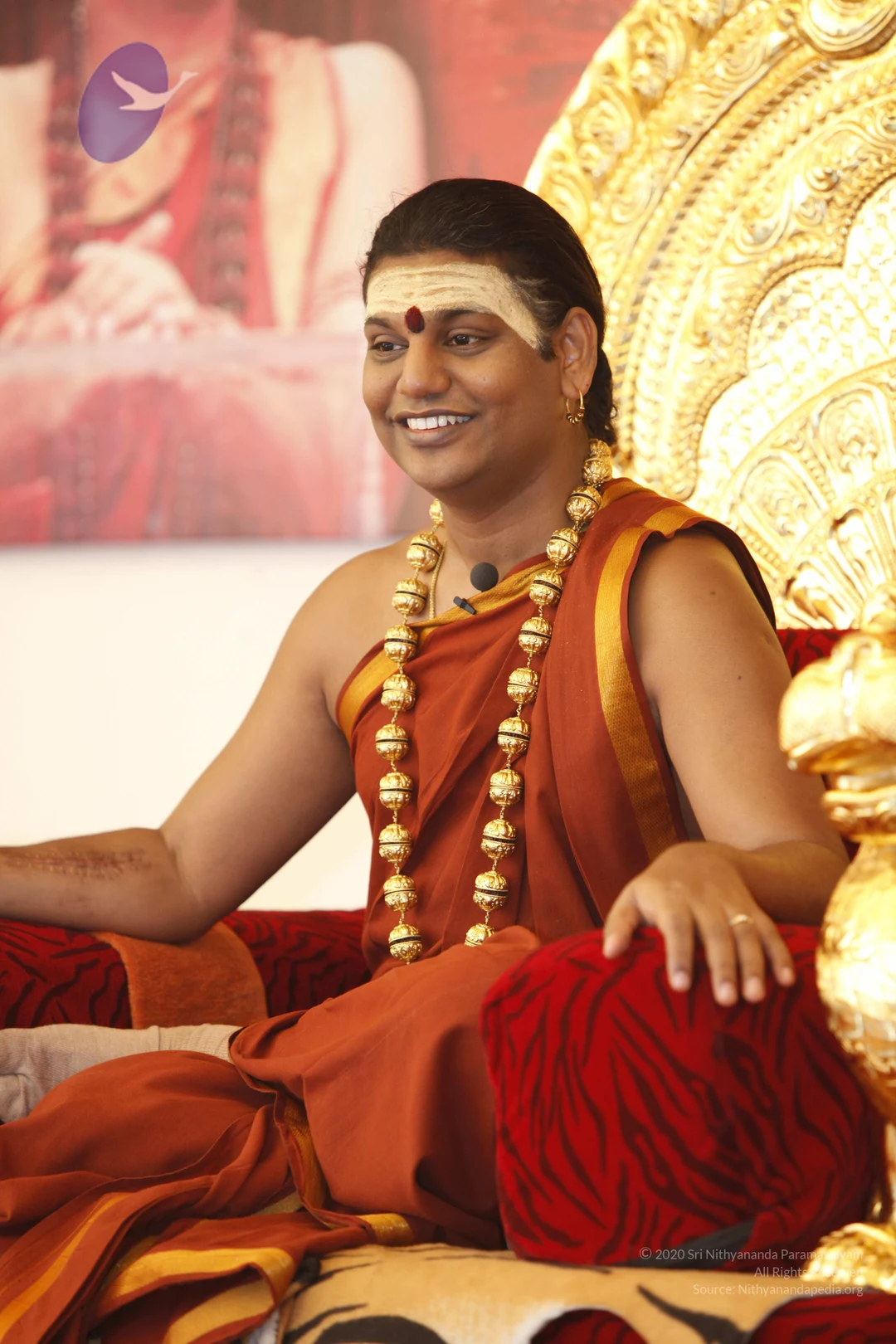
A woman in a rust-orange shawl stands with palms pressed together in namaste before three seated figures on a draped white-covered table. The seated figures are statues in ornate Hindu dress: the central one wears a gold crown, layered jewelled necklaces, a red gemstone pendant and an orange-gold dhoti, while the others wear red-and-gold garments and a turban and gold headpiece. Golden yellow parasols with fringes and a red-and-yellow floral banner frame the scene, with an ornate gilt arch behind. Ritual honoring of deity murti or sacred images.A woman in a rust-red shawl stands at left with palms pressed together in namaskar, facing three seated golden statues on an ornate throne. The central statue wears a tall crown, a jewelled necklace with a red stone and gold armlets, and a yellow sash; the statues on either side wear turbans, layered gold necklaces and red-and-gold garments. Yellow fringed parasols and a yellow hanging with a floral emblem frame the scene, and a white-draped table stands in front of the throne. Two-way video-conference event imagery is not visible; the image shows the statues being honoured in a satsang setting.A woman in an orange-red shawl and matching saffron-red garment stands at left with palms pressed together in namaste, facing three seated golden murti statues on a decorated dais. The central statue wears an ornate gold crown, layered jewelled necklaces and a gold-and-white dhoti, and holds a raised hand. The statue to its left wears a red turban and red robe, and the statue to its right wears a golden crown and gold-embroidered red garments. Yellow and white parasols with tassels frame the scene, a white-draped table and a small red cushion sit in front, and a white elephant figure appears at lower right. Deity murti worship with padapuja-style devotion is depicted.A standing man in a rust-red and saffron-bordered garment stands at right beside a shrine, hands clasped at his waist, with a white vertical tilak on his forehead, hair tied back in a bun, gold-bead rudraksha mala around his neck and gold earrings. Three golden deity murtis sit on red draped thrones against an orange and blue backdrop with green leaves; the central murti wears a tall gold crown, white and gold dhoti, and a red-stoned necklace, while the left murti wears a red turban and leopard-print cloth. A small white sign with red border text stands at left. a person is the standing man, identified by a rudraksha mala, ceremonial gold ornaments and sannyasi-style saffron clothing, and is in_person.A smiling man with a shaved head, white vibhuti lines and a red kumkum dot sits on an ornate gilded throne backed by a carved golden arch. He wears an orange-saffron robe with yellow borders and a long gold-bead mala, with his palms raised in a gesture of speech. Flanking the throne are two golden lion sculptures, and red-and-black tiger-striped cushions and a tiger-striped rug cover the dais. A red banner behind him carries the word RIDWA in white letters. a person is identified by the saffron robes, gold mala and throne, but the appearance cues are limited to attire and setting, so the identity is uncertain. One person is physically present.A seated man in saffron-orange ceremonial robes sits cross-legged on an ornate golden throne with a large arched gold backrest and two golden lion heads flanking the arms, with red velvet cushions and a striped tiger-skin cover beneath him. He wears a long gold bead necklace and a white vertical tilak with a red dot on his forehead, and his hands rest folded in his lap as he smiles. A red banner behind him reads RIDWAR in gold letters, and a small purple logo appears at the upper left.

Darshan

6 photosSource gallery
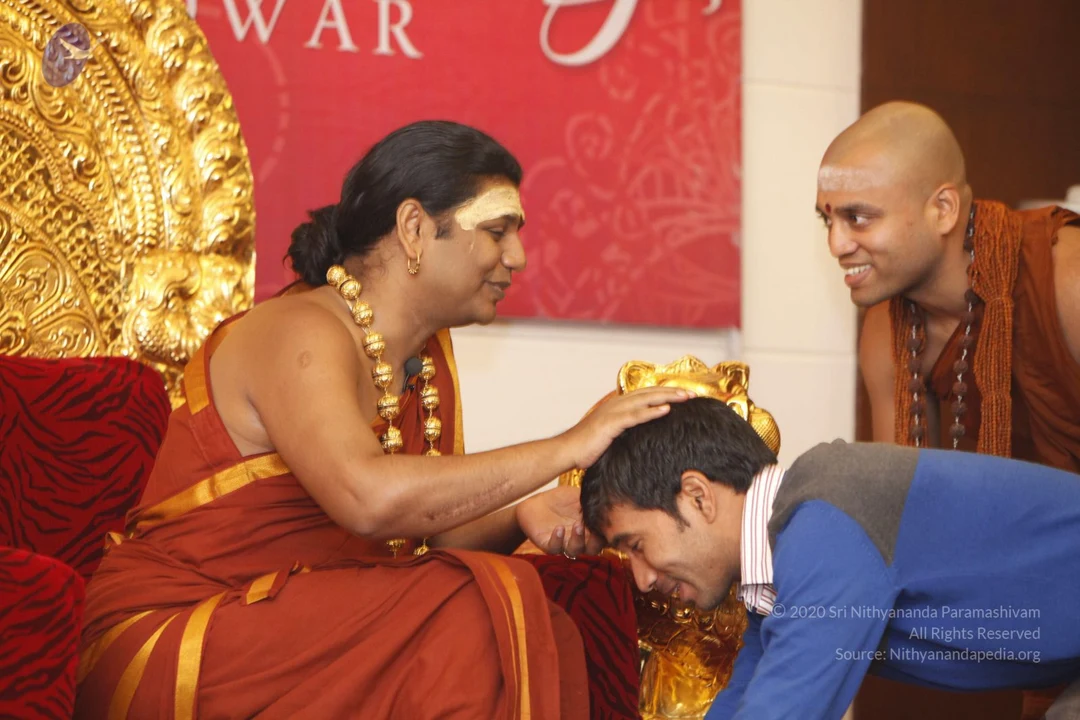
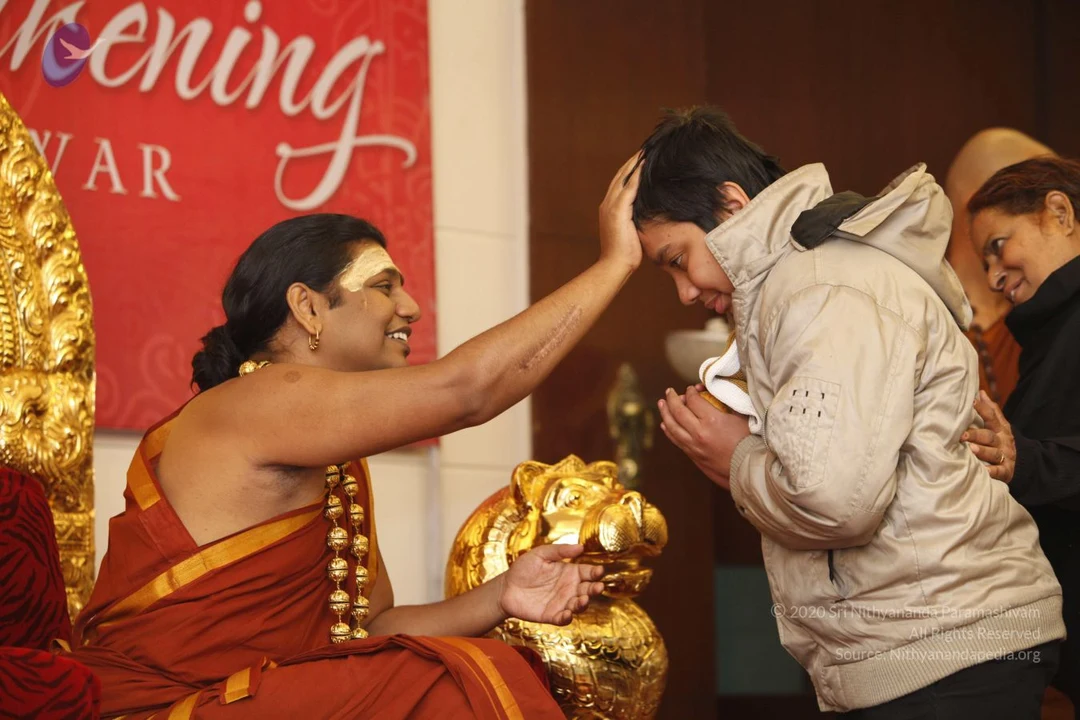
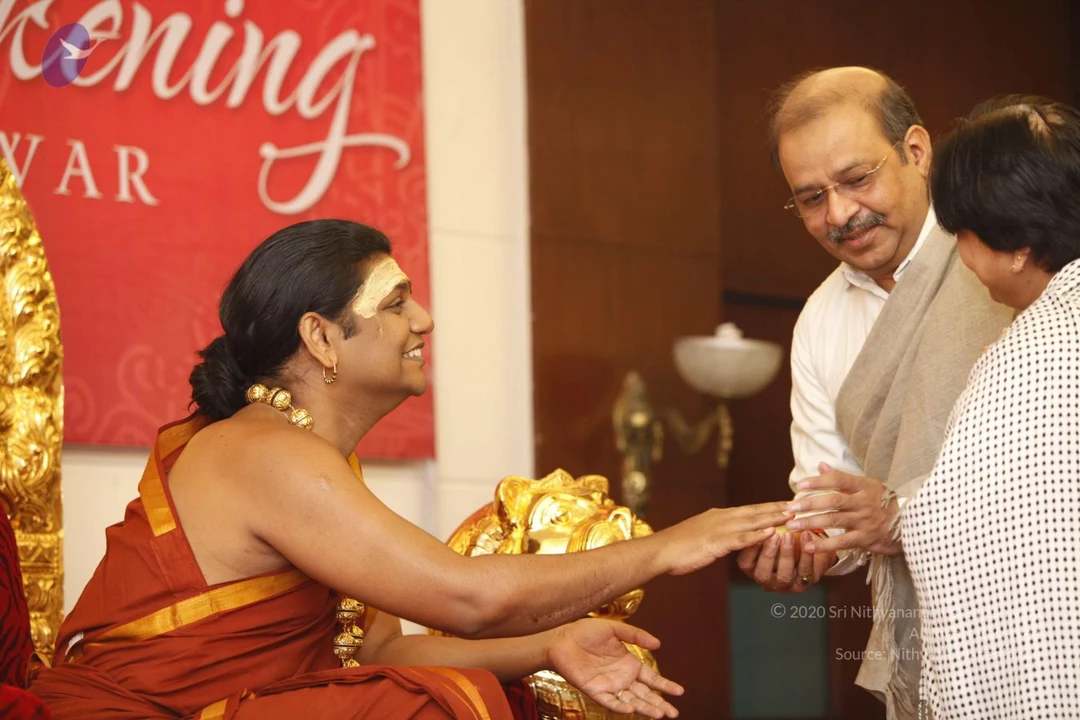
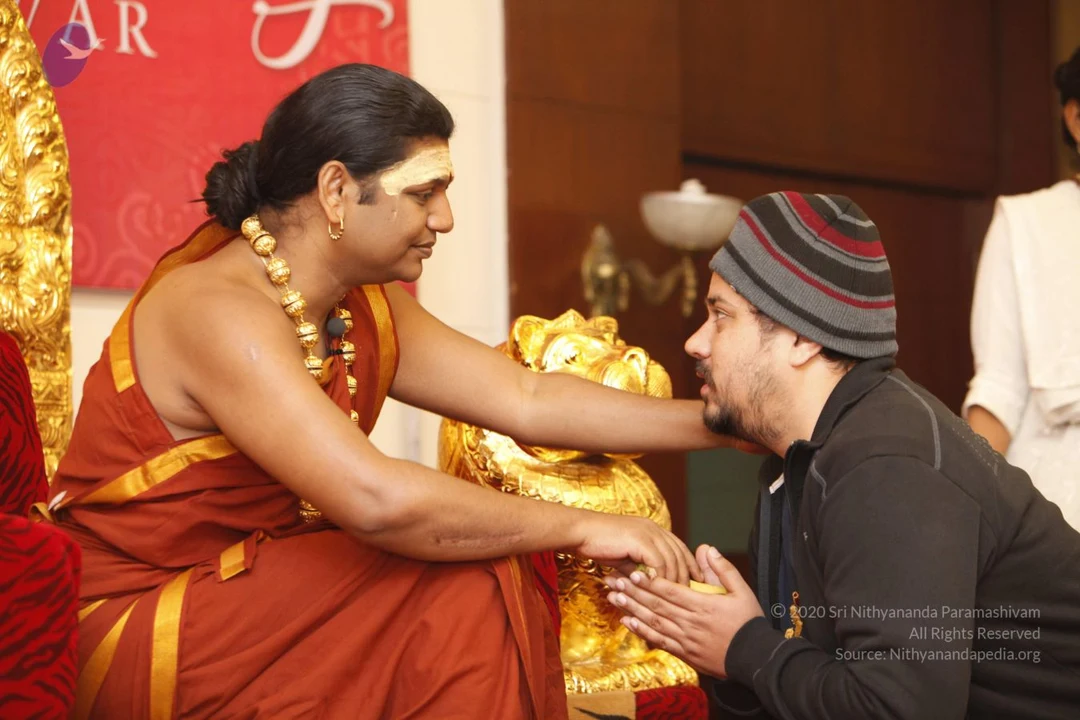
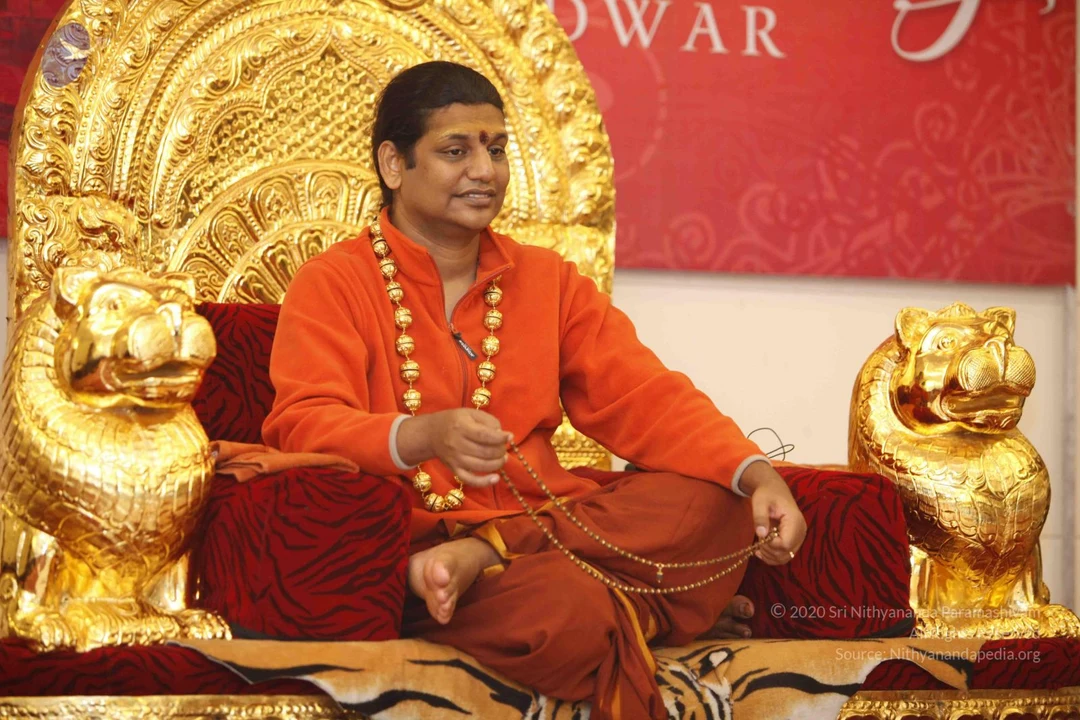
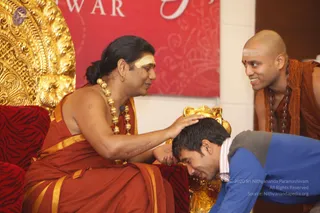
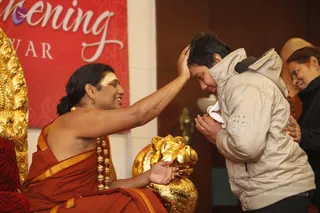
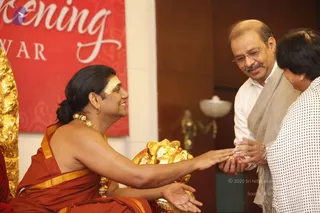
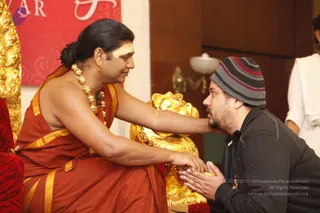
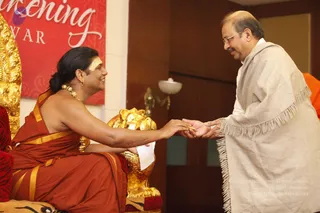
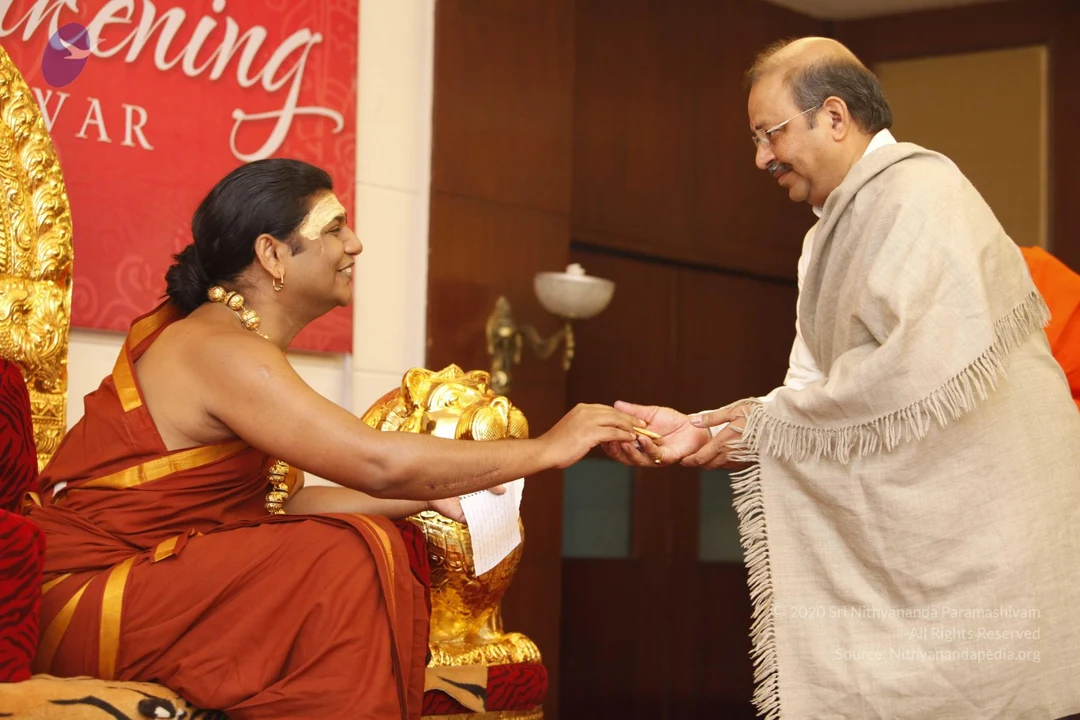
A seated man in saffron-orange robes with a gold-bead necklace, long swept-back hair and white sandalwood paste on his forehead rests his right hand on the head of a kneeling man in a blue sweater and striped collared shirt. The kneeling man bows forward over a gold throne armrest. Behind them a shaved-headed man in orange robes and rudraksha beads smiles. A red backdrop with gold lettering and a gold-carved chair frame the scene. a person seated on the gold throne blessing the devotee.A seated figure in a saffron-orange garment with a gold-bordered shawl and multiple gold beaded necklaces (gold ornaments, long swept-back dark hair, white sacred mark on forehead) places a hand on the forehead of a young boy in a beige hooded jacket who bends forward with hands folded. A gilded lion-shaped vessel and carved golden throne armrest sit in front, with a red banner reading 'ening' and 'WAR' behind. A woman in dark clothing and an older person stand at right, watching. This appears to be a blessing moment.Indoor photograph of a seated man in saffron-orange robes with a gold-trimmed border and a gold bead necklace, holding a white vibhuti/tilak mark on his forehead. He sits on an ornate gold throne and extends his hand forward to a standing man in a white shirt and grey shawl, who smiles and reaches toward him. A woman in a black-and-white dotted top stands beside them, also extending her hands. A red banner with white script partly visible behind the throne, and a brass lamp stand and bowl on a wooden wall at right. Swamiji (probable): the seated figure with long swept-back hair, saffron robes and gold necklace is a candidate for Swamiji, based on those visible cues.A seated figure in an orange-red saffron robe with gold border and a heavy gold bead necklace with a rudraksha mala, with long dark hair tied back and a white vibhuti/tilak mark on the forehead, leans forward and extends his right hand to rest on the head of a kneeling devotee in a grey-and-maroon striped knit cap and black jacket with clasped hands. Behind them stand golden lion-form throne elements and a golden peetha, a red banner, and a wall sconce. Another person in white stands at the right edge.A seated figure in an orange-red robe with gold borders sits on a golden throne with ornate carved arms, wearing a gold necklace, gold earrings, and a white vertical forehead mark, with hair tied back. Facing them, a standing man in a cream-coloured fringed shawl over a white shirt and glasses extends his cupped hands to receive or offer something small and golden from the seated figure's hand. A red banner with white script behind the throne, and a wall-mounted brass lamp on dark wood panelling complete the scene. Appearance-based candidate present: a person, seated on the throne in orange robes with gold necklace and rudraksha-style adornment, is giving an item to a devotee.A seated man in an orange-red fleece jacket and orange-brown dhoti sits cross-legged on an ornate golden throne with carved lion-headed armrests and red tiger-striped cushions, holding a long beaded rudraksha-style mala in his hands. He has a red bindi on his forehead and wears a gold-beaded garland around his neck. Behind the throne is a red banner with decorative gold script, and a tiger-skin rug covers the platform. The setting is a satsang or discourse stage. The man matches the presentation of the page's a person reference through several cues (saffron clothing, rudraksha mala, ornate gold seating), so this is an appearance-based probable identification of a person, seated in person on the throne.

Ganges-trip

106 photosSource gallery
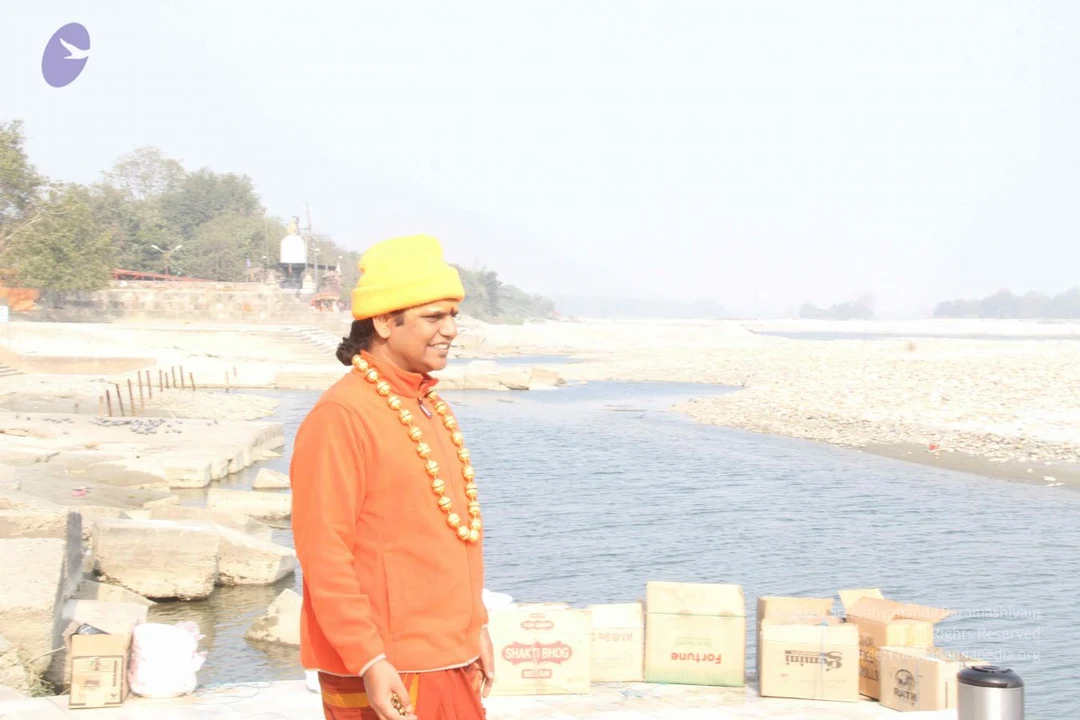
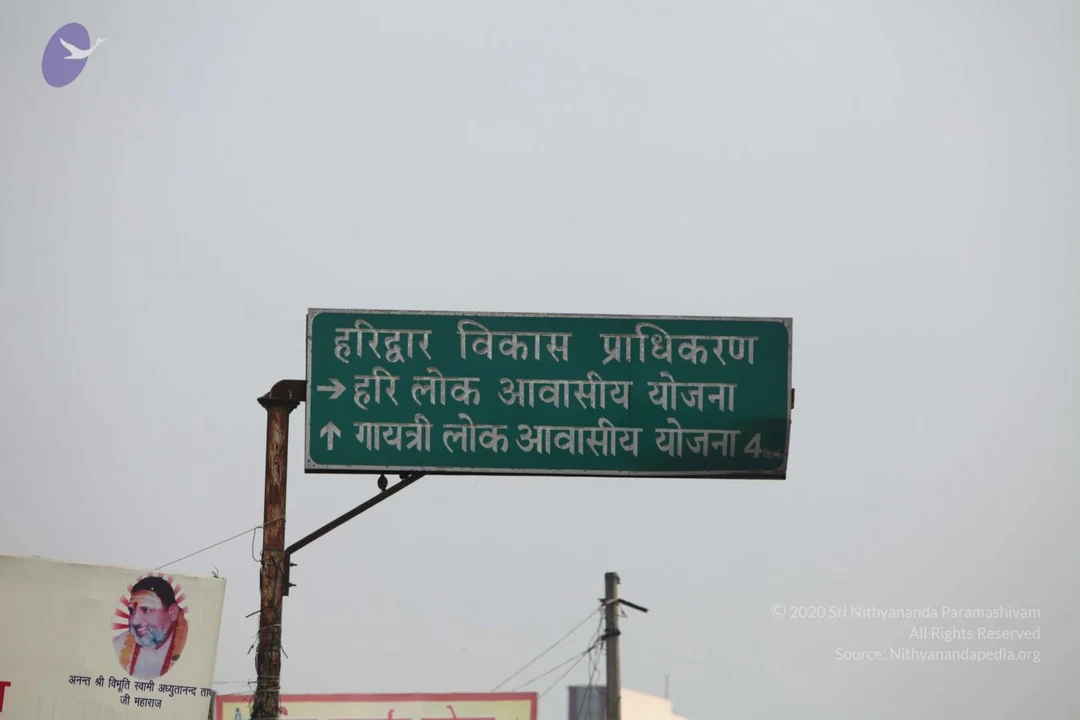
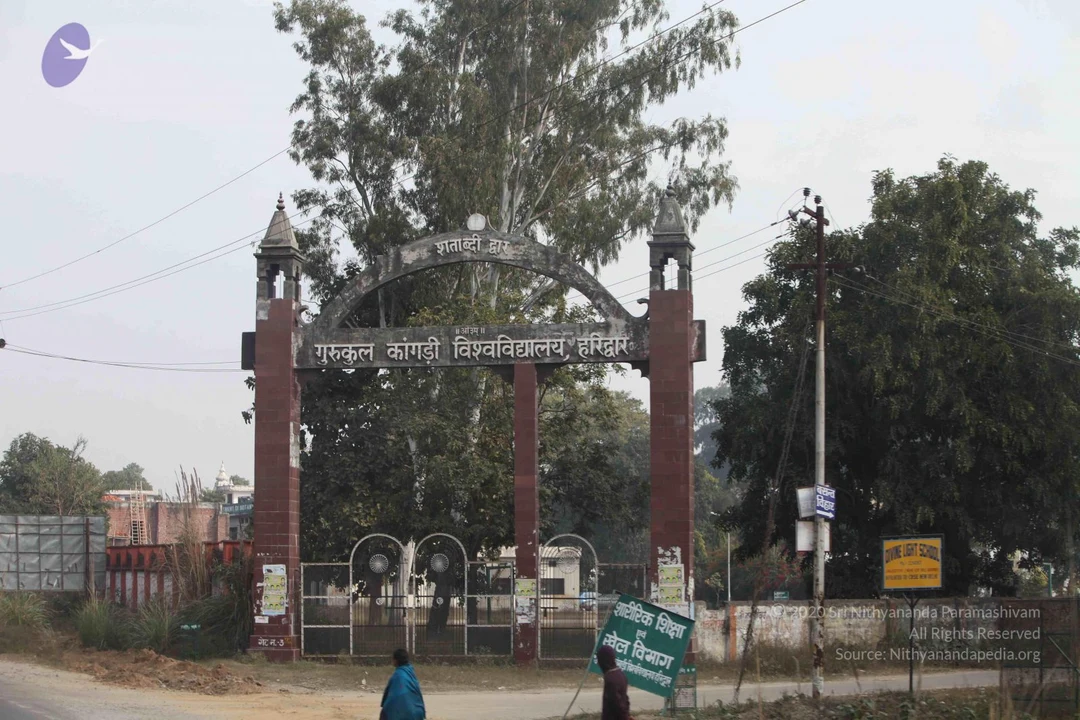
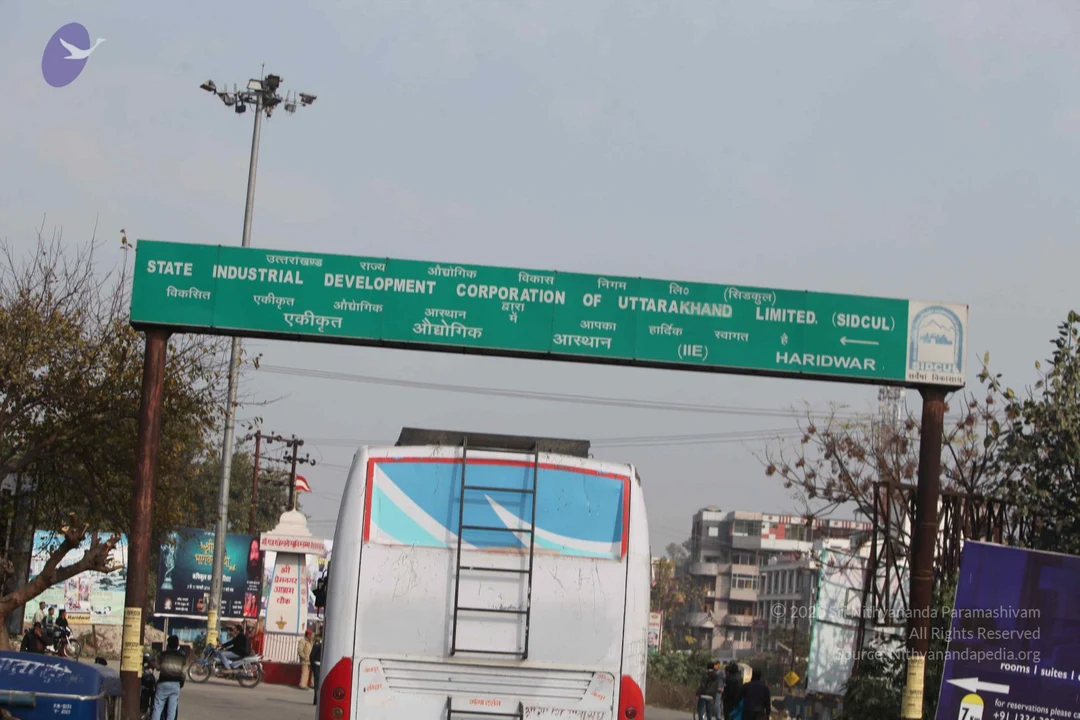
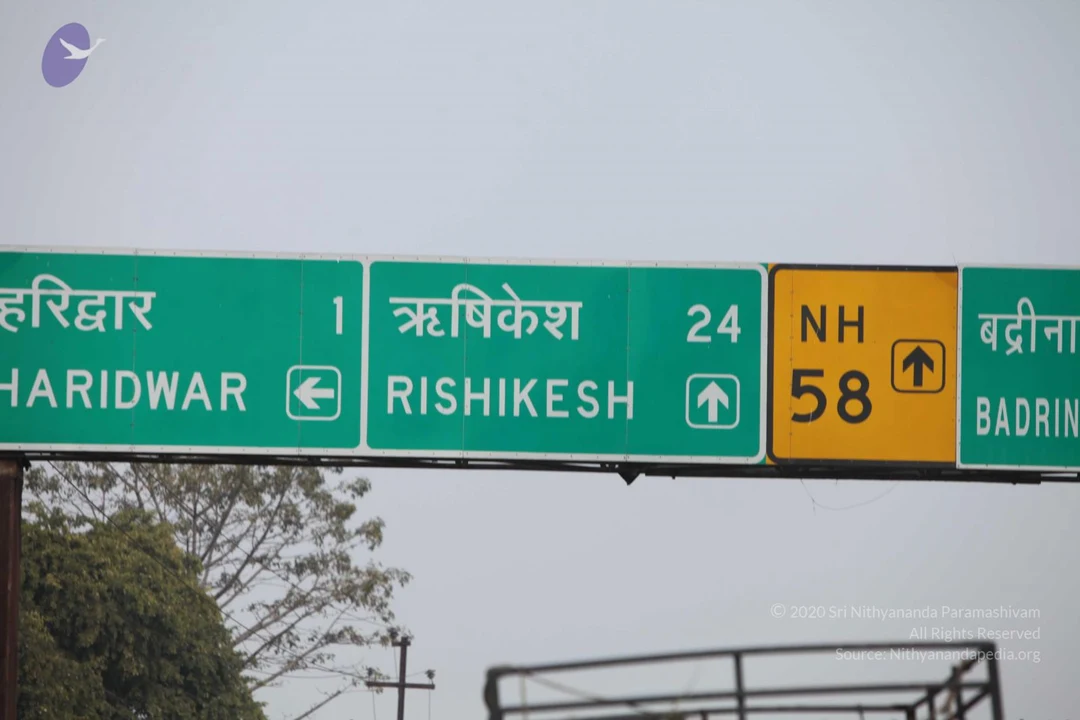
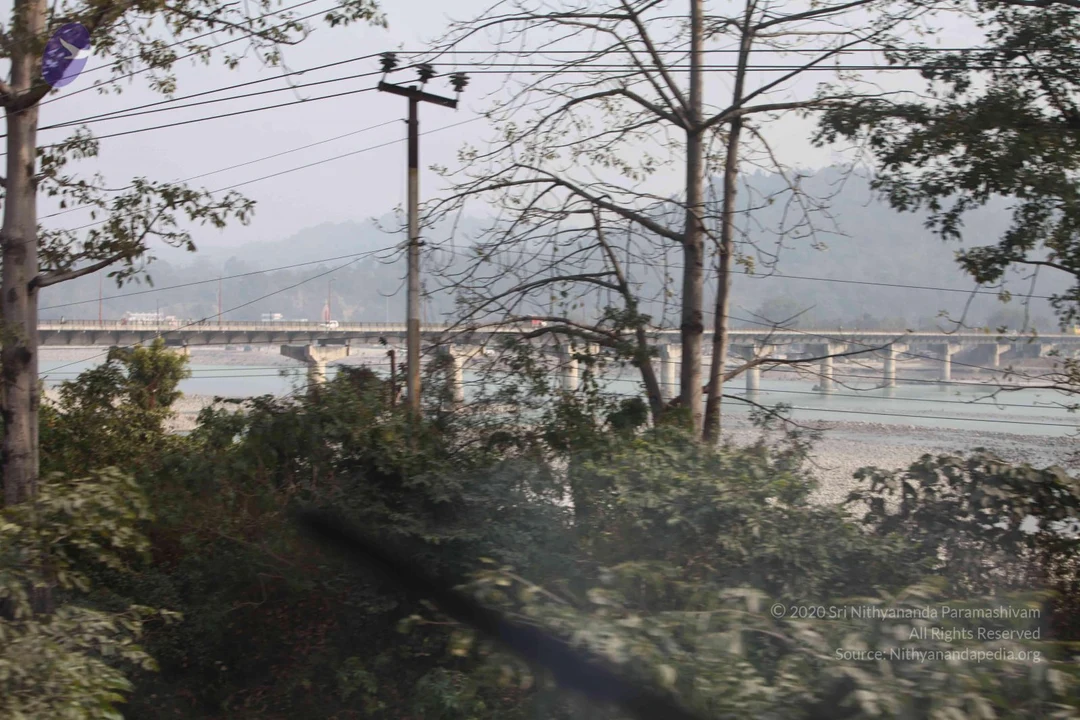
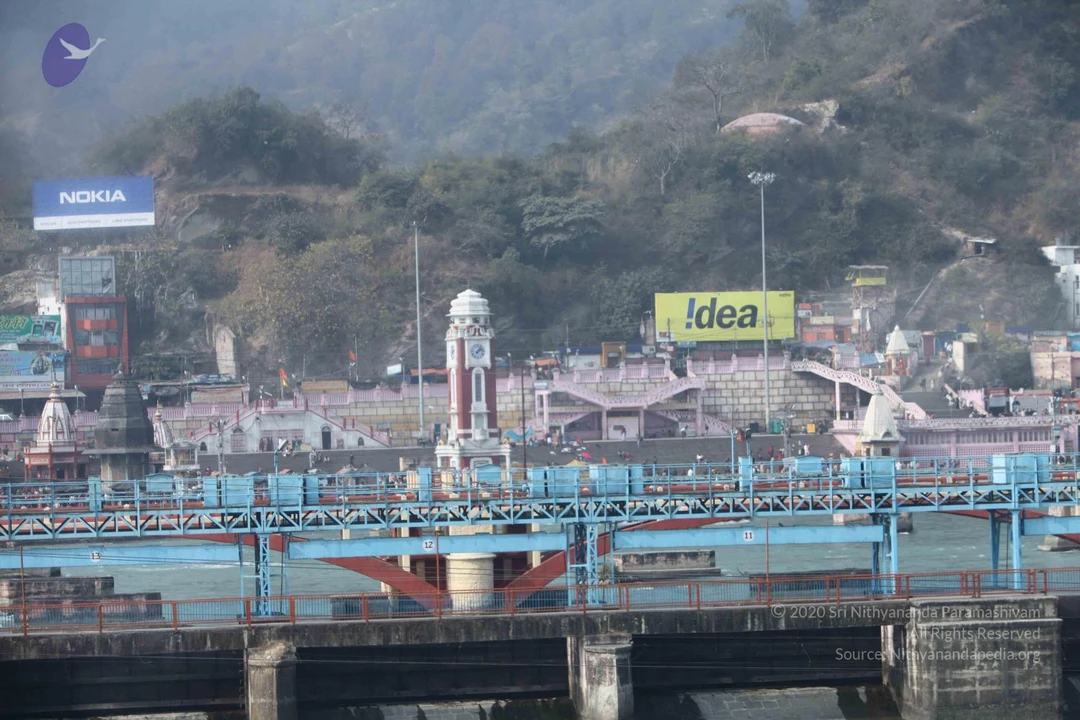
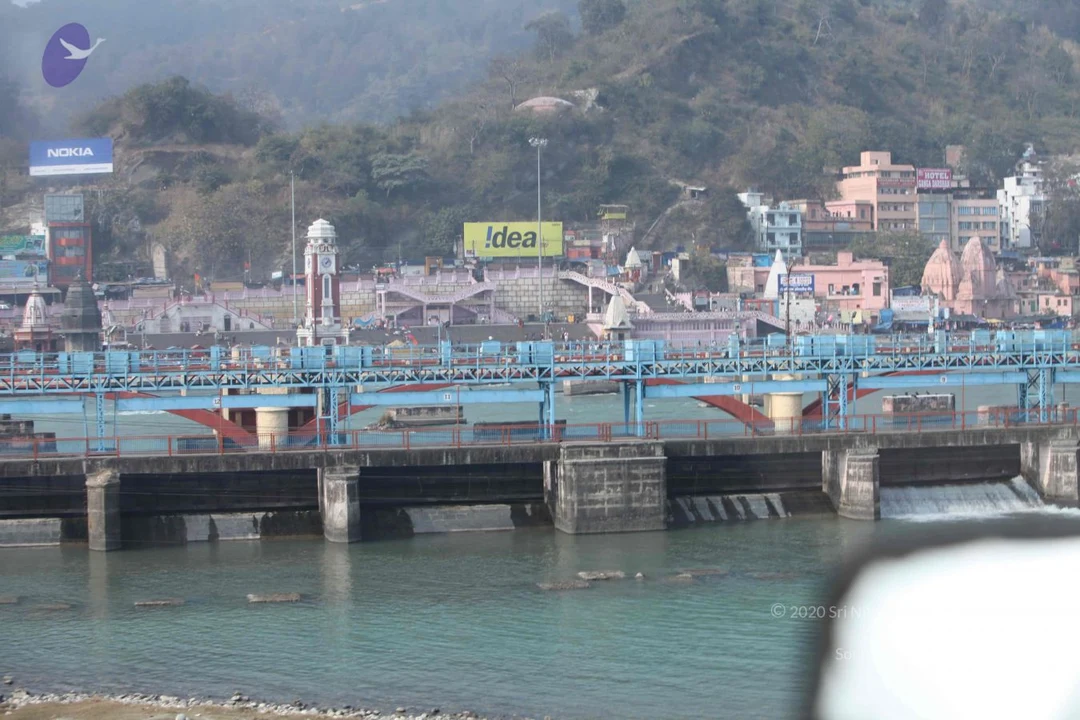
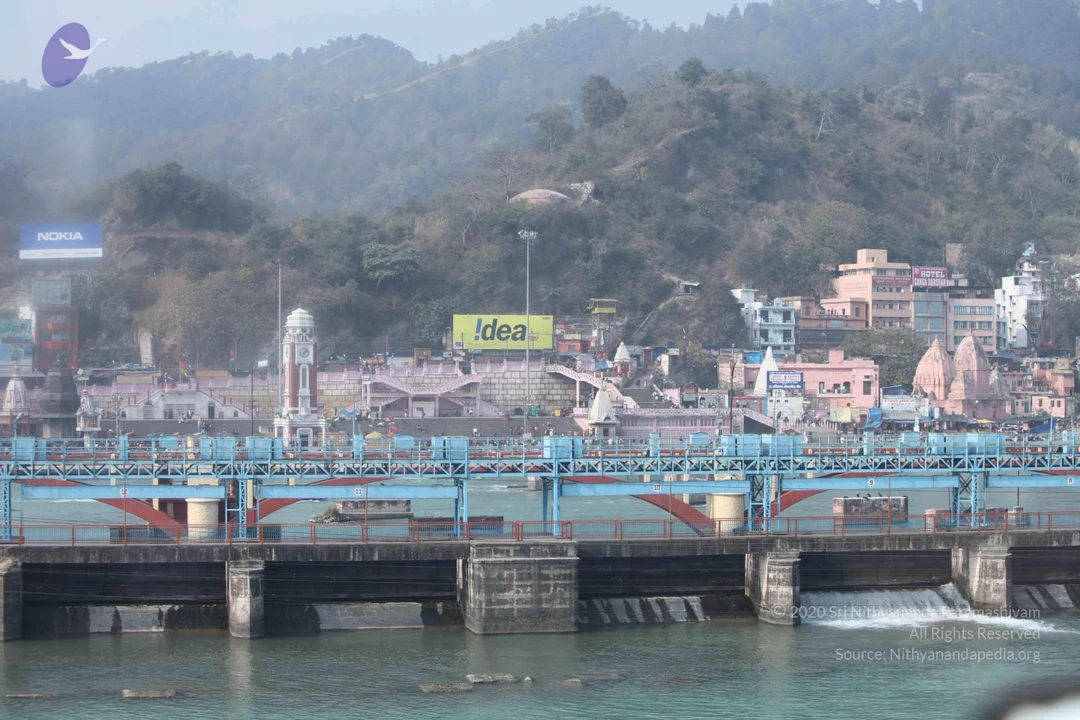
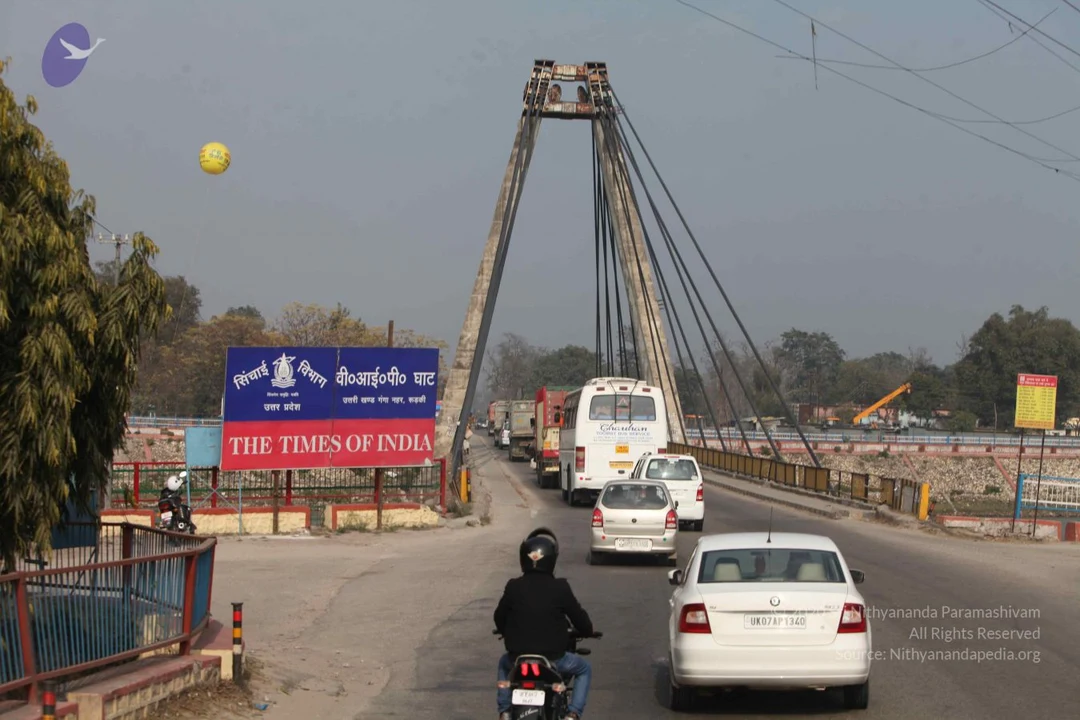
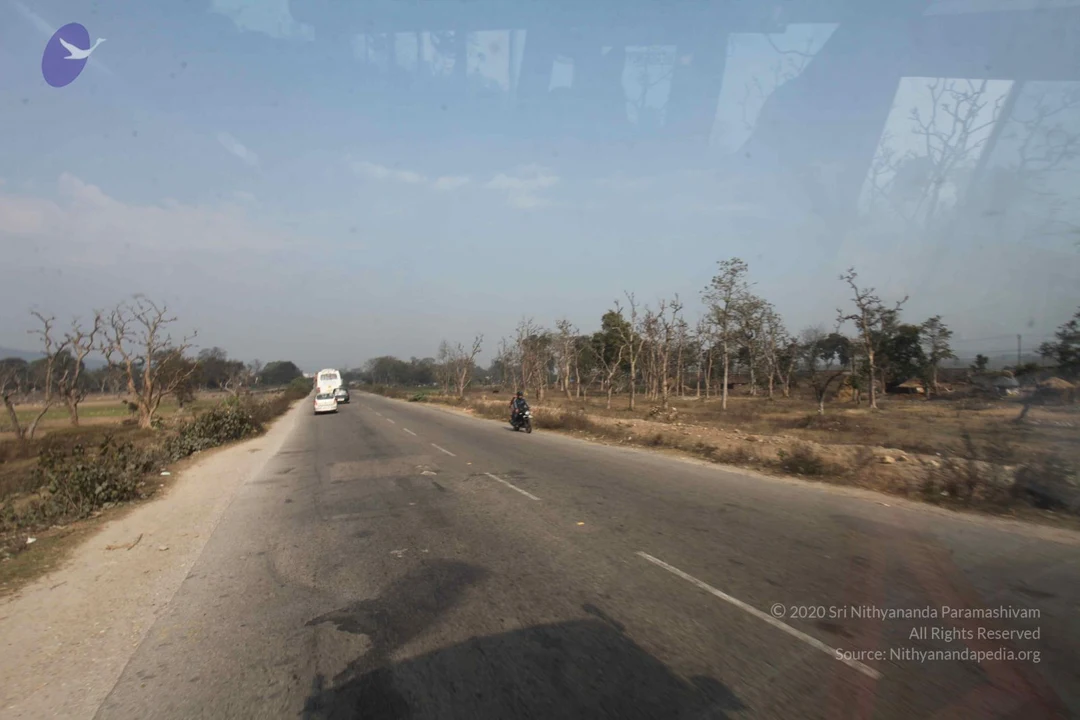
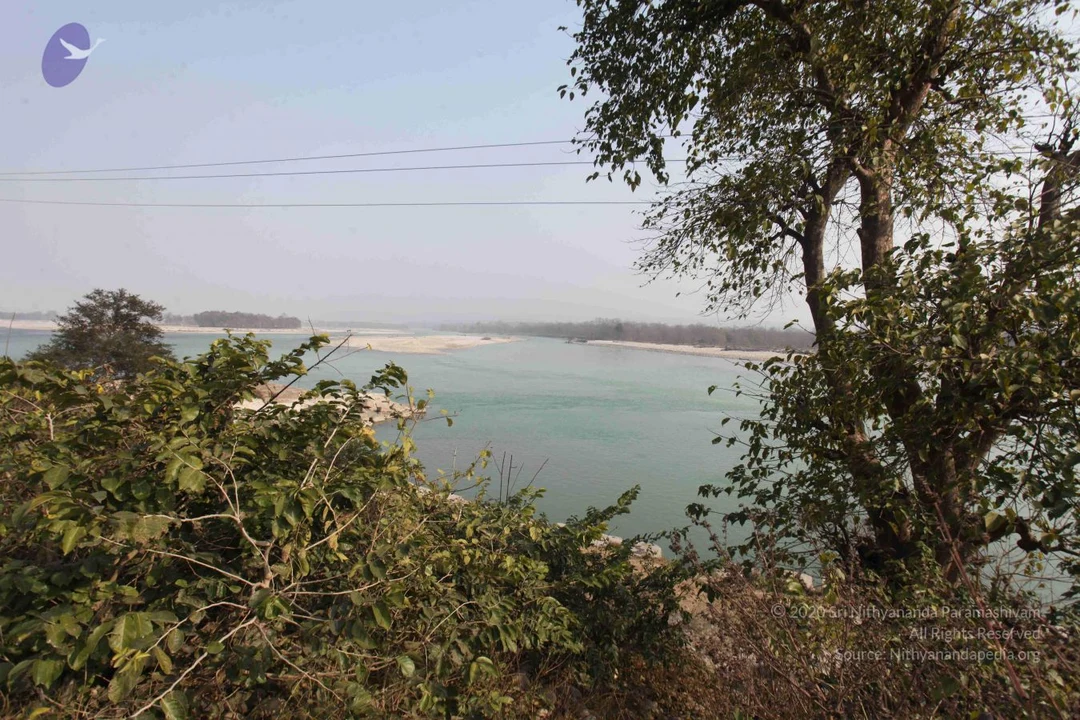
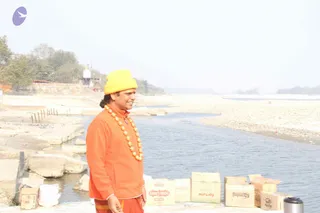
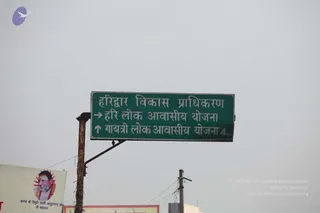
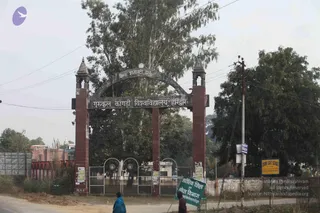
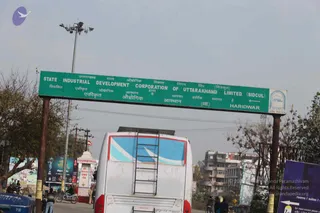
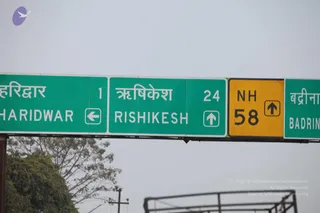
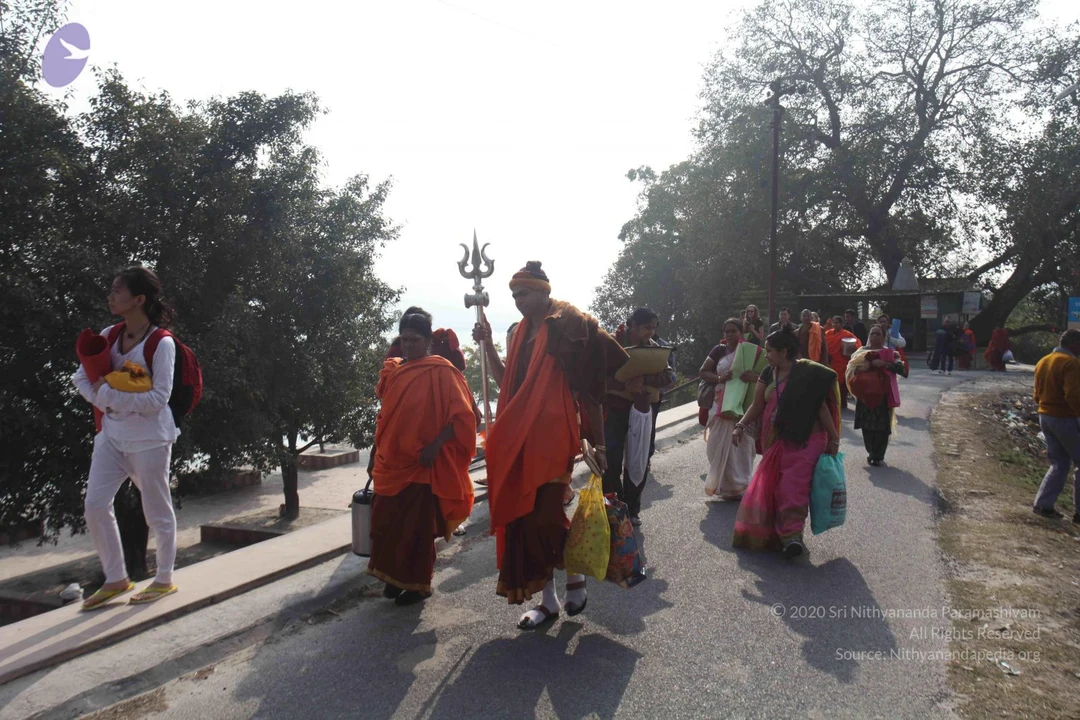
A smiling man stands on a stone riverbank beside a pale, shallow river under hazy winter light. He wears a bright yellow knit beanie, an orange fleece jacket, orange-and-red dhoti, and a long strand of yellow-orange beads around his neck; his hair is tied back. Behind him are stacked cardboard cartons, including boxes printed with Shakti Bhog and Fortune brands, a white plastic bag and a steel thermos on the right. Across the bank stand trees, a whitewashed structure and a distant temple-like building. Swamiji (probable): the man has long swept-back hair and saffron-orange clothing with a rudraksha-style bead garland, which align with the page's claim of his presence.Outdoor street photograph under an overcast grey sky showing a green road sign mounted on a rusted metal pole. The sign reads in Hindi, listing Haridwar Vikas Pradhikaran with arrows pointing right to Hari Lok Awasiya Yojana and up to Gayatri Lok Awasiya Yojana. In the lower left, a white billboard shows a portrait labelled in Hindi with the name Anant Shri Vibhushit Swami Adhyutanand Ji Maharaj, with a saffron-coloured garment and a red sash. No people are visible in the scene.A photograph of a red-brick ceremonial gateway at the entrance of Gurukul Kangri Vishwavidyalaya in Haridwar, with a curved arch bearing the Hindi-script word shatabdi dvar and a horizontal sign reading Gurukul Kangri Vishwavidyalaya Haridwar. Tall pillars with small pointed finials flank the gate, behind which iron-grilled gates stand closed. Tall trees and overhead power lines frame the scene on a hazy, overcast day. Two people in blue and dark clothing walk along the roadside at the bottom of the frame, and a green roadside sign reads in Hindi about educational and sports departments. A yellow sign labelled Divine Light School is visible at right.A green overhead road sign reading State Industrial Development Corporation of Uttarakhand Limited (SIDCUL) Haridwar, with Hindi and other script translations, spans a busy street. Beneath it, a white bus with a blue and red stripe and a rear ladder drives away. Motorcycles, a pedestrian and a street lamp appear along the roadside, with multi-storey buildings, bare trees and a purple billboard on the right. No people are prominent, and no a person candidate is visible.A green highway overhead sign shows directions: Haridwar 1 with a left arrow, Rishikesh 24 with an up arrow, and a yellow NH 58 route marker with an up arrow, followed by a green panel reading Badrinath. Bare trees and an overcast grey sky lie behind the sign, with a metal gantry frame below. No people are visible.A photograph taken through a vehicle window of a wide river valley with a shallow, pale-blue river flowing between sandy banks. A long multi-arched concrete bridge carries a road across the river, with a few vehicles visible on it. Leafless trees and dense green foliage frame the foreground, with power lines and a utility pole crossing the view. Hazy forested hills rise in the background under a pale sky. No people are visible.

Nithya-Puja

3 photosSource gallery
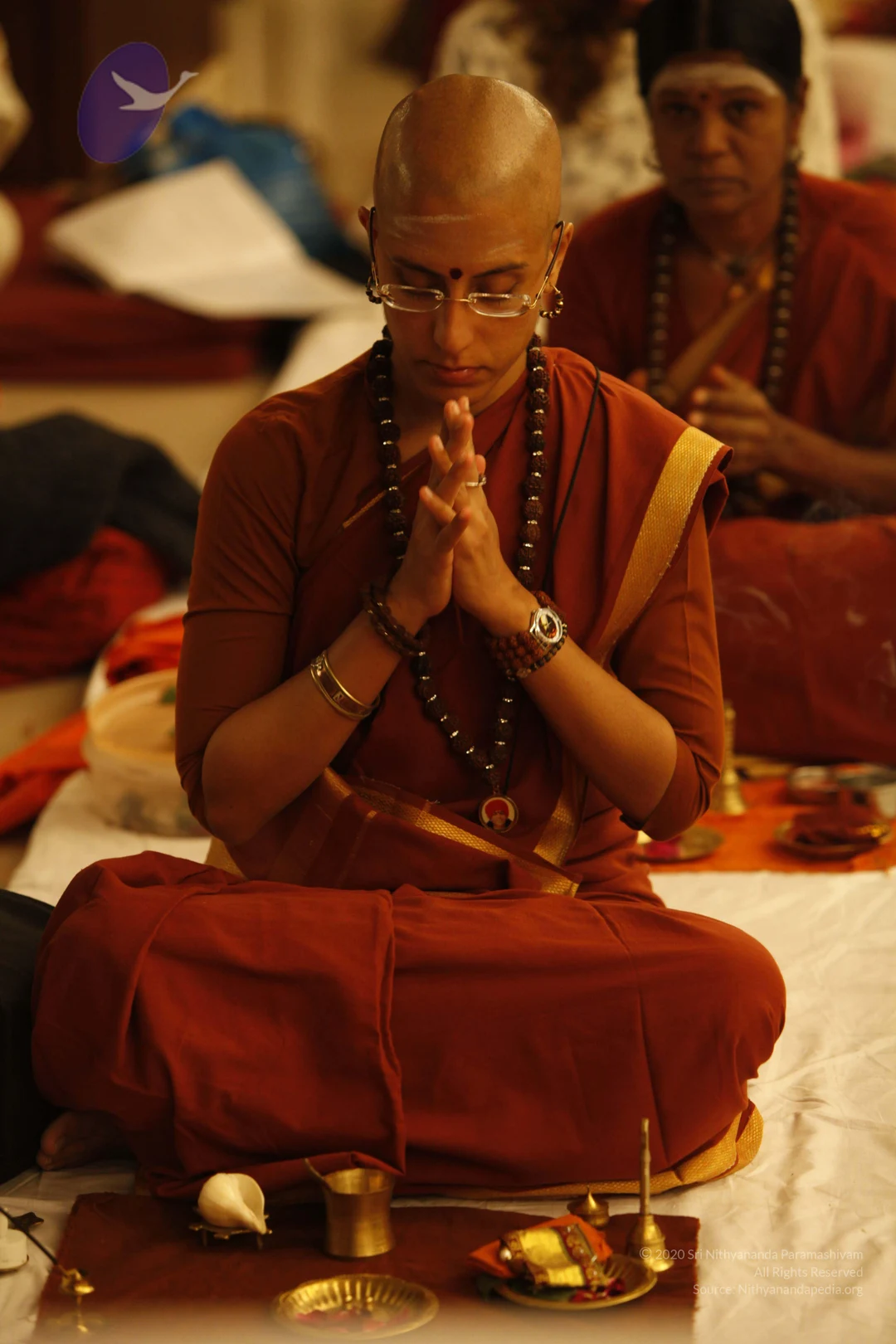
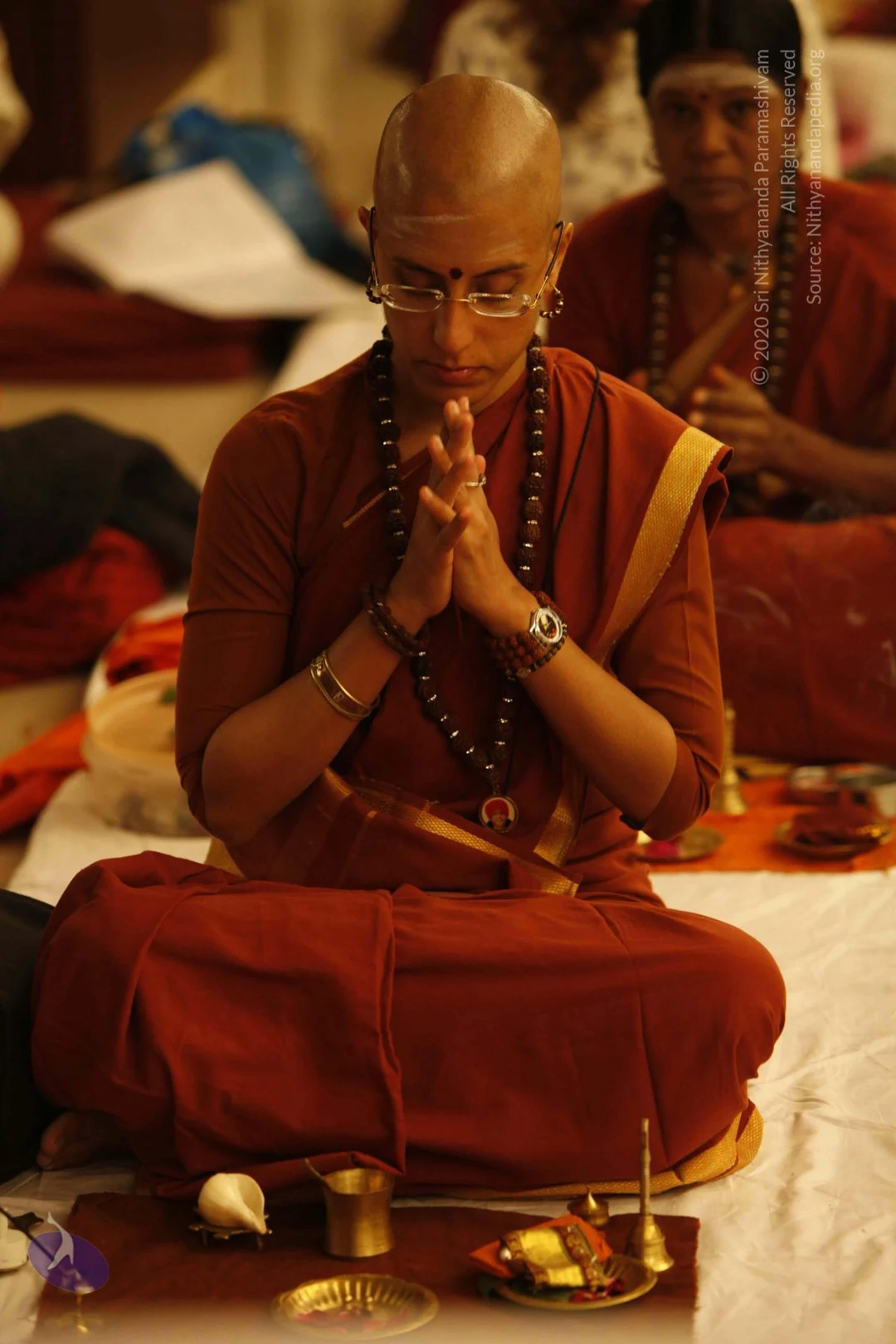
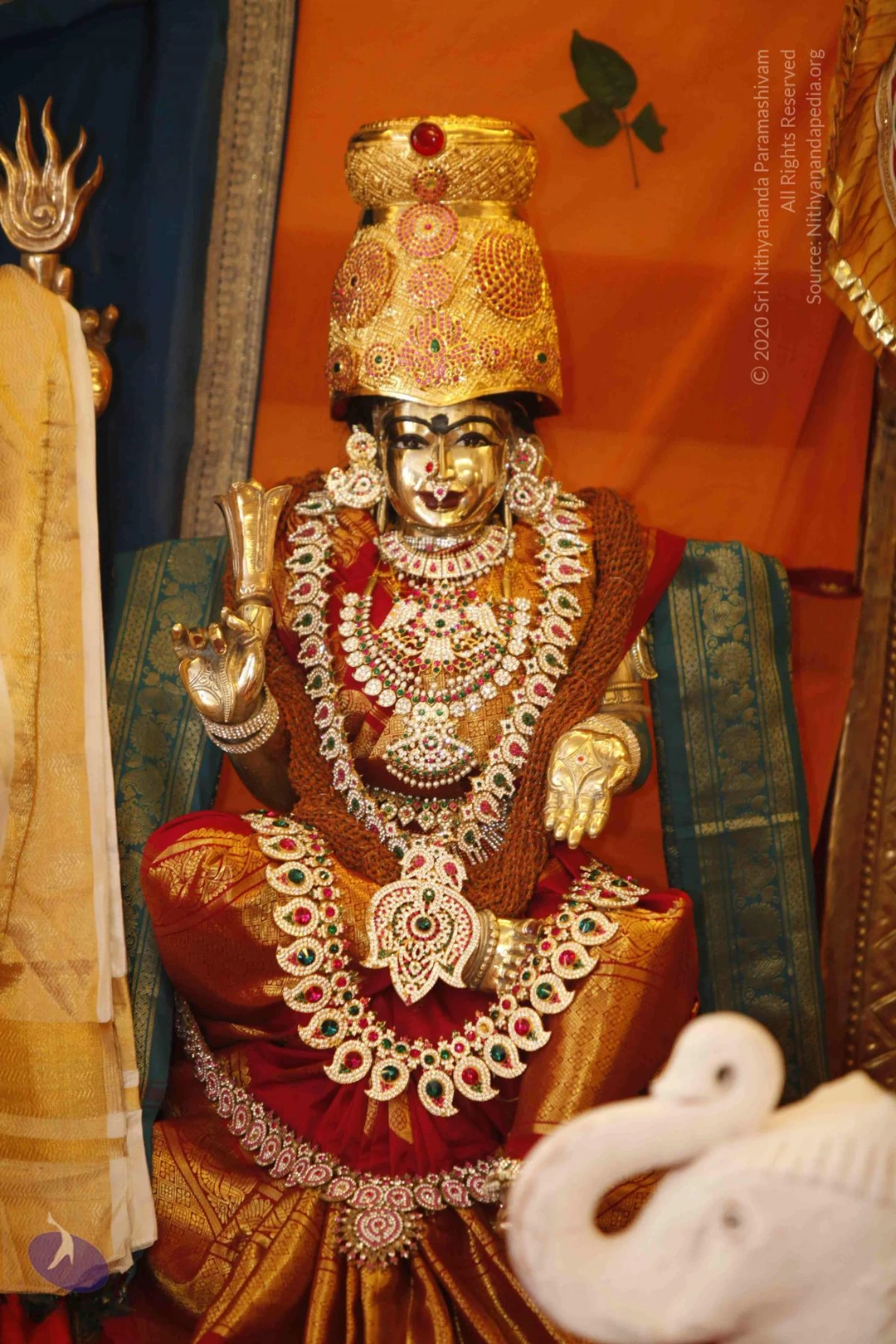
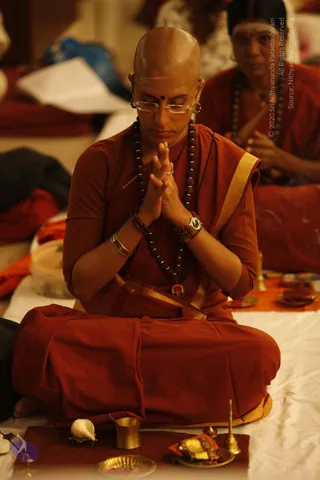
A woman seated cross-legged on a white cloth in a rust-red sari with a gold border, wearing a rudraksha mala and bracelets, with three horizontal white ash lines and a red dot on her forehead. She lights an incense stick with one hand over an orange cloth holding brass bowls, a brass cup, a small brass bell, red and pink flower petals, a green leaf, a lit oil lamp and an incense holder. Other devotees in red and orange clothing sit behind her. A clear container of white powder sits at the lower left. The scene suggests a puja or ritual offering, but no a person candidate is visible.A shaved-headed person sits cross-legged on a white cloth in a prayer pose, palms pressed together at chest level with eyes lowered. They wear rust-red robes with gold-bordered drapes, a rudraksha mala with a small red-and-gold pendant, wire-rimmed glasses, a red bindi, and a gold bangle and wristwatch. Behind them, a second seated person in red robes with rudraksha beads holds a small hand instrument. Brass items sit on the cloth in front: a small brass cup, a bell, a tray holding an orange-and-gold cloth bundle, and a brass plate. The scene suggests a ritual satsang or puja setting.A gilded deity murti seated on a teal and gold brocade seat against an orange backdrop. The figure wears an ornate golden crown set with red and green stones, heavy layered gold and jewelled necklaces with green and red gems, and a deep red silk garment with gold border. One hand is raised in a blessing gesture holding a small golden object, the other rests open on the lap. A trident-like golden standard appears at left and a white floral garland at lower right. No physical people are visible.

Satsang
6 photosSource gallery
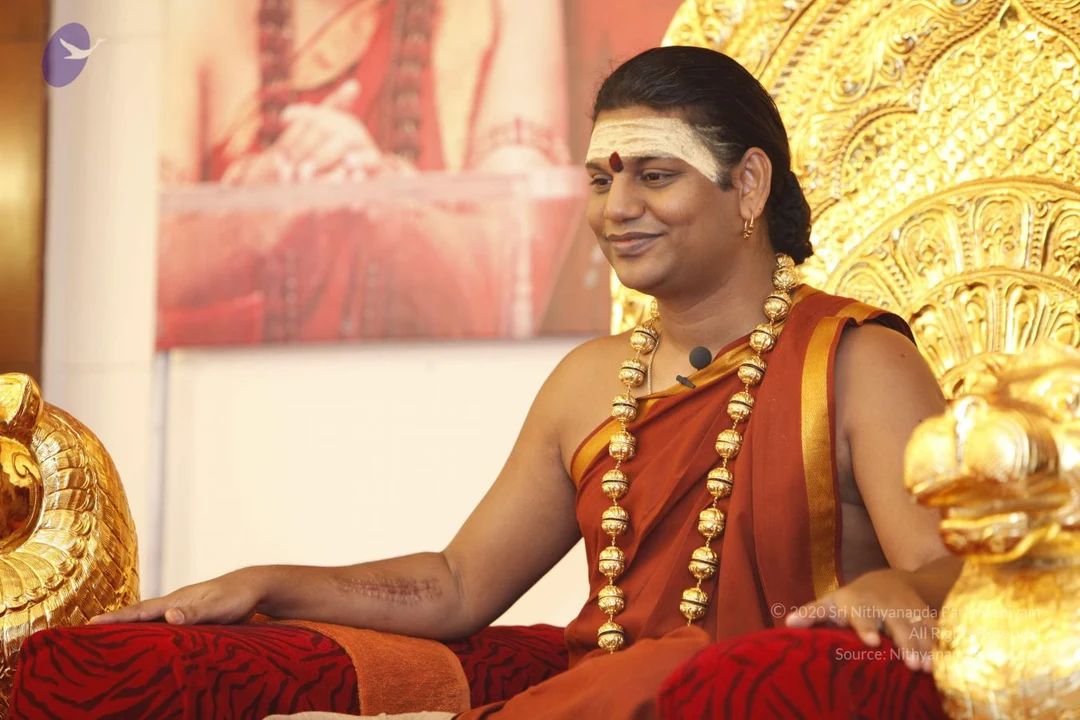
A seated man in a saffron-orange robe with a gold-bordered shawl draped over one shoulder, wearing a heavy gold bead necklace of large ornamental beads. He has a white horizontal forehead marking with a red dot, long dark hair swept back, and a small gold earring. His right hand is raised in a gesture of explanation while his left hand rests on a red tiger-striped cushion. Behind him is an elaborate gold-embossed throne back, and to the right a gold pot-shaped vessel. A small lapel microphone is clipped to his robe. The a person is shown mid-discourse in a satsang setting. A pink-toned backdrop with a tall temple-like structure appears at the upper left.A seated man in saffron-orange robes and a long gold bead necklace sits on an ornate golden throne with two golden lion figures flanking him. He has a red-and-white tilak on his forehead and raises one finger while speaking, with a small lapel microphone clipped to his robe. The throne sits on a tiger-striped cloth over red cushions, and a red banner with gold lettering and the word Haridwar is behind him. A candlestick holder and orange cloth lie to the side. a person appears in person, seated on the throne during a satsang-style talk.A seated man in an ornate gold throne with a carved arched back and lion-like carvings sits on a tiger-striped cushion before a red backdrop with partial lettering. He wears a rust-orange wrap with gold borders, a long gold bead necklace, and white vertical forehead markings with a red dot. He gestures with his right hand while speaking into a small clip microphone. a person: the appearance cues are a long swept-back hairstyle, ornate gold necklace, and saffron ceremonial clothing, seated on a throne in a discourse setting. Only one physical person is visible.A man seated on an ornate gold throne with a carved arched back and red tiger-striped cushions, speaking and gesturing with his right hand raised, index finger extended. He wears an orange-red robe with gold borders, a long gold bead necklace, and white tilak with a red bindi on his forehead, and a small microphone clipped to his robe. Behind the throne hangs a red banner with white script and a partial logo. Ornate gold details frame the scene, and the setting suggests a seated discourse. The seated man appears in a manner consistent with a person based on the saffron-orange robe, long gold bead mala and gold throne, though this is an appearance-based label only.A seated man in an ornate gold throne with carved arched backrest and lion-like side ornaments, draped in red-orange saffron robes with gold borders. He wears a long gold bead necklace, a white vertical forehead mark with a red dot, and a small lapel microphone. He gestures with his right index finger raised while speaking. The throne rests on a tiger-striped fabric and red velvet cushions, with a red banner behind. Partially visible red banner with white script at top.A seated man on an ornate gold throne with carved lion-head arms and red tiger-striped cushions, raising one index finger while speaking, as in a teaching or satsang. He wears an orange-red ochre robe with gold border and a long gold bead necklace, has a white vibhuti line and red bindi on his forehead, and a small lapel microphone on his chest. A red backdrop behind him shows partial script reading 'er Awakening' and 'OWAR'. Swamiji (probable): the visible cues are the long swept-back hair, ochre robe and ornate gold necklace on a throne, consistent with the page's claim of his presence.

Darshan
1 photoSource gallery
A seated man in an orange fleece zip jacket and matching orange dhoti-style trousers sits cross-legged, barefoot, on a tiger-striped red cushion before an ornate gold throne. He wears a large golden bead necklace and holds a long dark mala in his right hand, with a red tilak on his forehead. Swamiji (probable): long swept-back hair, saffron clothing, gold ceremonial necklace and rudraksha-style mala, seated in the position of a teacher. Behind him a red banner with partially visible white lettering.

Ganges-trip
5 photosSource gallery
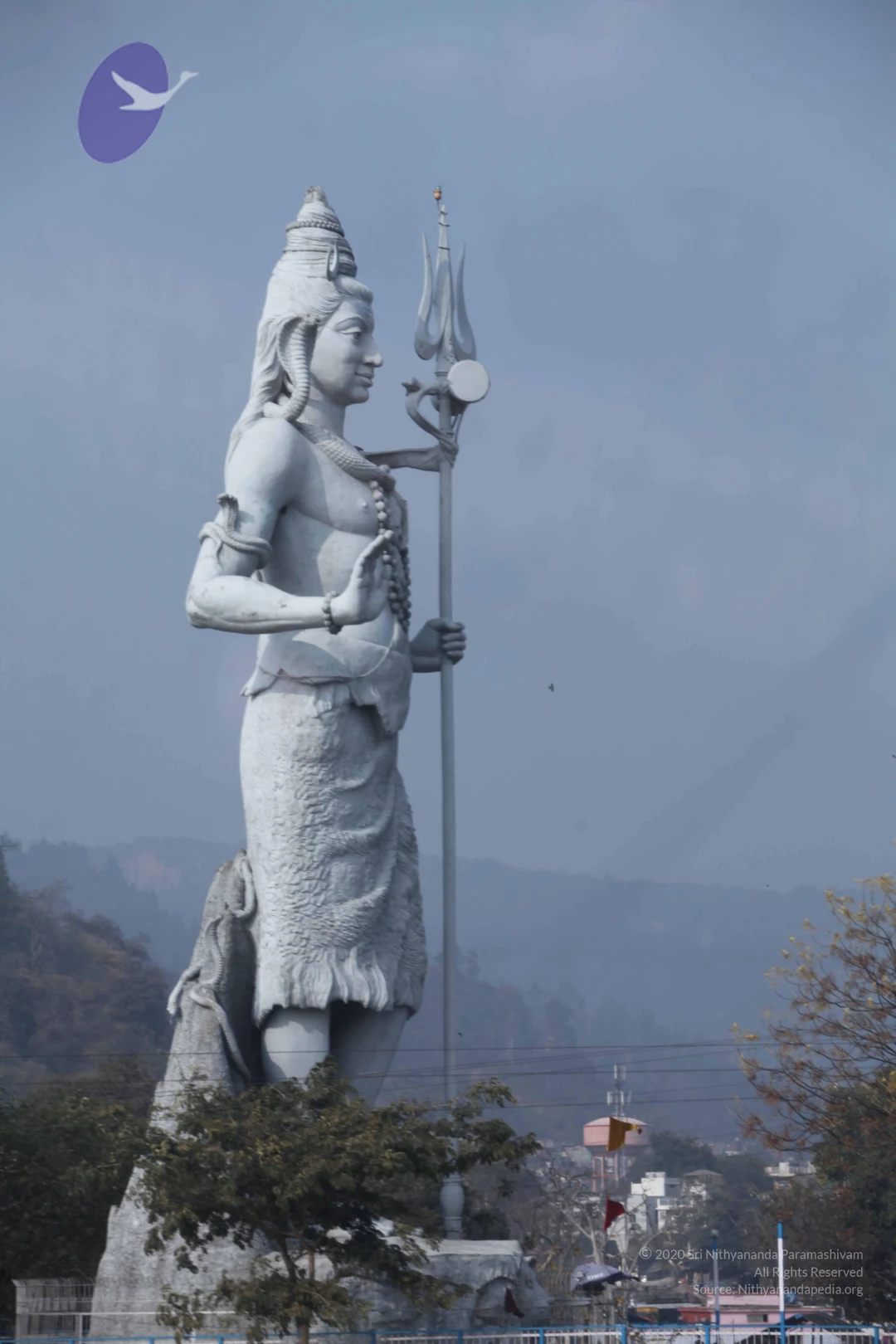
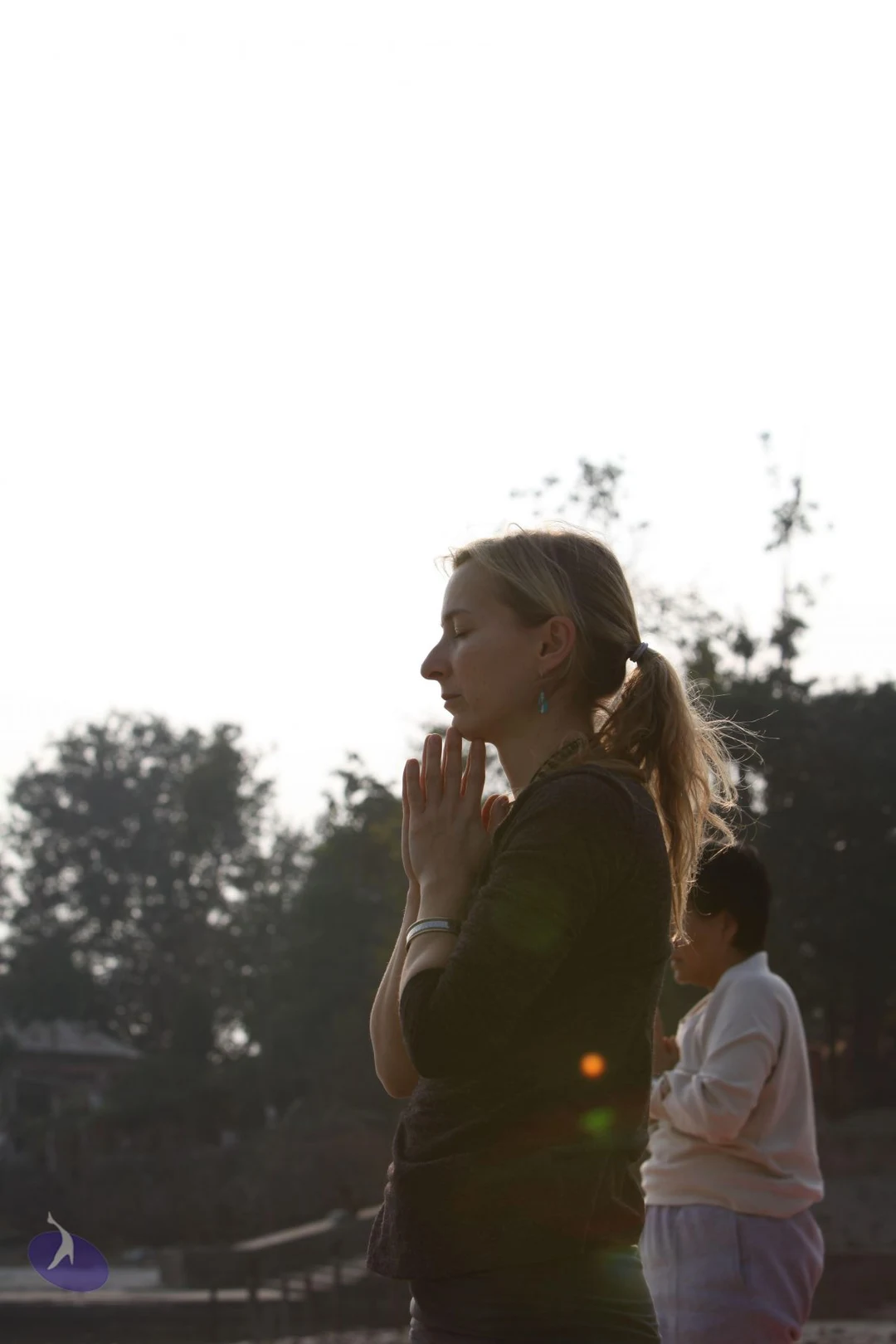
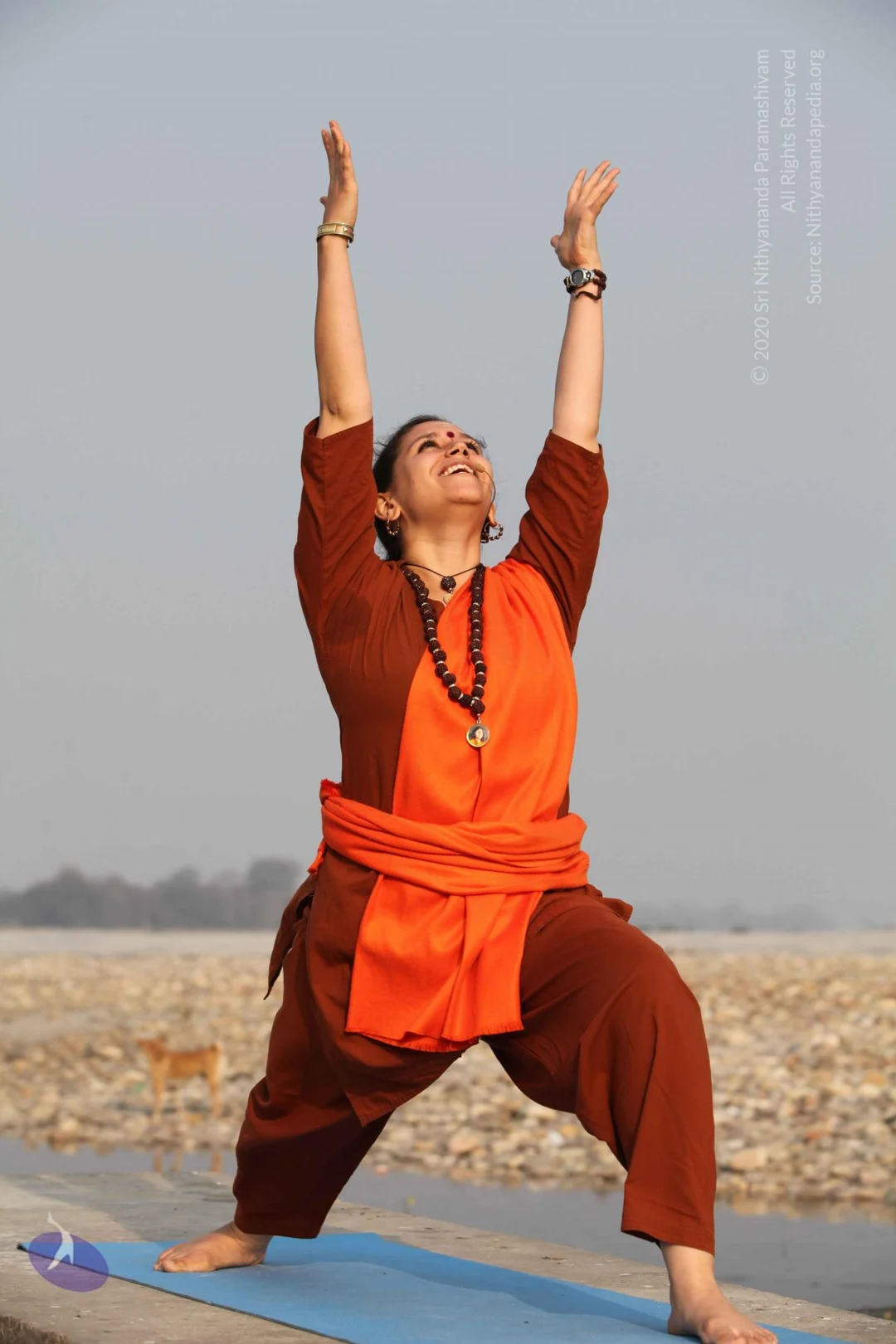
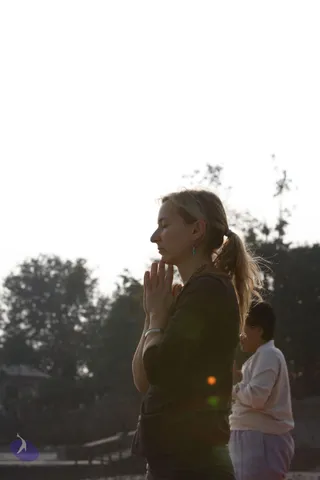
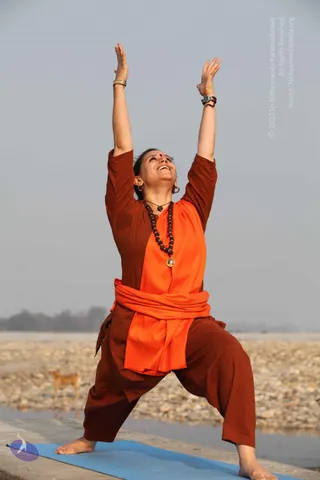
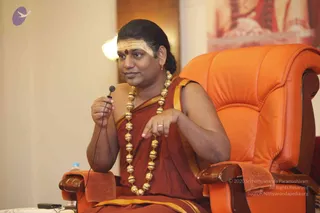
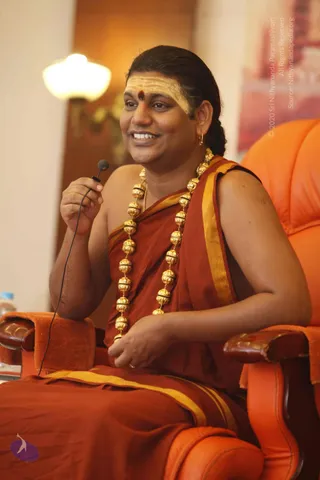
A tall white statue of Lord Shiva stands against a grey-blue sky with a faint rainbow arc to the right. The deity murti is shown in profile, with a coiled topknot crown, a rudraksha mala on the chest, and a short wrapped lower garment. Its right hand holds a tall trident with a metal disc, and the left hand rests at the waist. Power lines cross the frame, and green trees and small rooftops sit at the bottom edge. No people are visible, and the statue is a sculpture rather than a depiction of a living person.Outdoor photograph in soft backlight of a woman in profile with eyes closed and palms pressed together at chest in anjali mudra, standing in prayer. She wears a dark long-sleeved top, a silver bangle and a turquoise earring, with blonde hair tied in a low ponytail. Behind her, slightly blurred, a second person in a white top and light trousers also stands with hands joined. Silhouetted trees and a pale sky fill the background. No a person candidate is visible.A woman in a warrior-style yoga pose stands barefoot on a blue mat at a riverbank, arms raised straight overhead with palms open, smiling upward. She wears a rust-brown kurta and trousers with an orange shawl wrapped at the waist and draped over the shoulders, a dark rudraksha mala with a small pendant, and a red bindi. Pale sky, pebbled riverbed and a distant tan dog form the background.A man seated in a large orange leather armchair speaks into a small handheld microphone while gesturing with his right hand. He wears a rust-red and gold-bordered garment draped over one shoulder and a long necklace of large gold-toned beads. A white and red forehead marking decorates his brow, and his hair is swept back. Behind him is a wall with a framed decorative image, and a small water bottle sits on a side table. The setting appears to be a satsang-style discourse in an indoor room. a person is described by the appearance cues of the gold bead mala, rust-red and gold garment, forehead marking and swept-back hair, seated as a speaker.A smiling man in rust-orange robes with a gold-bordered dhoti and shawl sits in an orange leather armchair, holding a small clip-on microphone near his face. A heavy necklace of gold beads hangs across his chest, and he wears a gold earring, a white sandalwood band across his forehead with a red bindi, and his long dark hair is swept back into a braid. Behind him a soft lamp glows on a pale wall beside a red-toned picture. The setting suggests a satsang or seated discourse.
January 10 2014

2 photosView all
A gilded deity murti seated on a throne-like platform against a dark blue backdrop with a gold-patterned cloth canopy above. The figure wears a tall jeweled crown with pearl strands and a red and green gem, a red gem pendant, layered gold and gem necklaces, a rudraksha mala, cream clothing with gold borders, and a leopard-print cloth over one shoulder. Its hands are raised in abhaya and blessing gestures. Ceremonial metal emblems, a trident and a snake-shaped ornament, flank the figure. No physical people are visible.A seated golden metal deity murti. Its raised right hand displays a blessing gesture and the left hand rests on the lap. It sits on a teal and gold cushioned seat against an orange backdrop, with a white swan-shaped object in the lower right foreground and a cream cloth at the left edge. No people are visible.