Skip to content
Saturday

11 January 2014

Dated photos
252
Source pages
1
Media
2
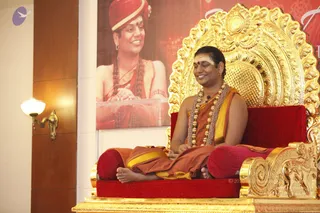
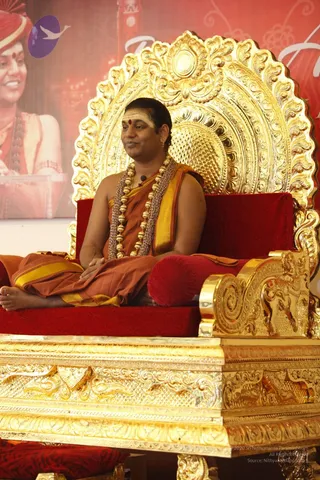
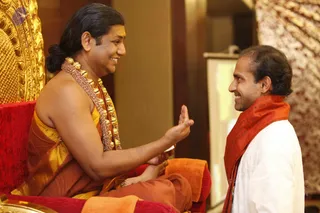
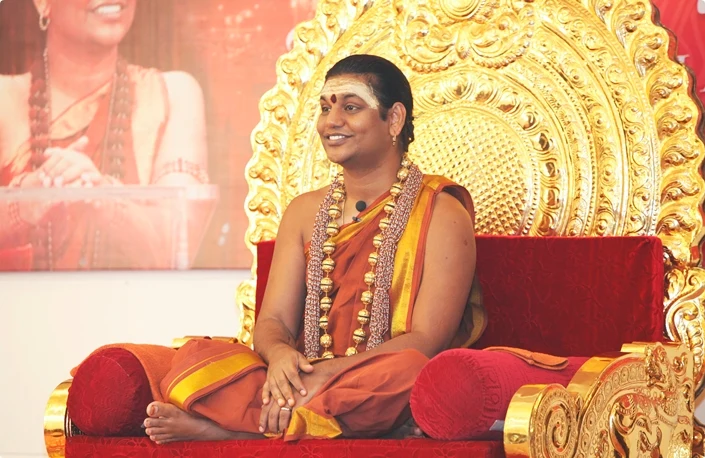
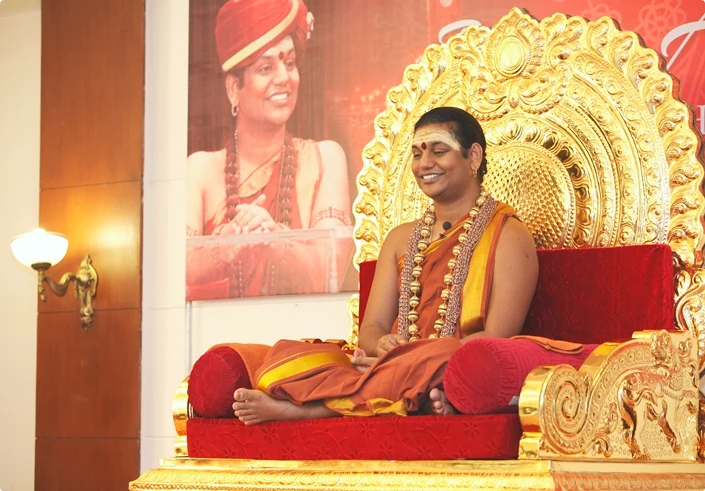
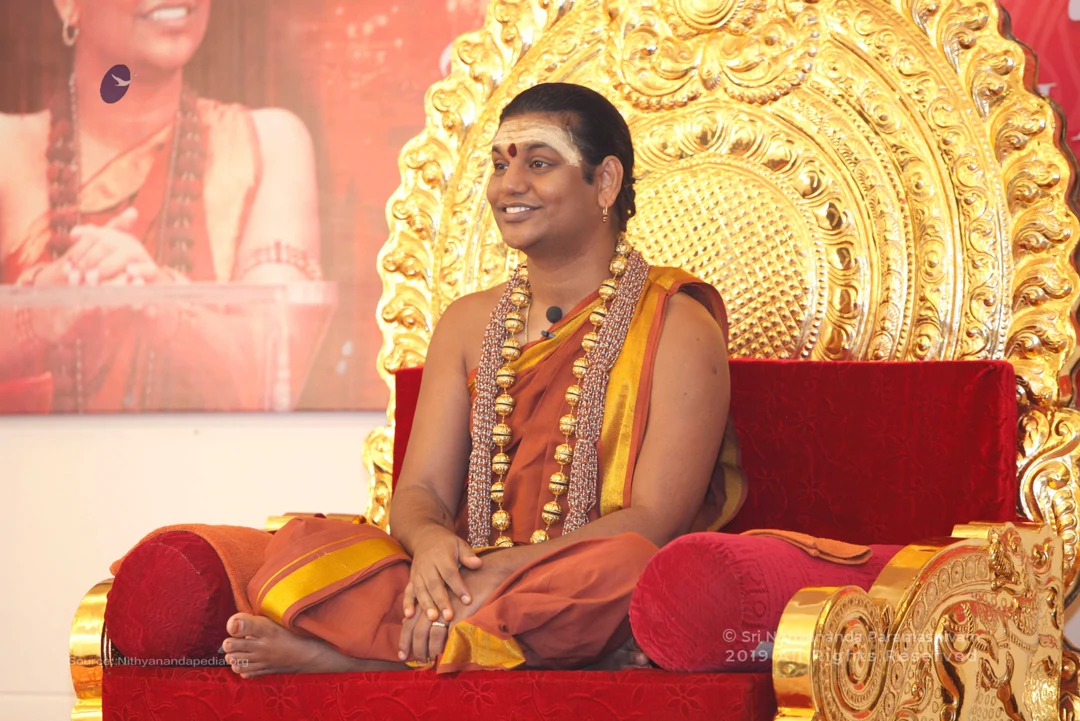
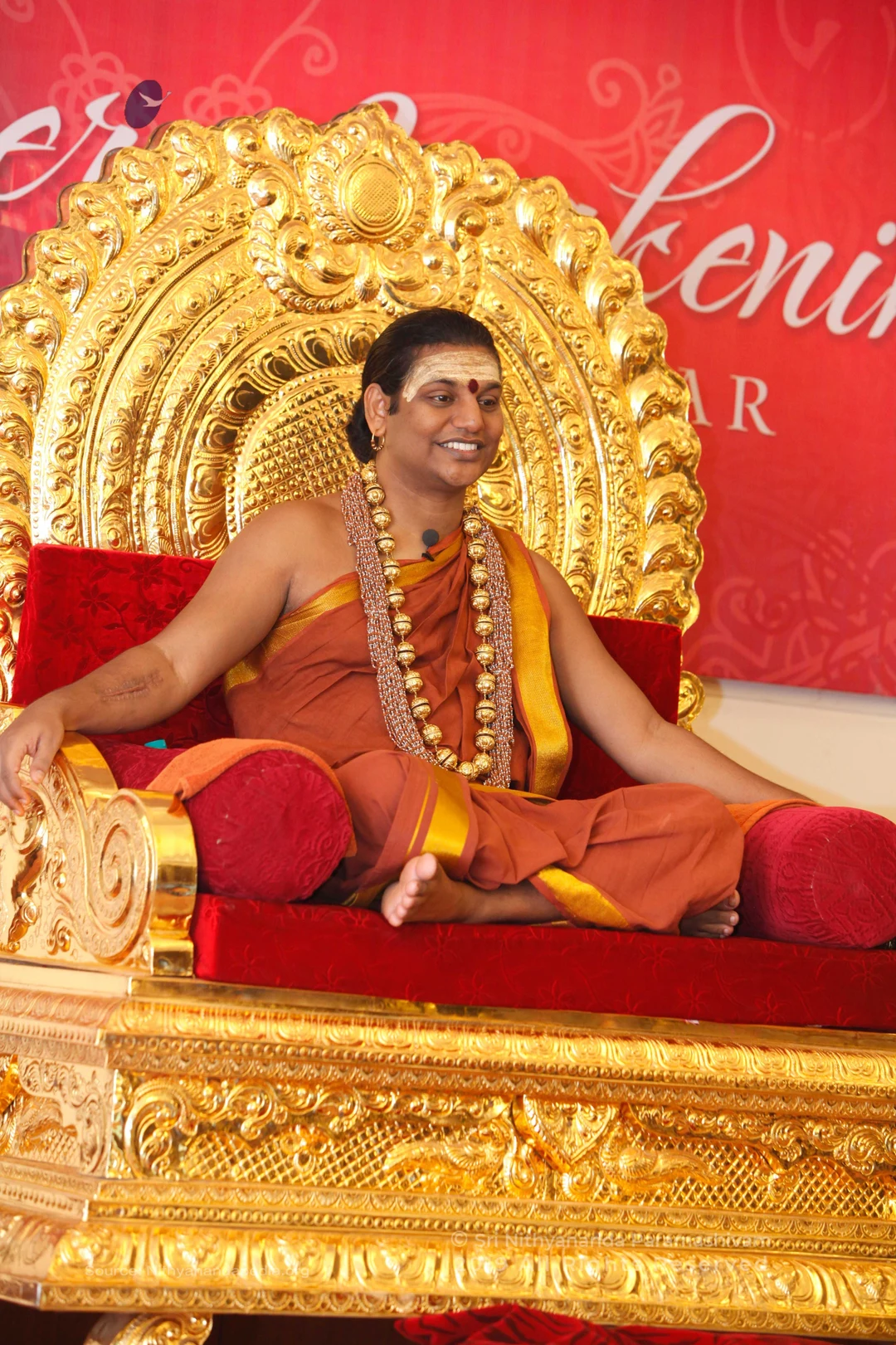
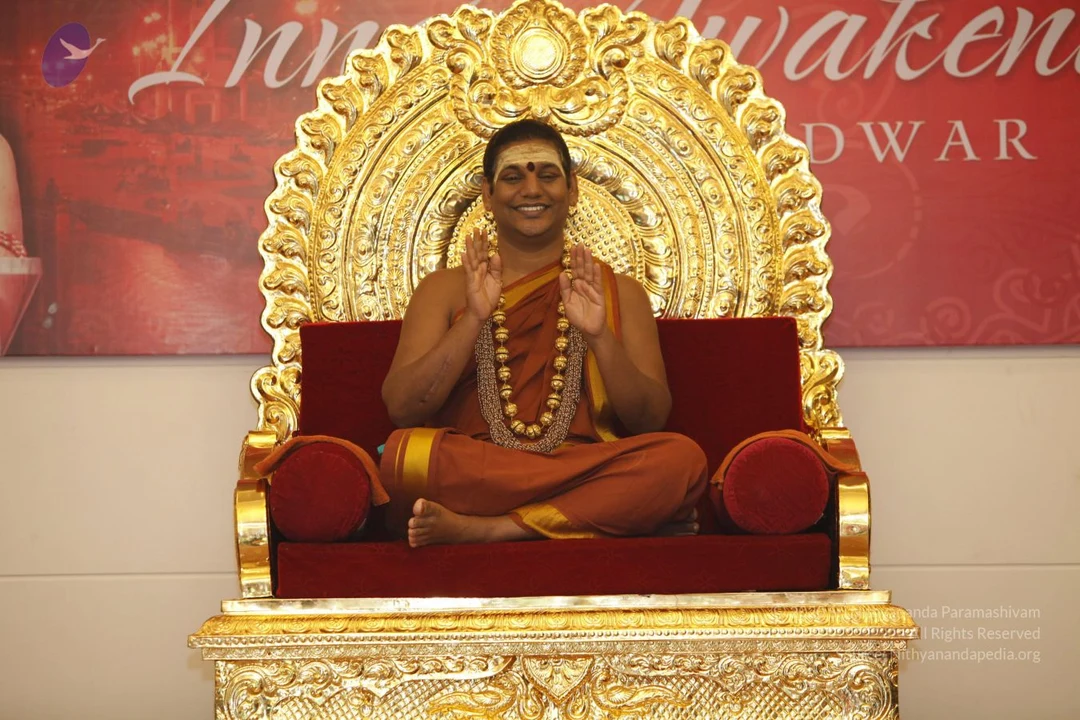
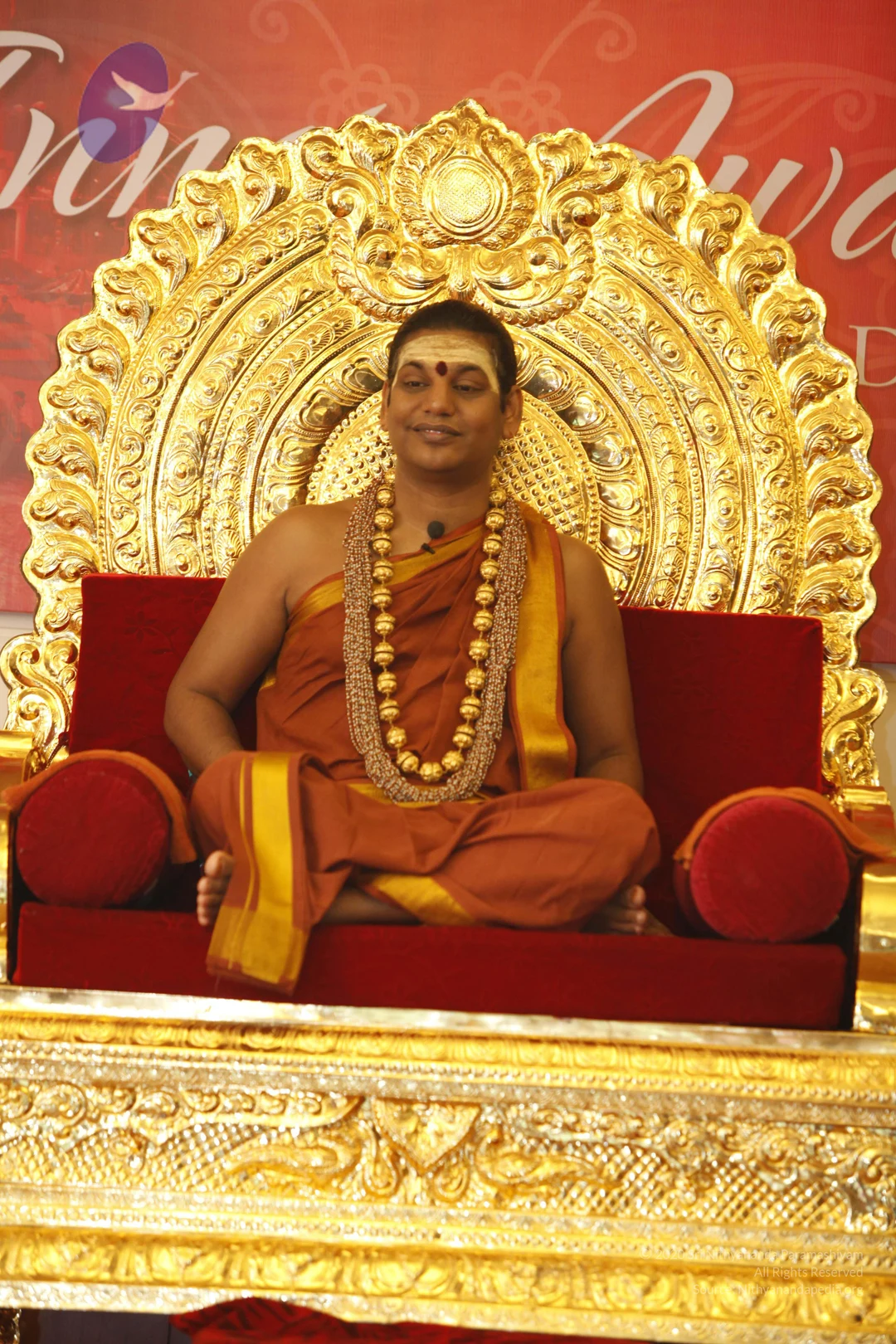
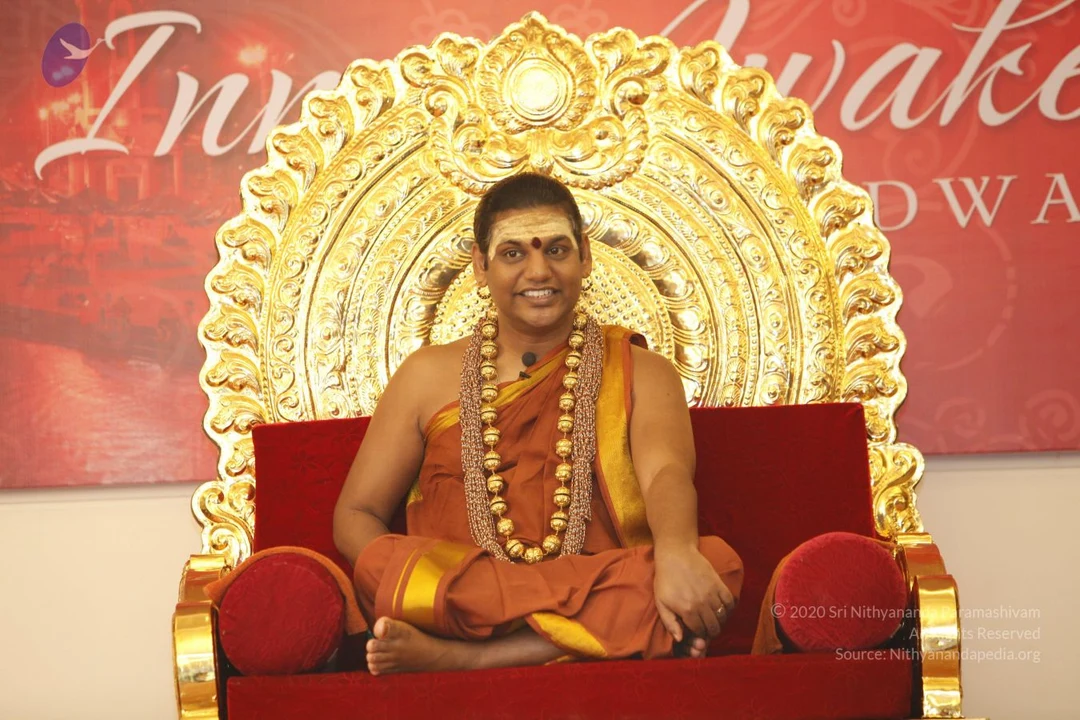
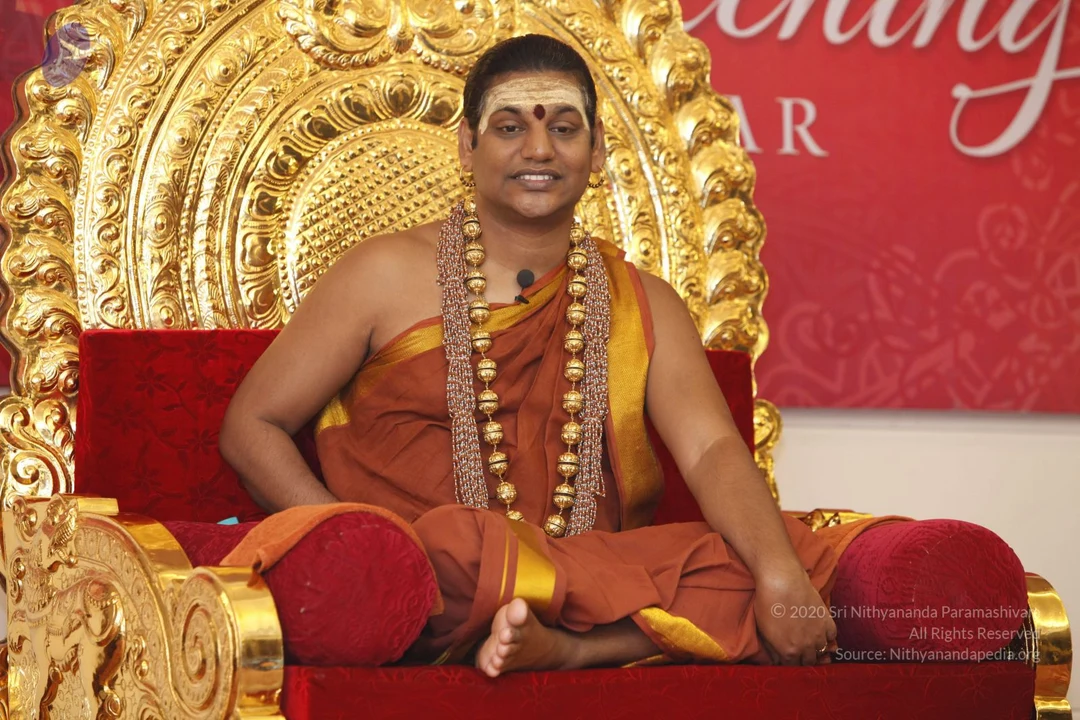
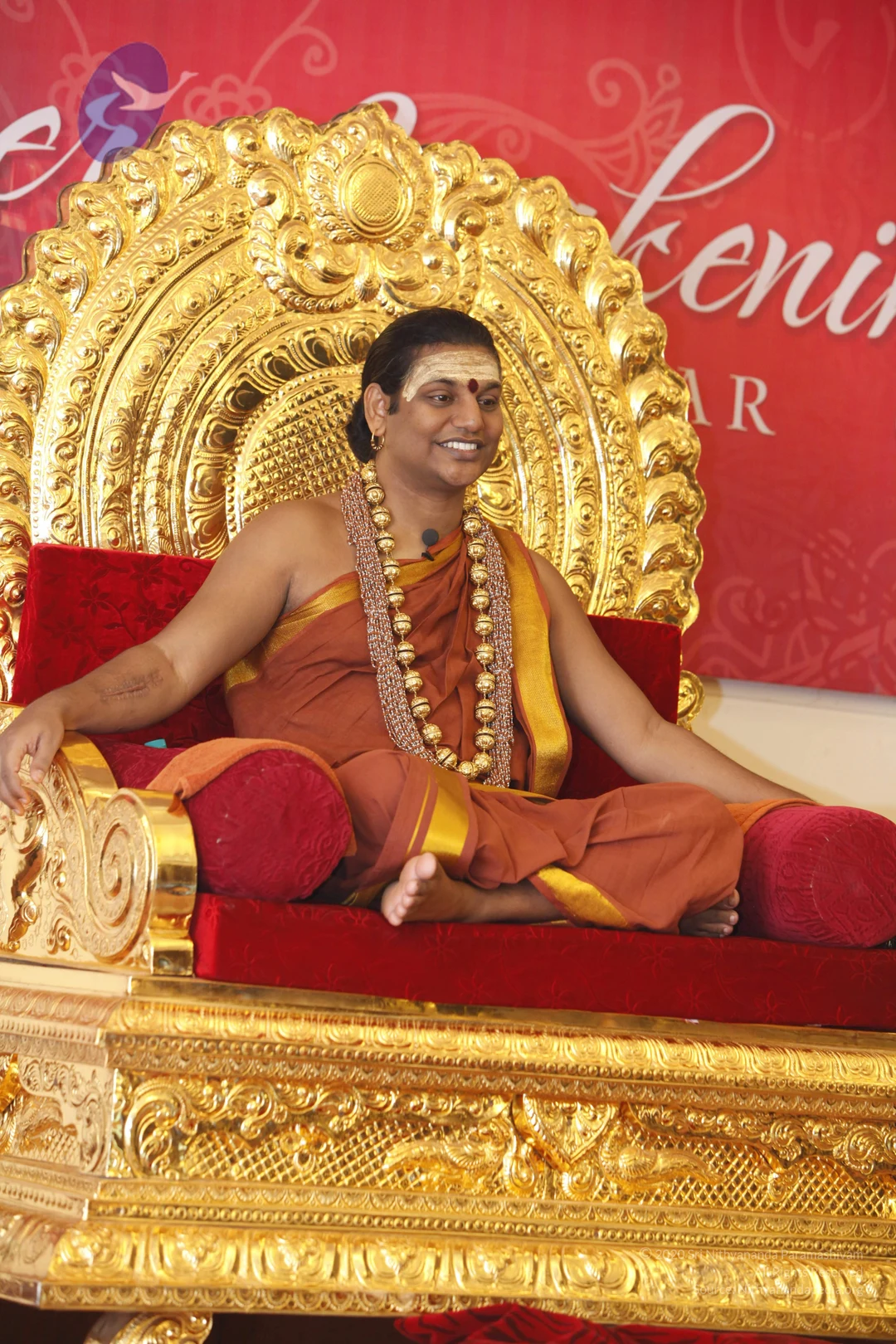
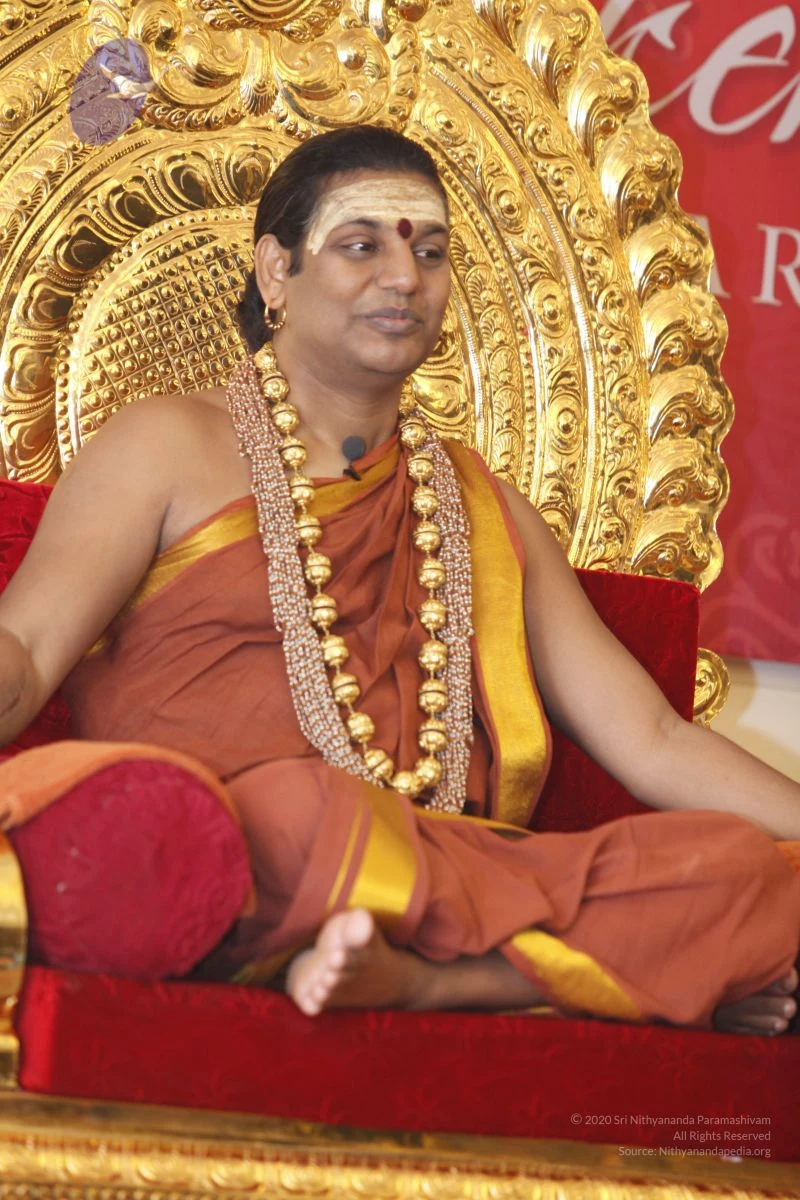
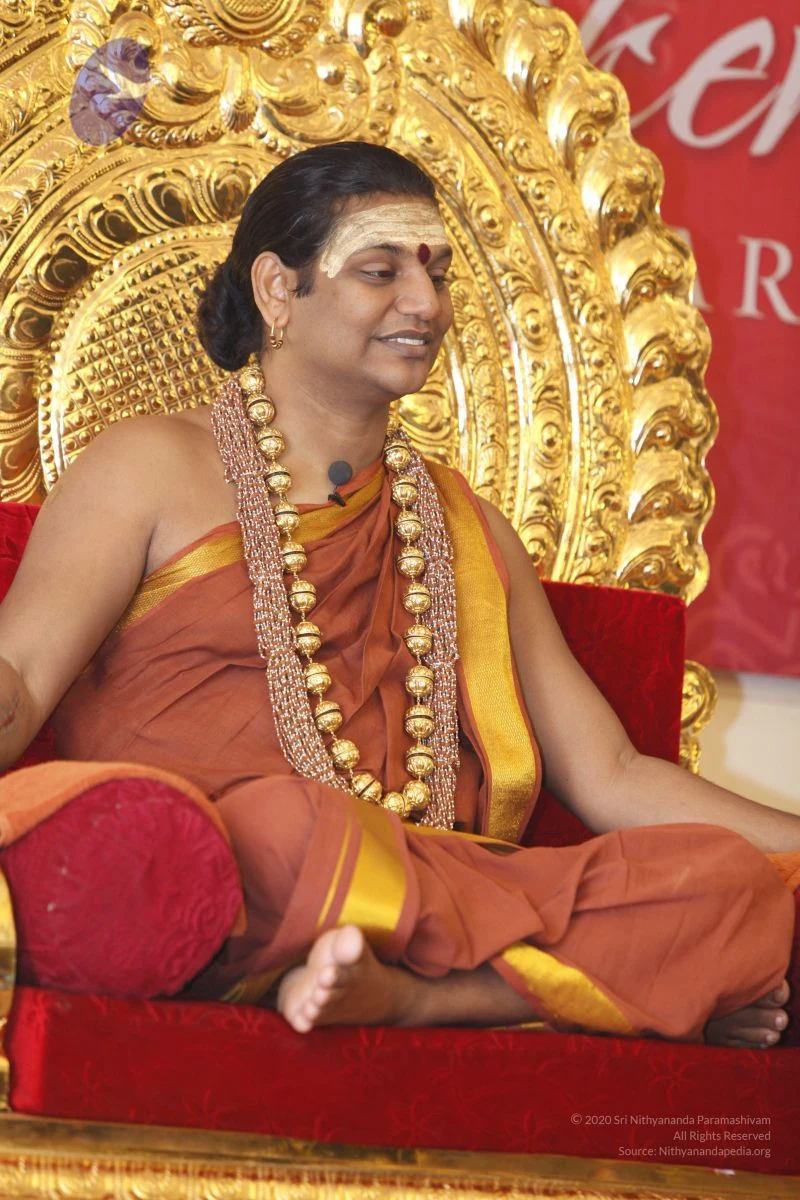
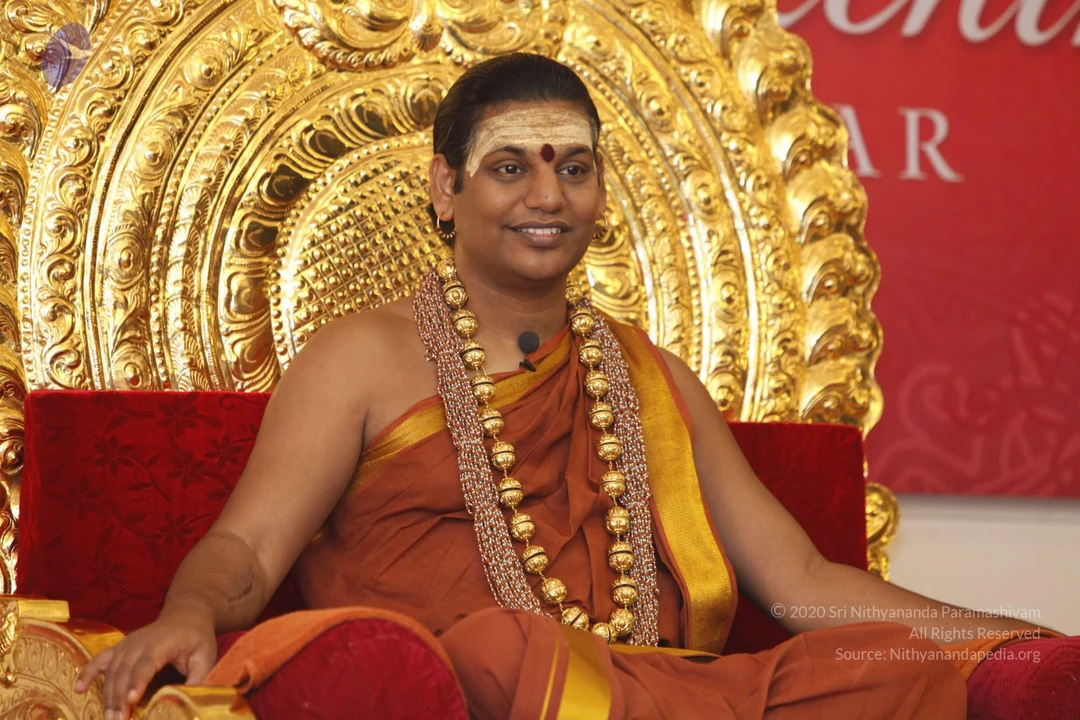
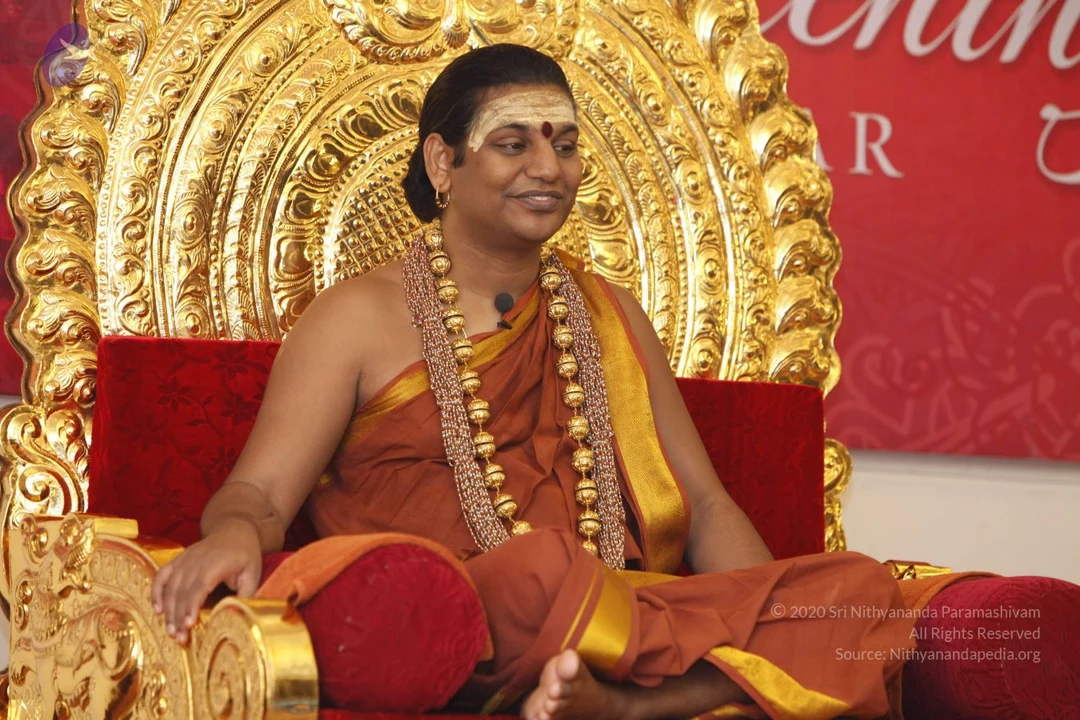
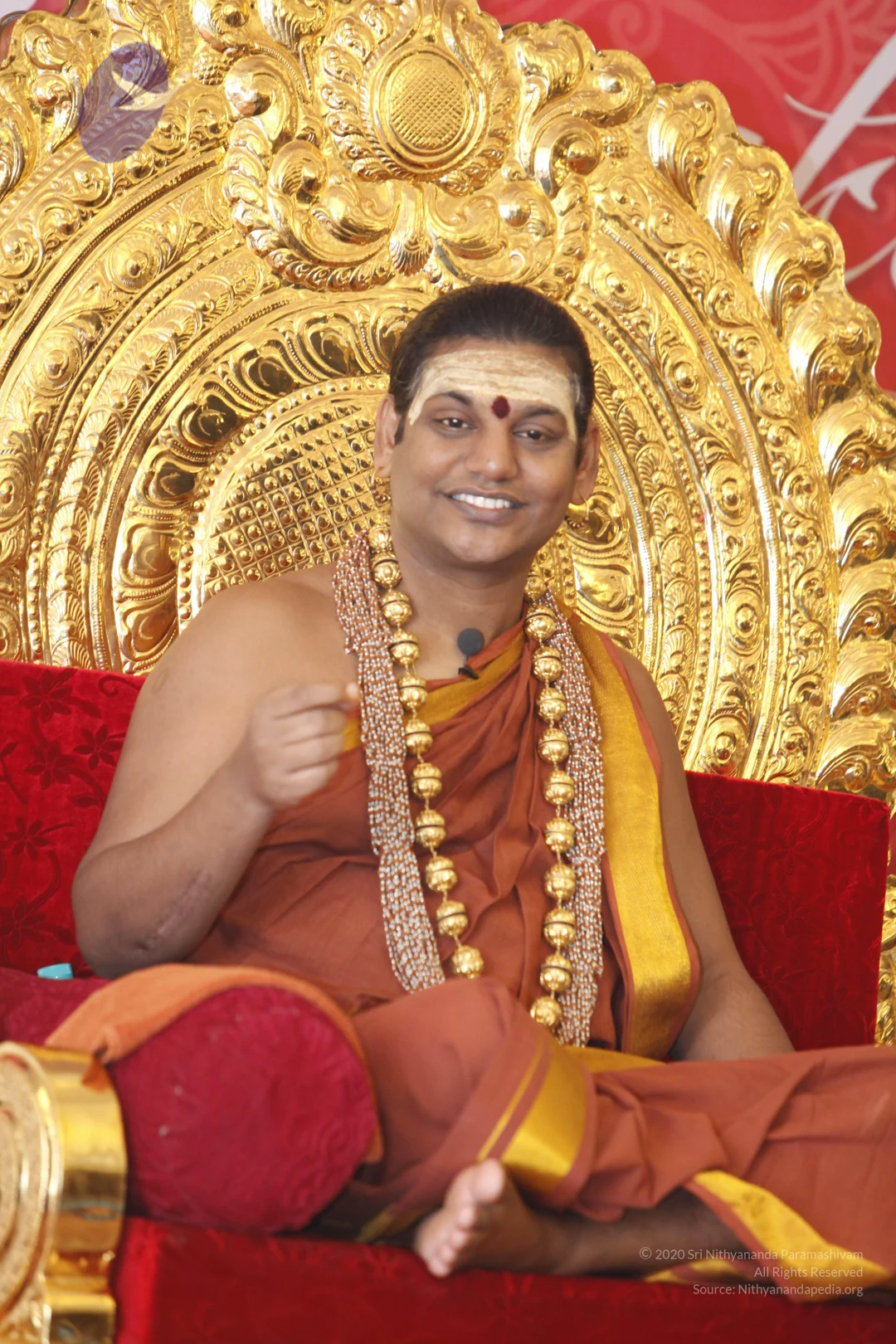
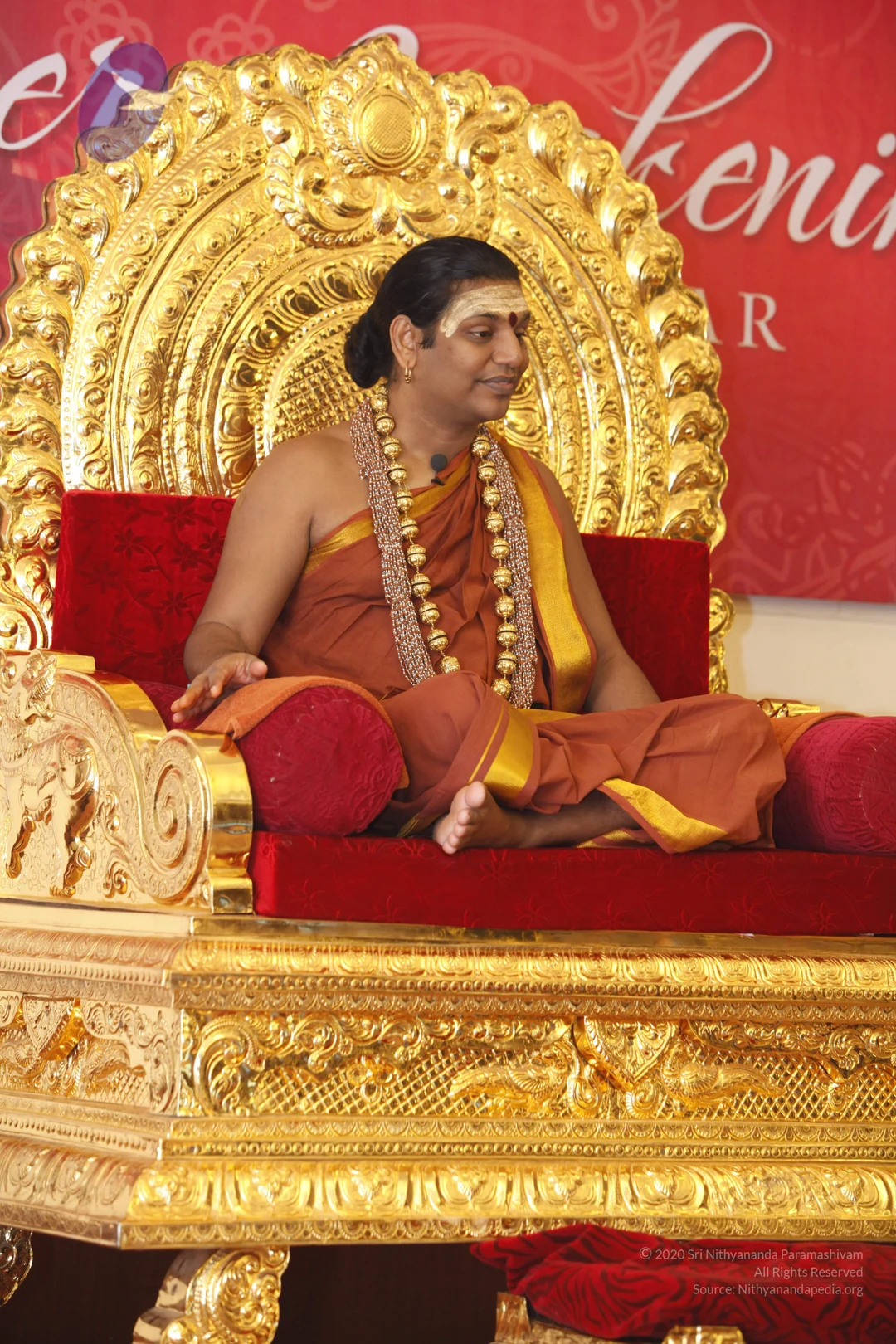
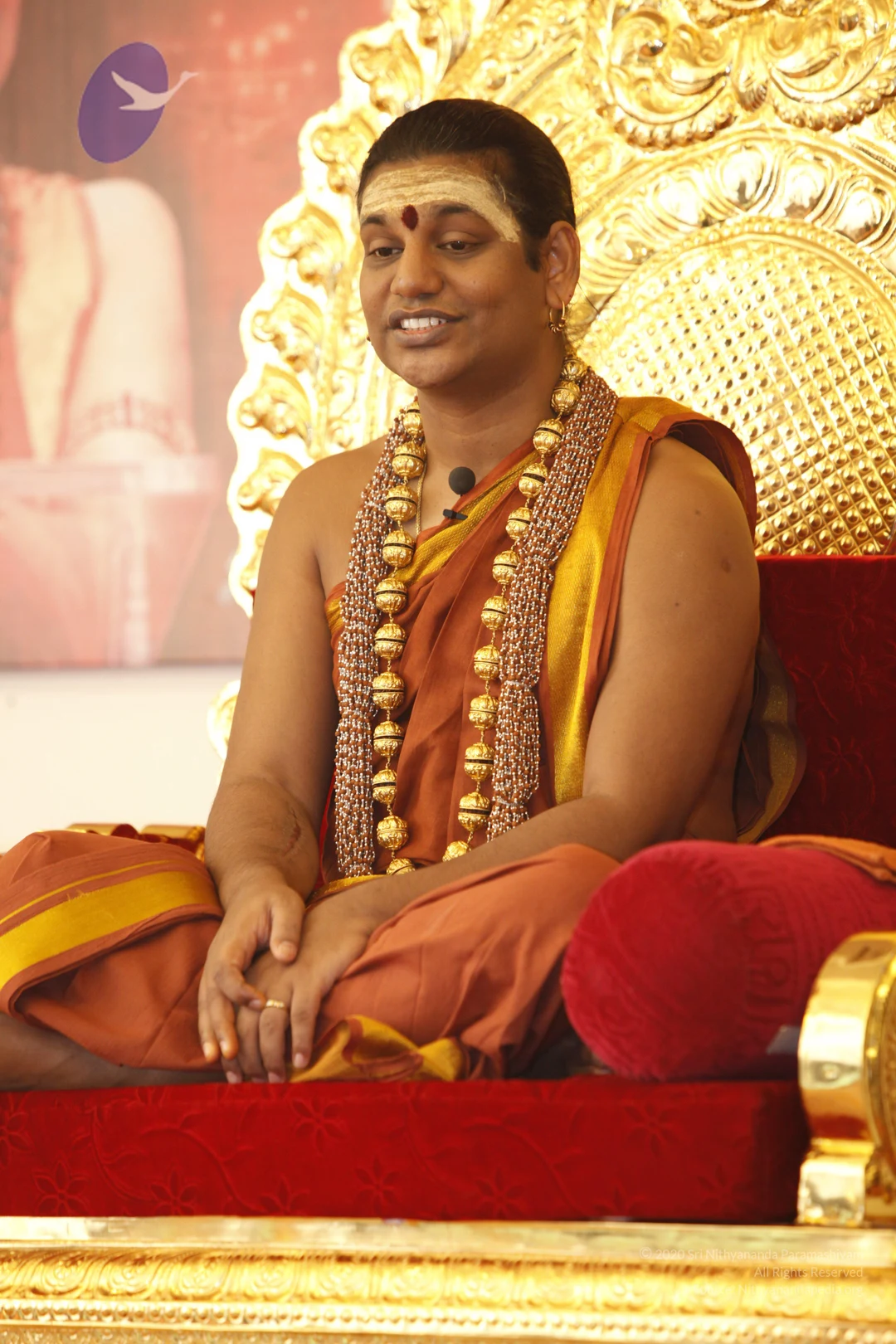
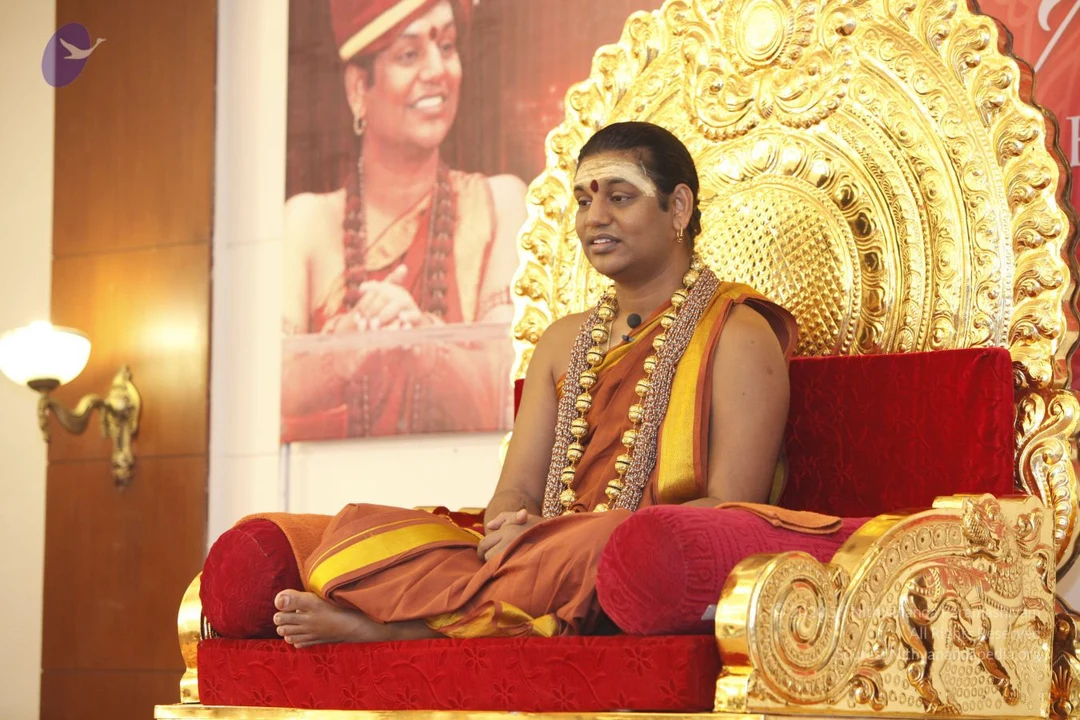
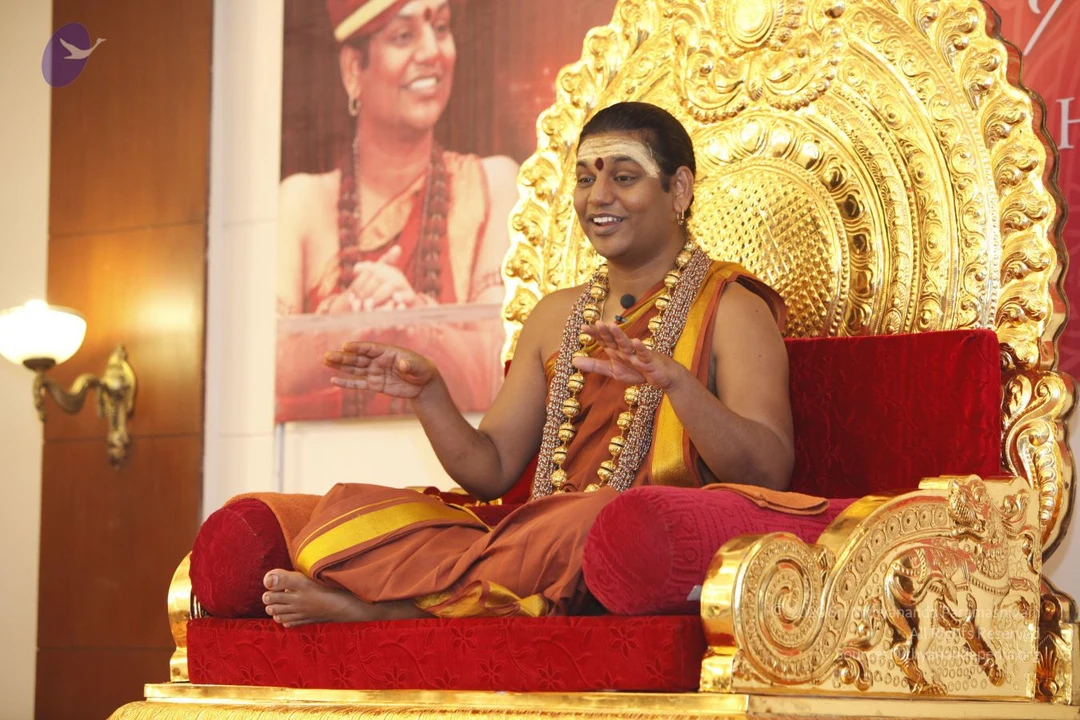
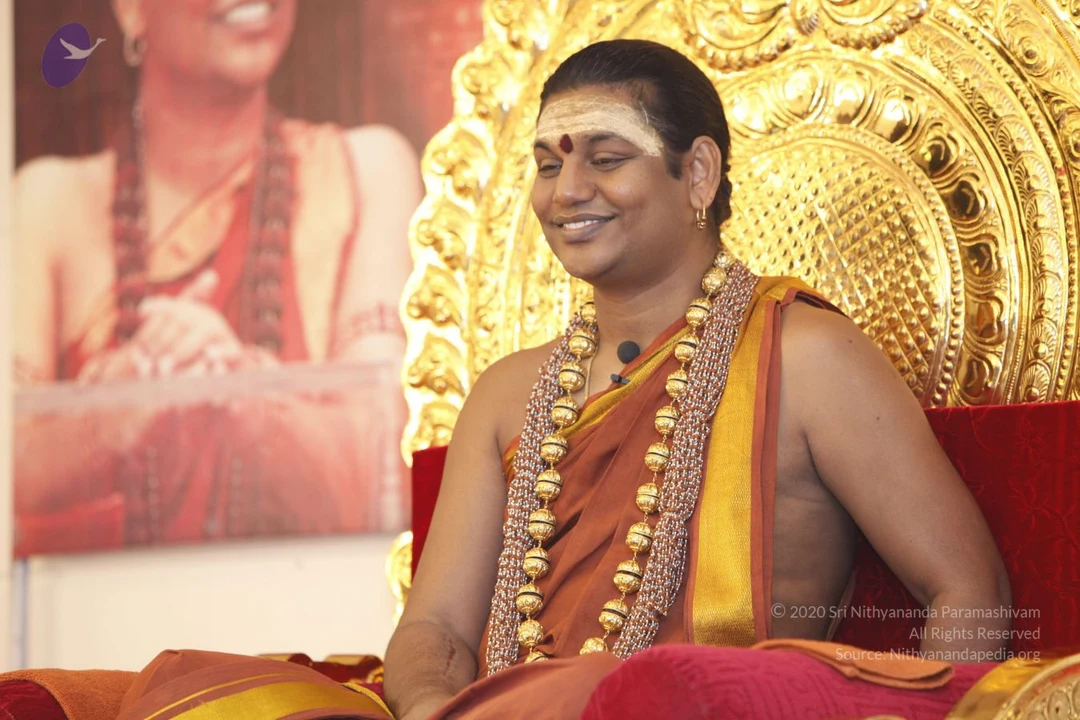
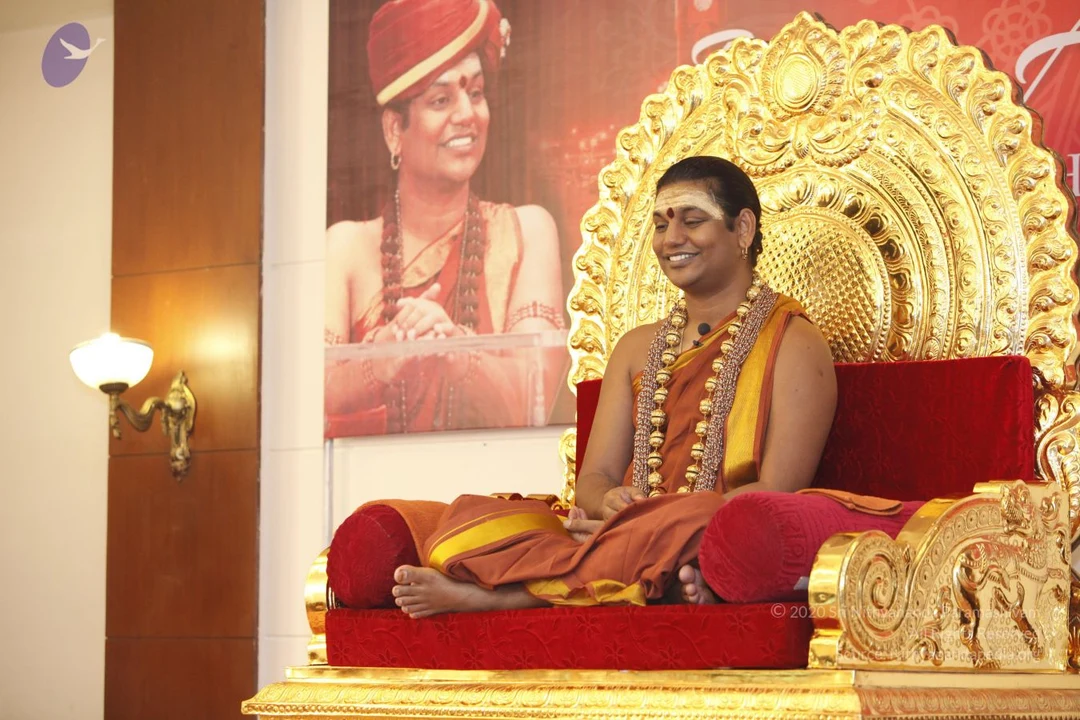
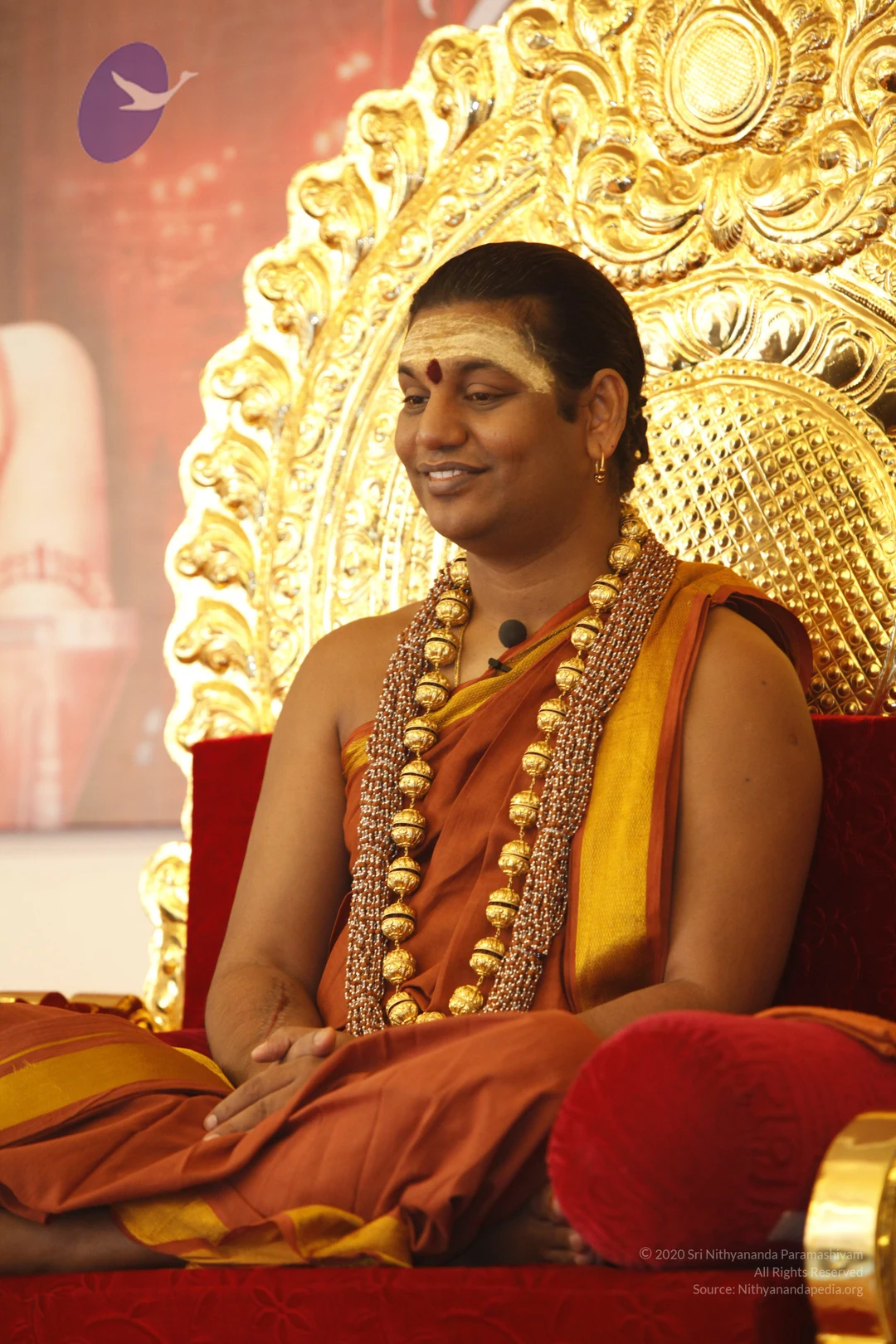
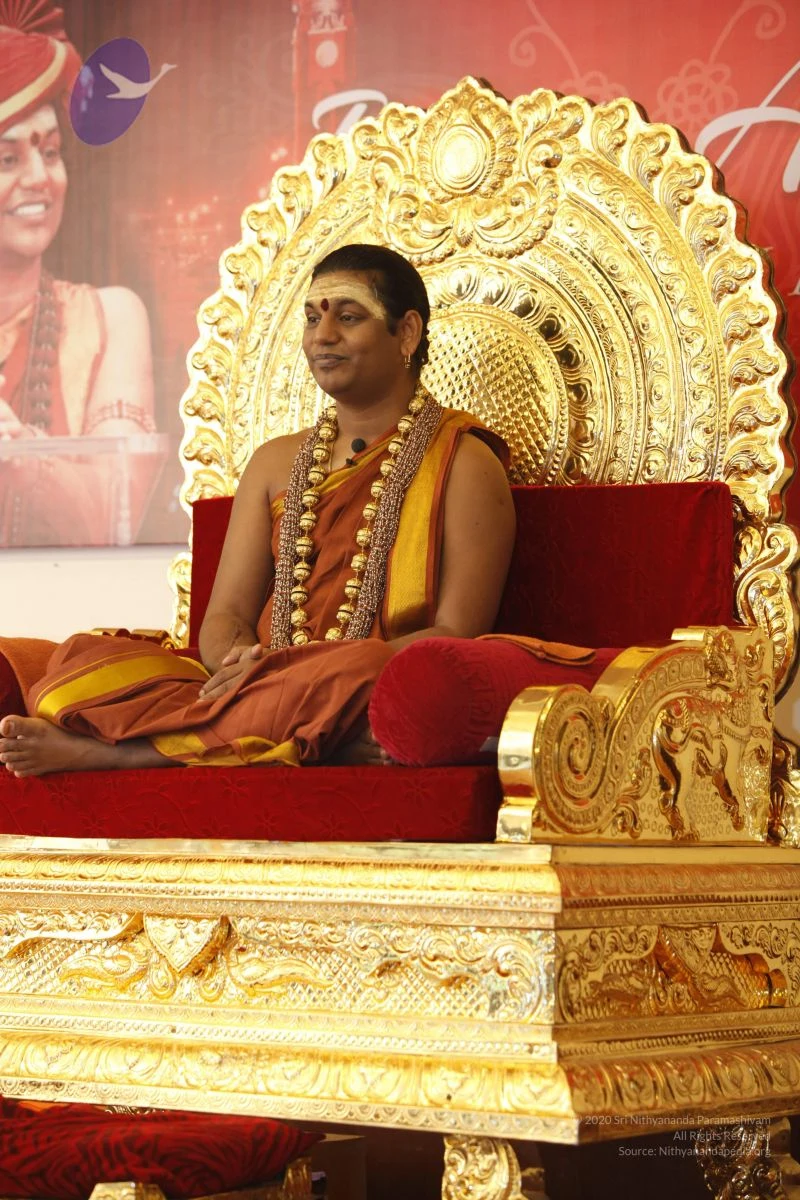
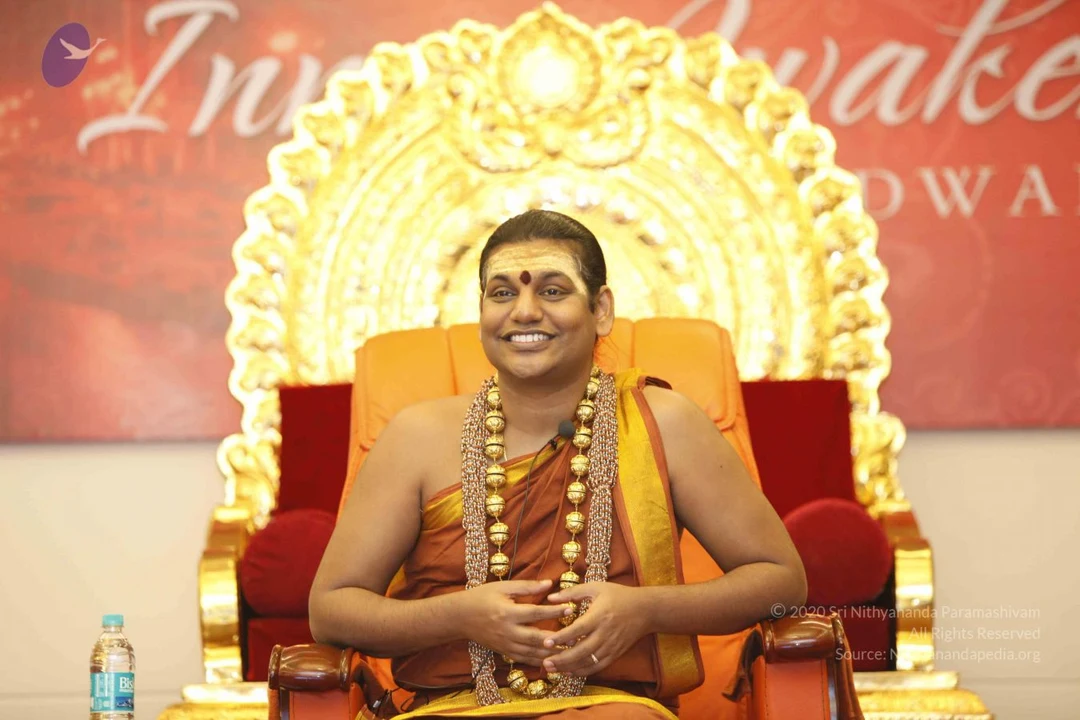
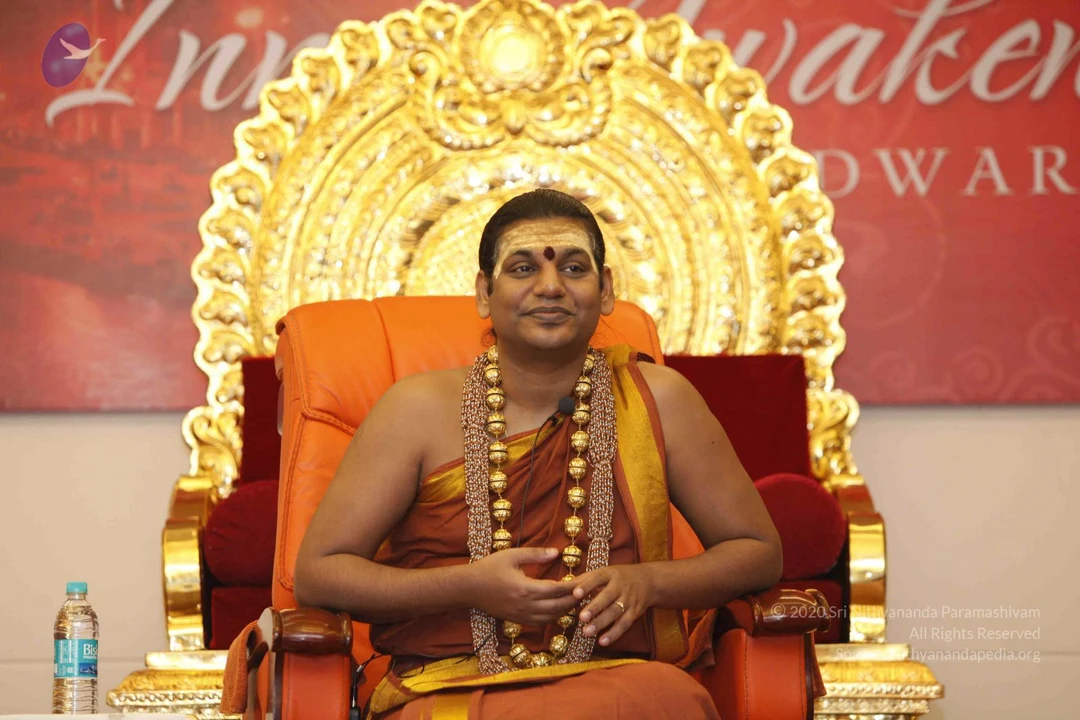
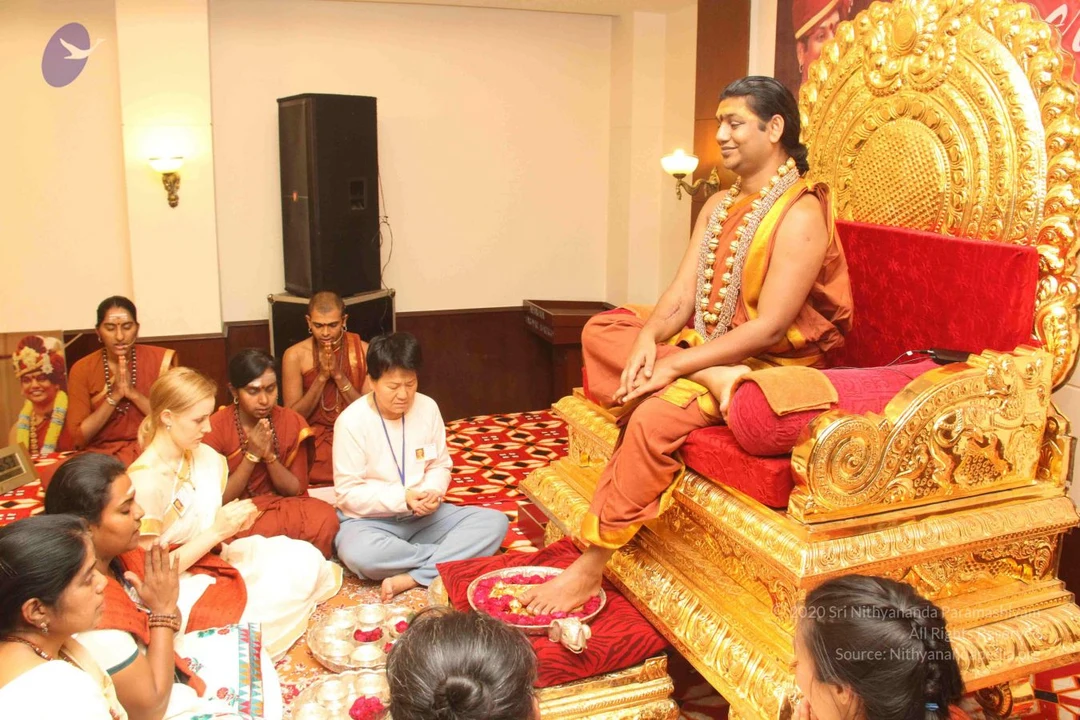
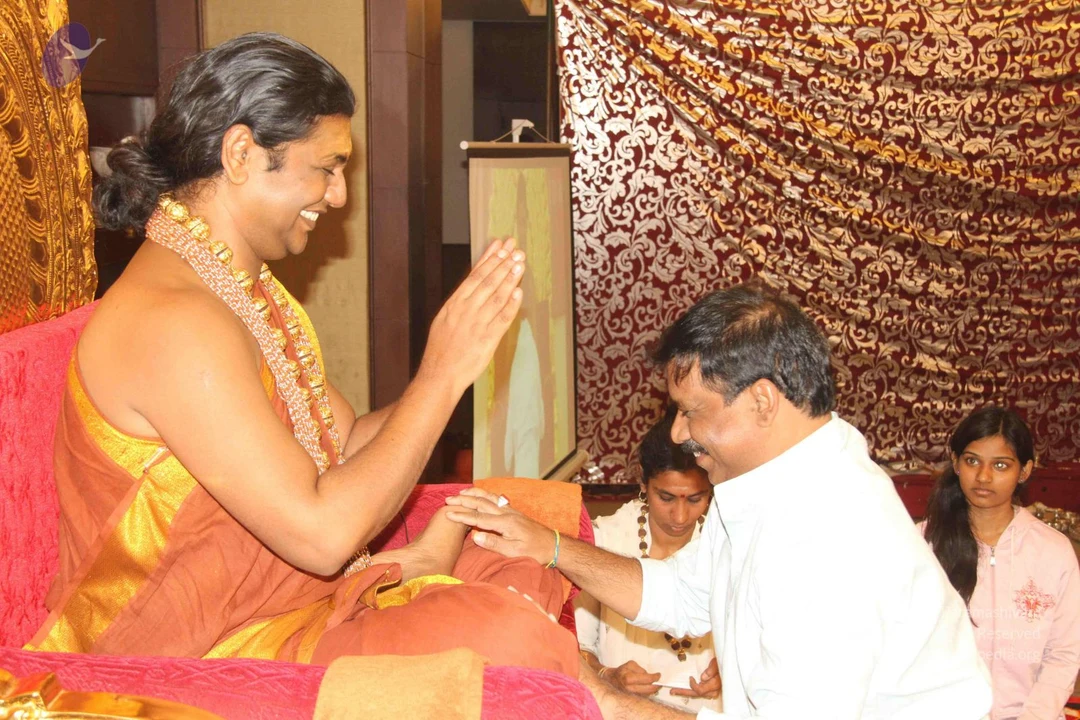
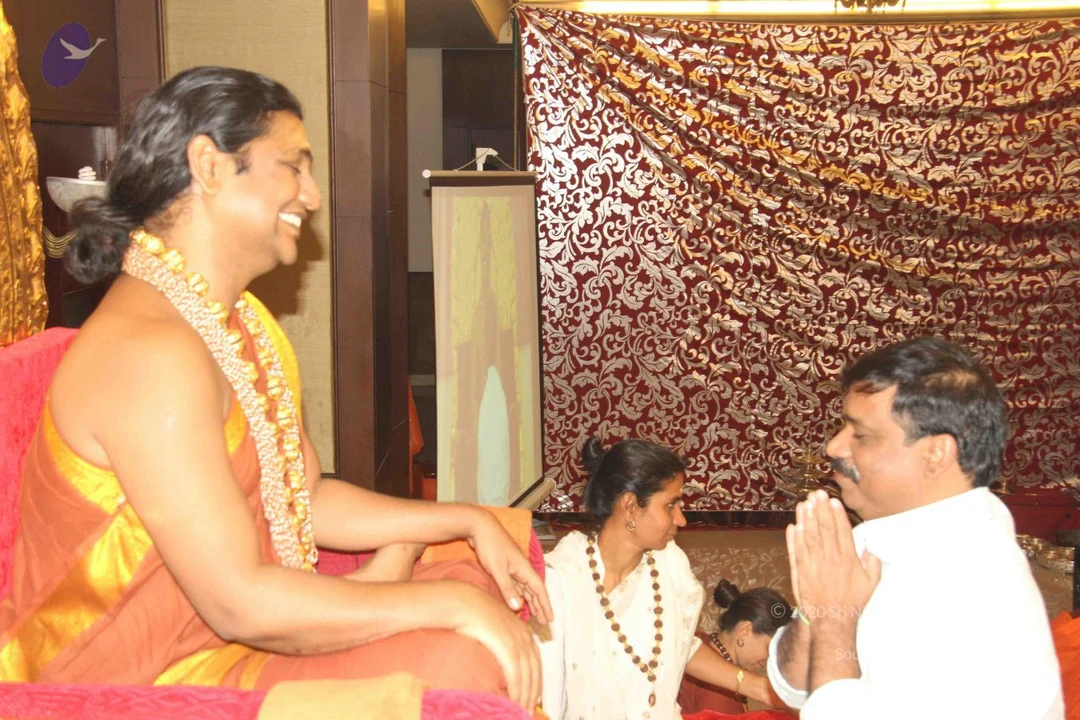
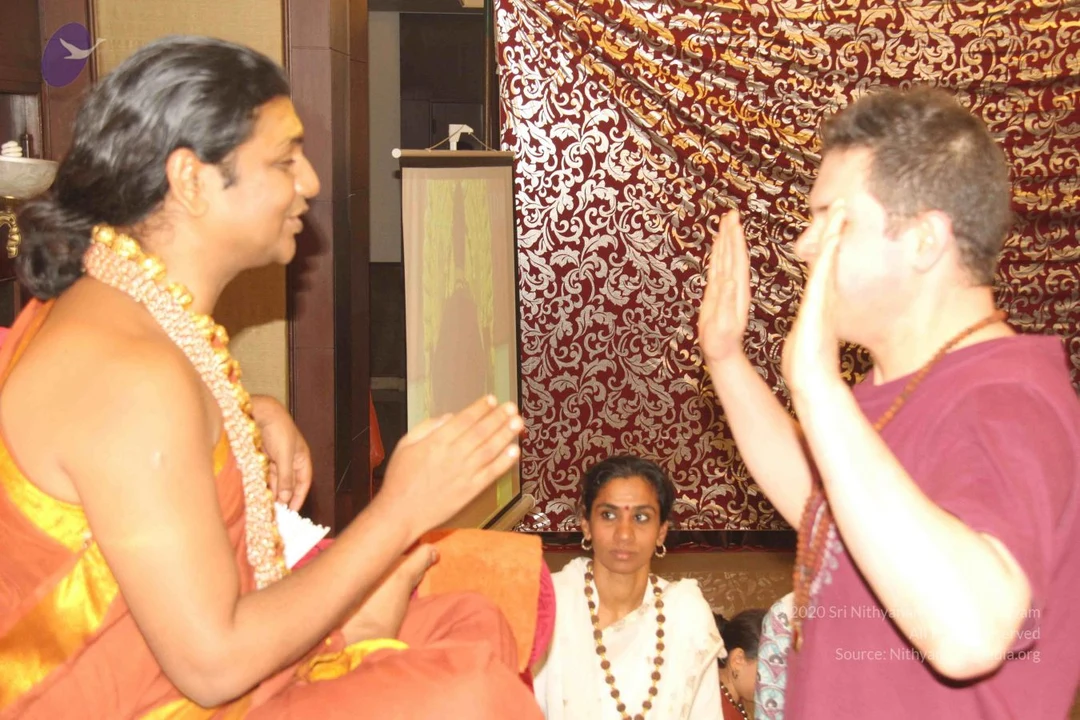
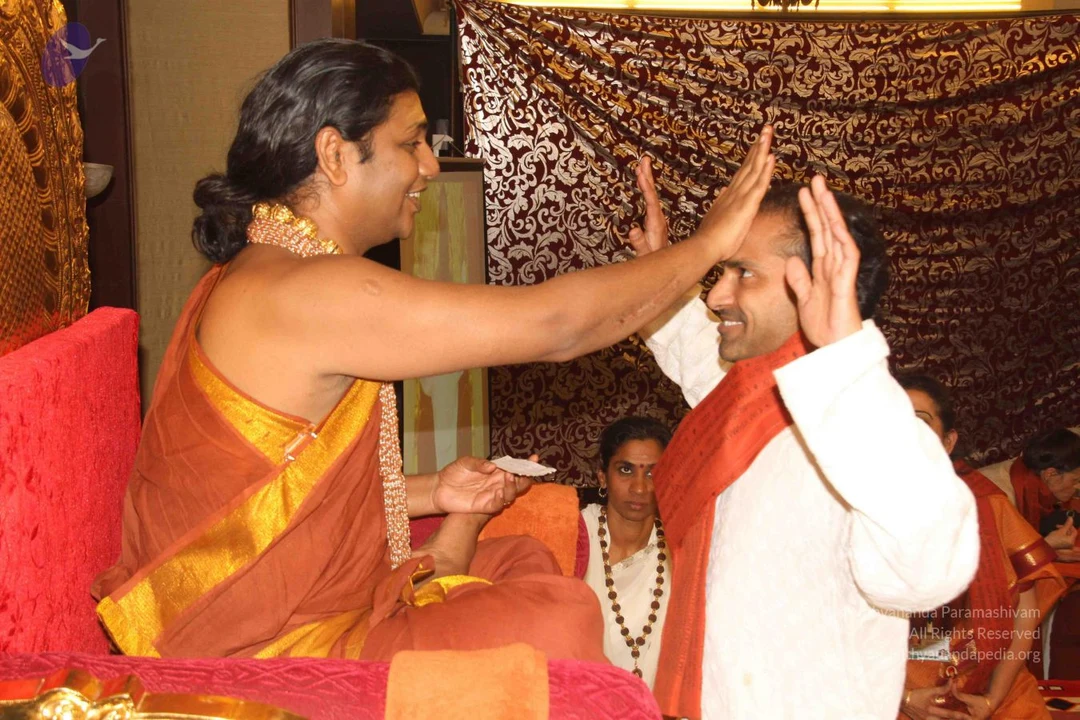
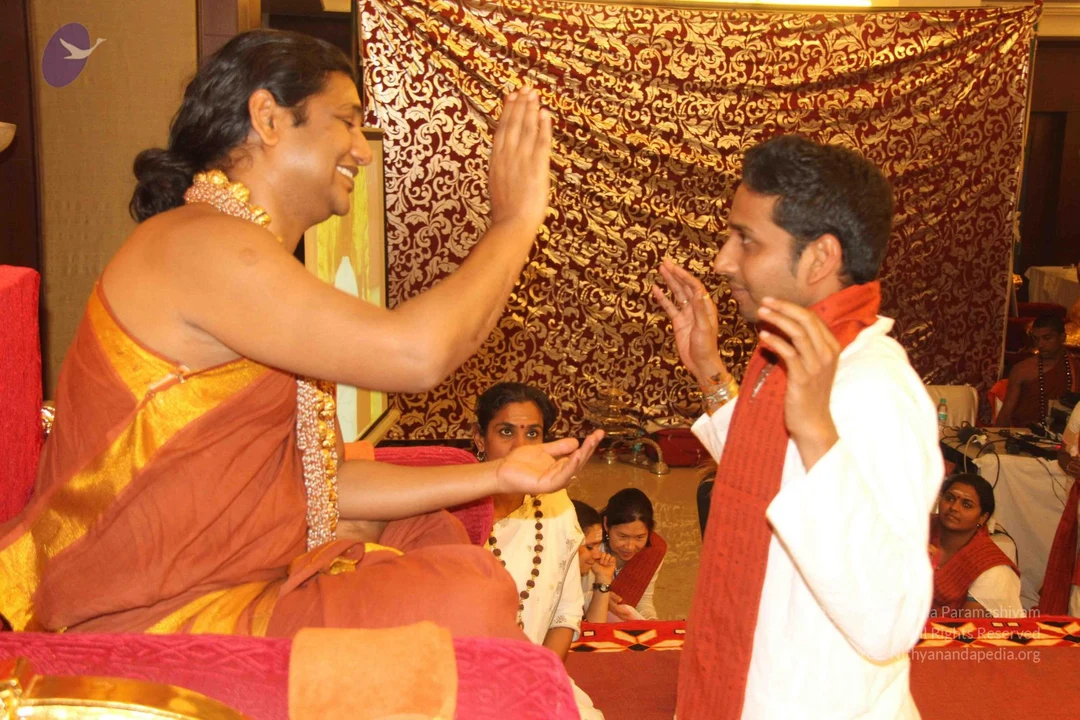
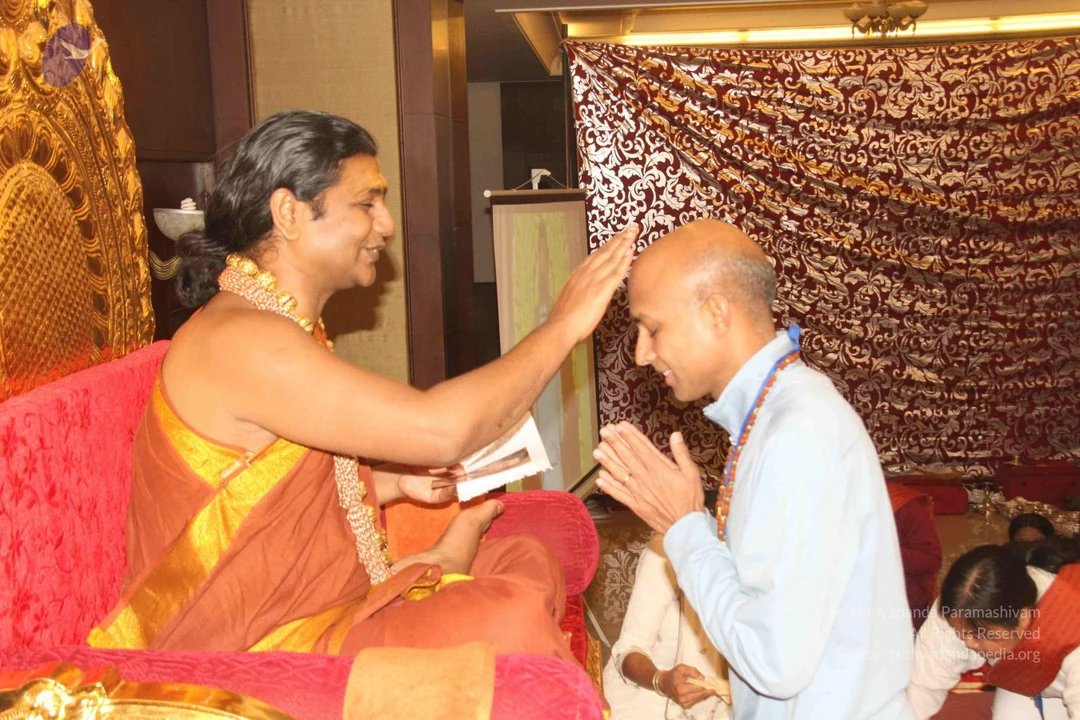
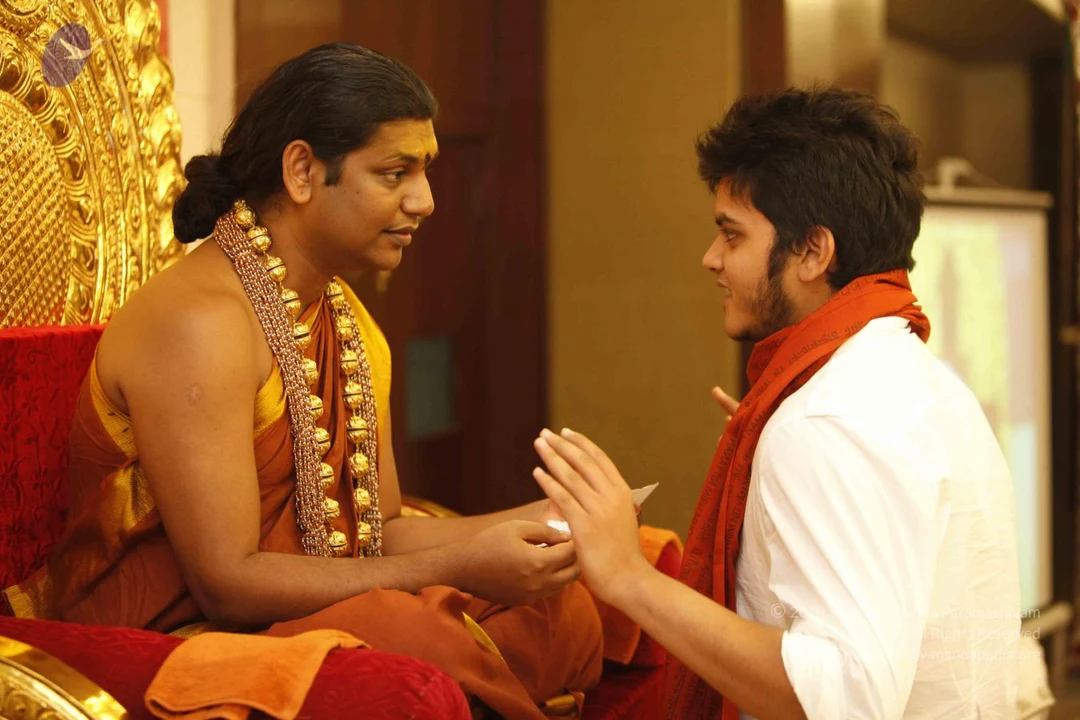
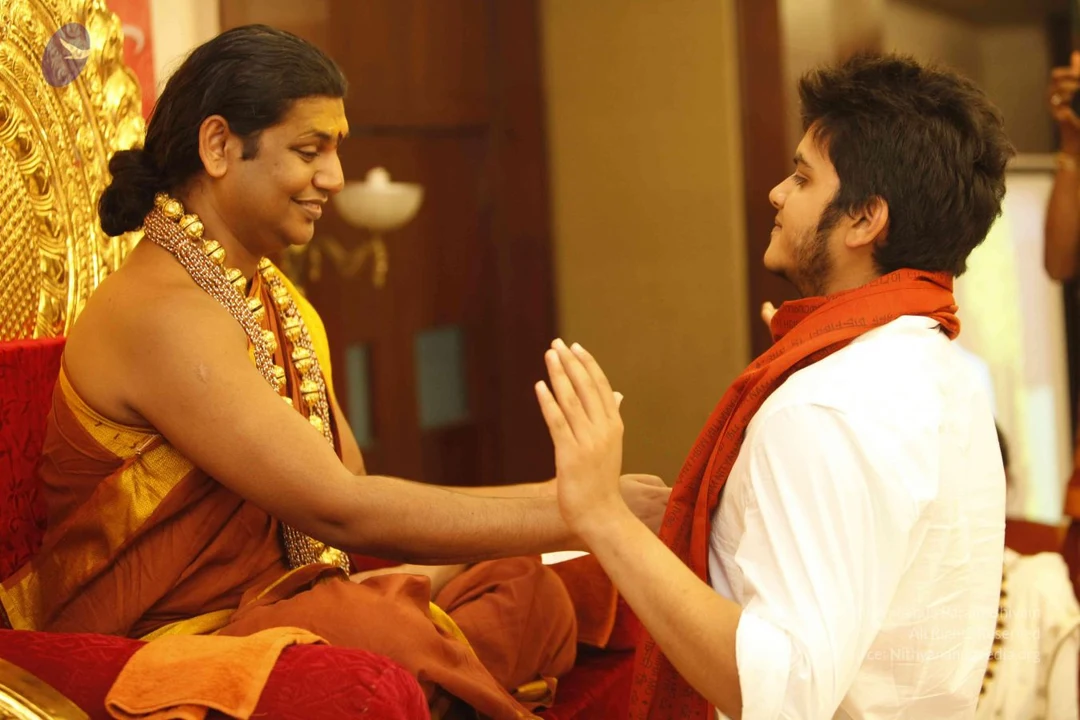
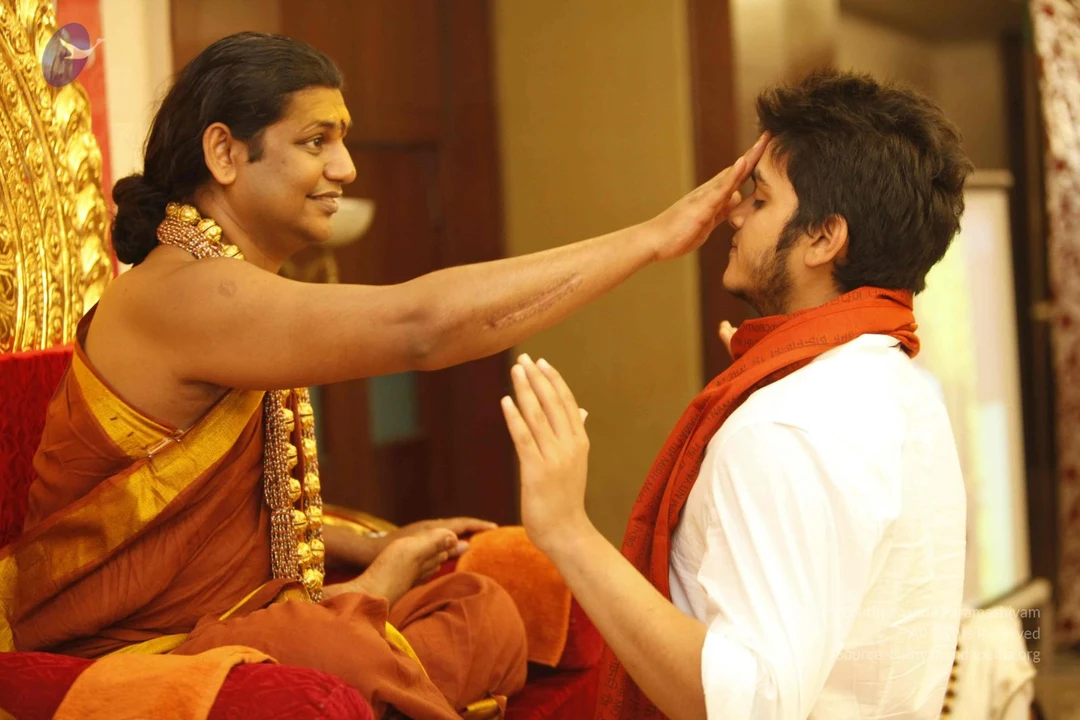
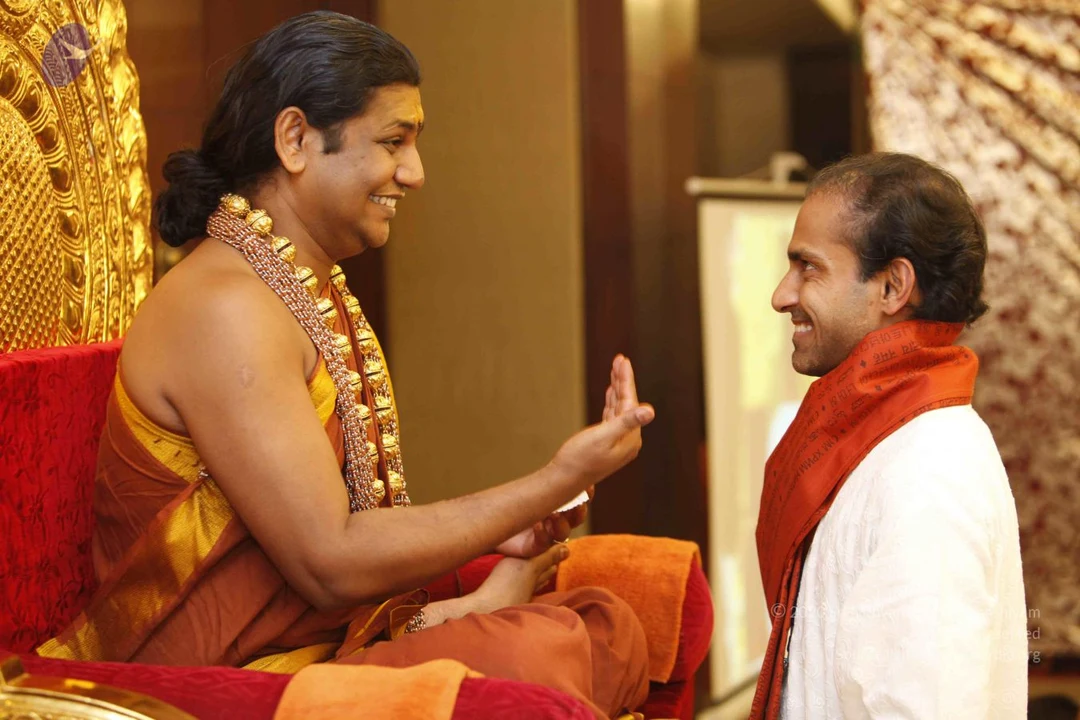
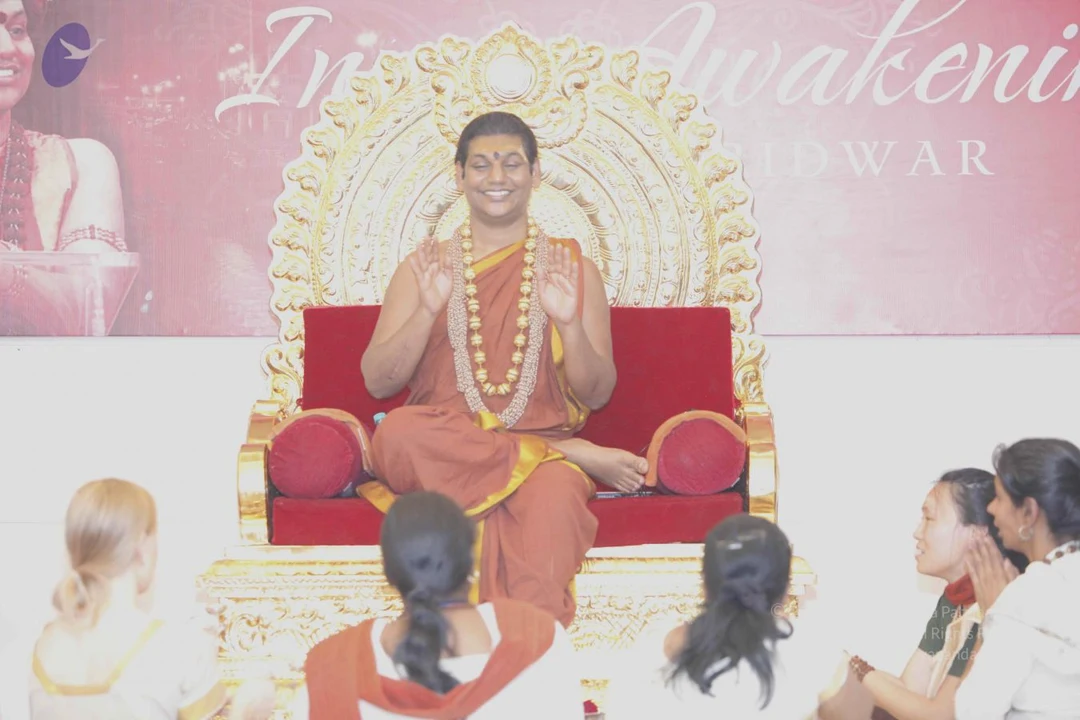
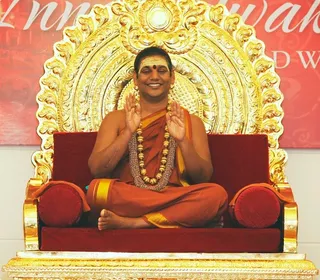
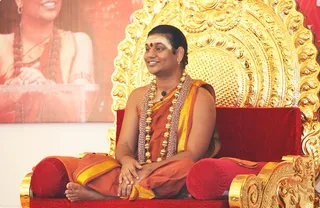
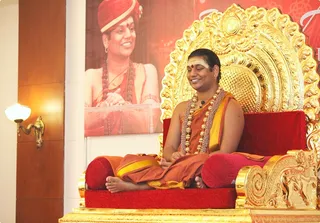
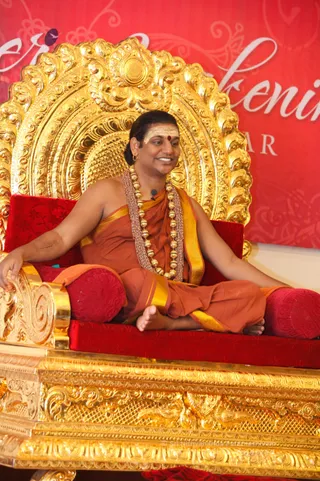
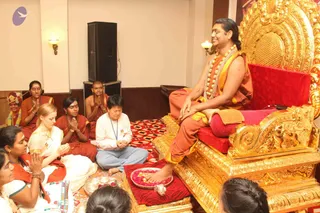
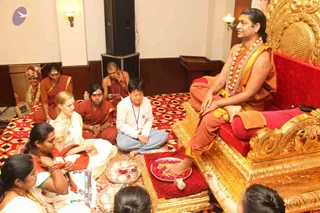
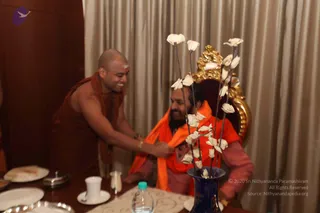
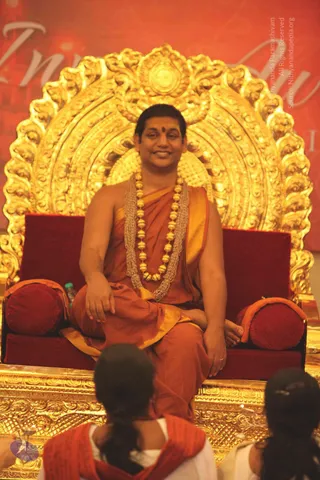
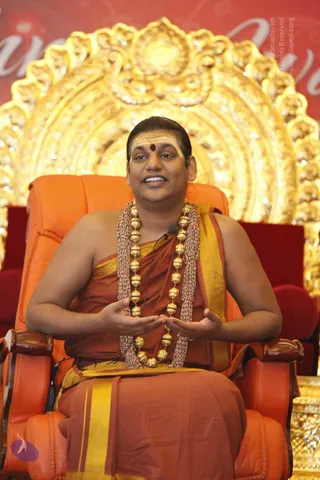
A seated man in orange and gold robes sits cross-legged on an ornate golden throne with a red cushioned seat and red bolster pillows, smiling with eyes lowered. He wears a rudraksha mala and a gold ceremonial necklace, with a red-and-white tilak on his forehead and gold earrings. Behind him hangs a large portrait of a smiling person in a red turban, orange-red sari and rudraksha beads, set beside a wall sconce. A small lapel microphone is visible at his collar. Swamiji (probable): long hair, rudraksha mala, ceremonial gold necklace and orange-saffron clothing on a throne, presented in a satsang setting.A seated man in orange and gold ceremonial robes sits on an ornate gold throne with red cushions, feet bare and hands resting in his lap. He wears a long rudraksha-style gold-bead necklace, a gold chain, a small bindi and tilak on his forehead, and a small lapel microphone. Behind the throne a red backdrop shows a painted portrait labelled "Paramahamsa Nithyananda" depicting a smiling figure in saffron. The setting appears to be a satsang or discourse hall. a person: the seated man wears saffron/orange robes, rudraksha-style beads and ceremonial gold necklaces while seated on the throne.A seated man with long dark hair tied back wears an orange-saffron cloth with gold border and a heavy ornate gold necklace with large gold beads and rudraksha-style strands, and is gesturing with his raised right hand while smiling. He sits on a red cushioned throne with an ornate gold-carved backrest. Facing him, a smiling man in a white kurta wears an orange-red shawl with printed script and stands with his hands folded. A red and orange cloth lies on the throne arm. Swamiji (probable): the seated figure shows long swept-back hair, saffron clothing and a gold ceremonial necklace on a throne, consistent with the page's reference to Swamiji.

January 11 2014

Original wiki page
Contents

Description

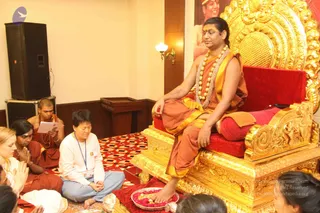
In today’s morning Satsang, Paramahamsa Nithyananda advises us to do self-completion with SDHD - self-doubt, self-hatred, and self-denial before asking any boon. Otherwise, we are not sure what we really want because we are in confusion, wasting our energy in self-assertion – trying to convince others of our worth. Self-completion with SDHD gives us the clarity, self-confidence and energy to achieve whatever we want.

Video and Audio - Galvanise All Your Abilities

VideoAudio

Transcript

(0:16)

|| nithyānandeśvara paramashiva samārambhām nithyānandeśvari parāshakti madhyamām | asmat ācārya paryantām vande guru paramparām ||

I welcome all the devotees, disciples, samajis, satsangis and visitors, viewers sitting with us through Nithyananda TV, Sadhana TV, Eshwar TV, Janasri TV and through 2 way video conferencing all over the world in many cities, in many countries. Cities sitting with us through 2 way video conferencing - Monterrey Kedarnath, New York Varanasi, Los Angeles Arunachalam, Hyderabad Gupta Kashi, Bengaluru north, Calgary Amarnath, Nithyananda nagara Bidadi, Guadeloupe Rameshwaram, Houston Texas, Hyderabad Gupta Kashi, Los Angeles Arunachalam, Nithyananda Nagaramu Hyderabad, Ohio Prayag, Oklahoma Somanatham, Oman Sivagangai, San Jose Madurai, Seattle Chidambaram, St. Louis Tirumala, Toronto Kailasam, Vancouver Bhuvaneshwar, Devon UK, East London UK, Monterrey Mexico, New York Varanasi, San Diego tirualavai, Singapore Singapuram, temple city California, Olympia Washington, Oman Sivagangai, Gokarna Nepal, Enriching temple Bidadi, Kathmandu Nepal, Kulim Tiruttani, Winnipeg Canada, Kuala Lumpur Palani. So I welcome all of you with My love and respects.

(02:42) Today I will continue to expand on Kalpataru. Man has, without even knowing what he wants; does not wait for the maturity to happen even to understand what is going to fulfill him, what is going to make him happy. And he thinks what he wants, he wants even if it is going to be suffering, even if it is not going to be joyful. Sometime that is what is surprising us. So, then man really does not want for the sake of want. He just wants to prove by wanting he is powerful. His ego “If I want I get it”.

(3:47) Please understand, many time I have seen... I will give you one example. Child comes and asks “I want 10000 ice creams.” Naturally, the 10000 ice creams if the kid eats everything, he is going to get diabetic and cold and all diseases. Instead if we advise the kid, you see, “What for you are asking ice cream? The sweetness, the joy you experience. So, ask directly that as a boon. Let you always have joy and sweetness; sweetness in your tongue and throat and the joy which comes because of it.” Child won’t accept. He will say “No I want only the 10000 ice creams.” And all the side effects which it brings - disturbance in the health or whatever. And he knows he will not be able to eat 10000. He can’t cross 11th ice cream. Maximum he may be able to have 10 or if it is like a challenge or competition he will go up to some 50-60; not more than that. The whole remaining 9900 are going to be wasted. Neither he is going to enjoy and instrument through which he is going to enjoy is also going to be destroyed once for all. That is exactly the mentality with which we human beings ask. And we are not ready to listen any advice about what we are asking. We are very straight.

(05:42) I have seen people asking Me, “If you are capable give what I am asking. I don’t want your advice. If you can, bless and give what I am asking. Stop with it! Don’t talk more than that. Quickly either you give tathasthu or I will go to next shani mahatma temple is there. I will go there.” It is now like a buyer’s market. It is no more a seller’s market. The boon, spiritual benefits, all this has become now buyers’ market. Buyers choose from where they want to get. So, they do not want you to give any advice.

I am seeing some more cities joining – Indrani New Jersey and New York Varanasi. I welcome all of you. Yes. Let’s continue.

(06:37) Human beings does not use their intelligence and does not want intelligence when they ask for something. Please listen, not wanting for intelligence is also self-denial. It means what? You are really not interested in enjoying but you are interested in just proving your powerlessness as right. This kid says, “No I don’t want the sweetness in my throat give me only 10000 ice creams”. Then what it means? He is only just interested in proving to everyone “See I have 10000 ice creams.” Nobody wants intelligence. But I tell you a little bit of intelligence... I am not even taking you to some impractical level, what you think as impractical level. In a very practical level, if you think with basic intelligence, if you look in with a basic understanding, that is enough. A common intelligence if you can use that will do so much to your body and mind and being.

(08:30) Please listen, completing with self-doubt and self-hatred and self-denial frees you from so much of energy being wasted in unnecessary direction of just self-assertion. Please understand, so much of your energy is wasted just to assert yourself to others; which is not required. Because you have so much self-doubt about you, you want to strengthen yourself, feel powerful by proving yourself to others. No. If you want to feel powerful towards you, if you want to feel powerful with you, complete your self-doubt. That is the easiest method. Instead of touching the nose like this you try to do all gymnastics to touch your nose. No need. Listen. Feel sure about you by completing with your SDHD - self-doubt hatred denial. Feeling sure about you is not going to happen by proving yourself to others because the more you prove yourself to others, the more doubt you will start developing inside you – “I am convincing everyone but why I am not able to convince me? I am convincing everyone but why I am not able to convince me?” Self-doubt, self-hatred, self-denial - this three completely makes you travel in the wrong direction. You are thinking you are going to Haridwar, you are going to reach to Haridwar, but you are travelling towards Delhi! What will happen? Yes, you will reach Haridwar. When? If you go round the whole world one circle and come back. Is that going to happen? Before that you may not be alive; because there is no road to go round the whole world. Still human beings are not able to make a road to go round the whole world.

(11:15) Listen. The first and foremost crime SDHD does to you is making you believe you will be powerful only if you assert yourself with others; which is not true. Many of you have asserted yourself in many ways to many people. Did that bring you powerfulness? Did that make you feel sure about you? No. Did that bring you self-confidence? No. The SDHD only became more deeper and deeper. Understand, most of your desires are not for your joy. Most of your desires are just to make yourself assert in front of others. All these brands are nothing but trying to assert yourself to others; the brand perfume, brand belt, brand suits, brand car; because for brand you pay 20 times more money. The same shoe in the street - 100 rupee, if it in the glass case with the brand - 2000 rupee; whether it’s a car or a suit or a tie or a coat or a perfume, the brand. Why you always go for brand? Because you are not even bothered about your joy. Sometime that brand may not even be comfortable for you may not be exactly fitting with your requirement. But you say it’s ok it’s ok it’s ok; because most of the time your desires are not for your joy. It is just to assert yourself in front of others.

(13:33) I tell you please listen. If you just complete with your SDHD - self-doubt hatred denial, suddenly you will have so much power. Your life will be so smooth. Your life will be really intelligent. Your life will be brilliant. You will not be wasting your time and energy in the wrong directions. Blessed are those who work only for their goals. Blessed are those who work only for their desires. Cursed are those who are travelling in the wrong direction and pressing the accelerator more fast and fast. If your direction is wrong, more fast or more fuel, more pressing of the accelerator - is any of this going to reach you to your goal? No. Self-denial, self-hatred and self-doubt - it just makes you think ‘only by asserting yourself in front of others you are going to feel powerful.’ No.

(15:00) Being sure about you, you are going to feel powerful. That will happen only when you complete with SDHD. Listen, being sure about you; I have seen always in My life, people who are sure about themself they cause good things to people, they enrich people, they cause all the best things to people, they cause enlightenment to people. Please listen, causing enlightenment, being sure about you means ability to galvanize all your powers towards what do you want - ability to galvanize your intellect, your emotion, your body, your mind, your words, everything towards your declared goal, towards your declaration. That is what I mean when I say being sure about you.

(16:20) Please listen, many time we complete with our self-doubt, self-denial, self-hatred. But suddenly we get a self-doubt ‘how do I know whether I completed or not? Will I really be able to complete with my self-doubt? Yes, I may complete now but after 2-3 days I may forget that I have to complete with my self-doubt.’ How many of you have all these? These are all the layers and layers of self-doubts. This is what I mean not being sure about you.

Galvanizing all your abilities - intellectual, emotional, verbal, physical, mental; galvanizing all your abilities to complete with your self-doubt hatred denial. Please listen that is what enriches you and enriches others. Listen, being sure about you, galvanizing, ability to galvanize your words, intellect, emotion, being, everything to achieve what you want to achieve. Being sure about yourself is what I call ‘self-confidence’.

(18:03) The Self-Doubt, Self-Hatred and Self-Denial does not allow you to be sure about you. See, actually if you try to prove yourself in front of others and through that try to be sure about you, it will only lead to more and more fanaticism. I have seen, fanatics are the people who don’t believe in the ideology what they preach. No really; they shout so loud they want to silence not only others they want to silence their own self-doubts. In any field, they scream so much. Not just to convince others, to convince himself.

(19:02) A preacher goes to a swami and says, “Swamiji please help me I lost faith in the God.”

That swami asks the preacher, “Then why are you preaching?”

“By the time I lost faith I already created faith in God in so many 1000s of people. Now I have to maintain all of them.”

Please understand fanatics always suffer like this. Fanatics try to convince others without they getting convinced. That is why the fellow who suddenly became rich who is still not sure about his wealth and his richness, whether it will stay with him or not and all that, only he does big show. Understand, big car, you will see too much of smell of money around him. People who are very sure about their wealth you won’t find smell about money, smell of money around them. They will be there. It’s not that they will be poor. All the best things will be there around them. But you won’t see the smell of money around them.

(20:27) So, listen, being sure about you happens by self-completion - completion with your self-doubt, self-hatred, self-denial; not by convincing others. Listen, ability to be sure about yourself is what I call liberation. If you are sure about your goal and your ability to reach, that is liberation. Listen, first thing do self-completion, completion with your self-doubt hatred denial before asking any boon. Only when you complete with your self-doubt hatred and denial – SDHD, you will even be sure about what you want. Listen, many time what you want in your life is just to assert yourself in front of others, not for your own fulfillment. By the time you are ready with asserting yourself in front of others, those others will not be there in front of you. By the time you prepare everything to assert yourself in front of your classmates, the classmates have gone. You are married and they are married. By the time you are equipped to assert yourself in front of your neighbors, the neighbors are gone. So you go on running, running, running from street to street asking people, “Hey, wait, wait, wait, I wanted to show about me!” But they are walking fast. The most pathetic, pitiable condition is the person trying to show and people who are supposed to be seeing does not even care and just walk. I have seen this in the San Francisco beach. Many people will have different, different, make-ups just to show off; and the other people in the street will not even bother about them, they will just walk. They will say give one dollar to take a group photo. No! Who wants photo! They don’t even want to see. Understand, most of the time, to whom you want to show is not interested in seeing you.

(23:22) First, complete with the Self-Doubt, Hatred, Denial, so that you don’t waste your life without being useful to yourself or others. You want to show off and prepare everything, suddenly you see the other person is not interested. What happens? Then your whole life is waste.

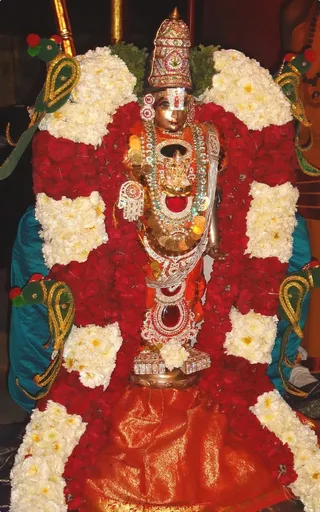
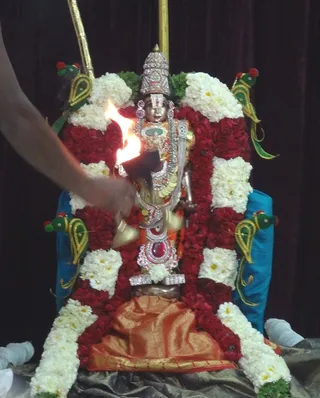
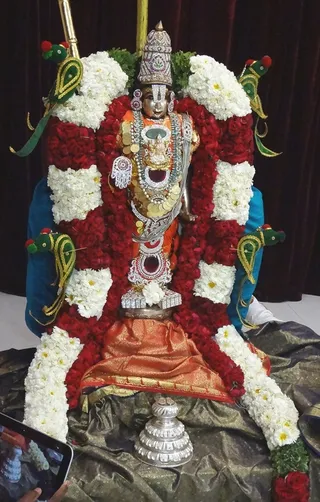
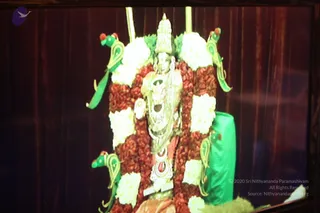
So, I can see some more cities now. Ohio Prayag, St. Louis Tirumala, Peethadeeshwaris training center Salem, and Temple City California. Great. So, I welcome all of you with My love and blessings. Now I can also see Bidadi. Today is Vaikunta Ekadasi, the day the doors of Vaikunta are kept open for anybody who walks in! So, in the Vaikunta Ekadashi, Venkateshwara the Vishnu is gracing. Now you can have the darshan of Venkateshwara. If you are not able to see, it’s ok. See in My eyes, I am seeing, so He is in My eyes. See in My eyes. Blessings, that’s all. (24:50)

Photos

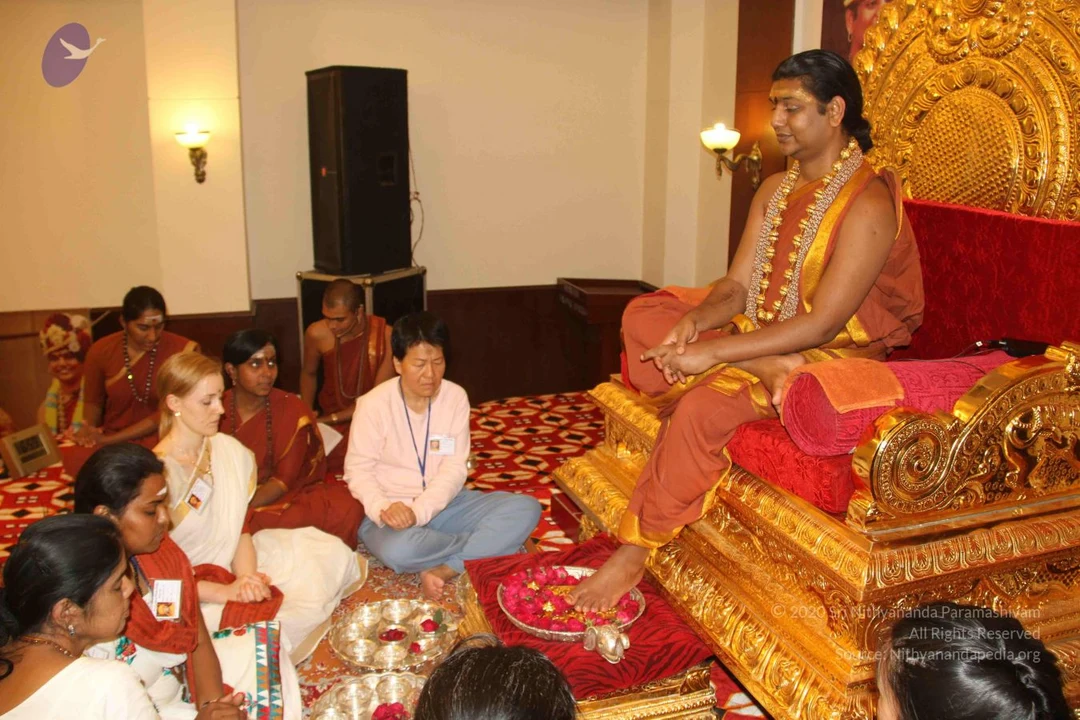
Paduka Puja
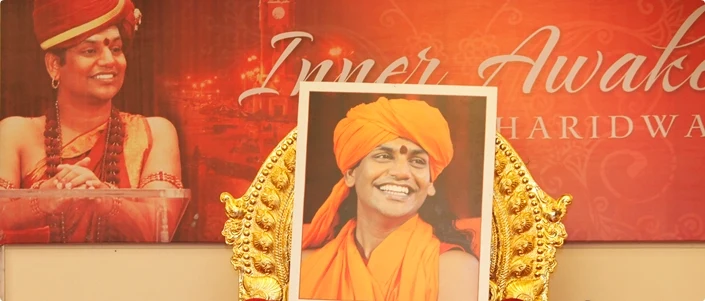
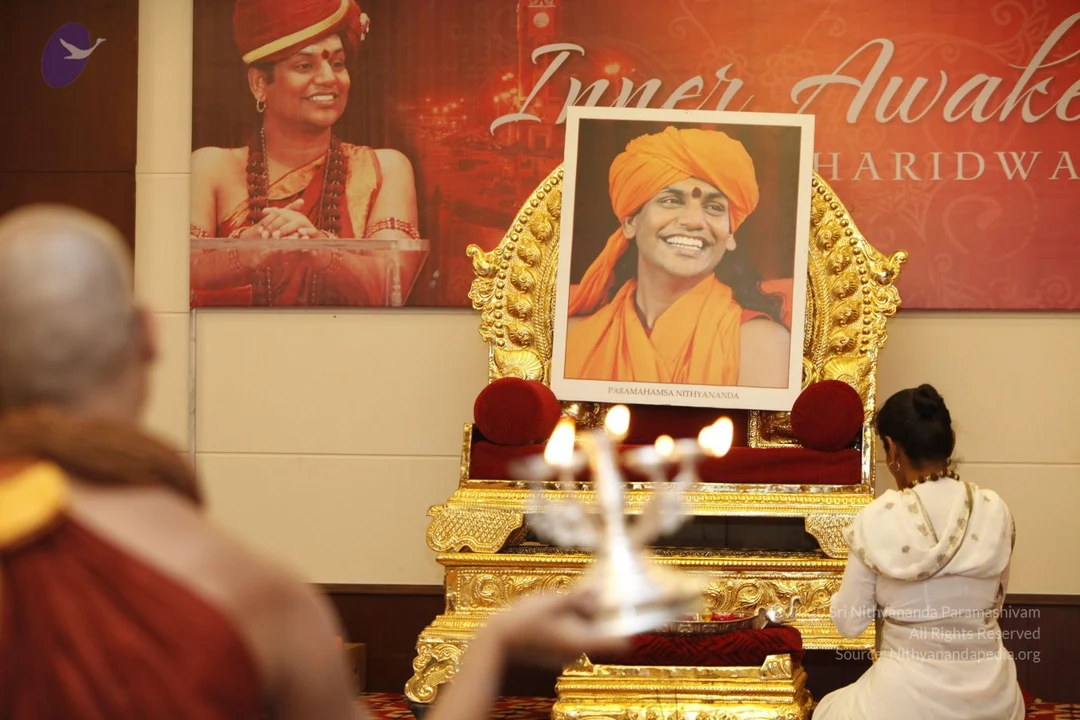
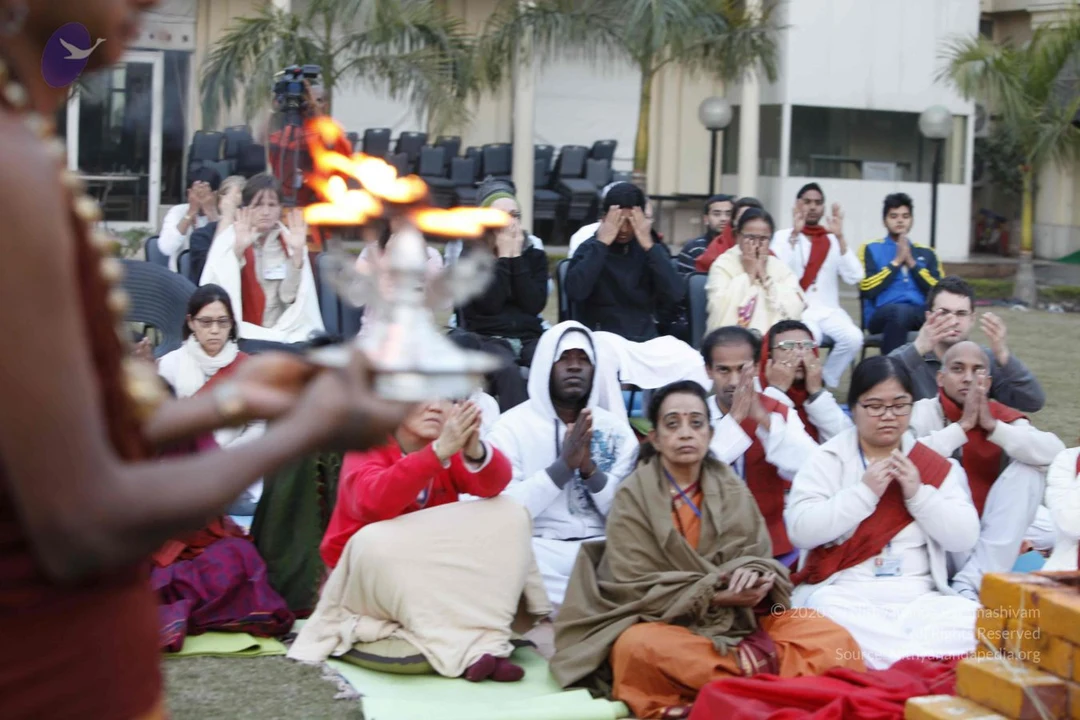
Paduka Puja in Progress...

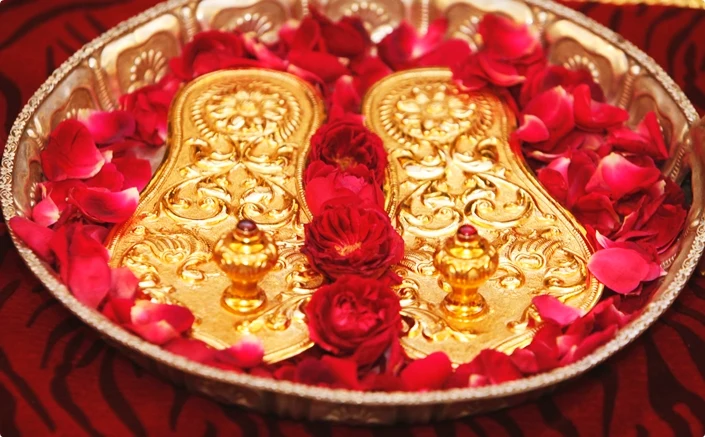
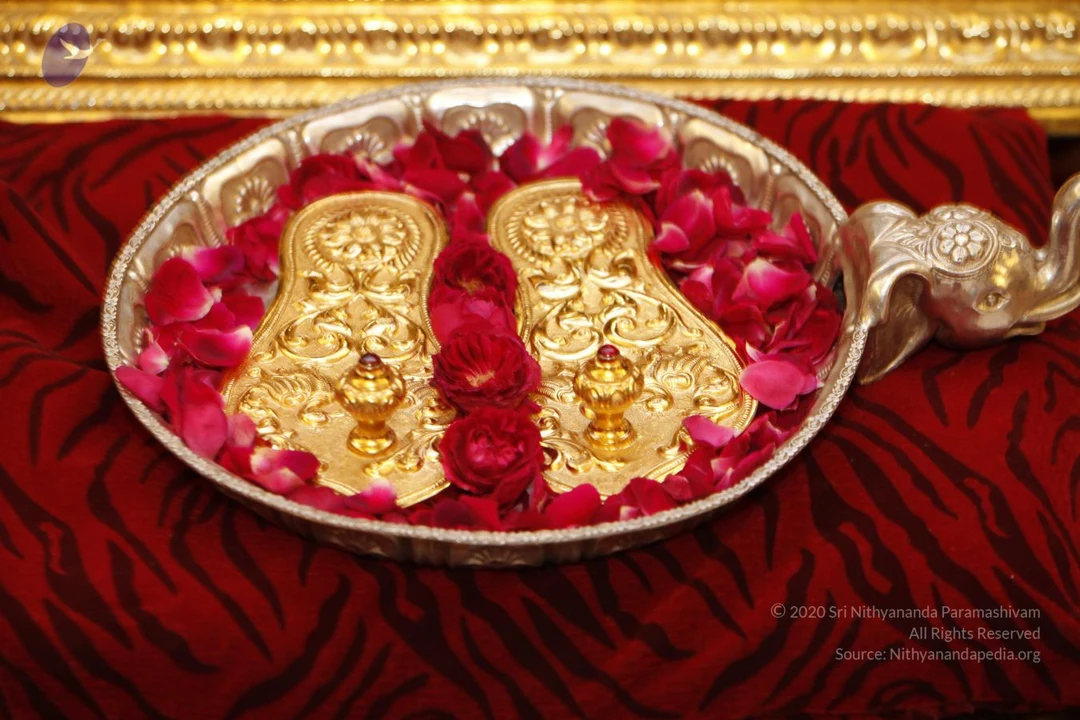
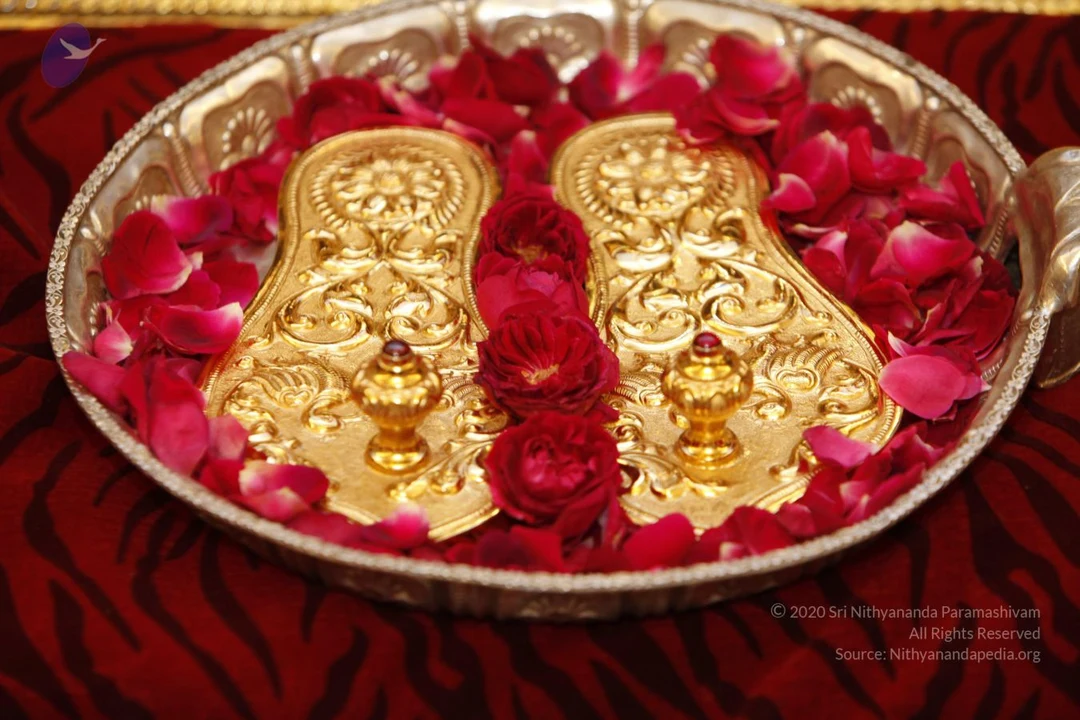
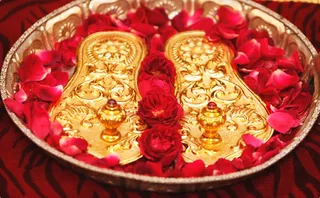
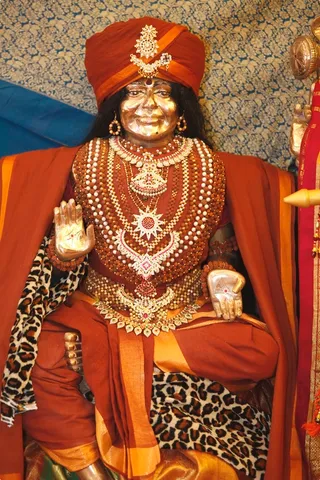
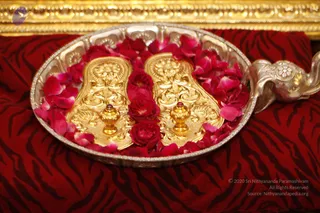
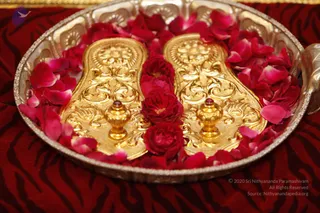
Swamiji's Golden Padukas

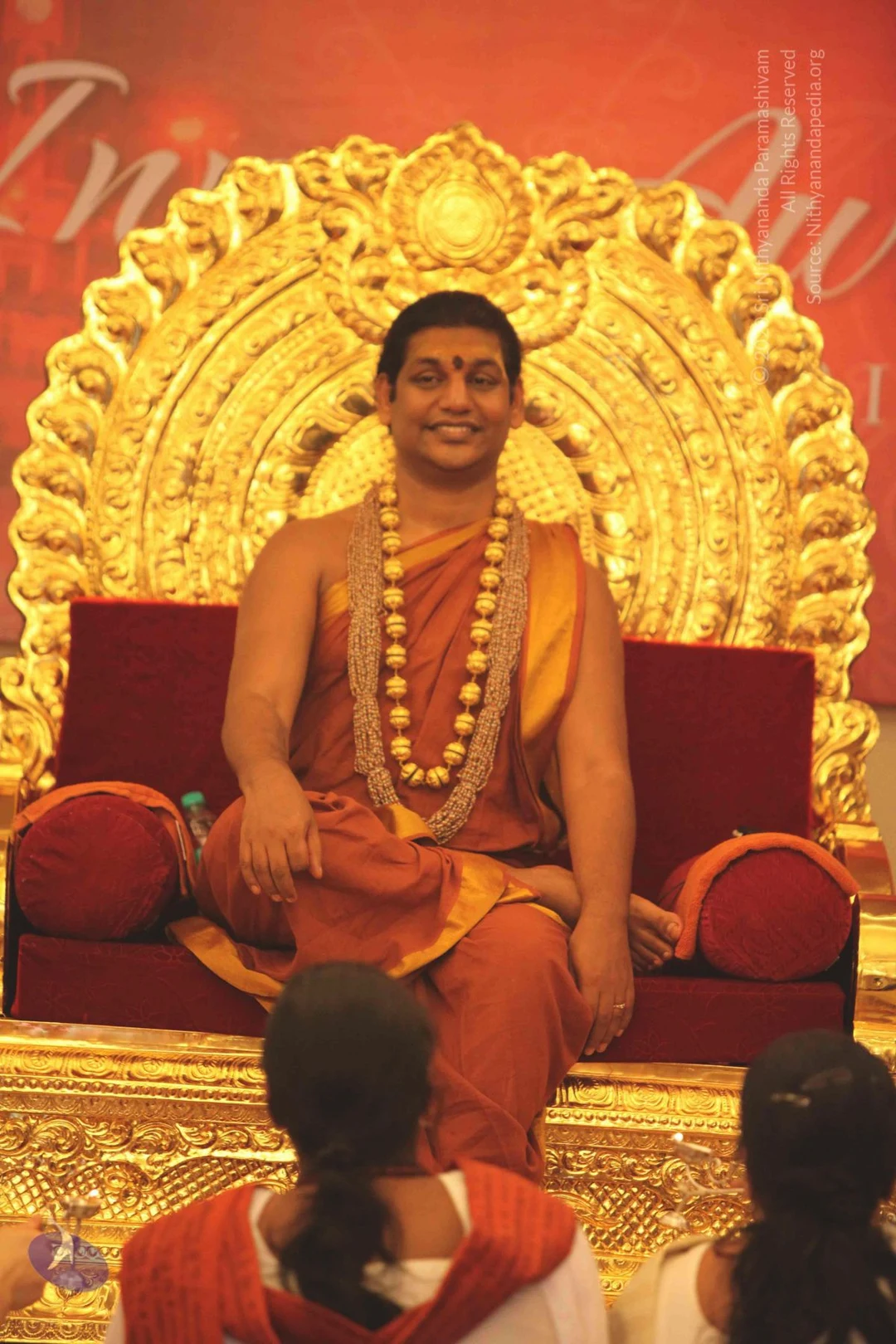
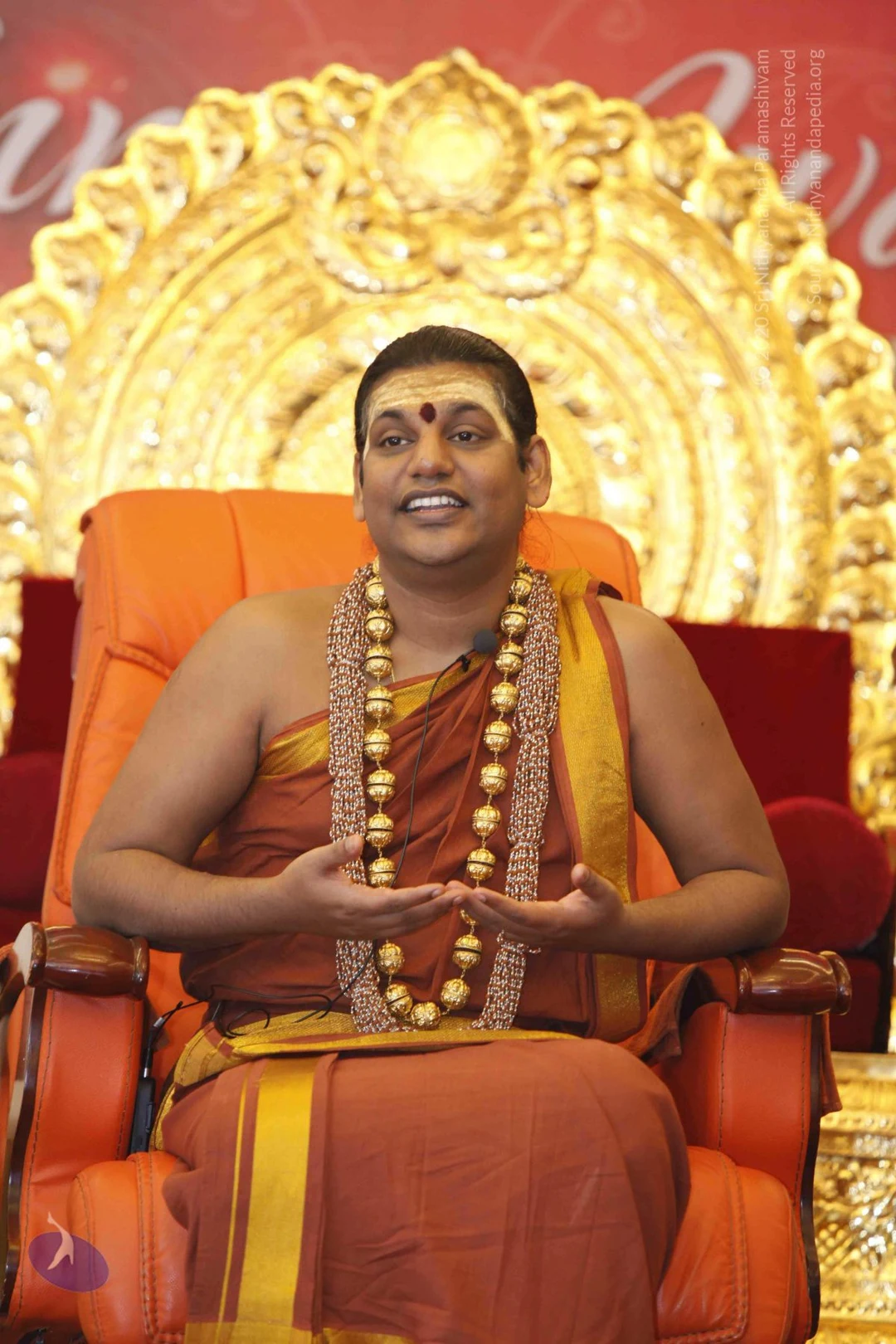
Nithya Satsang
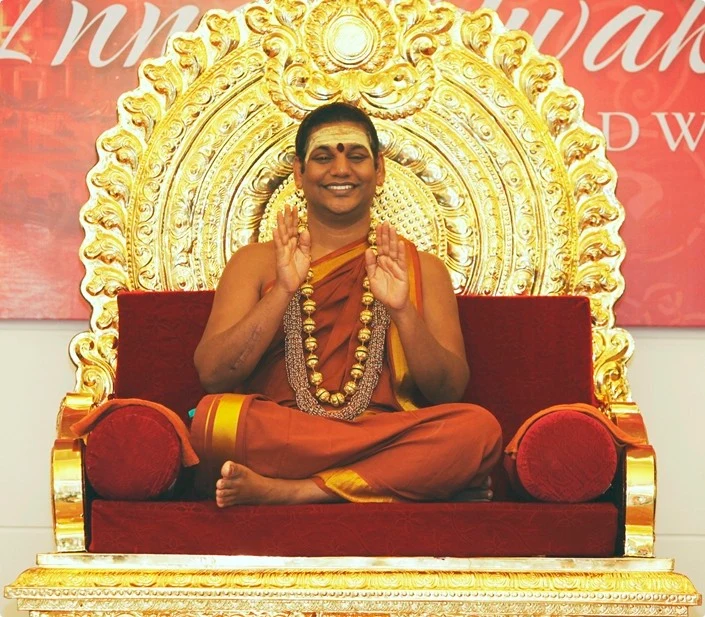
Leela Alankar
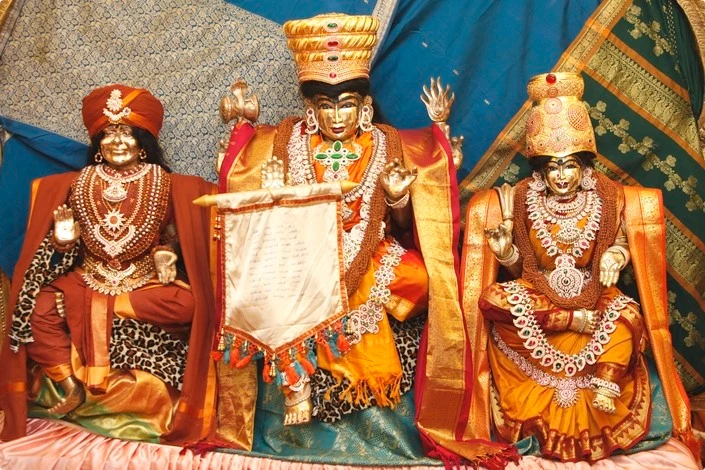
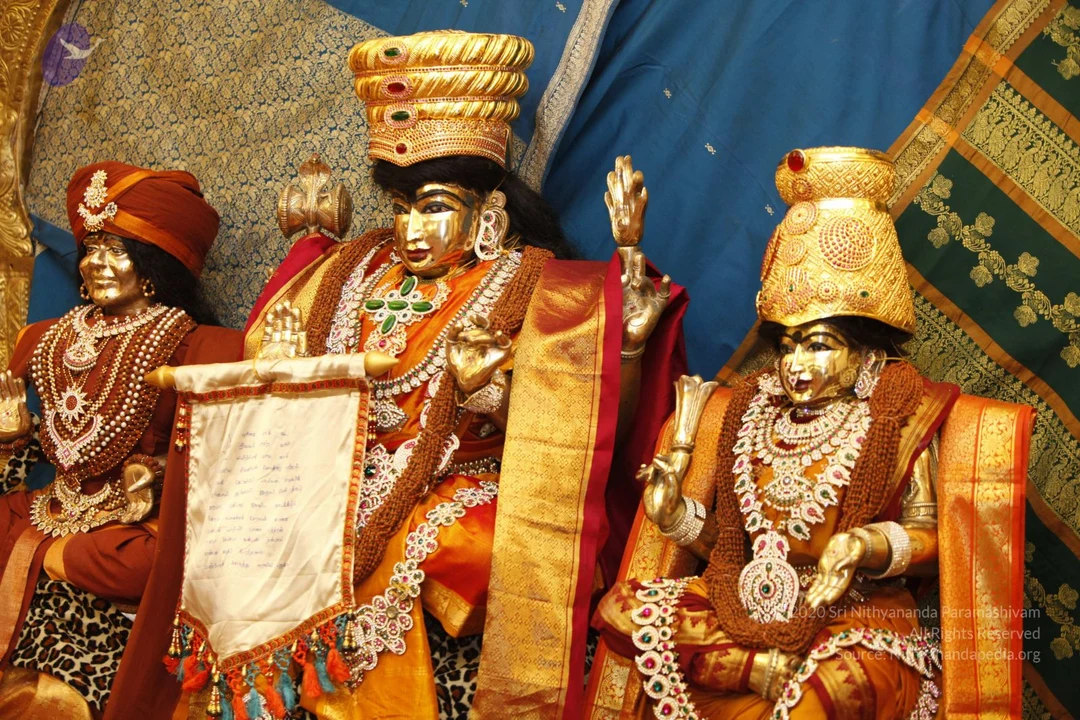
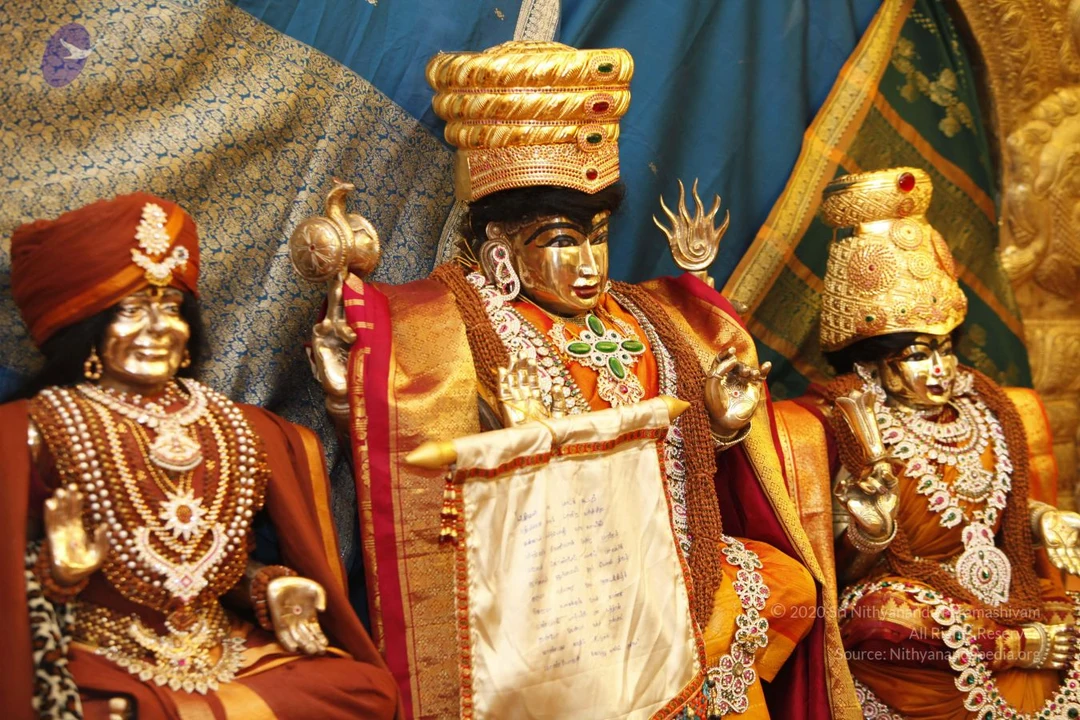
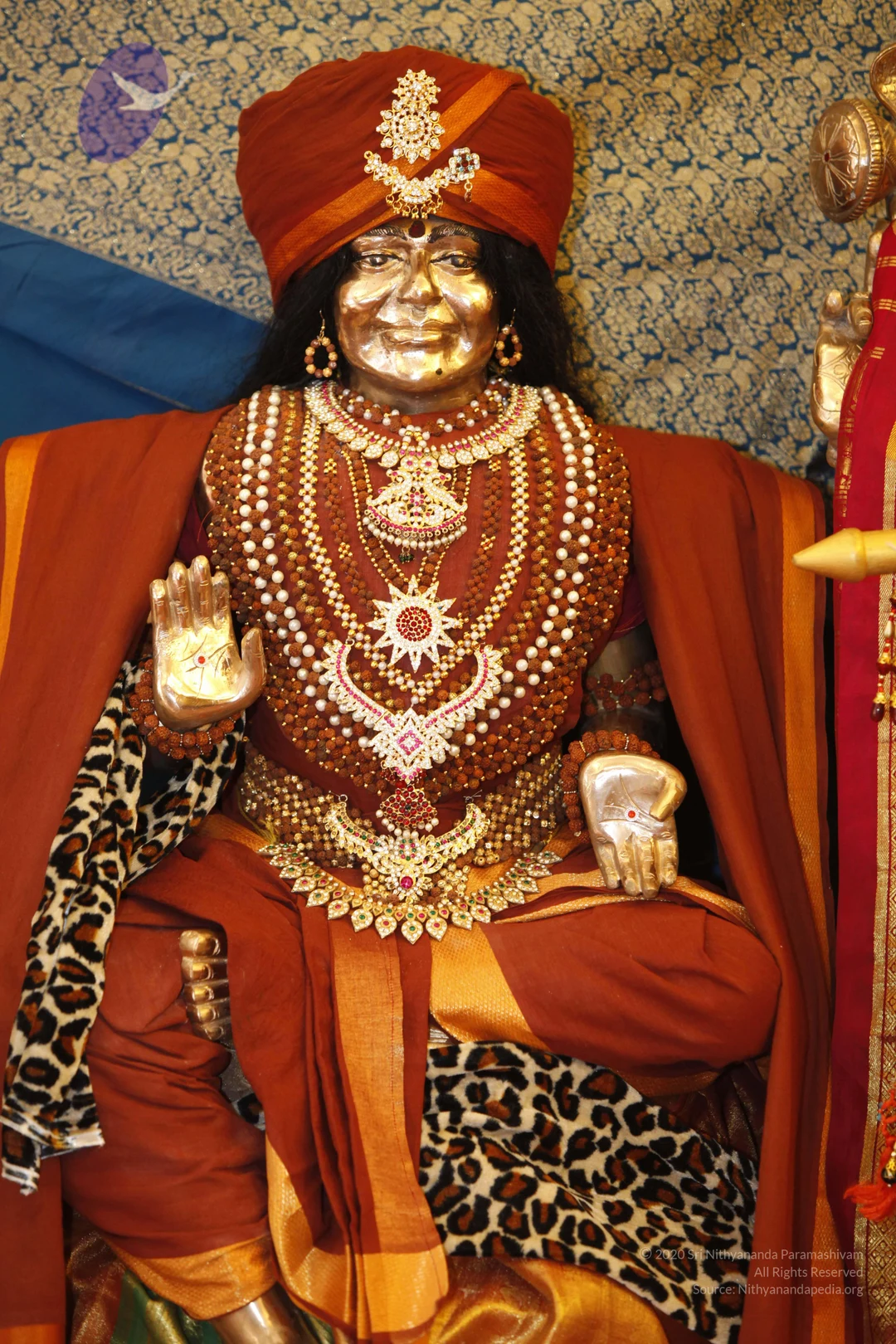
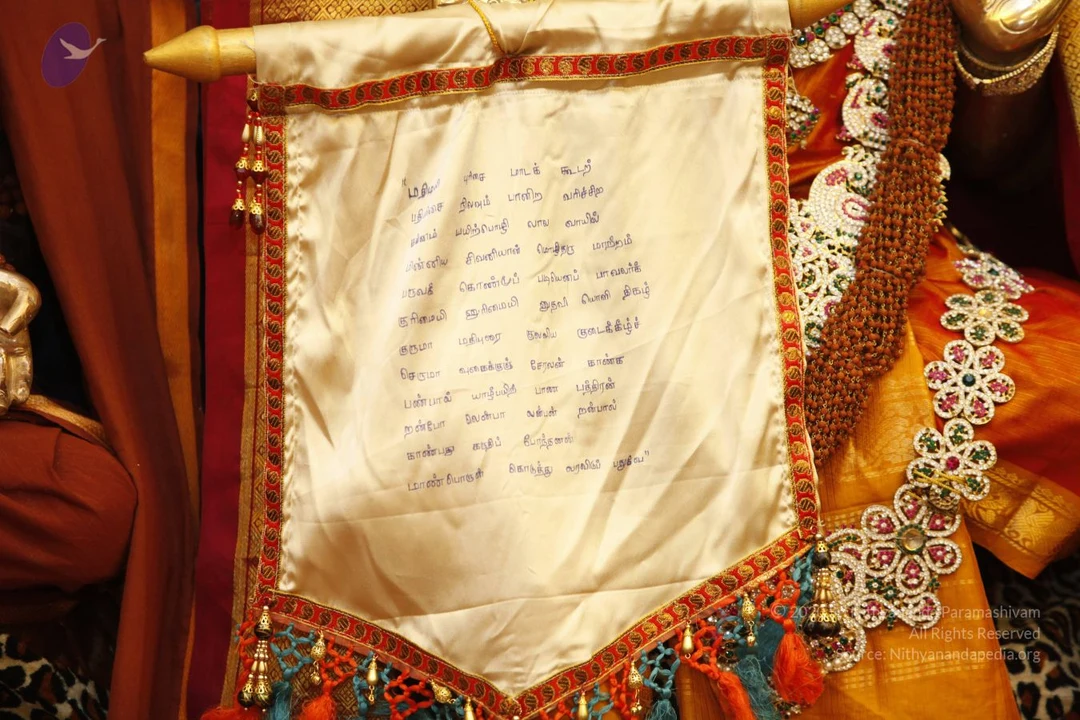
Swamiji's Utsavamurthy
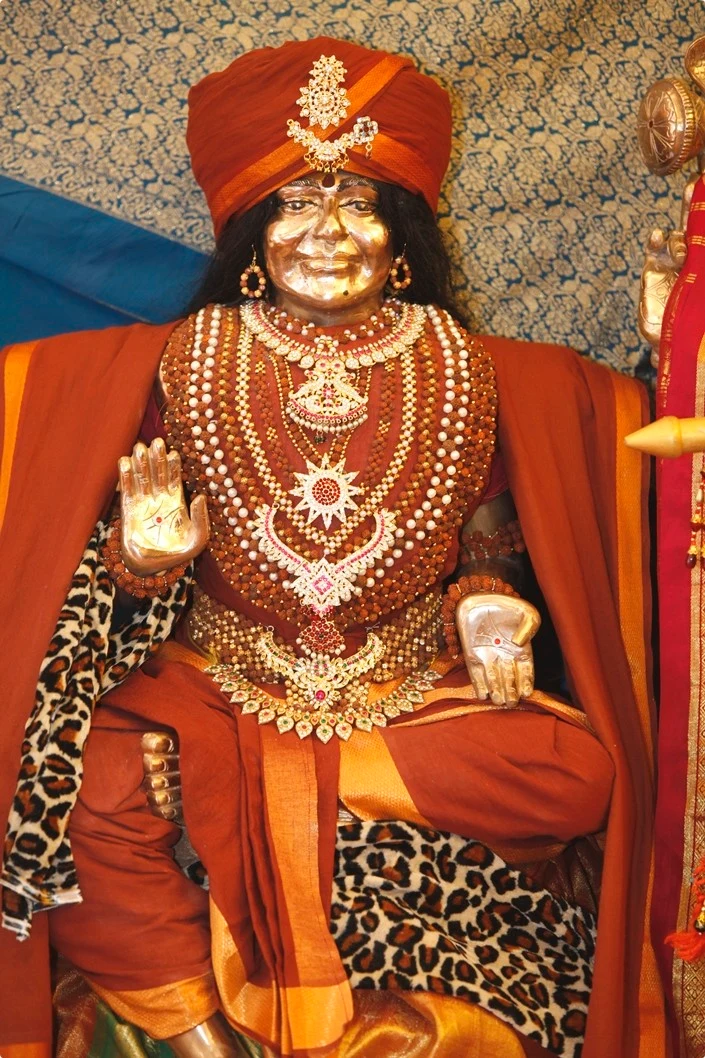
Nithyanandeswara Temple
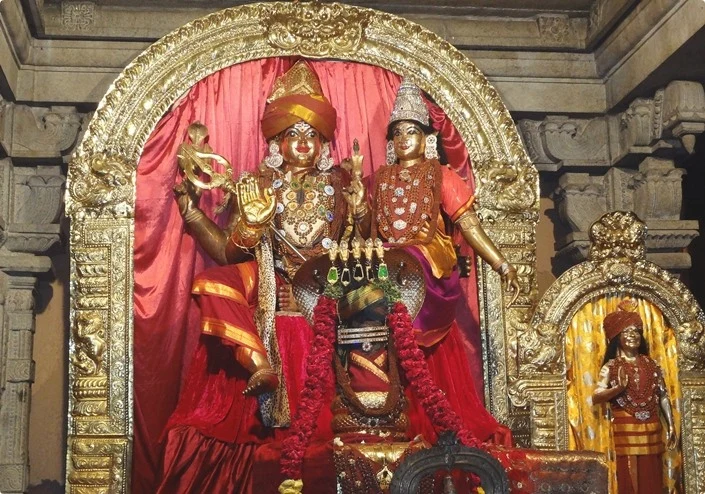
Nithyanandeswara Temple

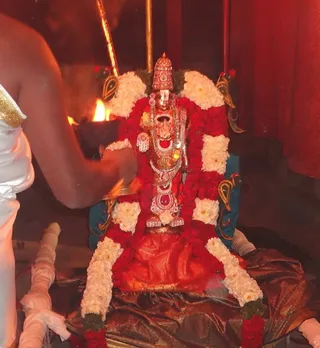
Arathi to Venkateswara on Vaikunta Ekadasi Day
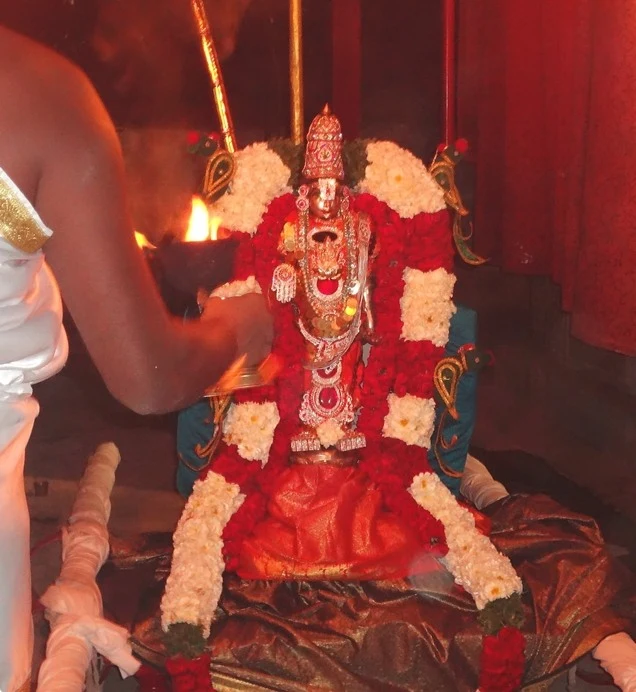
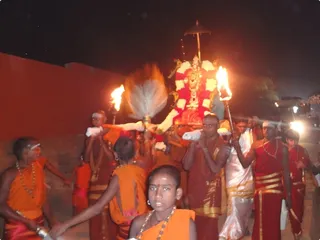
Procession of Venkateswara
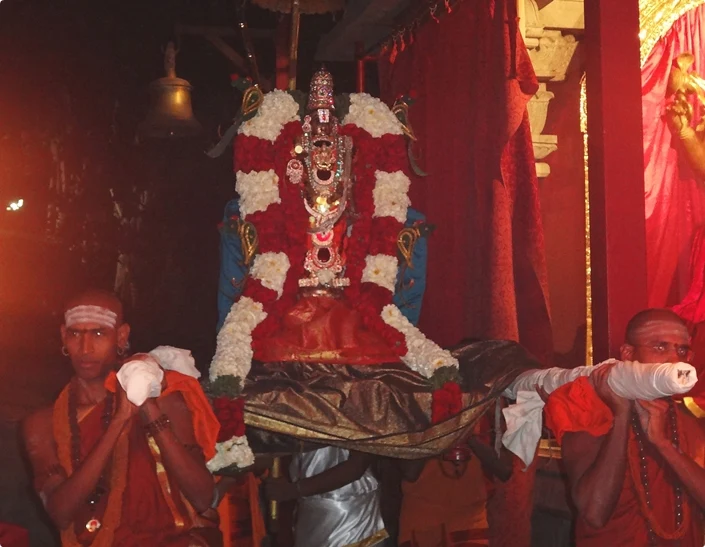
Procession of Venkateswara

Procession on the way to Rajasabha
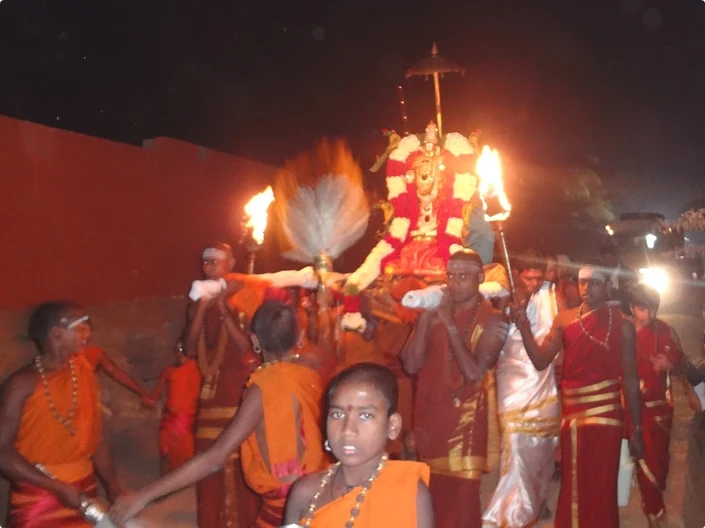
Procession on the way to Rajasabha

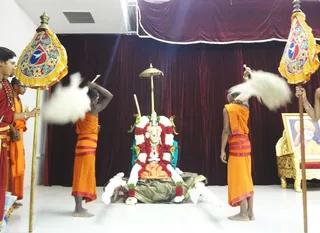
Arathi to Venkateswara in Raja Sabha
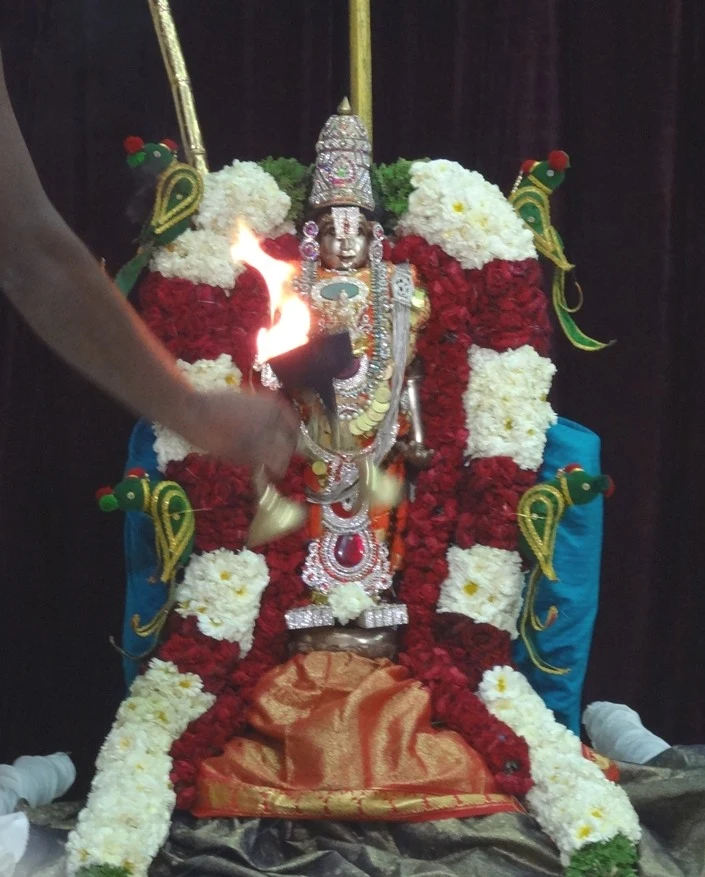
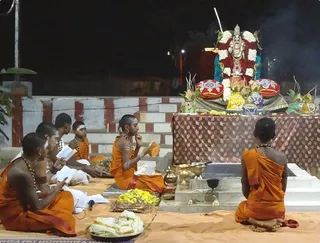
Venkateswara in Sudarshanan Homa

Sudharsana Homa

Sudharsana Homa in the evening

Nithya Satsang

Tags

Paramahamsa Nithyananda, self-completion, SDHD, self-doubt, self-hatred, self-denial, energy, self-completion, self-confidence.

Photos Of The Day:

Pada-Puja-and-Satsang

Darshan

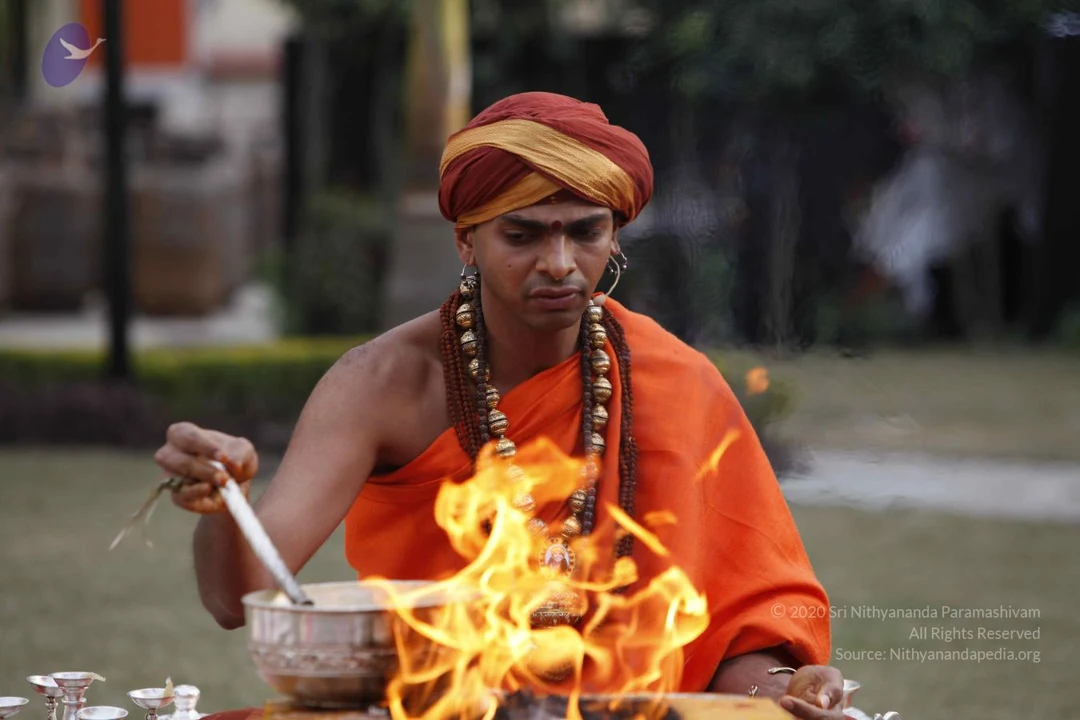
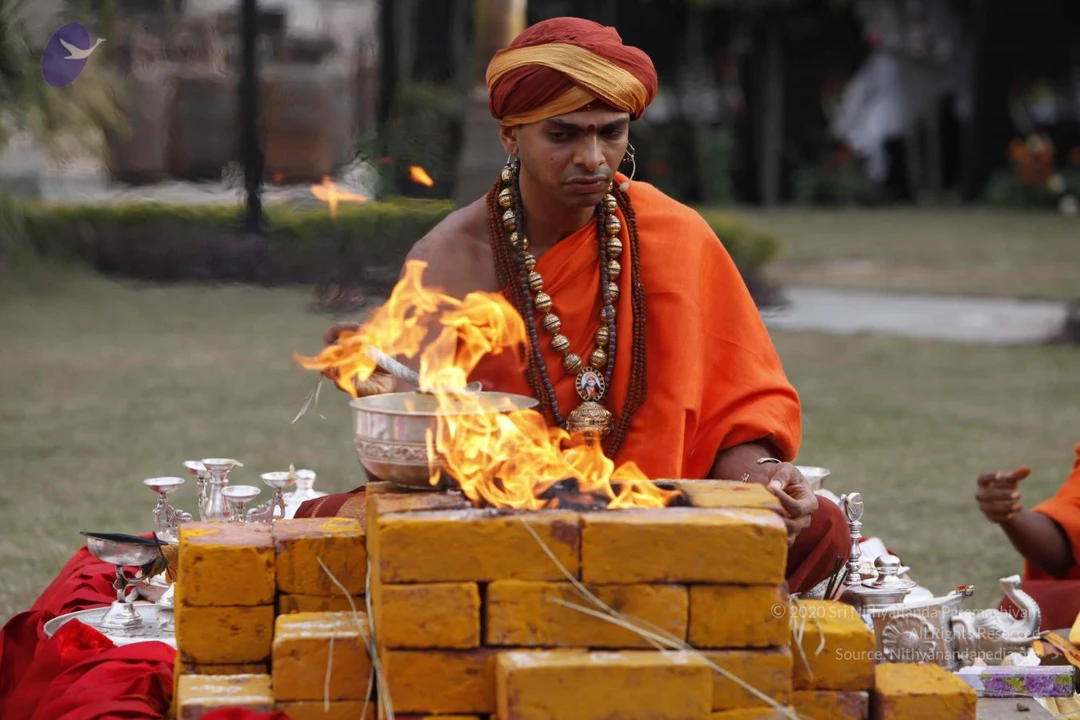
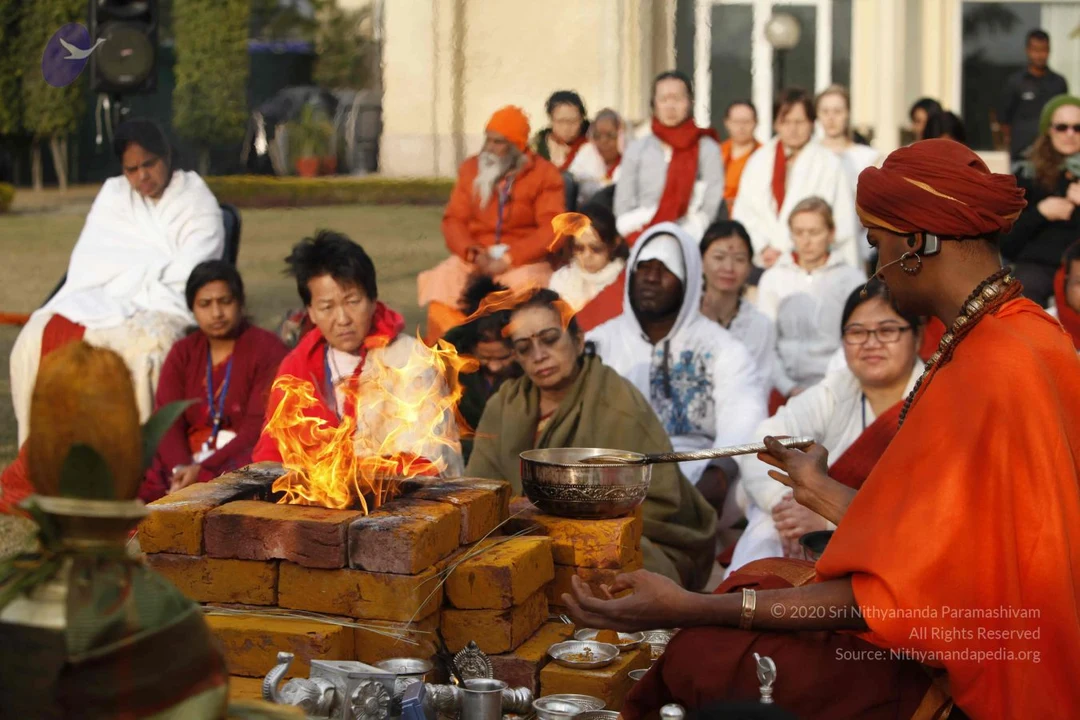
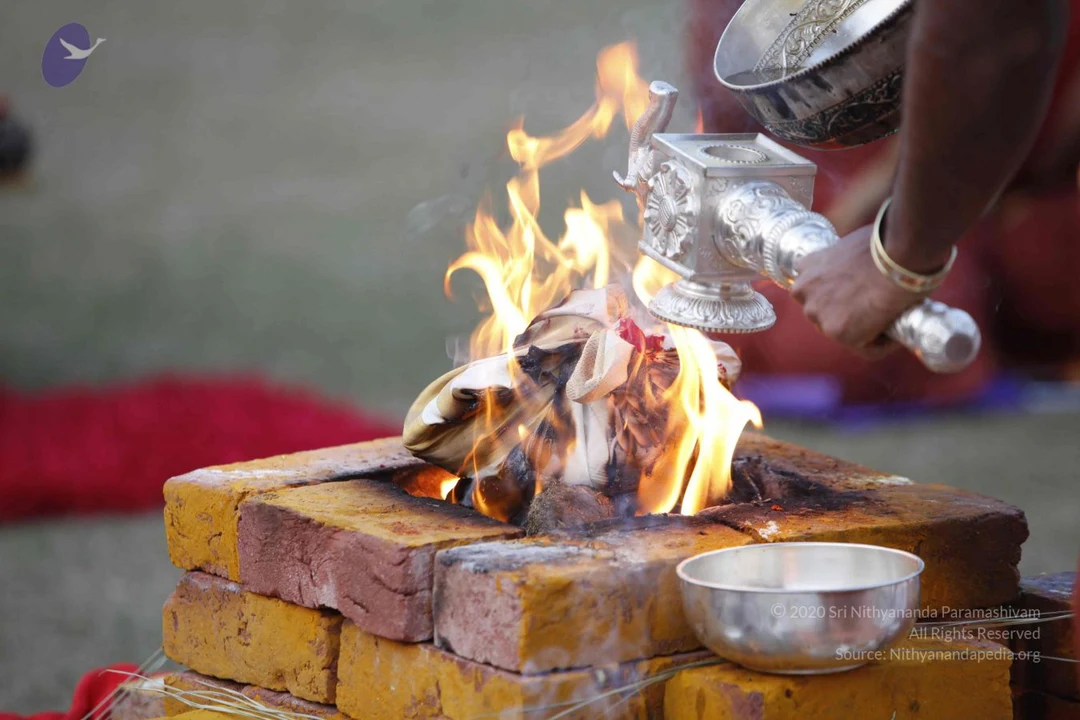
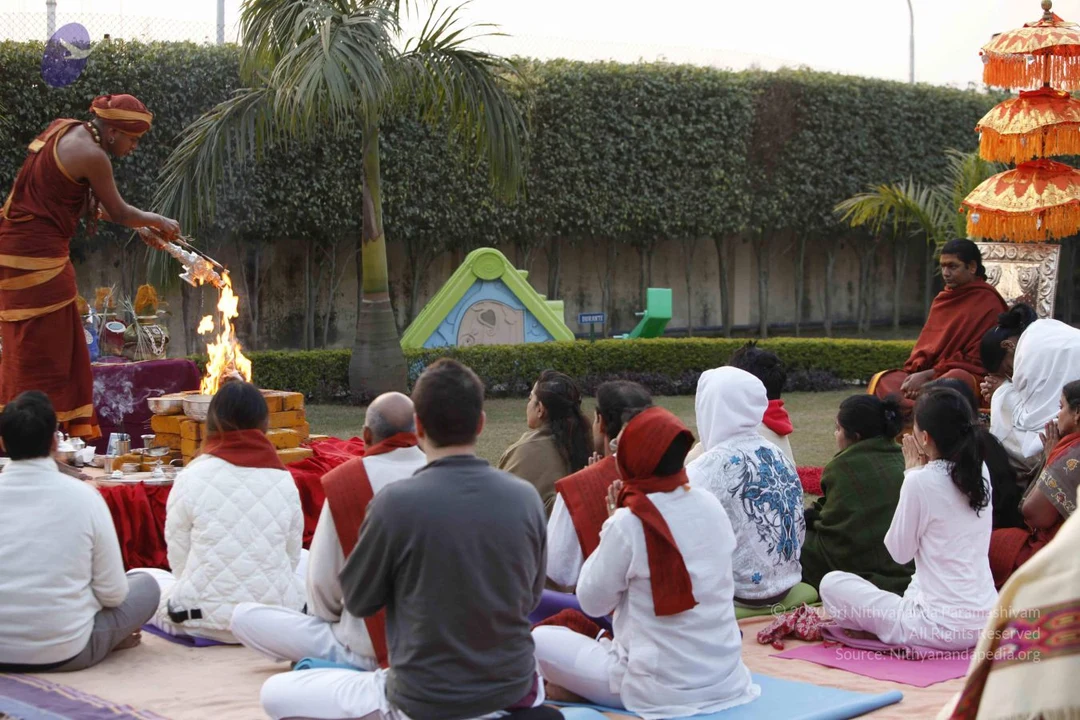
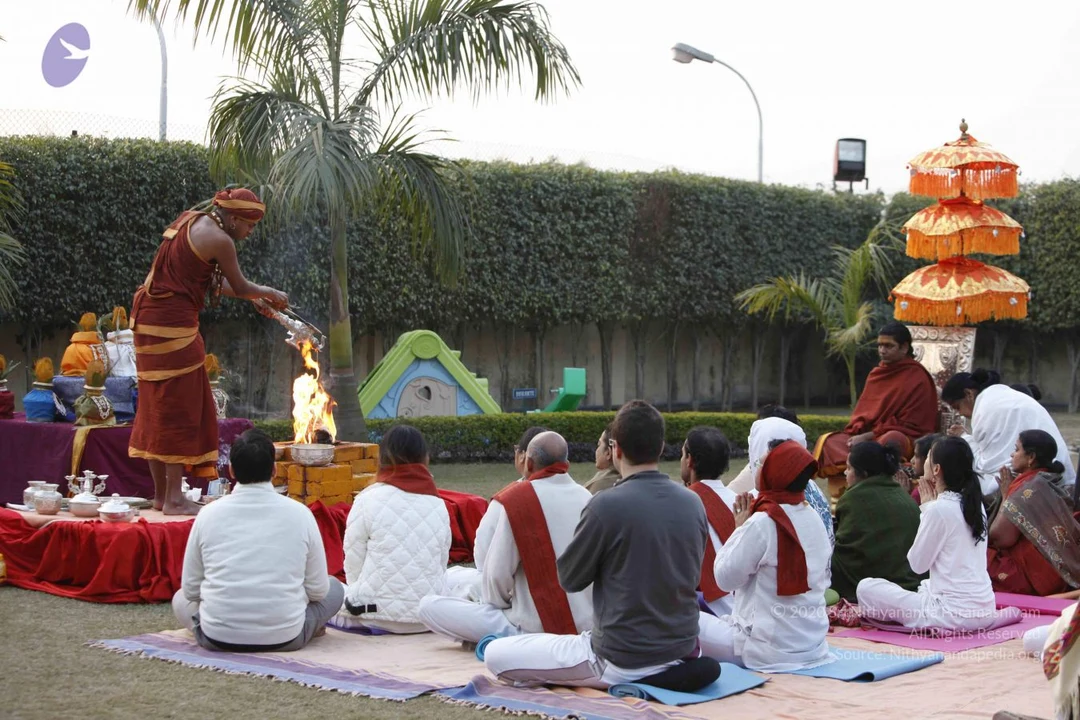
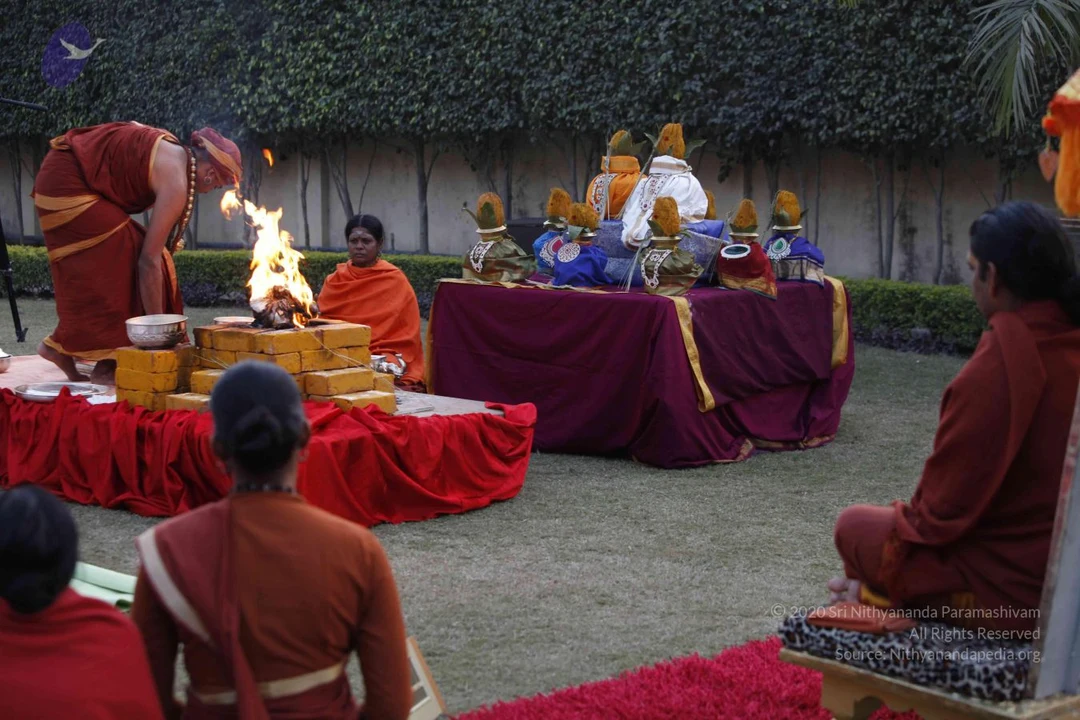
Homa

Photos Of The Day:

Pada-Puja-and-Satsang

Darshan

Homa

Photos from this day

View all 252 photos

Swamiji's Golden Padukas

2 photosSource gallery
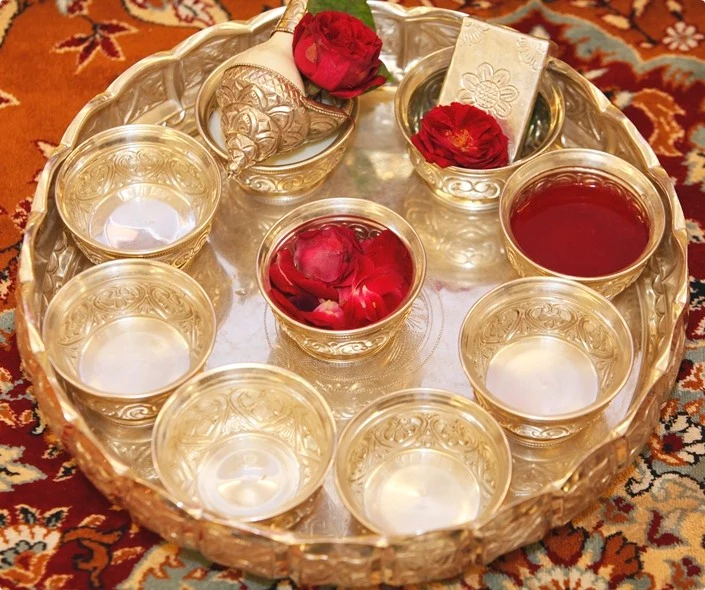
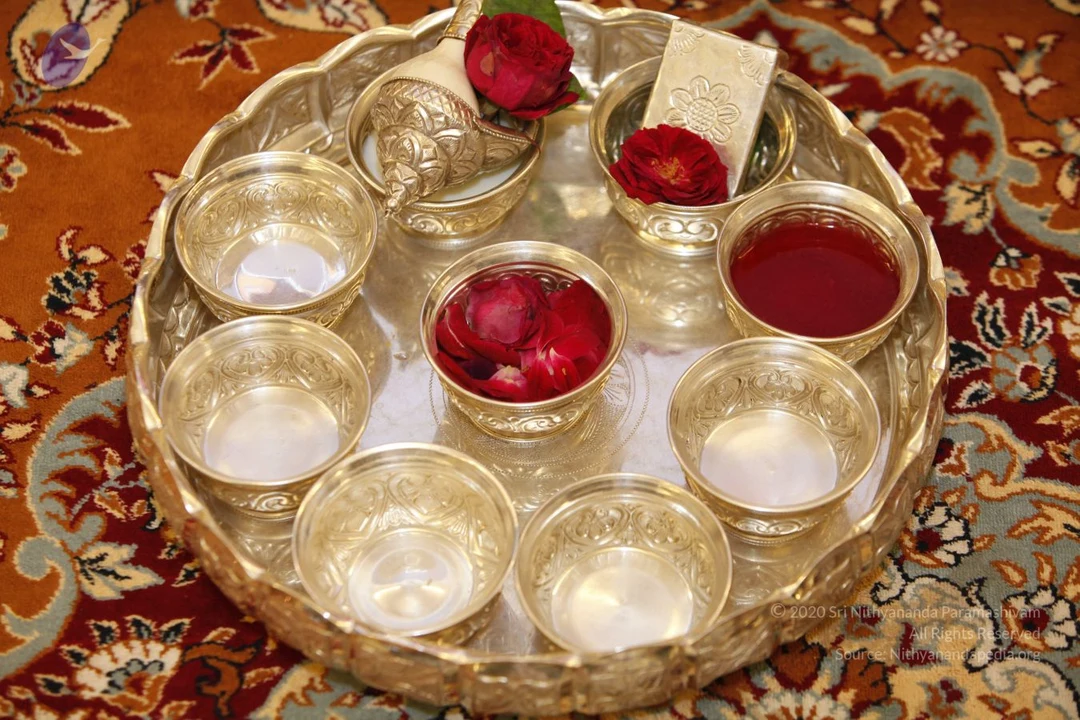
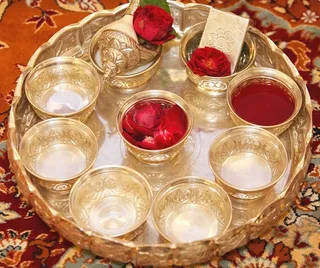
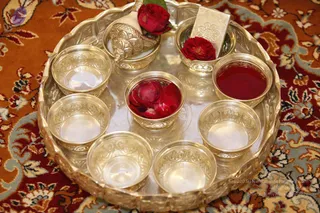
A gilded metal tray holds a pair of ornate golden footprint-shaped plates, called padukas, engraved with floral scrollwork and topped with small golden finials. Red rose petals and two full red roses are scattered around and between the plates, and the tray rests on a red fabric with dark tiger-stripe pattern. No people are visible, so this shows a ritual offering of padukas decorated with flowers, consistent with a padapuja setting, though no a person candidate appears.A photograph of an ornate silver-coloured ritual tray resting on a red and orange patterned carpet. The tray holds several engraved bowls: some are empty, one contains red rose petals, and another holds red liquid. A small engraved silver vessel with a red rose and a folded white paper or cloth packet sit among them. No people are visible in the frame.

Nithya Satsang

3 photosSource gallery
A smiling man with a shaved head, white tilak on his forehead and a red dot, sits cross-legged on an ornate gold-and-red throne with a golden arched backrest. He wears orange saffron robes, a thick gold-beaded necklace with rudraksha-style beads, and gold earrings. He raises both palms outward in a blessing gesture. Behind the throne a red wall displays partial white and gold lettering. Appearance-based candidate: a person, seated on a peetha throne in saffron robes and ceremonial gold necklace, giving a blessing gesture.A seated man in saffron-orange robes with a gold-bordered yellow shawl sits cross-legged on a red-cushioned throne with ornate gold carved panels. He wears a heavy gold bead and rudraksha-style necklace, a red bindi and white forehead markings, and a small microphone clipped near his collar. He smiles toward the left with hands resting in his lap. Behind him, a large framed photograph shows a smiling woman in a red sari holding a microphone against a red backdrop. The setting appears to be a satsang hall.A seated man sits cross-legged on an ornate gilded throne with a red cushioned seat and red bolsters, his eyes closed and a faint smile on his face. He wears an orange-saffron robe with a gold-bordered yellow shawl, multiple rudraksha malas and a ceremonial gold necklace, with a white vibhuti marking and red bindi on his forehead. Behind him on the wall, a large printed portrait shows a smiling woman in a red-and-gold turban and red sari with rudraksha beads, holding a small object. A wall sconce glows at left. a person: the seated man, identified by his saffron robe, rudraksha malas, gold necklace and throne, is in meditative posture during a satsang setting.

Swamiji's Utsavamurthy

2 photosSource gallery
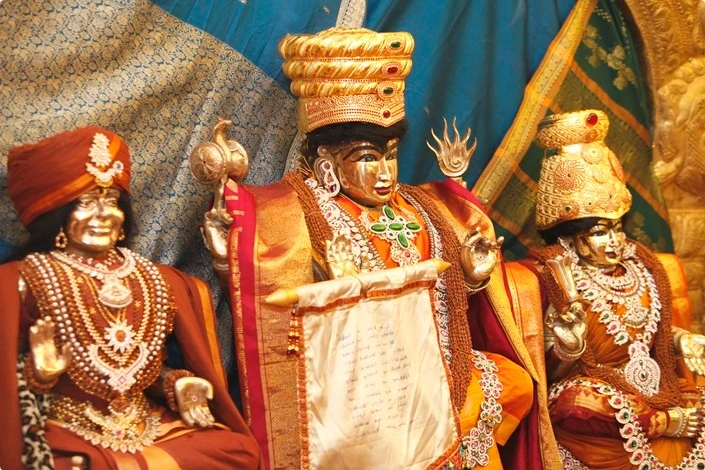
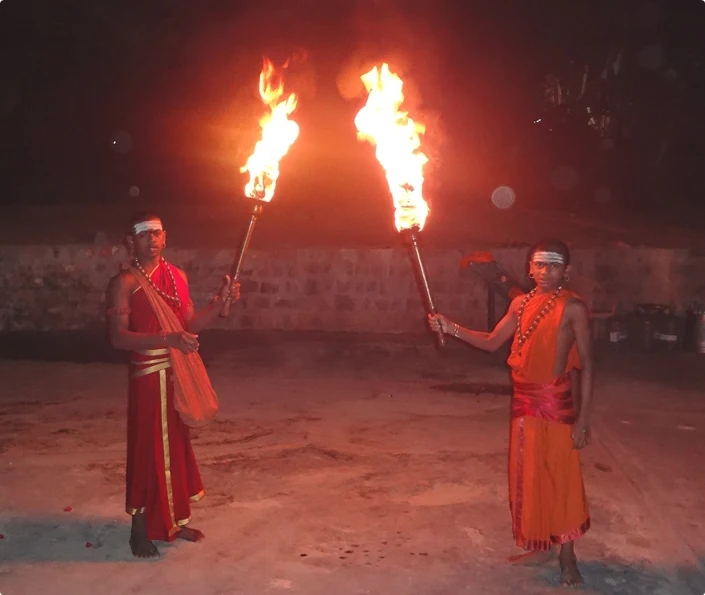
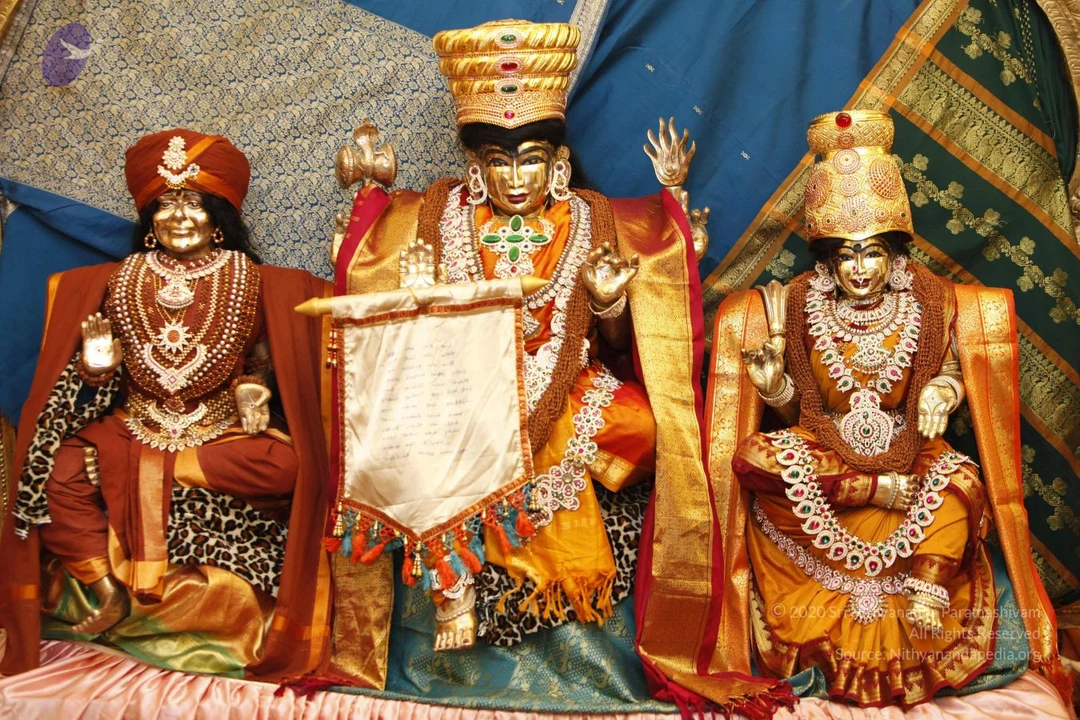
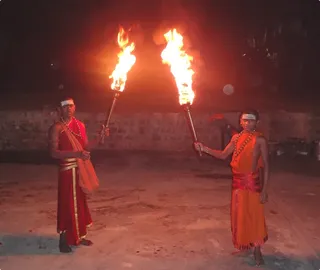
A gilded statue of a seated figure, shown as a murti rather than a living person, dressed in saffron-orange robes with a leopard-print shawl draped over the shoulders and lap. The figure wears a saffron turban with a gold jewelled ornament, layered rudraksha and pearl malas, gold necklaces with red and green stones, and jewelled bangles. The right hand is raised in abhaya mudra with a red dot on the palm. The background is a blue patterned cloth, with a golden kalasha-like finial and a red fabric at the right edge.Two young men stand barefoot on a dirt ground at night, each holding a lit torch with tall flames. The man on the left wears a red dhoti with gold borders, a saffron-orange shawl over one shoulder, and a white forehead band. The man on the right wears an orange-saffron cloth with a red sash, rudraksha-style beaded necklaces, and a white forehead band, holding his torch aloft. A low stone wall stands behind them in the dim light.

Nithyanandeswara Temple

2 photosSource gallery
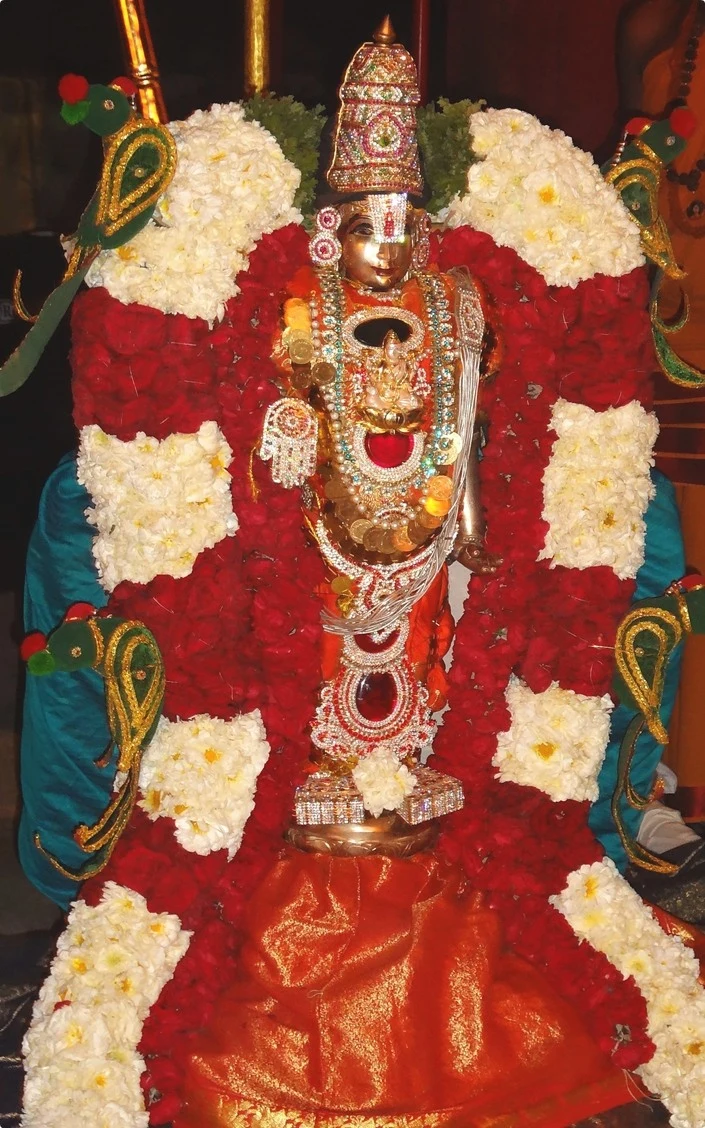
A photograph of a deity murti adorned with red and white flower garlands, a golden crown, and ornate jewelled necklaces, seated on a draped gold-red cloth in a shrine. A priest in white clothing with a gold-bordered cloth stands at left, holding a flame lamp toward the deity. Red curtains hang behind the murti, and a lit oil lamp glows in the background.A decorated metal deity murti of a standing figure is displayed against a backdrop of red rose petal garlands bordered with white flower garlands and green peacock-shaped ornaments. The murti wears a tall jewelled crown, a Vaishnava U-shaped tilak on the forehead, a multi-strand bead and gem necklace, a heavy gold-coloured chest ornament, and an orange-red silk dhoti with gold zari. No people are visible in the scene.

Arathi to Venkateswara in Raja Sabha
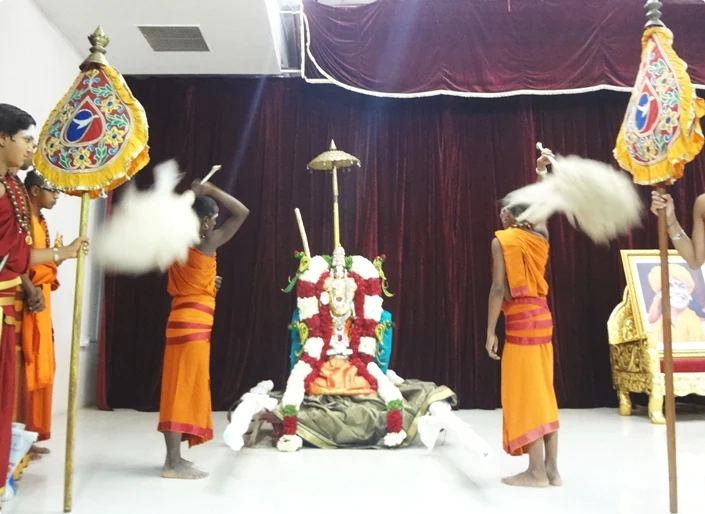
3 photosSource gallery
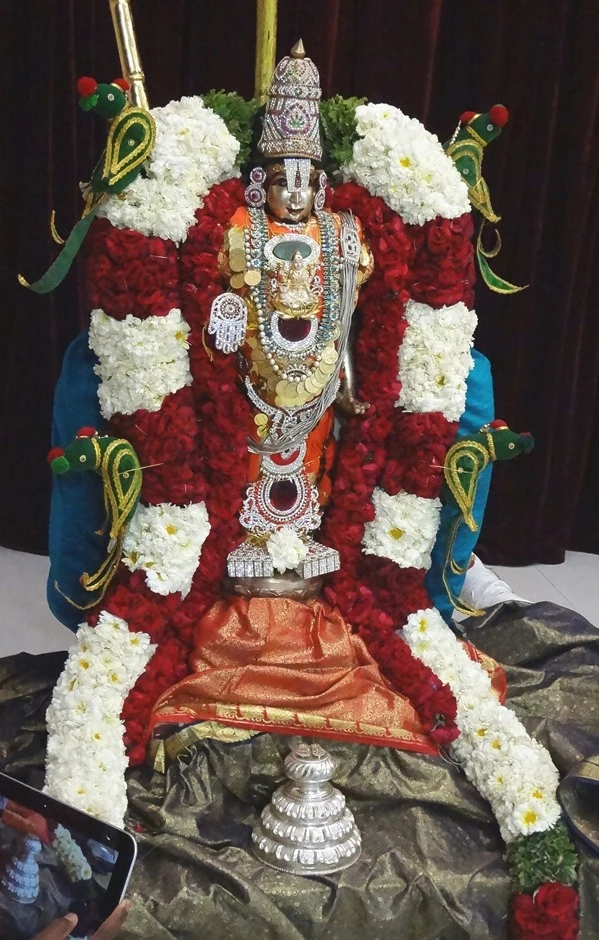
A photograph of a standing metal deity murti adorned with a jewelled crown, a rich silver-and-gold necklace, and a pink gemstone at the waist, framed by red and white flower garlands on a blue-and-green peacock-motif backdrop. A pair of bare arms from the left side holds a lit oil lamp or flame near the deity's raised hand. An orange cloth covers the base, and a dark curtain stands behind. No physical people are shown beyond the hand and arm.Photo of a ceremonial honour ritual in a hall with a dark red velvet curtain backdrop. At centre, a seated deity murti is adorned with white and red flower garlands and sits on a green cushioned seat under a small gold parasol. Four attendants in saffron-orange dhotis, some bare-chested, wave large white fly-whisk chowries and hold tall gold poles topped with yellow and red embroidered umbrella-style banners. A framed portrait with a gold-trimmed frame and gilded chair appears at right, showing a figure in orange robes, a view that does not establish a physical person. Four attendants are physically visible, with a partial fifth at the right edge.A standing metal murti of Lord Venkateswara (Vishnu form) is dressed in an orange-red silk garment with gold border and adorned with heavy gold necklaces, pendants and a tall ornate silver-and-gold crown with a vertical Vaishnava tilak on the forehead. The figure stands on a silver pedestal and is framed by an arch of red rose petal garlands and white flower garlands with green leaves, flanked by green-and-gold decorative ornaments. Teal fabric and a dark gold cloth lie beneath. In the lower left corner, a hand holds a phone displaying a small image of the same murti, indicating the photo was taken of a screen.

Venkateswara in Sudarshanan Homa

2 photosSource gallery
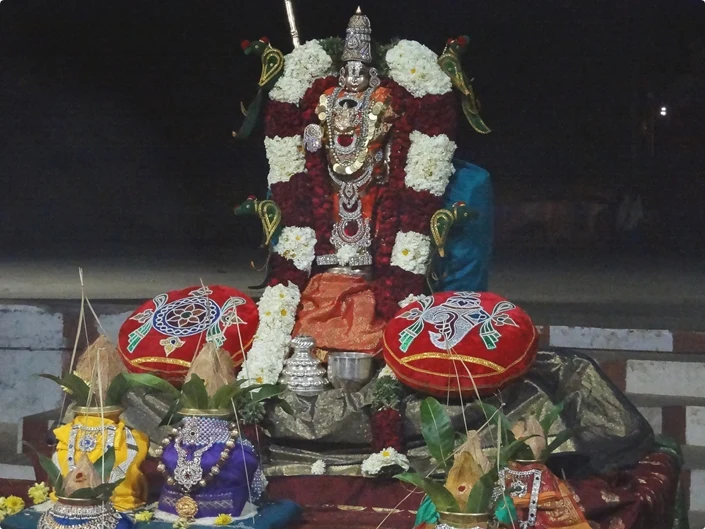
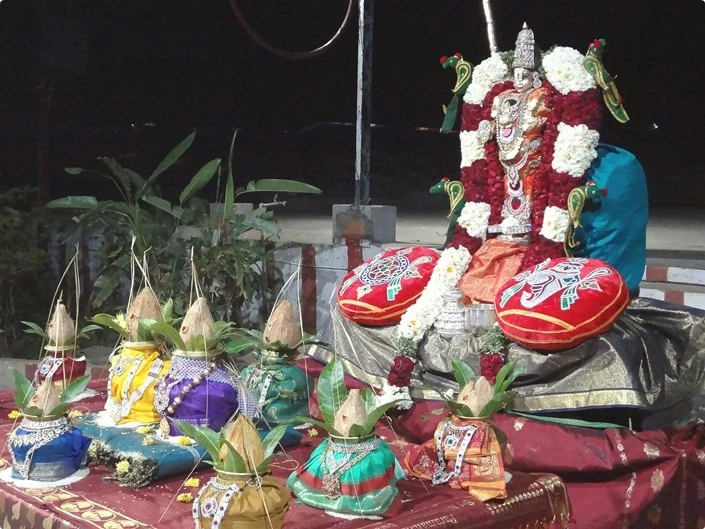
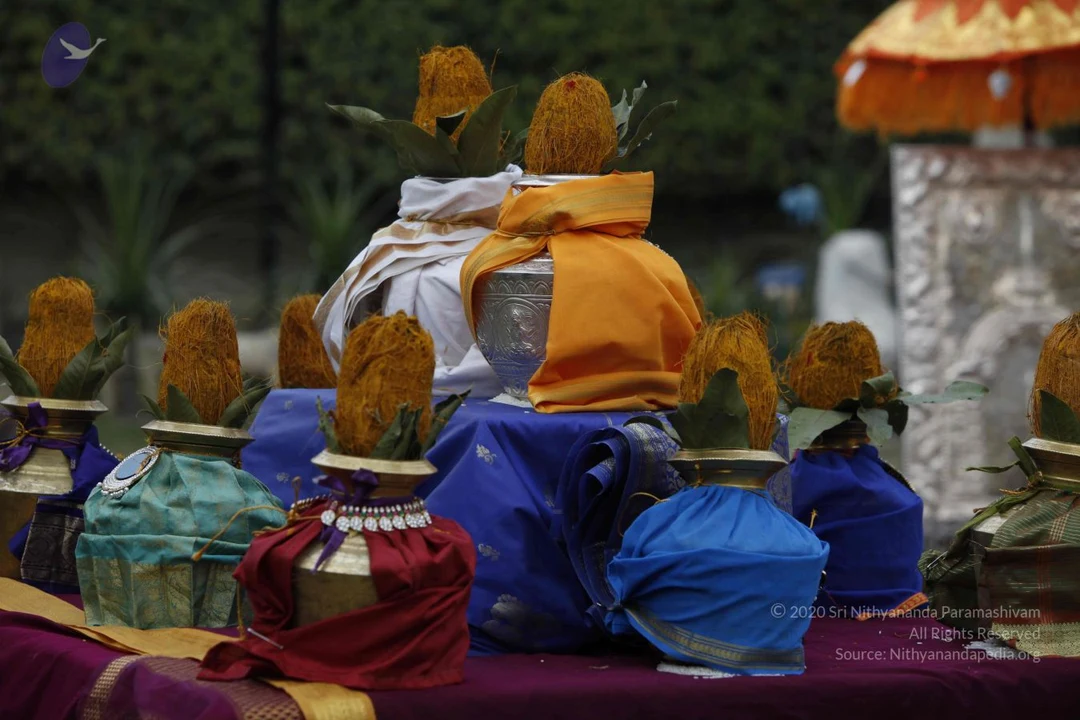
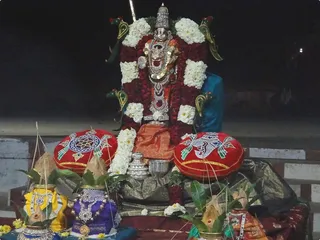
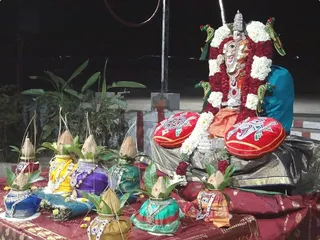
A silver-clad deity murti is seated at night on a decorated platform, adorned with red and white flower garlands and a tall crown. Two red velvet cushions embroidered with gold peacock motifs flank the figure. Brass and silver vessels stand in front, with coconut-leaf and mango-leaf bundles tied to colourful pots, one yellow and one purple, decorated with beads and flowers. A silver pitcher and bowl sit before the murti, and loose white and yellow flowers are scattered about. No people are visible.Outdoor night photograph of a decorated deity murti. The murti wears a red and white flower garland, a silver crown, and a gold-and-silver necklace, with a teal and orange cloth behind. Two red velvet cushions with embroidered gold motifs flank the figure. In front, six decorated kalasha pots wrapped in colourful silk in blue, yellow, purple, green and orange, topped with mango leaves and coconuts, are arranged on a maroon cloth. Plants and a pole stand in the background. No people are visible.

Nithya Satsang

5 photosSource gallery
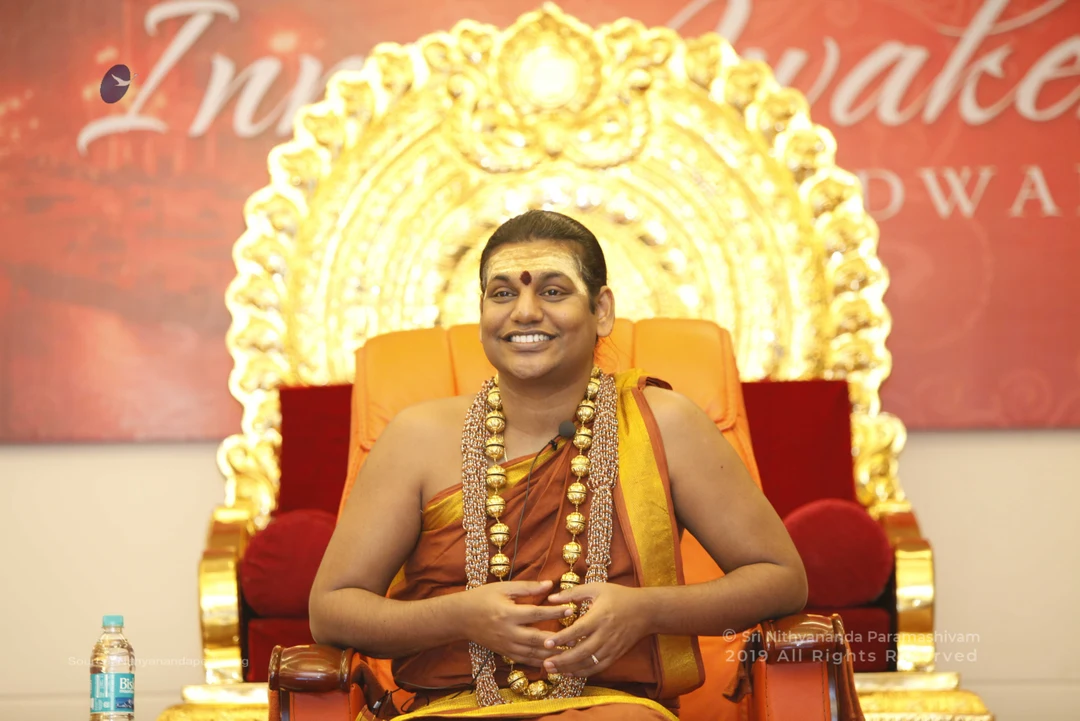
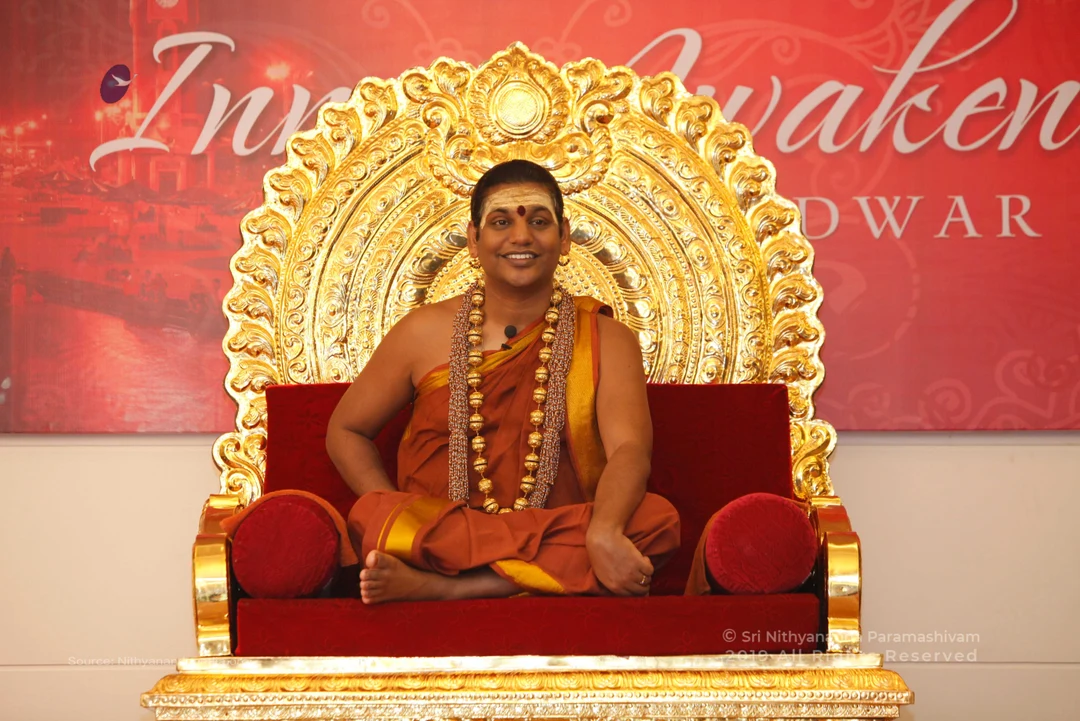
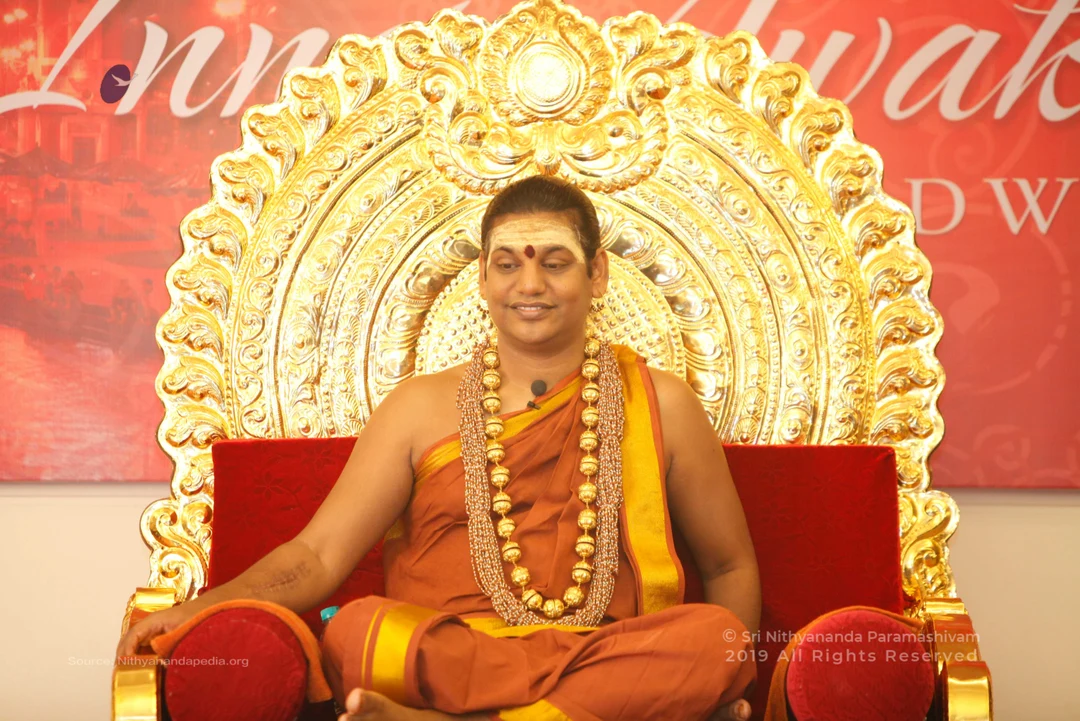
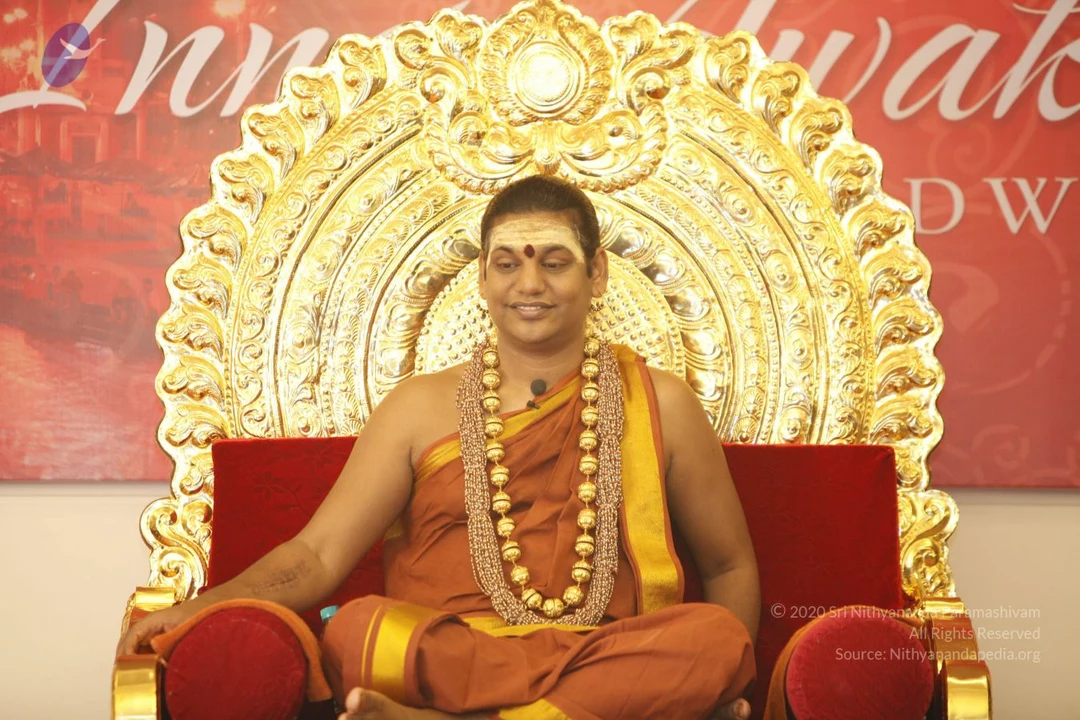
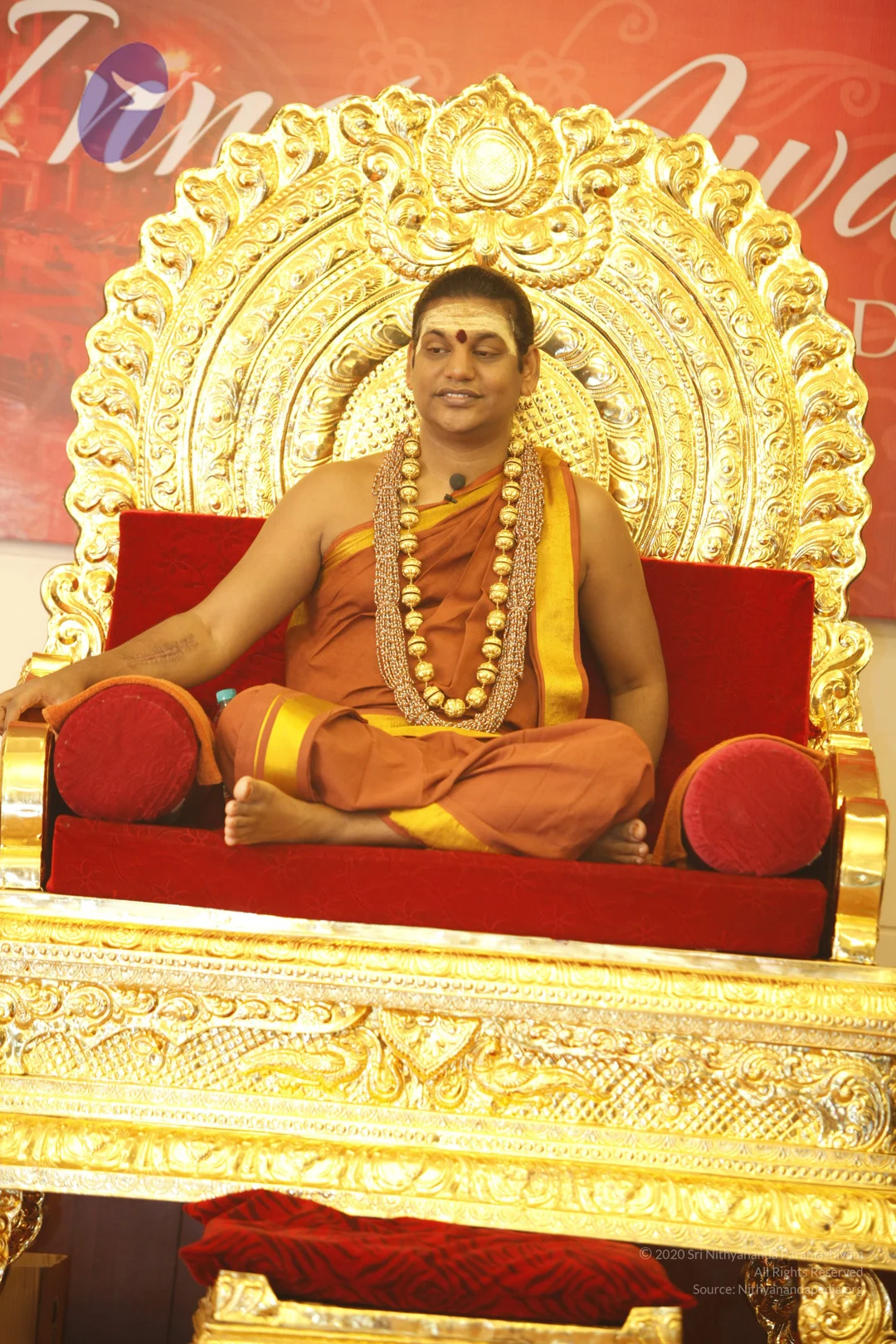
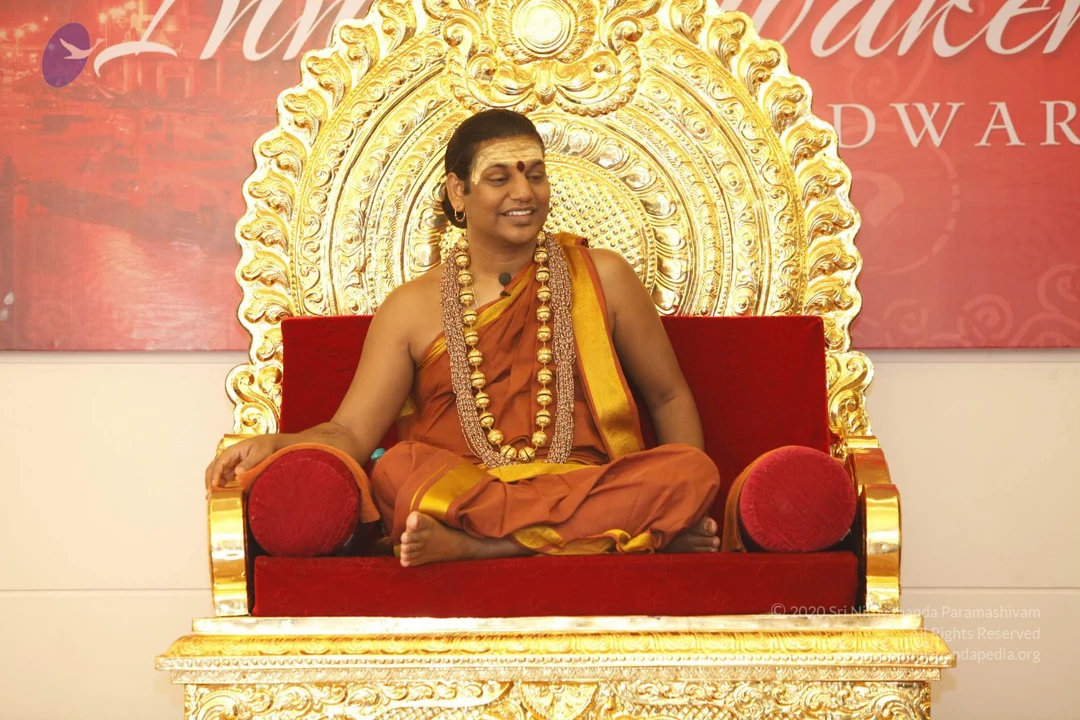
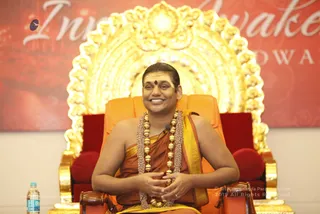
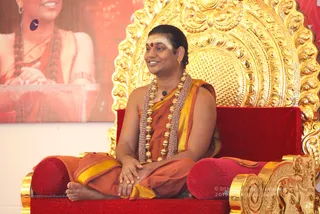
A smiling man seated on an ornate gold throne with red cushions and orange upholstery, in front of a red banner with partial lettering reading "Inner Awaken" and "...dwar...". He wears a saffron-orange robe over his shoulder with a gold-bordered yellow cloth, a multi-strand gold and beaded necklace, and a red bindi with white markings on his forehead. His hands rest together in his lap, and a small clip microphone is attached to his robe. A water bottle sits on the floor at left. Probable Swamiji (probable) seated in a satsang setting, with long swept-back hair and ceremonial gold and rudraksha-style necklaces.A seated man in an ornate golden throne with red velvet cushions and red bolsters. He wears an orange-saffron dhoti and shawl with gold borders, a multi-strand rudraksha mala with gold beads, and gold earrings. He has a white vertical tilak with a red dot on his forehead and his hair is swept back. His hands rest in his lap and he smiles while looking to the side. Behind him is a large red backdrop with a framed photo of a woman in orange garments and beads. Appearance-based label: a person, seated on a throne in ceremonial dress with rudraksha and gold adornments.A seated man sits on an ornate gold-and-red throne with a large carved gold back and red velvet cushions, in front of a red backdrop with white script lettering. He wears an orange-saffron cloth draped over his shoulder and body with gold borders, a heavy necklace of gold beads and rudraksha-style strands, and a small earring. His forehead bears white vibhuti lines with a red kumkum dot. He smiles, legs crossed, with one arm resting on a red bolster. A small clip microphone is visible on his chest. The scene resembles a satsang setting.A seated man in orange saffron robes sits cross-legged on an ornate gold and red throne with a large gilded backrest and red cushions. He wears a long gold-bead necklace with a silver-toned mala and a small microphone clipped near his collar, and has a white-and-red tilak on his forehead. Behind him a red banner with decorative gold script reads Inner Awakening and DWAR. a person by appearance cues: long swept-back hair, saffron robes and ornate ceremonial gold necklace, seated in a satsang setting. Bare feet and an open smile visible.A seated man in saffron-orange robes with a gold-bordered yellow sash sits cross-legged on an ornate gold throne with red cushioned armrests. He wears a heavy gold bead necklace over a silver-toned chain, has a white tilak with a red bindi on his forehead, and a small lapel microphone clipped to his robe. His hands rest on the red armrest cushions and he gazes downward with a slight smile. Behind him is a red backdrop with white calligraphic lettering and a golden halo-like throne back. Appearance-based label: a person, seated on the throne in an in_person setting.

Pada-Puja-and-Satsang
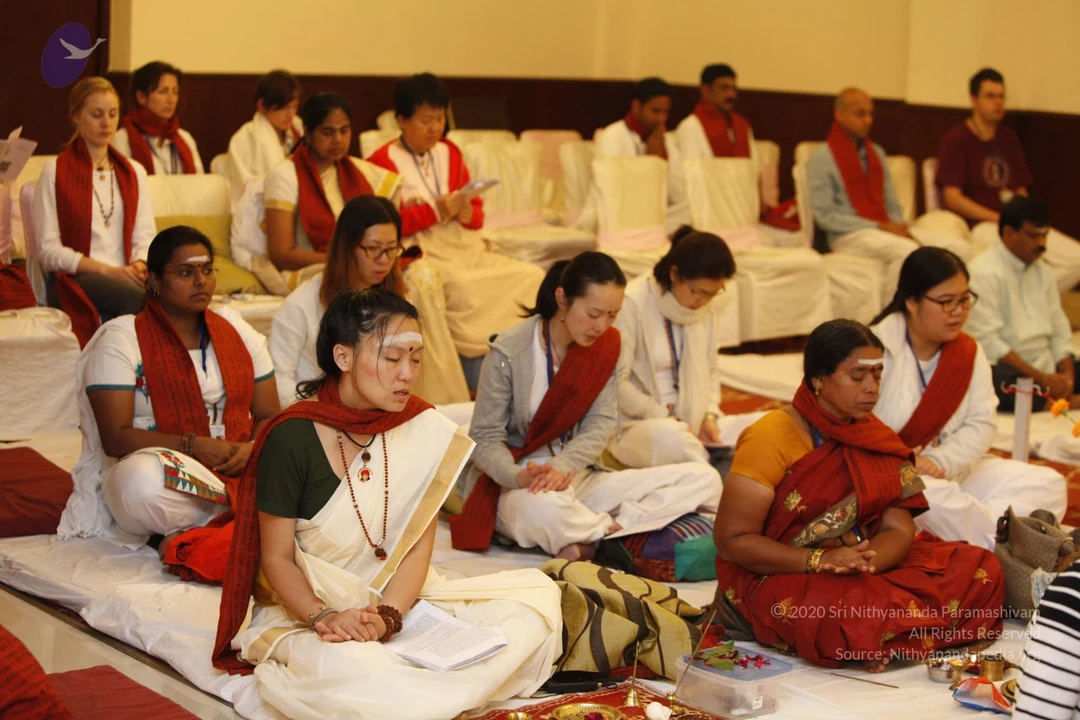
63 photosSource gallery
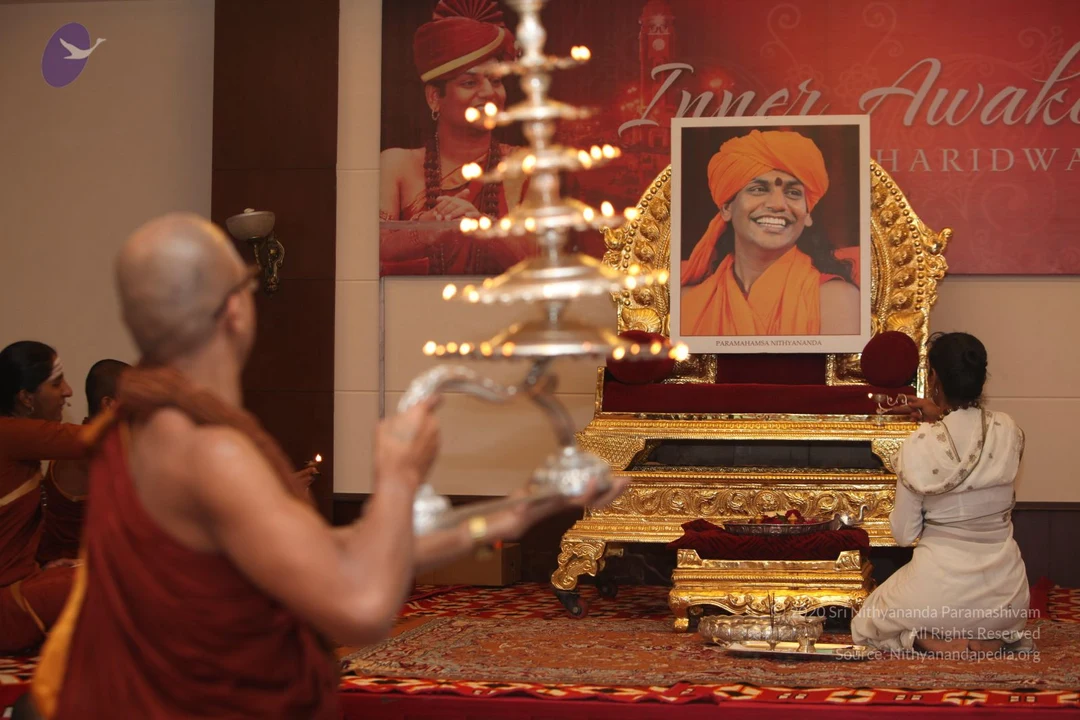
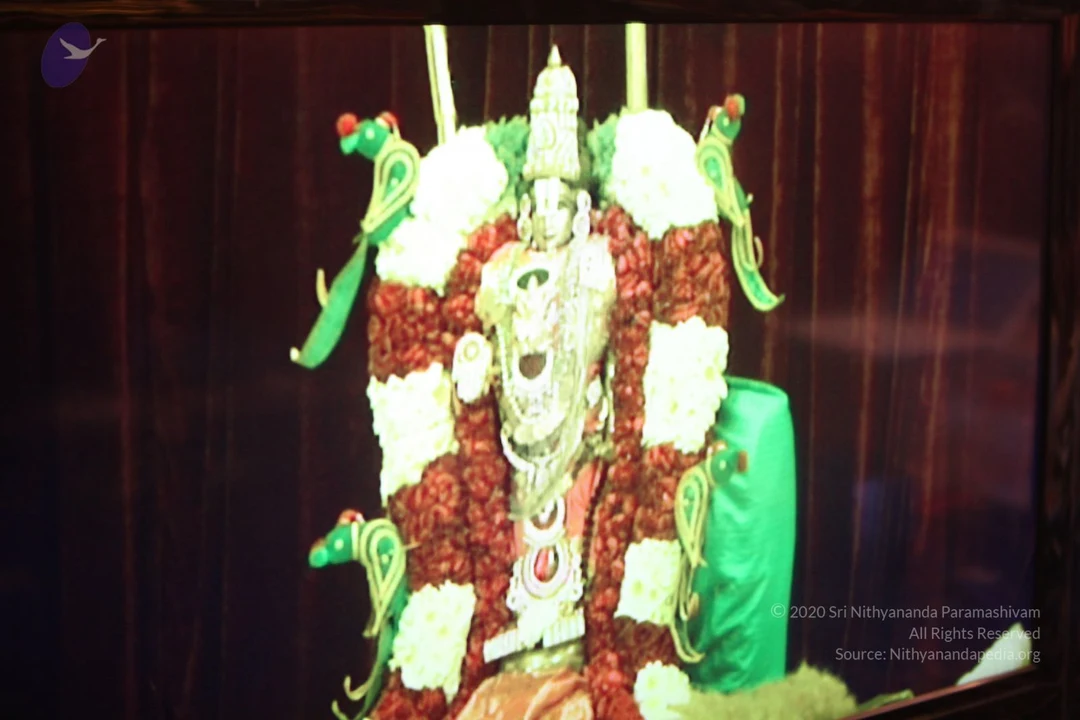
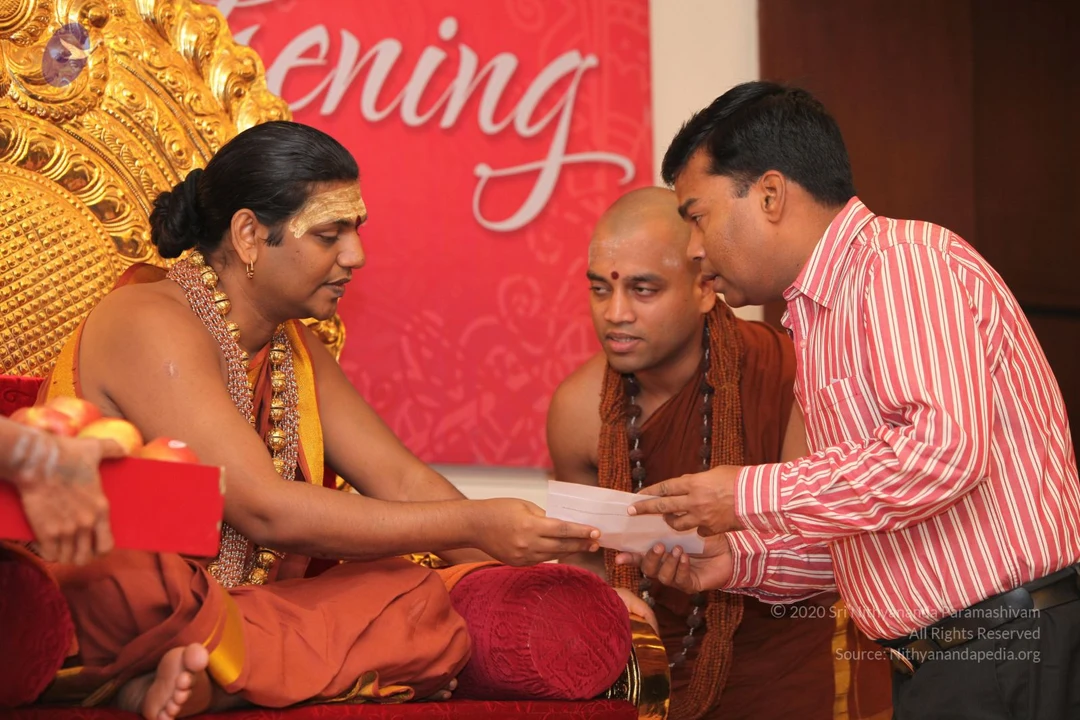
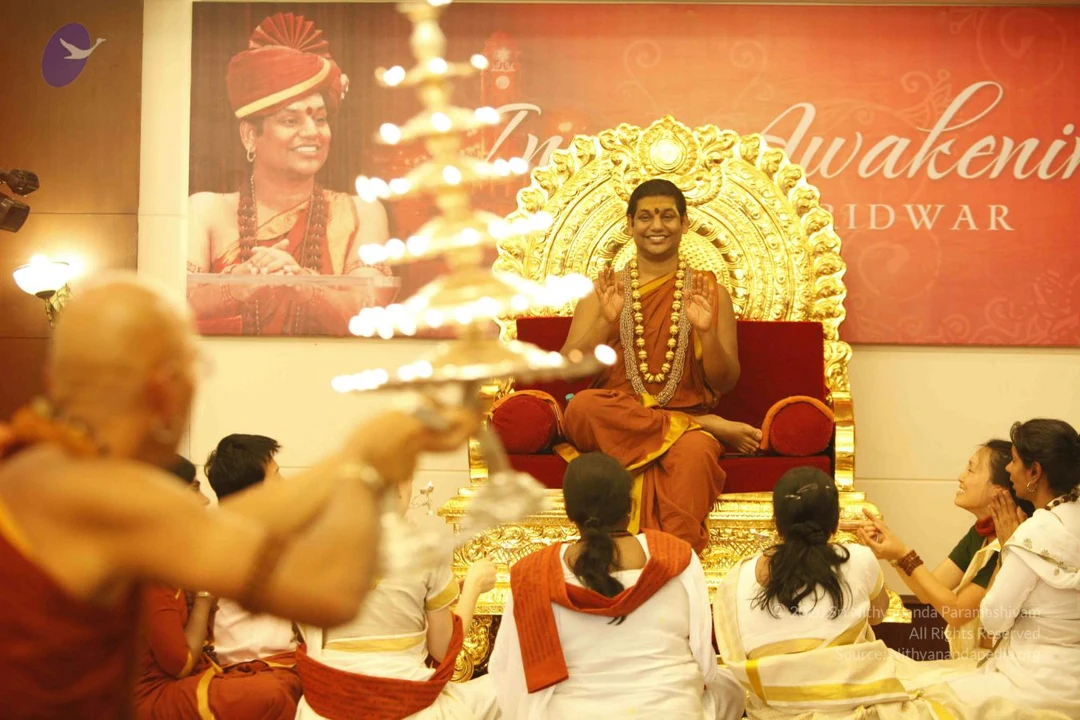
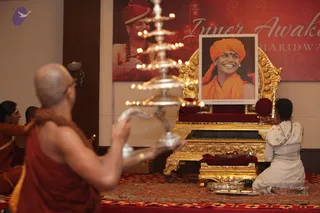
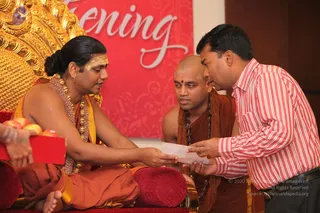
A ritual aarti scene in a hall with red and gold decor. In the foreground, a bald priest in a rust-red robe holds a tall silver multi-tier oil lamp with lit wicks. At right, a woman in a white sari kneels before a gold-carved throne (peetha) draped in red cushions. On the throne sits a framed portrait of a smiling figure in an orange turban and orange shawl, labelled PARAMAHAMSA NITHYANANDA. Two women in orange-brown garments kneel at left. A large red banner behind reads Inner Awakening and Haridwar, with a second portrait at upper left. The red patterned rug and lit oil lamps complete the setting.A photograph of a screen showing a silver-toned deity murti of Shiva-like form dressed with large white flower garlands, red-brown bead garlands and green cloth; green and gold peacock-like ornaments flank the figure. The murti stands against a dark wooden backdrop, and the screen image is partly washed out. No physical people are visible.A seated man with swept-back hair, a gold tilak on his forehead, a gold-beaded necklace and an orange-saffron shawl sits on a golden ornate throne, accepting a white envelope from a man in a red-and-white striped shirt. A shaved-headed monk in orange-brown robes and a rudraksha mala kneels beside the throne watching the exchange. A red box with apples sits at the left edge, and a red banner behind reads partially as 'ening'. a person, seated on a peetha/throne, receiving an offering from a devotee; the other two are a monk and a devotee.A top-down view of an ornate silver puja tray set on a red, orange and blue patterned carpet. Eight small silver bowls with embossed floral borders surround the rim and centre, several holding clear liquid or small wicks, with one bowl of red liquid and one filled with red rose petals. A silver spoon-like vessel with a red rose sits at the top, and a rectangular silver card or box with a flower motif rests beside a red rose at the upper right. No people are visible, and the tray appears to be a ritual arrangement for offerings or abhishekam-style preparations.A silver tray filled with red rose petals and whole red roses holds a pair of ornate gold padukas, footwear-shaped ritual sandals with raised floral and scrollwork designs and small gold knobs. The tray rests on a deep red fabric with dark tiger-stripe pattern. A silver elephant-shaped handle sits at the right edge, and a gold-framed edge appears at the top. No people are visible.A photograph of a pair of ornate gold sandal-shaped padukas placed on a silver-rimmed tray filled with red rose petals and whole red roses, resting on a red fabric with dark stripes. Two small gold finials with red stones stand between the padukas. No people are visible. The gold relief patterns include floral and scrollwork motifs.

Darshan

69 photosSource gallery
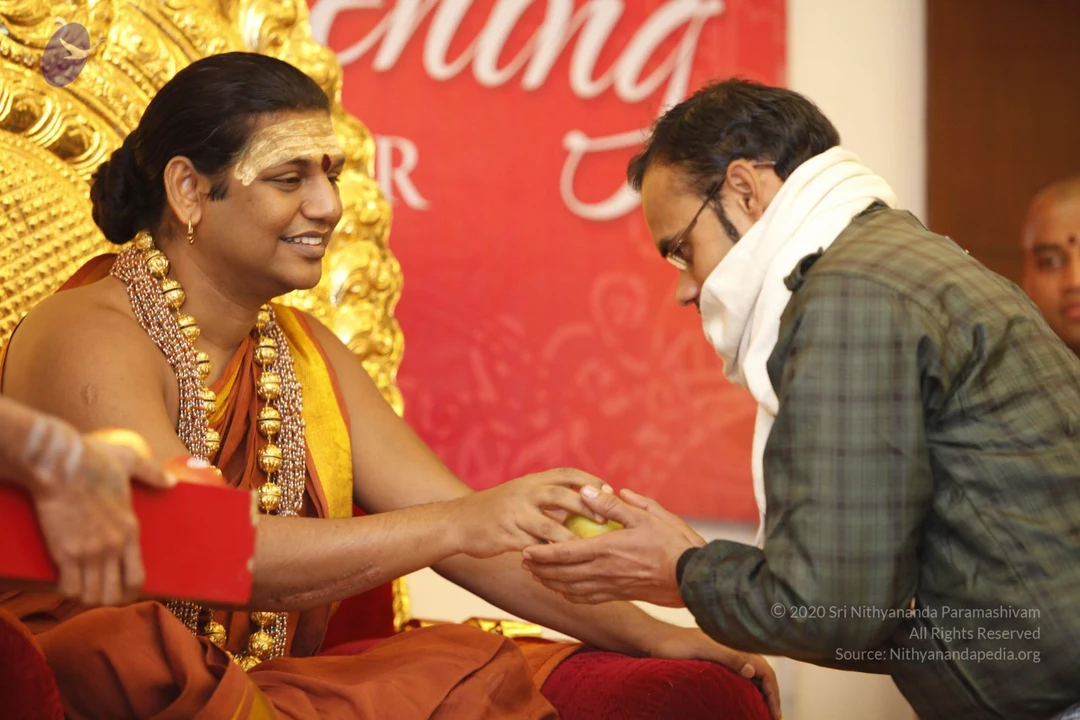
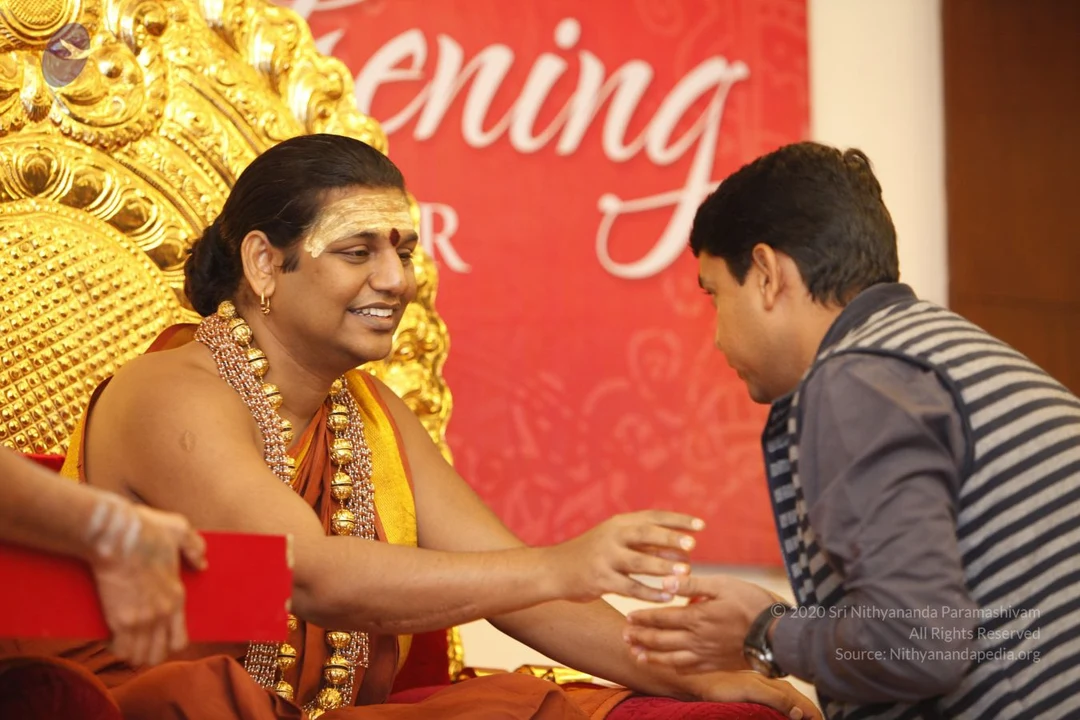
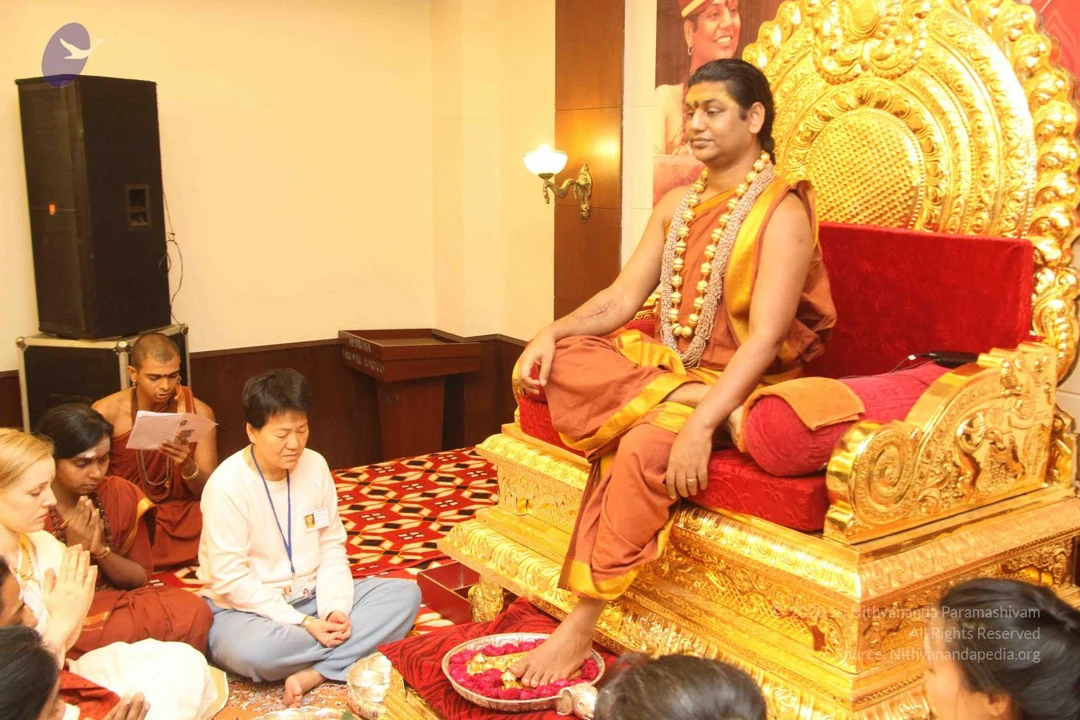
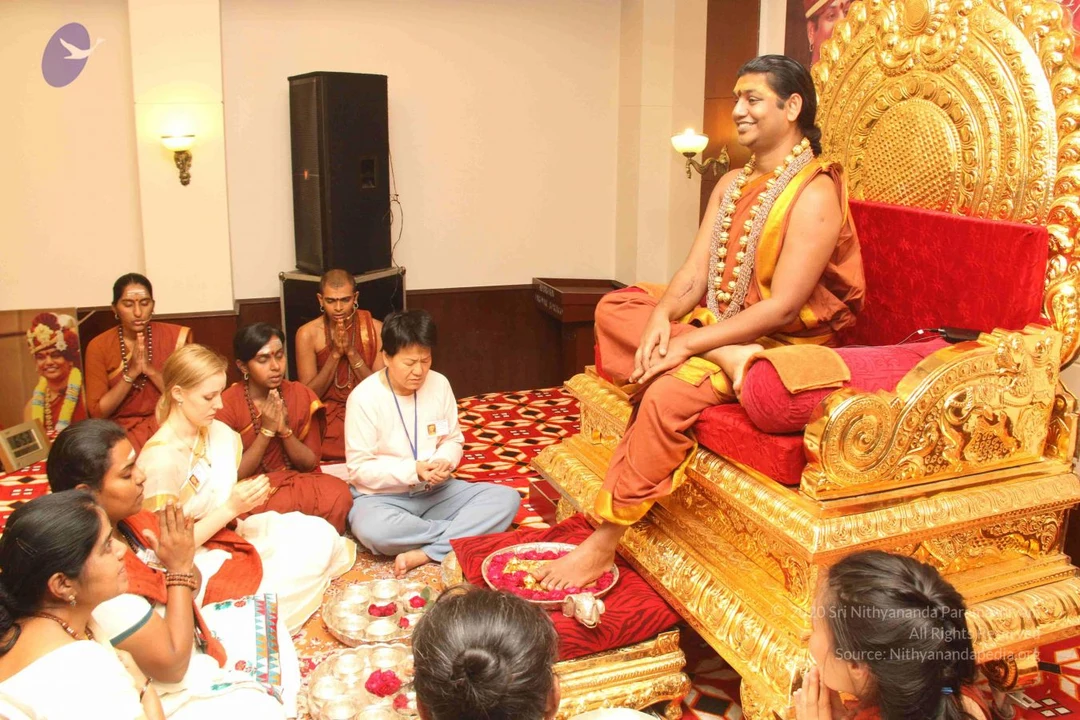
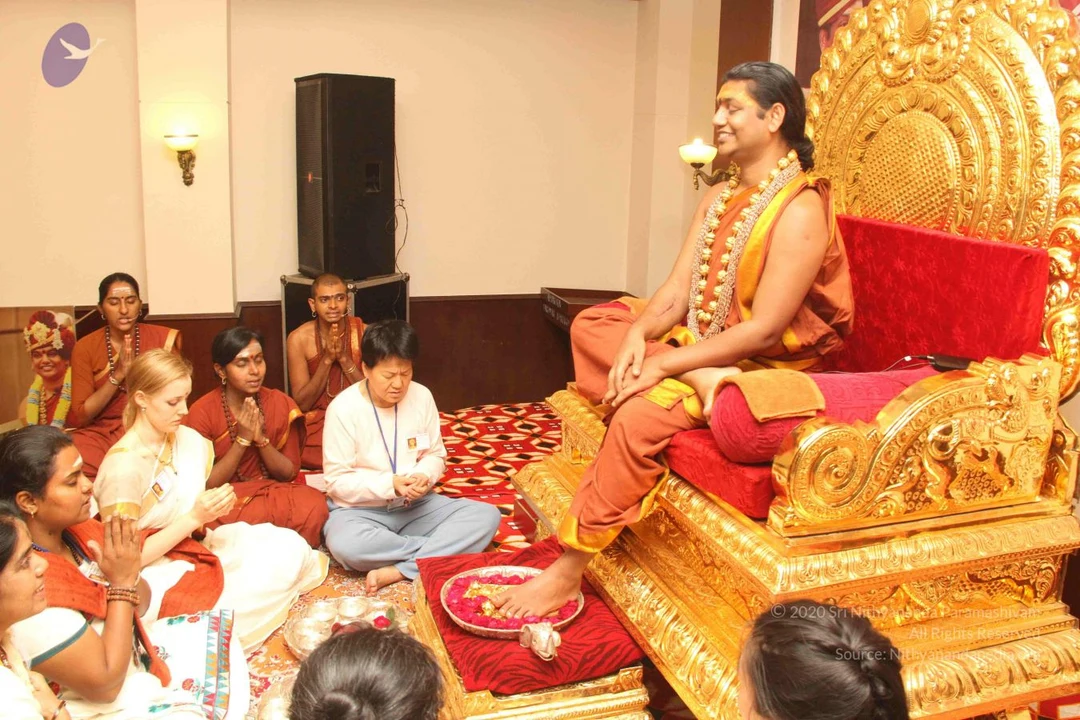
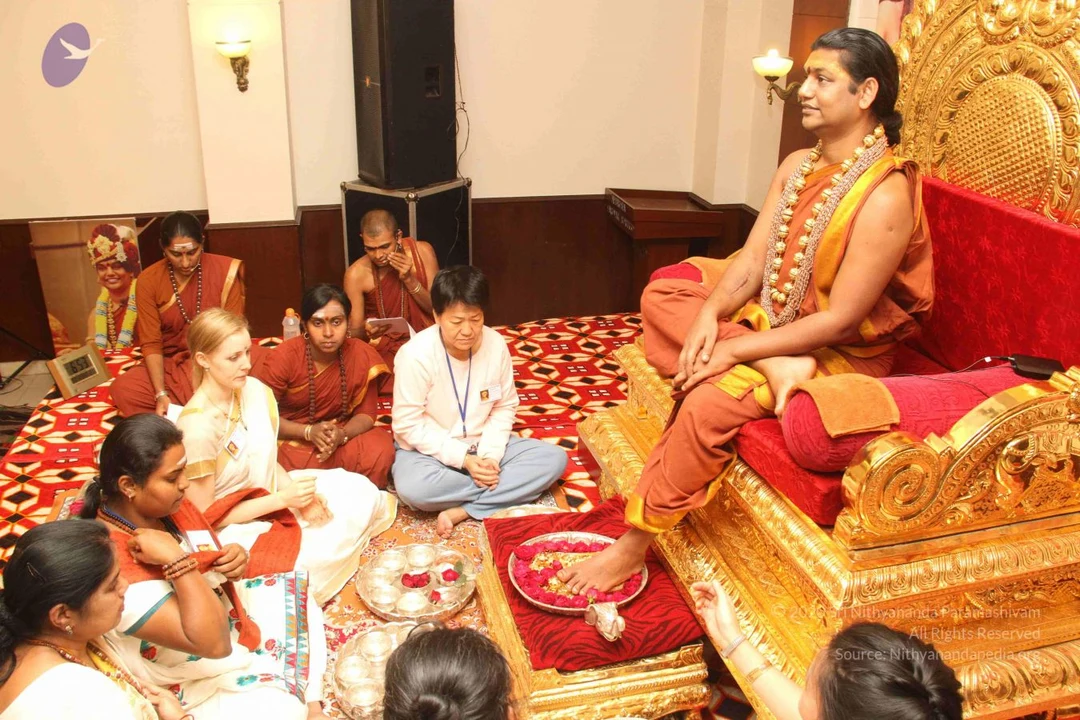
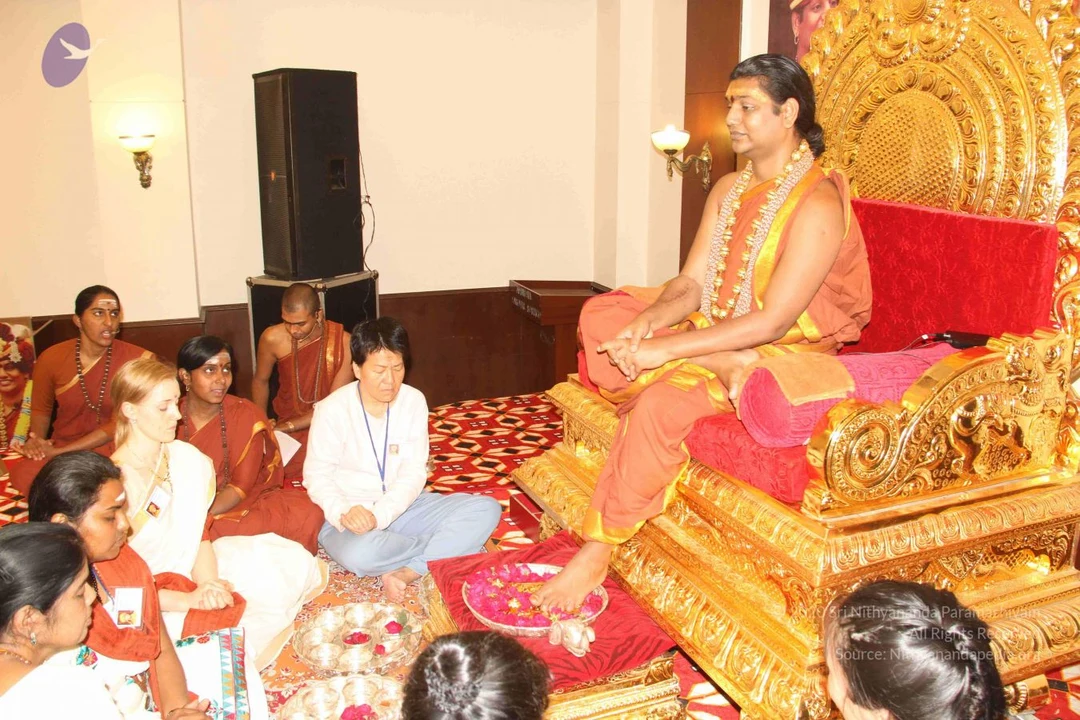
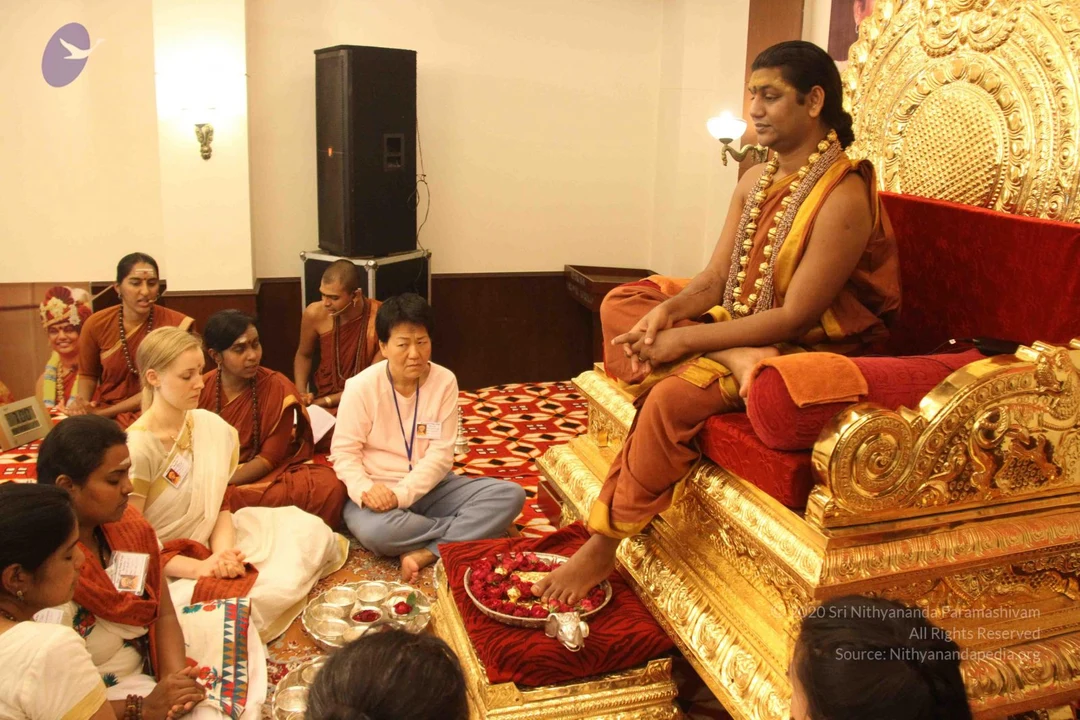
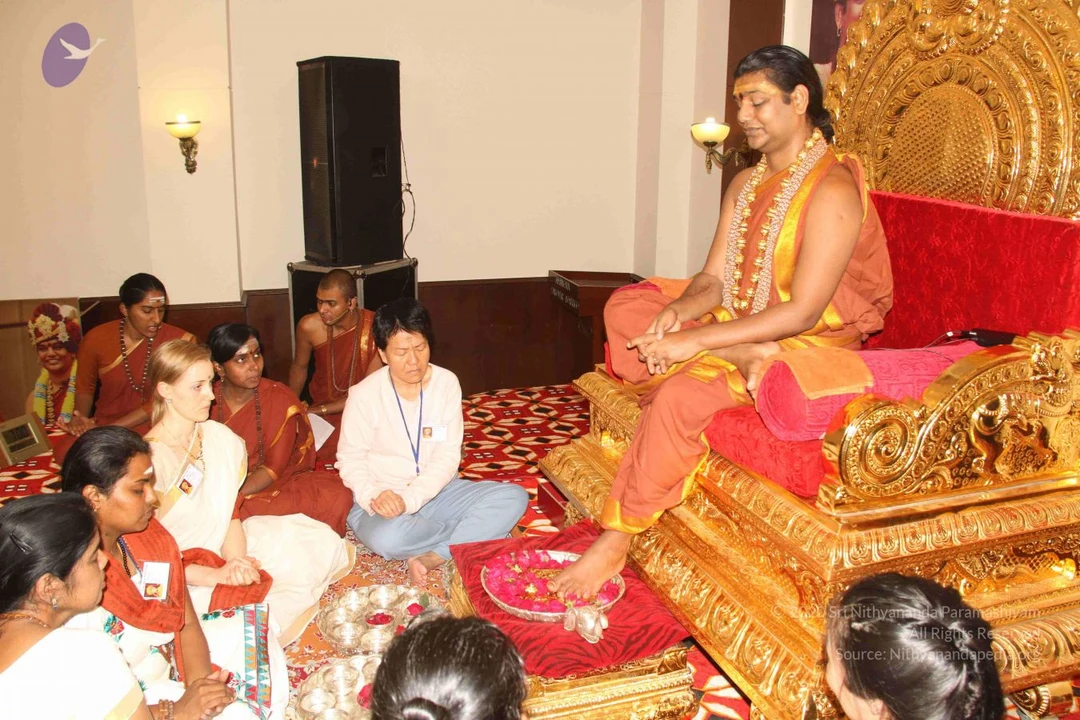
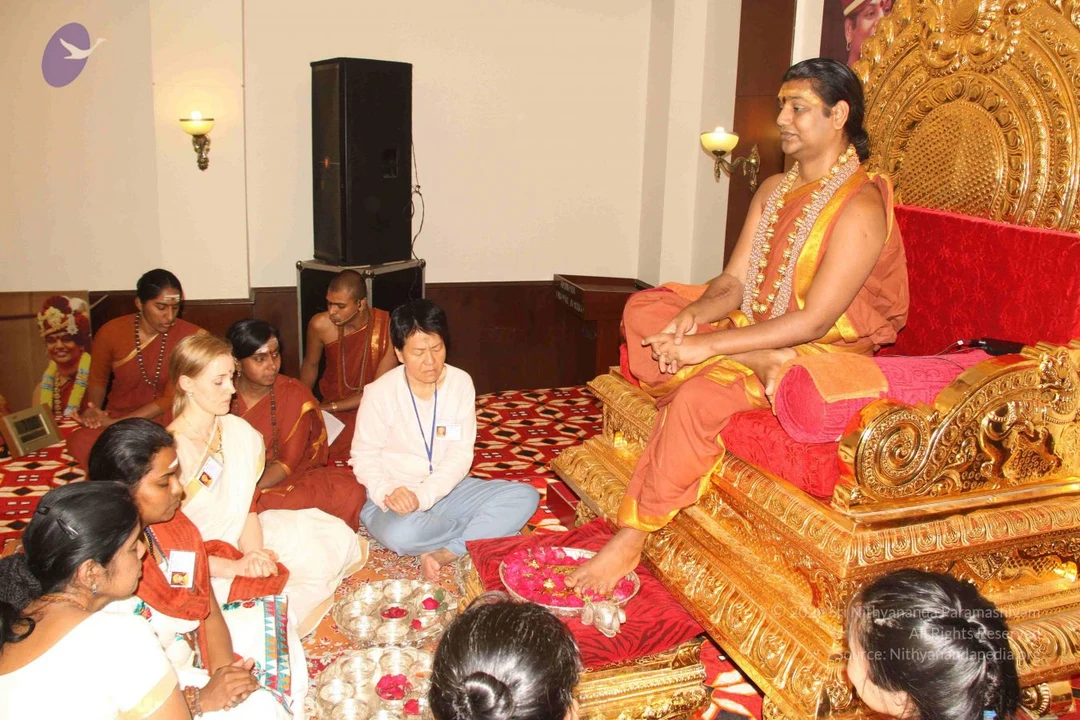
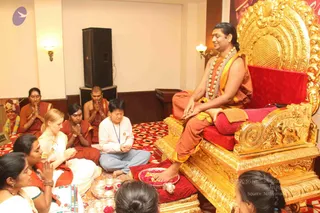
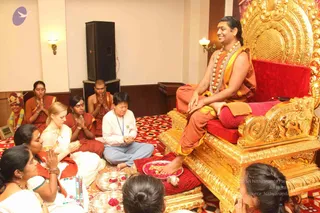
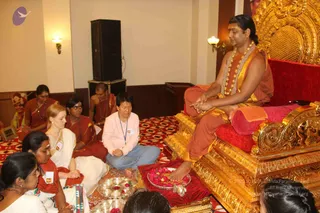
A seated man in saffron-orange robes sits on an ornate gold throne with red velvet cushions, wearing a long white-and-beaded mala necklace and a red tilak on his forehead. His bare right foot rests on a silver tray of red flower petals. Before him on the floor, a woman in a white top and blue trousers sits with hands folded in prayer, and a bald young man in orange robes beside a lectern holds a sheet of paper and reads aloud. A woman in orange cloth with folded hands sits nearby, and a blonde woman in white kneels at the left edge. Portions of other people appear at the bottom edge. A black speaker sits on a stand at left, and a wall lamp lights the cream walls and red patterned carpet. The seated figure's appearance is consistent with the page's identification, but facial features are not used to confirm it.A seated man in an ornate gold and red throne is receiving padapuja from kneeling devotees in a carpeted hall. He wears orange robes, a long string of white flower garlands, and his hair is worn long and swept back. Several devotees kneel with hands in anjali mudra; a woman in white and a woman in a red sari sit closest, with silver puja plates holding flowers and a small offering placed before his feet.A seated man on an ornate gold throne with a red cushion smiles toward a group. He wears saffron-orange clothing, a gold-and-white beaded garland, and a golden shawl, with his bare feet resting on a red cloth and a silver plate of red petals. Around him, several people sit on the floor with hands in anjali mudra. Among them are women in white and saffron, a woman in white with blue trousers, and men in saffron robes. Brass plates with red flowers sit in front of the group, and an oil lamp and a framed portrait with a garland appear at the left edge. The setting is an indoor hall with cream walls and wall sconces, and the room has a red and gold patterned floor covering.A seated man in orange and saffron robes with a white-and-gold garland sits on an ornate gold throne with red cushions. He has long dark hair swept back and smiles. Before him, devotees sit on a red patterned rug: a woman in white with folded hands, a woman in white and red, and a woman in a white top and blue trousers with palms pressed together. Several seated women and a shaven-headed man in orange also join their hands in namaste. A red-rimmed silver tray with rose petals and flowers sits in front of the throne, and a bare foot rests on a small red cushion. Wall sconces with lit lamps and a speaker are behind them.A seated man on an ornate gold throne with red cushions, wearing an orange robe and a layered beaded necklace, sits barefoot with his feet resting on a red cushion. Around him on a red and beige patterned rug, several people sit on the floor: women in orange and white saris, a woman in a white dress, a woman in pale clothing, and a shaved-headed man in orange. Brass plates with lamps and rose petals sit near the throne, and a woman in the foreground holds a plate. A probable Swamiji figure, with long swept-back hair and orange-gold ritual clothing, is seated on the throne and receives a satsang gathering in a hall with cream walls and wood paneling.A photograph of a seated satsang in an indoor hall with a red-patterned carpet and wall sconces. On the right, a man on a large ornate gold throne with a red cushion wears orange robes, a gold-and-white beaded garland and a rudraksha-style mala, and his hands rest in front of him as he speaks. Several seated devotees face him: a woman in a pink top and blue trousers with a blue lanyard sits closest, a woman in white with a red border sits to her left, and women in orange-red saris sit behind them. A shaved-head monk in orange sits in the back. Brass plates with oil lamps and pink flower petals sit on the carpet in the foreground, and a black speaker stands against the wall.

Homa

82 photosSource gallery
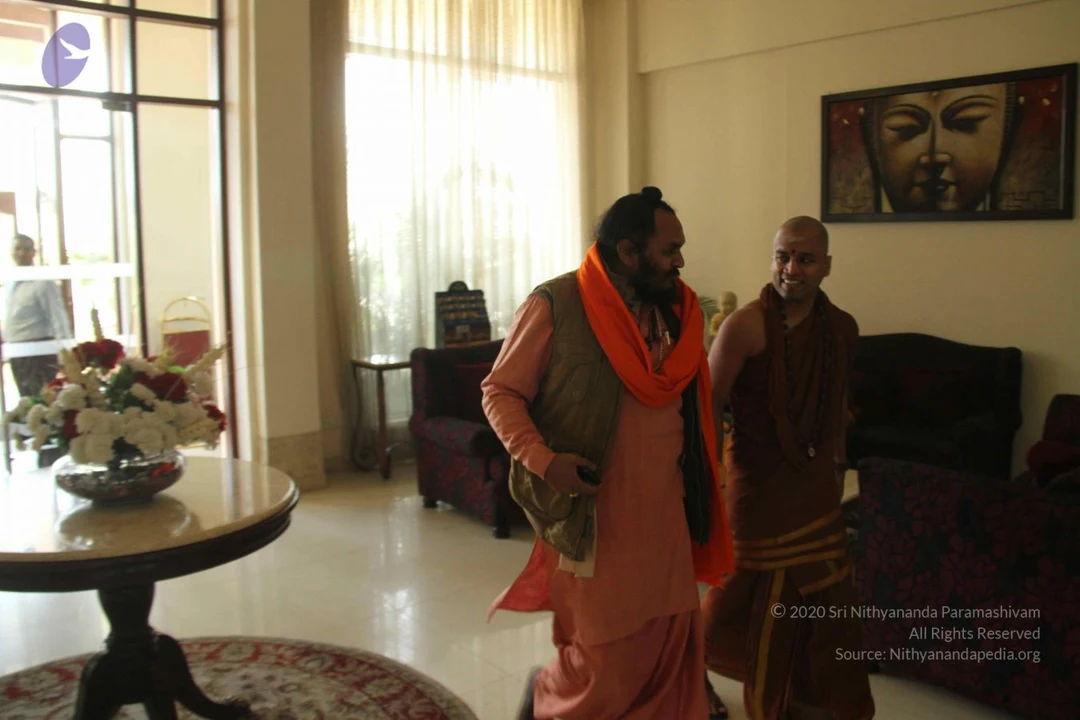
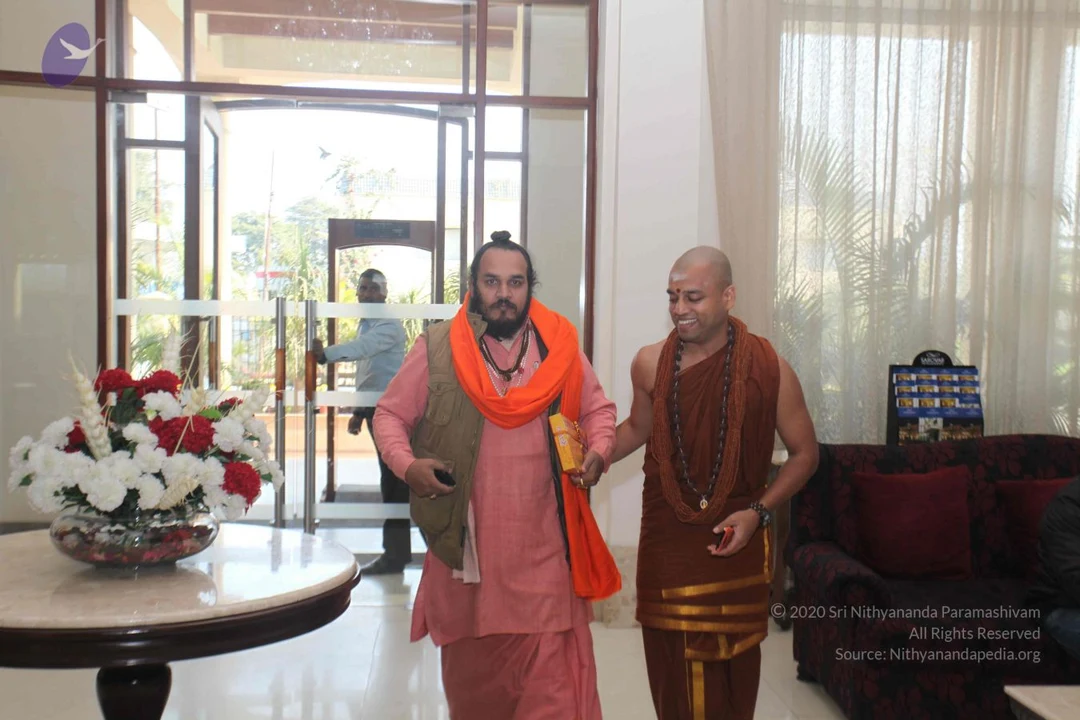
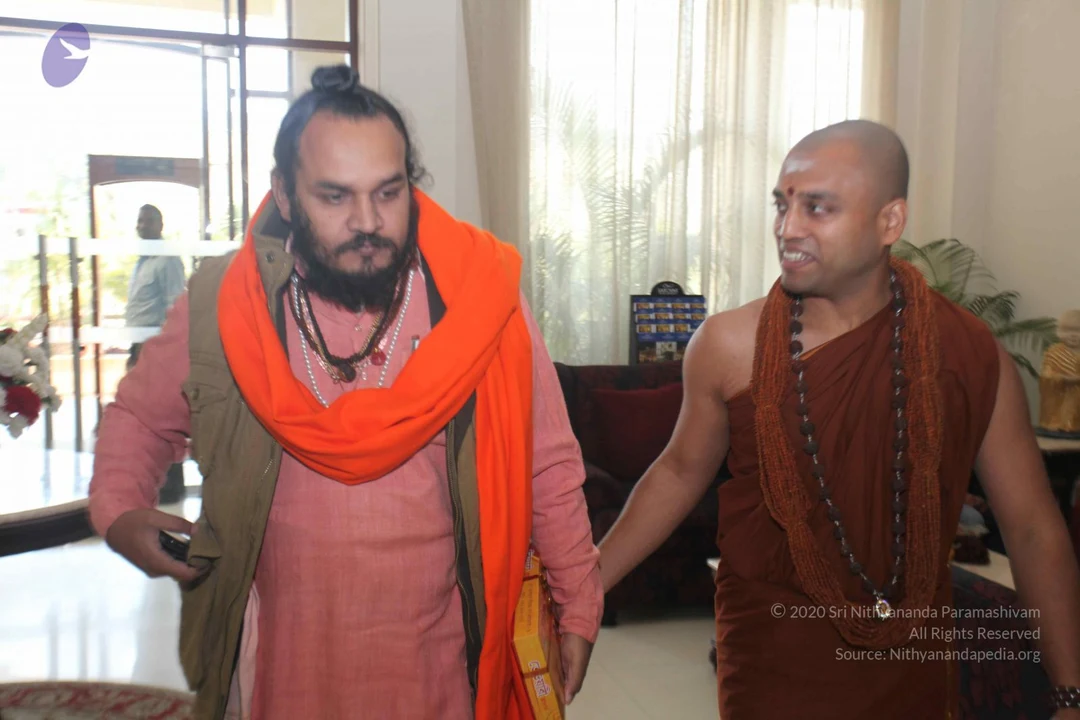
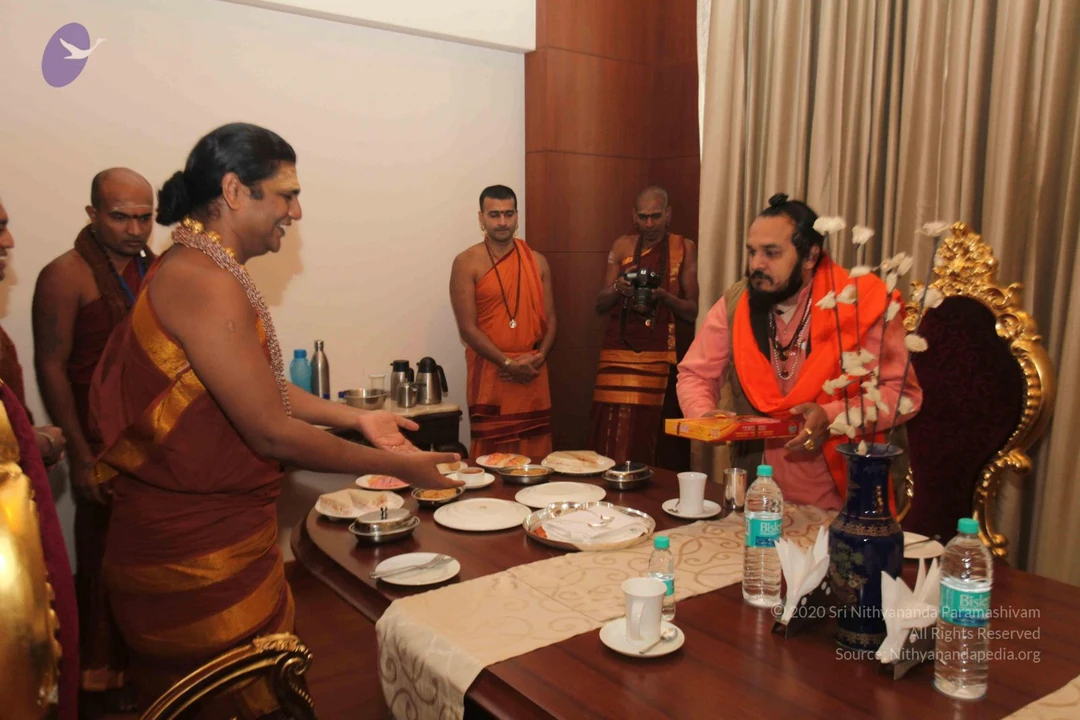
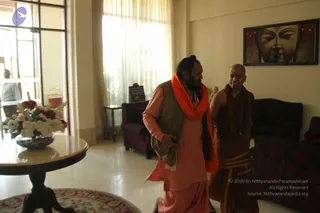
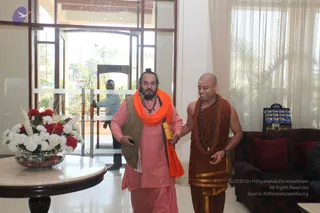
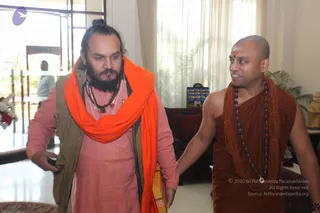
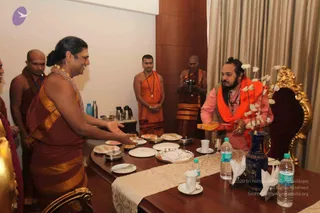
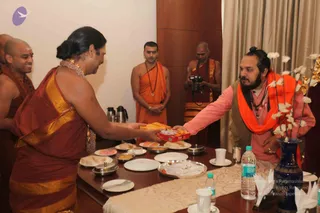
Indoor photo of a bright reception room with cream walls, large sheer-curtained windows, a polished tiled floor, and a framed painting of a serene Buddha-like face on the wall. A dark wooden round side table holds a glass bowl of white and red flowers. Two men walk together: a bearded man with long dark hair tied up, wearing an orange shawl over a peach-coloured kurta and an olive quilted vest, holding a small dark object; beside him a smiling shaved-headed man in a rust-brown dhoti-style garment with gold-striped border and a beaded mala. Maroon and floral upholstered sofas line the room, and a person stands in a doorway at left.Two men walk through an airy lobby with a glass entrance door and a flower arrangement of red carnations and white blooms on a marble table. The man in the centre wears a pink kurta, an olive vest and a bright orange shawl draped over his shoulders, with long hair tied up and a beard, and holds a small orange box. Beside him, a smiling bald man in a rust-brown dhoti with gold borders and a long brown rudraksha mala walks with his hand touching the first man's arm. A third person stands near the glass doors in the background, and a dark red sofa with cushions sits to the right beside sheer white curtains. Appearance-based label: a person, wearing the pink kurta, orange shawl and tied-up hair described above, possibly in conversation with the rust-clad man.Two men walk together indoors through a bright living room with cream curtains, a dark red sofa, and potted palms. The man on the left has a bun, a full beard, and wears an orange shawl over a pink kurta and an olive vest, holding a folded yellow card. The man on the right, shaved-headed, wears a rust-brown robe bare-shouldered with a long rudraksha mala and a rust-coloured shawl, smiling and gesturing. A partially visible figure stands near the glass door at left.A dining room scene where a man with long dark hair tied in a bun and a gold-beaded necklace, wearing a maroon and gold dhoti, stands at a wooden table arranging plates and food. Across the table, a bearded man in a pink shirt and orange shawl holds a small box and looks toward him. Several men in orange and saffron robes stand nearby, one holding a camera. A blue vase with white flowers, water bottles, cups and a gold-framed chair complete the room.Indoor dining room scene. A man with a dark topknot and a rust-red dhoti-style garment with gold border, wearing beaded necklaces, leans forward to hand a red box of sweets across a wooden table to a bearded man on the right in a pink kurta, olive vest and orange shawl, holding a rudraksha mala. Standing behind them are saffron-robed monks, one photographing with a camera. The table holds white plates, steel bowls, bread, a glass of water, a Bisleri bottle, steel thermoses, and a blue vase with white flowers. a person candidate appearance is uncertain.A photograph of a dining table indoors with a bald, shaved-headed man in a rust-brown robe and tilak on his forehead leaning in and smiling as he reaches toward a bearded man seated before a carved gold-and-red throne. The seated man wears an orange shawl over pinkish-red clothing and is smiling. On the table stand a tall blue vase with white artificial flowers, a water bottle, a white cup on a saucer, a metal tray, and plates. Gold-patterned curtains hang behind them. The seated man is an appearance-based a person candidate, identified by the orange shawl and seated on a throne, though the cues are not distinctive enough to confirm; a robed attendant stands beside him.

Pada-Puja-and-Satsang
3 photosSource gallery
A photograph of a man seated on an ornate gold throne with a red-velvet seat and orange bolster cushions, in front of a red backdrop with partial decorative lettering. He wears an orange-saffron robe with a gold border, a short bead necklace of white and gold beads, and a red bindi. He smiles toward the audience. Two people are seen from behind in the foreground: one in a red shawl over white, with a long braid, and another with hair pinned up. A small brass oil lamp is visible at lower left.A man seated on an orange leather throne-style chair in front of an ornate gold arched backdrop with a red banner behind it. He wears a rust-orange robe with gold border, a heavy gold-bead and silver-chain necklace, and has white and red tilak marks on his forehead. He sits with hands gesturing mid-speech, a lapel microphone clipped to his robe, appearing to give a discourse. Swamiji (probable): the long swept-back hair, ornate gold necklace, saffron-orange robe and throne setting match the appearance cues, so this is a candidate seated in person.A seated man in an orange-and-gold robe with a gold border sits on an ornate gold-and-red throne, smiling with palms raised in greeting. He wears a long gold-bead and pearl necklace and a red bindi. In the foreground, several people are seen from behind or in profile, including a woman with a ponytail in orange clothing, a blonde woman in white, and two women at right with hands pressed together in anjali. Behind the throne is a pink banner with partial lettering reading 'Awakening' and 'HARIDWAR', with a faint photographic portrait at left. a person is the seated figure, identified by the saffron robe, gold necklace and throne, presented as the speaker at the satsang.

Darshan

3 photosSource gallery
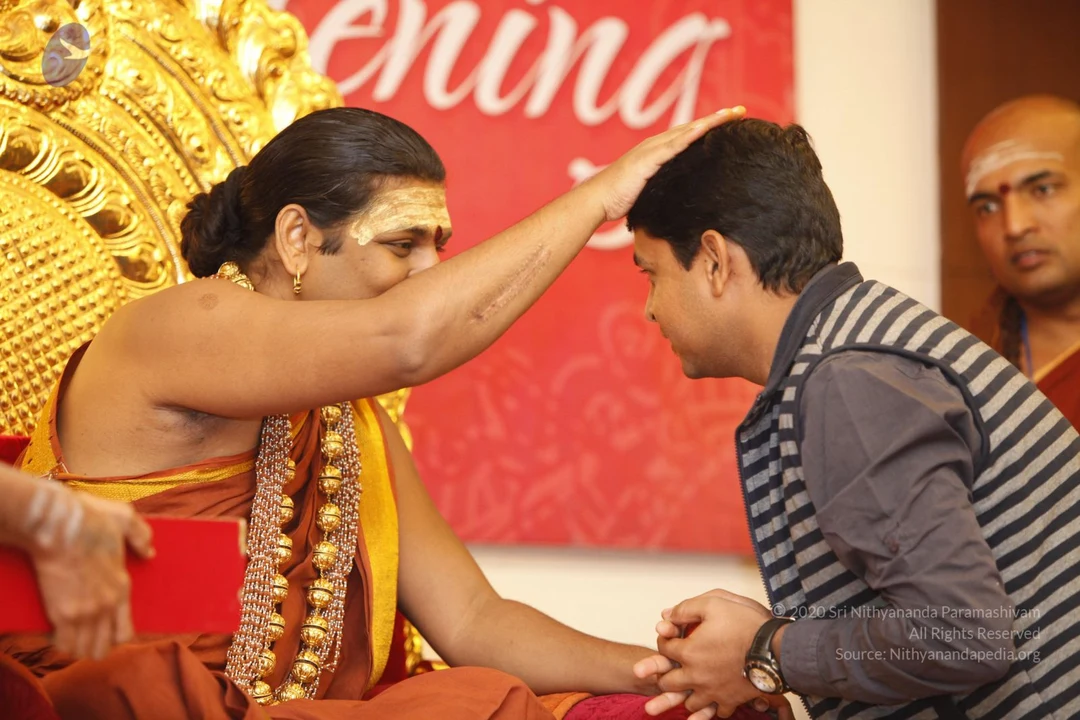
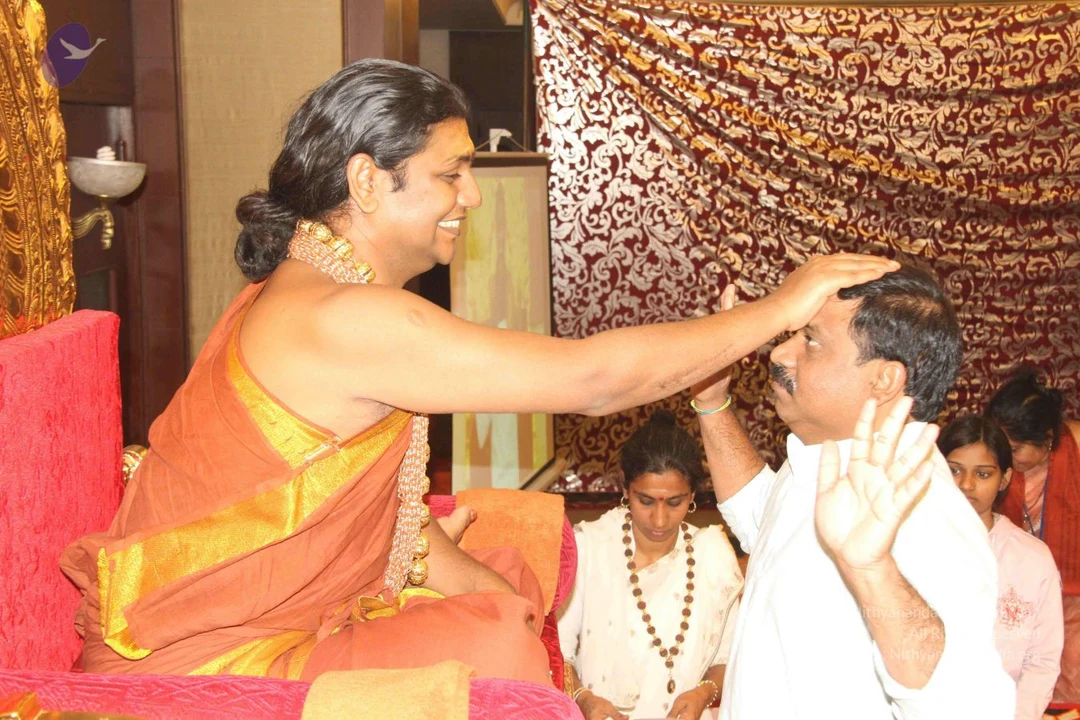
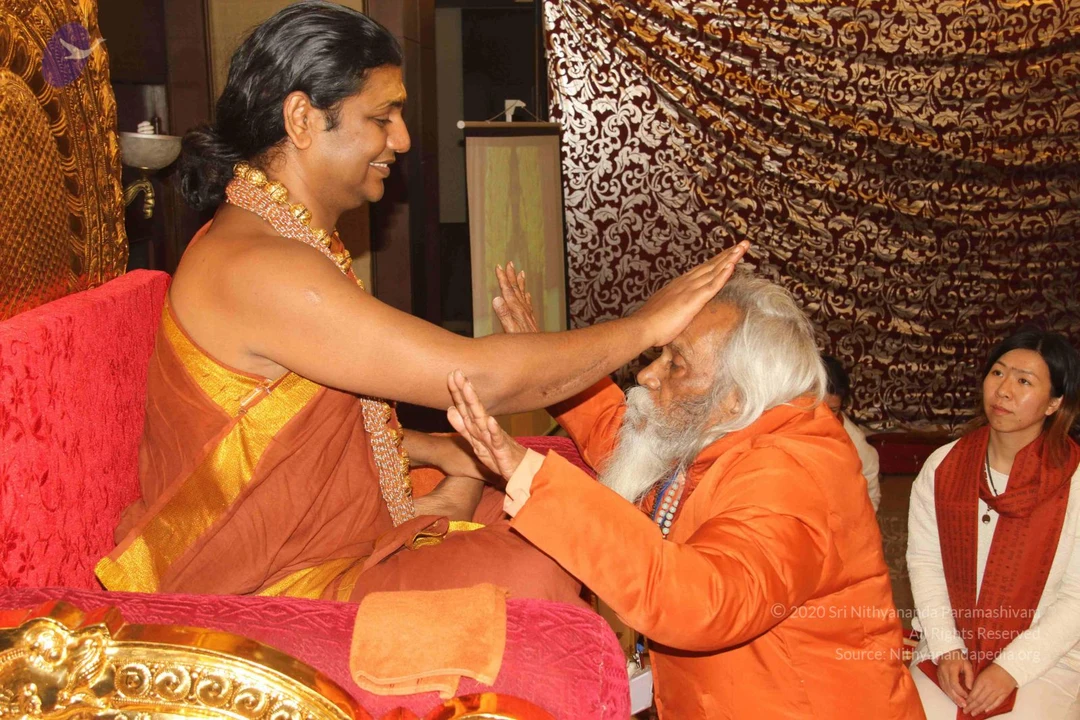
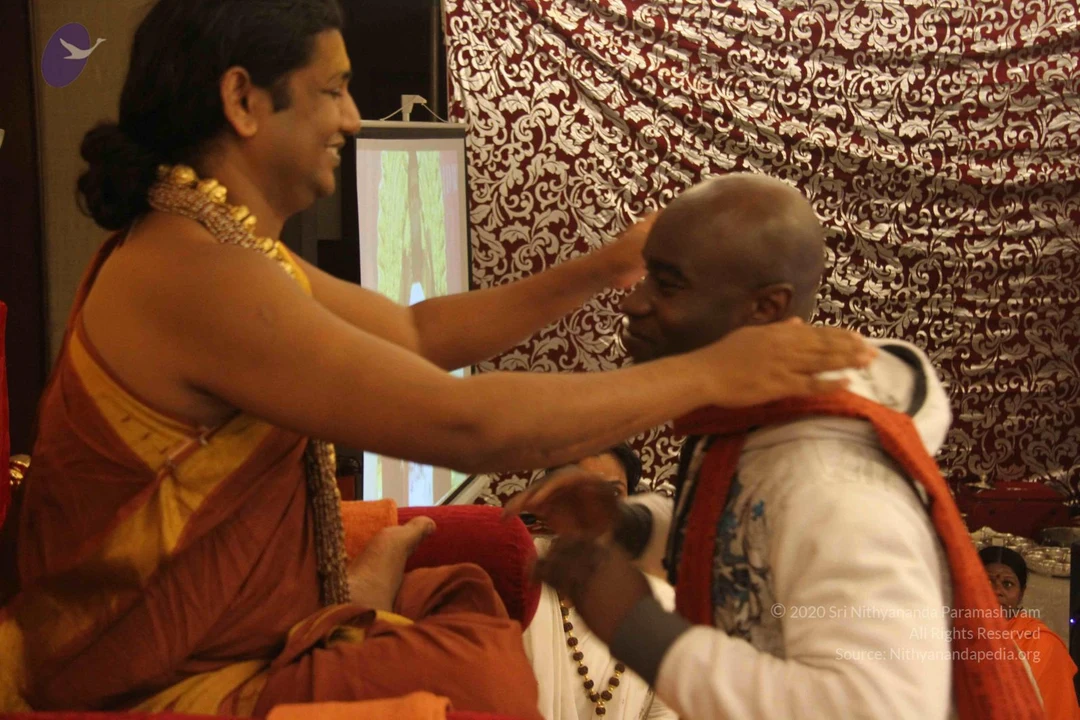
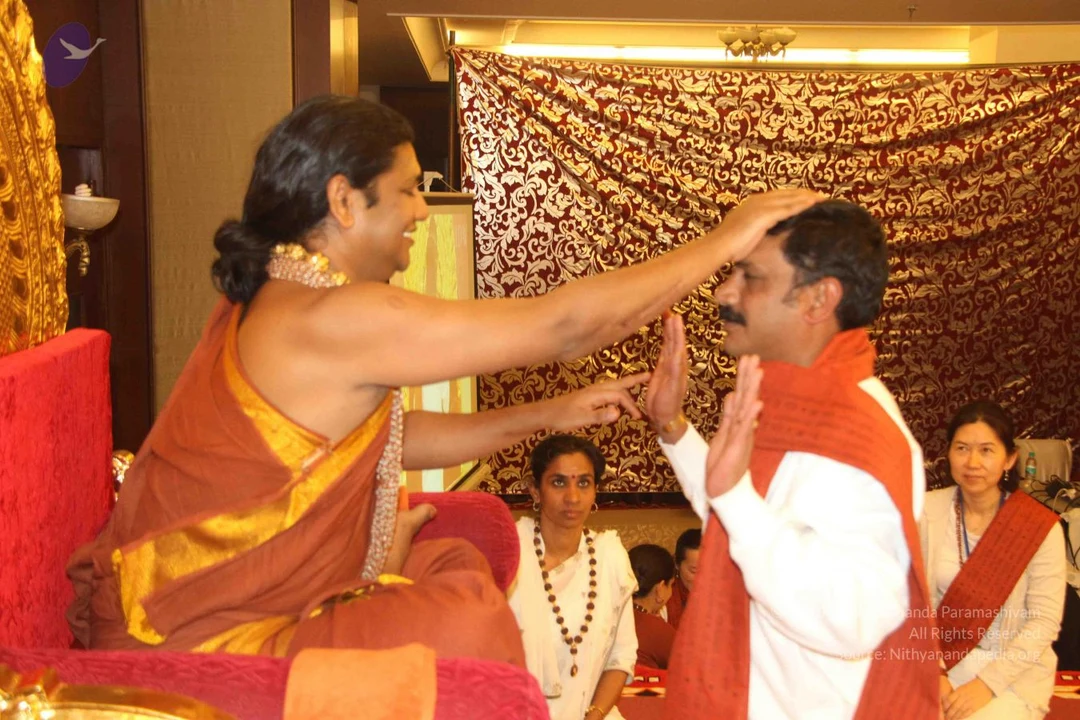
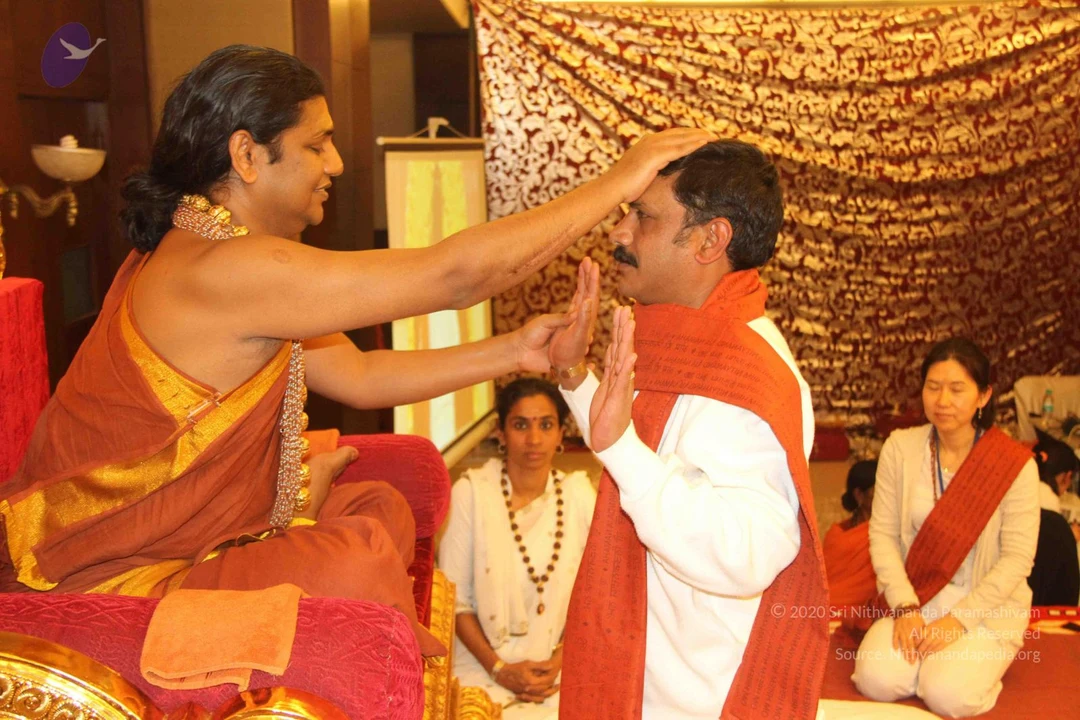
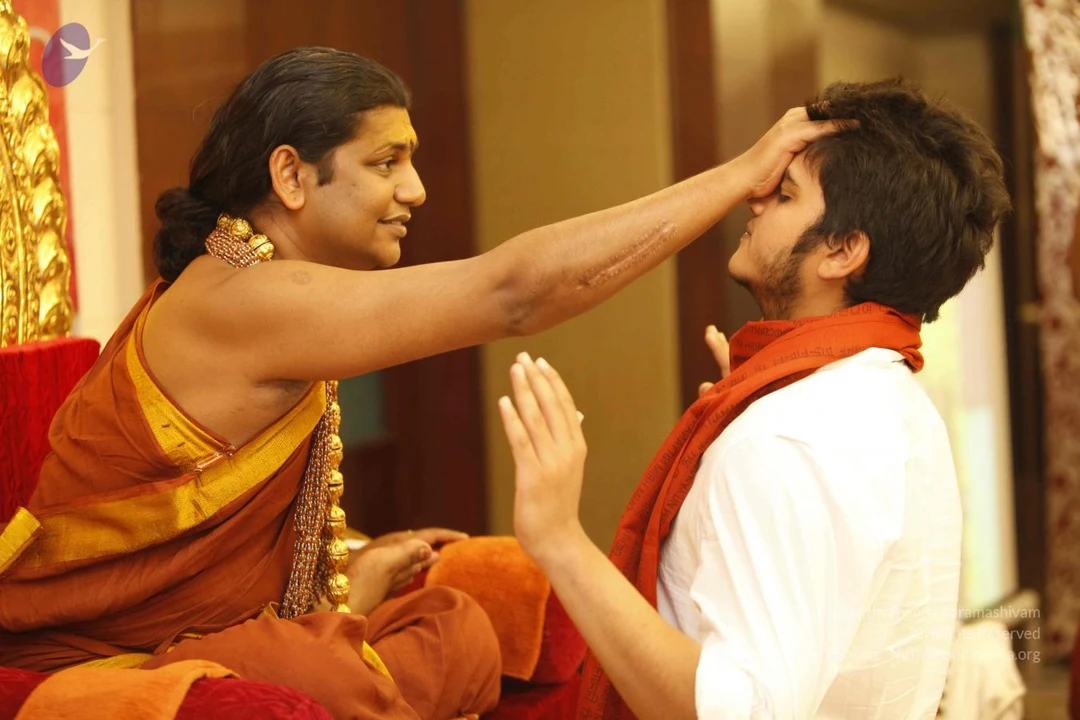
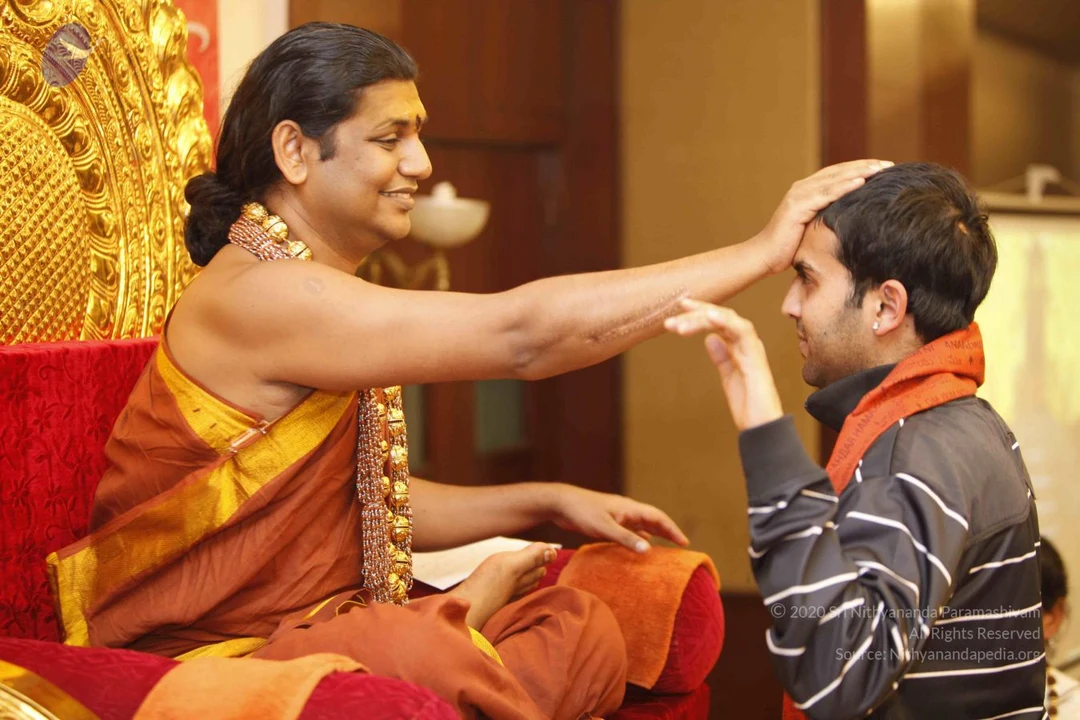
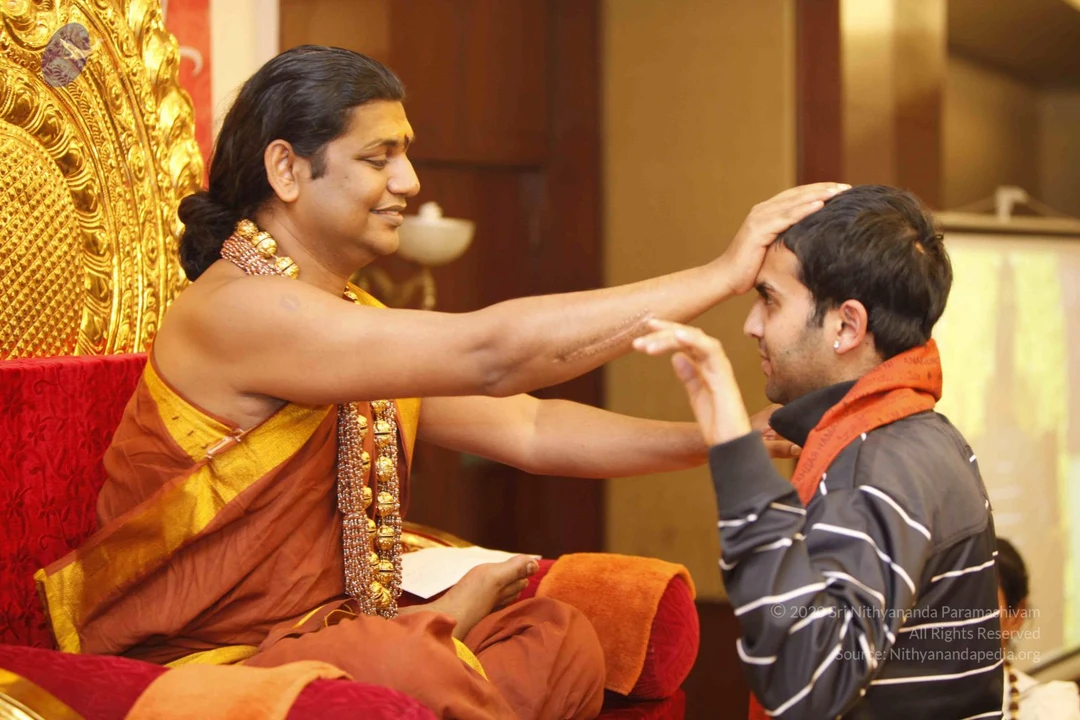
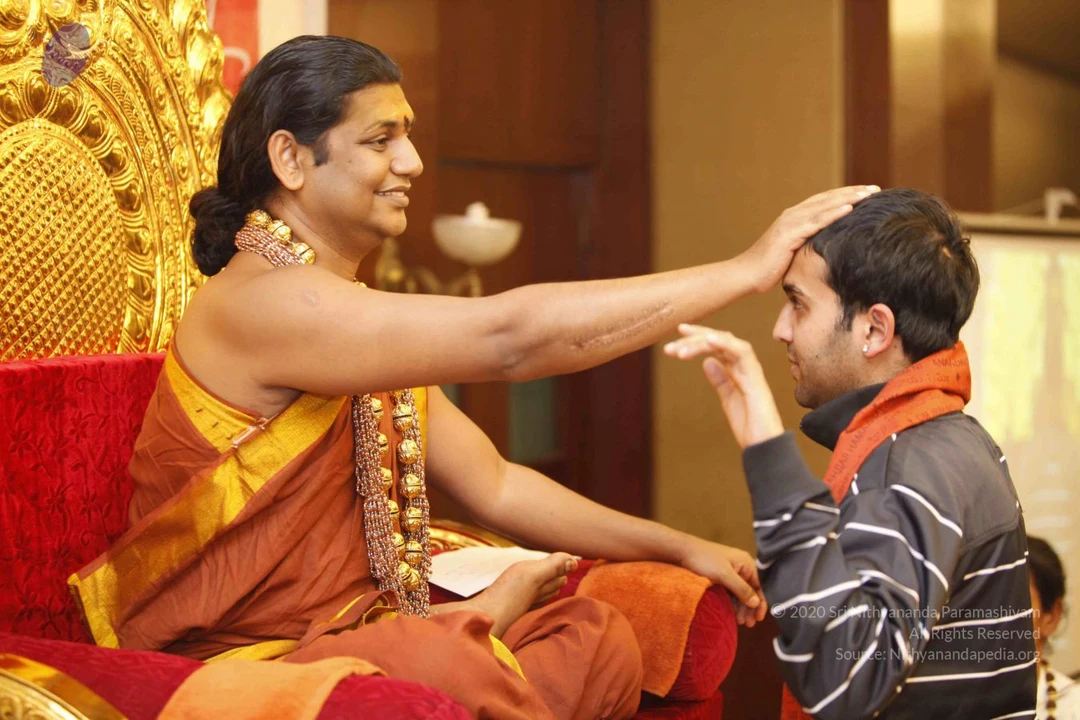
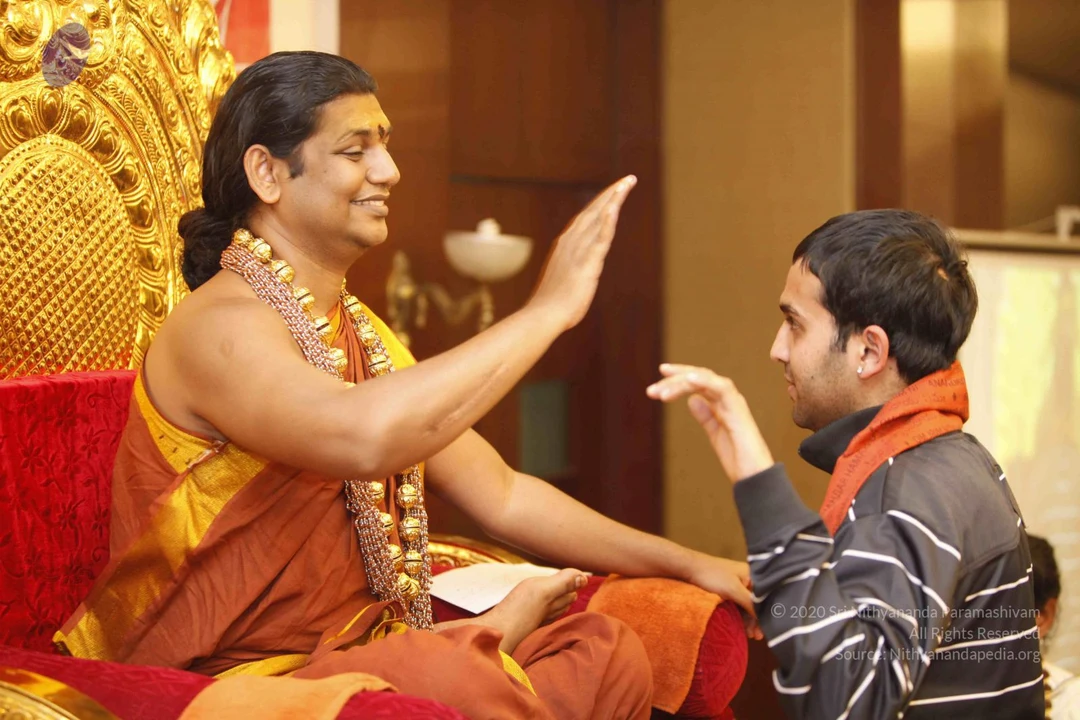
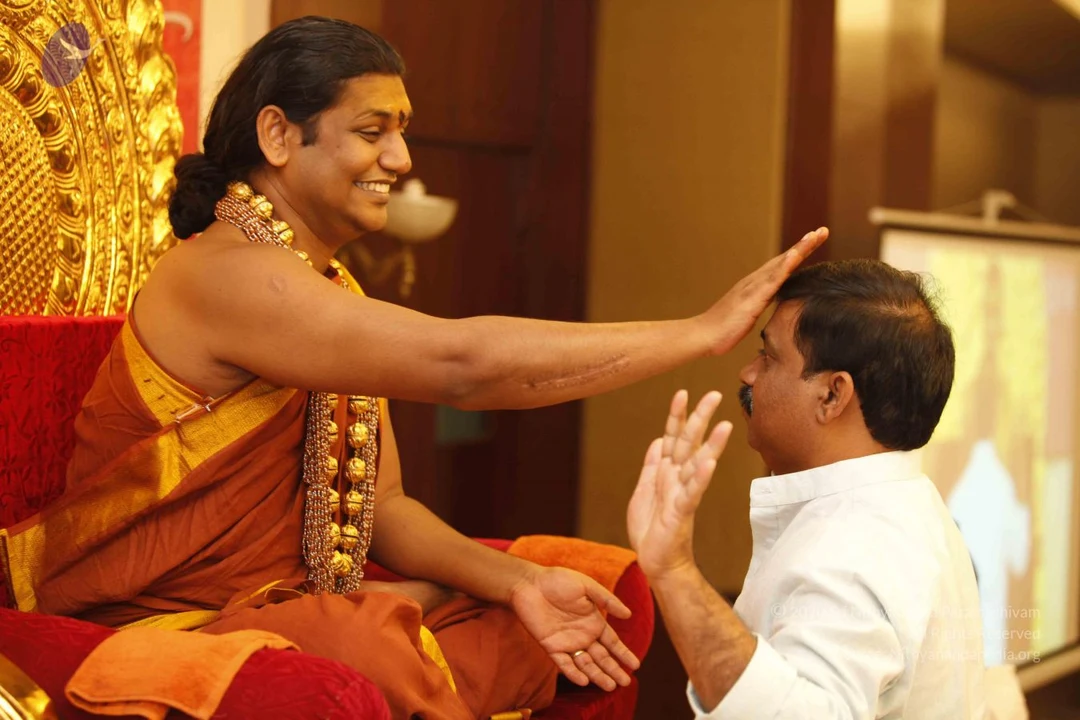
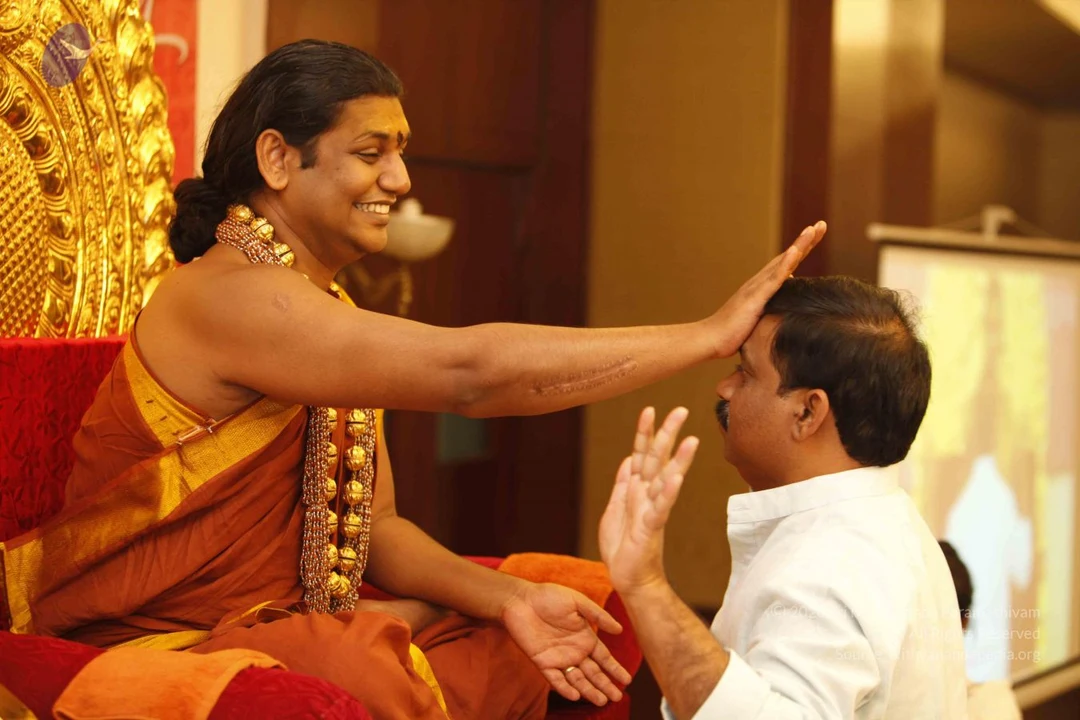
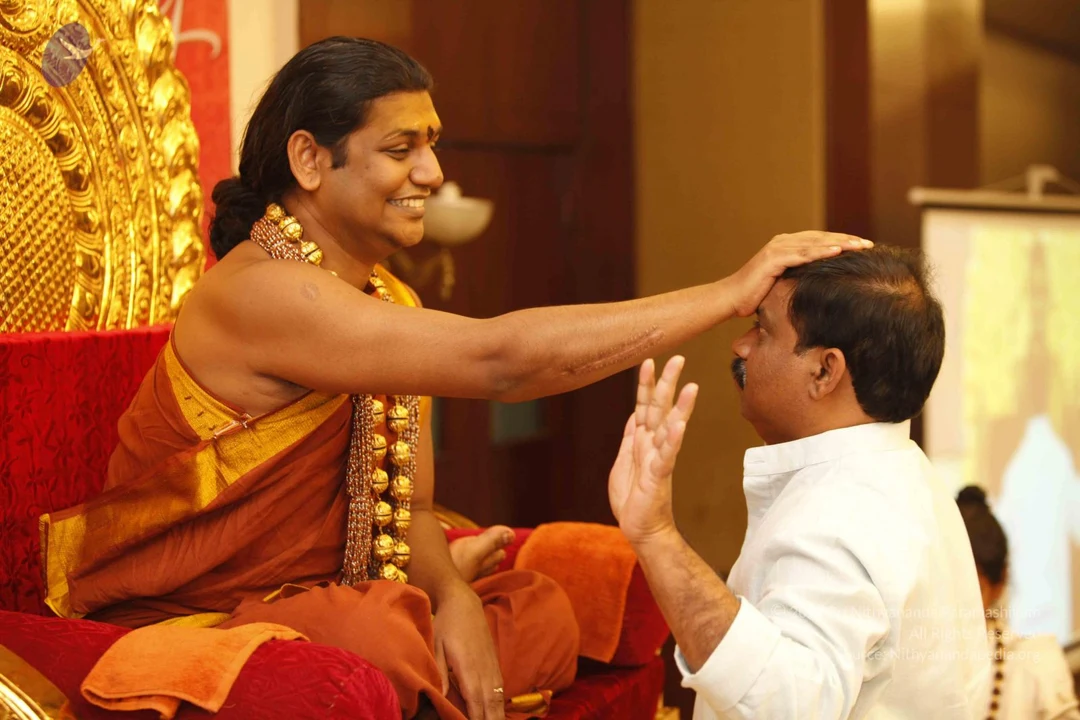
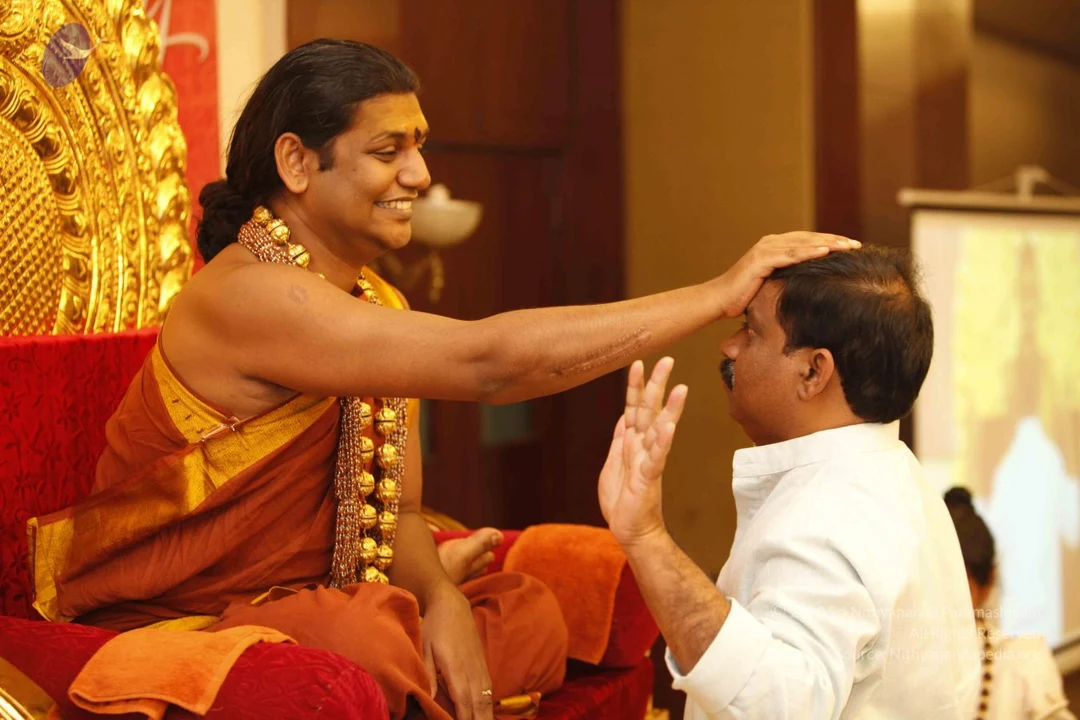
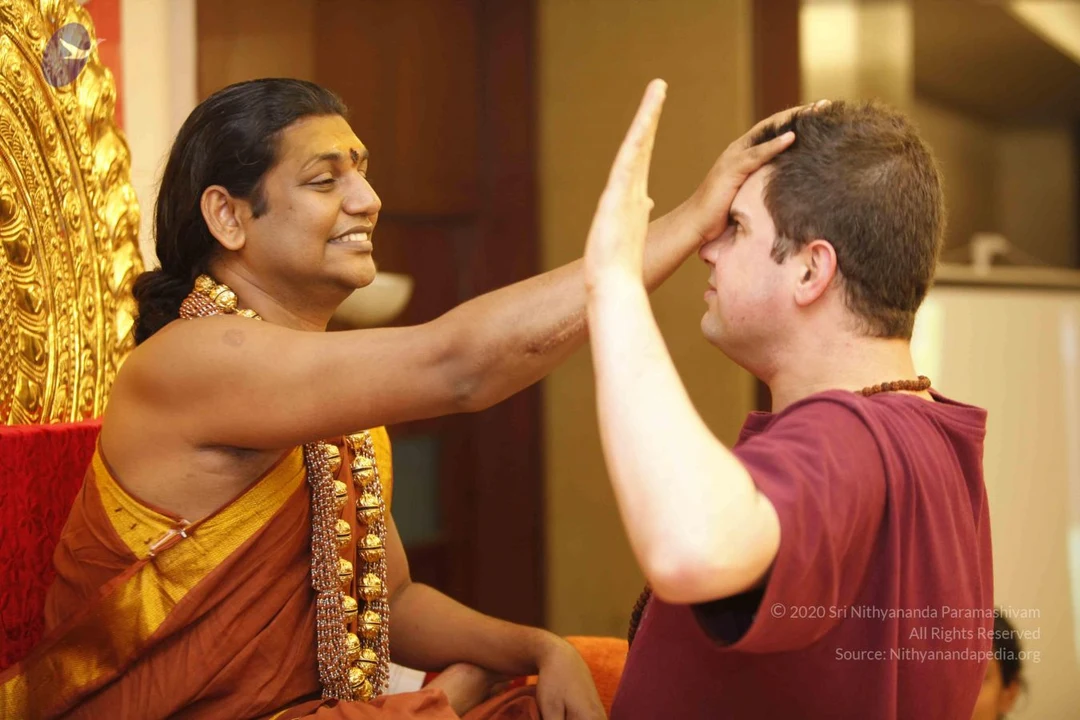
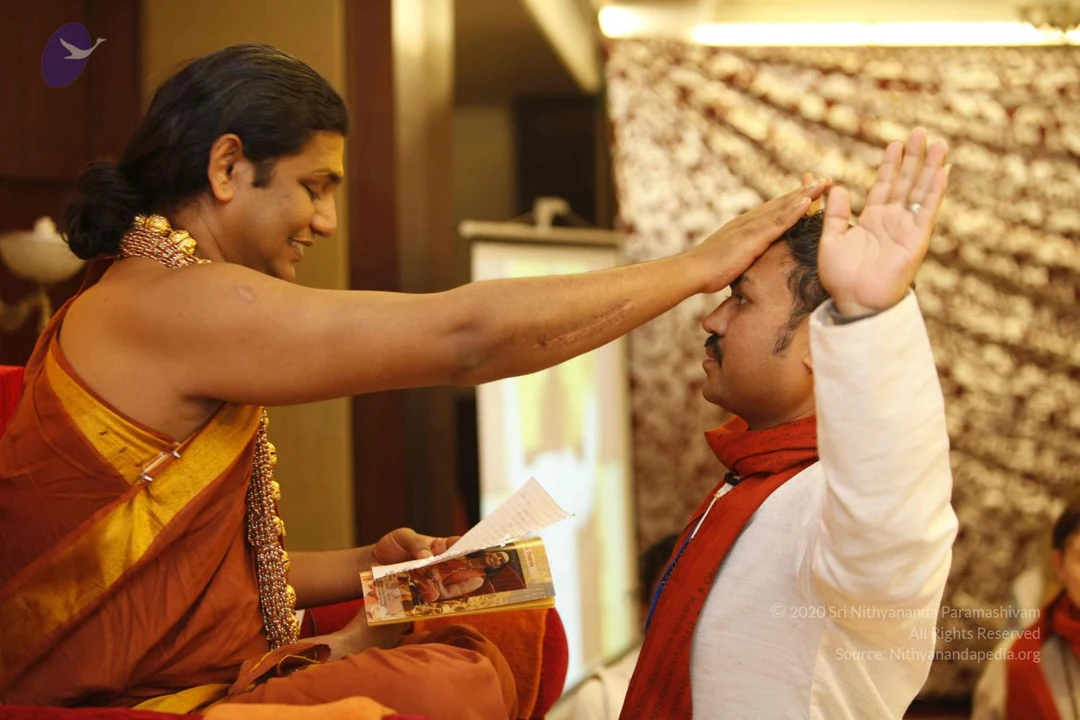
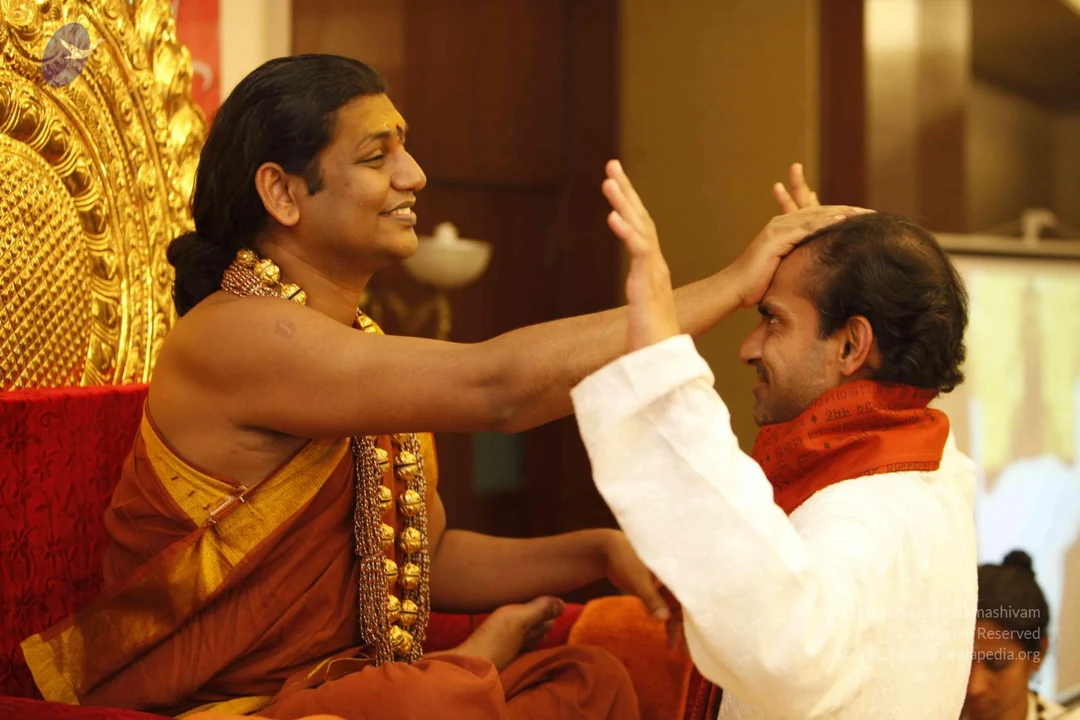
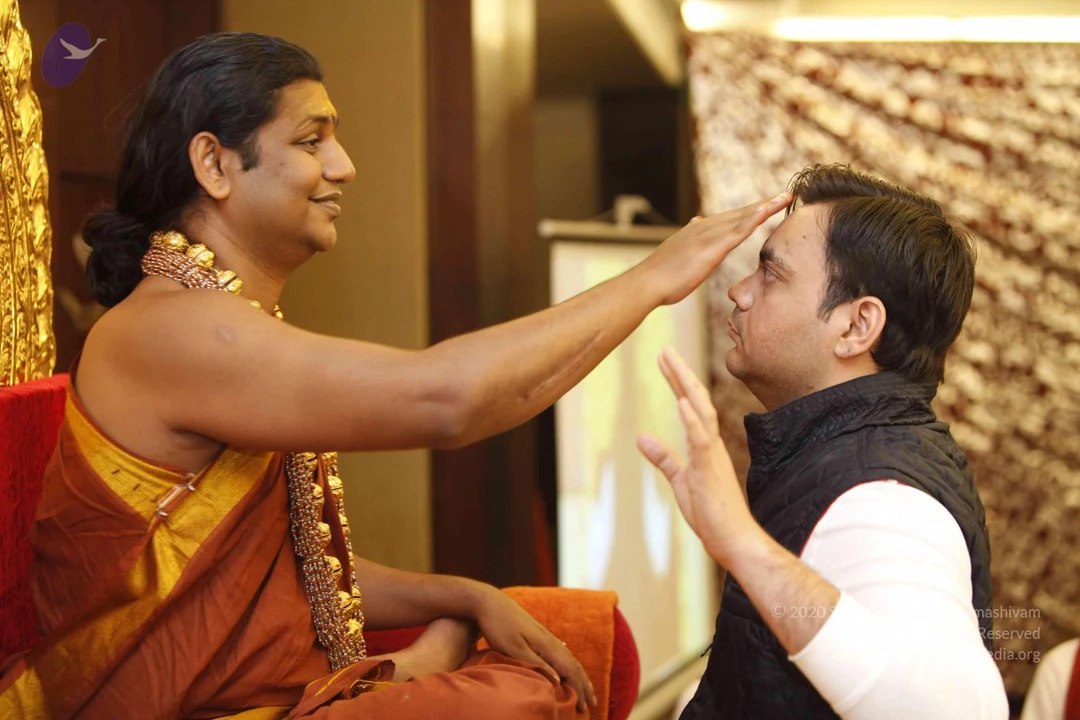
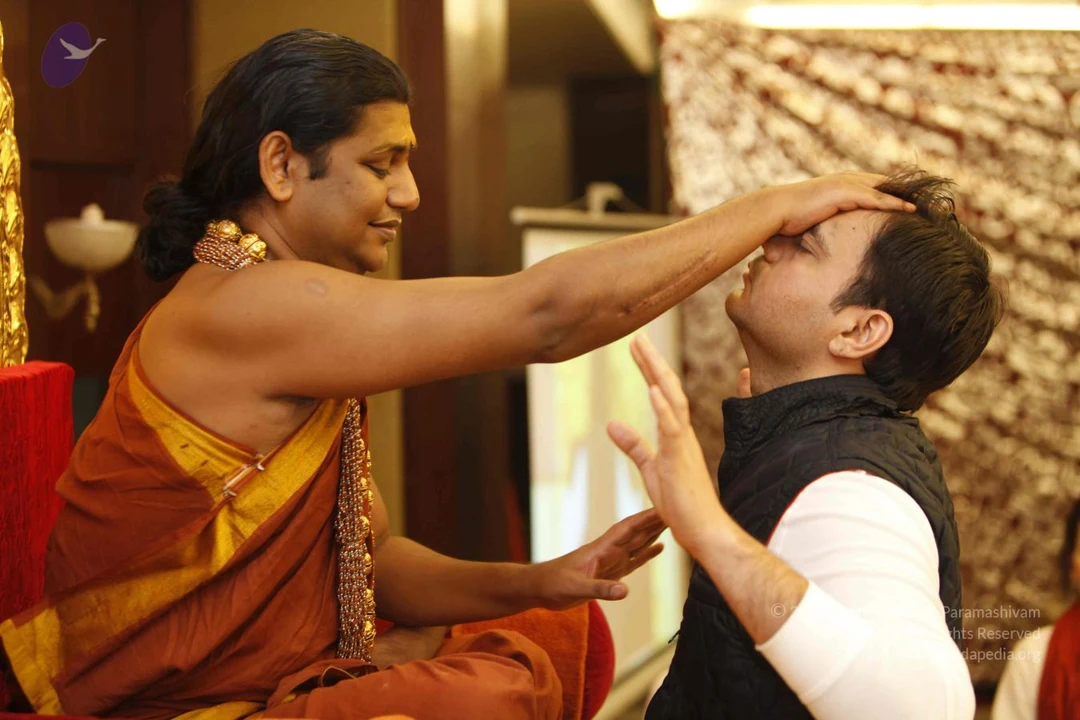
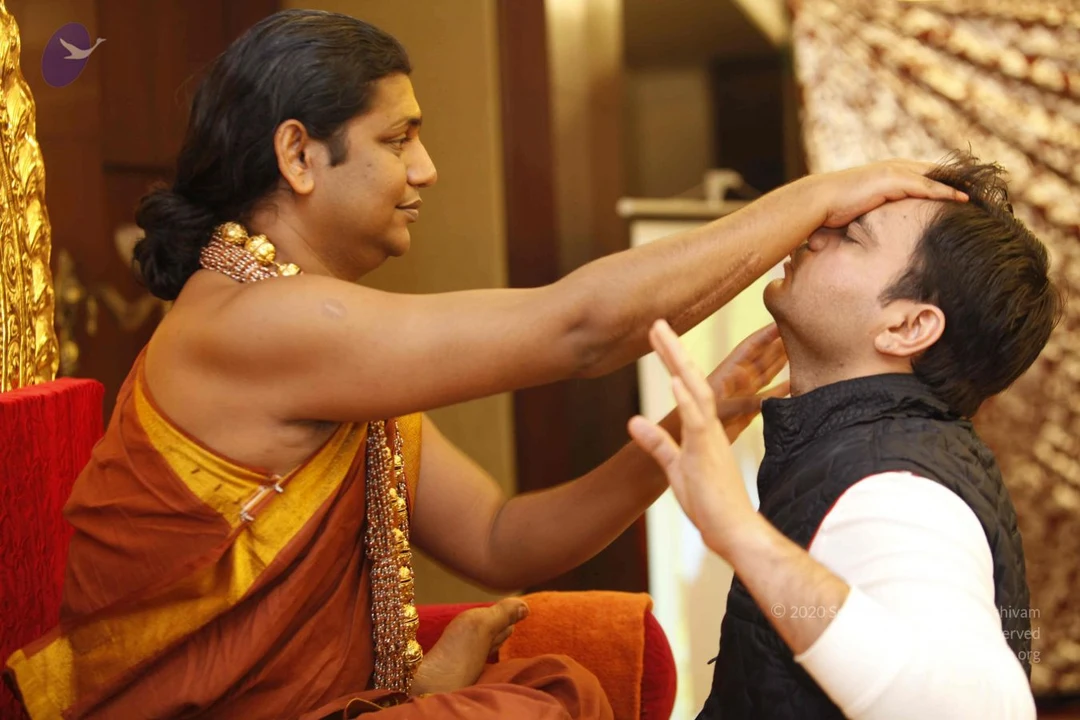
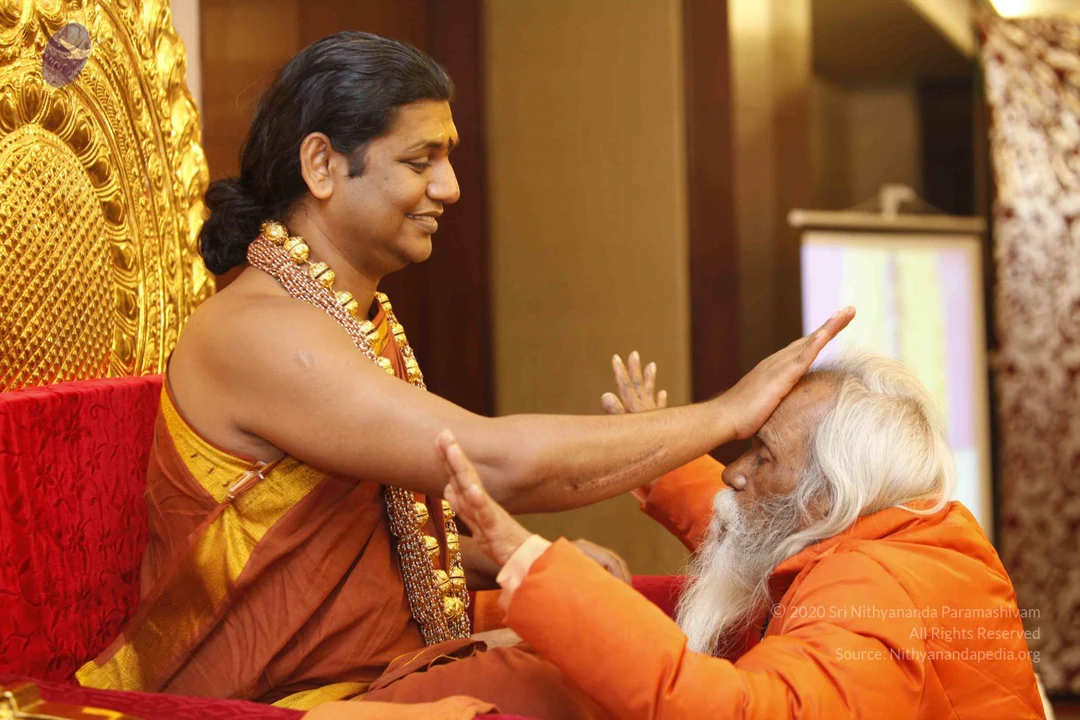
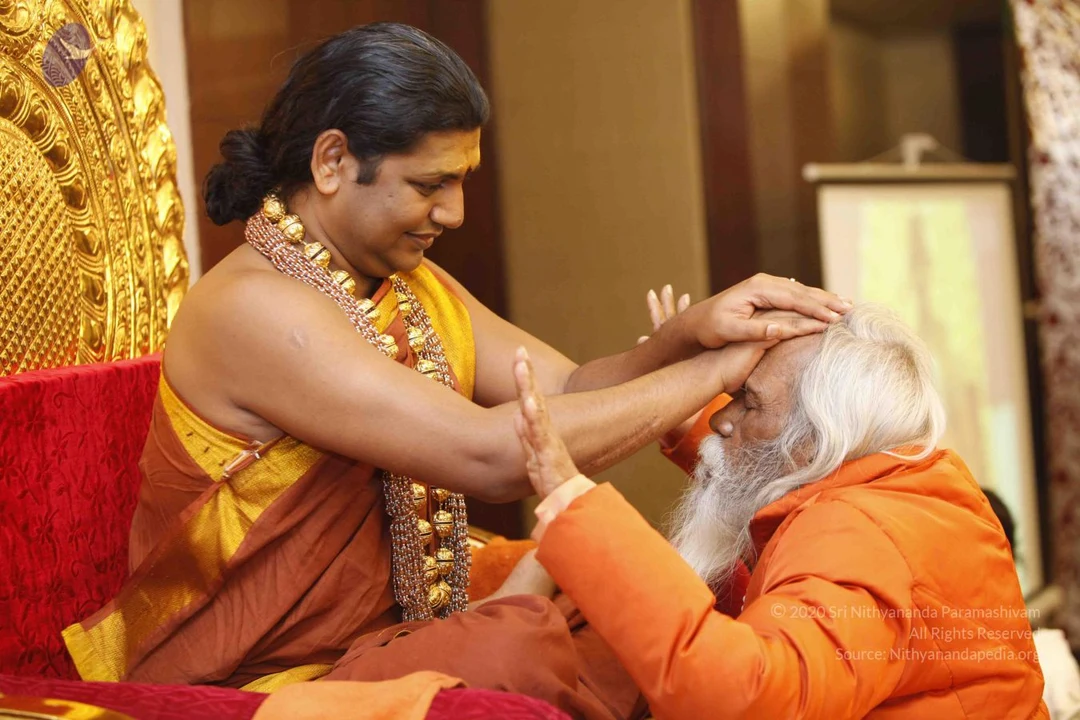
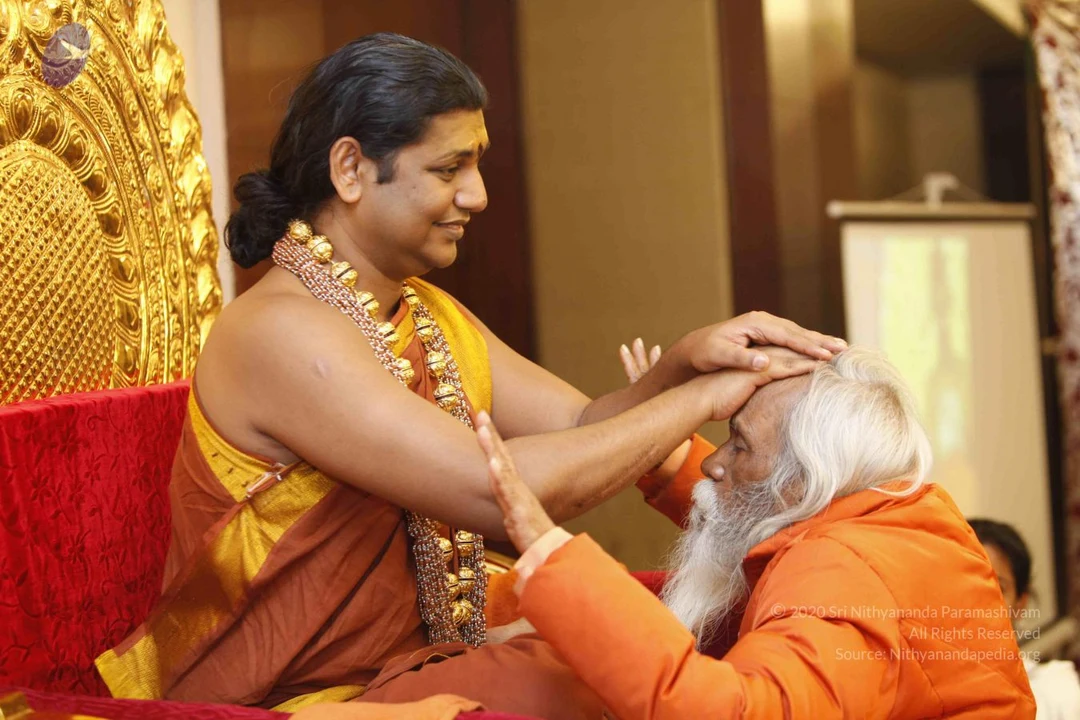
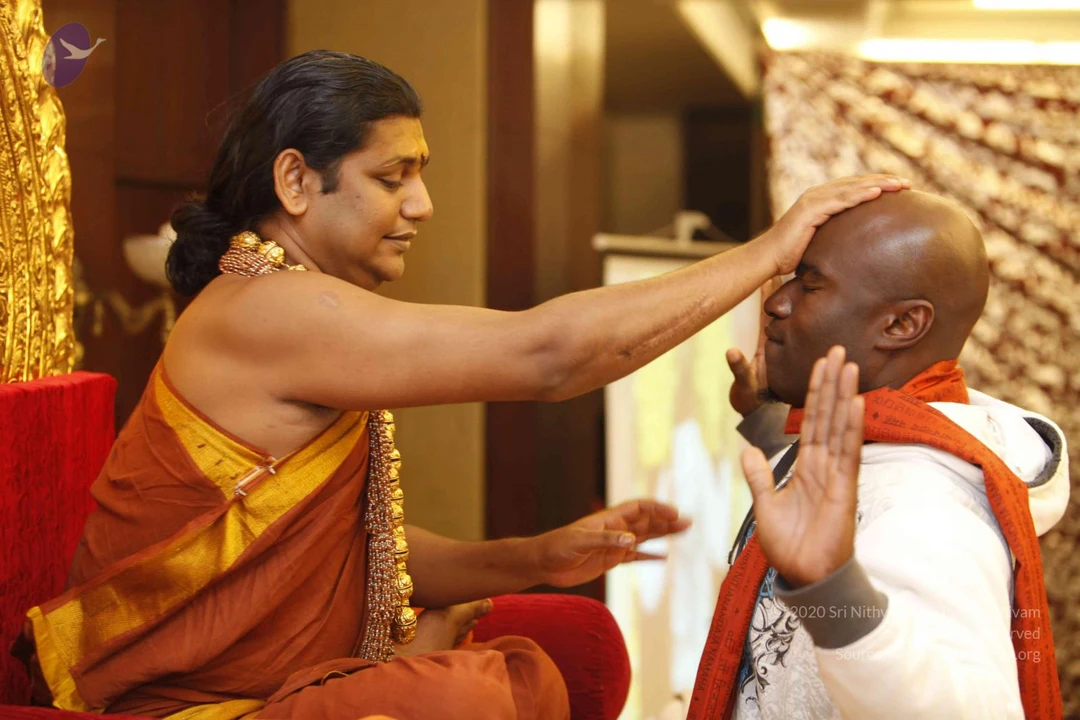
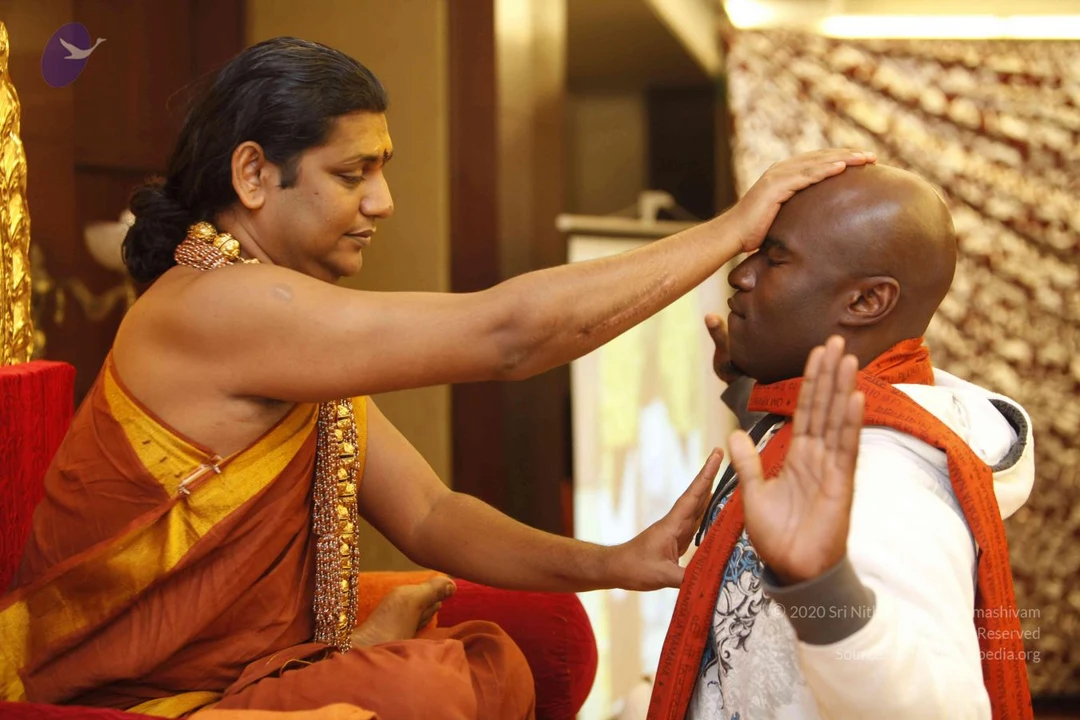
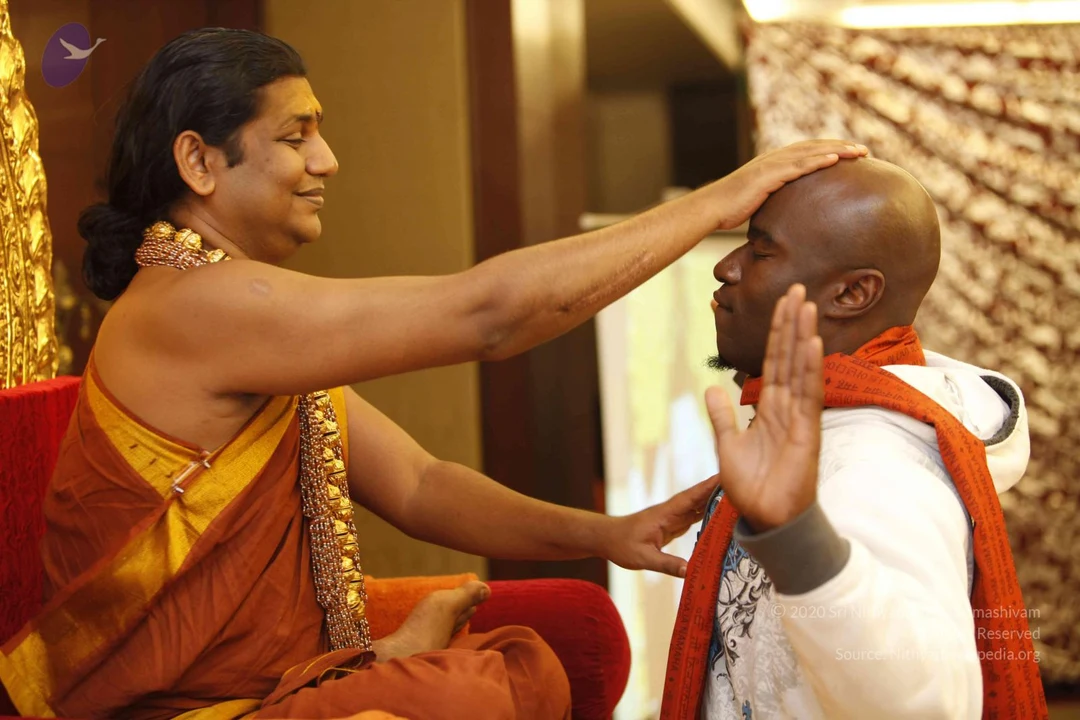
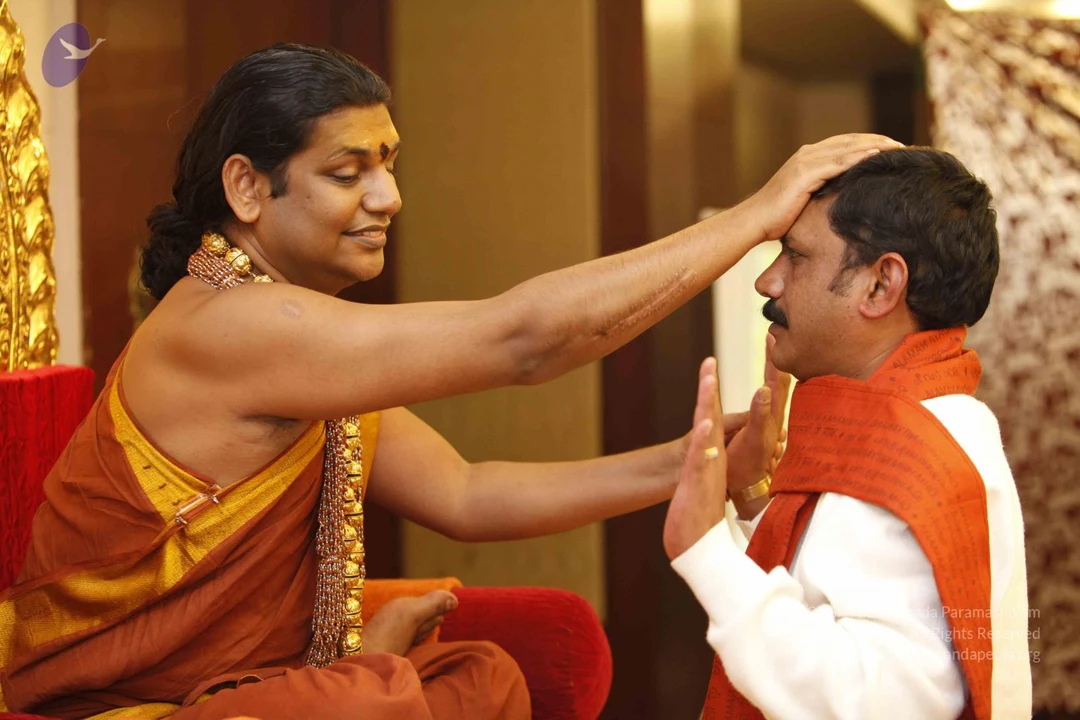
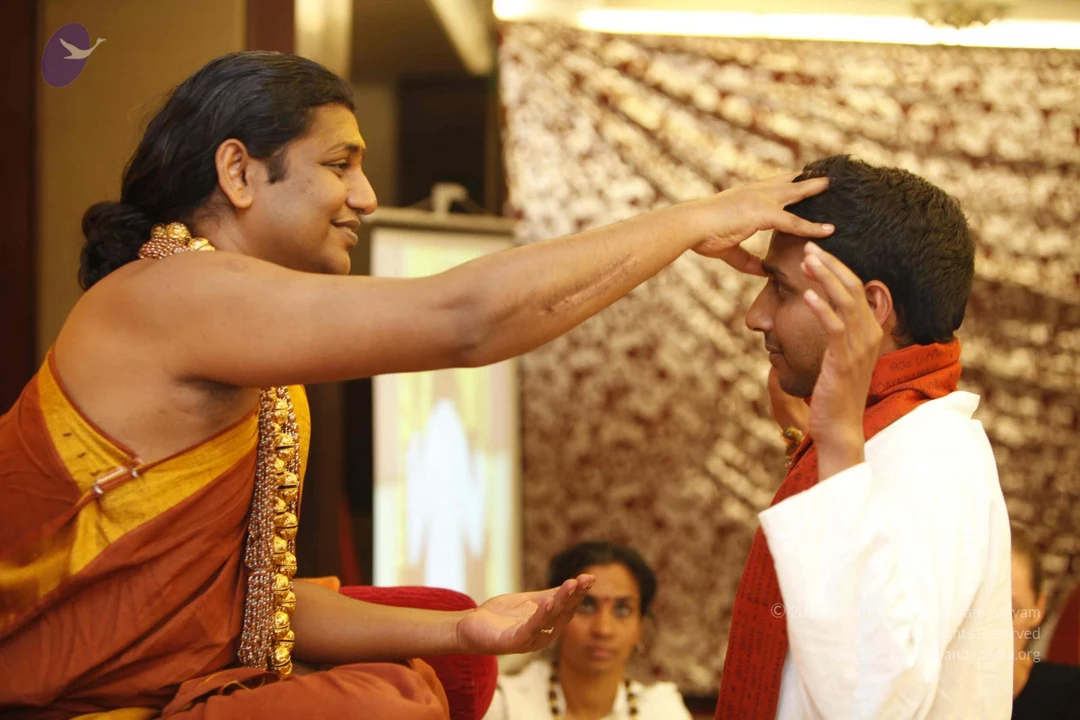
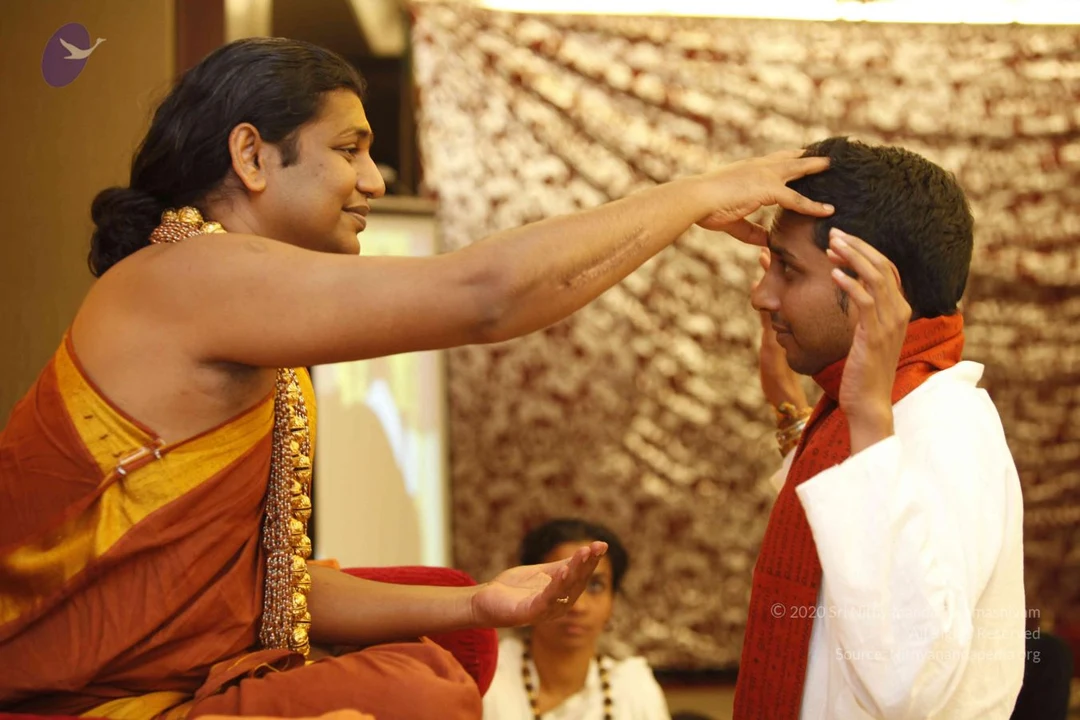
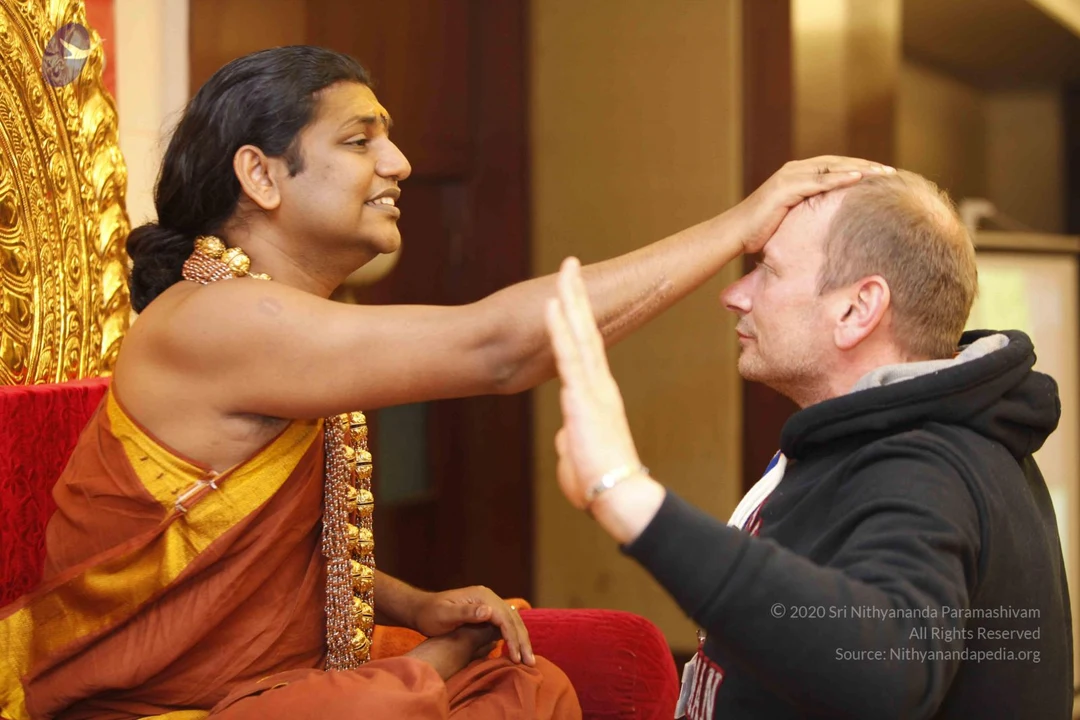
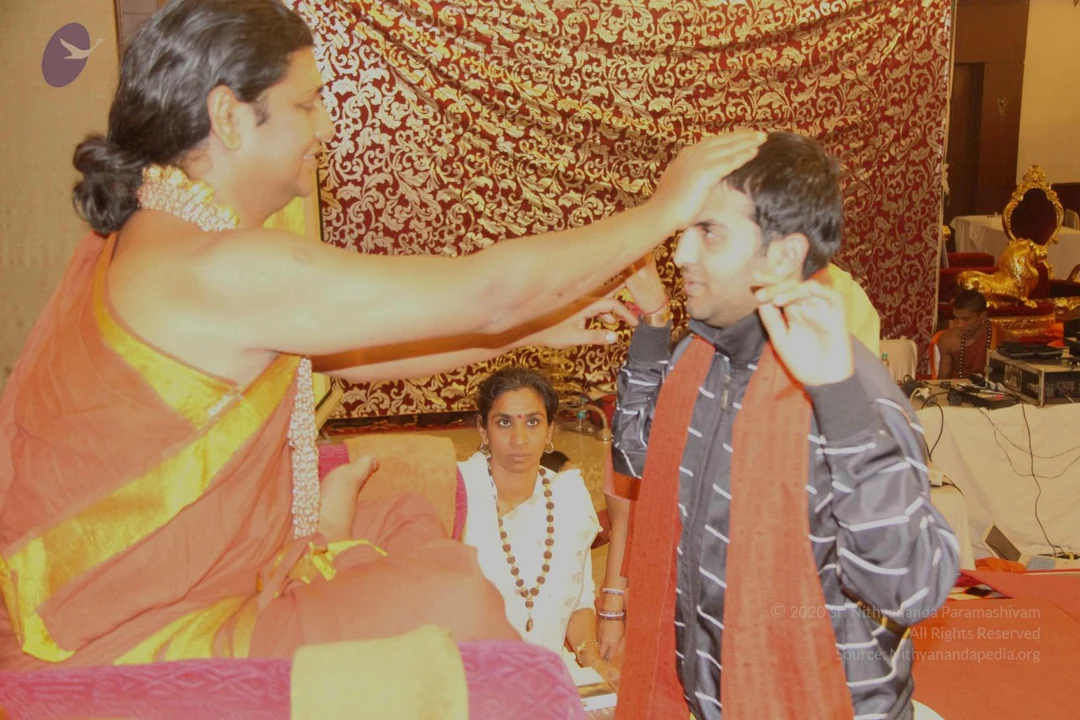
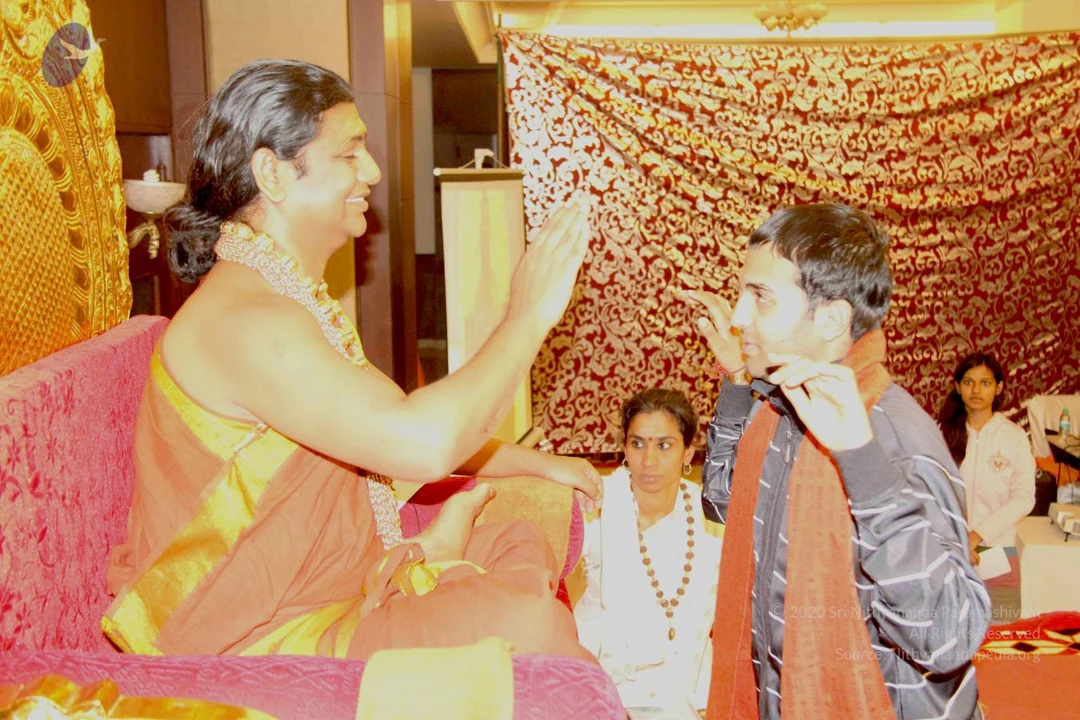
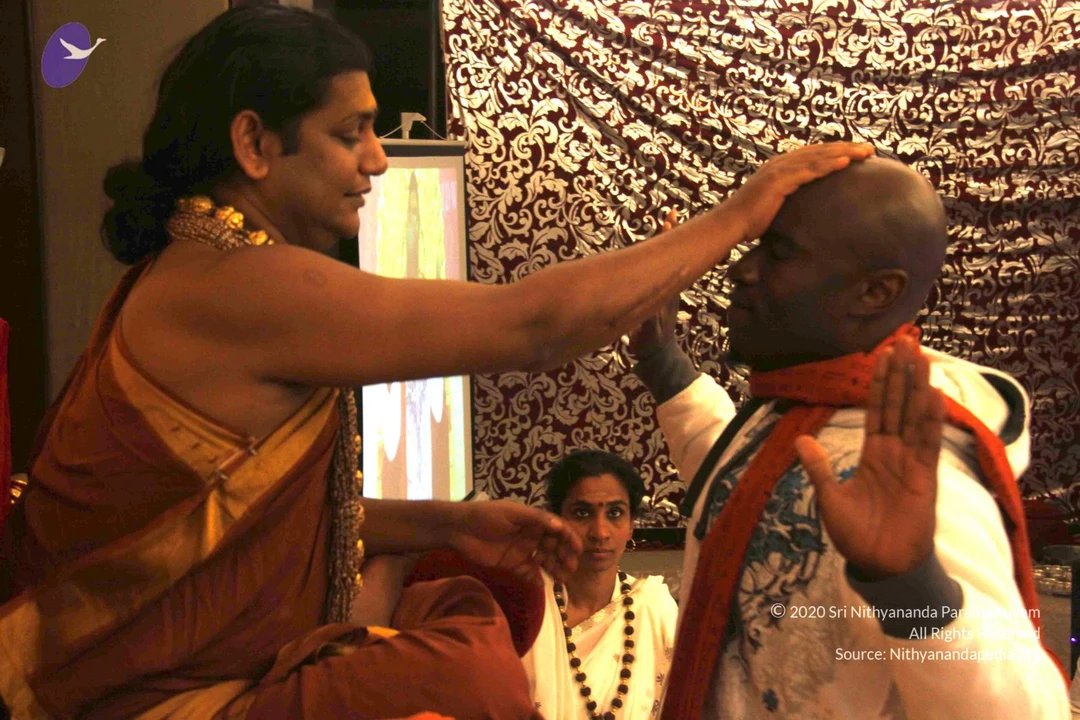
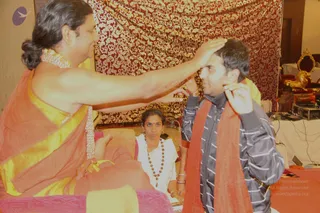
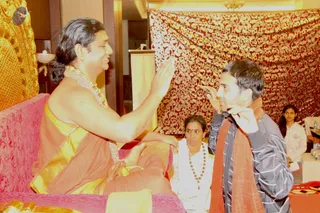
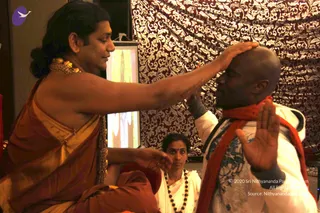
A long-haired man in an orange and gold robe with a white flower garland places his right hand on the forehead of a short-haired man in a grey striped top draped with an orange shawl. A woman in a white sari with a rudraksha mala watches seated behind them. A gold-and-red patterned backdrop hangs behind, with a gold ornate chair and audio equipment at right.A seated person with swept-back dark hair, wearing an orange-and-gold sari-style wrap and a beaded necklace, sits on a pink upholstered seat in front of an ornate golden backdrop. Facing them, a younger man in a grey zip-up jacket with an orange shawl draped over his shoulders raises his hand toward the seated figure, who gestures back with an open palm. Behind them, a woman in white with a rudraksha mala sits quietly, and another young woman stands at the right beside a table with boxes. A red and gold patterned cloth hangs in the background. The seated figure's appearance is consistent with the page's a person reference, though identity is uncertain from appearance alone.A photograph of an indoor satsang setting with a patterned maroon and gold drape behind. A man with long swept-back dark hair, wearing an orange-brown saffron-toned shawl over his shoulder and layered gold and beaded necklaces, sits and places his right hand on the crown of a bald man's head in a blessing gesture. The bald man wears a white garment with a blue-and-white patterned panel and an orange-red scarf, and holds up his left palm. Behind them a woman in white with a rudraksha mala watches, and a screen glows in the background. Swamiji (probable): the seated man's long swept-back hair, saffron-orange shawl and ornate gold necklaces are the cues for the blessing figure.

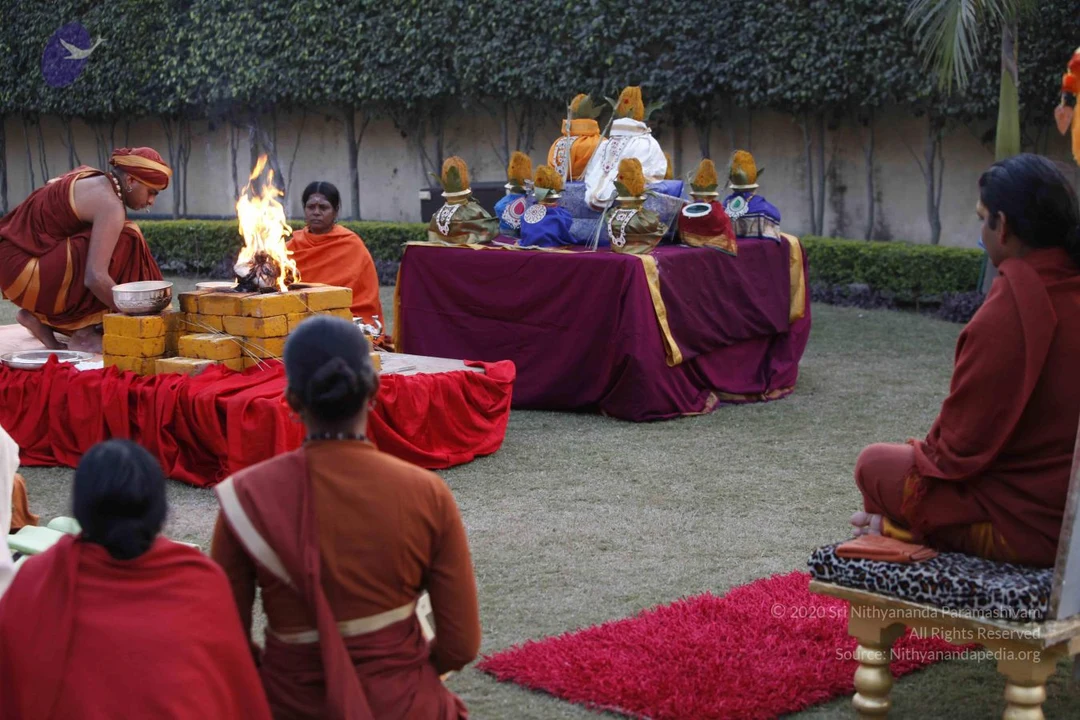
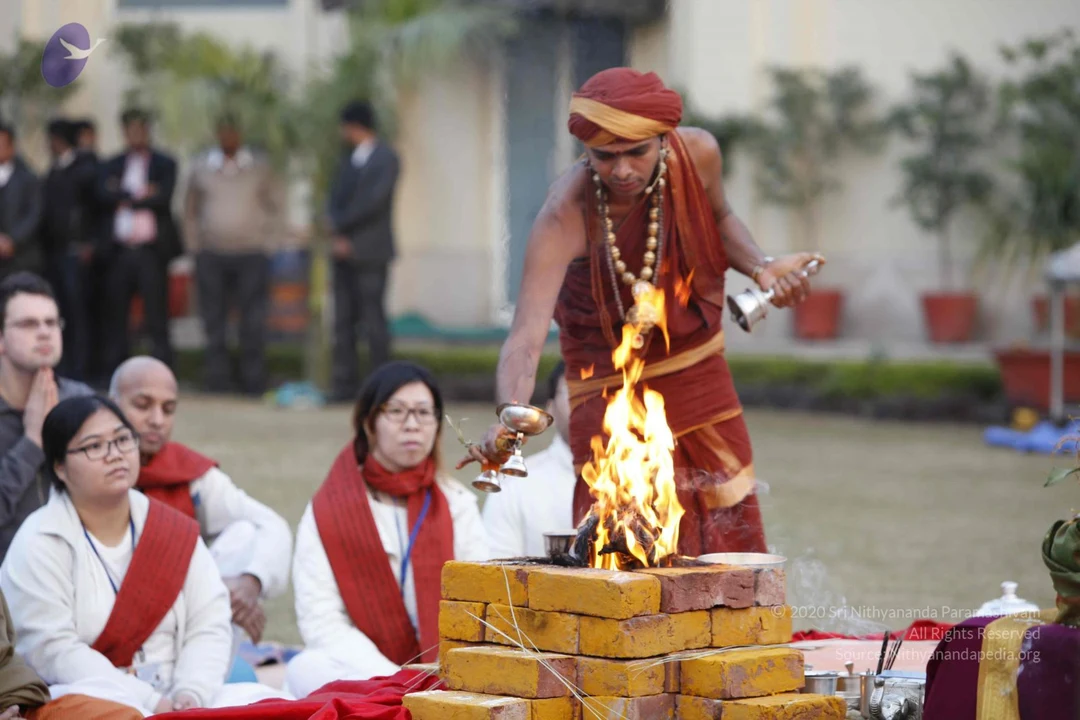
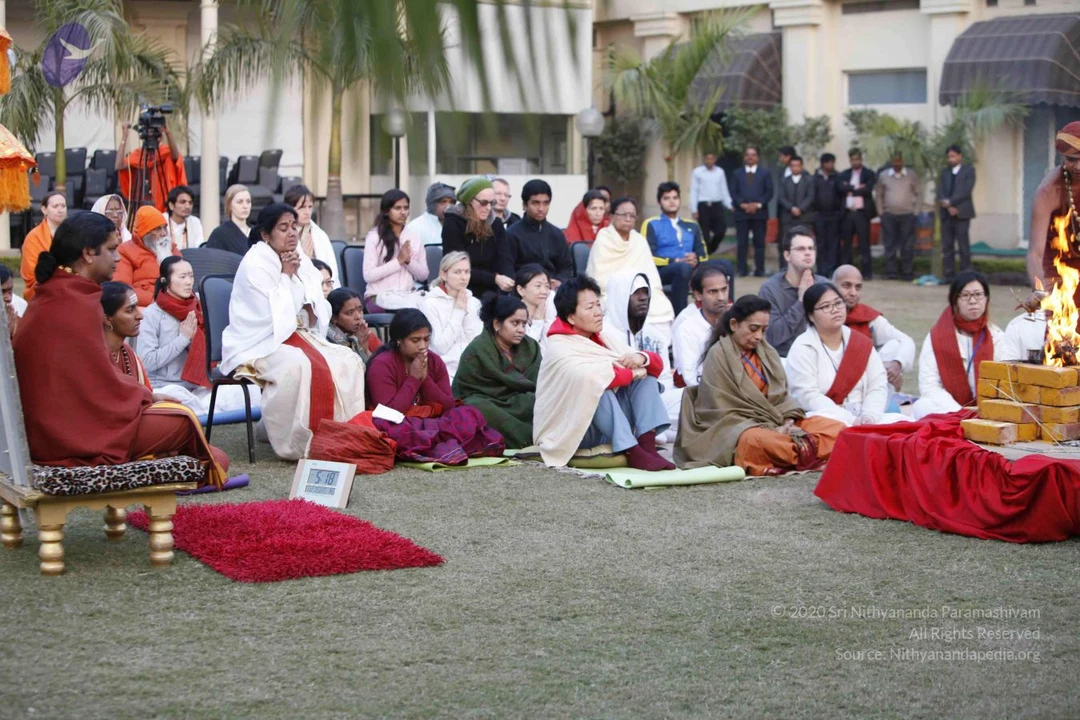
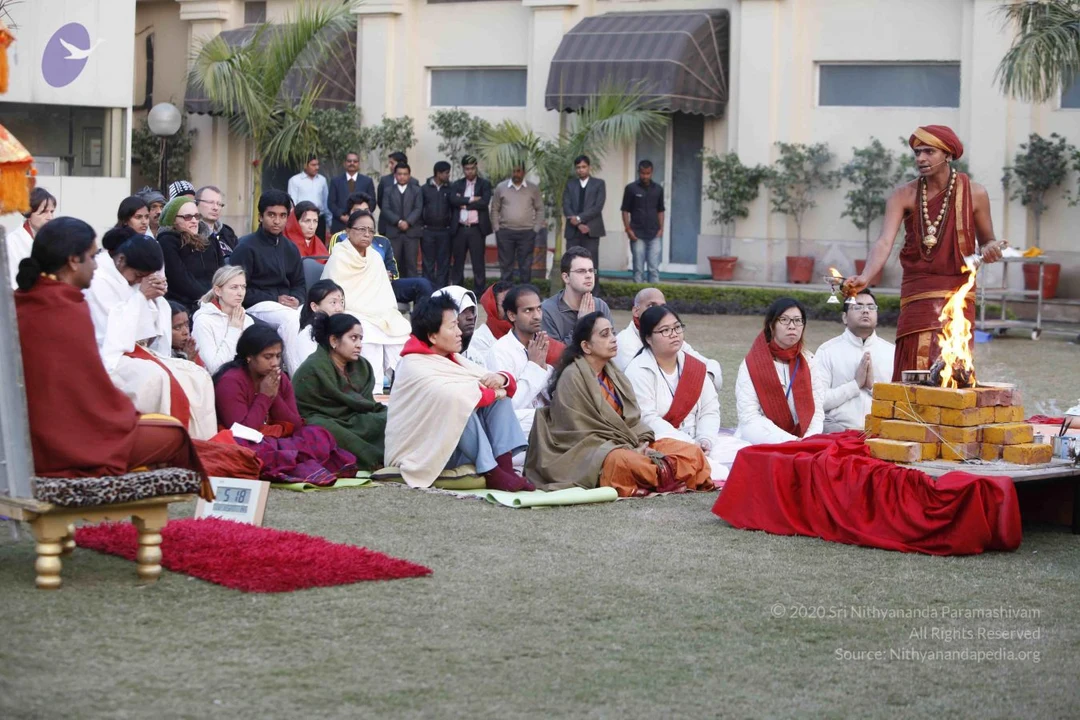
Homa

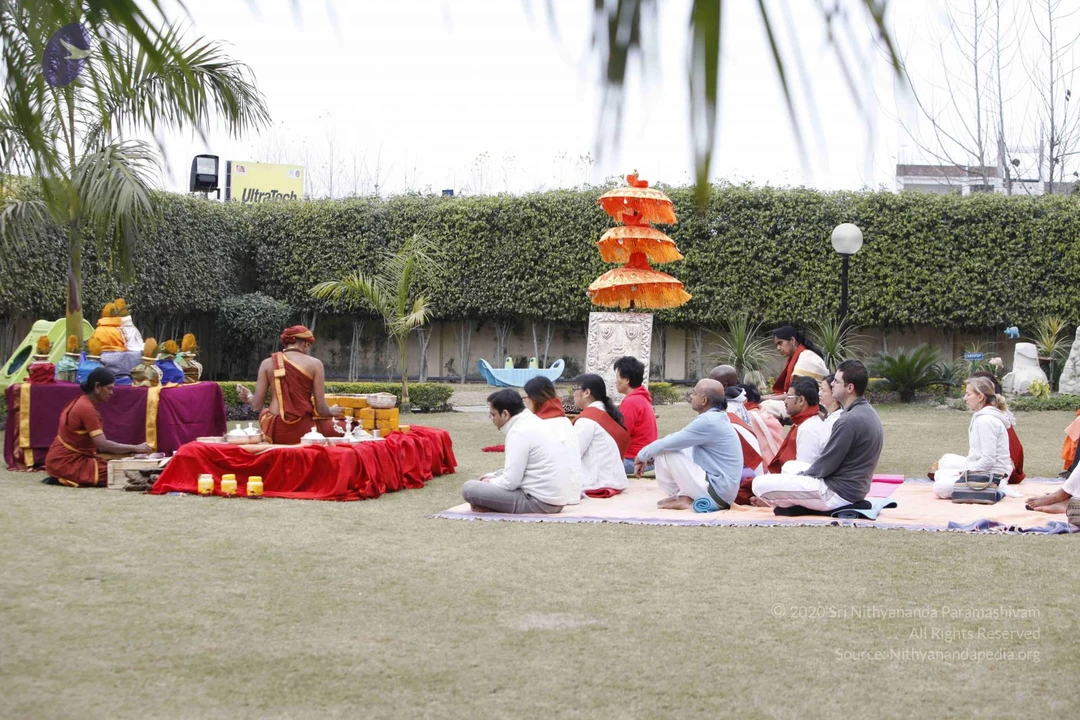
8 photosSource gallery
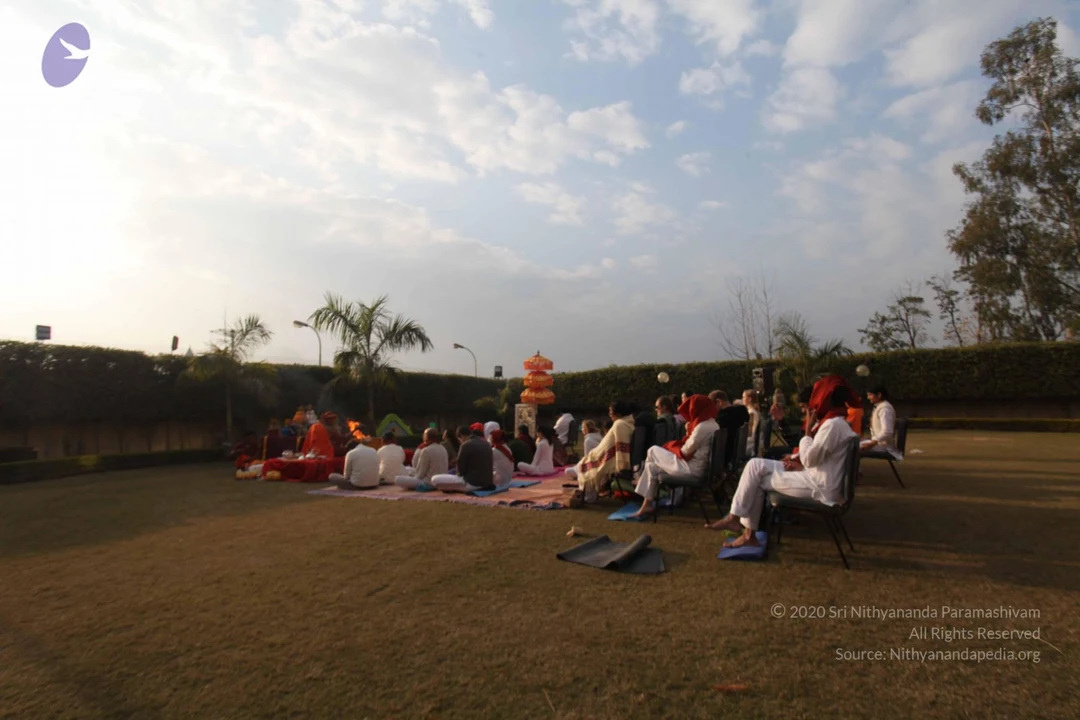
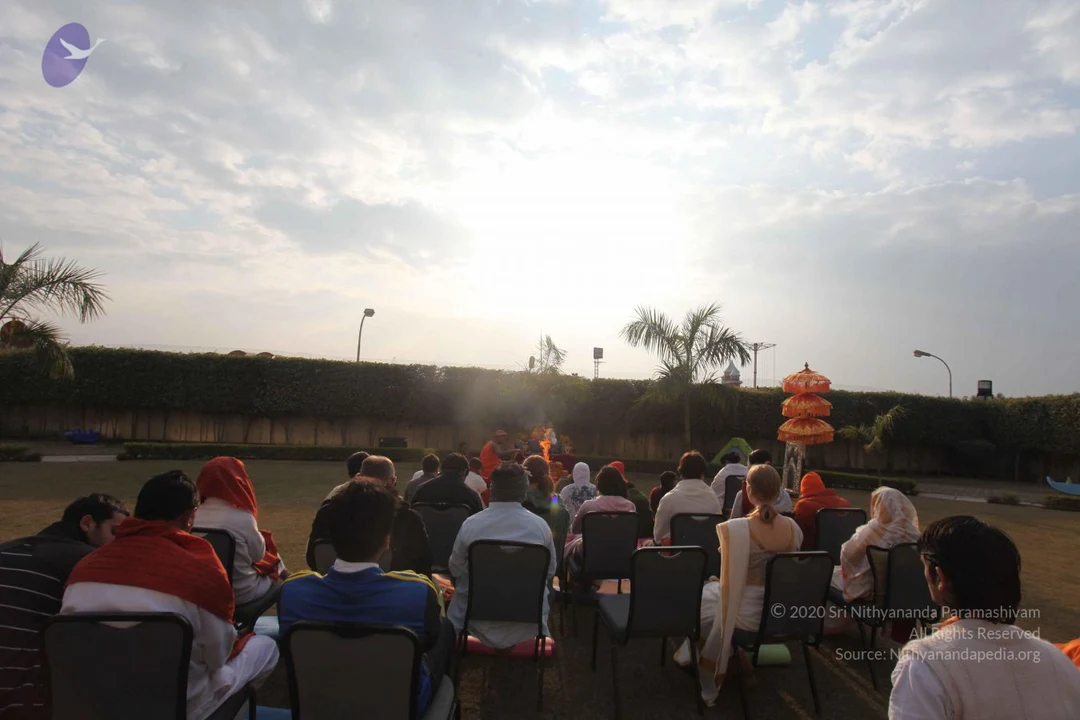
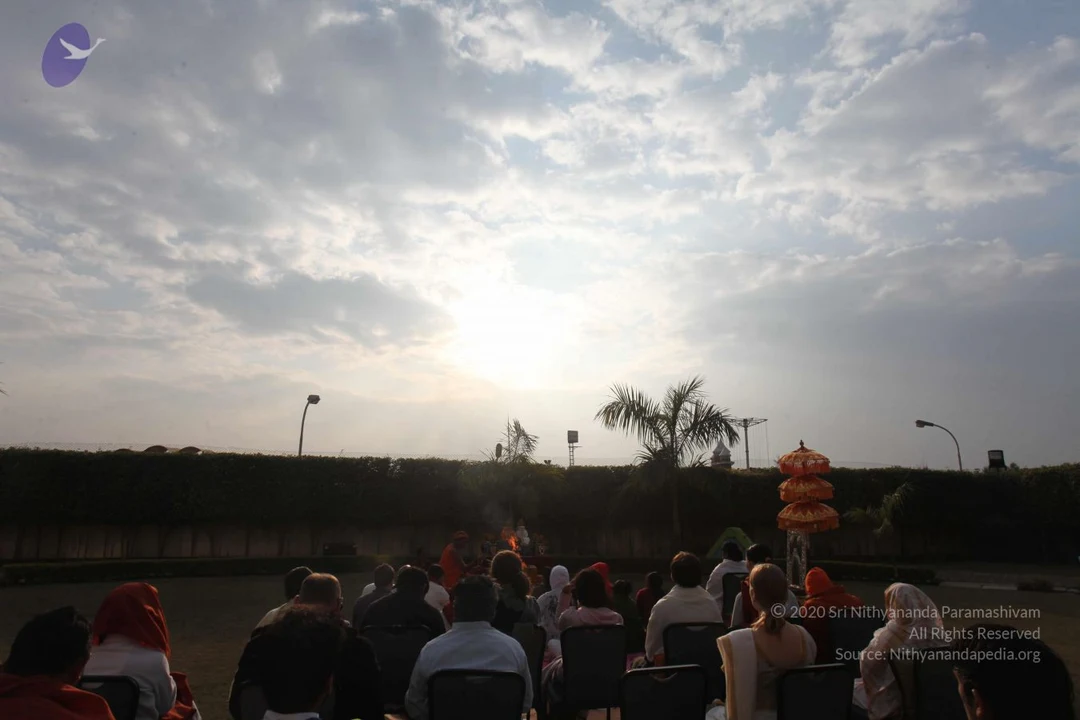
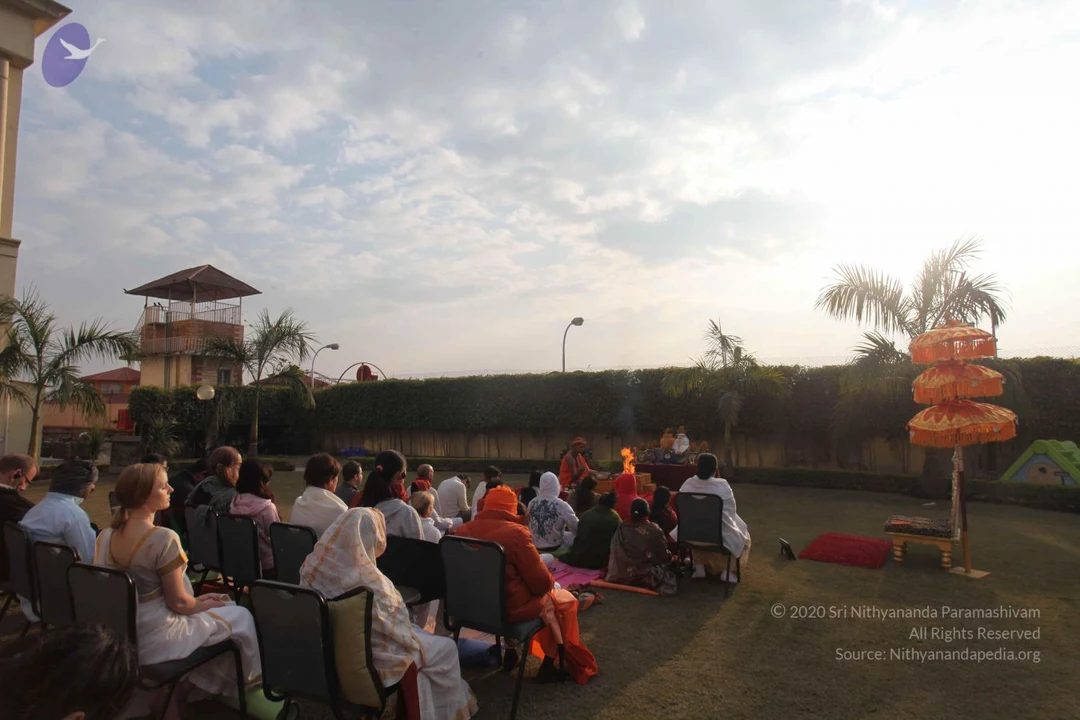
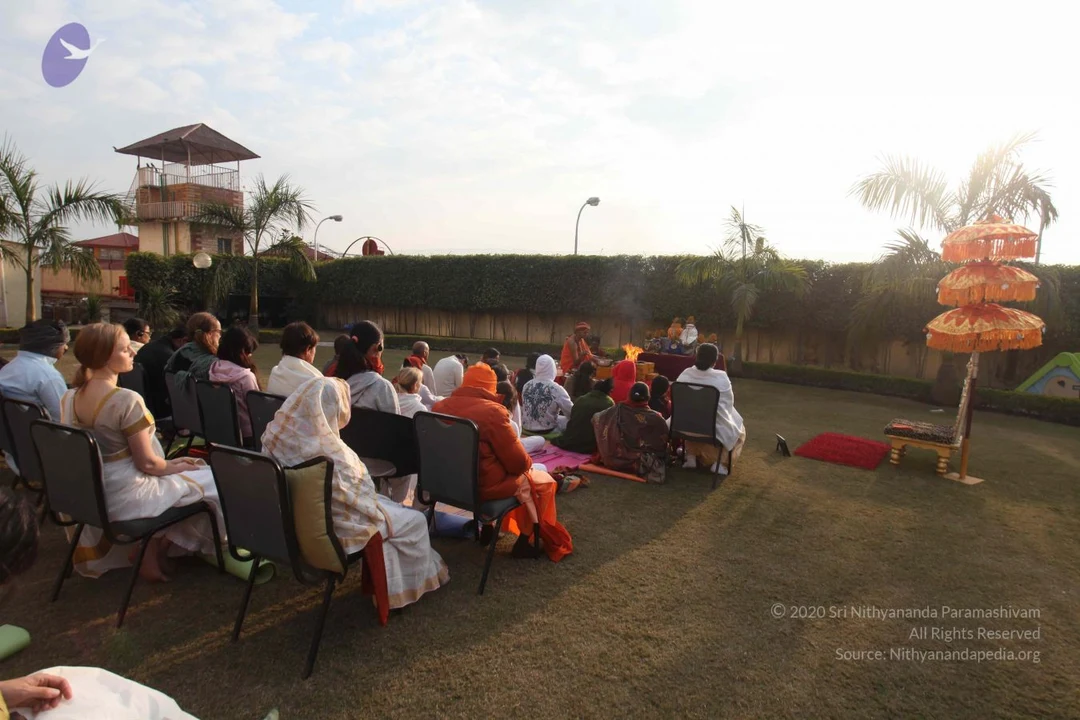
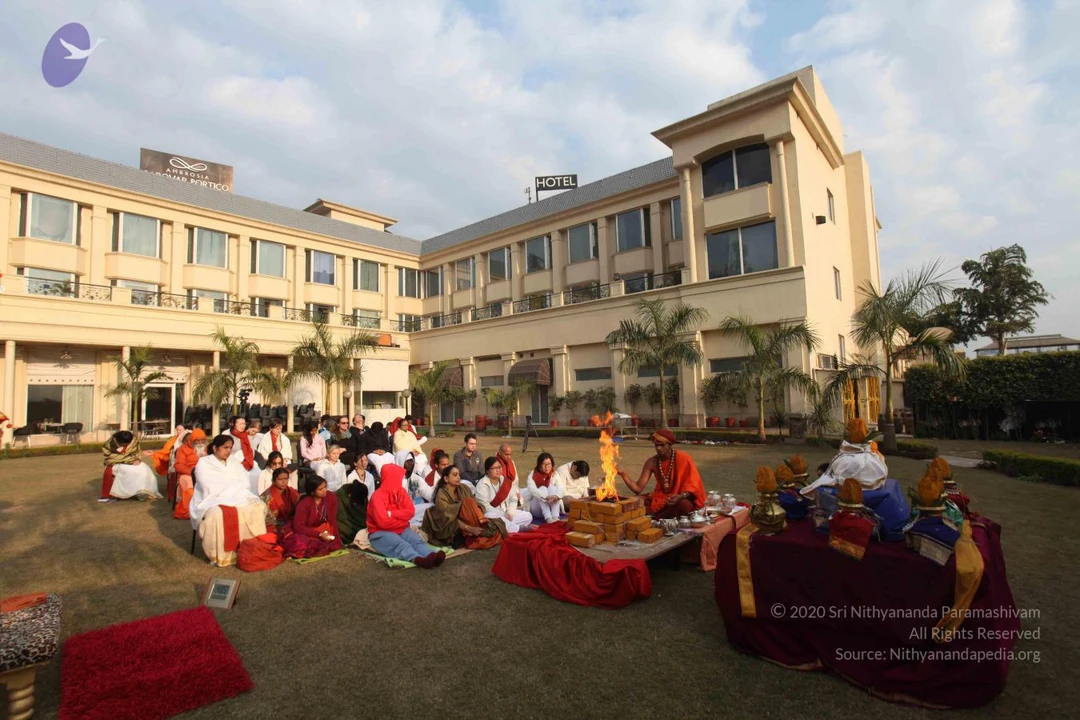
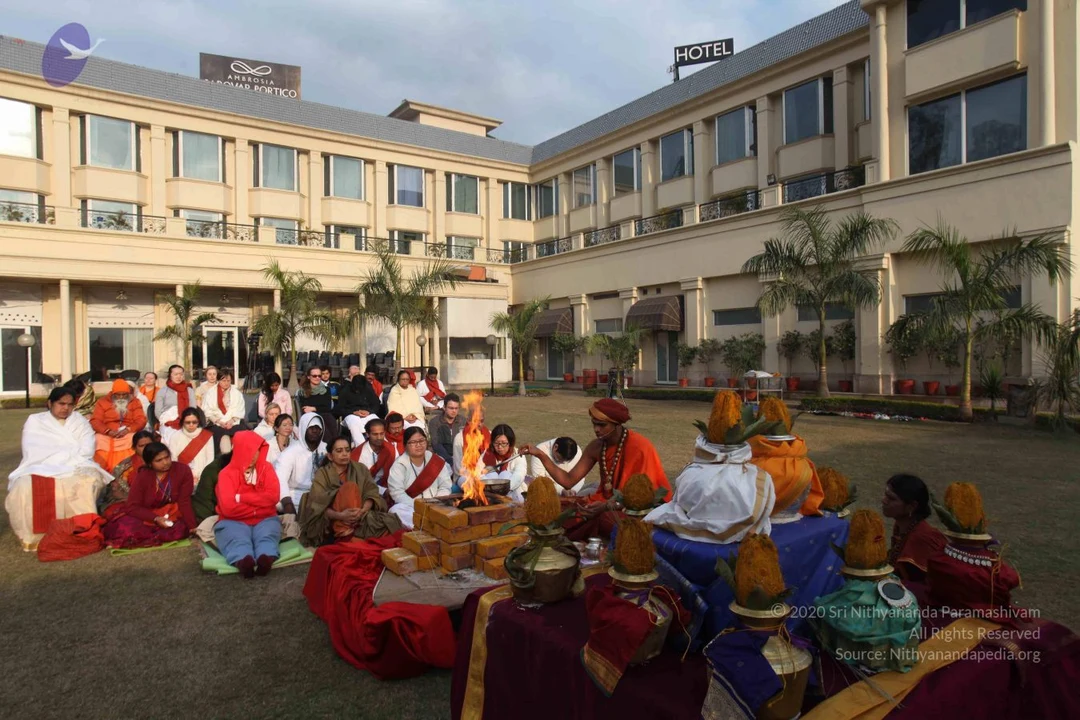
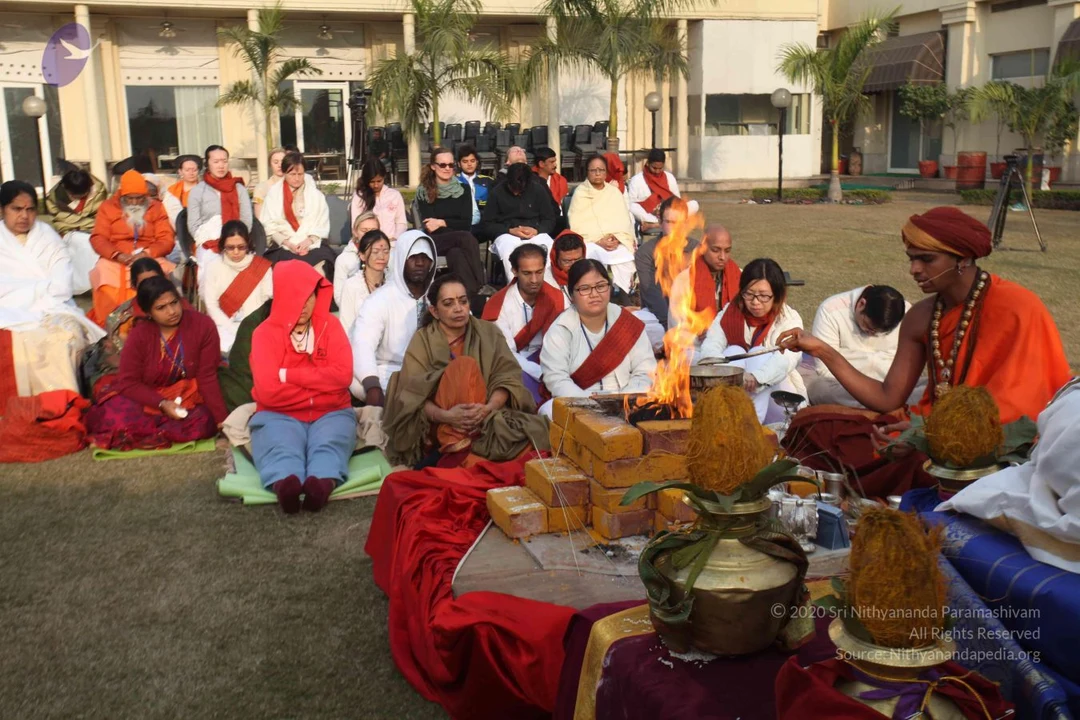
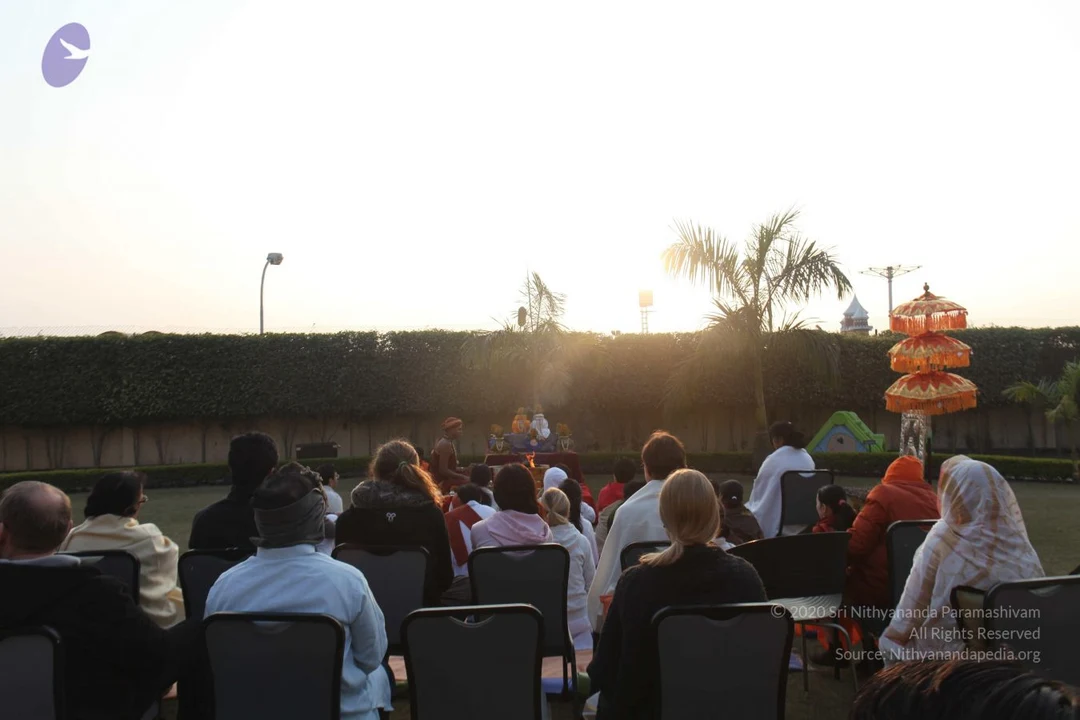
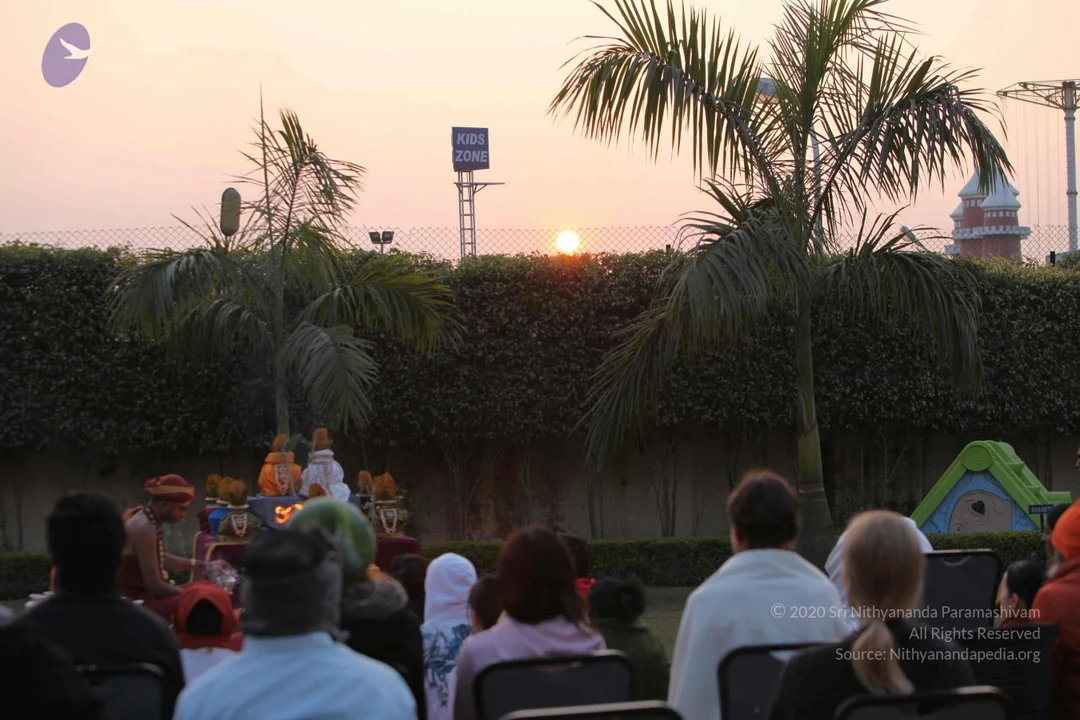
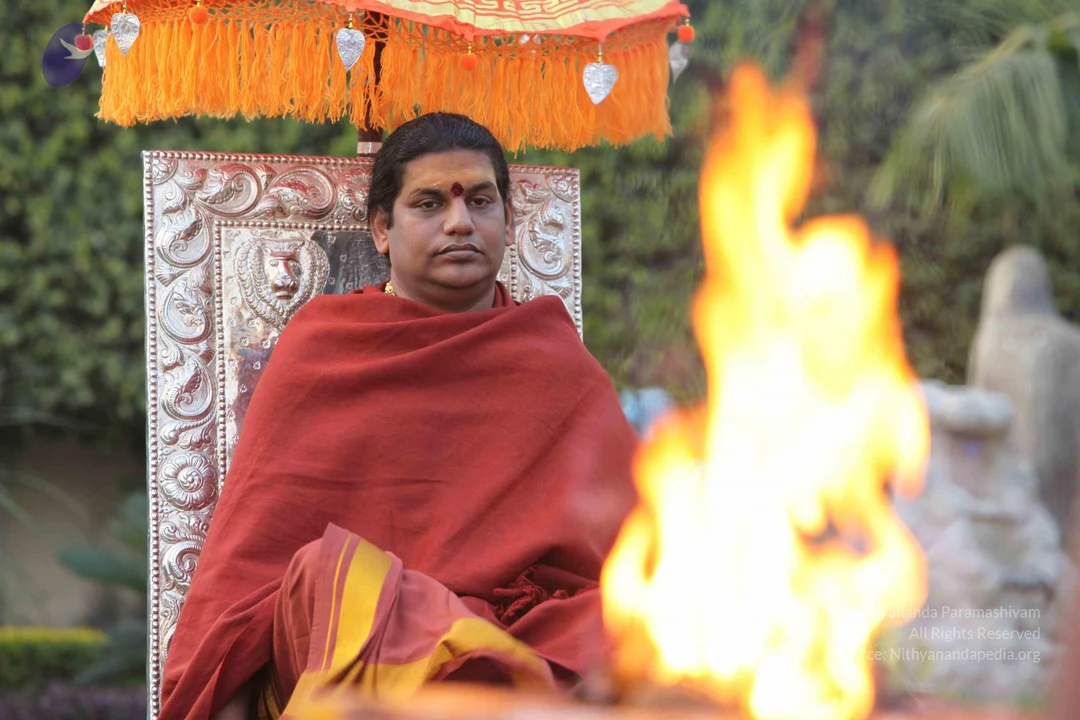
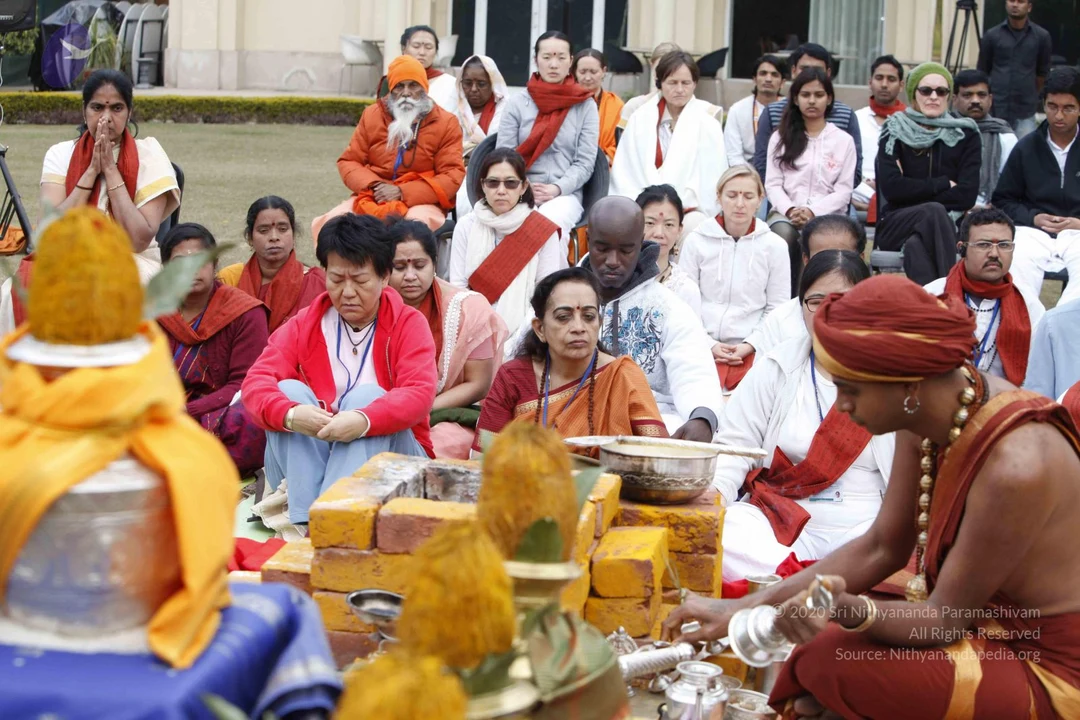
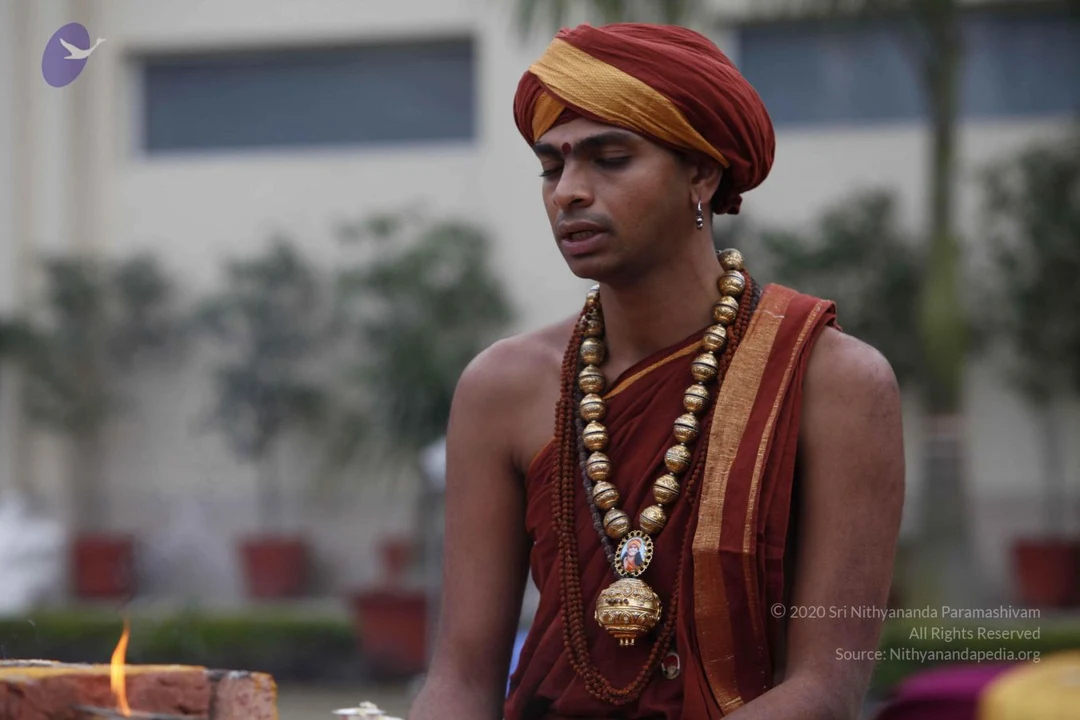
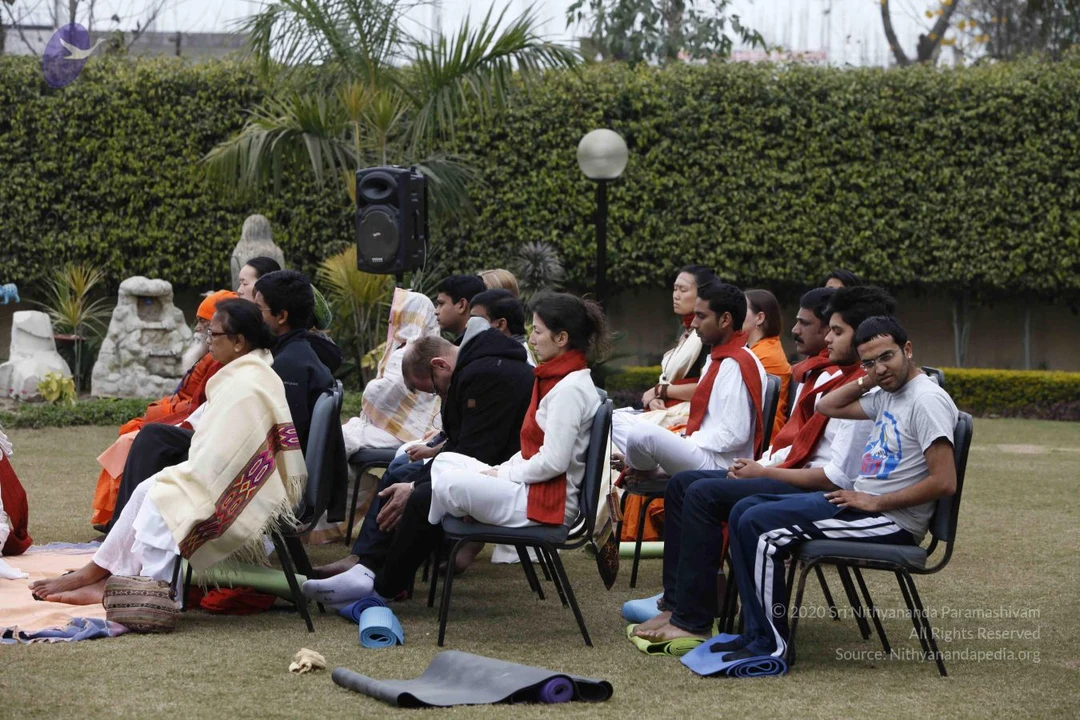
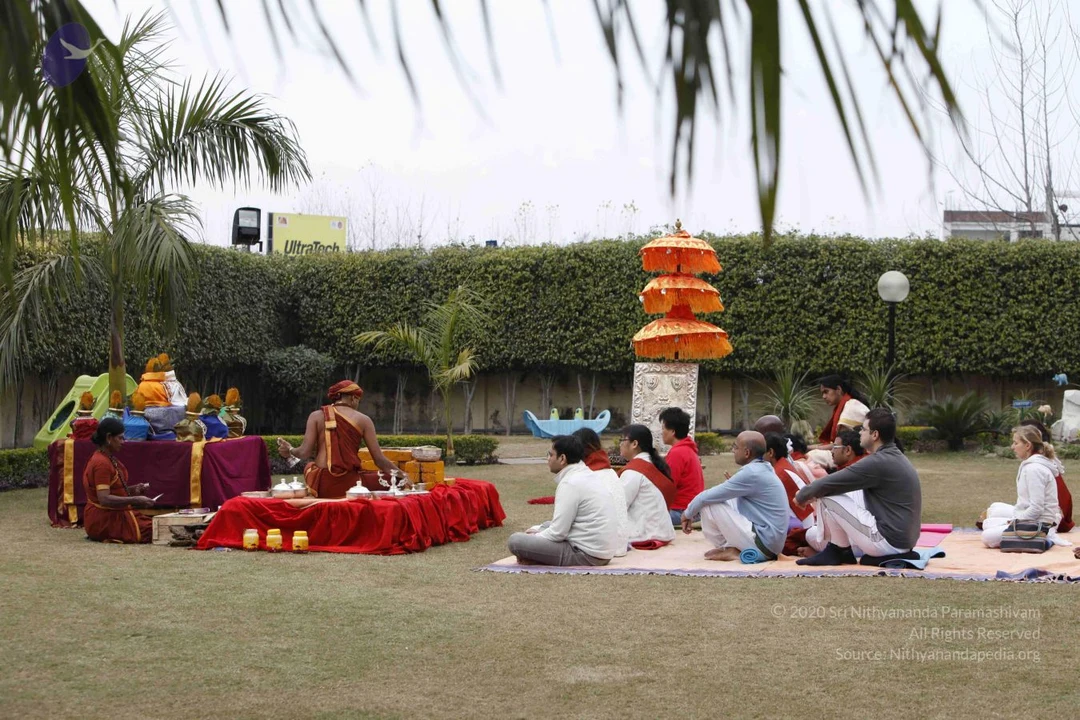
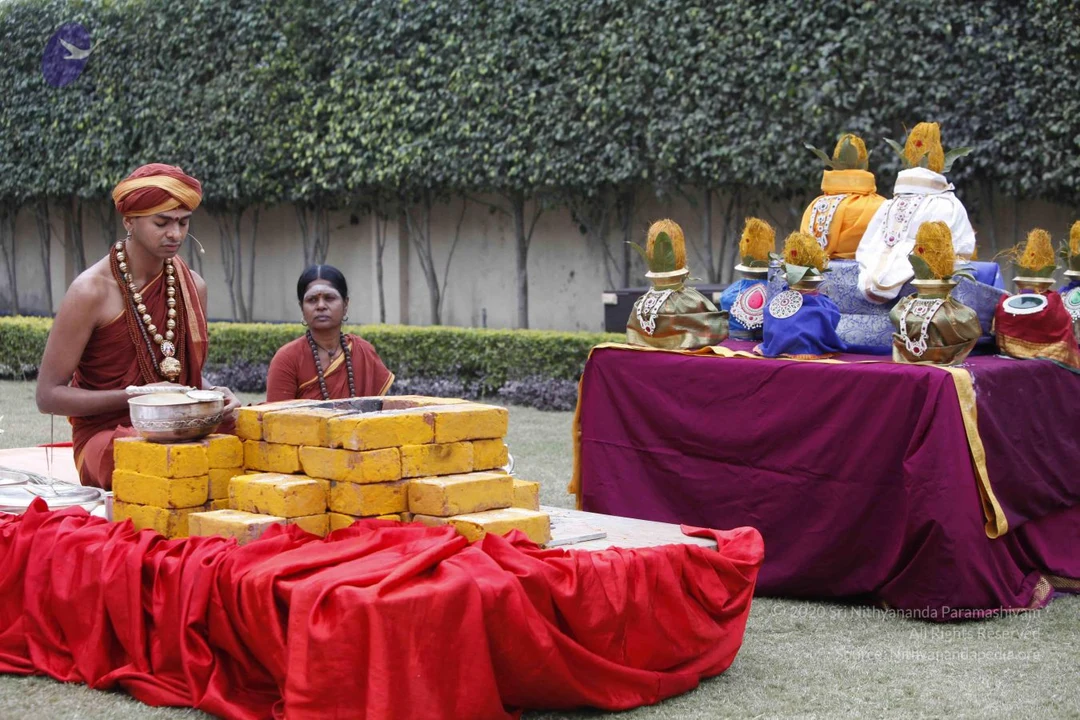
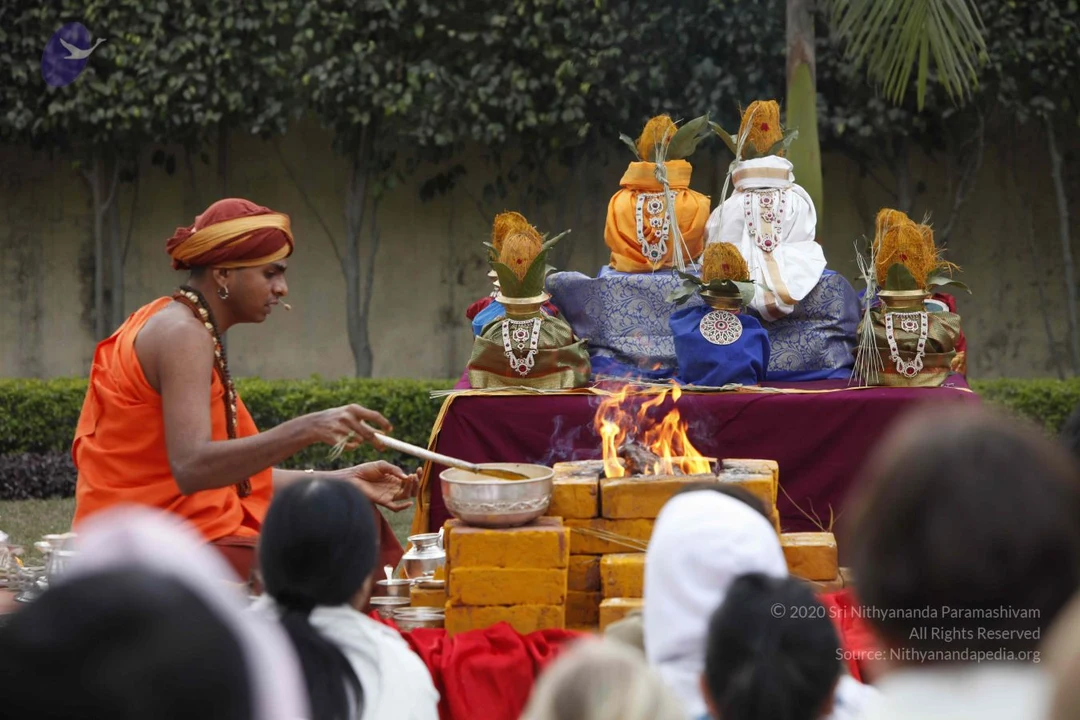
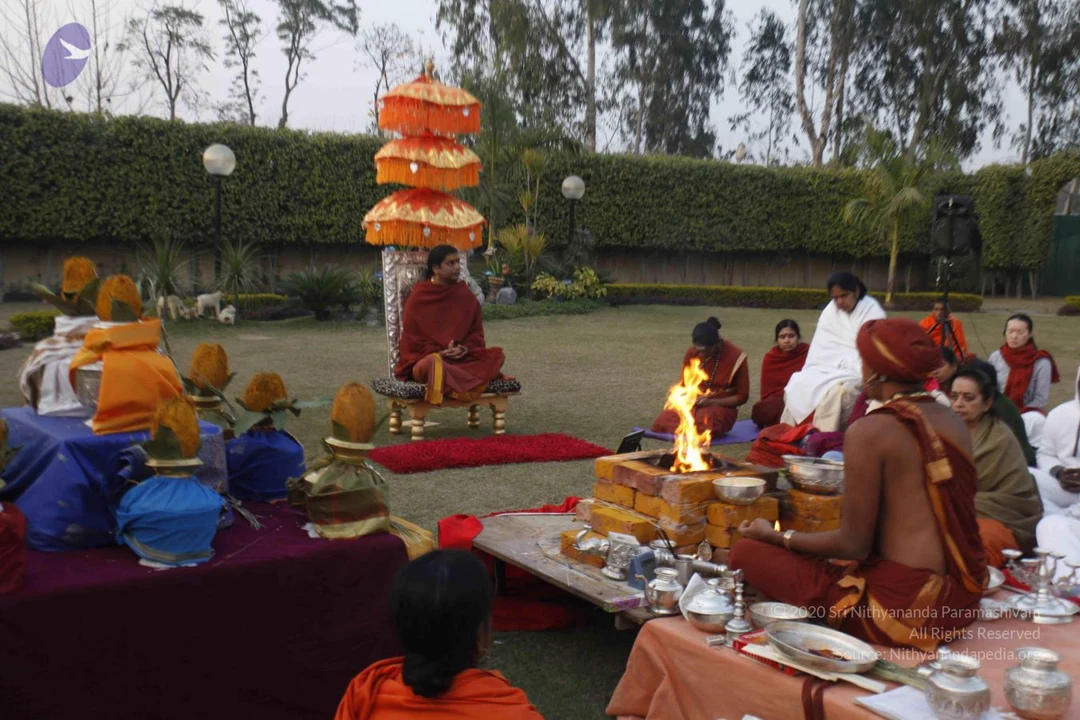
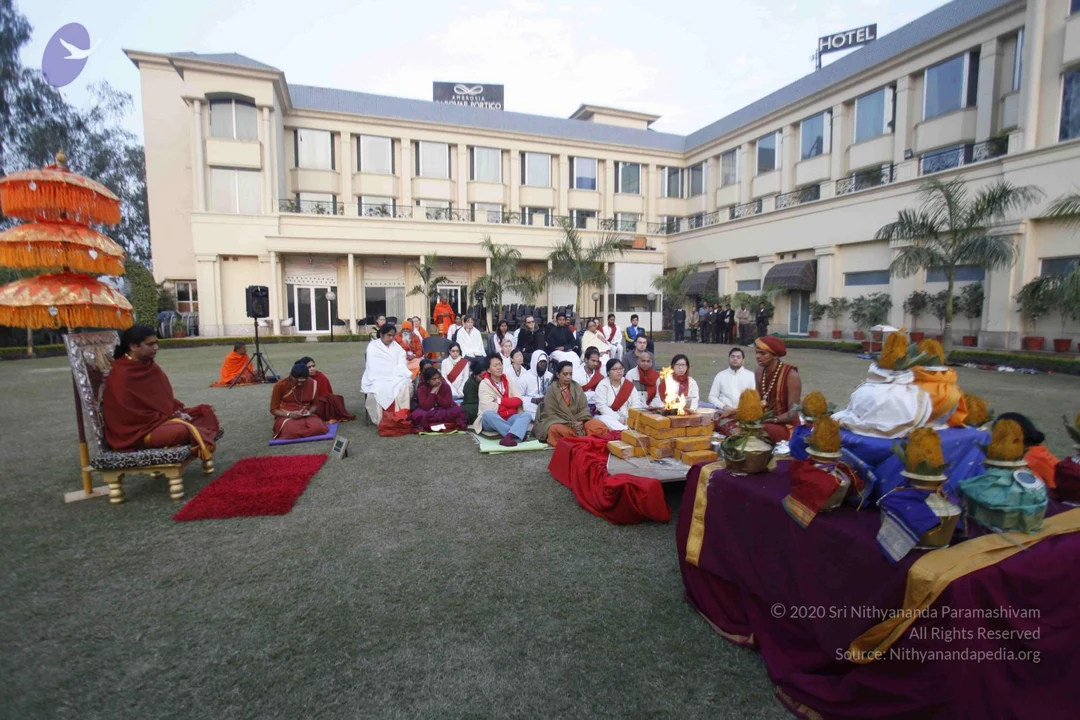
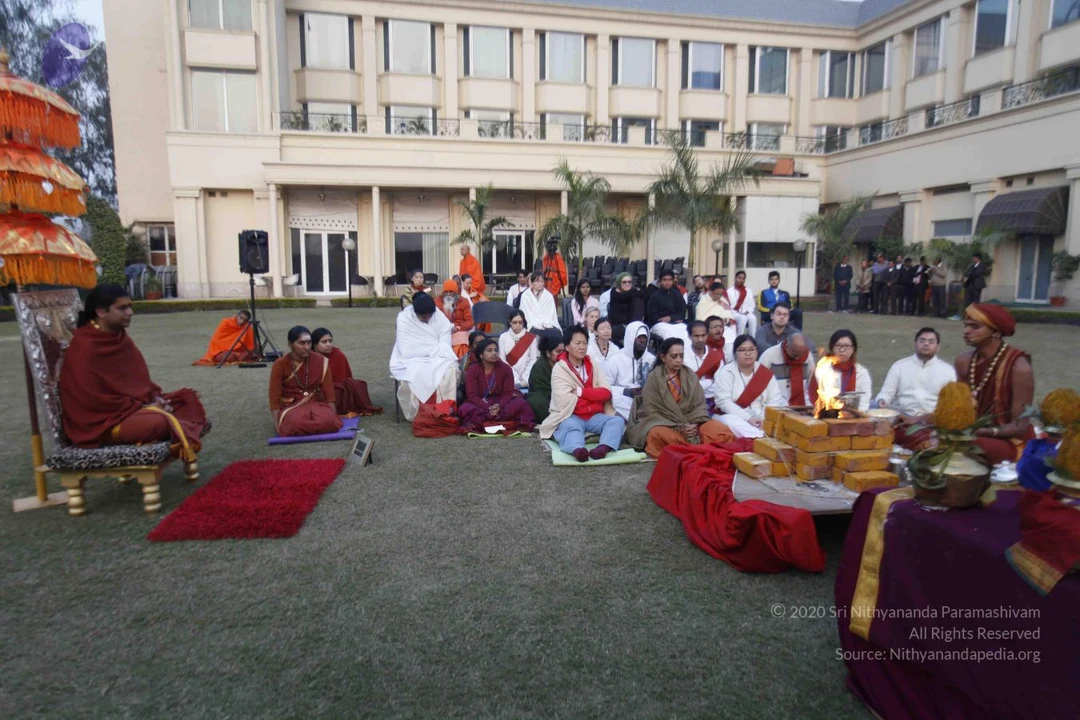
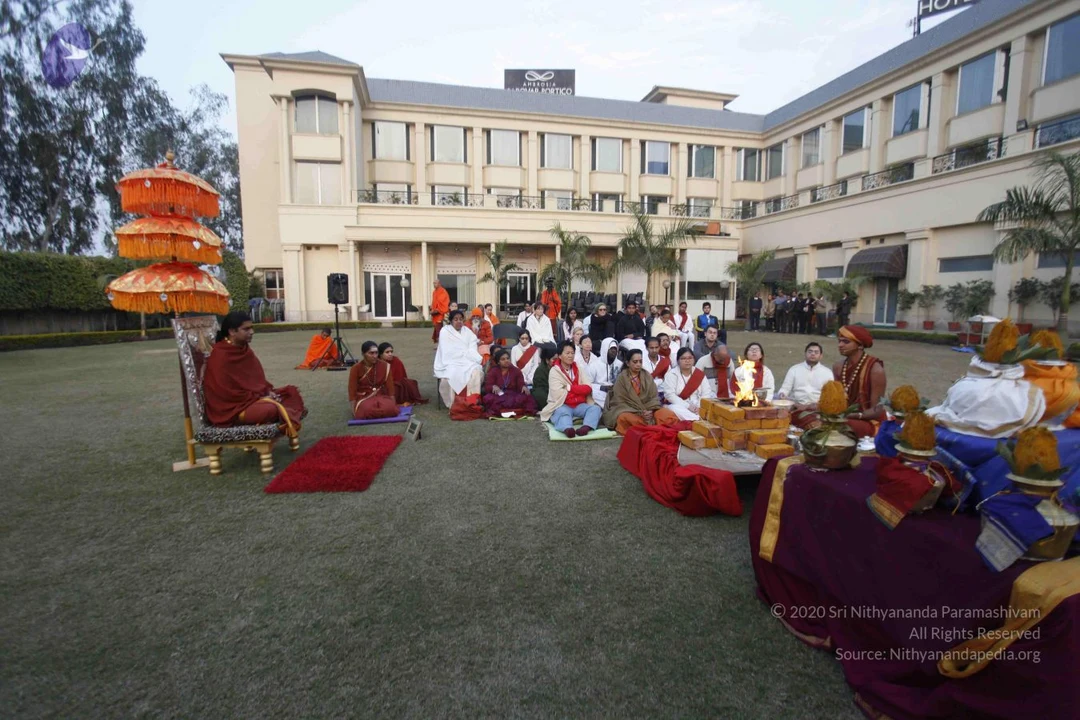
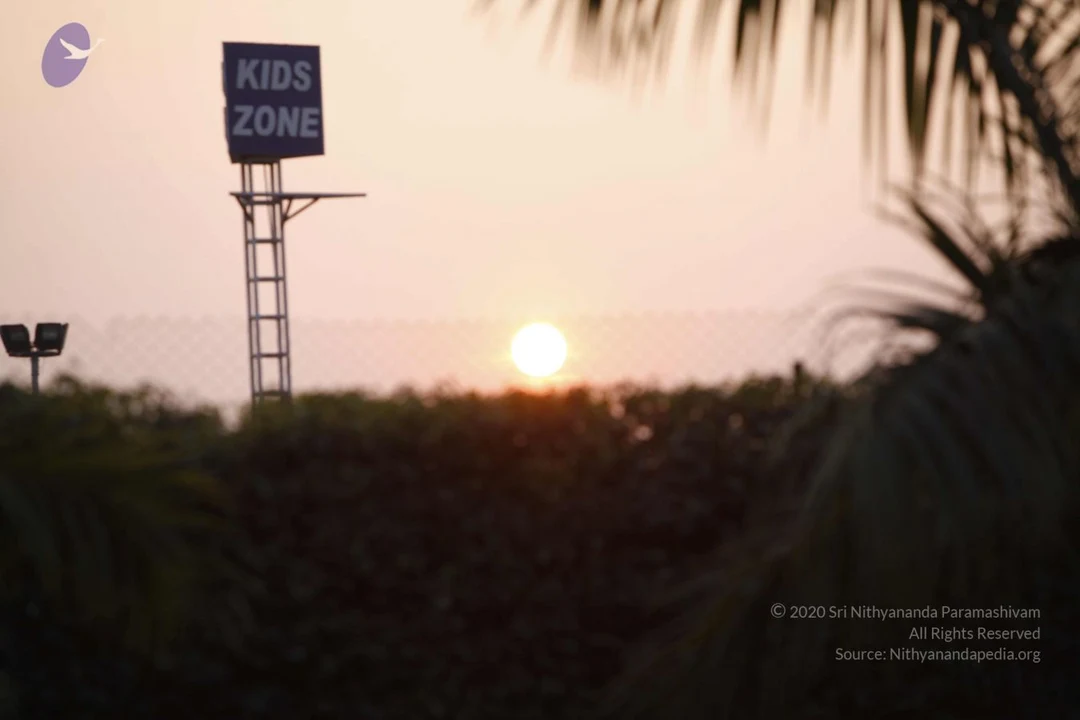
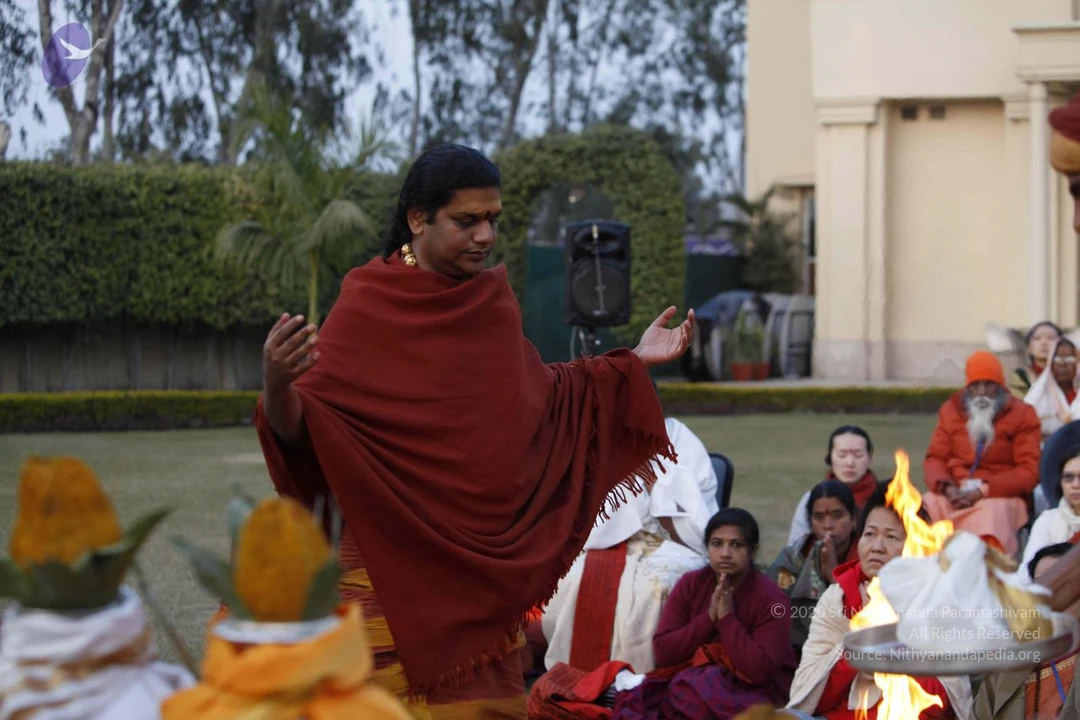
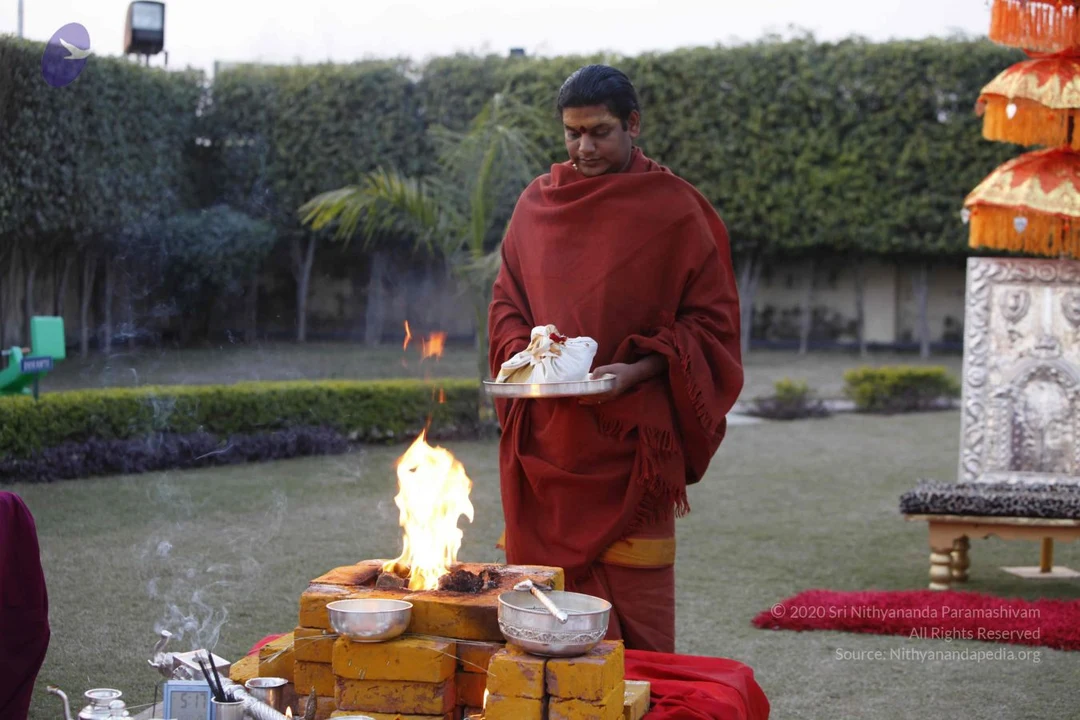
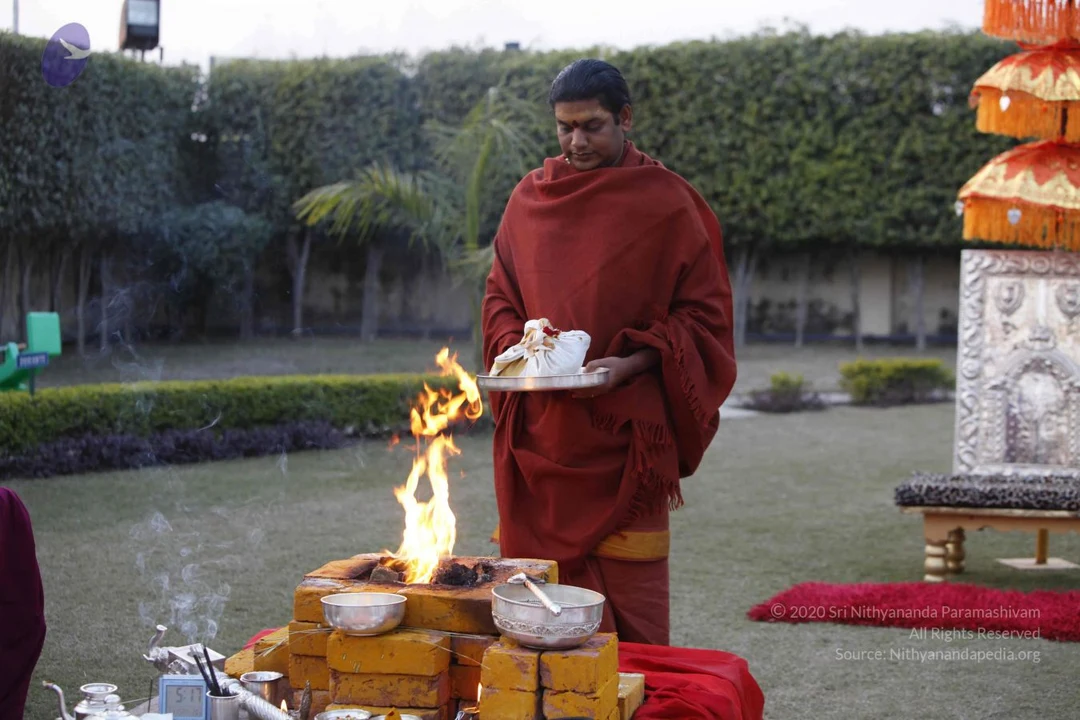
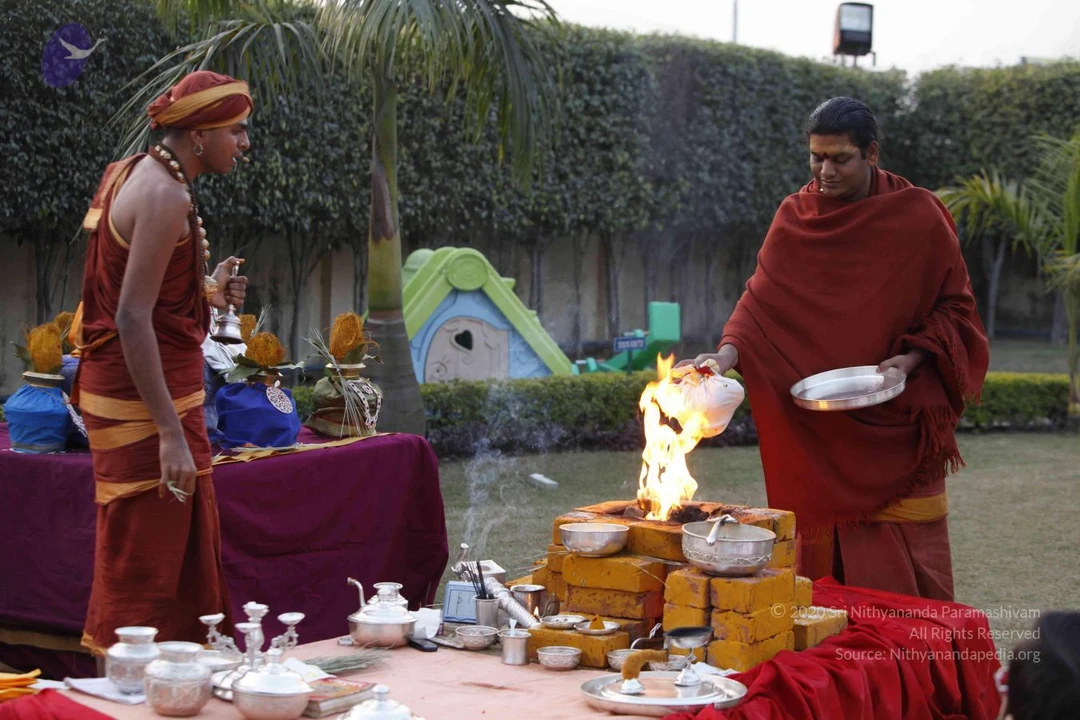
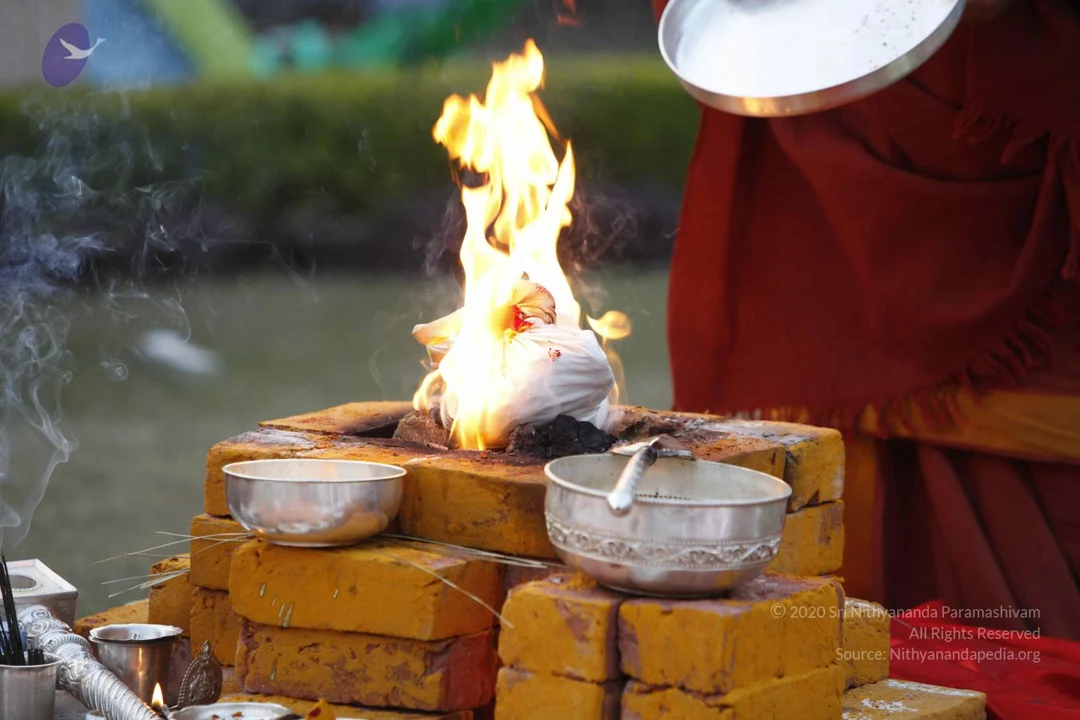
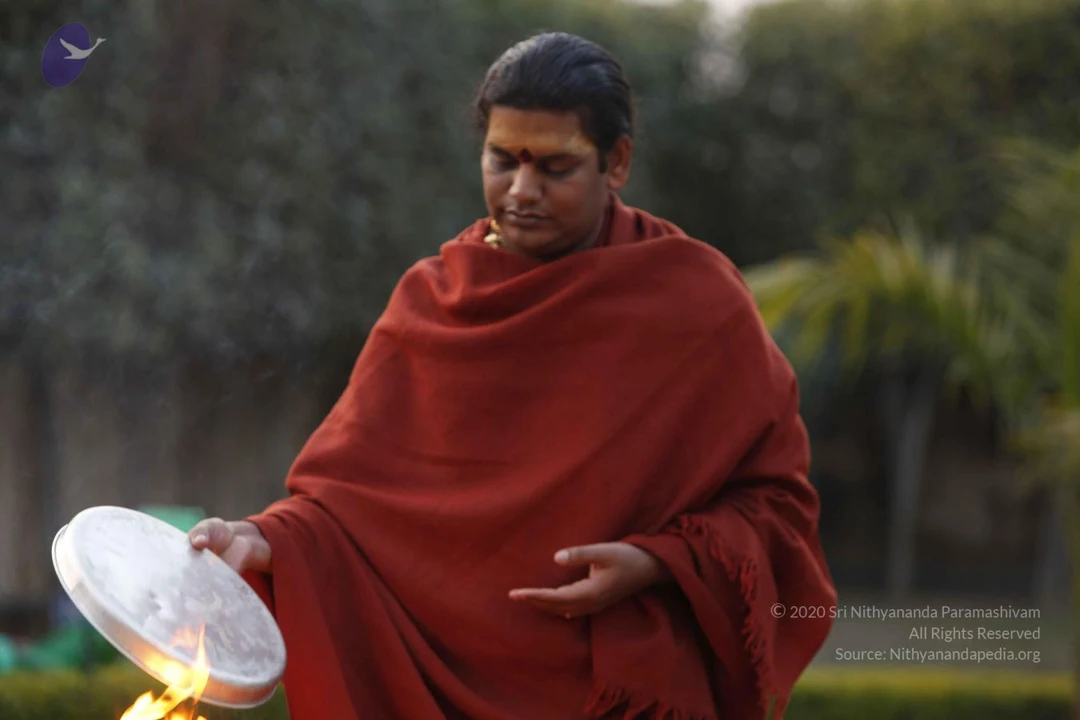
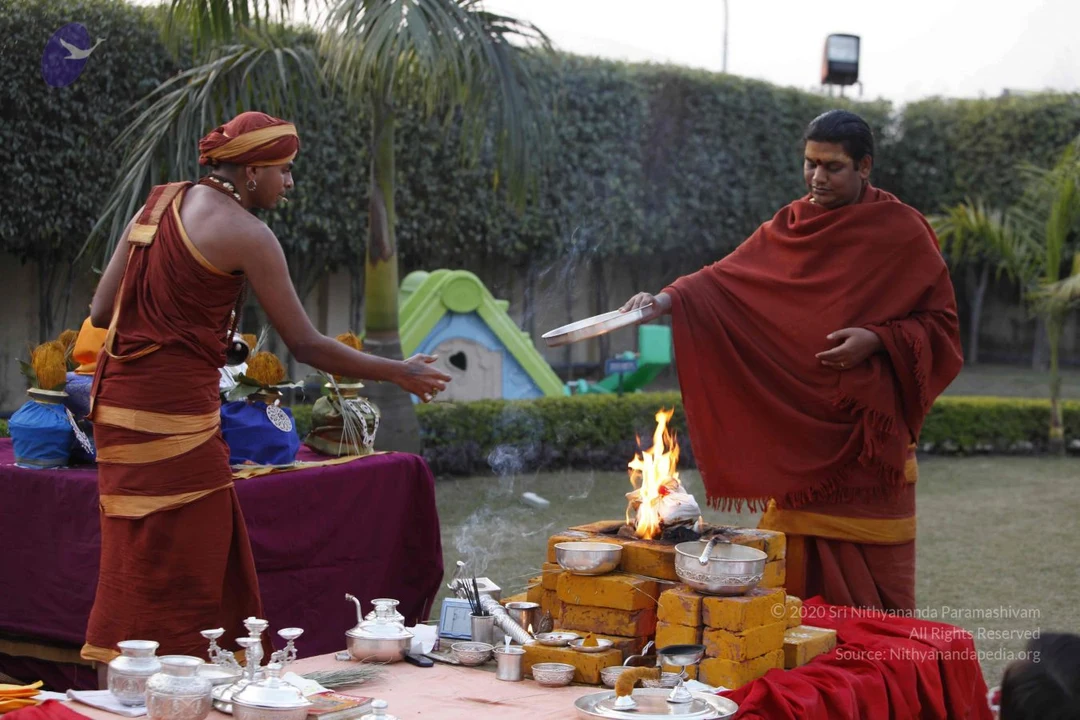
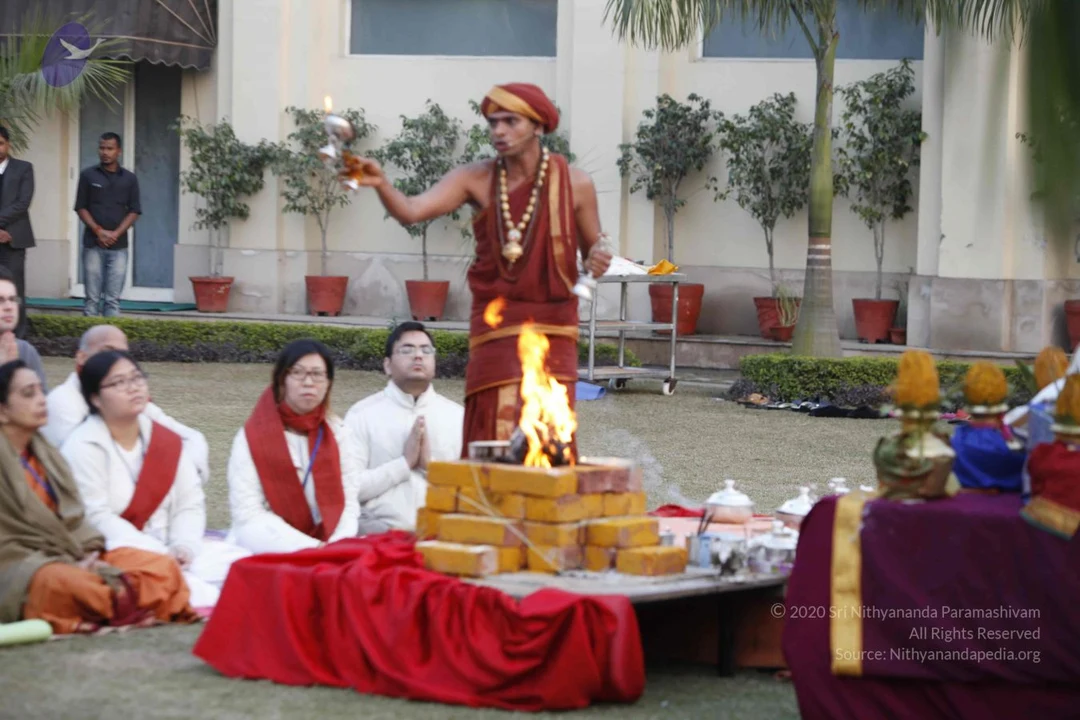
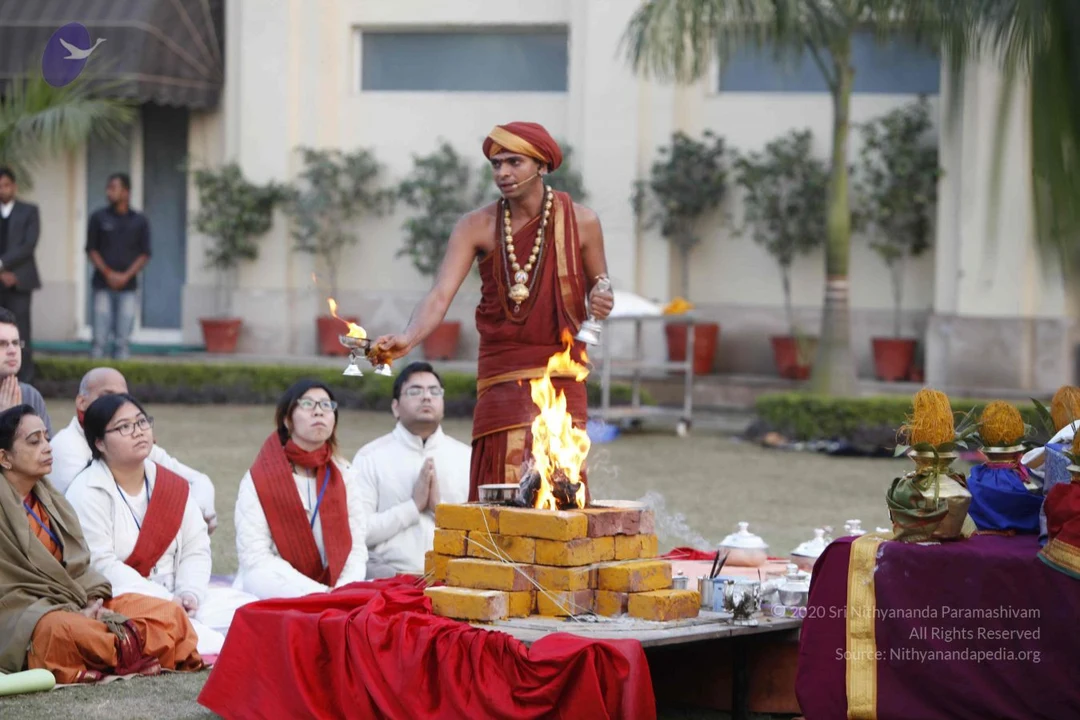
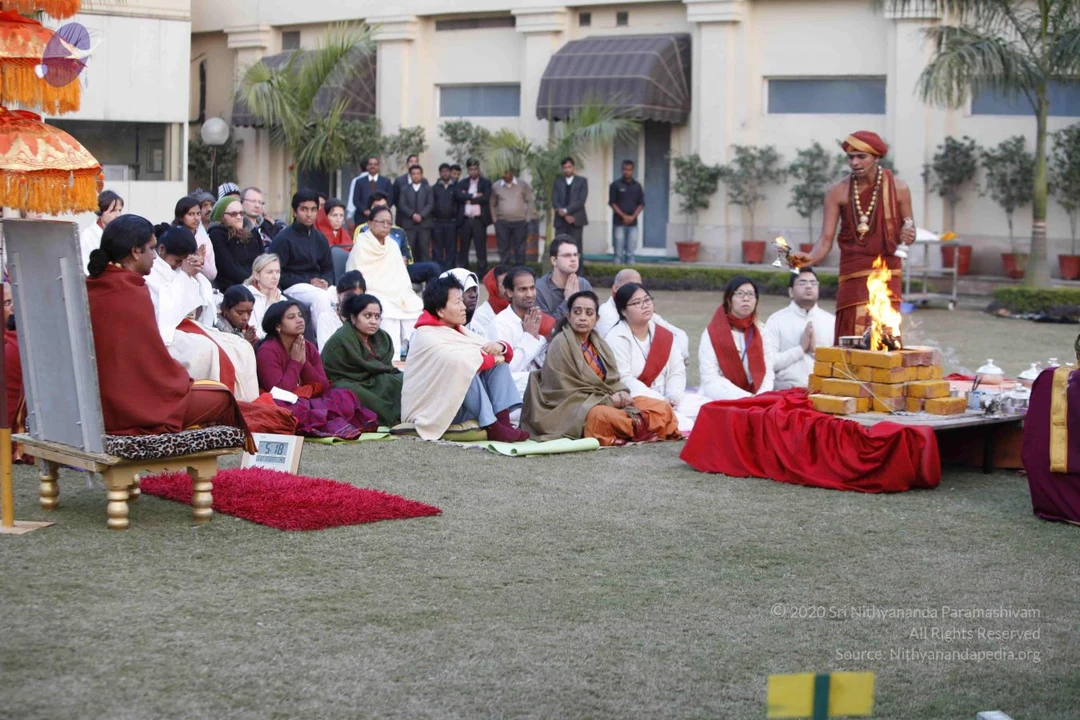
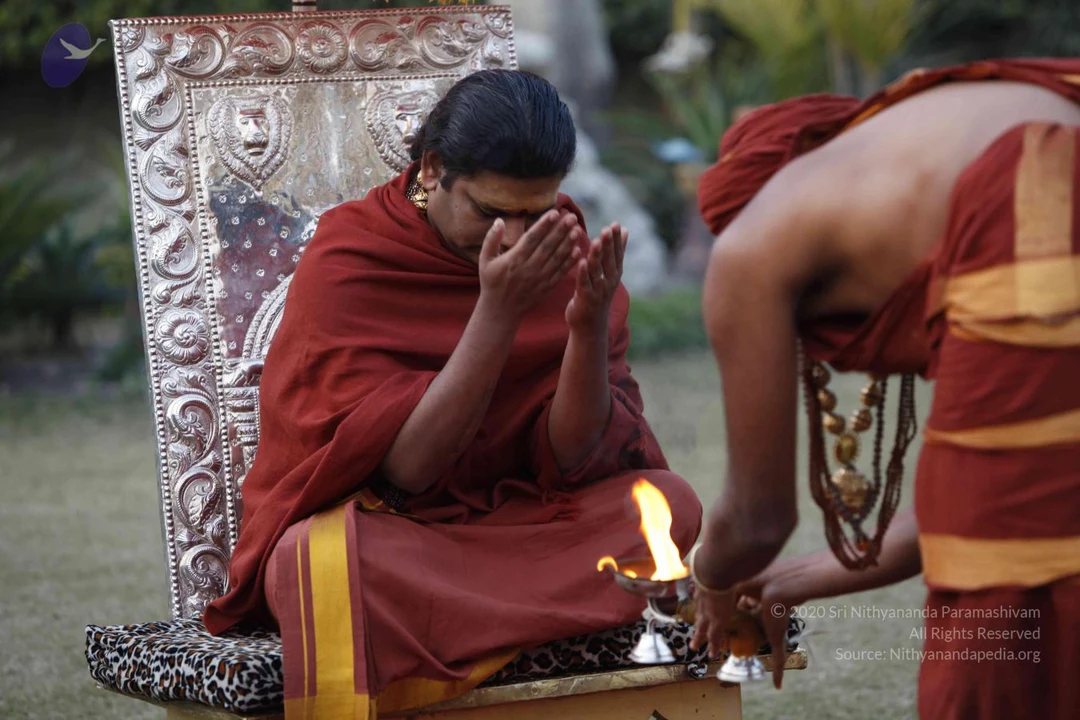
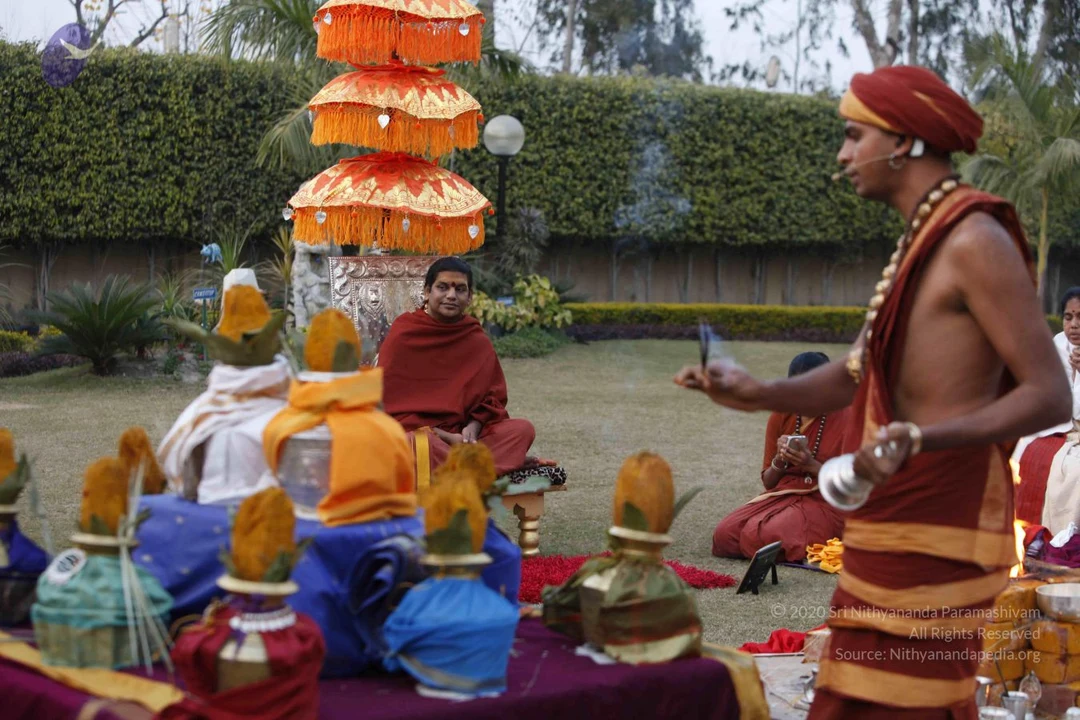
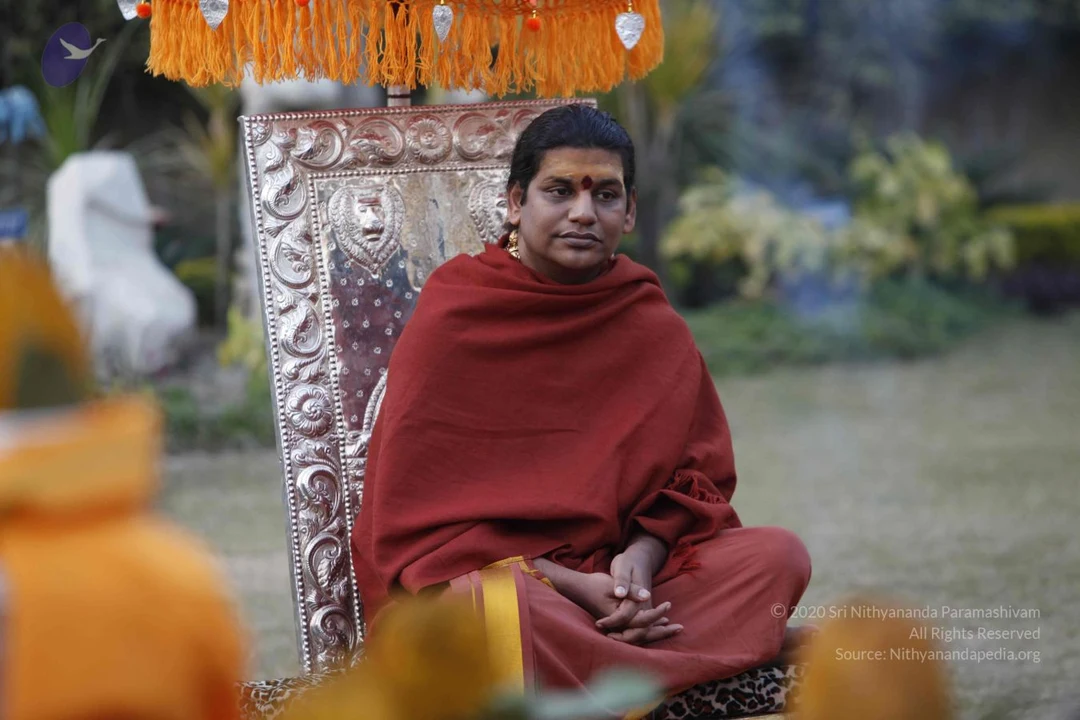
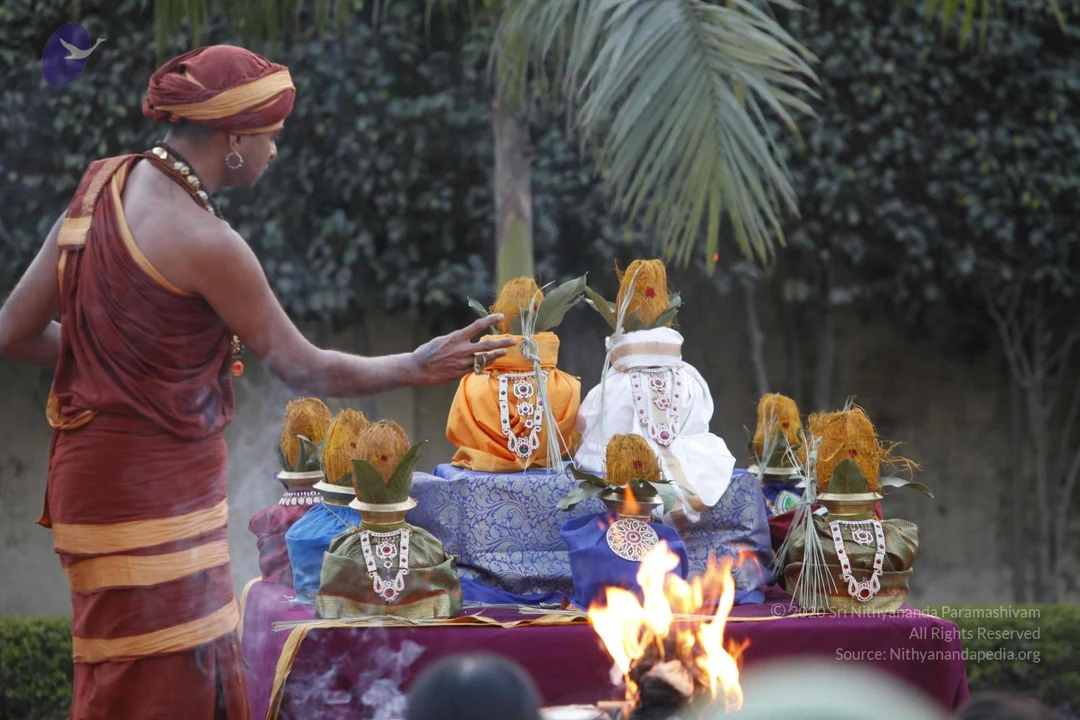
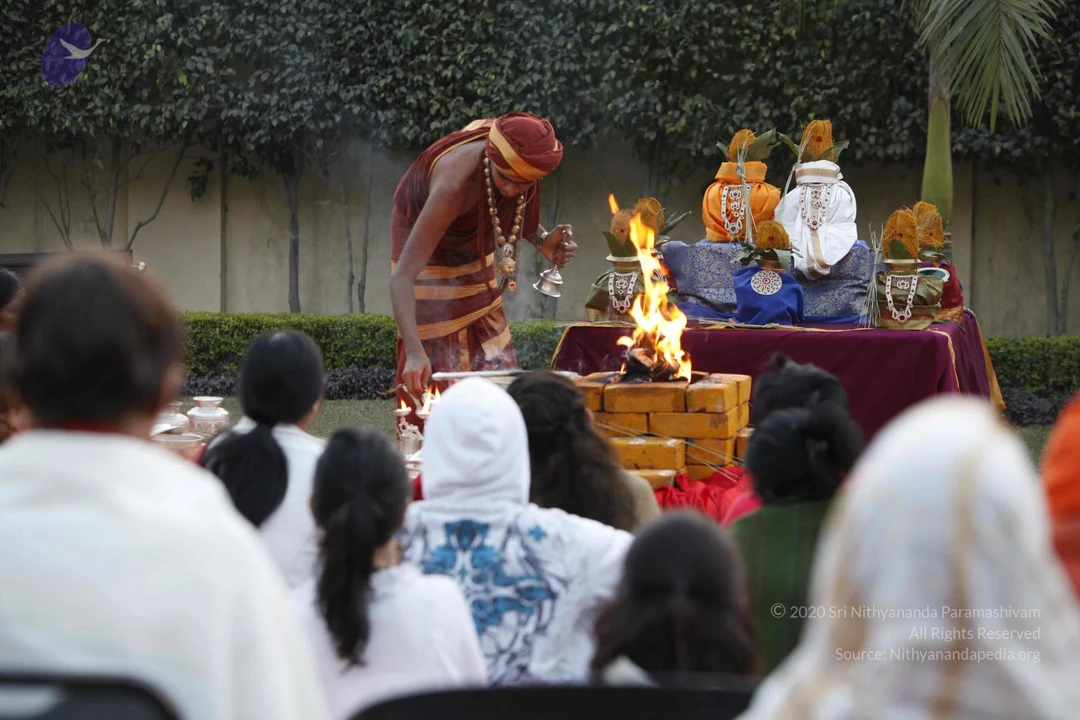
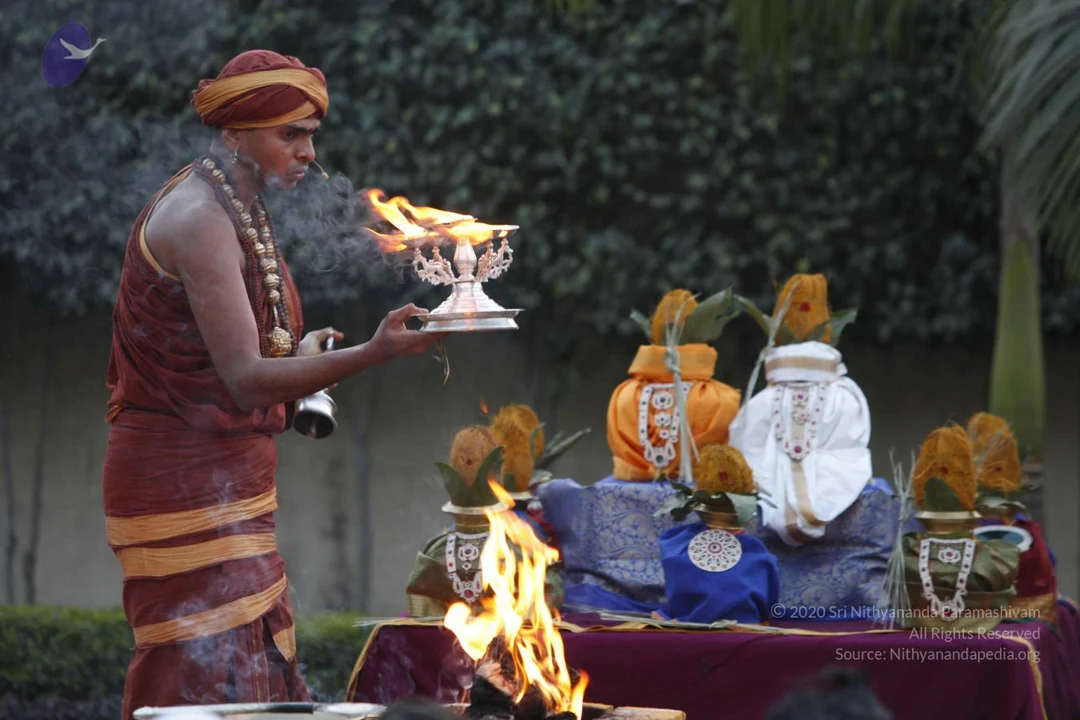
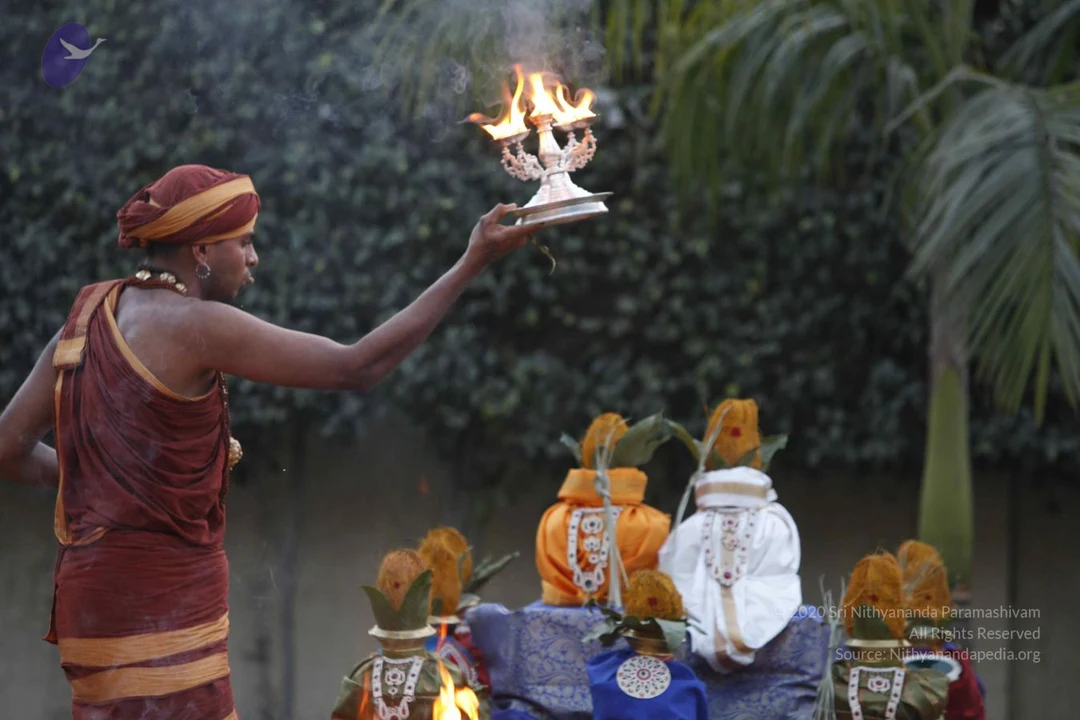
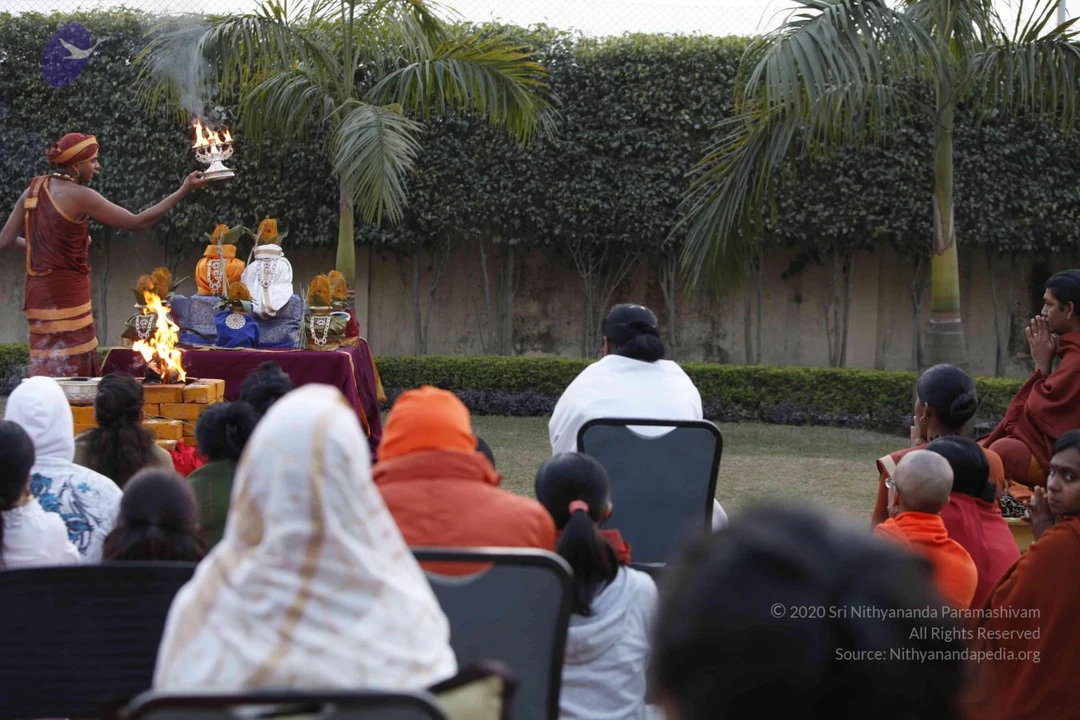
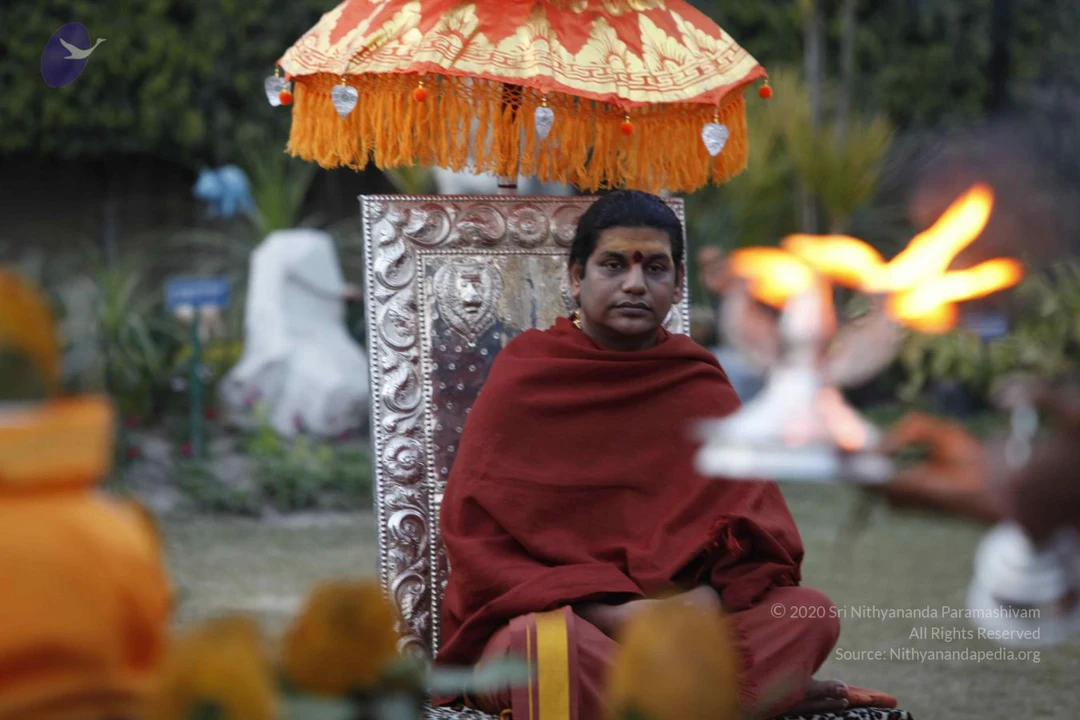
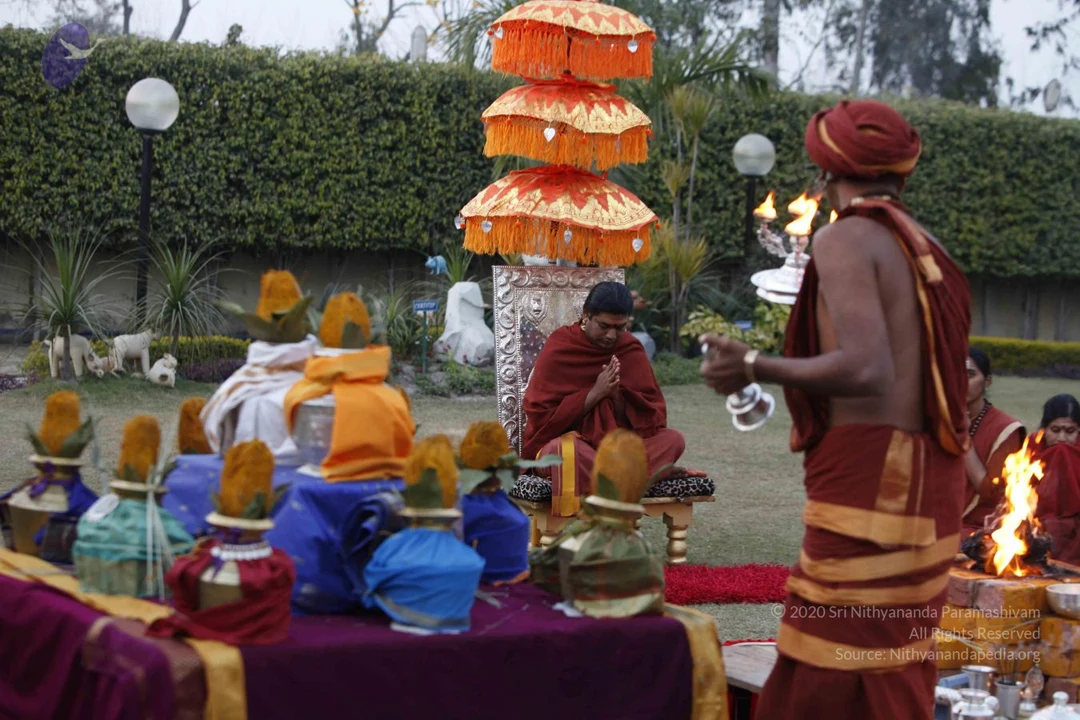
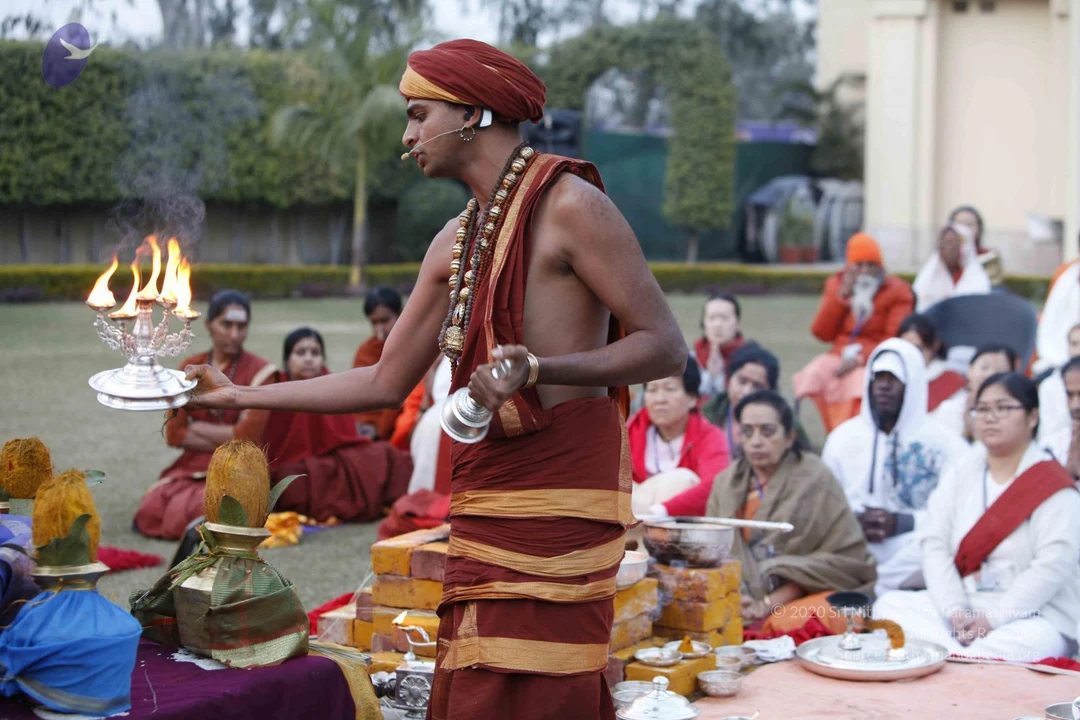
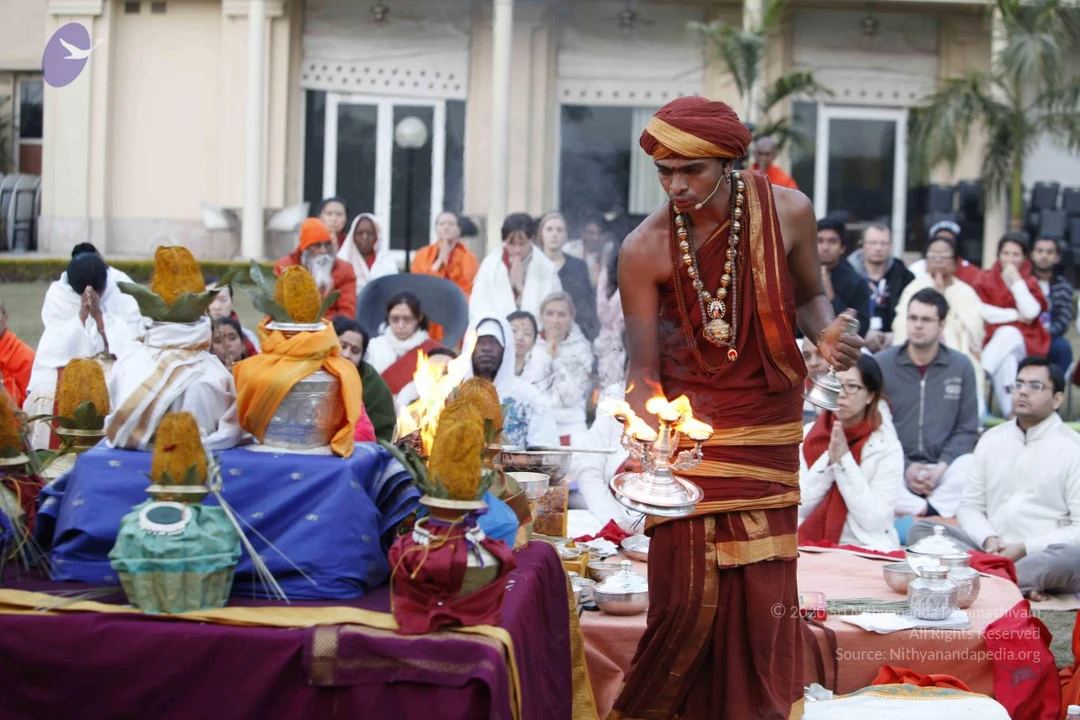
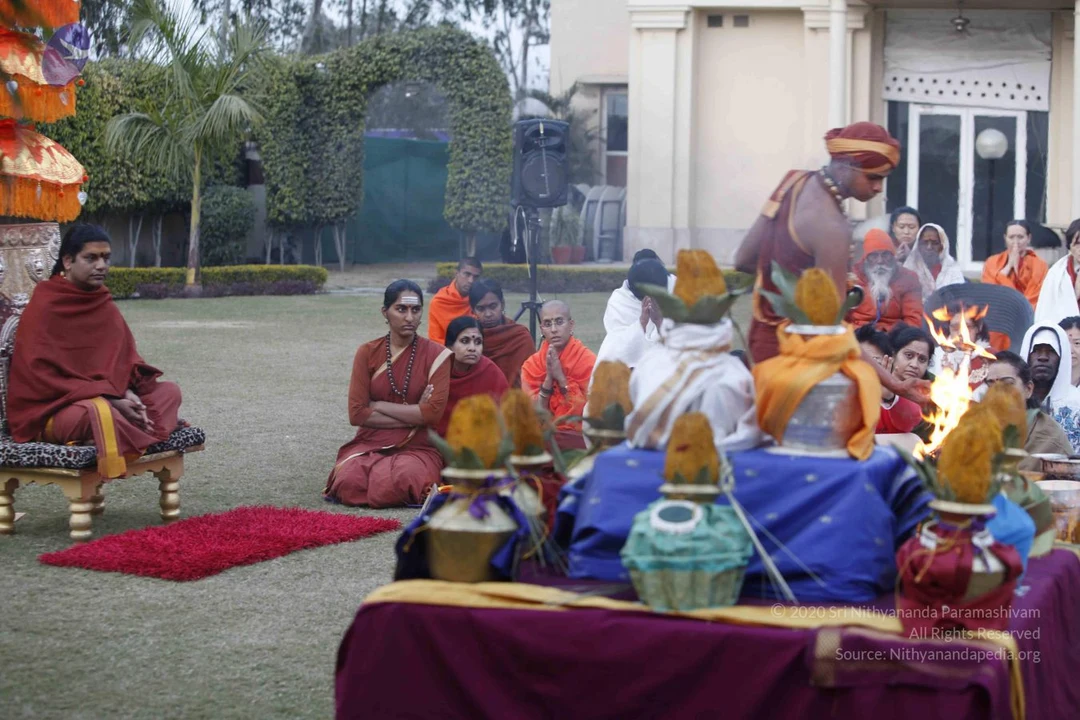
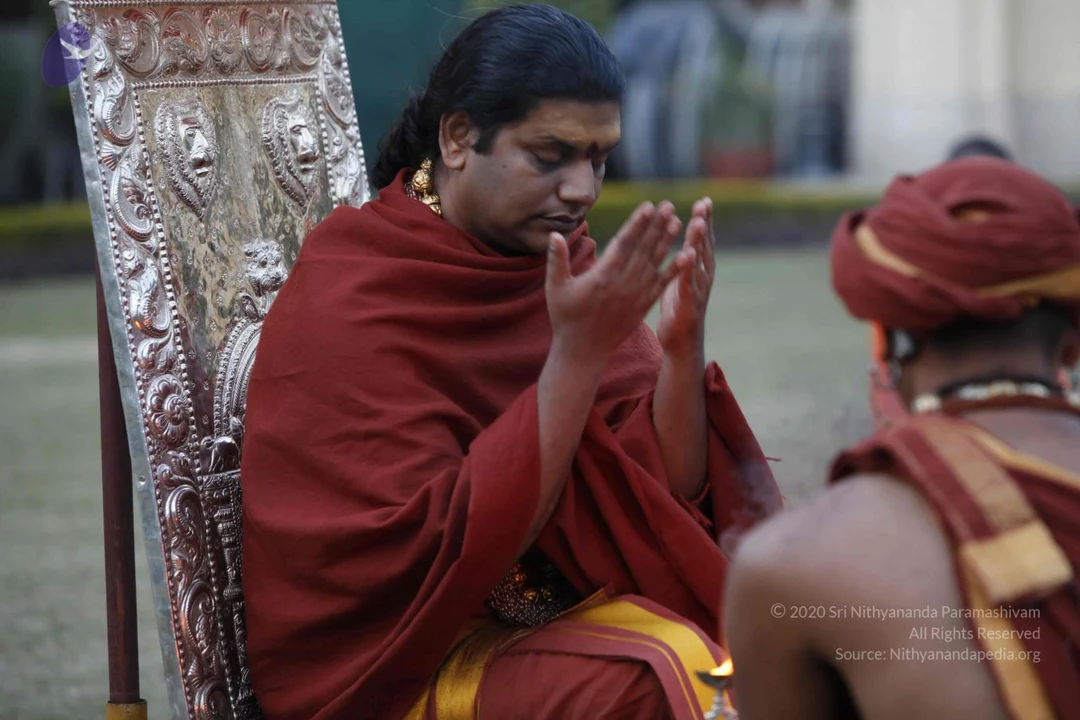
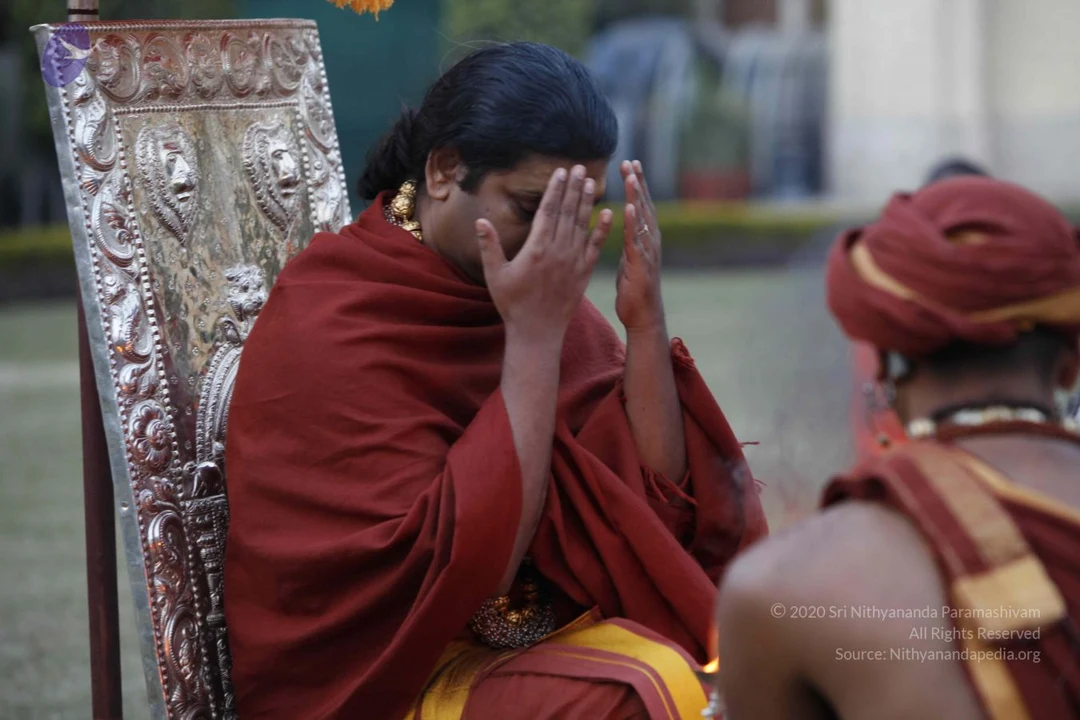
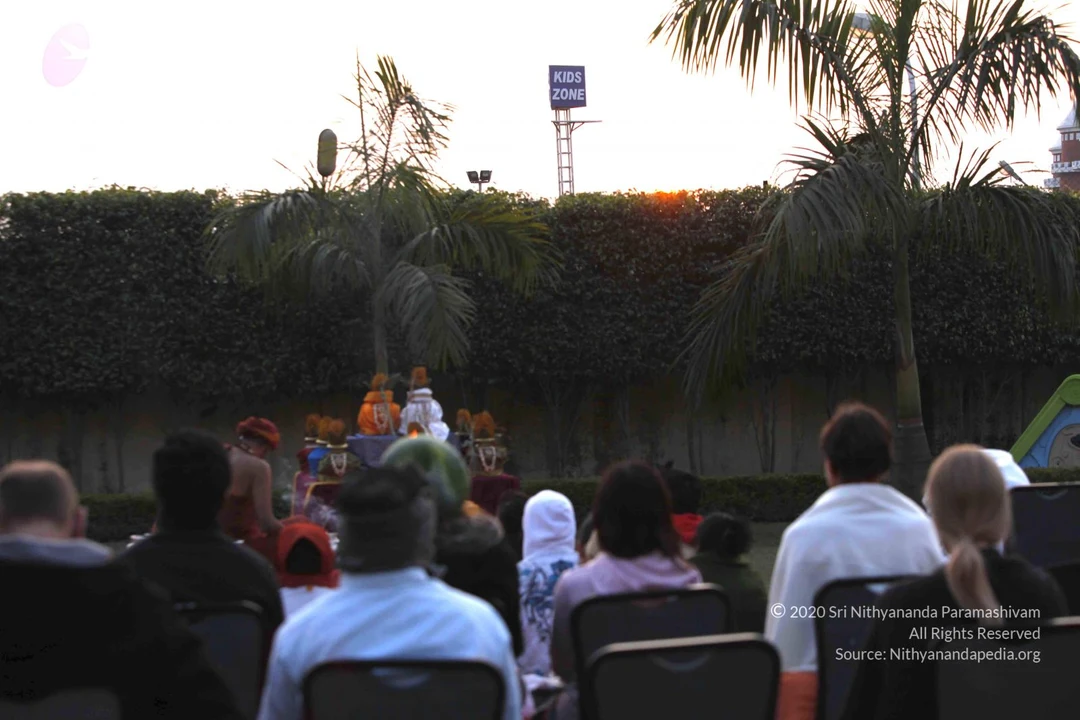
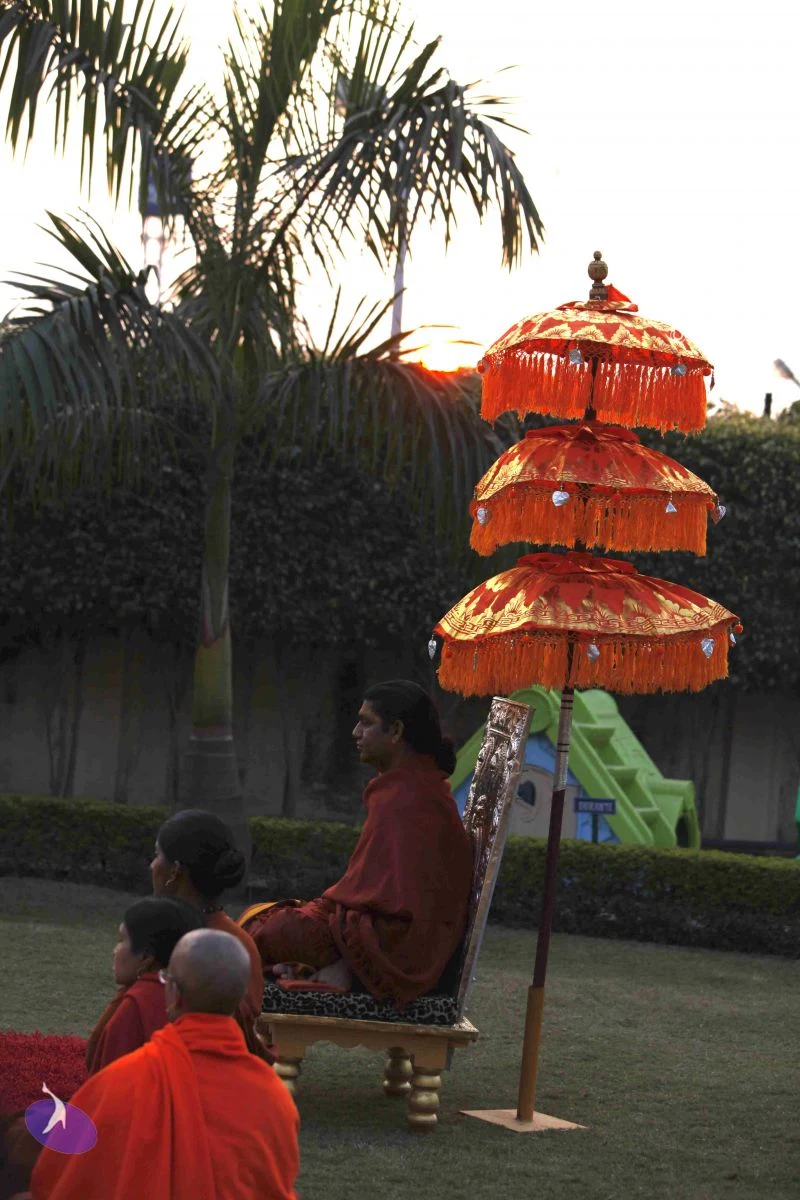
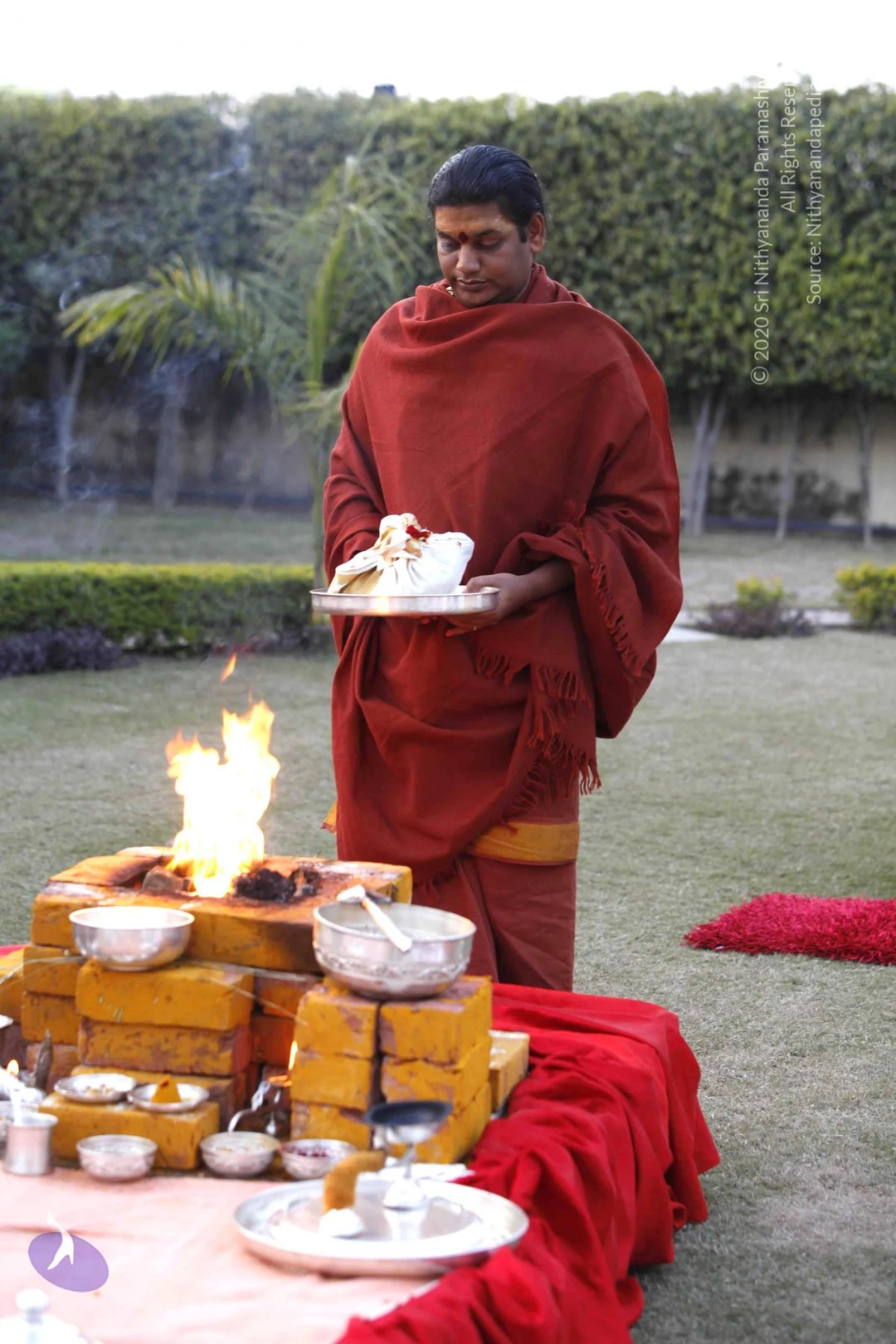
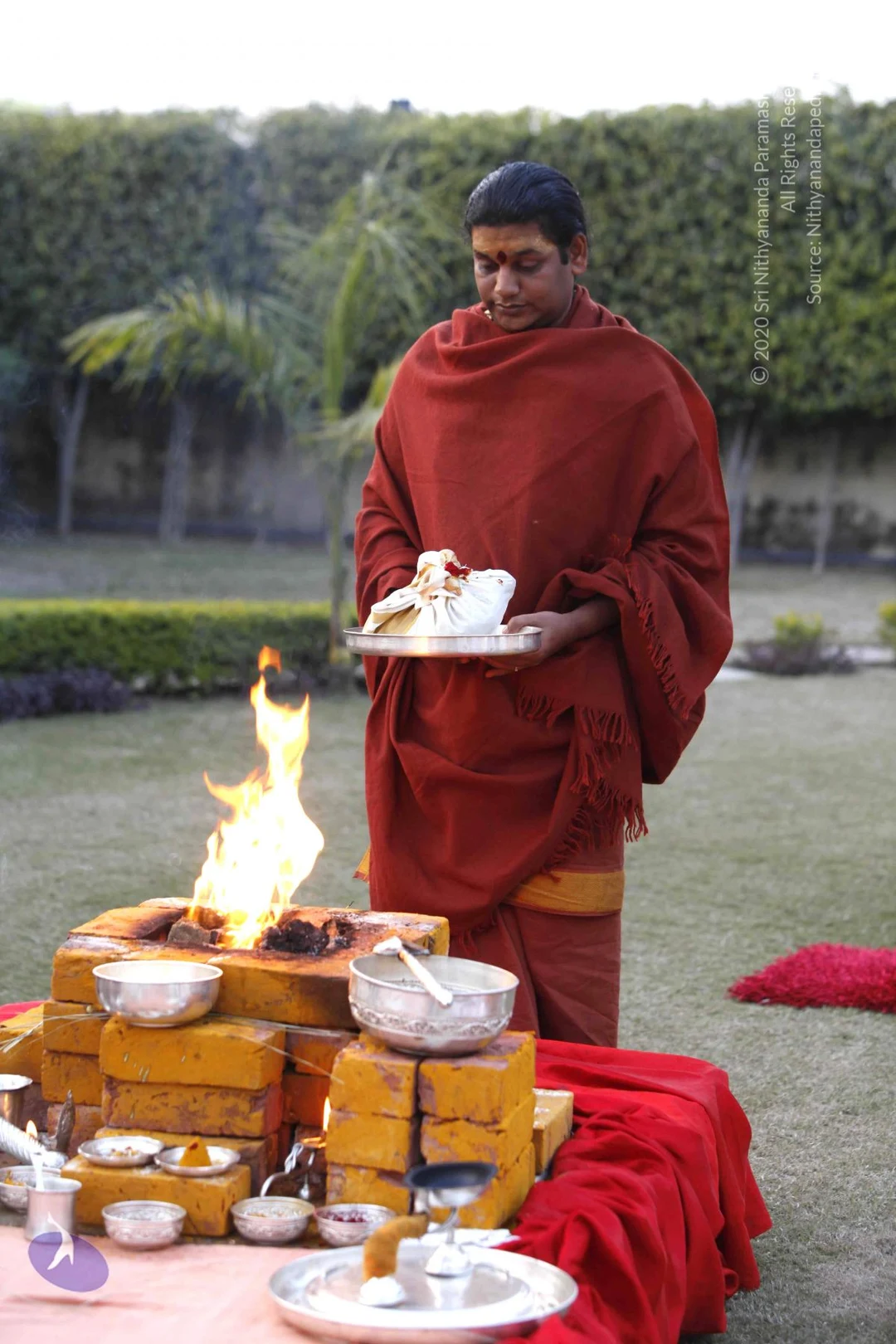
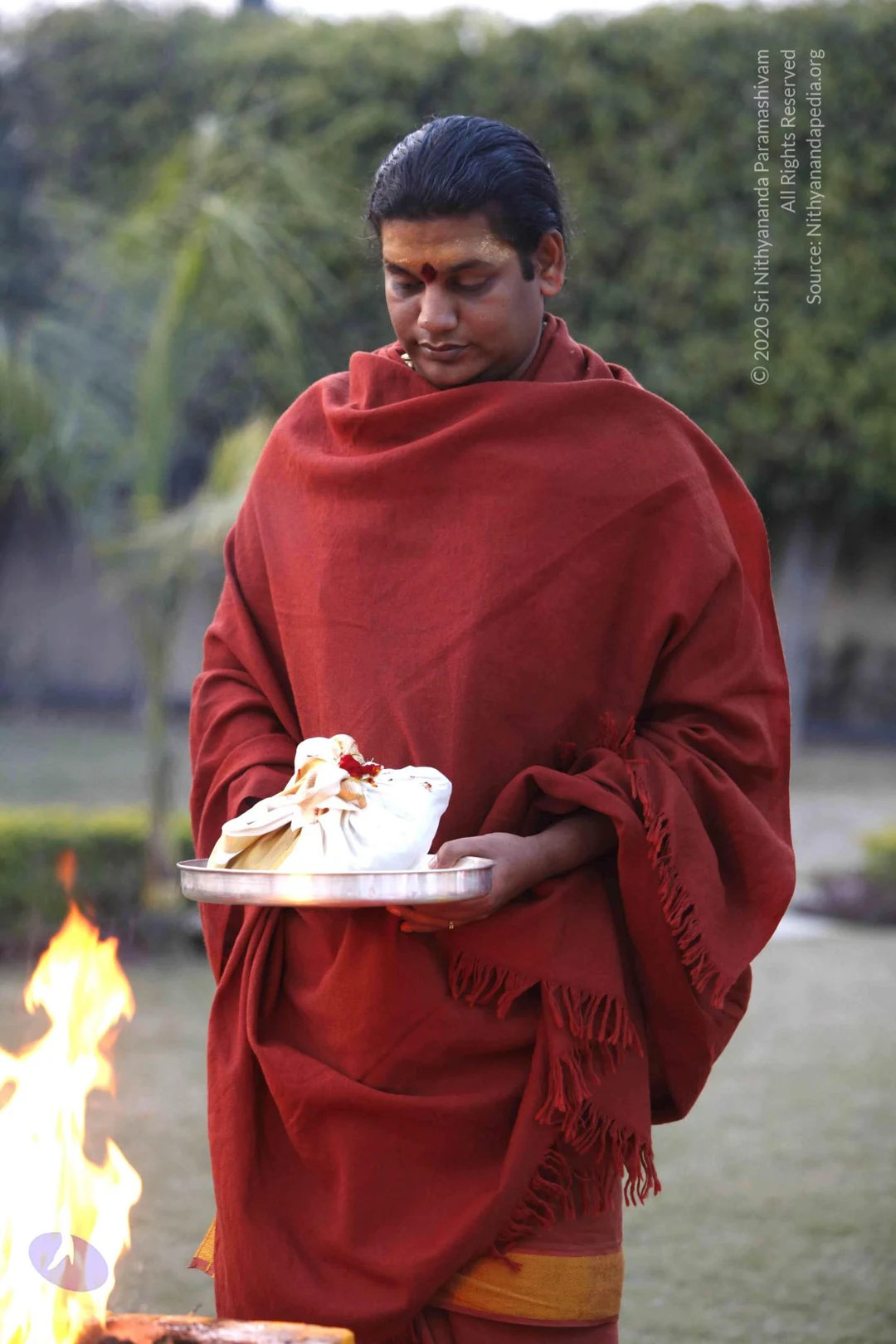
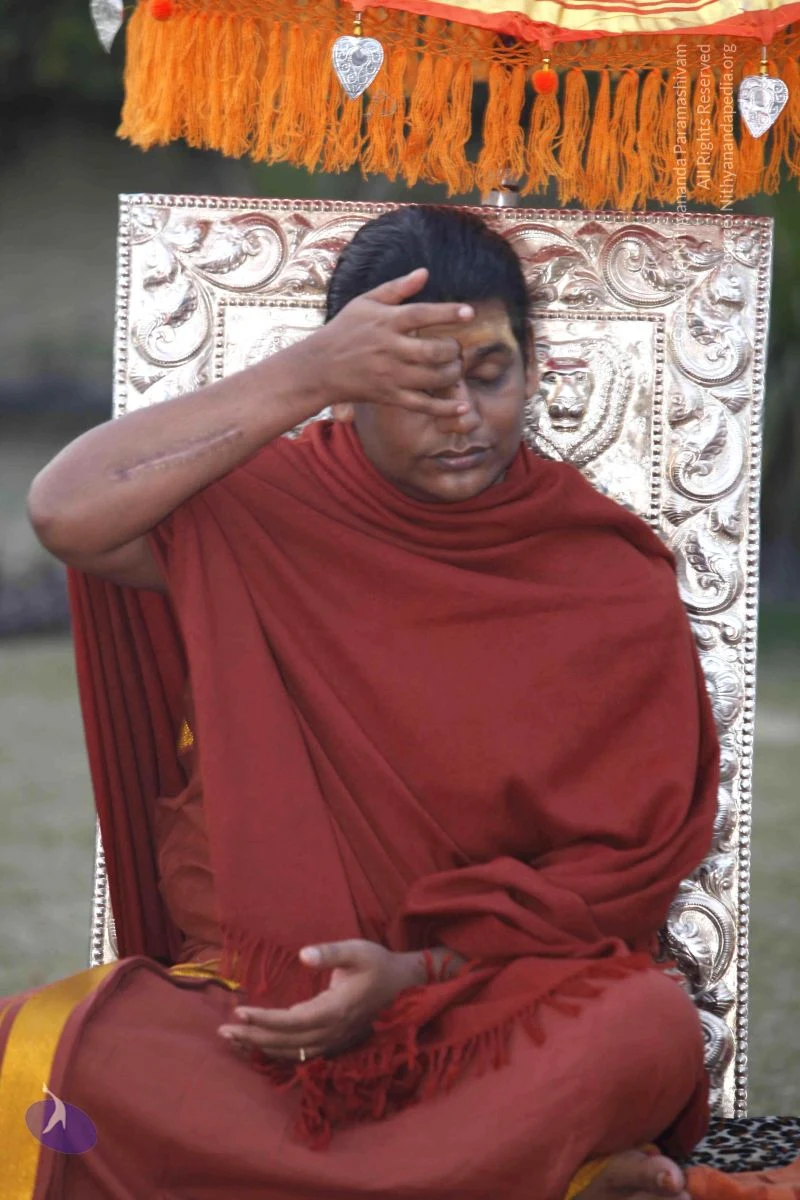
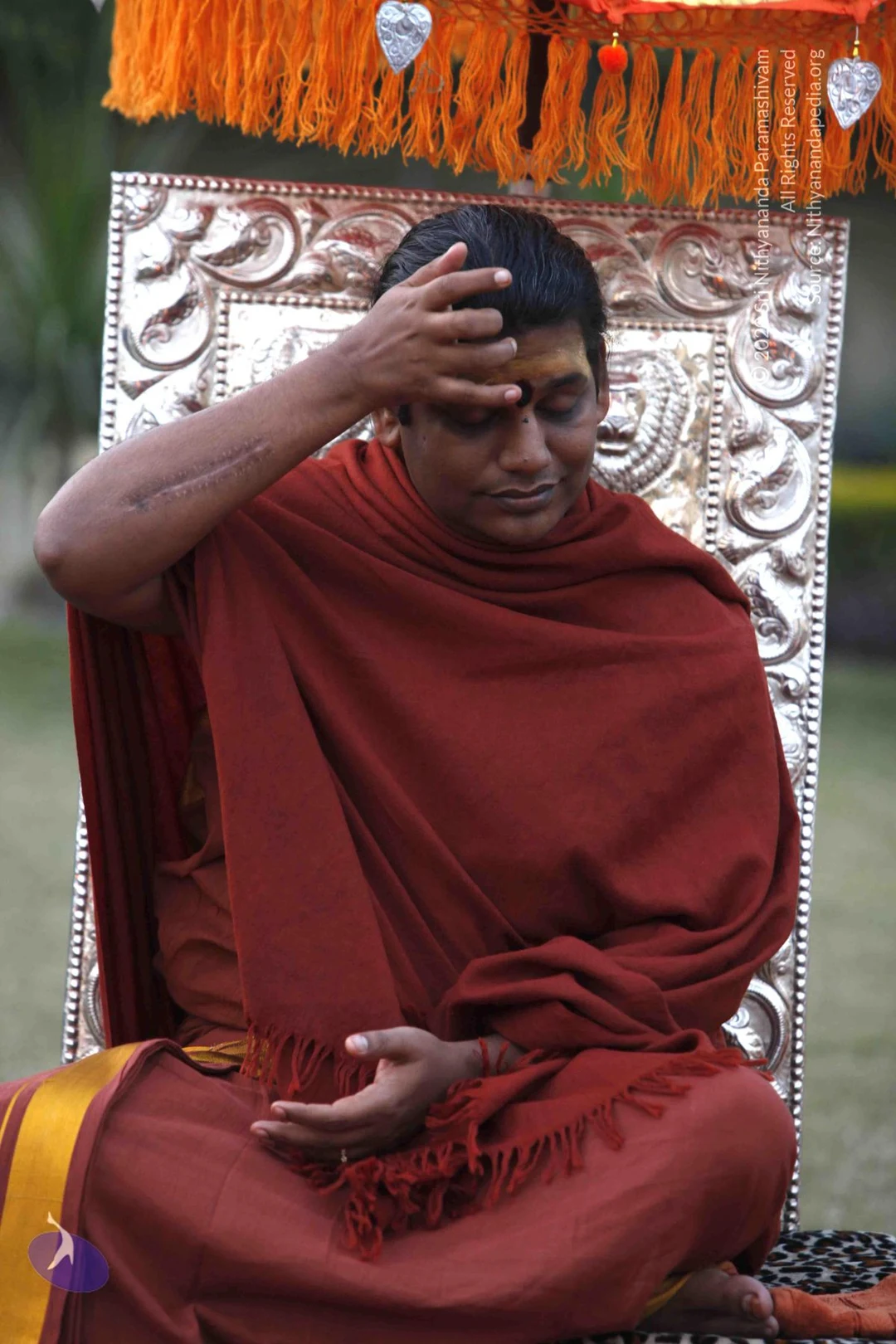
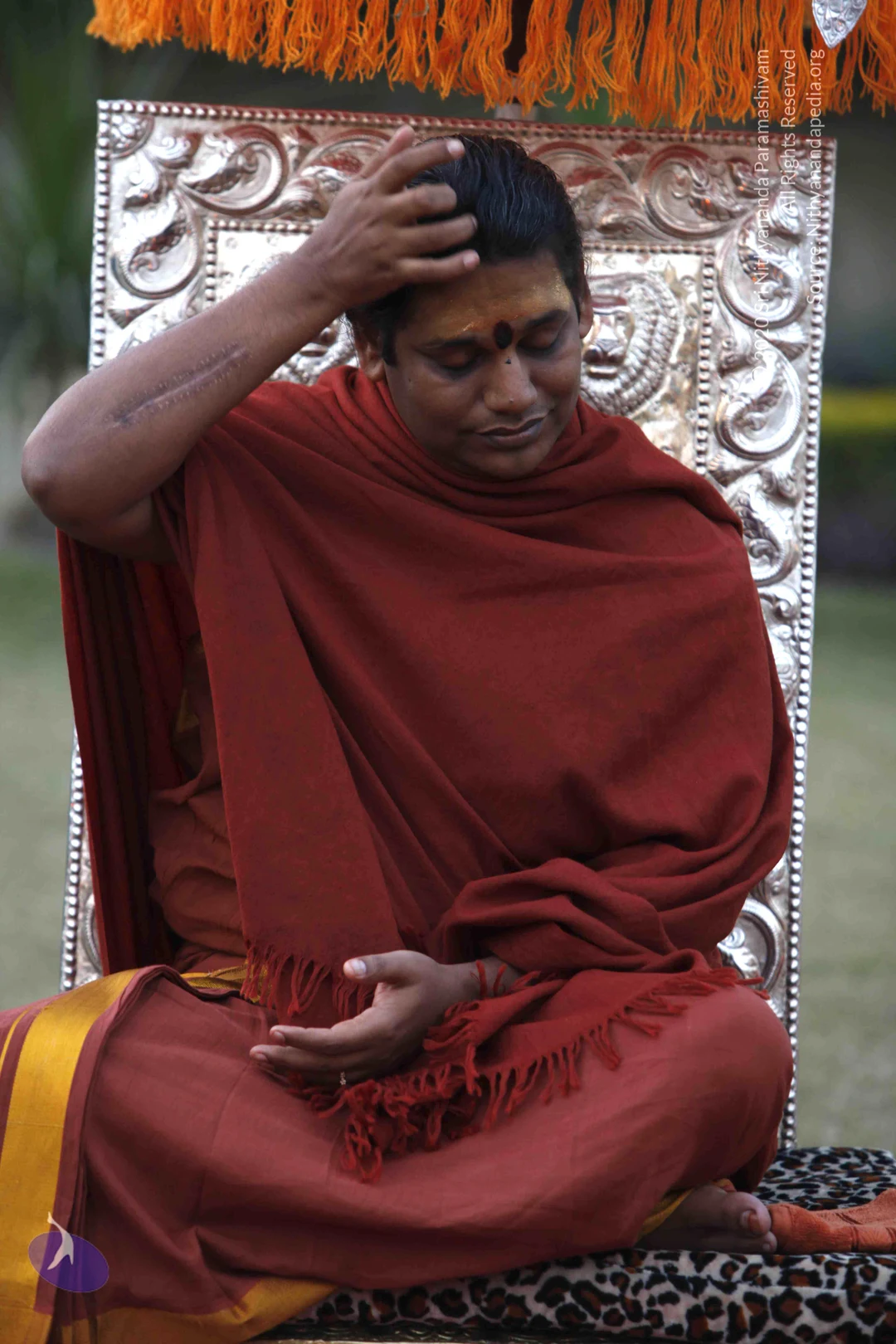
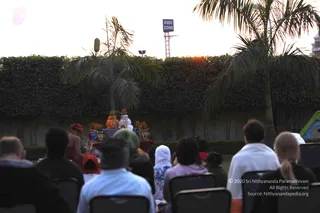
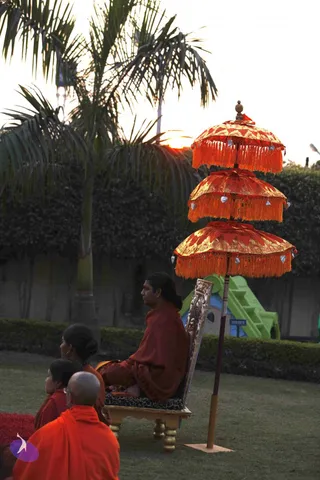
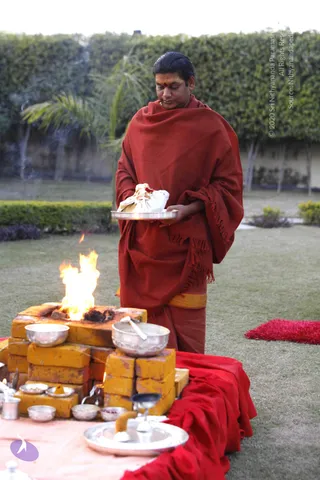
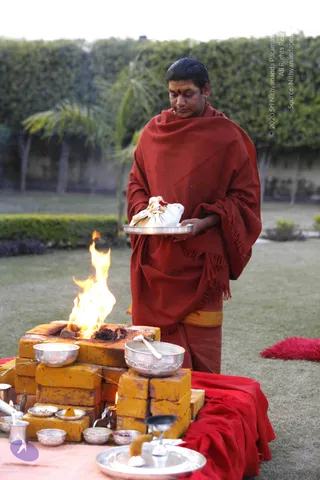
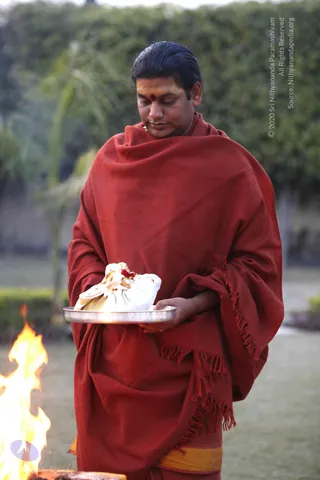
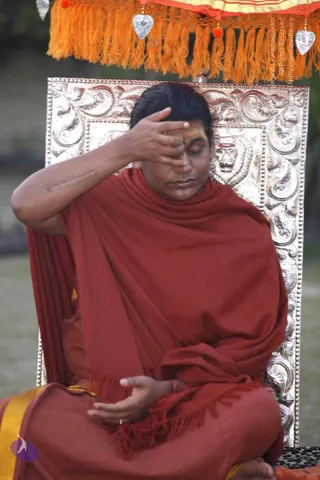
Outdoor evening satsang seen from behind a row of seated audience members on black chairs, facing a small raised stage framed by palm trees and a tall dark hedge. On the stage, several figures sit in a line, including one in saffron-orange clothing and one in white, with a figure in red standing at the left edge; their features are too small to make out clearly. Audience members wear jackets, white shawls and a pink top. A purple KIDS ZONE sign stands on a tower behind the stage, and the sun is setting at the horizon. Identity of any stage figure is uncertain from appearance alone.Outdoor evening scene at sunset with a palm tree and green lawn. A seated figure on a carved wooden chair with a silver backrest wears a red-orange shawl over the body and a dark cloth beneath, sitting under a tiered red and gold umbrella with orange tassels. Beside him, a bald man in orange robes sits on the grass, and a woman with hair in a bun and a younger person in red-orange garments sit nearby. A green playground slide stands in the background behind a hedge.Outdoor fire ritual on a lawn in front of a tall hedge and palm trees. A man in a rust-red shawl and dhoti with a yellow waistband and a red tilak on his forehead stands at a brick fire pit, holding a silver tray with a white cloth offering. Flames rise from the yellow-brick fire pit, with silver bowls, small brass vessels and a silver plate with offerings on a red and pink cloth in front. The arrangement suggests a homa or yagna. The man's appearance is not clearly established, so he is described by role only.A young man in a rust-red shawl and dhoti, with a red tilak on his forehead, stands on grass holding a silver plate with a white cloth bundle tied with red thread. Beside him, a fire burns on a stack of yellow bricks forming a homa altar, with silver bowls, small offering dishes, a kalasha-like vessel, and a silver plate with offerings in the foreground. A hedge and palm trees fill the background, and a red mat lies at right. This appears to be a homa or yagna ritual performed outdoors.A man in a rust-red shawl wrapped over his shoulders and a red-and-gold dhoti stands outdoors beside a fire pit with flames at lower left. He has a red tilak on his forehead and holds a silver tray with a white cloth bundle marked with red kumkum. Green hedges and a lawn fill the background. Whether he is the a person candidate cannot be determined from appearance alone, so he is described by role as a priest-like participant.A seated man in a rust-red shawl and robe sits on an ornate silver throne with lion-face carvings beneath an orange fringed canopy. He touches his forehead with his right hand, eyes closed, while his left hand rests open in his lap. A gold-trimmed cloth shows at the lower edge, and a small purple logo appears in the corner. The setting is an outdoor garden. a person: the seated figure wears the saffron-red robe and sits on a throne under an orange canopy, consistent with the page's Satsang context, though the appearance cues are limited to clothing and setting.
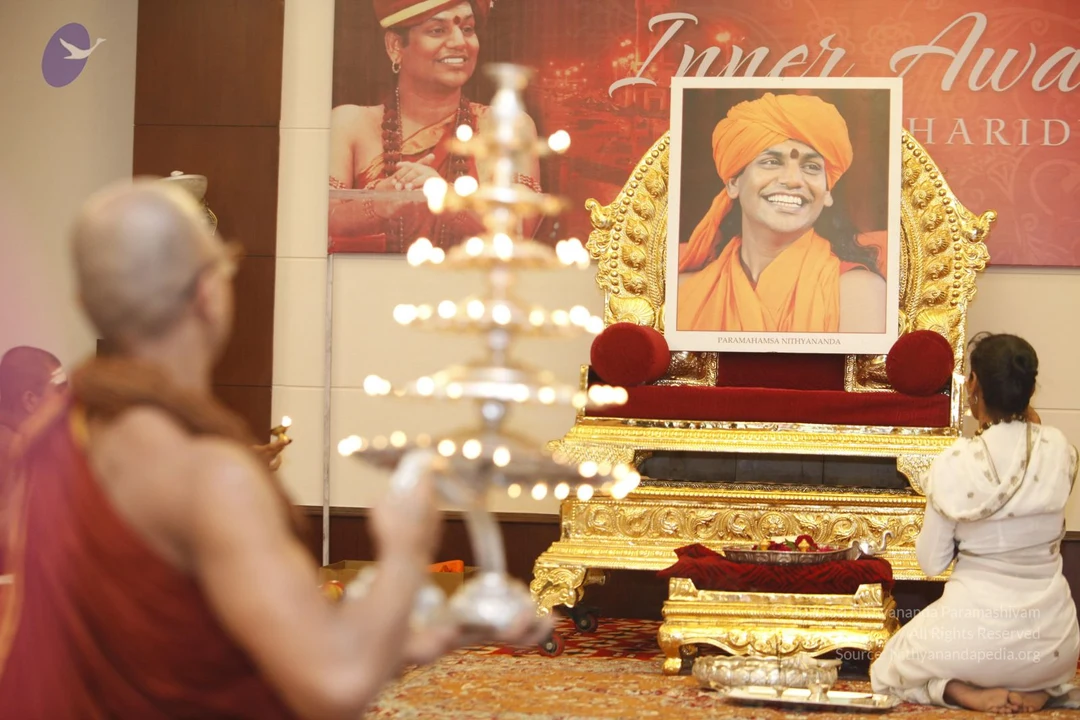
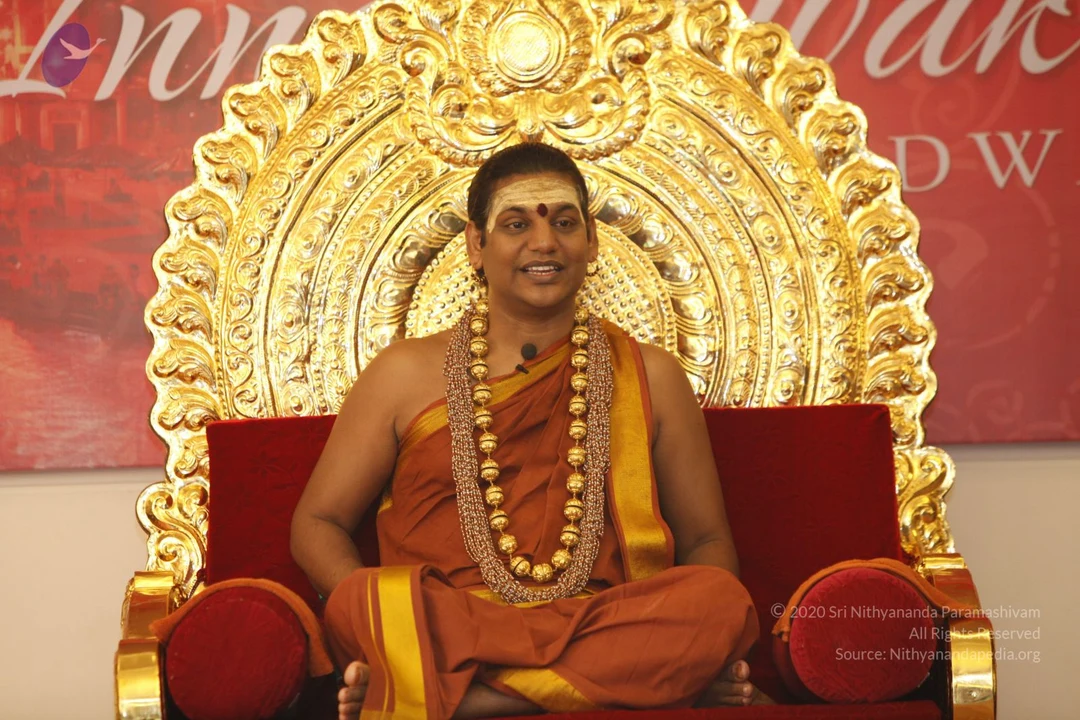
January 11 2014

5 photosView all
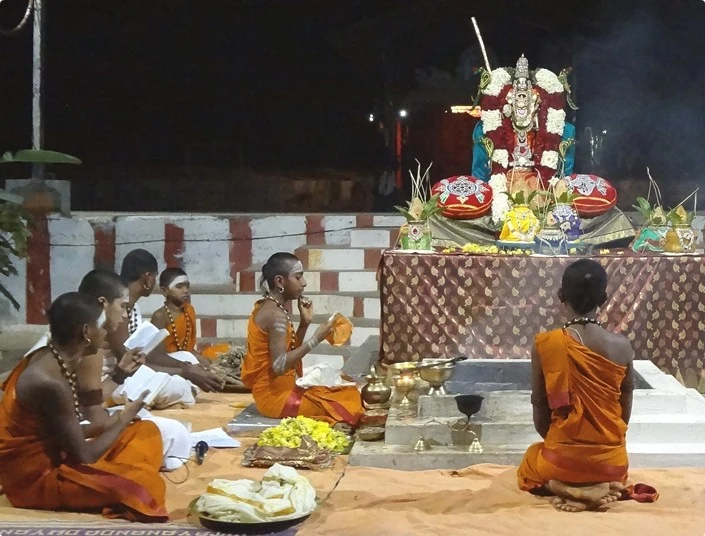
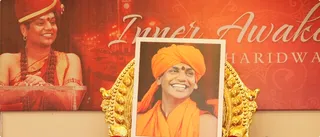
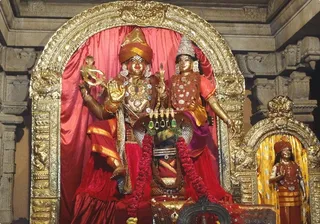
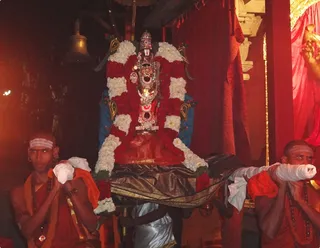
A framed printed portrait of a smiling man in an orange turban, orange shawl and rudraksha mala sits on a gold ornate chair placed in front of a red banner. On the banner, a large photograph shows a man in an orange turban, red-orange robe and rudraksha malas standing at a podium. The banner text reads Inner Awakening with the word Haridwar partly visible. The scene appears to be a stage or event setup with no live people visible.A gilded shrine niche in a temple hall shows two large painted deity murtis seated side by side on a raised platform before a red draped backdrop. The figure on the left wears an orange turban, gold and jewelled ornaments, and holds a trident-like staff and a small drum; the figure on the right wears a tall crowned headdress, red and gold garments, and a jewelled necklace. Between them stands a Shiva lingam-like sculpted form draped in red and garlanded with red flower strands. A smaller figure in a red and gold outfit and orange turban stands at the right edge. Ornate gold arches and carved stone pillars frame the scene. No physical people are present.Night photograph of a deity murti carried on a palanquin during a procession. The murti is decorated with red flower garlands edged with white flowers, and wears gold ornaments and a crown. Two men in orange-saffron cloths with white forehead bands and rudraksha malas support the palanquin poles, holding white cloth on their shoulders. Warm red lighting and red drapery frame the scene, with a brass bell hanging at the top.Night procession at a temple or ashram road with a decorated deity murti carried on a palanquin-like platform covered in white and red garlands. Men in red and gold dhotis and bare-chested devotees carry flaming torches and a large white chamara fan, while a girl in orange garments and rudraksha-style beads stares forward in the foreground. Several men in orange and red clothing walk alongside, and a red-painted wall stands behind the procession. The scene is lit by the torches and nighttime light.Outdoor evening puja at night in front of an illuminated deity murti decorated with white and red flower garlands and a large floral crown, set on a draped altar with brass vessels, kalasha-style pots, banana-leaf offerings and yellow marigold heaps. Five saffron-robed priests with rudraksha malas sit on an orange cloth at left, several holding books or papers, while a single saffron-robed priest kneels at right facing the altar. Smoke rises at upper right and white-and-red striped steps frame the background.