Skip to content
Monday

15 April 2013

Dont Let Your Mind Cheat You

Dated photos
199
Source pages
1
Media
4
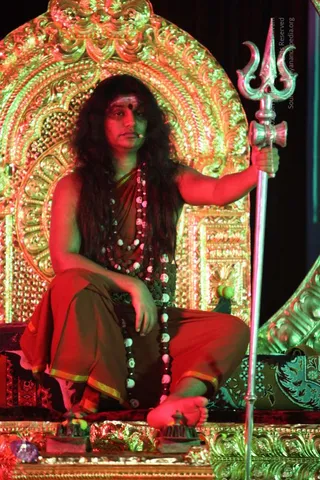
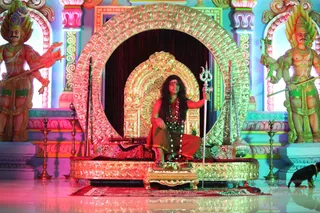
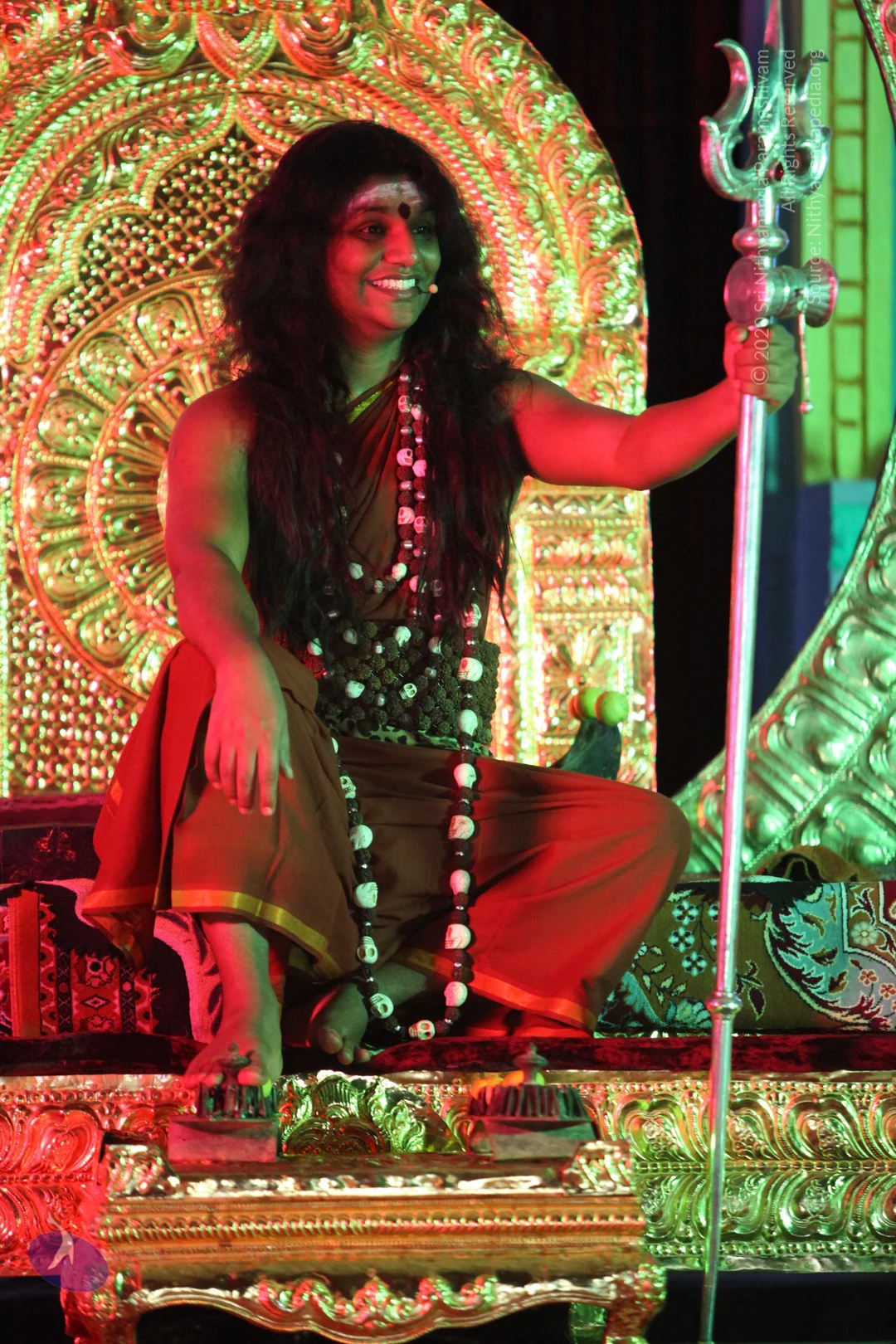
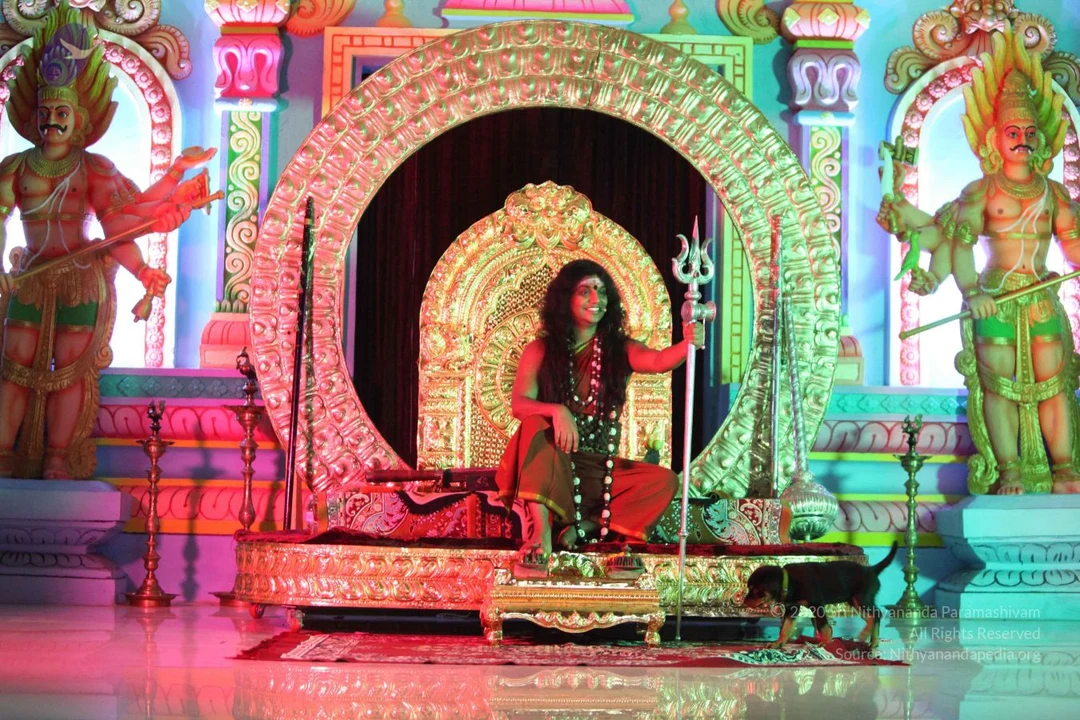
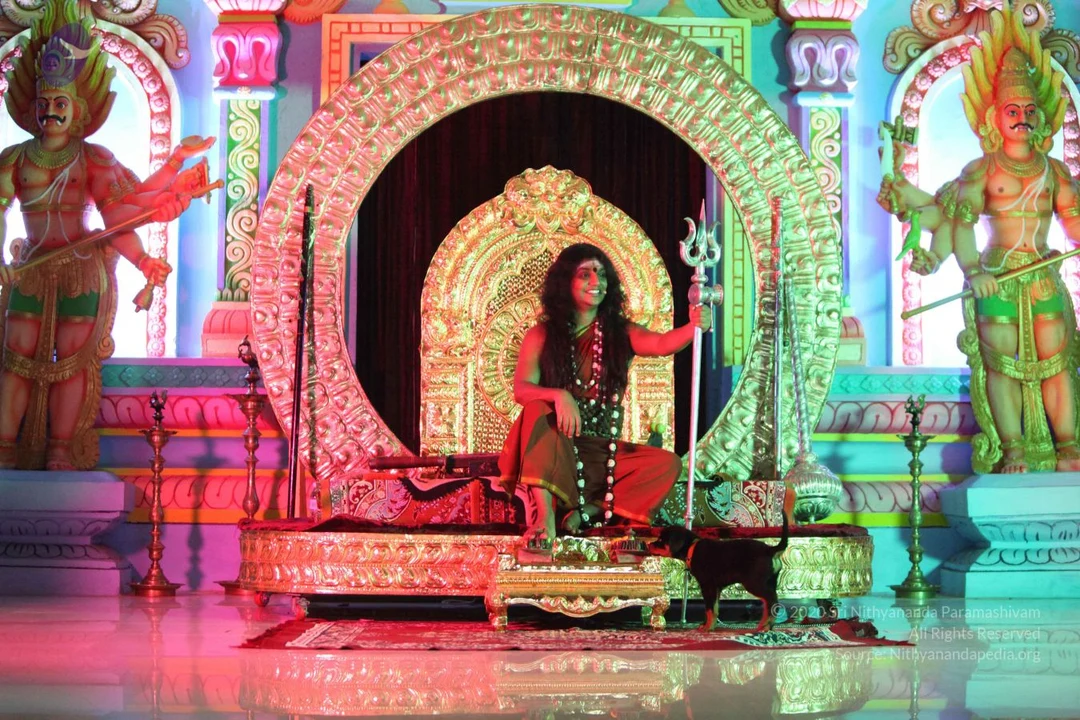
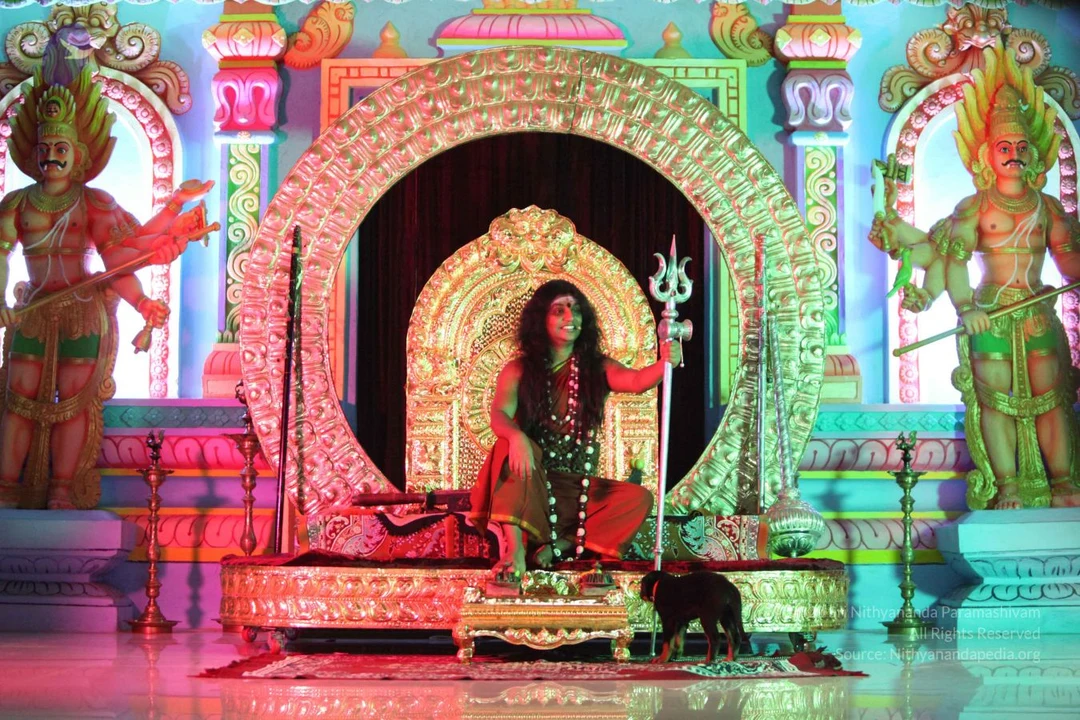
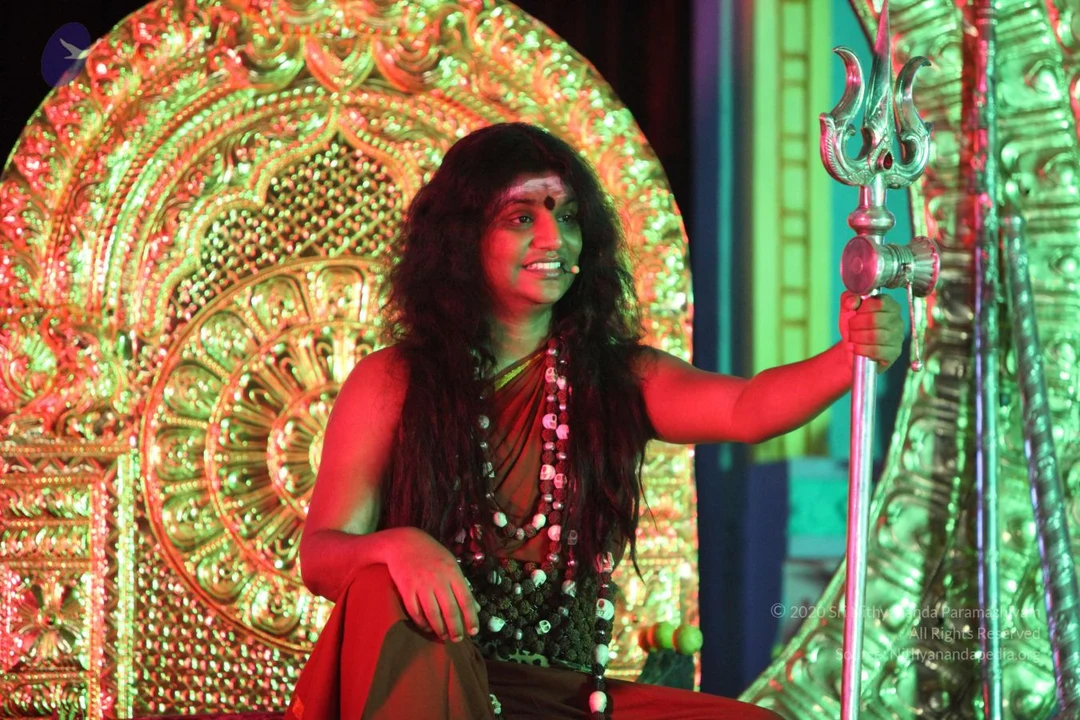
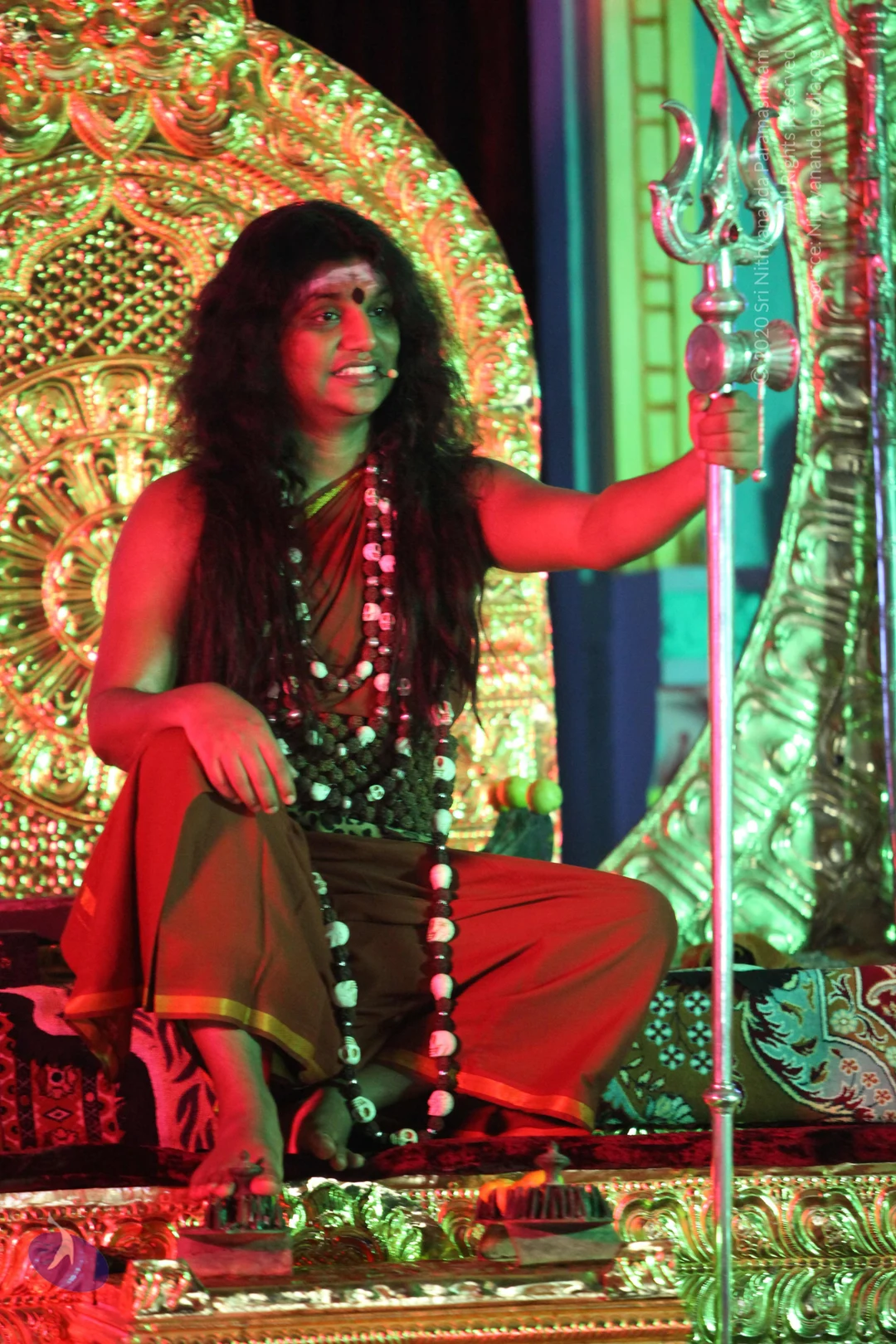
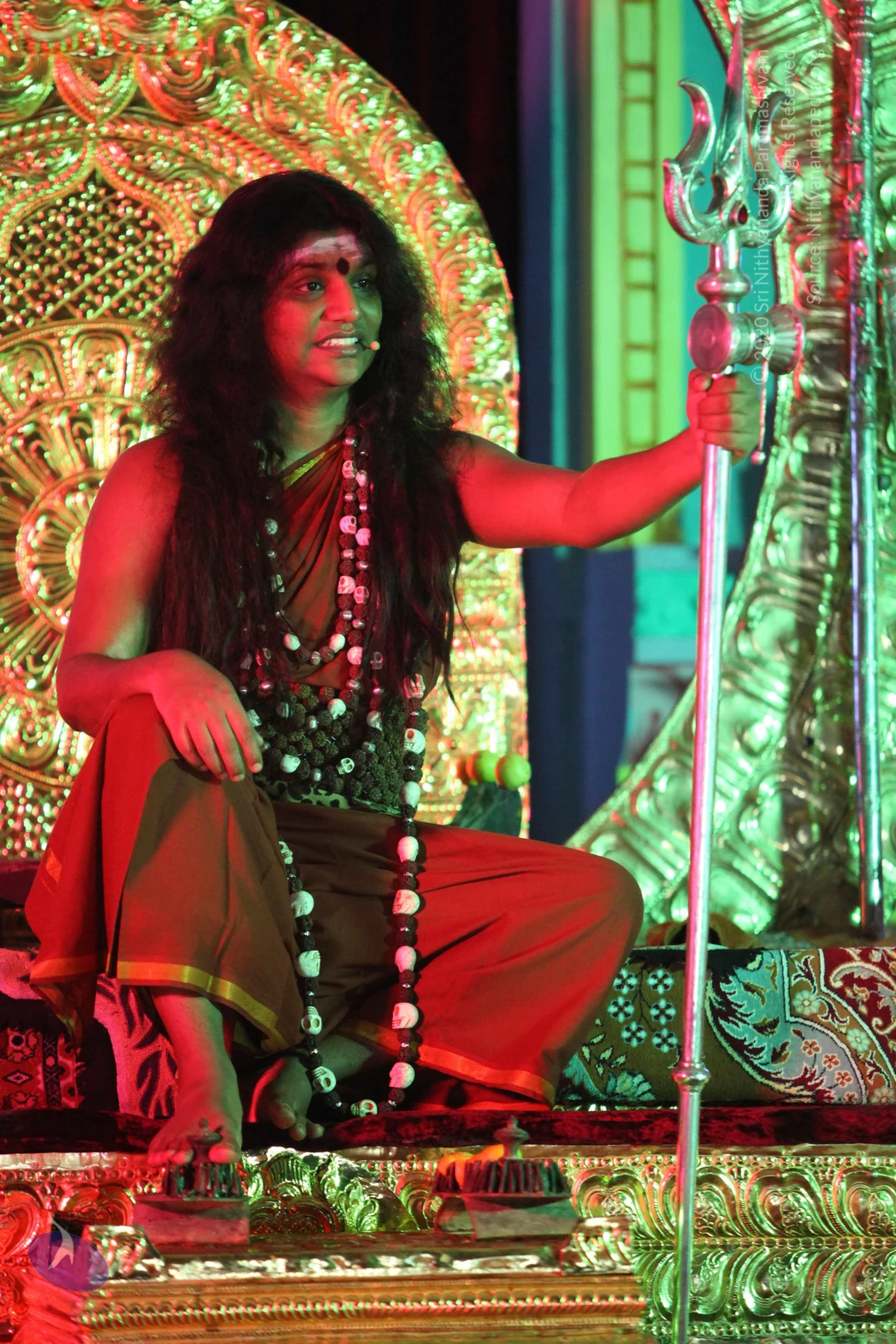
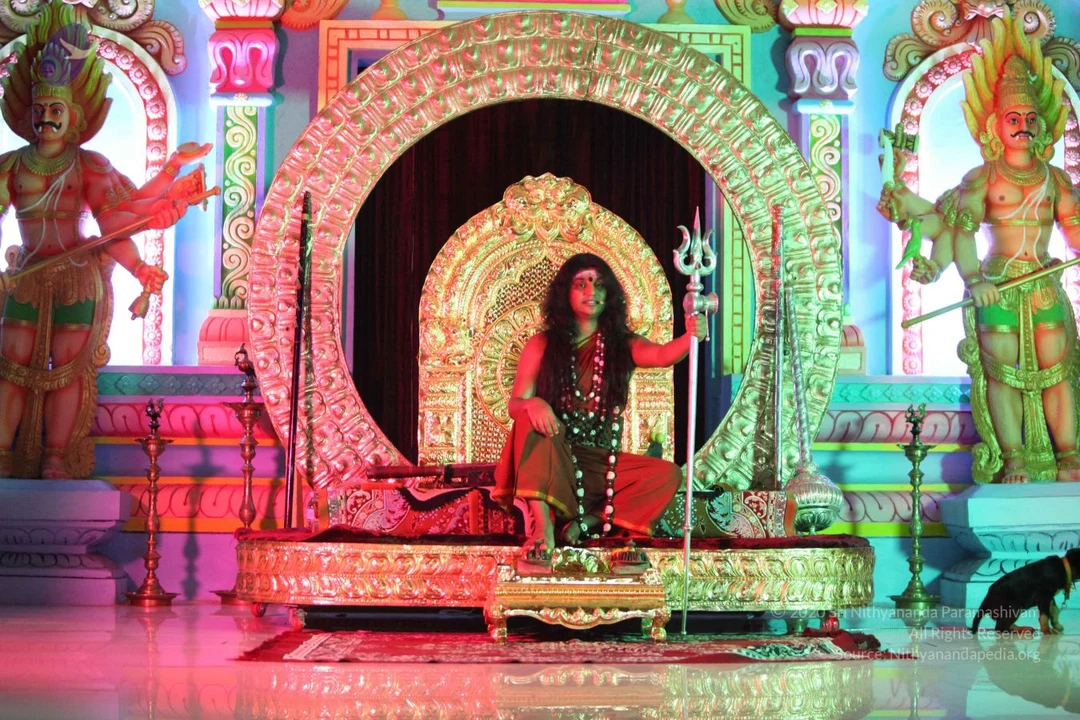
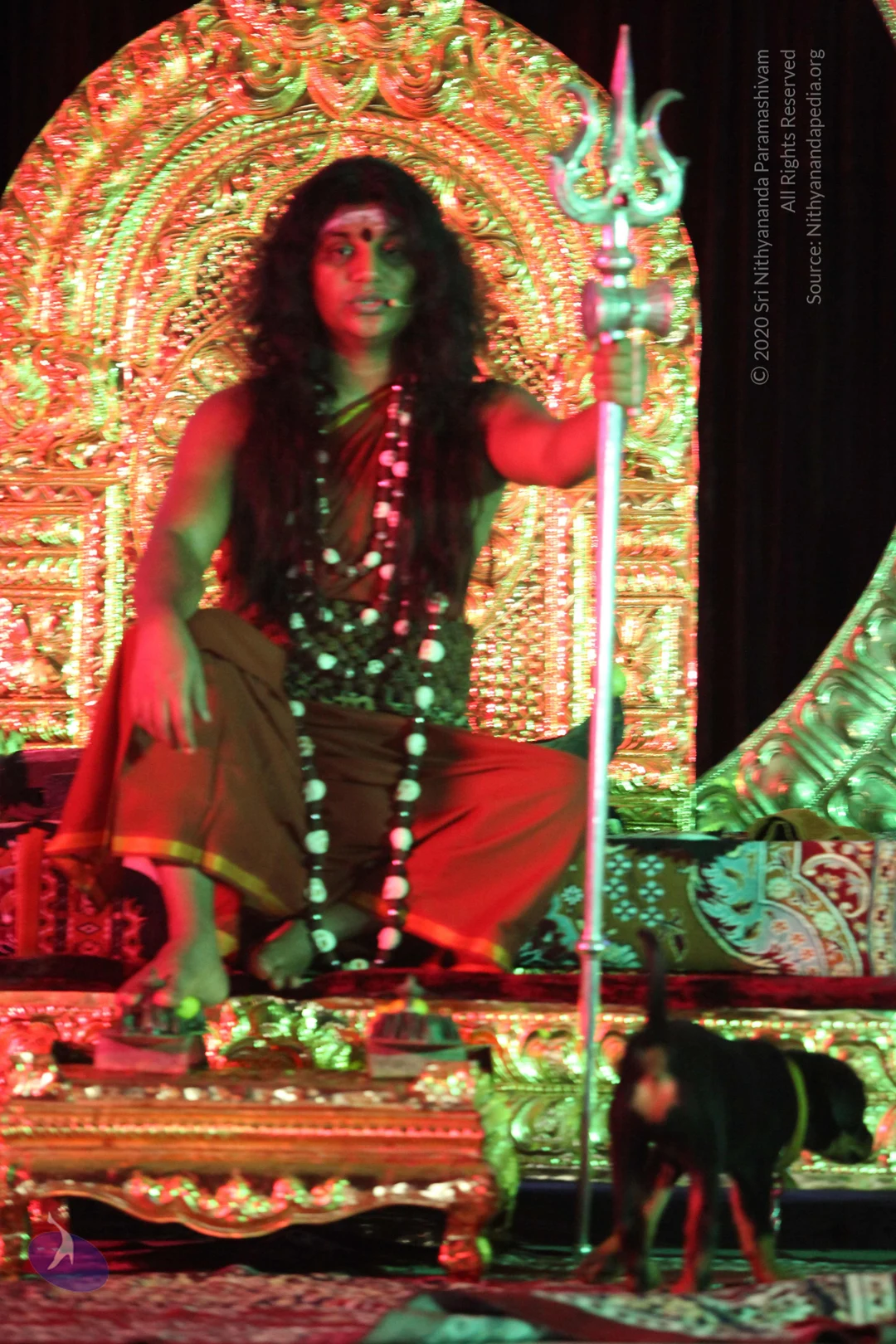
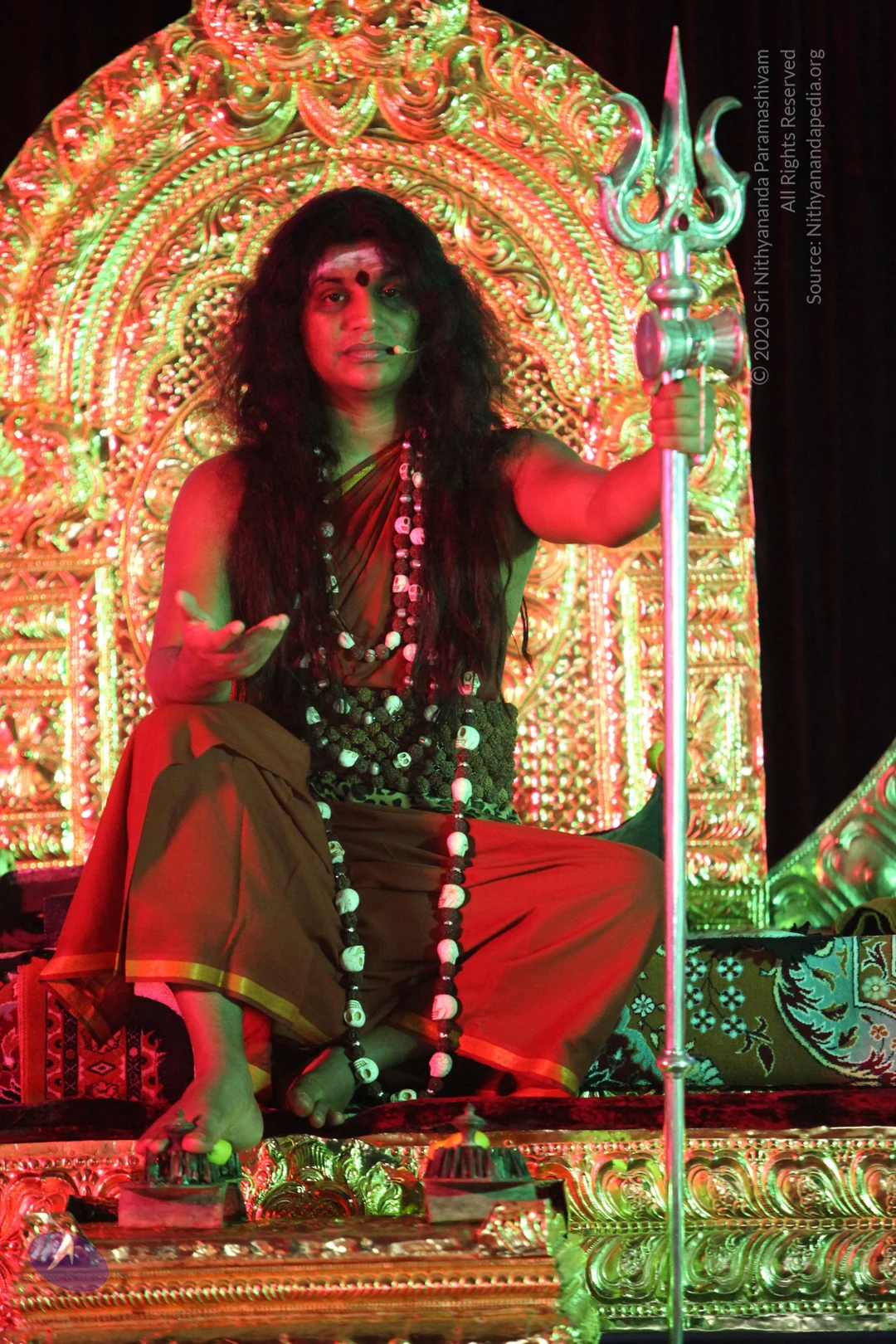
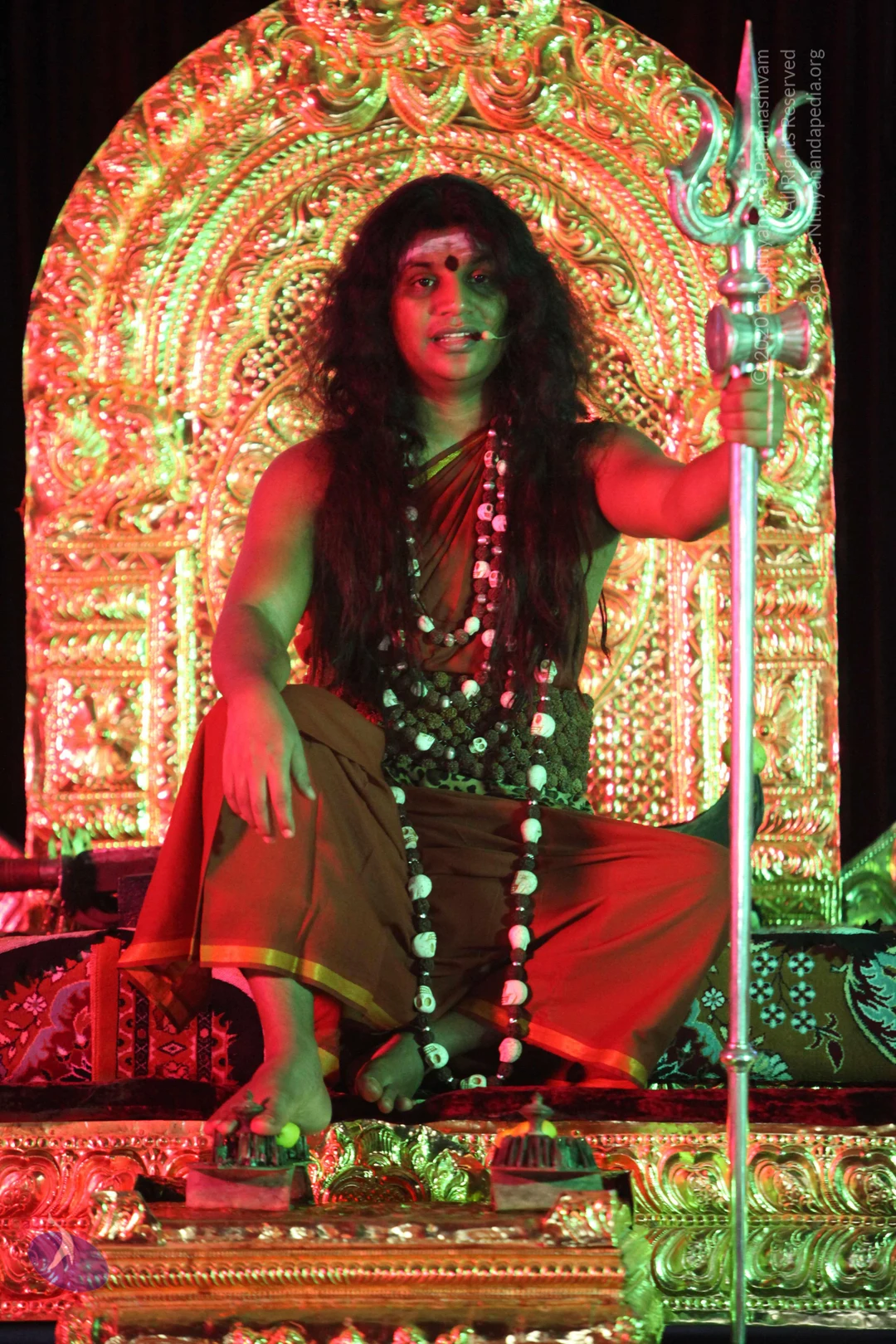
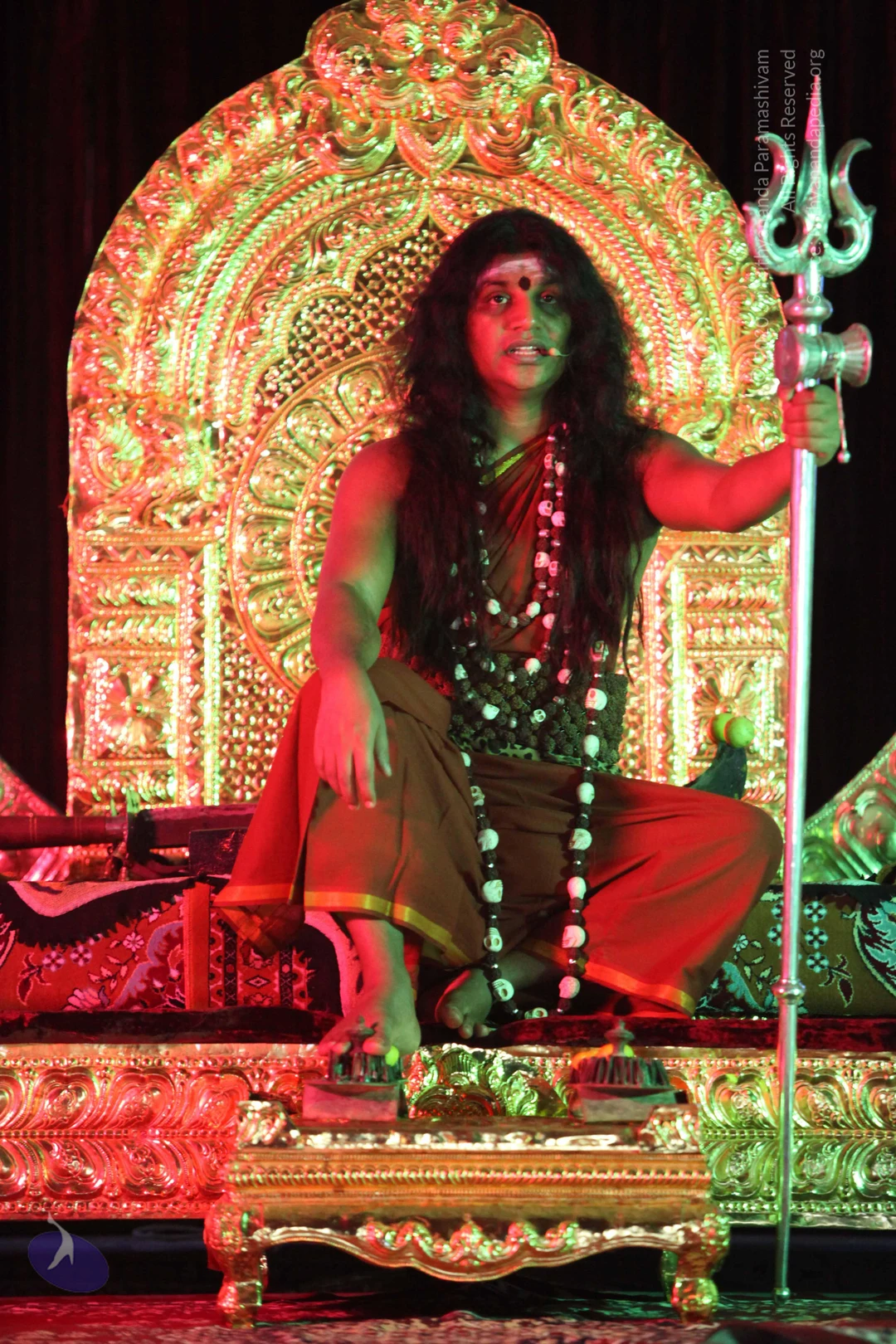
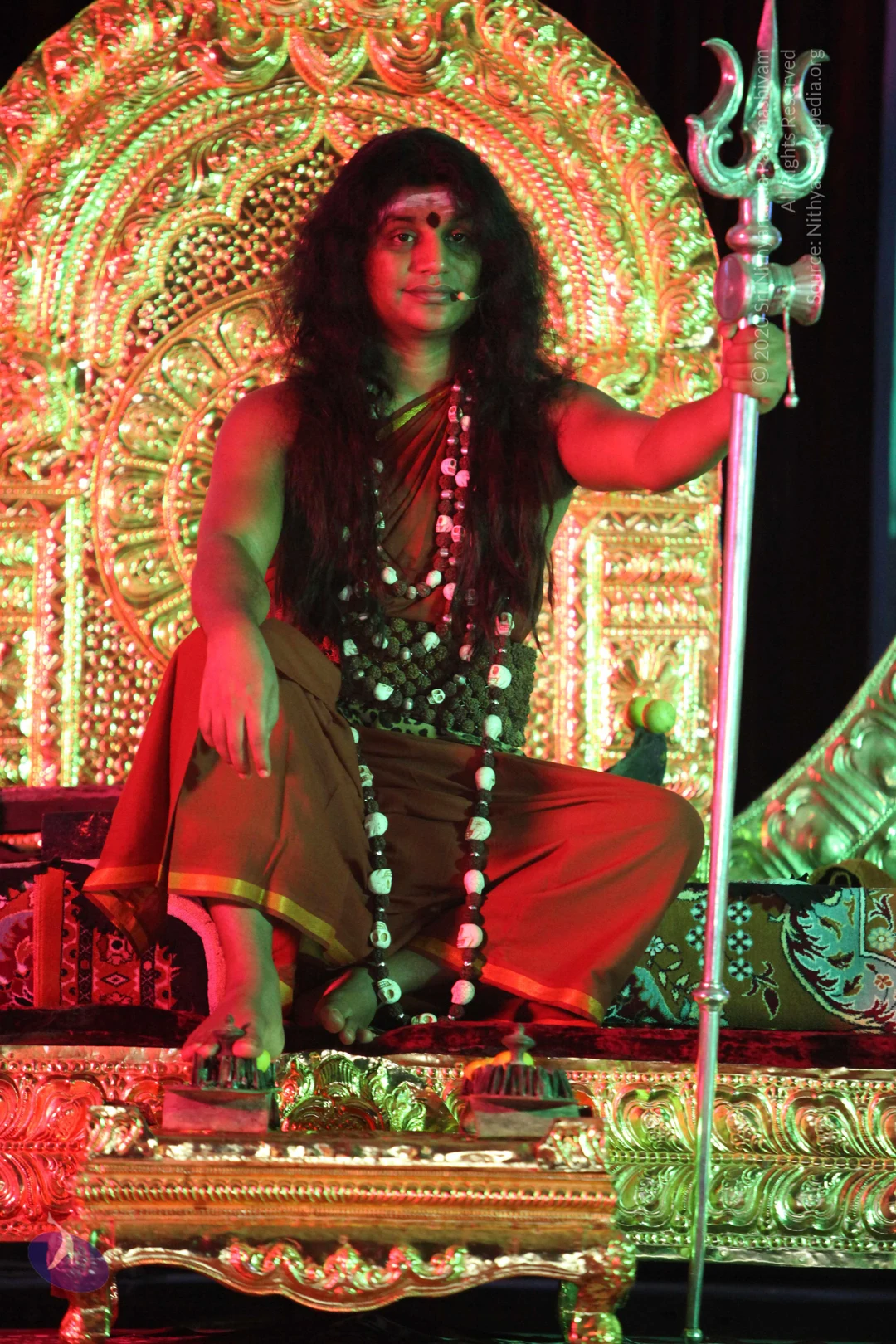
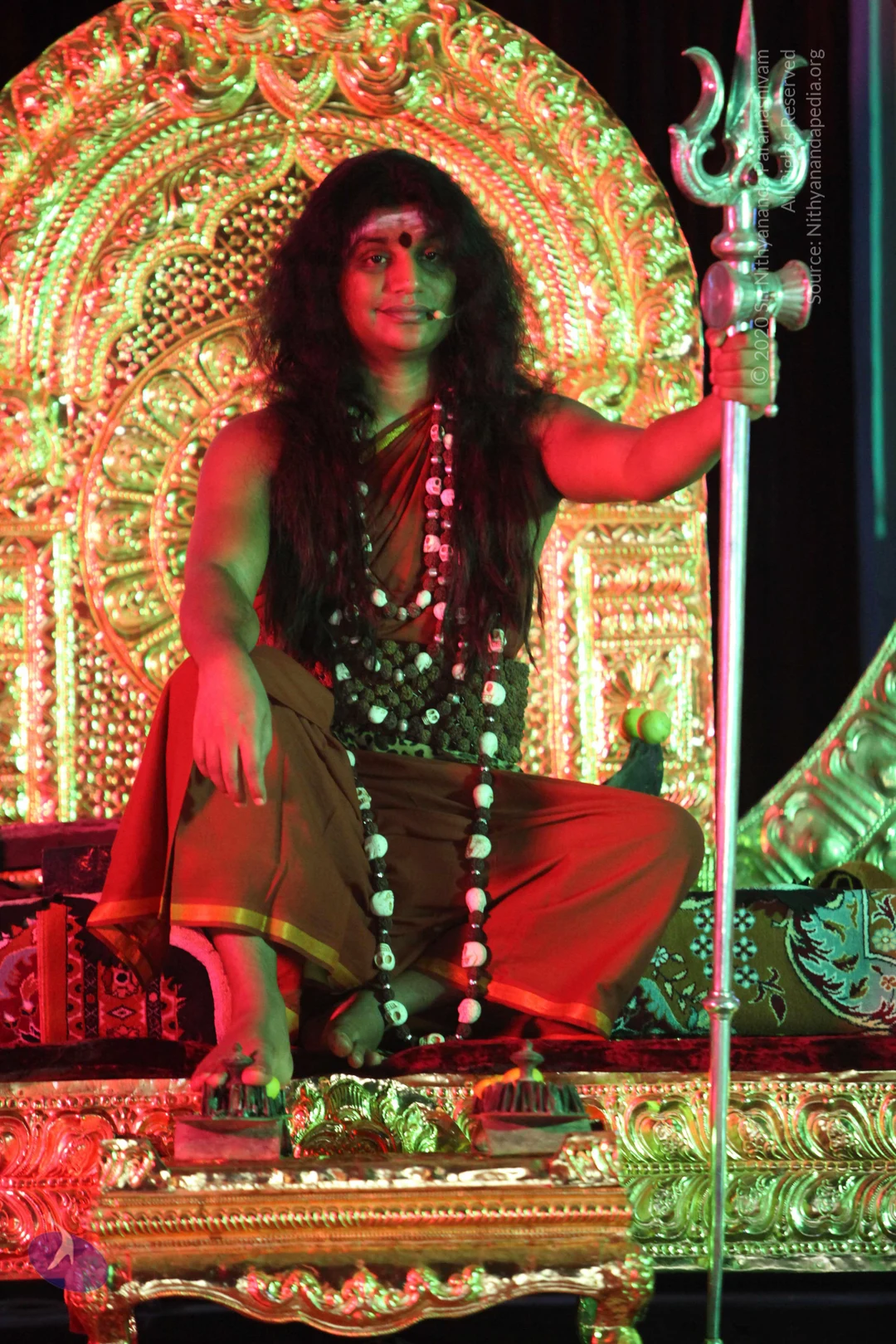
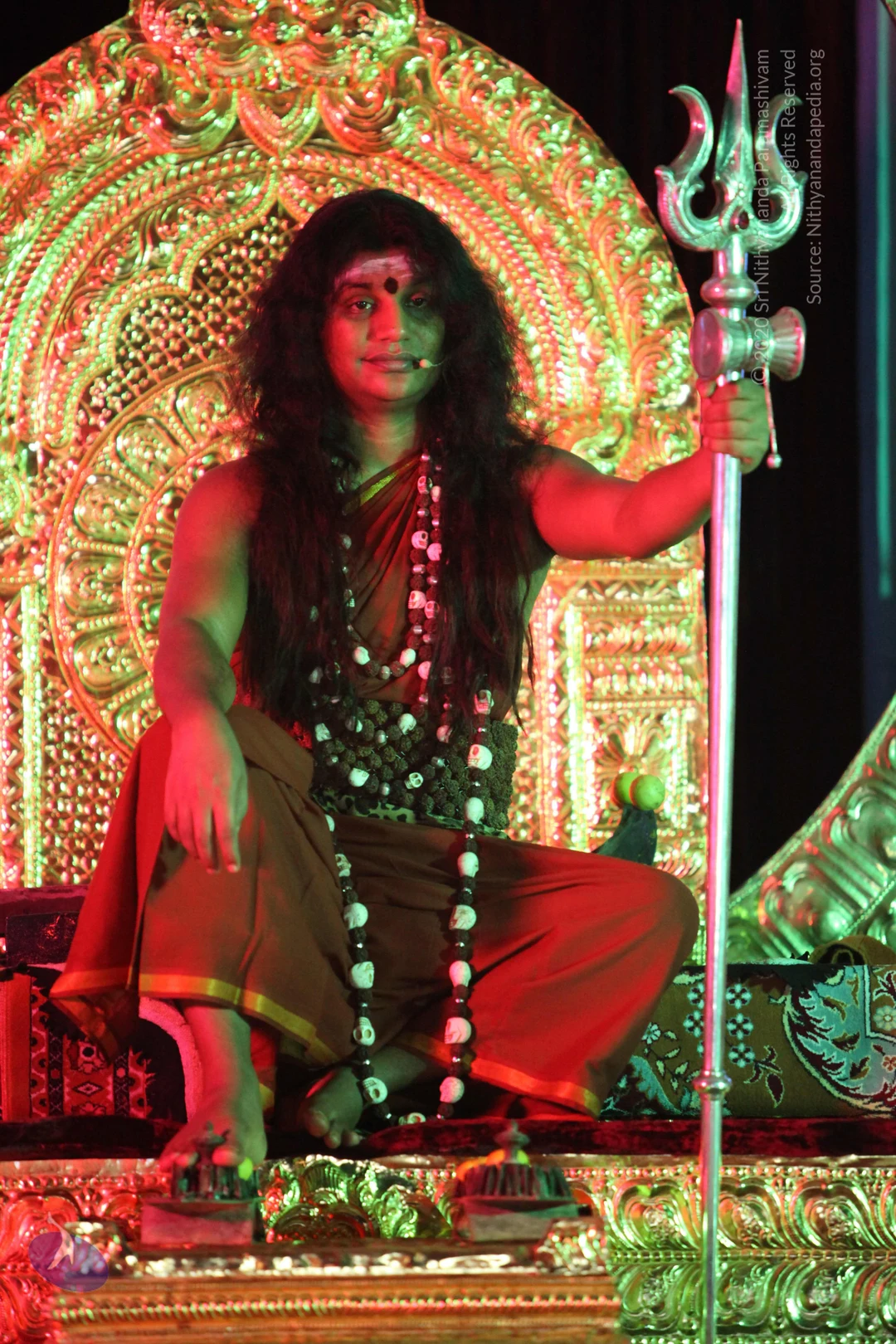
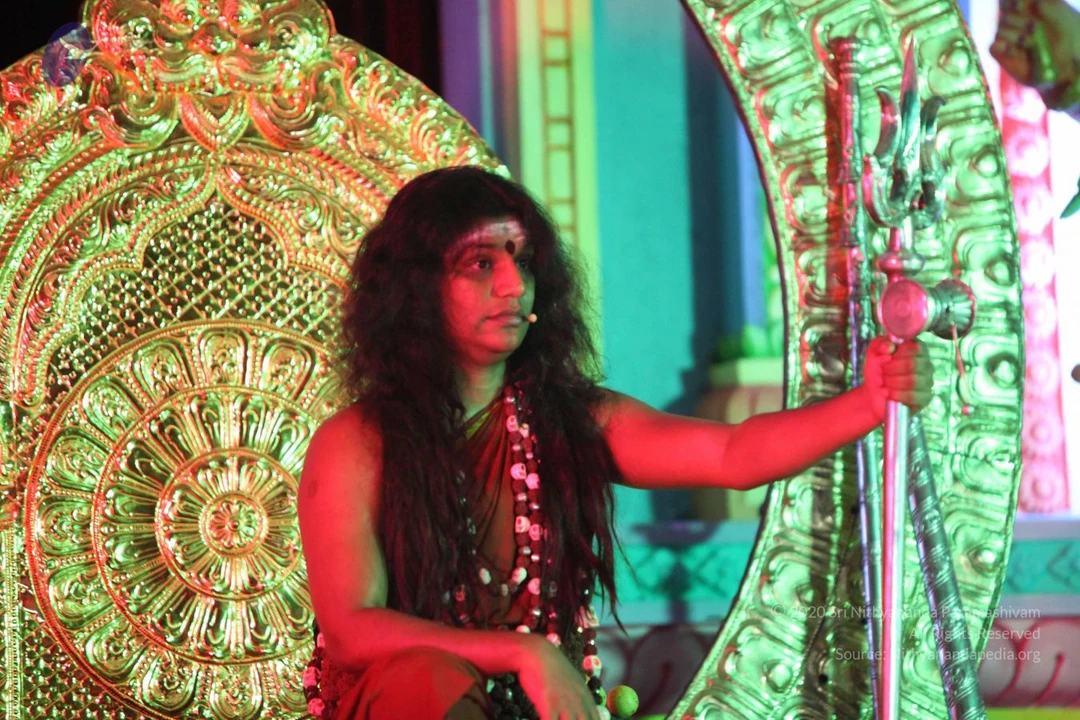
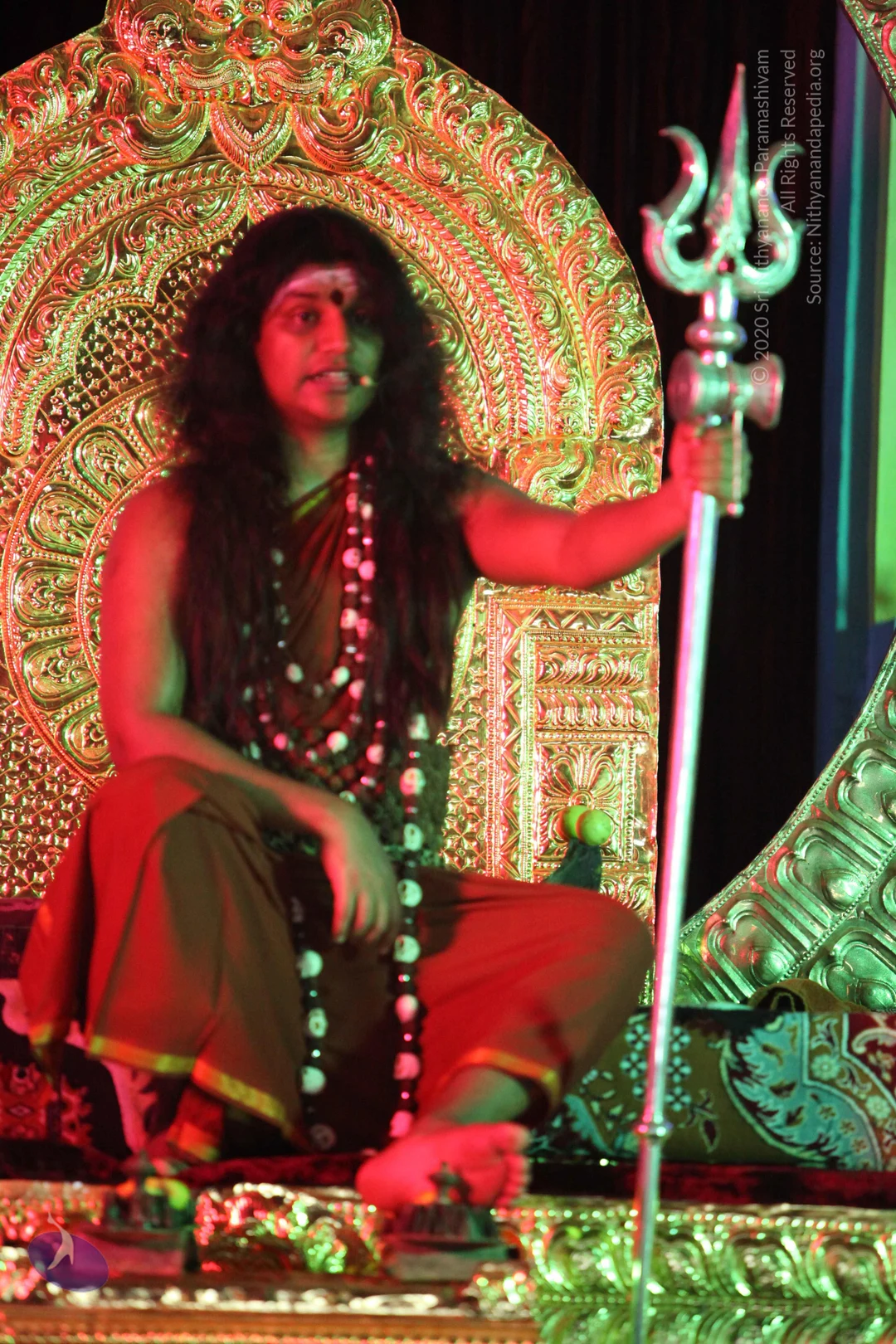
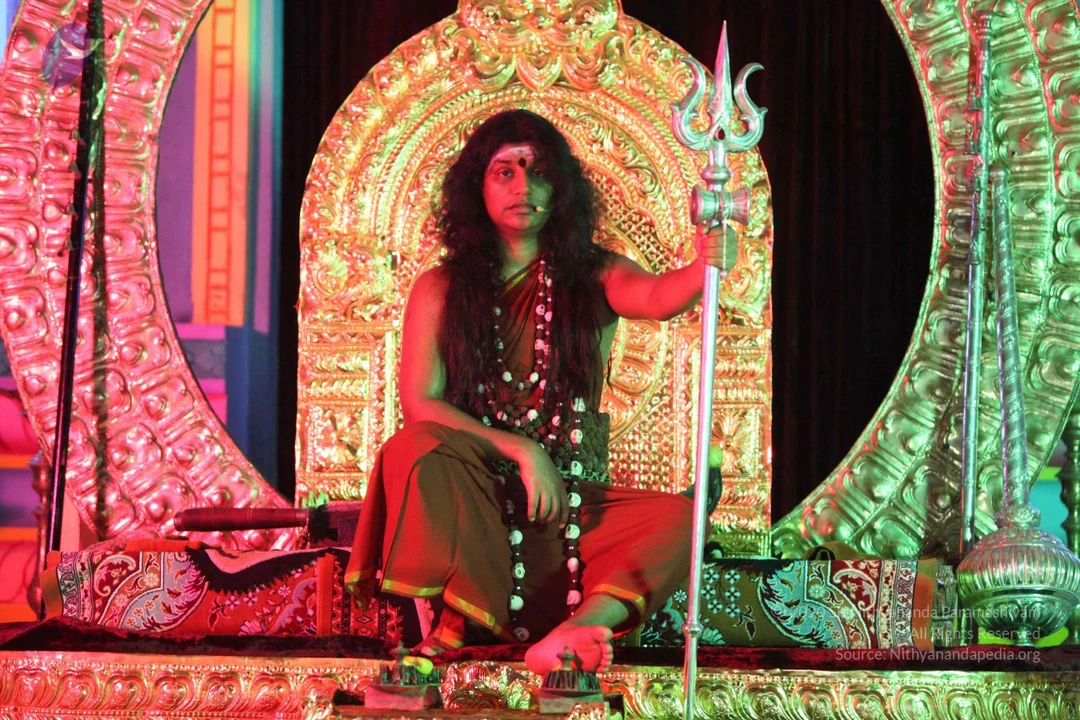
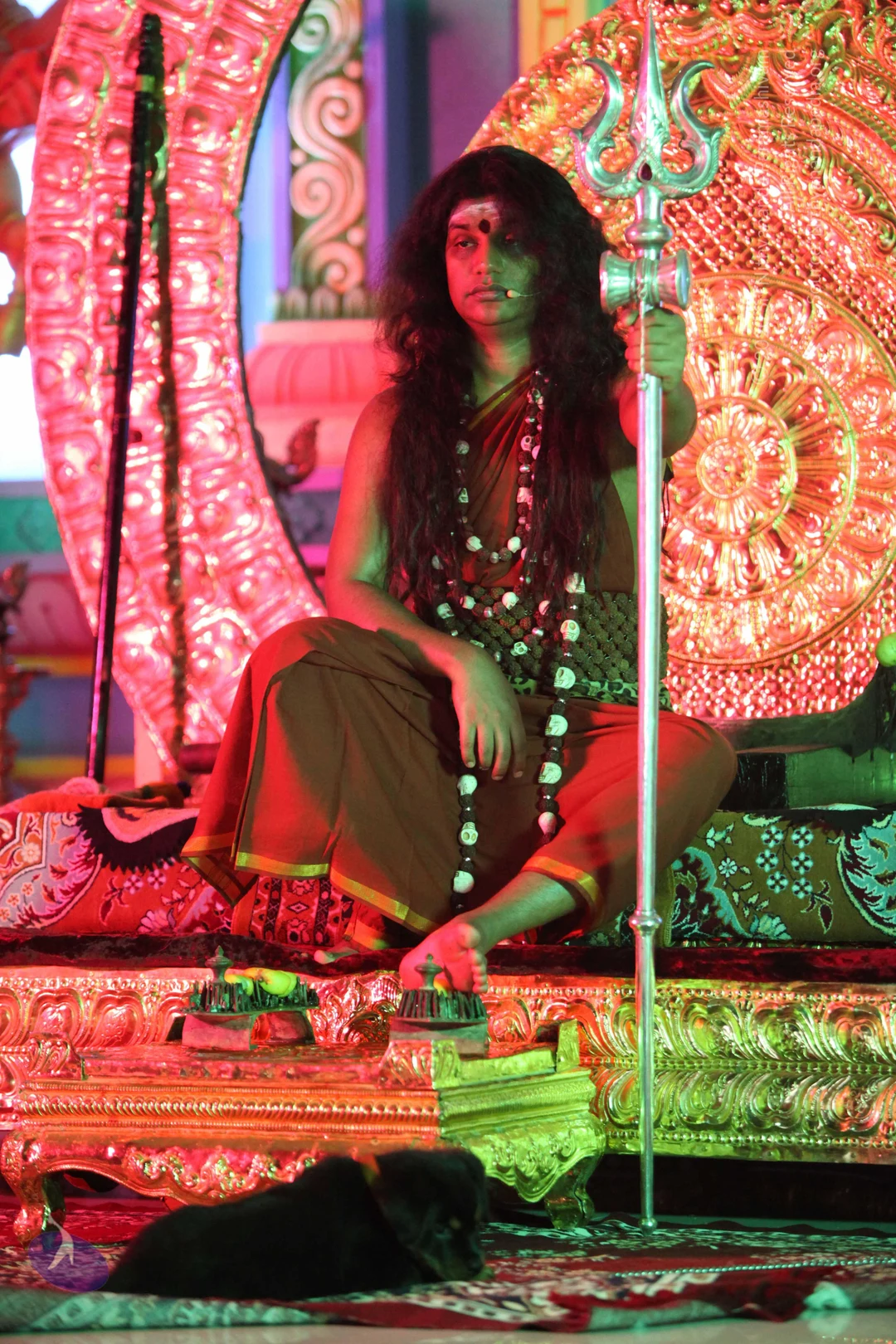
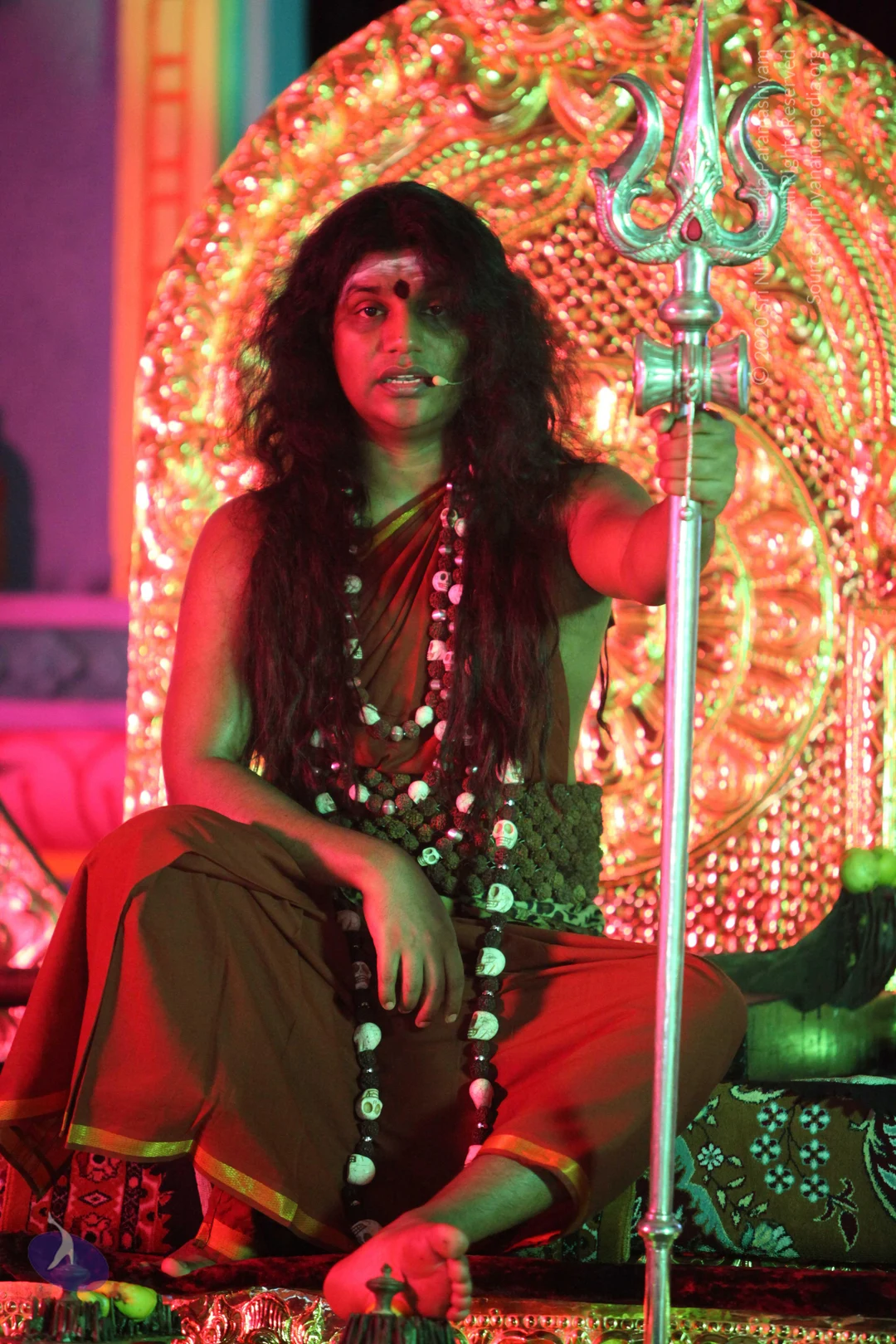
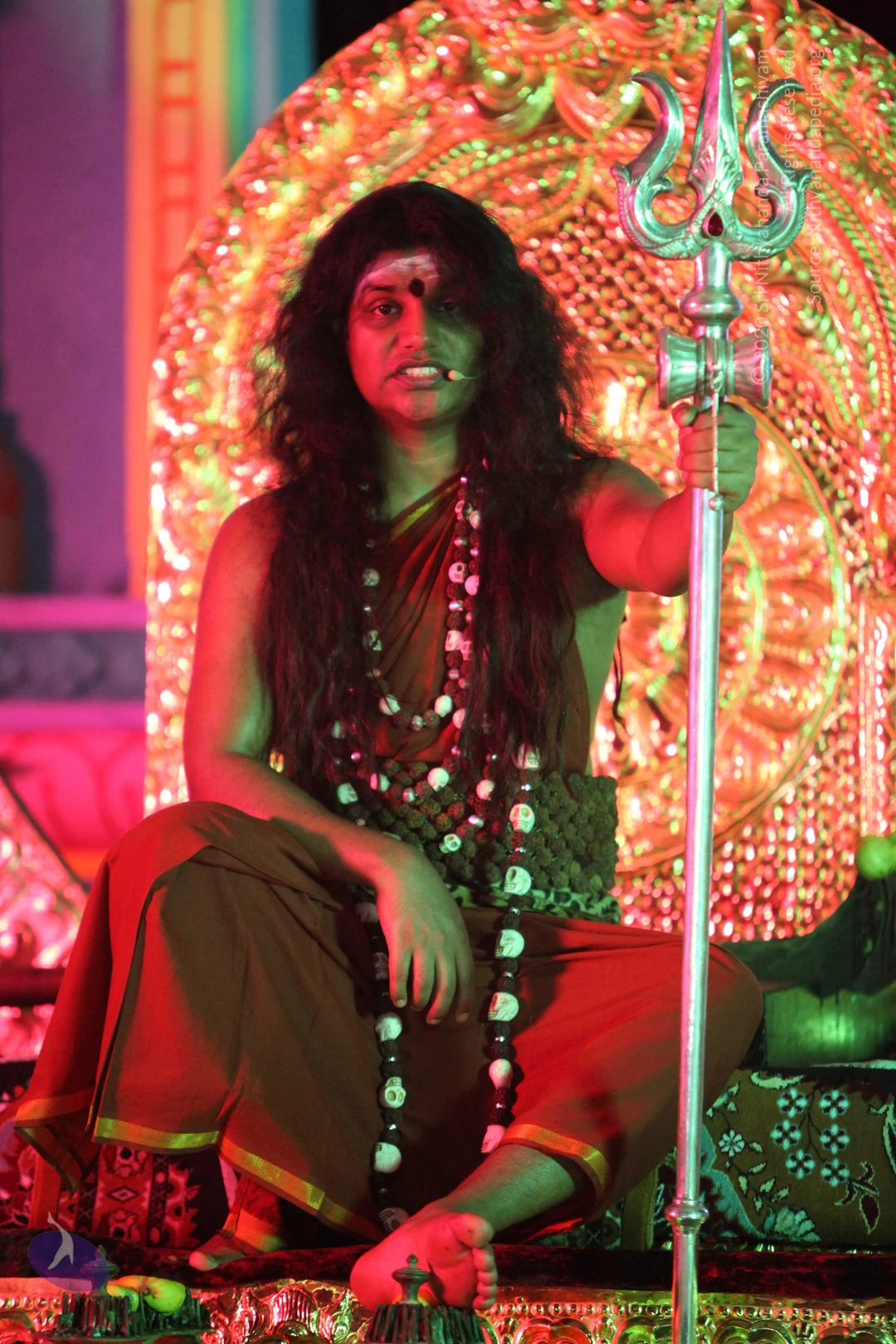
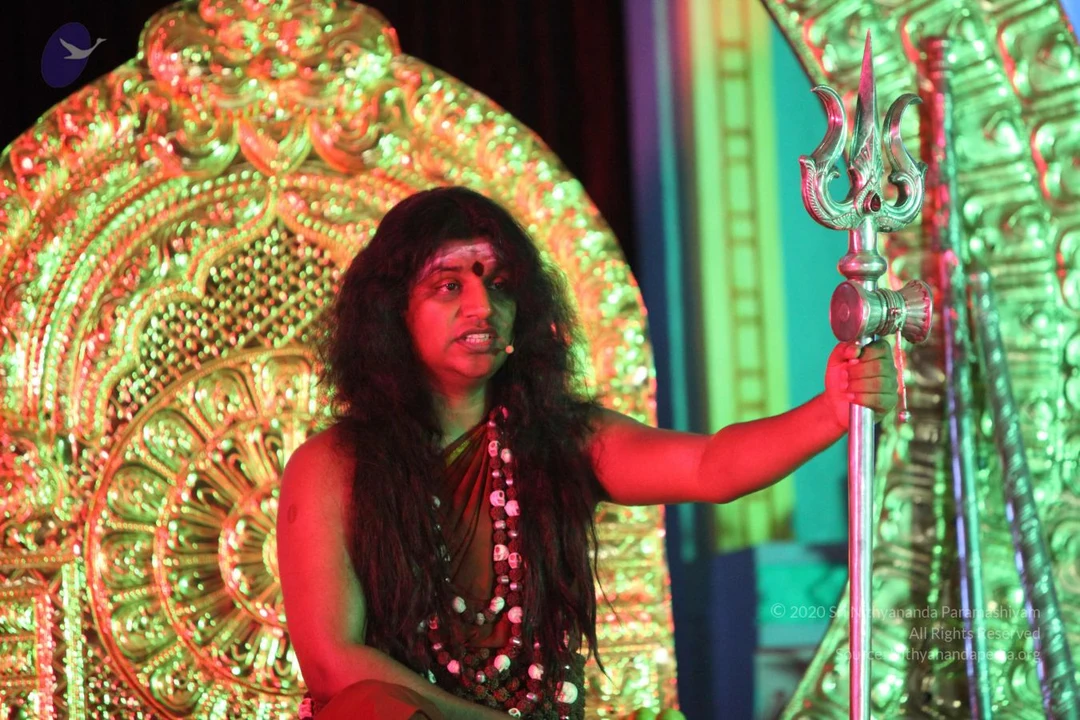
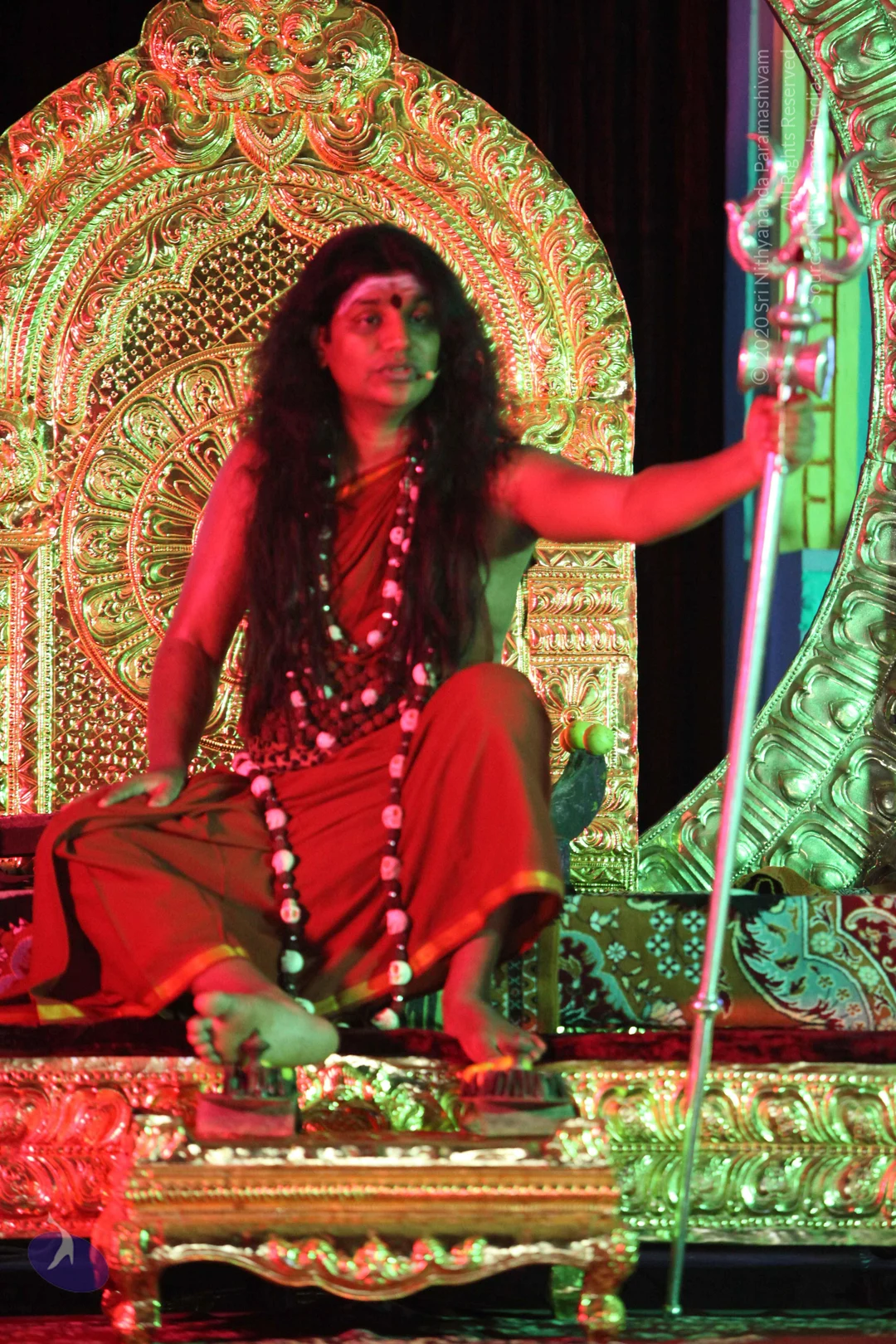
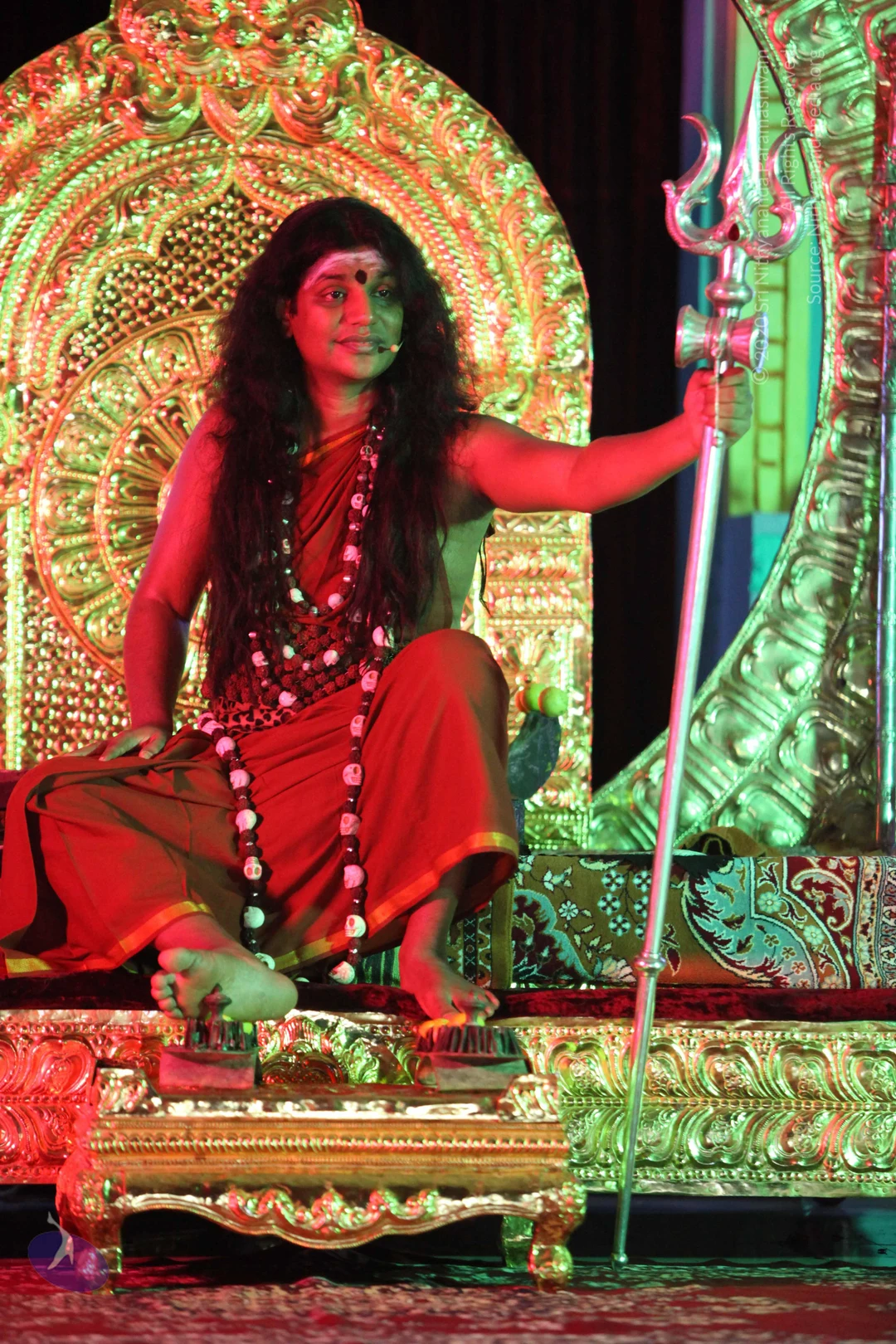
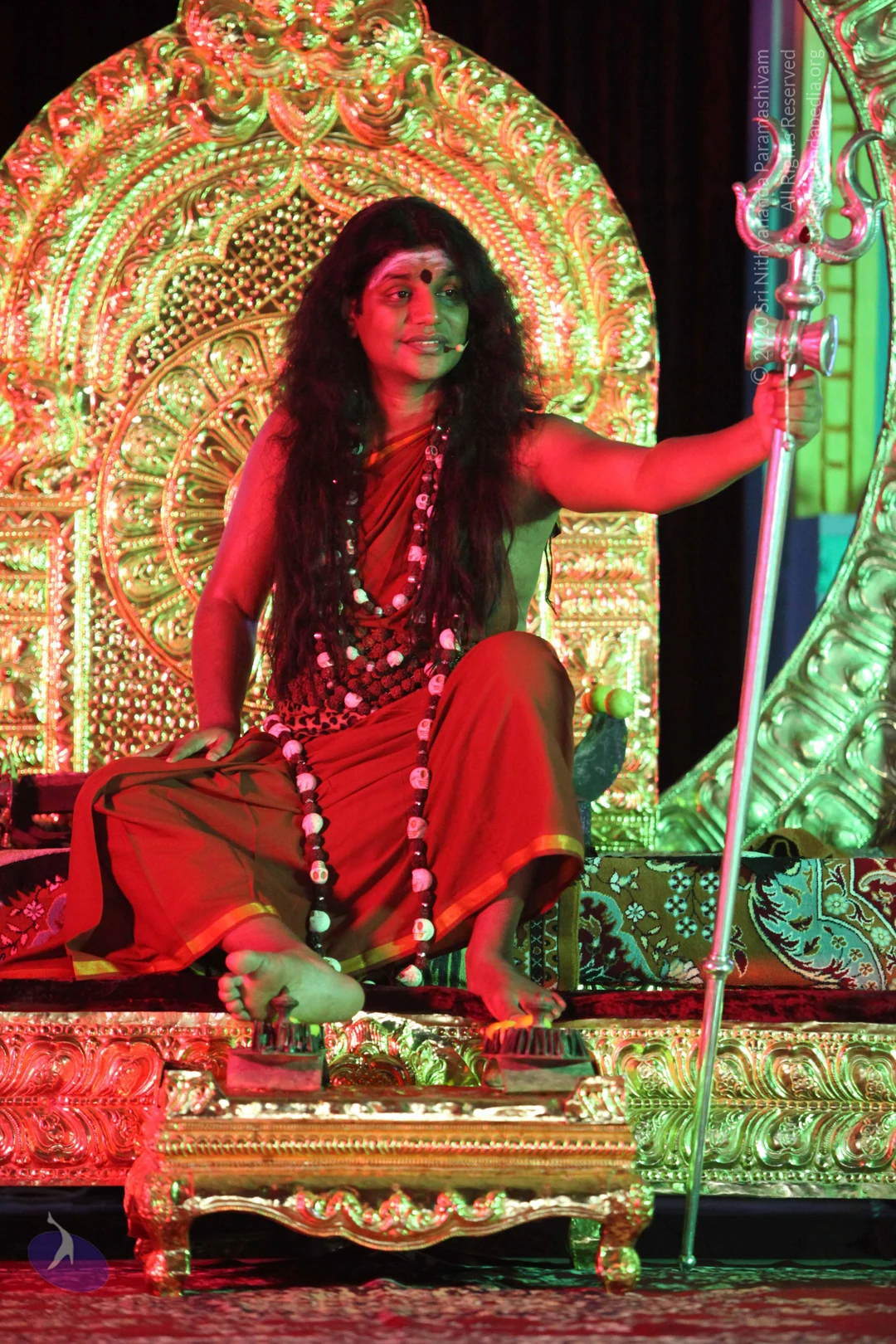
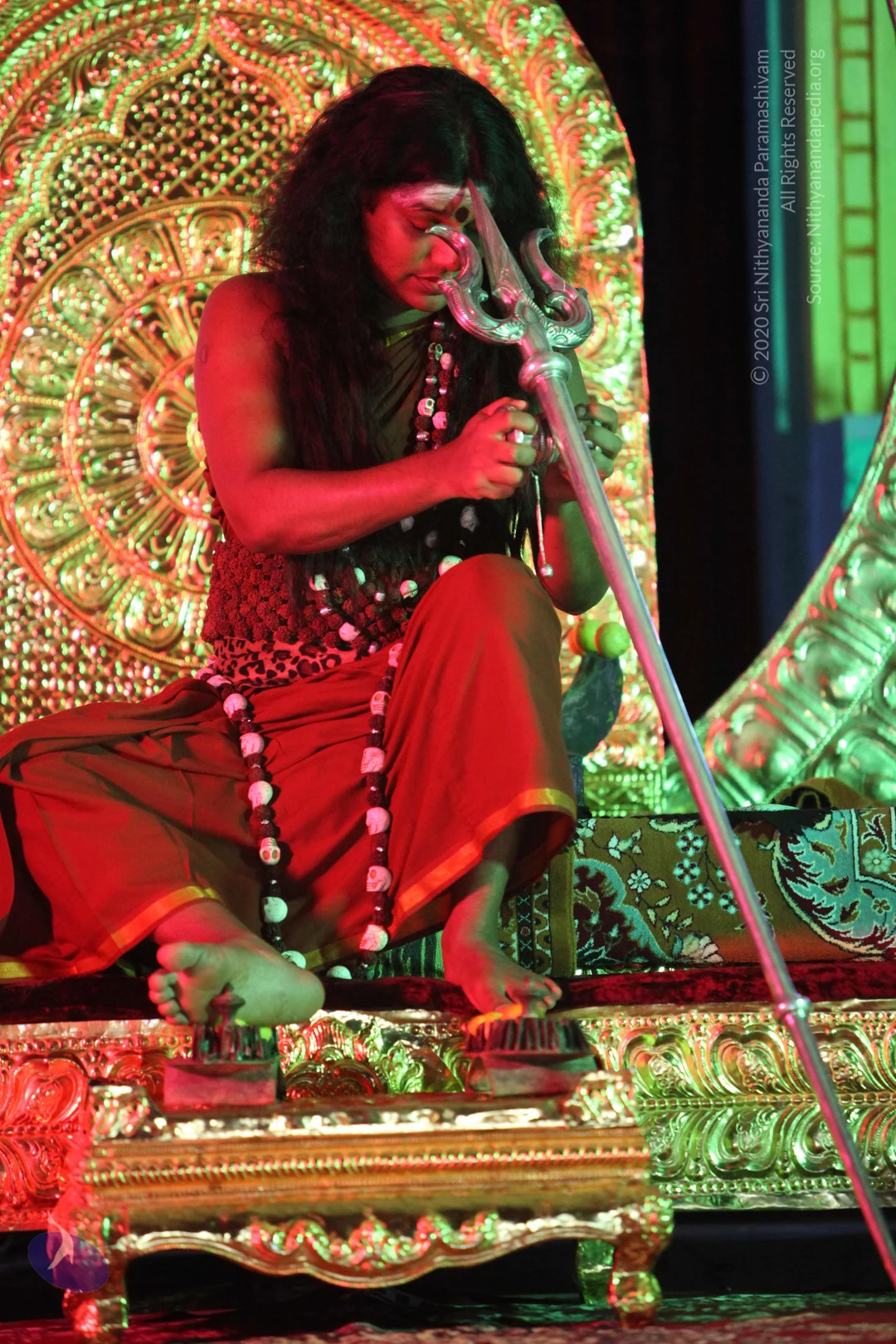
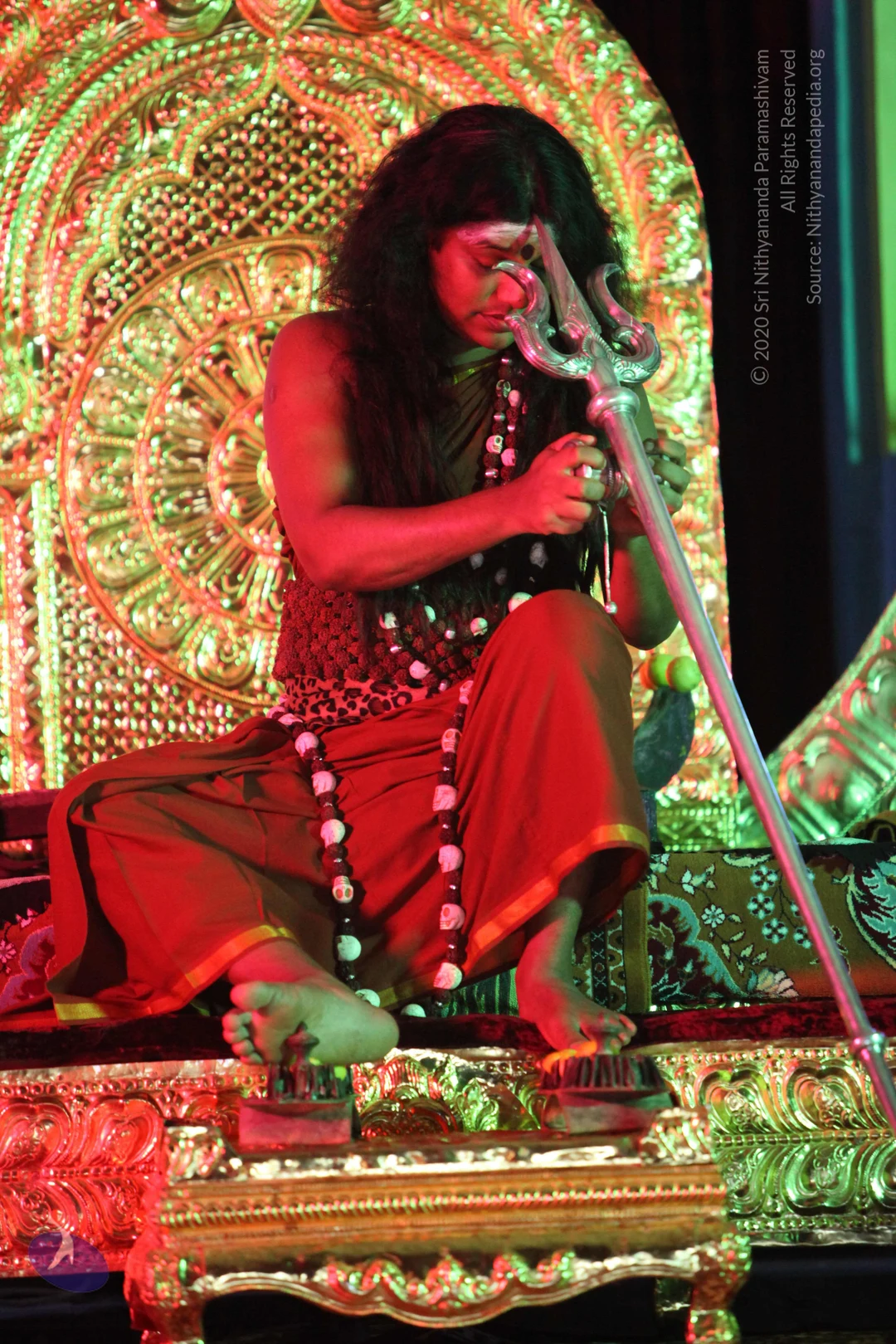
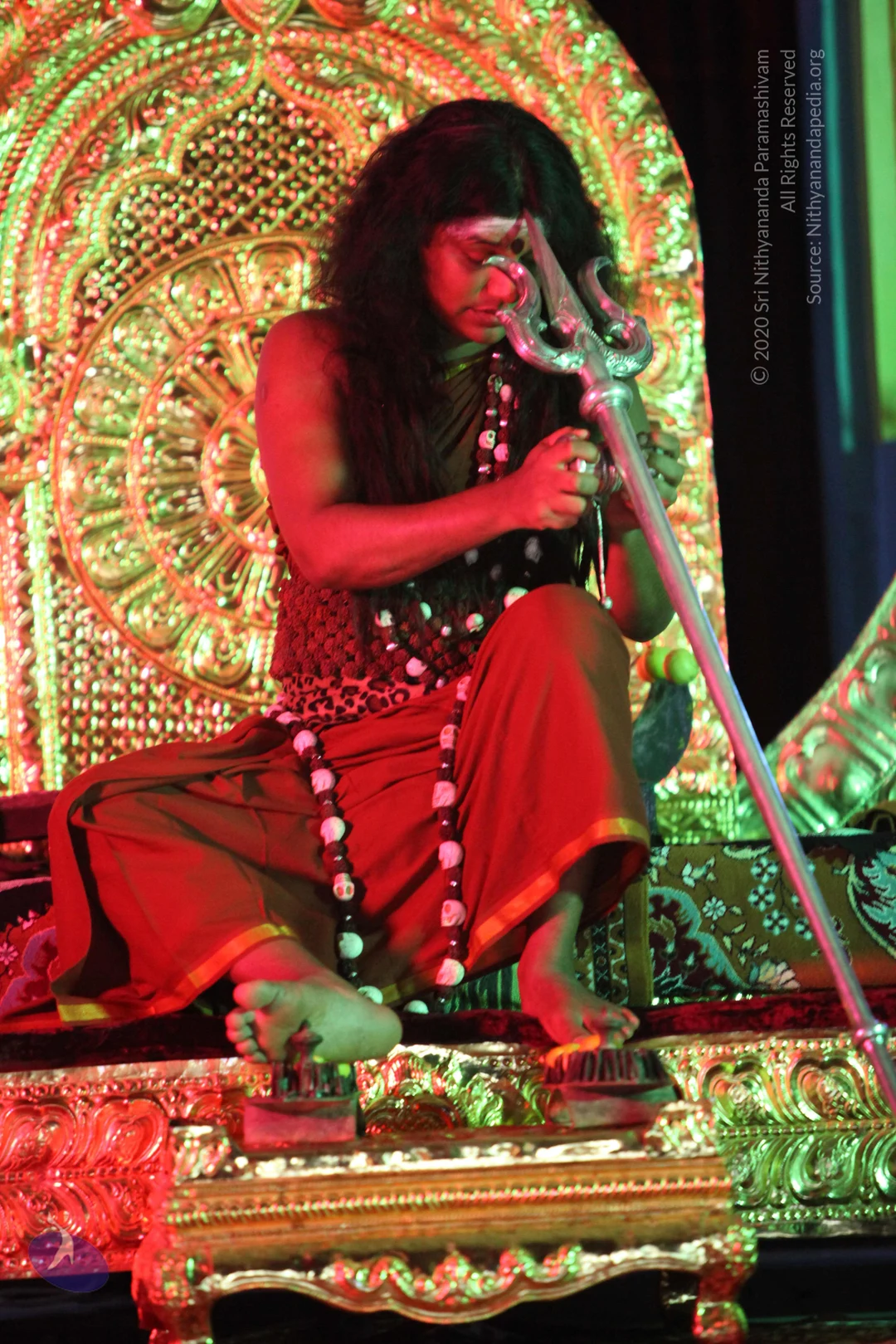
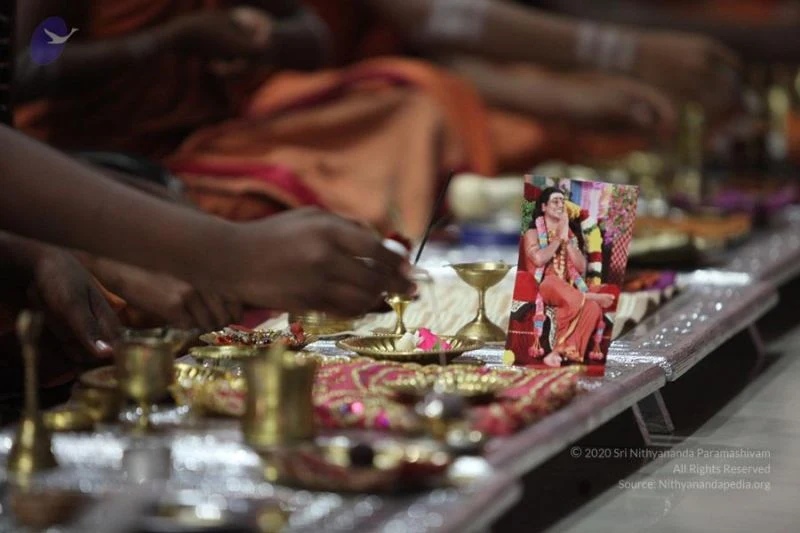
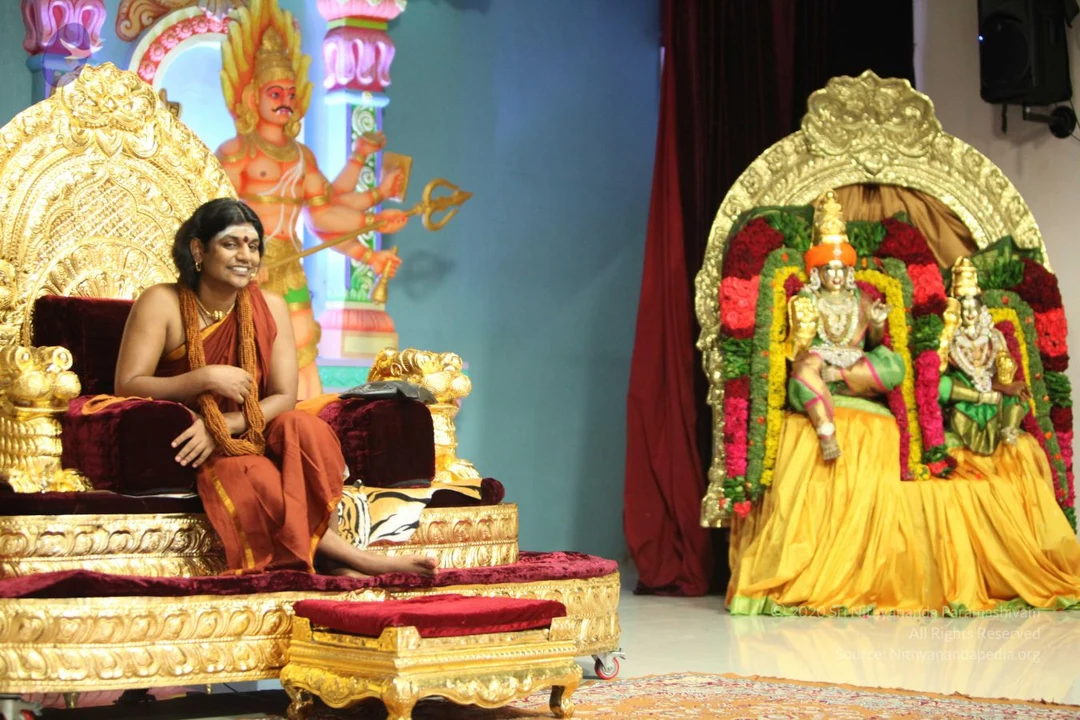
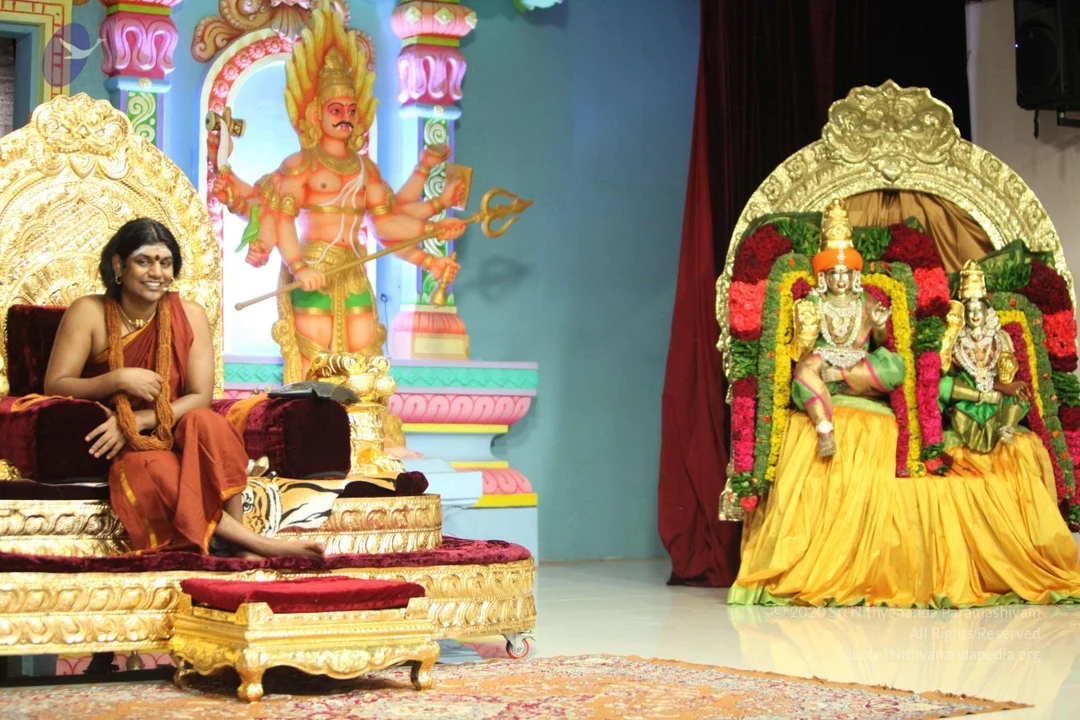
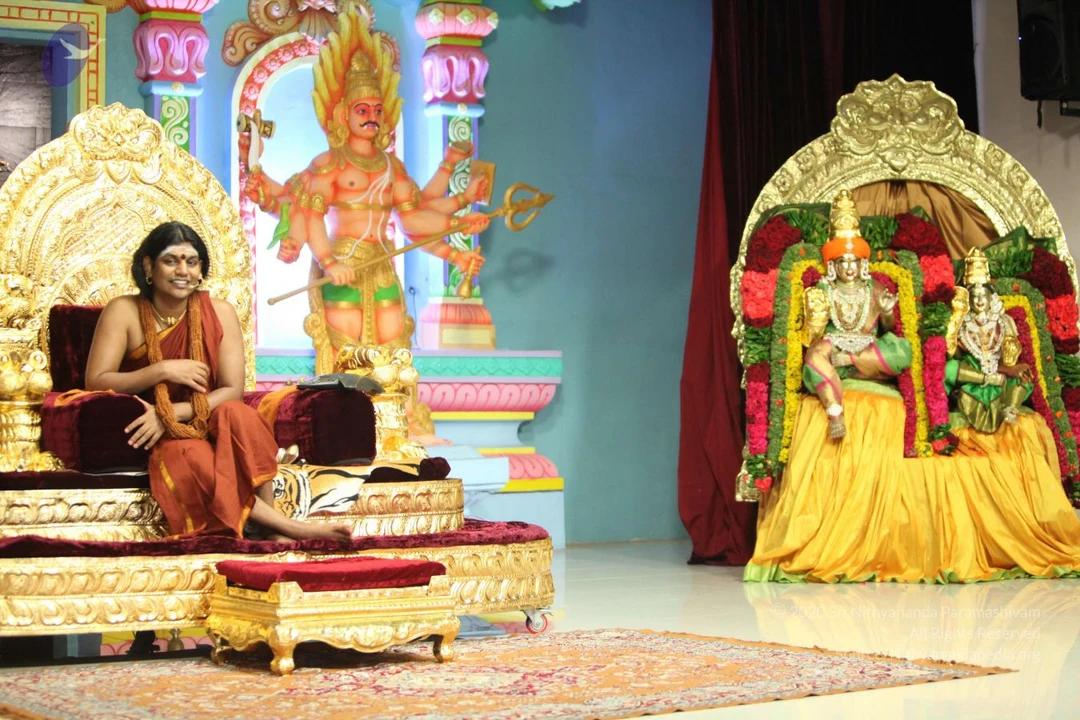
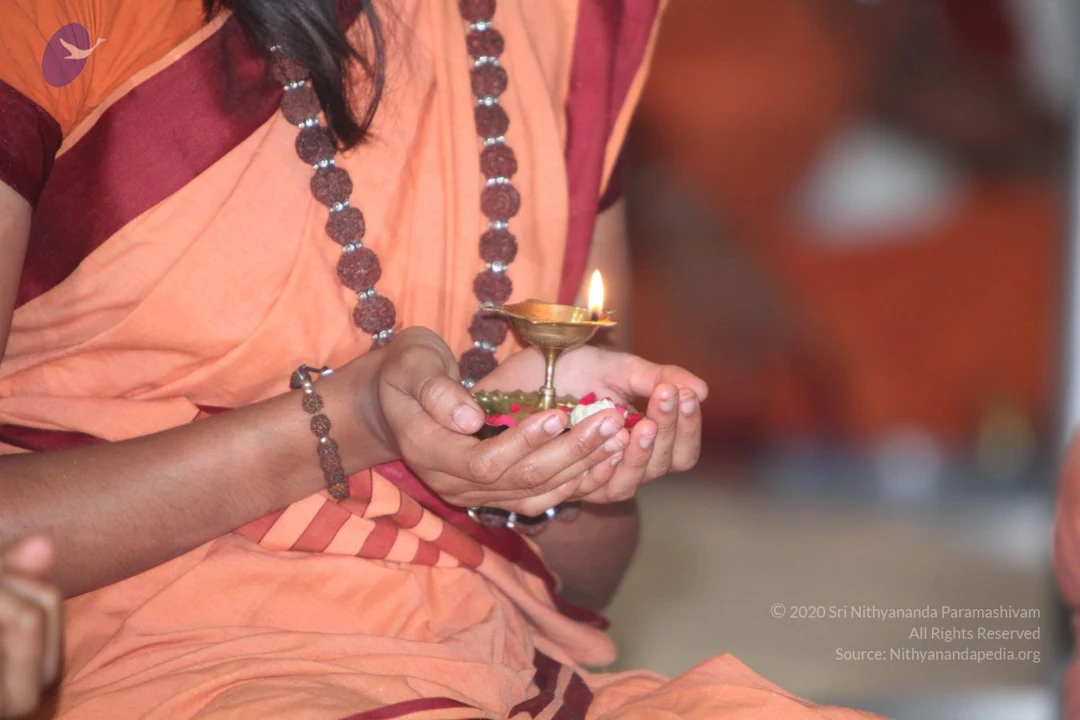
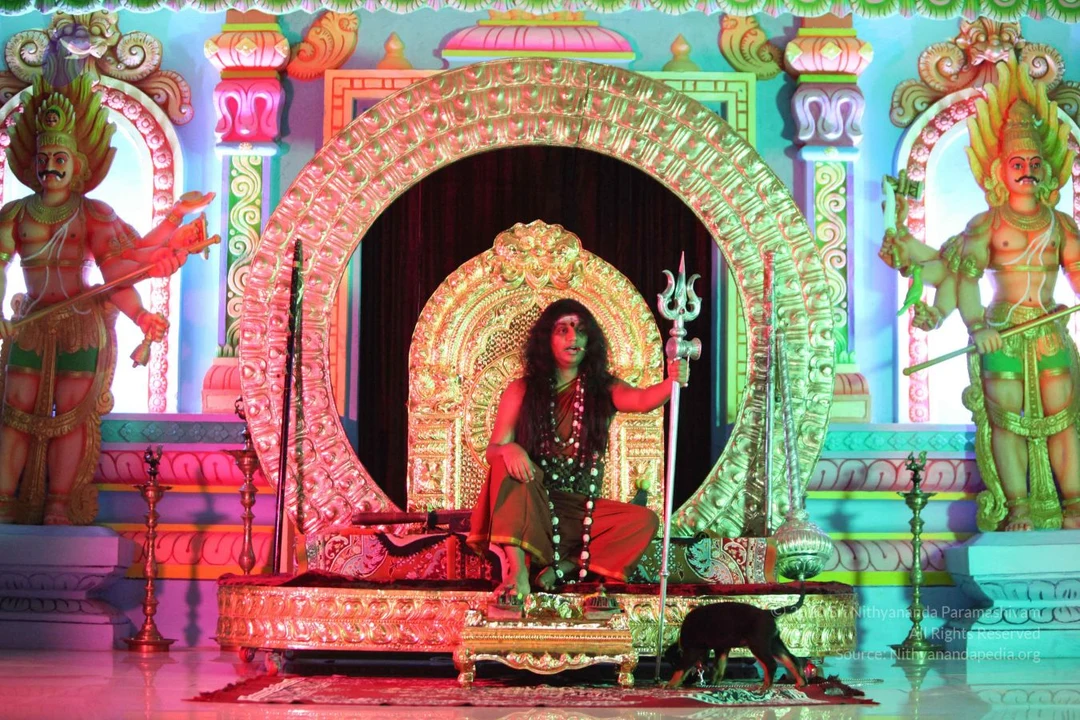
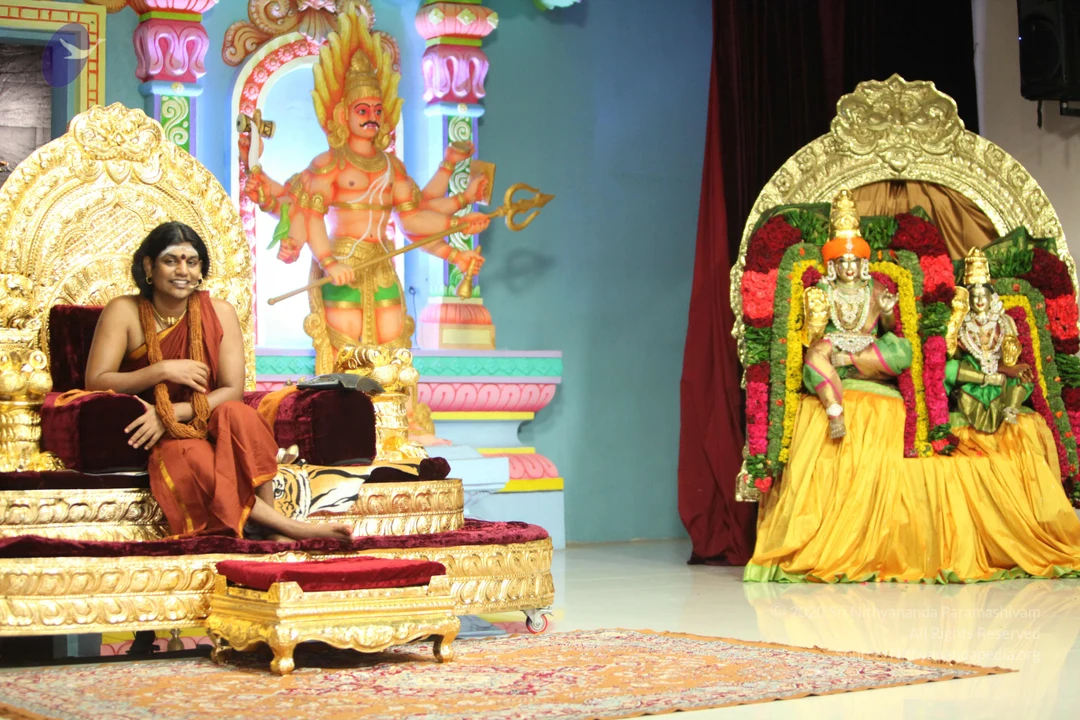
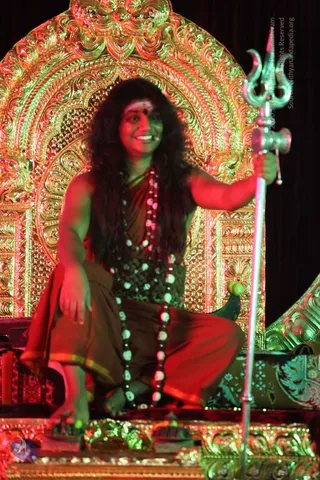
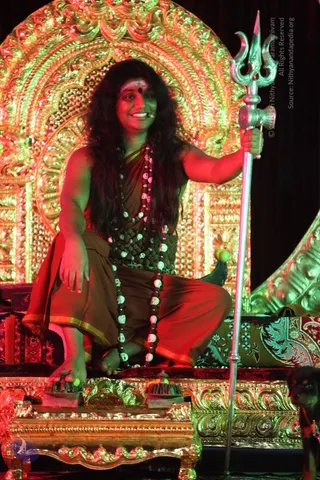
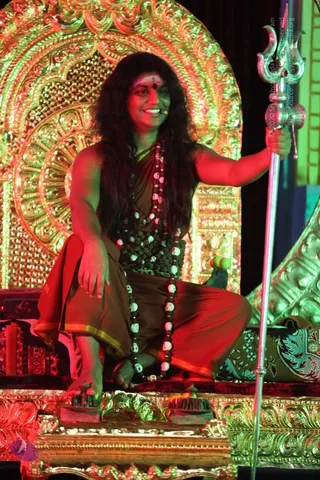
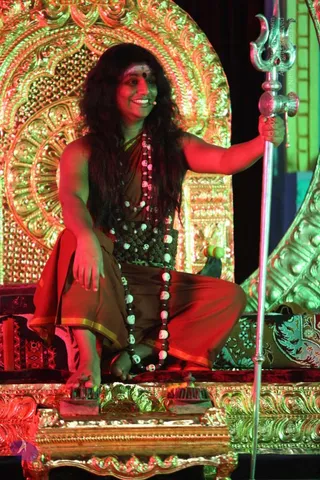
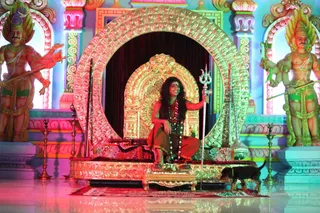
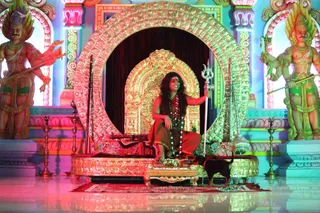
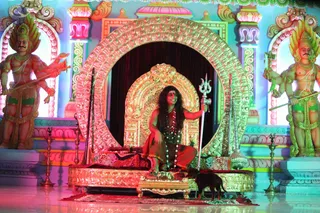
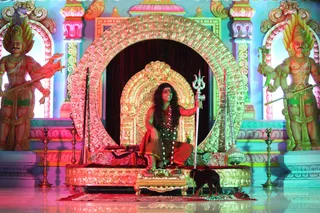
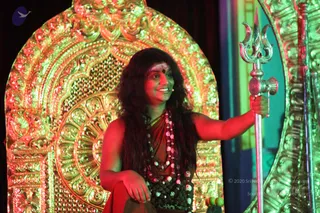
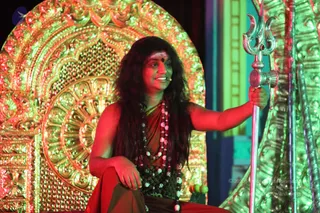
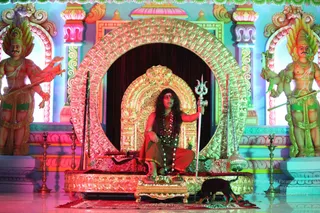
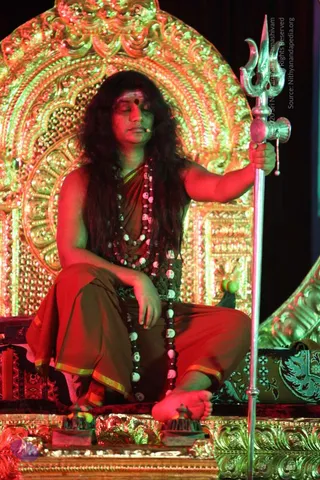
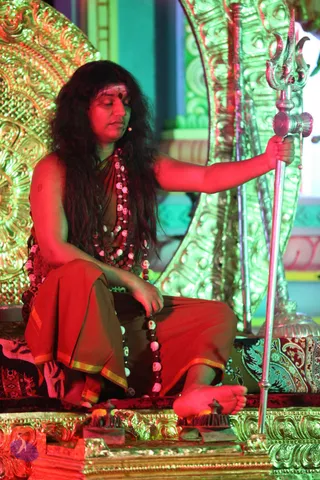
A photograph of a long-haired man seated cross-legged on an ornate gilded throne with a large arched backrest carved in intricate floral patterns. He wears a red-orange draped garment with gold-edged hems and a layered necklace of rudraksha-style beads and a long bead mala. A white and red forehead mark is visible, and he holds a polished silver trident upright in his right hand. Red and green stage lighting washes over the scene. Two small decorative lamps or figurines sit on the carved platform in the foreground. A small microphone is clipped near his face. The one identifiable figure is the central seated person.A close photograph of a brass oil lamp with a lit flame sitting on a small brass tray scattered with red rose petals and a white flower. Blurred background shows red flowers and another lit lamp, with a brass cup on the right. No people are visible.A photograph of a seated figure on an ornate gold throne set within a large golden circular arch, in a brightly lit hall with pink, green and cyan walls. The seated person has long dark hair, wears an orange-red wrap, a green-and-red beaded necklace and a rudraksha-style mala, and holds a silver trident in one hand while the other rests on a cushion. Two large painted guardian figures flank the throne, each with a moustache, bare chest and ornate gold waist cloth, one holding a club. Brass oil lamps stand on either side of the dais, and a small dark dog sits at the lower right on the glossy floor.

April 15 2013

Original wiki page
Contents

Title

Dont Let Your Mind Cheat You

Description:

In today’s morning satsang, Paramahamsa Nithyananda explains how the four truths of life transform our experience. He warns us that when we find ourselves continually unable to solve our conflicts, we have become spiritually disconnected. The key to reviving our energy lies in embodying the four principles over and over again until they imprint into our bio-memory. The sincere practice of integrity grants us a positive perspective; authenticity brings us into the space of infinite possibility. Responsibility raises us to leadership and enriching opens the way to enlightenment.

On this Day Supreme Pontiff of Hinduism HDH Bhagavan Nithyananda Paramashivam also delivered a Discourse in Tamil, Under the Title 'ஒருங்குவித்தல்" வாழ்வை மேன்மை படுத்தும் சத்தியம்".

Link to Video:

VideoAudio
VideoAudio

Transcript:

I will now continue the satsangh in English and Hindi for the international viewers

0:22- Hindi

Today, I will expand on initiation of the four tattvas and Kundalini awakening. Living these four principles awakens your Kundalini and allows the extraordinary possibilities to happen in your inner being.

When you lose interest in life, when you again and again hit the conflicts which you are not able to solve, or the solutions you find you again and again forget and get untangled into the same problem, if you are in this space, please listen. You are moving towards Death! Life has lost its interest over you! You lost interest over Life!

Not able to find solutions for some of your internal conflicts, or again and again stuck with the same problem, you forget even after you find the solution – you find the solution, in two days again you forget the solution and you are caught in the same problem; after two days again you forget the solution, you are caught in the same problem – if your life is rolling like this, be very clear, you are disconnected from life. You need to do something immediately!

These four principles are Ganga into the desert of conflicts! If your mind has become desert of conflicts, bring this Ganga of four principles – Integrity, Authenticity, Responsibility and Enriching.

Listen! Success of these four principles depends on living it again and again and again. For example, if you have lived 12 years of married life with lots of arguments, fights, ups, downs, everything, at one day if you decide to break the relationship when you are in a low mood or when the fight is in the peak, when you decide to break the relationship, your mind will show as if the whole 12 years was nothing but fight and exploitation. How many of you cognize what I am saying? But if you decide not to break, and somehow heal, and you continue to live, your mind will say the whole 12 years was a smooth marriage; at least, stably you are living together.

So, please listen, the decision you make this moment only decides your perception of the whole past. How many of you cognize what I am saying? So, there is no such thing as “past” exists for you. Your mind shows every moment different, different past. I have seen! Some people who lived in the ashram for years, for their own vested interest and reasons if they decide to leave, when they leave I have seen they strongly believe all the years they lived in the ashram is a torture, struggle! If they decide to cross that low mood and stay back, within the next few days or few hours they feel, ‘What a blessing to live in the ashram! I should not have missed this in that low mood! If I have decided to leave, it would have been such a big miss! It would have been such a big curse! What a blessing to see an incarnation every morning! I may doubt whether he is an incarnation or not, but I am sure he is a person with extraordinary power and grace. What a great thing I am able to see him every day! This itself is a great thing! I should not have gone into that low mood. I will not even think any more about leaving!’ But in one week you are again back! ‘No, no, no! I think I have to leave! He may be an incarnation or avatar, but he will not be able to help the problem in which I am stuck. His level is different. I can’t go to his level!’ Then, again, mind will show as if the whole time you lived in the ashram was a torture. Then, again, somehow you don’t get ticket or taxi and you don’t leave. Next day again, your mind will start, ‘Anyhow, even if I solve my problem outside, I won’t have his presence. Wherever I go, this mind is going to be there. If I am here, at least his there once in a while. By mistake some of the words he utters will enter into my inner space, and I may have the space of peace and restful awareness.’ You console yourself.

See, now whatever I am talking, every person who is in a relationship or marriage can understand. It is very unfortunate, based on your present mood and the space, your mind shows your whole past in that same color. If you are in the dark inner space, your mind paints the whole past as dark and shows you. If you are in the bright inner space, your mind shows your whole past as a bright possibility. Only when you break this pattern, you start human life.

8:22

It is so unfortunate, listen, it is so unfortunate, human-beings does not understand the truth that when your mind is in dark space, it shows as if your whole past is dark, and when your mind is in light space, as if your whole past is enlightened!

Listen! When I decided to become enlightened and became enlightened, I saw my whole past was enlightened past. There was not a single moment, including the moment of my birth, I was unaware of me! I was aware of my whole birth from the birthing process to this moment! I also wanted you to understand, before I decided to become enlightened, before I became enlightened, before the age of 12 – 12 is the age I became enlightened – before the 12, I was not having the clarity I am enlightened from birth. Please understand, I need to confess this to you! You need to know this! Only then you will understand the insider’s secret of enlightenment. Before 12, I was not thinking I am born enlightened. I was not having the feeling- I was aware of my birthing process, from birthing I was aware continuously about whatever is happening. But after I decided to become enlightened and enlightened at the age of 12, then my inner space was showing the whole past as conscious, alive, enlightened past.

Listen! So when you decide to keep you in the higher space forever and have a conscious breakthrough, suddenly you see your whole past was always in higher consciousness or travel towards higher consciousness.

13:45- hindi

“Maya” means “what is not there, but shown”- is Maya.

15mins- 30 mins

Many time, People decide to commit suicide because when they are in the lowest mood, suddenly their mind shows their whole past was in the lowest mood.

15:24- Hindi

You need to know the basic secrets of human mind. So whenever you fail in integrity or authenticity In your low mood, mind will say you never lived integrity and authenticity. Your whole life was inauthentic, irresponsible and lack of integrity. But when you restore integrity through completion and you become authentic suddenly your mind will show your life is a LONG journey, a sincere journey towards authenticity and responsibility. How many of you cognize what I am saying?

So listen. Do not be cheated by mind. Do not be destabilized by mind. Go on practicing integrity. Go on practicing authenticity. Go on practicing responsibility. Go on practicing enriching. I tell you, one dhamma even enlightened being has to practice, not exempted is these 4 principles. Even I continue to practice these 4 continuously. Because as long as this 4 is practiced, lived life goes on expanding. What me still cosmos continues to practice this. The expansion of the universe is nothing but universe practicing authenticity, Stability of the universe is nothing but universe practicing integrity. Still incarnations are landing to make all of you enlightened is nothing but universe practicing responsibility for all your responsibilities. Still even after so much of torture, suffering attack by human beings enlightened beings and incarnation continue to enrich planet earth is cosmos deciding to enrich all of you whatever it takes.

The Stability of cosmos is cosmos practicing integrity. Expansion of cosmos is cosmos practicing authenticity. Enlightened masters landing is cosmos practicing responsibility. Enlightened masters continue to teach you all even after the torture and suffering you give them is cosmos practicing enriching. So even cosmos continues to practice the 4 principles

19:35- Hindi

Constantly bring yourself back to authenticity and integrity. Decide now again. Declare now again. You will not be tired, you will not be retired, you will not be lazy, you will not show any fatigueness to execute these 4 tattvas. Ribs of your chest should be strengthened by the 4 tattvas. These 4 tattvas are the strength of life. Strength of the life is these 4 tattvas- Integrity, Authenticity, Responsibility and Enriching. You don’t need to do anything else. If you start these 4 tattvas authentically in your life, you don’t even need to go to a guru, you don’t even need to go to any god or incarnation, enlightened being. Start these 4 principles, these 4 tattvas, they will all come towards you., God will come to you, guru will come to you. I have seen, when some of my disciples live these 4 tattvas authentically, I myself feel so much of love and grace in their space.

I tell you, all of you decide – from today without tiredness, without fatigue, without the mood of retirement we will keep these tattvas flying high in our life. Let the flag of this tattva fly high kept alive. Anything can be sacrificed but not these 4 spiritual principles. Let these 4 principles fly high. I request all my followers, devotees, disciples all over the world. Raise the Nithyananda Dhwaja- the flag which represents these 4 principles. The Nithyananda Dhwaja represents these 4 principles. Raise this flag in your house, work place, wherever you can. Keep it flying high. Decide you will keep yourself in highest integrity, highest level of Authenticity, highest level of Responsibility, highest level of Enriching. Raise the flag of 4 tttvas in you houses, shops, workplaces and keep it flying high. Let the Dharma Dhwaja fly high. Let the life be lived only to keep the Dharma Dhwaja flying high.

Hindi –Min 27:44.0 to 30:36.3

All the devotees, disciples sitting with us all over the world, dhyaanse suniye, please listen, bring constantly Integrity to your thinking; Authenticity to your behavior; Responsibility to your actions; Enriching to your lifestyle. Integrity to your thinking, Authenticity to your feeling, Responsibility to your actions, Enriching to your lifestyle! You will see, you will realize an extraordinary space in your life. When you start integrating your inner space, your whole inner space becomes positive, because any negative commitment you give even by mistake you have to honor it. Why will you want to waste your energy in honoring the negative commitments you give to you unless you are an utter fool? And fortunately, nobody is that utter fool on Planet Earth! Even the people who want to commit suicide, they try to find the easiest, painless method! There are millions of websites in the Internet which can give you suggestions and techniques on painless suicide methods. I was wondering why, when somebody decides to die, why will they go to the Internet and google? Because you are not utterly, foolishly foolish! Even if you decide to die, you try to find the best method without pain! So, you are not foolishly foolish to honor your negative commitments. When you know you are not going to honor, then naturally you know you have to complete. When you are constantly completing the negative commitments you give yourself unconsciously, suddenly, because your mind is such a mischievous child, only when you are declaring, ‘I will be the winner.’, ‘No, No! You are loser!’, it will already shout from one corner and go and hide in the room and show all the face. ‘No, no! I already told you are a loser!’ Your integrity is now not going to work. So, now again you have to sit and complete and drop.

It is like in a village one orthodox Brahmin was there. That Brahmin is too orthodox and too superstitious. Even if he sees somebody from the lower community, he will go and take bath again in the river and come back! There was a mischievous guy, teenage kid. He will be waiting behind a tree. The moment that Brahmin comes out of the river taking bath, he will just jump in front of him and say, ‘See, you have seen me! Now you have to take bath!’ The Brahmin will go back to the river and he will jump on to the tree. If the Brahmin tried to catch this boy, he will climb on the tree, the Brahmin can’t do anything. Same way, exactly, your mind will be playing. How many of you caught your mind playing like this when you were practicing Integrity? So, the one and the only way is, catch the mind and tie it and put him in the river! Catch the mind and tie it and put him in the river! Means, this negative practice of teasing yourself is also a one more negative commitment you have given it to you. You strongly believe, whenever you practice positivity you will make negative statement, because that is one more negative commitment you have given it to you. How many of you cognize this? So decide, ‘I will drop that!’ Then that boy will disappear once for all! You can take bath, come beautifully, go and do your puja! Decide, again and again, you will live Integrity!

Hindi – Min 36:26.4 to 38:24.4

When you practice Integrity again and again, simply your mind will become one – integrated. Then, Authenticity, Responsibility and Enriching will become your lifestyle, will become your lifestyle. There won’t be inner struggle, internal conflict. When you have internal conflict, one part of you laughing at you, know there is incompletion. So, sit with you and complete whatever incompletions you remember at that moment. When you complete again and again, without getting tired, bored, suddenly you will see the lack of Integrity does not even happen in you. You are just totally different! Your life is just totally different! Your life lives something extraordinary! You will not even know where you were to compare and see now where you are, and how much you are transformed! Integrity and Authenticity have the ability to give the ultimate breakthrough to you. Dhyaanse suniye, it can give you the breakthrough!

Hindi – Min 40:22.7 to 41:32.0

When you sincerely start practicing Integrity, you will be in such a beautiful space of Positivity, that itself will give you so much joy to live with more and more Integrity and the space of completion. When you live with Authenticity, you will experience the space of Possibility. Everything, everything, everything is possible! The space of Possibility happens to you when you live Authenticity. Integrity brings space of ultimate Positivity. Authenticity brings the space of ultimate Possibility. Responsibility brings the space of Leadership, means you will be the leader for everything happening in and around you. Enriching brings the space of Enlightenment in you. Just simply the whole Cosmos will be pouring its energy into you, through you, because you are sharing it with the whole Cosmos!

Hindi – Min 43:04.9 to 43:49.1

The essence of today’s satsang:

Tirelessly practice Integrity, Authenticity, Responsibility and Enriching, again and again and again!

Photos From The Day:
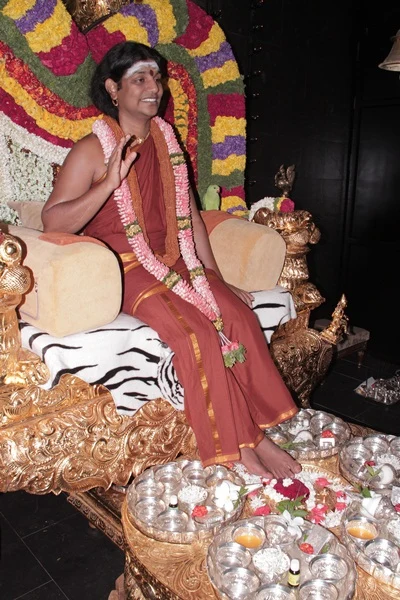
Tags:

Paramahamsa Nithyananda, four truths, life, experience, conflict, spiritual, energy, sincere practice, integrity, positive, authenticity, possibility, responsibility, leadership, enrich, enlightenment.

Photos Of The Day:

Toronto-Akashik-Reading

Pada-Puja-DTA-Sarva-Darshan

Photos Of The Day:

Pada-Puja

Satsang

Sarva-Darshan-and-final-blessings

Toronto-Akhashik-Readings

Photos Of The Day:

Pada-Puja

Satsang-&-Sarva-Darshan

Final-Blessings

Kalabhairava-Akashic-Reading

01-PADAPUJA

02-PUJA

03-NITHYA-SATSANG

04-DARSHAN

Photos from this day

View all 199 photos

Photos From The Day:
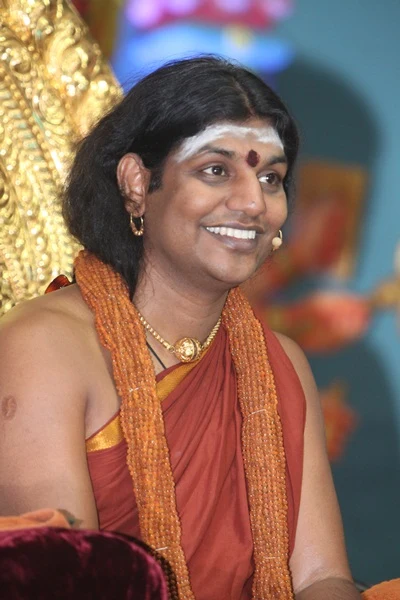
1 photoSource gallery

Toronto-Akashik-Reading
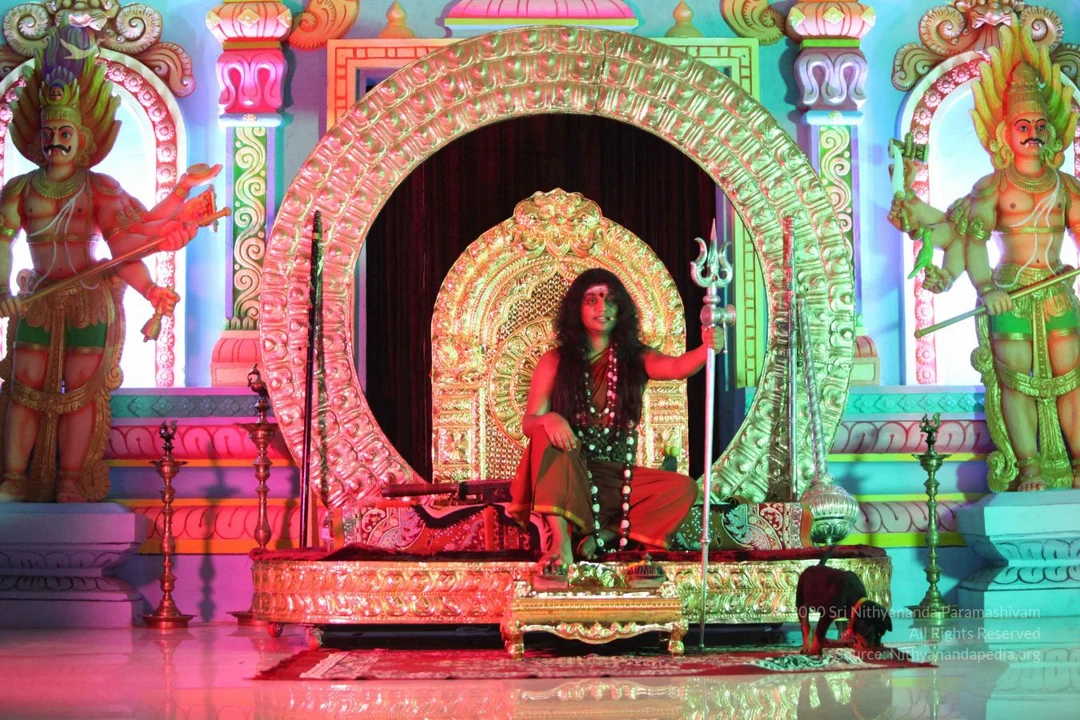
48 photosSource gallery
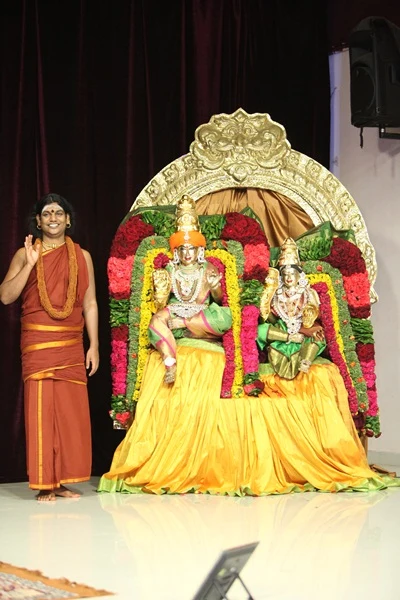
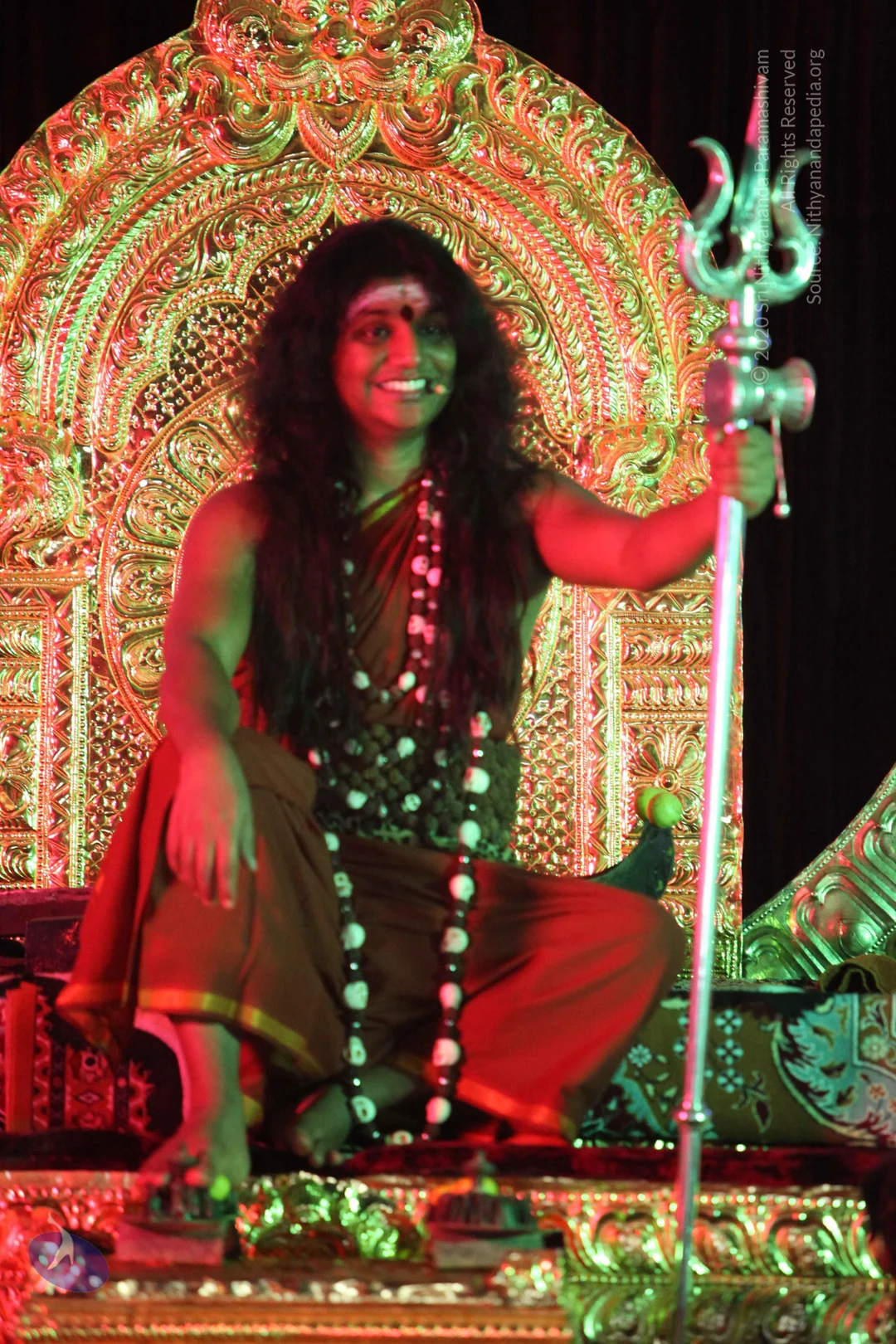
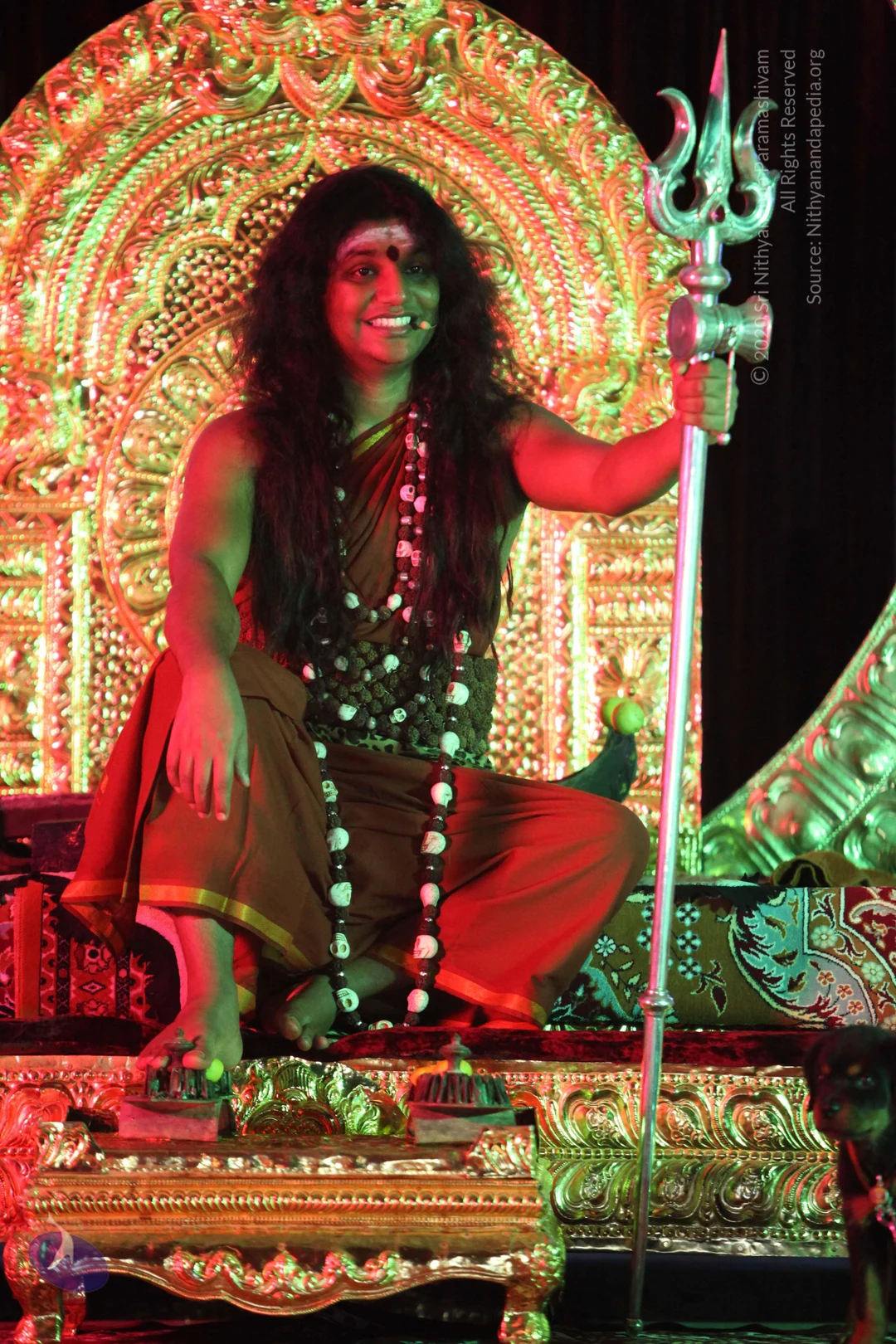
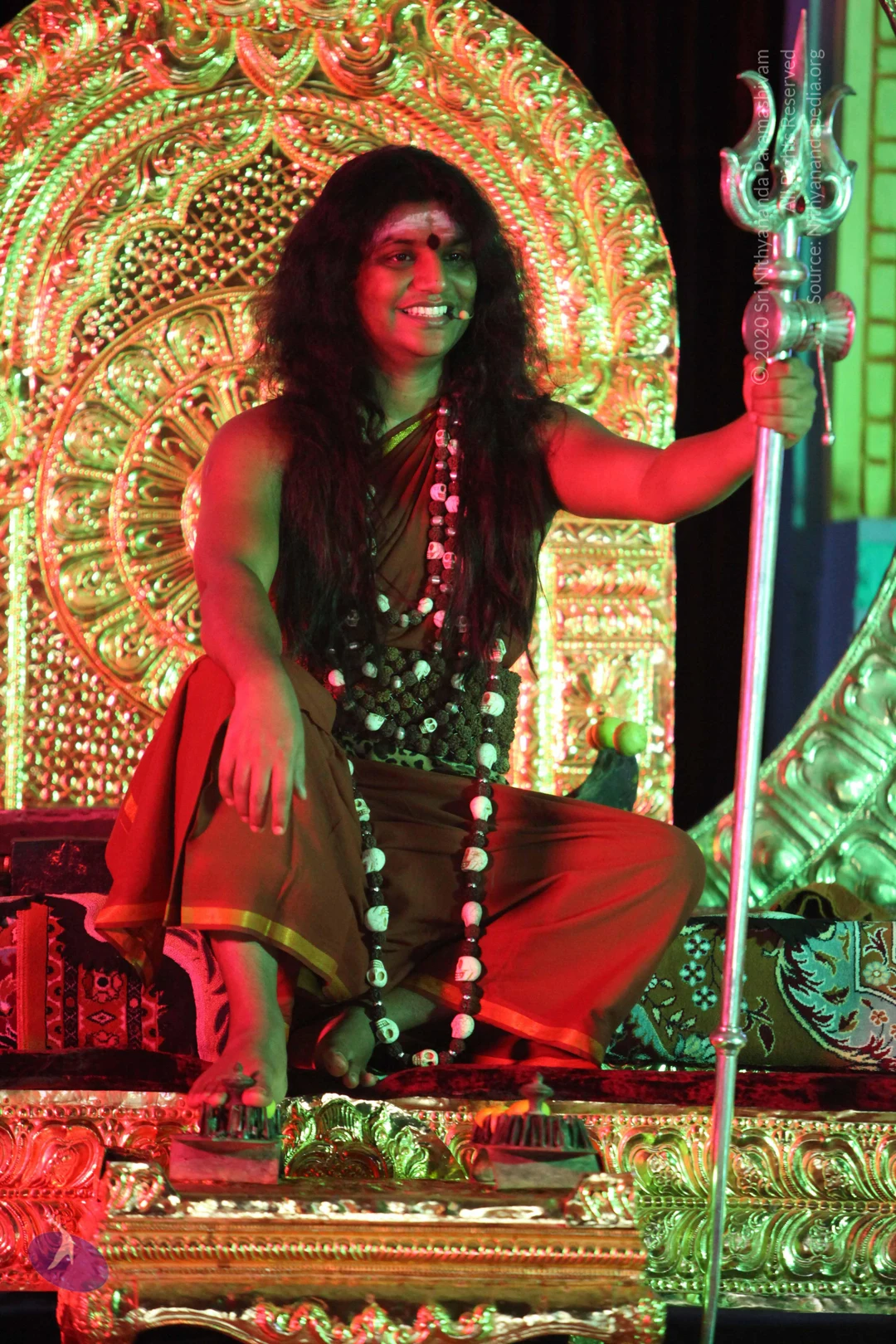
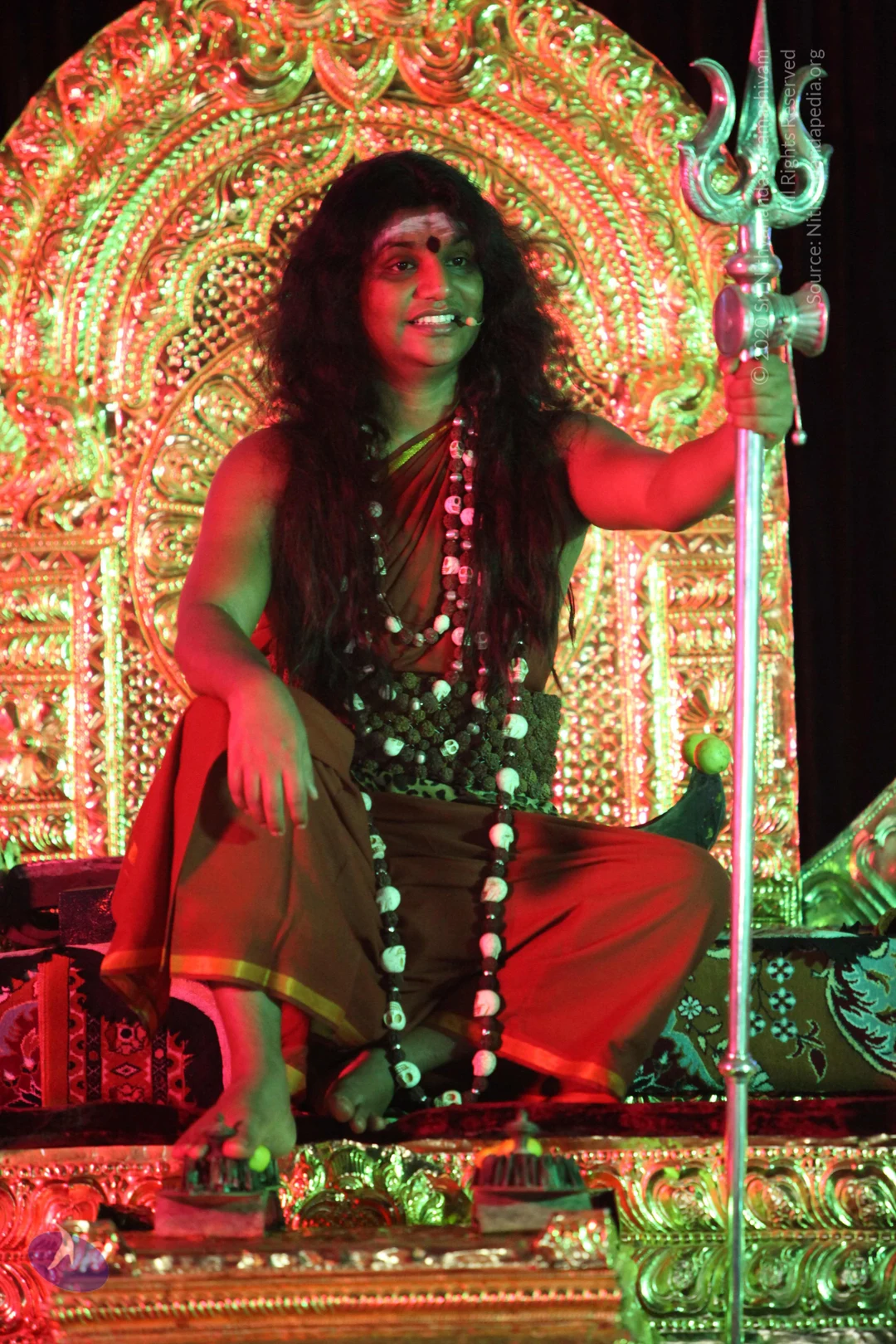
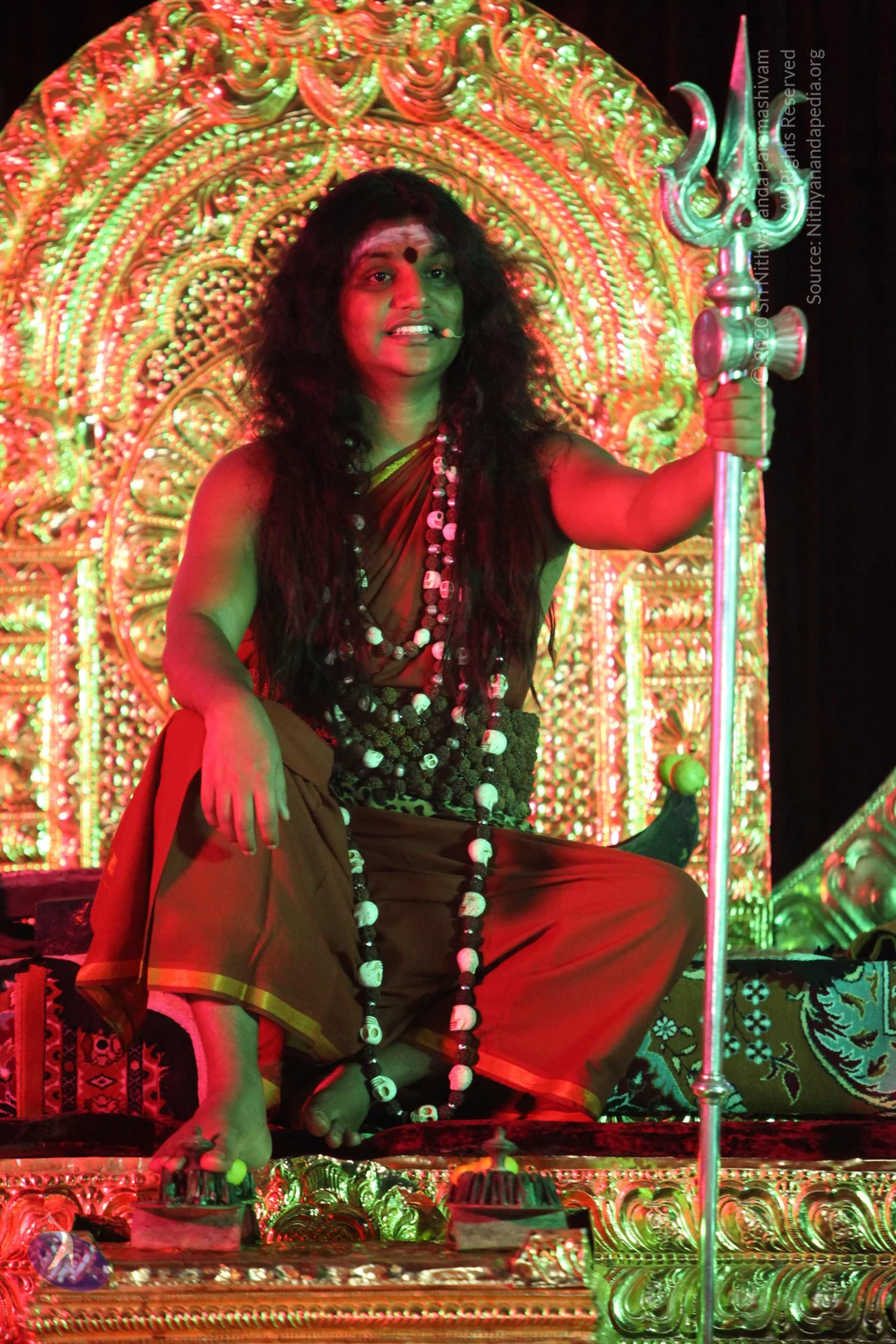
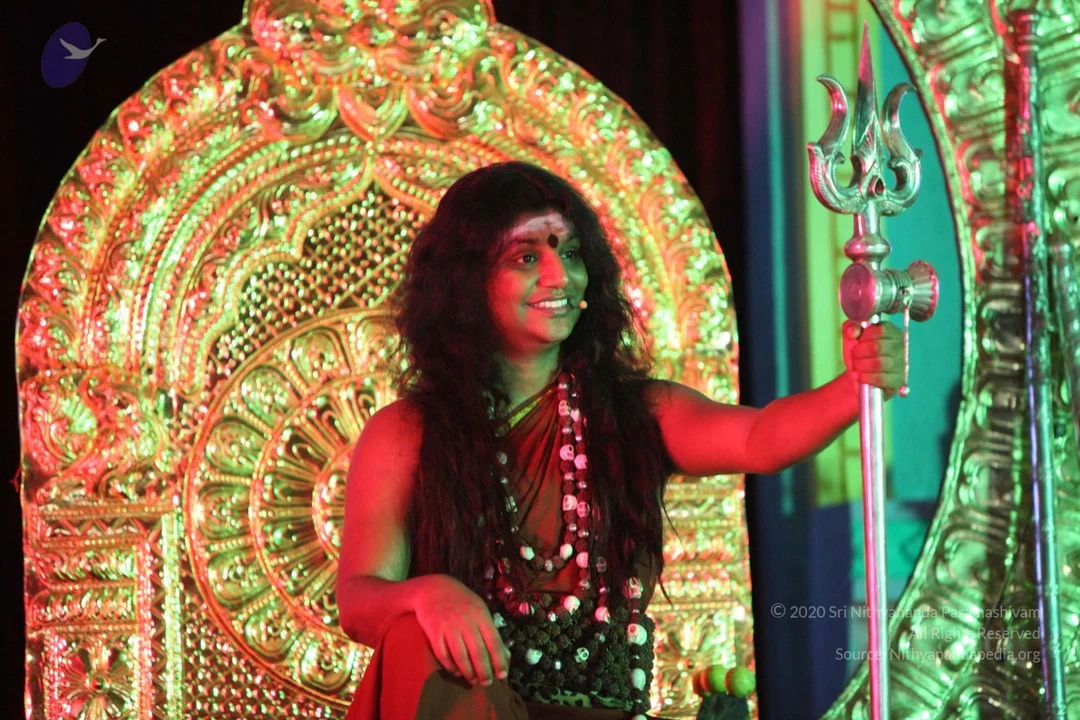
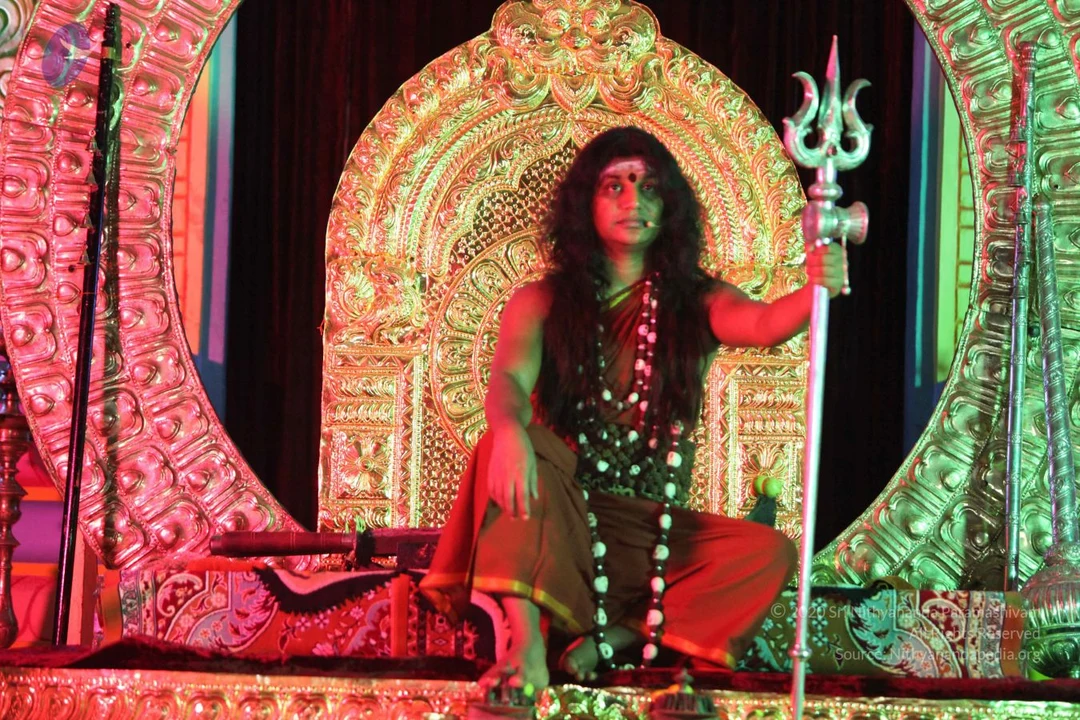
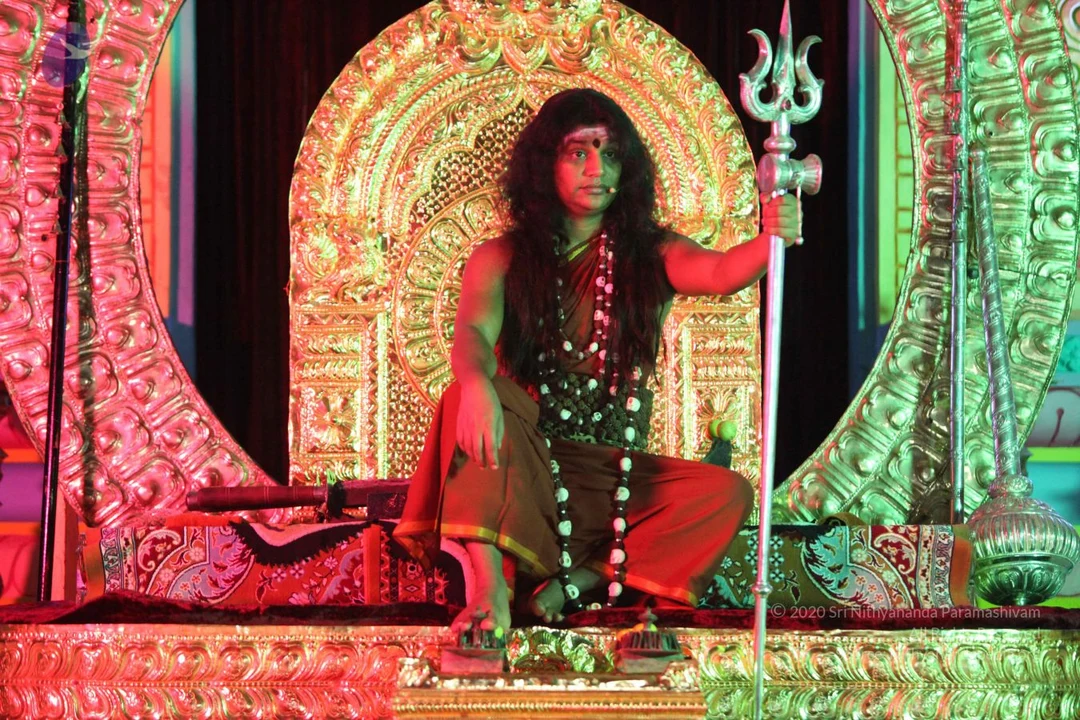
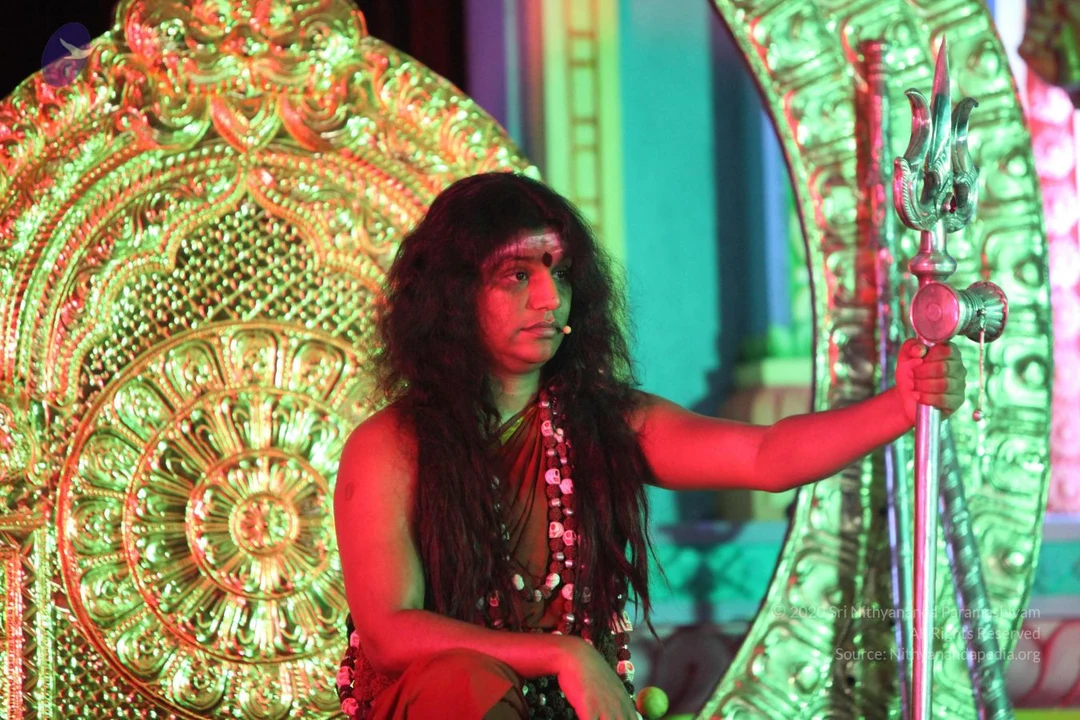
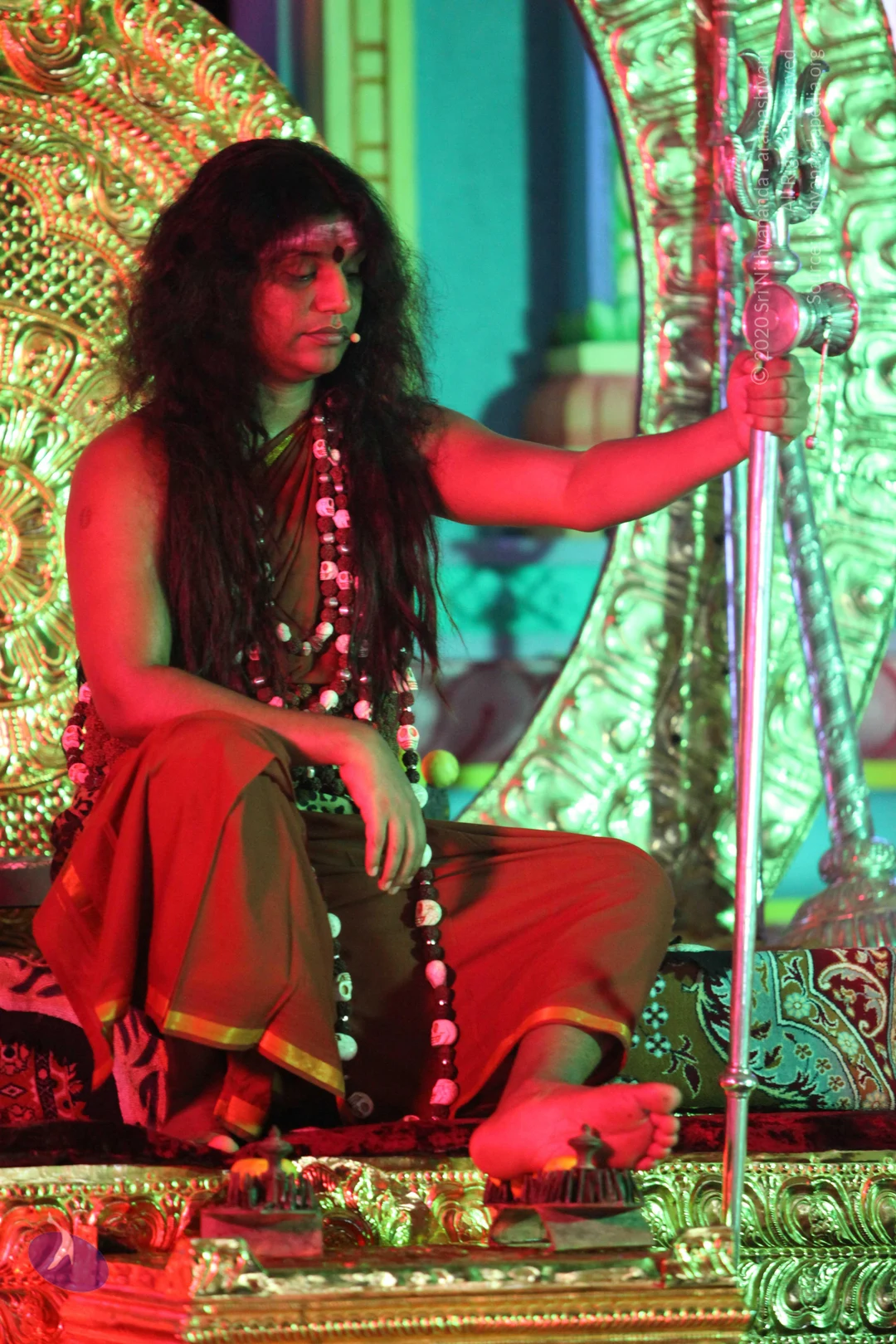
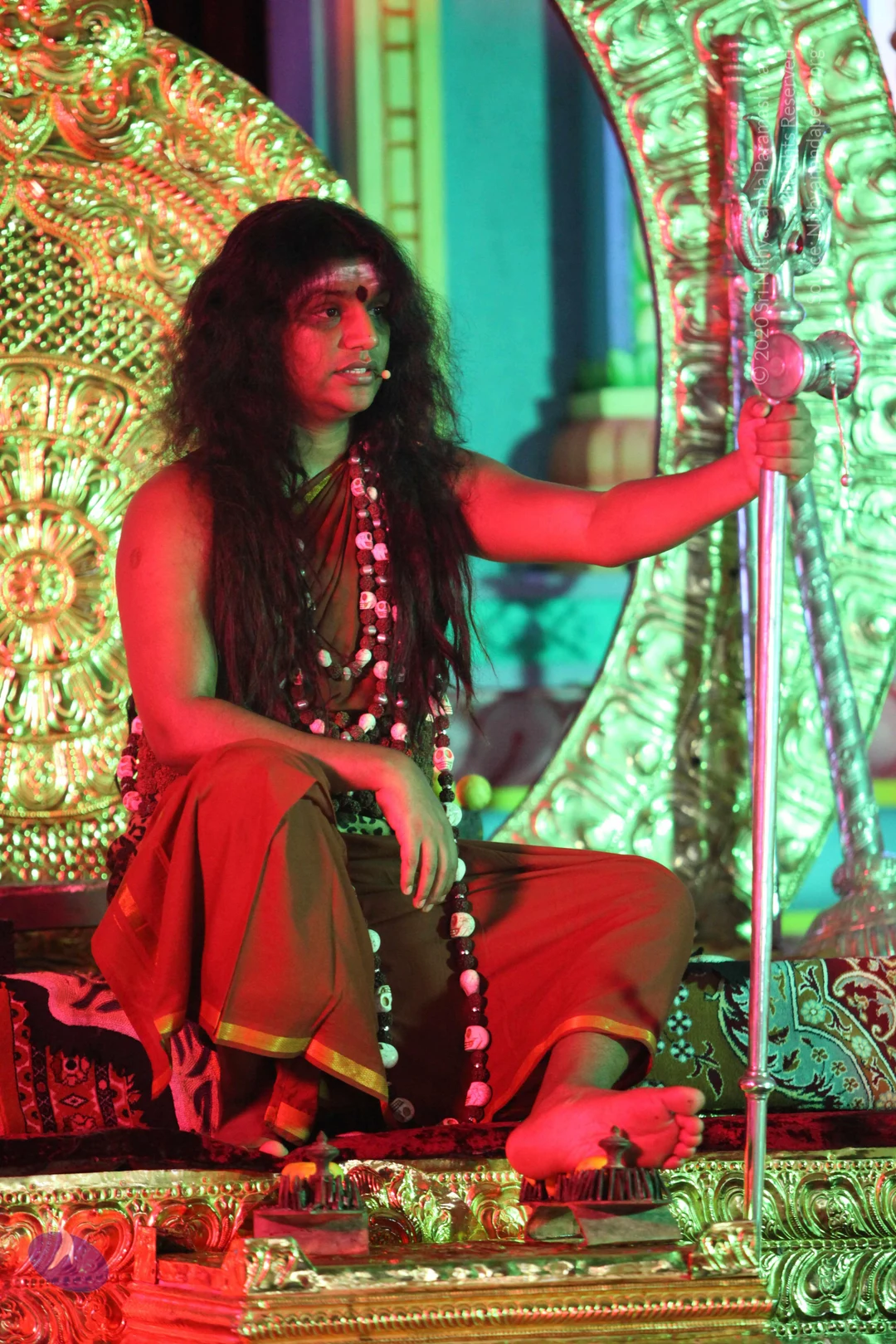
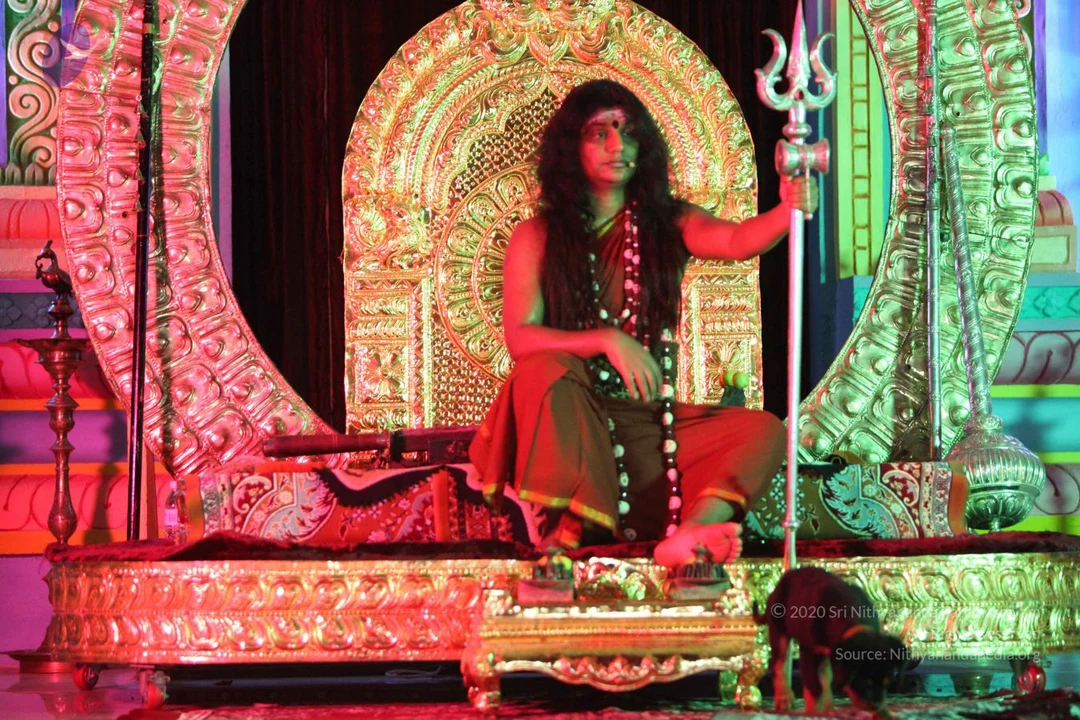
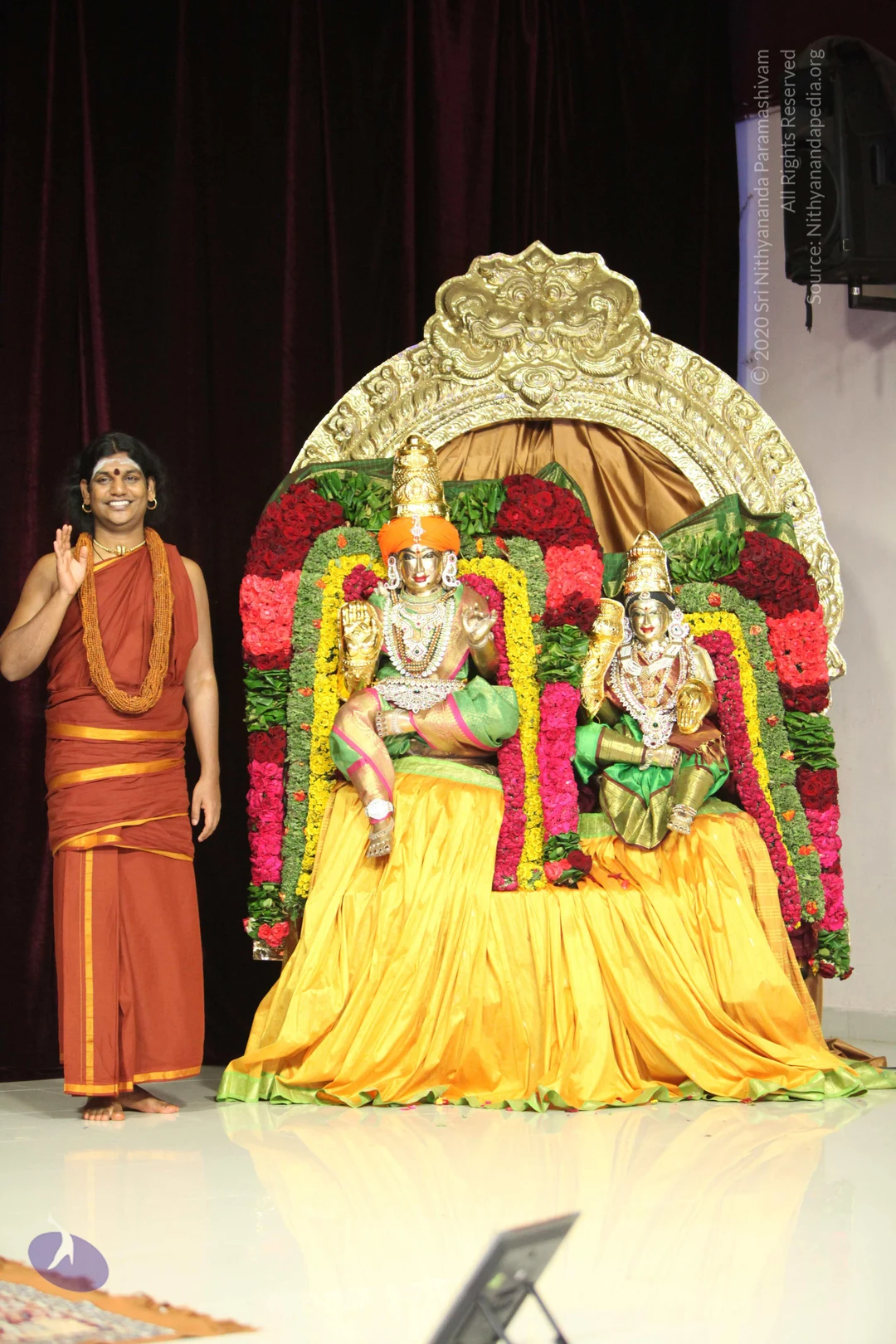
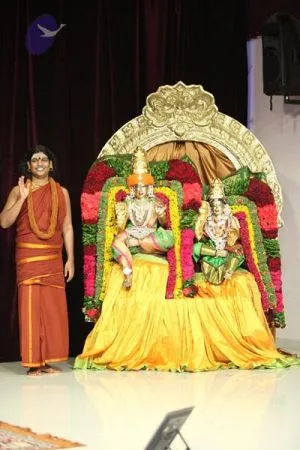
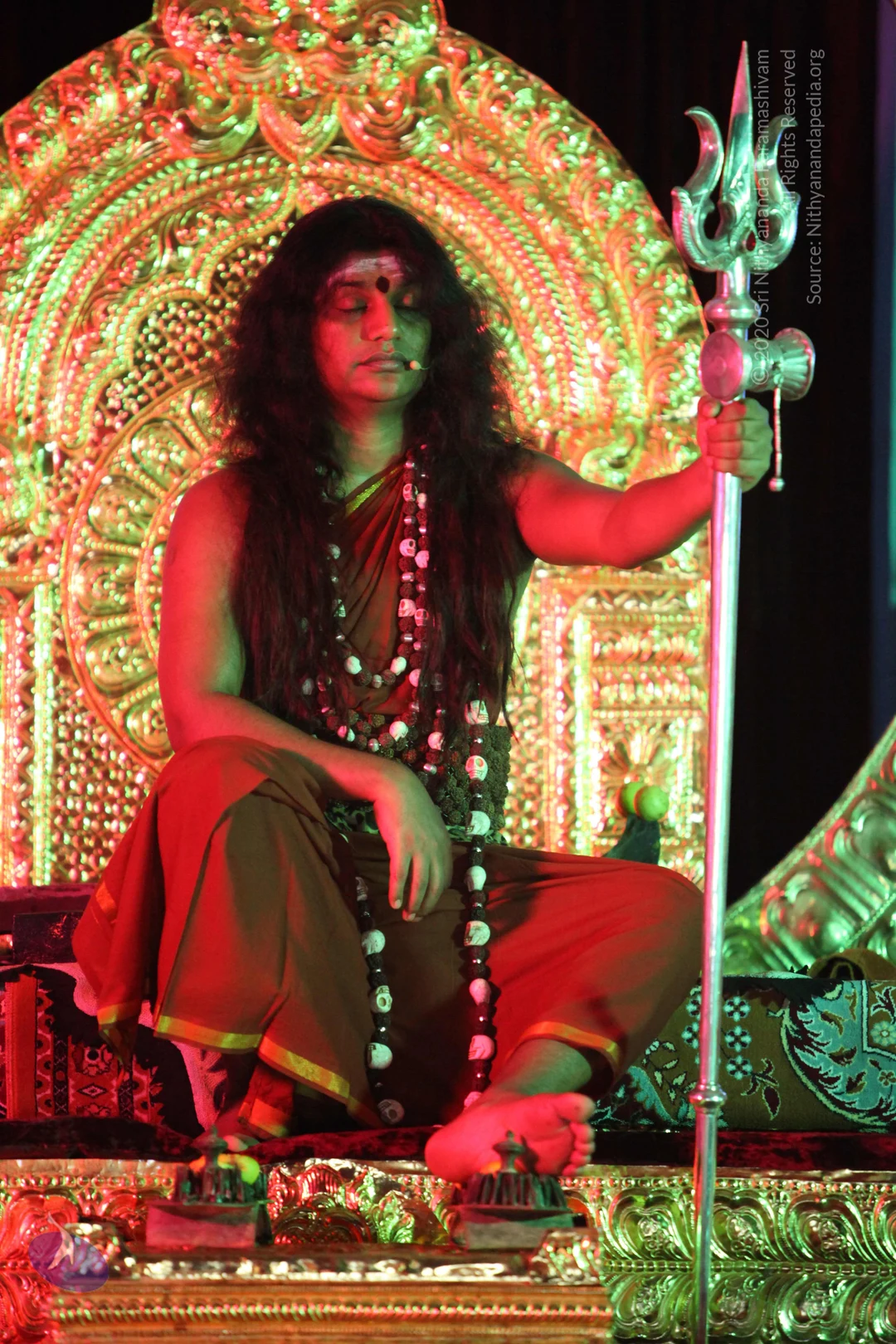
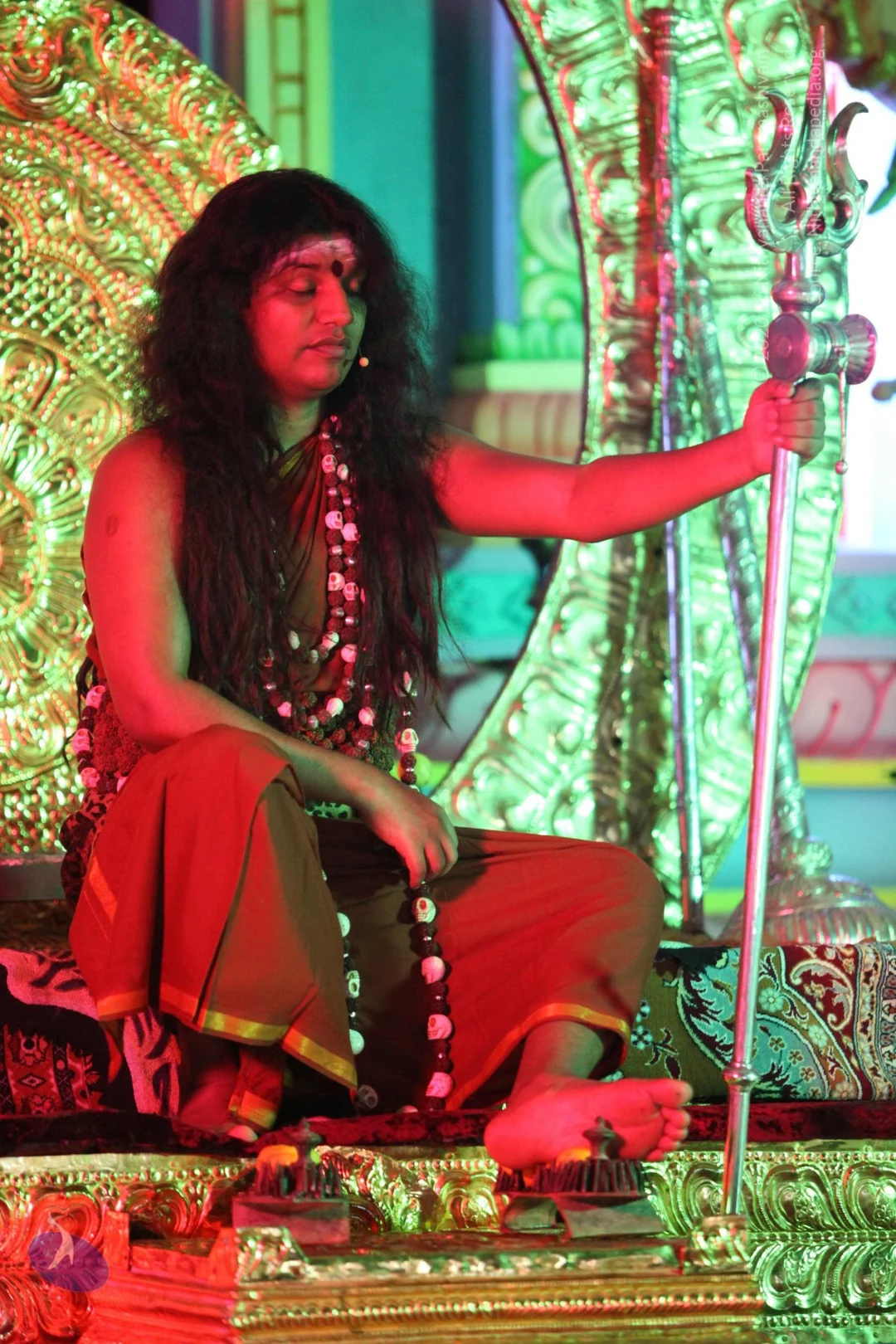
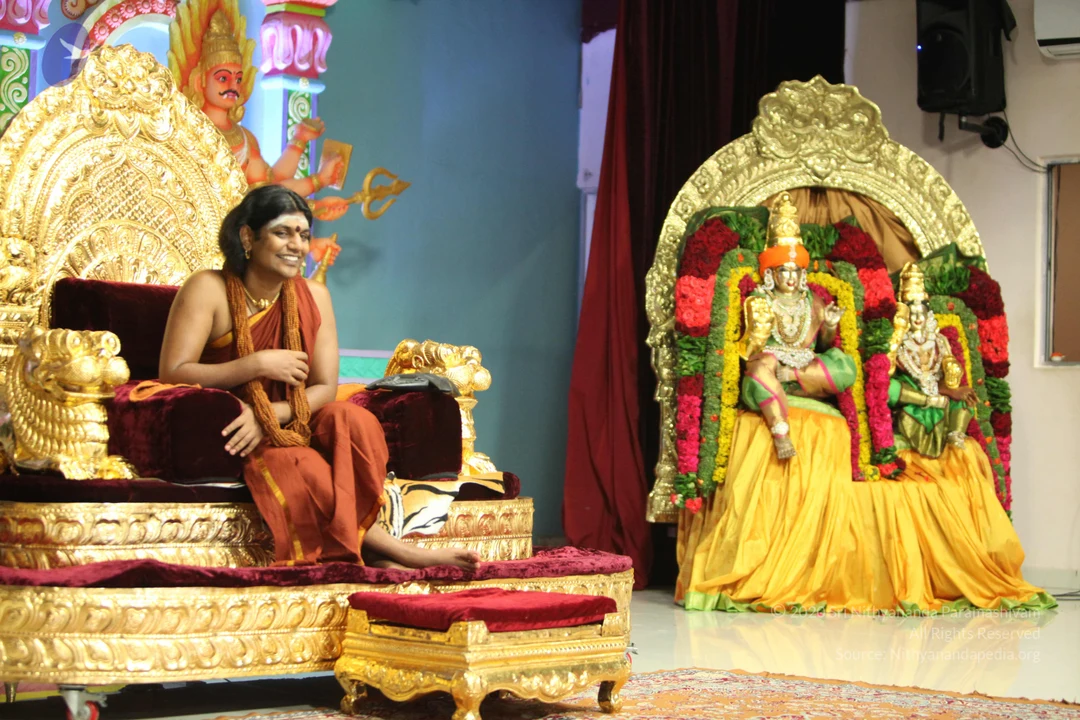
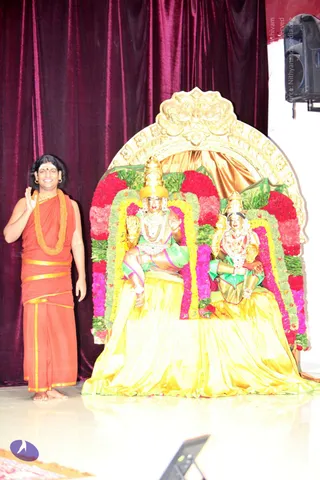
A seated figure in a red-and-brown robe with long, dark, wavy hair and a white-and-red forehead mark sits before an ornate gold-embossed throne under red and green stage lighting. He holds a silver trident aloft in his right hand and wears long beaded mala necklaces of dark and pale beads. A green-and-gold cushion and a small green fruit rest beside him. Probable Swamiji, identified by his long hair, saffron-toned robe, rudraksha-style malas and throne setting; he is shown seated and speaking on stage with a trident.A long-haired figure seated cross-legged on an ornate golden throne with a tall gold-and-green backrest, smiling and holding a silver trident upright in the right hand. He wears a rust-brown dhoti-style garment with a gold edge, multiple rudraksha and white bead malas across the chest, and a red bindi with a white tilak. A small microphone is visible near his mouth, and a dark figure appears at the right edge. Red and green stage lighting illuminates the golden throne, with jewelled footstools and a patterned cushion nearby. Appearance-based probable Swamiji: long swept-back hair, rudraksha malas, trident and throne are visible cues, and the page places him at this event.A smiling man with long dark hair sits cross-legged on an ornate golden throne in front of a large gilded arched backdrop with repoussé floral motifs. He wears a rust-red and brown draped garment, a dense multi-strand necklace of rudraksha beads and white-and-black beads, and a red bindi with white vibhuti markings on his forehead. He holds a tall silver trident (trishul) upright in his right hand. Small brass oil lamps sit on the golden dais at his feet, and a clip microphone is visible near his face. Appearance cues include long swept hair, rudraksha malas and a red-and-brown ceremonial garment, so this is a person on stage. Set in a stage setting with red and green lighting.A smiling person with long, dark, swept-back hair sits cross-legged on an ornate golden throne with a red velvet seat and a richly embroidered cushion. The figure wears a red-brown draped garment and a dense layered necklace of rudraksha beads and pale ceremonial beads, with a red bindi on the forehead. A tall silver trident, its tines topped with a crescent, is held upright in the right hand. Behind is a large gilded arch with a radiating pattern under red and green stage lighting, and a small brass lamp sits on the throne platform in front.A photograph of a seated man on an ornate golden throne set within a large gilded circular arch, against a bright multicoloured temple-style backdrop. He wears an orange-red garment, a green beaded mala and a rudraksha-style necklace, and holds a silver trident. Two painted deity guardian statues flank the throne, one on each side, and a small black dog stands on the carpeted dais at the base. Brass oil lamps stand beside the throne and a red-patterned cushion lies on the seat. Coloured stage lighting washes the scene in pink and green.A photograph of a figure seated on an ornate golden throne with a large circular golden arch behind it, set in a brightly lit, pastel-coloured hall with red and green tones. The seated figure has long dark hair and wears a rust-red garment with a rudraksha-style bead mala and a long trident-tipped staff held upright in one hand. A small black dog sits at the foot of the throne on a red carpet. Two painted, large guardian statues in green, pink and gold stand on either side, one holding a staff and one holding a trident. Ornate gold lamp stands flank the throne. The visible physical people count is one.

Pada-Puja-DTA-Sarva-Darshan

91 photosSource gallery
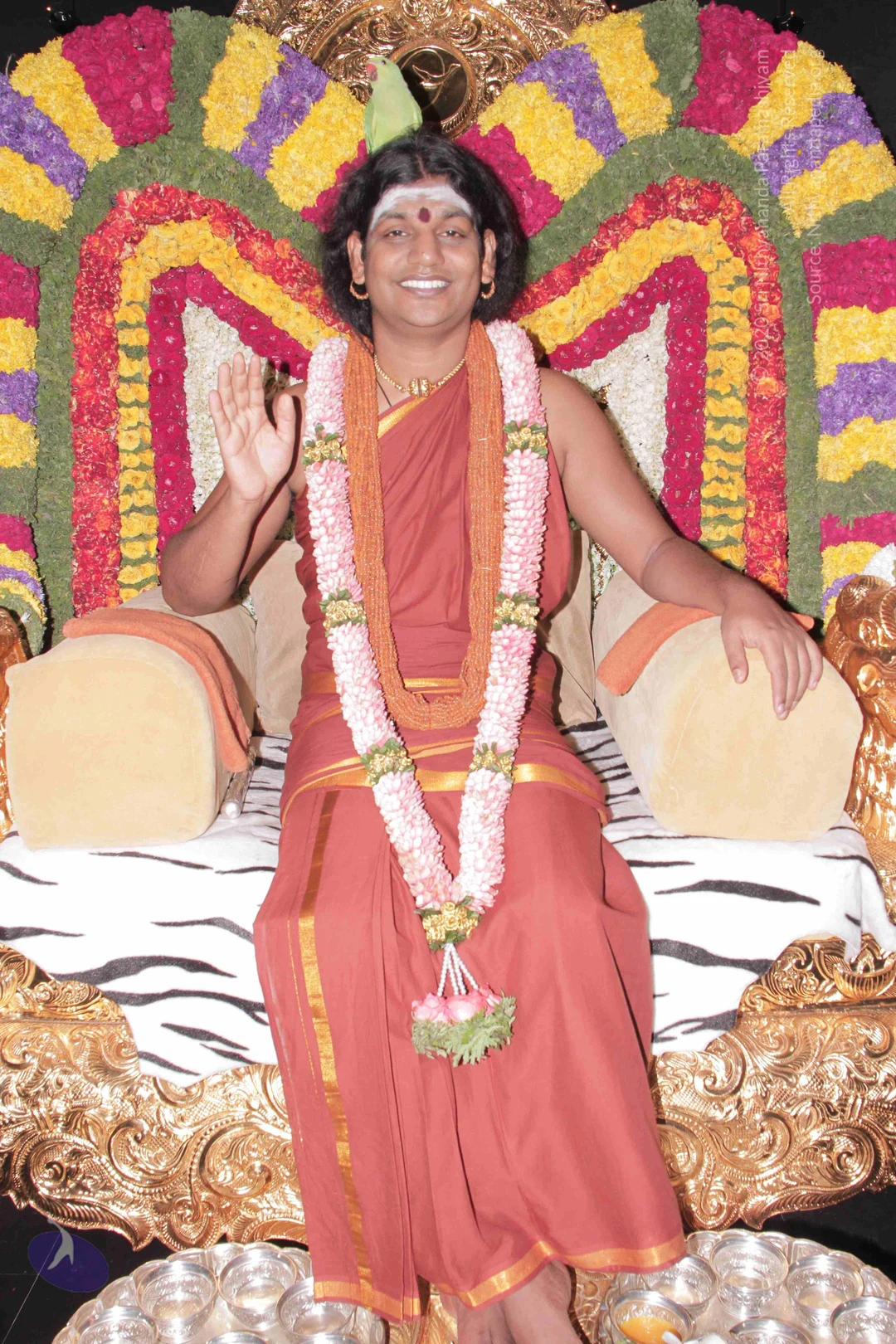
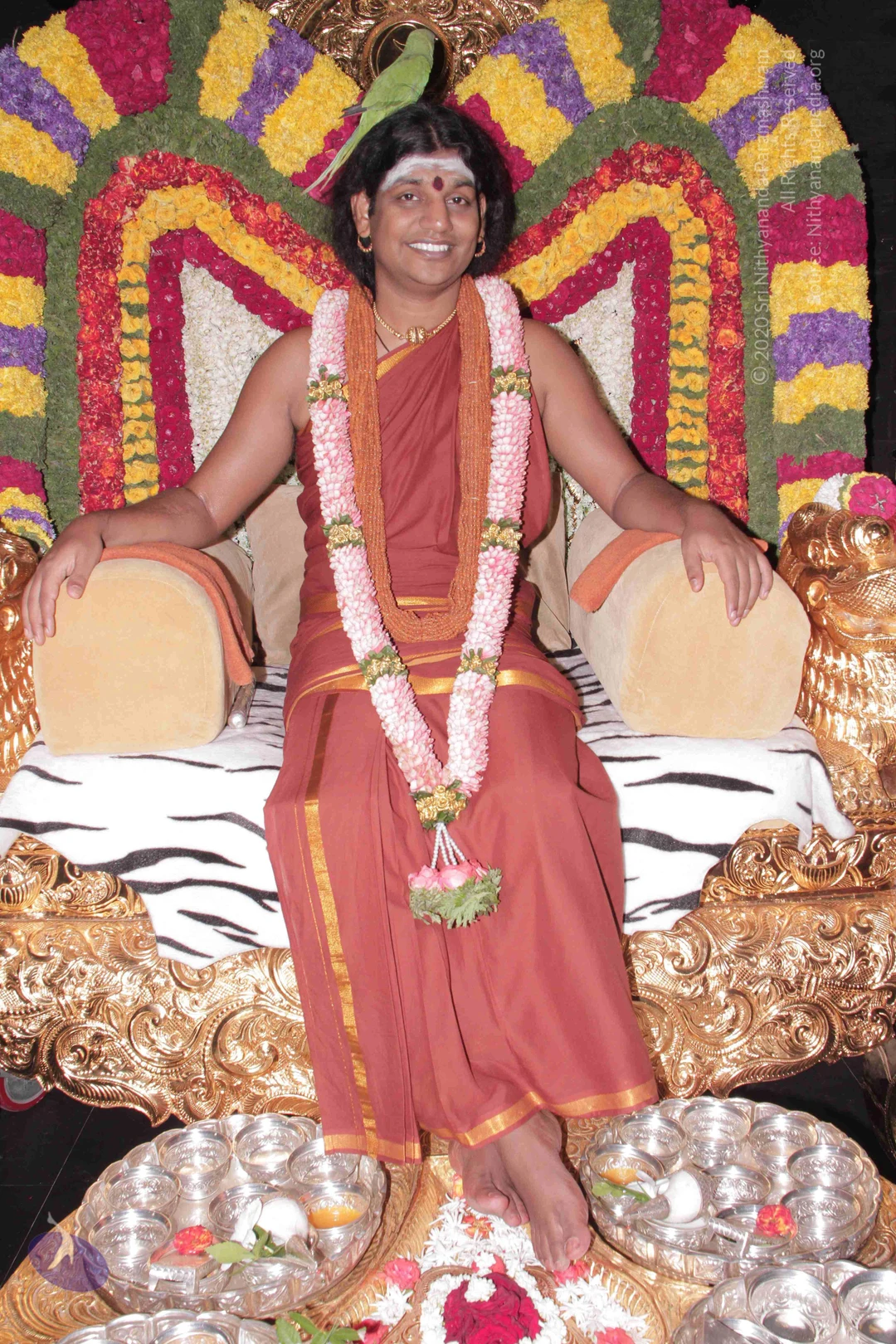
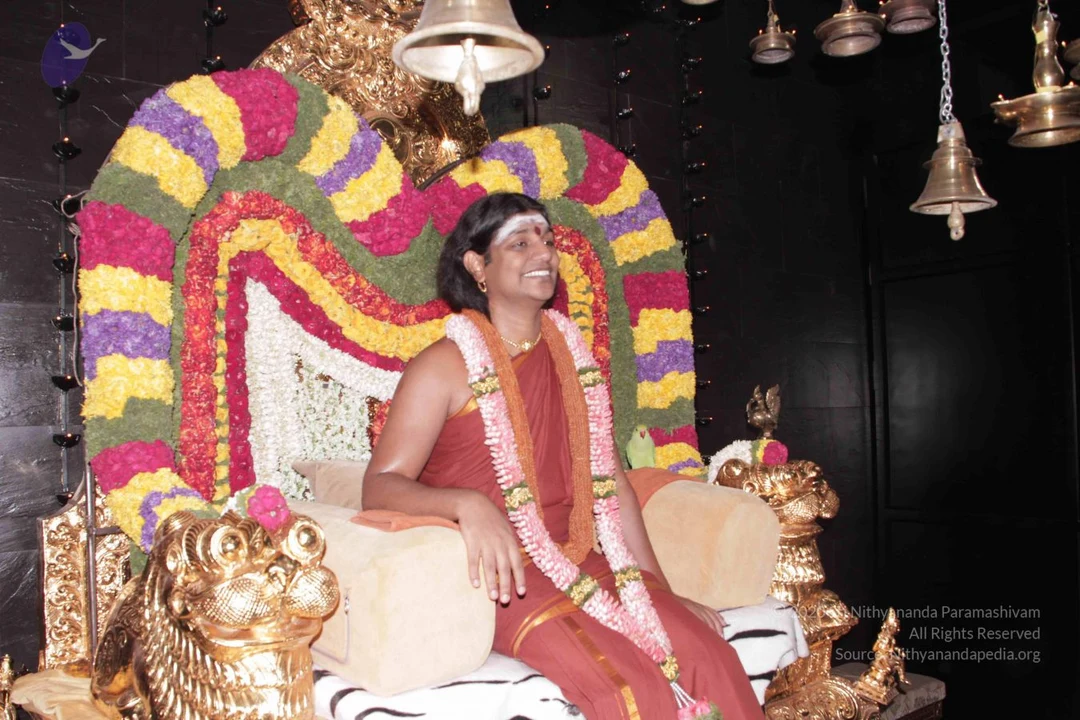
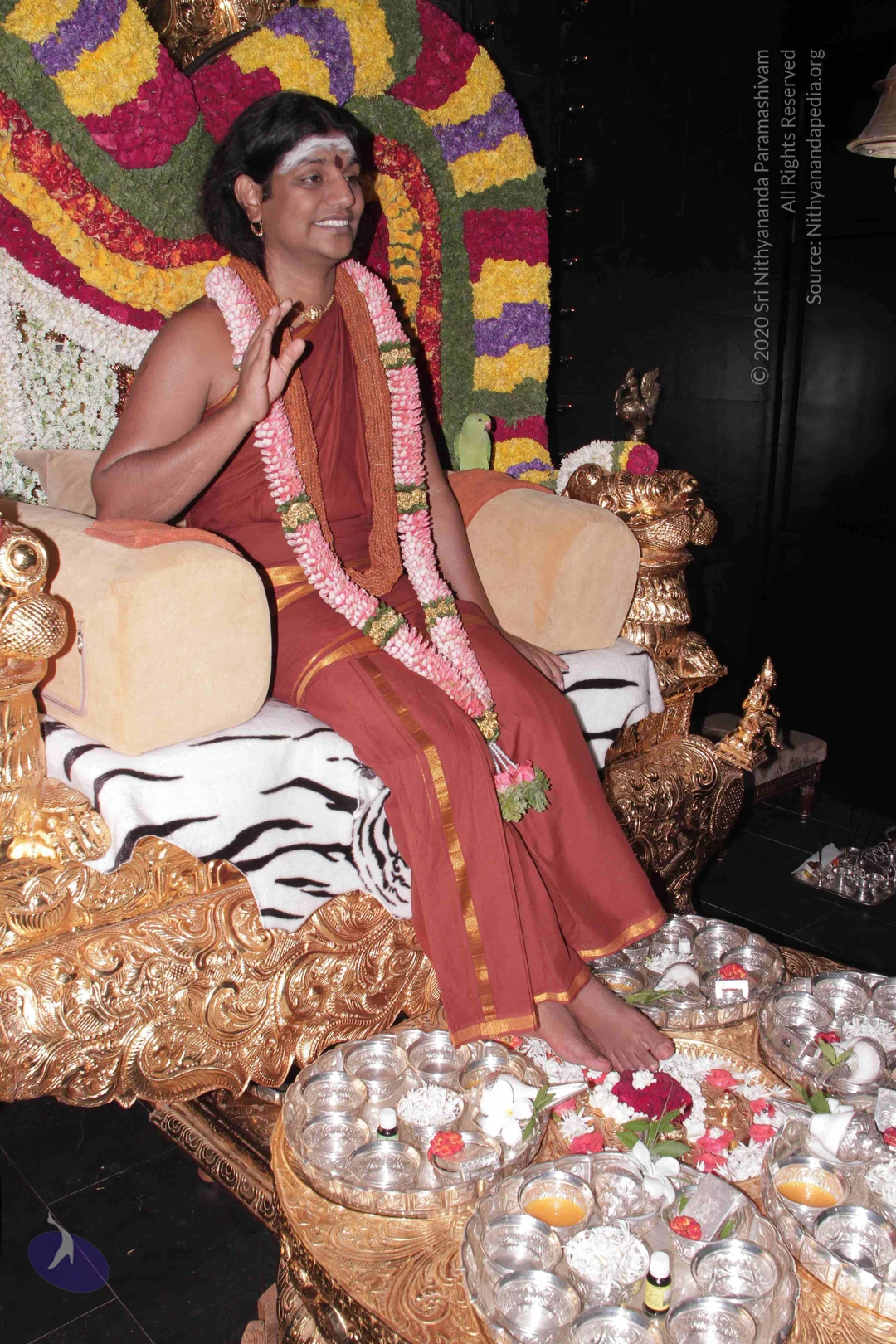
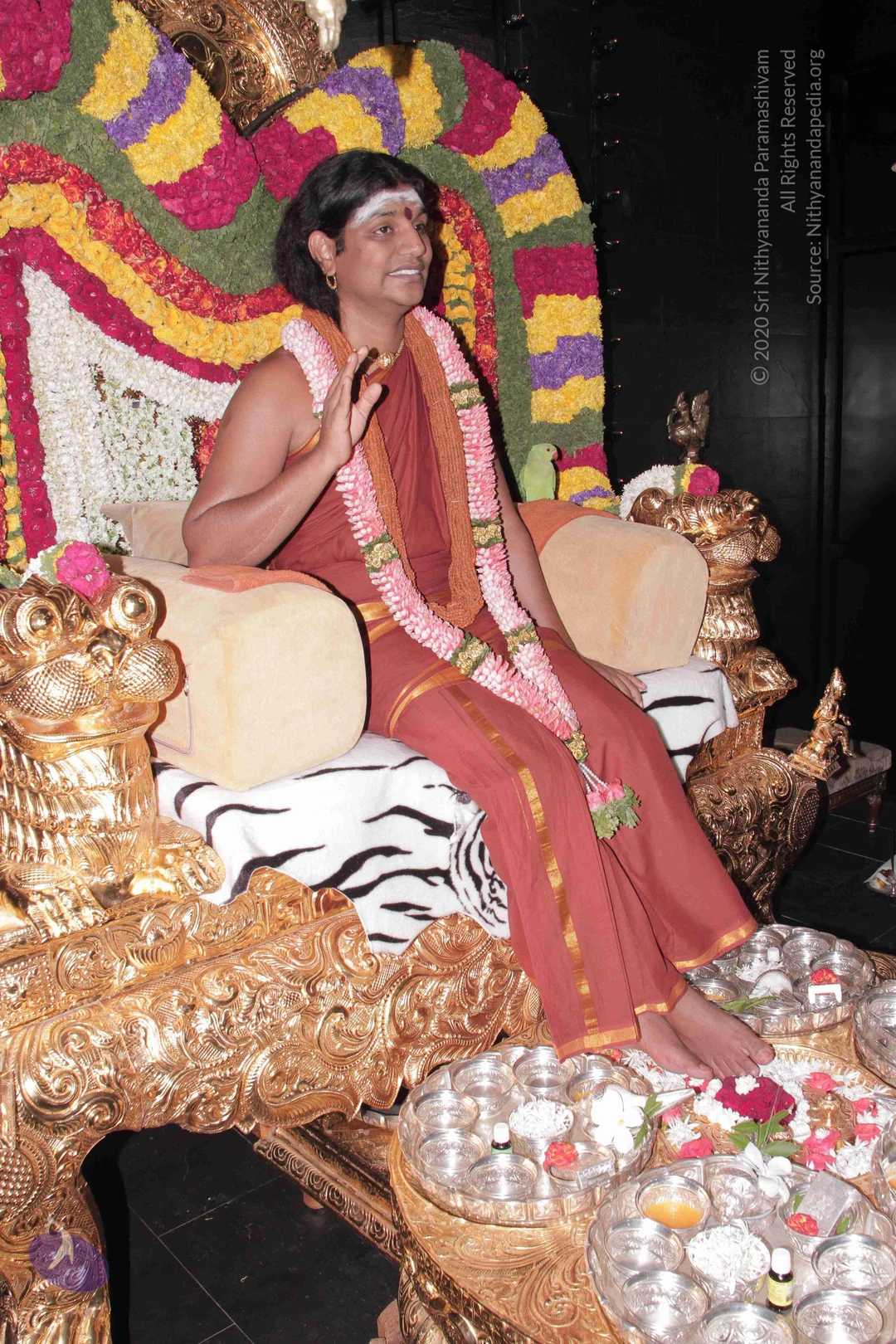
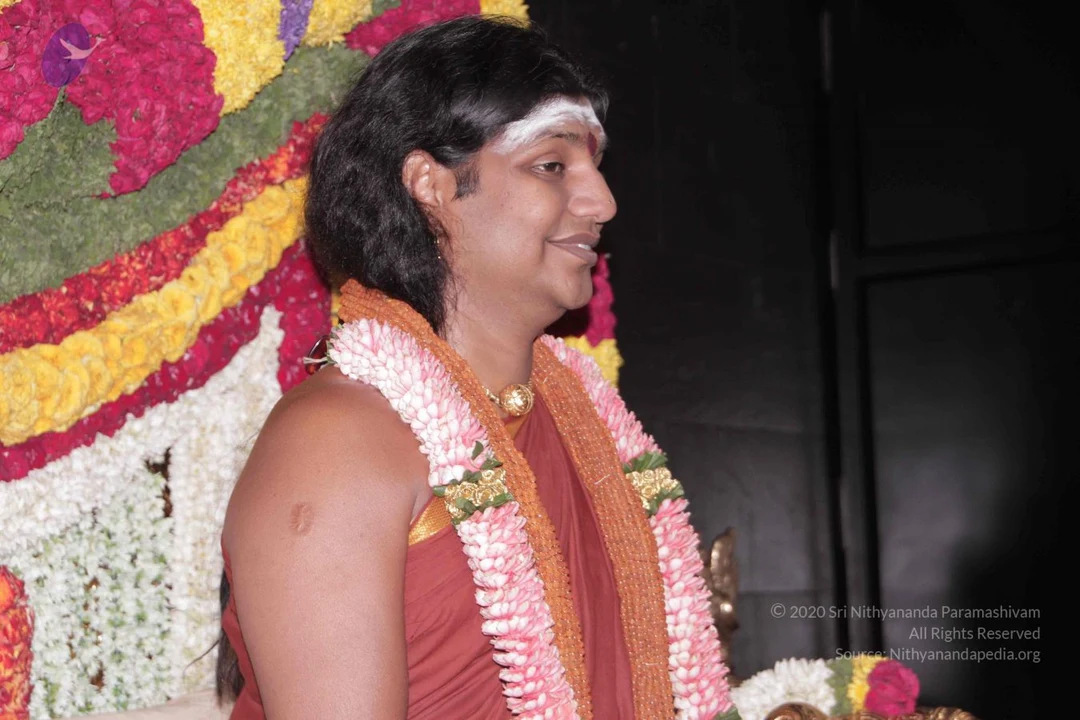
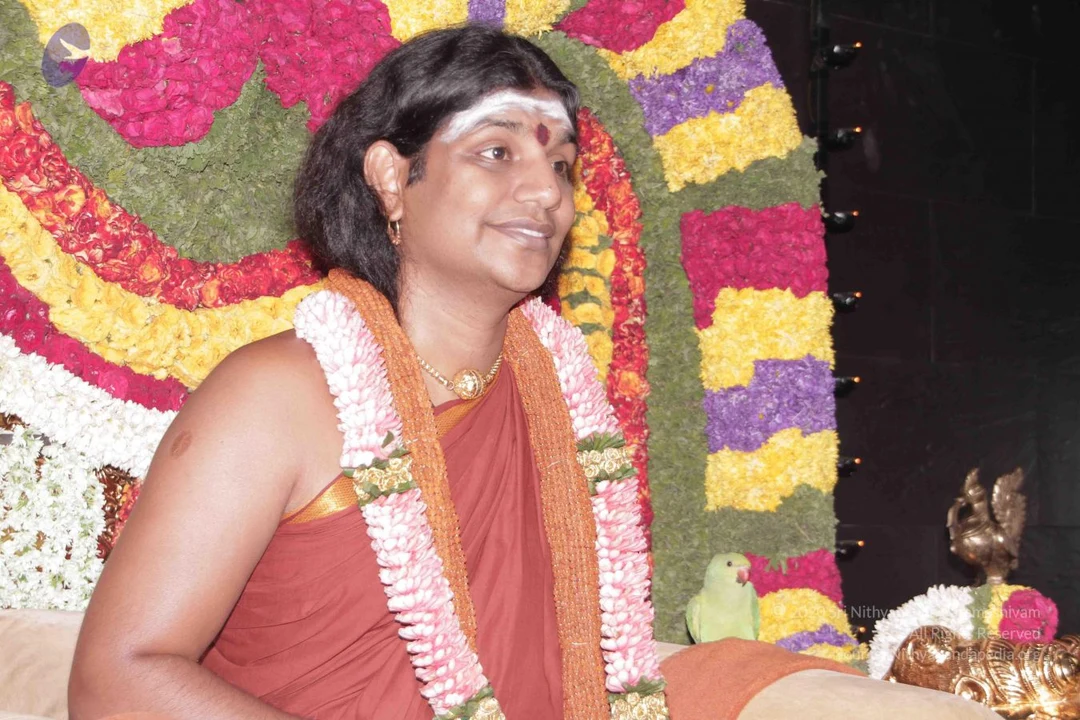
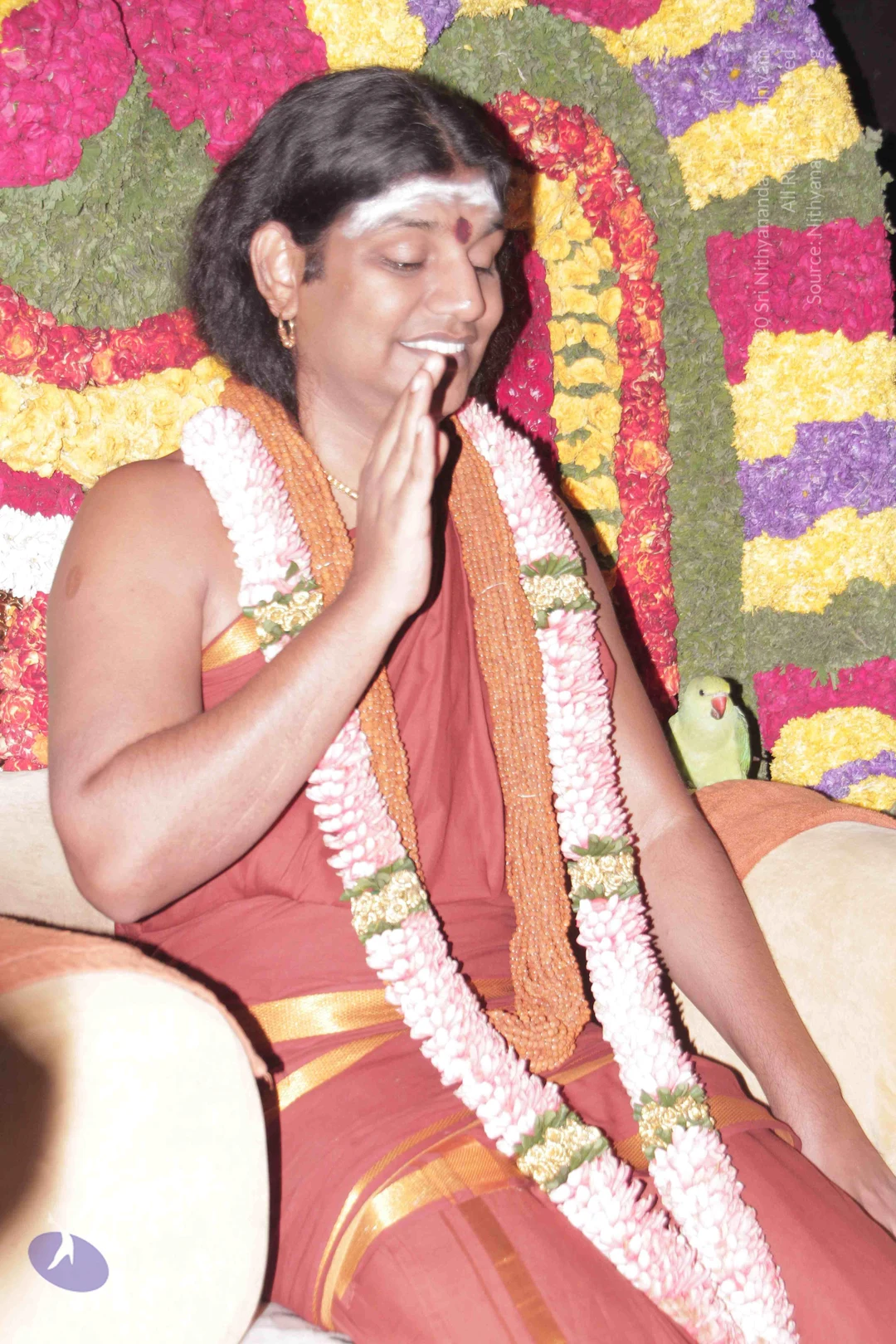
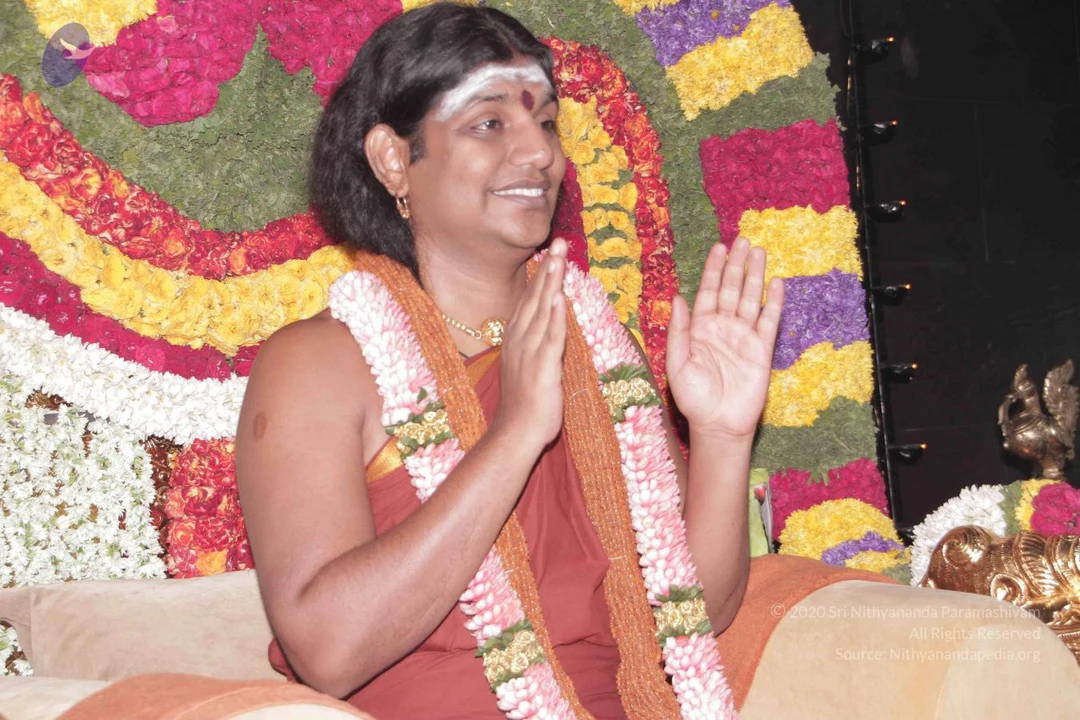
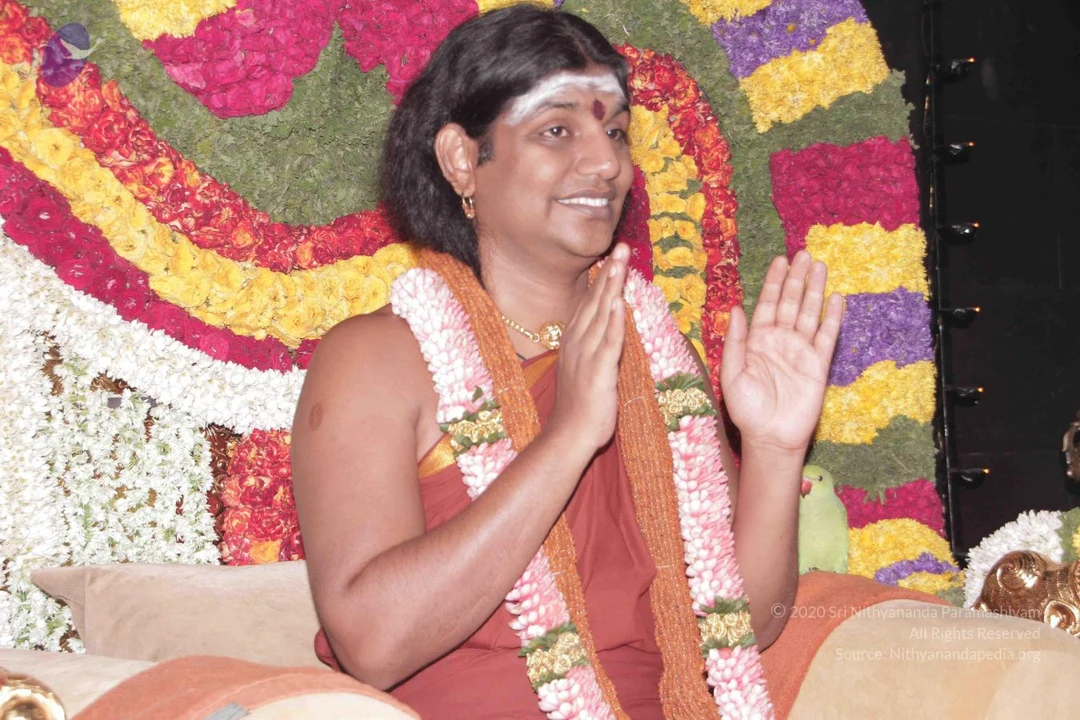
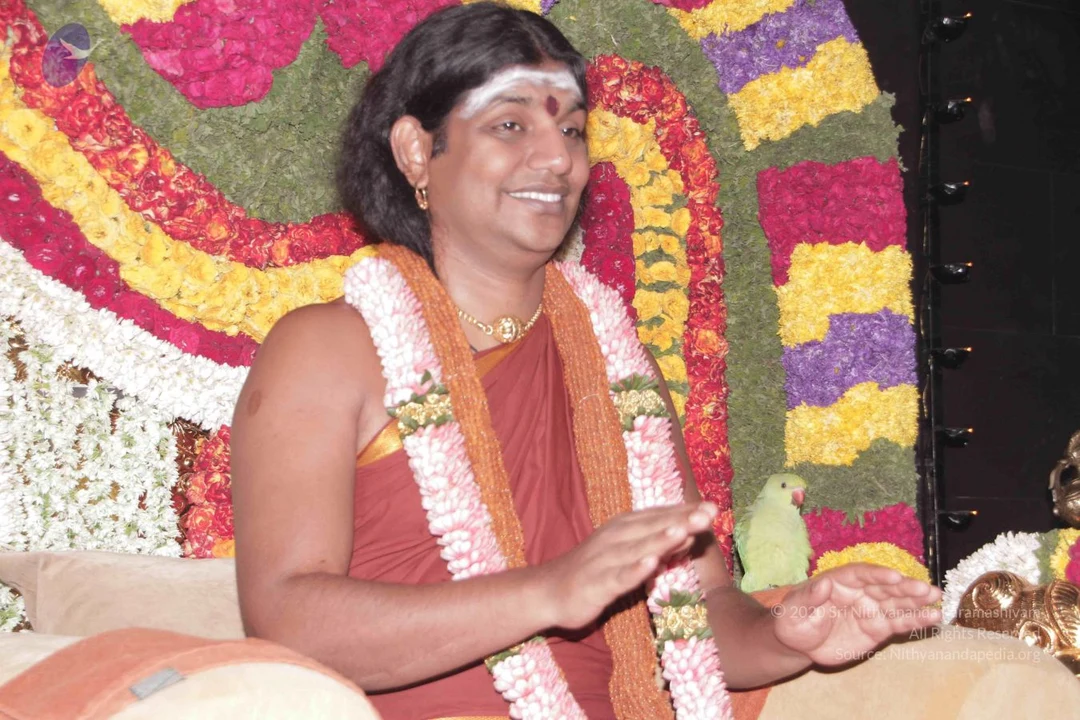
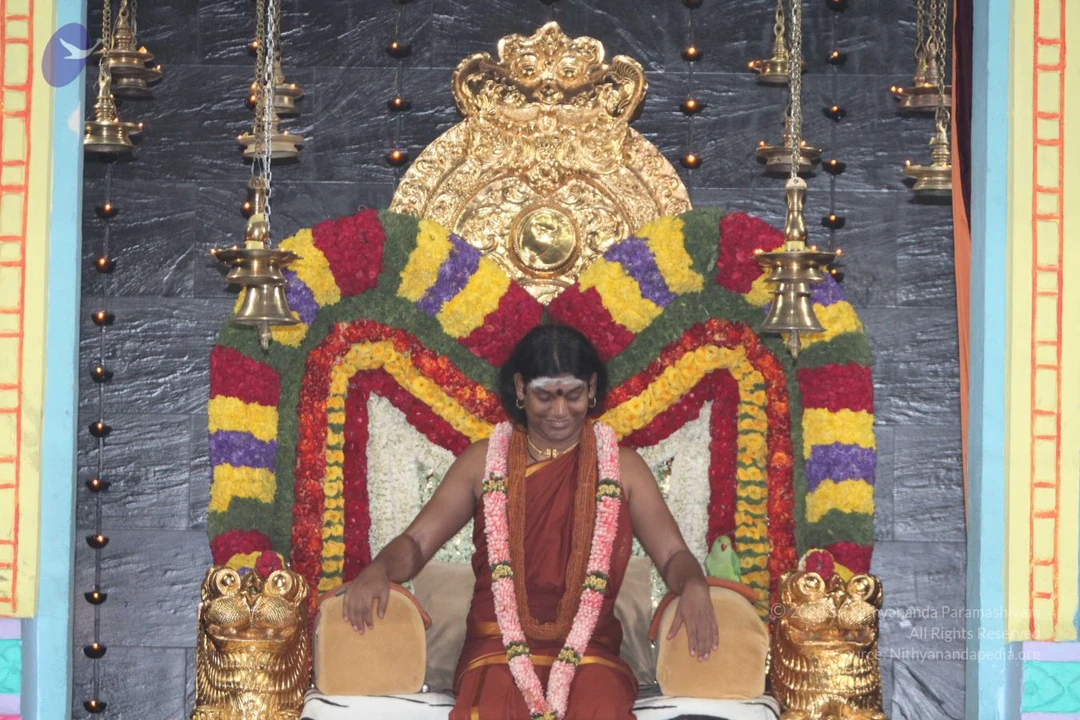
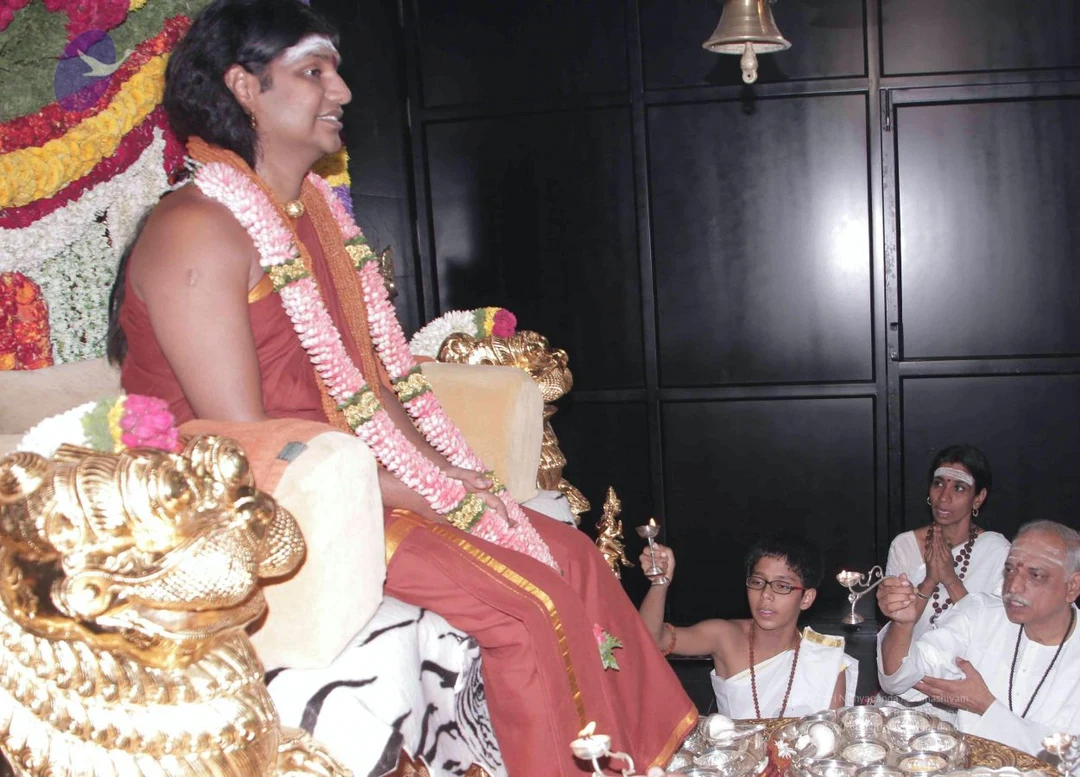
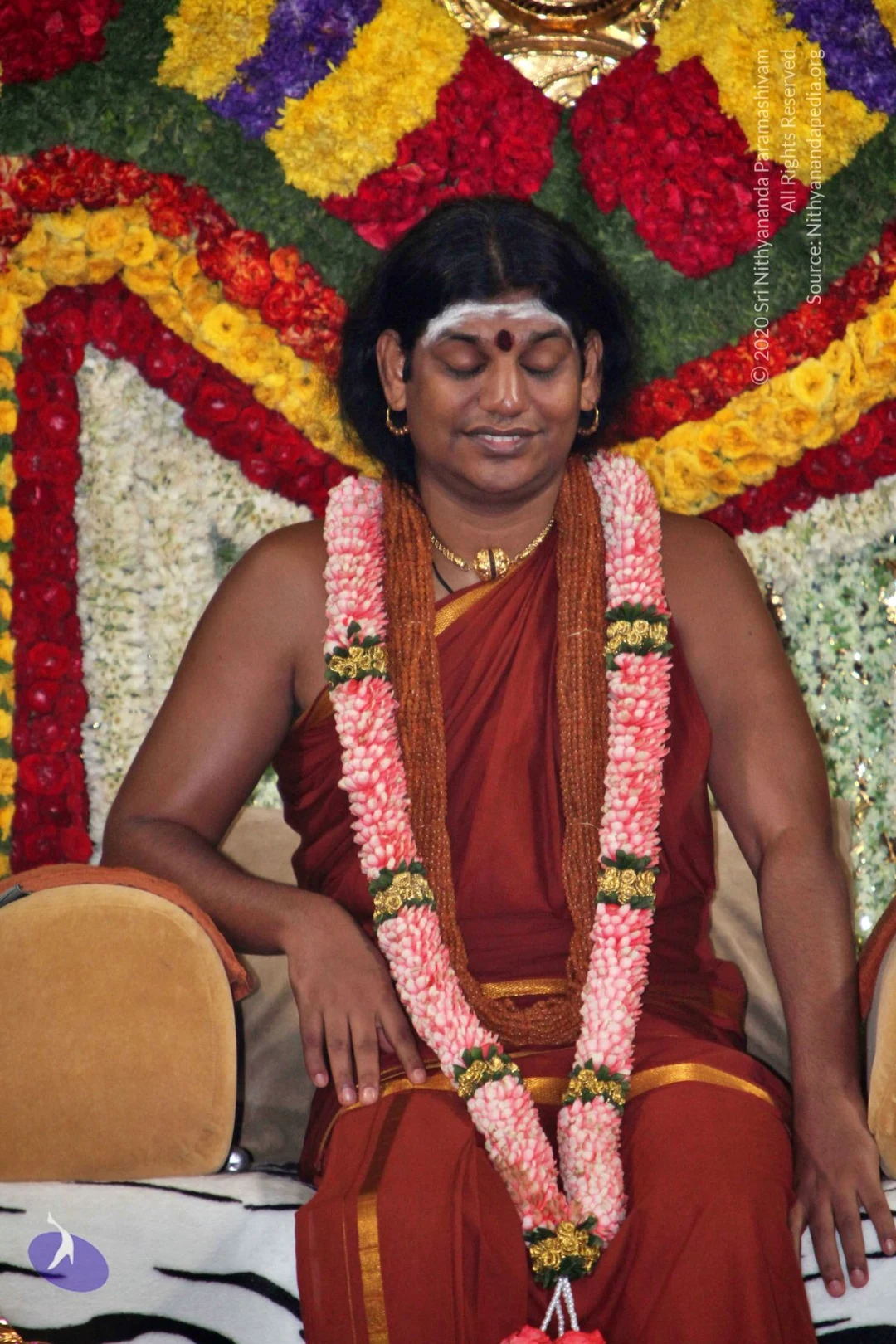
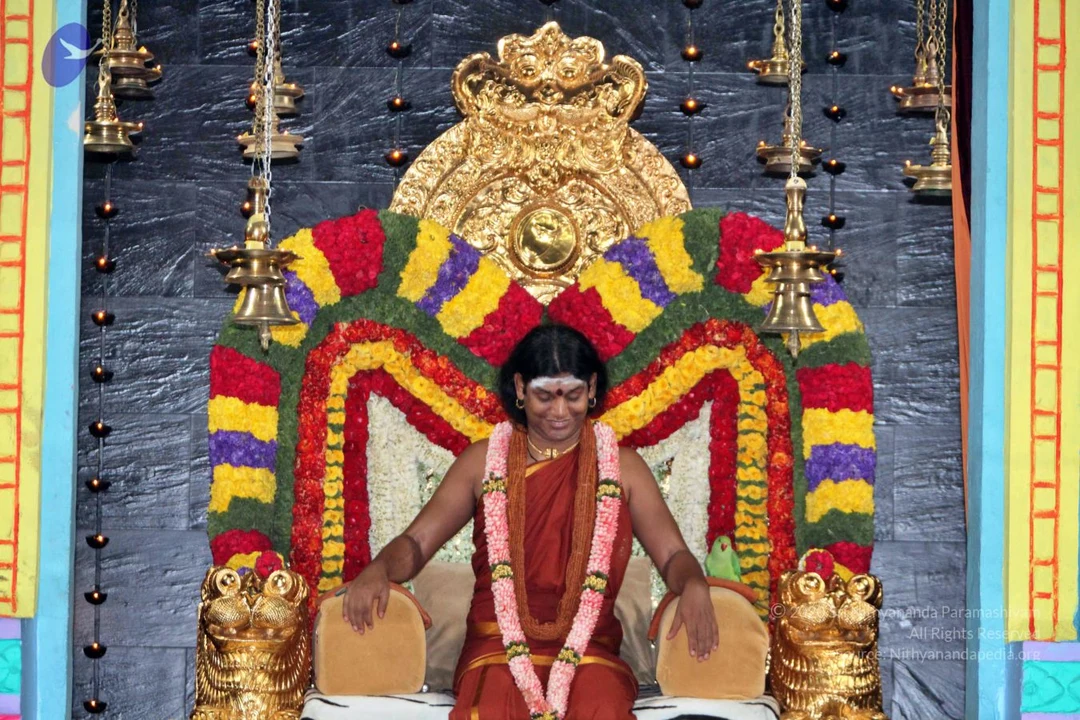
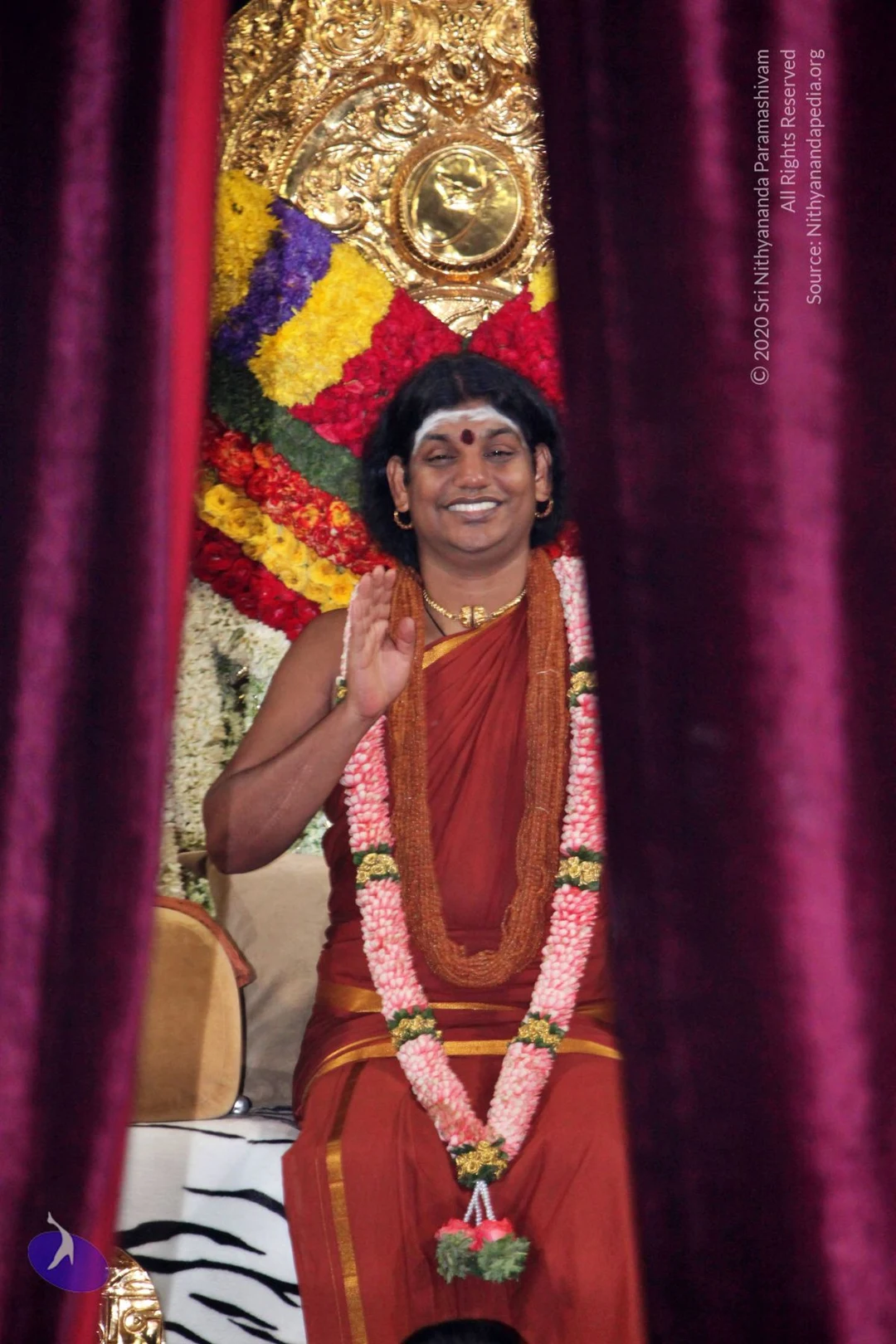
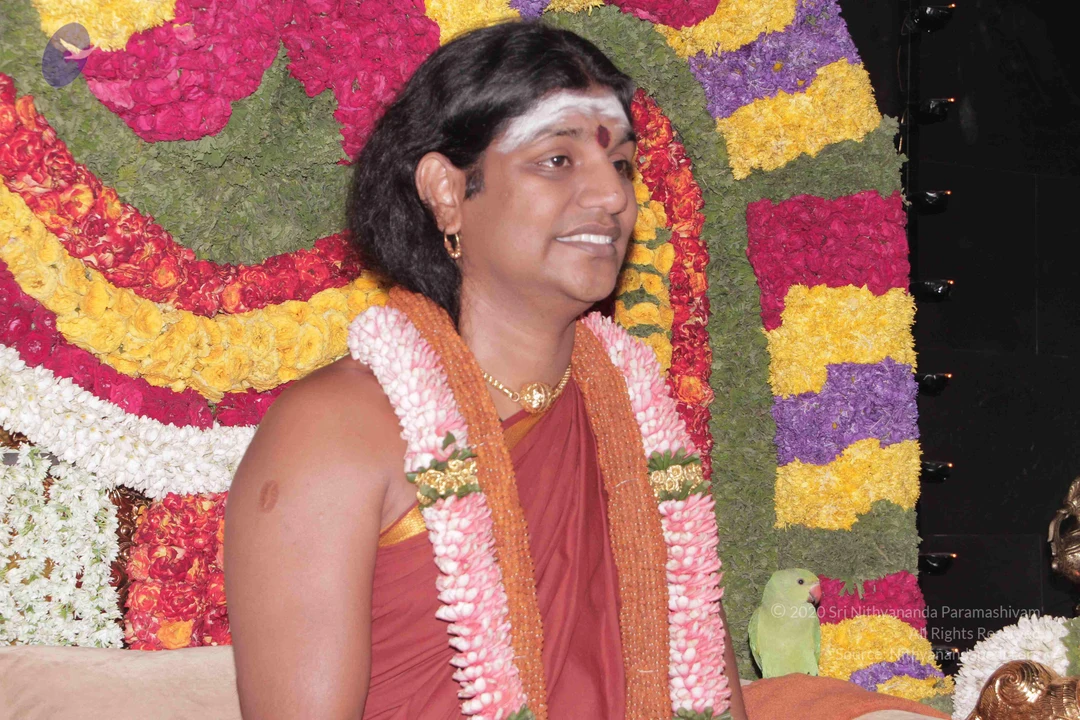
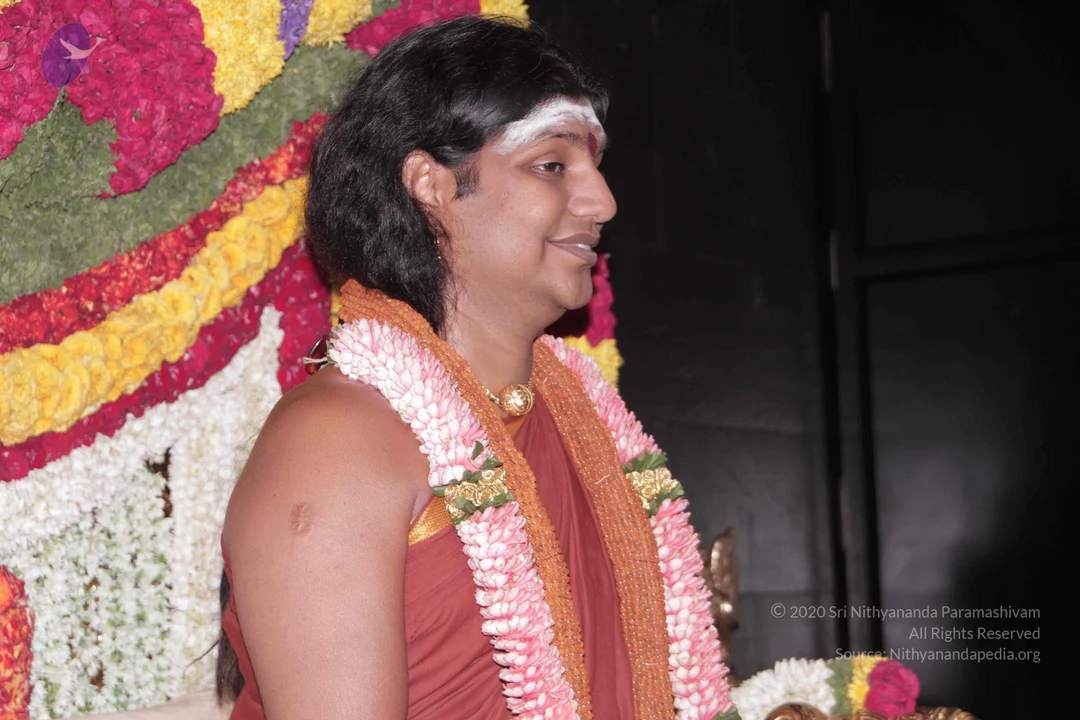
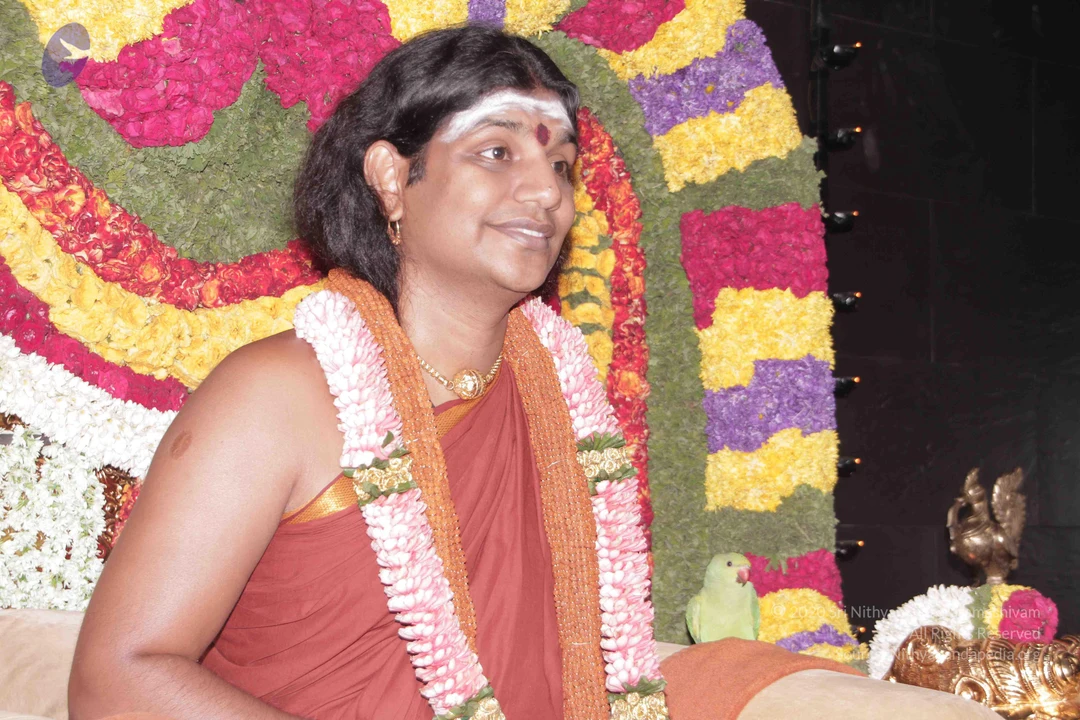
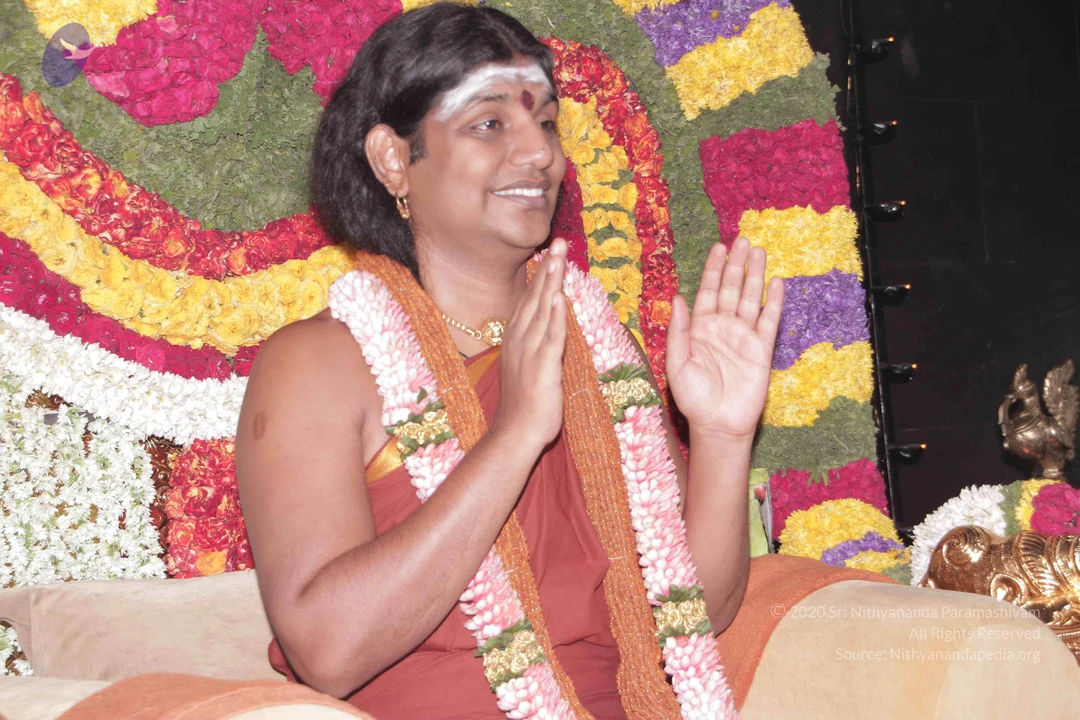
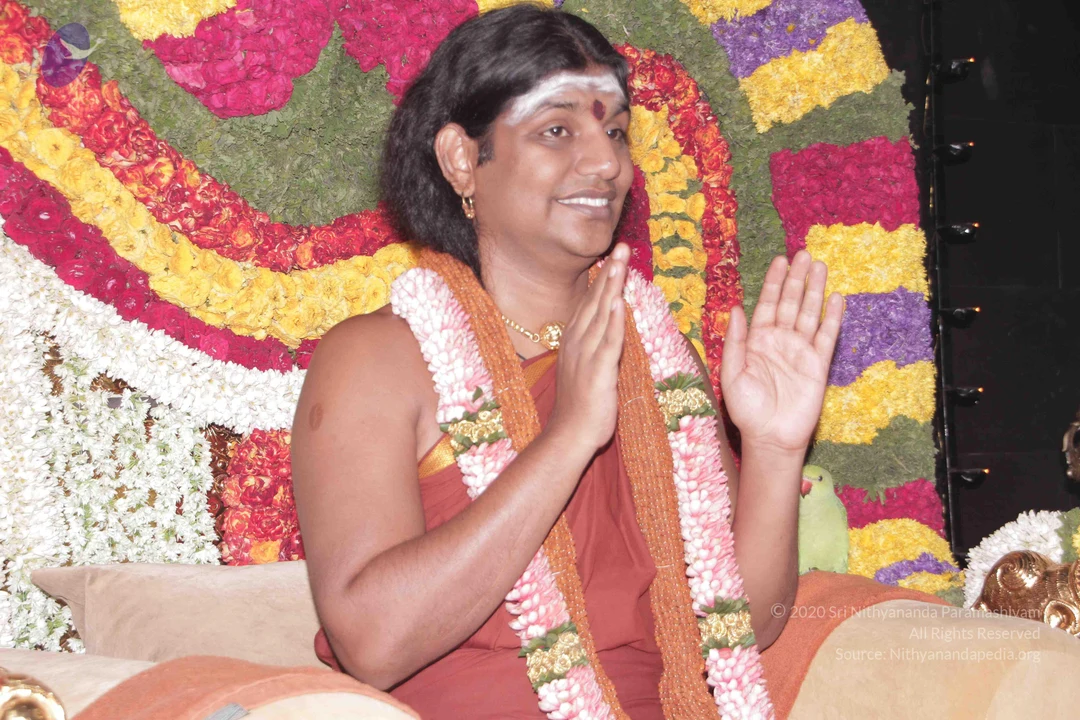
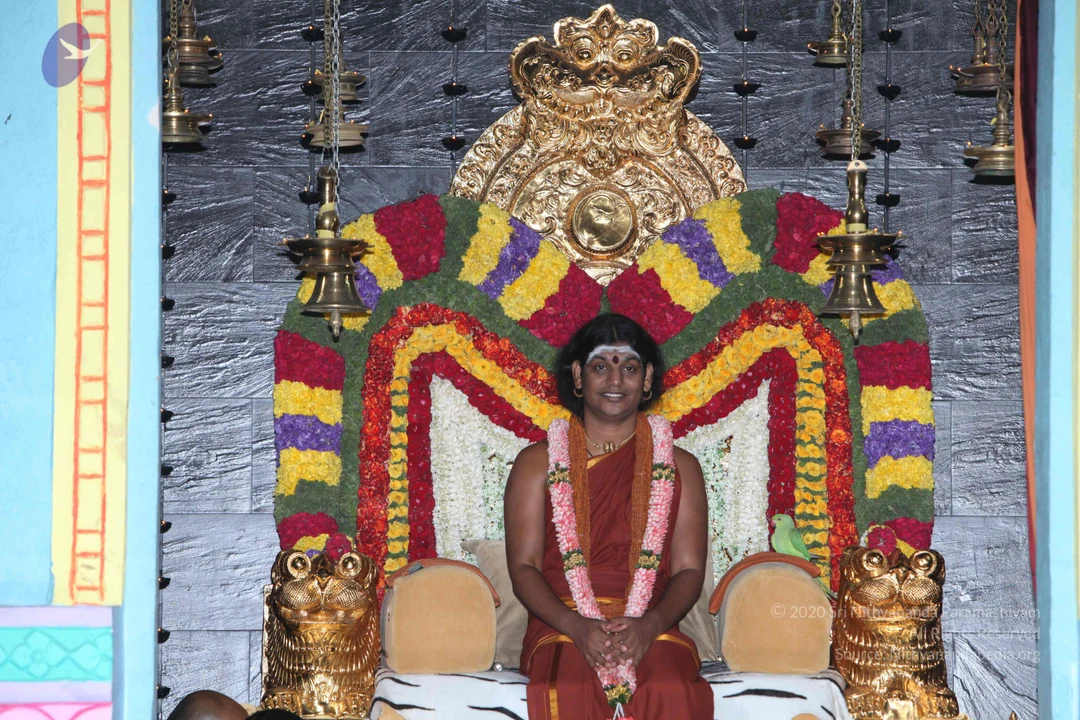
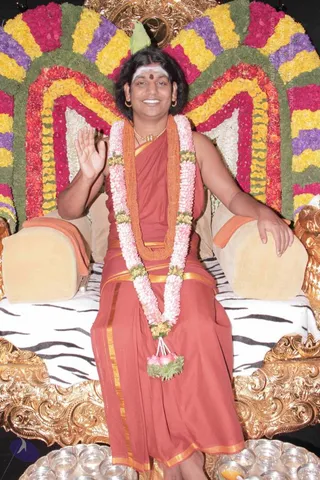
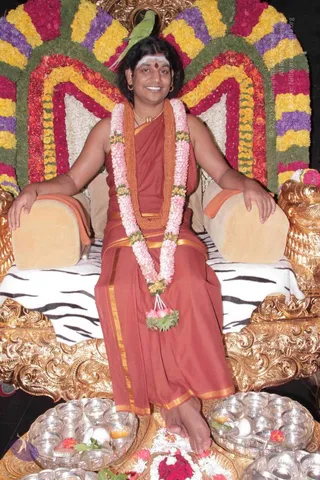
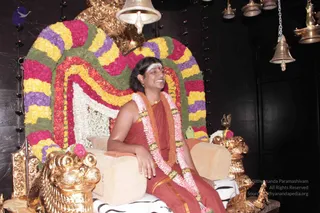
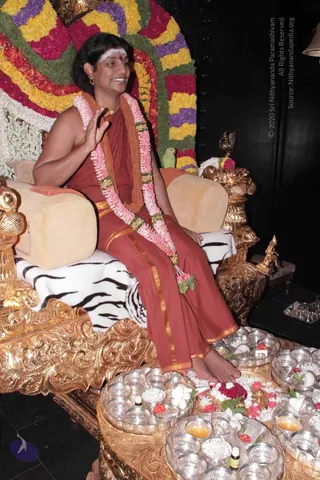
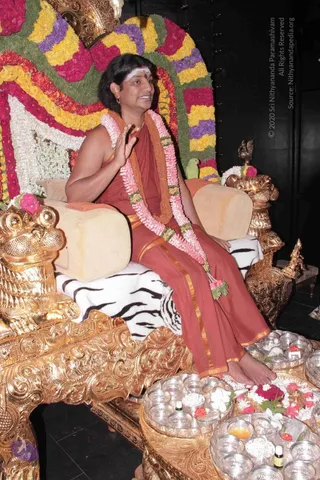
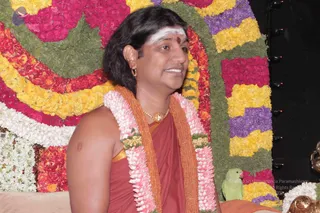
A smiling man seated on an ornate golden throne draped with a zebra-striped cloth, raising one hand in greeting. He wears a rust-red robe with gold borders, a long orange-beaded mala, a large pink and white flower garland, and gold ornaments. A white forehead marking with a red dot and a green parrot perches above him. Behind the throne is an arch of yellow, pink, purple and white flower decoration. Silver lamps with flames sit at the bottom edge. Swamiji (probable) is shown in this photo: the long swept-back hair, orange beaded mala and rust-red robe with gold border are visible cues, but his identity is an appearance-based label only.A smiling person seated on an ornate gold throne with lion-carved arms and a zebra-striped cushion, backed by a floral arch of marigolds and roses in yellow, red, purple and white. The seated person wears a rust-red garment with gold border, a pink and white jasmine garland with gold-tipped beads, a thick orange-brown beaded mala and a gold necklace, with white and red forehead markings. A green parrot perches on the top of the head. Bare feet rest on a floral offering, flanked by silver trays with bowls, flowers and offerings.A seated person sits on an ornate golden throne (peetha) with a lion-head armrest, backed by a large arch of marigold and rose garlands in yellow, pink, purple and green. The person wears a rust-red and orange robe with a matching orange shawl, a long pink-and-white flower garland, a gold necklace, and a white vertical tilak on the forehead. They smile and gaze to the side with one hand resting on a cushion. Brass bells and a gold-tipped bell hang from the upper right, with a dark wall behind. Visually this is a single-person photo; the specific identity of the person is not established by appearance.A seated man in a rust-orange robe with a gold-bordered dhoti sits on an ornate gold throne with a white tiger-striped cloth and cushioned armrests. He wears a long pink and white flower garland, a gold necklace, and white and red forehead markings, and raises one hand in a blessing gesture while smiling. Behind him is a backdrop of rows of colourful marigold and rose flowers. In front of the throne, several silver bowls with flowers, oil lamps, and petals are arranged on a gold tray. A green parrot perches near the throne. The seated man matches the page's a person description on the throne, but his appearance on the throne is insufficiently distinctive to confirm identity, so he is described by role as a seated figure on a throne receiving offerings.A photograph of a seated man on an ornate gold throne with carved lion-head arms, draped in a rust-red robe with gold borders and a long pink-and-white jasmine garland. He has a white vertical forehead mark and red bindi, gold earrings, and raises one hand in blessing while smiling. The throne is backed by a large arch of multicolored flower garlands in red, yellow, purple and white, with a tiger-striped cloth on the seat and cream bolsters. In front are silver bowls holding flowers, oil and offerings, with bare feet resting near them. A small green parrot perches on the throne to the side. a person wears saffron-toned robes and a long swept-back hairstyle with ceremonial gold necklace, seated in a puja setting for satsang.A seated man with long dark hair, a white tilak and a red bindi sits in front of a dense backdrop of flower garlands in red, yellow, purple and white. He wears a rust-red robe with an orange shawl and a garland of white and pink jasmine-style flowers, plus a gold necklace and a small gold earring. A green parrot perches on the flowers at the right edge, and a brass object is partly visible at the lower right. The man is smiling and looking to the side. Appearance-based label: Swamiji (probable), with long swept-back hair, saffron-orange shawl and gold necklace as cues, shown in person.

Pada-Puja

47 photosSource gallery
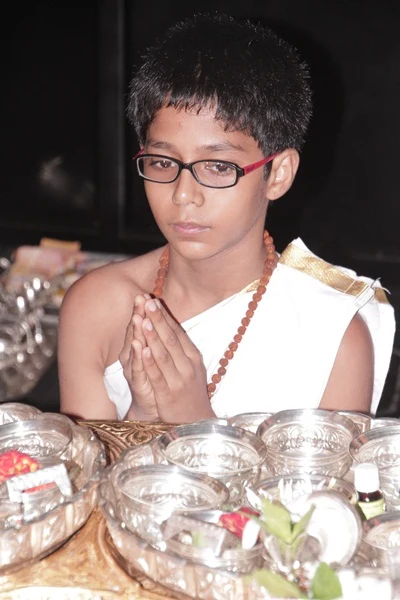
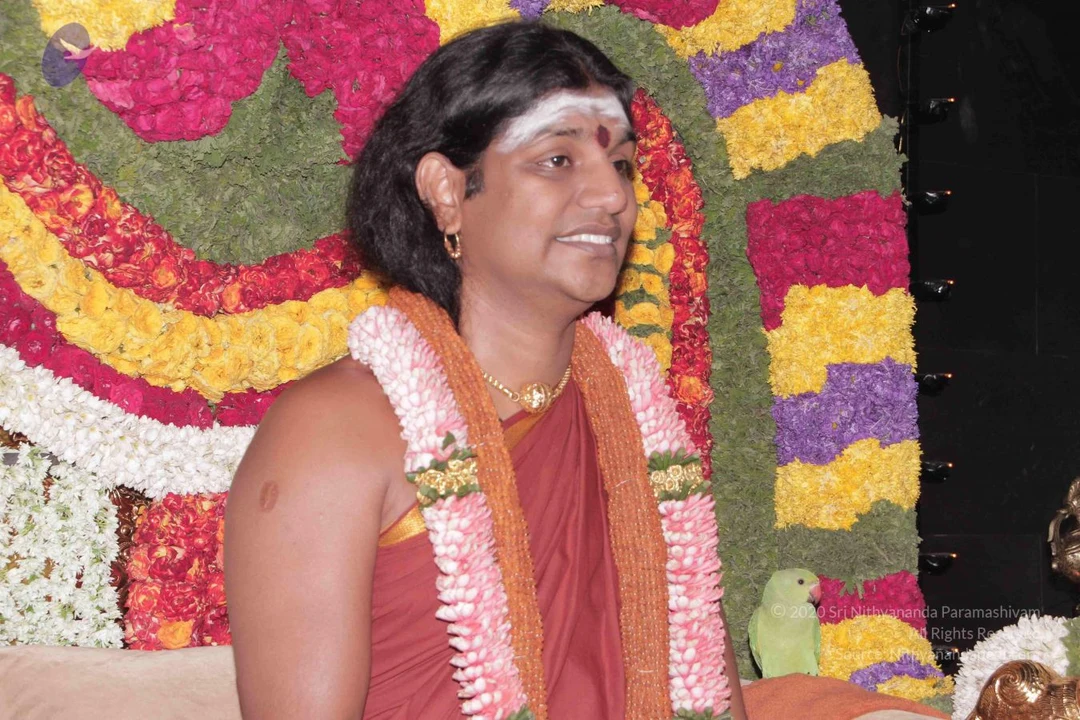
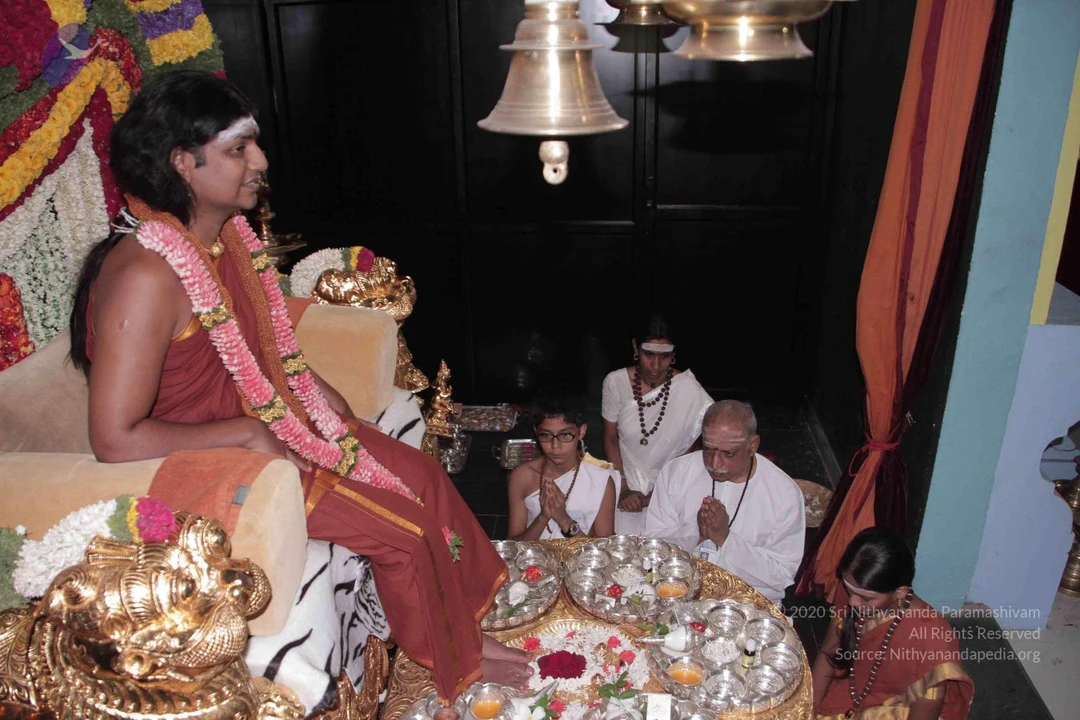
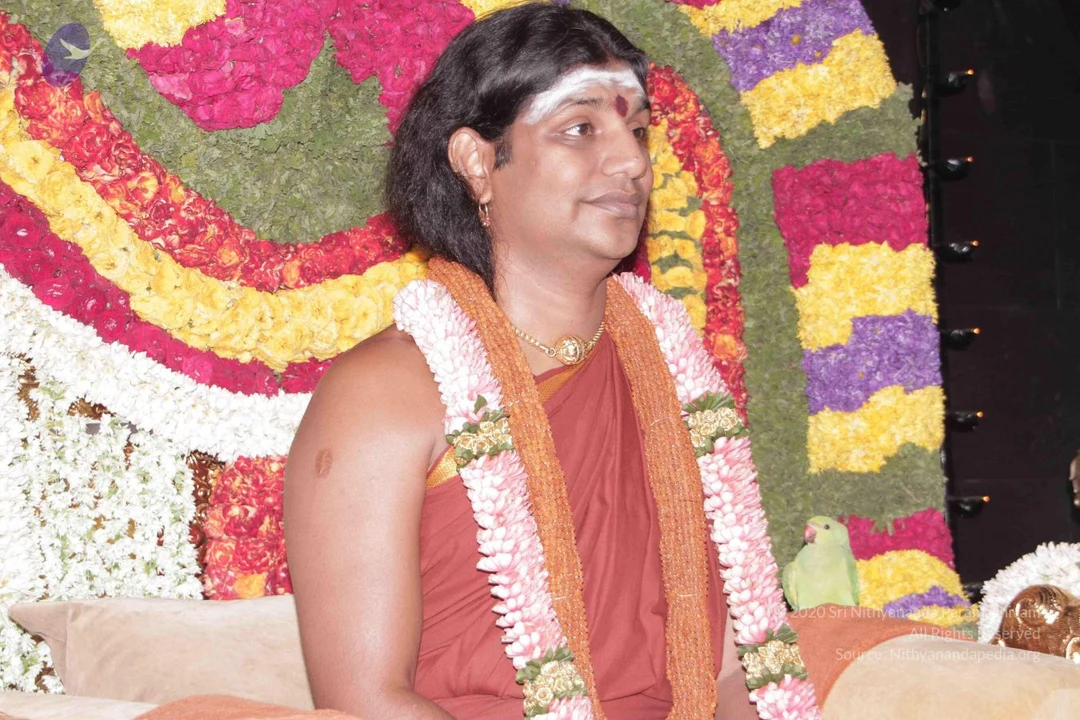
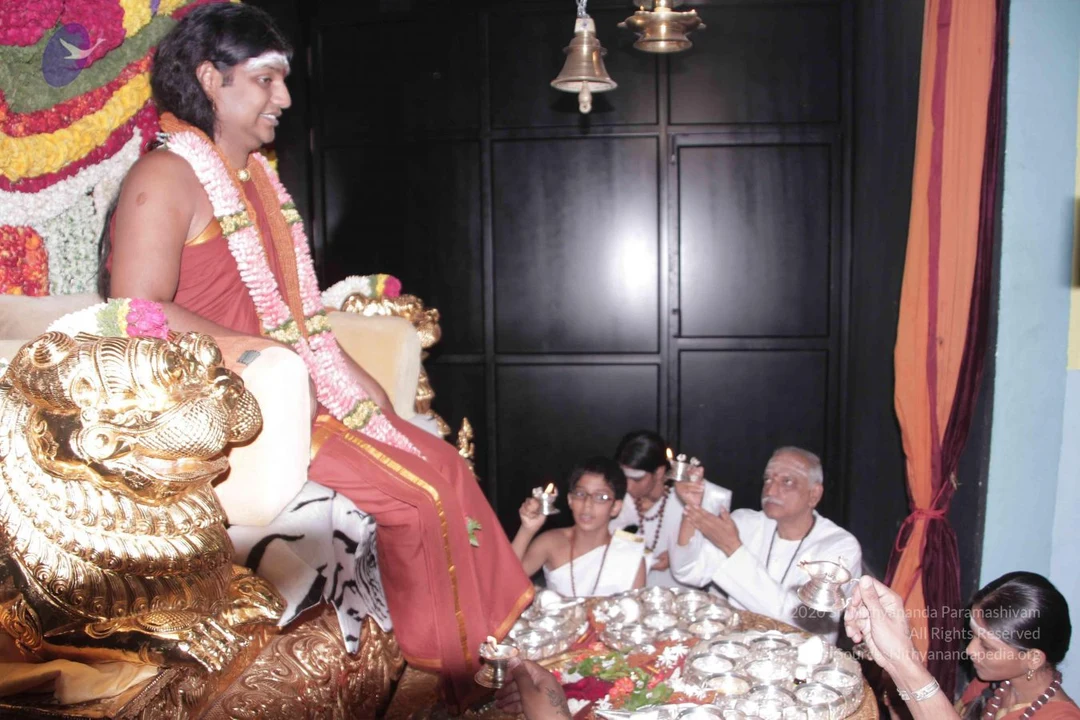
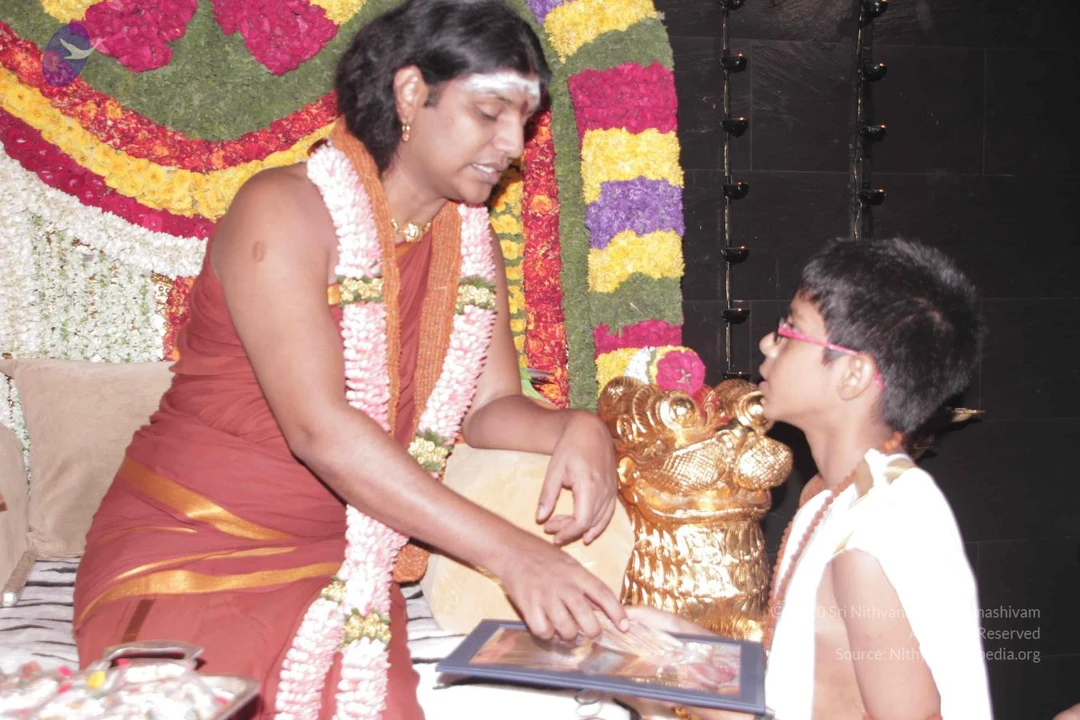
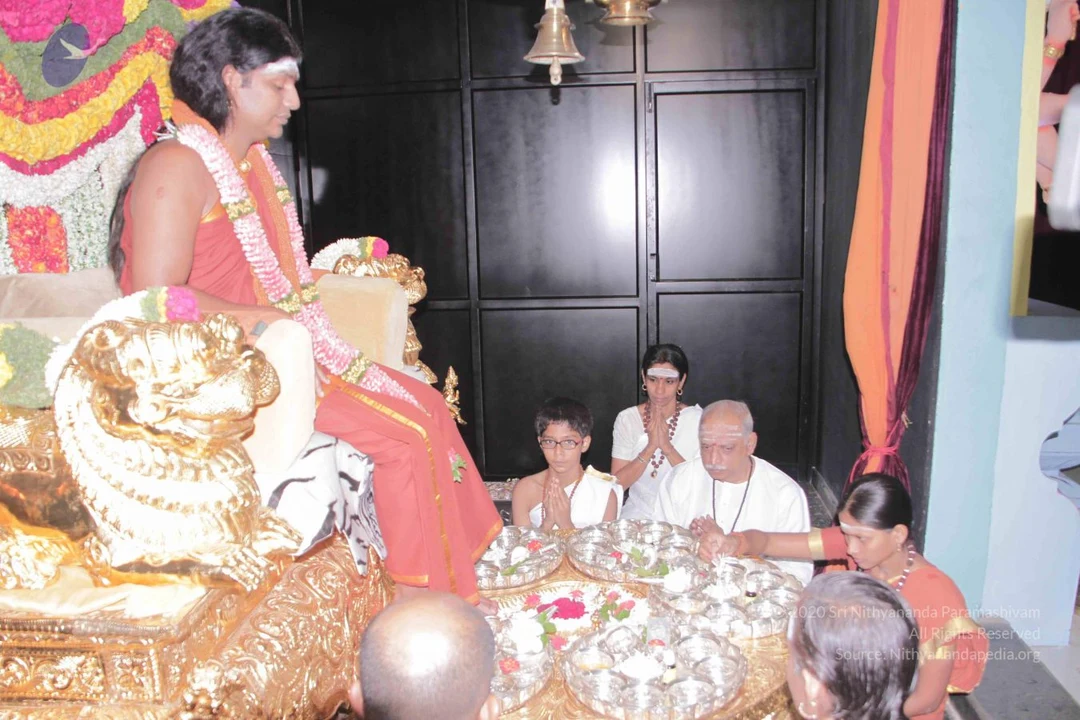
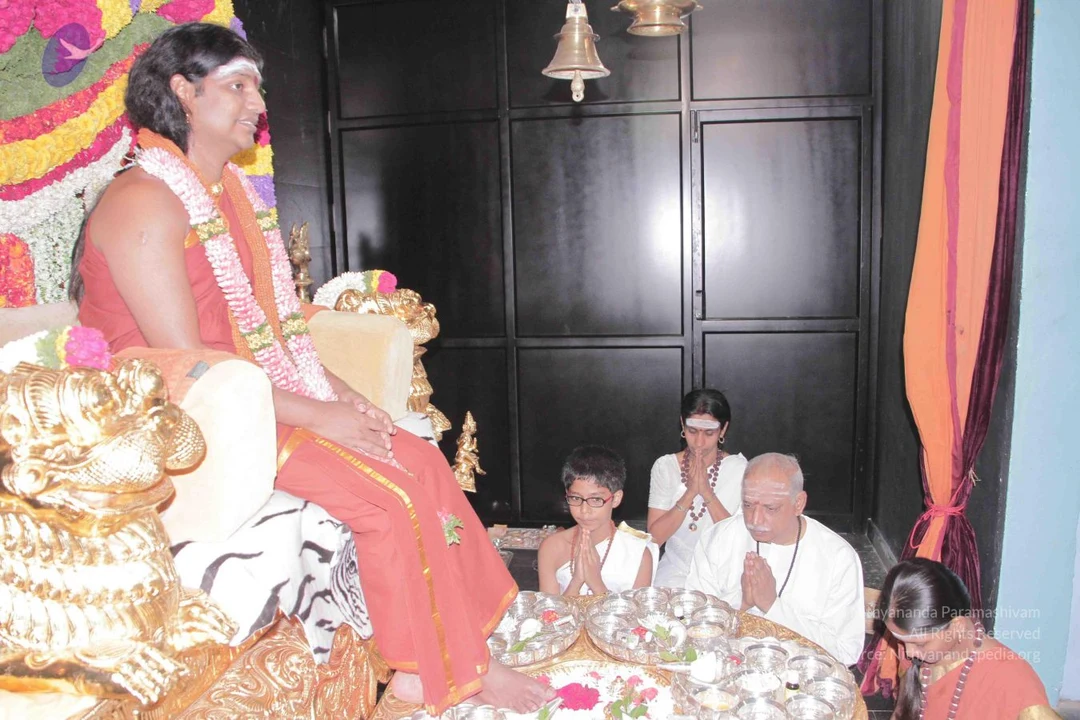
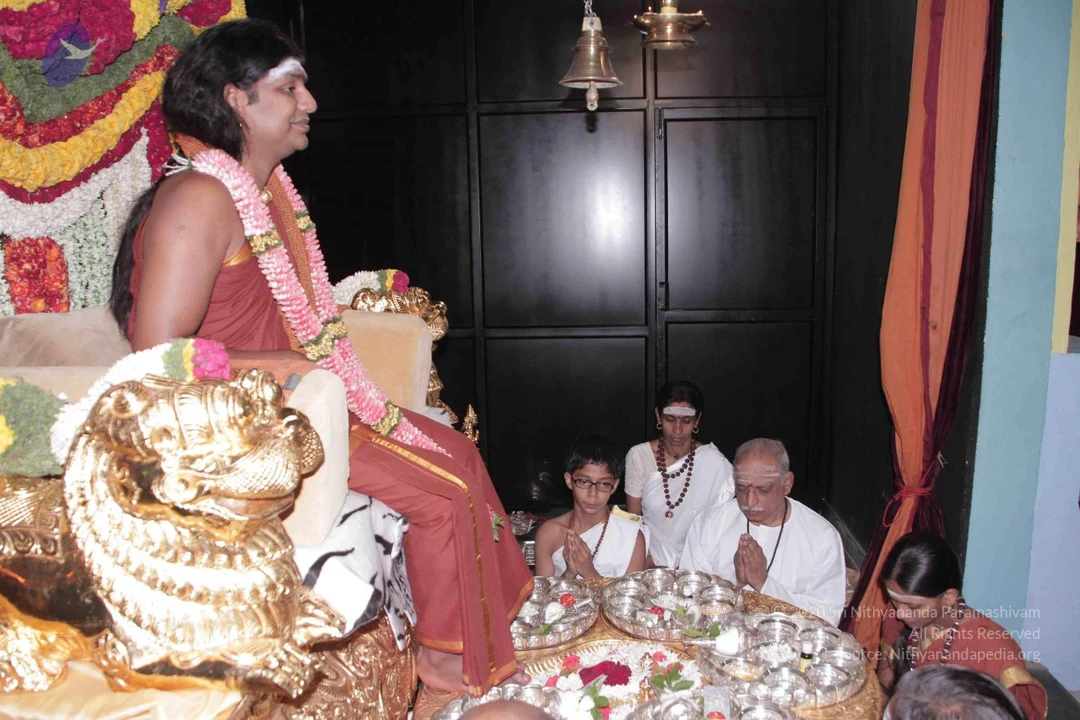
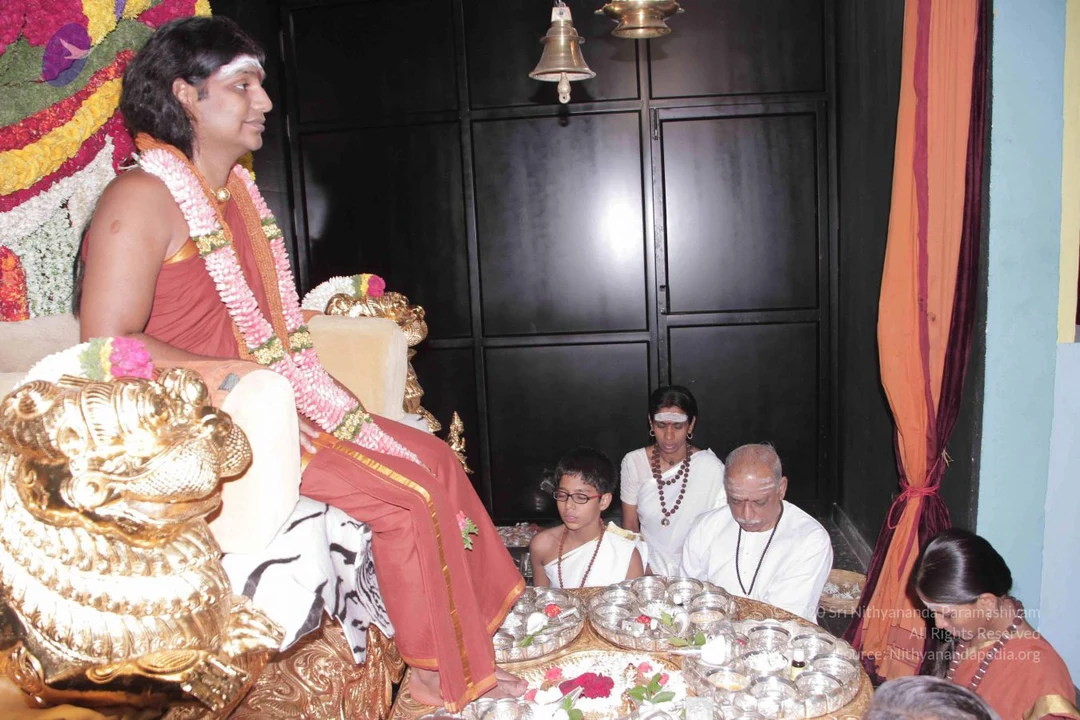
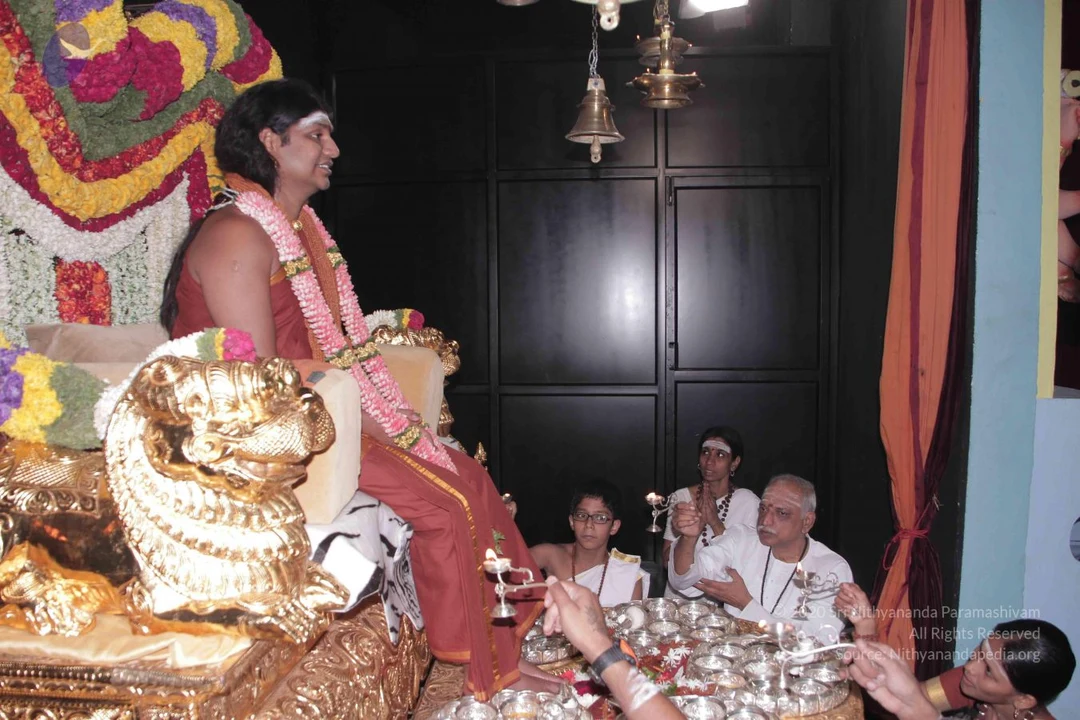
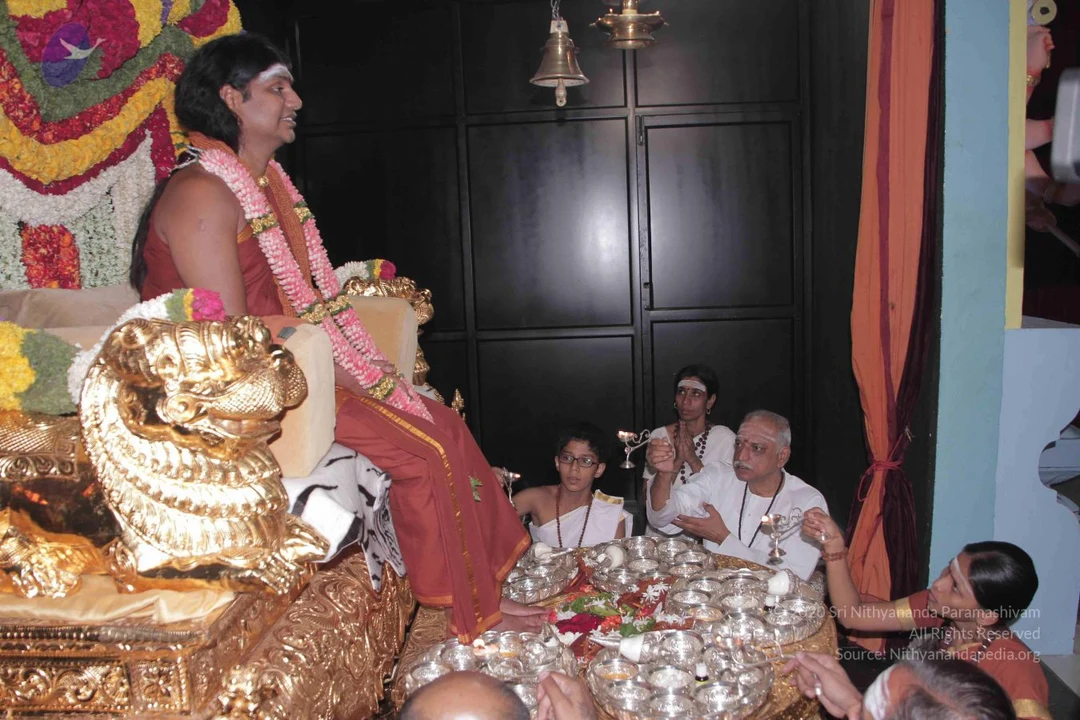
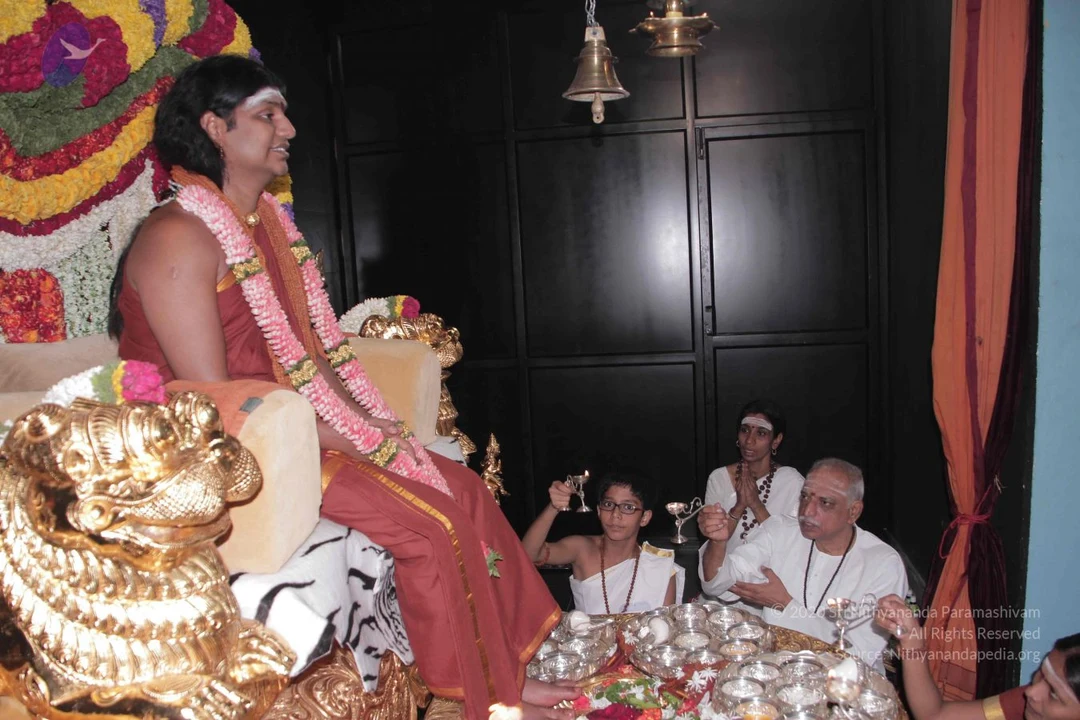
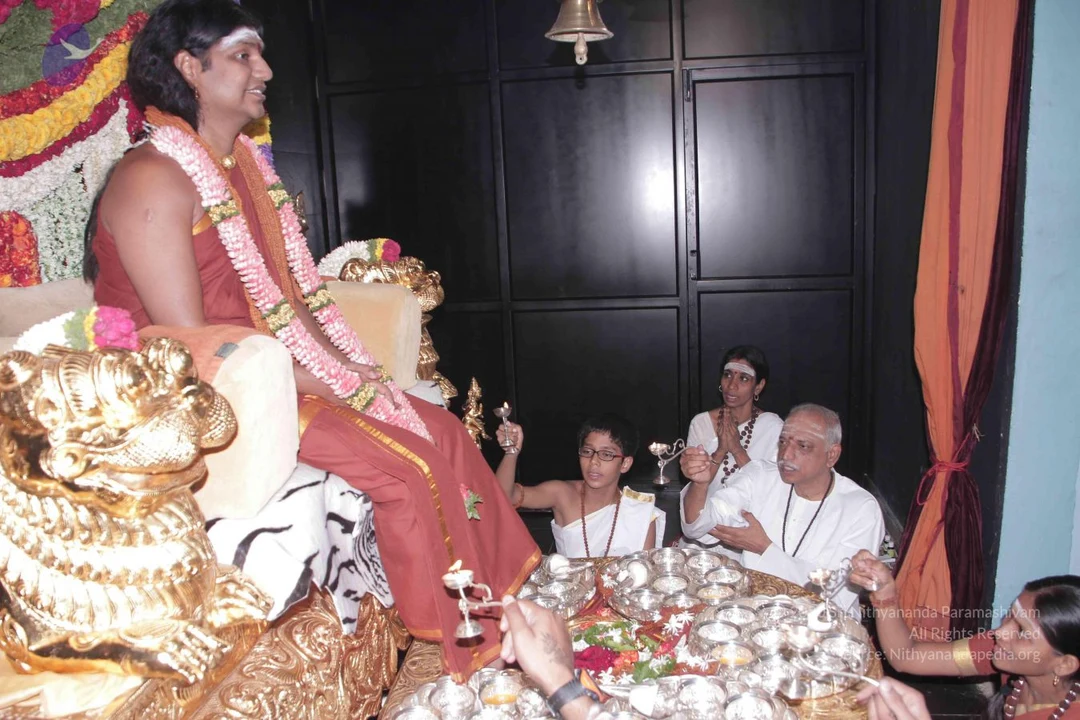
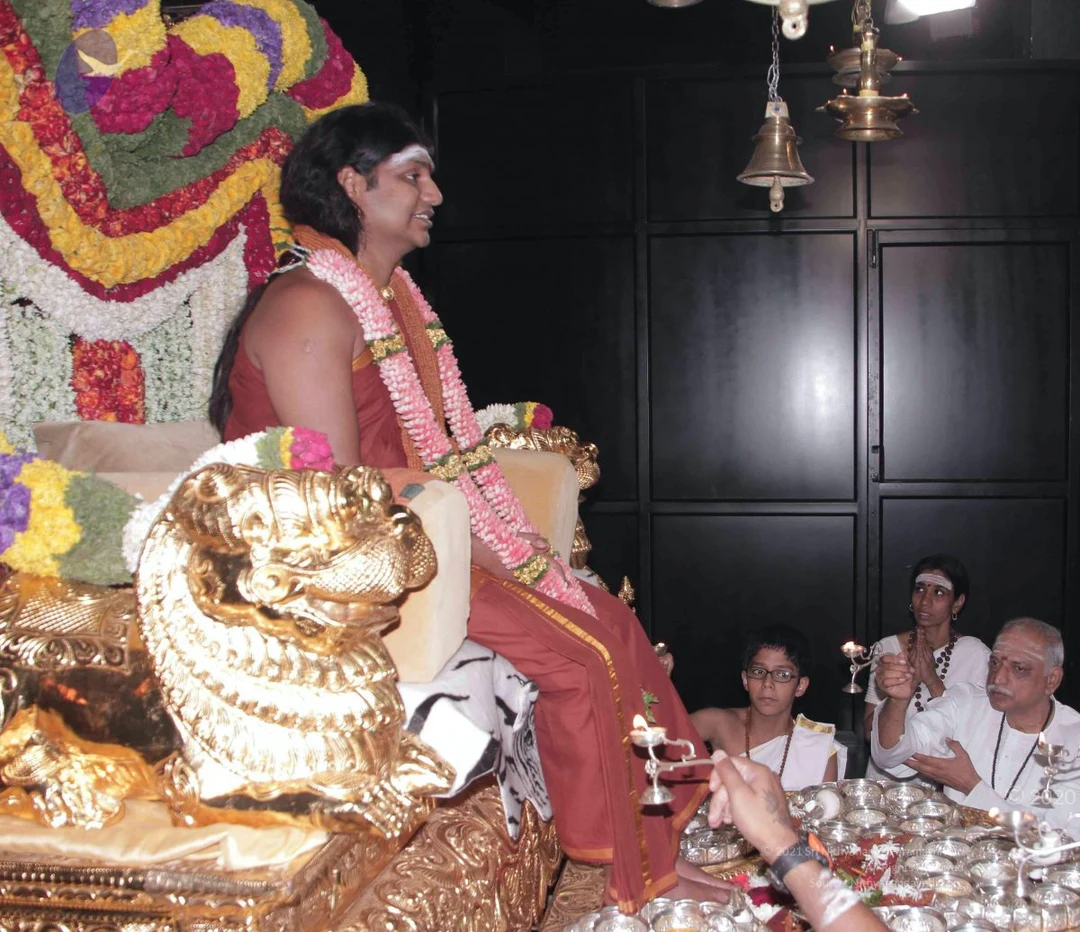
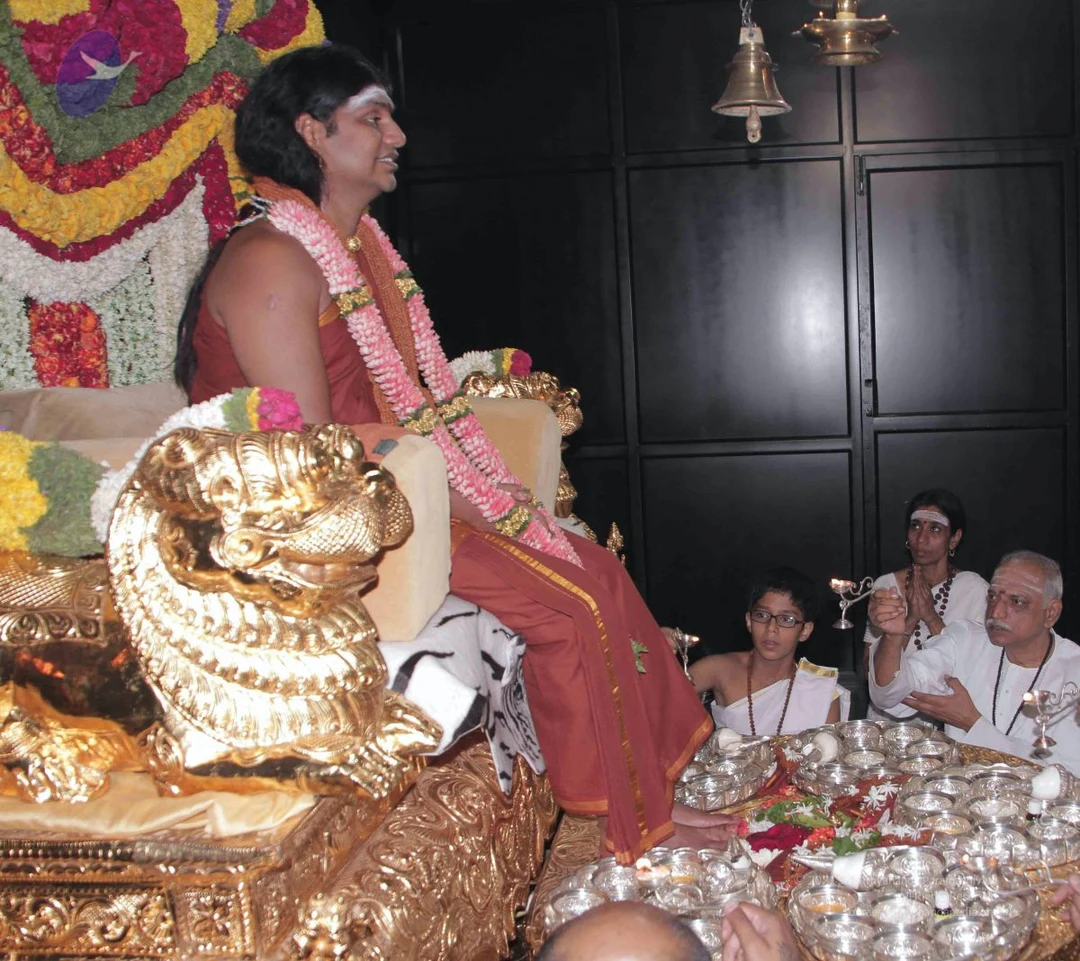
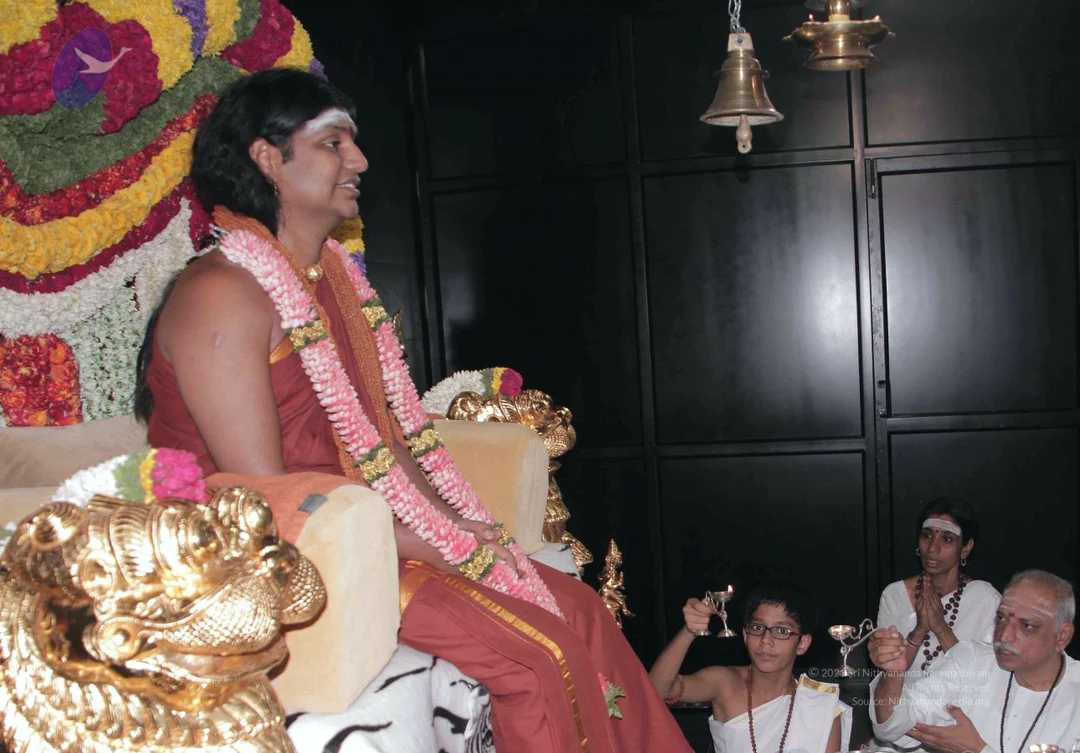
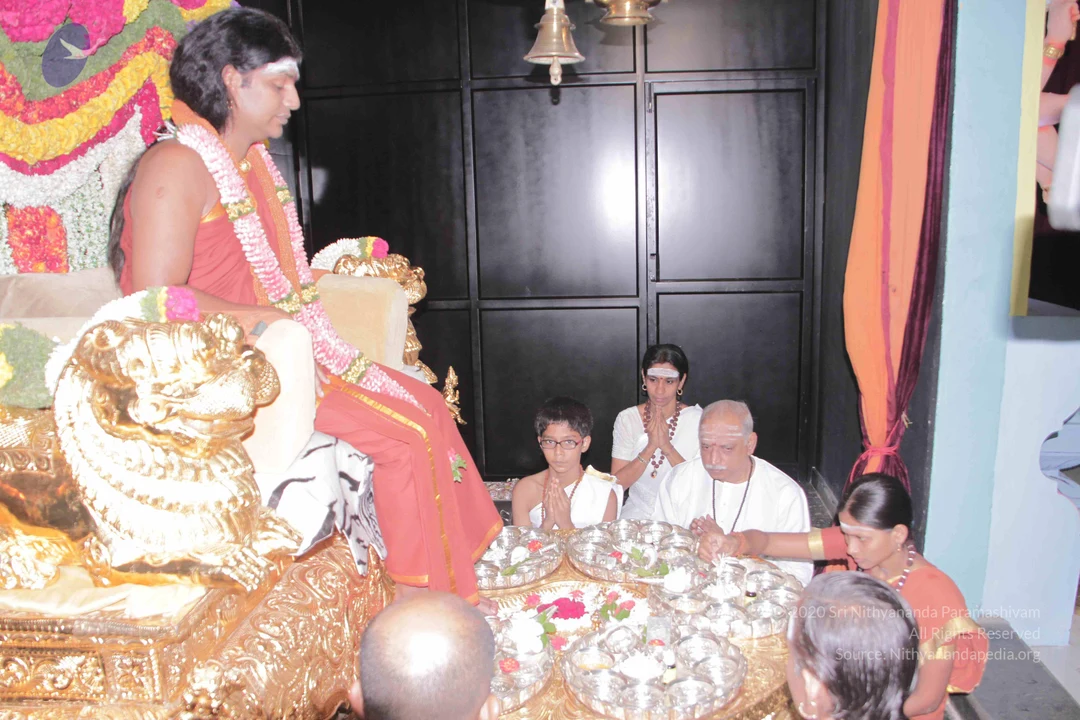
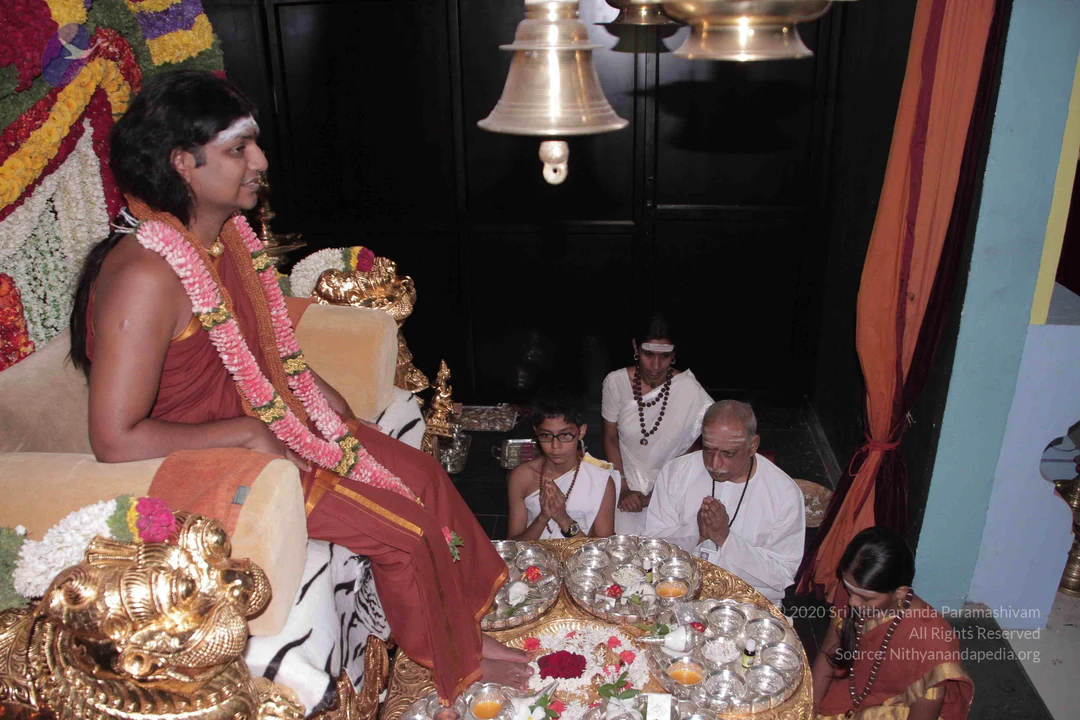
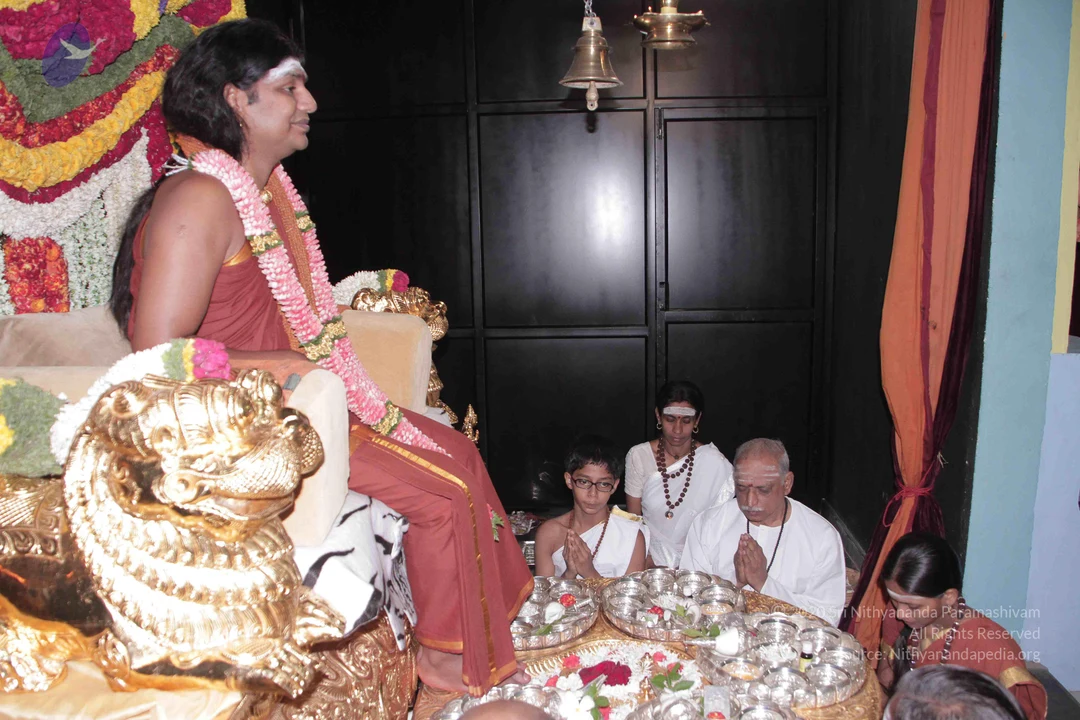
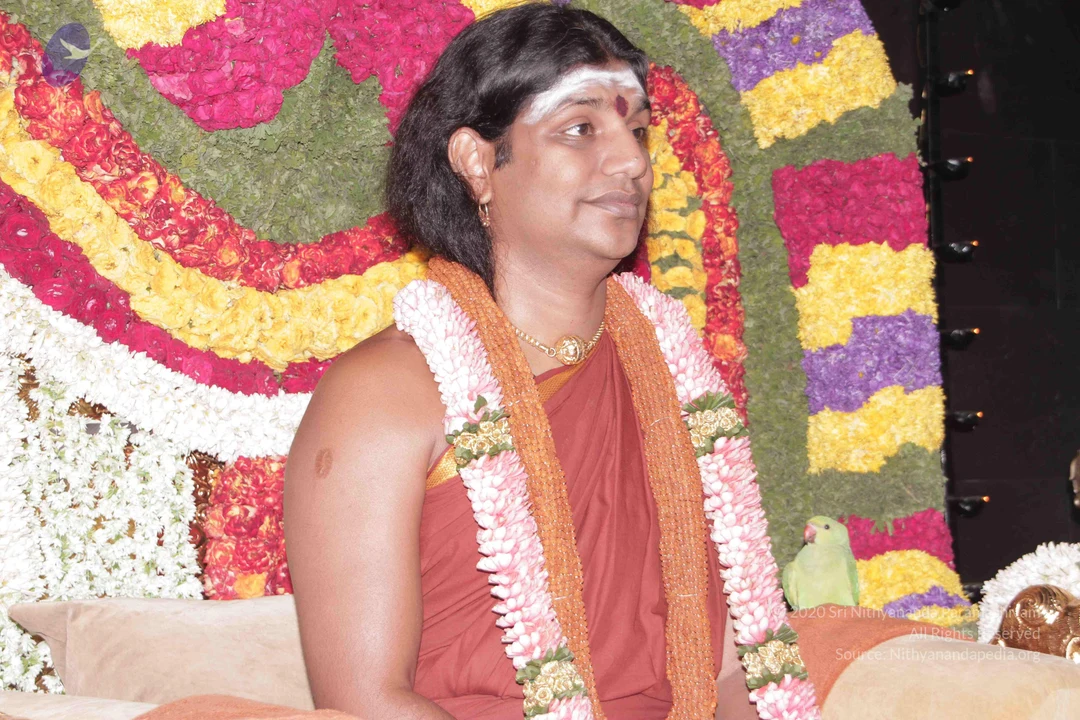
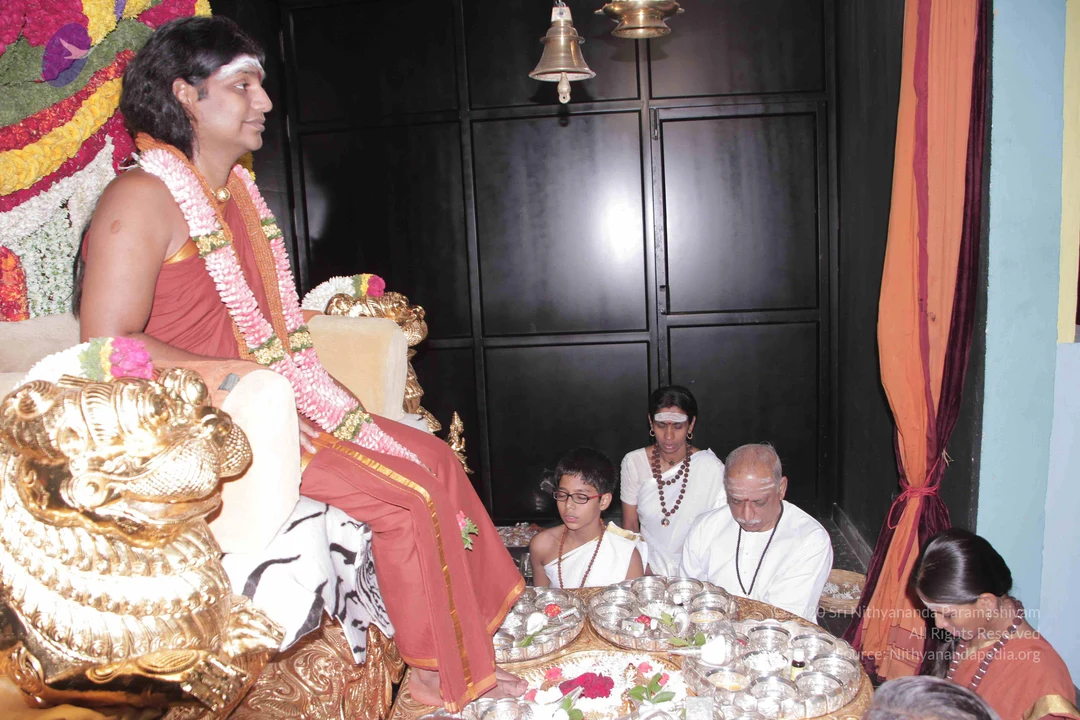
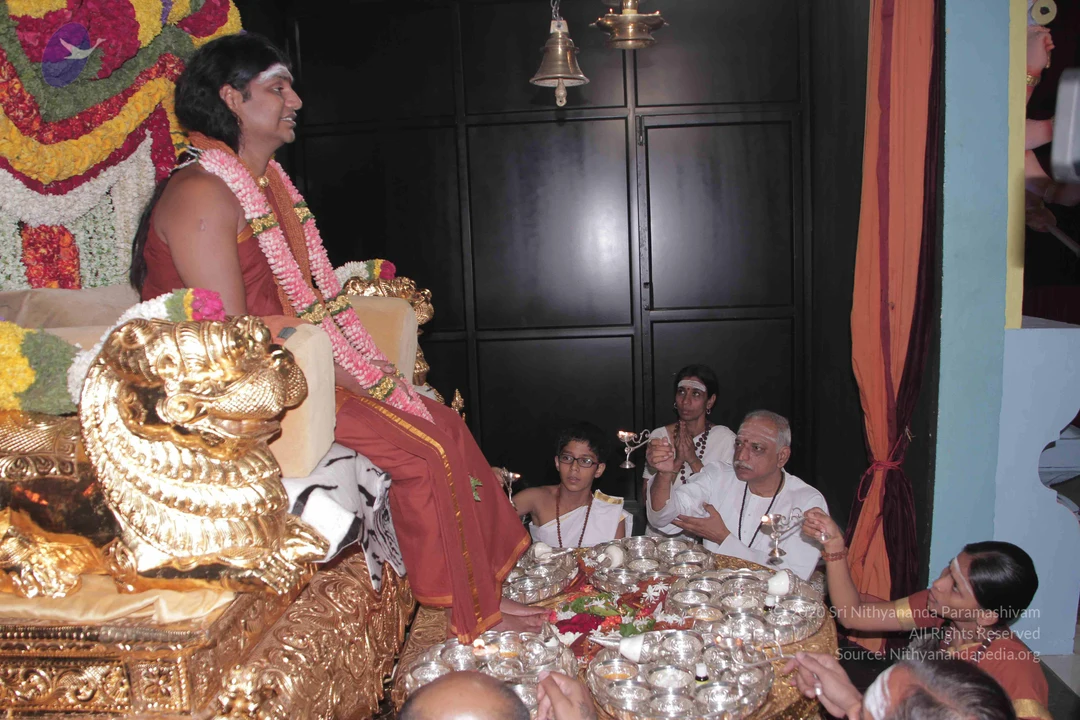
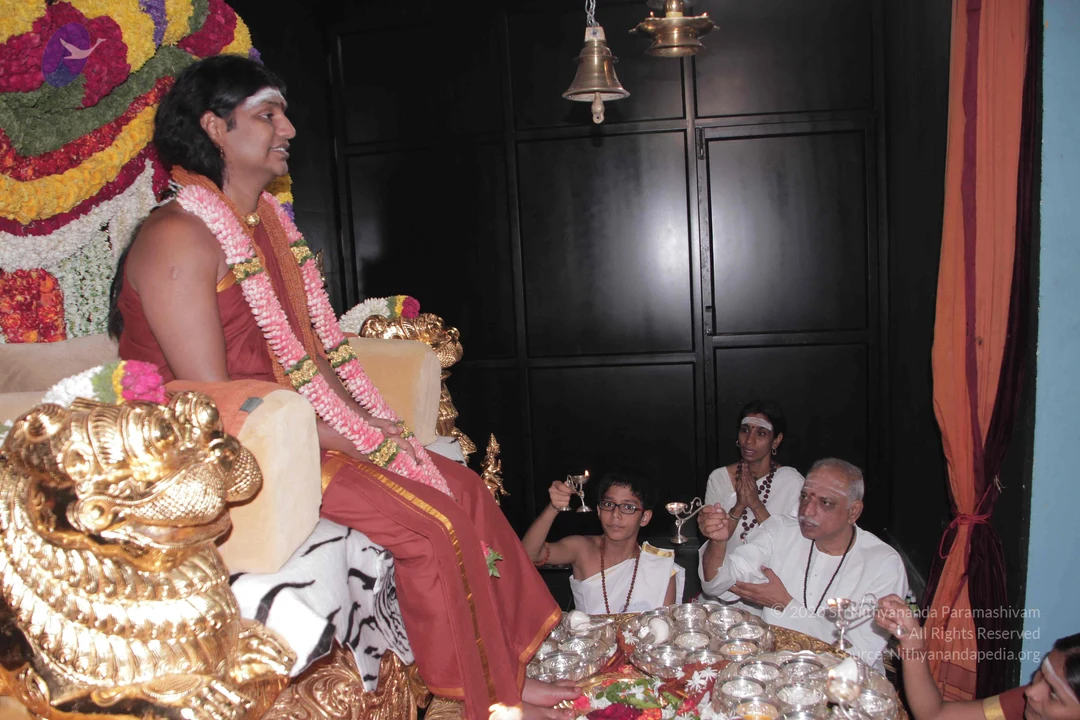
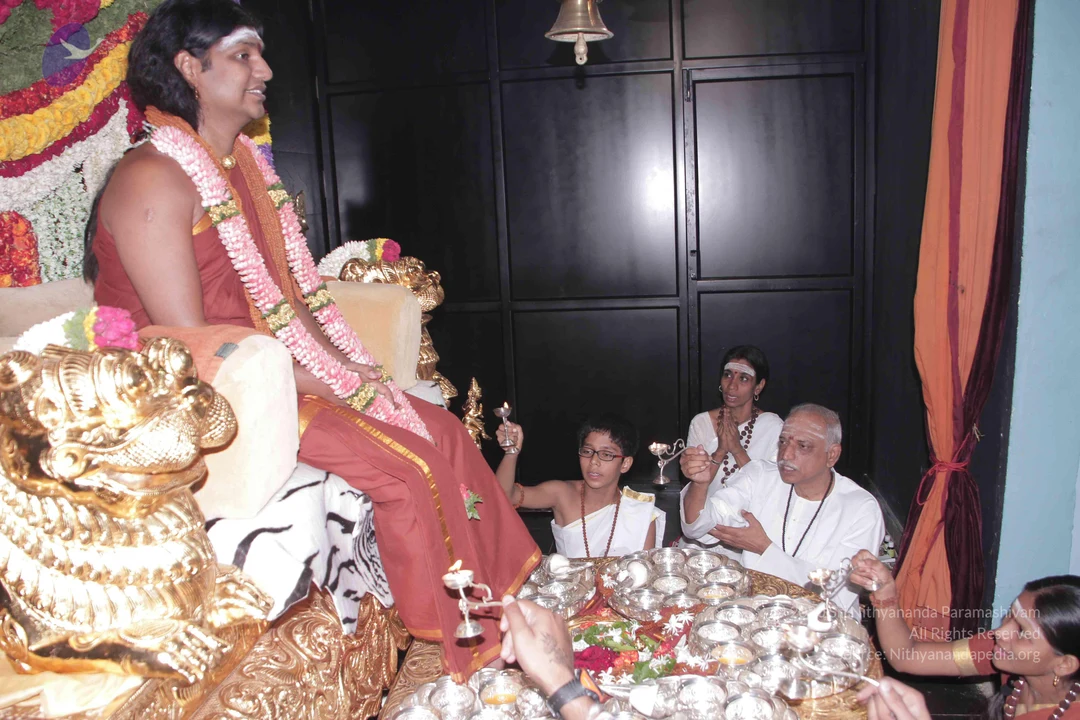
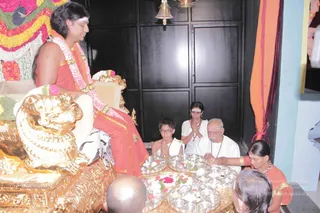
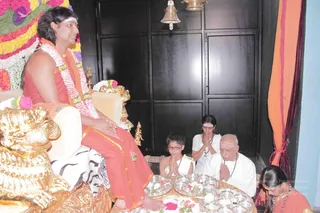
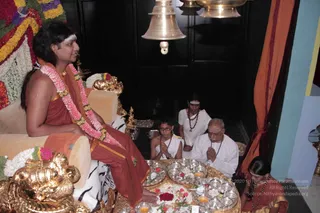
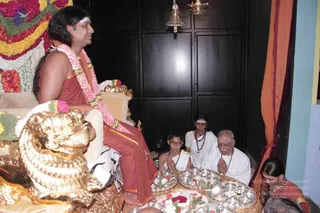
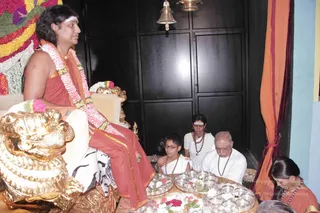
A seated person sits on an ornate golden throne (peetha) with a lion-head armrest, backed by a large arch of marigold and rose garlands in yellow, pink, purple and green. The person wears a rust-red and orange robe with a matching orange shawl, a long pink-and-white flower garland, a gold necklace, and a white vertical tilak on the forehead. They smile and gaze to the side with one hand resting on a cushion. Brass bells and a gold-tipped bell hang from the upper right, with a dark wall behind. Visually this is a single-person photo; the specific identity of the person is not established by appearance.A seated man with long dark hair, a white tilak and a red bindi sits in front of a dense backdrop of flower garlands in red, yellow, purple and white. He wears a rust-red robe with an orange shawl and a garland of white and pink jasmine-style flowers, plus a gold necklace and a small gold earring. A green parrot perches on the flowers at the right edge, and a brass object is partly visible at the lower right. The man is smiling and looking to the side. Appearance-based label: Swamiji (probable), with long swept-back hair, saffron-orange shawl and gold necklace as cues, shown in person.A seated guru in saffron-orange robes, with a long pink and white flower garland and a crown-like hairstyle, sits on an ornate gold throne carved with a lion-head armrest. Behind him stands a flower-covered backdrop with red, yellow and white blooms. Before the throne, a devotee family kneels with palms pressed together in anjali: a boy in white with glasses, a girl in white with a forehead band and beaded necklace, and an older man in white with a rudraksha mala. A woman in an orange sari kneels at a long low table laid with silver plates of offerings, marigolds and red flowers, and bowls. A bell hangs at the top right. The scene looks like a puja or padapuja offering. Four people are visible in the foreground plus a partly shown head at the bottom.A seated figure on a gold-and-cream throne with a golden lion-like armrest sits at left, wearing an orange-red robe with gold border, a long pink-white flower garland, and a white forehead mark; his hands rest on his lap and he looks toward the group. Before him a table holds many silver bowls with flowers and offerings. Three people sit in namaste on the floor: a boy in white with glasses, a woman in white with red-and-white beads and a white forehead mark, and an older man in white with a rudraksha mala. A woman in an orange sari sits at the right edge. Behind them are a dark wall cabinet, brass bells hanging above, a golden deity murti, and orange and maroon drapes; floral garlands decorate the backdrop. Probable Swamiji is seated on the throne, identified by the orange robe, flower garland and long swept-back hair, with a devotee group performing puja-style worship.A photograph of a seated figure in a golden-trimmed throne, wearing a rust-orange robe and a pink-and-white flower garland, with a white tilak on the forehead and long dark hair. Before him on the floor, a gold tray holds silver bowls, small oil lamps, rice, flowers and a red blossom, with a seated white-clad man and a young girl in white joining palms in namaskar. Behind them a white-clad figure wears a rudraksha mala, a woman in orange sari sits at the right edge, and brass bells hang from above. Floral garlands decorate the throne backdrop. The seated figure matches the appearance cues of a person, seated on the throne with a garland and robes.A photograph of a seated man in a red-orange robe with a long garland of pink and white flowers, seated on an ornate golden throne with a carved lion-head armrest, with a white tilak on his forehead and long dark hair. Beside him, a boy in white with glasses presses palms together, and a woman in white with a rudraksha mala kneels with hands folded. An older man in white with folded hands kneels nearby, and a woman in orange-red kneels at the right edge. Before them is a silver tray with small silver bowls holding offerings, flowers and red petals. A hanging brass bell and an oil lamp are visible above, with an orange curtain and a black wall panel behind. The seated figure has distinctive long swept hair, a garland and saffron-red robe, consistent with a person in a satsang setting.

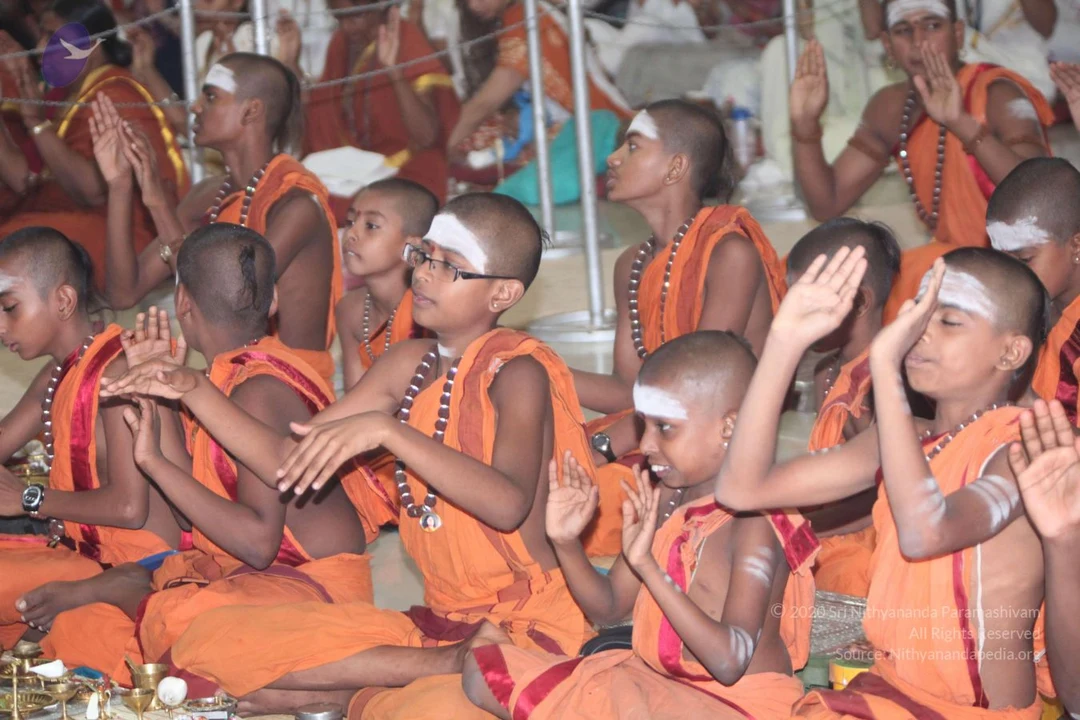
Satsang

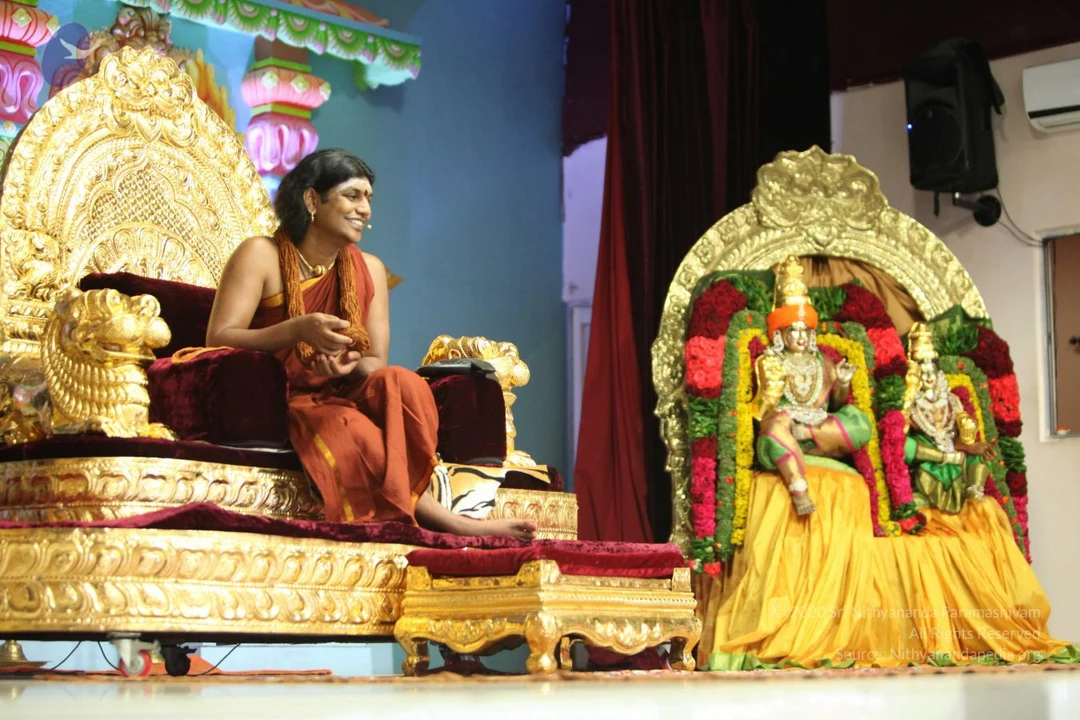
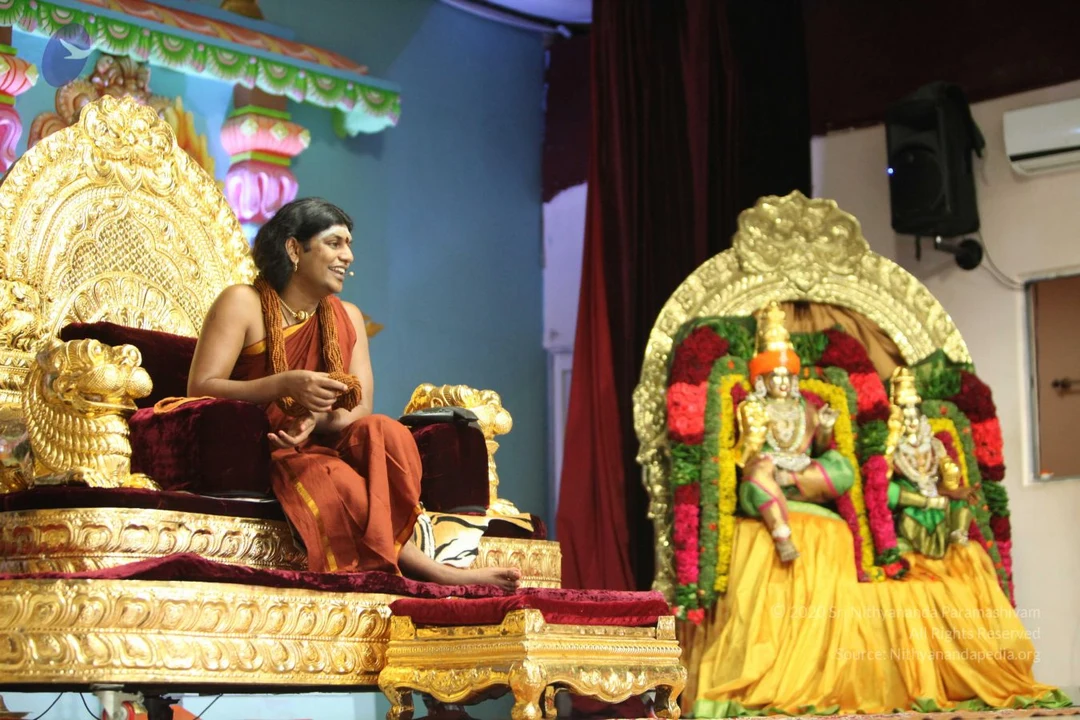
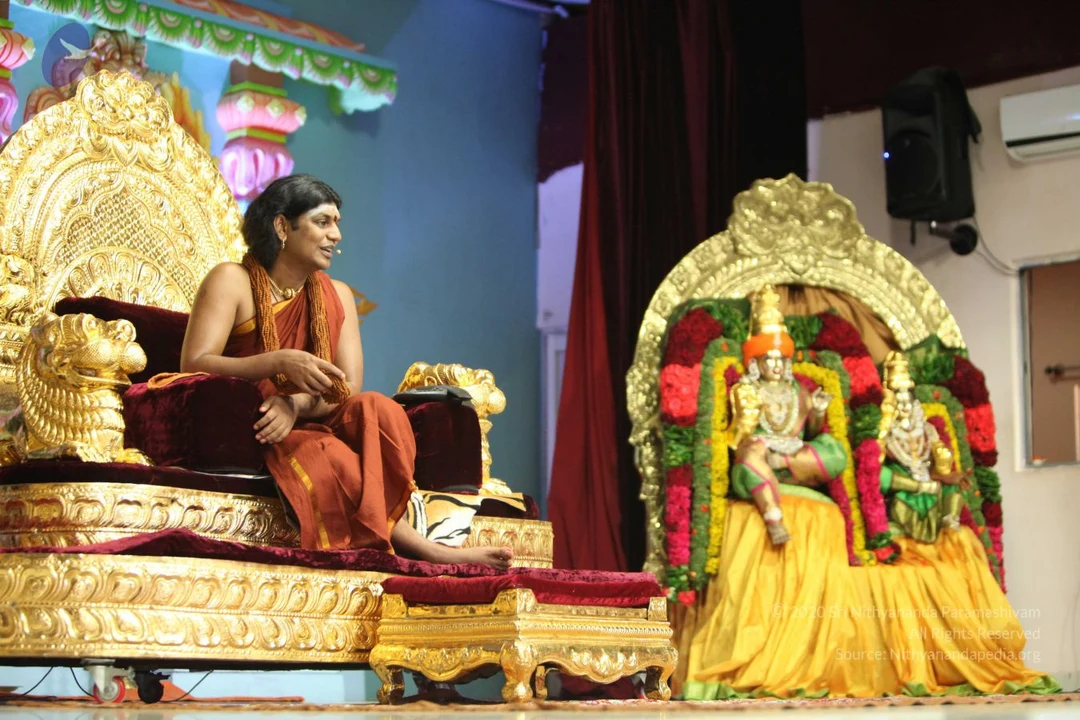
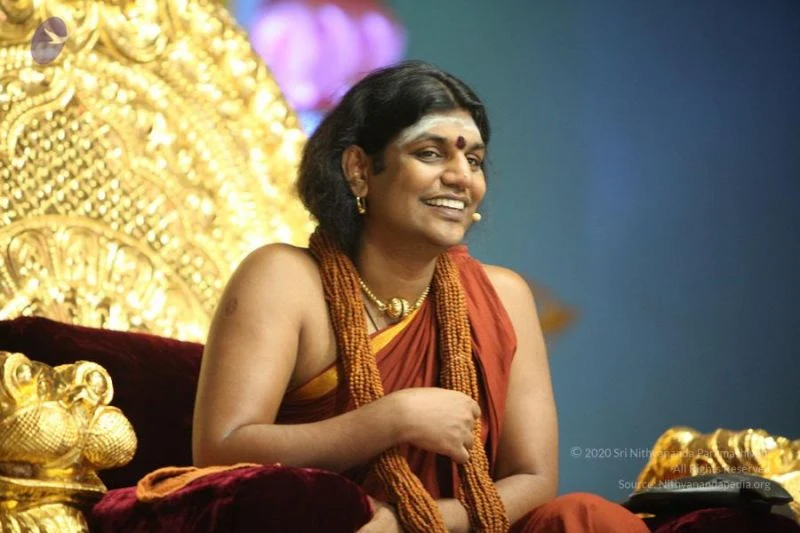
28 photosSource gallery
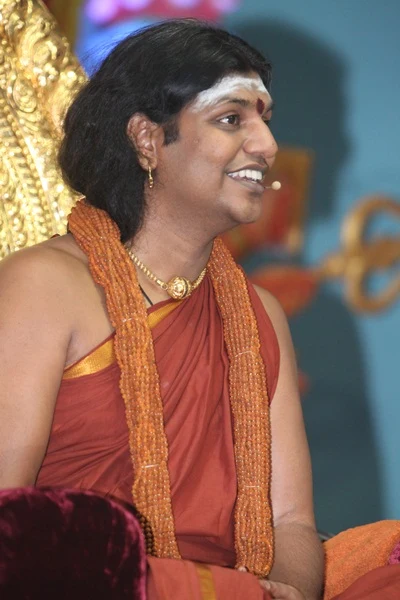
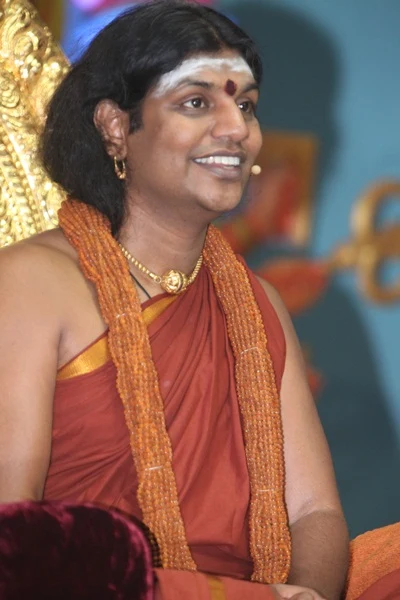
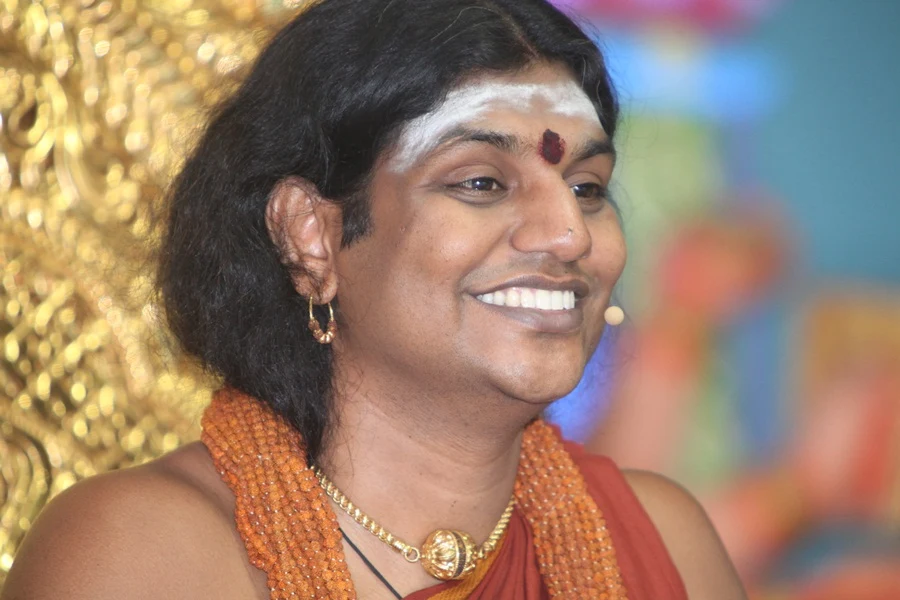
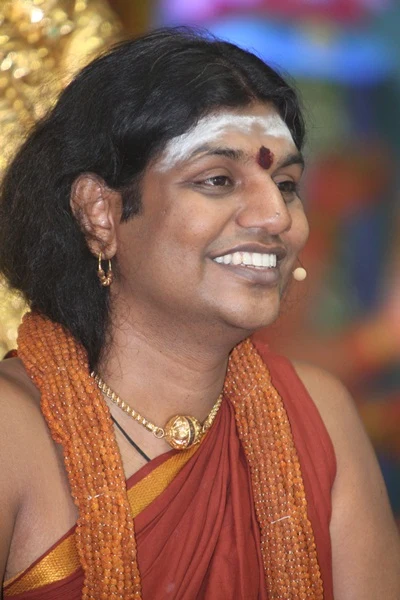
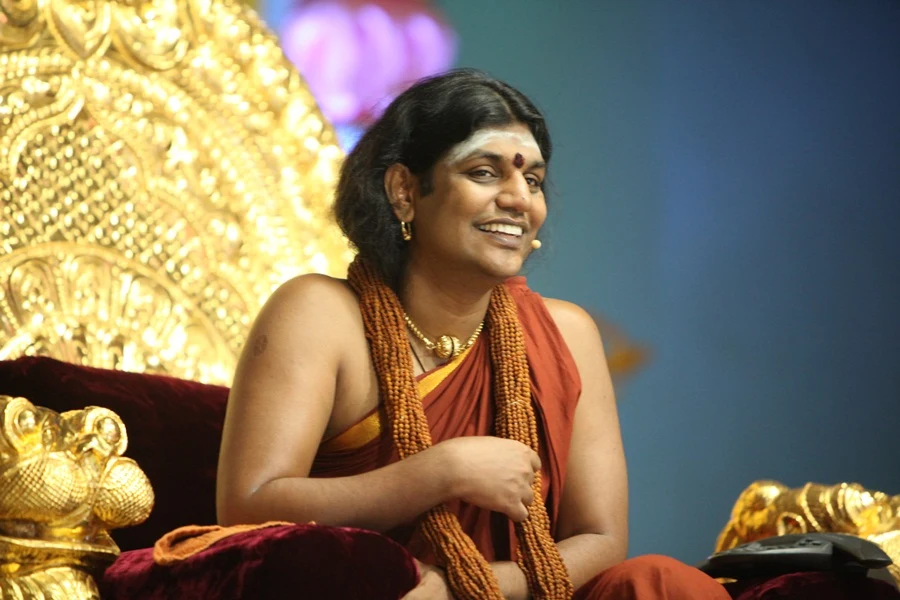
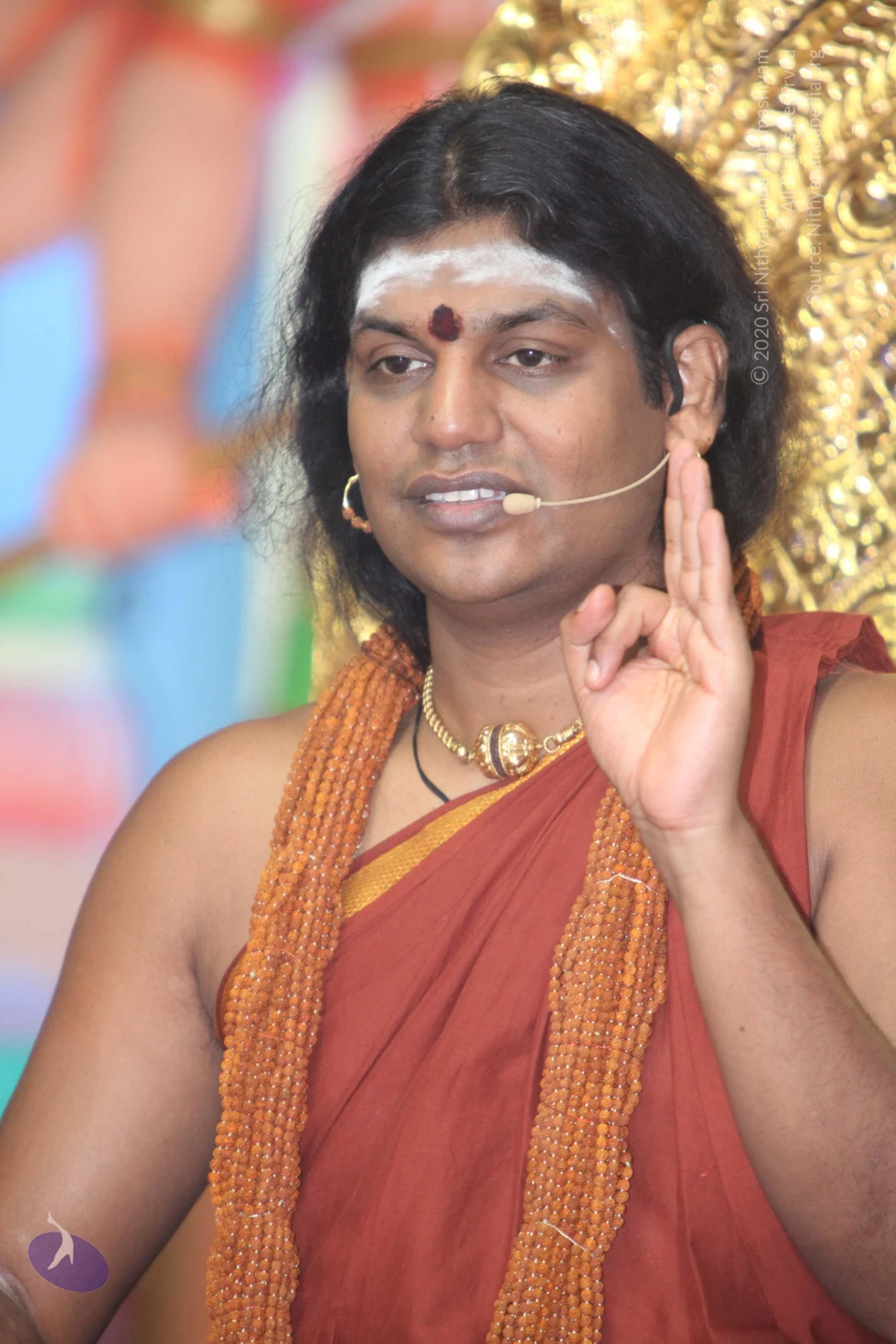
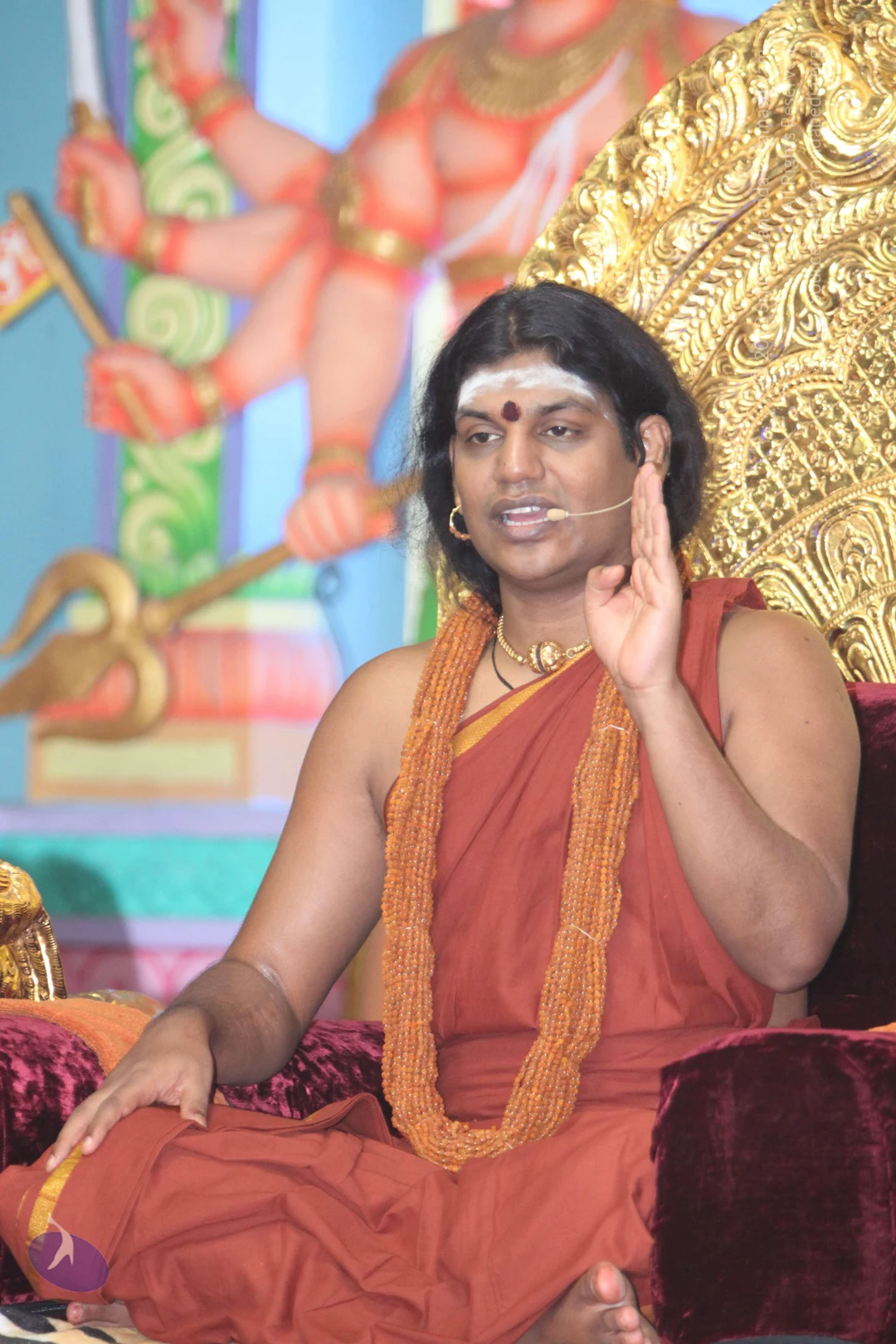
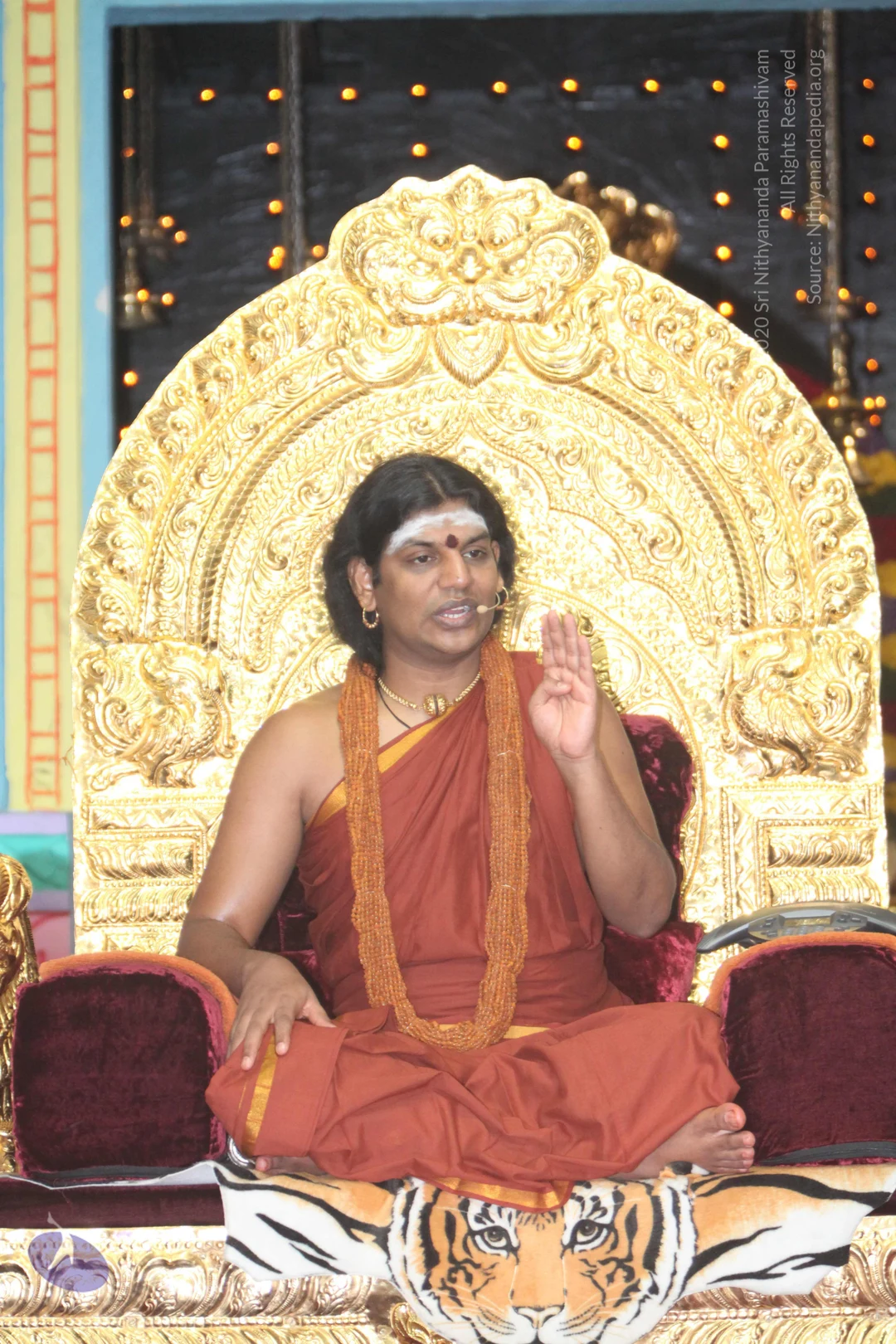
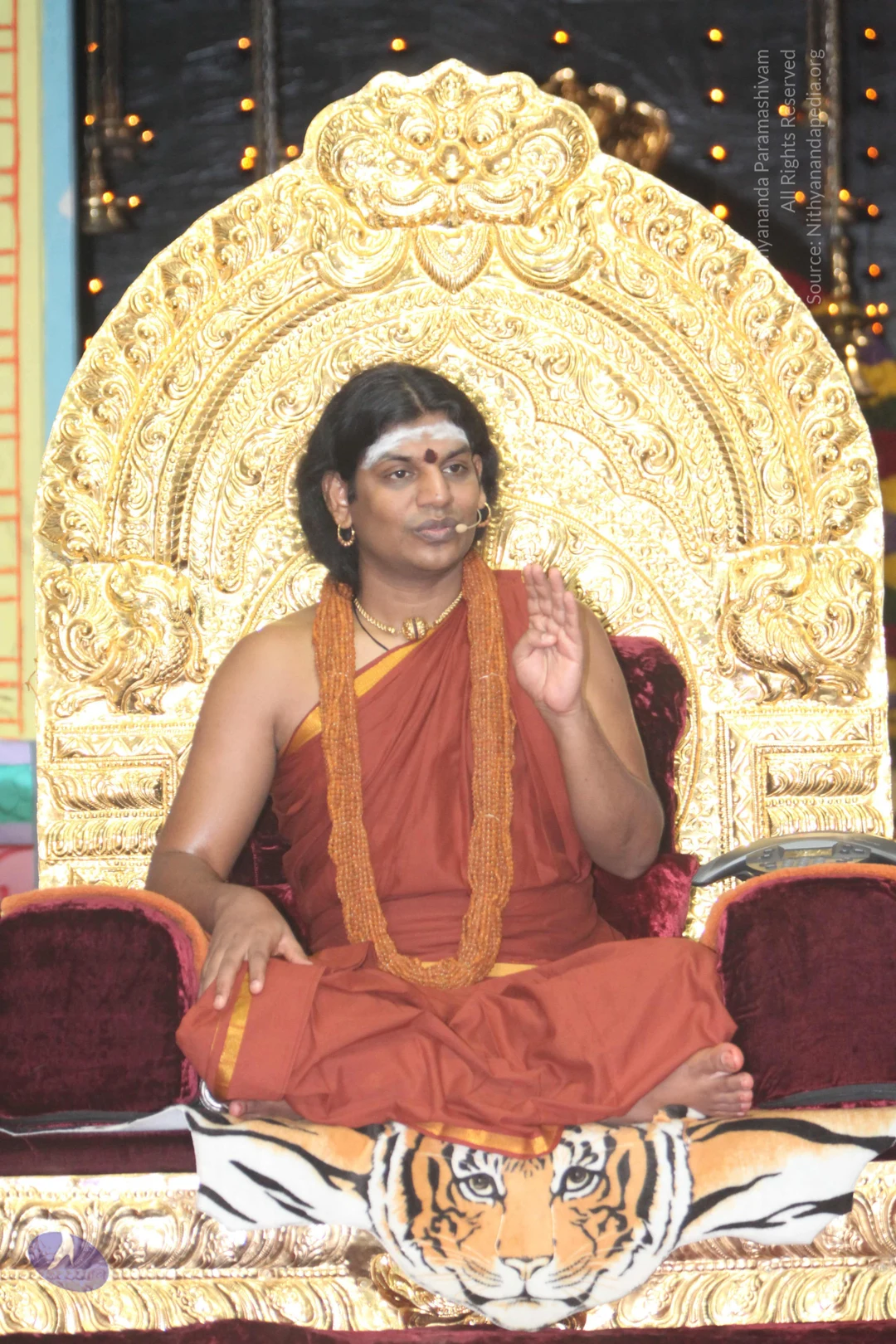
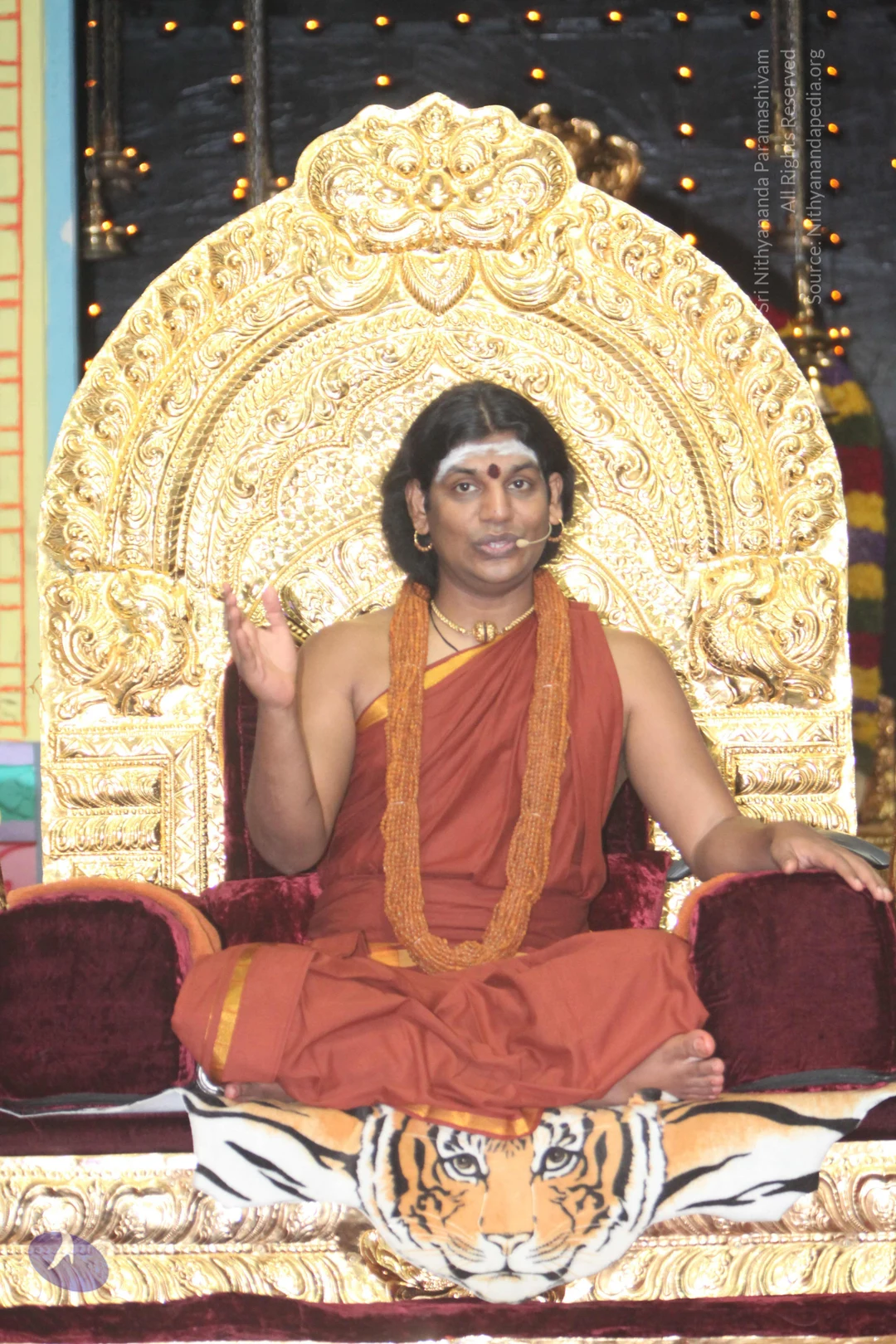
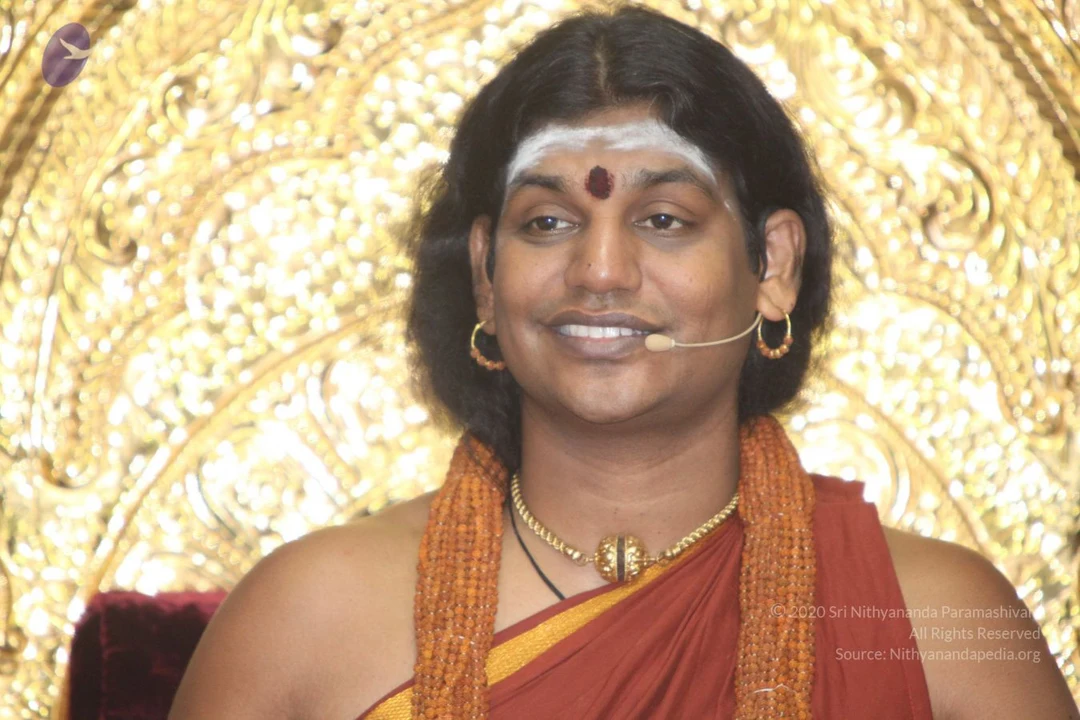
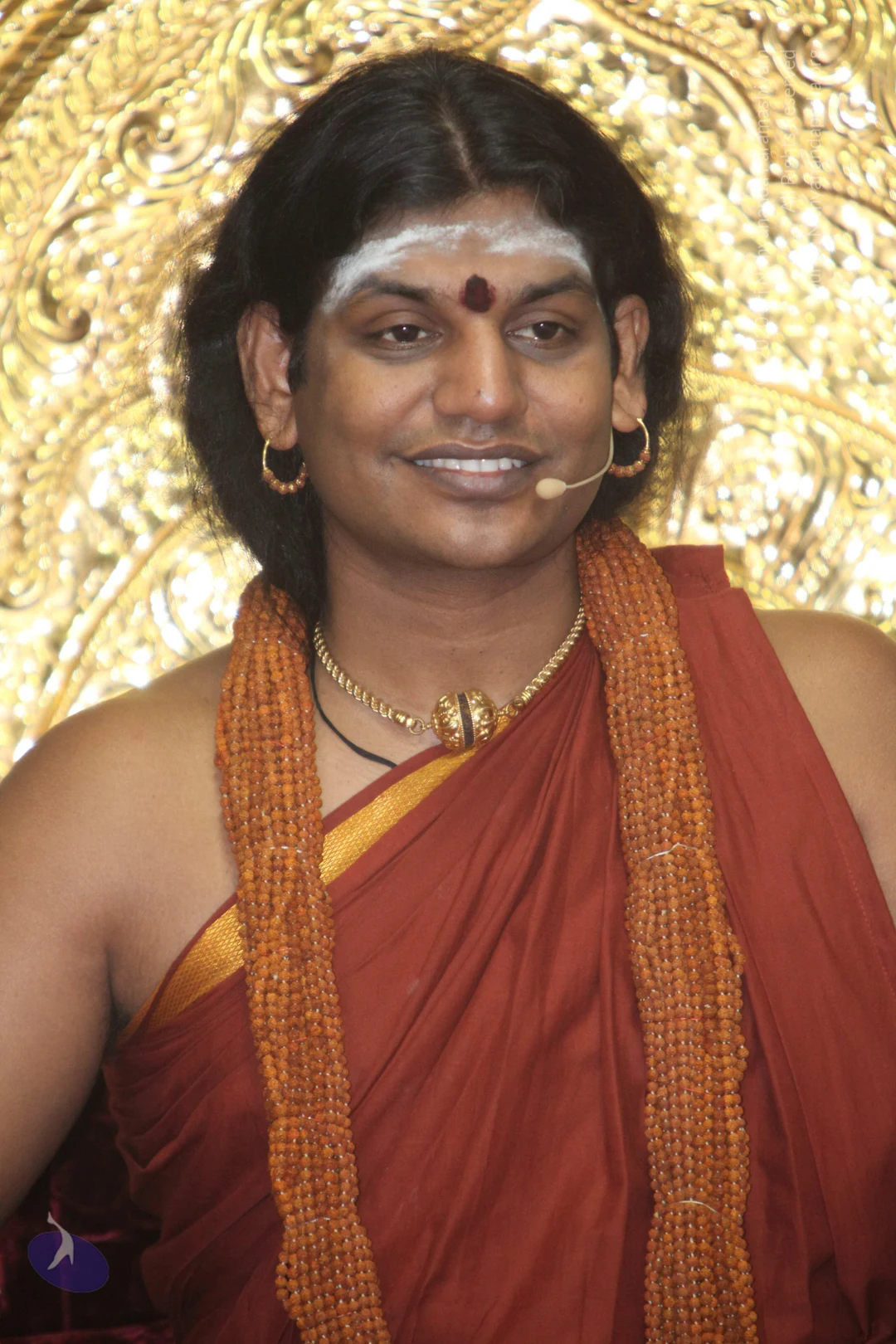
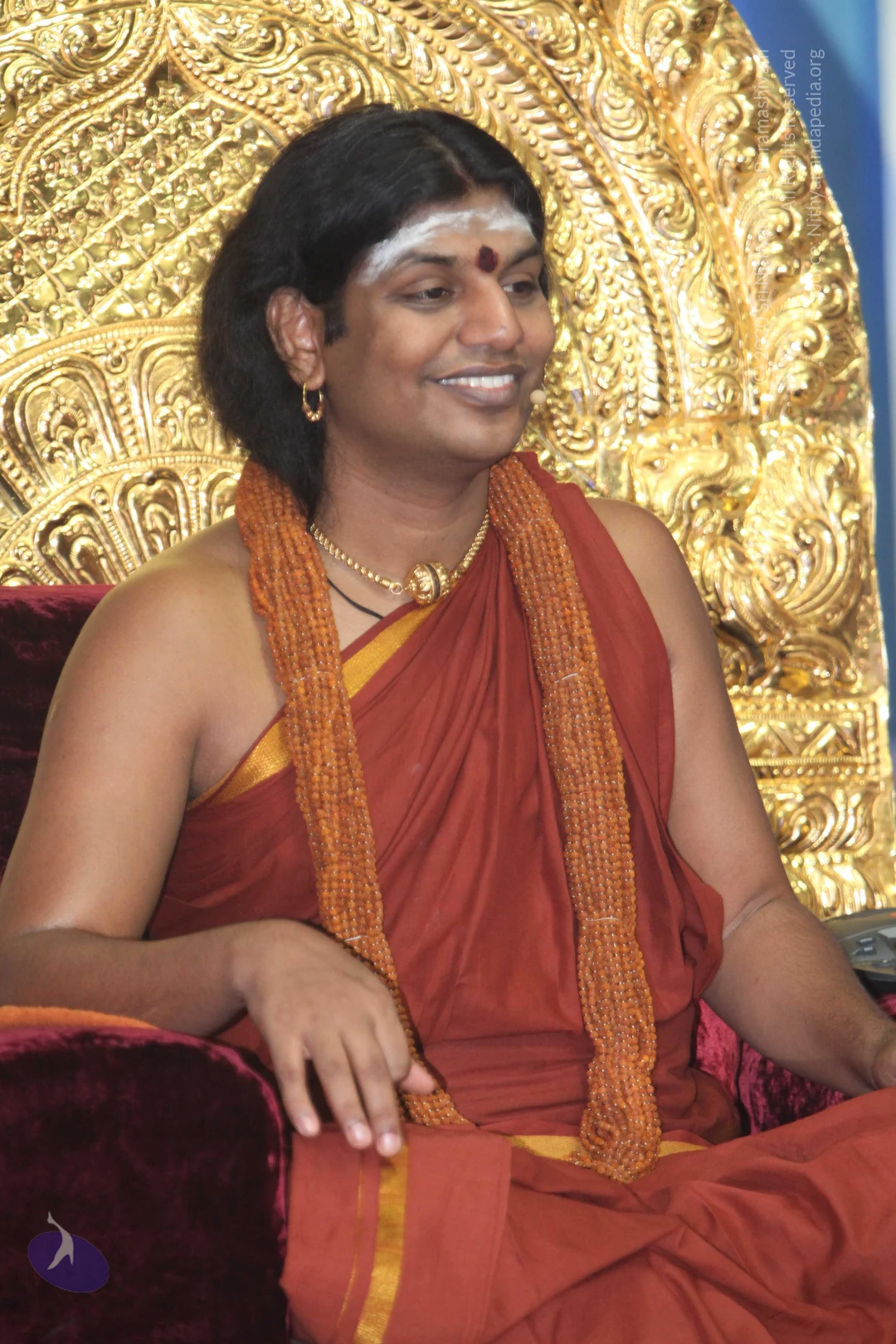
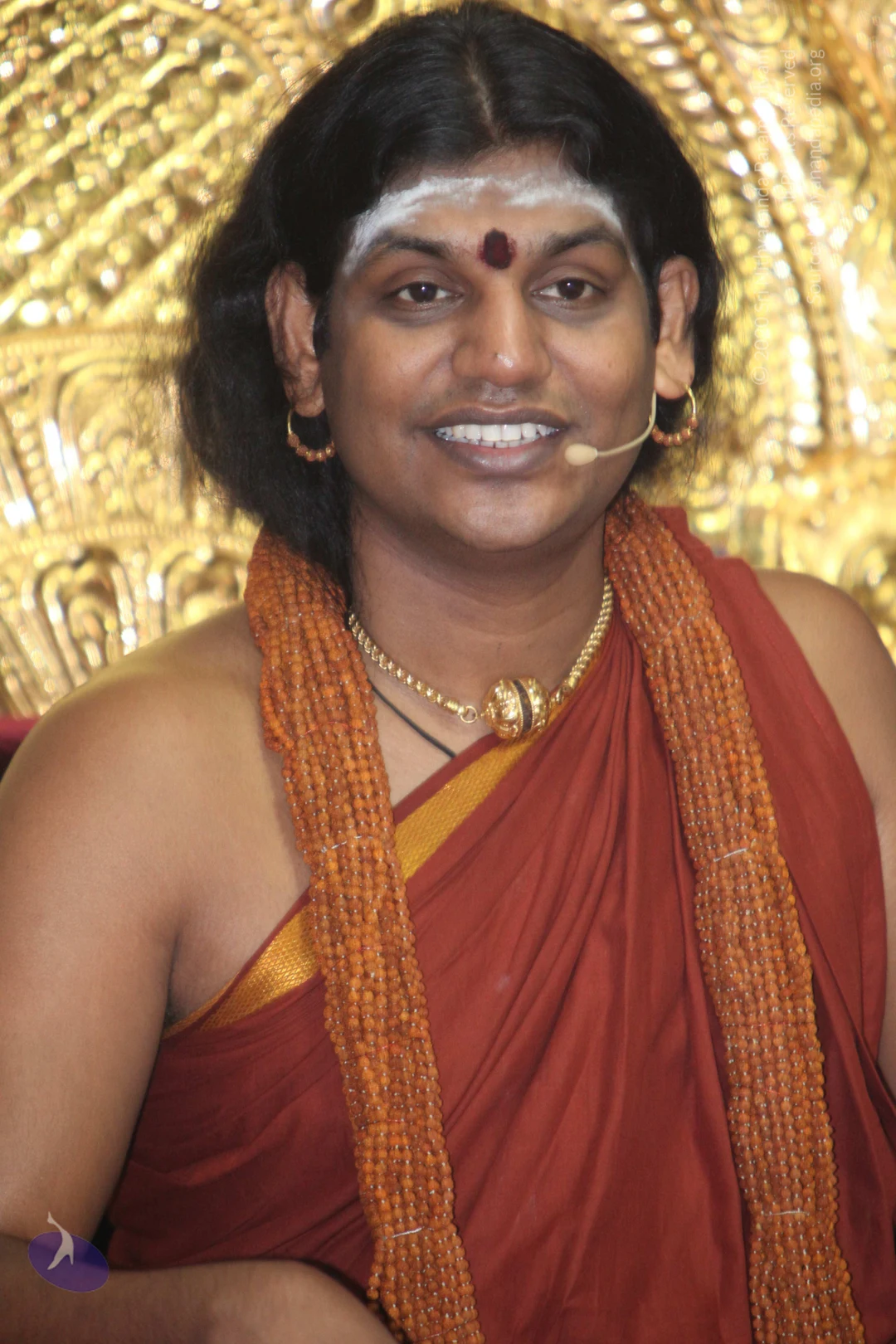
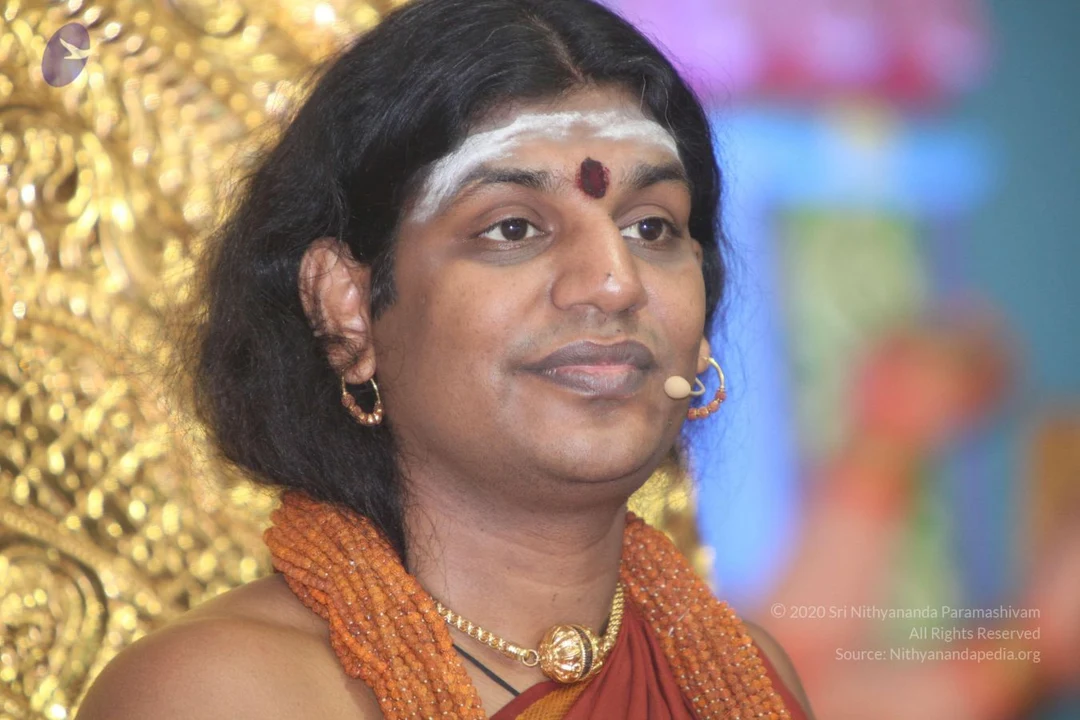
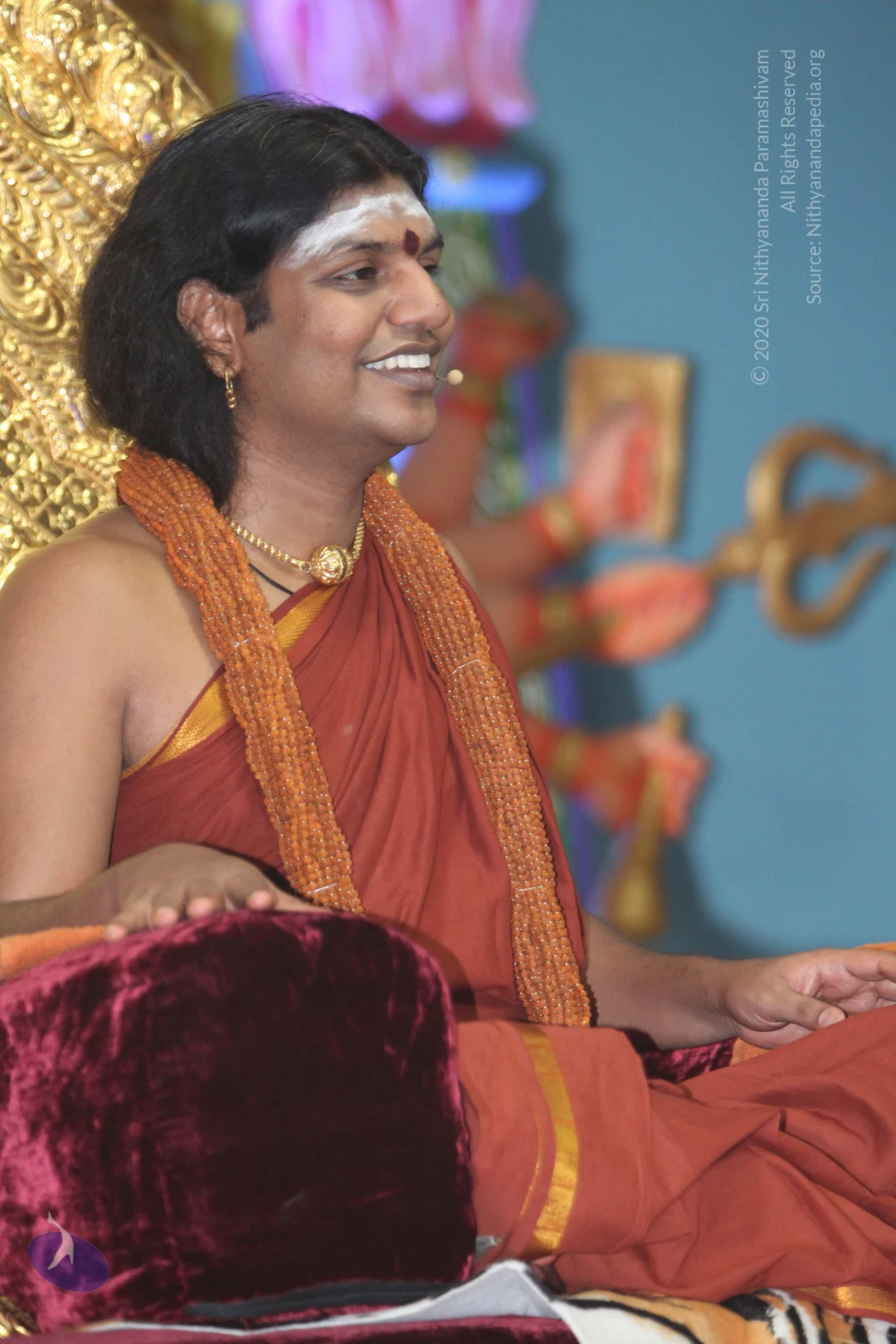
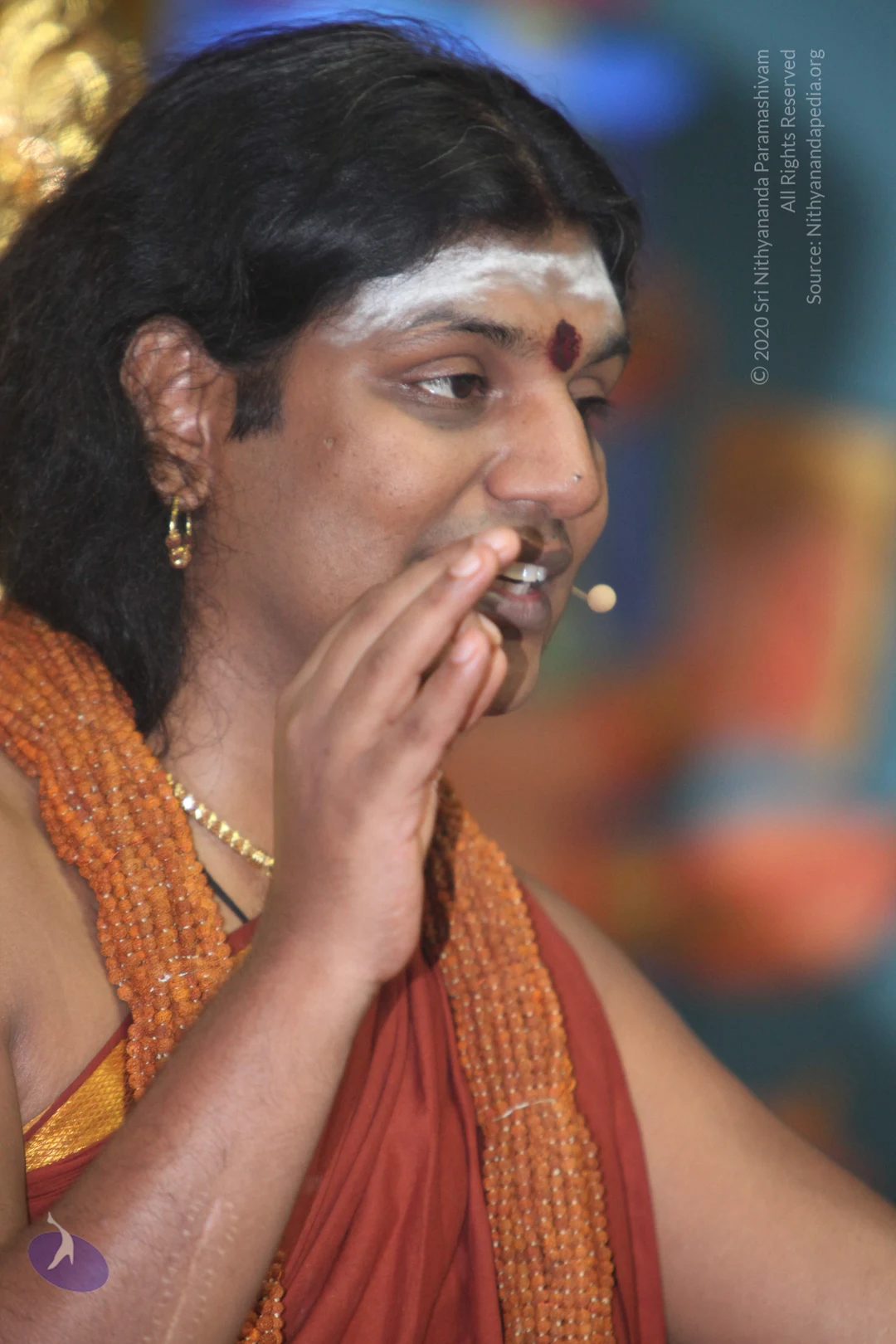
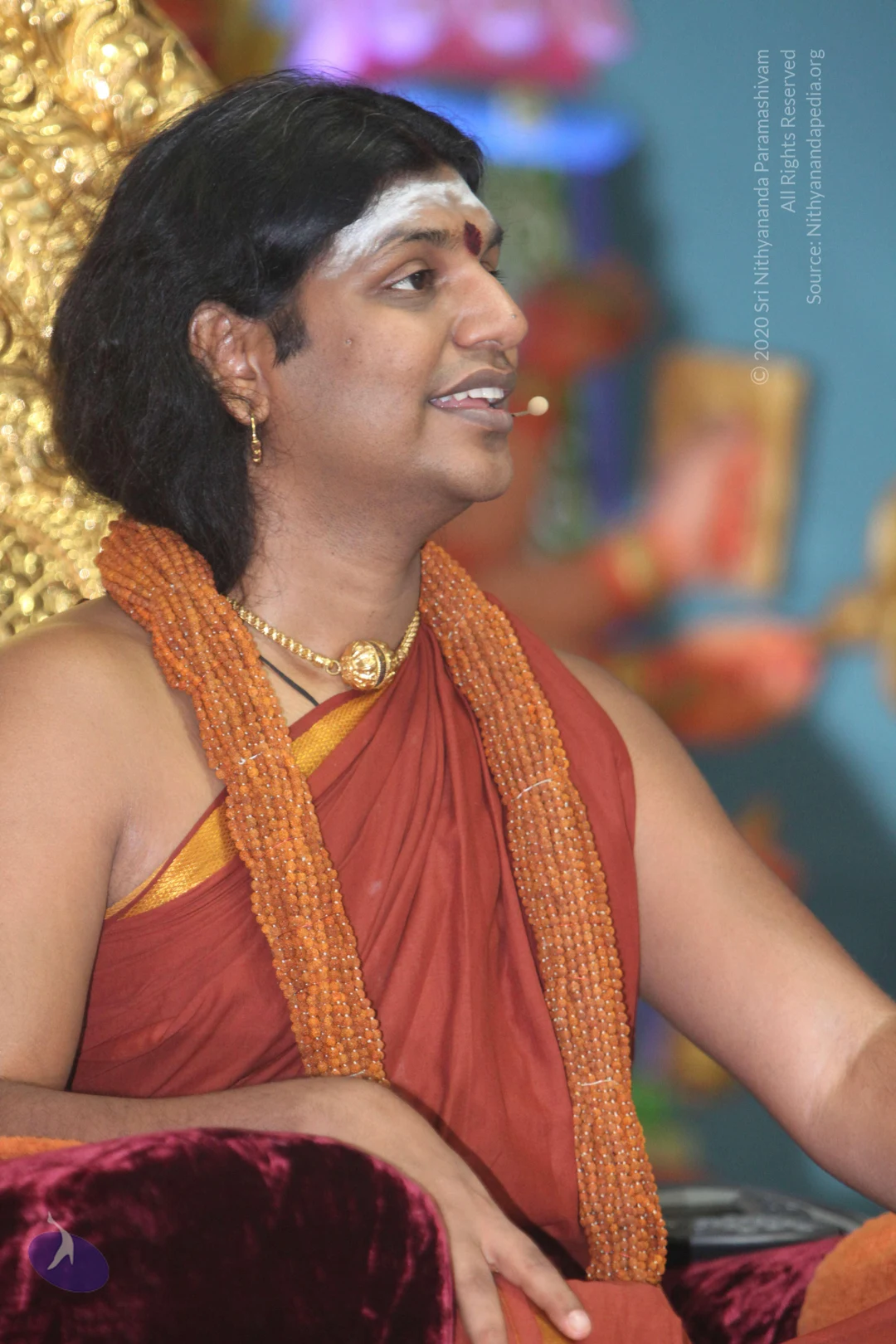
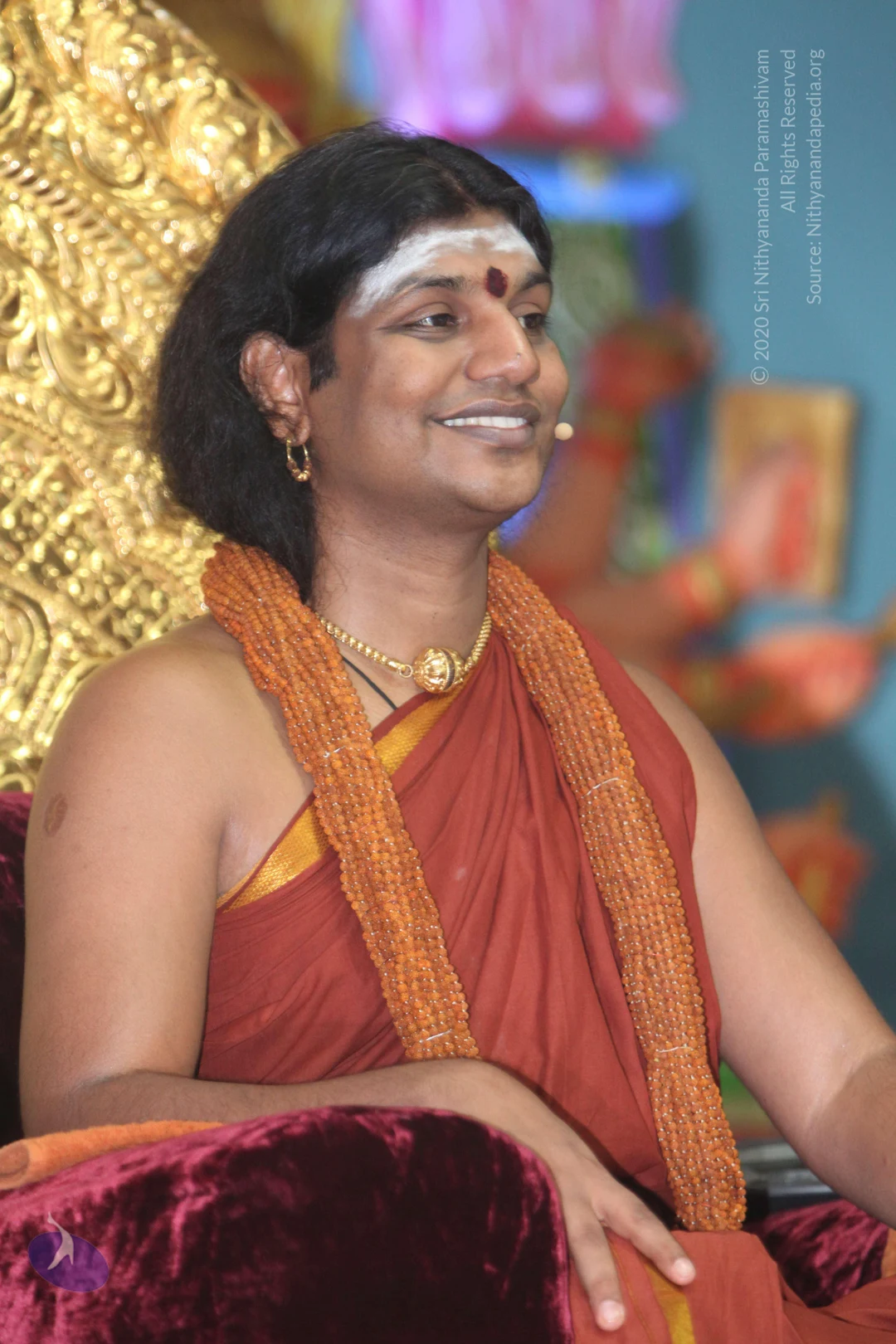
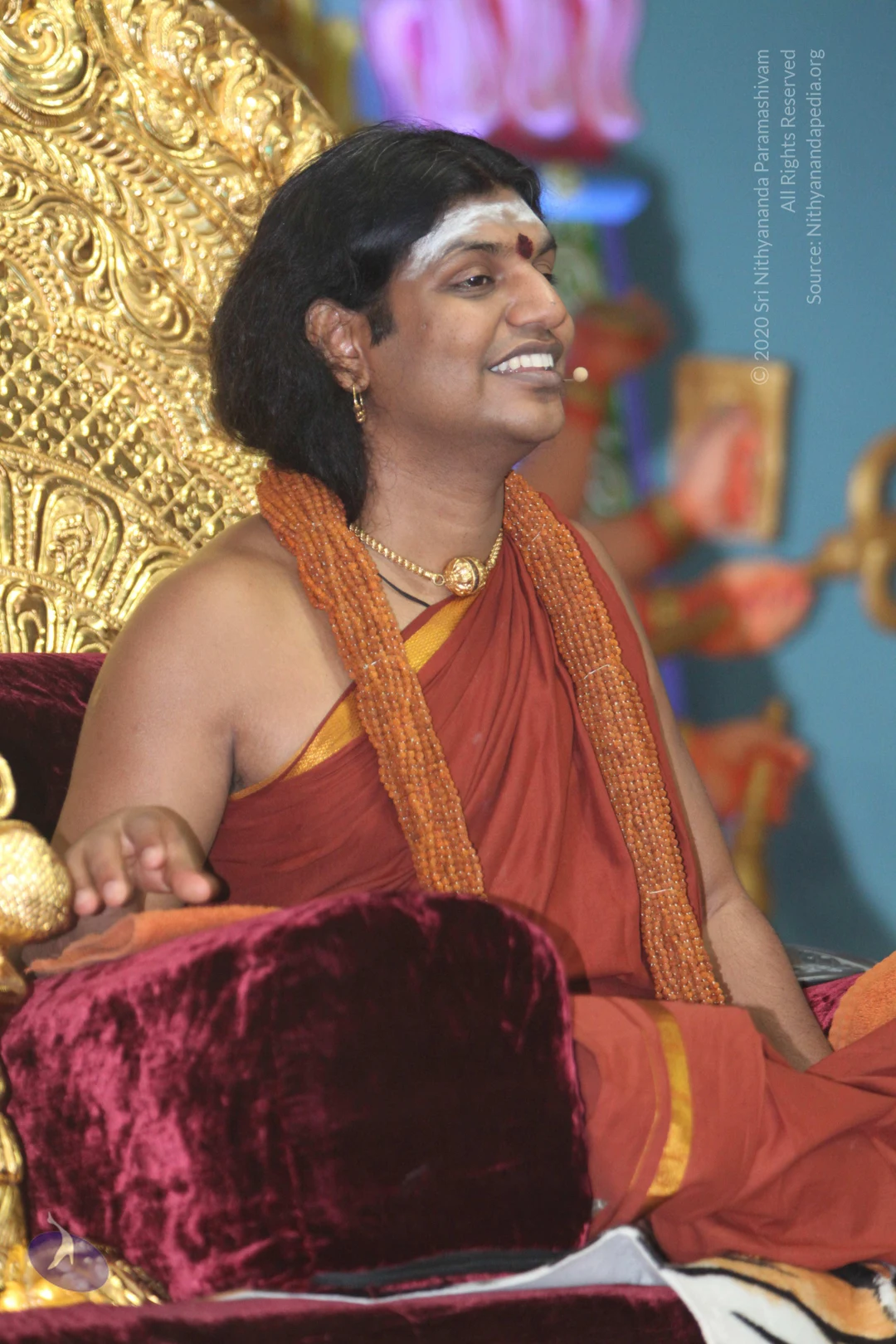
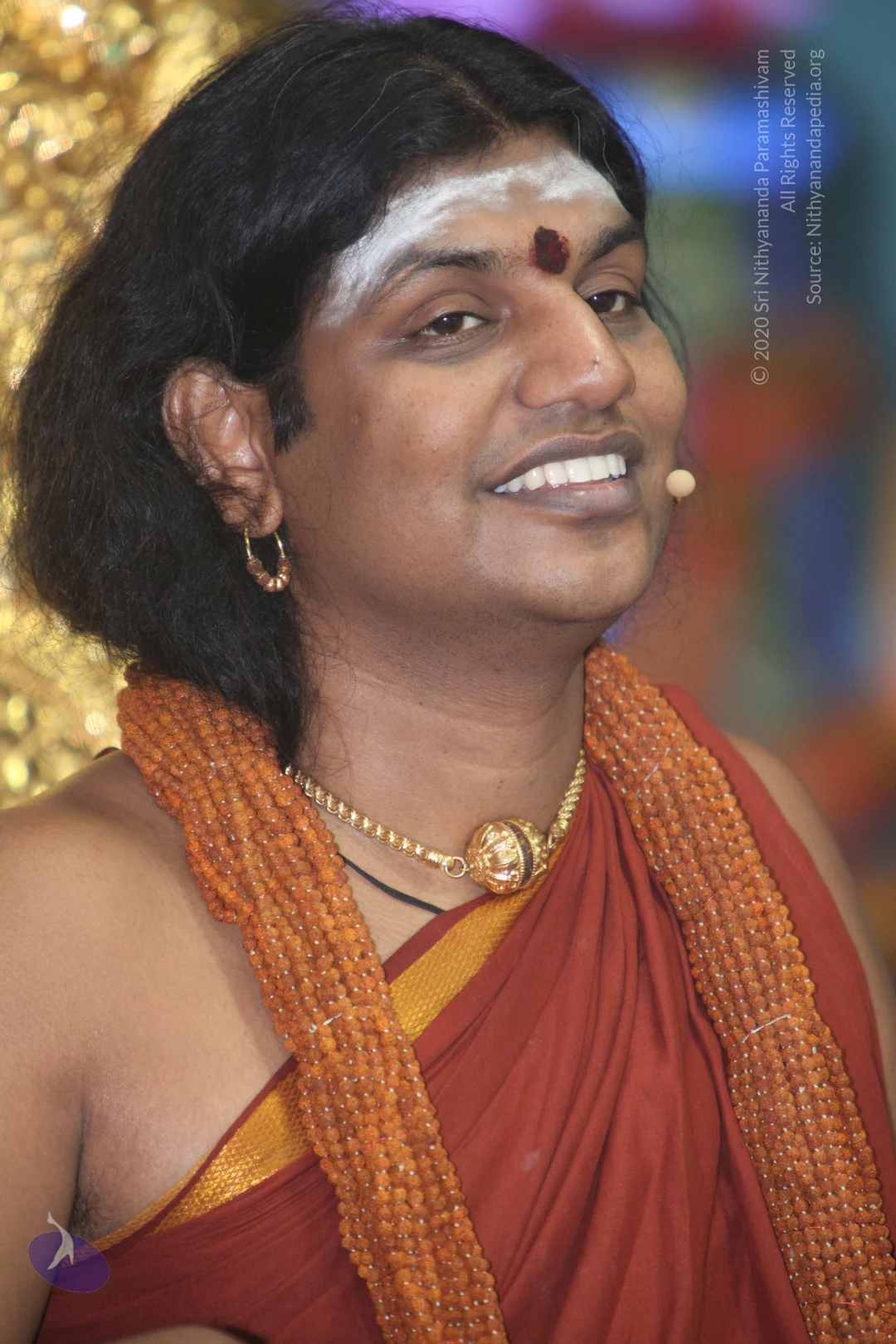
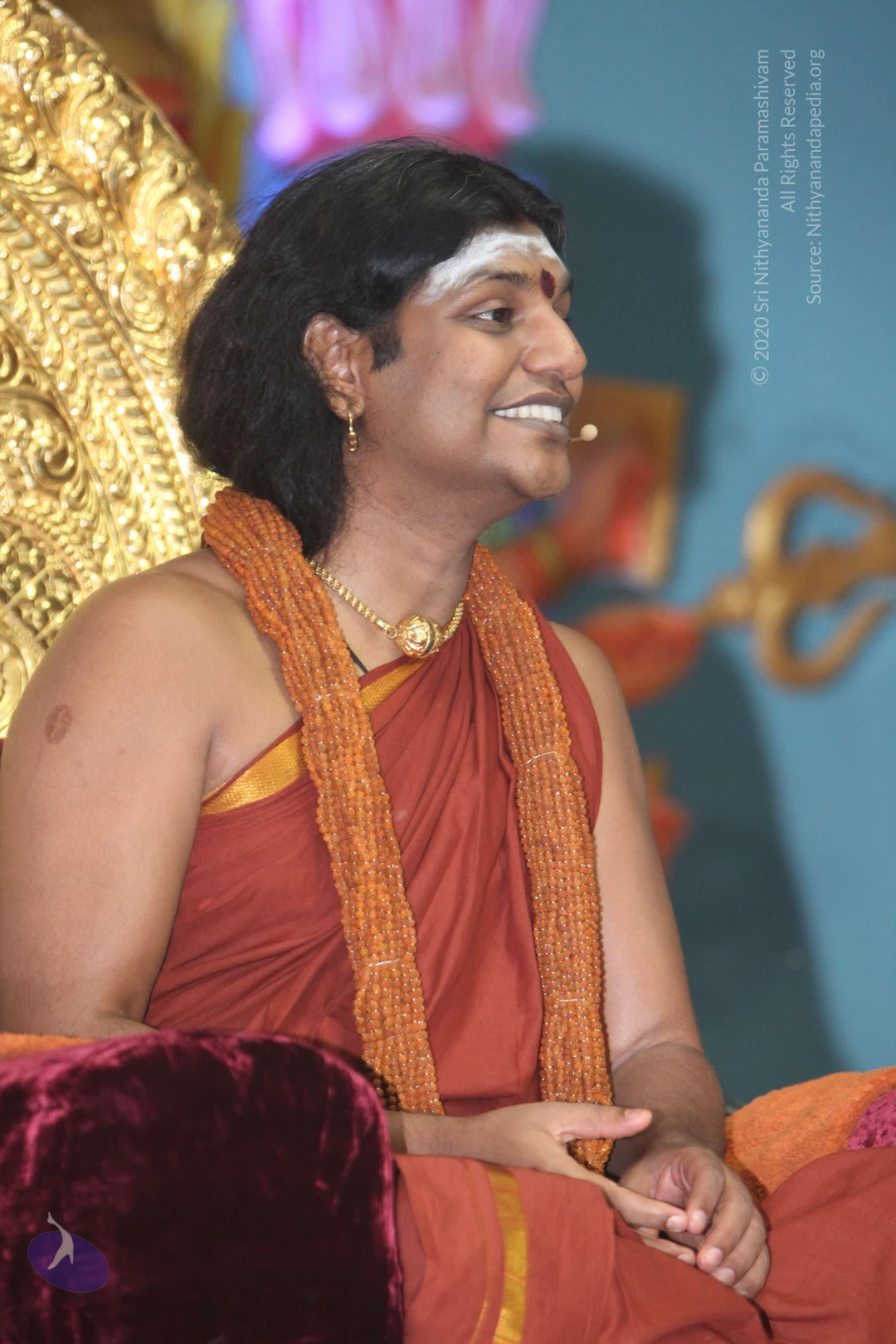
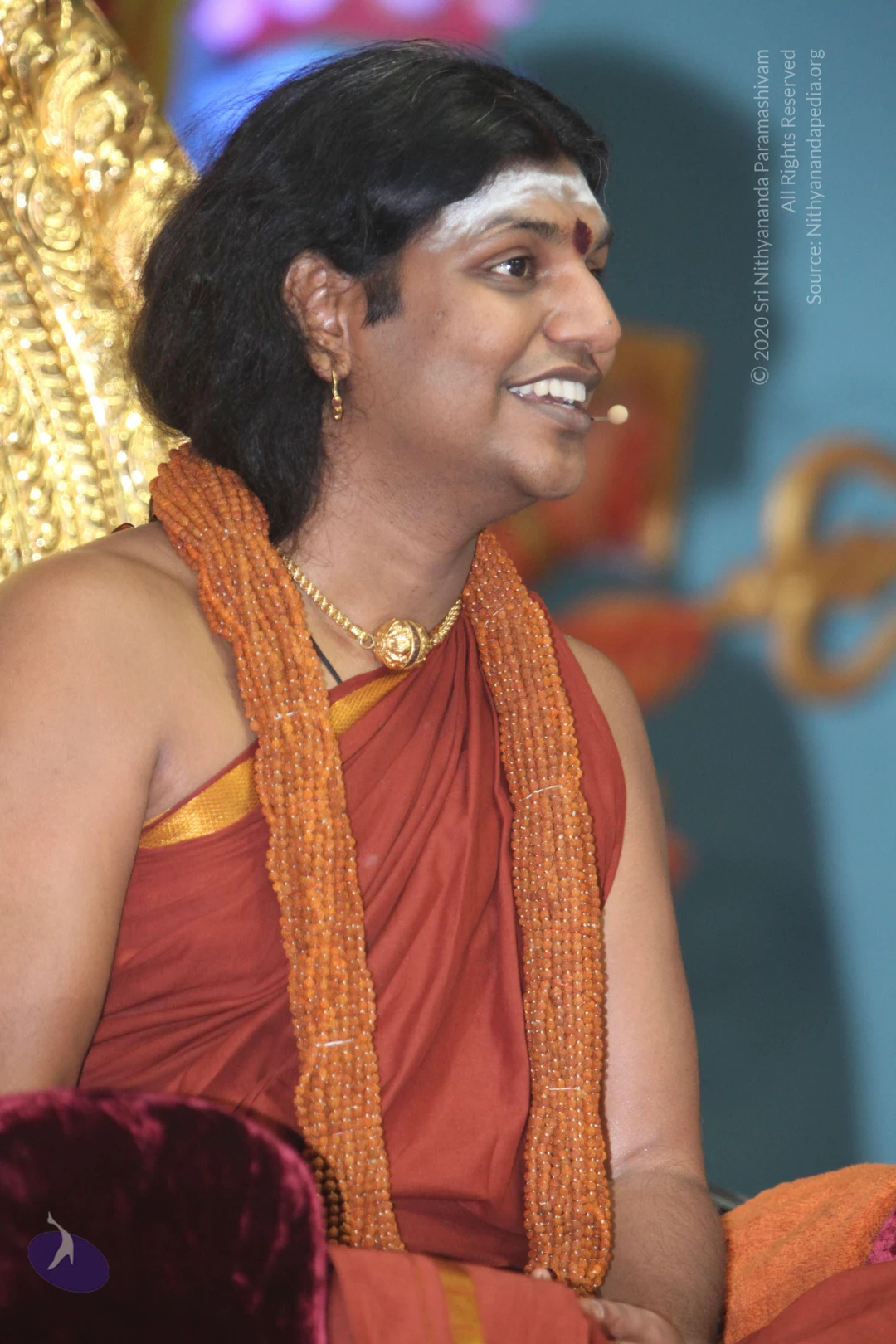
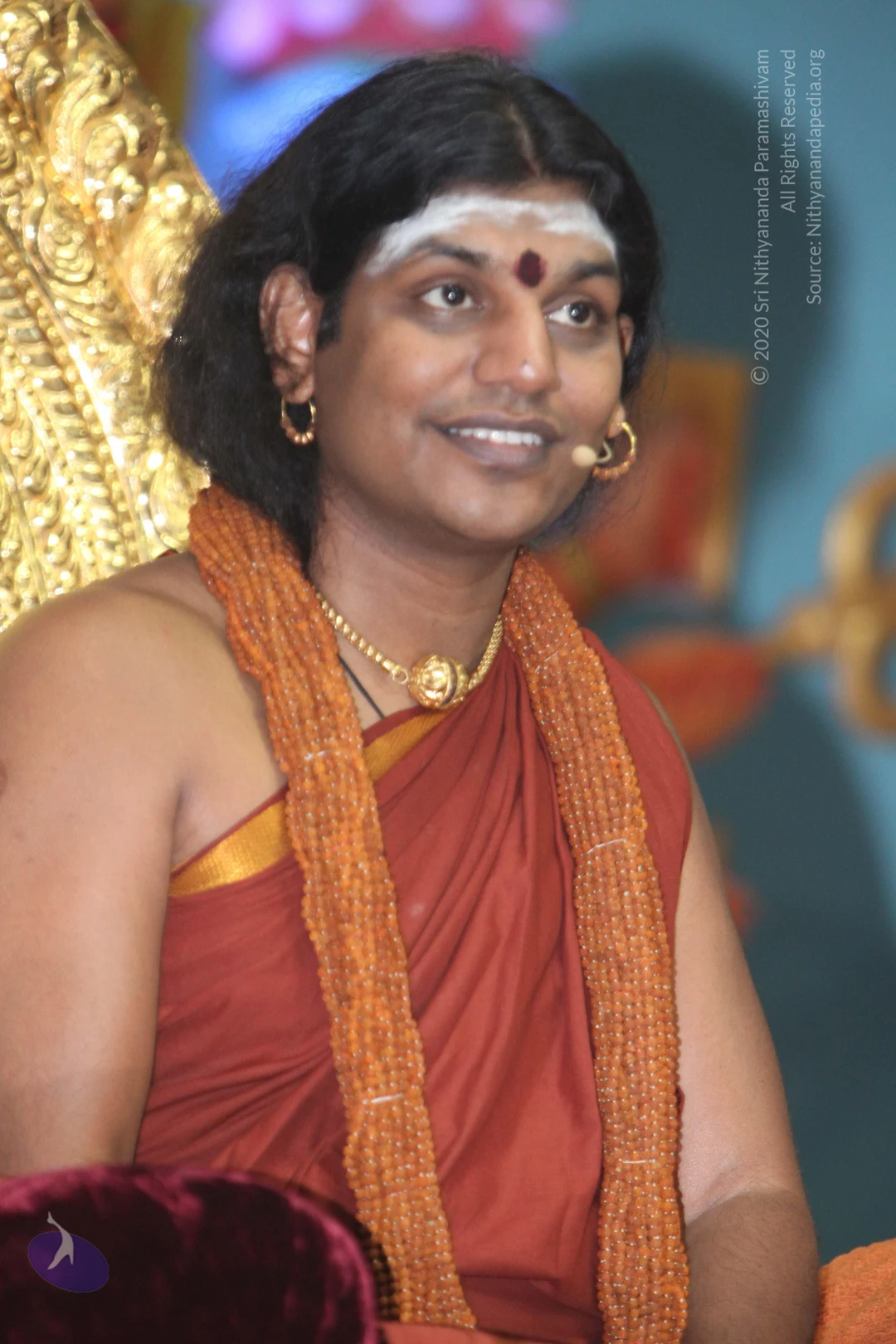
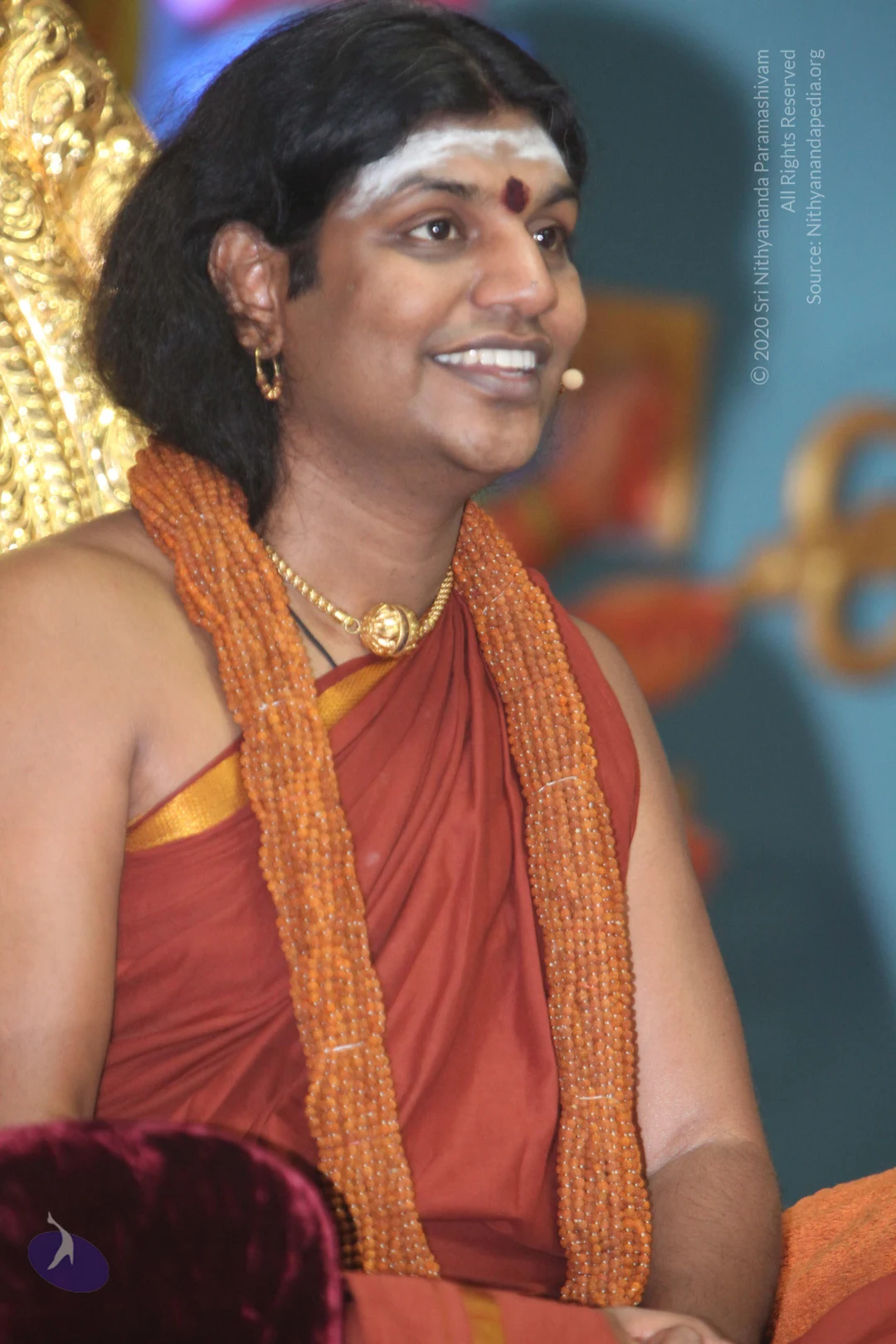
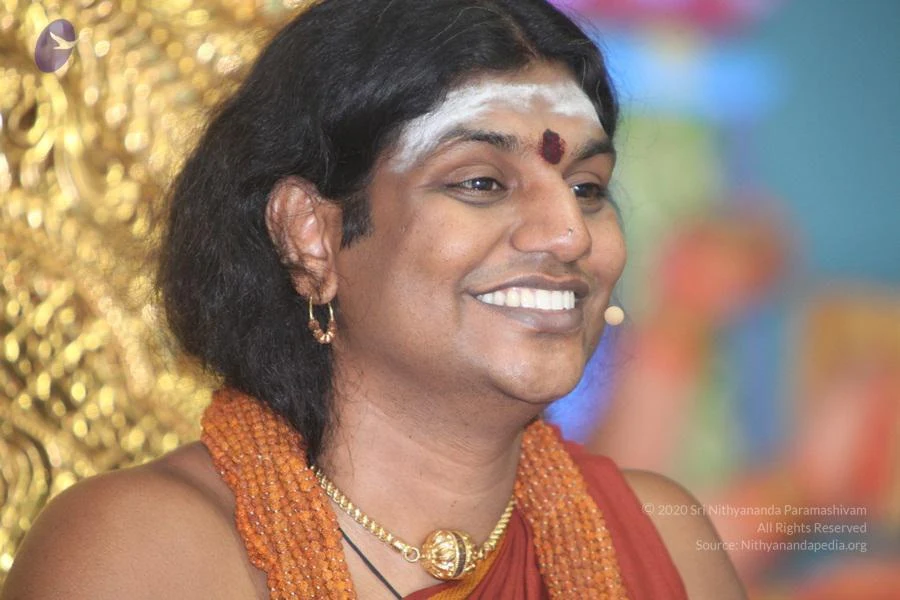
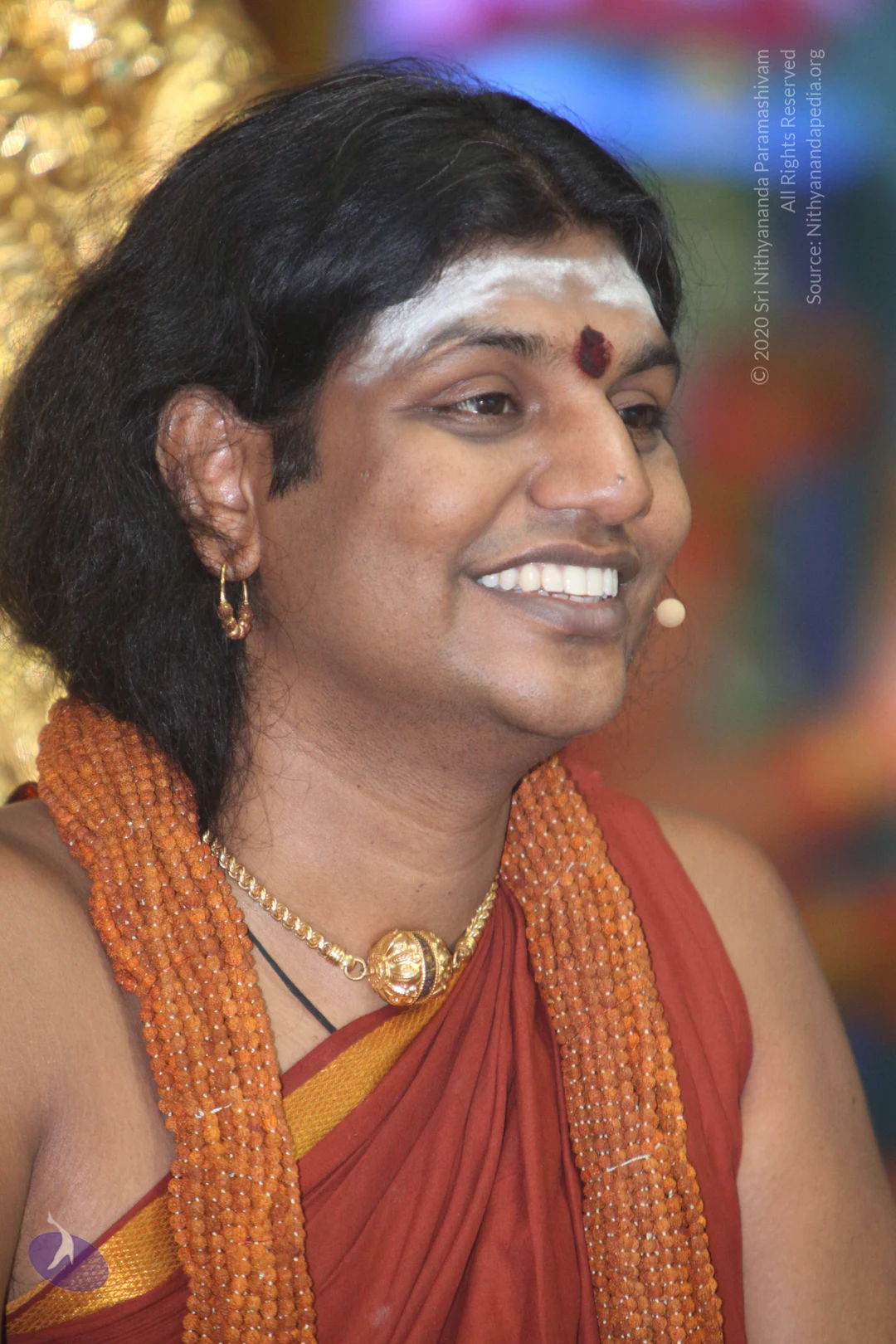
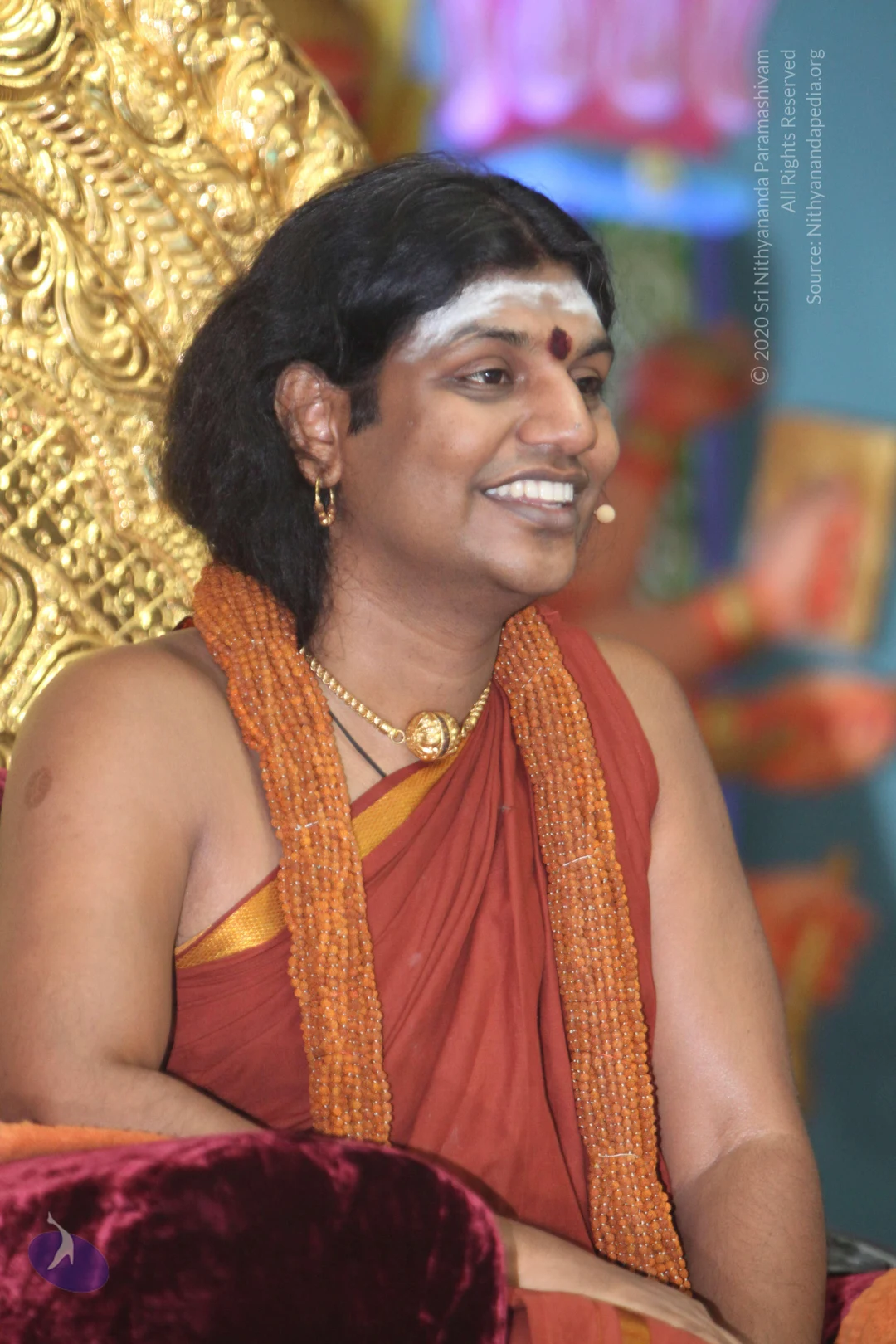
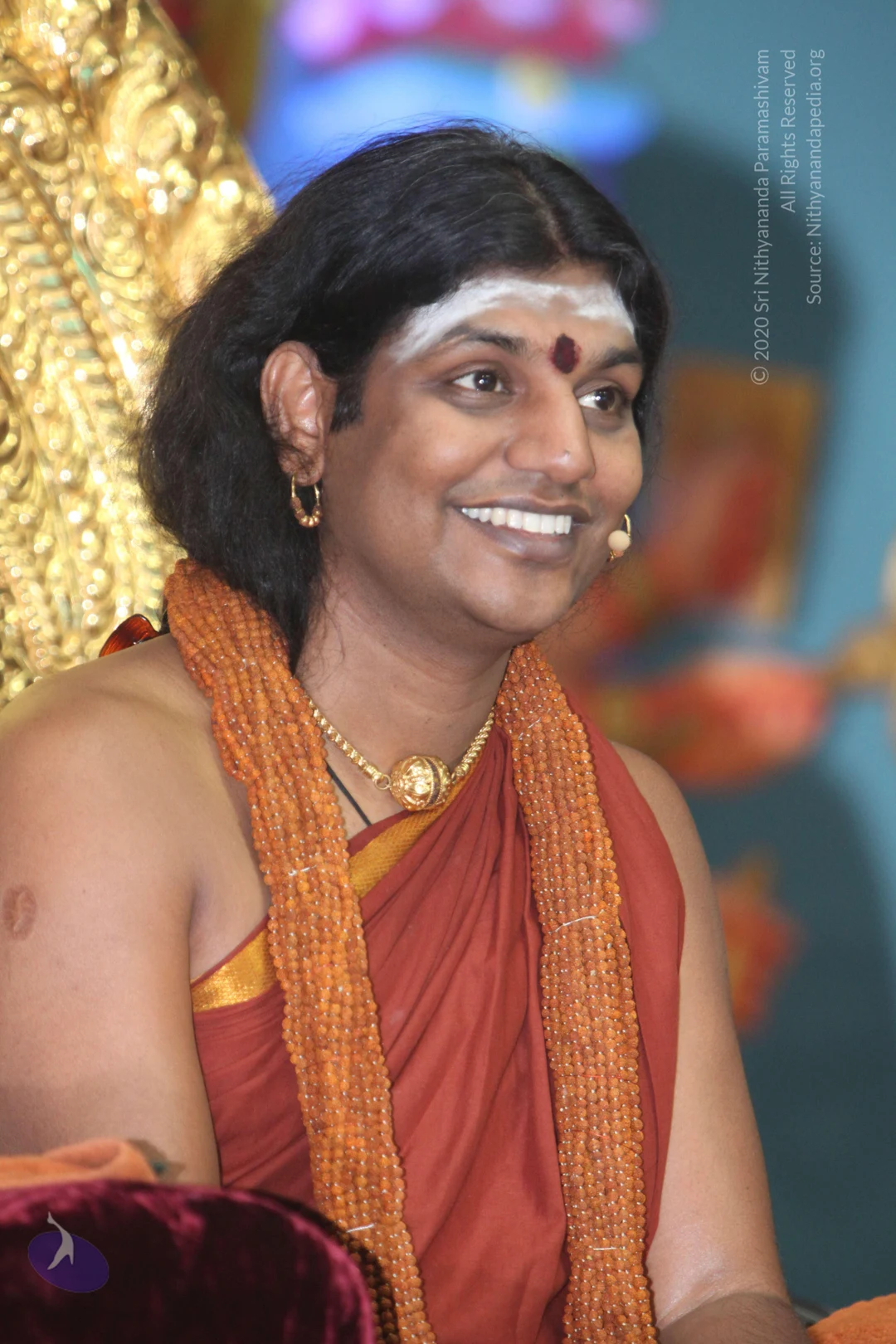
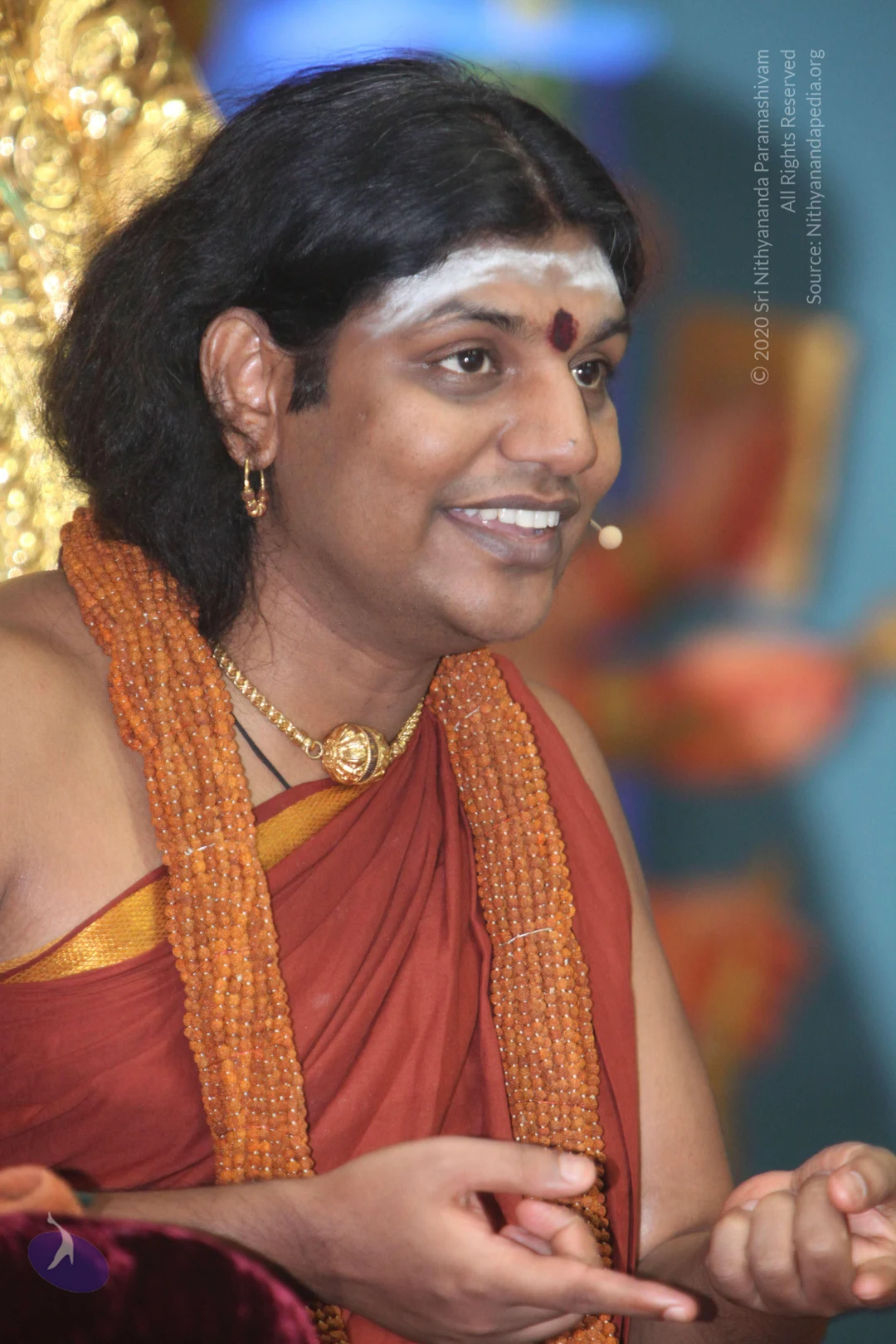
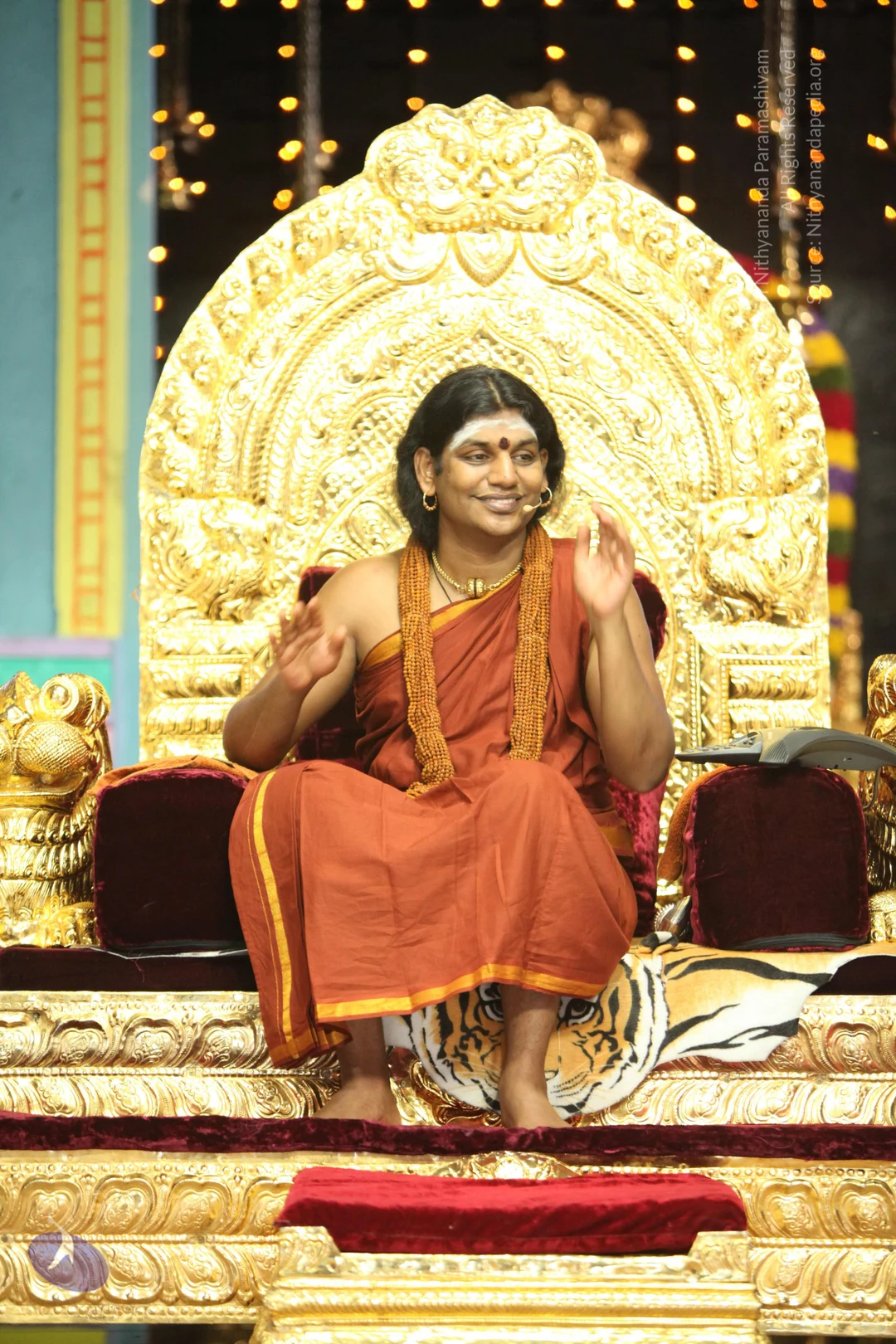
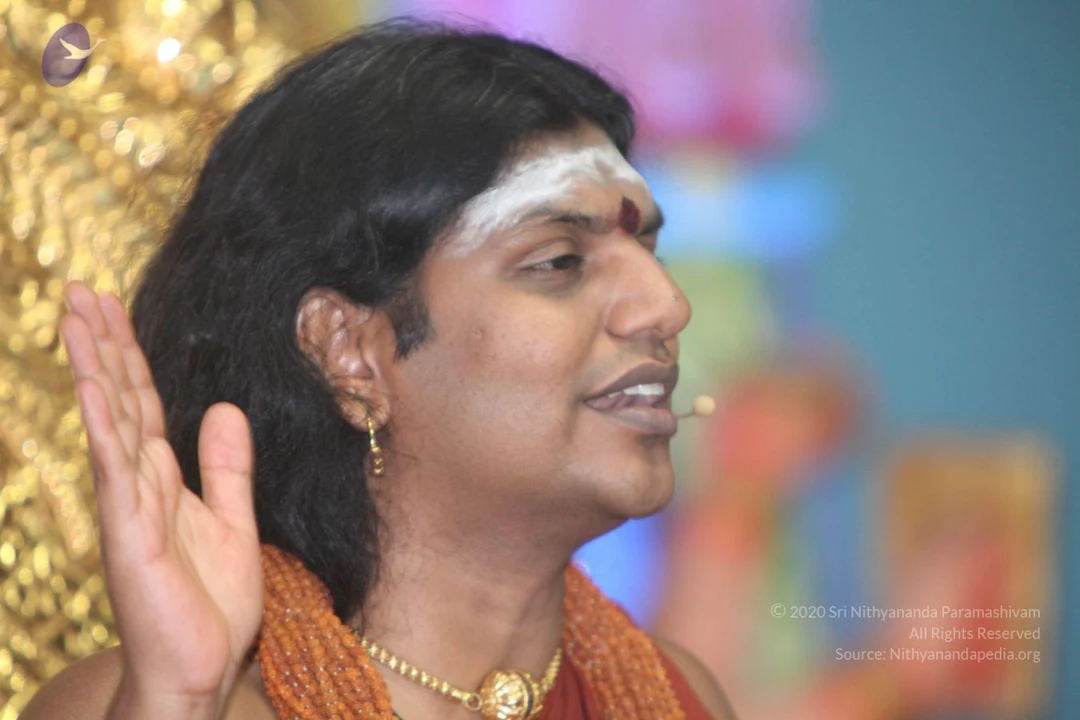
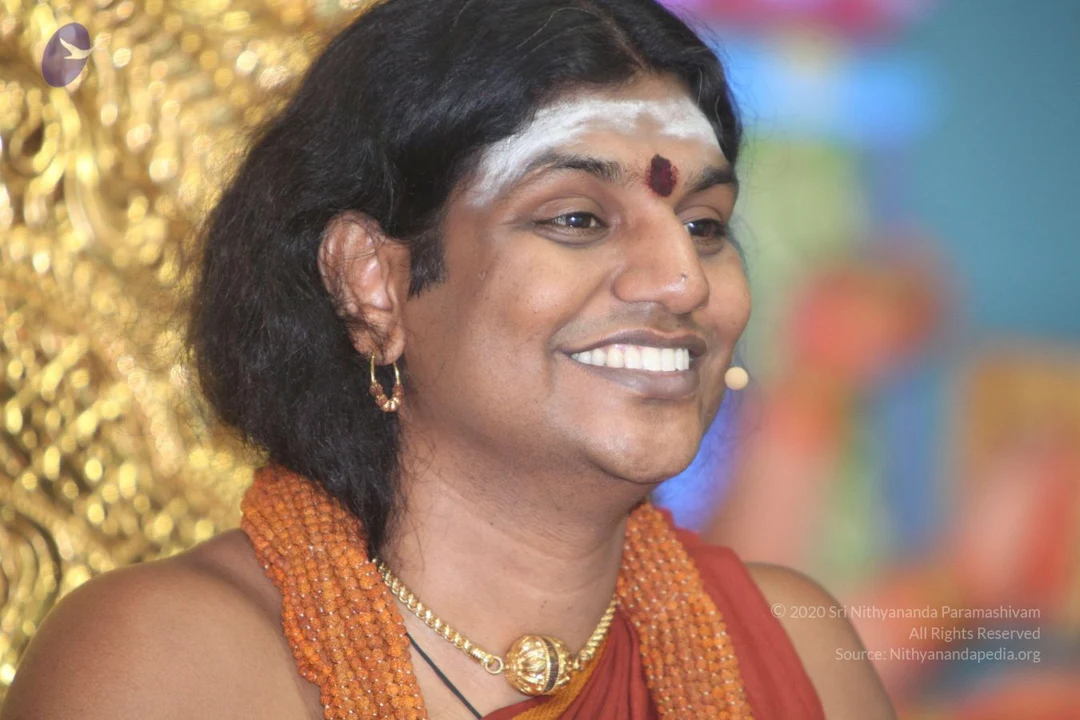
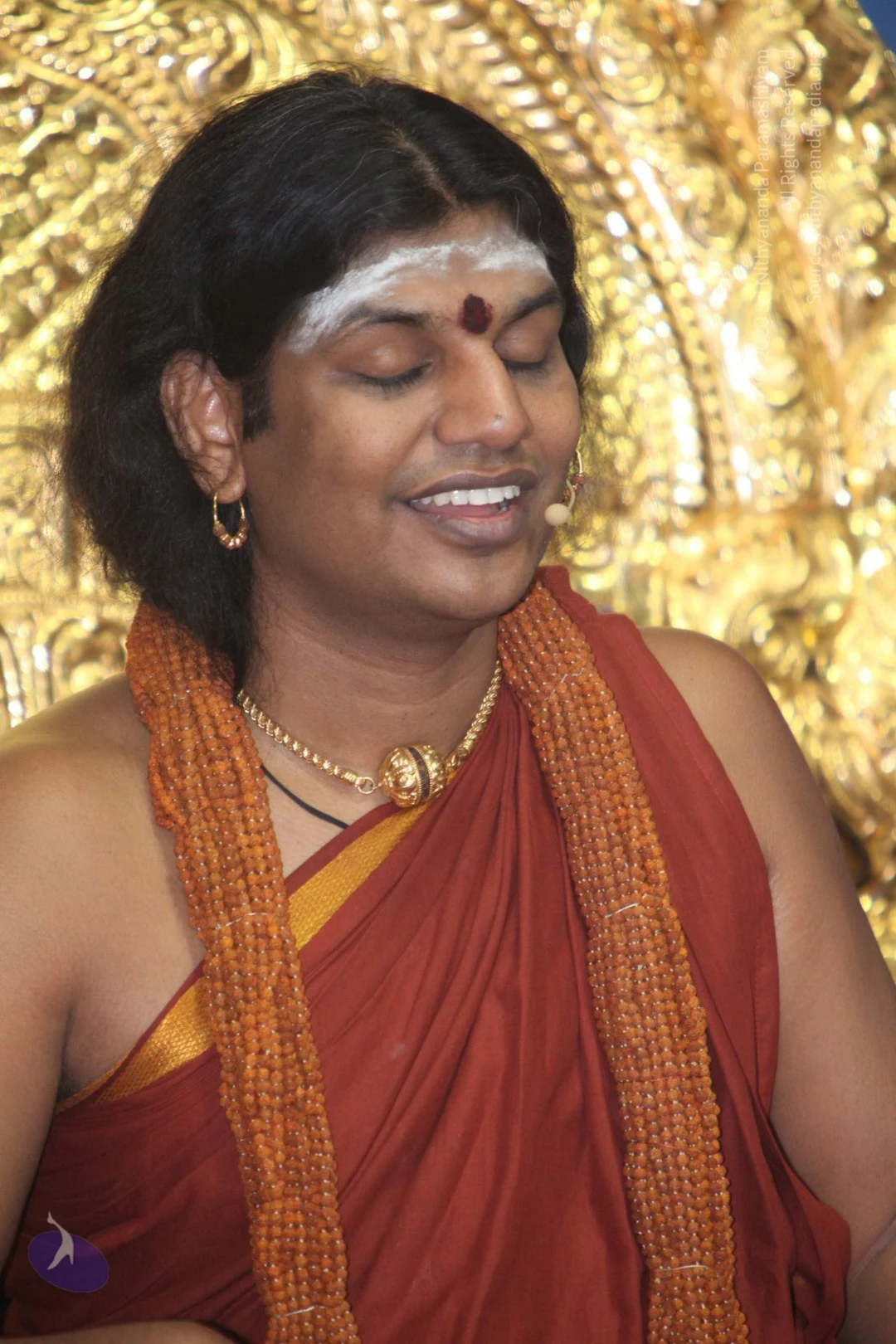
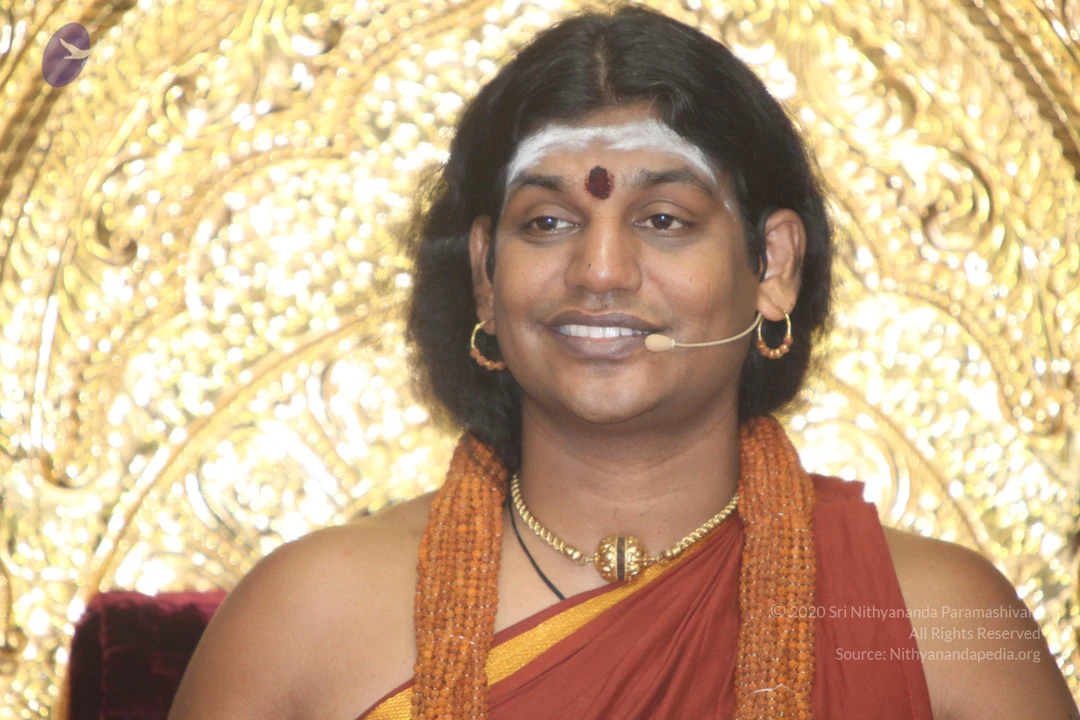
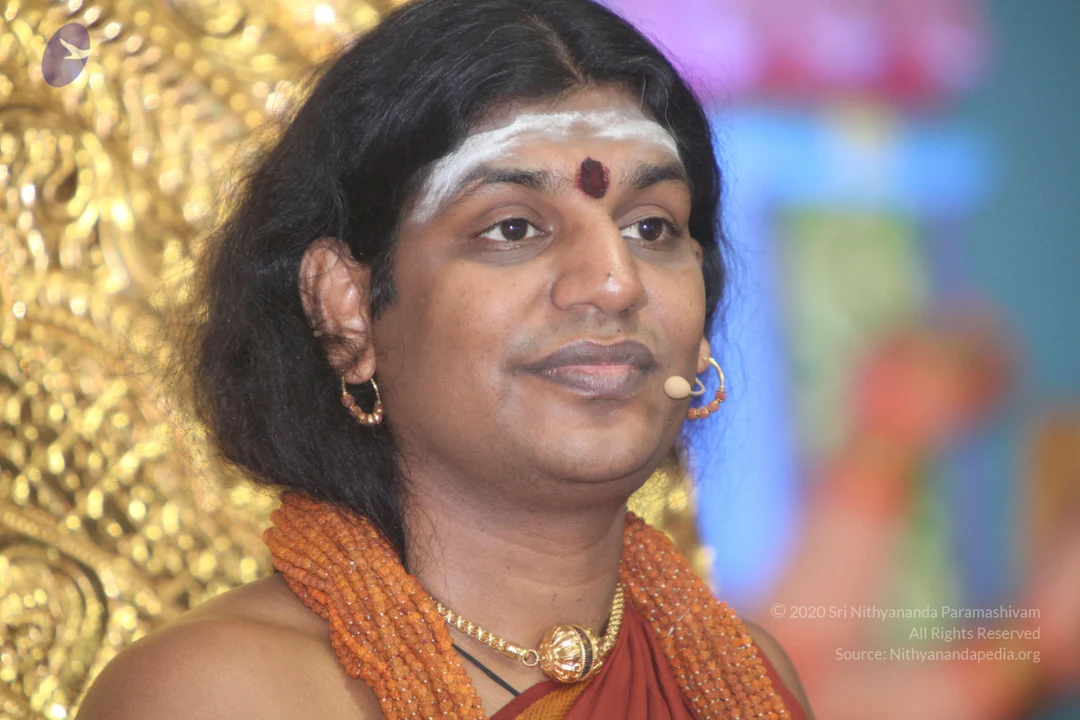
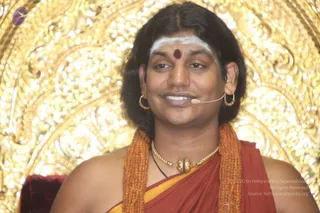
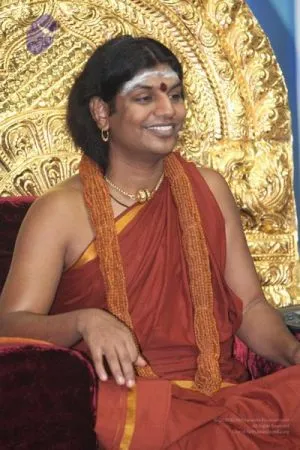
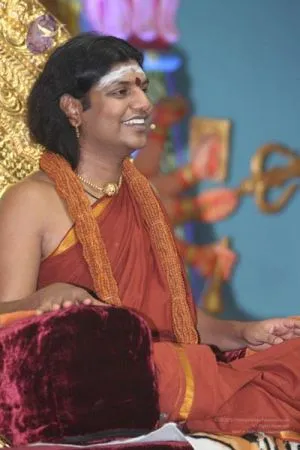
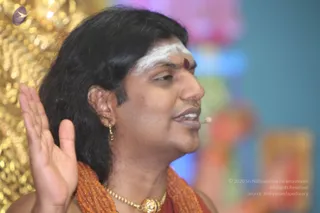
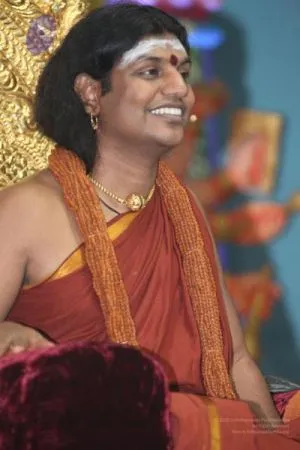
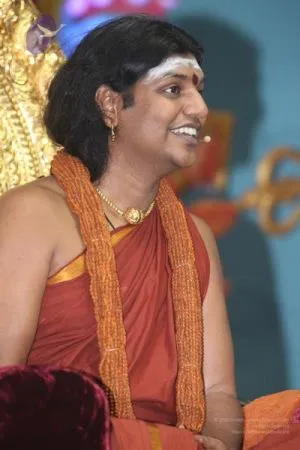
A seated man in a satsang setting, wearing a red-maroon robe draped over his left shoulder with a gold-and-orange trim, orange-brown rudraksha malas hanging on the chest, and a gold ornamental necklace with a large gold pendant. He has a white sandalwood stripe on his forehead and a red bindi, wears small gold hoop earrings, and has a headset microphone near his mouth. Behind him is an ornate gold repoussé backdrop. He appears to be speaking to an audience.A smiling man with long dark hair sits cross-legged on an ornate golden throne-like seat, wearing a rust-orange dhoti and an orange-saffron shawl draped over his shoulders, with a gold chain necklace and a rudraksha-style mala around his neck. He has white vertical tilak marks and a red bindi on his forehead, and gold earrings. He rests his hands on a deep maroon velvet cushion. Behind him are gold ornamental carvings and a turquoise-blue backdrop with a gold ceremonial staff. Shown from the waist up, he appears to be speaking to an audience. Swamiji (probable) appears to be present with visible cues of long hair, saffron-orange clothing, a shawl, and ornate gold jewellery, seated in the role of discourse speaker.A close side-profile photograph of a man speaking into a small headset microphone, with his right hand raised palm-out in an explanatory gesture. He has long, swept-back black hair, a white tripundra marking with a red dot on his forehead, a gold drop earring and a gold necklace over multiple strands of orange-brown rudraksha beads, and wears a saffron-coloured garment. The background is blurred, with a gold sparkling backdrop on the left and pink and blue tones on the right. This appears to be a discourse or satsang setting. Swamiji (probable): the long swept-back hair, rudraksha malas, saffron clothing and gold ornaments are the visible cues, and the page identifies this event as featuring Swamiji.A smiling man with long dark hair sits on an ornate gold throne, wearing a saffron-orange wrap and an orange-beaded mala garland across his shoulders. He has a white vibhuti line with a red kumkum dot on his forehead, a gold pendant necklace, and a small microphone clipped near his face. The background shows gold and blue decorative drapery, with a dark red cushion in the lower foreground. Cues are consistent with the page's a person reference, though the appearance is only probable.Photograph of a smiling man seated at an event, shown from the chest up in three-quarter view turned to the left. He wears an orange-red shawl draped over one shoulder and a long orange-brown beaded mala across his chest, with a gold necklace and gold earrings. A white tilak marks his forehead with a red dot. Behind him is an ornate gold decorative backdrop and a small microphone clip is visible. His hair is long and swept back. The person's appearance is consistent with a person based on the swept hair, orange-red shawl, rudraksha-style mala and ceremonial gold necklace, shown seated at a satsang-style setting.

Sarva-Darshan-and-final-blessings

12 photosSource gallery
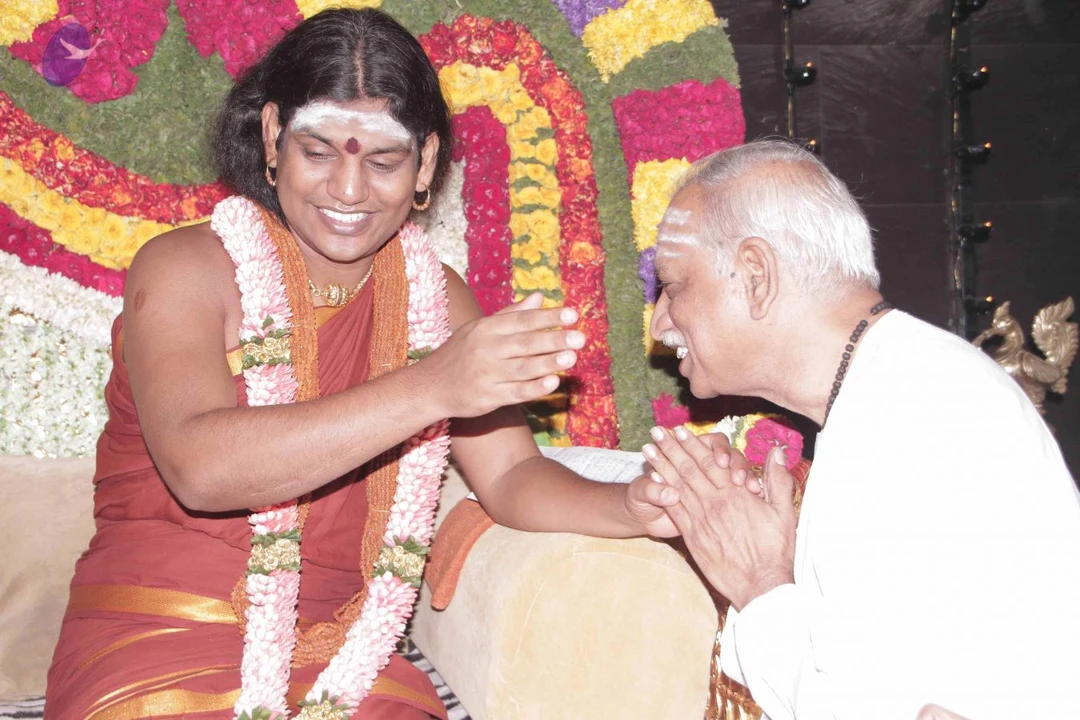
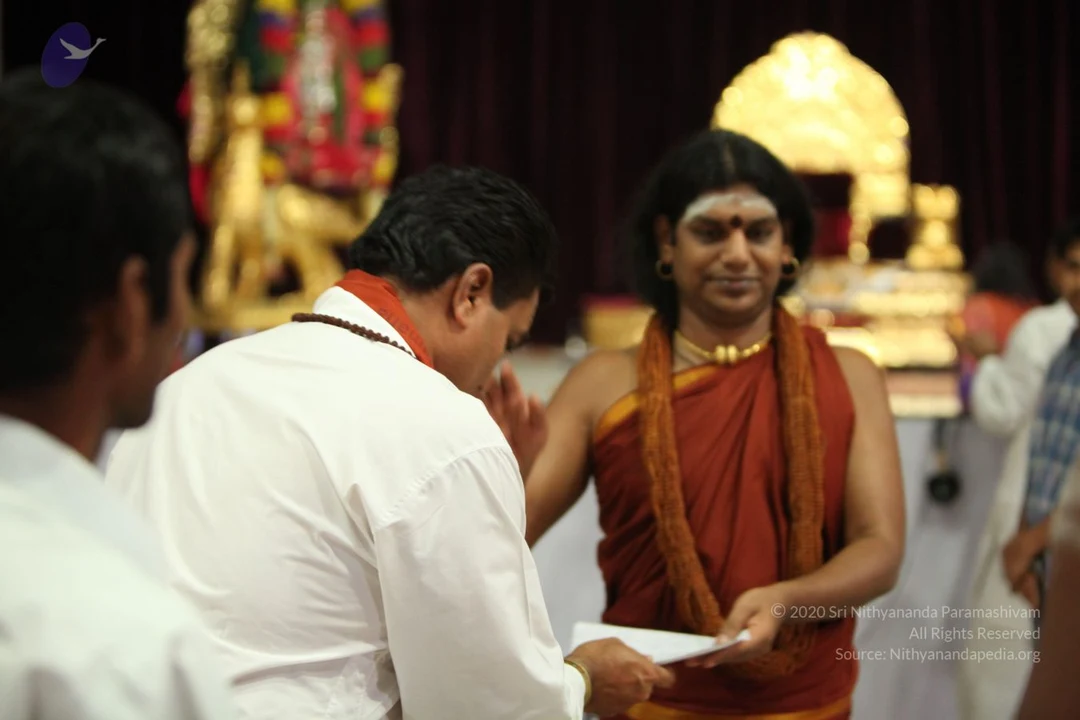
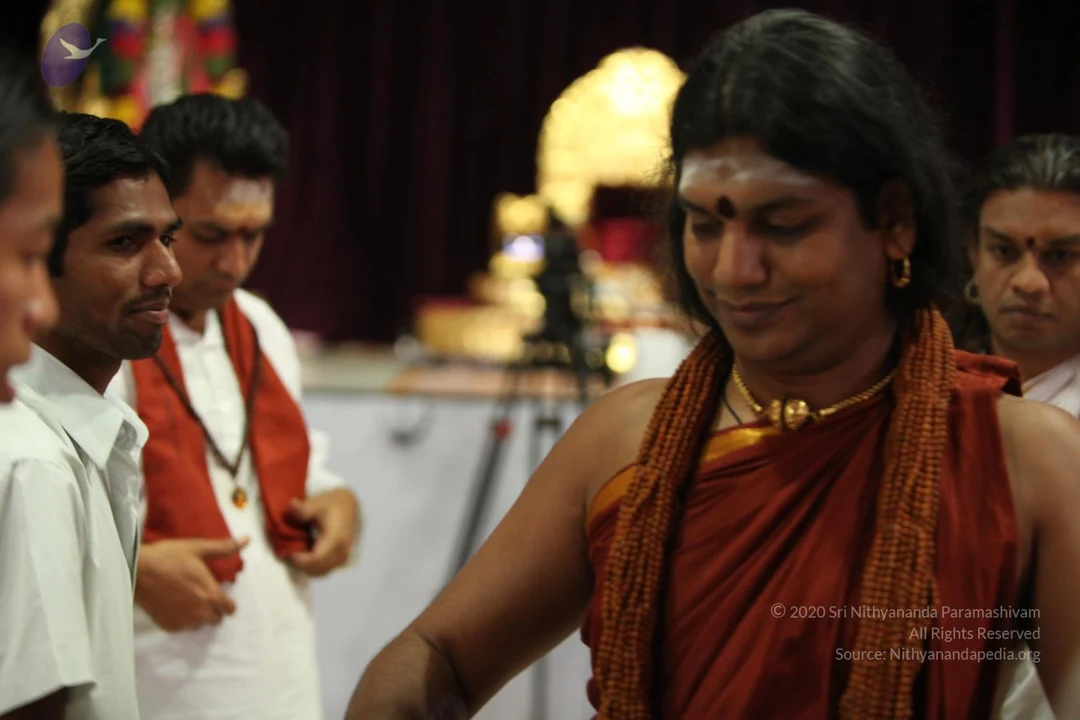
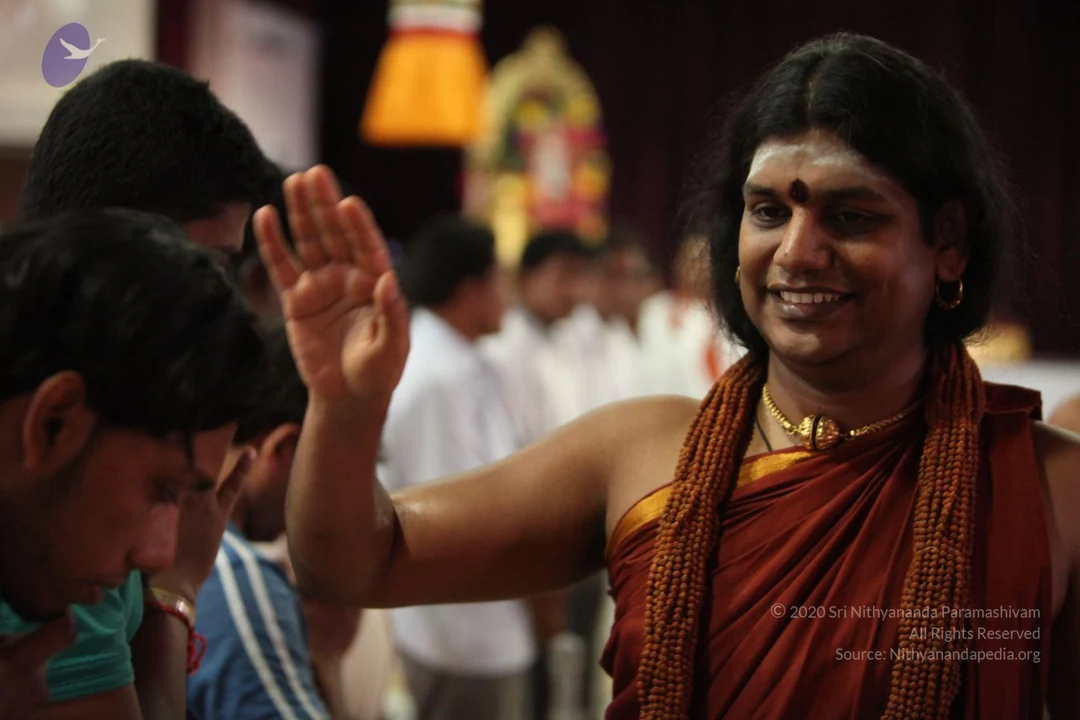
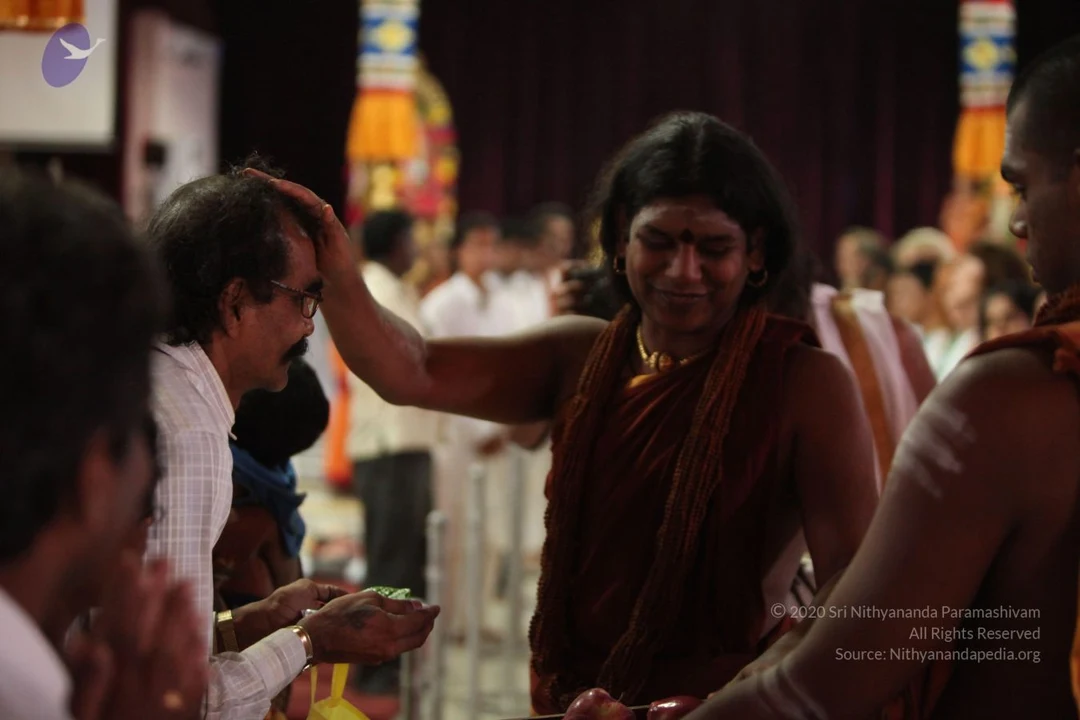
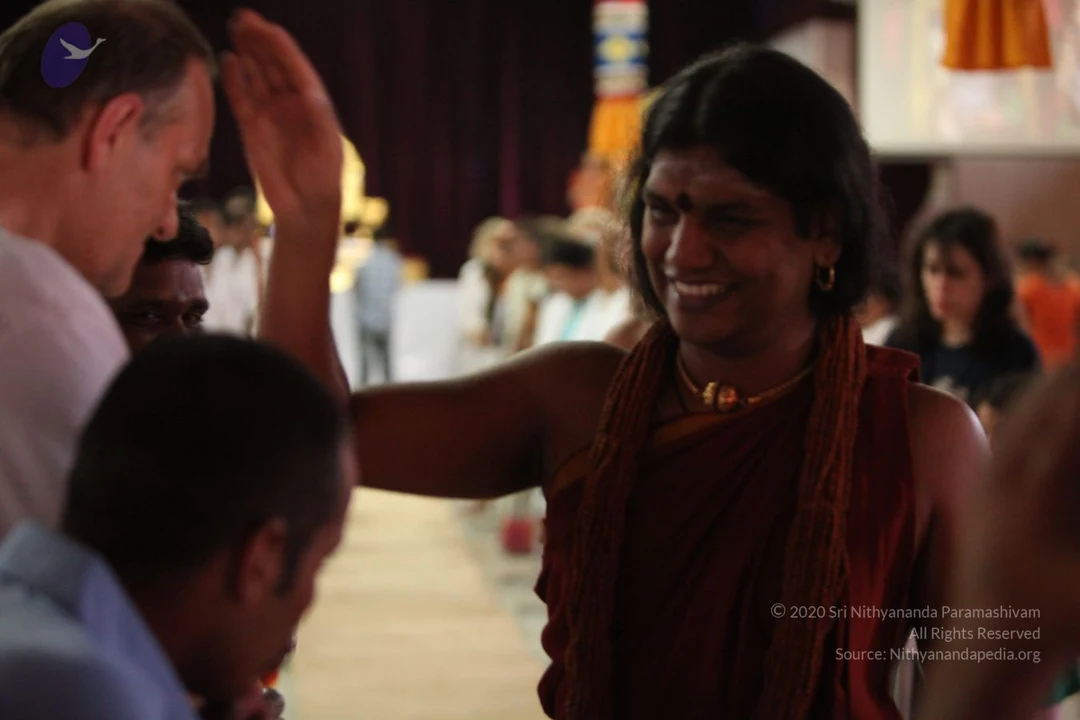
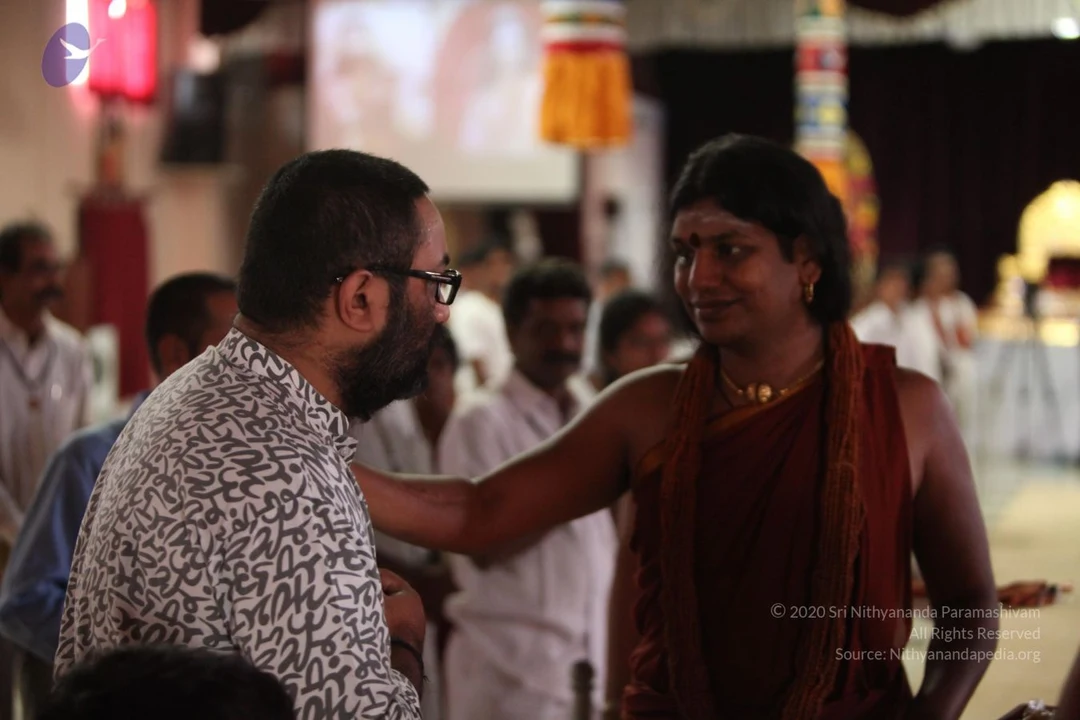
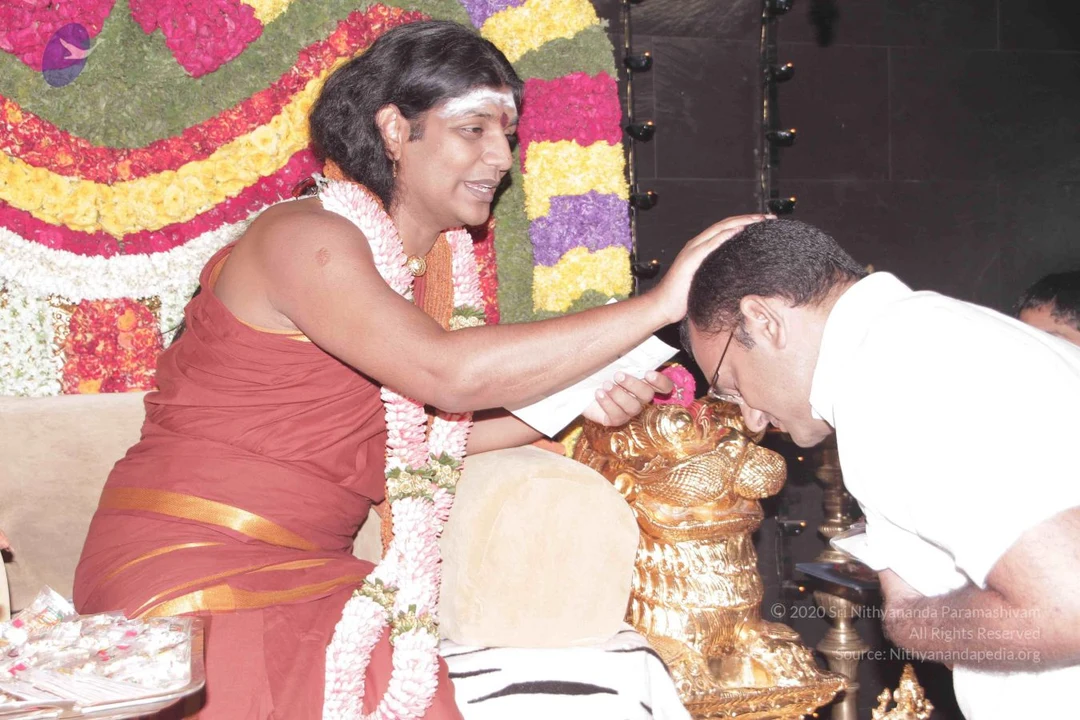
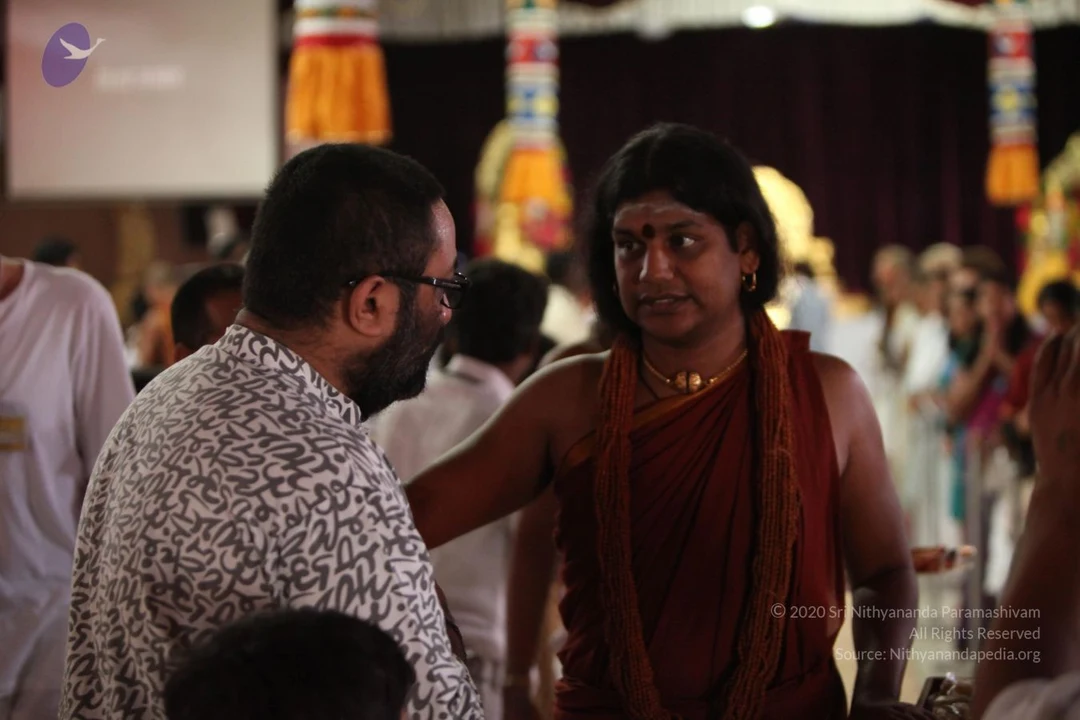
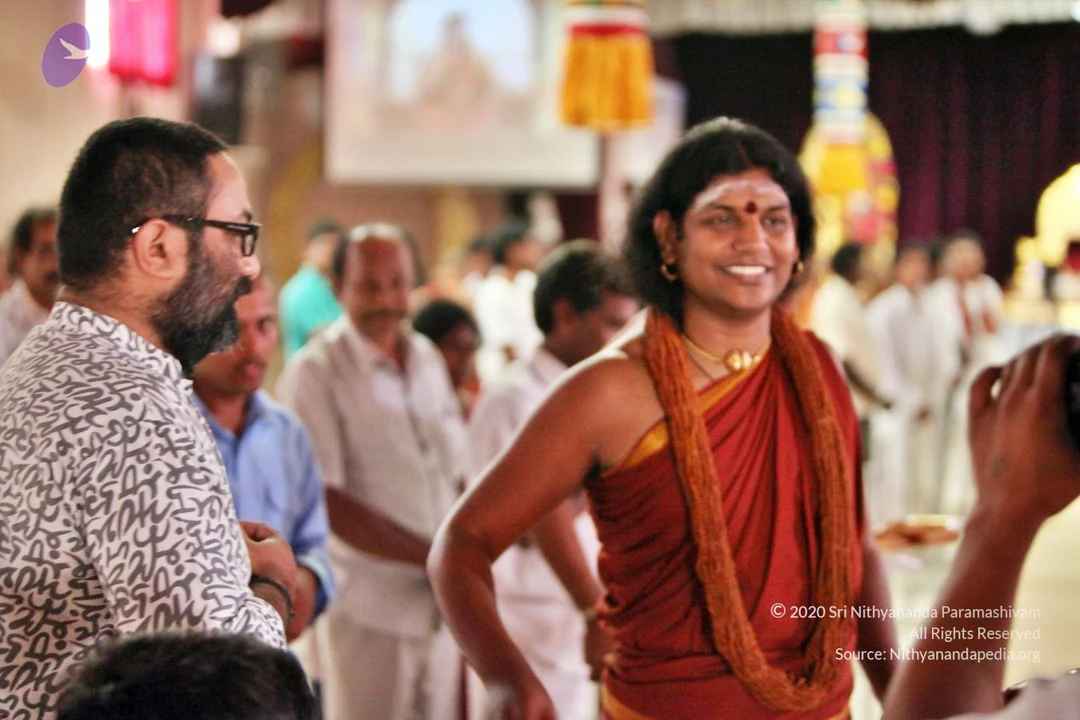
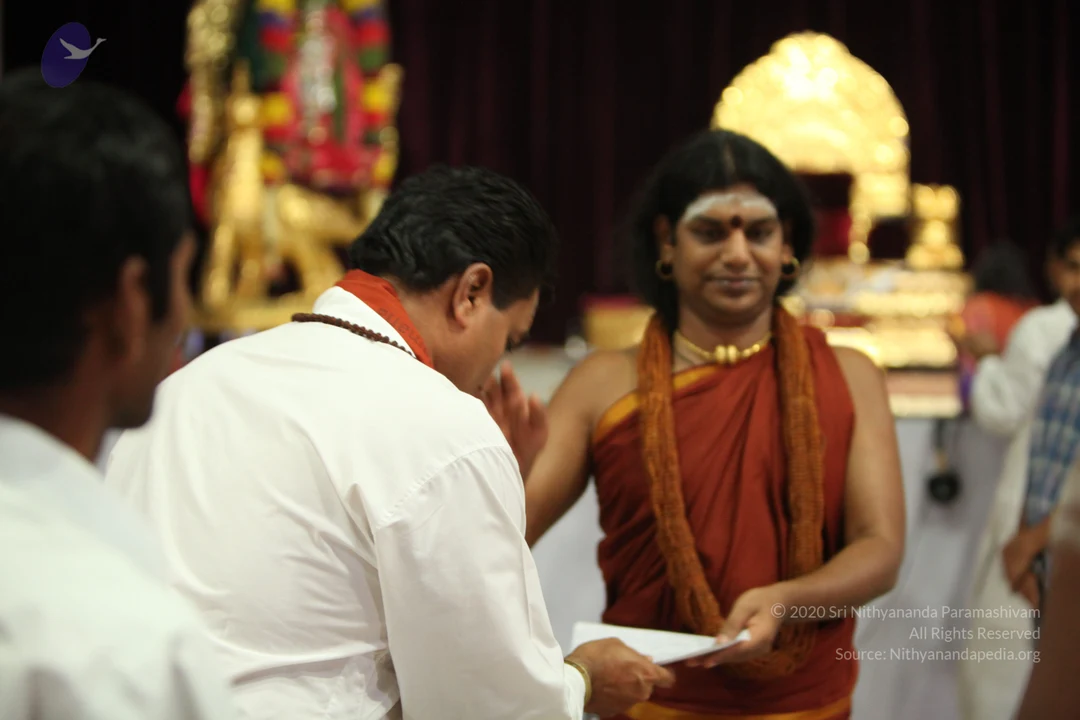
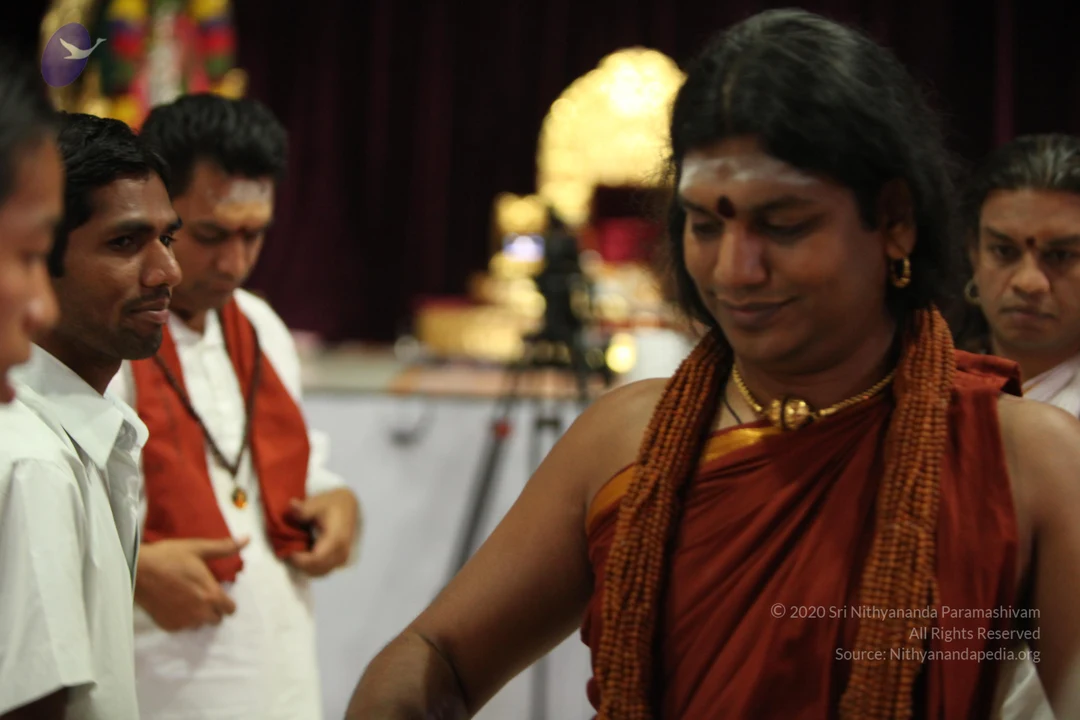
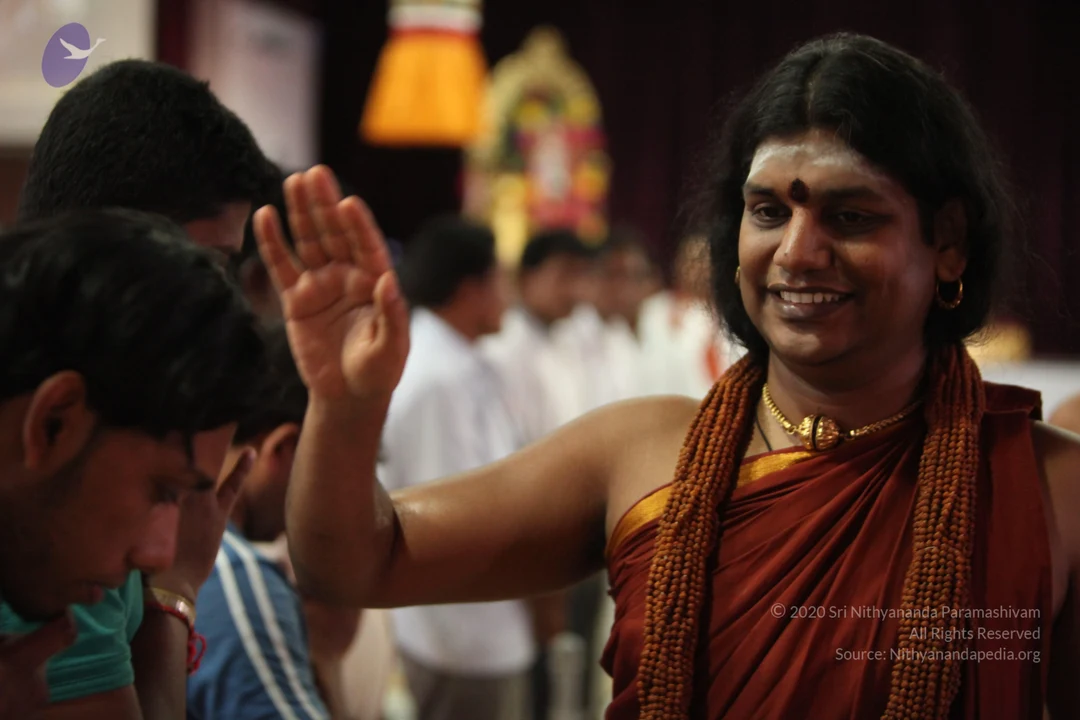
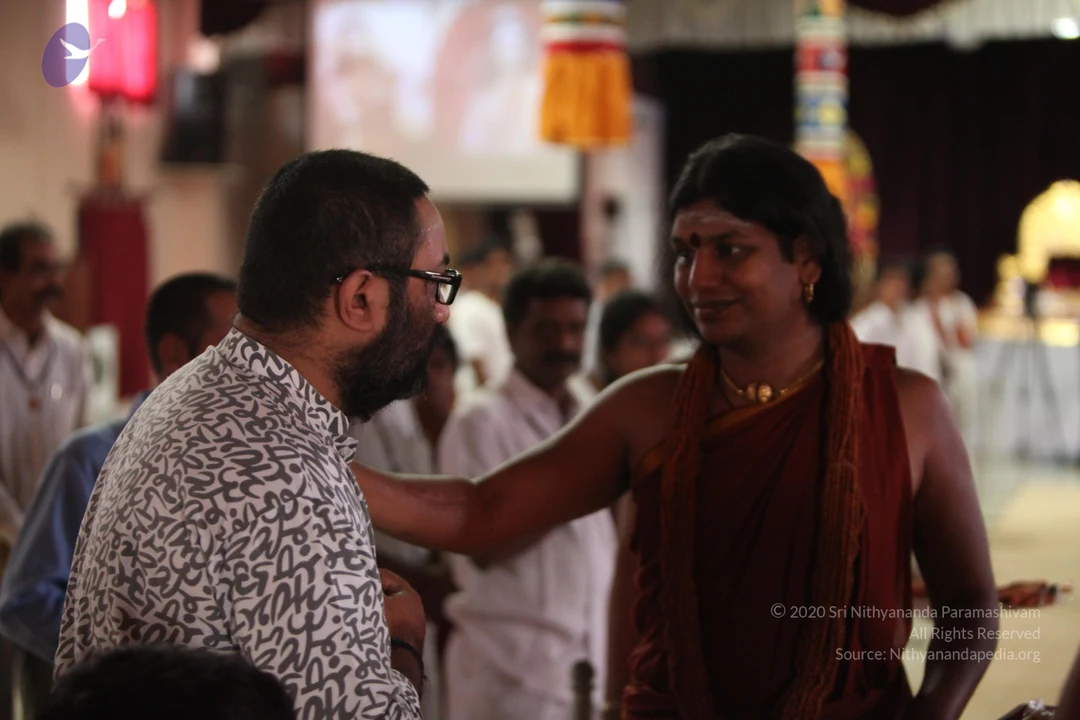
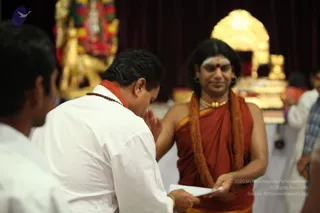
A photo of a devotee in a white shirt with an orange shawl and a wooden mala bowing with palms joined, receiving or handing over a white paper. Facing him is a man in a rust-orange robe with an orange shawl, a long rudraksha mala, a gold necklace and a white-and-red forehead mark, with gold earrings and long dark hair. Gold deity and throne decor with red floral garlands is blurred behind them, with other people at the edges.A photograph of a long-haired man in a rust-orange robe with a rudraksha mala draped over his shoulders and a gold necklace at his throat, a red bindi and white vibhuti on his forehead, standing at the centre-right of the frame and smiling downward. Around him stand several men in white shirts and white dhotis; one wears a rust-orange shawl with a rudraksha mala, and another on the right wears a white dhoti with a red mark on his forehead. Behind them a maroon curtain and a gilded altar or deity murti glow softly under warm lights.A smiling man in a saffron-orange shawl wrapped over one shoulder raises his right hand in blessing toward a group of young men seated in the foreground, some with heads bowed. He wears a long rudraksha mala, a gold ceremonial necklace and gold hoop earrings, with a red bindi and white forehead markings. Behind him, figures in white clothing stand in a hall with a red-curtained backdrop and a yellow lamp shade. a person is seated in front of the group, giving a blessing during a satsang setting.A photograph of an indoor gathering where a smiling person with long dark hair, a red-brown saffron-toned wrap, a rudraksha mala, a gold necklace and small gold earrings places a raised hand on a man's head in a blessing gesture. A man with short hair and a light grey shirt leans in, another man in a blue shirt is partly visible at the lower left, and more people in white and orange clothing stand in the background near a gold-coloured altar and red draped fabric.A photograph of a long-haired figure in a rust-red sannyasi drape with a rudraksha mala and a gold necklace, a red kumkum mark on the forehead, speaking to a bearded man in glasses and a white shirt printed with black scribbled patterns. The red-robed figure rests a hand on the man's arm. Behind them, people in white clothes stand among colourful orange and yellow tassels and a dark maroon backdrop, with a projection screen at the upper left. The red-robed figure is an appearance-based probable Swamiji (probable) through long swept-back hair, a rudraksha mala and a gold necklace, while the bearded man stands beside them.

Toronto-Akhashik-Readings

12 photosSource gallery
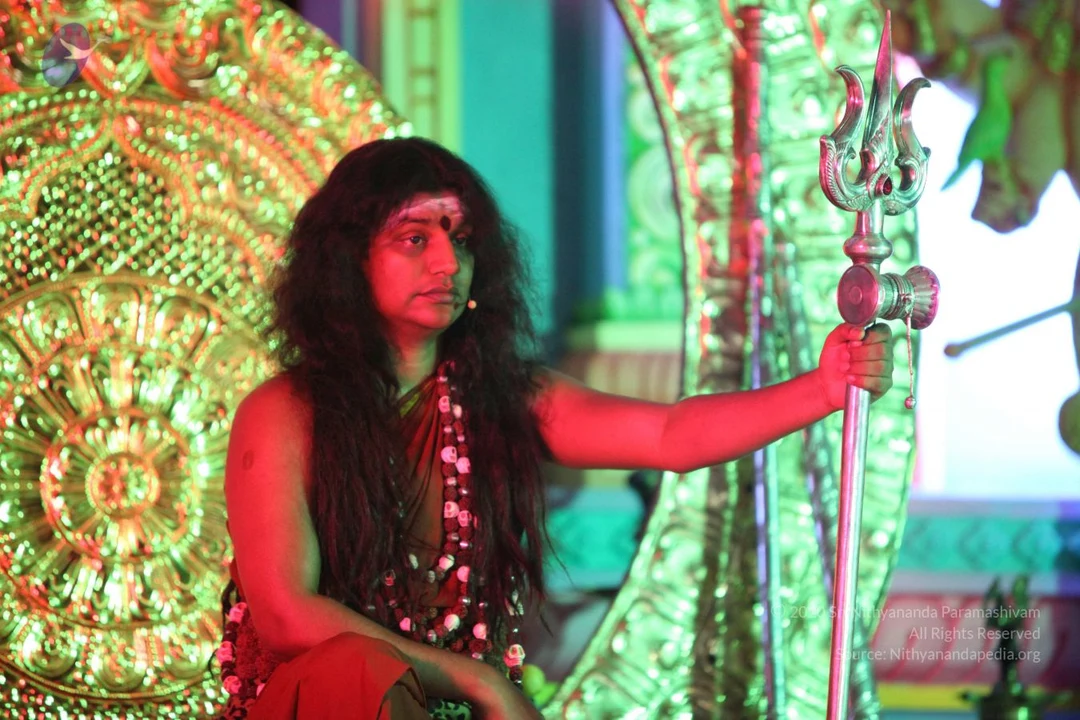
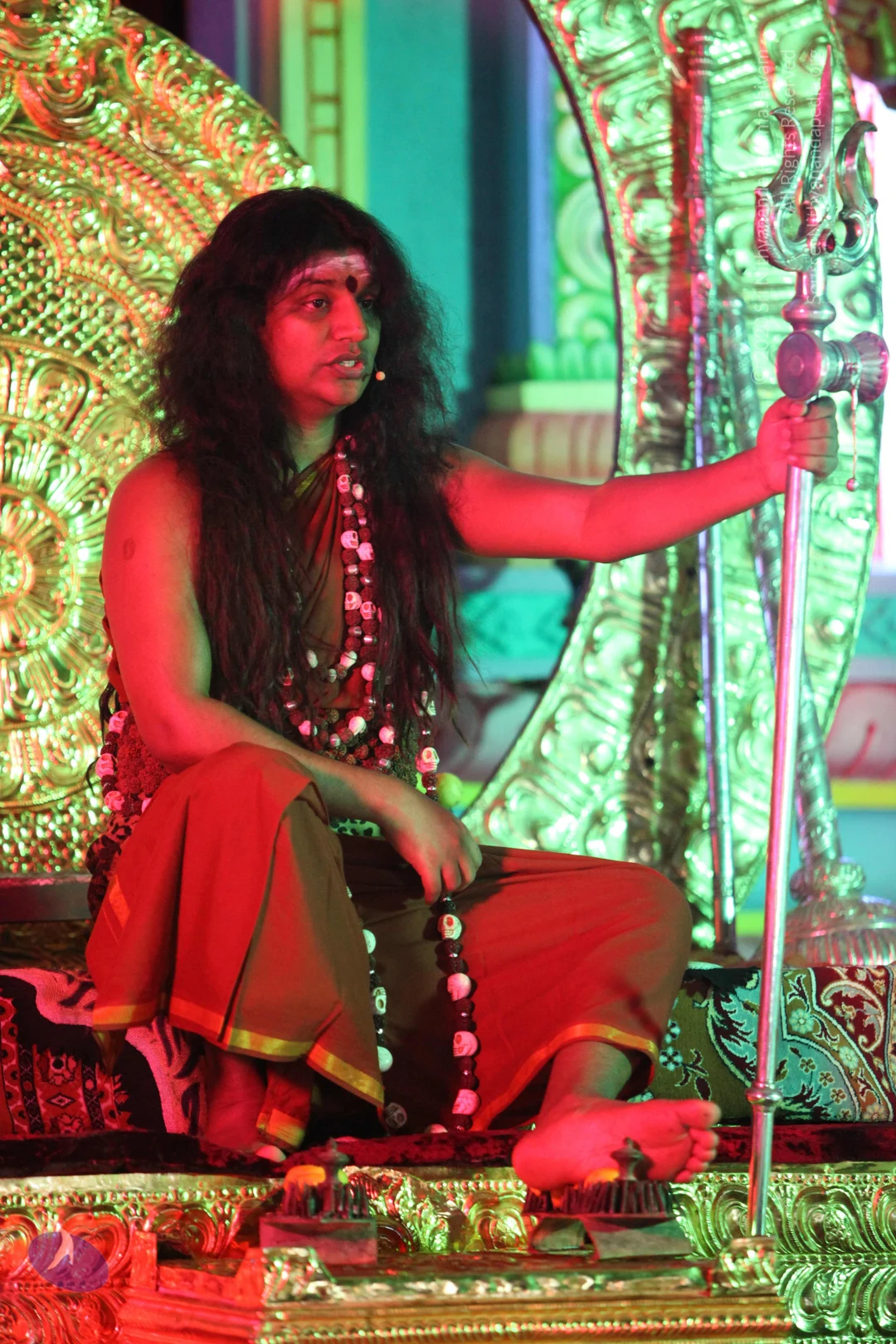
A photograph of a seated man on an ornate golden throne set within a large gilded circular arch, against a bright multicoloured temple-style backdrop. He wears an orange-red garment, a green beaded mala and a rudraksha-style necklace, and holds a silver trident. Two painted deity guardian statues flank the throne, one on each side, and a small black dog stands on the carpeted dais at the base. Brass oil lamps stand beside the throne and a red-patterned cushion lies on the seat. Coloured stage lighting washes the scene in pink and green.A photograph of a figure seated on an ornate golden throne with a large circular golden arch behind it, set in a brightly lit, pastel-coloured hall with red and green tones. The seated figure has long dark hair and wears a rust-red garment with a rudraksha-style bead mala and a long trident-tipped staff held upright in one hand. A small black dog sits at the foot of the throne on a red carpet. Two painted, large guardian statues in green, pink and gold stand on either side, one holding a staff and one holding a trident. Ornate gold lamp stands flank the throne. The visible physical people count is one.A seated figure on an ornate golden throne, a peetha with a large golden arch behind and an elaborate gilded backrest, on a stage with painted pink and green dwarapala-style guardian statues flanking both sides. The seated person has long swept-back dark hair, wears a dark green and red draped garment, a bead necklace and rudraksha-style malas, and holds a golden trident (trishul) upright in one hand while the other rests on the throne arm. A dark dog sits on the carpeted steps in front of the throne. Brass lamp stands and an ornate ceiling-hung lamp frame the scene, with pink and blue stage lighting. The seated figure is visually similar to the a person depictions, with distinctive long hair, a trident and rudraksha malas, but the appearance is uncertain so this is recorded as unsure.A photograph of a seated figure on an ornate golden throne set within a large gilded circular arch, against a brightly coloured painted backdrop of pink and turquoise pillars. The seated person has long dark hair, a rudraksha mala with a green-and-red beaded necklace, and a dark robe, holding a silver trident. Two painted guardian figures with moustaches and crowns flank the throne, one holding a staff and one holding a club. A small dark dog sits on the carpet near the throne, and brass oil lamps stand on either side. Based on the throne and long hair with rudraksha beads, the seated figure is a probable Swamiji (probable). Visible physical people: one.A seated person with long dark hair wears a red wrap and a dark garland of beads and white and pink rudraksha-style beads. A pale vertical mark and a red bindi show on the forehead. The person holds a silver trident upright in the right hand and smiles while looking to the side. Behind is an ornate golden arched backdrop with repeating floral and medallion patterns, lit in red and green stage light.A person with long, dark, loose hair sits on an ornate golden throne with a large gold-embossed backrest, lit in red and green stage light. He wears a red-orange draped garment, a dark beaded rudraksha-style mala across the chest and a red-and-white beaded necklace, with a red bindi on the forehead. He smiles while holding a silver trident in the right hand and resting the left arm on the knee, with a small microphone visible near the face. A stage-set peetha throne behind him completes the scene.

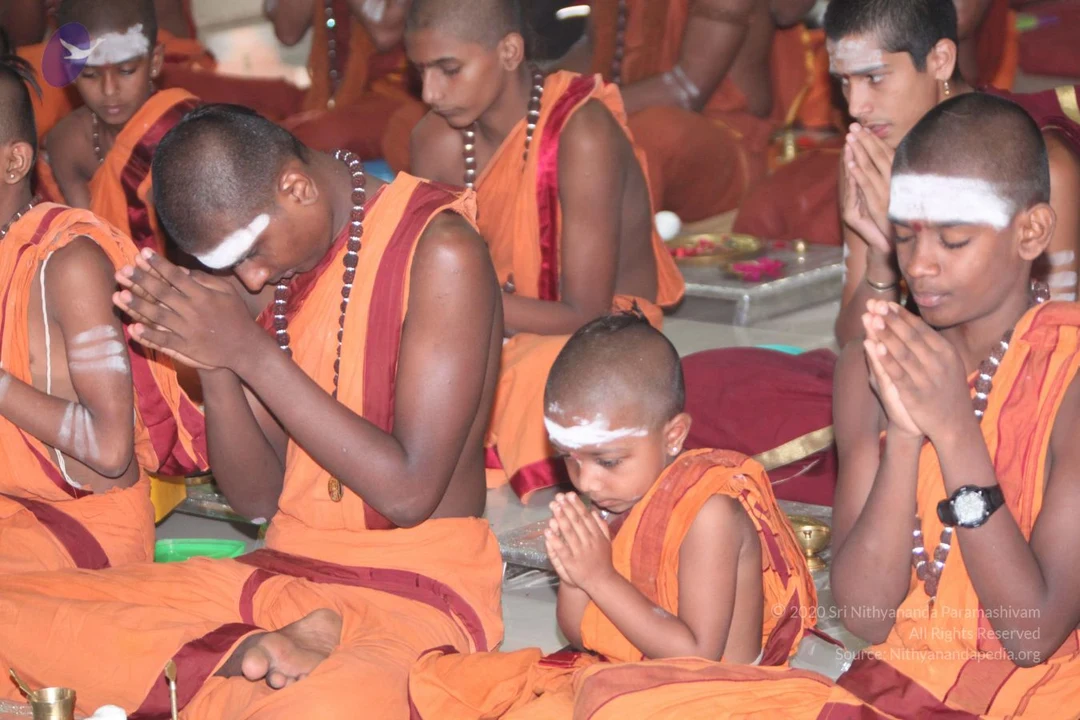
Pada-Puja

21 photosSource gallery
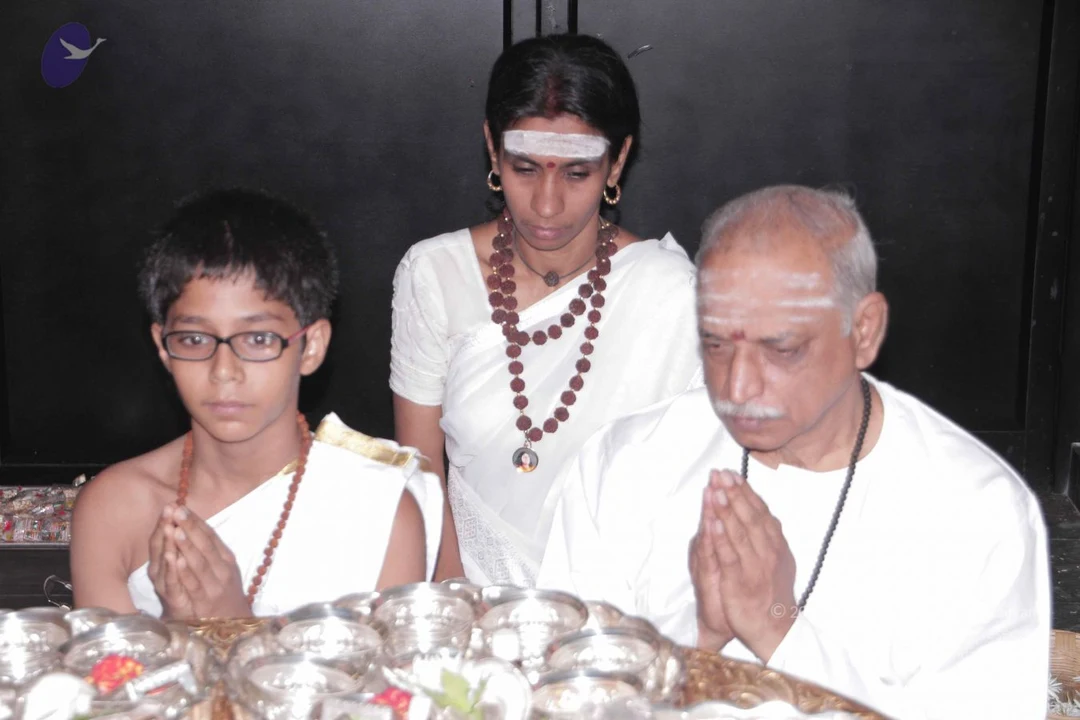
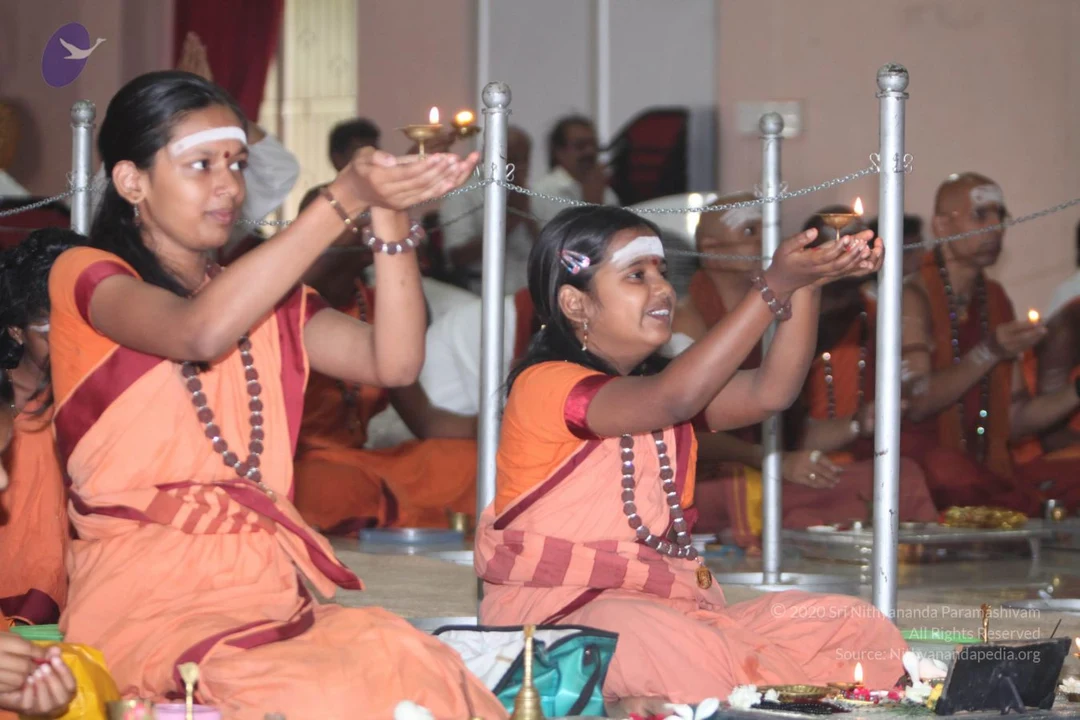
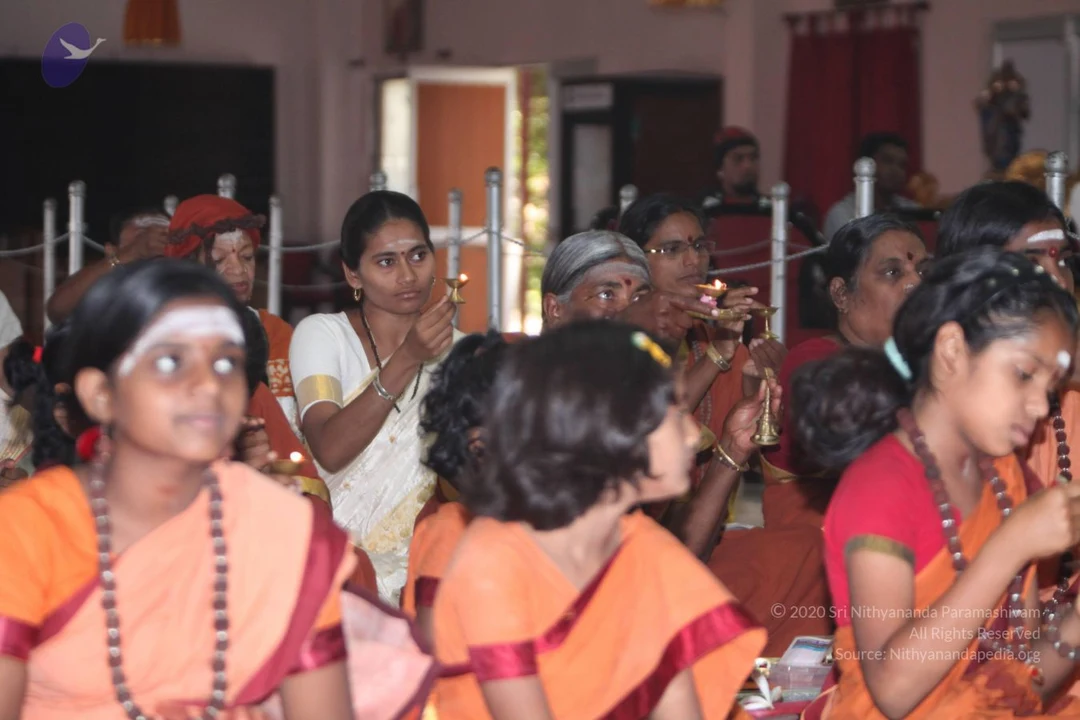
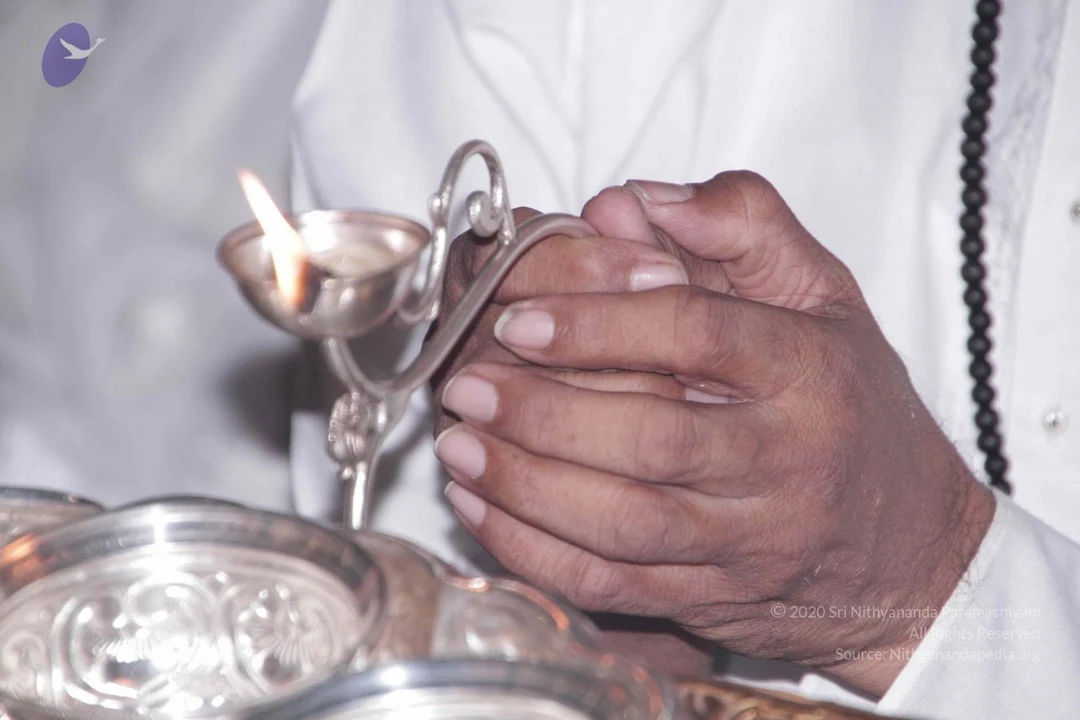
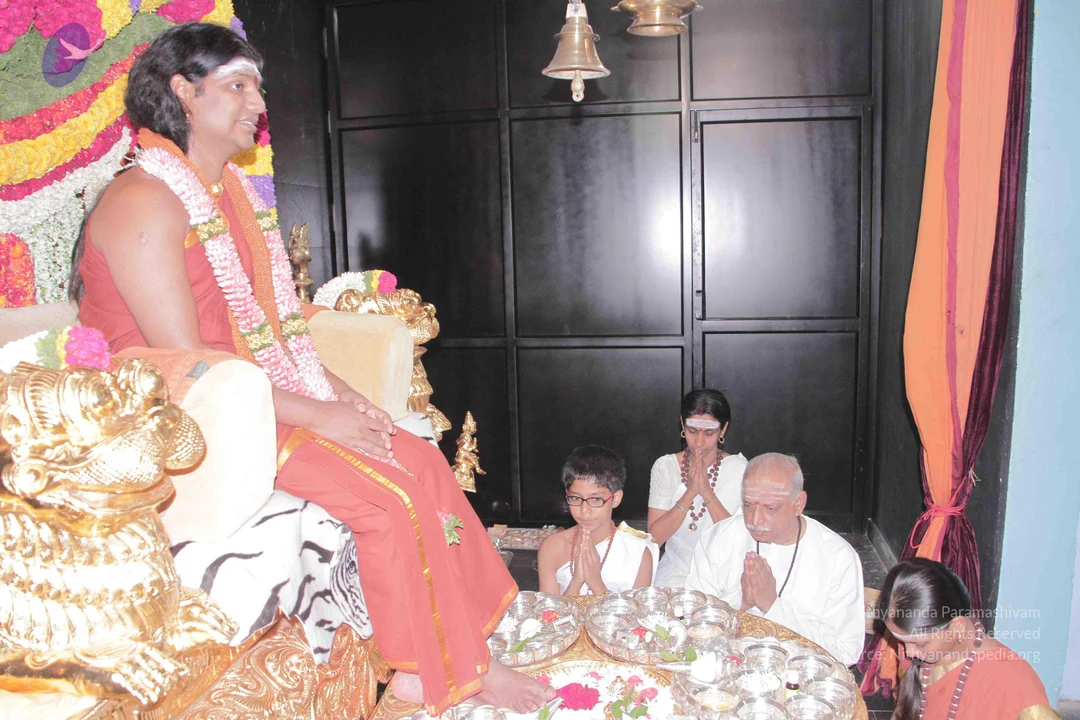
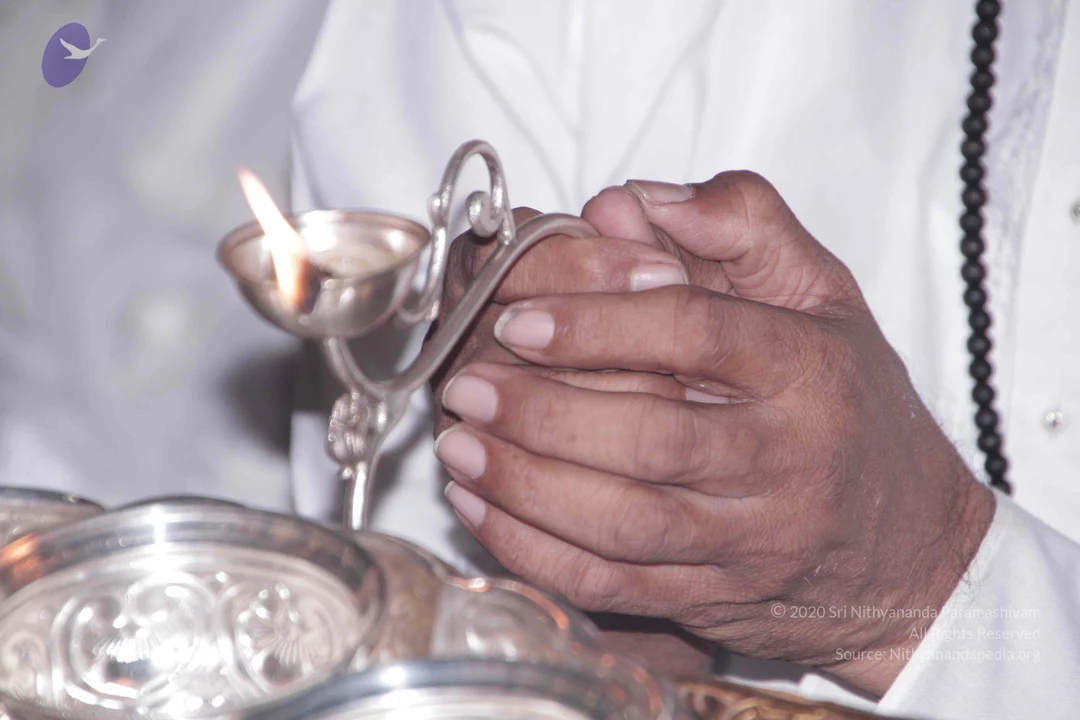
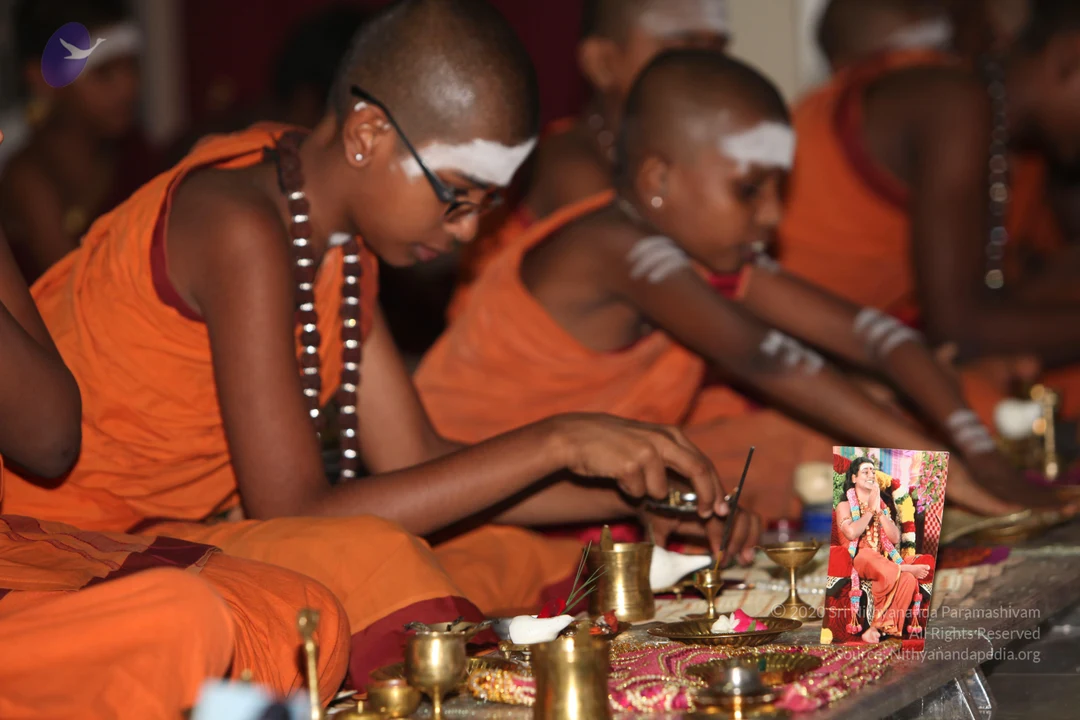
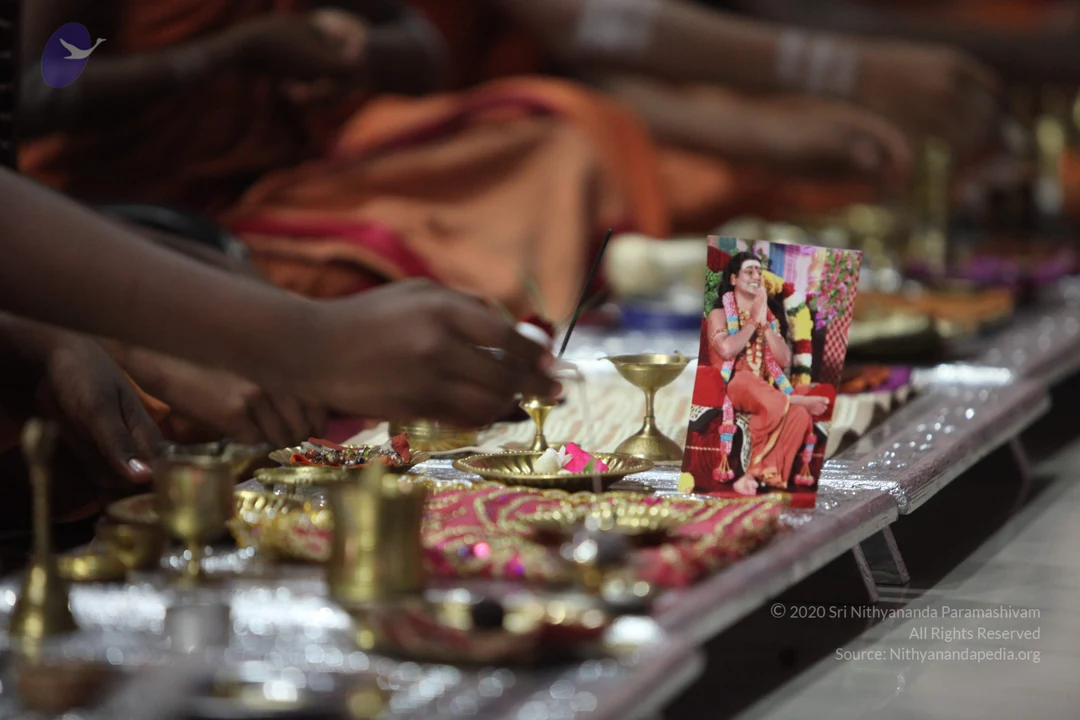
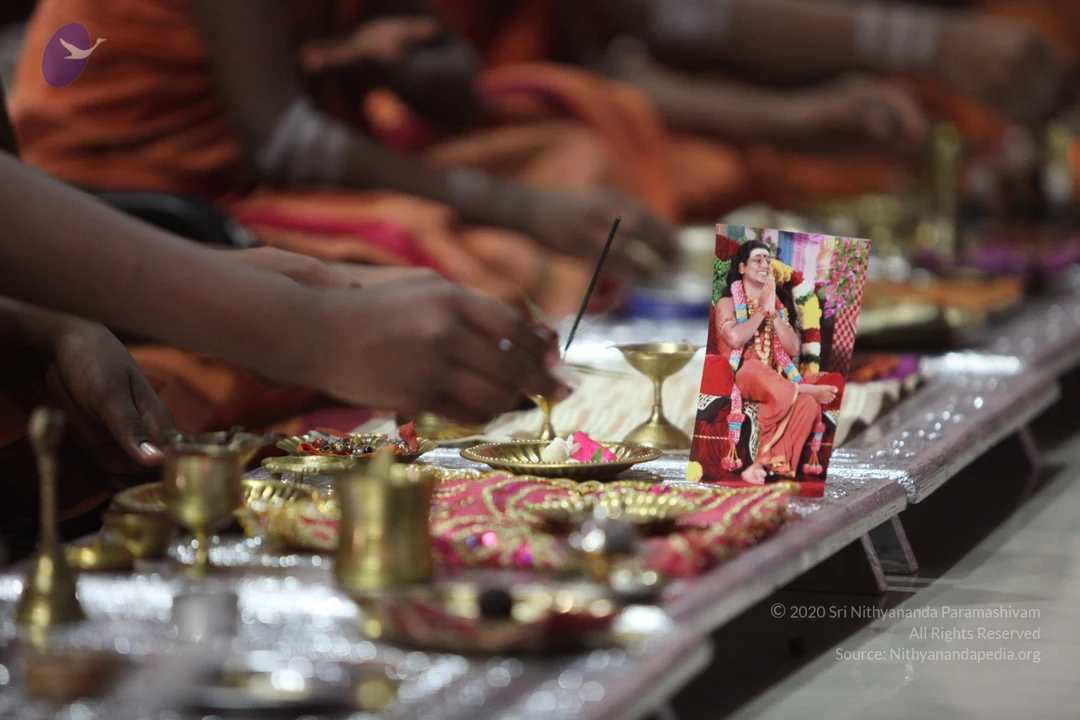
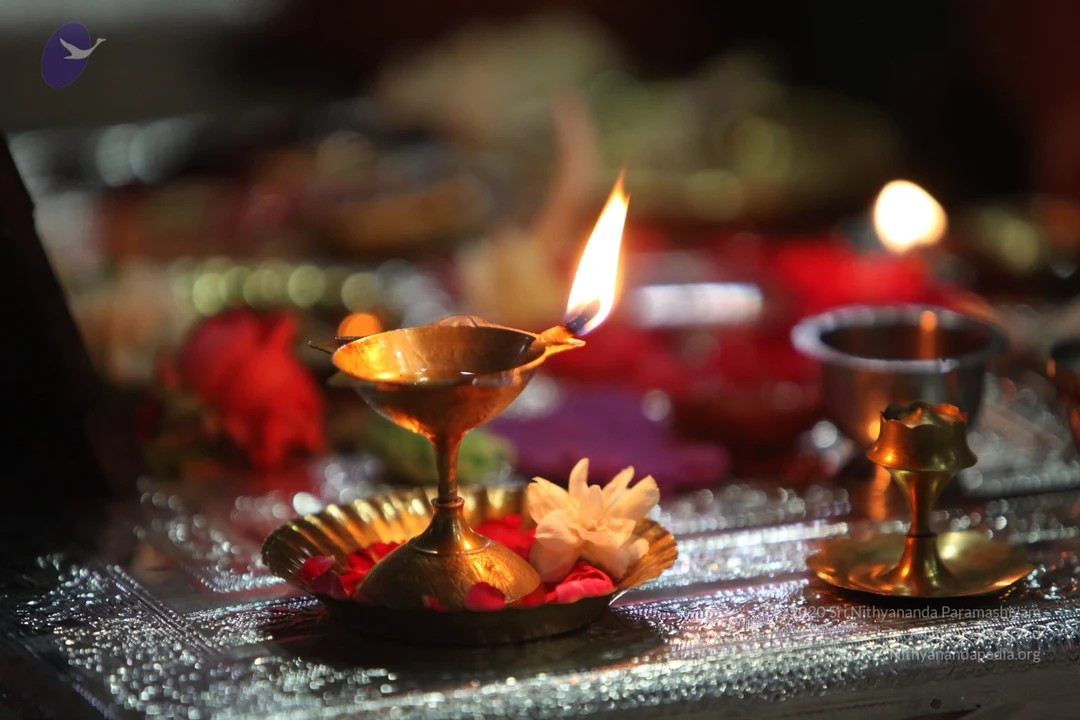
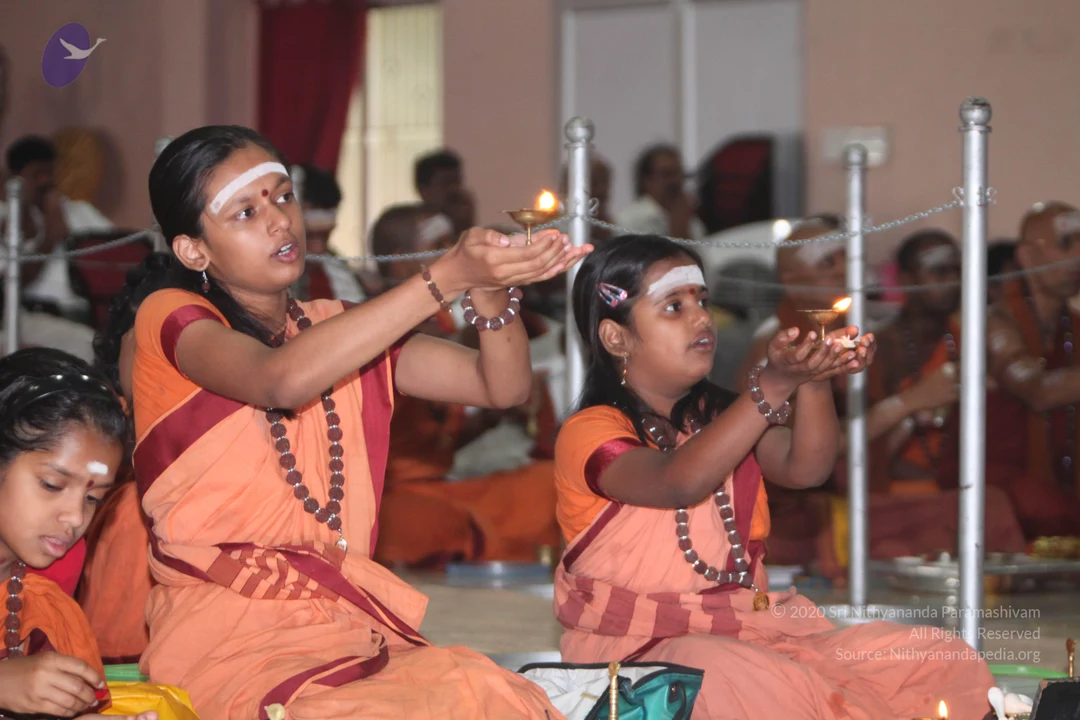
A seated guru in saffron-orange robes, with a long pink and white flower garland and a crown-like hairstyle, sits on an ornate gold throne carved with a lion-head armrest. Behind him stands a flower-covered backdrop with red, yellow and white blooms. Before the throne, a devotee family kneels with palms pressed together in anjali: a boy in white with glasses, a girl in white with a forehead band and beaded necklace, and an older man in white with a rudraksha mala. A woman in an orange sari kneels at a long low table laid with silver plates of offerings, marigolds and red flowers, and bowls. A bell hangs at the top right. The scene looks like a puja or padapuja offering. Four people are visible in the foreground plus a partly shown head at the bottom.A seated figure on a gold-and-cream throne with a golden lion-like armrest sits at left, wearing an orange-red robe with gold border, a long pink-white flower garland, and a white forehead mark; his hands rest on his lap and he looks toward the group. Before him a table holds many silver bowls with flowers and offerings. Three people sit in namaste on the floor: a boy in white with glasses, a woman in white with red-and-white beads and a white forehead mark, and an older man in white with a rudraksha mala. A woman in an orange sari sits at the right edge. Behind them are a dark wall cabinet, brass bells hanging above, a golden deity murti, and orange and maroon drapes; floral garlands decorate the backdrop. Probable Swamiji is seated on the throne, identified by the orange robe, flower garland and long swept-back hair, with a devotee group performing puja-style worship.A photograph of a seated man in a red-orange robe with a long garland of pink and white flowers, seated on an ornate golden throne with a carved lion-head armrest, with a white tilak on his forehead and long dark hair. Beside him, a boy in white with glasses presses palms together, and a woman in white with a rudraksha mala kneels with hands folded. An older man in white with folded hands kneels nearby, and a woman in orange-red kneels at the right edge. Before them is a silver tray with small silver bowls holding offerings, flowers and red petals. A hanging brass bell and an oil lamp are visible above, with an orange curtain and a black wall panel behind. The seated figure has distinctive long swept hair, a garland and saffron-red robe, consistent with a person in a satsang setting.A photograph of a seated man on a gold-and-cream throne with a carved golden lion-footed base, wearing a rust-orange dhoti and shawl with a long pink-and-white flower garland and a white shawl draped over his lap. He has a long swept-back hair and a white forehead mark, and his gaze is turned to the left. Before him on the floor stands a large brass tray with many small silver-coloured bowls of offerings, rose petals and a white flower garland. A younger boy in white with glasses sits beside it, a woman in white with red beads sits behind, and an older man in white with a mala sits at the tray. A woman in orange lowers her head at the lower right. Behind them hang a black panelled wall, brass bells, and an orange and maroon curtain. Appearance cues are consistent with a person, seated as the honored teacher in a ritual puja setting.Close-up photograph of a person's hands pressed together in prayer, fingers interlaced, with a lit oil lamp held in a silver lamp stand on the left. The wearer is in white clothing with a dark beaded rudraksha-style mala visible at the right edge. Below the hands sits an ornate silver tray with embossed floral repoussé patterns. The background is soft and blurred.Close-up photograph of a silver oil lamp (deepam) with a flame burning from its wick, set among blurred silver bowls and small silver vessels on a ritual setup. Behind it, draped red and gold-bordered cloth and strings of beads or pearls are visible. No people are visible; the focus is on the lit lamp in a temple-style puja arrangement.

Satsang-&-Sarva-Darshan

5 photosSource gallery
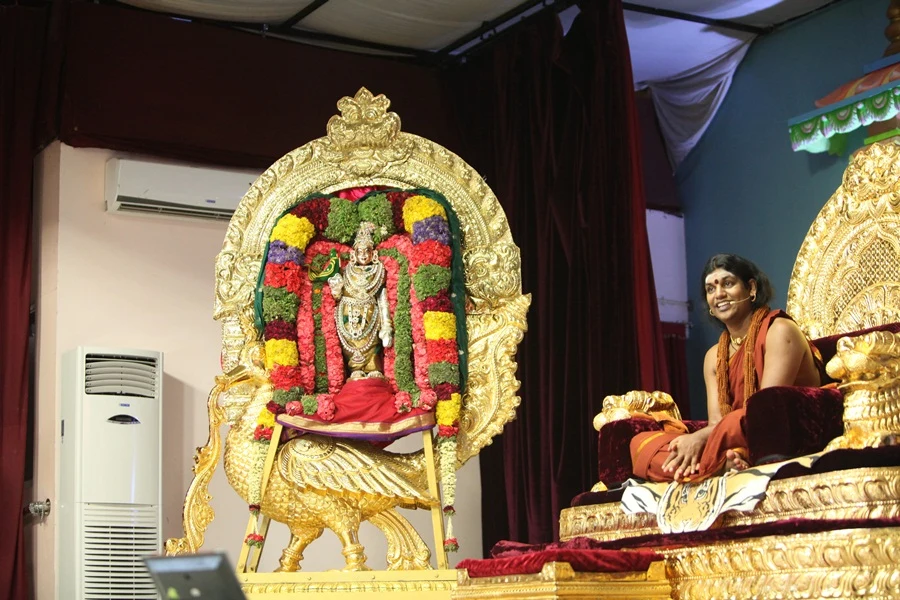
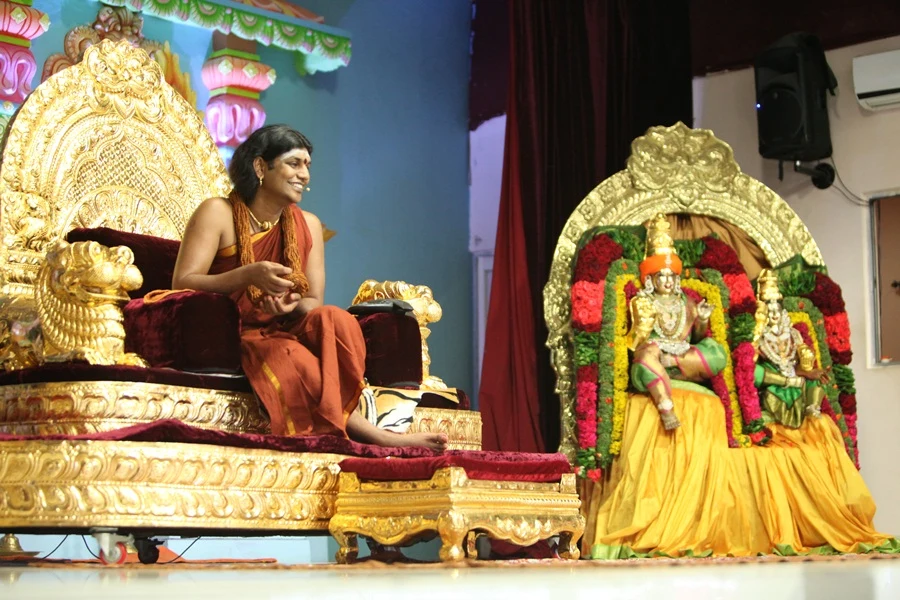
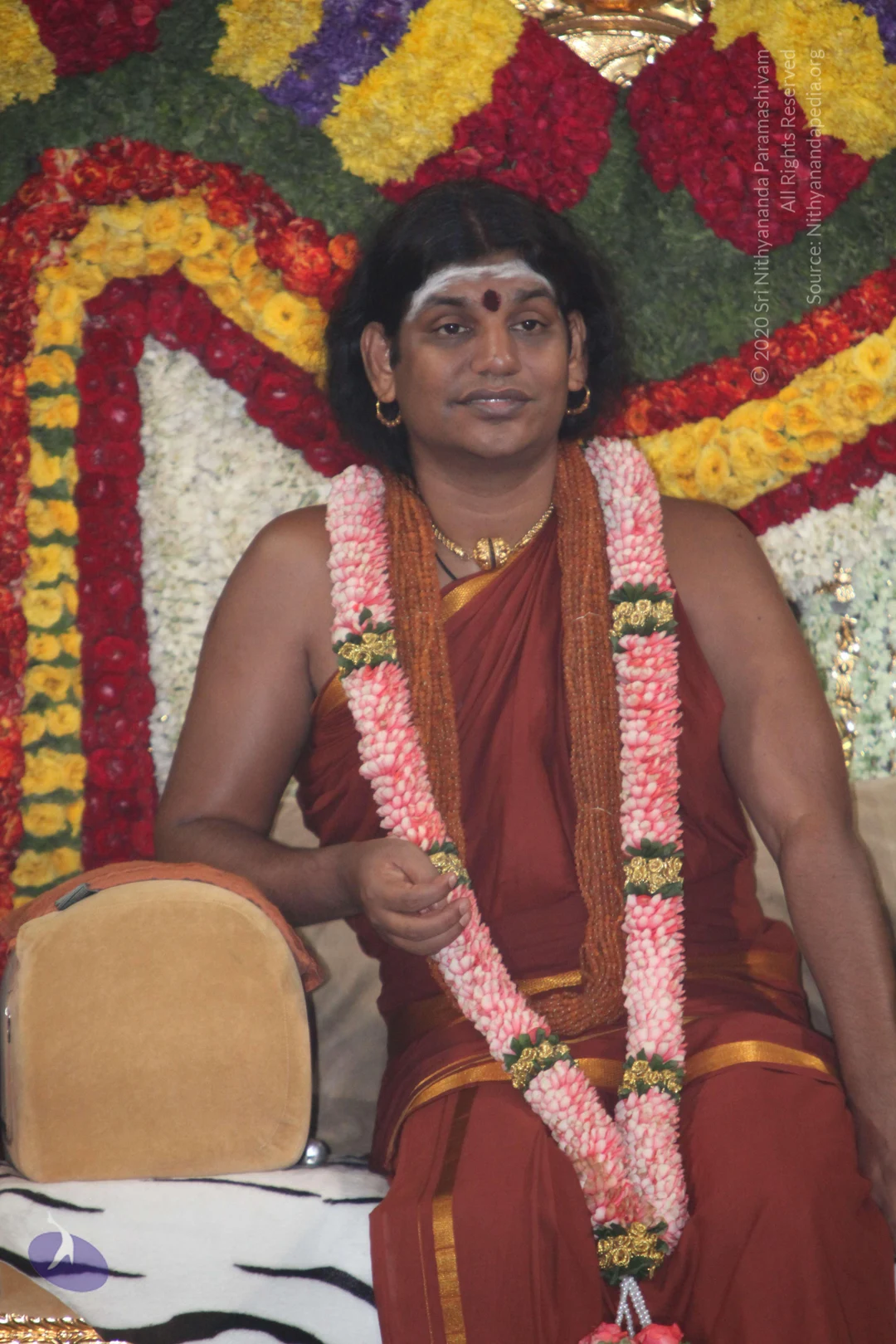
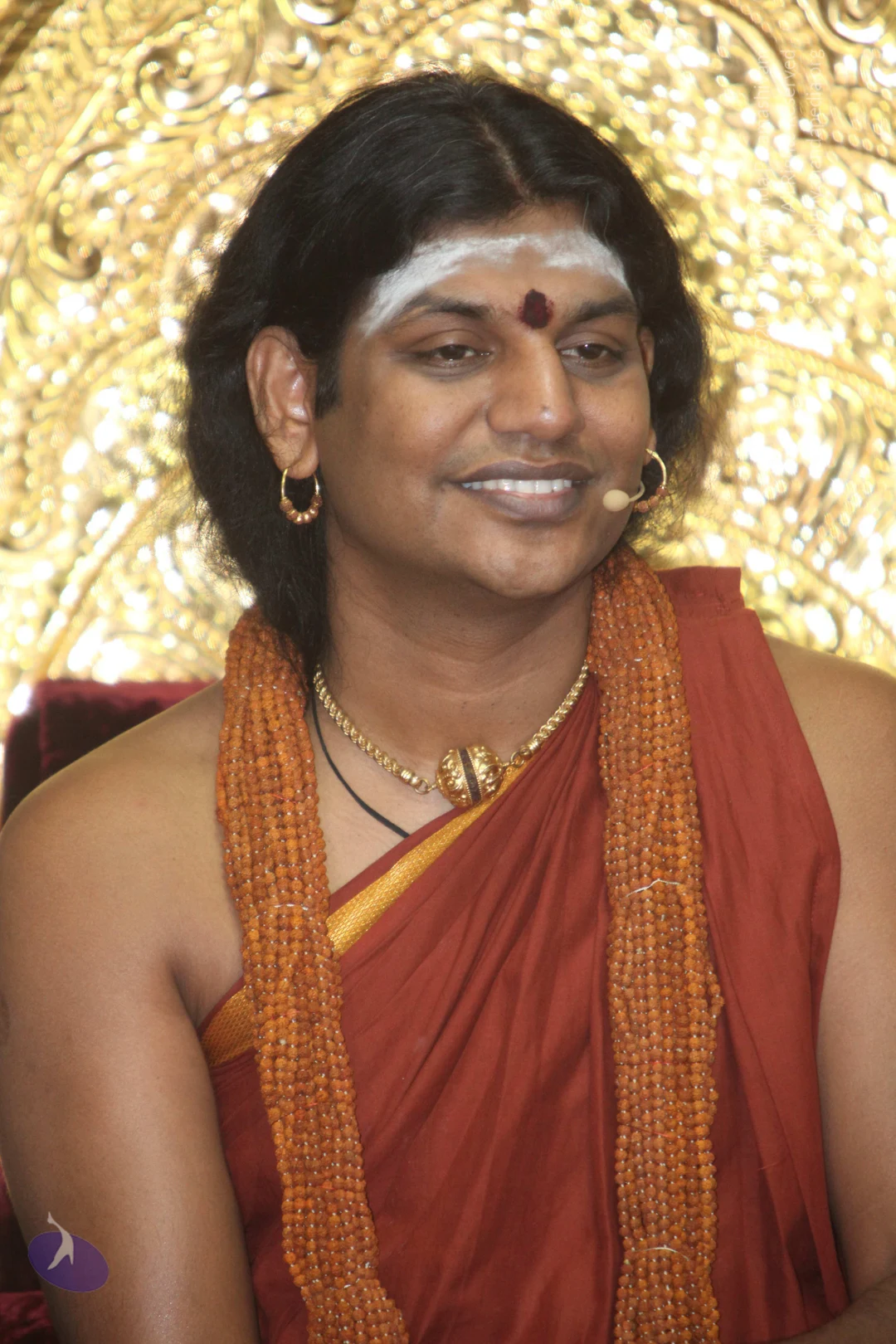
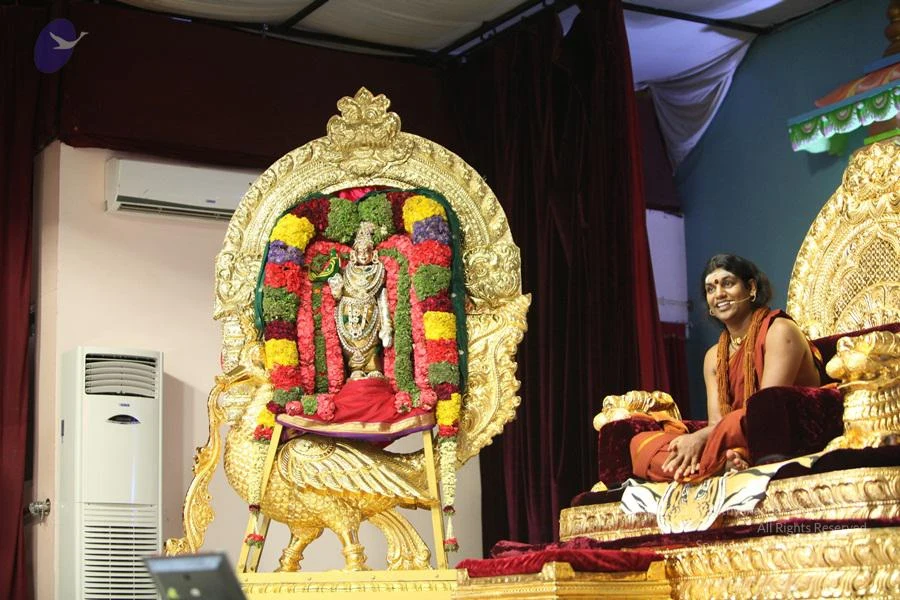
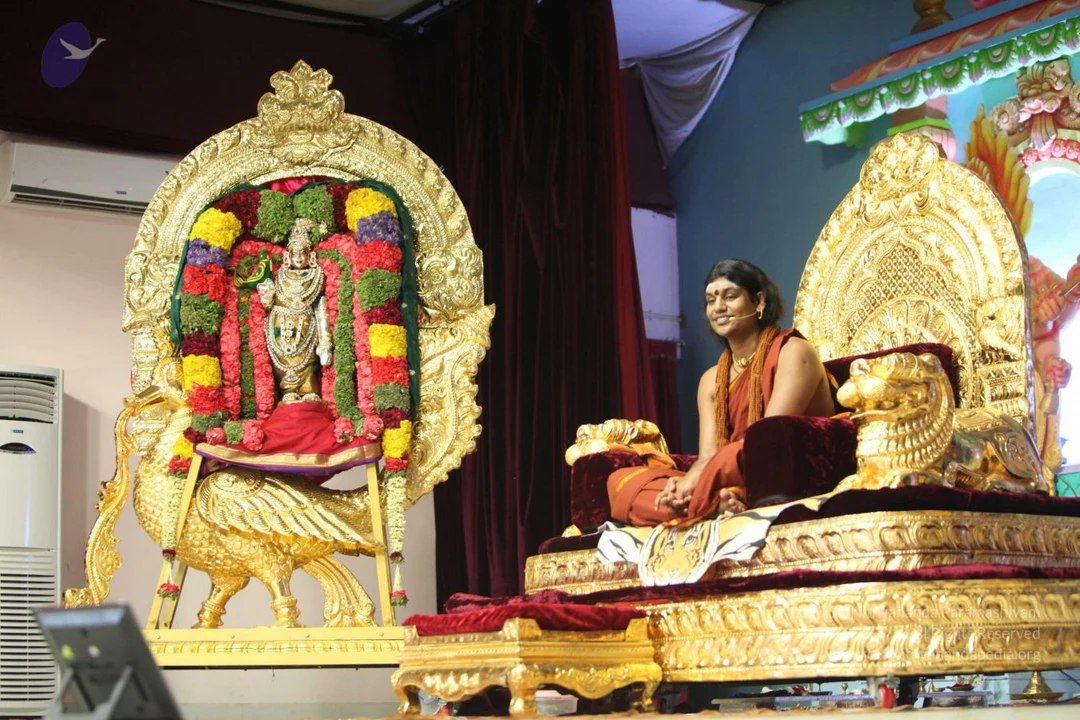
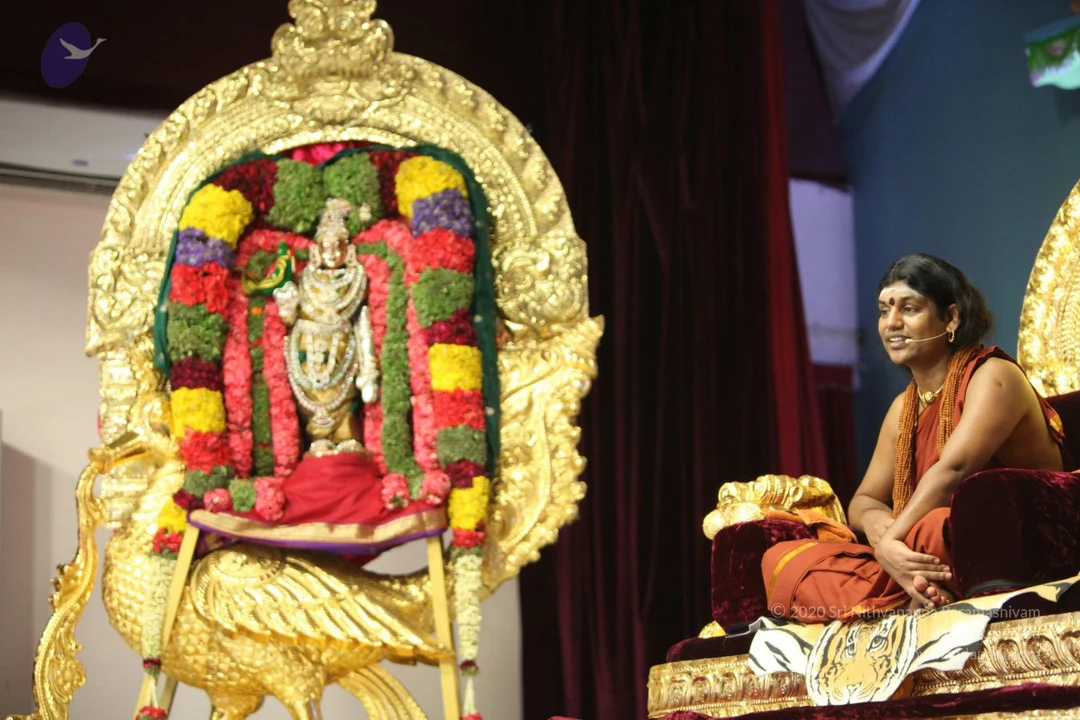
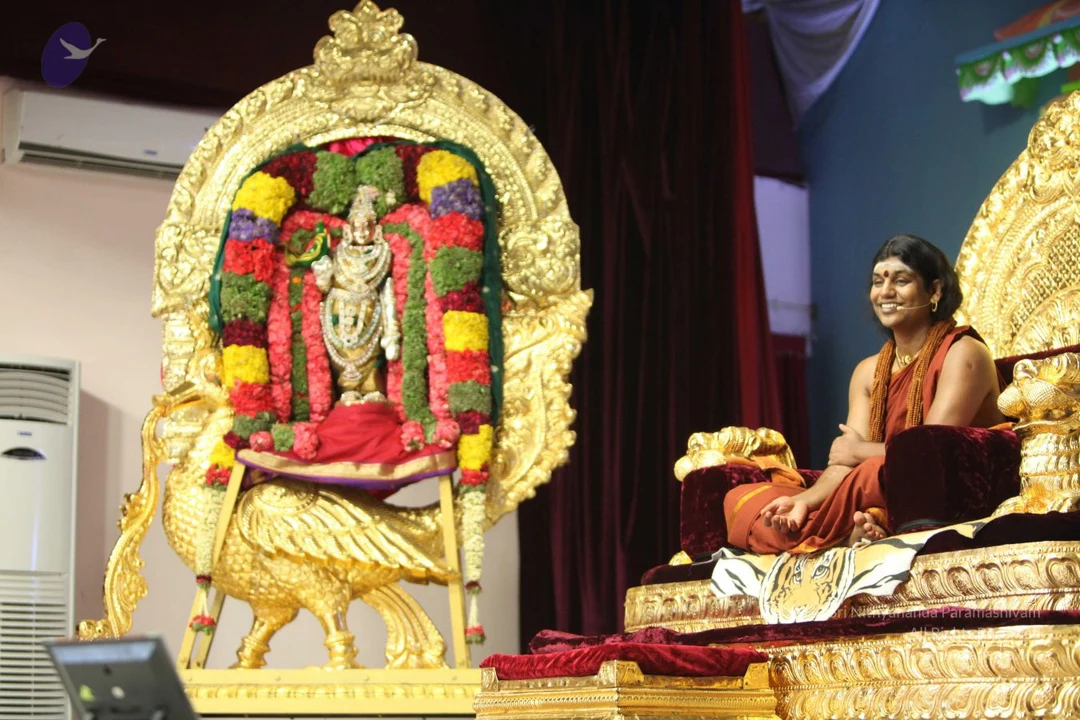
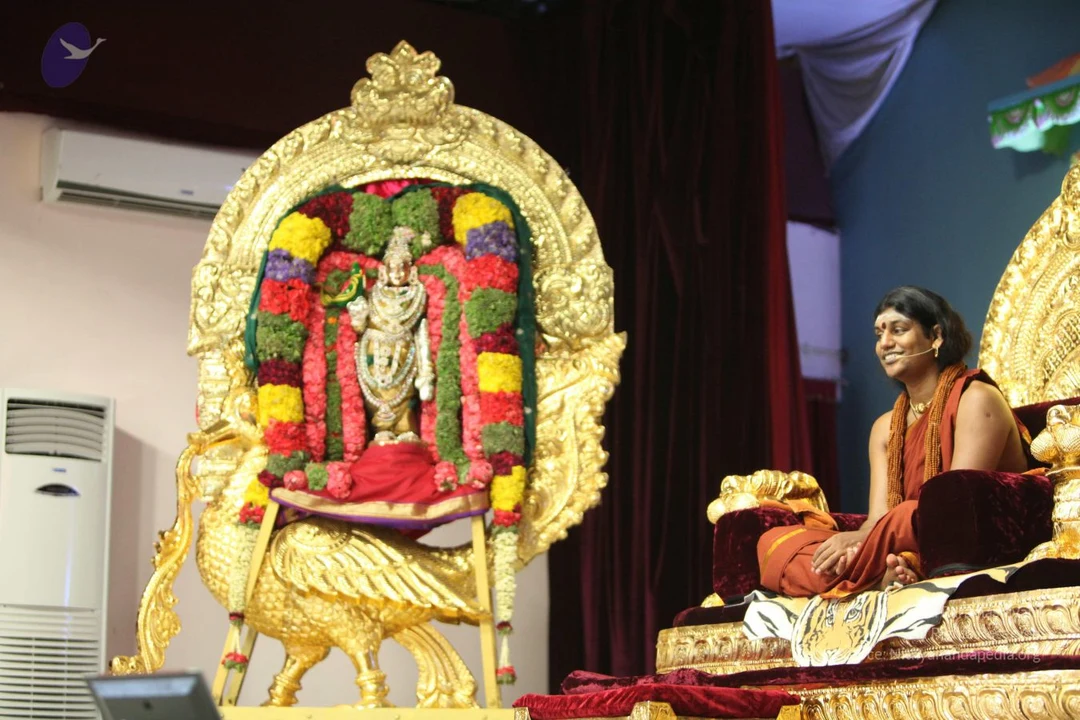
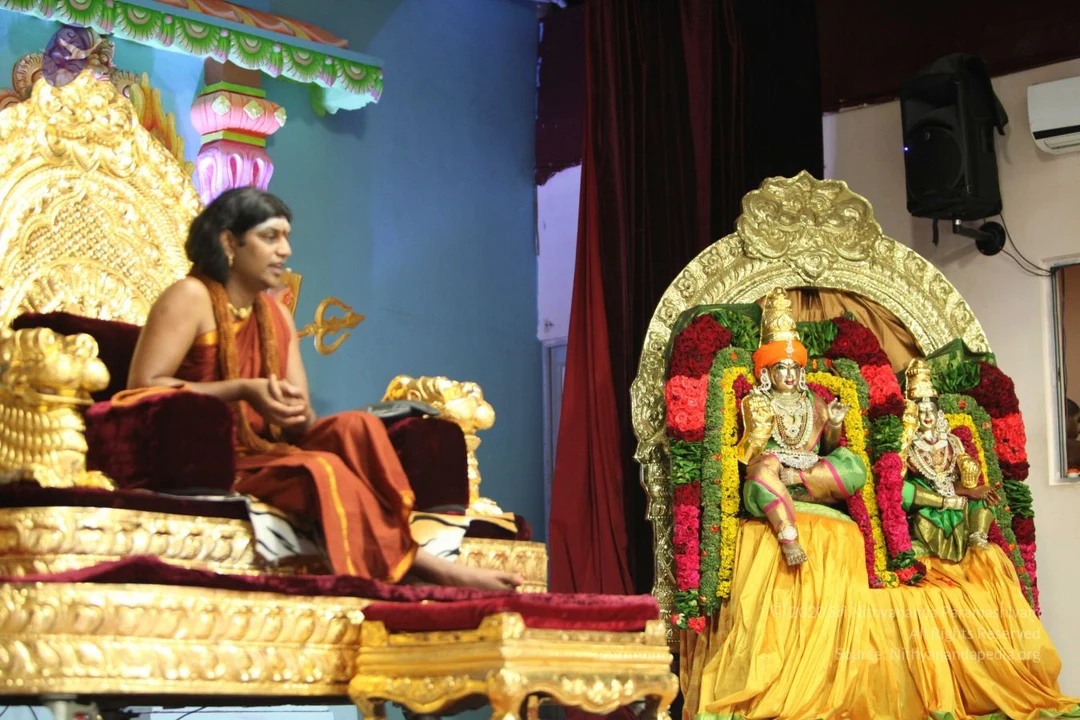
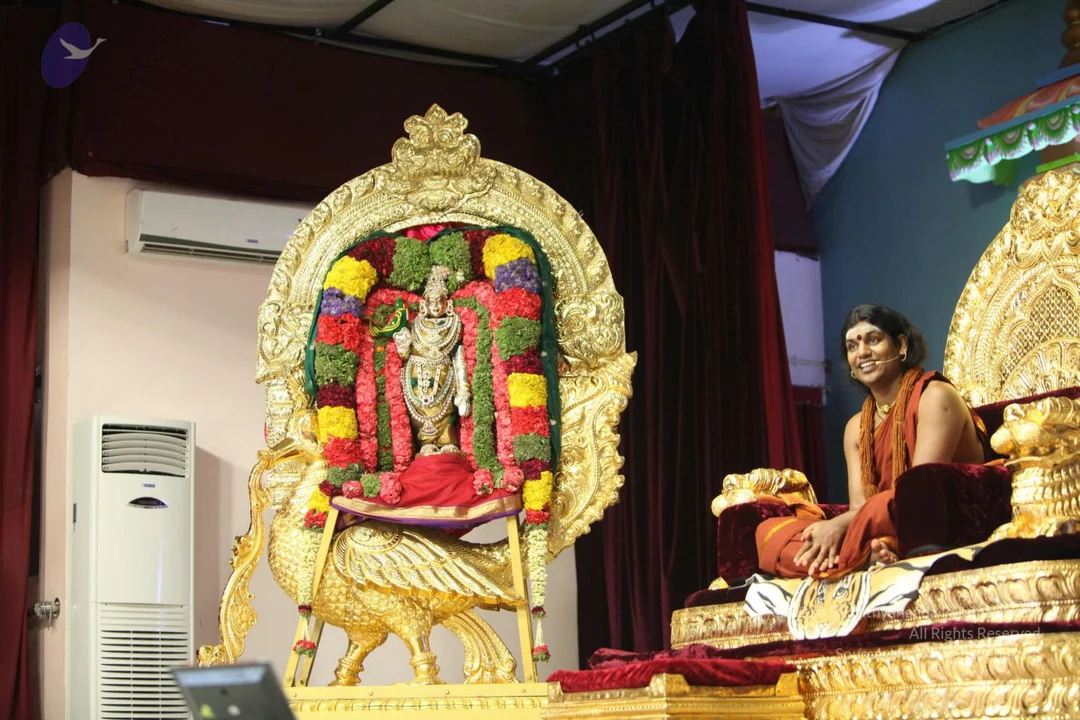
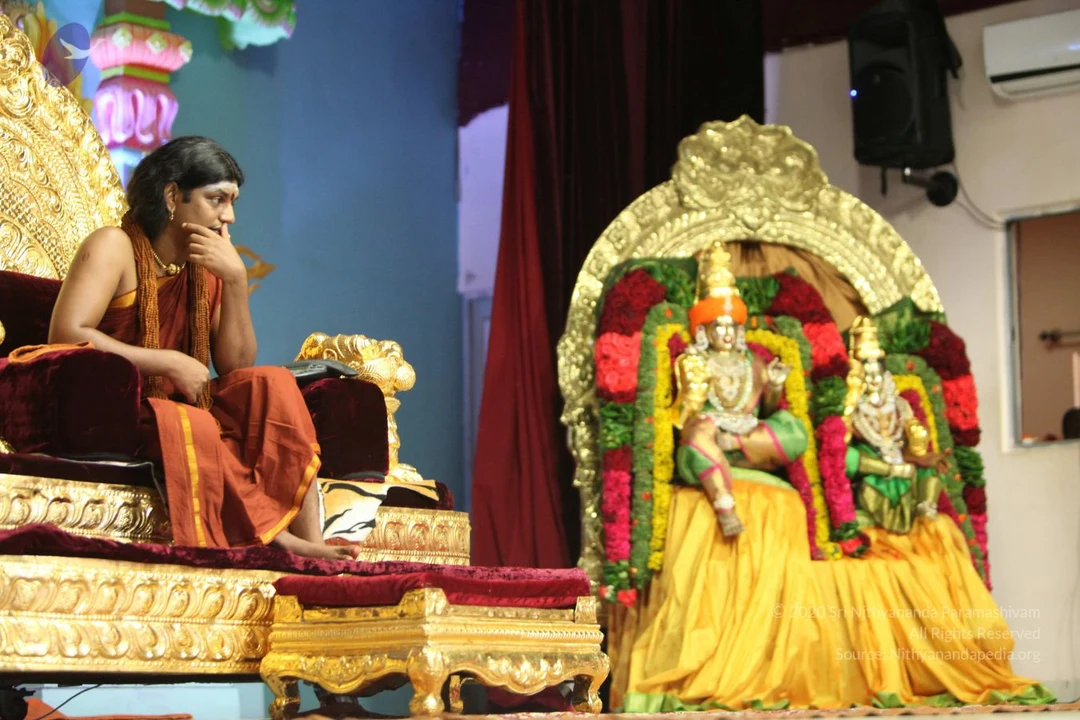
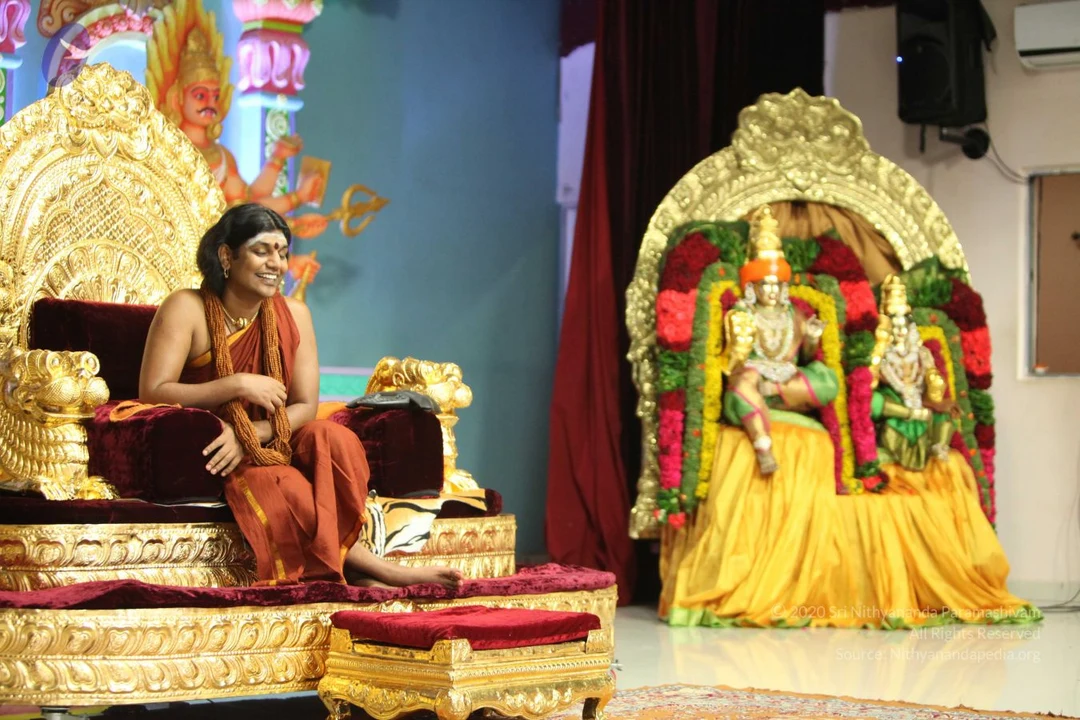
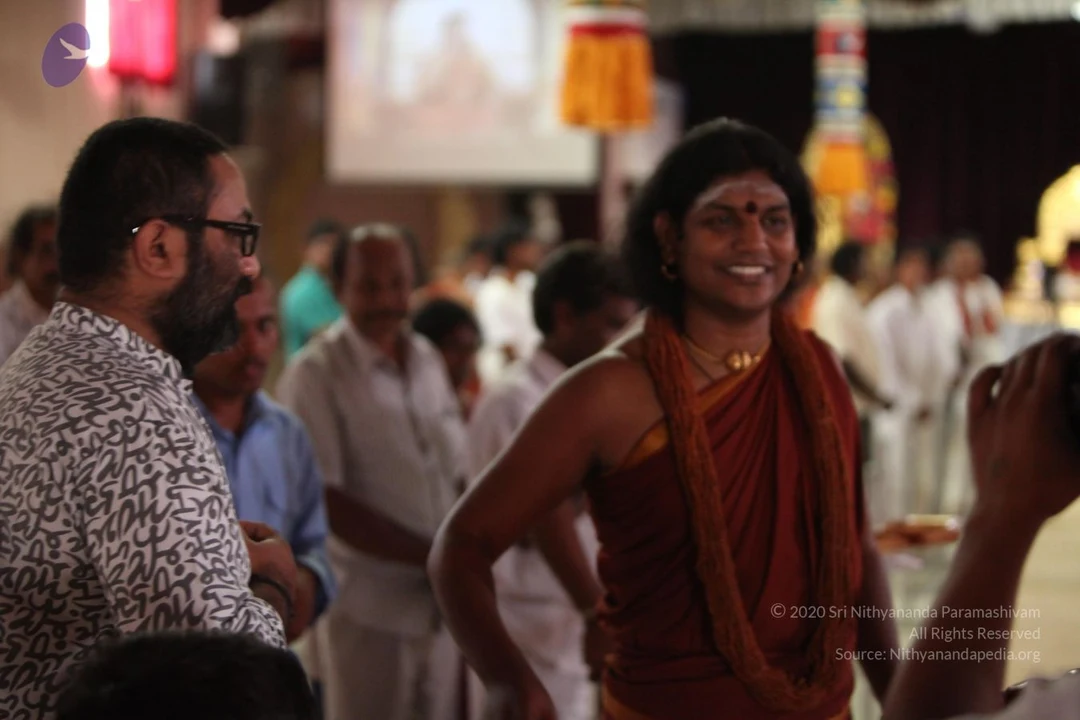
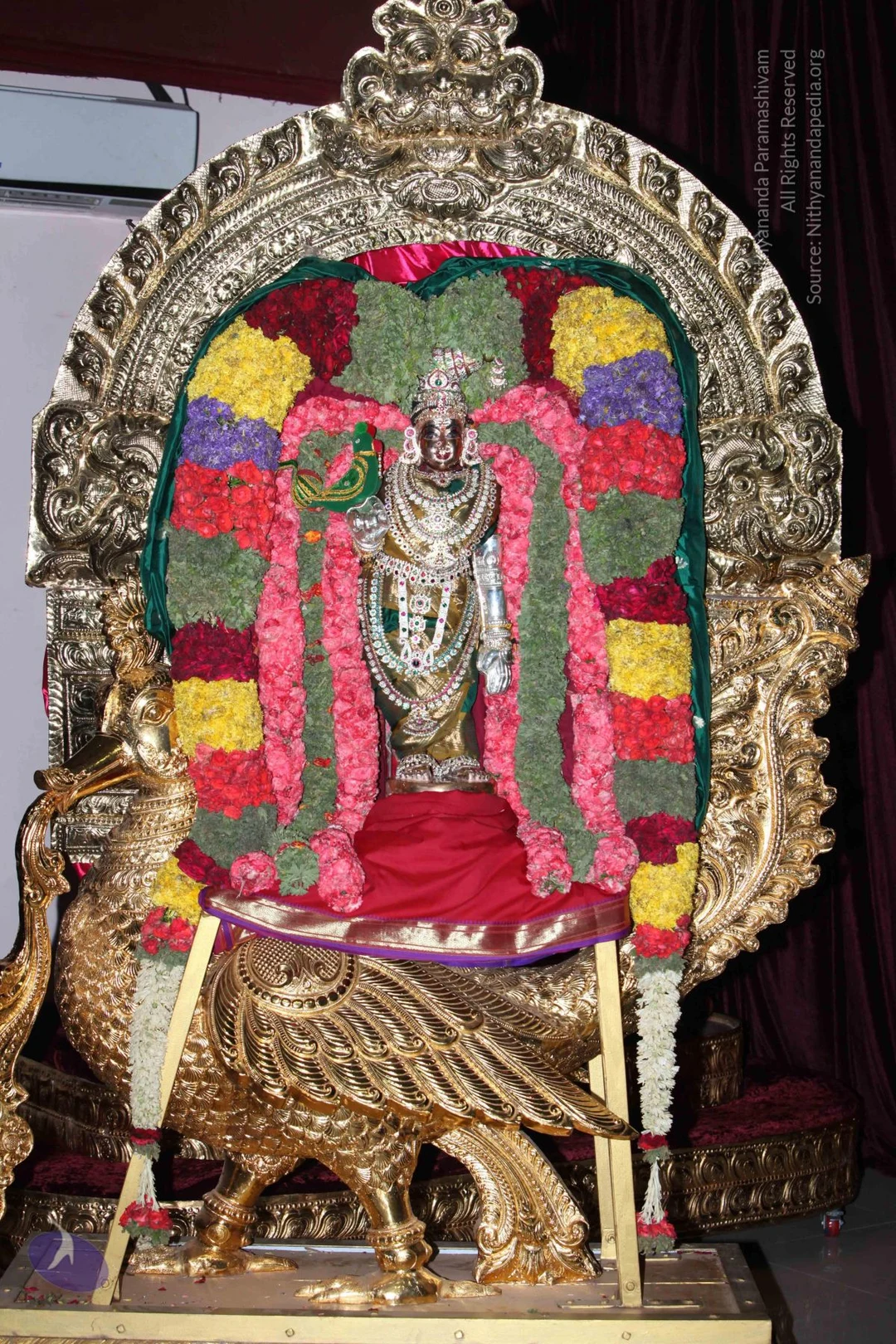
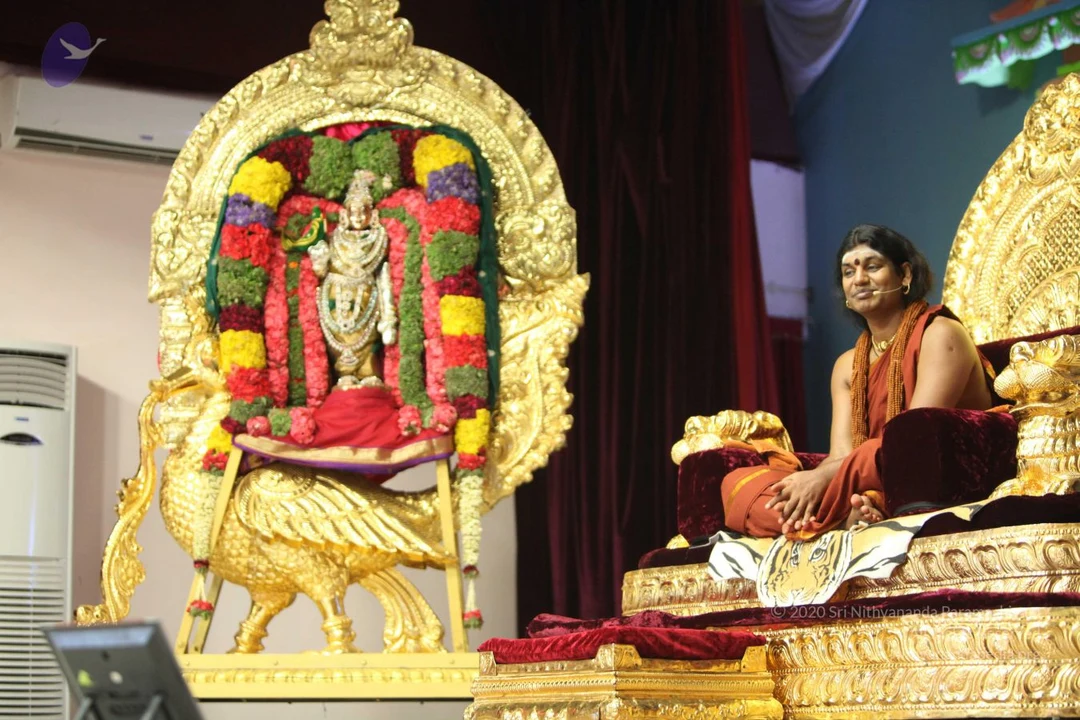
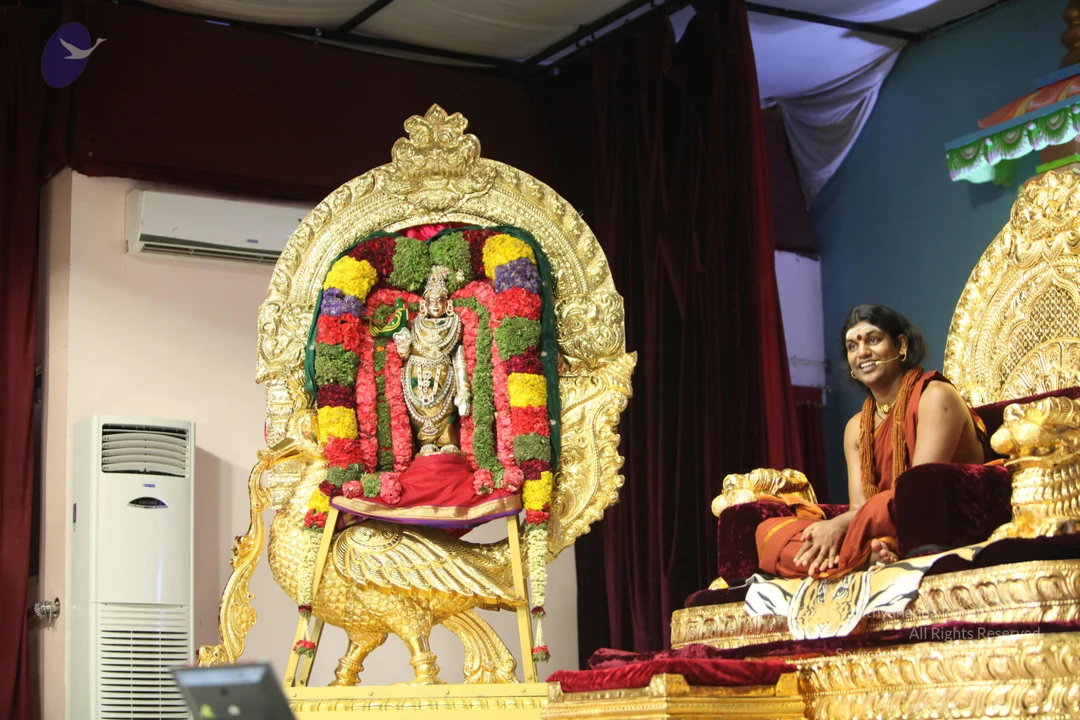
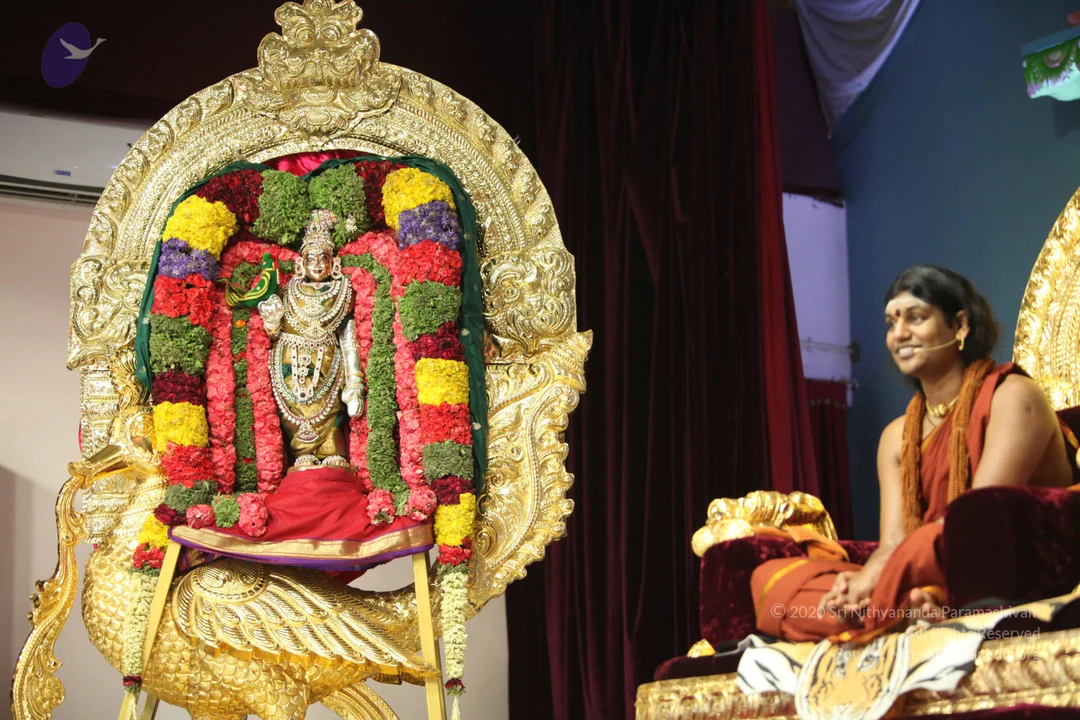
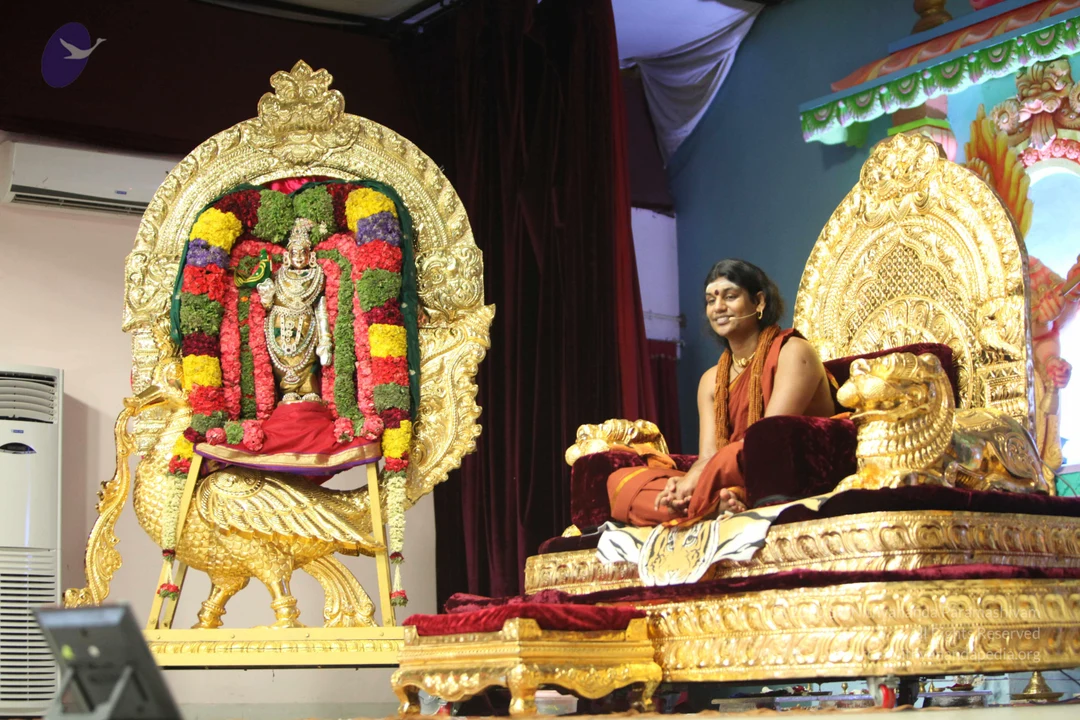
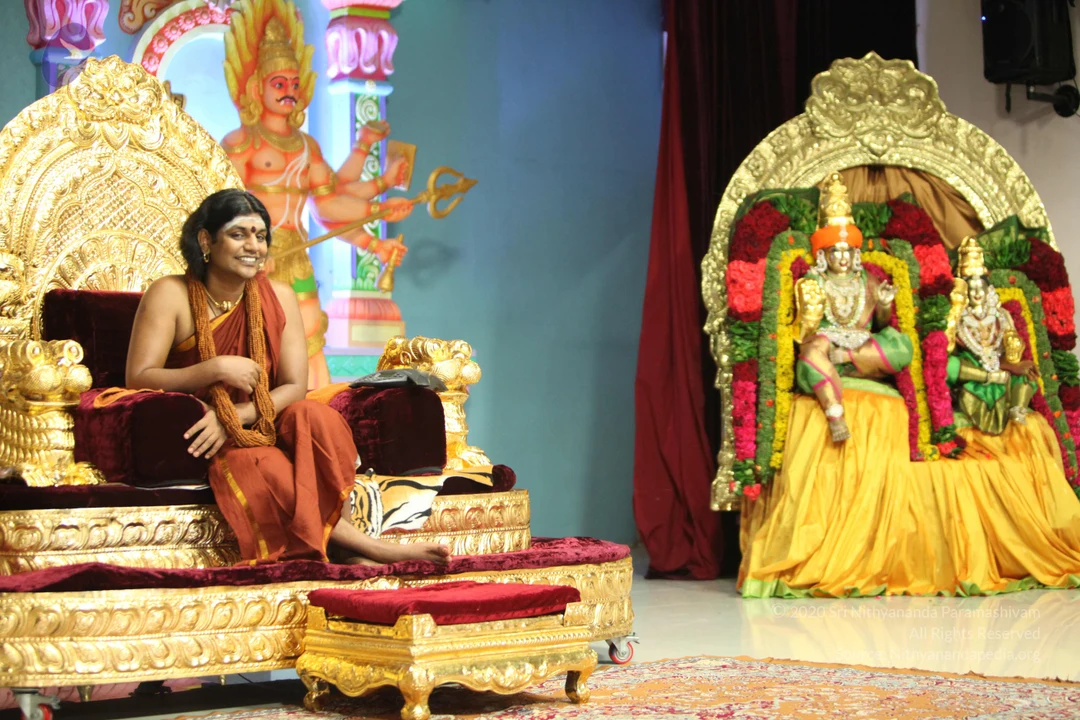
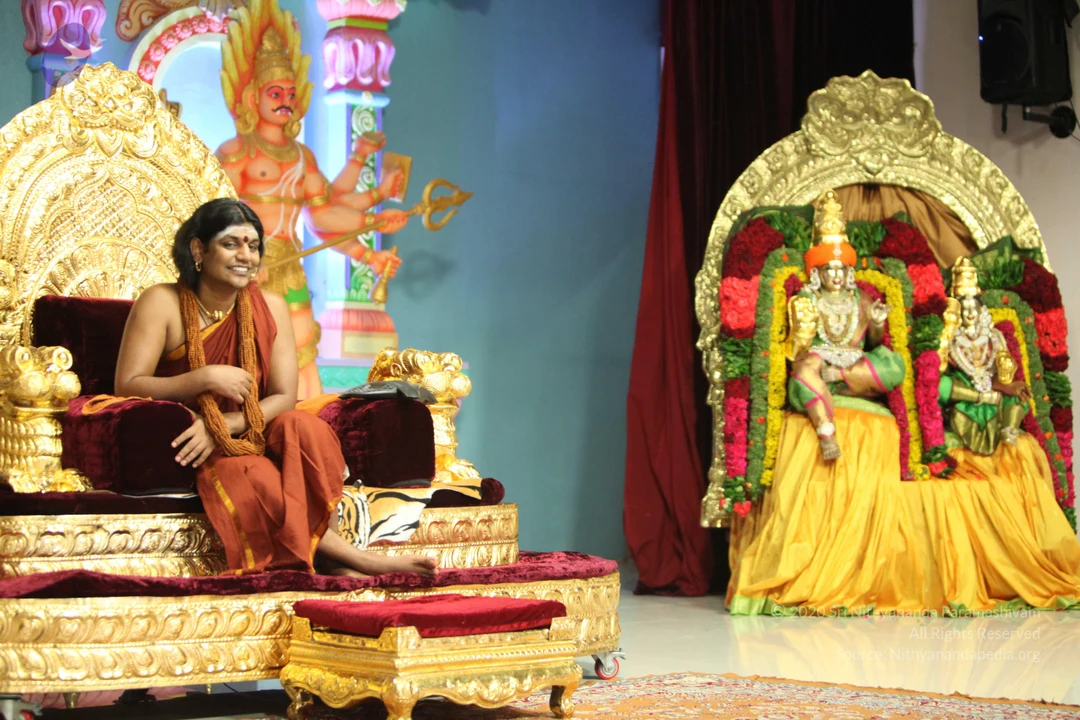
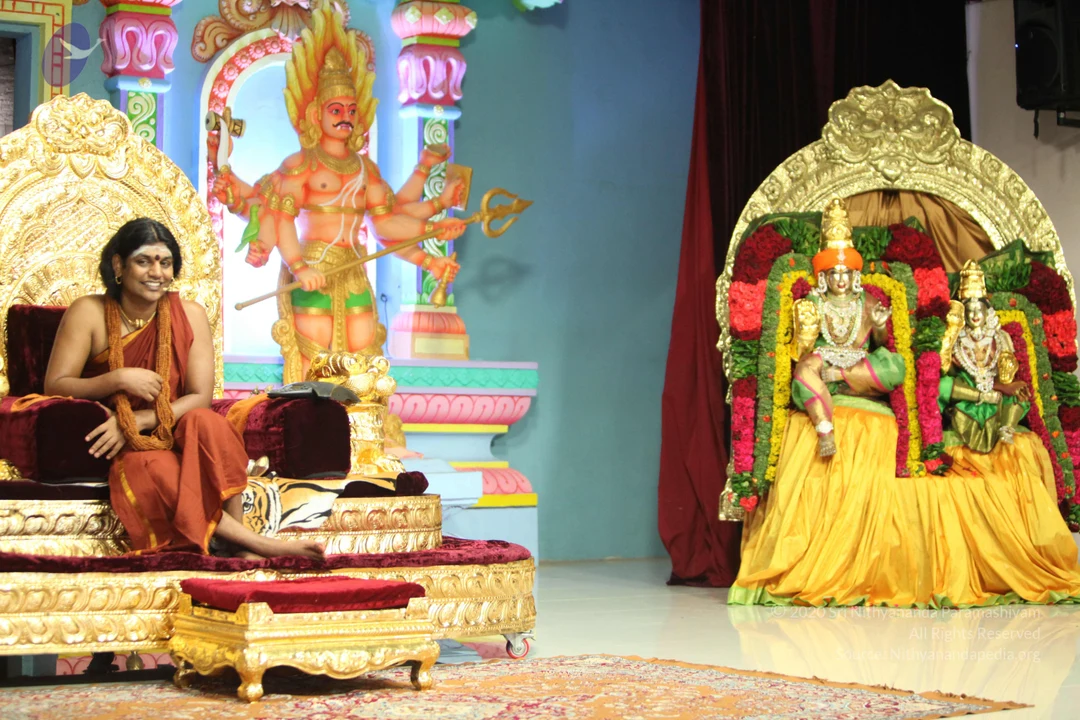
Close-up photo of a smiling person with eyes closed, wearing a rust-red shawl over the shoulder and multiple strands of orange-brown rudraksha malas, a gold ball pendant on a gold chain, and gold hoop earrings. A white vertical-tilak line and red bindi mark the forehead, and a small microphone clip is visible near the cheek. The background is ornate gold relief. Appearance-based label: Swamiji (probable), presenting with long swept-back dark hair, rudraksha malas and ceremonial gold necklace, shown in a discourse setting.A seated man in saffron-orange robes with a rudraksha mala and gold necklace sits on an ornate gold throne with velvet cushions, speaking into a headset microphone during a satsang. Beside him stands a gold peacock-form throne carrying a silver murti of a deity adorned with a garland of red, yellow, green and purple flowers. A gold-framed backdrop, a floor-standing air conditioner and a red-and-gold cloth draped over the throne complete the stage.A man with long swept-back dark hair sits on an ornate gold and maroon throne at left, wearing an orange-saffron wrap, a rudraksha mala and a gold necklace, one hand resting at his chin as he looks toward the right. Beside him on a gilded stage, a deity murti of a seated goddess in a gold crown and elaborate gold jewellery, dressed in a yellow and green sari, is framed by a gold arch decorated with red, yellow and green flower garlands. A gilded footstool sits in front of the throne. A wall-mounted air conditioner, a speaker and a red curtain are visible in the hall. No other people are present.A photograph of a satsang hall with a figure seated on an ornate gold throne with red velvet cushions, smiling, wearing a saffron-orange robe and a rudraksha mala with a gold necklace, and a red bindi. Beside him stands a deity murti of a seated goddess with an orange crown, garlanded with red and yellow flowers, on a gold throne against a gold arch framed by a draped yellow cloth. Behind them a painted backdrop shows a golden deity figure holding a trident. Probable Swamiji (probable) seated on the throne with long swept-back hair and rudraksha mala cues. No other people are visible.A candid photo at an indoor temple-like hall with white-clad devotees and yellow and maroon hangings in the background. In the foreground, a bearded man in black-rimmed glasses and a grey patterned shirt stands at left, facing a smiling person at right. That person has long dark hair, a red bindi and white tilak, and wears a rust-red wrap with an orange-saffron border, a rudraksha mala draped over the shoulders, and a gold necklace with hoop earrings. Their hand rests on the hip. A partially visible hand holding a phone is at the lower right. Several other people stand behind, many in white dhotis and shirts. Appearance-based candidate for a person, probable: the long hair, rudraksha mala, saffron-orange clothing and ceremonial gold necklace are visible cues, though the image is not conclusive.

Final-Blessings

8 photosSource gallery
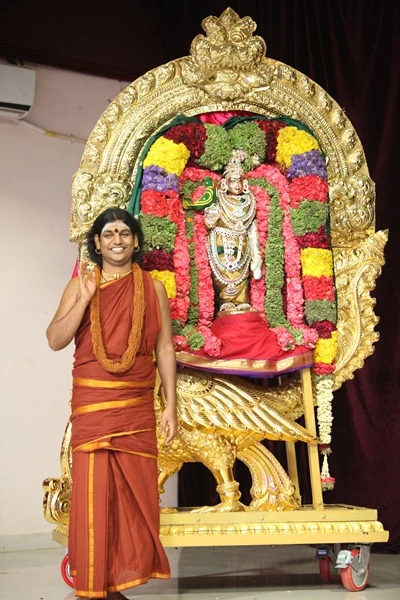
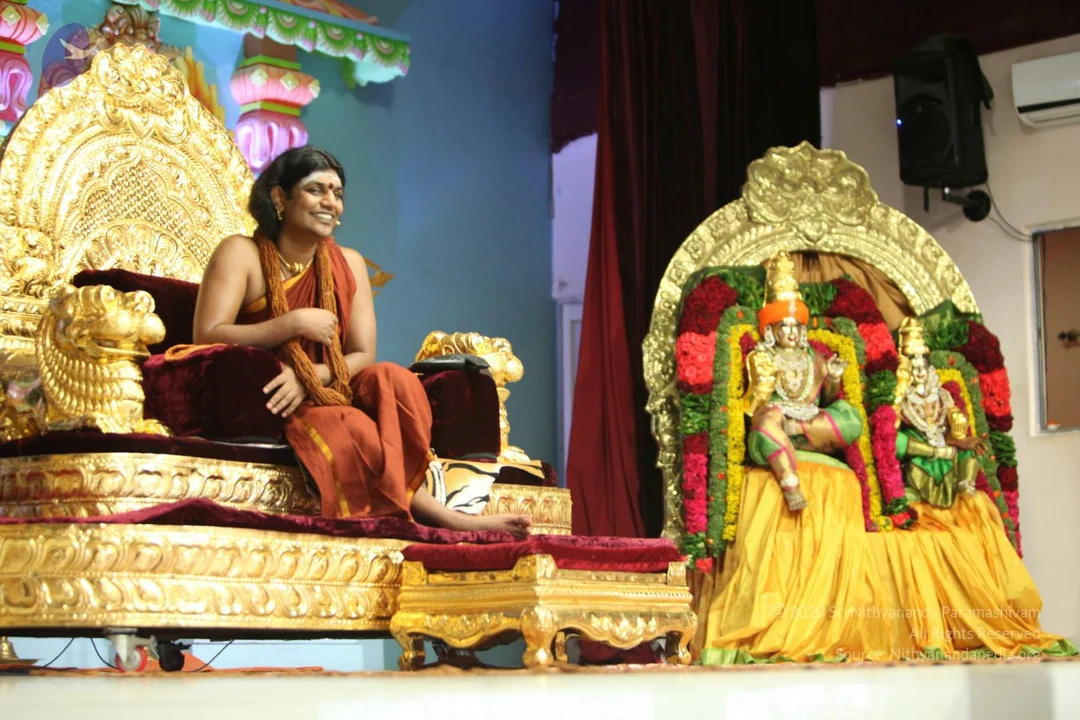
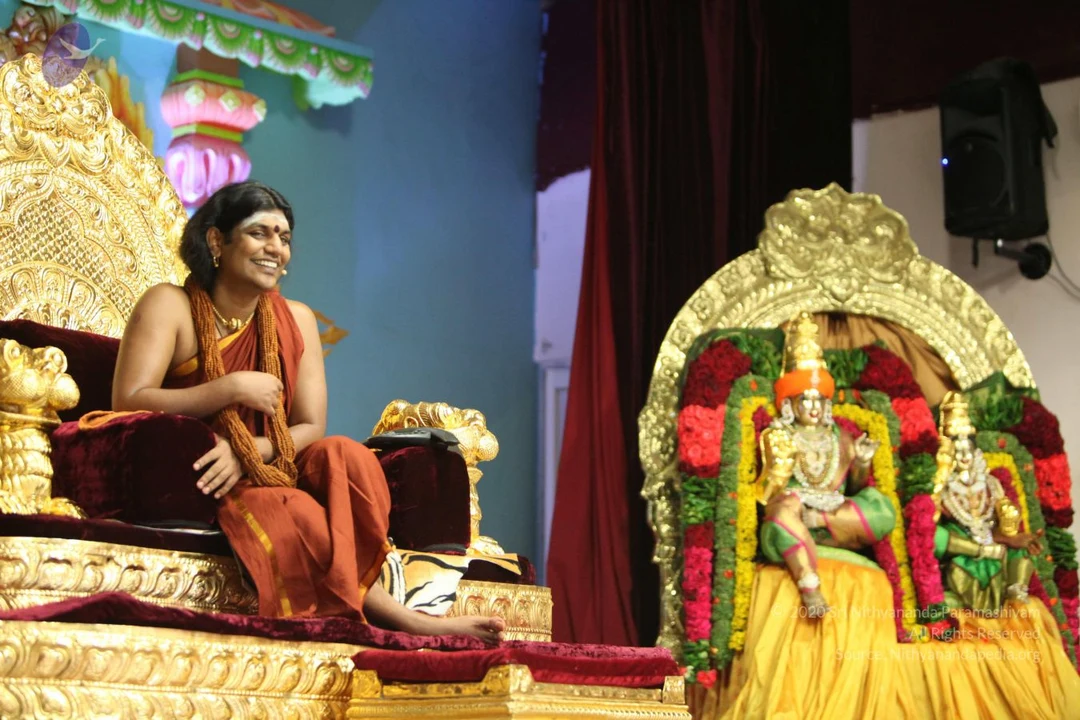
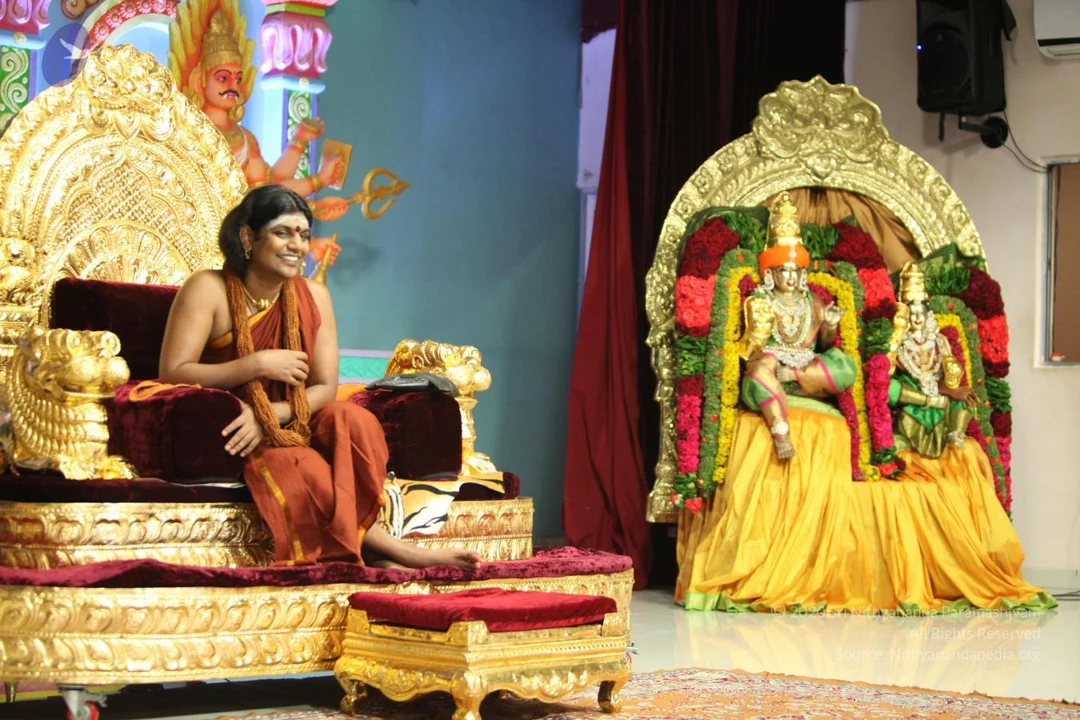
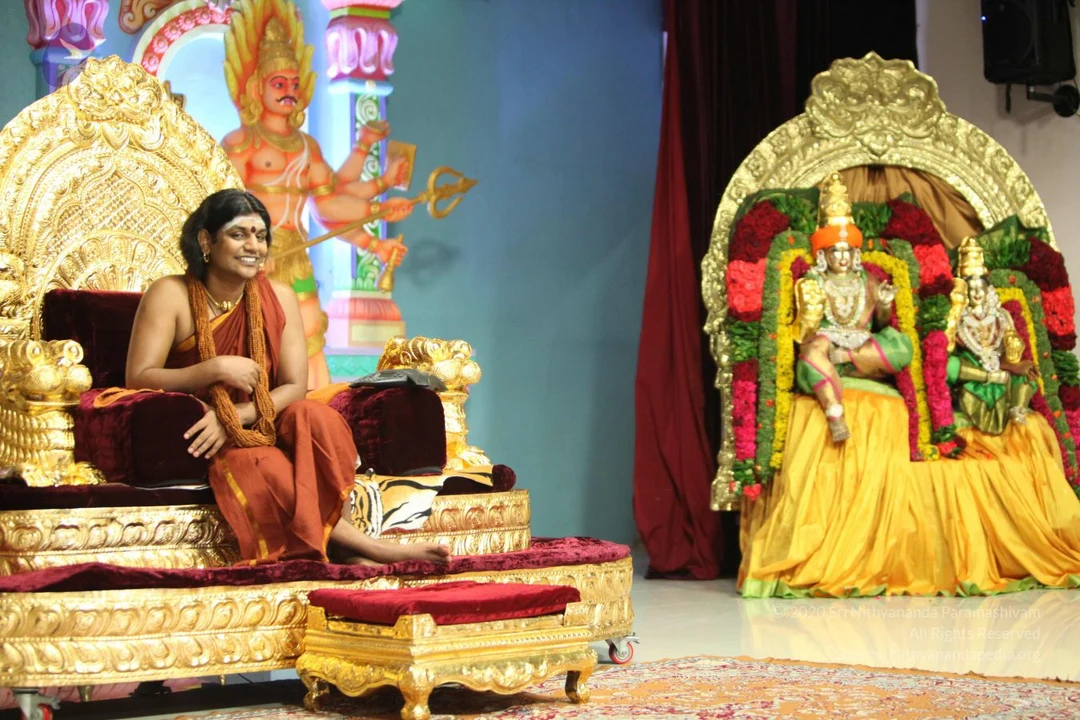
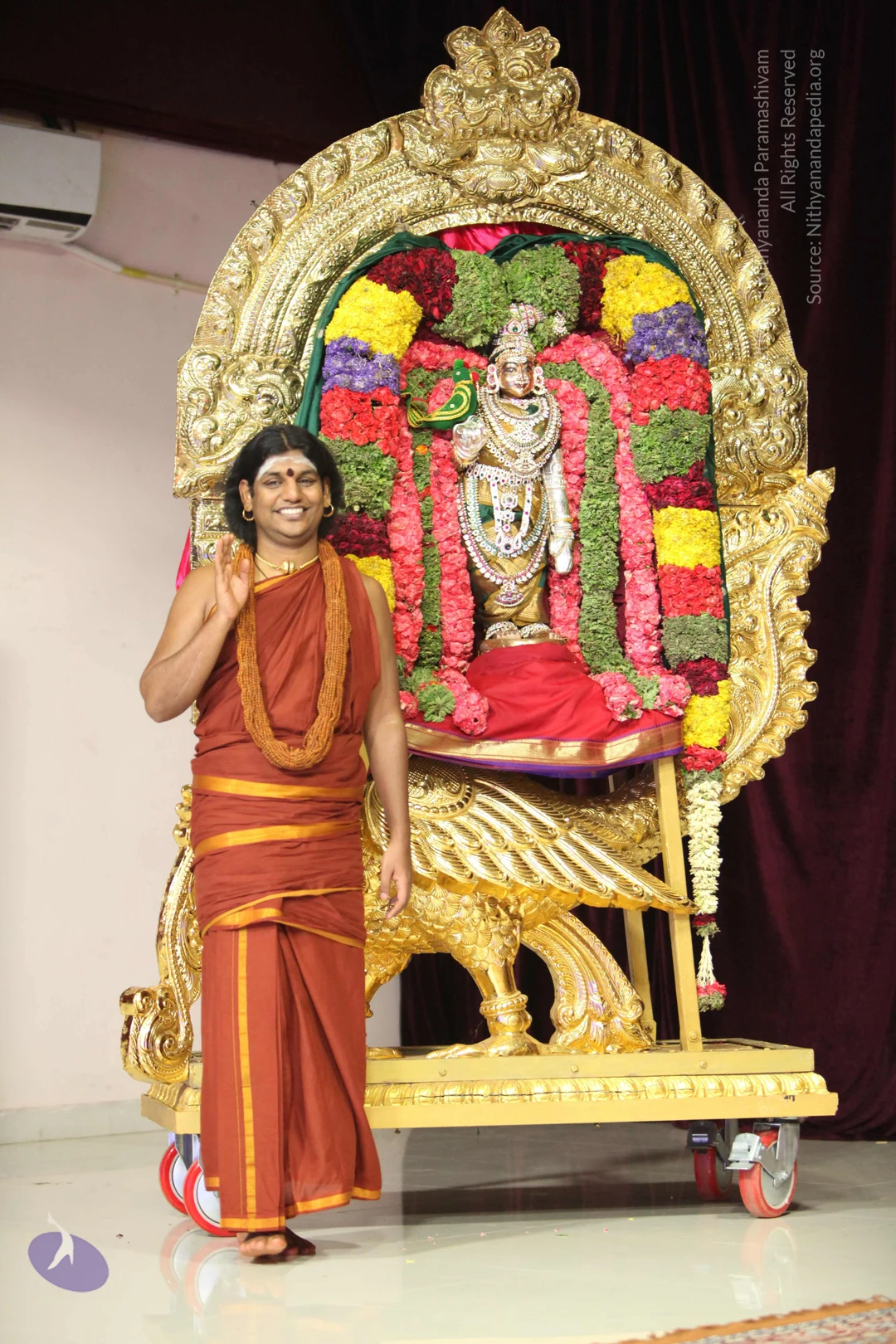
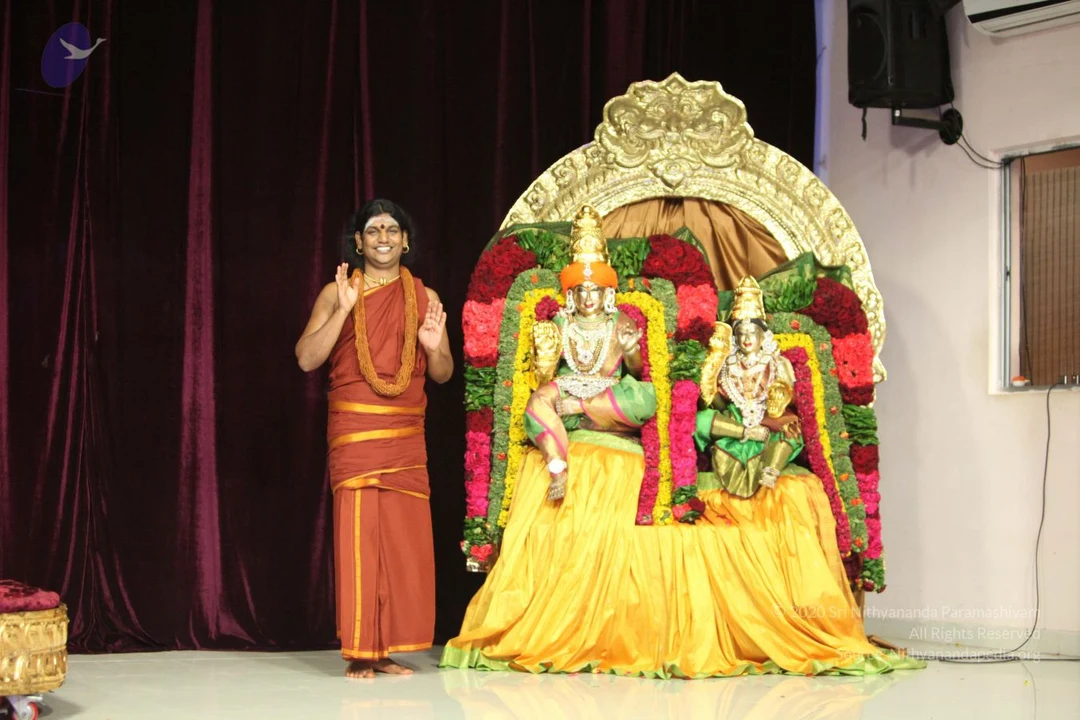
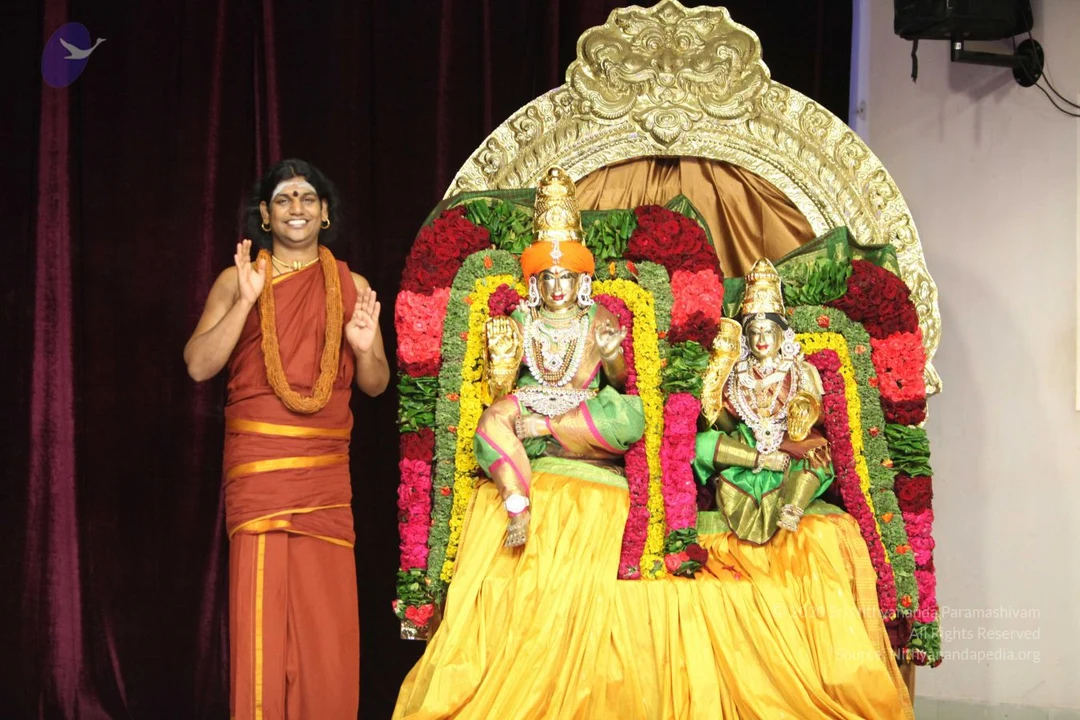
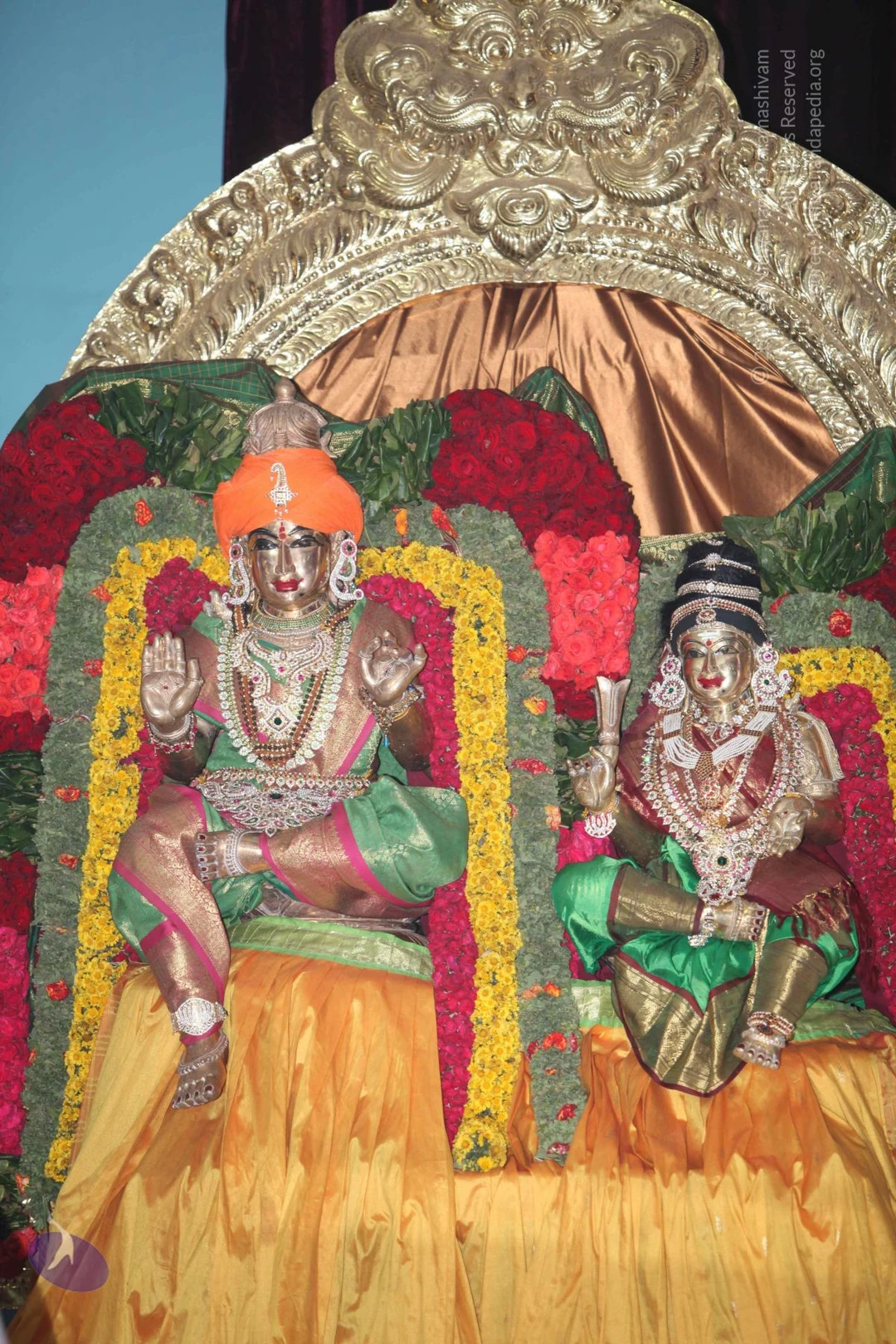
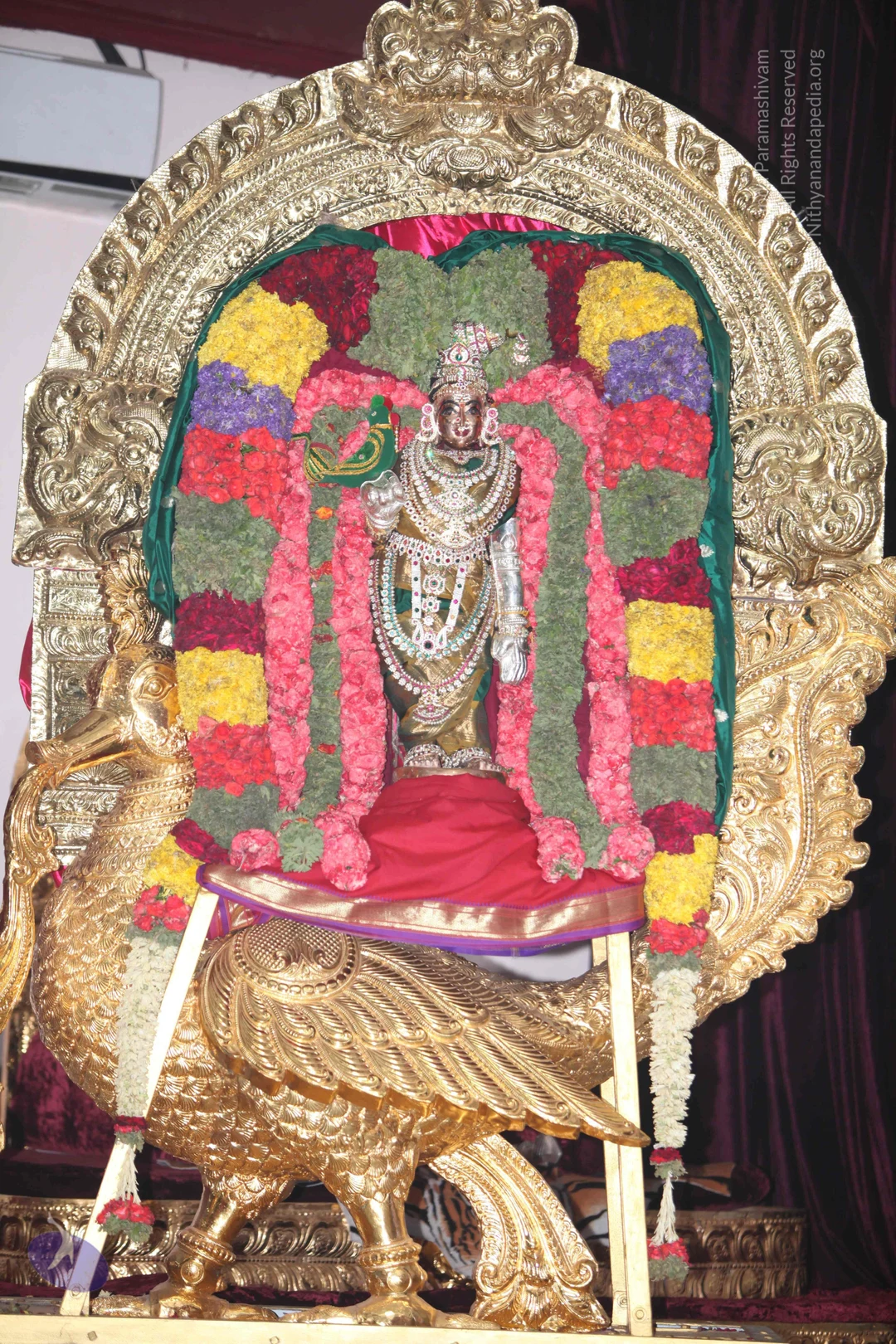
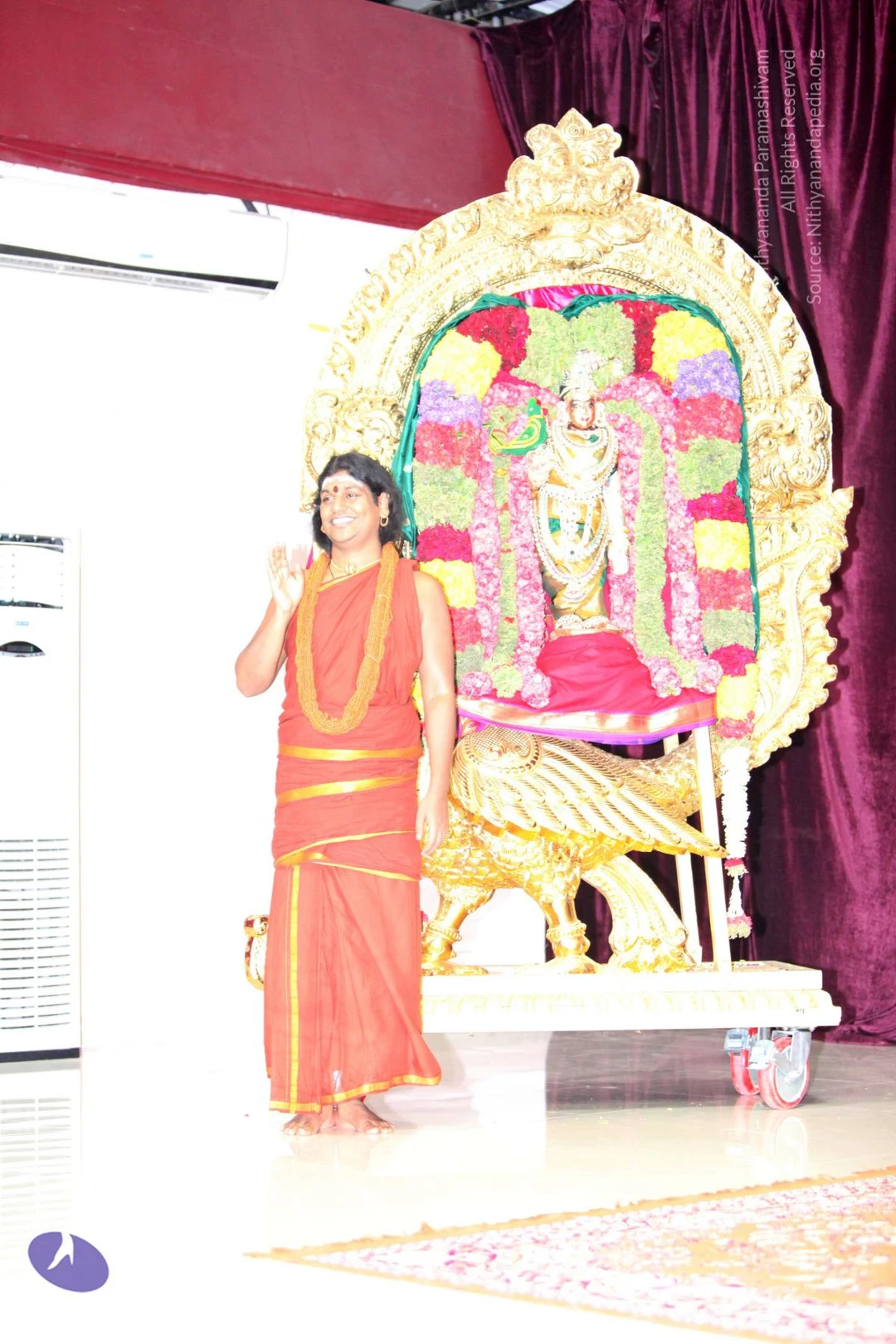
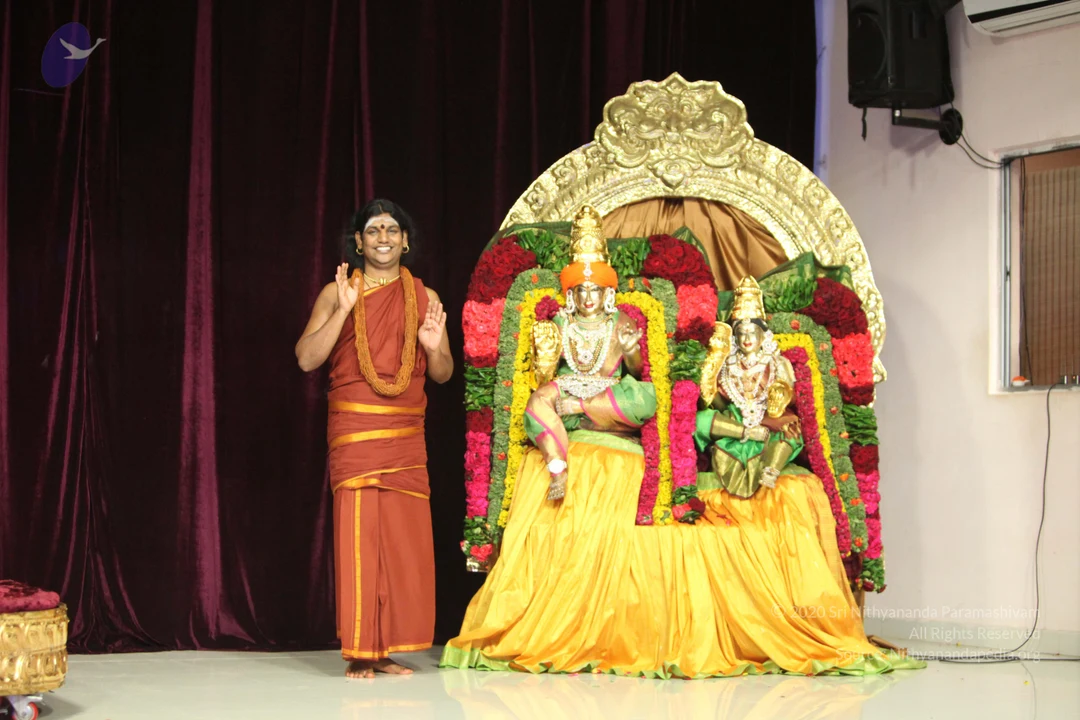
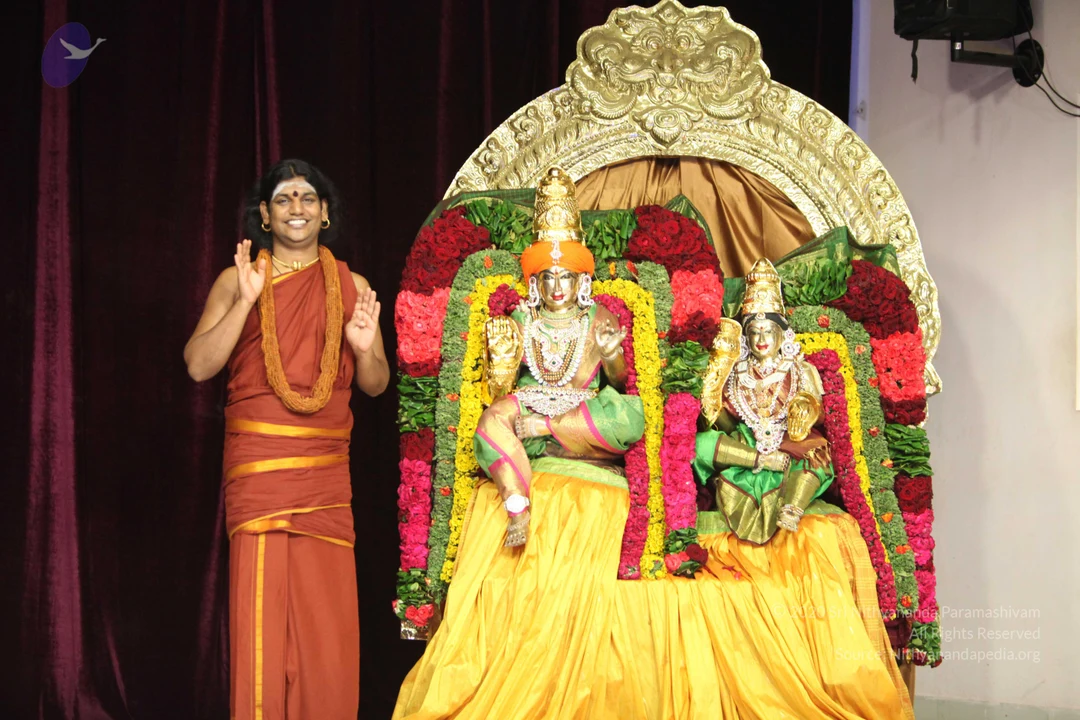
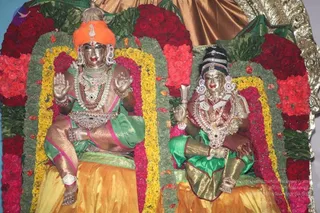
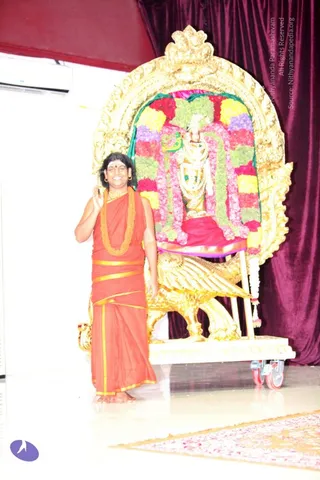
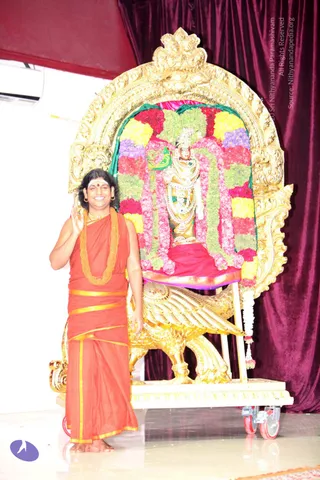
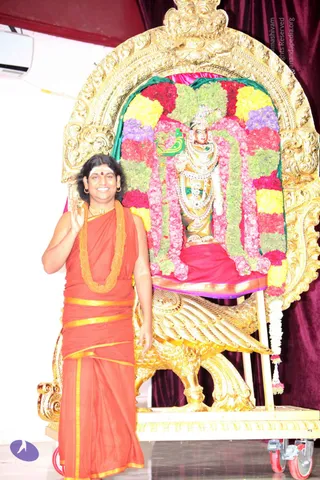
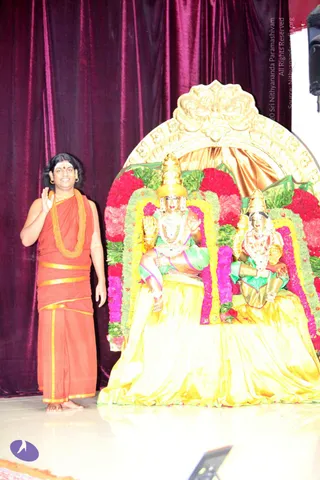
A woman in a rust-orange sari with gold borders and a long orange-gold beaded garland stands barefoot on a stage, smiling and raising her right hand in greeting. Behind her is a large ornate gold throne arch with a gold carved simha-style lion or mythical bird base on wheels, holding a gold deity murti draped in garlands of red, yellow, green and pink flowers. A maroon velvet curtain hangs behind, with a wall air conditioner and a floor-standing unit at left.A standing man in an orange-red dhoti and shawl with gold borders waves to the camera while smiling. He wears a long gold-coloured beaded necklace and a red bindi, and his feet are bare on a polished white floor. Behind him a large ornate gold throne-like palanquin with a golden swan-shaped base stands before maroon velvet drapes. It is decorated with dense garlands of red, pink, yellow, green and purple flowers, and a gold deity murti is seated in its centre. An air conditioner is mounted on the white wall at left.A standing person in a rust-orange sari-style wrap with gold border, a red bindi, gold earrings and a long saffron-gold beaded garland, smiling and raising one hand in greeting on a polished floor. Behind them a large ornate gold arched frame and gold swan-like base hold a gilded deity murti decorated with pink, yellow, green and red flower garlands, a green parrot figure, a pink cushion and a pleated magenta backdrop curtain.A smiling man in an orange-red dhoti and shawl with gold borders stands at left, waving with his right hand, wearing a long orange-beaded mala and a small red tilak on his forehead. Behind him is an ornate gold palanquin-style seat with a golden swan-like carved base and a gold arched frame, decorated with garlands of pink, yellow, red and green flowers. A gold-adorned deity murti sits on the seat wearing a crown and layered necklaces, with a green parrot figure at its side. A cream wall, a maroon curtain and a wall air conditioner form the background, with red wheels visible at the base of the cart.A man stands on a glossy stage at left, waving with one raised hand. He wears an orange-red dhoti and shawl with gold borders, a marigold garland, and a red bindi, with short dark hair. Beside him, a large gilded arch frames two seated deity murti dressed in green and gold garments with yellow and pink flower garlands. The left figure wears a tall golden crown and holds a hand in blessing; the right figure is seated beside it. Plum velvet drapes form the backdrop.A photograph on a stage before a maroon velvet curtain. A man stands barefoot at left in an orange-red saffron dress with gold-bordered cloth, a long gold-beaded mala, and a red bindi, smiling and raising one hand in greeting. Beside him is a large gold arched backdrop wreathed in red, pink and yellow garlands, framing two gold-coloured deity murti seated on a throne: the larger figure wears a tall gold crown, a green and pink blouse, a yellow skirt and necklaces, and holds one hand in abhaya mudra; the smaller figure beside her wears a green blouse and gold crown. A speaker sits at upper right and a monitor at lower centre.

Kalabhairava-Akashic-Reading
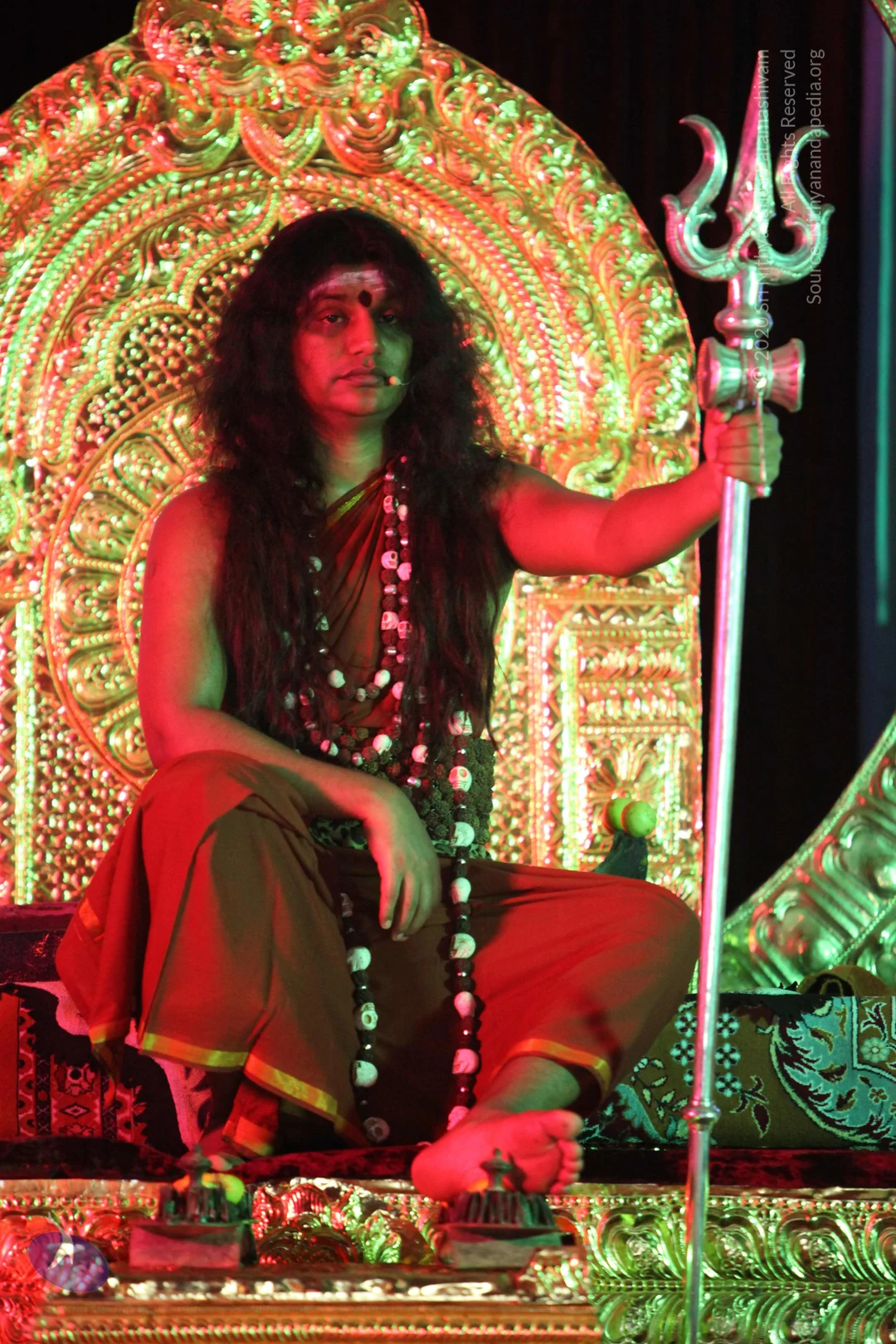
3 photosSource gallery
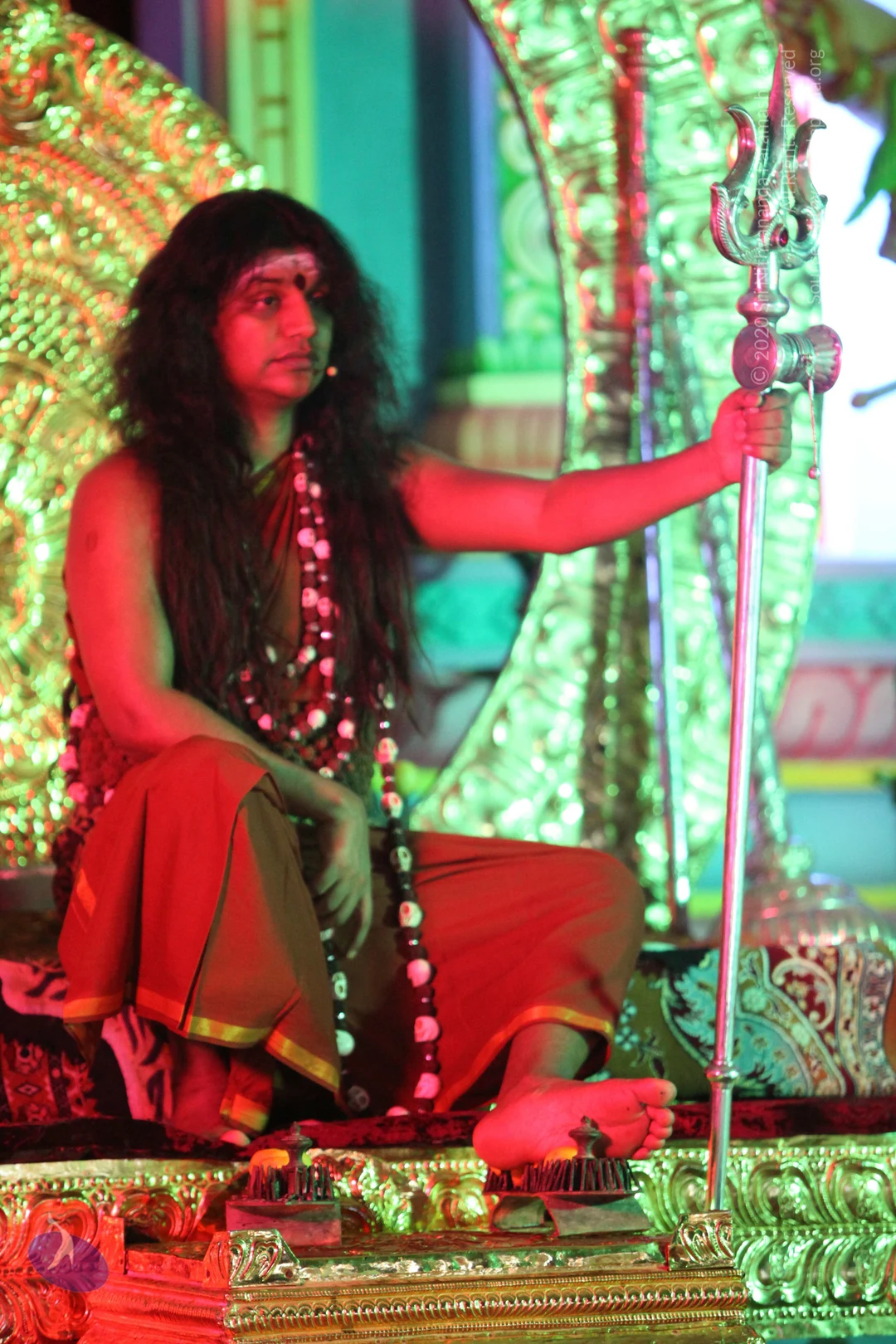
A figure with long dark hair and red-orange clothing sits on an ornate golden throne with a large golden arch behind it, holding a trident upright in one hand and a rudraksha mala of beads around the neck. Two large painted guardian statues flank the stage, each with a crown, mustache, gold necklace and raised arms. Brass oil lamps stand on the floor and a small dog walks across the red carpet in front. The backdrop is pink and green with colourful ornamental arches and pillars.A seated man with long, loose dark hair and a red bindi on his forehead sits cross-legged on an ornate golden throne backed by a gilded arch with floral and scroll carvings. He wears a red-orange wrap and long necklaces of rudraksha-style beads, and holds a tall silver trident in his right hand. A small brass lamp sits at his feet. The warm stage lighting is red and green. A visible prominent figure with long hair, a trident, rudraksha malas and saffron-toned clothing is seated on a throne; the page identifies this as Swamiji (probable).A seated figure in a red-orange robe with long, loose dark hair sits on an ornate gilded throne with green and gold metalwork behind. He wears a red-and-pink beaded rudraksha mala draped over the shoulder and chest, and holds a silver trident with his right hand while his left rests on a beaded mala. Oil lamps burn on the gilded platform in front of his bare feet, and the stage is lit in red and green. The person appears to be a person, identified by the long swept hair, saffron-orange clothing, rudraksha malas and the trident on a throne.