Skip to content
Sunday

3 March 2013

Vision for A New Age Sangha (SPIRITUAL COMMUNITY)

Dated photos
558
Source pages
1
Media
5
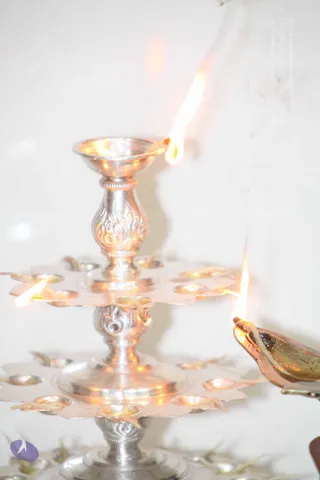
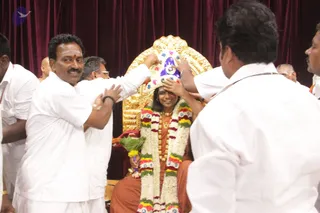
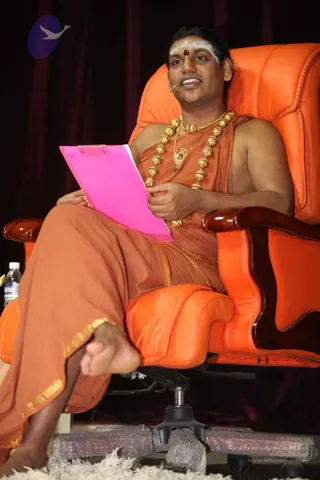
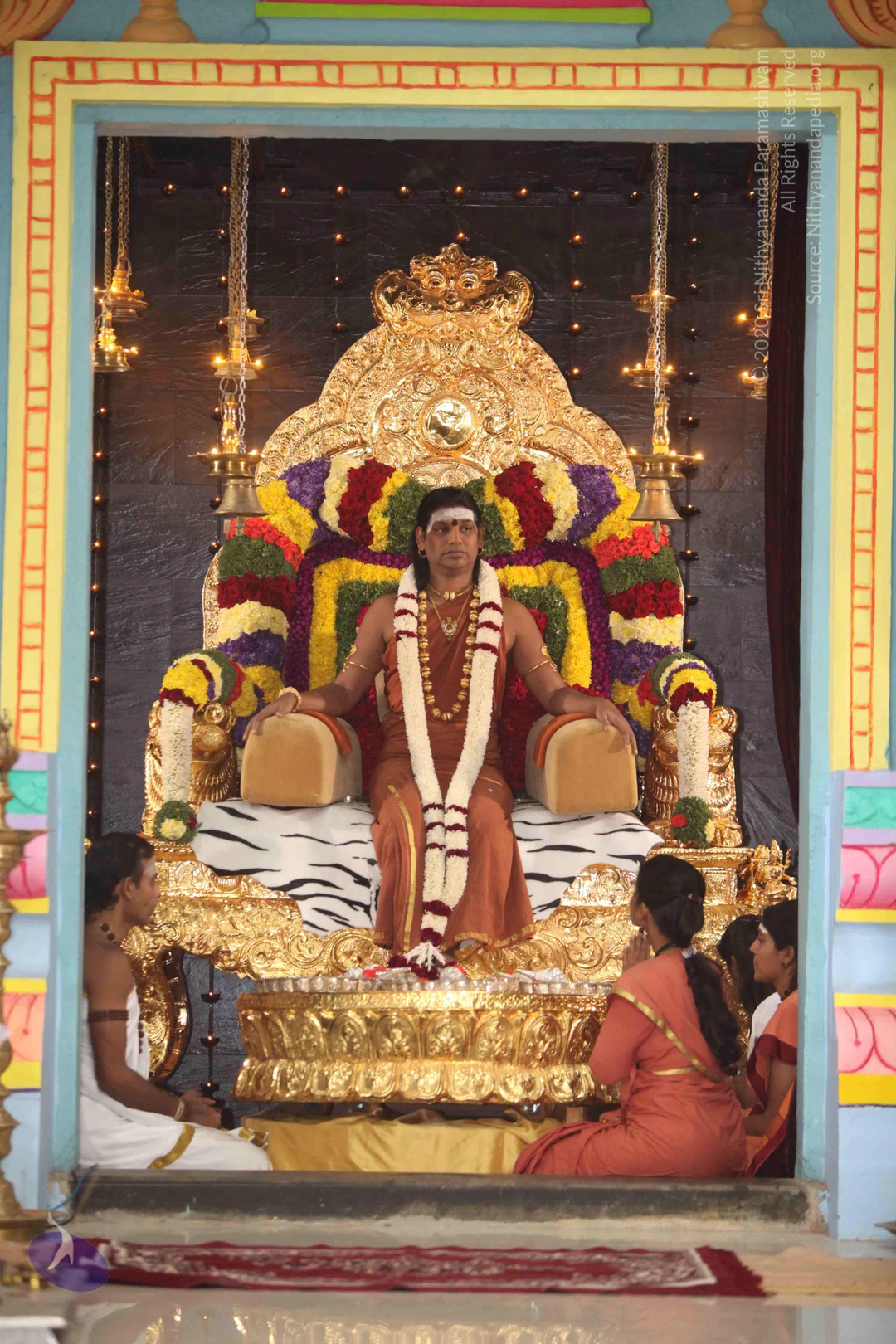
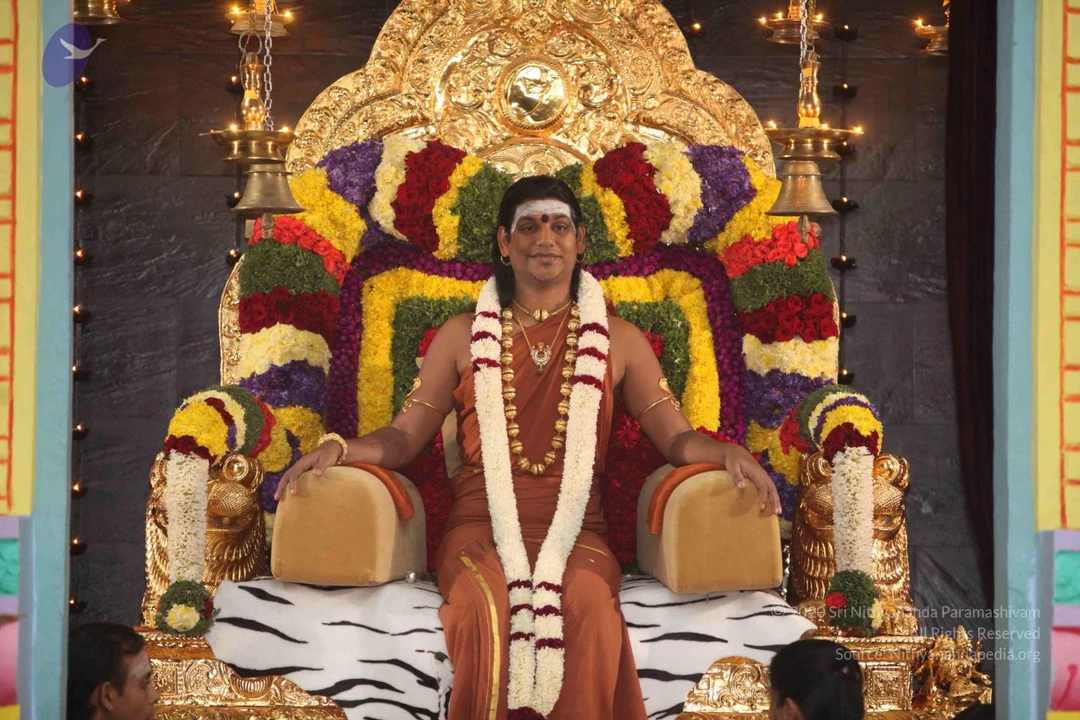
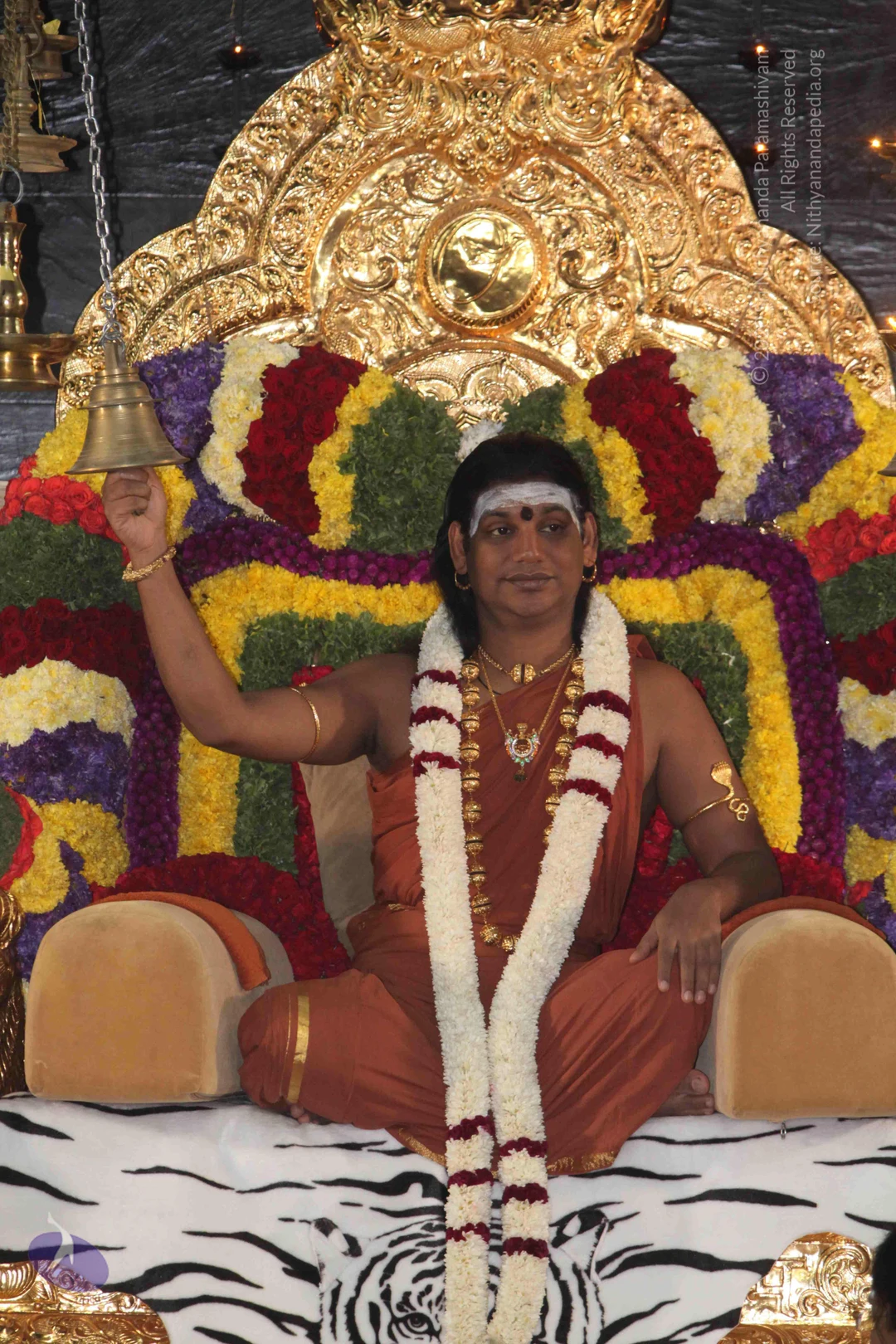
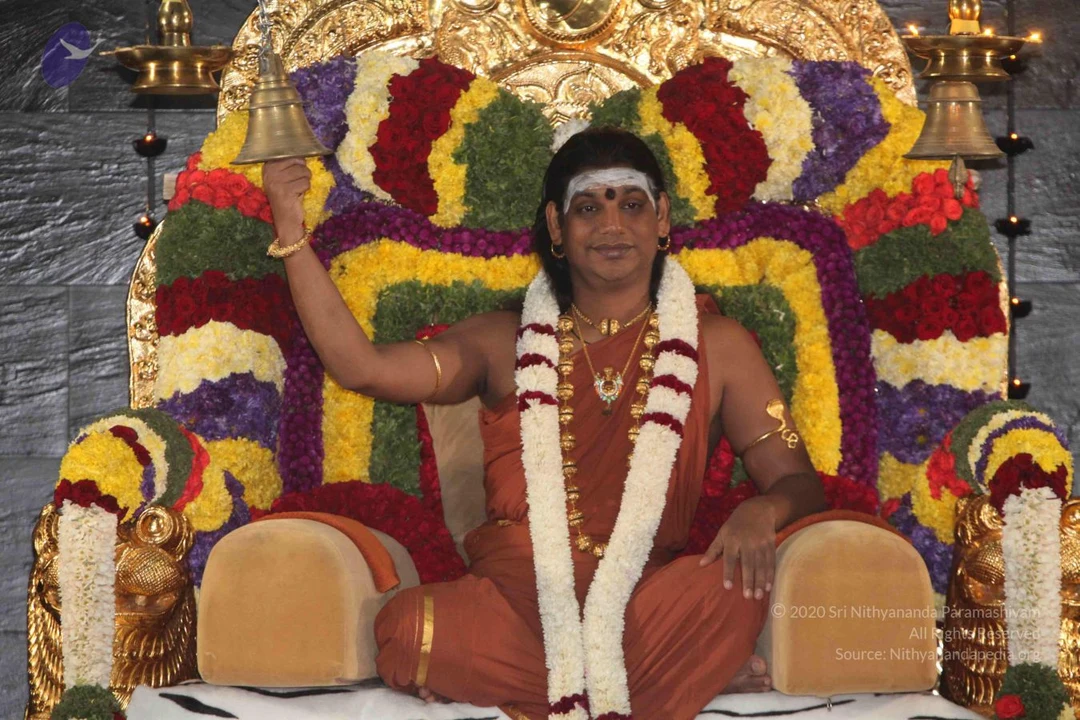
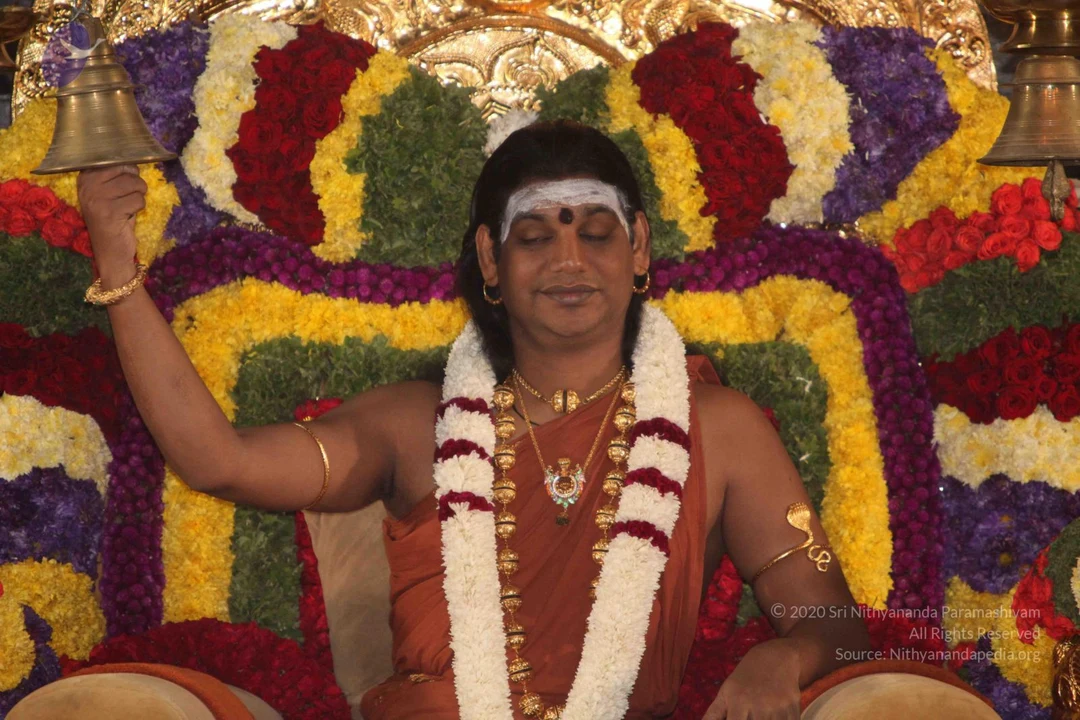
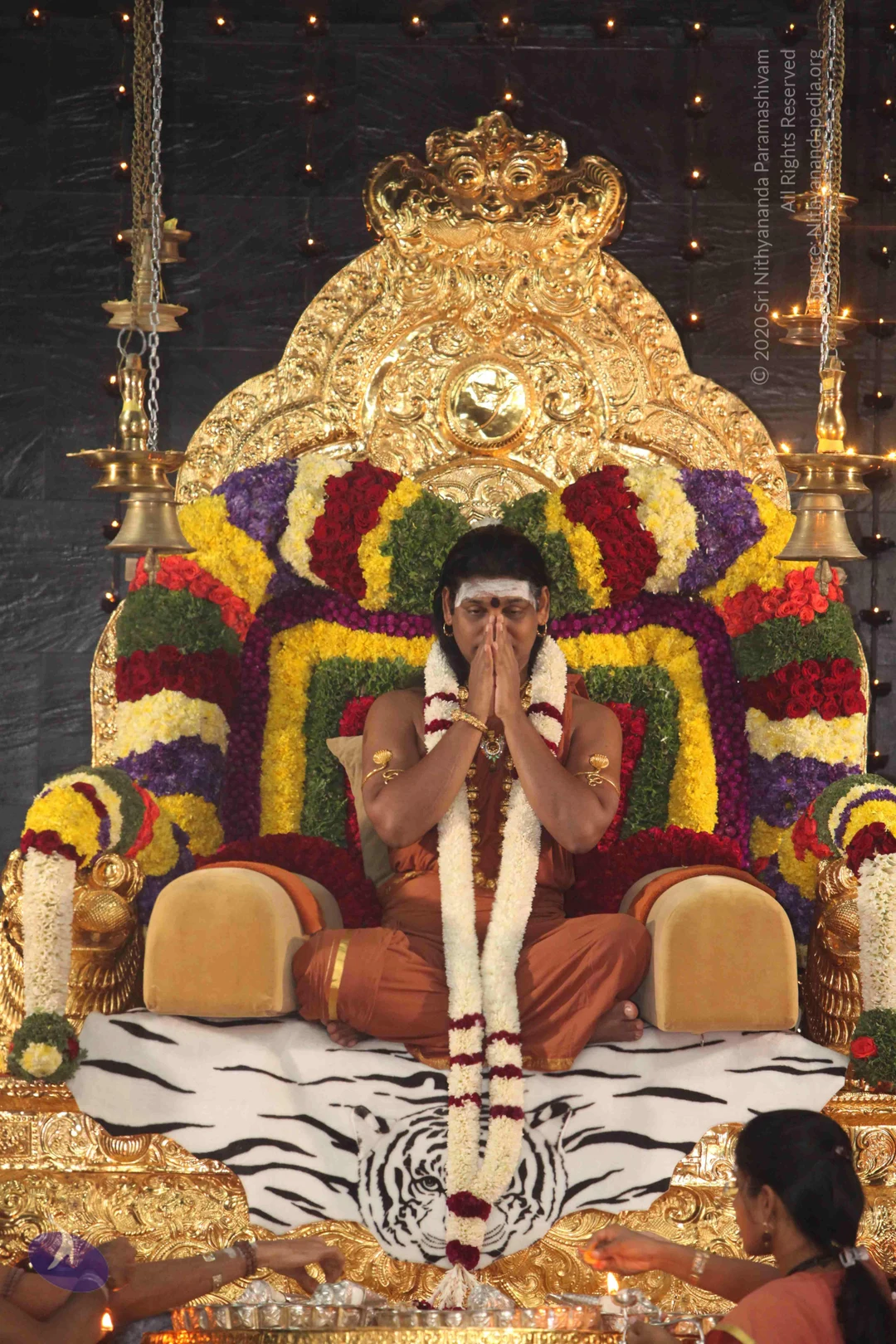
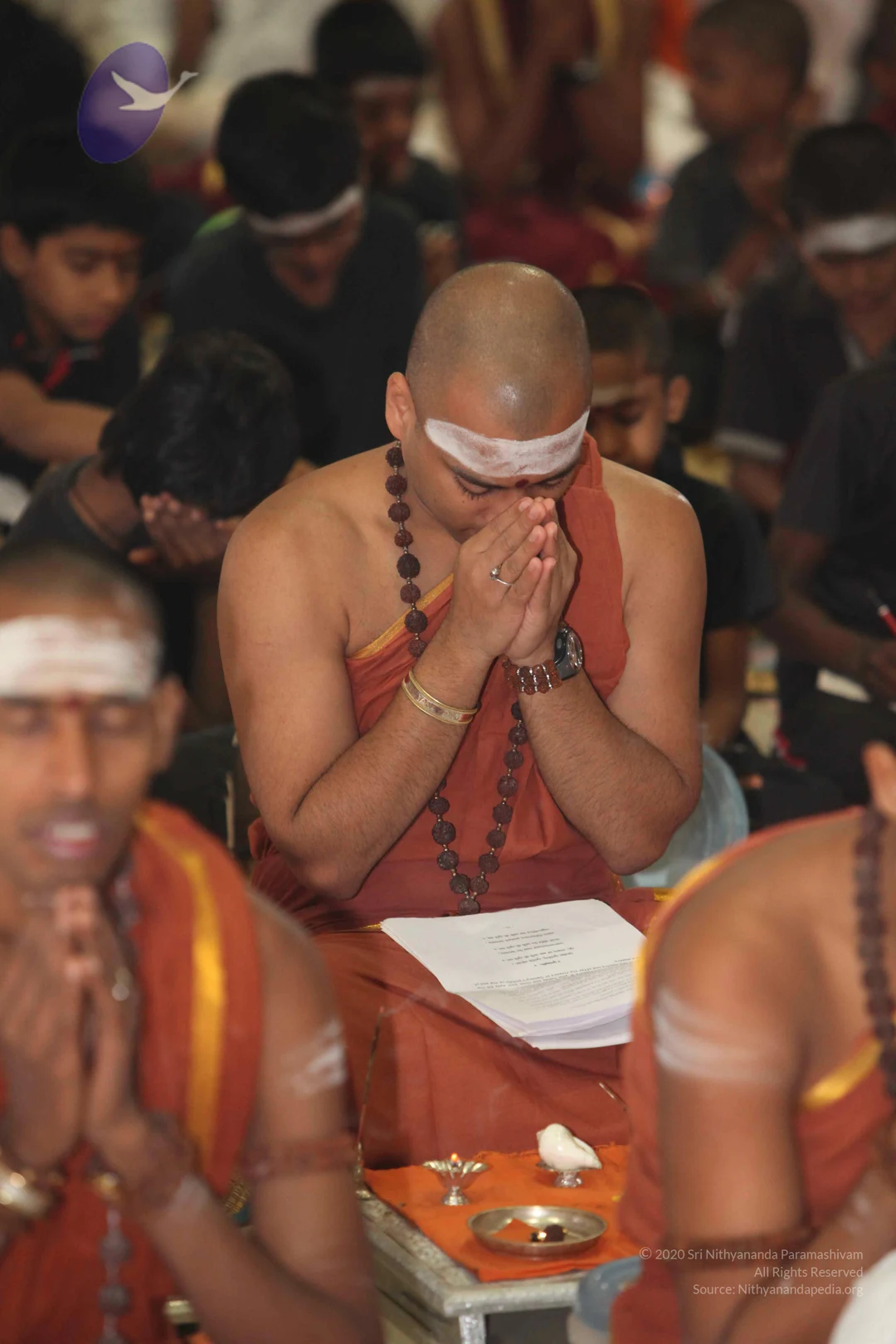
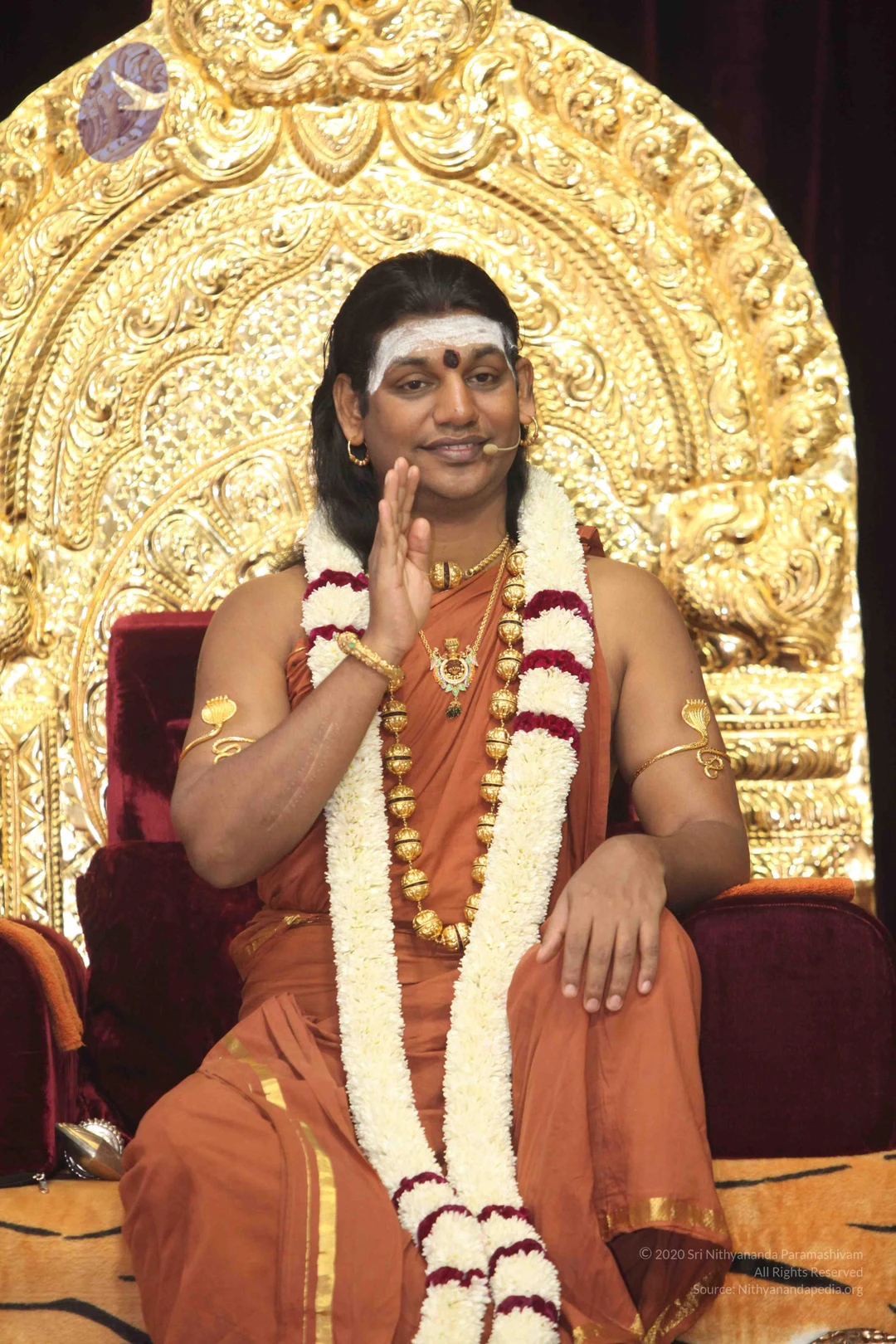
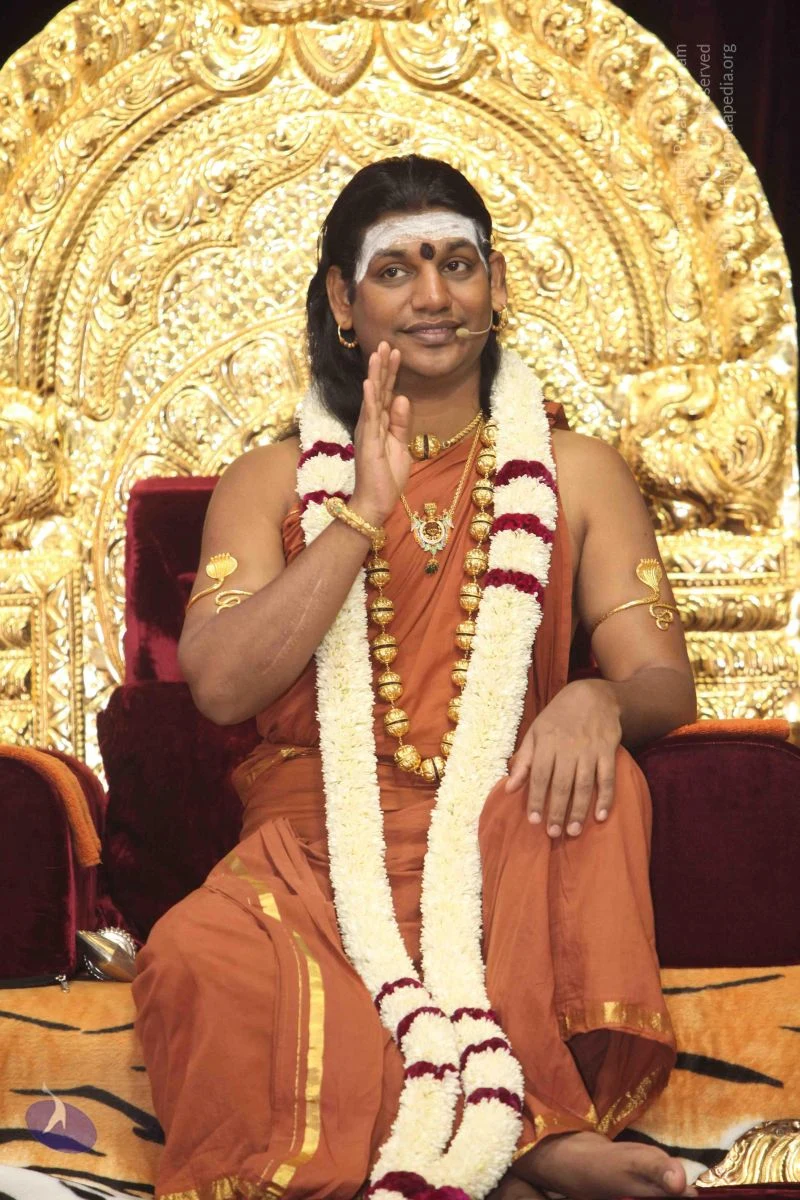
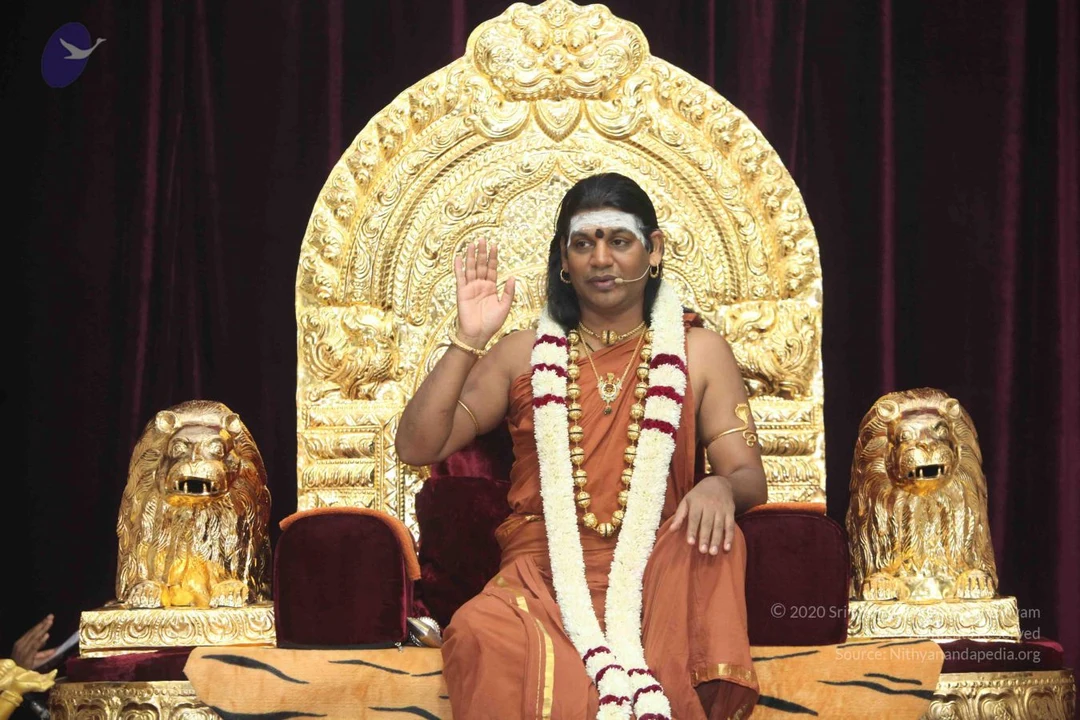
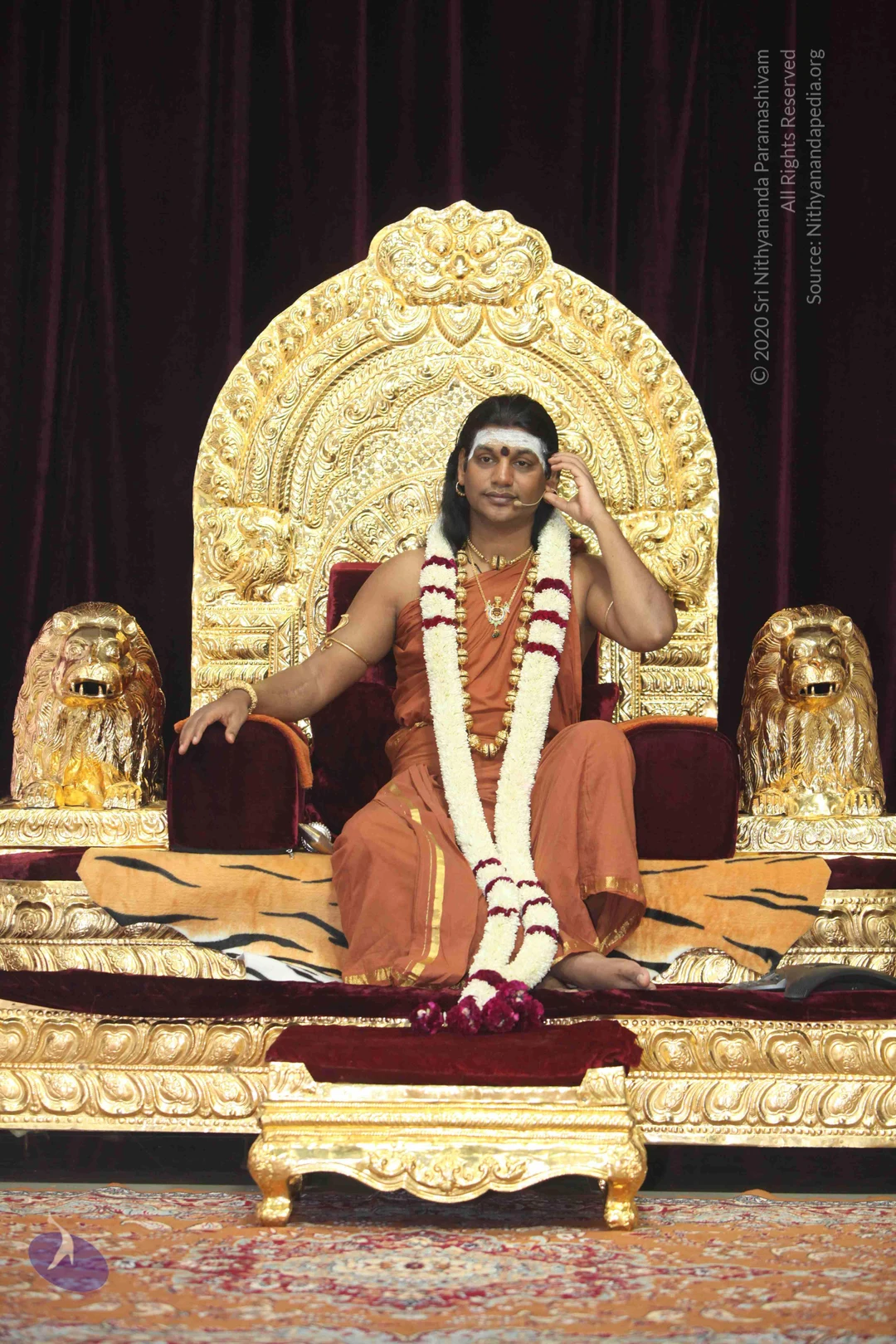
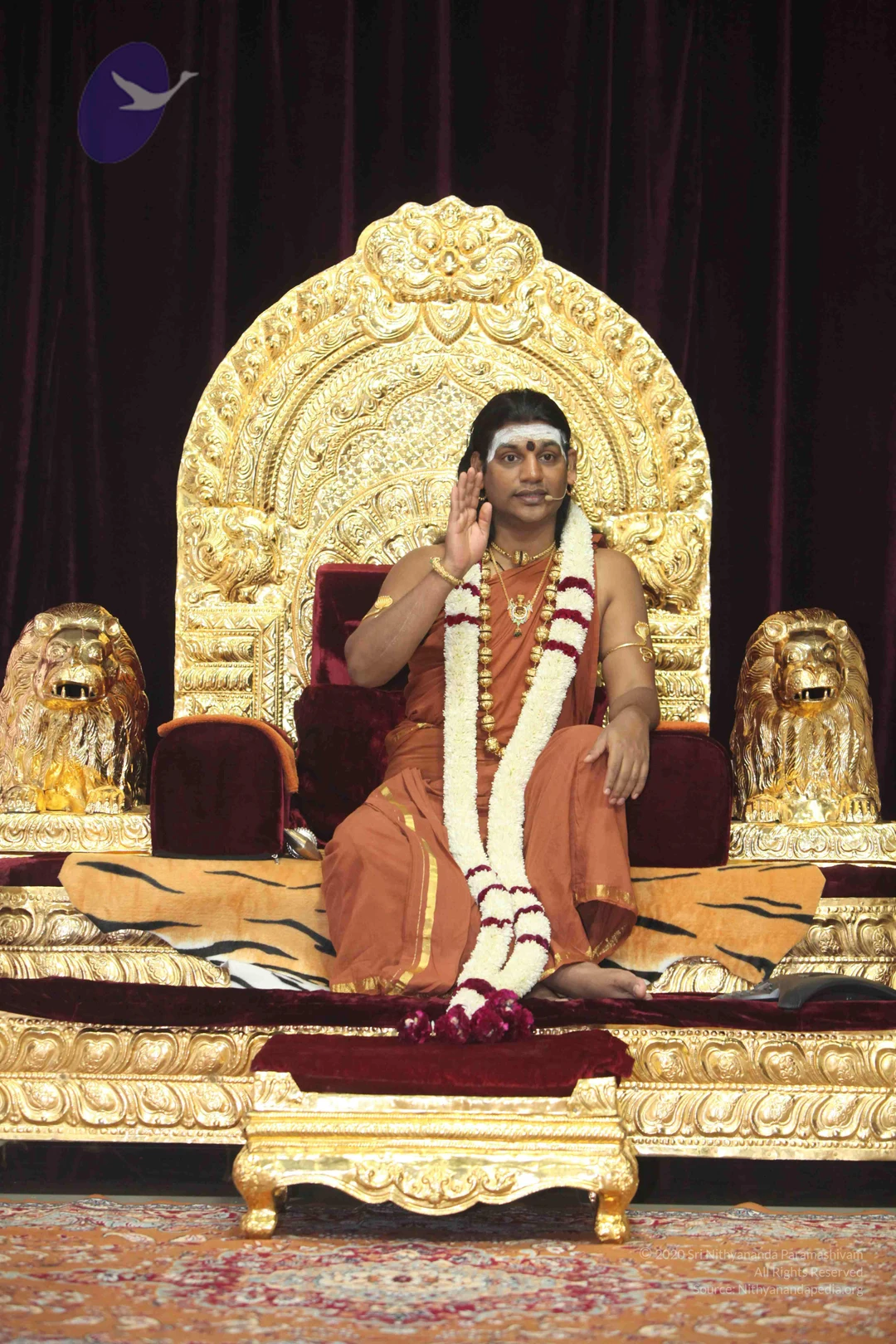
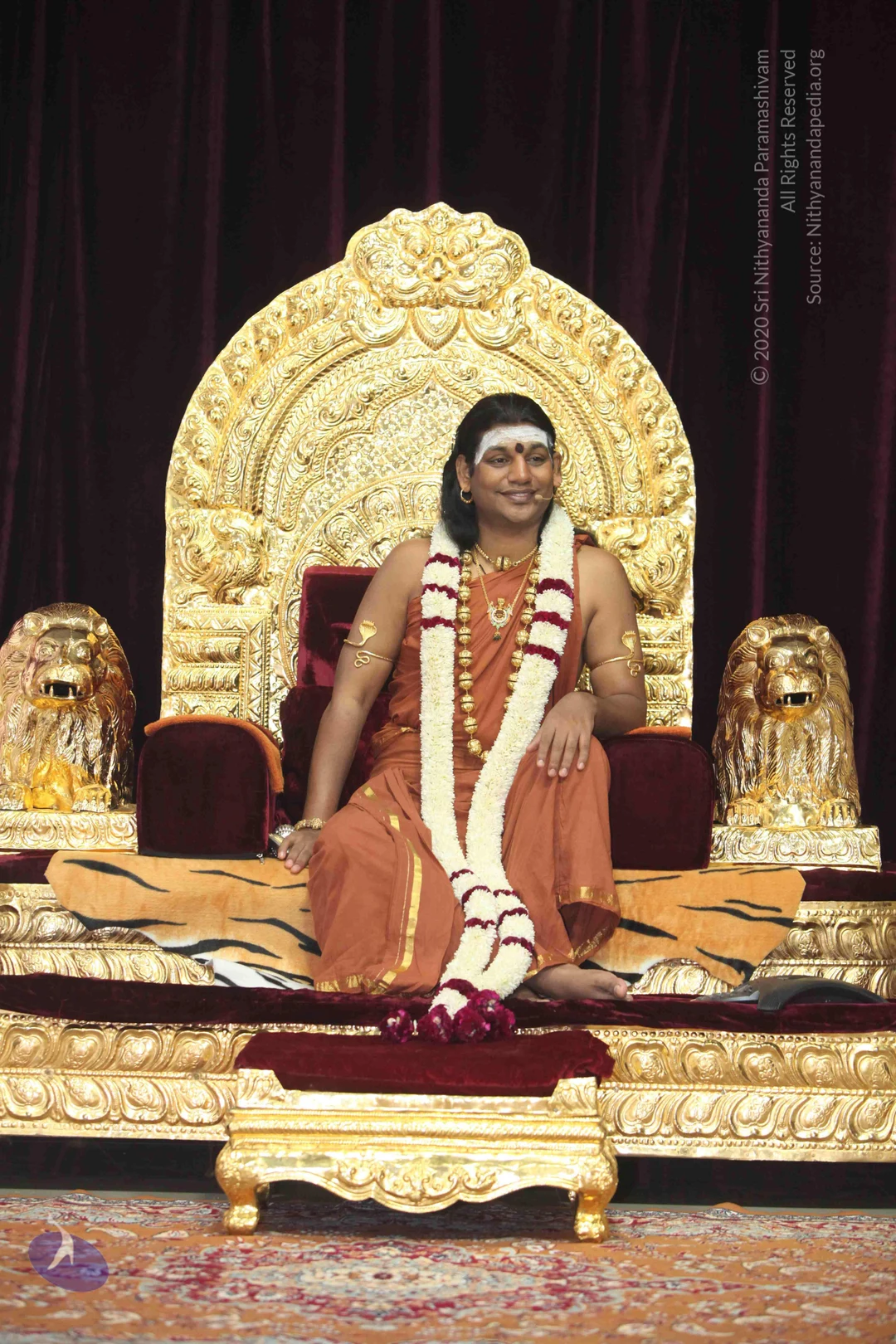
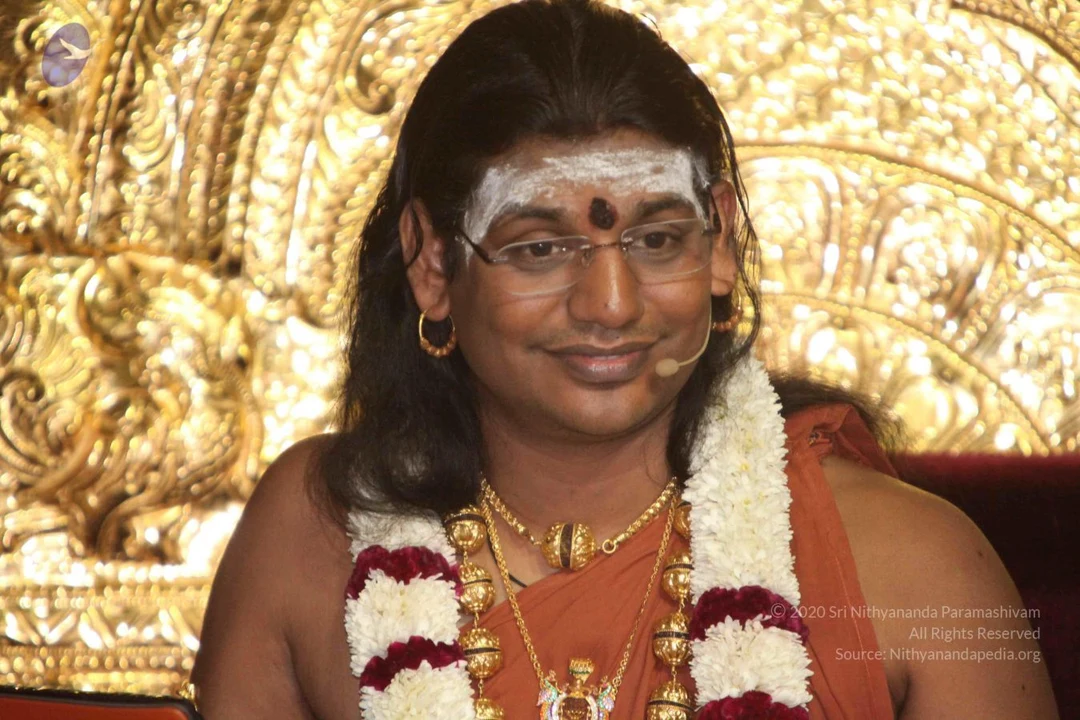
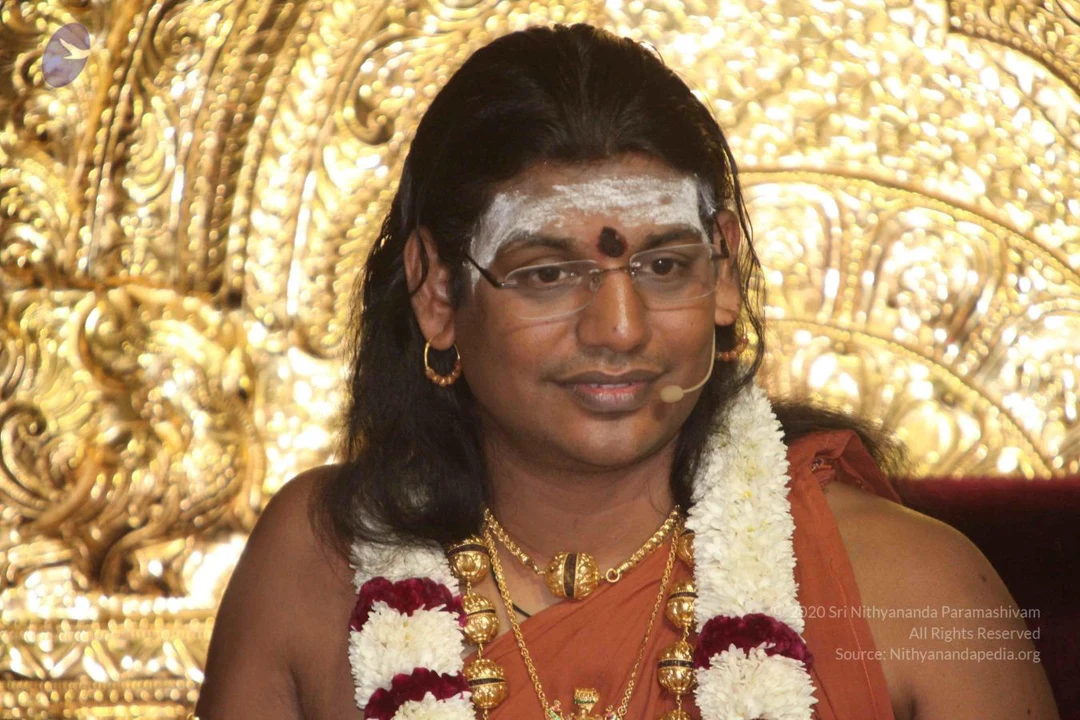
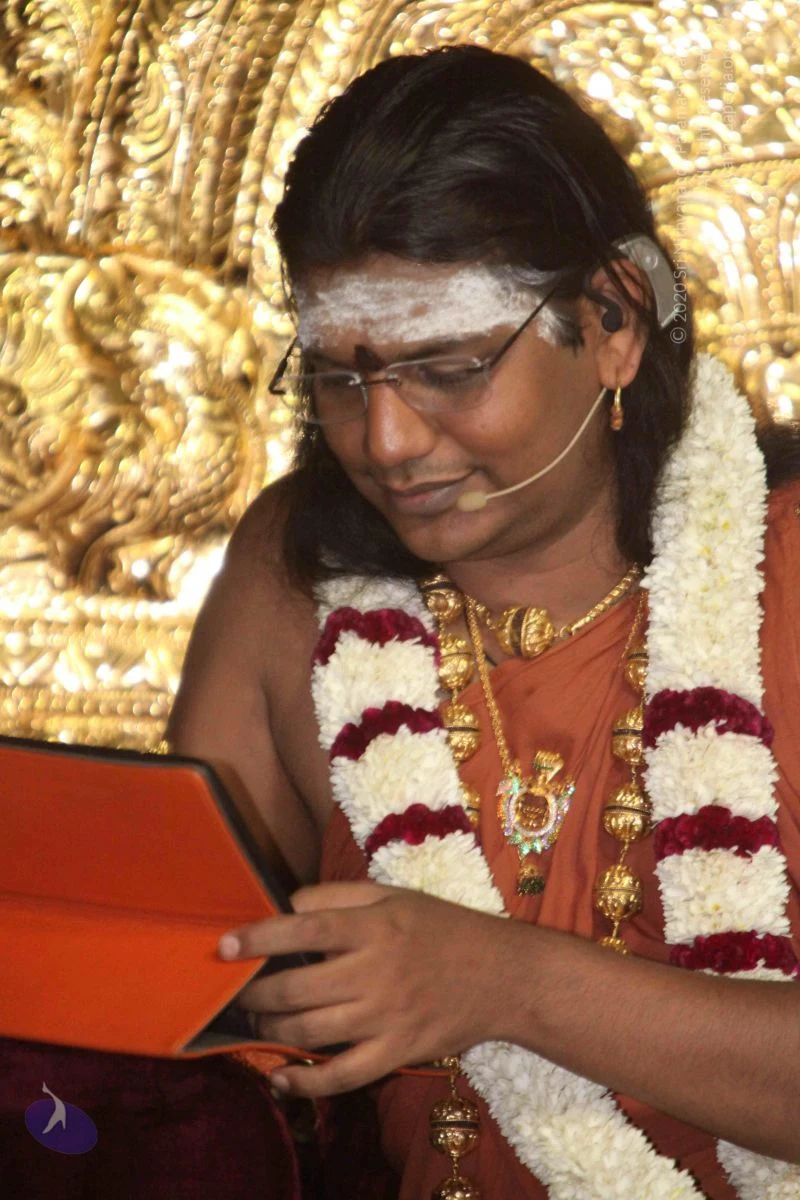
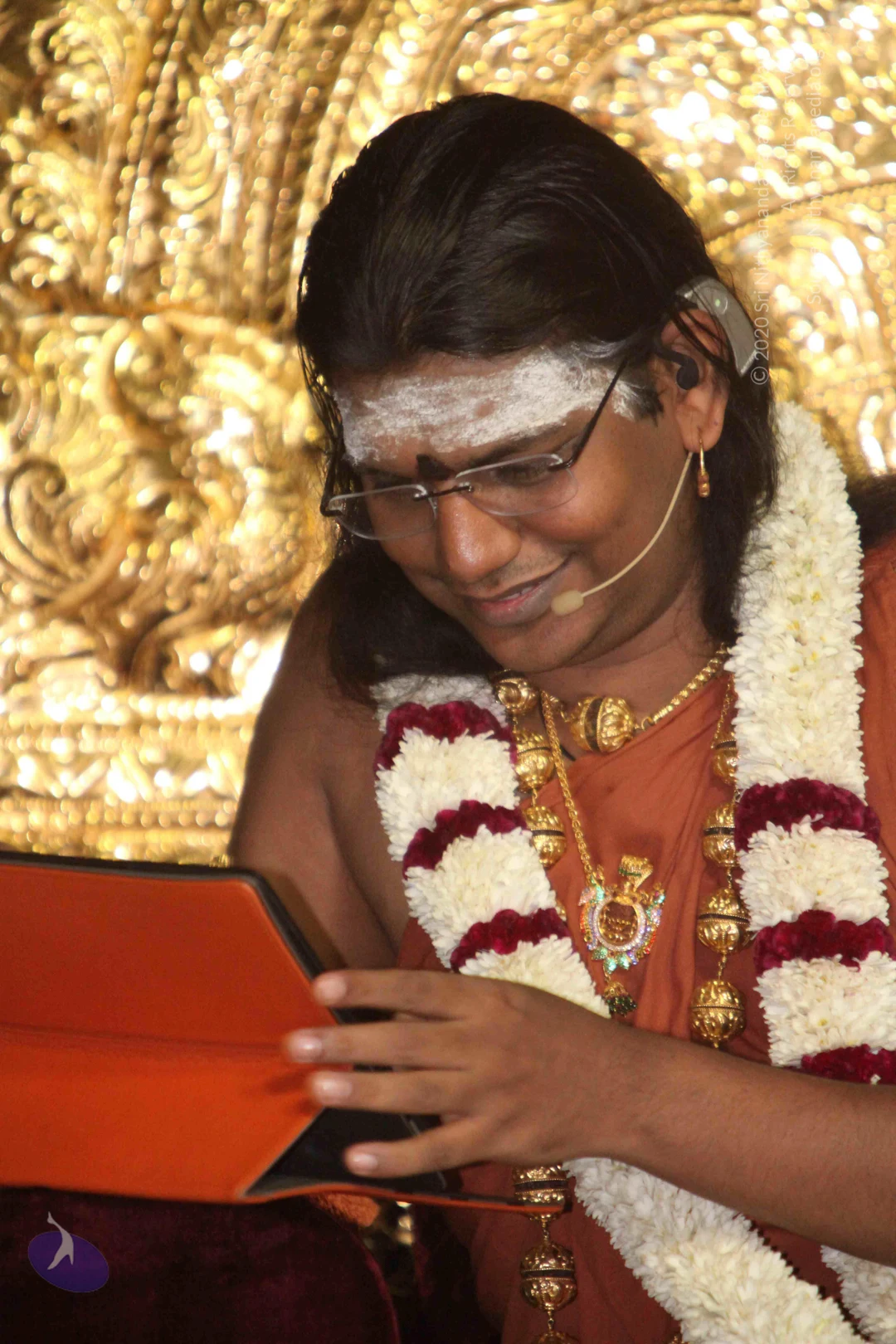
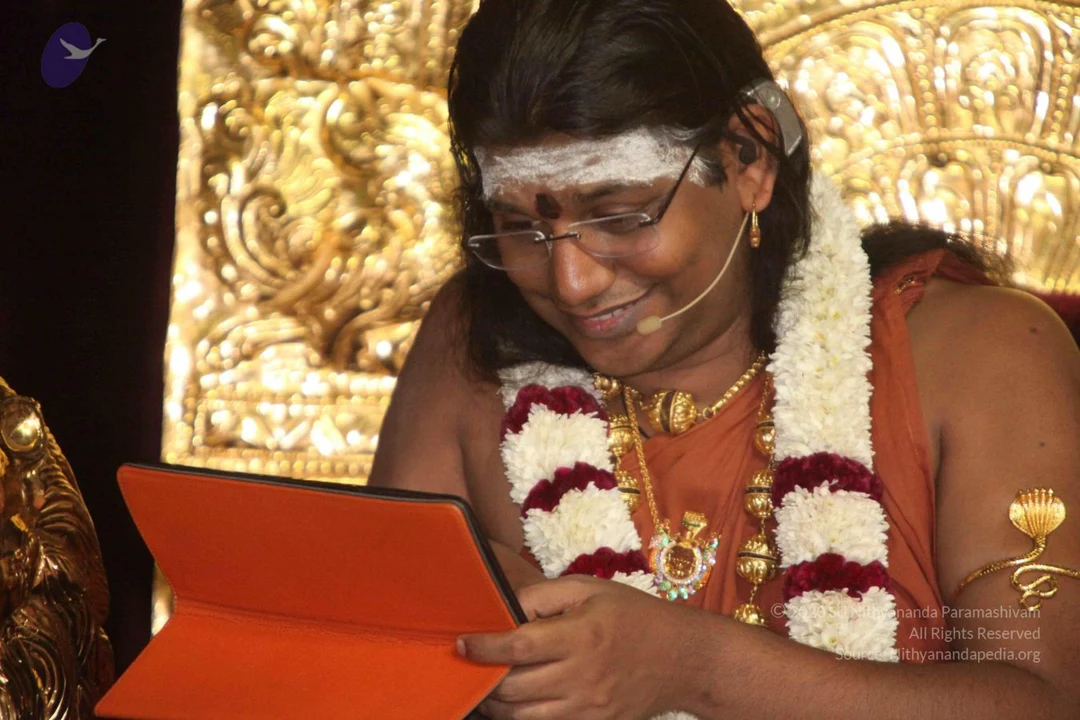
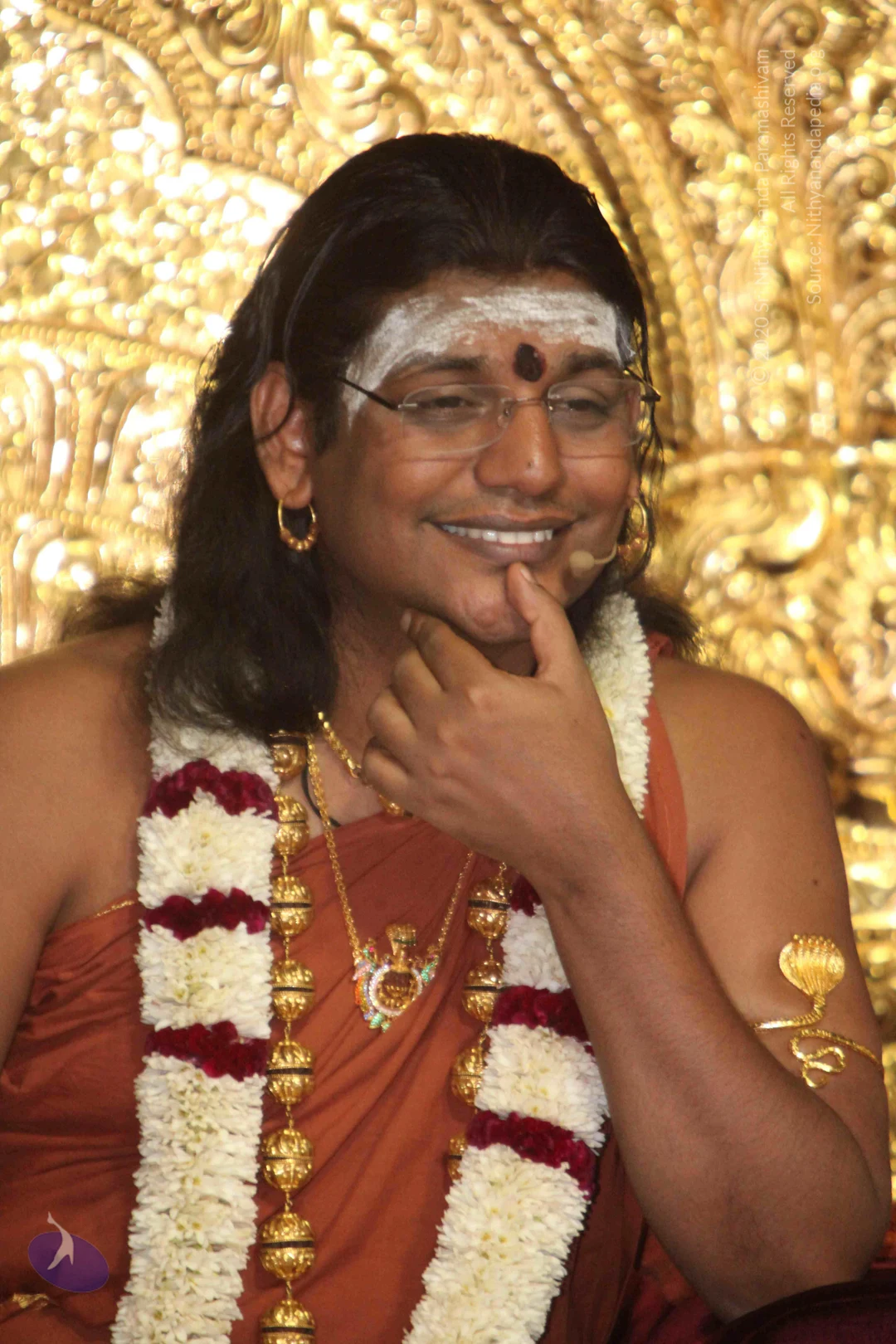
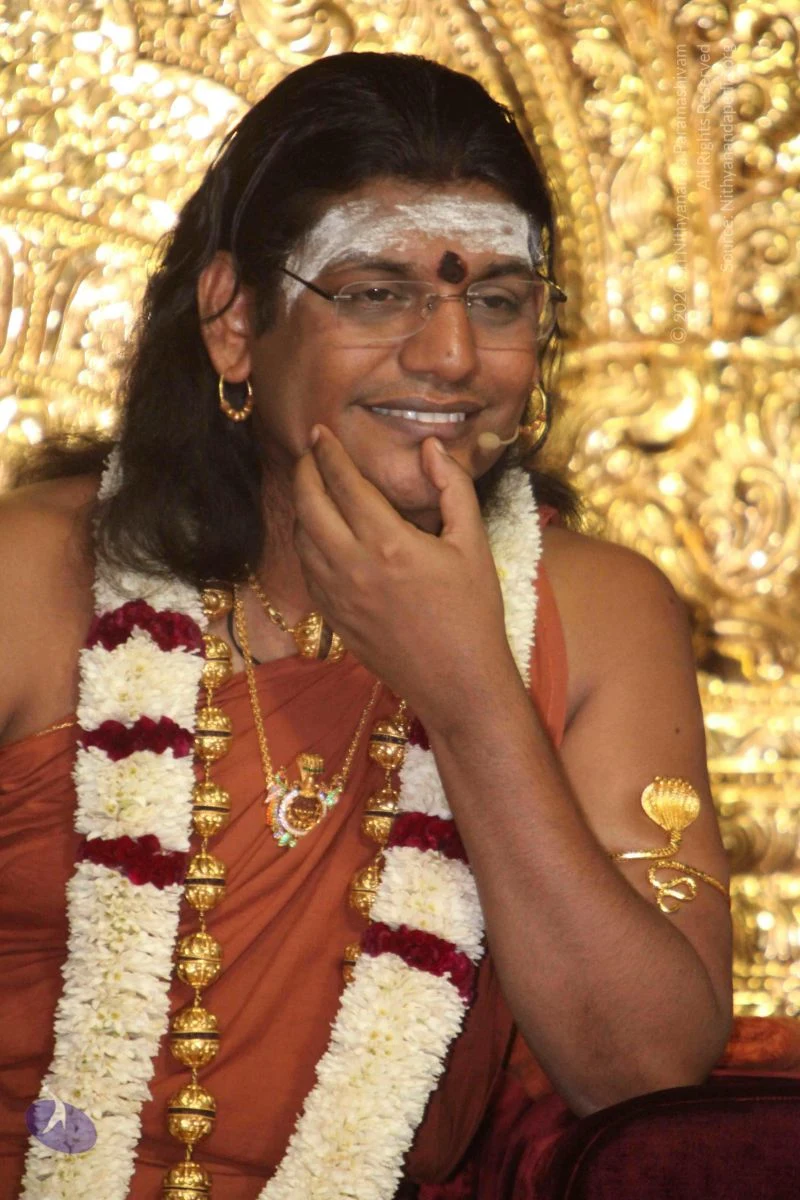
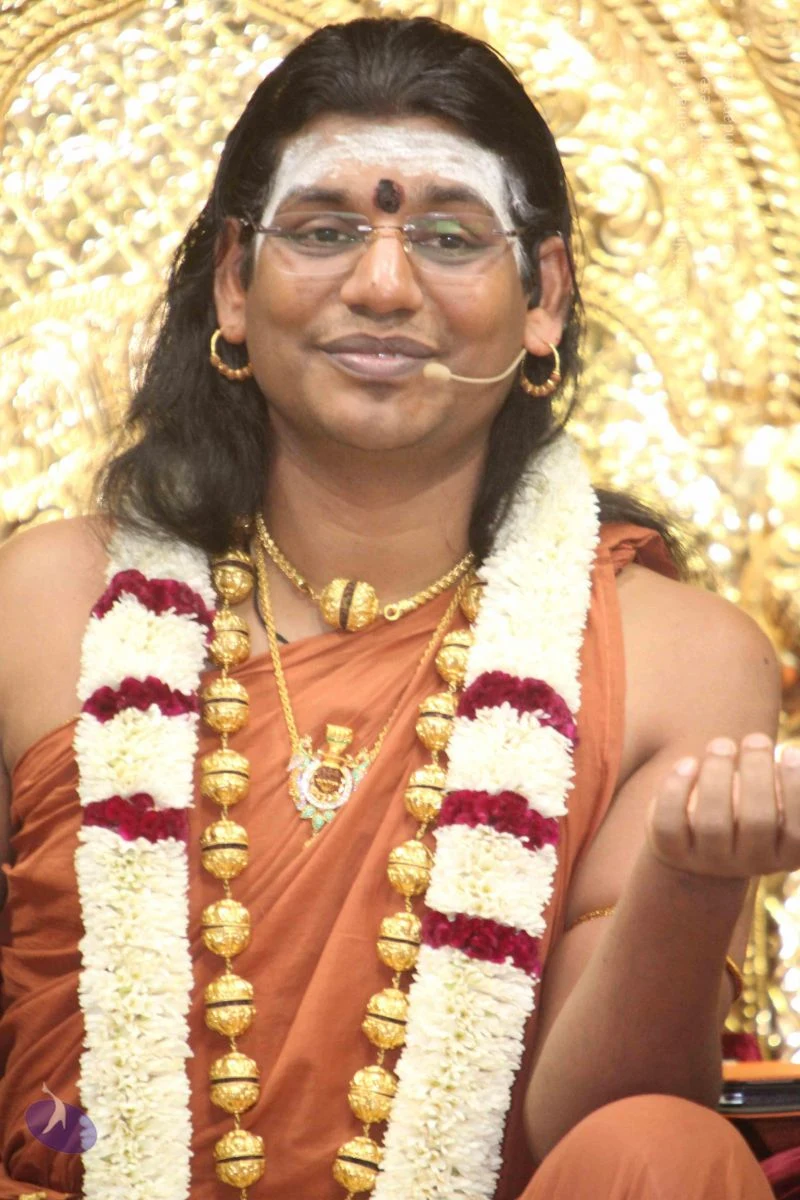
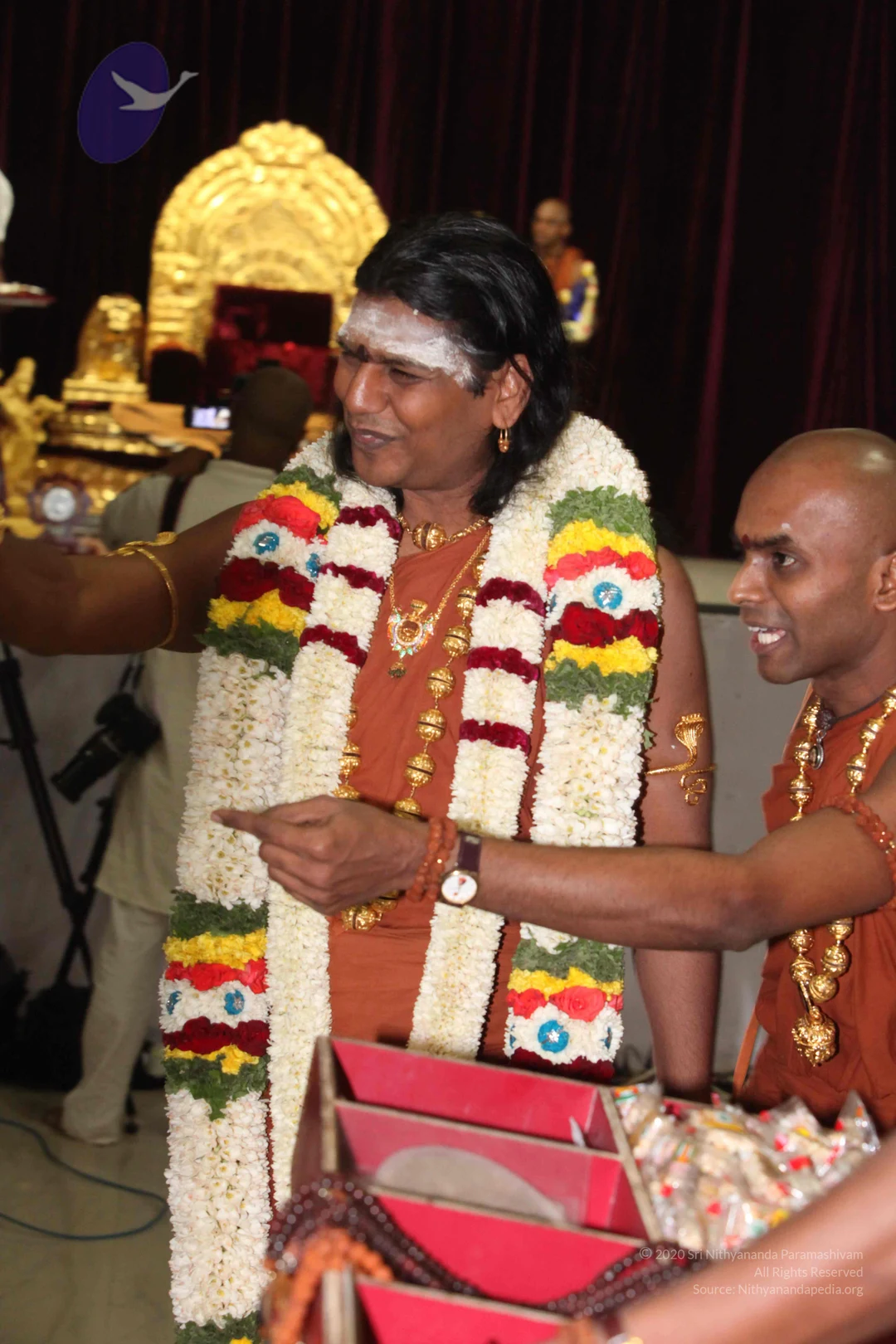
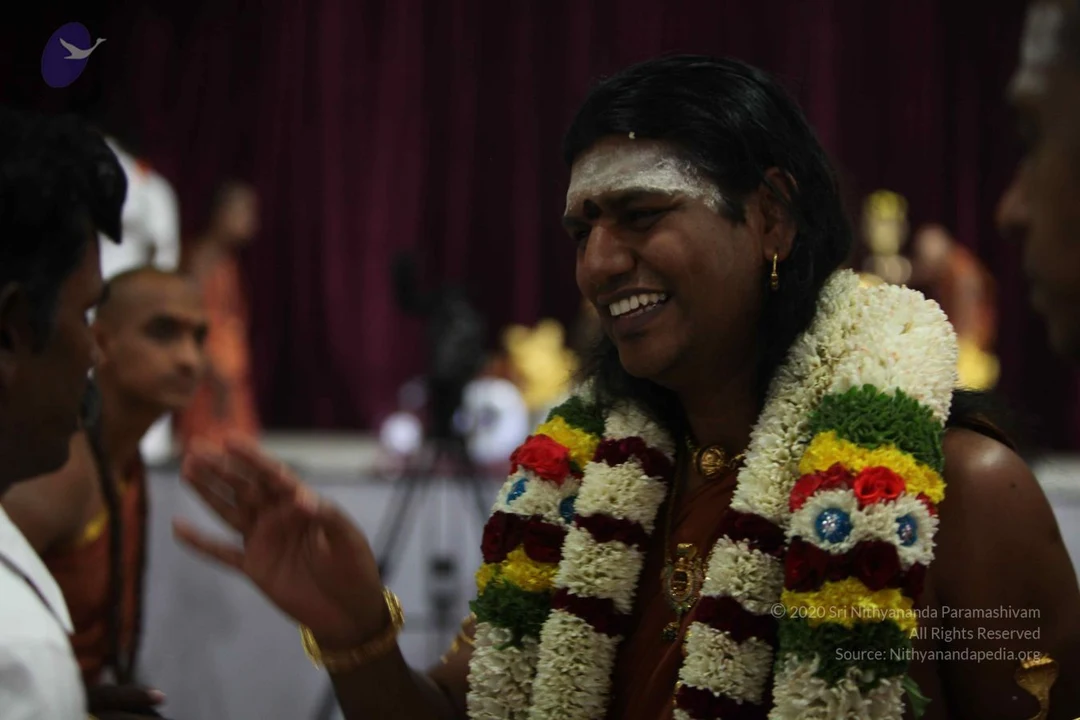
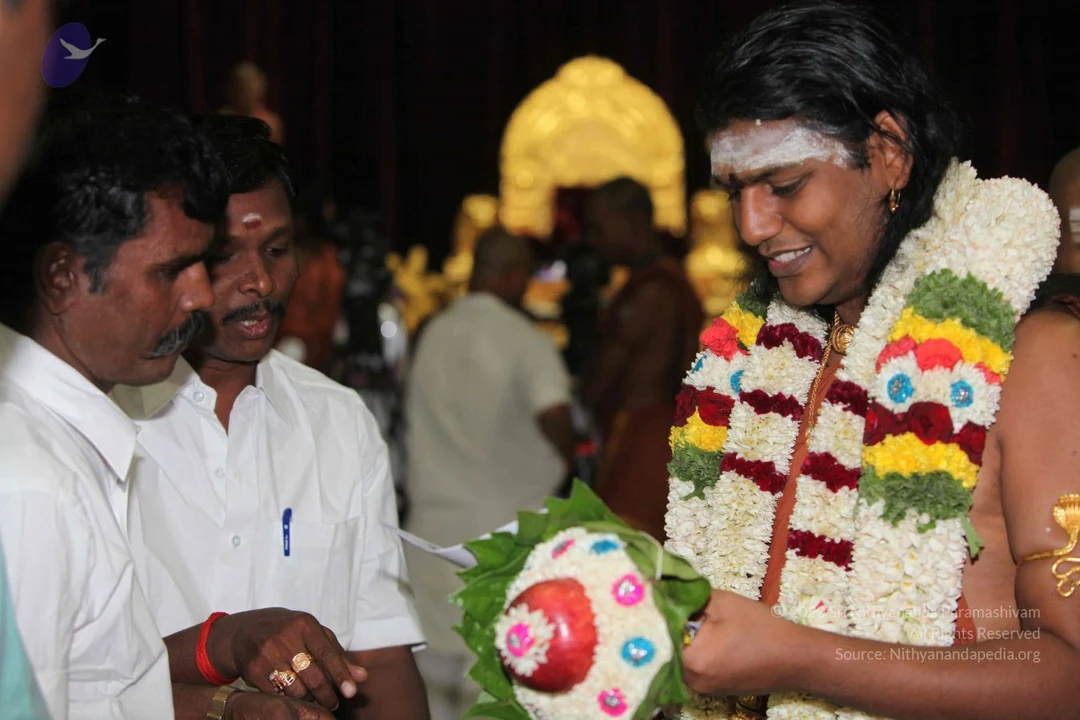
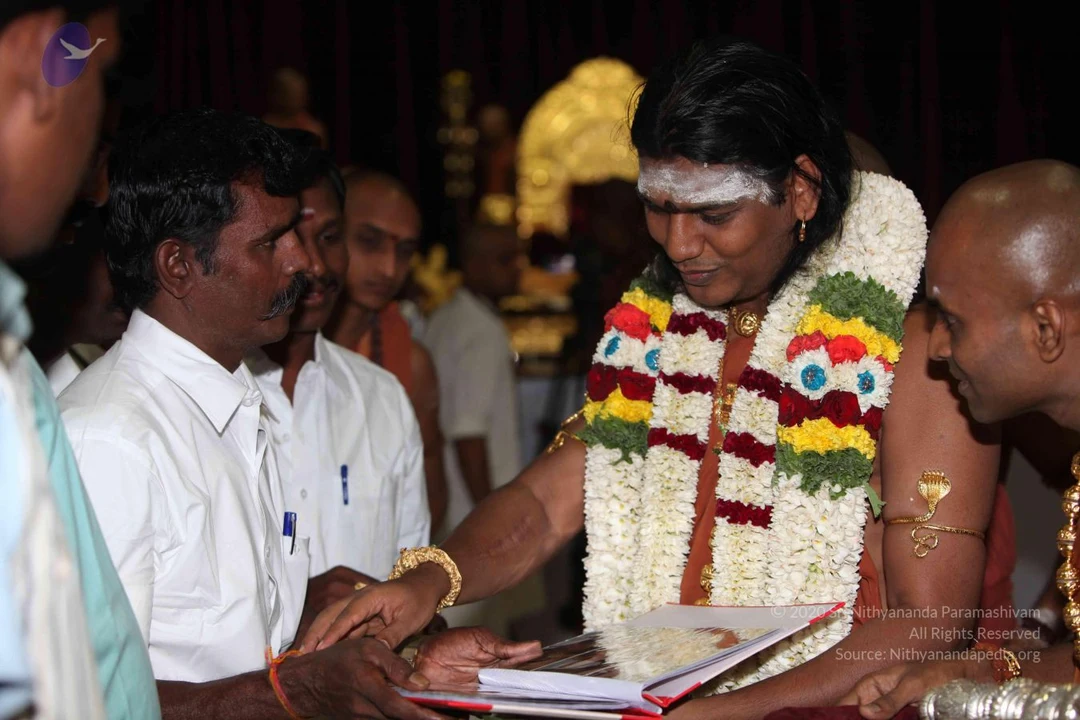
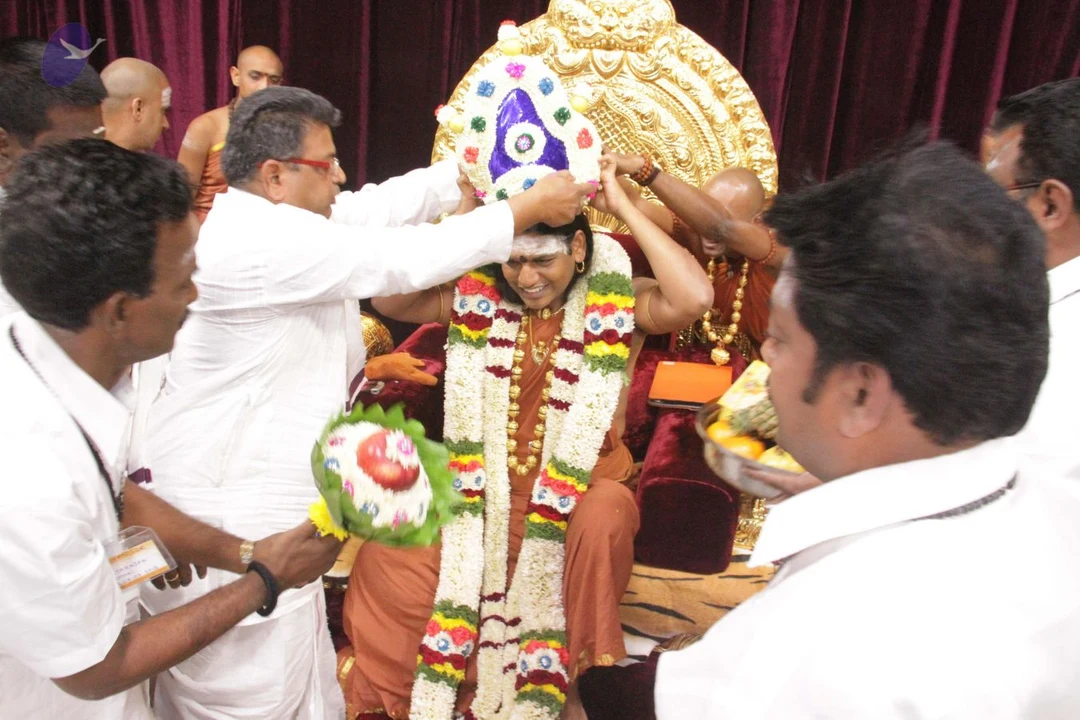
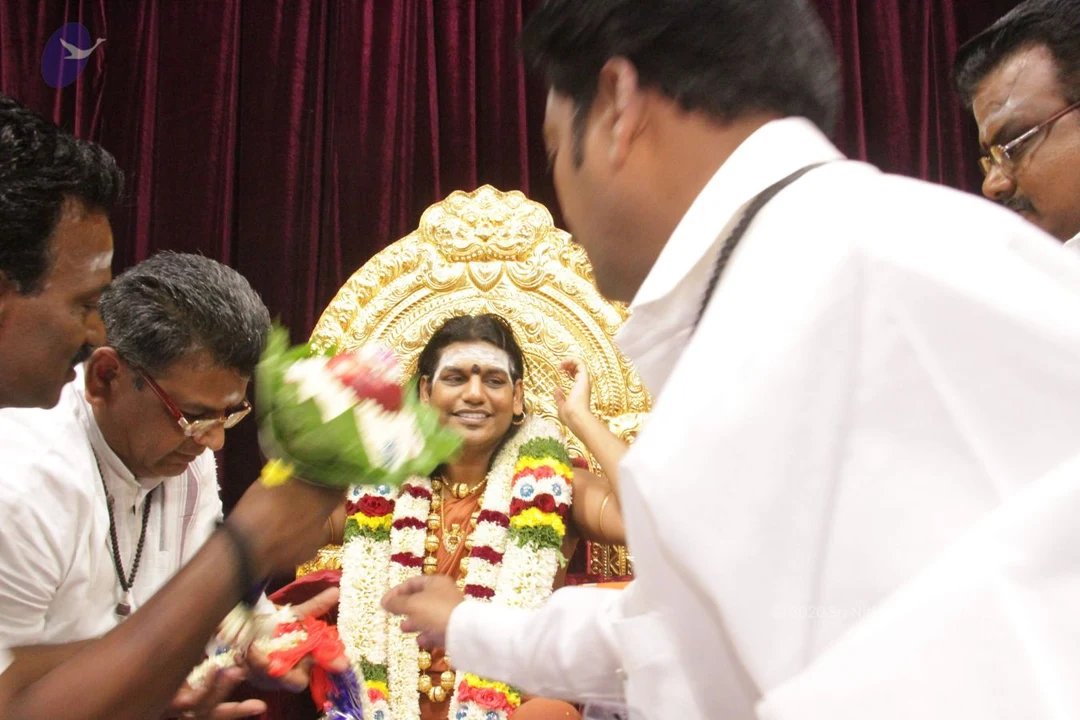
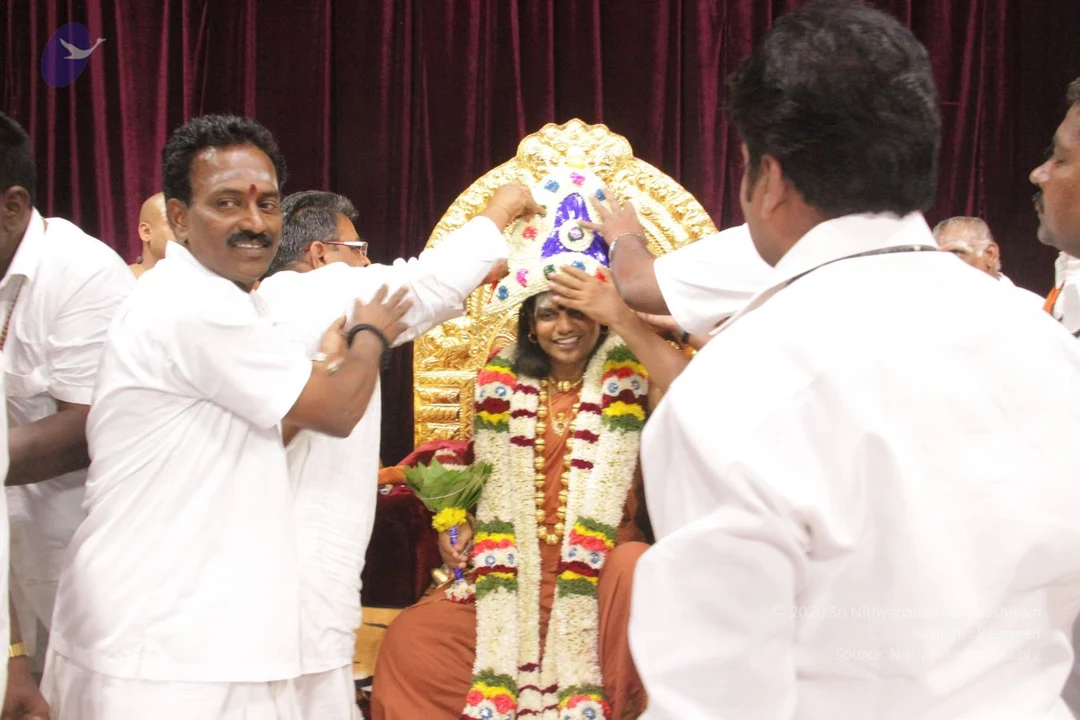
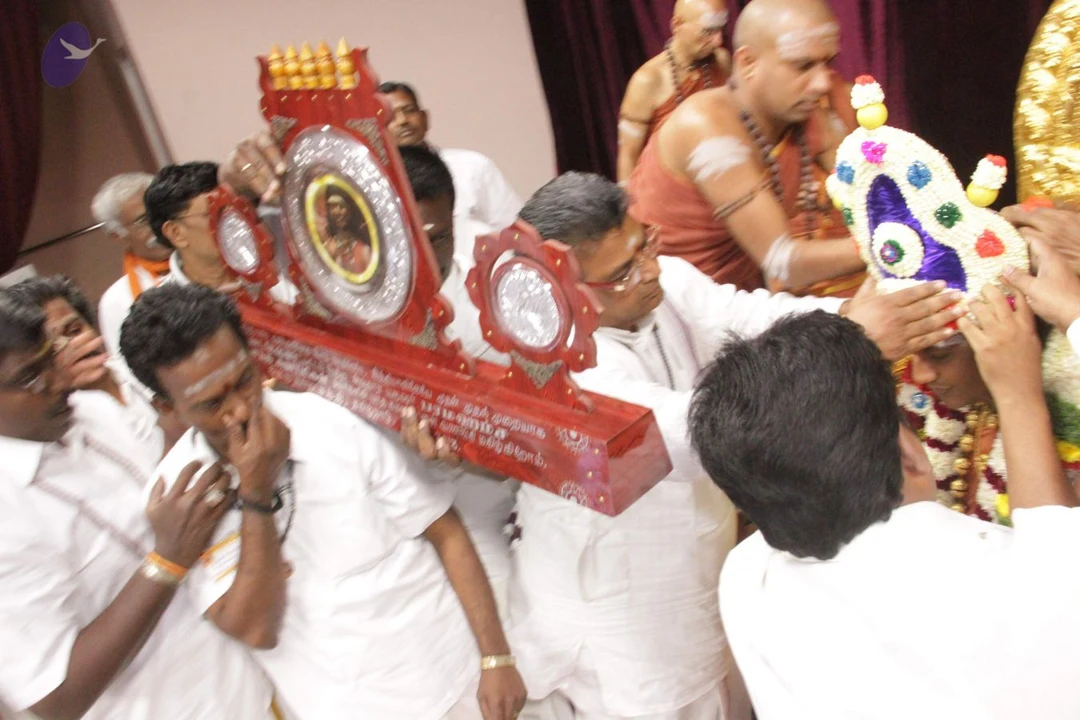
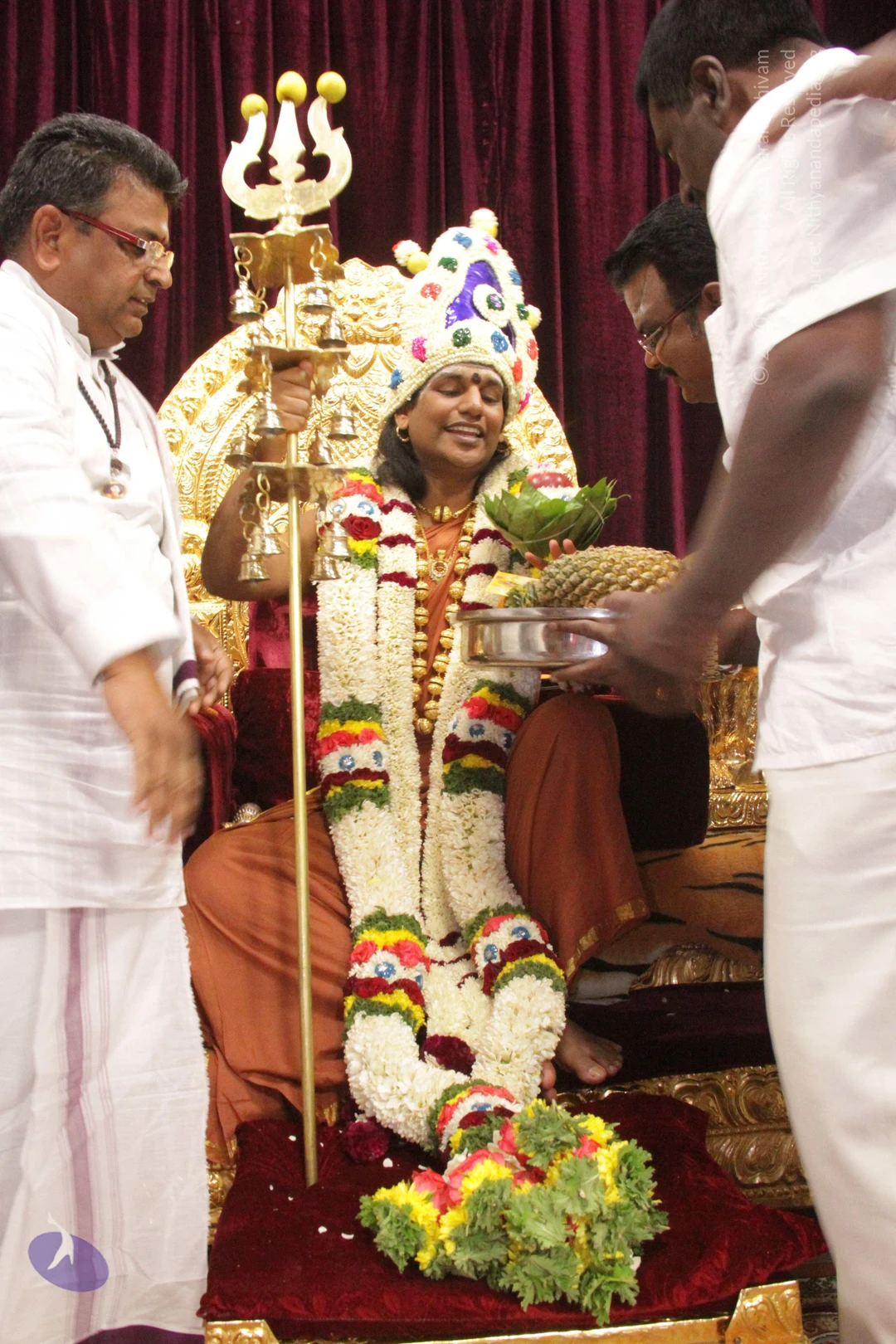
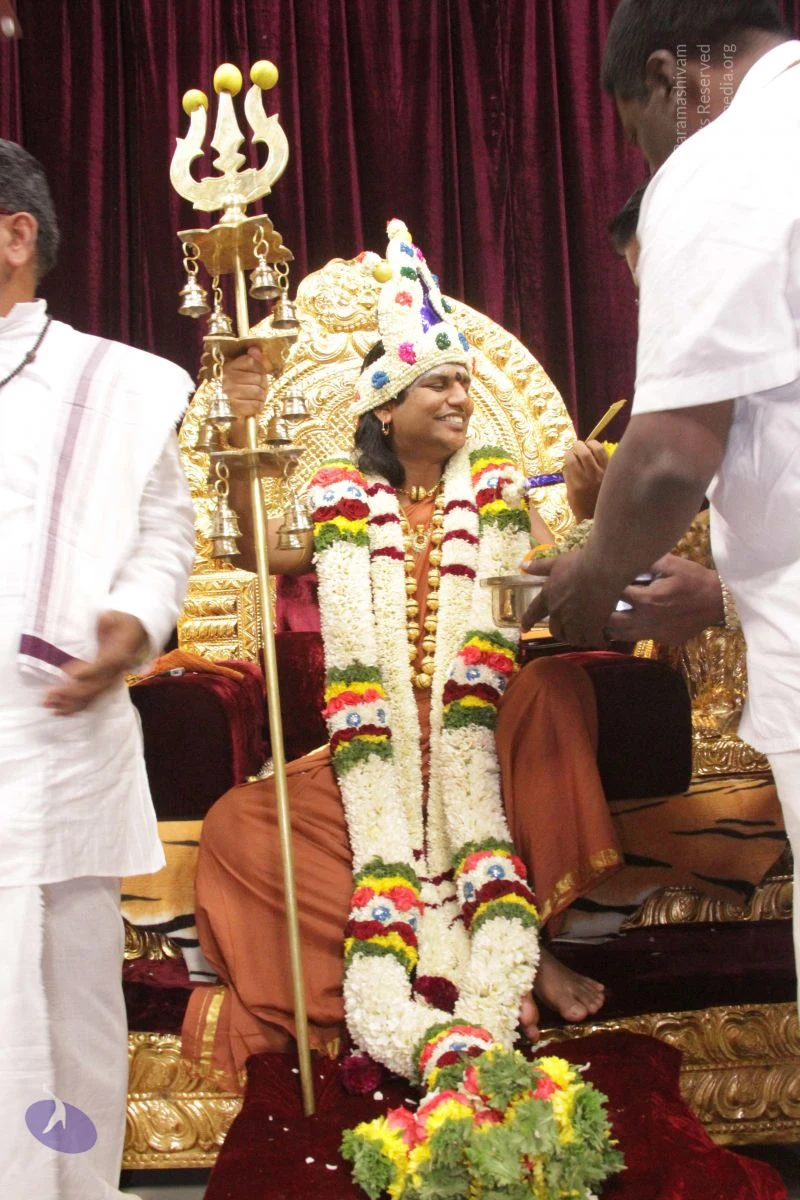
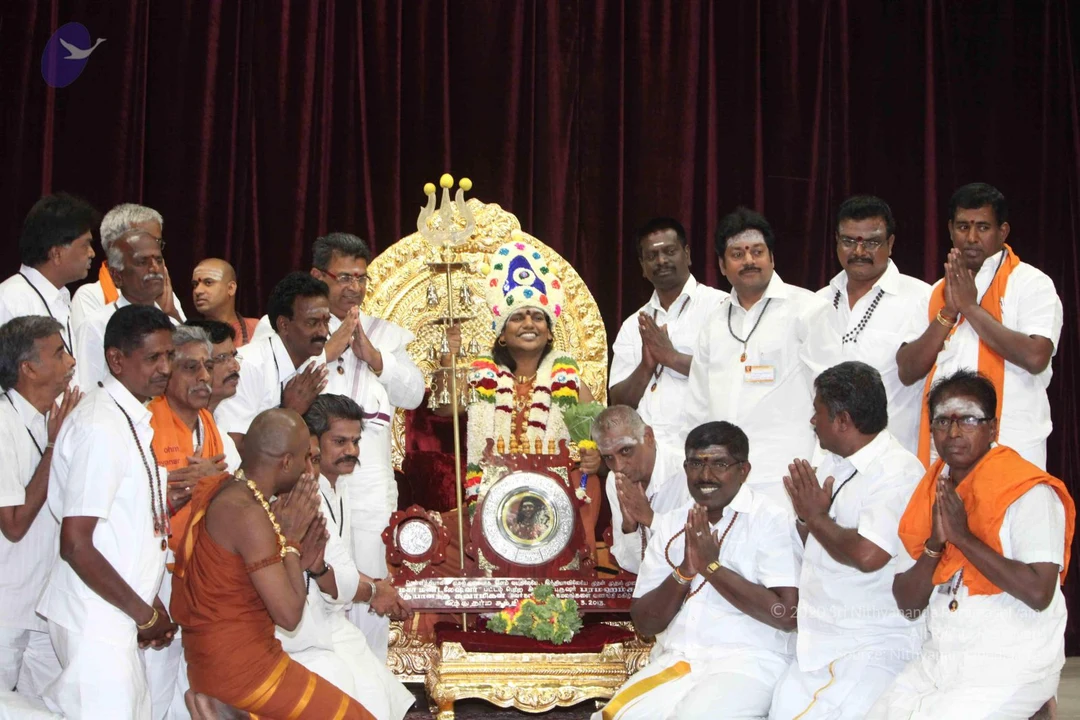
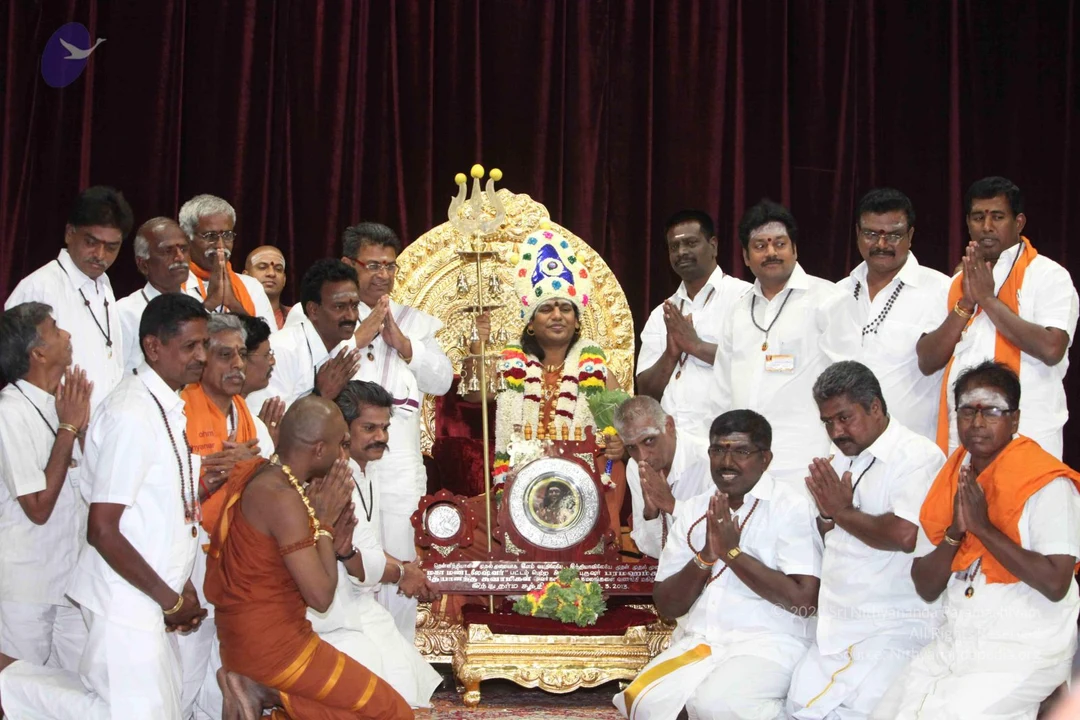
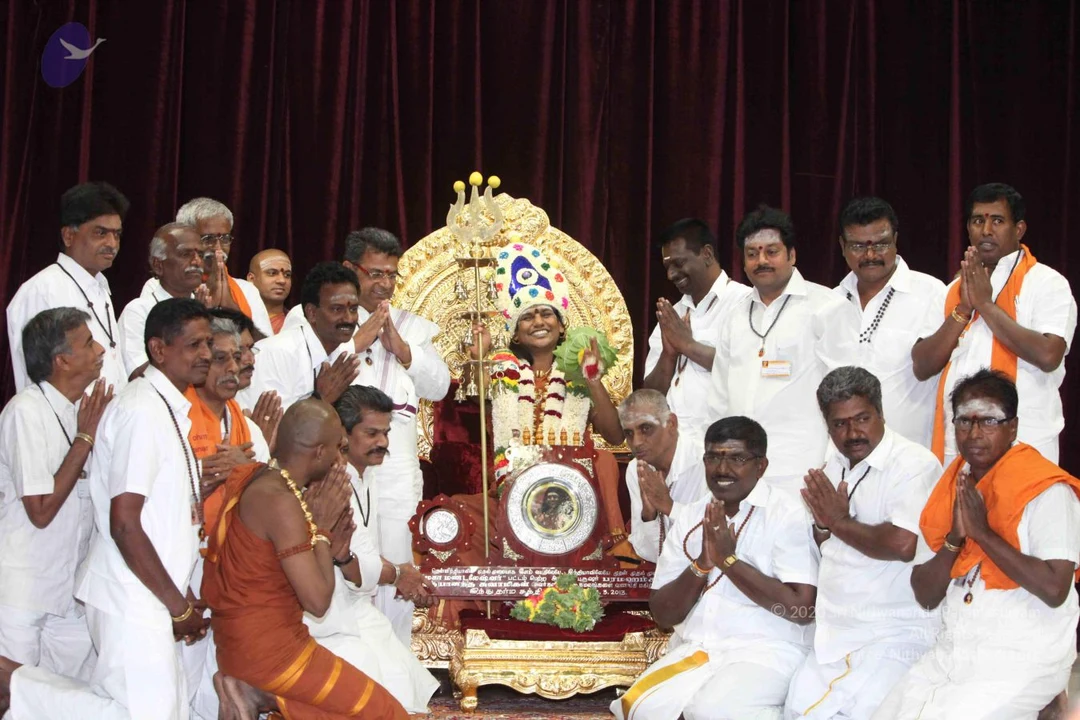
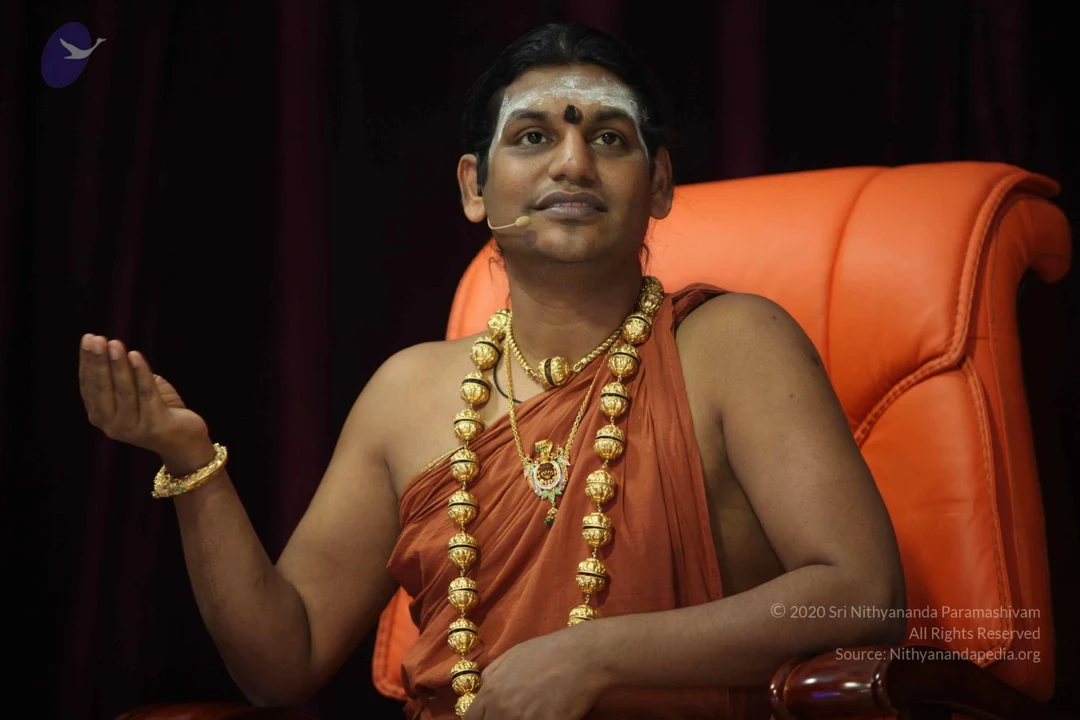
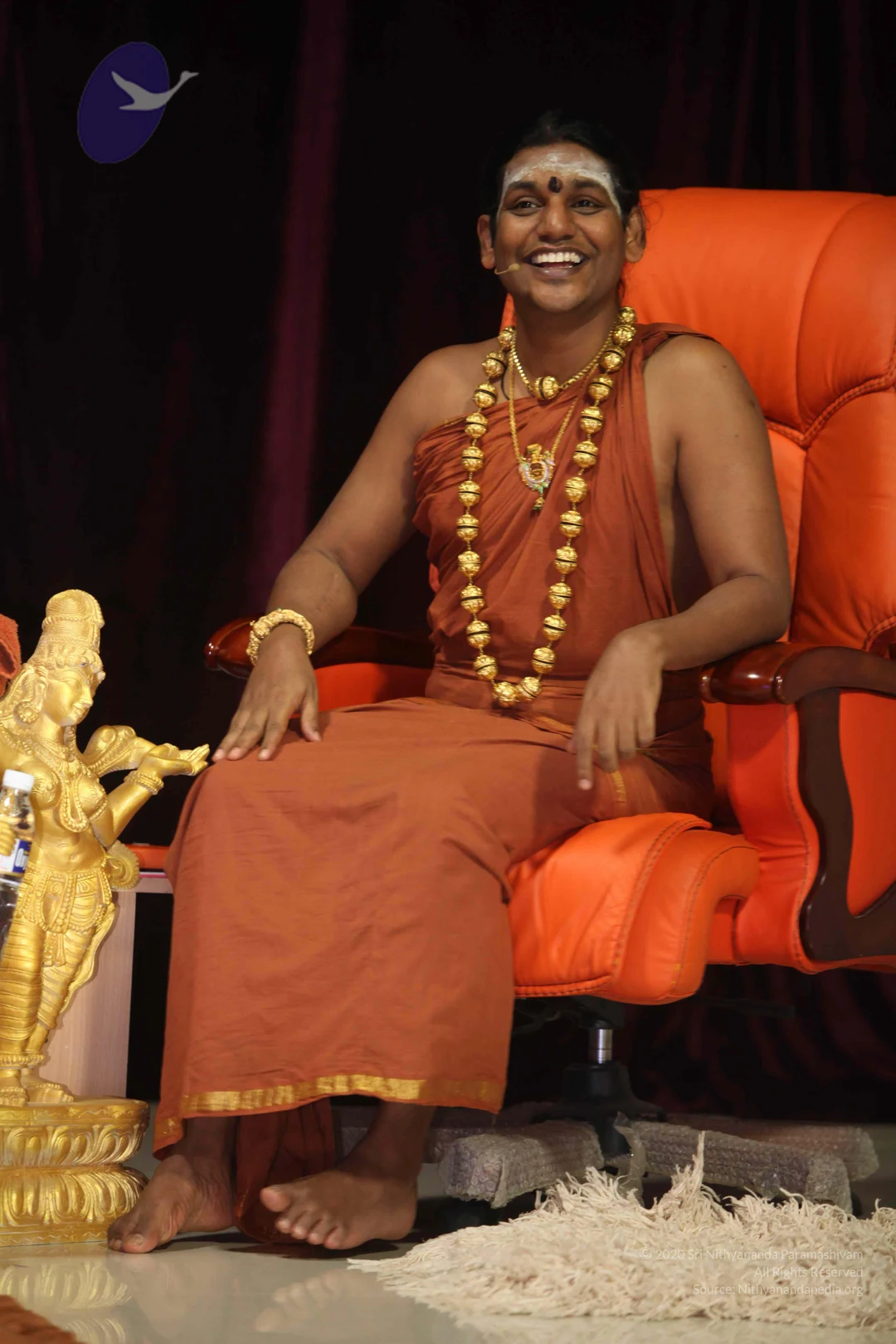
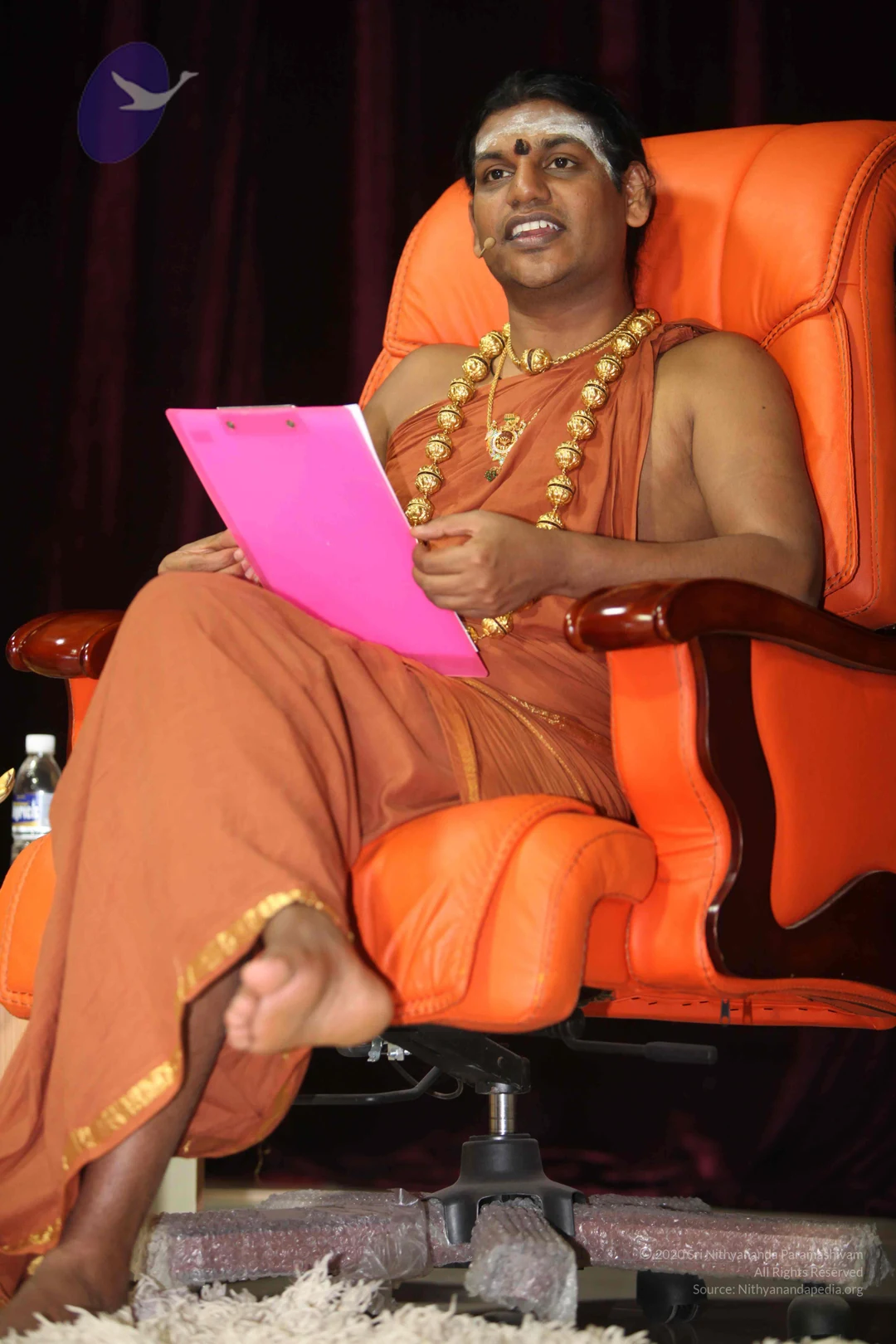
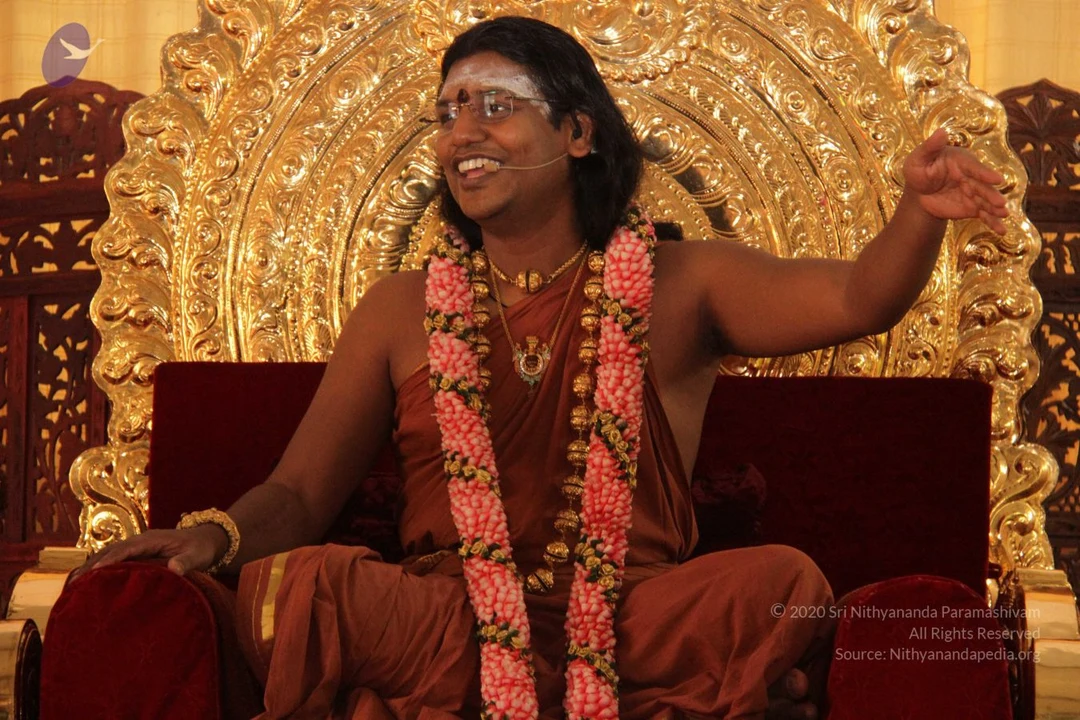
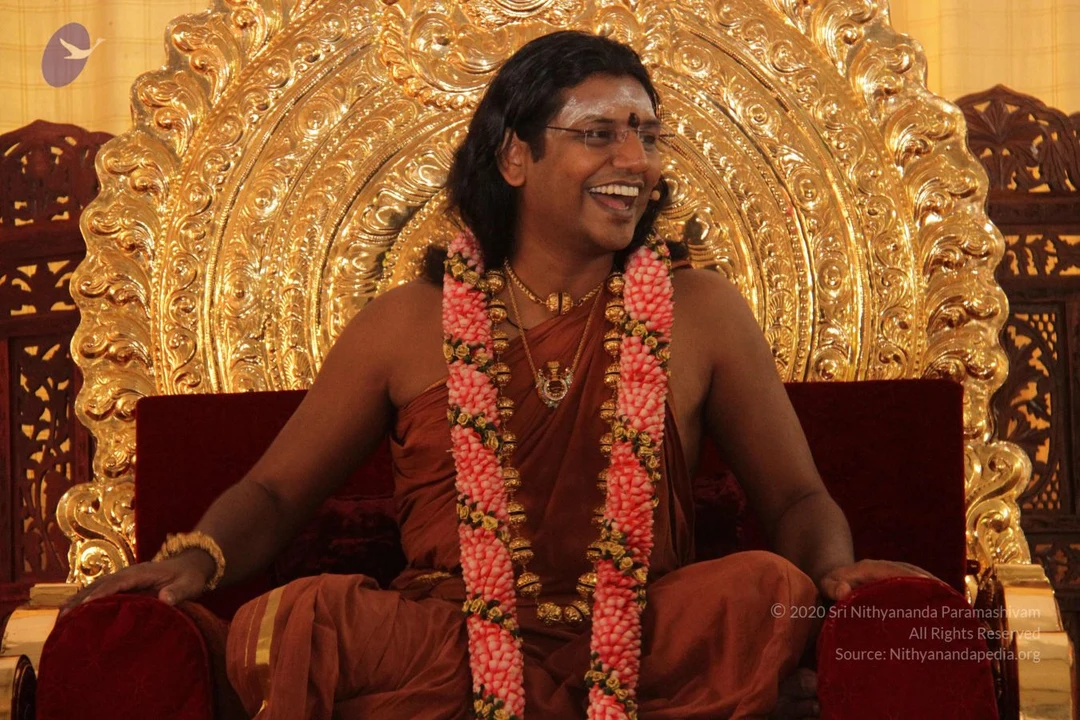
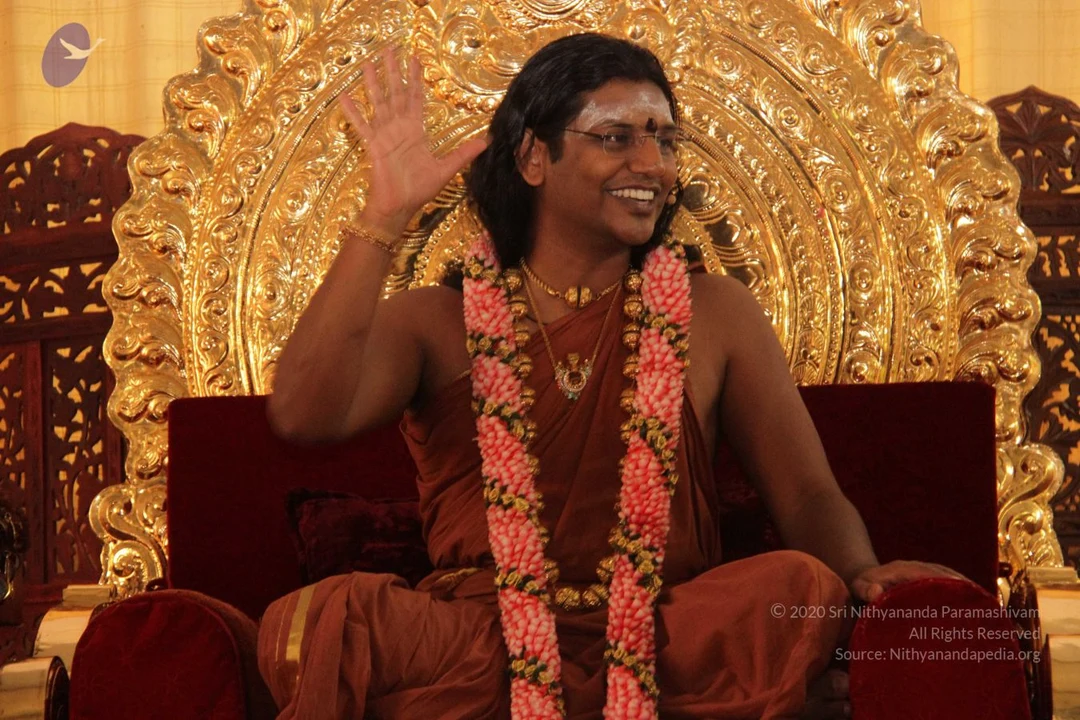
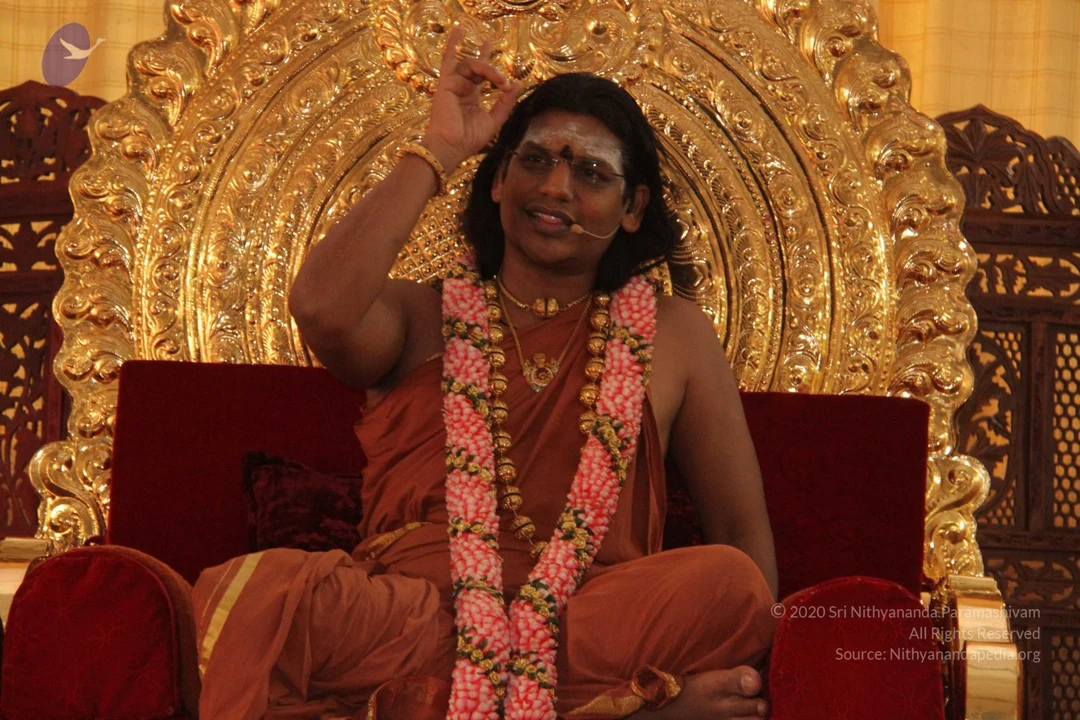
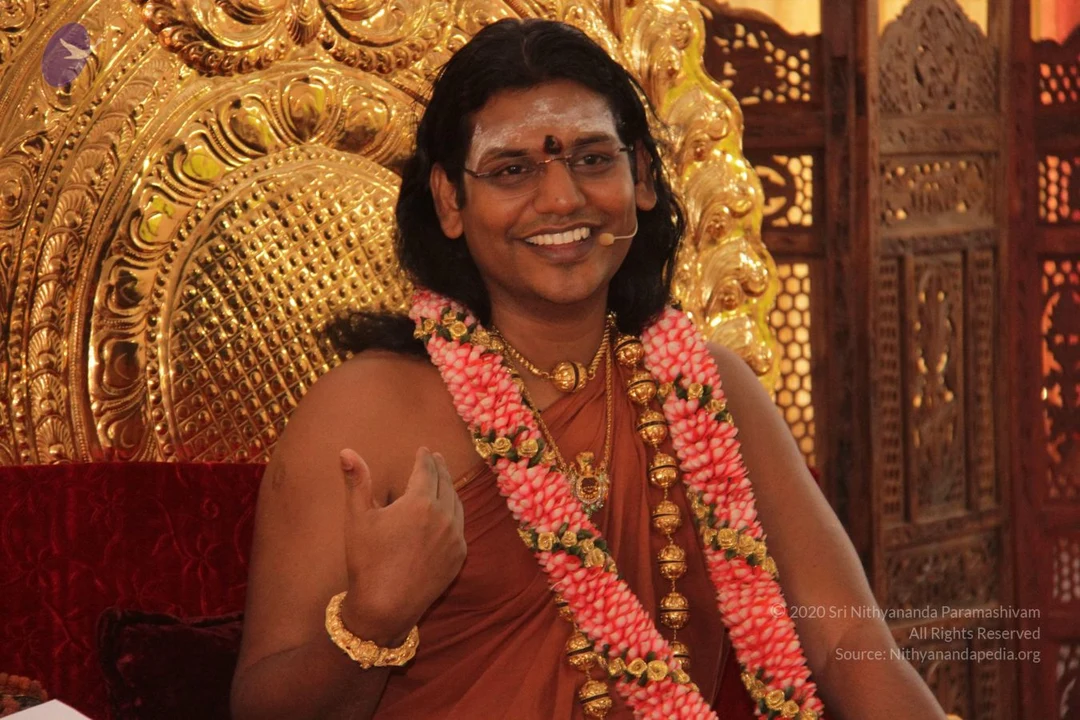
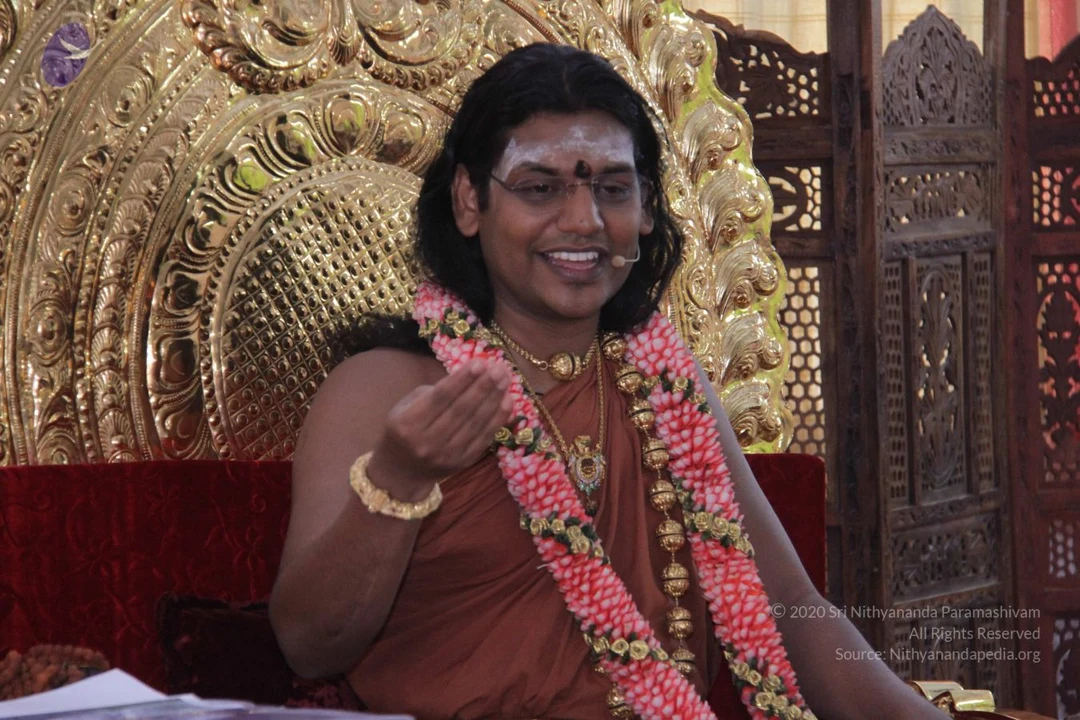
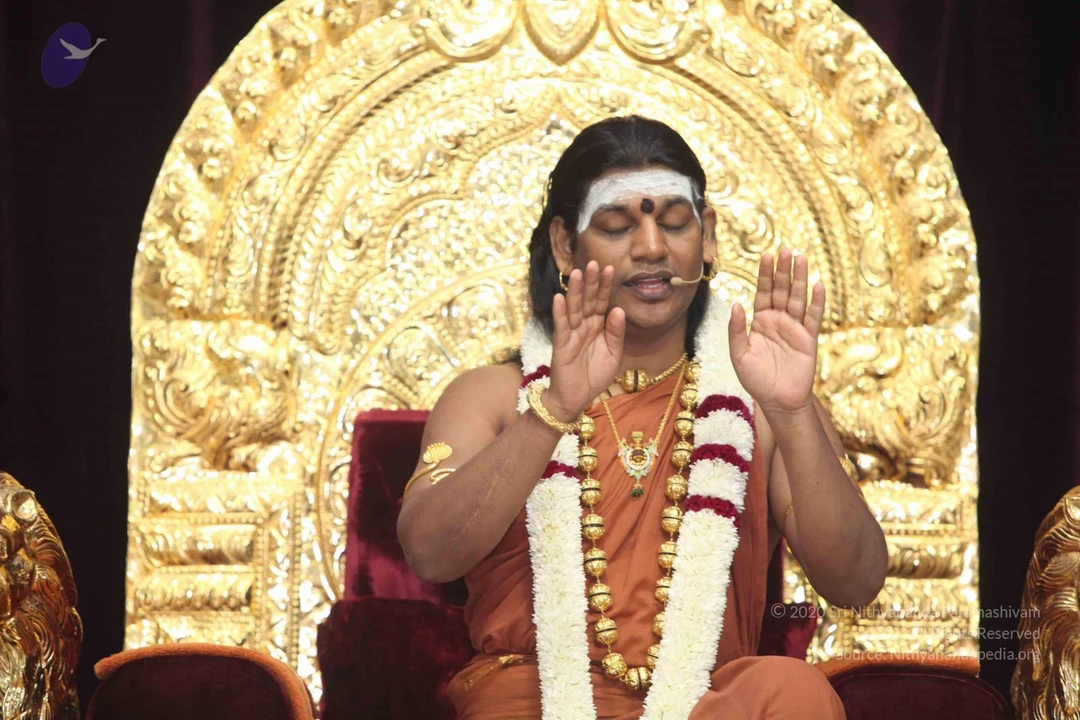
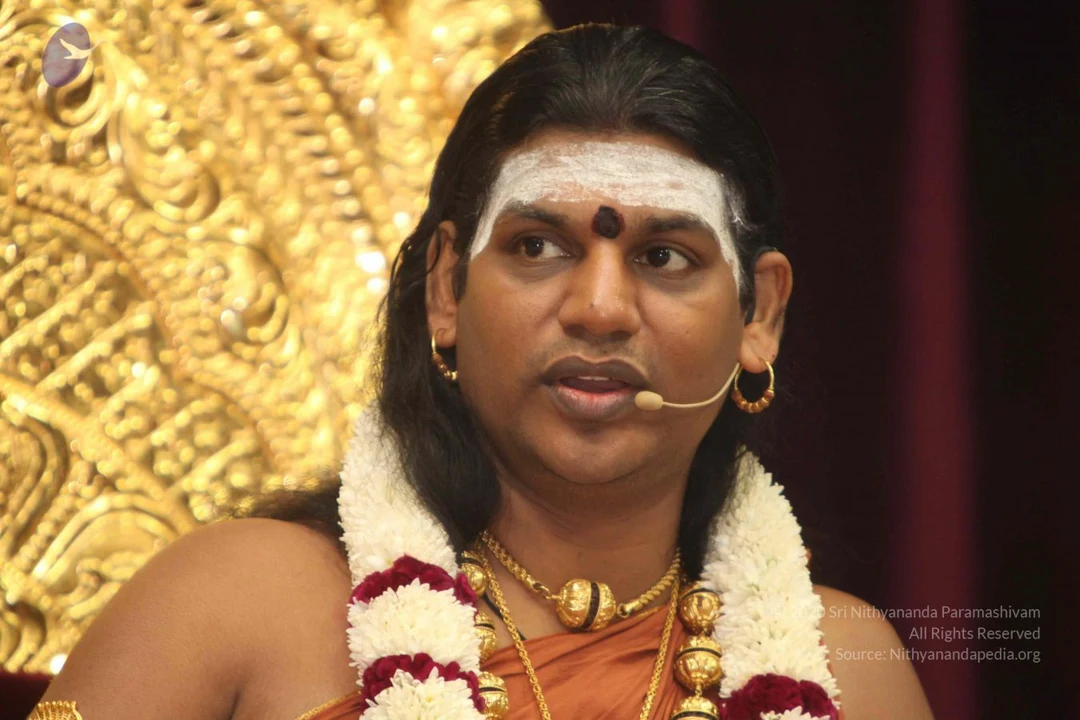
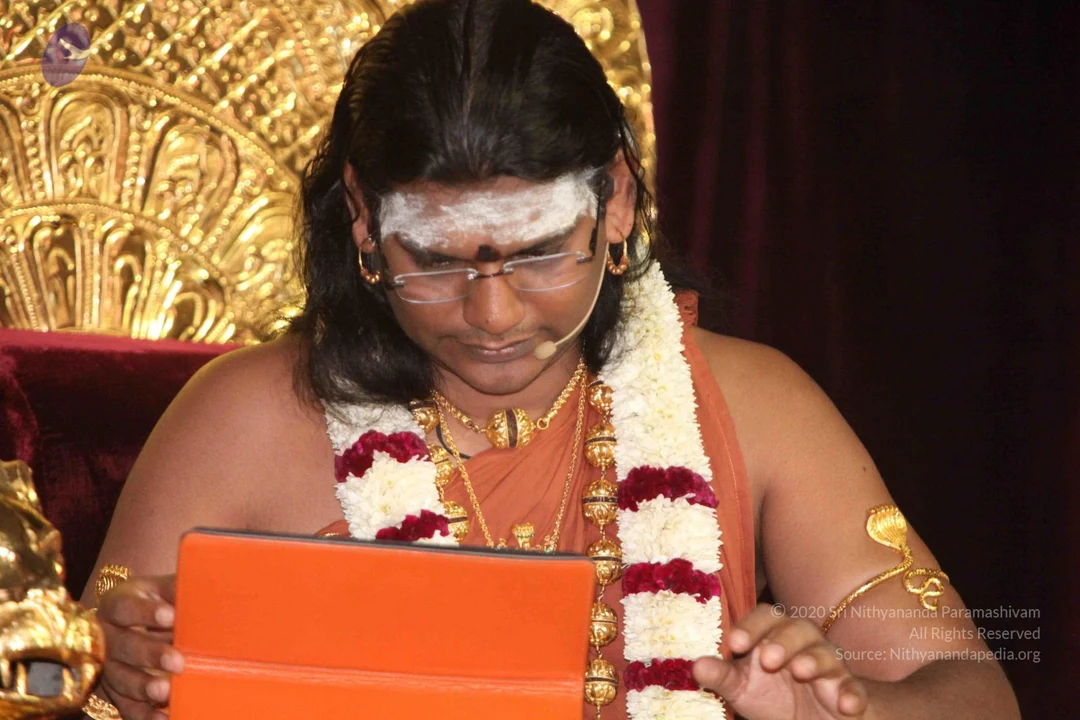
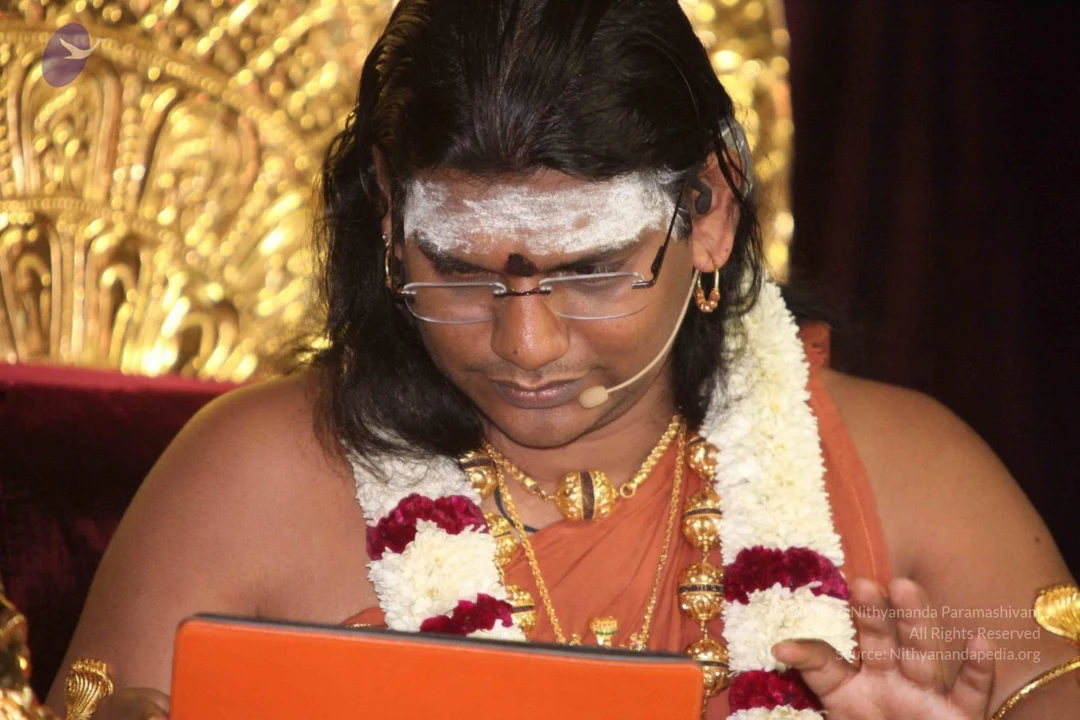
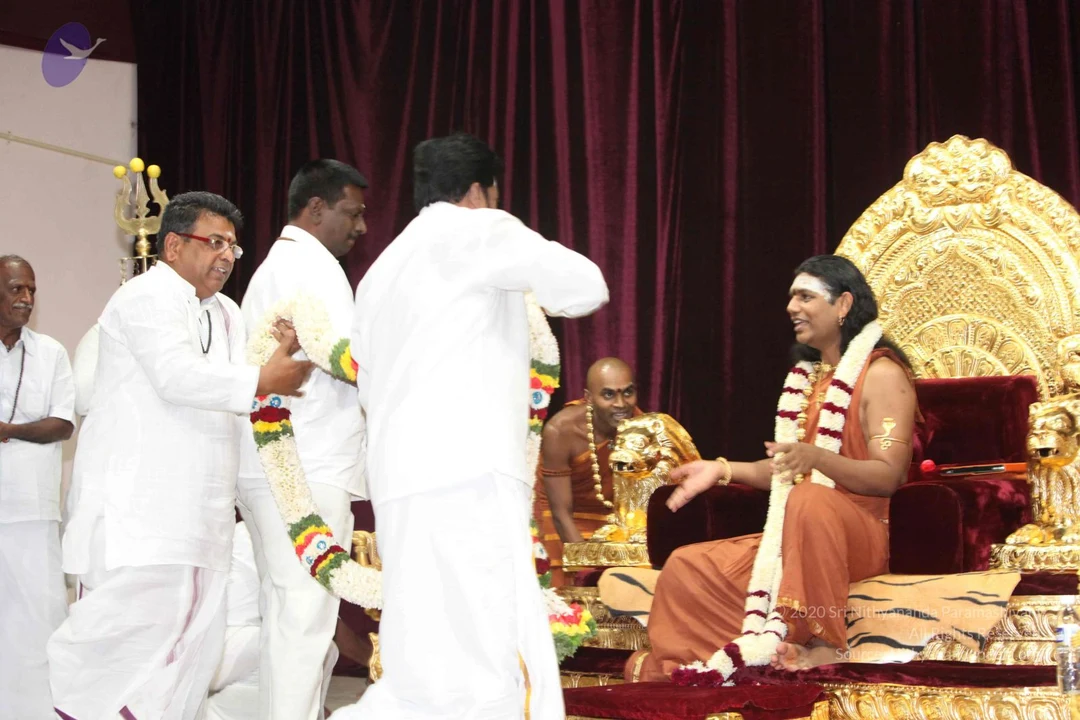
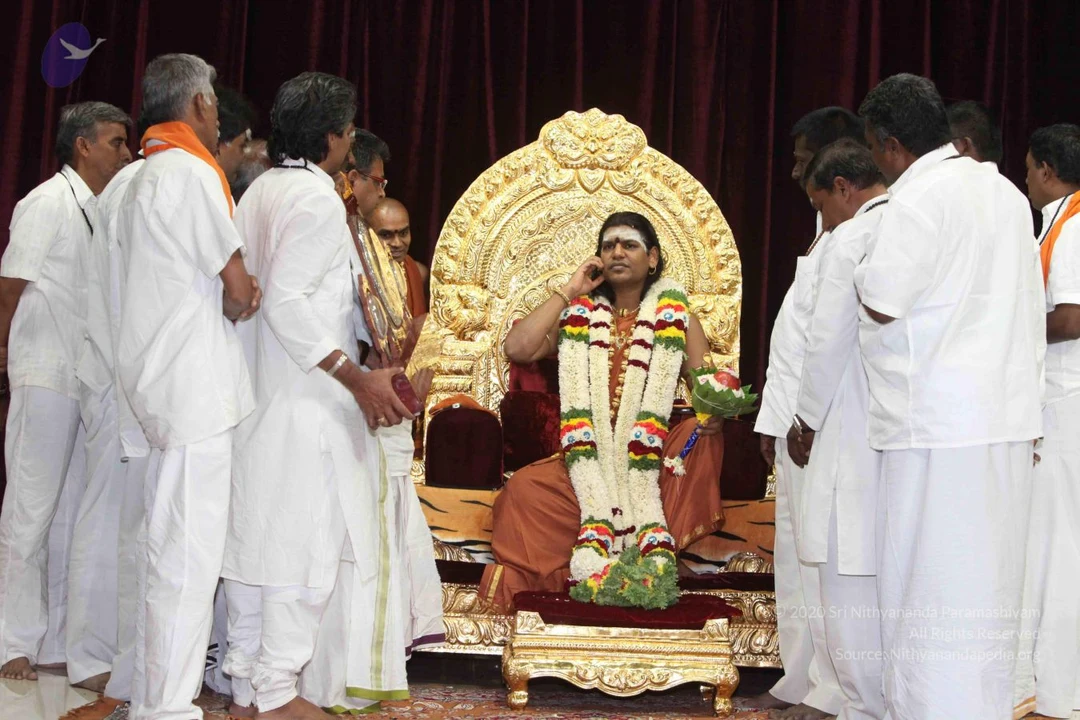
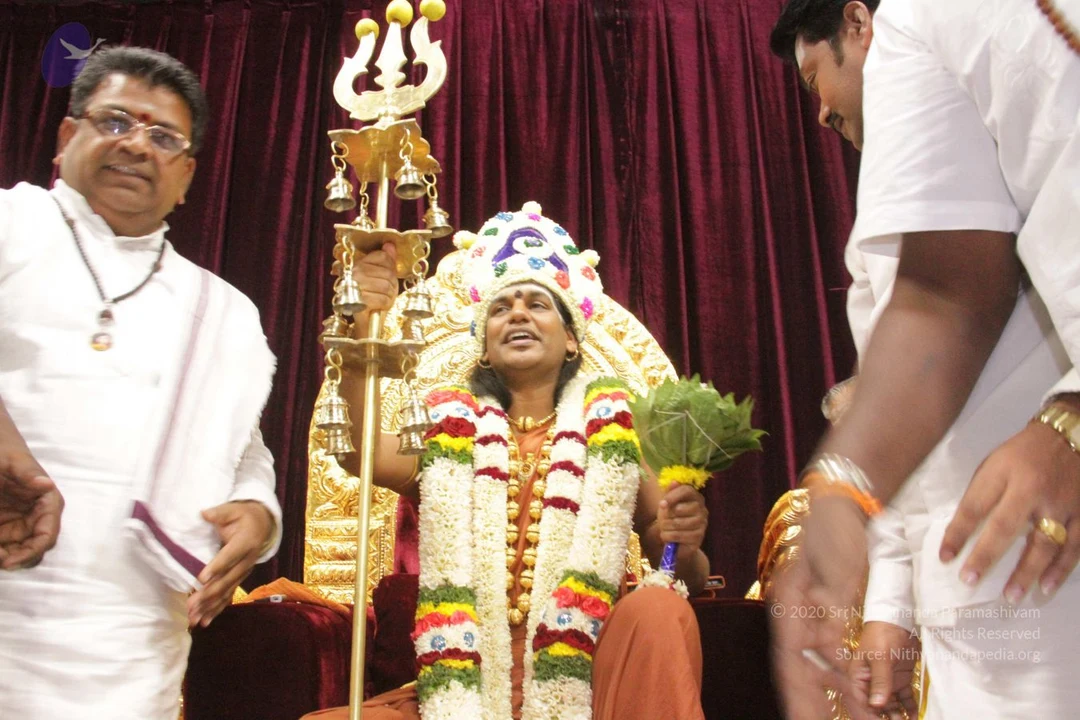
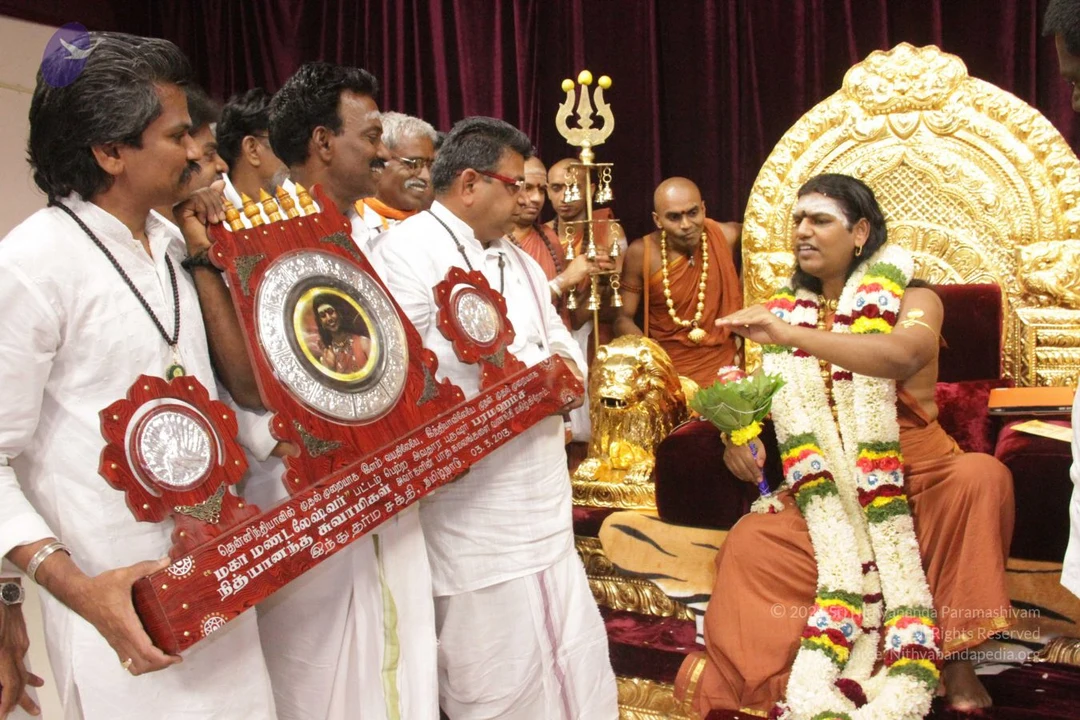
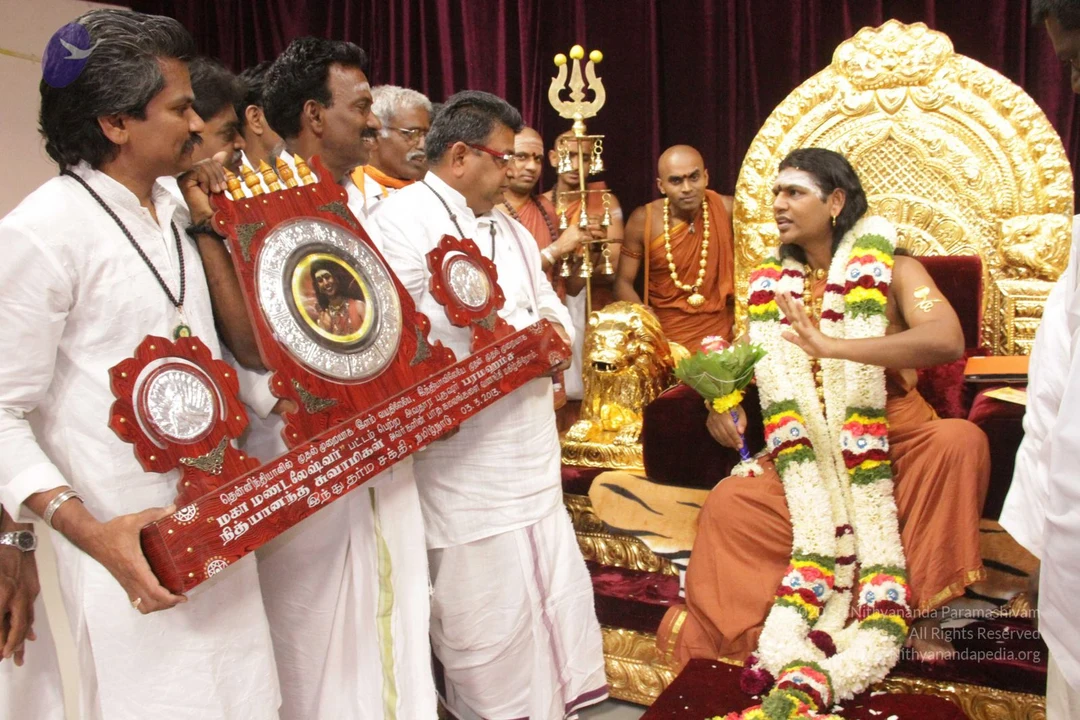
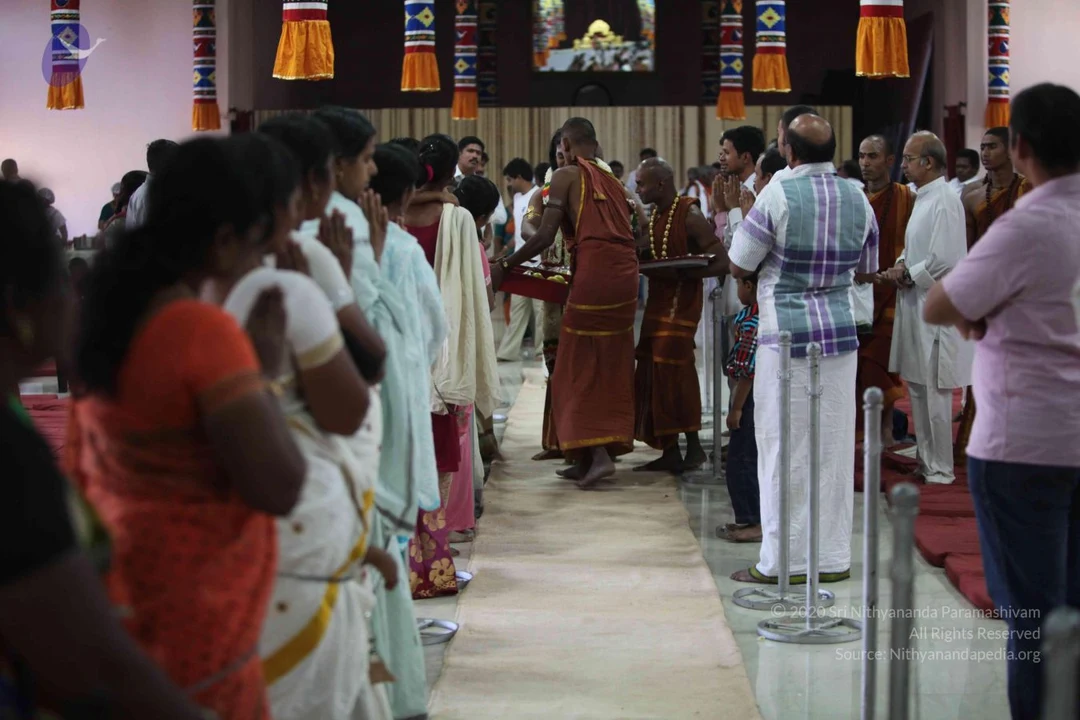
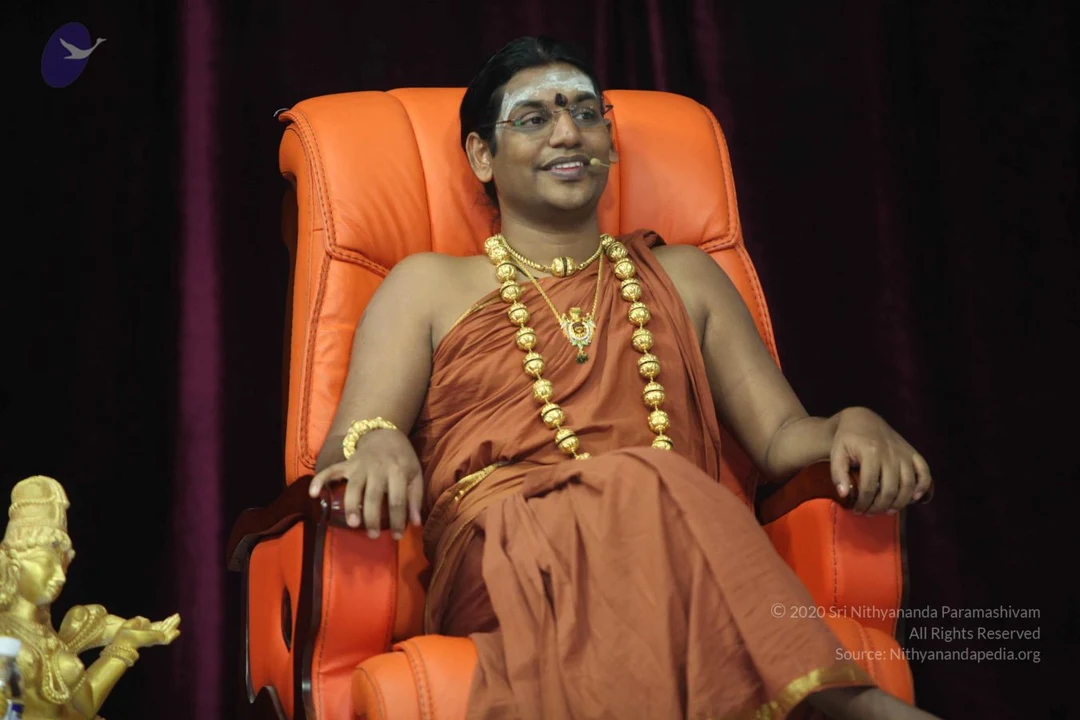
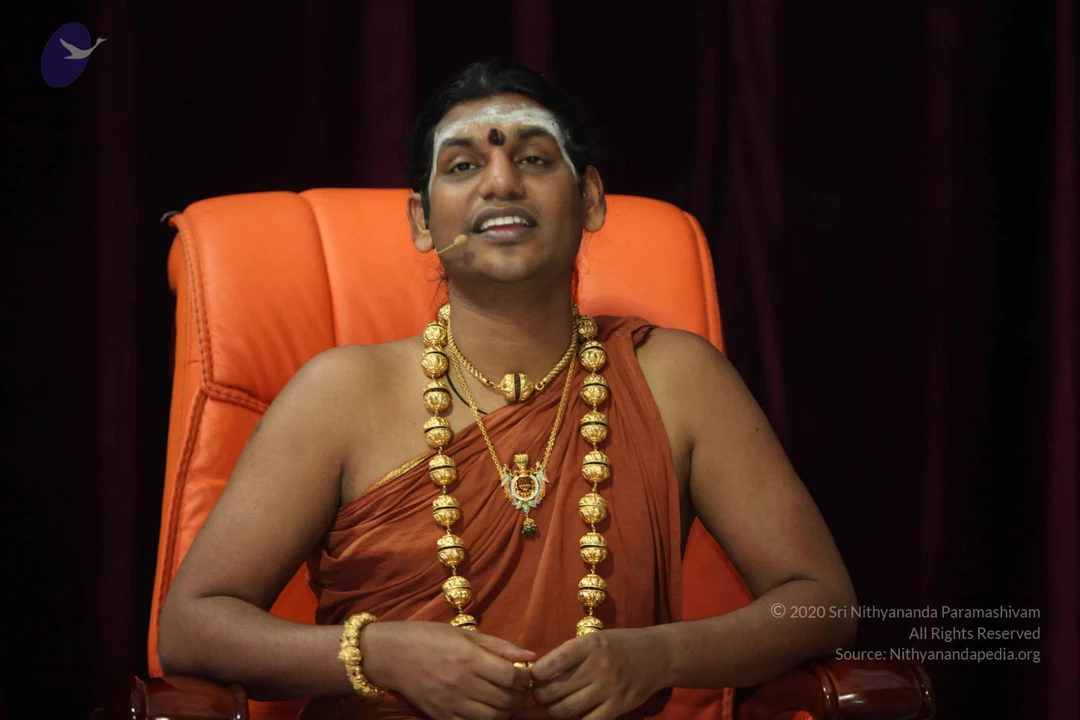
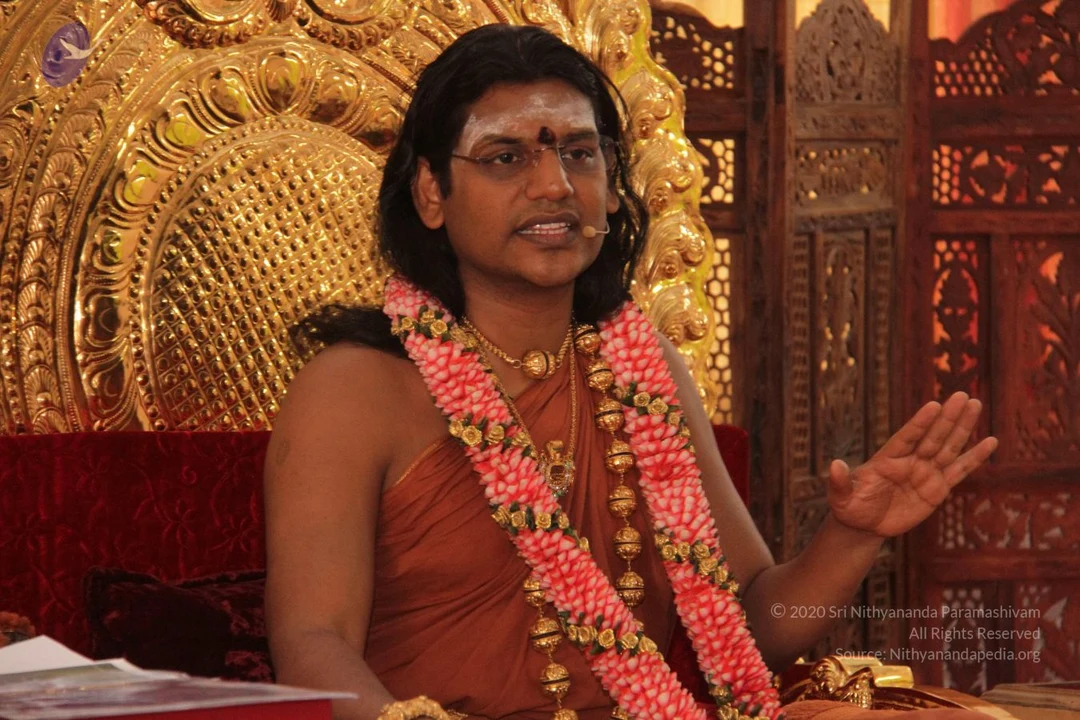
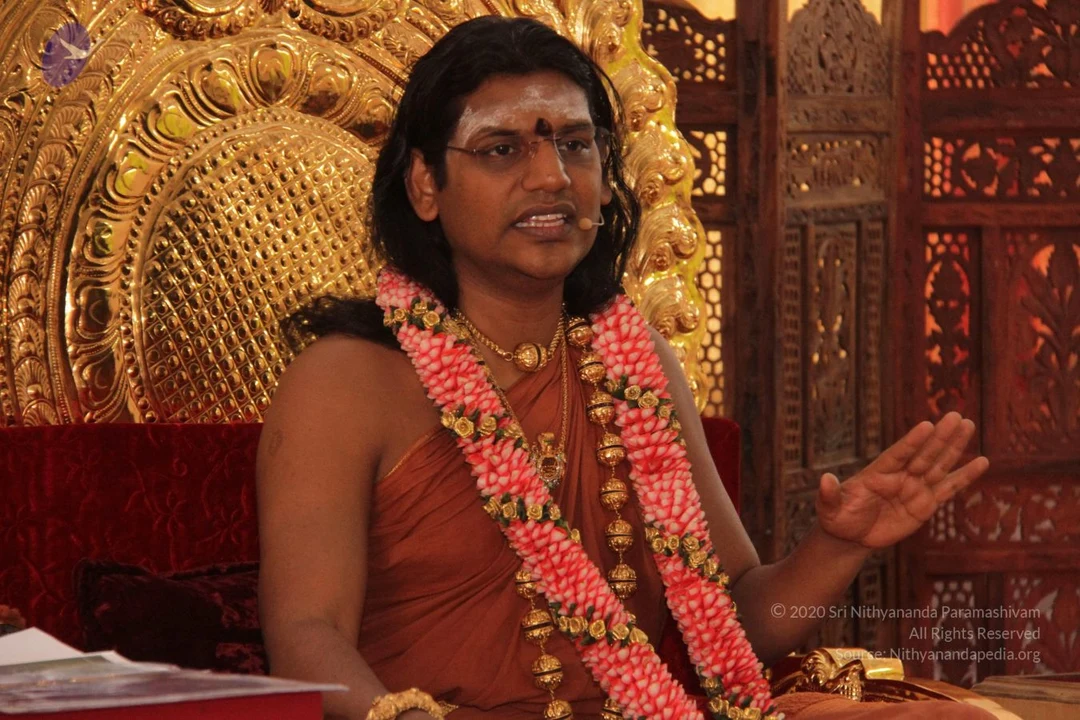
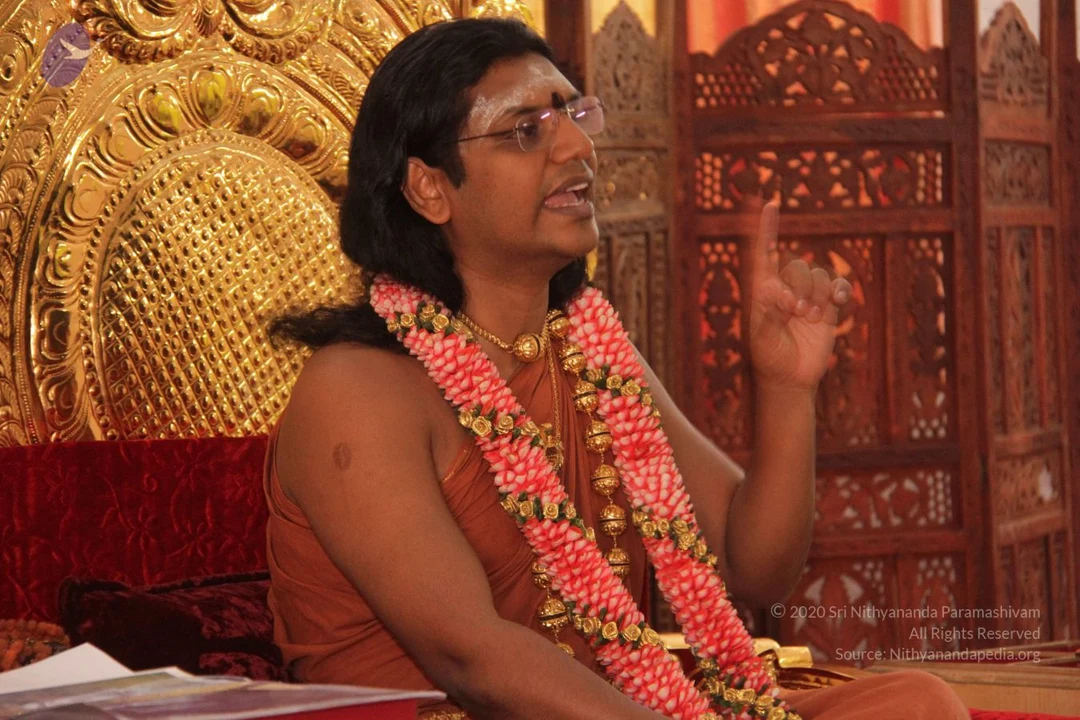
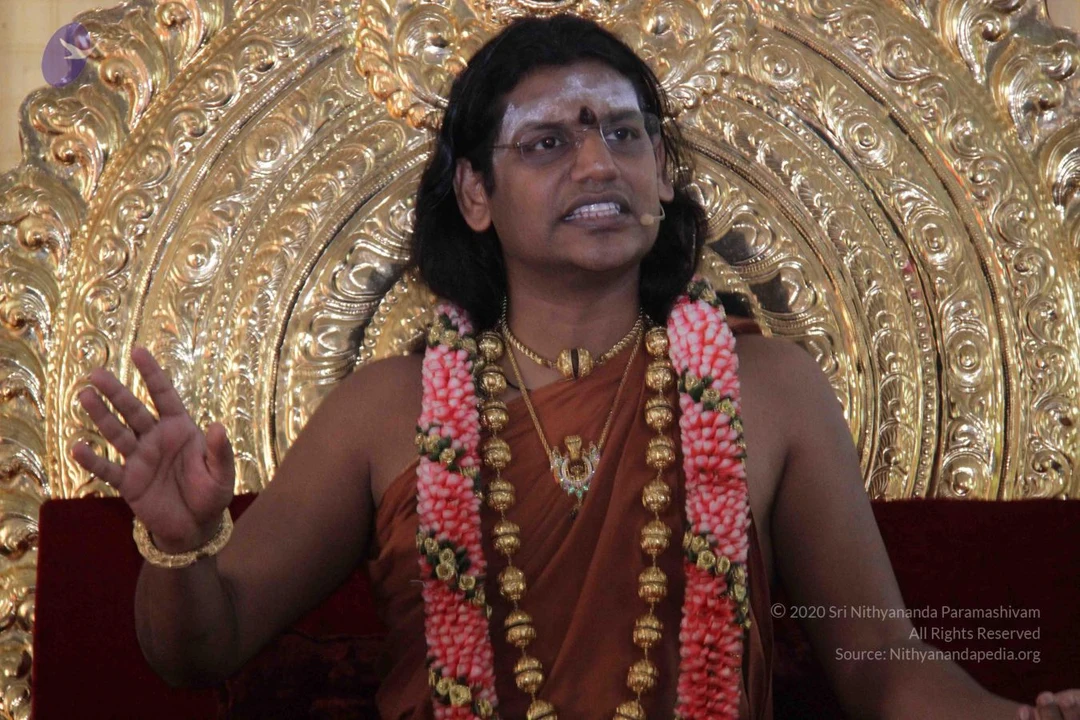
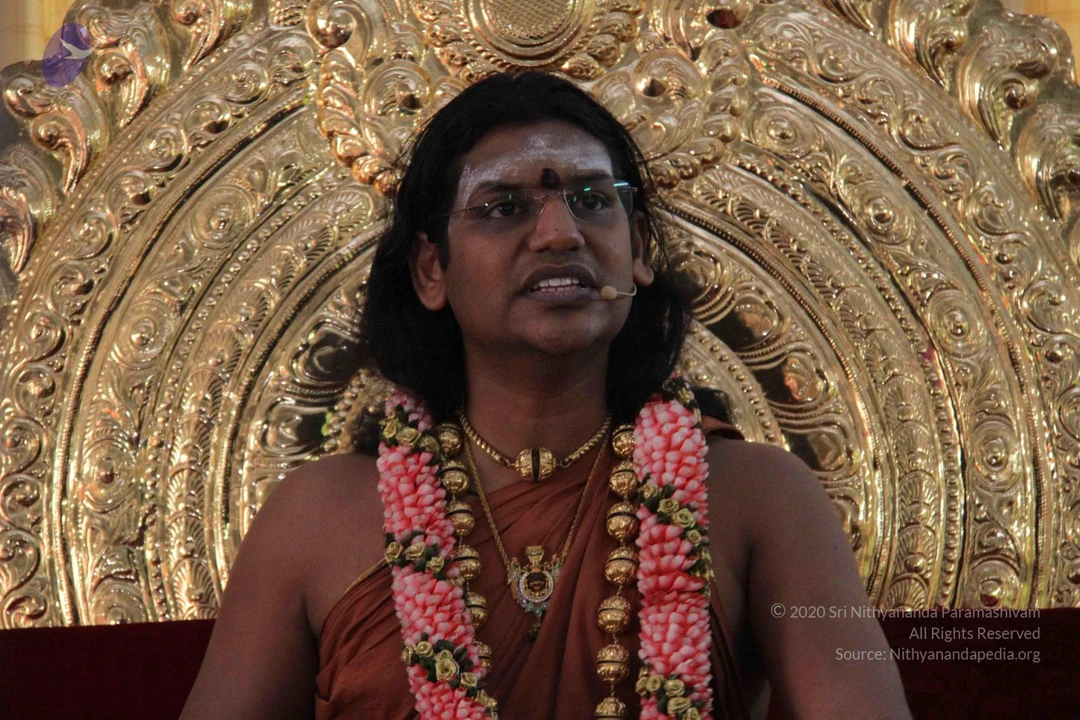
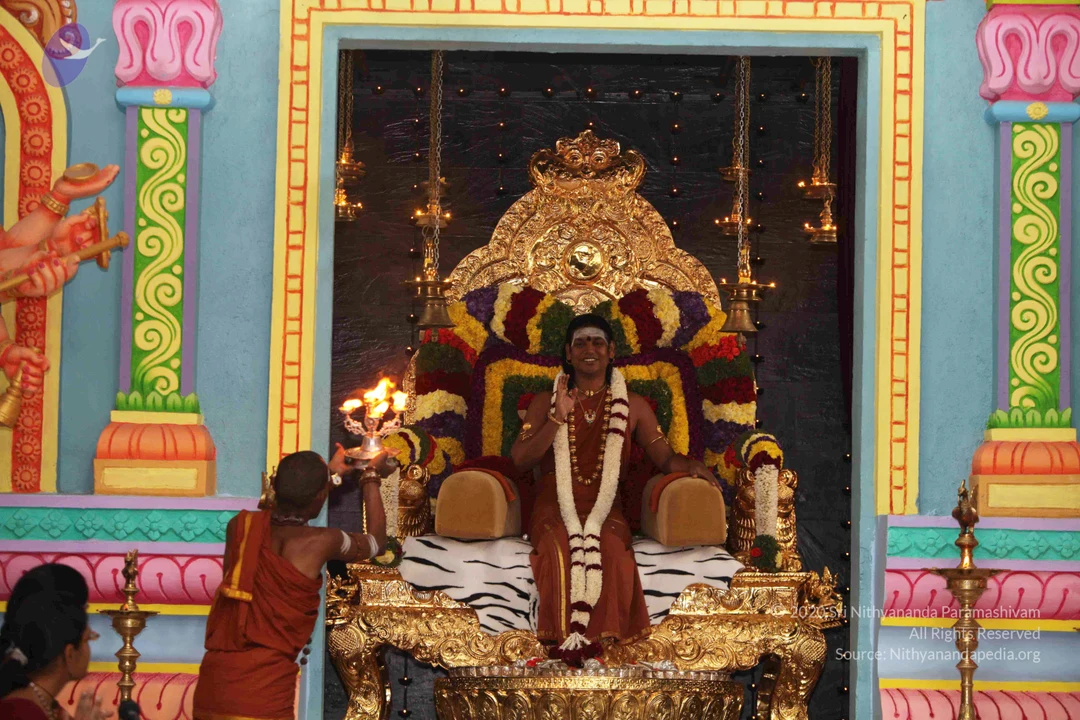
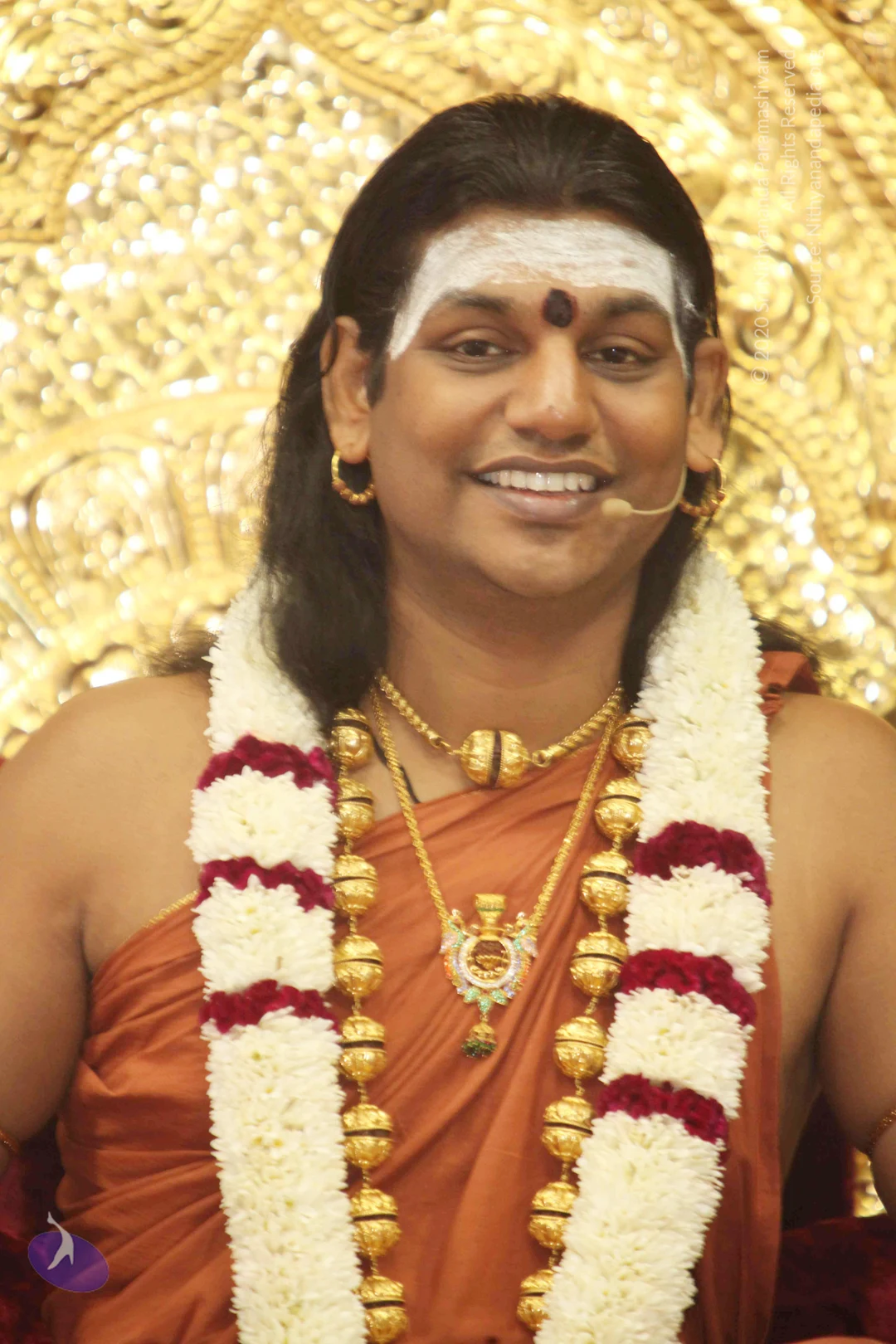
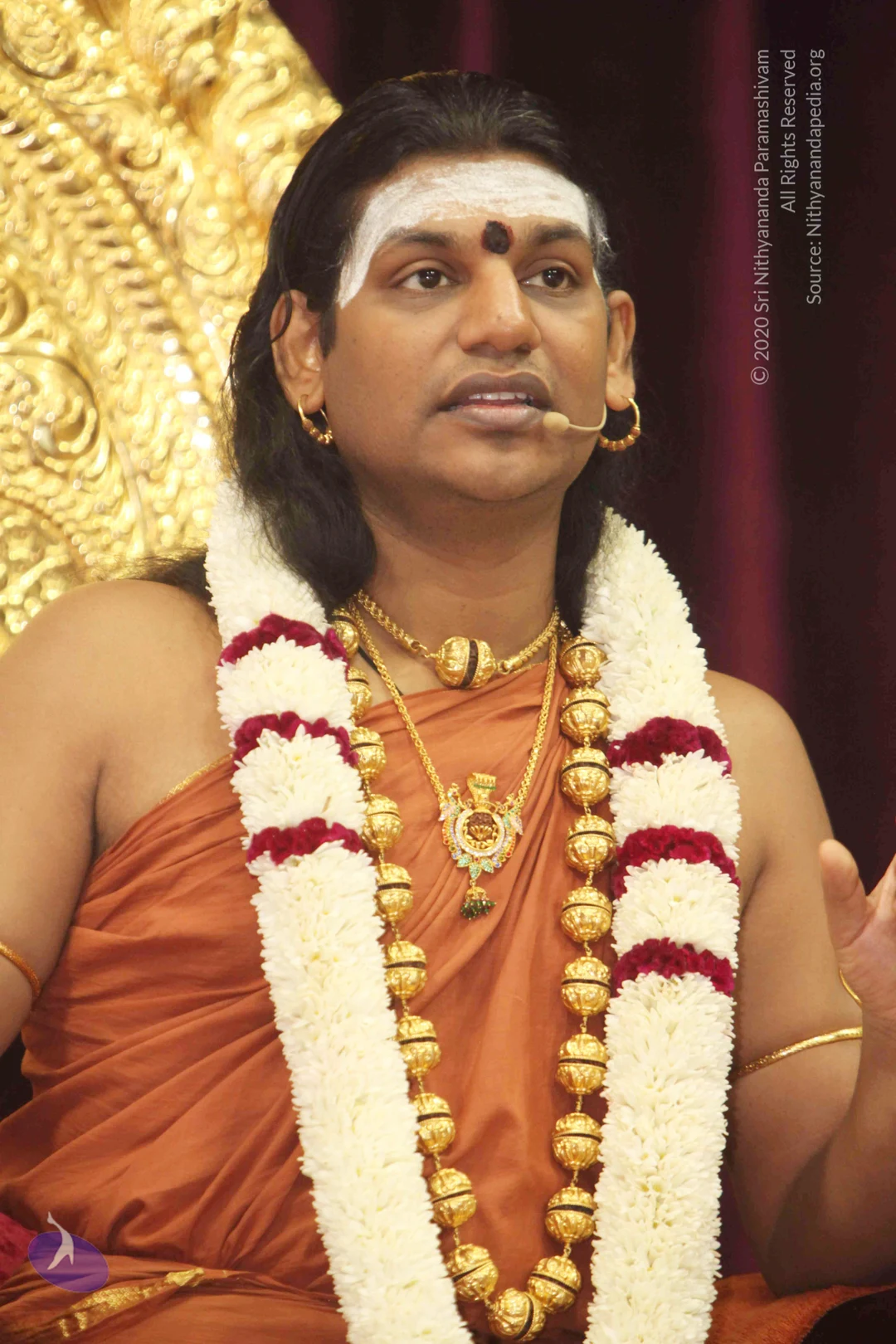
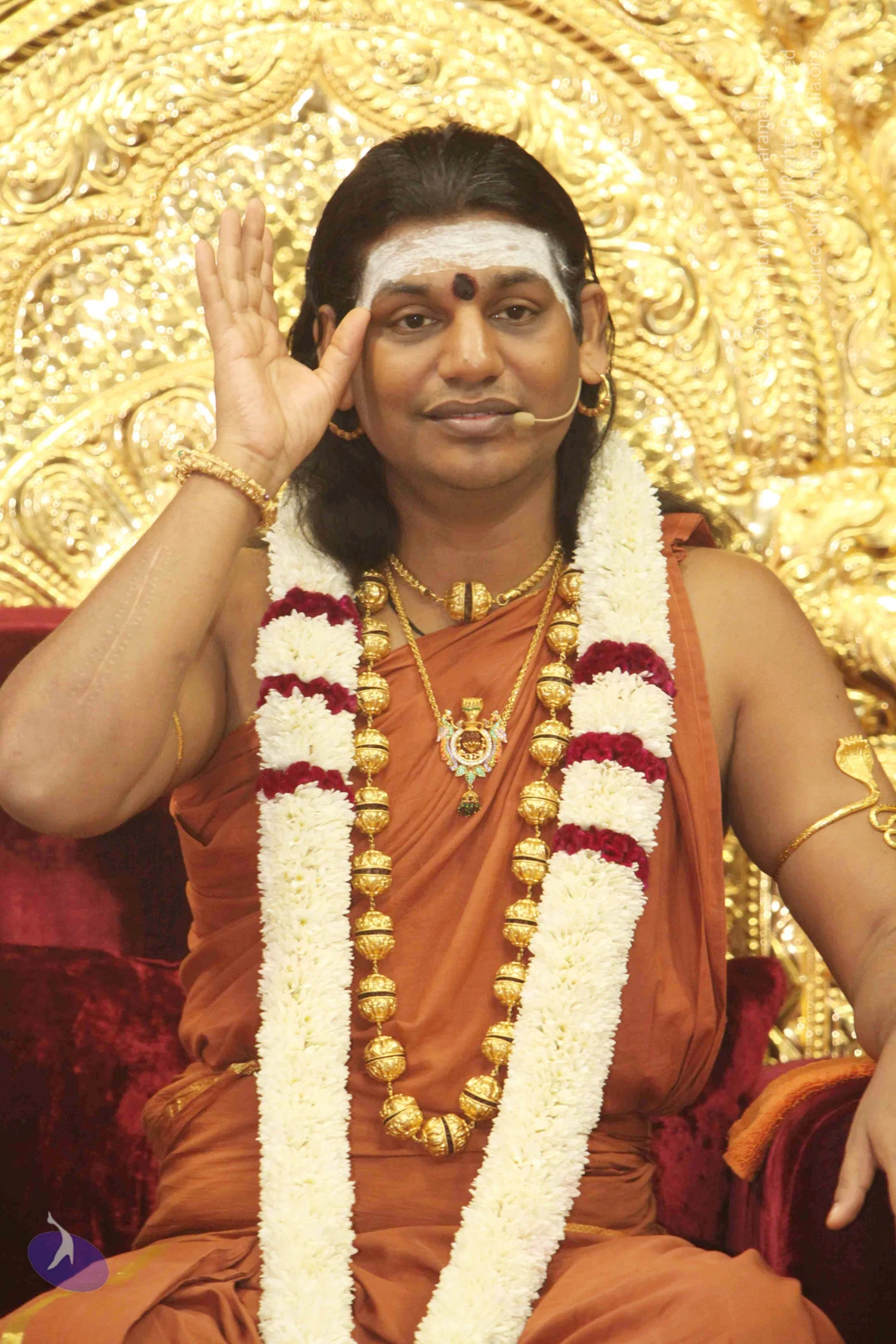
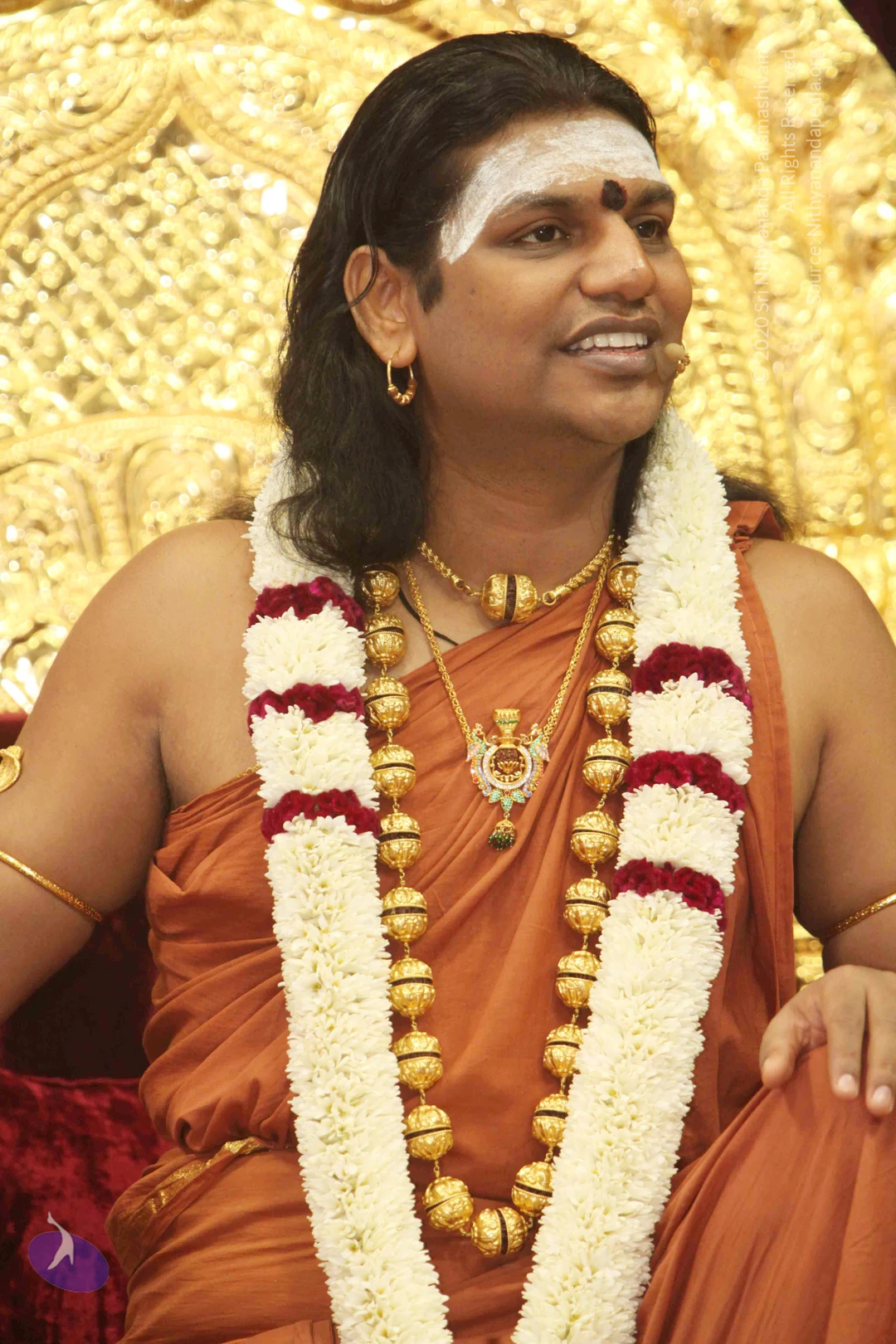
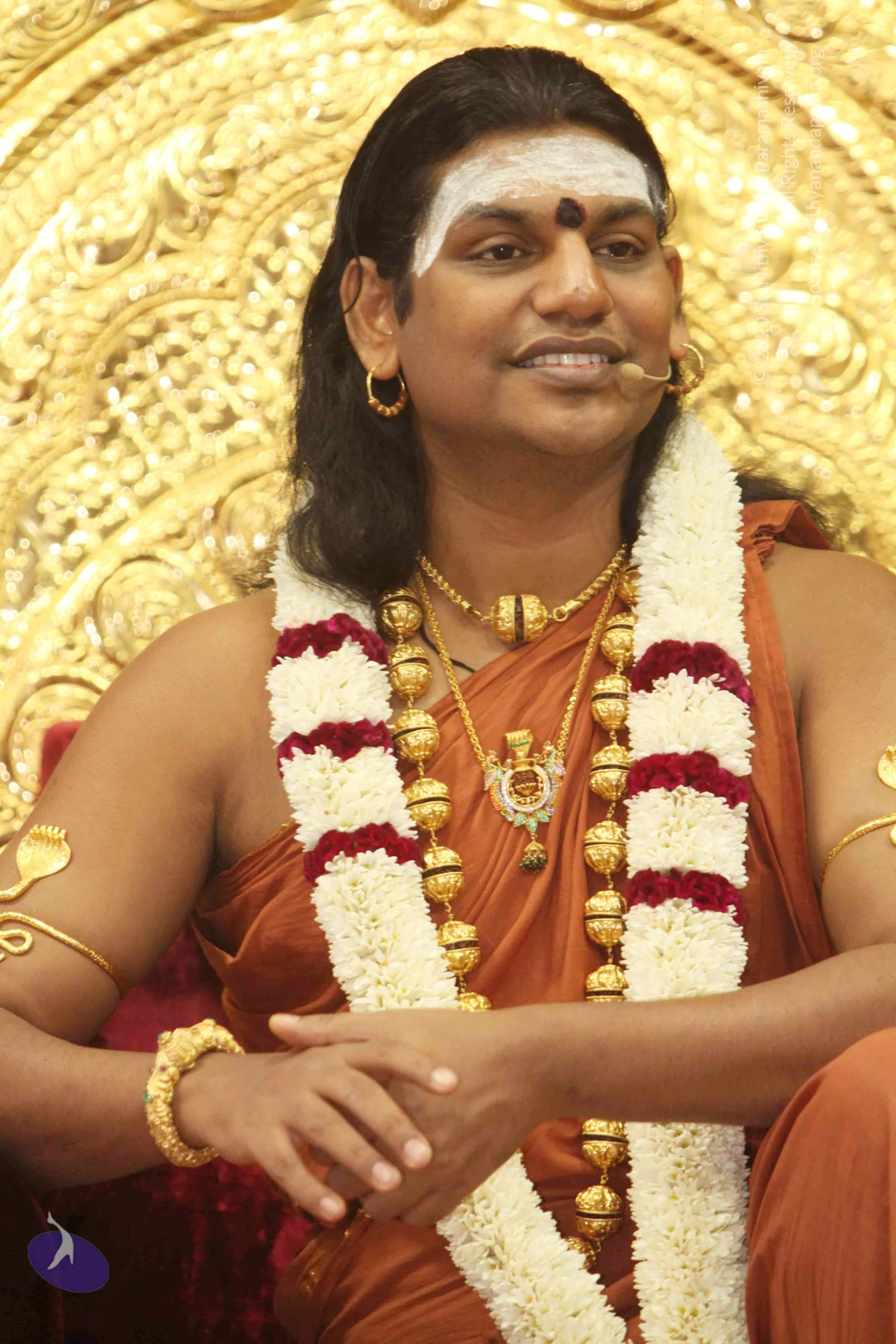
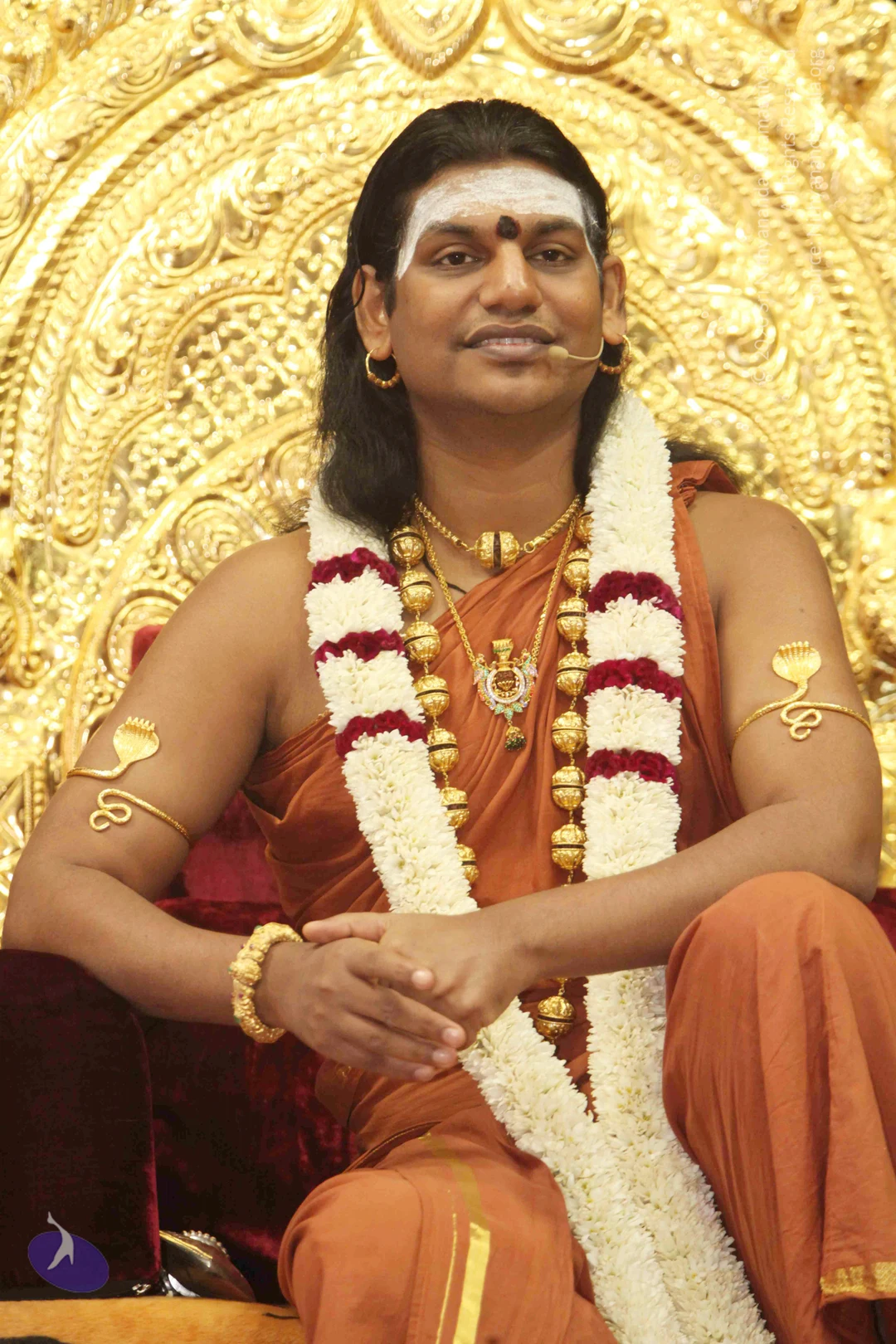
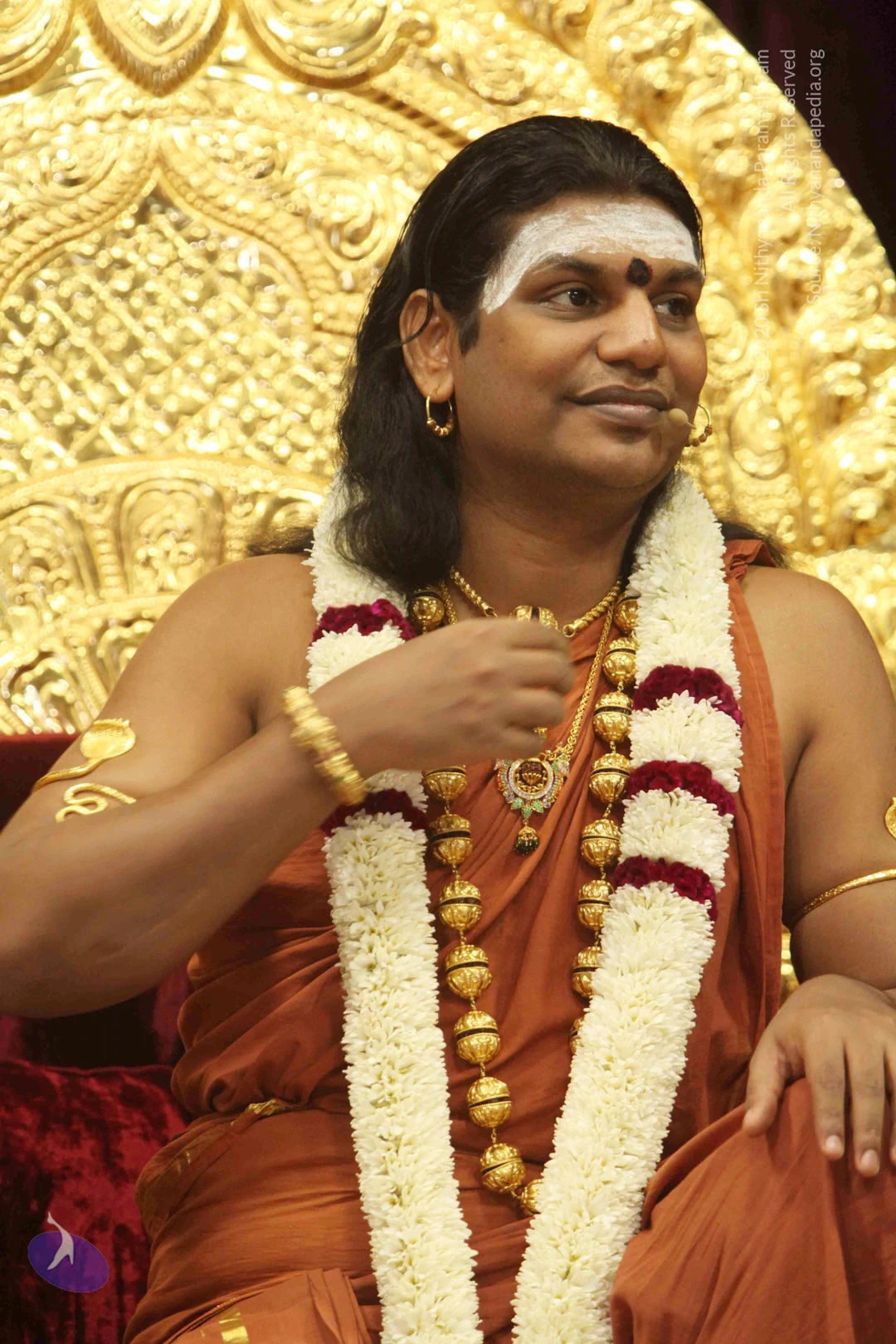
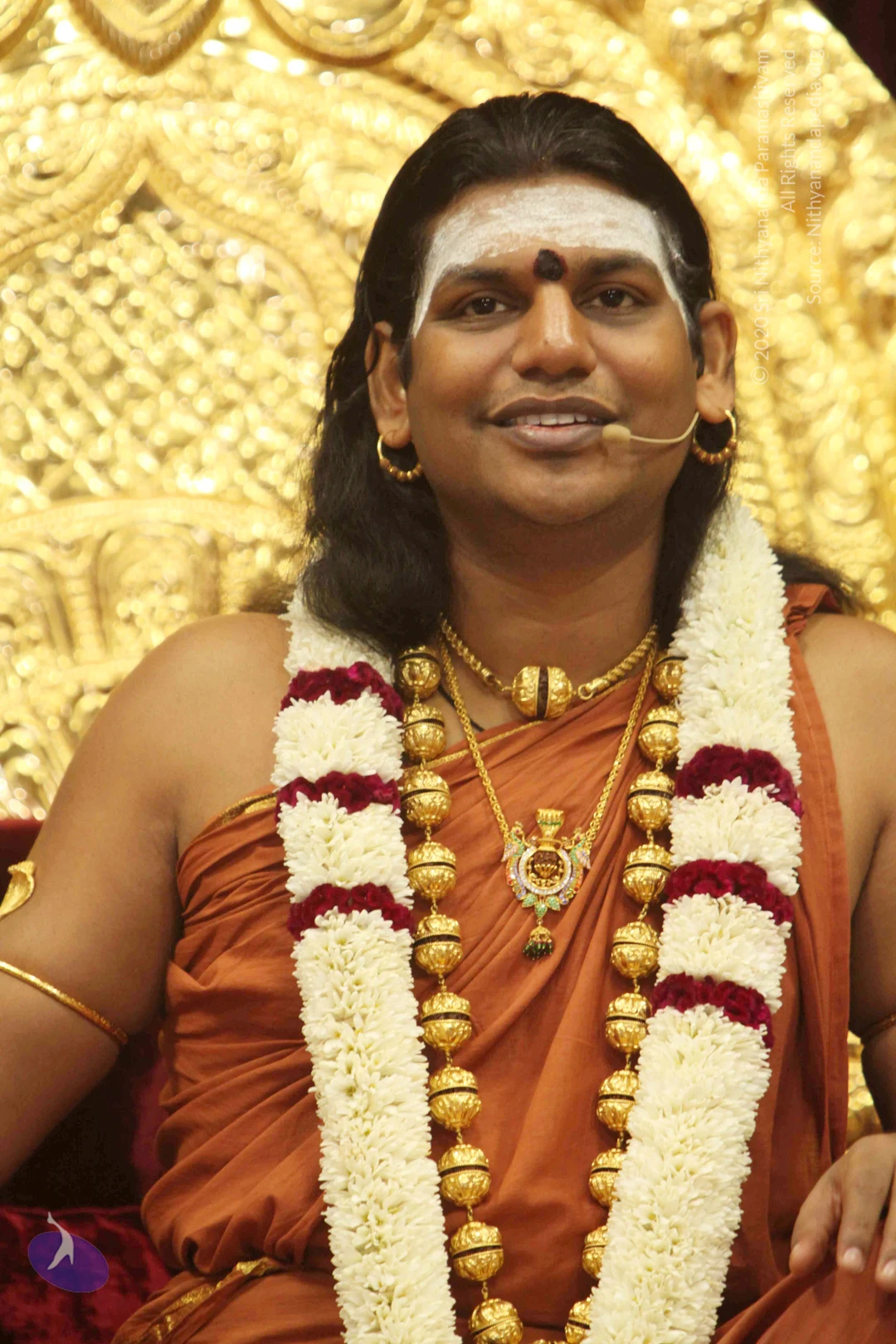
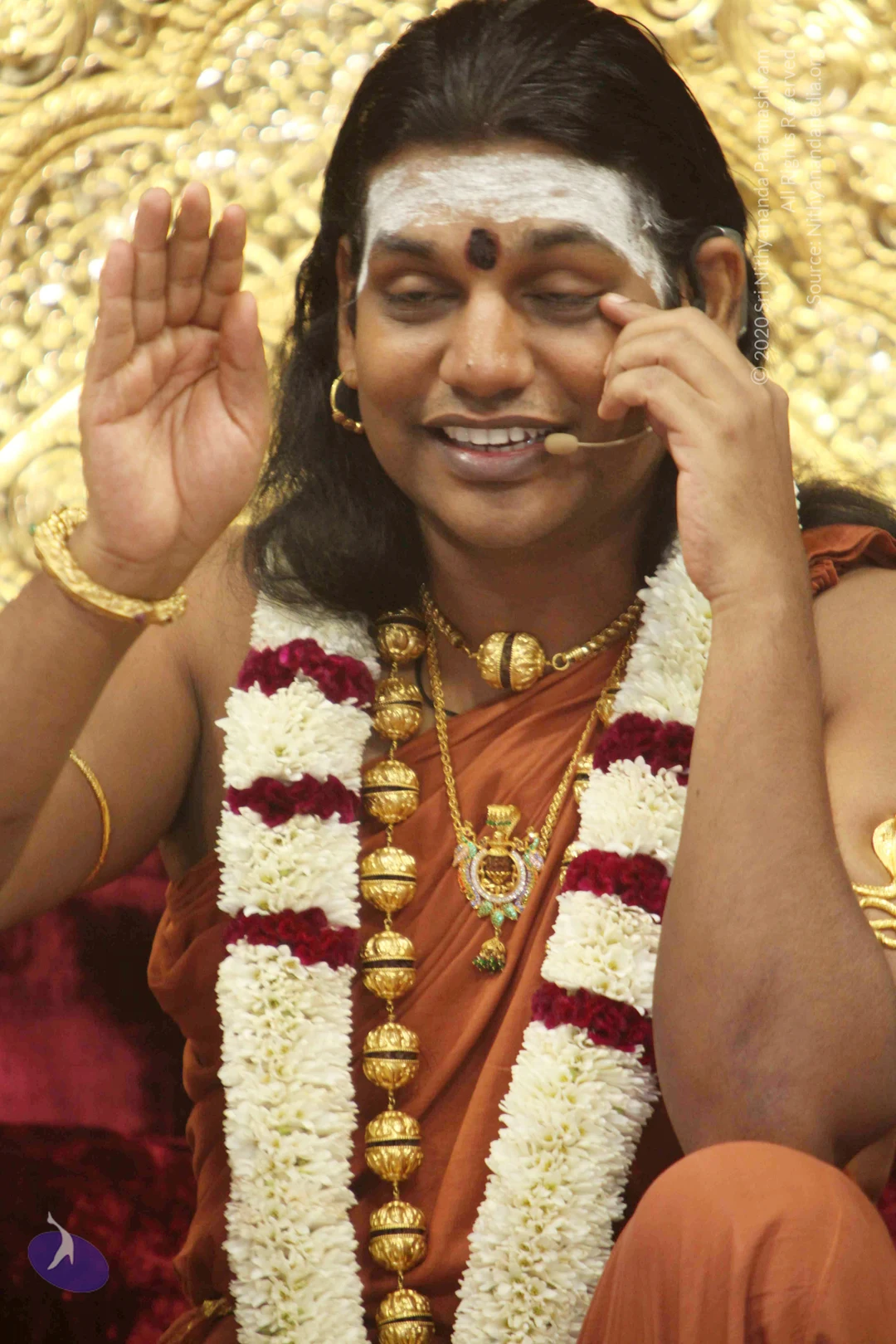
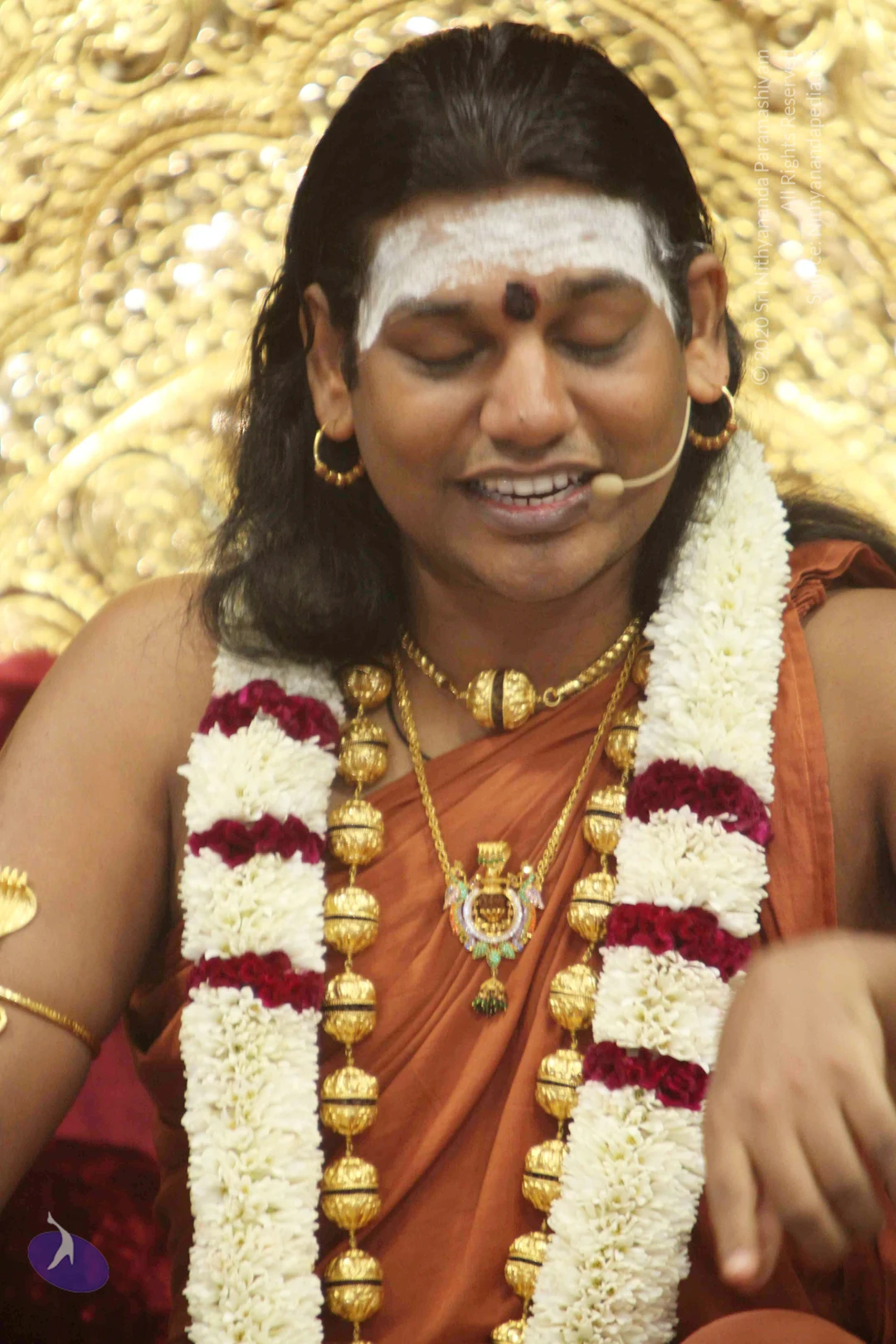
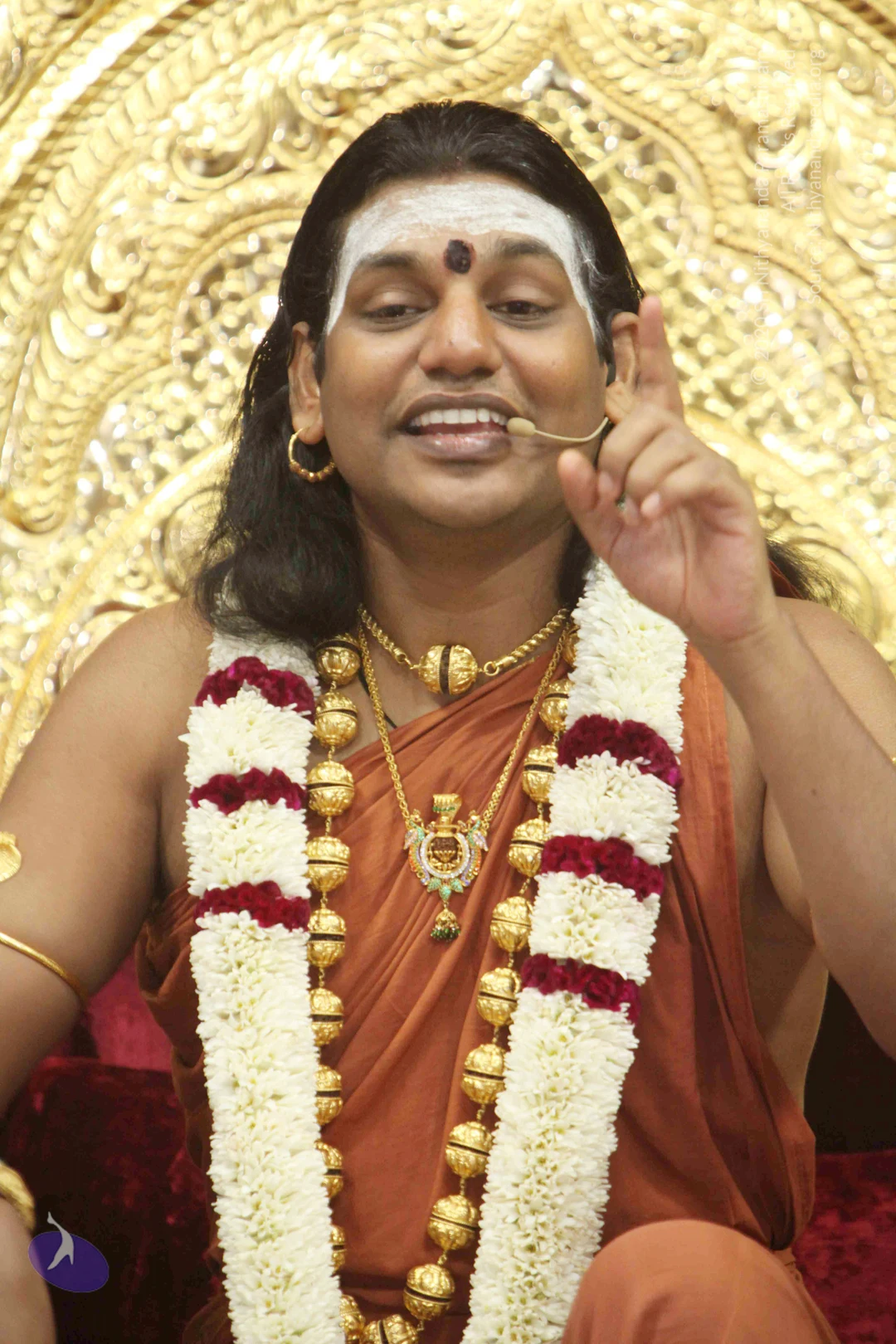
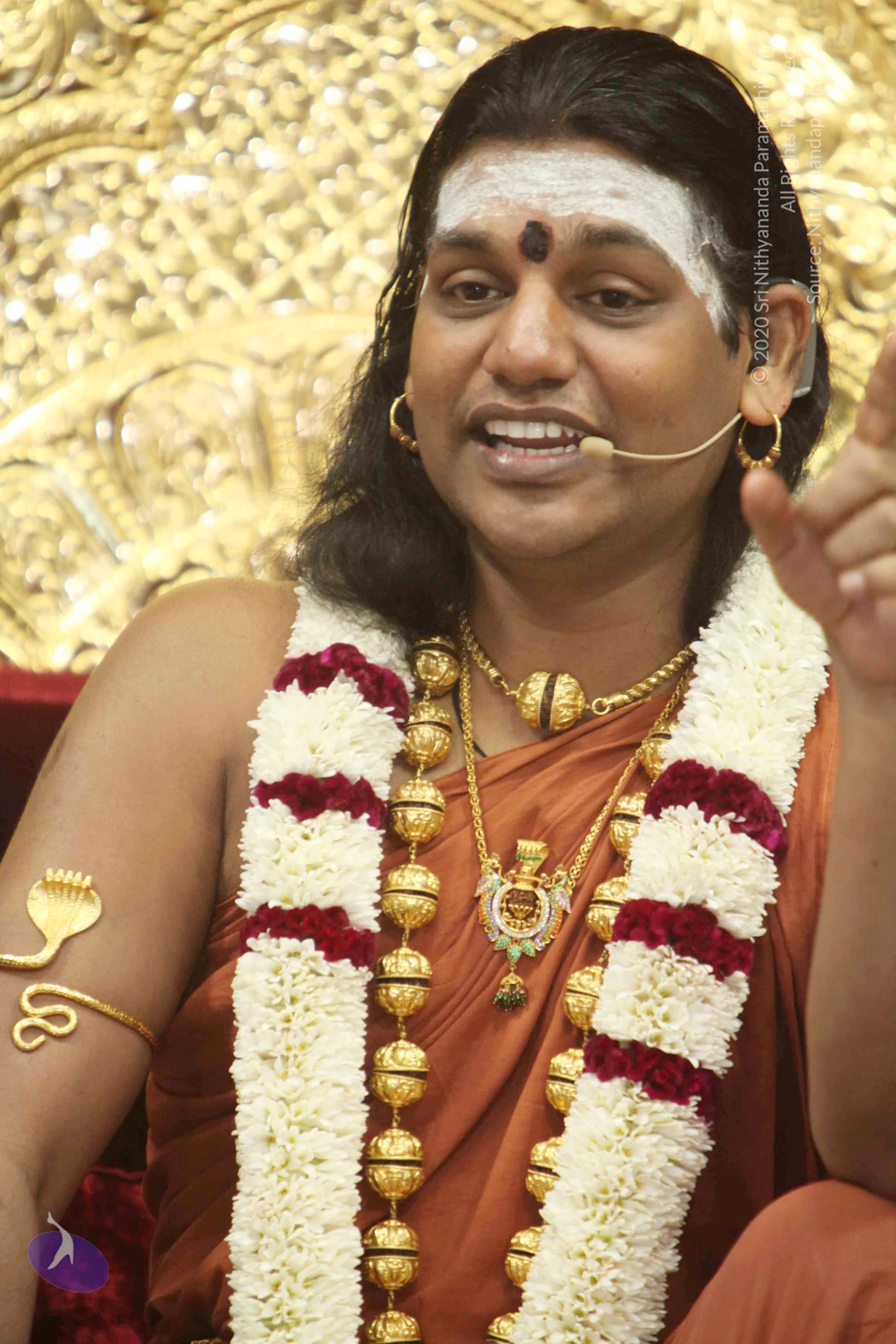
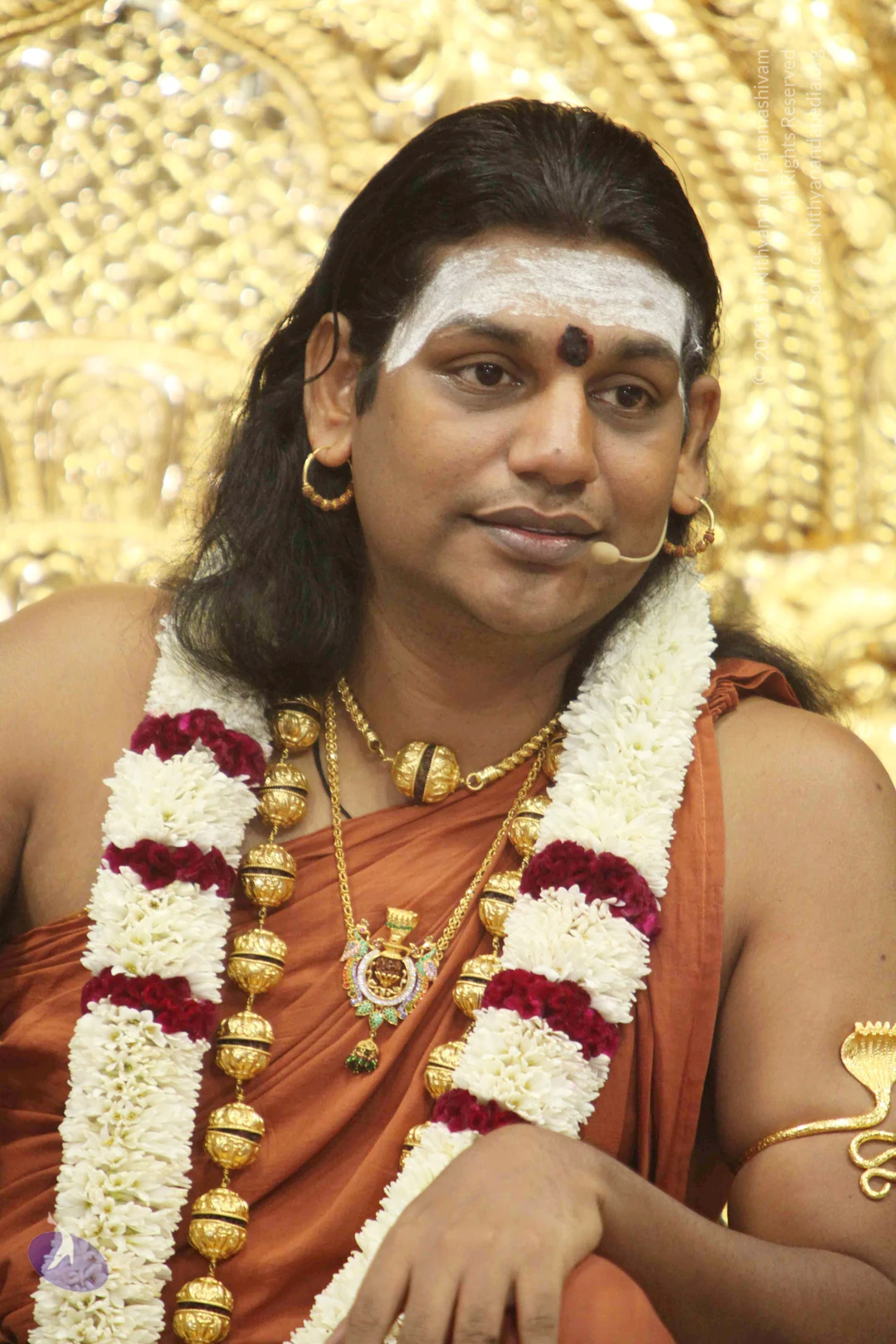
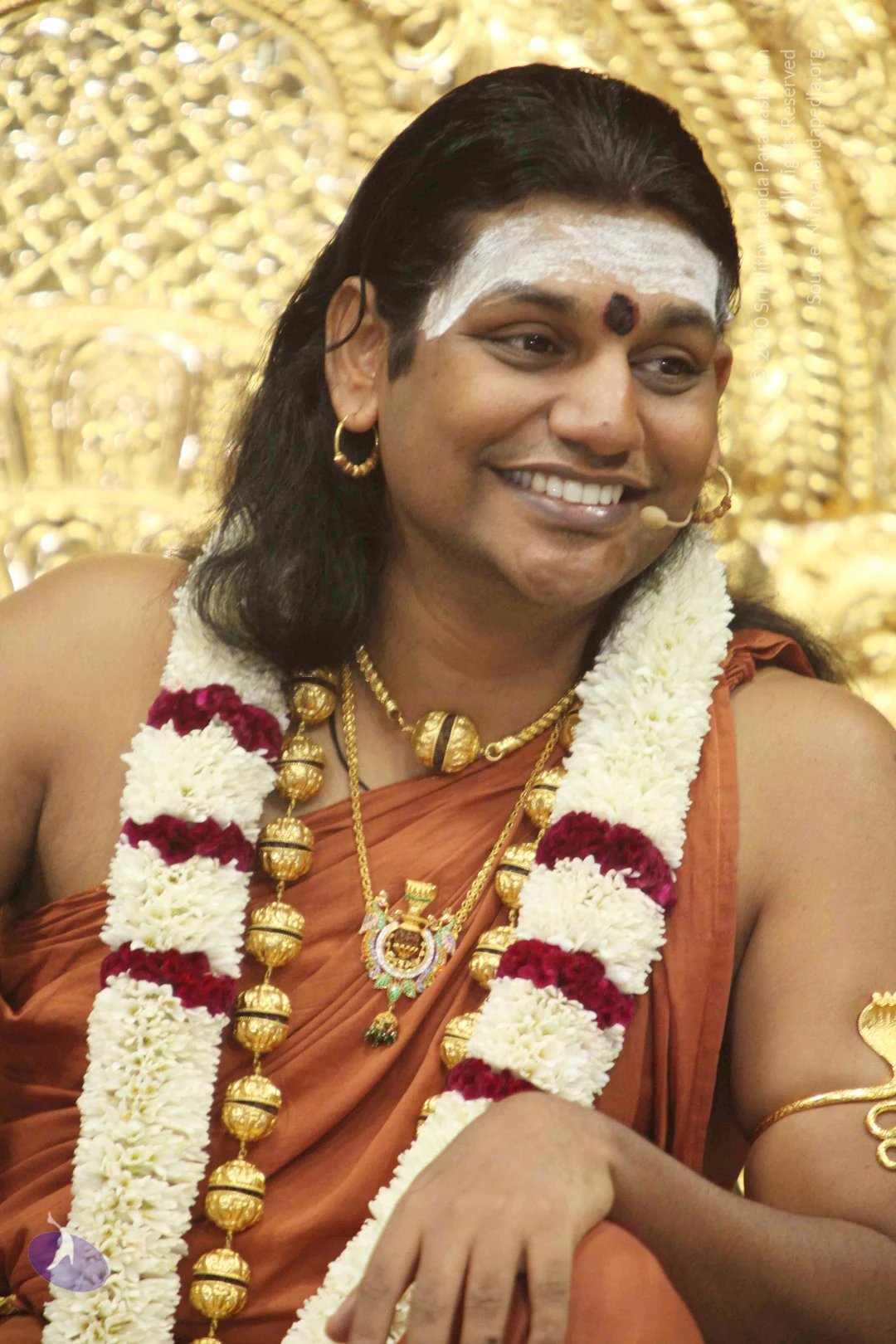
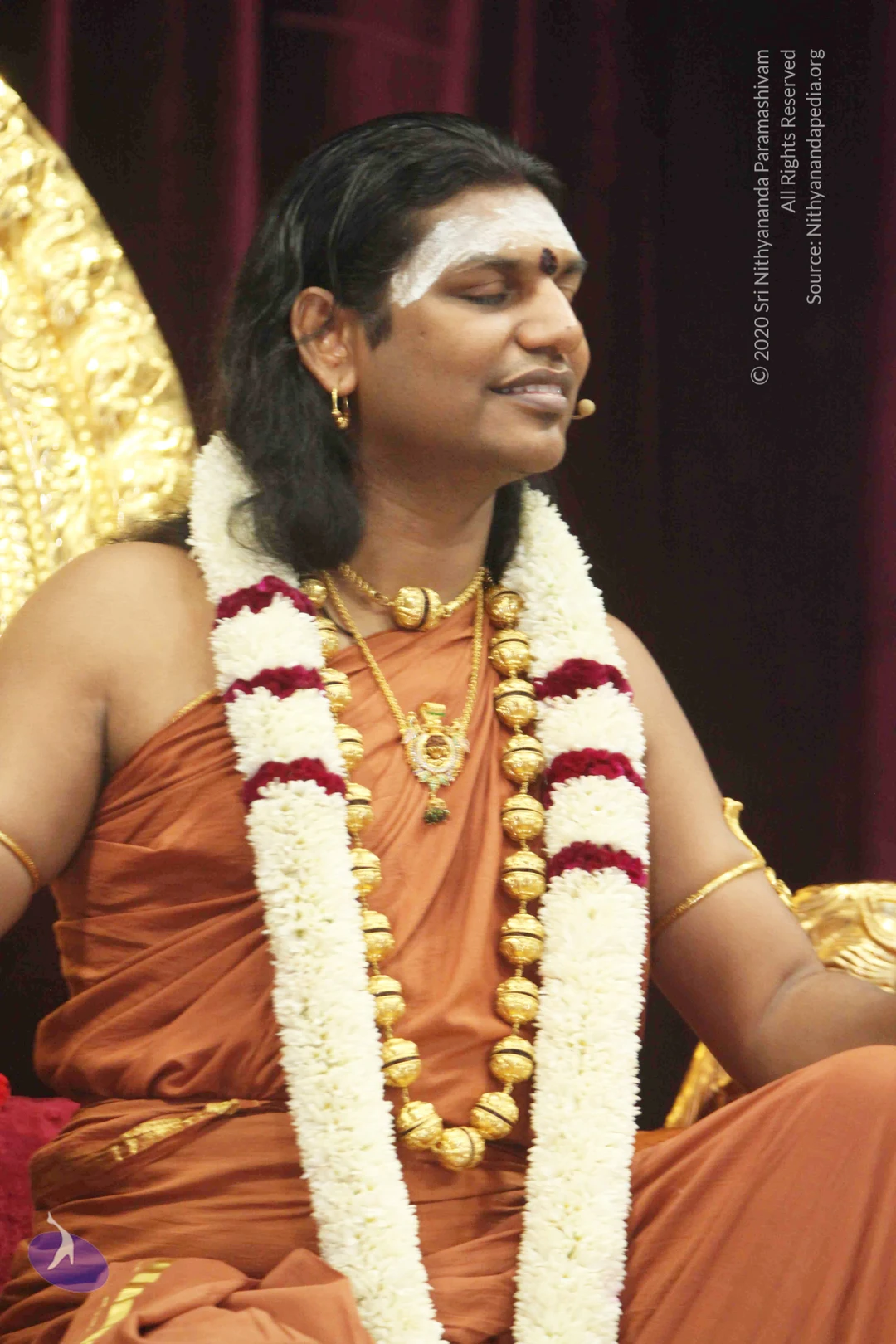
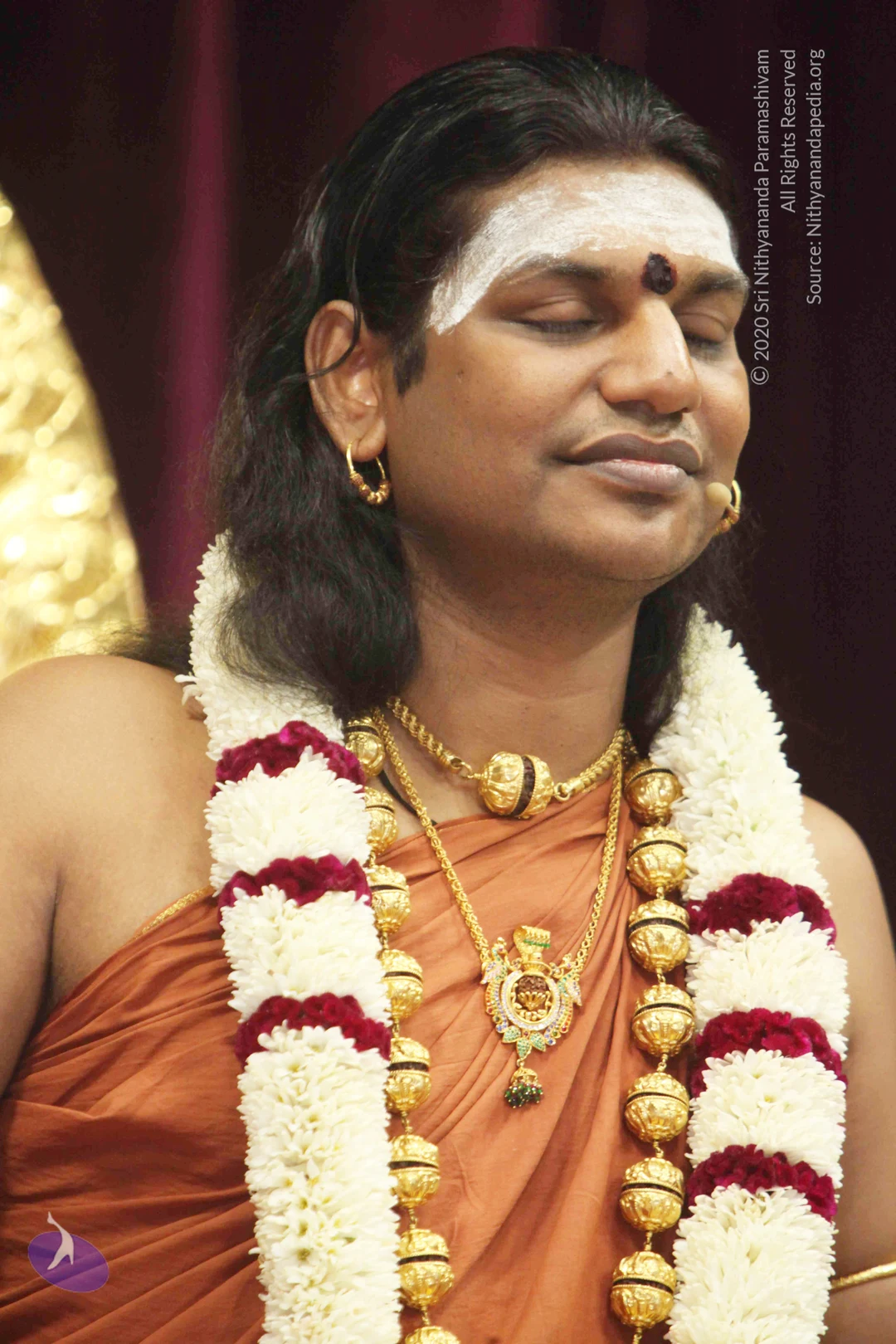
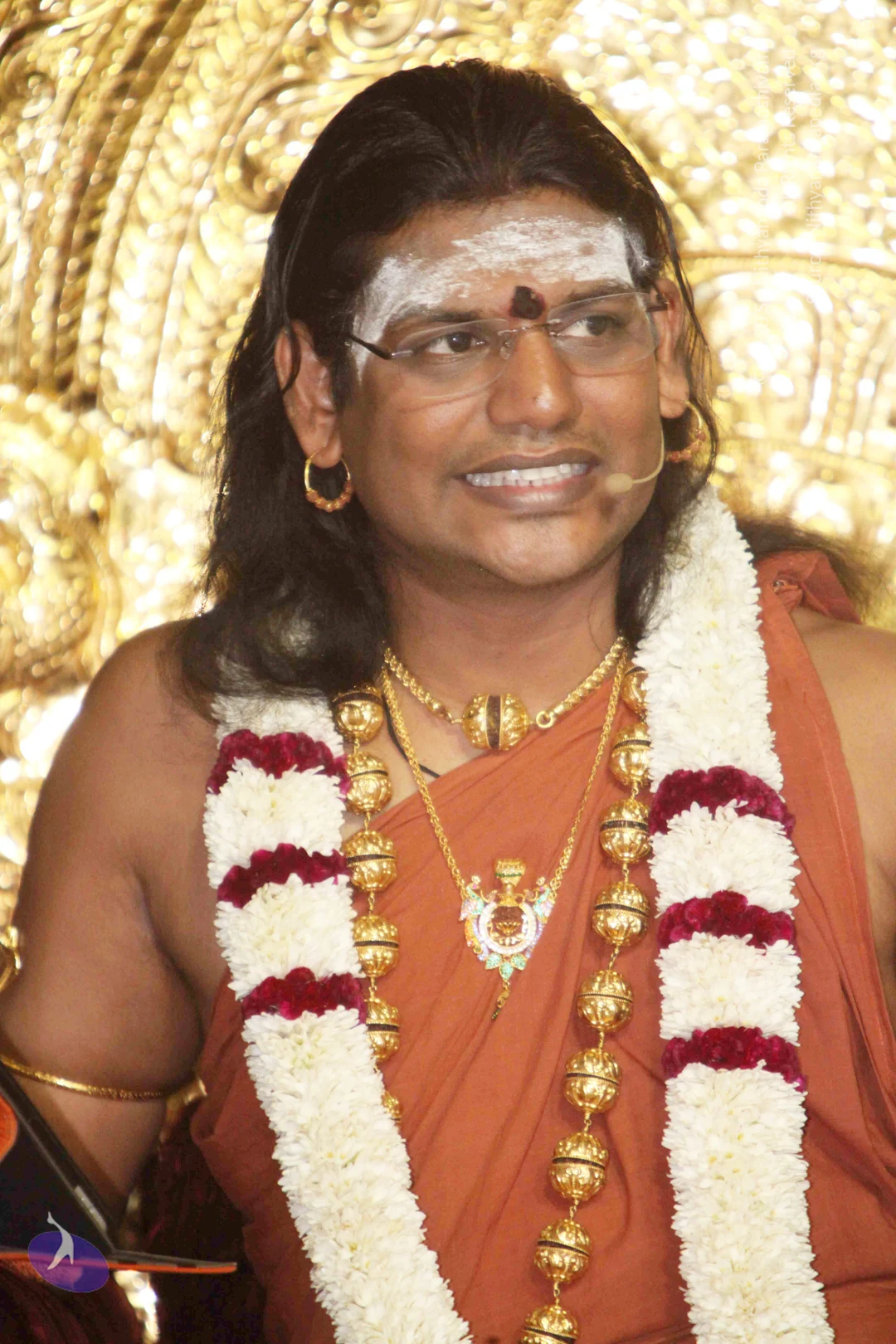
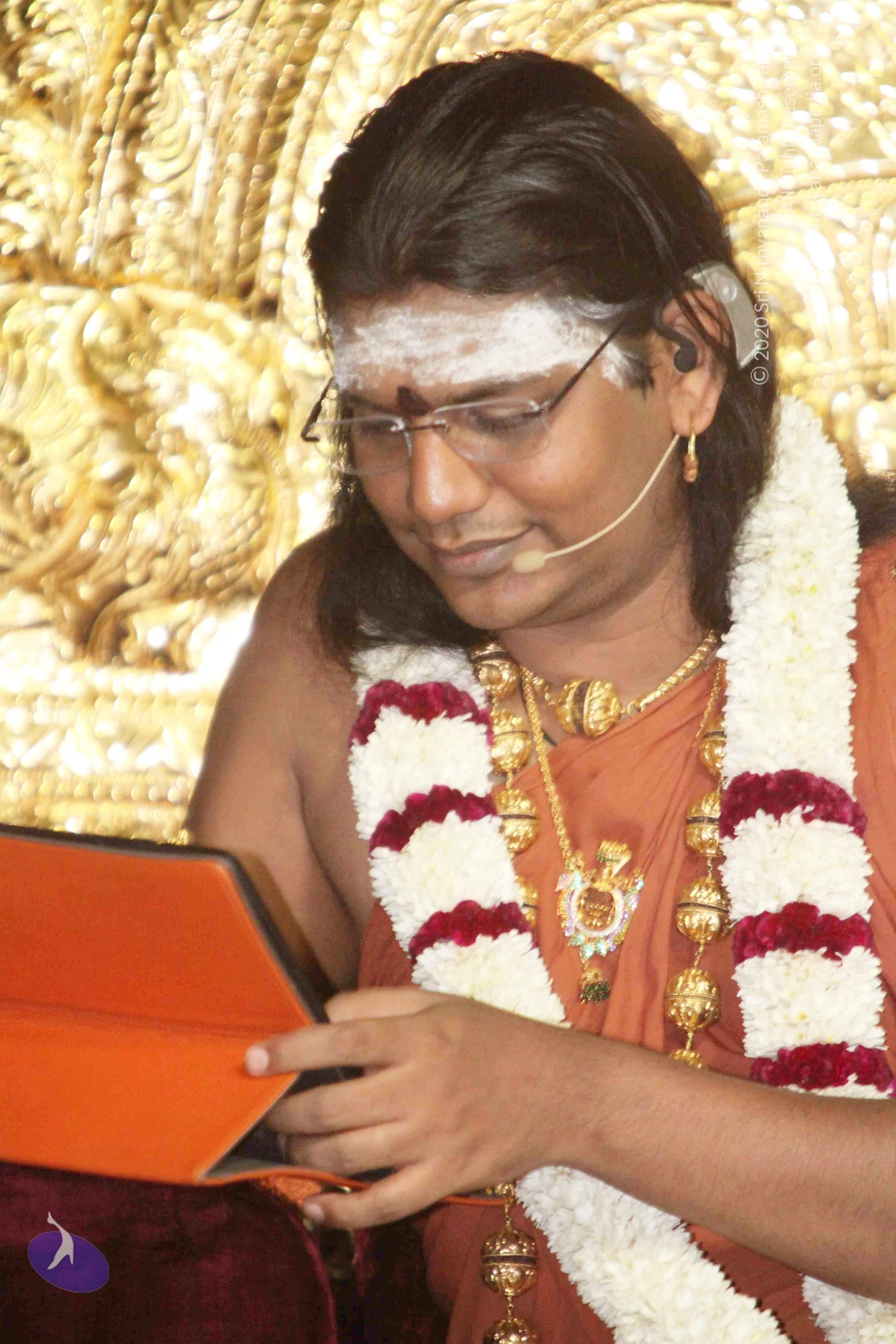
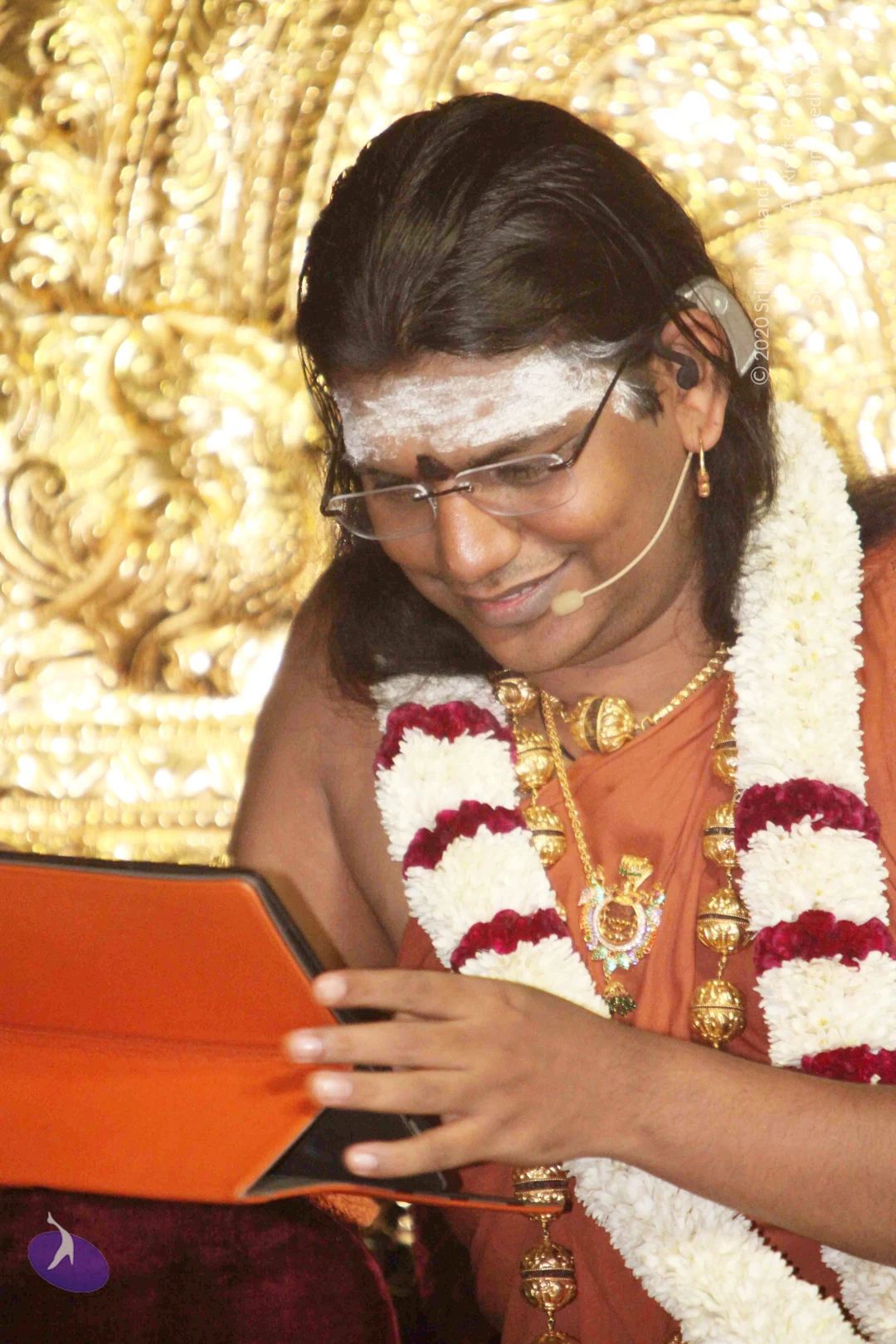
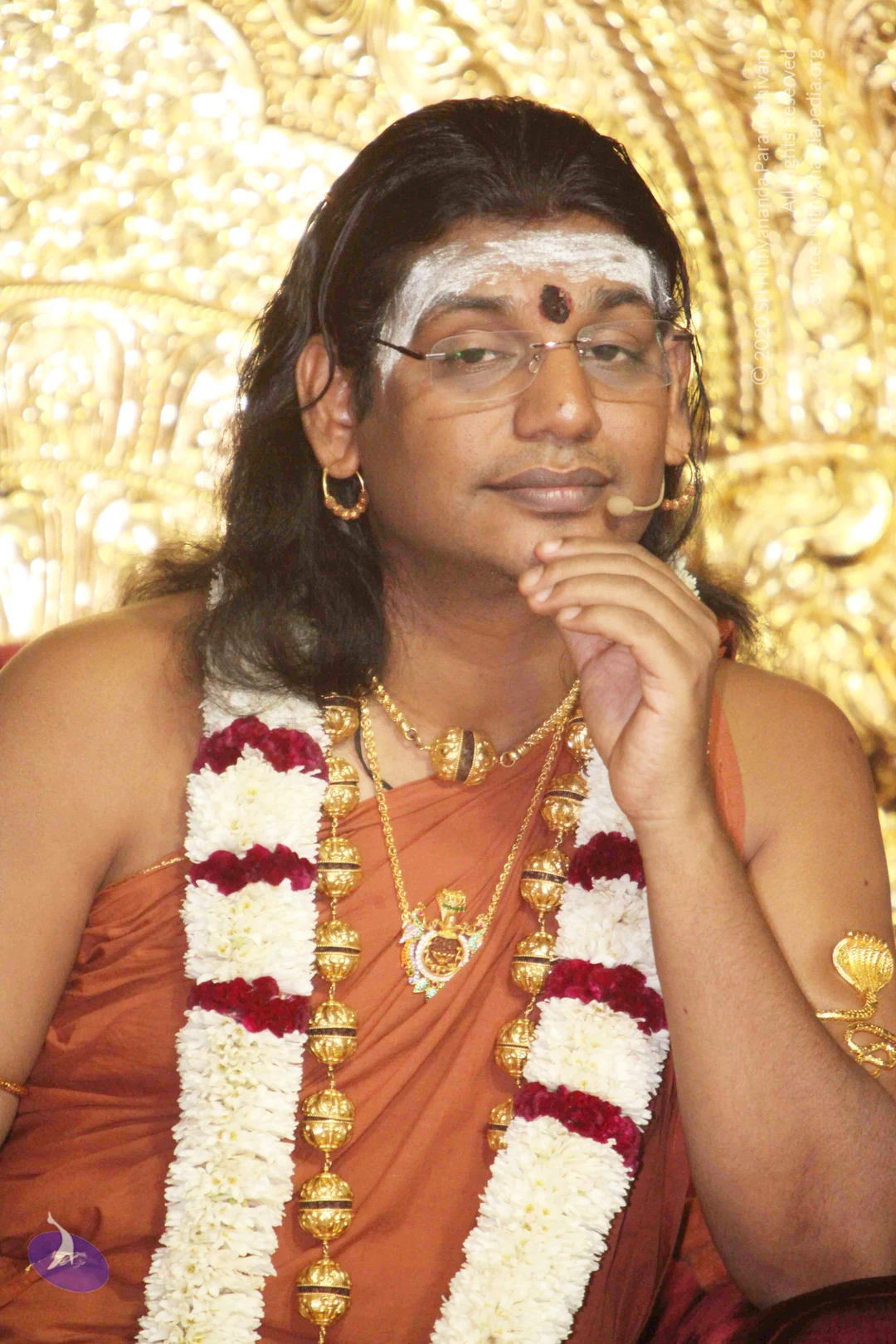
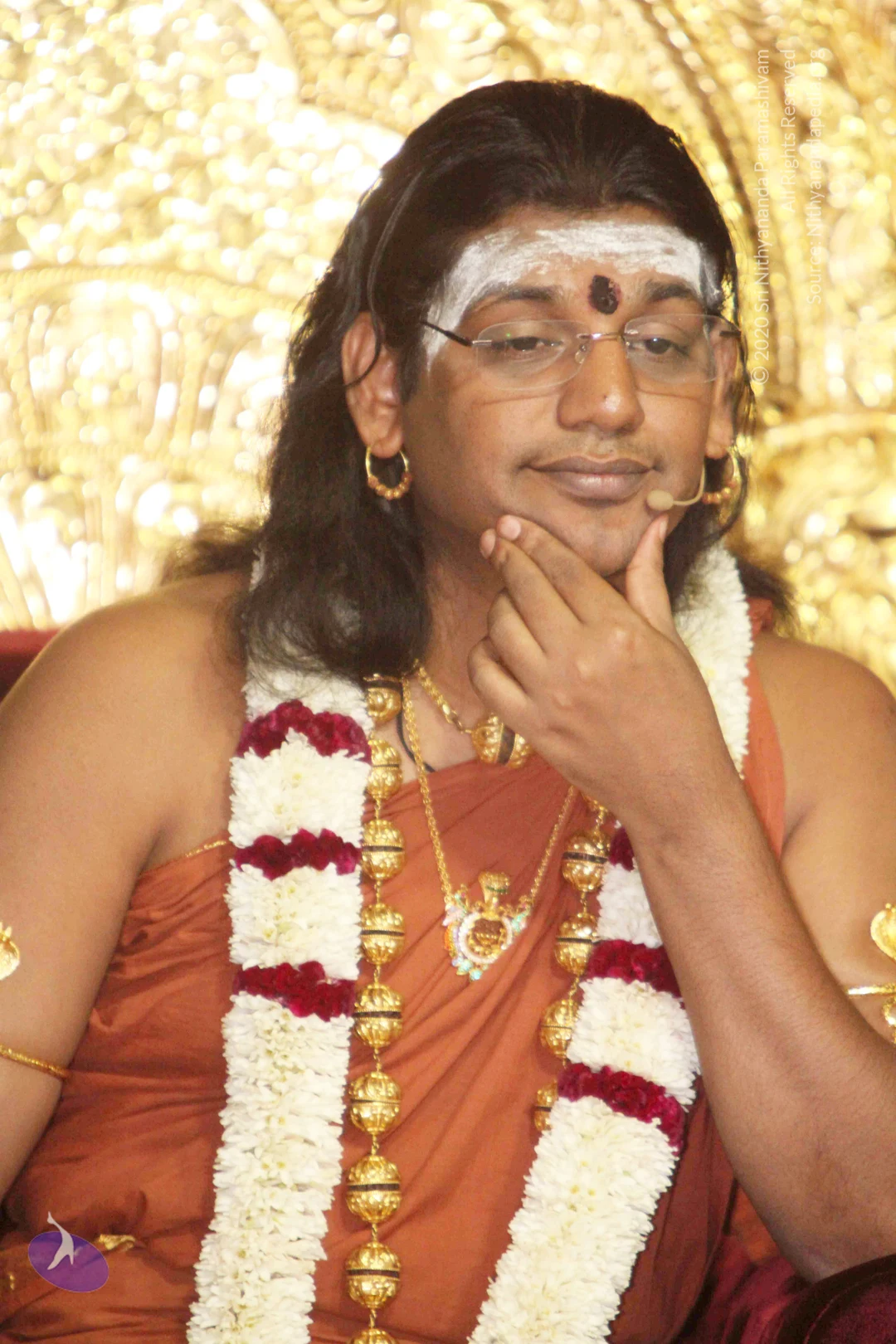
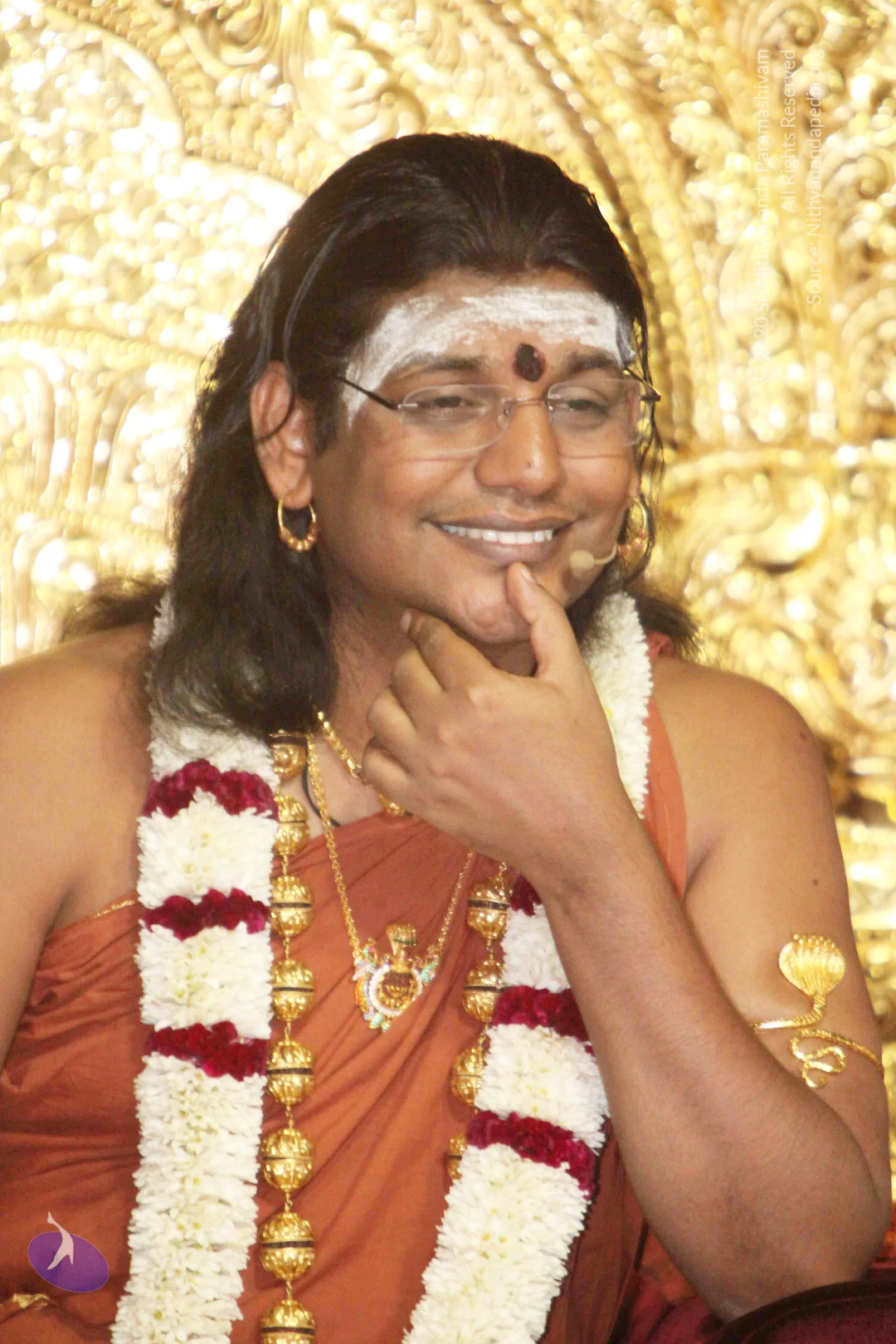
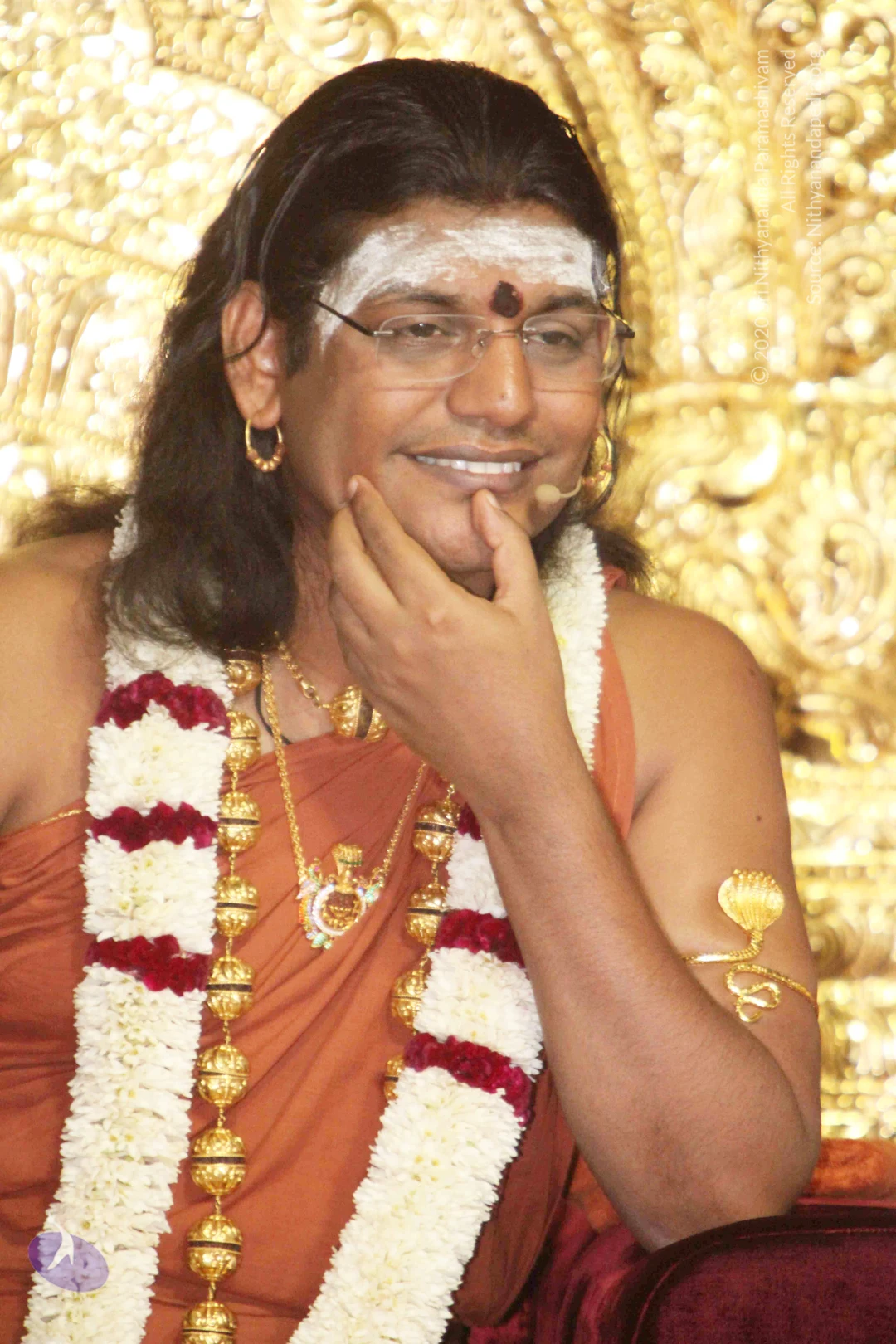
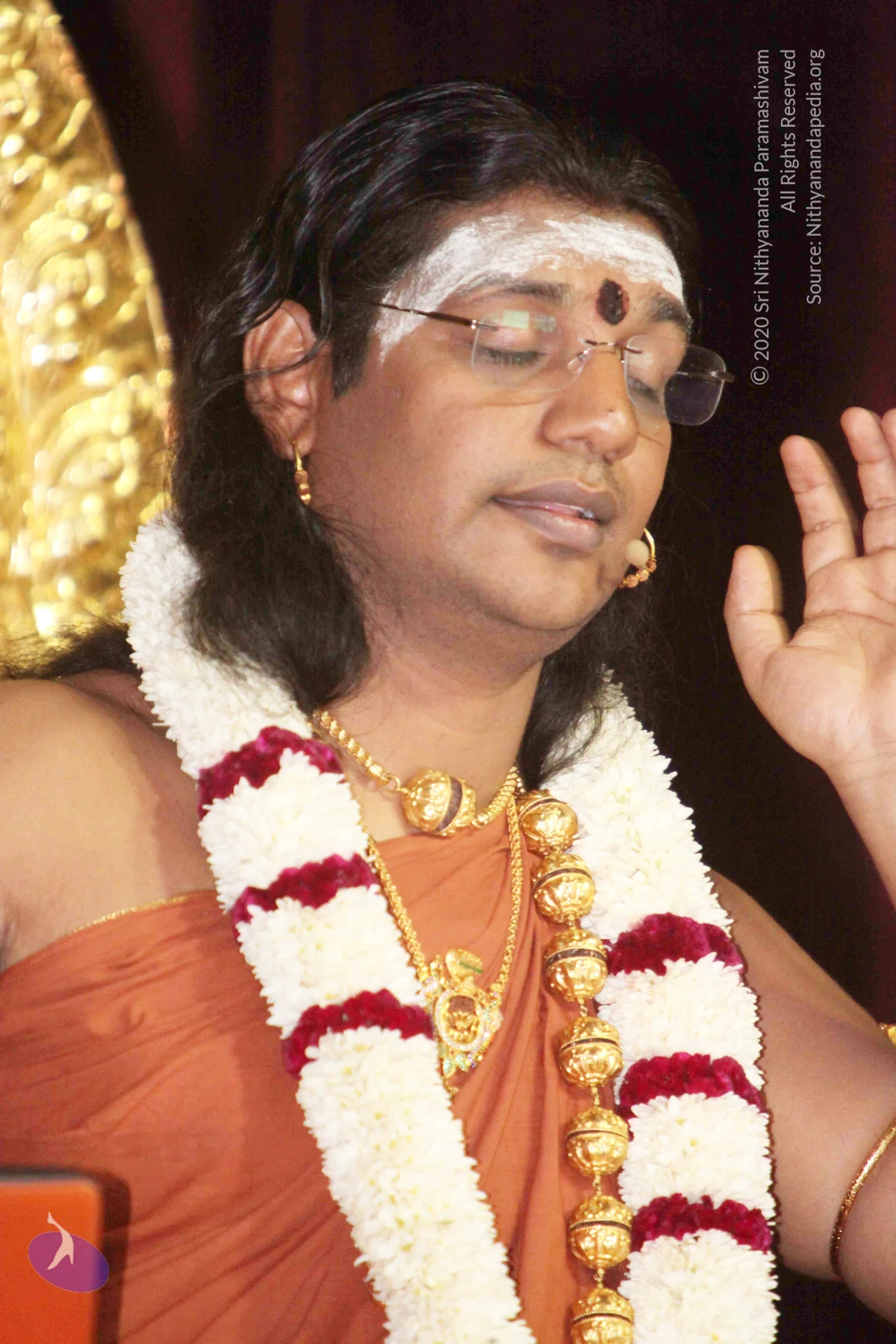
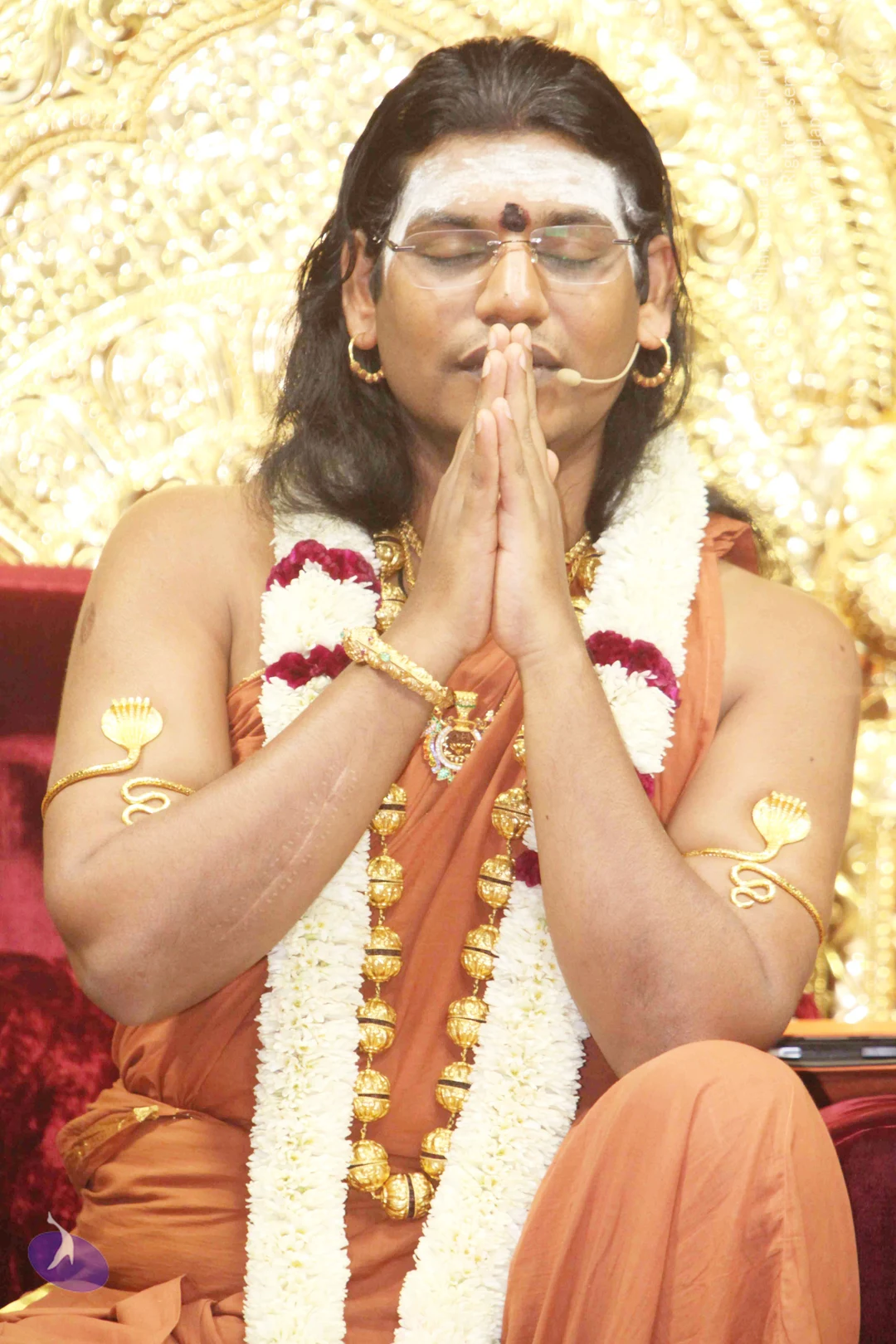
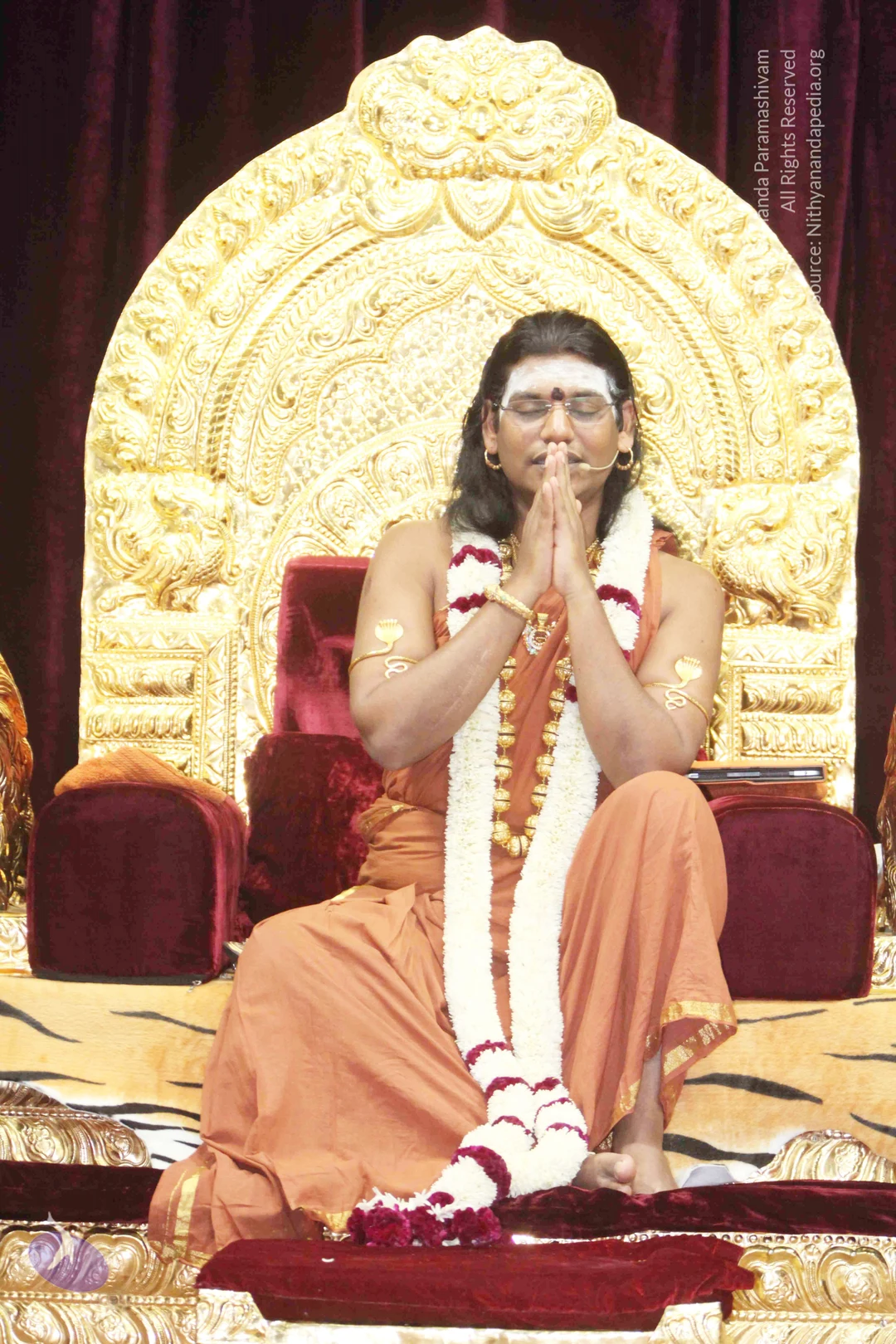
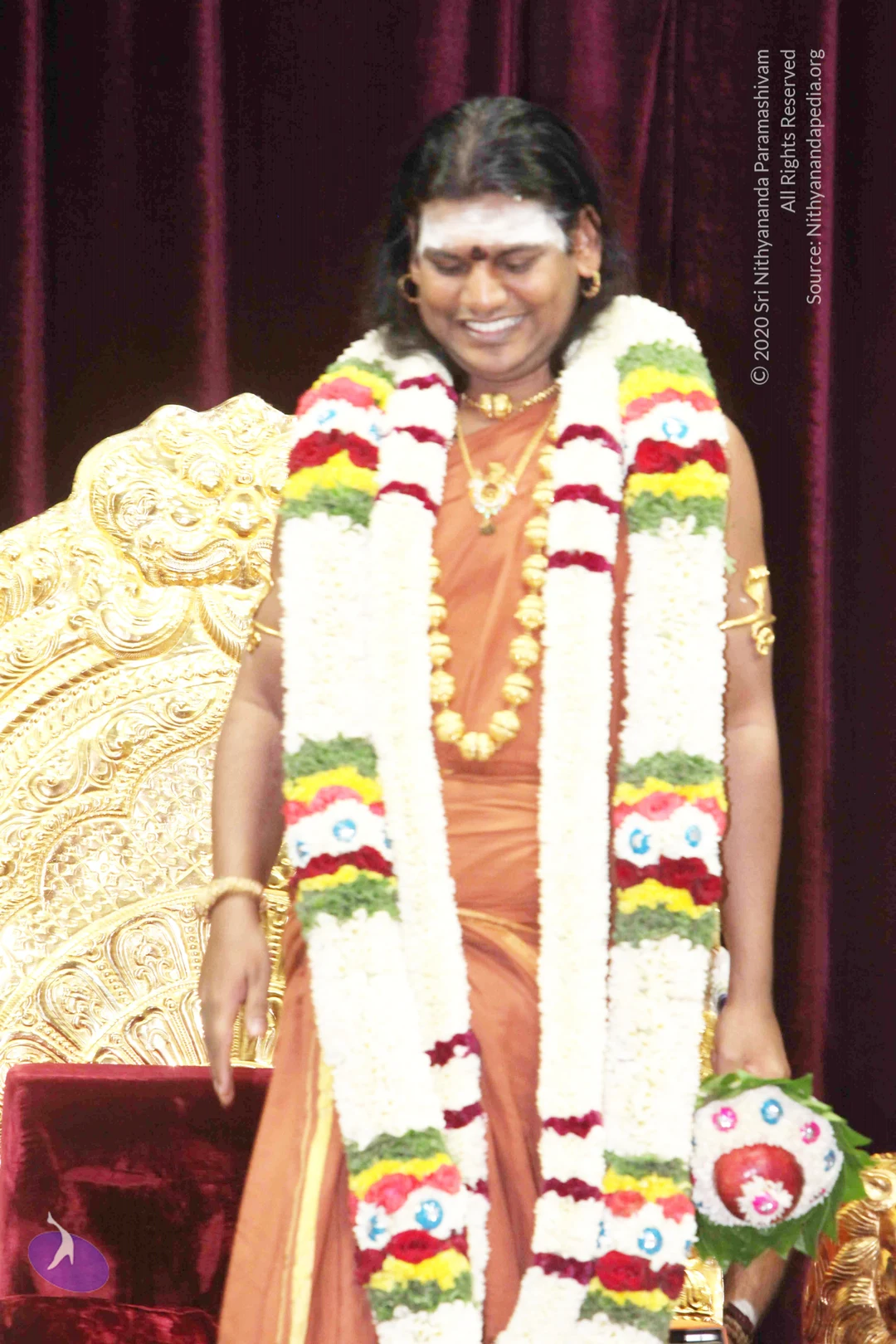
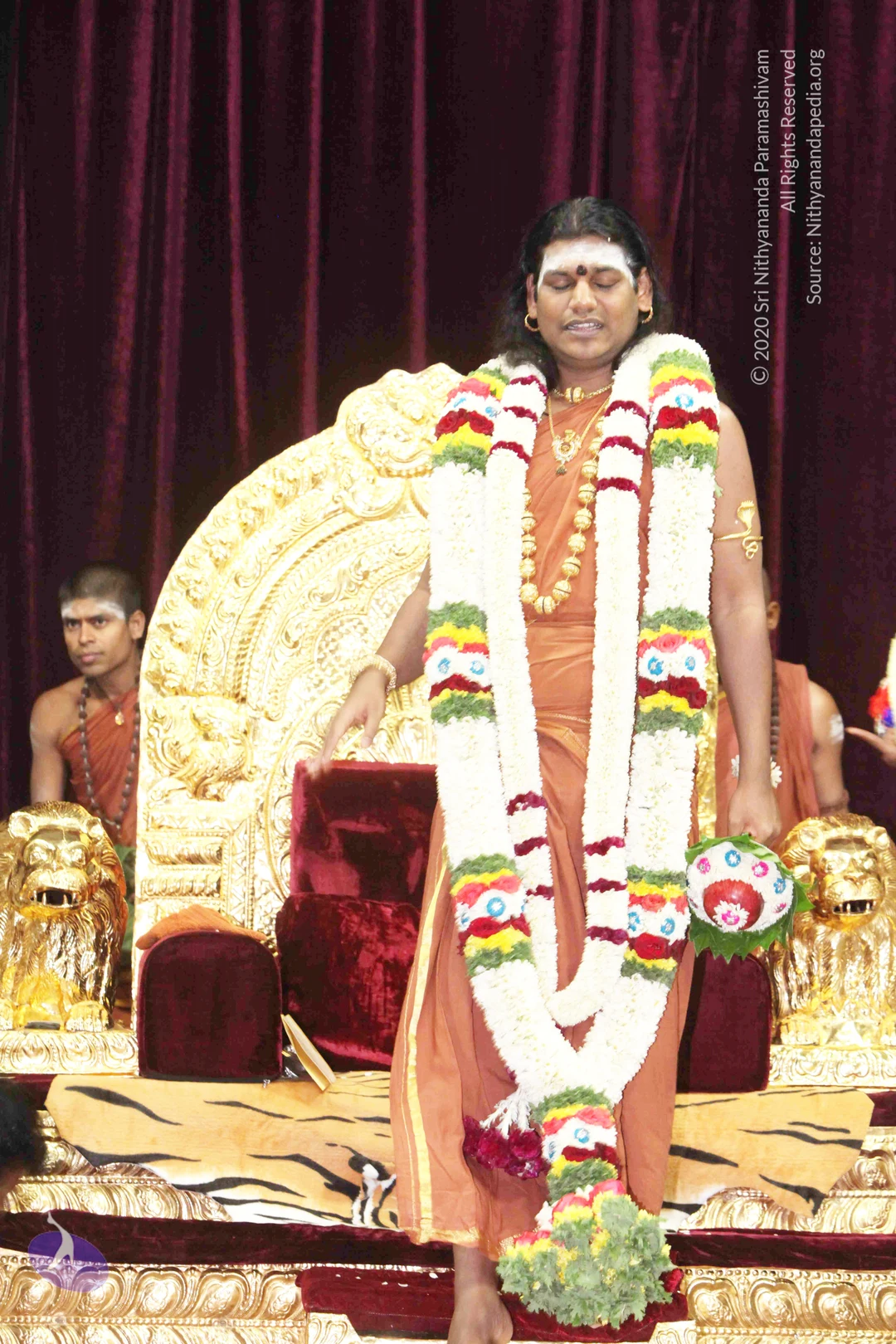
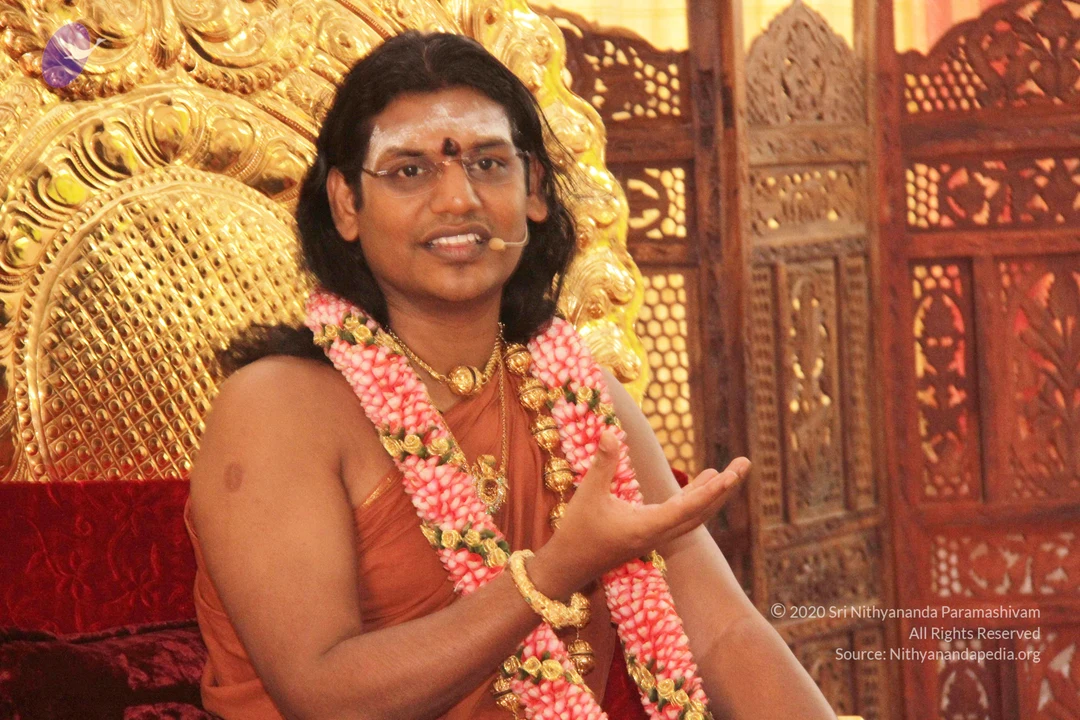
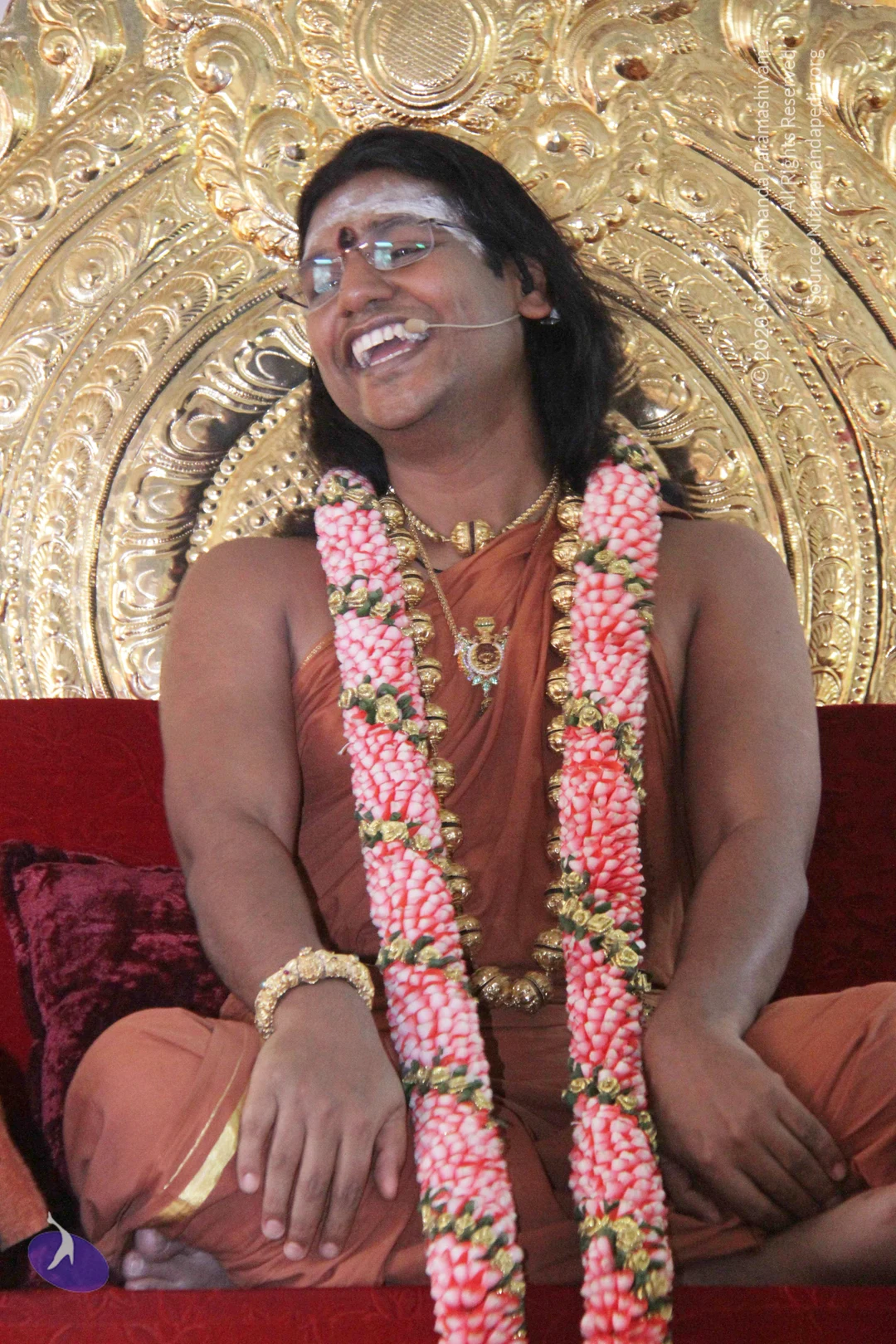
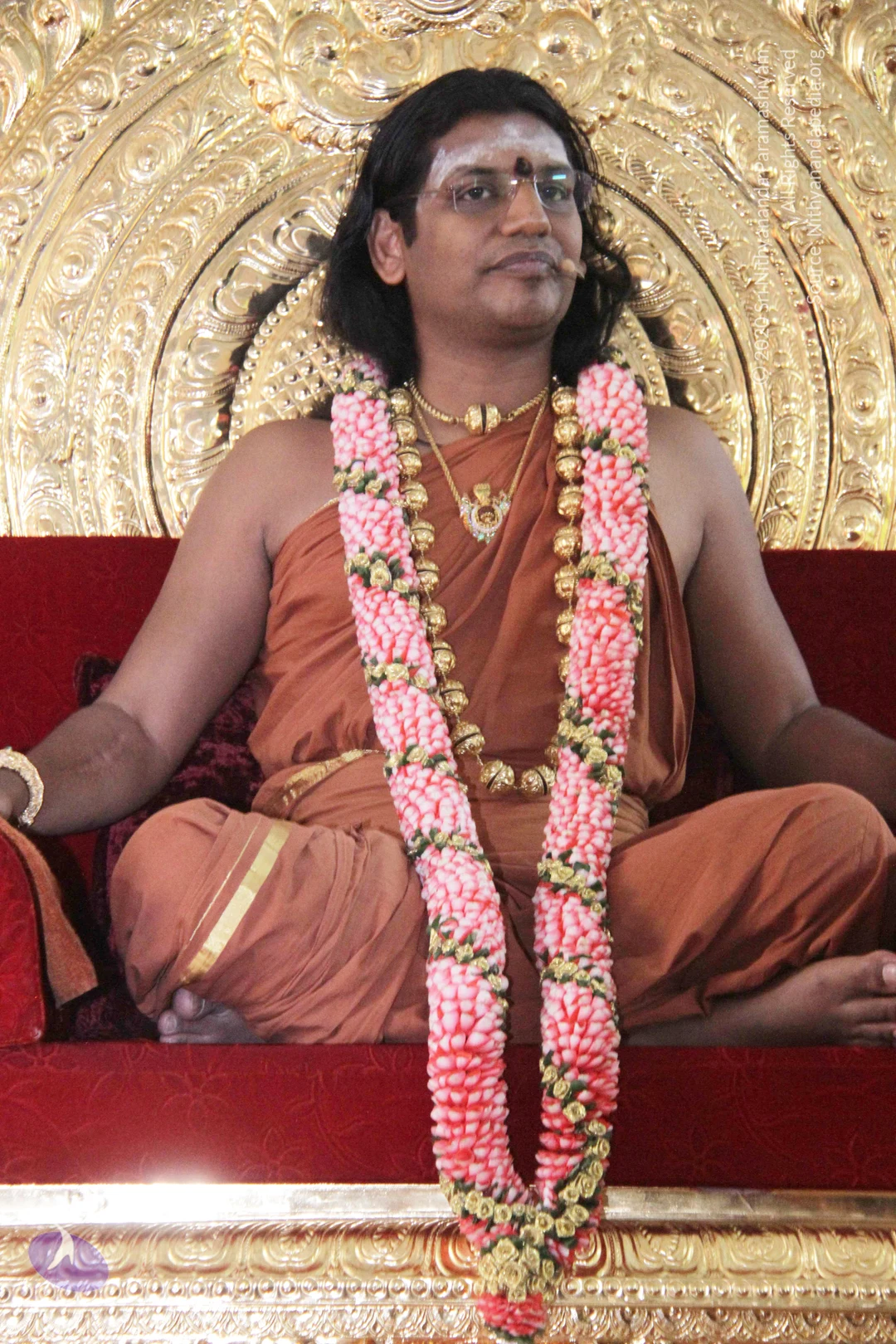
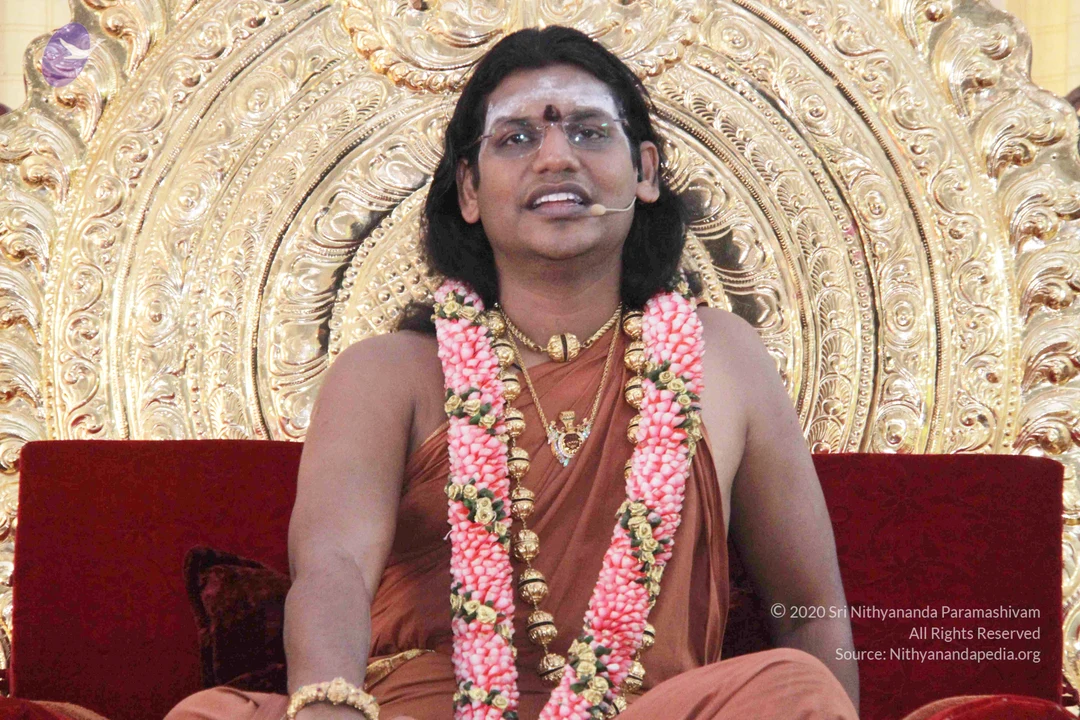
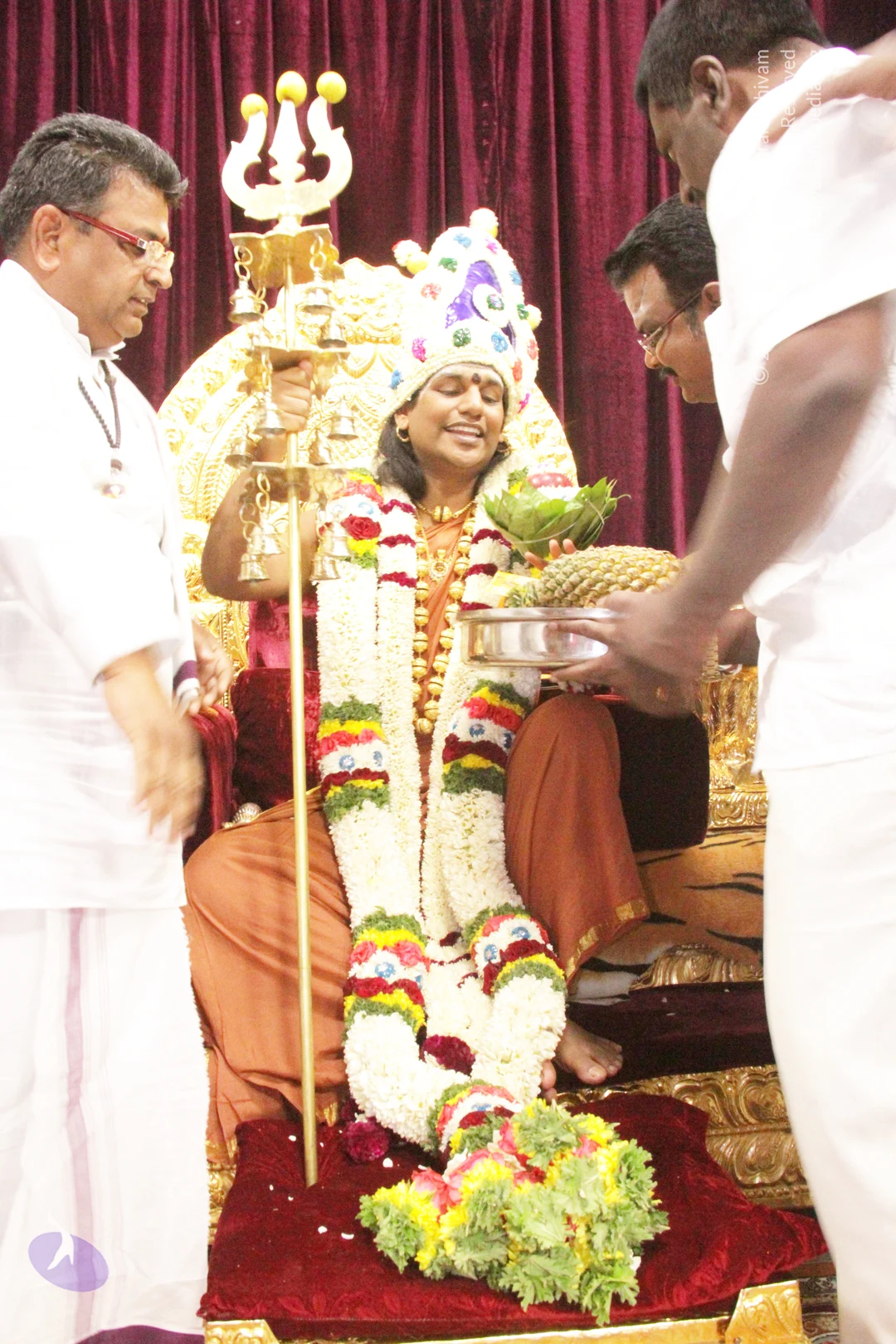
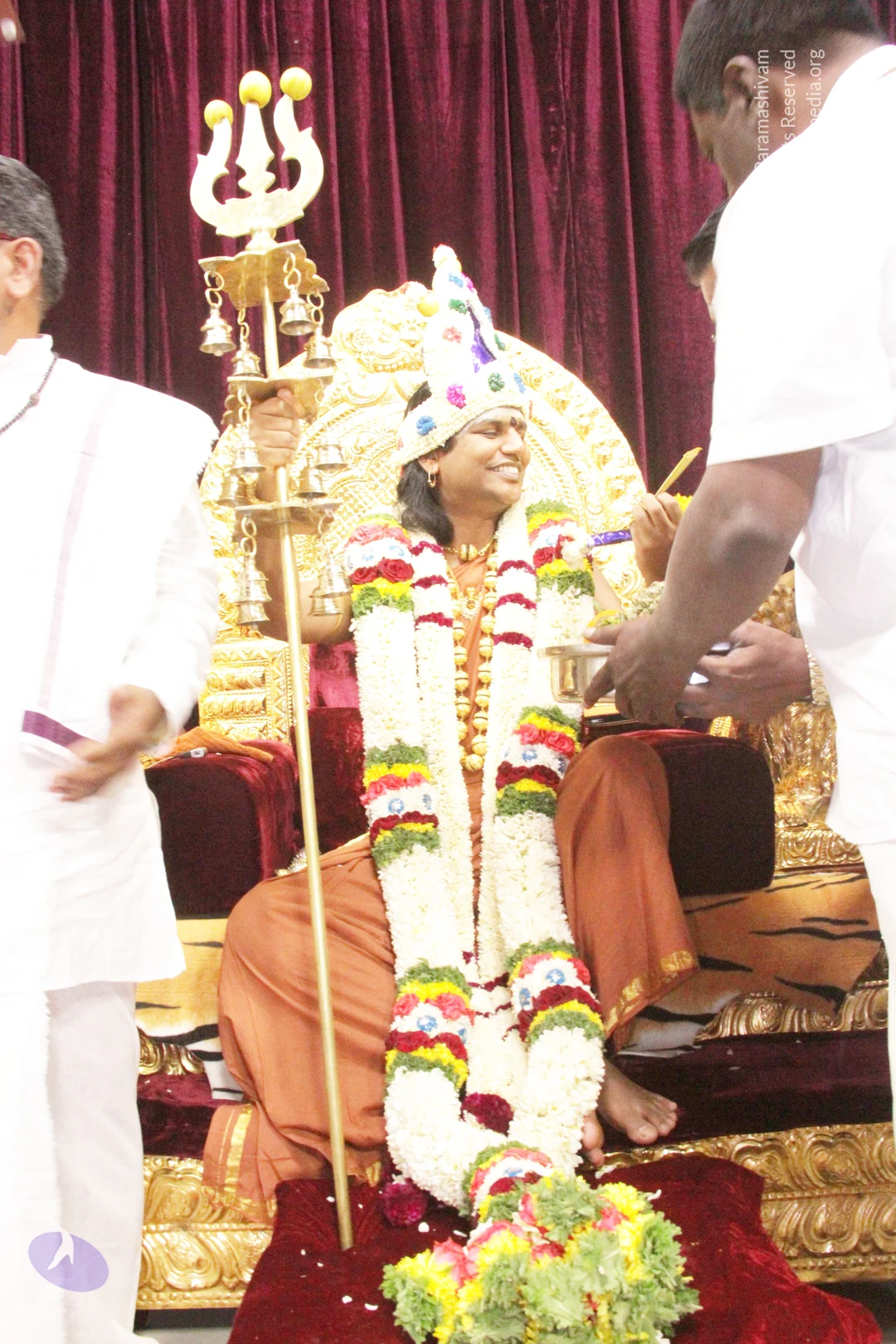
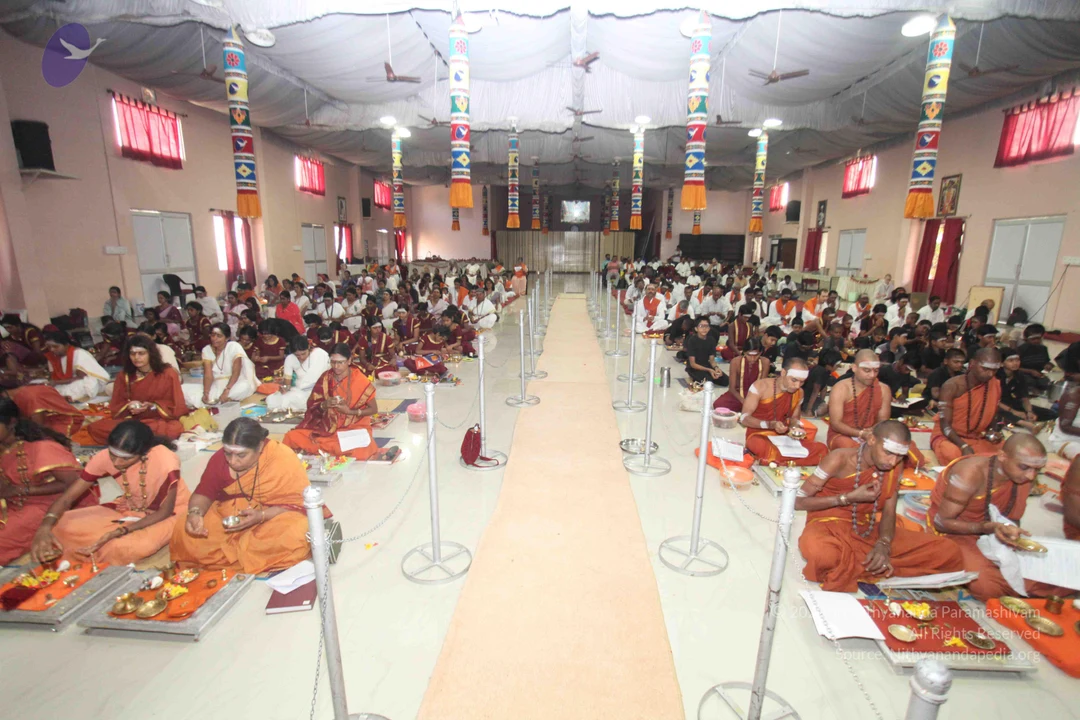
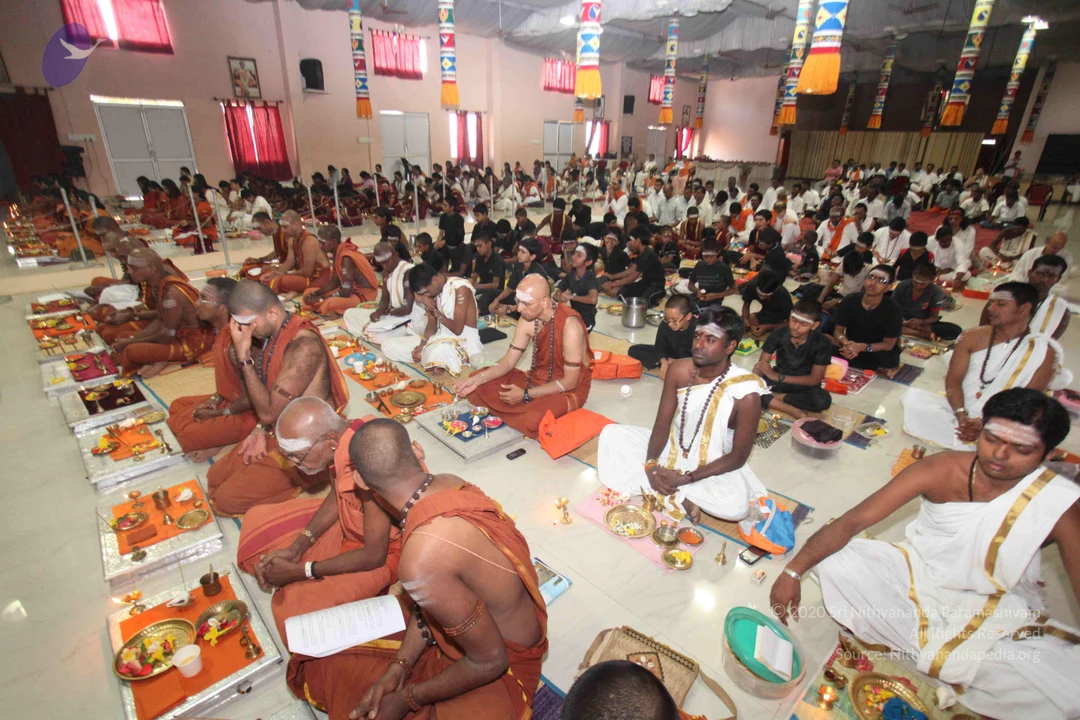
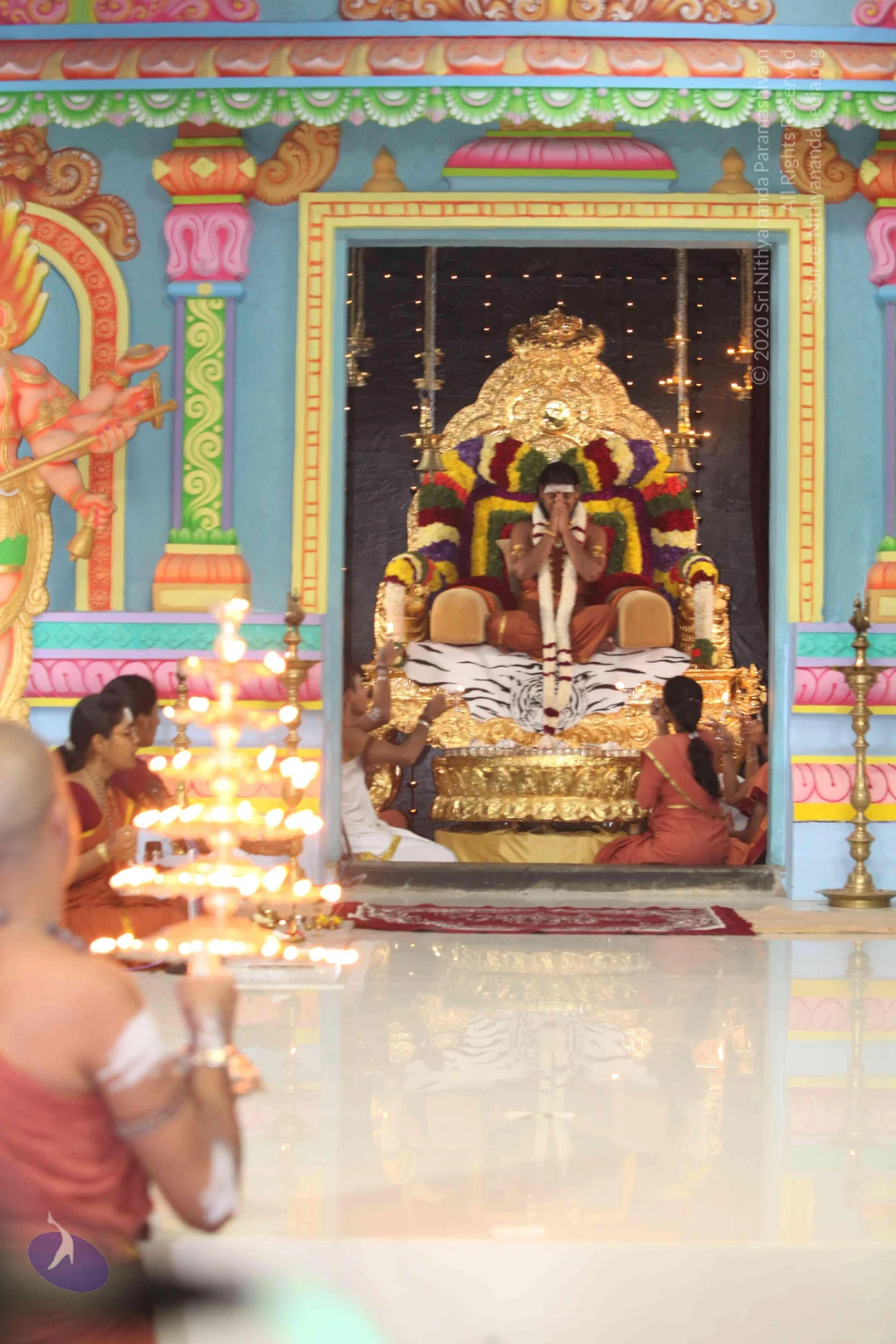
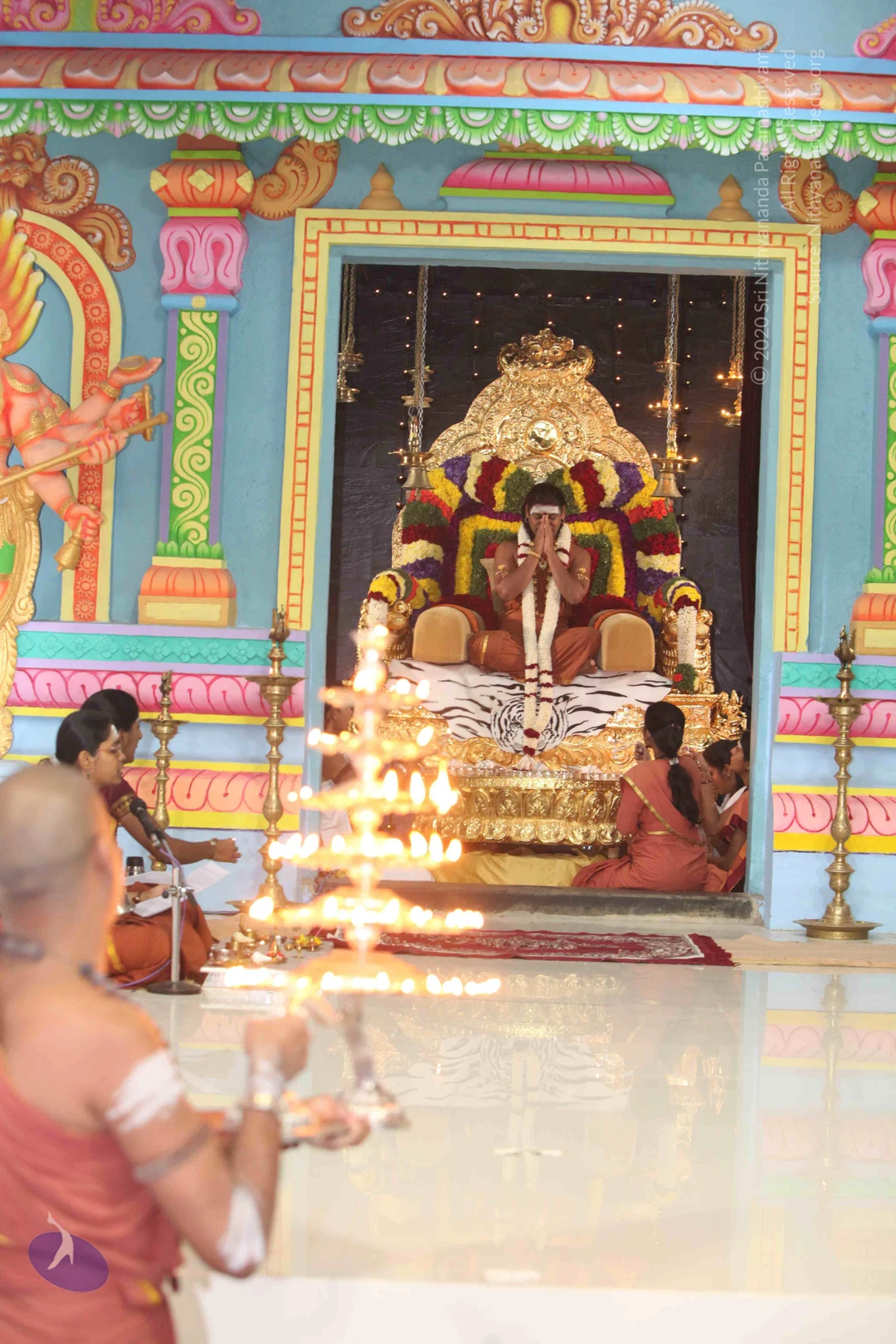
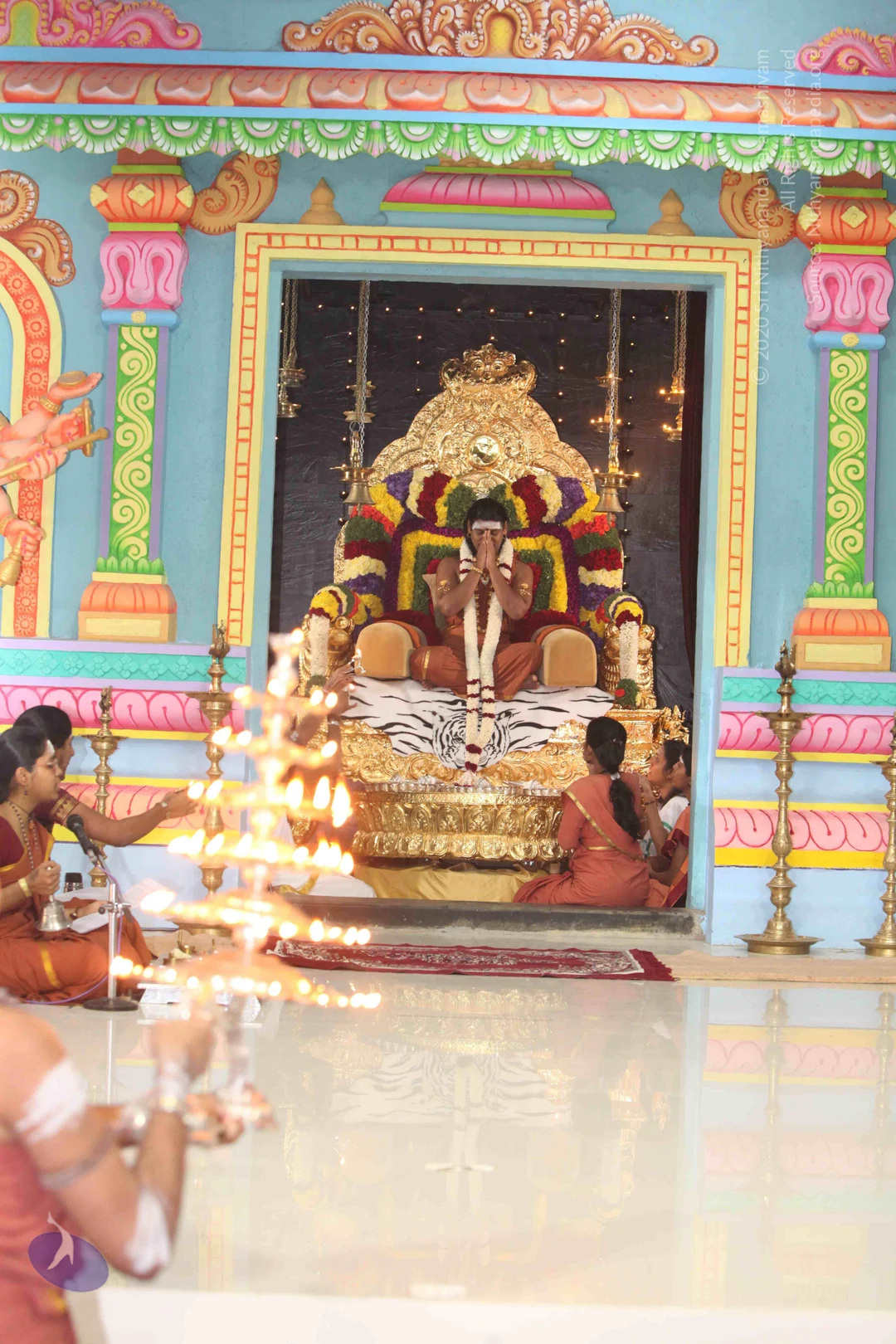
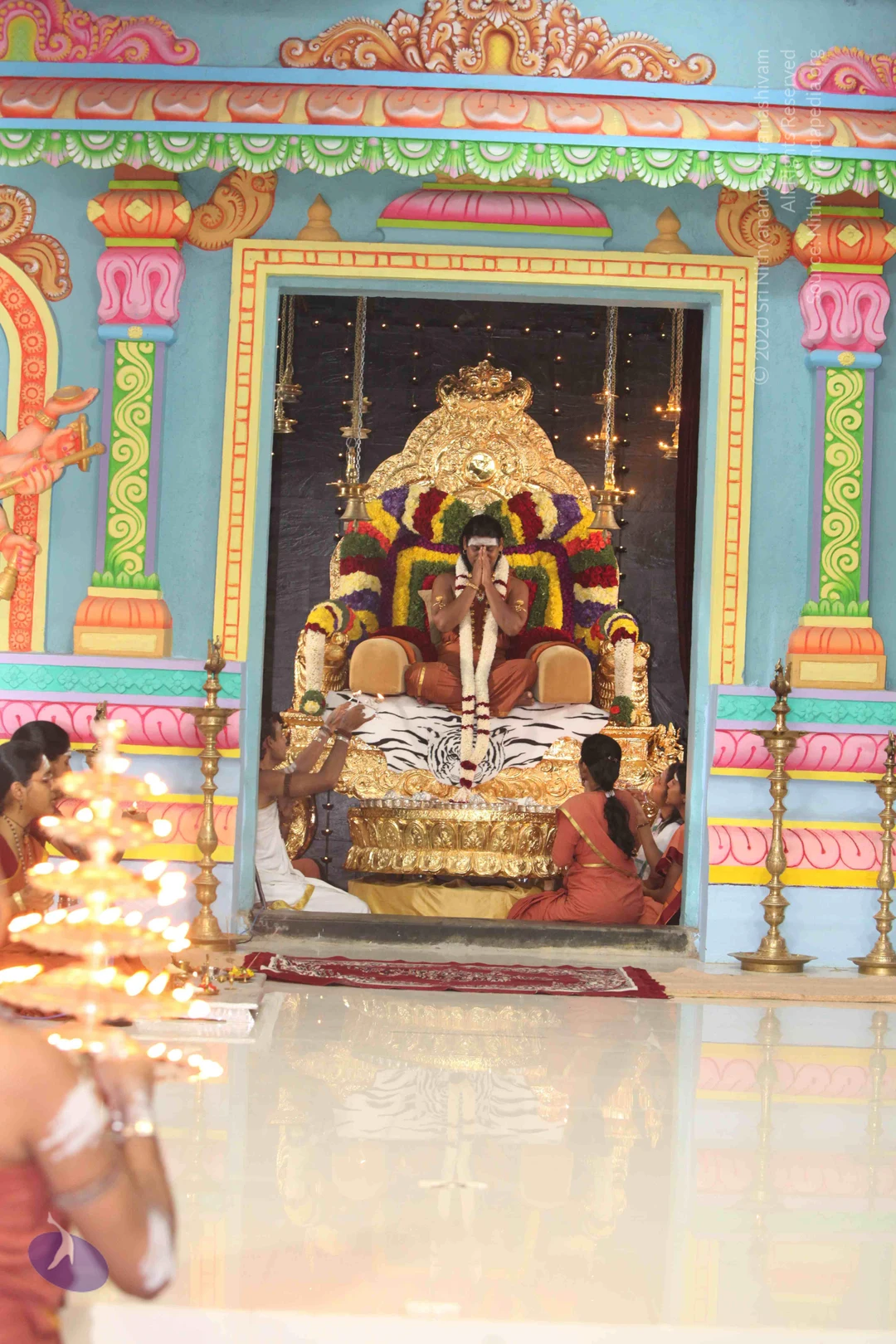
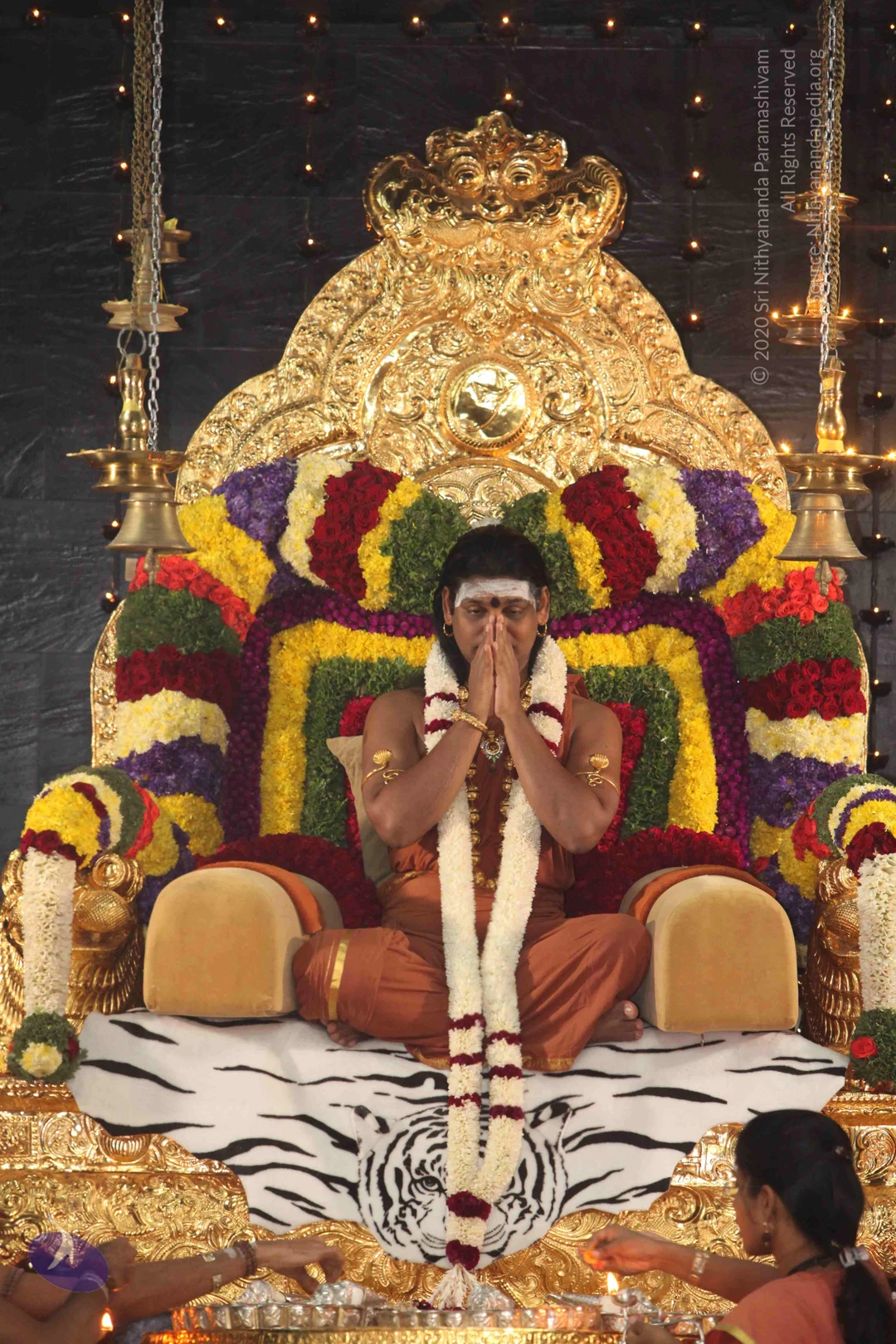
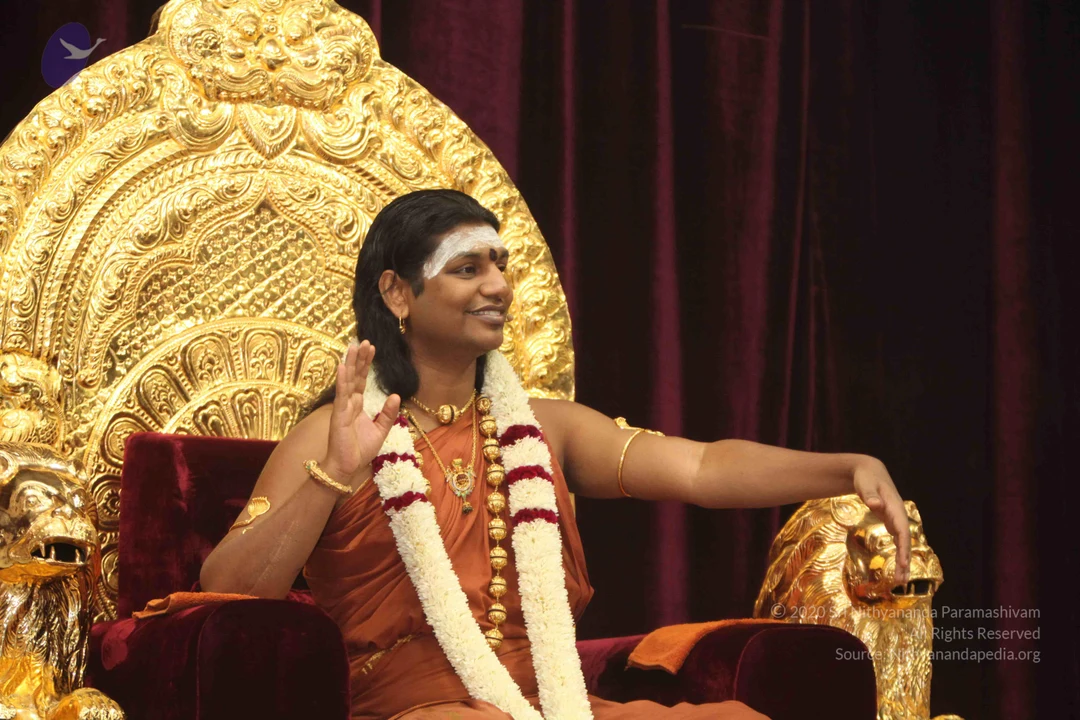
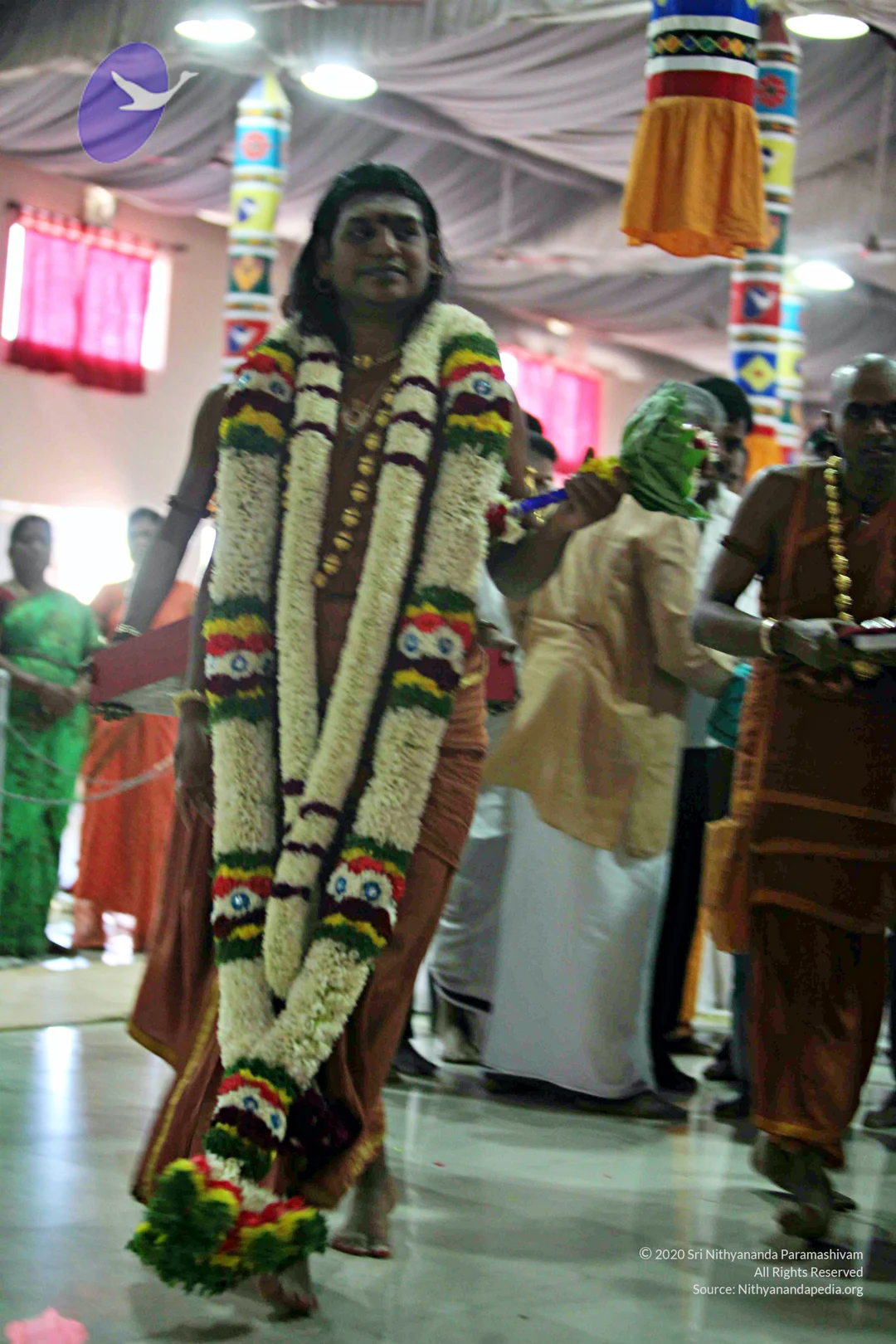
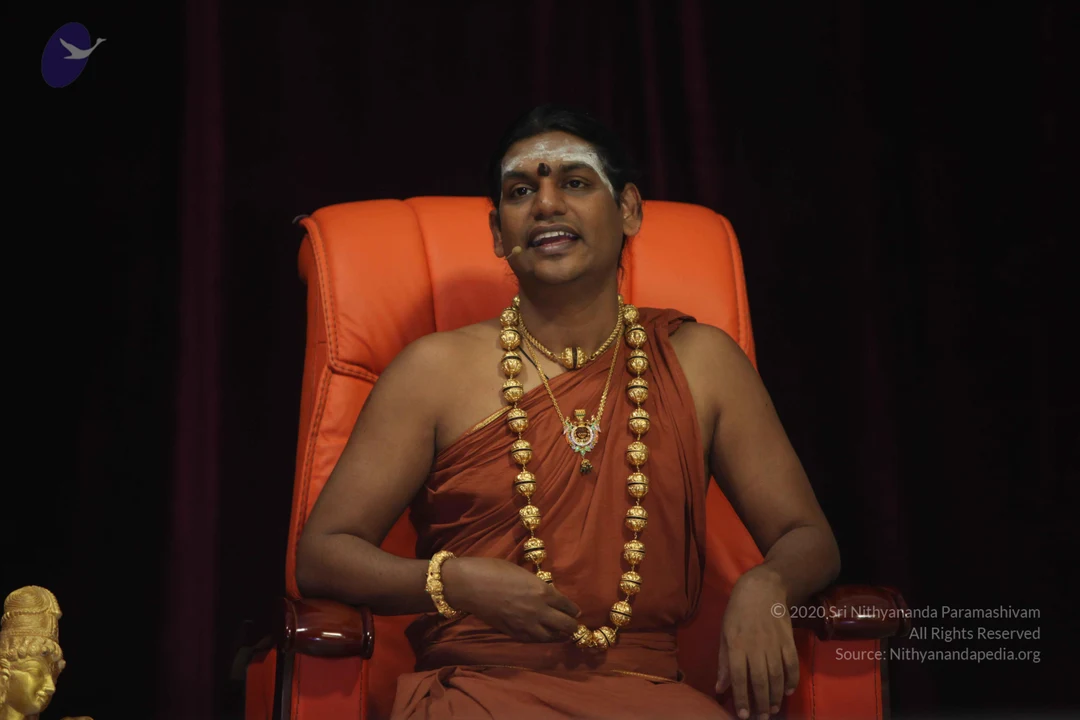
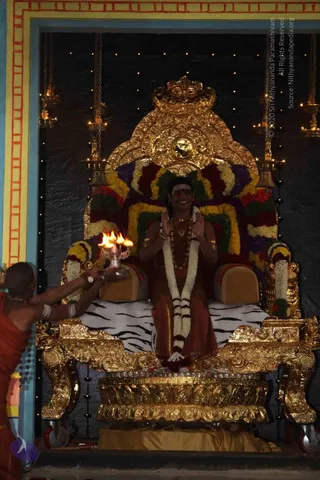
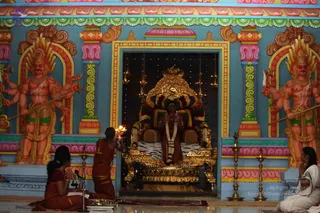
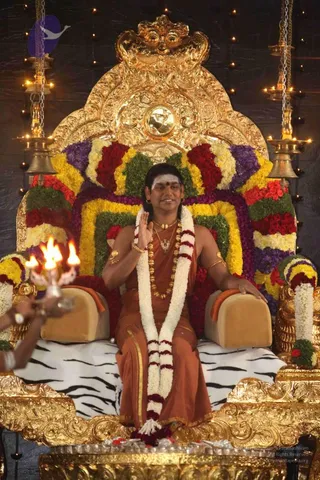
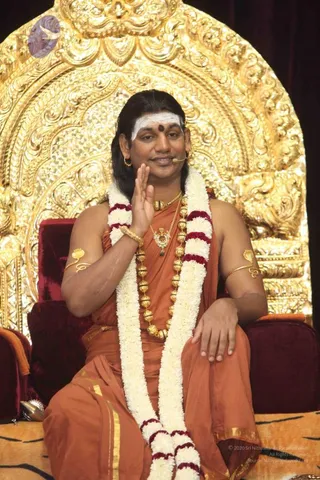
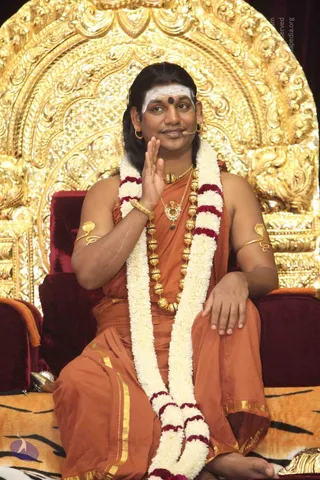
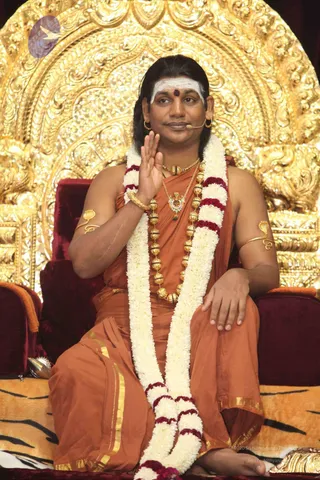
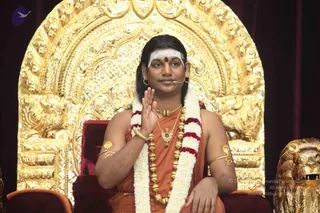
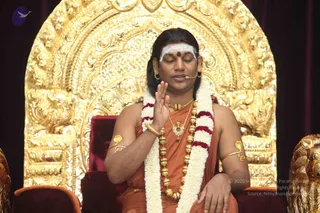
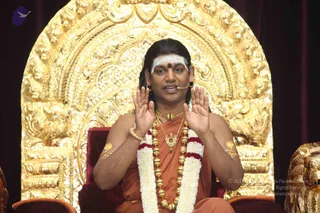
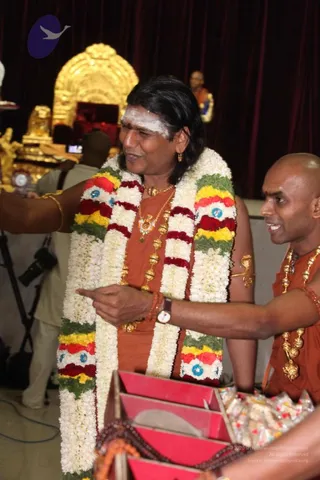
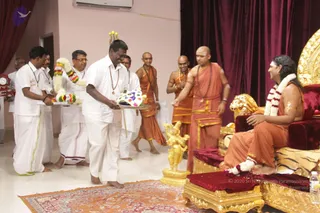
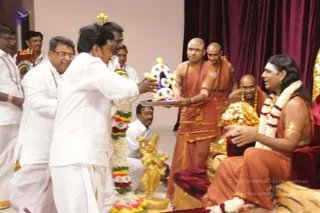
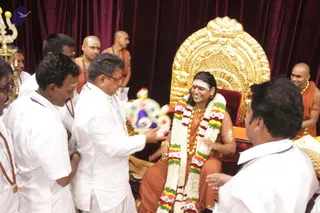
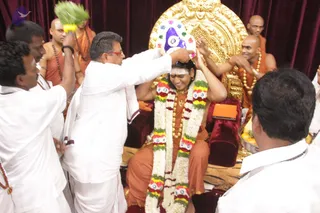
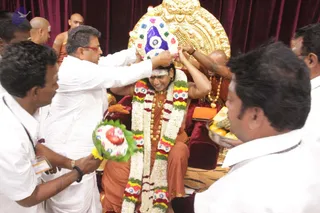
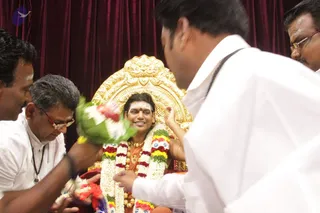
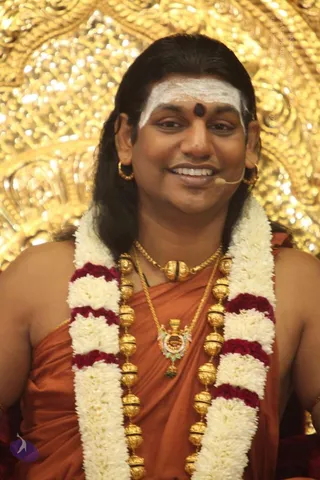
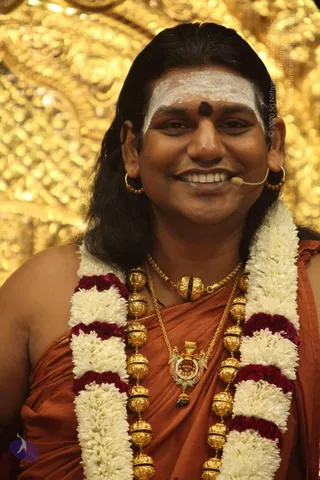
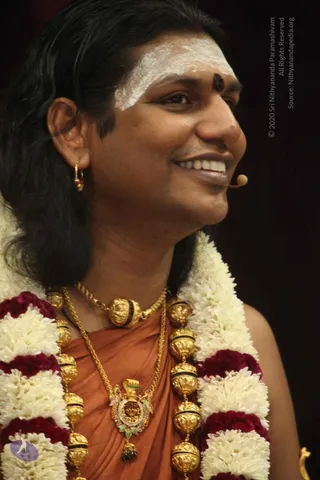
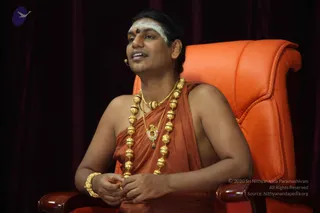
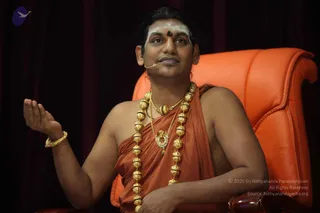
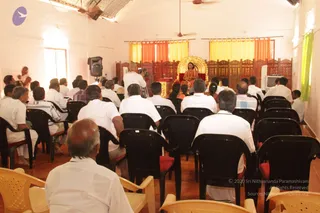
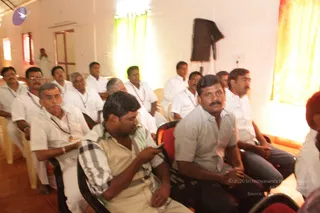
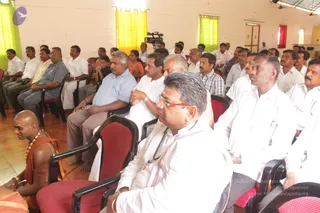
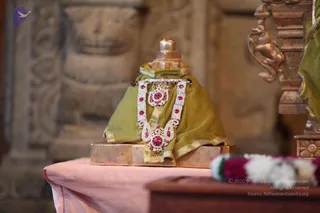
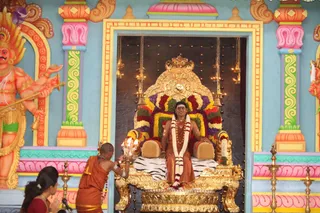
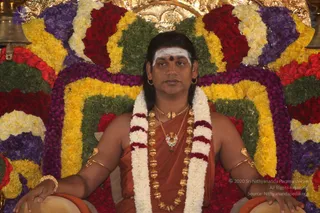
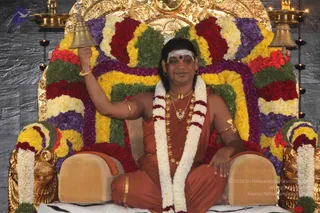
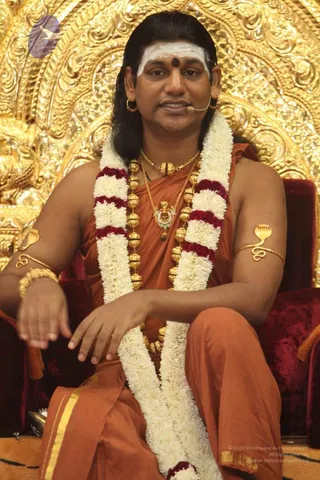
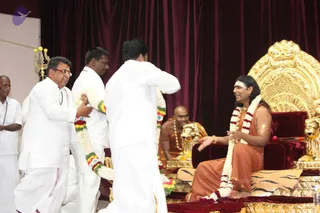
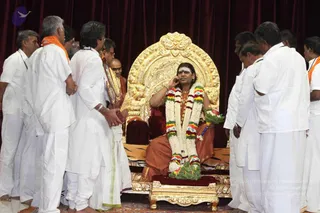
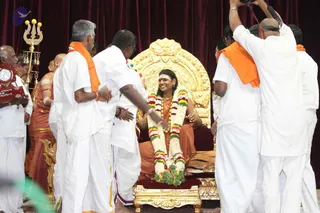
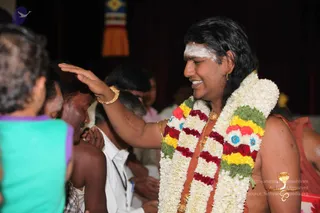
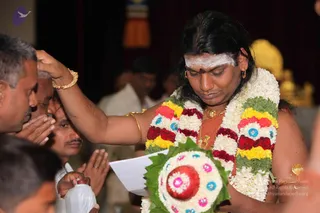
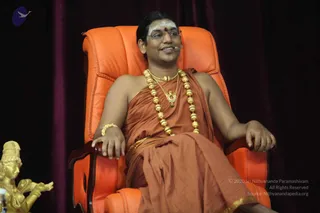
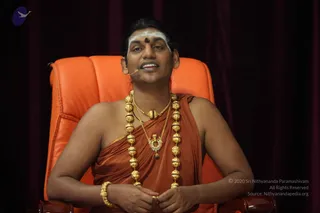
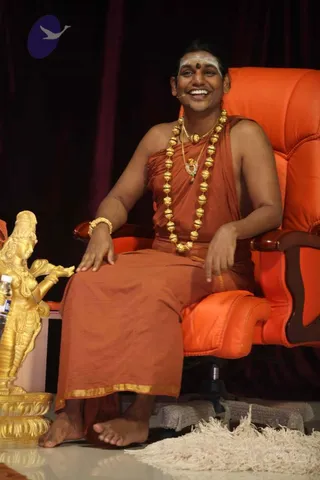
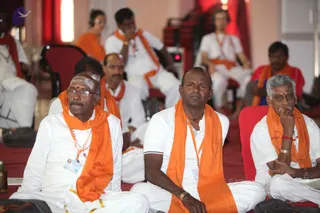
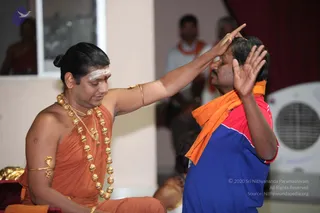
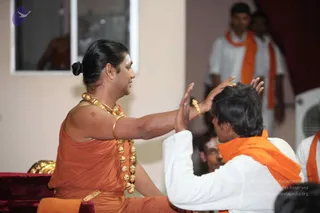
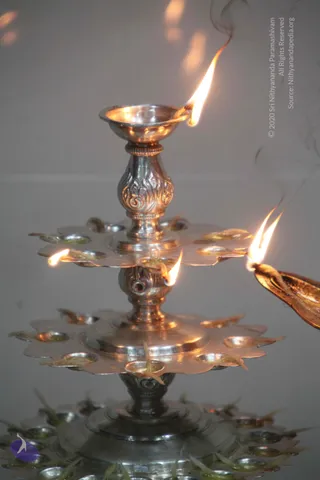
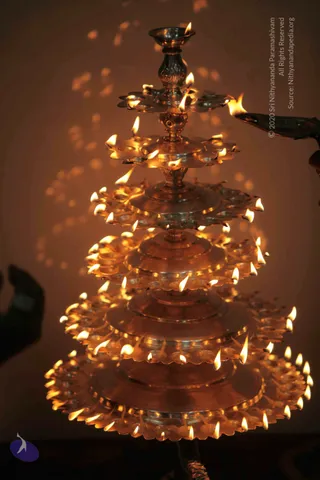
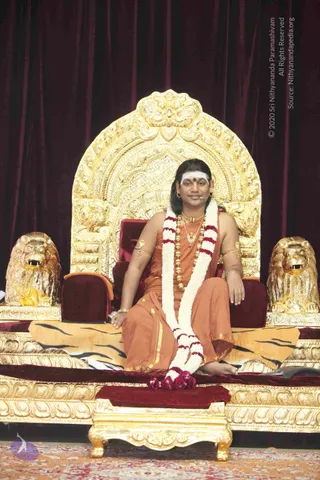
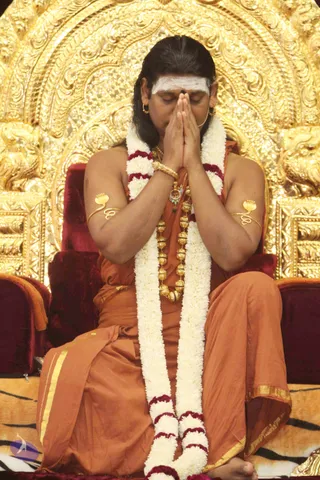
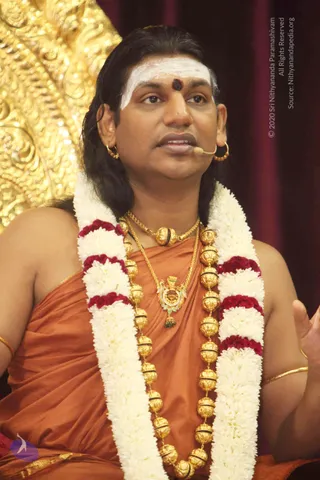
A close-up photograph of a tiered silver oil lamp stand with multiple small cup-shaped wicks, several of them lit with flames. A brass oil lamp is being lit at the right edge, and a silver stem with embossed floral patterns supports the tiers against a plain white background.A seated figure in an orange-saffron robe sits on a gold-carved throne in front of a deep maroon velvet curtain. A long garland of white flowers with multicoloured bands hangs over the robe, with a bouquet of green leaves and yellow flowers held in the lap. Several men in white dhotis and white shirts crowd around, one raising a decorated ceremonial crown or headpiece with blue, purple and white stones onto the seated figure's head, while others reach in to steady it. A man at left smiles and wears a red tilak on his forehead; a bald man in white stands behind. The setting appears to be a formal satsang or coronation-style ceremony.A man seated in a bright orange leather swivel chair on a stage with dark maroon drapes behind him. He wears an orange-saffron shawl draped over one shoulder and body, with a gold-beaded rudraksha-style mala and a gold necklace with a pendant. White vertical tilak marks and a red-brown bindi are on his forehead. He holds a bright pink clipboard on his lap and speaks into a headset microphone, his legs crossed with bare feet visible. A water bottle sits to the left and a white rug lies at the base. A small blue-and-white logo appears at the top left.

March 03 2013

Original wiki page
Contents

Title

Vision for A New Age Sangha (SPIRITUAL COMMUNITY)

Description:

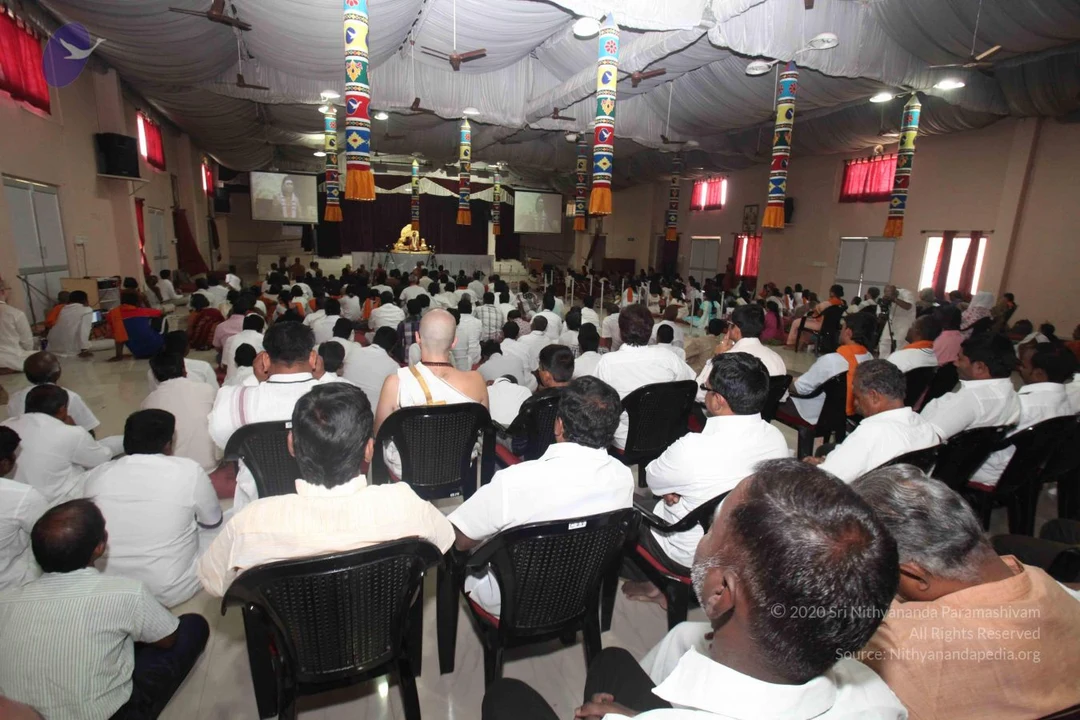
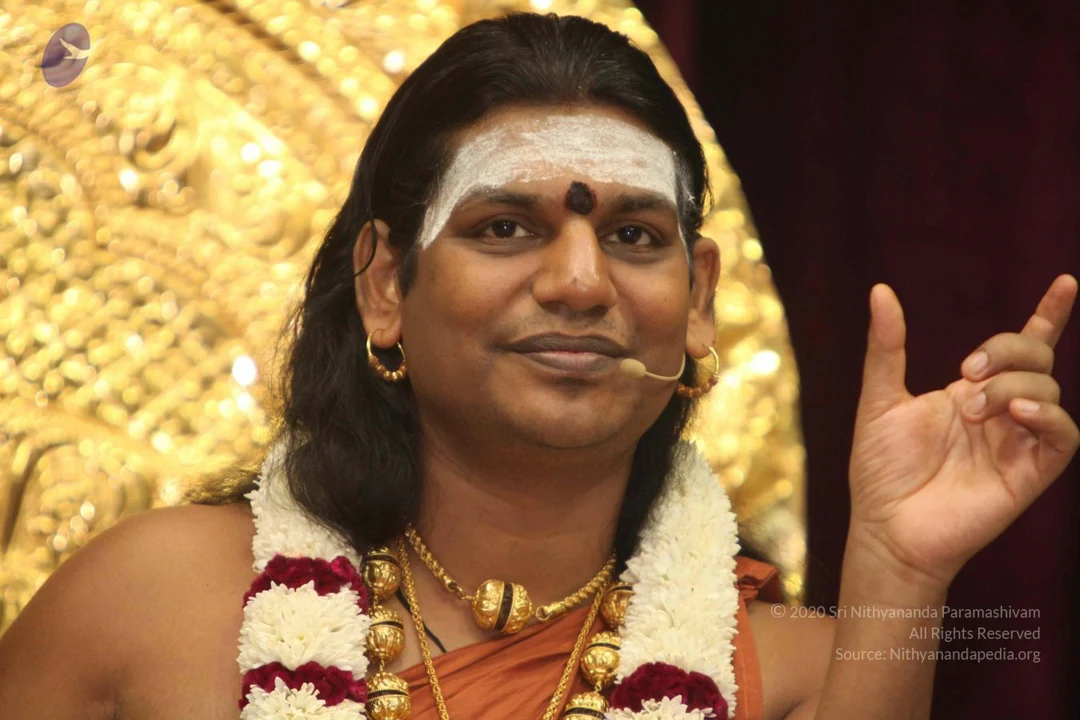
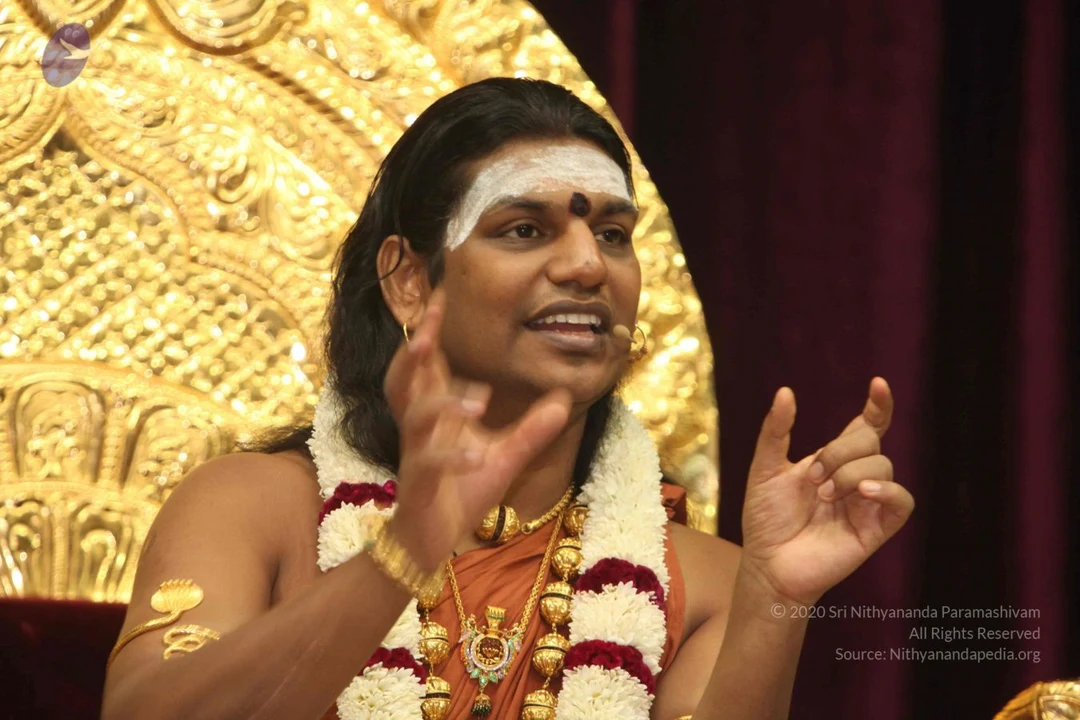
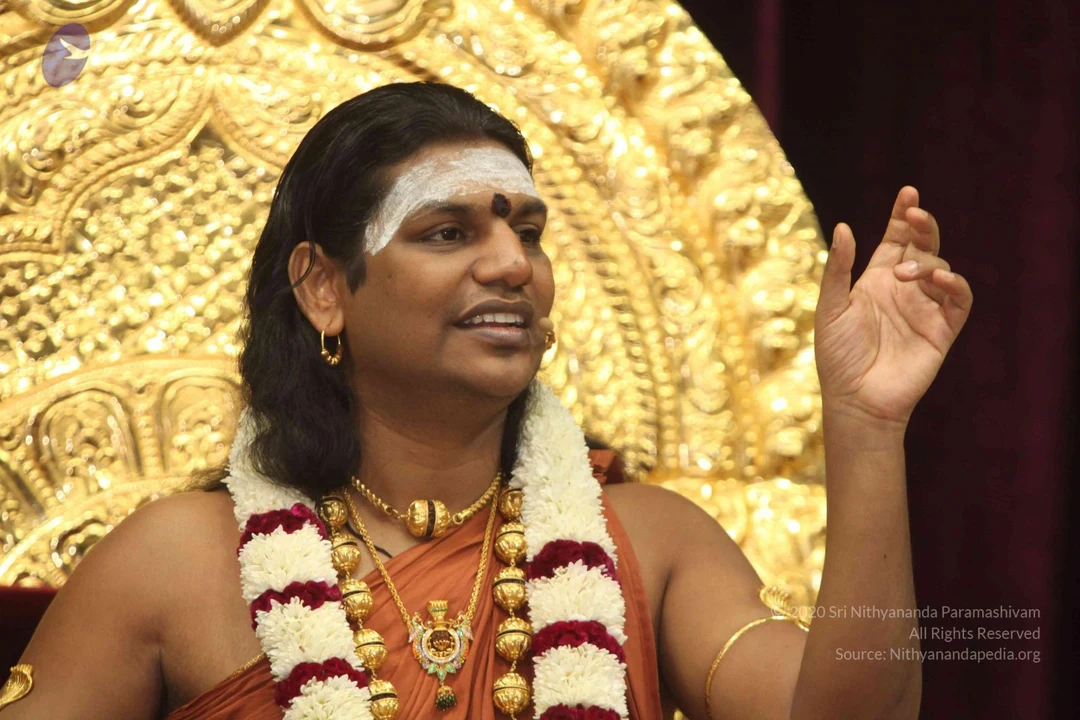
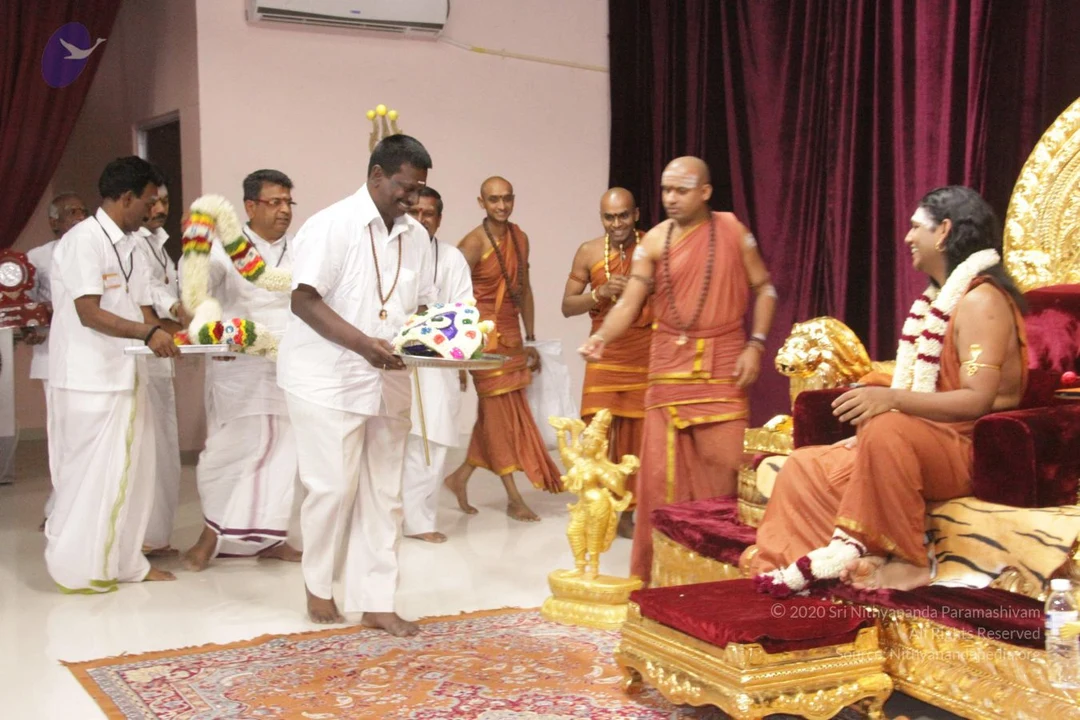
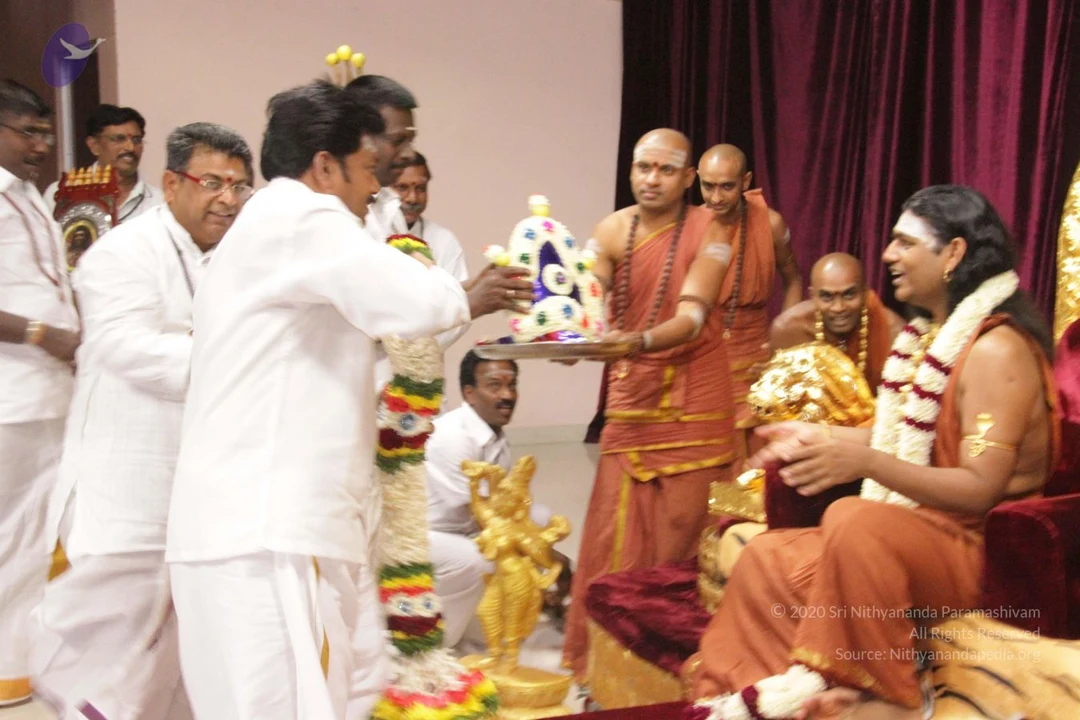
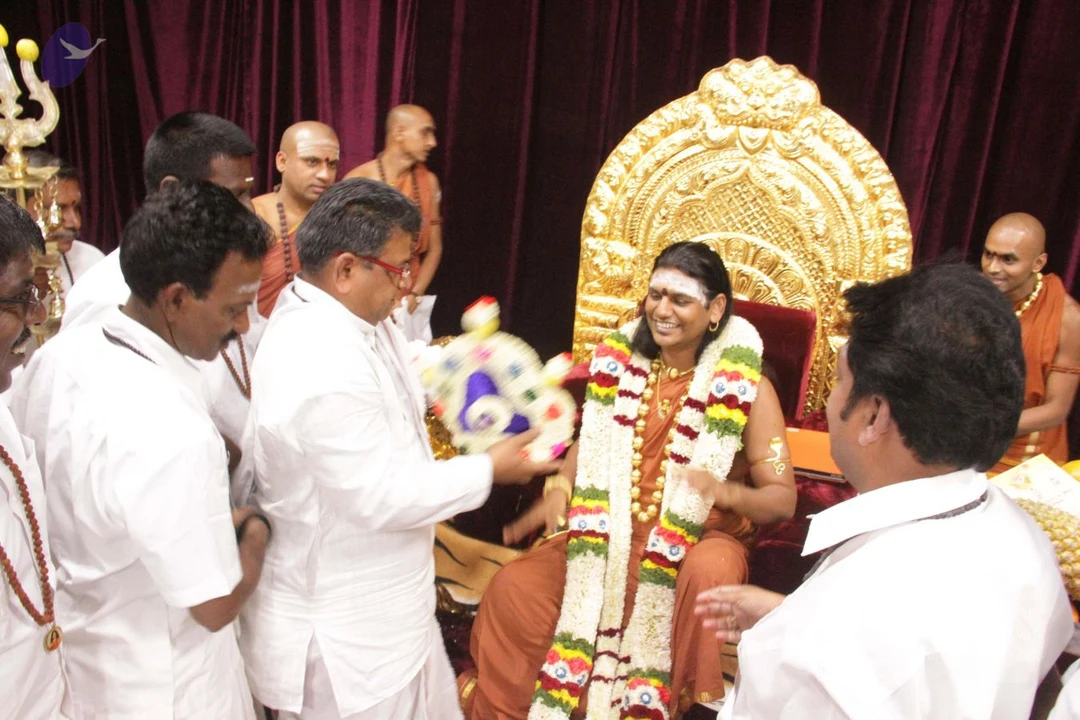
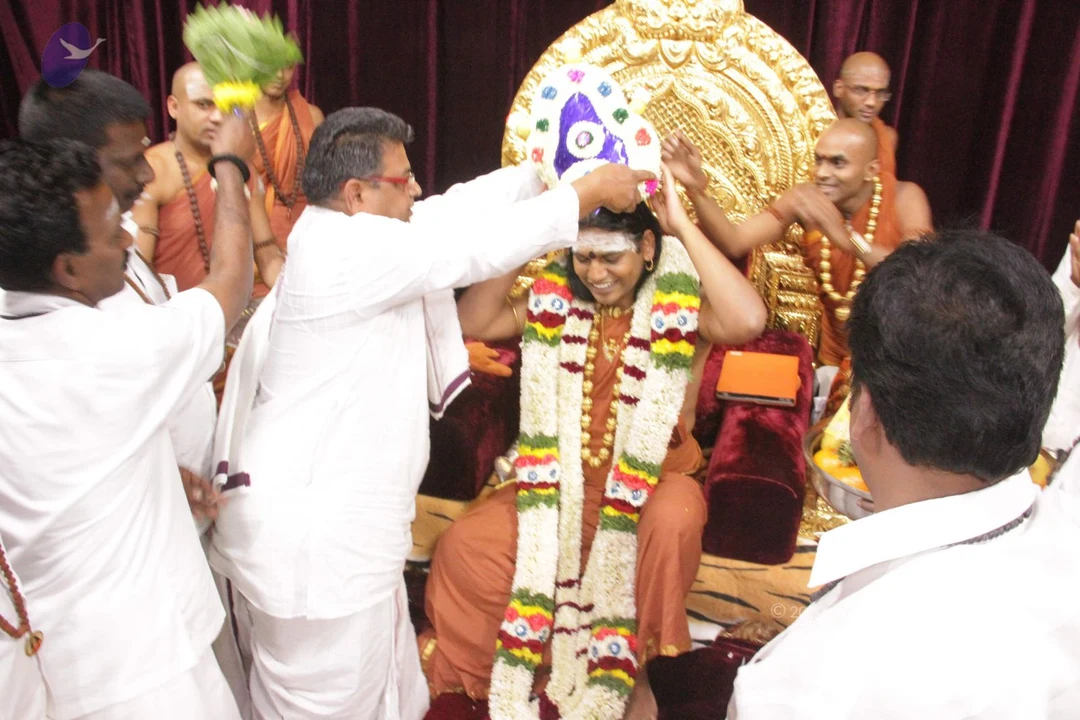
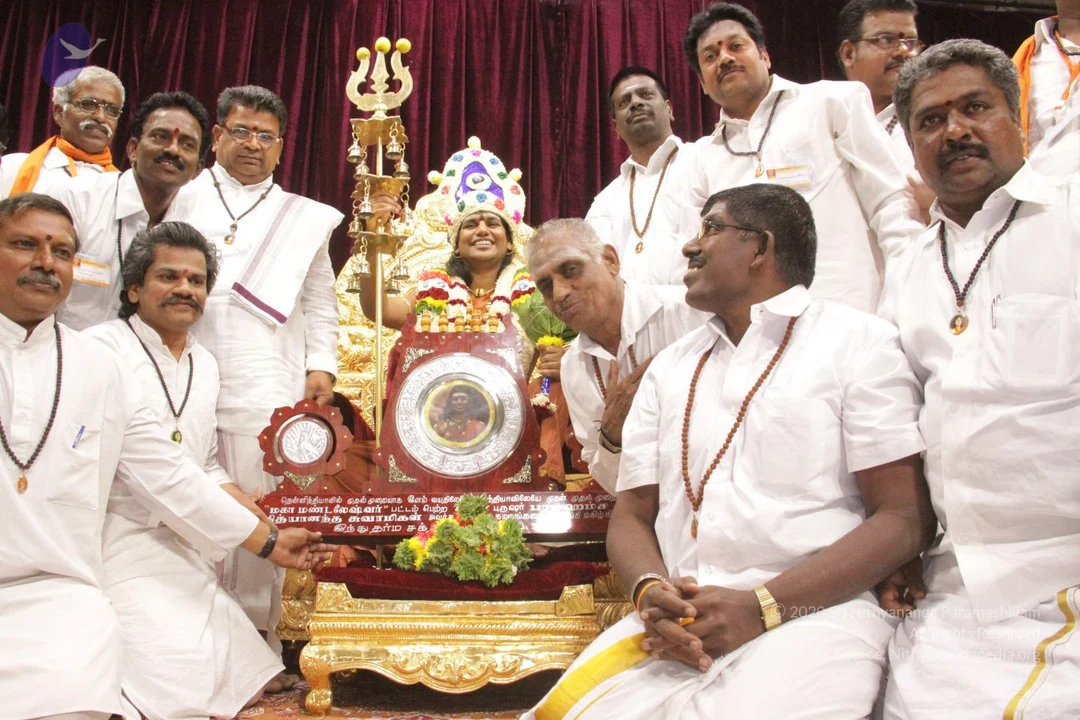
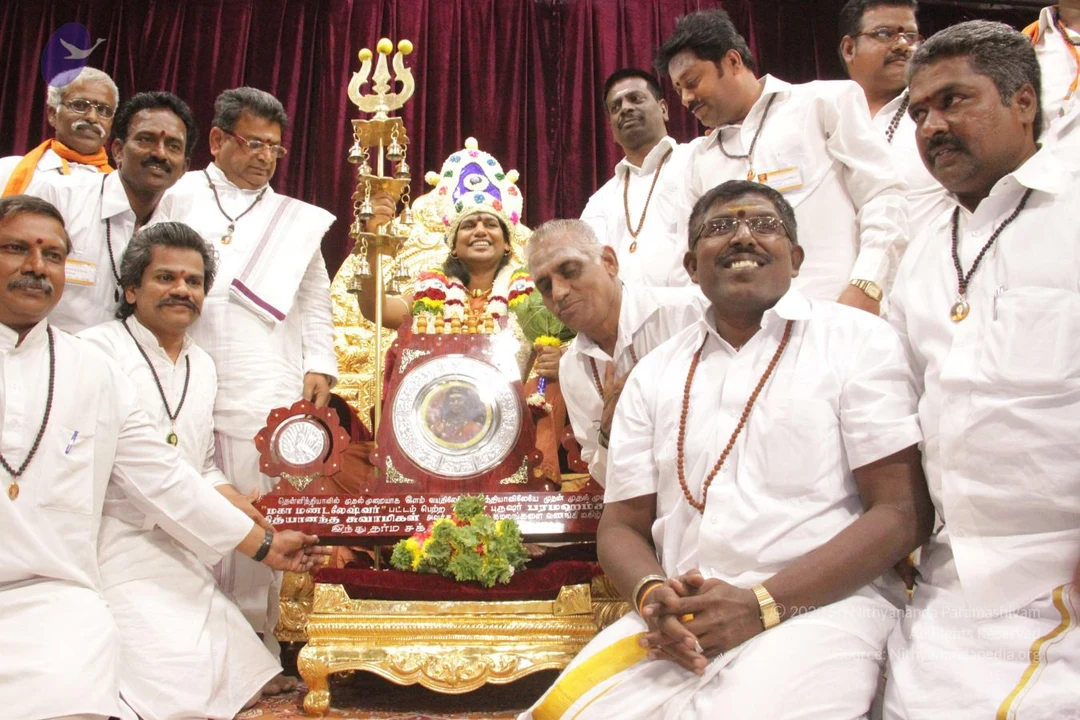
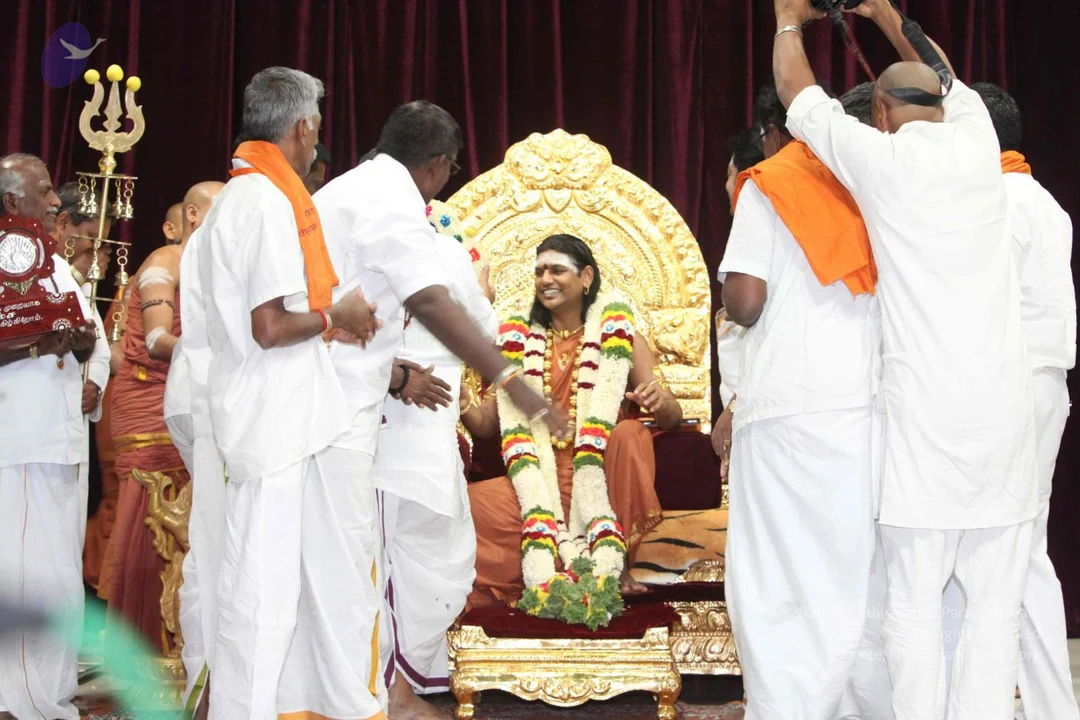
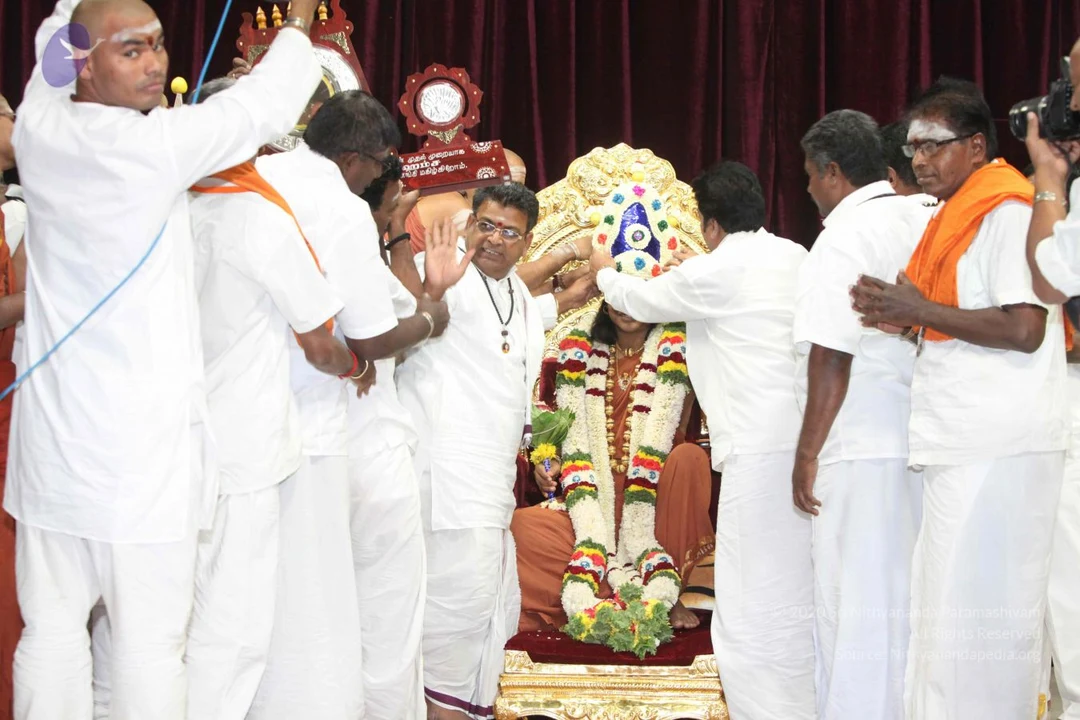
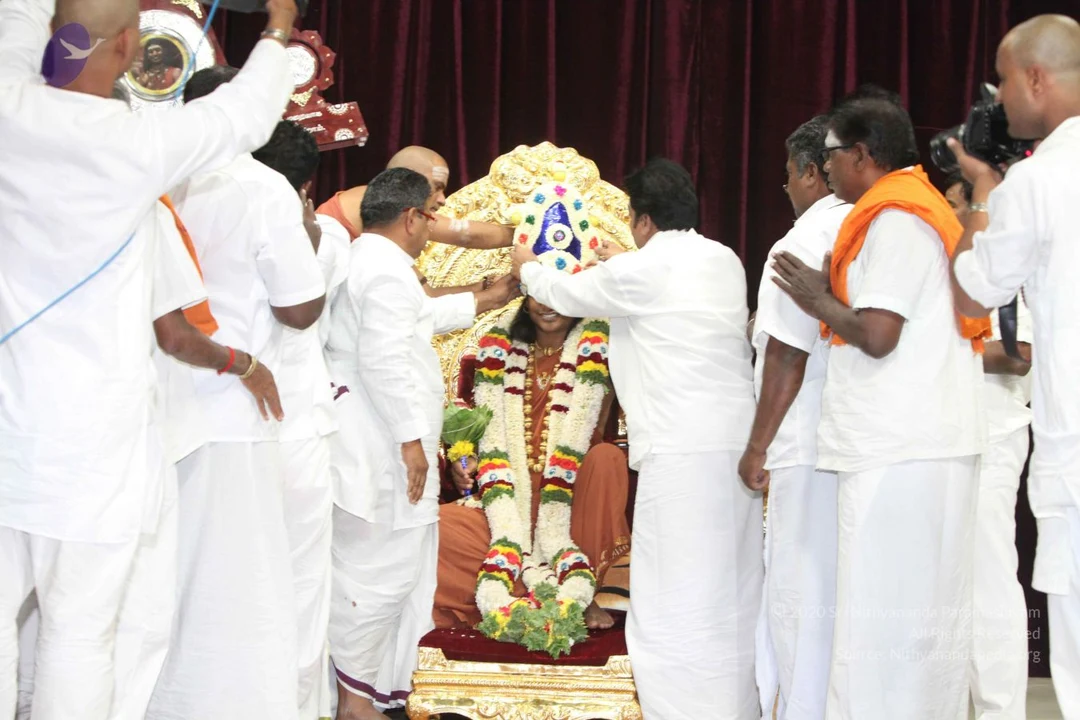
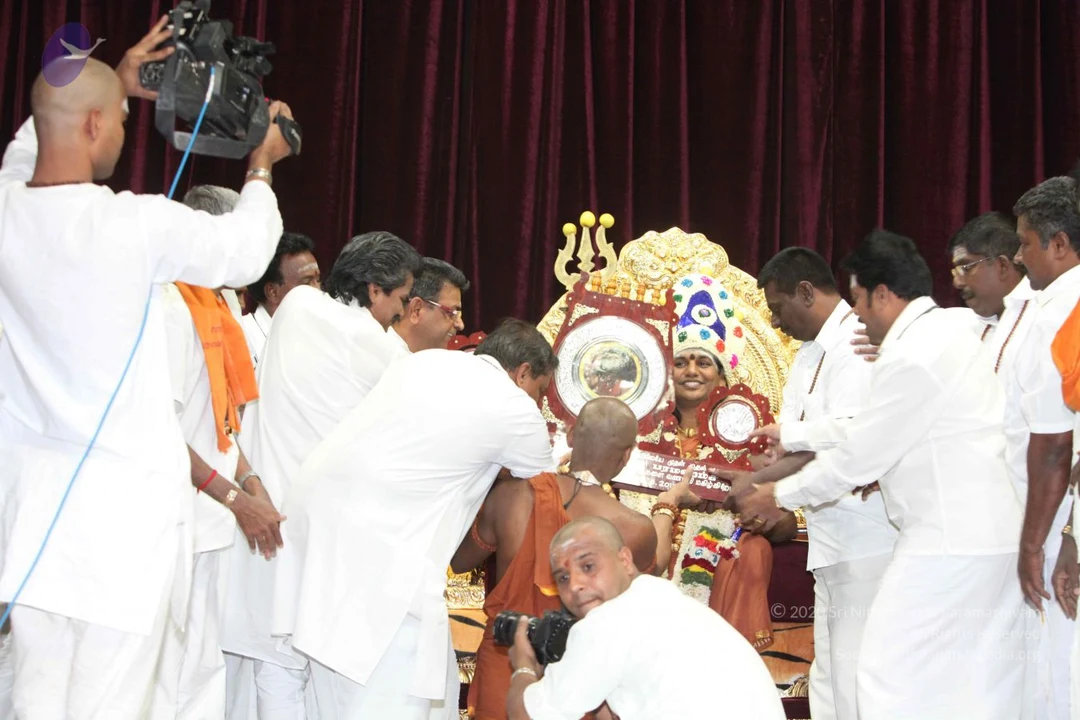
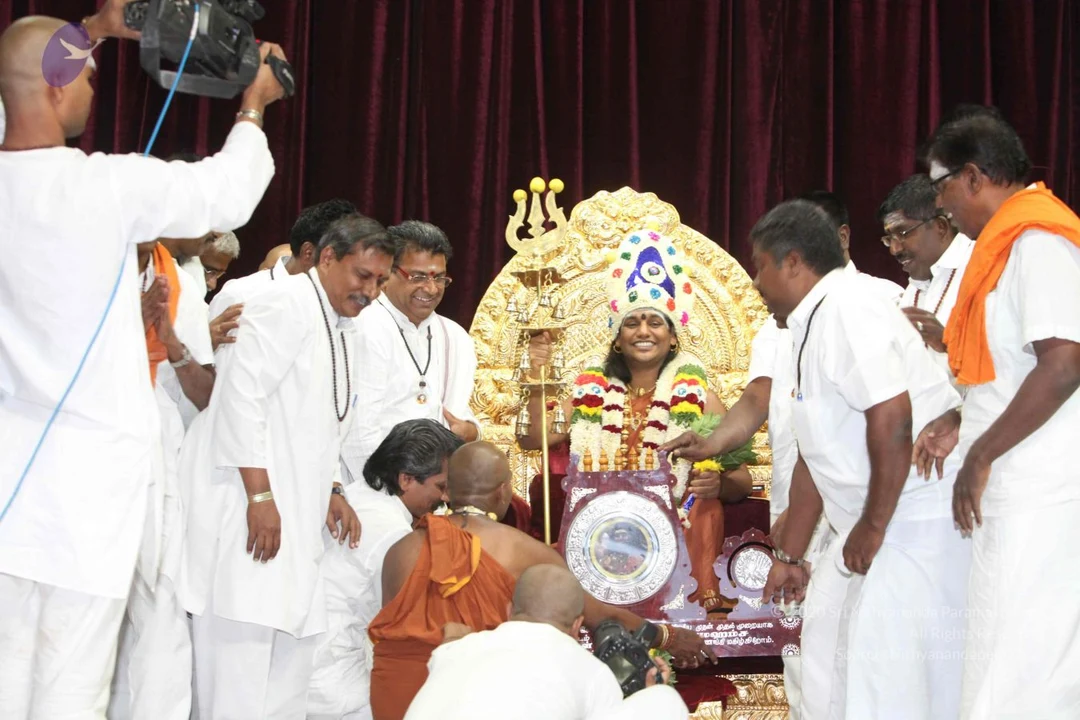
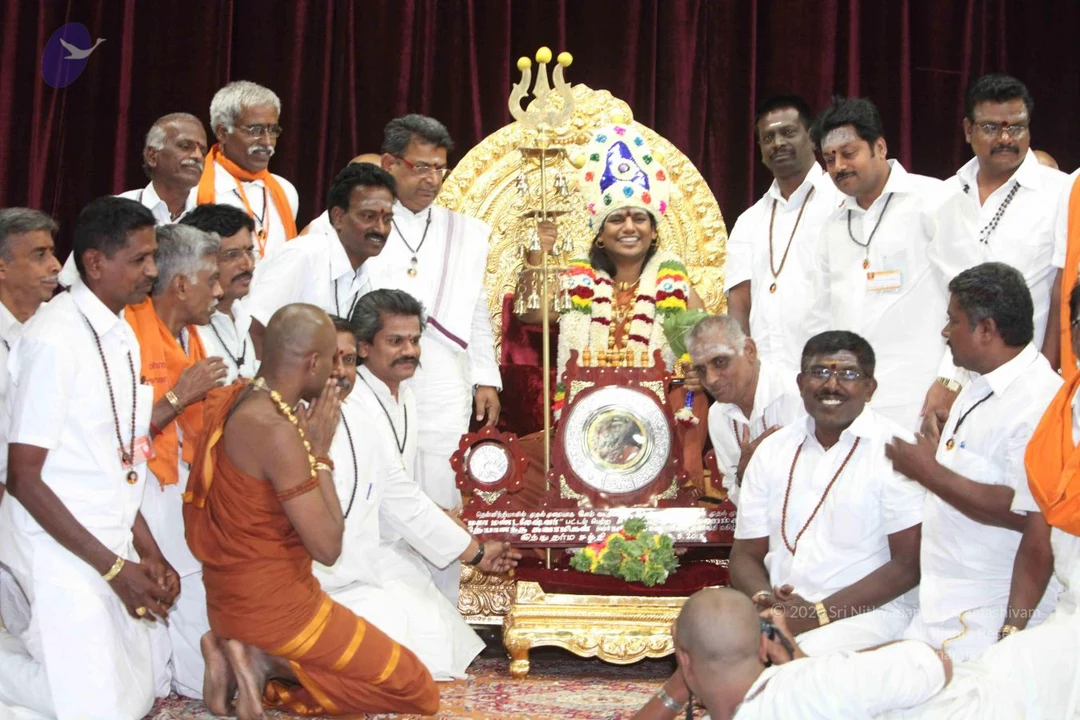
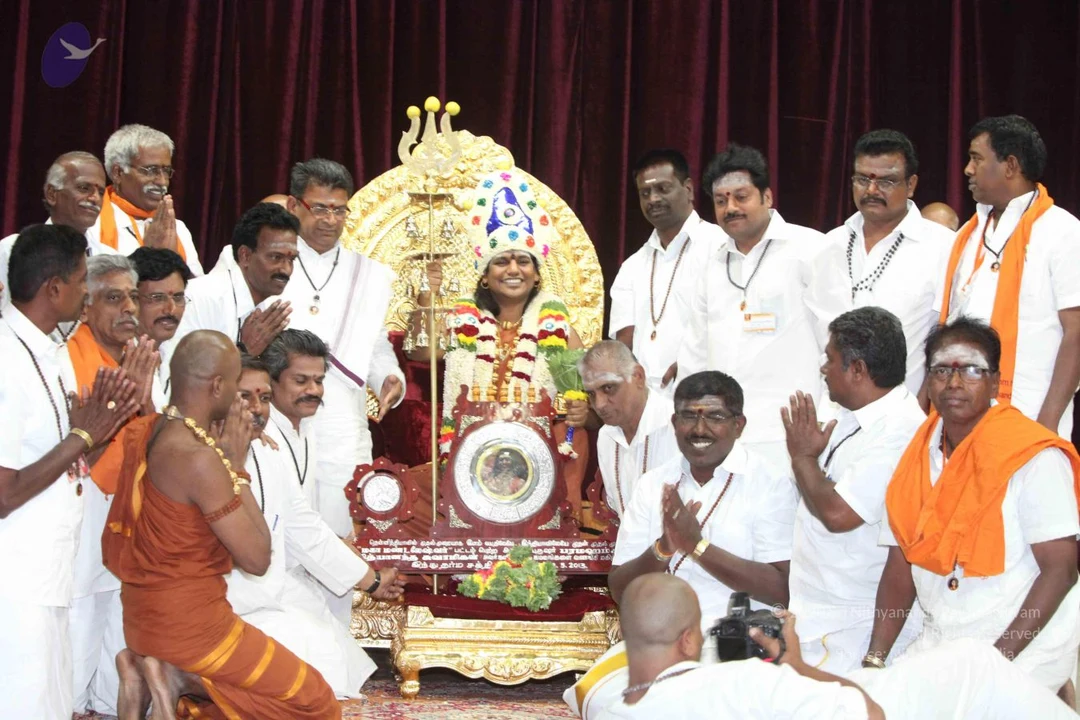
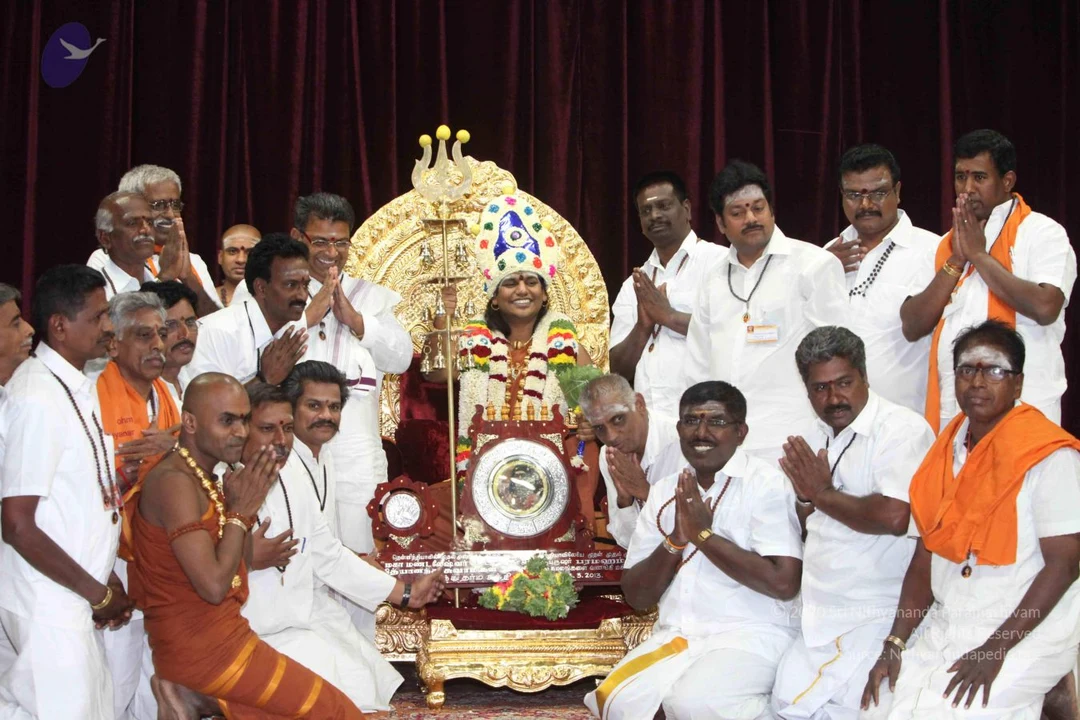
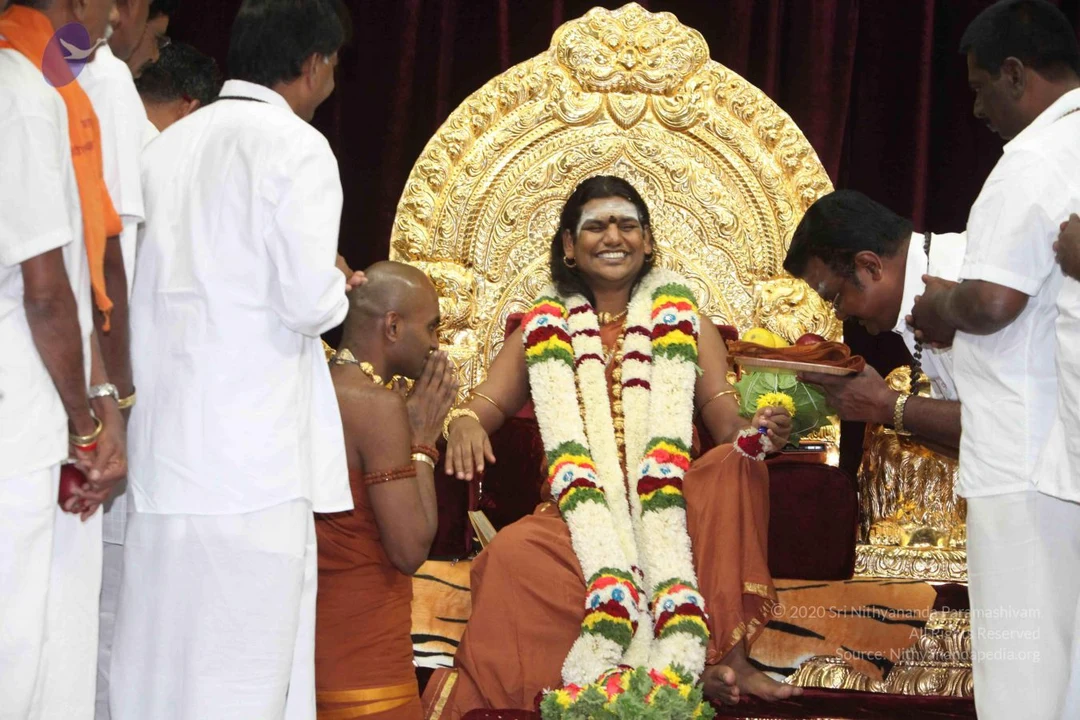
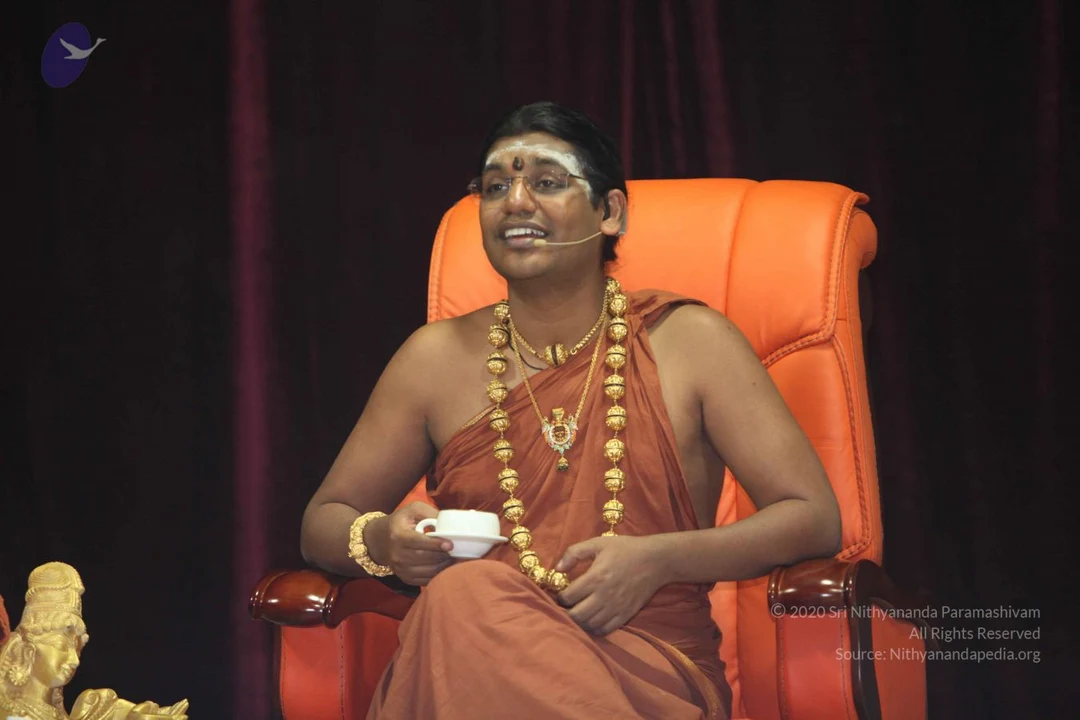
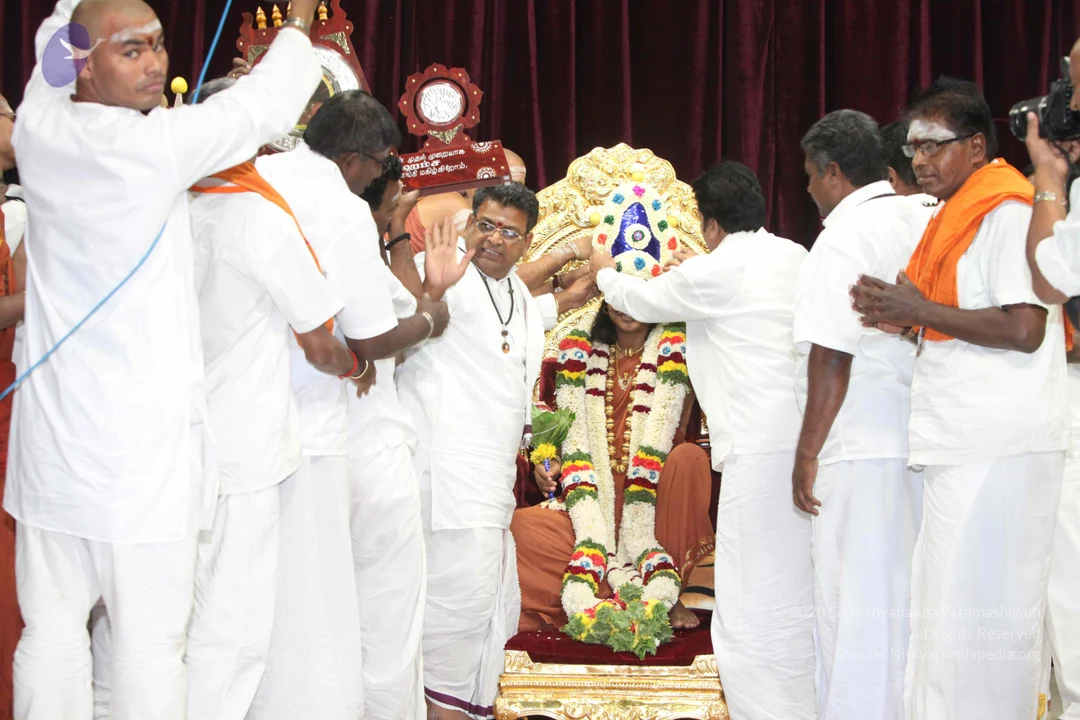
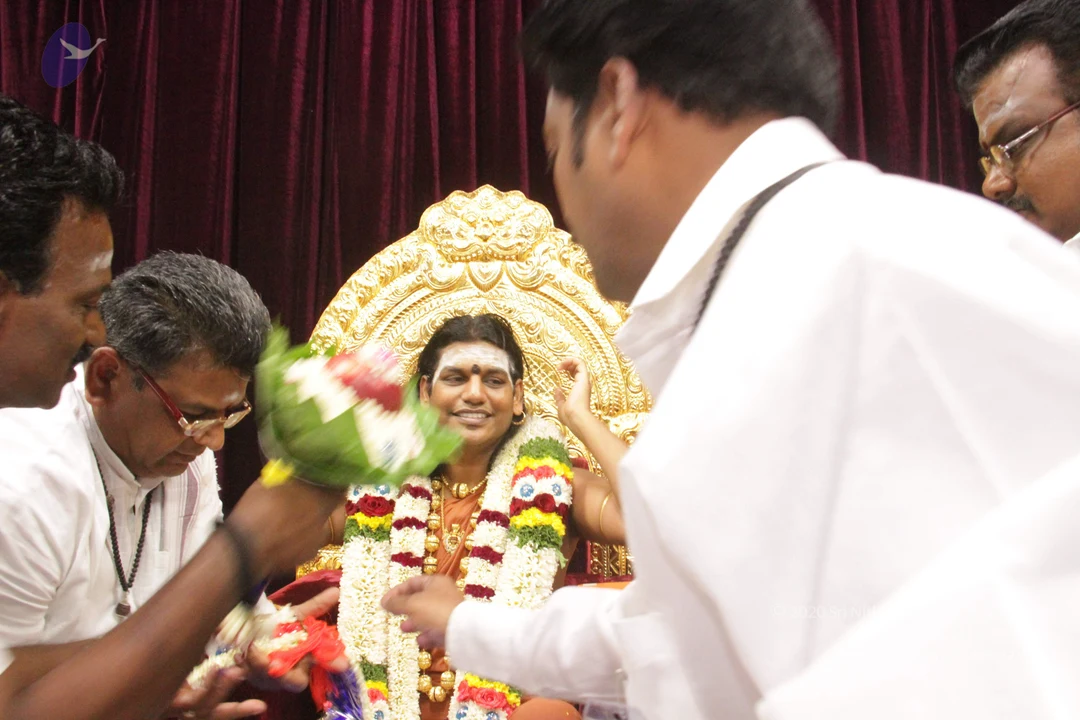
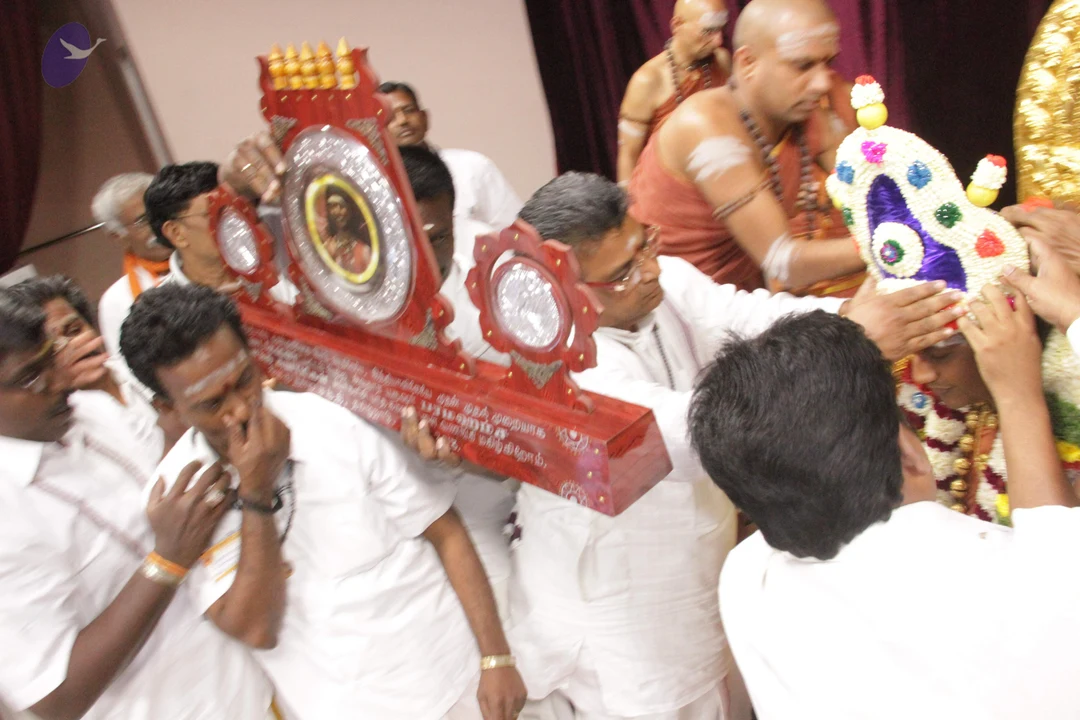
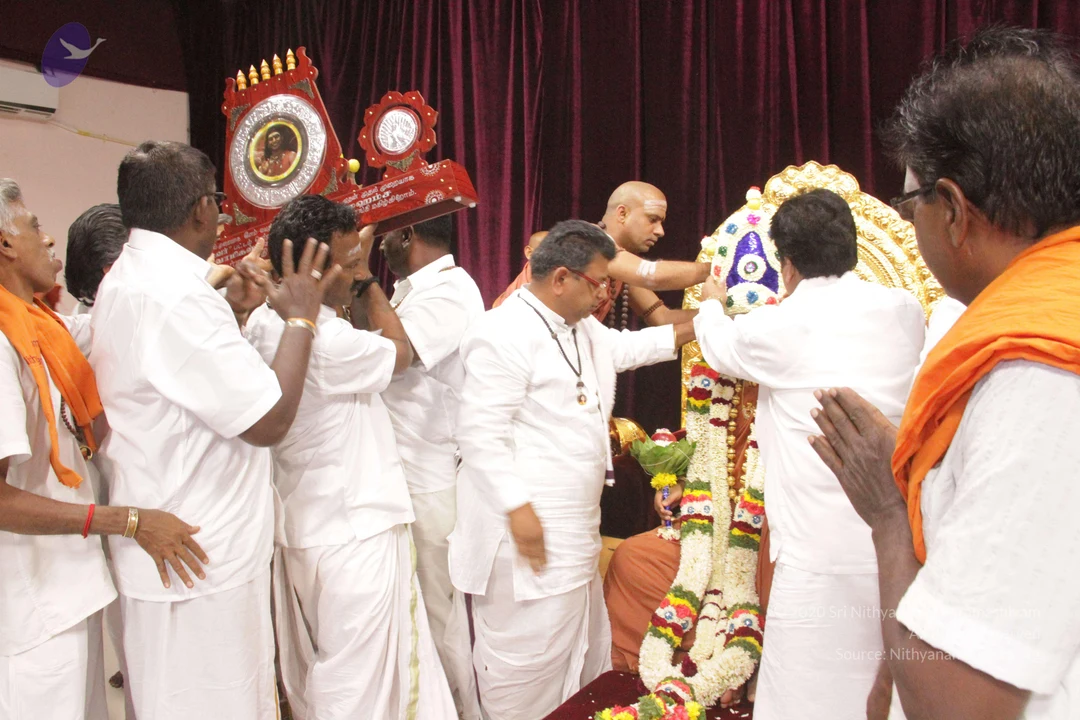
In today’s morning satsang, Paramahamsa Nithyananda creates a new term for His unfolding sangha. In the same verbal style as Socialism and Communism, He proclaims His philosophy as Responsibilism: the epitome of leadership. A leader is one who is with a group but rises above the group, just as an incarnation is within a human body, but is not human. He poetically observes that being in His presence should not be experienced as entertainment; rather it is entrainment. He expects His followers to embrace His example and become responsible leaders, enriching the world. Nithyananda sets forth the revised statutes for His monastic order. Having been coronated as Mahamandaleshwar, He aligns His order’s rule with that of the Nirvani Akhada Peeth, which He now leads.

VideoAudio

Transcript

Sadasivamsamarampam Jnanasampantha Marthimam Asmathacharya Pariyantham Vande Guruparamparam Me apsapka prem ashirvadak sahir svathakarthahum Svahathabi bhakthonka sisyonka samaji on aur satsangh onka Jo visvashke kone kone se issamai 415 jaha se samil he nithyananda tv dwara 44 jahase 2-way video conferencing dwara nayan deeksha praptakarehai, hai issamai dunyabharkai 184 saharaur 28 desonsai lok judaihai varthaman ankonke anusar issamaijo sahir hamarasath 2-way video conferencing dwara nayandeeksha mai judaihuvaihai vaihai

Los Angeles Arunachalam, Adayaru Chennai, NithyanandaNagar Thiruvannamalai, Alvarpet, Sharja, Seattle Chidambaram, Ohio Prayag, Oklahoma Somanatham, Phoenix Kanchipuram, San Hose Madhurai, NithyanandaNagar Hyderabad, Toronto Kailasam, Kooling Malaysia, Ohio Shivananda, Los Angeles Arunachalam, Vancouver Puri, Mumbai Satsangh Centre, Dubai Thirukoviloor, Kathmandu Nepal, Melbourne Australia, Klong Malaysia, Bridgeton Barbados, Rancho Kukumango California, Hong Kong Sirkhali, Lauspet Pondicherry, ma above the Hong Kong what is that city Hyderabad Sri, Port Washington New York, Auckland New Zealand, Guadeloupe Rameshwaram, Atchka Hungary, Oman Sivagangai, Charlotte Srisailam, that’s it?, Mattakilappu Ilangai, Now I can see London Kashi, San Diago Thirualawai, New York Varanasi, Port Washington New York, Charlotte Srisailam, Atlanta ujjaini, Bangalore Sheshadripuram, Houston Kalahasti, Calgary Amarnath, Bangalore Marthahalli, That’s it? Annanagar Chennai, Singapore Singapuram, SanDiego Thirualavai, Houston Kalahasthi, that’s it?

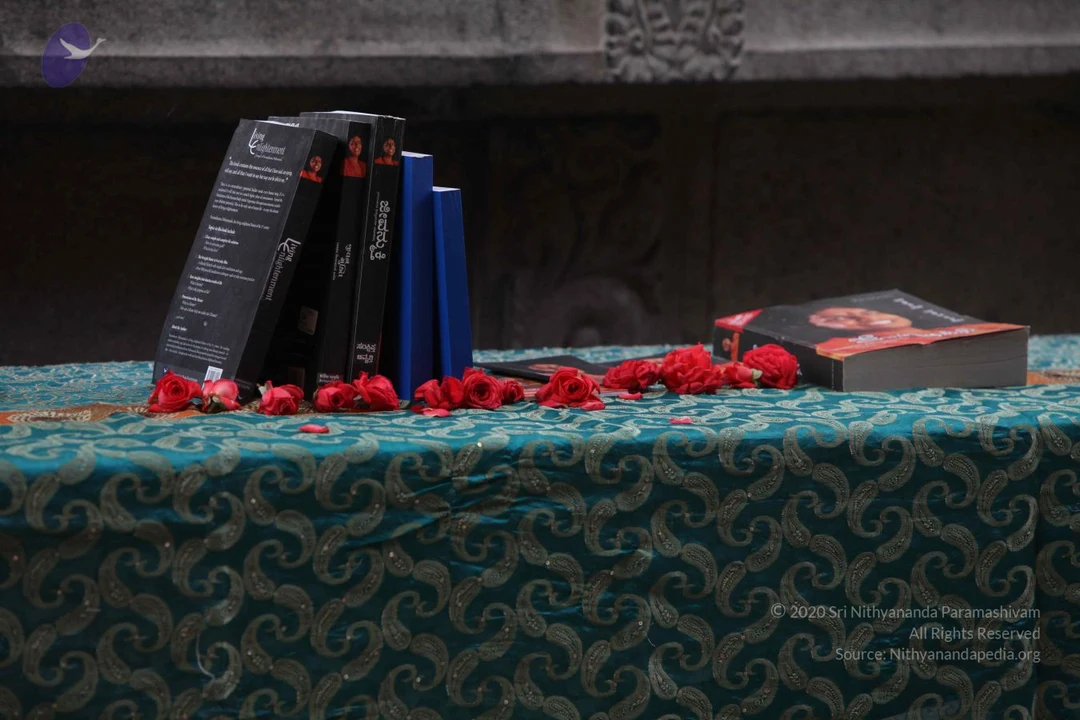
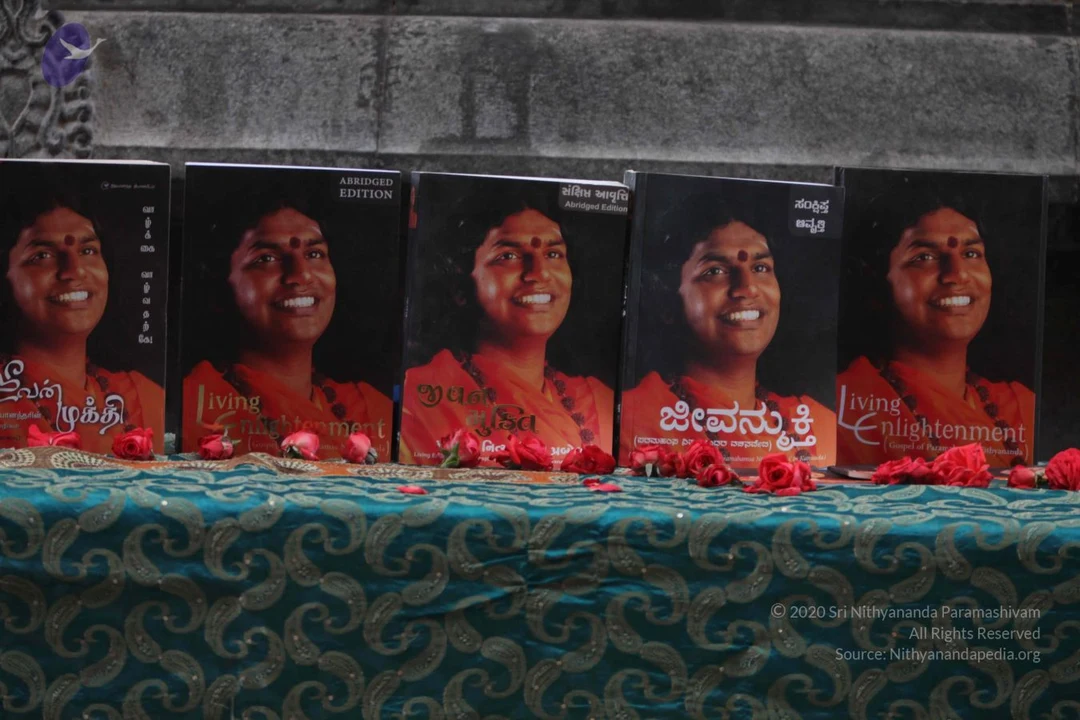
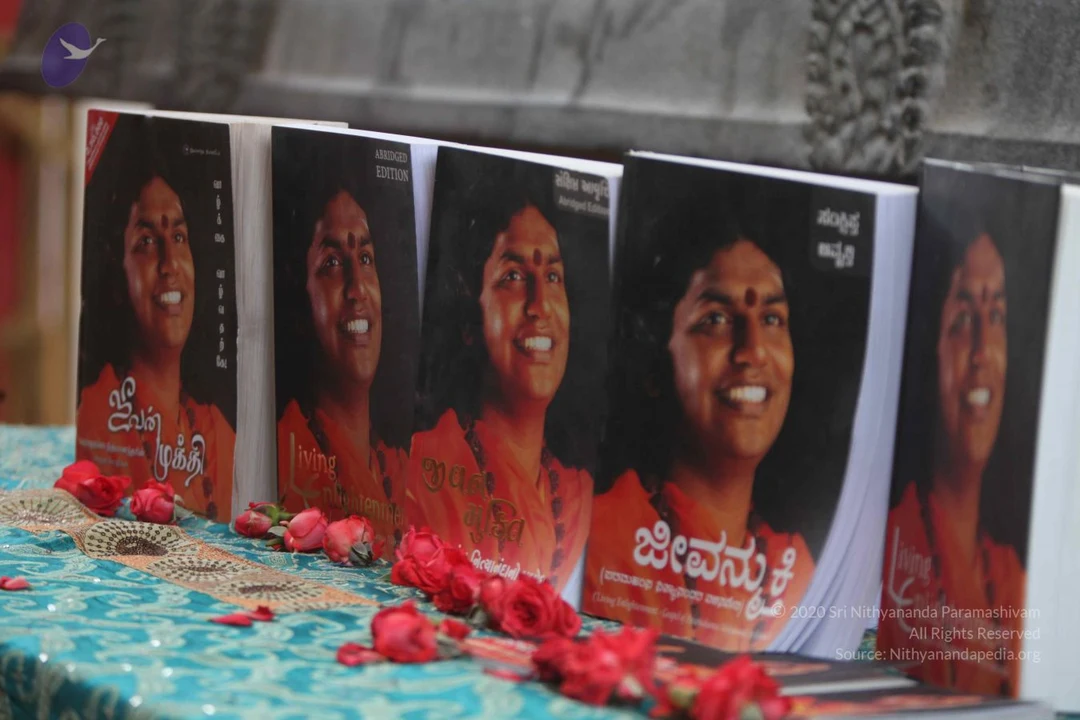
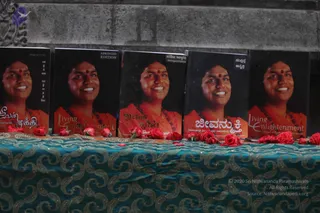
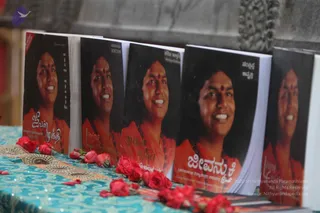
I welcome all of you with my love and blessings. Today Jeevan Mukthi Jayanthi.,March 3rd. Four years before, four or five. Four years before on this very day the great book Jeevan Mukthi was released and offered to the world. The science of enlightenment. We are continuing to create 2nd, 3rd volumes which will be soon available to all of you. As usual today all our temples will be doing puja to the Jeevan Mukthi book. This book, oh you have one more volume ma ready. Still Jeevan Mukthi is the book in tamil language largest printed and circulated and sold. Still nobody is able to break that record of that Jeevan Mukthi book. Still it continues to guide milliions of seekers all over the world, especially the countries where Tamilians are residing outside Tamilnadu like Sri Lanka, Paris, South Africa, London and Malaysia, Singapore. Still that book is circulated, read, followed so widely and translated in so many languages and continues to getting translated in many more languages. As of now at least twenty languages the book has been translated and it is still getting continuously translated into more and more languages. Now the Jeevan Mukthi 2nd volume will be coming up in the name of Science of Jeevan Mukthi based on these 4 thathwas. Soon it will be coming out. Collections of all the satsanghs on these 4 thatwas. Yogananda even in the youtube there should be a separate playlist, integrity, authenticity, responsibility and enrichment. Understand? When are you going to make that playlist. Now you will make it before satsangh. Separate playlist for each one, integrity, authenticity, responsibility, enriching. And have a playlist also, Sangha Satsanghs, Sangha Discourses, Nithyananda Sangha Discourses. So anything I talk, I give my vision about the sangha without editing let it be put there, so that whoever wants to create sangha in their place let them see through all the discourses they will have a guidance. You guys will not be able to transmit all the knowledge and idea continuously. So even earlier whatever we edited we can pull out now all those Sangha discourses. Ma, and just go through the legal opinion and upload it. Bhaktha you will look into it and give the legal opinion which can go up and, because the vision I am giving is from the standard of India. Each country as per their legal things let them adopt as they want but the this will be the spiritual source. Sit now and create all the four playlists, five playlists.

Soon you will have the book called Science of Jeevan Mukthi. Caption will be break through thinking. Unless you have a mind of break through thinking you will not break from thinking.

Sangha discourses by Nithyananda, ma. Sangha discourses by Nithyananda, Priya

So beautiful, we are continuing to enrich the world, so many people continuously through these four thathwas. On this great day of jeevan mukthi jayanthi I wanted to give a important declaration to the world. With integrity, responsibility, authenticity, enriching I declare I am the incarnation to live and radiate, share and enrich the universe with these four thathwas. Listen the importance and practical implications of these thathwas, this declaration. Listen, jyansai suniye, the importance and practical implications of this declaration means including our morning yoga, rituals, pada puja, satsangh and each temple, ashram everywhere these four thathwas should be imbibed. Today I told him the padapuja mantra also will be translated based on these four thathwas, with these four thathwa interpretation and swasti mantra will be altered with these four thathwas, inculcating these four thatwas. The introduction to each deity will be with these four thathwas. As I said Mahadeva’s damaru represents integrity, fire represents authenticity, abhayahastha represents responsibility, the hand which holds the Devi represents enriching. With this clarity the definitions about the deites and interpretaions about the deities will be given. Imbibe every creative way these four thathwas in our sangha everywhere. All the ashrams should have a clear display of beautiful, describing these four thathwas as the essence of my teachings. Buddha is always remembered with his eight principles. I should always be remembered with these four thathwas, as the embodiment of these four sathyas. Make a pull-out immediately, design. All temples, ashrams should display this pull-out visibly in the welcome centre itself as the essence of our teachings and mission statement. Everyone is clear? Who is going to design it? Now here Bhakthimaya, come here and finish the designing before the satsangh ends. OK show me then. It should be available in their local language and English. English will be the main language and in their local language, in all ashrams this should be displayed, in a very clear pull-out. Understand no paper pasting and all that. Clear pull-out which responsibly enriches people with definition, which can be understood and practiced in their lives. In the Shivalinga the bottom round is intergrity, the upper round is authenticity. The linga is responsibility and the yoni is enriching. So Shivalinga will be defined with these four principles. Today, 9th batch of Nirahara Samyama, en, ending, concluding the Nirahara Samyama, level 1, 9th batch. 9th batch Nirahara Samyama 1st level people can eat today. Tomorrow we will start the 2nd level. Before coming to the satsangh please eat and come. From tomorrow 7 days you will not be eating anything solid. And today 4th batch The Samyama 15th day successfully. 15th Inner Awakening and 12th enGenius 15th day successfully. If you have completed the first level Nirahara Samyama today successfully please register for 2nd level Nirahara Samyama.

Hamare Jeevan Mukthi pushtakha aj chowtha hai varshik osthav hai

Malaysia Palani Saroja Ramaneya. Blessings, Birthday Blessings for you. With all the auspiciousness you will be with me, I will be with you. Blessings. Mumbai, blessings for Ragu Nadarajan for your examinations. Blessings.

Today I will answer some of your doubts, questions, clarifications about this thathwas. Ma Aachala has a question. How long is, How is long term goals like this declared authentically. Is the long term goals based on strength of declaration and that becomes successful automatically based on short-term every moment authenticity and completing with self-fulfilling negative patterns that comes as obstacles. Ma Achala you are right. First time you made a right statement in your life. Where is she? Oh, great, fortunately she is here to celebrate it. How to decide on long term vision and commitment authentically. Listen, whenever you are not able to stretch

(after 20:00 until 20:12) with integrity, in the space of integrity if you are not able to stretch, find out

30 : 50 Min Immediately the power becomes available to you this is the advantage listen with authencity and integorraty I am declaring immediately after the initiation this power will be in your disposal I can say in your disposal also that’s the advantage the risk you are taking is you will not be able to change your biomemory after some time for doing something else for example you declaranised bramachariya or sanyash your whole biomemory will be prepared for that purpose after two years or three years if you want to change go and get married or do anything other than this five verdas you will not be able to do that only you have to be very clear all of you are very clear if you are very clear that this is your life it is a powerful boosting like a you will totally be in a different level of integorraty and authencity and responsibility and enriching it is like a doing unclutching before inition and after initiion as the inner awakening participants will know the difference before initation when I make them do unclutching and just after one touch when they start doing unclutching what happens like that amazing possible door is opening door to kailasha is opening I can say path to kailasha is opening because kailasha never has a door only vikuntha has a door kailasha doen’t have door there;s no reference kailasha having door anywhere any scripture kailasha only has a path no door because mahadaeva never locks anything so listen I give you the responsibility and power sorry I give you the power and responsibility to choose and declare and have and I continue to take the responsibility to make you qualified for your declaration if you declare for nistica I take the responsiblity to constantly support you and make you qualified for nistica if you declare for puranasanyash I take the responsibility to constantly enrich you and bring you to the state of puranasanyash we will only have a small difference nothing much even in the dress it is not going to be there is not going to be the any much difference the both of you guys are going to have only kavi nastica and puranasanyash both are going to have only kavi maybe the border will have a small change border for people to know others to know onlookers to know maybe the border in which we are using now the red border and this colour all the nastibramacharies will wear and you will have the title bramachari that so and so for example anyone bramachari nithya your name and chythaniya will be the title for example if your name is nithyaadmanda if you take bramachariya bramachari nithyaanmondya chathanya if you declare for puranasanyasha than it becomes swami sri nithyananmonda swami if you are a sanyashani sri nithyatomaonda swamini that is the way it becomes ma nithyatomanda swamini so this is the way it becomes listen I’ll clearly define kramabramacharis will have bramachari only that name the chythanya will not be there and nisticabramacharis will have bramachari there name and chithanya or bramacharani there name and chithanya swamis will have when you declare for sanyash swami name actual sri name and swami and if you are a sanyashani sri name and swamini that’s the way it’ll be for sanyashinis sorry again sanyashini ma name and swamini clear any other doubts I’m giving I’ve decided to give the title swami and one more thing after the sanyash based on the responsibility you take you will have the different titles also if you are able to make people live this four tatwos you will have the title acharya if you are a narahari you will have the title anar if you are a healer you will have the title hachar and if you are able to run one peta understand I am making each ashram as independent peta each ashram is a independent peta for example Hydrabad will be called as nithyanandadyanapeeta Hydrabad Thrivanamalai will be calle as nithyanandadyanapeeta Thrivanamalai Bridi will be called as nithyanandadynapeeta Bridi each ashram will be a independent peta so anybody takes the responsibility of running it will be called as petaeeswara you can have in your resume in your pravara you can have nithyandadyanapeetasiladasa salam salam is called sala saladasapetadaswara you can have I am completely opening up and giving all the powers and responsibility to everybody everyone even including this campus I am not going to retain the petaeeswara title to me I will only be called as founder of nithyananda dyanatapeeta so I am not going to have any title even of this ashram and if you are able to run one peta take the responsibility and enrich others I will not even intrefere and transfer you and all that I am not going to intrefere in any of that all of you sit as a sanga and you decide who wants to settle down in one in which peta and wants to take the responsibility same way even the money enlotment if you can convince sanga enroll the sanga for example you want to do a project in Dehli which ll be useful for the sanga enriching the whole world through this four tatwas listen everything should be with the purpose of is it going to enrich people with four tatwas so you are you want to do a project in Dehli you want to start a channel if you convince enroll the sanga that this project will really enrich people with four tatwas sanga can saction the money you required listen I am really not going to intrefere and I am really going to ando you guys with power with intense integraty and authencity, responsibility and enriching I declare I am going to give you guys all this powers of course outside India already no organization is in my control I don’t have any power legally they’re not in my hand already they have become independent peta they are independent petas from the beginning so now even the Indian organization I am making it as independent so you commit with the sanga you enroll with the sanga.

You enroll the sangha, you enroll with the sangha let sanga be convinced. All of you are understanding? And the same way sanga which authorises somebody, by giving money is responsible, guiding that person and making that project successful and that person is responsible to answer the sangha and sanga should also take care that you don't make retapsisim as your lifestyle nor you become spendrup destroyers. Each one of you take the responsibility your level of authenticity and responsibility shown in the group. Consciousness. The collective responsibility. Understand? I’m opening a new door of possibility for everyone of you. Don't be retapists; don't do, don't do, how can we do, what to do? and same way don't be destroyers throwing away in authentically. Take the responsibility, think through, help others to think through and see who is committing to sanga. Easy there rooted supporting root or still hanging root. Study. Let everyones authenticity speak for themselves. Let the people of authenticity be revealed by the sangha. Let the people express authenticity responsibility integrity and enriching. Be endowed with powers of the sanga, an infrastructure. To enrich more and more people. Maybe the morning yoga time will be the time along with yoga every thing goes on. Commitment and completion and everything. So very soon we will separate the morning yoga only for the committed responsible ones. Have your self have it clear? Categories as i said i neither believe in communism nor socialism not capitalism. I believe in responsibility. So amongst you divide your self the responsible ones and yet to be responsible ones. I don't want you guys to be divided as i chastity brahmacharya or a sanyasi or crumabramasharias rishis. I wanted you guys to be identified as responsible ones or yet to be responsible ones. Enriching ones and yet to be enriching ones. Authentic ones and yet to be authentic ones. Integrity ones and yet to be integrity ones. Come on lets have fun! Now if you're going through fear you are inauthentic because im exposing your inauthenticity to you. Many posts power position you are holding on due to your inauthenticity will be washed away now. You are holding on to all that based on your hold over me the moment i take my hands up you know. You have to answer so many people. Who will expose so many inauthenticity to you. Cheating me is very easy i'm kolibaba. I'm kolibaba you can always explain my compassion to hide your in authenticity. But now your going to face, see im a diamond and rose you can many time just rub my rose dimension save your inauthenticity but now there are so many diamonds you may have to face now. There all waiting to mold you and expose your inauthenticity to you and one more thing i want all of you to know even if you in authentic you have a right to expose others inauthencity and only that is the only way you will be exposed to you inauthenticity. The argument, when you expose someone elses inauthencity you yourself are inauthentic why are you exposing my inauthenticity to not hold water any more. It dosent hold good. You expose my inauthenticity i expose your inauthenticity is the right altitude and that is authentic. Clear? You help me to grow ill help you to grow thats all. It is not that i cover your butt you cover my butt no. I wash yours and you wash mines. I give animea to you you give animea to me. Clear? Mahesh bail from huston, Nithya brama suaroopa is asking swamiji respects if biomemory’s changed how can one get the idea to get out of sanyas. Bramaswaroopa they cannot get out of sanyas i am just warning them to strengthen there decision nothing else. Biomemory changed how will they but biomemory change does not destroy their free will they can out of conscious choose nobody can say anything. That is the free will clearly we can enlighten continues to exist and possibility for falling is there. Bramaswaroopa clear? So each one of you declare each one of you take the responsiblitiy each one of you become part. If you're able to run a pita let you have the power of pitaishwar. Now its all based on your responsibility and i'm not interested in doing socialism and communism. Only few people continue to take the responsibility and enrich others just each and sit and not only eat and sit but teach the fellow responsiblity. No. Same way any department change anything i am not going to interfere enroll with the sanga ill only be helping you guys to live this for thatwas and if you have a doubt is it authentic or inauthentic if you bring it to be ill try to throw light on it thats all and if you guys dont have a doubt i will not even interfere only if you have a doubt ill try to throw the light. I always wanted to live with a group of people who are responsible. I will only support you guys enrich you guys in conflict resolution whenever a conflict arises all other commitments let everybody know each others. Authenticty inauthenticity commitment or not commitment and same way sanga should take responsiblility of the person who is struggleing with conflitcts dont throw him out you have to enrich him and not give up on him help him to deal with what hes dealing with. You dont need to grant money for his project but you should see to it he comes out of the conflicts and take that responsibility then money is granted for the project

Title

Vision for a New Age Sangha Spiritual Community Part 2

Description:

In today’s morning satsang, Paramahamsa Nithyananda creates a new term for His unfolding sangha. In the same verbal style as Socialism and Communism, He proclaims His philosophy as Responsibilism: the epitome of leadership. A leader is one who is with a group but rises above the group, just as an incarnation is within a human body, but is not human. He poetically observes that being in His presence should not be experienced as entertainment; rather it is entrainment. He expects His followers to embrace His example and become responsible leaders, enriching the world. Nithyananda sets forth the revised statutes for His monastic order. Having been coronated as Mahamandaleshwar, He aligns His order’s rule with that of the Nirvani Akhada Peeth, which He now leads.

VideoAudio

Transcript

3 March 2013_Vision for a New Age Sangha Part 2 Vision for A New Age Sangha, 3 March 2013, Part 2 of 2

Ma Sandhya Min 15 to 30

Go like a prince or princess the way I went to college. Do the same thing. Ma, you should be asking the question again “Will I be allowed to wear my Kavi when I go to school or college?” It should be your pride! No I have seen, when I went to the Polytechnic all the fellows will be sitting and worrying “The campus interview is coming, the dvs , if you get the job there, you get the job here, that is what, your life is done ultimate and all that. I will never be part of the meeting. When I walk there, I will see “Hey what are you guys discussing?” They will say ”That is our life’s ambition” and such a great discussions will be going on . I won’t even care I will just walk. When they ask me I will tell “Aah”! I will tell them directly “After the education all you guys will standing in queue to get, receive vibhooti from me”. That’s what has happened. All of them are standing in queue to receive vibhooti from me. That is what is going to be my lifestyle. And it happened. One fellow I still remember, his name was Deto. His name itself is Deto. Deto, that’s all, his name. And when I was doing morning puja they were all sitting and discussing. There was some campus interview from dbs . Getting job in dbs is the ultimate goal! And they were all filling the application they were asking “You are not filling the application?” I looked and did not even answer and started doing my puja. They said “You will be a beggar in the street, you will never”, they were cursing, “You will never achieve anything in your life” and all that. I was doing puja. I completed, then just looked and said “Idiot! You are going to stand in queue to receive vibhooti from me, you are talking!” And 5 years before it happened! In Vellur Satsang he stood, he was standing in queue, Deto, same fellow standing in queue! I recognized him with his fat wife and 2 kids and he was stretching his hand, he was a little short guy and before giving the vibhooti I looked up and said, I called him by name Deto nyamorka! He took the vibhooti and said, he thought I was asking that he remembers whether I am his classmate or not. He said “Yes Swamiji, how can I forget you?” I said “No, I am not telling whether you are remembering my classmate or not, do you remember once I said you will stand in queue to receive vibhooti from me?” He said “Yes Swamiji, I remember!” “Hmm, go, I fulfilled it!” Go like a prince or princess to your school or college. Aray, I came to this world itself like that only. I came to this world as a Prince or as a King, Emperor! Know very clearly, listen, strength means knowing you are here but not of here, is strength. Strength means you are here but not of here, is strength! When you are sitting among politicians if you know you are here but you are not in their race, it is strength. When you are sitting among businessmen you are here but you are not in there race is strength. When you are sitting with the students you are here but you are not one among them makes you a leader. What makes you leader, be in the group but not of part of the group. Be in the group but not part of the group makes you as a leader. Being a human being but not being a human being makes you Incarnation! Being in the human body not being a human being makes you an Incarnation! So whoever asked the question, go to your school or college as the favorite inheritor of Nithyananda! Shaktikaa sahi sthiti bhaav hai jab aap yahaa hai lekin aap yahaase nahi hai. So you should have the pride to decorate your body with this graceful Kavi. Let you know you are the monastic member of oldest Apex body of Hiduism. I will also want you to understand, if you take the Krama Brahmacharya mostly you will not marry. Who will do that? Even if you marry by dropping the Krama Brahmacharya you can only be Rishi in our Sangha. You will not be leaving. Clear? So go as a King, as a Queen. I know because I lived that life. What a pride it is! Going there and looking all the boys, because you are looking at the whole thing from above. I am not asking you to look at them like a dirt. Try to take the responsibility of making those dirt into diamond. Same way legal name change, feel this as a pride, feel this as a strength. No rule, only strengths! Understand all these when you authentically with integrity when you approach all of them, they are all, they all will not be rules, they will all be strength for you. What for this Krama Brahmacharya? To protect yourself from unnecessary solicitations! You are saying very clearly, I am already done, please don’t come near me. No too let! See why marriage? You tell I am already committed to somebody. So please look for somebody else. Same way this shows I am already committed to Vedic tradition, so please go on, find out somebody else. And I tell you go with the space of Brahmanyam Bahuputrataam! I am the favorite inheritor of the Cosmos! You are a leader in a group only when you are with the group but not part of that group. Why, why am I a leader? All of you know even if this same thrones are made and same dresses given, same thing, everything is same and the same group is there, the group will find out. Even if everything is same, all of us walk in the same dress as a group, how many of you cognize people will simply find out who is the leader. People will have doubt? That is why I have the courage to give the same things to all you guys. When you have the courage you will also share the same thing to everyone, with everyone. Even if people don’t find that is not necessary, you will know! Thanks to Web Department for creating all the five playlists - Integrity, Authenticity, Responsibility, Enrichment and Nithyananda Sangha videos playlists are created in youtube. Great! Dhyaanse Suniye : Aap samuhkaa netaa tabhi hai, jab aap samuhake saath hai kintu oos samuhakaa ang nahi hai. When you are part and not be part you are leader! So next few days, commitments and completion sessions are open. Before anybody else takes each Aashram you guys run. Run and pick up any Aashram you want and demonstrate the responsibility. Show that you are taking the responsibility and enriching! Whoever first declares will have that Aashram and if there is inauthenticity and irresponsibility, if you yourself step down only somebody else will be replaced. And Sangha also has to take the responsibility for making everyone responsible for what they are declaring and supporting them, enriching them. Somebody is asking from Saint Louis “How can I remove the ‘chilli’ part from me?” Continuously do the completion and remove that violence from you. Sri Krishna is asking “How to remove the ‘chilli’ feeling pattern from me?” Do the completion. Acid destroys the pot in which it is kept than the person who drinks. Anger destroys the person who carries than the person on whom it is thrown. Jab aap samuhake saath hote hue bhi ooska ang nahi hai, tab aap netaa ho. Even when being a part of the group you are not part of the group, you are a leader. When you stand above the group you are a leader. It is all open now. Resolve thoroughly. With this whole transformation of the Sangha how many of you feel more secured with the Sangha, raise your hand. You are all authentic. How many of you feel insecure, because now everybody knows my stand. Then you are inauthentic. You are hiding things. Now you have to face your inauthenticity. Because now everybody, whole Sangha knows what you stand for, what your feelings are, what your thoughts are, what your patterns are, how much you are trustworthy, how much of risk they can take, how much they should support you, everybody knows. Now the whole infrastructure is also available for you to use and whole lot of responsibilities also in front of you. Now even a Gurukul Kid can become a Peethadhishwar, who knows if the Gurukul kid takes the responsibility, he may be Peethadhishwar of Bidadi Nithyananda Dhyanpeetam. I am opening the possibility for incarnations to happen. Understand? If a soul, enlightened being waiting to land on the planet Earth and start his mission of giving enlightenment to the world, I am inviting him. I have a beautiful ambiance here.

Vision for a New Age Sangha (Spiritual Community) Part 2 of 2 3rd Mar 2013 - Divya 30 - 45 mins.

Take birth straight start getting trained at the age of 3, declare yourself as a Peetadheeshwar. Enriching the world with this 4 tatwas and at the age of 3 I have a coronation. Age of 7 I have the Mahamandaleshwar Title. Age of 10, start going around the world – youngest incarnation, youngest recognized revered as an incarnation by millions of people who follow the Vedic tradition. I am making all the possibilities open. So we believe in responsbilism and Sangha is responsible for making all the infrastructure available to every person who is ready to take the responsibility. Infrastructure is supposed to be used by the person who wants to take the responsibility and so much of Infrastructure is given to the Sangha by the devotees. It is now Sangha’s responsibility to place the right people and make all the infrastructure to be useful to society by enriching more and more people.

Understand, how many of you ready to take this responsibility of my new anyakara about Sangha. I tell you now the real Sangha evolves. Now the real Sangha evolves. Sangha is also open to any new comer demonstrates responsibility, authenticity, integrity and enriching can become peetadheeshwar within a month. There is no hierarchy. Even within a month, he can become a peetadheeshwar. There may be some people sitting without taking the responsibility for years. Just cleaning, not cleaning, not even cleaning they will not even clean. Just dirtying the rest rooms J dirtying the rest rooms in the morning, and the whole day in the name of cleaning. Now people who are afraid of responsibility only will feel insecurity. Oh god, all my juniors are going to up, they are all going to be sitting here and there like a stars, I will be sitting here like a small boy gazing at the stars. Gazing at the stars is not wrong if you are taking the responsibility to become one. If not, there is something seriously wrong. Gazing at the stars should be entrainment not entertainment. Same way, gazing at me should become entrainment not just entertainment. If you are gazing at me with the responsibility of going to become me is entrainment. I have thousands if not millions interested in just sitting in front of me and gazing at me as an entertainment. No. When you take the responsibility of becoming me and gazing at me – it is entrainment. I am ready to entertain only entrainment people, people who are interested in entrainment. Very clear, I am declaring with integrity, authenticity, responsibility and enriching – I am not communist, I am not socialist, I am not capitalist, I am not going to treat people equally forever. If you are going to hurt by it, I will take the responsibility for healing you and enriching you and raising you – I am a responsibilist. I am going to continue to show favoritism forever for people who are ready to take the responsibility for my favoritism. People who are ready to celebrate by being my favorite. I am not a communist to treat everyone equally.

The other day I was reading a actual incident happened in US, in a law school there was a discussion why the communism or the socialism is impractical ideas. The professor declared, allright, from next exam we will average everyone’s mark and give the grade. In last exam the class had 40 people, 30 A+, 10 B and no C’s. Next exam - 30 B, 10 A+ because was average, sorry in average there is no two category. The whole, all the 40 were B, then many people who were studying well they got frustrated and stopped studying, did not attend, did not put their effort. By the 4th exam, the whole class average is C. Now we have 40 C’s. From 30 A+, 10 B within a year the whole class has become 40 C. This is the greatness of communism, equality. Why when people don’t take the responsibility why should they be treated as equal. The dirty idea forced on Hindu spirituality – I disown this idea Human beings are equal. No. Human beings are unique, neither they are equal nor they are unequal. And they have to be treated based on their responsibility. When I show favoritism to somebody, if you are out of that group, if you are going to take responsibility you will enjoy Wow, what a joyful favorite time he is spending. I know for sure I am going to take the responsibility, I am going to be part of that group, tomorrow I am going to enjoy it. So you will enjoy that favoritism being shown to somebody. If you are not ready to take the responsibility, you will burn boil, see this fellow showing so much of favoritism, I know am not going to be in that group forever. So let me atleast boil. If you are not going to be in that group forever – you are going to boil. The ghee I pour in his plate is going to be the ghee I pour in your stomach boiling, fire in the stomach. I know on the Viraja homa day – how many stomachs I am going to pour the ghee, because the way I am going to treat you guys. Brahmanyam Bahuputrataam! The word is going to become the clearance in your Ananda Ghandha, body the very Brahman. It is literally you are getting legally adopted. Understand. What is cosmic law? In front of fire, if both of you declare anything it binds you forever. So, in front of fire I am going to declare you are the favorite inheritor of the cosmos being in the state of cosmos. It’s a legal adoption as per Hindu tradition. As per Hindu tradition, as per the Hindu tradition even if you don’t sign in a legal document, if you have done sapthapadi in front of fire you are married couple. Do you know that. Same way even if I don’t give a legal certification, after the Viraja homa legally you are sannyasi –and inheritor of me. Once I give the legal certificate, you inherit legally the wealth gathers around me. Do you know that, as per the Indian law, if you are legal Sannyasi, you can’t be kicked out of the organization and you have a legal right over the organisation’s wealth. How many Sannyasis are there, that many share you have a legal right. You should know the Hindu law, the Indian law. Only if you do something which is basic basically crime as per the Indian law and the court proves you can be removed not otherwise. So legally converting, changing to the spiritual name is mandatory for all 4 orders. Understand, this spiritual name is creating a new being – just for that. When you are consciously hearing your new name, you become new being. How many of you don’t associate with your old name? Tell me. Then, why do you carry, why should you carry. I don’t even remember my old name. Only when, only now when I say I don’t remember, like a when you need to forget that monkey, you forget, other than of you remember other than you don’t remember. Only the markata nyaya I remember nothing else. Because you need to forget the monkey, only when you tell you have to forget you remember, other than that you don’t remember. That’s it.

From Ma Prajna I have a question to clarify if someone is married they can apply for residentiary status once Swamiji formally announces. In my case not married but responsible for child. Is there a initiation available for me at this time. Prajna, we are evolving. By Guru Poornima I will come up with the clear structure referring to Manu Smruthi, Gauthama Damma Smruthi and come up. So each of our monastery complex is the branch of Mahanirvani Akhada. Understand, each of our class rooms are the branches of extended centers of Nithyananda University. Each of our temple is the branch of Bidadi Nithyanandeshwara Temple.


03 Mar 2013 - Vision for A New Age Sangha (Spiritual Community) Part 2 of 2 [Transcription Begin - Chirantana - 45-60min]

@43:15:

Priya has a question: "Swamiji is saying that in Sannyas there can be no space where falling is possible. He also said yesterday that we can never be ready until we take the leap. So how to know whether I should declare and take the risk of possibly breaking my vow, or wait till I'm completely ready by my own understanding?"

Swamiji's Answer: You are AGAIN asking the... you are planning for failure! You say, 'So....o... - I should take the risk of possibly breaking the vow!' Already, you've made the possibility! Why can't you move that ASIDE, out of your eyes, and look at your future as 'Successful Sannyasi'?! Why there is so much of incomplete self-fullfilling negative prophecy pattern still sitting?! Complete with that! Do not expect TIME to complete with that! When you know that it is negative self-fulfilling, BREAK IT! The moment it comes out, before even you pronounce it, with Integrity, see - 'Aye! I'm committing, that I'll fall one day.... - NO. Now, I complete with that commitment that I'll fall one day. I declare with Integrity and Authenticity and Responsibility and Enriching - I am a WINNER!! I am SUCCESSFUL! I am a winning Sadhu!' Come on! I don't want to handle this question! This question is throwing the responsibility back on me. But I'm throwing the responsibility back on you, and taking the responsibility for whatever way you choose. I am throwing the responsibility back on you, AND taking the responsibility, for whatever way you choose! Tch!

If you are authentic, I'll make you more authentic; if you are inauthentic, I'll make you authentic! If you are in Authenticity, I'll raise the level of your authenticity; if you are in inauthenticity, I'll raise you, I'll put you in Authenticity. Understand, there is only ONE difference - just a conscious gap between 'in' and 'authenticity'. Create a conscious gap in your inauthenticity, it will become IN AUTHENTICITY! That conscious GAP - makes you Authentic!

Hmm?? I'm not playing with words, I'm playing with your mind; because your mind is nothing but the words!

The words you cherish becomes your emotion; the words you are excited about becomes your thought; the words you are bored about, are broken thoughts! Clear? The words you cherish become your emotions, the words you are excited about become your thoughts, the words about which you are bo...red, becomes your broken, superficial thoughts.

Words + Cherishing, equivalent to Emotion. Words + Excitement, equivalent to Thoughts. Words + feeling bored, equivalent to superfi...cial, flowing thoughts; floating thoughts. Clear?

The words, bored... The words + feeling bored + again and again = (equivalent) to Words, become Excited! LISTEN! Many time, if you are bored with the same word, but even then, if you continue to repeat, you will pick up Excitement! As I told you yesterday, BUILD DEVOTION! CONSTRUCT DEVOTION. I'm not BORN with Devotion, I CON-STRUCTED IT! I Built IT! Don't expect for it to be dropped on your head by some crow! No crow is going to come and drop; if crow drops anything, you have to wipe it! CON-STRUCT IT! Even the thoughts which you are excited, and... + few months, it'll become 'thoughts which you cherish!'

Bhakti ka nirmaan kijiye!

Don't expect - a crow to come and drop devotion on your head! No crow will drop!

Ma Maneesha, you can sit with the Sangha meeting, completions and commitments.... make all the available posts open; and if they want they can create their own new posts also for themself. And I'll attest it, and give them the visiting card. Now all of you understand, in your resume add it - 'Monastic Member' - especially the monastics. Once you finish the Viraja Homa - 'Monastic Member of the Oldest Apex Body of Hinduism'. So all of you are very clear? Sampradaya only is Nithyananda Sampradaya. And even if you guys become too big. Of course, you guys will become. The energy I brought, we will become TOO BIG! I'll make sure, as long as I am in the body, that we - affiliate ourselves to Hinduism; and even after that, I declare now itself, My Sampradaya will CONTINUE to be part of Hinduism; and Vedic Tradition! In the Vedas. We are ROOTED in the Vedas!

So this time when you want to, when you are going to take Krama Brahmacharya, if you DECLARE that you are legally converting and legally changing the name, that's enough. Then, because after that, you may have to start the process, you can start the process. Even if you declare, that's enough.

Now, Ma Maneesha, with this you have to now give them the option - each one can declare for Krama Brahmacharya or Naistika Brahmacharya or Sannyasa or becoming their Peethadeeswar or committments or whatever. Now, all the construction materials are available in front of you! You build your life! With these 4 Tattvas, to enrich yourself, and the World! No, Vanaprasthis also, now will have to declare and take the Poorna Sannyas.... yes, yes. See, I am - I am eradicating that Vanaprastha concept itself, Ma. So either you jump directly into Poorna Sannyas, or you continue to remain as a Rishi, that's all! Understand? They've to either take the Poorna Sannyas, or remain as Rishi. The concept of Vanaprastha is confusing. Hmm.

Q: Anyone from white can take commitment to take Poorna Sannyas directly? Swamiji: Yes. They can. Understand, a Visitor can directly walk in today and declare, and become a Peethadeeswar if the post is empty.

I have some more questions, about clarifications about this Sannyas and everything... Q: Naistika Brahmacharya - only for unmarried people? Swamiji: Yes. Only if you are unmarried, formally. Means, either you've... neither you've taken Saptapadi in front of fire, nor you've legally got married - only them, can take Naistika Brahmacharya.

2nd Q: In the case of a couple, can one of them alone take Sannyas after completing with the relationship and with the spouse consent or both need to take? Swamiji: This is an IMPO-RTANT turning point I'm taking. Once you complete with your spouse, you CAN TAKE Sannyas; I'm not saying - 'with their CONSENT'. If you complete, that is enough. And, only thing, legally, you HAVE TO BE SEPARATE. Legally, you complete. You... because, in vedic tradition... one more thing, even Indian law allows - for religious reasons, taking divorce. Indian law allows divorcing for religious reasons.

So, somebody is asking, one more question - If I was...

See, earlier, I was very clear, I am NOT going to break families, even now, I am VERY clear, I am NOT going to break families! I will NOT say 'YES' if you come and ask me, 'Can I divorce and take Sannyas?' I'll say 'No'. If you do it on your own and come as an individual, I have no right to say no for Sannyas, that's all! I'm very clear, I am just sticking to my spiritual commitment, I'm not going to take the responsibility of giving you COUNSELLING. Or, any other CONSULTATION about this subject. Clear?

Q: If I was in relationship but was not legally married, can I take up Naistika Brahmacharya now? Swamiji: NO! You have to take only Sannyas. If you've been in relationship, even if you are not legally married.... see by.... I think I should be very clear. Somewhere you fell, by mistake, those things, you can take Naistika Brahmacharya and do the Prayascitta. But if you consciously had a regular affair, it is equivalent to marriage, you can take only Sannyas, you can't take up Naistika Brahmacharya now; you have to go directly to Sannyas.

Q: And, anyone from white dress can make.. can take commitment to take Poorna Sannyas directly, even if not currently Ashramites? What about background check? Swamiji: Yes. We have to do all the background check; Sangha has to take the responsibility for it, and... but after the Sannyas, they have to be residing in the Sangha. So, we will have to take the responsibility for all that. Sangha can take a call.... if you want little time to do the background checkup, you can say - 'wait, stay here till Guru Poornima, we need time to do background checkup.' You can take 6 months to 1 year. Background checkup - Sangha can take a call and have the RIGHT to REFUSE. SANGHA reserves the right to refuse the opportunity if they feel that they are inauthentic, have vested interests in applying for Sannyas, other than living these 4 Tattvas. Ok? And... goes without saying, Swamiji retains His veto power.

So, next question. Next question: Q: During Shivaratri, if someone wants to take Kavi shawl, is that an option? Will they also participate in Viraja Homa? Swamiji: Just Kavi shawl - please be very clear, Listen. I am abolishing the method of Kavi shawl from Dhyanapeetam. Either you take Naistika Brahmacharya or Sannyas and go for that uniform, the Kavi shawl, I'm allowing ANY devotee can wear who has done Inner Awakening or Kailash trip - you see, whoever has received Kavi shawl from Me in any program, can use Kavi shawl anywhere they want. I am opening it. If you've done Inner Awakening, and if you've done Vazhum Varulaaru program, if you've done Kailash.... if you've received it from My hand, you can use it anywhere. You can wear that anywhere you want, whenever you want. So I am leaving it to the devotees! Clear? If you are in the Ashram, as part of the Sangha, from this Shivaratri, either you wear white, and be an Ashramite, or you take - if you are below legal major age... In India, legal major age means 18 - am I right, or 21? 18? If you are below 18 you can take Krama Brahmacharya, if you are above 18 you can take Naistika Brahmacharya or Sannyasa; if you don't want to take anything, if you want to wait for some more time, be in white as a Ashramite. Clear? The Kavi shawl, is just my gift of you living these 4 Tattvas. And wear wherever you want, whenever you want, if you have received it from My hand. And, I am abolishing yellow shawl, once for all. I am abolishing all this shawl system of yellow and kavi shawl system. We are becoming directly, clearly aligned to the Nirvani Akhada Sampradaya. And, one more thing, when you take Poorna Sannyas, whether you are a man or woman, when you take Sannyas - means doing this Viraja Homa. See, when this Viraja Homa your Sannyas initiation starts, but you will also go through some more rituals, in course of time... - because of time availability, and I wanted you guys to matured and express and have some more initiation; but, the moment you finish Viraja Homa itself, you'll be given the title of 'Swami' and, you'll be wearing turban ALSO when you go for some celebrations, functions and rituals and - you have the Right to wear the Turban! The Sangha flag itself will be given to you as a Turban. A Sangha Flag - Sangha Flag is the Turban, you'll be wearing. So, actually, even in Akhadas, the Dharma Dhwaja, is only the symbolizes the Turban. Turban is the symbol of the Dharma Dhwaja. So the... our Dharma Dhwaja, Dharma Dhwaja is... will be given to you, as a Turban. You can wear, as a turban. When you attend the rituals, or when you are in the morning Pada Puja... you can wear even the whole day! Always you can wear also, no problem. So, we will align everything to - the Mahanirvani Sampradaya.

And there is one more question... what is the significance of the devotees wearing the Kavi shawl? Swamiji: As I said, it signifies you wear, you live these 4 Tattvas.

03 Mar 2013 - Vision for A New Age Sangha (Spiritual Community) Part 2 of 2 [Transcription End - Chirantana - 45-60min (@60:55) ]


[ENTER 60-1:15 min here]

Vision for A New Age Sangha (Spiritual Community) Part 2 of 2 – Sunitha

00:57:45: Whoever has received kavi shawl from any program, use Kavi shawl anywhere they want. I am opening it. If you have IA, Valu varular program, if you have done Kailash, if you have received it from My Hand, you can use it anywhere. You can wear that anywhere you want, whenever you want. So, I am leaving it to the devotees. CLEAR!

If you are in the ashram as part of the Sangha, from this Shivaratri, either you wear white and be an ashramite, or you take.. if you are below legal major age. In India legal major age means 18.. Am I right? or 21? 18. If you are below 18, you can take Krama Bramhacharya, if you are above 18, you can take Naishtika Bramhacharya or Sanyasa. If you don’t want to take anything and wait for sometime, be in white as an ashramite. Clear!

The Kavi shawl, is My gift of you for living these 4 tatvas and wear where ever you want, whenever you want, if you have received it from my hand and I am abolishing yellow shawl, once for all. I am abolishing all this shawl system of yellow and Kavi shawl system. We are directly clearly aligned to the Nirvani Akhara sampradaya. And one more thing, when you take purna Sanyas, whether you are a man or woman. When you take Sanyas, meaning doing this Viraja Homa. See in this Viraja homa, Sanyas initiation starts but you will also go through some more rituals in course of time, because of time availability and I wanted you guys to be matured and have some more initiations but the moment you finish Viraja homa itself, you will be given the title of Swami and you will be wearing turban also when you go for some celebrations, functions and rituals and .. you have the right to wear the turban.

1:00:00 The Sangha flag itself will be given to you as a turban. A sangha flag, Sangha flag is the turban. You will be wearing. So actually, even in Akhara, the Dharma Dwaja only symbolizes the turban. Turban is the symbol of dharma dwaja. So our Dharma Dwaja will be given to you, as turban, can wear as a turban. When you attend the rituals or you are in the morning pada puja you can wear even whole day, all day, all places also you can wear, no problem. So we will align everything to Maha Nirvani Sampradaya.

And there one more question. Q: What is the significance of the devotees wearing Kavi Shawl? As I said it signifies, you live these four Tatvas Q: If I am unmarried can I take Purna Sanyas and not Naishtika Bramhacharya? Yes you can declare for Purna Sanyas directly . You can declare, but you should be very sure, you are not going to reduce the standard of purna Sanyas. If someone reduces too abusively, Sangha has the right to strip them off their Kavi. Q: Should we call ourselves hindus or Sanatana Dharma followers, the word Hindu was given by the invading countries? That is true. But as on now, somehow now.. Christianity was not created by Christ, that word was given to the religion after 300yrs. Yes. Yes! So same way, even though the name was given to us by invaders as on now the world knows us by this name HINDU! So, let us use the same word Hindus. This is one of the important declaration I am giving. CLEAR! So our universities also you guys can use Vedic hindu University. Be more Clear. All doubts are cleared. Any other doubt? Q: If I have children, parents depending on me and then I want to apply for Sanyas. You are inauthentic, you have to complete with them, only then apply for Sanyas. You have see that the responsibility/commitment you committed with them is taken care, hand over, complete and only then you can take Sanyas. And Rishi Nirantara is sending a message. This is Wow. .Good. I can get divorced legally. Rishi Nirantara. It is In-authentic. If you are waiting to get divorced, it is in authentic. First complete with this pattern. You are trying to escape from certain pattern by divorcing. Till you complete with that pattern, your divorce will not be complete. Complete with that pattern, then take Sanyas, it will be successful. Okay. Rishi Nirantara, you will become Nirantarananda only when you complete with that pattern. Otherwise you will be A-Nirantarananda, if you are carrying this pattern. Ma Nirantara constantly exposes your in-authenticity to you. That is why, you are trying to run away from her. Even if I give you Sanyas to both of you guys, I will put both of you guys in the same center, so you expose your in-authenticity to each other. Ma Nirantara is your Nachiketa. Don’t be Ujrasravas, otherwise I will be Yama for you. Total damage! Great beautiful. For the last 2 days we are having long satsang, means I am so happy working with you guys. Listen! If we are having long Satsangs, be very clear, I love to sit with you guys. I am loving it. I am loving it. That is why I am sitting with you guys means whatever I am talking, discussing is becoming useful lifestyle. It is not that I sit and show all the words I know and you sit and show your capability of not listening. How much ever orating capacity you may have. Whatever you may see, See our capacity of Non-Listening. I prove My capacity of speaking and you prove your capacity of Non-Listening and it is called Satsang. Sad Sang! Only when I prove my ability to make this tatvas as Satyas and you prove your ability to listen and live, it becomes Satsang.

All questions ar over, all doubts are cleared.. for Now. Am I right?? As I said all devotees can wear their Kavi shawl, if you have received it from my hand. In what all programs I have given , Valu varular program, IA, Kailash, Kumbha mela, Himalayas. So, if you have received the Kavi from me. All right, today , I will give for NS also sorry The Samyama, The Samyama, also I will give, because, The Samyama they have to be here also. Nirahara Samyama, I cannot give, because they are doing it from different places. All the Samyama participants I will give. You can start wearing from today. For any program, from anywhere. Already from Oman Shivangangi, Sripiryan went and got this Kavi, put it on my feet and started wearing. Great Blessings! For now onwards, I will also give the Kavi of exact color I am wearing as a shawl. So Clear Now! Maneesha, now you need to get each ones commitments and declarations and everything, because you will have to arrange the dress for everyone, not only for you, you should arrange for everyone. Yes. Yes.. They should know the manual .. Yes. .yes. The possibility we are holding. Yes.. hmm.yes… Subramanya Ananda is having a question: I am excited to take full Sanyas, but I am wondering what will happen after I graduate from college, since I have to pay off my student loans. Will I work and pay-off as a Sanyasi with full Kavi at some job? No. you have to complete and come after you take the Kavi, you cannot have any possessions. Everything belongs to Sangha, including your body and mind. I and mine is surrendered at the feet of the Master. Master gives it to Sangha and dhamma. Ma we will have to do that also. Please make it very clear. Once Ma.. Now I will not be legally giving certificate of Sanyas. Once I legally give them the certificate, they cannot have any personal possession but they have legal right over the property of the organization. Yes to the Master. Sanyas is given by Master, not by Sangha. Sangha chooses but given by Master. It is surrendered to the Master and Master gives it to Sangha. We will now work on all the practical points and get reference from earlier Sampradayas on how they do. Oh. Now what I am saying based on individual case we will study. The PH.D has to be directly related to enriching others. No.. no. enriching others you are taking for Utility . Like you are taking a spoon for serving others. So, possessing to enrich others is not possession. When you are possessing to enrich others it is not possession, you are possessed by that wealth. I am not possessing wealth, this wealth is possessing me. That is why nobody is able to take it away from me. See how many people are trying to take it away, nobody is able to take it away. It is there.. Continuously coming coming and pouring

And I have a question from JnanaPrabha: If I have gone through the ritual of marriage to banyan tree, can I take Naishtika Bramhacharya? No, you can’t tae Naishtika Bramhacharya. You Sanayas directly by Swamiji? No means.. What does she mean.? She can take Sanyas but she cannot.. if you take purna sanyas to have to be inside the campus. You will not be able to go and study. If you want to go and study you should take only Krama bramhacharya. Even with Naishtika Bramhacharya you cannot be going out and doing anything. Even with Naishtika Bramhacharya you have to be staying inside the Sangha. If you are major legally and you have to study but as a special case, I will give you Krama Bramhacharya you can go and study and complete. There is no age limit for Krama Bramhacharya. You should not be married that’s all. and complete the studies and come back. CLEAR 1:15:12 If you have any other doubts, you can raise the doubts in the Satsang. We will refer to the tradition and get back to you guys.

[Transcription End - Sunitha ]


Vision for a New Age Sangha (Spiritual Community) Part 2 of 2 ~ Priya Nayaki

Start 1:14:36

If you want to go and study, you have to take only krama bramacharya. Even with naishtike bramacharya you cannot be going out and doing anything. Even with naishtike bramacharya, you have to be staying inside the sangha. If you are a major legally, but you have to study, then as a special case, I’ll give you krama bramacharya. You can go and study and complete. There is no age limit for krama bramacharya. You should not be married, that’s all. And, complete the studies and come back. Clear?

If you have any more other doubts, you can raise the doubts tomorrow in satsang. We will refer to the tradition, and get back to you guys. Wherever we can make the decision we will make. If I need to refer the tradition in some places, I will refer and give you guys.

There are many peetas where married people are sannyasis, means peeta deeshwars. Many people are peeta deeshwars, many aadheenams, where married can take sannyas and sit as Aadheenam, or continue to be married and be an Aadheenam. Like, for example, Palani Pulipani Aadheenam, the Aadheena Kartha can be continued to be married and be an Aadheenam. In Thondai Mandal Aadheenam, you can be married, but now you have to take sannyas and become an aadheenam. So, in Madurai Aadheenam also, even if they are married earlier, that is ok, but they have to take sannyas and become aadheenam.

So, in Nithyananda Dhyanapeetam branches, I declare, make it very clearly, I declare very clearly and make it as a law: Anyone who is married can take sannyas and sit; unmarried can take sannyas and sit; married, continue to be married, continue to be married also can sit as peeta deeshwar.

If I am recovering from disease like a cancer, can I take sannyas? Yes. You can take sannyas, but you have to be inside the campus.

If I am in a hospice, can I take sannyas? No, you can’t go back to the hospice. You may have to be inside our campus. Of course, soon we will be creating our own hospice.

Then, what about my medical bills? Once you are given a sannyas, every responsibility will be taken care by the sangha. Sangha is responsible for taking care of everything.

Anybody who wants to commit to become a peeta deeshwar of this Bidadi campus. Gurukul kids, but so many hands are going up. You? Ma Maneesha will commit? You will take the responsibility. Wow, I’ll have the interview. I will have the interview. Then, in the completions, you guys can declare. In completions and commitments, you guys can declare.

[An ashramite asks a question, inaudible].

No, they will have a seat, we will make it like a pakka [perfect], complete, just like Nirvani Peeta. We will make it, they will have a seat. We’ll have a standard seat for them, only peeta deeshwar will be able to sit in that seat. Nobody else can sit in that seat, we’ll make it all - all the traditions will be observed.

And same way, we will have a gaddhi in the ashram, where only the peeta deeshwars can sit in that gaddhi. There will be special seats, only for peeta deeshwars, for discussion. No, it’s a responsibilism. Gaddhi only for peeta deeshwars.

Wow, great evolving. We will have a title, Sri Mahant, all that also inside our organization. If somebody takes responsibility and each peeta can even have junior pontiff. Each ashram can have a junior pontiff, Sri Mahant, Uthrathikari. So each peeta if you take the responsibility of that peeta all the people who are in your peeta should be committing with you and you take responsibility for them. Now even the individuals can decide in which peeta you want to be, so lot of freedom, a lot of responsibility.

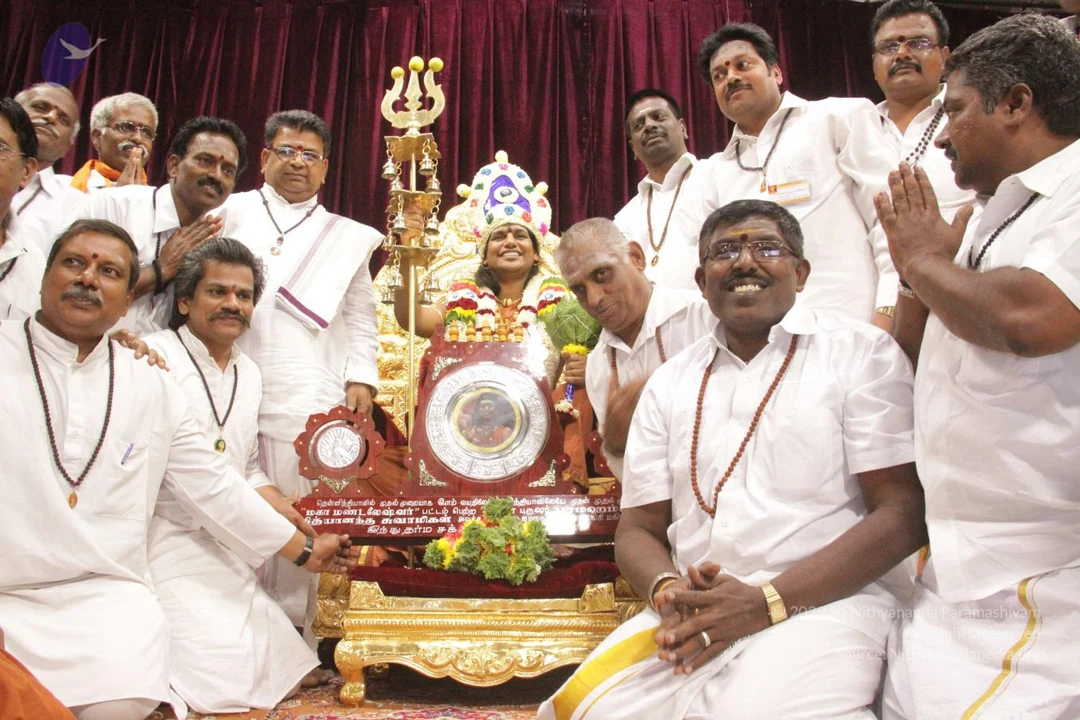
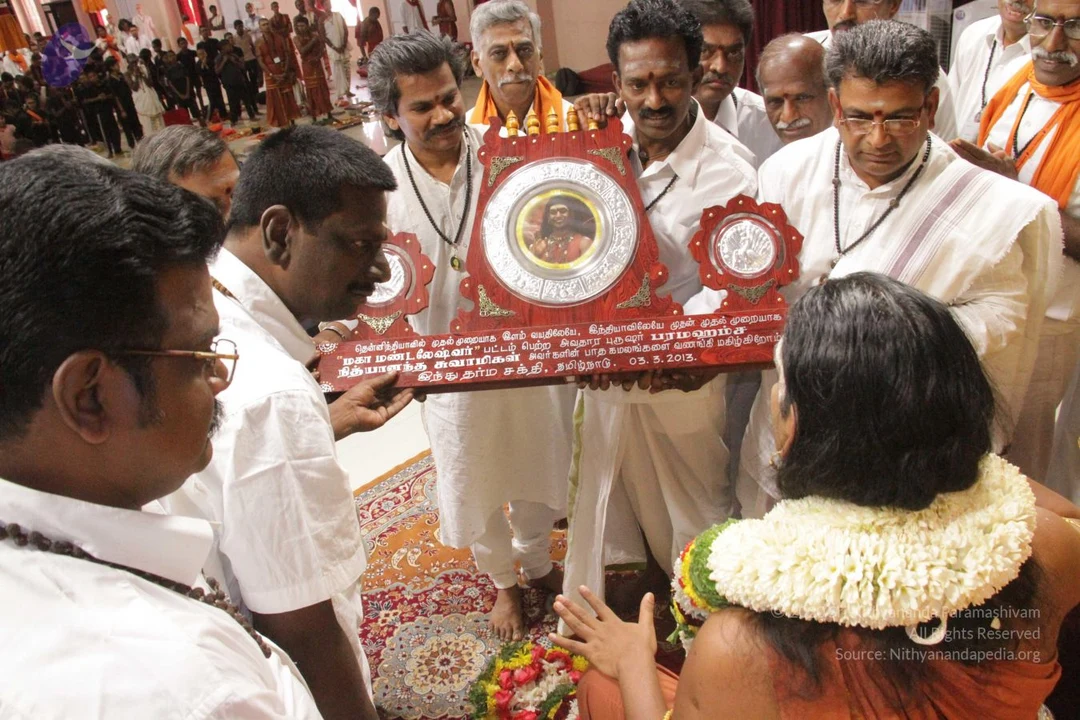
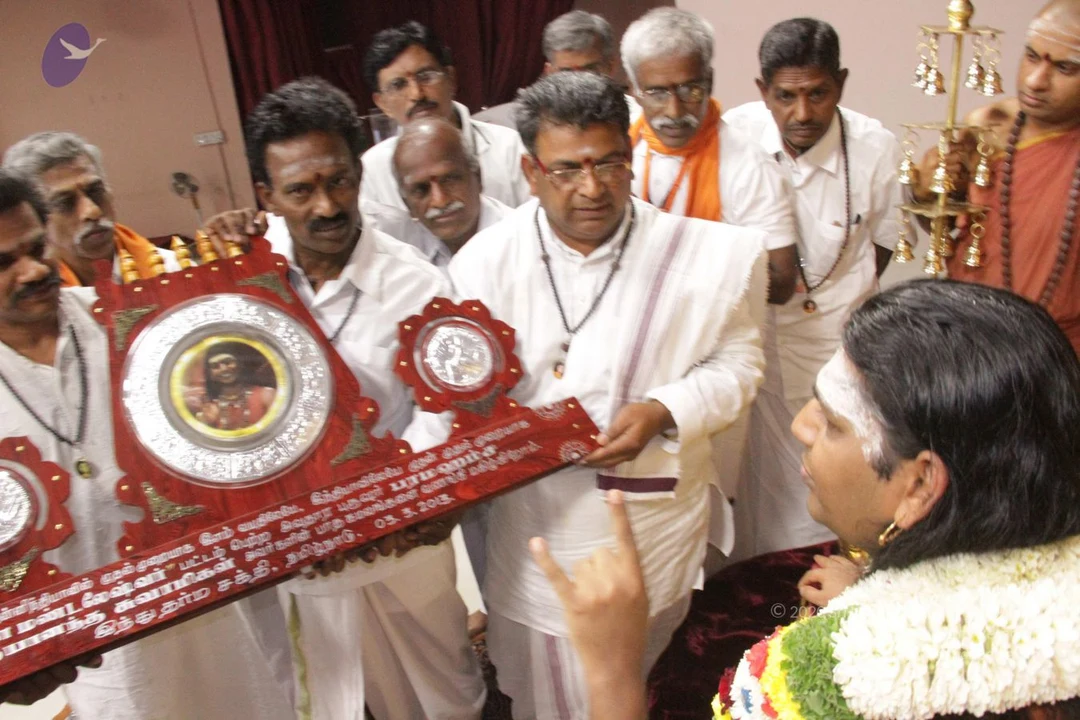
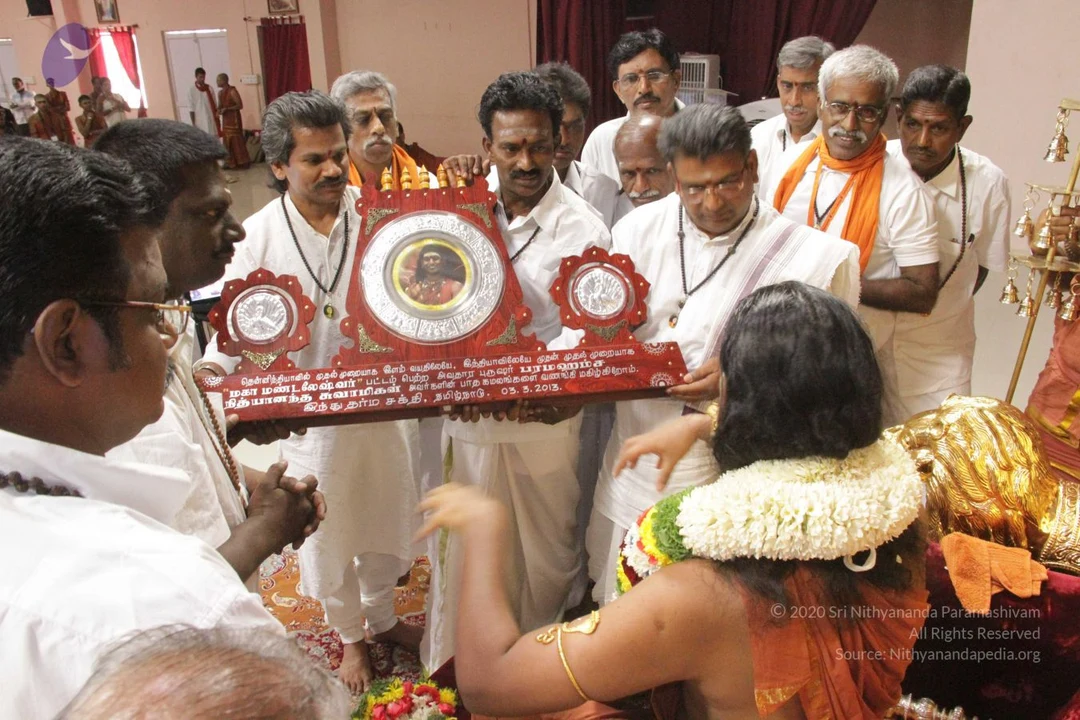
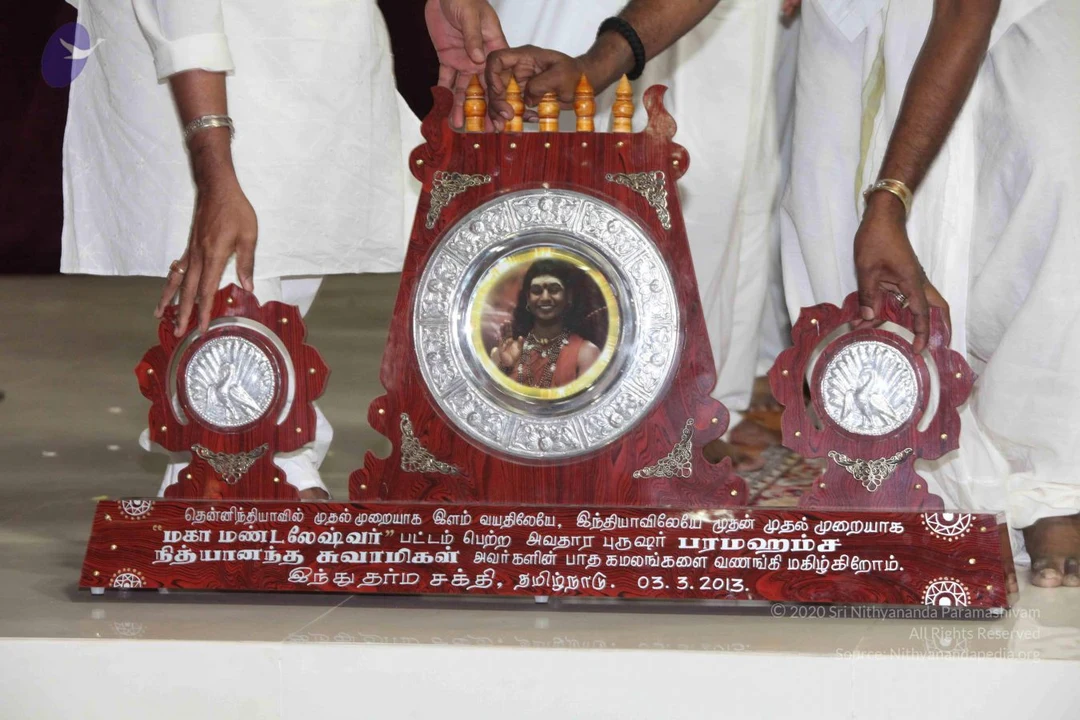
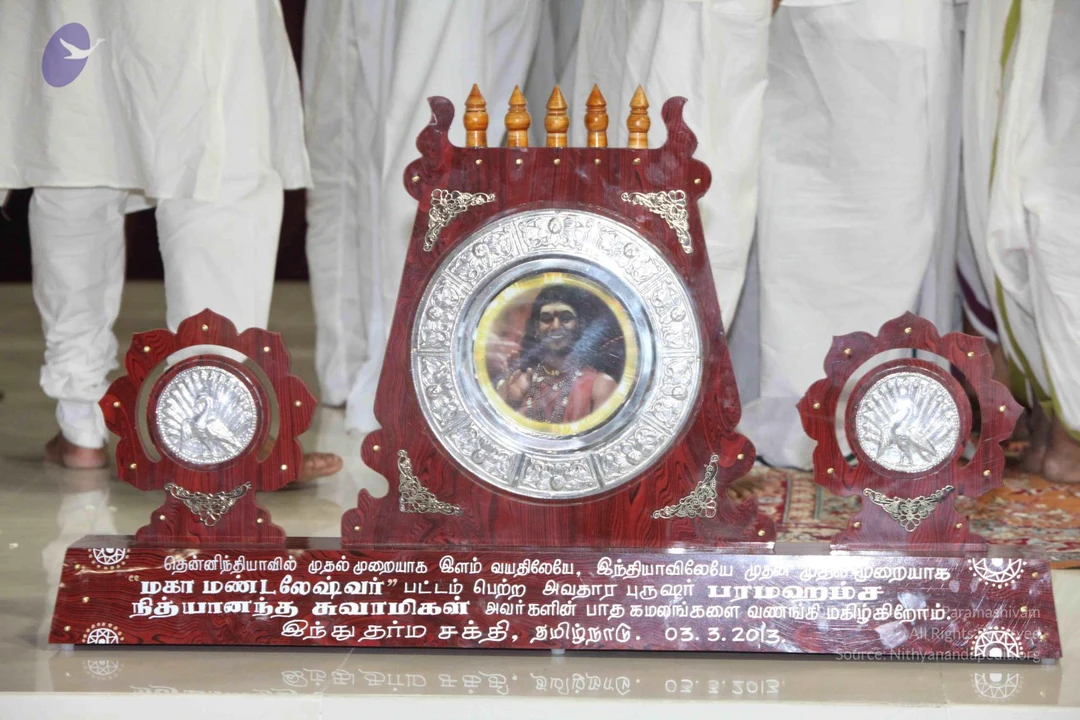
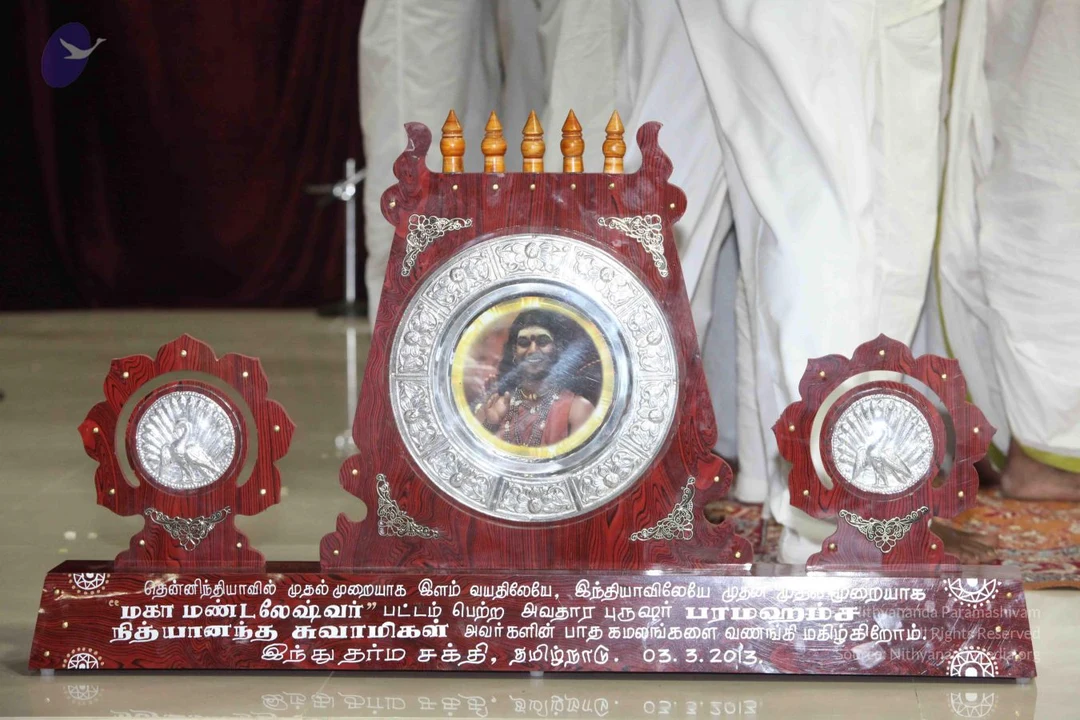
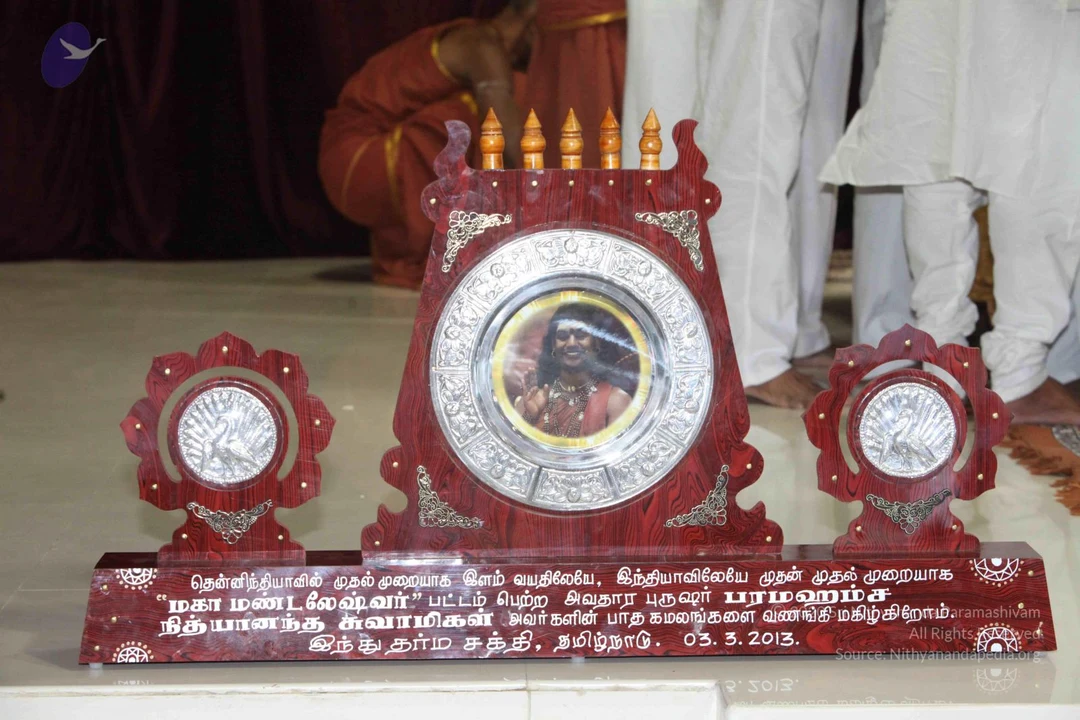
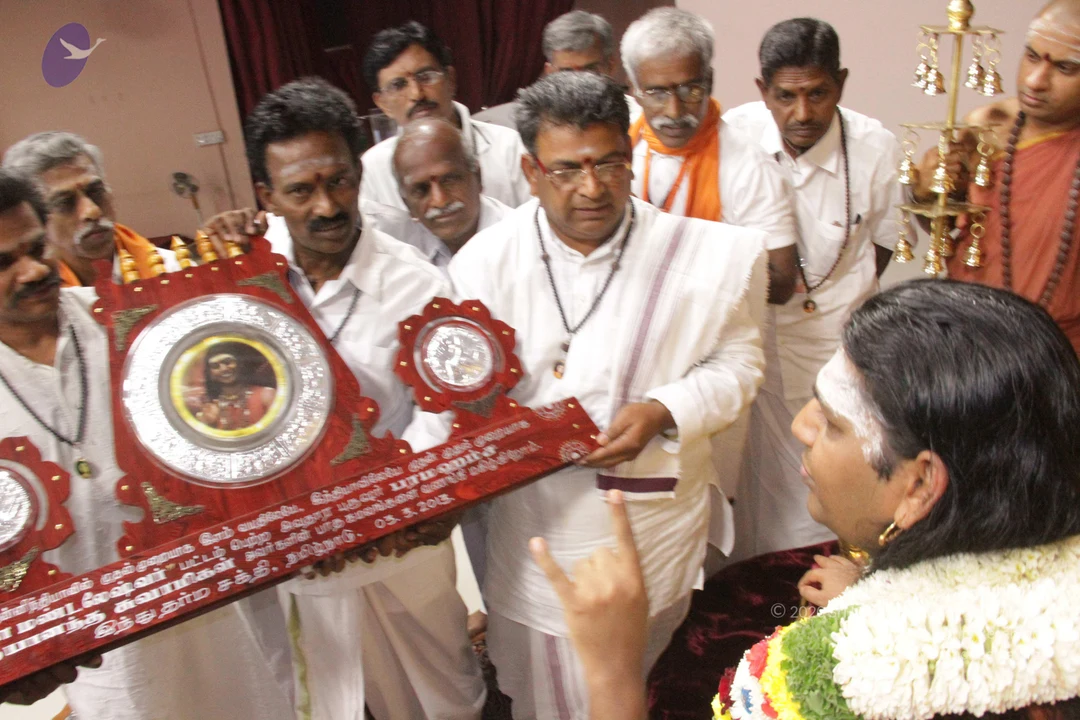
That’s it. Beautiful. I will move to the next level of the morning satsang, Dial-the-Avatar. In Kumbha Mela we already got the stamp released to commemorate me becoming Maha Mandaleshwar of Maha Nirvani Akkada. We have released four stamps, it is ready. You can show all the four stamps. [People clapping]. As a commemoration.

All right, I have one more thing, beautiful thing, the collective responsibility statement from Houston has come, Houston sangha. Great! Even though I'm not part of legal organization of the Houston sangha, as a spiritual inspirer, I bless you guys, this beautiful collective responsibility statement. First, Houston sangha declares and commits towards Swamiji’s mission with integrity, authenticity, responsibility and enriching the people of Houston, that it will send hundred and one thousand IA participants from Houston over a next five year period, to enrich them with Inner Awakening. God, am I right, hundred and one thousand? Hundred and one thousand, and sangha member sending 6 new IA participants every year. Each IA participant and sangha member sending 6 new IA participants every year. Wow, of course that is your responsibility. That is your collective responsibility, each one of your are responsible for everyone, am I right, you guys understand. Great, they have given some calculation. Blessings for the whole thing.

2013 temple, you have used the word goal - no, enriching through temple. Don't use the words, corporate words. Use eNglish, not English. Houston temple will be operational by May 25th 2013, Saturday. Two thousand visitors attending formal inauguration on July 21st 2013. Wow! Thatastu, Blessings.

2014 Kumbha Mela in Houston, Swamiji on palki with procession similar to Maha Kumbha Mela. God, blessings for USA Kumbha Mela. 2015 IA in Houston. 2016, ten thousand participants attending in Houston George R Brown convention center conducted by Swamiji.

2017, Kalahasthi temple in Nithyanada City, Texas. Hundred thousand square feet in Houston. Detailed plan and action items are in progress, will be sent next week.

Blessings. I'm really excited Houston Kalahasthi sangha. I bless you guys: All of you will radiate miracle powers. Blessings. I am with you guys.

Title

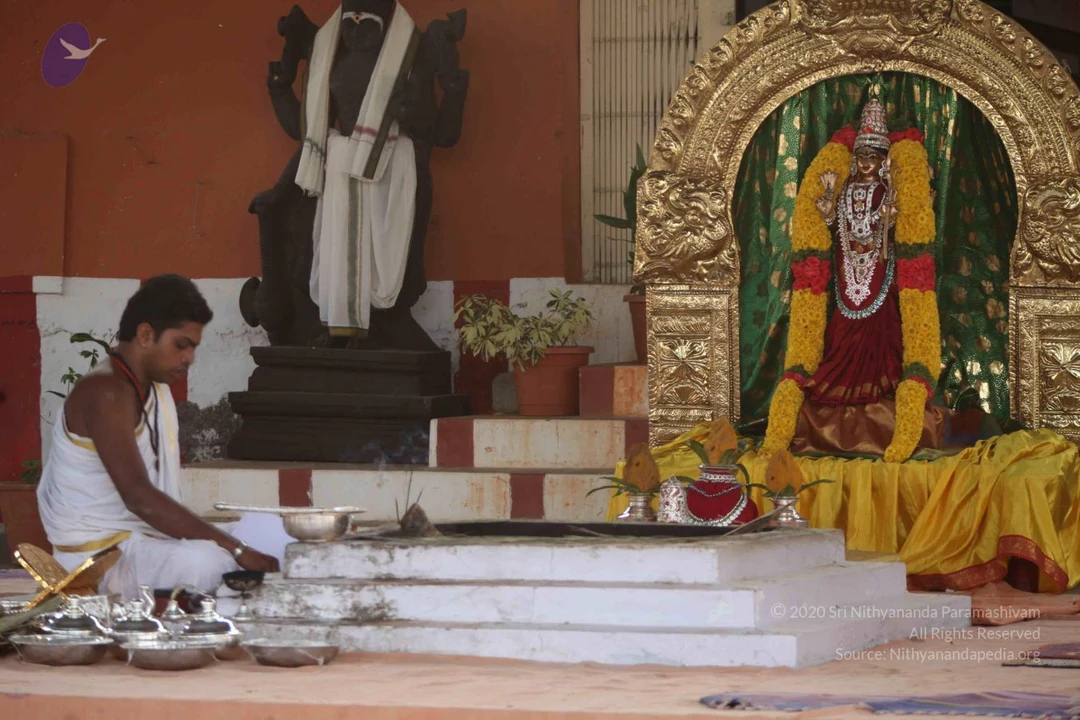
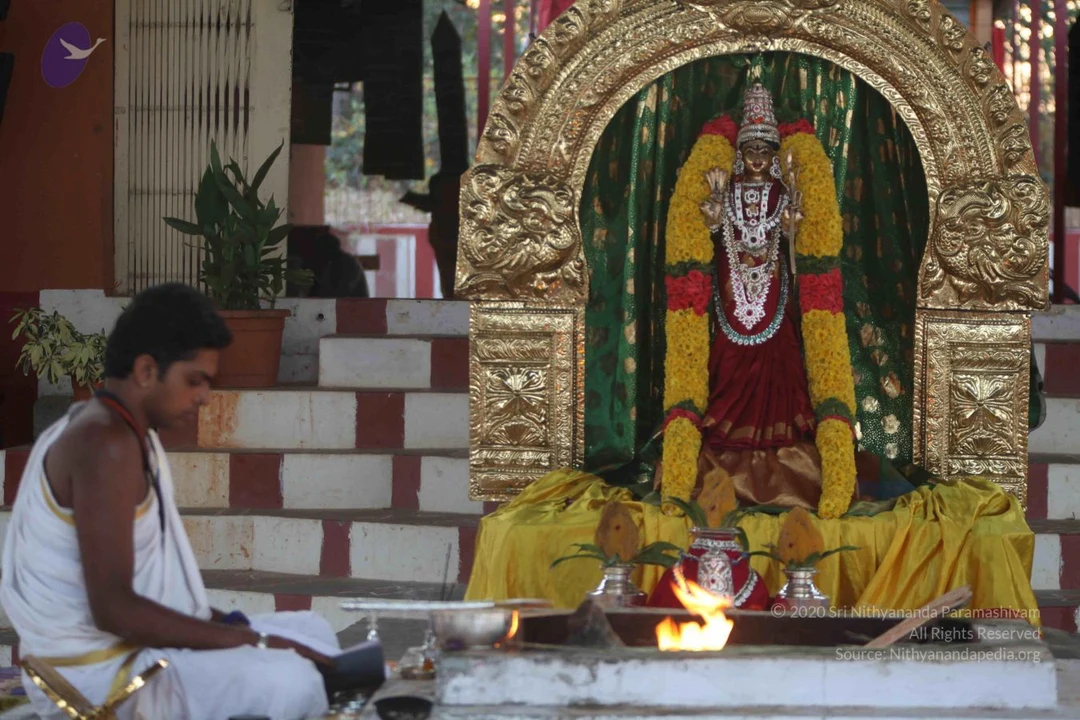
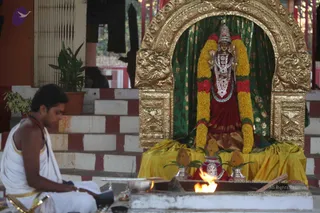
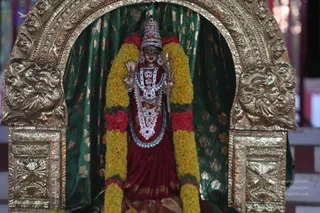
Swayambhu Linga Abhishekam At Nithyanandeshwara Paramashiva Devalayam (3 Mar 2013)


Tags:

Paramahamsa Nithyananda, philosophy, leadership, human, experience, entertainment, embrace, responsible, world.

Photos Of The Day:

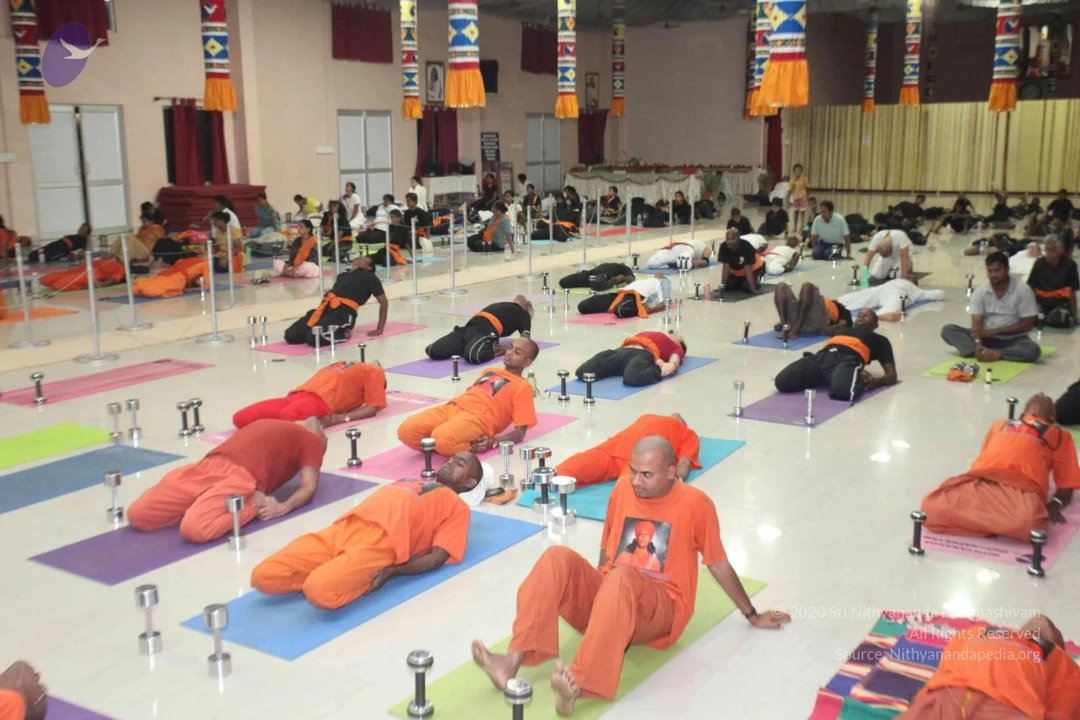
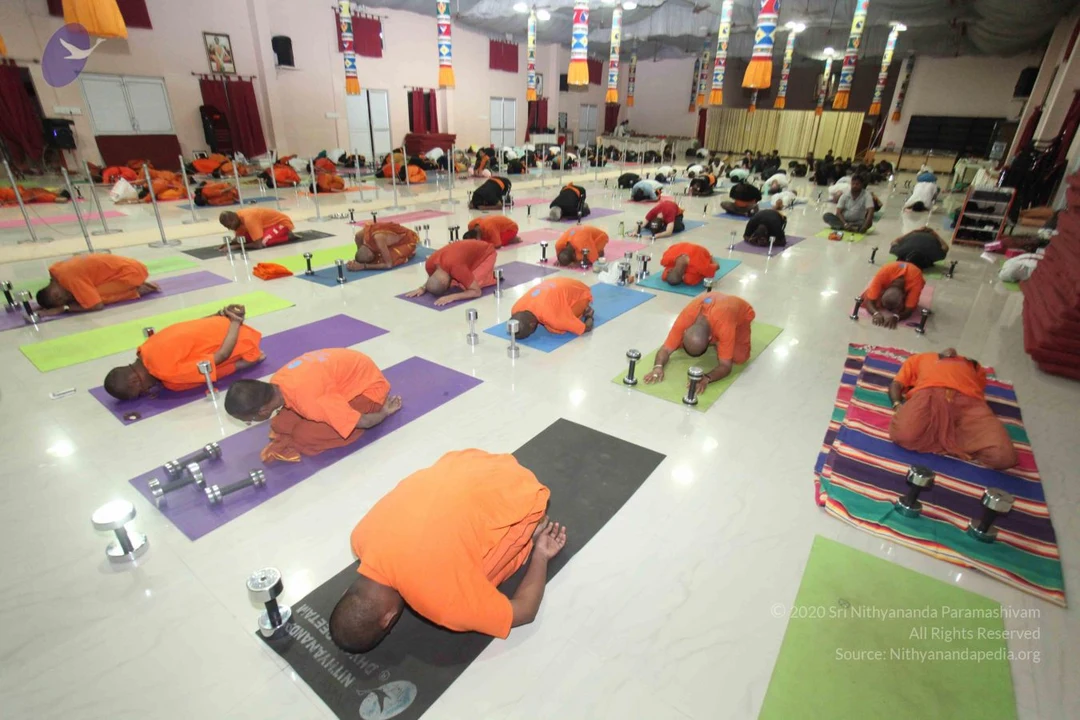
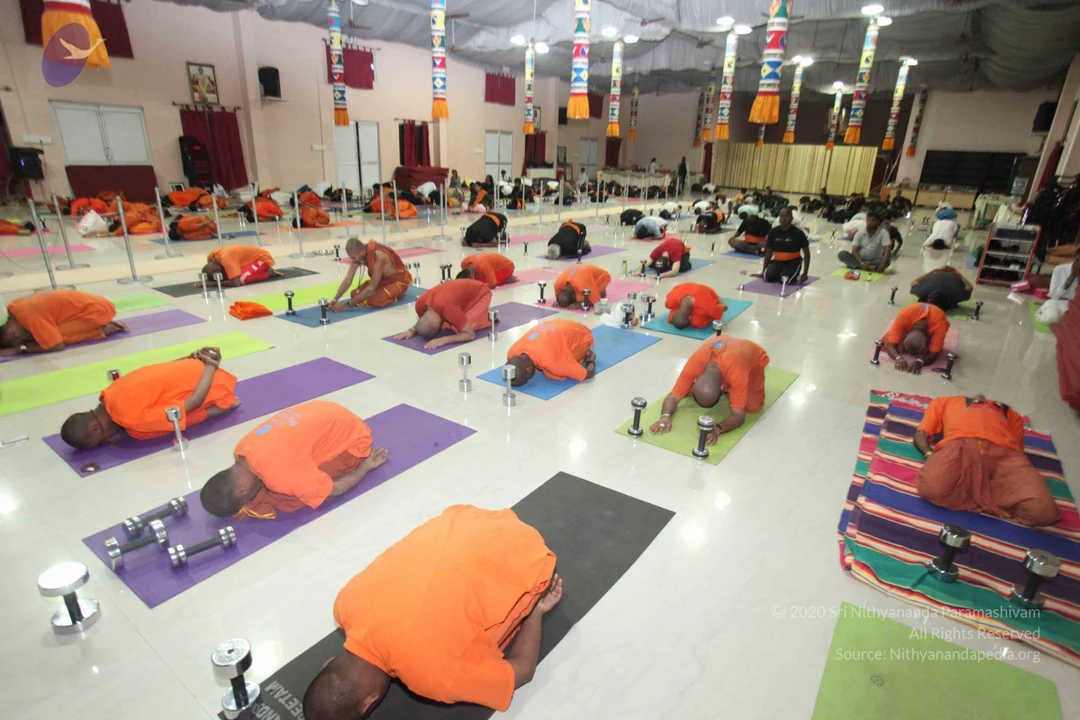
Morning Yoga
temple
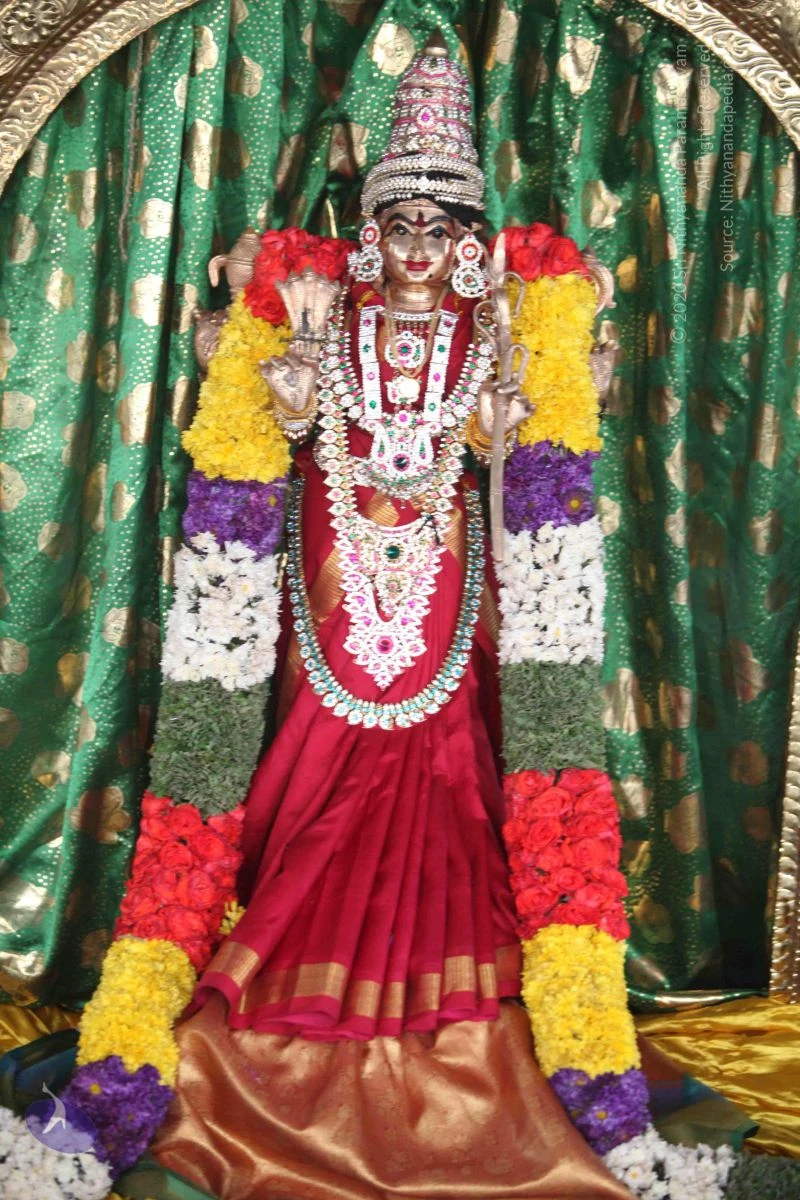
pada-puja

Nithya Satsang

Sarva Darshan

Final Blessings

Tamil-organizers-post-satsang

Inner Awakening-session

living-enlightenment-books

homa

darshan

Madurai-adheenam-retrieval-comittee-meeting

Photos Of The Day:

Yoga

Temple

Pada-Puja

Morning-Satsang

TamilOrganizers-Swami-postSatsang

Sarva-Dharshan

IA-Session

Homa

Darshan

MaduraiAdheenam-RetrievalComitteMeeting

01-TEMPLE

02-PADAPUJA

03-SATSANG

04-DARSHAN

02-Temple-Visit

03-Pada-Puja

04-Morning-Satsang

05-Tamil-Organizers-Swami-post-Satsang

06-Sarva-Darshan

07-IA-Session

07-IA-Session_Photo_1000_IMG_2300_CMP_WM

09-Darshan

10-Madurai-Adheenam-Retrieval-Comittee-Meeting

Photos from this day

View all 558 photos

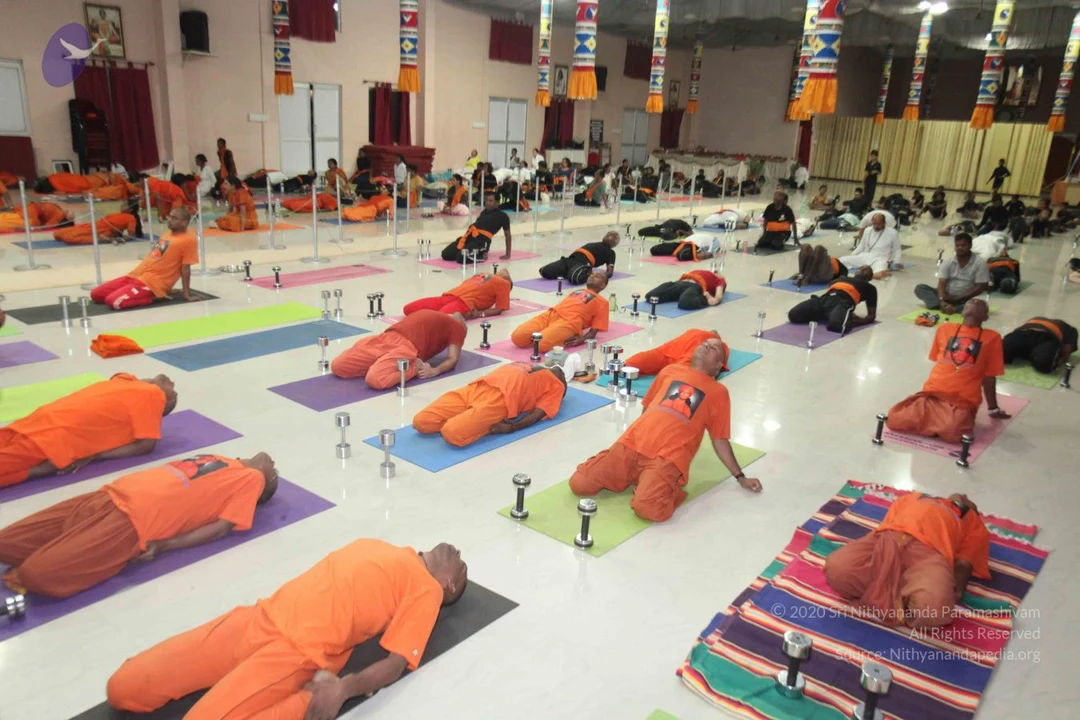
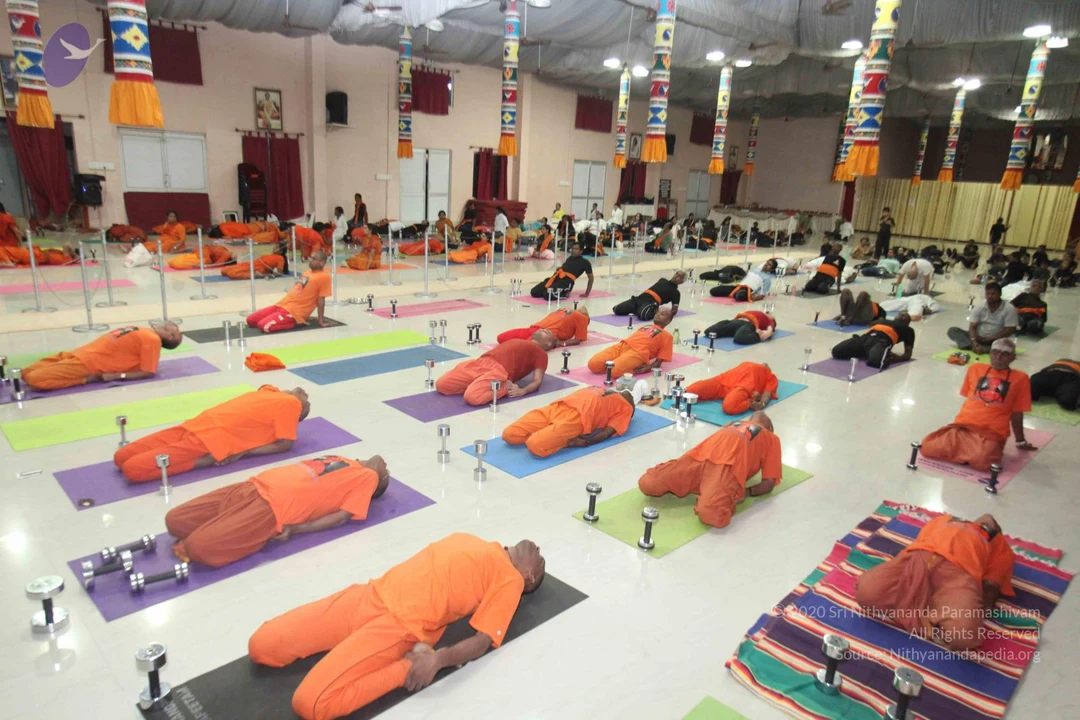
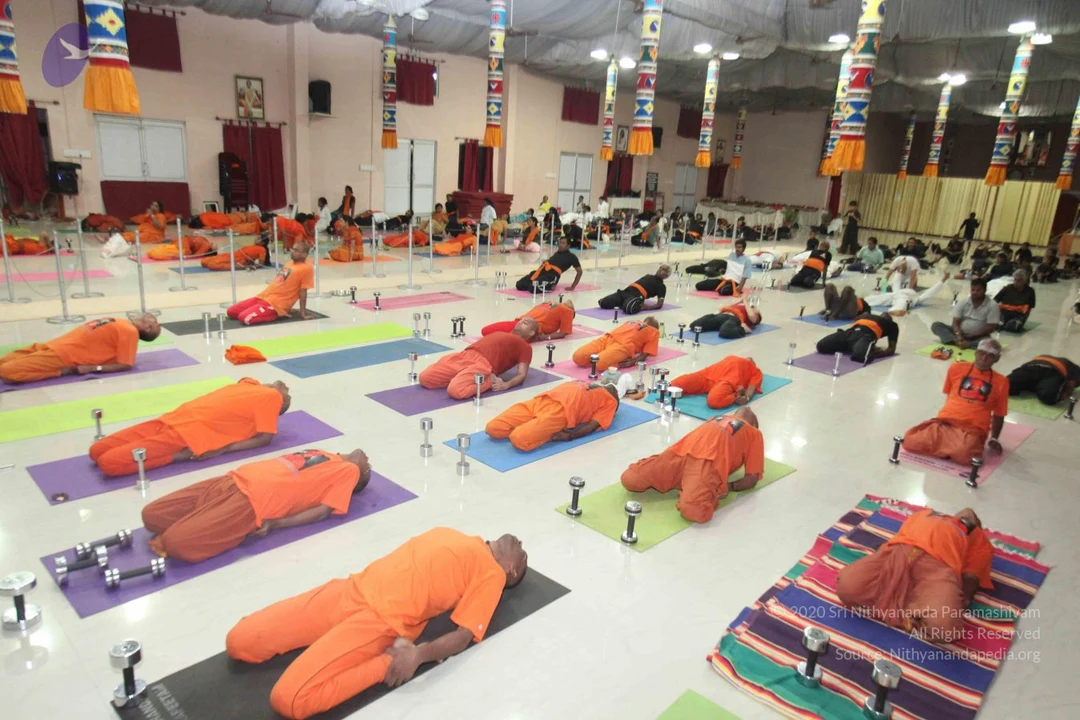
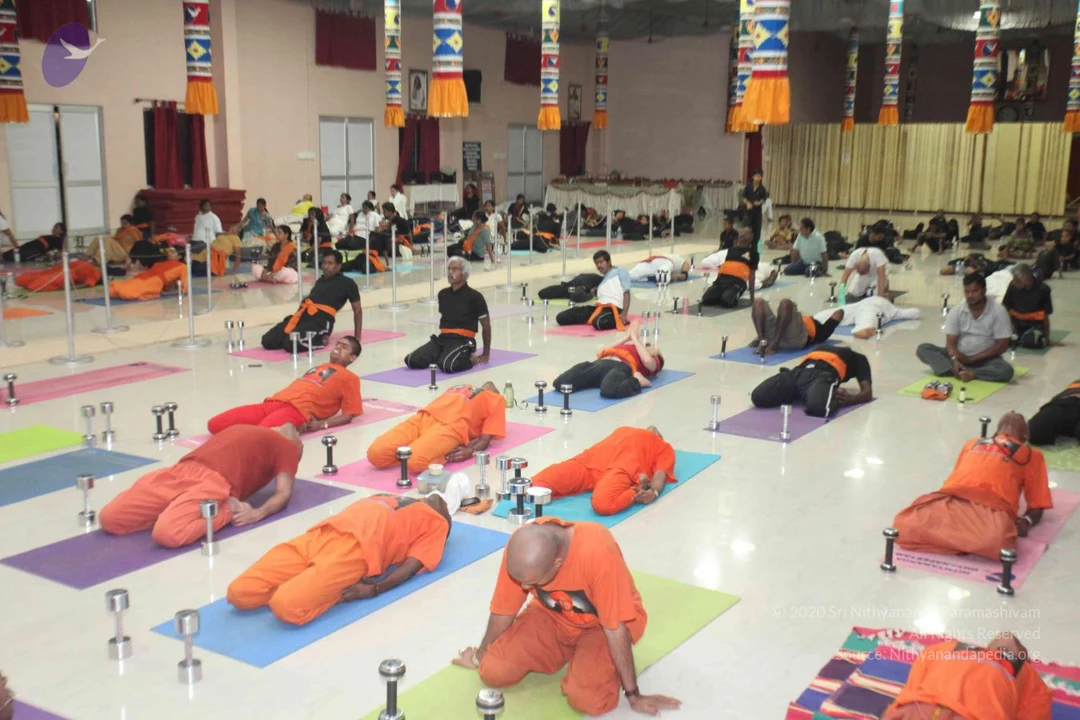
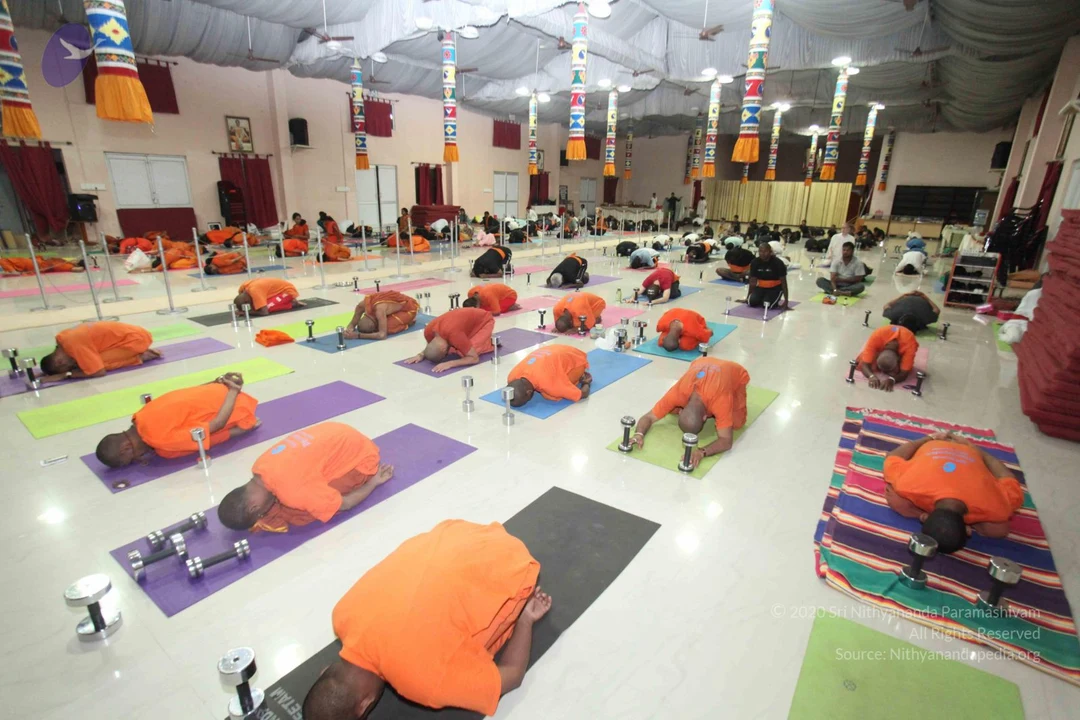
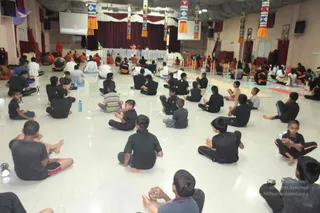
Morning Yoga

20 photosSource gallery
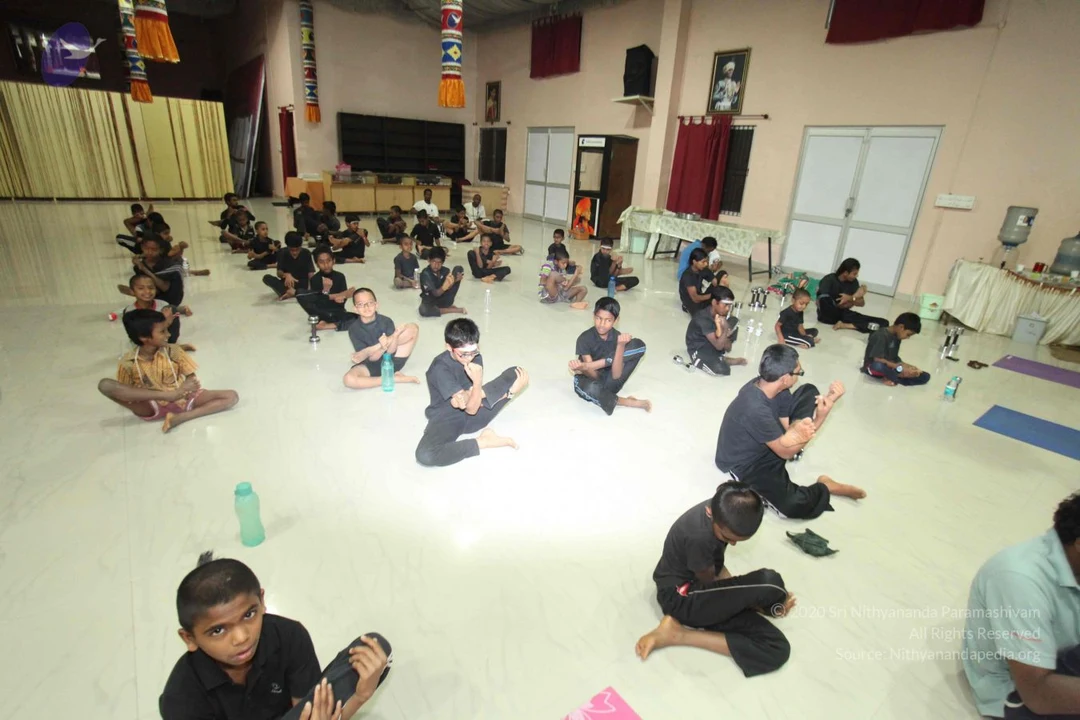
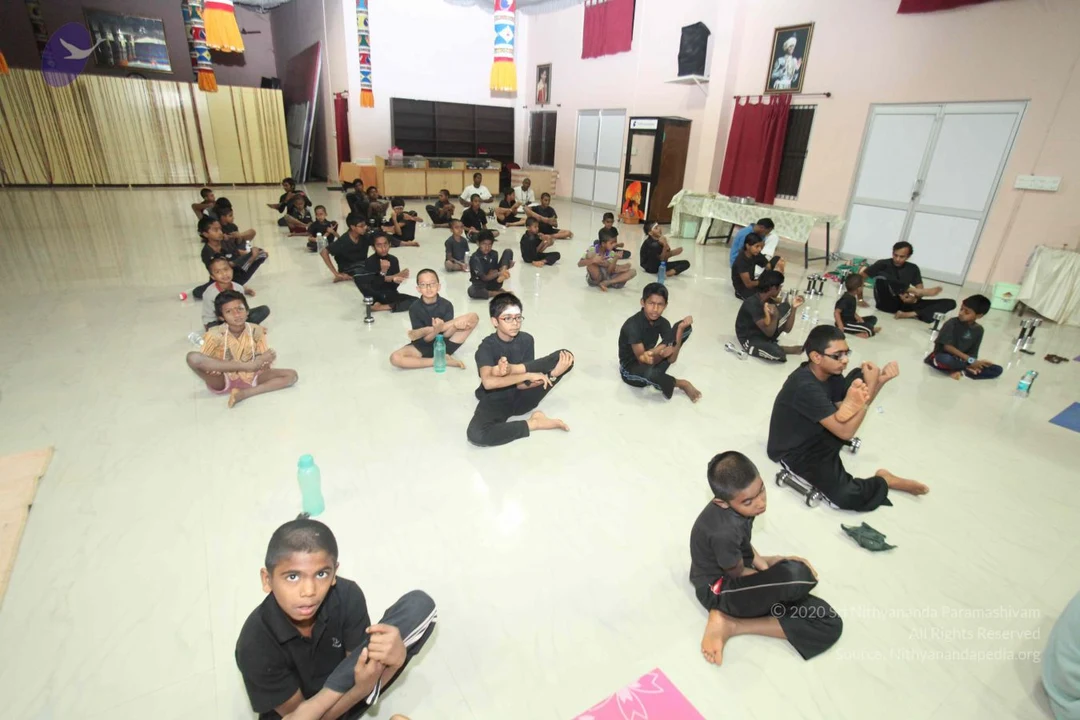
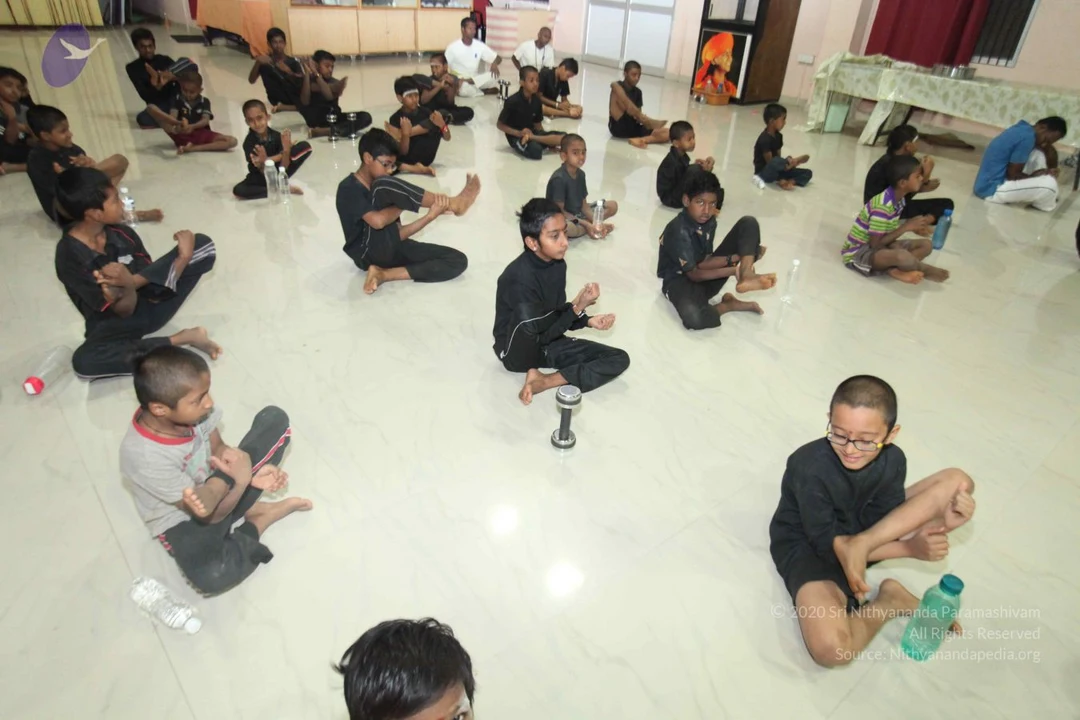
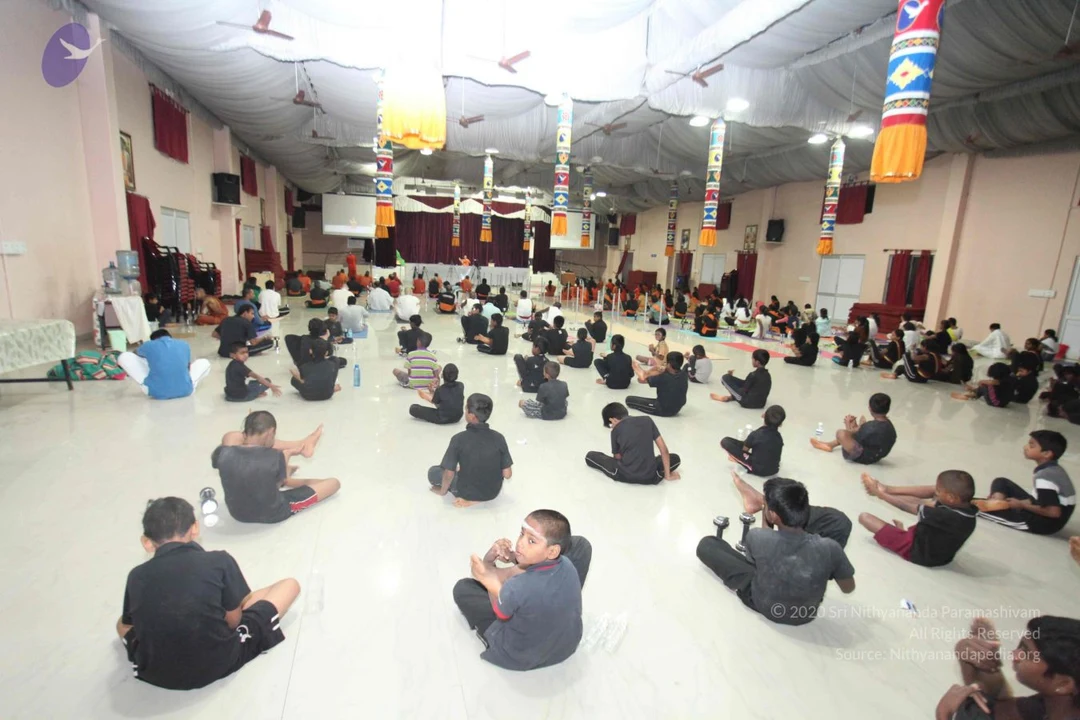
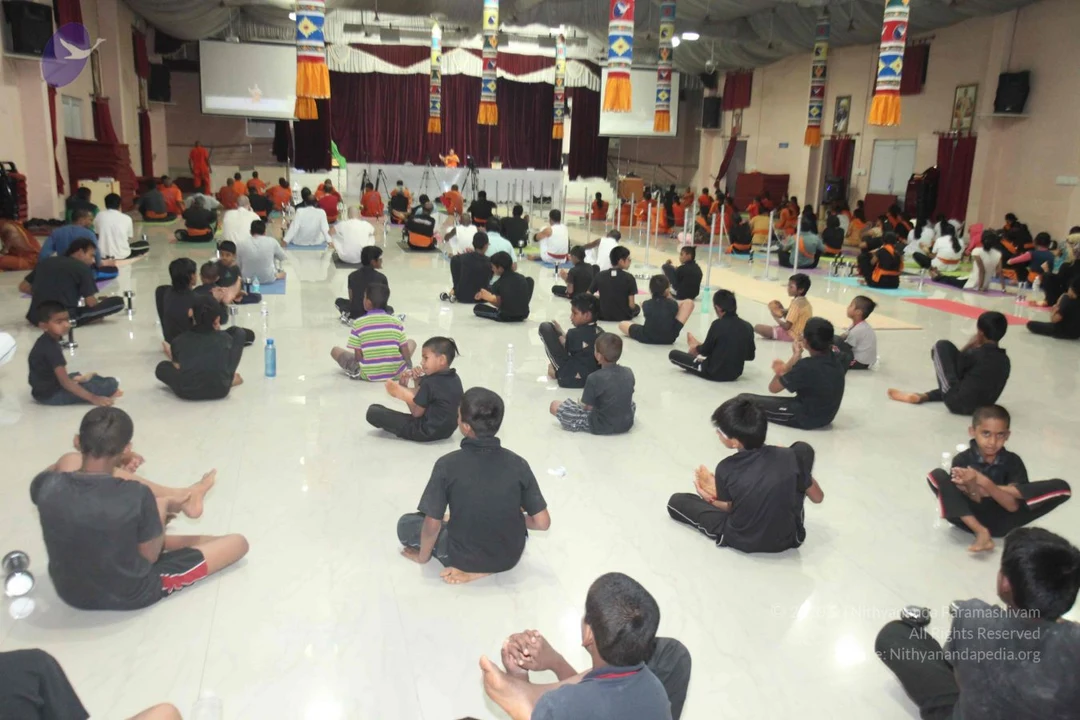
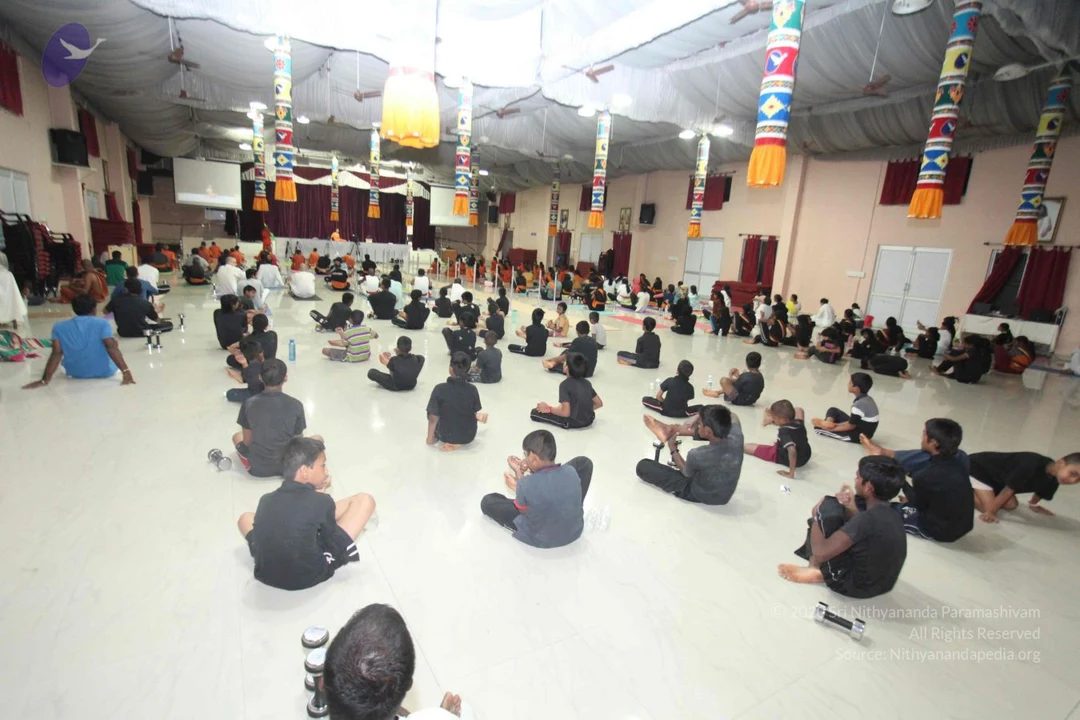
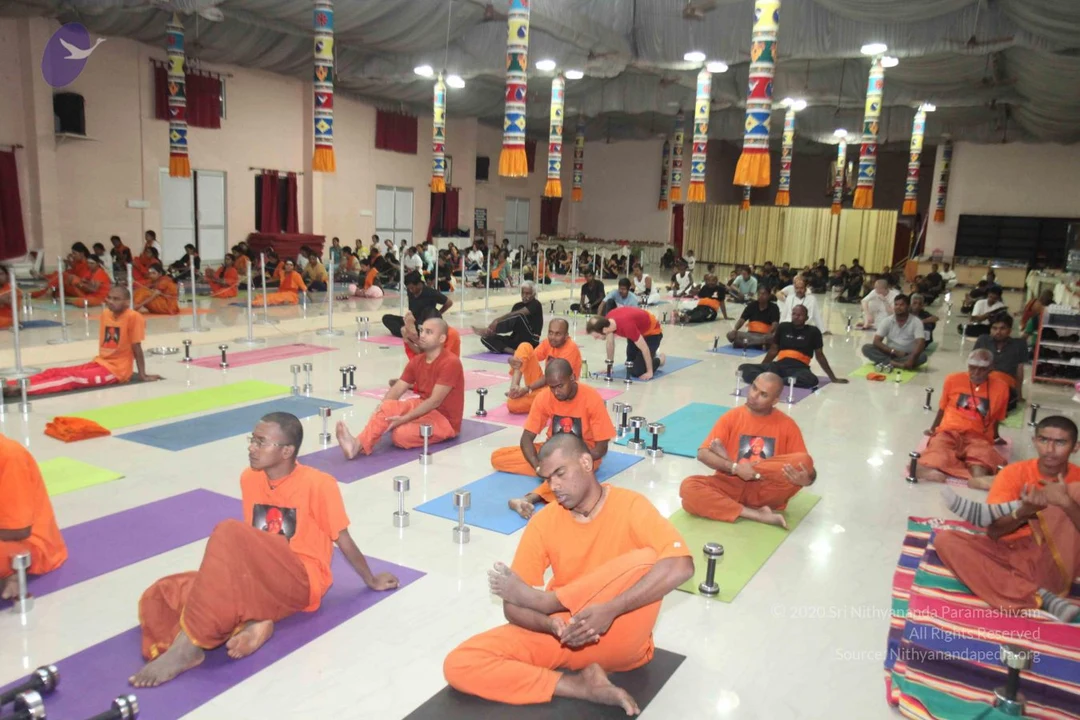
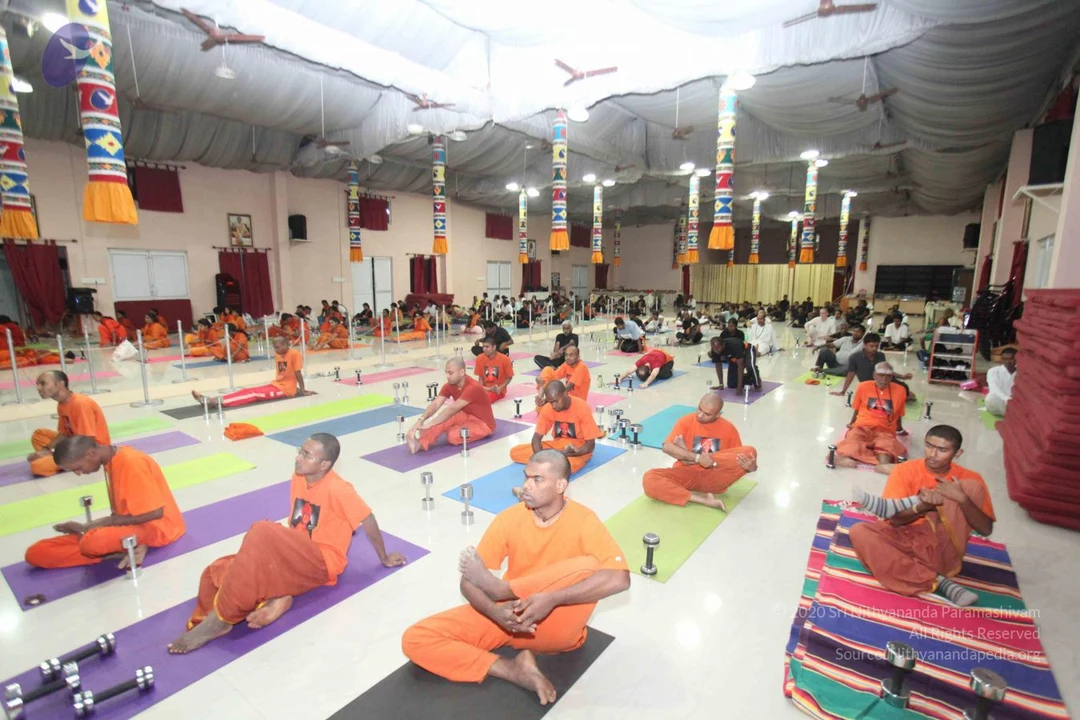
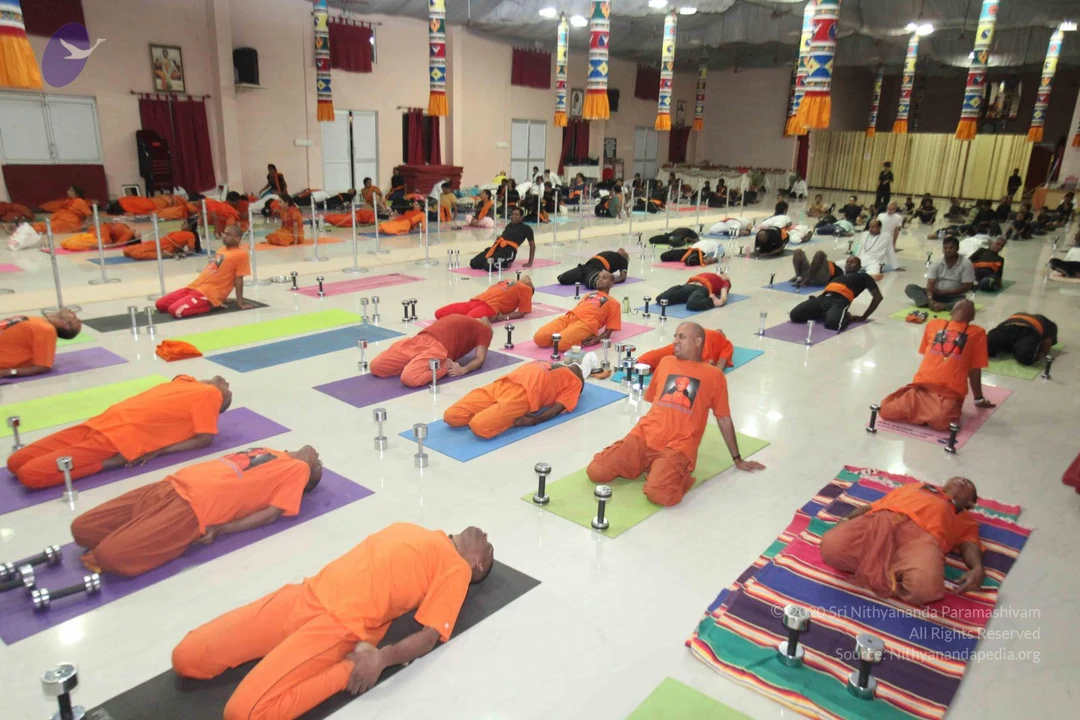
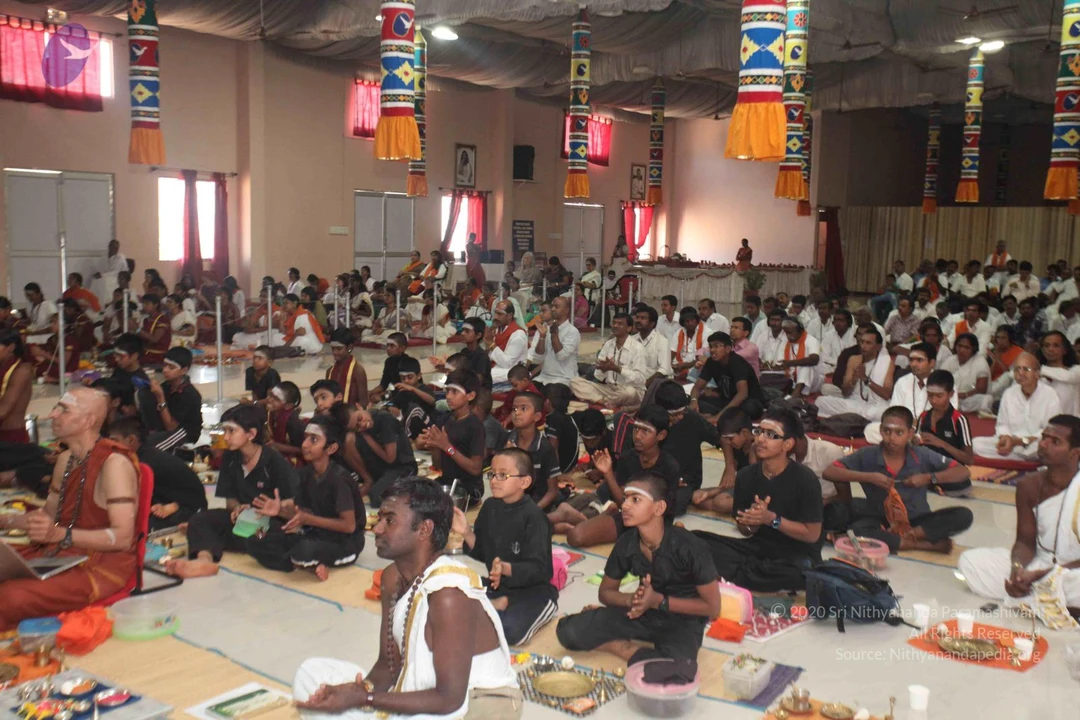
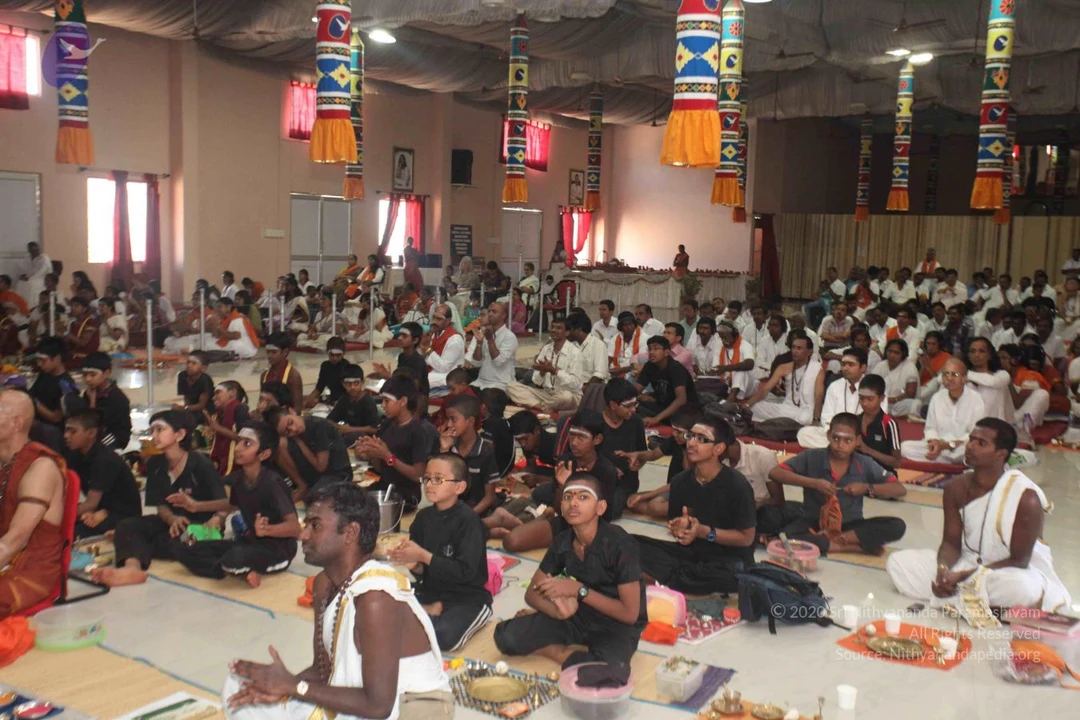
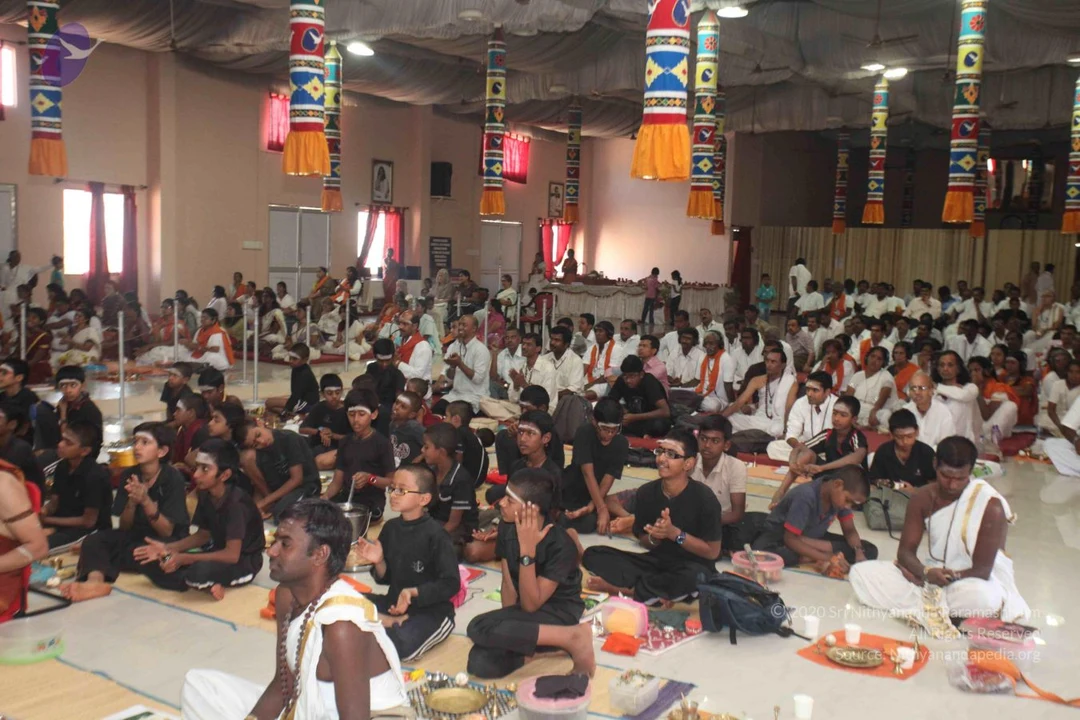
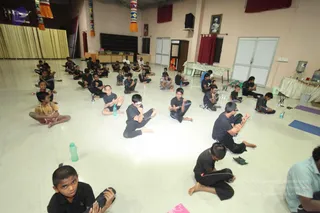
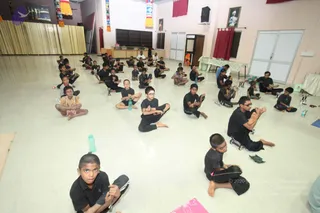
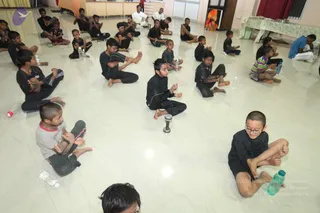
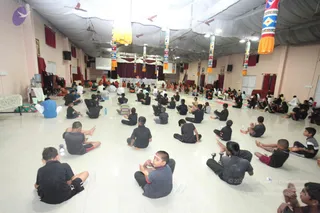
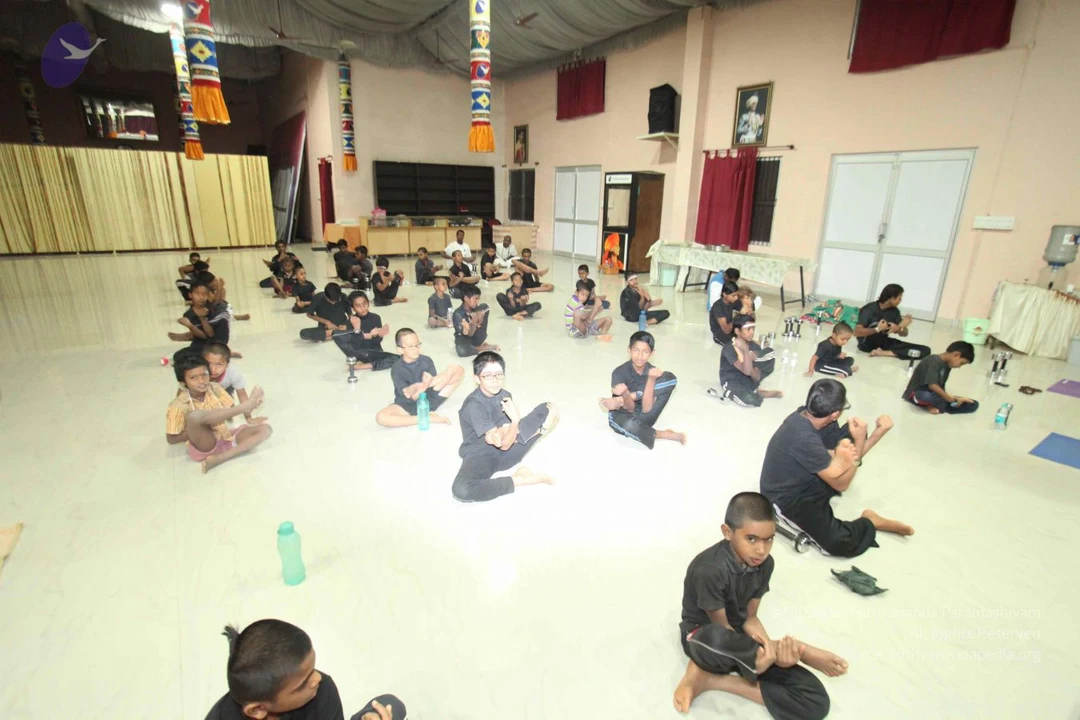
Photograph of a large hall with a pale pink wall and white tiled floor, where many children in black uniforms sit cross-legged in rows, some with hands joined or clasped, as in a practice session. Colourful woven banners hang from the ceiling, and a framed portrait sits high on the wall at upper right, with a small shrine-style display and water bottles scattered on the floor. Several children and a few adults sit at the front and sides.A photograph of a large bright hall with a polished white floor where many boys in matching black shirts and black pants sit in loose rows doing seated stretches and exercises, some with legs extended and arms folded. Water bottles sit on the floor and a few yoga mats lie at the edges. A framed portrait hangs on the far wall above a table with a white cloth, and hanging tassels decorate the upper left. Near the right foreground a man in a grey shirt and black pants sits on the floor with his legs stretched out, and a person in a light blue shirt is partly visible at the lower right. No clearly identifiable a person figure is visible among the people present.A photograph of a large hall with a pale tiled floor where many boys in black uniforms sit cross-legged or in seated yoga poses, several with legs folded and feet bare. In the foreground a boy in a black shirt sits with his arms wrapped around his knees, and to the right another boy in black clothes sits with his feet raised. Water bottles are scattered on the floor. Behind them, a framed portrait hangs on the back wall beside maroon curtains and colourful hanging tassels. A small table with a white cloth and a standing cabinet are at the far side. No one is clearly identifiable as a person in the visible scene, and the people in the room are students and attendants.Photograph of a bright, marble-floored hall where a group of boys in black uniforms sit cross-legged and in relaxed seated postures, several with hands in front of them as in practice. A few boys wear white or grey shirts. Water bottles are scattered on the floor, and a steel dumbbell-like object lies near the centre. At the back, two men in white clothes sit near a framed image of a deity and a cloth-covered table. Students are seated in rows, some looking toward the front.A large white-floored hall with a draped white ceiling and hanging coloured banners fills the frame. Thirty to forty boys sit cross-legged on the floor in rows facing a distant stage, many in black or grey t-shirts and shorts; one boy near the front has a white forehead mark. A small group of people in saffron and orange robes sits near the far stage area, and a projection screen and maroon curtains frame the back wall. Water bottles and a white-draped table sit at the left edge.A photograph of a large hall with a polished white floor, where many people sit cross-legged in rows facing a stage at the far end. Most seated people wear black or dark shirts and shorts, with several younger boys in the foreground, some in striped or grey clothing. Behind them, a row of people in saffron and orange robes sits near the stage, and a few people in white sit among the rows. Red, blue and orange ceremonial banners hang from the ceiling, dark red curtains frame the stage, and two projector screens show a small image. Water bottles sit on the floor near the front seated group.

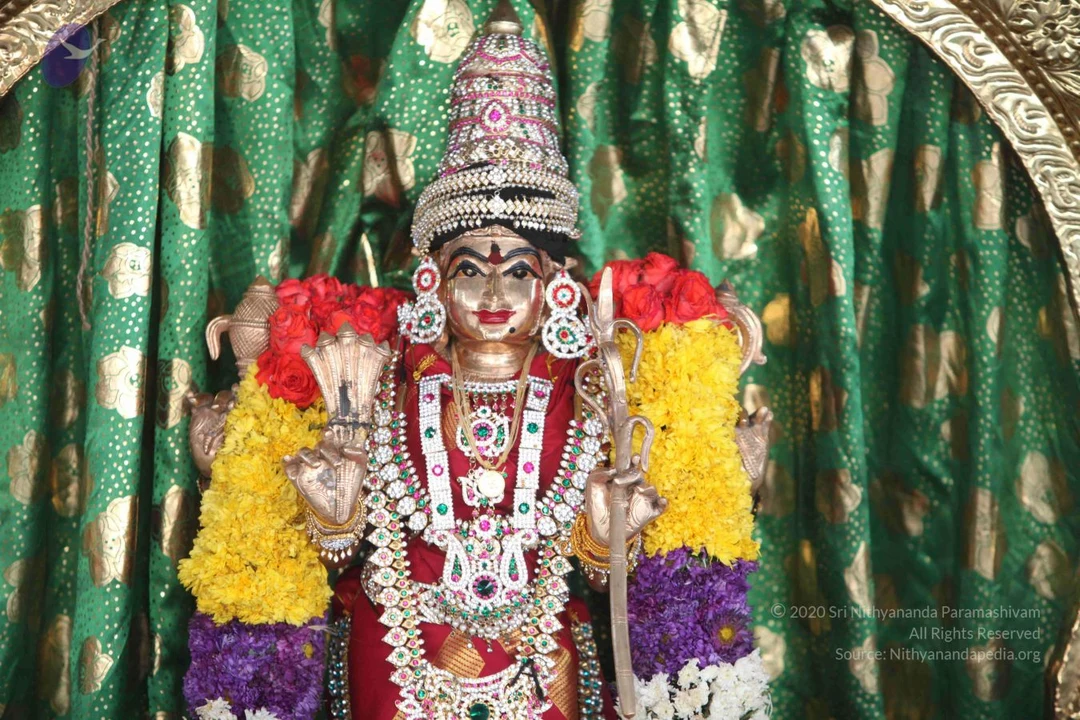
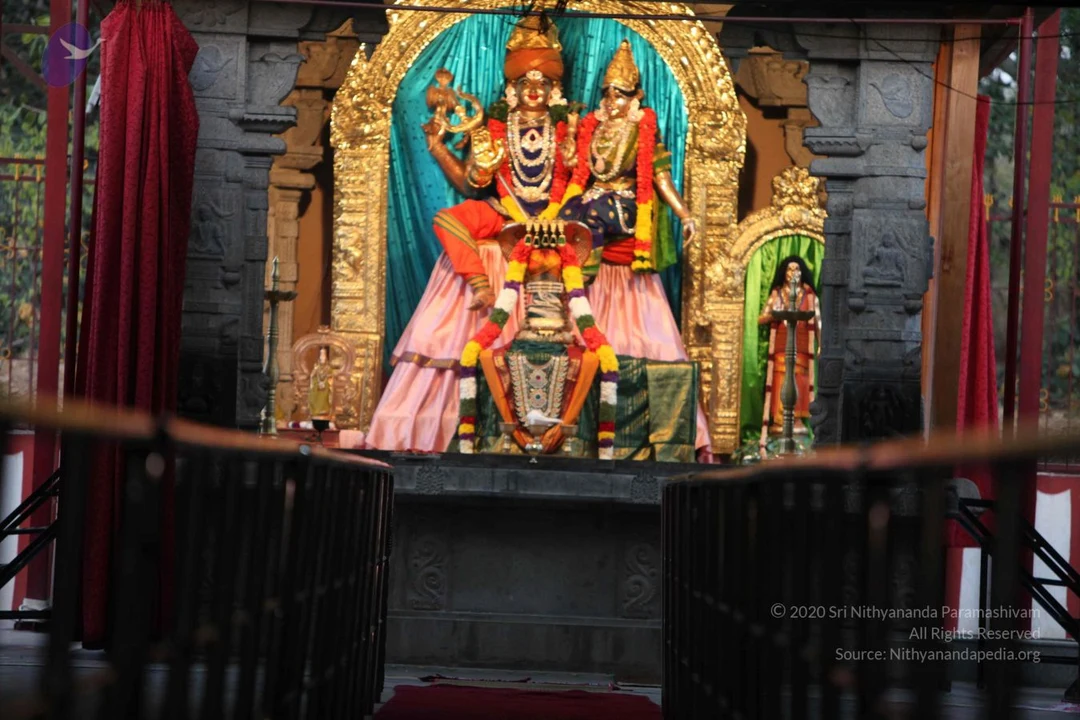
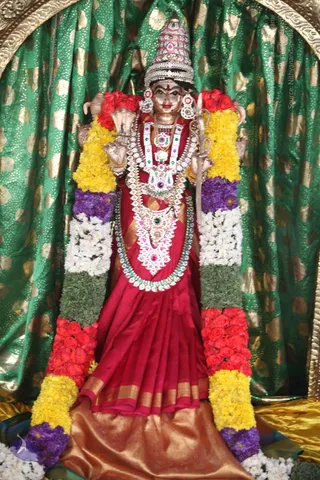
temple

25 photosSource gallery
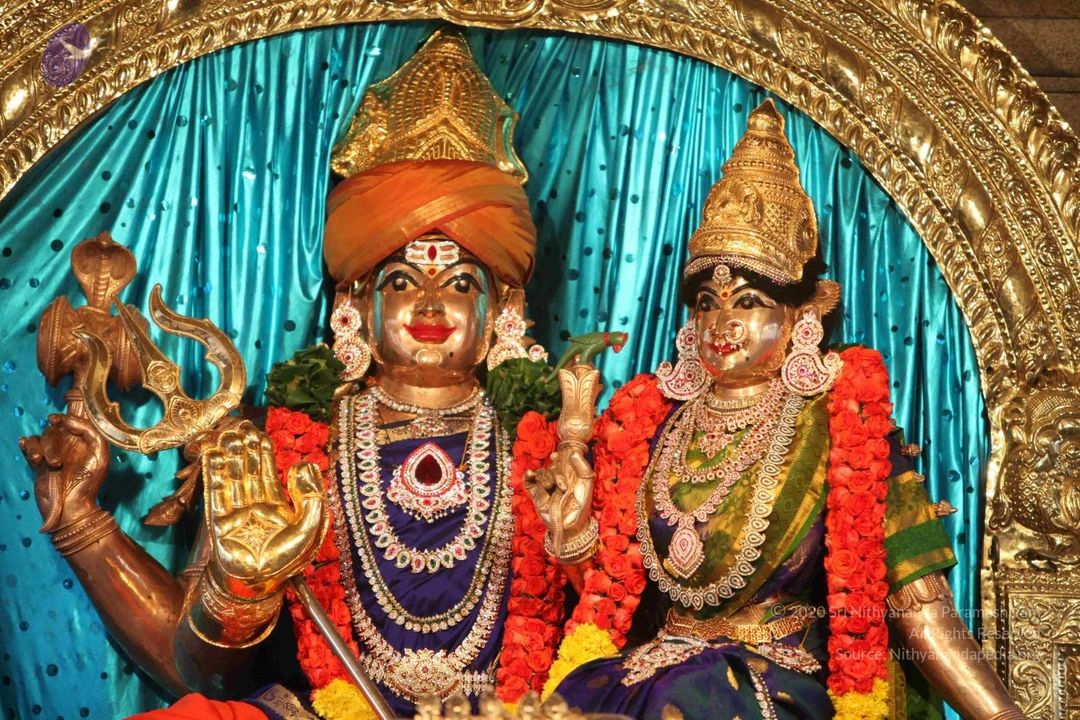
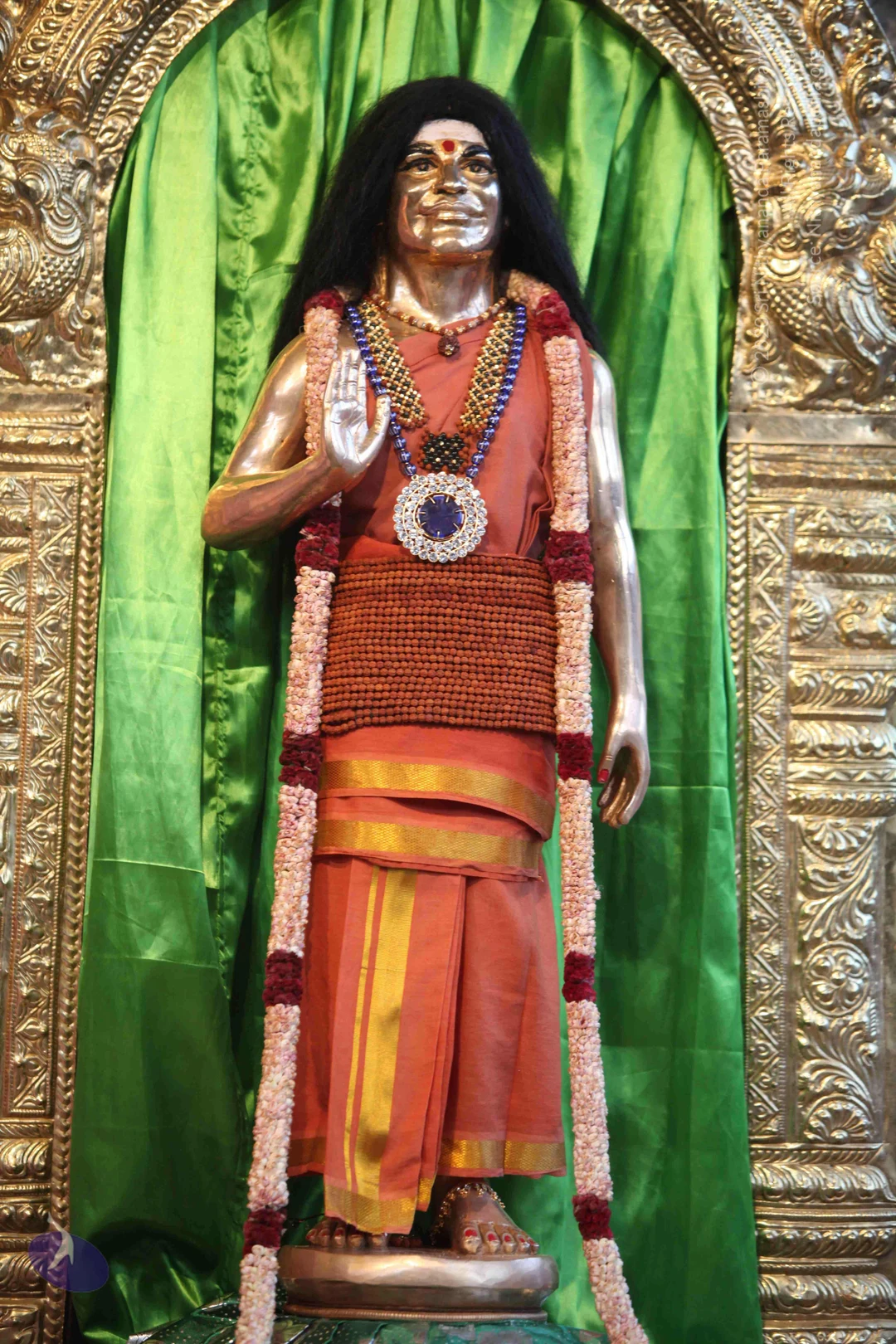
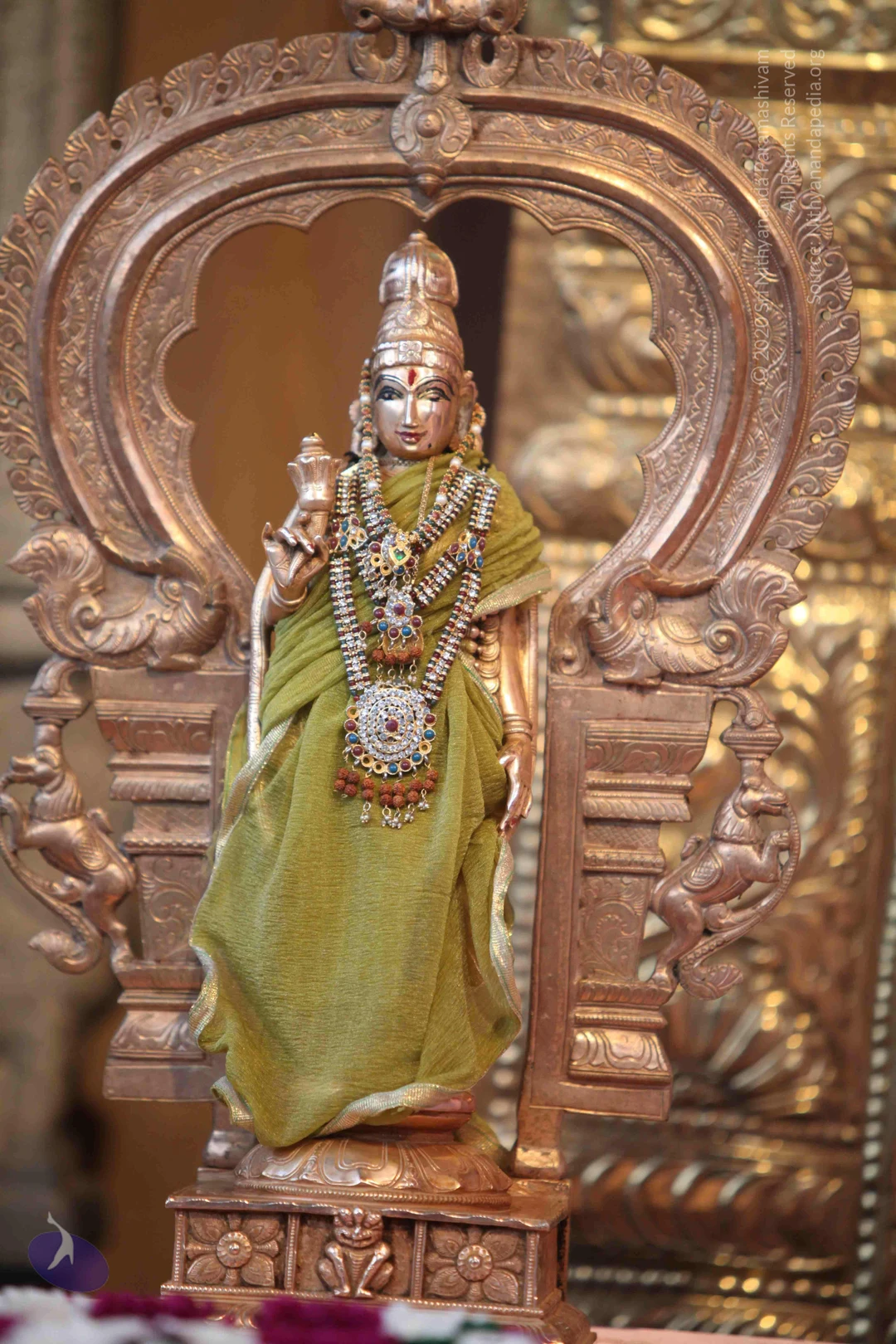
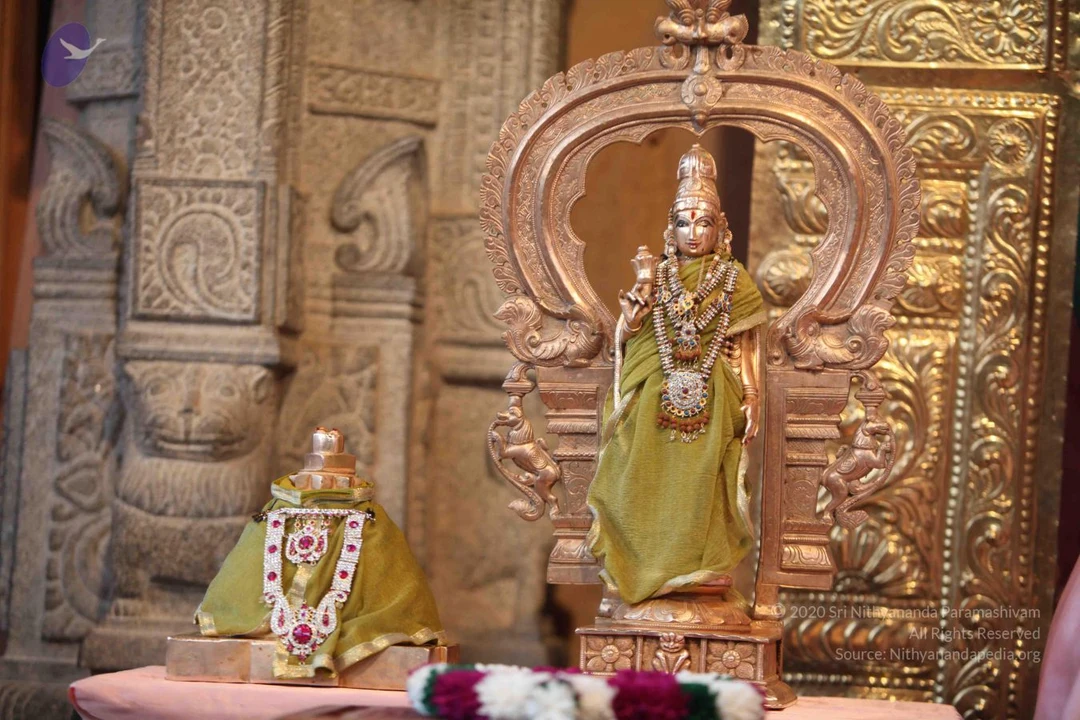
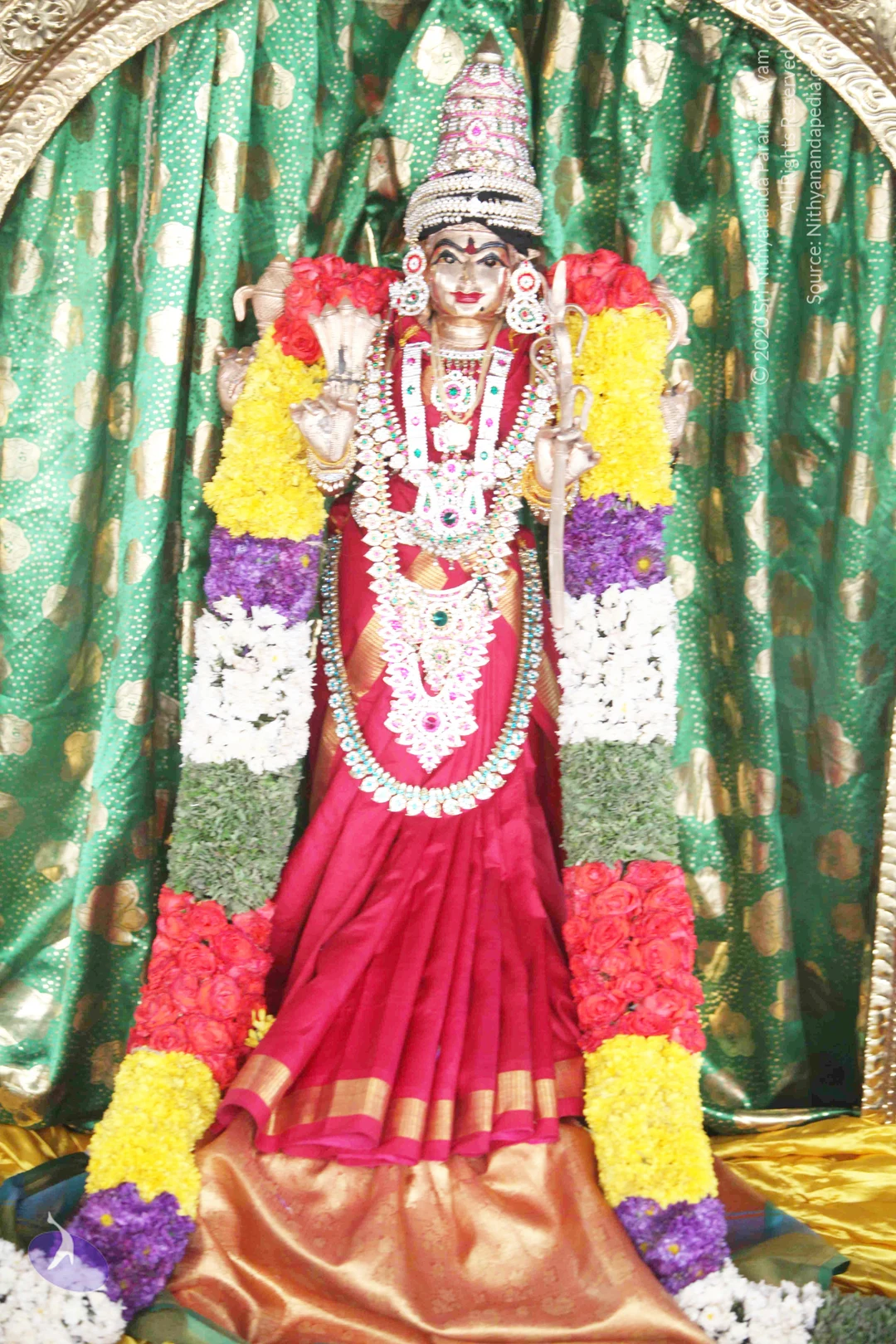
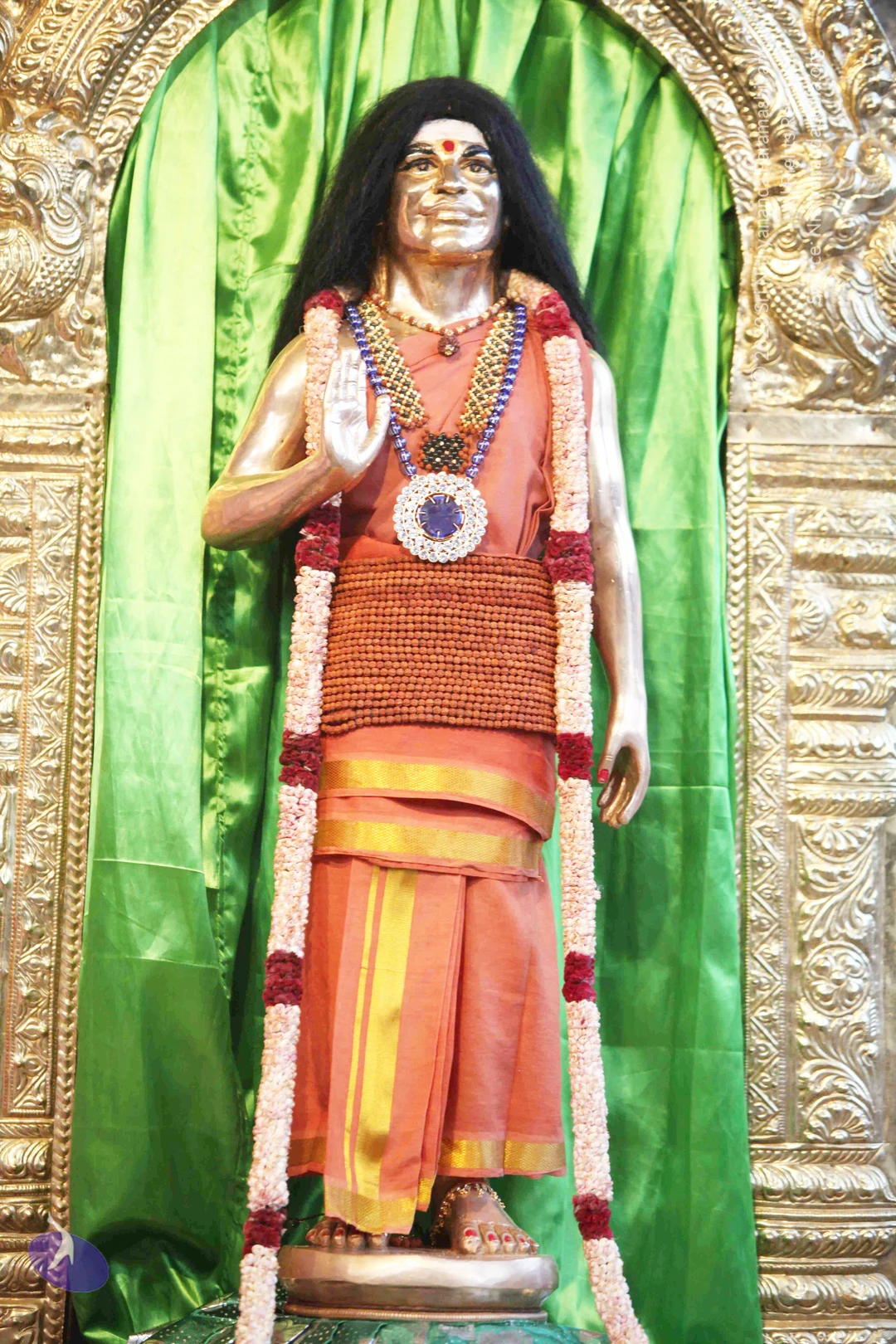
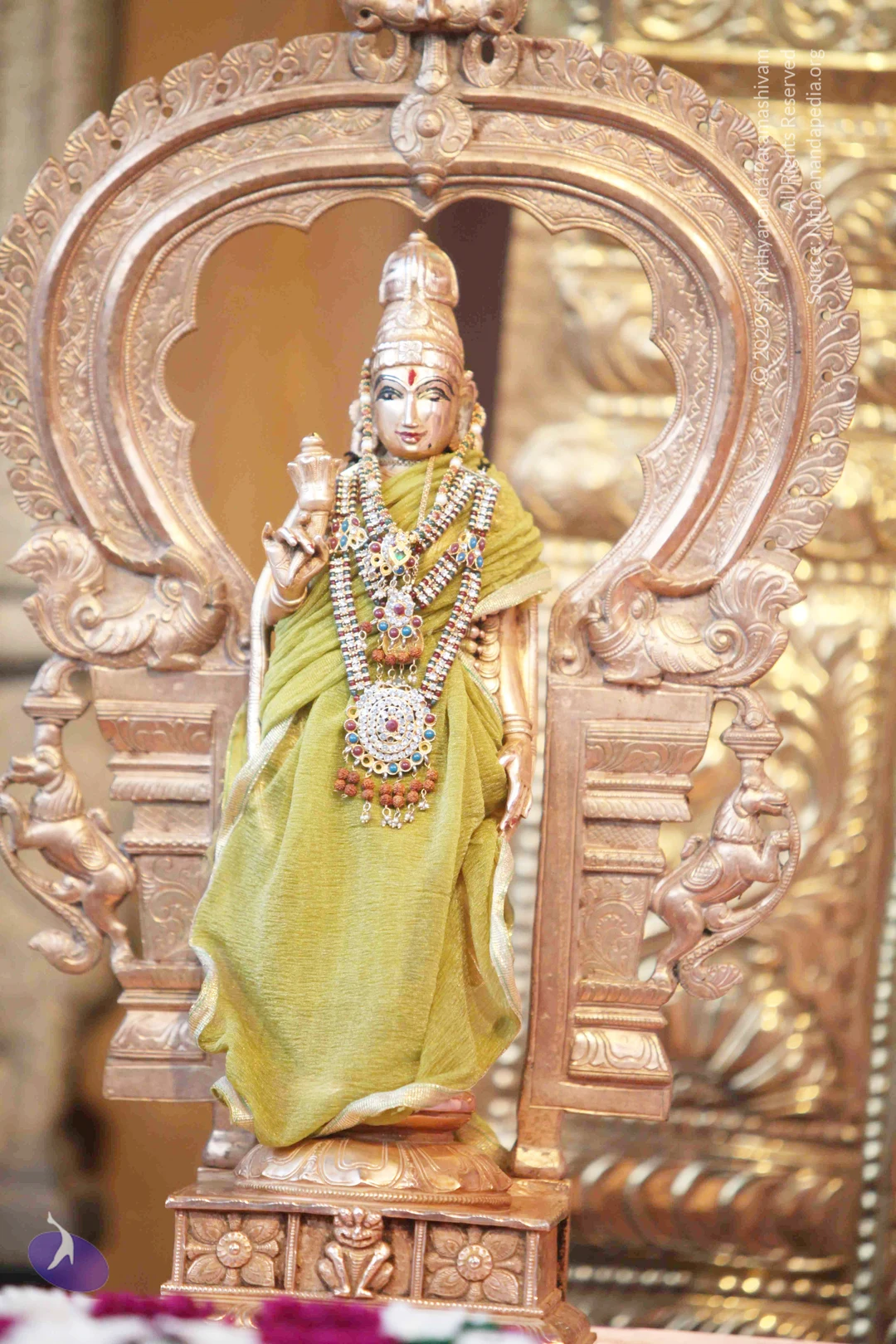
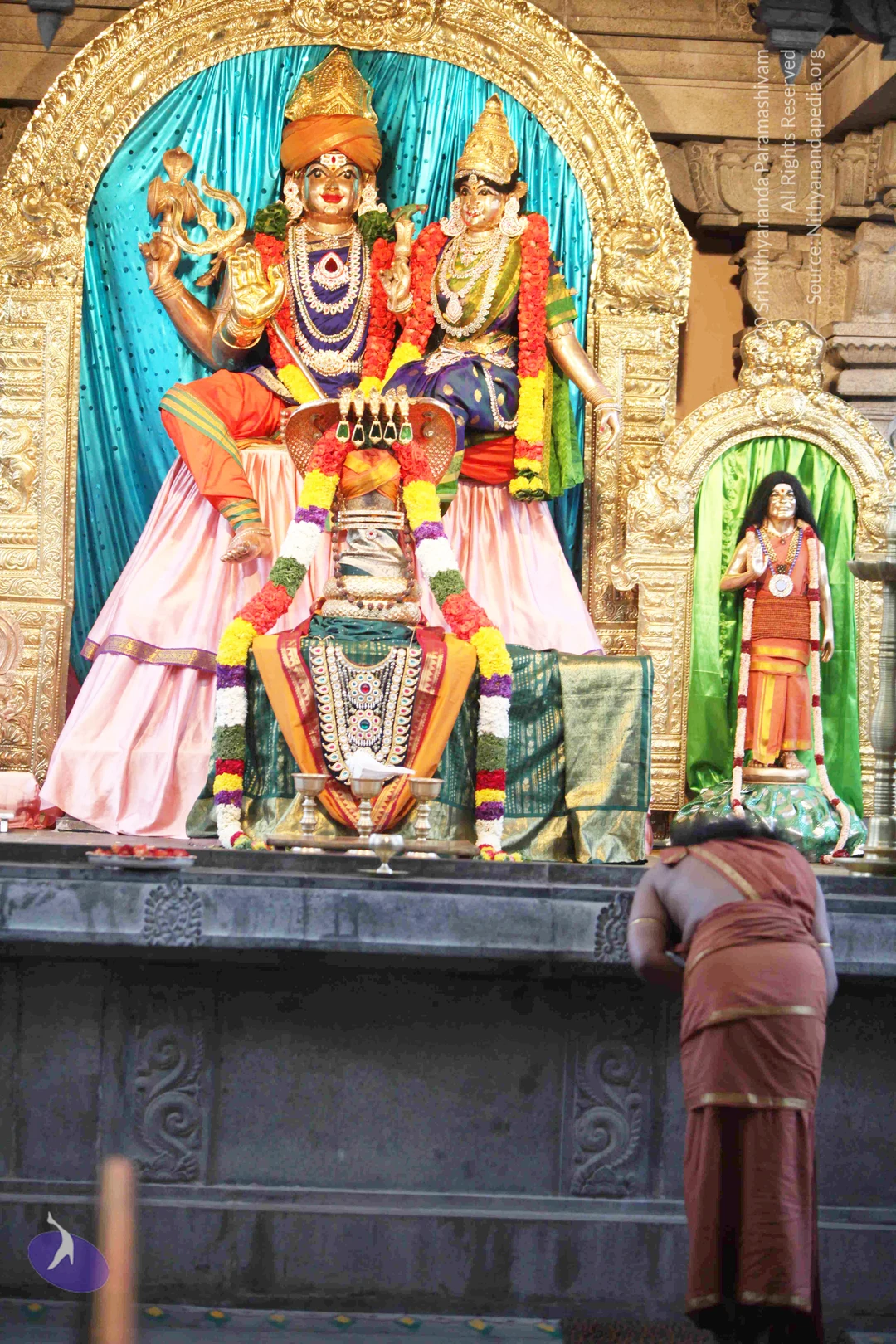
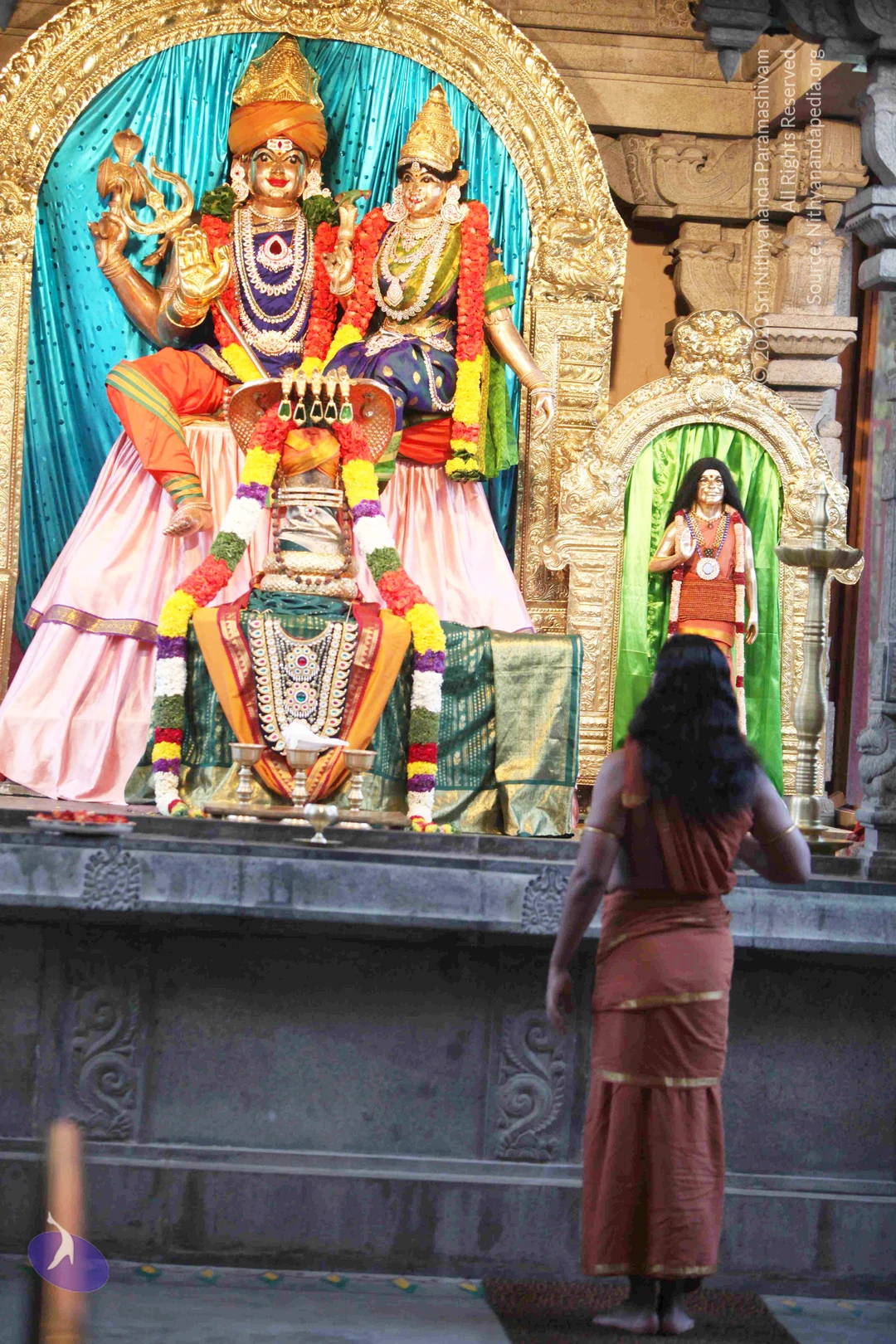
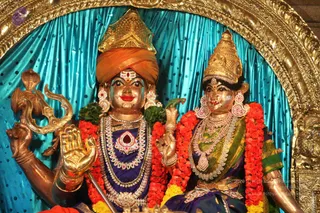
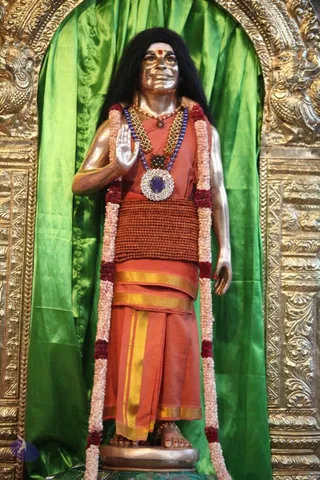
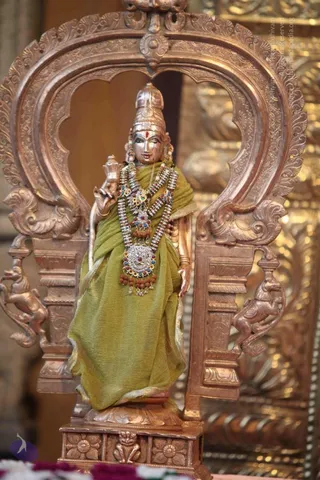
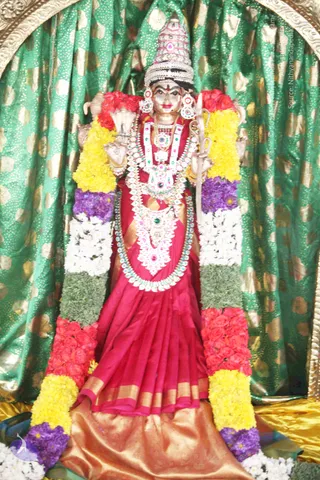
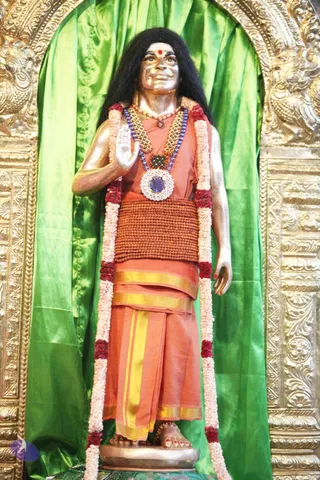
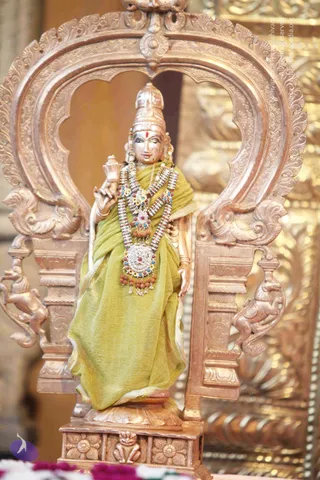
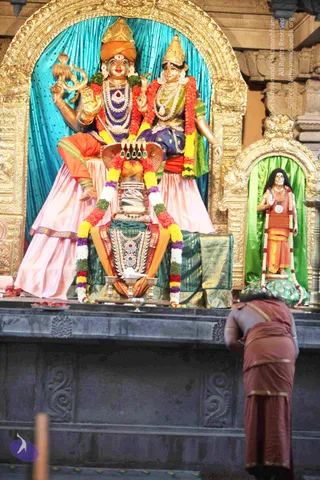
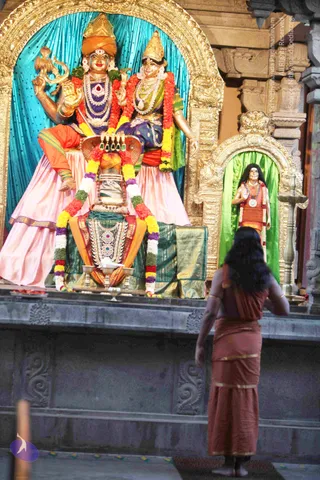
A standing deity murti of a goddess, dressed in a red silk sari with a wide gold border and wearing a tall jewelled crown, large earrings and layered necklaces set with white, green and pink stones. Her multiple arms hold ritual objects and a staff-like implement. She is framed by long garlands of yellow marigolds, red roses, purple flowers, white jasmine and green leaves, set before a green curtain with gold dotted pattern.A gilded metal deity murti of a female form, shown from the chest up in a shrine against a green silk backdrop with gold floral motifs. The murti wears a tall jewelled crown, red and gold garments, layered gem-studded necklaces, large earrings and bangles, and holds a trident-like staff and a ceremonial object in its hands. Garlands of red roses, yellow marigolds and purple flowers drape over its shoulders. No people are visible.A photograph of a temple shrine showing a large statue group of Shiva and Parvati seated on a raised dais, decorated with garlands of red, yellow and green flowers and gold ornaments. Shiva's statue has a crown-like headdress and holds a drum-like instrument; Parvati wears a red-and-gold top with a pink skirt. Behind them is a golden arch framed by a teal curtain, flanked by dark stone pillars and red drapes. A small figure of a standing attendant in orange stands to the right, and a metal barrier fence occupies the foreground. No living people are visible.Gilded murti of a deity couple seated under an ornate gold arch against a teal satin backdrop with dark dots. The male form wears an orange turban with a gold crown, a red tilak, and a red-and-white jewelled necklace, and holds a golden trident and a snake-topped staff. The female form wears a gold crown, a green-and-gold sari and layered diamond-style jewellery. Both are draped in red and orange rose garlands with yellow marigolds. No living people are visible, and no a person candidate appears in person; the figures are statues.A life-size metallic statue of a long-haired male figure stands in a gilded arched niche against a green satin backdrop. The statue wears an orange-red sanyasi robe with gold-bordered dhoti, a wide rudraksha belt, a multi-strand beaded necklace with a large blue-and-white jewelled pendant, and a red tilak on the forehead. Its right hand is raised in blessing, and white and red flower garlands drape from the shoulders to the base. The statue is an image rather than a living person, so it is a depiction and not a physical presence.A metallic standing murti of a goddess in a copper-toned arched frame carved with scrolls and rearing mythical animals. The figure wears a green sari with gold border, a tall crown, a red tilak on the forehead, and layered jewelled necklaces with a large central pendant and rudraksha beads. One hand holds a small upraised object, the other hangs at her side. A carved pedestal with floral panels and a small figure sits beneath, with a row of flower garlands at the bottom edge. The background is gilded. No physical people are visible.
pada-puja

53 photosSource gallery
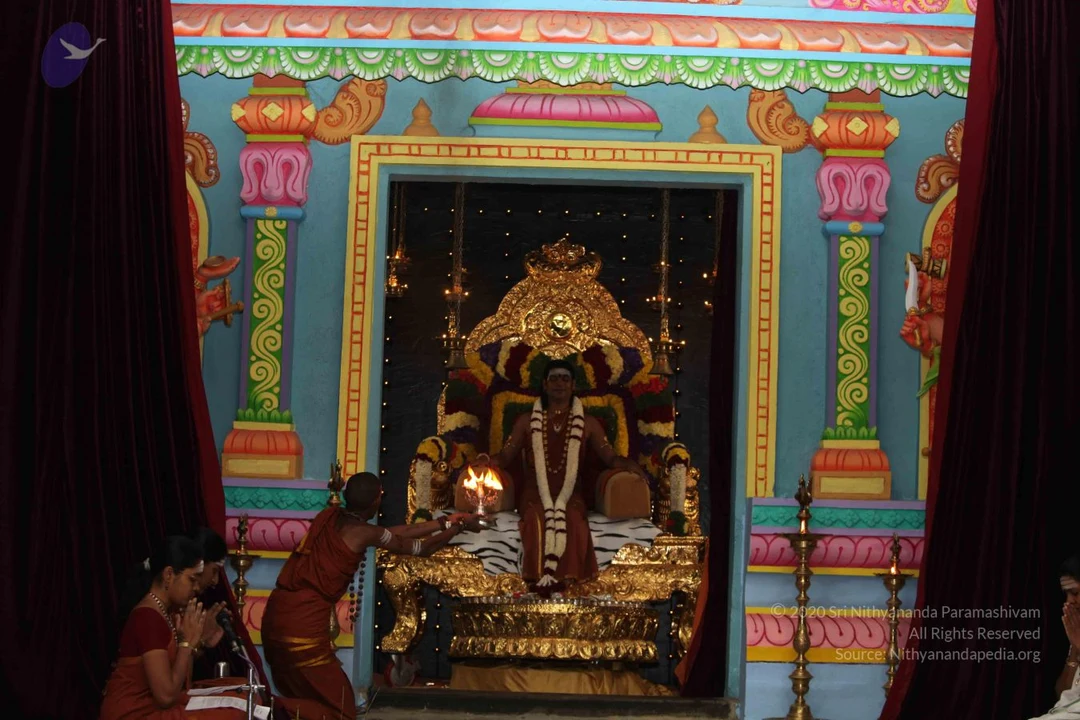
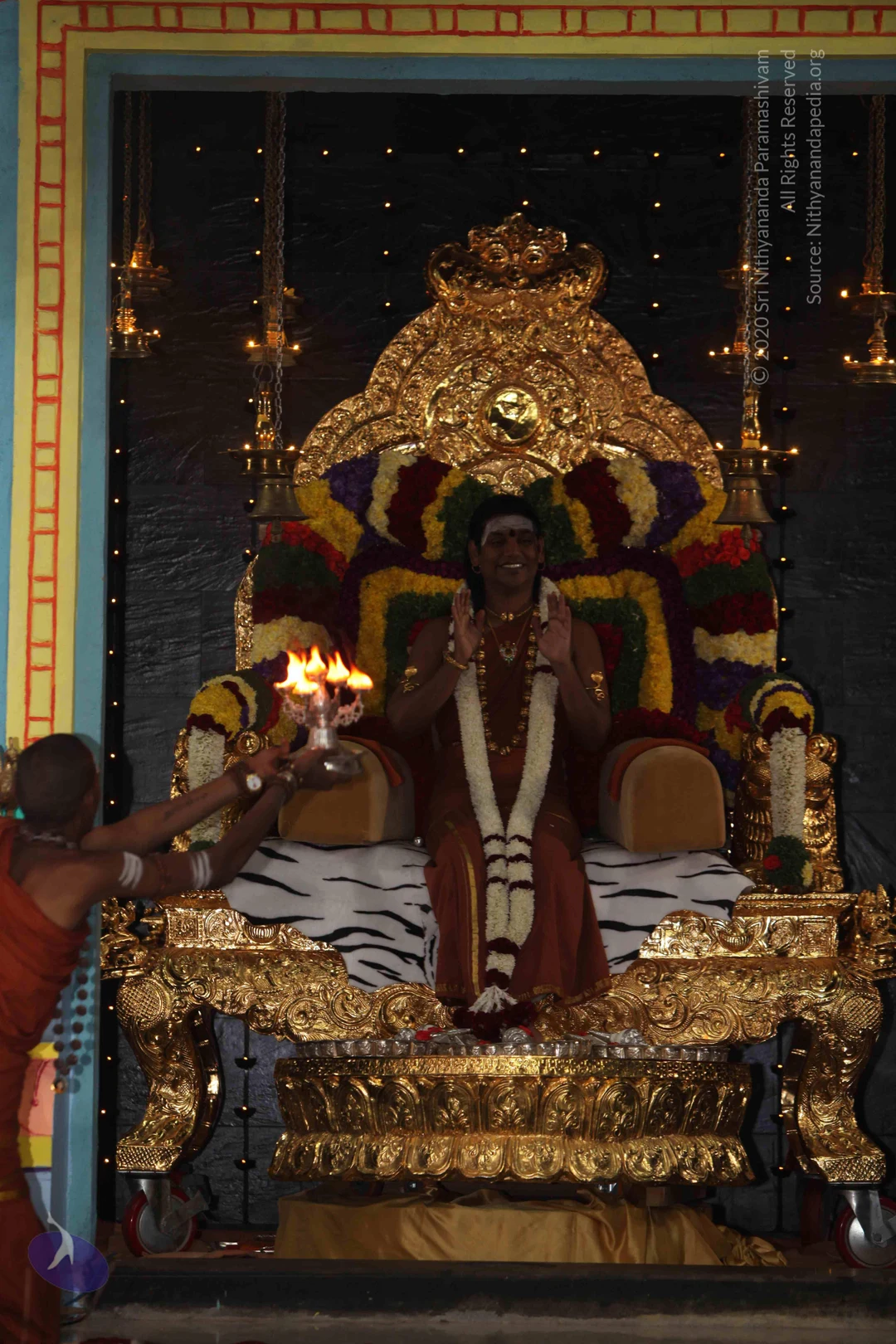
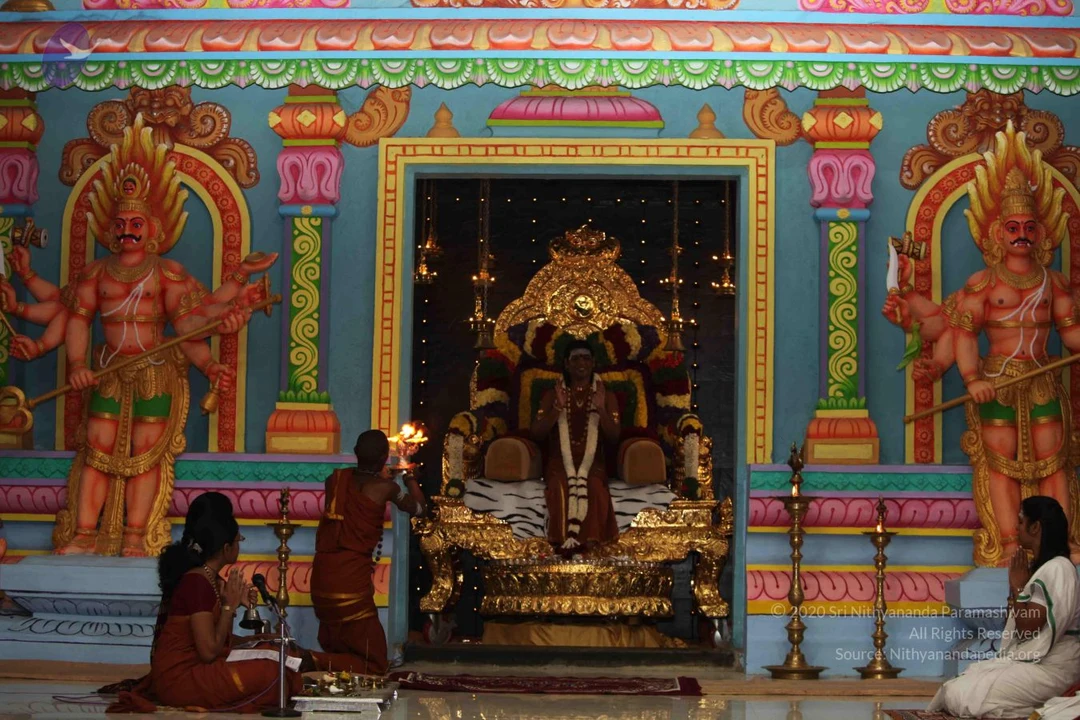
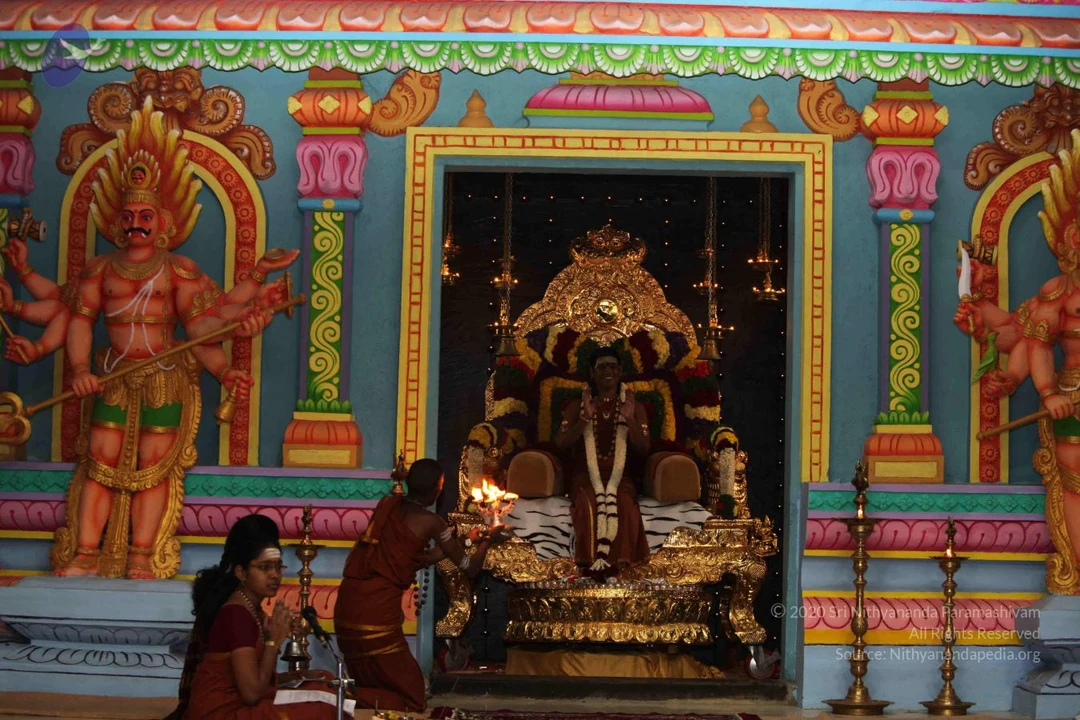
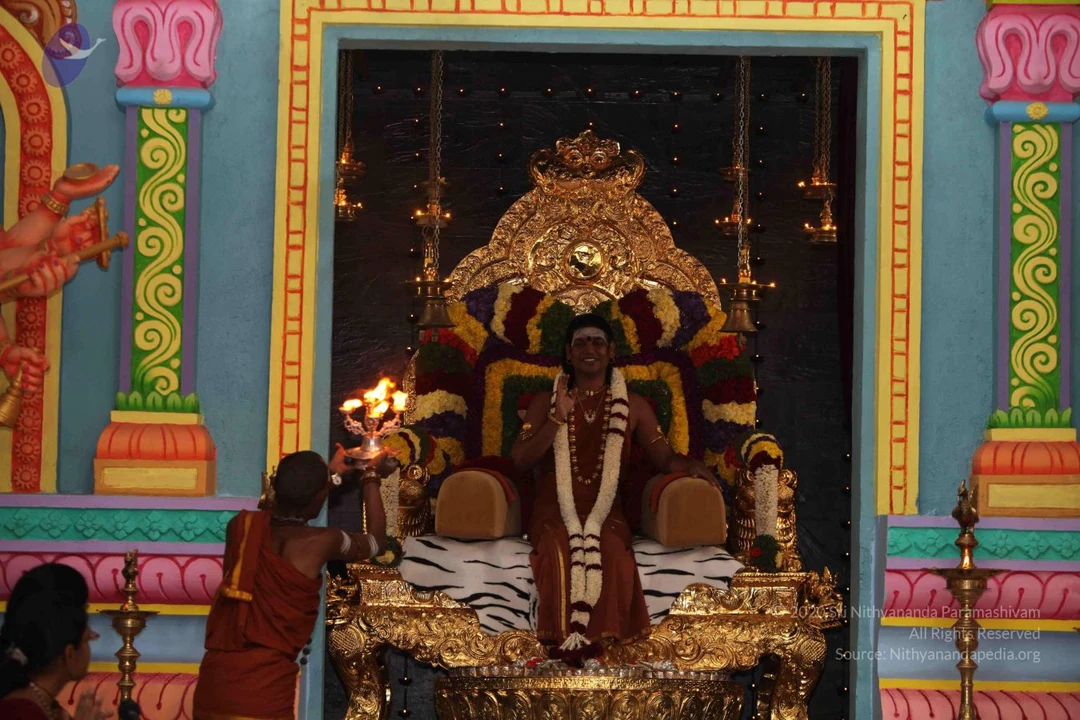
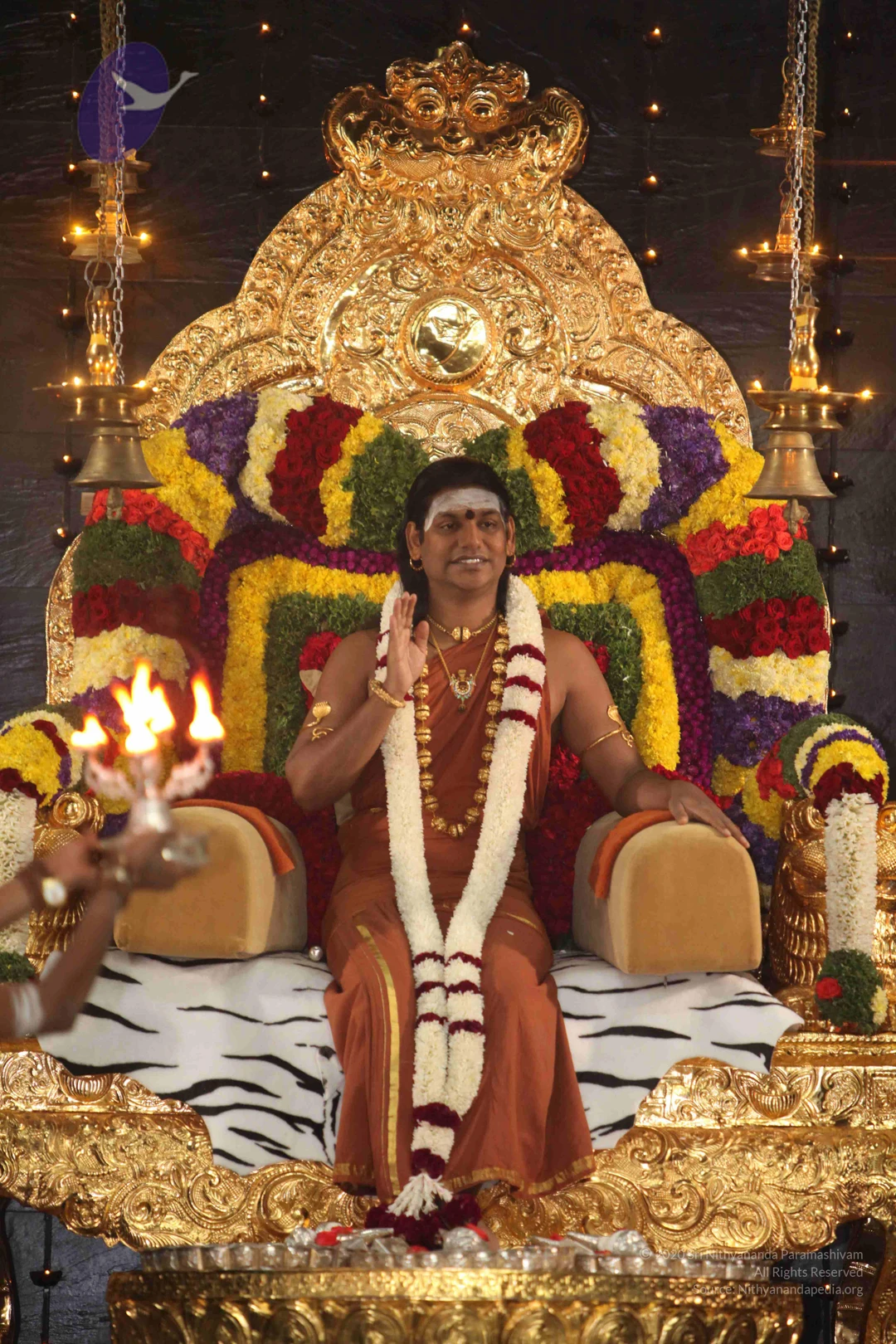
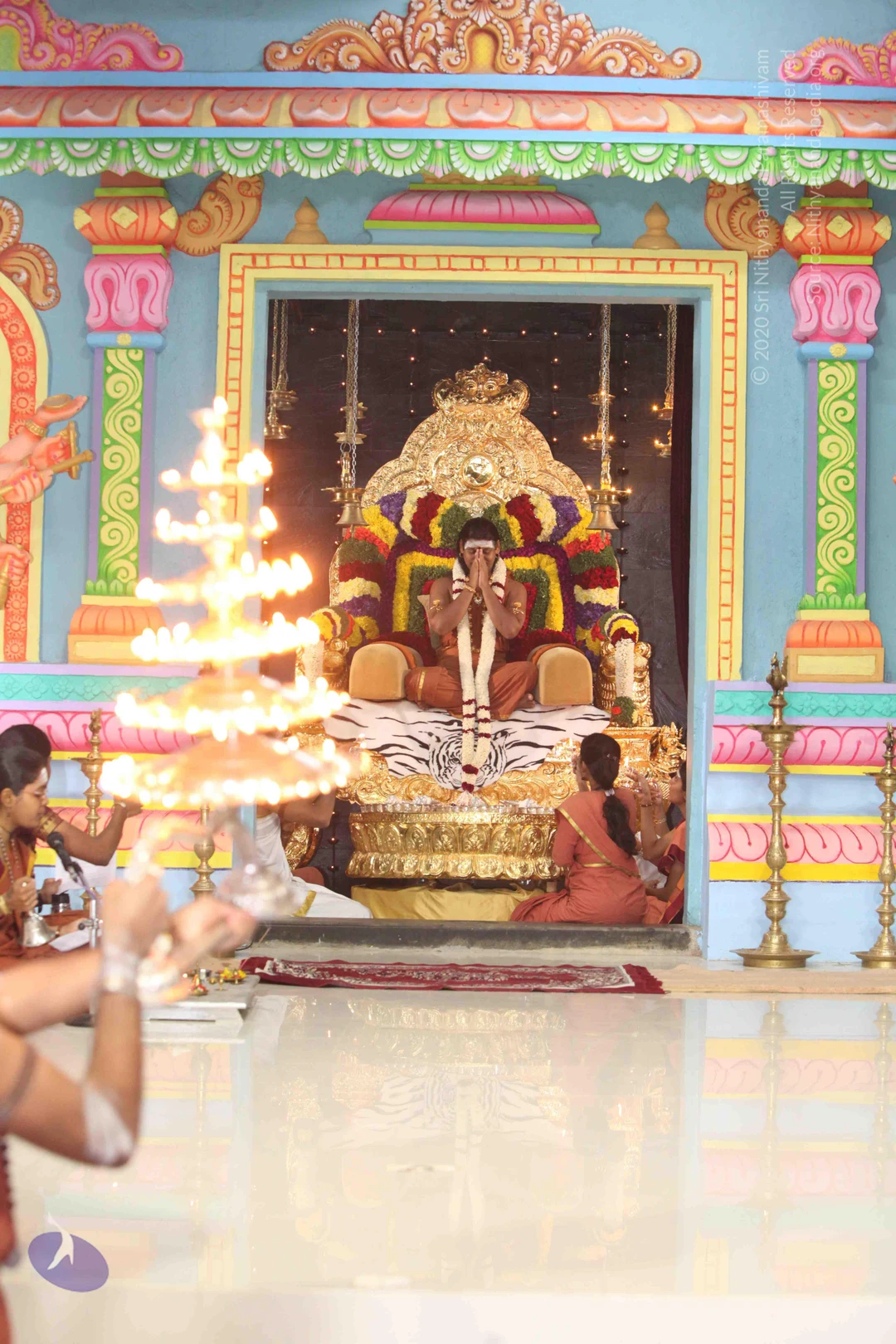
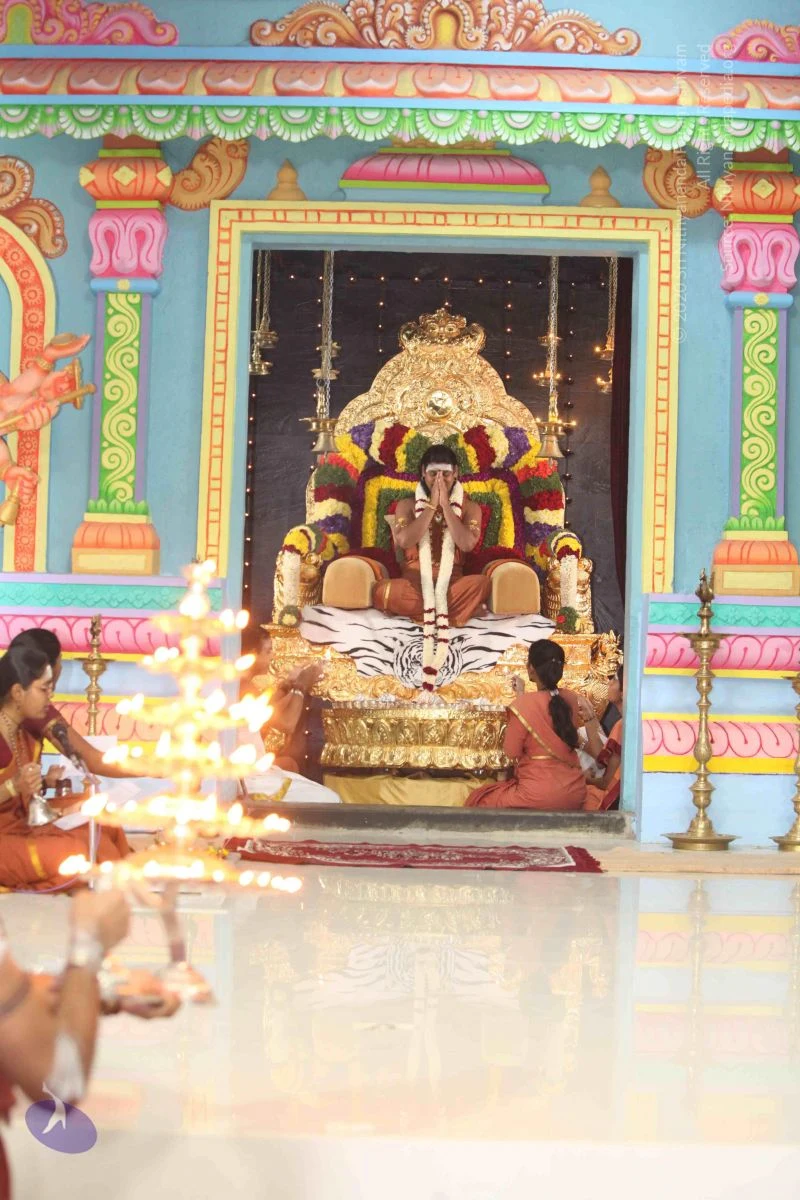
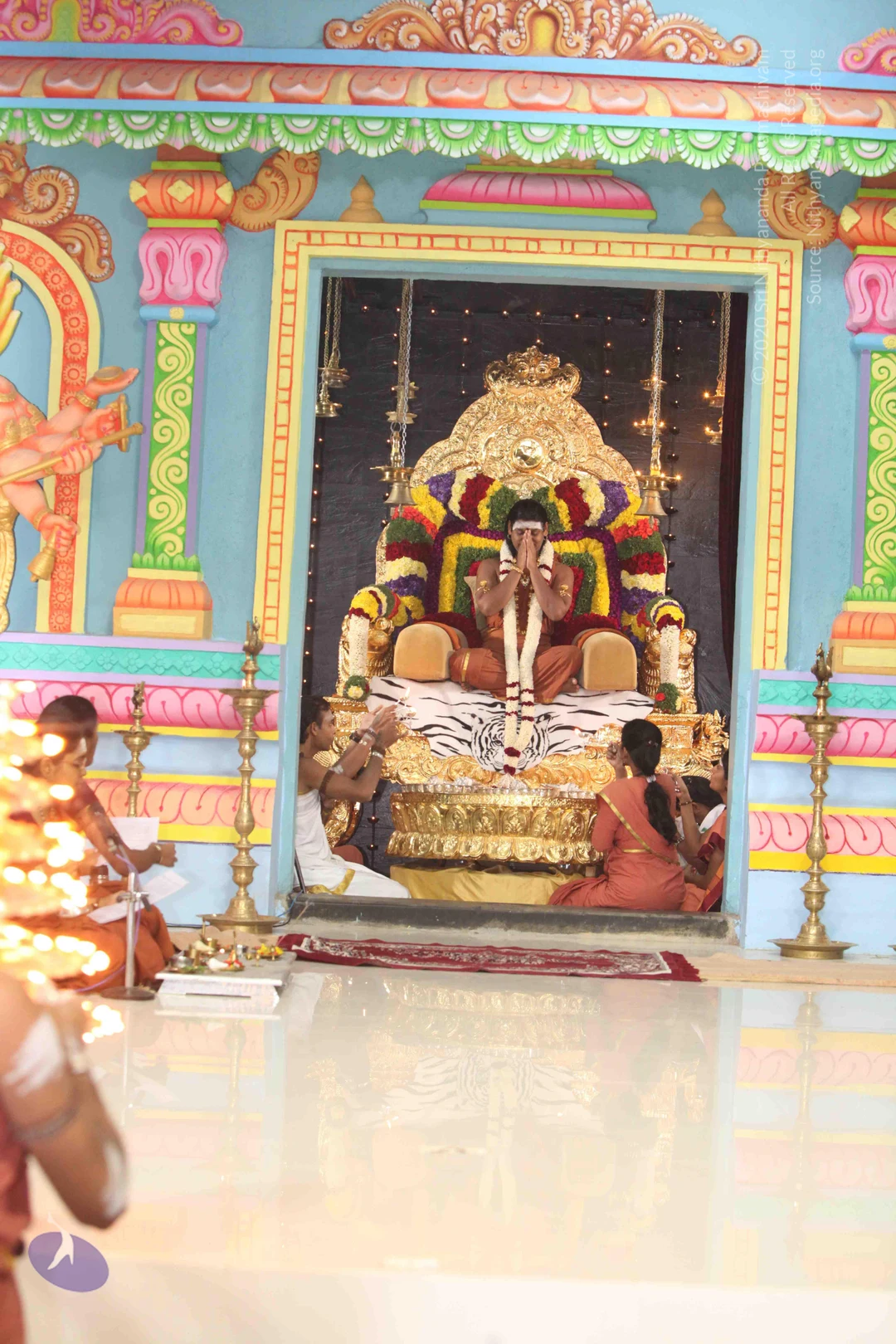
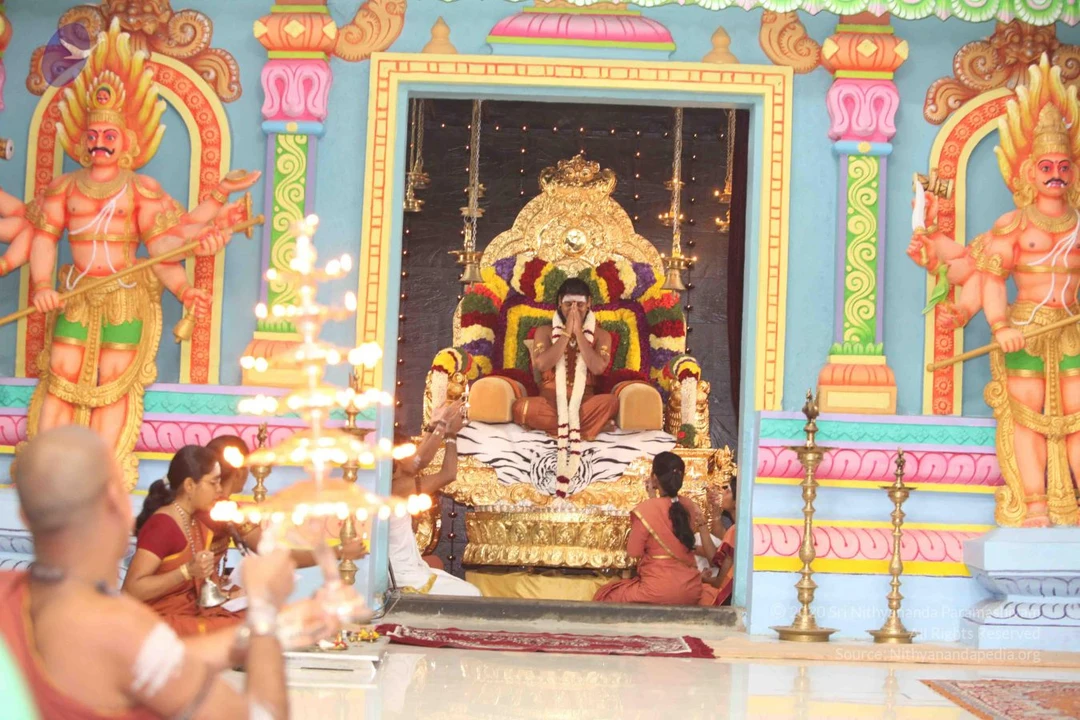
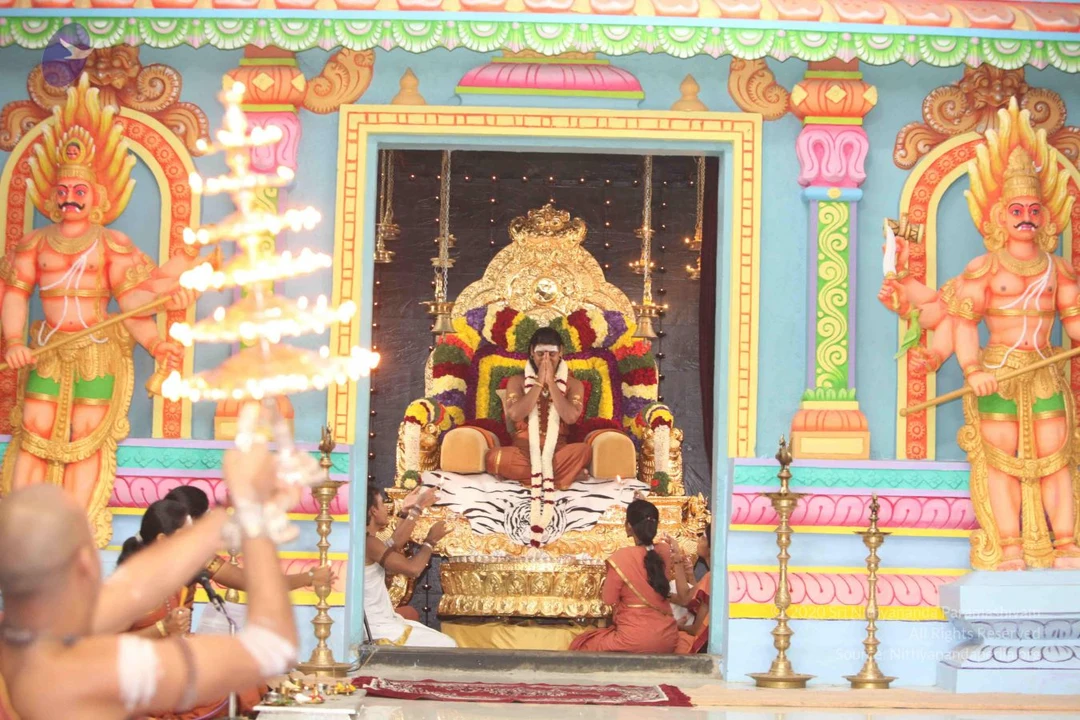
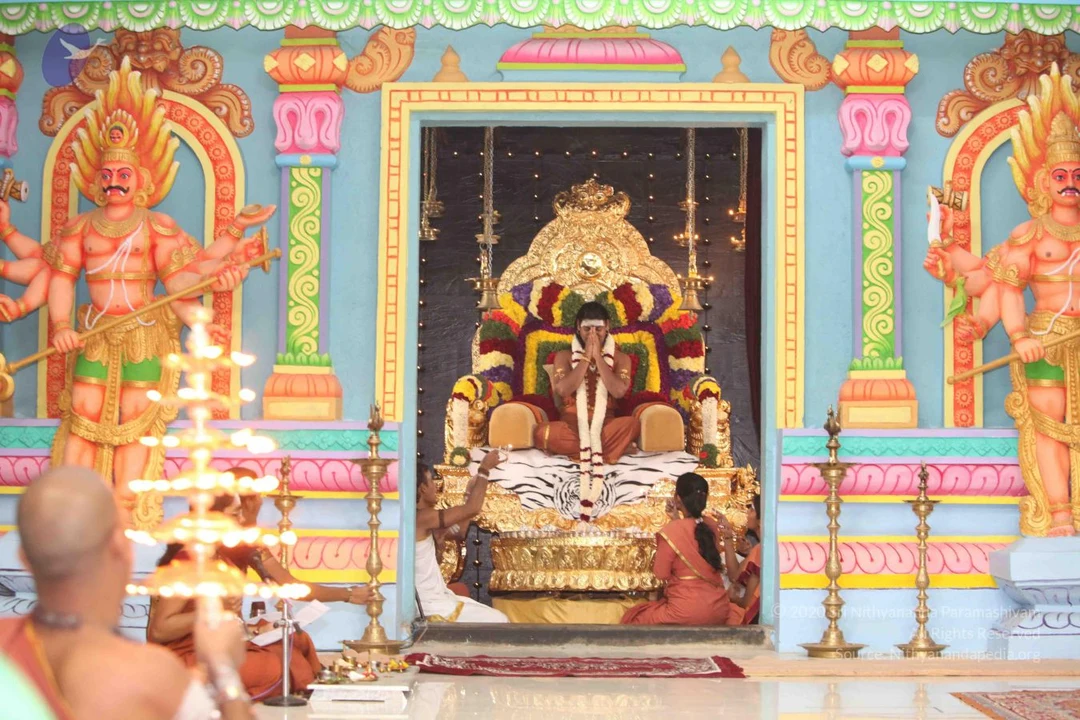
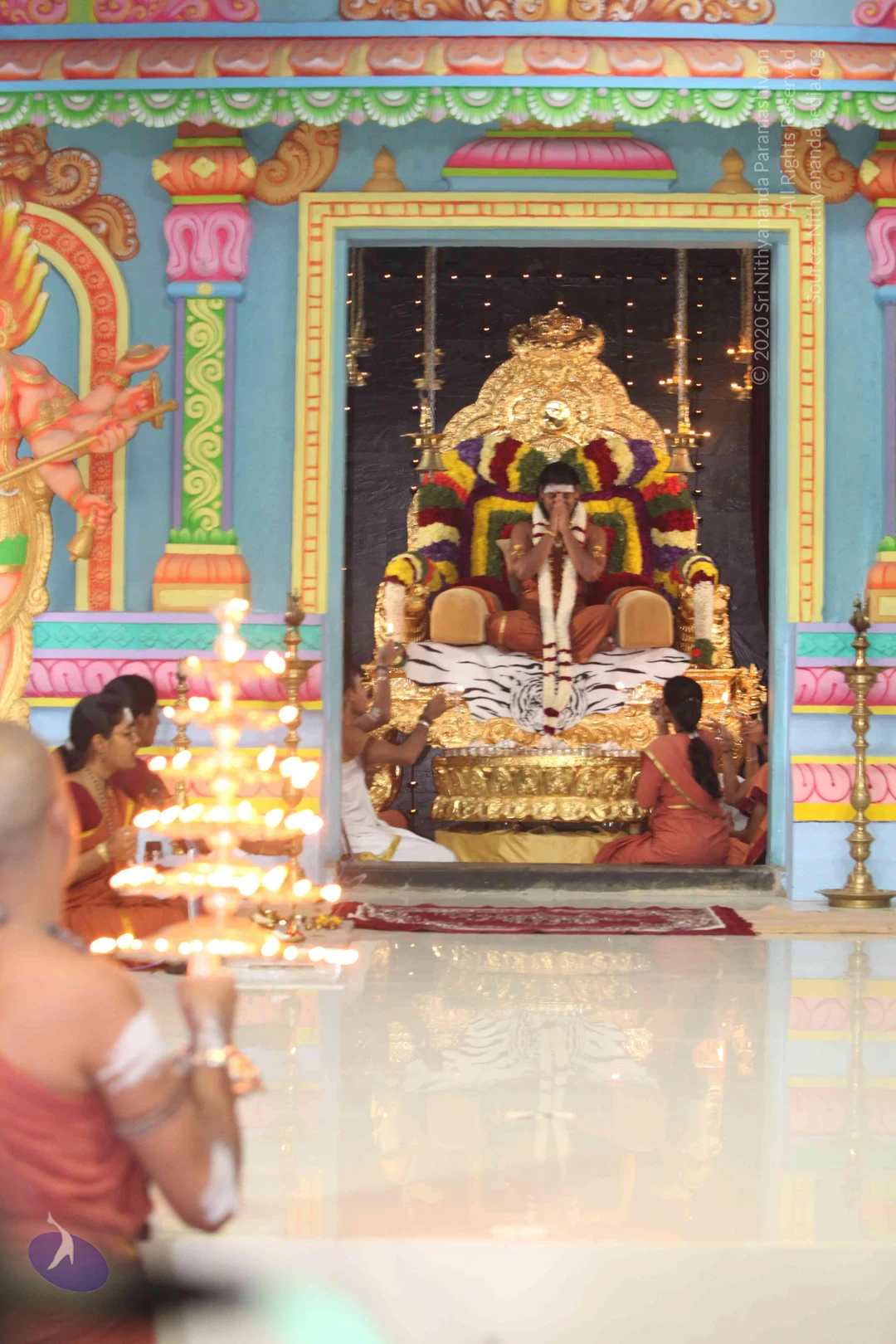
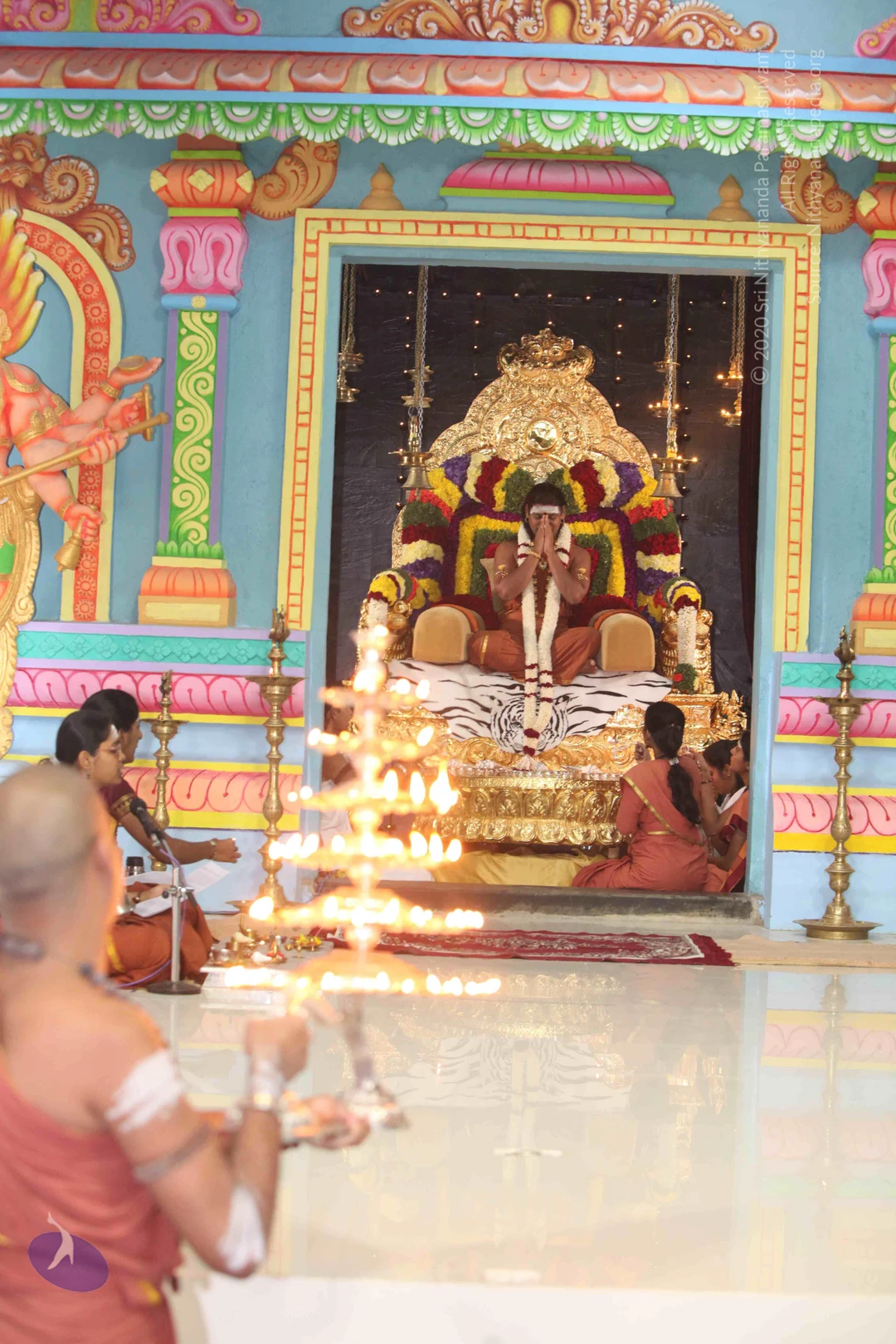
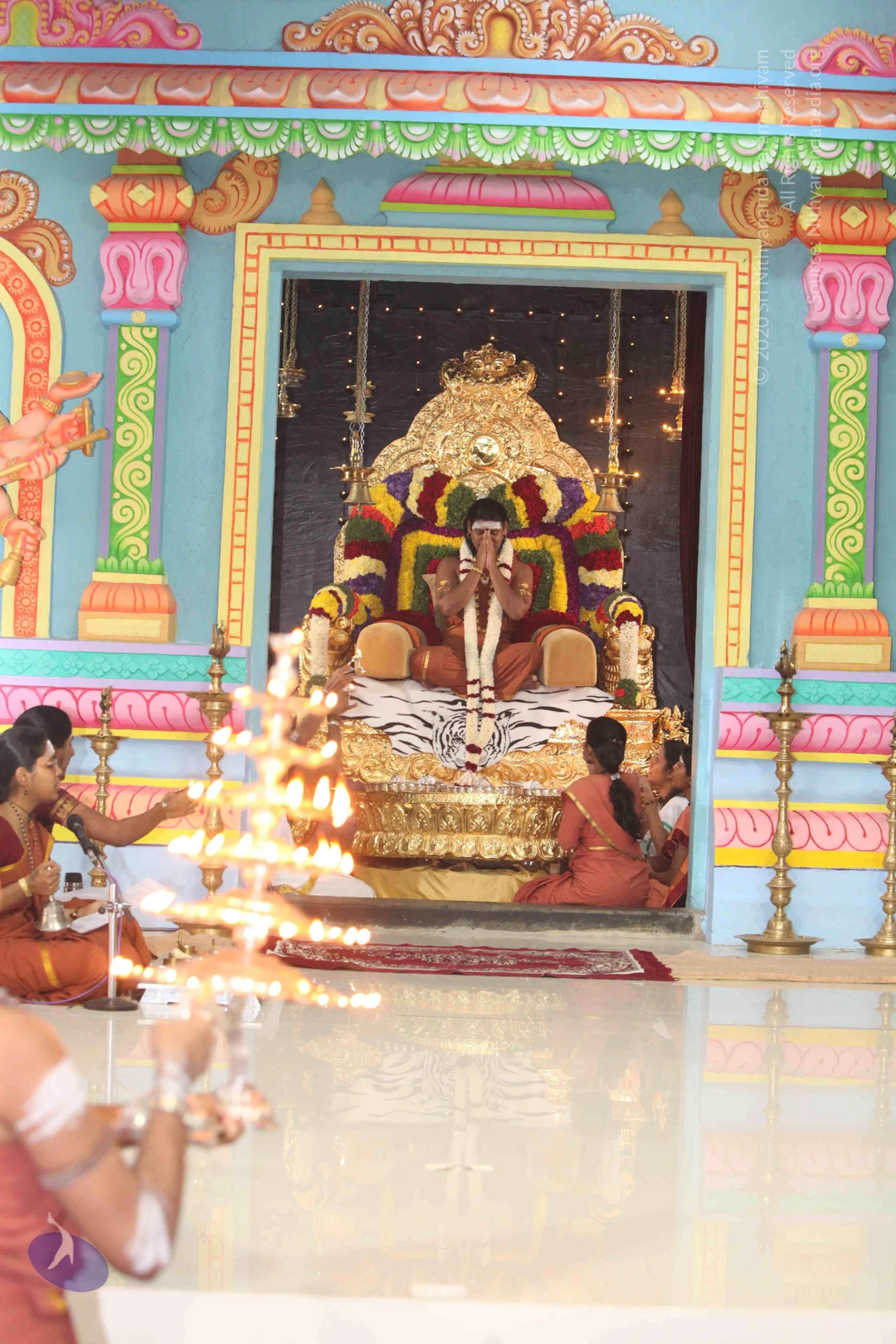
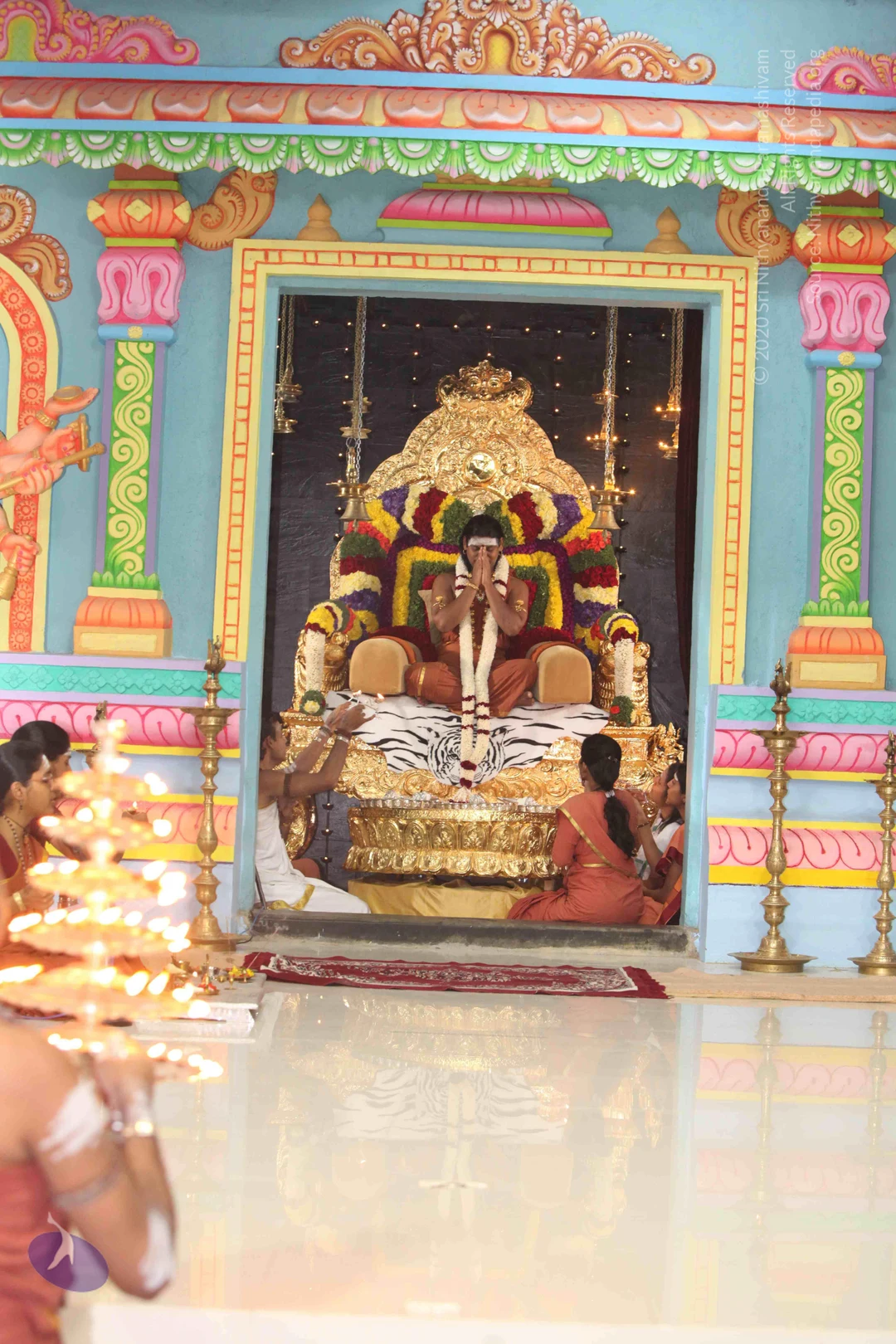
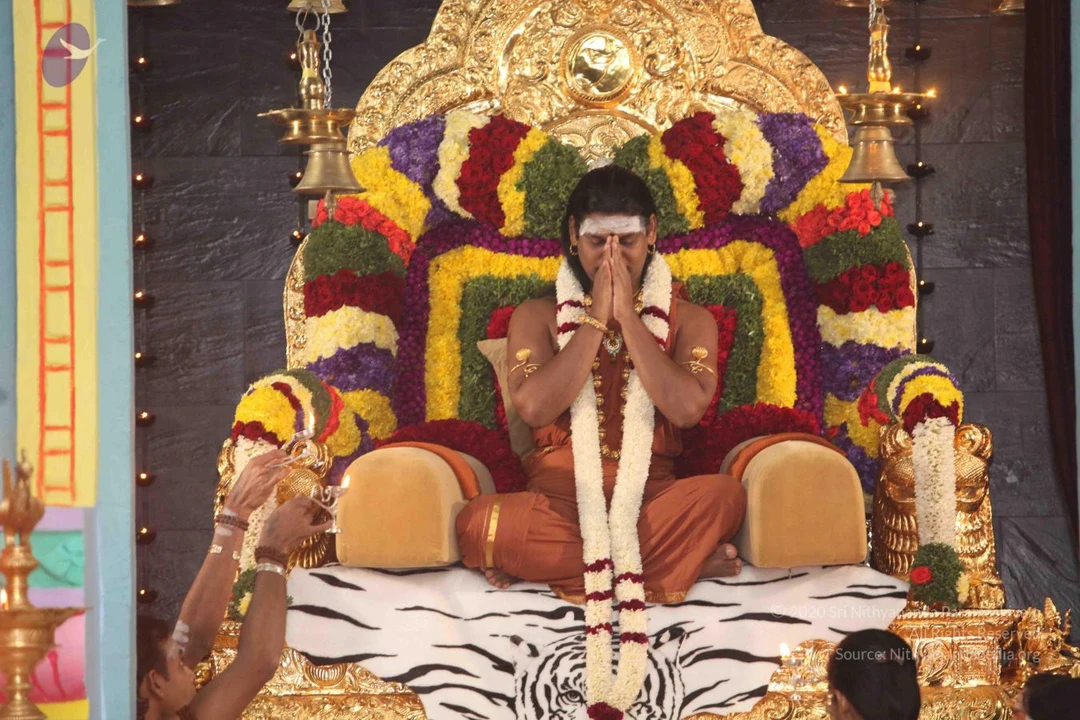
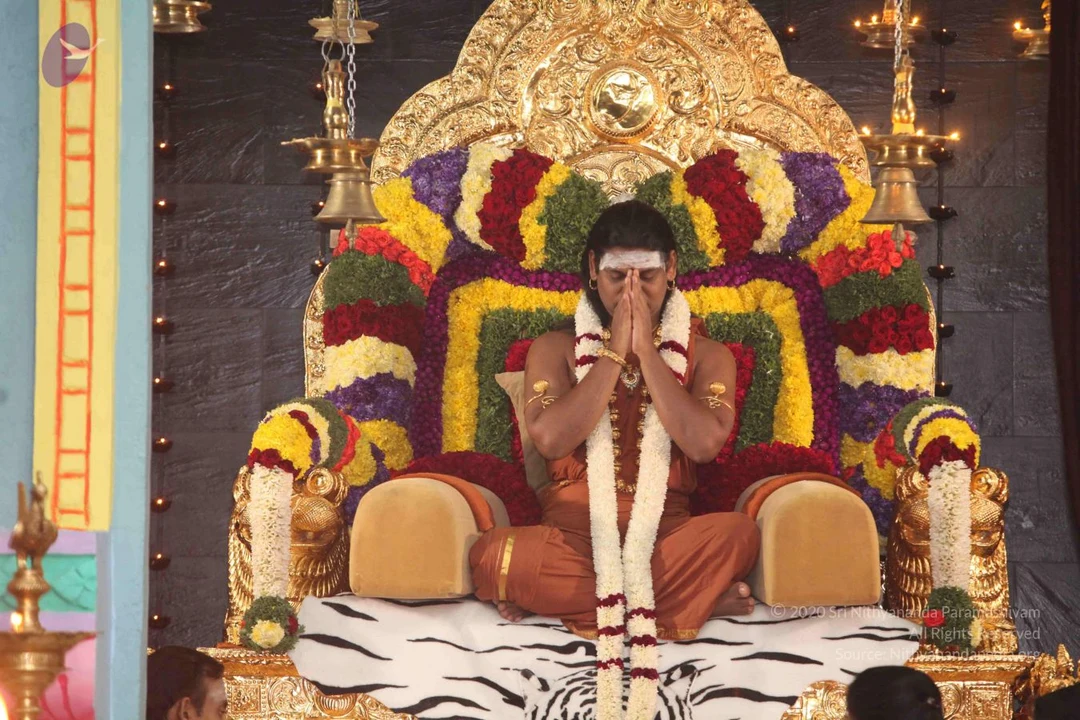
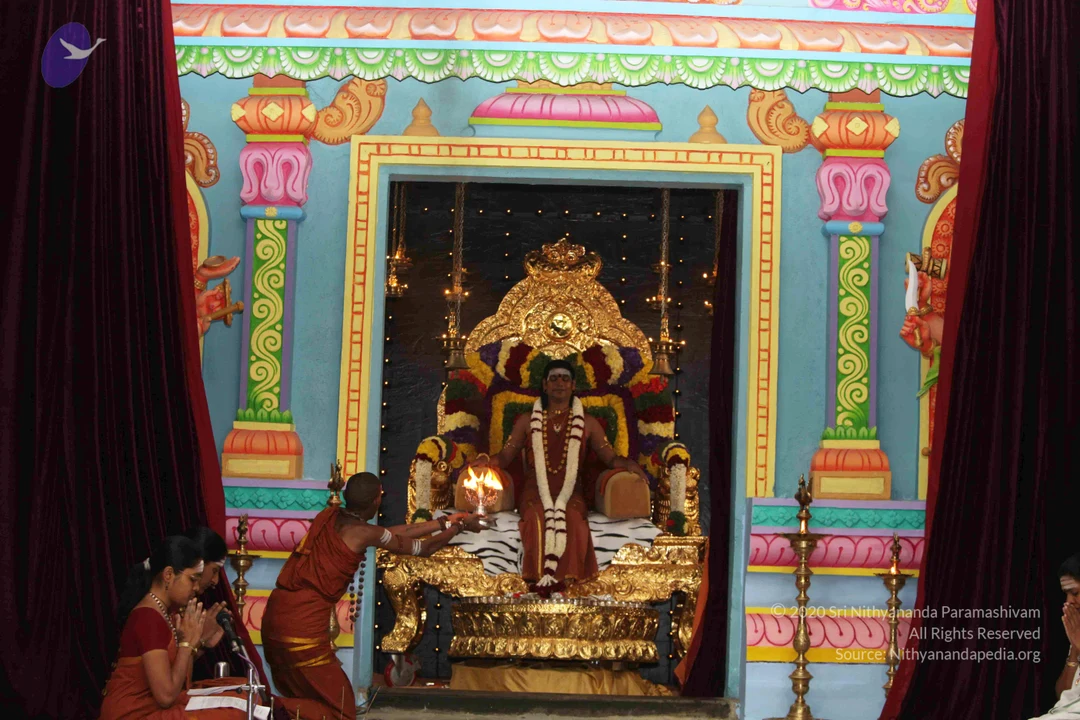
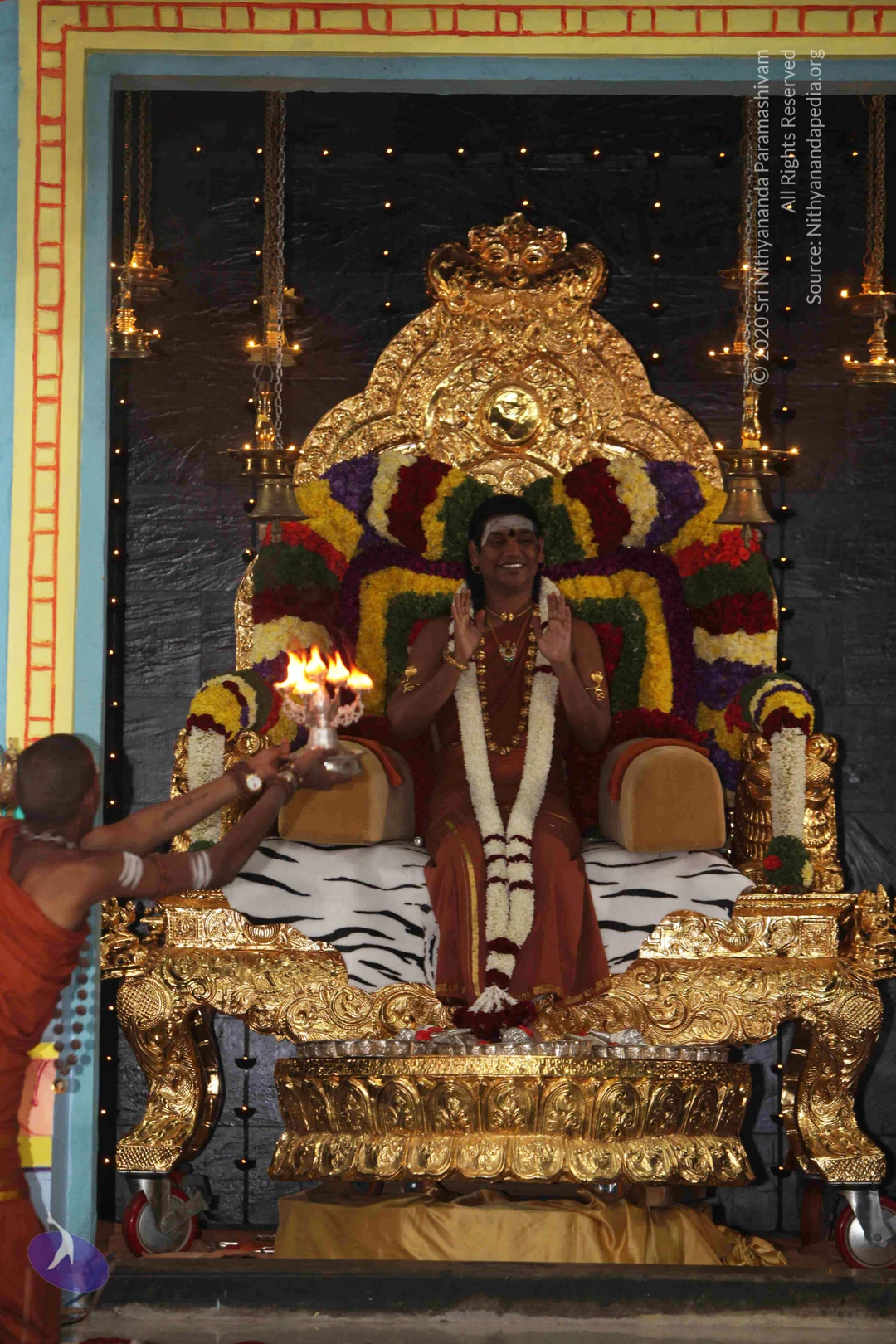
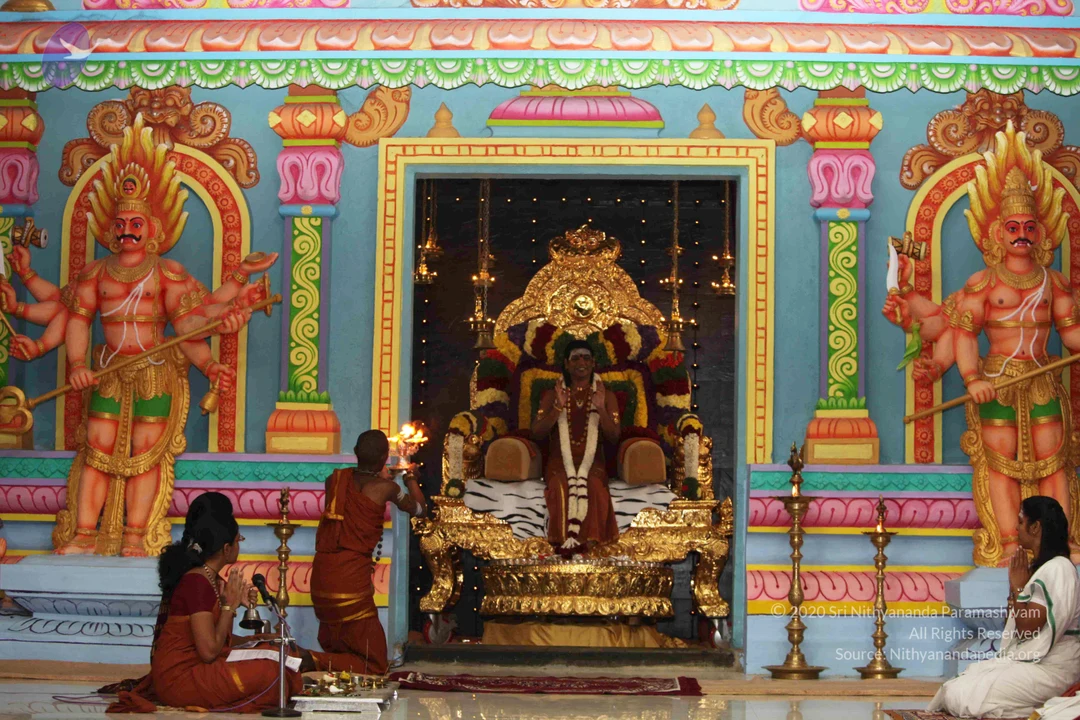
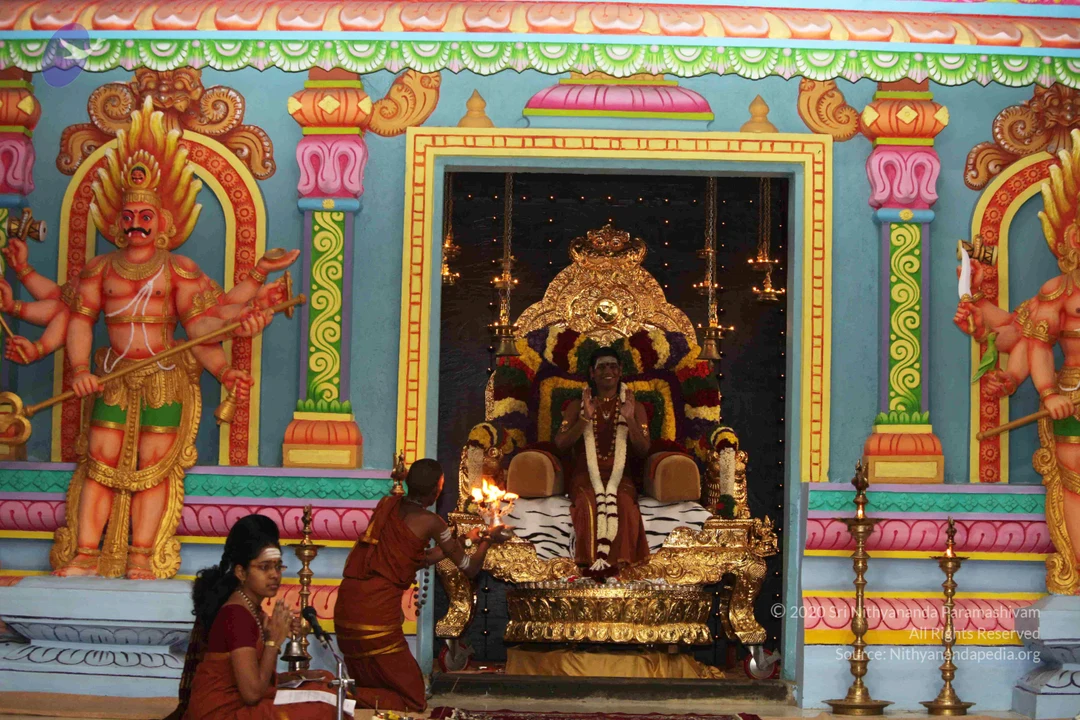
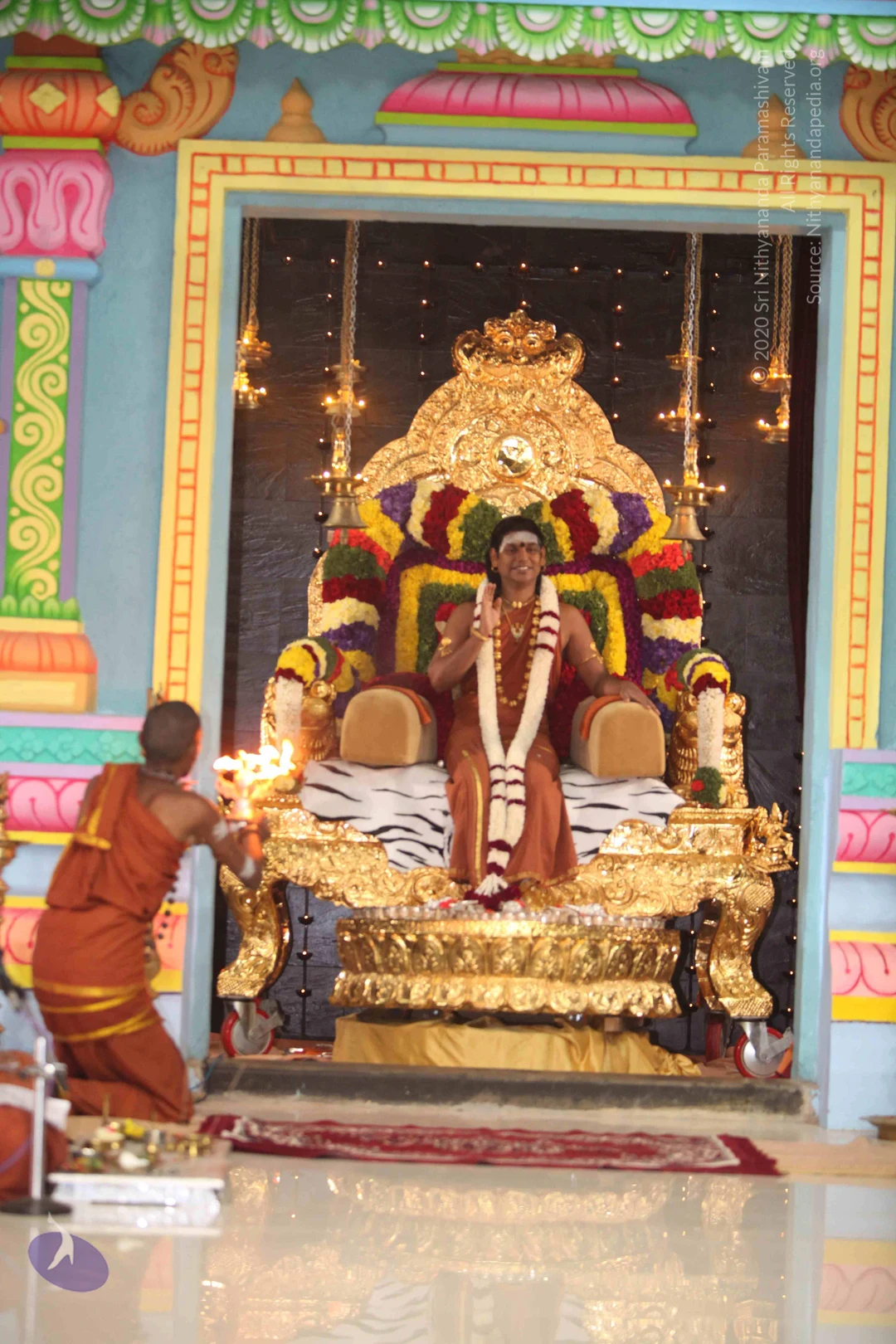
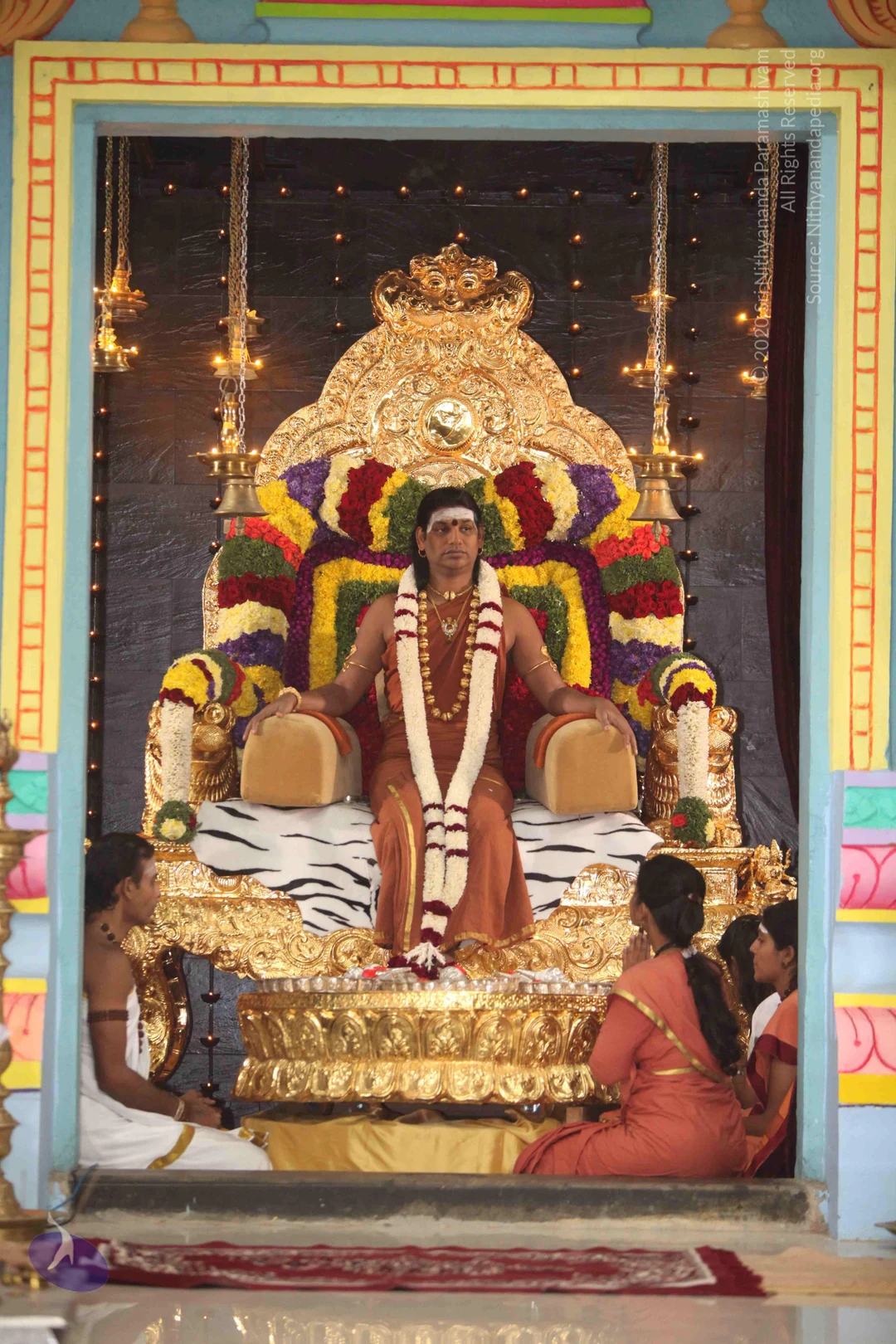
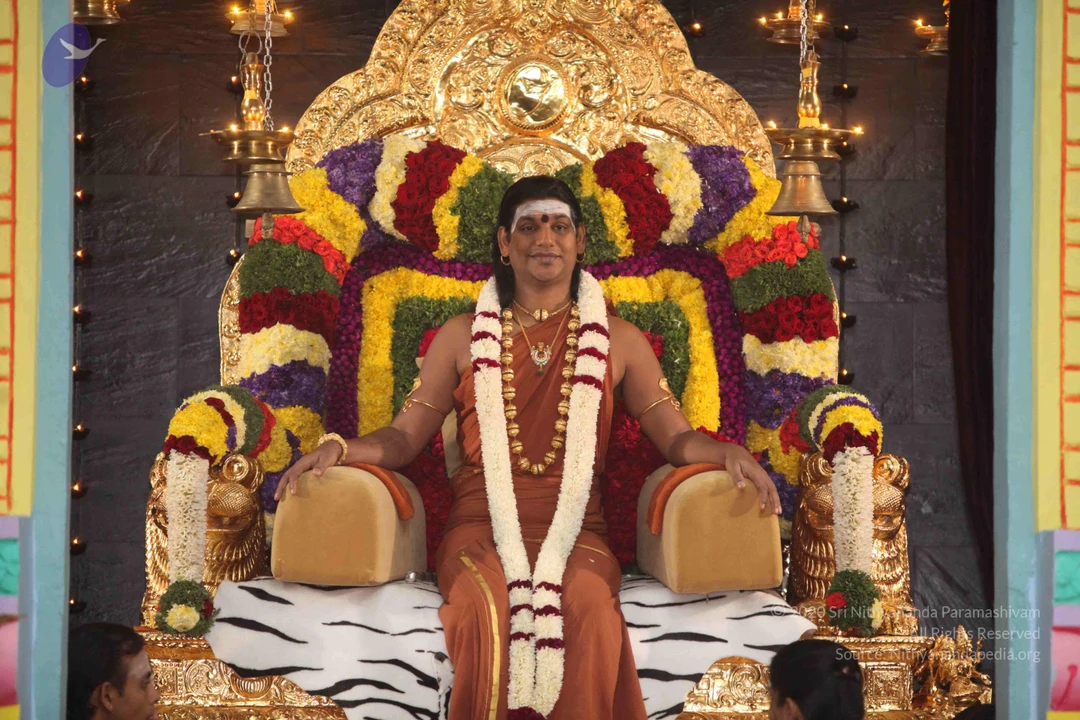
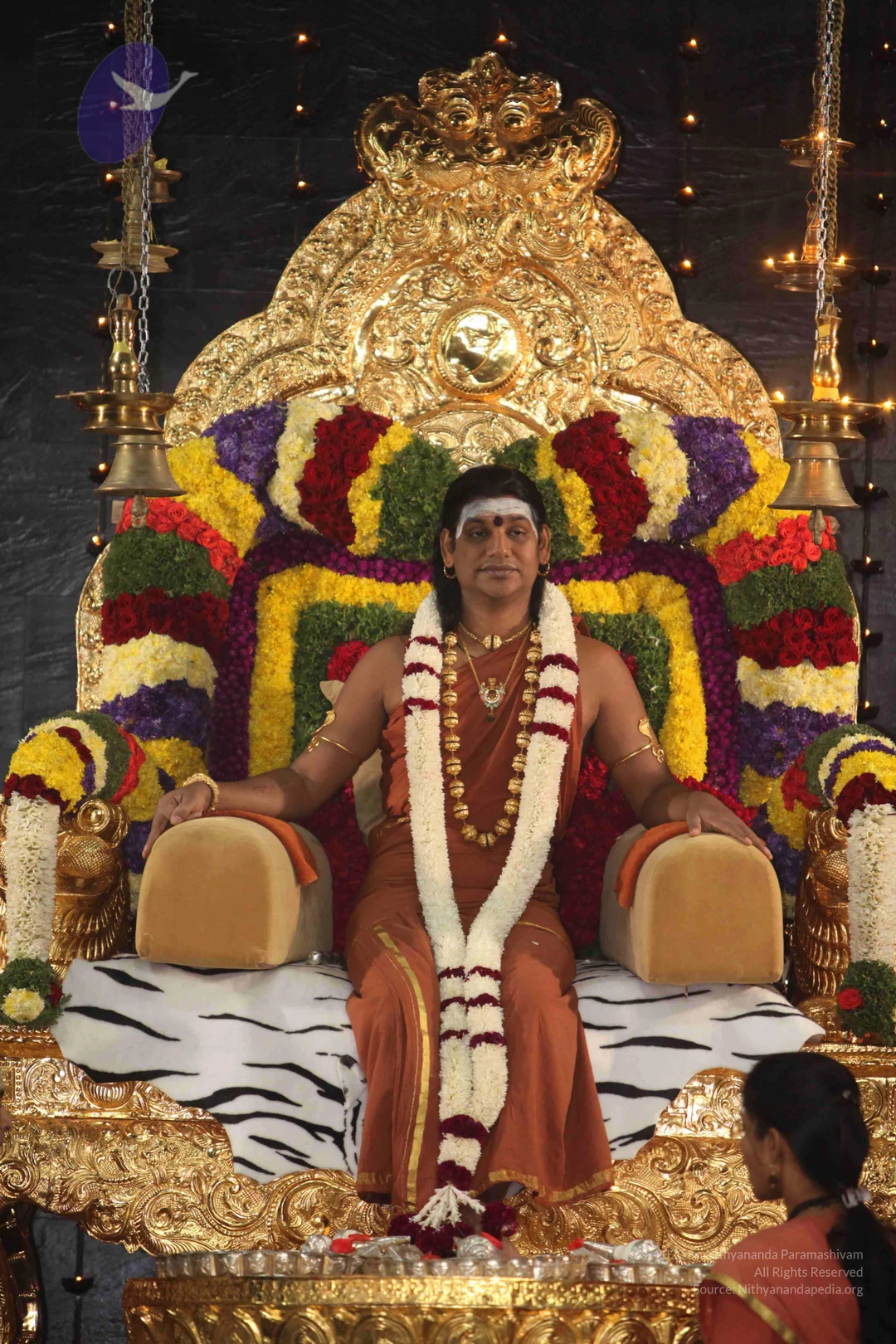
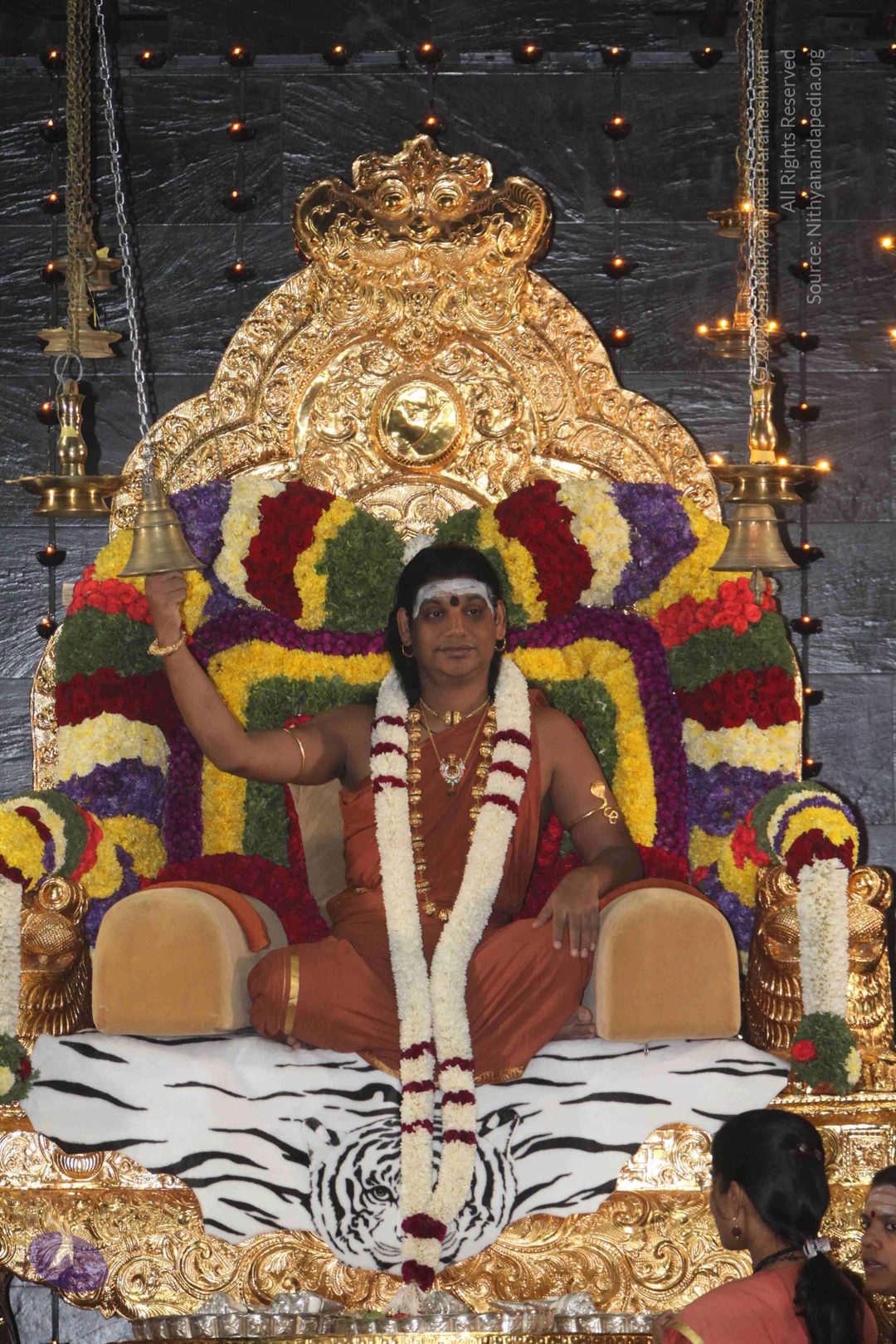
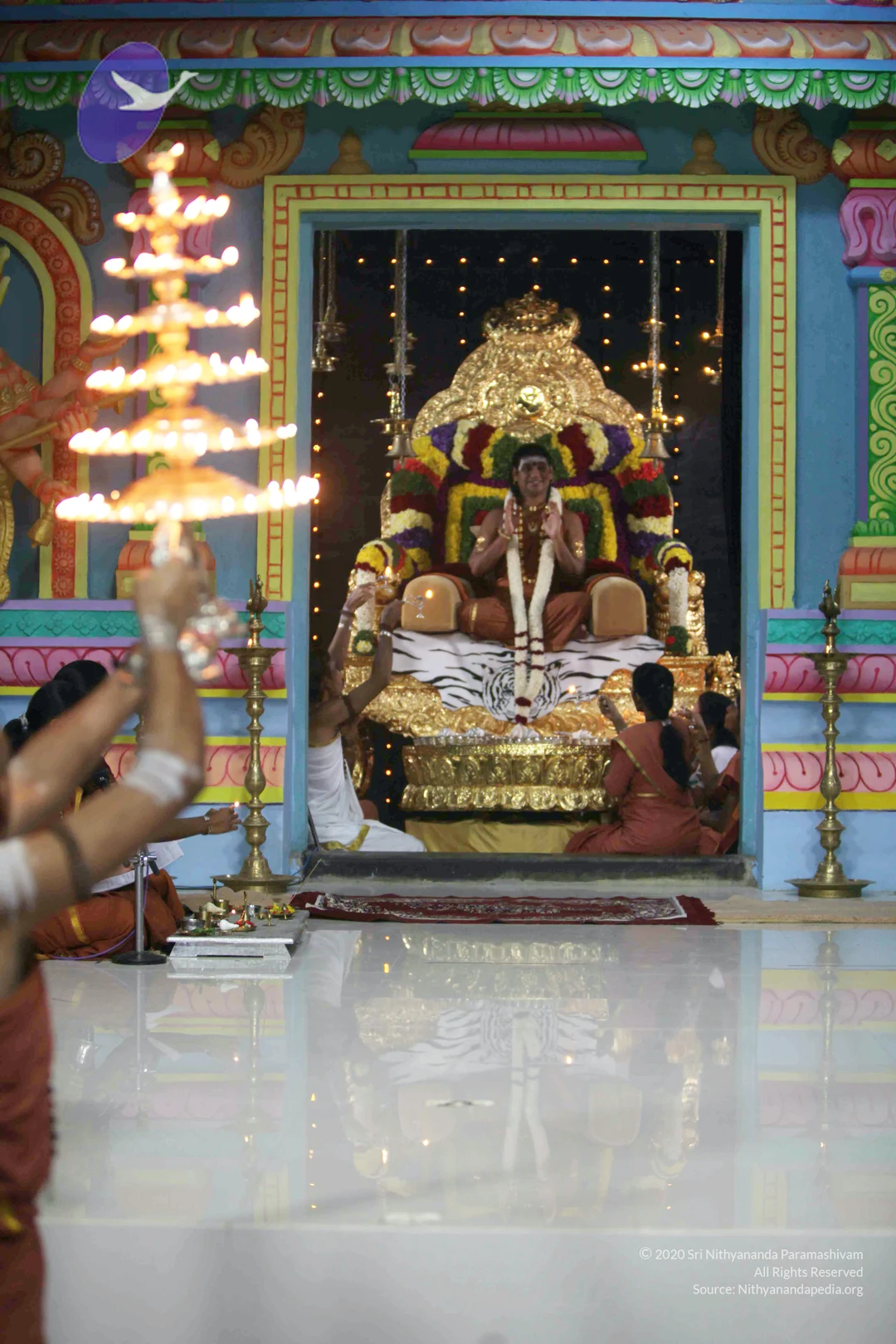
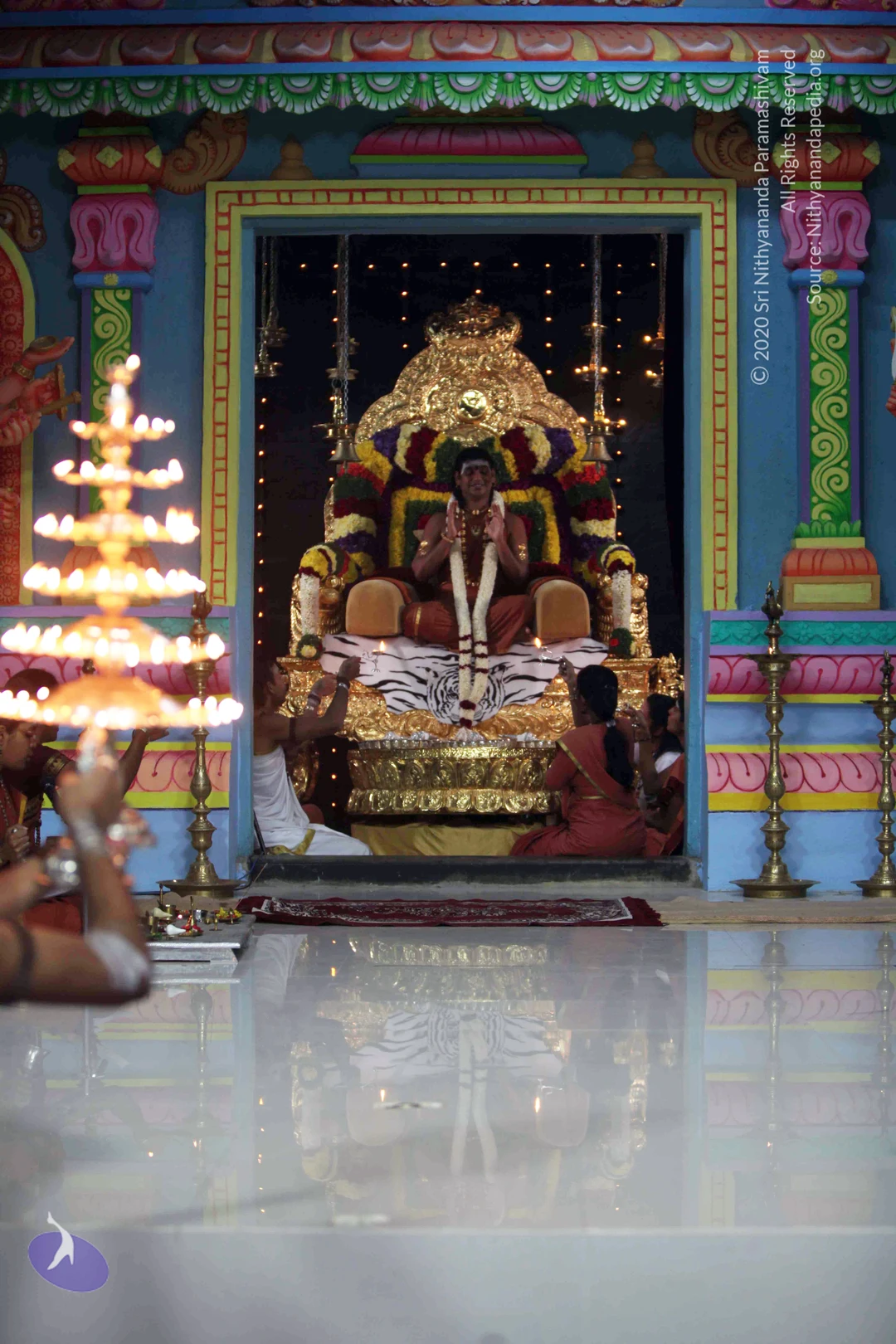
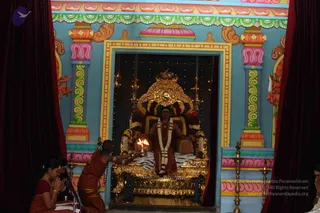
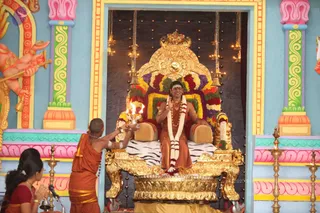
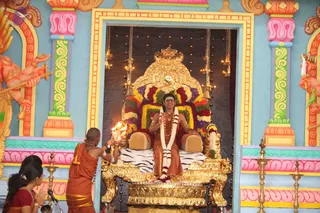
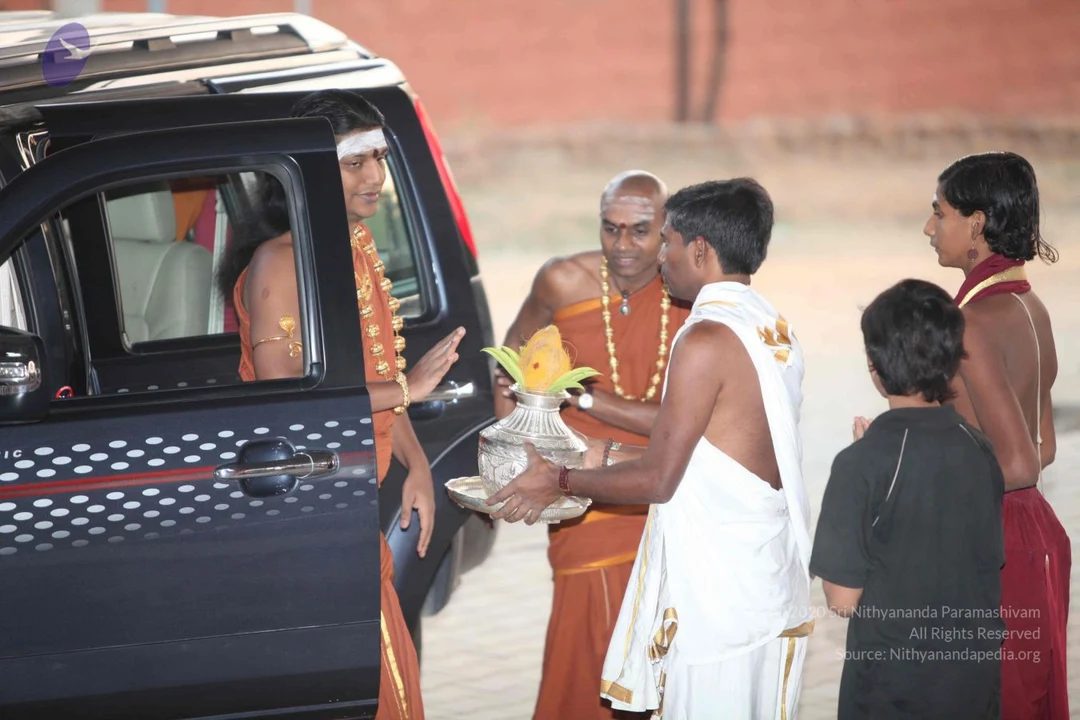
A photograph of a ceremonial scene in a temple-style hall with painted turquoise and pink pillars and a red velvet curtain at each side. A seated figure in a saffron-orange robe with long hair and a white-and-orange garland sits on a golden throne with a zebra-striped cushion, flanked by a golden ornate backrest. In front, a devotee in orange robes and a kneeling woman in red saris perform an aarti with a lit oil lamp, with brass lamps standing on either side of the dais. The setting suggests a puja or darshan, with a person candidate on the throne whose saffron clothing, long hair and garland are visible cues.A seated man on an ornate gold throne with a tiger-striped cloth draped over the seat, decorated with multicoloured flower garlands in yellow, red, purple and green behind him. He wears a saffron-orange dhoti, a white flower garland and gold necklaces, with hands raised in greeting. A saffron-robed priest with white ash markings on his arms stands at the left, holding a silver aarti lamp with flames toward him. Hanging brass lamps and a gold-framed backdrop surround the scene.A photograph inside a brightly painted temple hall with a blue and orange colour scheme. Two painted dvarapala guardian figures with flaming headdresses and weapons flank a doorway. Within the golden throne niche, a seated figure in orange-brown robes and a white garland sits on a golden throne draped with a striped tiger-skin cloth and flower garlands. Two women kneel in front: one in a dark red sari holds a microphone and joins her palms, and another in orange robes raises a lit oil lamp in an aarti gesture. A figure in white sits at the far right edge, and brass lamps stand along the floor. The seated figure's appearance is not clearly distinctive enough to confirm identity from the image alone.Photograph of a temple shrine with brightly painted turquoise, pink and yellow walls. Two large painted guardian figures with multiple arms, crowns and orange-red skin stand on either side of a doorway. Within the doorway sits a seated figure on a zebra-striped seat, hands joined in namaskar, wearing an orange-brown garment and a white floral garland, beneath a golden canopy and flower decorations, with hanging lamps above. In the foreground a priest in orange-brown cloth kneels and tends a flaming lamp on a golden stand, while a woman in a maroon sari with a gold necklace sits with hands folded in prayer. Brass lamps stand on the floor at right.A seated man on an ornate gold throne with a tiger-striped cloth draped over the seat, set before a brightly painted shrine facade in pink, yellow, green and blue. He wears an orange-saffron cloth, a long white flower garland, rudraksha beads and gold chains, and gestures with one raised hand. Behind him, the throne is framed by a garland of red, yellow and purple flowers with hanging brass lamps. To the left, a man in saffron robes holds a lit aarti lamp toward him, and brass oil lamps stand on the floor. Another person in the lower left corner is partly visible. The scene reads as an aarti ritual during a satsang.A seated man in an orange-brown robe with a gold-bordered cloth sits on an ornate gilded throne backed by a tall golden arch and mandala-like panels of red, yellow, purple and green flowers. He wears a long white and maroon-red flower garland, a gold necklace with a pendant, gold armlets and bracelets, and a white vibhuti marking with a red dot on his forehead. He raises his right hand in a blessing gesture while a tiger-striped cloth covers the seat. In the left foreground, a hand holds a silver aarti lamp with three flames. Brass oil lamps hang from the back, and the throne-side floral arrangements complete the scene.
Nithya Satsang

127 photosSource gallery
A seated man in saffron-orange robes sits on an ornate red velvet throne set against an elaborate gold-embossed backrest. He wears a white-and-red forehead marking, a headset microphone, gold earrings, a gold rudraksha-style necklace, a gold chain with a green-and-gold pendant, gold armlets with cobra motifs, and a long garland of white jasmine with red flowers. His right hand is raised in a blessing gesture while his left rests on his knee.A seated man in saffron-orange robes raises his right hand in a blessing gesture while sitting on a red cushioned throne before an ornate gold-embossed backdrop. He wears a long white and maroon flower garland, a multi-strand gold bead necklace, a pendant, gold armlets and bangles, and a small lapel microphone, with white ash marks on his forehead and a red dot at the centre. Tiger-striped fabric covers the platform in front of him. Swamiji (probable): the saffron robes, long swept-back hair, gold ornaments and rudraksha-style necklace are consistent with the page's Swamiji attribution.A seated man in saffron-orange ceremonial robes sits on a red velvet throne against an ornate gold repoussé backdrop, with a tiger-striped fabric on the dais. He wears a white vertical tilak with a dark bindi, gold earrings, a head microphone, long dark hair swept back, gold and rudraksha-style beaded malas, a gold pendant, gold armlets and a white-and-maroon flower garland. He raises his right hand in a blessing gesture while his left hand rests on his knee. Appearance-based label: Swamiji (probable), with distinctive saffron robes, long swept-back hair, ornate gold jewellery and garlands; the seated figure is on a throne and his face-level appearance is not used for identification.A seated man in orange-saffron robes sits on a red velvet chair before an ornate gold throne-like backdrop with a gold lion sculpture at the right edge. He wears layered white and red-and-white garlands, a long rudraksha-style bead mala, a gold necklace with a pendant, gold armlets, gold earrings, and a white tilak with a red bindi on his forehead, with a small microphone near his mouth. His right hand is raised in a blessing gesture while his left hand rests on his lap. Swamiji (probable): the saffron clothing, long swept-back hair, ceremonial gold jewellery and malas match the page's reference to a satsang discourse, so he is a candidate for Paramahamsa Nithyananda.A seated man with eyes closed raises his right hand in a blessing gesture during a discourse. He wears an orange-saffron robe, a white and red-banded garland of flowers, layered gold and beaded necklaces, gold armlets and gold earrings, with a white horizontal forehead mark and a red dot between the brows. A headset microphone is at his mouth. He sits on a red velvet seat before an ornate gold-embossed throne with carved lion figures at the edges. Swamiji (probable): the person has long swept-back hair, an orange robe, a rudraksha-style bead mala and ceremonial gold ornaments, matching the page's claim that Swamiji is present.A seated man in orange saffron robes raises both palms toward the viewer while speaking into a headset microphone. He wears a white and red garland of flowers, a long beaded gold-tone mala, a gold necklace with a pendant, and a gold bangle, with white and red tilak markings on his forehead. He sits on a red velvet cushioned seat before an ornate golden carved throne backdrop with a lion figure at the right edge. Probable Swamiji (probable): long swept-back hair, saffron robes, rudraksha-style beaded mala and ceremonial gold necklace suggest the discourse presenter, seated in the role of teacher at a satsang.

Sarva Darshan

25 photosSource gallery
A man with long dark swept-back hair and white vibhuti lines on his forehead smiles while wearing a thick white and multicolour flower garland of jasmine, red roses, yellow marigolds and green leaves over an orange saffron robe. He wears heavy gold beaded malas and a gold pendant, and his right hand is raised toward a red tray or box. Beside him a shaved-headed man in orange robes with gold beaded necklaces, a red tilak and a red-beaded wrist mala gestures toward the tray. In the background stand a gilded ornate throne-like arch and a golden lion-form object, with a cameraman and tripod at left. a person in appearance, with long swept hair, gold necklaces and saffron clothing; the cue is one of several distinctive visible cues.Photograph of a smiling man with long dark hair and white vibhuti marks on his forehead, wearing a large garland of white jasmine, red and yellow flowers, and green leaves with blue beads, plus a gold pendant necklace and an earring. He wears an orange-brown garment and gestures with one raised hand while talking to a person at the left edge. Behind him, out of focus, a bald man in orange robes stands near a red curtain, with a golden figure visible on the right. a person: long swept-back hair, ceremonial gold necklace, garland and orange-toned clothing, shown as a person in a satsang-type setting.Photo of a bare-chested man with long swept-back black hair, white vibhuti on his forehead and a gold necklace, wearing a multicolour garland of white flowers with red, yellow and green accents and holding a red fruit wrapped in flower-decorated leaves. Two men in white shirts stand at left, one wearing a red thread on his wrist and gold rings, the other with a tilak mark, looking toward the fruit. Behind them a golden arch and blurred figures in a hall suggest a ceremony.A photograph of a central figure with long dark hair, a white vibhuti marking across the forehead, and a long garland of white jasmine and multicolored flowers draped over an orange-saffron garment, with gold armlets and a gold necklace. He holds an open book or document that a man in a white shirt and blue pen is looking at and reaching toward. Another bald man in saffron robes stands at right, and several men in white and saffron stand in the background before a gold-toned shrine backdrop with dark red curtains. The appearance-based cues of long swept hair, saffron clothing and ceremonial gold ornaments are consistent with a person presence, while the scene shows a document being presented during an event.Close side-profile photograph of a man with long black hair swept back, a white vibhuti or sandalwood mark on his forehead, a small gold earring, and a gold chain at his neck. He is draped in a thick garland of white jasmine, red roses, yellow marigolds and green leaves with blue-centred flowers, and his gaze is lowered. The background is dark with blurred golden tones.A smiling man with swept-back long dark hair and white ash marks on his forehead stands at the centre of a crowd, wearing an orange-saffron cloth draped over his bare chest. He is adorned with a multi-strand garland of white jasmine and red and yellow flowers, gold necklaces, a gold bangle and an armlet, and a gold ornament on his upper arm. He raises one hand in a blessing gesture. Around him stand devotees in white and cream clothing, one man in a yellow-topped headwrap with a red tilak, and a woman in a red sari at right, with a dark maroon backdrop behind them. The appearance matches the Swamiji (probable) cues of long hair, saffron cloth, rudraksha-style ornaments and a ceremonial garland.

Final Blessings

7 photosSource gallery
A smiling man stands barefoot on a pale polished stage in front of a deep maroon velvet curtain, arms raised in celebration. He wears an orange-saffron dhoti and a long multicolour garland of white, red, yellow and green flowers draped from his shoulders to his feet, with a small bindi-style mark on his forehead and gold bangles on his wrists. He holds a green leaf-wrapped offering in one raised hand. A white wall and a small purple logo appear at the left edge.A smiling man in an orange-saffron dhoti and shawl stands barefoot on a light stage in front of a deep maroon velvet curtain. He wears a long garland of white jasmine and multicoloured flowers with yellow and red blooms, draped to his feet, and a gold chain. His forehead bears white and red markings. He raises both arms, with a green leaf bundle held in one hand and gold bangles on his wrists. The photo is a single-person stage performance image with no visible crowd.A smiling man stands barefoot on a pale stage in front of deep maroon velvet drapes, both arms raised with palms open. He wears an orange-saffron cloth draped over his body, a gold-bead necklace, gold armlets and bangles, and a large layered garland of white, red, yellow and green flowers that reaches to his feet. His right hand holds a bundle of green leaves with a flower tied at the top. A white vibhuti mark and a red dot decorate his forehead. Swamiji (probable) is indicated by the saffron robe, the ornate gold ornaments and the long hair, and the photo is captioned in the attached page as an event with Swamiji.A smiling man stands barefoot on a pale stage in front of deep maroon velvet drapes. He wears an orange-brown robe with a gold-edged hem and a long, multicoloured garland of white jasmine, red, yellow and green flowers that hangs to his feet, plus a gold bead necklace. He holds a green leaf bundle decorated with yellow flowers in one raised hand and opens his other arm outward. White sandalwood marks and a red dot are on his forehead. The page lists Swamiji as present, and his long swept-back hair, saffron-orange clothing, garland and gold necklace are compatible cues, so this is a probable in-person match.A smiling man stands barefoot on a pale stage in front of a deep maroon velvet curtain. He wears an orange-saffron dhoti and matching shawl with gold border, a gold chain and gold beaded necklace, gold bangles, and gold earrings. His forehead carries white vibhuti with a red kumkum dot. He wears a long white and multicoloured flower garland, red-and-green striped, reaching his feet, and holds a green leaf bundle with a red-and-white decorated stem in one raised hand while the other hand is raised in greeting. Long dark hair falls past his shoulders. a person (saffron clothing, long hair, gold ornaments, rudraksha-style gold beads and garland) shown standing on stage as a receiver of honour.A smiling man stands on a stage in front of a deep maroon velvet curtain, wearing an orange-brown dhoti and upper cloth with gold beaded necklaces and a gold chain. He wears a long white flower garland decorated with red, yellow and green blossoms and leaf bunches, and holds a bundle of green leaves with a red fruit in one hand while raising the other hand in greeting. White and red forehead markings are visible, and he wears gold bangles and earrings. a person is shown in person, as a central figure receiving garlands with orange robes, gold necklaces and rudraksha-style adornment on a ceremonial stage.

Tamil-organizers-post-satsang

35 photosSource gallery
A photograph of a ceremonial moment in an indoor hall with maroon drapes and a pink wall. On the right, a figure with long dark hair wearing an orange robe and a white flower garland sits on an ornate gold and red velvet throne with a carved lion-head armrest and a tiger-skin covered seat, smiling and gesturing. Standing before the throne, a shaved-headed man in an orange robe with rudraksha mala and tilak extends his arm toward the seated figure. Nearby a man in white shirt and dhoti carries a silver tray holding a decorated object and flowers, while other men in white dhotis and orange-robed attendants stand behind. A small golden deity statue stands on the carpet beside the throne, and a red and gold ornate tray rests near the front.A photograph of a ceremonial honouring in a hall with maroon drapes. On the right, a man with long dark hair, a white forehead mark, a white flower garland and gold armlet sits on a red-cushioned seat in saffron/orange robes, smiling. Facing him, two men in saffron robes with shaved heads, rudraksha malas and white forehead markings hold a decorated silver-and-white ornamental tray. Men in white dhotis and shirts crowd the left side, one offering a multicoloured flower garland. A small gold figurine stands on the floor and a seated man in white is partly visible behind. The seated figure matches the appearance cues of a person, with saffron robes, flower garland and rudraksha-style adornment, though this is uncertain.A photograph of a seated figure on an ornate gold throne with a deep red cushion and maroon curtain behind. The seated person wears an orange-saffron robe, a long multi-strand garland of white flowers with red, yellow and green accents, and gold ornaments including a beaded necklace and bangles, with a white tilak on the forehead and a smiling expression. Standing around are men in white dhotis and shirts, one holding a decorated floral offering, and monastic attendants in orange robes with shaved heads and rudraksha malas, one holding a brass lamp stand at left. a person appears in the seated figure, whose saffron robe, swept-back hair, gold ornaments and garlanded throne seat match the page's claim, but the appearance is not conclusive. The scene reads as a formal darshan or welcome reception.A seated figure in an orange-saffron robe with a long rudraksha-style bead necklace, gold ornaments and a multicolored garland is having a crown-like headpiece placed on the head by a man in white ritual dress. Other men in white and saffron-robed sannyasis surround the seated figure in front of an ornate gold throne with a deep red curtain. One attendant holds a green-and-yellow leafy bundle aloft, and a red cushioned seat and fruit offerings are visible. Appearance-based candidate only; the crowning cues are the saffron robe, bead necklace and gold ornaments, so identity remains uncertain.A photograph of a coronation-style ceremony in a hall with a gold throne backdrop and maroon curtains. A man seated on a red velvet throne wears saffron-orange robes, a white forehead mark, a flower garland with red, yellow and green accents, and gold necklaces. A man in white clothes and glasses lifts an ornate white and multicoloured crown with a blue triangular emblem onto his head, while another person in saffron robes stands behind. Attendants in white shirts and dhotis stand around, one holding a fruit-filled tray and another holding a banana-leaf offering with a red fruit. a person is seated centre, identified by saffron robes, rudraksha-style gold necklaces and the crowning, consistent with the event page.A photograph of a seated man on an ornate gold throne in front of deep maroon velvet drapes, wearing an orange-saffron garment, a gold necklace, and a long multi-coloured flower garland of white, red, and yellow blossoms. He has a white-painted forehead and smiles. Around him, men in white shirts are presenting him with a bouquet of flowers and garlands, and another man in white reaches toward him, with a man in glasses at the right edge. The throne and bouquet suggest a felicitation or honouring ceremony. Swamiji (probable): the seated figure's long swept-back hair, ornate gold necklace and saffron clothing fit the sannyasi cues, so the figure is labelled as probable Swamiji.

Inner Awakening-session

17 photosSource gallery
Close-up photo of a smiling man with long dark hair swept back, a white horizontal tilak with a central dark bindi, and small gold hoop earrings. He wears an orange-saffron shawl draped over bare shoulders, a heavy gold necklace of round gold beads with a pendant, and thick white-and-maroon flower garlands. A small clip-on microphone is attached near his mouth. Behind him is an ornate gold-tone embossed backdrop. Swamiji (probable): the long swept-back hair, saffron clothing, rudraksha-style gold beads and ornate pendant are the qualifying cues. He is seated in front of the gold backdrop and appears to be speaking.Close-up portrait photo of a smiling man with long dark hair swept back, a white vibhuti band across the forehead with a dark kumkum dot, and a small headset microphone on the cheek. He wears an orange-saffron cloth draped over the shoulders, with layered white and maroon flower garlands and heavy gold rudraksha-bead necklaces, one with a jewelled pendant. Behind him is a gold embossed ornate backdrop. Probable Swamiji by appearance cues: long swept-back hair, saffron clothing, rudraksha and ceremonial gold necklaces, with the page noting his presence at this event.Close-up photograph of a smiling man with long swept-back black hair, white sandalwood paste on the forehead and a dark kumkum dot, wearing a headset microphone, gold hoop earring, a saffron-orange shawl, layered gold ceremonial necklaces with large gold beads and a gold pendant with green stones, and white and deep-red flower garlands. Swamiji (probable) is shown in profile, as the speaker, with cues of long hair, saffron clothing and ornate gold adornments.Close-up photograph of a smiling man in profile, facing right, with long dark hair swept back behind the ear and a white horizontal tilak with a dark central dot on his forehead. He wears a saffron-orange shawl draped over one shoulder, layered with white and deep red flower garlands, a heavy gold chain, a gold ball-bead necklace with rudraksha-style beads, and a gold pendant set with coloured stones. A small gold hoop earring and a clip-on headset microphone are visible. The dark red curtain behind him suggests a stage. The person's appearance is consistent with the page's Swamiji candidate, showing long swept-back hair, saffron clothing, ceremonial gold necklaces and rudraksha beads, so this is a probable match.A man seated in a large orange leather armchair before dark maroon drapes, speaking into a small headset microphone. He wears an orange-saffron cloth draped over the shoulder and bare upper chest, a long string of large gold beads, a gold chain with a pendant, a gold bracelet, and white vertical tilak marks with a red bindi on his forehead. His hands are clasped in his lap. The setting suggests a satsang discourse.a person seated in an orange leather armchair against dark maroon drapery, speaking with his right hand raised open in a gesture of explanation. He wears a saffron-orange shawl draped over one shoulder, leaving the other shoulder bare, a heavy multi-strand gold necklace of large beaded spheres with a gold pendant, a gold bangle, and a small headset microphone. A white vibhuti marking and a red bindi are on his forehead. One person is visible.

living-enlightenment-books

4 photosSource gallery
A photograph of a table draped in teal fabric with a dark grey and green paisley-swirl pattern. Several books stand upright at left, including black-covered volumes with red-toned portrait photos on their covers and a blue spine pair, and a single book lies flat at right with a red-and-white cover. Red roses and loose petals are scattered across the tablecloth in front of the books. No people are visible; the background is a dark stone wall with carved relief.Photograph of a row of hardcover books displayed on a teal and gold paisley-patterned cloth in front of a grey stone wall. Each book cover shows the same smiling portrait of a woman with a red bindi, wearing an orange garment and a beaded rudraksha-style necklace, with a red rose laid before each cover. The titles read Living Enlightenment in English and appear in several Indian scripts, including Kannada, Tamil and Hindi-style lettering, with 'Abridged Edition' labels on some covers. No people are visible in the scene; the portrait figures are printed on the books.Close-up photograph of a large orange-red banner printed with a man in saffron robes wearing a rudraksha mala of large dark beads, whose face is cropped out of frame. Three red roses lie in the foreground on a blue patterned cloth. Gold Gujarati script runs across the banner, with white Gujarati text below.A photograph of several paperback books displayed on a turquoise cloth decorated with a patterned border, scattered with red roses. The covers show a smiling woman with a red bindi and orange clothing with beaded necklaces. The titles include Kannada script and an English subtitle reading Living Enlightenment. No people are physically present in the scene.

homa

5 photosSource gallery
A temple shrine scene. A young priest with bare upper body and a white dhoti with a gold-bordered cloth sits at left, pouring from a small bowl over a white stone step beside a shallow metal vessel, with brass pots and plates in the foreground. Behind him, a dark stone murti of a standing deity stands on a black pedestal, draped in a white cloth. At right, a golden arched shrine holds a red-clad deity murti adorned with a yellow and red floral garland, a white silver-looking necklace and a crown, set against green drapery with a yellow cloth below and a kalasha in front. Ritual abhishekam or puja is being performed. No a person candidate is visible.Close photograph of a polished silver or steel bowl filled with a golden liquid, resting on a dark stone surface. A small purple flower and a few dry grass blades lie beside it. Blurred white-clad legs sit in the background, and a warm reflection shows in the bowl's rim.Close photograph of a fire burning in a square brick fire pit lined with dark reddish bricks. Bright orange flames rise from a log and small kindling, with dry palm-leaf fronds and wooden sticks laid across the pit's rim. No people are visible.A seated priest in white dhoti and shawl with a red and gold sacred thread sits at lower left beside a fire tray, performing a puja before a golden arched shrine. Inside the shrine stands a deity murti in red sari with silver jewelled necklaces, crowned, decorated with yellow and red marigold garlands, hands raised holding objects. Green fabric backs the shrine, and a yellow cloth covers the altar with a red-and-silver kalasha and brass lamps. A small flame burns on a tray in front of the shrine, with a stepped red-and-white platform behind. No visible person is in the scene except the priest.A deity murti stands within a gilded arched niche backed by green draped cloth. The figure wears a red and gold sari, a tall ornate crown, and layered white and red-stone necklaces. Its hands hold a lotus and a trident-like staff. Yellow marigold garlands with red flower accents frame the murti from both sides, and the gold-embossed frame surrounds it.

darshan

23 photosSource gallery
A seated man with closed eyes and a serene expression sits cross-legged on a tiger-striped cloth over white fluffy mat in front of an ornate gold arched throne backdrop. He wears an orange-saffron draped robe edged with gold zari, a long gold bead mala around his neck, a gold pendant necklace, gold armbands and a white tilak with a red dot on his forehead.A man in saffron-orange robes sits on a red velvet throne with an ornate gold arched backrest against dark maroon drapes, raising both hands in greeting and smiling. He wears a gold beaded mala and a pendant necklace, gold bangles, and white and red forehead markings.A photograph of a man seated on an ornate gold throne with a carved arched backrest and gold lion heads at the sides, set against deep maroon velvet drapes. He wears a saffron-orange robe with gold border, a long gold-beaded mala and gold necklaces, gold bangles, and white vibhuti with a red kumkum mark on his forehead. His right arm is raised in a waving gesture and his left hand is extended, while he smiles. A tiger-striped cloth covers the platform beneath him. a person: the saffron robe, long gold-beaded mala, ceremonial gold ornaments and throne setting match the page's claim, so he is treated as a probable in-person presence.A man seated cross-legged on a red velvet cushioned seat in front of a large ornate gold-embossed backdrop, draped with a tiger-striped cloth. He wears a saffron-orange dhoti-style wrap with gold border, a heavy rudraksha mala and gold ceremonial necklaces, gold bangles, and a white-and-red forehead mark. He holds a silver-coloured rod or pen in one hand while the other rests on his knee, and he smiles while looking downward. A deep red curtain hangs behind him, and a white cloth covers the platform edge. The man has no distinctive long hair or crown, but the saffron clothing, rudraksha mala and ceremonial gold ornaments are consistent with the page's a person reference, so the identity is an appearance-based probable candidate.A seated man in an orange-saffron dhoti and shawl with a gold-bordered edge sits on a tiger-striped platform before an ornate gold-embossed throne backdrop with deep red velvet cushions. He wears a long necklace of large gold beads, a gold pendant, gold armlets shaped like lotus buds and a gold bangle, and holds a silver staff across his arms while smiling. He has white tripundra markings and a red bindi on his forehead. Plain photograph of one person.Side-profile photograph of a man with dark hair swept back into a bun, a white vertical tilak on his forehead, and a saffron-orange garment draped over his bare shoulder. He wears layered ornate gold beaded necklaces with red and green stone accents. A plain beige wall and a window are behind him.

Madurai-adheenam-retrieval-comittee-meeting

68 photosSource gallery
A smiling man with shoulder-length dark hair sits on an ornate gold throne with a red cushioned seat and carved wooden side panels behind. He wears an orange-saffron cloth draped over his body, a gold necklace of large round beads and a gold pendant, and a pink and white flower garland. A white and red tilak marks his forehead, and his right hand is raised near his face in a gesture. a person: long swept-back hair, saffron clothing and ornate gold jewellery with a white forehead mark and garland are visible cues. The background shows yellow drapery.A seated man in an orange-saffron robe sits on an ornate gold throne with a red velvet seat and carved wooden side panels behind him. He wears a multi-strand gold necklace with large round beads, a pendant, and a pink-and-white flower garland draped over his shoulders. A white and red forehead mark is visible, and he has long swept-back hair and glasses. He smiles and raises one hand to his temple gesturing while speaking, with a small headset microphone near his face. Yellow drapery hangs behind the throne. Swamiji (probable): the saffron robe, long hair, ornate gold necklaces and garland are the qualifying cues for the seated speaker.A photograph of a satsang in a plain whitewashed hall with a corrugated roof and ceiling fans. Rows of black chairs face a raised golden throne backed by carved wooden screens and orange and yellow curtains. A figure with long dark hair and an orange garment sits on the throne, appearing as a probable Swamiji (probable) with long swept-back hair and saffron clothing, in an in_person position. Audience members in white shirts and white dhotis sit facing the stage, some with their backs to the camera. A cameraman with a tripod films at the front, and a speaker stands on the left.A photograph of a seated audience inside a plain white-walled hall with yellow curtains and a wooden floor, watching a presentation. Most men wear white shirts and white dhotis or trousers, some with rudraksha or metal necklaces. In the foreground a man in a grey shirt sits in a red chair, and another in a checked shirt looks at a mobile phone. A single figure in white stands near the doorway at the back. A black speaker sits on a stand against the wall.A seated audience in a bright hall with yellow and green curtains and red-cushioned chairs, watching a satsang. Most attendees wear white shirts, dhotis or light trousers, with a few in blue or grey shirts. In the foreground a bald man in saffron cloth with gold necklaces sits at the left edge, and a man in white with a rudraksha mala and red-framed glasses sits front centre. A video camera on a tripod stands near the back. The scene shows about thirty to forty visible people in rows.Indoor satsang in a plain room with terracotta floor tiles, white walls and bright green curtains. A man with long dark hair and a pink-and-white flower garland sits on an ornate gold-and-red throne, a tall gilded seat with carved wooden panels, behind a gold-trimmed wooden podium with papers. Below him, a bald monk in saffron robes and a gold necklace kneels on a red patterned rug, holding a notebook. Another shaved-headed monk in saffron sits in front, and a seated man in white ritual clothes with a rudraksha mala sits to the side. Rows of men in white shirts and dhotis, and one man in a grey shirt, sit on red chairs along the wall. A small television stands on a table nearby, and a white fan is in the corner. Fruit sits on a tray at the left edge. The seated man on the throne has long hair and ornate gold-trimmed clothing with a garland, and is a probable Swamiji (probable) presiding over the satsang.
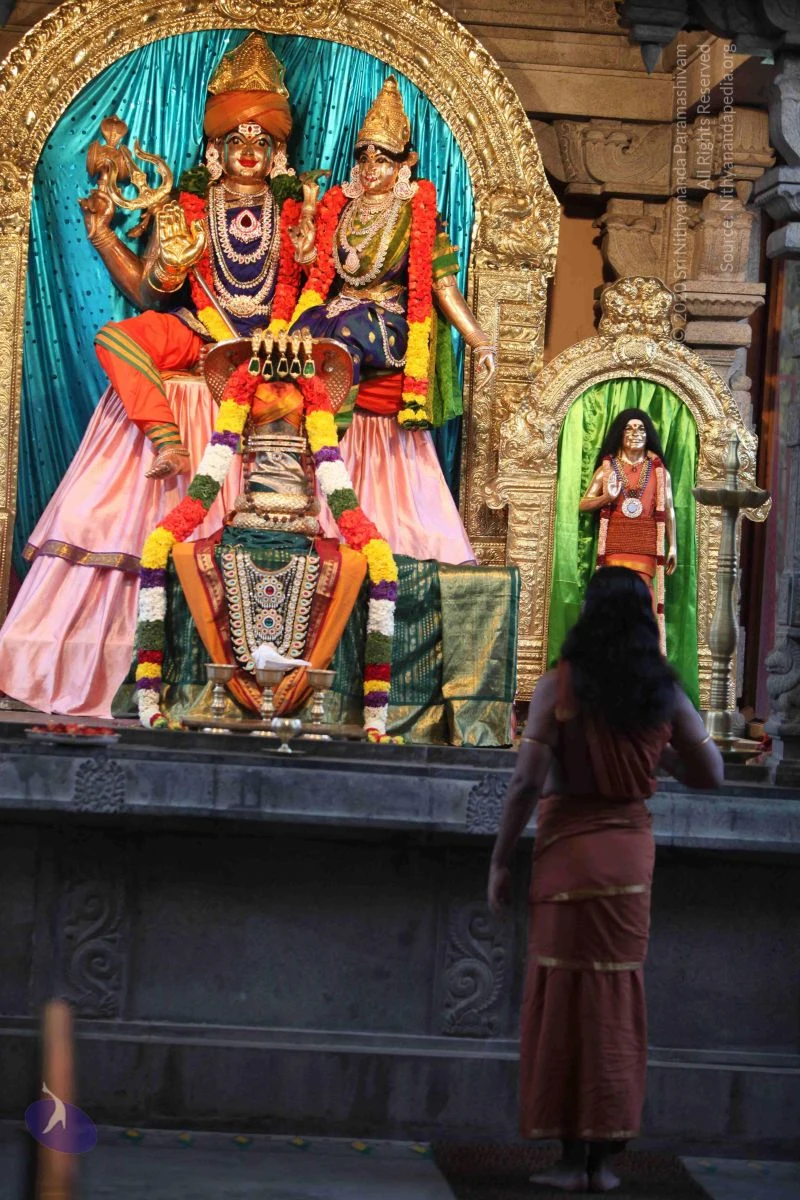
Yoga

20 photosSource gallery
Photograph of a large hall with a pale pink wall and white tiled floor, where many children in black uniforms sit cross-legged in rows, some with hands joined or clasped, as in a practice session. Colourful woven banners hang from the ceiling, and a framed portrait sits high on the wall at upper right, with a small shrine-style display and water bottles scattered on the floor. Several children and a few adults sit at the front and sides.A photograph of a large bright hall with a polished white floor where many boys in matching black shirts and black pants sit in loose rows doing seated stretches and exercises, some with legs extended and arms folded. Water bottles sit on the floor and a few yoga mats lie at the edges. A framed portrait hangs on the far wall above a table with a white cloth, and hanging tassels decorate the upper left. Near the right foreground a man in a grey shirt and black pants sits on the floor with his legs stretched out, and a person in a light blue shirt is partly visible at the lower right. No clearly identifiable a person figure is visible among the people present.A photograph of a large hall with a pale tiled floor where many boys in black uniforms sit cross-legged or in seated yoga poses, several with legs folded and feet bare. In the foreground a boy in a black shirt sits with his arms wrapped around his knees, and to the right another boy in black clothes sits with his feet raised. Water bottles are scattered on the floor. Behind them, a framed portrait hangs on the back wall beside maroon curtains and colourful hanging tassels. A small table with a white cloth and a standing cabinet are at the far side. No one is clearly identifiable as a person in the visible scene, and the people in the room are students and attendants.Photograph of a bright, marble-floored hall where a group of boys in black uniforms sit cross-legged and in relaxed seated postures, several with hands in front of them as in practice. A few boys wear white or grey shirts. Water bottles are scattered on the floor, and a steel dumbbell-like object lies near the centre. At the back, two men in white clothes sit near a framed image of a deity and a cloth-covered table. Students are seated in rows, some looking toward the front.A large white-floored hall with a draped white ceiling and hanging coloured banners fills the frame. Thirty to forty boys sit cross-legged on the floor in rows facing a distant stage, many in black or grey t-shirts and shorts; one boy near the front has a white forehead mark. A small group of people in saffron and orange robes sits near the far stage area, and a projection screen and maroon curtains frame the back wall. Water bottles and a white-draped table sit at the left edge.A photograph of a large hall with a polished white floor, where many people sit cross-legged in rows facing a stage at the far end. Most seated people wear black or dark shirts and shorts, with several younger boys in the foreground, some in striped or grey clothing. Behind them, a row of people in saffron and orange robes sits near the stage, and a few people in white sit among the rows. Red, blue and orange ceremonial banners hang from the ceiling, dark red curtains frame the stage, and two projector screens show a small image. Water bottles sit on the floor near the front seated group.

Temple

18 photosSource gallery
A gilded metal deity murti of a female form, shown from the chest up in a shrine against a green silk backdrop with gold floral motifs. The murti wears a tall jewelled crown, red and gold garments, layered gem-studded necklaces, large earrings and bangles, and holds a trident-like staff and a ceremonial object in its hands. Garlands of red roses, yellow marigolds and purple flowers drape over its shoulders. No people are visible.A photograph of a temple shrine showing a large statue group of Shiva and Parvati seated on a raised dais, decorated with garlands of red, yellow and green flowers and gold ornaments. Shiva's statue has a crown-like headdress and holds a drum-like instrument; Parvati wears a red-and-gold top with a pink skirt. Behind them is a golden arch framed by a teal curtain, flanked by dark stone pillars and red drapes. A small figure of a standing attendant in orange stands to the right, and a metal barrier fence occupies the foreground. No living people are visible.Gilded murti of a deity couple seated under an ornate gold arch against a teal satin backdrop with dark dots. The male form wears an orange turban with a gold crown, a red tilak, and a red-and-white jewelled necklace, and holds a golden trident and a snake-topped staff. The female form wears a gold crown, a green-and-gold sari and layered diamond-style jewellery. Both are draped in red and orange rose garlands with yellow marigolds. No living people are visible, and no a person candidate appears in person; the figures are statues.A photograph of a ceremonial object on a pale pink cloth-draped table. A cylindrical, gold-capped object is draped in an olive-green silk cloth with gold border, adorned with a silver-toned jewelled necklace set with pink and red stones and a matching pendant. Behind it, a carved stone wall with a relief face and a copper-toned ornamental pillar with a rearing lion or mythical animal motif. In the lower right, a garland of white and magenta flowers lies on a wooden surface. No people are visible.A photograph of a gilded metal deity murti in a golden arched frame, standing on a base in a temple setting. The figure wears a green-yellow sari with gold border, layered necklaces, a crown and a red bindi, and holds a small object in one hand. Beside it sits a smaller murti draped in matching green cloth with a jewelled pink-and-red garland. Carved stone pillars with lion-face motifs and an ornate gold-leaf wall stand behind. A garland of white and magenta flowers lies in the foreground on a pink cloth. No people are visible.Close-up of three polished brass or silver-toned kalasha-style cups on a wooden surface, with a white conch shell resting on the middle cup. Behind them hangs an orange and red silk cloth with gold zari border and an embroidered black panel decorated with red, green and white gemstone-like motifs. No people are visible. A ritual setup suggestive of puja, with no visible a person.
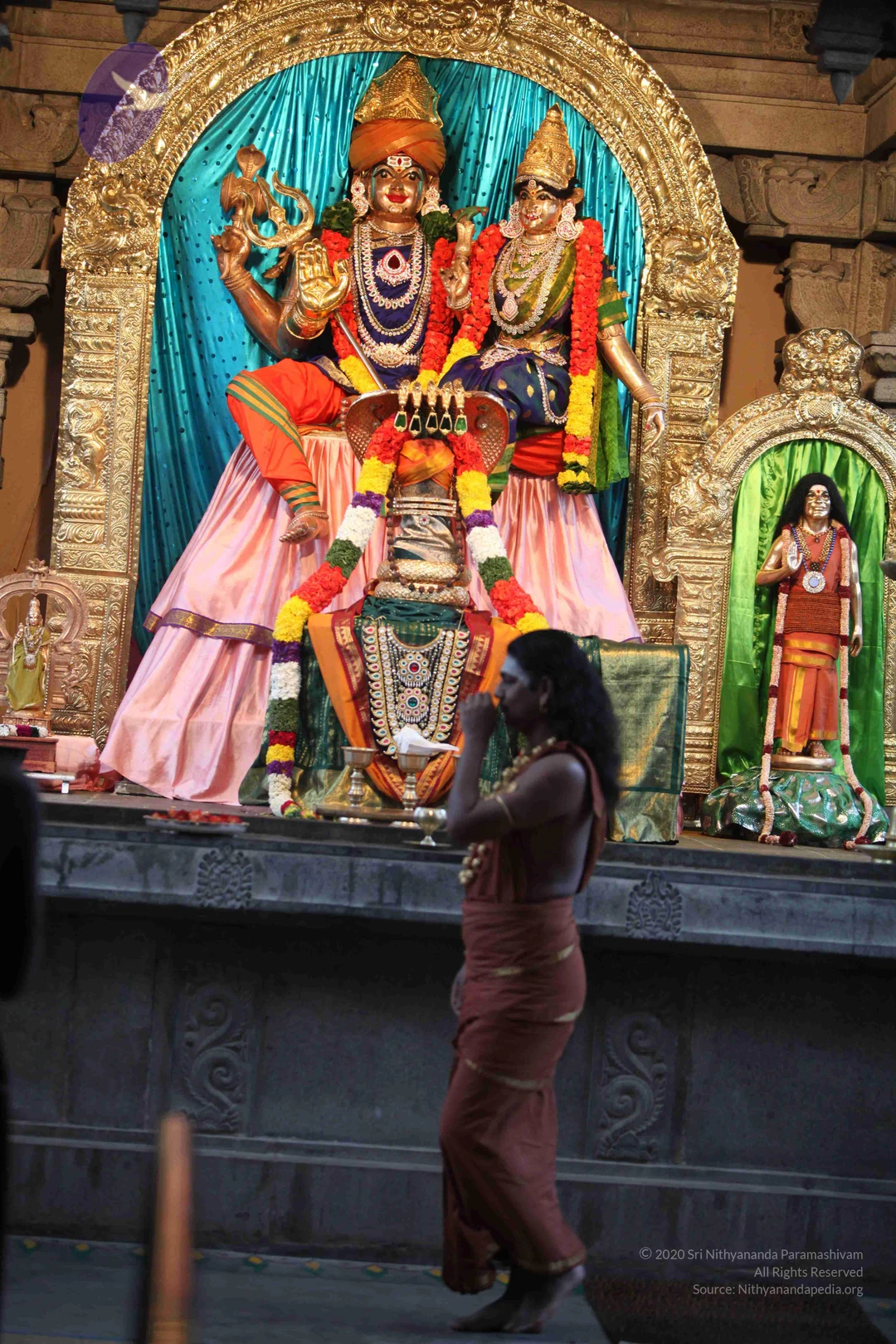
Pada-Puja

37 photosSource gallery
A seated man in an orange-brown robe with a gold-bordered cloth sits on an ornate gilded throne backed by a tall golden arch and mandala-like panels of red, yellow, purple and green flowers. He wears a long white and maroon-red flower garland, a gold necklace with a pendant, gold armlets and bracelets, and a white vibhuti marking with a red dot on his forehead. He raises his right hand in a blessing gesture while a tiger-striped cloth covers the seat. In the left foreground, a hand holds a silver aarti lamp with three flames. Brass oil lamps hang from the back, and the throne-side floral arrangements complete the scene.A photograph of an aarti ceremony in a temple-style hall with pink, yellow and green painted pillars and a painted deity figure at left. A seated man on a gold ornate throne with a multicoloured floral backdrop and a tiger-striped cloth wears an orange-saffron robe, a white flower garland, a gold necklace and a red-brown tilak on his forehead, and raises one hand in blessing. A standing priest in a saffron-orange robe and a shaved head holds a lit oil lamp toward him, with two women in red saris and folded hands at the lower left. Hanging brass lamps and a row of brass lamp stands surround the throne.A seated man in an orange-saffron robe and white-and-red garland sits on an ornate golden throne with a crown-shaped top, draped with a zebra-striped cloth and a band of marigold and rose flowers. He raises one hand in a blessing gesture. Before him, a priest in orange robes and a white sacred thread holds a lit lamp aarti flame toward him. Two women in red saris stand at the lower left with hands pressed together. Hanging brass lamps and tall brass lamp stands surround the throne, and a multicoloured painted shrine with figures of deities frames the scene. The page description concerns a satsang, but the photo itself shows an aarti ritual at a throne.A figure in a saffron-orange robe with a long garland of white and red flowers sits on an ornate gold throne heaped with colourful marigold and rose garlands, on a tiger-skin cloth. Behind him hang brass lamps on chains, and a brightly painted blue and pink temple facade frames the scene, with a painted guardian figure holding a club on the left. In the lower left, a shaved-headed priest in an orange robe kneels and holds a lit oil lamp toward the throne, beside a woman in a red blouse with hands joined in prayer. Brass lamp stands flank the bottom right. The seated figure has a painted vertical tilak on the forehead and a rudraksha-style mala on the chest. Watermarked archive text is omitted. Total physical people visible: three.A seated man in an orange-red saffron cloth draped over one shoulder sits in front of a large floral backdrop of marigolds, roses and green leaves arranged in bands of yellow, red, purple and green. He wears a white and red garland, a long necklace of gold beads, a gold pendant, gold armlets and bangles, and gold hoop earrings. A white vibhuti line with a red kumkum dot marks his forehead, and his long dark hair is swept back. His hands rest on his knees. Whether he is the a person named on the page cannot be determined from appearance alone, so the identity is marked unsure. Behind him a gold ornamental canopy and brass fixtures are visible.A man seated cross-legged on an ornate golden throne (peetha) with a backdrop of mixed marigold garlands in red, yellow, green and purple arranged in a large semicircle. He wears an orange-saffron dhoti and shawl, a long gold chain with a pendant, a rudraksha-style mala, gold bangles and armlets, and a white vibhuti/tilak mark on his forehead. He raises a brass handbell in his right hand while his left hand rests on his knee. Two brass oil lamps stand on either side above the throne, and a white garland drapes over his shoulders. a person is shown with the appearance-based cues of saffron clothing, ornate gold necklaces, rudraksha and a throne setting.
Morning-Satsang

51 photosSource gallery
Photo of a seated man in orange saffron robes and a gold-embroidered orange dhoti, wearing a white-and-red garland of flowers across his chest and multiple gold necklaces including a rudraksha-style gold bead mala and a pendant. He has a white vibhuti line and red kumkum dot on his forehead, gold earrings and gold armlets, and wears a small headset microphone. He sits in front of an ornate gold repoussé backdrop on a red velvet seat, appearing to speak. Appearance-based probable candidate: Swamiji (probable), with long swept-back hair, saffron clothing, rudraksha-style gold beads and ceremonial gold necklaces. Single person visible.A seated man in orange-saffron robes sits before an ornate gold repoussé backdrop with a crimson velvet cushioned seat. He wears a white garland with red rose accents across his chest, layered gold bead and pendant necklaces, gold armlets shaped like cobras, gold bangles, and gold hoop earrings. A white sandalwood or vibhuti band with a central red dot marks his forehead, and a small headset microphone is attached near his face. His hands are clasped in his lap and he faces the camera with a calm smile.A seated man in an orange saffron garment draped over the shoulders, wearing a long white and red garland of flowers, gold beaded necklaces and a gold pendant, gold cobra-shaped armlets and a gold bangle. He has long swept-back dark hair, white sacred ash marks with a central red dot on his forehead, a small clip-on microphone, and his hands are clasped in his lap. Behind him is an ornate gold repoussé backdrop and a red velvet throne. Appearance cues are consistent with a person seated on a throne, in a satsang setting.Close-up photo of a man seated before an ornate gold carved backdrop, speaking into a head-mounted microphone. He wears a white-and-red-marked forehead with a dark bindi, long dark hair swept back, gold hoop earrings, a white and red flower garland, layered gold ornaments and a saffron-orange garment. Appearance-based probable candidate Swamiji (probable) is speaking; the cues are the saffron clothing, long hair, gold ornaments and garland. Background is dark red drapery.A close photograph of a man seated before an ornate gold-leaf backdrop, smiling toward the left. He wears a white sandalwood-style forehead mark with a dark red bindi, a gold hoop earring, a white and red flower garland, a gold ceremonial necklace, and an orange saffron garment, with a small headset microphone near his mouth. Probable Swamiji, identified by the page as the event's speaker, shown in a seated discourse setting with long swept-back hair, ornate gold necklace, rudraksha-style gold beads and saffron clothing.A close photograph of a man seated in front of an ornate gold carved backdrop with deep maroon drapery. He wears a white vibhuti horizontal mark on his forehead with a dark kumkum-style dot at the centre, gold hoop earrings, a small headset microphone, and a white and red flower garland over his shoulders. He has a saffron-orange cloth draped over his bare shoulder and layered gold beaded necklaces with gold chains. He appears to be speaking to an audience. Visible identity cues are strong, so this is a person depiction of a speaker during a satsang discourse, shown in a photo rather than printed matter.

TamilOrganizers-Swami-postSatsang

27 photosSource gallery
A photograph of a satsang stage with burgundy velvet drapes and a large ornate gold throne with lion-head arms. Seated on the throne is a long-haired figure in orange-saffron robes with a white forehead mark, a red-and-white flower garland, and a gold armband, smiling and extending a hand. Beside the throne a bald attendant in orange sits on a lion-figured seat. Three men in white dhotis and shirts stand in front, one in glasses and a white garland with red and yellow beads, offering garlands toward the throne. A brass trident stands at the left edge, and an older man in white and a mala watches from the left. a person appearance is uncertain from the figure's presentation alone.A photograph of a central seated figure on an ornate gold throne with a red velvet cushion, wearing an orange-saffron robe, a multi-strand garland of white flowers with red, yellow and green ribbon accents, and a gold necklace. The figure has a white-and-red forehead mark and touches the side of their head with one hand. Around the throne stand about a dozen men in white dhotis and white shirts, several with orange or saffron shawls, some with hands clasped or bowed in reverence. A dark red curtain forms the backdrop. A gold footstool with a red cushion sits in front of the throne, with a floral offering on the floor. Several other people are partly visible at the edges. a person is identified by the saffron robe, the ornate garland and gold necklace, and the throne placement.A seated figure sits on an ornate gold throne with a carved backrest before maroon velvet drapes, wearing an orange robe, rudraksha-style beads, a gold necklace and a long garland of white flowers with green, red and yellow ribbon accents. Men in white dhotis and orange shawls stand around the throne, one embracing the seated figure with an arm around the shoulder while another holds a golden trident staff at left. A cameraman in white raises a camera at upper right. A gold ceremonial staff with a trident finial stands at left beside a man in white holding a red-and-gold object. The figure has a white forehead marking and appears to be the a person, appearance-based probable.A photograph of a seated figure on an ornate gold throne with a deep red cushion and maroon curtain behind. The seated person wears an orange-saffron robe, a long multi-strand garland of white flowers with red, yellow and green accents, and gold ornaments including a beaded necklace and bangles, with a white tilak on the forehead and a smiling expression. Standing around are men in white dhotis and shirts, one holding a decorated floral offering, and monastic attendants in orange robes with shaved heads and rudraksha malas, one holding a brass lamp stand at left. a person appears in the seated figure, whose saffron robe, swept-back hair, gold ornaments and garlanded throne seat match the page's claim, but the appearance is not conclusive. The scene reads as a formal darshan or welcome reception.A seated figure in an orange-saffron robe with a long rudraksha-style bead necklace, gold ornaments and a multicolored garland is having a crown-like headpiece placed on the head by a man in white ritual dress. Other men in white and saffron-robed sannyasis surround the seated figure in front of an ornate gold throne with a deep red curtain. One attendant holds a green-and-yellow leafy bundle aloft, and a red cushioned seat and fruit offerings are visible. Appearance-based candidate only; the crowning cues are the saffron robe, bead necklace and gold ornaments, so identity remains uncertain.A photograph of a coronation-style ceremony in a hall with a gold throne backdrop and maroon curtains. A man seated on a red velvet throne wears saffron-orange robes, a white forehead mark, a flower garland with red, yellow and green accents, and gold necklaces. A man in white clothes and glasses lifts an ornate white and multicoloured crown with a blue triangular emblem onto his head, while another person in saffron robes stands behind. Attendants in white shirts and dhotis stand around, one holding a fruit-filled tray and another holding a banana-leaf offering with a red fruit. a person is seated centre, identified by saffron robes, rudraksha-style gold necklaces and the crowning, consistent with the event page.

Sarva-Dharshan

20 photosSource gallery
A man with long dark swept-back hair and white vibhuti lines on his forehead smiles while wearing a thick white and multicolour flower garland of jasmine, red roses, yellow marigolds and green leaves over an orange saffron robe. He wears heavy gold beaded malas and a gold pendant, and his right hand is raised toward a red tray or box. Beside him a shaved-headed man in orange robes with gold beaded necklaces, a red tilak and a red-beaded wrist mala gestures toward the tray. In the background stand a gilded ornate throne-like arch and a golden lion-form object, with a cameraman and tripod at left. a person in appearance, with long swept hair, gold necklaces and saffron clothing; the cue is one of several distinctive visible cues.Photo of a bare-chested man with long swept-back black hair, white vibhuti on his forehead and a gold necklace, wearing a multicolour garland of white flowers with red, yellow and green accents and holding a red fruit wrapped in flower-decorated leaves. Two men in white shirts stand at left, one wearing a red thread on his wrist and gold rings, the other with a tilak mark, looking toward the fruit. Behind them a golden arch and blurred figures in a hall suggest a ceremony.A photograph of a central figure with long dark hair, a white vibhuti marking across the forehead, and a long garland of white jasmine and multicolored flowers draped over an orange-saffron garment, with gold armlets and a gold necklace. He holds an open book or document that a man in a white shirt and blue pen is looking at and reaching toward. Another bald man in saffron robes stands at right, and several men in white and saffron stand in the background before a gold-toned shrine backdrop with dark red curtains. The appearance-based cues of long swept hair, saffron clothing and ceremonial gold ornaments are consistent with a person presence, while the scene shows a document being presented during an event.A smiling man with swept-back long dark hair and white ash marks on his forehead stands at the centre of a crowd, wearing an orange-saffron cloth draped over his bare chest. He is adorned with a multi-strand garland of white jasmine and red and yellow flowers, gold necklaces, a gold bangle and an armlet, and a gold ornament on his upper arm. He raises one hand in a blessing gesture. Around him stand devotees in white and cream clothing, one man in a yellow-topped headwrap with a red tilak, and a woman in a red sari at right, with a dark maroon backdrop behind them. The appearance matches the Swamiji (probable) cues of long hair, saffron cloth, rudraksha-style ornaments and a ceremonial garland.A photograph of a man in an orange-saffron cloth wrapped over bare shoulders, wearing a thick garland of white jasmine interspersed with red, yellow and green flowers, with a gold chain and gold bracelet. He has long dark hair, a white horizontal forehead mark and a gold earring, and smiles as he extends his right hand toward the head of a seated devotee. Swamiji (probable): the long swept-back hair, saffron cloth and ceremonial garland with a gold chain are consistent with the page's identification, and he appears to be giving blessings. Around him are several devotees, some in white shirts and a purple top, in an indoor hall with a dark curtain and an orange banner behind.A seated figure with long dark hair and a wide white vibhuti band across the forehead with a red kumkum dot, wearing an orange garment, gold chain necklace, gold earrings and a large garland of white flowers with red, yellow and green accents. He holds a white paper in one hand and a brass-coloured plate or fruit-decorated offering with green leaves before him. Another person's hand, adorned with a gold bangle, rests on his head in blessing while devotees with folded hands and bowed heads receive the blessing nearby. A gold deity murti stands in the blurred background.

IA-Session

12 photosSource gallery
A man seated in a tall orange leather armchair on a stage with dark maroon drapes. He wears a saffron-orange sannyasa wrap over his shoulders and upper body, a heavy multi-strand gold bead mala with a gold pendant, and a gold bracelet. He has a white vertical tilak with a red dot on his forehead, wears clear-framed glasses and a small clip microphone, and smiles while looking to his side. A gold statue of a deity with raised hand is partly visible at the lower left. a person by the orange sannyasa attire, gold malas and seated stage setting, though the appearance cues are moderate.A man seated in a large orange leather armchair before dark maroon drapes, speaking into a small headset microphone. He wears an orange-saffron cloth draped over the shoulder and bare upper chest, a long string of large gold beads, a gold chain with a pendant, a gold bracelet, and white vertical tilak marks with a red bindi on his forehead. His hands are clasped in his lap. The setting suggests a satsang discourse.A photograph of a man seated in a bright orange leather armchair before dark maroon drapes, speaking as if giving a discourse. He wears an orange-saffron cloth draped over his shoulder and upper body, a long strand of large gold beads, a gold chain with a pendant, and a gold bangle. A white tilak marks his forehead with a dark bindi above it, and a small clip-on microphone is attached near his face. His hands rest together in his lap.a person seated in an orange leather armchair against dark maroon drapery, speaking with his right hand raised open in a gesture of explanation. He wears a saffron-orange shawl draped over one shoulder, leaving the other shoulder bare, a heavy multi-strand gold necklace of large beaded spheres with a gold pendant, a gold bangle, and a small headset microphone. A white vibhuti marking and a red bindi are on his forehead. One person is visible.A seated man in orange-saffron robes smiles broadly on an orange leather armchair against dark red drapes. He wears a thick gold bead mala, a gold chain with a pendant, a gold bracelet, and white and red forehead markings. A gold-coloured standing deity statue with raised hands stands at left, and a white shag rug lies at the bottom right. A small microphone is clipped near his face.A photograph of seated devotees in a hall with red carpeting and red chairs. Men in white dhotis and white shirts wear saffron-orange shawls over their shoulders. A man in front left wears a rudraksha mala, white vibhuti marks on his forehead, and an ID badge on a lanyard. The man in the centre wears a black cord, a red tilak and an orange lanyard. A man at right, hand to his chin, wears a red thread bracelet and a gold watch. Several others sit behind them, some wearing glasses or holding papers, and a woman in an orange shawl sits in the background. The seated group appears to be attending a satsang session.

Homa

9 photosSource gallery
A photograph of a table draped in teal fabric with a dark grey and green paisley-swirl pattern. Several books stand upright at left, including black-covered volumes with red-toned portrait photos on their covers and a blue spine pair, and a single book lies flat at right with a red-and-white cover. Red roses and loose petals are scattered across the tablecloth in front of the books. No people are visible; the background is a dark stone wall with carved relief.Photograph of a row of hardcover books displayed on a teal and gold paisley-patterned cloth in front of a grey stone wall. Each book cover shows the same smiling portrait of a woman with a red bindi, wearing an orange garment and a beaded rudraksha-style necklace, with a red rose laid before each cover. The titles read Living Enlightenment in English and appear in several Indian scripts, including Kannada, Tamil and Hindi-style lettering, with 'Abridged Edition' labels on some covers. No people are visible in the scene; the portrait figures are printed on the books.Close-up photograph of a large orange-red banner printed with a man in saffron robes wearing a rudraksha mala of large dark beads, whose face is cropped out of frame. Three red roses lie in the foreground on a blue patterned cloth. Gold Gujarati script runs across the banner, with white Gujarati text below.A photograph of several paperback books displayed on a turquoise cloth decorated with a patterned border, scattered with red roses. The covers show a smiling woman with a red bindi and orange clothing with beaded necklaces. The titles include Kannada script and an English subtitle reading Living Enlightenment. No people are physically present in the scene.A temple shrine scene. A young priest with bare upper body and a white dhoti with a gold-bordered cloth sits at left, pouring from a small bowl over a white stone step beside a shallow metal vessel, with brass pots and plates in the foreground. Behind him, a dark stone murti of a standing deity stands on a black pedestal, draped in a white cloth. At right, a golden arched shrine holds a red-clad deity murti adorned with a yellow and red floral garland, a white silver-looking necklace and a crown, set against green drapery with a yellow cloth below and a kalasha in front. Ritual abhishekam or puja is being performed. No a person candidate is visible.Close photograph of a polished silver or steel bowl filled with a golden liquid, resting on a dark stone surface. A small purple flower and a few dry grass blades lie beside it. Blurred white-clad legs sit in the background, and a warm reflection shows in the bowl's rim.
Darshan

19 photosSource gallery
A man in saffron-orange robes sits on a red velvet throne with an ornate gold arched backrest against dark maroon drapes, raising both hands in greeting and smiling. He wears a gold beaded mala and a pendant necklace, gold bangles, and white and red forehead markings.A photograph of a man seated on an ornate gold throne with a carved arched backrest and gold lion heads at the sides, set against deep maroon velvet drapes. He wears a saffron-orange robe with gold border, a long gold-beaded mala and gold necklaces, gold bangles, and white vibhuti with a red kumkum mark on his forehead. His right arm is raised in a waving gesture and his left hand is extended, while he smiles. A tiger-striped cloth covers the platform beneath him. a person: the saffron robe, long gold-beaded mala, ceremonial gold ornaments and throne setting match the page's claim, so he is treated as a probable in-person presence.A man seated cross-legged on a red velvet cushioned seat in front of a large ornate gold-embossed backdrop, draped with a tiger-striped cloth. He wears a saffron-orange dhoti-style wrap with gold border, a heavy rudraksha mala and gold ceremonial necklaces, gold bangles, and a white-and-red forehead mark. He holds a silver-coloured rod or pen in one hand while the other rests on his knee, and he smiles while looking downward. A deep red curtain hangs behind him, and a white cloth covers the platform edge. The man has no distinctive long hair or crown, but the saffron clothing, rudraksha mala and ceremonial gold ornaments are consistent with the page's a person reference, so the identity is an appearance-based probable candidate.Side-profile photograph of a man with dark hair swept back into a bun, a white vertical tilak on his forehead, and a saffron-orange garment draped over his bare shoulder. He wears layered ornate gold beaded necklaces with red and green stone accents. A plain beige wall and a window are behind him.A seated man in saffron-orange robes and heavy gold beaded necklaces, with a white vibhuti mark on his forehead and a gold armlet, extends his right hand to touch the forehead of a standing devotee. The devotee wears a blue and red shirt with an orange shawl, and holds his left palm up in front of him with eyes closed. Behind them, another person in orange stands near a window, and a maroon curtain hangs at right beside a round fan.A seated figure in saffron-orange robes, wearing a large gold necklace of gold bead ornaments and a rudraksha-style bead mala, leans forward and extends his arm to place his palm on the forehead of a devotee. The devotee wears a white kurta with an orange shawl and bows his head toward him. Behind them, a man in a white kurta with an orange shawl stands near a curtain, and a red-cushioned seat with gold trim sits in the foreground. This appears to be a blessing moment during a satsang gathering.

MaduraiAdheenam-RetrievalComitteMeeting

85 photosSource gallery
A smiling man with shoulder-length dark hair sits on an ornate gold throne with a red cushioned seat and carved wooden side panels behind. He wears an orange-saffron cloth draped over his body, a gold necklace of large round beads and a gold pendant, and a pink and white flower garland. A white and red tilak marks his forehead, and his right hand is raised near his face in a gesture. a person: long swept-back hair, saffron clothing and ornate gold jewellery with a white forehead mark and garland are visible cues. The background shows yellow drapery.A seated man in an orange-saffron robe sits on an ornate gold throne with a red velvet seat and carved wooden side panels behind him. He wears a multi-strand gold necklace with large round beads, a pendant, and a pink-and-white flower garland draped over his shoulders. A white and red forehead mark is visible, and he has long swept-back hair and glasses. He smiles and raises one hand to his temple gesturing while speaking, with a small headset microphone near his face. Yellow drapery hangs behind the throne. Swamiji (probable): the saffron robe, long hair, ornate gold necklaces and garland are the qualifying cues for the seated speaker.A photograph of a satsang in a plain whitewashed hall with a corrugated roof and ceiling fans. Rows of black chairs face a raised golden throne backed by carved wooden screens and orange and yellow curtains. A figure with long dark hair and an orange garment sits on the throne, appearing as a probable Swamiji (probable) with long swept-back hair and saffron clothing, in an in_person position. Audience members in white shirts and white dhotis sit facing the stage, some with their backs to the camera. A cameraman with a tripod films at the front, and a speaker stands on the left.Photograph of a satsang hall with rows of black plastic chairs filled with seated men in white shirts and white dhotis, viewed from behind. At the front, a figure sits on a raised red-cushioned seat before a gold ornamented backdrop, dressed in orange and saffron with a rudraksha mala. Red and yellow curtains and carved wooden screens frame the stage. A cameraman stands near the centre aisle and a loudspeaker sits at left.A seated man in an ornate gilded throne with red velvet armrests gives a talk. He wears an orange-saffron robe, a long gold bead necklace, a gold pendant, and a garland of pink and white flowers draped across his shoulders. He has a red tilak on his forehead, a headset microphone, and gold bangles on his raised right wrist, with his hand gesturing mid-speech. Carved wooden screens stand behind the throne. Swamiji (probable): long swept-back hair, saffron clothing, rudraksha-style gold bead malas and a ceremonial gold necklace, matching the page's identification of Swamiji at this satsang.A seated audience in a bright hall with yellow and green curtains and red-cushioned chairs, watching a satsang. Most attendees wear white shirts, dhotis or light trousers, with a few in blue or grey shirts. In the foreground a bald man in saffron cloth with gold necklaces sits at the left edge, and a man in white with a rudraksha mala and red-framed glasses sits front centre. A video camera on a tripod stands near the back. The scene shows about thirty to forty visible people in rows.
01-TEMPLE

5 photosSource gallery
A photograph of a standing deity murti. Yellow, purple, white and red flower garlands drape from its shoulders to the base, and it holds a trident-like weapon and other ritual implements in its raised hands. Behind it hangs a green curtain with gold motifs, framed by a gilded arch. No people are visible.A life-size statue of a sannyasi standing in a gilded arched niche against a green satin backdrop. The figure has long black hair, a red bindi, and a silvery-gold finish. He wears saffron-orange robes with gold-bordered dhoti, a wide rudraksha-bead waist band, multi-strand beaded necklaces with a large blue gemstone pendant, and a rudraksha mala. His right hand is raised in abhaya mudra, and he is garlanded with white jasmine and red flower strands reaching to the base. The statue stands on a silver pedestal with a deity murti-style presentation.A metal deity murti stands inside an ornate gilded copper arch with carved foliage and rearing mythical animals on the side pillars. The figure wears a tall crown, a red vertical mark on the forehead, and a light green sari with a gold border. Layered garlands of multicoloured stones and white beads hang across the chest, with a large round pendant set with red and blue stones and a rudraksha-bead strand. The right hand holds a small ritual object and the left hand hangs at the side. Marigold flowers lie at the base of the pedestal, and the background is gold-toned temple décor.Photograph of a temple shrine with a gold-framed arch and teal drapery holding a large pair of gilded deity murtis, one four-armed holding a trident and the other crowned with a jewelled necklace, seated behind a decorated central stone linga draped in an orange and green cloth with garlands of red, yellow, white and purple flowers. A smaller standing statue in an alcove on the right wears orange dhoti, rudraksha mala and a gold pendant, with hands in a blessing gesture. In the lower right foreground, a person in a rust-coloured garment bends forward toward the shrine's stone ledge, with brass oil lamps and a small offering plate in front of the murtis.A photograph inside a temple shrine. A large painted murti of a multi-armed deity with an orange turban and a crowned consort sits on a pink-skirted platform, both garlanded in marigolds and jewelled necklaces. In front, a sacred stone or lingam-like form draped in green and orange cloth and strung with flower garlands receives oil lamps and a white offering. To the right, a smaller statue of a long-haired figure in orange robes and a rudraksha mala stands in a green-curtained niche with hands raised in blessing. In the foreground, one person with long dark hair in a reddish-brown sari with gold border stands barefoot with joined palms facing the shrine, performing darshan. Gold arches frame the scene. Hindu ritual setting.
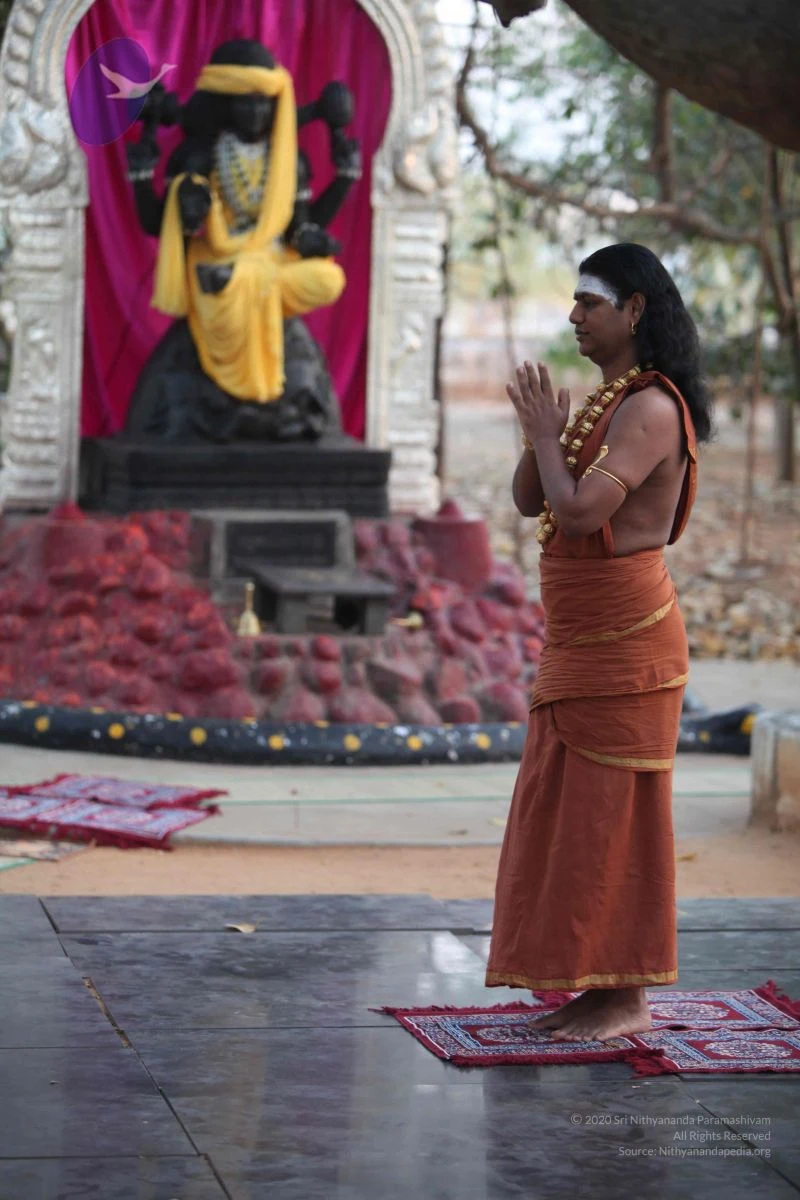
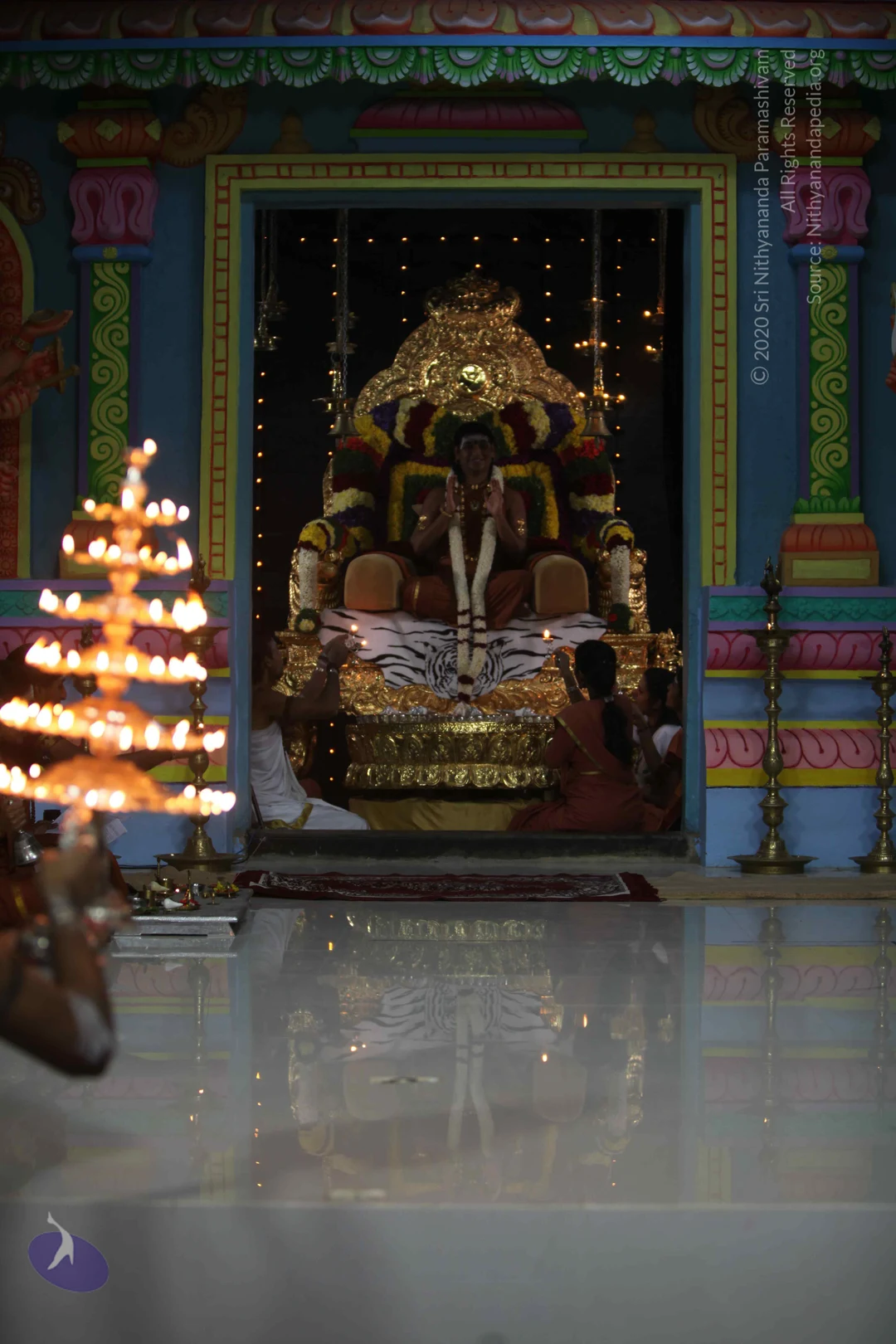
02-PADAPUJA

2 photosSource gallery
A close photograph of a tiered silver oil lamp lit with several wicks. Cotton wicks burn in small cups along flower-shaped tiers, and a second lamp is being lit from a small silver-toned flame held at the right edge. A bell-shaped top cup holds a burning wick. The background is plain grey, and no people are visible.A tiered brass lamp stand, a nilavilakku-style standing lamp with multiple concentric round trays, holds many lit oil lamps with flickering flames against a dark warm background. A hand from the right tilts a long-handled flame or taper to light the top lamp. A partial dark silhouette of a hand appears at the left edge. No people's faces are visible. The scene suggests a lamp-lighting ritual such as aarti or deepa puja. Warm bokeh light spots fill the background behind the lamp.

03-SATSANG

38 photosSource gallery
A seated man in orange-saffron ochre robes sits on an ornate gold throne with a carved arched back, flanked by two gold lion sculptures and draped with a tiger-striped cloth. He wears a white vertical forehead mark with a red dot, long dark hair, gold necklaces, bangles and a long white and red flower garland falling to his lap. A small headset microphone is visible. The red velvet backdrop and patterned carpet complete the stage setting. Swamiji (probable) is seated centrally as the speaker, identified by the long swept-back hair, ornate gold jewellery and saffron robes, consistent with the satsang setting.A seated man with eyes closed presses his palms together in namaskar before an ornate gold repoussé backdrop. He wears a saffron/orange cloth draped over the shoulders and body, long white jasmine garlands with maroon accents, and gold ornaments including a gold bead rudraksha-style mala, gold armlets with lotus-like clasps, a gold bangle and a pendant. A white vertical tilak marks his forehead, and he has long dark hair. He sits on a red velvet chair with a tiger-striped rug beneath. Swamiji (probable) appears in person, with cues including long swept-back hair, saffron clothing, ceremonial gold ornaments and a rudraksha mala, seated in a ceremonial setting.A man seated and speaking into a headset microphone, wearing an orange-saffron draped garment and heavy white and magenta jasmine garlands. He has a white vertical forehead mark with a dark red bindi, gold hoop earrings, layered gold chains, a large gold pendant and several gold beaded necklaces with dark rudraksha-style beads. His long dark hair is swept back, and his right hand is raised in a gesture. Behind him is an ornate gold carved backdrop against dark maroon drapes.A seated man in saffron-orange robes, wearing a white vertical tilak with a dark bindi, long dark hair swept back, a small microphone clipped near his mouth, multiple gold bead necklaces and a pendant, and white and deep-red flower garlands draped over his shoulders. He raises one hand in a gesture near his forehead while seated on a red velvet throne backed by ornate gold carved panels. Swamiji (probable) appears in person, with the appearance-based cues of long swept-back hair, saffron clothing, rudraksha-style gold beads and ceremonial garlands. No other people are visible.A seated man with long, swept-back dark hair wears an orange-saffron shawl over his shoulders, a white and red vertical tilak with a dark bindi, and a white and magenta jasmine garland. He has gold hoop earrings, a heavy gold bead necklace, a gold pendant, and gold armlets and bangles, and a small headset microphone is visible near his cheek. Behind him is an ornate gold embossed backdrop.A seated man in saffron-orange robes sits before an ornate gold repoussé backdrop on a red velvet seat. He wears a white vibhuti band with a dark kumkum dot on his forehead, a headset microphone, gold earrings, and a white and deep red flower garland. He has gold rudraksha-bead necklaces, a gold pendant, and gold snake-shaped armlets with a gold bangle. His hands are clasped in his lap and he is smiling. Swamiji (probable): long swept-back hair, saffron robes, rudraksha malas and ceremonial gold necklaces, seated in a satsang setting.