Skip to content
Monday

3 March 2014

Dated photos
98
Source pages
1
Media
2
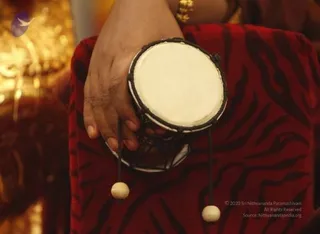
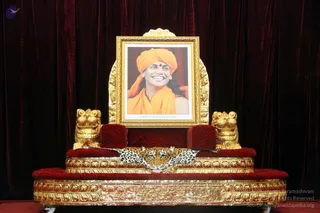
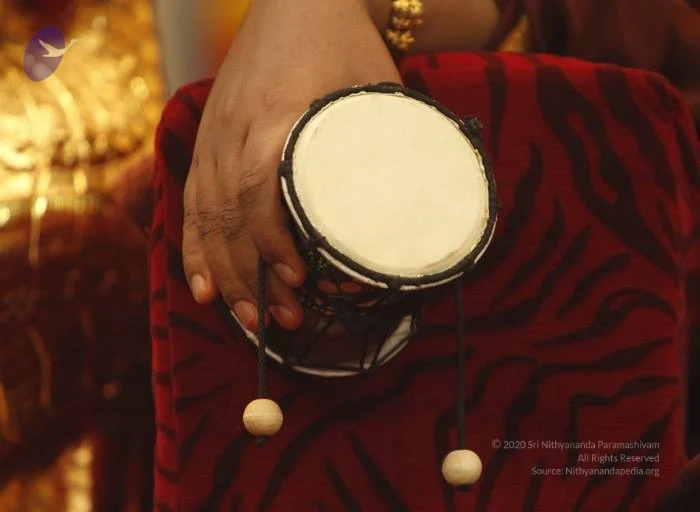
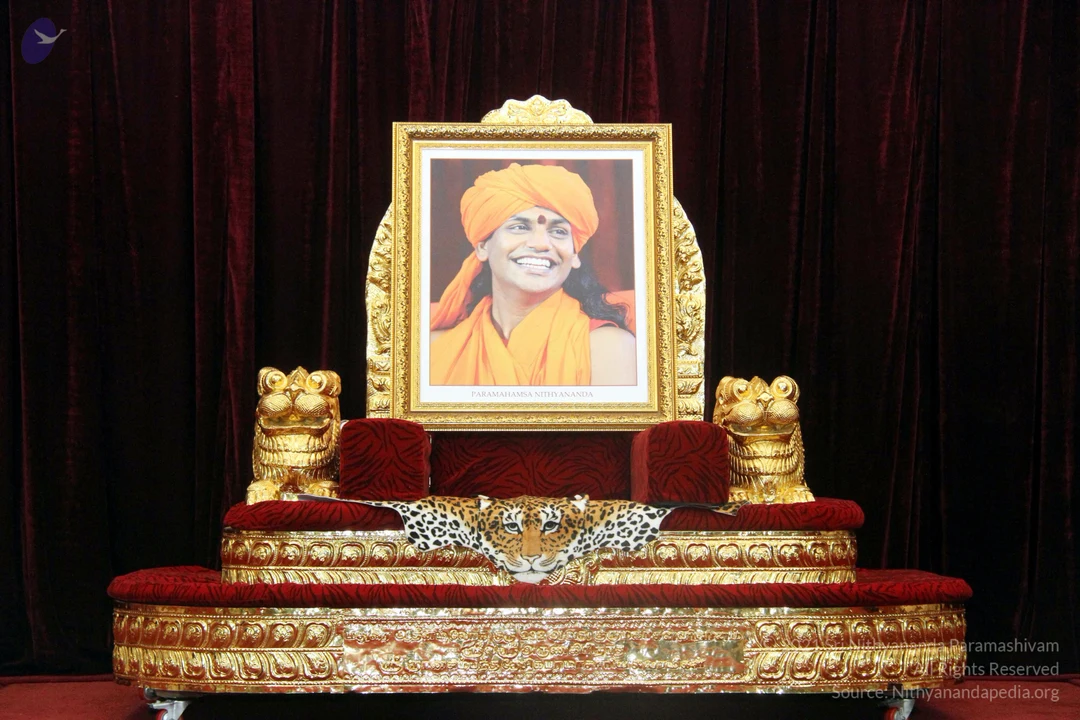
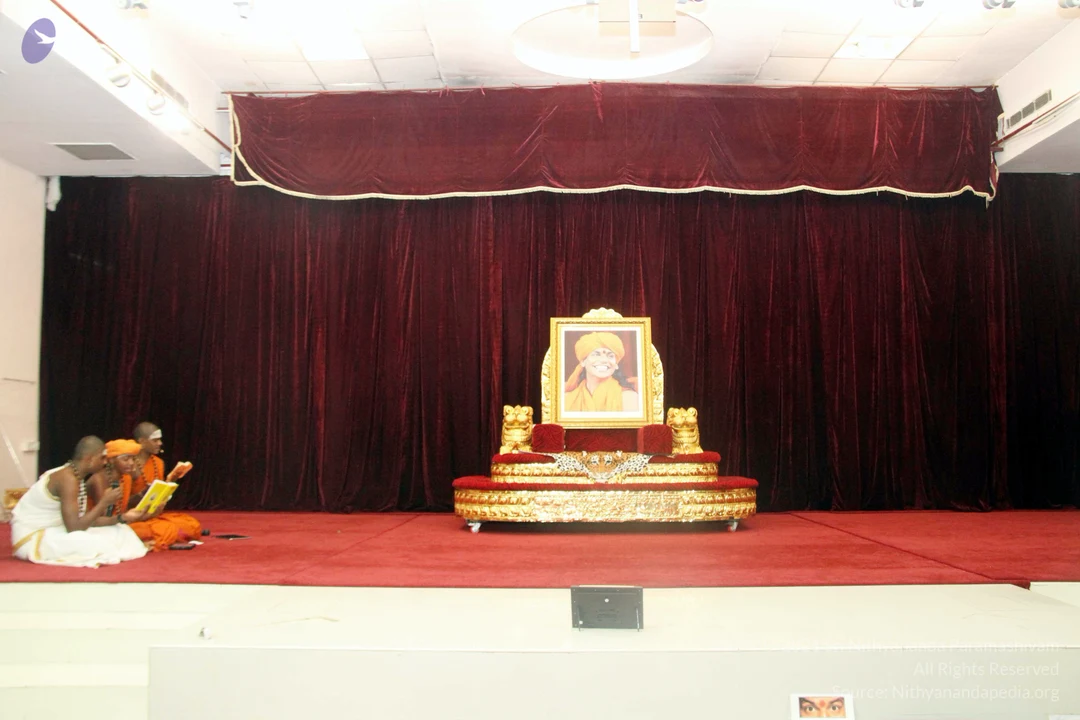
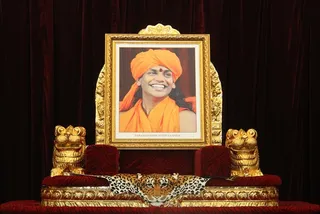
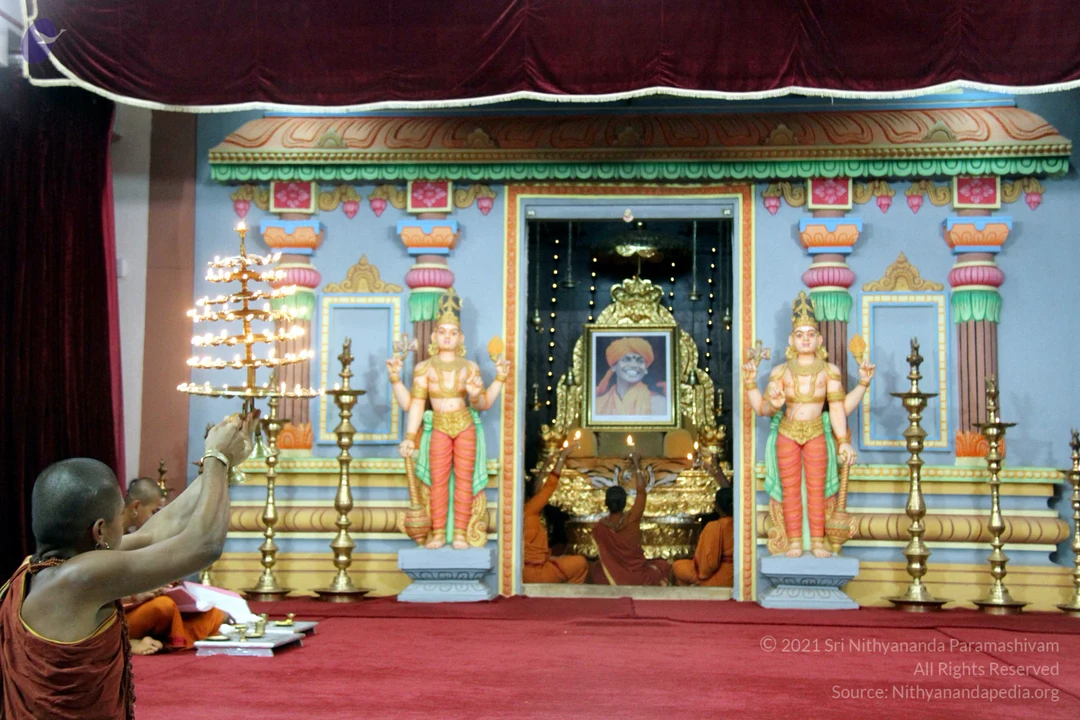
Close-up photograph of a hand gripping a small hourglass-shaped damaru drum with a white drumhead and black rim, its two wooden beads hanging from cords. The hand is resting on a red upholstered seat with dark brown tiger-stripe pattern, and a gold-coloured fabric and a gold bangle appear at the edges. No person's face or full body is visible, and no one else is in the frame.An empty ornate golden throne (peetha) with red velvet cushions and a leopard-skin cloth draped across the seat, flanked by two gold lion sculptures, set against deep red velvet drapery. Above the throne hangs a framed portrait labelled "PARAMAHAMSA NITHYANANDA" showing a smiling man with an orange turban, orange garments and a red bindi. No people are physically present in the scene; the portrait is a printed depiction.A photograph of a stage draped with deep maroon velvet curtains and a red carpet. Centre stage stands an empty golden throne (peetha) with a red cushion and carved lion-head armrests, set in front of a framed painted portrait of a smiling figure in a saffron turban and saffron robe. Two saffron-robed sannyasis sit cross-legged on the left side of the stage reading from yellow books, while a third man in white ritual dhoti and shawl with rudraksha beads sits beside them. Ceiling lights and a circular fixture are visible above.

March 03 2014

Original wiki page
Contents

Day's Event

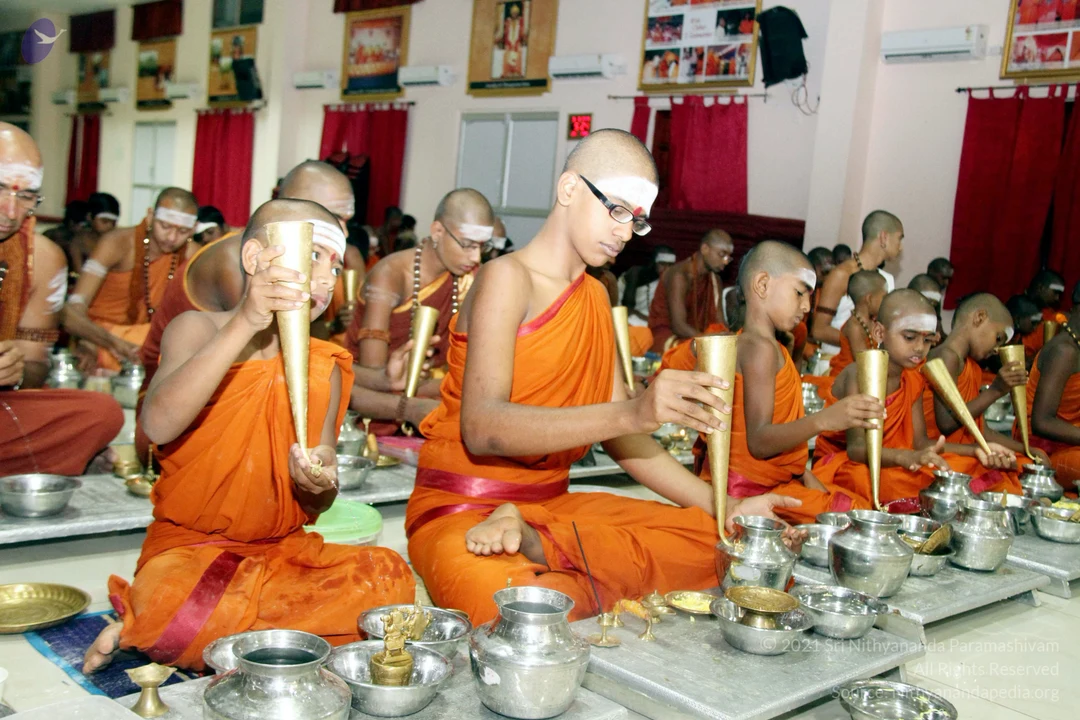
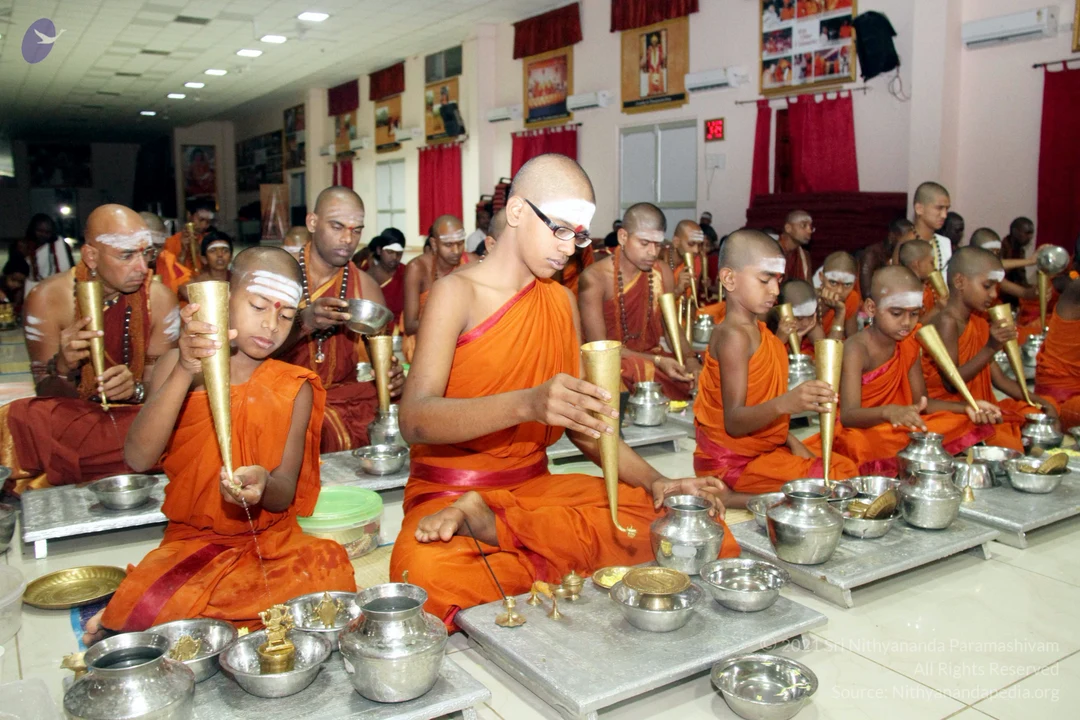
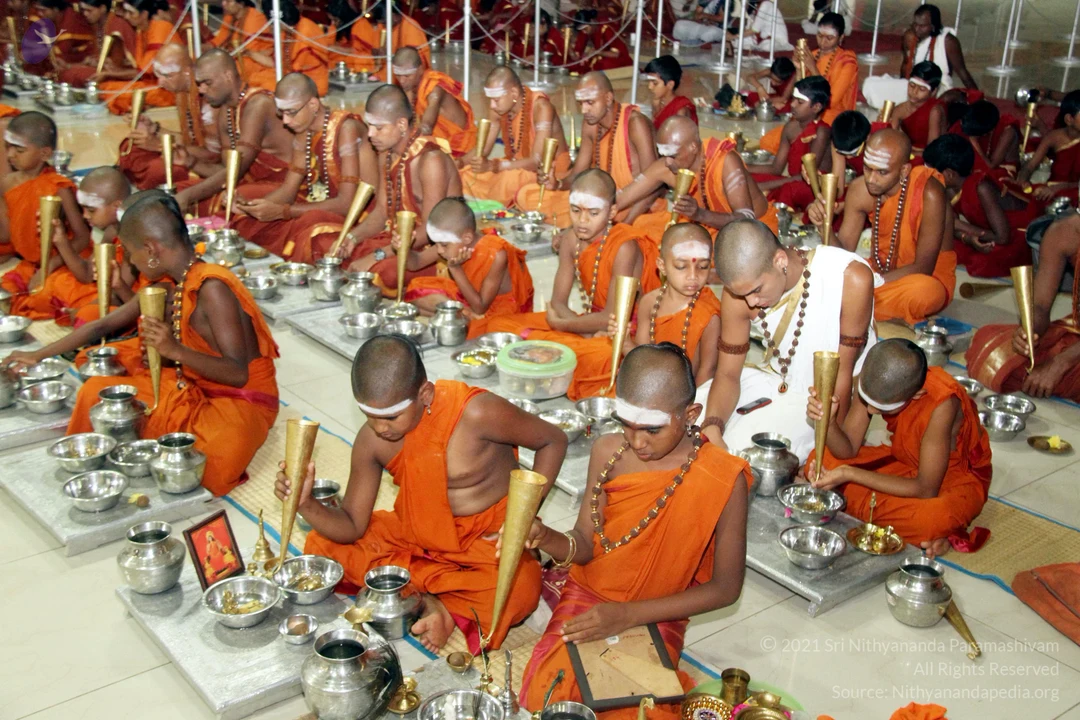
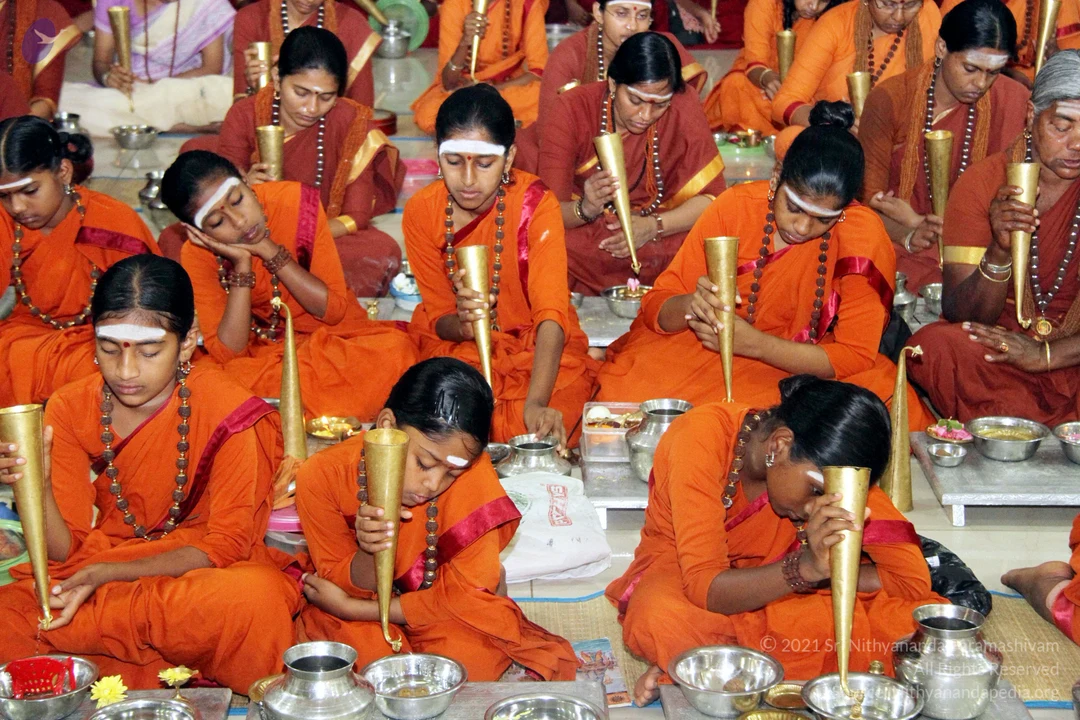
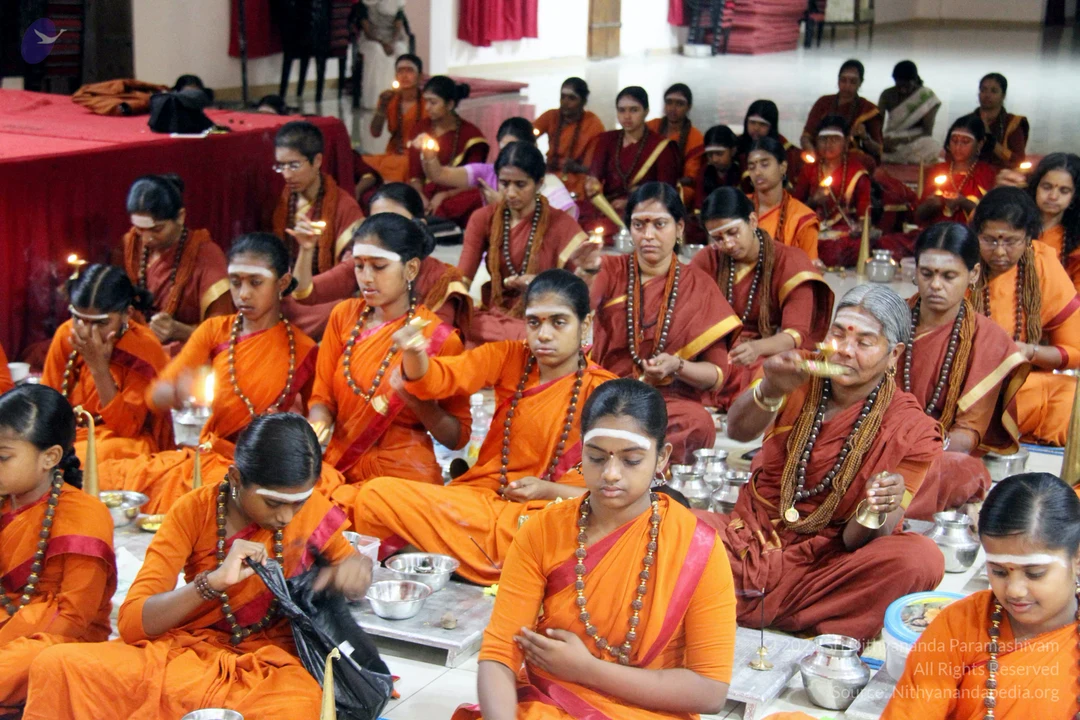
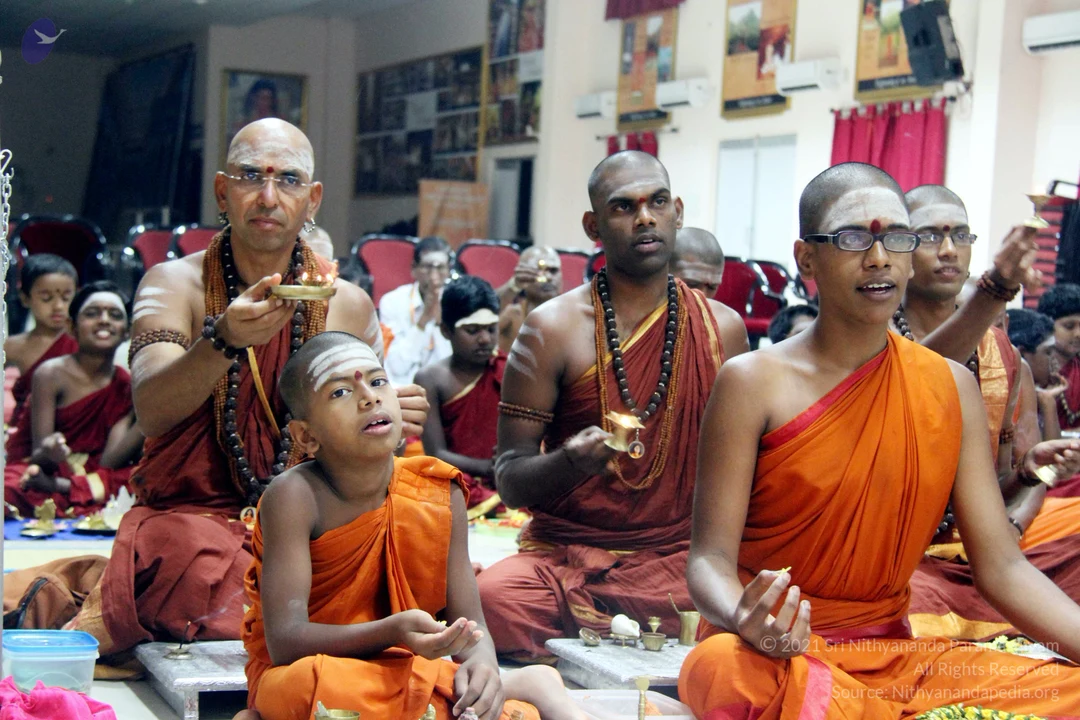
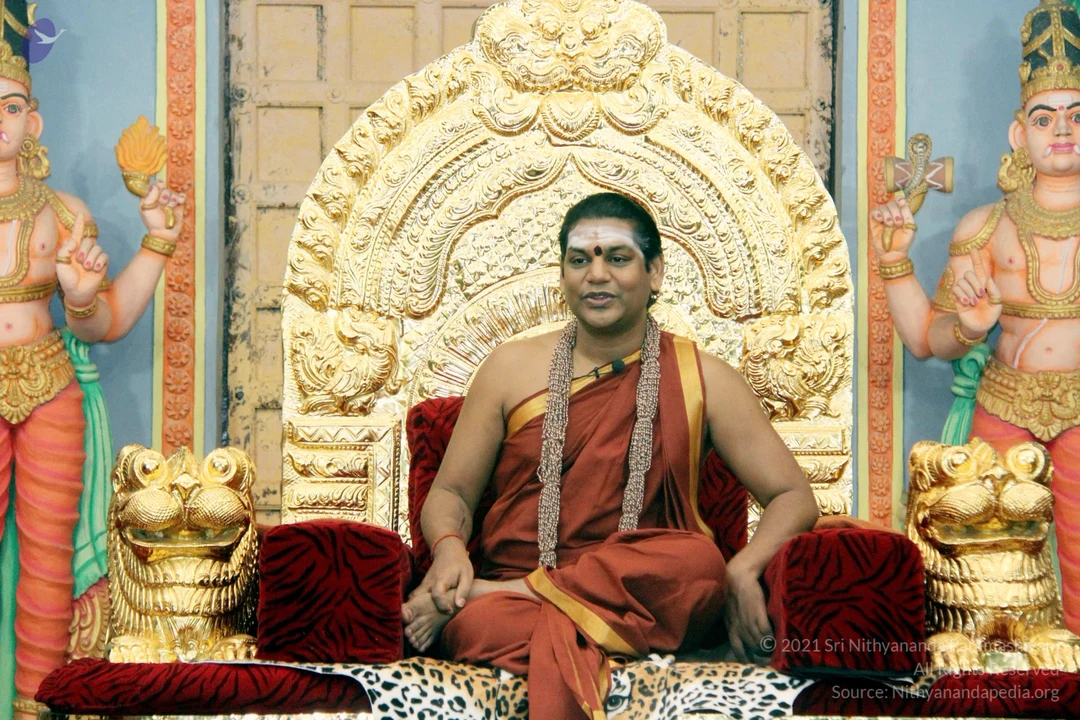
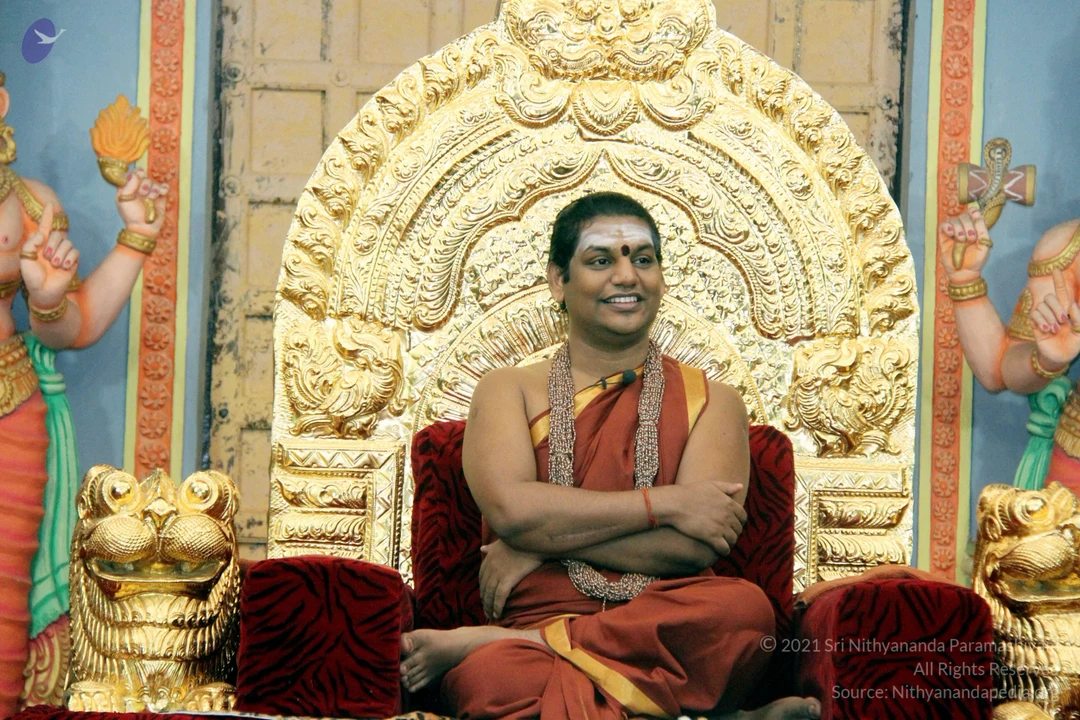
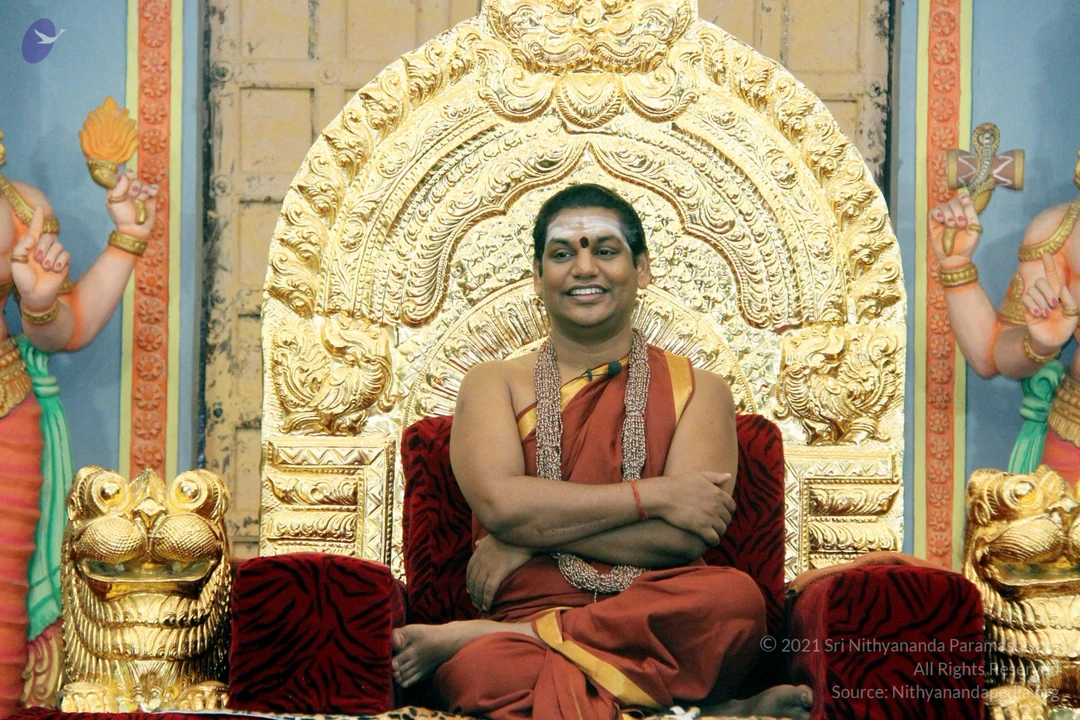
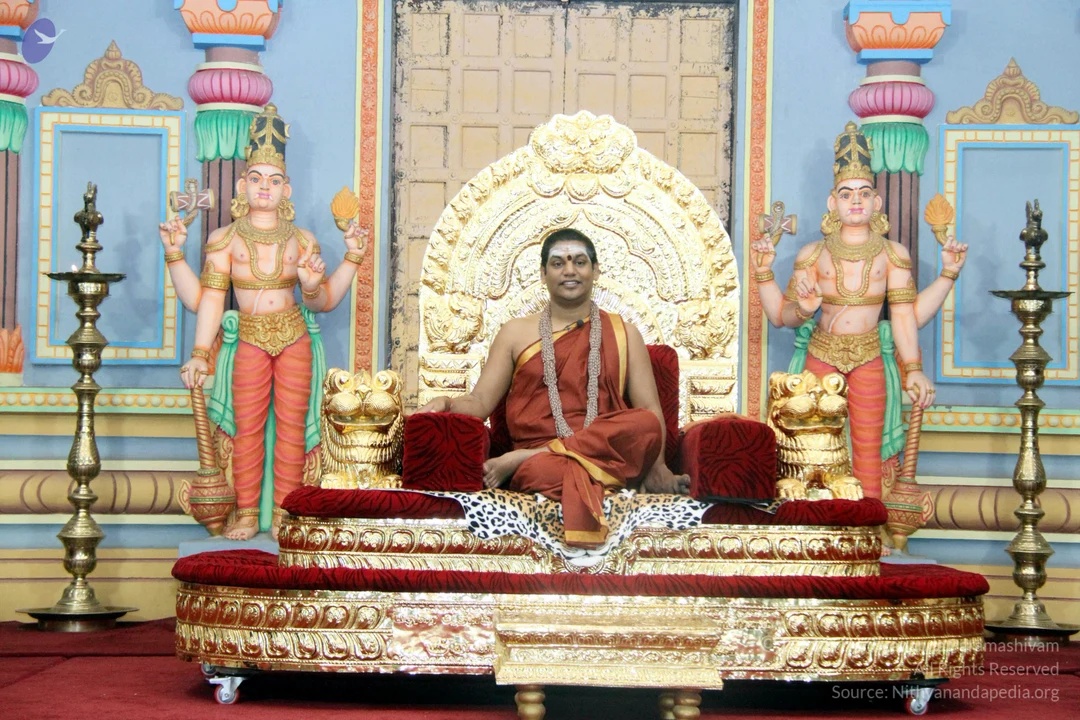
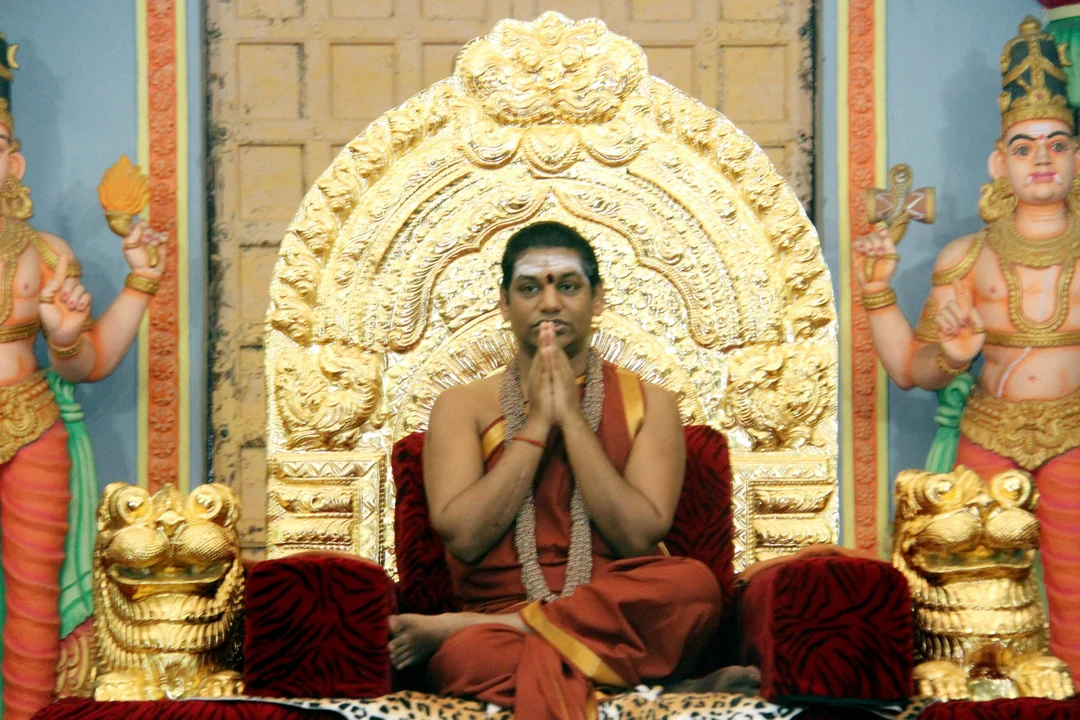
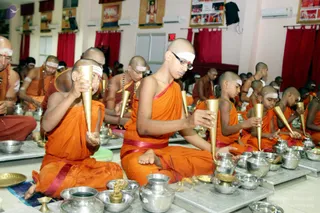
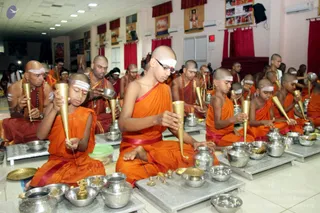
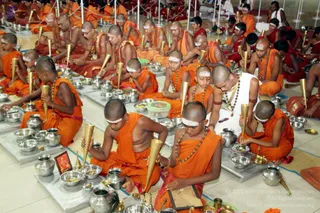
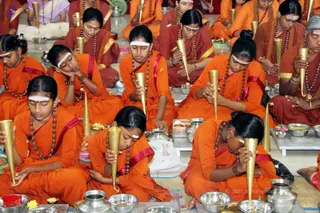
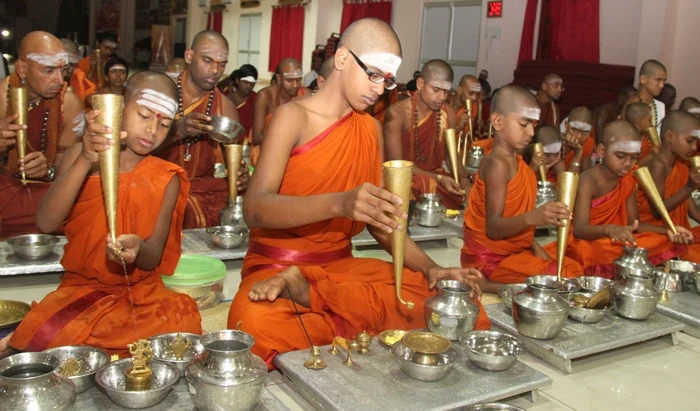
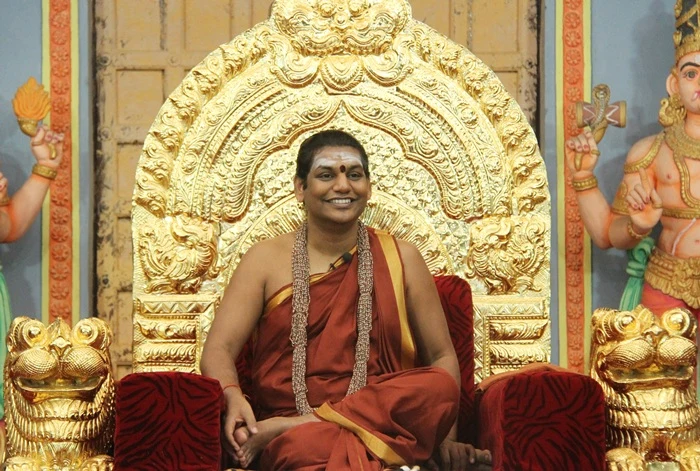
The day's routine started with Rudrabishekam , PadukaPuja to Swamiji followed by morning Nithya Satsang and Kalpataru meditation process and Darshan.

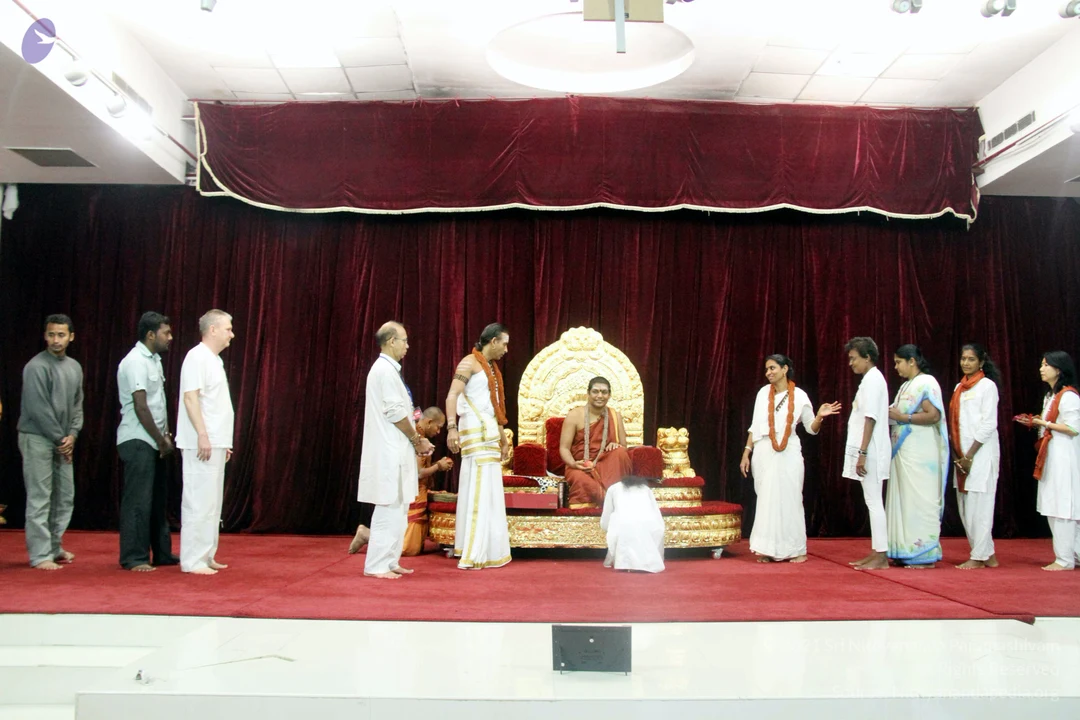
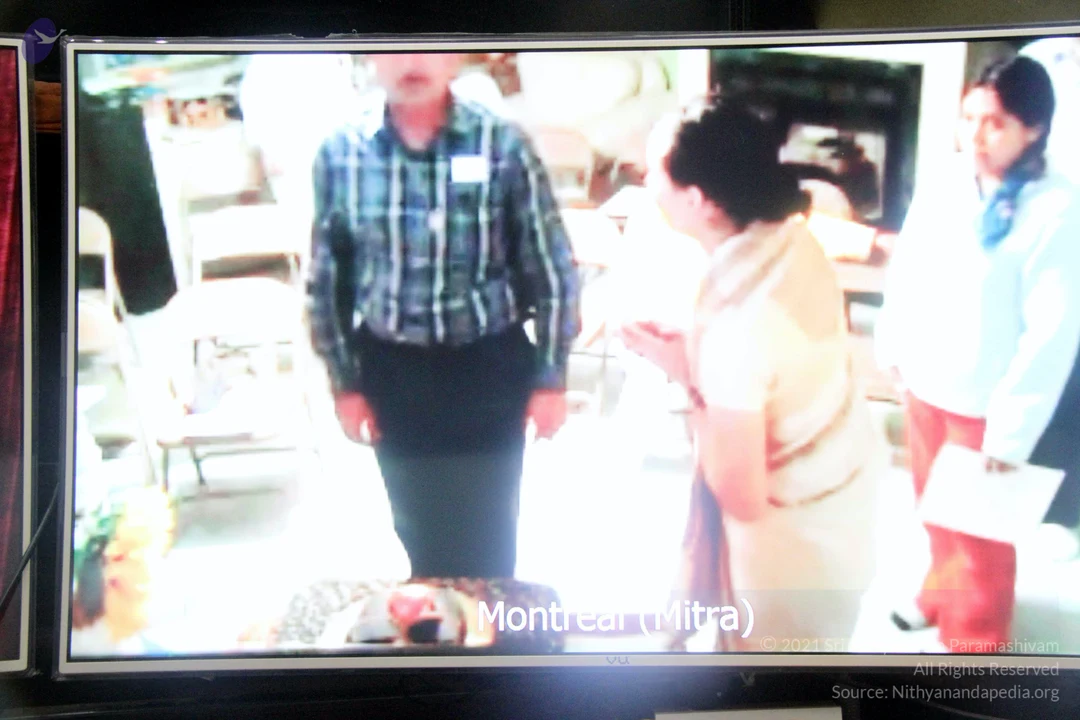
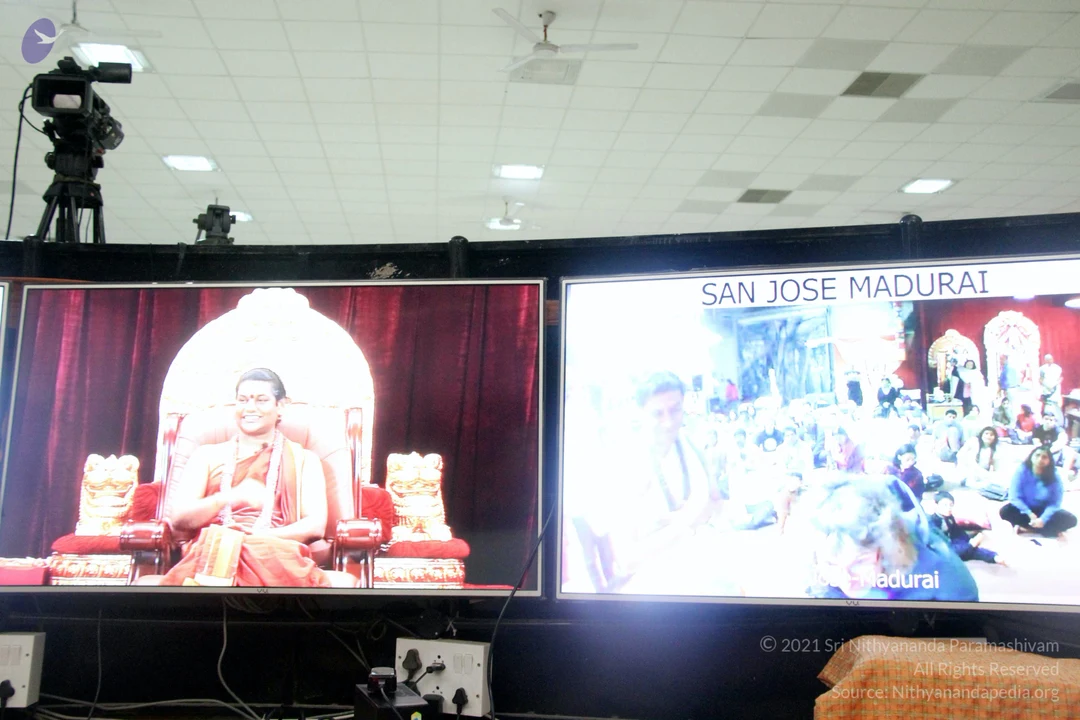
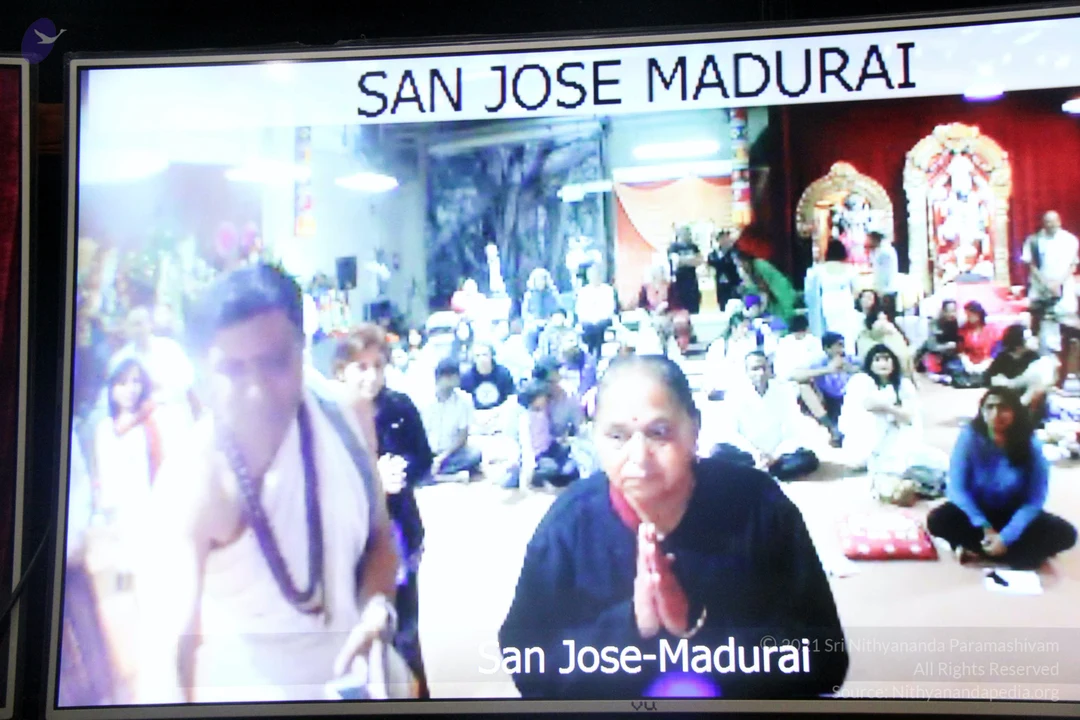
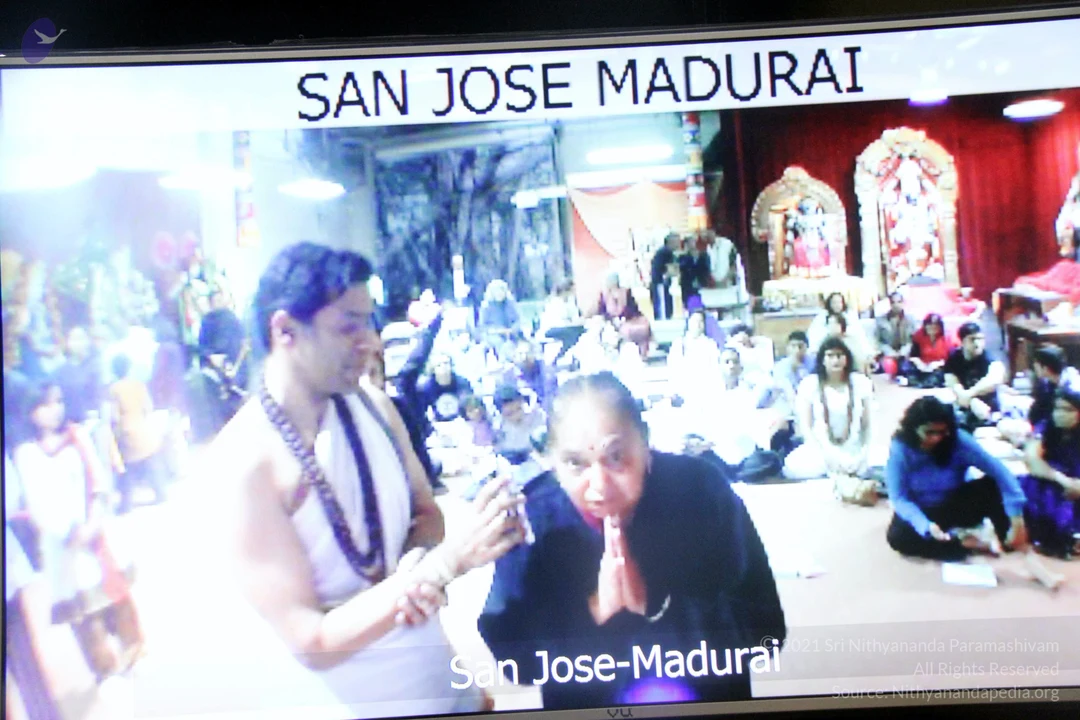
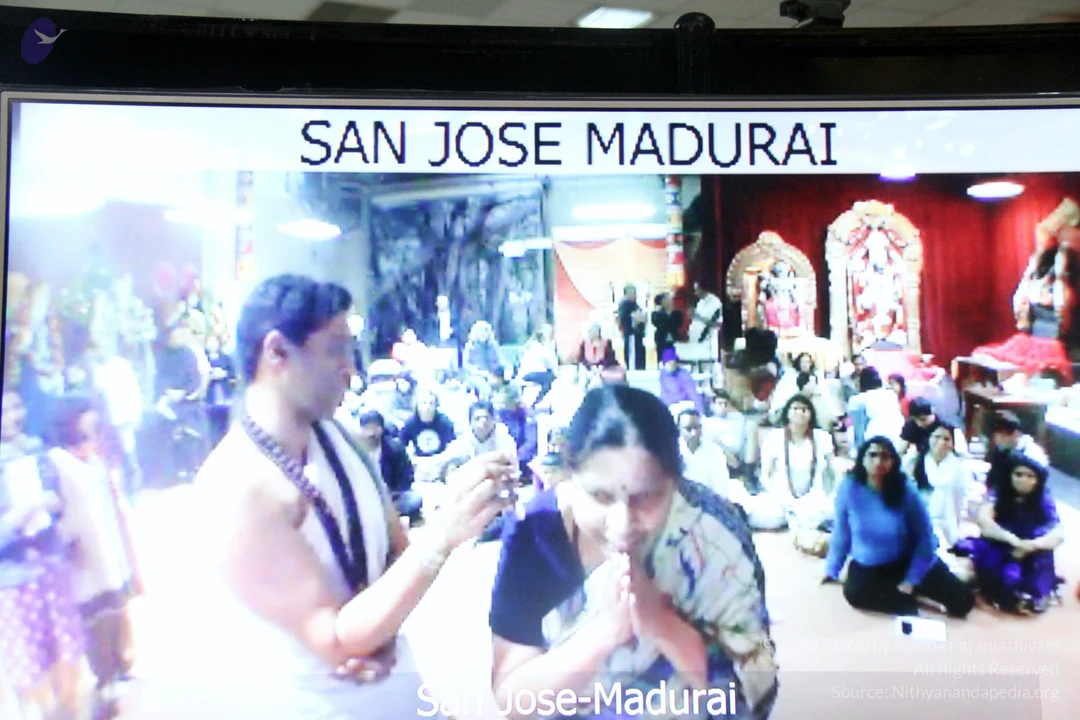
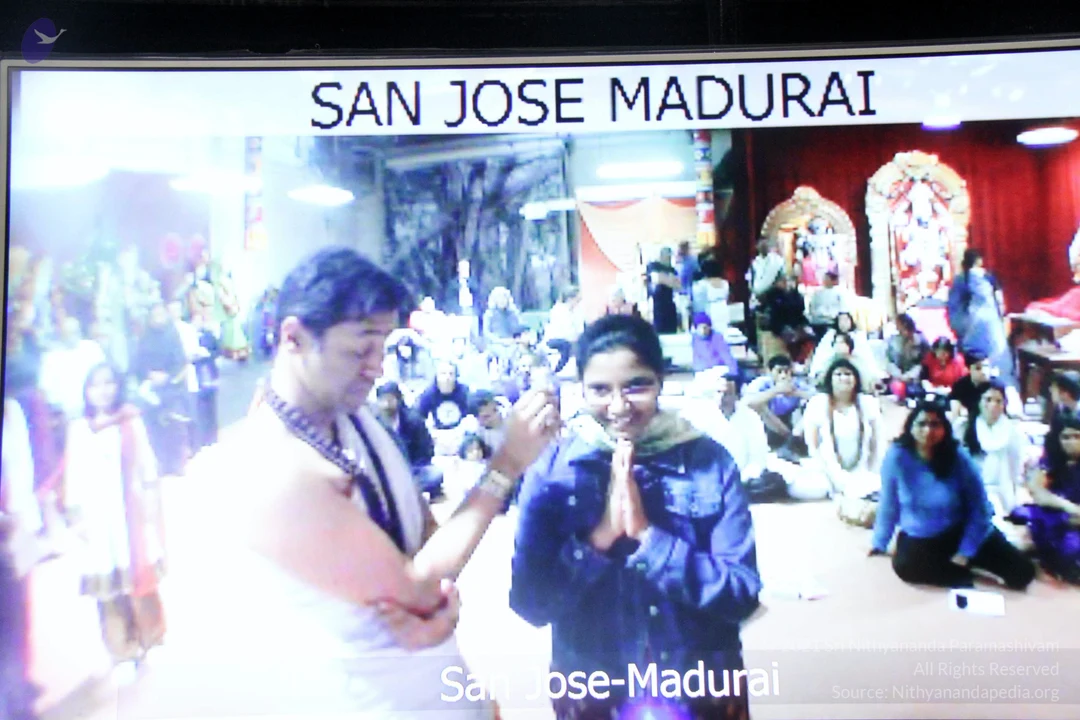
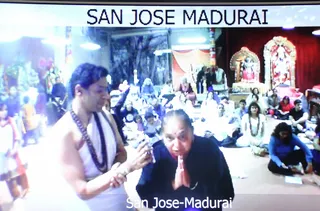
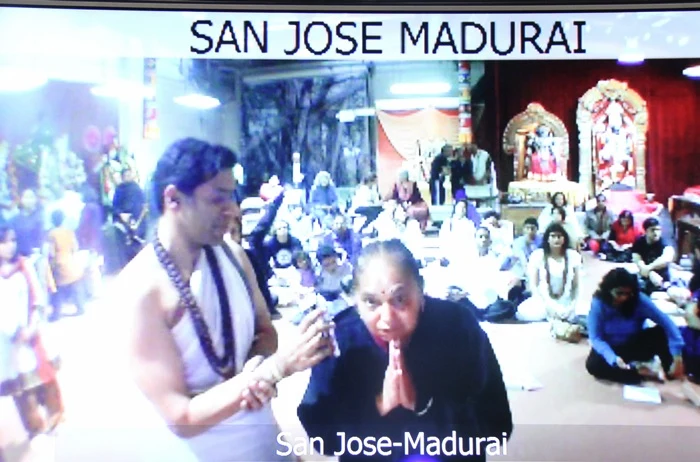
Later Swamiji conducted and blessed the e-Kalpataru Participants from San Jose & Mill Valley

Description:

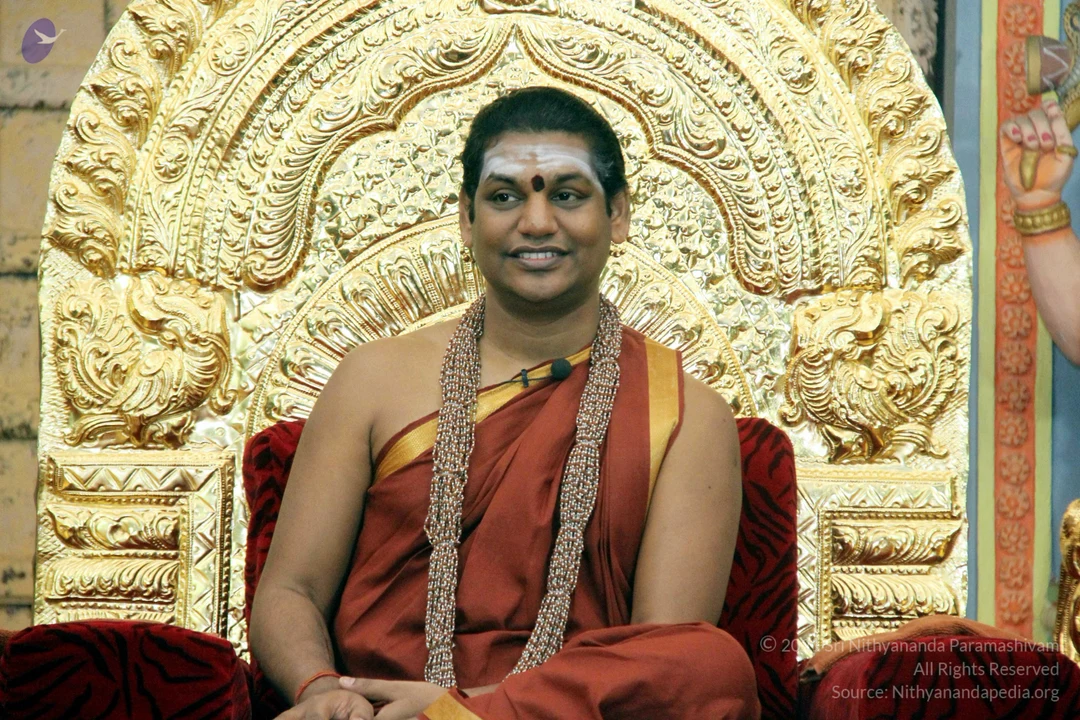
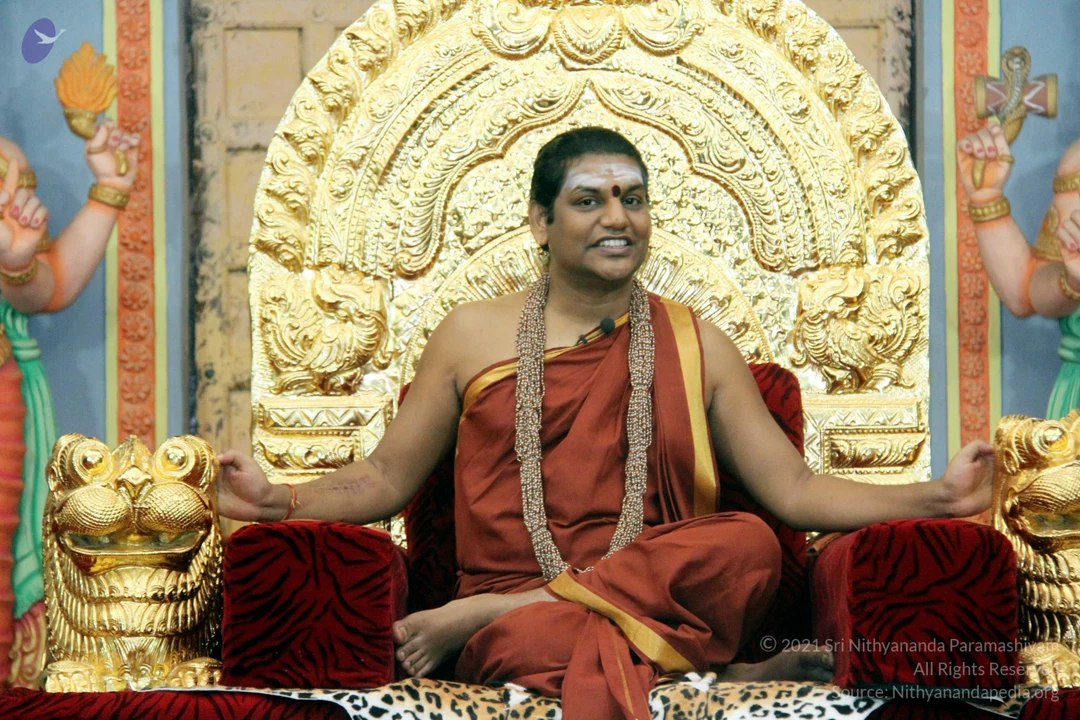
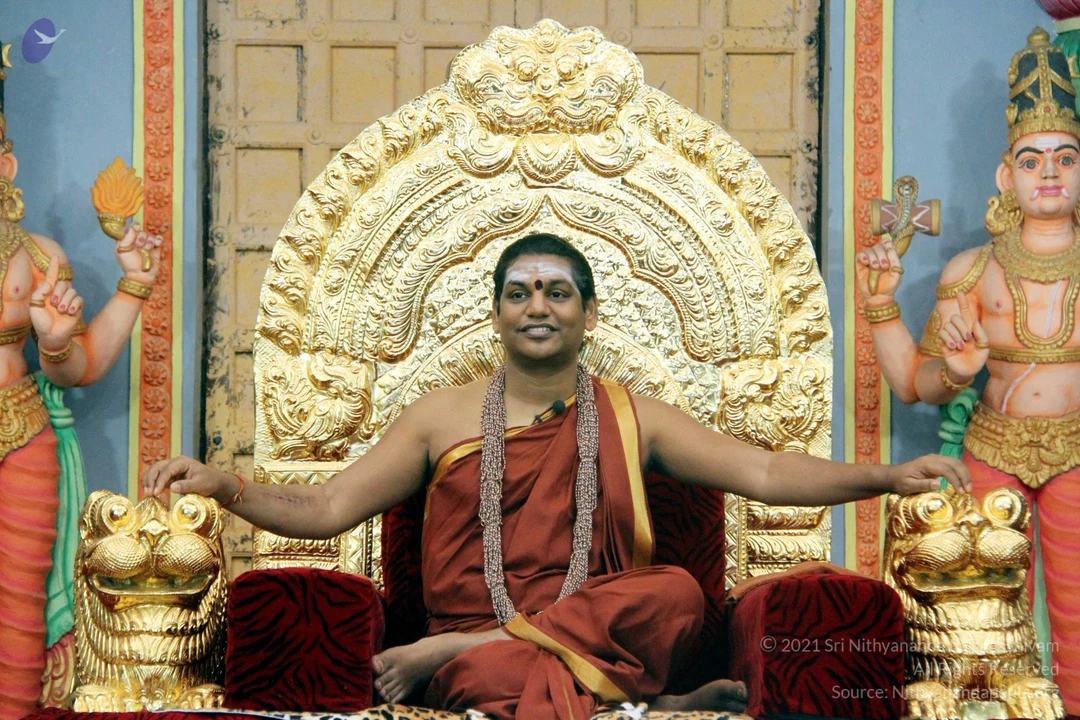
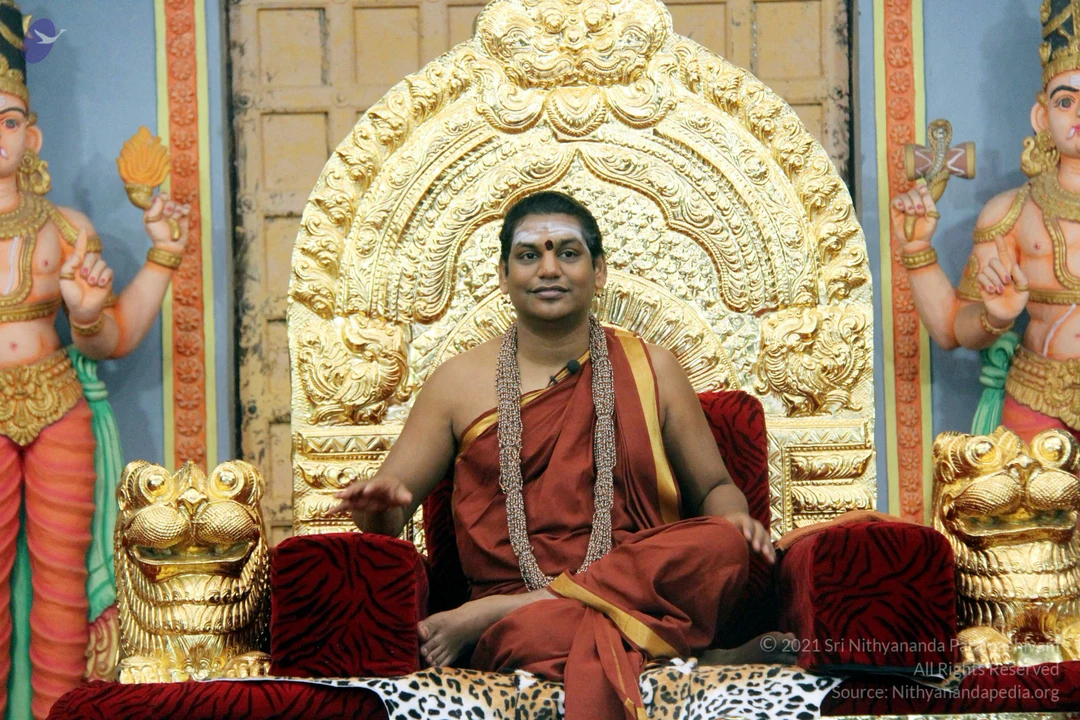
In today’s morning Satsang, Paramahamsa Nithyananda explains how everything we have in our lives, whether we want it or not, is our responsibility. Our thoughts are the seed that grows into our thinking which bears the fruit of our reality. But we can change! The Inner Awakening program teaches us the science to rewrite our future, creating the reality we want in our lives. Inner Awakening will wake up our inner space!

Link to Video:

VideoAudio

Transcript:

[00:15]

Nithyānandeśvara samārambhām Nithyānandeśvari madhyamām | asmat āchārya paryantām vande guru paramparām ||

[00:43]

Iss samay hamare sath upasthit sabhi darshakon aur bhakton ka main prem evam aashirwad sahit swagat karta hun.

[00:54]

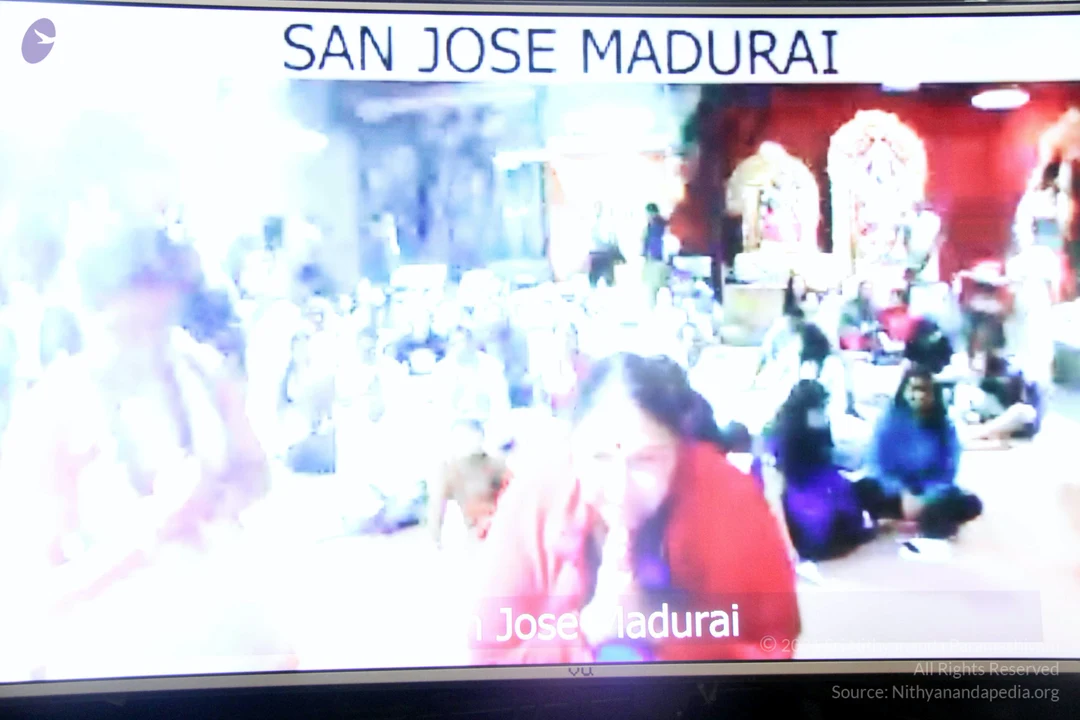
I welcome all the devotees, disciples, samajis, satsangis, Shrimahants, Mahants, Kotharis, Thanedars, gurukul kids, everyone sitting with us through Nithyananda TV, Sadhna TV, Lotus News Channel, Janashree TV, Eshwar TV, and through two-way video conferencing having Nayana deeksha in 32 cities… sorry in many cities, many countries around the world. Cities sitting with us in two-way video conferencing: Devon-UK, Hyderabad-Gupta Kashi, Kulim-Tiruttani, Los Angeles-Arunachalam, Guadeloupe-Rameshwaram, Seattle -Chidambaram, Ohio-Prayag, San Diego-Tirualavai, Devon-UK, Toon Moon-Hong Kong, Mill Valley-Vairavan Koil, Charlotte-Srisailam, Dubai-Vaidyanatham, Jureko-Mexico... Juarez -Mexico, Hong Kong-Sirkazhi, San Jose-Madurai, Kuala Lumpur-Palani, Oman- Sivagangai, Obrack-Slovakia, Chicago-Srirangam, Austin, Bangalore-Malleswaram, Dakota Dunes, New York- Varanasi, Singapore-Singapuram, Toronto-Kailasam, austin, Newfoundland - Canada. I welcome all of you with My love and blessings. I welcome all the participants who are in San Jose-Madurai and Mill Valley-Vairavan Koil for the Kalpataru Darshan.

[02:59]

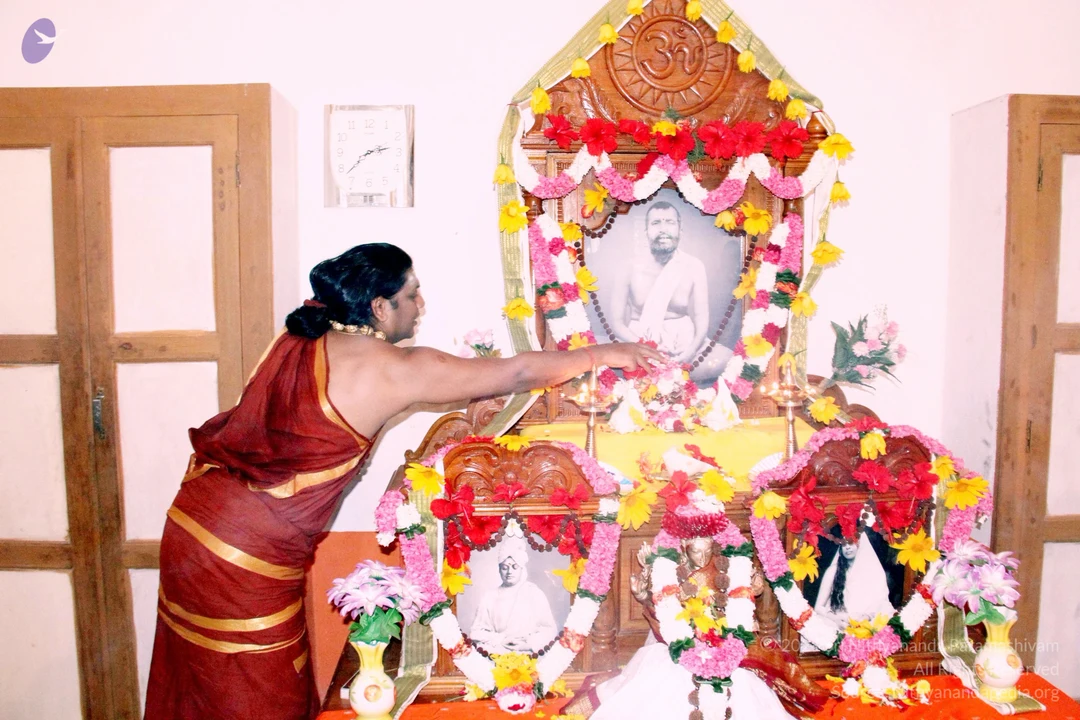
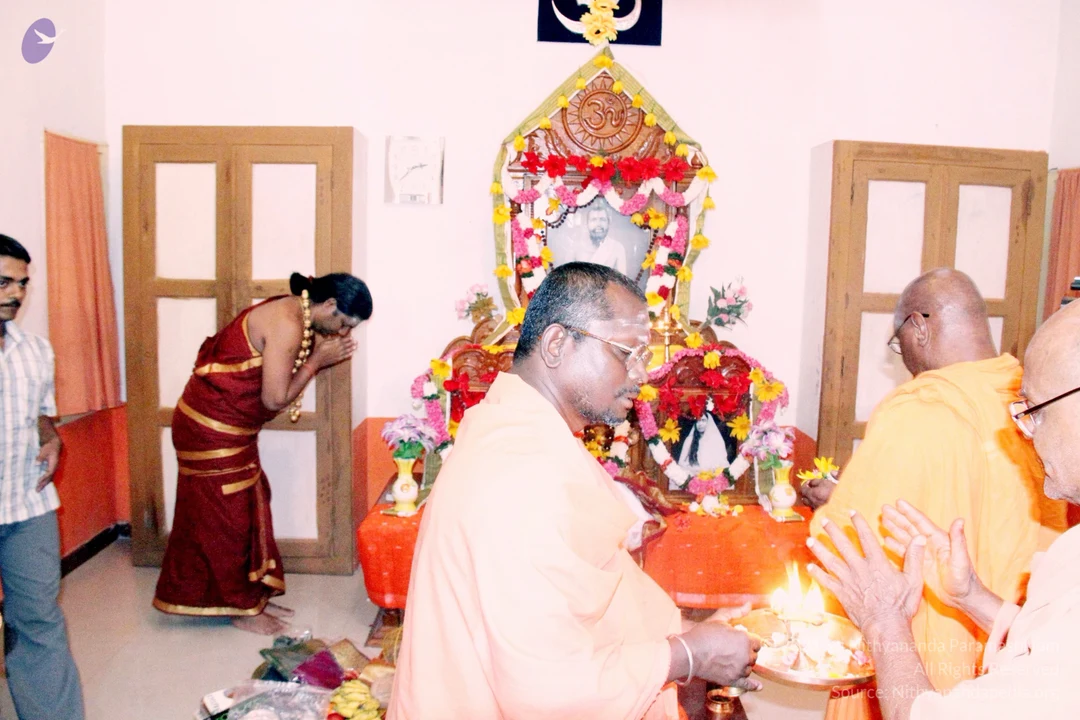
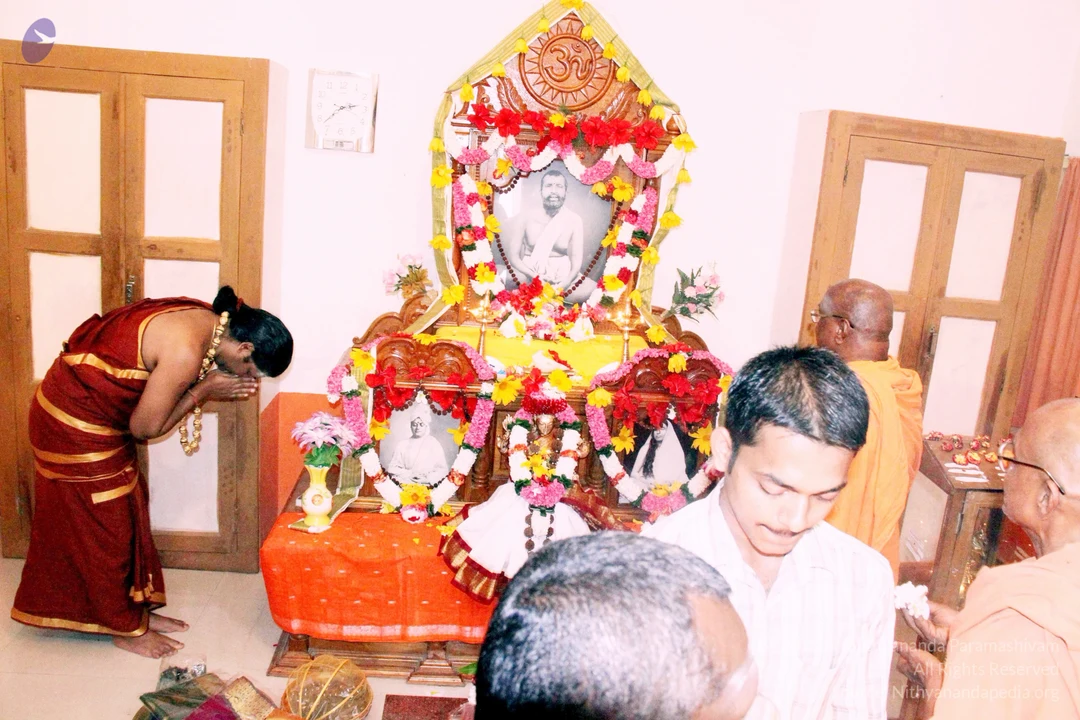
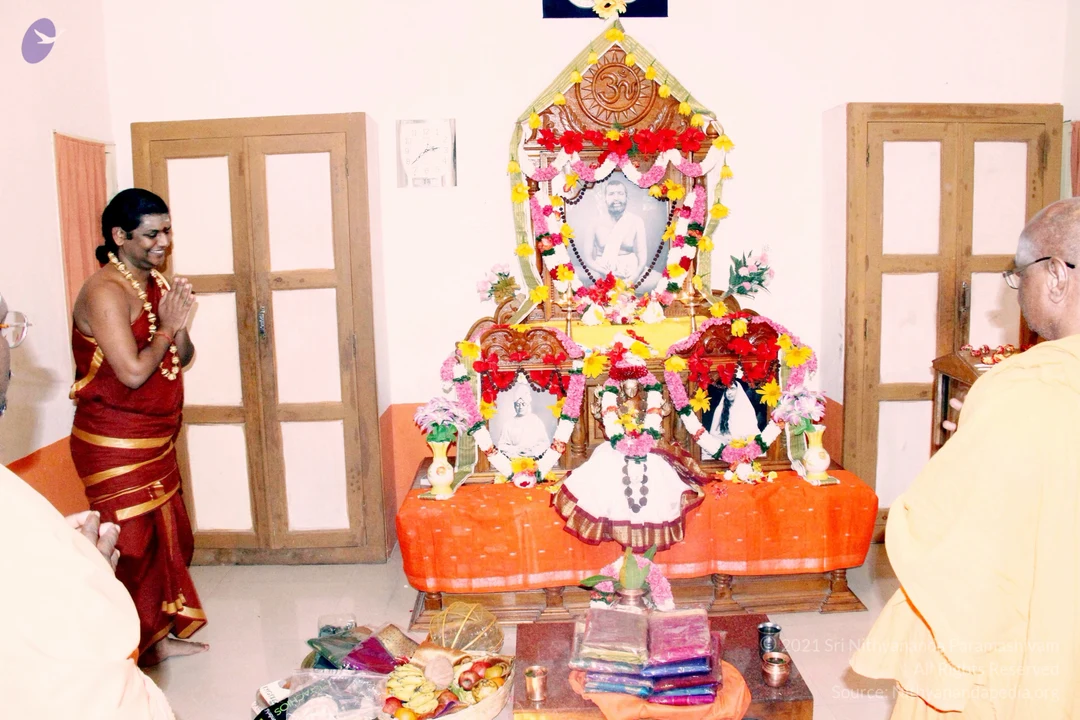
Today, Sri Ramakrishna’s Jayanthi Mahotsava. As per the Vedic calendar, Ramakrishna’s birthday. Ramakrishna was born on the third… sorry second tithi of amavasya. So, this time Amavasya came next to Shivaratri Day. That is the reason, today Ramakrishna’s Jayanthi is celebrated. And today is also a very important day in our movement, in our Sangha – Jeevan Mukthi Jayanthi. So, today we will be celebrating that great book which is born, released today – The Jeevan Mukthi, which naturally gets updated; because I am alive and I am updating Myself, Jeevan Mukthi book also gets updated. It is a powerful book, still one of the best books I have written. We are working on coming up with more and more volumes of Jeevan Mukthi Jayanthi. And, on this great day, auspicious day, fortunately today, Ramakrishna’s birthday and Jeevan Mukthi Jayanthi falling together. But actually, Ramakrishna’s birthday is observed as per the Vedic calendar; Jeevan Mukthi Jayanthi we observe as per the English calendar. Today, fortunately, both coincided on same day. Anyhow, let us take this opportunity to revive our commitment to Integrity.

[05:34]

Please understand. If I have to condense the whole life of Sri Ramakrishna, the essence of Ramakrishna’s life, I will condense it in one word, that is: Commitment to Integrity. He is such an embodiment of Integrity, embodiment of Integrity, I tell you, just embodiment of Integrity. The words he gives, he will be so honest, respectful and honor the word he gives. I have never read or heard any master who has this high degree of integrity like Sri Ramakrishna. I am not saying other masters are not integrated, but the degree, the frequency of integrity is too high with Sri Ramakrishna. That is why he had such a powerful Vaak Siddhi.

[07:41]

Even though he will not demonstrate many times, he had a powerful Vaak Siddhi. That is why his words, ordinary village slang, colloquial words uttered by him are translated today in almost all the world languages, read by crores of people, guiding thousands of sannyasis. I tell you, in the modern history of Hinduism, he is the Master, Incarnation, who created, inspired, initiated largest number of sannyasis. This I can tell boldly, very boldly, with all My integrity! Neither Swaminarayan… neither Bhagawan Swaminarayan nor Arya Samaj Dayananda Saraswathi, none of them can cross the contribution of Sri Ramakrishna, the number of sannyasis he created, inspired, initiated and still continue to inspire. Uncomparable… Incomparable.

[09:35]

So understand, his contribution hardly in last 150 years; 1886 he left the body. 1836 he assumed the body, and 1886 he left the body. Just fifty years lived in Planet Earth physical form… in the physical form; 150 years hardly, but unimaginable contribution. Apart from the sadhus and sanyasis of Ramakrishna order, thousands of people have renounced their life in the name of Ramakrishna and live in their own places. He is the inspiration who can’t be compared. For thousands of people, he is the spiritual strength. No one, no one is able to create so many sanyasis or so many sincere seekers. His words are able to do that work means, understand the power of his Vaak Siddhi, power of his words.

[11:18]

And even I should be classified as a person who renounced his life in the name of Sri Ramakrishna, because of Ramakrishna’s inspiration. That is why, if you look back the history of our Sangha, first I named our whole Sangha only in the name of Ramakrishna. The first ashram was called as, “Sri Ramakrishna Dhyanapeetam”. It was in course of evolution, later on it came to be called as, “Nithyananda Dhyanapeetam”. The power of his words, still it’s influence, his influence over all the modern day gurus, teachers, spiritual heads, religious heads, unimaginable, unimaginable! Being a householder, married to Sharada Devi formally, but he is one of the greatest Avadhootas, incarnations produced by Hinduism in the modern day. And integrity to the words, let us learn from him, from his teachings. One of the greatest Master happened in India in the modern day.

[13:20]

I will move to the subject, today’s satsang subject. Today I wanted to expand on the importance of Inner Awakening. Please listen. Come to the space of listening. Whether you come to Kalpataru Darshan, or Nithya Dhyan Yoga or Nithya Kriya Yoga, any program, all I am trying to do is awaken the power of your inner-space. Please understand, just like your eyes have some power - it can see, your ears has a power - it can listen, each part of you has some powers - it can do that, your inner-space has a power - it can create what you want.

[14:36]

Understand. Anything you want in the life, you perceive in the life, you have in the life, starts with a thought. Whatever you think you have, whatever you perceive as your life, whatever you want to have, everything starts, please listen everything starts with your thought. Today, in your life, if you are having what you want, or if you are having what you did not want, if you are having something completely opposite to what you want, all the three you are responsible, your thoughts are responsible. Thoughts are like seed, your thinking-style is the tree, the reality you have is the fruit. If you change your thoughts, your thinking-style can be changed, and the quality of the fruit which is your reality can be changed. Listen, if I have to compare your life to a tree, the thought… thoughts you cherish are like a seed, and the thinking-style you develop is the tree, and the reality you are experiencing is the fruits. If you think you are having the reality which is hell for you, YOU created it. If you want the reality as you want, you CAN create it.

[17:03]

Please understand. The moment I say you are responsible for the mess you have created around the… around your life, I have a message for you. When I say you are responsible for the mess, I am not just giving you the bad news; I have a good news. The good news is, if you are responsible for the mess, you can just change it, you can change it. Understand whether you have what you want, or you don’t have what you want, or you have what you don’t want, all the three space your thoughts are responsible, your thoughts are responsible, you thoughts are responsible. Now change your thought, change your thinking-style; naturally, the result, the reality you cause will become different.

[18:44]

Yesterday, almost ten I don’t know or.. twelve hours we had a meeting. Eleven and a half hours we had almost continuous meeting. After a long time I am sitting like this with ashramites and the Sangha members. Almost eleven hours with Kotharis, Thanedars, Mahants, thinking through so many things, doing so many things, planning for so many things. So many people were talking, so many creative thoughts, ideas. In this whole thing, some of the essence which I learnt – I don’t know whether they all learnt from Me or not, but I learnt from all of them some things. The first thing I learnt, everyone is struggling with the old patterns they developed even if they know that patterns are not productive in their life. Even if you recognize the pattern is not productive, giving up on the pattern takes time. Second, only if you rewrite your future, the old will leave your future.

[20:48]

Please listen. Your future cannot be empty. Either you take over it and rewrite, or by default your past will fill itself in the future. Either you wake up and start taking it under your control and you write, you build, you develop, or it cannot be empty. What will happen? Your past is there default. Like, till the next Chief Minister comes, even if this Chief Minister has resigned, he will be asked to remain in the seat till the next arrangements are done. Same way, your life is almost like a in-between government. Nobody owns it, nobody takes decision. See, in India, if a Chief Minister resigns, till the election happens and the next Chief Minister is sworn in, the old guy will be asked to remain in the power. Same way, because you have not woken up and taken charge of your life, your past has been asked to be a default Chief Minister, understand. Wake up and take your life under your control. That is what I call Inner Awakening. Rewriting your future. It is possible if you know how the writing happens; simply you can remove all the mess. Understand.

[23:13]

If you are struggling in your life in your health front, in your relationships, in your business, in your wealth, in your career, in any fronts... It is very funny to see the human-beings life; in every front they struggle. If you hear about any problem, you immediately imagine whether I have it or not. Then you think, “I think there is a small degree of that problem with me also.” If you hear about heart attack, you think, “Yes, yes, yes, I have little… maybe soon I am going to get it.” If you hear about knee pain, “I think I am slowly developing it.” If you hear about depression, “Oh yes, yes, yes, I have once in a while. Nowadays it is once in three months. but in.. I think by next year in two years it will become once a week.” Any problem you hear, you want to have it. Understand. If you are struggling with so many problems, if you are struggling with so many problems... For example, you are struggling with ten problems; in one you may be successful, in one you may be failure. Whether you are successful or failure, struggling pattern itself is a failure. Drop that very struggling pattern and rewrite your future. If you know how the writing is done, rewriting is possible. You do not need to know how you created the whole mess of the past. You just need to know the science of writing, that’s all. So, you don’t need to edit, correct, all that about your past. You don’t need to struggle with it at all.

[25:52]

Just learn the science of writing and rewrite it. Rewrite it! Rewrite it! Rewrite it! The science of rewriting is what I call Inner Awakening. Initiating you into that science experientially is Inner Awakening. And Kalpataru is nothing but giving you the first glimpse of that science. Kalpataru is the experience, experiential initiation of that science. Whether you are successful in giving up your smoking or failure in that struggle, the very struggle itself means failure. Because, even if you are successful in giving up the smoking, you will be struggling with drinking, and then you will be struggling with the junk food. By then, you will be struggling with your irritation pattern, then you will be struggling with your anger; no need to tell, you will be struggling with your lust. Whether you win or lose, the struggling pattern is a failure. Life is not to be struggled. Life has to be transformed.

[28:44]

I also have some more announcements. Soon, very soon, you guys can expect a Diploma, Degree programs on Hatha Yoga, Raja Yoga, Astrology, Vaasthu, on many of the sciences of Hinduism, Hindu Cosmology. In many of these sciences you can expect Diplomas, Degrees. The classes will be personally conducted by Paramahamsa Nithyananda. We are already working on creating capsules, the different branches of Hinduism as programs and classes. We are working on creating capsules. Diploma and Degree on Vedic Psychology, Diploma and Degree on various sciences of Vedic Tradition. Soon you can expect. The Nithyananda Universities in United States of America and Paris are getting very active. And Nithyananda Meditation Academy in Canada and Slovakia is also getting very active. Soon, very soon, you will be having various courses, programs, classes. The contact classes will be personally conducted by Paramahamsa Nithyananda. The teachers training for Kriya Yoga, Yoga Teachers Training, all those courses, directly, personally will be conducted by Paramahamsa Nithyananda. And also the Diploma, Degree in Vedanta, the various branches of Hinduism, Saiva Siddhanta, we will be having classes.

[31:45]

Photos From The Day:

Rudra Abhishekam and Pada Puja
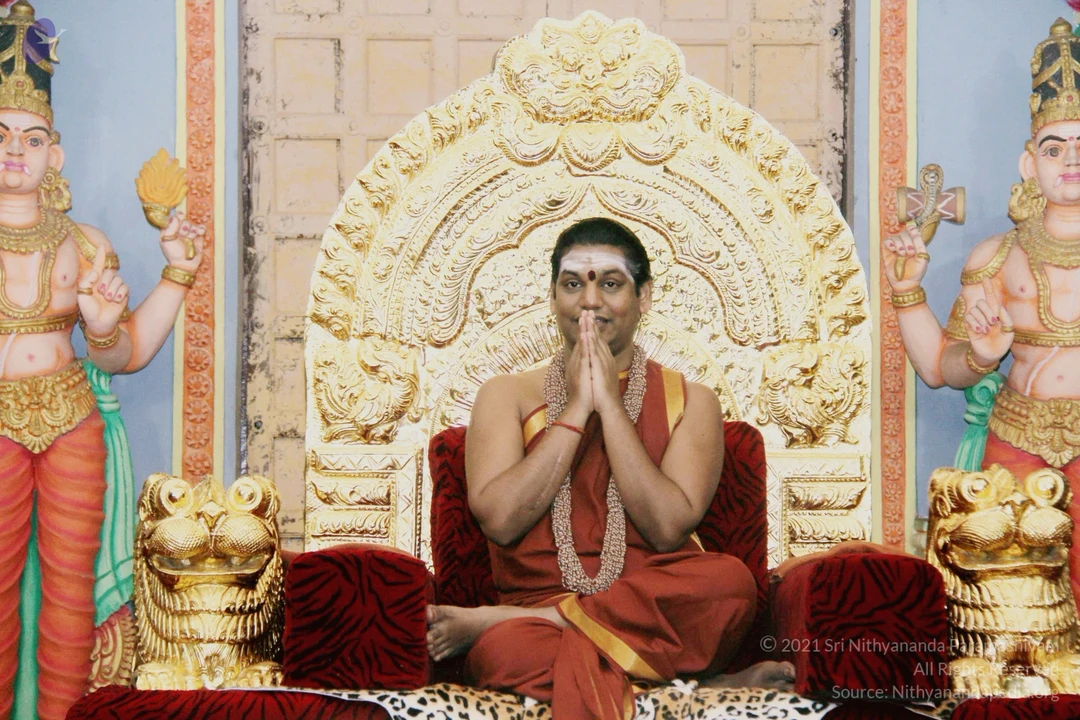
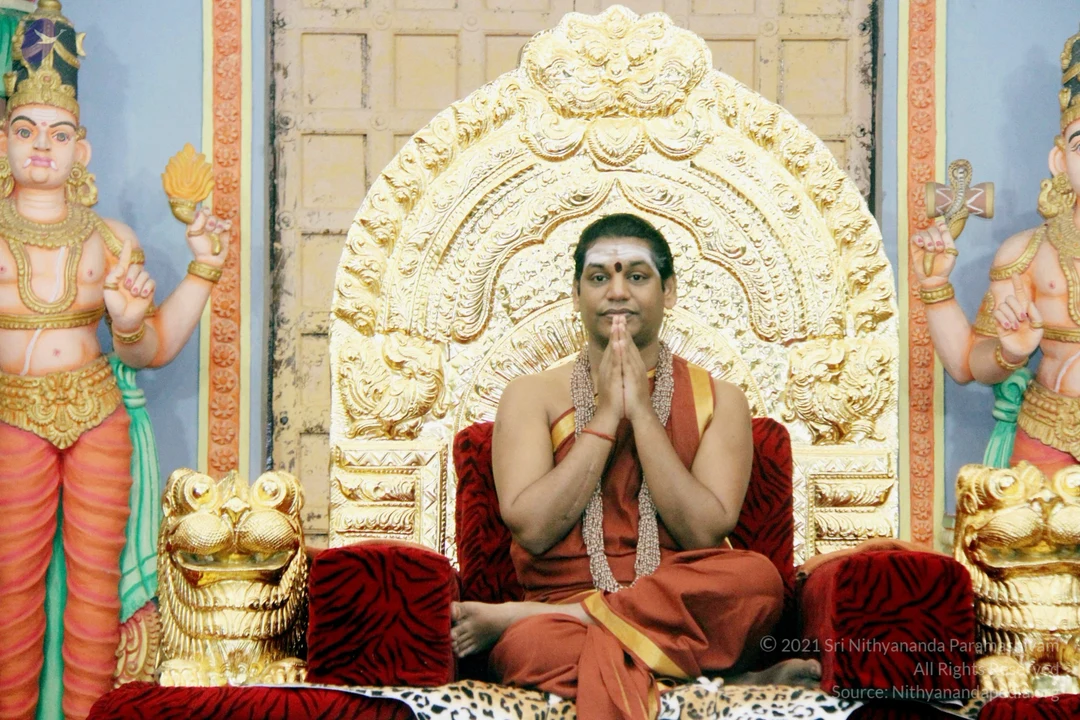
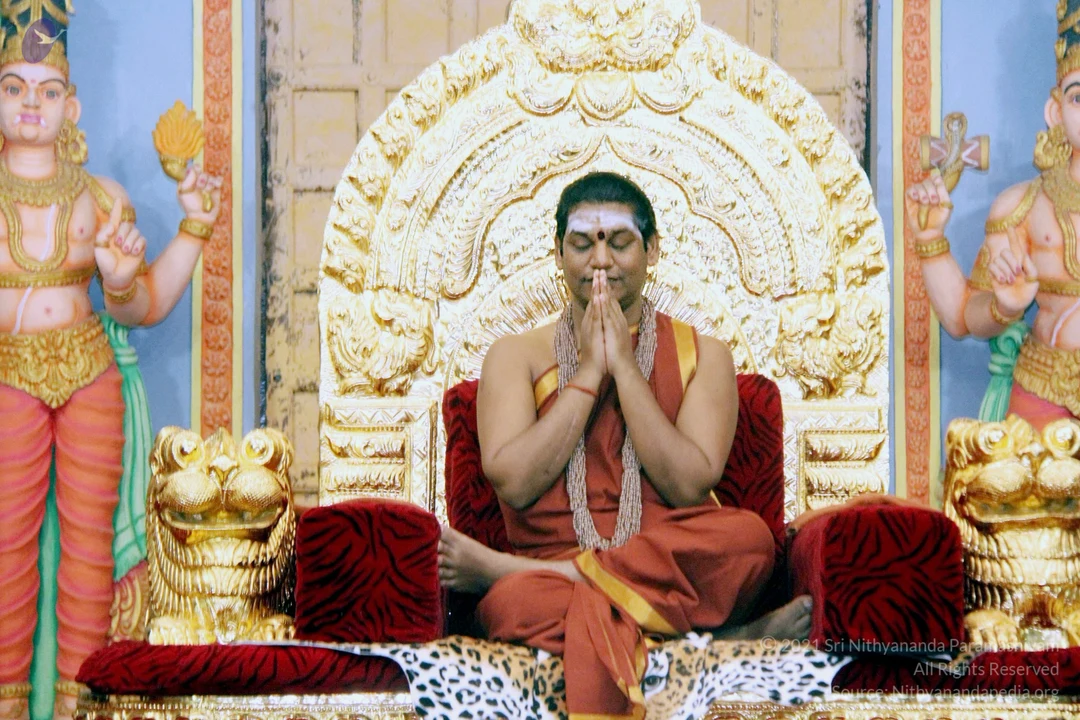
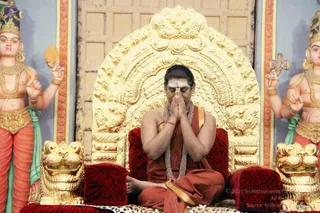
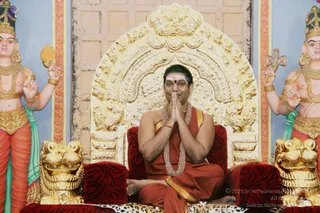
Nithya Satsang and Kalpataru Darshan
Tags:

Paramahamsa Nithyananda, responsibility, fruit, reality, Inner Awakening, science, future, inner space.

Photos Of The Day:

FB-Photos-of-the-Day

01-Rudrabishekam-Paduka-Puja

02-Satsang-Kalpataru-Meditation-Darshan

03-Swamiji-Visit-Armananda-Swami-Salem

02-Satsang

20140303_Photo_1000_20140303_IMG_356601

03-Swamiji-Visit-Armananda-Swami-Salem

Photos from this day

View all 98 photos

Rudra Abhishekam and Pada Puja

2 photosSource gallery
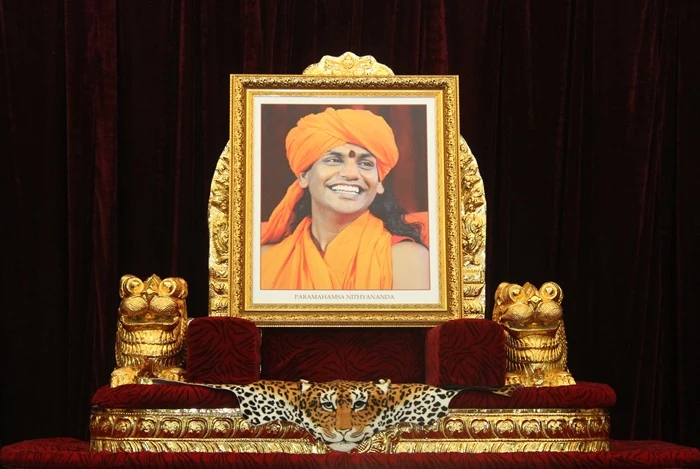
A photograph of a large group of young and adult monks in saffron-orange robes seated cross-legged on low metal platforms in a temple hall. Most have white sacred ash marks on their foreheads. Several hold tall brass cone-shaped vessels and pour liquid, while others hold small brass pots and bowls set before them. Some monks wear rudraksha malas. No figure is clearly identifiable as a person from appearance cues, and the foreground seated monk is a participant in the ritual.A ceremonial throne display in a red velvet setting. A large gilded framed portrait of a smiling man in an orange turban and orange shawl sits on the throne seat, with a caption plate reading PARAMAHAMSA NITHYANANDA. Two gilded lion-head armrests flank the seat, and a spotted leopard-skin rug lies across the front of the throne. No physical people are visible; the figure appears only in the printed portrait.

Nithya Satsang and Kalpataru Darshan
2 photosSource gallery
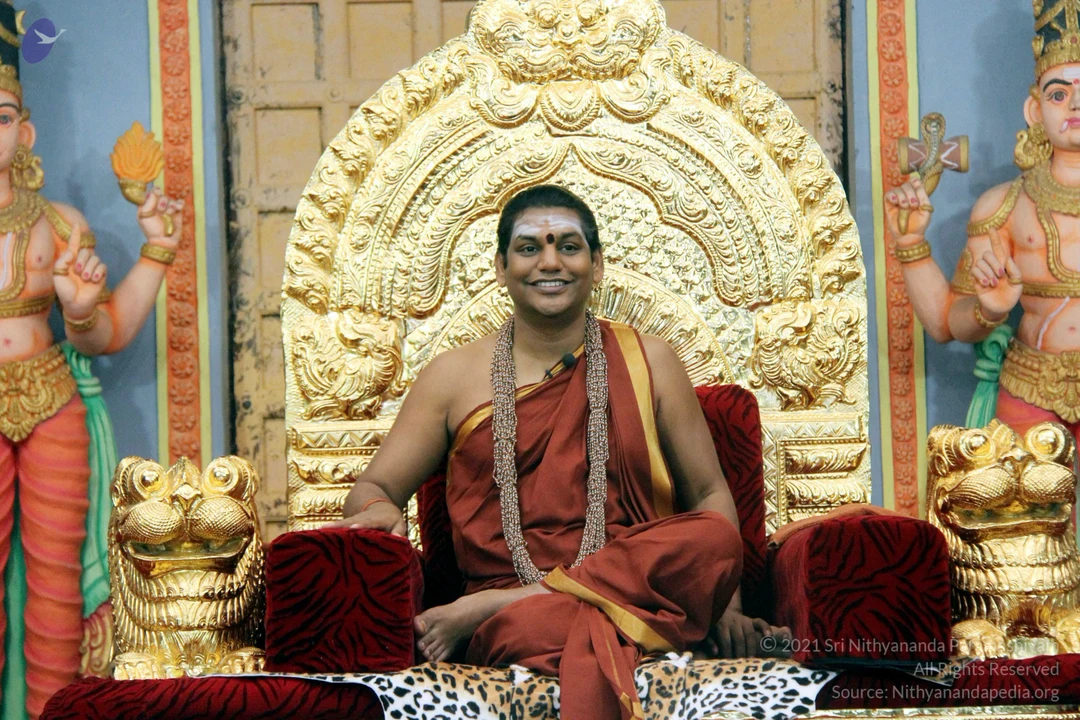
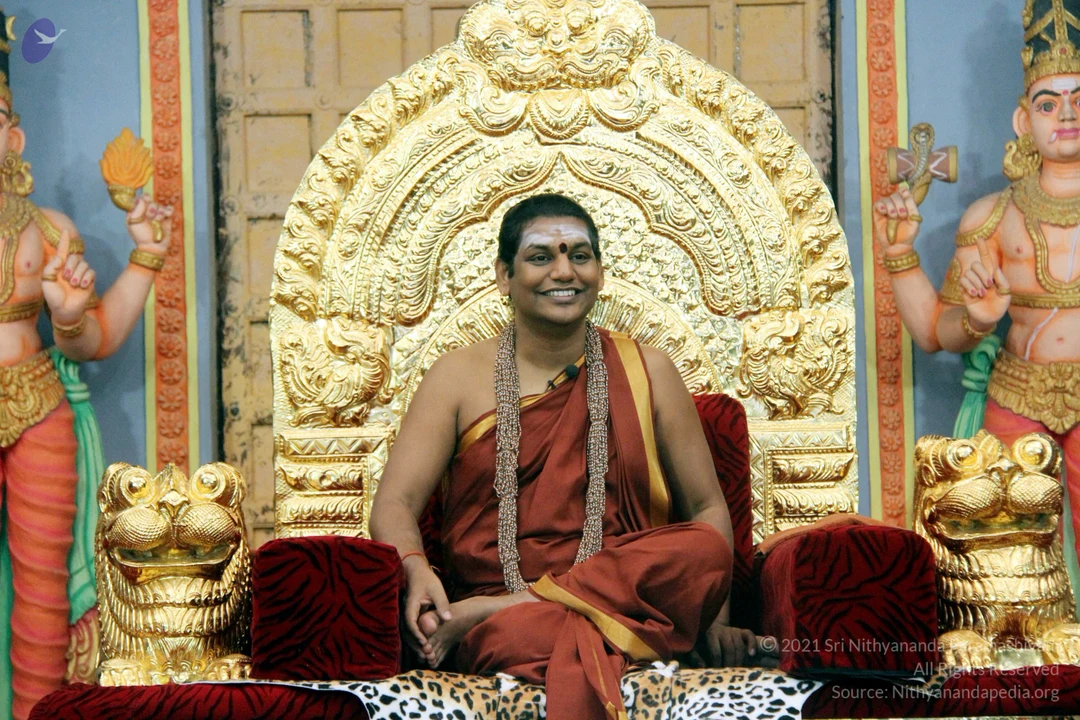
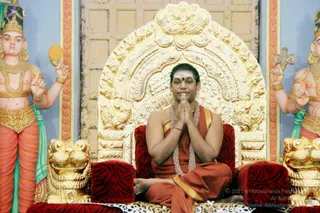
A smiling man with a shaved head and a vertical tilak on his forehead sits cross-legged on an ornate gold throne with a carved arched back and red velvet cushions. He wears a rust-red saffron robe with a gold-edged shawl and a long necklace of rudraksha beads. His hands rest together in his lap. Two carved gilded lion figures flank the throne, and painted deity statues with bare torsos, gold armlets and holding ritual implements stand on either side against a pale blue and gold wall.A photograph of a large screen showing a live video link labelled "SAN JOSE MADURAI" at the top and "San Jose-Madurai" at the bottom. In the foreground a man in a white dhoti-style garment with a bare upper torso and a dark rudraksha-style mala stands beside a woman in a dark top with a red bindi, her palms pressed together in namaste. Behind them a seated congregation fills a hall with a red-curtained shrine holding deity murtis, a red canopy and a kalasha-like altar. The man's identity cannot be confirmed from appearance here, so he is described by role only.

FB-Photos-of-the-Day

1 photoSource gallery
Close-up photograph of a hand gripping a small hourglass-shaped damaru drum with a white drumhead and black rim, its two wooden beads hanging from cords. The hand is resting on a red upholstered seat with dark brown tiger-stripe pattern, and a gold-coloured fabric and a gold bangle appear at the edges. No person's face or full body is visible, and no one else is in the frame.

01-Rudrabishekam-Paduka-Puja
13 photosSource gallery
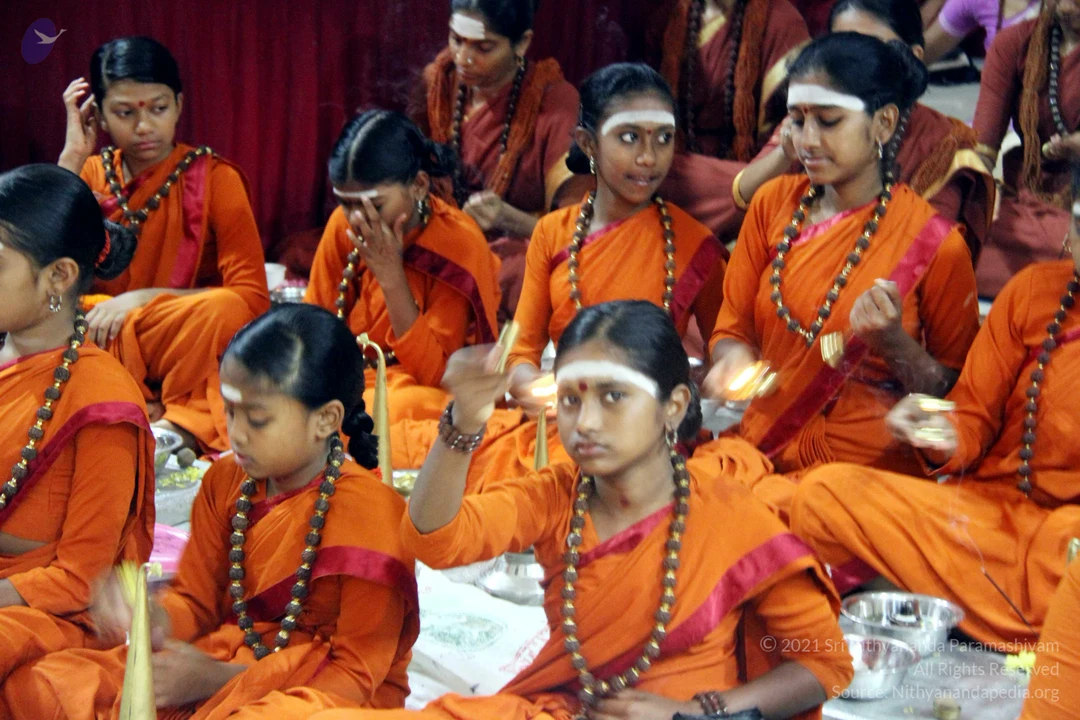
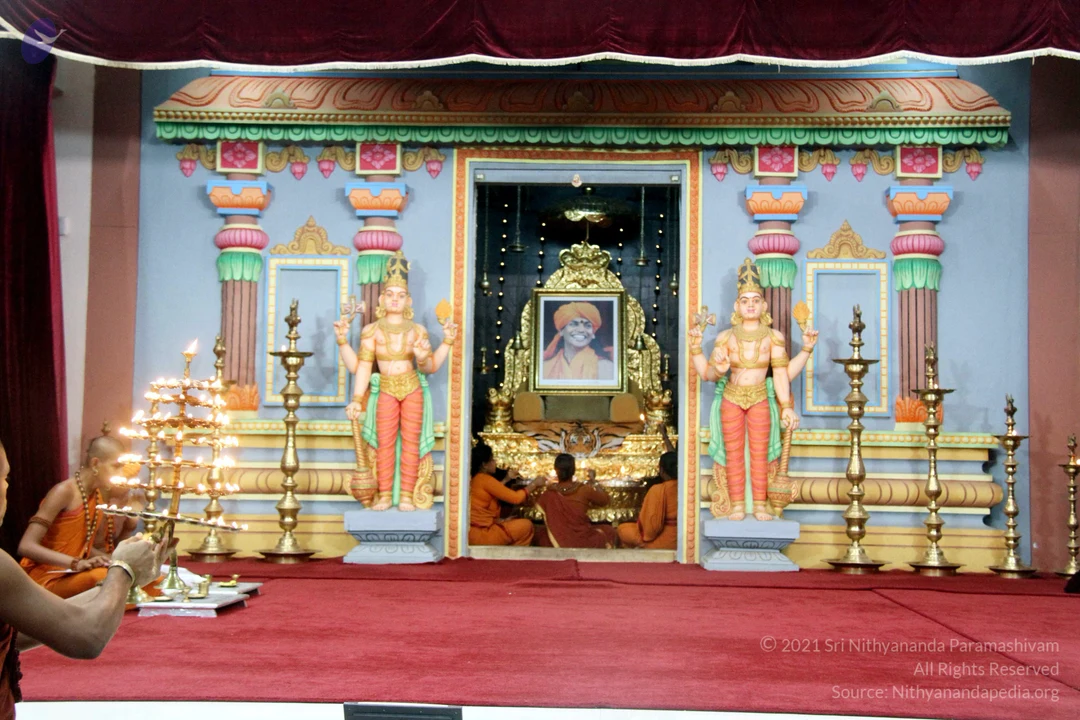
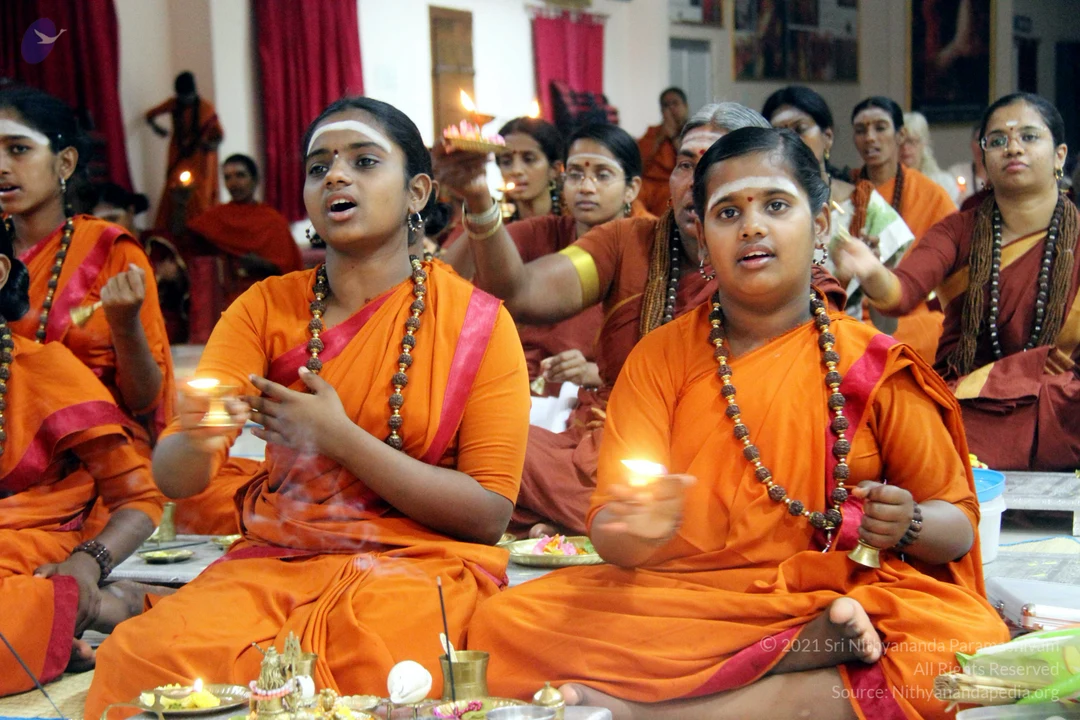
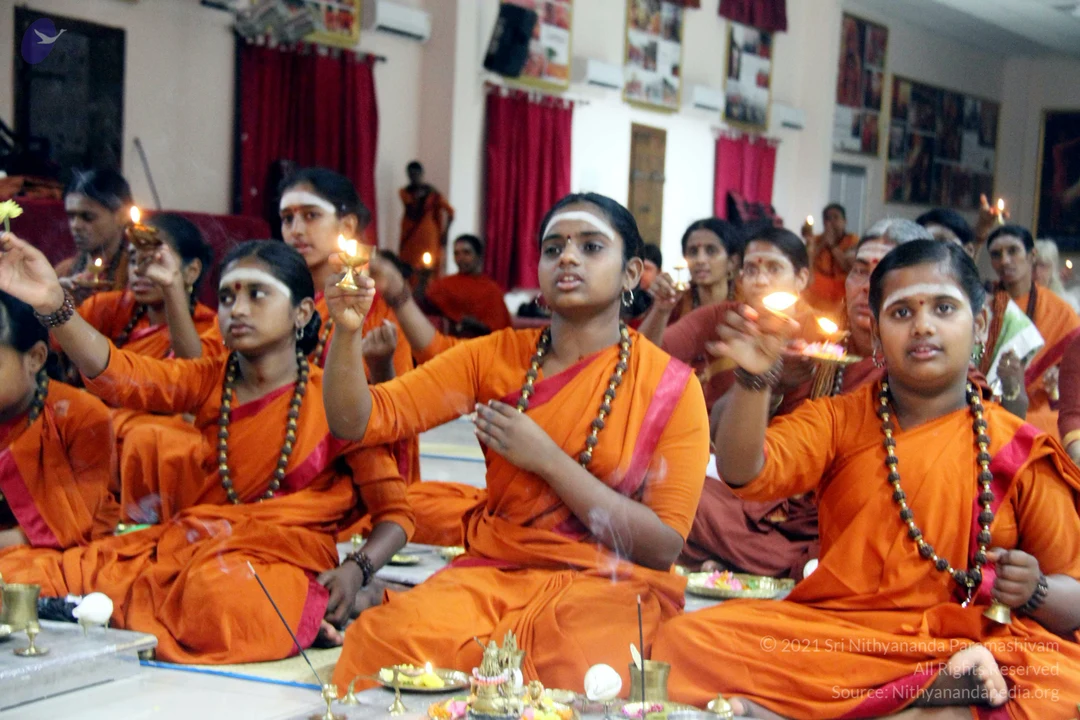
An empty ornate golden throne (peetha) with red velvet cushions and a leopard-skin cloth draped across the seat, flanked by two gold lion sculptures, set against deep red velvet drapery. Above the throne hangs a framed portrait labelled "PARAMAHAMSA NITHYANANDA" showing a smiling man with an orange turban, orange garments and a red bindi. No people are physically present in the scene; the portrait is a printed depiction.A photograph of a stage draped with deep maroon velvet curtains and a red carpet. Centre stage stands an empty golden throne (peetha) with a red cushion and carved lion-head armrests, set in front of a framed painted portrait of a smiling figure in a saffron turban and saffron robe. Two saffron-robed sannyasis sit cross-legged on the left side of the stage reading from yellow books, while a third man in white ritual dhoti and shawl with rudraksha beads sits beside them. Ceiling lights and a circular fixture are visible above.A photograph of a large group of young and adult sannyasis seated cross-legged on the floor in a hall with red curtains and framed photographs on the walls. The foreground monks wear saffron-orange robes with red sashes and white tilak marks on their foreheads; several hold long golden cone-shaped vessels to their mouths or lips while others handle silver bowls, pots and a small brass lamp on low metal trays. Bare-headed and bald-headed monks sit in rows behind them. The scene appears to be a ritual abhishekam or puja. No individual is identified as a person.Photograph of a ritual abhishekam in a hall with red curtains and wall posters. Rows of young saffron-robed boys and men sit cross-legged on low silver stands, each holding a tall brass cone-shaped vessel and pouring liquid from steel pots and bowls arranged before them. Several have white vibhuti or tilak marks on their foreheads and wear rudraksha malas. A shaved-headed man in red-and-orange robes and glasses sits near the front left. Metal bowls, a brass puja lamp and vessels fill the floor in front of them.A photograph of a large group of young boys and teenagers seated on the floor in an ashram hall, performing a ritual. Most wear saffron-orange cloth with rudraksha malas and white or ash tilak marks on their foreheads. Each sits before a small set of silver or steel bowls and a brass kalasha-style pot, holding long brass horn-shaped vessels. Some boys wear red or pink dhotis. A small framed deity murti sits at the lower left among the offerings. Behind them, rows of other participants are seated, and a few adults in white clothing appear at the right edge. The setting is a tiled hall with a floral-patterned floor mat.A group of women and girls in orange and maroon robes sit on mats during a ritual, each holding a long golden horn-shaped vessel to their mouth or lips. Many wear rudraksha malas and white forehead markings, and several have bindis. Steel bowls, small pots and brass dishes with offerings sit before them. The scene resembles a Rudrabishekam ritual with a Paduka Puja setting, though the individual roles are not clearly visible.

02-Satsang-Kalpataru-Meditation-Darshan
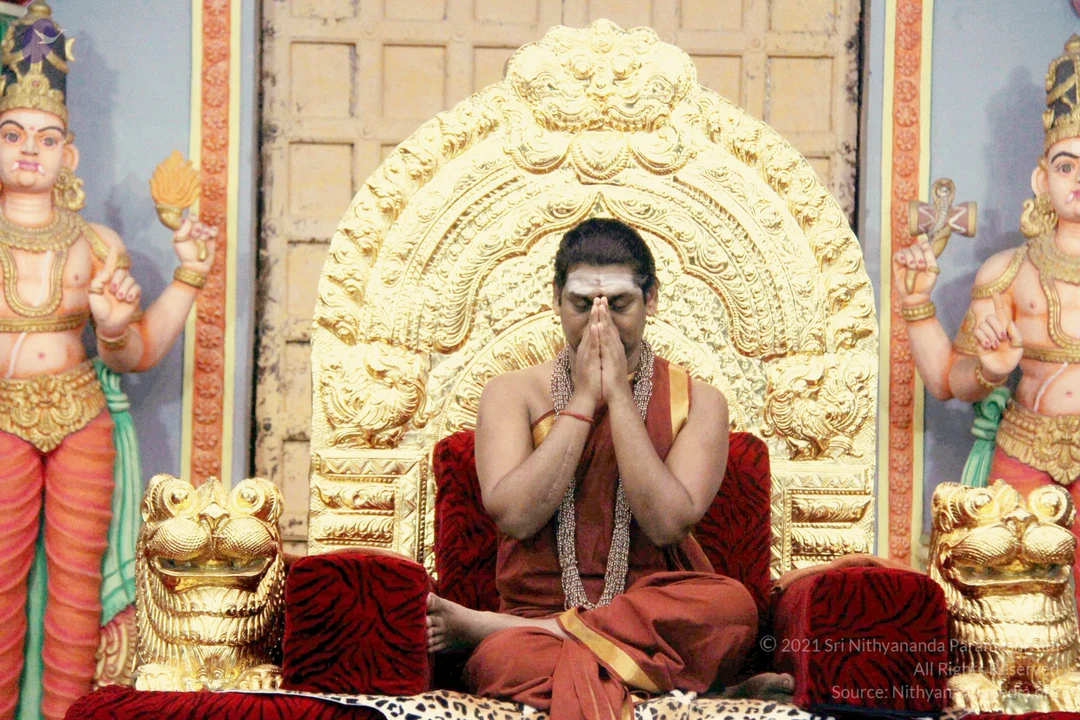
26 photosSource gallery
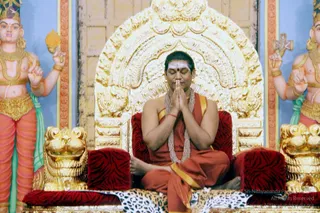
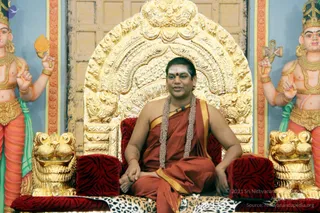
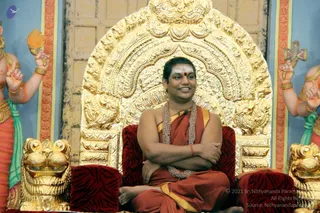
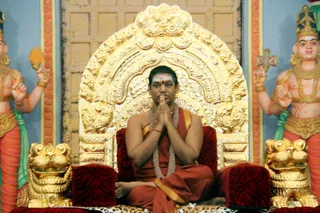
A seated man in saffron-orange robes sits cross-legged on an ornate golden throne with red cushions and gold lion-head armrests. He has palms pressed together in namaskar, eyes closed, a white vertical tilak on his forehead, and a silver beaded necklace over his chest. Flanking the throne are two painted standing deity murti figures with gold crowns, jewelry and raised hands holding a flame and a trident-like object. Behind is a carved wooden door. Appearance-based candidate: a person, seated on the peetha with the cues of saffron-orange robes, silver rudraksha-style mala and ceremonial throne setting.A seated man in orange-saffron robes sits on an ornate gold throne with a red velvet cushion, hands pressed together in anjali namaskar. He wears a pale rose-quartz style mala necklace and a red bindi with a white forehead marking. Flanking the throne are two painted deity dvarapala statues with multiple arms, gold crowns and jewellery, holding objects; gold lion-form armrests sit at the base. A satsang-style stage setting with a tiger-striped red cushion and leopard-print floor covering.A man seated cross-legged on a red and gold throne with a large ornate golden arched backrest, hands pressed together in namaskar. He wears an orange-saffron dhoti with a gold-edged shawl, a white-and-pink beaded mala necklace, and a red tilak on his forehead. Flanking the throne are two painted deity murti statues with raised hands, gold ornaments and crowns, and gold lion-shaped armrests on red tiger-striped cushions. A leopard-print cloth covers the dais. a person: the seated man has short dark hair and a rudraksha-style mala, with saffron clothing and a ceremonial throne setting.A seated man in saffron-orange robes sits on a red velvet throne with gold lion-faced armrests and a gilded arched backrest, palms pressed together at his chest with eyes closed. A white-and-gold-bordered orange shawl drapes over one shoulder, a beaded white mala hangs at his neck, and a red bindi and white forehead markings are visible. Two painted deity statues in gold jewellery stand on either side, one holding a lotus-shaped lamp and the other a trident-like staff. A leopard-print cloth lies beneath the throne. The setting appears to be a temple satsang hall.A seated man in an orange-red ochre robe with gold-yellow borders and a long rudraksha mala with a silver-toned necklace sits on an ornate gold throne with red velvet cushions and a leopard-print cloth beneath. He wears a tilak and red bindi, and his hands rest on his knees as he speaks. Golden lion-faced armrests flank him, and gilded painted deity statues with raised arms, crowns and gold jewellery stand on either side against a wooden panelled backdrop. Appearance-based candidate: a person, seated on the throne in orange robes with rudraksha mala and ceremonial necklace.A man seated on an ornate gold throne with carved lion-head armrests and red velvet cushions, smiling with arms folded. He wears a rust-orange dhoti and matching shawl, a silver-beaded rudraksha-style mala, a red bindi and white forehead markings, and a red wrist thread. Behind him are large painted deity figures with multiple arms holding a flame and a conch-like object, and a carved golden back panel on the throne. Appearance-based label: a person, with long swept-back hair and ceremonial mala as cues, seated on the throne as the central figure in an in-person satsang setting.

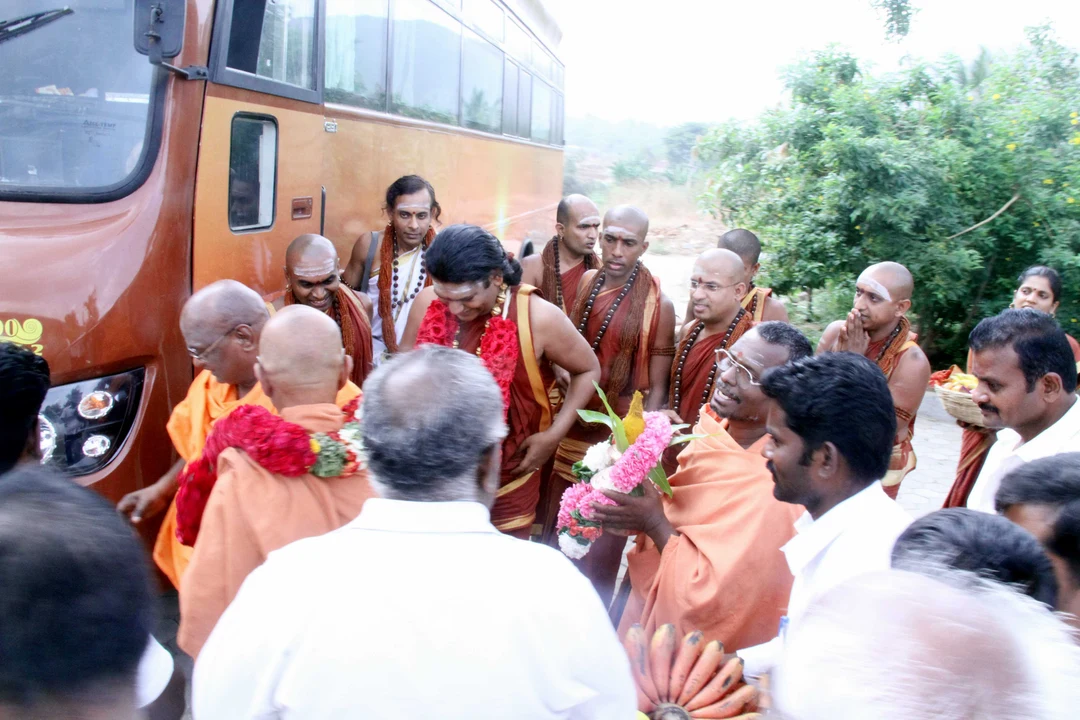
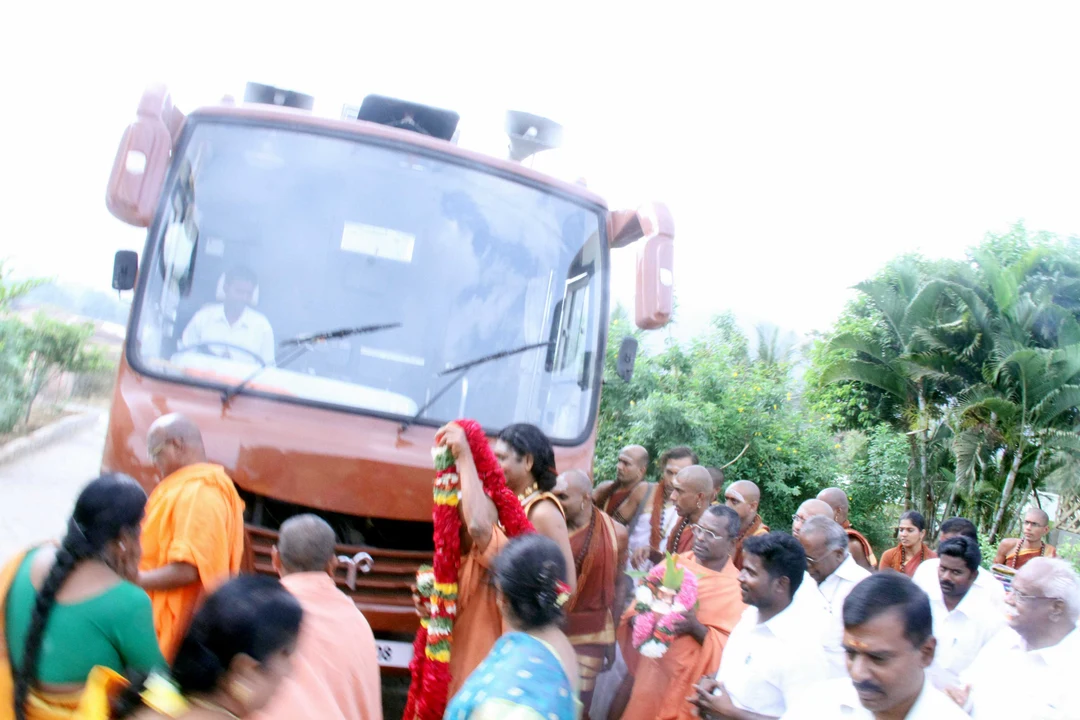
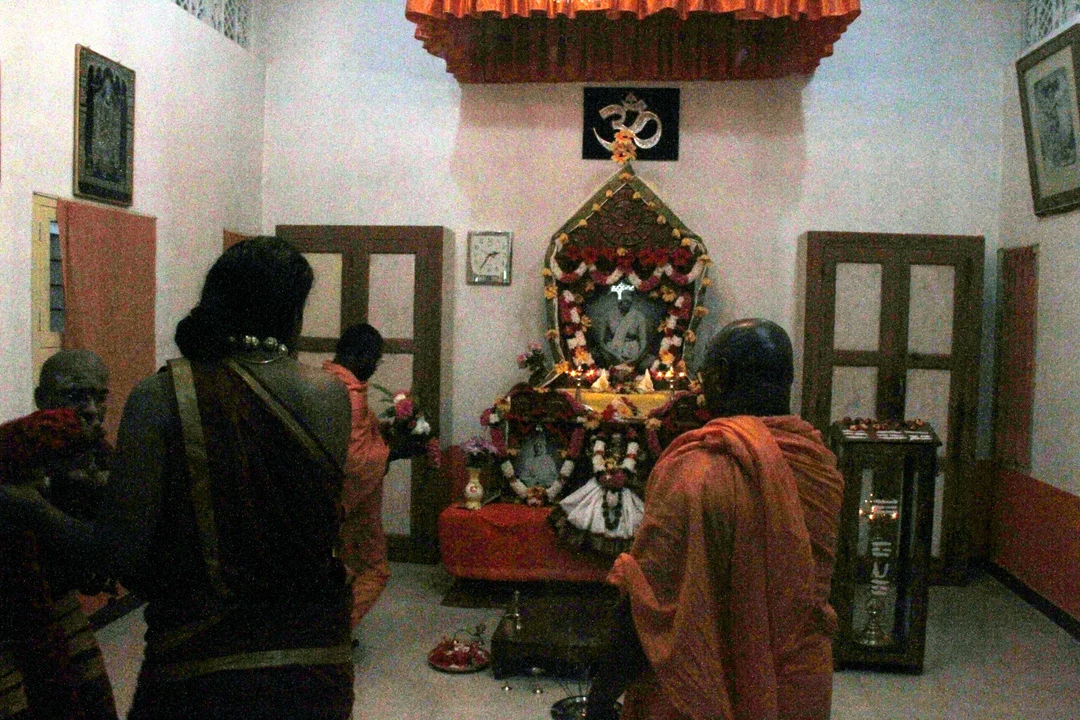
03-Swamiji-Visit-Armananda-Swami-Salem
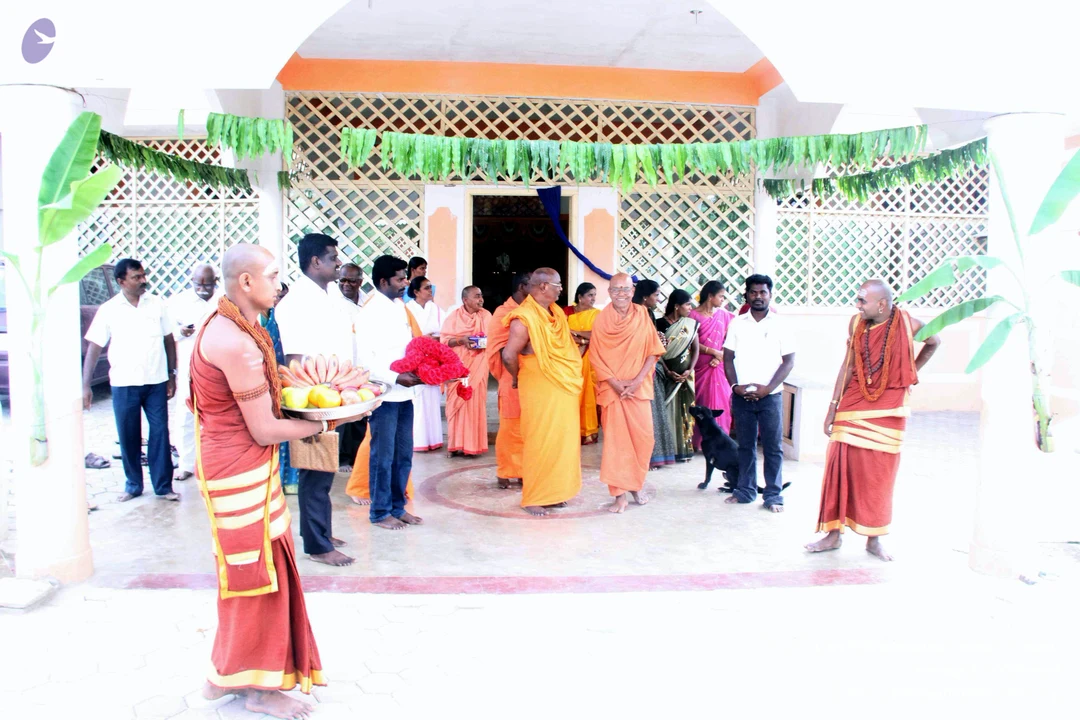
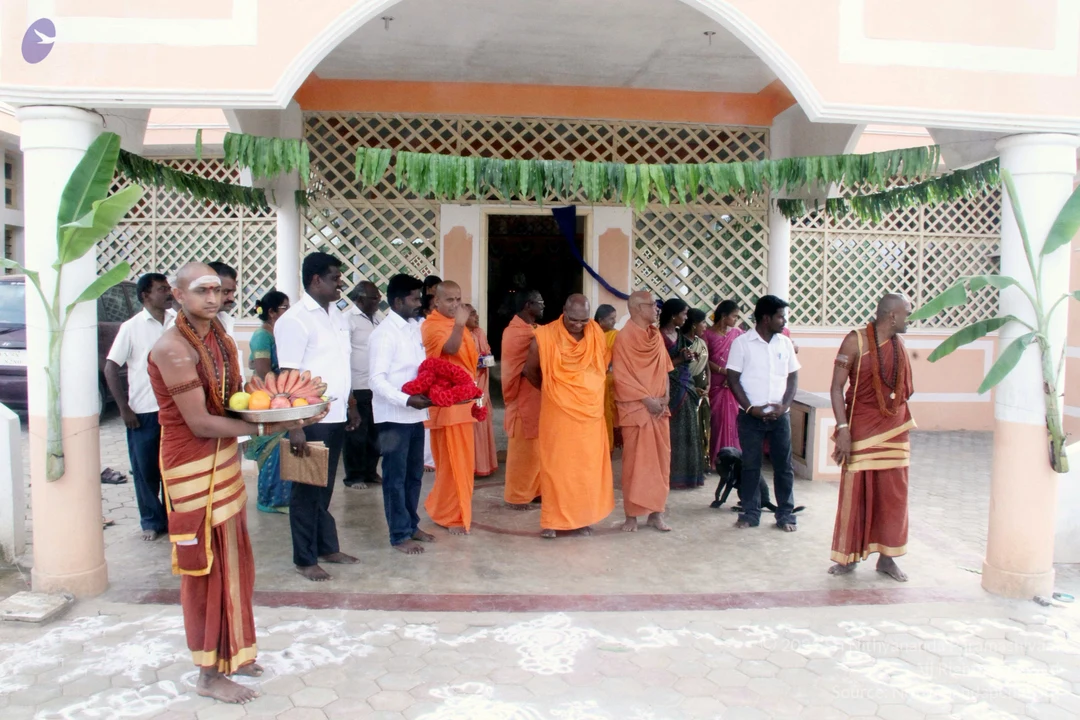
47 photosSource gallery
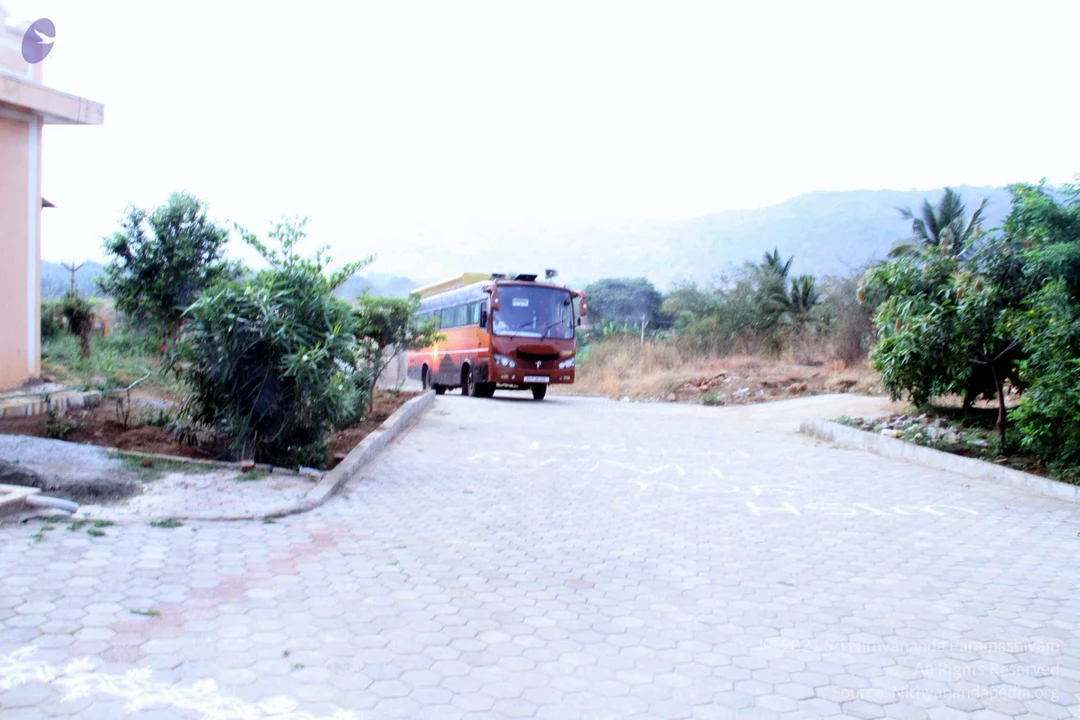
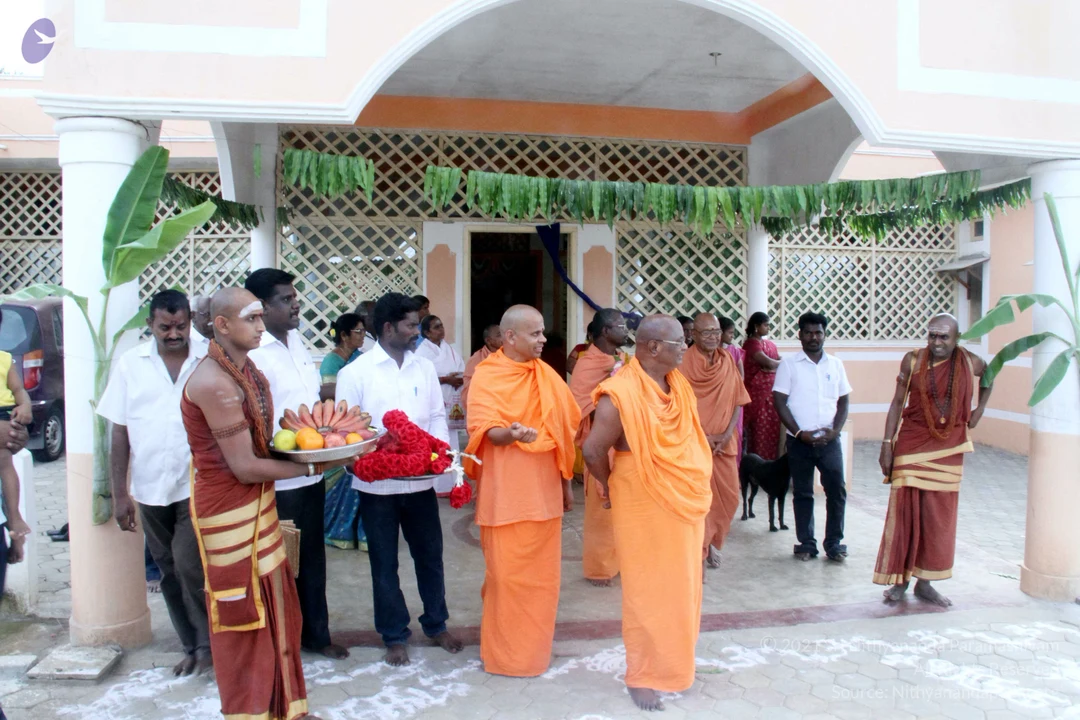
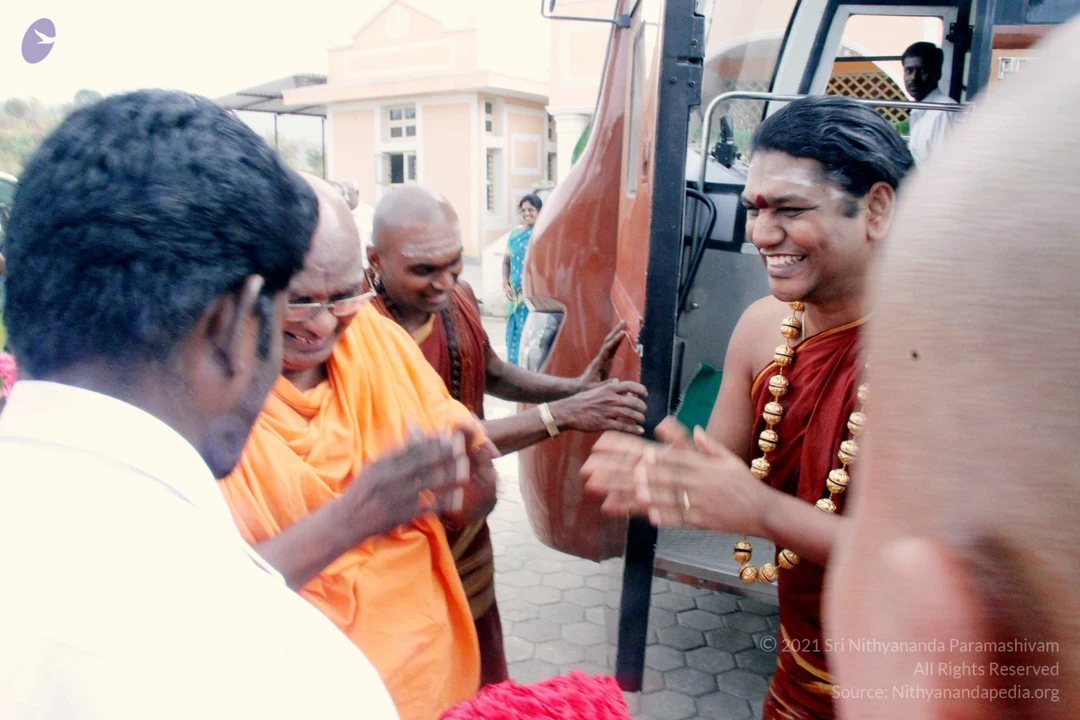
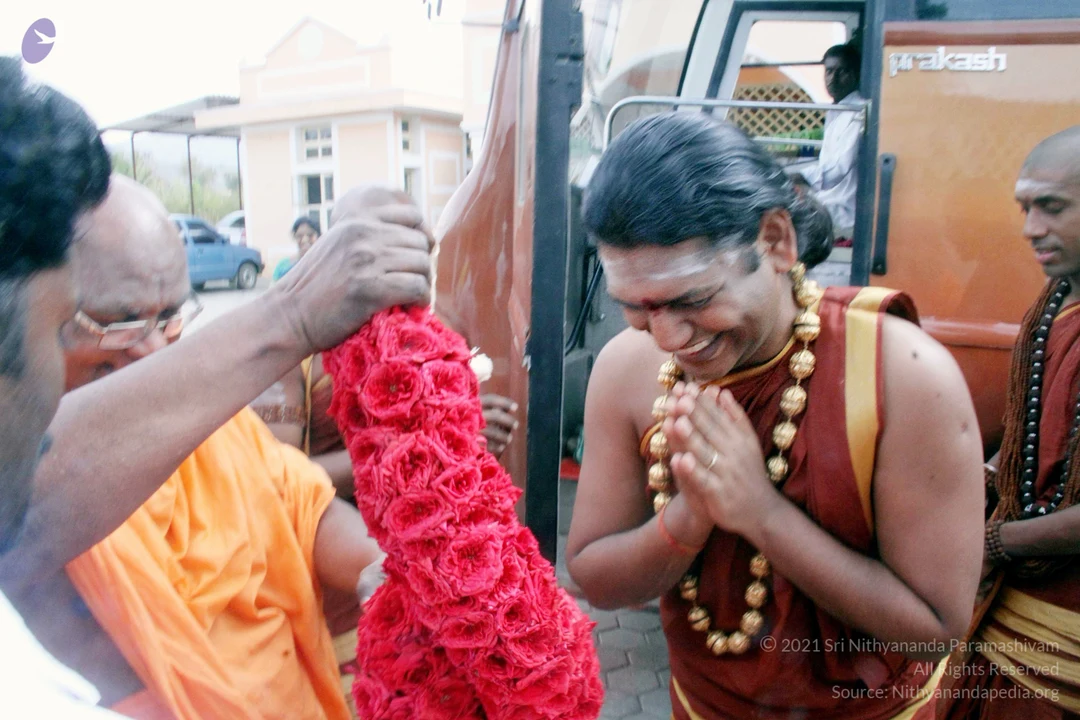
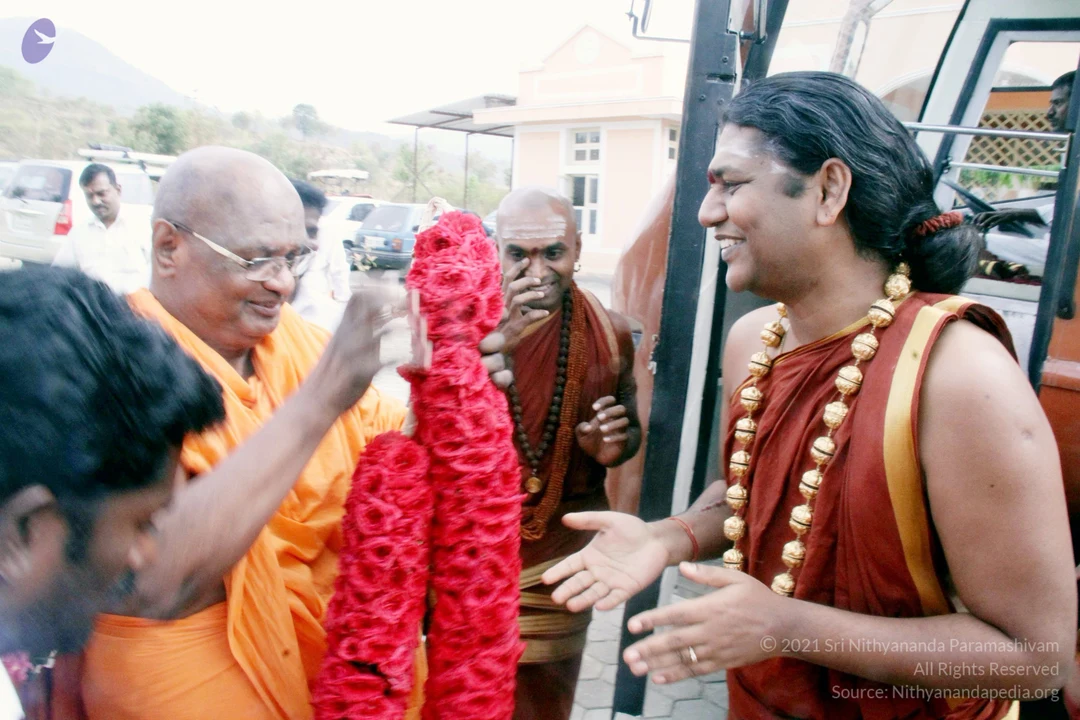
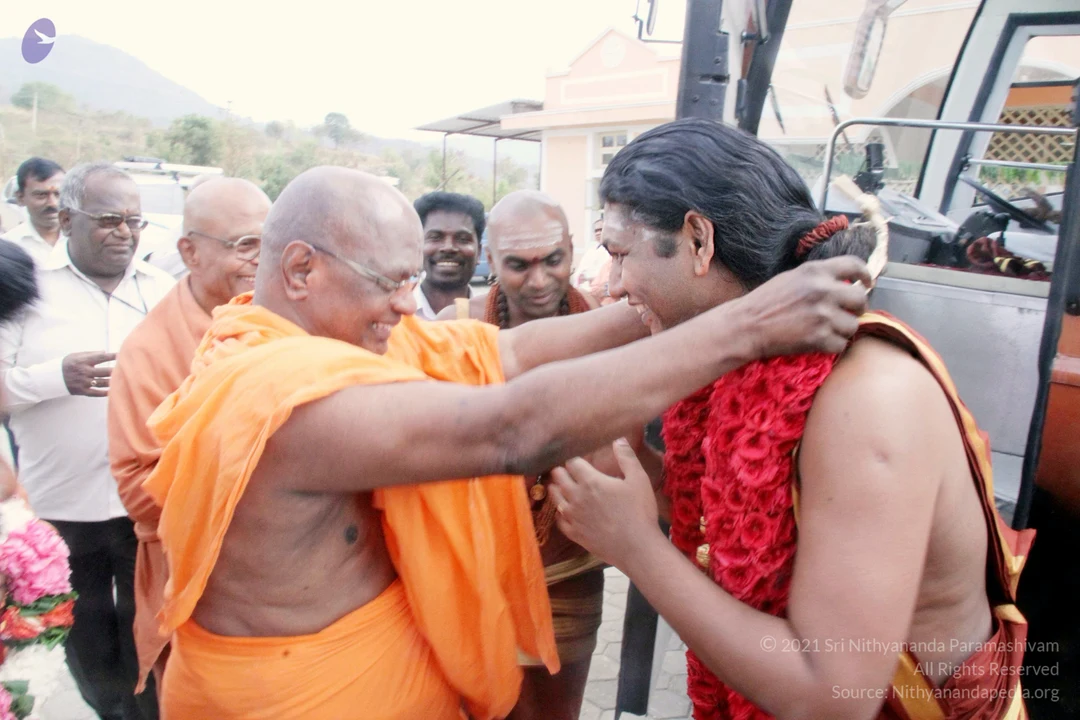
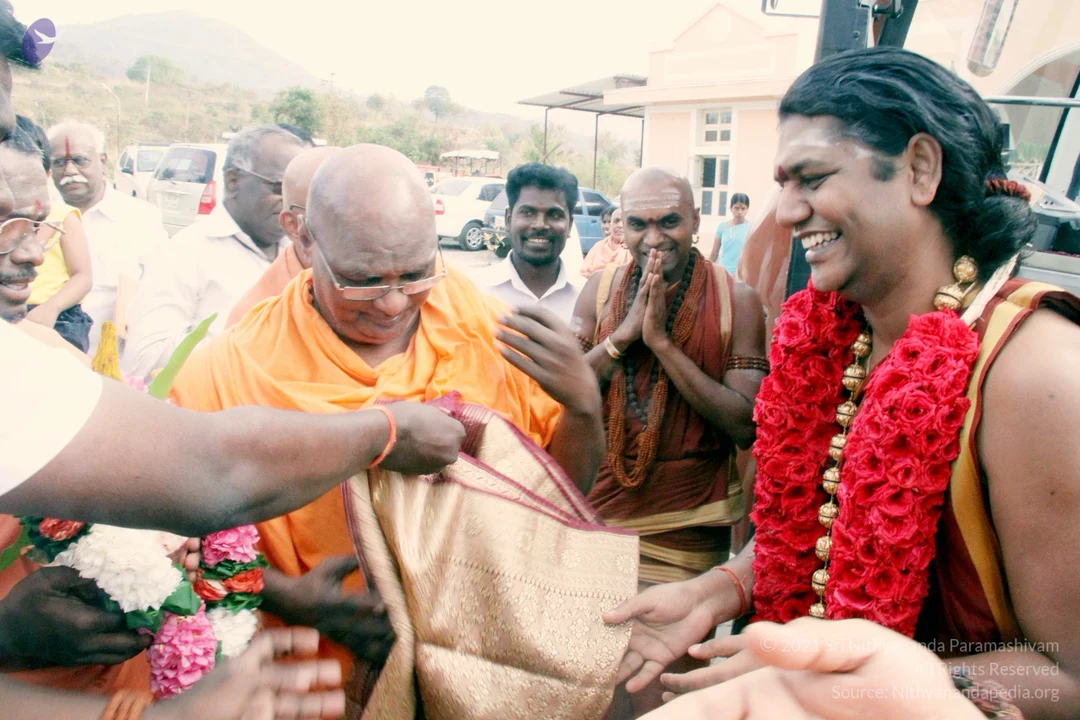
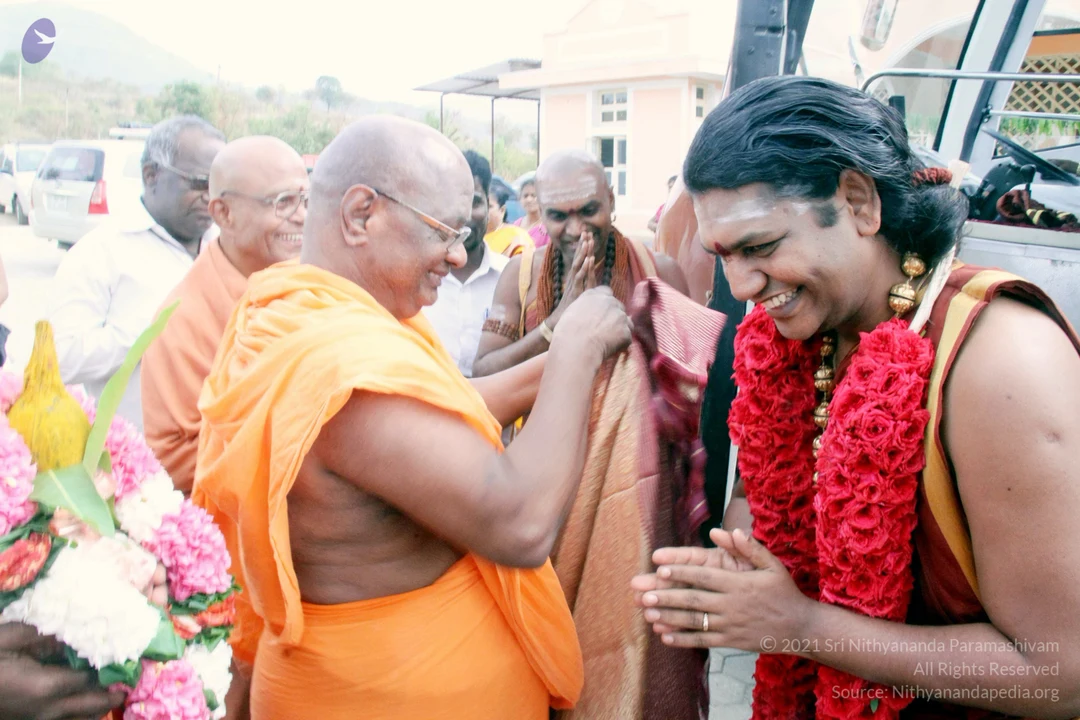
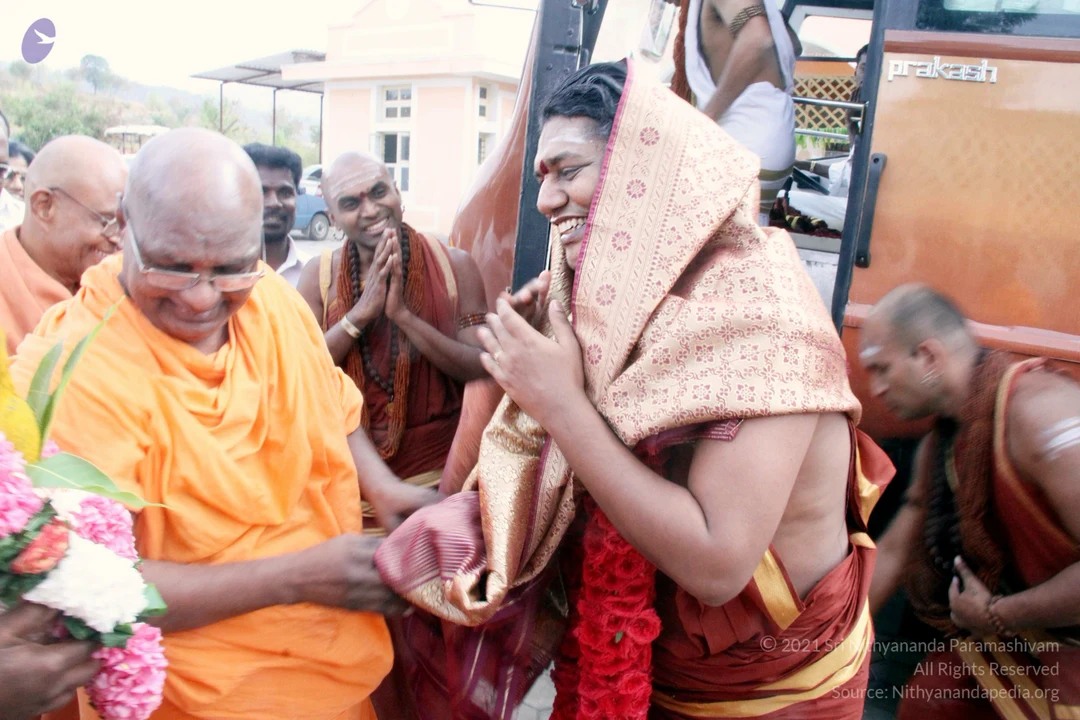
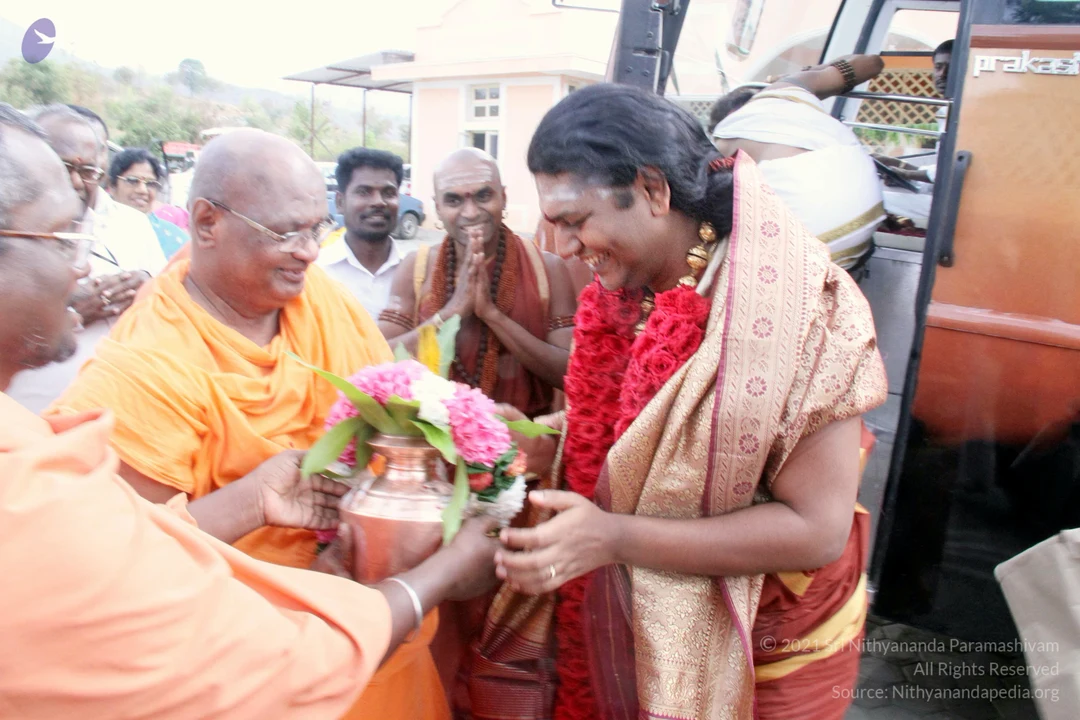
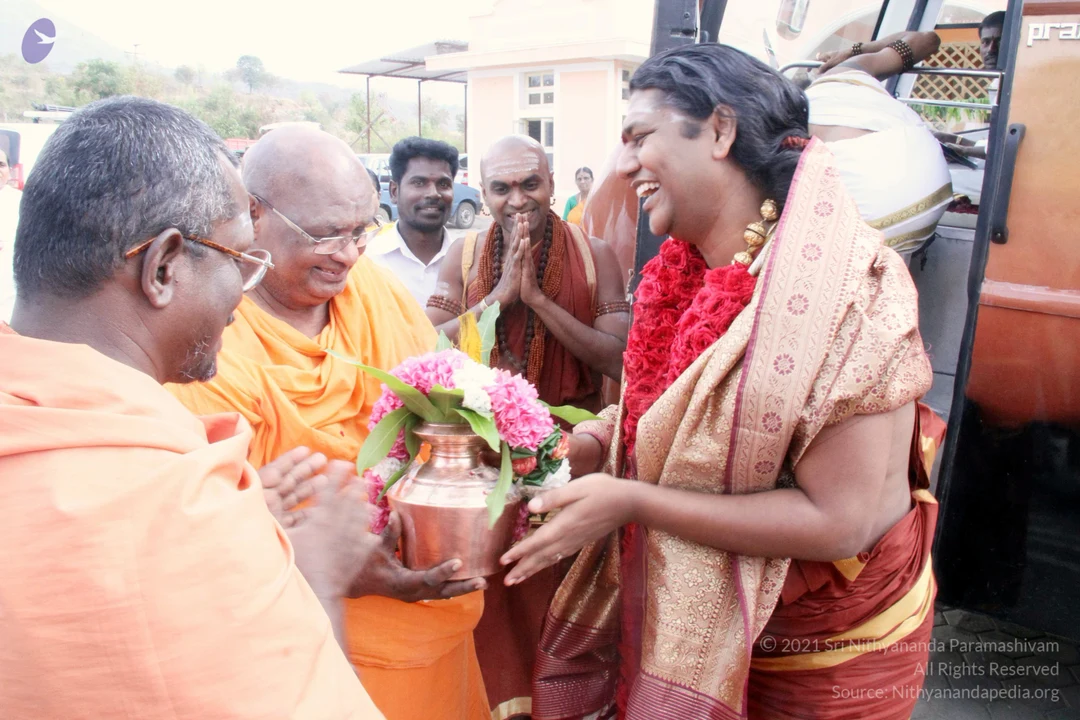
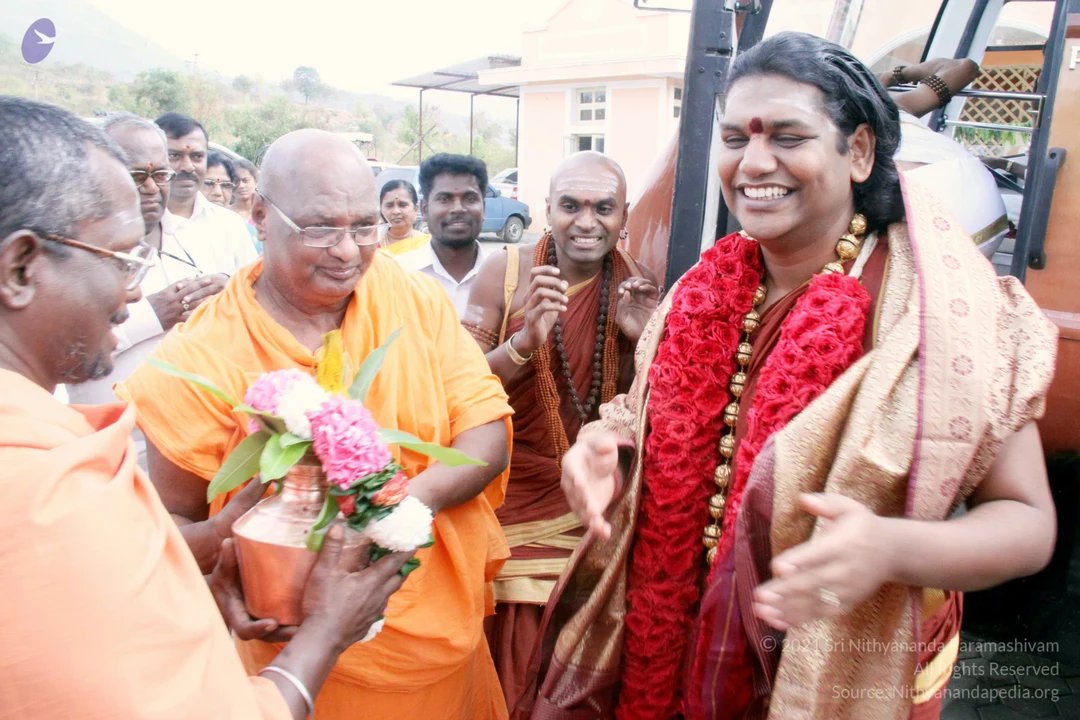
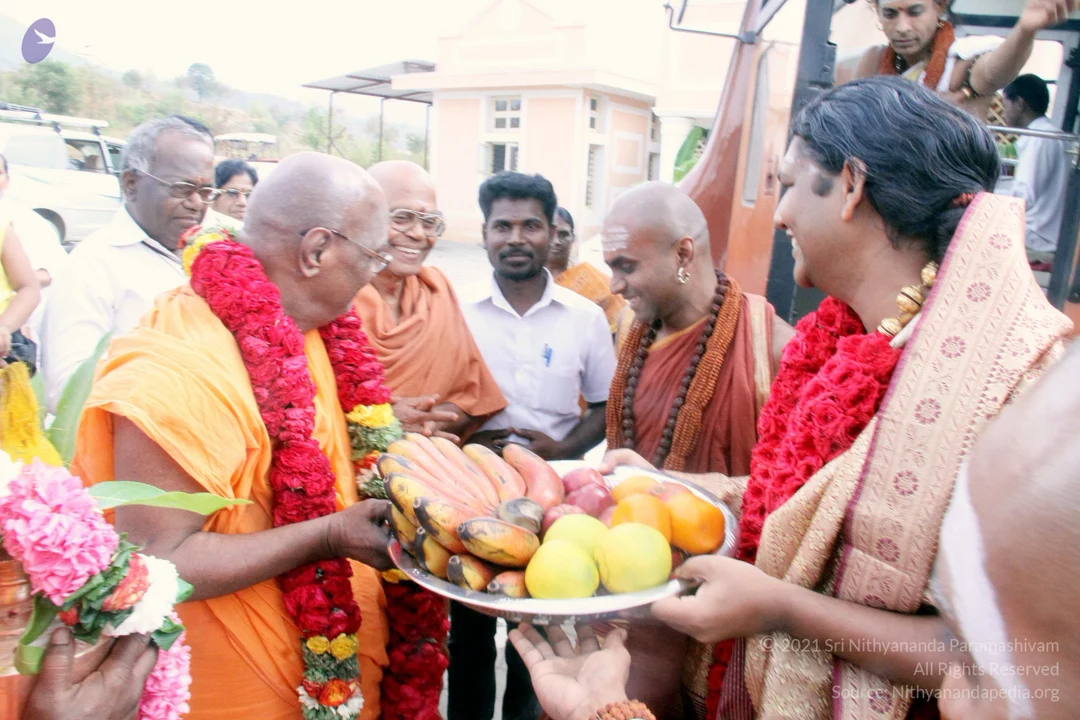
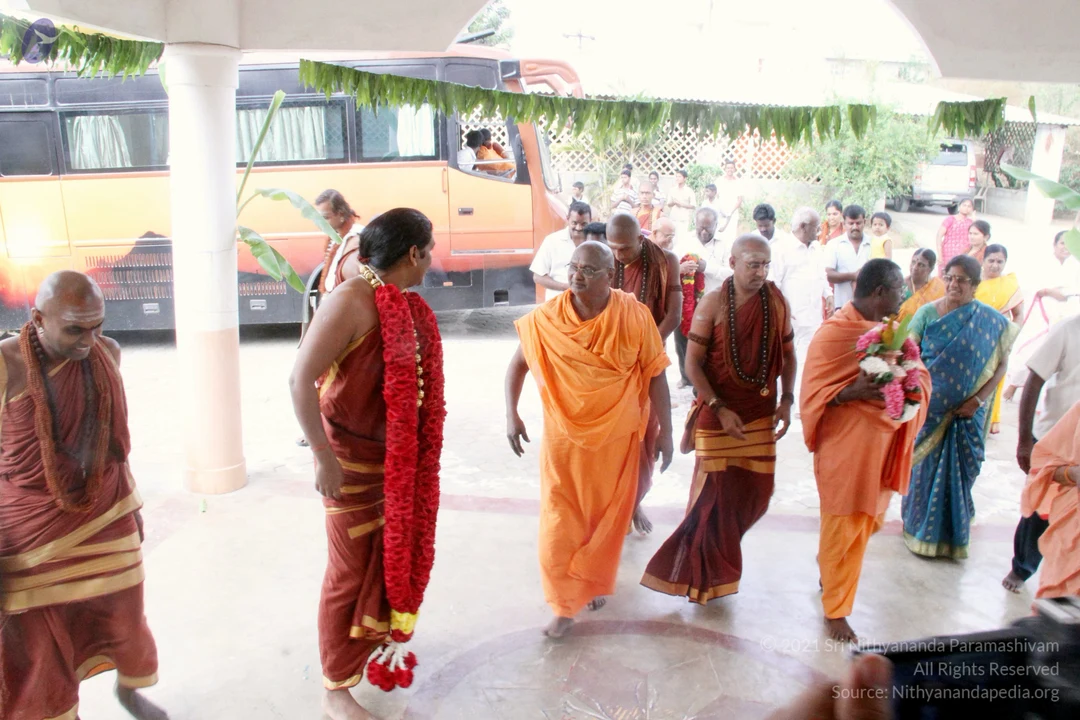
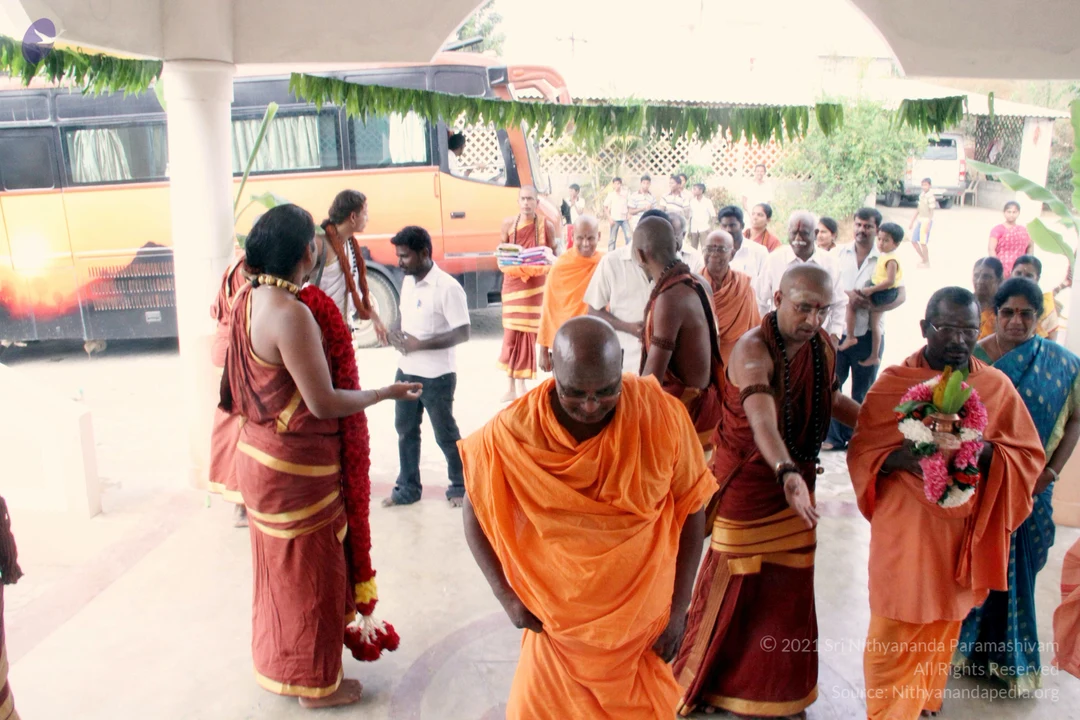
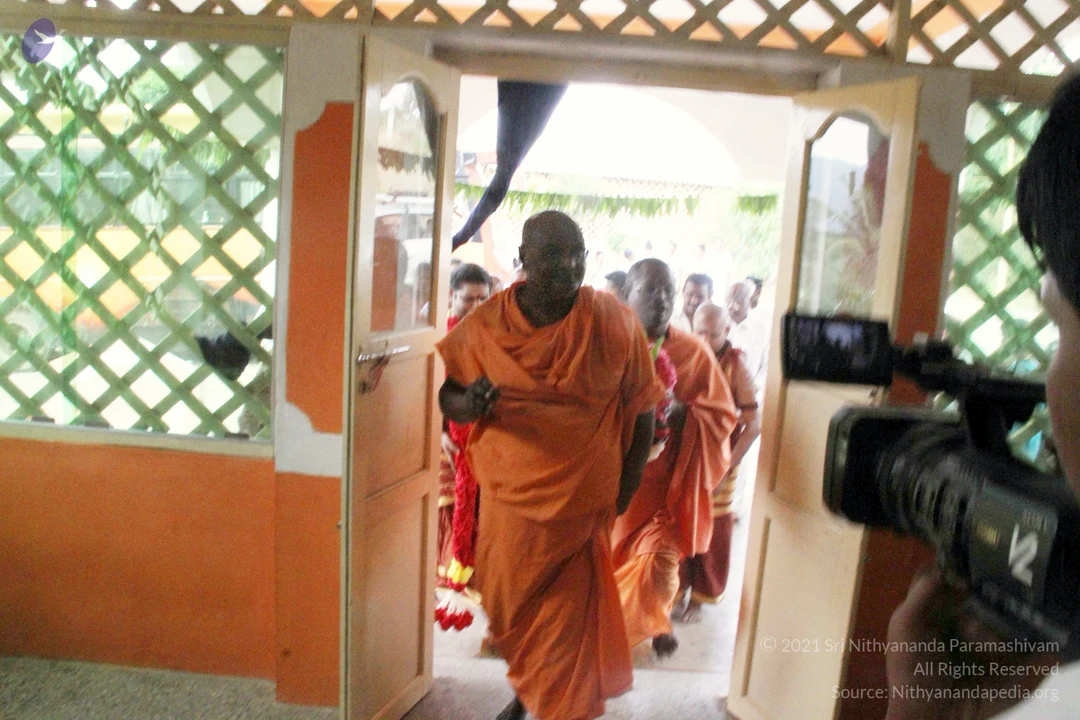
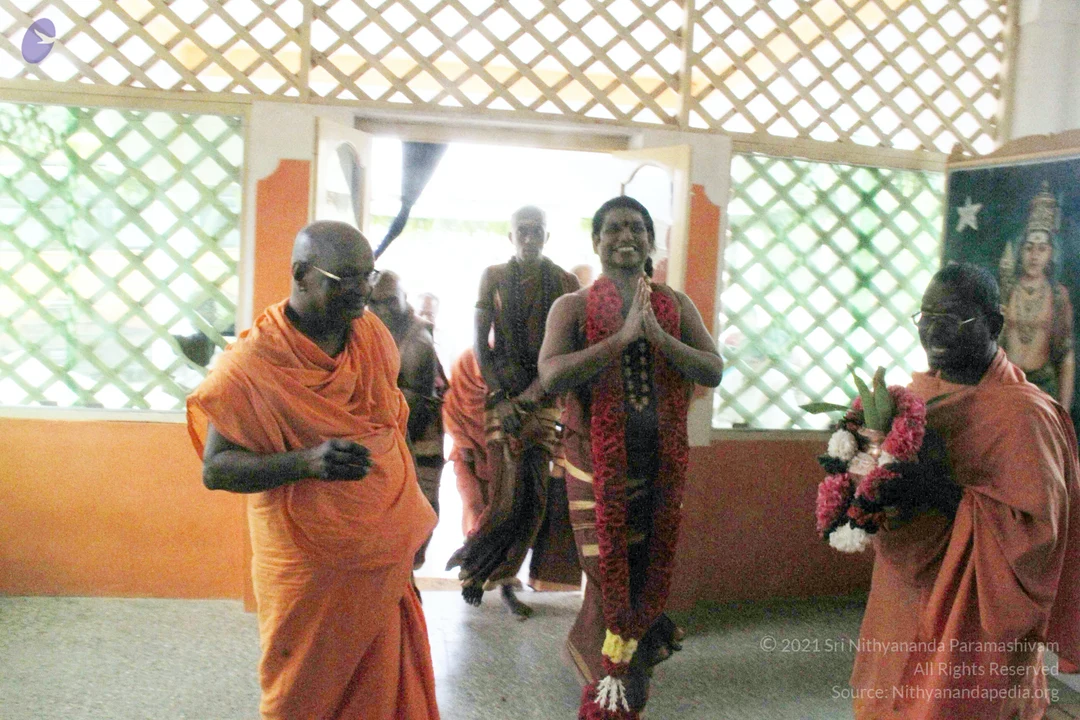
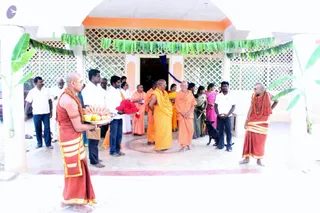
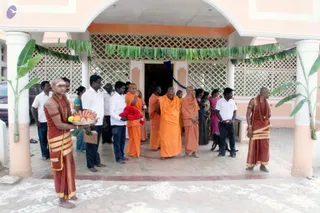
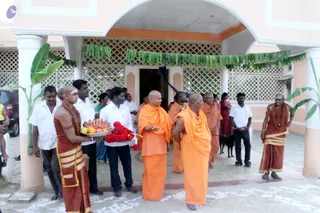
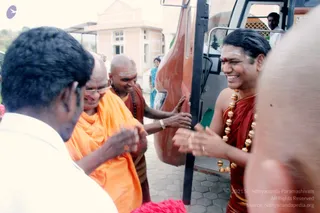
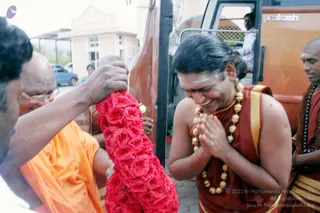
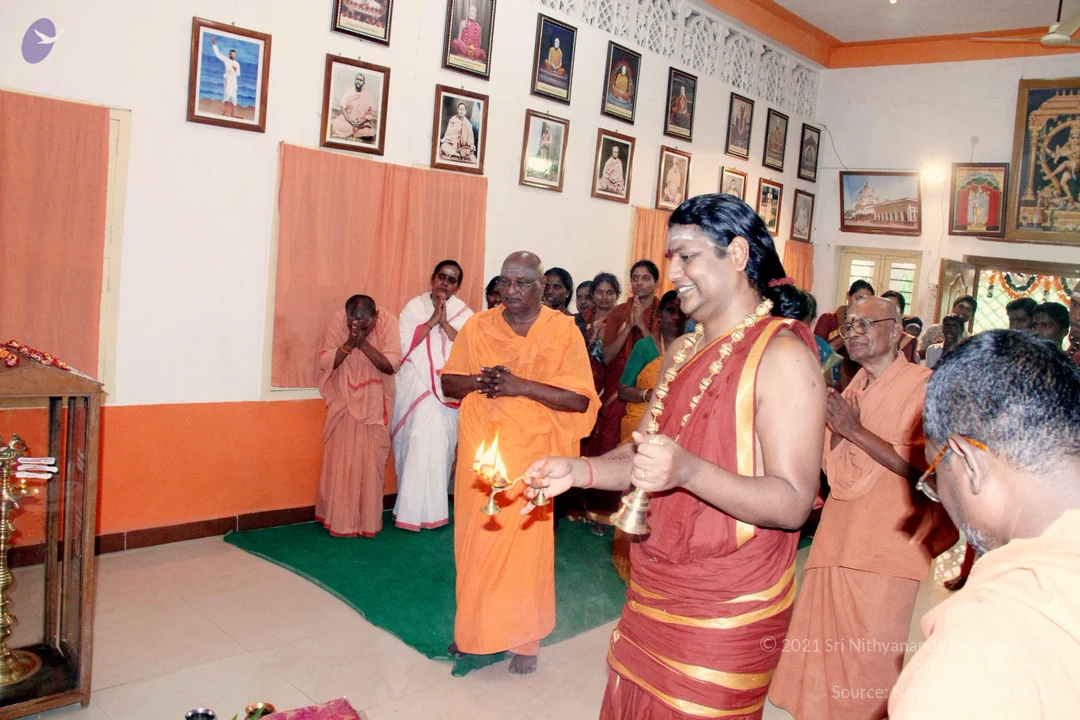
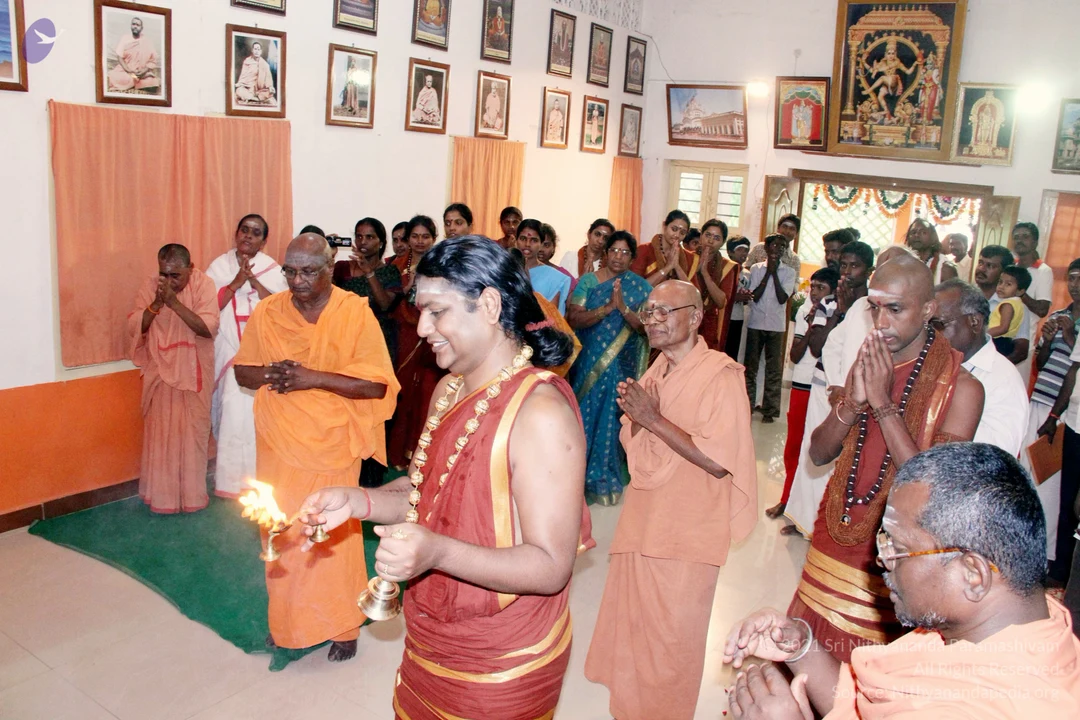
A photograph of a temple courtyard entrance with a lattice-screen wall, banana leaf festoons and banana plants at the sides. A bald priest in red-orange cloth with a yellow-striped border and a rudraksha mala stands at left holding a silver tray of bananas, yellow fruit and a red flower garland. Standing in a group in the centre are several monks in saffron and orange robes, and a man in a white shirt and dark trousers. Women in saris stand behind them. At right another priest in red-orange cloth with a rudraksha mala stands on a patterned floor, and a black dog is visible near the group.A photograph of a temple or ashram entrance decorated with fresh banana-leaf garlands and potted banana plants. A priest in red-brown dhoti with gold border, bare-chested and wearing rudraksha mala and white tilak, holds a silver tray of fruit at the left. Beside him, a group of saffron-robed monastics stands on a tiled courtyard, with a man in white shirt holding a basket of red flowers. Further right, a second priest in red-brown dhoti with a mala stands near women in saris and men in white shirts. Several other devotees, including women in pink and green saris, stand under the arched veranda. Among the saffron-robed figures, one tall monastic with shaved head and orange robe may be a person, appearing in the centre of the group with a saffron shawl and mala.A photograph of a paved hexagonal-tile driveway curving through an ashram-like compound. A red-orange passenger bus with a cream stripe approaches from the far end, its windscreen facing the camera. A pale pink building wall stands at the left edge, with green shrubs, a palm and a mango-type tree at the right, and dry grass and low hills in the hazy background. No people are visible.A photo of a welcome gathering outside a pale pink ashram building with an arched portico, banana leaf and mango leaf festoons over the entrance, and banana plants flanking the steps. A bald priest in reddish-brown dhoti with white tilak on his forehead and bare upper body holds a silver tray of bananas, oranges and apples, with a red flower garland. Several saffron-robed sannyasis stand in a line, one in the centre with a shaved head and hands raised in greeting. Men in white shirts and dark trousers and women in saris stand nearby, and a black dog sits on the pavement. Ratha or pujari figures in reddish-brown dhotis complete the scene.Photograph of an outdoor arrival at a building with a pale pink facade. A smiling man with swept-back dark hair, a red bindi and a gold bead necklace of large ceremonial beads, wearing a red-maroon wrap, stands at an open vehicle door and claps hands with others. Beside him an older bespectacled man with a shaved head wears an orange-saffron robe and claps hands with a bald man in a maroon wrap. A man in a white shirt stands at the left edge with his back to the camera, and a red cloth is visible at the bottom. Two more people stand in the background near the vehicle.Photograph of a welcome at a vehicle door. A man in a saffron-orange robe on the left lifts a long garland of red roses toward a smiling man in maroon-red robes with a gold-bead necklace and a rudraksha mala, hands joined in namaste. A second saffron-robed man stands beside the vehicle, with a bald-headed man in a red robe at right. A brown and orange van with the word Prakash is behind them, and a building and parked cars are visible in the background.

03-Swamiji-Visit-Armananda-Swami-Salem
6 photosSource gallery
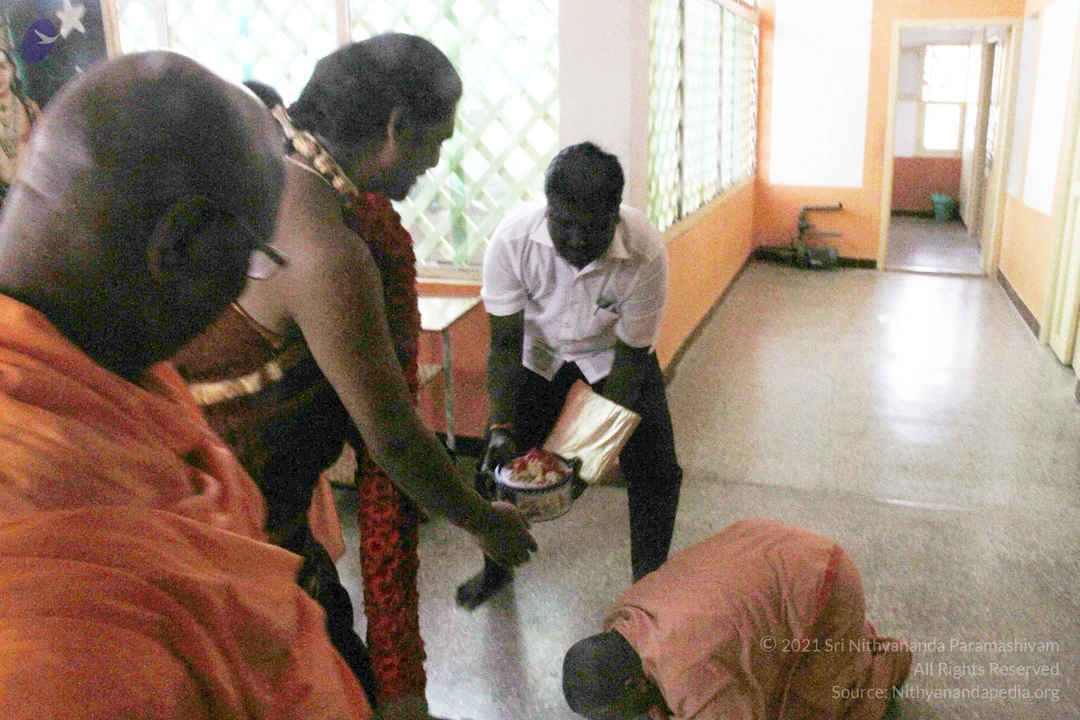
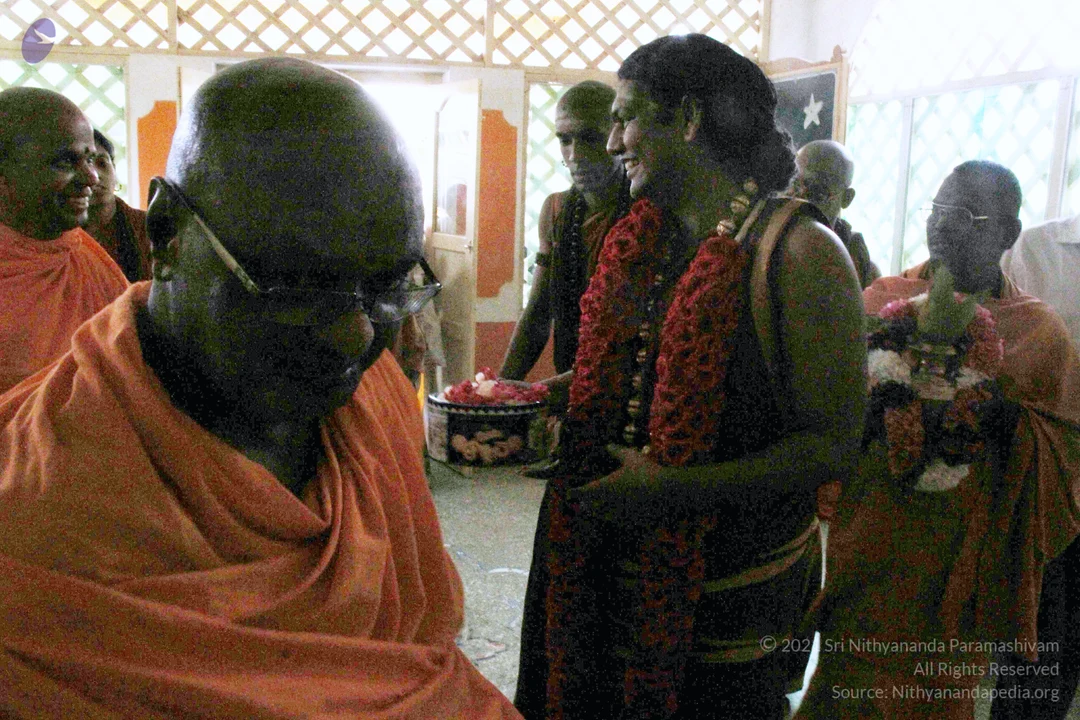
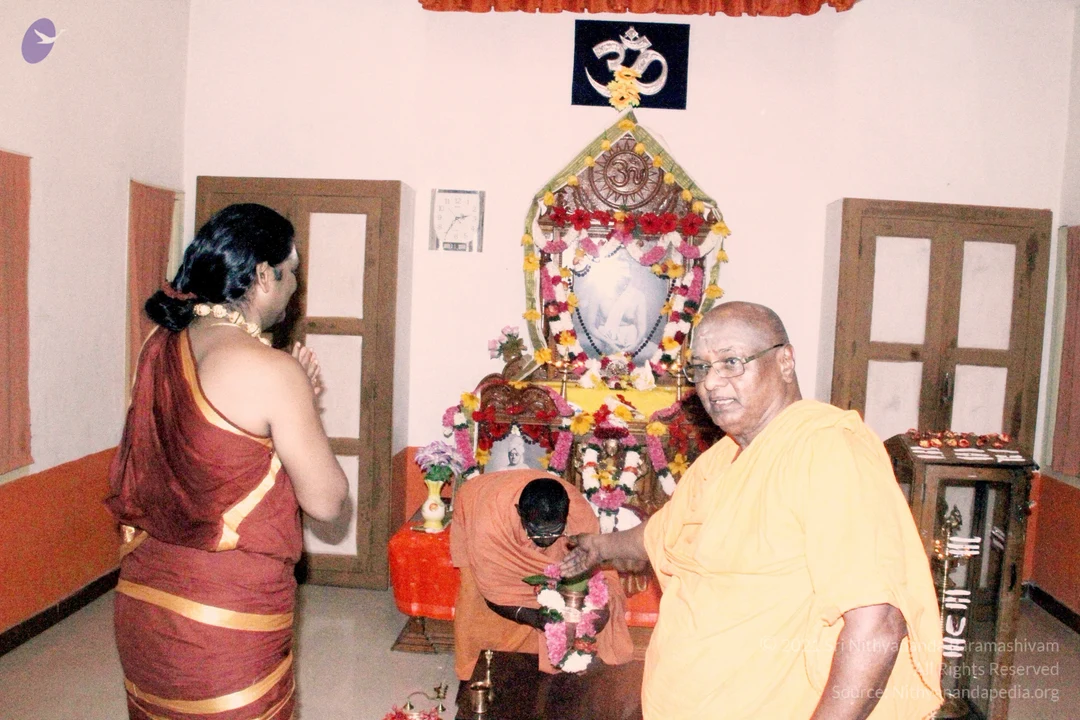
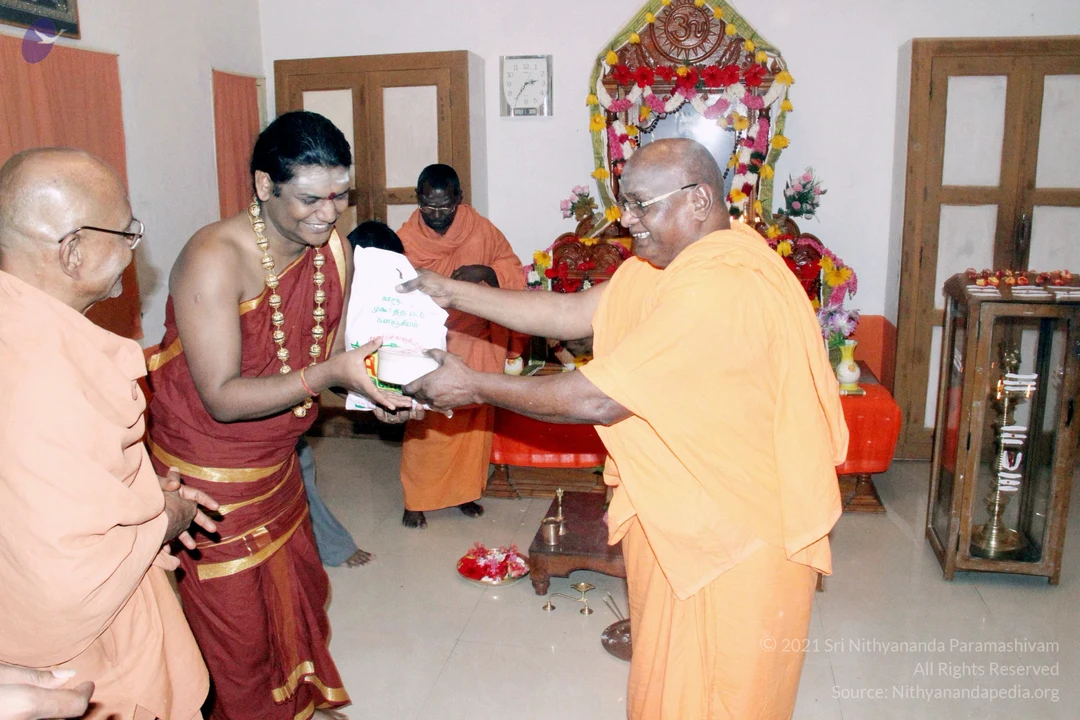
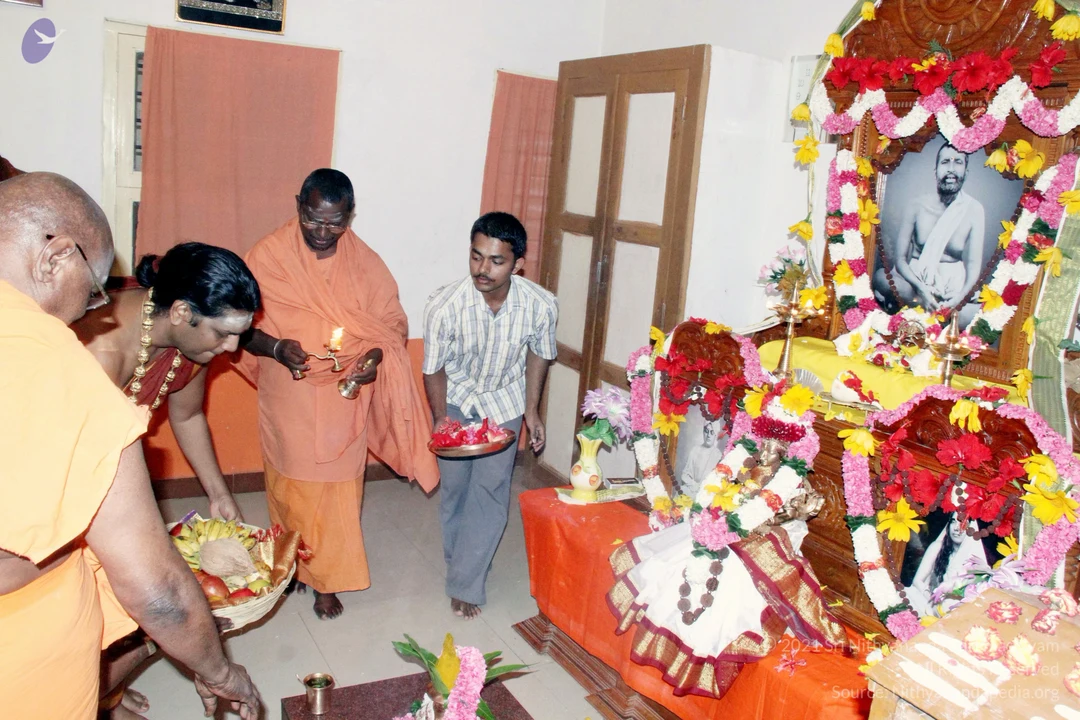
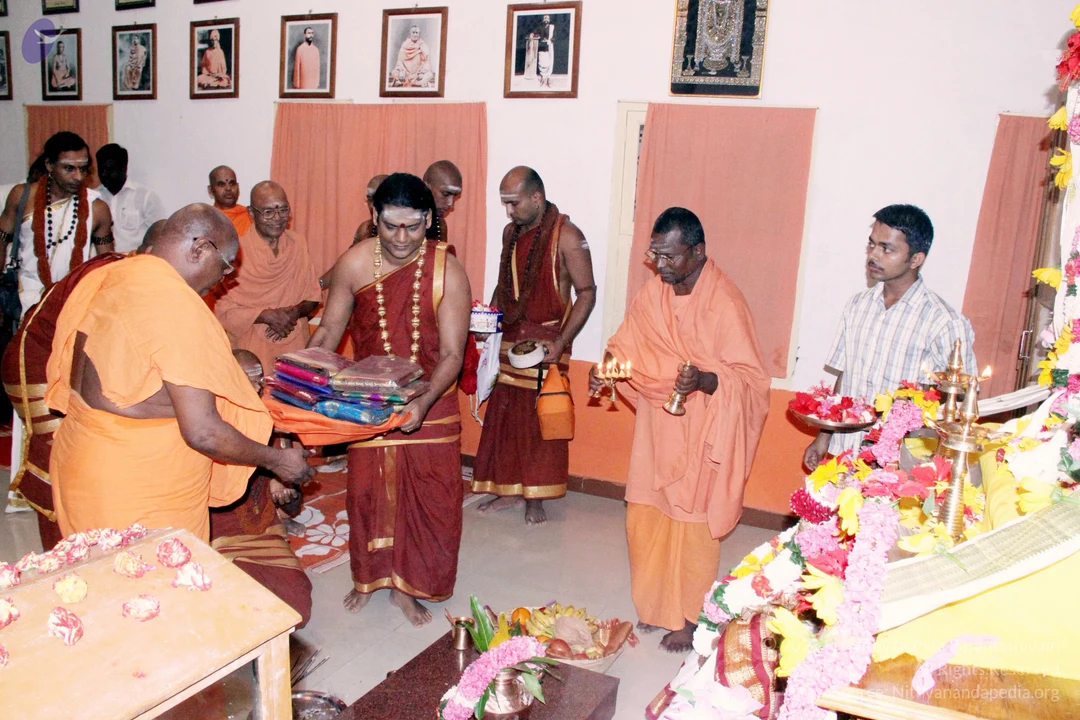
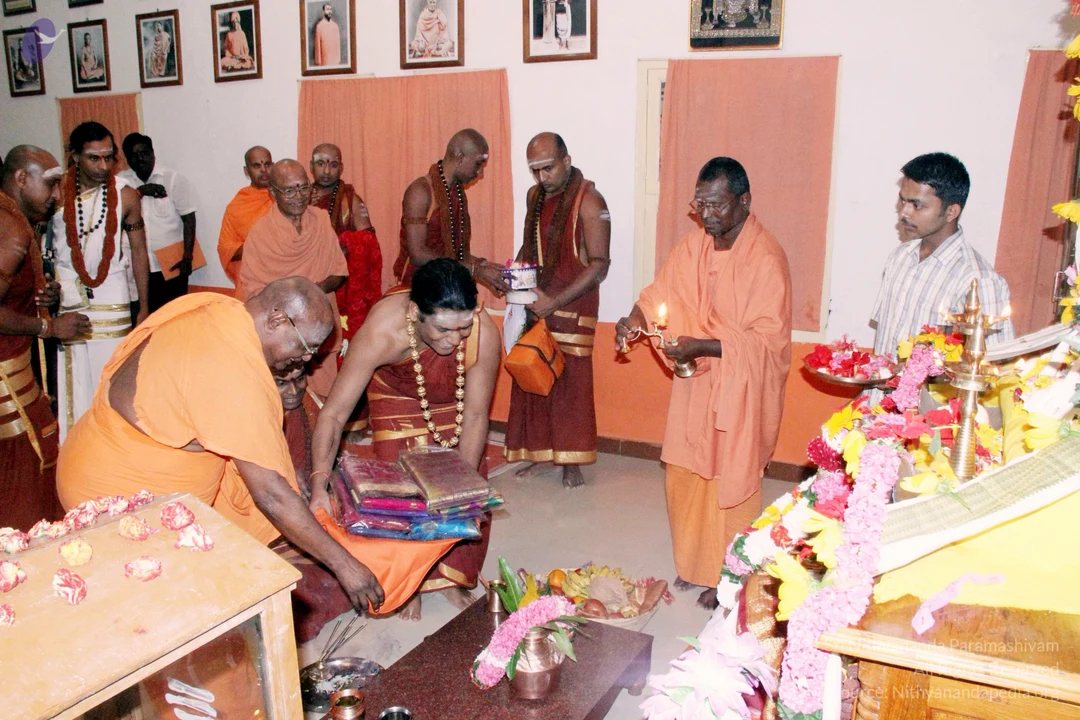
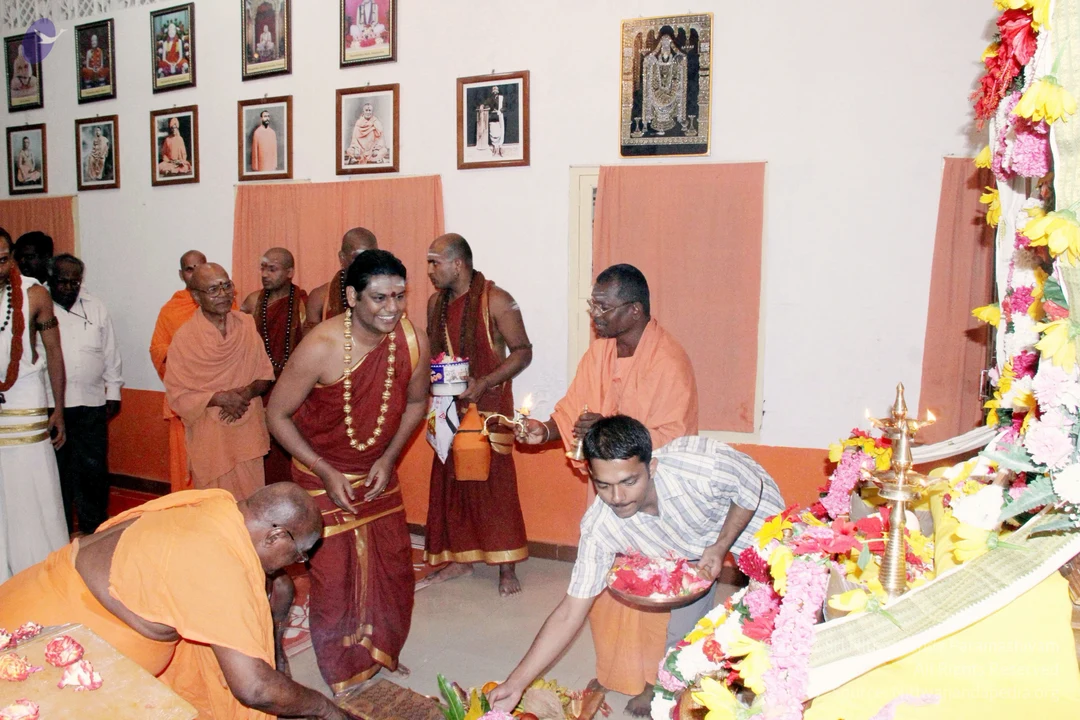
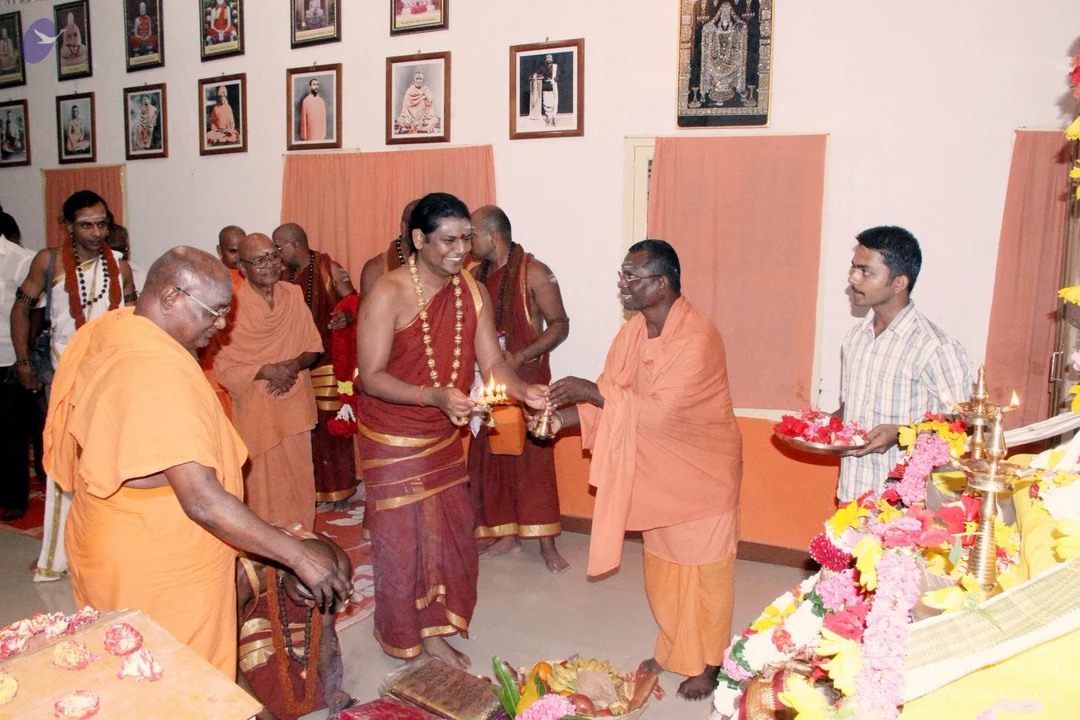
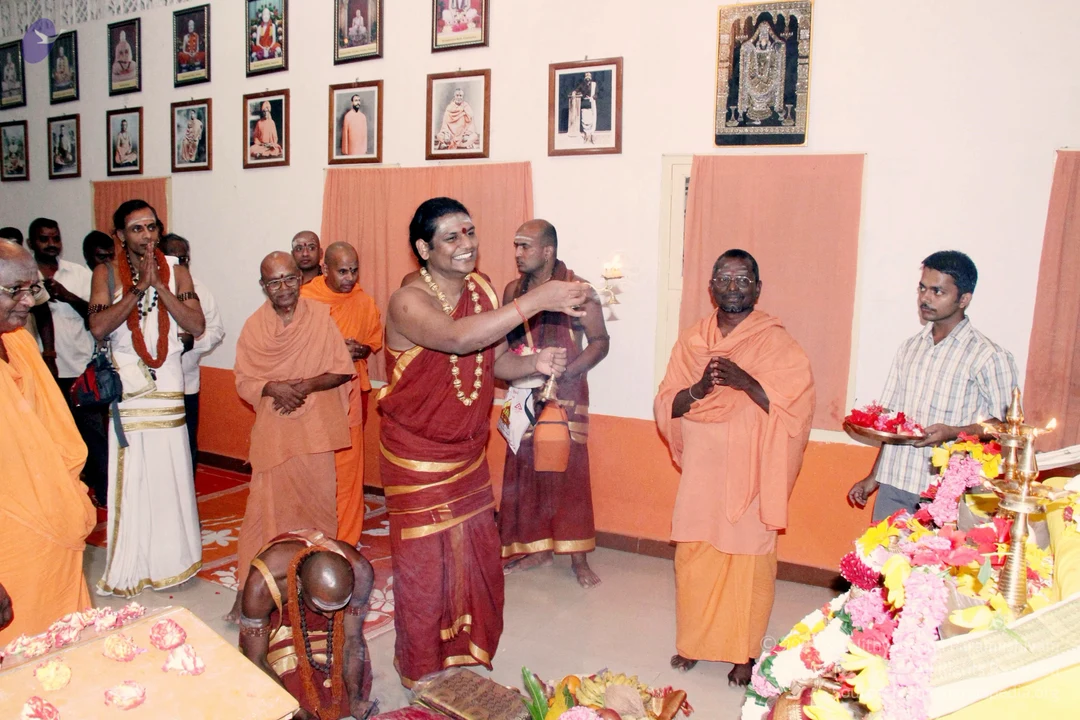
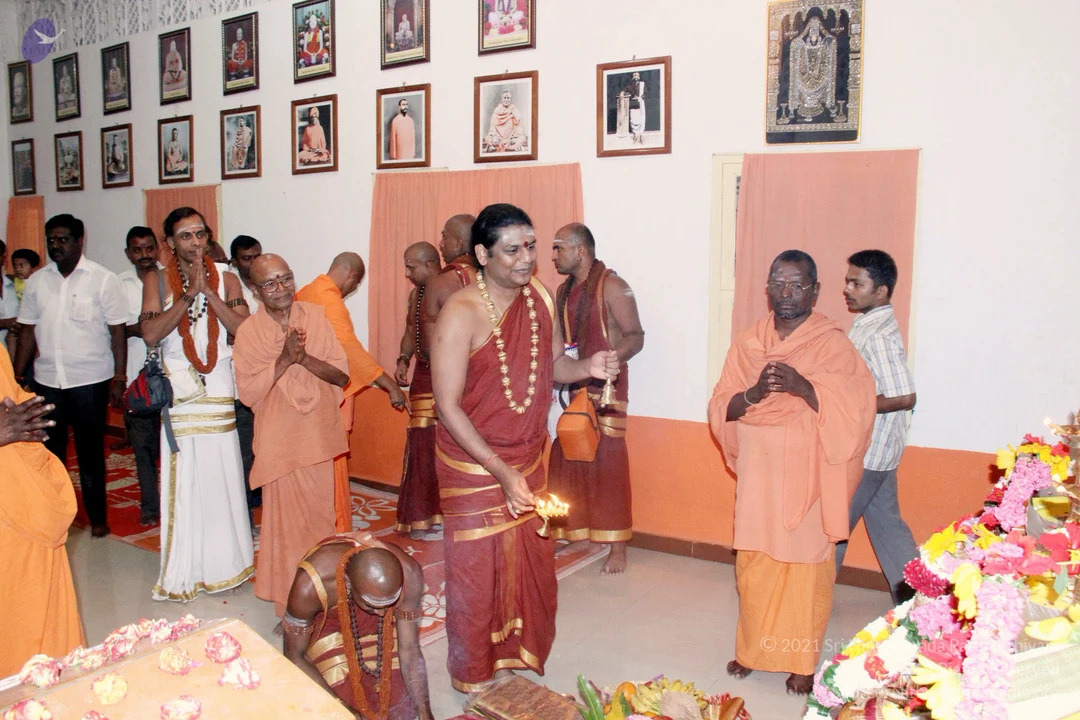
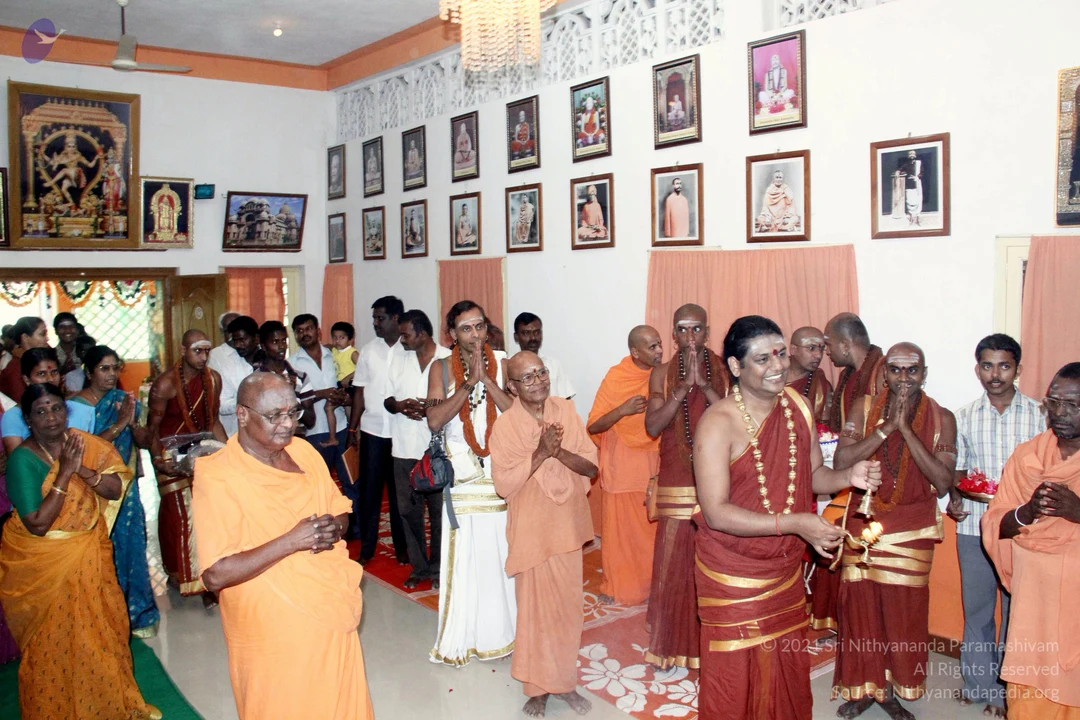
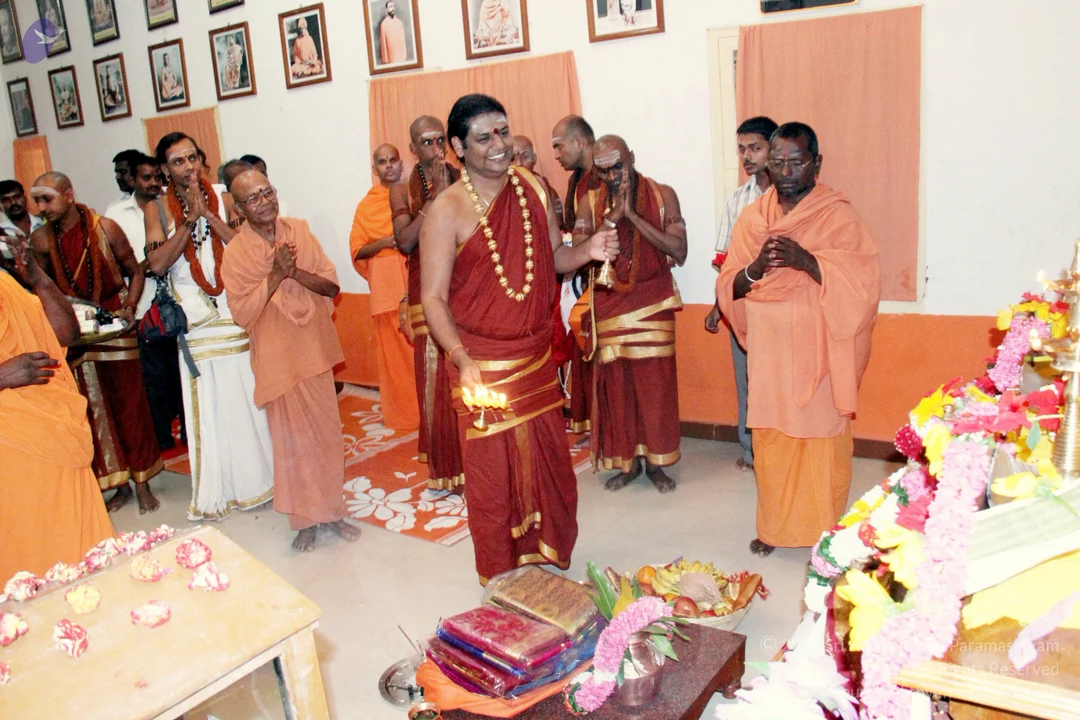
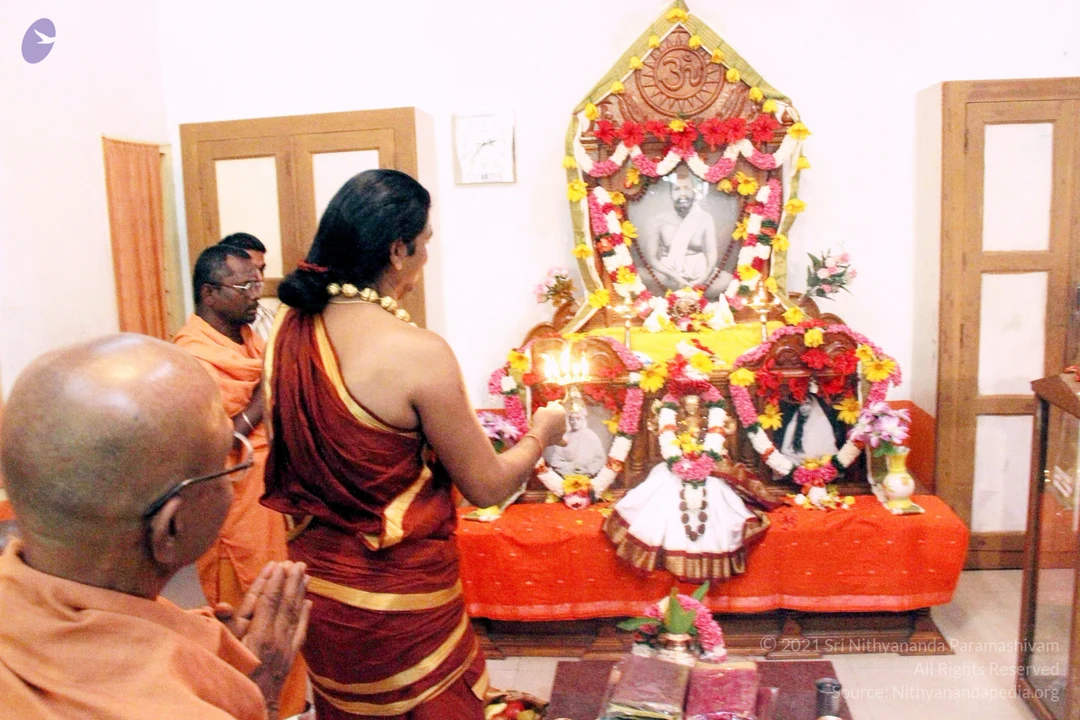
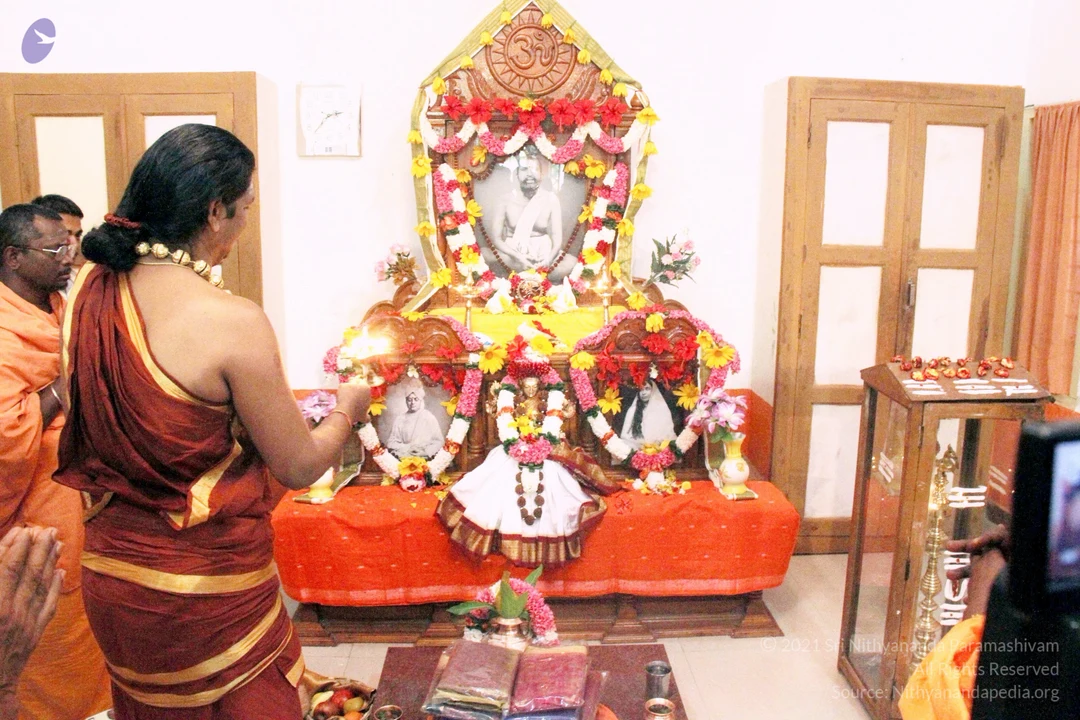
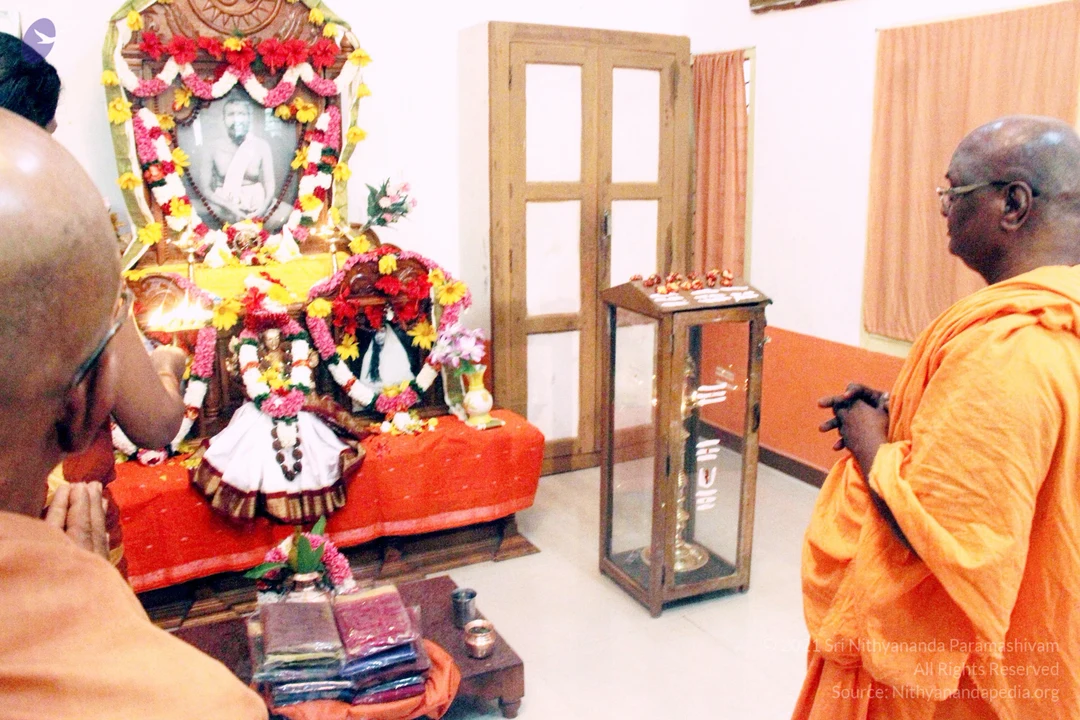
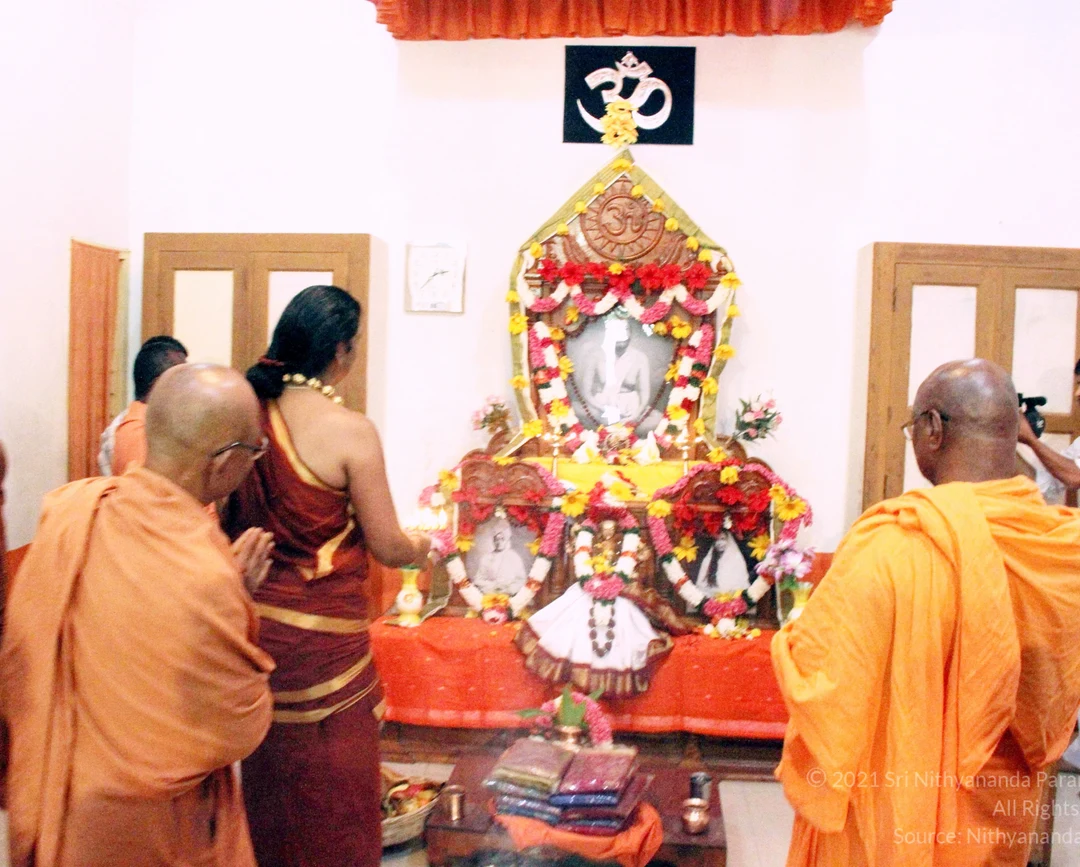
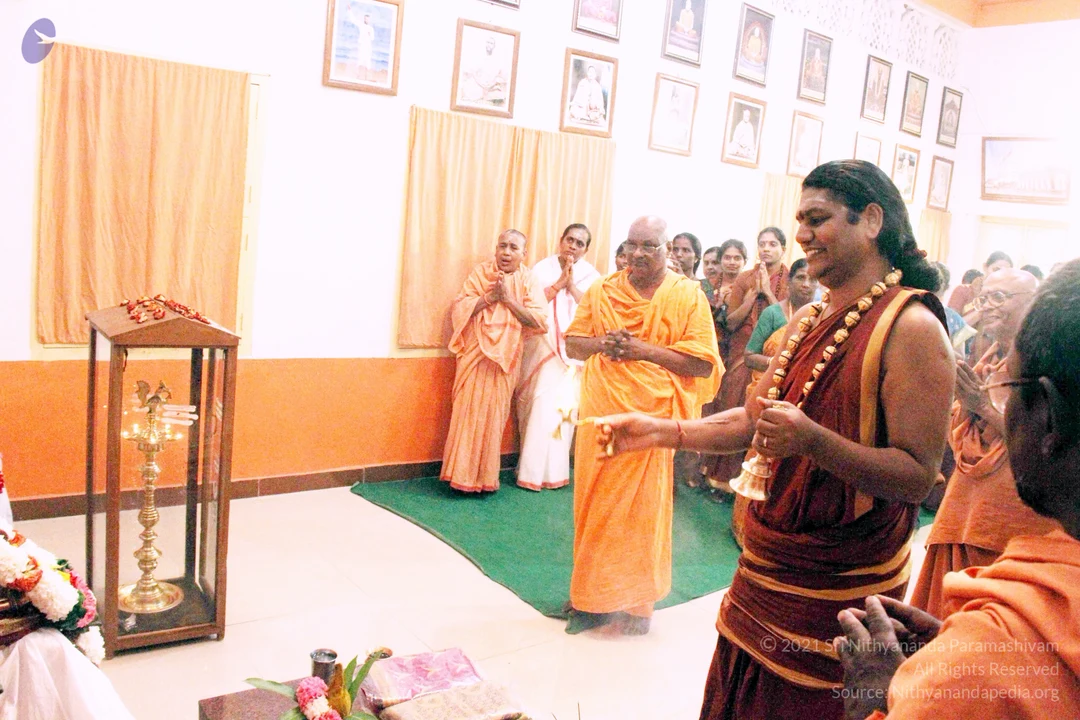
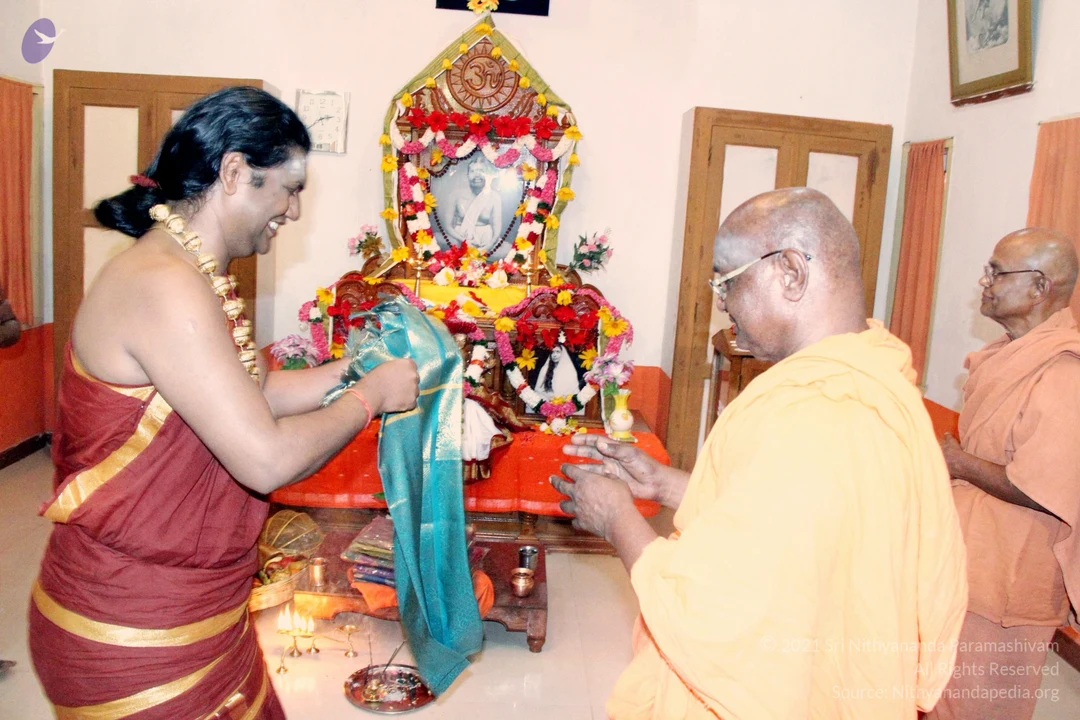
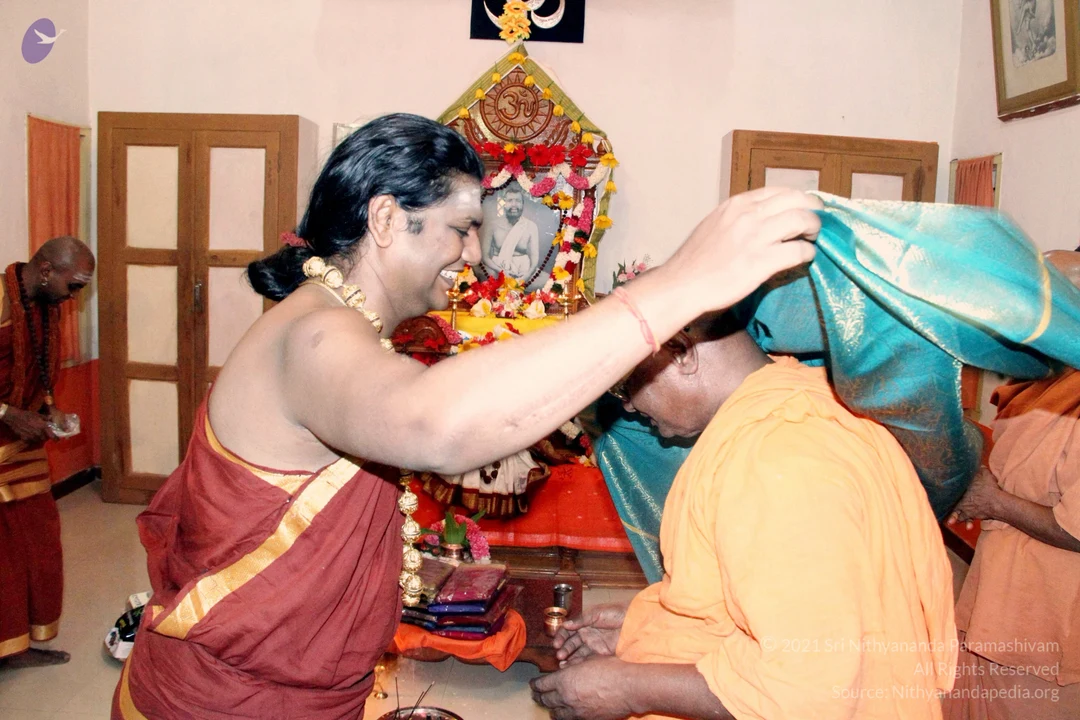
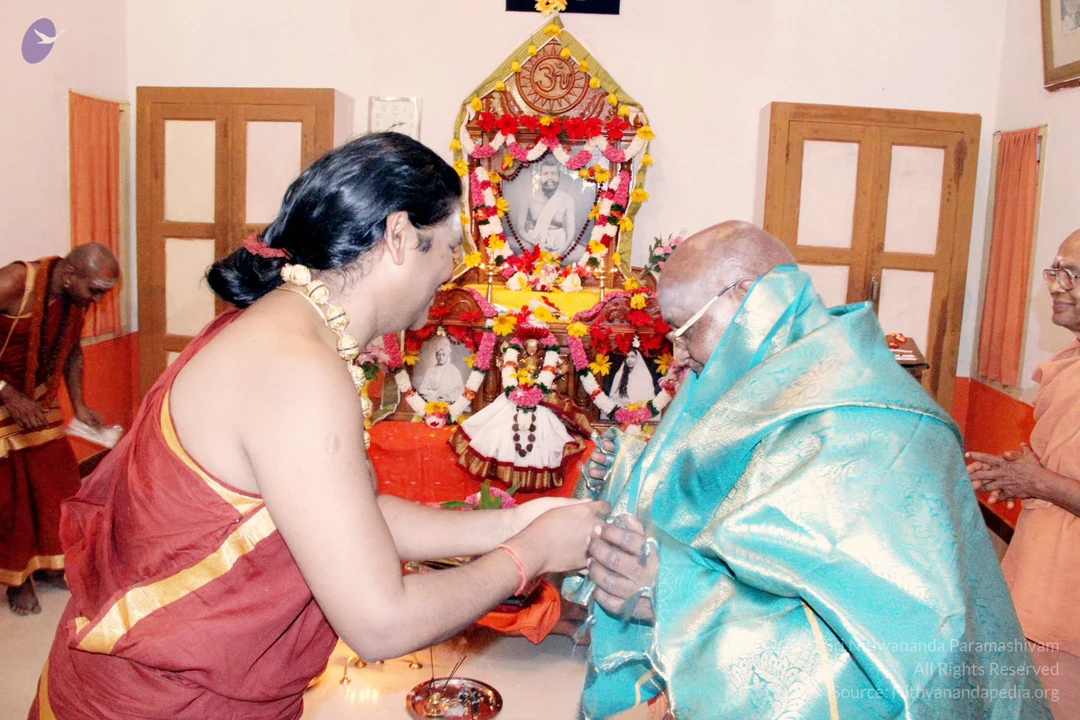
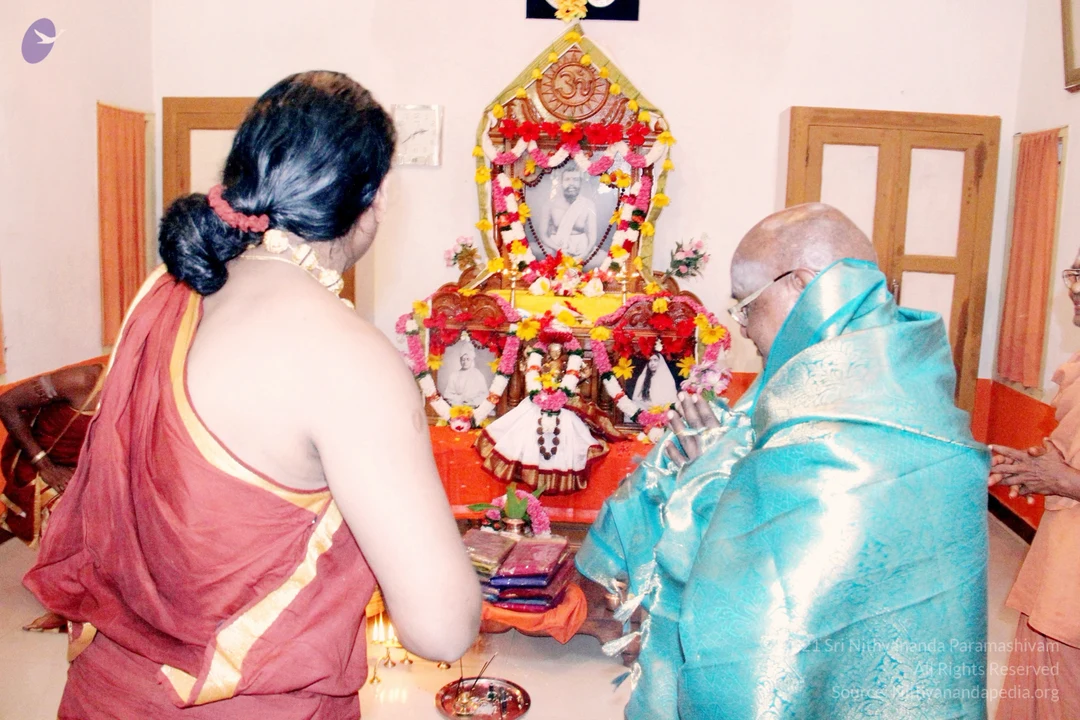
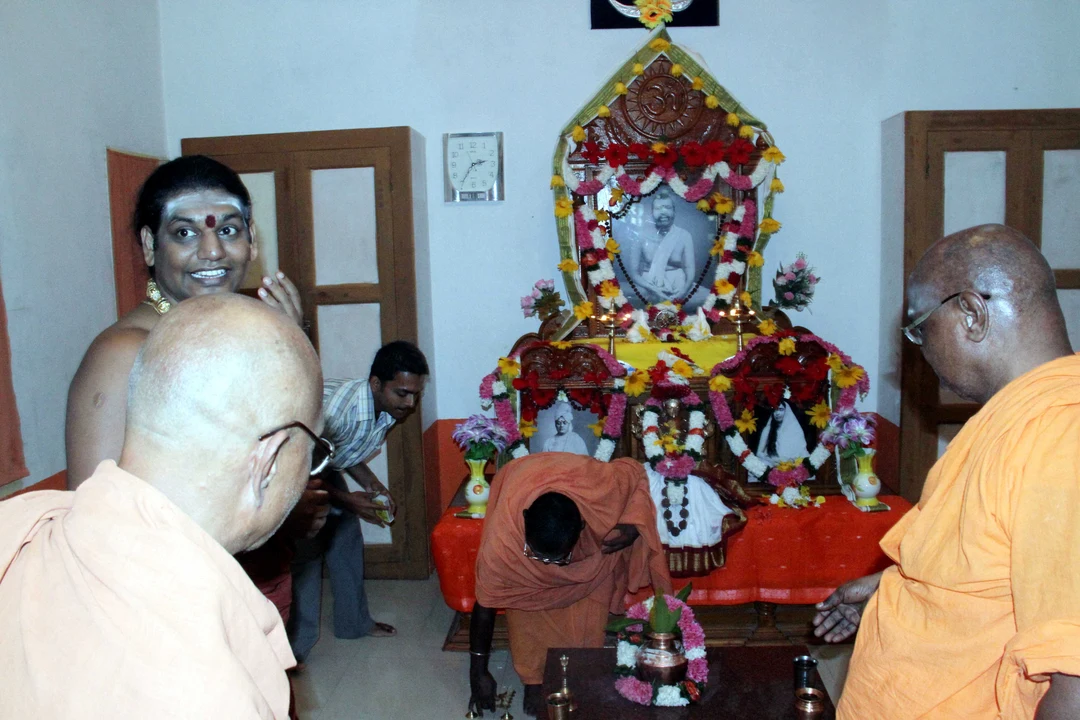
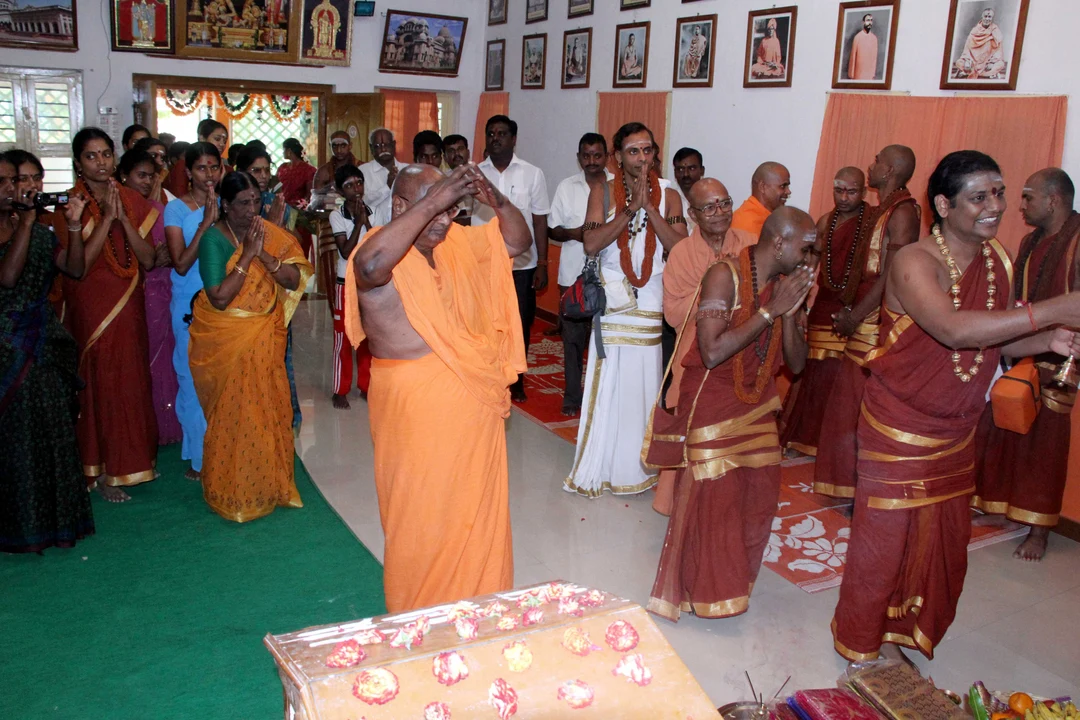
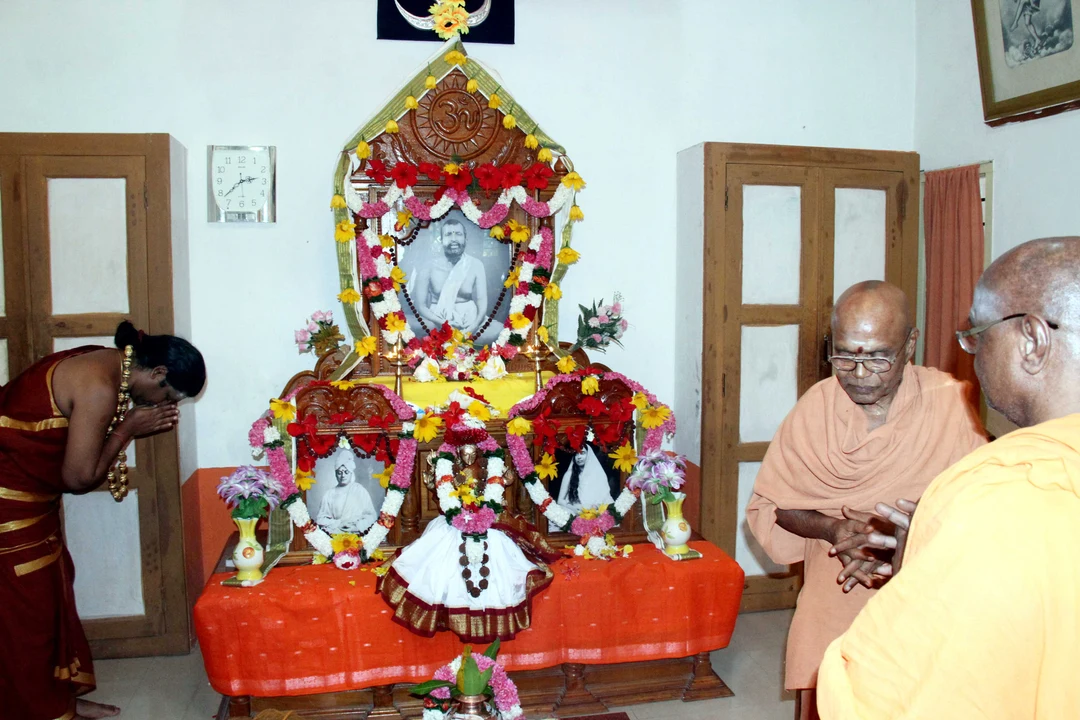
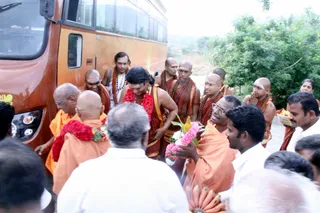
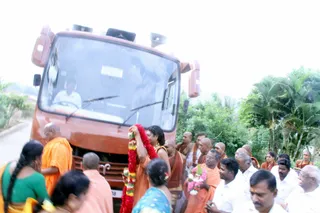
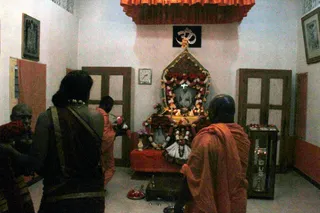
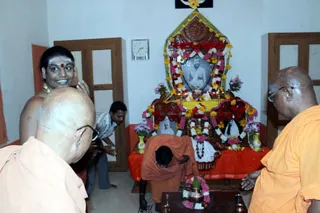
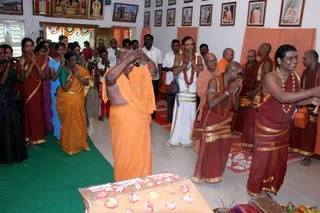
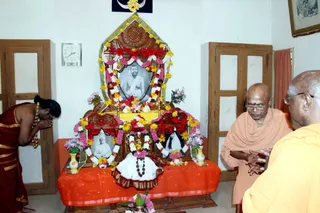
Outdoor photo beside a brown-orange bus as a group of saffron-robed sannyasis and devotees gather on a dirt path with green trees behind. A central figure with long dark swept-back hair and a red-and-white floral garland wears a red-orange cloth and stands among the group, while another man holds a bouquet of pink and white flowers. Several shaven-headed monks wear rudraksha malas and white forehead markings, and a basket of fruit and bananas sits in the foreground. Onlookers in white shirts stand around the welcome.Outdoor photograph of a crowd gathered around an orange-and-white bus with a dark windscreen and roof-mounted speakers, parked on a roadside with palm and green trees behind. A woman in a green blouse and a woman in a blue sari stand in the foreground, and a bald man in orange robes is at left. In the centre, a man in orange robes holds up a long red and white garland, while beside him a saffron-robed figure with a rudraksha mala and a man in orange robes with a garland of pink flowers stand near the bus. Several men in white shirts and white dhotis, some with rudraksha malas, stand in the crowd, and a driver sits behind the windscreen.A small shrine room with white walls and an orange draped canopy above a central altar. The altar is decorated with red and orange flower garlands and holds a framed black-and-white portrait labelled as a shrine picture, with an Om symbol on a dark panel above. Two lit oil lamps sit in front. Several people in saffron and orange robes stand around; one in the foreground wears saffron and another in a dark shawl with a rudraksha-style necklace stands with back turned. A brass plate with offerings sits on the floor at lower left, and a glass cabinet with items stands at right.A photograph inside a small room with white walls and wooden doors, where a decorated shrine is set against the wall. The shrine is framed with an OM symbol, red and yellow marigold garlands, and holds a framed portrait of a bearded man with flowers and oil lamps arranged before it. A man in an orange robe bends low before the shrine, touching the floor near a brass vessel with flowers. In the foreground, a shaved-headed man in orange robes with glasses turns his head, and another orange-robed man stands at right with hands together. Behind them a man in a striped shirt and grey trousers bends forward, and at left a smiling man with long swept-back hair, a red forehead mark, a gold necklace and a bare chest stands near the door, a shawl or cloth draped on his shoulder. a person, identified by long swept-back hair, gold necklace and bare-chested ceremonial adornment, is standing among devotees at the shrine.A photograph of a devotional gathering in a hall with orange curtains and framed portraits of saints on the walls. In the foreground, a bald man in an orange robe stands with palms pressed together in namaskar, facing a low white table covered with flower petals and offerings. Behind him, a man in a white dhoti and a man with glasses wearing an orange shawl and rudraksha mala stand with hands folded. To the right, several men in maroon robes with gold borders and rudraksha malas hold palms together, and a woman in a maroon sari with gold trim and gold necklaces smiles. On the left, women in saris, including one in orange and green, stand with hands folded beside a green carpet. A man in the orange robe appears to be the central honoured figure, but his identity is not established from appearance.A shrine altar draped in orange cloth and decorated with marigold and red flower garlands, with an om symbol carved on a wooden arch above. Framed black-and-white portraits sit within the altar, and a white-clad deity murti or image stands at the centre with a rudraksha-style mala. A woman in a red and gold sari on the left bows with palms pressed together. Two men stand at the right: one in a peach shawl with folded hands and glasses, the other bald in a saffron robe, looking toward the altar. Brass lamps and potted purple flowers flank the shrine.
March 03 2014

1 photoView all
A man seated cross-legged on an ornate gold throne with a carved arched back, palms pressed together in namaste. He wears a rust-orange robe with a gold-edged yellow shawl over one shoulder, a white beaded mala around his neck and a red tilak on his forehead. Flanking the throne are two large painted deity statues with multiple arms, crowns and gold jewellery, and gilded lion-head armrests sit beside him on red velvet cushions. The background is a wooden panelled door with a warm wall. Only the seated man is a physical person. He is shown in a devotional, seated-darshan setting; appearance-based identity is uncertain, so no name is asserted.