Skip to content
Saturday

14 July 2012

Supreme Pontiff of Hinduism HDH Bhagavan Sri Nithyananda Paramashivam

Dated photos
217
Source pages
1
Media
2
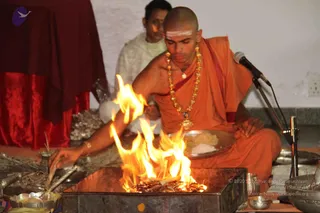
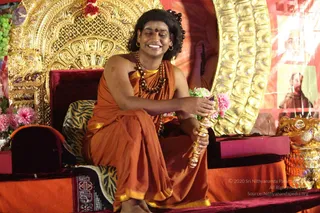
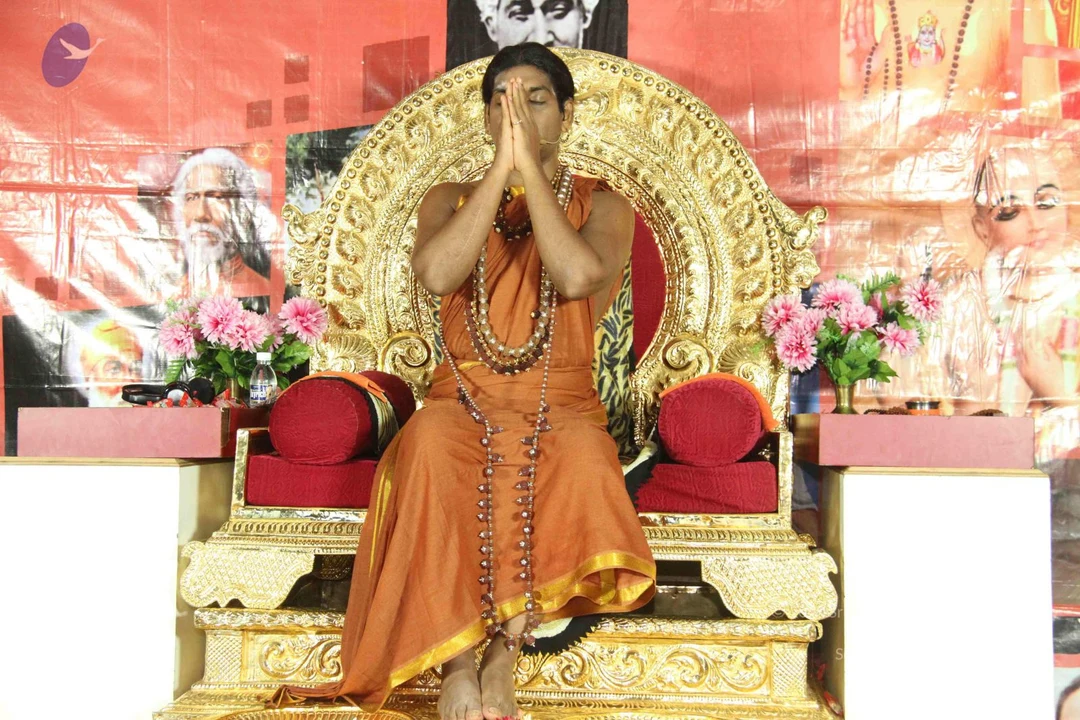
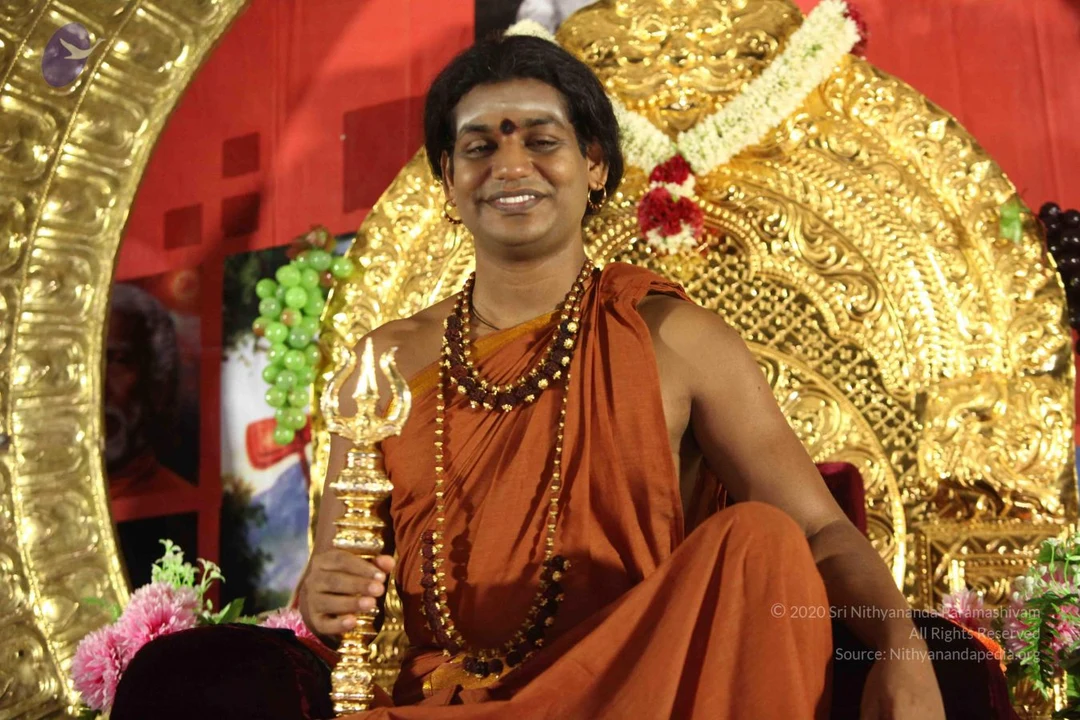
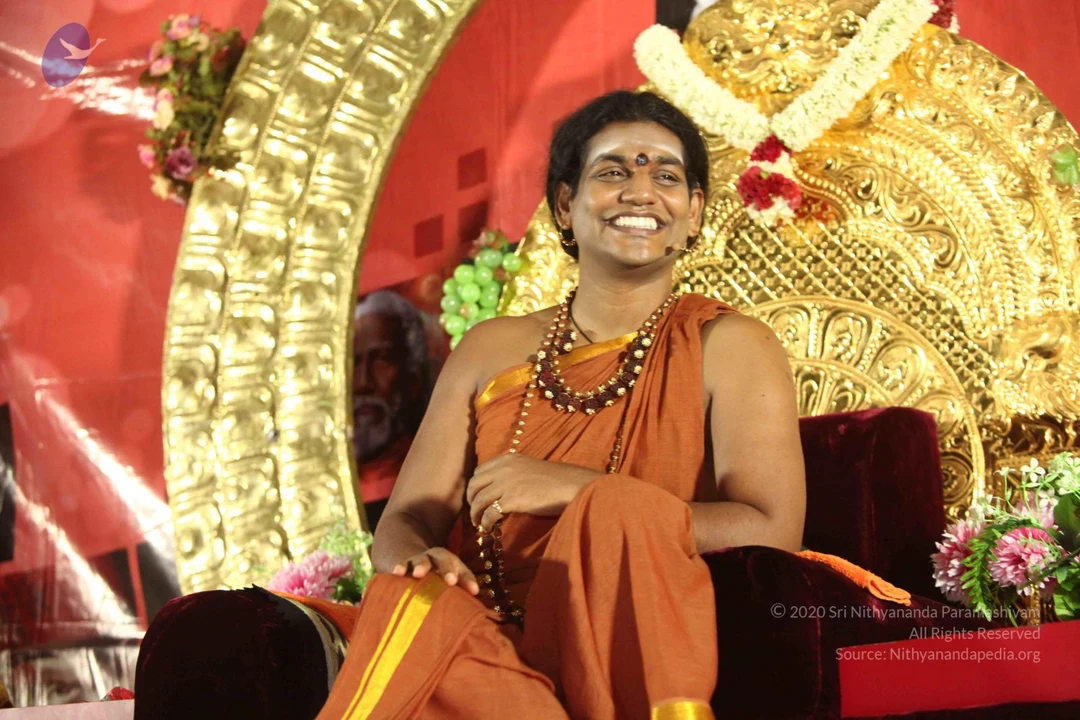
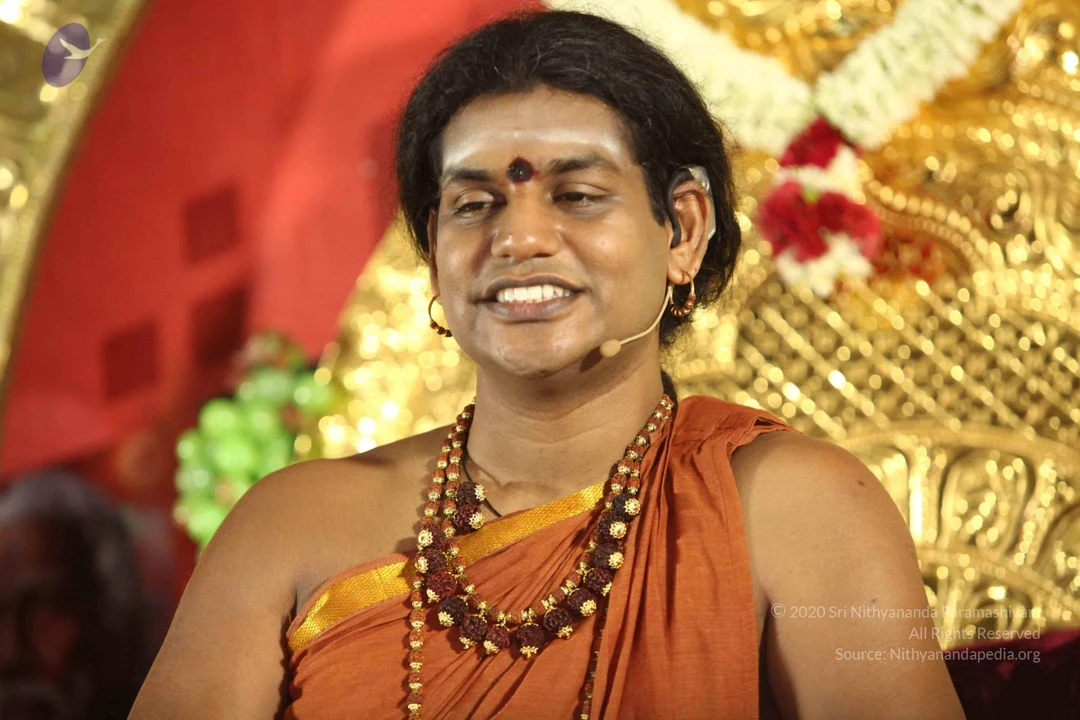
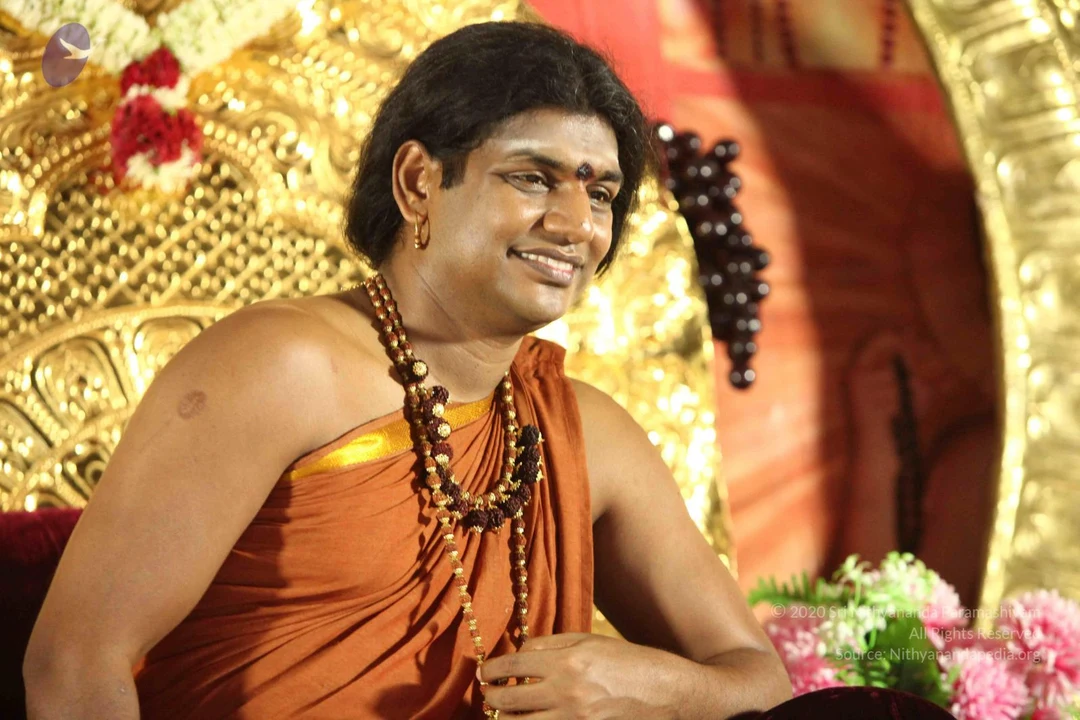
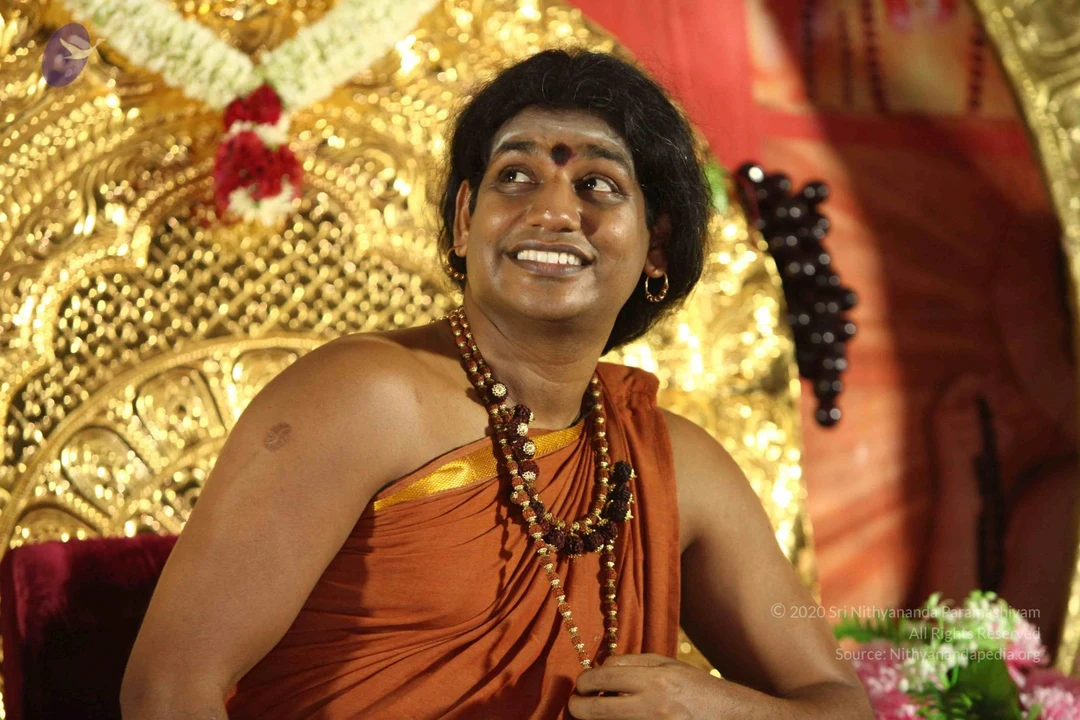
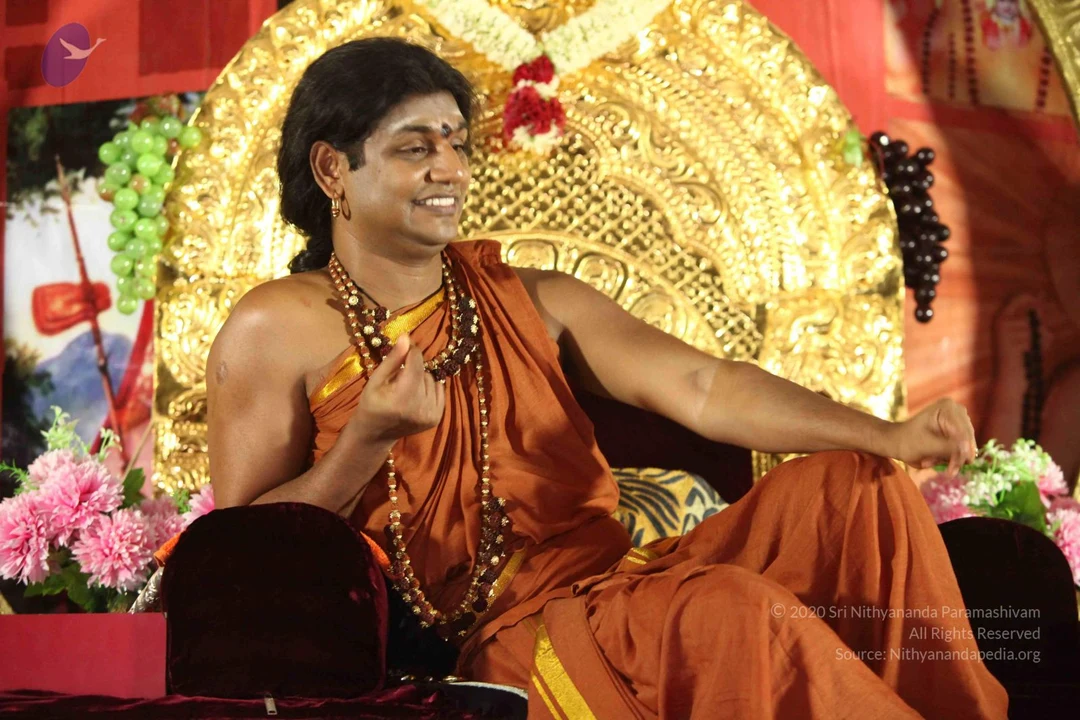
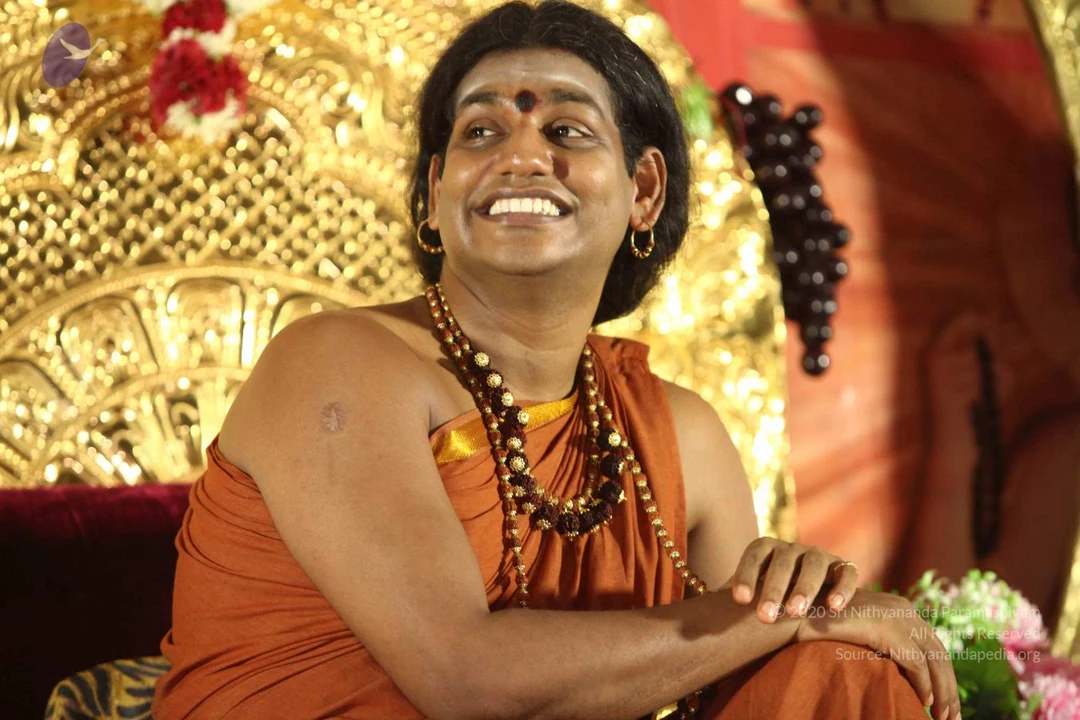
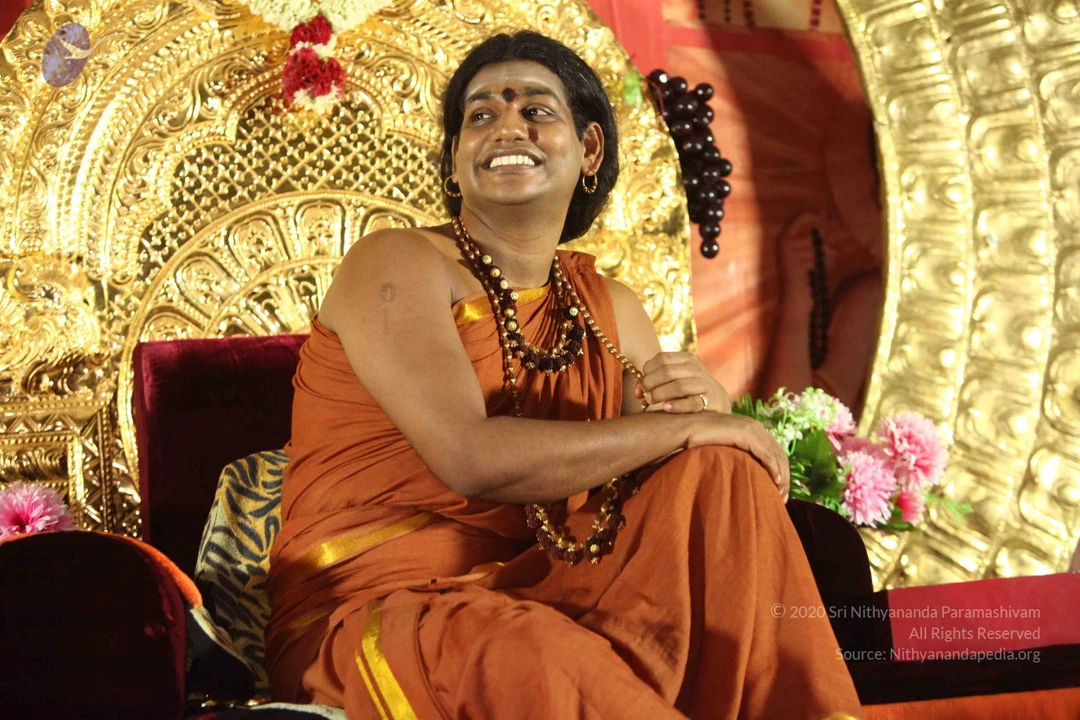
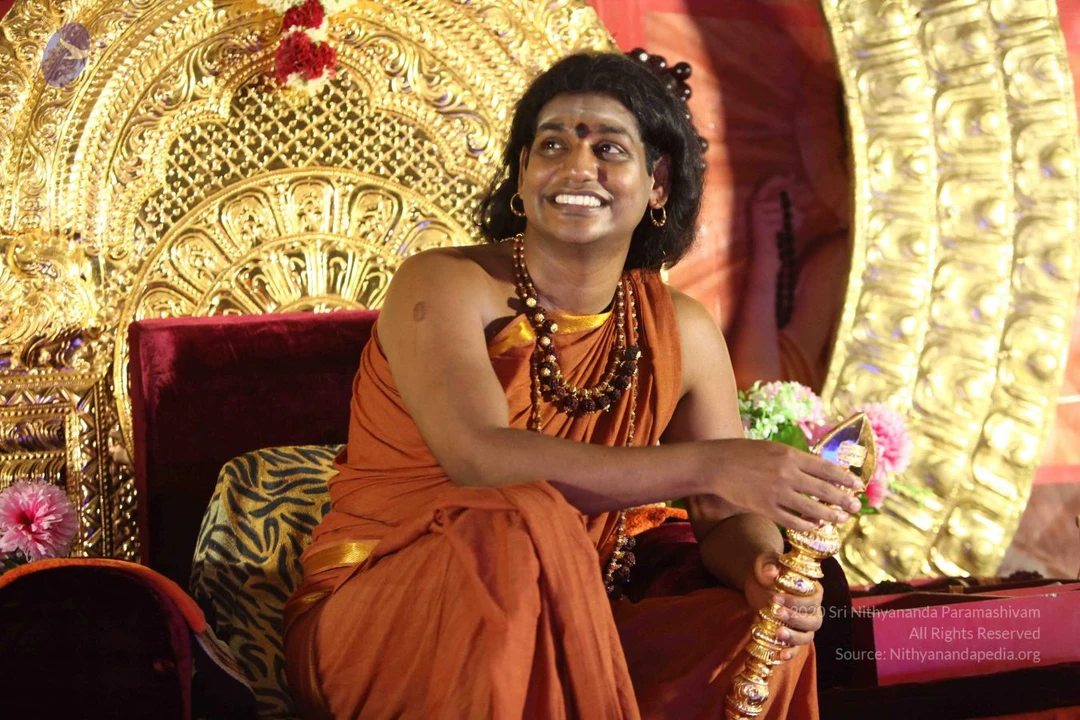
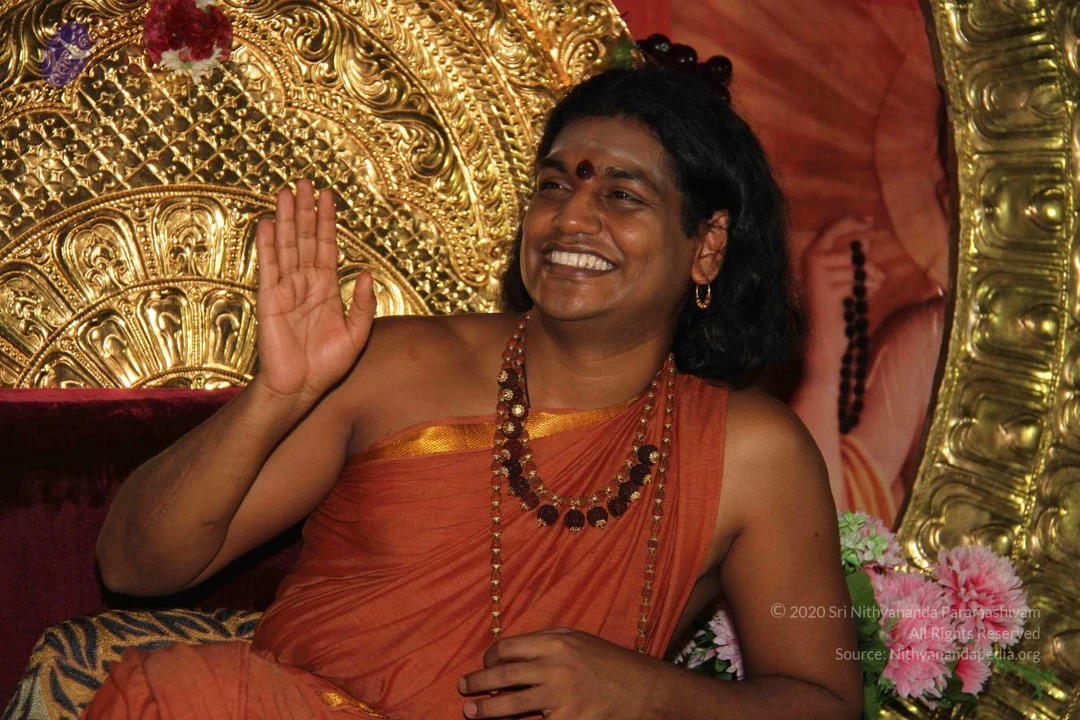
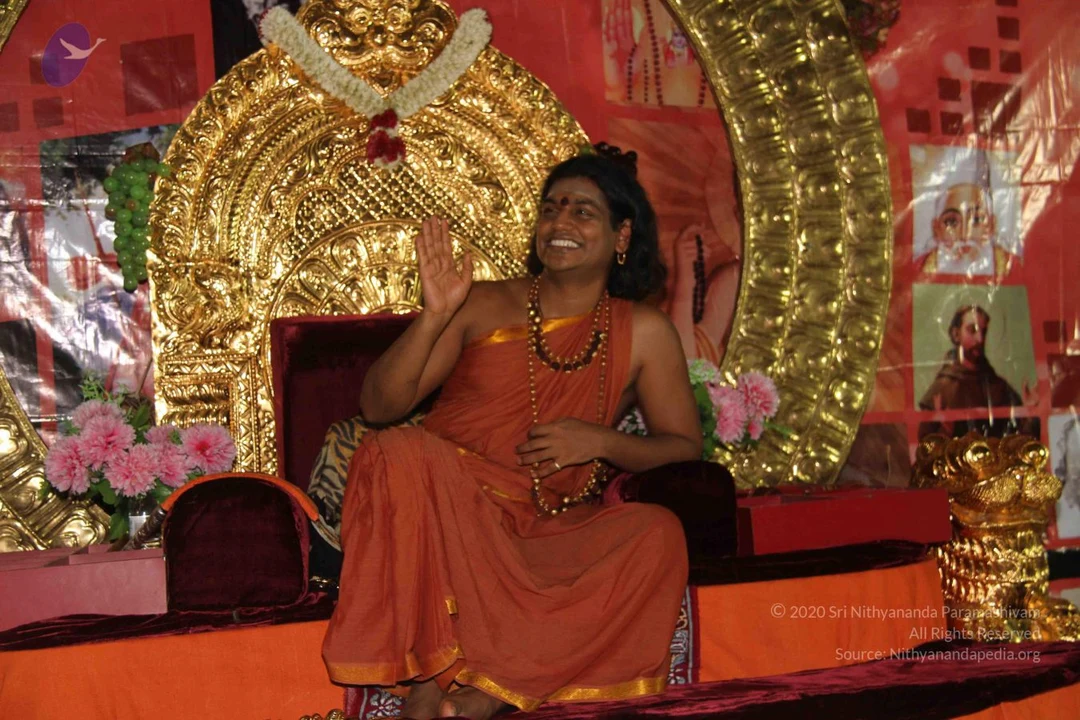
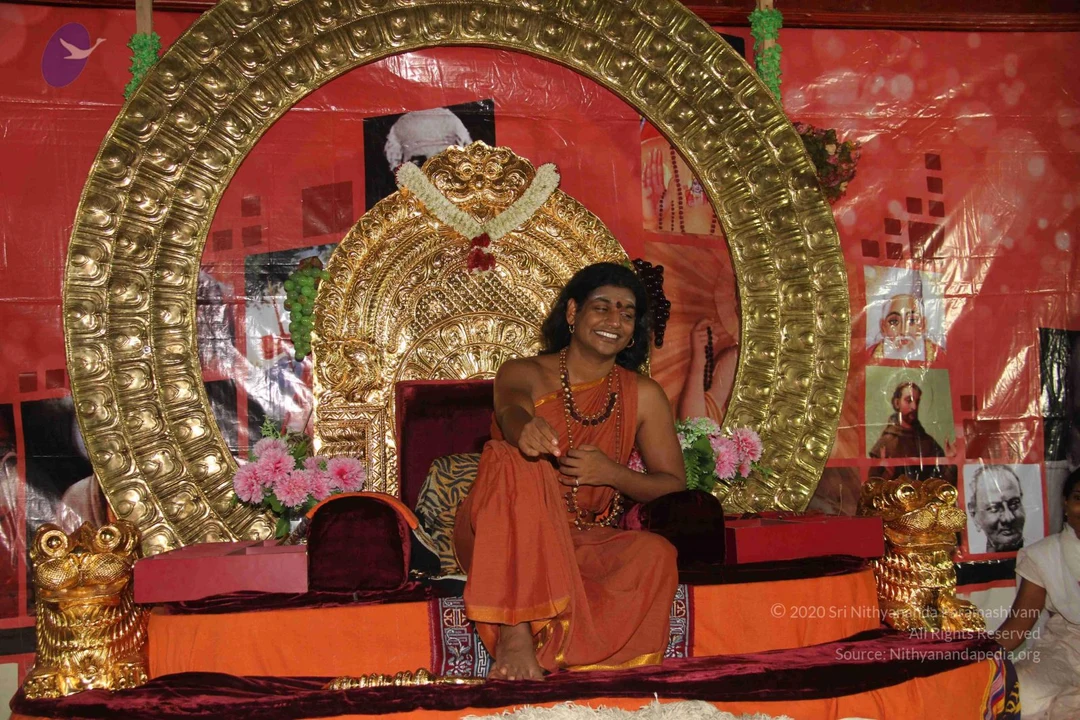
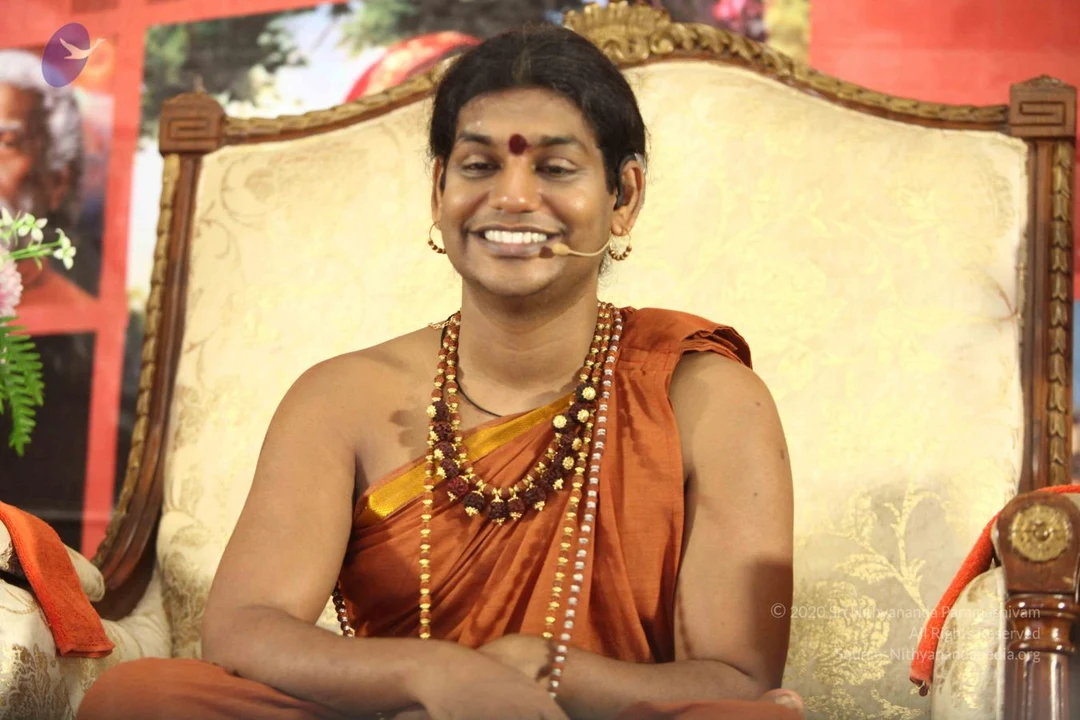
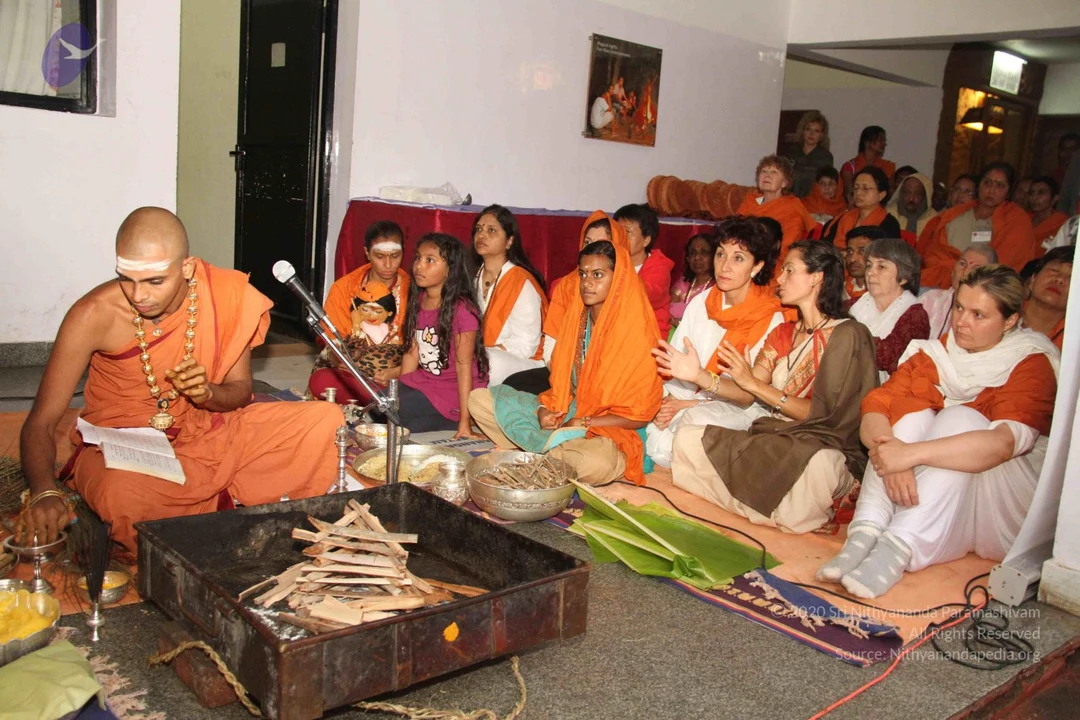
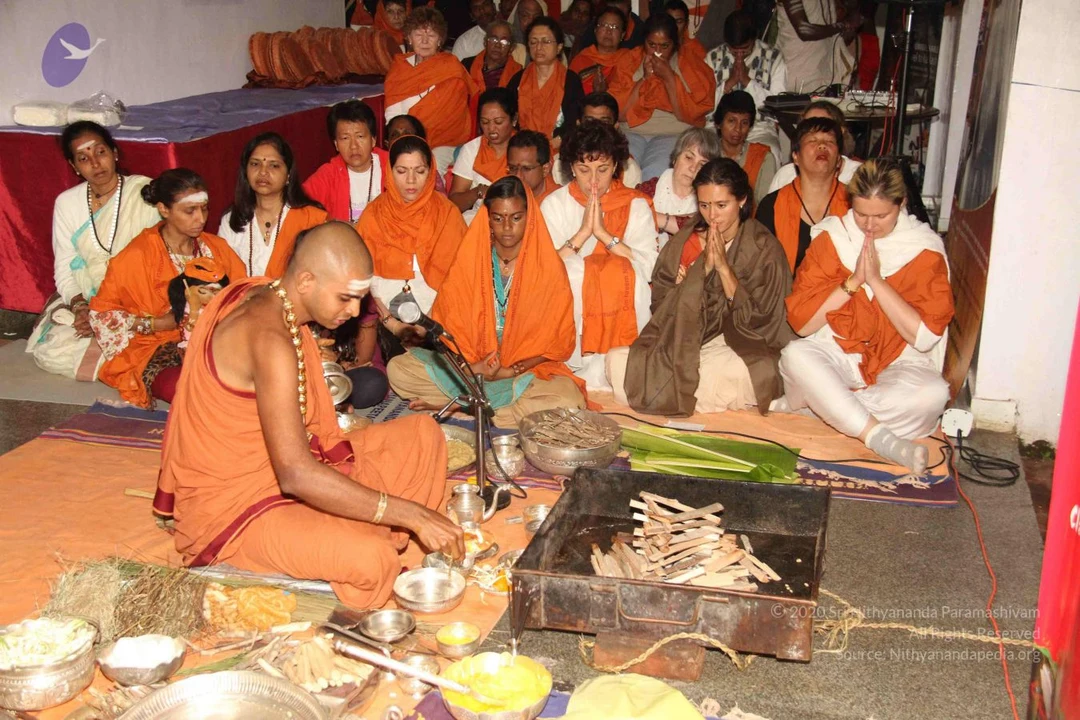
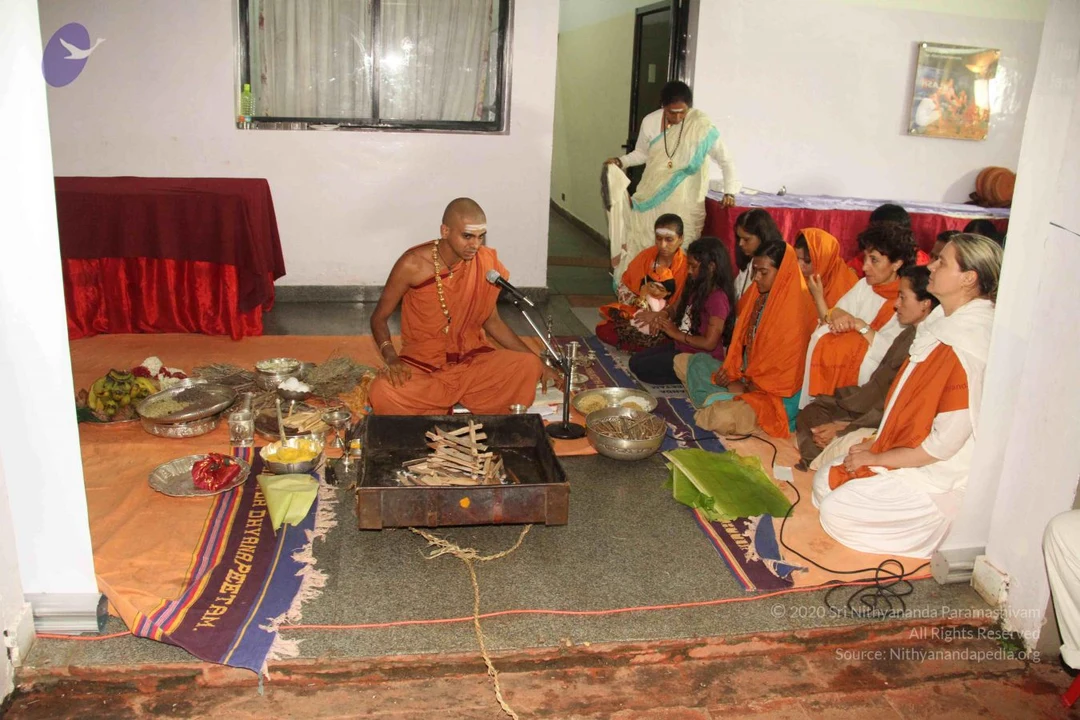
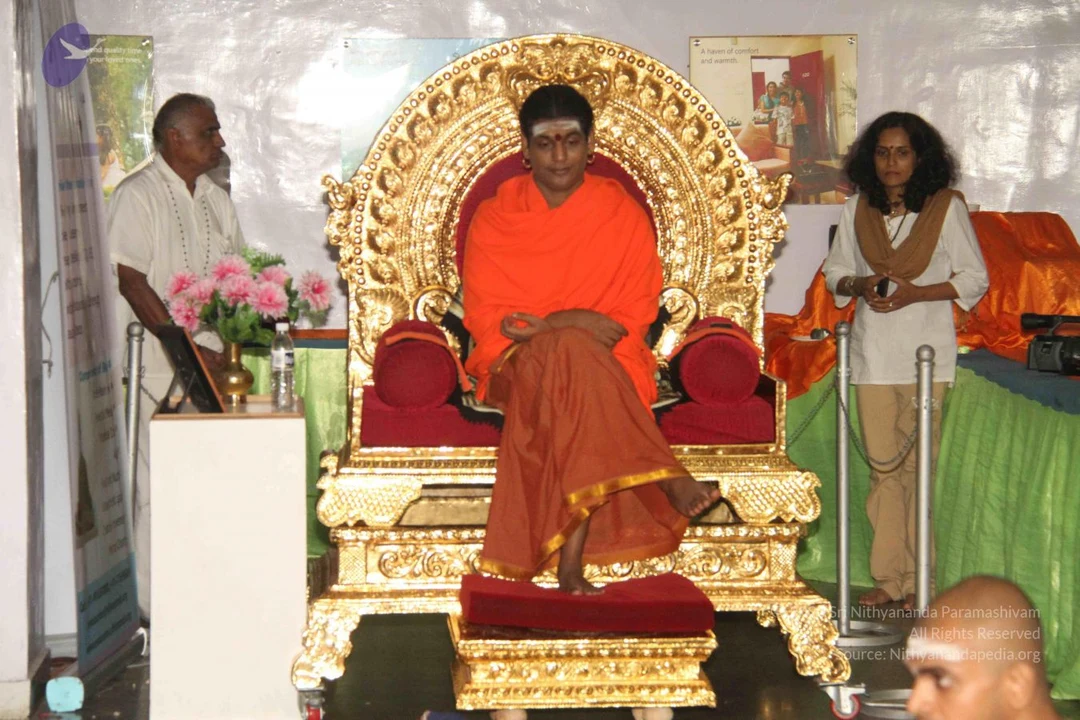
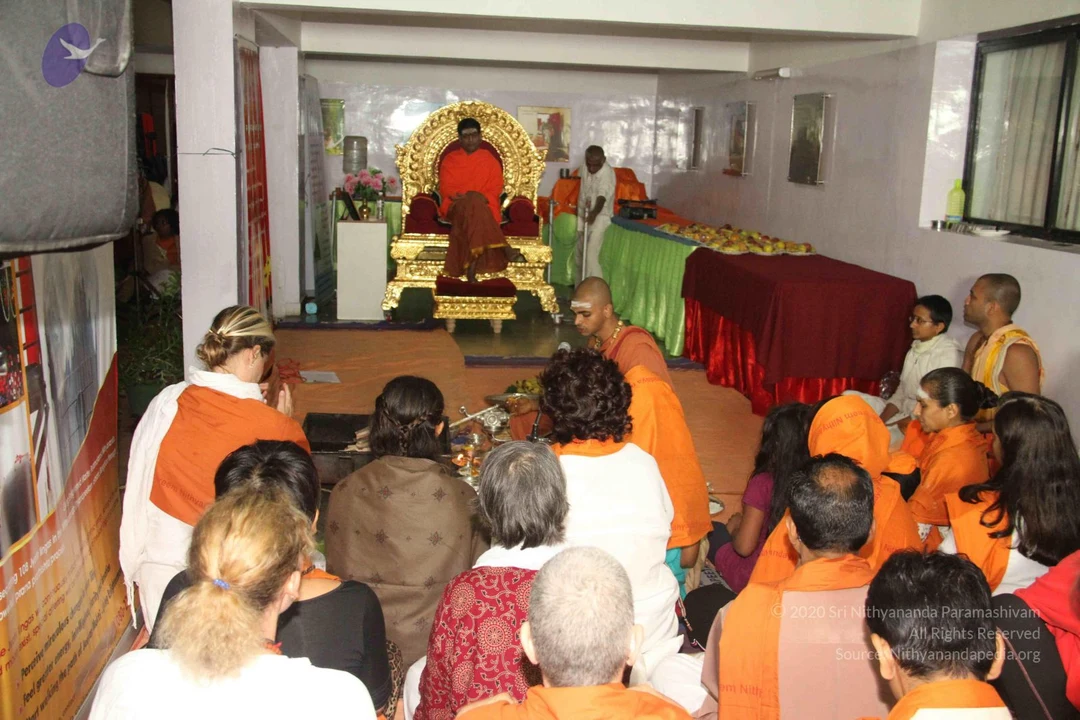
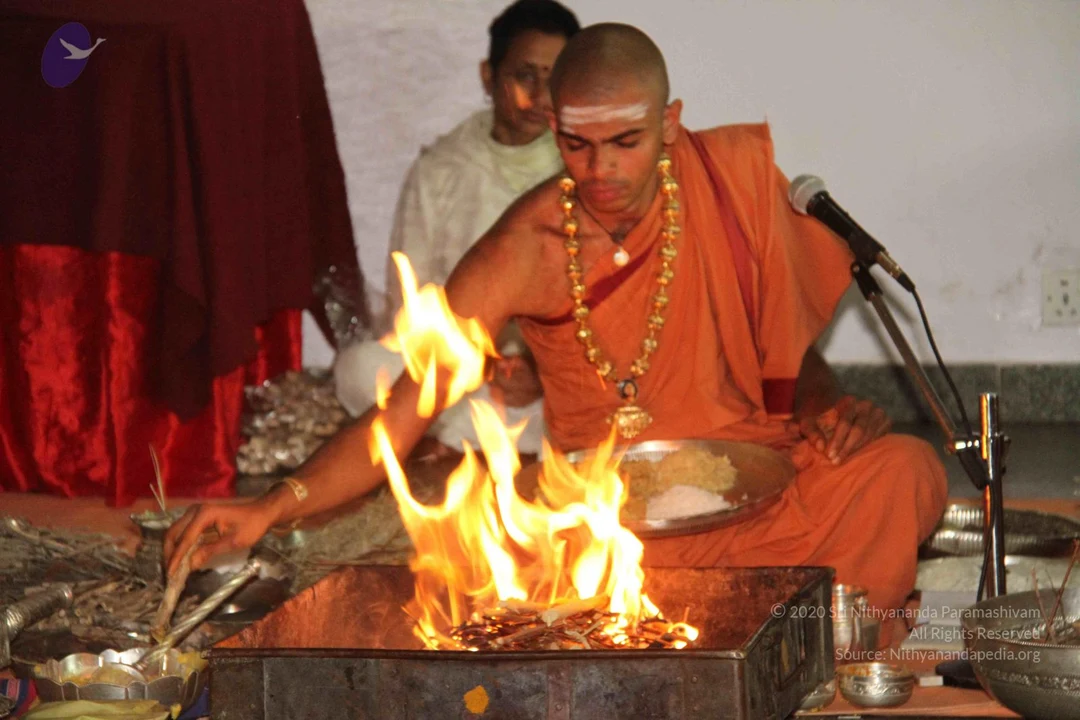
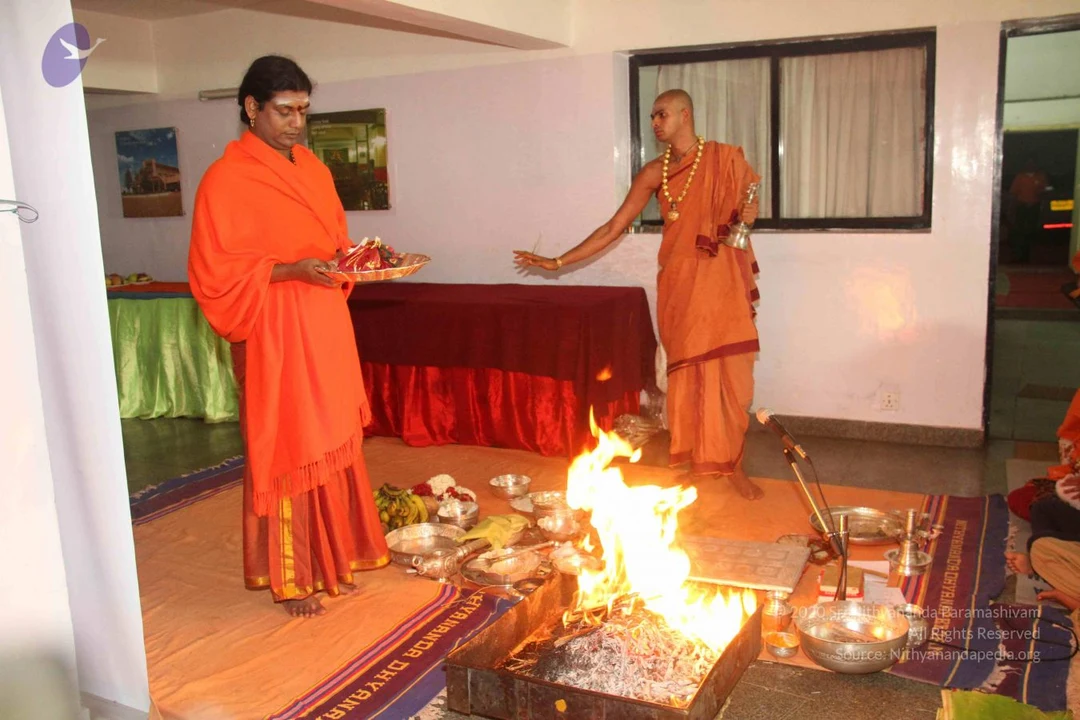
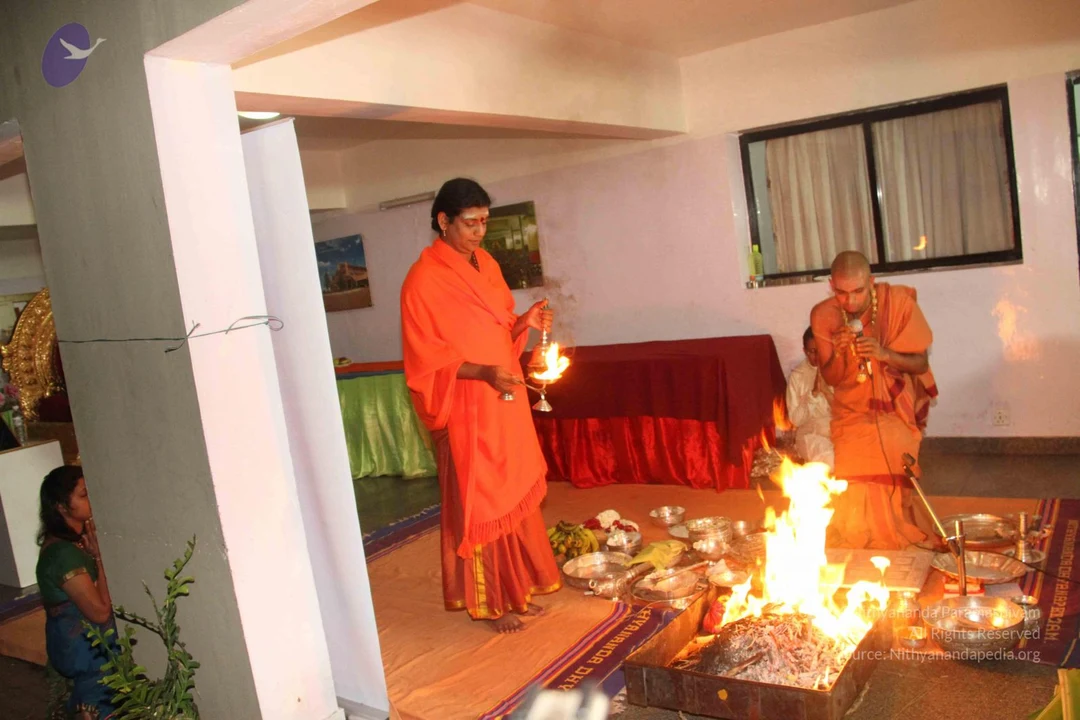
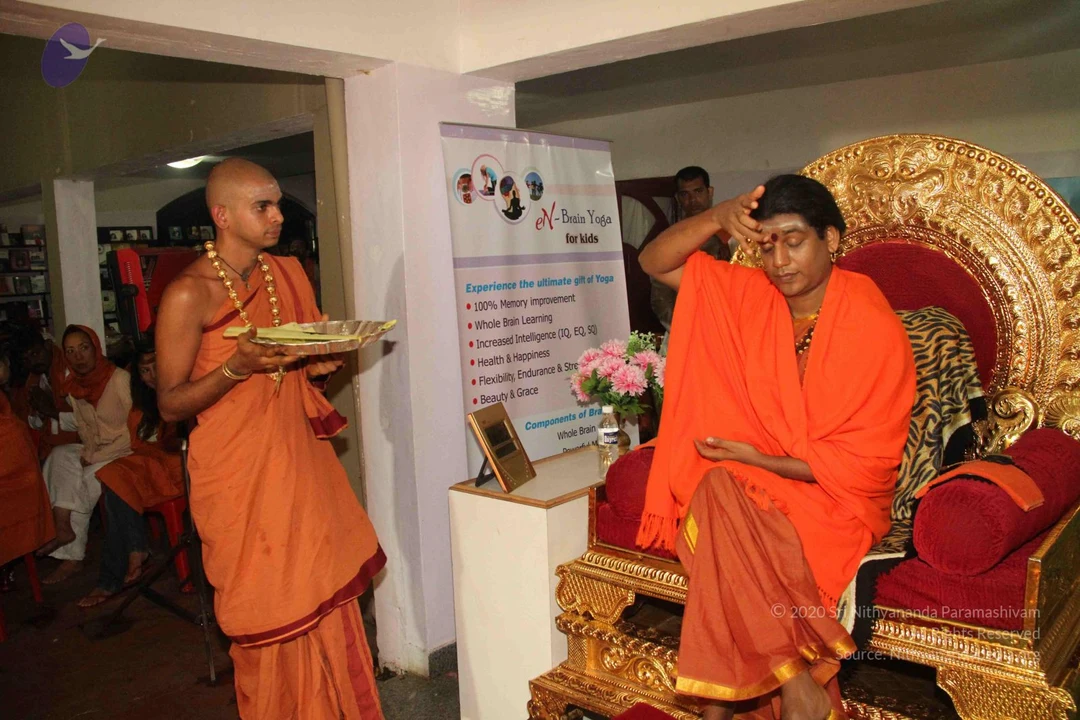
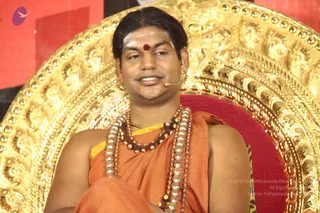
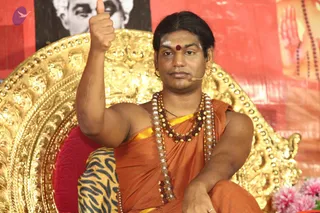
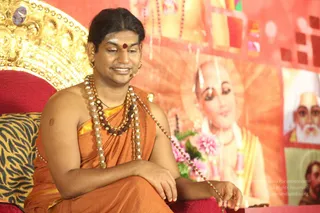
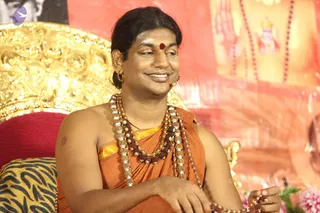
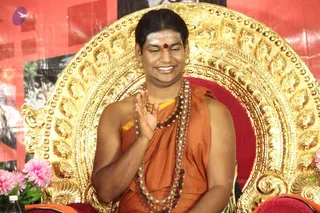
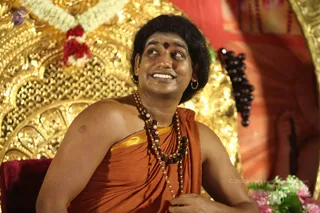
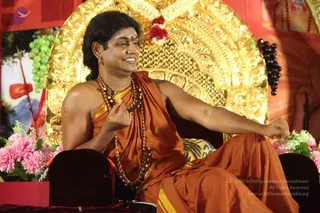
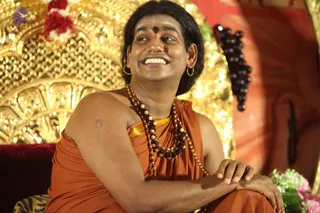
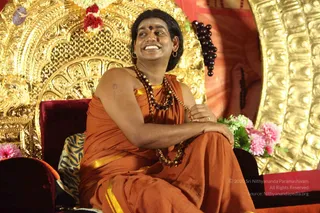
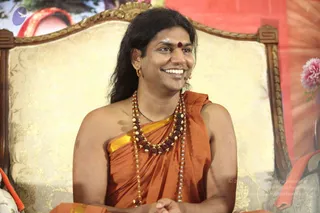
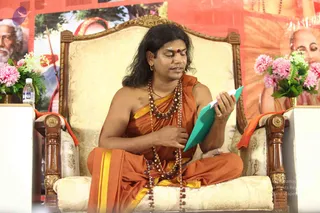
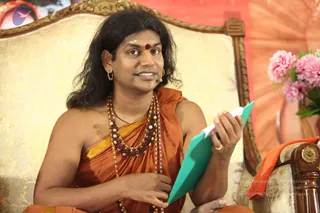
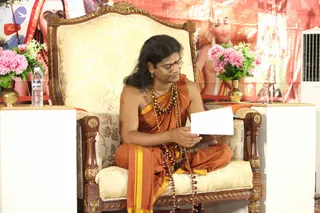
A photo of a homa at a fire pit. A shaved-headed man in saffron-orange robes with a white-and-red tilak on his forehead sits before a metal fire box, feeding sticks into large flames with his right hand while holding a brass plate of grains. He wears a long gold-beaded mala and a rudraksha-style pendant. A microphone stands at right. Behind him, a second man in white clothing sits near a red draped table, and brass vessels and offerings lie on the floor. A faint purple logo appears at top left.A smiling man seated on an ornate cream upholstered throne with gold-trimmed carved wooden arms, one hand resting against his cheek. He wears an orange saffron wrap over his shoulders, multiple rudraksha malas and a ceremonial gold-toned necklace, a red bindi on his forehead, and a small headset microphone. Orange and cream cushions and pink flowers frame the seat, with a water bottle at left and a painted backdrop behind him. The appearance-based label: a person, seated in person as the speaker.A photograph of a smiling man seated on a red-cushioned throne with a zebra-striped seat cover, wearing an orange-saffron dhoti and shawl with gold borders, a long rudraksha mala and gold ornaments, long swept-back hair and a red bindi. He holds a gold ceremonial staff decorated with pink flowers. Behind him is an ornate gold throne backrest, pink flower garlands, and a red backdrop with framed portraits. a person is seated in the centre, appearing to be the principal figure being honoured; he is the only physical person clearly visible.

July 14 2012

Original wiki page
Contents

Title:

Supreme Pontiff of Hinduism HDH Bhagavan Sri Nithyananda Paramashivam

Description:

In today’s morning satsang, Paramahamsa Nithyananda (Swamiji) takes a question about mission TALKS FROM MORNING SATSANG ON JULY 14 2012 IN MADURAI, INDIA In today’s morning satsang, Paramahamsa Nithyananda (Swamiji) takes a question about mission outreach. Even when devotees are riding on a wave of inspiration and enthusiasm, if they overwhelm their friends with their excitement it feels too aggressive. Especially when we describe mystical experiences, we can frighten others. The purpose of Paramahamsa’s mission is to heal the world and lead all to enlightenment. Our best way to share this purpose is to listen to the needs of others and guide them to how Paramahamsa can help. If they have health troubles they can learn a kriya; if they have social problems they can attend LBP or Kalpataru. Only by opening our ears and hearts to them do we become beacons of hope, radiating living enlightenment to Planet Earth.

Link to Video:

VideoAudio

Transcript:

Listening is the best marketing tool

First batch today third level nirahara samyama 10th day. O God! So, 19 days they have completed successfully. So only three more days. O God, tomorrow the first batch concludes successfully the nirahara samyama by tomorrow. Yesterday night these guys, all these internet and the 2-way videoconferencing department in charge they came to me and said, 'We lost internet connection! Only today evening it is supposed to come'. Night they came and told me 'till today evening it will not come'.

I said 'that and all I don't know, tomorrow I have to initiate people into samyama. I have to do the satsang. It will be there'. I just slept, that's all. Just before, 5 minutes before the morning satsang it was up. And still in Kodaikanal they have not got. Alright! Great! This nirahara samyama is becoming a powerful process. I could see people all over the world becoming healthy, intelligent, more spiritual, evolving into high consciousness.

Alright, we will start the morning satsang. I will answer your questions.

The first question is from Bhavya, IA number 93. She is asking 'Dear Swamiji, I was wondering what I can do to help other people who are non-believers or atheists connect with you or find you like I have, because when I try to share my experience or tell them about you, they look at me like I am crazy' - Bhavya, IA number 93.

Bhavya, do not force yourself on other person, your belief, your experience. When you talk to the other person, see what he really wants. See, I am a spiritual mall. He may have some disease for which you can give our kriyas. He may have some life problems, you can give my life solutions.

Communication starts only when you start listening. So, don't do with the agenda of evangelism. Don't carry the evangelistic spirit. No! go with compassion. Listen to his problem. See, when you start talking to people, naturally they are going to tell only about their problems. If he says he has some physical disorder, disease, come on, immediately tell him, see I know one person who has given some kriyas. If you see those kriyas and practice you will be healed.

I will give you a small example. Come on, show the video ma. Just today morning I received a video. I will present that video to you guys.

[start of video]

"My name is Ricardo Oreiki, and I live in Houston, Texas. I got diabetes at the age of 33. I used all kinds of insulin until now. Sometimes the ambulance would take me to the hospital as my sugar level used to be really high, around 350 to 400. One day my neighbor was talking to me. He told me there was a formal exercise to do. He came to my house and taught me how I had to do it. And before I started the exercise, I checked my sugar level and it was 350. I did the exercise the way he taught me to do it. When I finished it, I checked my sugar level, and it was 85."

"It's extraordinary because I have never seen anything reduce my sugar level so rapidly. Usually I have to walk around the neighborhood for half to one hour. Even then I have to put a lot of insulin to reduce my sugar level. This is extraordinary! When I went to the doctor to see how it was. While using 5 milligrams of insulin and doing the exercise daily in the morning, it was a miracle and the doctor asked "only 5 milligrams of insulin?" and I said "Yes! Five milligrams!" He said, 'great, continue with this. Just five milligrams each day is fine, but check your sugar levels everyday'. I check, if at times it goes up a little - only 100. I am eating everything I normally eat."

Now, do you need to do anything else? Now you don't need to tell him to follow my teachings. He will just dive into my website, into our website. I can be sure for the next two years, he will be hooked to our youtube discourses, Spanish translation.

See, if somebody has a disease, tell them to do the Nithya Kriya for that disease. Or if somebody has a life problem when they talk, give them one or two life solutions and tell them 'why don't you watch this Guaranteed Solution YouTube videos. Just attend to their problem with compassion. Don't go with evangelistic arrogance. When you land there with evangelistic arrogance, by your very arrogance you create a barrier.

So, go with tremendous compassion, listening. Listen to them first. I know how many wives have driven their husbands out of me. See, husbands also know that Swamiji is right. But wife telling is wrong. So, understand, do not carry the arrogance of evangelists that 'I know, you don't know!'. No! listen to their problems. When you know they have a problem, try to give only as a solution. Once one solution works, I tell you all my solutions work! It is not a random click that this person, the diabetic kriya worked on this person.

Anybody with any disease, give that related kriya, it works. I have developed based on a pure spiritual science. 100% it will work. How can otherwise one small breathing exercise bring sugar level down from 350 to 85? See, the kriyas are built in such a way that when you sit in that posture and try breathing, immediately those special channels of kundalini get awakened. That is why so much of benefit. And I tell you, it will be miracle for him. As far as he is concerned, from the age of 33, diabetic patient. It will be miracle for him.

Now I am getting email from him that the patient was retired because of diabetes. Now he has become so healthy that he wants to go for work. God! Just in 10 days, from 300 the reading has come down to 125 forever. Just 10 days! Great! So, I tell you guys, talk to people only about supporting them, helping them, don’t go with evangelistic mood, that is not going to work. Before talking, listen, listen to people. I tell you, so many times, when these VIPs come to have my darshan, first half and hour I will not open my mouth. I will listen.. I will just hold their hands and listen, listen and listen. I wouldn’t have spoken a single word. When they go out they will say, ‘what a great Swamiji. He solved all our problems’.

Listen first. People don’t have place to pour themselves. Nobody is listening on planet earth. Understand, nobody is listening. Just listen first. Even if you pay to psychoanalysts and psychiatrists to listen to you, they are not listening completely. Listen. And all you need is you just have to have a rough view of our website, what we call site map. If the site map is in your brain, that is enough. When somebody talks they have disease, you know, remember kriya. If somebody says there is some life problem, guaranteed solutions. If somebody says that they feel dry in their life, then come on, read the enlightenment portion.

I am almost a spiritual free mall. Our website is a spiritual free mall. Understand, wild forest! But everything is available. Actually, in the Inner Awakening, one full day I am going to be teaching only on communication, means listening, listening.

Yesterday night we had a long discussion with a group of ashramites and they were telling me about the power of this kalabhairava darshan. I will tell you some of the miracles happened in the kalabhairava darshan. Day before yesterday, when I was healing one person, initiating one person, I asked ‘did you have abortion?’. If I am in the normal mood, I would not have asked this in public. But kalabhairava doesn’t know all this courtesy, politically polite and all that. He is very straight.

And she was completely shaken. I can understand. Such a personal thing. But what to do. That’s why from today I will not have the mic when I give the individual darshan. Anyhow, she said ‘no’! I said ‘alright’. I blessed her and gave whatever instruction I wanted to give and sent her. And same way, to another person I asked ‘do you constantly get dreams of you committing suicide? Dreams as if you are committing suicide?’ she said ‘no’. then I thought maybe in the public I shouldn’t have asked. I blessed and said whatever instruction I wanted to give and sent her.

Then, after the darshan, while I was driving back (I went to Madurai and came back). So when I was driving in the car, to our brahmacharis I said ‘see, these two persons I have asked and they said no, but I am very sure both what I asked is true. She had an abortion. The other one is having dreams of suicide. Can you tell Ma Maneesha to go talk to them in private’. When Ma Maneesha went and asked she said ‘yes!’. She said that in their country, if naturally the child dies, it is not called abortion. So, she could not understand. And only if you voluntarily do, it is called abortion. It is called miscarriage it seems. But in India, whether the child dies by itself or you abort it, it is called abortion only.

After all, Kalabhairava is using Indian version of English at that time. He was using Indian edition of English, Indian version of English. So, that is the reason he used the word abortion. Anyhow, then, the other lady, she also said yes, I do get like passing out, dying, this was biggest problem. When these guys came and reported to me, I said ‘yes’. Please understand, in the normal way when you come and ask me for darshan, blessings and all that, I have a human angle of me which is sympathy, the consoling angle, the compassion angle. So what I do, ‘alright I will work, it will happen’.

So, I am not completely standing on the truth at that time, I am standing on compassion also. So, sometime, I do not tell the truth as it is. I tell in a way you want to listen with little sugar coating. But kalabhairava doesn’t believe in sugar and all. He is too straight. And I tell you, whatever I utter during the kalabhairava darshan, I take responsibility for it, because it is 100% truth. Nothing can miss. Nothing can miss. Even a line doesn’t miss. During the kalabhairava darshan, anything uttered, uttered. I know.

So, we were having all these discussions. But another one problem with this kalabhairava darshan is because it is not politically polite, people who asked the question should be very mature to receive the answer. Sometimes, these fellows get offended. See, if you are offended by my answer, if you somehow digest it, great. But instead if you say ‘no, no, no, it is all lies’, you are gone.

And one more funny thing happened. This Karuppar Swamy temple pujari, chief priest came. Do you guys know that day before yesterday he came. After the darshan, he went out and he was crying to our brahmachari. I worshipped Karuppar Swamy for 35 years, today I saw him, today I got his darshan. Actually he was not supposed to come here. He says why I came to Kodaikanal I don’t know. He is not a devotee, first time he is coming to see me. But he is worshipping me for 35 years na, so..

I go to that temple regularly. That is my favorite spot, favorite temple. Karuppar Swamy temple in Azagar temple, just near Madurai. Practically every evening, I go for a drive. I go there and bow down to him. See, Karuppar Swamy is kalabhairava. Shiva is karuppar Swamy. Shiva is only called as Karuppar Swamy.

See, each action of Shiva becomes a deity, becomes a God. When Shiva came and destroyed the ego of Brahma and gave him enlightenment, that action is called kalabhairava. So, karuppar Swamy is the lord of blackness, darkness. Kaala means darkness, kaali means the feminine consciousness of darkness. So, the kalabhairava in local terms called as Karuppar Swamy. See, usually in villages, they don’t use the Sanskrit word. They use the local cholaqual term. Karuppa means in Tamil means black. Kaala means darkness. Kalabhairava is only worshipped as Karuppar Swamy.

I always visit that temple, that temple priest only. Casually he came to Kodaikanal. Suddenly he asked, can I come and see Swamiji, have darshan of Swamiji. We told him to come during the homa, but somehow it got delayed. He asked me and I said ‘alright allow him’. He came and had the darshan and two people came along with him. They wanted to ask some question. When these guys asked 'they want to ask some questions', I said 'no! I don't want to answer'. Still, I have not said once no to anybody's question during kalabhairava darshan. Never ever I have said no, first time I said no. then I came to know they were fully drunk, the two fellows. Sat in the back, they were drunk.

Twice they asked. See, I have never said no to anybody's question in kalabhairava darshan. They were asking me, I don't know, I just said no. then when I finished darshan and went driving, they said, Swamiji those fellows were drunk. It's a powerful God. After inner awakening, you guys will be taken to that temple. You guys can go and have the darshan. See, because the deity is so powerful, he is worshipped as a presence.

There is no form. There is no statue, he is worshipped as the presence. The door is always locked, the door is worshipped as the deity. Can you show ma? It is one of my favorite temples. Yes, this is the deity, this door is the deity. You can see the pujari who came here. He is only doing the puja, see! See, actually it belongs to his family. The temple is owned by his family. He is the head of the family. The person who is holding the stick now, he only came here, who is holding the stick ma, that guy. This is the deity, such powerful deity, when I went there I saw him, I saw the kalabhairava standing 18 feet! I bow down to him, such powerful deity.

This door is the deity. His presence is worshipped. See, it is his family temple ma. It belongs to his family. Some six people, he and his brother, like that. Show, show, let them see how the worship is done of kalabhairava. This is the sandals of Karuppa Swamy. Can you show the sandals once more ma? This is kalabhairava's sandals. Could you see, what a size sandals you see! Because he is so huge, he is worshipped as eighteen feet tall, so the sandals are huge, that big sandals. Next is the sattai, what do you call in English, whip! The whip is there next to his feet you see. With the whip only they heal you, whoever goes for any problem, they bless and heal.

See that sword inside the gap, that is presence. See, behind there is one door you see. The space between that door and this door is karuppar Swami's presence. Between these two doors, that space is worshipped as Karuppar Swamy. He stays there. The sword could you see? That sword is only worshipped as the main deity. But all of you guys, when you go for darshan you will not be able to see that normally. Only during the morning worship, they open that space, do arati.

In that gap only I looked in, I saw he was standing, eighteen feet tall. Behind the smaller door he was standing. See, in front of that door. When you open that door, it's a temple, the Azhagar temple. See, between the two main doors, the gap, that space, there are 18 steps, that is worshipped as presence of kalabhairava, that is worshipped as Karuppar Swamy's presence. And this sword is worshipped as his personal sword as the main deity.

Alright, see, when Shiva came, during the horse-riding, with all the horses to answer Pandia's thing to save Manikyavasakar, one saint, he stayed in the 18 steps. That is why that place has become the powerful place of Karuppar Swami's temple, Kalabhairava temple.

See, yesterday I was talking to all these guys about how powerful this Kalabhairava, all these, that. Then today morning I was discussing, I was telling my brahmachari, I was telling him, 'people, common man can never believe so much of mystical powers are playing so easily in the human body'. See, till you yourself have seen this kalabhairava darshan, can you imagine this? And if somebody tells you, will you believe? See, somebody comes and tells you 'one young man is there, he stands on one nails-padukas, nails-sandals, hold one stick and scream, dance, whatever he tells comes true. And he is able to predict left and right, your past, present and future.

If somebody comes and tells you that, what will you think about that person? Crazy! Bhavya, that is what people are thinking about you. So, do not go and tell him directly, tell him or her about the things they cannot digest. First you need to tell, listen to them, give solution from this site map, our website map and naturally once they have benefit, then you can start talking about the mystical things. Otherwise you see, you guys are overloaded by Nithyananda. I tell you guys, it's almost like you have eaten this much and whatever the remaining sambhar, chatney is coming through the ears. Not that you ate this much and you are belching, no!

You ate this much and the raw food, as it is, is coming out through your eyes, nose and everything. You guys are too much of Nithyananda. See, naturally, I am too heavy for any normal man, common person to perceive. See, it's like your few perceptions, once they turn positive, that's all, it's like, after that you don't know where is the end. It is like you go to the ocean, suddenly after drinking two handfuls you realize it is not salt water, it is sweet water. Then where is the end? It's like your mind is blown out, too heavy. The presence is too heavy.

This is one of the biggest problems. See, many people tell me who are outsiders 'o, you have a marketing department'. I say 'fool! The biggest problem we have is nobody is able to market me, nobody is able to brand me'.

Recently, one brand manager came. He came just to see us. He said, Swamiji you are an encyclopedia. And he says I am reading your website only for last one week and I need two months just to study your website. To study my website if you need two months, then to study me, what will you need? It is too much. That is one of our biggest problems. Nobody is able to brand me. Nobody is able to brand me. Understand, Bhavya, you are trying to brand me, which is not possible. You are trying to push me into somebody's throat, which is not possible.

I will tell you a small story. One guy who is born blind. He had a child. Unfortunately, that child died. The doctor is trying to explain to that guy why his child died. Doctor was telling your child when it was fed with milk. The blind fellow asked what is milk. Doctor said oh milk, it is white. Blind fellow said 'what is white? Doctor says 'no, no, no, you don't know what is white? Have you seen stork? It is white, white, that same color. This fellow asked 'what is stork?'. Now the doctor is completely lost. Then he took the blind man's hand, like this and showed, 'do you see now? This is the way the stork used to me'.

Then the blind man says 'if you put hits big an object into my child's mouth, it would have died only'. So, you understand, 'even I am not able to put this big an object into my mouth, how can my child swallow this big an object'. How the doctor as trying to brand milk for that blind man, that is exactly the same way you will end up if you preach about me to people. So go with teh mood of compassion, not with the mood of evangelism. That is where you are ending up. See, all our guys are ending up exactly the way the doctor trying to explain to the blind man how his child died.

You really jump on people, don't do that. I wanted all our devotees to know this one truth. By listening you start communication. First time when you sit with people, talk to people, do not say anything. Listen to them and just suggest to them to just see the website or YouTube. Give some soft material. Don't tell them 'oh, immediately do one pada puja and ask for kalabhairava darshan!'. That fellow gets frightened. Understand I am too much of mystical powers and abilities playing in human body. It is very difficult for normal human beings to catch.

So, understand, don't promote me directly, like evangelism. Go with compassion and helping hte person. That is the best way you will reach me out to people and people also won't feel you are crazy or I am crazy. Listen to their problems, handle with compassion.

Tags:

Paramahamsa Nithyananda, question, mission, devotee, inspiration, overwhelm, friend, excitement, feel, aggressive, mystical experience, frighten, heal, enlightenment, best, listen, need, help, health, social problem, heart, hope, living enlightenment, Planet Earth.

Photos Of The Day:

Satsang-Morning
Pada-Puja

Sarva-Darshan

Kirtan

Energy-Darshan

Inner-Awakening-Session-oN-Leadership

Navagraha-Homa

eNgenius

Photos from this day

View all 217 photos

Satsang-Morning
33 photosSource gallery
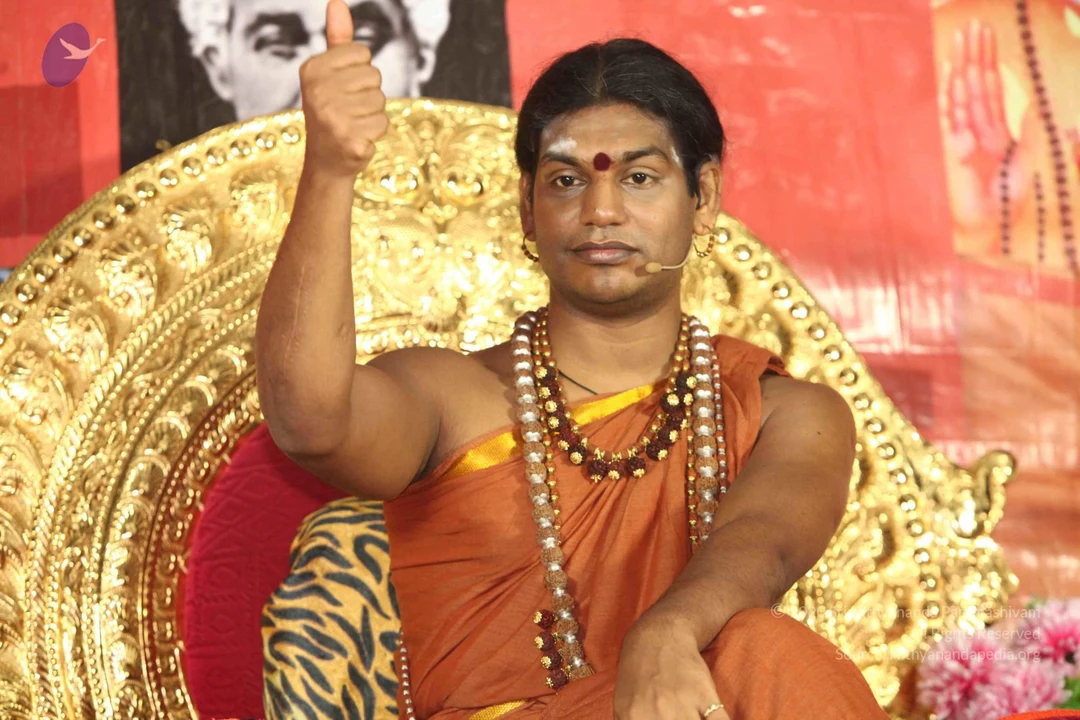
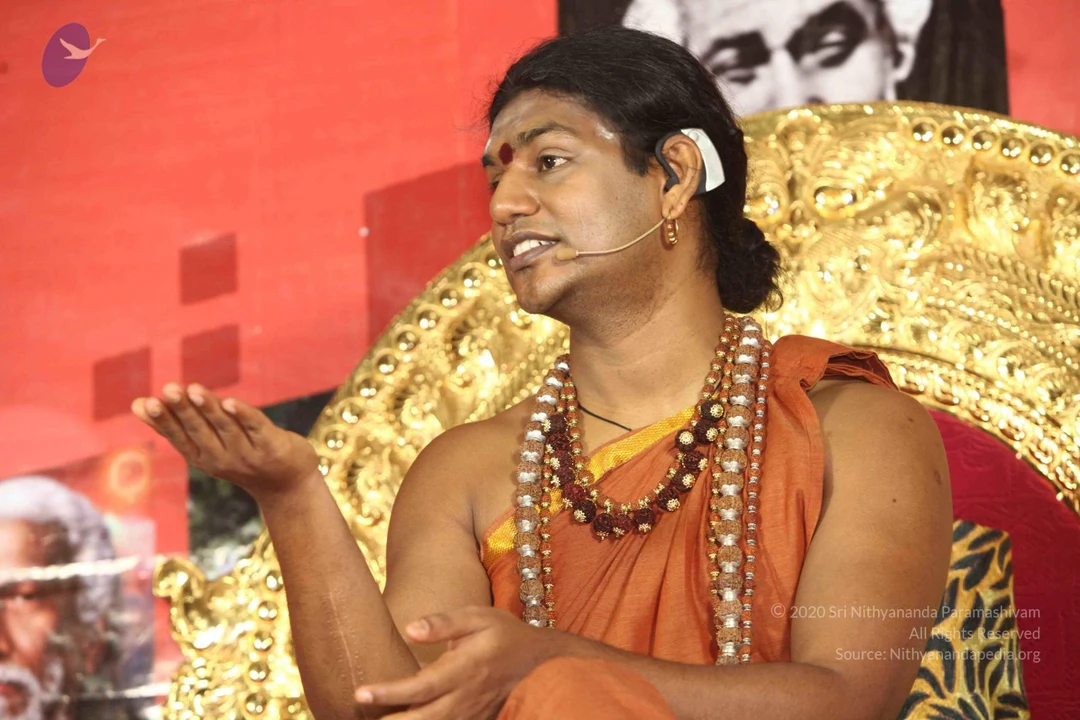
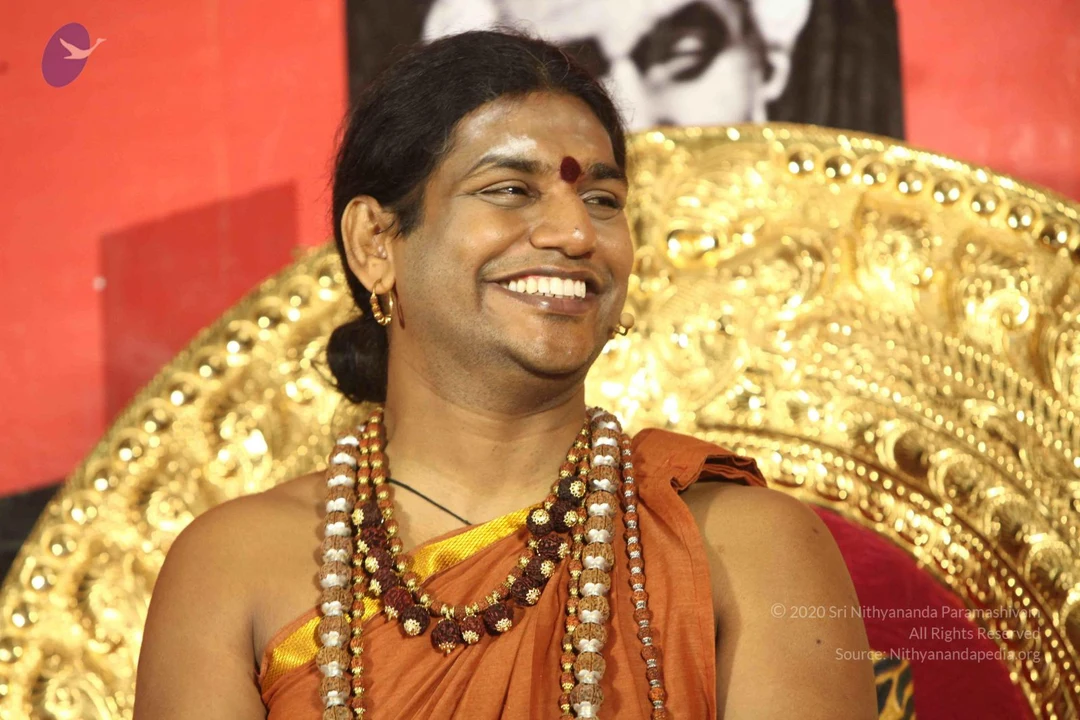
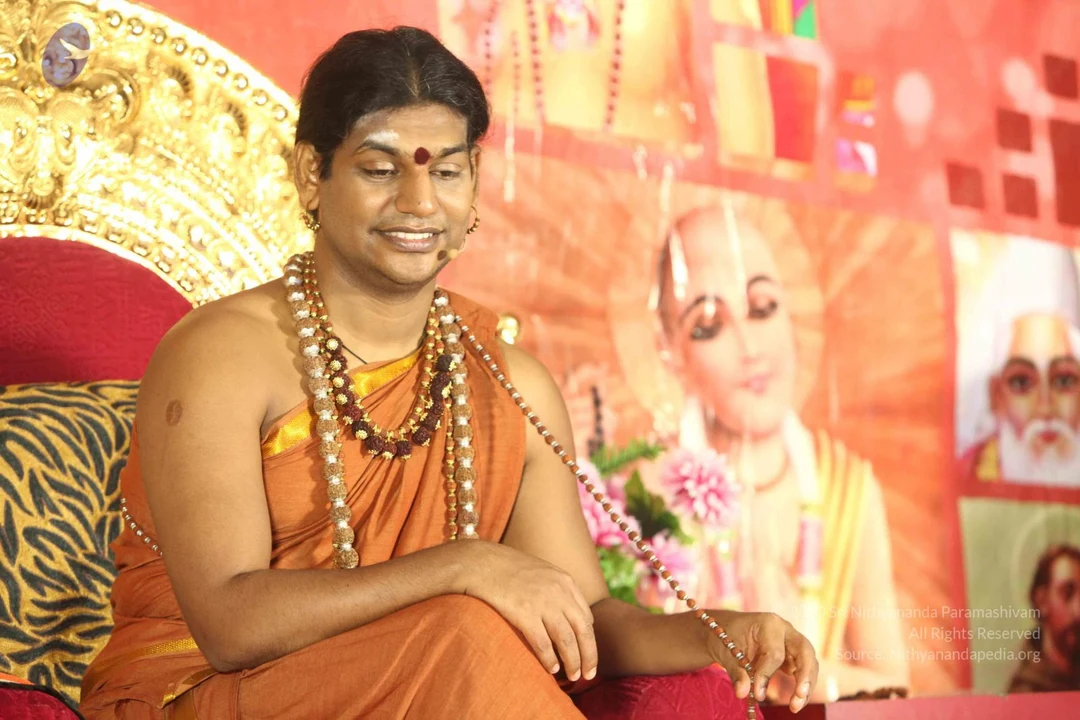
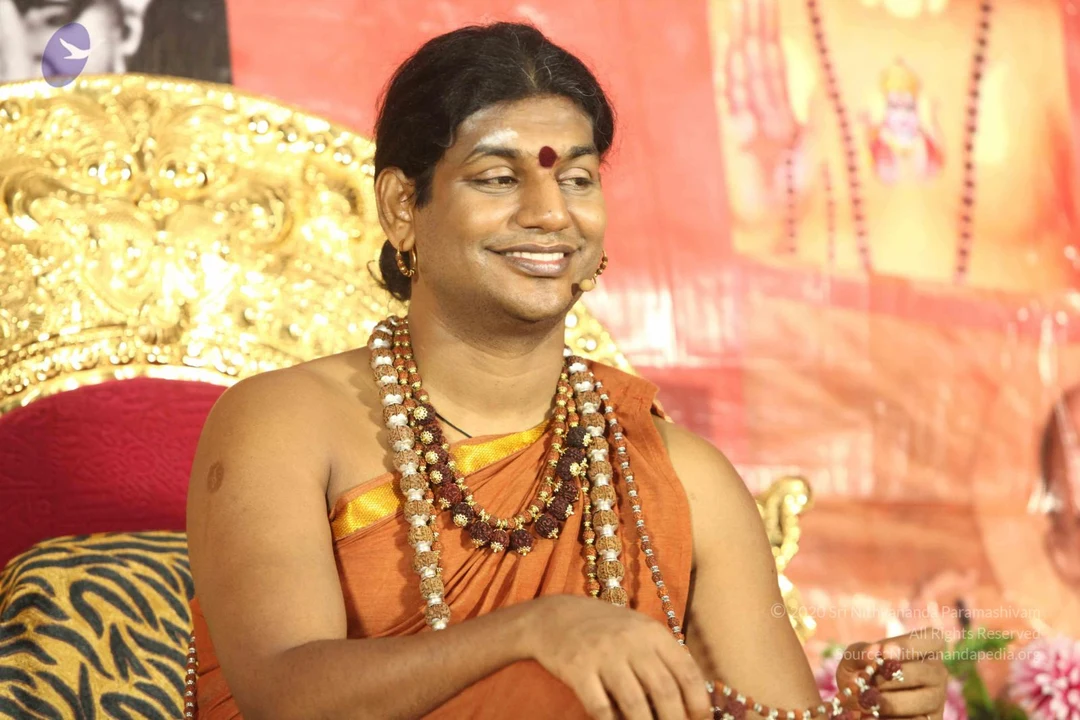
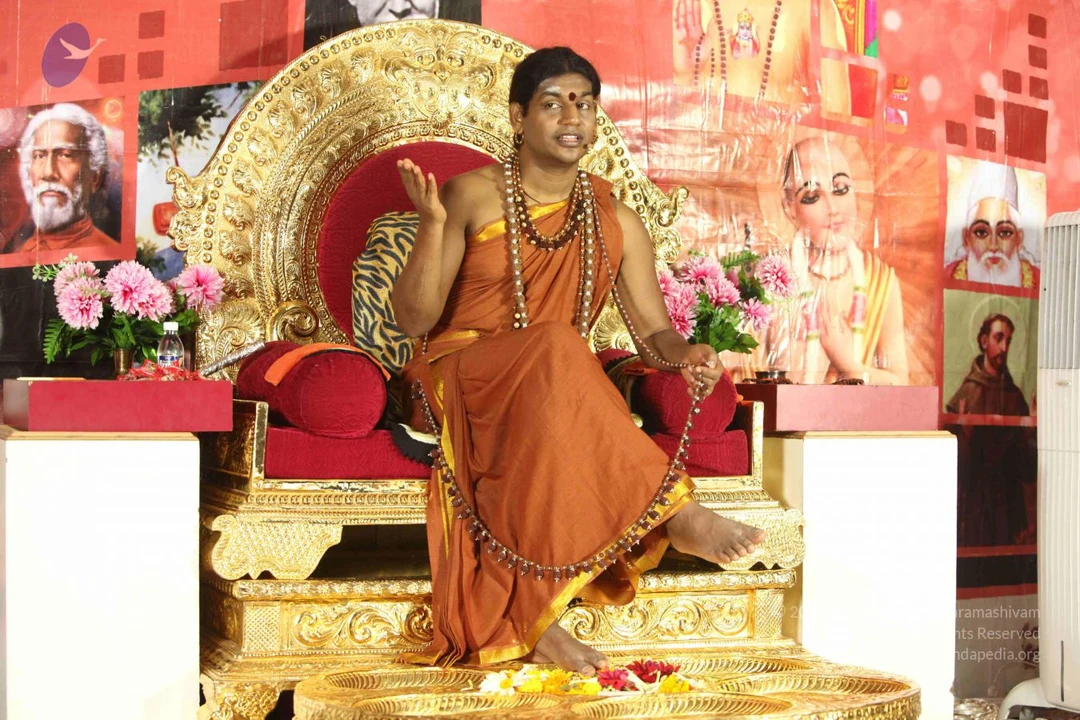
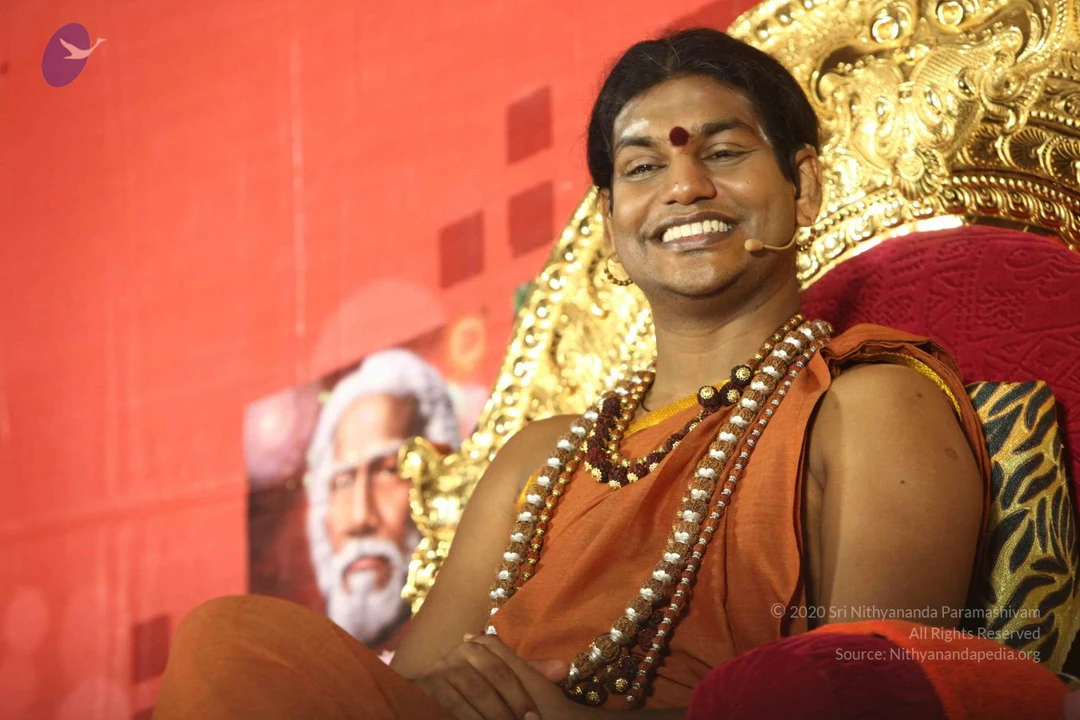
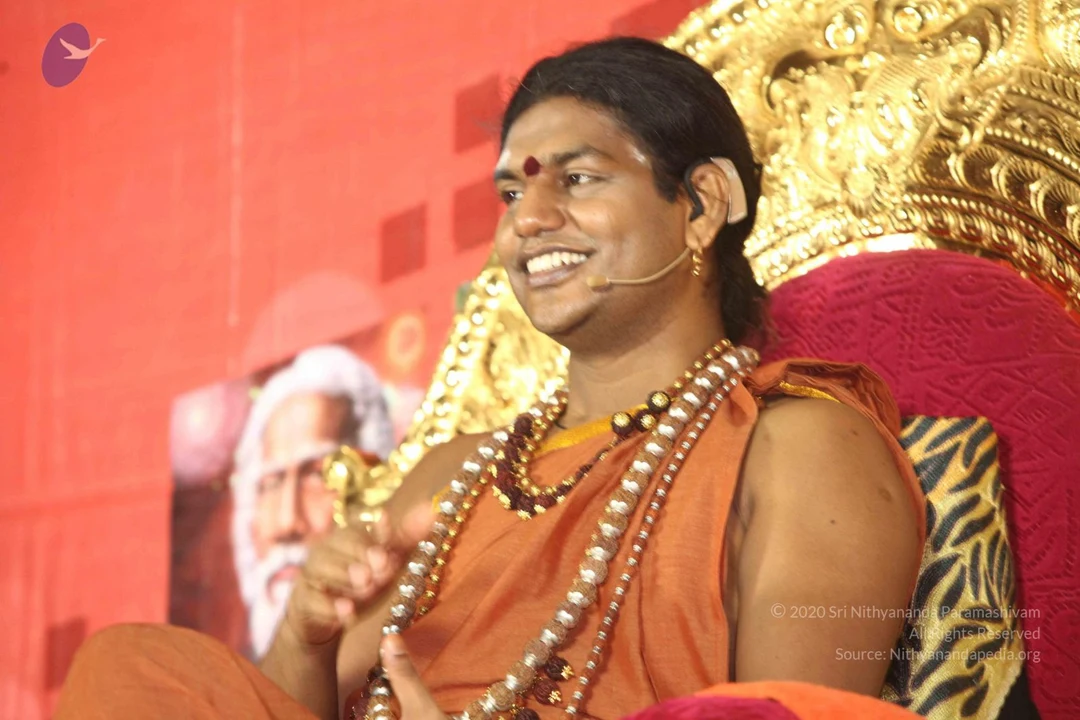
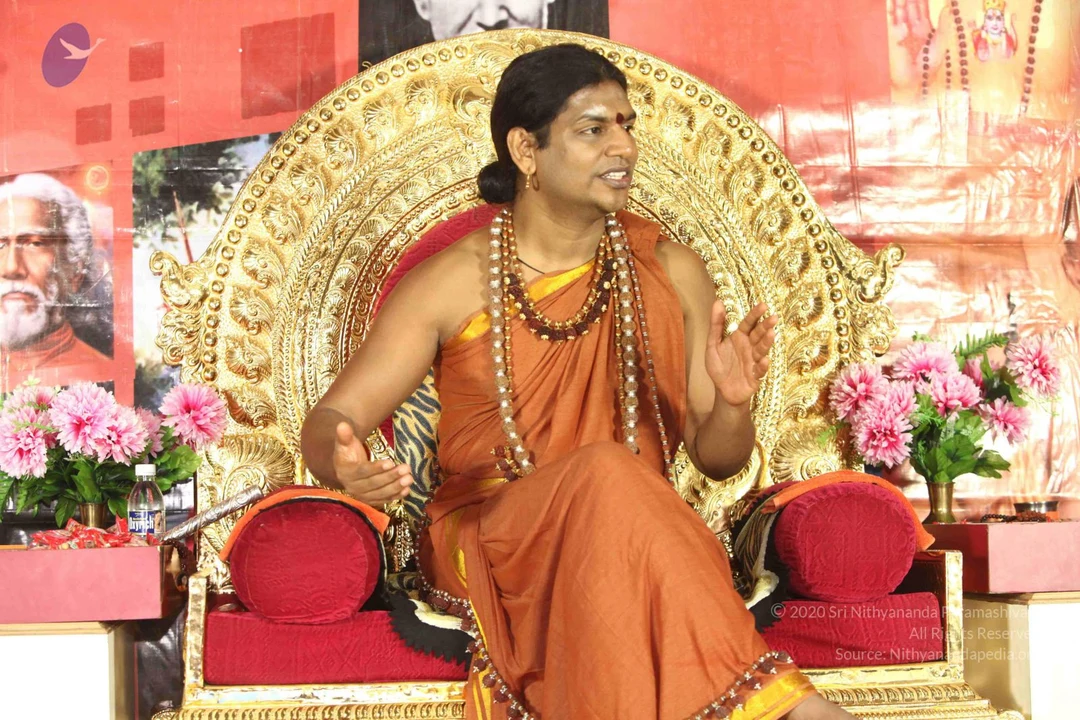
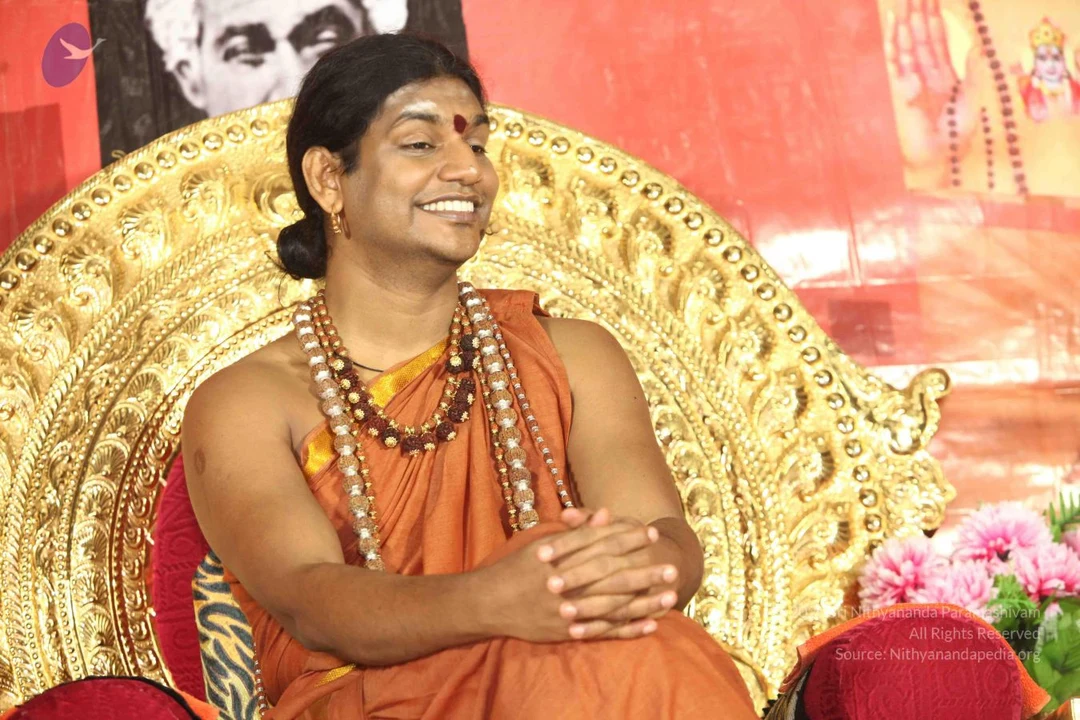
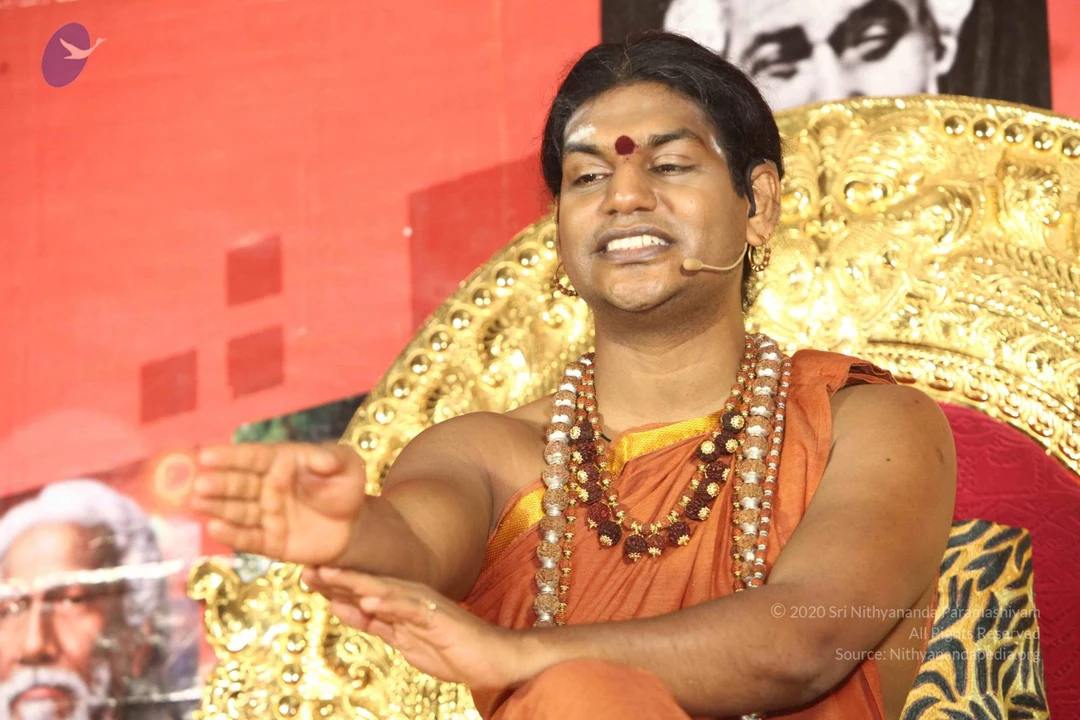
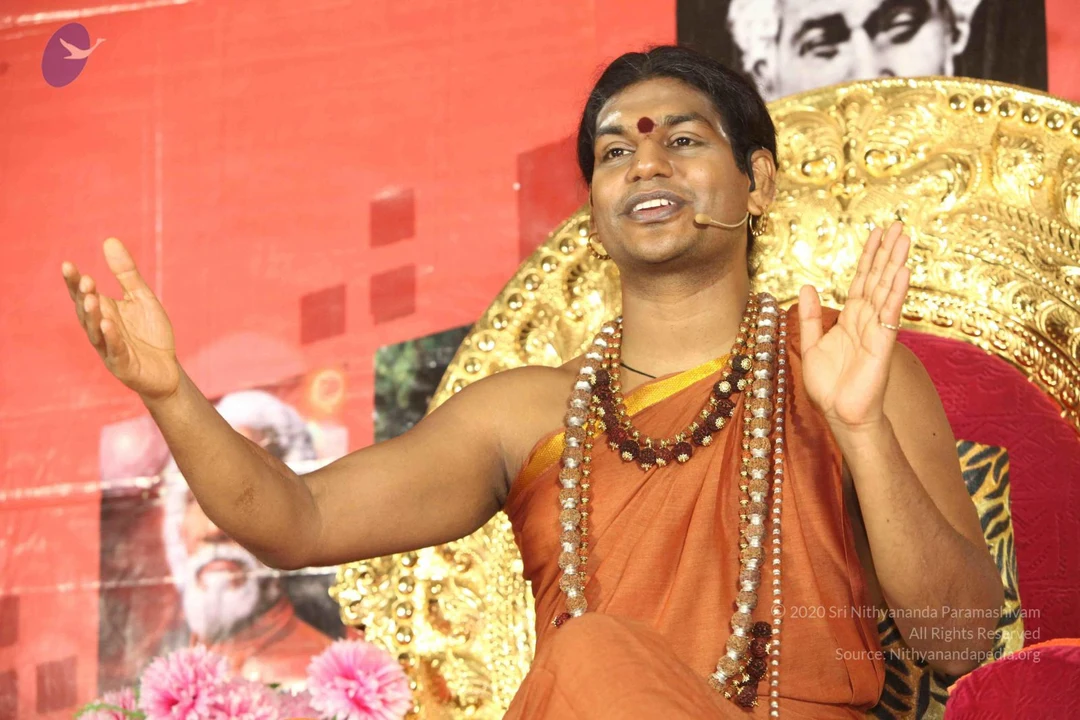
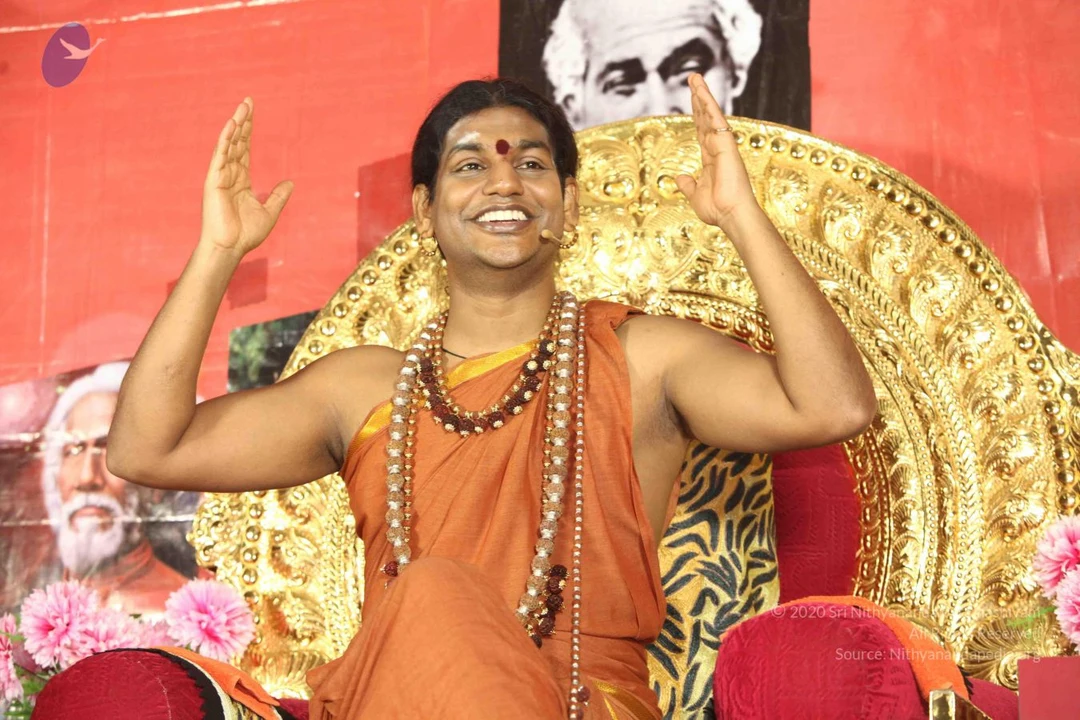
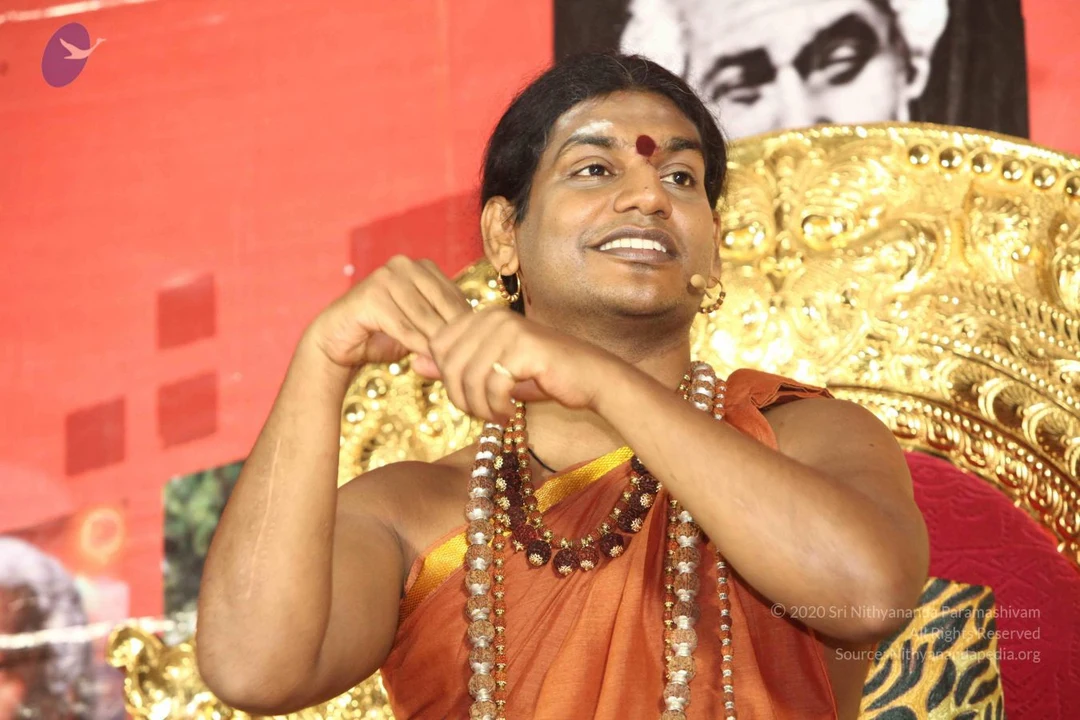
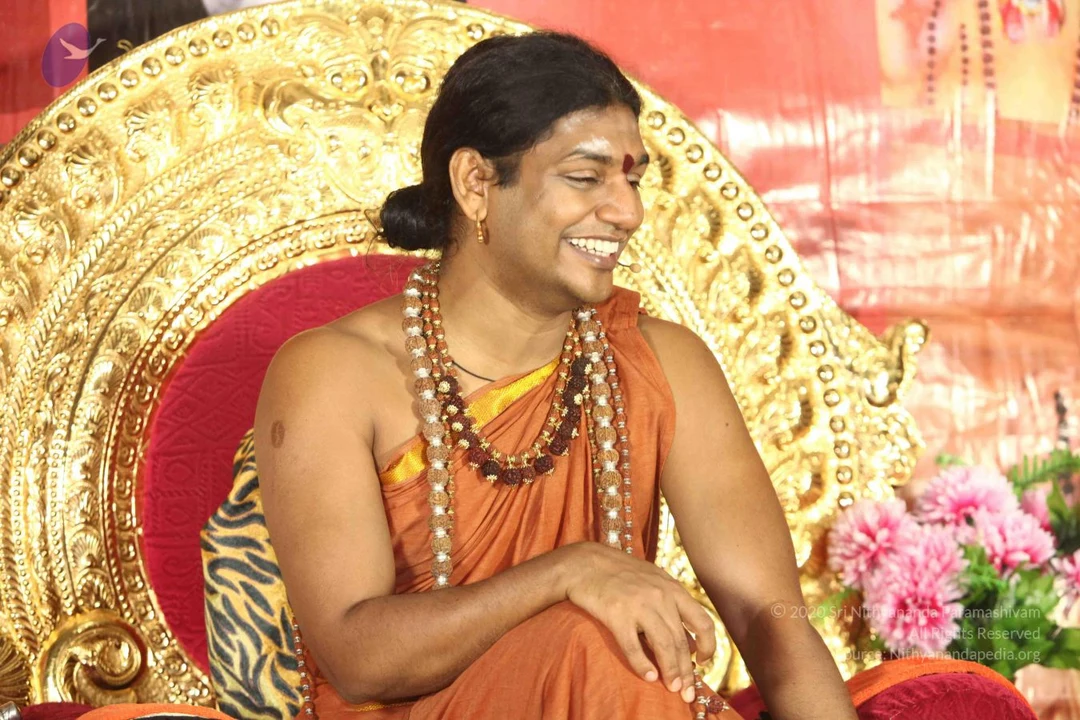
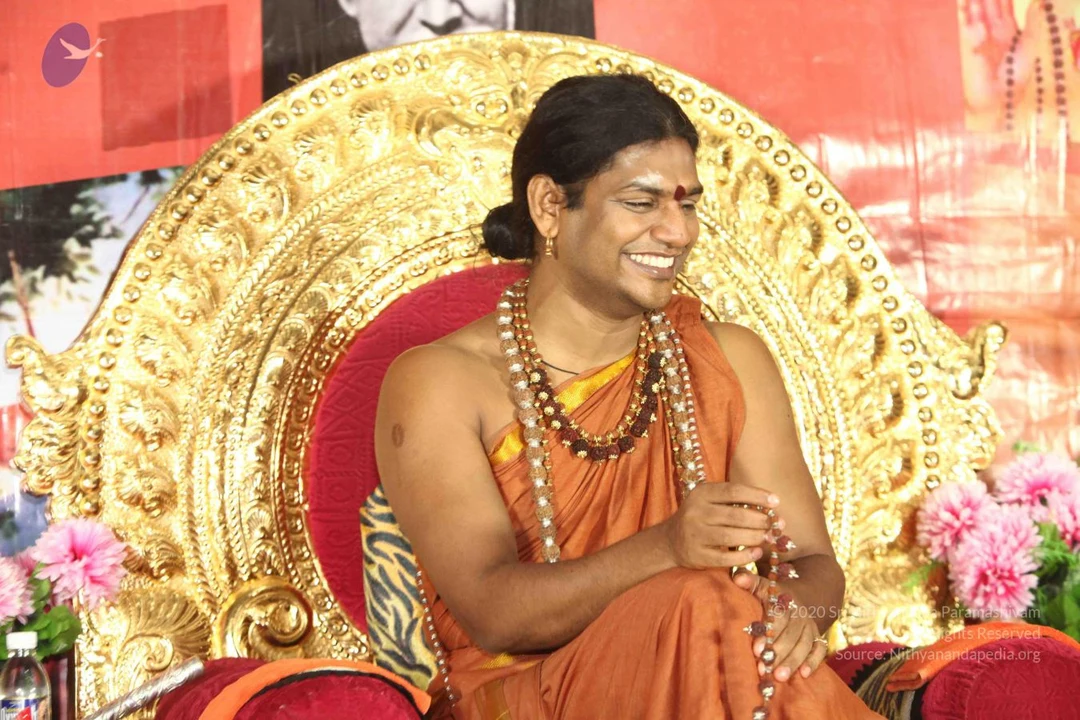
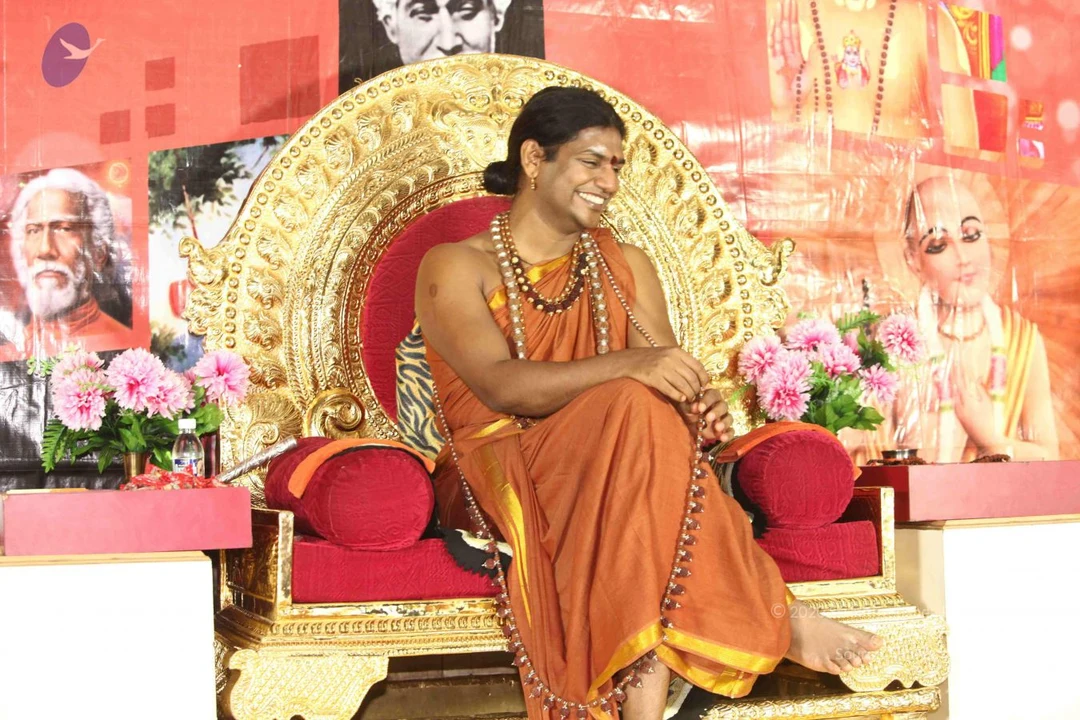
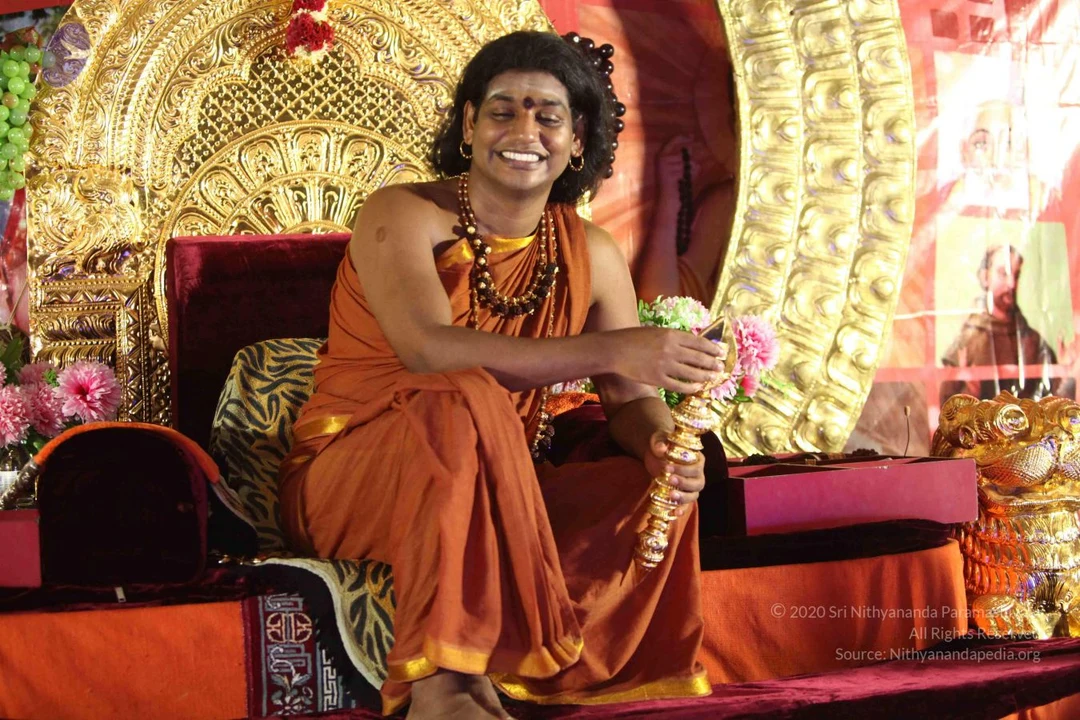
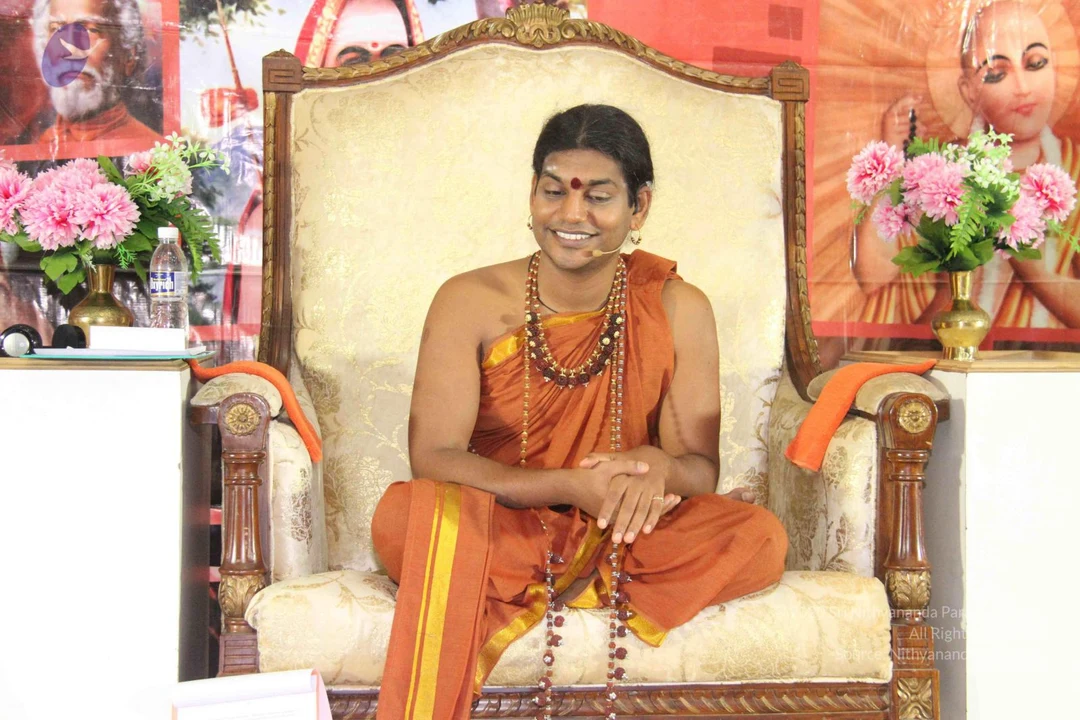
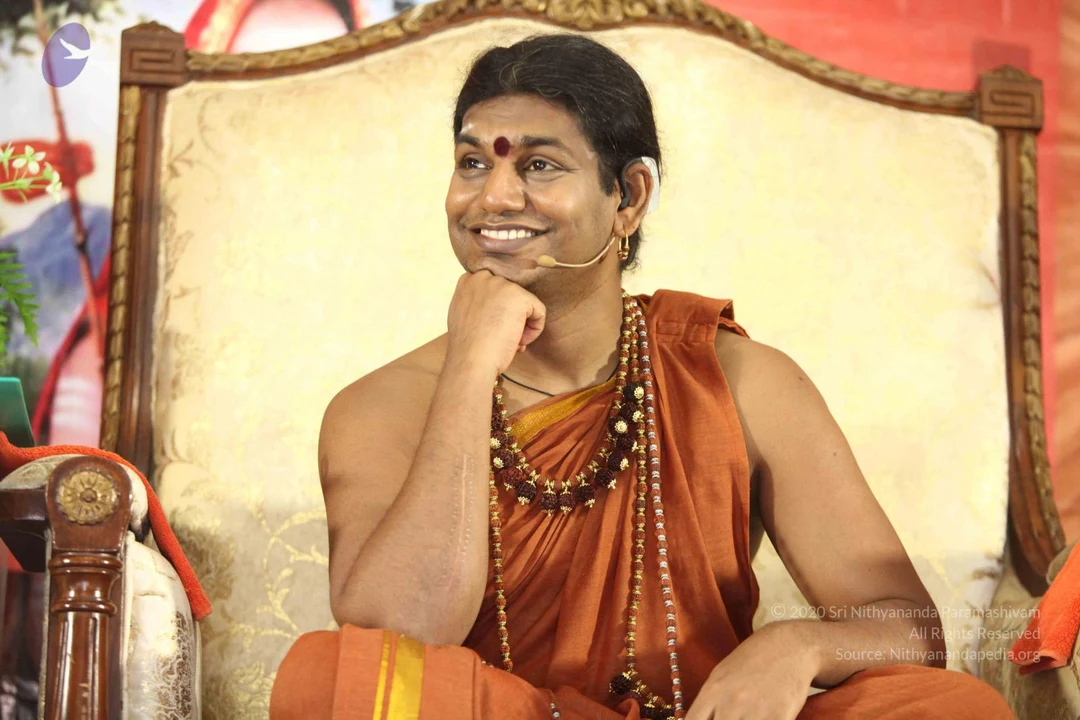
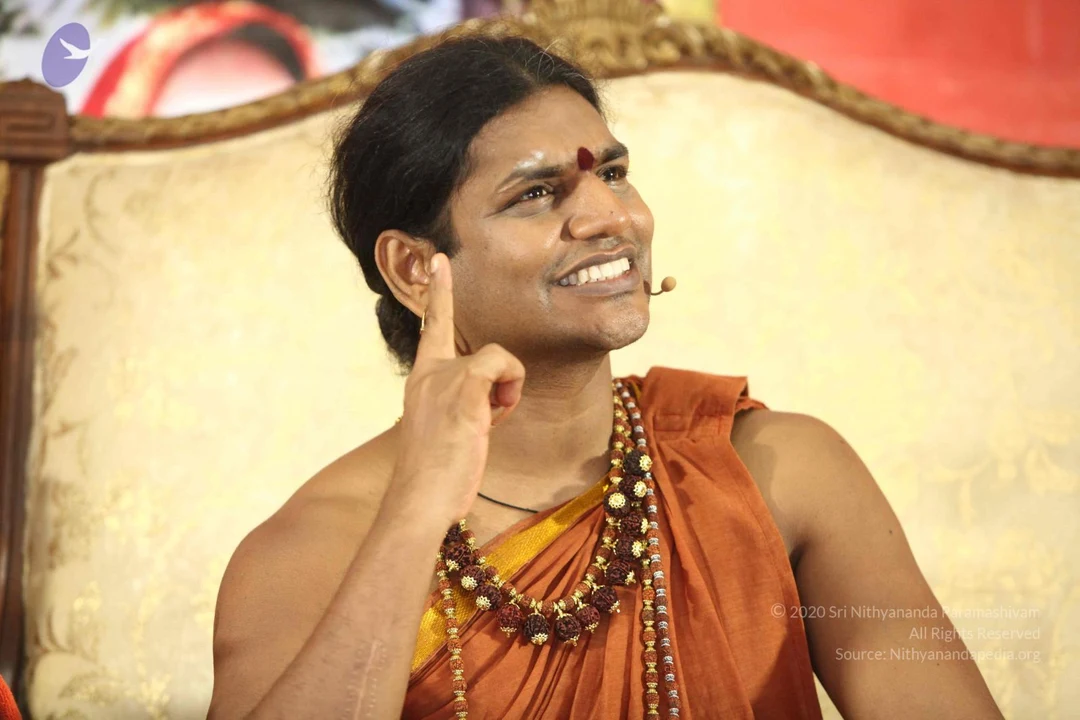
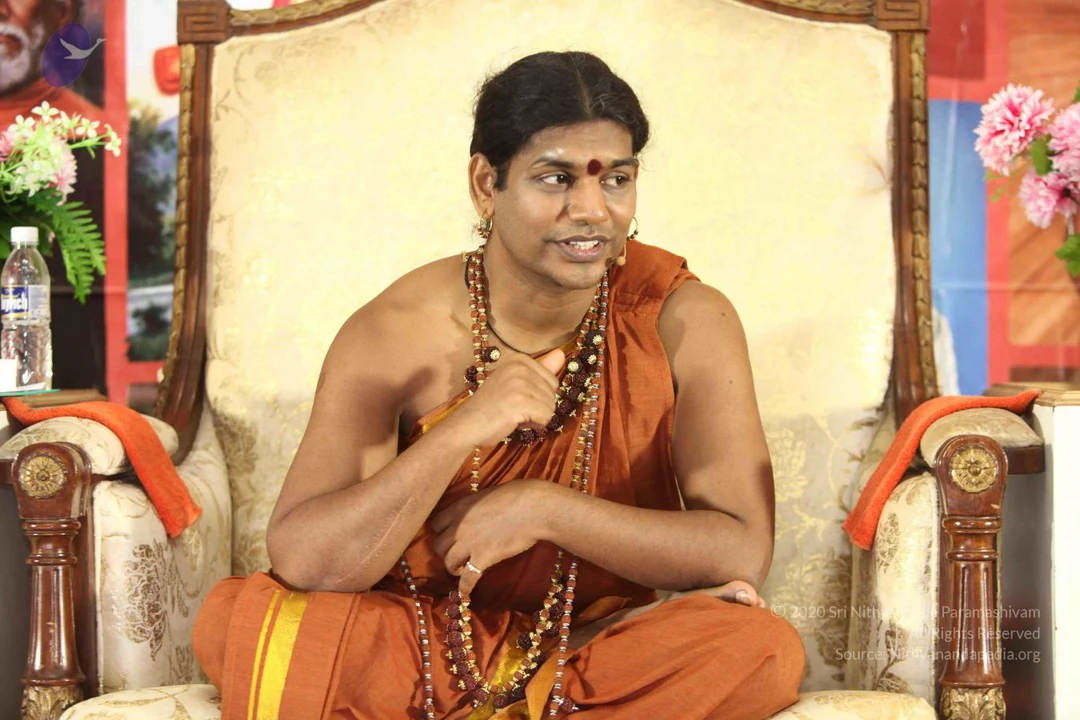
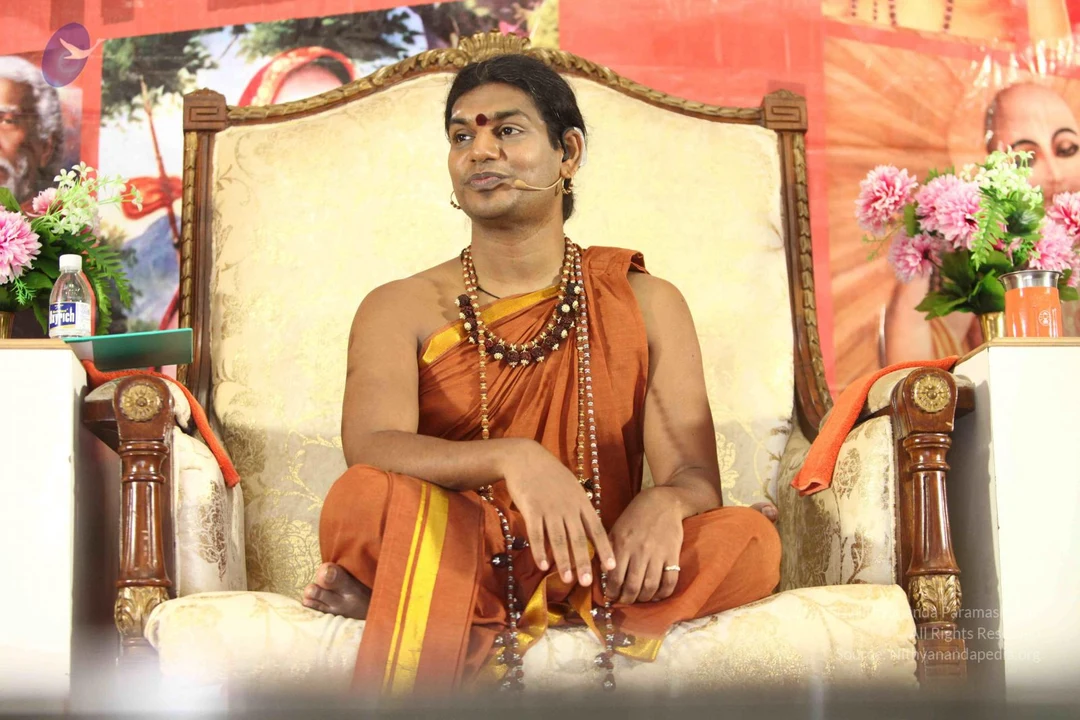
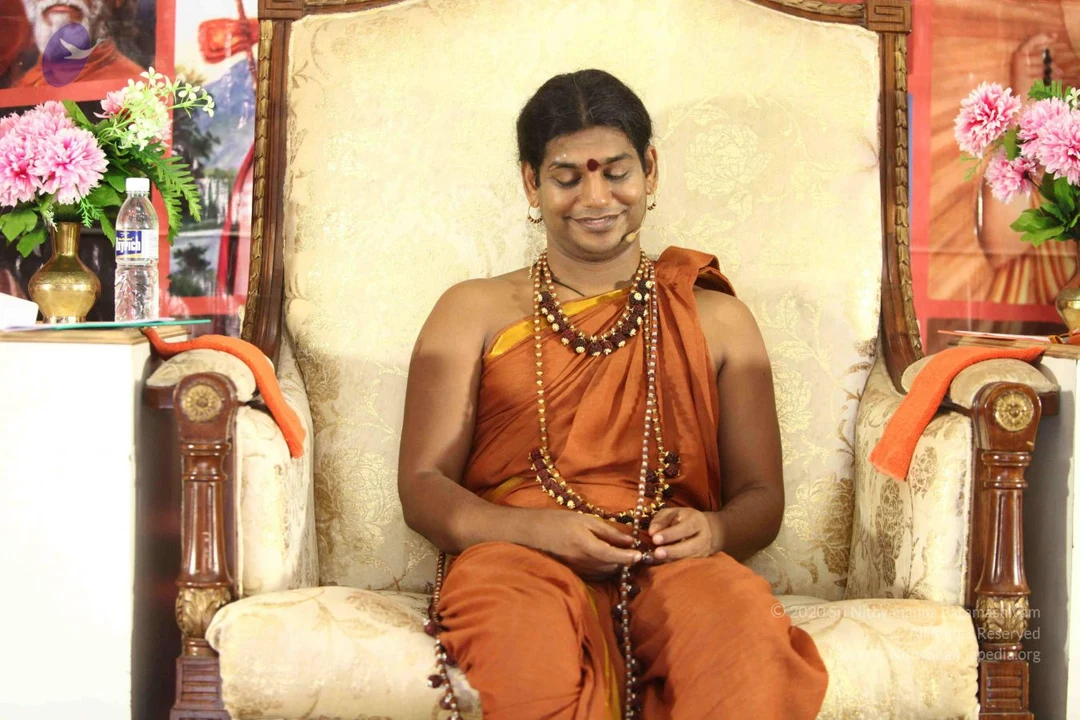
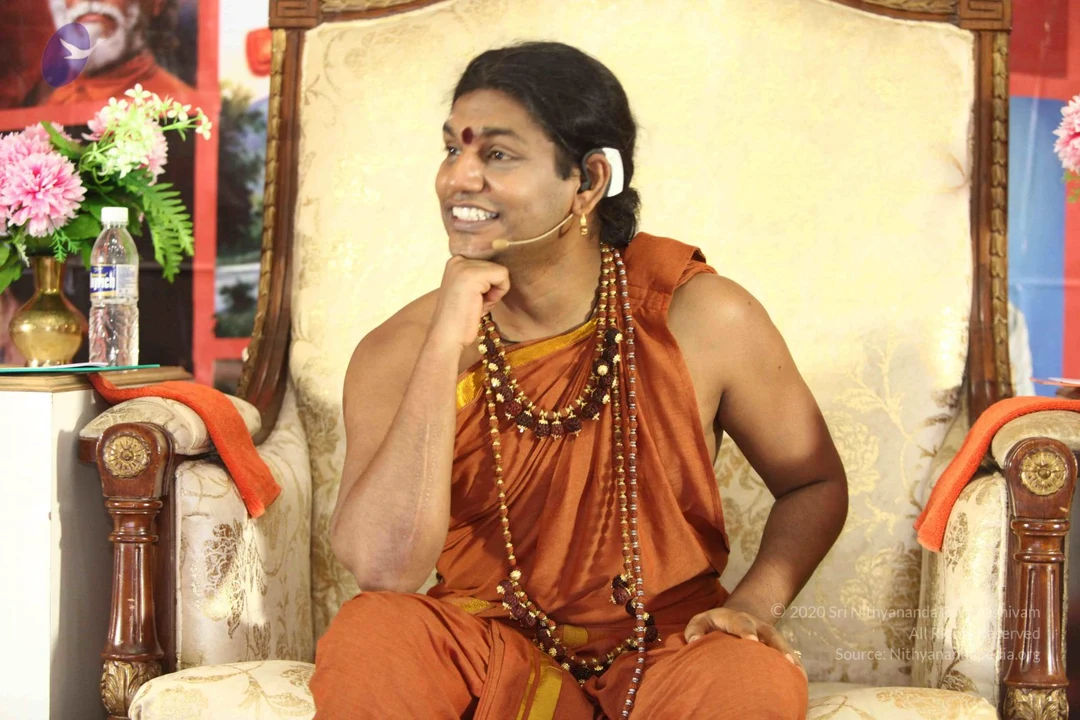
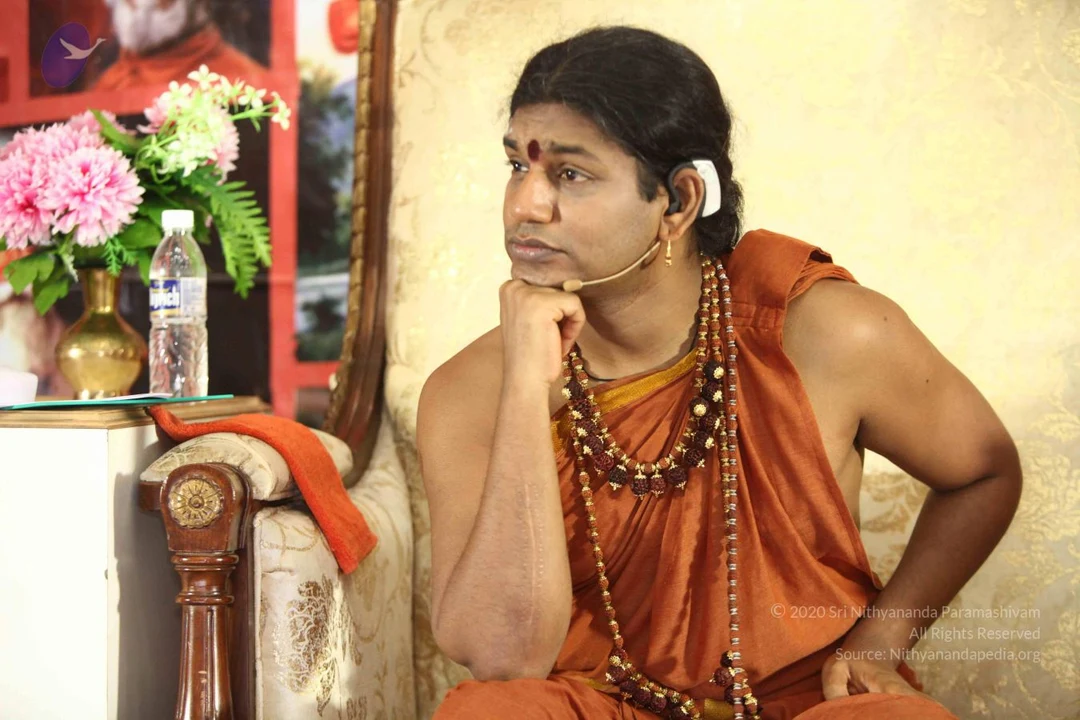
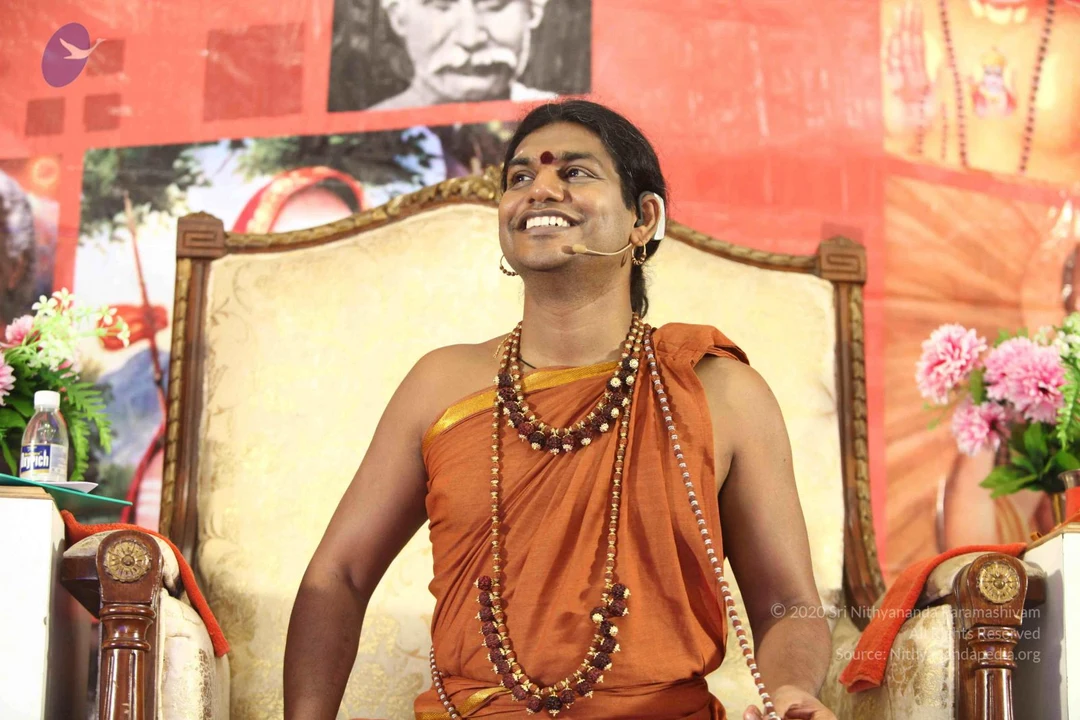
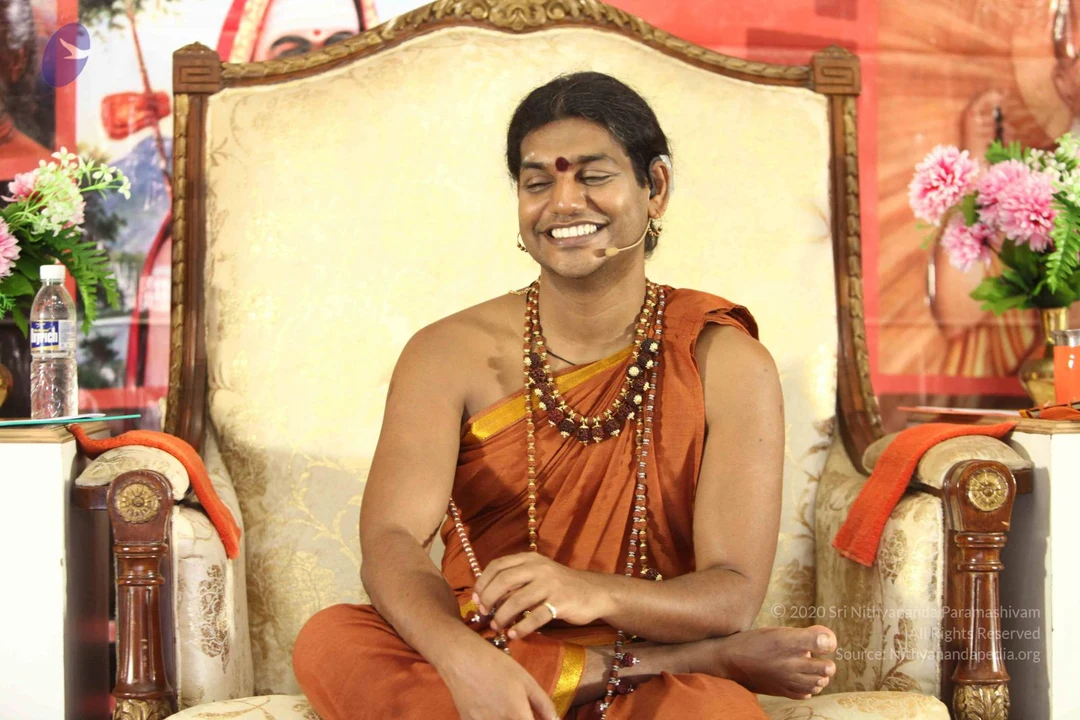
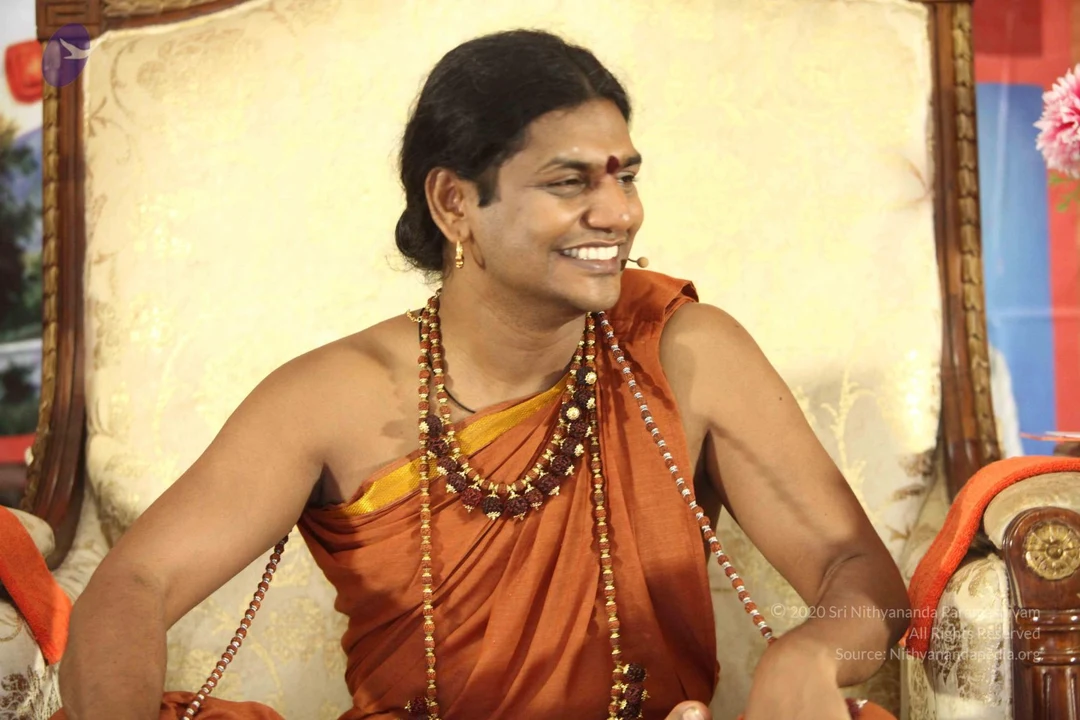
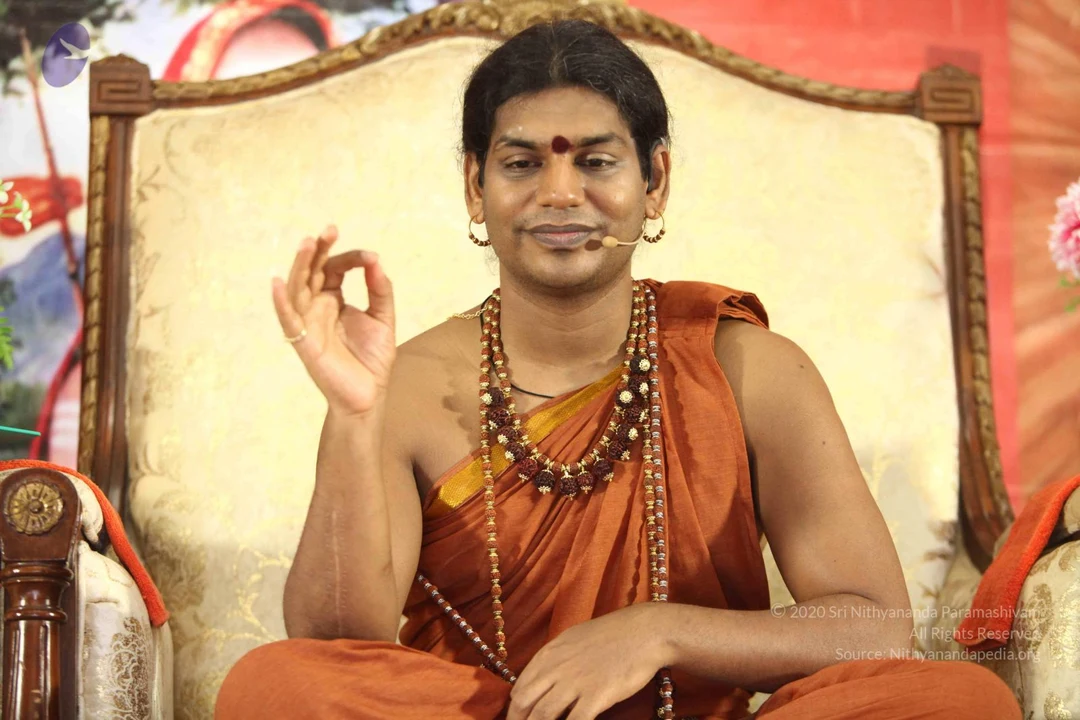
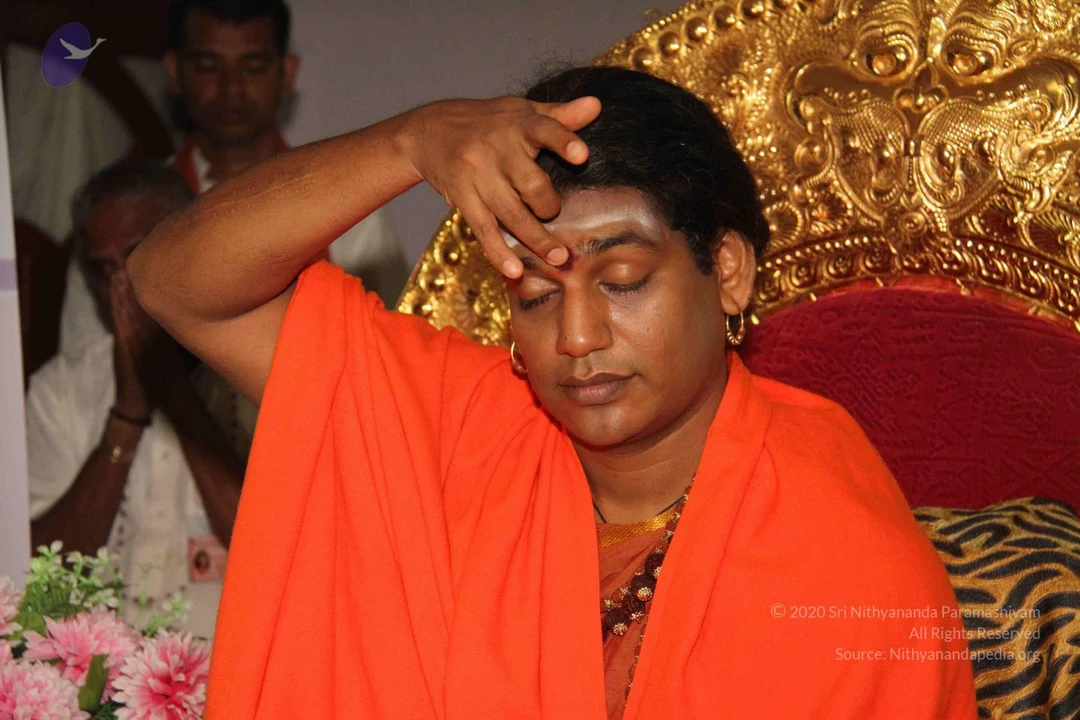
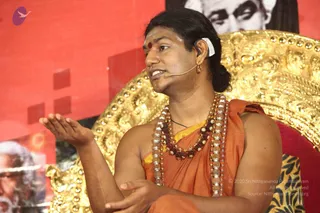
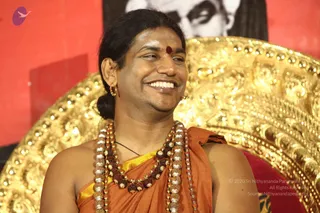
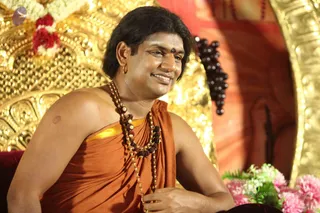
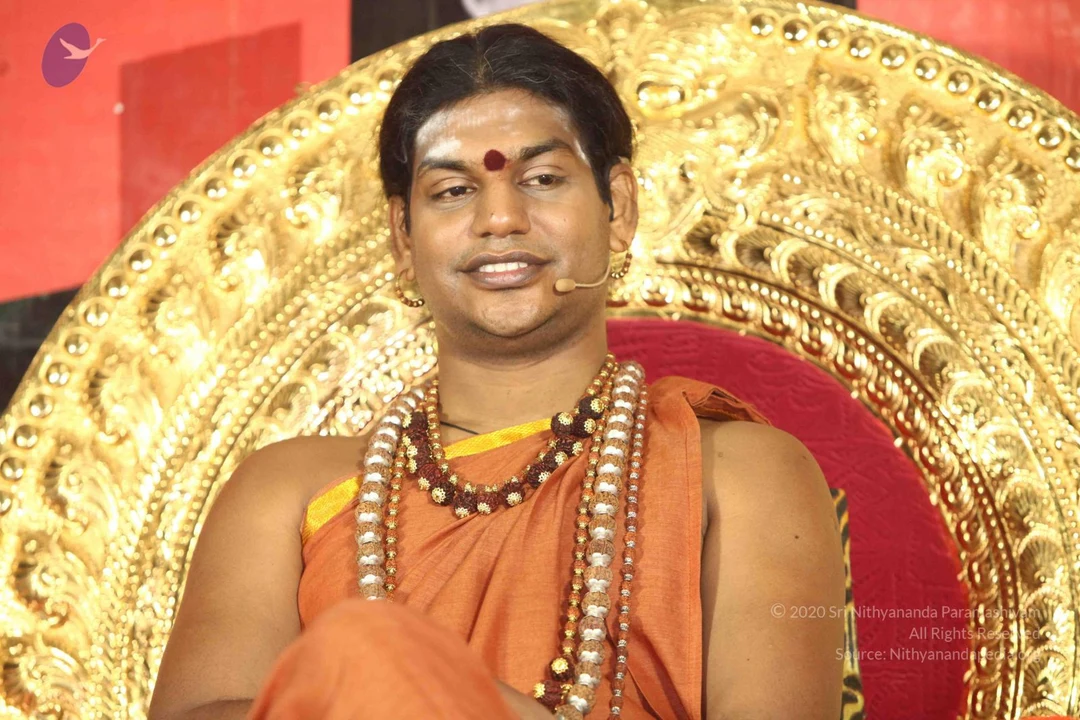
A seated man in orange saffron robes sits before an ornate gold throne with carved floral and scroll patterns and a red cushion. He wears a red bindi, white forehead marks, gold earrings, and layered rudraksha malas and white beaded necklaces. A small headset microphone is clipped near his face as he speaks. The page indicates a satsang setting, and the appearance cues of saffron robes, rudraksha malas, and ceremonial gold necklaces are consistent with the a person candidate, so this is a probable in-person presence. The gold throne and red backdrop frame him in a discourse setting.A man seated on an ornate gold throne with a red cushion and tiger-striped cloth, raising his right thumb up in approval while speaking into a headset microphone. He wears an orange-saffron garment with a yellow border, layered rudraksha and bead malas, gold earrings, and a red bindi with white markings on his forehead. Behind him a black-and-white portrait hangs on a red backdrop, with pink flowers at the lower right. a person is the seated speaker, appearing as a long-haired figure in saffron and ornate gold cues.A man seated on an ornate golden throne against a red backdrop speaks while gesturing with his right hand open. He wears an orange saffron wrap, a multi-strand necklace of rudraksha beads and white beads, a red kumkum dot and white markings on his forehead, a small earpiece and lapel microphone, and a gold earring. Behind him a black-and-white portrait of an older man is visible at the top, and a second framed image appears at the lower left. A small purple bird logo sits in the upper left corner. The figure has long dark hair tied back, and the setting resembles a satsang discourse. a person is the seated speaker, identified by his saffron clothing, rudraksha malas, and gold-and-ornate throne.Close photo of a smiling man with shoulder-length dark hair tied back, wearing a saffron-orange shawl over the shoulders, multiple rudraksha malas with gold beads, a gold ear hoop, and a red bindi with white markings on the forehead. He sits before an ornate gold throne-like chair with a red backdrop and a black-and-white portrait partly visible behind him. Single person, no other people visible.A man seated on a red cushioned throne with gold carved armrests, wearing an orange saffron dhoti-style garment, multiple strands of white and maroon beaded necklaces, a red bindi and white tilak, and a lapel microphone. He smiles and looks down while holding a rudraksha mala. Behind him is a large orange backdrop with a painted portrait of a robed figure with a radiant halo, and smaller framed portraits of bearded men at the right edge, with pink flowers in the foreground. a person on the throne, shown with saffron clothing, rudraksha mala and ceremonial beaded necklaces.A smiling man sits on an ornate gold throne with a red cushion and a tiger-stripe fabric, turned to his right. He wears an orange-saffron shawl over his shoulder with a gold border, multiple strands of rudraksha and white beaded malas, and a red bindi on his forehead, with small gold earrings and a small headset microphone. His arms rest in his lap while one hand holds a mala. Behind him hang a red and orange backdrop with a painted deity image and bead strands. One physical person is visible.

Pada-Puja
23 photosSource gallery
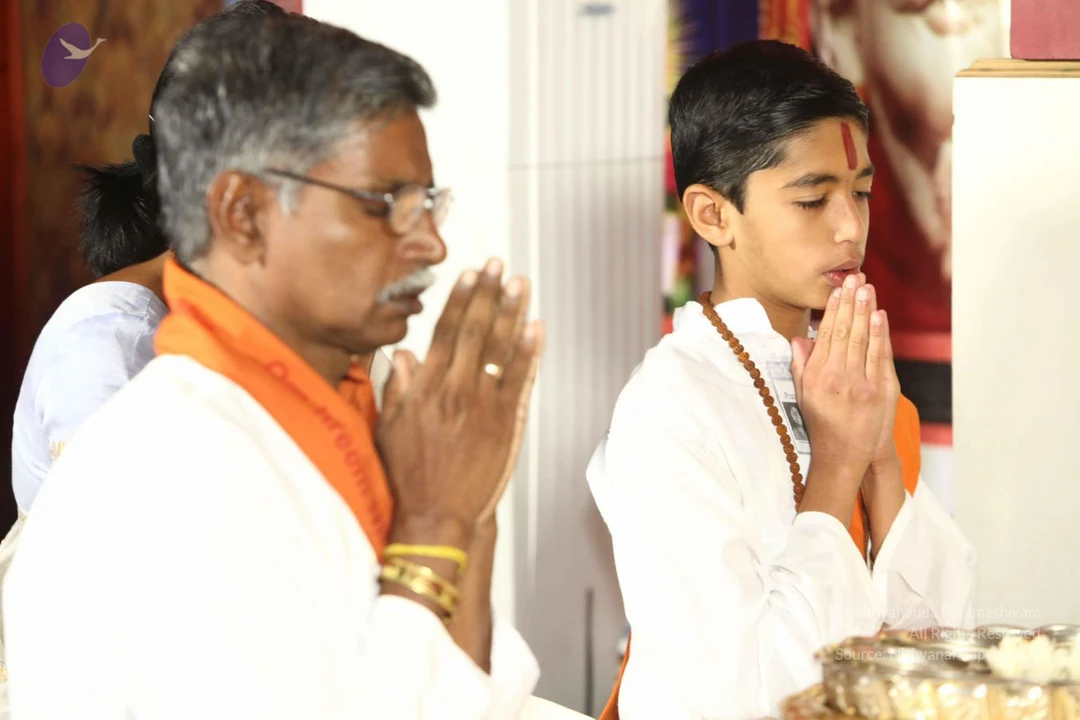
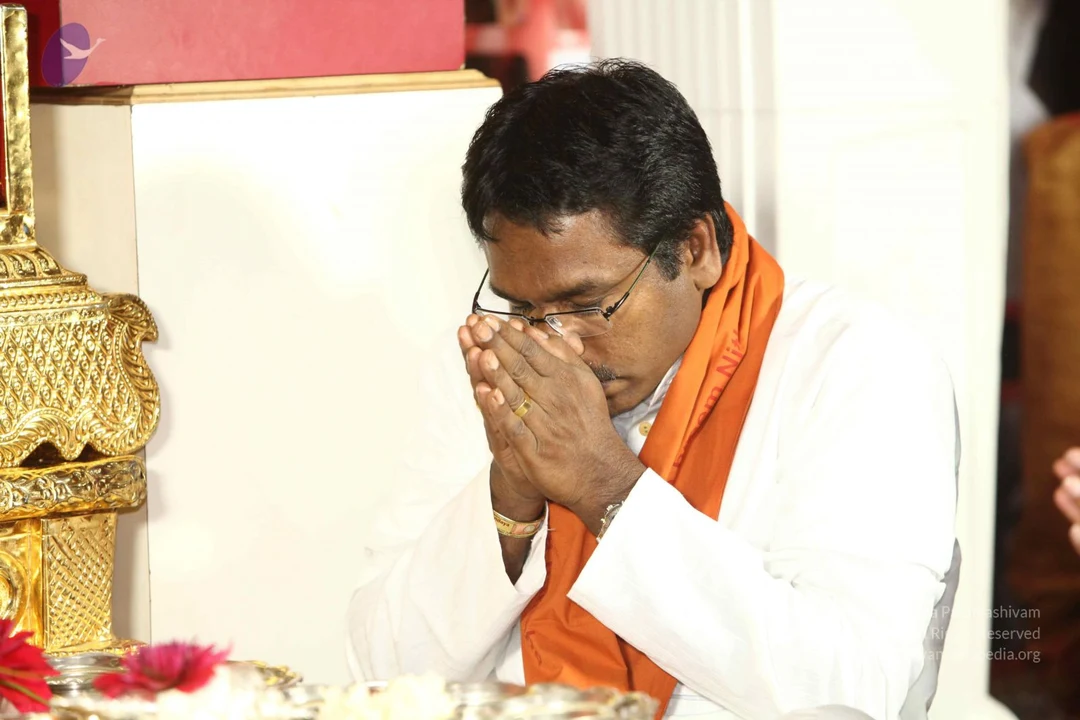
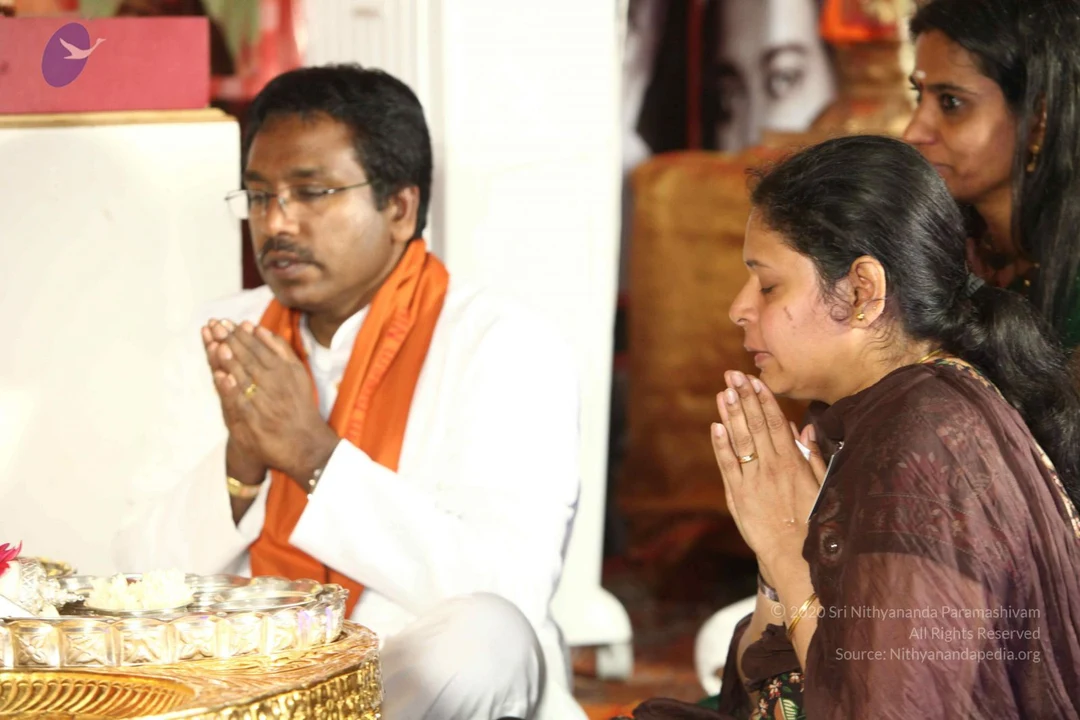
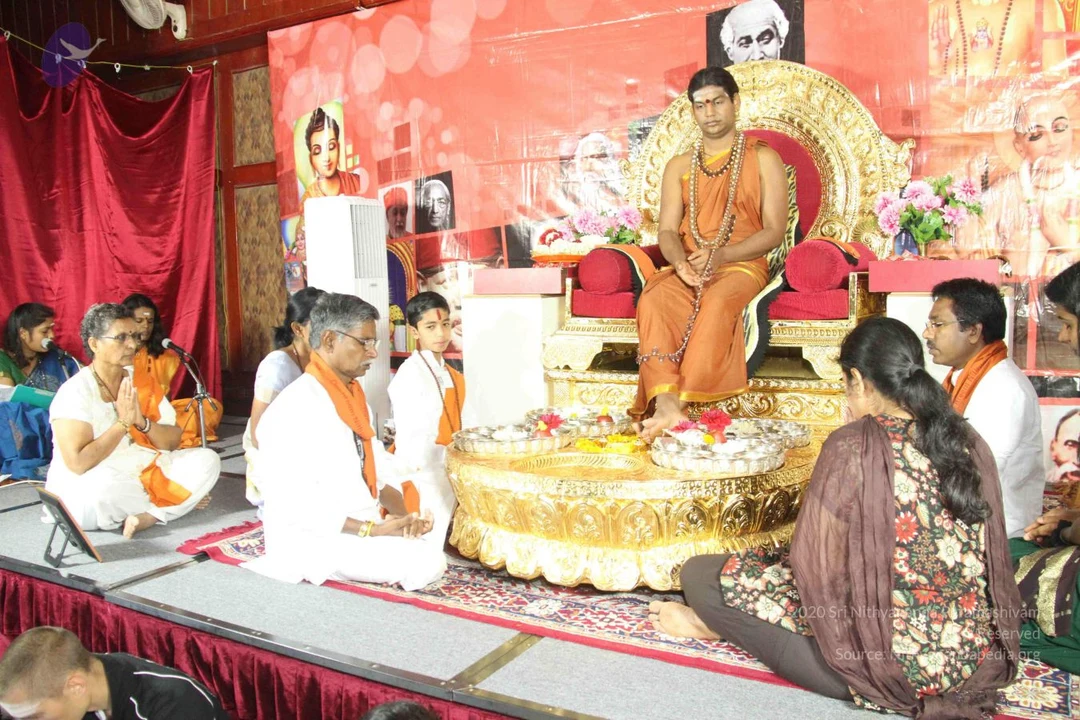
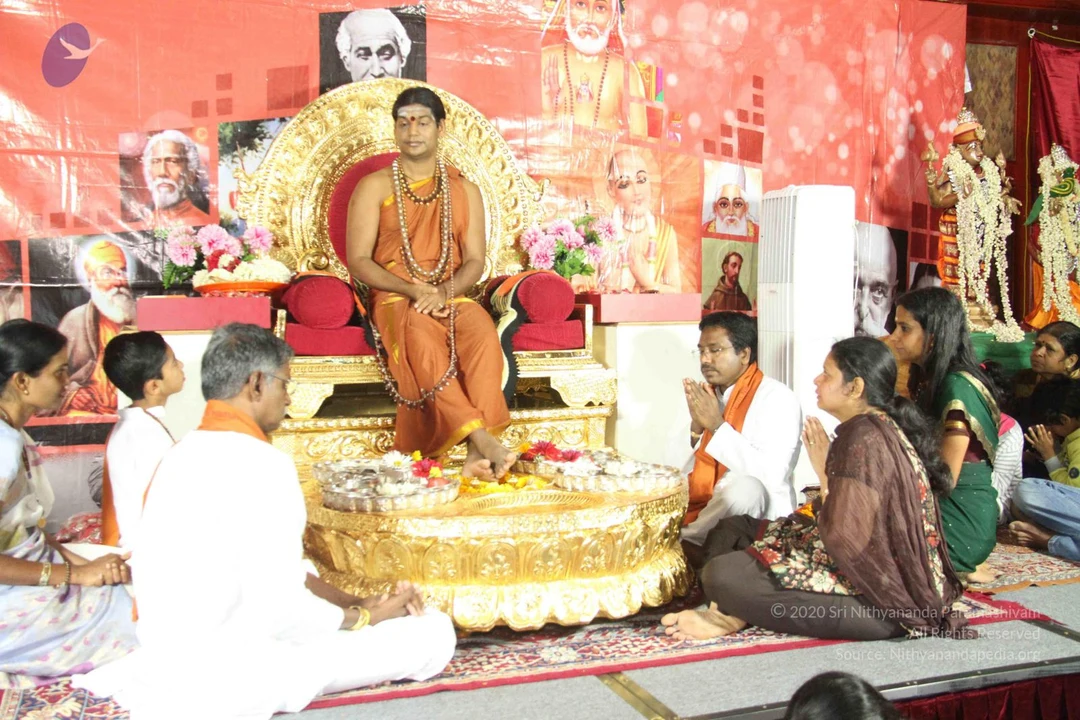
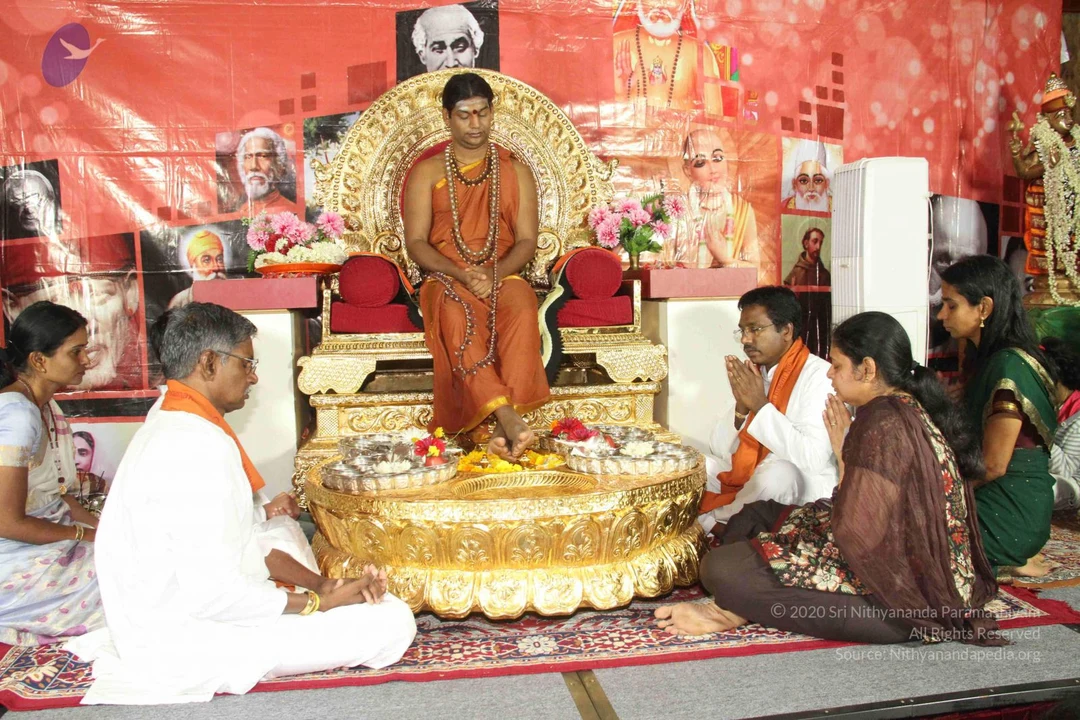
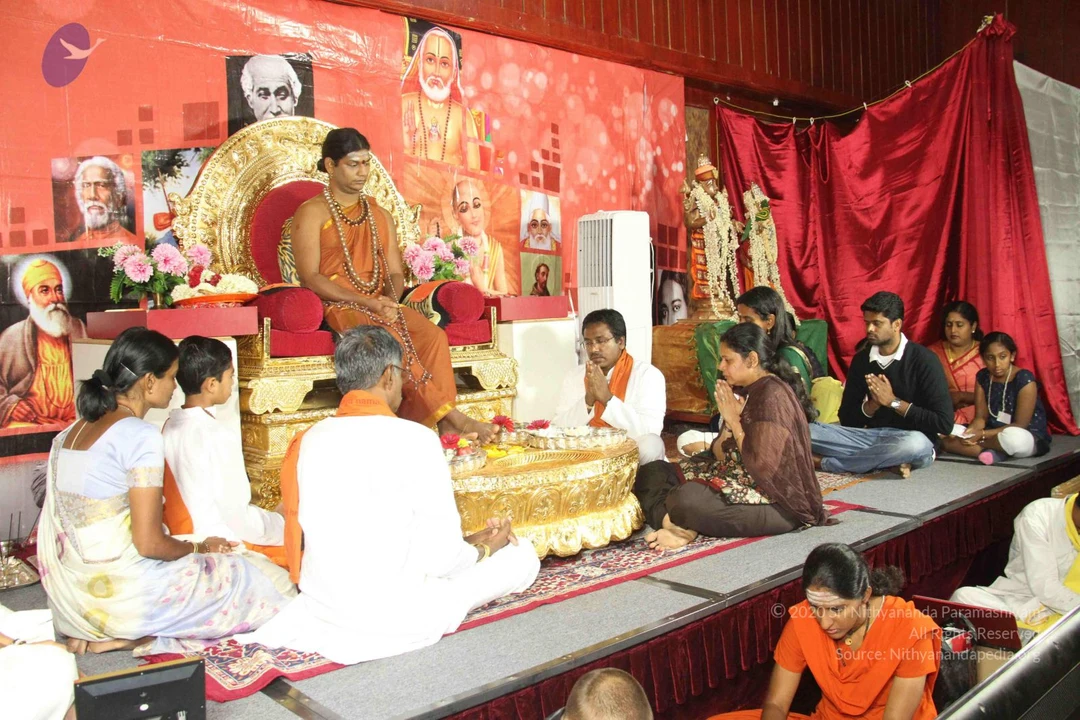
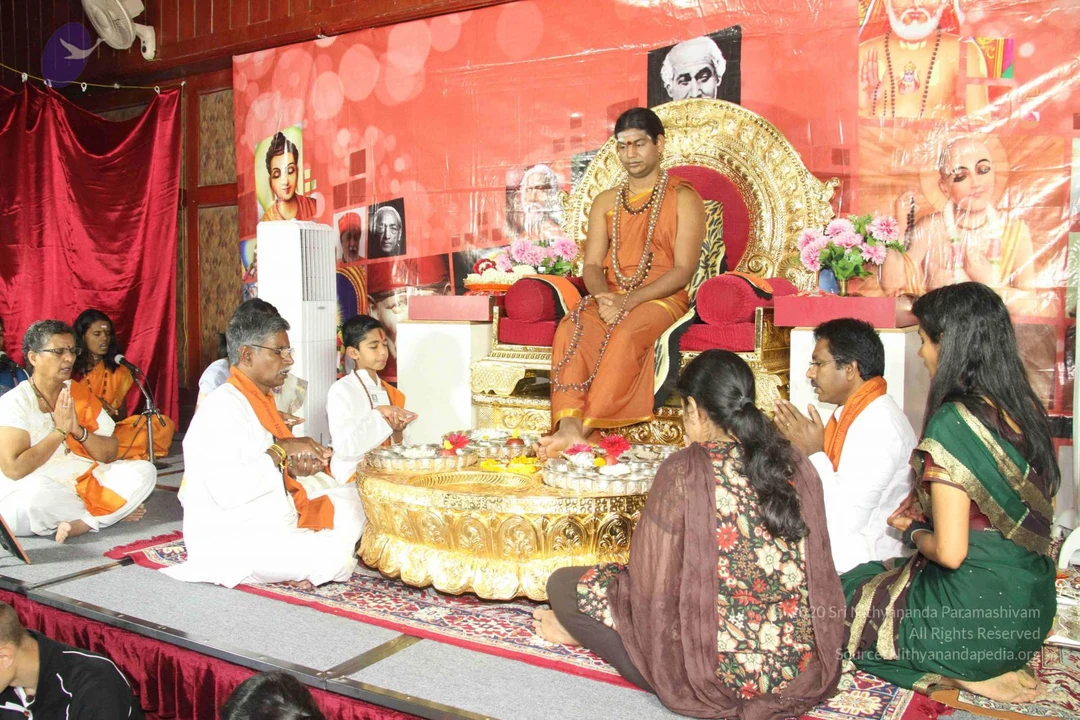
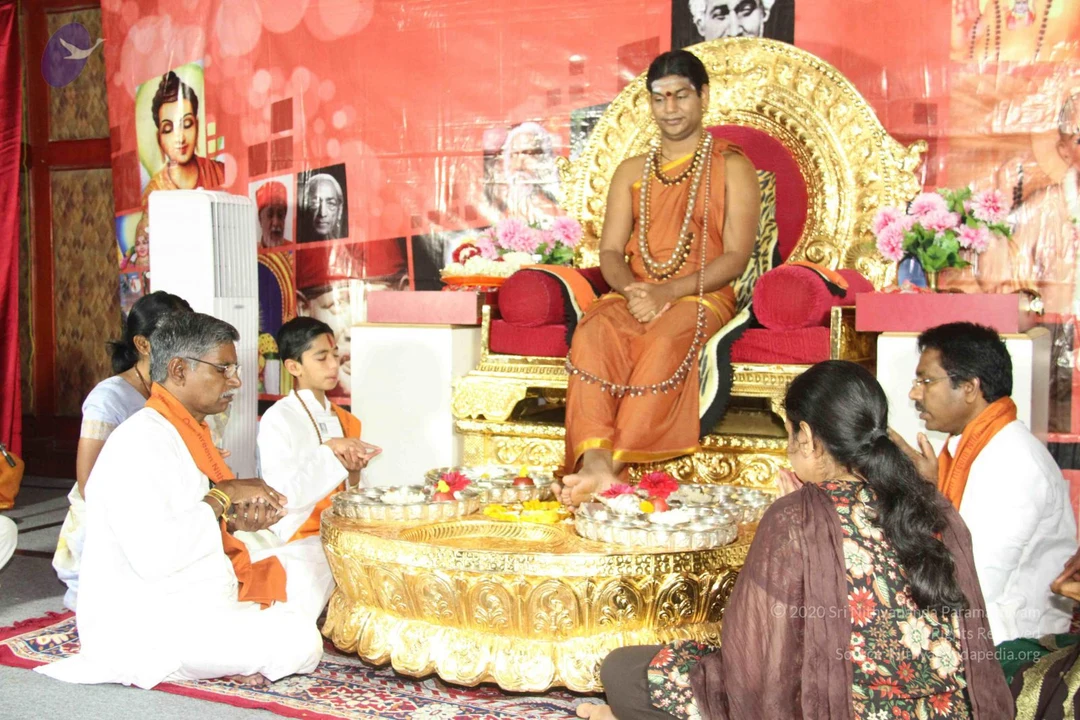
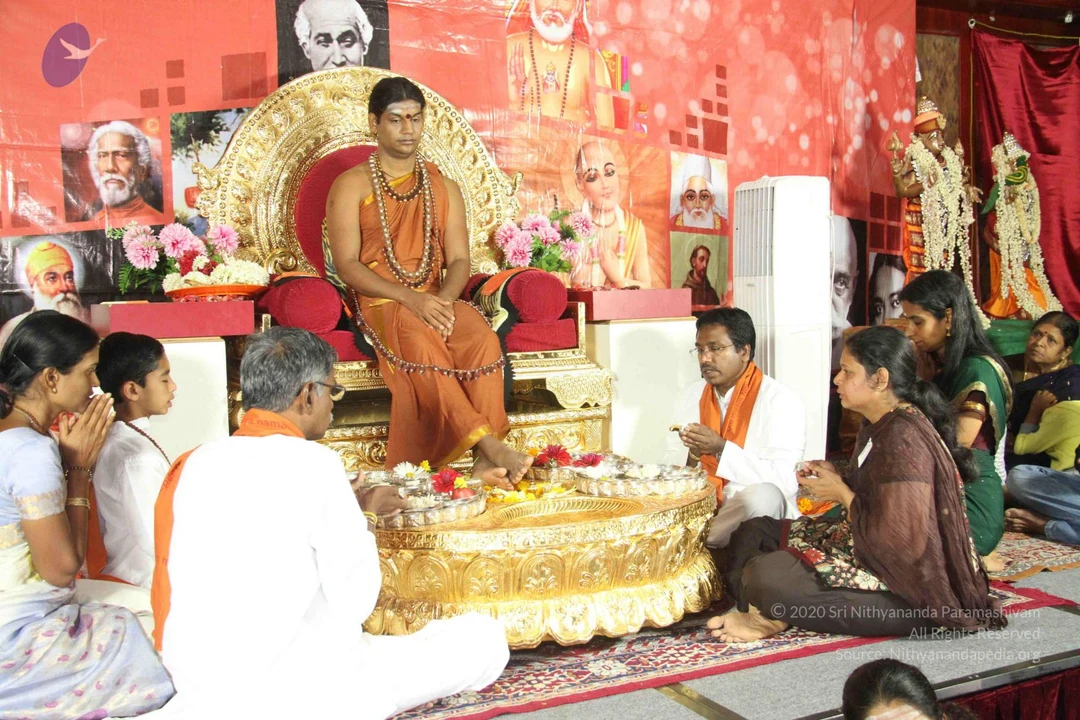
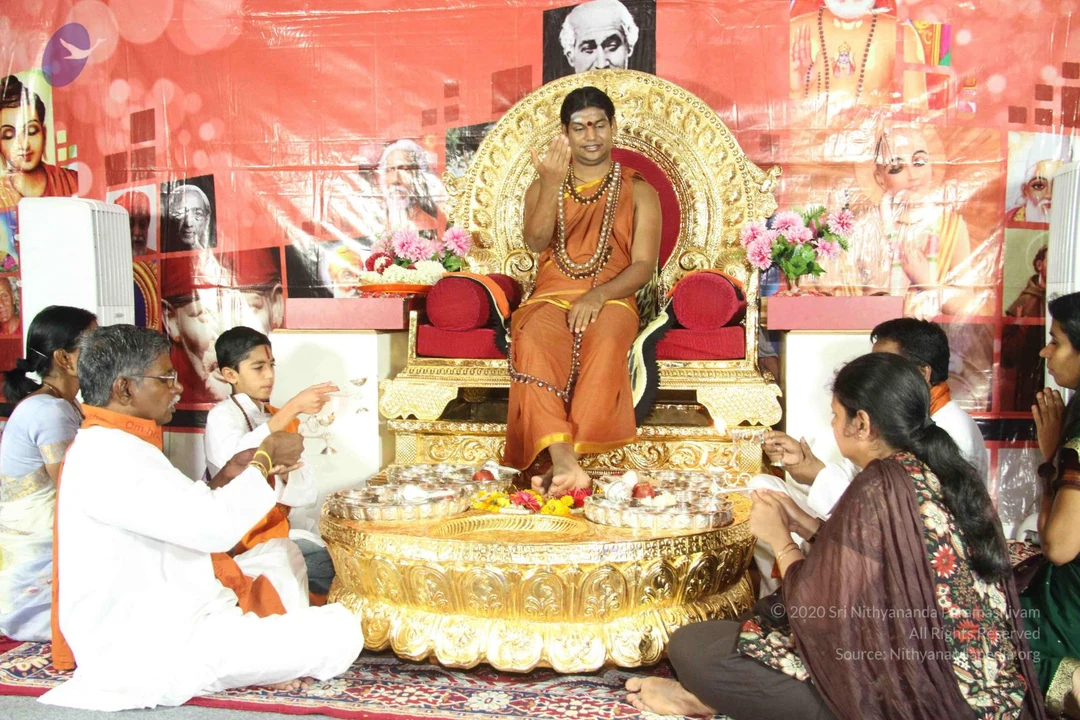
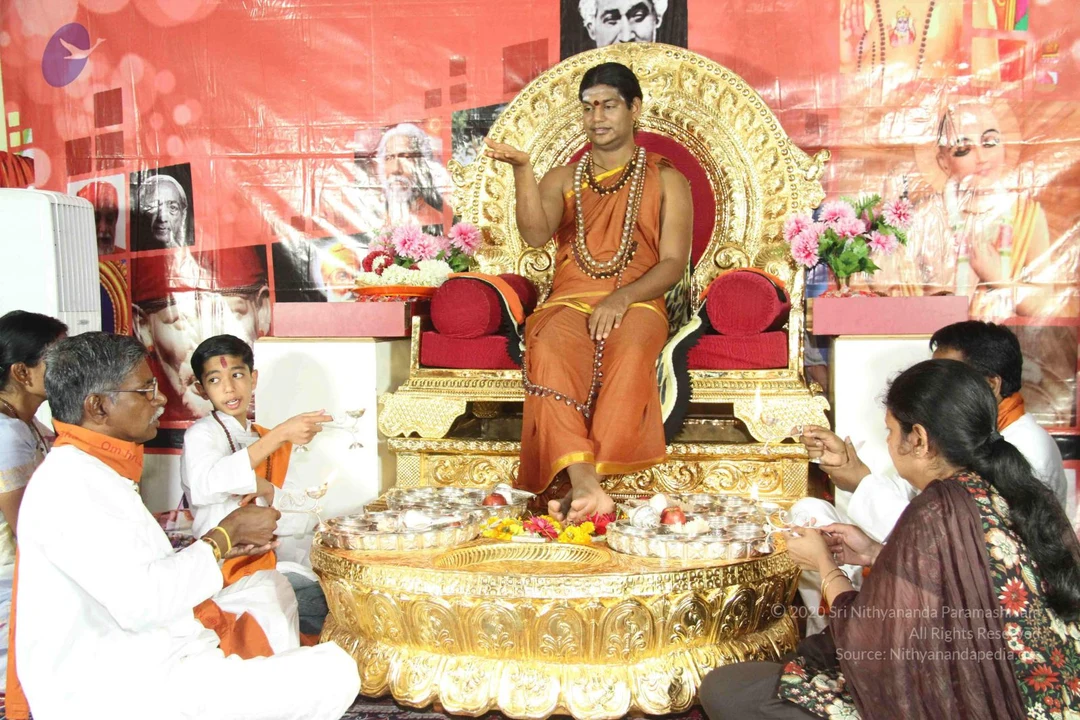
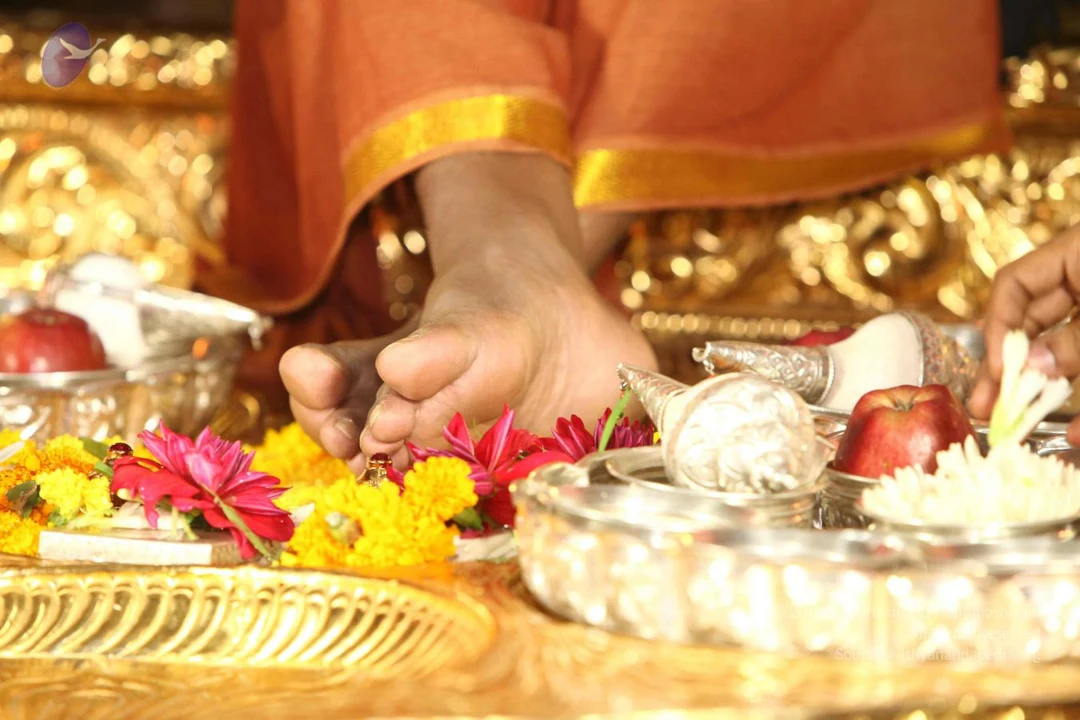
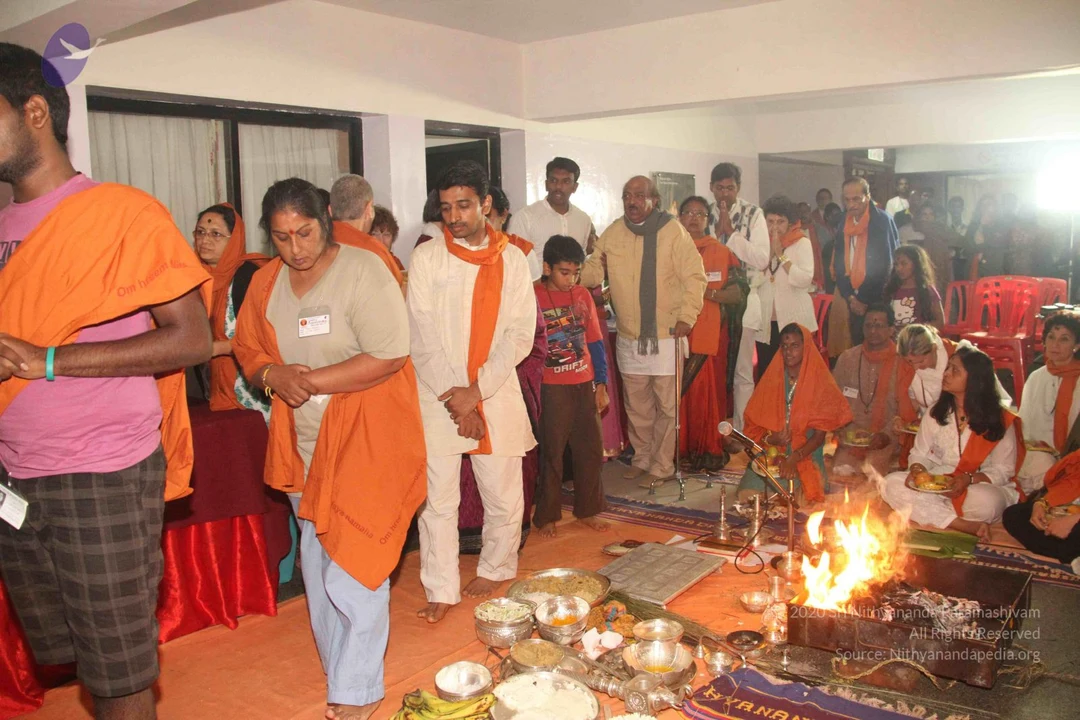
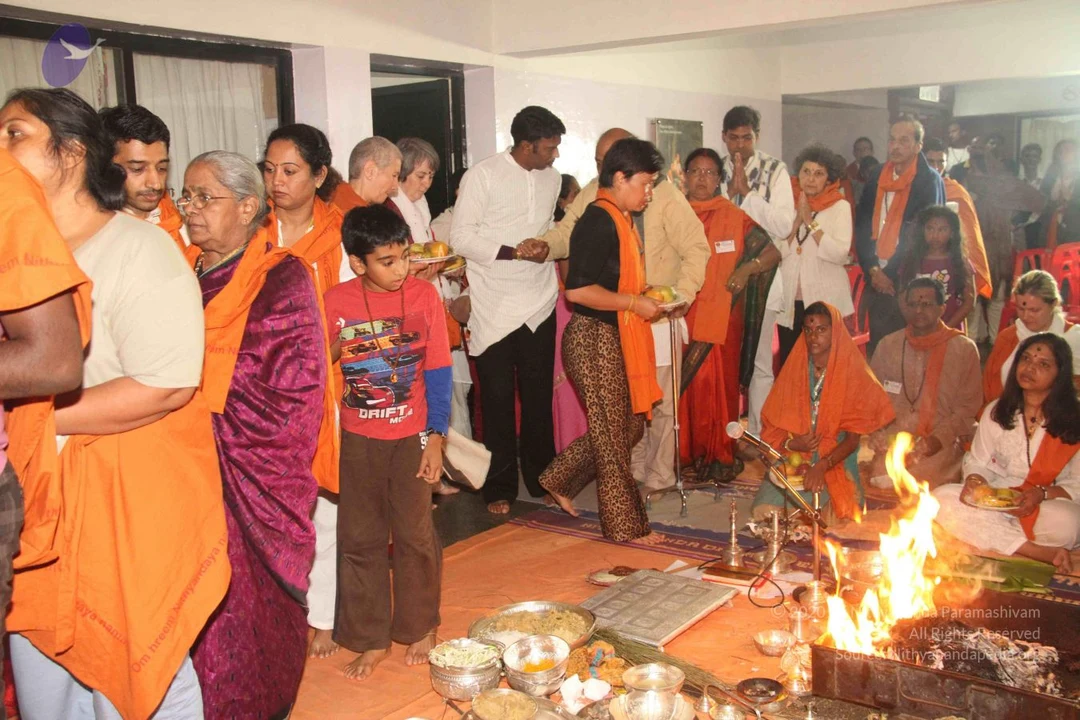
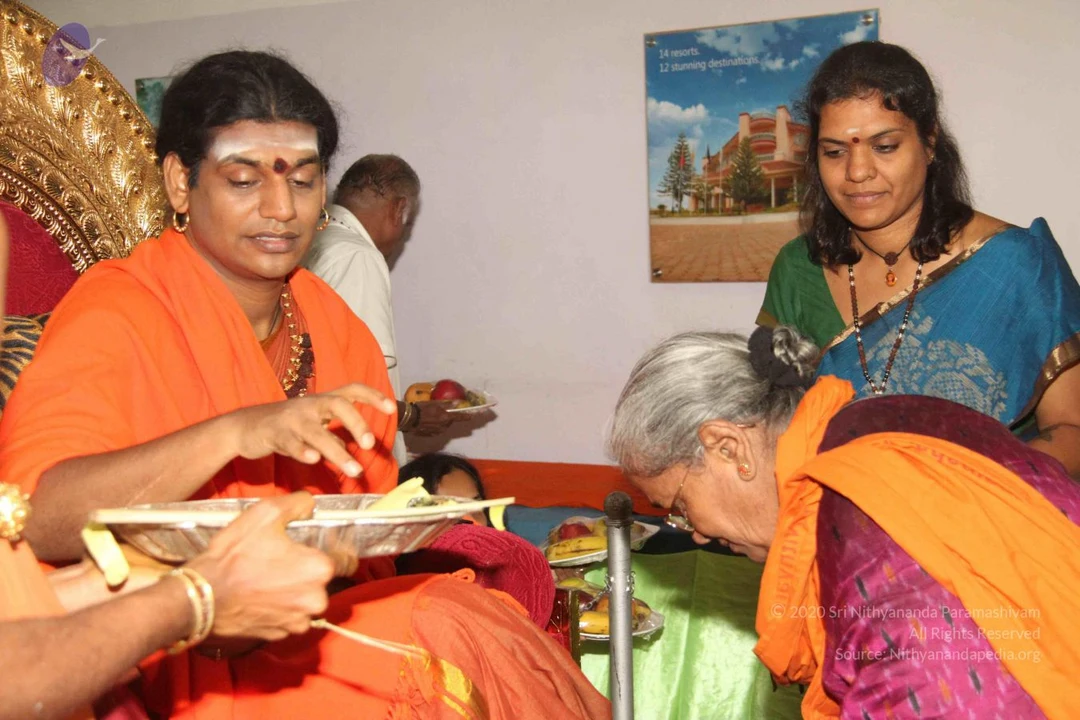
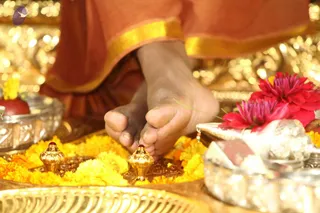
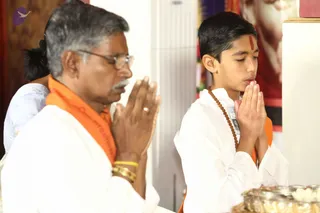
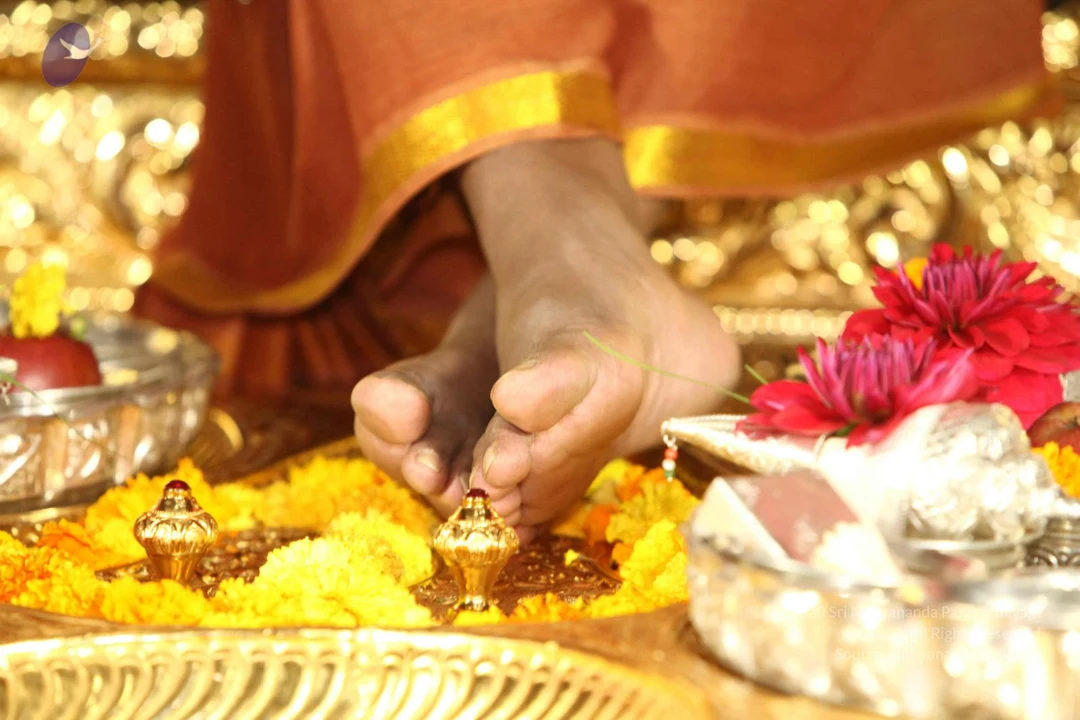
Close-up photo of a pair of bare feet resting on a golden tray filled with yellow marigold petals. The feet are visible below the hem of an orange robe trimmed with a gold border. Two small gold kalasha-shaped finials or ornaments sit on the tray beside the toes. Red and magenta dahlia-like flowers, a silver bowl with red and white offerings, and a red fruit are arranged around the feet. The background is ornate gold brocade. This appears to be a padapuja, where feet are honoured with flowers and offerings. No face is visible, so the identity of the person is uncertain.Two devotees stand with palms pressed together in namaskar in front of an altar. On the left, an older man with grey hair, glasses and a moustache wears a white kurta with an orange saffron shawl and gold bangles. On the right, a young boy with a red tilak on his forehead and a rudraksha mala wears a white kurta with an orange shawl, eyes closed in prayer. Brass plates with offerings sit in the lower right corner, and a devotional picture is visible in the background.A seated man in a white kurta with an orange-saffron shawl and thin-rimmed glasses presses his palms together in anjali near his face, eyes lowered in prayer. Gold-ornamented ritual vessel at left and marigold or flower offerings in the foreground suggest a puja setting. Partially visible person at right edge.A photograph of devotees in prayer at a shrine. In the foreground, a man in white kurta and white dhoti with an orange shawl over his shoulders sits with palms pressed together in namaskar, wearing glasses and a gold bracelet. Beside him, a woman in a dark brown patterned salwar kameez with a gold ring and earring sits with eyes closed and hands folded. Behind her a second woman watches. On the lower left, a gold tray holds small glass oil lamps and white flowers. Behind them a red-and-gold ceremonial backdrop and a framed portrait are visible. Three people are visible.A satsang on a raised stage with a red backdrop covered in framed portraits and photographs. A seated man on a gold ornate throne wears orange robes, a long rudraksha mala and a shawl, with hands folded in lap, a red cushion behind him. Before him a gold tray holds brass plates of flowers and offerings. An older woman in white with orange shawl sits with palms joined and a microphone nearby; a man in white with orange shawl sits beside her; a boy in white and orange sits between them. Two women sit on the floor at right, one in a brown and floral shawl. Red velvet drapes frame the left side.A seated man in an orange saffron robe sits on an ornate gold throne with a red cushion, wearing long rudraksha mala beads and a red tilak mark on his forehead, with his feet resting on a gold footstool. Before him, a devotee in a white shirt and orange shawl sits with hands in anjali mudra, while others in saris and a child in white kneel or sit on red carpets. Platters of flowers, fruit and offerings sit on the gold stool. Behind the throne is a red backdrop with portraits of several elder sages, flanked by white flower garlands on a deity murti at right. A white air conditioner stands at the side. The seated figure is an appearance-based a person with a throne, saffron robe and rudraksha cues, in an informal satsang setting.

Sarva-Darshan
3 photosSource gallery
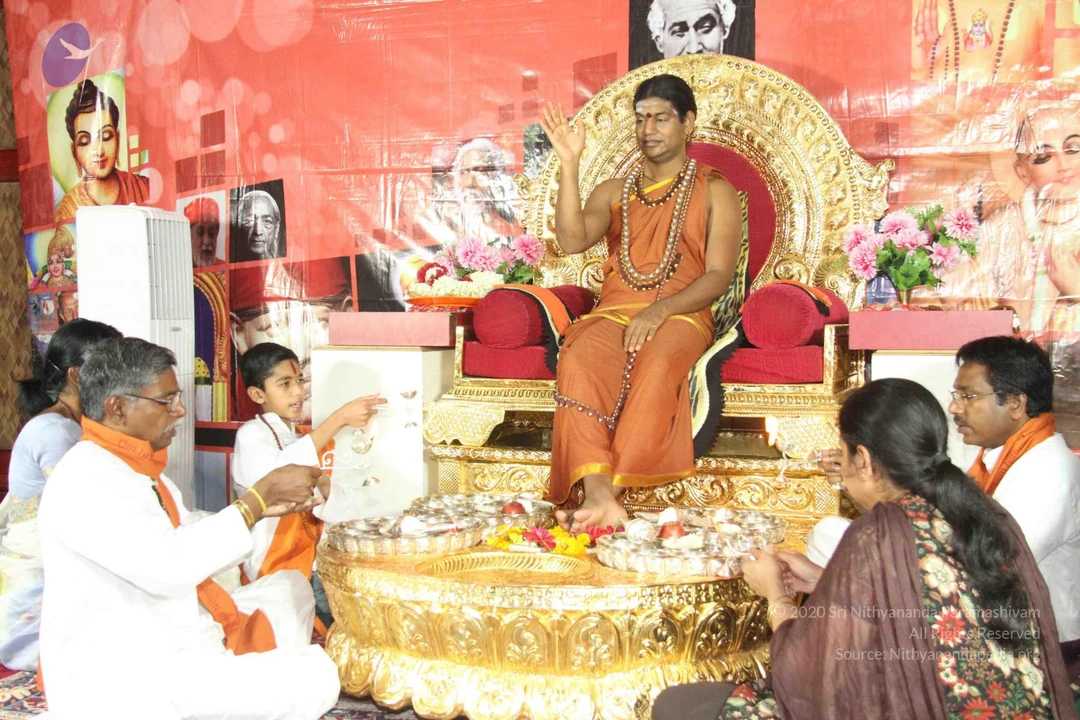
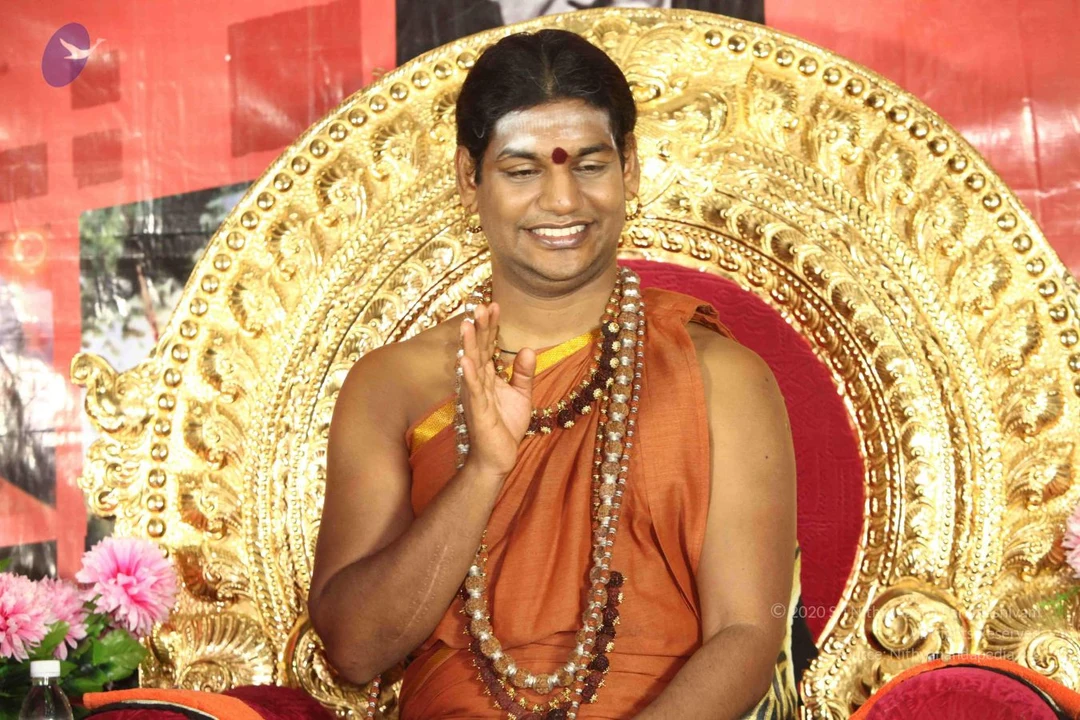
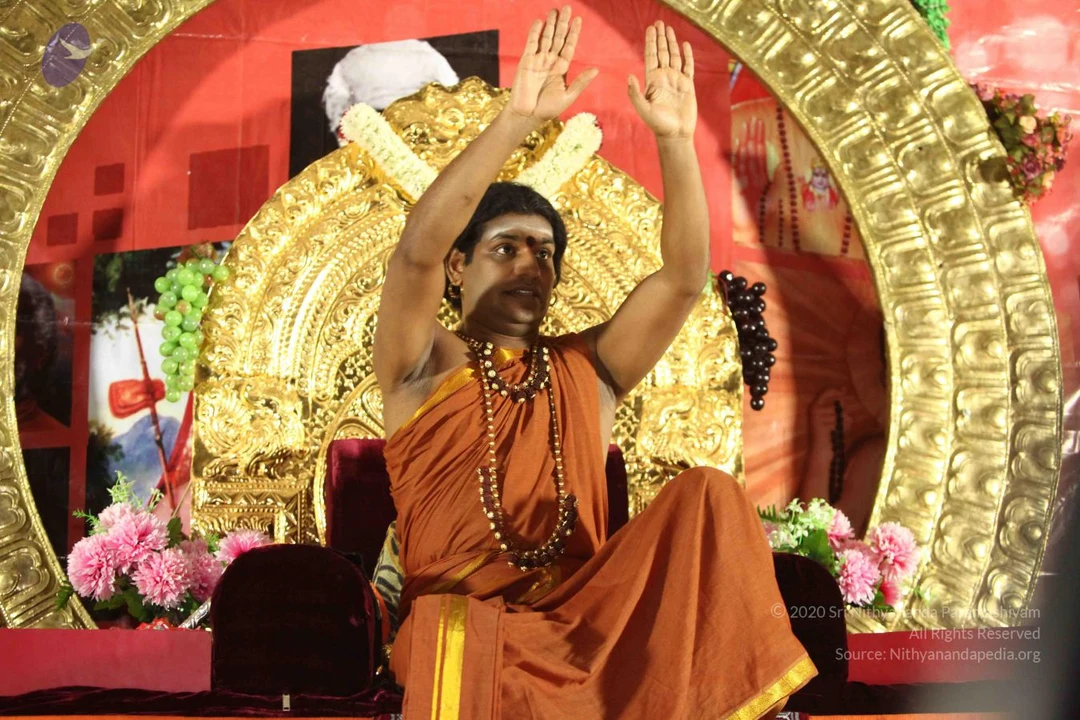
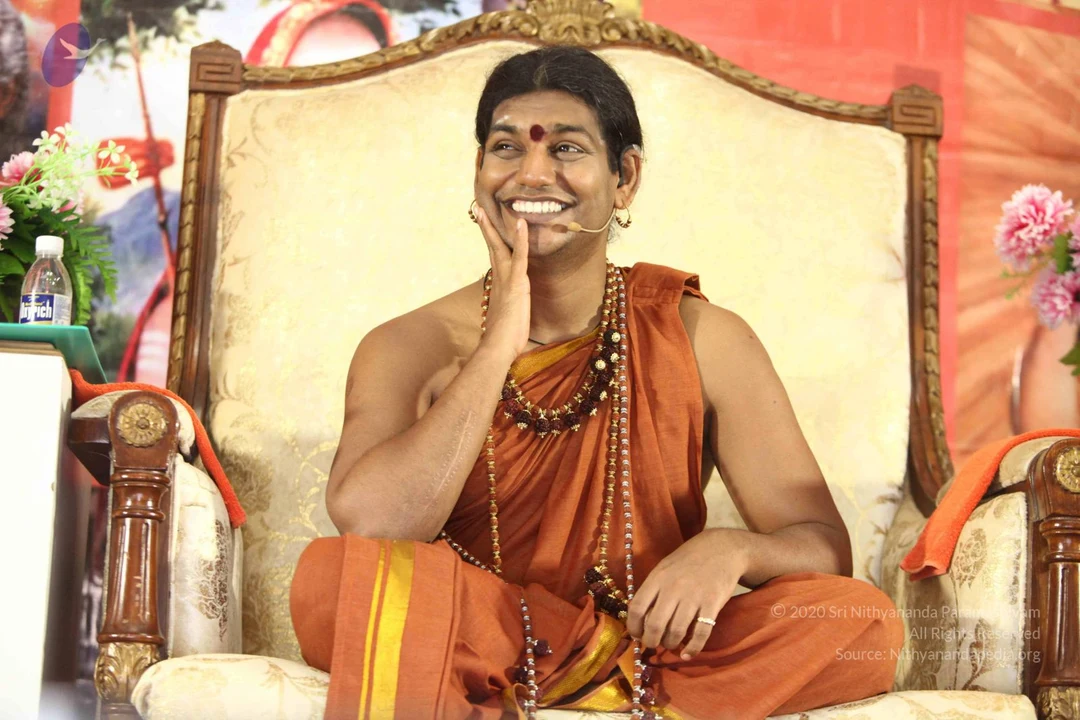
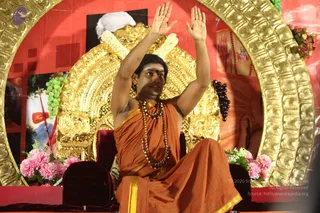
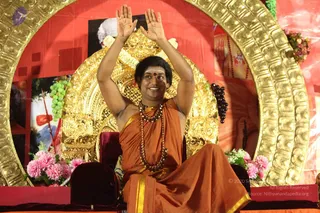
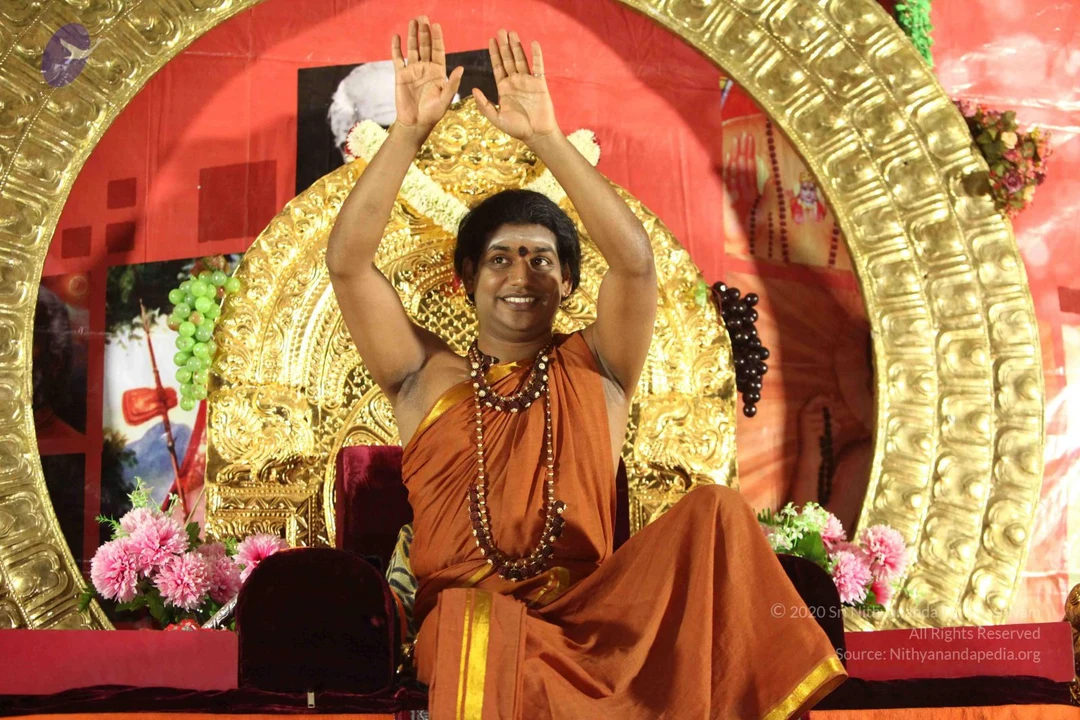
A man seated on an ornate gold throne with a red cushion, raising one hand in a blessing gesture and smiling. He wears an orange-saffron wrap over his shoulders, multiple rudraksha and beaded malas, and a red bindi on his forehead. Pink flowers and a water bottle sit at the lower left, with a red backdrop behind the throne. Given the page's reference to a person, this appearance-based candidate has saffron clothing, rudraksha malas and a throne as cues, so he is labelled a person seated in a satsang setting.A seated man in an orange-saffron dhoti and shawl with gold borders raises both hands high, palms open, while speaking on stage. He wears a rudraksha mala and a long ceremonial necklace, with a red bindi on his forehead. Behind him stands a large ornate gold throne-back with a gold circular frame, flanked by pink flower arrangements, white and green garlands and a red-and-pink backdrop with framed pictures. The seated speaker appears to be the a person, matching the robe, mala and stage setting.A seated man in an orange-saffron dhoti and shawl with gold borders raises both hands above his head in a blessing gesture, smiling. He wears multiple rudraksha malas of dark beads and a red-brown bindi. He sits before a large ornate gold throne-back framed by a gold arch, with pink flowers and a bouquet of green grapes beside him and red and orange draped backdrop cloth behind. Appearance is consistent with a person, seated and giving blessings on a dais during a satsang.

Kirtan

22 photosSource gallery
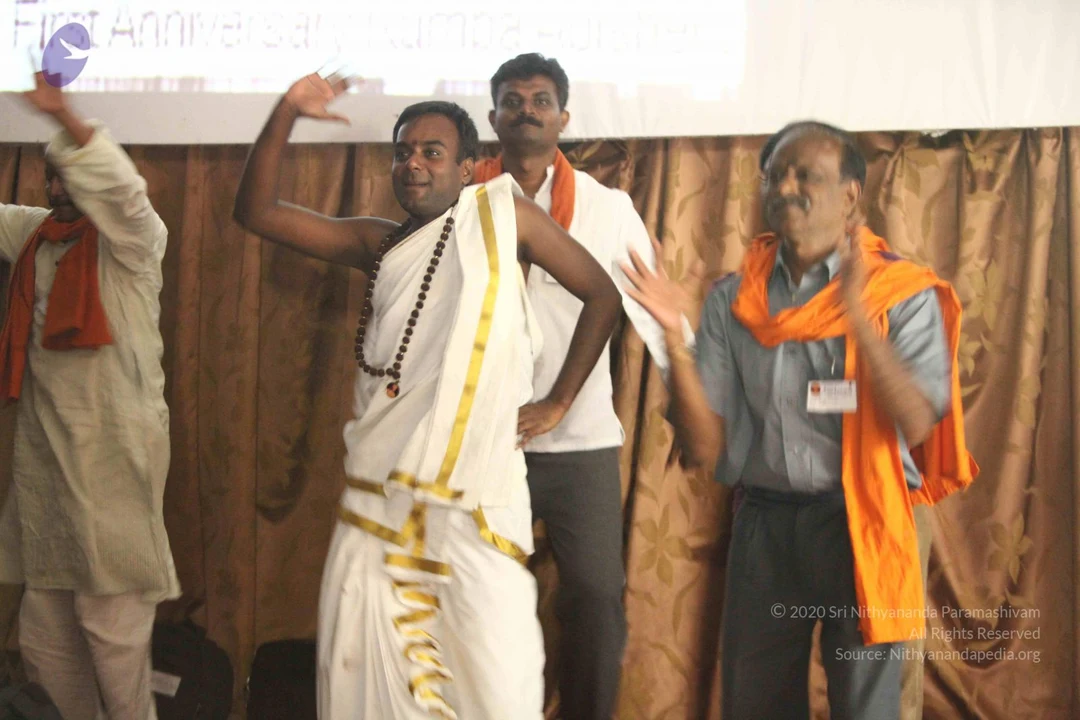
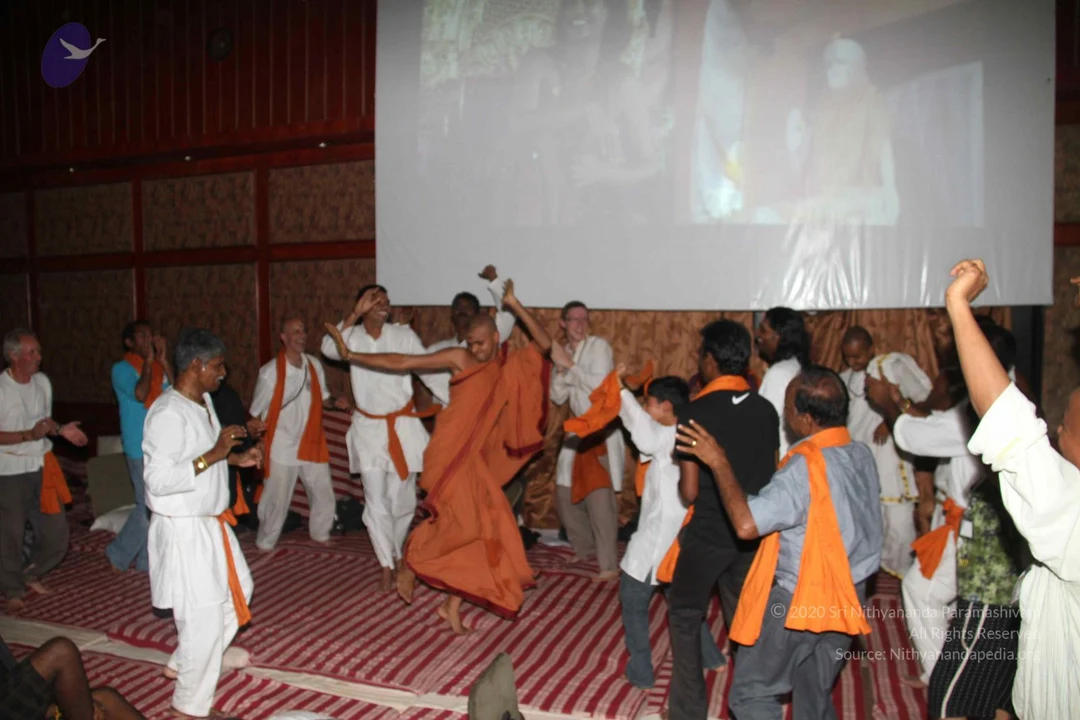
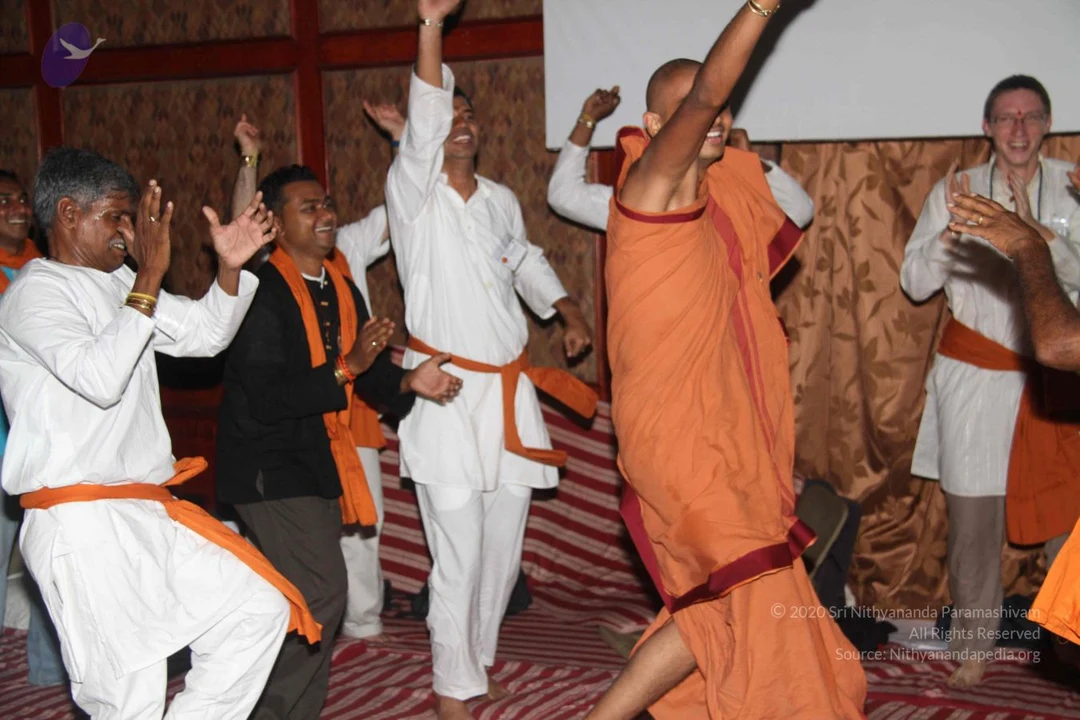
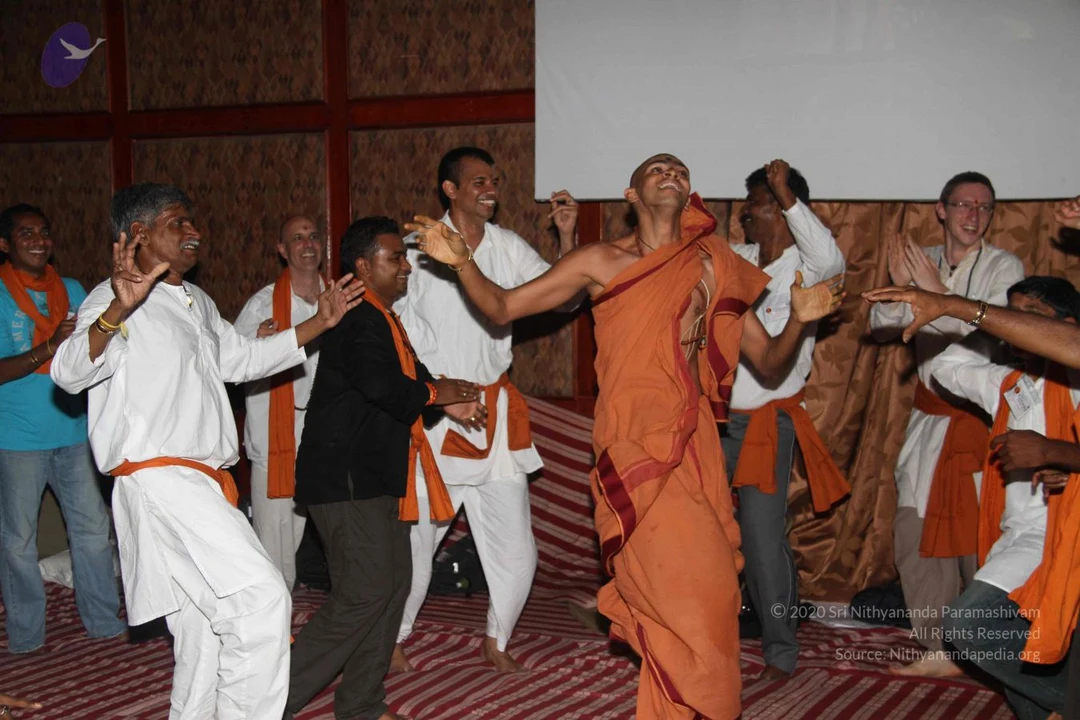
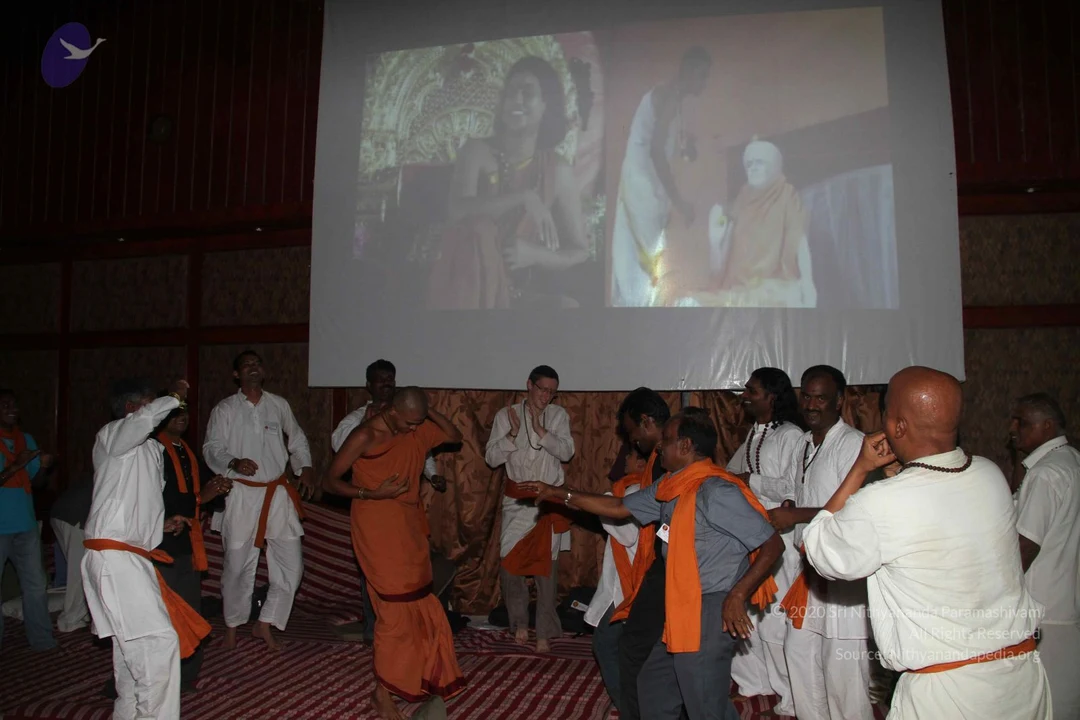
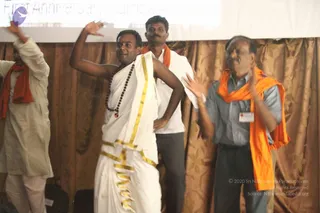
A smiling man with shoulder-length dark hair sits in front of an ornate gold backdrop with a red and gold draped panel behind him. He wears an orange saffron wrap over one shoulder with a gold-edged border, a long multi-strand necklace of dark beads and gold ornaments, and a small red tilak on his forehead, with a gold hoop earring. Pink and white flowers and a red floral arrangement appear at the edges of the frame.A smiling man with swept-back dark hair and a red tilak on his forehead sits before an ornate gold throne-back decorated with a floral garland of red and white flowers. He wears an orange-saffron shawl draped over one shoulder with a gold border, multiple rudraksha mala necklaces, and gold hoop earrings. Pink flowers sit in the lower right foreground and a dark wooden-bead garland hangs on the right. Appearance-based label: a person, seated in person at a satsang setting.A seated man in saffron-orange robes sits on an ornate golden throne with a arched gilded backrest decorated with floral carvings and a garland of white and red flowers at the top. He wears layered rudraksha and gold bead necklaces, a small red bindi, and gold earrings, with long dark hair swept back. He gestures with one hand near his chest while smiling, his other arm extended over the armrest. Pink flowers sit in the foreground, and a painting with green grapes and a red cloth hangs behind the throne. Appearance-based label: Swamiji (probable), matching the long swept-back hair, saffron robes, rudraksha malas and ceremonial gold necklaces; he is shown seated in discourse on a throne.A smiling man sits on a golden ornate throne-like seat with a gold-patterned backdrop behind him. He wears an orange-saffron cloth draped over his shoulder and torso with a gold trim, multiple rudraksha mala beads in brown and black, gold necklaces with round beads, gold hoop earrings, and a red bindi with white markings on his forehead. His hair is long and swept back. He rests one arm on his knee with a ring on his finger, and a zebra-striped cushion is visible beneath him. Pink and white flowers appear at the lower right, and a red floral arrangement sits at the top left. a person is depicted as the seated figure, a satsang speaker.A smiling man in saffron-orange robes sits on a red velvet throne backed by ornate gold repoussé panels, with pink flowers beside him and a red-and-white floral garland above. He wears a rudraksha mala and a gold necklace, a red bindi on his forehead and small gold earrings, and rests one arm on his knee. The scene suggests a satsang seating, with a single seated figure and no other people visible. Swamiji (probable): long swept-back dark hair, saffron robes and rudraksha malas match the page's identification, so the in_person value is used.Four men dance on a stage in front of a gold floral curtain, with a projection screen partly visible above reading "First Anniversary" beside a faint logo. The central man wears a white dhoti with gold borders, a bare upper body with a wrapped white shawl, and a rudraksha mala around his neck, raising one hand. A man behind him in a white shirt and grey trousers, with an orange scarf, stands with one hand on his hip. On the right, a man in a grey shirt and dark trousers with an orange shawl and a name badge claps with arms raised. At far left, a blurred man in white kurta and orange scarf raises an arm.

Energy-Darshan
21 photosSource gallery
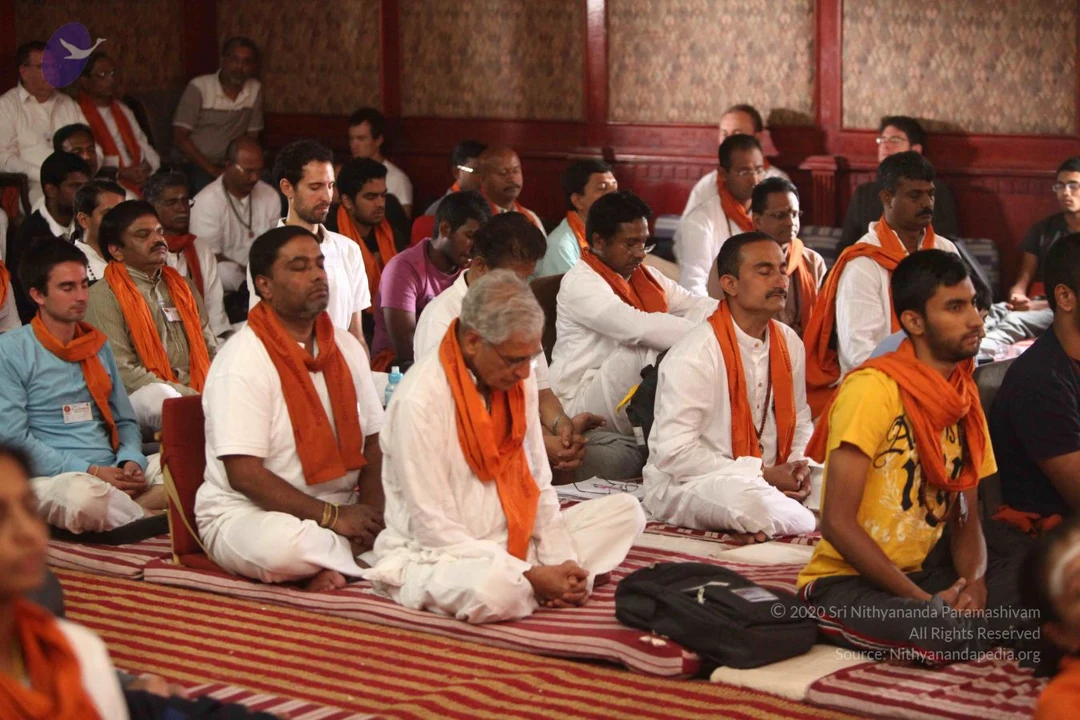
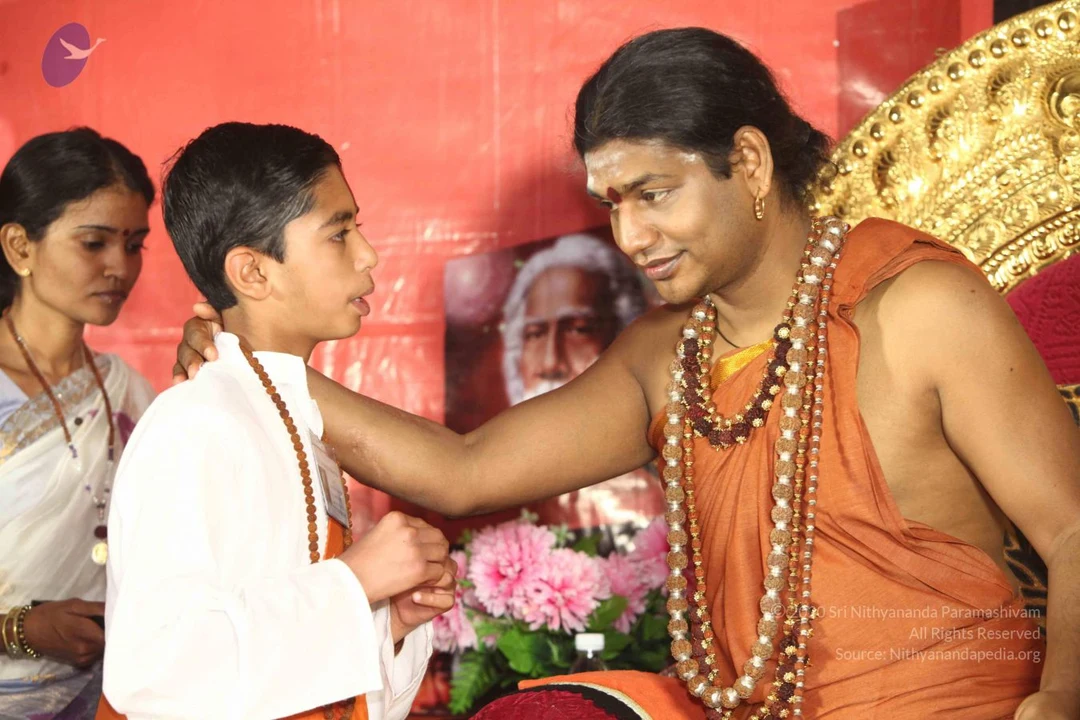
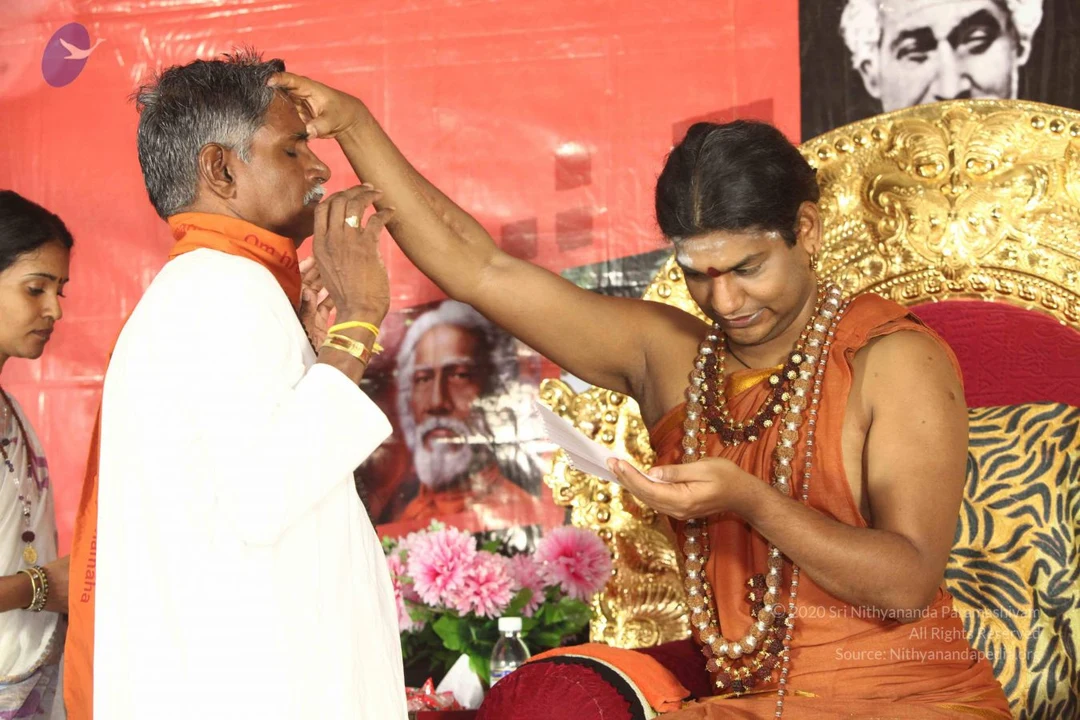
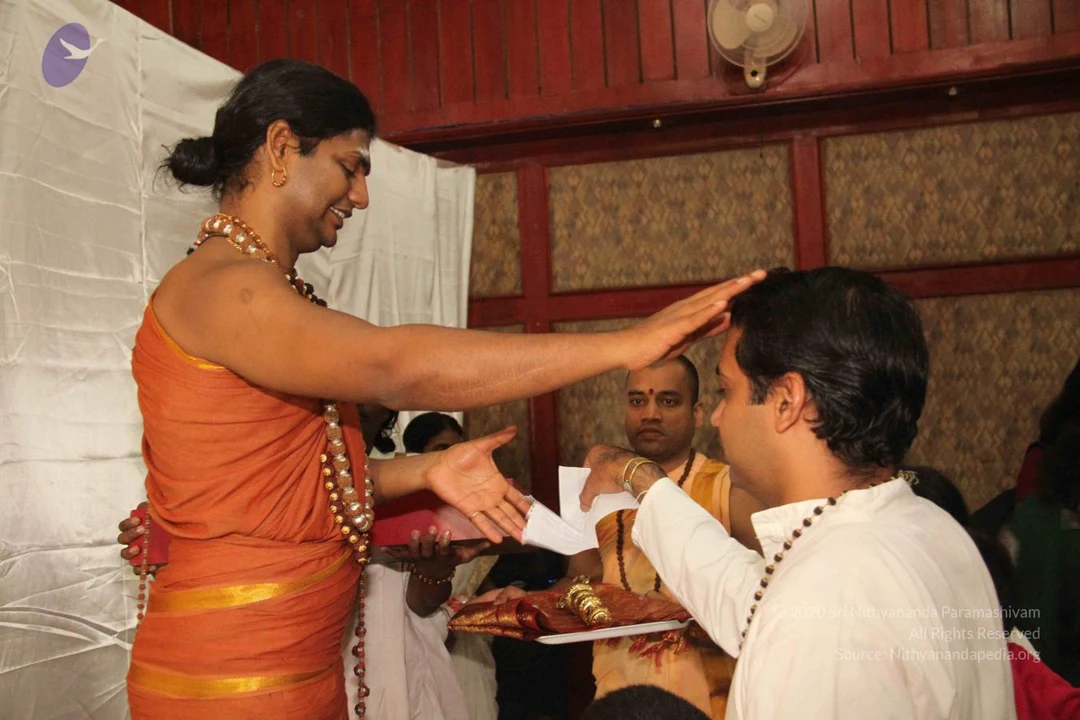
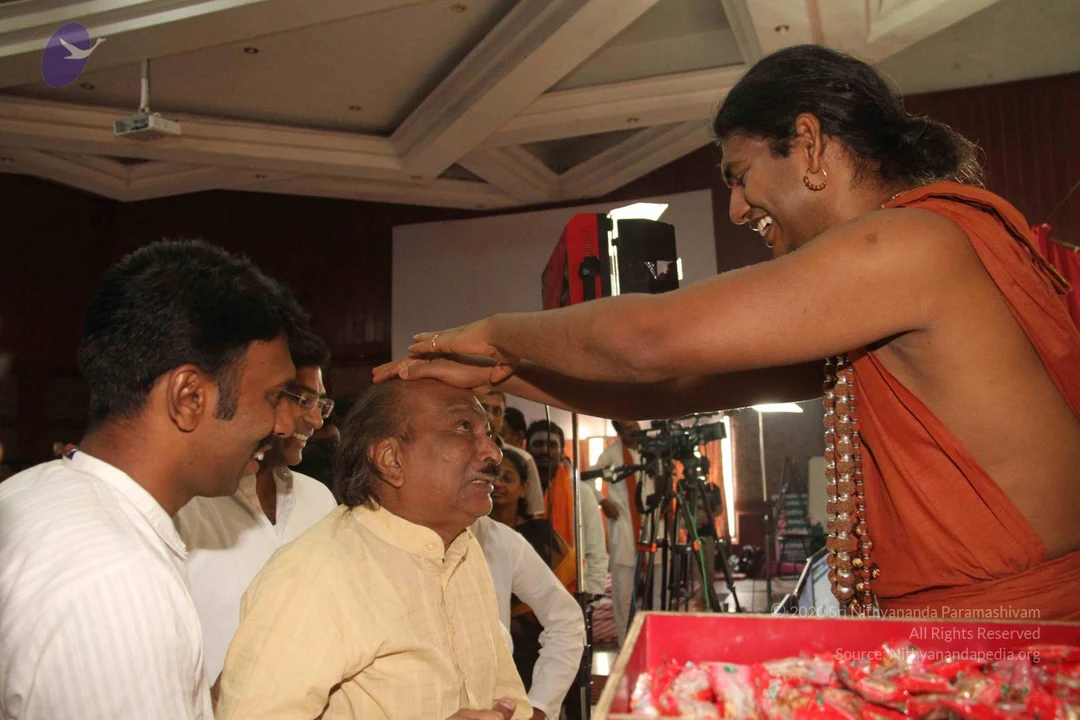
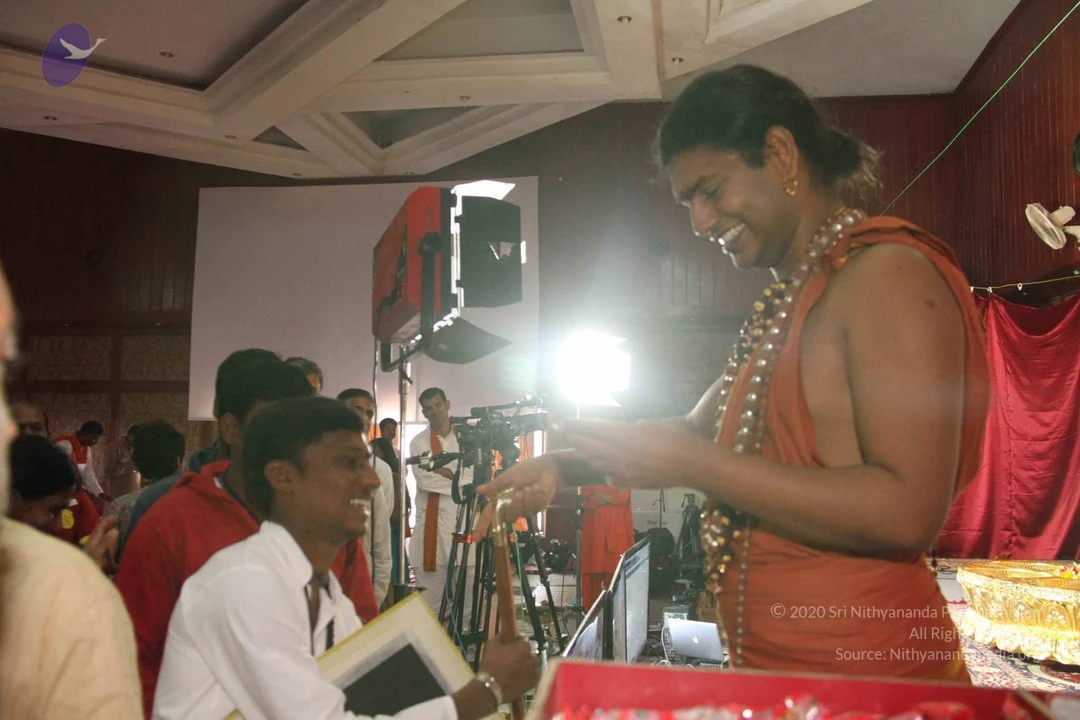
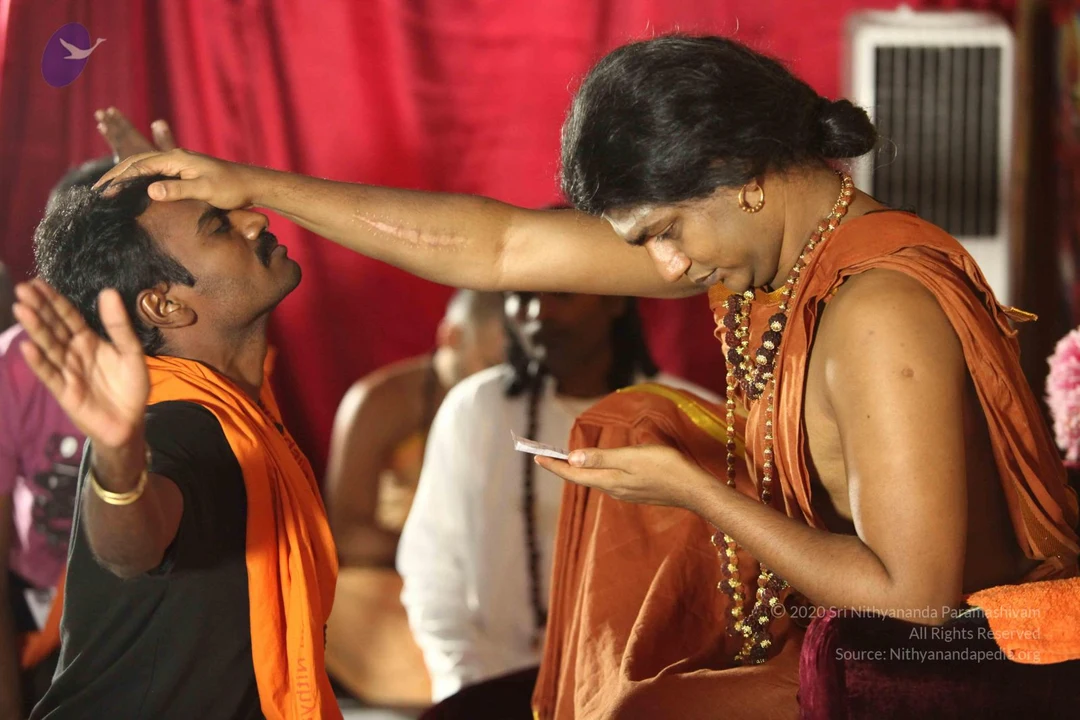
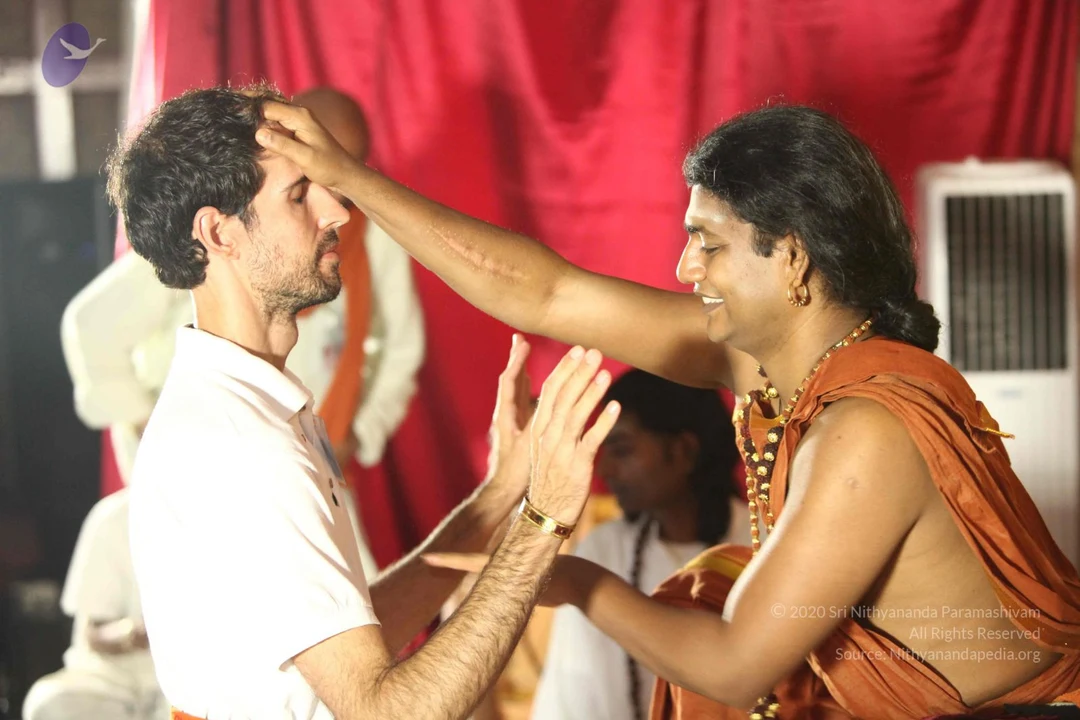
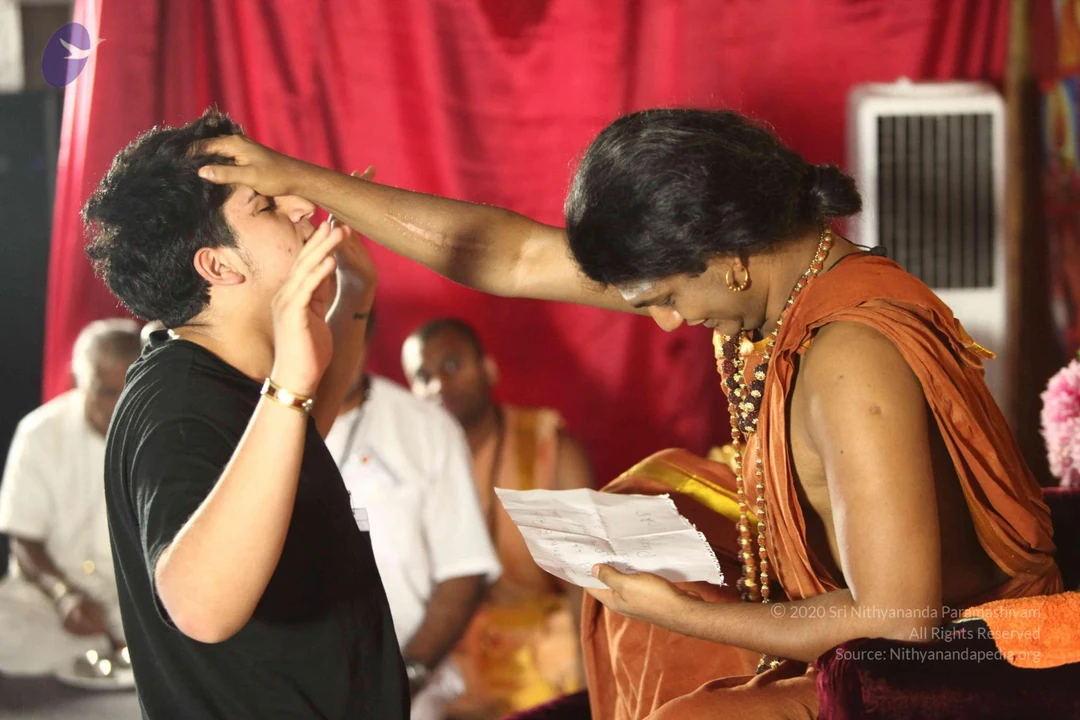
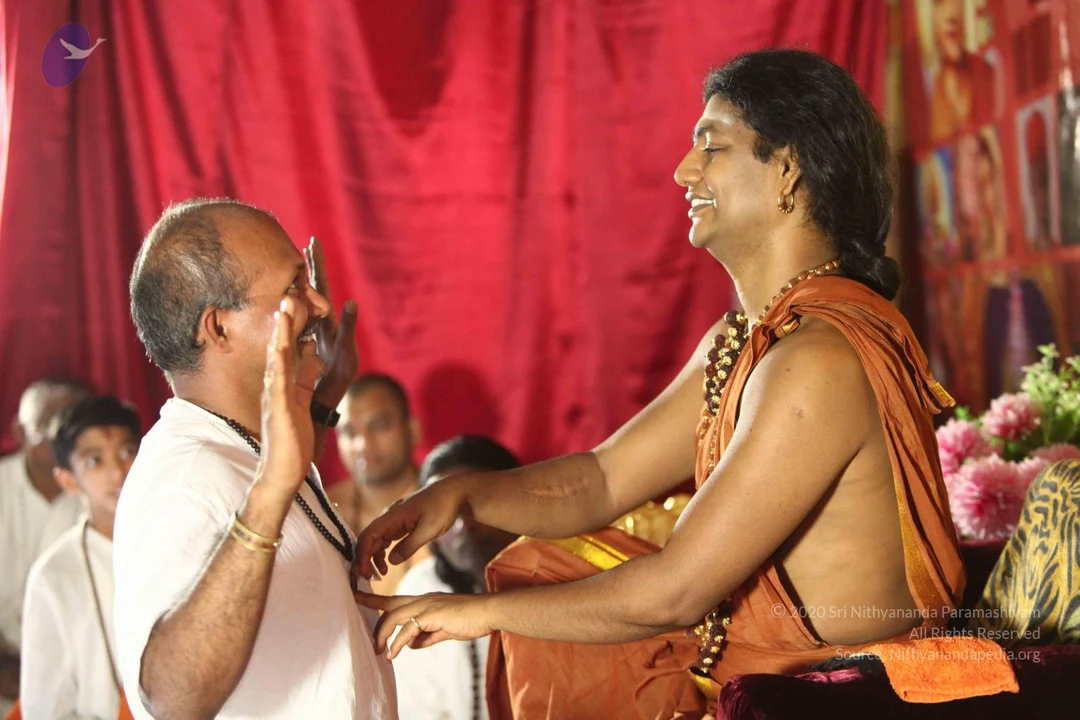
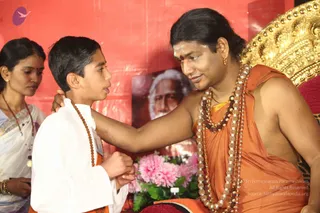
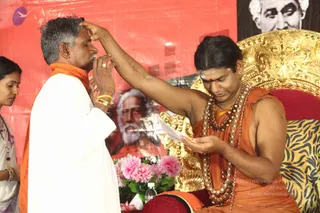
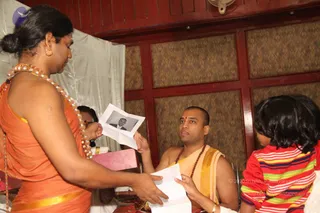
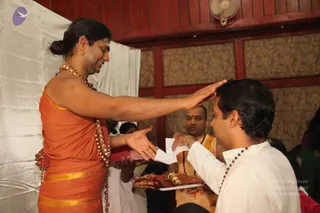
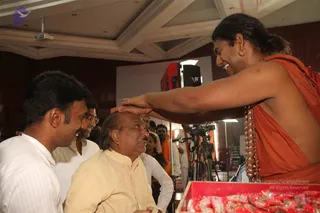
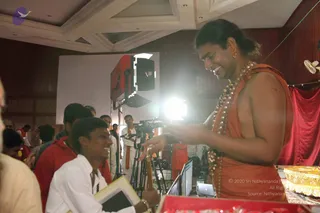
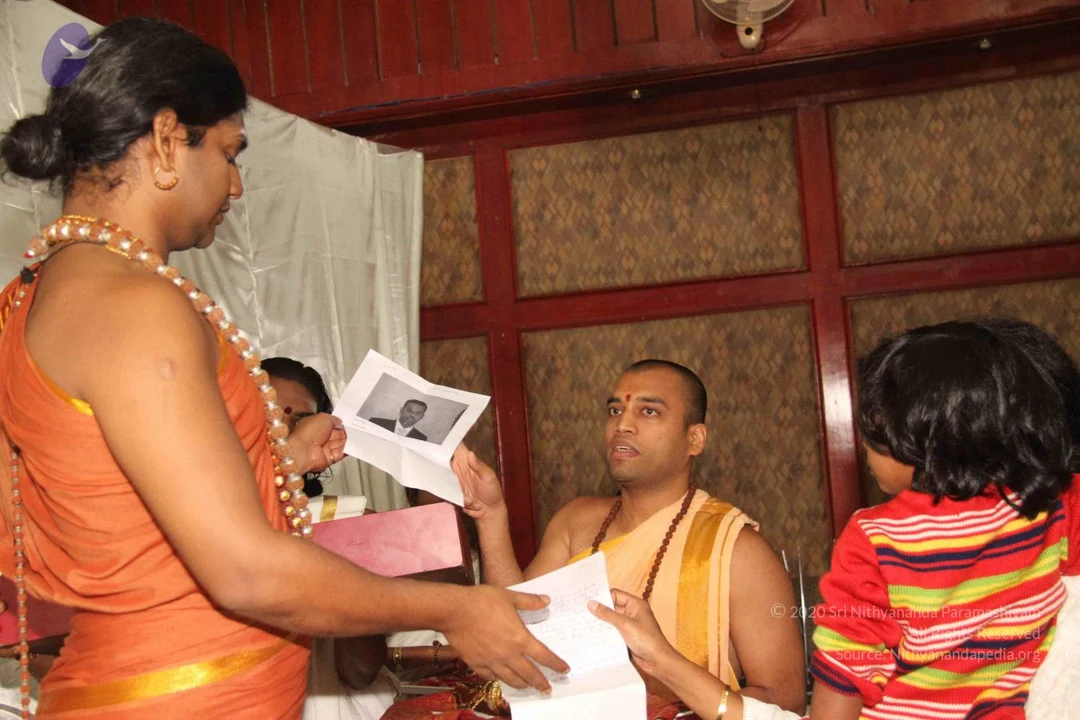
A seated man in an orange saffron shawl and rudraksha malas, with long swept-back hair, a red bindi and a sandalpaste mark, sits on an ornate golden throne beside pink flowers. He rests one hand on the shoulder of a young boy in a white shirt and rudraksha mala who kneels before him with clasped hands. A woman in a white sari with gold border stands behind the boy at left. A framed portrait of an older white-bearded man is displayed behind them against a red backdrop.A seated man in an orange saffron robe with multiple beaded rudraksha malas and a gold ornamental necklace touches the forehead of a standing man in white ritual clothes with an orange shawl, who has his eyes closed and hands folded. The seated man holds a white paper in his other hand. Behind them is a gold ornate throne with a leopard-print seat cushion, a red and orange backdrop, a framed portrait of an older bearded man in orange, and a bouquet of pink flowers. A woman in white stands at left. A tilak mark is visible on the seated man's forehead. The scene appears to be a blessing or ritual exchange.Indoor satsang setting with dark red wooden wall panels and brown patterned fabric panels behind. A shaved-headed man seated at centre wears a saffron-orange shawl over his shoulder, rudraksha mala beads and a red tilak; he looks up and holds a sheet of paper. A figure at left wears an orange garment with a long white beaded necklace and holds a small framed-style printed photograph of a man in a suit. A child in a red, yellow and white striped top stands at right. A ceiling fan hangs above and a white curtain is at left. Three physical people are visible.A photograph of a ceremonial blessing inside a wood-panelled hall with a white draped backdrop. A long-haired figure in an orange saffron wrap with gold border and a multi-strand rudraksha and ornate beaded necklace stands at left, smiling, with one arm outstretched and palm extended over the head of a man in a white kurta wearing a rudraksha mala. Behind them a man with a shaved head in an orange shawl holds a tray of offerings, and a woman in a sari stands near a red-cloth tray. a person is the orange-clad figure with long hair and ornate necklaces, performing a blessing as a guru.A photograph of an indoor hall with a coffered ceiling and a projector mounted above. A bare-shouldered figure in an orange saffron garment with a rudraksha mala and a hair knot blesses the crown of a seated older man in a pale yellow kurta, placing one hand on his head while smiling. A younger man in a white shirt on the left and another man in glasses behind look on, and a few more people stand in the background near camera equipment. A red box of sweets or offerings sits in the lower right. Based on the page's identification of the event, the saffron figure may be a person, shown with saffron clothing and a rudraksha mala, performing a blessing.A photograph inside a hall with a coffered ceiling and wood-panelled walls. On the right, a smiling man with long swept-back hair, gold earrings, multiple pearl and bead necklaces and a bare-chested orange saffron wrap stands at a table with a small golden bowl, reaching toward a laptop. Seated in the lower left, a smiling man in a white shirt holds a framed picture, and people in red and white clothing stand behind him. A video camera on a tripod and a studio light stand behind them, with a white screen on the wall, and a red drape hangs at right. The man on the right shows distinctive adornments and clothing consistent with a person, appearing in person at the satsang.

Inner-Awakening-Session-oN-Leadership
41 photosSource gallery
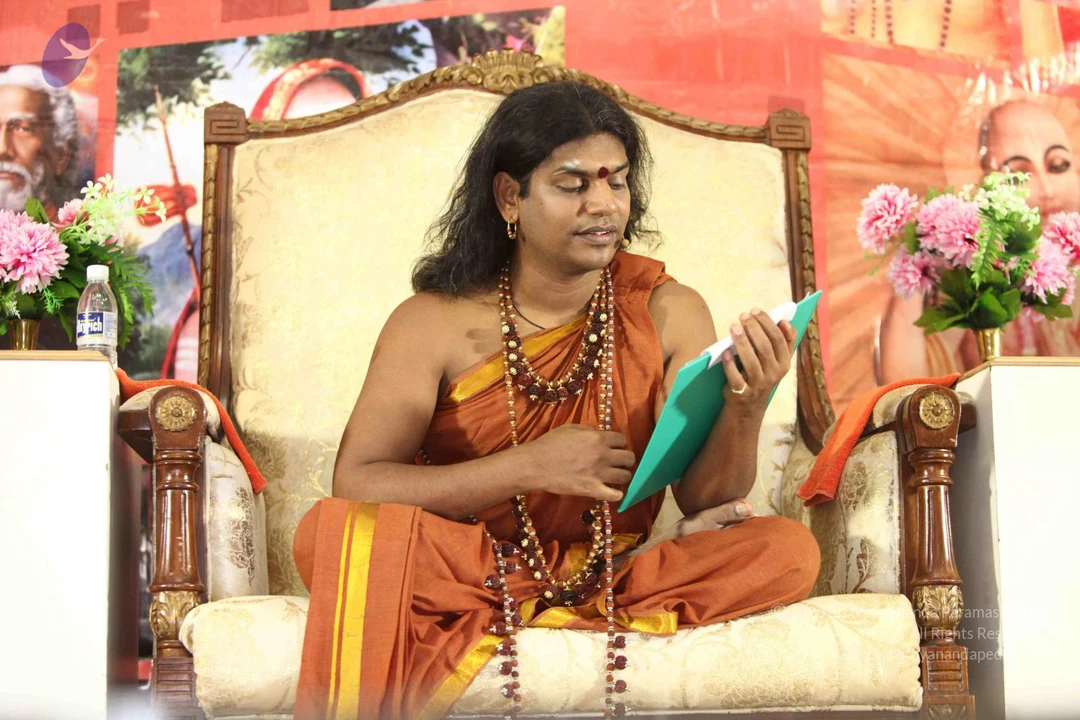
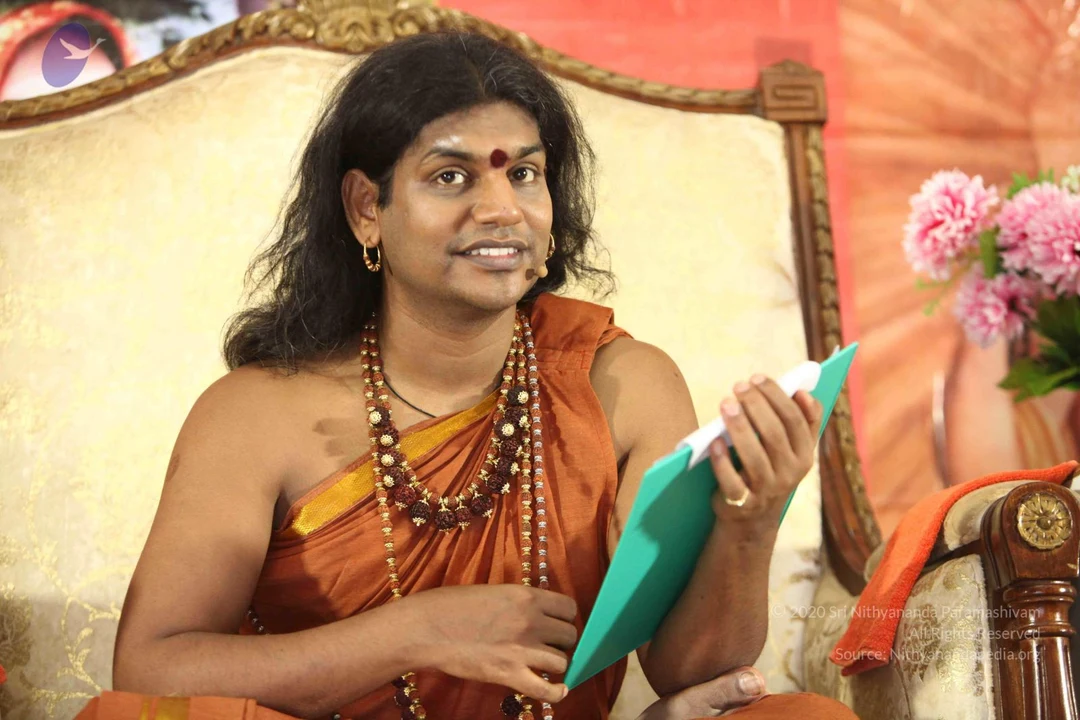
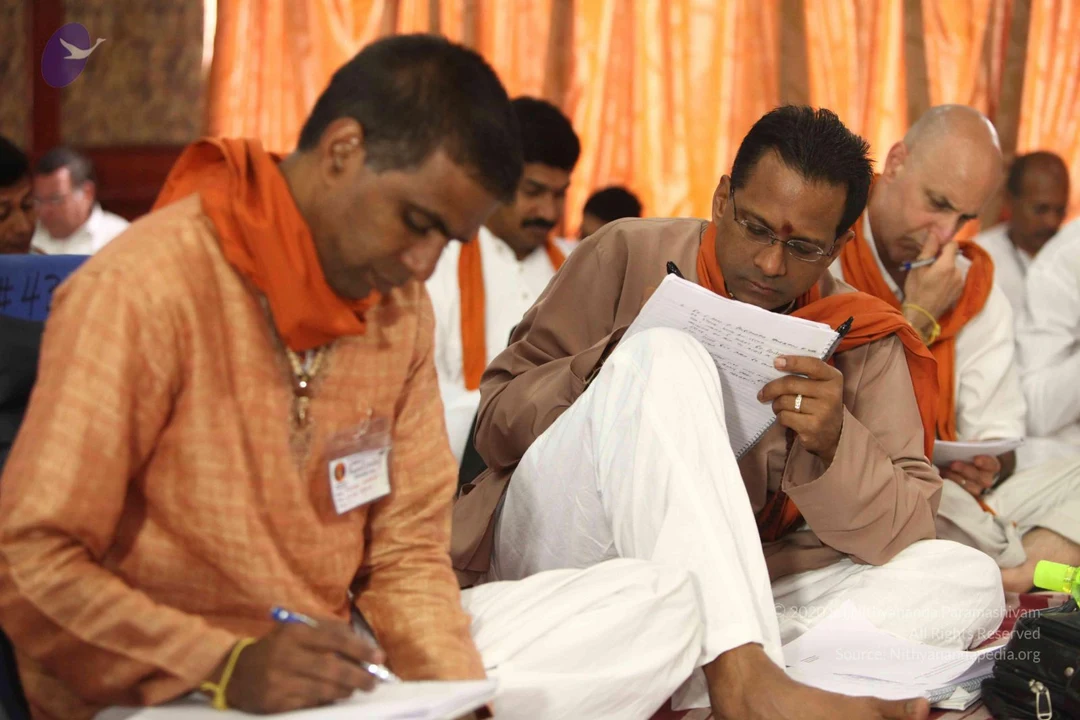
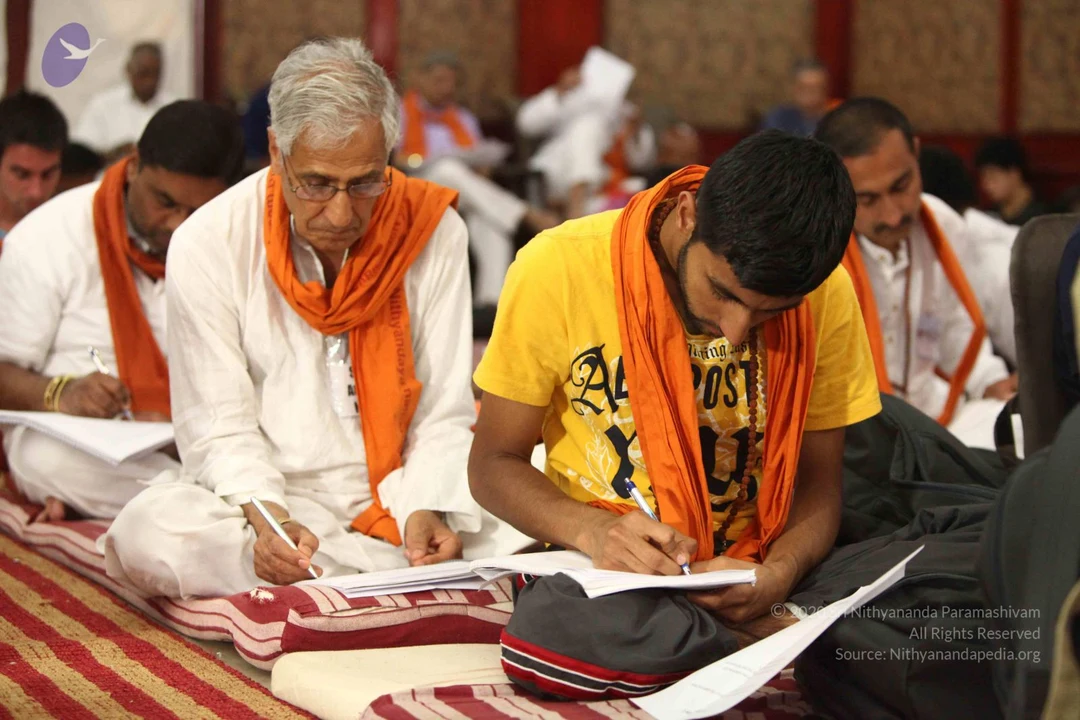
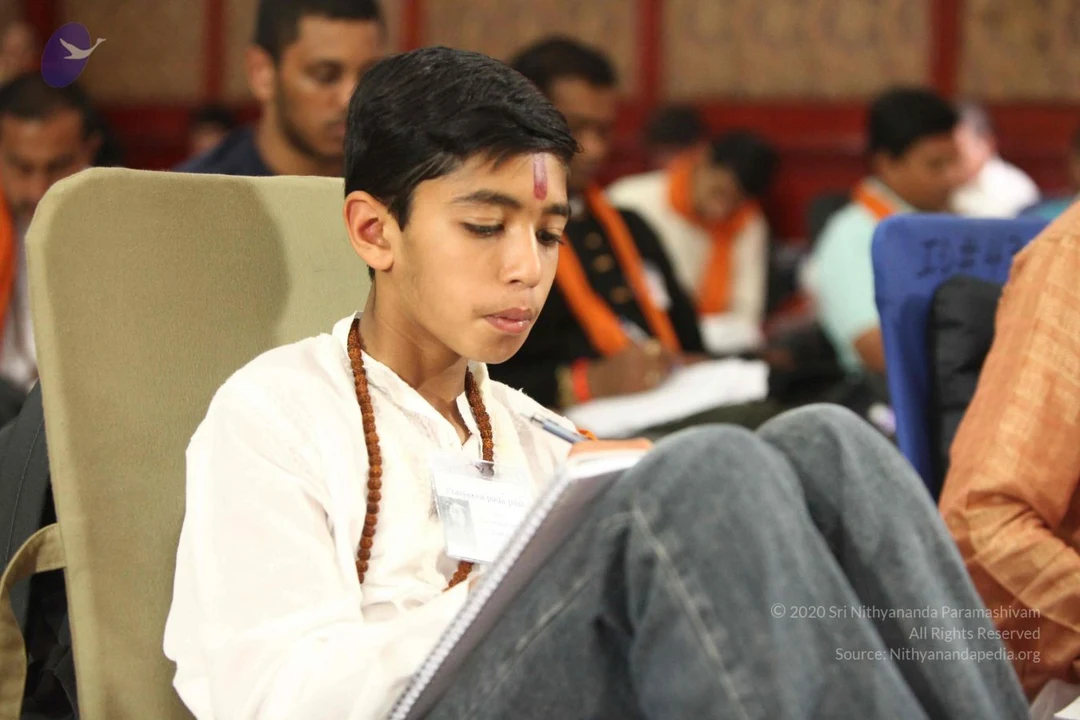
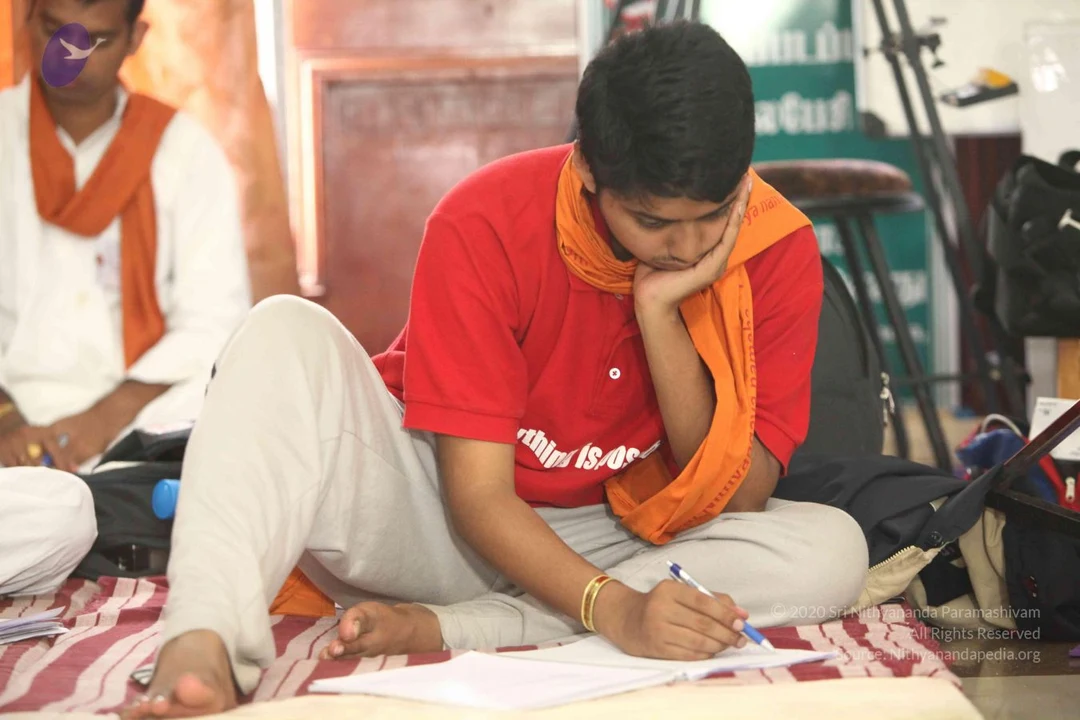
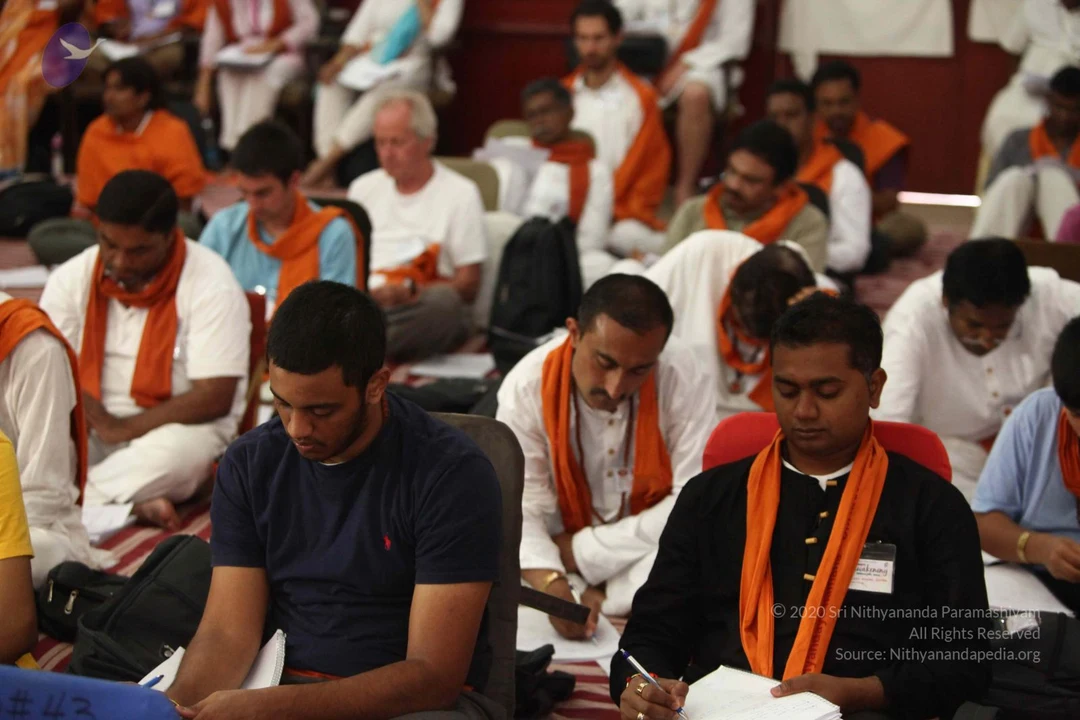
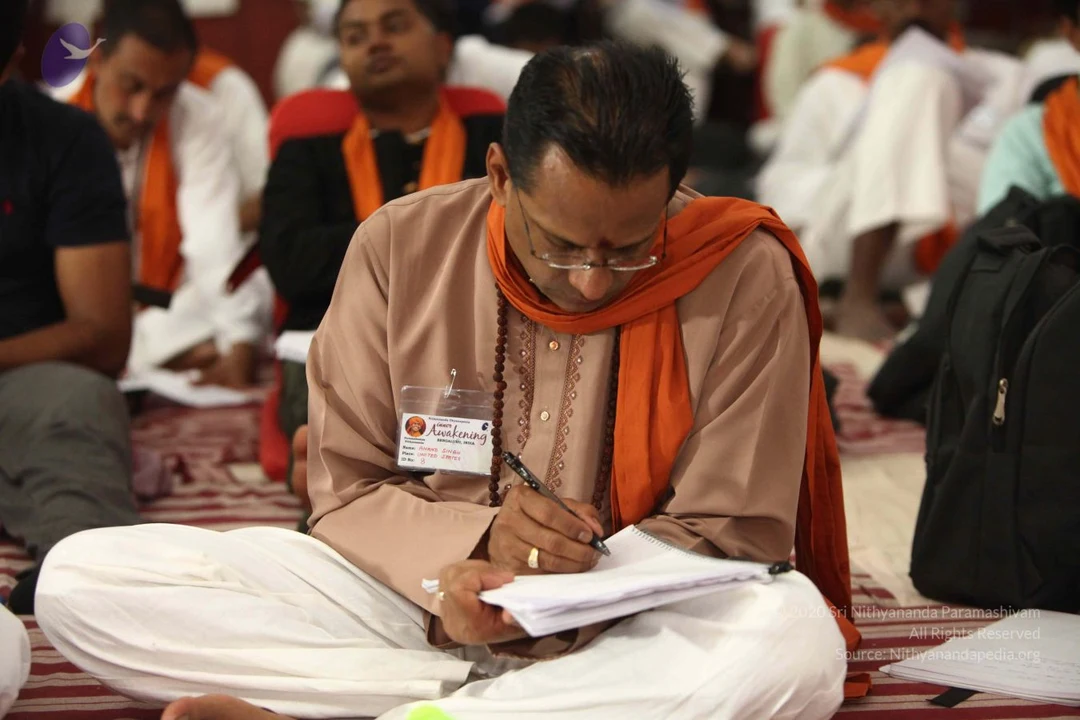
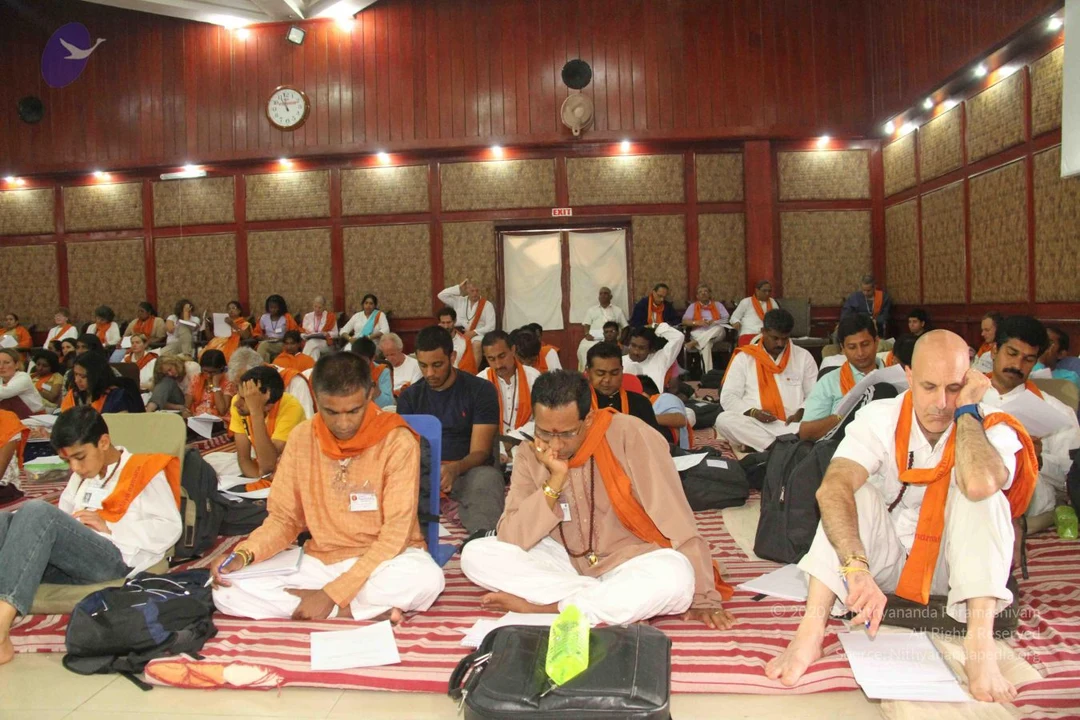
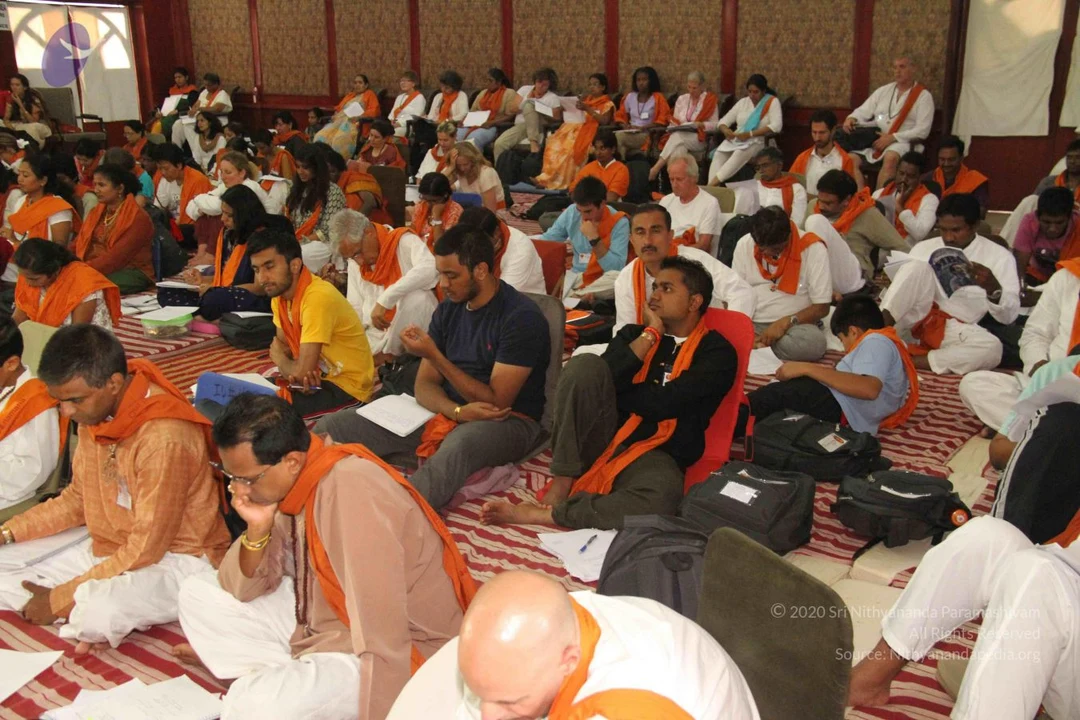
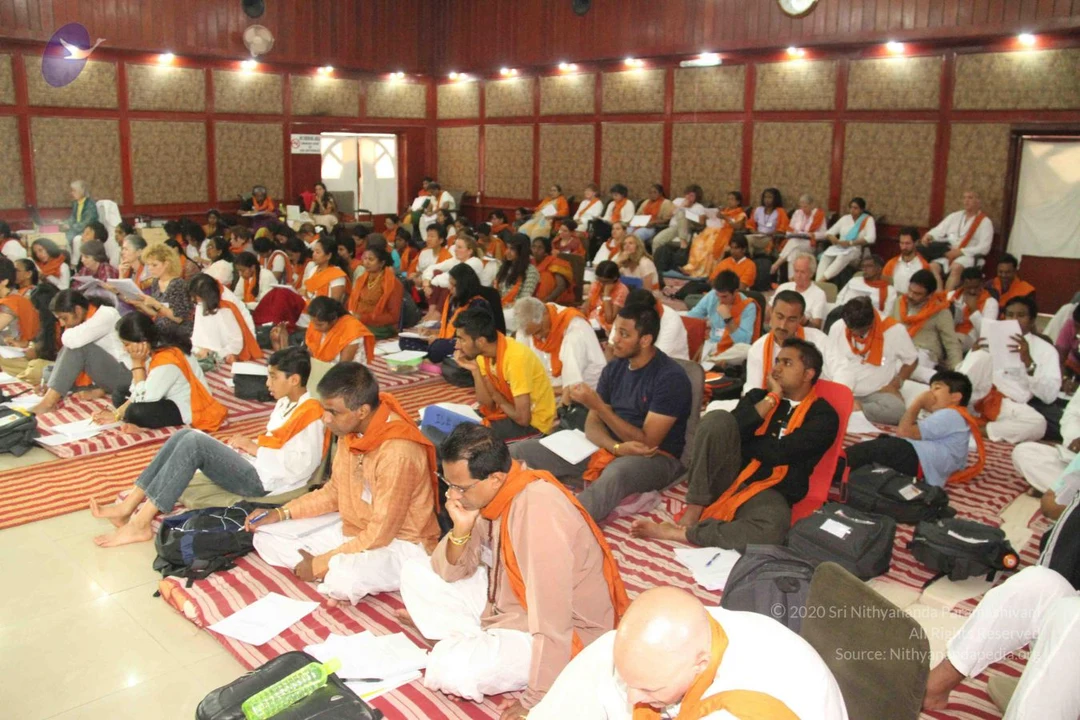
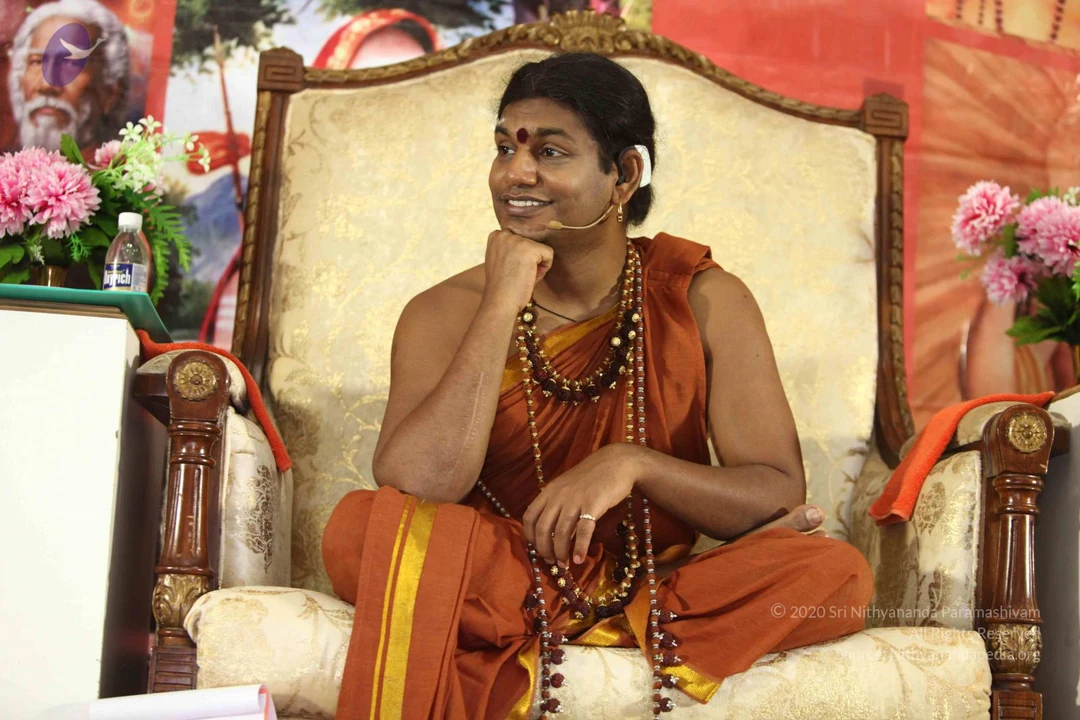
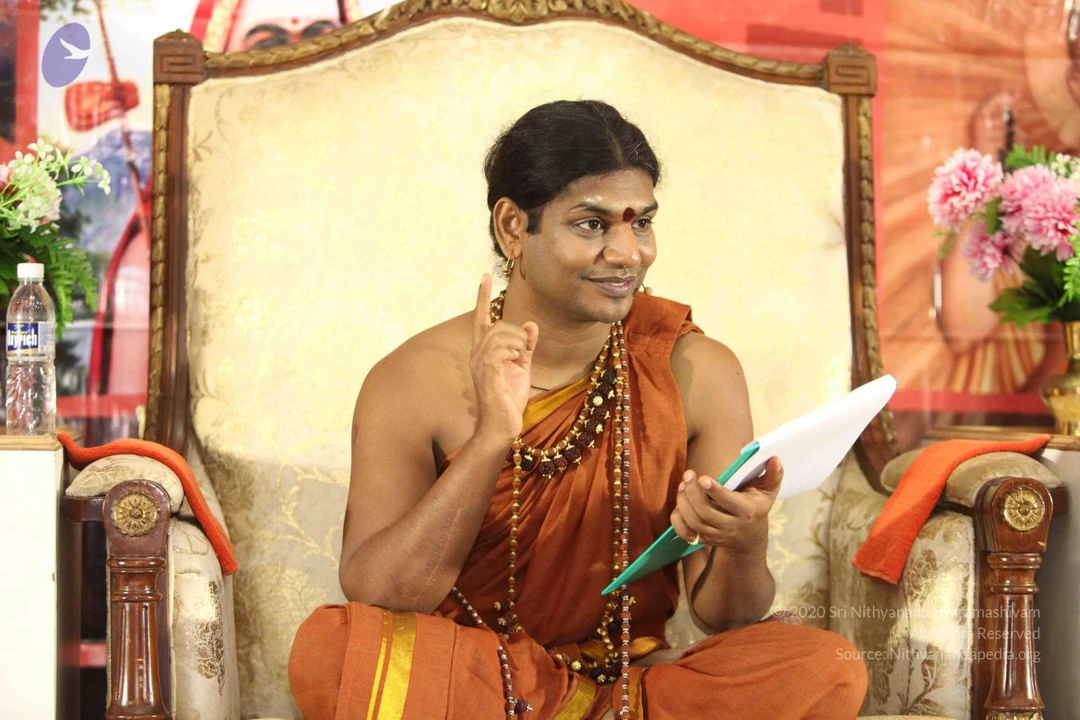
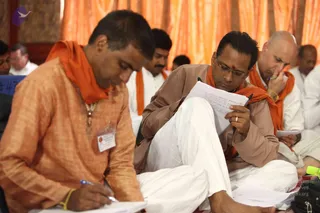
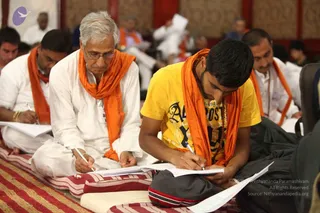
A smiling man with long dark hair sits on an ornate cream upholstered throne with gold carved wooden arms. He wears an orange-saffron shawl draped over one shoulder with a gold border, a gold-and-rudraksha mala necklace, gold hoop earrings, a red bindi and white marks on his forehead. Behind him a pink flower and a red and pink backdrop are visible. His hands rest together in his lap. The shawl and rudraksha cues are distinctive, and the page names a person, so he is a person candidate. This is a photo of one person in an indoor satsang setting.A seated man in saffron-orange dhoti and shawl, wearing a red bindi, multiple rudraksha malas and small earrings, sits on an ornate cream-and-gold throne-style armchair. He holds a green folder open and looks down at it while his right hand rests on the beads. Pink flowers in vases flank the chair, a water bottle sits on the left side table, and framed portraits of older sages line the red backdrop behind him. a person is seated, reading in this discourse setting.A man with long swept-back dark hair sits on an ornate cream and gold throne-style chair, smiling and holding a green folder with a white pen. He wears an orange-saffron robe with a gold border, layered rudraksha malas with gold beads, gold hoop earrings, and a red bindi on his forehead. A small microphone is clipped near his ear. Behind him are pink flowers in a vase and an orange-red backdrop. Swamiji (probable): the long hair, saffron robe, rudraksha malas and ornate throne match the page's claim that Swamiji is at this satsang.A man with long, swept-back dark hair sits on an ornate gilded wooden throne with a cream floral-upholstered back and seat. He wears an orange-saffron shawl and dhoti with yellow borders, multiple rudraksha malas, gold drop earrings, and a red-orange tilak on his forehead. He reads from a plain white sheet held in both hands. Behind him are a large red and gold backdrop with a painted deity image, pink flower arrangements in brass vases, a water bottle on a white table, and a white cooling unit on the right.Men seated on the floor in a hall with orange drapes take notes during a satsang. In the foreground a man in an orange kurta with a name badge writes in a notebook, and beside him a man in a tan kurta and white dhoti, wearing glasses and an orange shawl, reads from written notes. Behind them other attendees in white and orange shawls sit listening, and a bald man in white with an orange shawl rests his chin on his hand. A small sticker reads #42 on a blue card at left.Photograph of devotees seated on striped cushions and a red-and-yellow woven mat in a hall, writing in notebooks with pens. The foreground man in front wears white kurta-style clothing with an orange shawl and a lanyard badge, and the man beside him wears a yellow graphic T-shirt under an orange shawl and writes on paper. Other seated people in white clothes and orange shawls are visible behind, with a red-patterned wall in the background.
Navagraha-Homa

37 photosSource gallery
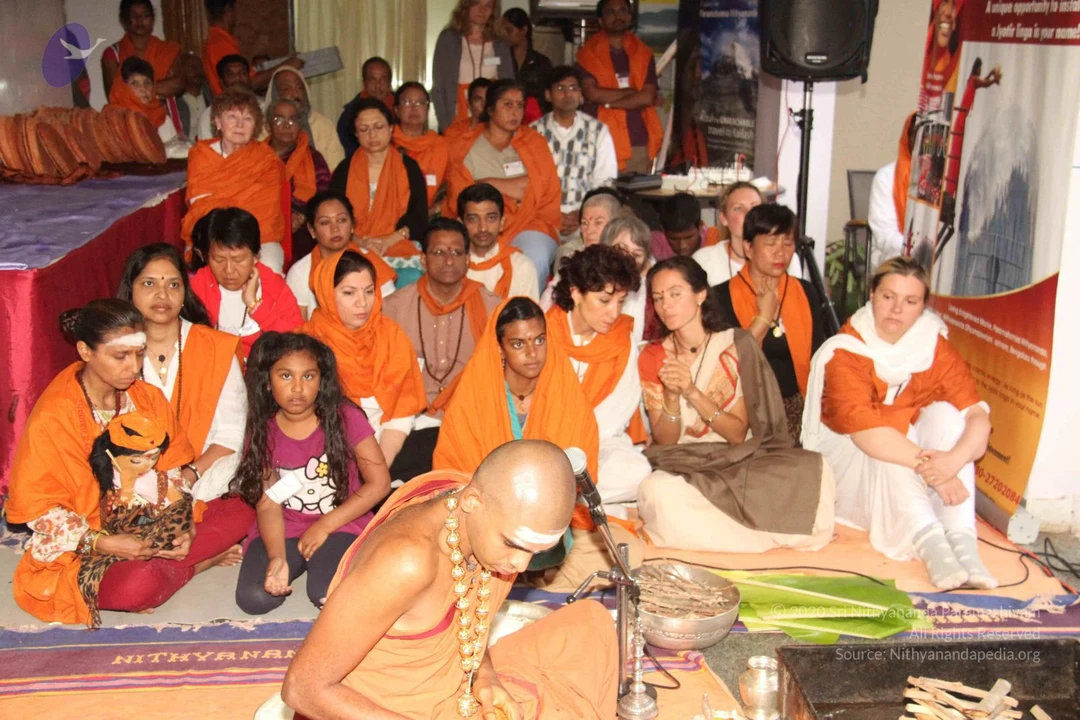
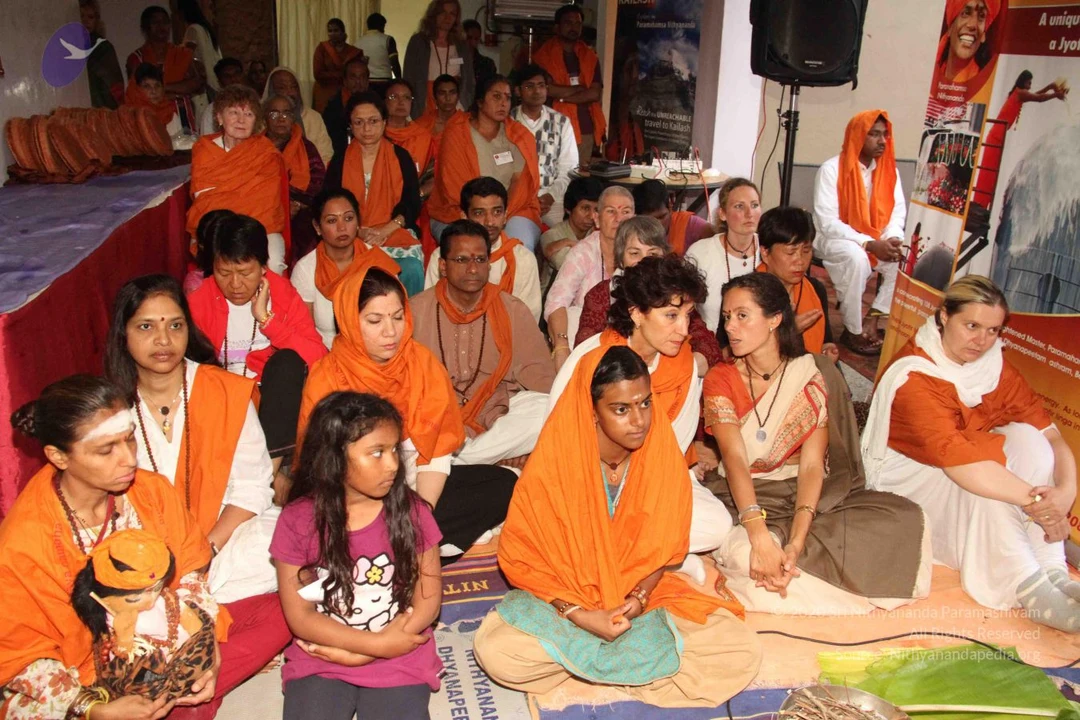
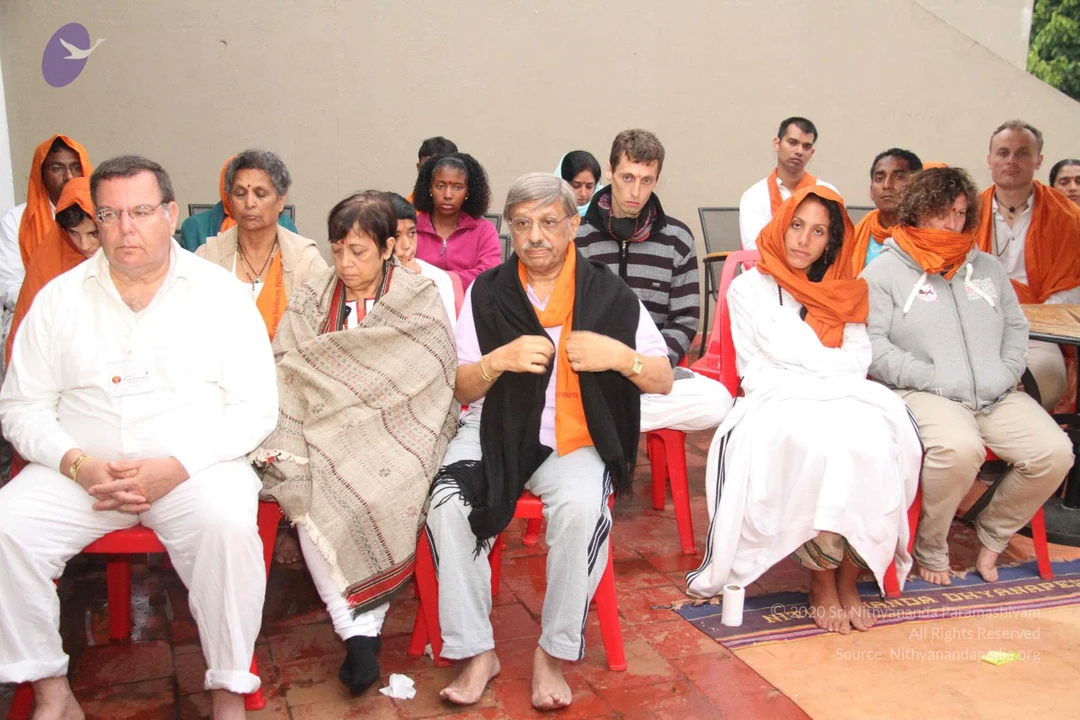
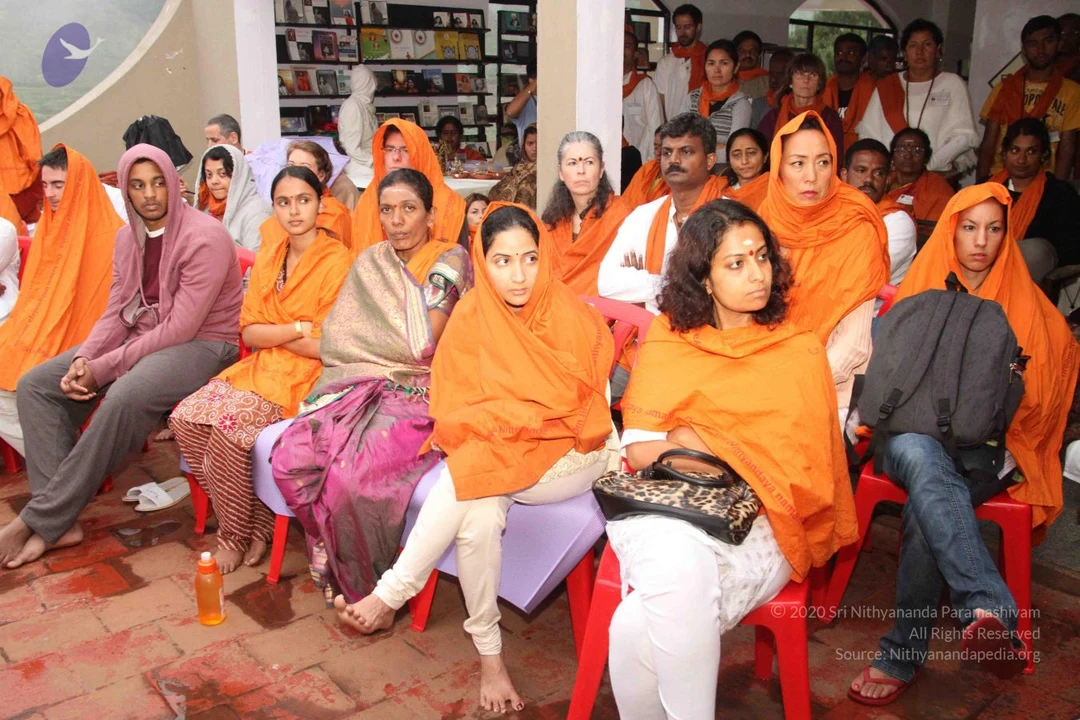
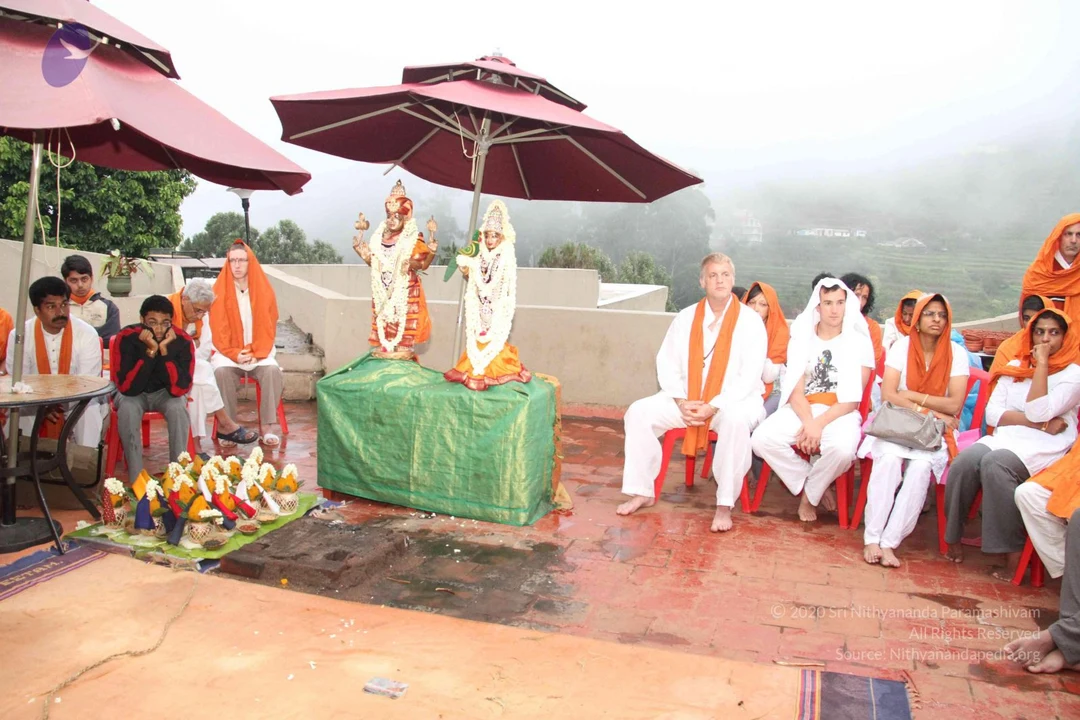
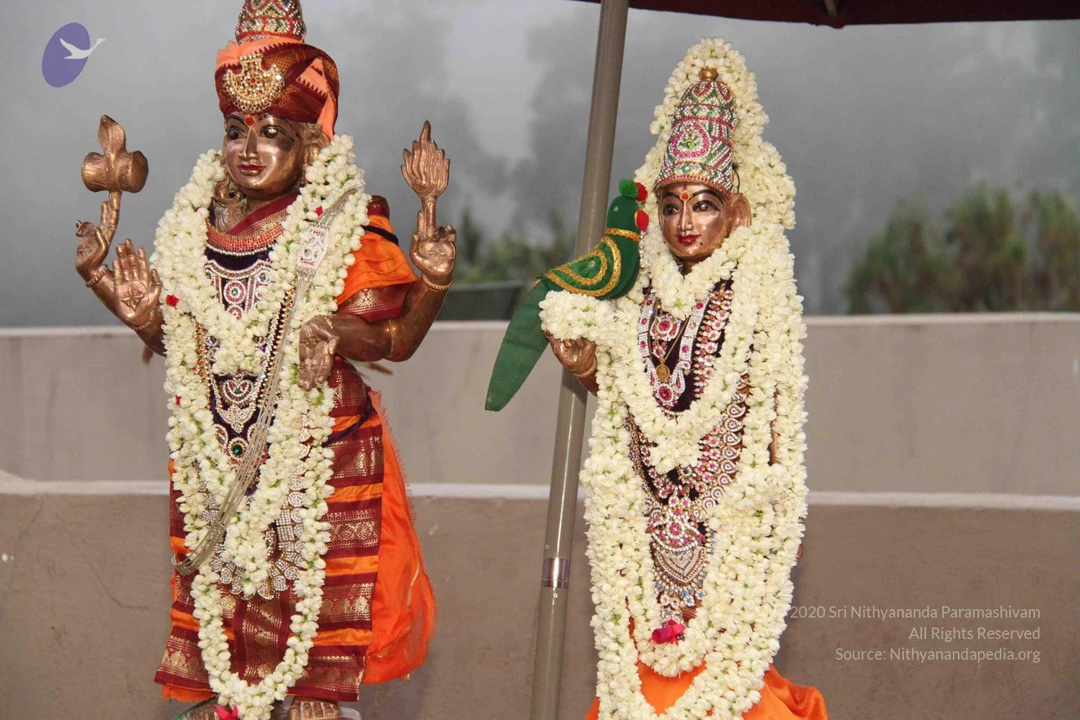
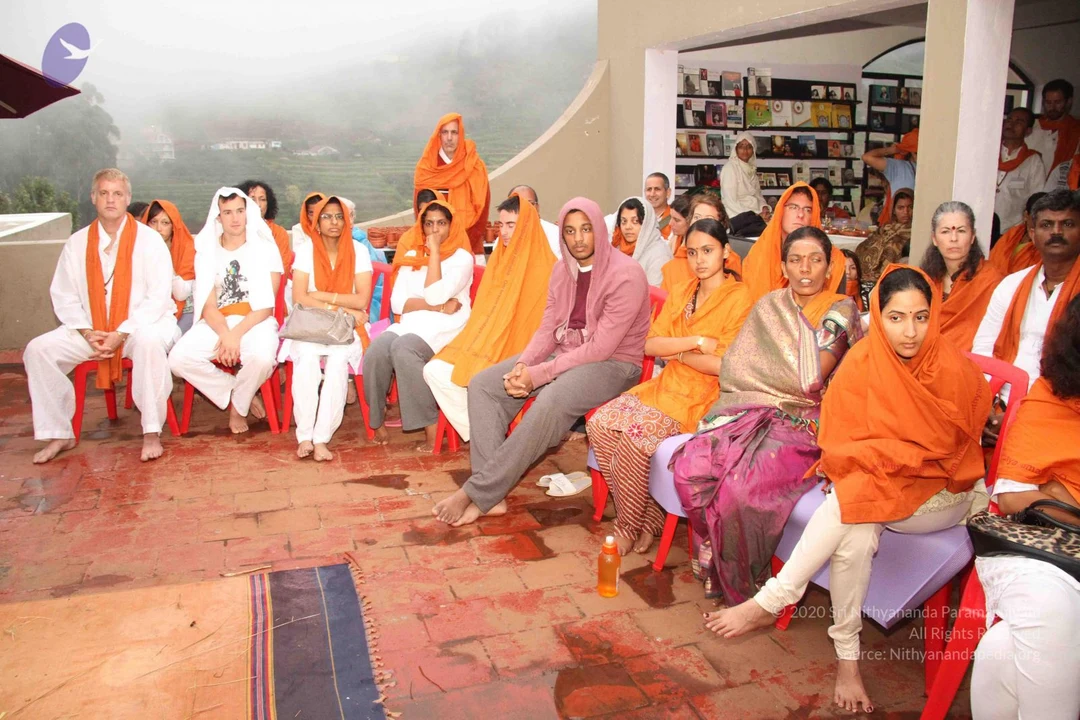
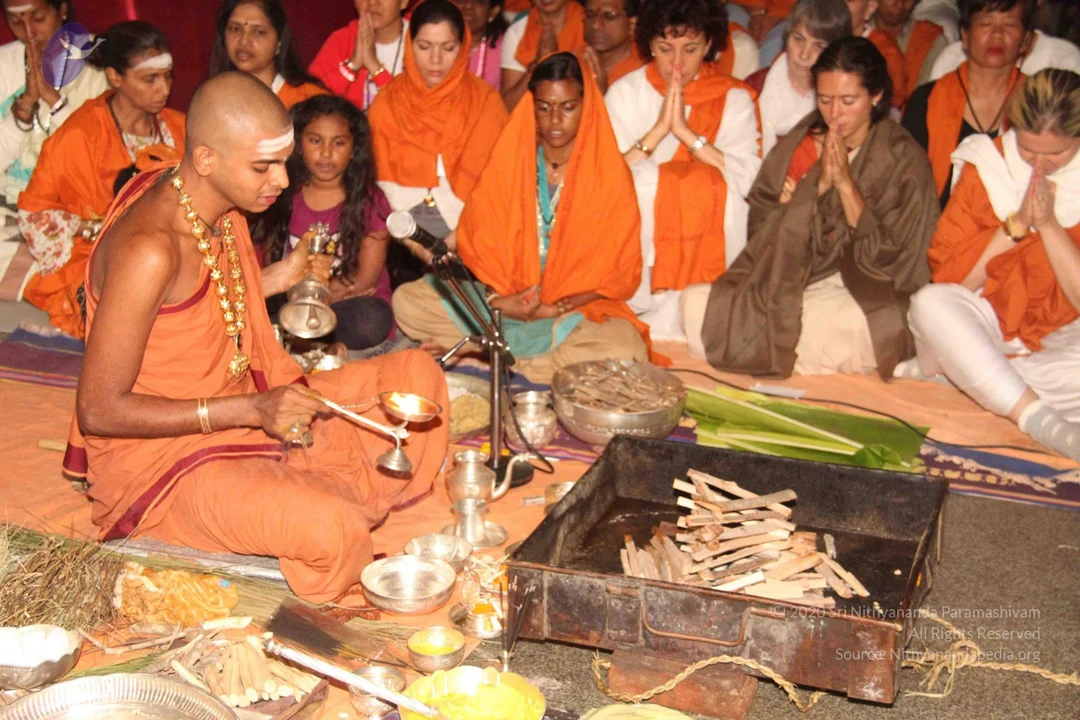
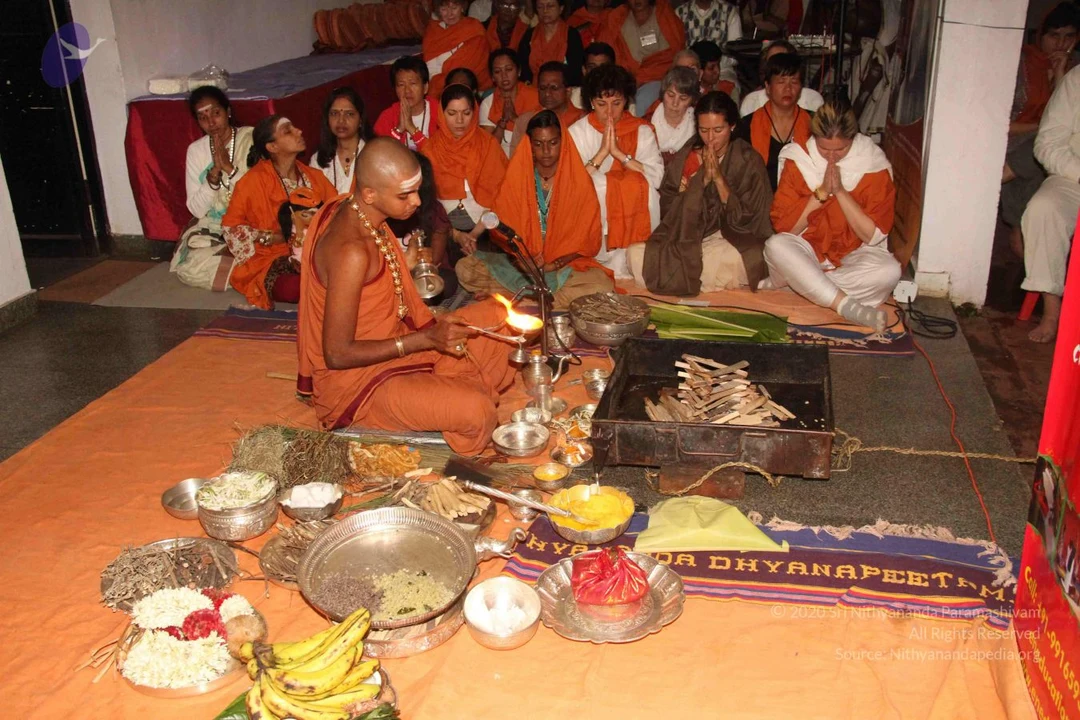
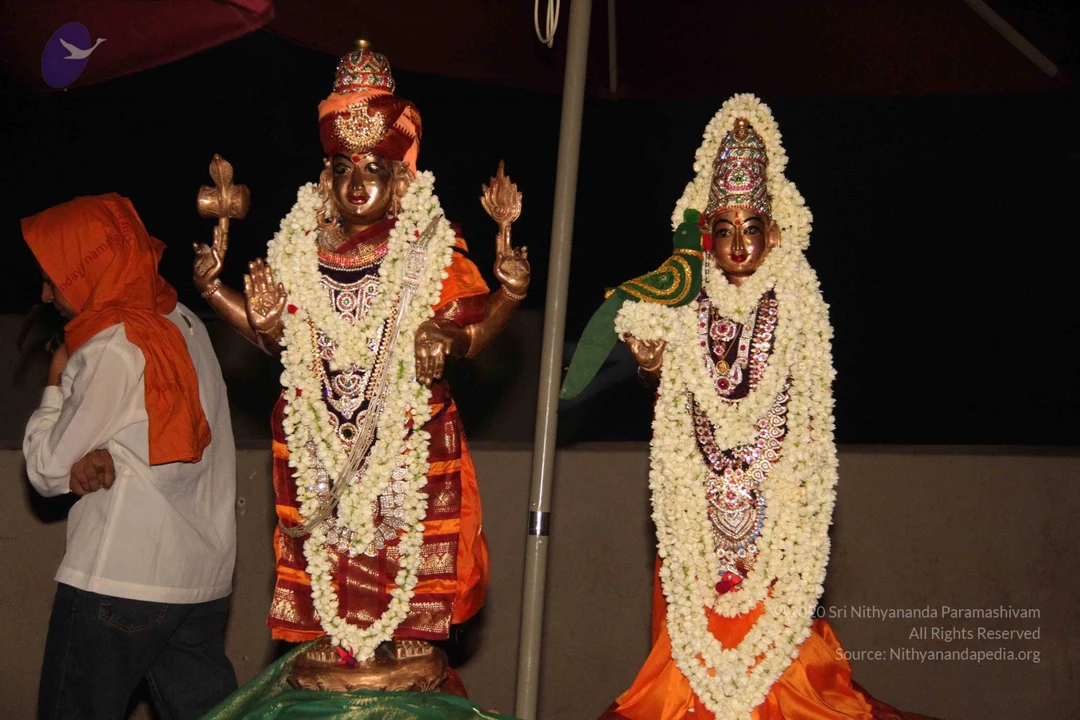
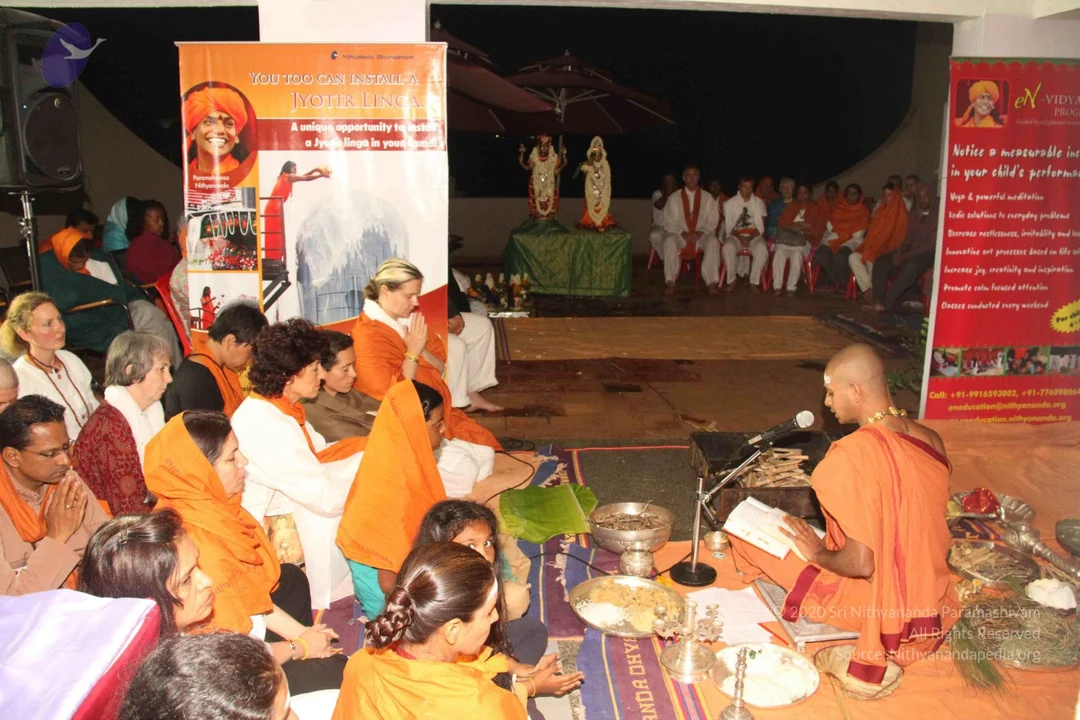
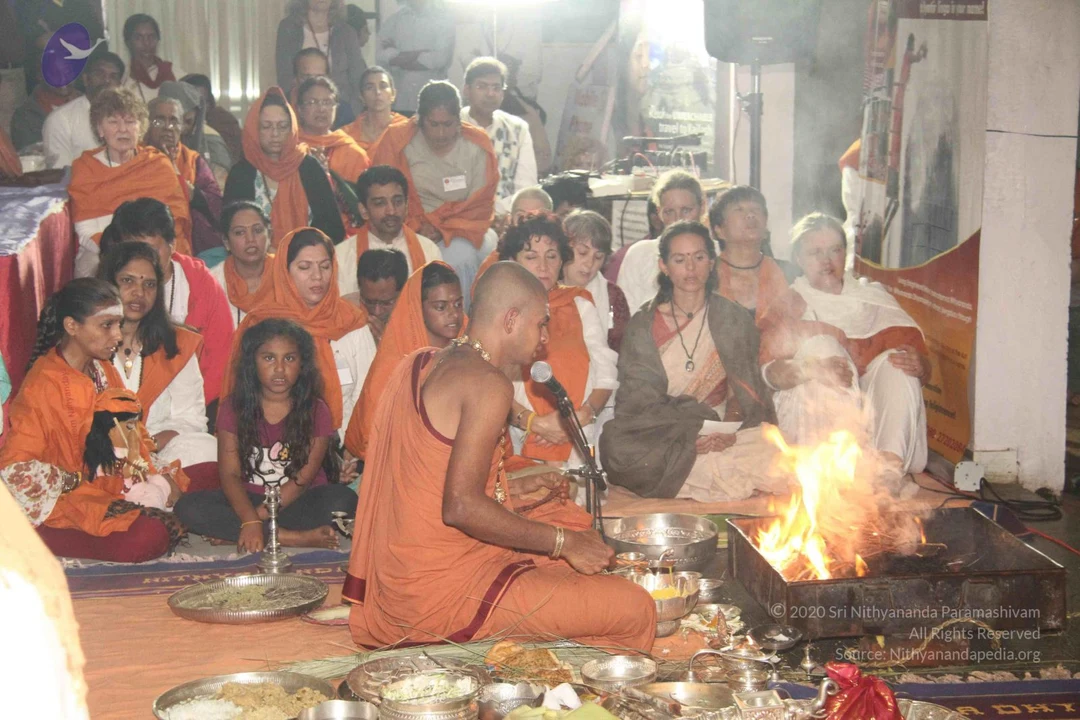
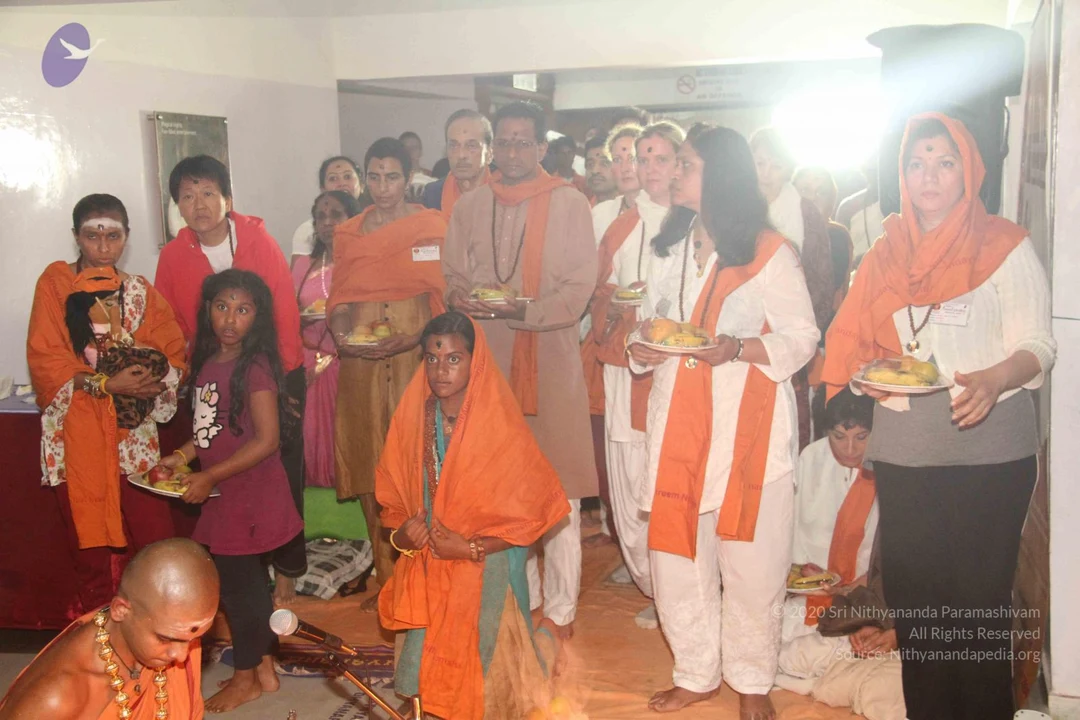
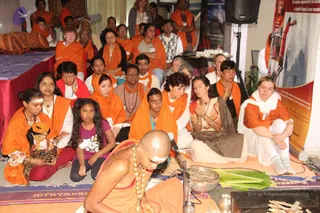
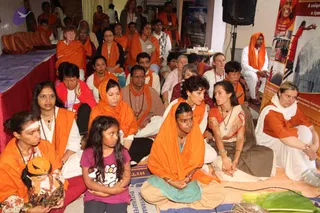
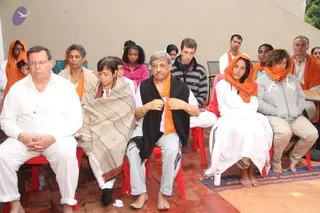
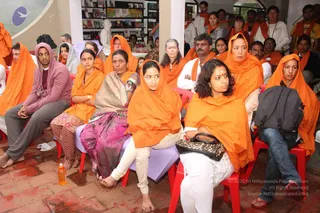
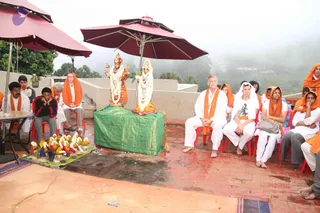
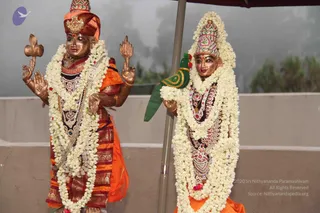
A seated bald man in orange robes with a gold bead necklace leads a gathering at a microphone, with a brass bowl and small wooden sticks on the floor before him. Behind him sit a large audience of about 40 people, mostly women and men wearing orange shawls, with several in white and one woman in a brown sari. A woman at left holds a small figure wrapped in a patterned cloth. Banners with text and a speaker stand are visible at right, and a purple mat with the word NITHYANAN is on the floor at lower left.Indoor satsang gathering with a seated audience of devotees in orange and saffron shawls, many sitting cross-legged on a blue-and-orange mat. In the foreground a woman in an orange shawl and teal-green skirt looks ahead, while a younger girl in a pink t-shirt with a white cartoon cat sits beside her. A woman on the left wears a white vertical forehead mark and rudraksha-style beads, and a child in an orange head covering sits at the lower left. Behind them rows of seated attendees fill the room, with stacked orange cushions at the top left. On the right a standing man in a white kurta and orange shawl stands beside a tall banner and a black speaker on a stand. No clearly identifiable a person figure is visible; the seated devotees are the focus.Photograph of a seated group of devotees on red plastic chairs on a terracotta-tiled outdoor patio during a satsang. In the front row a man in a white shirt and white trousers sits with hands clasped; beside him a woman wears a brown and beige shawl over white; in the centre an older man in grey trousers, pink shirt and black shawl with orange scarf adjusts his garment. A woman in a white robe with an orange shawl sits at right on a mat with a white cup. Behind them about a dozen more people in orange shawls and casual clothes sit or stand, and a purple mat bears a Nithyananda Dhyanapeetam logo. No one is clearly identifiable as a person from appearance, so no candidate is marked.Seated audience of devotees in a room with bookshelves and a round window, most wearing orange shawls or wraps draped over their heads and shoulders. A woman in the foreground wears an orange shawl over white trousers and holds a leopard-print handbag; a woman beside her in a purple sari with a striped skirt sits on a lilac chair. A man in a pink hooded top and grey trousers sits at left, and a woman in a red bindi sits centre. Red plastic chairs and a red brick floor. No clearly identifiable a person figure is visible in this frame.Outdoor photo on a wet red-brick terrace under misty hills, with two large maroon umbrellas overhead. Two decorated murti figures with flower garlands stand on a green draped platform in the centre. Seated in red plastic chairs in front are devotees in white clothes and orange shawls; a man in white with an orange shawl sits near the centre, a young man in a white t-shirt and white head wrap beside him, and several women in orange saris and shawls behind. Baskets of flowers and offerings sit on a green mat at lower left, with a small round table at far left. Eight people are visible.Two life-size bronze-coloured deity murtis are dressed for a festival procession, each draped in white jasmine garlands and orange and maroon silk garments with gold border work. The figure on the left holds a trident-like staff and a gesturing hand, and wears a tall orange crown with gold ornament; the figure on the right wears a pink and green jeweled crown and stands beside a long-handled umbrella with a green and gold fabric fan. Both wear layered ornamental necklaces. The background shows misty trees and a low concrete wall. No physical people are visible.

eNgenius
37 photosSource gallery
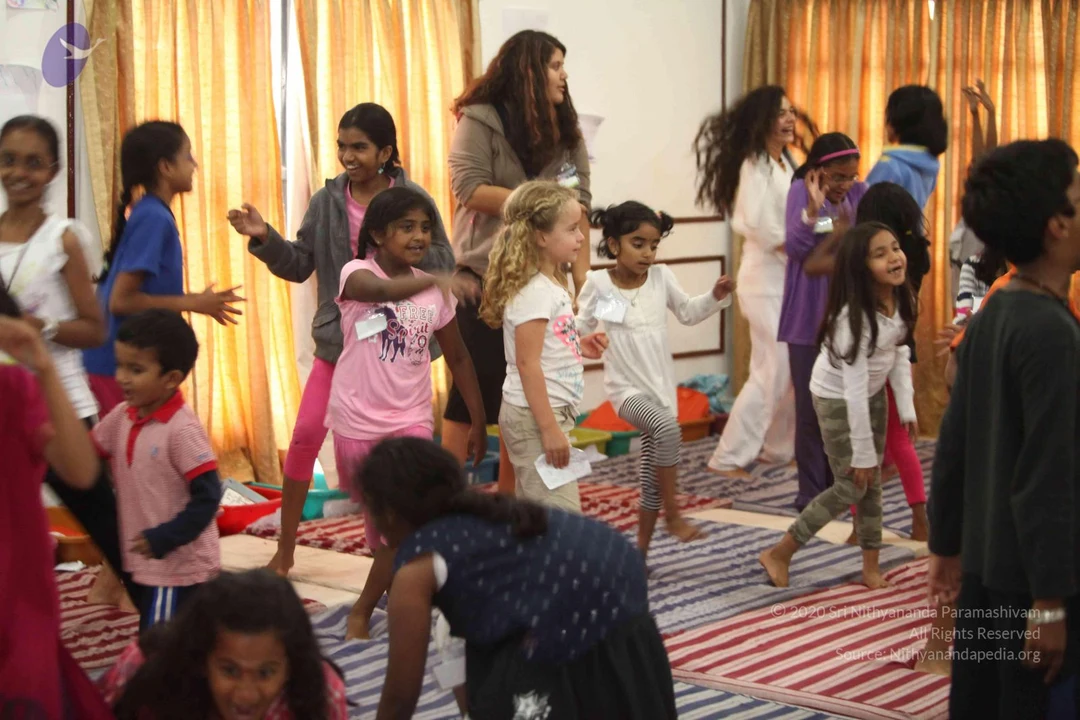
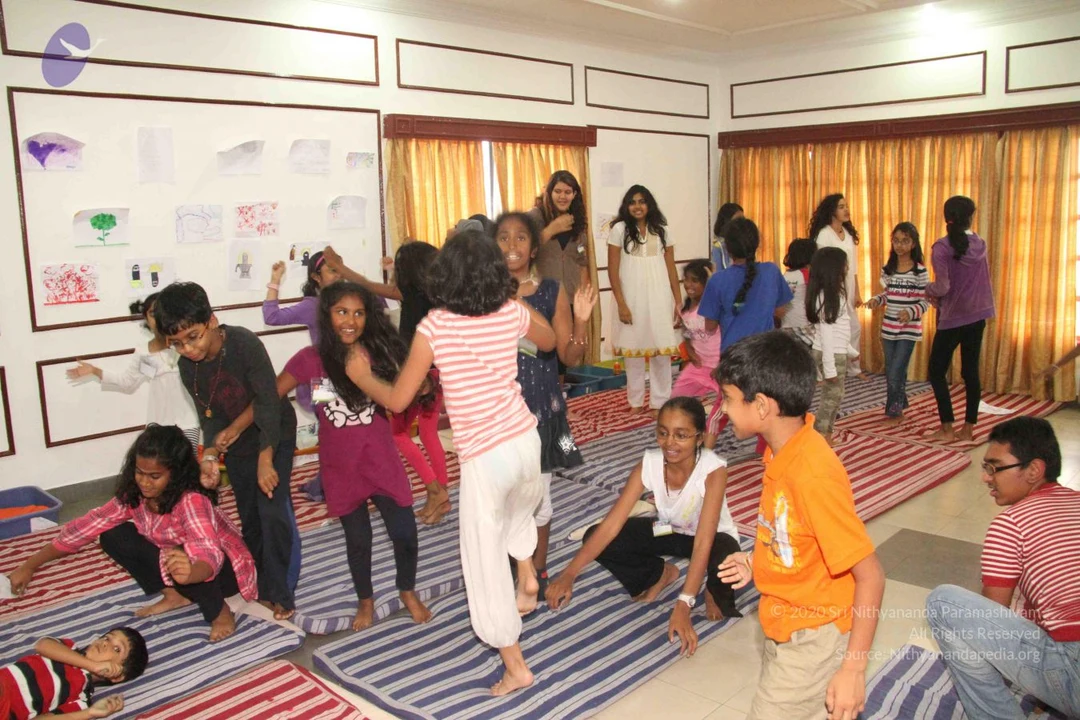
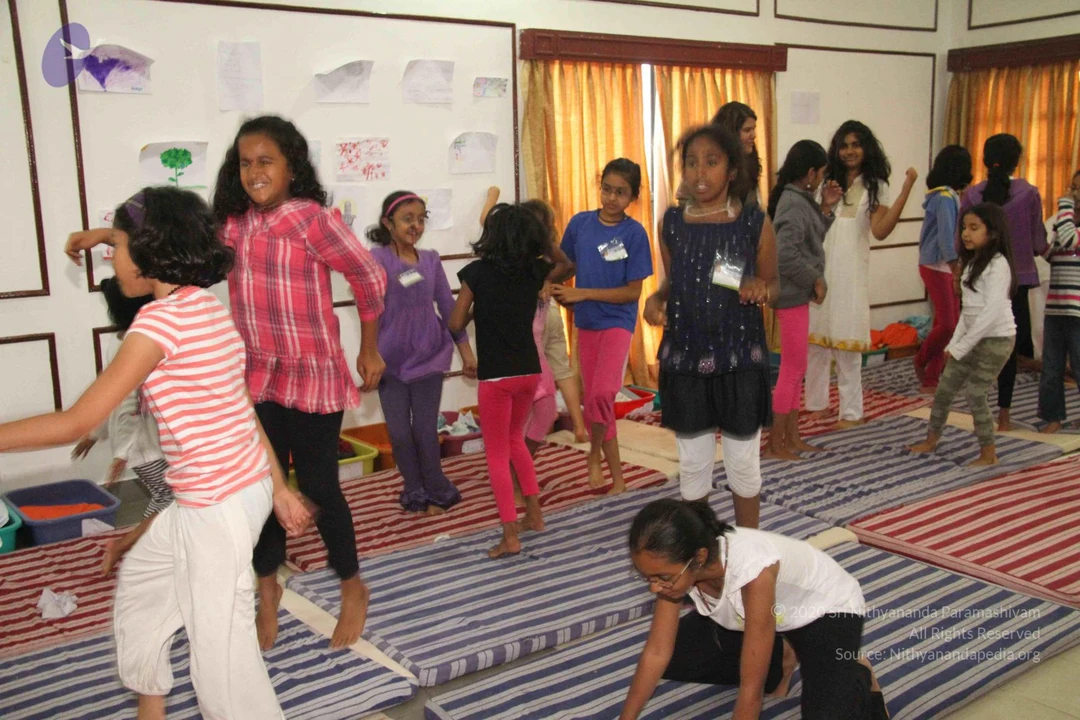
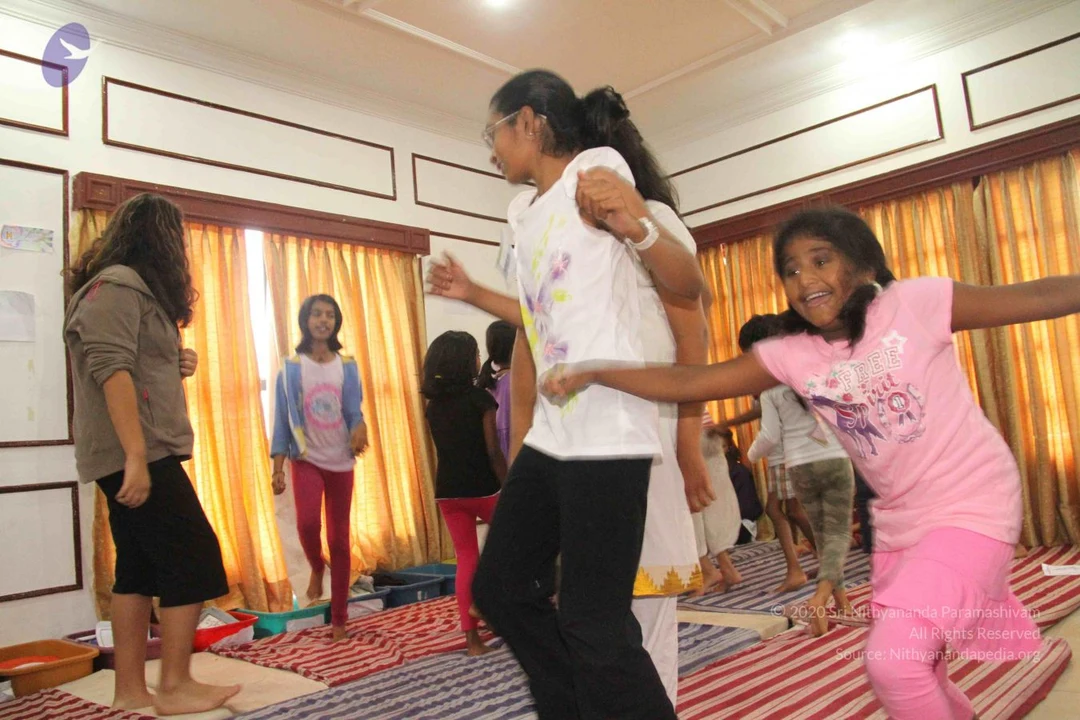
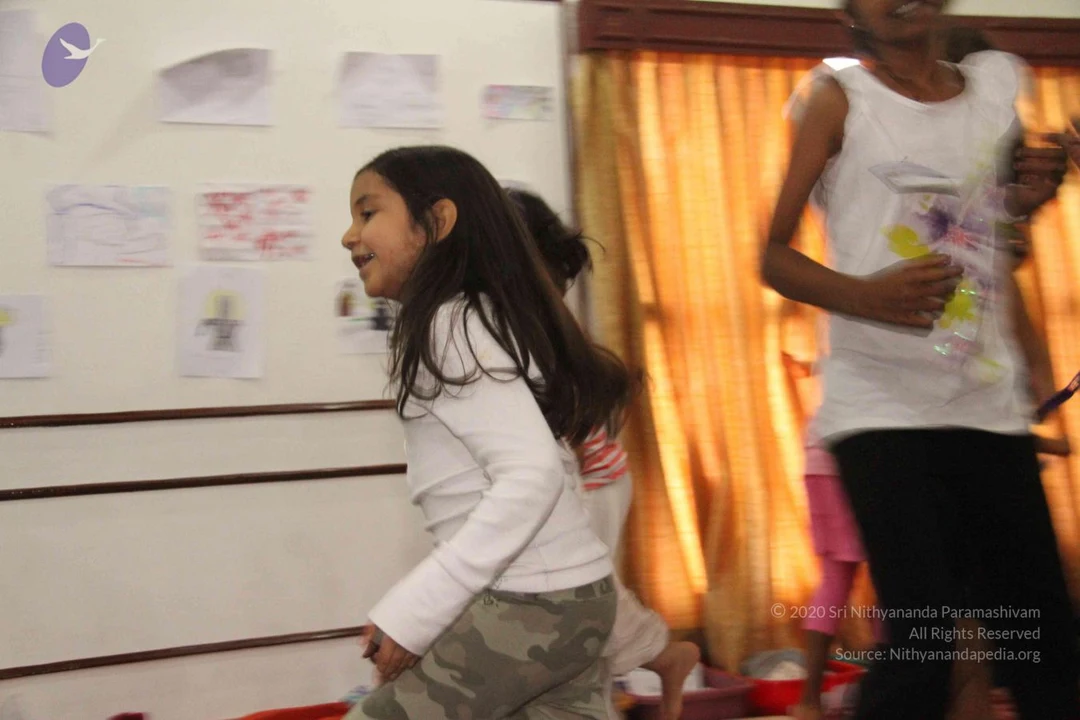
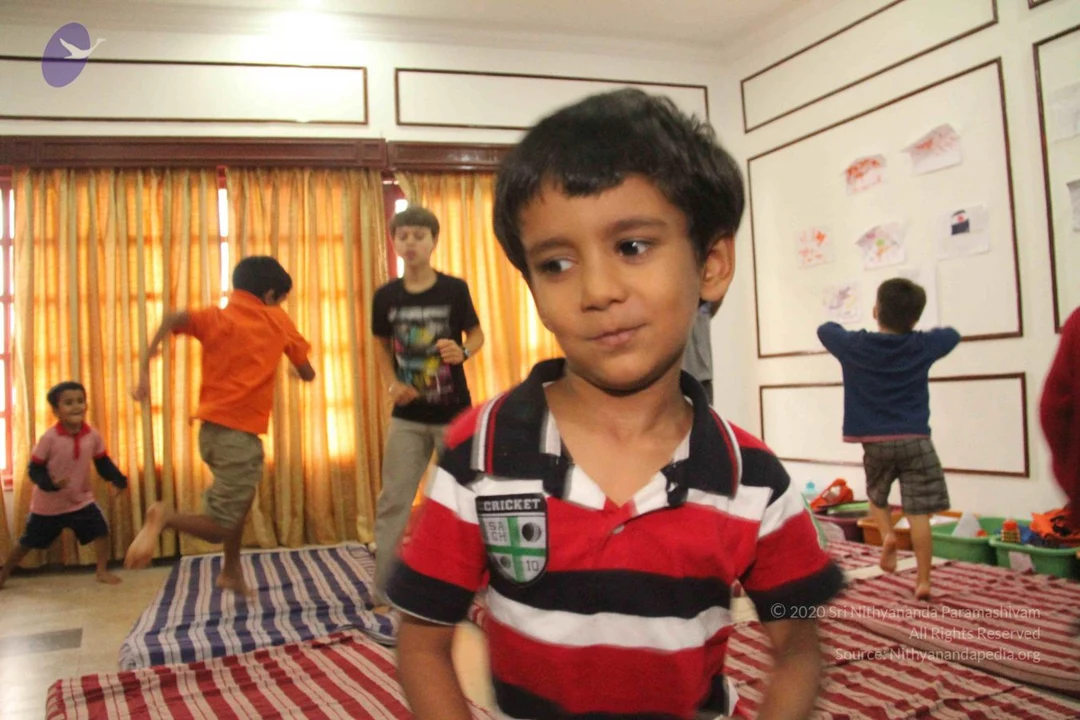
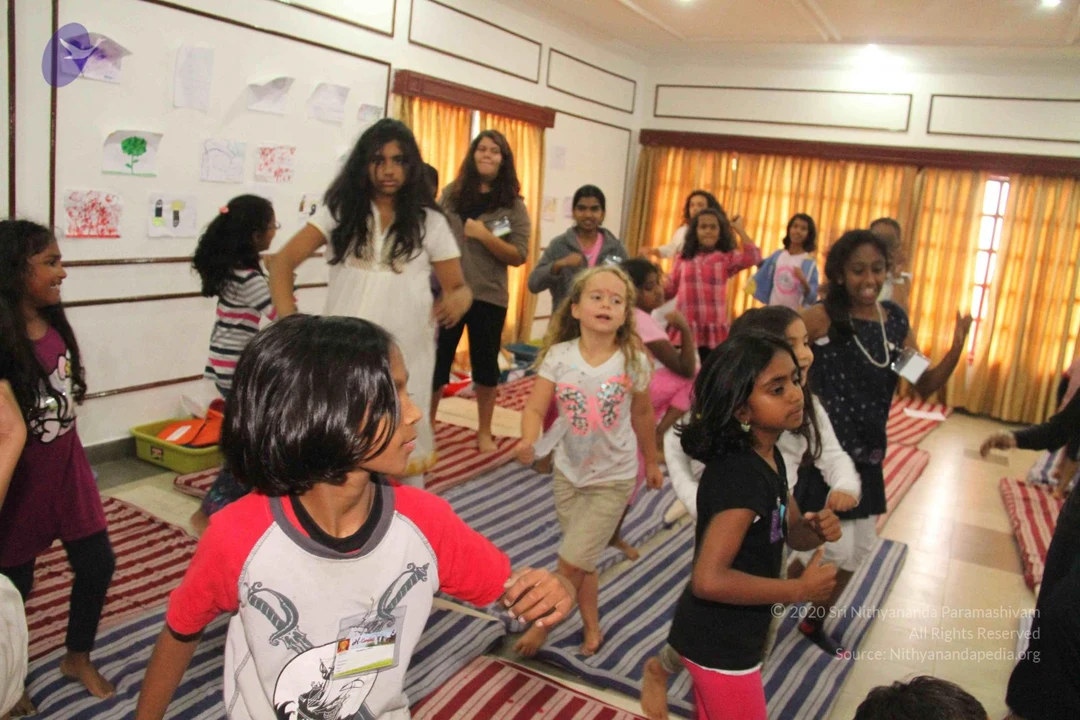
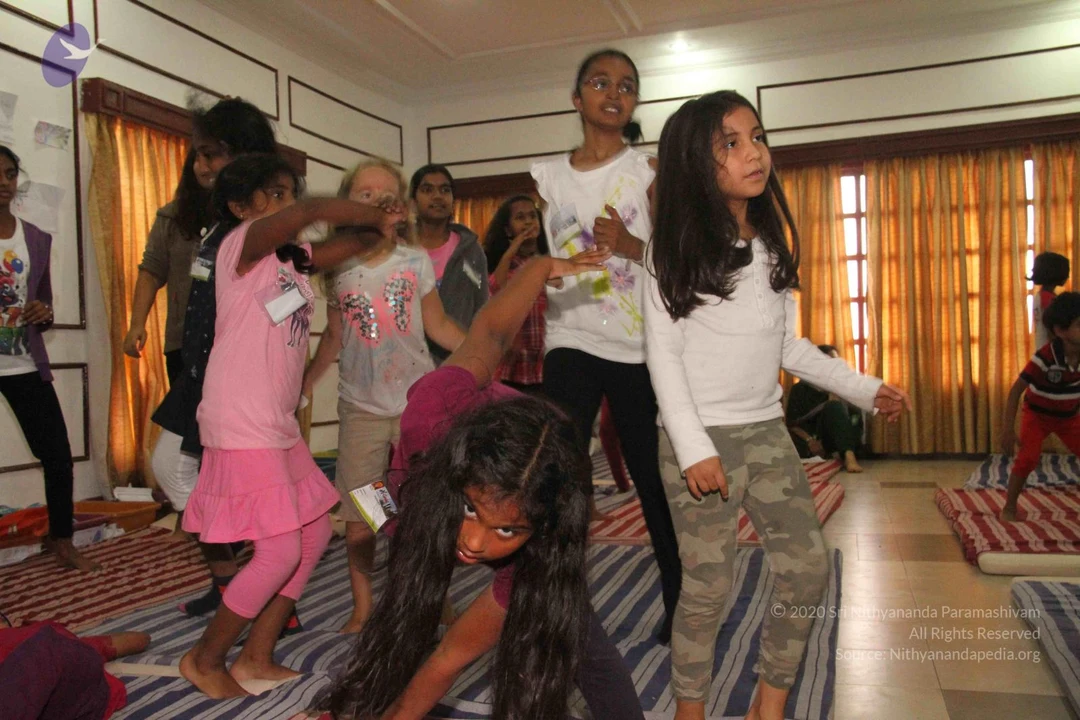
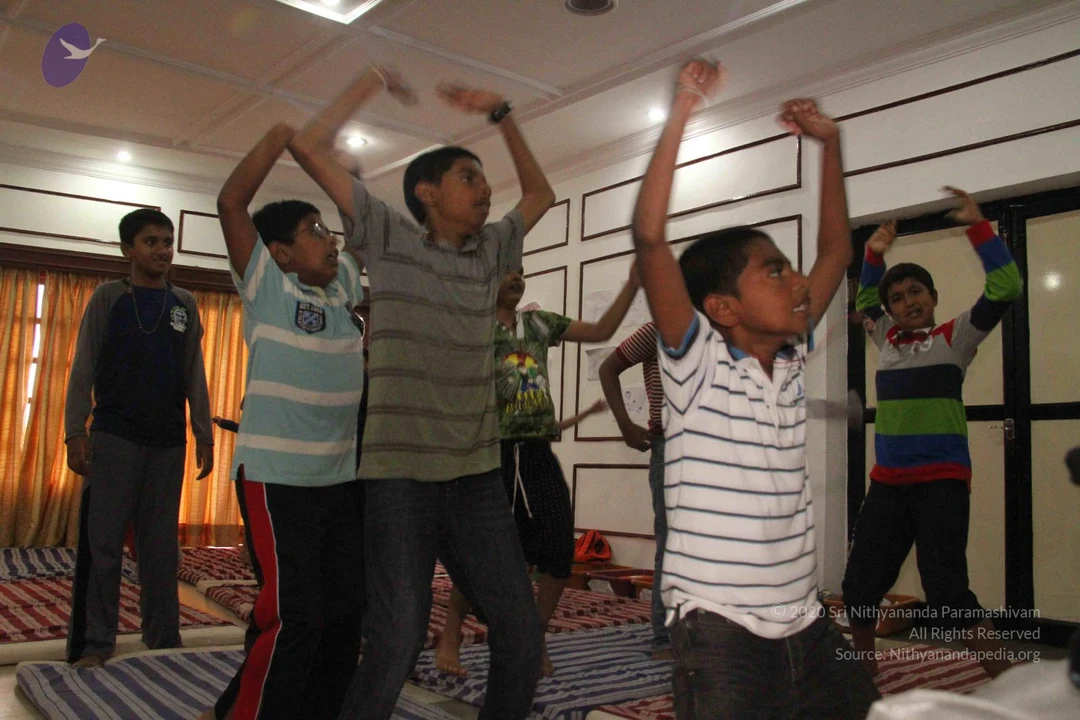
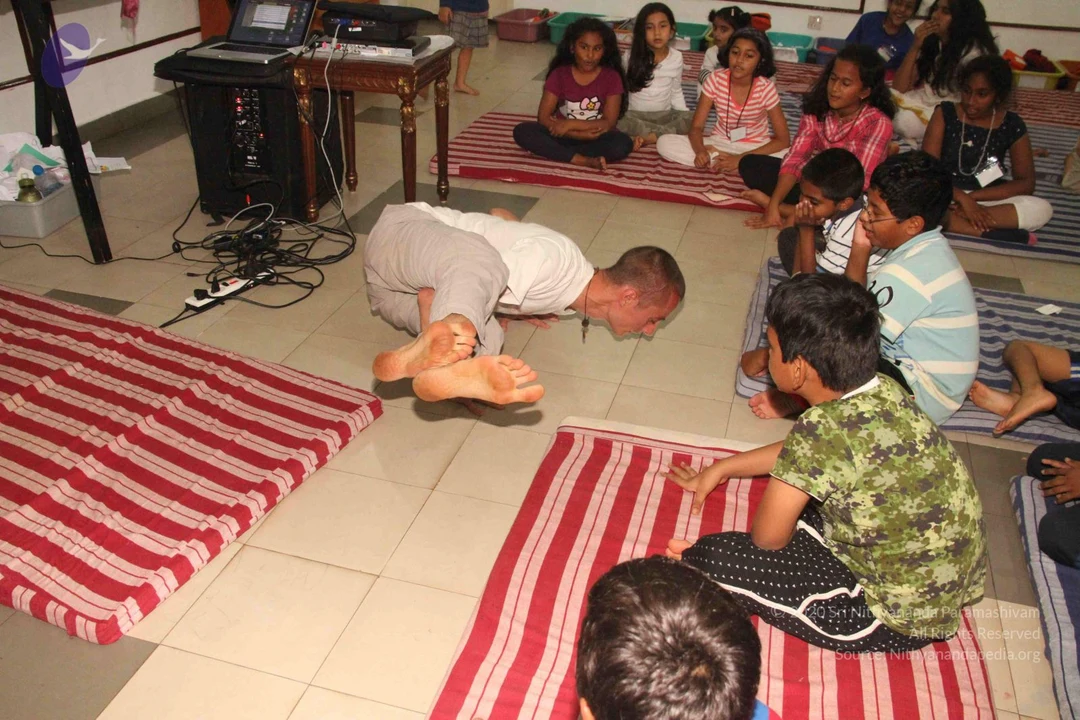
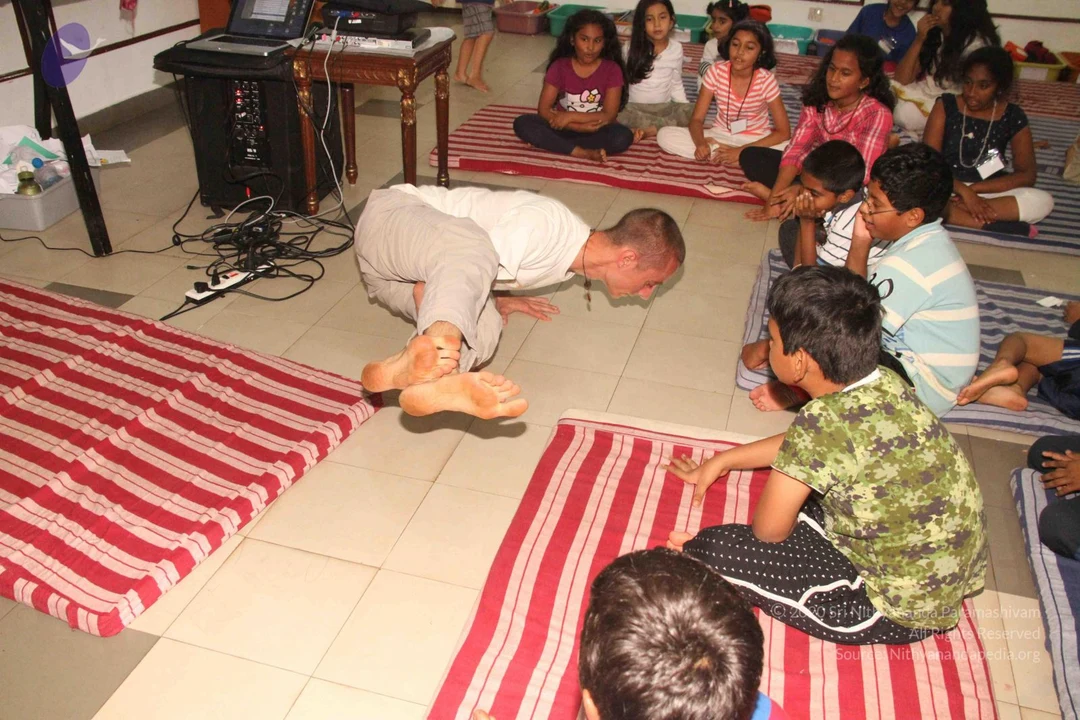
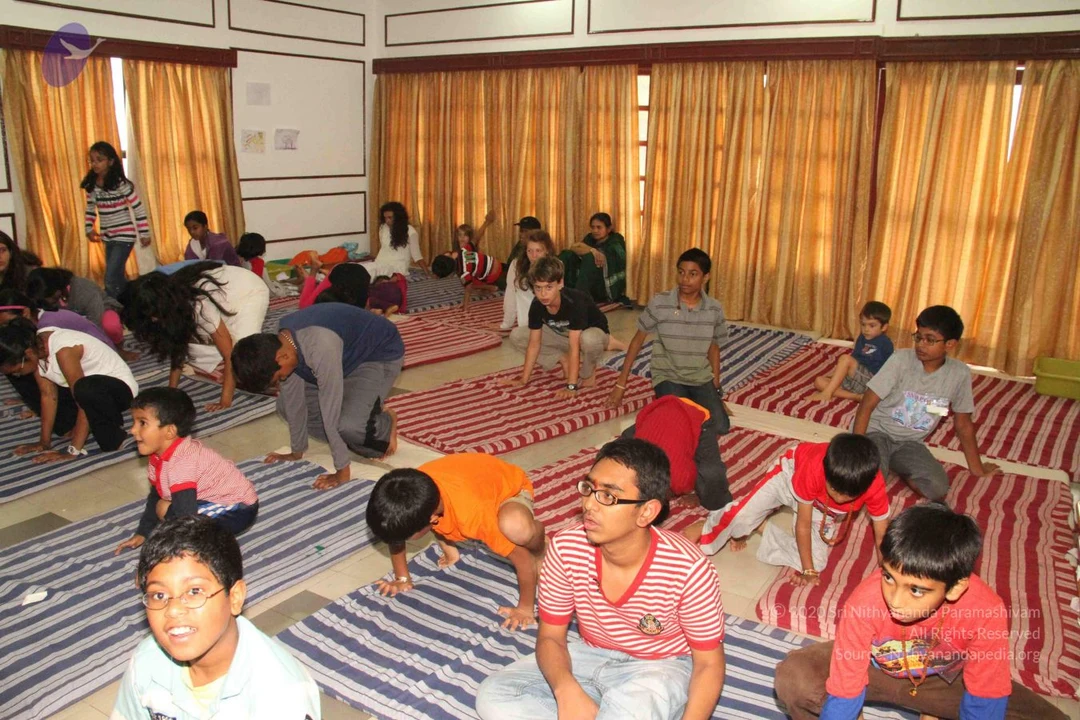
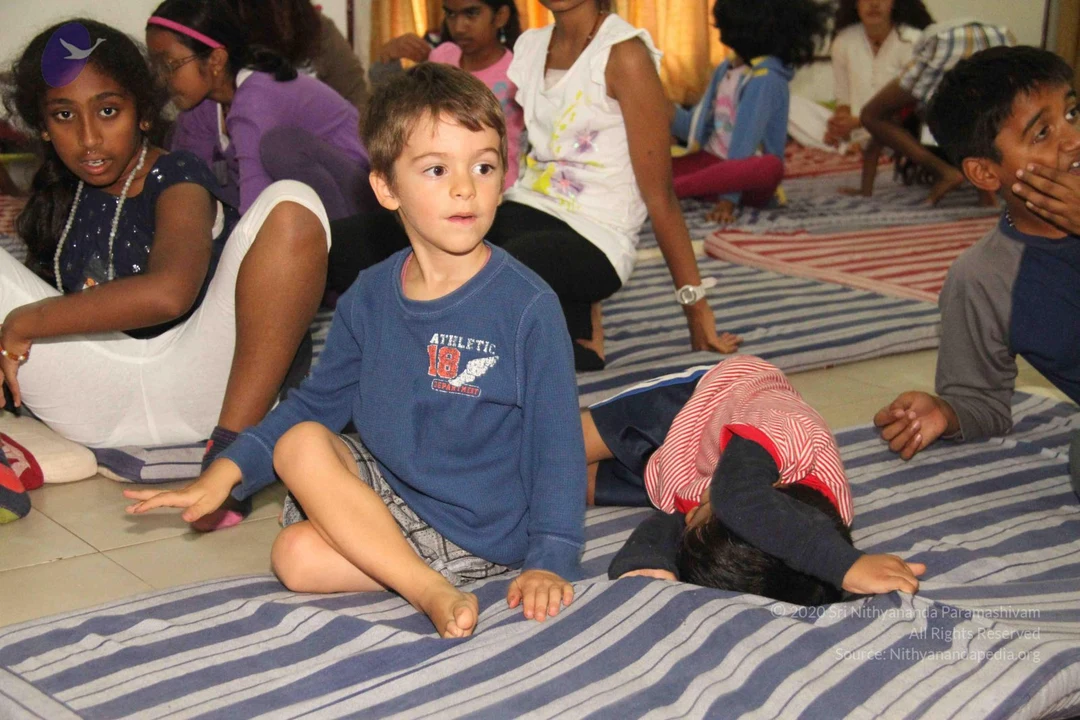
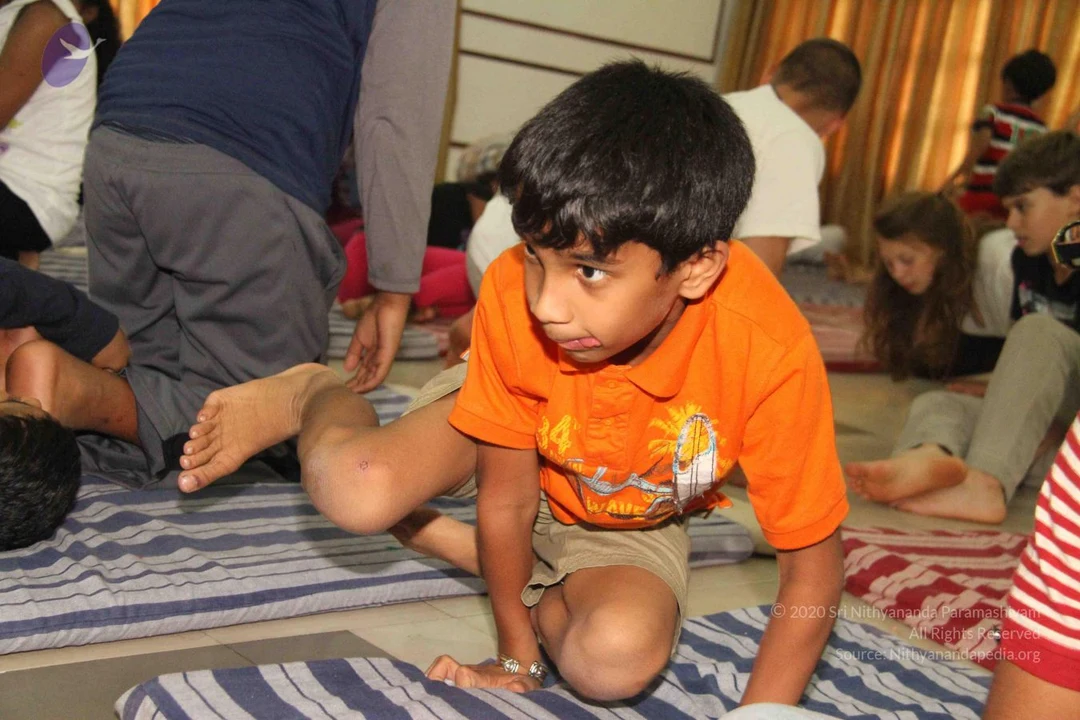
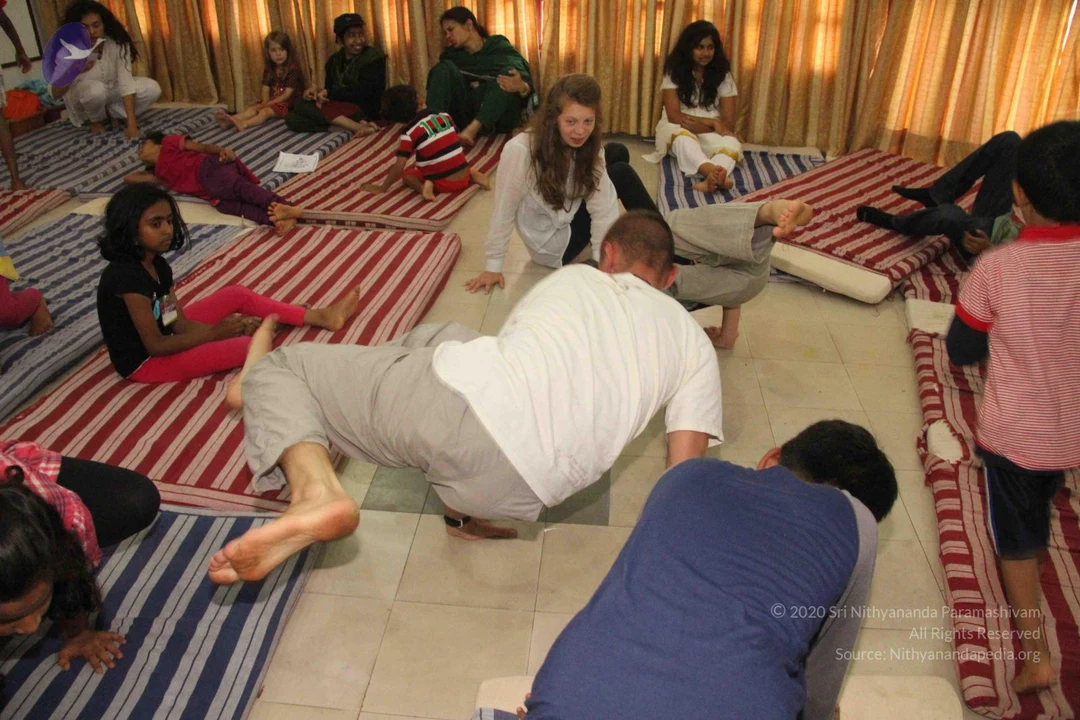
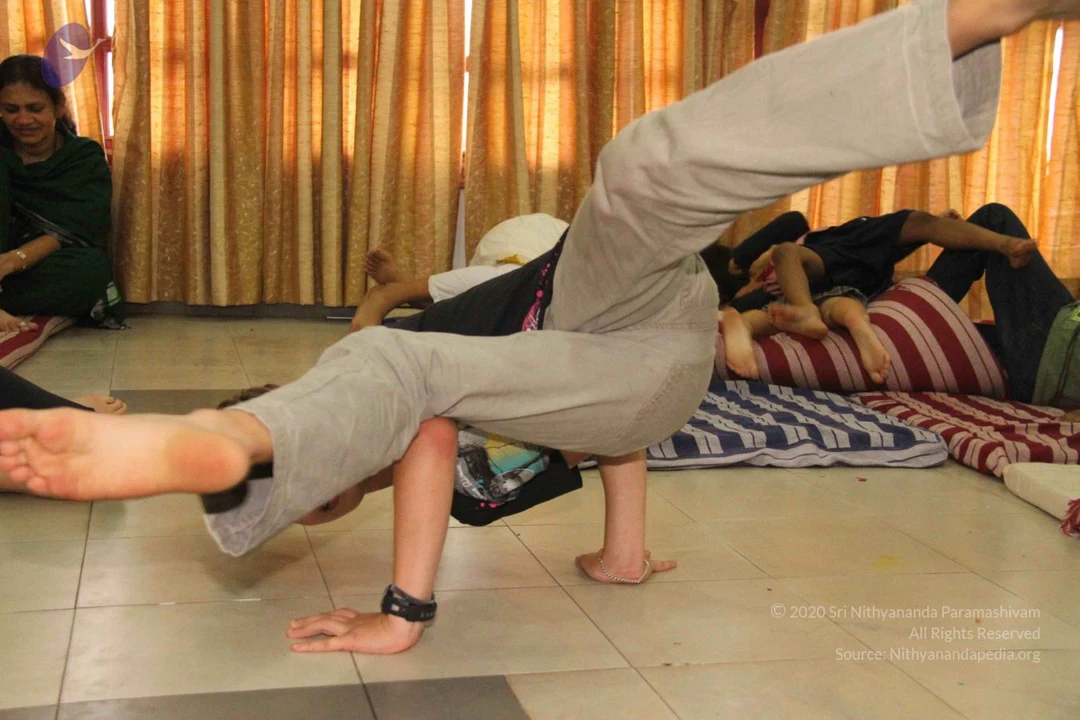
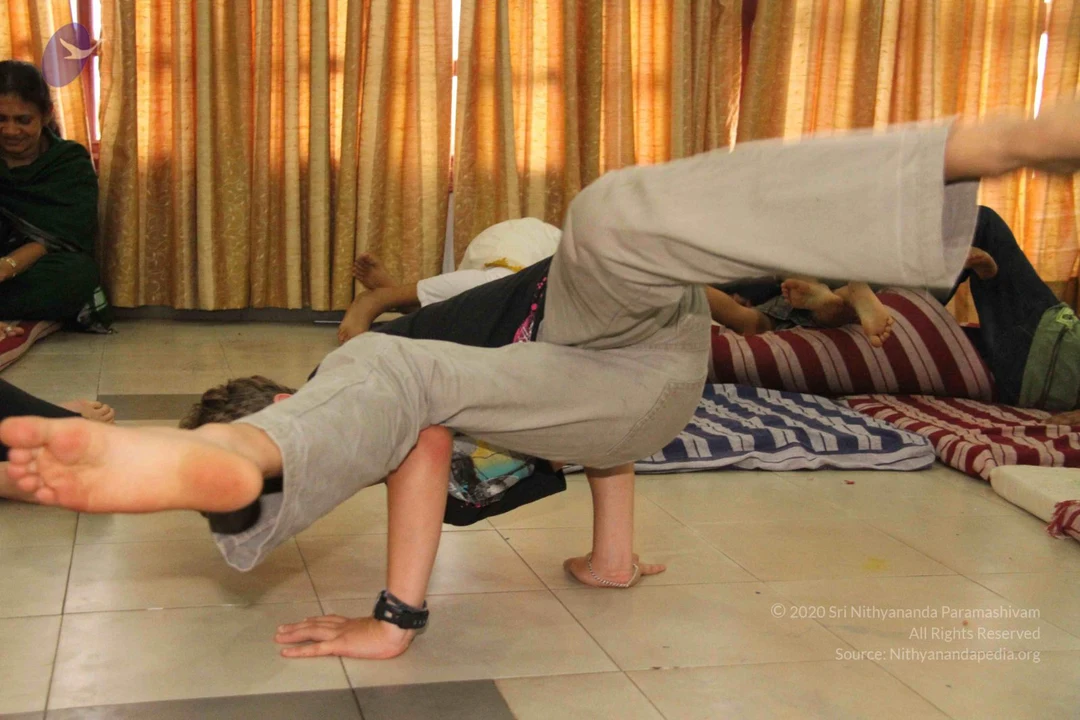
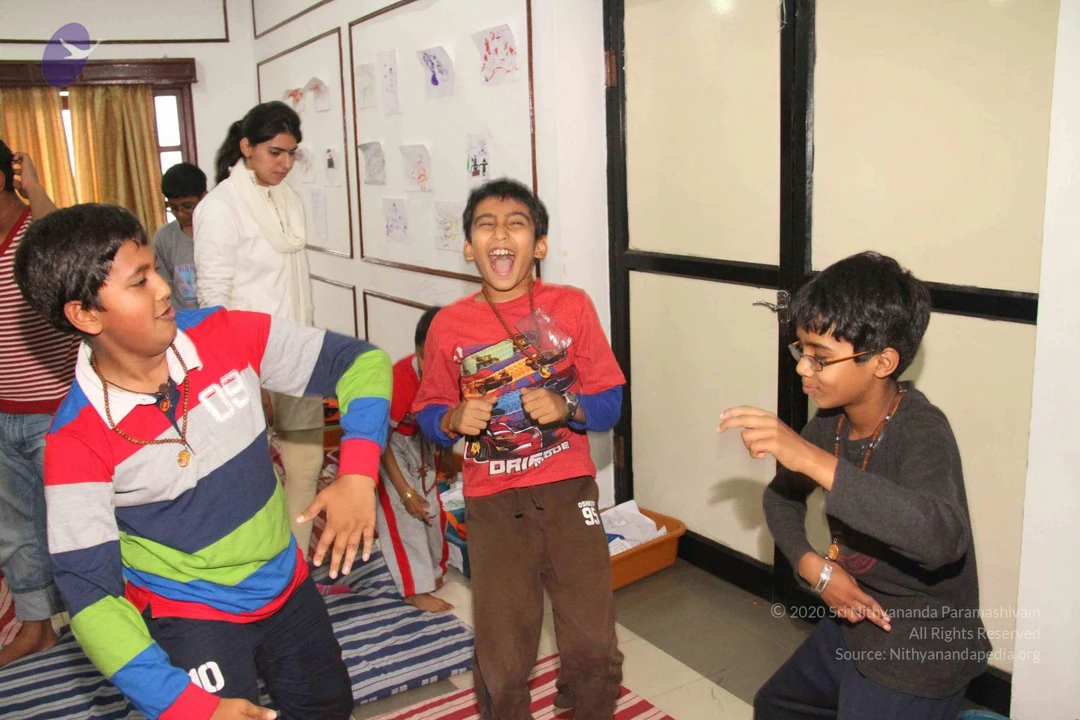
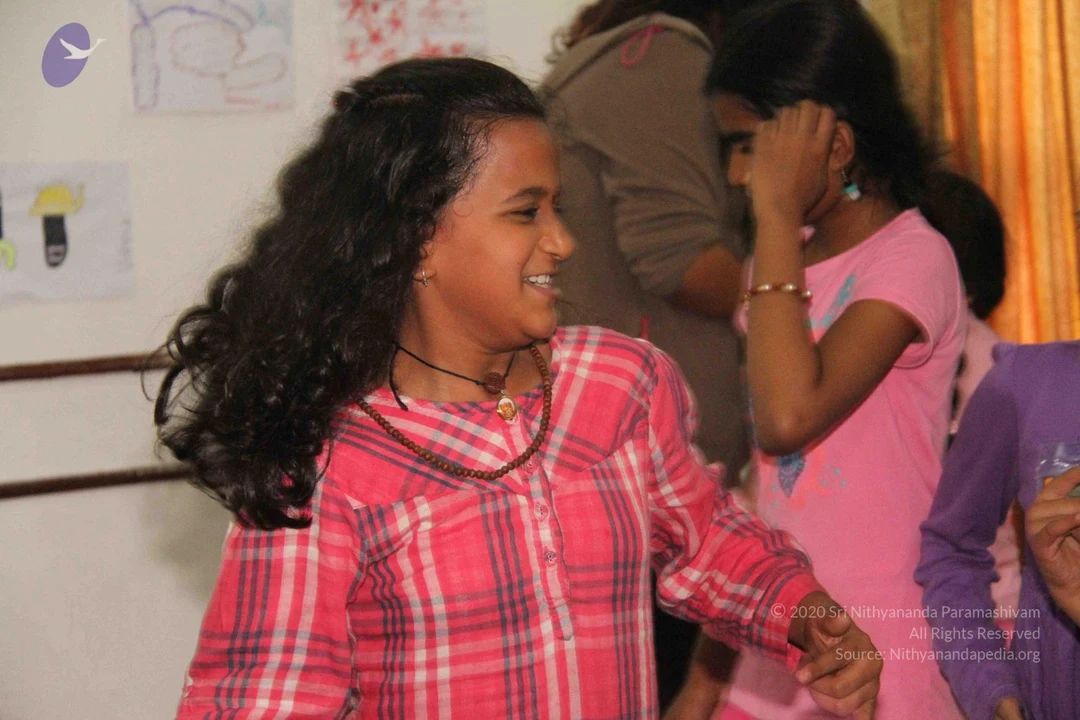
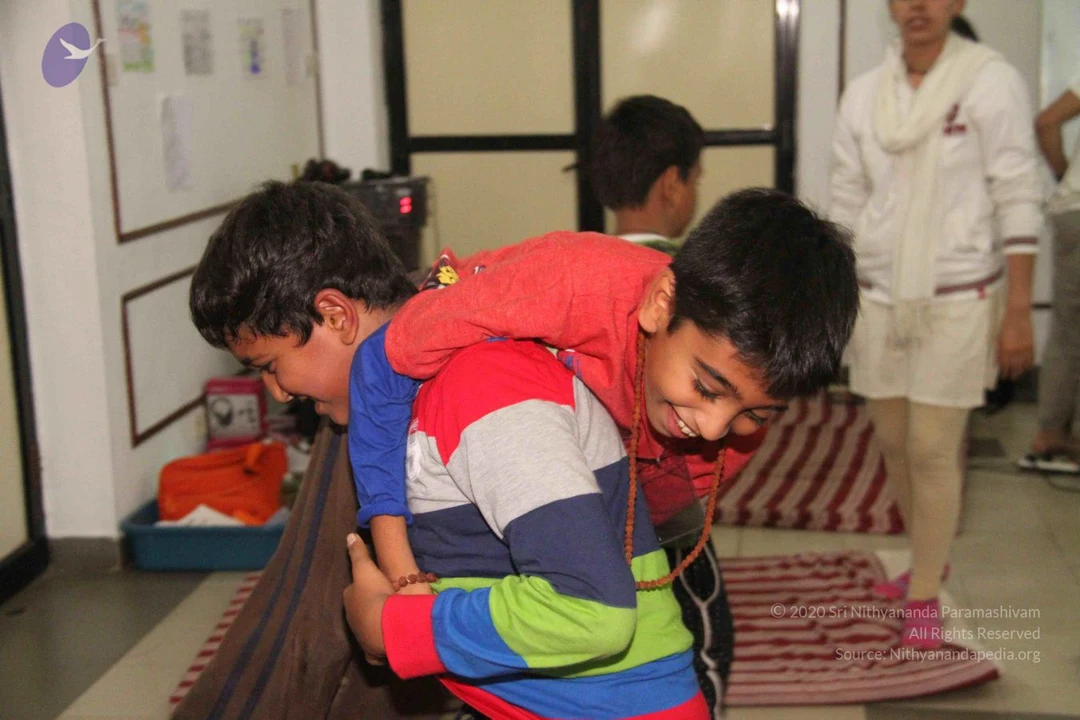
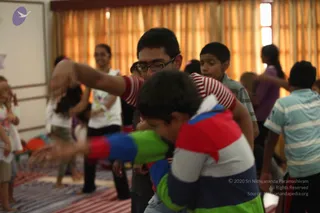
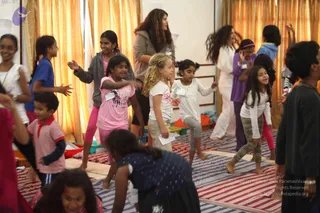
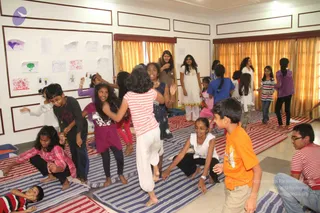
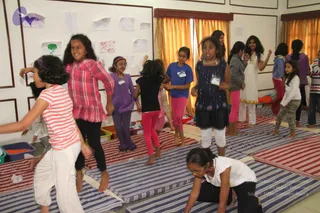
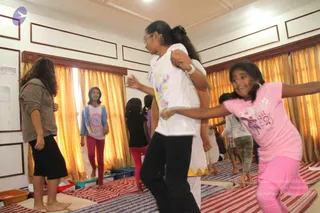
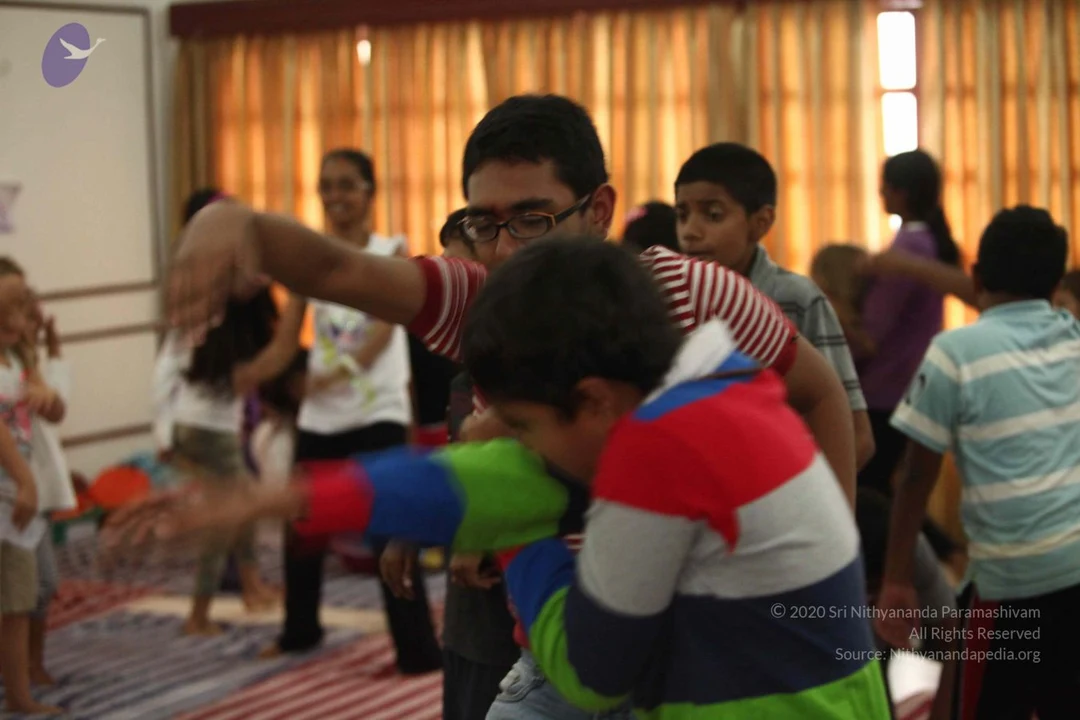
A photograph of children at an indoor activity session in a hall with orange-gold curtains and a light-coloured wall. In the foreground a young man in glasses and a red-and-white striped shirt, with a small red mark on his forehead, reaches out and embraces a small boy in a red, blue, green and white striped top. Behind them several children in t-shirts and casual clothes stand and move on a patterned mat, including a girl in a white top and a boy in a light-blue striped shirt. A woman in a white top smiles in the background.A lively group of children dances and moves barefoot on striped rugs in a bright room with orange curtains. Several girls and boys in pink, blue, white and grey clothes smile and stretch their arms, some wearing name badges. Adult women in white and purple clothes stand behind them, observing or joining in. No a person candidate is clearly visible, and the scene shows a children's activity with a person-style lotus logo in the upper left.A candid indoor photograph in a plain room with cream walls, a wooden bed with a red striped blanket, and gold curtains. A curly blonde girl in a white t-shirt with a pink graphic and khaki shorts, with a small red dot on her forehead, leans forward and smiles. In the foreground a smiling young girl with dark hair and a grey top is blurred in motion. Other children and a young woman in a brown cardigan stand or sit in the background, and a child lies on the bed at lower left. No a person candidate is visible, and no ritual, discourse or deity is shown. Two small paper pictures are pinned to the upper wall.A photograph of children and teens active in a bright white-walled room with gold curtains. Many are barefoot on striped blue, red and white mats; several dance or sway, some sit or lean on the floor. A girl in a white-and-red striped top and white harem trousers stands centre, and a boy in an orange t-shirt crouches at right. A whiteboard behind them displays children's paintings and drawings.A group of girls and young women stand and move on striped mats across a bright room with white walls and yellow curtains. Several wear casual clothes: a red-and-white striped top, a pink plaid shirt, a purple top, a navy sparkly top and a white kurta. Some girls hold name badges. Children's drawings are pinned to the wall behind them, and blue and orange buckets sit at the edge of the floor.Indoor photo of a group of girls in a bright room with cream walls, wooden trim and orange-gold curtains. In the foreground a girl with a ponytail and glasses in a white t-shirt and black pants is moving with arms out, while a girl in a pink t-shirt and pink pants on the right spreads her arms and smiles. Others, including a girl in a grey top and black shorts on the left and girls in blue and white, stand or walk on striped red and cream mats near plastic bins.