Skip to content
Tuesday

29 May 2012

Courageous Trust Can Conquer All Obstacles.

Dated photos
316
Source pages
1
Media
4
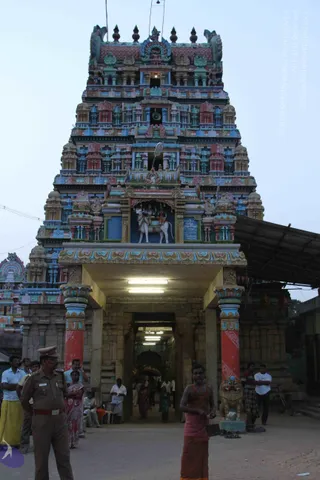
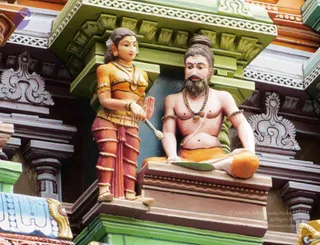
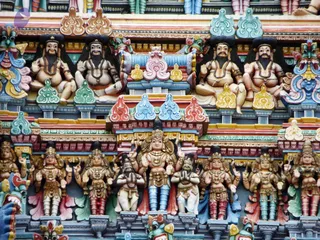
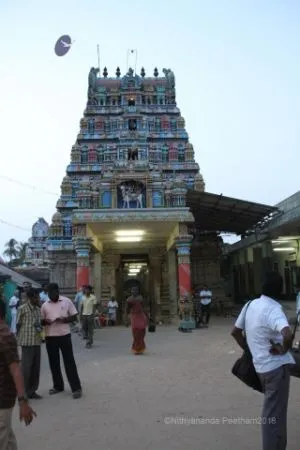
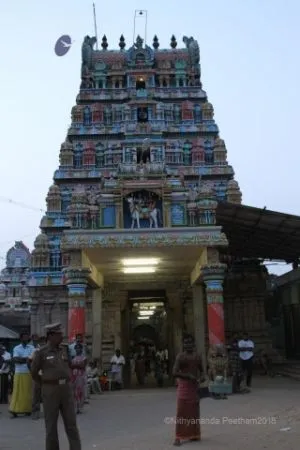
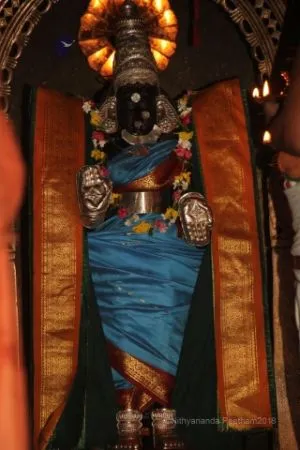
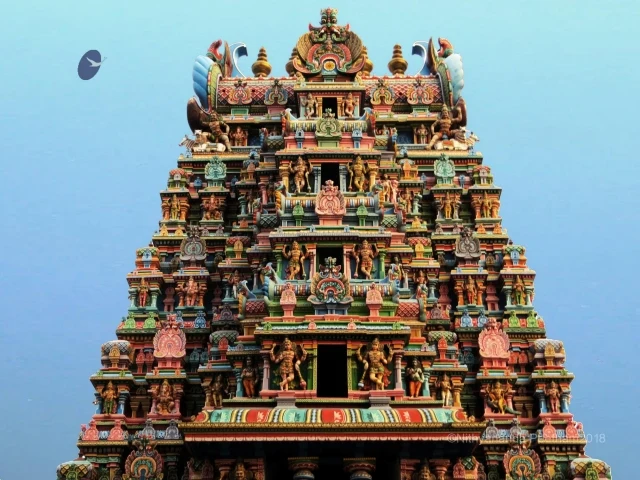
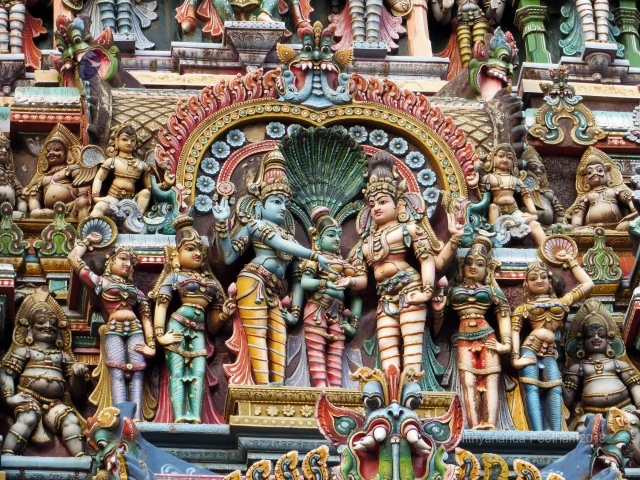
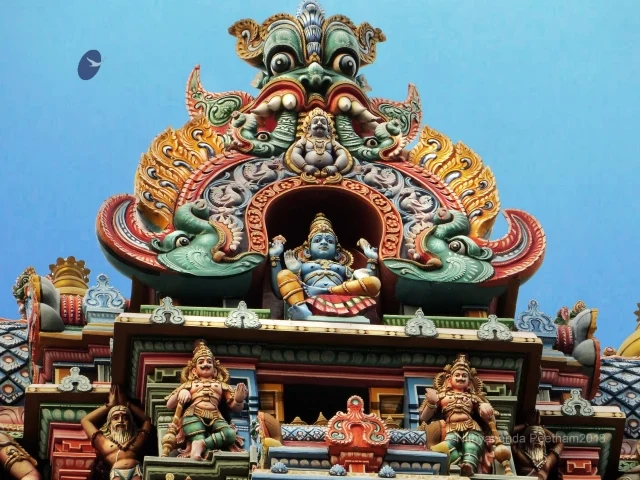
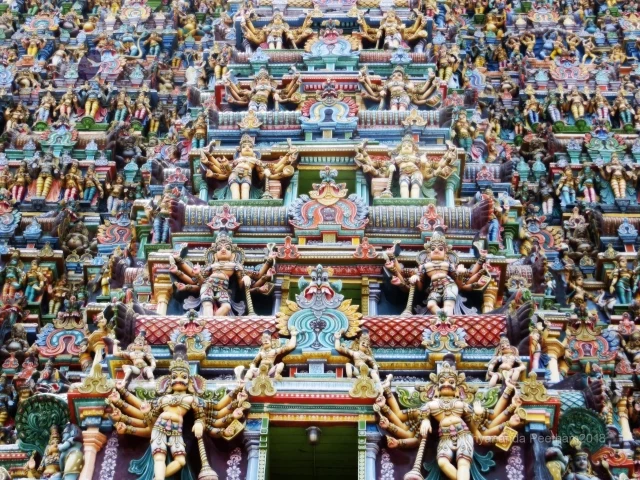
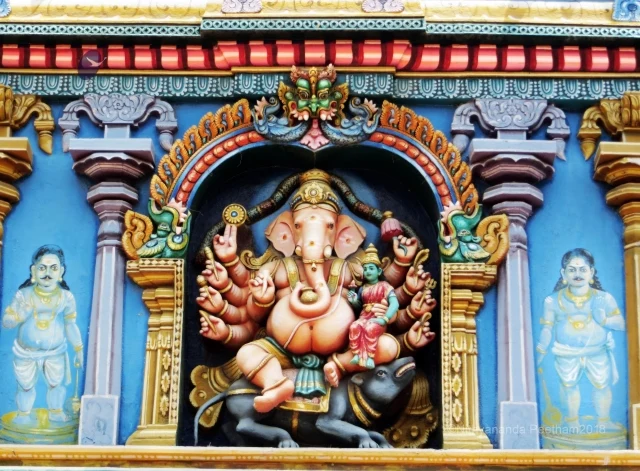
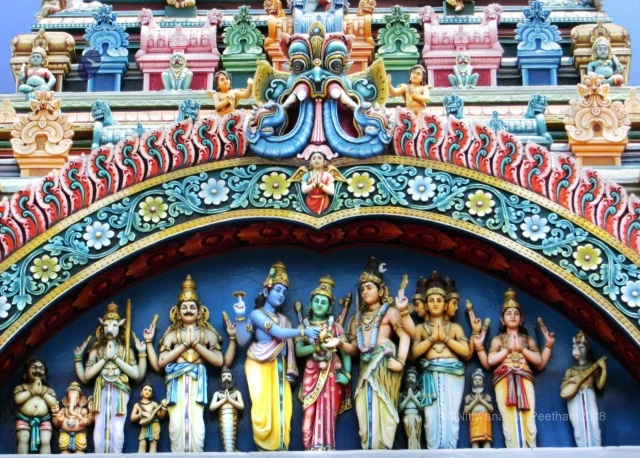
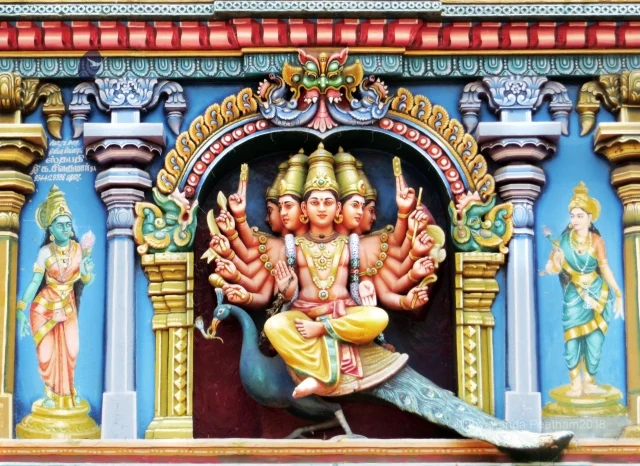
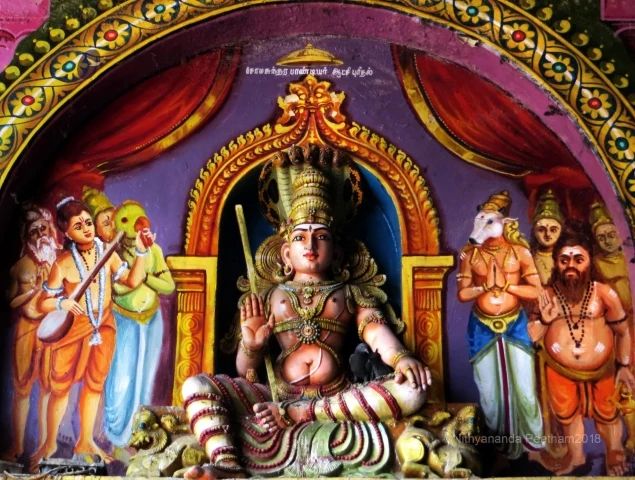
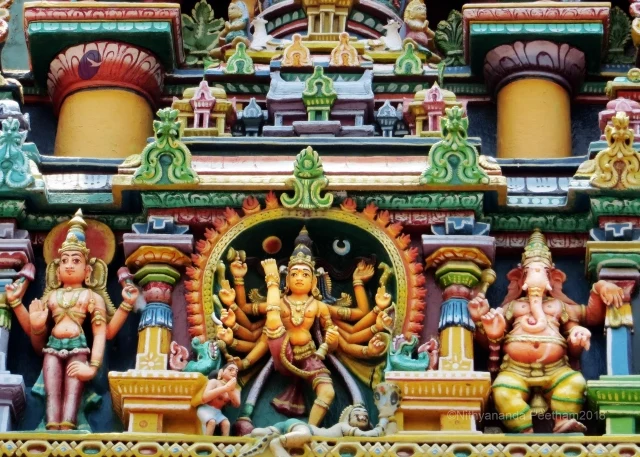
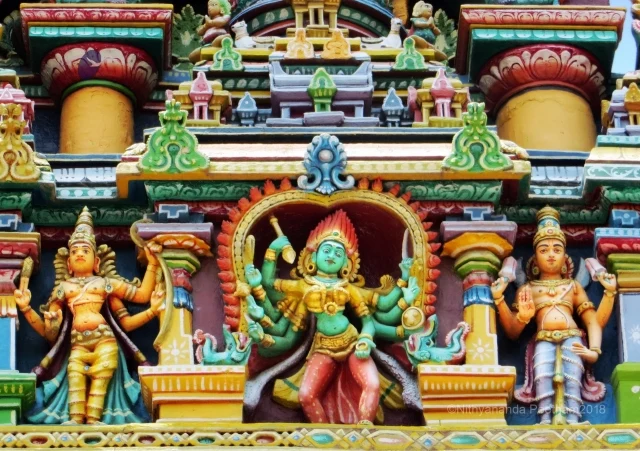
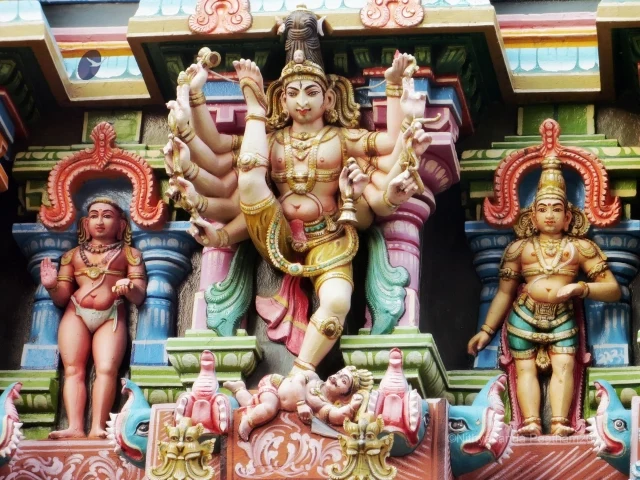
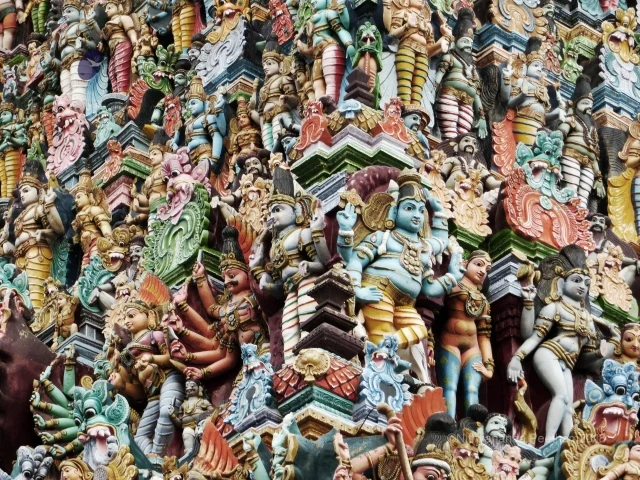
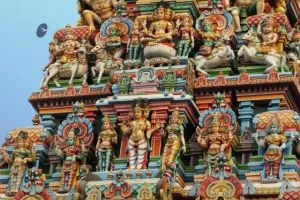
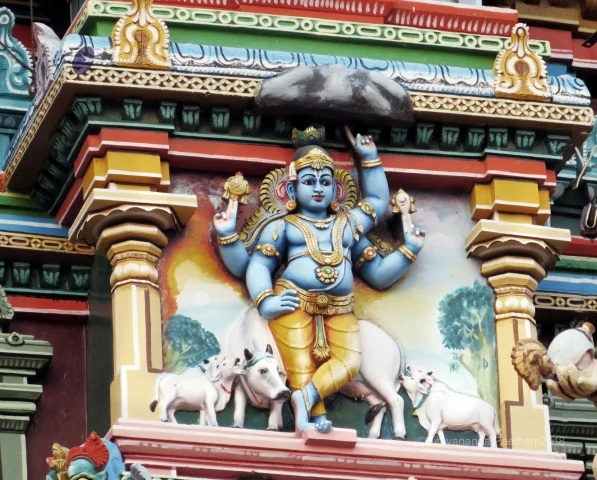
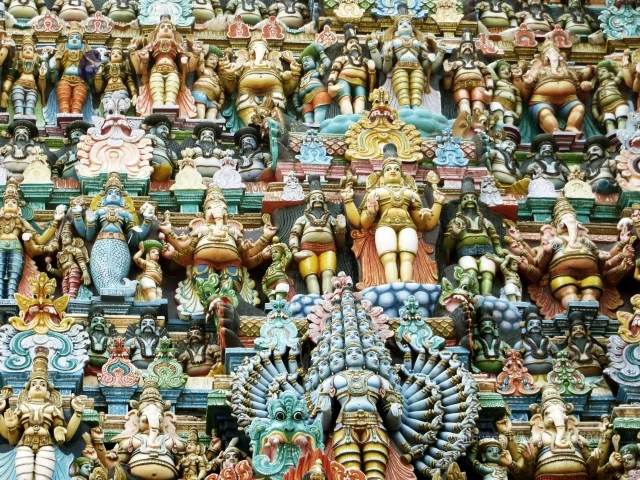
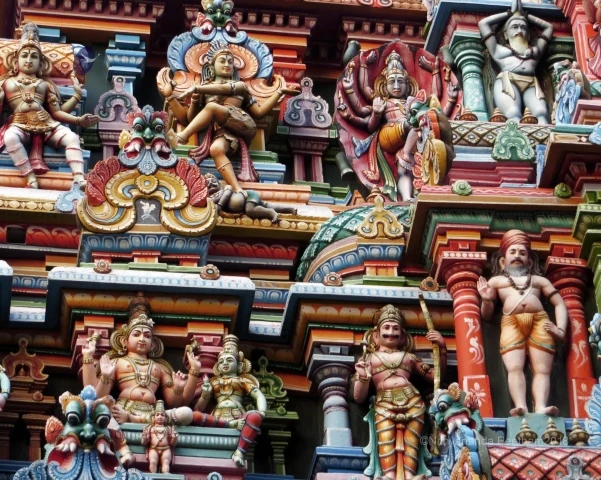
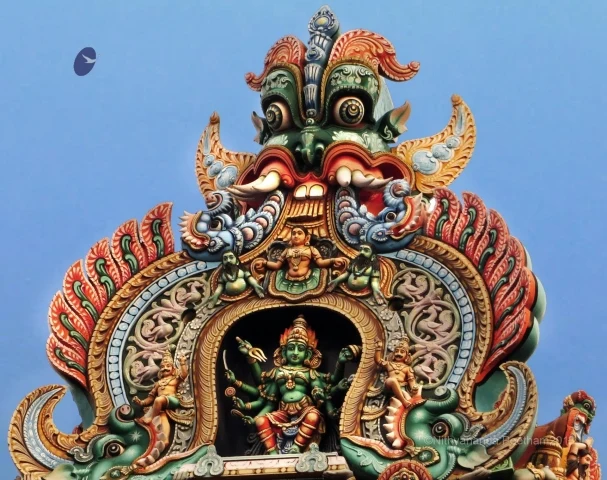
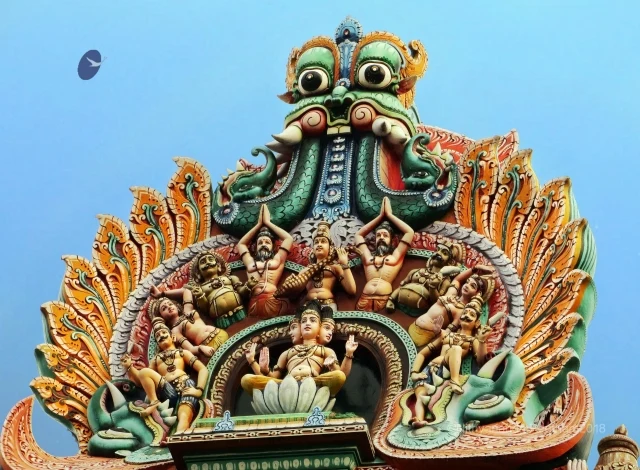
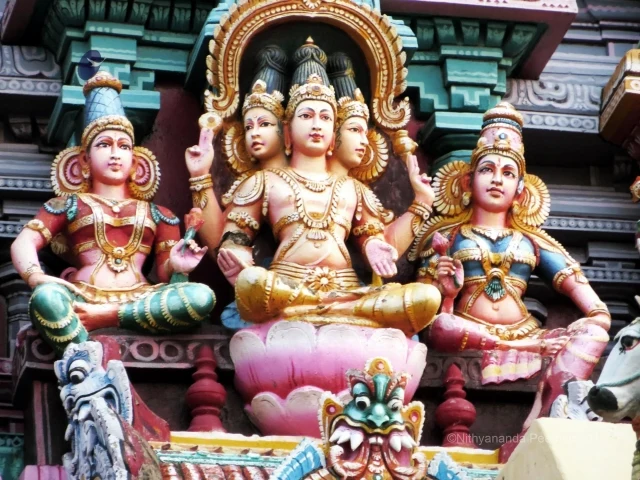
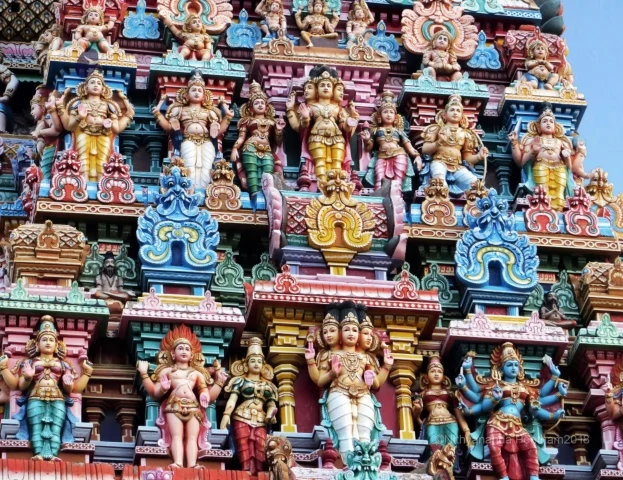
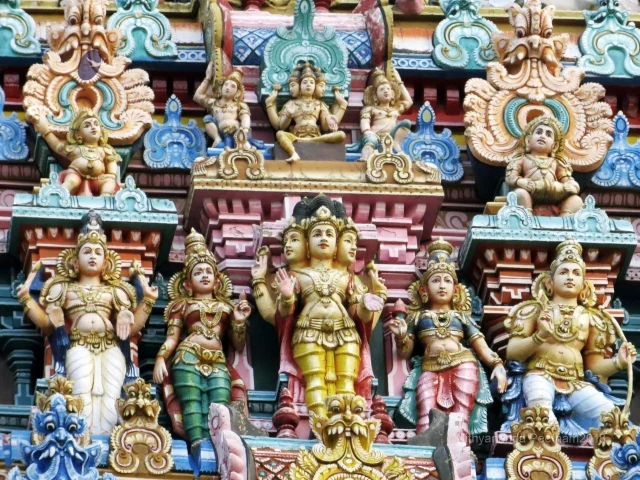
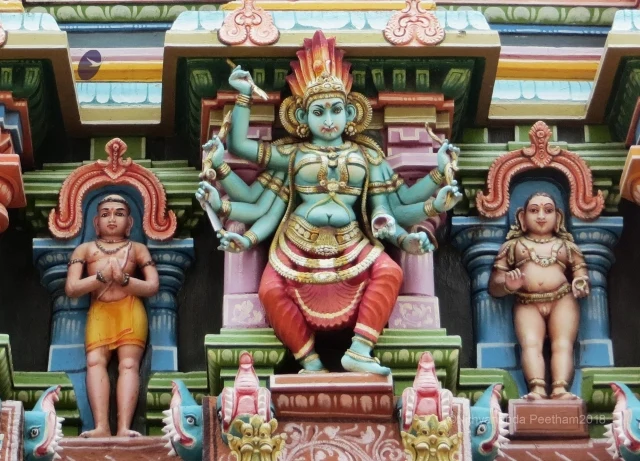
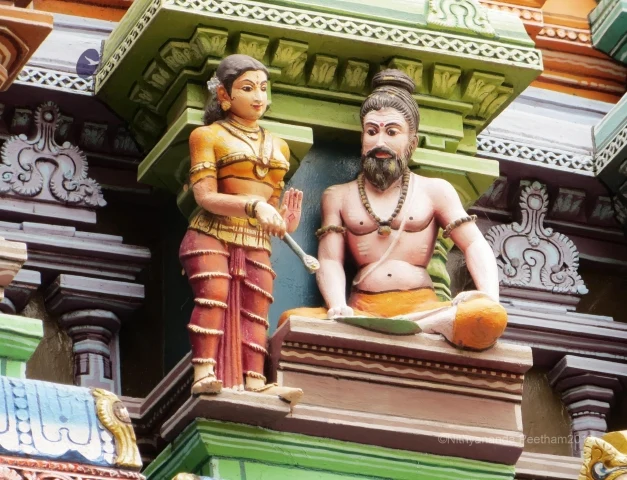
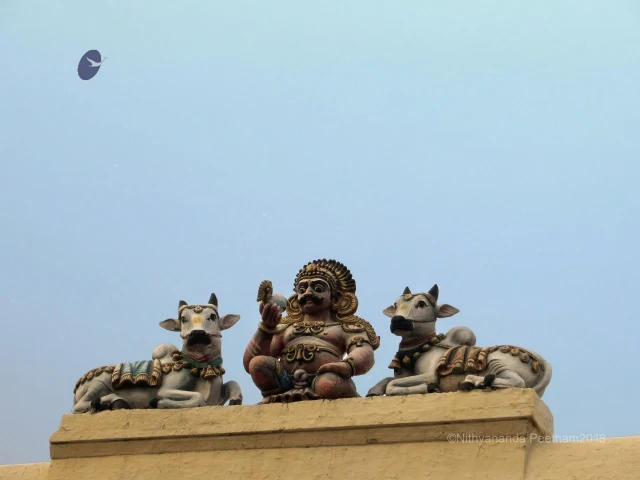
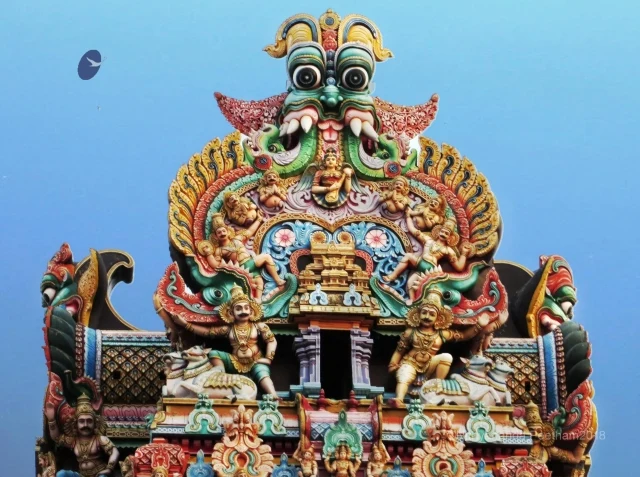
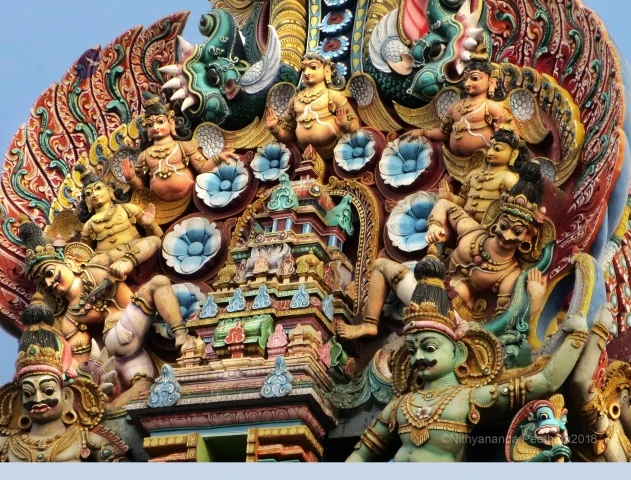
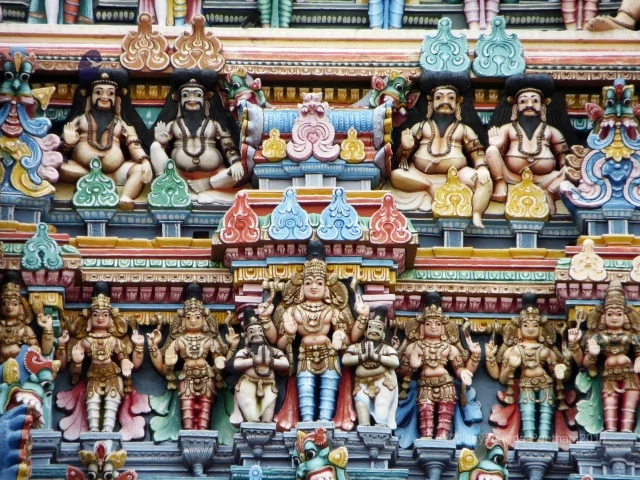
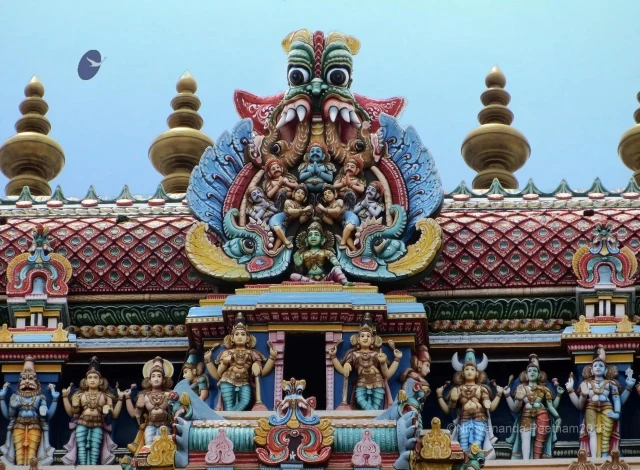
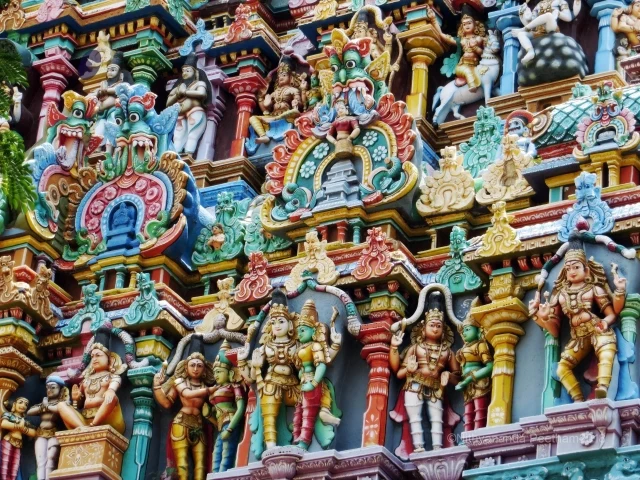
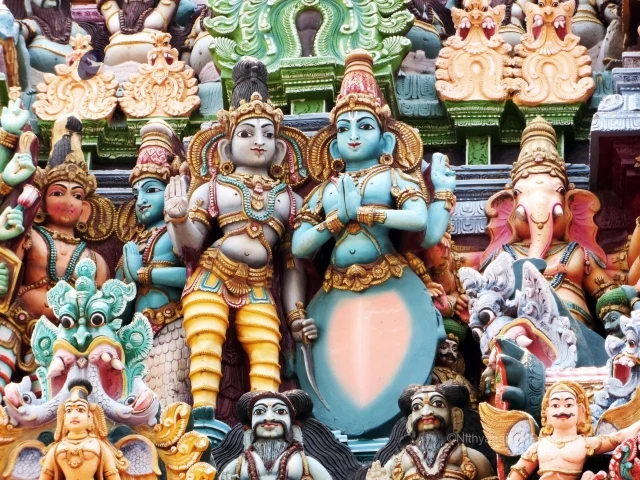
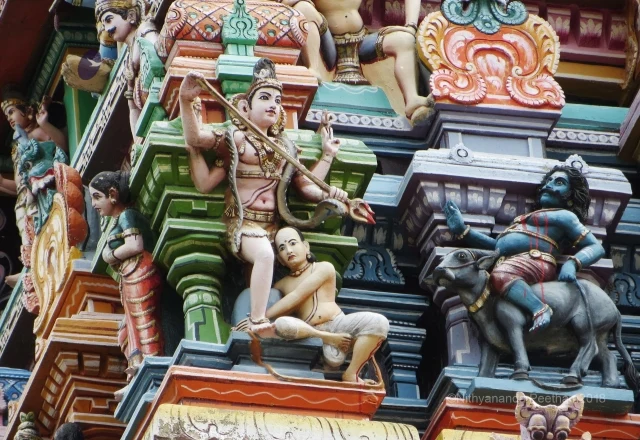
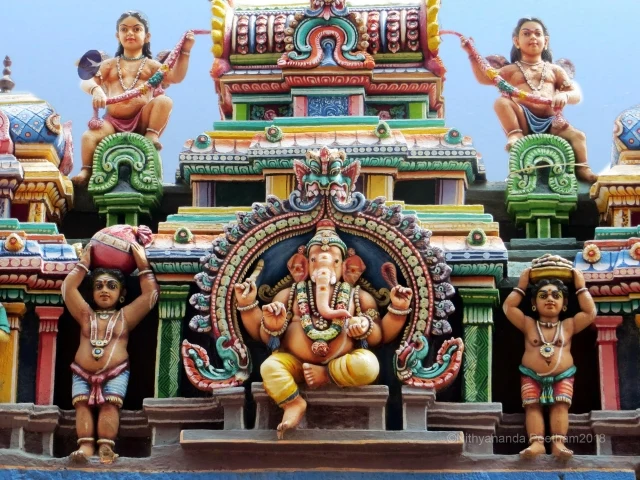
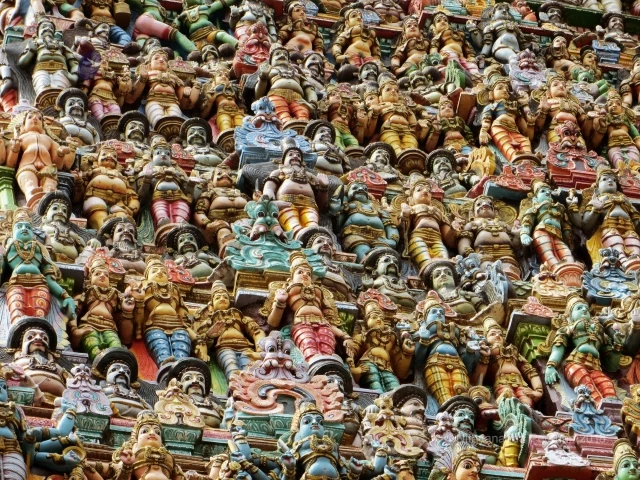
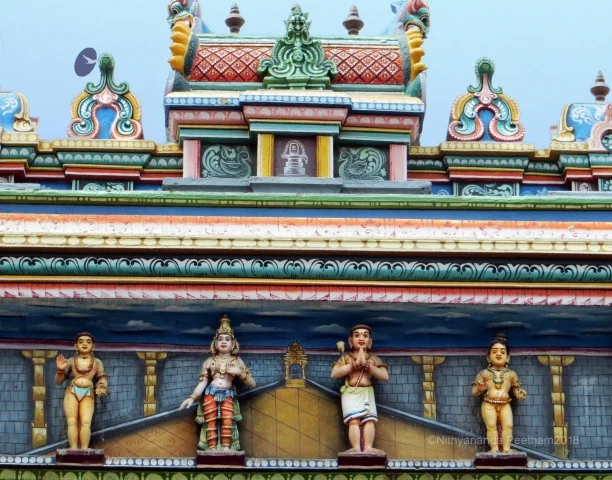
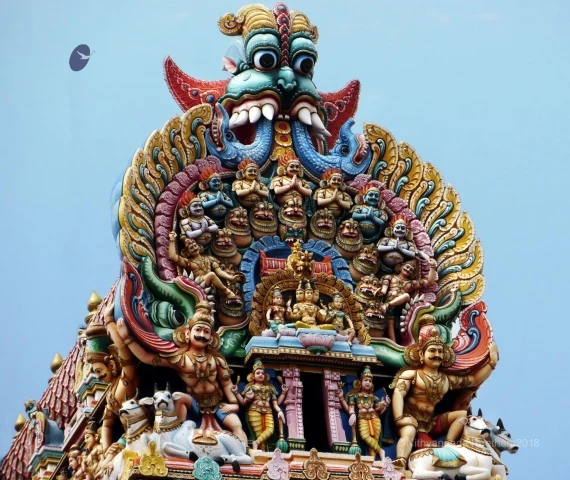
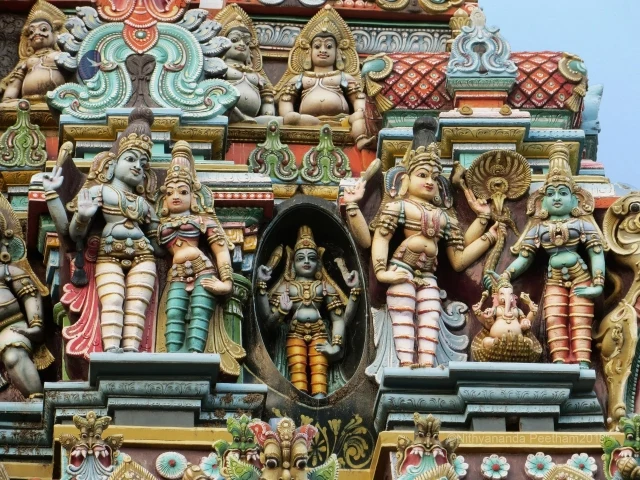
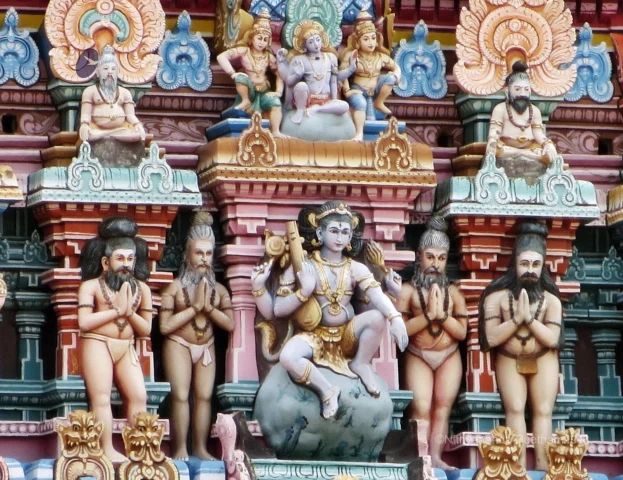
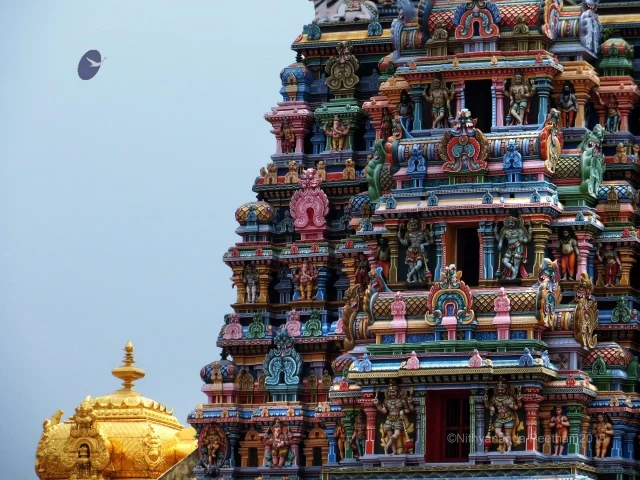
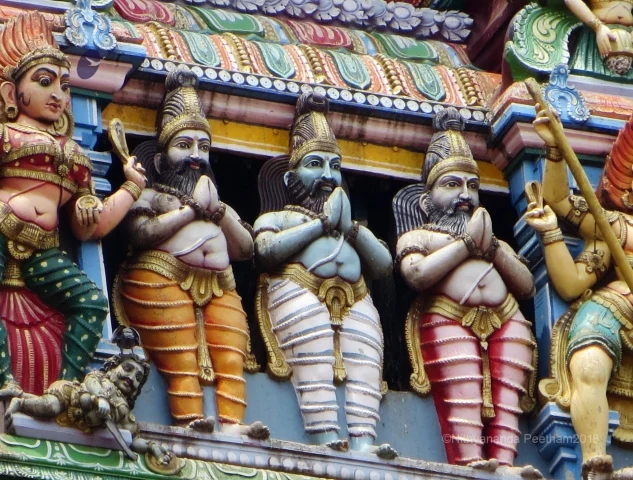
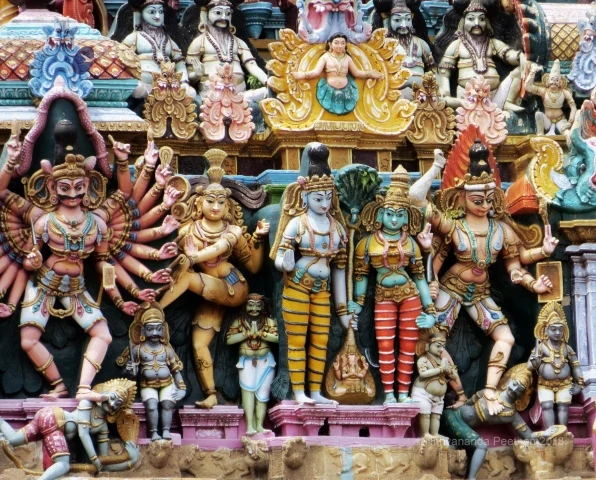
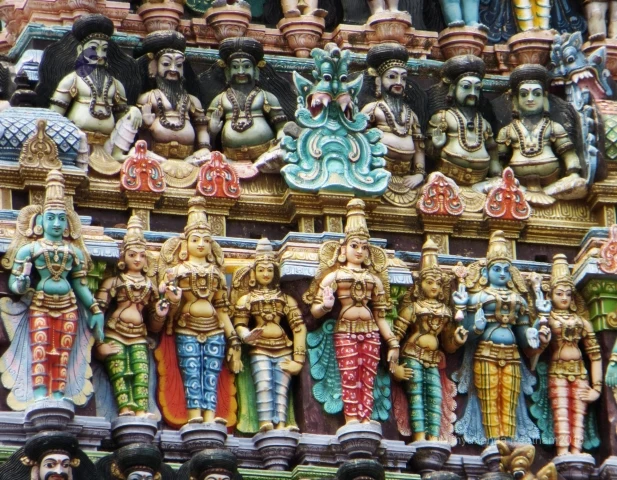
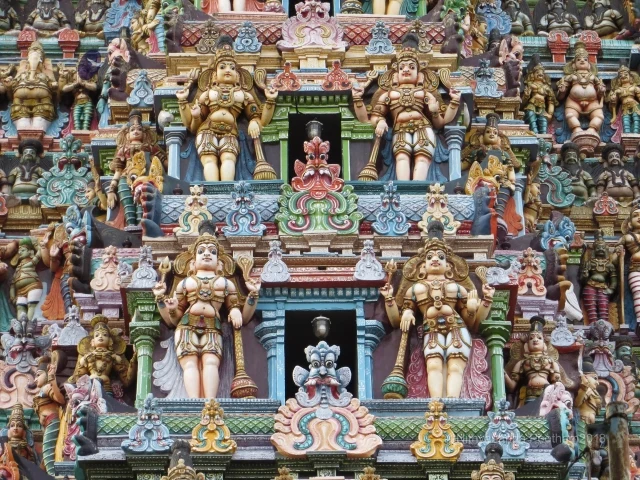
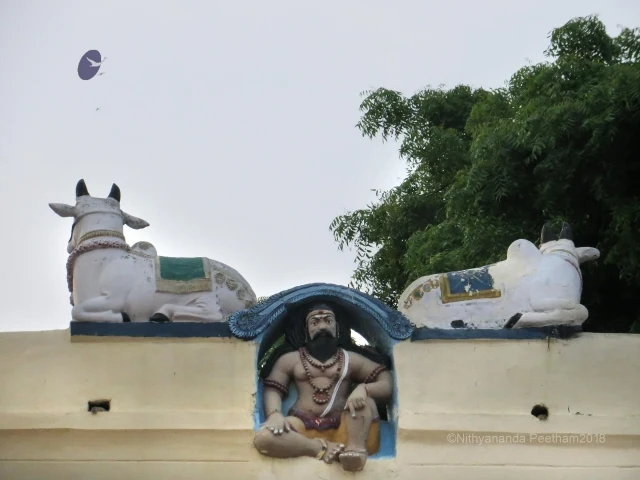
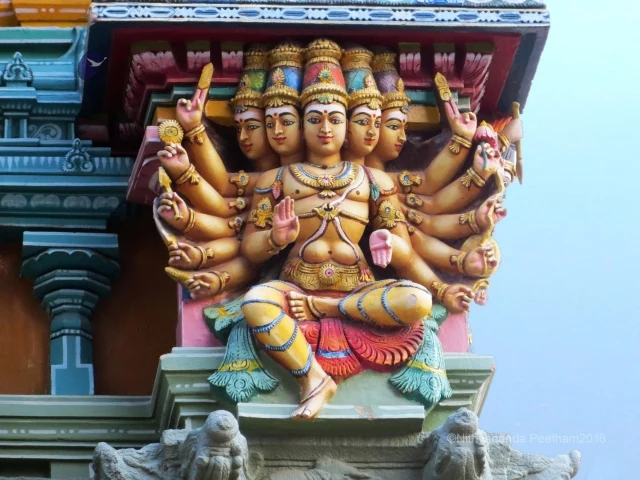
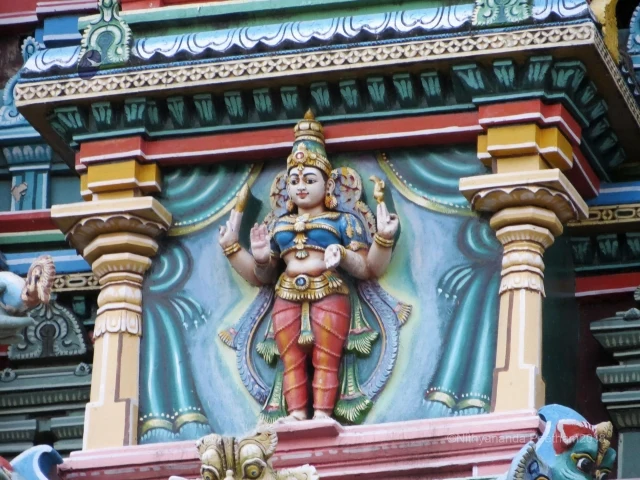
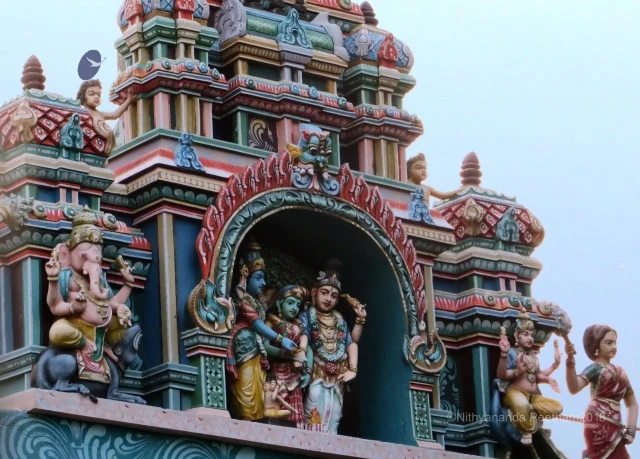
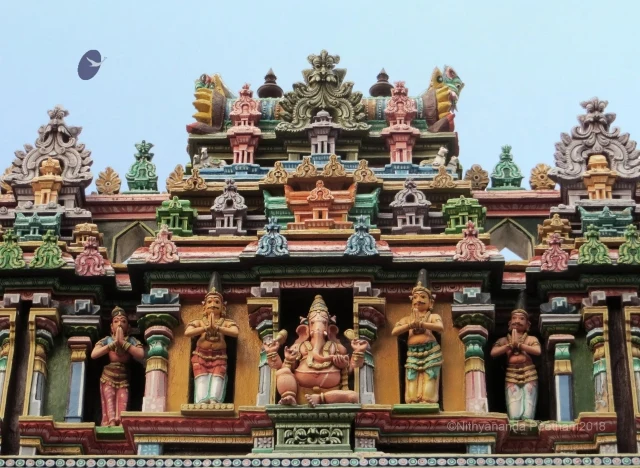
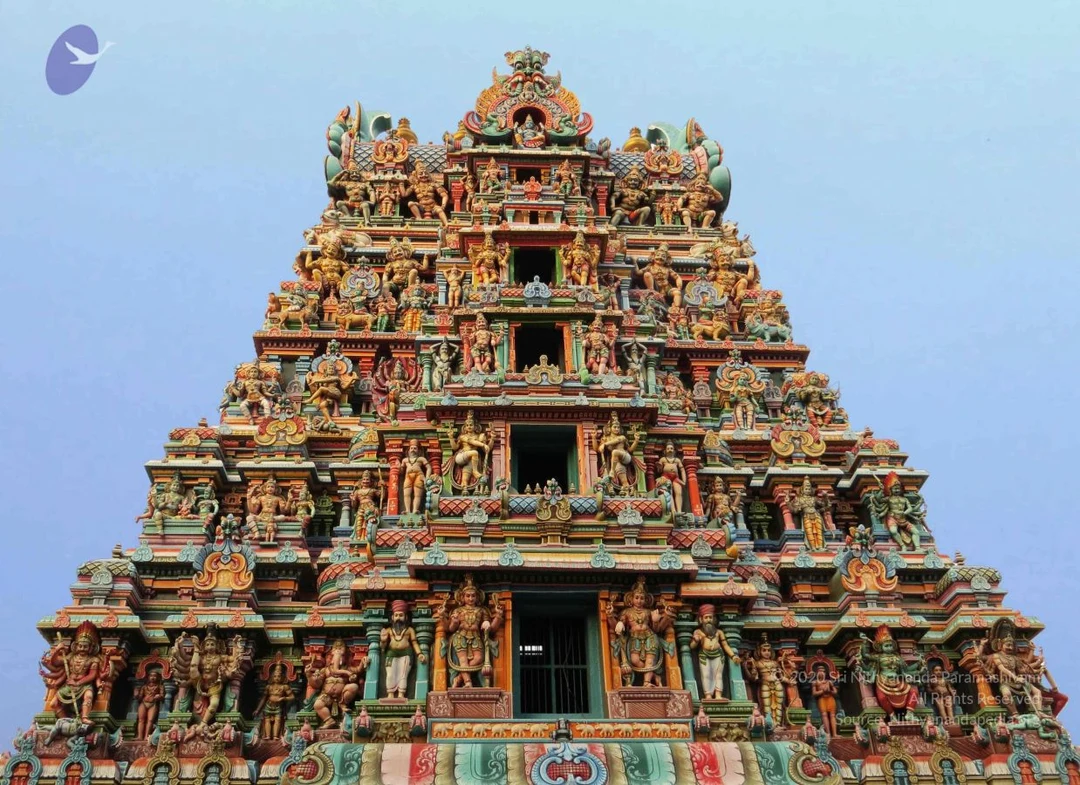
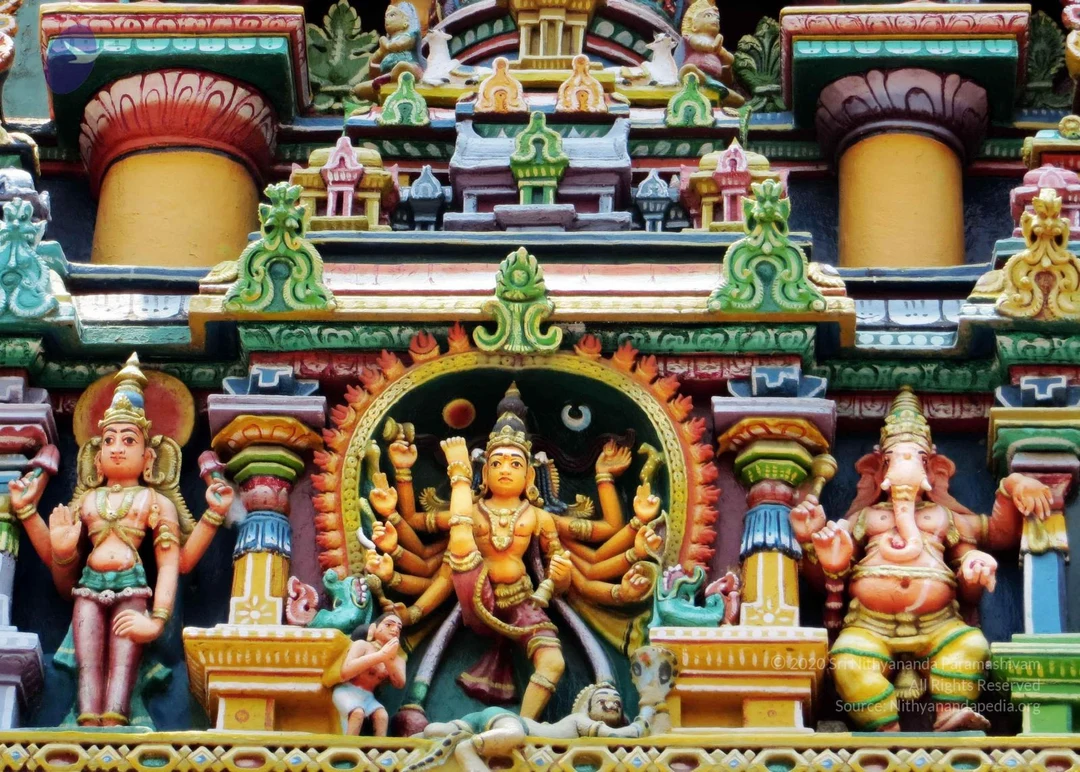
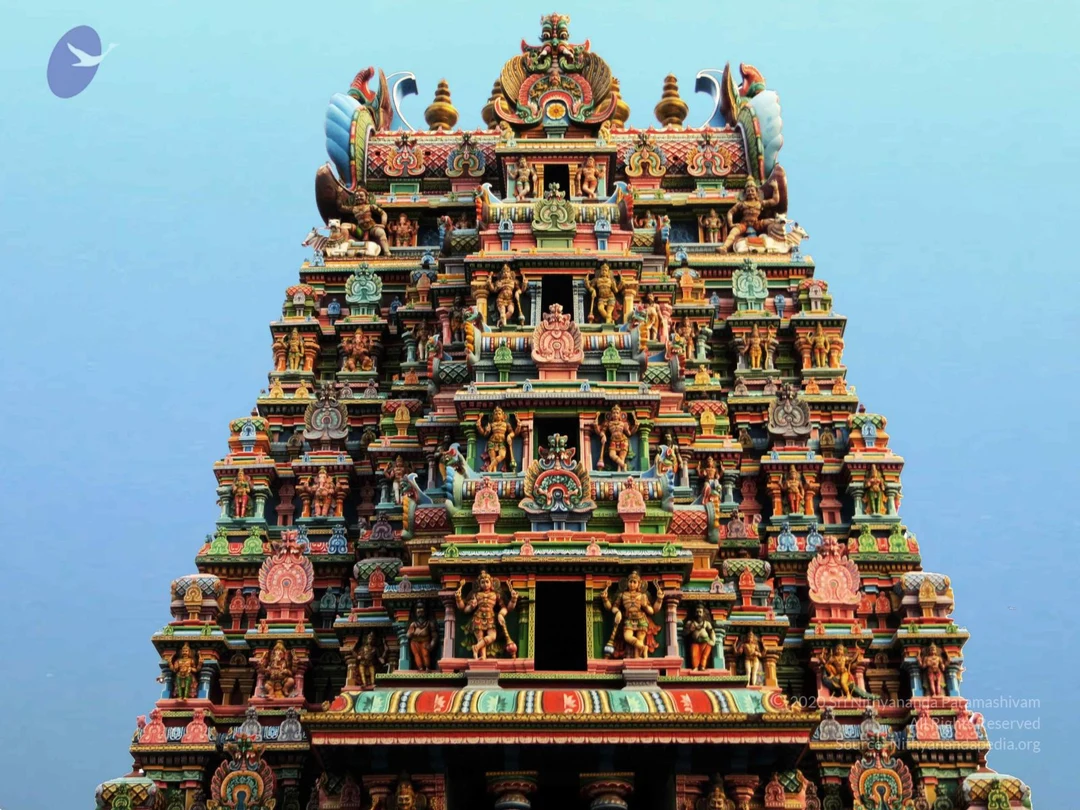
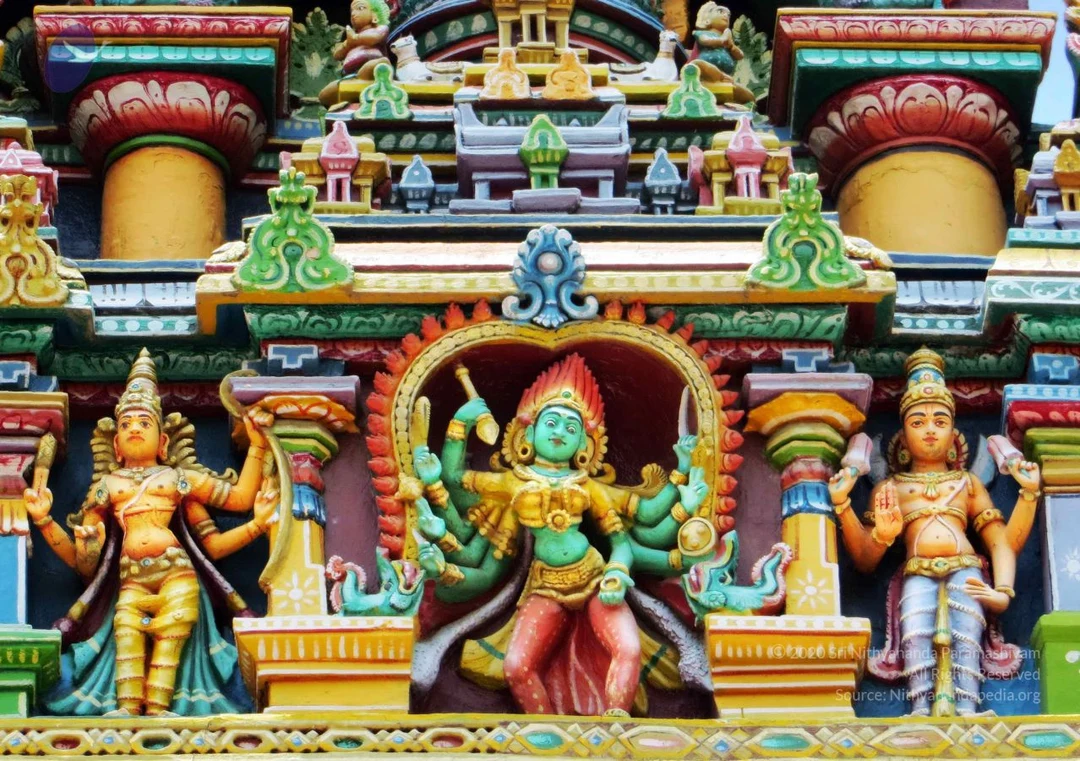
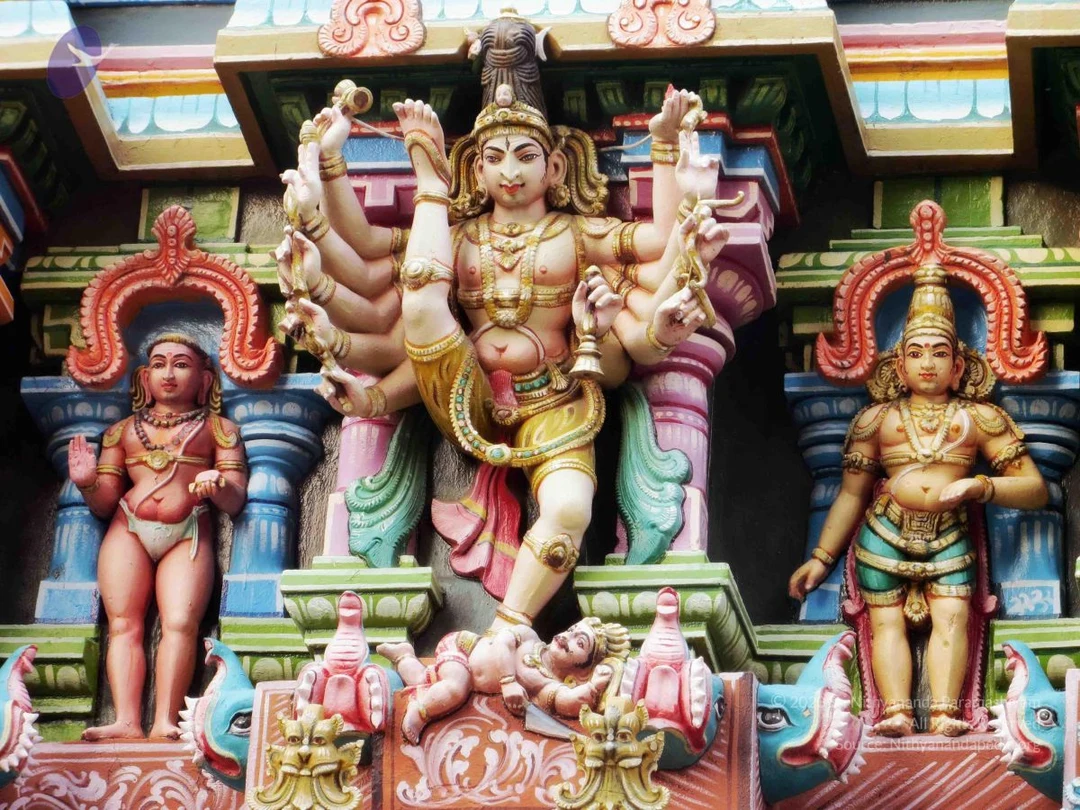
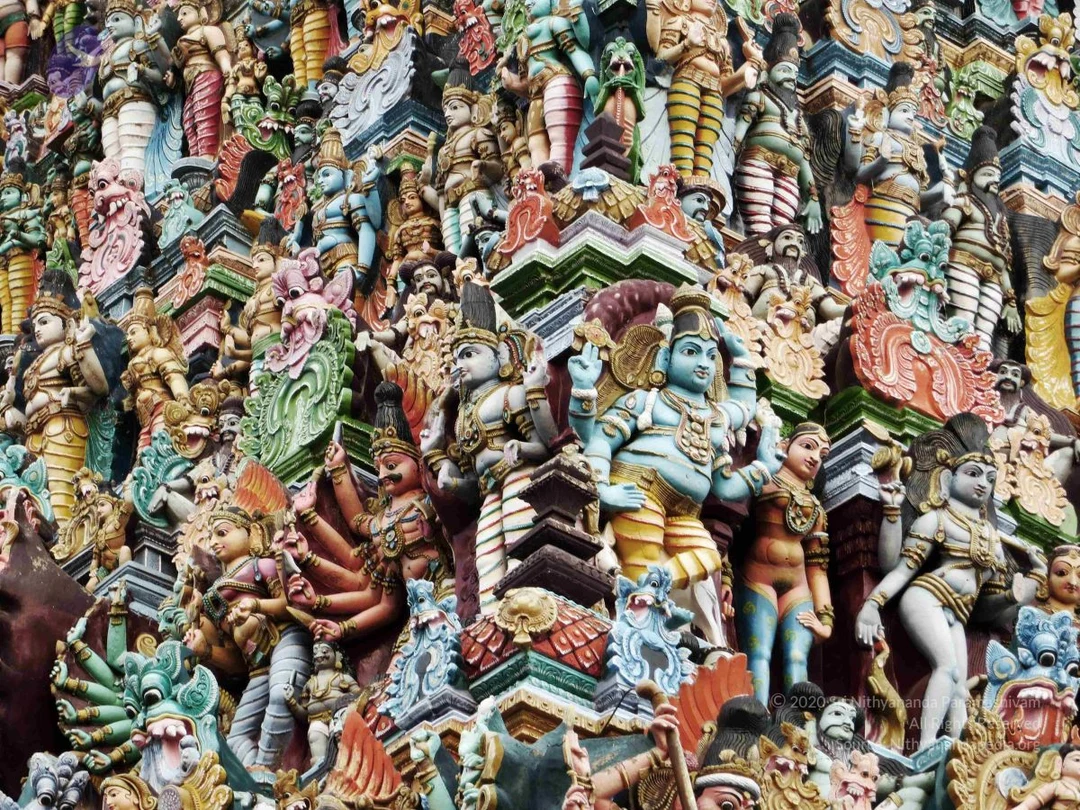
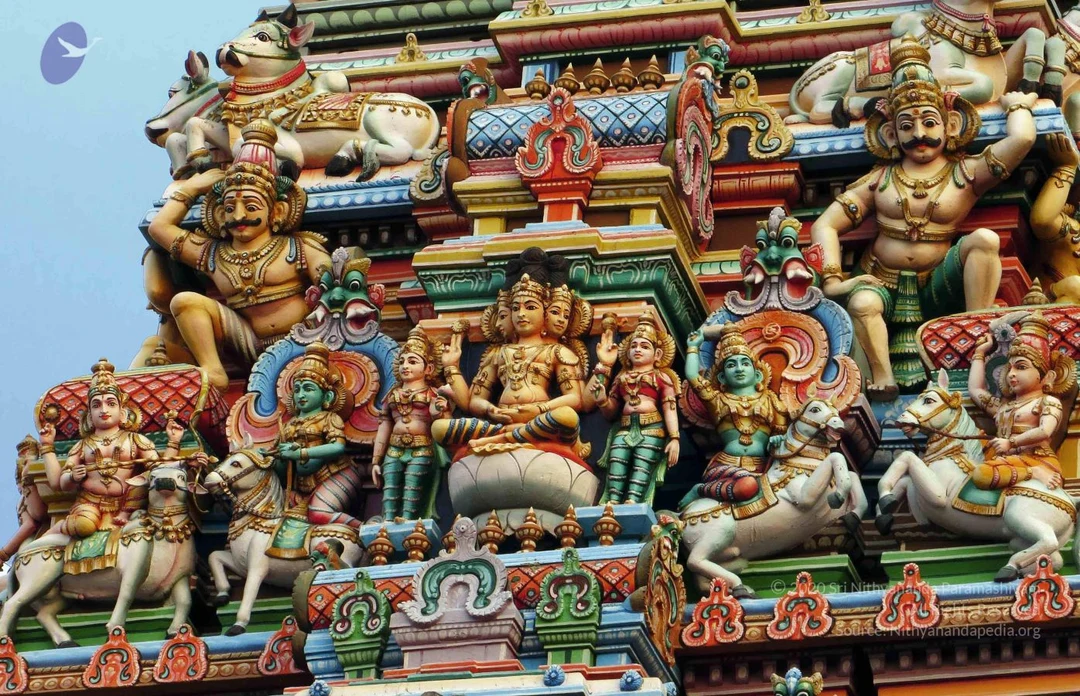
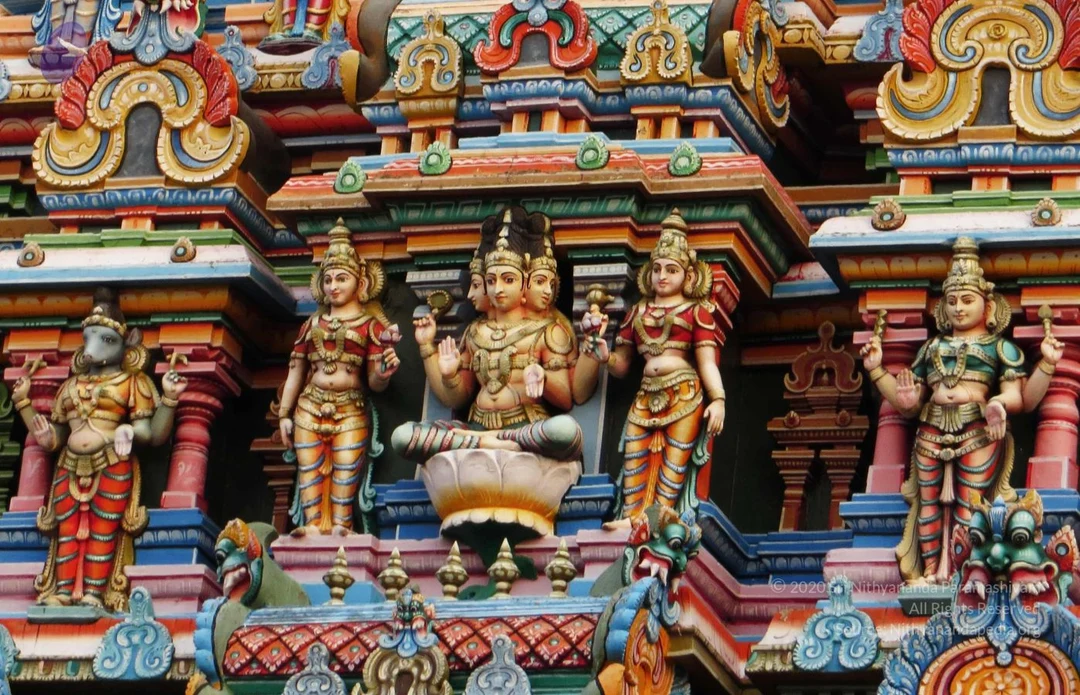
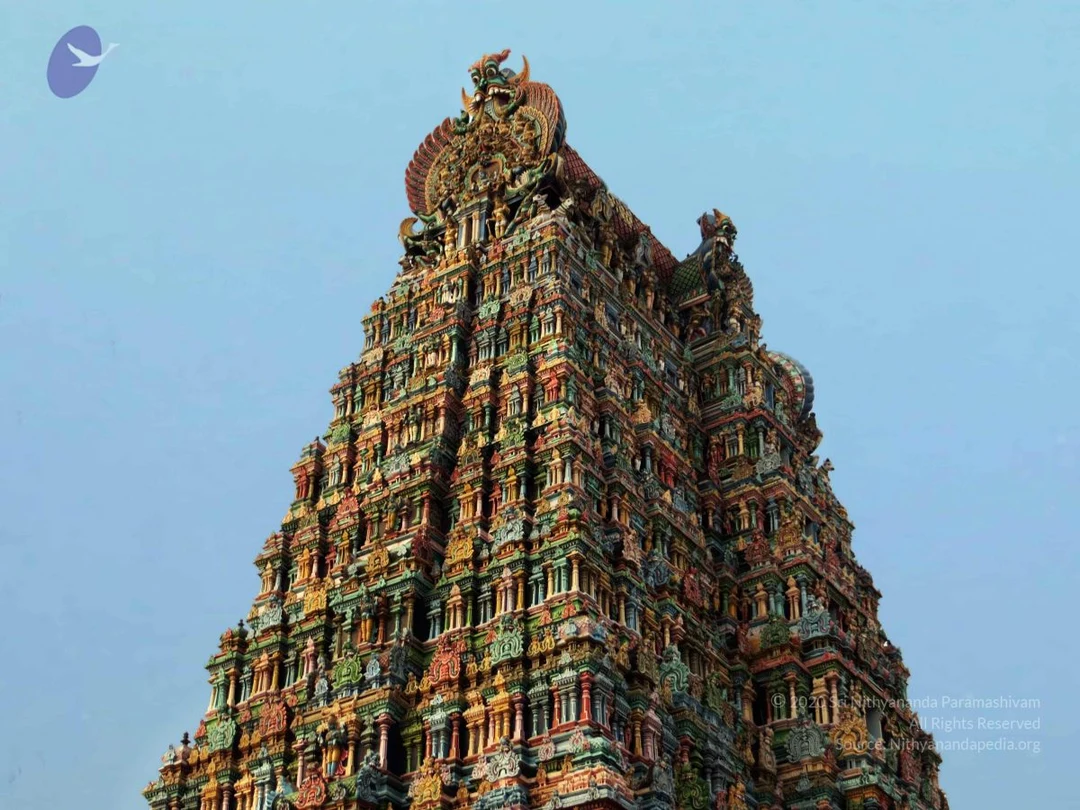
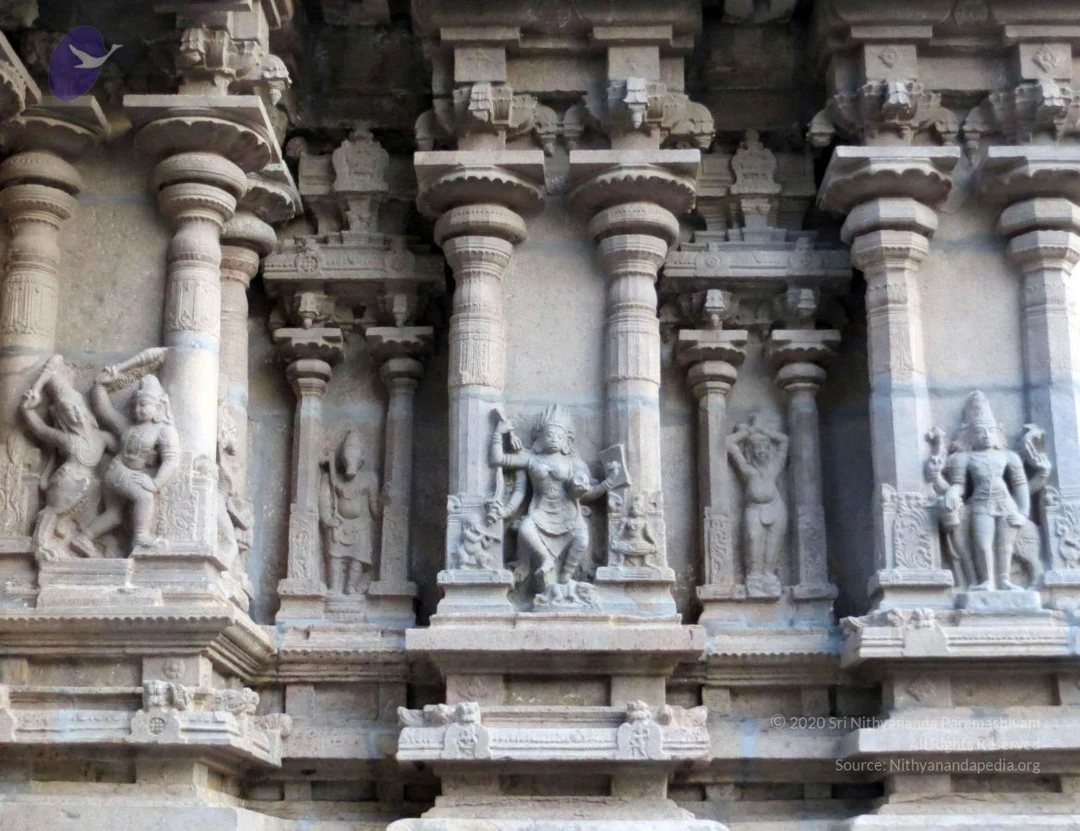
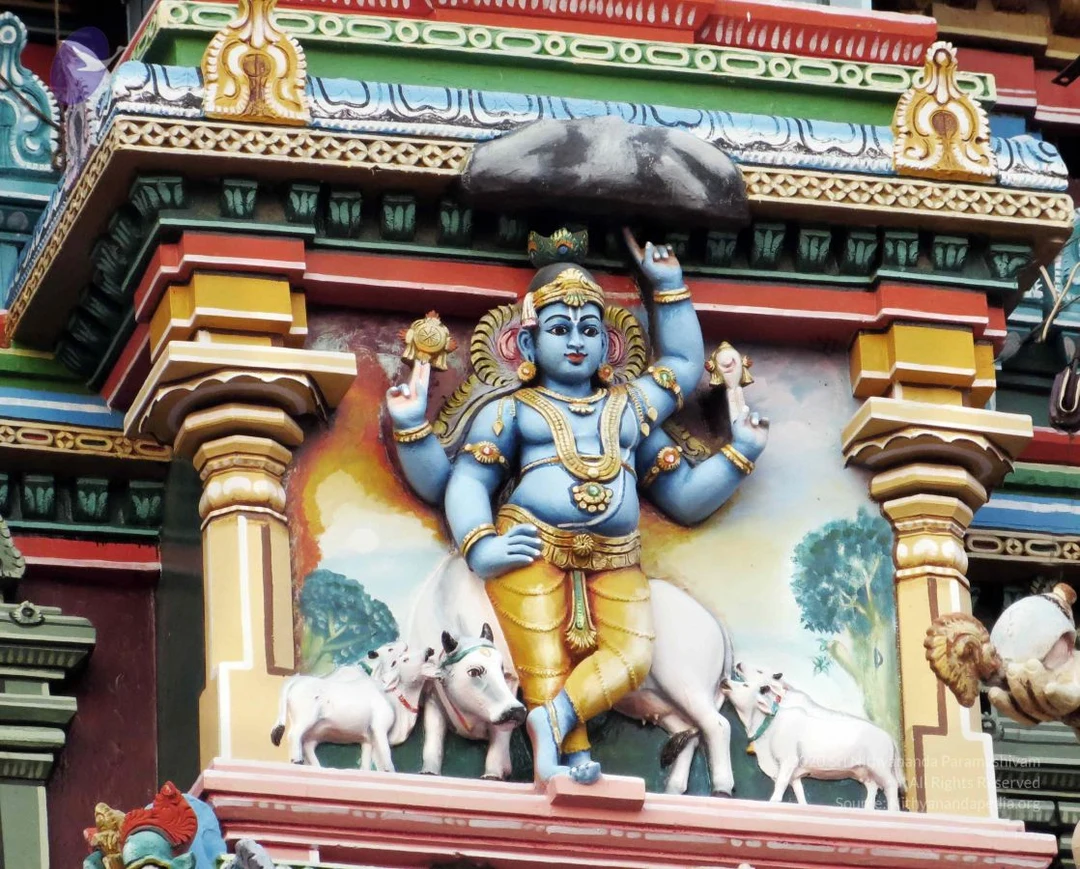
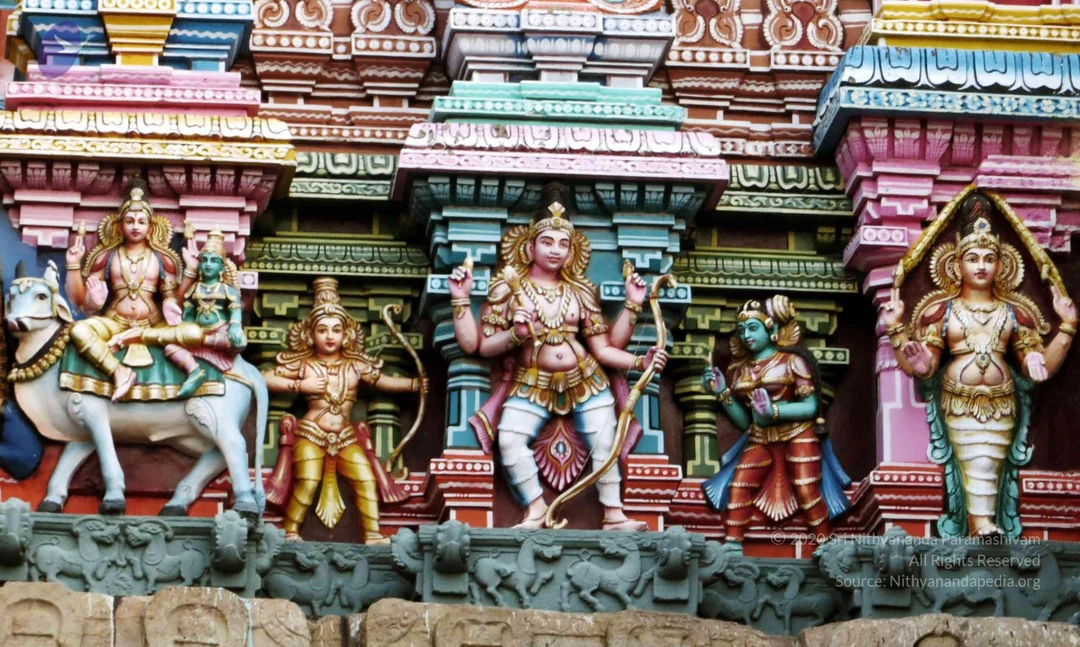
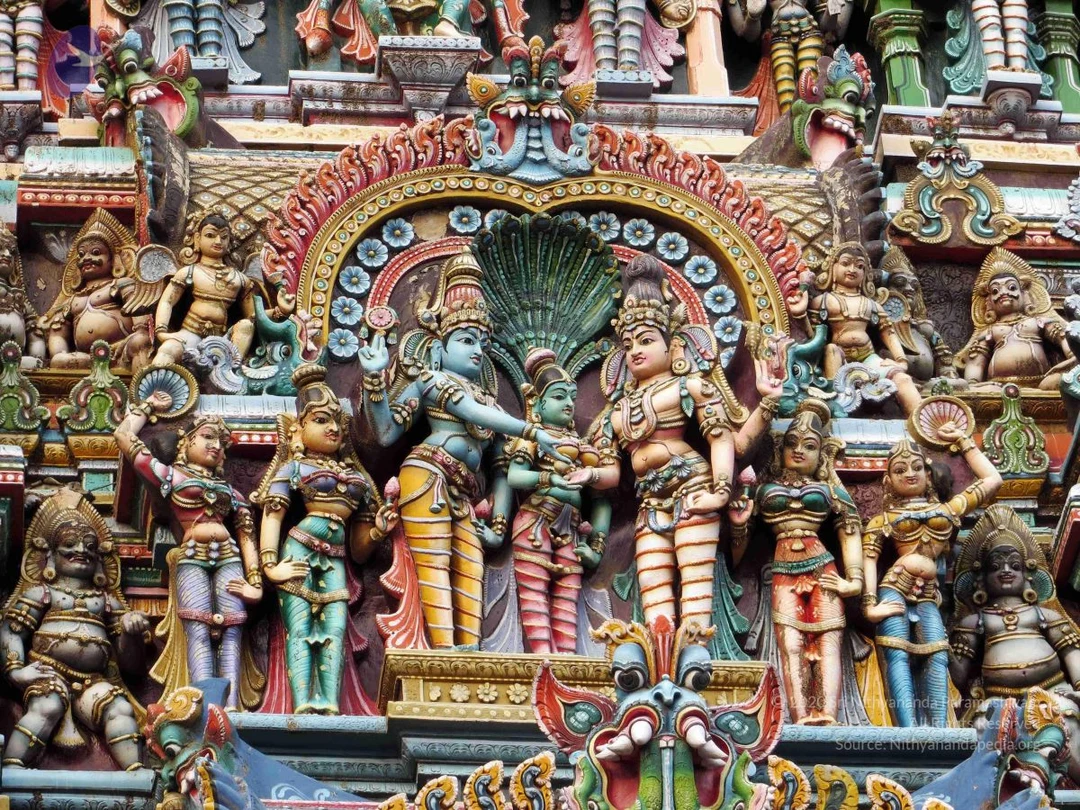
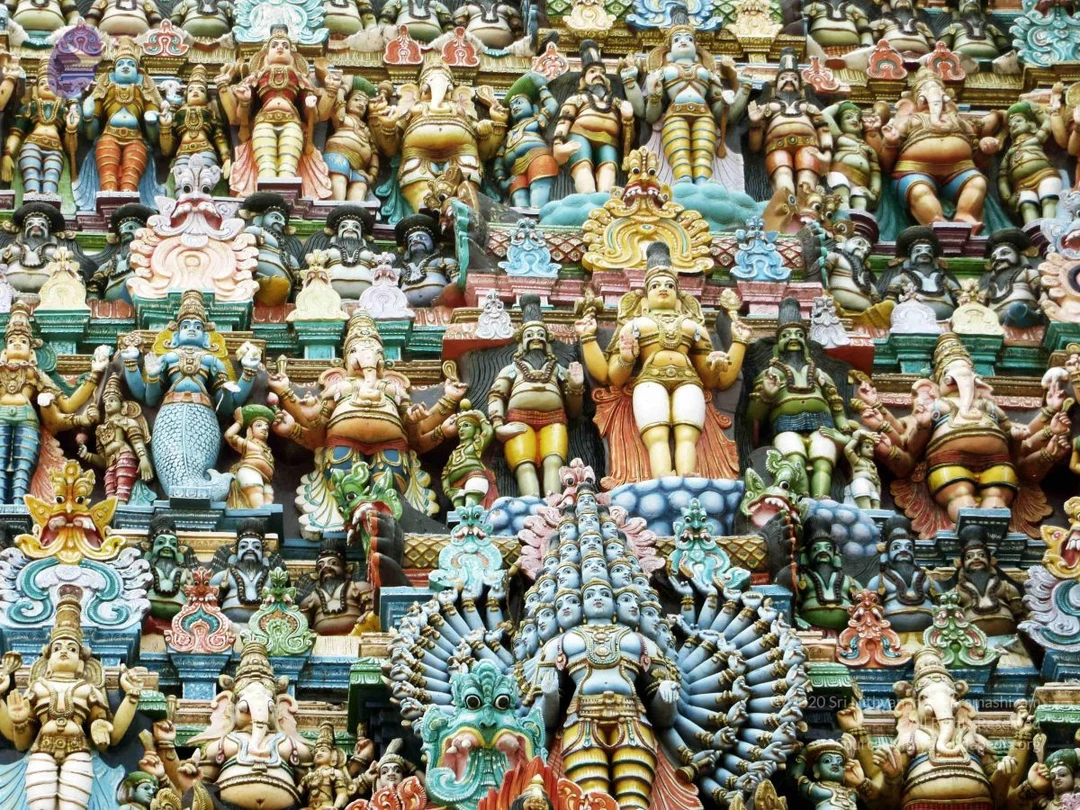
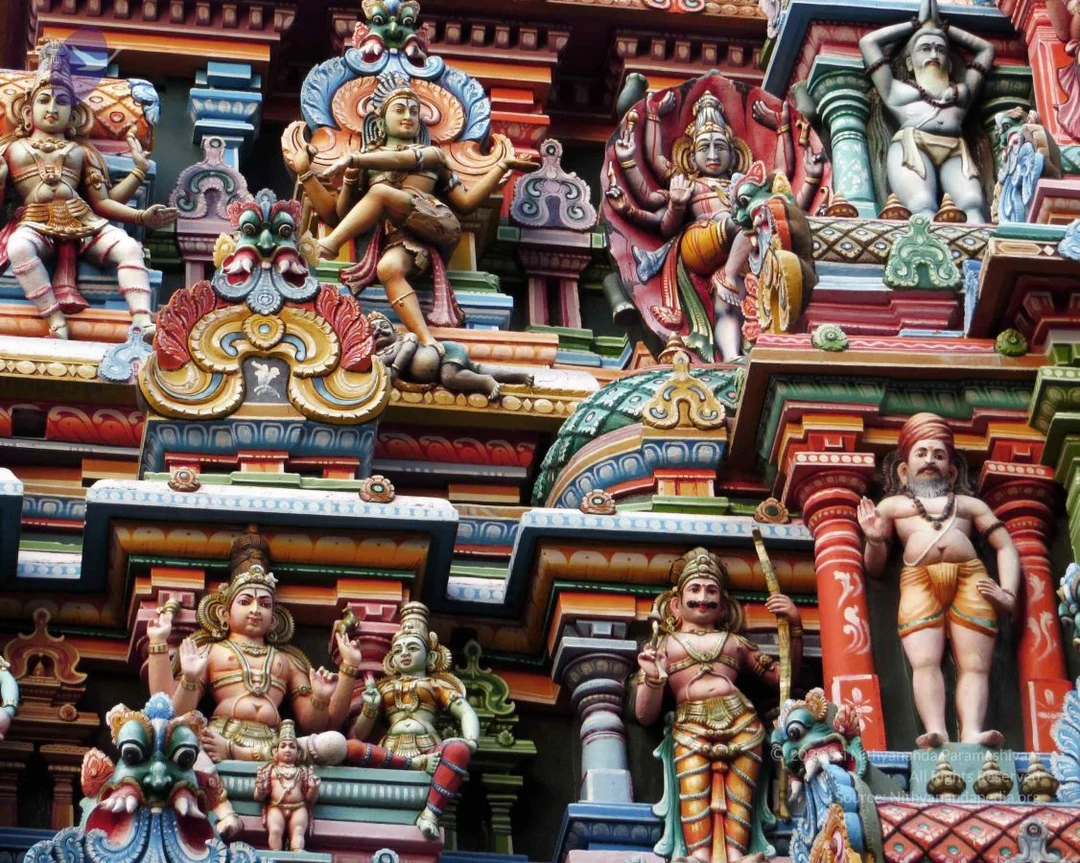
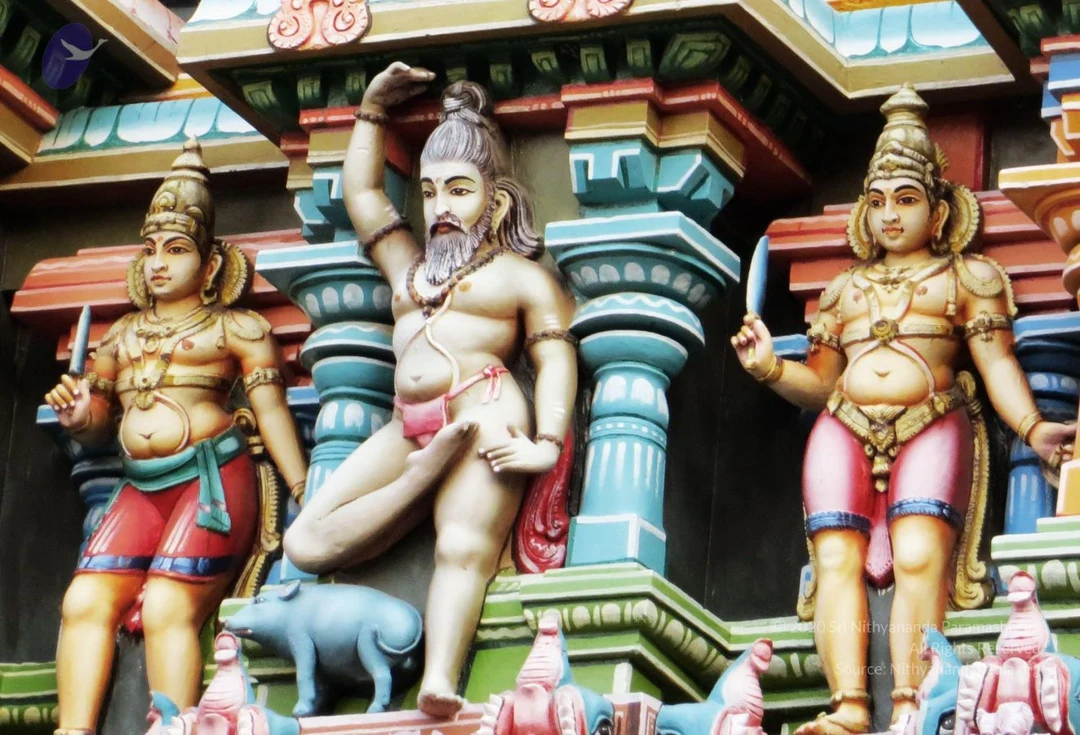
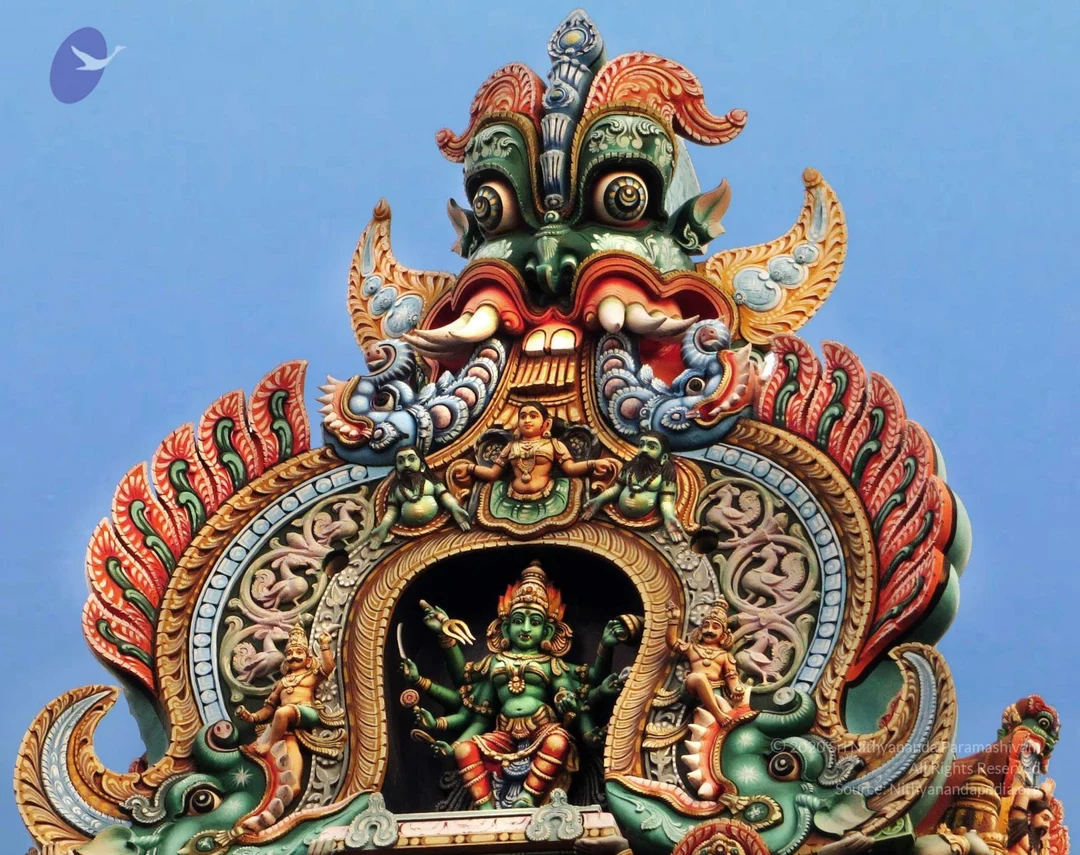
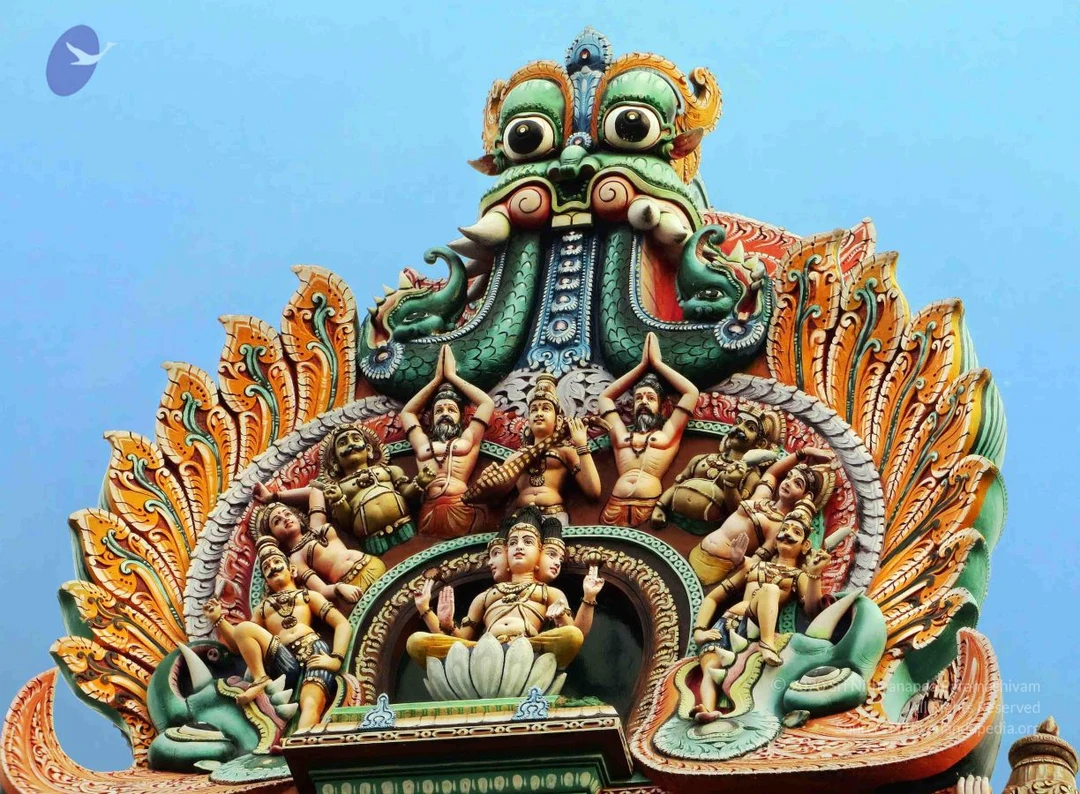
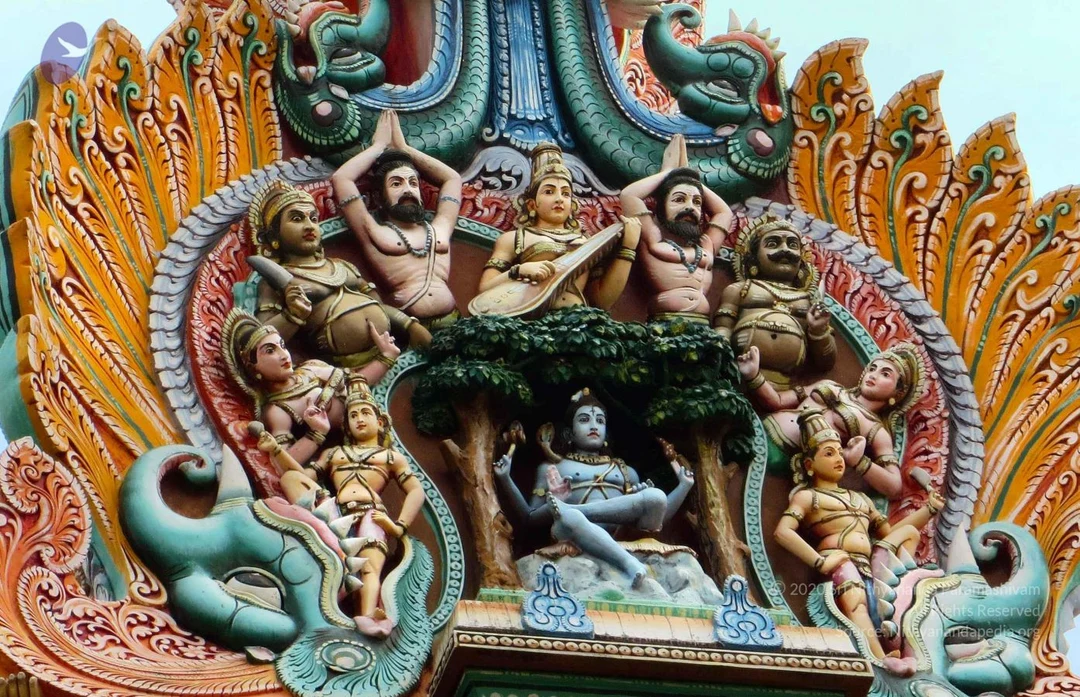
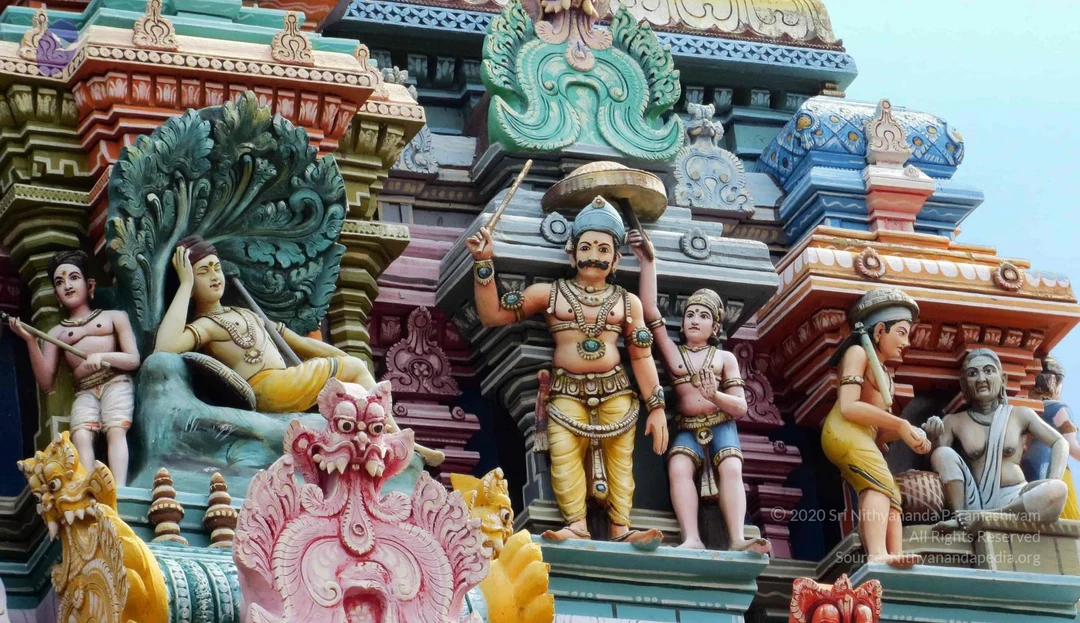
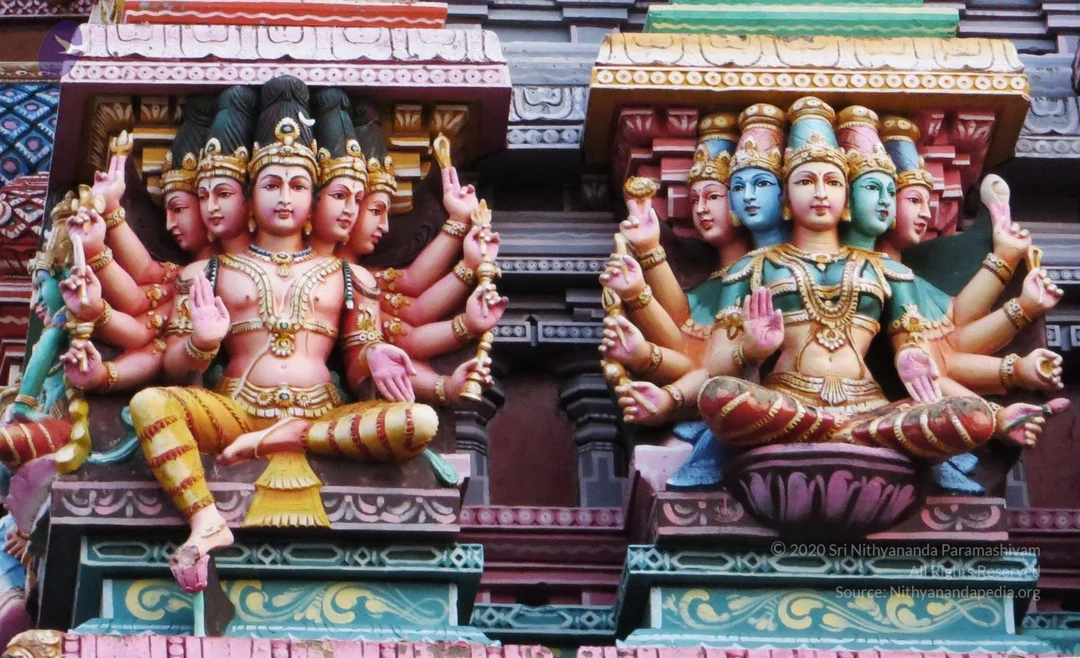
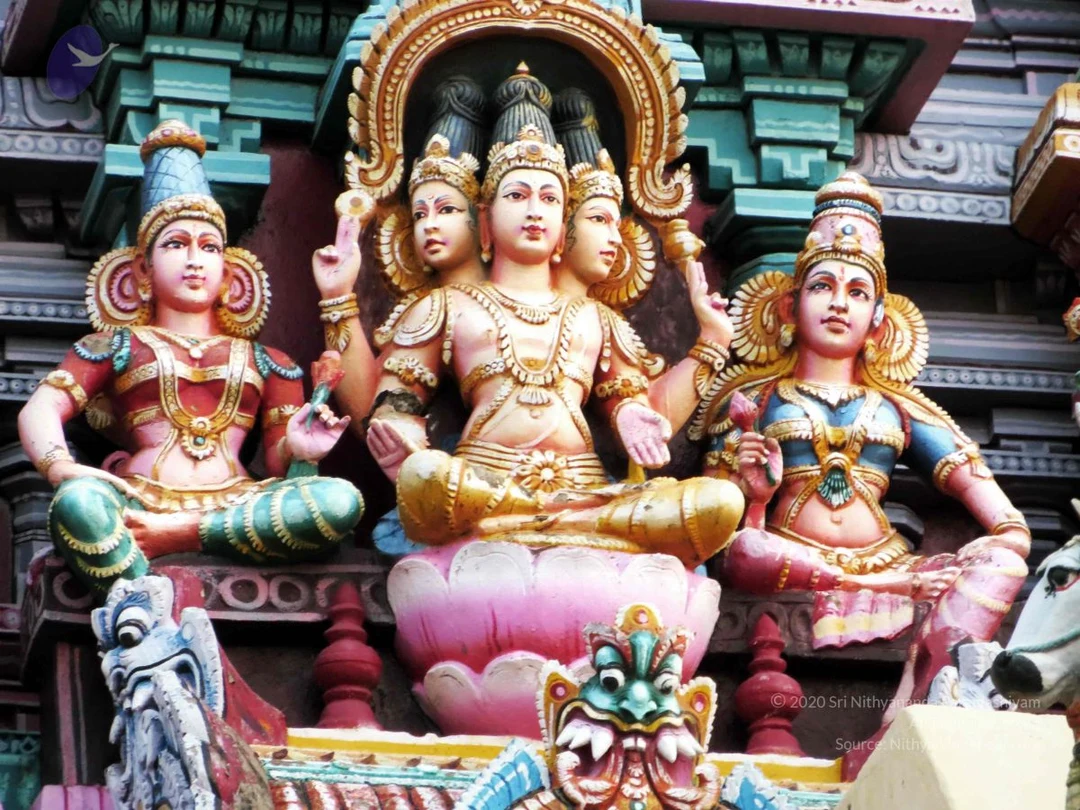
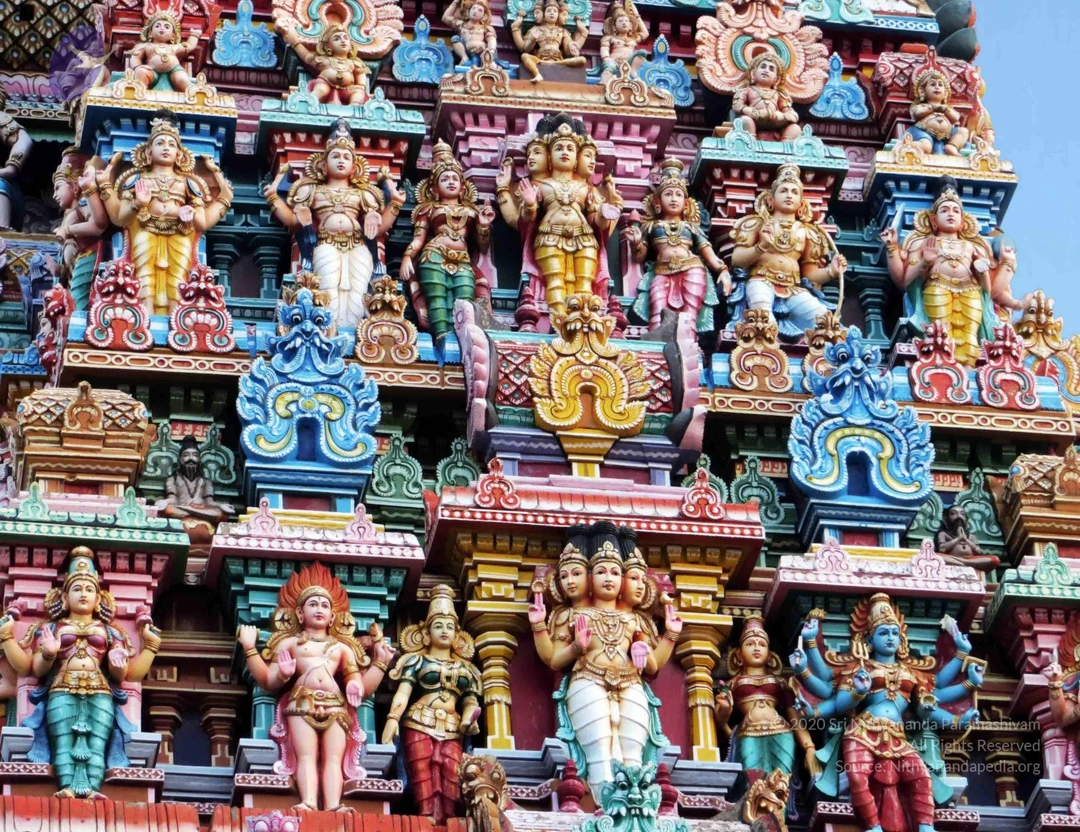
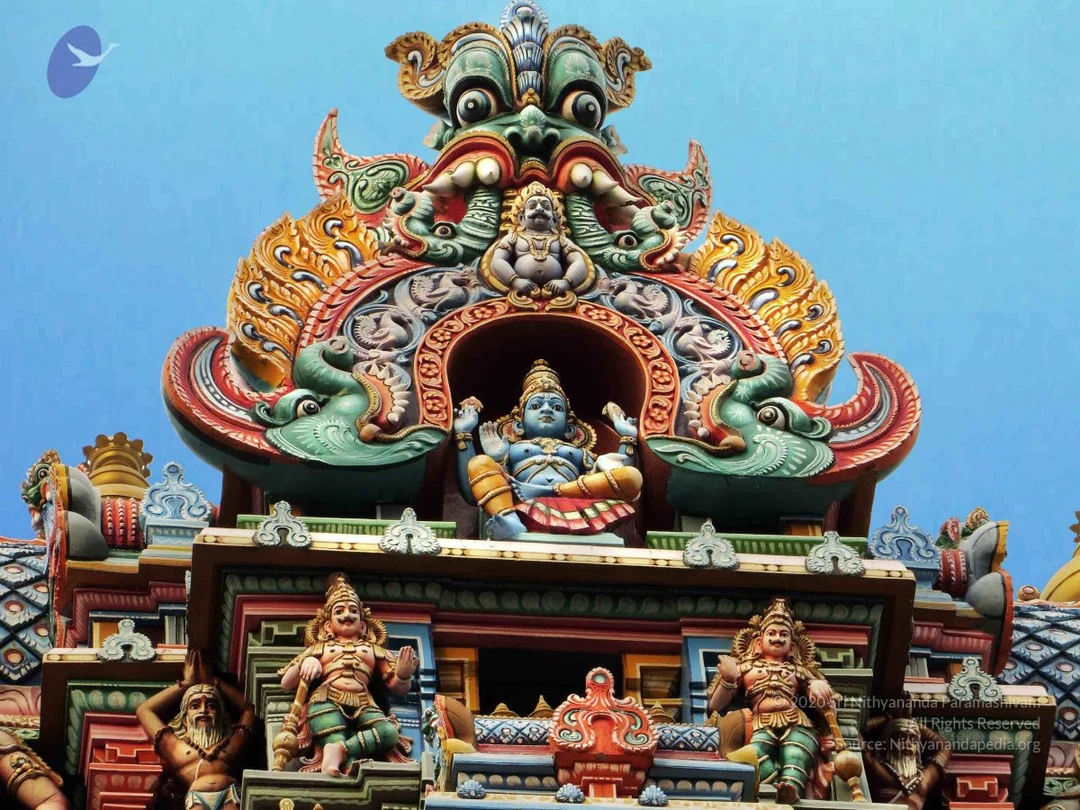
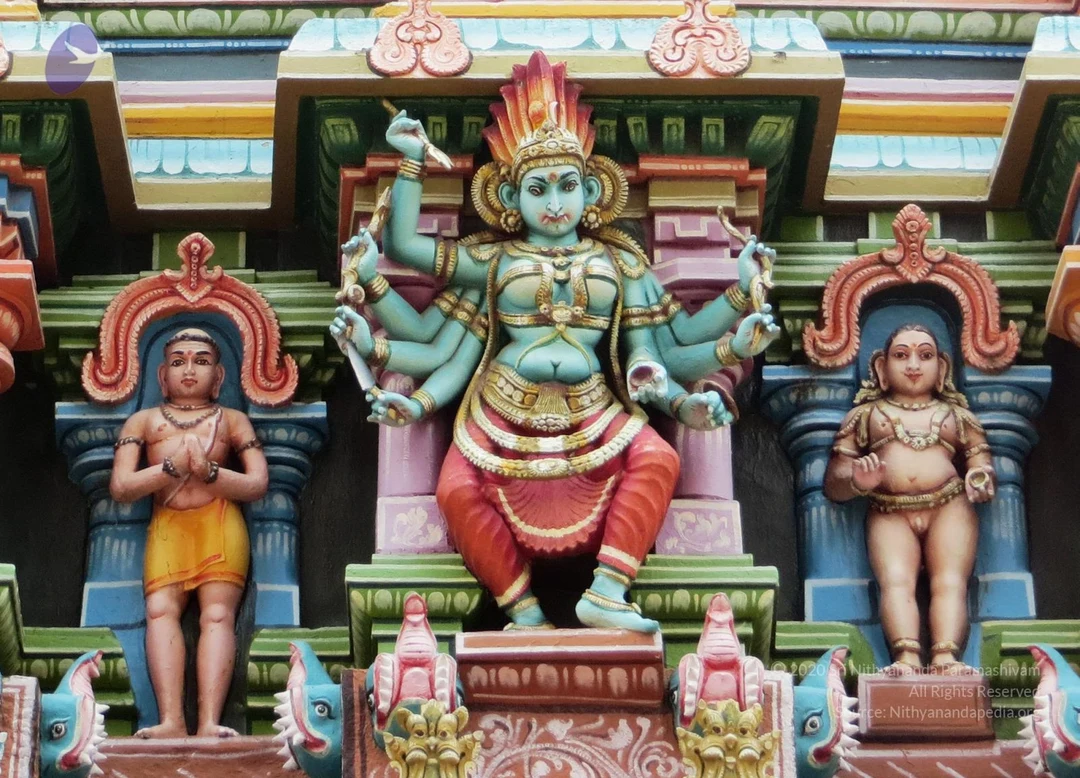
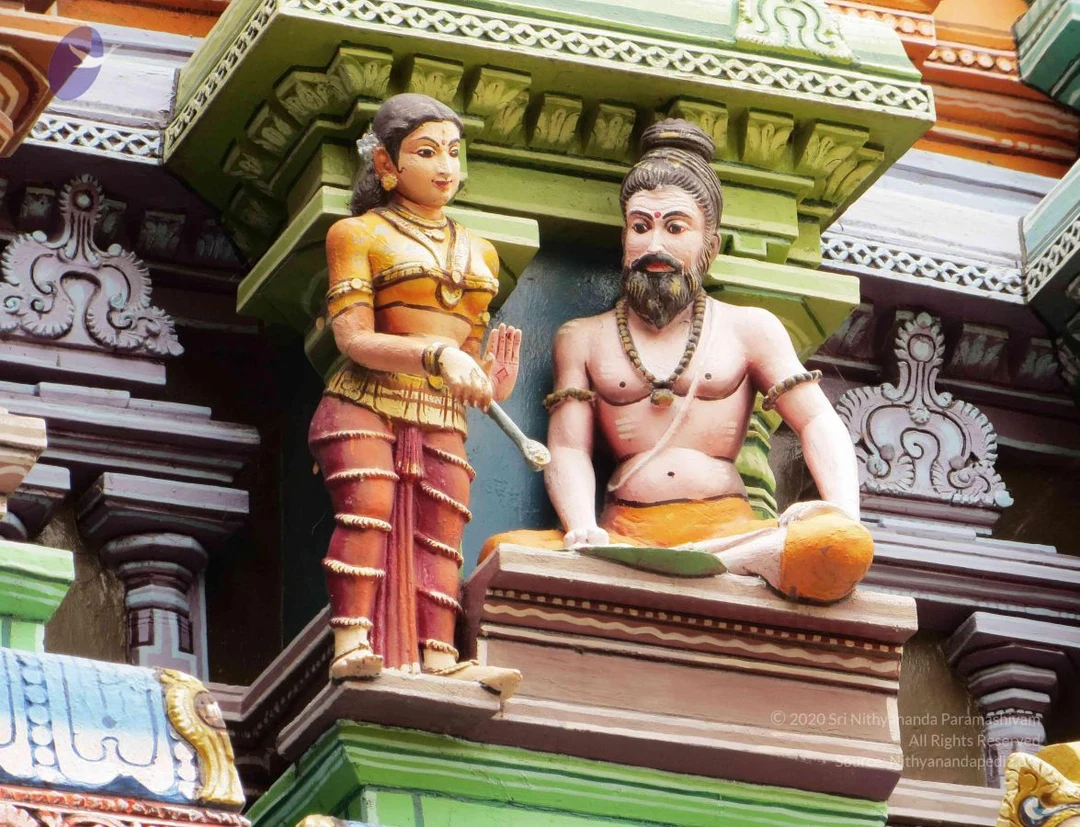
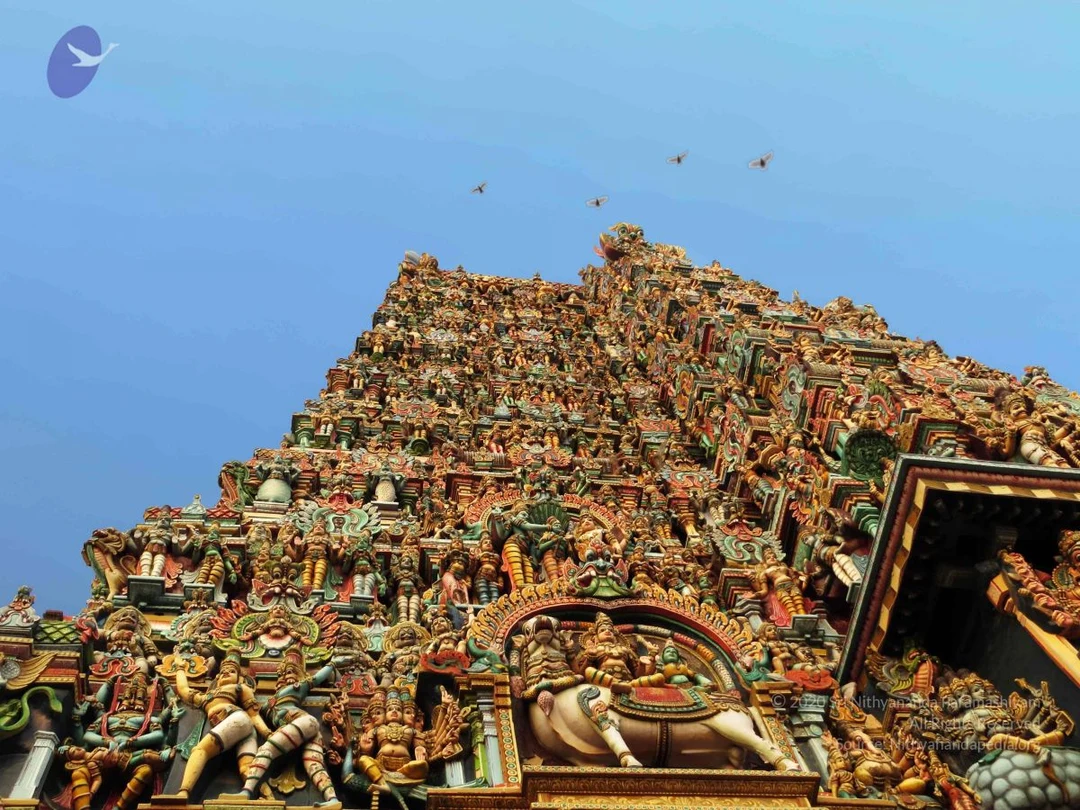
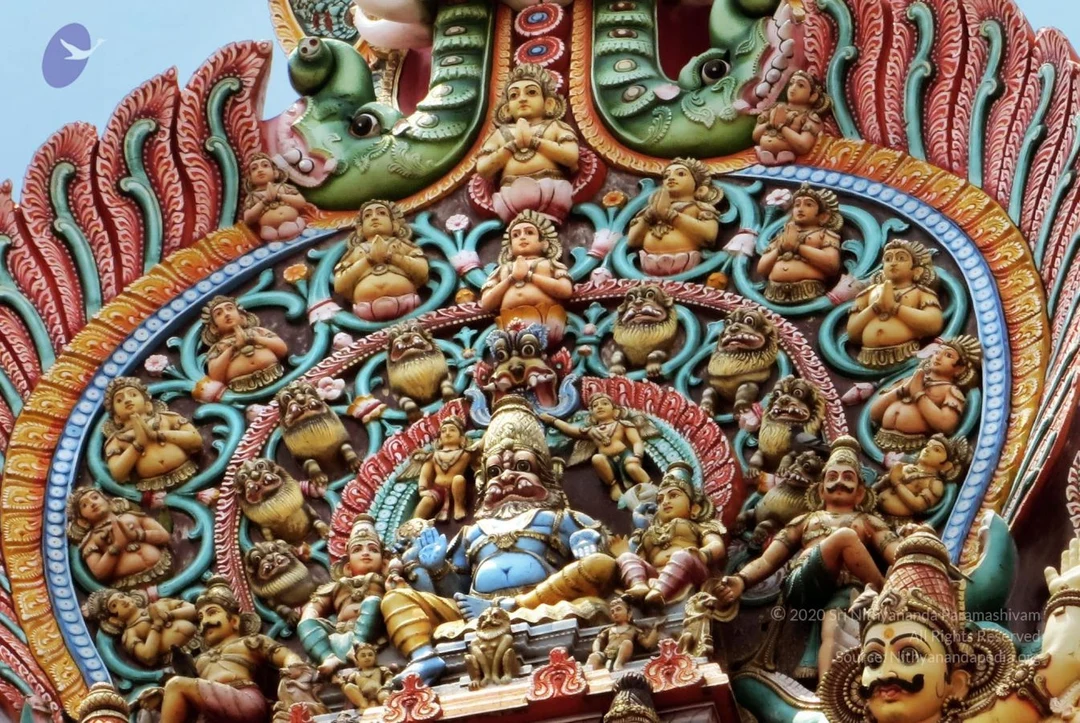
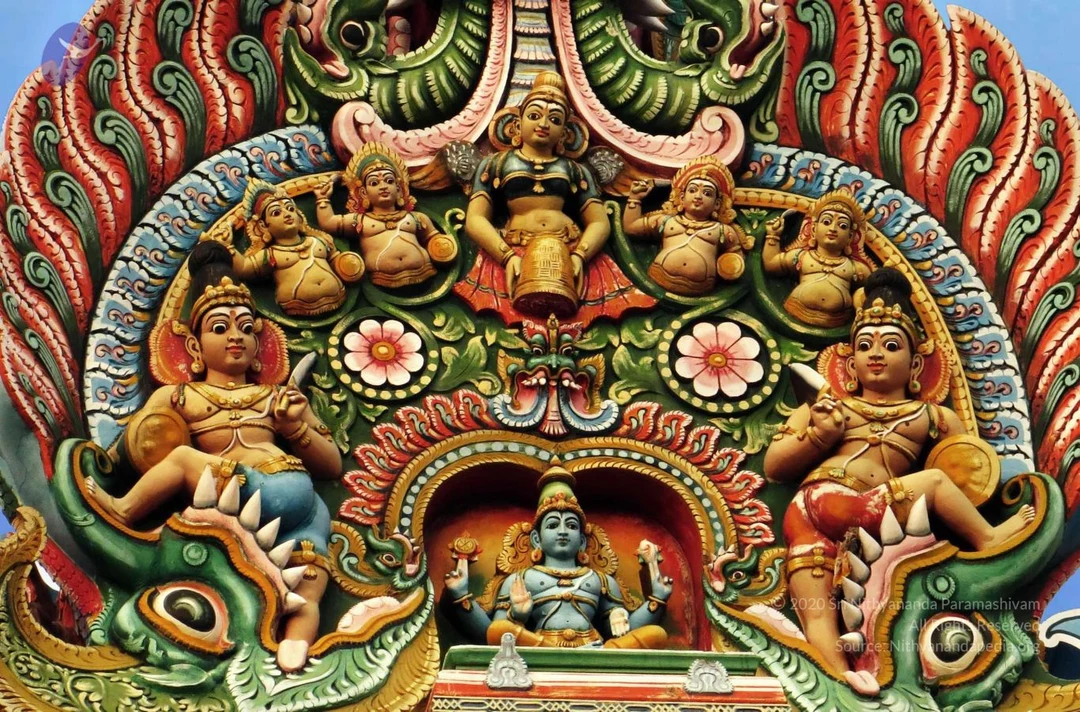
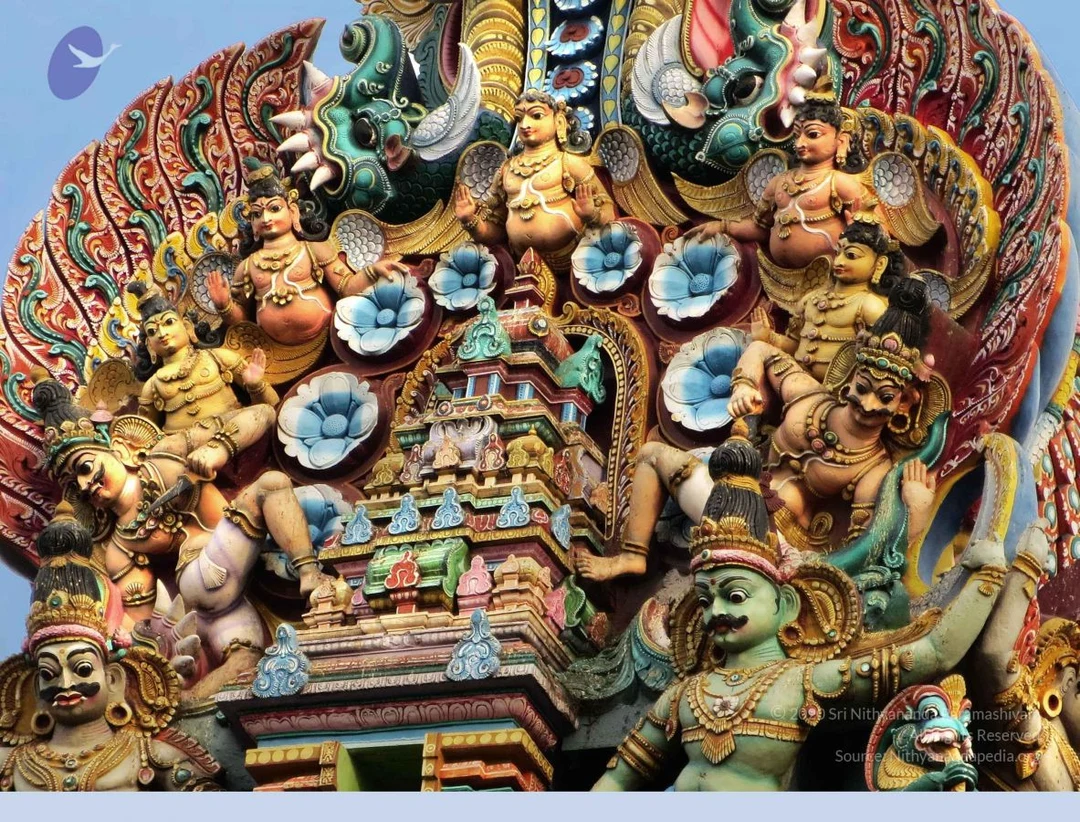
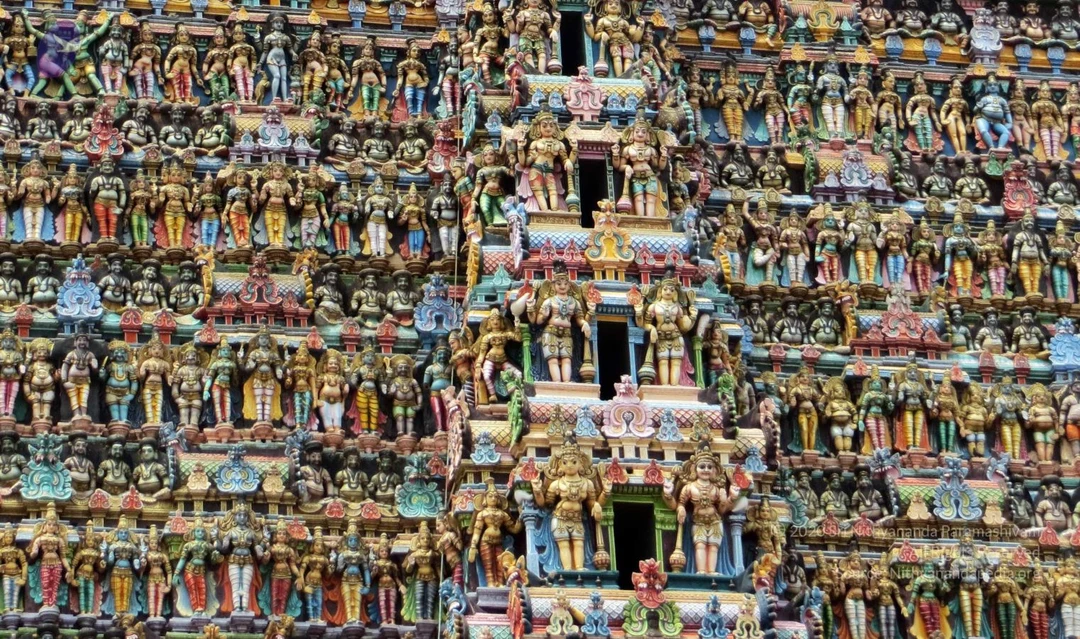
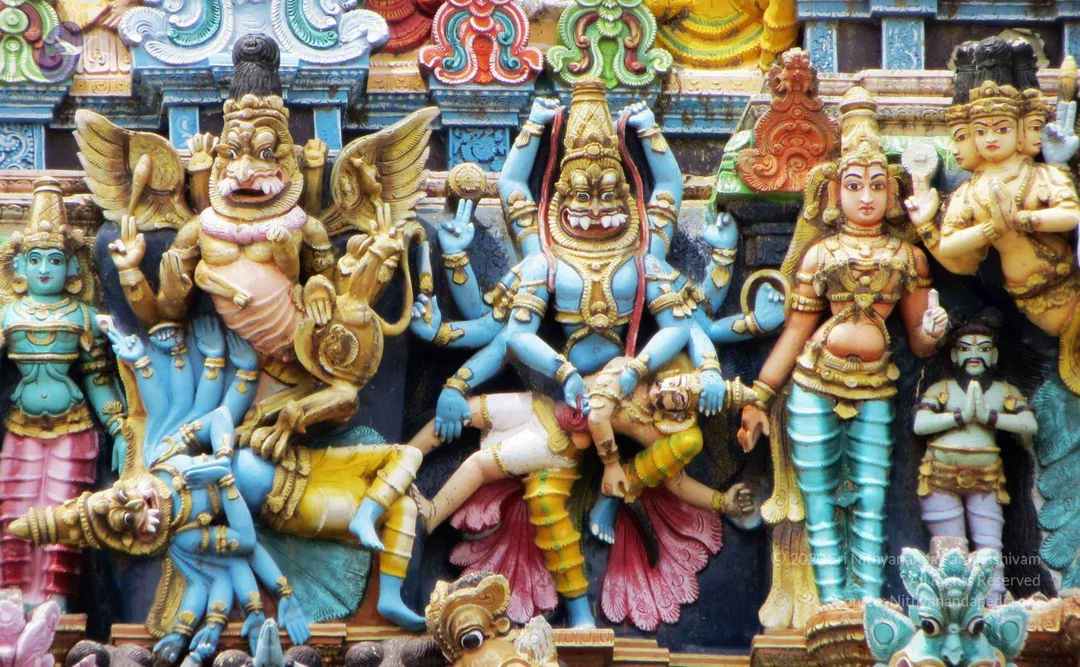
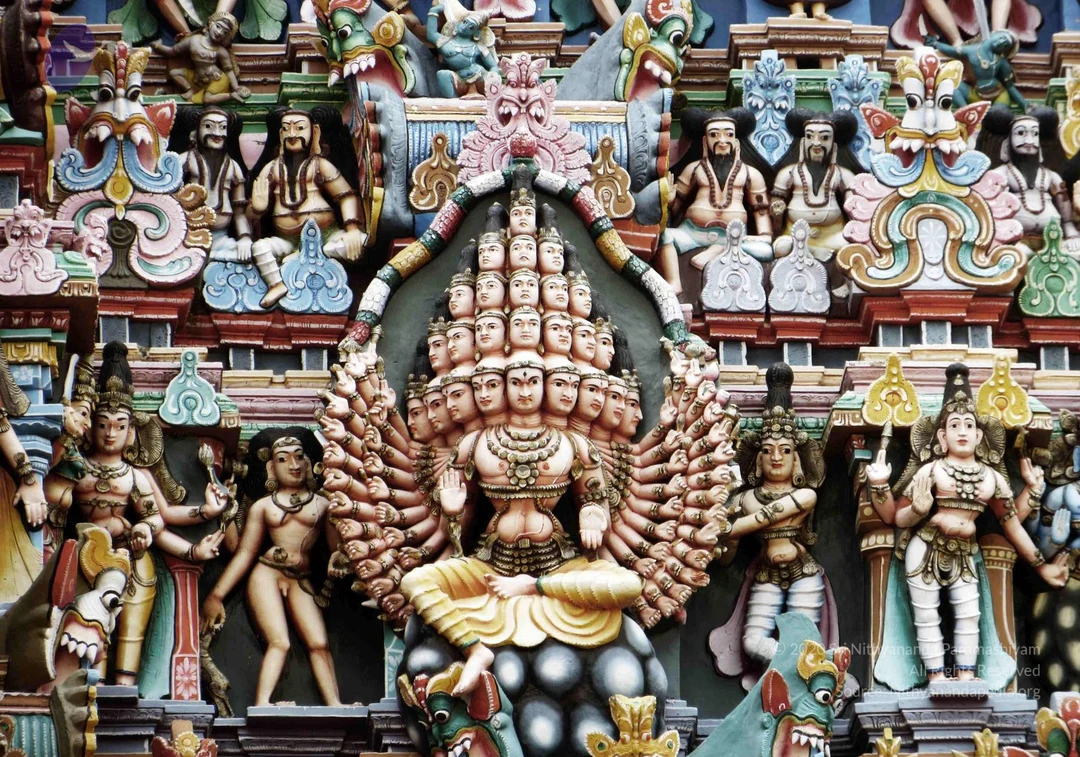
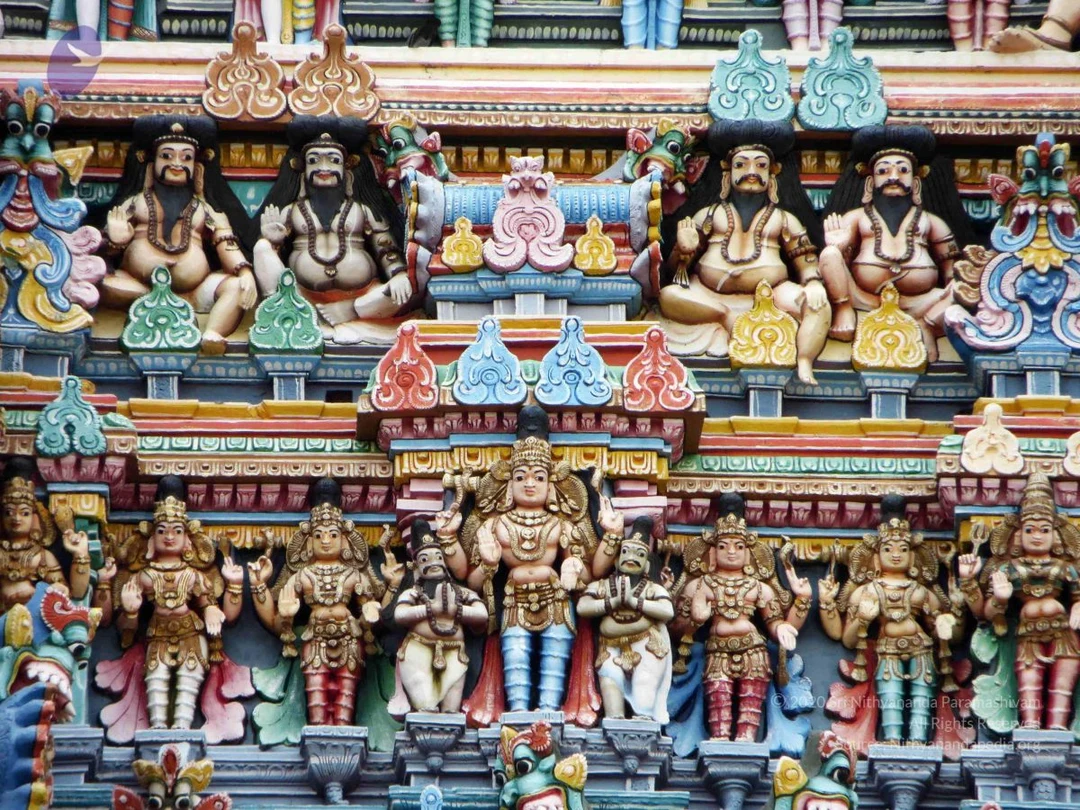
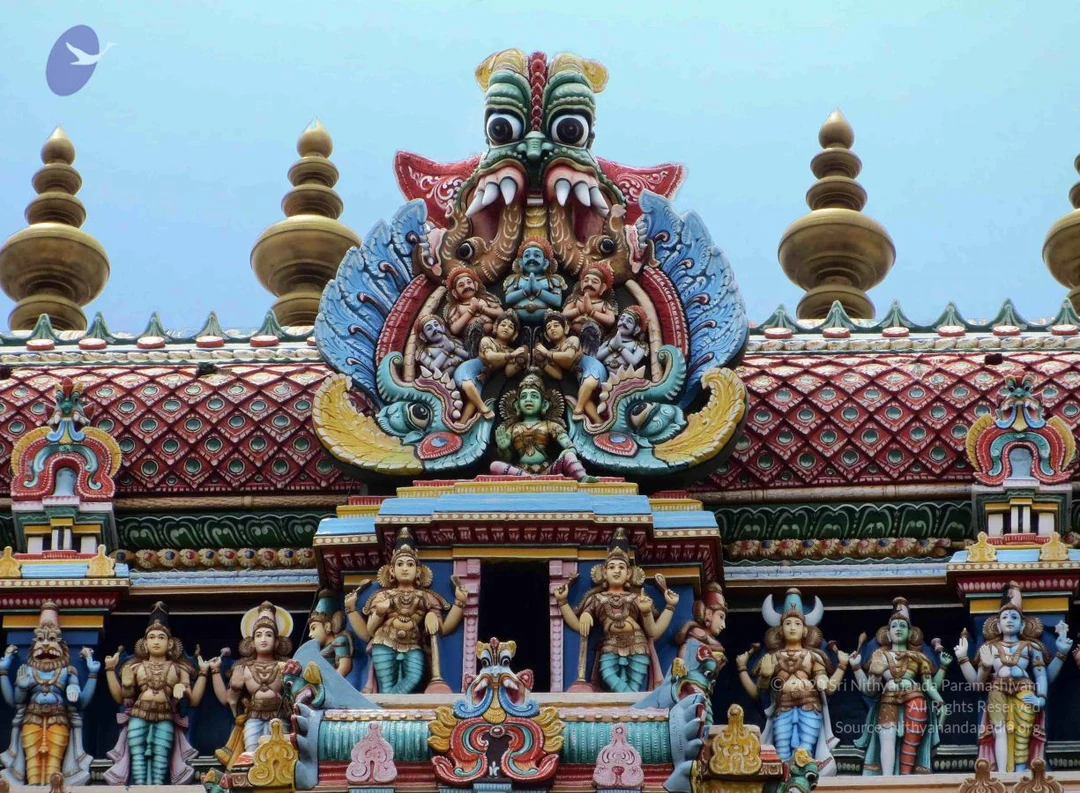
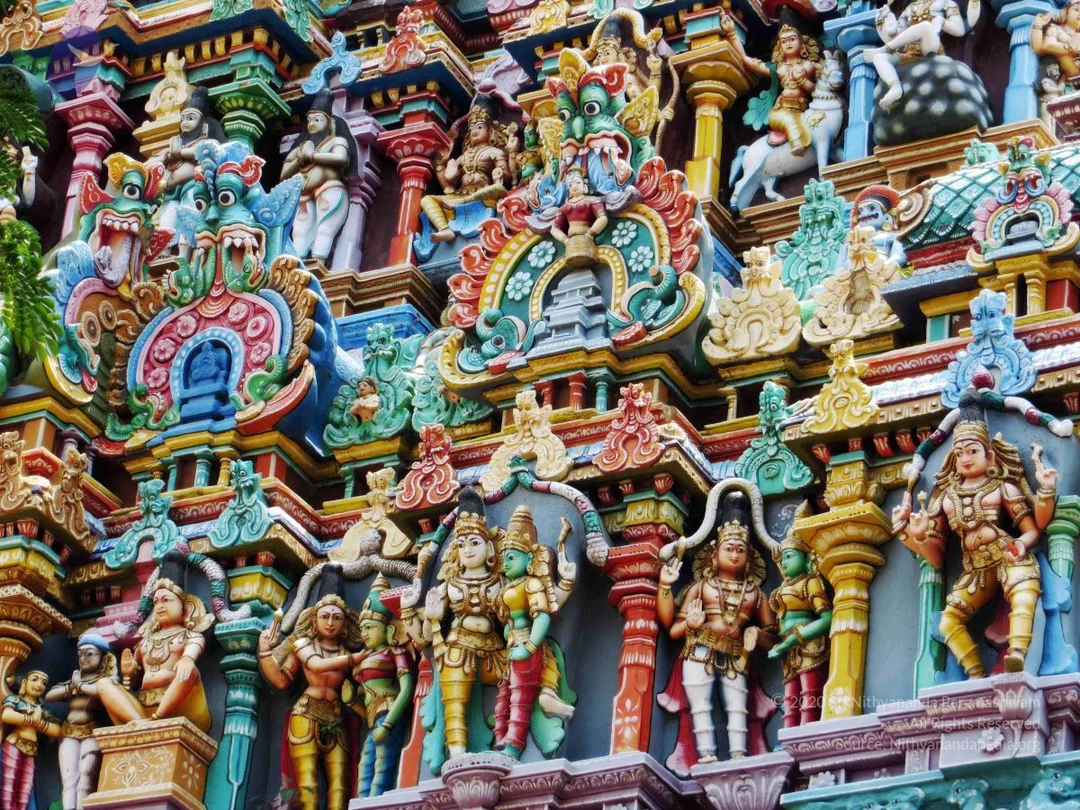
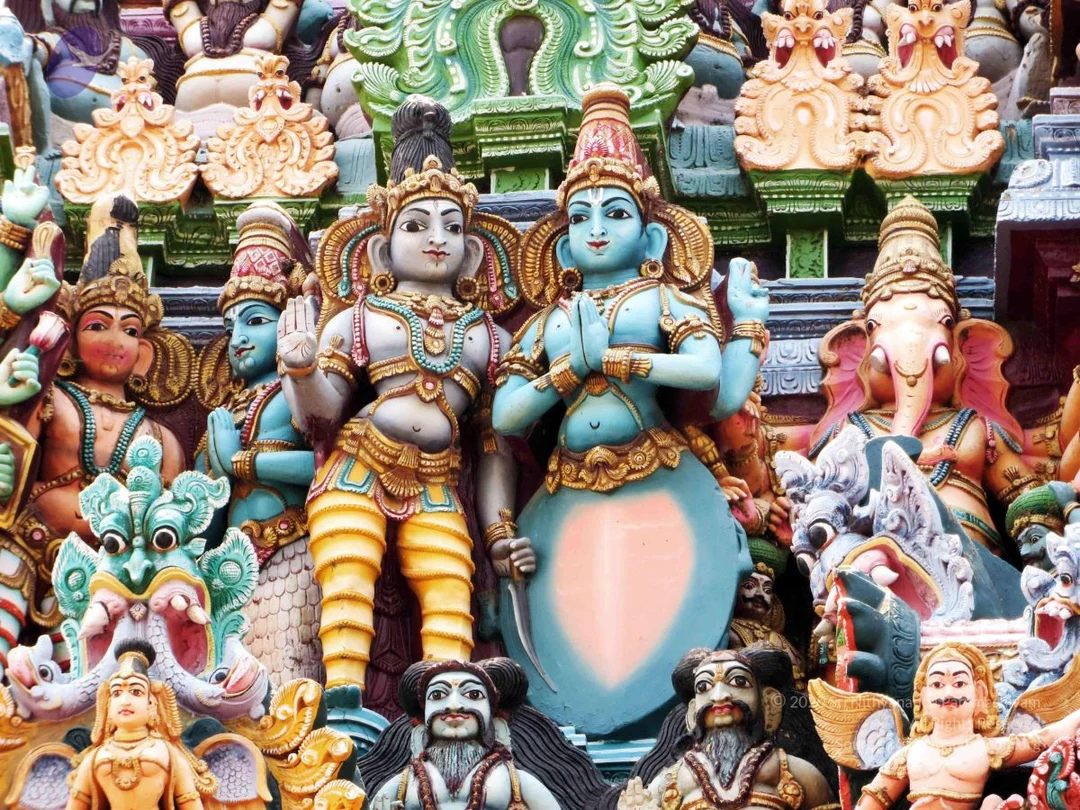
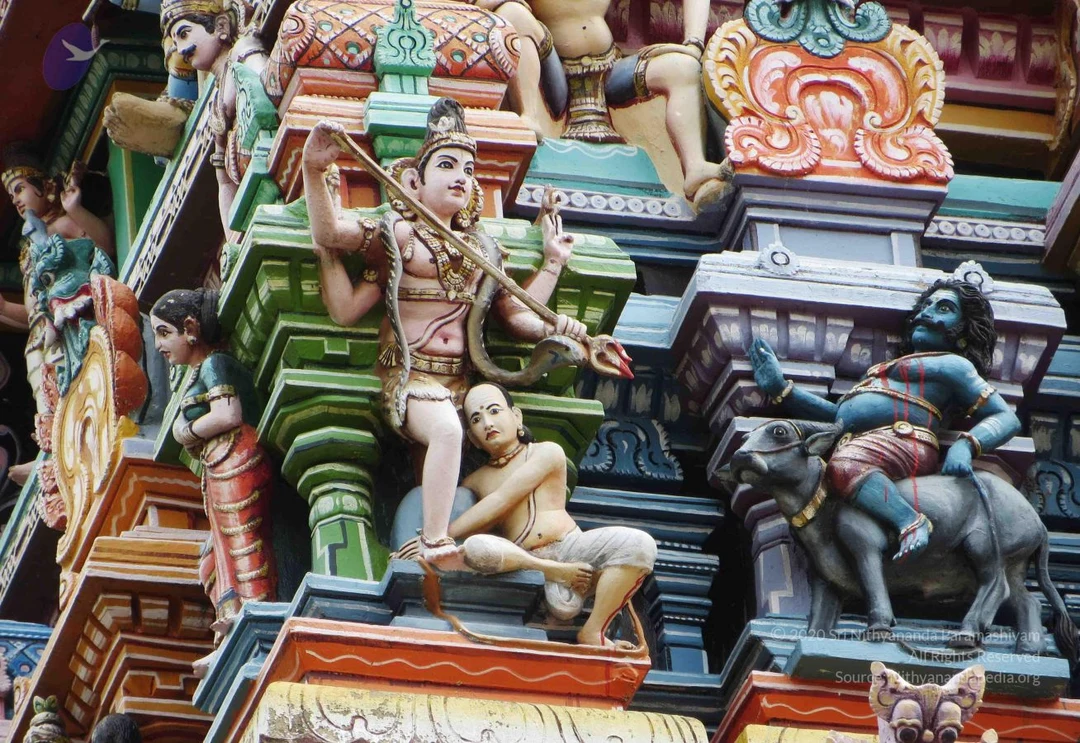
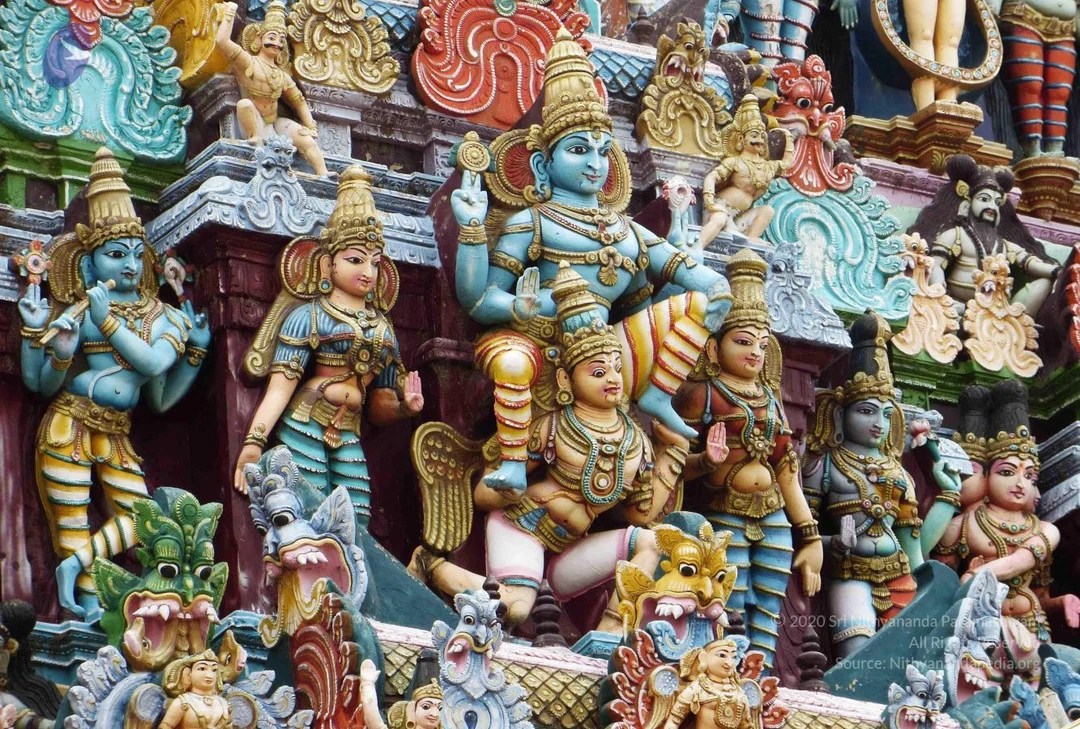
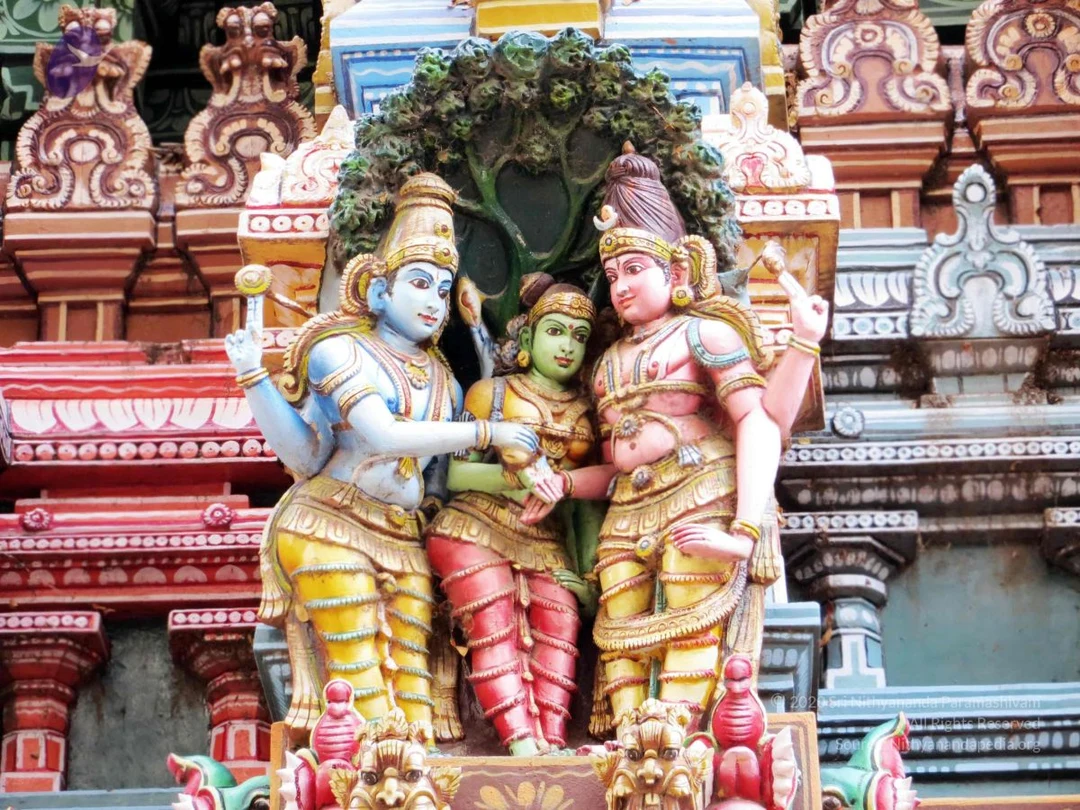
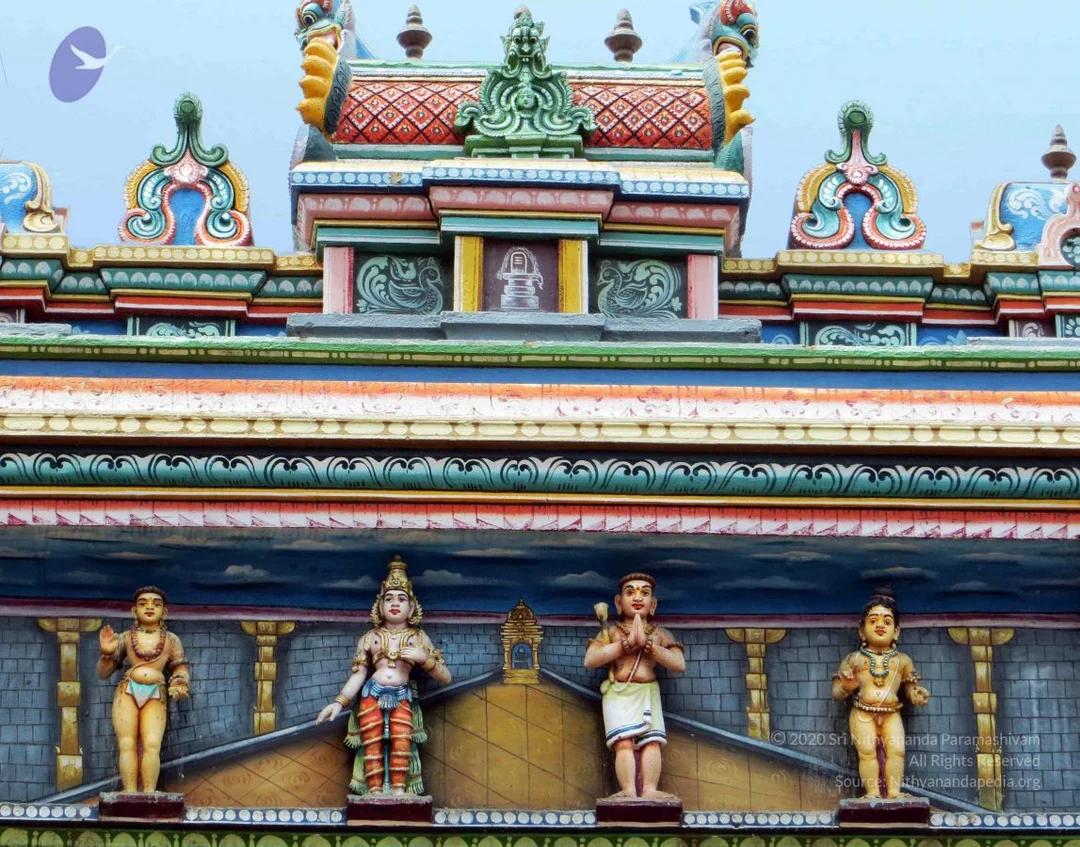
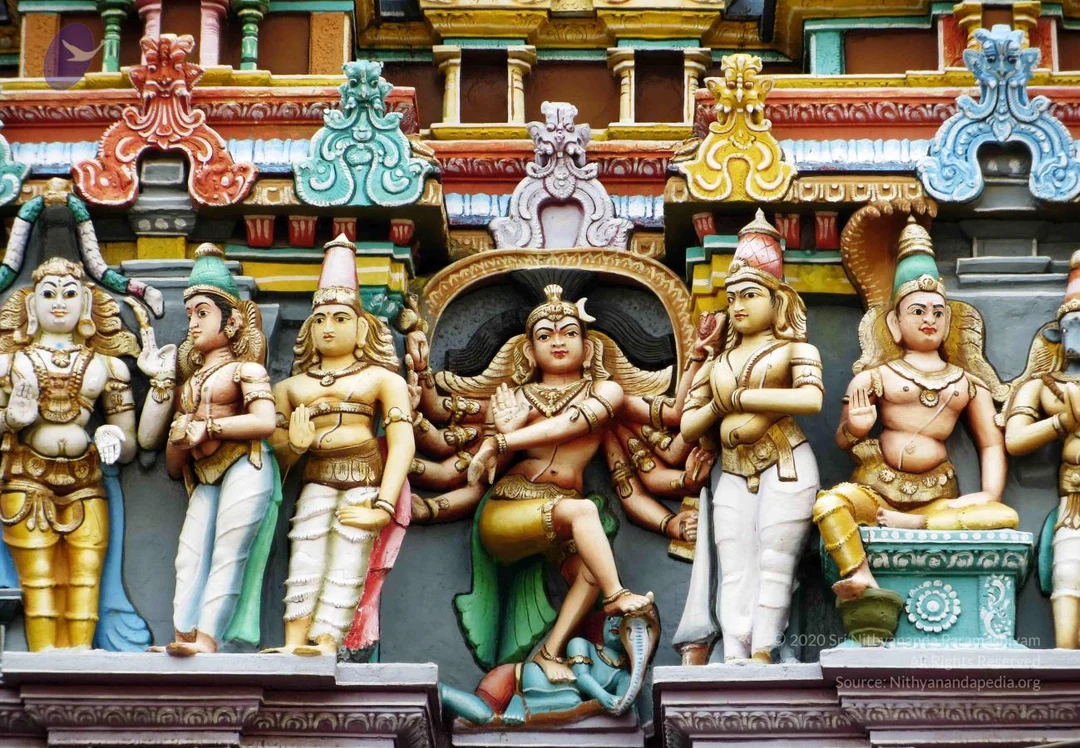
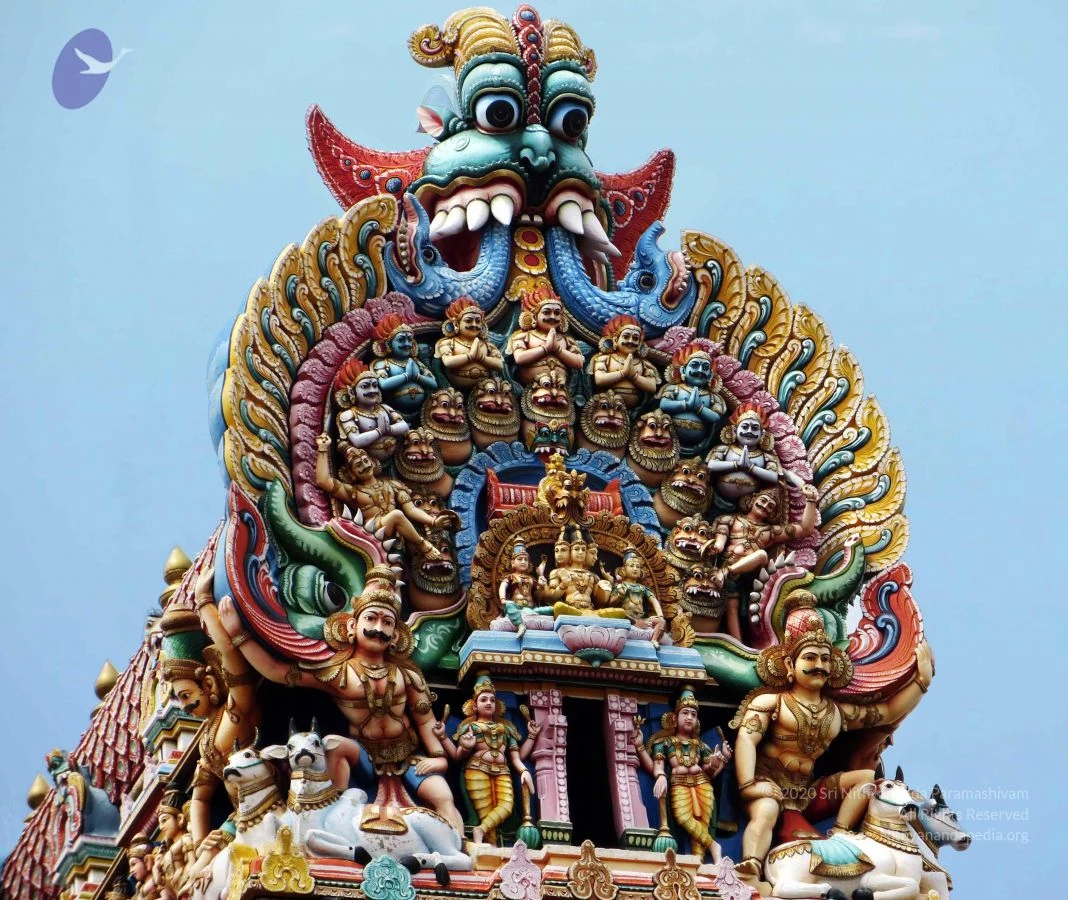
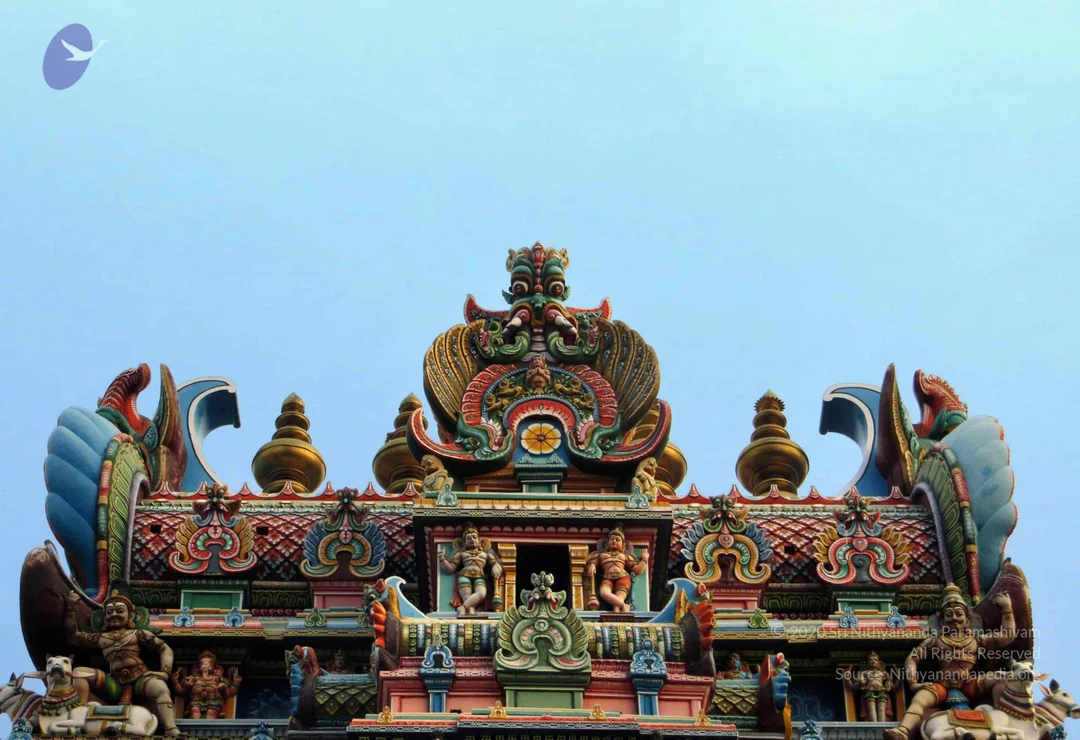
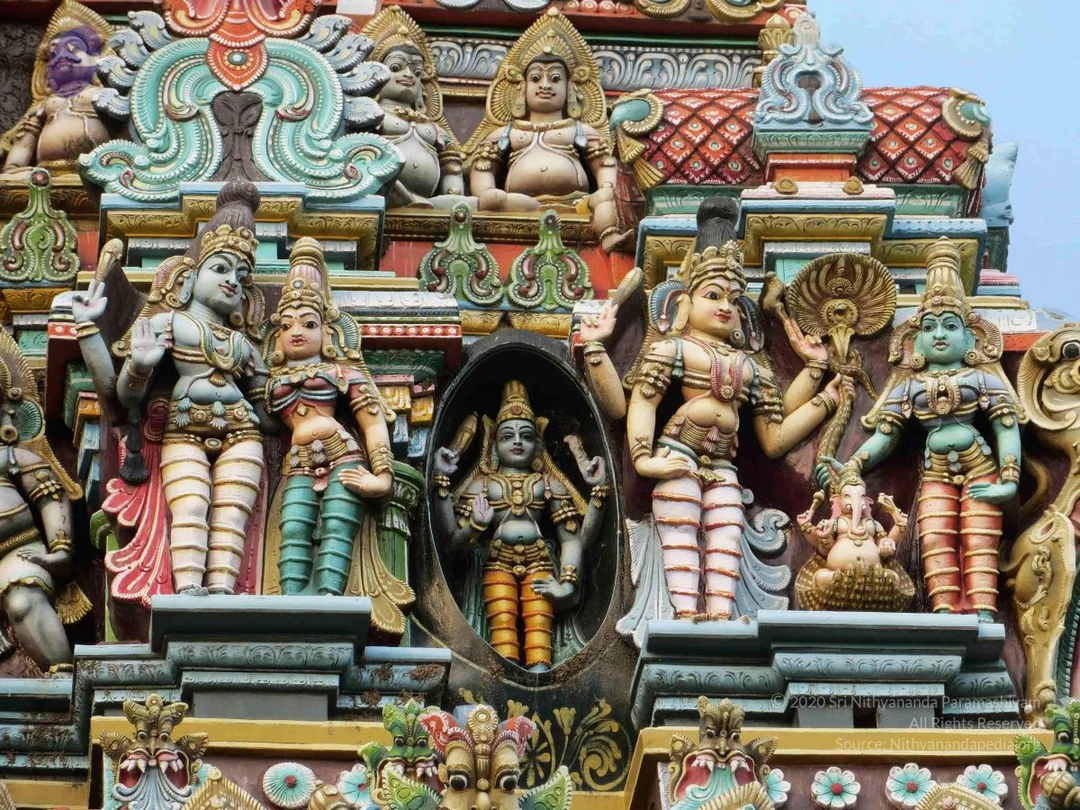
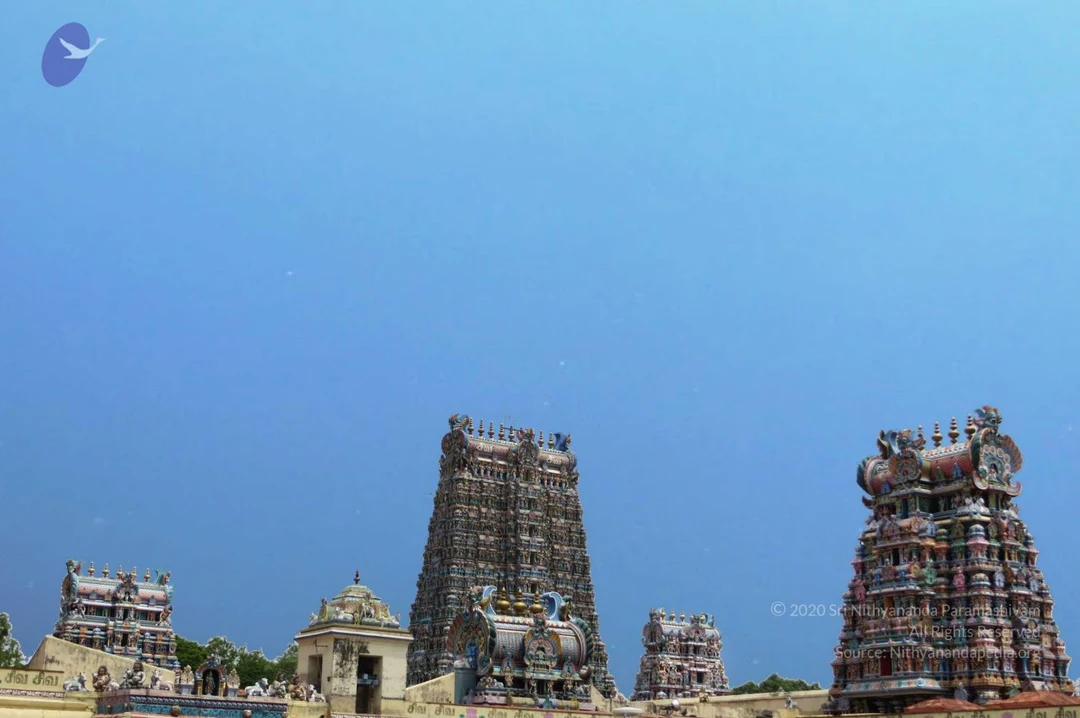
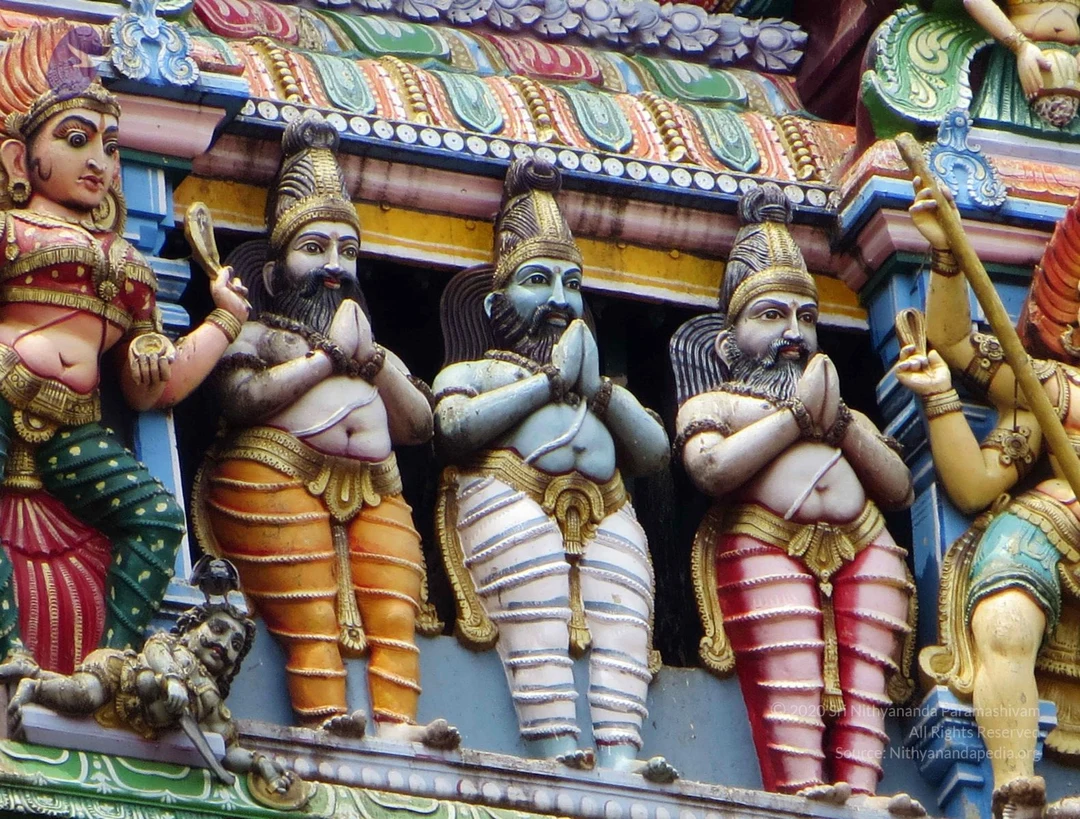
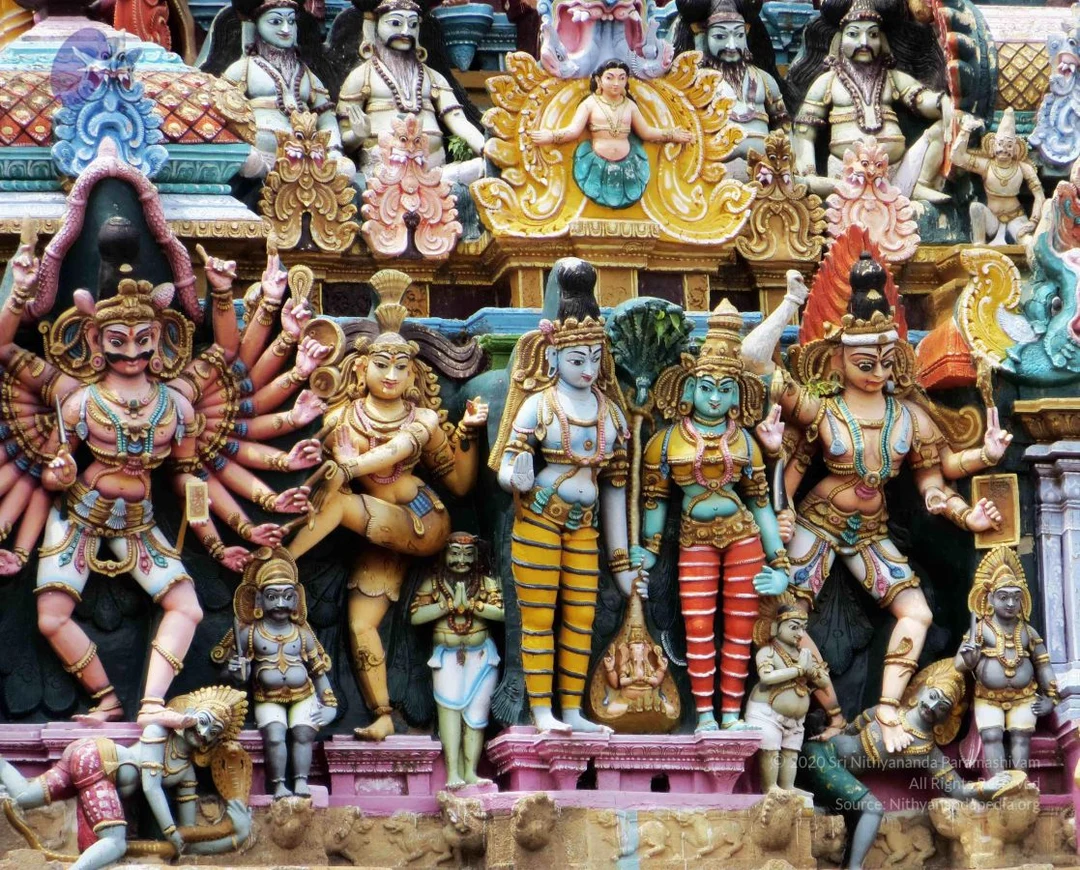
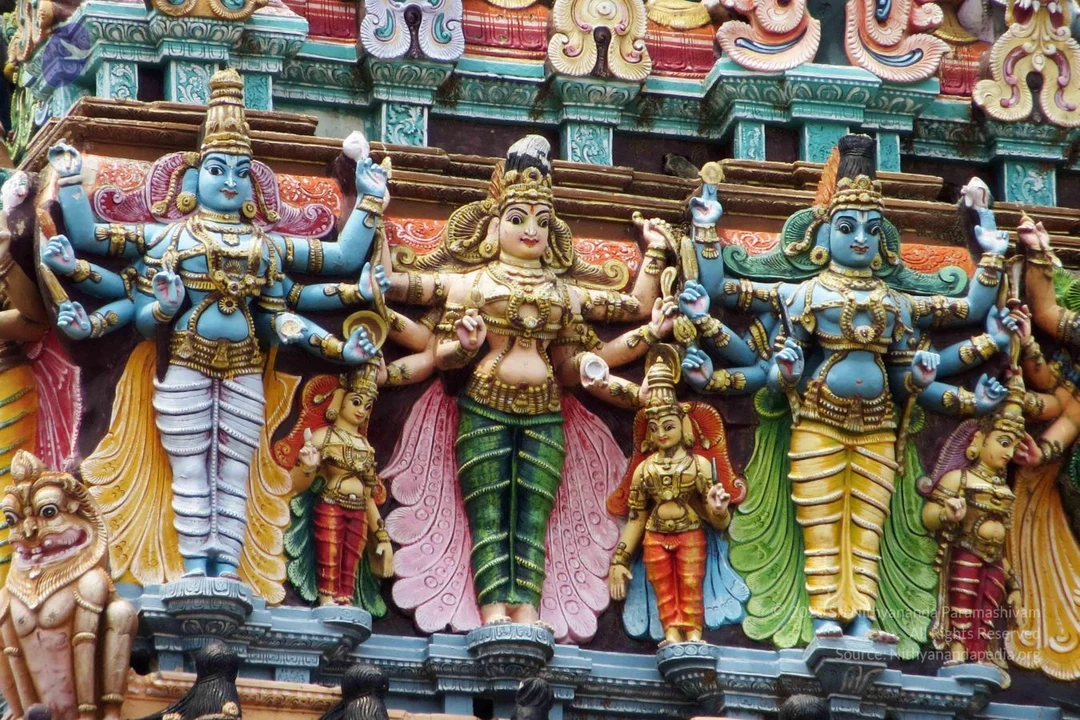
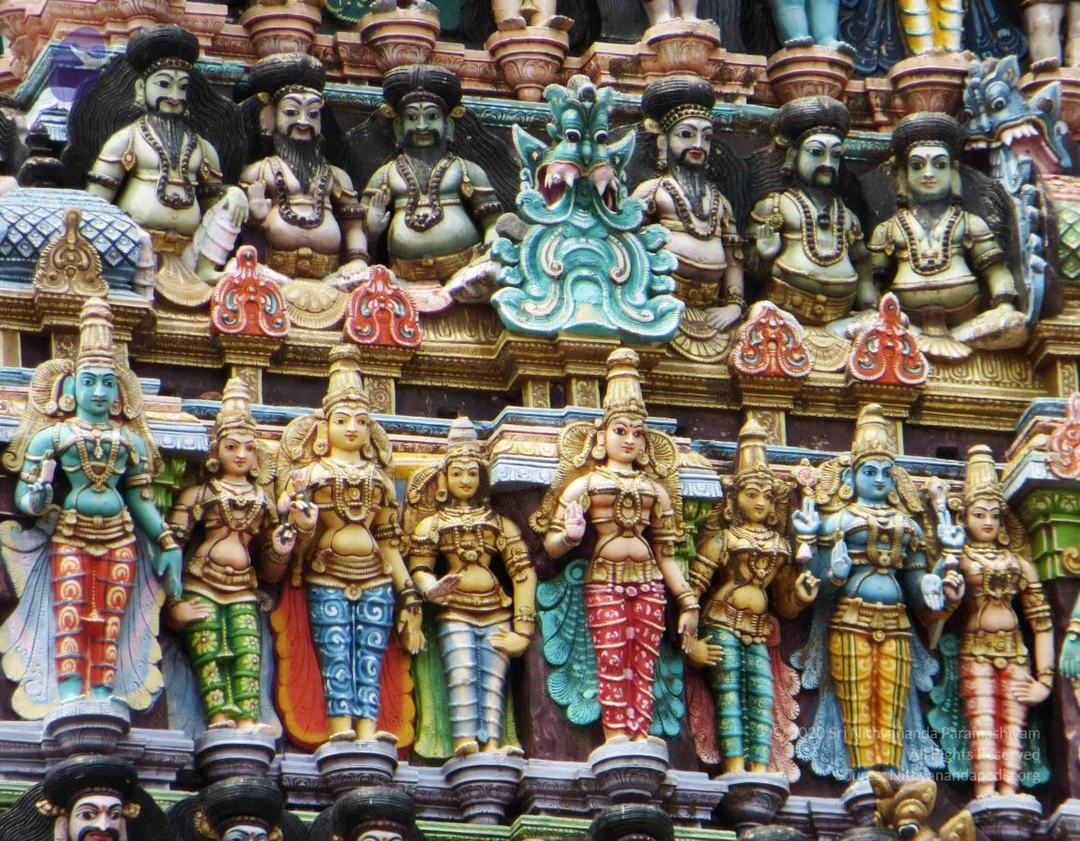
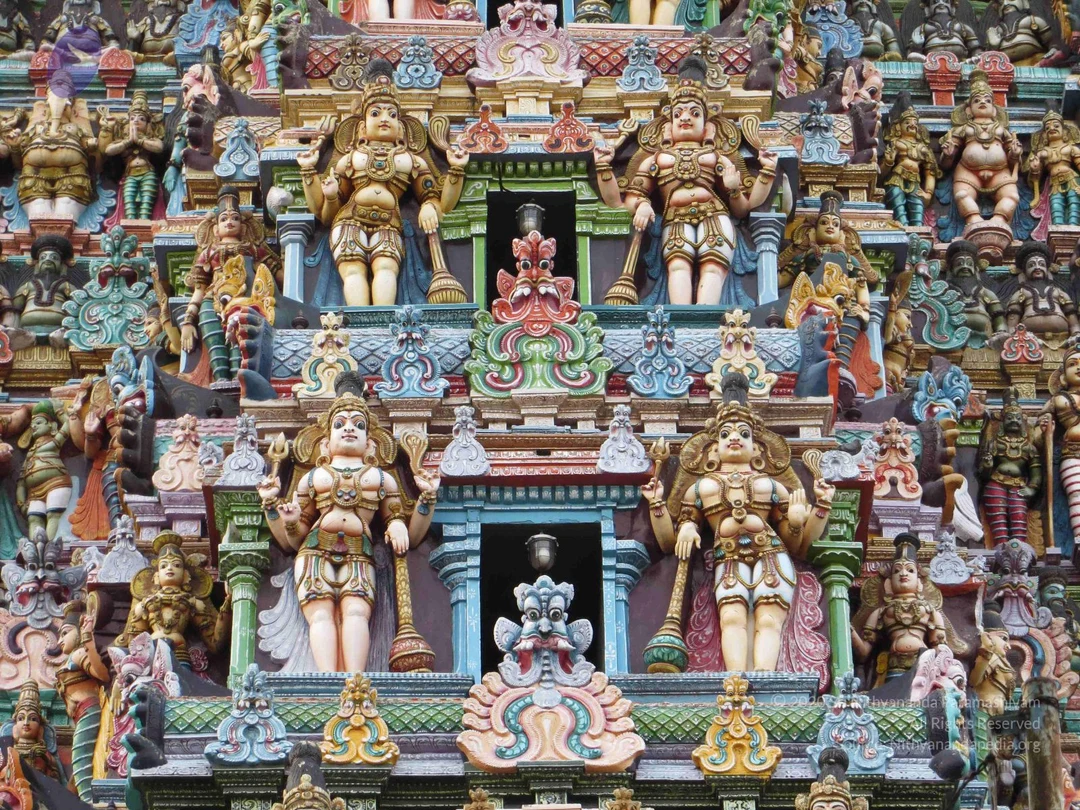
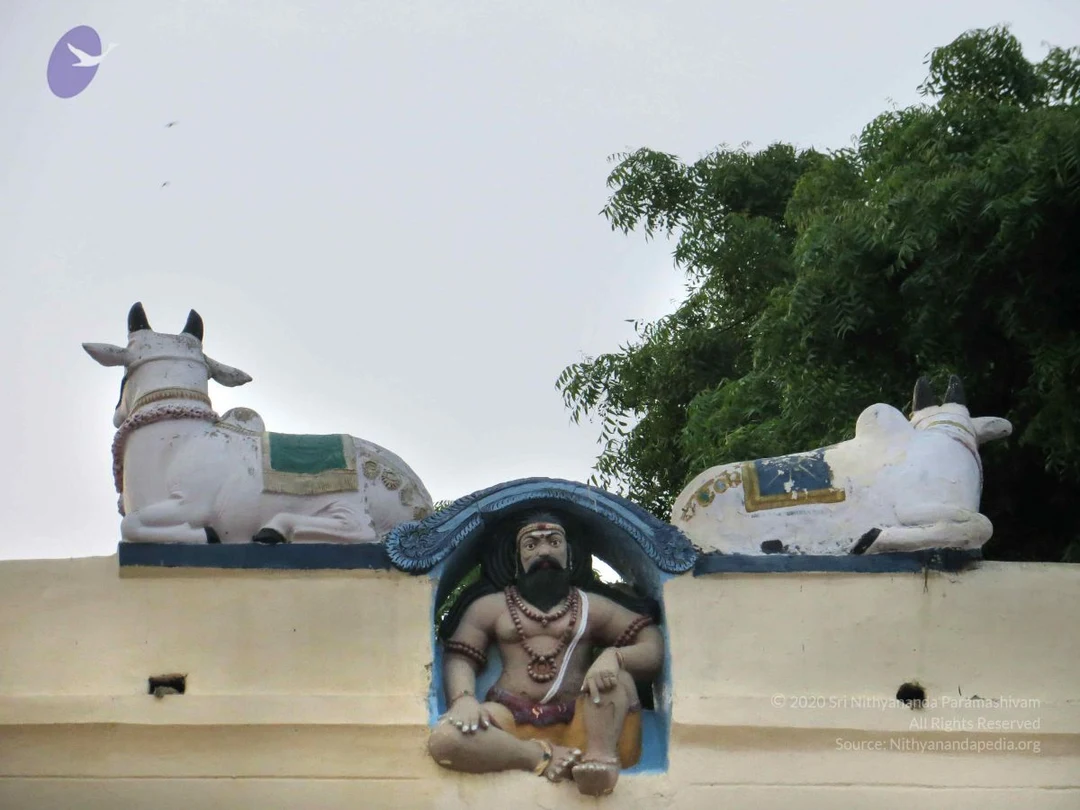
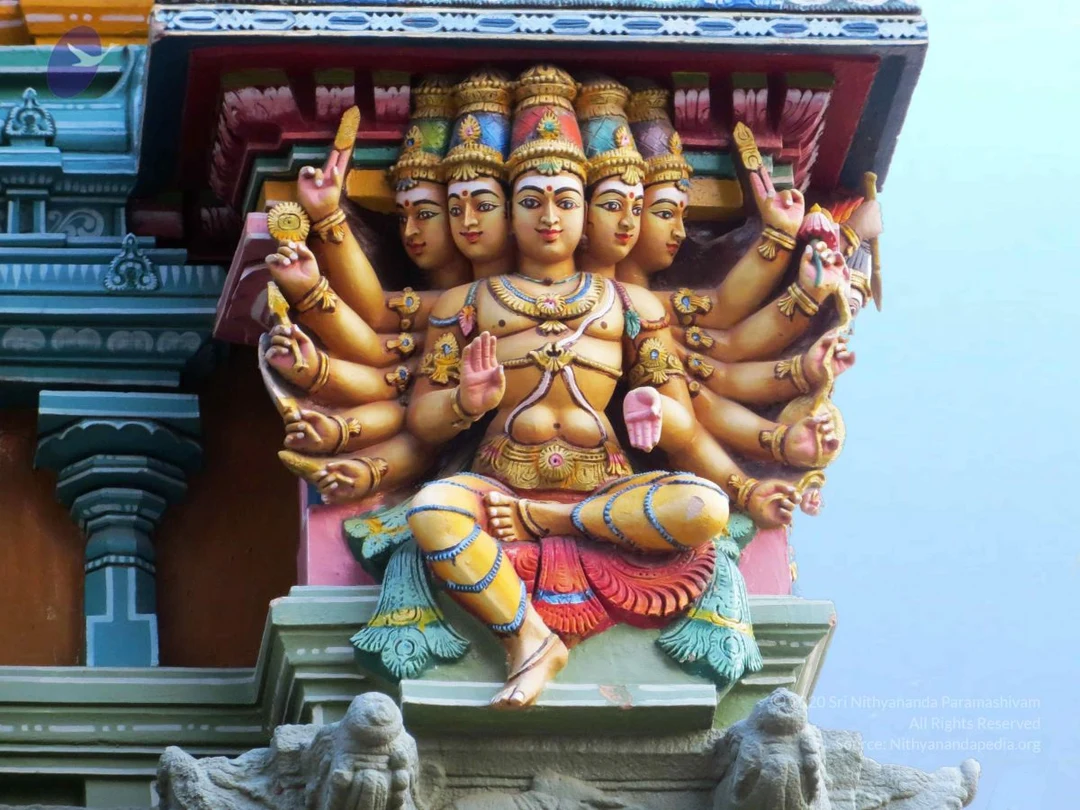
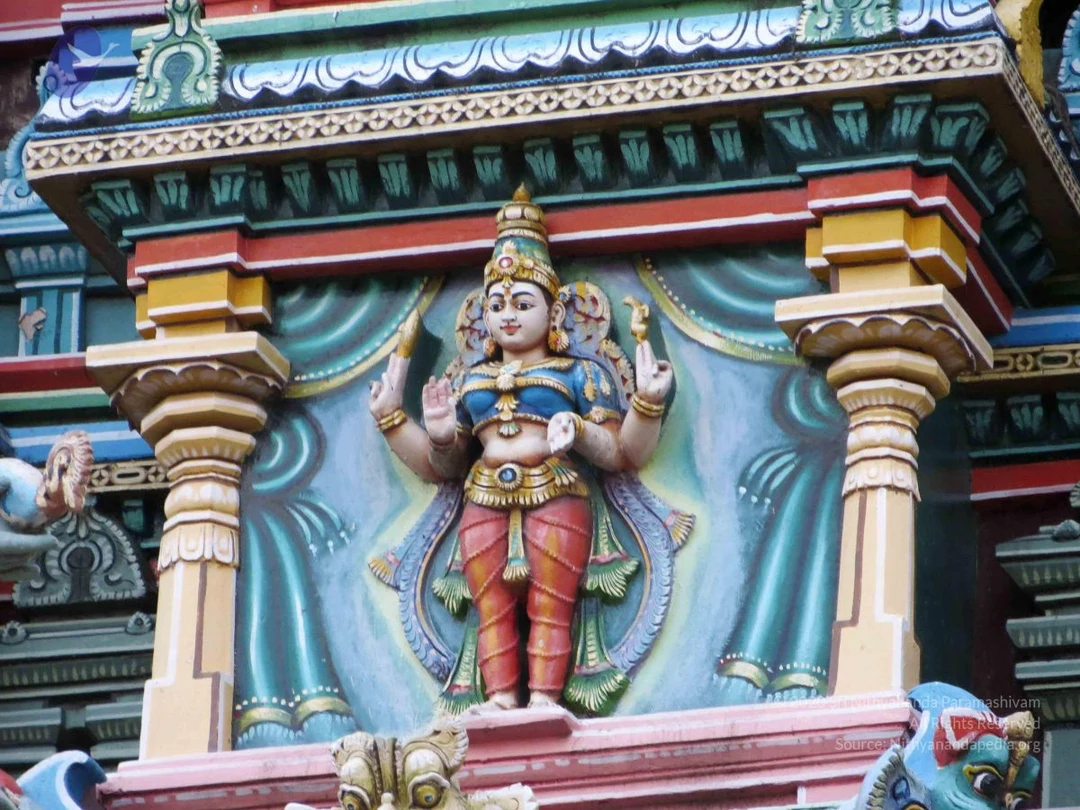
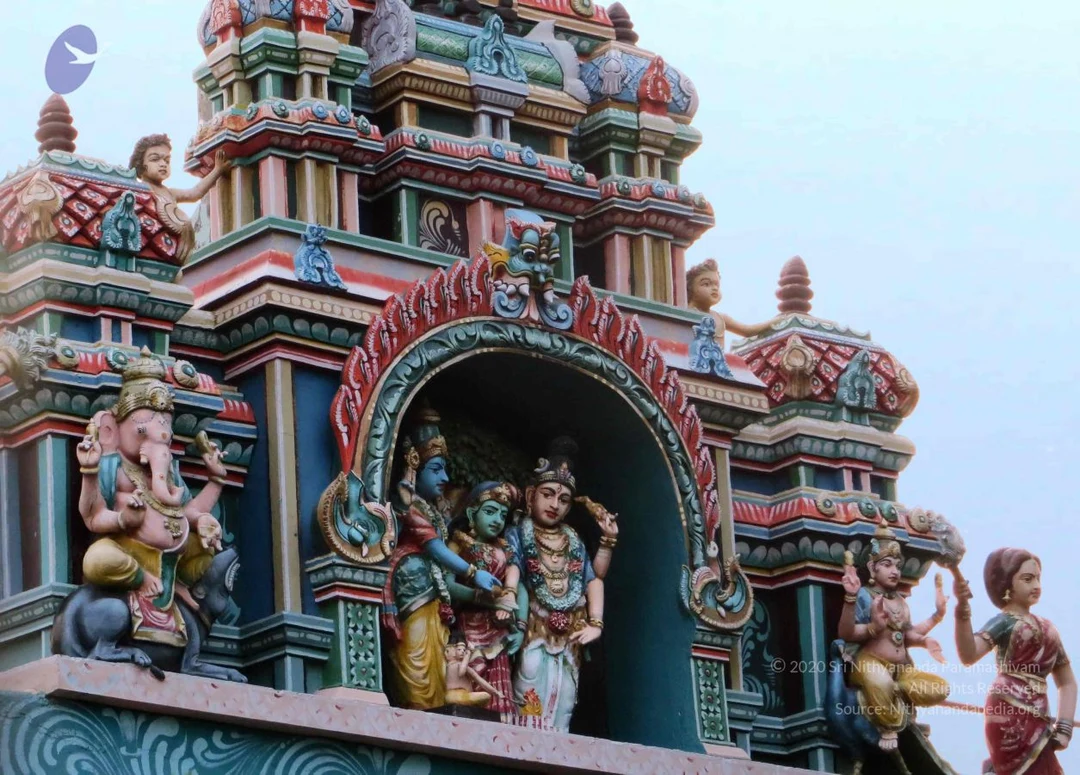
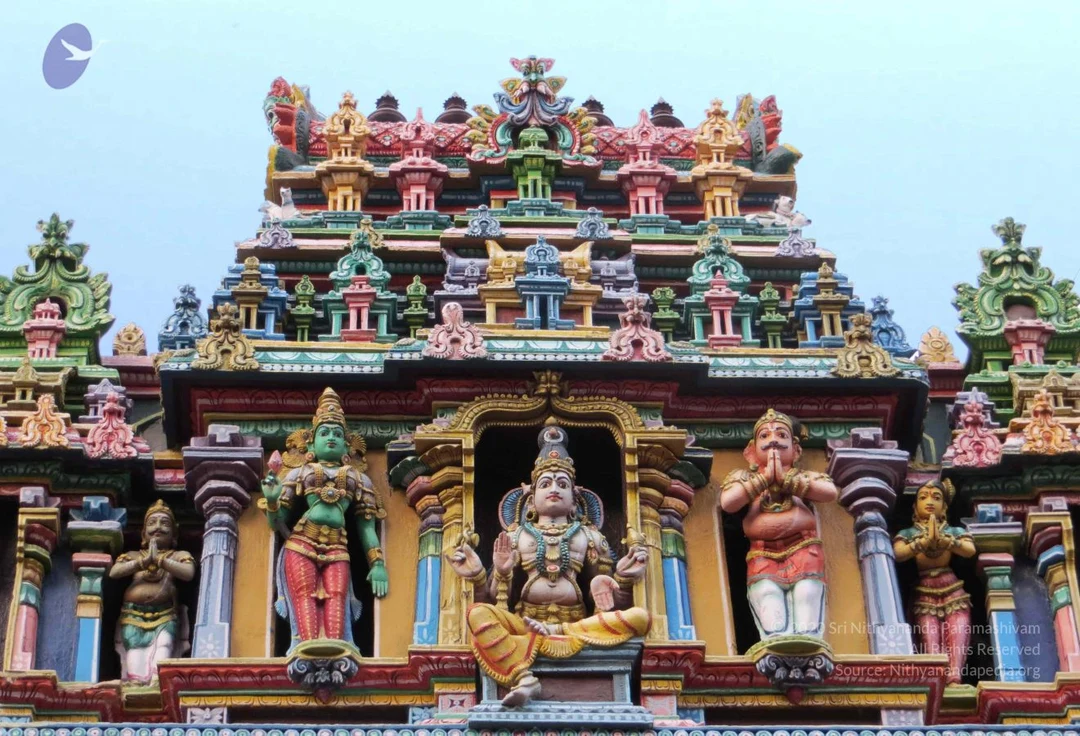
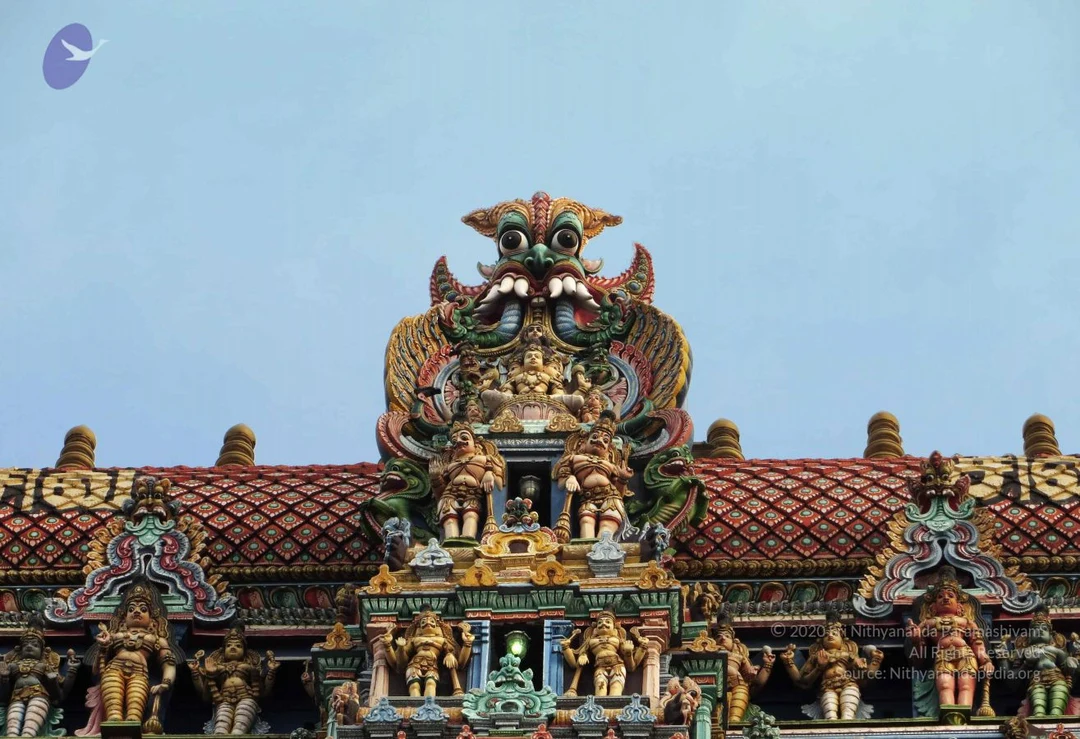
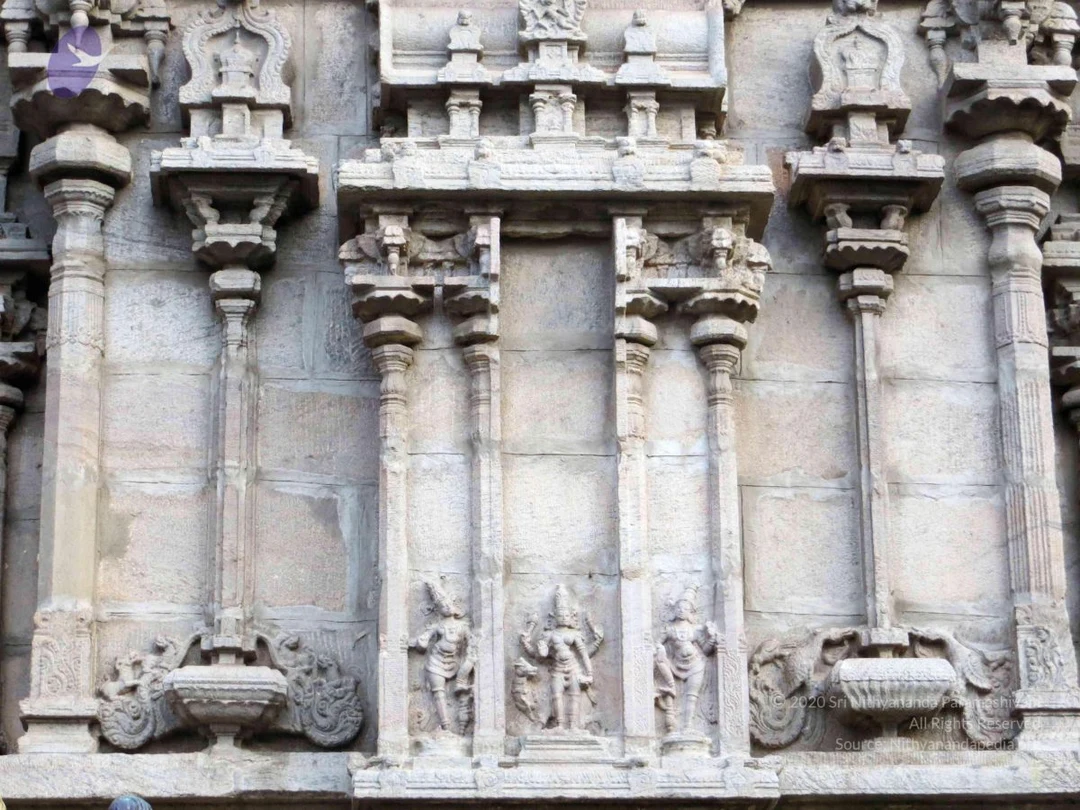
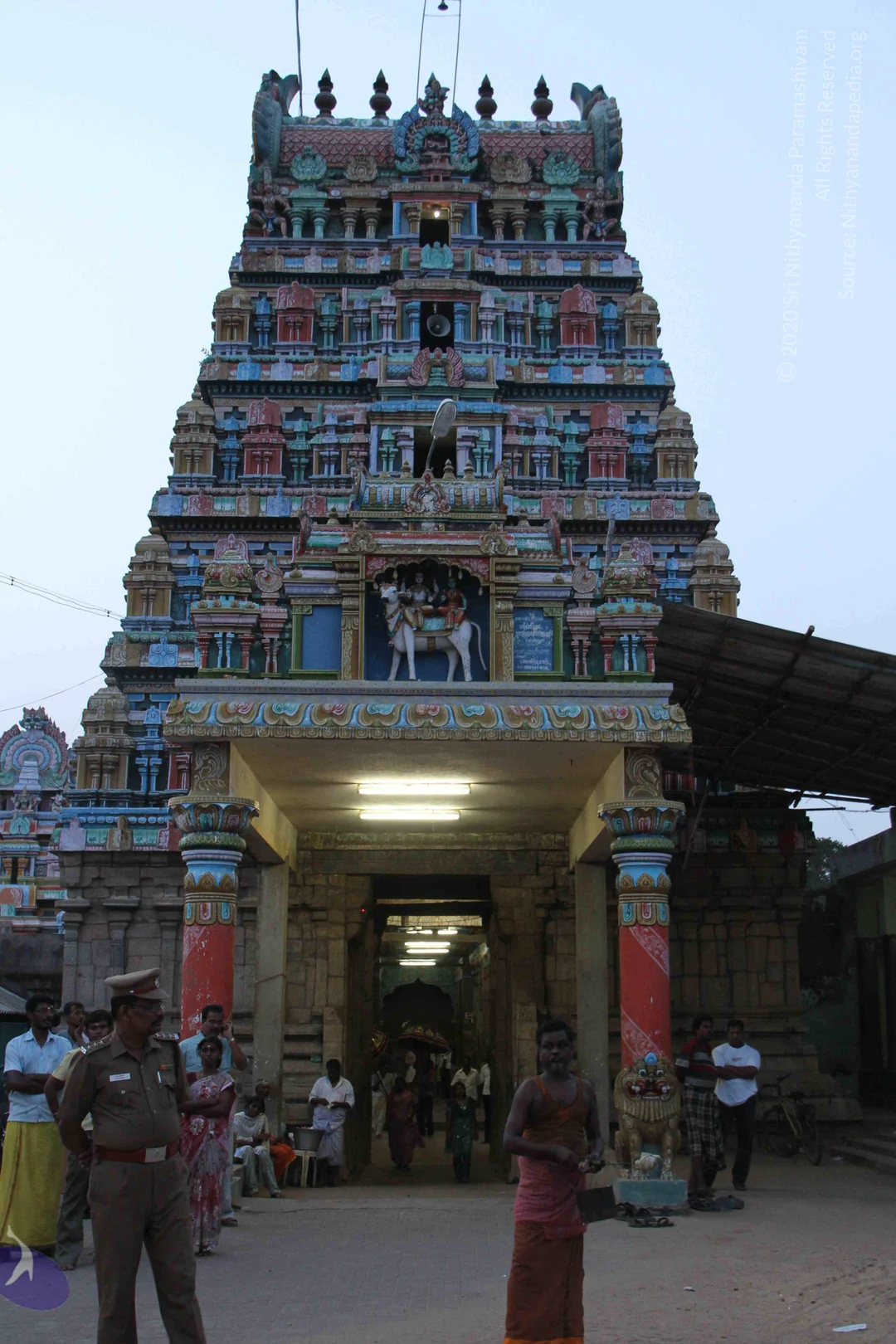
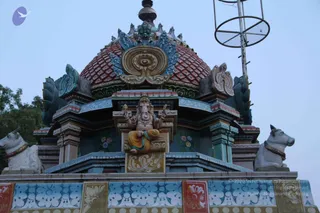
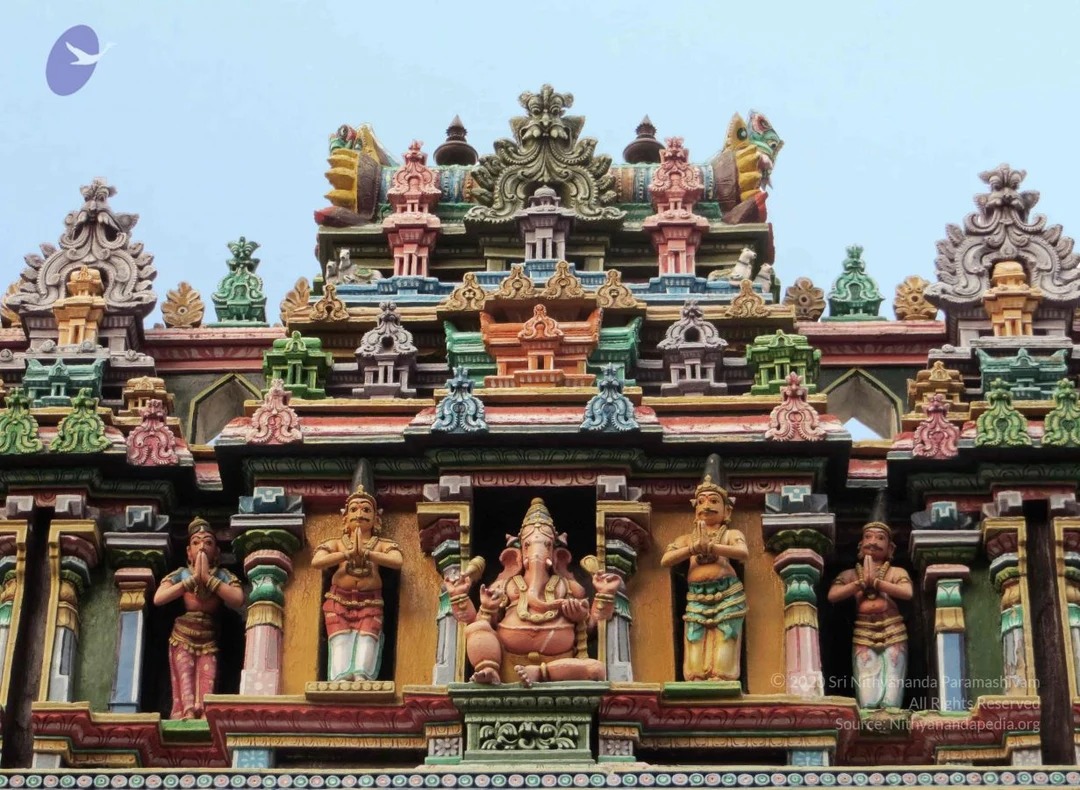
Photograph of a colourful South Indian temple gopuram (tower) with tiered, painted stucco figures and a shrine niche showing a white bull mount with figures, above a pillared entrance hall with red-and-cream columns and a stone lion guardian at right. Several people stand and walk around the entrance in the dusk light: a uniformed police officer in khaki at left, a man in a red-orange dhoti and shirt in the foreground right, and a few devotees and onlookers near the doorway. No a person candidate is visible in the scene.Painted stone sculptures on a temple gopuram tier. On the left, a standing female figure in orange and red garments with gold trim and a gold necklace holds a spoon or ladle and raises one hand. On the right, a seated bearded ascetic with topknot hair, bare chest, rudraksha mala and yellow-orange dhoti sits on a lotus-like base. The surrounding tiers are green, orange and cream with carved floral and scroll motifs.Close view of a colourfully painted temple gopuram with tiers of stone sculptures. Central niche holds a standing deity murti with a crown and blue dhoti, flanked by attendant figures with raised hands in gold ornaments. Seated sages on top wear dark matted hair, rudraksha-style beads and bare upper bodies. Carved floral finials in turquoise, pink and gold frame the tiers. No living people are visible.

May 29 2012

Original wiki page
Contents

Title:

Courageous Trust Can Conquer All Obstacles.

Description:

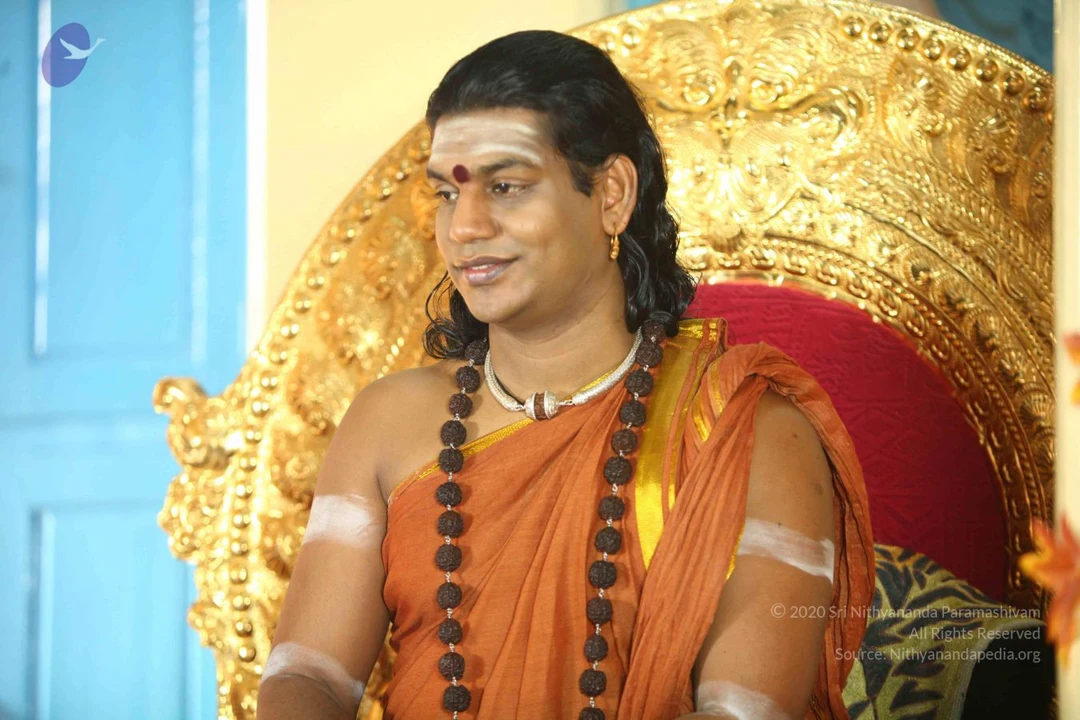
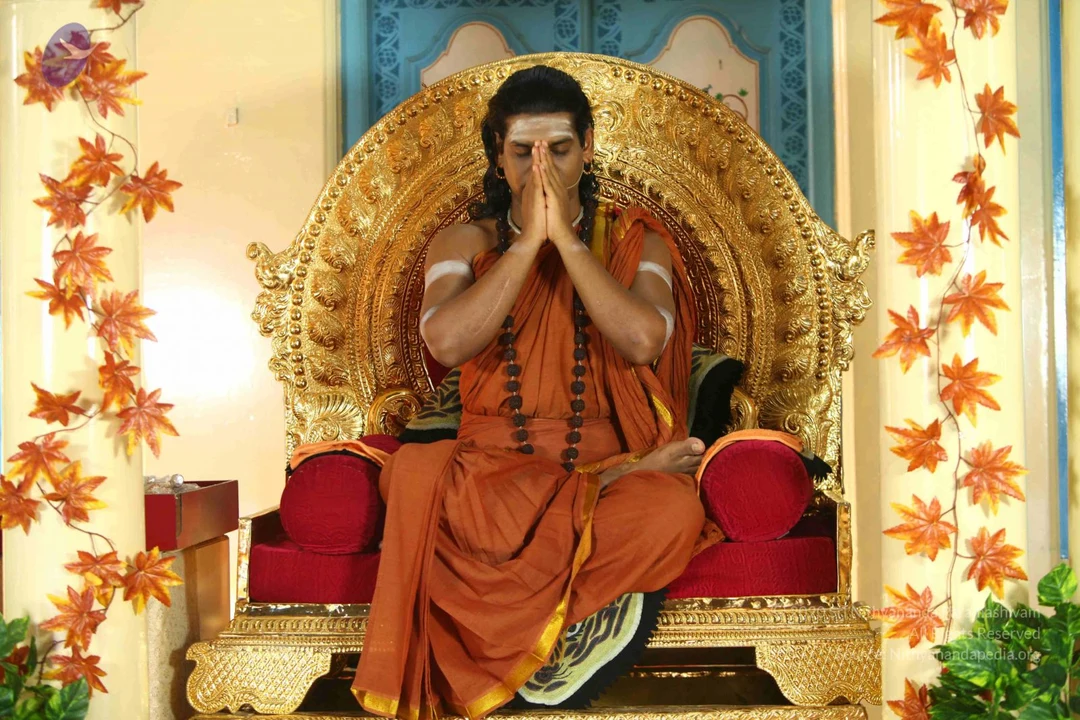
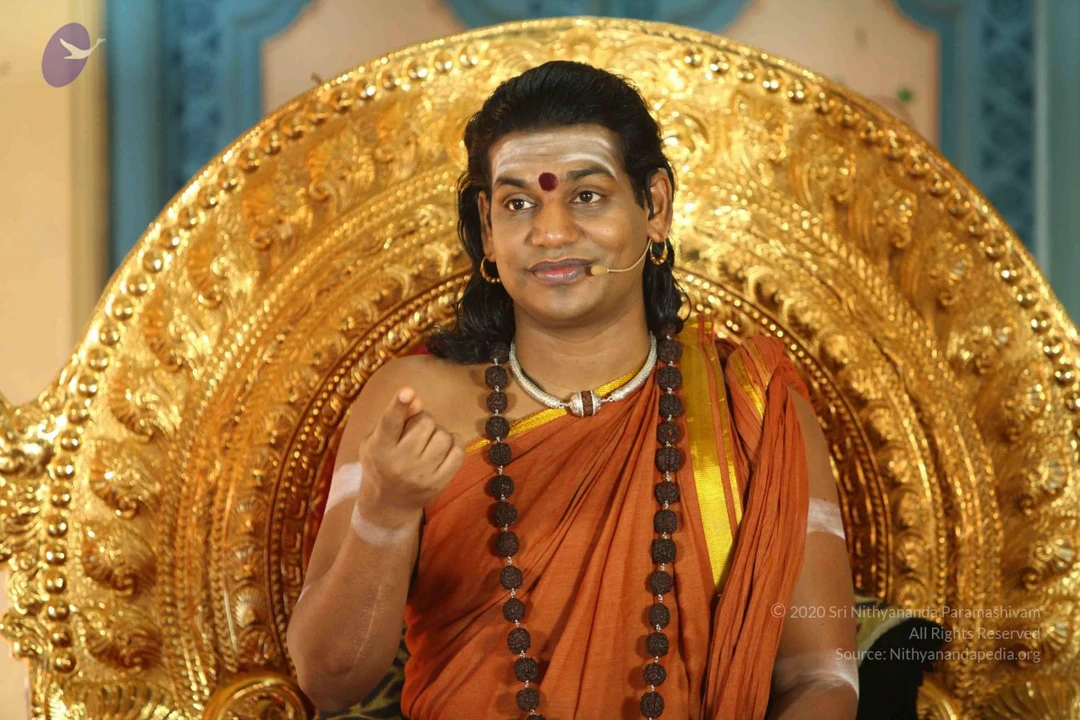
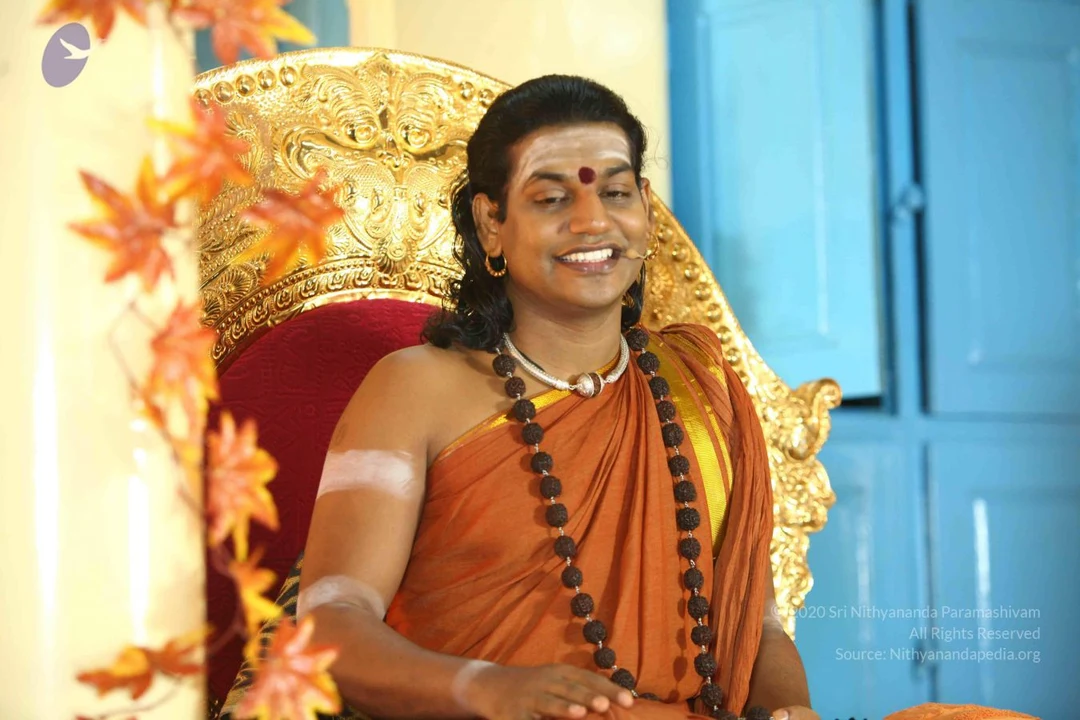
Bhagavad Gita (Song of God) is a timeless treatise on the essence of living enlightenment. The Gita was imparted by the enlightened Hindu incarnation Sri Krishna to the warrior-prince Arjuna over 5000 years ago. Amazingly, the spiritual wisdom and life solutions offered in the Gita are so universal and current that it is even today used as a personal transformation guide. In this morning’s talk on Bhagavad Gita, Chapter 4 Verse 39, Paramahamsa Nithyananda (Swamiji) inspires us to invoke the power of shraddha in our spiritual practice. Shraddha is usually translated as “faith”. Paramahamsa extends this definition to embrace “courage”: the fortitude required to endure the pressures that push us into enlightenment. When we yearn for the enlightened state we feel a suffocation, a constraint that our present awareness is too small and too confined. With shraddha we can permit that suffocation to work on us, to burst us open like a seed sprouting into a tree. Paramahamsa gives us a technique to relieve the pressure: share our knowledge with others. This allows us to expand our boundary and release the sense of suffocation.

Link to Video:

VideoAudio

Transcript:

COURAGEOUS TRUST CAN CONQUER ALL OBSTACLES

BHAGAVAD GITA CHAPTER 4, VERSE 39

Discourse Given By PARAMAHANSA NITHYANANDA

29th May, 2012

Swamiji : Today’s Satsang : In Bhagavad Gita, 4th chapter , Jnana Karma Sanyas Yoga, 39th verse

Shraddhaa-vaallabhate Jnaanam tatparaha samyatendriyaha I

Jnaanam labdhvaa param shaanthim achirenaadhi-gacchathi II

Translation : The person with the trust catches hold of consciousness. Beyond that he subdues the power of the senses. Having attained the state of consciousness very soon he acquires supreme auspiciousness.

A person with shraddhaa ! shraddhaa ! The very word is so beautiful and powerful ! Courageous trust is what I call shraddhaa ! Unless the seed has the courage to be pressured by the sand and break open, it can never become tree. Same way, unless your nerves, your cognizing system, the system in which, system through which you take cognizance of life in your system, means through which you perceive, unless that goes through the supreme spiritual yearning pressure, the suffocation due to the insufficient feeling of your capacity to perceive. Please understand, the only difference between you and me is that I can perceive little more, deep into time and space. You can comprehend using your mind may be little bit from the past and little bit in the present and little bit in the future and little bit happening around you. I can perceive little more in the past, little more in the present, little more in the future, little more in the outer and inner space, that’s it! So the yearning to perceive more, suffocation of lower level of perception is the basic requirement for Enlightenment. Unfortunately when that happens, you give different reasons for that suffocation and run away. Actually when somebody comes into the organization and I awaken their Kundalini, the suffocation of insufficient perception only is awakened in them. But unfortunately they feel I think this suffocation is because of the structuring (department), because people don’t care about me. They attribute to all outside and run away, escape. It is not because of any other person, it is because of your Kundalini awakening. When the Kundalini is awakened, the first thing will happen to you is you will feel the insufficient perception, the suffocation of insufficient perception. Shraddha is the strength to face the insufficient suffocation and break it, make it into a complete perception, your capability to perceive, your capability to expand.

Bhagavan is hitting again and again on this same point last three verses. You can see clearly last three verses he goes on talking about ‘spontaneous readiness for intense action’. Still that word is there in my tongue like a hangover of the sweet ! See if you eat some sweet you really like, at least for next 10 minutes you will have the hangover in your tongue. That word is so beautiful - Spontaneous readiness for intense action. Still that word there is in my throat like a sweet ! Now Bhagavan uses beautiful words Shraddhaa-vaallabhate Jnaanam. These three words are used in Vedanta again and again in many places. This three words are popular words, in Aatmabodha, in many of the Shankara literatures and the later Surshwarshwara’s Vartikas and Bodhendra Saraswati’s Teekas and many other post Shankara Vedantic literatures talk about this word Shraddhaa-vaallabhate Jnaanam. All you need is the courage to stand your own yearning, intense yearning. I tell you, seed has to feel the pressure, from outside the pressure of sand, from inside the pressure to become a tree. Only then it slowly opens up and becomes a tree. Same way, when somebody comes here to learn from me, to imbibe from me, the first thing I do I try to expand their perception, their capability to look into past, present, future, outer space and inner space. Please understand, if somebody is screaming at you, if you start immediately hating the person, your perception is too small in the outer space. But if you can wait and look into his pattern and the pattern from which he is shouting and respond only to the pattern and wait for him to get out of that pattern you have more perception, expanded perception in the outer space. Same way in your inner world, if you just go behind your instinct, again reduced perception, suffocating perception ! Instead you wait, watch how ball rolls inside your inner space, how you respond from your pattern, how you try to fulfill something which can never be fulfilled, how you try to run behind something which is never your Prarabdha, again and again and again ! Standing with the tremendous understanding ! I can give you one powerful technique, simple technique to reduce the suffocation and the pressure you feel. Go around and start teaching, connecting with people, then you will see you will neither loose your yearning, Shraddhaa, nor go back to grainary to get fried. See, if you are just constantly working on you , you feel too much of suffocation. If you move out of you, the working, you go back to the grainary where you will just get fried and you will never ever sprout again. Instead, you teaching, relating with people, connecting with others as a method, process, technique to ease the suffocation, to ease the suffering.

Shraddhaa-vaallabhate Jnaanam tatparaha samyatendriyaha I

Jnaanam labdhvaa param shaanthim achirenaadhi-gacchathi II

The person with the trust catches hold of the consciousness. Beyond that he subdues the power of the senses. Having attained the state of consciousness, very soon he acquires supreme auspiciousness. Enlightenment is literally an alchemy process. Sometime people think it is a option. I tell you, No ! It is compulsion ! Everybody who assumed the body, has to achieve Enlightenment ! It is not just destination It is Destiny. It is Destiny and Destination of every individual who assumed the body. Ramakrishna says very beautifully even if you are far away from Ganga, you want to drink only Ganga water and you are travelling towards it, even if you are not getting the Ganges water don’t drink drainage water ! Proceed, proceed, proceed, progress in the path of getting the Ganges water, even if you die in between, it is okay; you will take one more body and start from that place where you left but don’t drink drainage water, don’t compromise.

The Sacred secret in this verse is exactly that. Shraddhaa-vaallabhate Jnaanam. Do not feel comfortable in the warmth of the frying pan. Even if it is heavy pressure under the sand , be there, you will open up and become a Tree. Be there where the possibility for the higher opening is there. Don’t be in a place even if it is warm now, which will freeze all your possibility. Let me be rid of this now , don’t work with that idea.

Shraddhaa-vaallabhate Jnaanam. I give you this three words Shraddhaa-vaallabhateJnaanam, Also one of the important Quotations .Try to write these three words eleven times in your Book of Heart. Shraddhaa-vaallabhate Jnaanam, Shraddhaa-vaallabhate Jnaanam. And try to internalize this three word. Shraddhaa-vaallabhate Jnaanam. Now sit for few seconds and internalize this word Shraddhaa-vaallabhate Jnaanam . Close your eyes. Feel the Master’s presence and internalize this one word Shraddhaa-vaallabhate Jnaanam.

Spot Notes: Tuesday, 29 May 2012

“Sadashiva samarambam, Jnana Sambandhaacharya madhyamam asmadacharya paryantam vande Guru paramparam!”

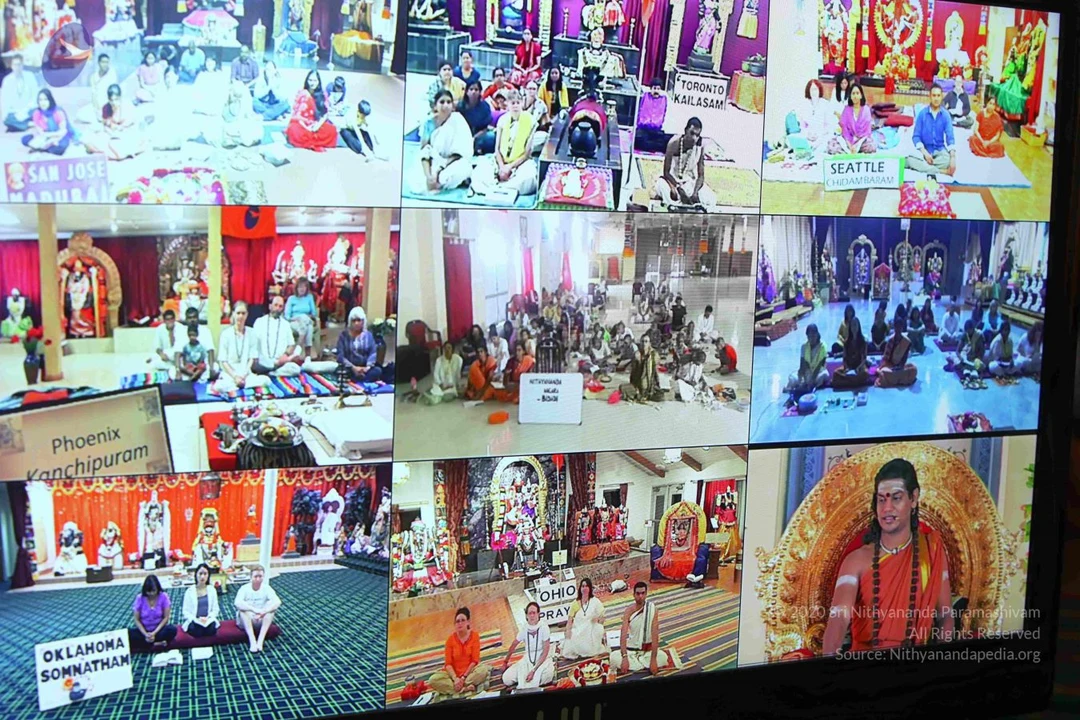
I welcome you all with my love and respects! I welcome all the devotees, disciples, Samajis, Satsangis sitting with around the world at this moment in 842 places through Nithyananda TV, 24 places 2 way video conferencing having Nayana Deeksha, in 222 cities, in 22 countries around the world!

Cities sitting with us in 2 way Video conferencing having Nayana Deeksha are – Oklahoma Somanatham, Los Angeles Arunachalam, Singapore Singapuram, Toronto Kailasam, Hyderabad Bhagyanagara, Seattle Chidambaram, San Jose Madurai, Ohio Prayag, Ohio Centre, Dallas Dwaraka, Malaga Spain, Atlanta Ujjayini, Nithyananda Nagara Bidadi, Vancouver Puri, Charlotte Srisailam, Malaysia Palani, Tiruvannamalai Arunachala, Kastav Croatia, Orange County California, Weston Florida, Oman Siva Gangai. I welcome all of you with my love and blessings!

Today’s Satsang in Bhagavad Gita, 4th chapter, Jnaana Karma Sanyaasa Yoga, 39th verse –

“sraddhavan labhate jnanam tat-parah samyatendriyah | jnanam labdhva param santim acirenadhigacchati ||”

Translation – “The person with the trust catches hold of consciousness. Beyond that he subdues the power of the senses. Having attained the state of consciousness very soon he acquires supreme auspiciousness.”

A person with Shraddha. Shraddha - the very word is so beautiful and powerful. Courageous trust is what I call Shraddha. Unless the seed has the courage to be pressured by the sand and break open it can never become tree. Same way unless your nerves, your cognizing system the system through which you take cognizance of life you take cognizance in your system, means through which you perceive unless that goes through the supreme spiritual yearning pressure, the suffocation due to the insufficient feeling of your capacity to perceive. Please understand, the only difference between you and me is that I can perceive little more, deep into time and space. You can comprehend using your mind maybe little bit from the past, little bit in the present and little bit in the future and little bit happening around you. I can perceive little more in the past, little more in the present, little more in the future, little more in the outer and inner space. That’s it. So the yearning to perceive more, suffocation of lower level of perception is the basic requirement for enlightenment. Unfortunately, when that happens you give different reasons for that suffocation and run away. Actually when somebody comes into the organization, when I awaken their kundalini, the suffocation of insufficient perception only is awakened in them. But unfortunately, they feel maybe this suffocation is because of structuring, because people don’t care about me. They attribute to all outside and run away. Escape! It is not because of any other person it is because of the kundalini awakening. When the kundalini is awakened, the first thing will happen to you is you will feel the insufficient perception. The suffocation of insufficient perception. Shraddha is the strength to face the insufficient suffocation and break it, make it into a complete perception.

Your capability to perceive, your capability to expand, Bhagavan is hitting again and again on this same point last three verses. You can see very clearly last three verses he goes on talking about spontaneous readiness for intense action. Still that word is there in my tongue like a hangover of a sweet. See if you eat a sweet you really like at least for next ten minutes you will have hangover in your tongue. That word is such a beautiful word – spontaneous readiness for intense action. Still that word is there in my throat like a sweet. Now Bhagavan uses beautiful word – ‘sraddhavan labhate jnanam’ these three words are used in Vedanta again & again in many places. These three words are popular words. In Aatma bodha in many of the Shankara’s literatures and later in Sureshwara’s vaartikas and Bodhendra Sarawathi’s teekas and many other post Shankara Vedantic literatures talk about these three words ‘sraddhavan labhate jnanam.’

All you need is the courage to stand your own yearning, intense yearning. I tell you seed has to feel the pressure from outside the pressure of sand, from inside the pressure to become a tree. Only then it slowly opens up and becomes a tree. Same way, when somebody comes here to learn from me, to imbibe from me, the first thing I do I try to expand their perception their capability to look into past, present future, outer space and inner space. Please understand, if somebody is screaming at you, if you start immediately hating that person, your perception is too small in the outer space. But if you can wait and look into his pattern and the pattern from which he is shouting and respond only to that pattern and wait for him to get out of that pattern, you have more perception, expanded perception in your outer space. Same way in your inner world. If you just behind yoru instinct again reduced perception suffocating perception. Instead you wait, watch, how ball rolls inside your inner space, how you respond from your pattern, how you try to fulfil something which can never be fulfilled. How you try to run behind something which is never your praarabdha. I have seen people with narrow perception suffer, suffer, suffer, suffer and destroy themselves. See the whole spirituality is nothing but expanding your perception. Naturally when I start expanding your perception immediately you lose something inside you and start feeling oh God! then there is something more than what I am perceiving. This whole understanding that there is something more than what I am perceiving, shakes your whole thing. Larger yearning, deeper discontentment, suffocation of lower perceptions starts happening in you especially when I awaken kundalini your perception expands, the possibility of perception becomes more. That is why I insist once your kundalini is awakened try to be around the master in a stable way. Otherwise you will blame the situation or somebody else for your suffocation. If a seed starts blaming somebody for its suffocation, it will never become a tree. Unfortunately sometime people assume somebody else or something else like a reason for suffocation and try to run away from this place, escape from this place. Its like almost when the seed is about to open up and become a tree, it escapes and runs way, goes back to the granary – father’s place J But unfortunately in granary all the grains will be fried. Understand the seeds which fight with the sand or the atmosphere create for it to flower to become a tree and goes back to the granary gets fired. Please understand pressure of the sand is million times better than the heat of the frying pan! Because once you are fried, you never ever sprout again. The possibility for sprouting is destroyed. But unfortunately, people feel in that warmth-ness very comfort, in the frying pan you feel comfort, very comfortable than the pressure of the sand.

Understand, even if it is suffocating, even if it is pressure be in the sand to grow. Do not jump back to the granary from where you came. Again and again and again standing with the tremendous understanding. I can give you one powerful technique -simple technique to reduce the suffocation and pressure you feel. Go round and start teaching, connecting with people. Then you will see you will neither lose your yearning shraddha nor go back to the granary to get fried. See if you are just constantly working on you – you feel too much of suffocation. If you move out of you the working you go back to the granary where you will just get fried and you will never ever sprout again. Instead you teaching, relating with people, connecting with others as a method, process technique to ease the suffocation. To ease the suffering.

“sraddhavan labhate jnanam tat-parah samyatendriyah | jnanam labdhva param santim acirenadhigacchati ||”

“The person with the trust catches hold of consciousness. Beyond that he subdues the power of the senses. Having attained the state of consciousness very soon he acquires supreme auspiciousness.”

Enlightenment is literally the alchemy process. Sometime people think it is option. I tell you no. it is compulsion. Everybody who assumed the body has to achieve enlightenment. It is not just destination, it is destiny. It is destiny and destination of every individual who assumed the body. Ramakrishna says very beautifully even if you were far away from Ganga, you want to drink only Ganges water and you are travelling towards it. Even if you are not getting the Ganges water, don’t drink drainage water. Proceed, proceed and progress in the path of getting the Ganges water. Even if you die in between it is okay. You will take one more body and start from that place where you left. But don’t drink the drainage water. Don’t compromise. The sacred secret in this verse is exactly that. ‘Shradddhavan lapate jnanam.’

Do not feel comfortable in the warmth of the frying pan. Even if it is heavy pressure under the sand, be there you will open up and become a tree. Be there where the possibility for the higher opening is there. Don’t be in a place even if it is warm now which will freeze all your possibility. Sometime this bramhacharis or brahmacharinis they are not able to withstand the pressure of this spritual practice and this spiritual alchemy. They run away and they feel very relieved in their house. They also write I feel very relieved. But the warmth you feel, the relieved you feel is the warmth of the frying pan. It will be very relieving for two days. The warmth you feel in frying pan is the killing warmth. The pressure you feel under the sand is a growing pressure. Do not decide based on the small perception. Let me rid of this now – don’t work with that idea. Even the devotees I have seen. When they feel the pressure of the spiritual practice or the Sangha working on them, they tend to run away, they give the key back. But don’t you understand, it is only in the pressure you expand and grow. It is the pressure of the sand which gives the life. Never the warmth of the frying pan. The comfort which destroys the possibility is the warmth of the frying pan. Pressure which awakens your possibility is the pressure of the sand. Seed has to decide what it wants to do, how its life should be, where it should be. Every successful banyan tree has gone through the pressure of the sand and the pressure to become a tree internally. Pressure of the sand externally and pressure of the possibility internally. Pressure of the sand externally is what I call pressure of the Sangha. Internal pressure is what I call your yearning shraddha. Every banyan tree successful banyan tree has gone through that pressure as a seed. If it has not gone through it would have become fried seed, it would have never become tree. I tell you if you are feeling pressured, suffocated, by anything happening around me, whether you are part of the Sangha as a volunteer or Ashramite or as a devotee, or samaji, satsangi understand remember this one truth Swamiji also has gone through this same pressure. But he stood! That is why he has exploded. I tell you the moment you remember I have gone through, your tremendous love for me, your feeling connection that itself takes away the suffering part of that suffocation. When he has gone through why not me? That gives you tremendous shraddha to perception the higher perceptions of the same suffocation and to presume the path courageously. Having higher perception, perceiving in a larger scale and pursuing your saadhana is what I call Shraddha.

“Shraddhavan lapate jnanam” - I give you this 3 word – repeats also as one of the important quotation. Try to write this 3 word 11 times in your book of heart and try to internalize this three word – “shraddhavan lapate jnanam”

Now sit for few seconds and internalize this word “shraddhavan lapate jnanam.”

Close your eyes. Feel the master’s presence and internalize this one word – “shraddhavan lapate jnanam.”

We will move to the next segment of morning Satsang – Dial the Avatar. Bela Patel from California you are able to hear me ma?

Today’s minutes to be entered in minutes4peace.org website - 75 minutes.

I bless you all who are sitting with us at this moment around the world in places 842 through Nithyananda TV, in 24 places through 2 way Video conferencing having Nayana Deeksha, in 222 cities, in 24 countries around the world! Let you all achieve, experience, live, express, radiate and share and explode the eternal bliss, Nithyananda. Thank you!

Title:

Paramashivoham Oneness Capsule 155 (29 MAY 2012 Kanchanoor Temple Visit)

Description:

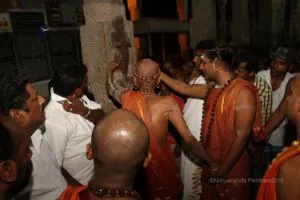
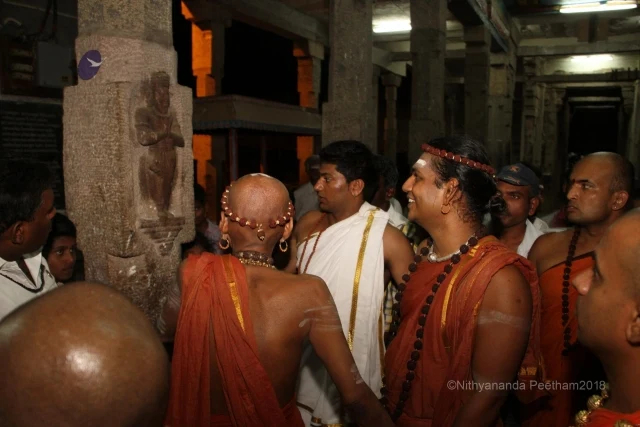
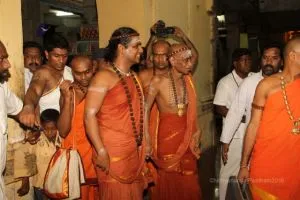
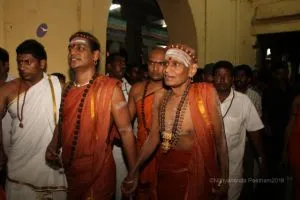
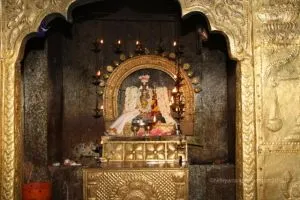
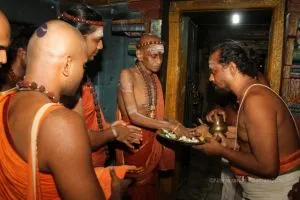
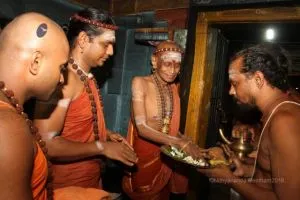
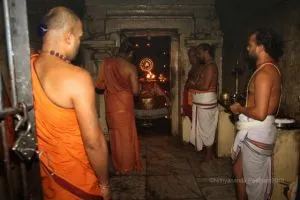
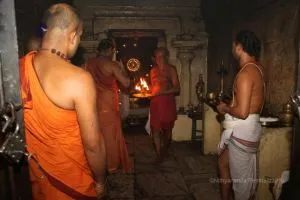
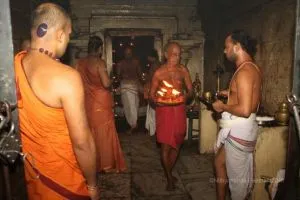
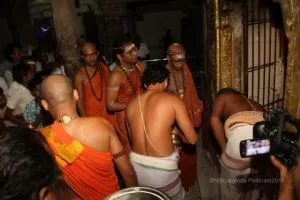
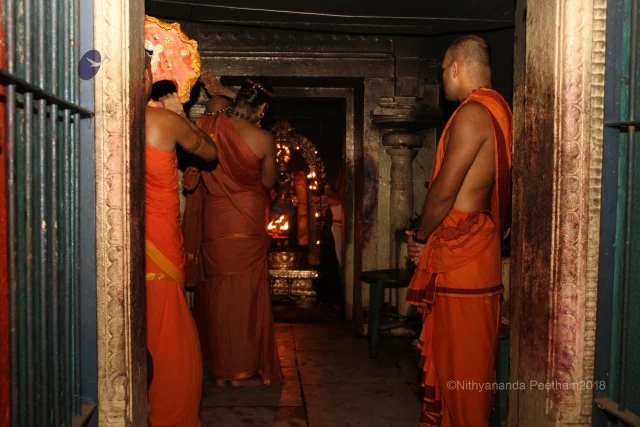
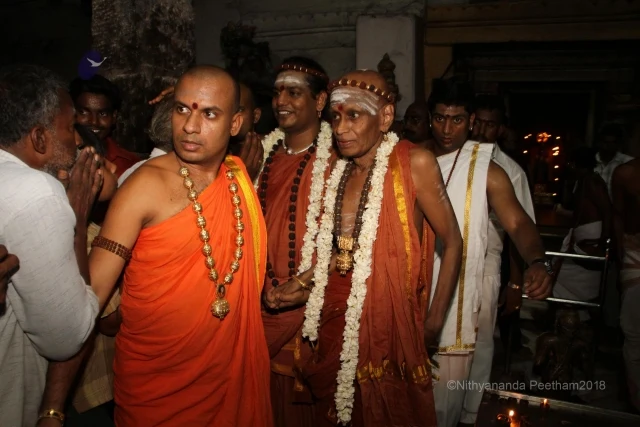
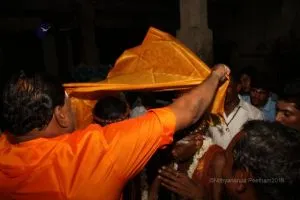
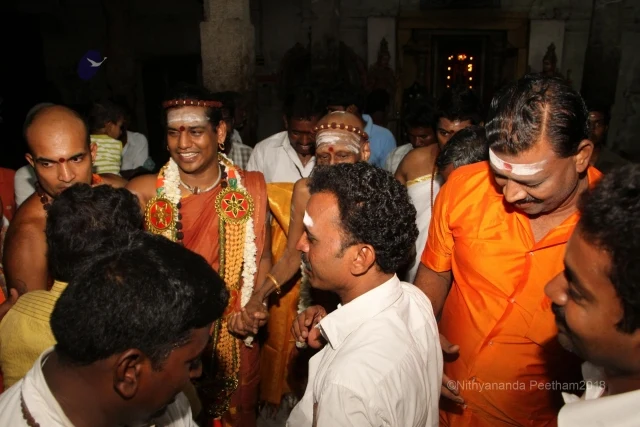
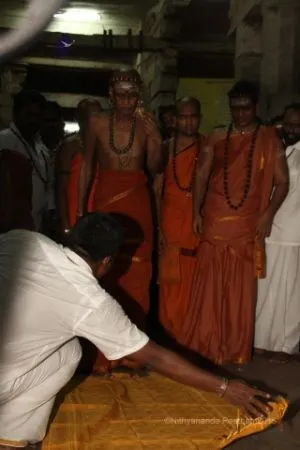
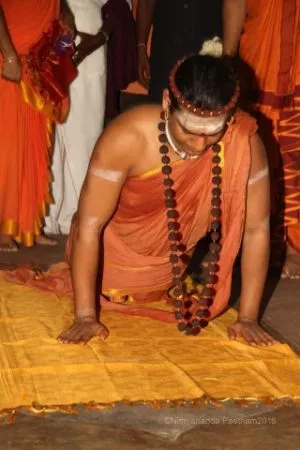
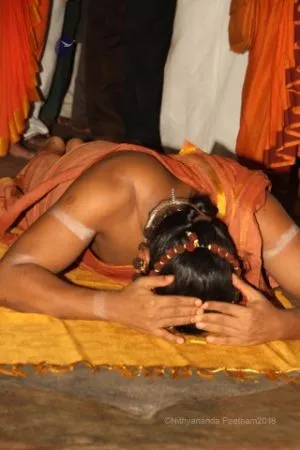
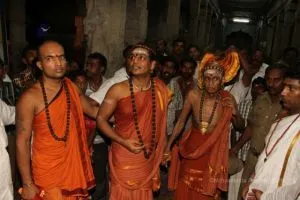
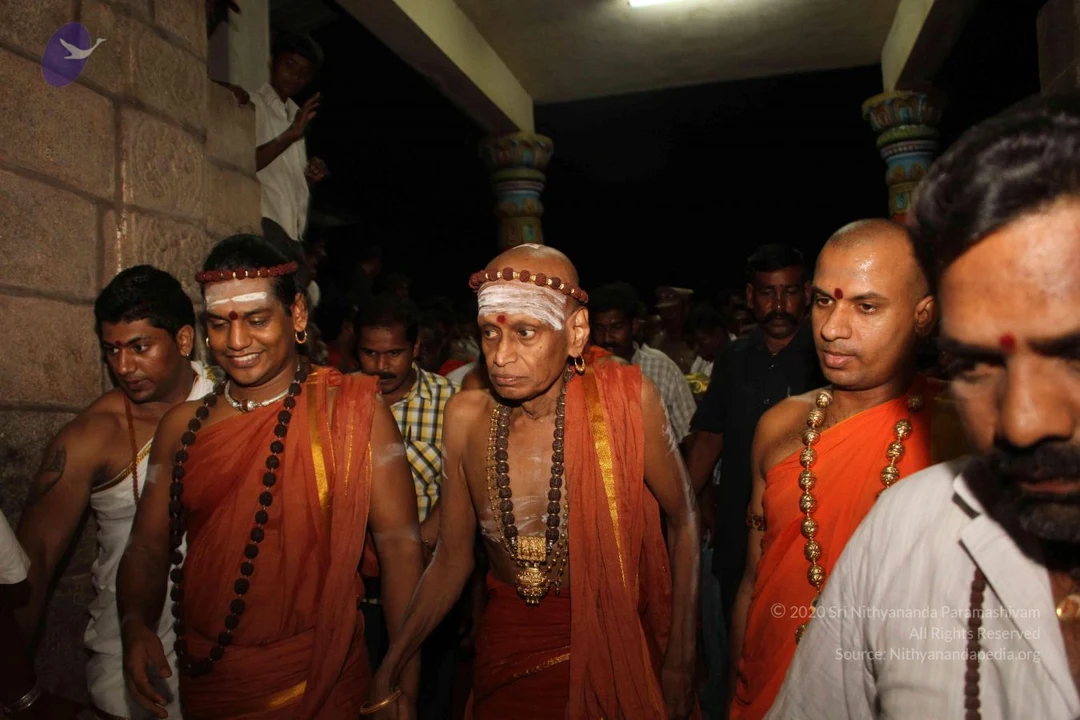
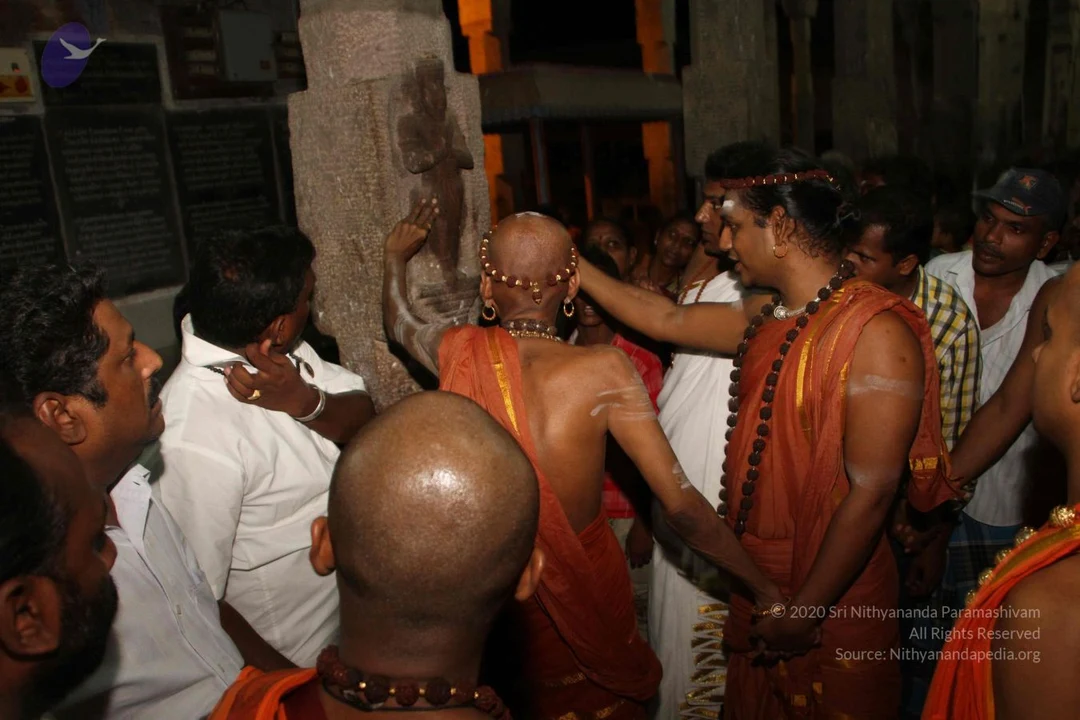
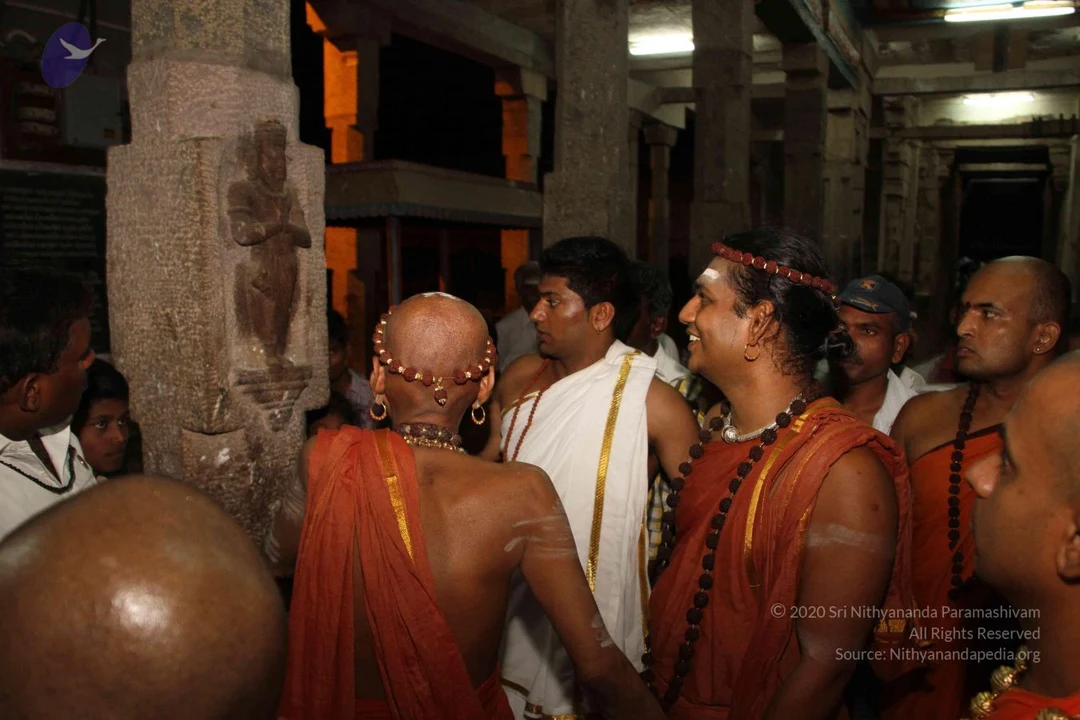
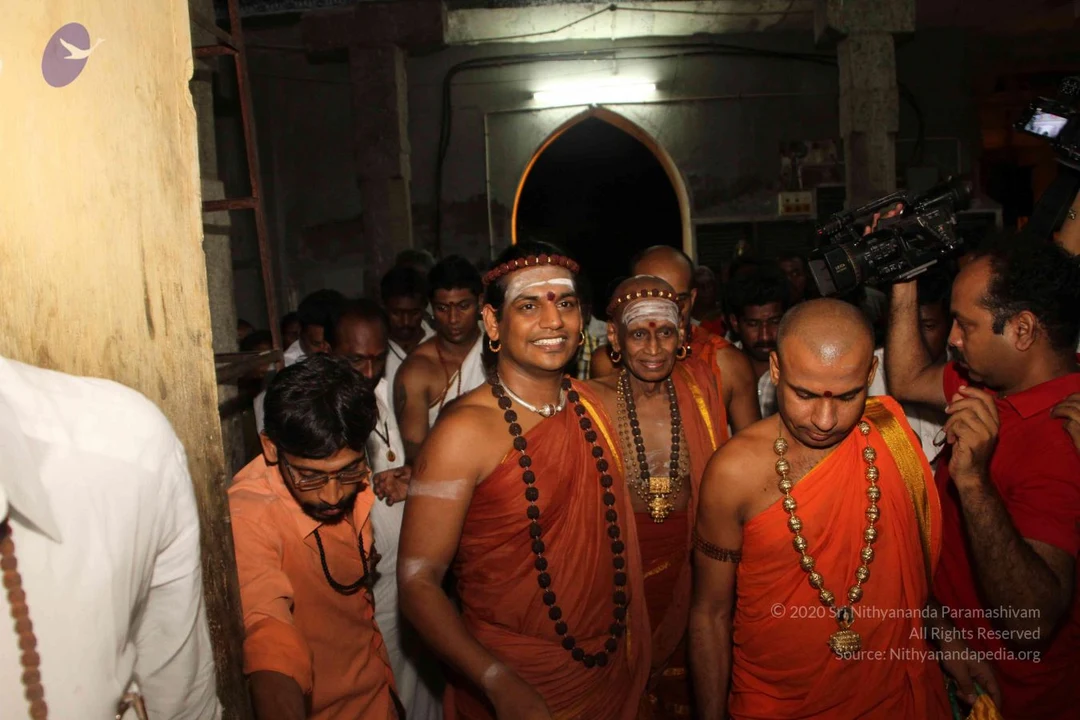
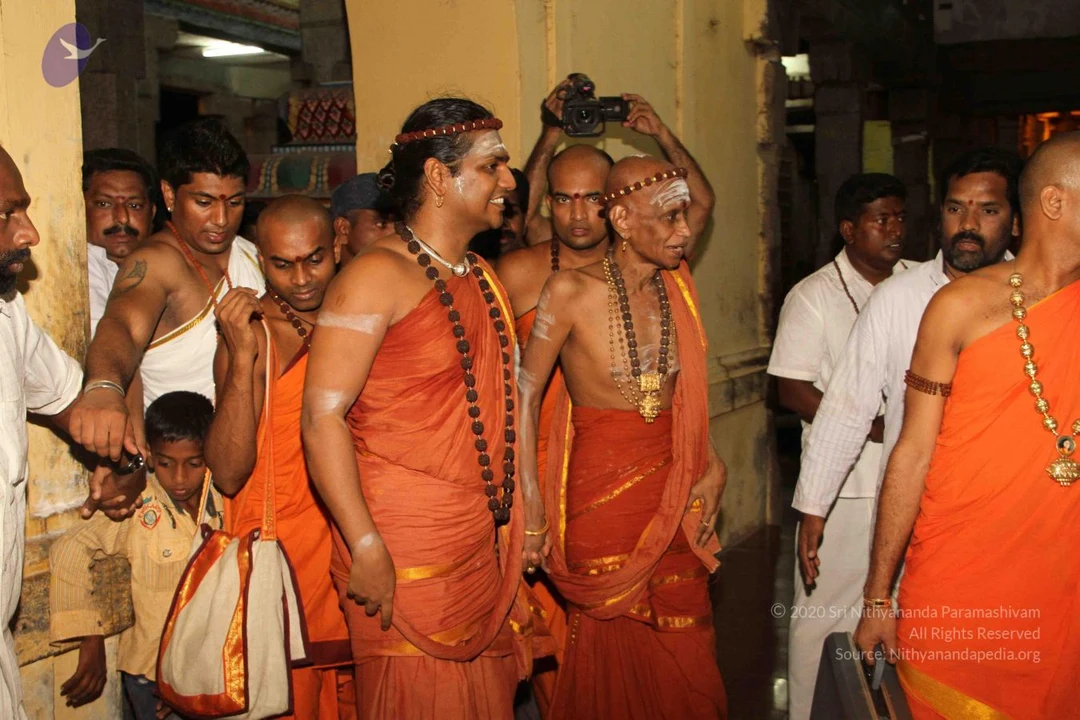
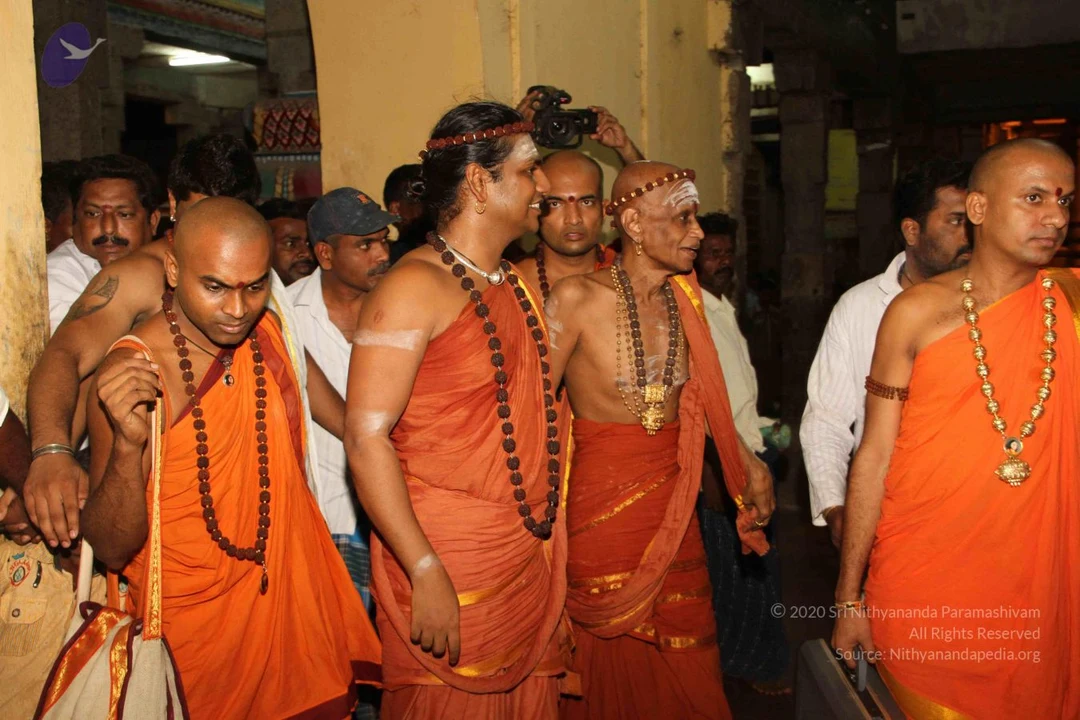
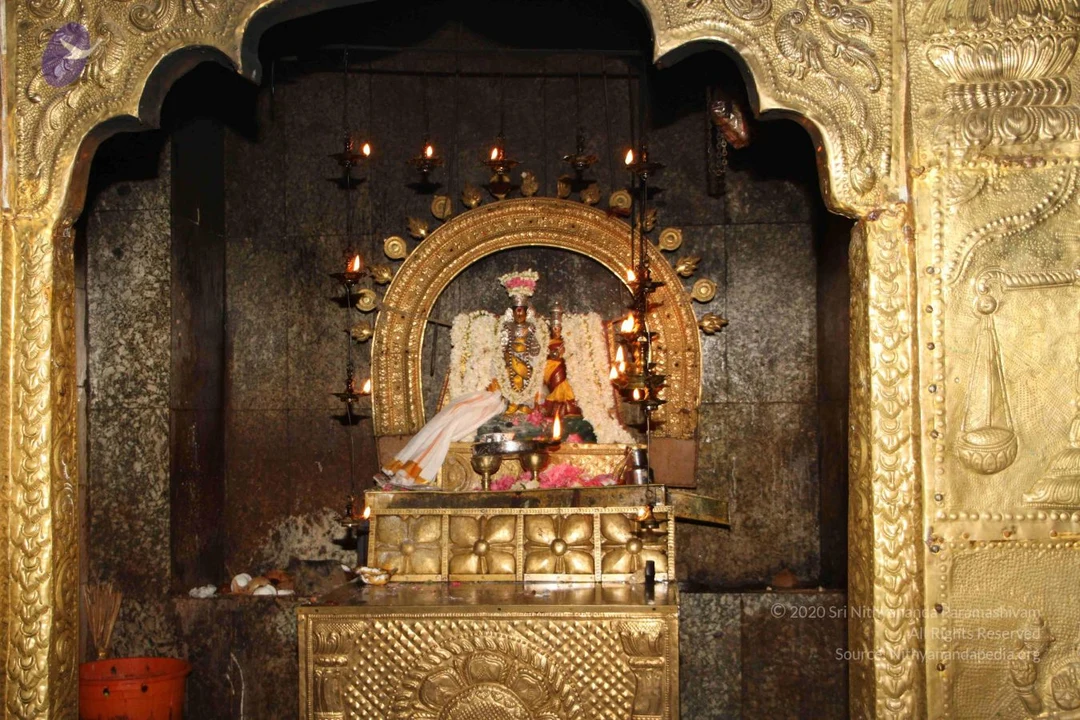
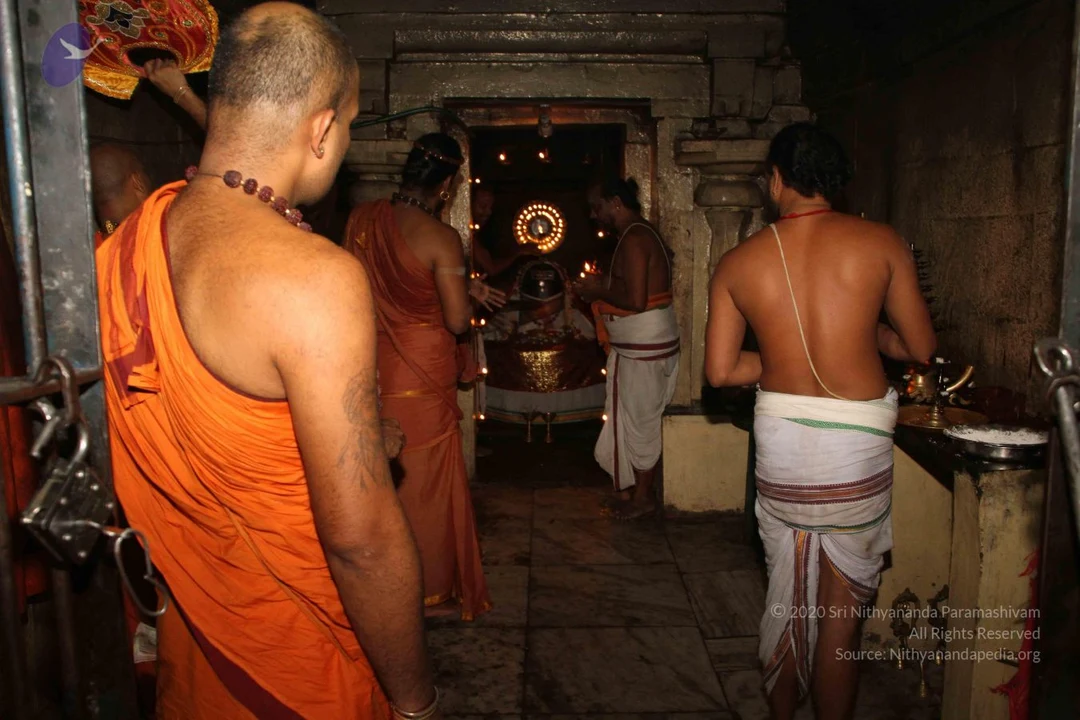
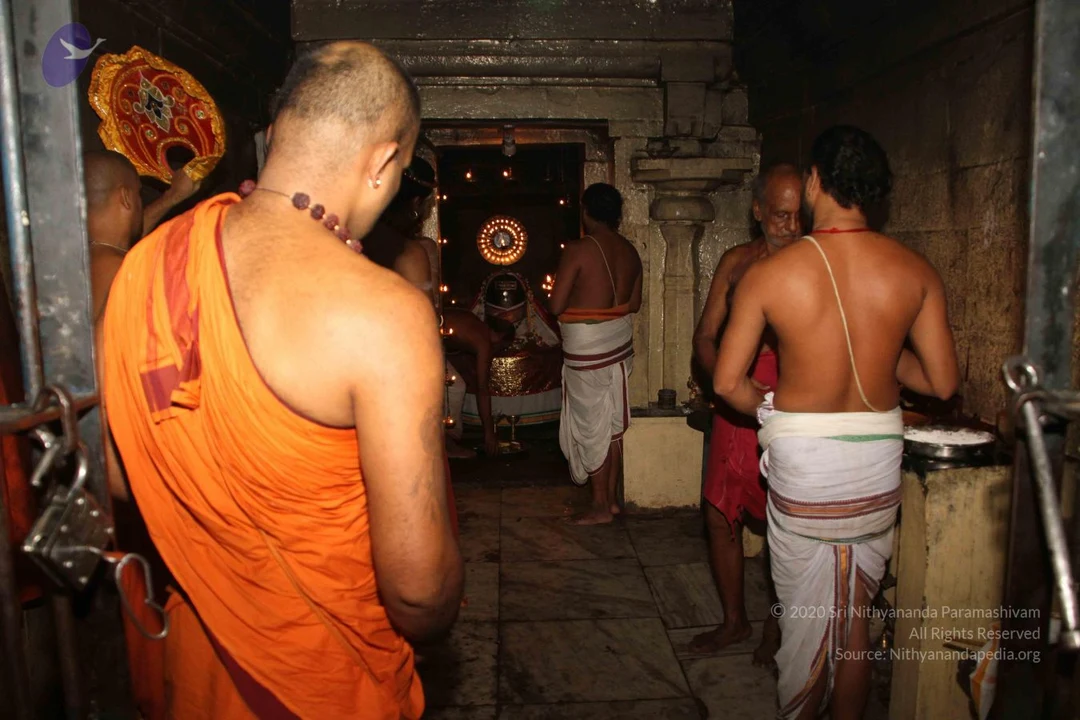
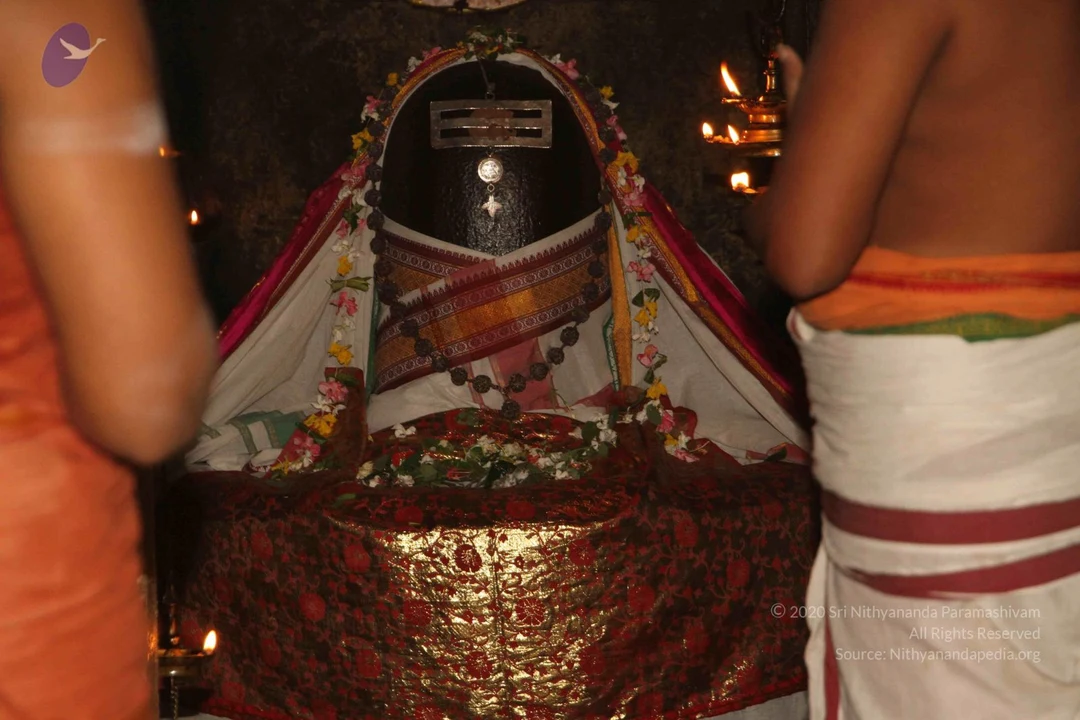
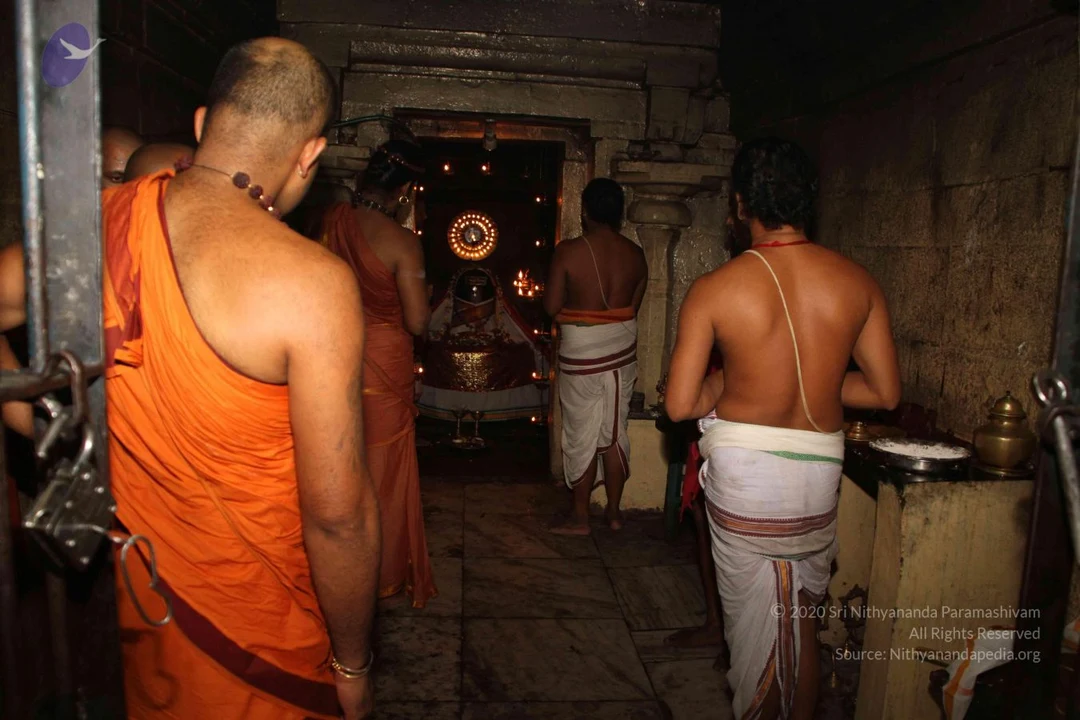
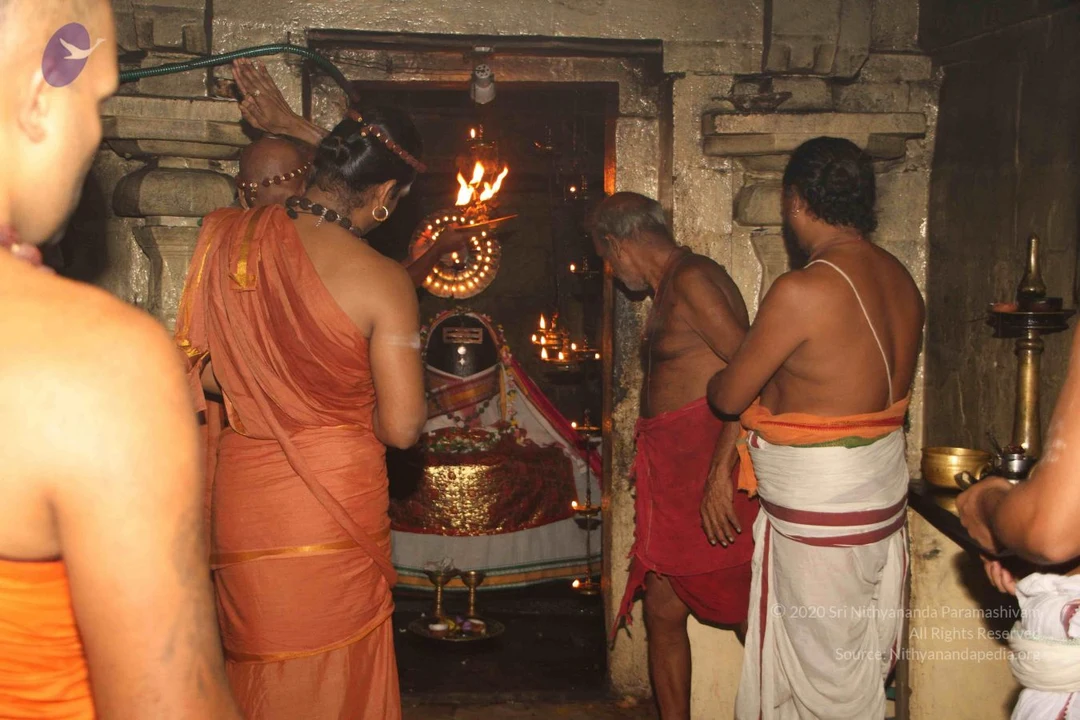
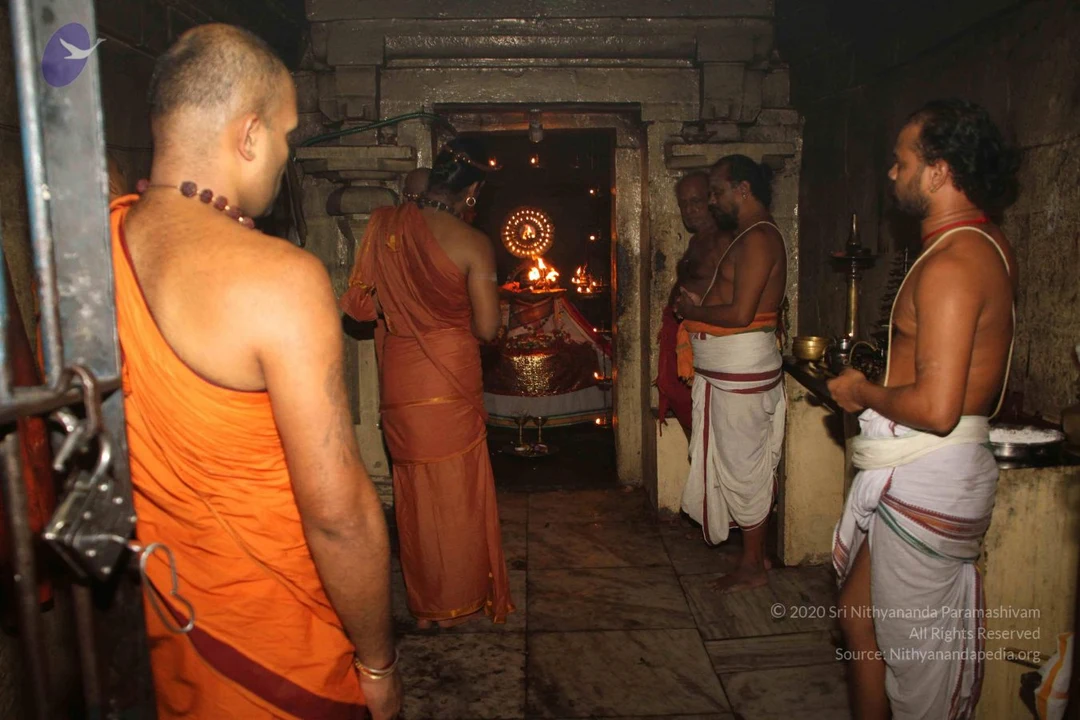
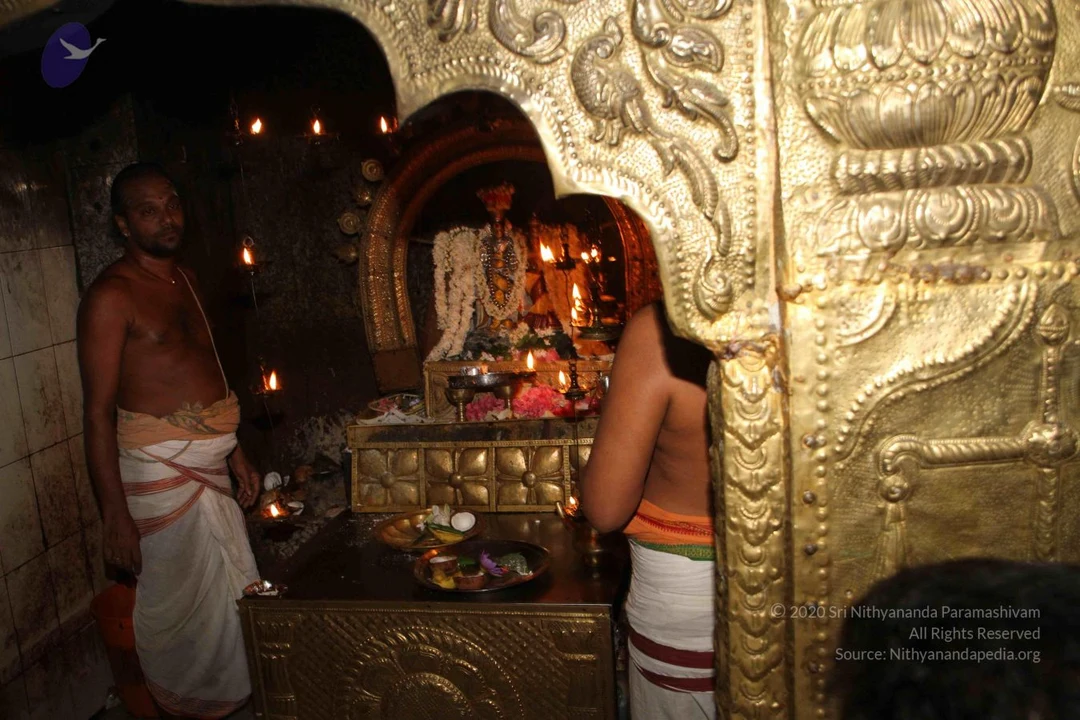
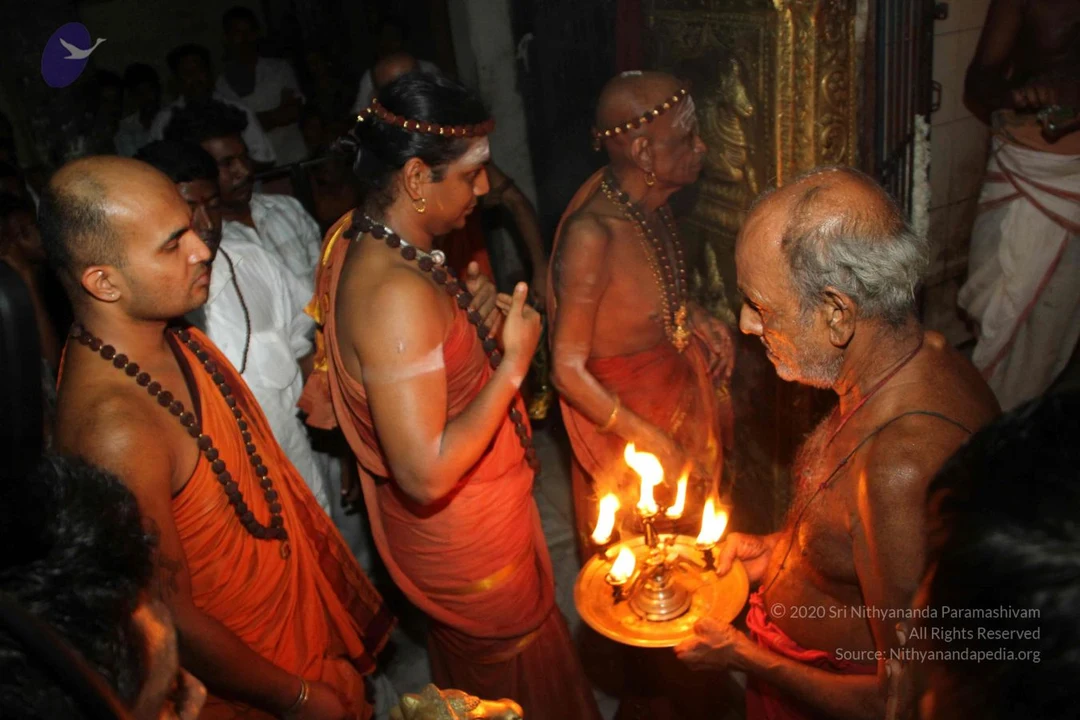
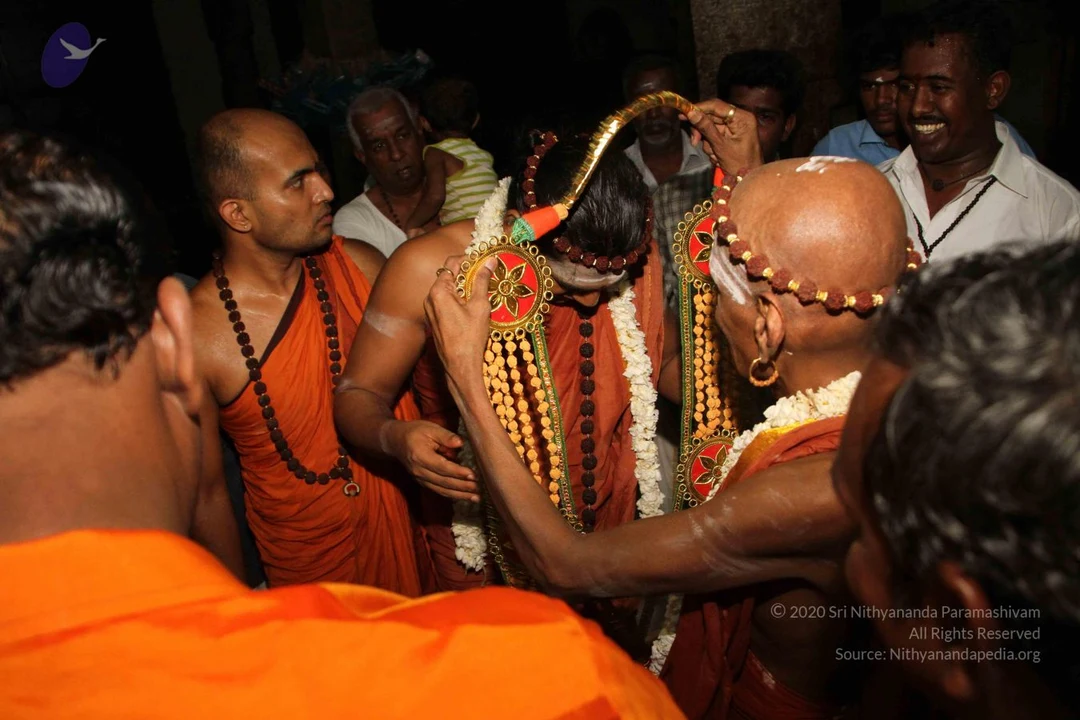
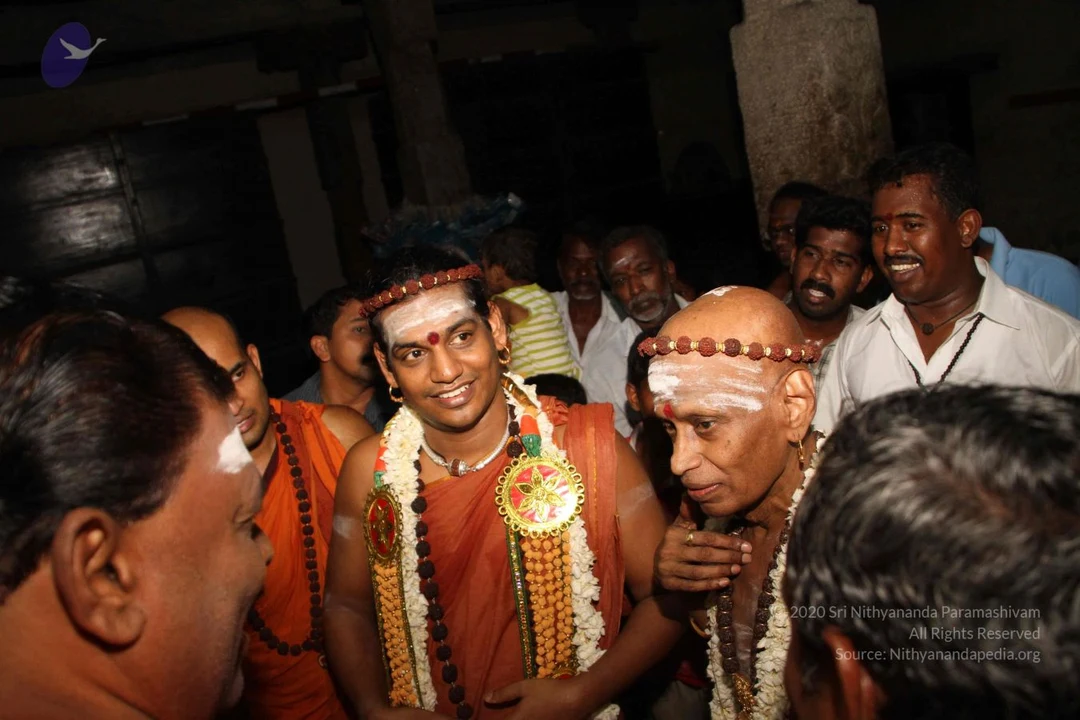
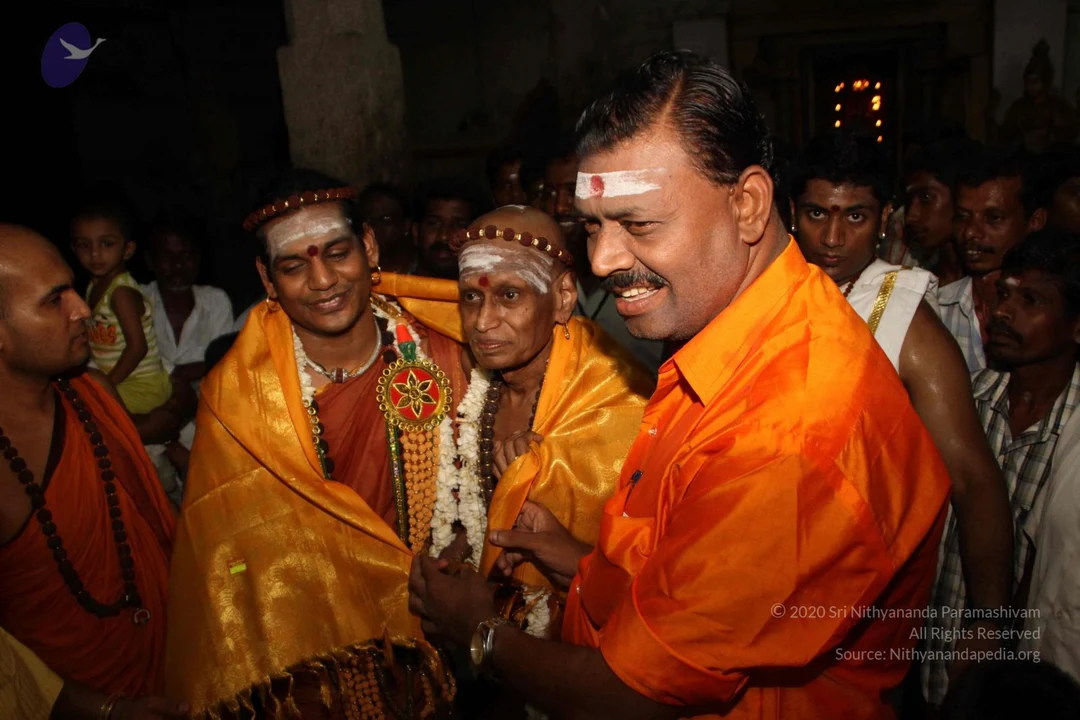
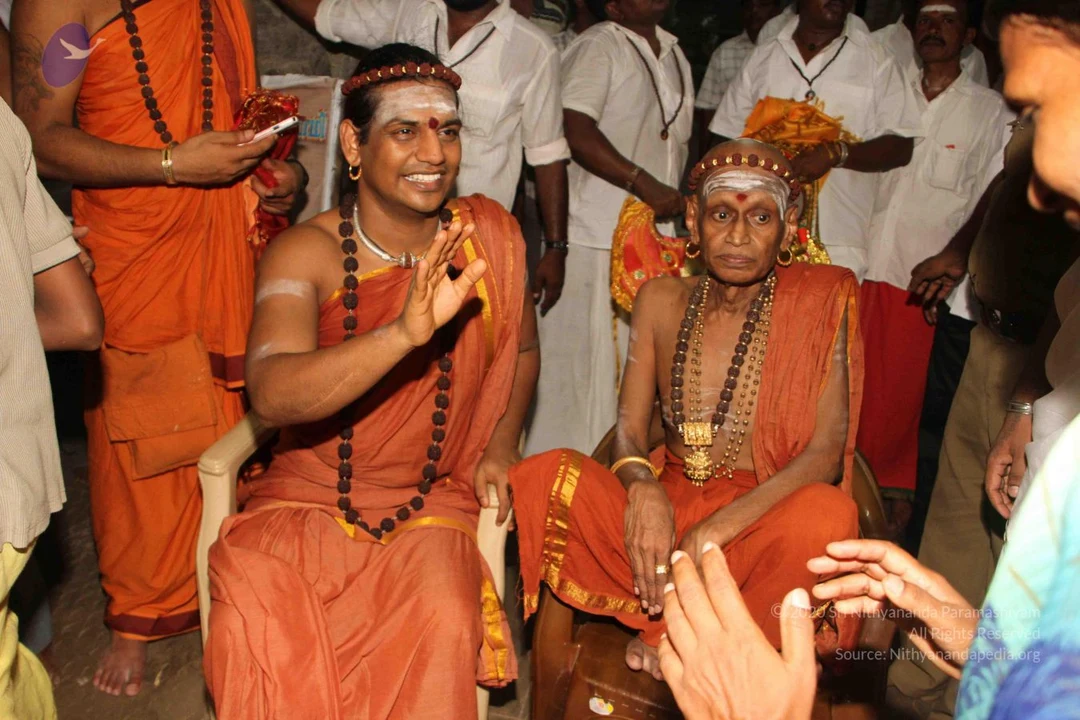
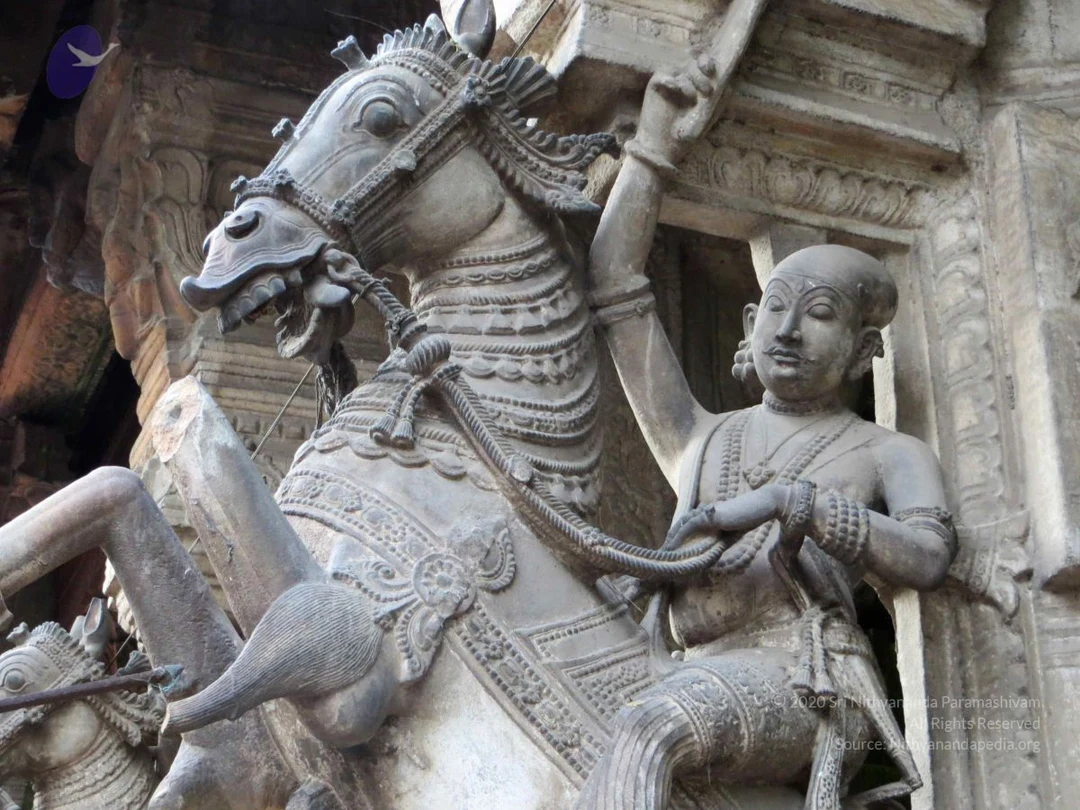
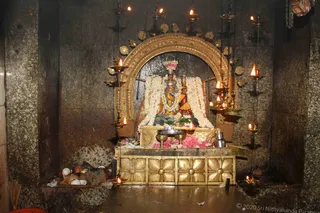
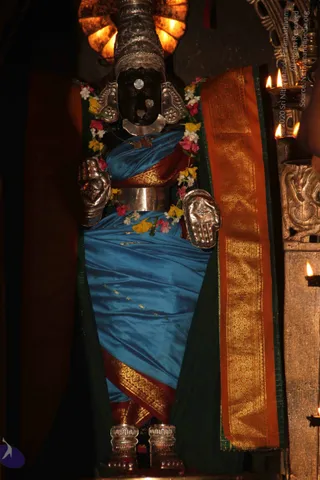
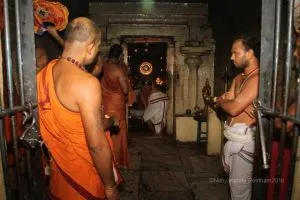
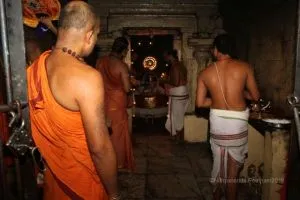
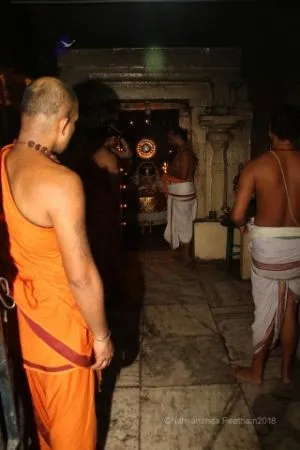
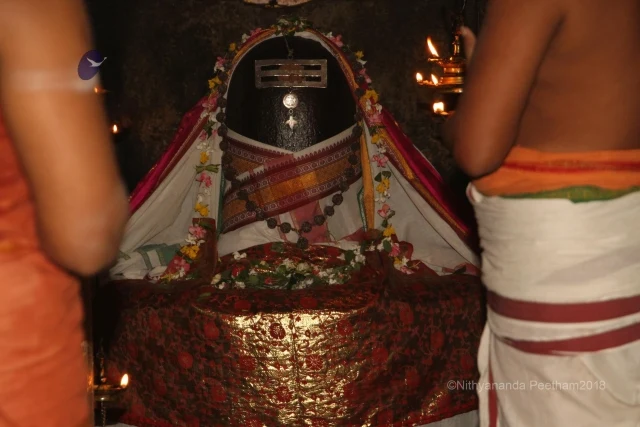
(29 May 2012) The Kanjanoor Agniswarar Temple is located in the village of Kanjanur, Tamil Nadu and is one of the temples under the hereditary trustee of Madhurai Adheenam. The presiding deity of the temple is "Agniswarar" or Paramashiva. Said to be 1400 years old the temple was built by the Medieval Cholas and renovated by the kings of the Vijayanagar empire. Kanjanur is one of the nine Navagraha sthalas located in the Cauvery Delta region dedicated to planet Venus, called Sukra. Unlike other Navagraha (9 planets) temples, the main deity, Agniswarar in the form of lingam depicts Lord Sukra. His Divine Holiness, 293rd Guru Maha Sannidhanam Paramahamsa Nithyananda visits this historic temple to pay His respects to the deities.

Link to Video:

Photos
Tags:

Bhagavad Gita, Paramahamsa Nithyananda, inspire, invoke, power, spiritual practice, faith, embrace, courage, endure, push, enlightenment, yearn, suffocation, constraint, awareness, seed, sprout, tree, share, knowledge, expand, release, sense.

Photos Of The Day:
KANJANUR-Temple-attack-on-Ashramites

Photos Of The Day:
Kanchanoor-Temple-Visit

Madurai-Temple-Photos-Given-By-Ma-Nirvikalpa

Morning-Satsang

Kumbakonam-Hospital-Visit

Press-Meet-Kumbakoonam

Press-Meet-Kanchanoor-Temple

Press-Meet-Madurai-Adheenam

01-Kanchanoor-Temple-Visit

03-Morning-Satsang

Photos from this day
View all 316 photos
Photos
162 photosSource gallery
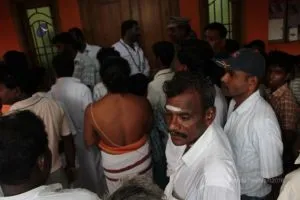
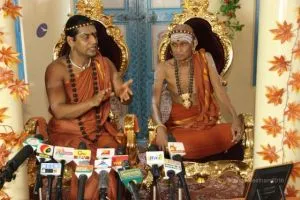
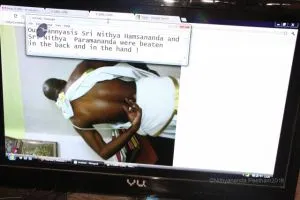
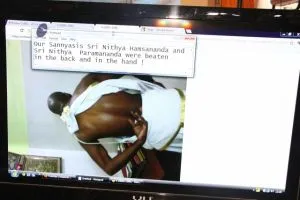
A photograph of a group of men seated in a room, many watching intently while operating video cameras on tripods in the foreground. The nearest man in a dark shirt holds a large black video camera, another in a white shirt sits beside him, and several men behind them look on. A white wall-mounted air conditioner hangs at the upper left, and a patterned curtain or wall hanging sits at the left edge. The setting appears to be a hall where a talk or event is being filmed and documented by a camera crew.A small indoor room with a wall-mounted air conditioner high on the wall. Several people stand close together: a woman in the foreground wears a white top and holds a camera or video equipment to her face, a man in a light shirt stands beside her, and others in the background wear light and white clothing. Some appear to be looking toward the same direction. No one is clearly identifiable as a person from appearance; the figures are shown at a distance and in partial view.Two men in saffron-orange robes sit on gold-ornate thrones in front of a blue-tiled wall decorated with autumn-leaf garlands. The man on the left wears a white headband, orange garments, and rudraksha beads, and gestures with his right hand while speaking. The man on the right wears a white head covering, an orange shawl, and beads, and sits with hands in his lap. A row of microphones with multicoloured media logos stands in front of them. Two people are visible.A photograph of a flat-screen television displaying a slide with a white text box and a small window at the top left, showing a dim room scene. The image is a screen capture photographed on a stand against a dark background. The on-screen text is too small and blurred to read in full.A photograph of a flat-screen monitor displaying a web page. On the screen, a captioned image shows a person with a bare back and white cloth at the waist, head bowed, seated or leaning forward. A caption box on the screen reads text about Sri Nithya Hamsananda and Sri Nithya Paramananda being beaten in the back and hand. The monitor sits in an office or indoor setting with other browser windows visible at the top edge.A photograph of a computer monitor displaying a web page. A caption box at the top reads that two sannyasis were beaten in the back and in the hand. Beneath it, a screenshot shows a man with a shaved head and bare upper back, wearing a white garment, seen from behind as another person's hand grips him. The monitor frame and desk surface are visible around the screen.
KANJANUR-Temple-attack-on-Ashramites

2 photosSource gallery
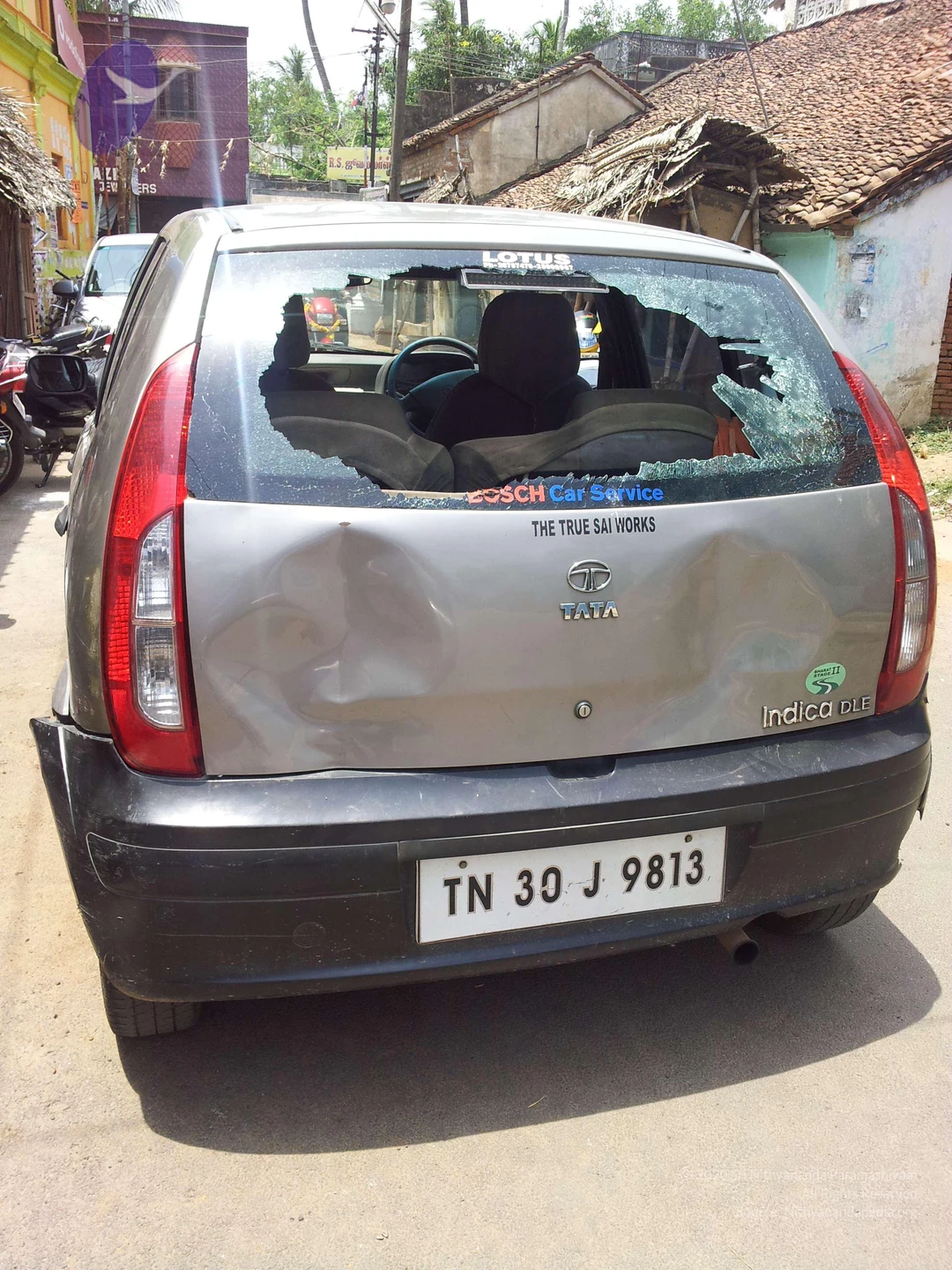
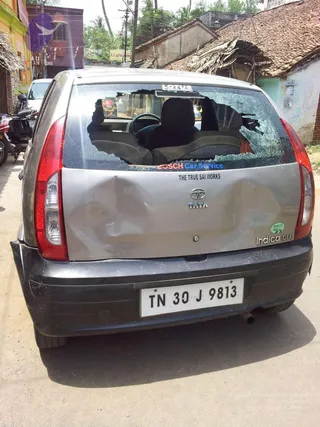
A silver Tata Indica DLE hatchback parked on a narrow village street, seen from the rear. Its rear windscreen is smashed open with shattered glass hanging at the edges, and the rear hatch shows a large dent. Stickers read 'BOSCH Car Service' and 'THE TRUE SAI WORKS' with a Lotus logo on the rear window. Tiled-roof houses, a yellow-painted building, parked motorcycles and a palm tree line the street. No people are visible.A photograph of a silver-grey Tata sedan parked head-on on a dusty street, with its front grille, chrome bumper and white number plate reading TN 30 J 9813 clearly visible. A thin chrome metal rod, a tripod or antenna-like stand, is fixed at the front centre. Behind the car are a blue gate pillar, a brick wall and a parked white vehicle. No people are visible.

Kanchanoor-Temple-Visit

16 photosSource gallery
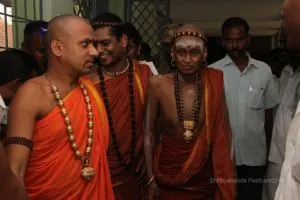
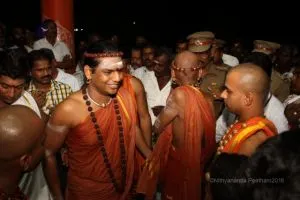
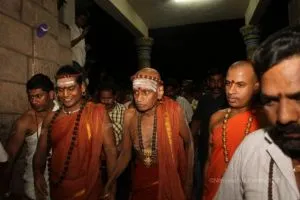
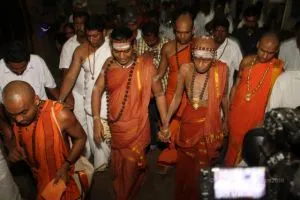
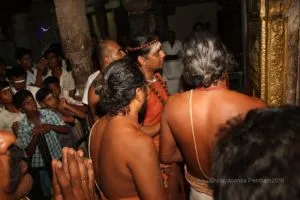
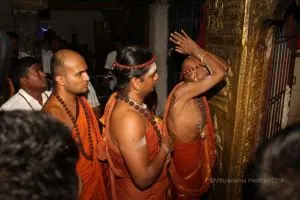
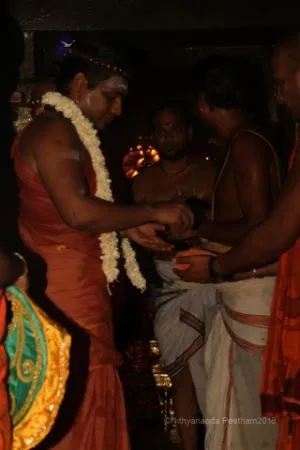
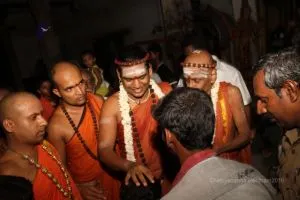
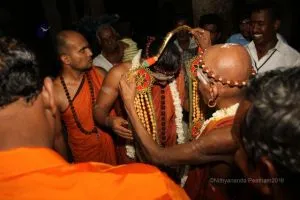
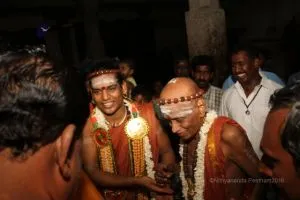
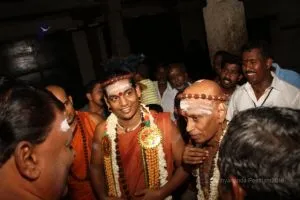
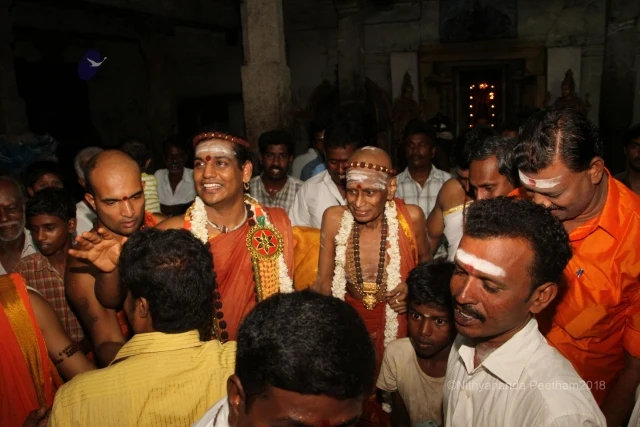
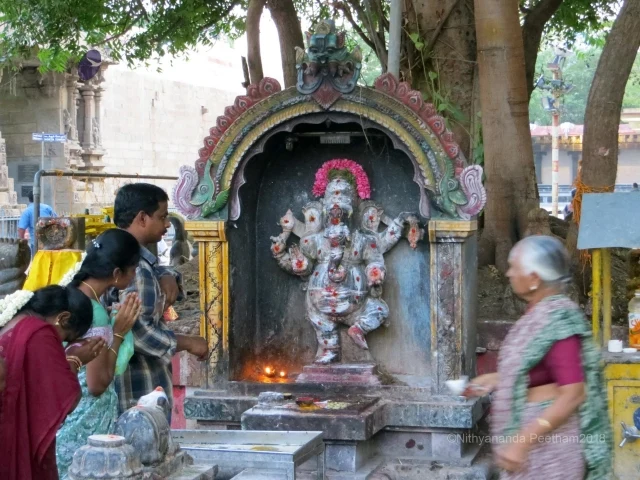
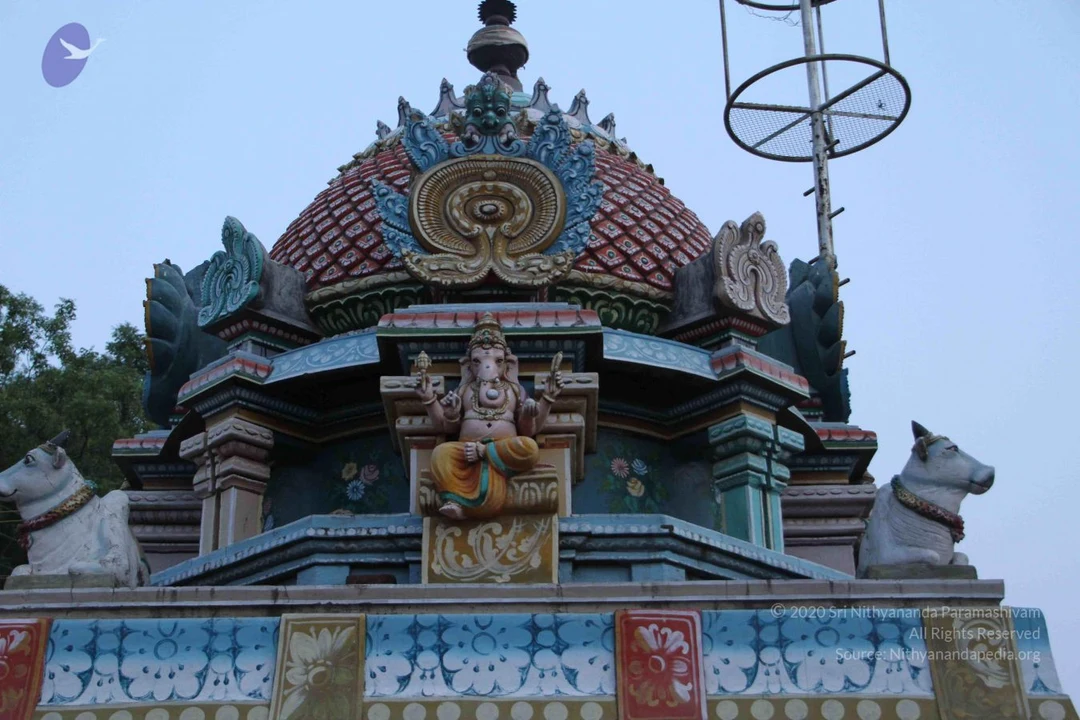
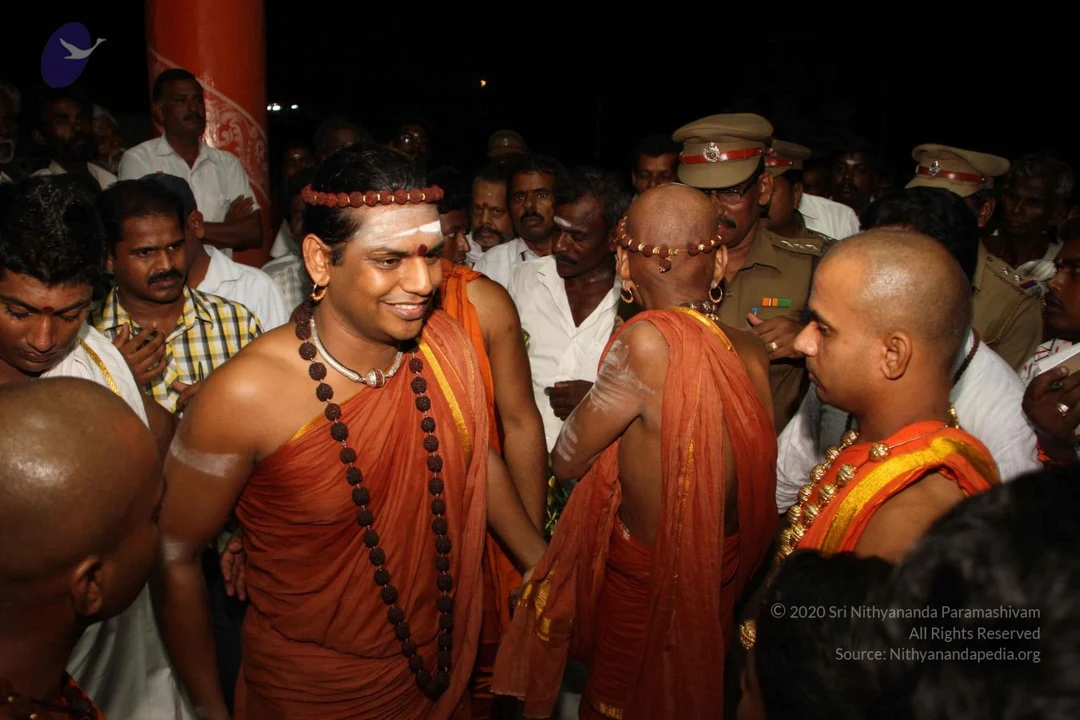
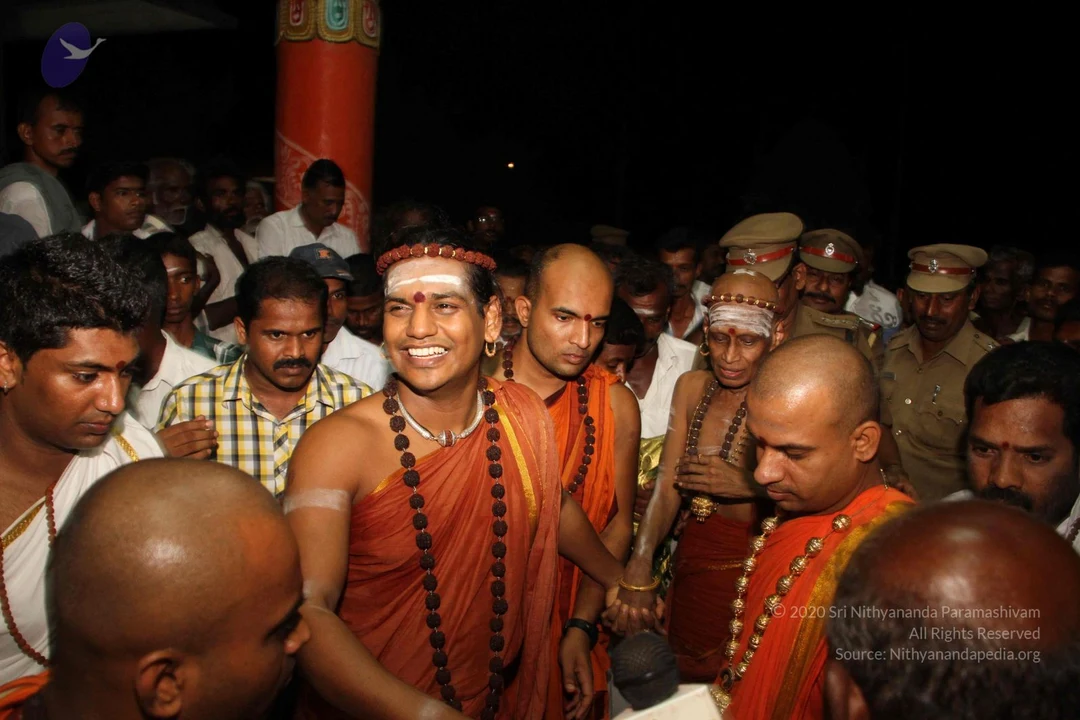
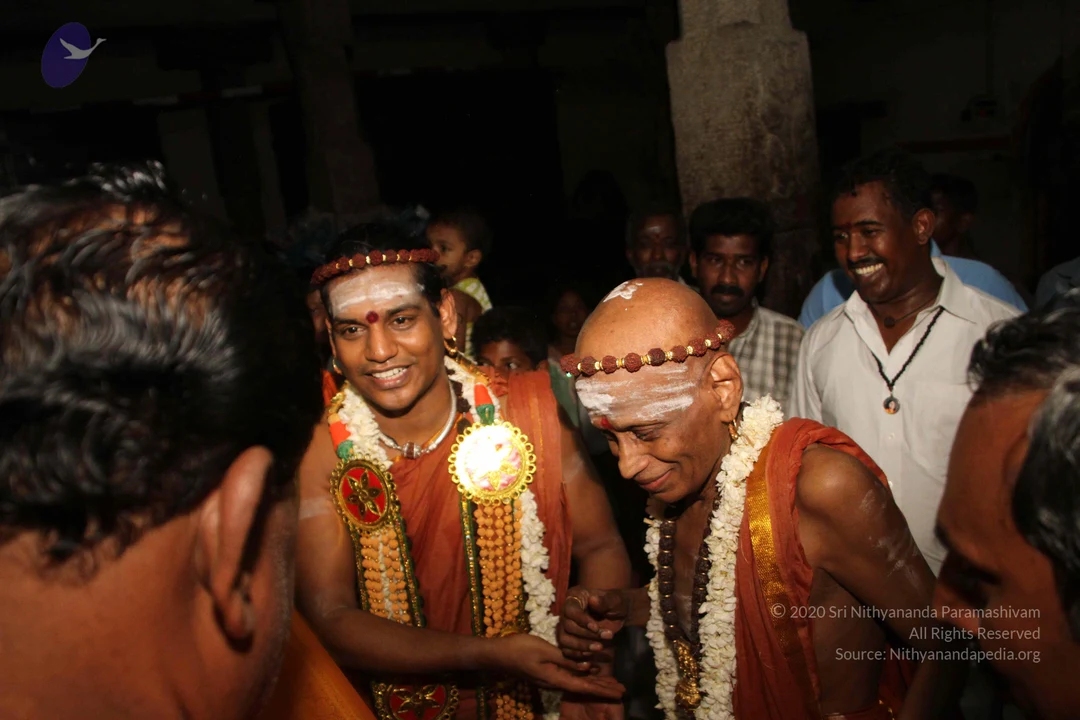
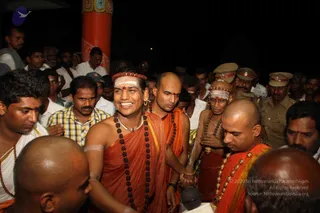
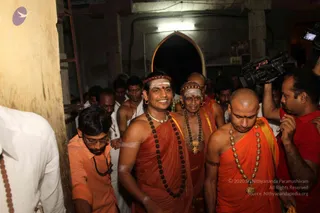
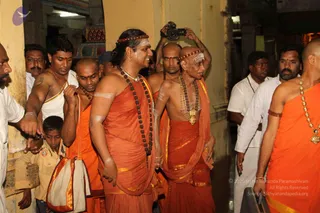
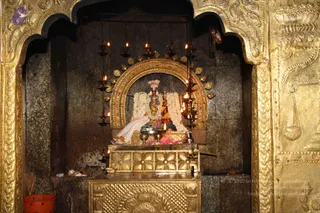
Photograph of a South Indian style temple shrine with a red and gold tiled dome topped by a finial and an ornate stone pediment. A seated Ganesha deity murti with four arms, a trunk, and an orange-and-green draped cloth sits in a central niche. Two white stone Nandi bulls wearing red garlands flank the roof on either side, and a metal antenna frame rises at the upper right. Blue and white floral tile panels run along the base. No people are visible.Night-time outdoor crowd scene with a smiling man at centre wearing an orange-saffron dhoti and shawl, a red floral headband, white vertical tilak on forehead, a pale white band on his arm, and multiple rudraksha mala necklaces. Beside him is a bald man in orange robes with a gold-bead mala, and another orange-robed man with white forehead marks and a rudraksha mala. Uniformed police officers in khaki stand in the background, and a red pillar and a handheld microphone are visible. Many people fill the frame around them, most partly visible.Photograph inside a temple colonnade with dark stone pillars and a carved relief figure on a column at left. A man with long swept-back dark hair, a red beaded headband, a white tilak, gold earring, white necklace and rudraksha malas, wearing saffron-orange robes with gold borders, smiles while speaking with a shaved-headed monk in orange cloth who wears a red beaded headpiece. Other men in white dhotis and white shirts, one in a cap, stand around them. The long-haired man matches the page's Swamiji (probable) appearance cues of long hair, ornate beads and saffron clothing, so he is identified as Swamiji (probable), an in-person presence.A photograph of a crowd moving through a dim temple corridor toward an arched doorway lit from behind. In the foreground, a smiling man in a saffron-orange robe wears a red headband with a white and red tilak, a rudraksha mala, and a white shawl at the neck. Beside him, an older woman in saffron robes wears a red headband, white forehead markings, and a heavy gold necklace with dark beads. A bald man in saffron robes with a gold-bead necklace stands at the right, and a bearded man in orange shirt and rudraksha beads is at left. A cameraman with a shoulder camera films from the right, and a man in red shirt stands behind him, with white-clad people in the background.A photograph in a temple corridor with yellow walls and colourful painted panels. A man with long swept-back dark hair, a red-and-white headband, rudraksha mala beads and white ash marks on his face and arms, wearing an orange cloth, walks at centre and looks toward his left; a bare-chested older man beside him wears a gold ornamental necklace, rudraksha beads and a red headband. Several men in orange cloths and white dhotis, some bare-chested, surround them, and a man in the background raises a camera. Swamiji (probable) appears in the centre with his cues of long hair, rudraksha malas and orange robes, as a visiting sannyasi in a procession-like walk.A photograph of a gilded shrine niche inside a temple. A deity murti stands at the centre of an arched golden frame, draped with white and yellow flower garlands, with a pink flower offering at its base. Multiple brass oil lamps with lit flames line the dark stone wall on both sides, and a gold-covered altar with a brass lamp and small offerings sits in front. Ornate gold repoussé work frames the entire opening. No people are visible.

Madurai-Temple-Photos-Given-By-Ma-Nirvikalpa

71 photosSource gallery
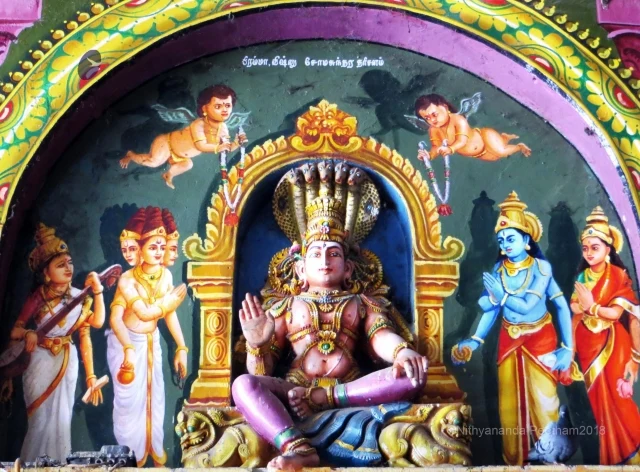
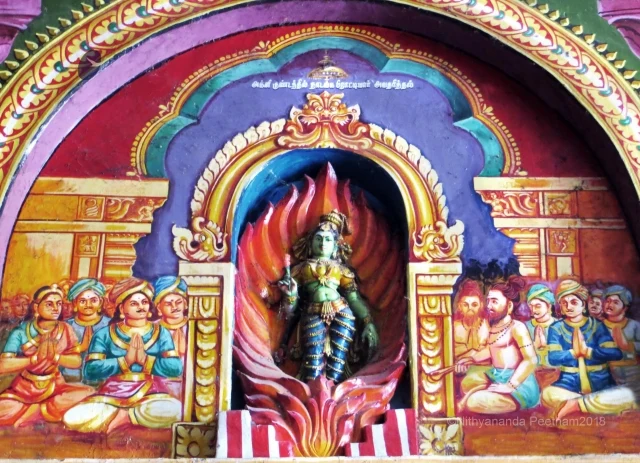
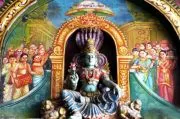
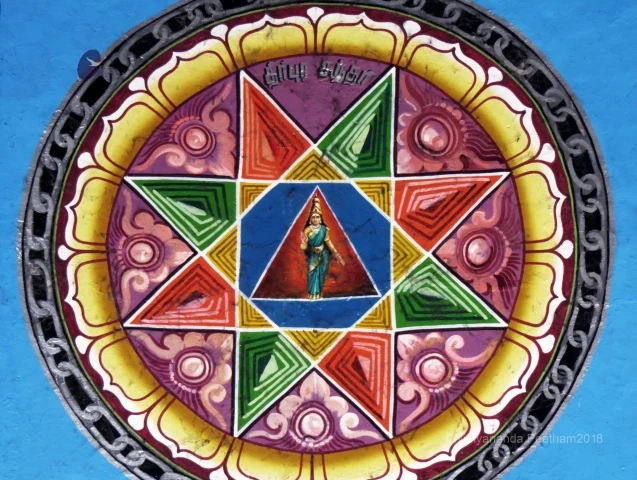
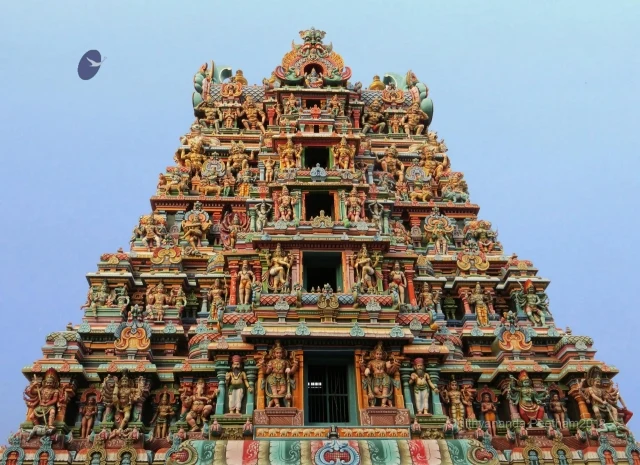
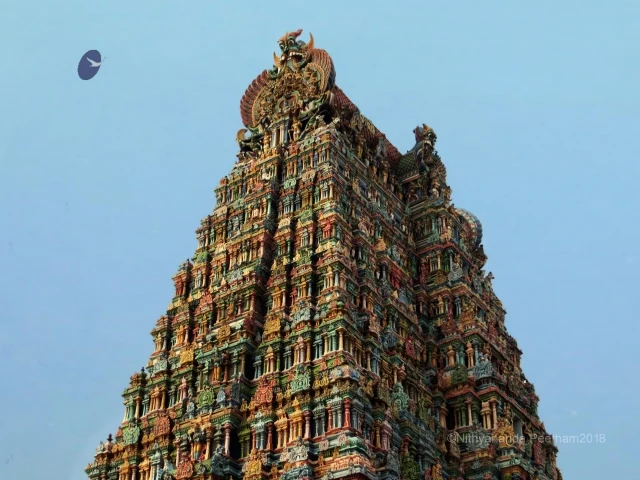
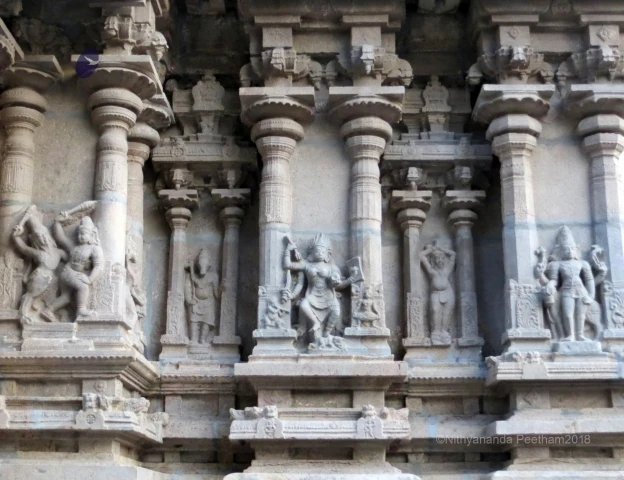
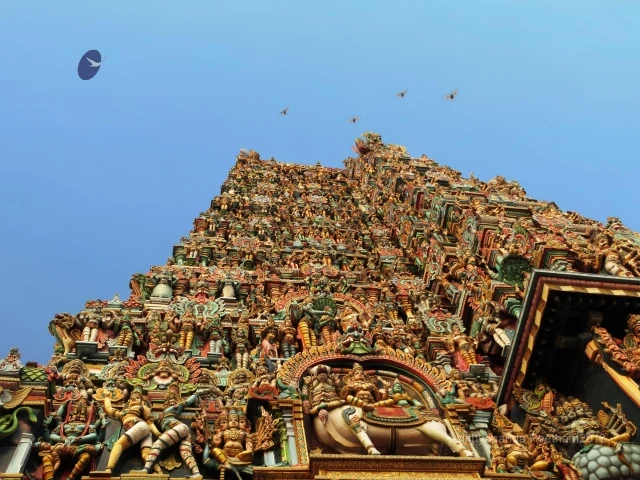
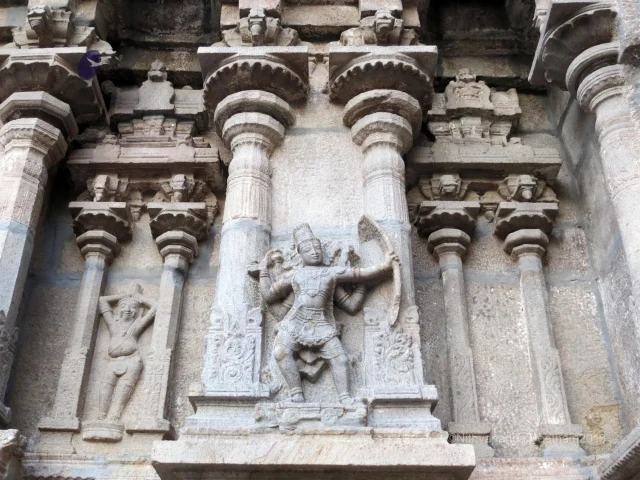
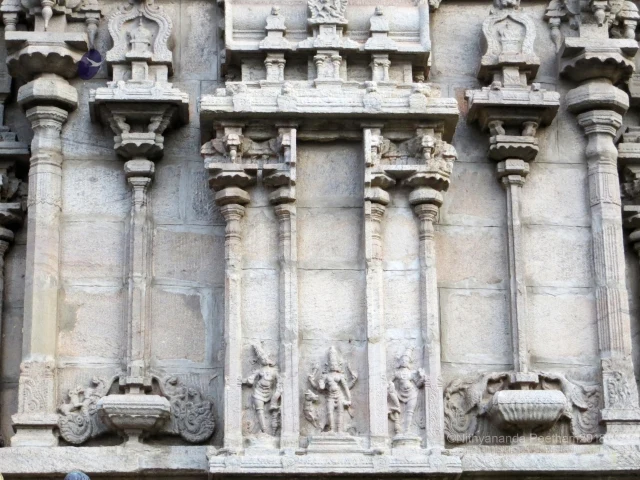
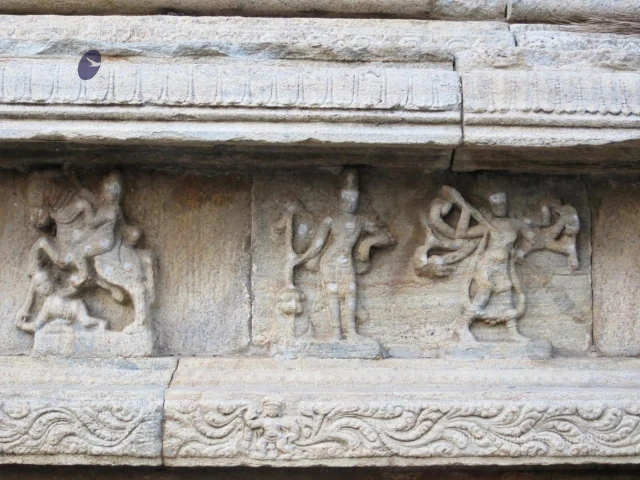
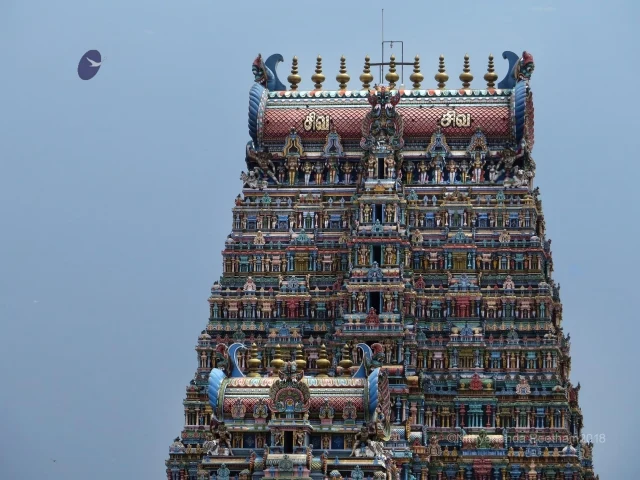
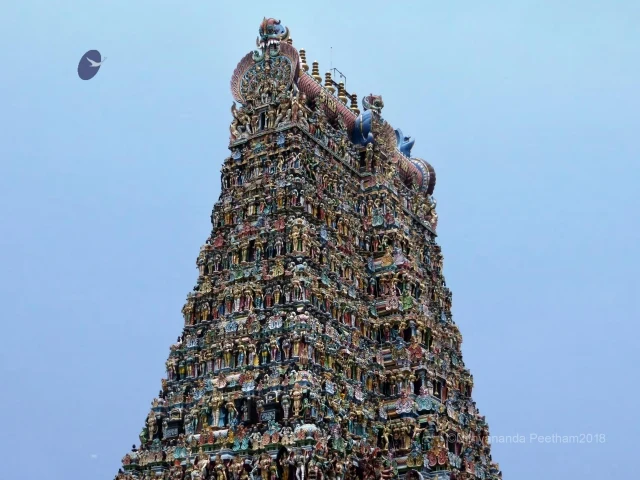
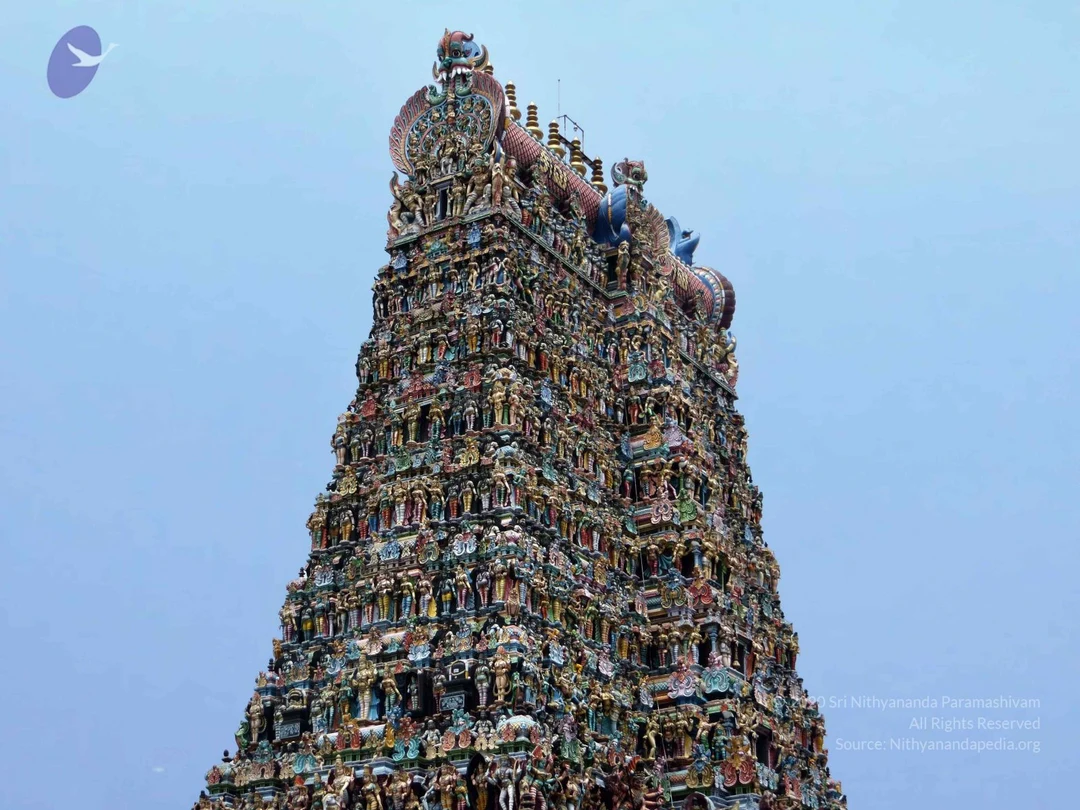
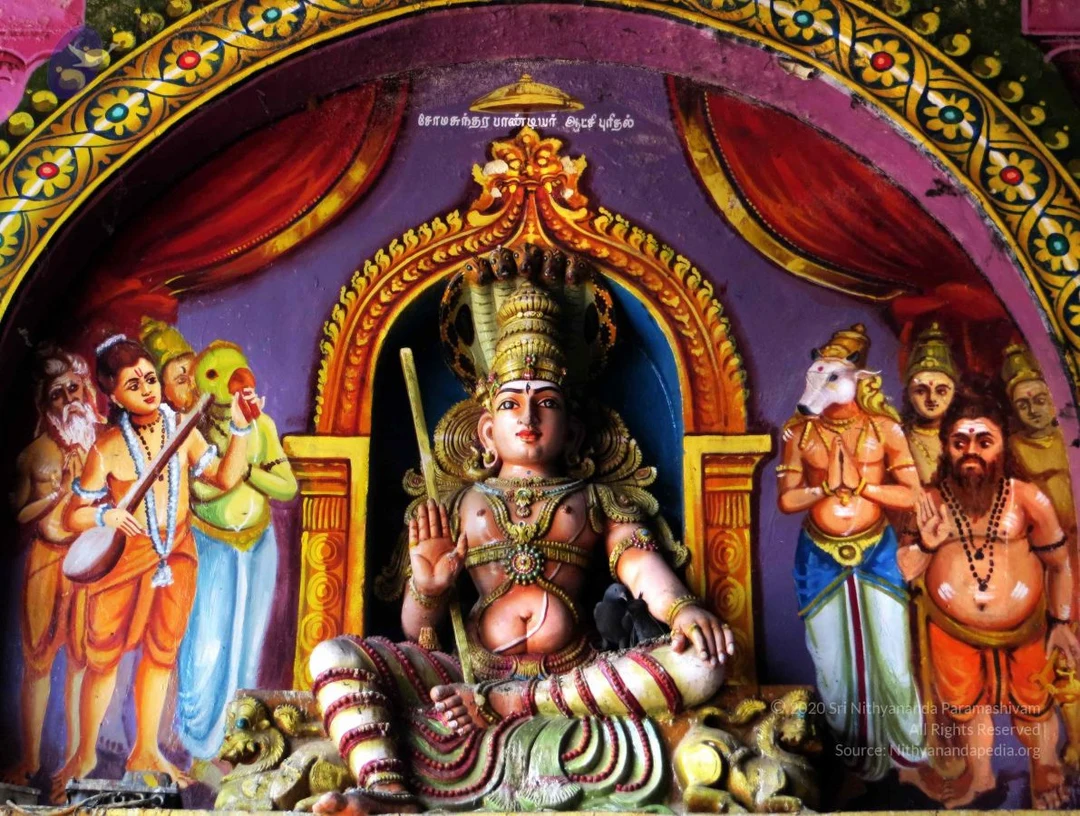
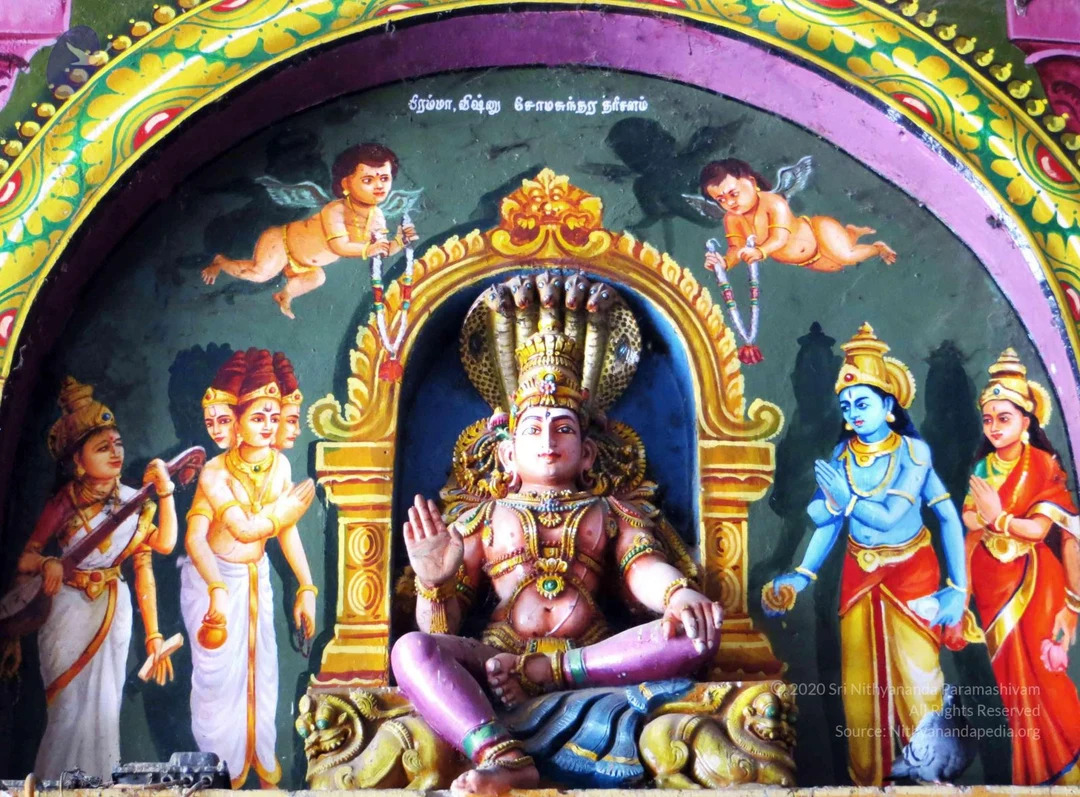
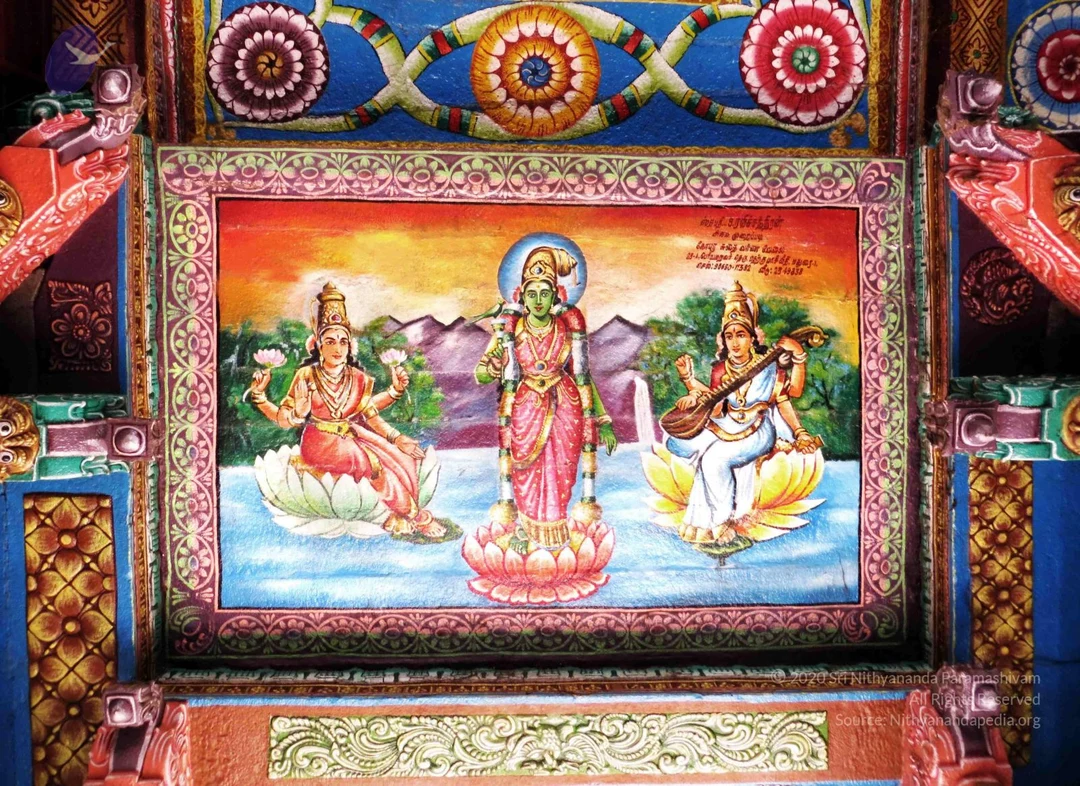
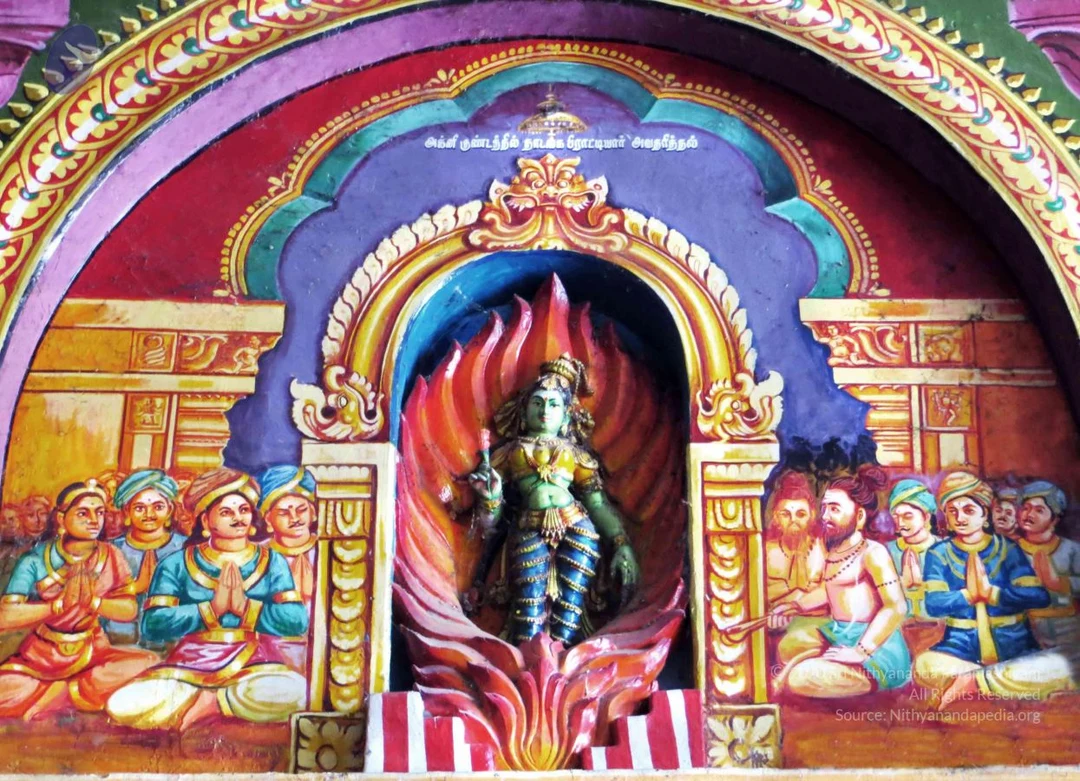
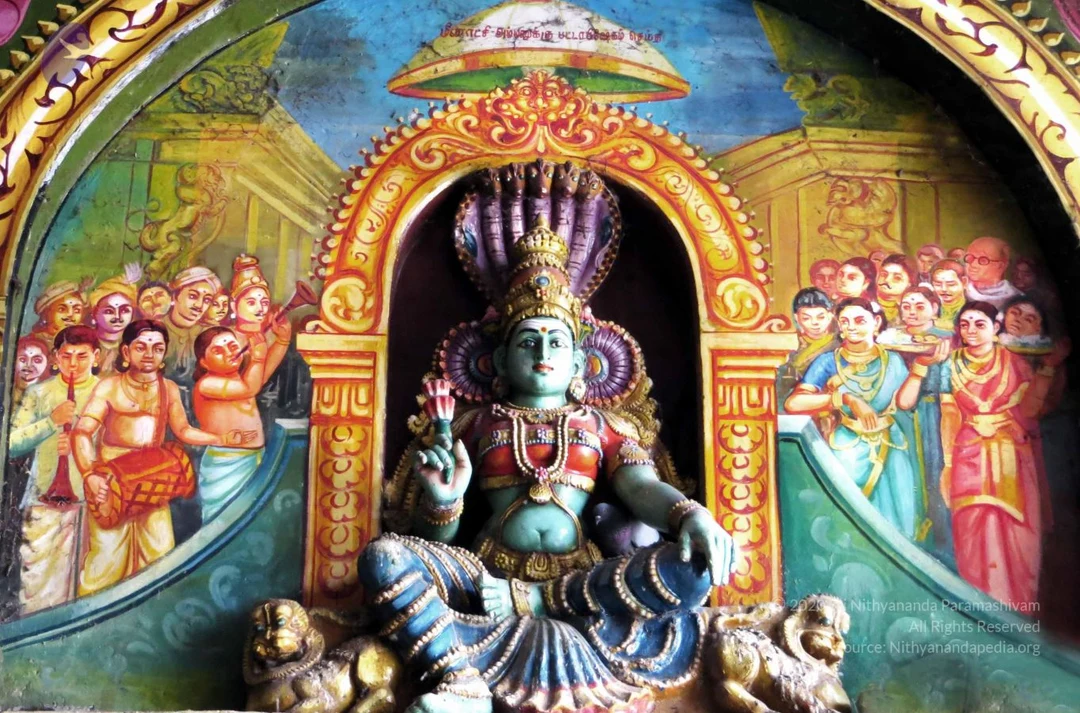
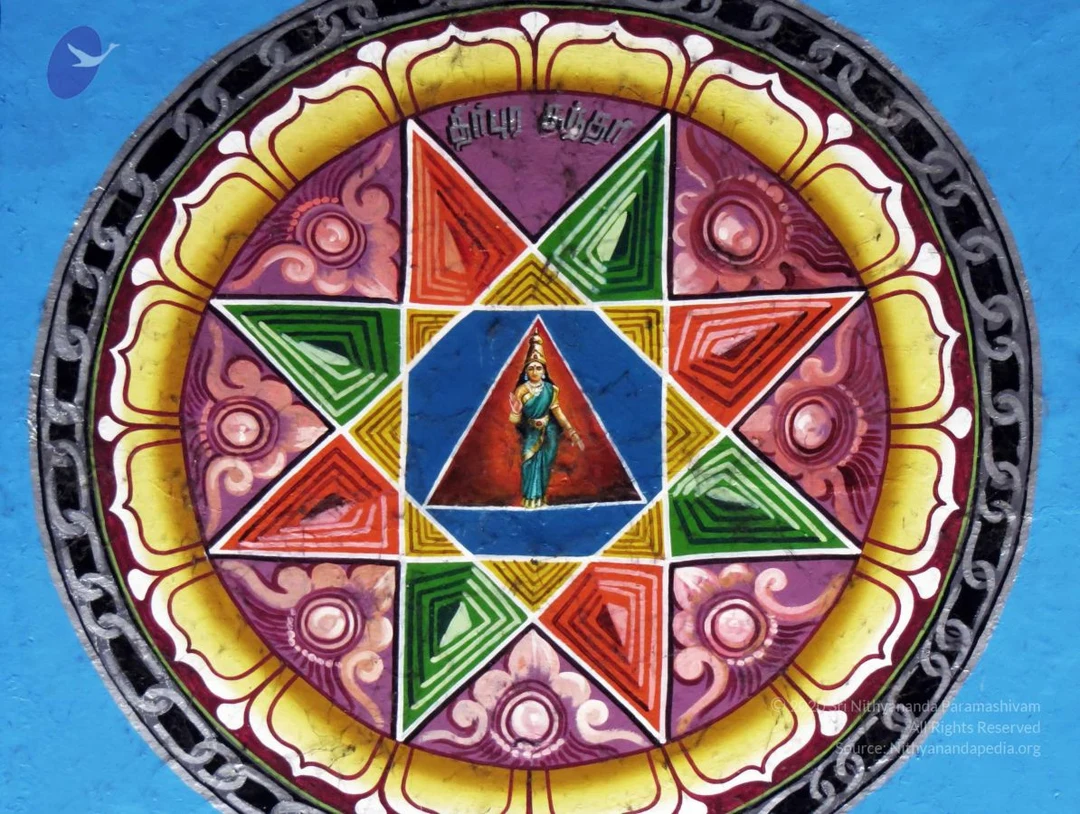
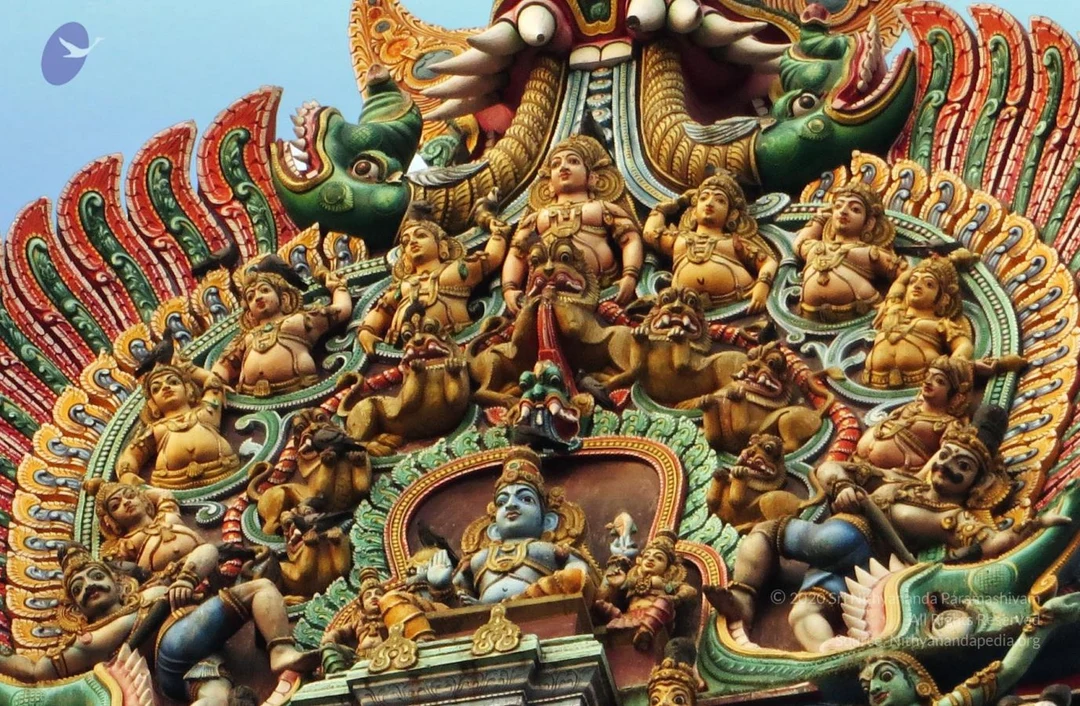
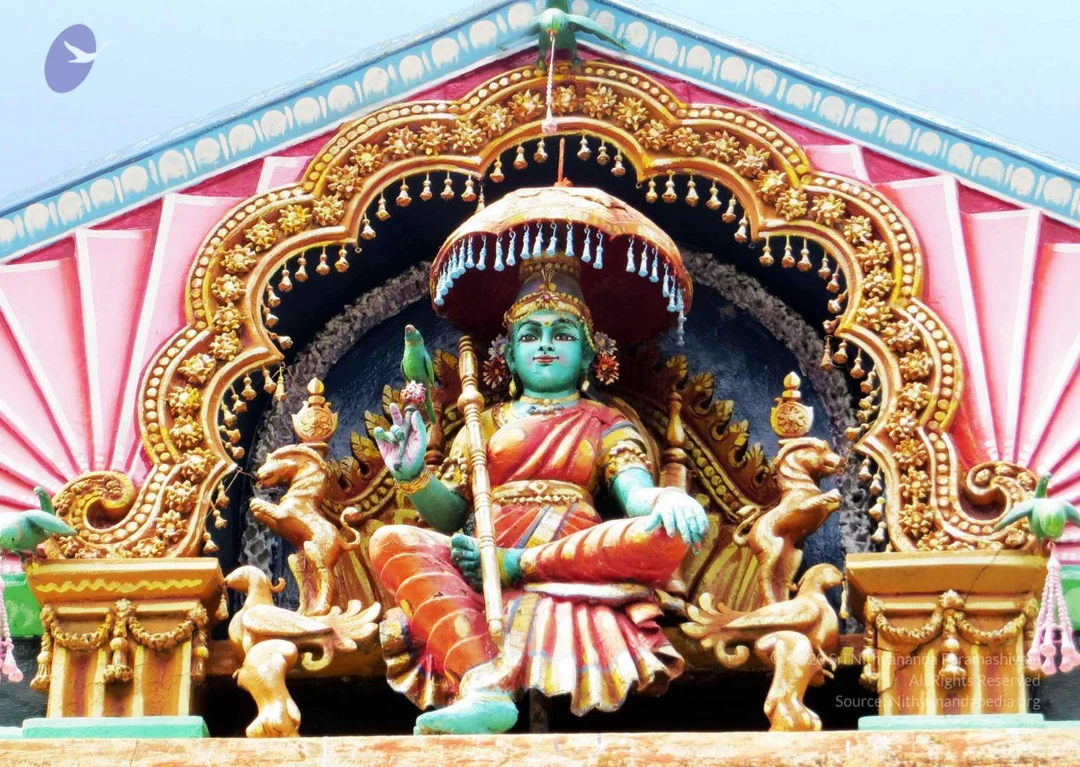
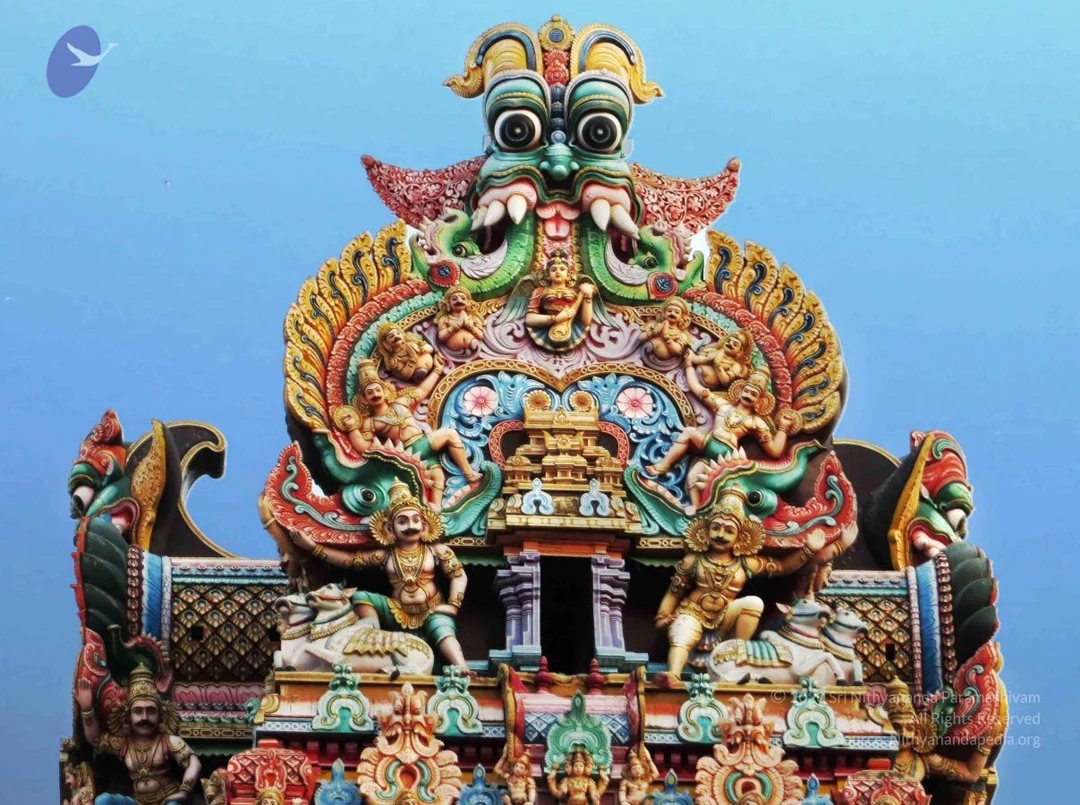
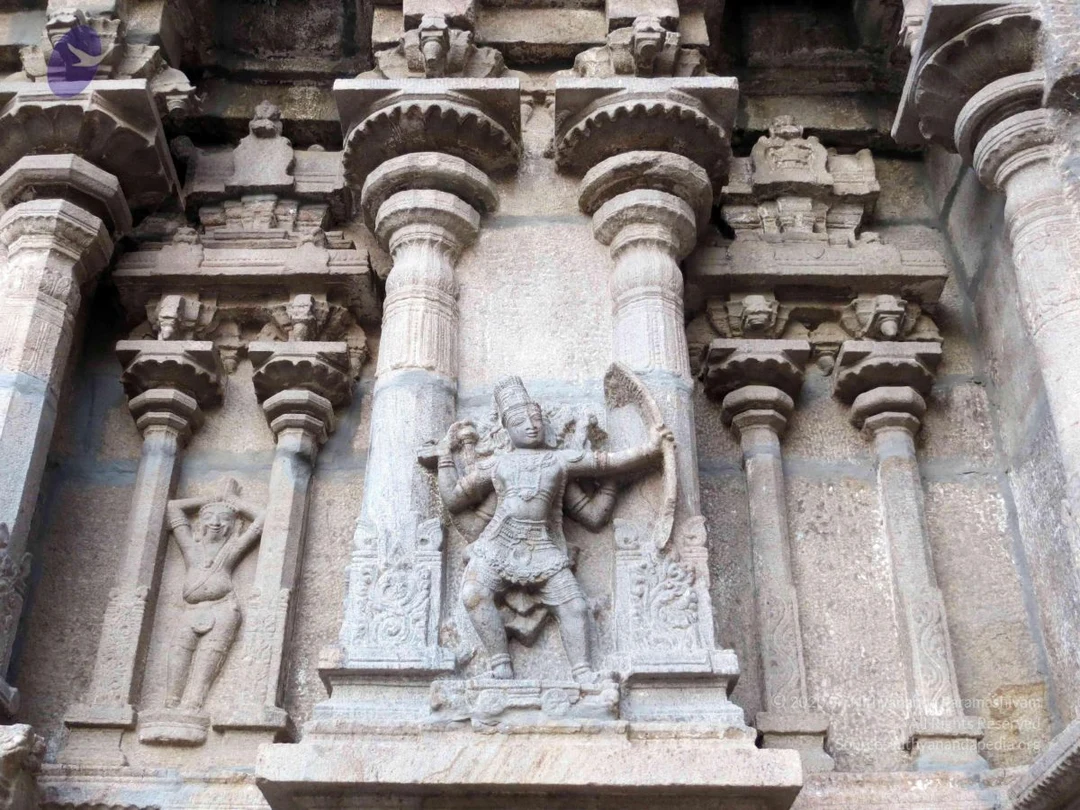
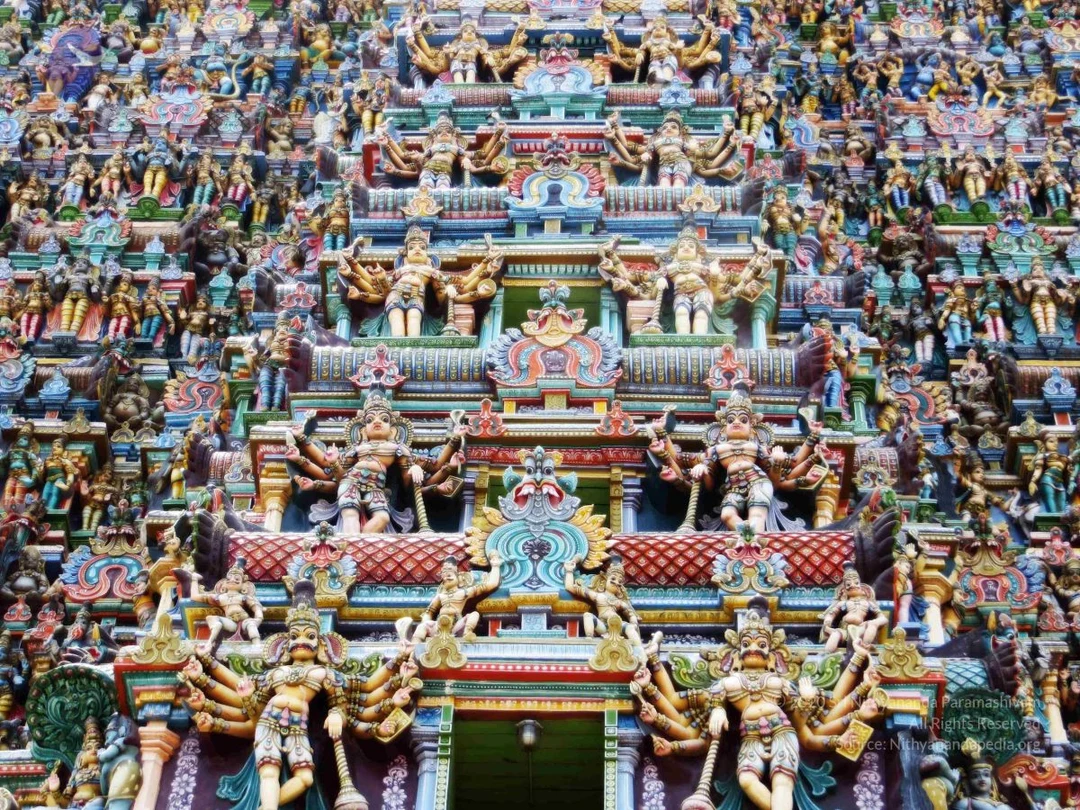
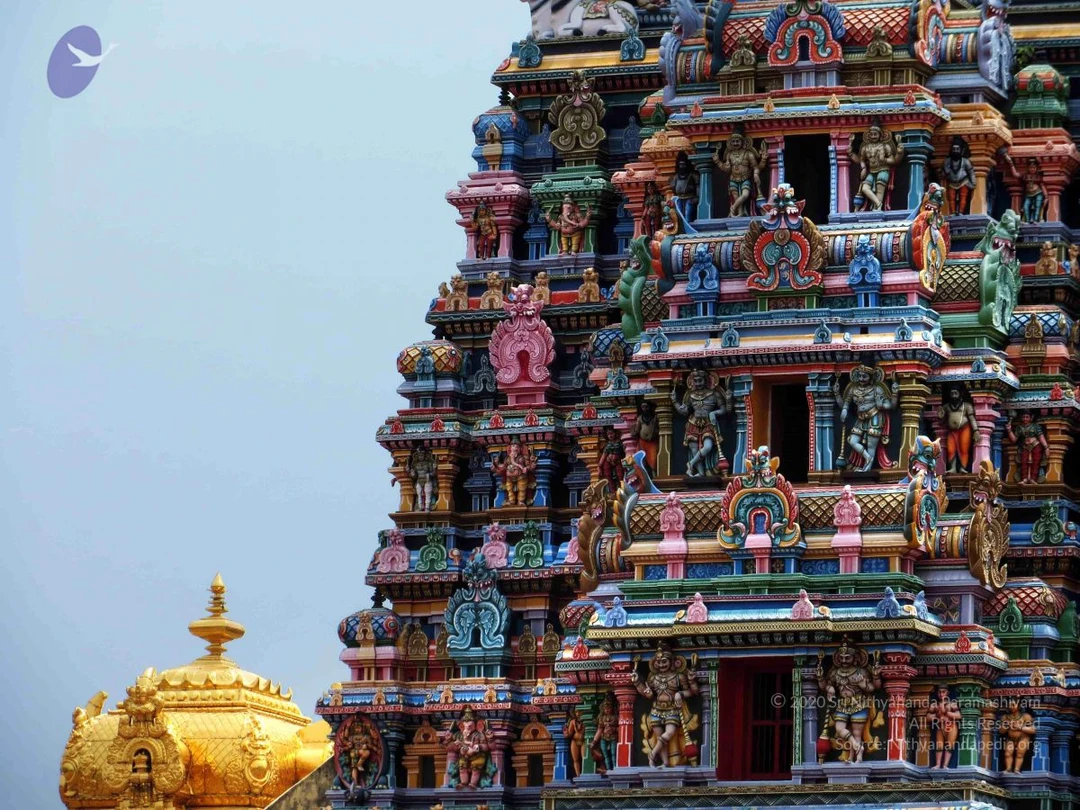
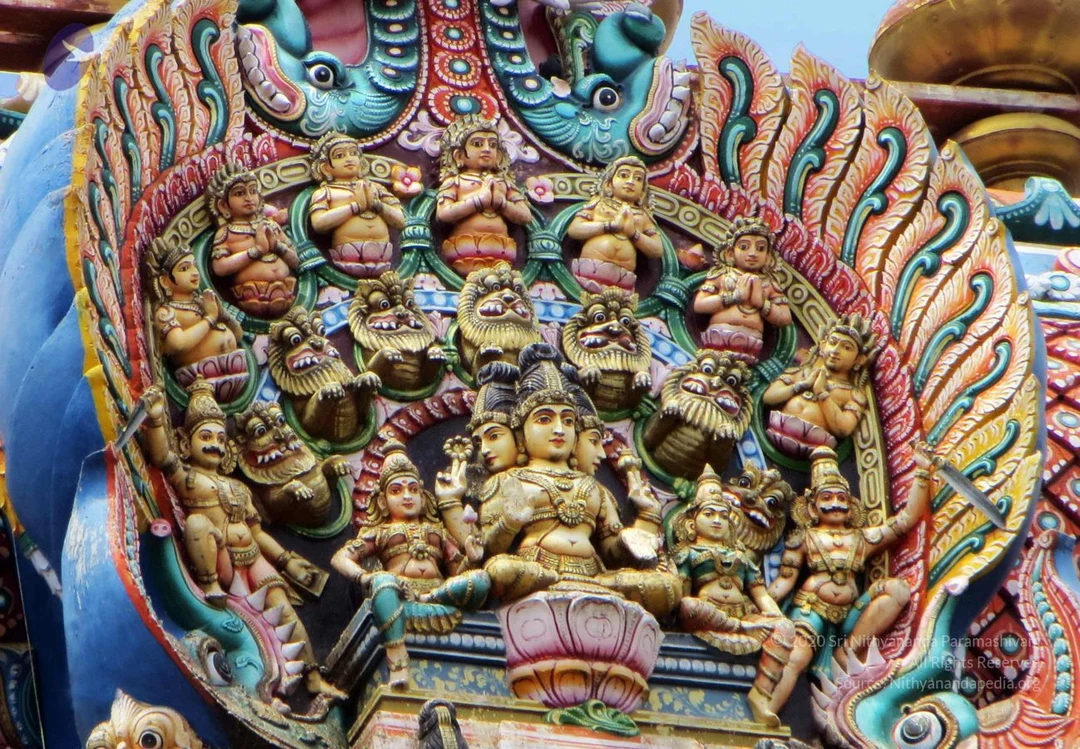
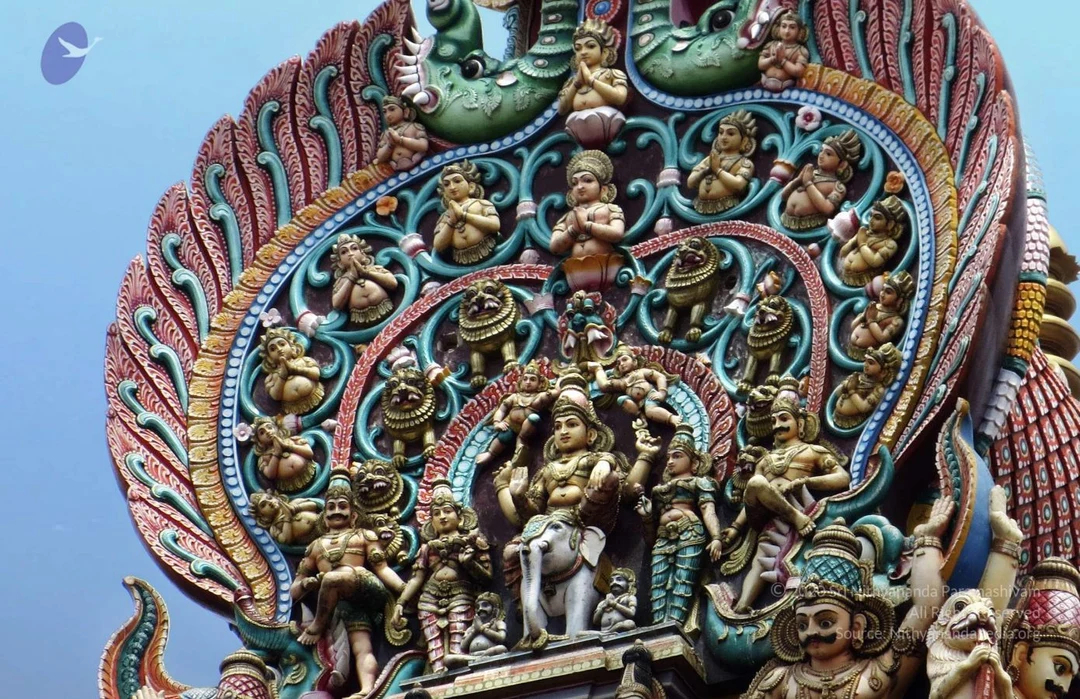
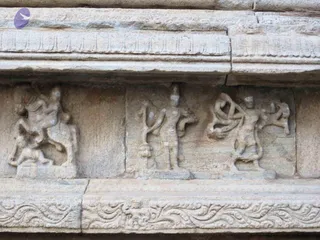
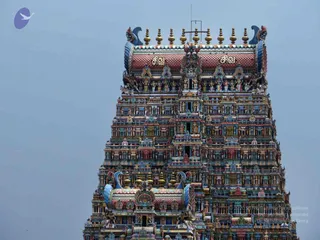
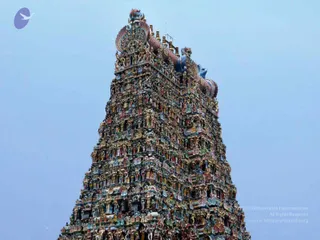
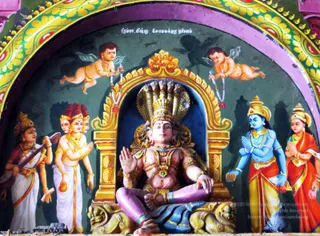
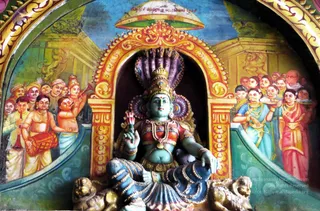
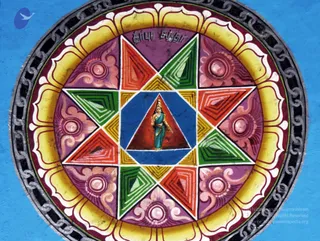
Close photograph of a carved stone temple frieze with three figures in relief within a horizontal panel. The left figure is a mounted rider or warrior with an animal beneath, the centre figure stands holding a staff or weapon with a shield-like form, and the right figure appears to grapple with a curling serpentine or coiled form. Carved floral scroll bands border the panel above and below, with weathered grey granite texture. No living people are visible; the figures are sculpted reliefs, and no identifiable person is depicted.A photograph of a tall, richly painted South Indian temple gopuram rising against a pale blue sky. The tiered tower is covered with rows of colourful sculpted deities, figures and architectural niches in red, green, blue and gold. Golden kalasha finials crown the top, and the upper tier bears the Tamil word for Shiva on both sides. No people are visible in the scene.A tall, pyramidal Dravidian gopuram (temple tower) rises against a pale blue sky, covered with tiers of densely carved and brightly painted deity figures in red, green, yellow and blue. The tower's crown is topped by a sculpted lion-like finial, a curved blue and red serpent-like form, and a row of golden kalasha finials. No people are visible in the scene.A painted temple shrine panel showing a seated deity murti under a multi-hooded serpent canopy, wearing a crown, rich jewellery and a green-and-gold ornament. The figure sits in padmasana with a raised hand in abhaya gesture on a carved lion-footed throne. Two flying cherubic figures above hold garlands. To the left a figure plays a stringed instrument and another stands in anjali with a multi-faced head; to the right a blue-skinned figure and a woman in an orange sari stand in anjali mudra. Painted tile-like border frames the arch. A Tamil caption appears at top.A painted temple niche framing a colourful stone or plaster murti of a seated deity with a multi-hooded serpent canopy overhead, wearing a gold crown, layered necklaces and armlets, and holding a lotus-like object. Flanking the arch, painted figures in procession play drums and wind instruments on the left, while on the right a crowd of devotees holds offering trays and stands before a painted temple structure. Painted Tamil script in a cartouche above the arch is partly visible. The scene is rich in gold, blue and orange tones. No living people are present in the frame; the figures are painted.A painted circular mandala on a bright blue wall, framed by a grey chain-link border and a ring of yellow lotus petals. Inside, layered star and triangle shapes in red, green, orange and purple surround a central blue octagon holding a red triangle with a small standing female deity figure in a teal sari and tall crown, one hand raised. Pink lotus-like floral motifs fill the corners. No people are visible.

Morning-Satsang

24 photosSource gallery
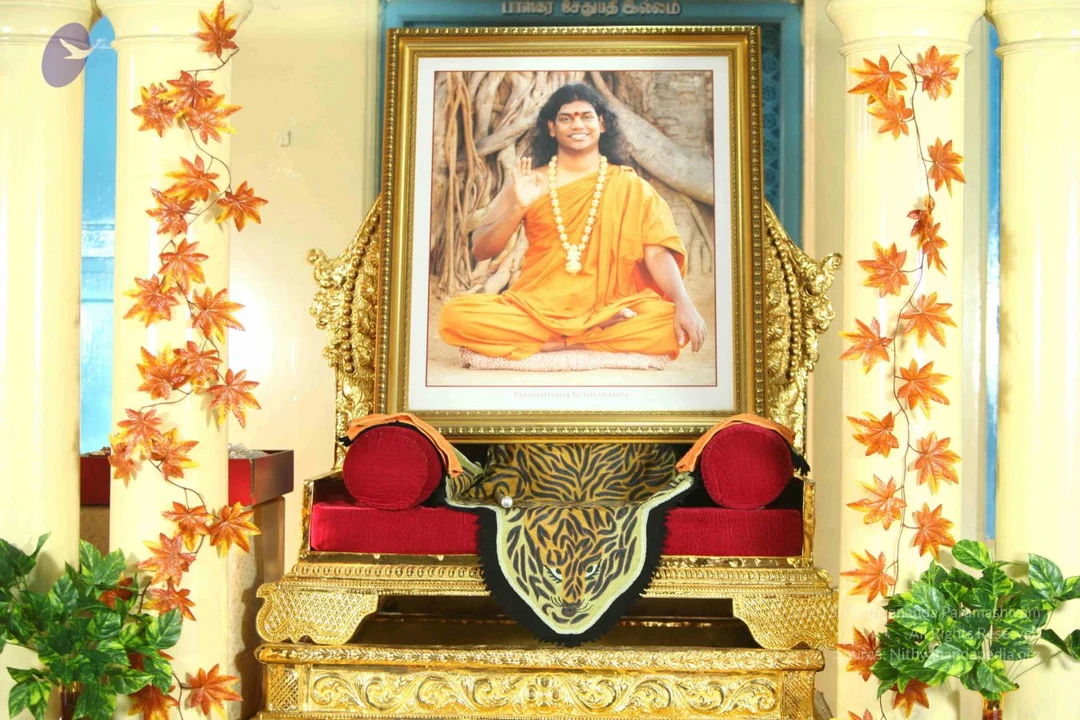
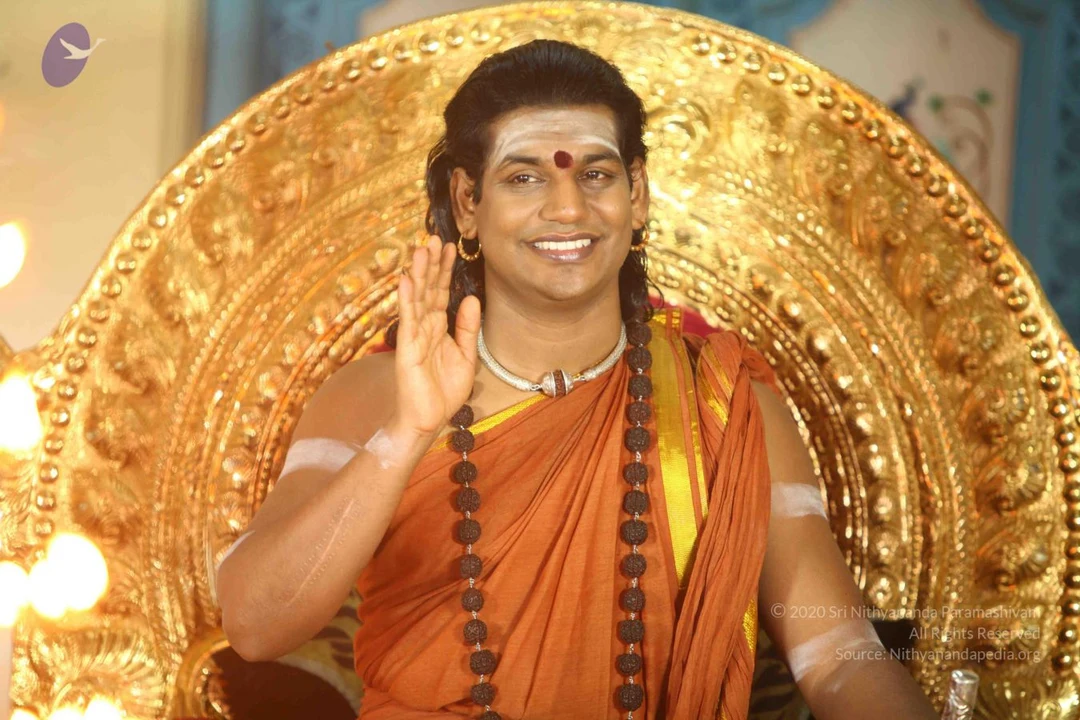
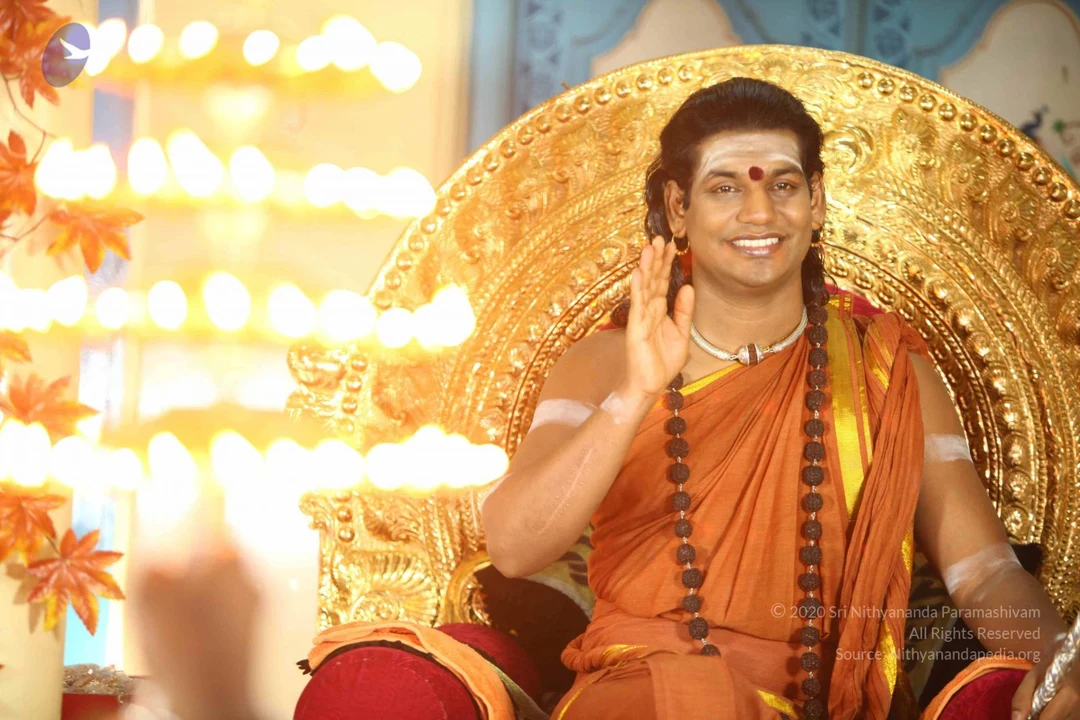
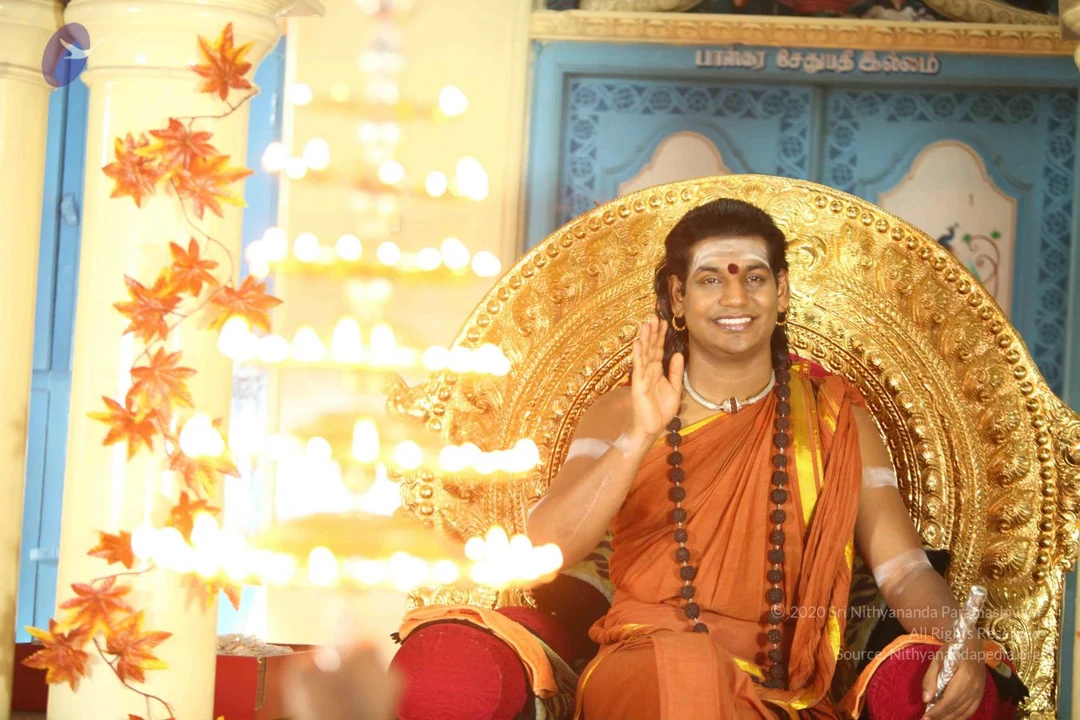
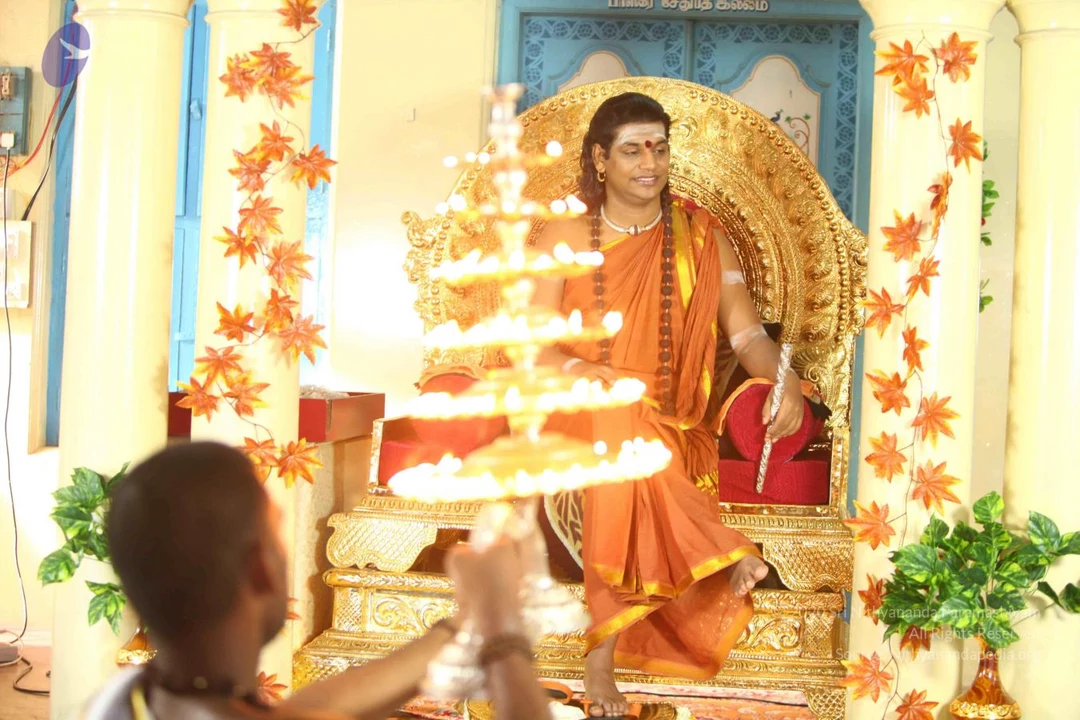
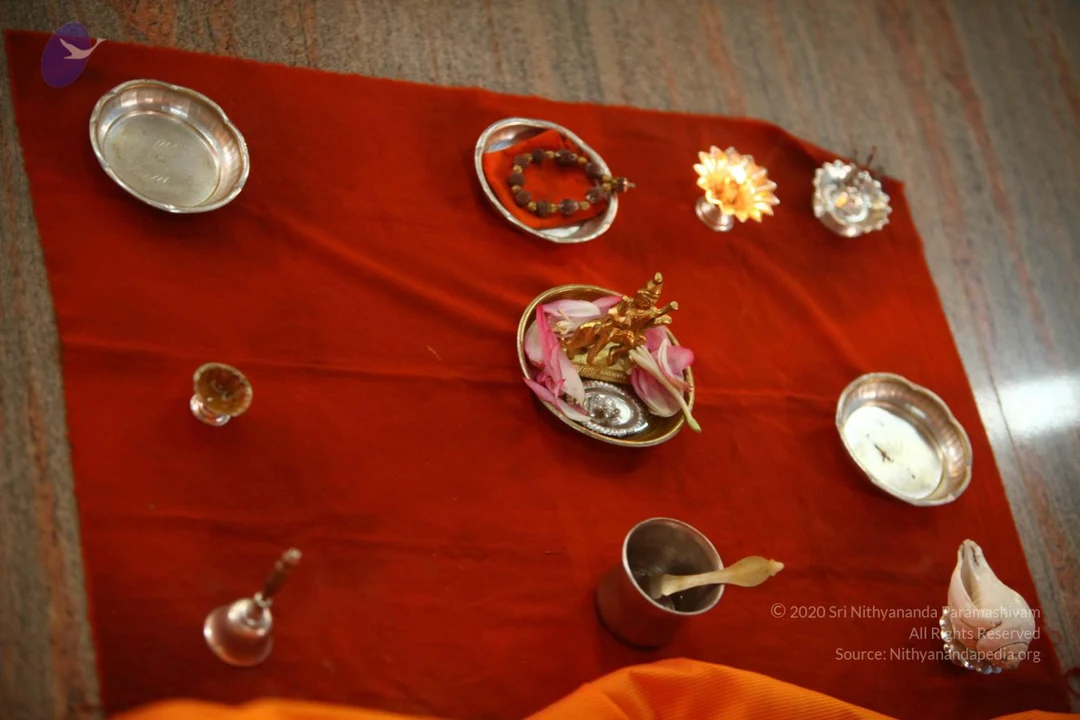
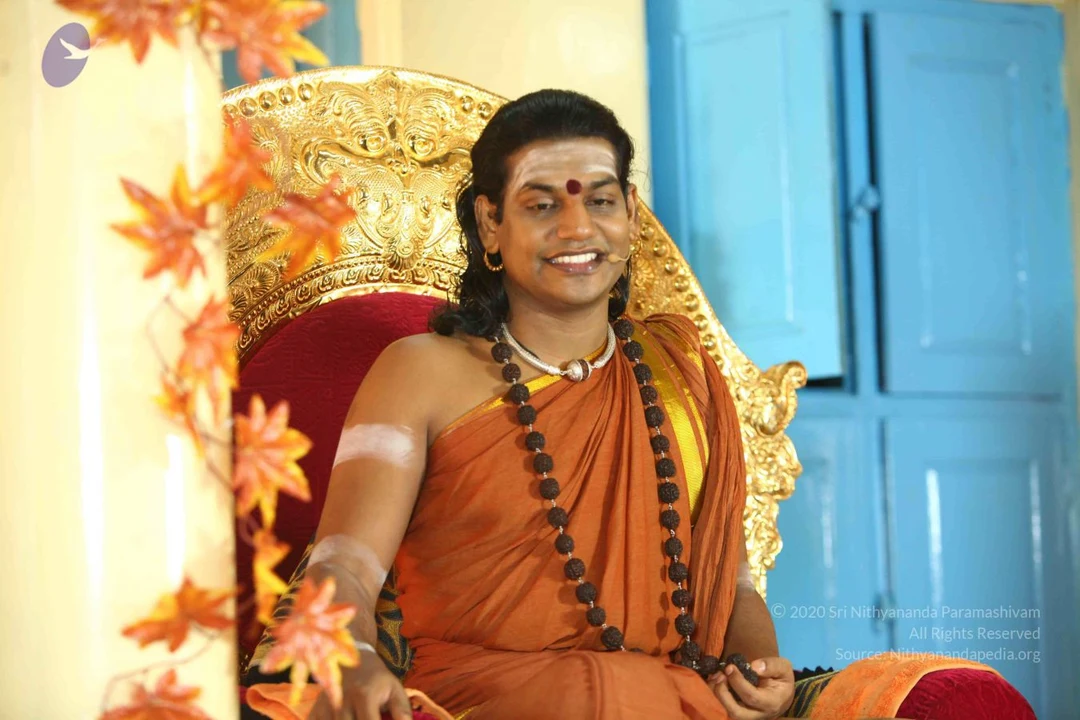
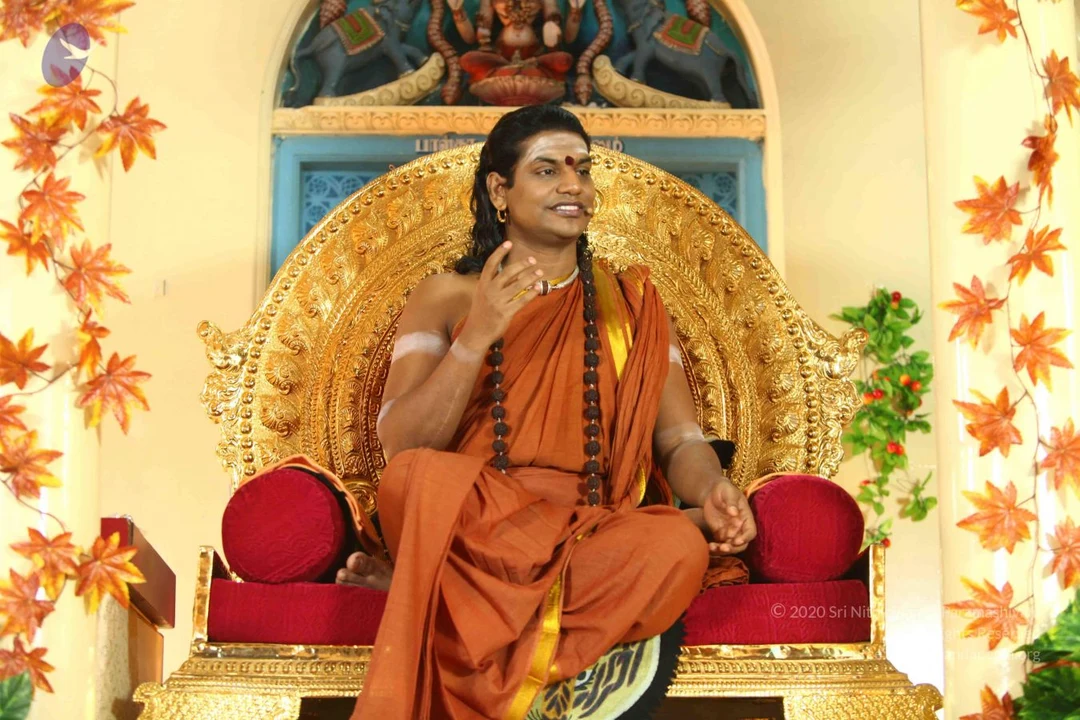
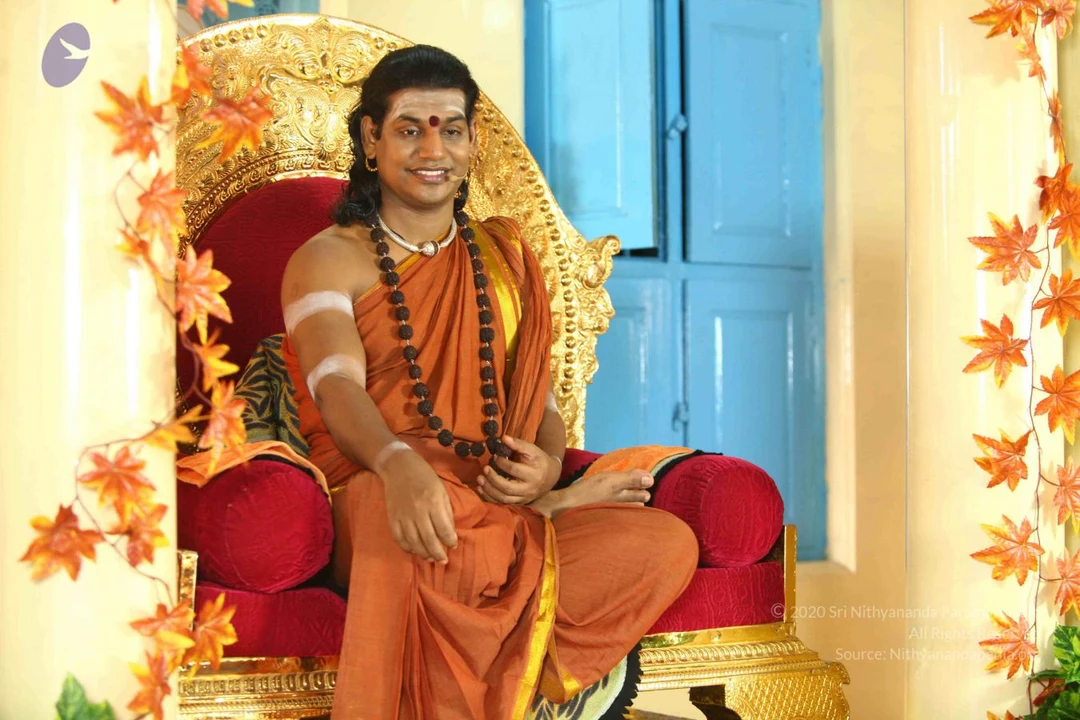
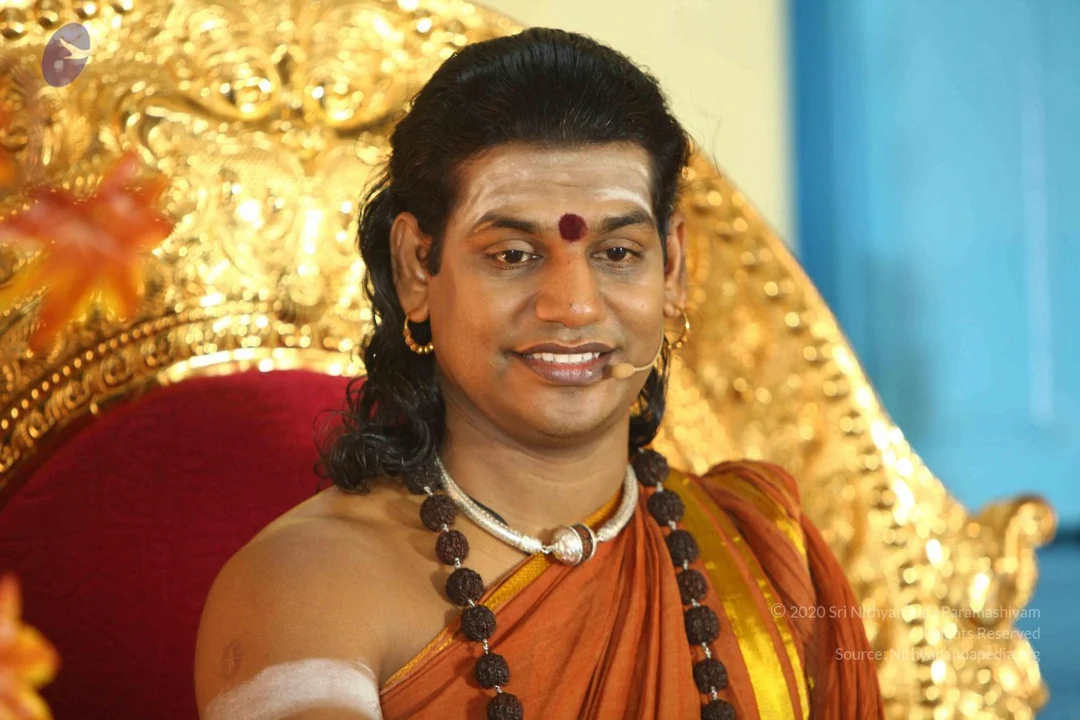
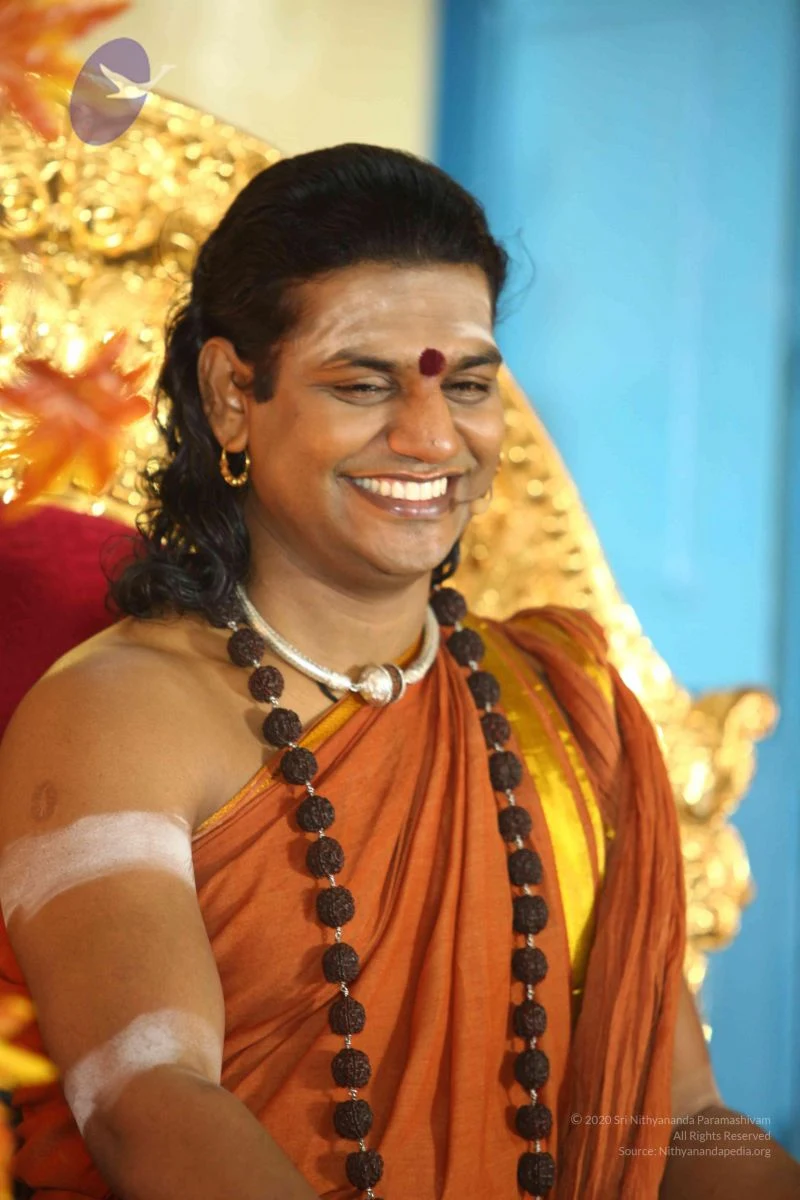
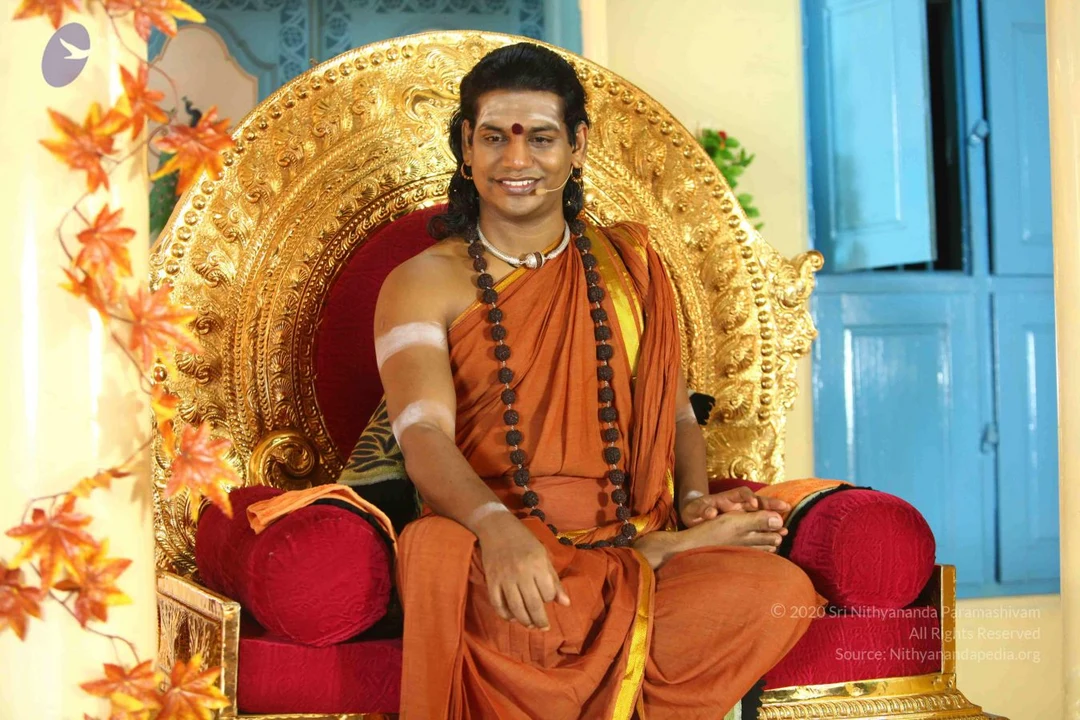
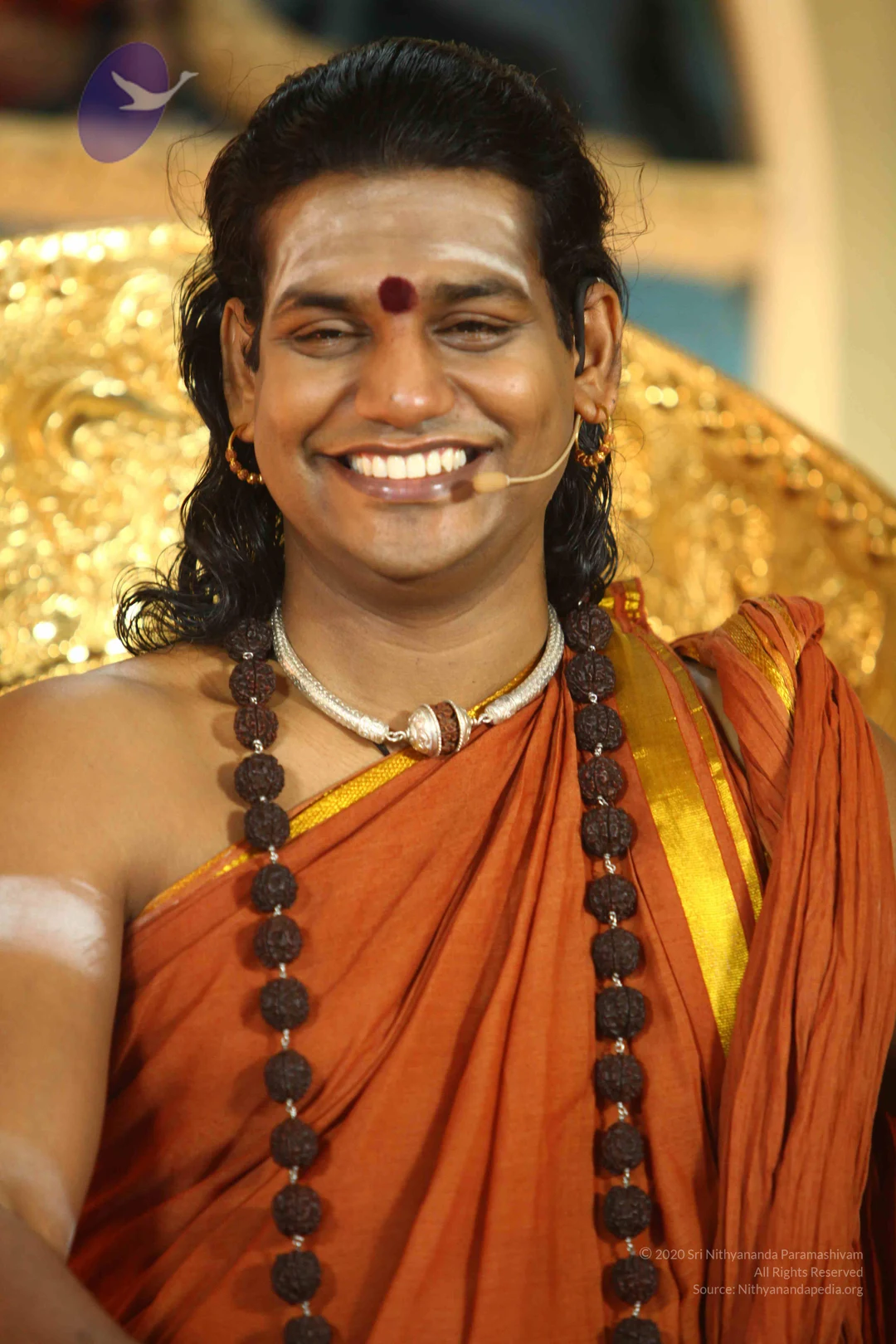
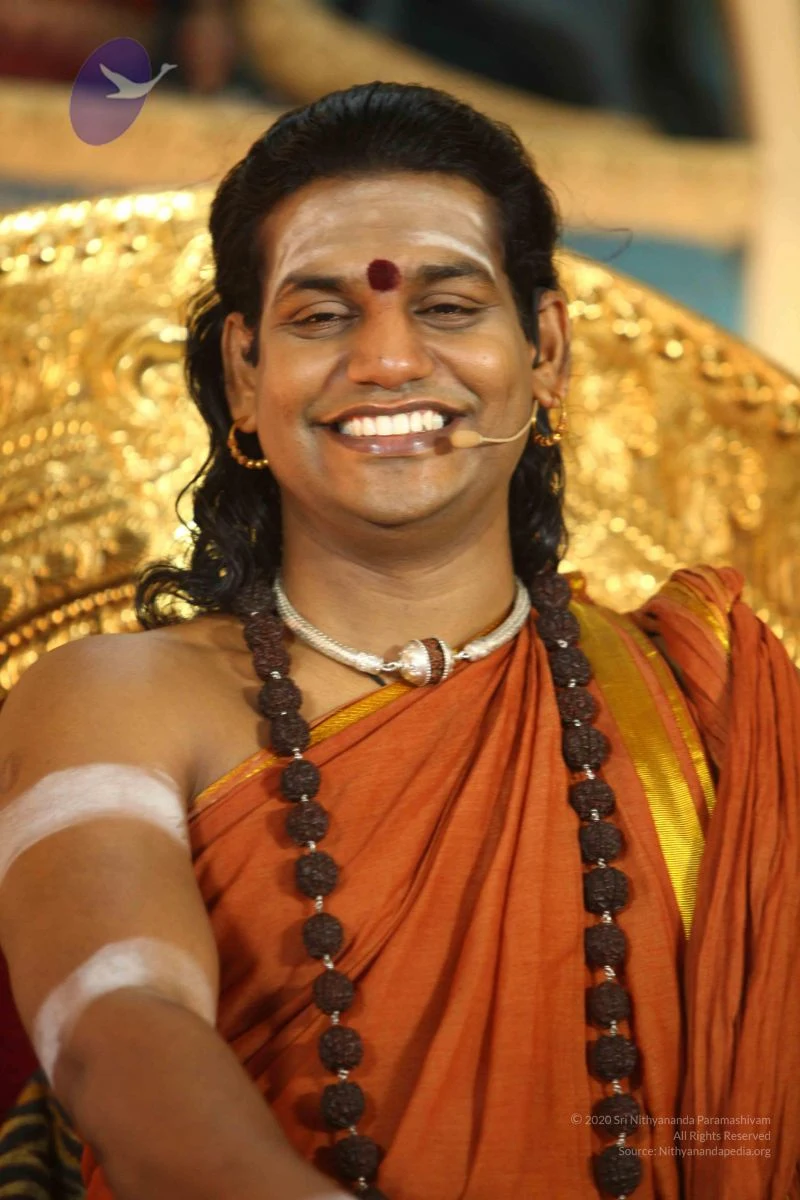
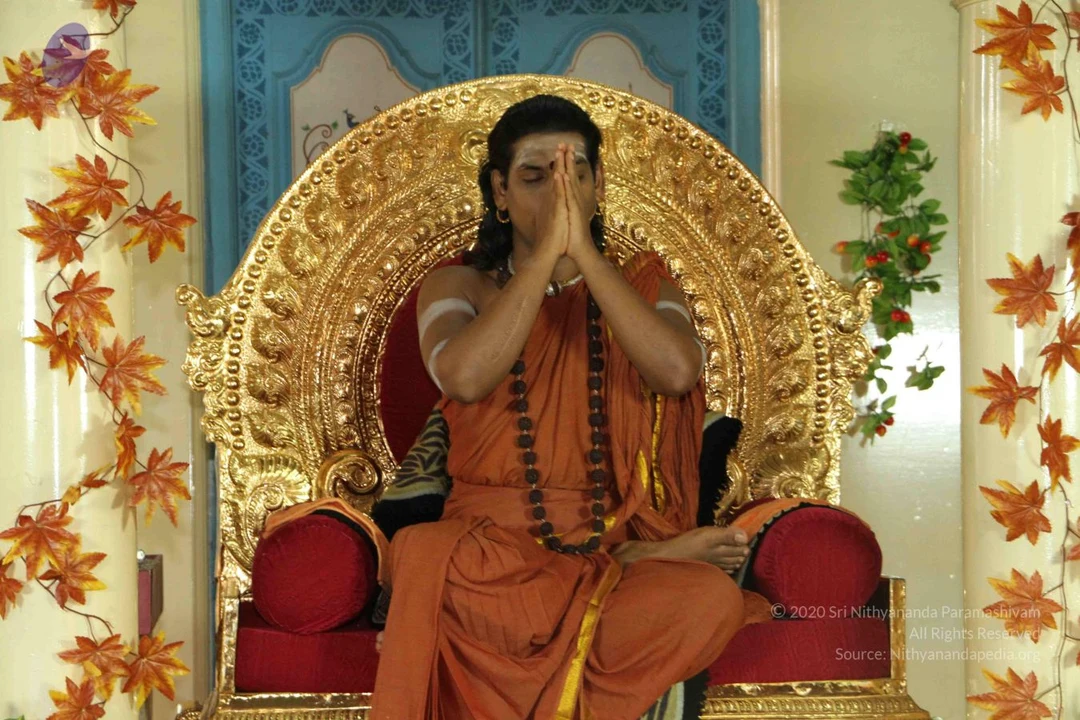
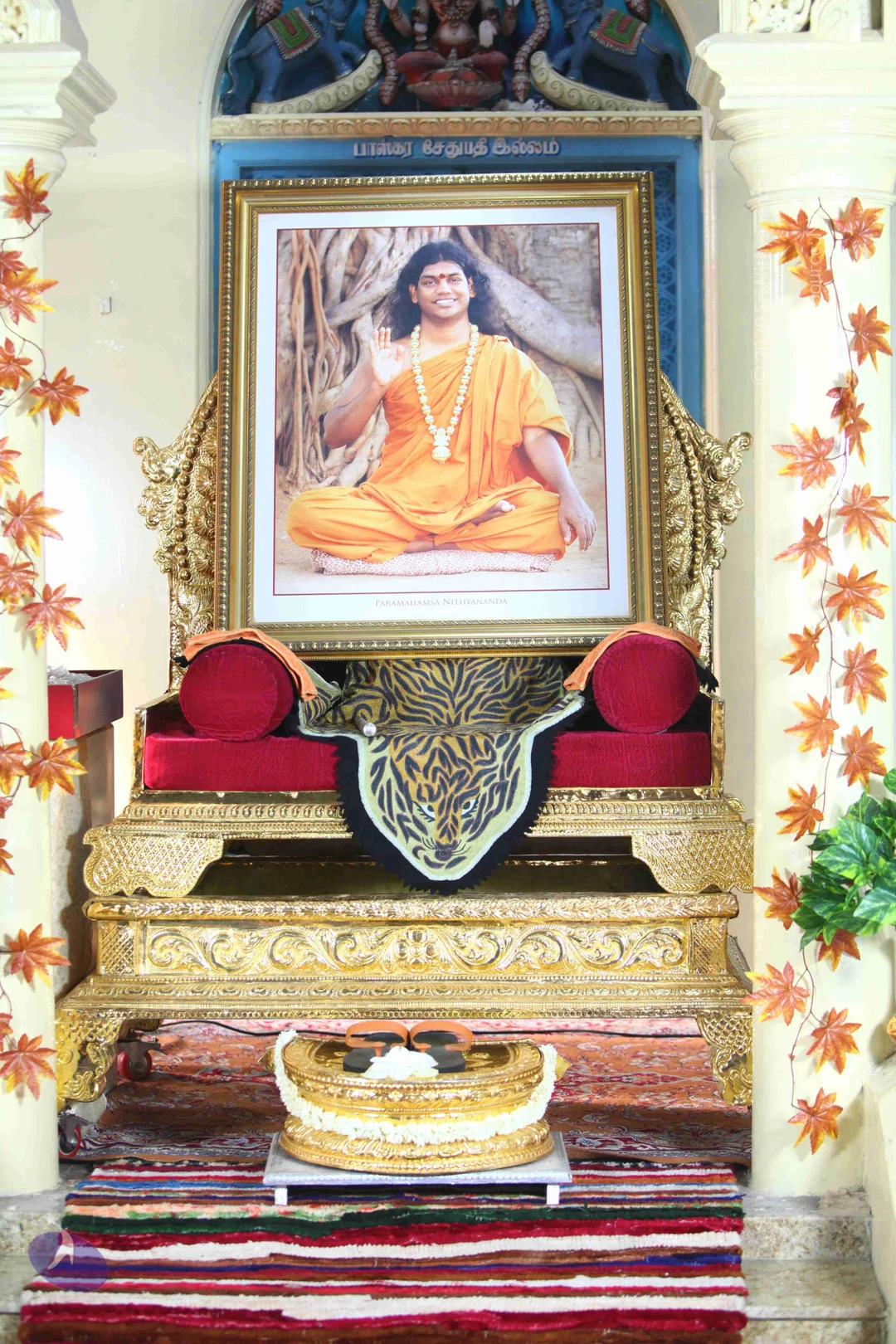
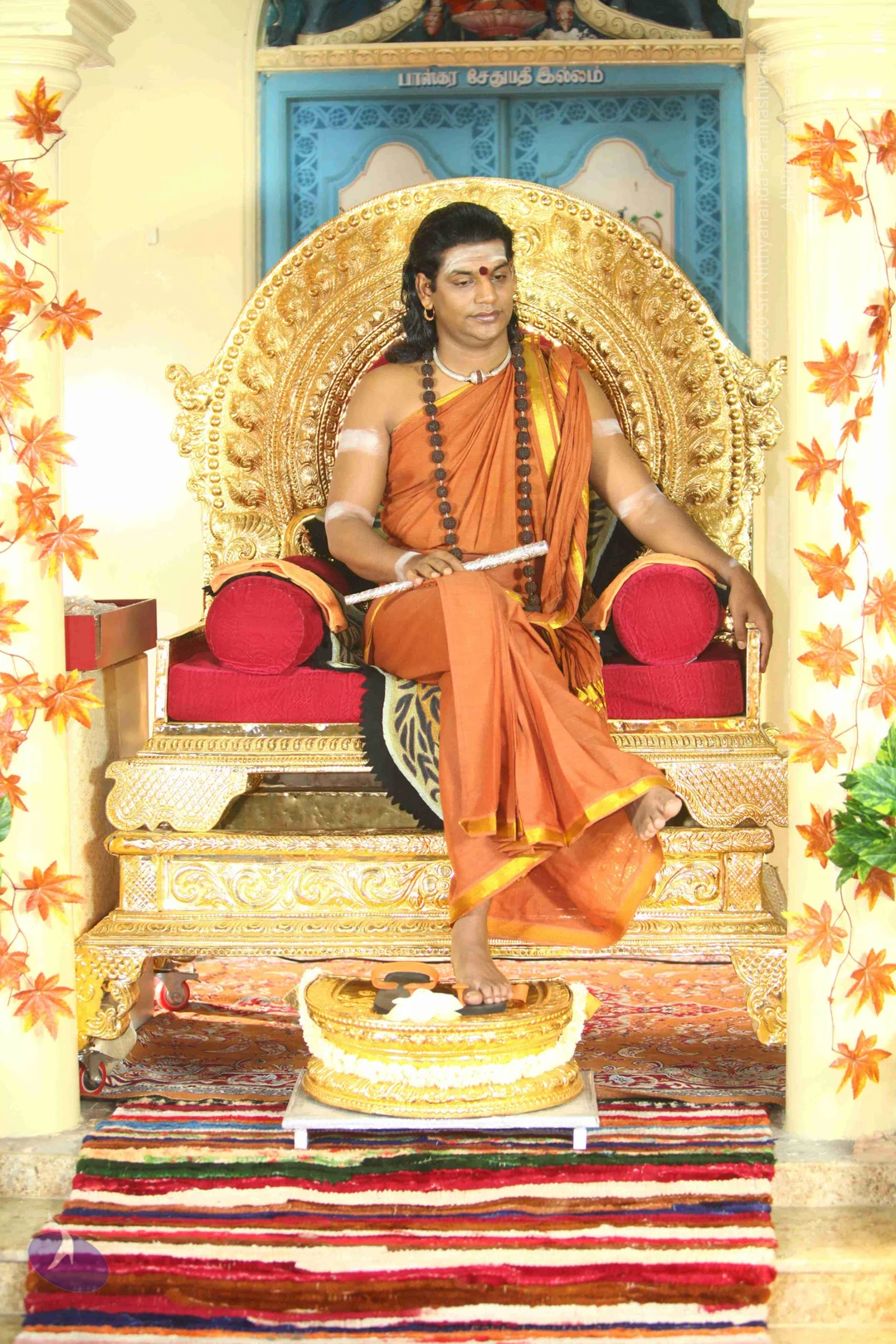
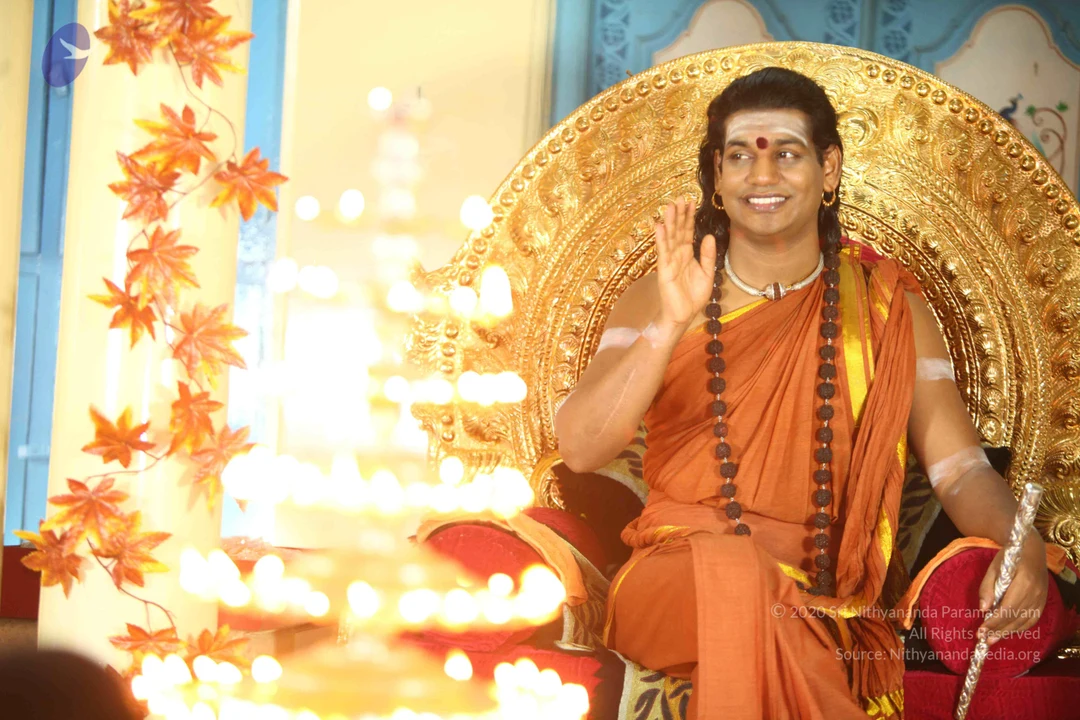
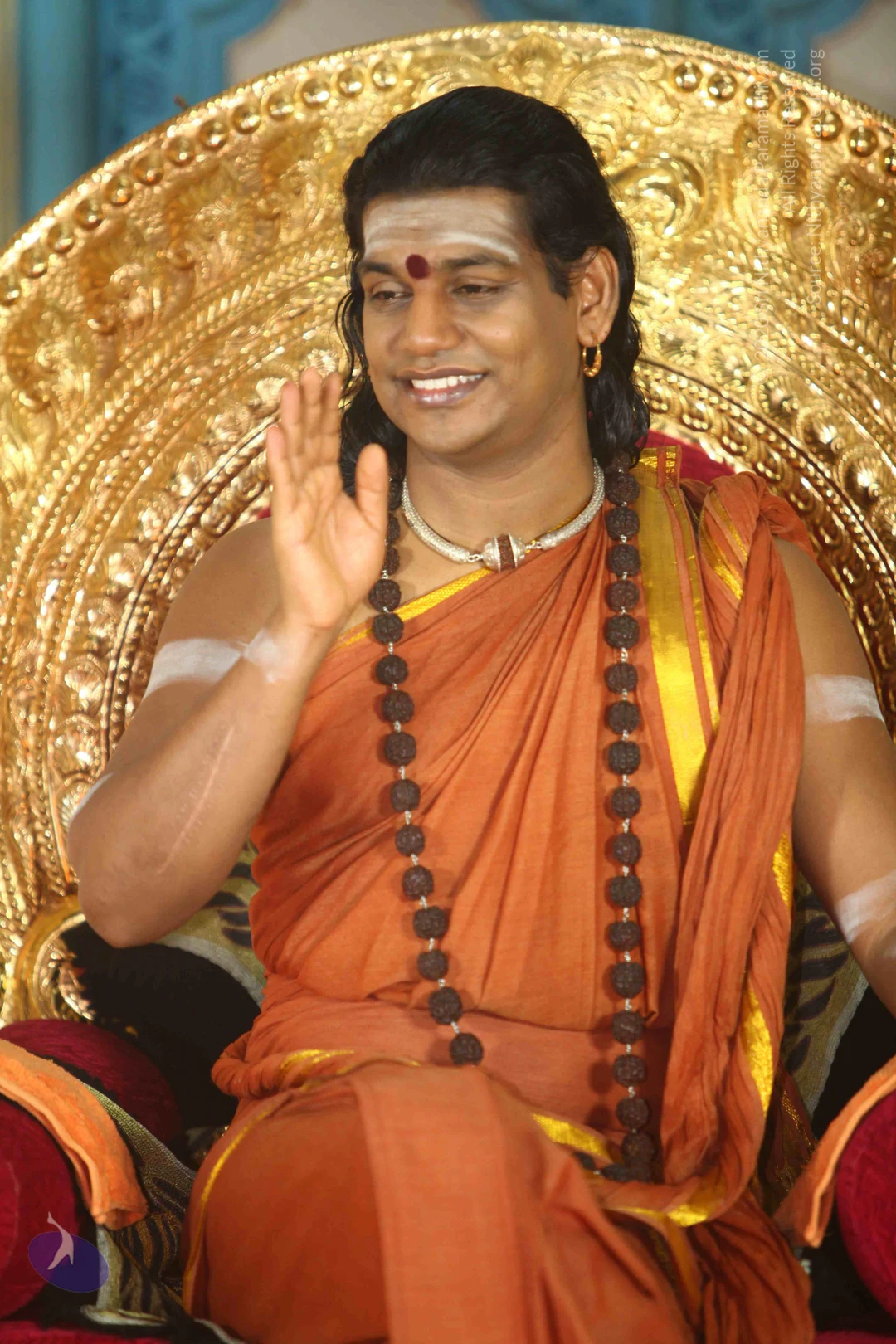
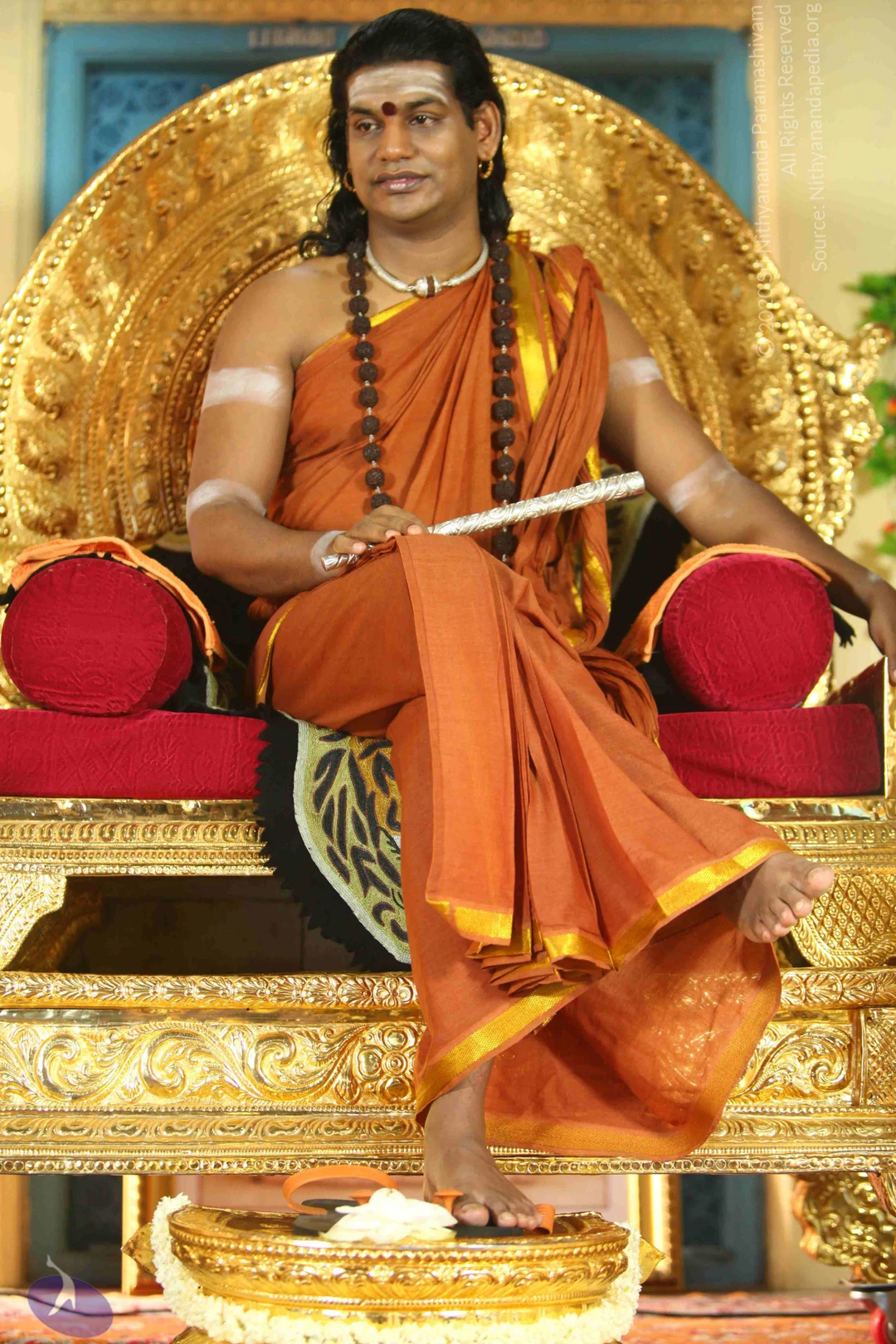
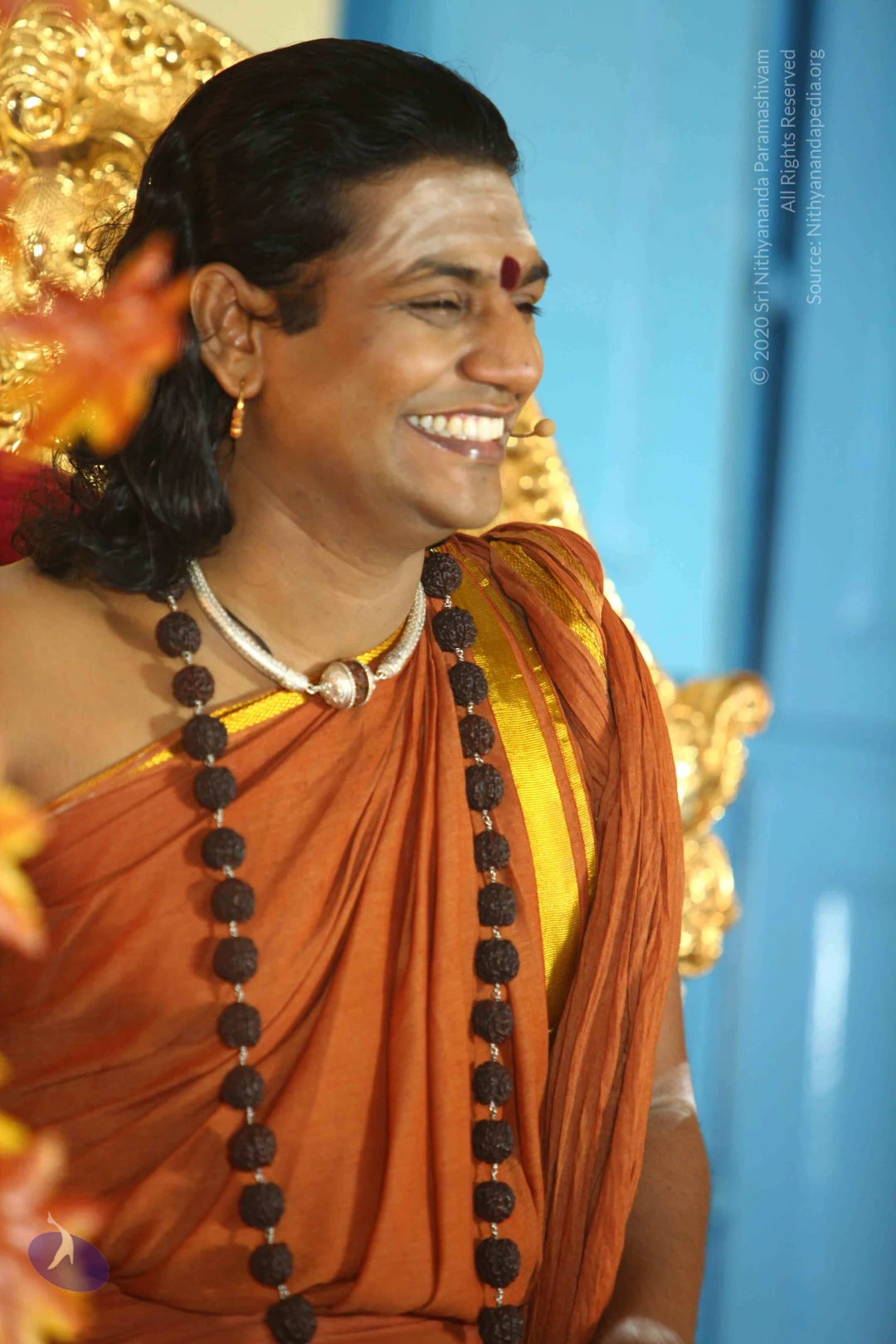
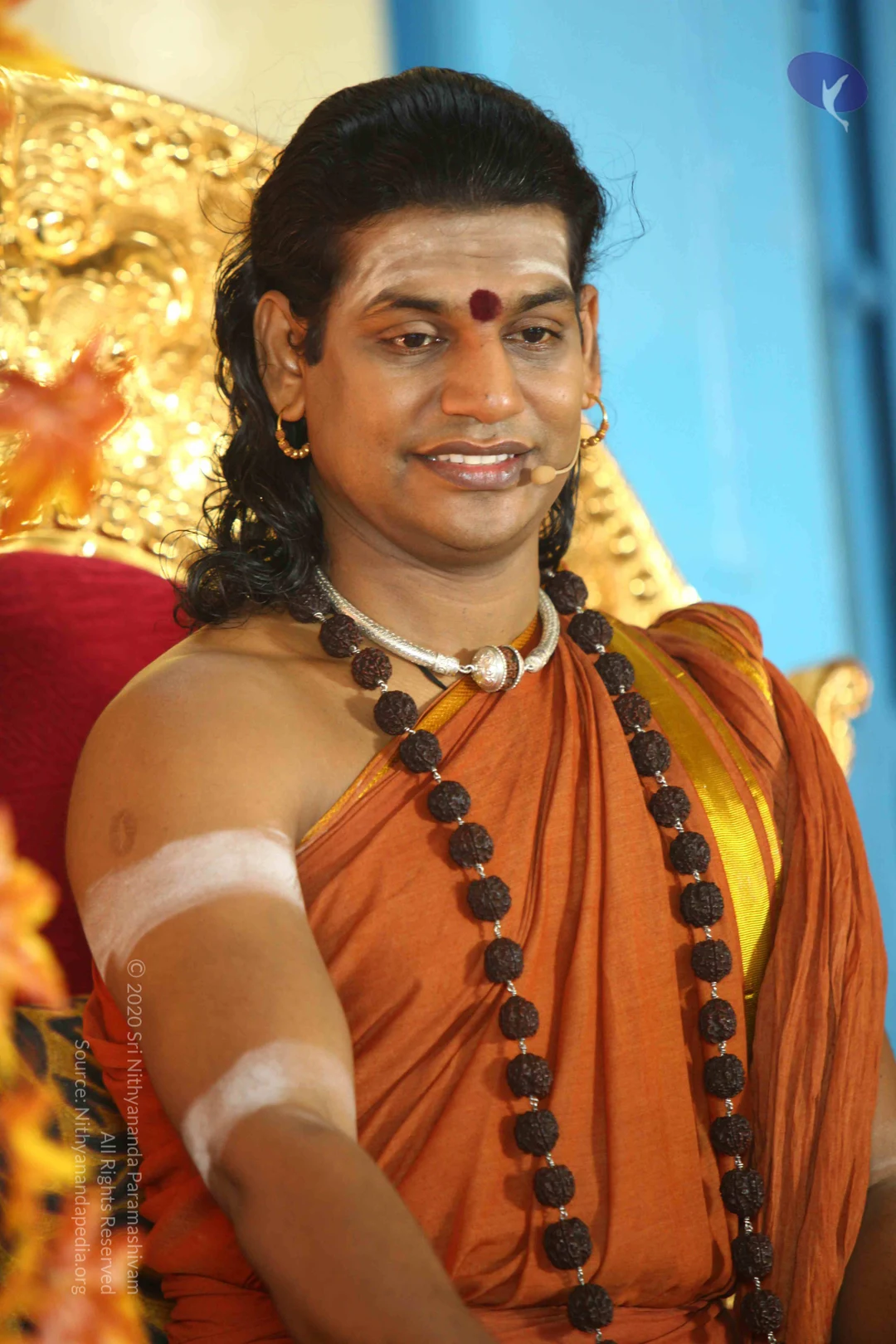
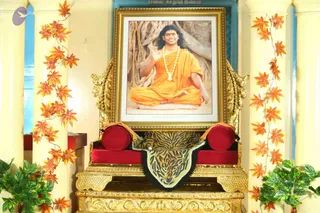
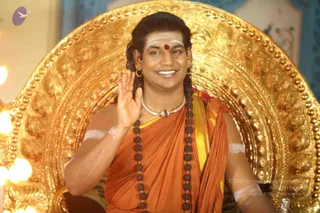
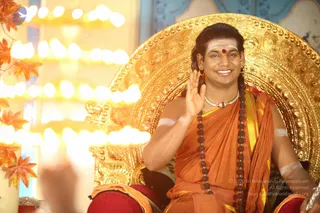
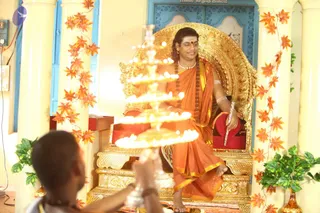
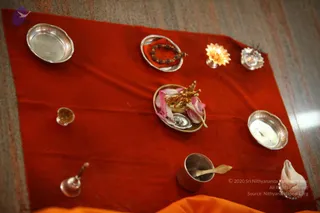
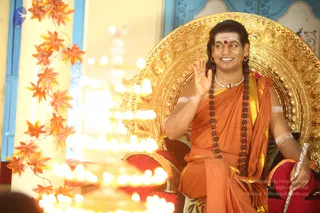
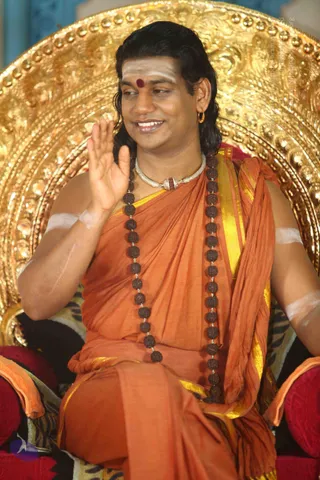
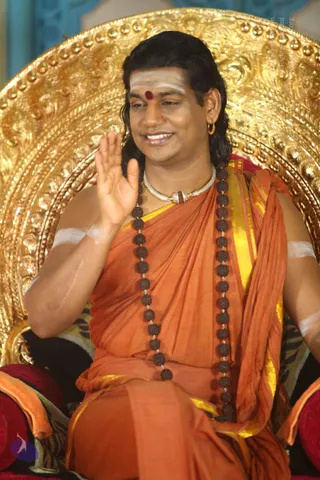
A photograph of an empty golden throne (peetha) set against cream pillars decorated with autumn-coloured leaf garlands and green potted plants. Above the throne hangs a framed portrait labelled "Paramahamsa Nithyananda" showing a seated figure in orange robes and a white flower garland, one hand raised in blessing, against a backdrop of large tree roots. The red cushions are flanked by a tiger-skin rug with an orange-and-black striped face. No physical people are present.A smiling man seated on an ornate gold throne with a large curved backrest decorated with beadwork and scrollwork, raising his right hand in a greeting or blessing. He wears an orange-saffron shawl with gold borders, a long rudraksha mala of dark beads over the chest, a silver-toned ceremonial necklace, gold hoop earrings, a red bindi and white forehead markings, and white paint on his arms. Warm lights glow at the left edge and a blue patterned wall is behind the throne. Swamiji (probable): long swept-back hair, saffron clothing, rudraksha mala and ceremonial necklace; the figure is seated on a throne in a discourse setting.A smiling man in saffron-orange robes sits on an ornate gold throne with a raised hand in a wave. He wears a long rudraksha mala, a silver necklace, white vibhuti stripes on his forehead and arms, and a red kumkum dot. Warm glowing lights and small orange autumn leaves frame the scene, and a blurred hand appears in the lower foreground. a person is shown seated and waving to the audience.A photograph of a seated man in orange saffron robes on an ornate gold throne, waving his right hand and smiling. He wears a long rudraksha mala, a white ceremonial necklace, gold earrings, white body markings and a red bindi. Behind him rows of lit oil lamps stand beside a cream column decorated with orange autumn leaves, and a blue wooden doorway with a painted panel is visible. Photo shows one person.A seated figure in an ornate gold throne with a red cushion wears saffron-orange robes with yellow borders, a rudraksha mala, a white ceremonial necklace and a red-and-white tilak on the forehead, holding a white staff. In the foreground, a person in white with bangles performs aarti, holding a multi-tiered brass lamp with lit oil lamps. Yellow-and-cream pillars are wrapped with orange-autumn leaf garlands, with green potted plants and a blue-framed doorway behind.Overhead photo of a puja arrangement on a red-orange cloth spread over a wooden floor. Silver plates hold a rudraksha mala, a small brass deity murti surrounded by pink petals, and a lit oil lamp. A brass cup with a wooden spoon, a small brass bell, and a white conch shell sit around the cloth, with saffron fabric visible at the bottom edge. No people are visible.

Kumbakonam-Hospital-Visit

7 photosSource gallery
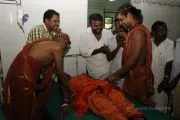
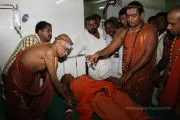
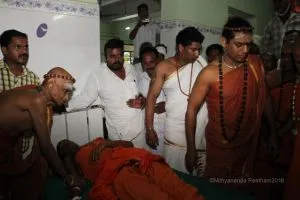
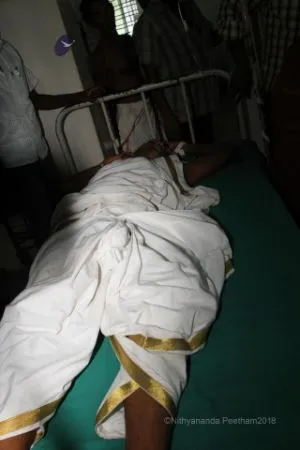
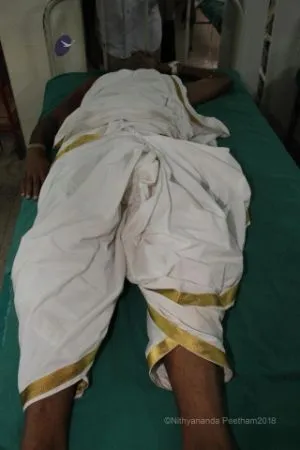
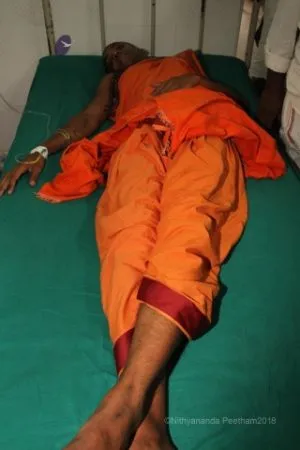
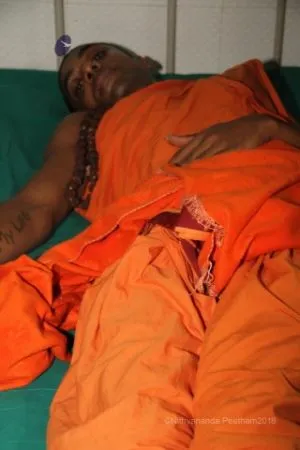
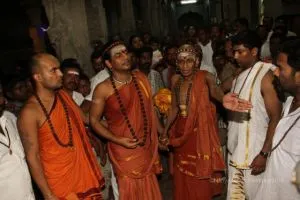
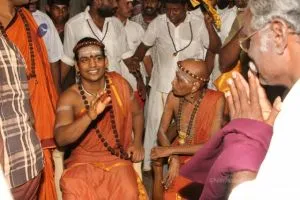
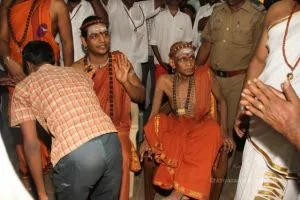
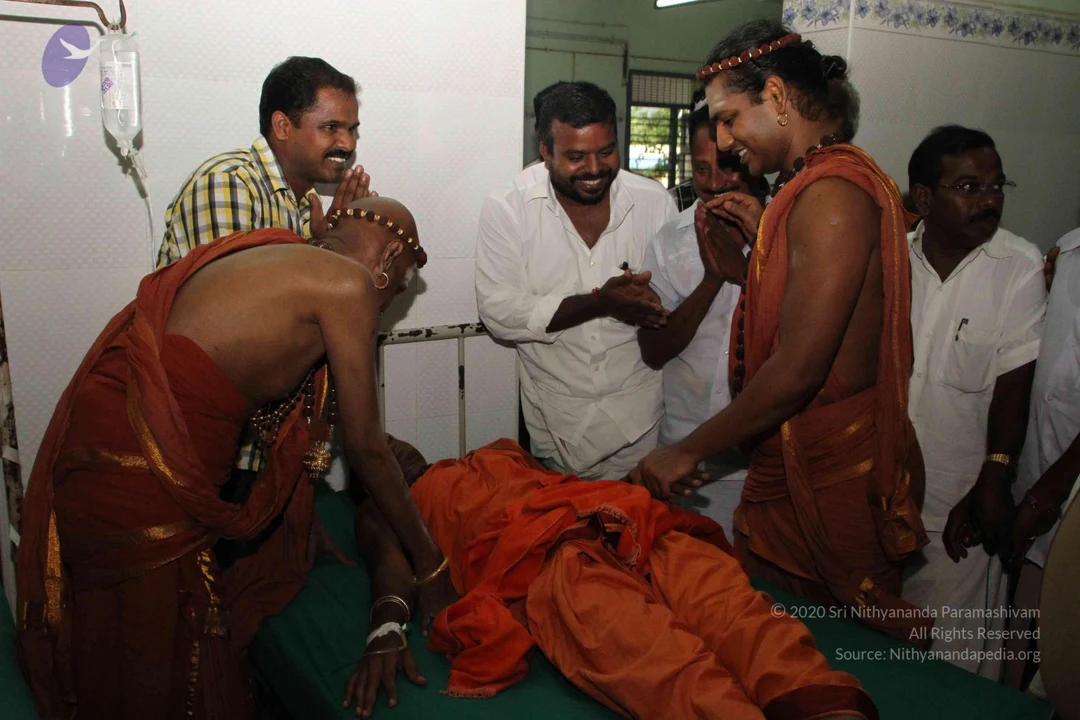
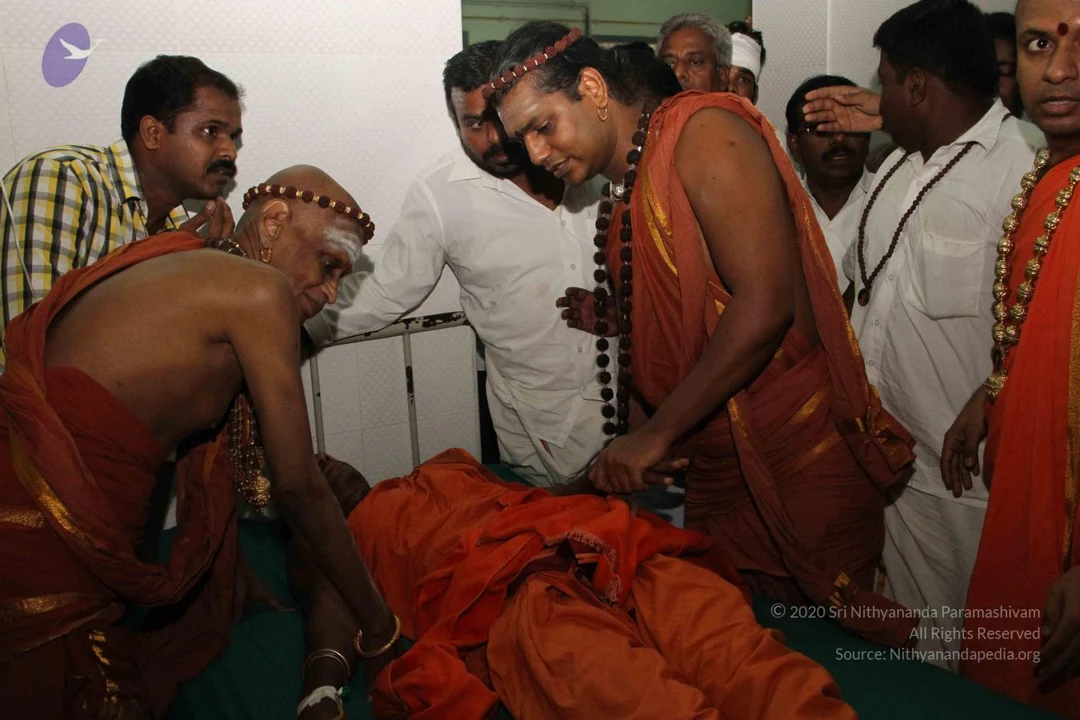
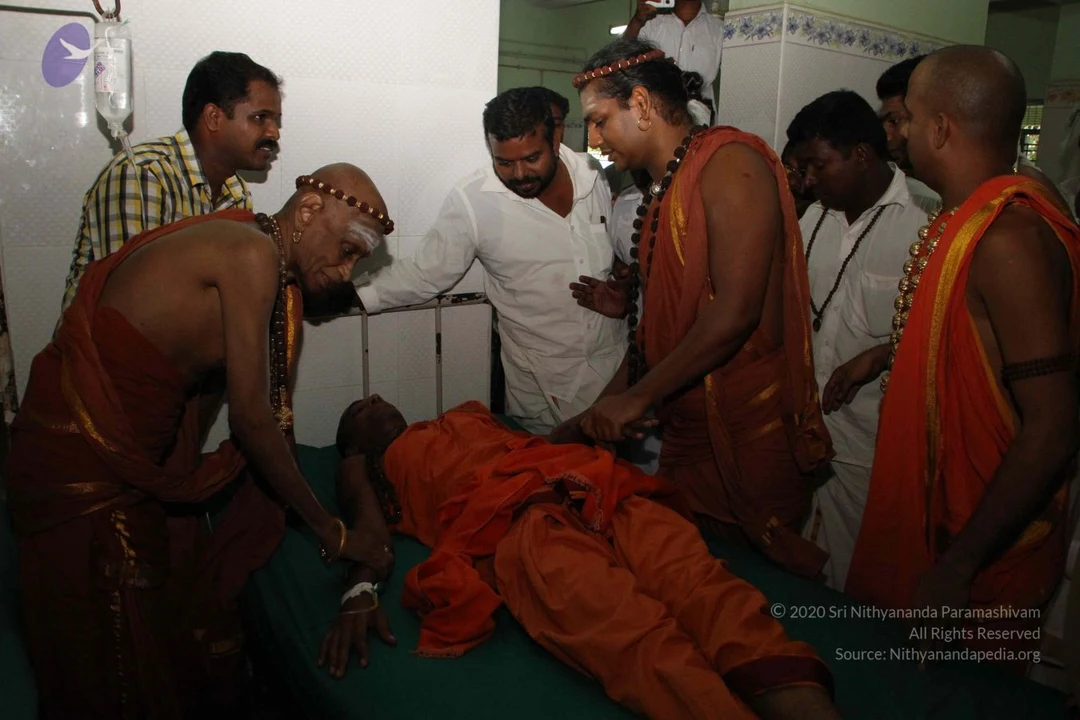
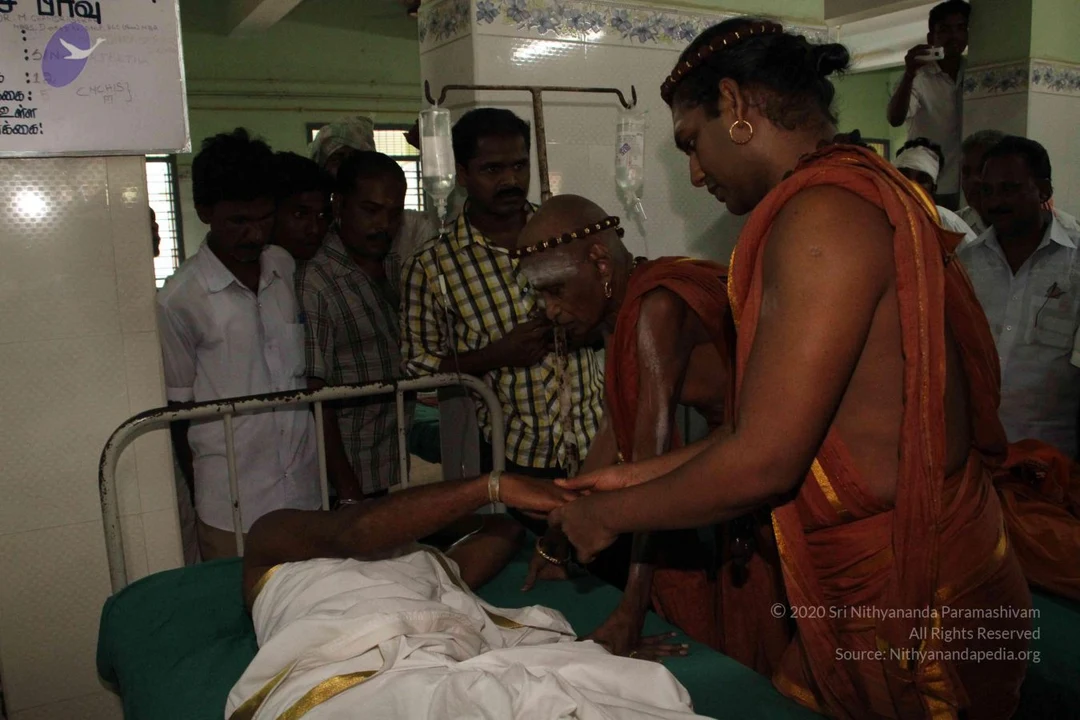
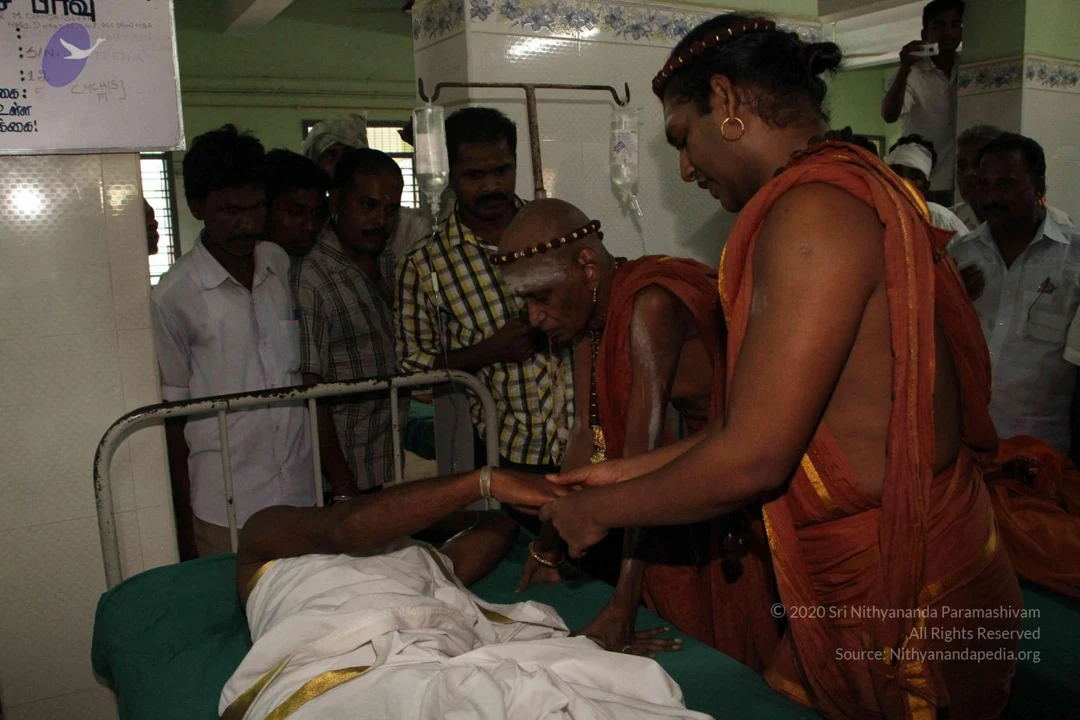
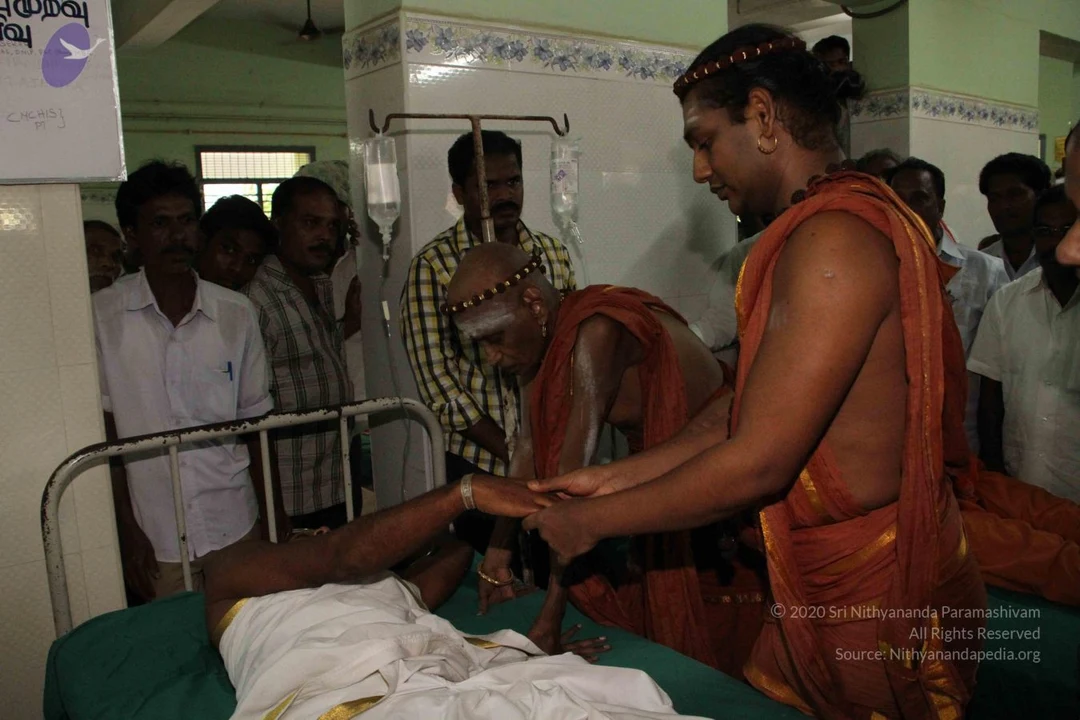
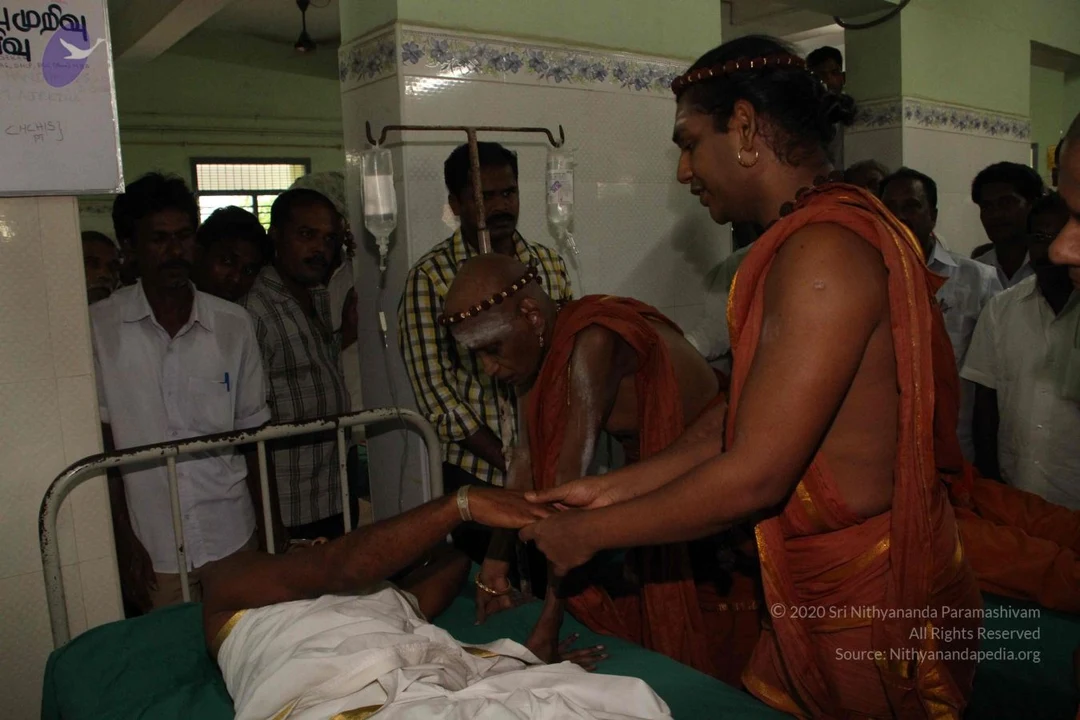
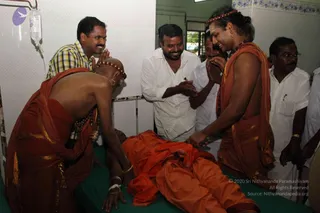
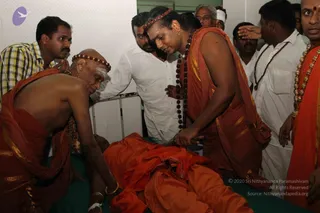
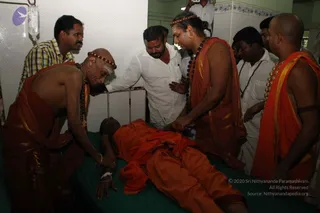
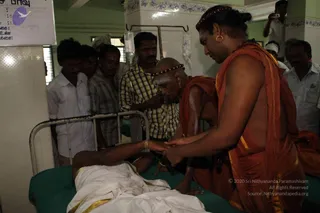
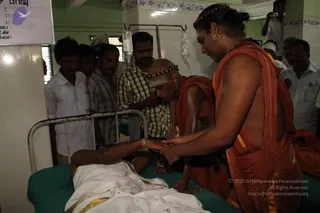
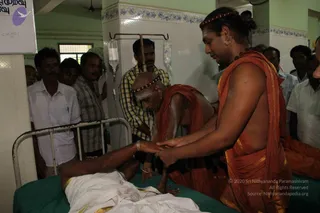
A hospital-style room with a white tiled wall and an IV drip bag hanging at the upper left. A man in orange robes with a red headband and rudraksha mala leans over a reclining figure in orange cloth lying on a green bed, while a second orange-robed figure on the right with a long swept-back hair, rudraksha malas and a gold necklace stands with hands folded and touches the bed. Around them, several men in white shirts and a man in a yellow checked shirt press palms together in greeting, with one wearing glasses at the right edge. The scene suggests a devotee greeting or blessing a sick sannyasi, with the orange-clad figures and attendants smiling. Probable Swamiji (probable) is the standing figure with long hair and gold necklace; the identity is an appearance-based label only.Photograph in a plain white-walled room where a man in orange saffron robes and a rudraksha mala with a red-beaded headband stands over a figure lying on a green-covered bed draped in orange cloth. An elderly bald man with white side hair in orange garments kneels beside the bed, pressing hands near the reclining figure. Standing around are men in white shirts and dhotis, one in a yellow checked shirt, and another in orange robes with ornate gold-bead necklaces at the right edge. The mood is attentive and ceremonial. a person appears as the standing man in the orange robe with the red headband and rudraksha mala, though his appearance is only partly visible; this is an appearance-based candidate, not a confirmed identification.A hospital room scene where several men in saffron and orange robes gather around a patient lying on a green bed, who is wrapped in an orange cloth. A bald elderly man in orange with a sandalwood-marked forehead and a red beaded headband leans over the patient and holds his wrist. A taller man in orange with a red headband, long hair and rudraksha malas stands beside the bed, while men in white shirts and dhotis and a man in a yellow checked shirt look on. An IV drip hangs at upper left against white tiled walls.A hospital ward photograph shows a man in an orange-and-gold robe with a long-haired crown-like headband and gold hoop earring bending over a patient lying on a green-covered bed in white dhoti with gold border. He holds the patient's hand while an older bald man in orange robe with rudraksha headband and white markings stands beside him. Around them, several men in checked shirts and white shirts watch; an IV stand with drip bags rises behind the bed, and a white wall chart with Tamil text hangs at left. a person is the man in orange with long swept hair and gold earring, the caption-described teacher, tending the patient.A hospital ward scene: a man in a white dhoti lies on a green-covered bed with a metal frame while two monastics in orange-saffron robes attend him. The standing monastic on the right has long hair pinned up with a rudraksha mala, gold hoop earring, and a saffron shawl with gold border, and holds the patient's hand. Beside him an elderly bald monastic in orange robes with a rudraksha mala and white sacred markings on the forehead and arms leans in. Behind them a crowd of men in shirts and checked clothing watch, and an IV stand with drip bags stands in the background. A wall sign with printed text hangs at upper left.A photograph in a hospital ward with pale green walls and a blue floral tile border. A man in an orange-red garment with gold border and a rudraksha mala is leaning over a patient lying on a green-covered bed in a white cloth. He holds the patient's hands and the patient's feet are visible. Beside him a bald man in orange cloth bends forward, also touching the patient. A standing man in a yellow checked shirt is near an IV stand with hanging drips. Around them a crowd of about a dozen men in white shirts and checked shirts watches closely. A white sign with blue text is on the left wall.

Press-Meet-Kumbakoonam

4 photosSource gallery
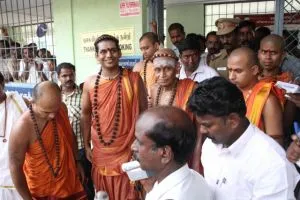
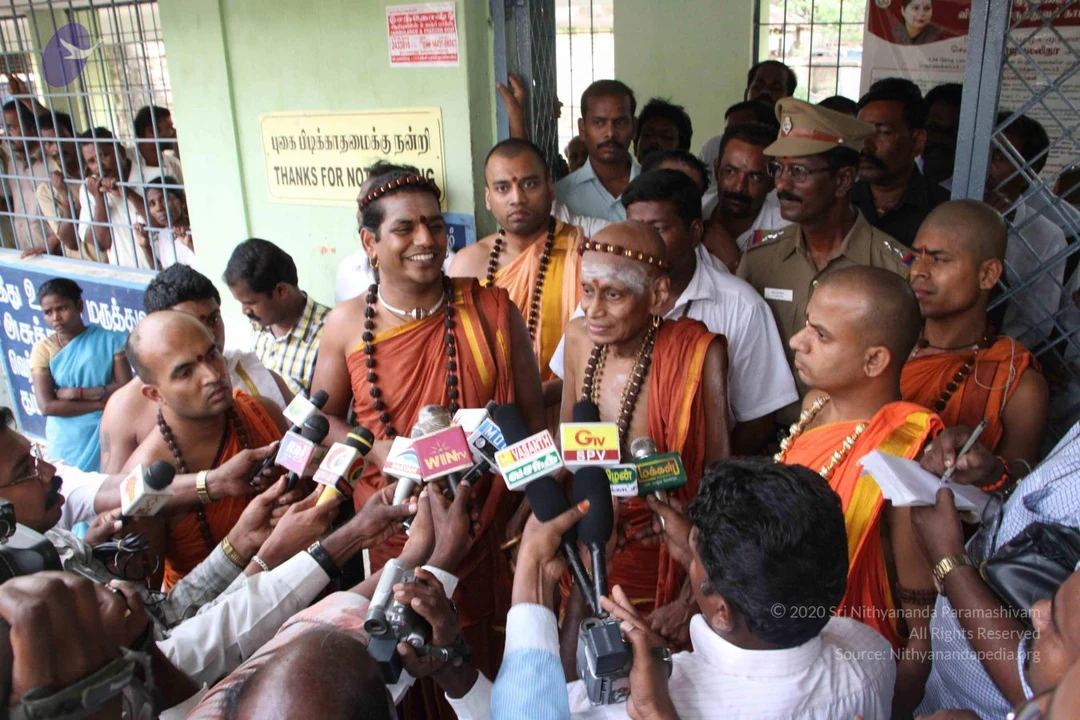
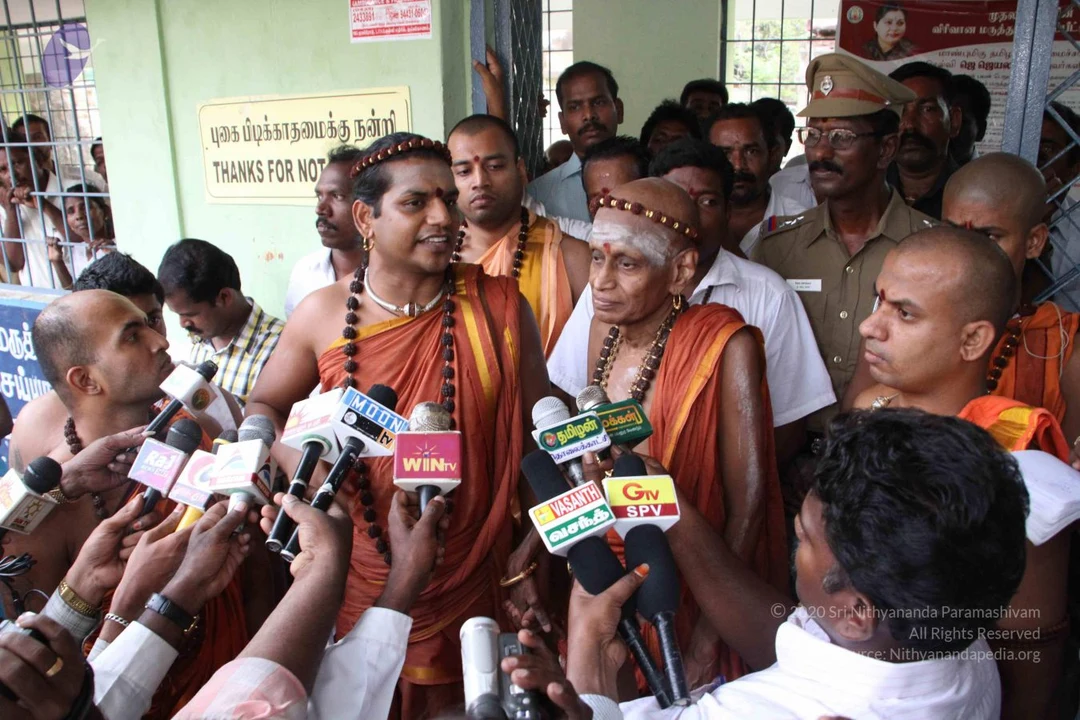
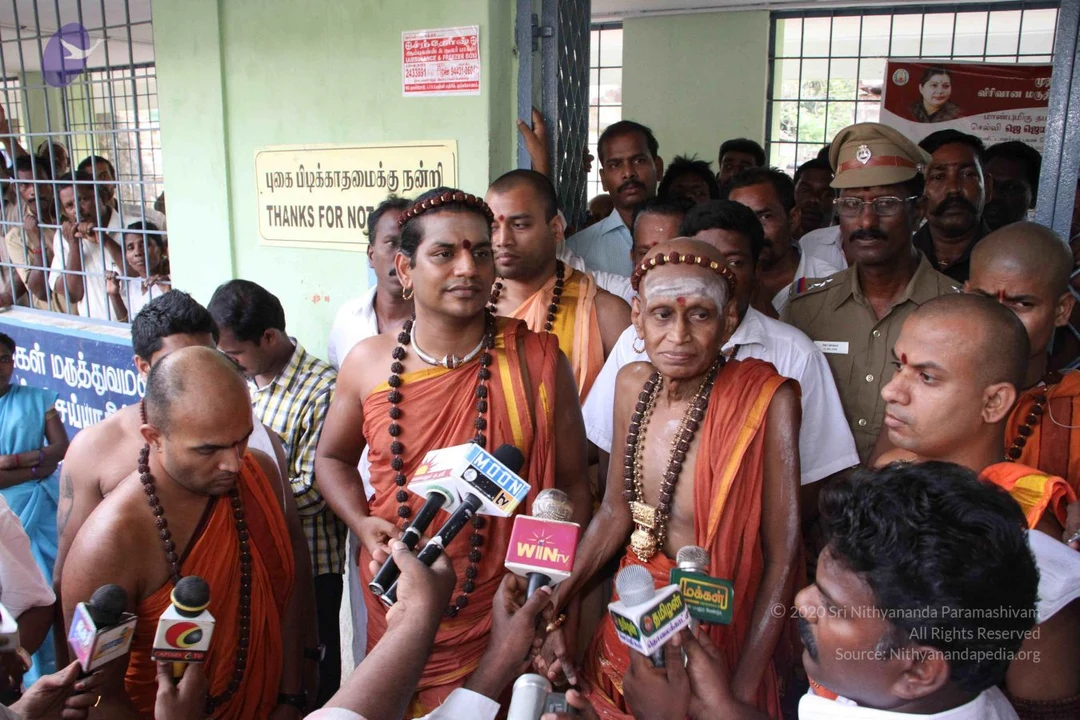
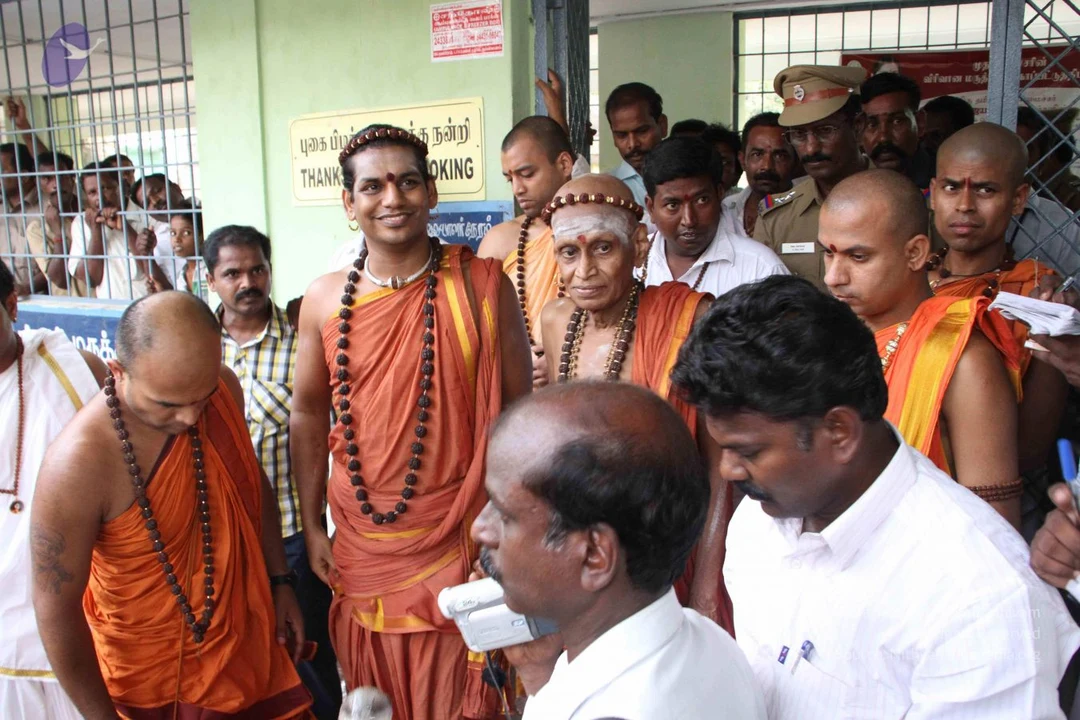
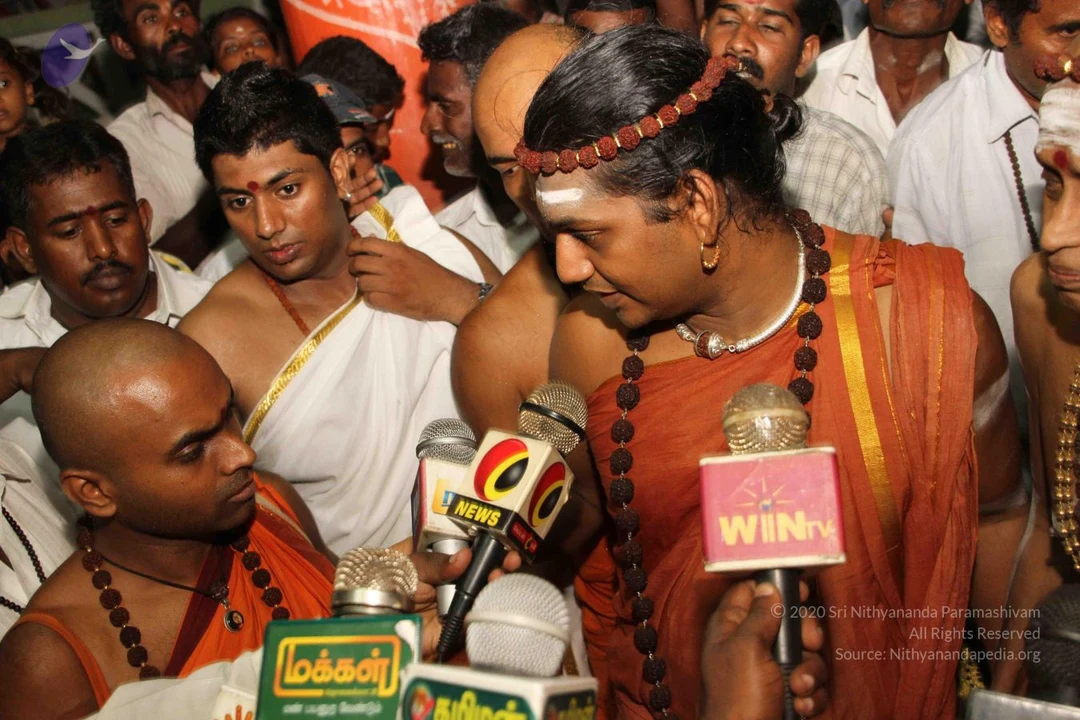
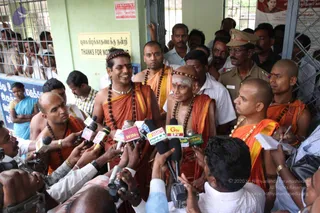
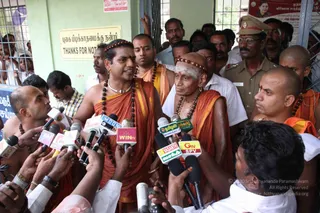
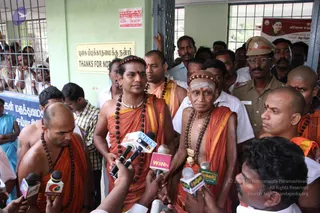
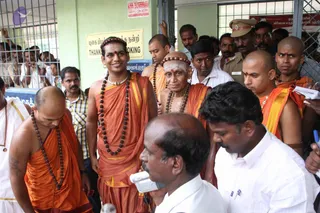
A press scrum outside a building entrance with a yellow sign reading thanks for not spitting and a grey barred gate. Several saffron-robed sannyasis with rudraksha malas stand at the centre. A smiling sannyasi with a red headband and long hair holds a ceremonial necklace at the middle, and an older bald sannyasi with white vibhuti markings on his forehead stands beside him. A uniformed police officer in khaki and a cap watches at the back. Many reporters push microphones of Tamil TV channels toward the group, including logos reading Win, Gemini-style and Raj TV. Around fifteen to twenty people are visible.A press scrum outside a gated building with a green wall, where saffron-robed men with rudraksha malas face a cluster of microphones held by reporters. A man with long swept-back hair and a red-and-saffron cloth around his neck, wearing a gold chain, speaks at centre. Beside him an older man with a shaved head, white forehead markings and saffron robe listens. Uniformed police officers and onlookers stand behind the metal gate. Microphone flags read Vasanth, GTV, SPV, Win TV and Puthiya Thalaimurai. A sign reads Thanks for not ... and a tilted white poster in Tamil hangs at the top.Photograph of a press scrum outside a green-walled building with barred windows. Two saffron-robed men with rudraksha malas stand at centre; the figure on the right has a shaved head, white vibhuti marks and a gold chain-pendant, while the younger man beside him wears a saffron wrap, rudraksha malas and a red headband. Several reporters hold microphones labelled MJTN, WIN TV and Makkal TV toward them. Behind are a police officer in khaki uniform with a cap, and a crowd of onlookers. A sign on the wall reads 'THANKS FOR NOT SPITTING' and a red banner shows a woman's portrait. Nobody in the crowd is identifiable beyond general roles.A crowded outdoor scene at a building entrance with green walls and a metal grille. In the centre, a smiling young man wears a saffron-orange garment with a deep orange shawl, a long rudraksha mala and a white ceremonial necklace, and has a red-brown bead crown on his head. Beside him, an elderly man with a shaved head, white vibhuti tripundra and a long rudraksha mala wears orange robes. Around them, shaved-headed men in orange robes and malas stand among a crowd of dhoti-clad onlookers and a police officer in khaki uniform with a cap. A man in the foreground holds a white handheld device and a notepad. A sign on the wall reads 'THANK YOU FOR NOT SMOKING' with Tamil text beneath.
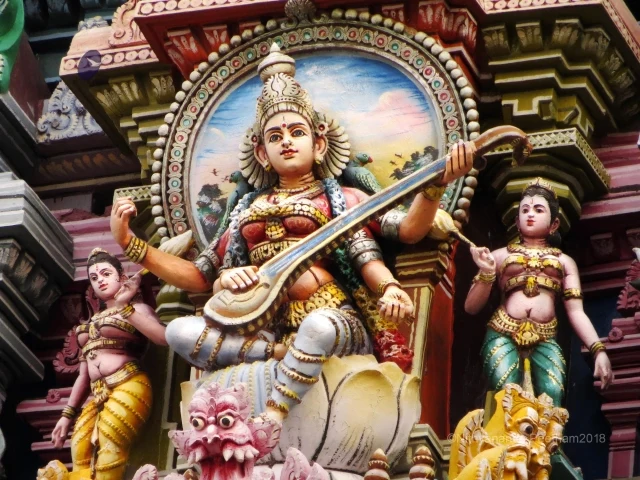
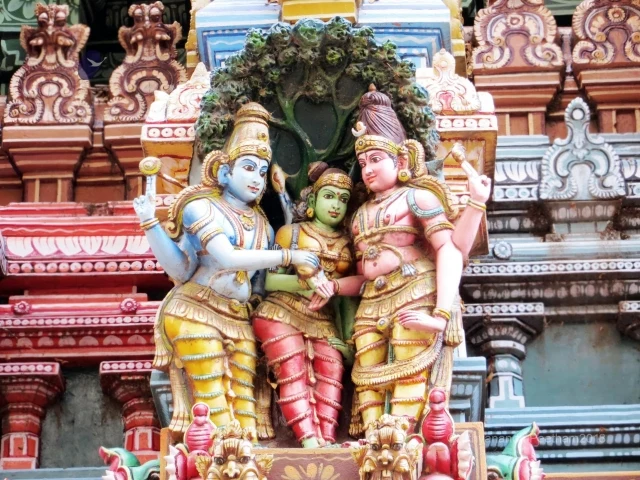
Press-Meet-Kanchanoor-Temple

2 photosSource gallery
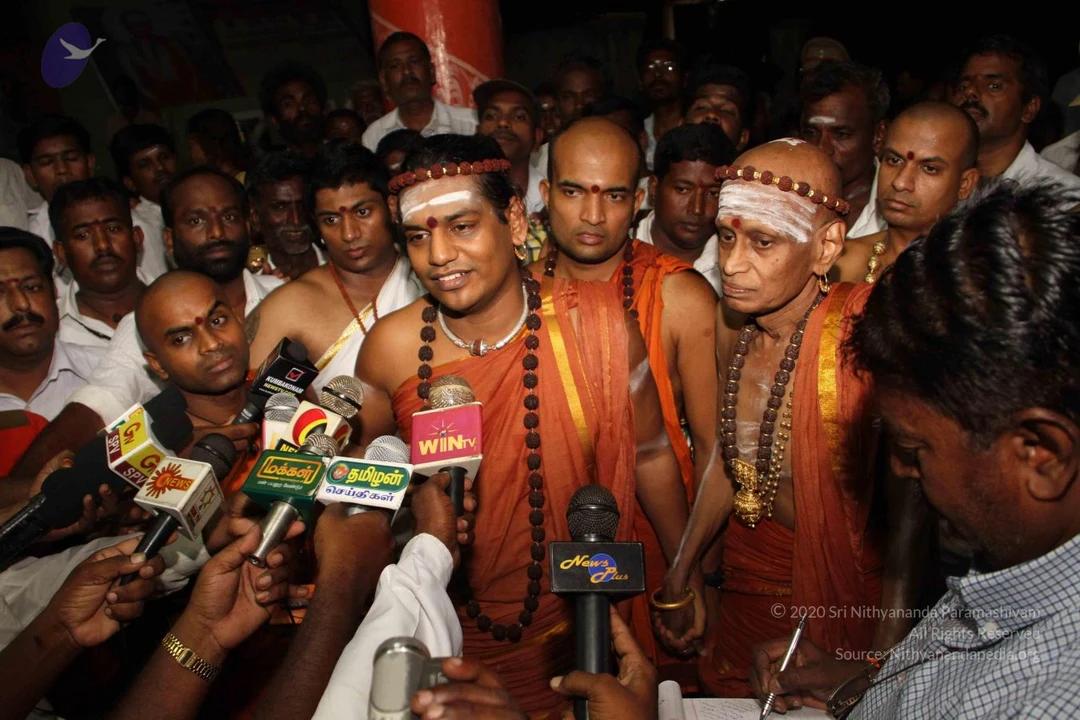
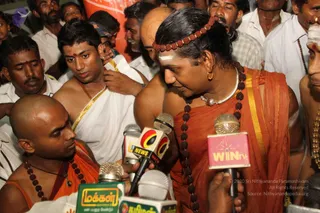
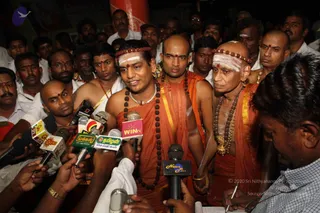
Photograph of a crowd around a press gathering with several microphones held toward a central figure. A long-haired man wears an orange-saffron wrap with a gold border, a rudraksha mala across his chest, a silver necklace, a rudraksha headband and white and red forehead markings. Beside him a shaved-headed priest in saffron with rudraksha beads speaks, and a man in white with a gold-bordered shawl stands nearby. Microphones carry channel logos including WIINtv and Makkal TV. Several onlookers in white shirts and white dhotis press close. Probable Swamiji appearance cues: long swept-back hair, rudraksha mala, orange garments and ornate silver necklace.A photograph of a press scrum in a crowded outdoor street at night. In the centre, a smiling man in saffron-orange robes and a red rudraksha headband with a white forehead band stands before a cluster of microphones, many bearing TV station logos including News Plus, WIIN TV, Makkal TV and Tamilan. Beside him, an older man with shaved head, white forehead markings, orange robes and rudraksha malas holds a notepad and pen. Behind them, a bald man in orange robes and another man in white shirts and saffron cloths press forward among onlookers. Reporters extend microphones and a hand-held recorder toward the centre.

Press-Meet-Madurai-Adheenam

9 photosSource gallery
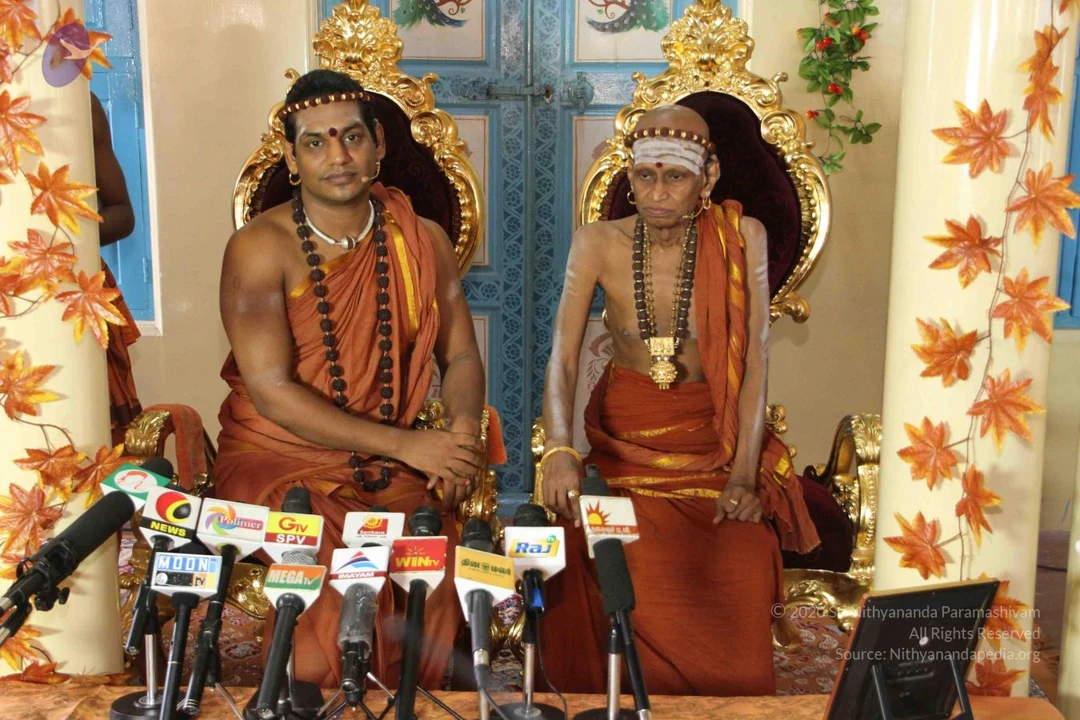
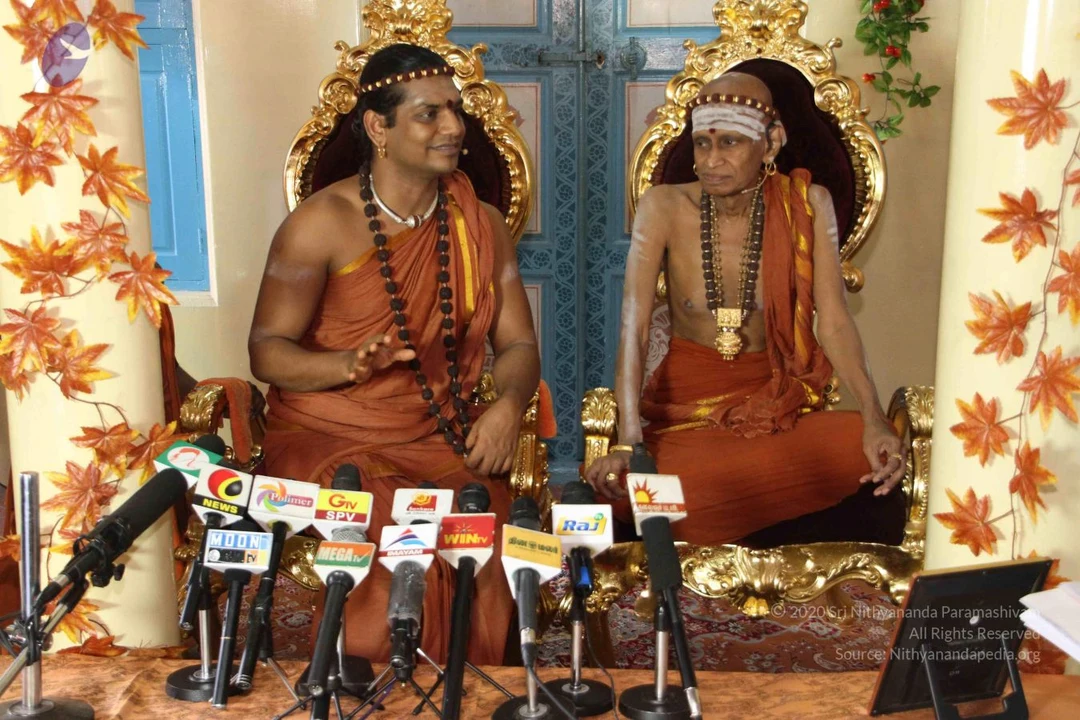
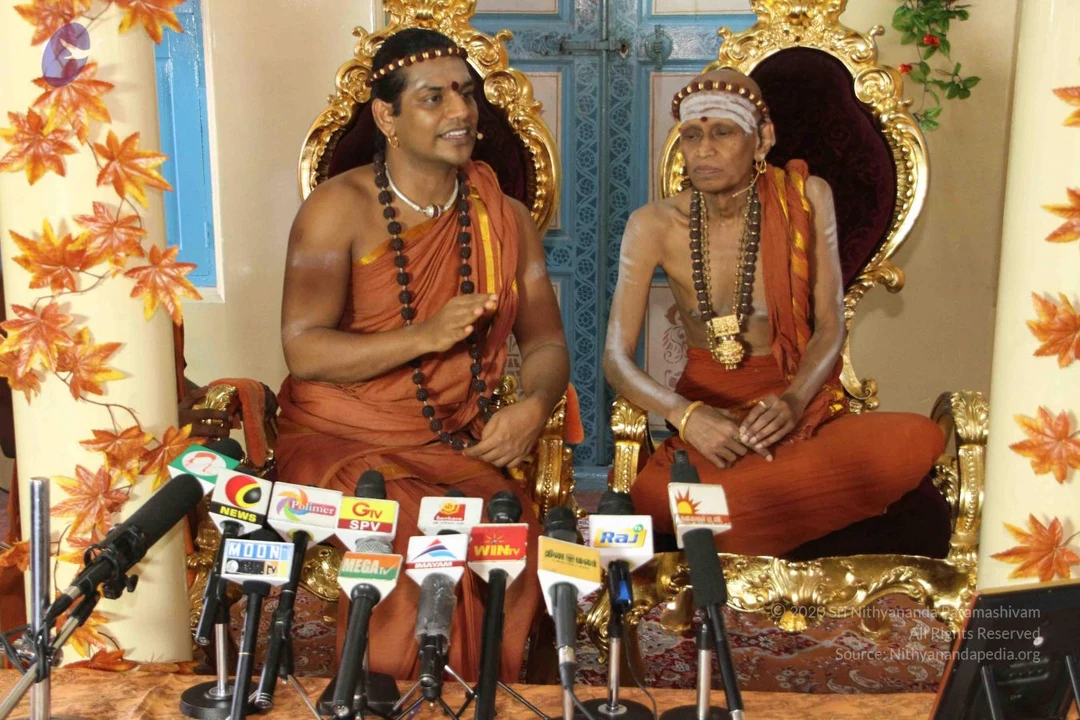
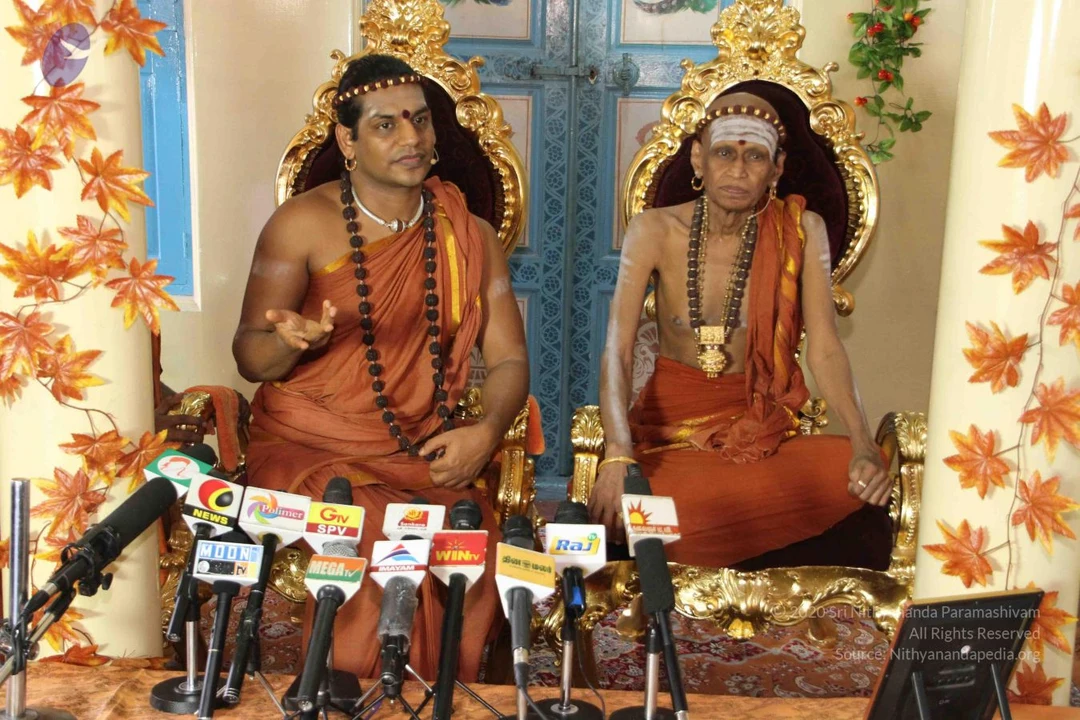
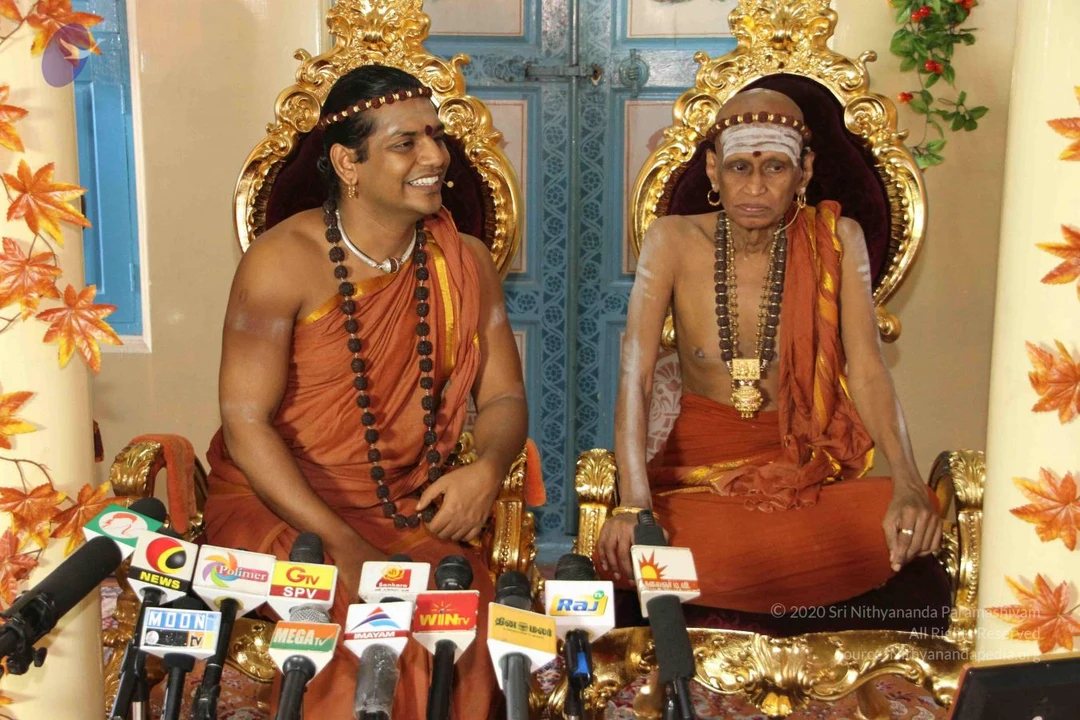
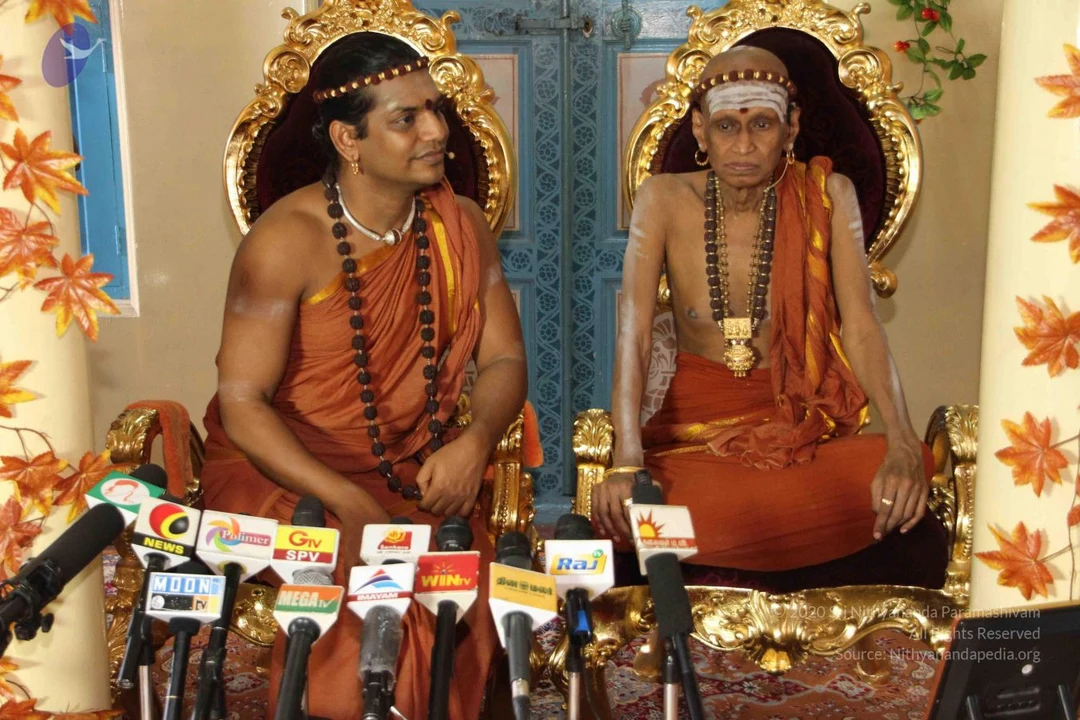
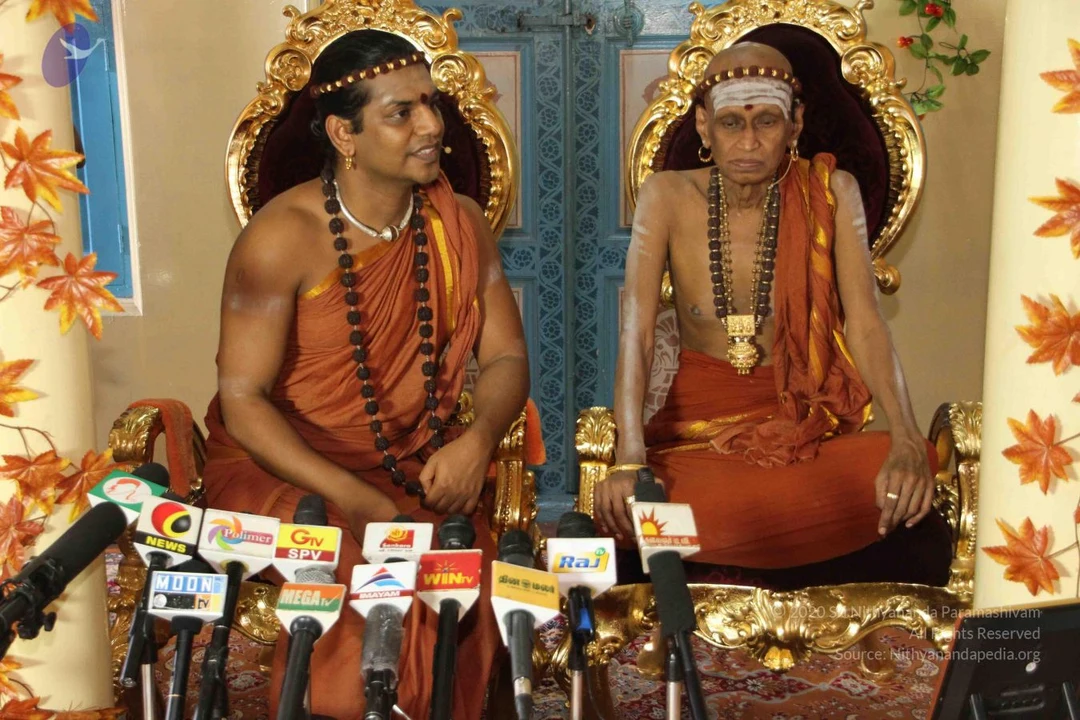
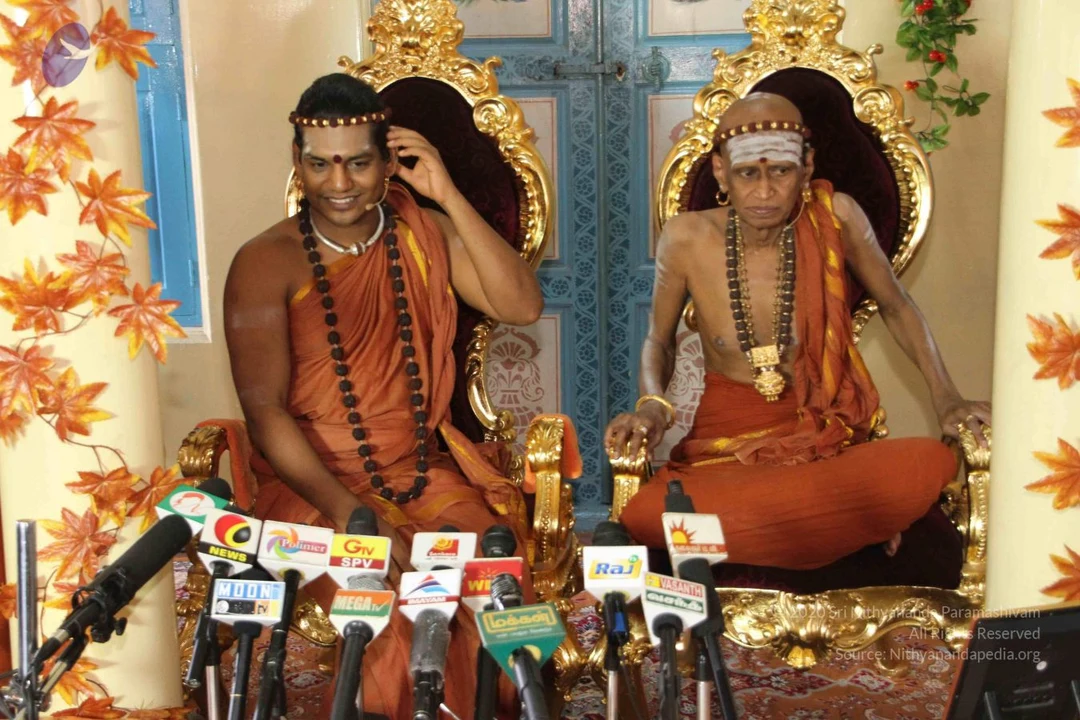
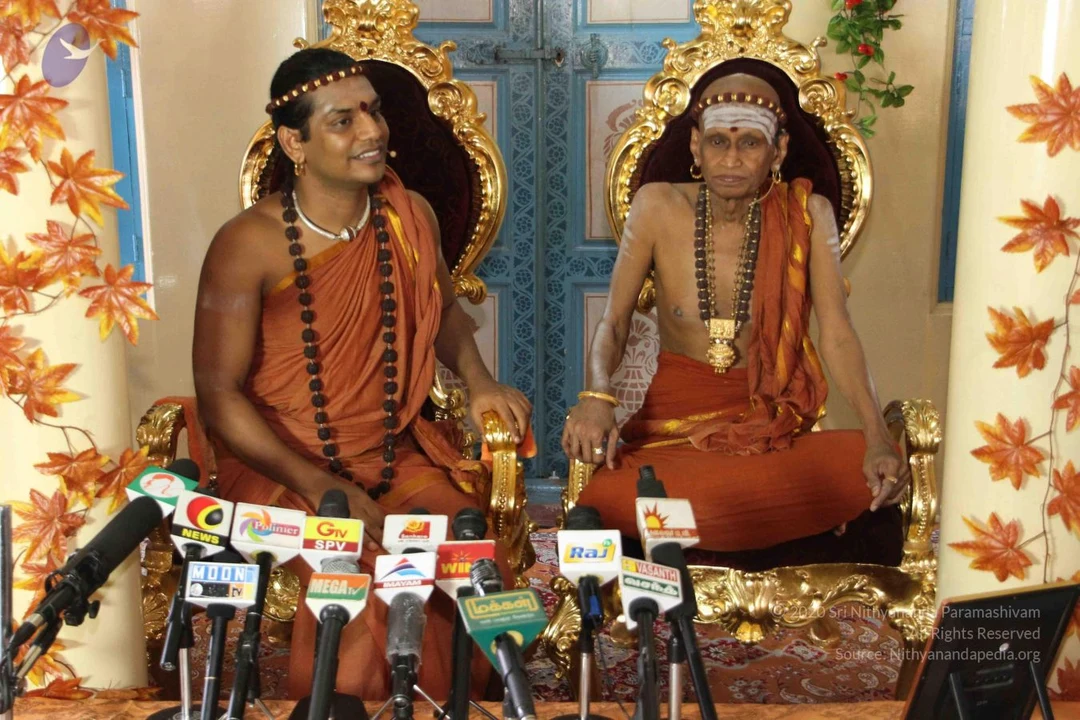
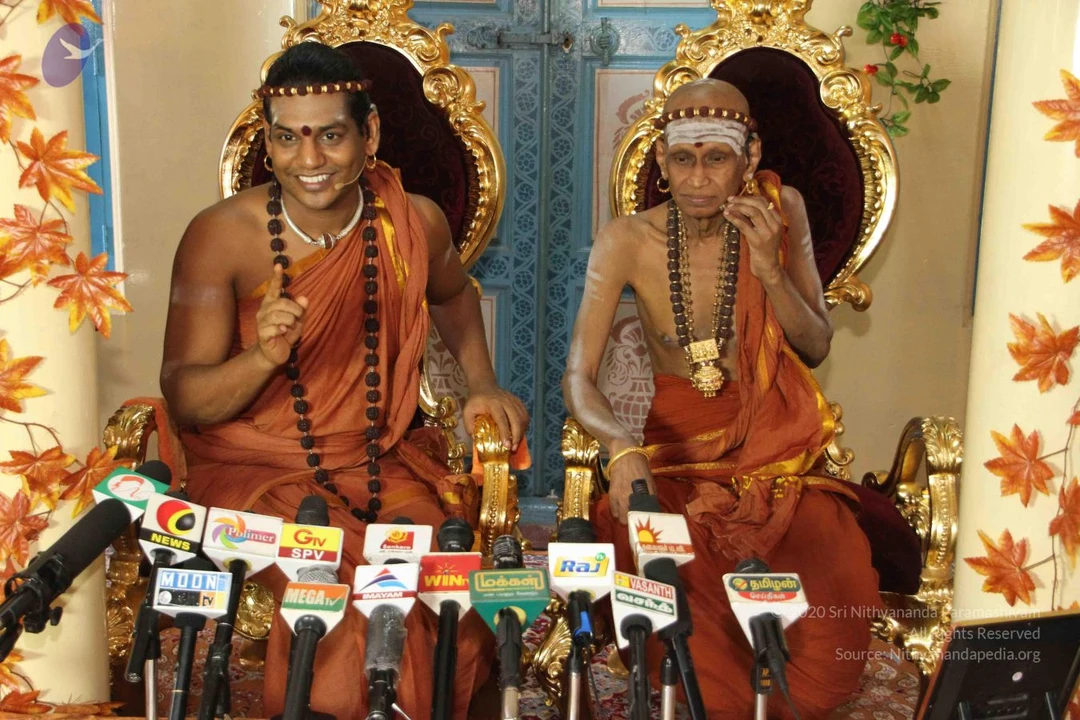
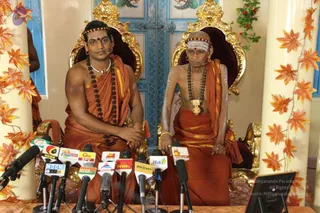
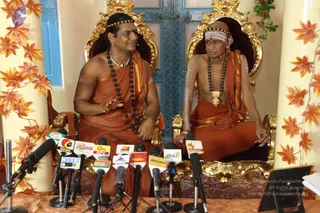
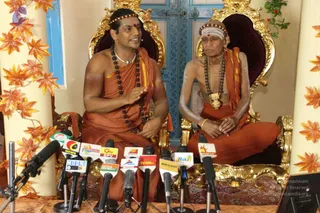
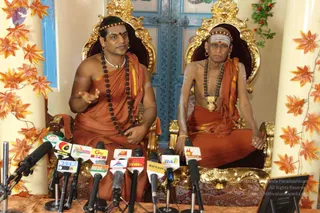
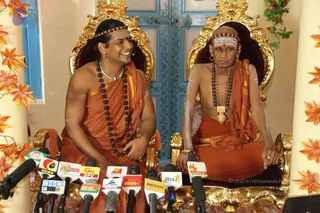
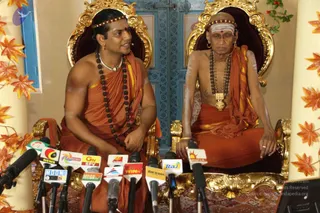
Two seated men in saffron-orange robes sit in gilded thrones with dark maroon cushions before a press conference table covered with a cluster of microphones bearing television station logos. The man on the left wears a red headband with a red bindi, a dark beaded mala and a white necklace. The older man on the right has a white vibhuti band across his forehead, a dark beaded mala, a heavy gold necklace and gold bangles. Behind them stand blue-painted wooden doors and autumn-leaf garlands wrap the cream pillars. A framed picture is visible at the lower right edge. Copyright and source credits are printed in the lower right corner of the photo.A press conference photograph with two seated men in saffron-orange robes on gold-framed ornate thrones before a blue door and autumn-leaf decorated pillars. The man on the left wears a rudraksha mala, a white necklace and a saffron shawl and gestures with his right hand while speaking; he is a person by appearance cues (long swept-back hair, rudraksha mala, saffron robes) but this is uncertain. The older man on the right, with a shaved head, white horizontal markings and a gold necklace, sits with hands resting on his knees. A dense row of microphones with Indian news channel logos, including Raj, Sun, Mega and Win TV, is in front of them, and a small framed picture sits at the lower right.A press conference in an ornate hall with gold-framed throne chairs in front of a blue door and autumn-leaf pillar decorations. Two seated men in saffron-orange robes face a row of news microphones bearing station logos. The man on the left, with swept-back dark hair, a red bindi, a rudraksha mala and a silver necklace, gestures while speaking. The older man on the right, with a shaved head and white tilak, wears a dark rudraksha mala, a large gold pendant and gold bangles, and sits with hands folded. Both wear saffron cloth draped over bare shoulders. The left figure has distinctive long hair and saffron-ornate clothing; appearance-based a person is uncertain given the shaved-headed companion.Two seated men in orange-saffron robes sit on ornate gold-and-maroon thrones in front of a row of microphones bearing media logos including Sun News, Jaya TV and Raj TV. The man on the left wears a rudraksha mala, a white necklace and a red bindi, and gestures with his right hand while speaking. The elderly man on the right wears a long rudraksha mala, a heavy gold pendant and a white tripundra on his forehead, with his hands resting on his lap. Autumn-leaf decorations frame the stage, and a blue wooden door stands behind them.A press conference in an ornate room with two seated men on gold-and-maroon thrones behind a row of microphones bearing Tamil television station logos. The man on the left, smiling, wears orange robes, a long rudraksha mala, a silver chain and a red-and-beaded headband. The man on the right, with a white-painted head and forehead, wears orange robes, a long rudraksha mala, a heavy gold necklace and gold earrings. Autumn maple leaves decorate the gold pillars on either side.A press conference with two seated men in saffron-orange robes on gold-and-maroon ornate thrones, backed by a blue wooden door and autumn-leaf decorations. The man on the left has dark hair, a rudraksha mala and a white necklace and is smiling while speaking; the older man on the right is bald with white forehead markings and a red bindi, wearing a long rudraksha mala and a gold pendant, with hands resting in his lap. Rows of microphones bearing Tamil and Indian news channel logos are placed in front of them. Swamiji (probable) appearance cues are present on the left figure, who has long swept-back hair, rudraksha malas and a crown-like headband, so this is marked as in person.

01-Kanchanoor-Temple-Visit
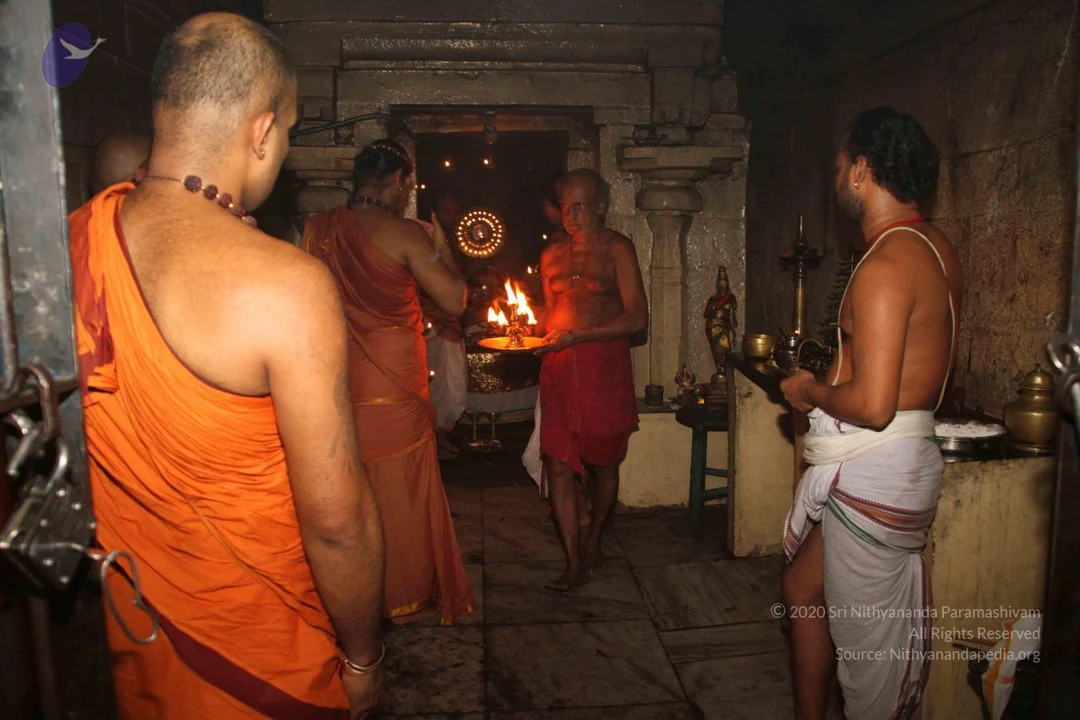
4 photosSource gallery
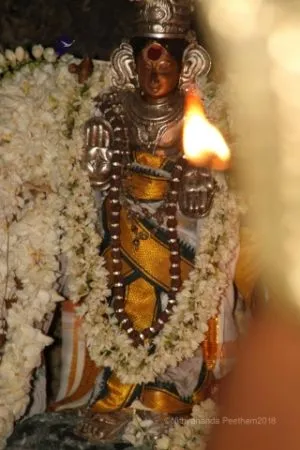
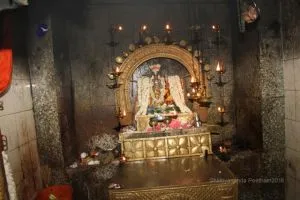
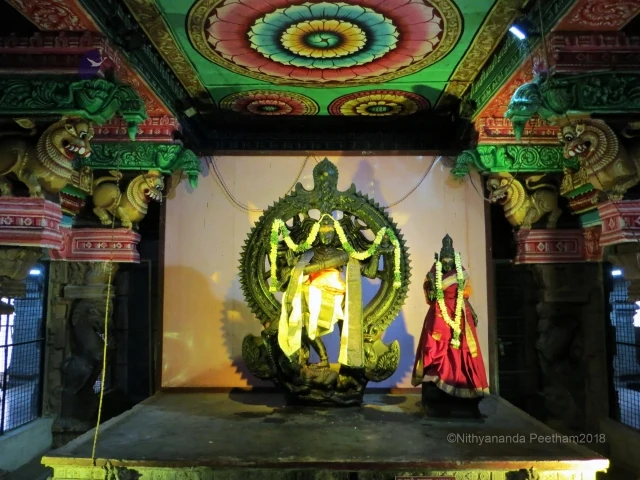
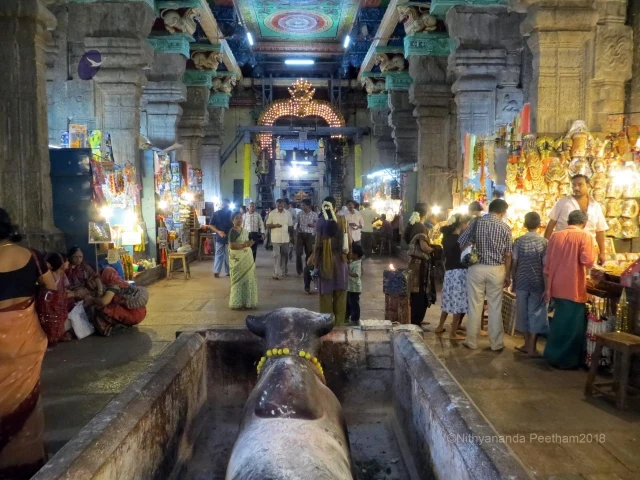
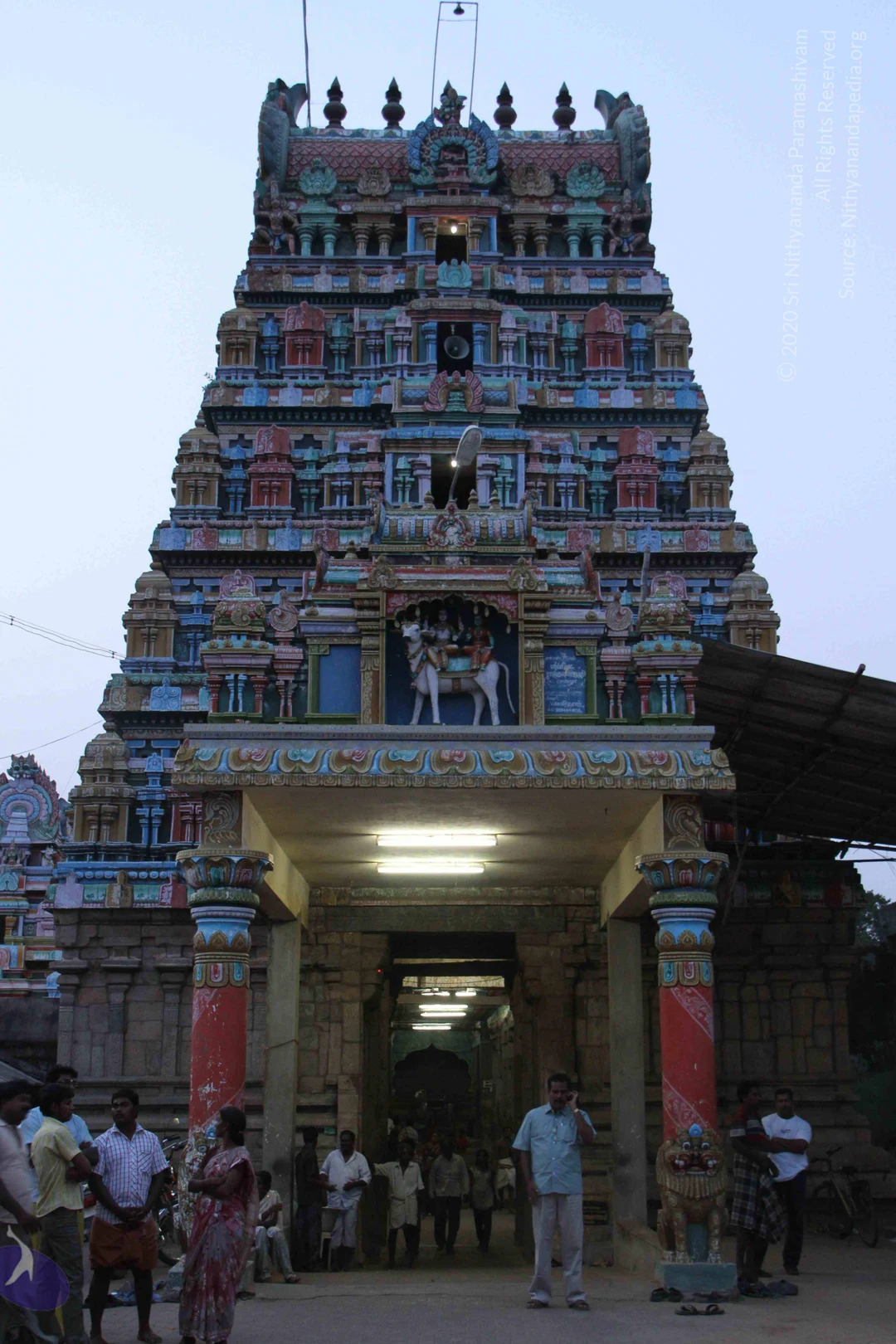
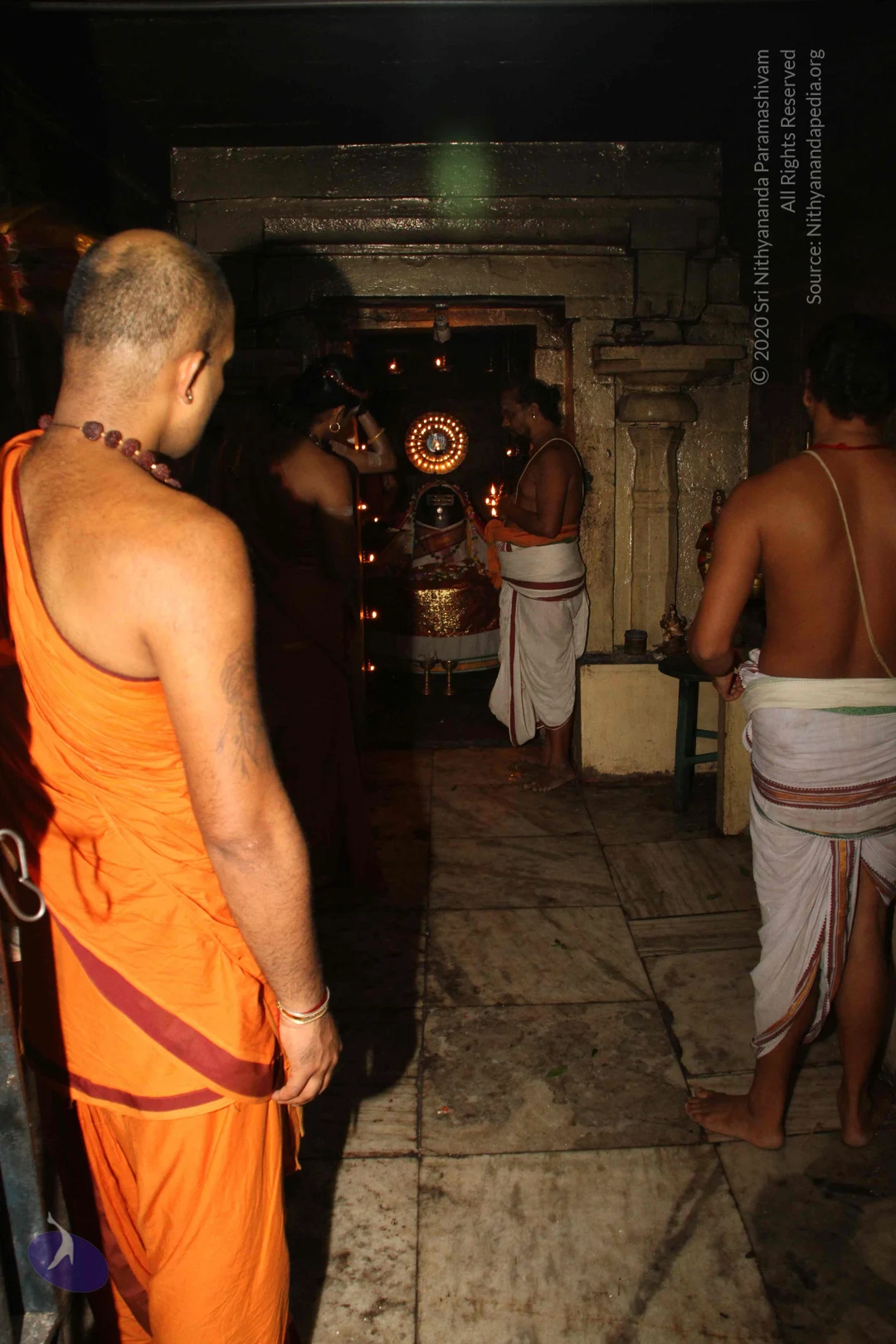
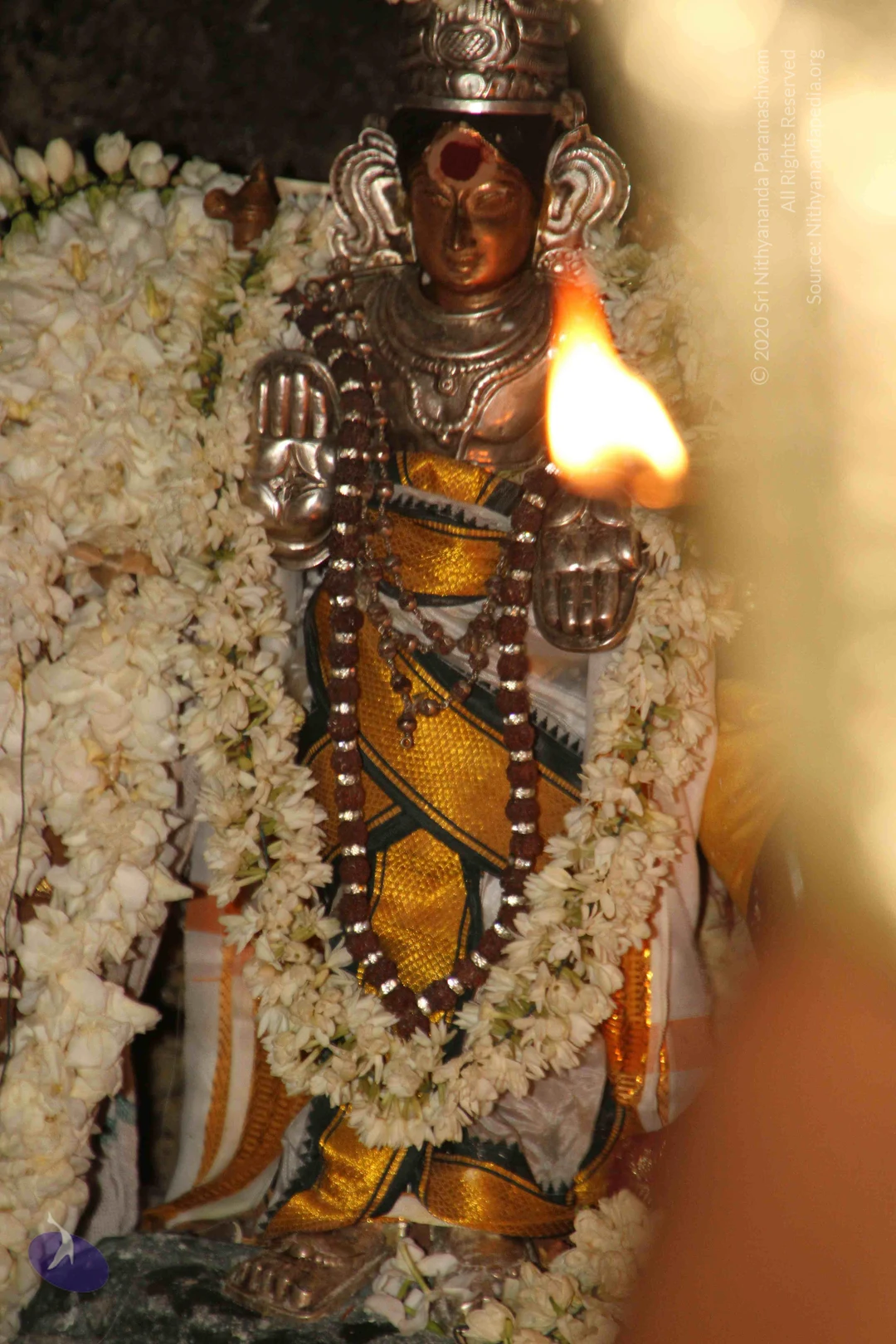
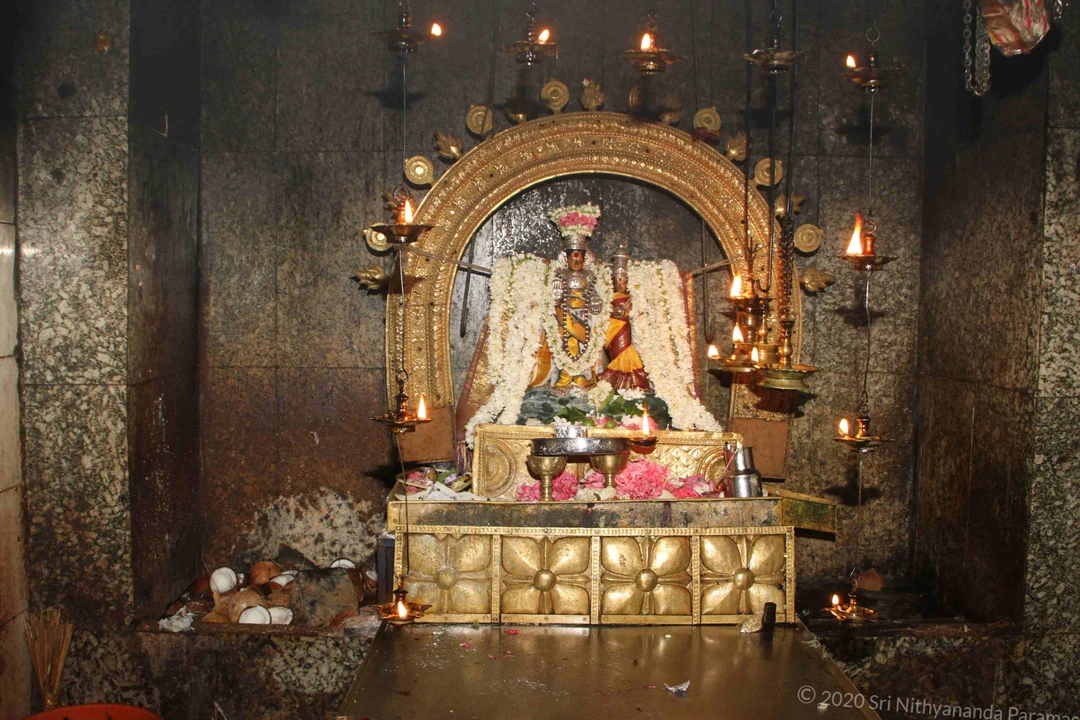
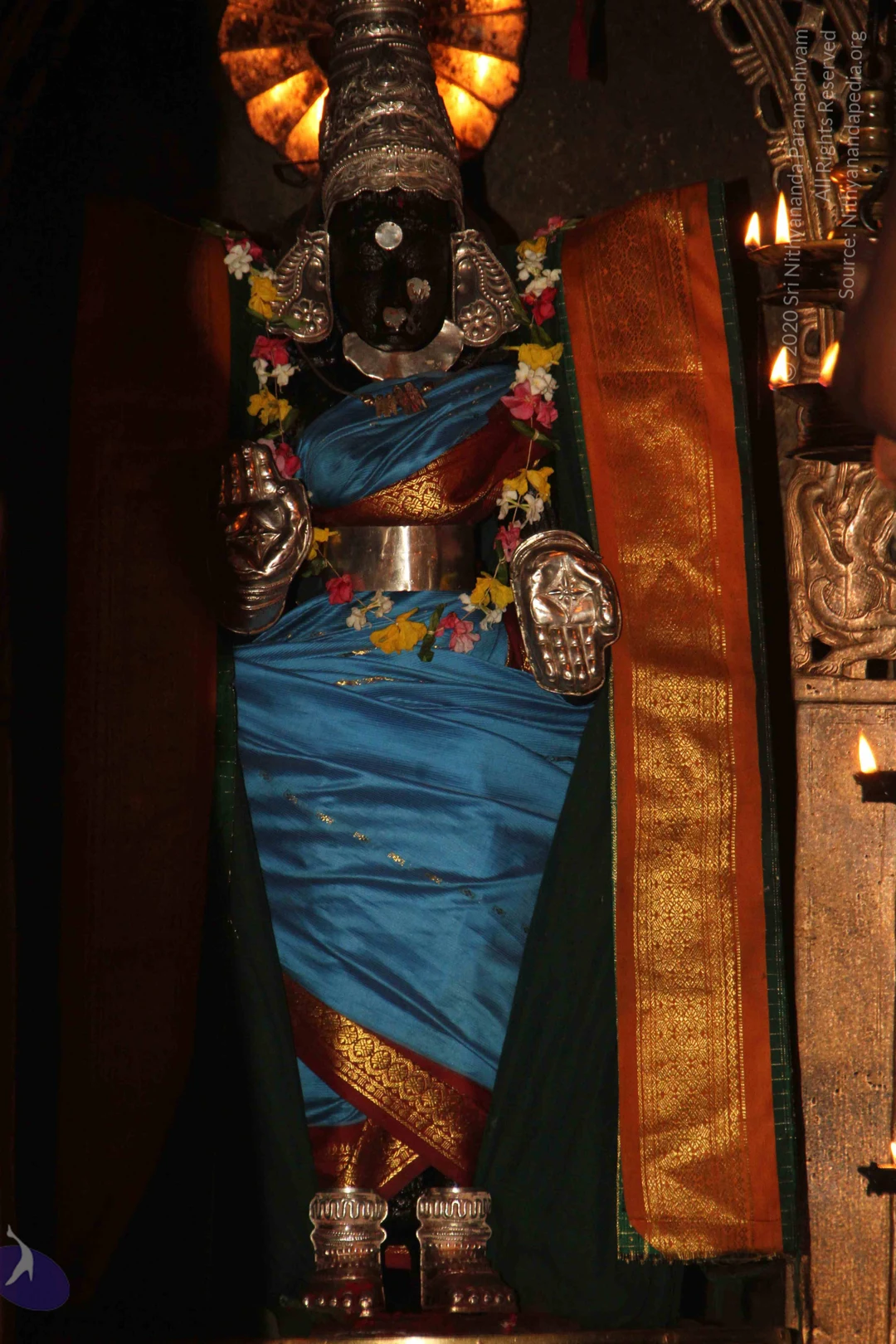
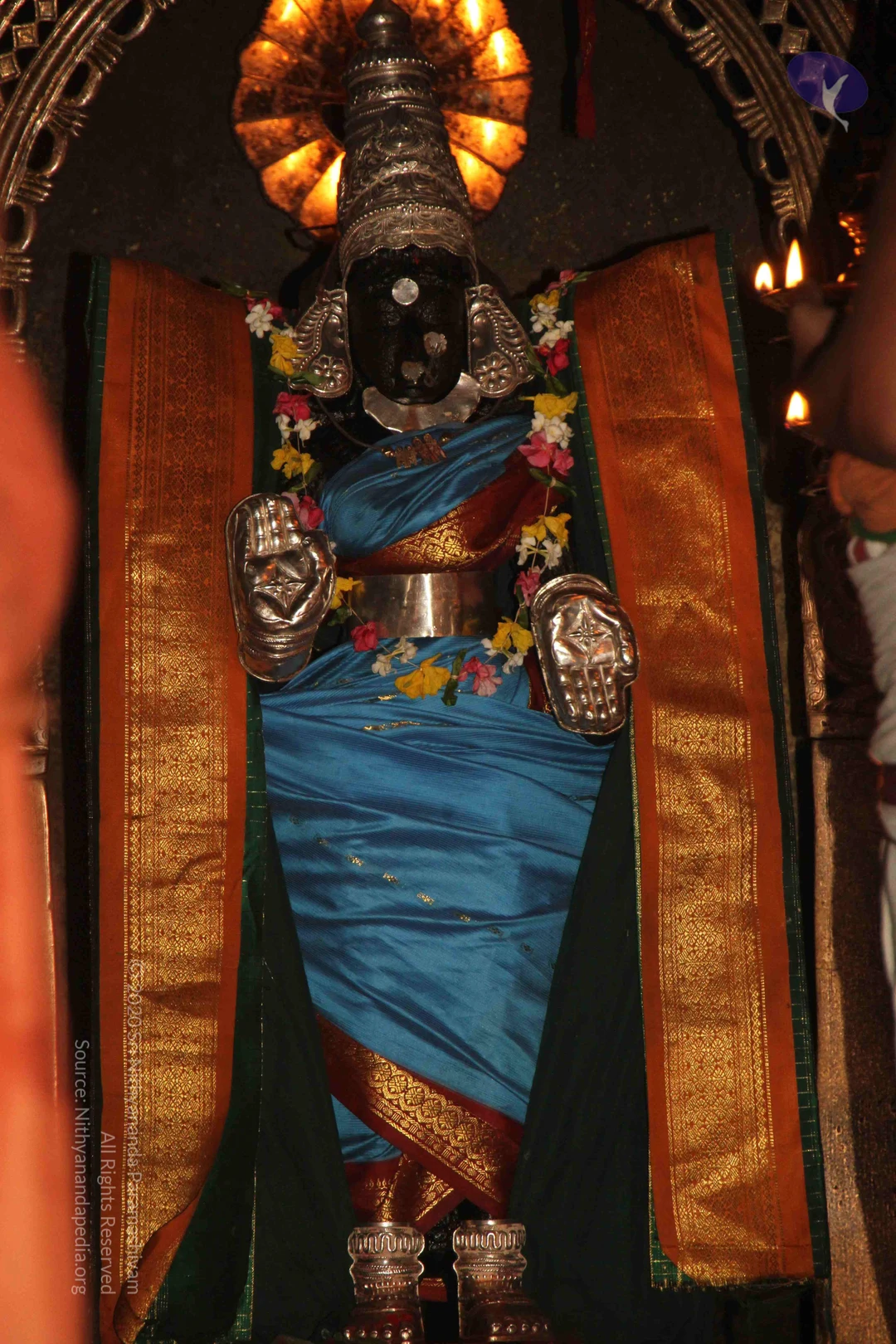
Photograph of a colourful South Indian temple gopuram (tower) with tiered, painted stucco figures and a shrine niche showing a white bull mount with figures, above a pillared entrance hall with red-and-cream columns and a stone lion guardian at right. Several people stand and walk around the entrance in the dusk light: a uniformed police officer in khaki at left, a man in a red-orange dhoti and shirt in the foreground right, and a few devotees and onlookers near the doorway. No a person candidate is visible in the scene.Photo of a colourful South Indian temple gopuram (tower) at dusk, its tiers painted in pink, blue, teal and red with niches and small shrines. Above the gateway a sculpted white bull (Nandi) carries a deity pair. Below, a rust-red and blue pillared entrance hall is lit by tube lights, with a stone lion guardian at the right pillar. Several people stand around the entrance in ordinary clothes: a woman in a pink sari, men in shirts and lungis, and a man in a light blue shirt and white trousers talking on a mobile phone. Figures walk toward the inner sanctum, and a sandal pile rests on the ground.A dim stone shrine with a gold arched frame holds a deity murti draped in white jasmine garlands and a saffron-and-white cloth, topped with a flower crown. Brass oil lamps with lit flames hang on both sides and stand on the gold-trimmed altar, which holds pink and white flowers, a brass vessel and a small lamp. Coconuts and scattered petals lie on the stone floor at the lower left.A photograph of a dark stone deity murti standing in a temple shrine, dressed in a blue silk garment with gold-bordered orange and red cloth draped over its shoulder. Silver hands, a silver crown and silver feet are fitted to the figure, and it wears a garland of yellow, white and pink flowers. Lit oil lamps glow at the sides and an ornate silver frame surrounds the shrine. No people are visible.
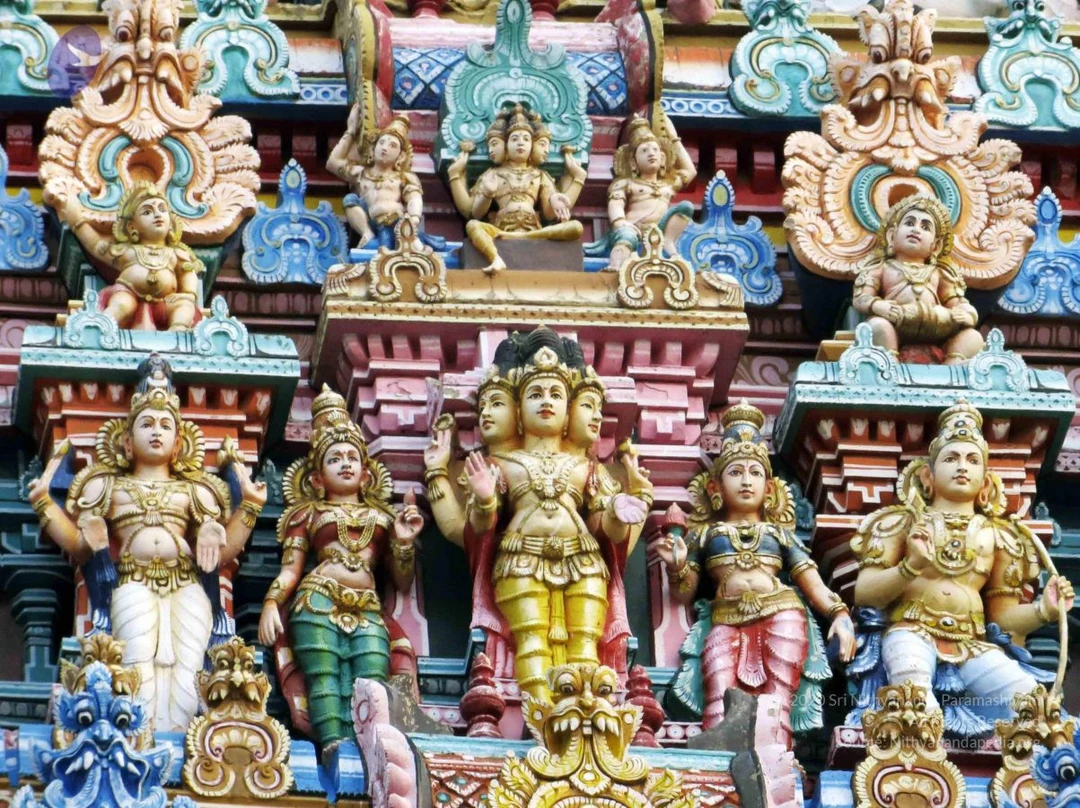
03-Morning-Satsang
15 photosSource gallery
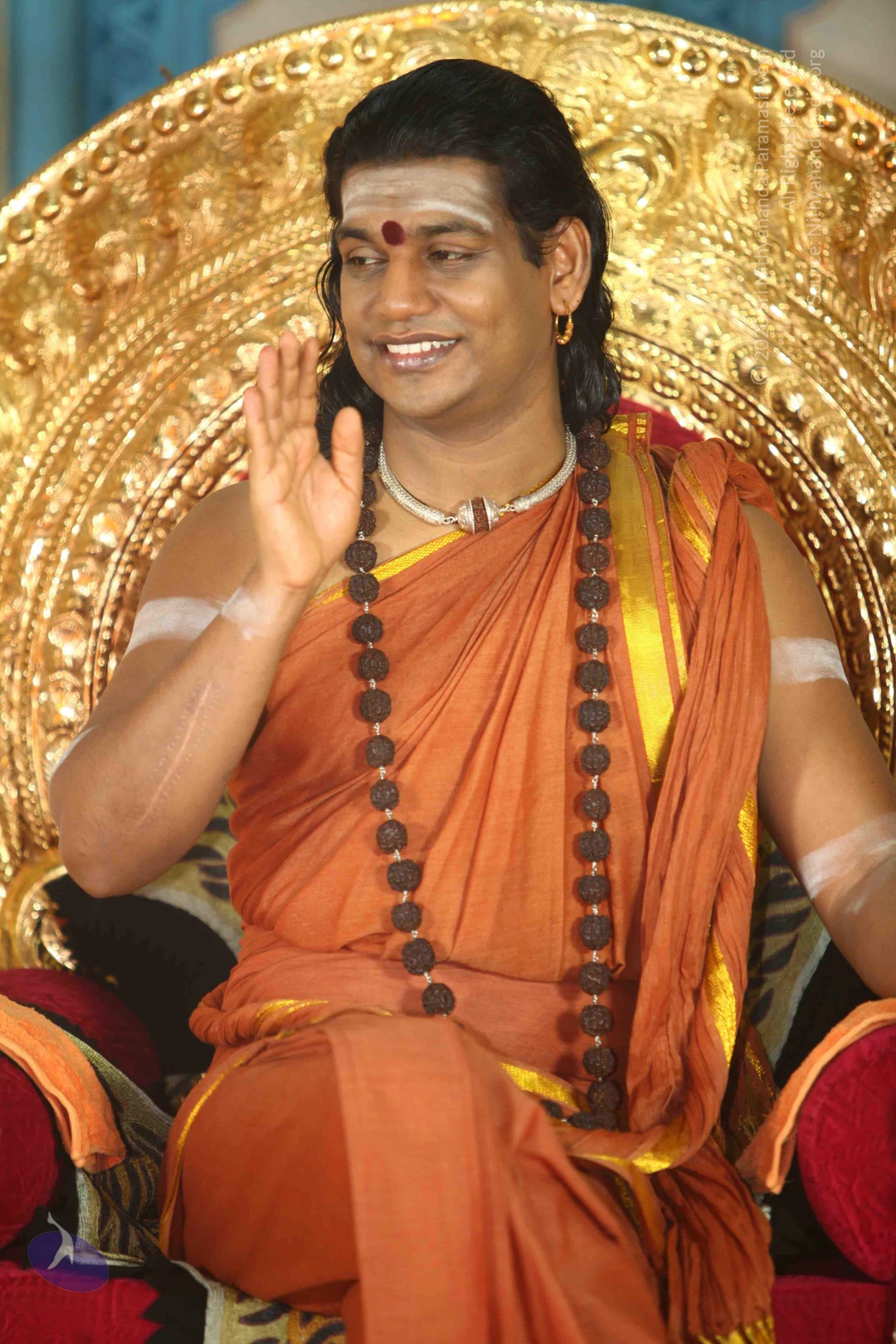
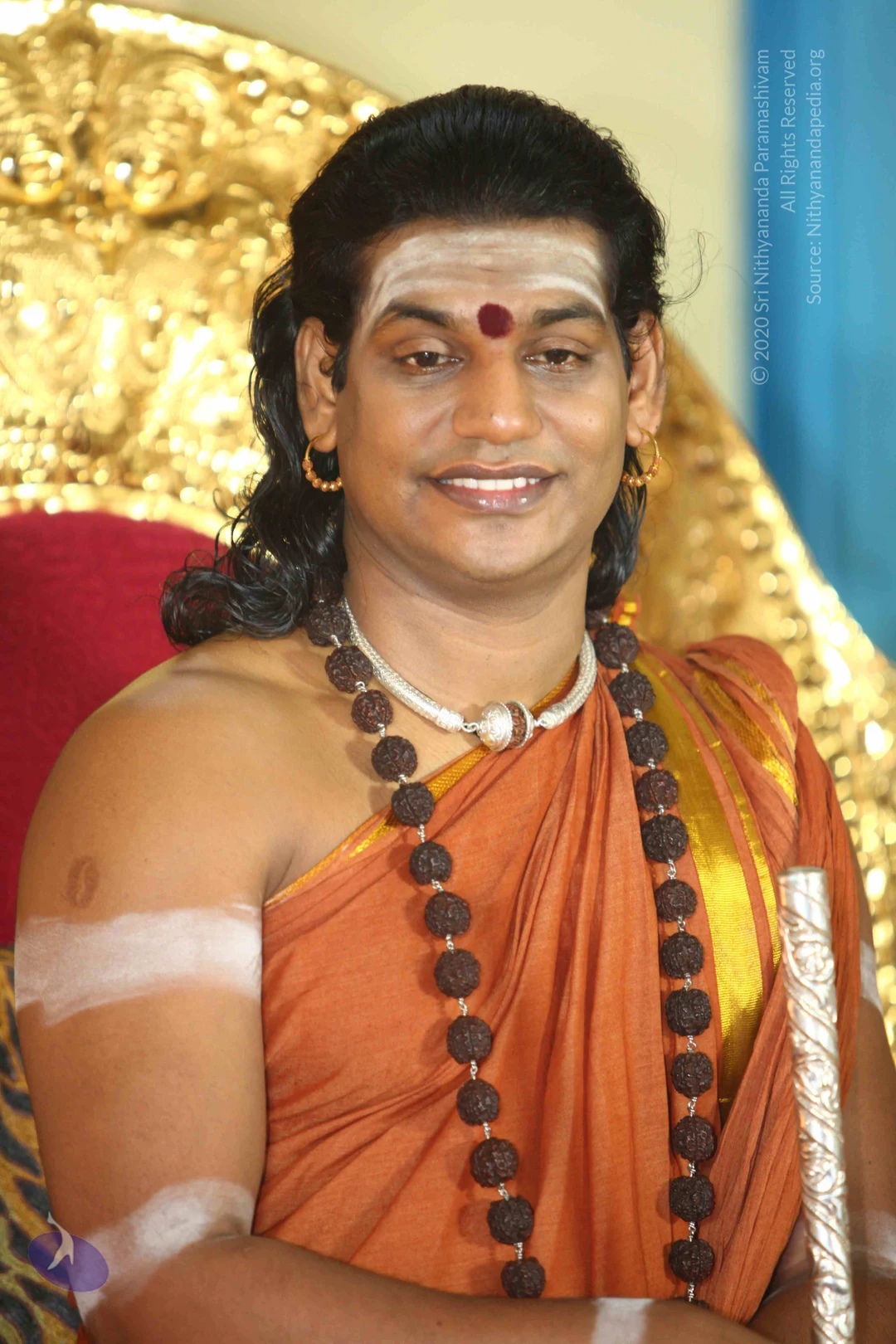
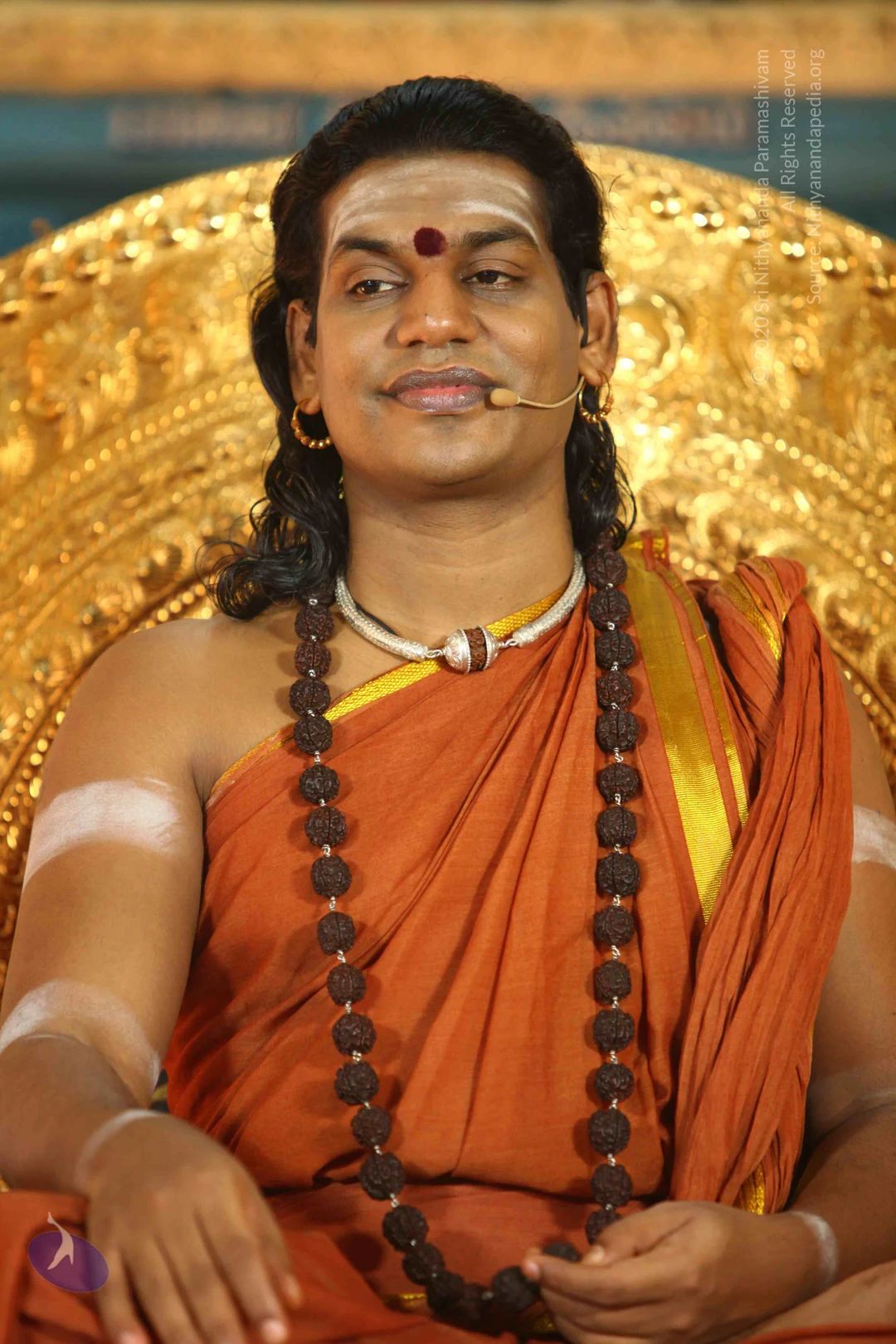
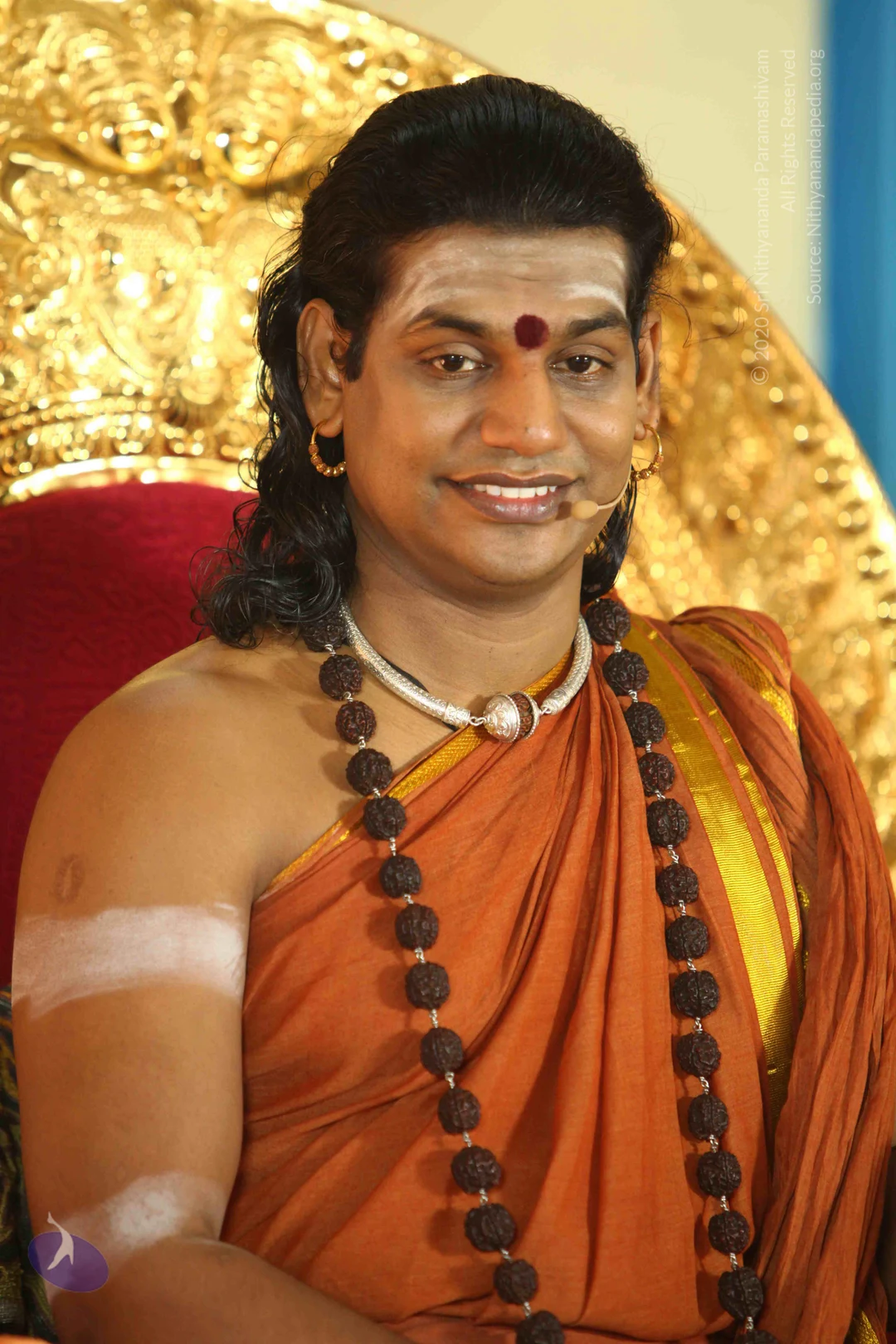
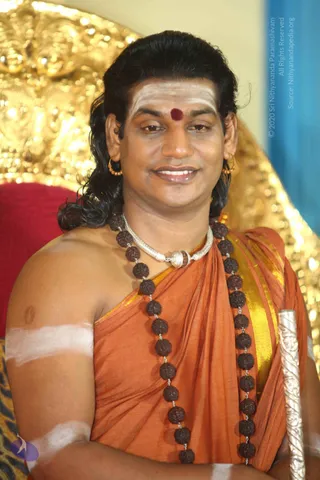
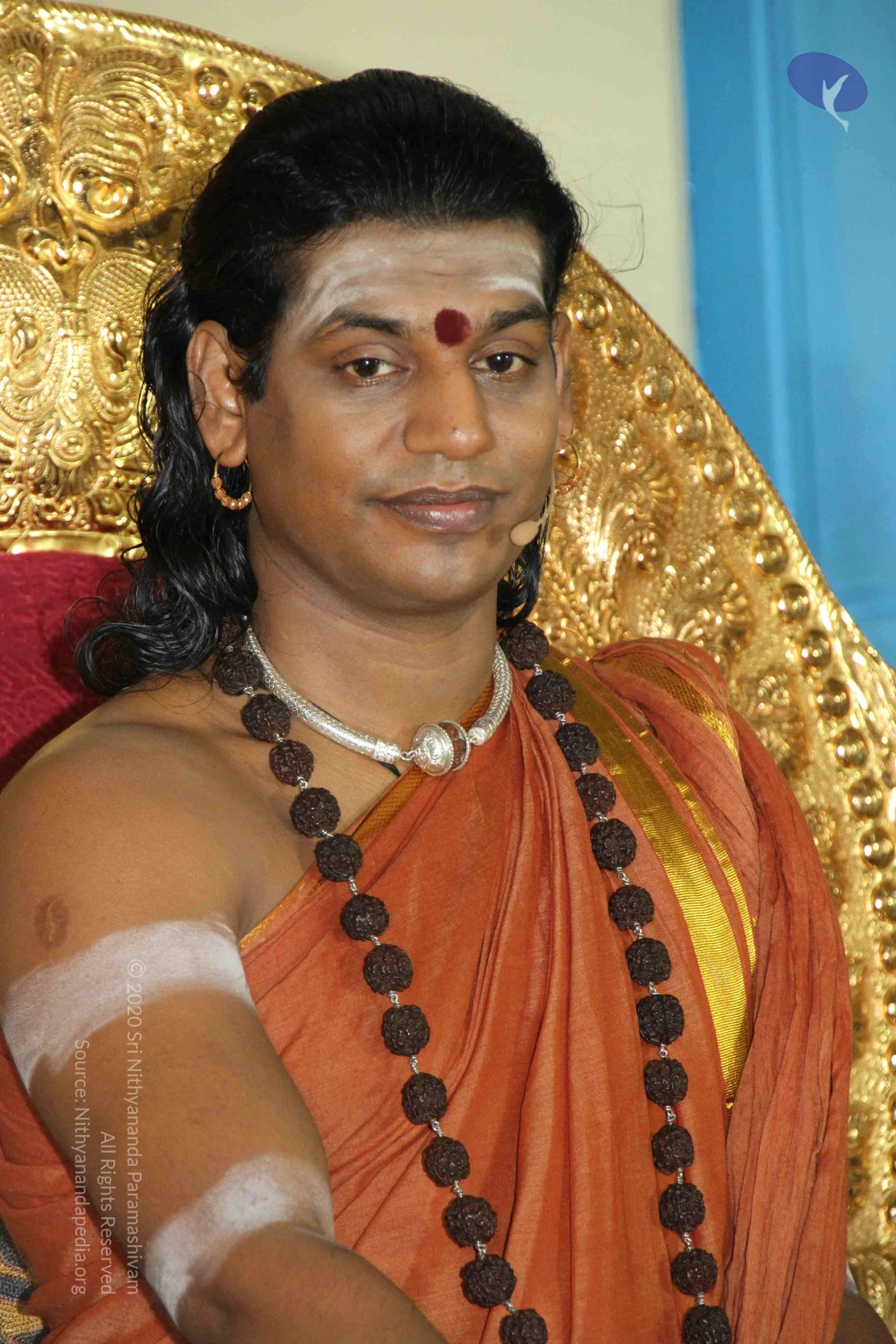
A smiling man with long dark hair sits on an ornate gold throne with carved scrollwork and red cushions, raising his right hand in greeting while holding a white staff. He wears saffron-orange robes with yellow borders, a long rudraksha mala, a ceremonial gold-toned necklace, gold earrings, white body markings and a red bindi. Behind him stand a tall lit oil lamp display and autumn-red leafy garlands on a pillar, with a blue painted wall. a person is the throned figure, seated in an honoured posture with the cues of long swept hair, saffron clothing, rudraksha and ceremonial necklace.A man seated on an ornate gold throne with a repoussé backrest and red velvet armrests, raising his right hand in a blessing gesture while smiling. He wears a saffron-orange draped garment with gold border, long rudraksha mala beads falling to his lap, a silver necklace with a central clasp, a red bindi and white vertical tilak on his forehead, and a small gold earring. Swamiji (probable): long swept-back dark hair, saffron clothing, rudraksha mala and ceremonial silver necklace visible. Sitting on a throne at a satsang setting.A seated man in an ornate golden throne with an intricately embossed, rounded back is raising his right hand in a blessing or teaching gesture while smiling. He wears an orange saffron shawl with gold borders draped over his shoulder and a long dark rudraksha mala hanging to his waist, plus a silver ceremonial necklace and a small gold hoop earring. A white vertical tilak and red bindi mark his forehead, and white markings are on his upper arms. Swamiji (probable) appears in this portrait, shown as a seated teacher with long swept-back hair, saffron clothing, rudraksha mala and ceremonial gold-toned throne. Blue drapery hangs in the background.