Skip to content
Tuesday

14 February 2012

Bhagavat Gita, Jnana-Karma-sanyasa yoga, 8th verse

Dated photos
18
Source pages
1
Media
2
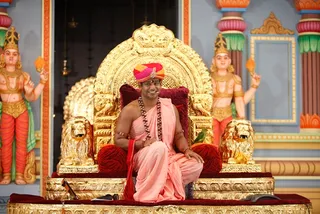
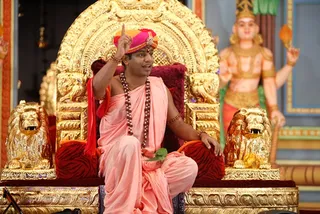
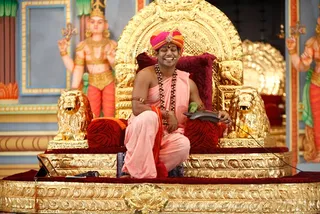
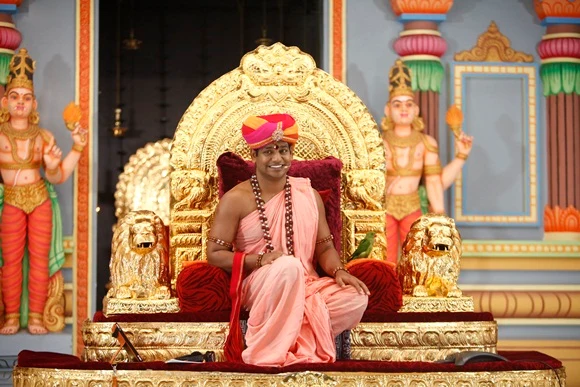
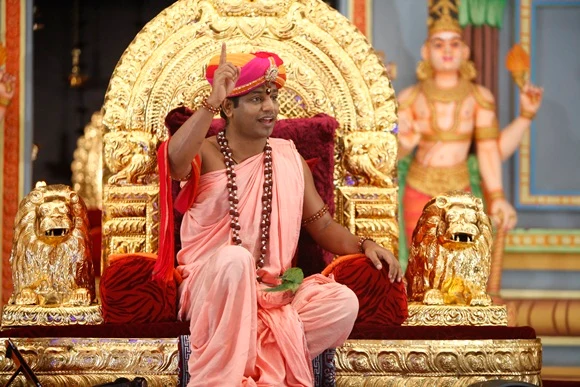
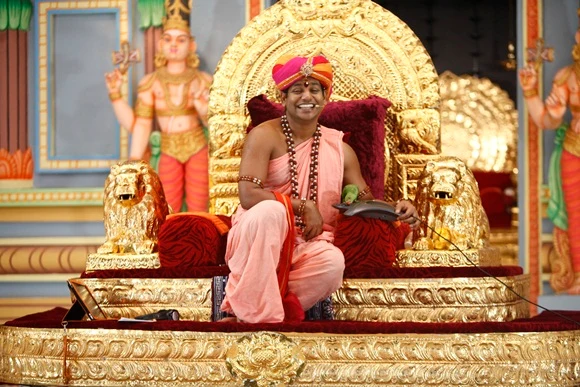
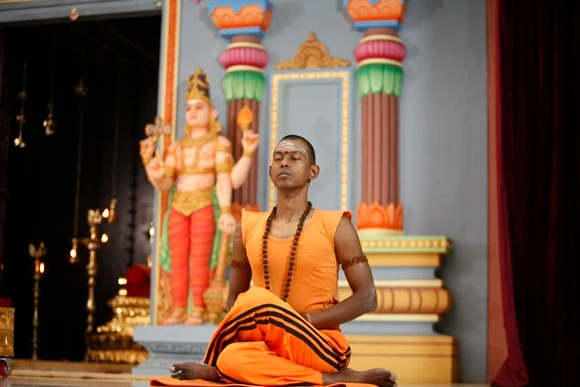
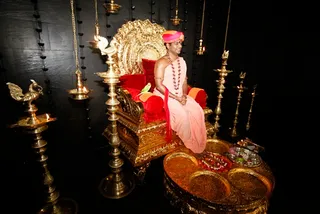
A man seated on an ornate gold throne with carved lion-head armrests and red cushions, smiling. He wears a red-and-gold turban, a pale pink-orange shawl over a pink robe, a rudraksha mala and bangles. Two painted deity statues flank the throne: one in red and green with a gold crown, the other in orange-gold with a raised ceremonial lamp. The background has blue and cream walls with gold trim and columns. a person: the seated man has a turban, saffron-pink robes, rudraksha beads and a throne setting, but the appearance is only partly distinctive.A man in a salmon-pink sannyasi robe and a pink turban sits on a gilded throne with carved golden lion heads and red cushions, one finger raised in teaching gesture, a green leaf in his other hand. He wears a rudraksha mala and bangles. Behind him stands a painted deity figure in a gold crown holding a fan-like object, within an ornate gold-and-blue temple backdrop. The setting resembles a satsang discourse stage.A seated man in saffron-pink robes and a pink-and-orange turban sits on an ornate gilded throne flanked by golden lion sculptures and red cushions. He wears a rudraksha mala and gold bangles, smiling broadly, with a small tablet or book in his hands. Behind him stand painted or sculpted gold-skinned deity figures holding weapons, against a decorated golden-yellow backdrop. Swamiji (probable): the seated man has a turban, saffron-pink robes, rudraksha beads and ornate gold adornments, seated on a throne as the speaker.

February 14 2012

Original wiki page
Contents

Title

Bhagavat Gita, Jnana-Karma-sanyasa yoga, 8th verse

Link to Video:

VideoAudio

Transcript:

Tuesday, February 14, 2012 | 20120214]]-sanyasa yoga, 8th verse –

“paritraanaaya sadhoonaam vinaashaaya cha dushkrutaam | dharma samsthaa panaarthaaya sambhavi yuge yuge ||”

Still there is so much that needs to be told about this verse J In every one of you incarnation of innermost intelligence happens. See your inner awakening is the incarnation happening in you. When the inner awakening happens in you, spiritual cognition is protected and promoted. That is what is Sadhu. Mood swings and dilemma is destroyed. Please understand, mood swings and dilemma is destroyed. That is the dushkrutaam. Spiritual cognition is protected and encouraged. Mood swing and dilemma is destroyed. Dharma samsthaapanaarthaya is establishment of the body language of the Living Enlightenment. When the Jeevanmukti, Living Enlightenment is expressed physically, whatever the body does is Dharma. The Living Enlightenment is expressed physically in you. that is the dharma samsthaapanaartham sambhavami yuge yuge – age after age, incarnation will happen in you. This sutra will suit the individual you and the cosmic you. Sadhoonam the spiritual cognition. I tell you the greatest wealth in life is spiritual cognition. When you are cornered, suffering, don’t think money is security. Making decisions out of spiritual understanding is the ultimate security. Don’t try to catch money thinking that is security. Try to catch spiritual cognition means taking decisions with spiritual base….if you cannot, at least surrender….pl und if you are cornered, if you run and hide and try to find solution in spiritual cognition you are a Brahmana, if you try to find solution in money you are a Vysya, if you try to find solution in power you are Kshatriya, if you run without direction like how a wild elephant runs when you burst the crackers, the fire works and fall into a ditch, if you are running like that you are a shudra. Understand, when you are cornered, suddenly when major support in your life is taken away, how you behave is your original face! If you take all the decisions based on tremendous spiritual understanding, you are a Brahmana. Spiritual understanding is the sadhu in you. Awaken the sadhu in you! I tell you real freedom is not having suffocation inside. Till your cognizance is completely soaked in Spirituality, till all your understanding about you, life everything is not based on Spiritual cognition, there will be suffocation. Real freedom Is from Spiritual cognition….more than wild elephant one more example I can give you – the donkey’s tails which is tied with crackers, fire works and when fire is put, poor fellow, he does not know from where everything is happening! I tell you ignorance is a 1000-wala fire works tied in your tail! If you are not from Indian village, you cannot understand this. Because in Indian village they will catch 2, 3 donkeys and tie the 1000 wala crackers. And the poor fellow will not know from where it is coming! Sometime he turns and puts it in mouth, only when the mouth bursts will he know!

Ignorance is 1000 wala fire work tied in your tail!

Anyhow, taking Spiritual decisions, taking Spiritual cognizance I tell you is the ultimate wealth you can accumulate. Spiritual freedom is the ultimate wealth, ultimate understanding other than that anything you call it as wealth, destroys your life. I am trying to define and create Spiritual freedom in every human being. I have picked up 108 major truths. If you understand this 108 and start making all the decisions based on any one or few of this truths in this life you have a Spiritual cognition, you have a Spiritual freedom. The first one is already visually discussed through unclutching. The others are being presented by our Vision dept. once the 108 are over, more precisely I can explain to all of you what is Spiritual cognition, what is Living Enlightenment? Living Enlightenment is nothing but living with Spiritual understanding, making all your decisions with the Spiritual understanding. That is the meaning of Sadhu. See if you make any decision, it should be liberating you from your suffocation and your suffocation from you. it is not that your suffocation enjoys you. it is both of you holding each other. Your suffocation tortures you and you torture it…sadhu means not getting tortured nor being tortured by others. Neither you torture others or others torture you. Paritraanaaya sadhoonaam – protection of the integrated honest ones. Integrated and honest ones always need to be protected, promoted, projected. Wicked ones always need to be taught a lesson.

Paritraanaaya sadhoonaam, vinaashaya cha dushkrutam, dharma samsthaapanaarthaya, sambhavami, yuge, yuge!

There is so much to tell about this one verse. Still I am stuck I am not able to complete. The Spiritual cognition in you is Sadhu, confusion and dilemma and suffocation is dushkruta. Dharma samstyapanaarthaya – means establishing yourself in Living Enlightenment. To do this let the incarnation happen in all of you again & again & again!

Photos From The Day:
Photos from this day

View all 18 photos
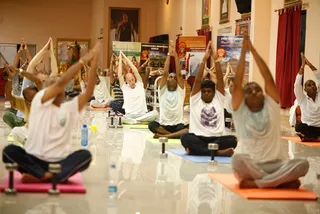
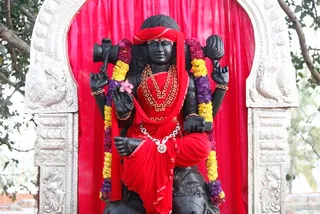
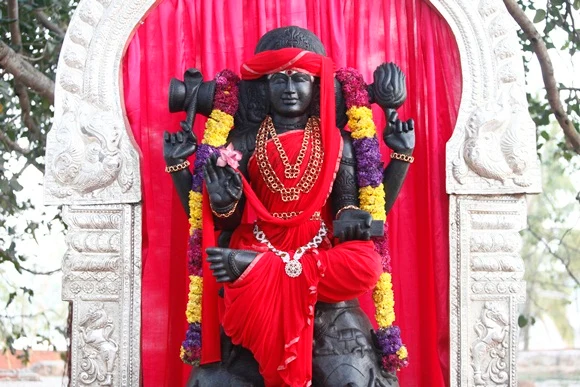
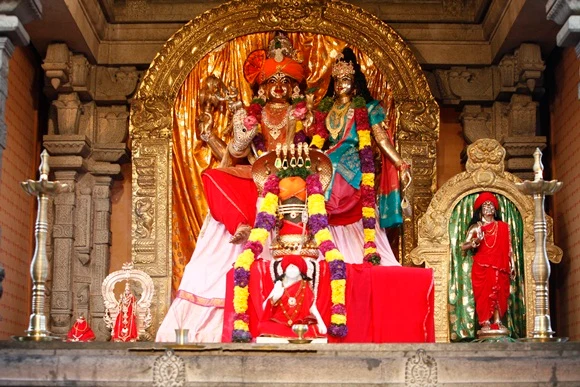
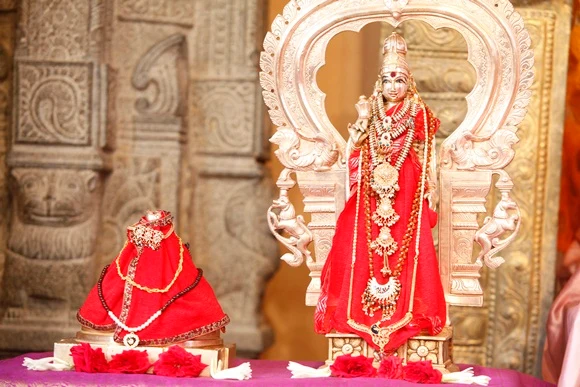
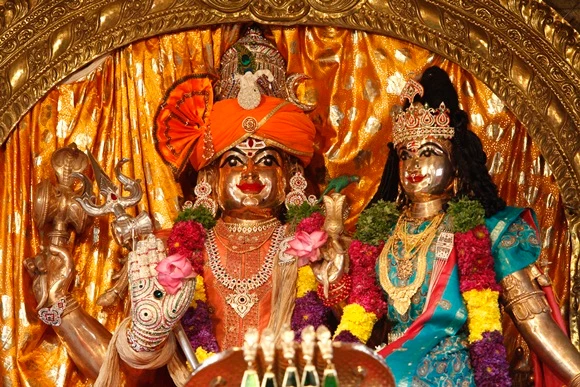
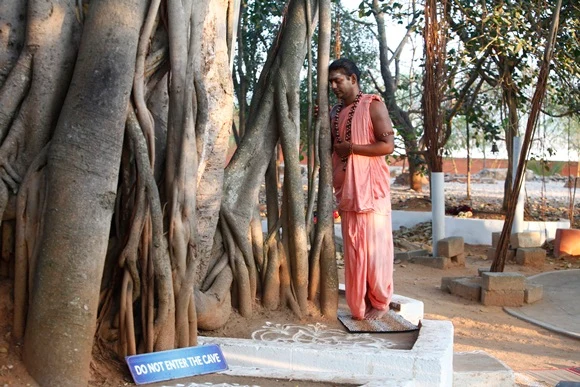
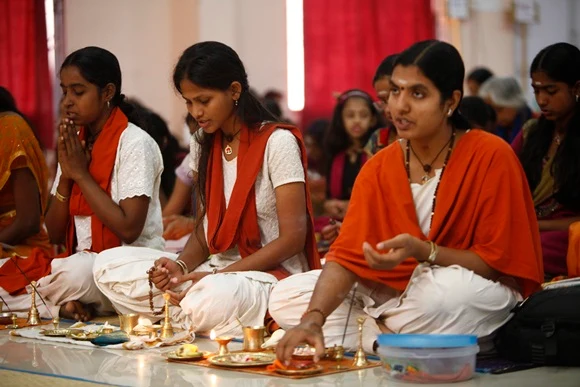
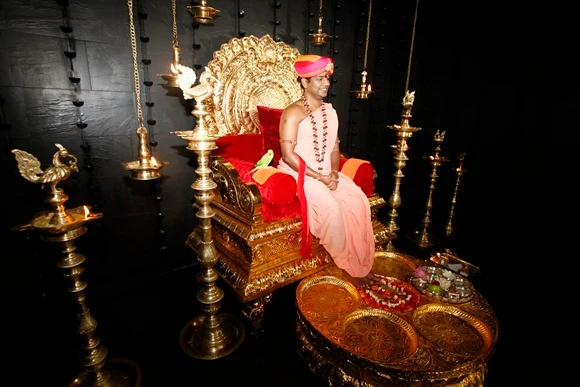
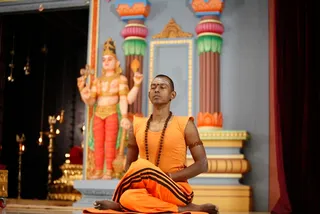
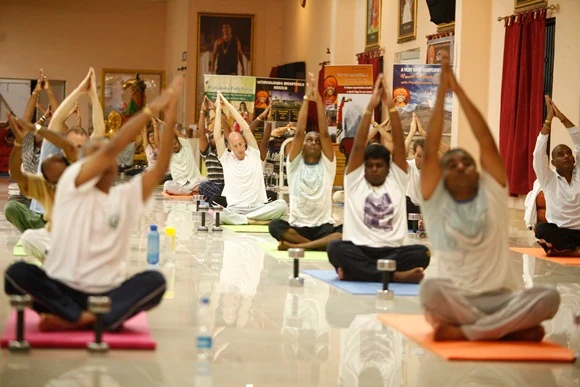
A photo of a yoga session in a bright hall with polished white floor. Rows of participants sit cross-legged on colourful mats with arms raised overhead, palms together, mostly in white clothing. Several wear white kurtas or loose white tops, one in a grey top. Small metal dumbbells rest on the mats in front of them. Behind them a large framed portrait hangs on the wall above a row of banners, and red curtains frame the side. Water bottles sit near the front edge.A dark stone statue of a multi-armed deity murti stands in a carved white arched niche before a red draped backdrop. The figure wears a red cloth draped over its body and head, a gold-toned necklace and a large pendant, and is garlanded with yellow, orange and purple flowers. Several hands are raised holding attributes, and a pink flower is tucked into the garland. Green foliage is visible at the top of the frame. No living people are visible.A temple shrine with a gilded arched niche framing a cluster of deity murtis. Central figures are adorned with thick garlands of purple, orange and yellow flowers. A tall deity form in an orange crown and red-and-pink cloth sits on a red-draped platform with a golden throne-like seat. Flanking the centre are small standing figures in red and green cloth, and a brass oil lamp (deepam) stands on each side. Golden drapery hangs behind the figures. No physical people are visible; all figures are statues or murtis.Two murti figures stand on a purple-draped altar in front of an ornately carved stone backdrop with lion-faced relief. The larger figure on the right wears a red sari-like drape, a gold crown, layered gold necklaces and pendants, and holds a small object in one hand, with a carved white arched throne behind it. The smaller figure on the left wears a red garment, a bead necklace and a jewelled head ornament. Red flower petals are scattered at their bases. No physical people are visible.Two gilded metal murti stand in a golden shrine niche draped with shimmering gold cloth. The figure on the left wears an orange turban, ornate red-and-white jewelled necklaces, and holds a pink lotus; the figure on the right wears a crown, a teal and gold sari, and a garland of purple and yellow flowers. Both wear floral garlands and stand before a row of brass lamps or offering vessels. This is a deity murti, not living people.A photograph of a man standing barefoot on a low stone platform beside a large banyan tree with many thick aerial roots. He wears a saffron-orange sannyasi-style garment wrapped over the upper body and lower body, with a rudraksha mala around his neck. His hands are folded in front at the chest. A blue sign in the foreground reads Do Not Enter The Cave. Behind him are sandy ground, a white painted wall, and a small orange pot on a ledge. The platform bears white decorative kolam-style markings on the ground beside it. The figure appears as a person by a saffron robe and rudraksha mala, though the appearance is only partially visible.A seated group of women in white dhotis or skirts and orange shawls performs a ritual at a low platform with brass lamps, a small brass kalasha-style vessel, plates of offerings and a brass bell. The woman in front center wears an orange shawl, rudraksha mala and wristwatch, holding her palms in a gesture while the seated women beside her hold malas and join their hands in prayer. Other devotees sit in the background against red-draped walls, some in orange and white clothing, with a blue plastic container at the lower right.A seated man in a pink turban and pink dhoti-style garment sits on an ornate gold throne with red cushions and a carved golden backrest. Rudraksha beads hang around his neck, and red and gold ritual trays with offerings sit on a round golden table before him. Tall brass oil lamps stand on both sides in a dark wooden-panelled room. The setting suggests a formal satsang or darshan seat. One person is visible.A man seated on an ornate gold throne with carved lion-head armrests and red cushions, smiling. He wears a red-and-gold turban, a pale pink-orange shawl over a pink robe, a rudraksha mala and bangles. Two painted deity statues flank the throne: one in red and green with a gold crown, the other in orange-gold with a raised ceremonial lamp. The background has blue and cream walls with gold trim and columns. a person: the seated man has a turban, saffron-pink robes, rudraksha beads and a throne setting, but the appearance is only partly distinctive.A man in a salmon-pink sannyasi robe and a pink turban sits on a gilded throne with carved golden lion heads and red cushions, one finger raised in teaching gesture, a green leaf in his other hand. He wears a rudraksha mala and bangles. Behind him stands a painted deity figure in a gold crown holding a fan-like object, within an ornate gold-and-blue temple backdrop. The setting resembles a satsang discourse stage.A seated man in saffron-pink robes and a pink-and-orange turban sits on an ornate gilded throne flanked by golden lion sculptures and red cushions. He wears a rudraksha mala and gold bangles, smiling broadly, with a small tablet or book in his hands. Behind him stand painted or sculpted gold-skinned deity figures holding weapons, against a decorated golden-yellow backdrop. Swamiji (probable): the seated man has a turban, saffron-pink robes, rudraksha beads and ornate gold adornments, seated on a throne as the speaker.A shaved-headed man in saffron-orange robes sits cross-legged in meditation with eyes closed, a rudraksha mala around his neck and a white tilak on his forehead. He wears a striped orange-and-black lower garment and an armband. Behind him stands a colourful painted deity murti with a golden crown, orange dhoti and raised hands, flanked by pink and gold columns in a temple hall. The setting suggests a yoga or meditation session in an ashram, with warm lighting and a red curtain on the left. The man's appearance does not clearly match the page's claim, so his identity is uncertain.