Skip to content
Monday

13 February 2012

Bhagavat Gita, Chapter 4, 8th verse

Dated photos
16
Source pages
1
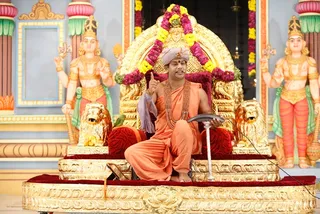
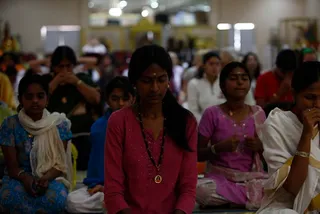
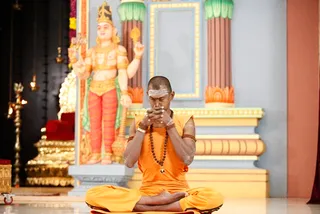
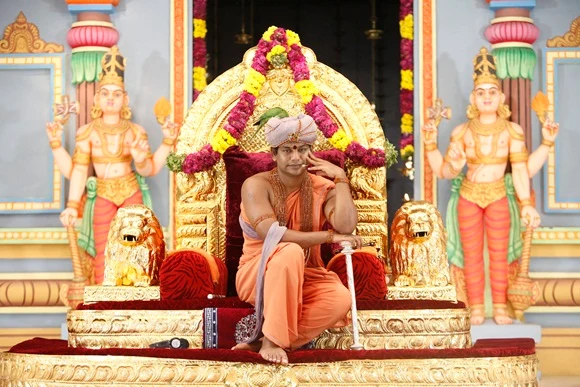
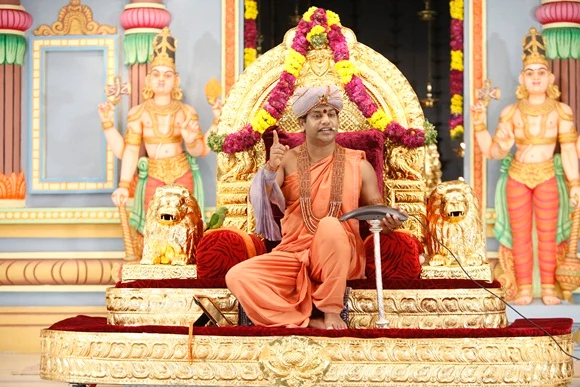
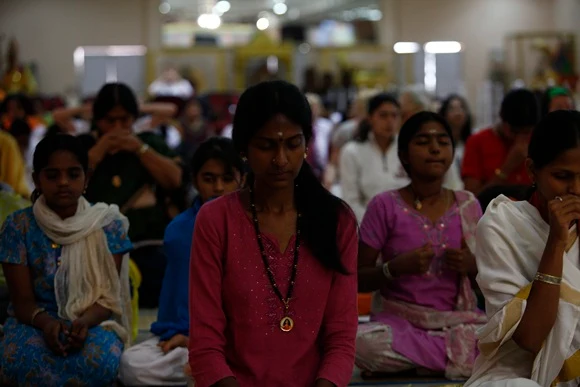
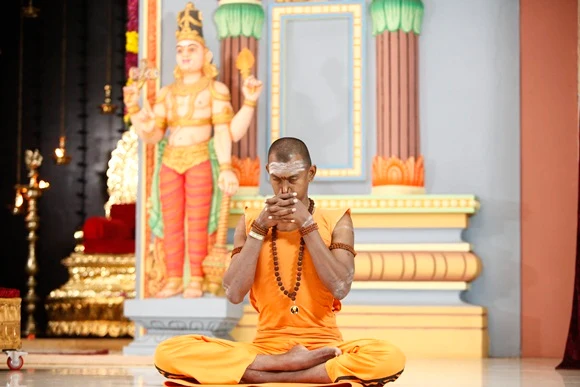
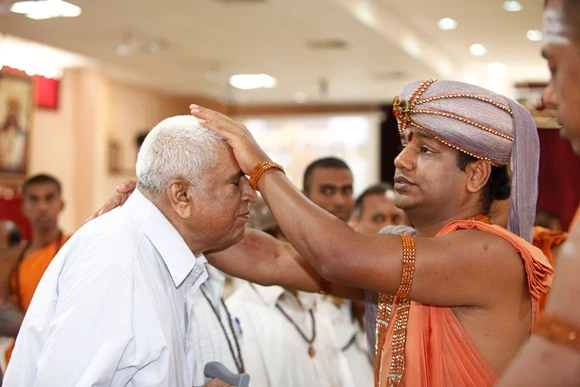
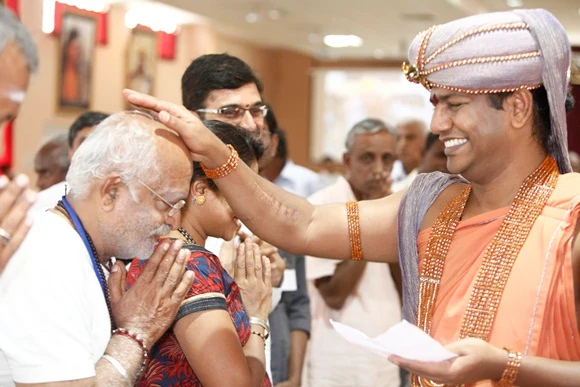
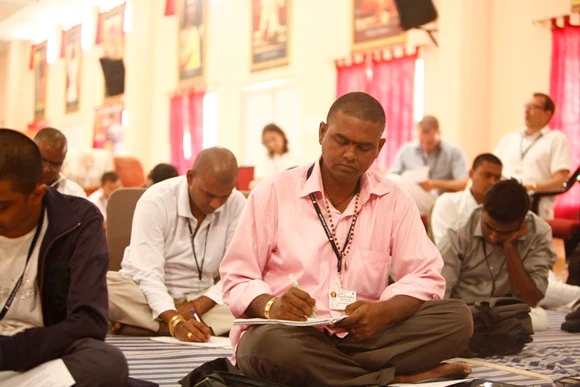
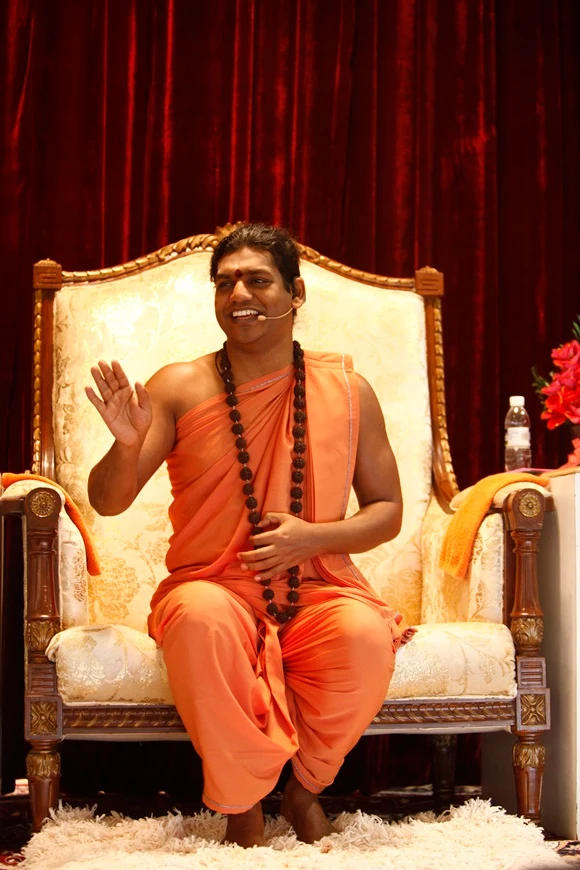
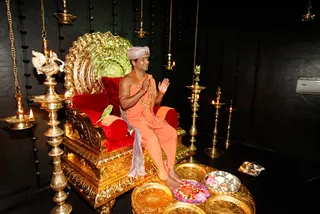
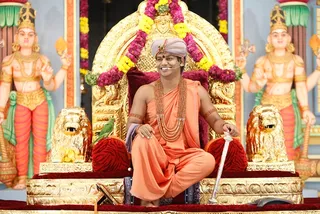
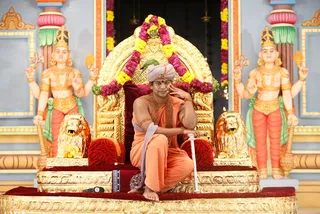
A photograph of a man in saffron-orange robes seated on an ornate gold throne with lion armrests and red cushions, decorated with a floral garland of pink, purple and yellow blooms. He wears a pale pink turban, a rudraksha mala and a gold necklace, and raises one index finger while speaking. A short wooden staff rests beside the throne. Two gilded deity statues with multiple arms stand on either side against a pale blue and gold backdrop with pink columns. Swamiji (probable): the seated man shows a turban, saffron clothing, a rudraksha mala and ceremonial gold necklace.A seated congregation with eyes closed and hands folded in prayer inside a large hall. In the foreground a young woman in a fuchsia top wears a dark beaded mala and a pendant with a gold-framed emblem, with a dot on her forehead. Beside her a girl in a blue patterned salwar and white dupatta sits cross-legged, and at right a woman in a white and gold saree presses her palms together. Behind them rows of devotees in pink, red, white and ornate clothing sit on the floor under bright lights, with gold-toned decor visible in the background. No a person candidate is visible.A shaved-headed man in saffron-orange robes sits cross-legged on a raised platform in a temple hall, palms pressed together at his chest in namaskar with eyes lowered. He wears a rudraksha mala around his neck and beaded bracelets on his wrists, with a white tilak on his forehead. Behind him stands a large painted deity murti with a crown, four arms and orange-red dhoti, flanked by pillars with lotus capitals in green, orange and gold. Brass lamps and ornate gold decor frame the scene.

February 13 2012

Original wiki page
Contents

Title

Bhagavat Gita, Chapter 4, 8th verse

Description

In that day’s Presidential Address, SPH intercepted the Akashic Records of the 4th chapter, 8th Verse of the Jnana Karma Sannyasa Yoga of the Bhagavad Gita. From this grand cosmic download and the re-happening of the Bhagavad Gita, the SPH reminded us that each of us is an incarnation to be and as such, we must follow the role model that incarnations set for us, and take up the same responsibilities. This includes the dustkritaa : the elimination of evil forces in the world which threaten our fellow sangha members. The Paramavatara of Paramashiva, the Supreme Pontiff of Hinduism, Bhagavan Nithyananda Paramashivam further shared that the first task of us as a dustkritaa is to quietly protect the innocent people, but as we gain the strength of wisdom, we must also stand up as warriors against wickedness.

That day's Pada Puja, Presidential Address - Nithyananda Satsangh, Dial the Avatar, Nithya Kriya and Sarva Darshan and Inner Awakening sessions were presided over by the Supreme Pontiff of Hinduism Bhagavan Nithyananda Paramashivam on 13 February 2012 in Adi Kailasa, Bengaluru, Karnataka, India.

Trancript

Date: Mon, 2012-02-13 21:12

Transcript Status: Rough transcript Transcript in English:

Monday, February 13, 2012

In Bhagavat Gita, Chapter 4, 8th verse –

“Paritraanaaya sadhoonaam vinaashaaya cha dushkrutaam | Dharma samsthaa panaarthaaya Sambhavaami yuge yuge ||”

“For the upliftment and propagation of the saintly people - saadhoonam and for the removal of the criminal powers, for the establishment of Dharma, life, super consciousness I come into existence, I happen again and again – Sambhavaami yuge yuge!”

When a incarnation does the only one part protecting the good people, the bad people cannot tolerate. See here I am opening myself and making myself available to the whole world. I don’t pick up diamonds and polish, I pick up stones and polish. But this some stones who don’t want to go through the process of becoming diamonds but want to be in the space of diamonds.

Paritraanaaya sadhoona vinaashaya cha dushkrutaam let you learn the 2nd part also.

This should be the life’s vision and mission purpose statement – protecting the good and goodness, destroying the wicked and wickedness and establishing the science of enlightenment! This 3 should be the vision and mission statement of all of you! so all of you have your own photograph in your bedroom and below it write this – to protect the good, destroy the wicked and establish the science of enlightenment, I happen every morning and wake up. See this is the purpose of your incarnation, my blessings, do it!

Photos From The Day:
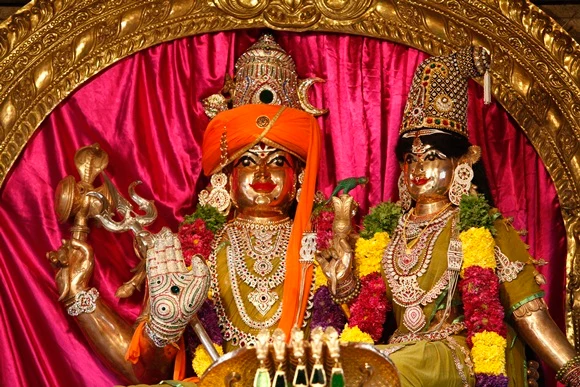
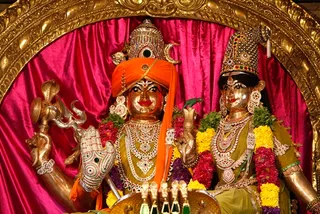
Photos from this day

View all 16 photos
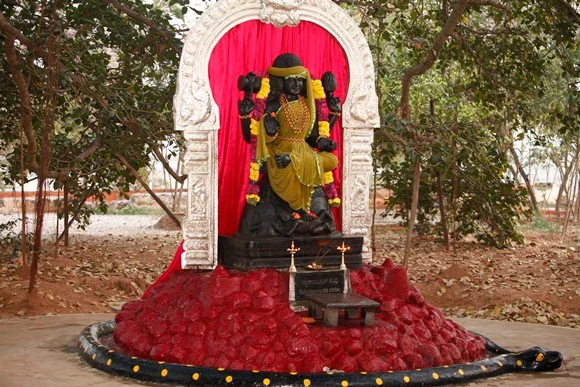
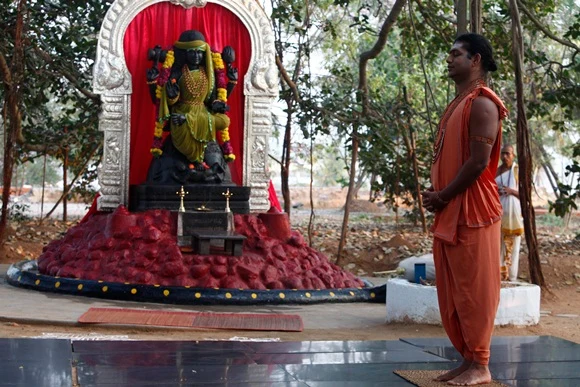
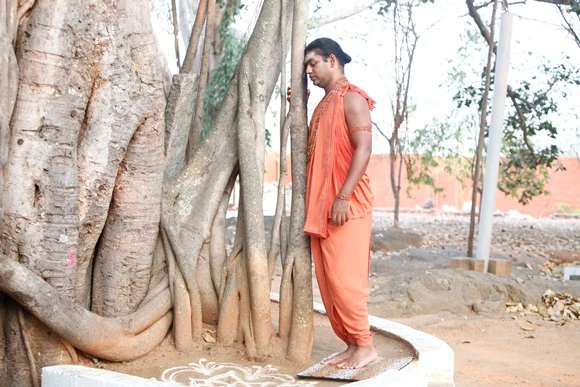
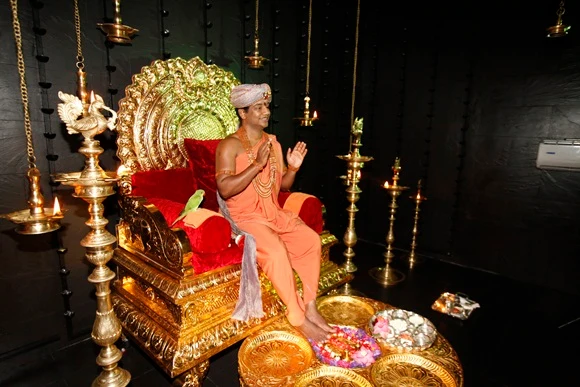
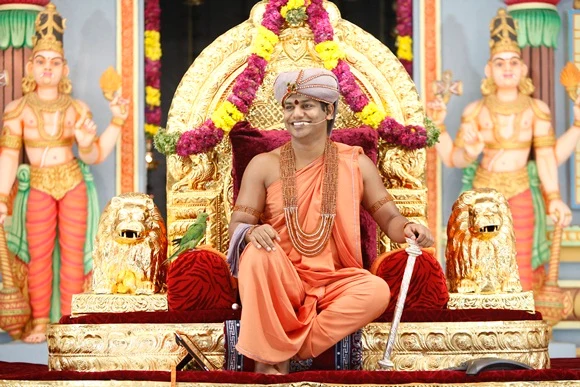
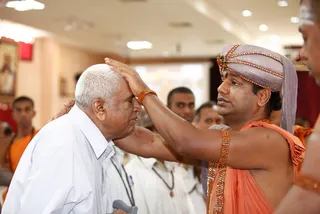
Two gilded deity murtis stand before a deep pink satin backdrop framed by an ornate gold arch. The figure on the left wears an orange turban with a crescent and jewel ornament, a heavy white and gold necklace, and holds a trident and a ceremonial hand gesture. The figure on the right wears a green and gold outfit, a jeweled crown, and is adorned with red and yellow flower garlands and layered necklaces. Brass-like oil lamp holders sit in the foreground. No physical people are visible.A black stone deity murti stands in an outdoor garden shrine framed by a white carved arch and a red curtain backdrop. The black figure wears a yellow-gold garment and a yellow headband, with several raised arms and marigold garlands draped across its shoulders and arms. In front sits a pile of red flower petals forming a mound around a black pedestal, with a dark bench-like altar, brass oil lamps and a black-and-yellow border along the base. Trees and dry ground surround the shrine. No people are visible.Outdoors in a wooded compound, a standing man in orange saffron robes and a rudraksha mala stands with hands folded before a black stone deity murti dressed in green and gold, with a yellow headband and garlands of flowers. The murti sits in an arched shrine framed by white carved stone and a red cloth backdrop, on a mound of red-painted stones with a small brass lamp and offerings. Behind him, a second person in white clothing stands near the shrine, and a dark tiled platform lies at the front.A barefoot man in saffron-orange robes stands beside the thick, buttressed trunk of a large banyan tree, his forehead resting against the bark. He wears a saffron shawl over a bare upper body with a rudraksha mala and arm bands, and orange dhoti-style trousers. Beneath the tree is a circular stone platform with a white kolam-style design on the sandy ground. Behind him is an orange boundary wall and a building under construction. Only one person is visible.A man seated on an ornate golden throne with red cushions and a carved hooded backrest, palms pressed together in namaste. He wears a saffron-orange dhoti and matching shawl, a pink-lilac turban, and a long rudraksha-style mala with gold necklaces. A green parrot perches on the throne's armrest. Brass oil lamps (deepas) with flames hang and stand around the dark black-walled room, and gold trays hold flower garlands and offerings at his feet.A smiling man in saffron-orange robes sits on an ornate gold throne with red cushions, flanked by two carved golden lion figures. He wears a saffron turban, a rudraksha-style mala, and multiple ceremonial gold necklaces, and rests a hand on his knee while a ceremonial sword lies beside the throne. A garland of purple and yellow flowers drapes over the throne's canopy. Two gilded standing deity murti flank the throne on either side, and a green parrot perches near the throne base. The setting is a temple-style stage with pale blue walls.A man in orange-saffron robes and a pink-and-cream turban sits cross-legged on a gold-and-red ornate throne (peetha) with a floral garland of marigolds and red blooms draped over its back. His right elbow rests on his knee and his hand touches his head. He wears a shawl over his shoulder, rudraksha-style beads and ornate gold jewellery on his chest, and holds a white staff or rod. Lion figures flank the throne's base. On both sides stand large gold-and-colourful statues of deity murti with multiple raised arms holding ritual objects, wearing ornate crowns and orange-red dhotis. Behind is a decorated temple-style backdrop with pillars and garlands of yellow and red flowers.A photograph of a man in saffron-orange robes seated on an ornate gold throne with lion armrests and red cushions, decorated with a floral garland of pink, purple and yellow blooms. He wears a pale pink turban, a rudraksha mala and a gold necklace, and raises one index finger while speaking. A short wooden staff rests beside the throne. Two gilded deity statues with multiple arms stand on either side against a pale blue and gold backdrop with pink columns. Swamiji (probable): the seated man shows a turban, saffron clothing, a rudraksha mala and ceremonial gold necklace.A seated congregation with eyes closed and hands folded in prayer inside a large hall. In the foreground a young woman in a fuchsia top wears a dark beaded mala and a pendant with a gold-framed emblem, with a dot on her forehead. Beside her a girl in a blue patterned salwar and white dupatta sits cross-legged, and at right a woman in a white and gold saree presses her palms together. Behind them rows of devotees in pink, red, white and ornate clothing sit on the floor under bright lights, with gold-toned decor visible in the background. No a person candidate is visible.A shaved-headed man in saffron-orange robes sits cross-legged on a raised platform in a temple hall, palms pressed together at his chest in namaskar with eyes lowered. He wears a rudraksha mala around his neck and beaded bracelets on his wrists, with a white tilak on his forehead. Behind him stands a large painted deity murti with a crown, four arms and orange-red dhoti, flanked by pillars with lotus capitals in green, orange and gold. Brass lamps and ornate gold decor frame the scene.A photo inside a hall with cream walls and a framed picture at upper left. A man in a lavender turban and saffron-orange robe, wearing gold necklaces and orange threads on his wrist, places his right hand on the forehead of an elderly man with white hair in a white collared shirt. The elderly man bows his head forward and has a grey lanyard-style cord and a white handheld microphone at lower centre. Several saffron-clad and white-clad men stand in the background, some with orange garments and mala beads. The orange-robed man with the turban is an appearance-based a person, performing a blessing with his hand on the devotee's head.A smiling man in a lavender-grey turban, saffron-orange robe and layered rudraksha-style beaded necklaces places his right hand on the forehead of an older, white-haired man with glasses who bows with hands joined in anjali. The bowing man wears a white shirt and a blue lanyard. Beside them a woman in a red and dark floral top stands with hands folded in prayer, and several men in the background, one in glasses and a dark shirt, watch the blessing. Behind them are framed pictures on a pale wall and a pale hall setting. The scene appears to be a blessing or darshan moment with a priest-like figure.