Skip to content
Sunday

12 February 2012

Bhagavad Gita, 4th chapter, Jnana Karma Sanyasa yoga

Dated photos
27
Source pages
1
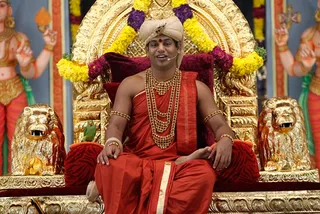
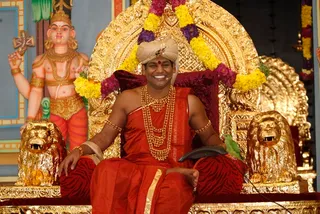
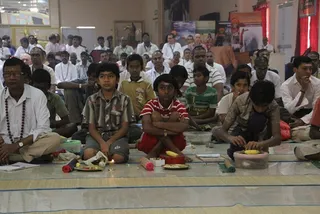
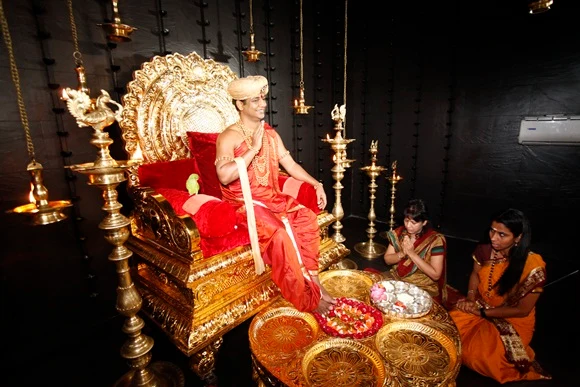
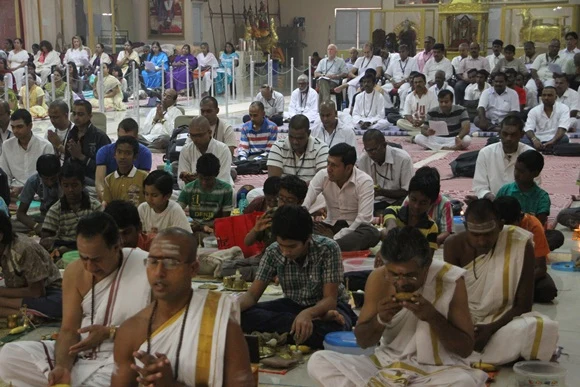
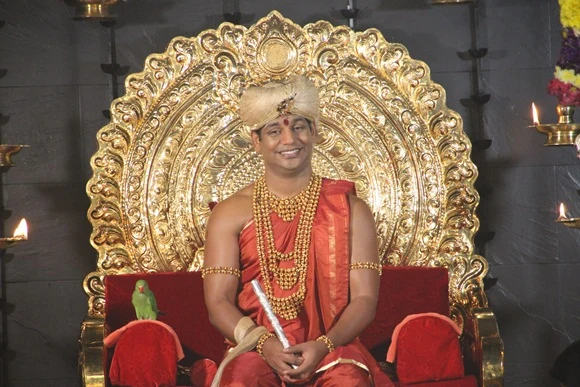
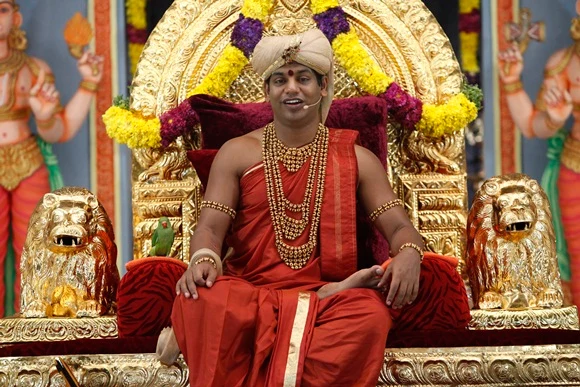
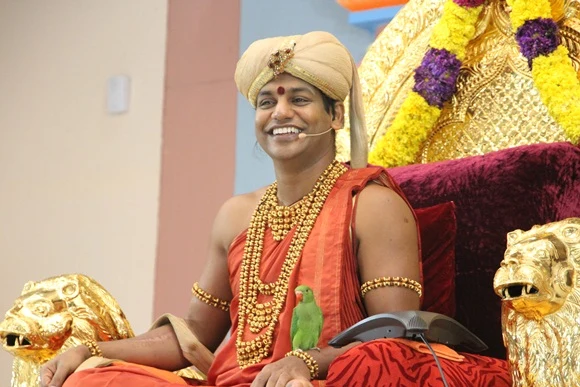
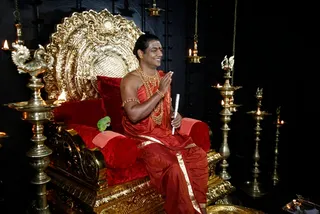
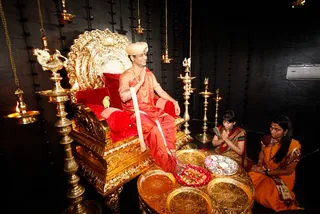
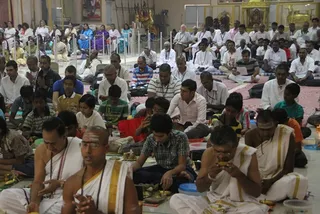
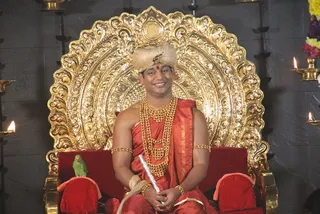
A man seated on an ornate golden throne with lion-shaped armrests and a carved gilded backrest draped with yellow and orange-gold marigold garlands. He wears a cream-and-gold turban, a red-orange shawl over bare shoulders, a red-orange cloth wrap, and layered gold necklaces, with gold bangles on his wrists and a red tilak on his forehead; he gestures with his right hand while speaking into a headset microphone. Behind him stand painted figures in red and green.A photograph of a man seated on an ornate golden throne with lion-form armrests and a gold arched backrest draped with yellow and purple flower garlands. He wears an orange-red dhoti and shawl, a cream turban, multiple gold necklaces and gold armbands, and smiles broadly while resting his hand on a small red cushion. A green parrot perches near his hand. Behind him stands a golden deity statue holding a trident-like staff and a cross-shaped object, with a painted pink and green temple pillar at left. Swamiji (probable): the seated man has a turban, saffron-orange ritual clothing, multiple gold necklaces and a throne setting, consistent with the page's Swamiji reference. One physical person is visible.A photograph of a seated congregation on a white floor at an indoor satsang or discourse hall. In the foreground, boys sit cross-legged before plates of food and small bowls, with a lit oil lamp and a cone-shaped offering beside them; a boy in a red and white striped shirt sits with arms folded. Behind them, men in white kurtas and white shirts sit in rows, with a banner and framed imagery visible on the back wall. A man on the left wears a white shirt and a beaded mala. The scene appears to be a gathering for a spiritual discourse with shared prasadam.

February 12 2012

Original wiki page
Contents

Title

Bhagavad Gita, 4th chapter, Jnana Karma Sanyasa yoga

Transcript

Date: Sun, 2012-02-12 07:11

Transcript Status: Rough transcript Transcript in English:

Sunday, February 12, 2012

In Bhagavad Gita, 4th chapter, Jnana Karma Sanyasa yoga –

“Paritraanaaya sadhoonaam vinaashaaya cha dushkrutaam |

Dharma samsthaa panaarthaaya Sambhavaami yuge yuge ||”

Dushkrutaam – today I will try to define Dushkrutaam. Dushkrutaam means a person who does not bother to destroy anybody for his vested interest. There are people who don’t hurt others even for their own good. There are some people who will hurt others if it is good for them, to save themselves. There are some people who hurt others even if it is not good for them. Even if I lose one eye, let them lose one eye. 2nd level even if you hurt others for your own good it is Dushkrutaam. And the third level hurting others knowing it is not even good for you. That is demonic Dushkrutaam. I have to find out only a new word for it.

“Paritraanaaya sadhoonaam vinaashaaya cha dushkrutaam | Dharma samsthaa panaarthaaya Sambhavaami yuge yuge ||”

“For the up-liftment and propagation of the saintly and for the removal of the criminal and for the criminal powers, for the establishment of justice I come into existence, I happen in every age!”

It is actually a standard vision statement for all the incarnations for Hinduism. Krishna has defined the vision statement for all incarnations. If you are an incarnation, only this can be your vision statement. Nothing else can be your vision statement.

Paritraanaaya sadhunaam –

For the protection of the people who live in restful awareness. There are ppl who live in restlessness live in pain body and cannot leave others to live peacefully. These demonic pain body people always run to catch ……unfortunately the restfully aware people by the time they come, the seat is already taken by the restless rowdy fellows. It is an incarnations job to again & again set an example by building the people with restful awareness to the lime light, by raising the people with restful awareness as a role models. Vinaashaaya cha dushkrutaam – and destroying the rowdy elements unfortunately which occupies the power centers, which uses power centers for their own good, their vested interests. I can say almost all the masters incarnations happened, they lived keeping this verse as the base. Whoever has to happen, they have to live keeping this verse as the base. This sutra is the basis for all the Hindu incarnations happened, and al the incarnations who will happen. When I say Hindu incarnations, I mean very clearly incarnations as per Hindu tradition. Because there are so many traditions which emphasize God does not come in human form. So in your religion he does come in human form, in our religion he comes in human form J that is why again and again they come in human form only in our tradition. Only Hinduism allows the possibility of incarnation. Come on, you cannot make Dosa in chicken hotel. You cannot expect non-veg in veg restaurant. Whatever the purpose of a place that only gets fulfilled. The very philosophical physiology, the philosophy with which Hinduism is build is constituted for incarnations to land in human body. Believing incarnations cannot land in human body is the most inhuman thing. then you disconnect human beings from God. That is the original sin. Not Adam eating the apple. No. Original sin is Adam not able to swallow the atom. Means you not able to swallow the truth. The very philosophical physiology of Hindu tradition proves God lands in human body.

See these three things are unique to Hindu tradition. One – feminine worship – means worshipping the ultimate in the form of mother. 2nd – divine descending in the human form. 3rd – the truth of re-birth. these 3 are unique to the hindu tradition. Of course there are many more things like sacred places kshetras. Means once you install a deity, it is divine, it is sacred. It the place is big or small, you can move. But in Hindu tradition, onc eth deity is installed you cannot move it. it is called Praana Pratishta – sanctifying the very space. There are so many other things. But this three I can say very unique to Hindu tradition.

“Paritraanaaya sadhoonaam vinaashaaya cha dushkrutaam | Dharma samsthaa panaarthaaya Sambhavaami yuge yuge ||”

Bhagavan is very beautifully putting his priorities. First he want to protect the spiritually elevated people. 2nd he want to destroy the wicked fellows who live in the pain body and spread the pain body in others. 3rd – only 3rd he says dharma samsthaapanaarthaya – he will establish the science of inner awakening, the science of enlightenment.

I think the first phase we have already done – means raising and protecting the spiritual people. We identified a group which is now protected. The Vinaashaya cha dushkrutaam – the destroying the evil is happening. And only now dharma samsthapanaarthaya has to happen – means establishing living enlightenment. Establishing the science of living enlightenment, of jeevan mukti. I translated this word Dharma samsthaapanaarthaya as establishing righteousness. No that is a very poor translation. It means establishing the science of enlightenment….

Even the English dictionaries have to be re-created. this Max muller’s words have created such poison…I will create a dictionary. the comprehensive meanings and definitions of spiritual terms. Dharma samsthaapanaarthaya..establishing the science of living enlightenmnet, Sambhavaami – I happen, Yuge yuge – age after age.

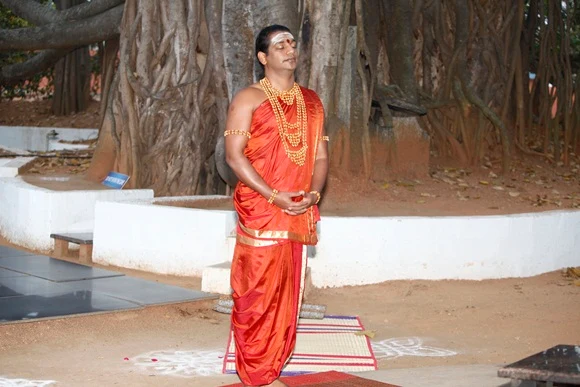
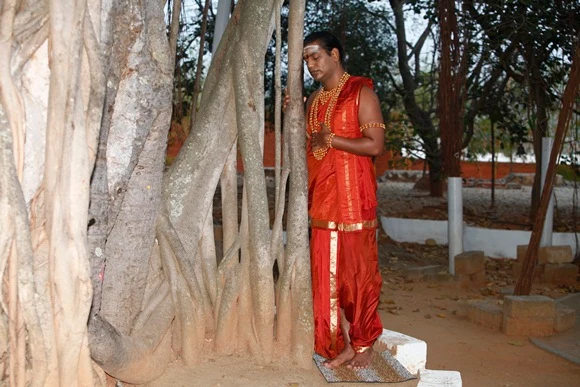
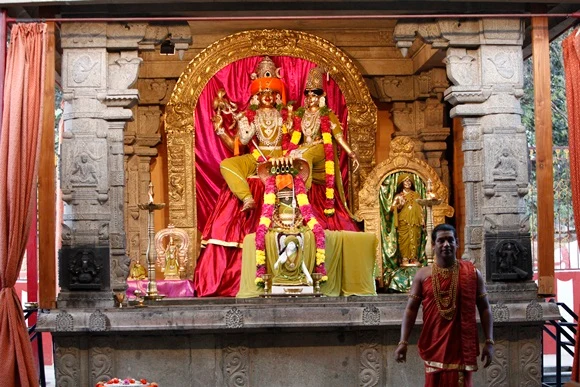
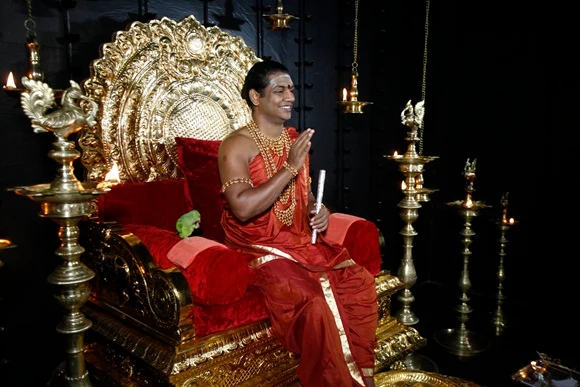
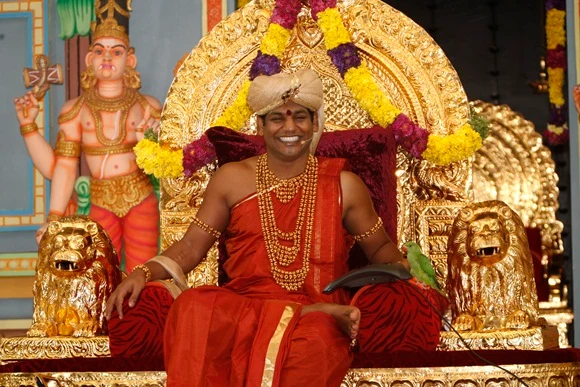
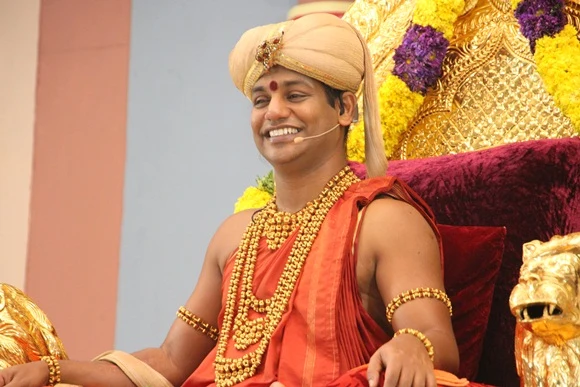
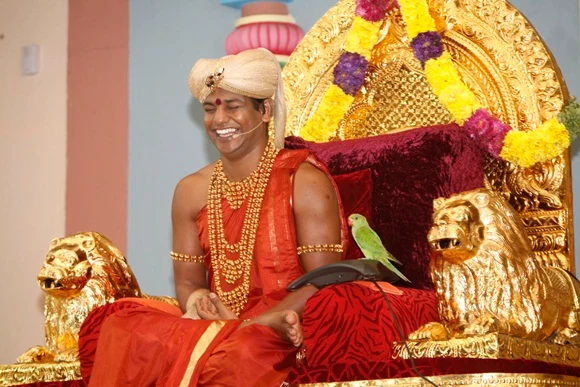
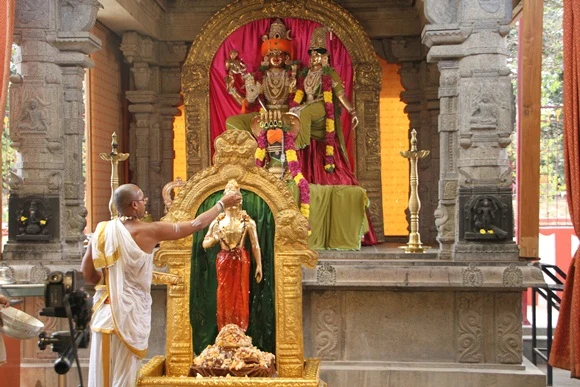
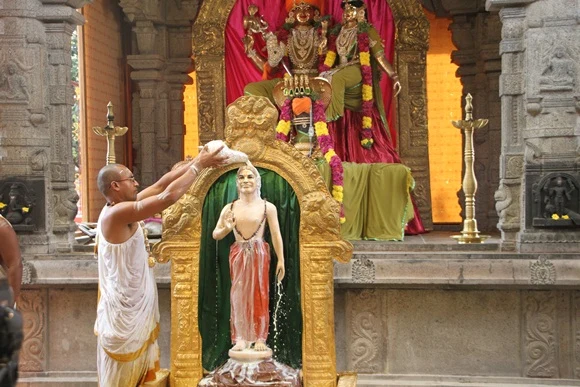
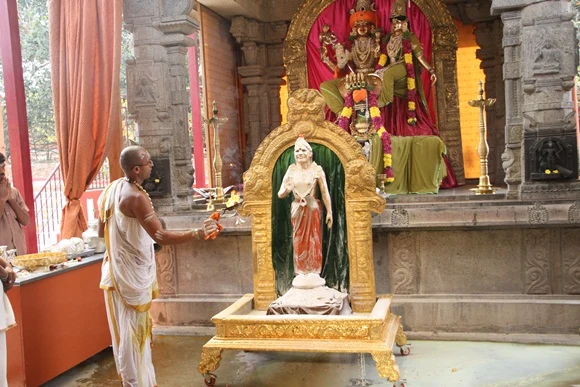
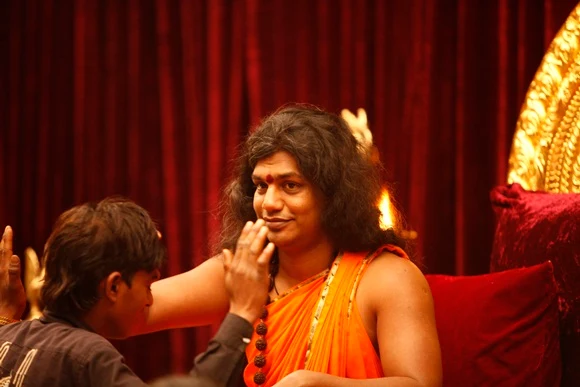
I can say 500 years before age means 200 years because 200 years does not have much change in life. But now, the age has become just 25 days. When a way of living becomes new, new age happens. The new age concept has already become old age. Constantly this concept of new age is getting updated. I will continue to expand on this verse for few more days. In Houston, Padmini is explaining what I was wearing. You cannot explain you can only show. So show the photograph.

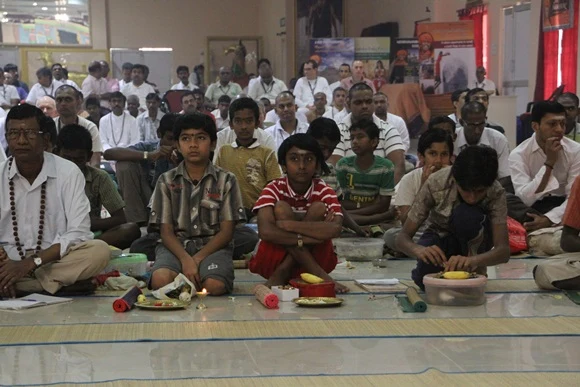
Photos From The Day:
Photos from this day

View all 27 photos
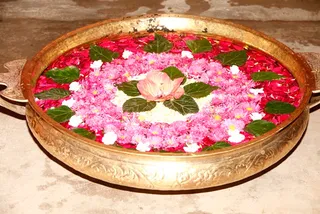
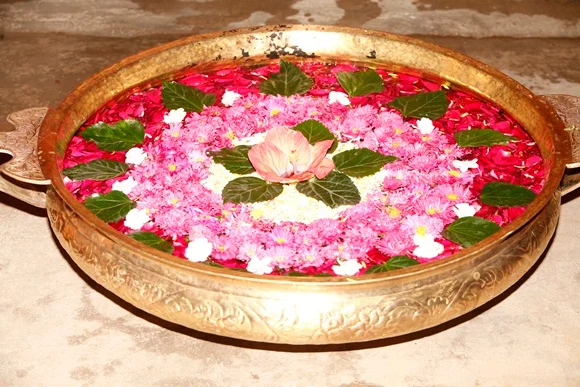
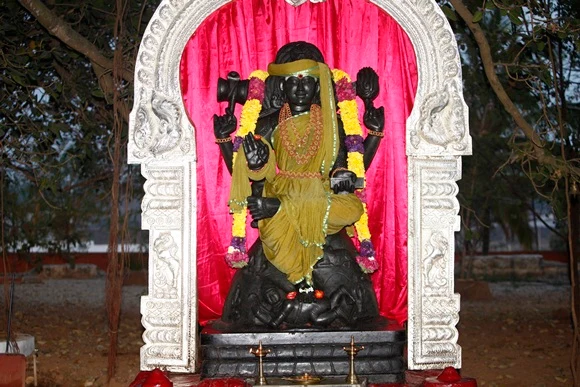
A black stone murti of a multi-armed deity is seated on a dark pedestal before a red cloth backdrop framed by an ornate white arch. The figure wears a yellow-green shawl, red beaded necklaces and a garland of purple and yellow flowers over the shoulders, with a turban-like headdress. Small brass oil lamps stand on either side of the pedestal, and red offerings sit at its base. Trees and a dim outdoor setting surround the shrine. No physical people are visible.A large round brass tray or vessel with embossed decorative rims holds a floral arrangement in water. Red and pink rose petals fill the surface, with a ring of pink chrysanthemum-like flowers, small white blossoms, green leaves, and a central pink lotus-like flower on a white bed. The tray rests on a plain stone or concrete floor. No people or readable text are visible.A photograph of a man standing barefoot on a woven mat beside a large banyan tree with dangling aerial roots, on a sandy courtyard with white-painted low walls. He wears an orange-saffron dhoti and a matching shawl draped over his shoulder, with multiple layered gold necklaces and gold armlets. His head is shaved except for a short tuft, and a white-and-red tilak marks his forehead. His eyes are closed and his palms are joined in front of his chest in a prayer gesture. Rangoli-style white and pink patterns decorate the ground at his feet, and a small blue sign sits on the left wall. Appearance-based identity is uncertain, so he is described only by role as a devotee in prayer.A man in saffron-orange draped clothing with a gold border stands barefoot on a white platform beside a large banyan tree with thick, twisting aerial roots. His hands are pressed together in front of his chest in anjali mudra, and he wears layered gold and beaded necklaces with a gold armlet on his upper arm. He has a vertical tilak on his forehead and his head is turned slightly toward the tree. Behind him are a low white wall and sandy ground with scattered trees.Photograph of a temple shrine with an ornate golden arch and carved stone pillars. A large deity murti in red and gold garments, adorned with a crown and garlands of yellow and orange flowers, is seated on a raised pedestal. Another figure stands beside it in green. A brass oil lamp sits on the platform in front. A bare-chested man in a red dhoti and red shawl with gold beaded necklaces walks past the shrine at the right, with a red curtain hanging at the left edge.A man seated on an ornate gold-and-red throne with a carved golden backrest, holding a white cloth in his right hand while his palms are pressed together in greeting. He wears a saffron-orange wrap with gold border, a heavy gold necklace, gold armband, and his bare shoulder is visible. Several brass oil lamps stand around the throne against a dark wall, and a small green leaf lies on the armrest. a person.A man in a saffron-orange dhoti and matching shawl with a saffron turban sits on an ornate gold-and-red throne with a golden back panel. He holds his hands together in a namaste gesture. Two women in orange and red saris kneel beside a low table of brass trays holding flower petals, sweets and offerings. Hanging brass oil lamps and standing lamps light a dark room behind them.A large indoor congregation sits cross-legged on mats in a temple hall with a gold-toned shrine and ornate deity murti in the background. In the front foreground, two men in white dhotis with gold-bordered shawls sit with folded hands, one holding a small object; a bald priest in white dhoti and shawl sits near brass plates and small oil lamps on the floor. Rows of men in white shirts and dhotis, boys in casual shirts and women in saris fill the hall, many with hands joined or holding papers. Brass and copper vessels and small lamps are placed before the seated group. The scene suggests a puja or satsang gathering with devotees seated in orderly rows.A man seated on an ornate golden throne with a large carved backrest, dressed in saffron-orange robes with a matching saffron turban bearing a red bindi. He wears multiple strands of gold beads and ceremonial gold necklaces, gold armbands and bangles, and holds a white fly-whisk or ceremonial staff in his lap. A green parrot perches on the red cushioned armrest beside him. Lit oil lamps and a flower garland appear at the edges of a dark wall backdrop. Appearance-based label: Swamiji (probable), seated on a throne in a formal sitting, with a turban, saffron robes and gold necklaces as qualifying cues.A man seated on an ornate golden throne with lion-shaped armrests and a carved gilded backrest draped with yellow and orange-gold marigold garlands. He wears a cream-and-gold turban, a red-orange shawl over bare shoulders, a red-orange cloth wrap, and layered gold necklaces, with gold bangles on his wrists and a red tilak on his forehead; he gestures with his right hand while speaking into a headset microphone. Behind him stand painted figures in red and green.A photograph of a man seated on an ornate golden throne with lion-form armrests and a gold arched backrest draped with yellow and purple flower garlands. He wears an orange-red dhoti and shawl, a cream turban, multiple gold necklaces and gold armbands, and smiles broadly while resting his hand on a small red cushion. A green parrot perches near his hand. Behind him stands a golden deity statue holding a trident-like staff and a cross-shaped object, with a painted pink and green temple pillar at left. Swamiji (probable): the seated man has a turban, saffron-orange ritual clothing, multiple gold necklaces and a throne setting, consistent with the page's Swamiji reference. One physical person is visible.A photograph of a seated congregation on a white floor at an indoor satsang or discourse hall. In the foreground, boys sit cross-legged before plates of food and small bowls, with a lit oil lamp and a cone-shaped offering beside them; a boy in a red and white striped shirt sits with arms folded. Behind them, men in white kurtas and white shirts sit in rows, with a banner and framed imagery visible on the back wall. A man on the left wears a white shirt and a beaded mala. The scene appears to be a gathering for a spiritual discourse with shared prasadam.