Skip to content
Tuesday

23 May 2017

Integrity to Time Helps You Mirror Superconsciousness

Dated photos
165
Source pages
1
Media
4
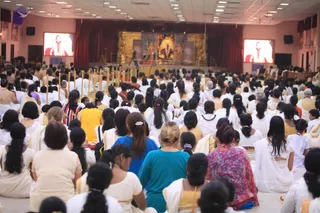
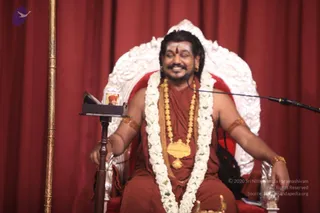
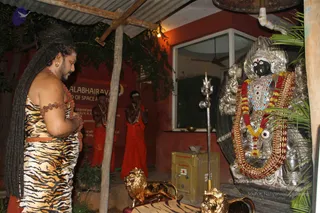
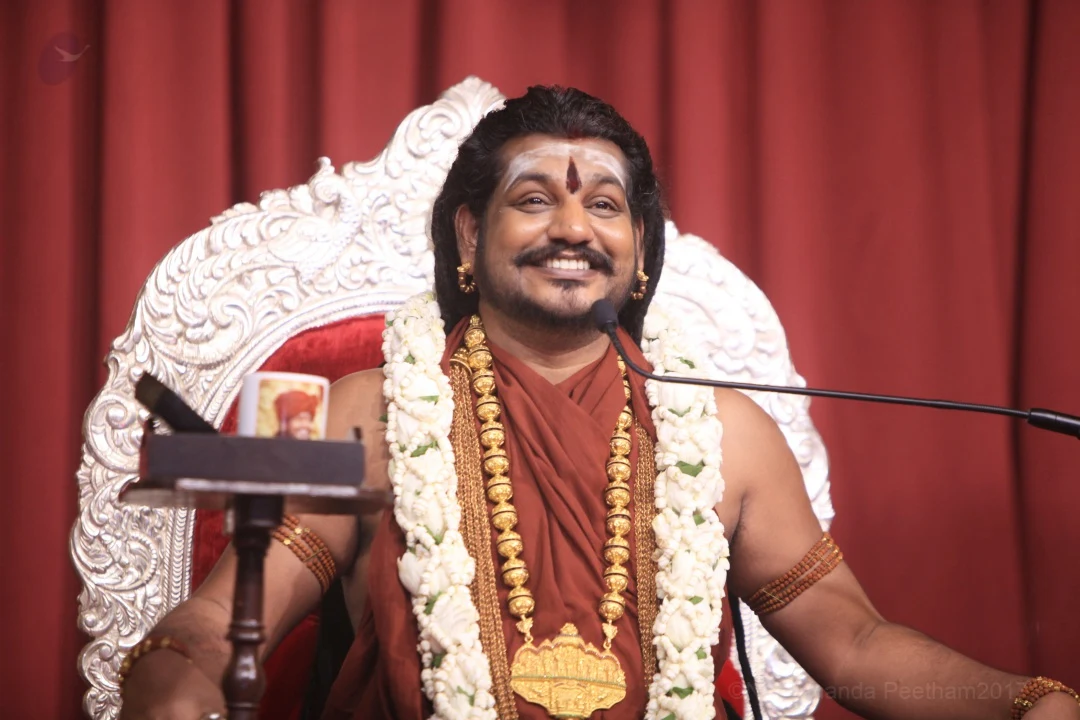
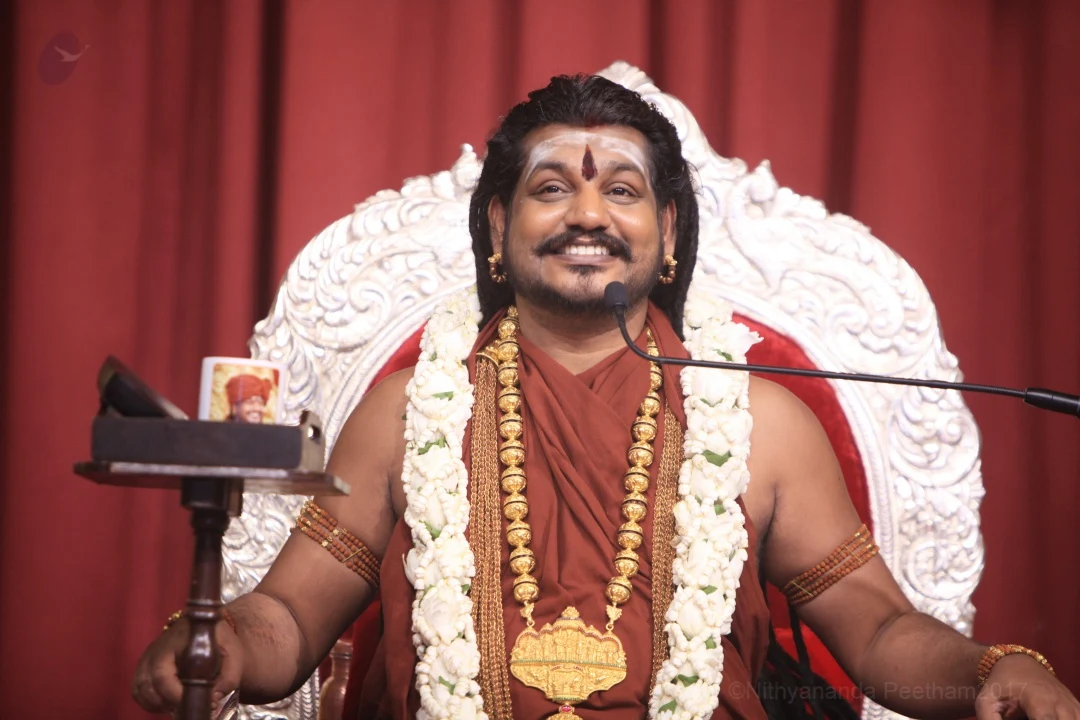
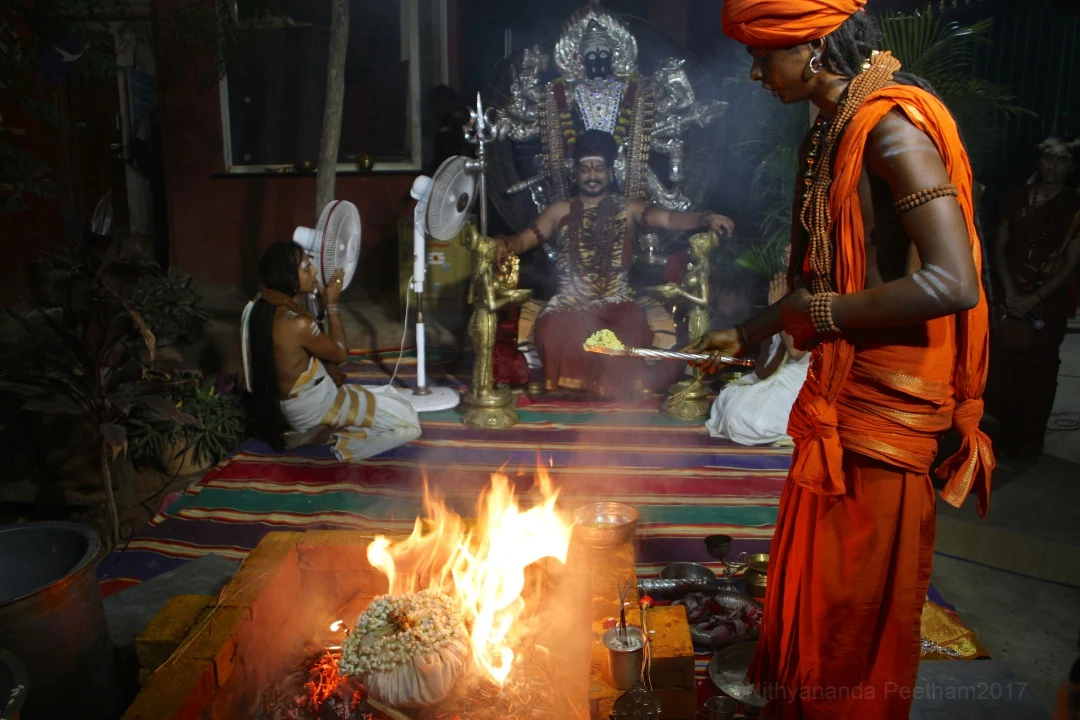
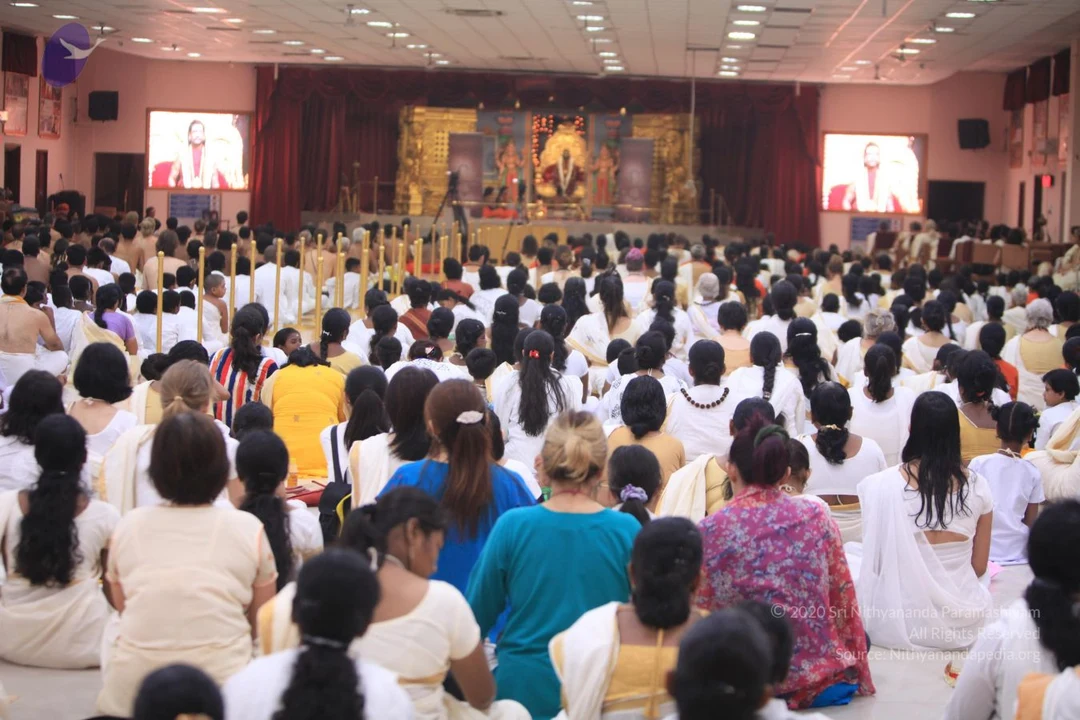
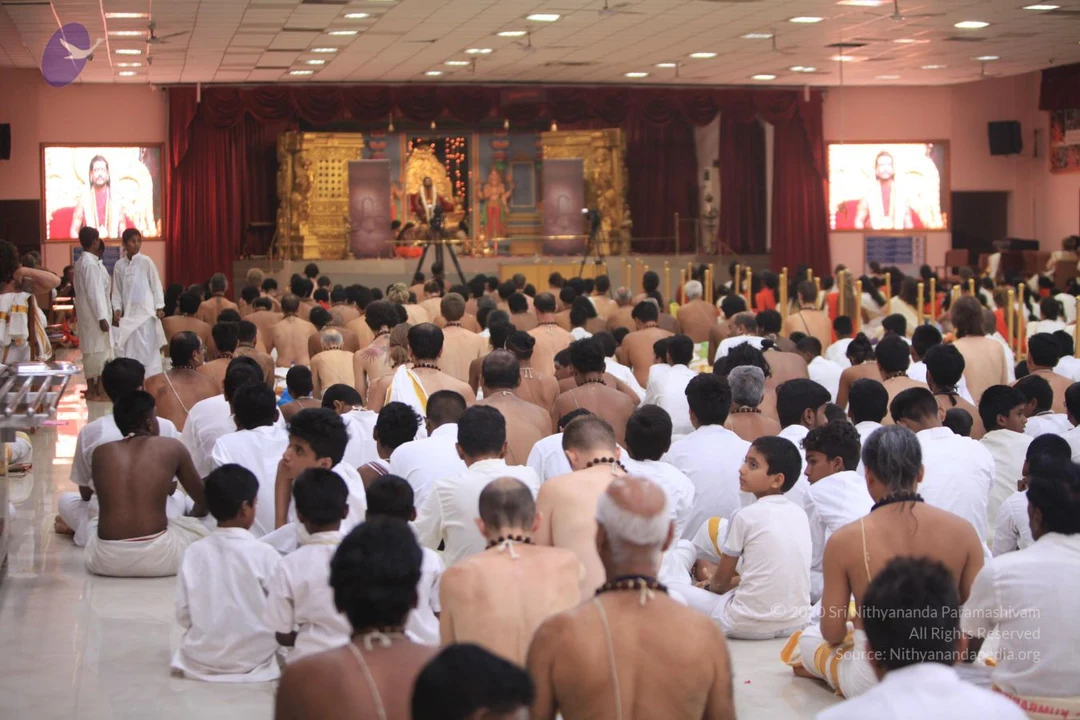
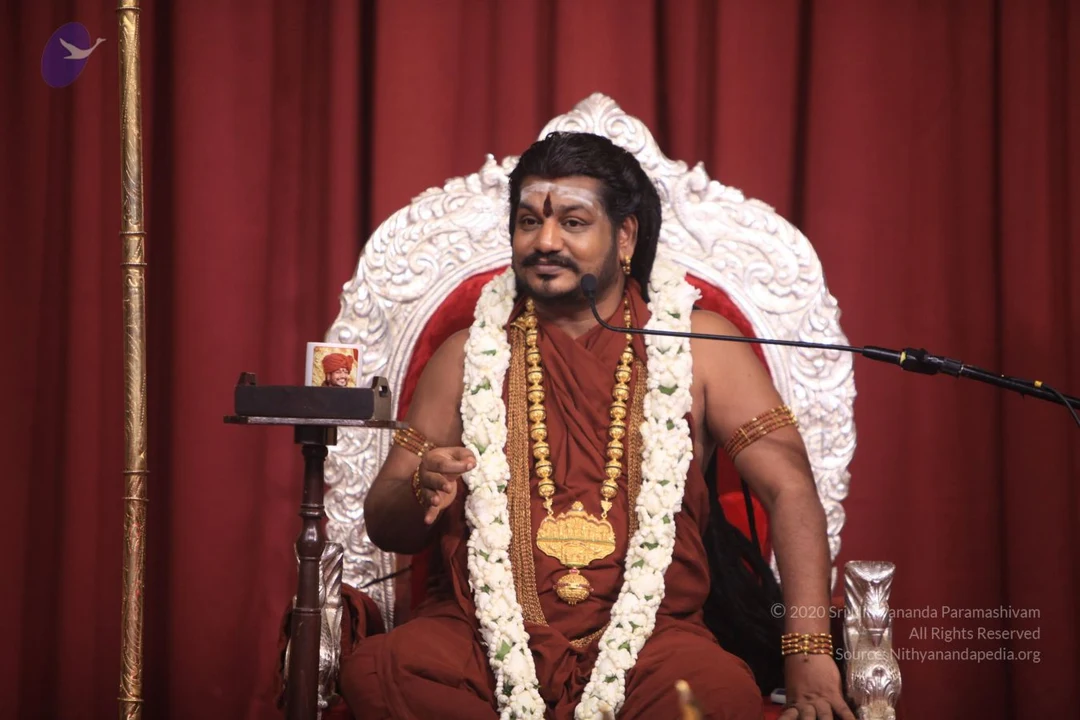
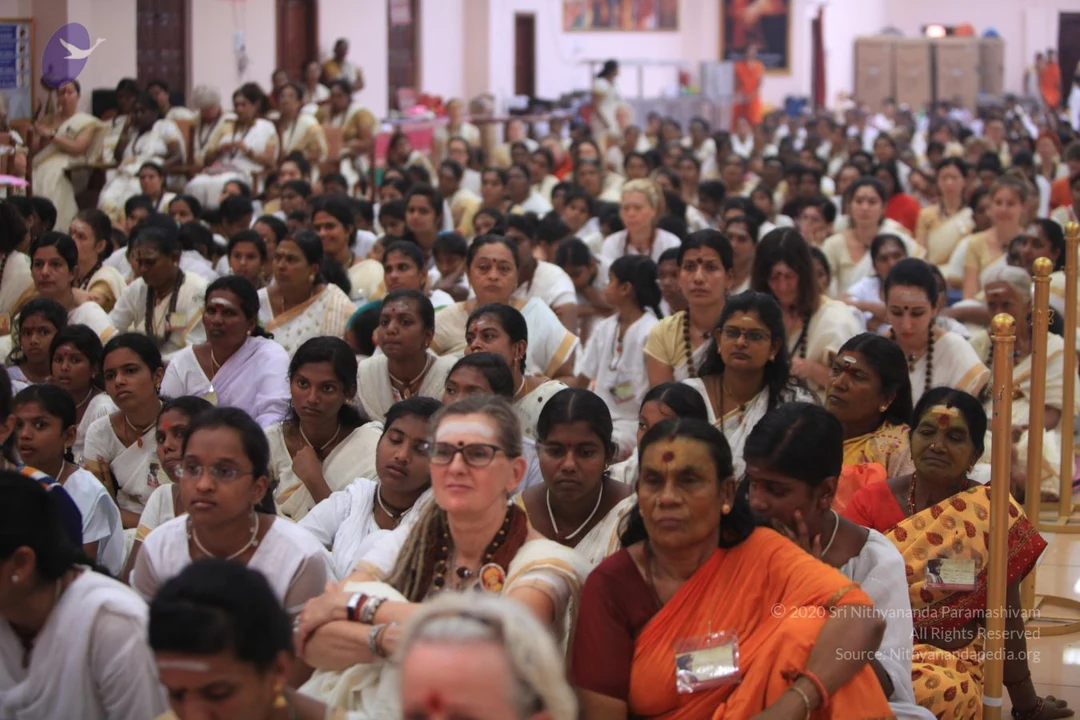
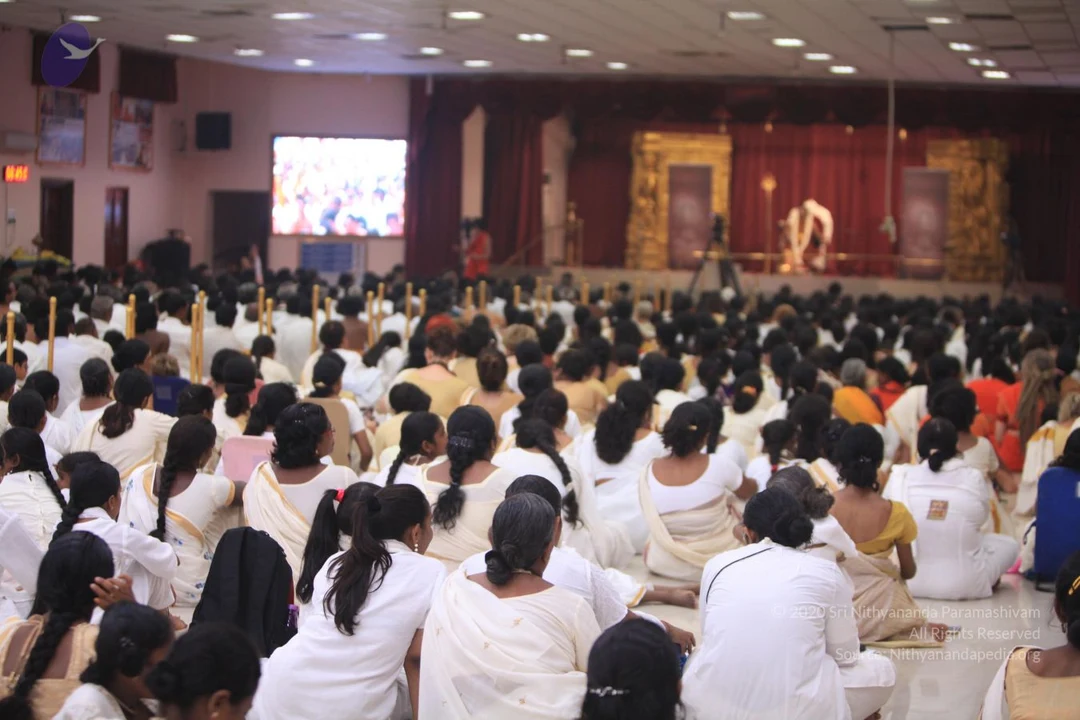
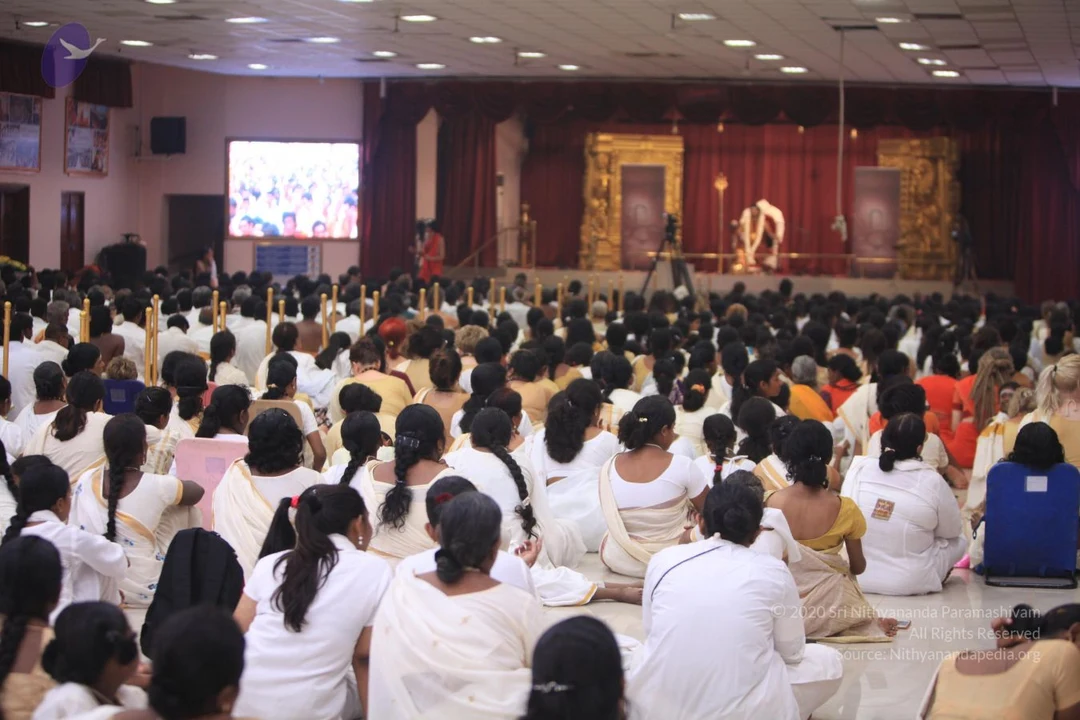
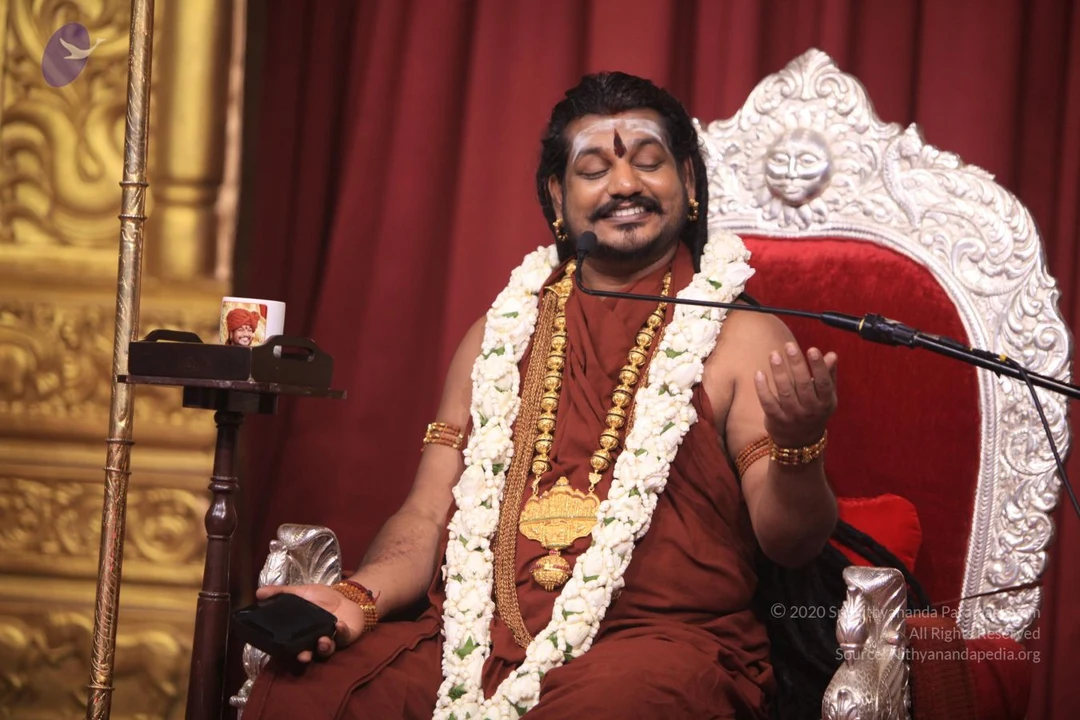
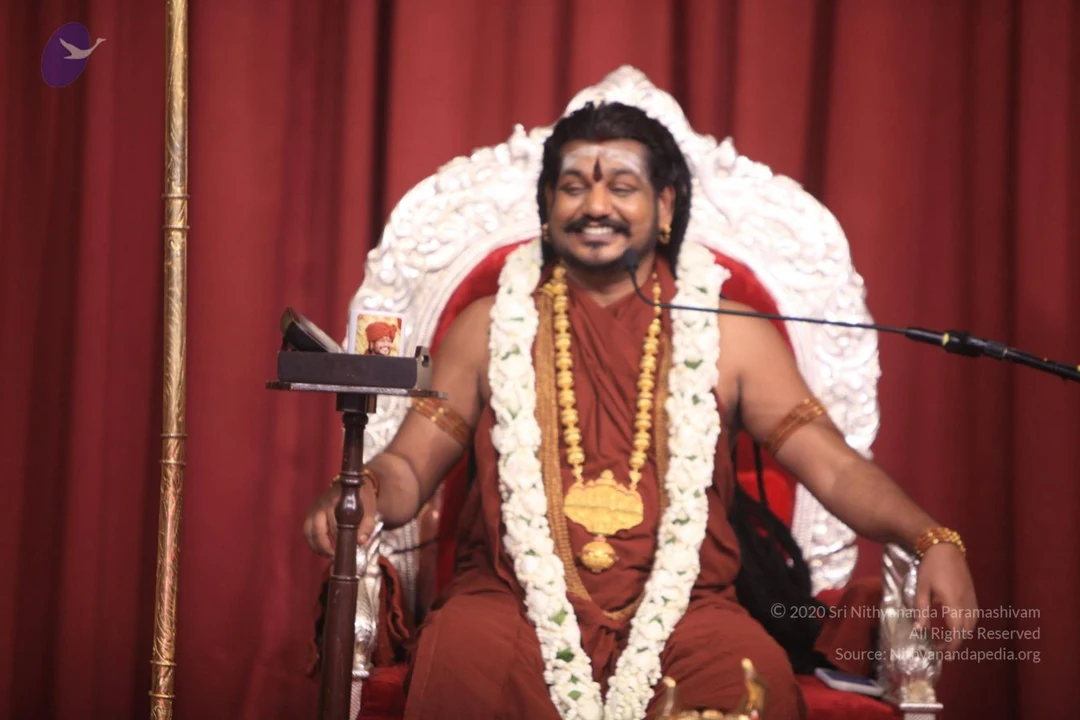
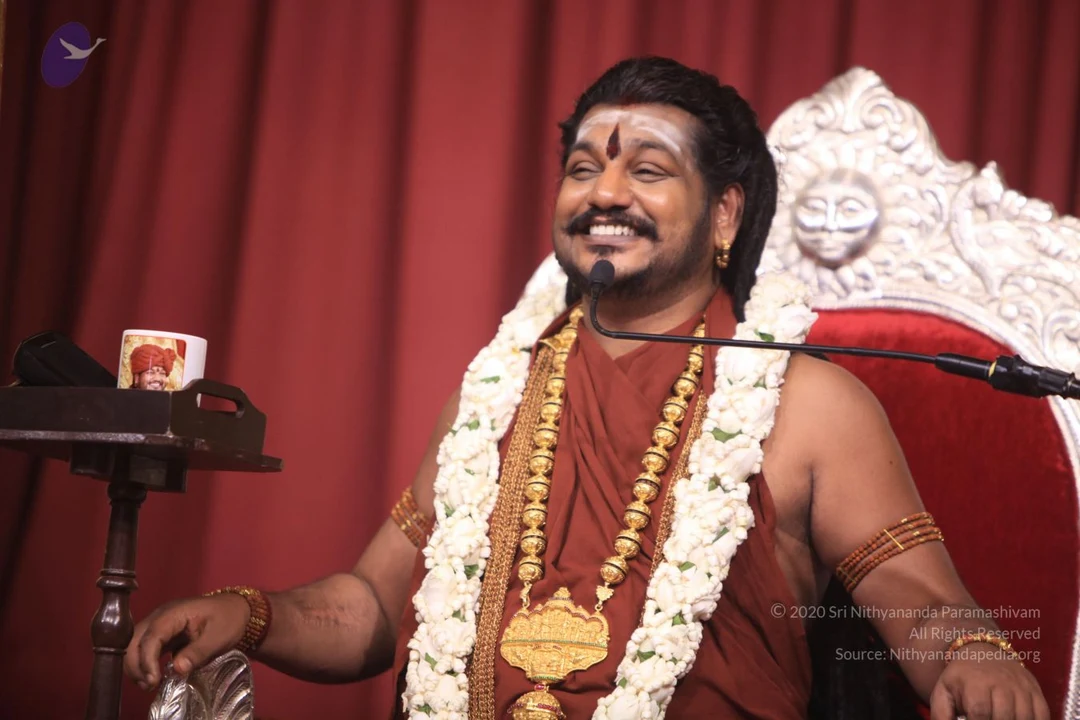
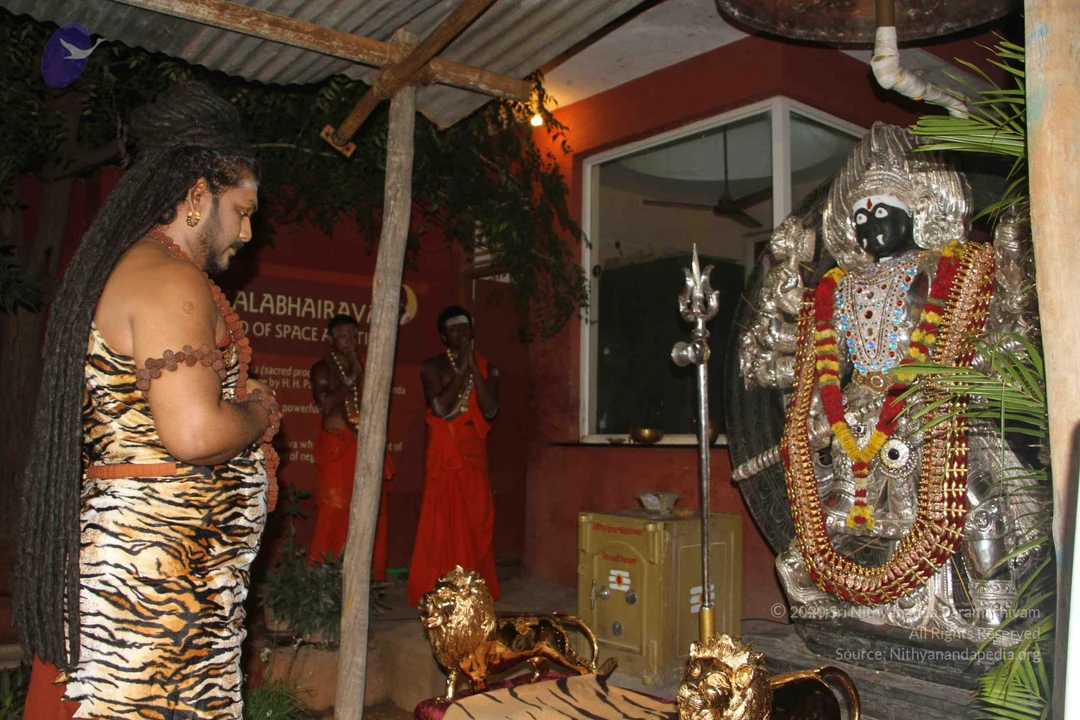
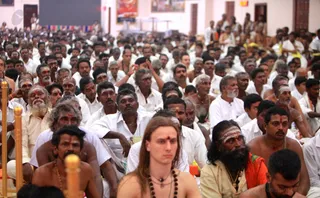
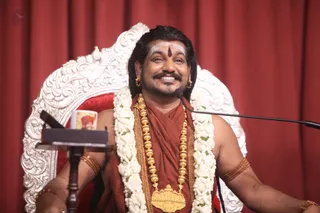
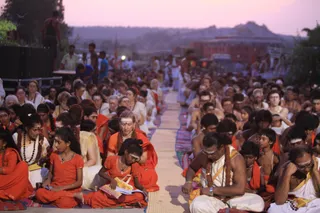
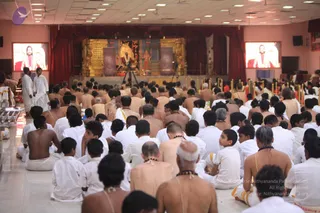
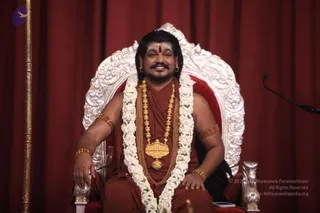
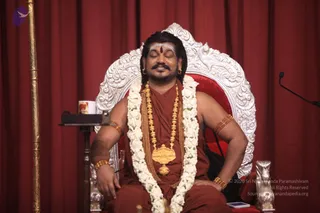
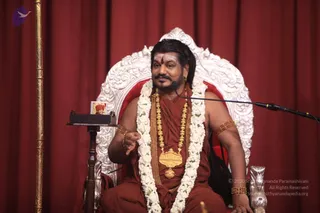
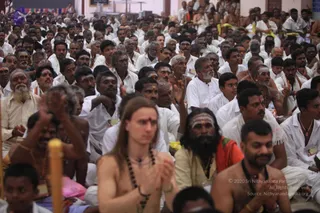
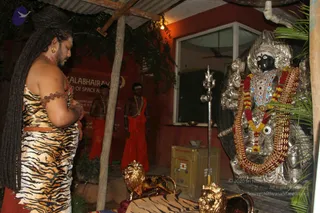
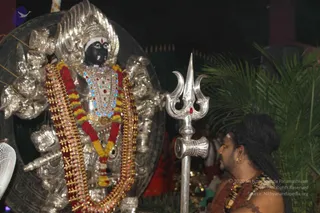
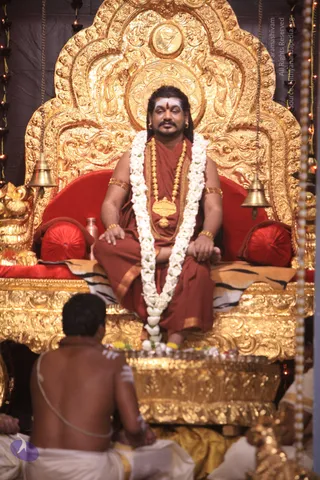
A photograph from the back of a large hall filled with many seated devotees, mostly women in white and cream sarees and dhotis, with some in yellow, blue, teal and pink floral clothing. Two large screens on either side show a man in red and white robes. At the front, a golden shrine and stage hold deity murtis and ornate decorations. Golden staffs stand upright among the crowd. The scene looks like satsang or darshan in an ashram hall.A photograph of a seated man on an ornate white and silver throne in front of a deep red curtain, speaking into a microphone on a stand. He wears saffron-orange robes, a heavy gold pendant necklace, gold bangles on his arms, and a long white flower garland. A white tilak marks his forehead and a red dot sits above it. A small framed picture of a saffron-robed figure rests on a wooden lectern beside him, and a tall gold-banded staff stands at left. A Swamiji (probable) appearance is visible: long swept-back dark hair, saffron robes, and ornate gold necklace, seated as the speaker of a discourse.Night photograph of a shrine in an open-sided ashram structure with a corrugated metal roof and red walls. A long-haired man with a rudraksha mala and gold earring stands at left in a tiger-striped garment, hands joined in prayer, with a long-haired man wearing a rudraksha bead necklace and ornate gold necklace who is stepping forward to the left of the shrine. Two men in saffron-orange dhotis and rudraksha malas stand with hands joined in the background. At right stands a silver deity murti of Kalabhairava with a black face, jewelled ornaments, red and yellow garlands, and a silver trident in front. A golden lion figure and a small brass lamp sit on the altar. Banner text partly visible on the red wall.

May 23 2017

Original wiki page
Contents

Title

Integrity to Time Helps You Mirror Superconsciousness

Description

In this video (23 May, 2017), Paramahamsa Nithyananda reveals how Integrity to time aligns our inner space to superconsciousness. Our inner space is like a mirror & time is a powerful dimension of the cosmos. If we are integrated to time, our inner space aligns to reflect the consciousness in it's complete purity, giving a superconscious breakthrough and ultimately enlightenment itself.

VideoAudio

Title

Integrity to Time is Fundamental for Enlightenment: Align to Time to Experience Superconsciousness

Description

In this discourse from 23 May, 2017, His Holiness Bhagwan Paramahamsa Sri Nithyananda Swamiji explains the fundamental reason we should live with Integrity to Time:

Time is a living energy which is a powerful gear moving our inner space, either aligning or misaligning with our consciousness. Our inner space is like a mirror. It is fixed on a gear, that gear is connected to time. Time is a power, energy. It is one of the dimensions of the cosmos. If you are integrated to time, your inner space aligns to reflect consciousness in all its purity. See, a mirror can completely distort sun or mirror straight. When it mirrors straight, it shines literally as sun, it is equivalent to sun. Same way, when your inner space mirrors Superconsciousness purely, it is equivalent to Superconsciousness… if that gear is in tune with time, it aligns your inner space to cosmic consciousness. If that mirror is not in tune with the time, it misaligns or disaligns your cosmic thought consciousness…

VideoAudio

Transcript:

(0:12)

Integrity - Integrity, integrity, integrity to Integrity. Time… is a living energy, which is one of a powerful gear, moving our inner space - either aligning or misaligning with our Consciousness. Our inner space is like a mirror. It is fixed on a gear. That gear is connected to time. Time is a power - energy. It is one of the dimension of the Cosmos. If you are integrated to time, your inner space aligns to reflect the Consciousness in all its purity.

See, a mirror can completely distort Sun or it can mirror straight. When it mirrors straight, it shines literally as Sun. It is equivalent to Sun. Same way when your inner space mirrors Super Consciousness purely, it is equivalent to Super Consciousness.

If that gear is in tune with the Time, it aligns your inner space to Cosmic Consciousness. If that mirror is not in tune with the Time, it misaligns or dis-aligns your Cosmic Consciousness. Coming to 4:31 for yoga and doing yoga, can bring you health - not enlightenment. Sharp 4:29 you are there and 4:30 you start yoga, will bring you health and enlightenment.

Integrity to Time is important ingredient. If you start the session 1 minute late, it is no more Nithyananda Yoga. It is no more Nithyananda Yoga. All of you be very clear, whether it is pujas in our Sangha or anything - integrity to Time is fundamental requirement for that process to become successful. It may be Homa, it may be yoga, it may be puja, it may be session, it may be class, it may be satsang - early morning 4 to 9 - that 5 hours, that makes you new Being, that makes you spiritually awakened, that makes you Super Conscious Being, that makes you Sadāshiva, that gives you Superconscious breakthrough.

(3:43)

Day's Event

Excerpt from Live Nithyananda Satsang:

Time is a Living Energy, which is one of a powerful gear moving our inner space either aligning or misaligning with our consciousness. Our inner space is like a mirror. It is fixed on a gear. That gear is connected to Time. Time is a power, energy. It is one of the dimensions of the cosmos. If you are integrated to time, your inner space aligns to reflect the consciousness in all its purity.

See, a mirror can completely distort sun or mirror straight. When it mirrors straight, it shines literally as sun; it is equalent to sun. Same way, when you inner space mirrors Superconsciousness purely, it is equalent to Superconsciousness. If that gear is in tune with time, it aligns your inner space to Cosmic Consciousness. If that mirror is not in tune with the time, it misaligns or disaligns your cosmic thought consciousness…

-His Holiness Paramahamsa Nithyananda

Photo of The Day

Puja
Satsang
Homa
Darshan
Photos Of The Day:

PRATYAKSHA-PADA-POOJA
NITHYA-SATSANG
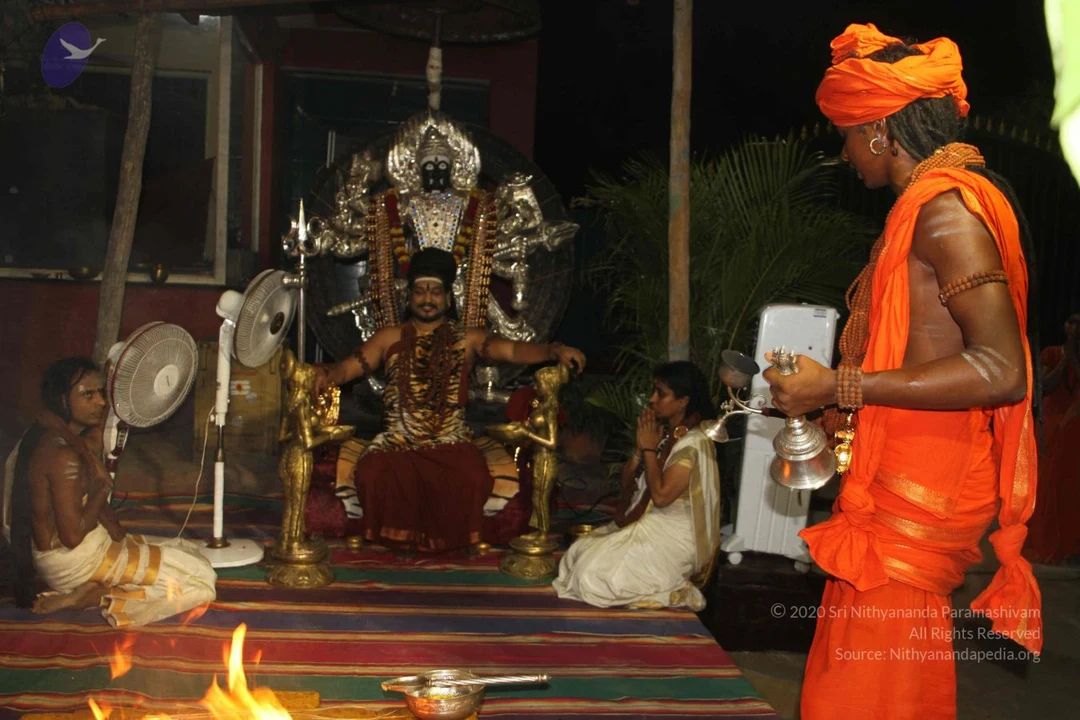
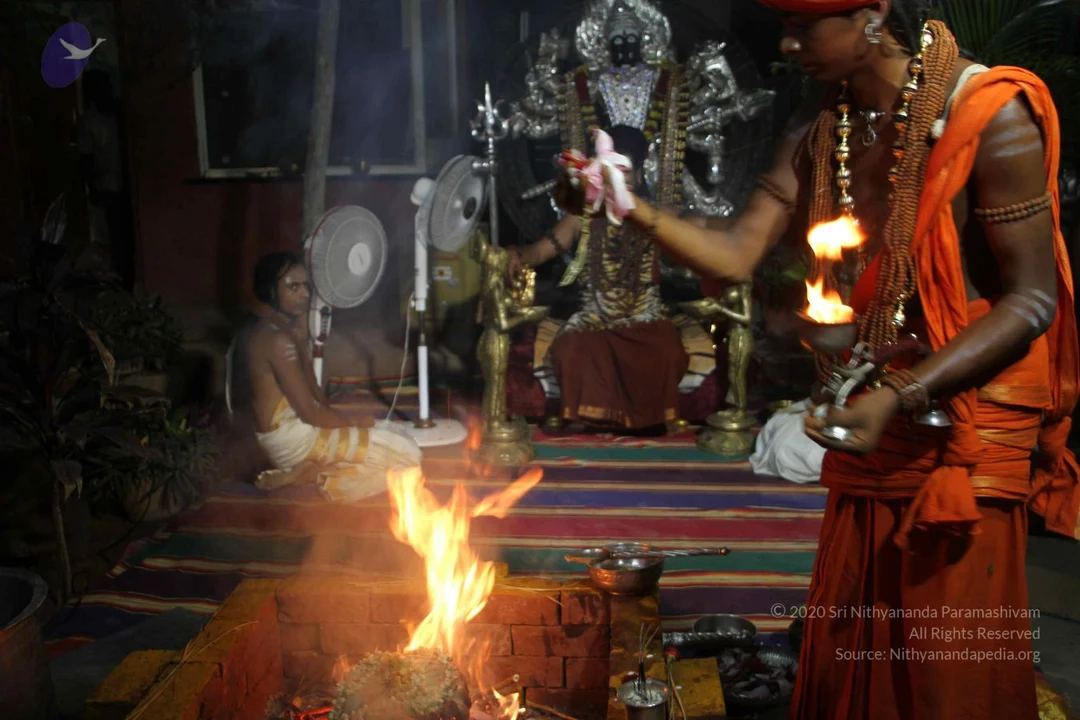
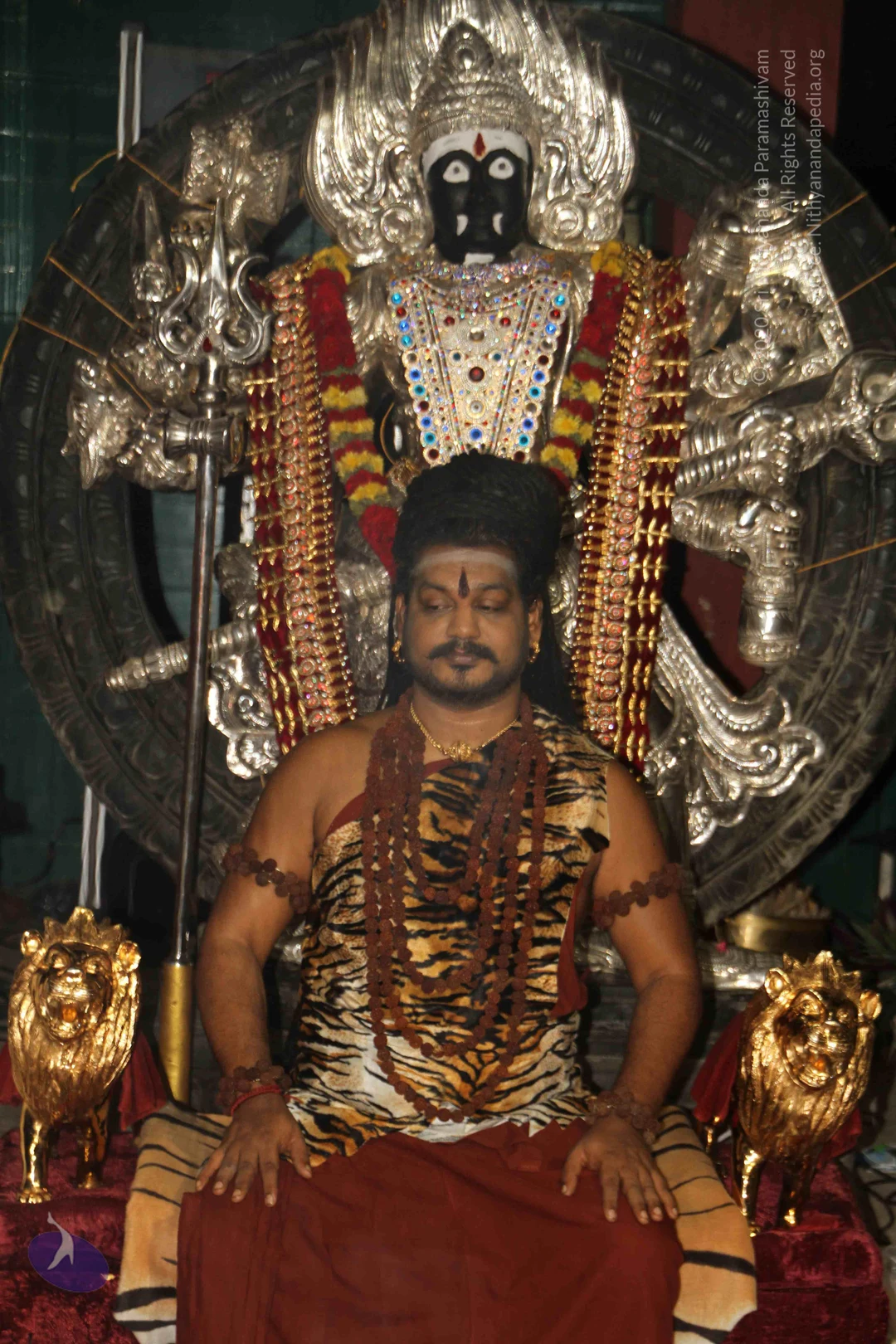
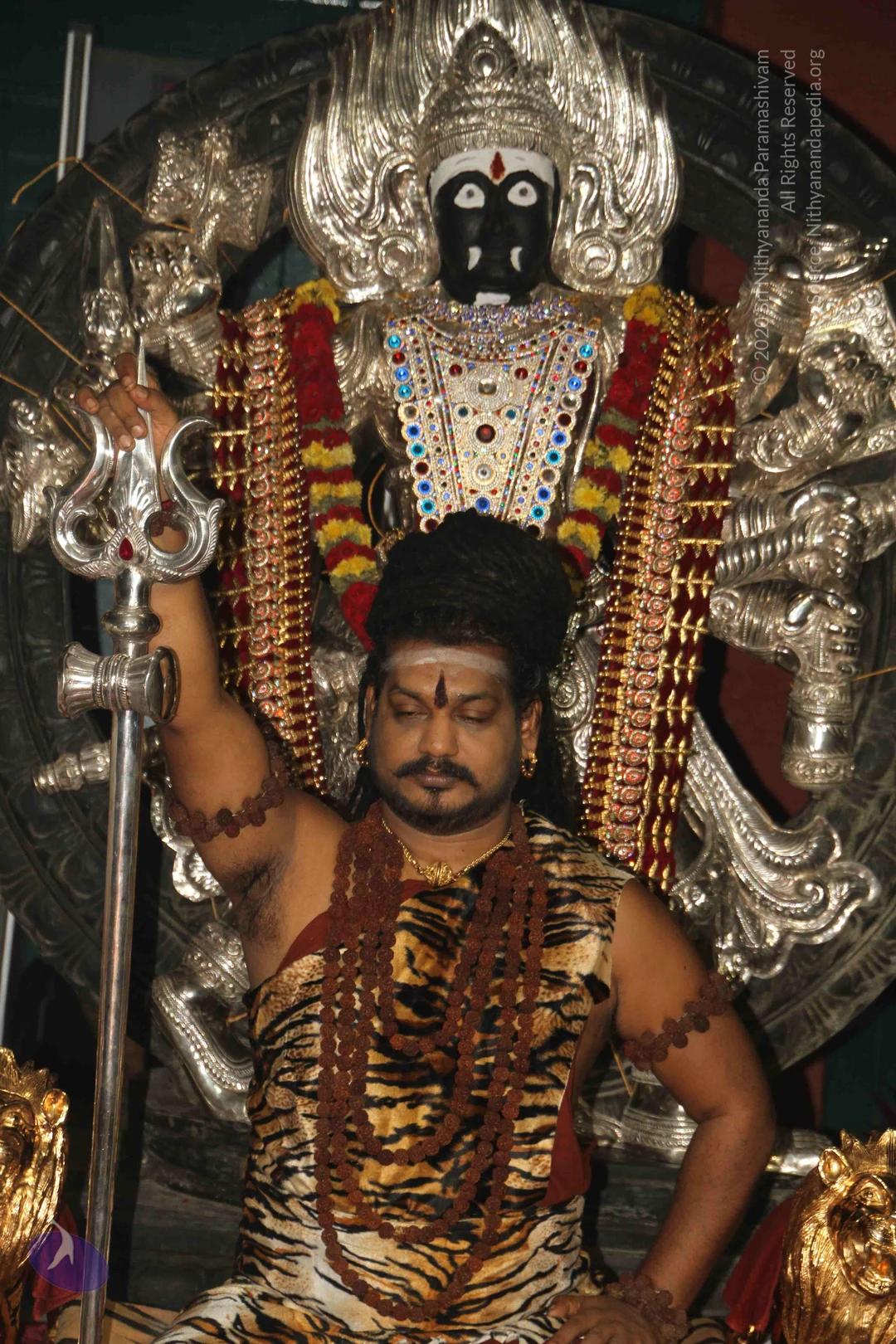
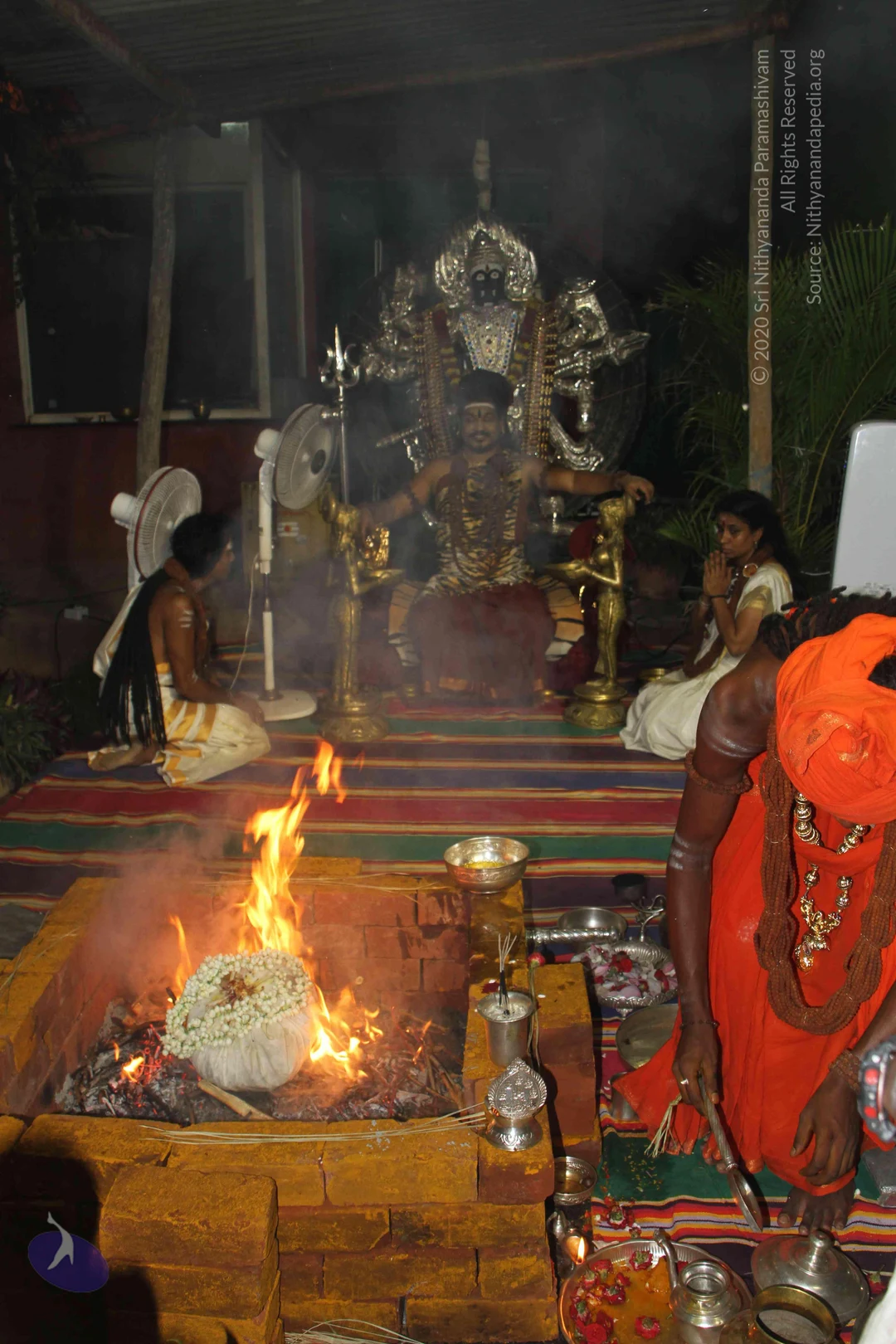
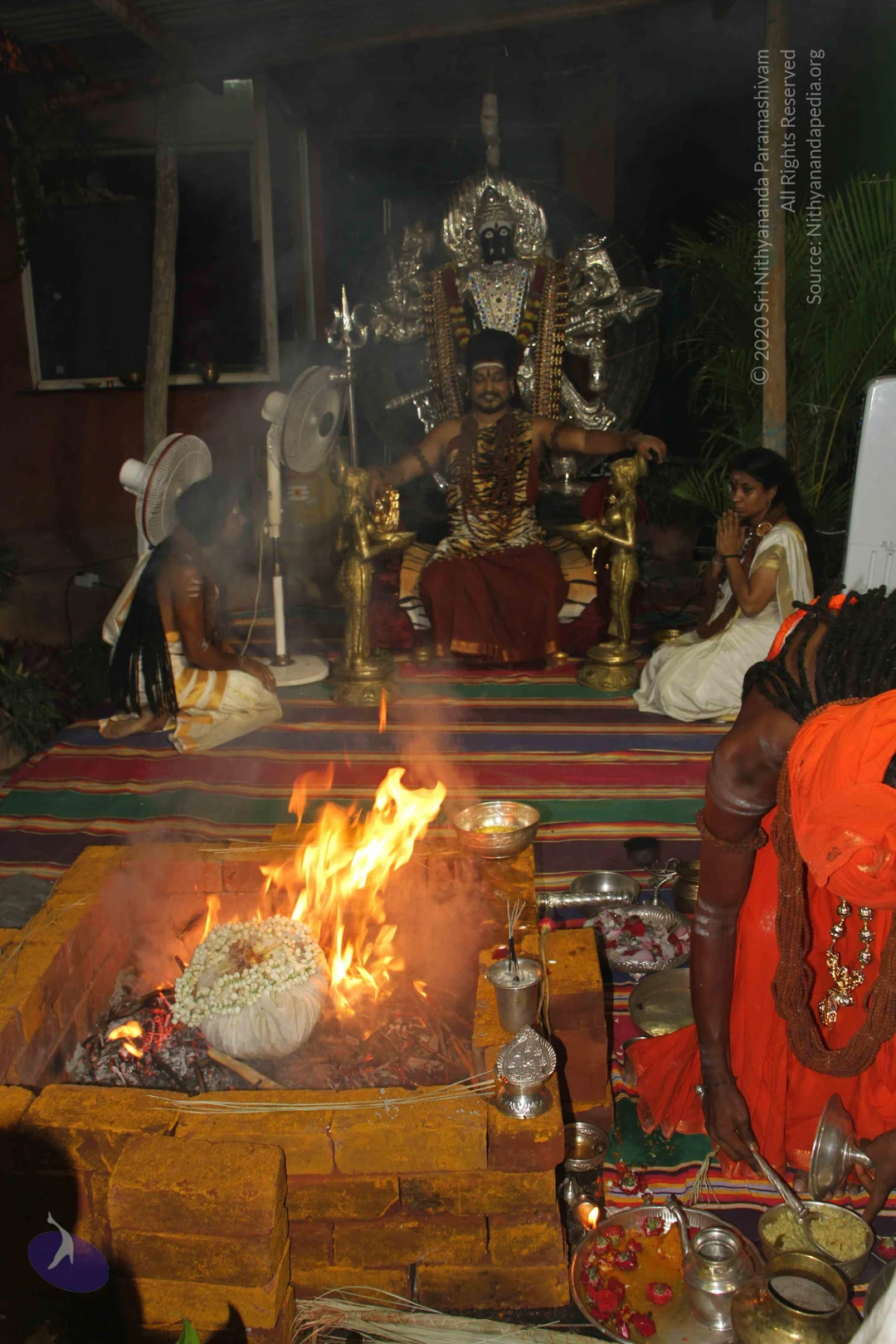
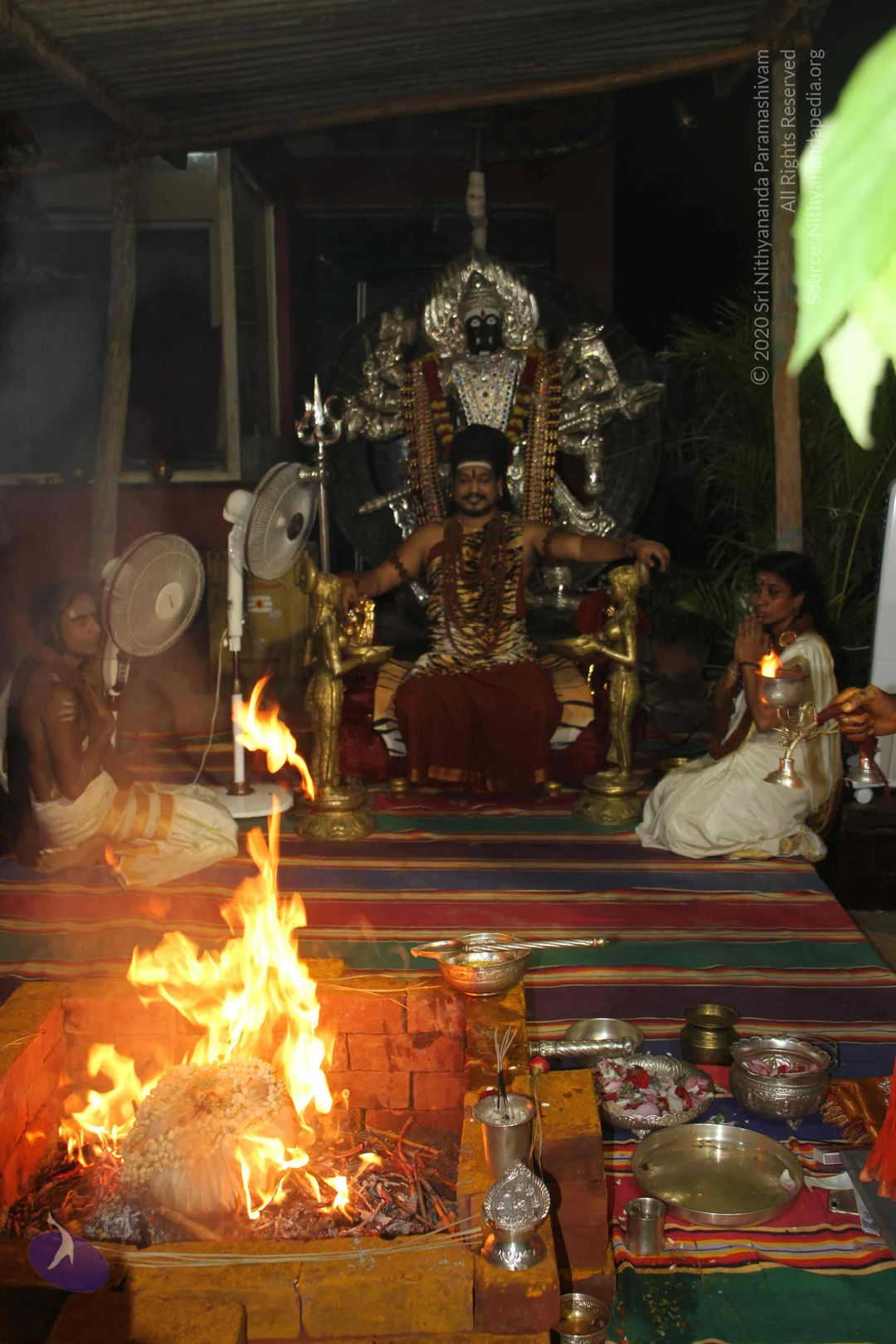
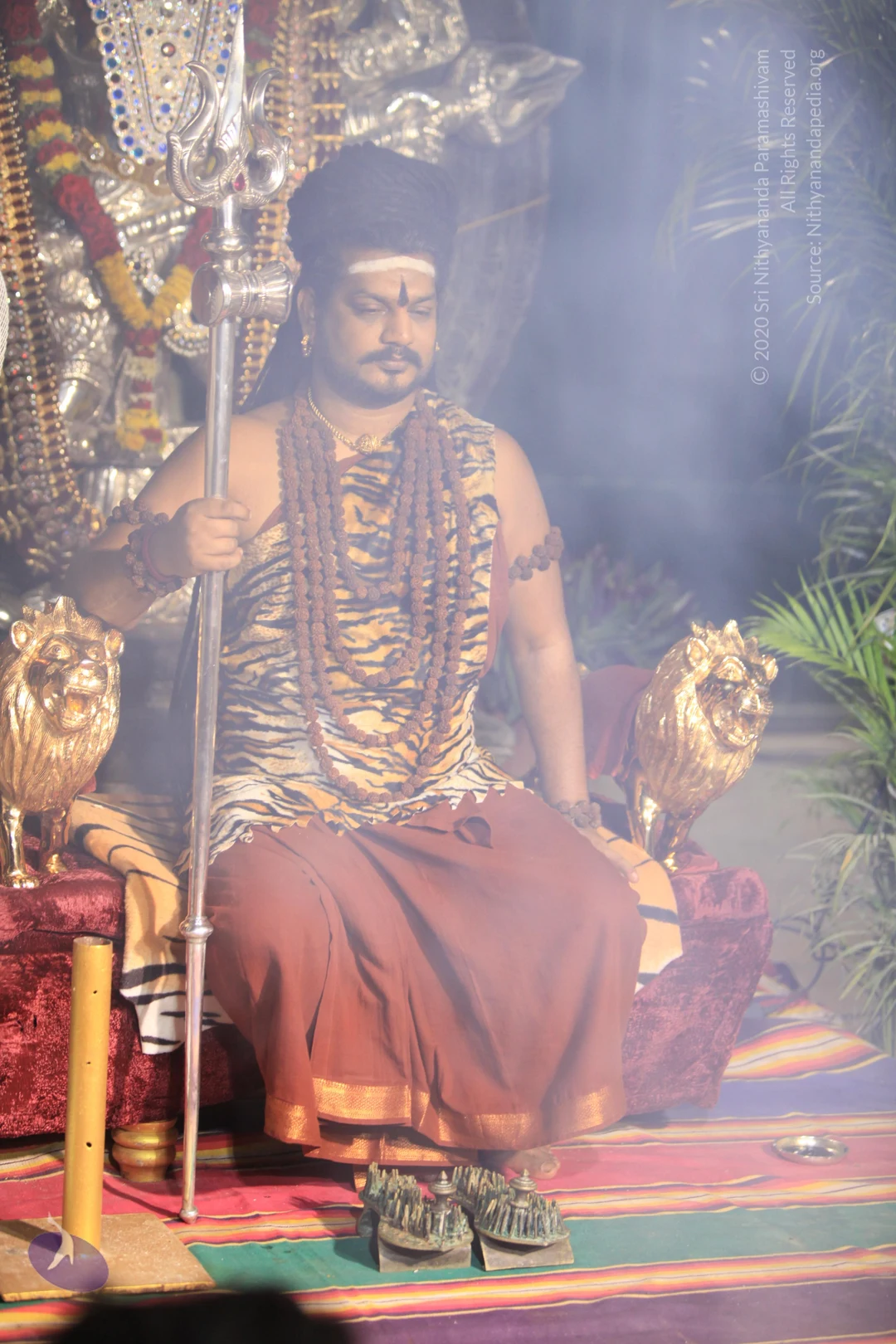
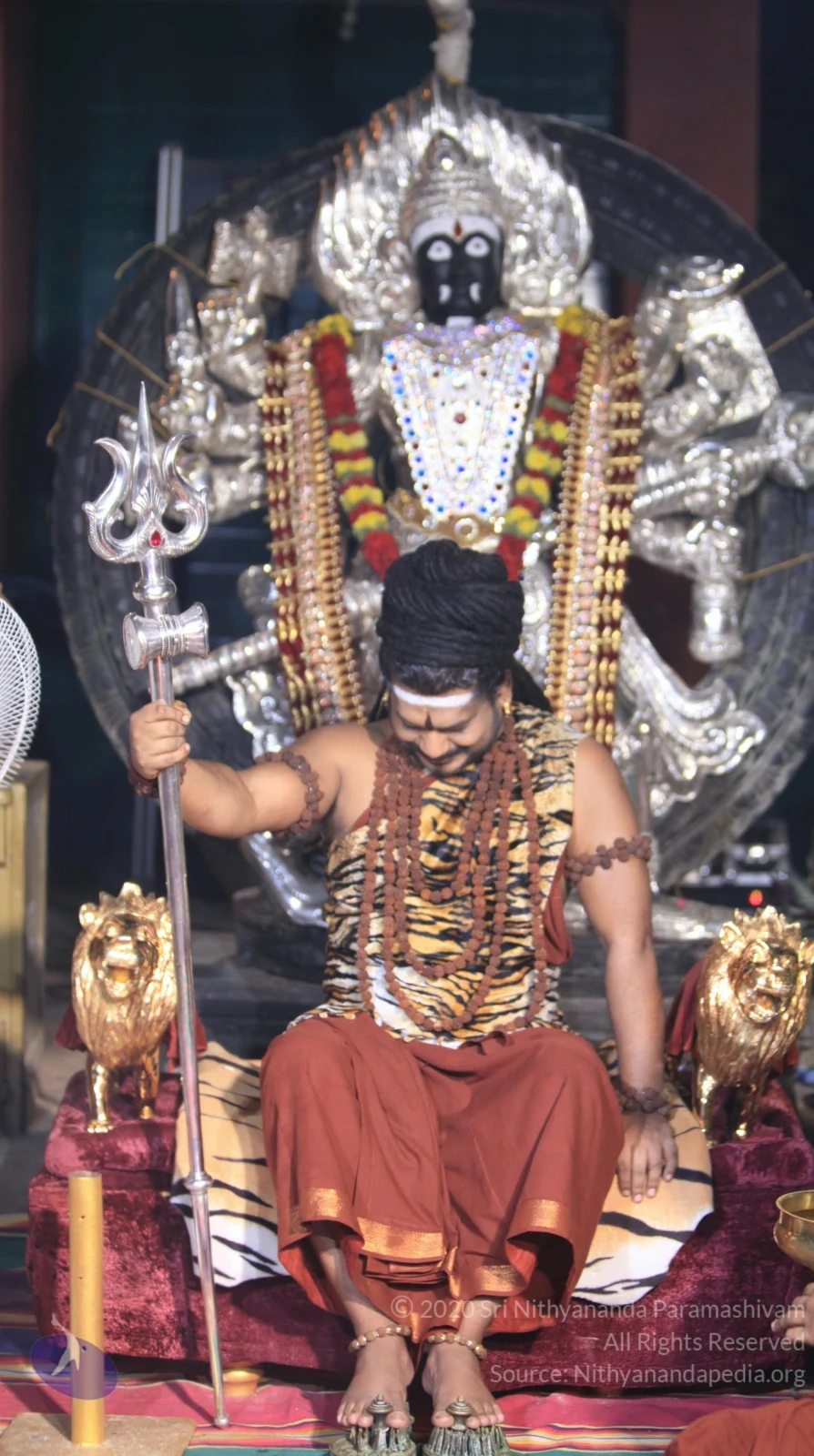
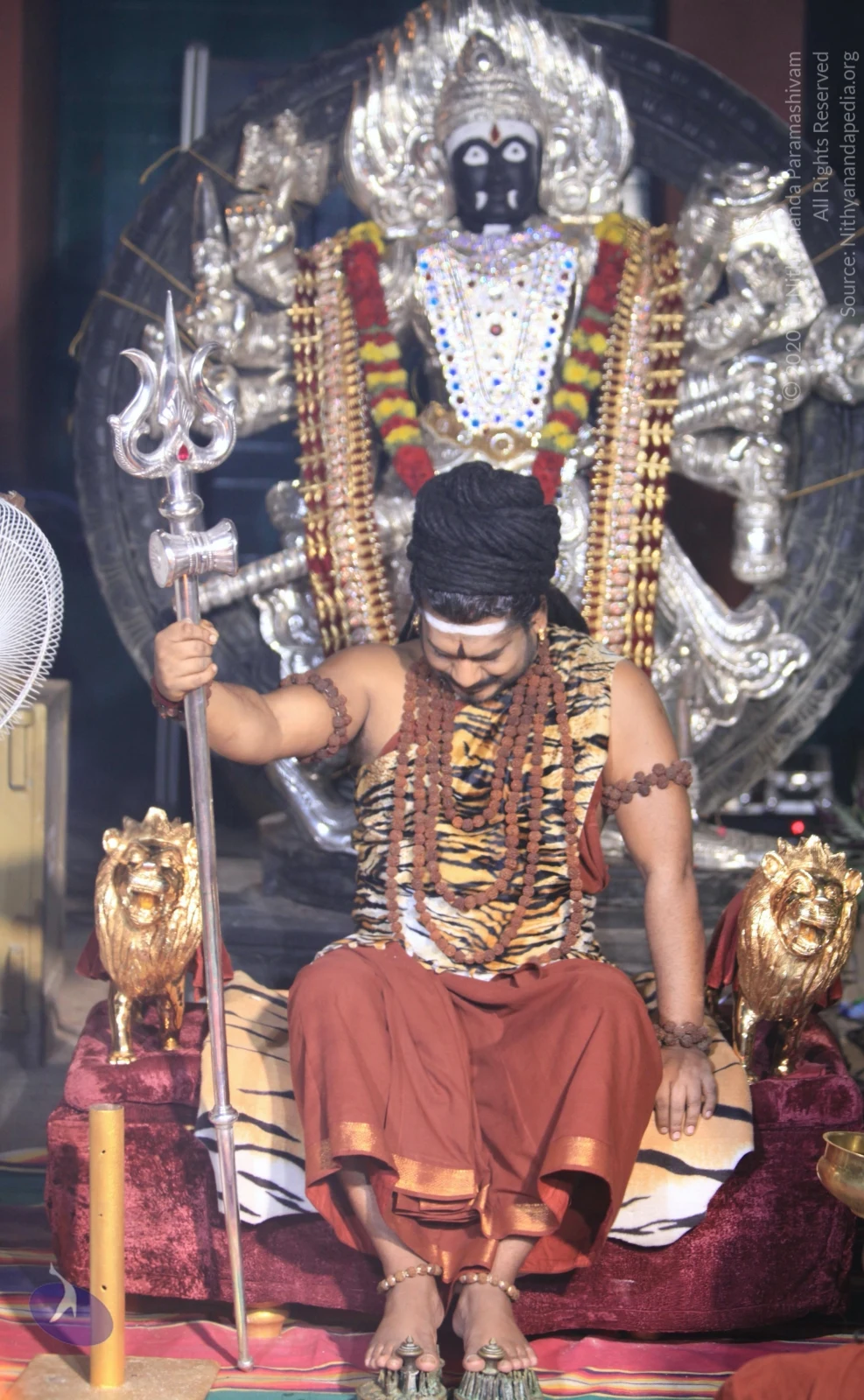
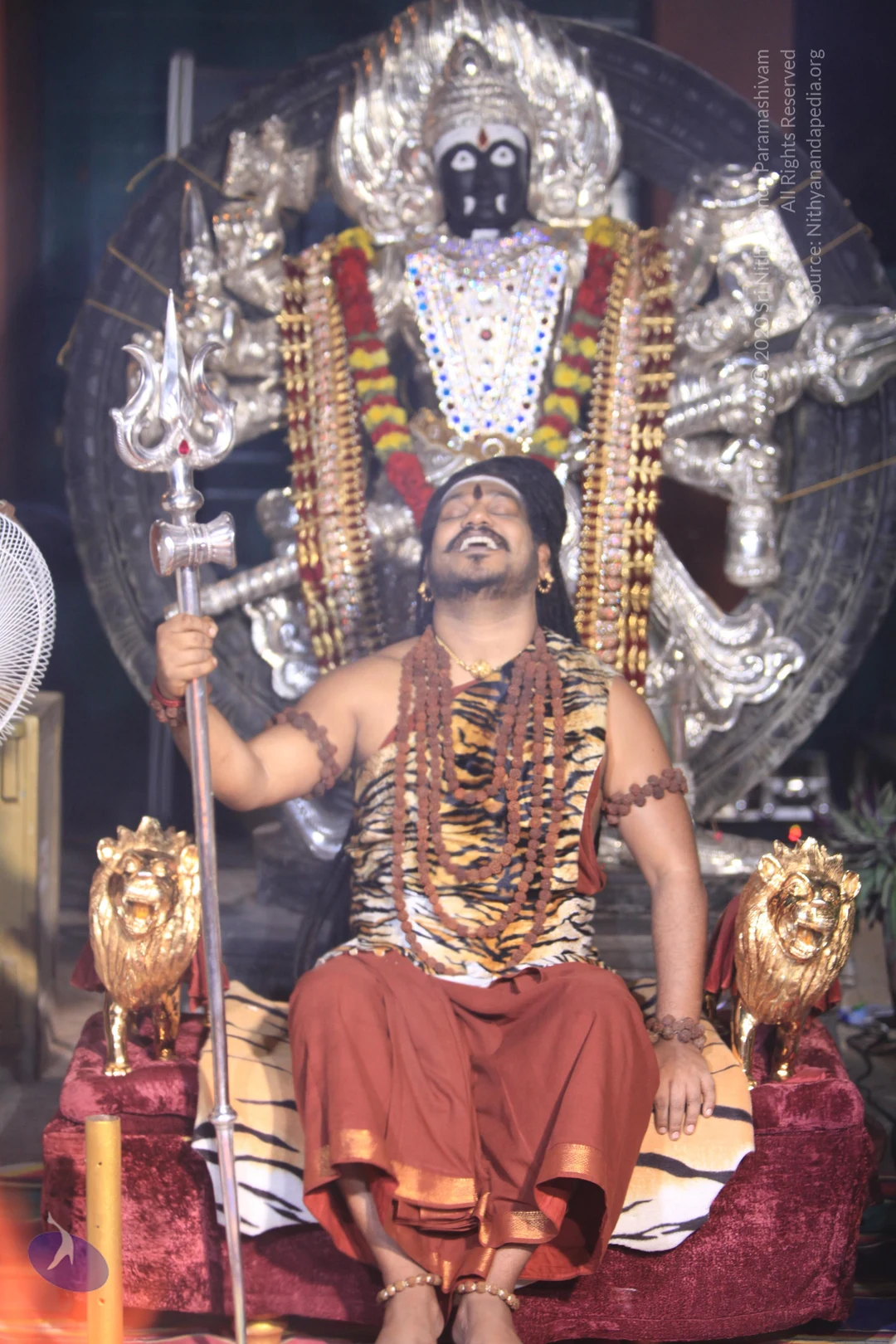
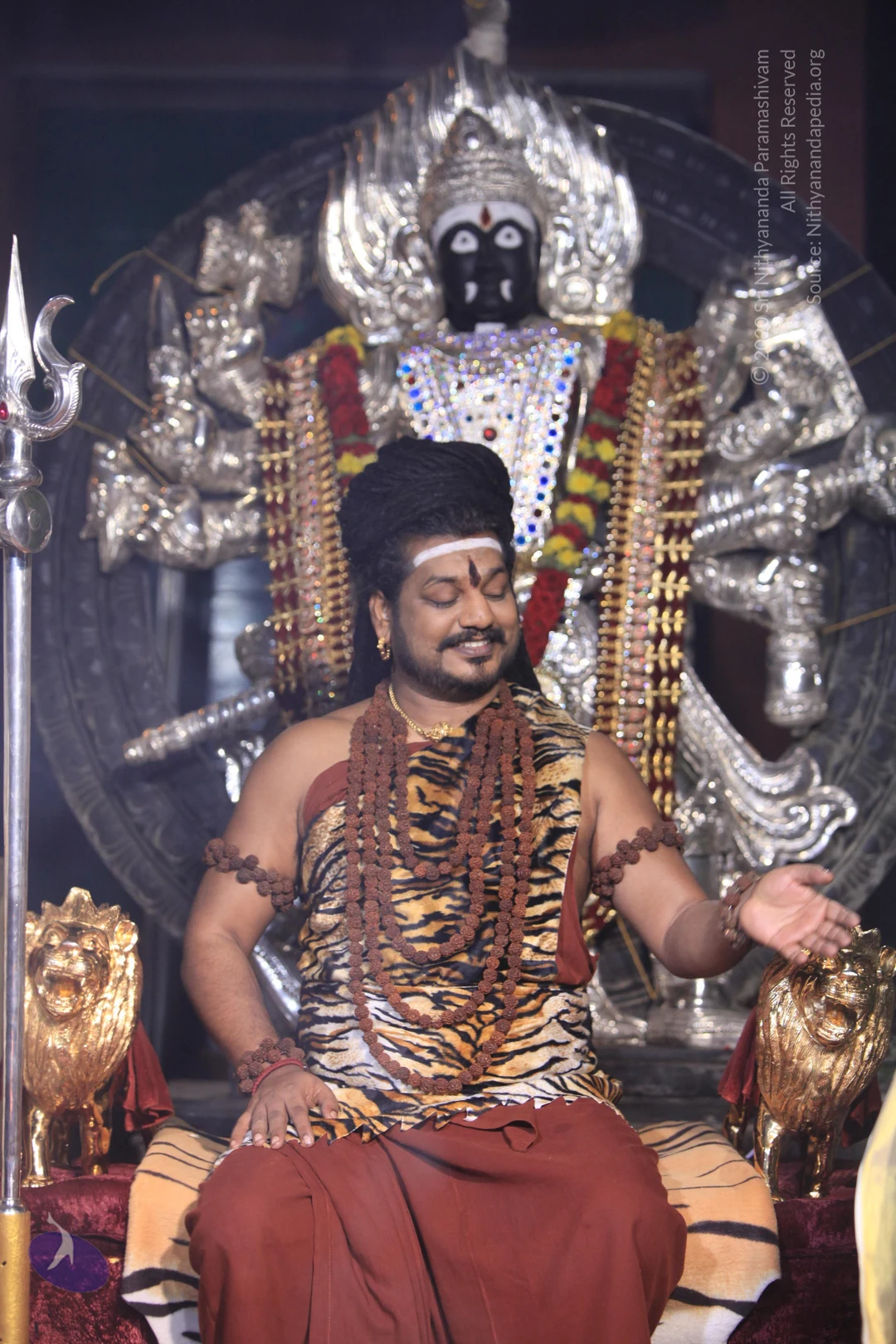
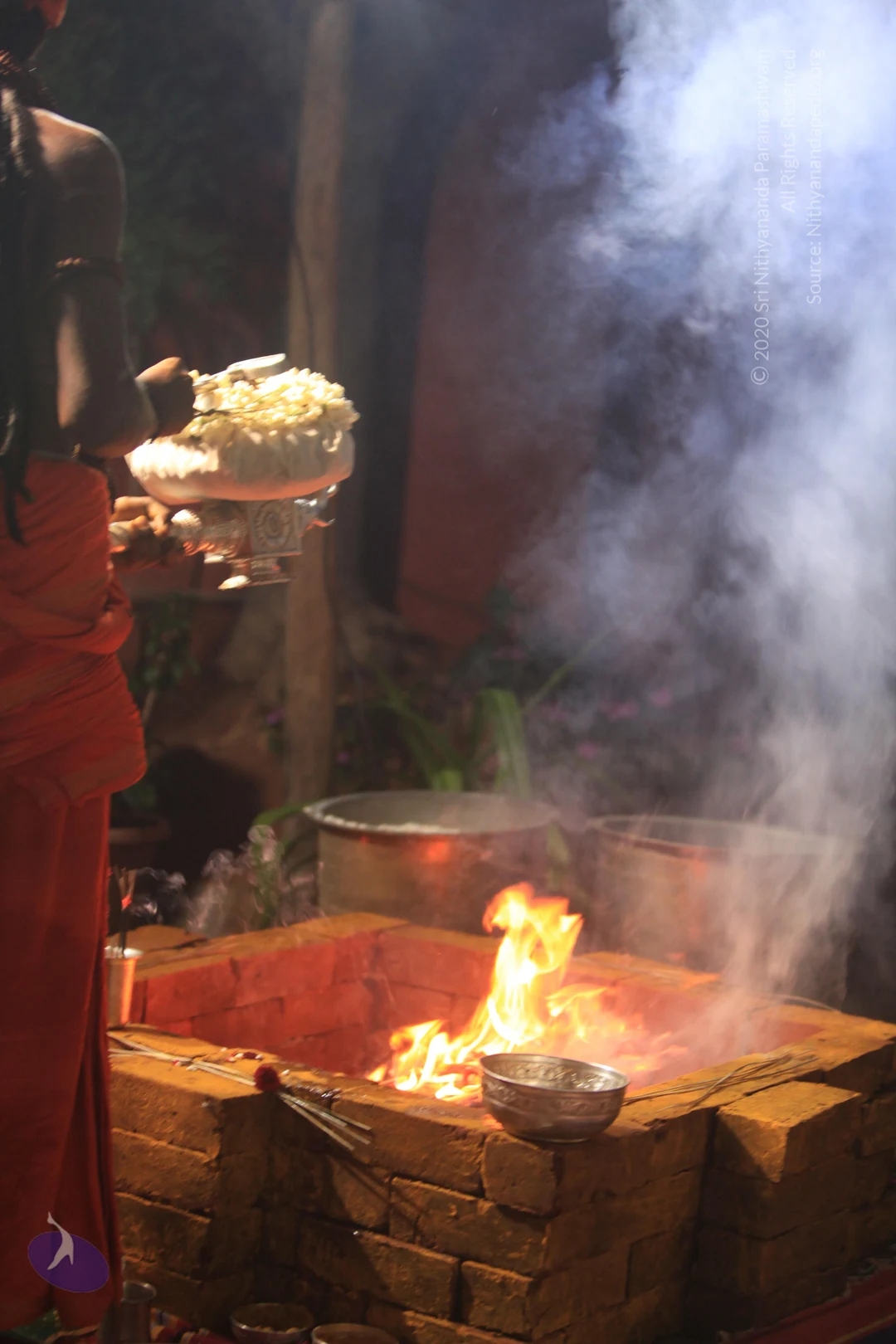
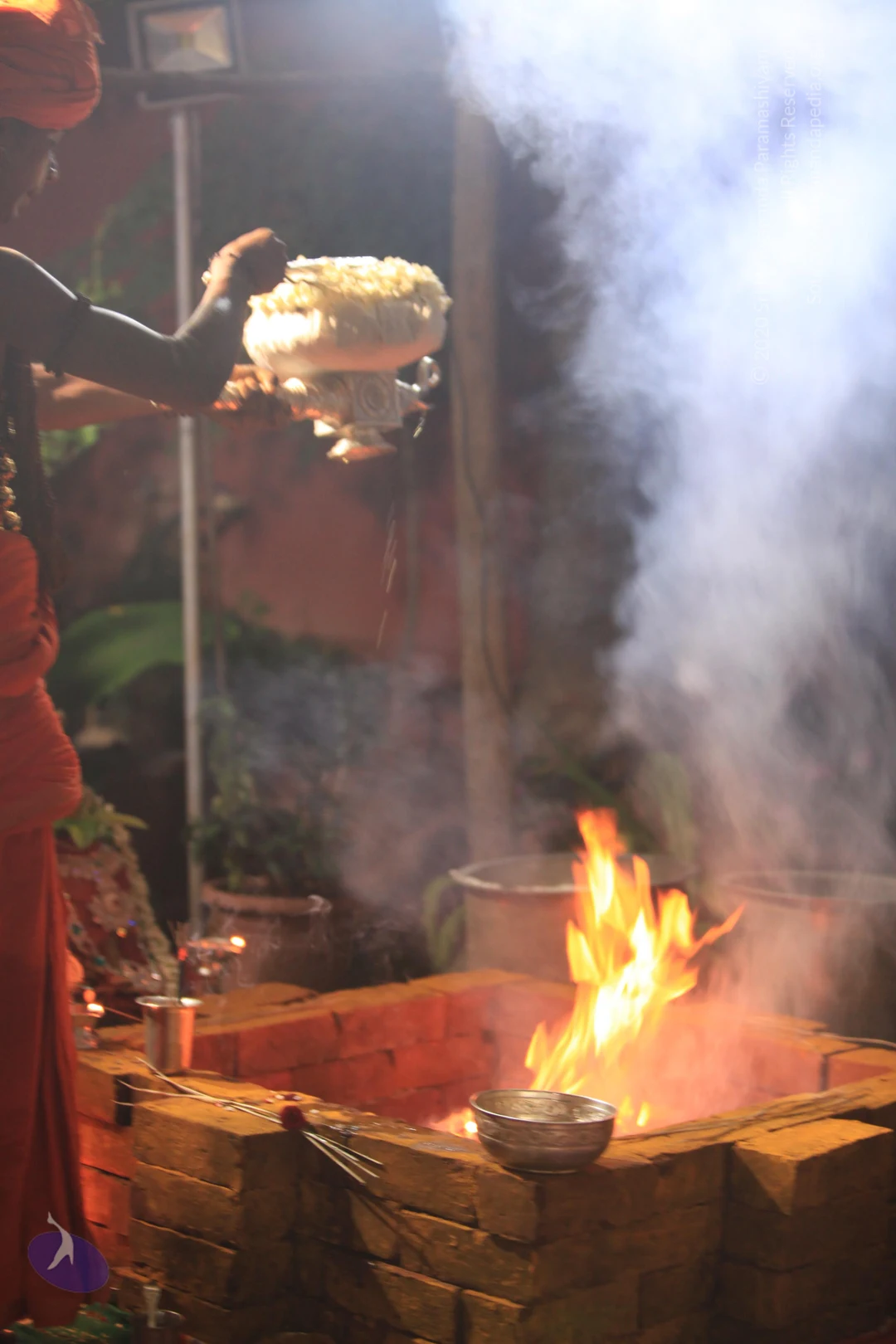
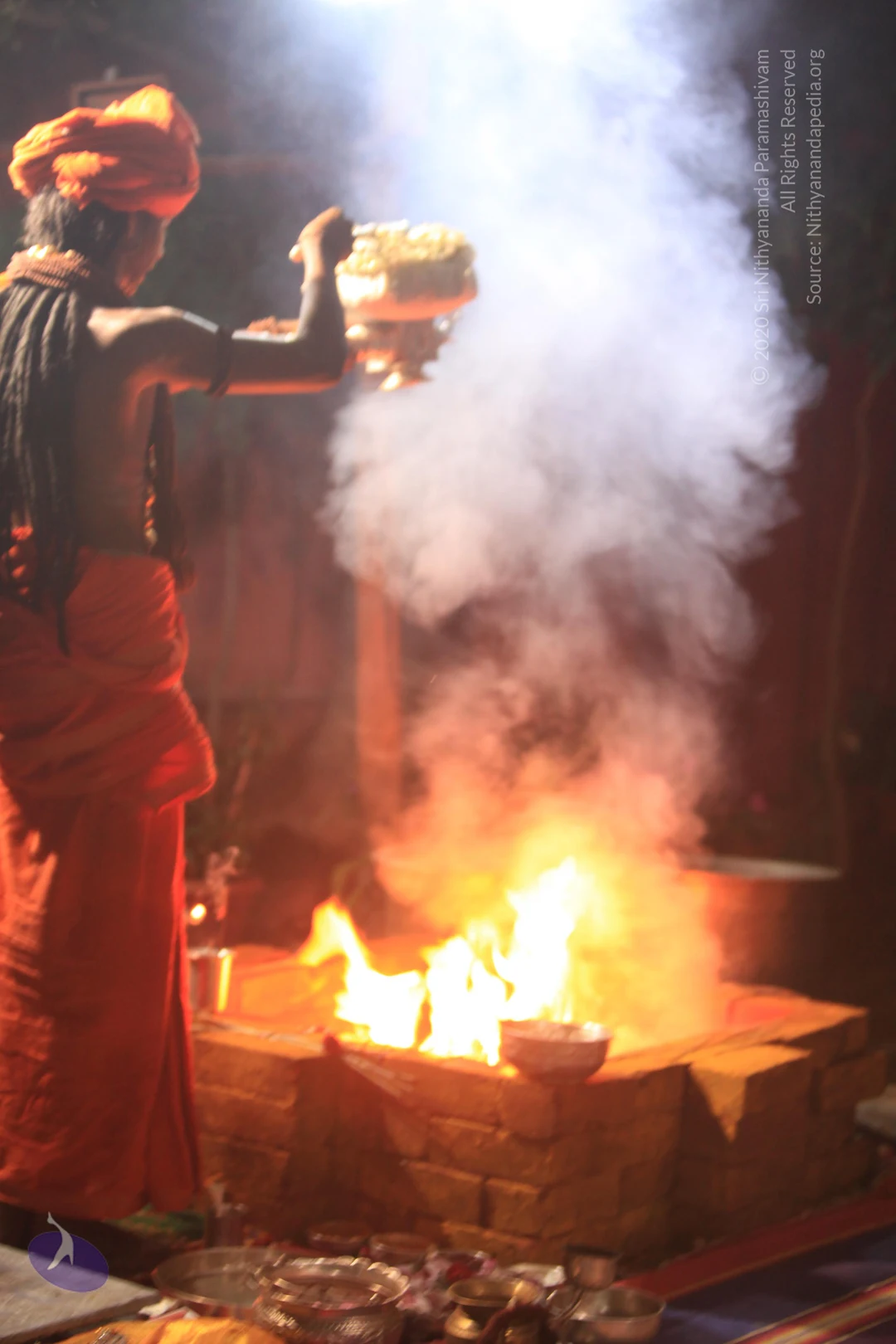
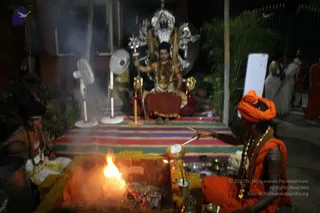
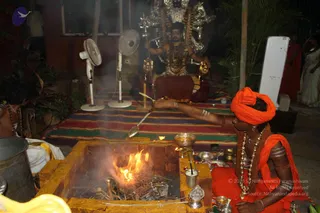
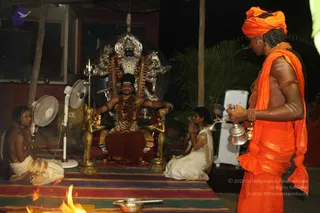
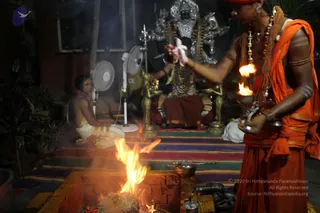
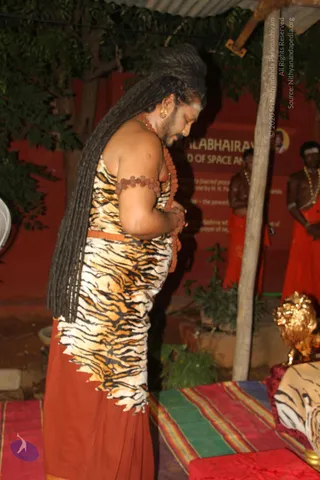
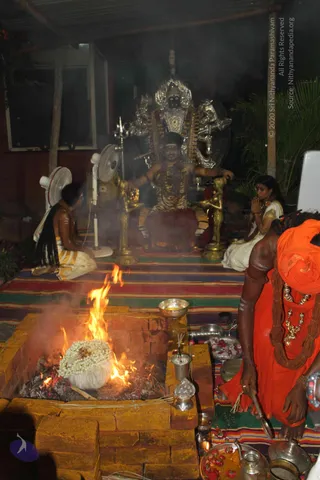
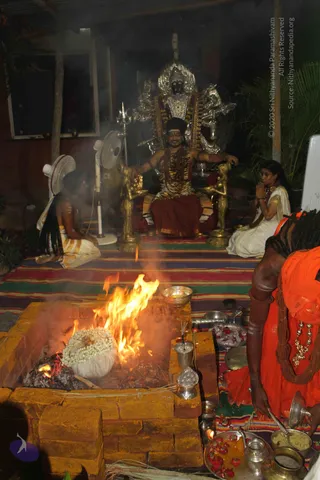
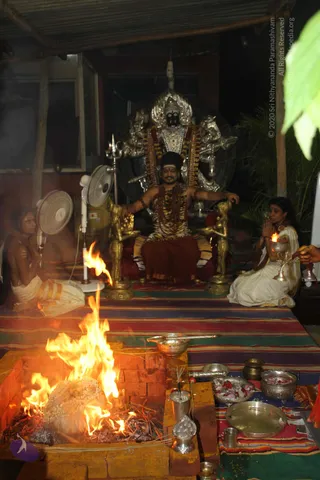
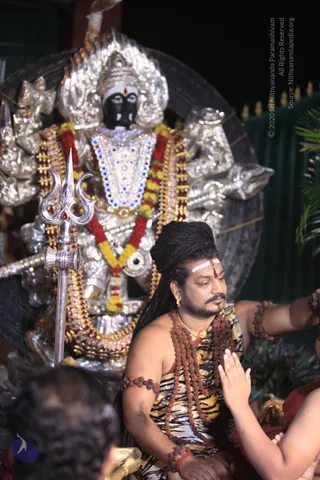
KALABHAIRAVA-HOMA
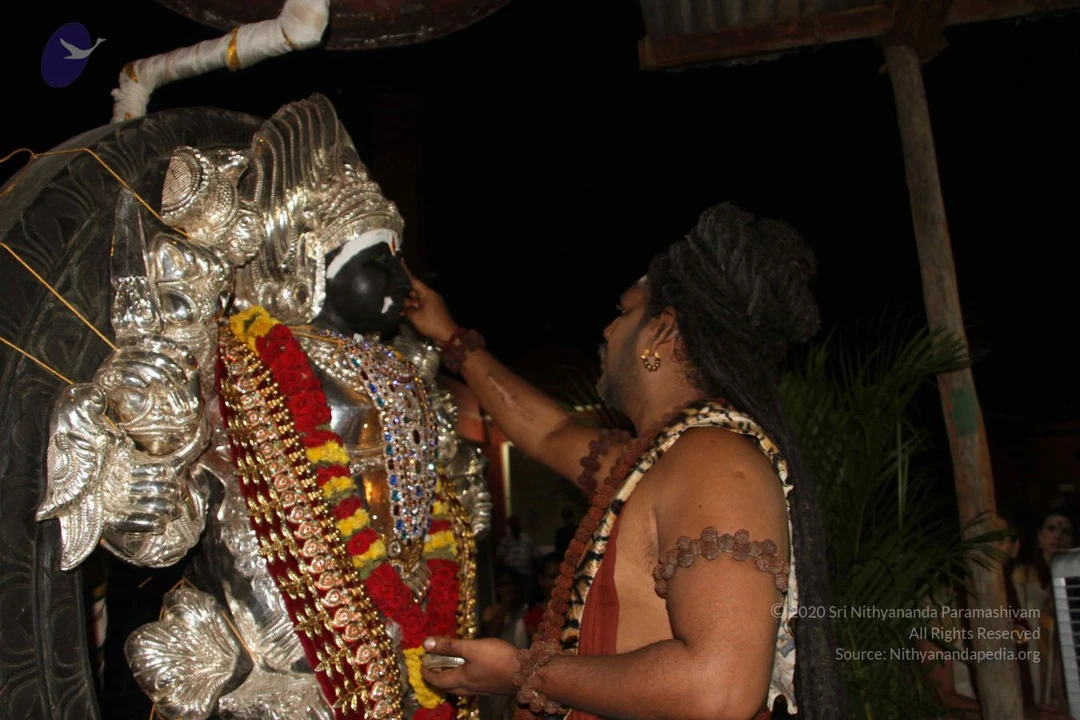
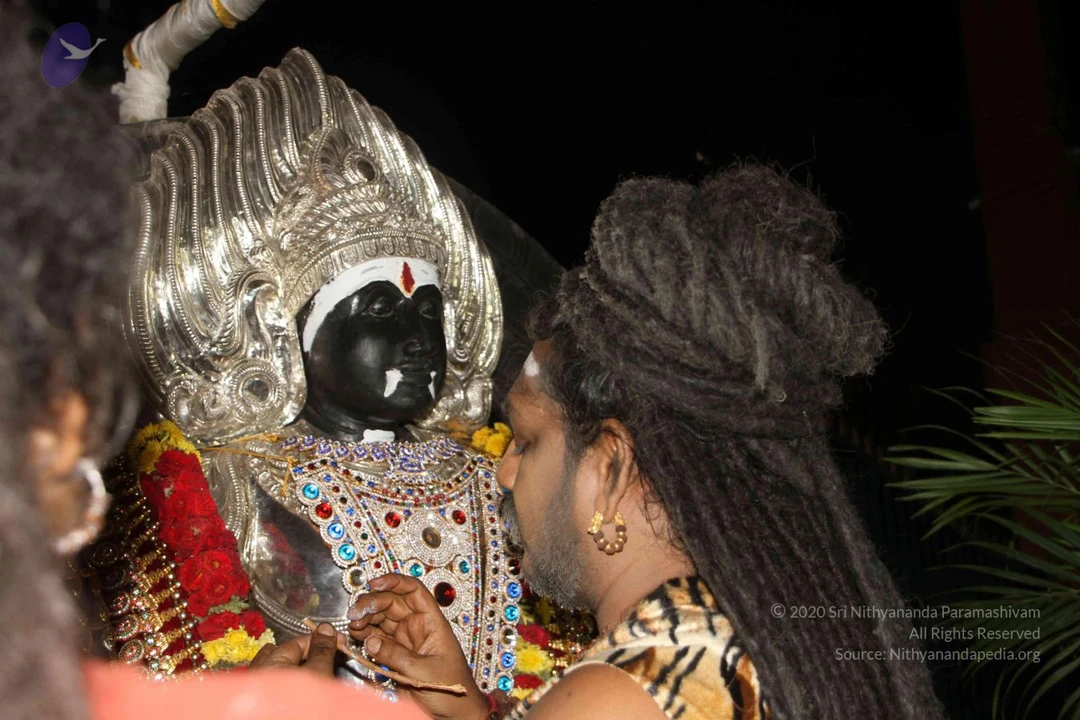
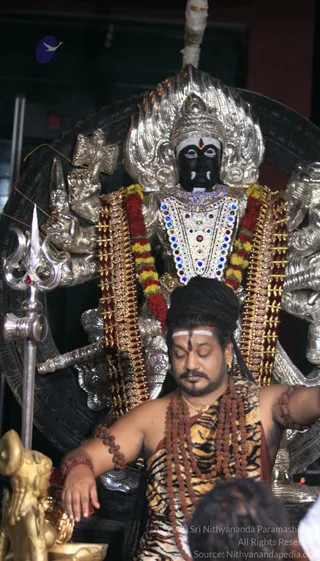
DARSHAN

01-Pada-Puja

02-Nithya-Satsang

20170523_Photo_1000_IMG_5958_CMP_WM

03-Kalabhairava-Homa

04-Darshan

,

Photos from this day

View all 165 photos

Puja

3 photosSource gallery
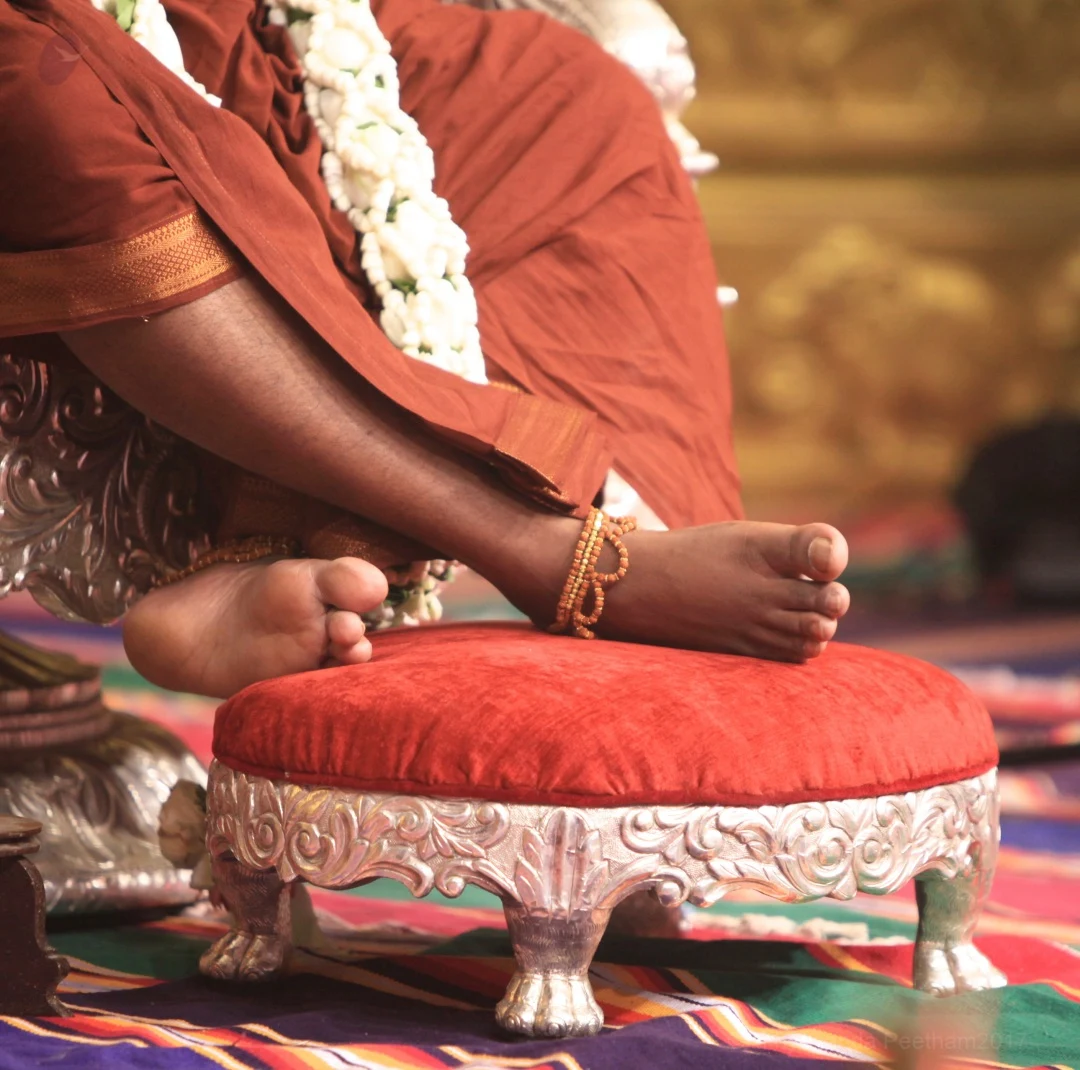
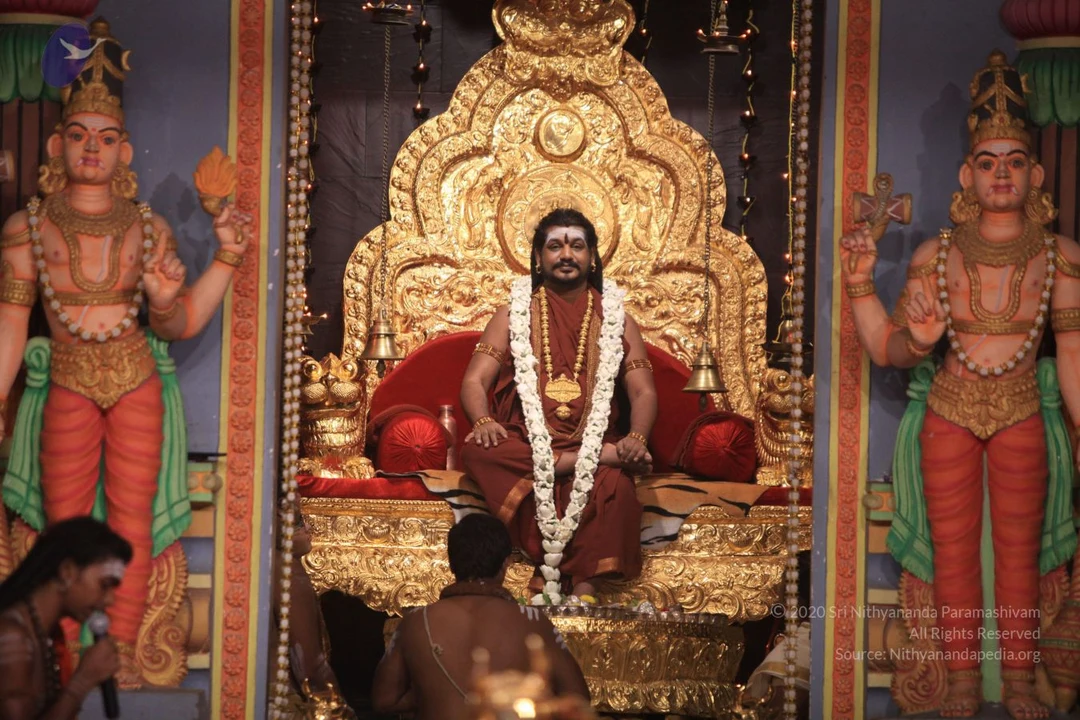
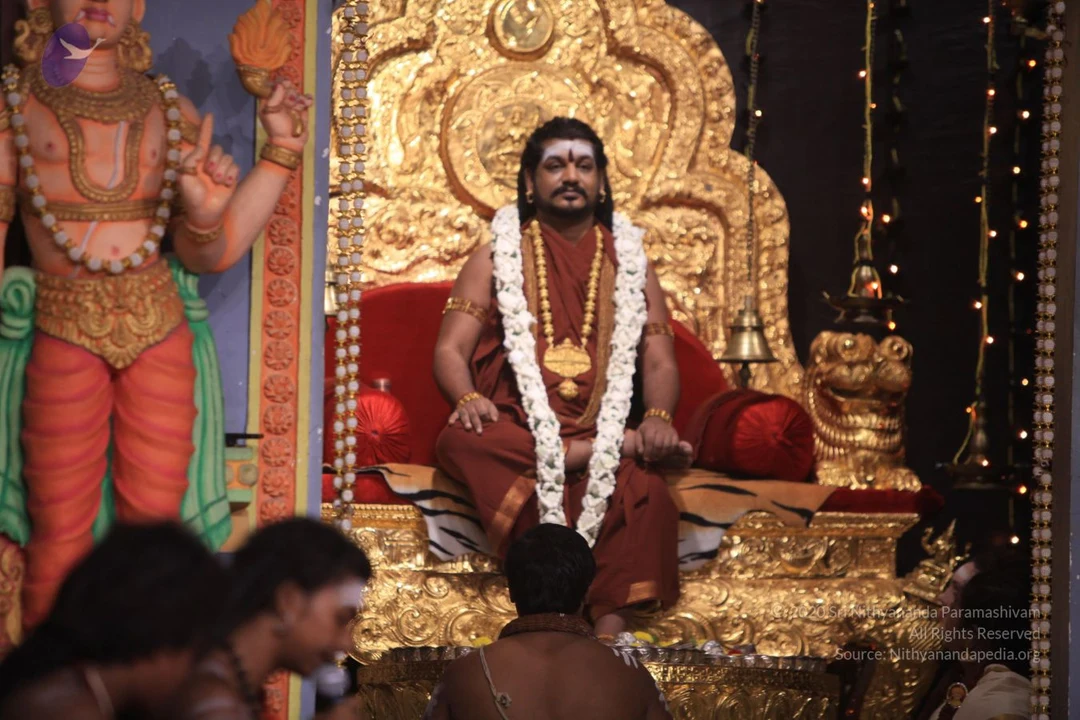
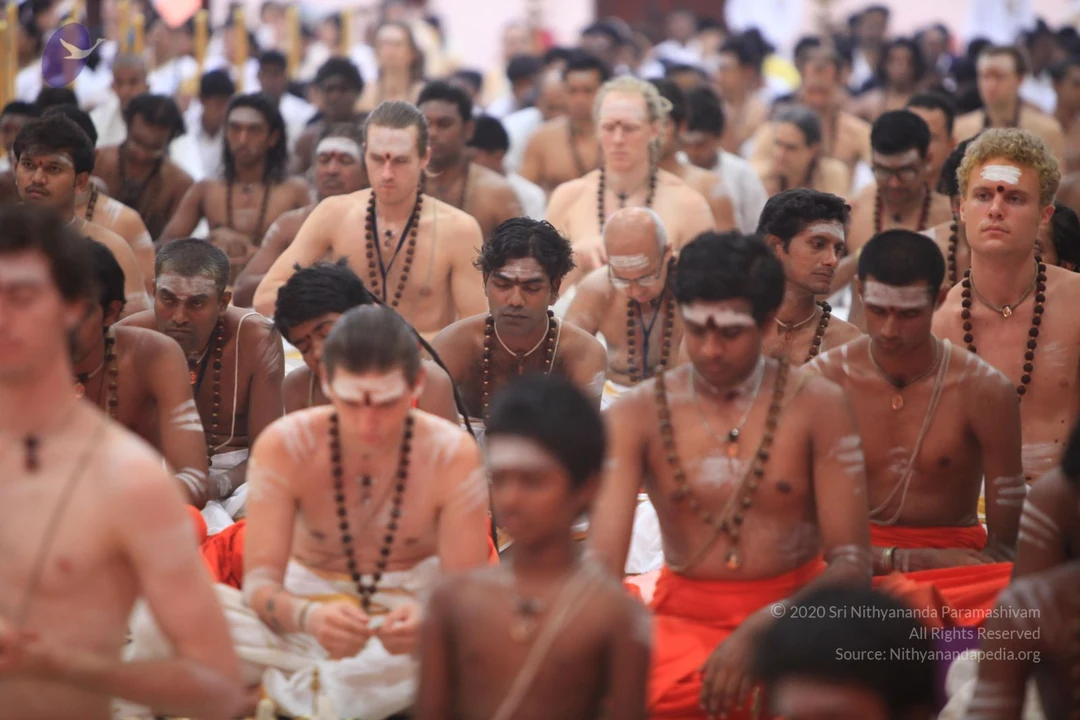
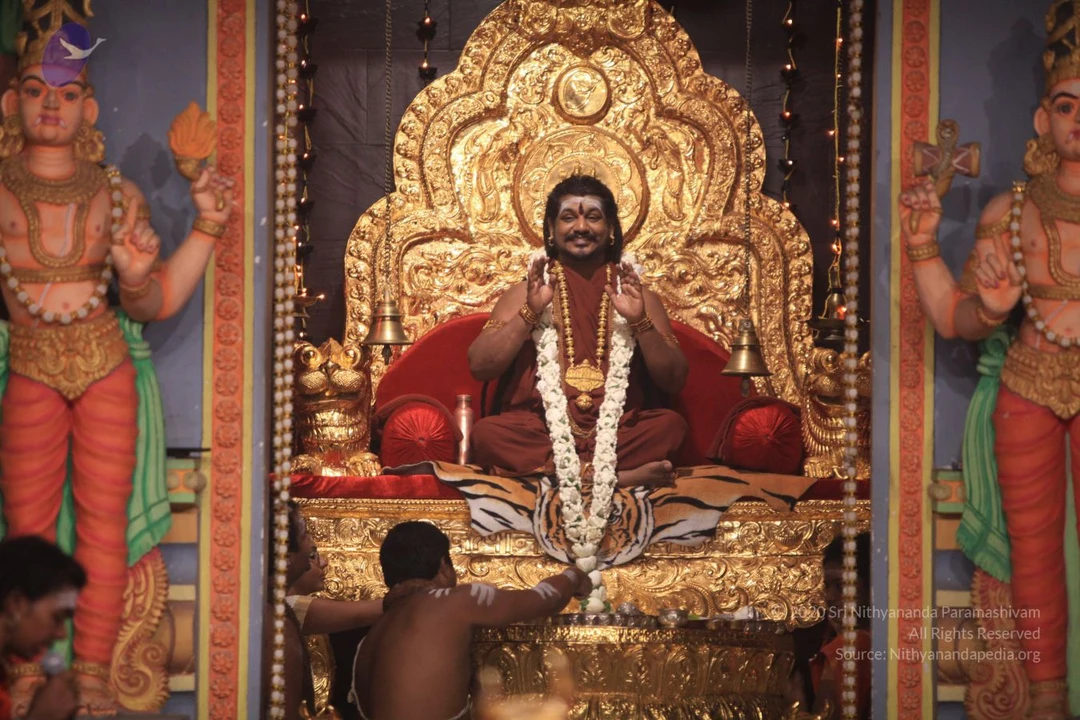
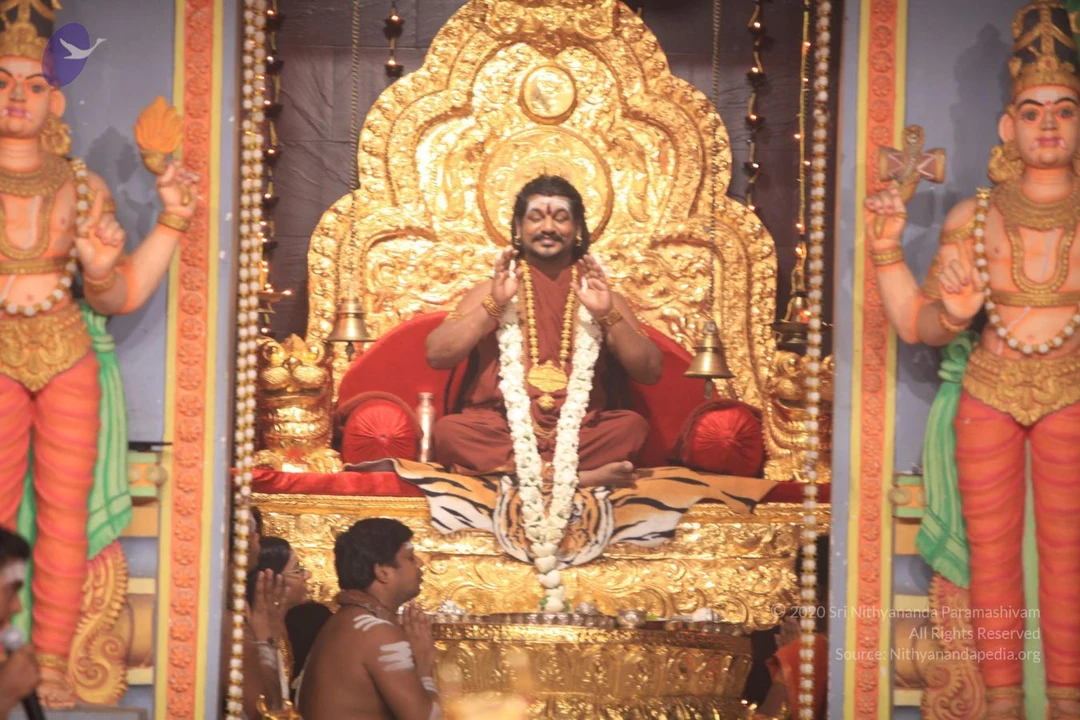
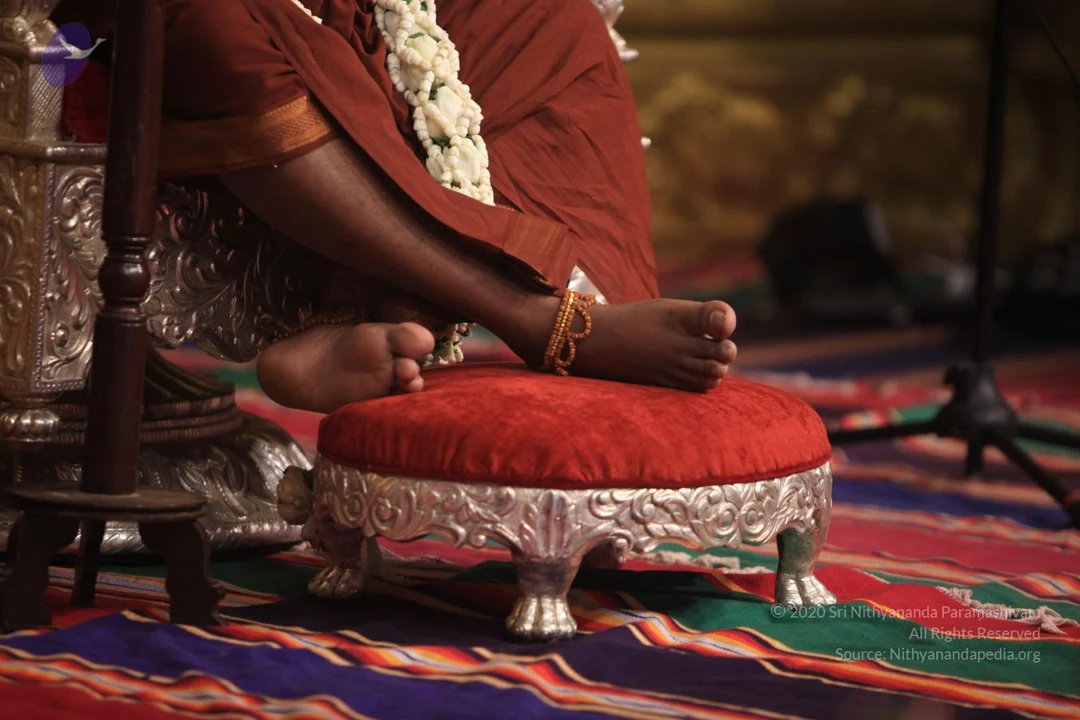
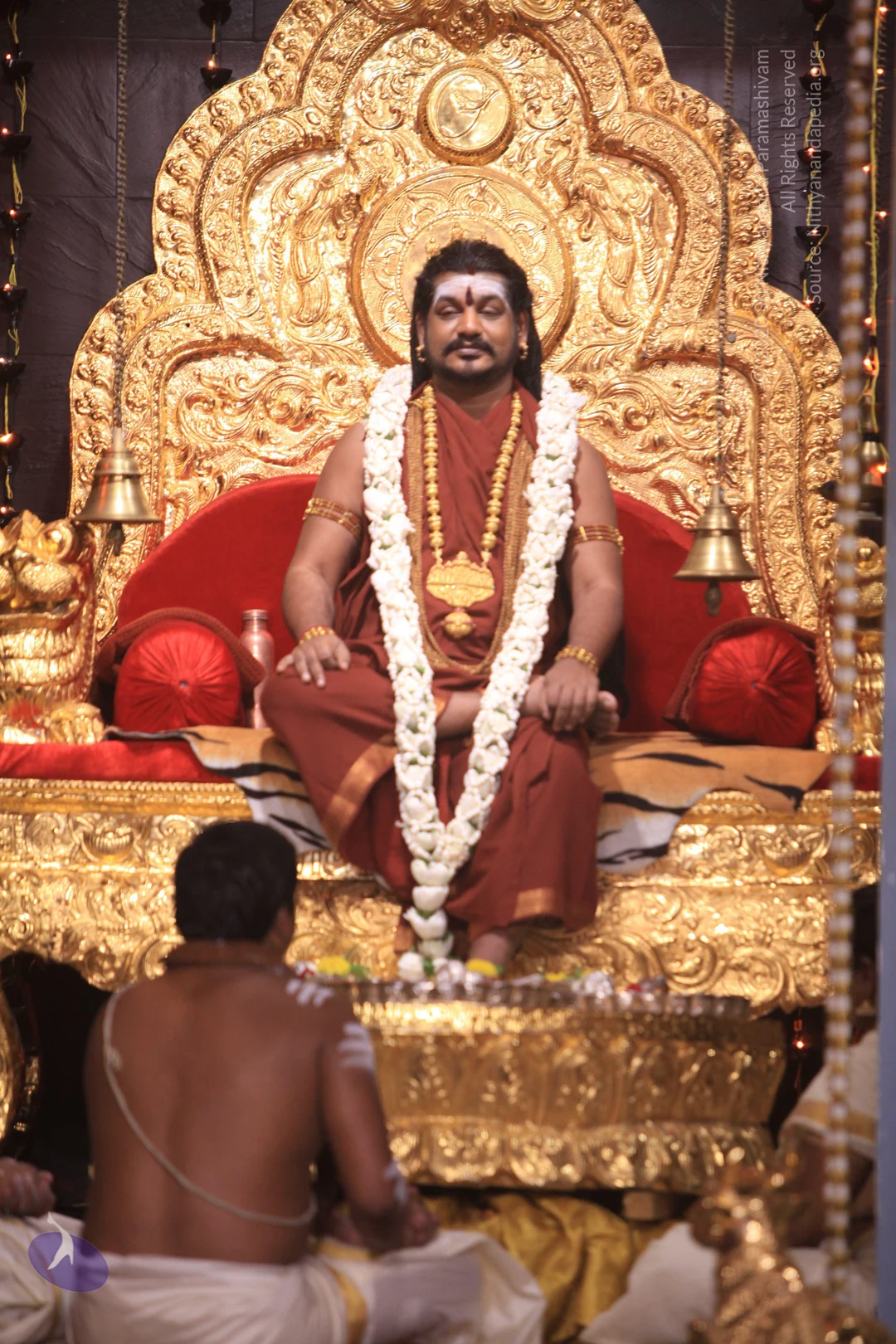
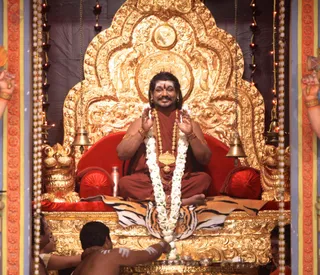
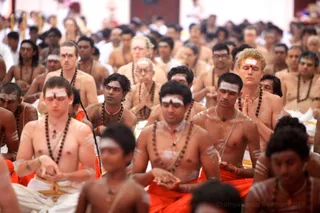
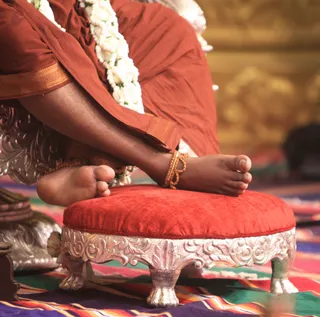
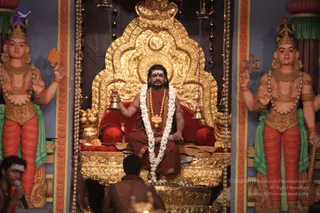
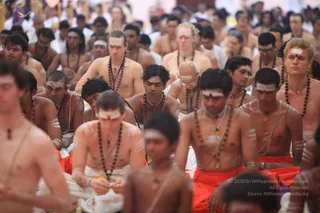
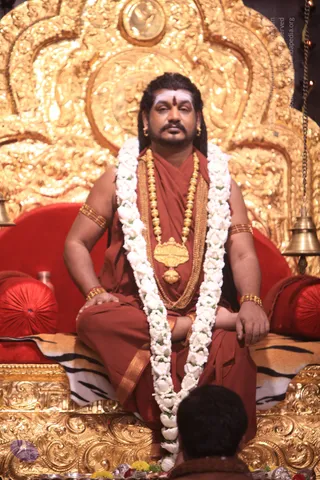
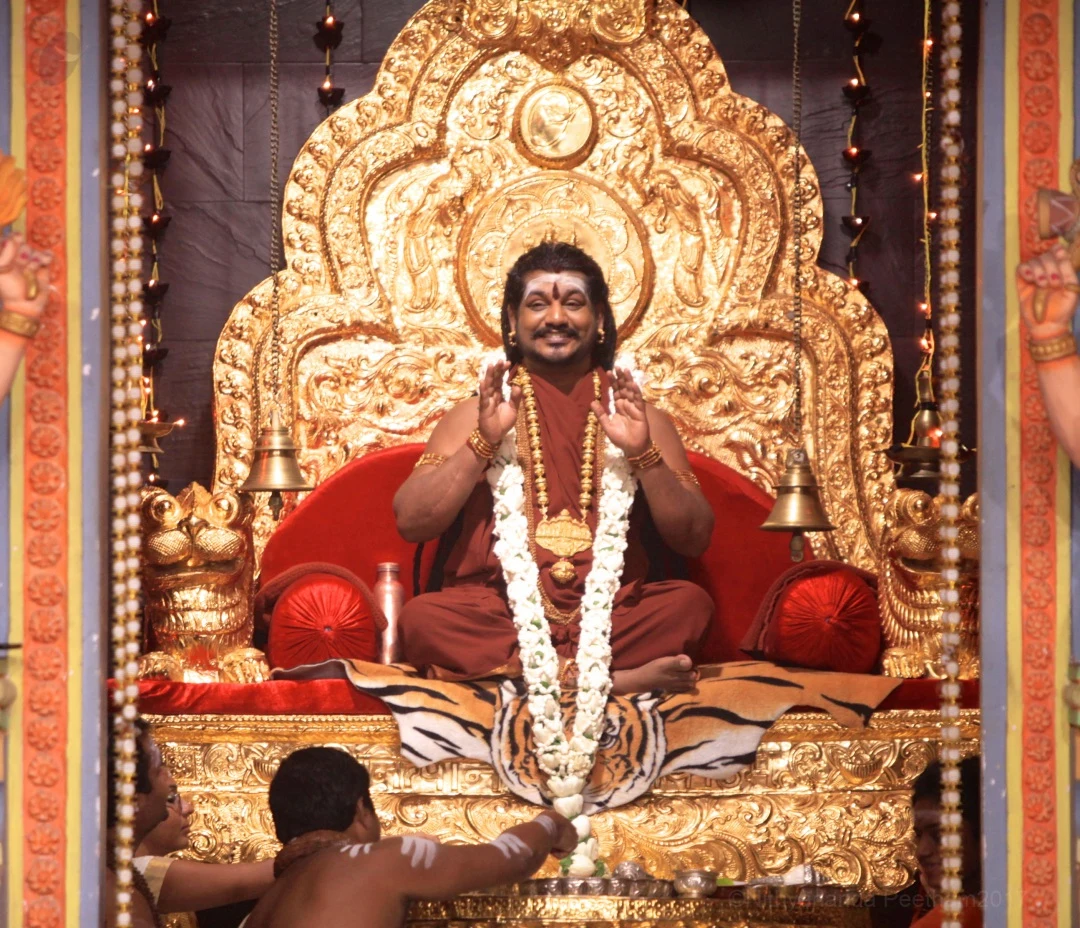
A photograph of a seated man on an ornate gold throne with a carved gold arched backrest and red cushions, draped with a striped tiger-skin cloth. He wears a rust-red robe, a gold pendant, rudraksha and beaded necklaces, gold armbands and a long white flower garland, with his palms raised in blessing. Above him hang brass bells and strings of red beads. Two cropped attendants in the lower foreground, one with white painted markings on his arms, are offering flowers at the base of the throne. Swamiji (probable): the seated figure has long swept-back dark hair, a crown-like gold ornament, rudraksha malas and ceremonial gold necklaces, consistent with the page's Swamiji reference. Pillars with painted deity murti panels frame the scene.A dense crowd of devotees sits cross-legged in a hall during a pratyaksha pada puja. Most are bare-chested, wearing saffron-orange dhotis and rudraksha malas, with white vibhuti (sacred ash) stripes across their foreheads and bodies. Many have eyes closed and hands folded in anjali; some hold their hands together in prayer while others sit in meditative stillness. Behind them, more people fill the background of the hall. No figure is clearly identifiable as the a person from appearance cues in this view, so the a person field is unsure.Close photograph of a seated person's bare feet resting on a red velvet cushioned footstool with an ornate silver-plated frame and clawed feet. The person wears a rust-orange cloth with a gold border and a white flower garland draped over the lap, and has beaded orange bracelets on the ankle. The background shows a gold-toned wall and a striped woven mat in red, green and blue. Only the legs and feet are visible, so no face is shown.

Satsang

7 photosSource gallery
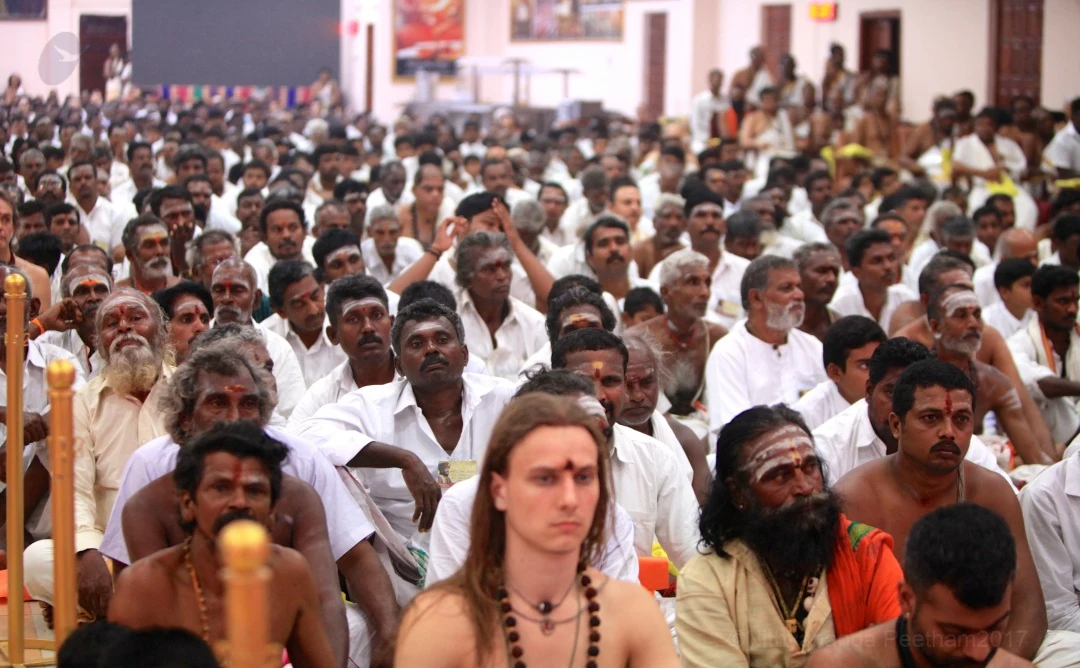
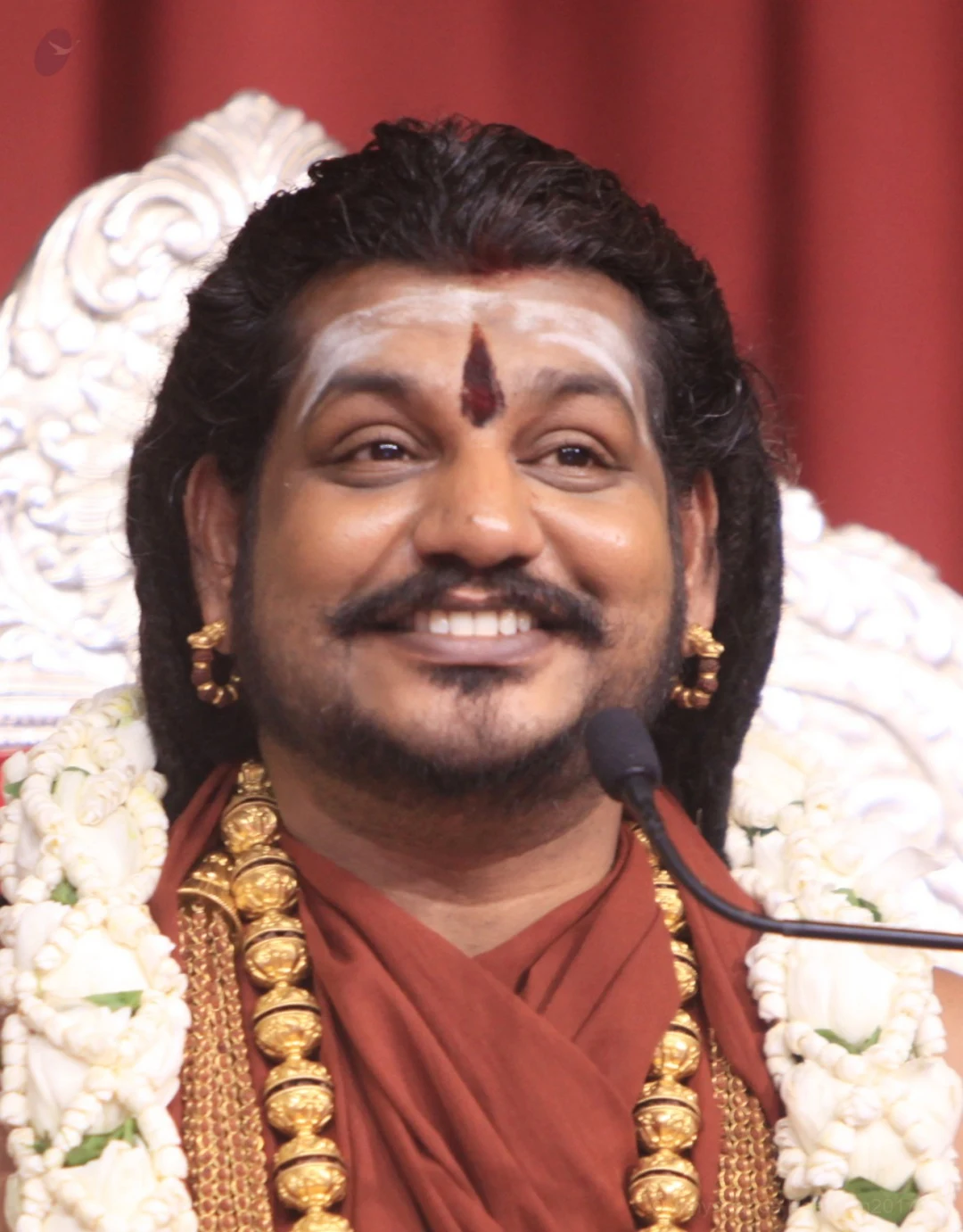
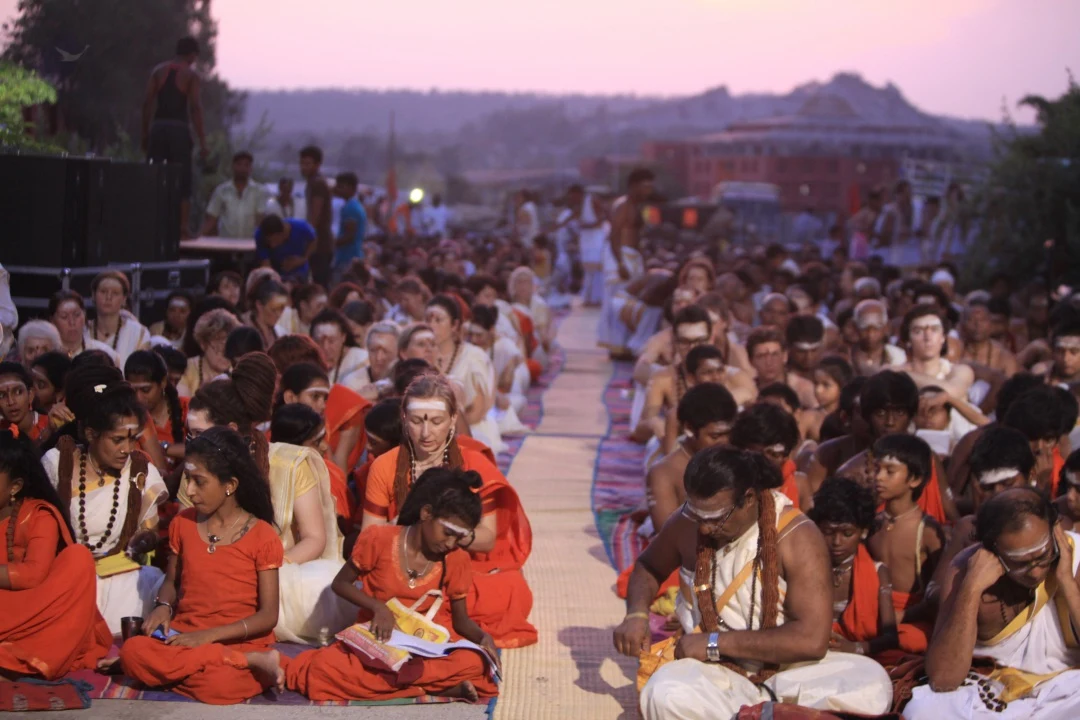
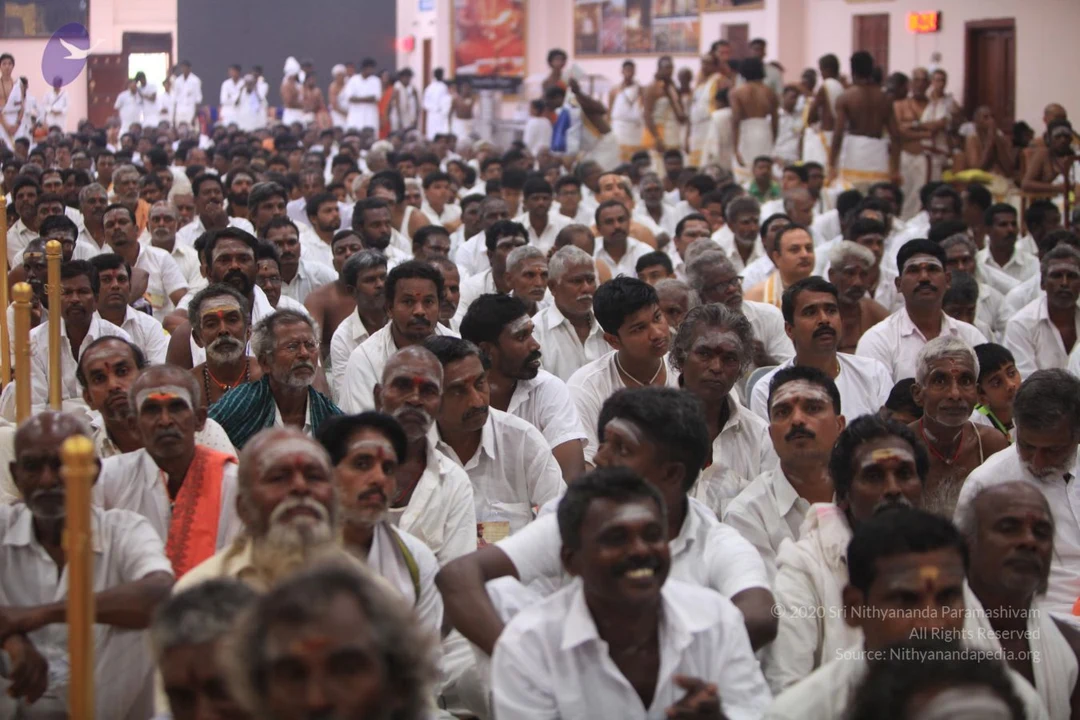
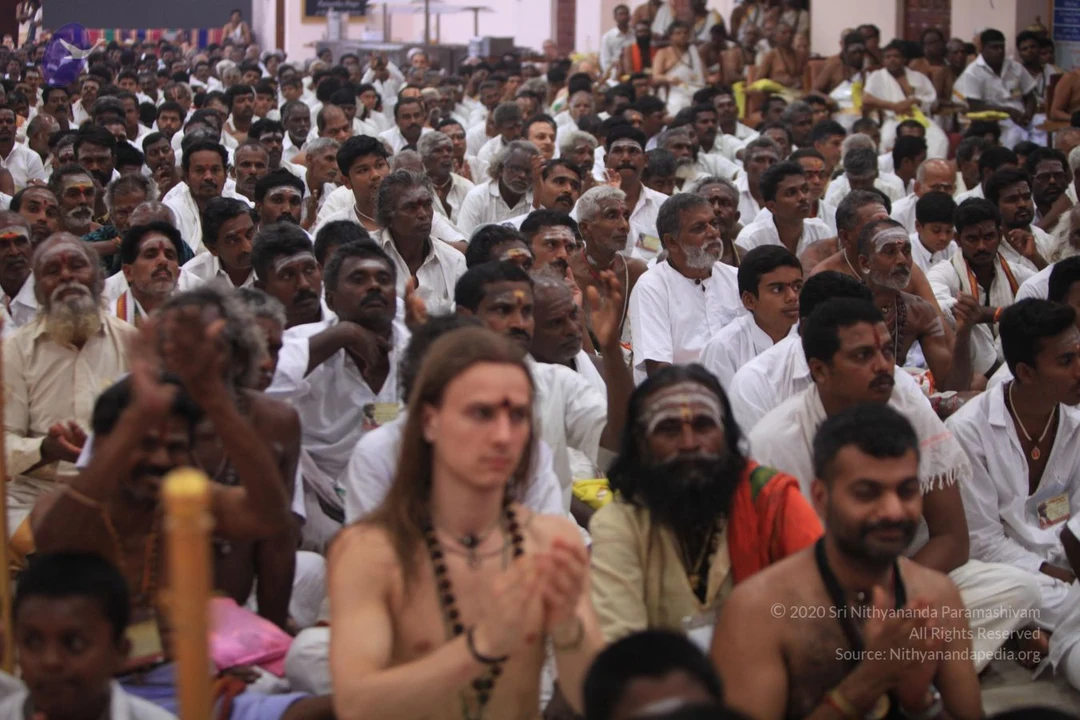
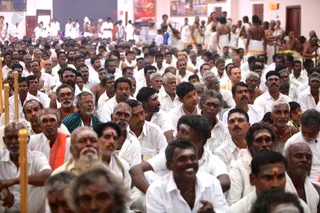
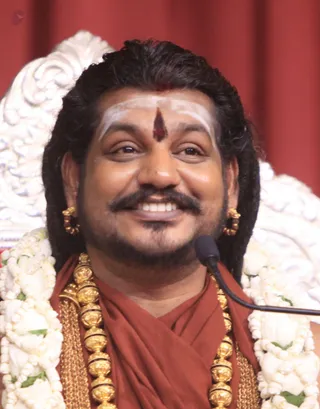
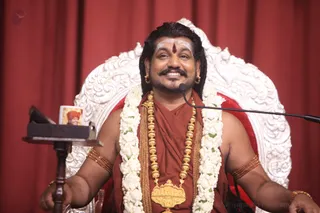
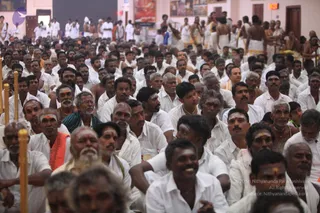
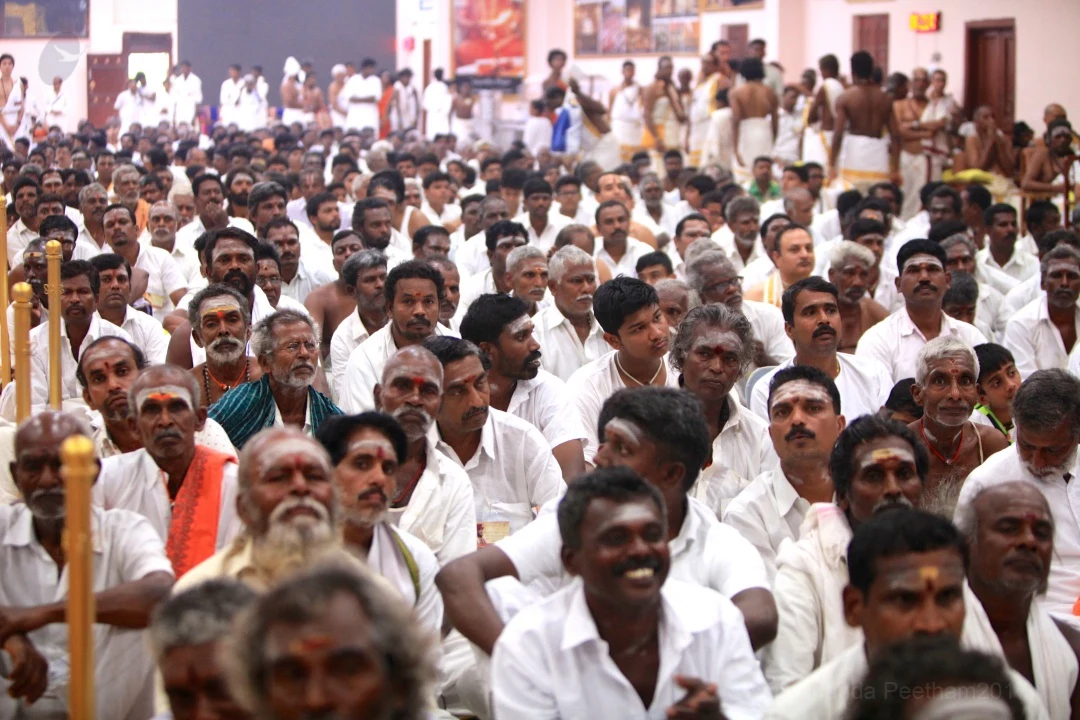
A large crowd of men sits closely packed in a hall, most dressed in white shirts and white dhotis, many with white and red vibhuti or kumkum marks on their foreheads. Some wear a rudraksha mala or orange cloth. Several older men have grey beards and moustaches, while younger men smile at the camera. Wooden poles with gold tips line the left edge. Behind the seated crowd, more white-clad devotees stand near a wall with framed images. The setting appears to be a satsang gathering, and no one in the crowd is clearly identifiable as a person.A large seated crowd of devotees fills a hall, most dressed in white dhotis and shirts, many with white and red-orange tilak marks on their foreheads. In the foreground, a young man with long light-brown hair sits with a red bindi-style mark, wearing a rudraksha mala and a pendant. Beside him an older bearded man in a saffron-orange garment and rudraksha beads sits with white ash marks on his forehead. Gold ceremonial staffs stand at the left edge and a large dark screen hangs on the back wall, with a framed picture and a banner visible above the crowd.Close-up photo of a smiling man with long dark hair swept back, white tripundra with a red central mark on his forehead, gold earrings, a white flower garland, rust-orange robe and a heavy ornate gold necklace with rudraksha-style beads. A microphone is in front of him and a white carved throne-like backdrop and red curtain are behind. a person in a seated discourse setting, based on his long swept hair, saffron-toned robe and ornate gold necklaces.A smiling man with swept-back long dark hair and a red-brown kumkum-style mark with white tilak on his forehead sits on an ornate white carved throne against a deep red curtain. He wears a rust-red saffron-toned robe, a white jasmine garland, a heavy gold multi-bead necklace with a gold pendant, gold earrings and gold armlets. A microphone stands in front of him and a small framed portrait sits on a wooden stand at left.A man seated on an ornate white and silver throne before deep red drapery, smiling broadly with arms spread. He wears a reddish-brown saffron-toned wrap, white flower garlands, a heavy gold ceremonial necklace with a large pendant, rudraksha-style beaded jewellery, gold bangles and earrings, and a red tilak with white vibhuti markings on his forehead. A microphone stands in front of him and a small wooden lectern with a framed portrait sits at left. The man's long dark hair is swept back, and he appears to be giving a discourse at a Nithyananda Peetham event. a person, seated on a throne in saffron and adorned with rudraksha and gold, presenting a satsang discourse.Large outdoor gathering at dusk of many seated devotees in rows on mats along a central walkway, many wearing orange and white robes, with white vibhuti or tilak marks on foreheads and rudraksha malas. In the foreground a young girl in orange robes reads a book, while a man in white dhoti and shawl with long hair and white markings sits with hands near his face. Behind the rows a stage area with speaker equipment, a red-roofed structure and hills stand under a pink sky. No clearly identifiable a person figure is visible in this frame.

Homa

2 photosSource gallery
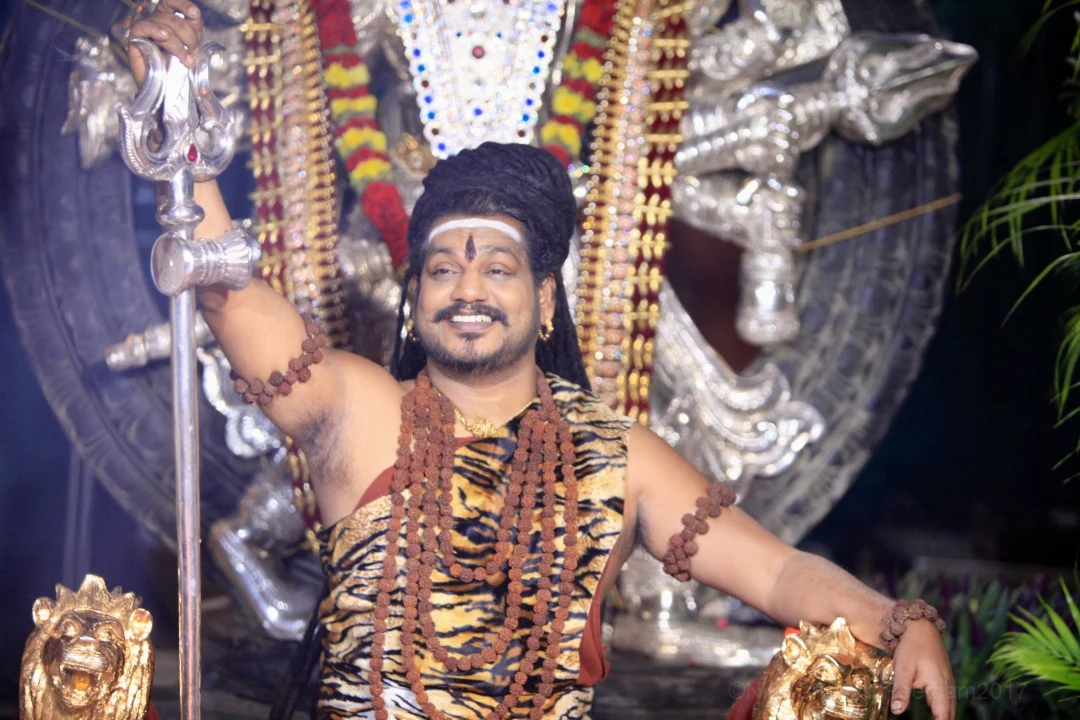
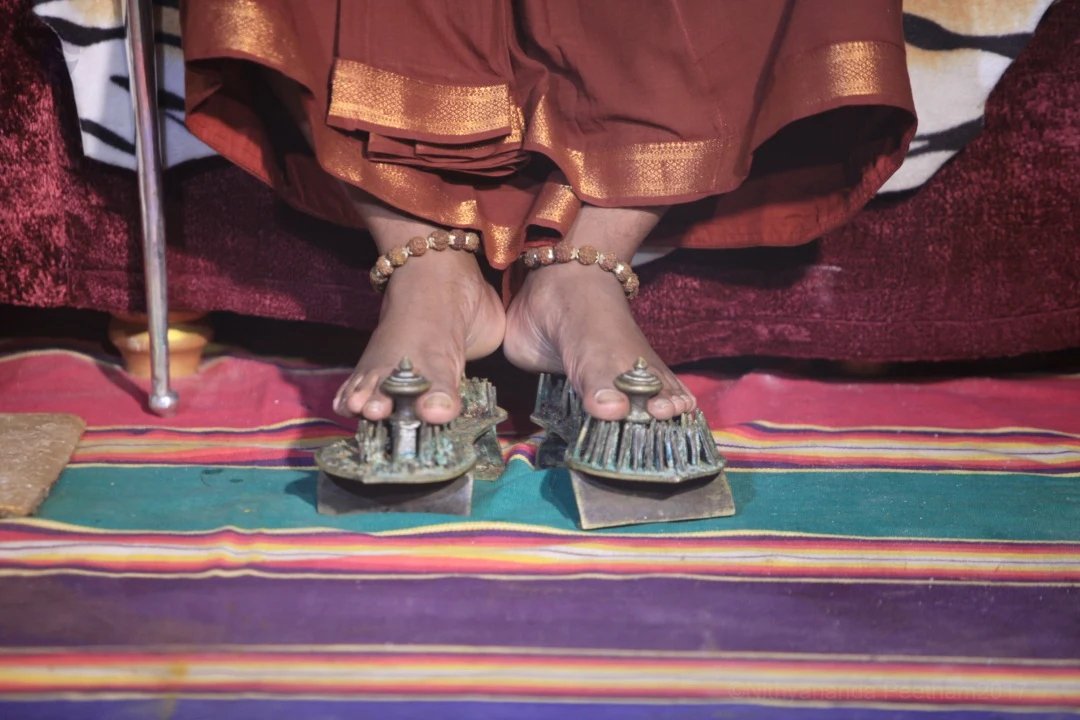
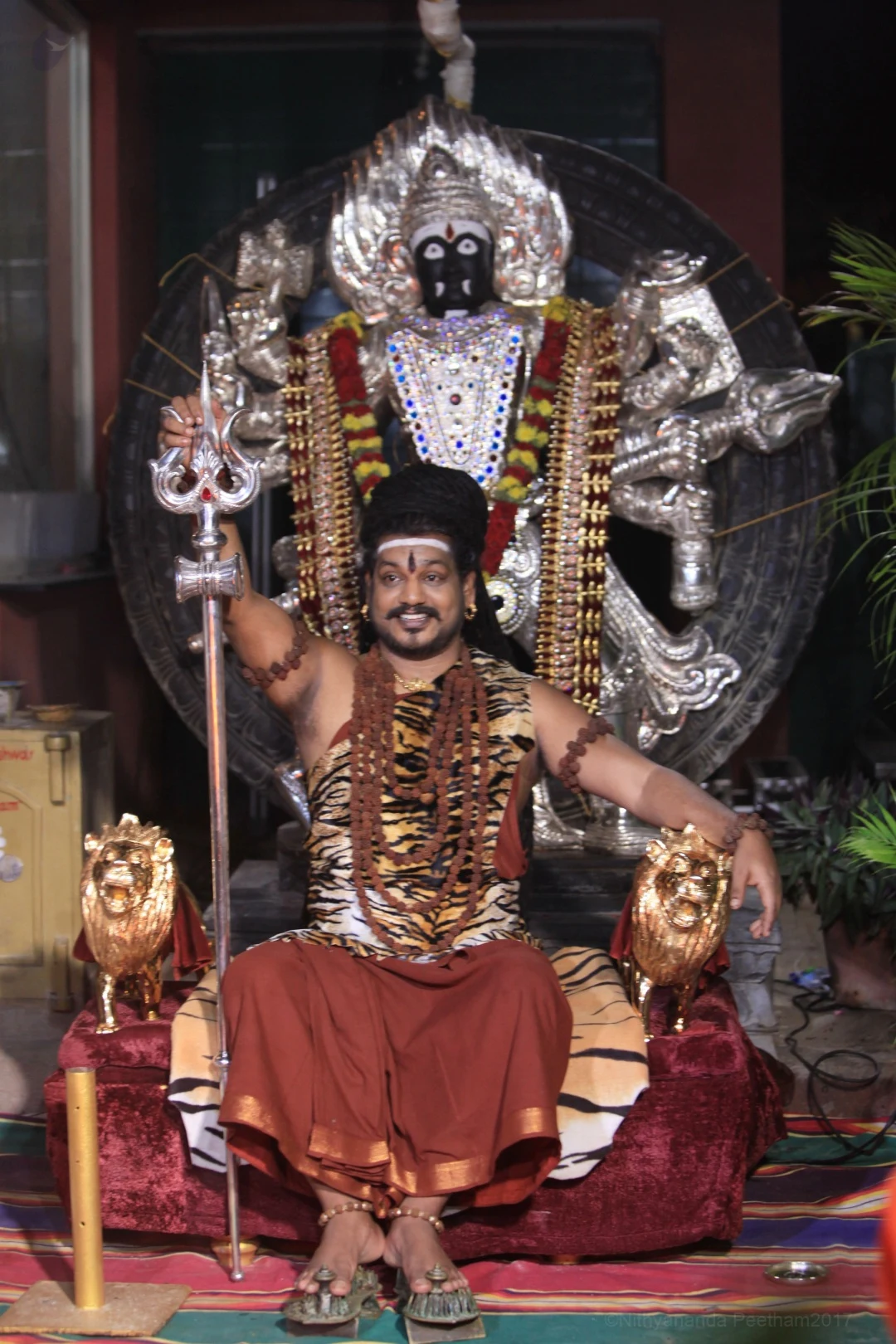
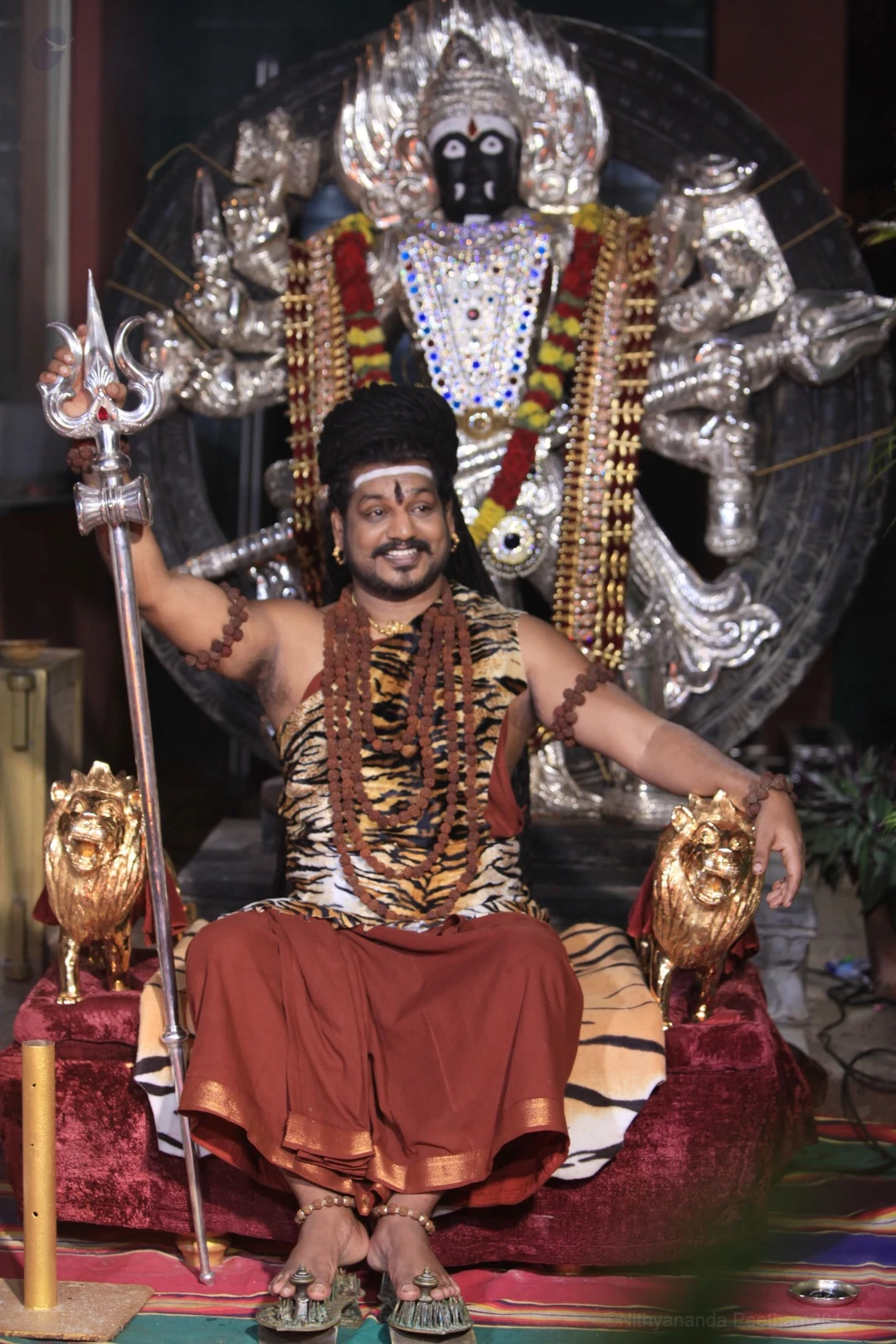
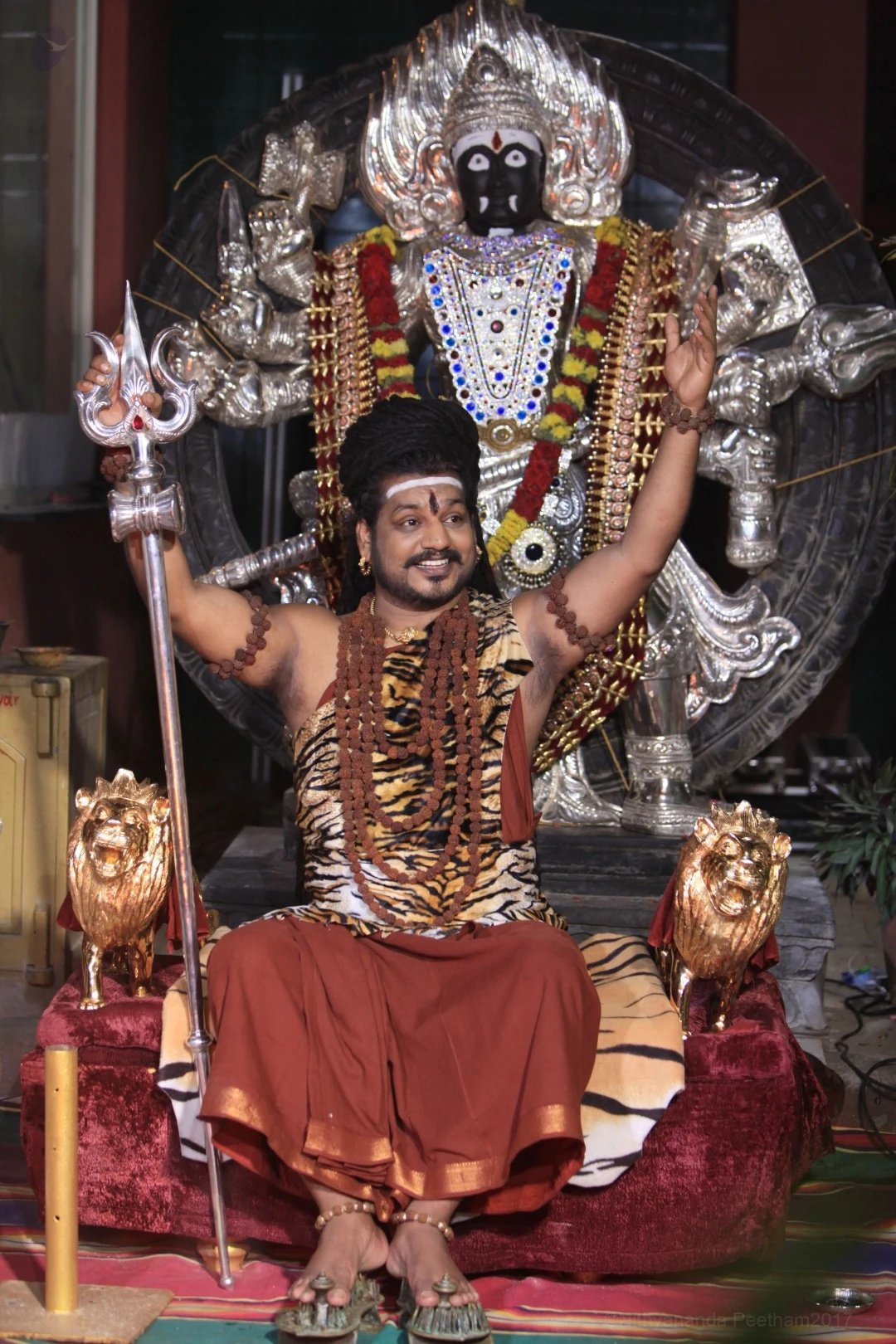
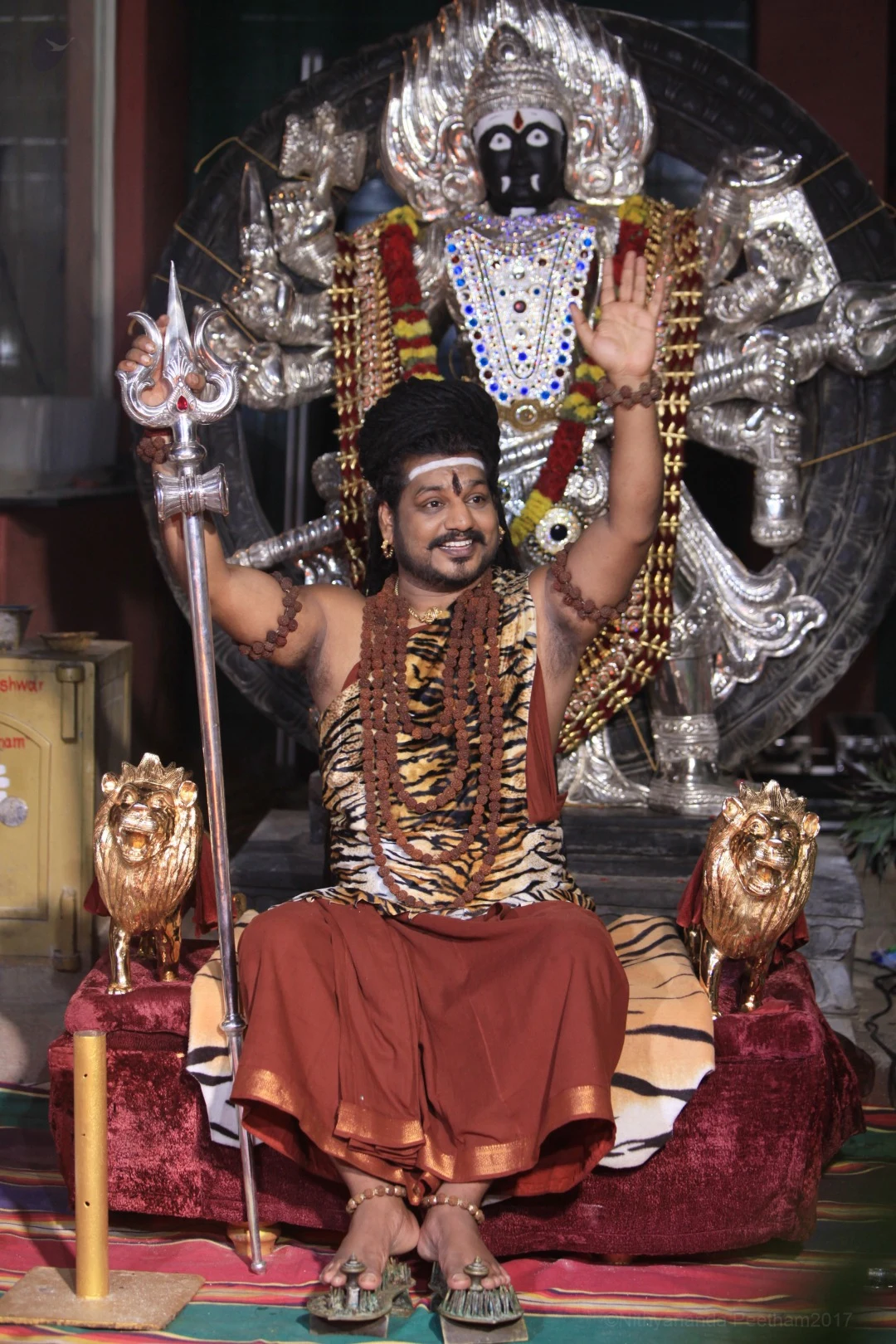
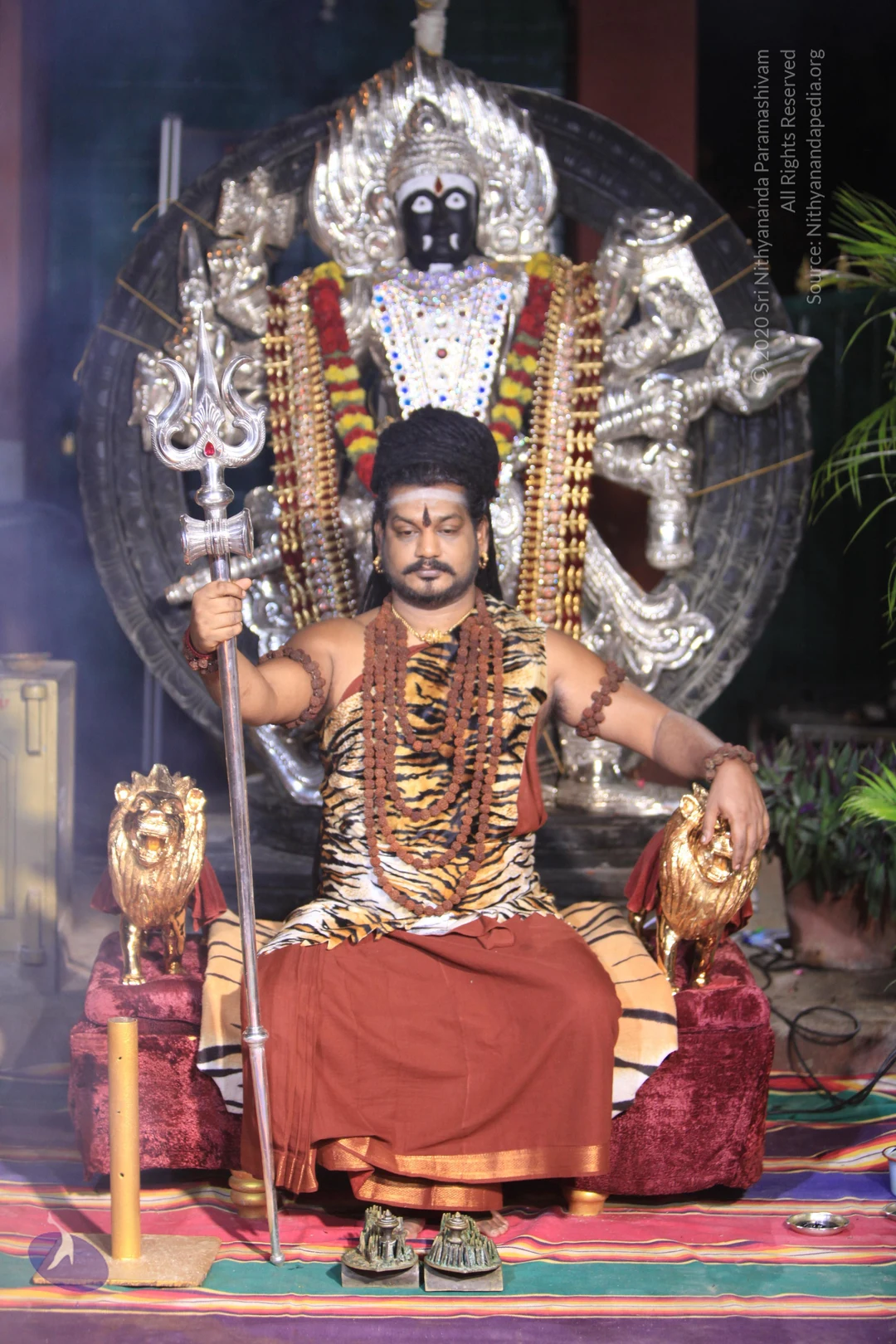
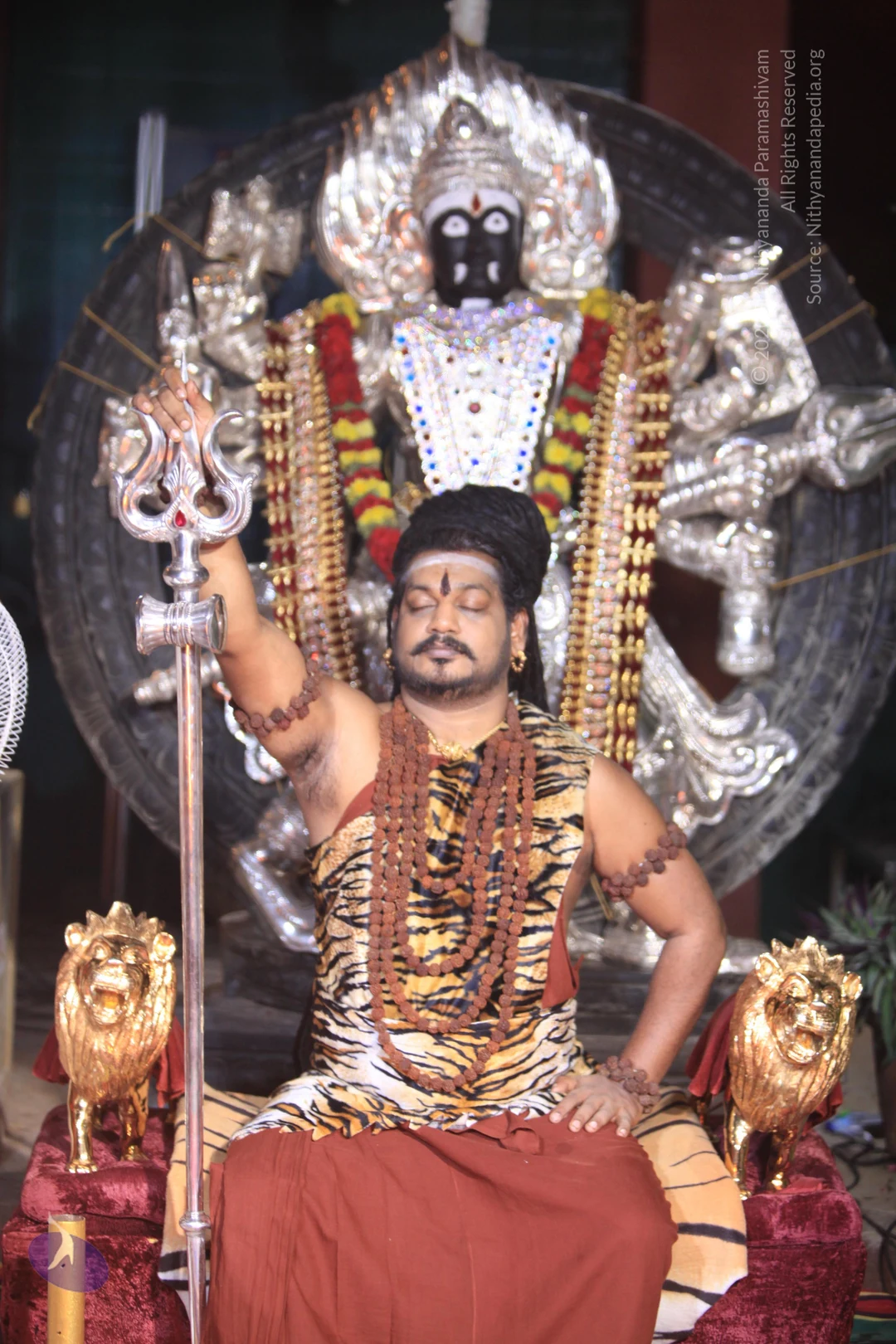
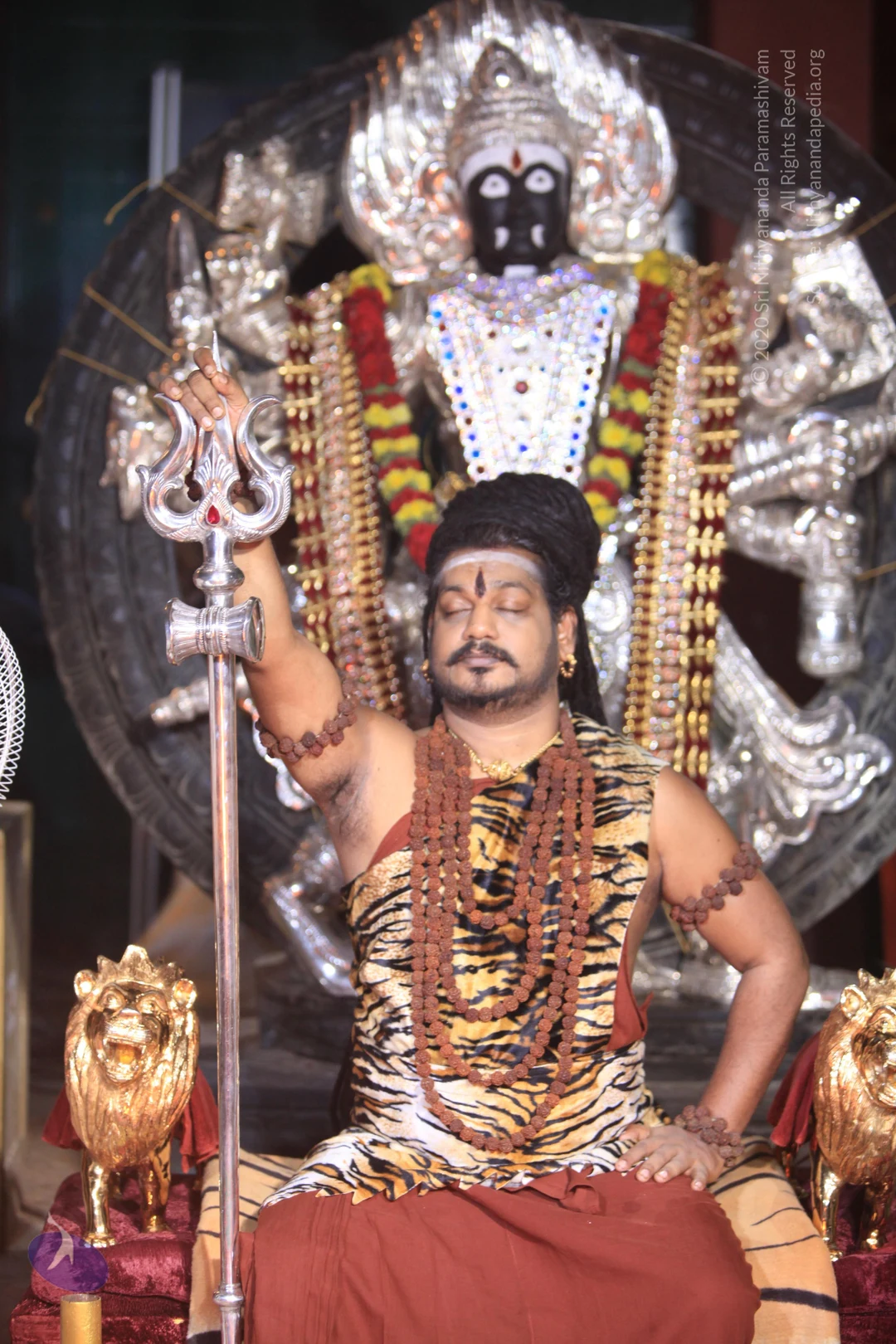
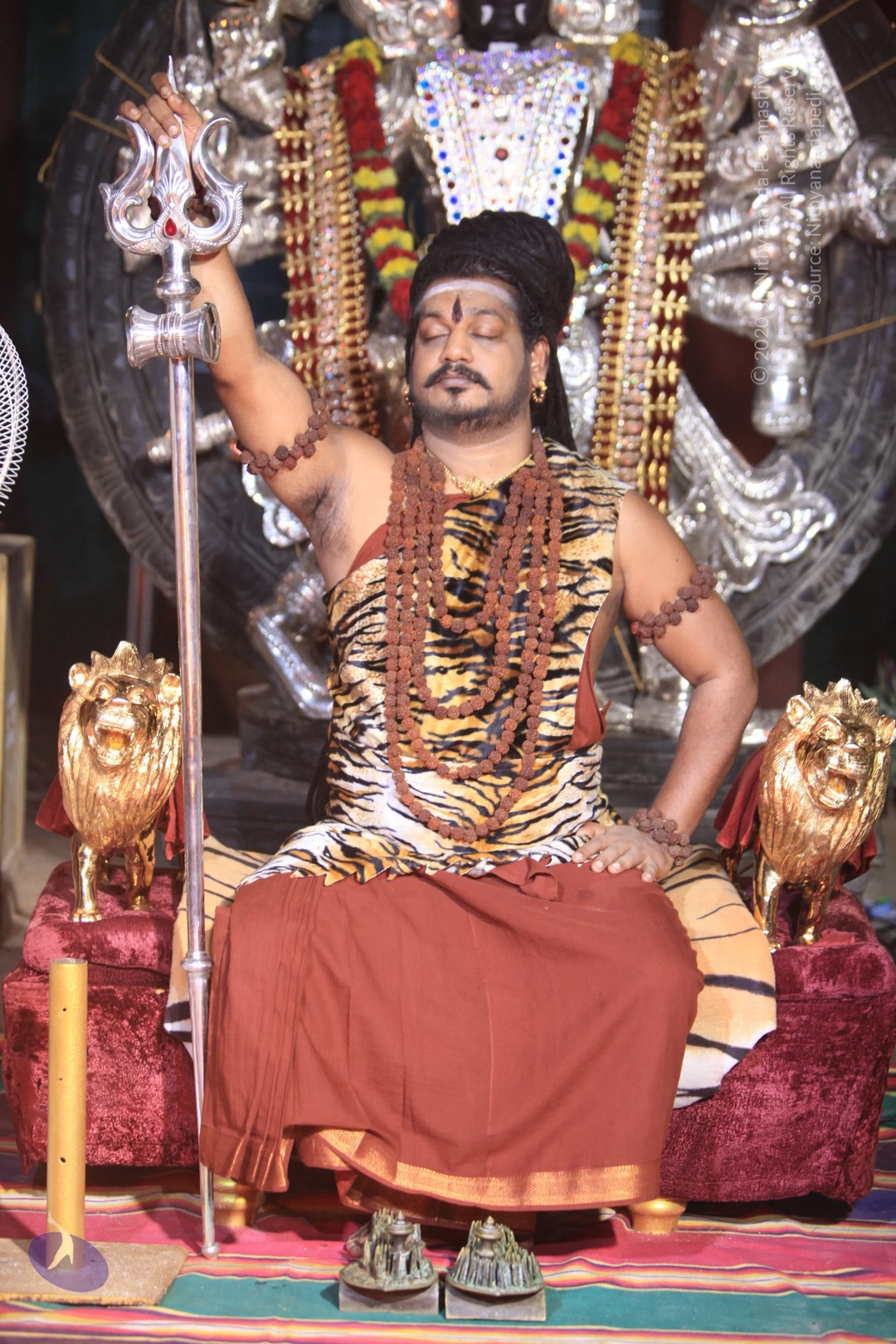
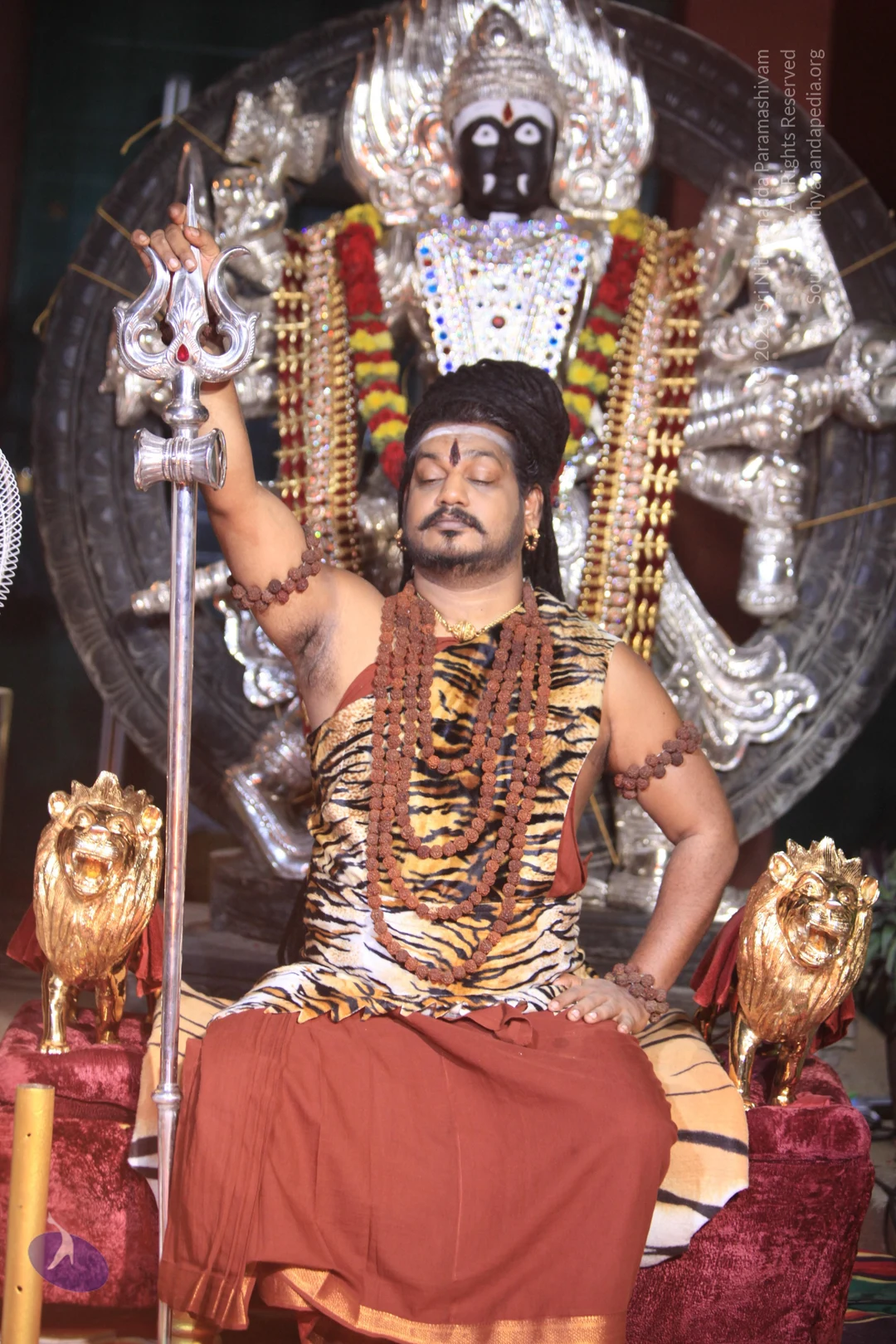
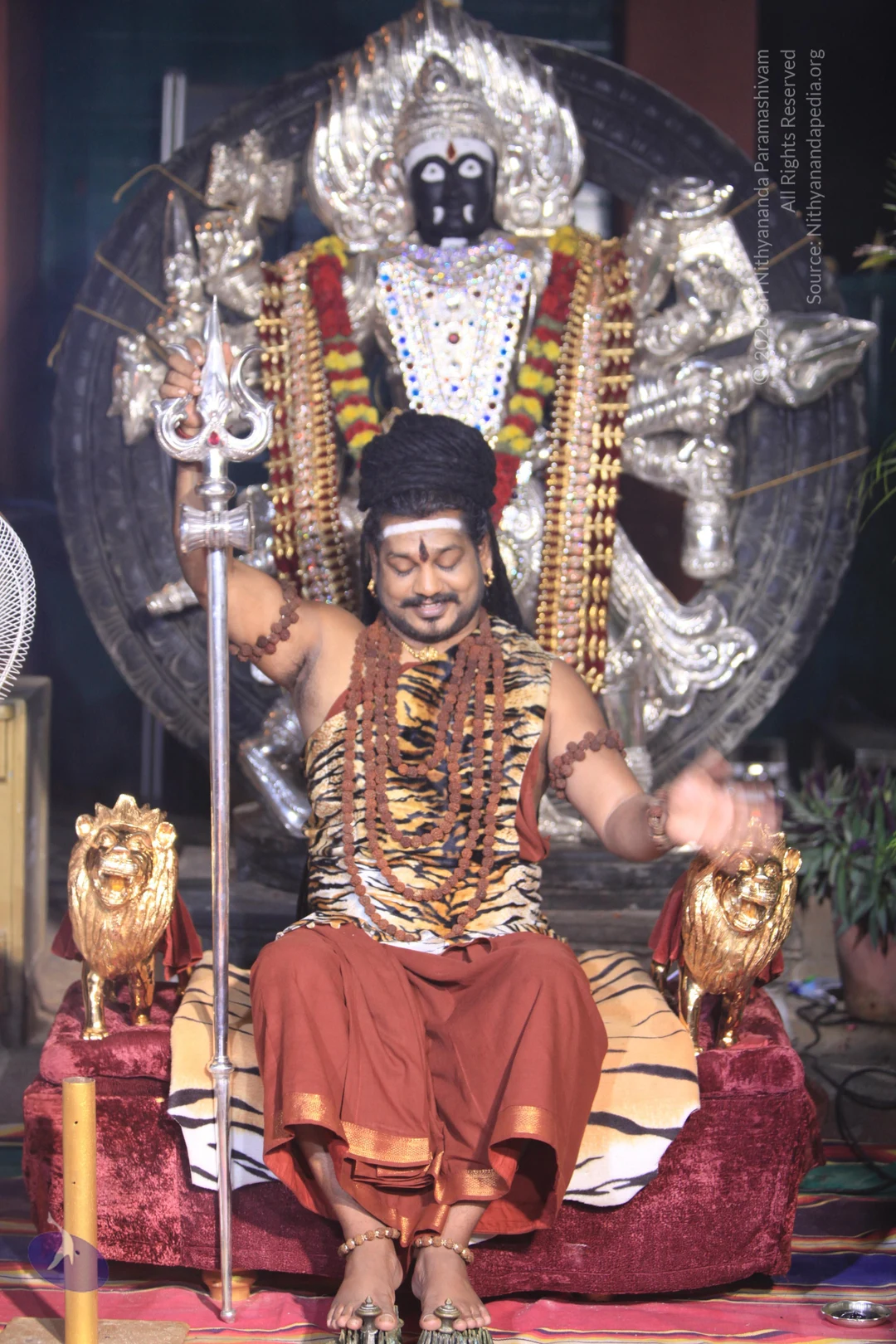
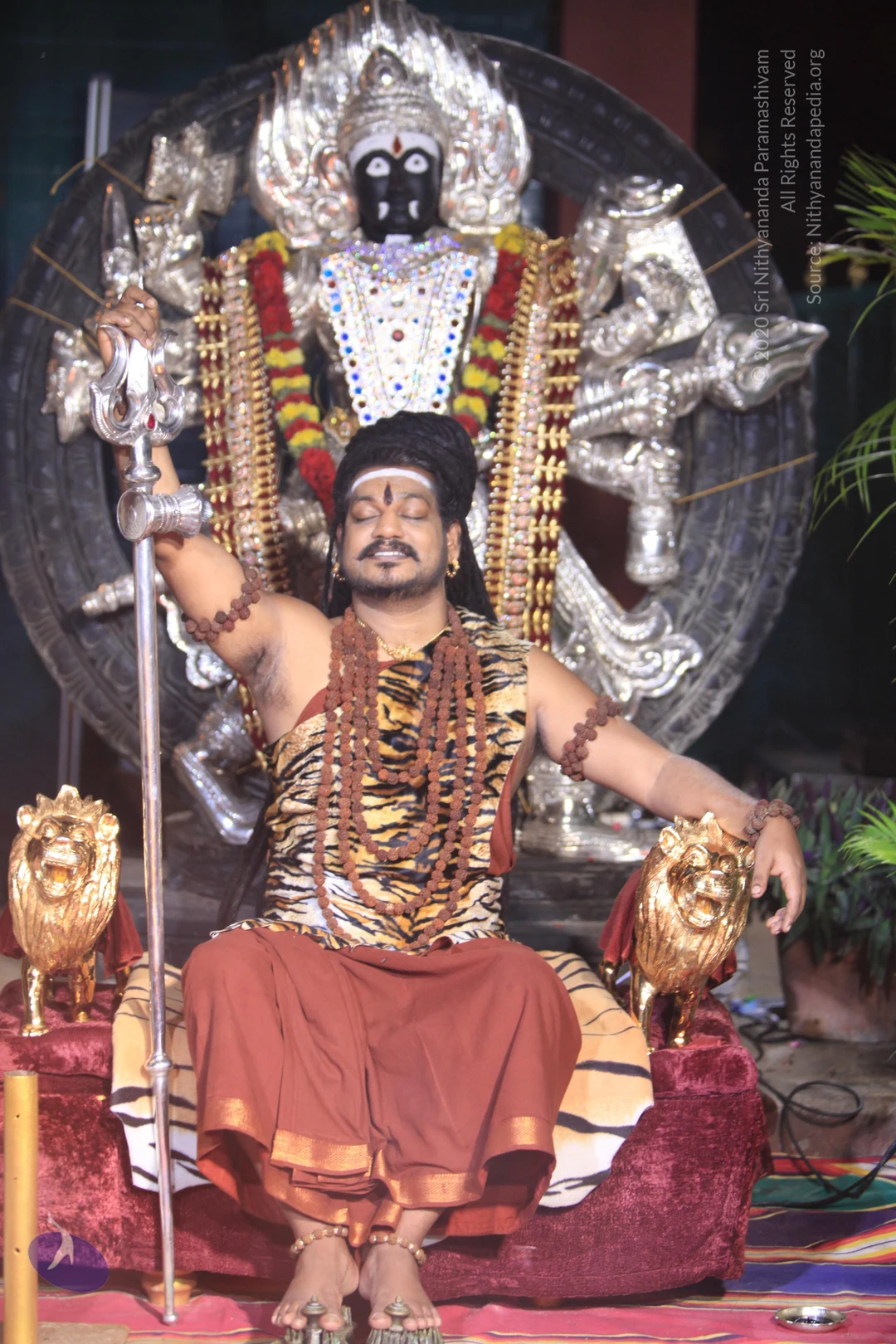
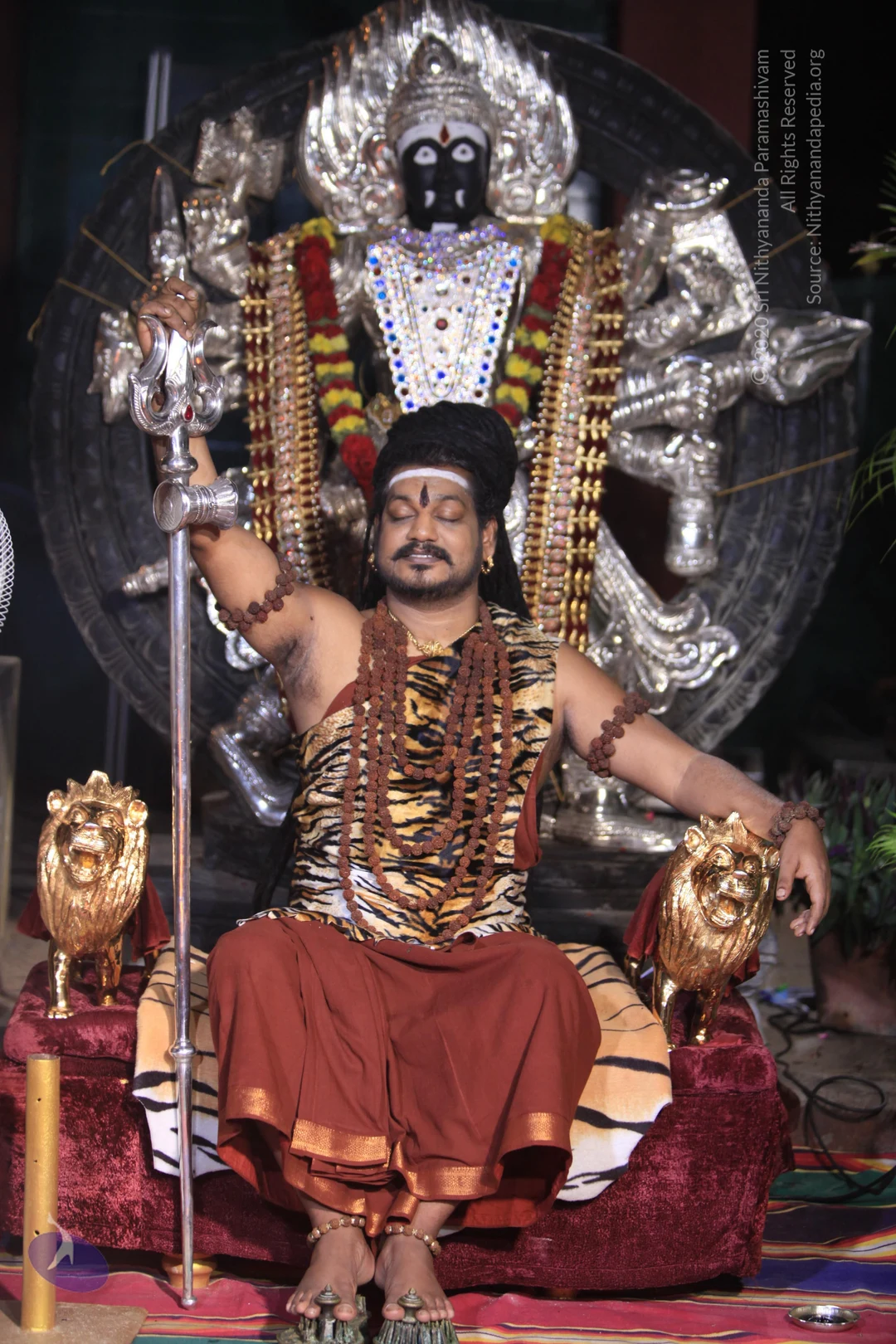
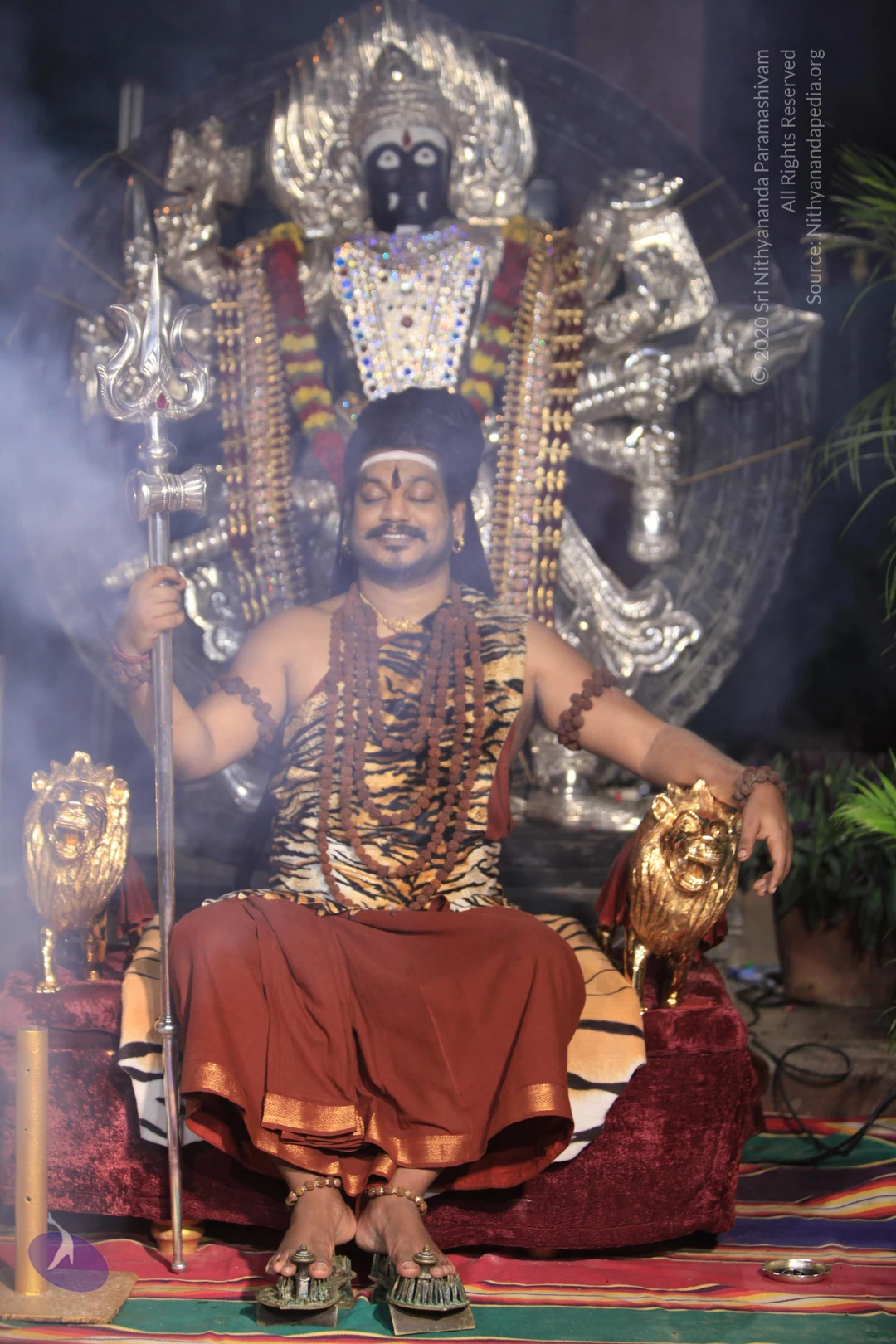
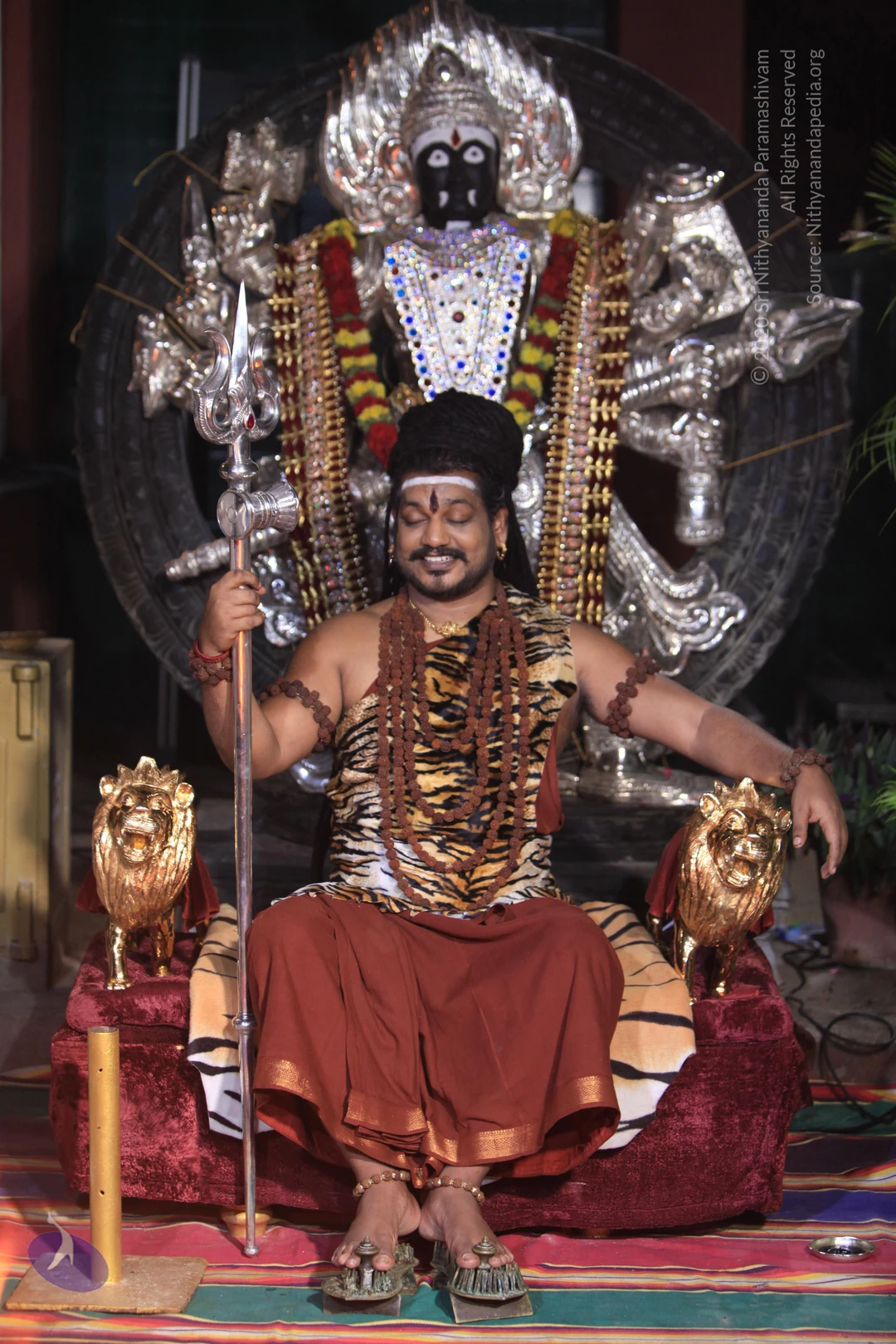
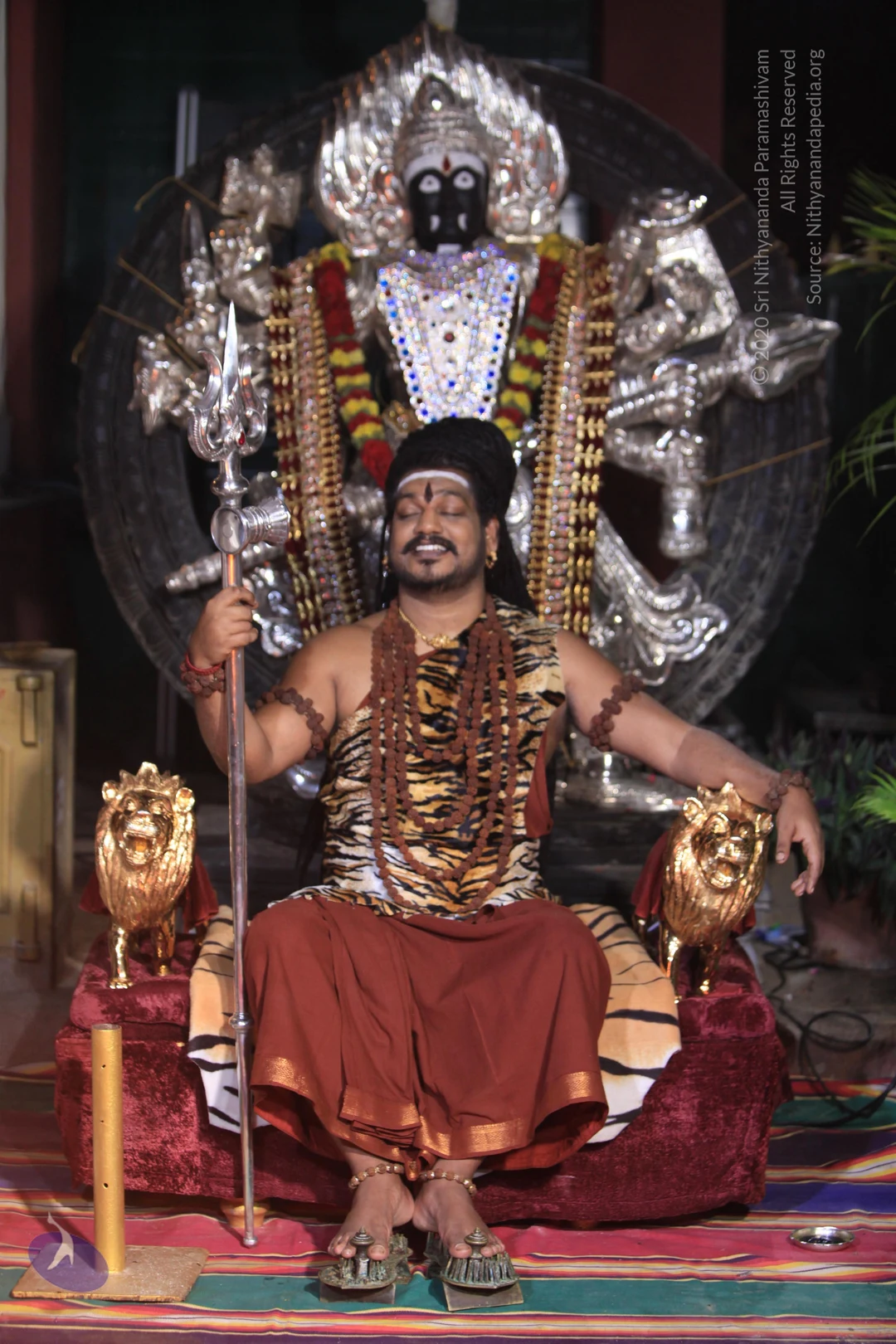
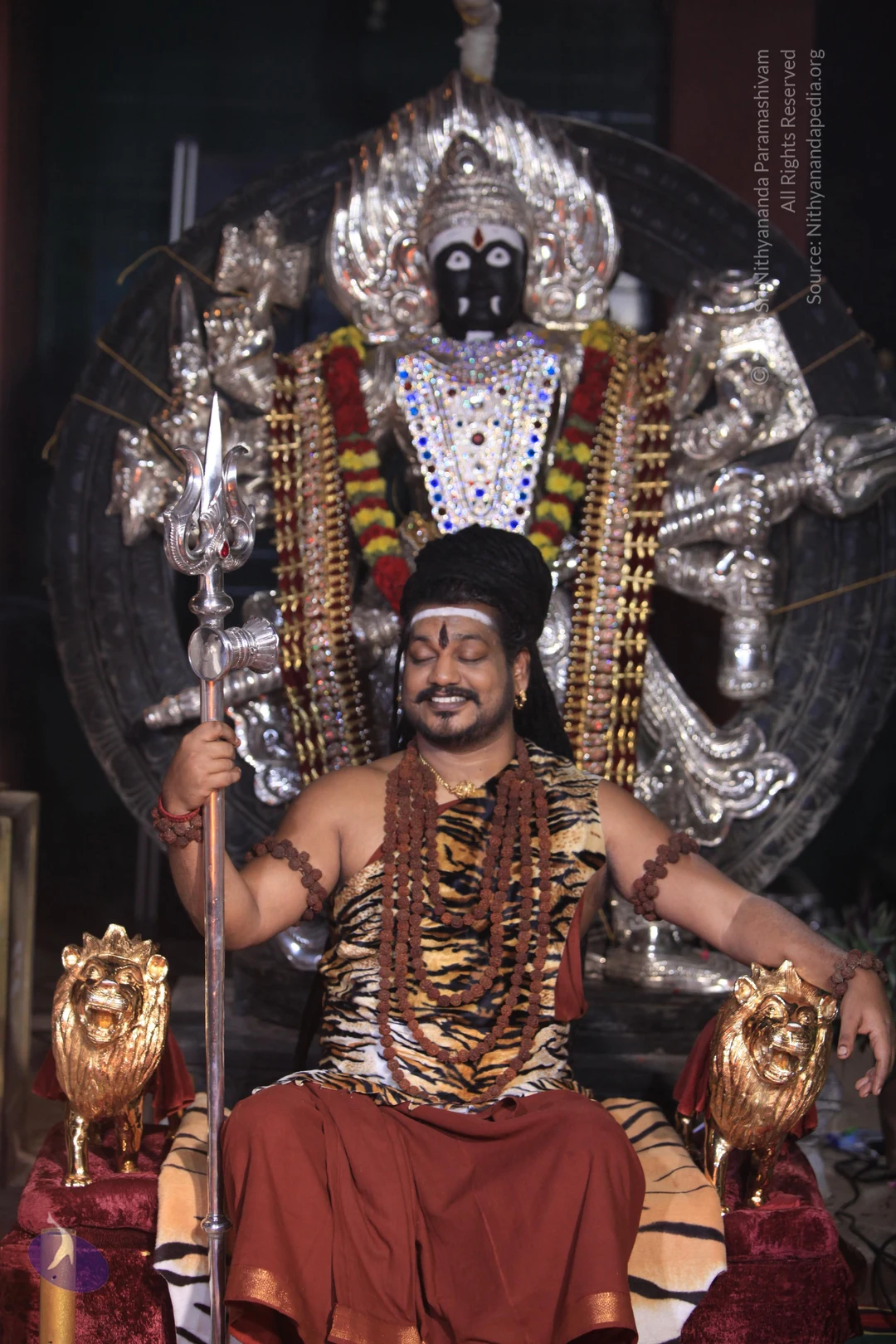
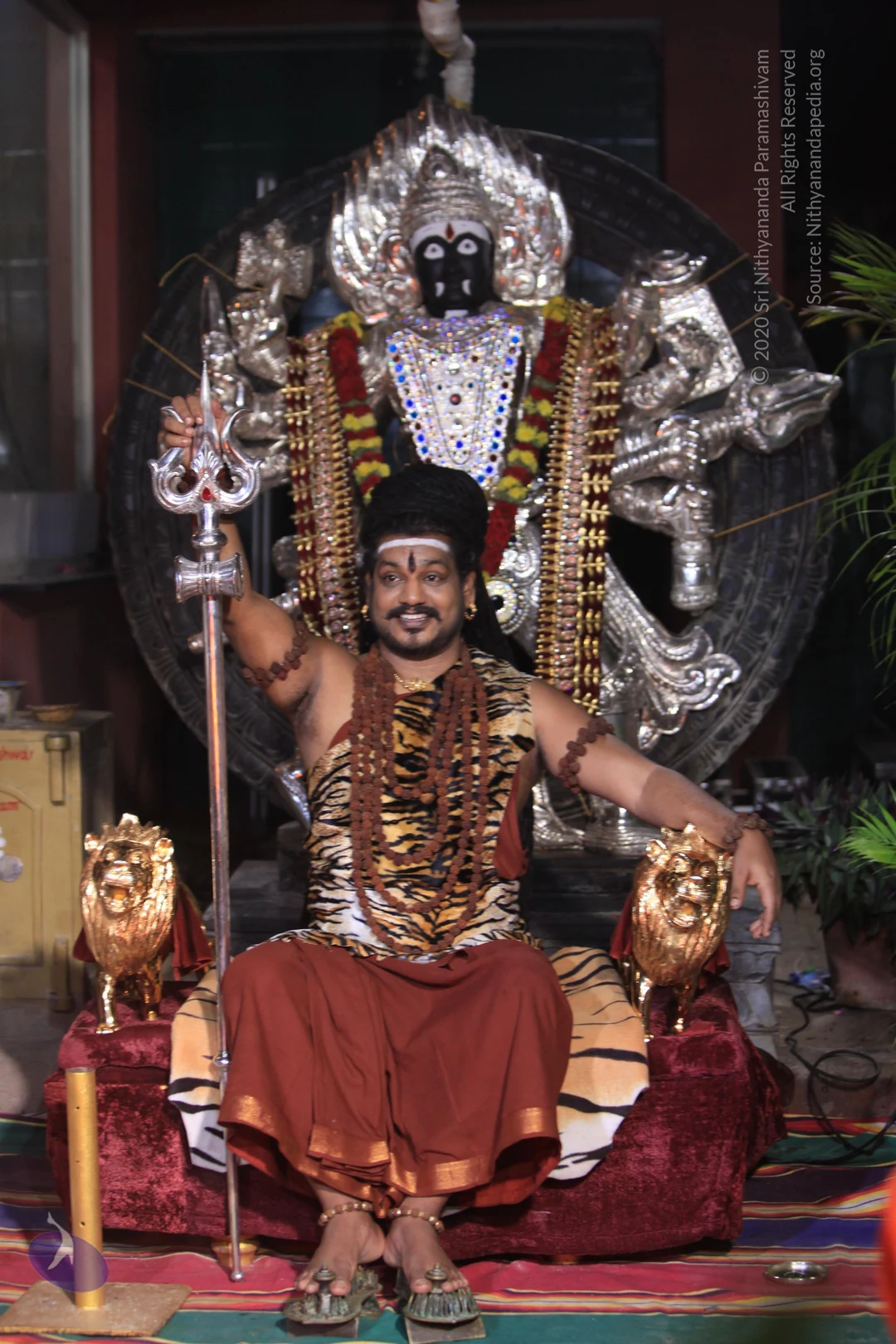
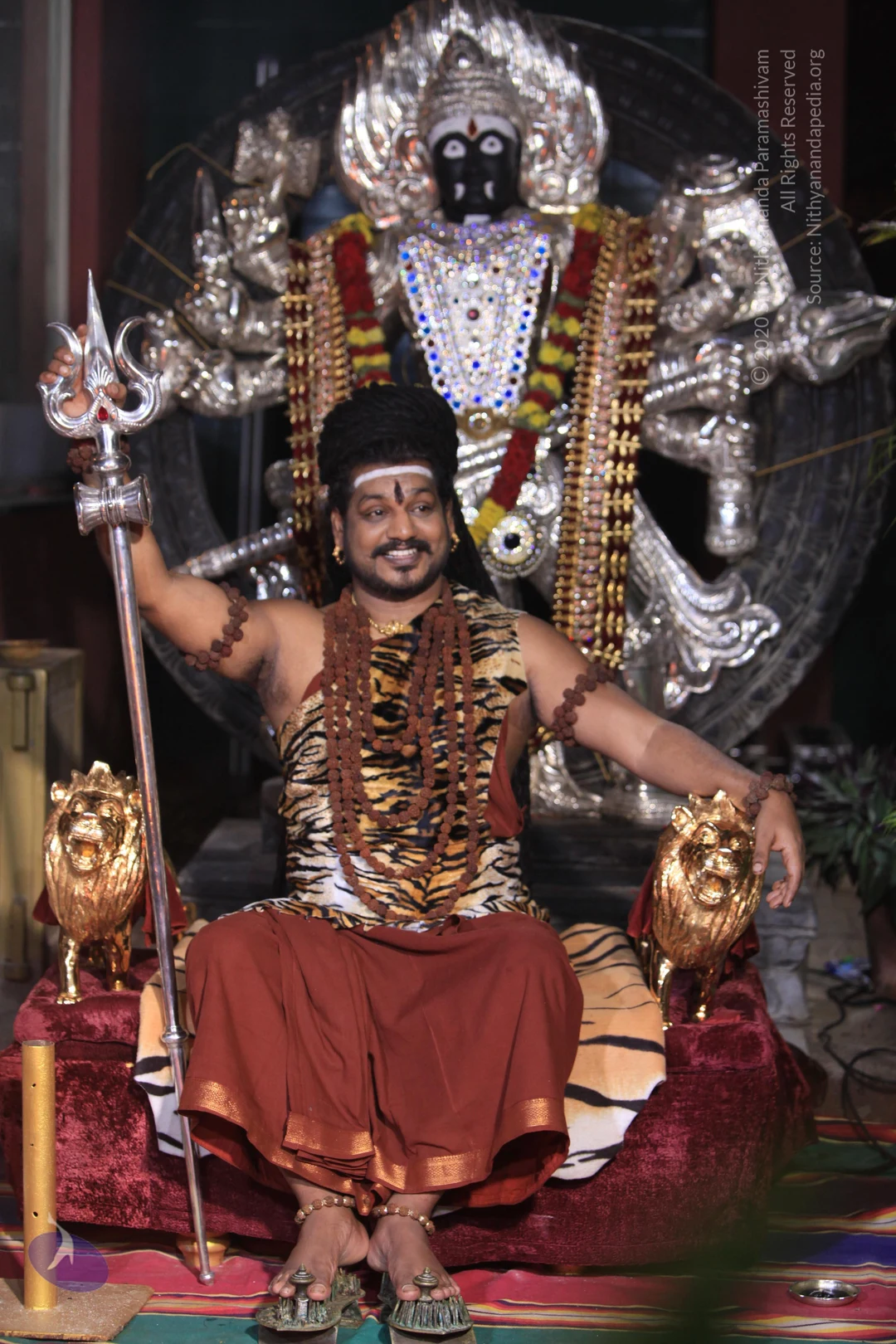
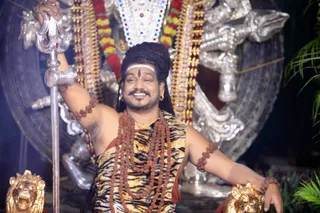
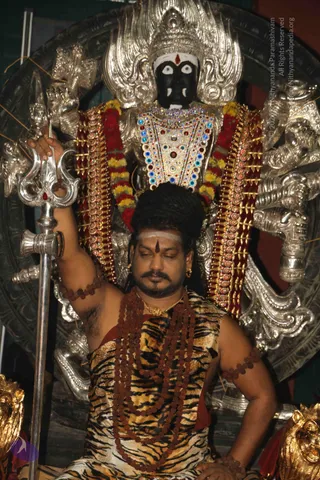
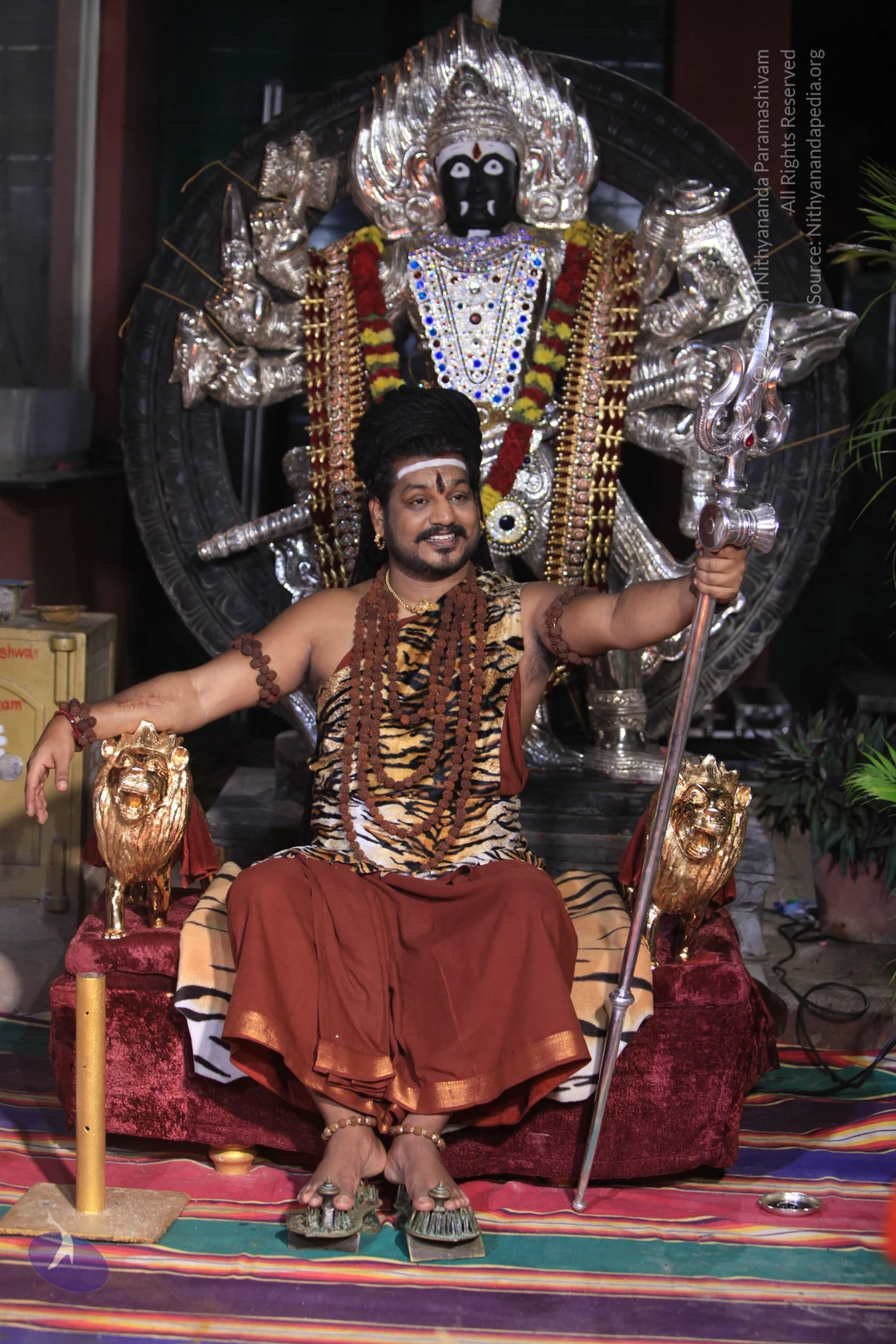
A smiling man with long dark matted hair, a white forehead band and a red bindi sits on a throne with golden lion-head armrests. He wears a tiger-striped garment, multiple rudraksha mala necklaces, rudraksha bracelets and gold earrings, and raises a silver trident in his right hand. Behind him stands a large silver deity murti with a jewelled crown and garlands of red and yellow flowers. A probable Swamiji (Nithyananda Paramashivam) is shown in appearance-based terms, with the long hair, rudraksha malas and tiger-striped dress as cues.Close-up photograph of a person's bare feet resting on a pair of ornate bronze padukas (sandals) with raised knob handles and textured bases, set on a colourful striped woven rug in red, teal, yellow and purple. The wearer's legs are draped in a rust-orange garment with gold zari border, and beaded rudraksha-style bracelets encircle the ankles. A metal stand and maroon velvet cushion are visible at the edges. Only feet and lower legs are visible; no face or full figure appears.

Darshan

1 photoSource gallery
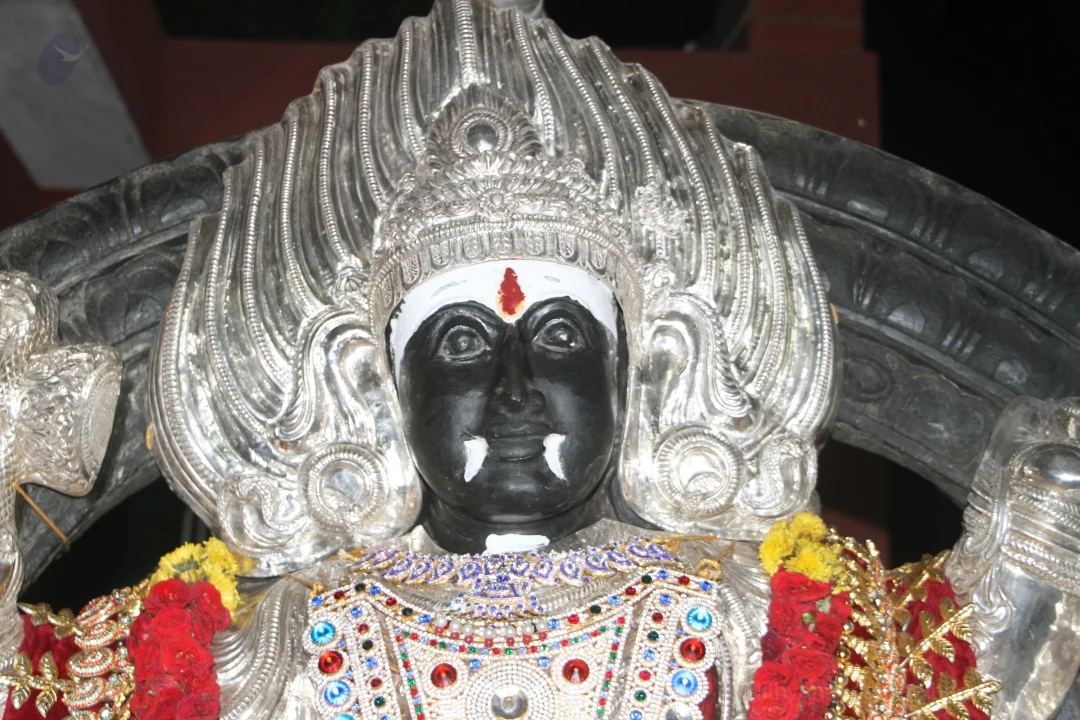
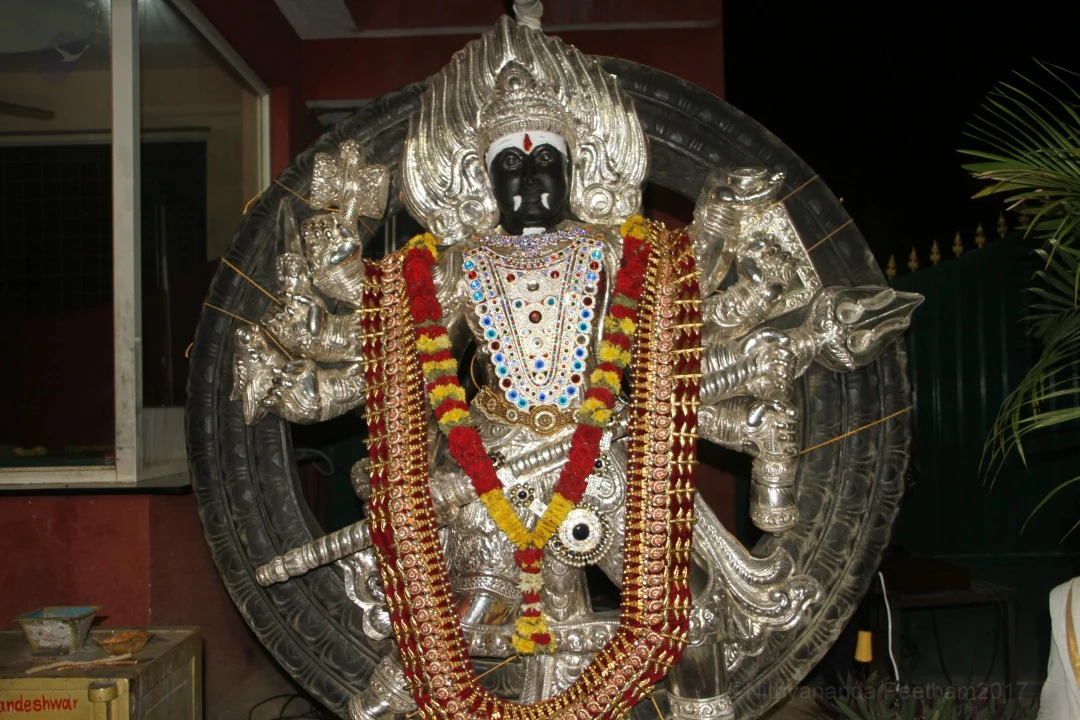
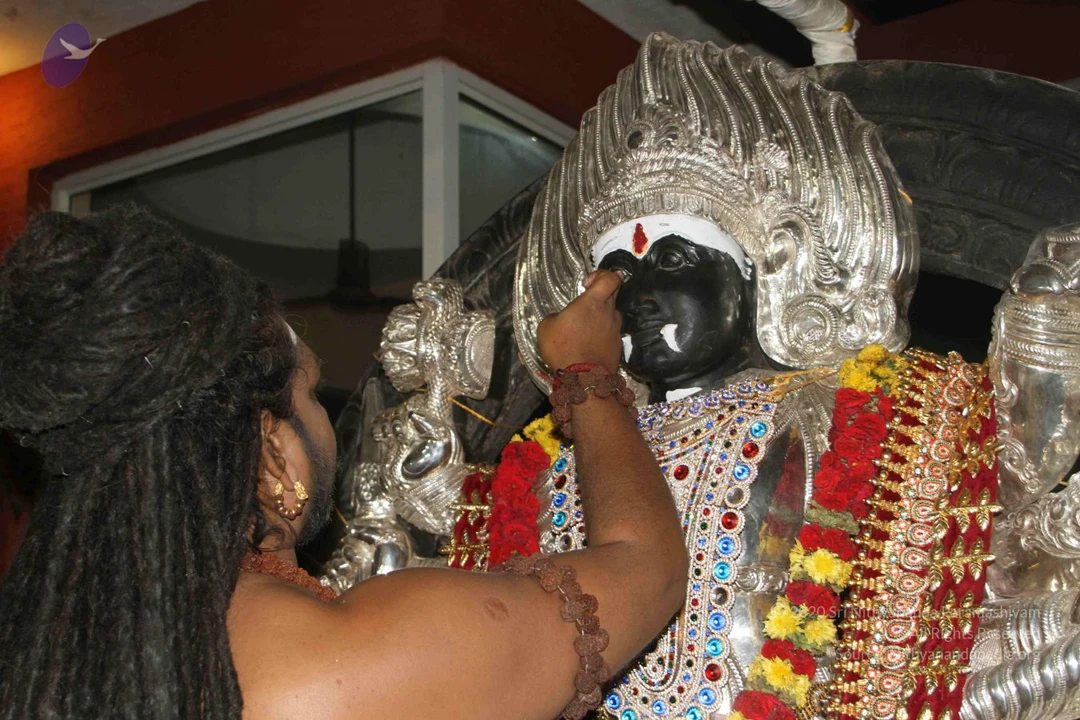
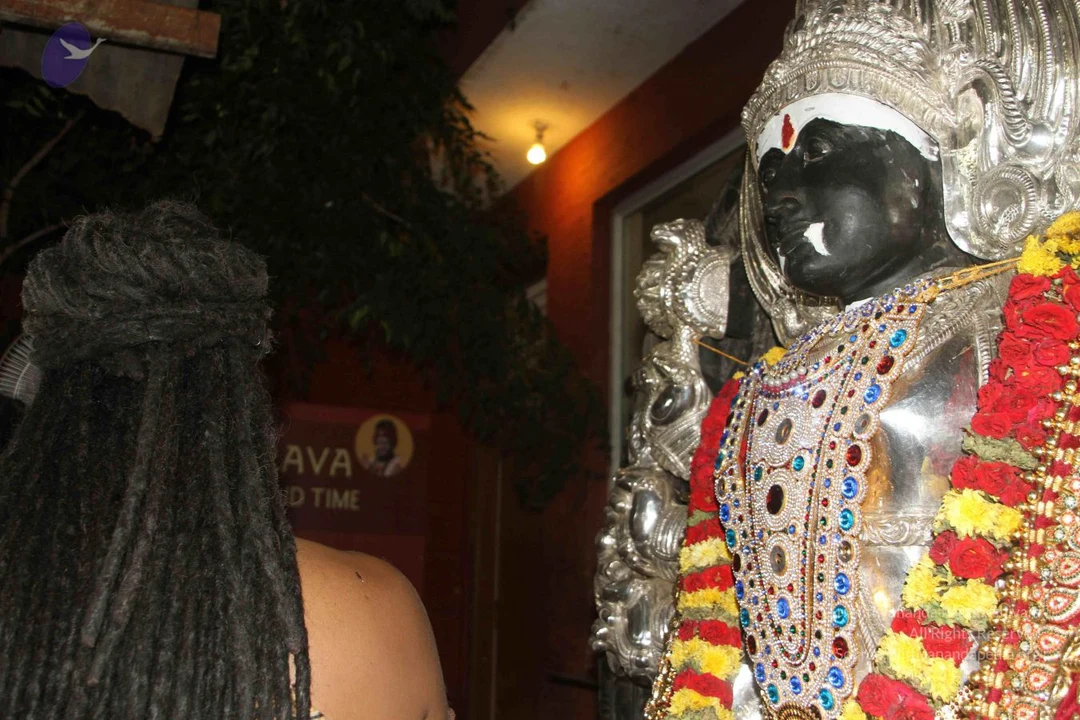
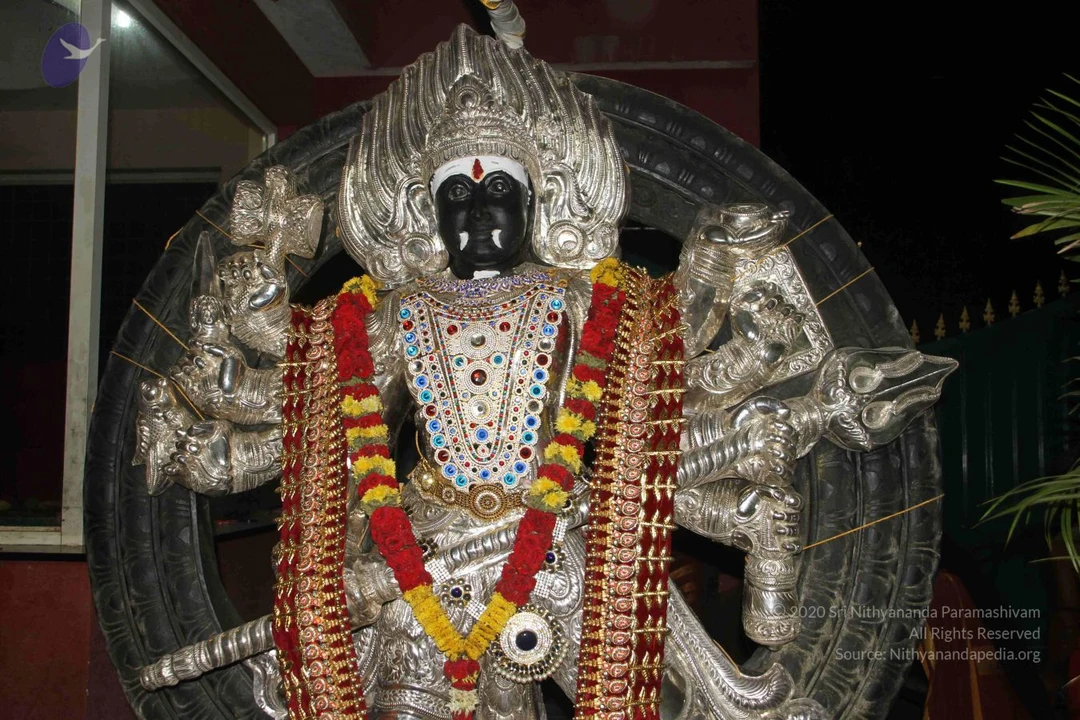
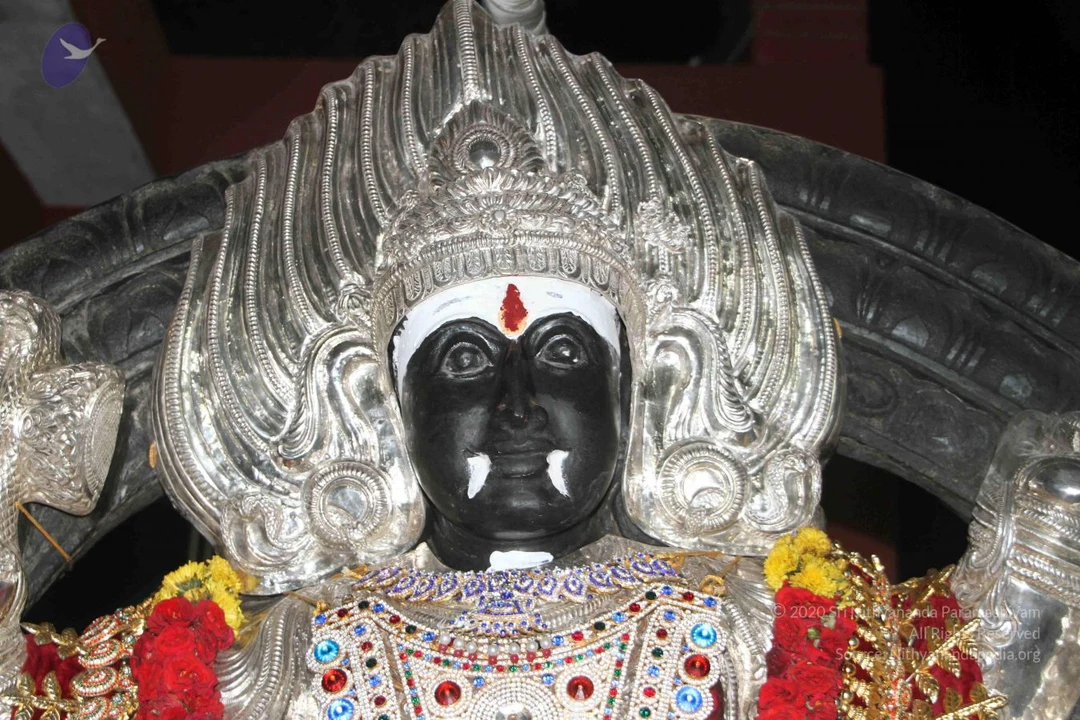
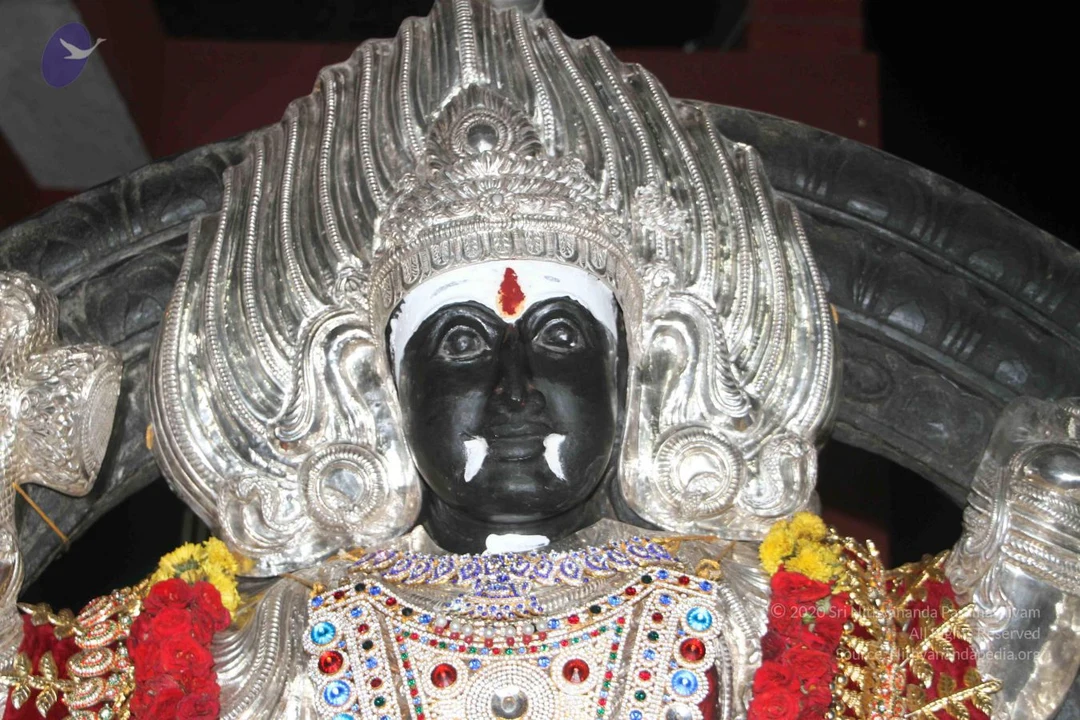
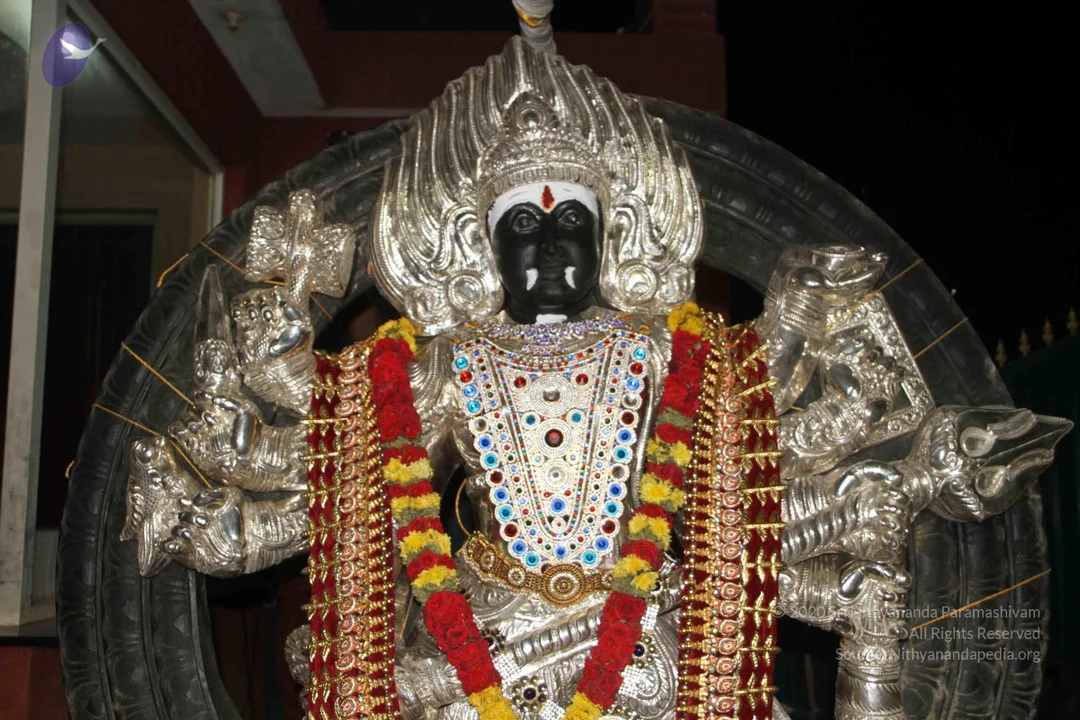
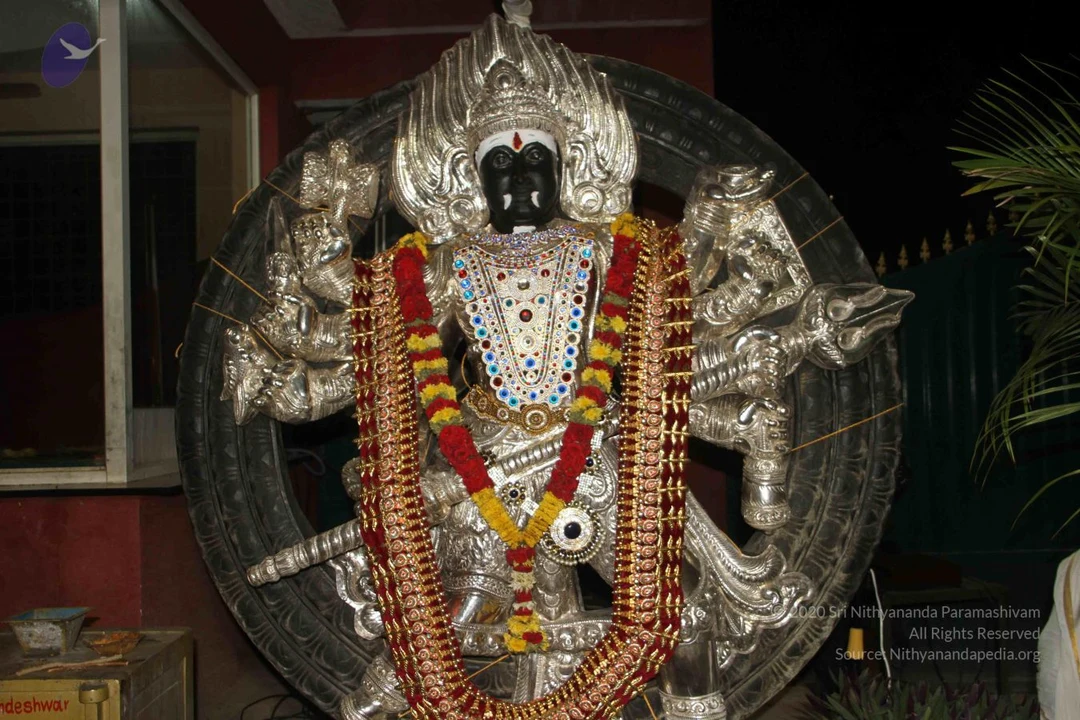
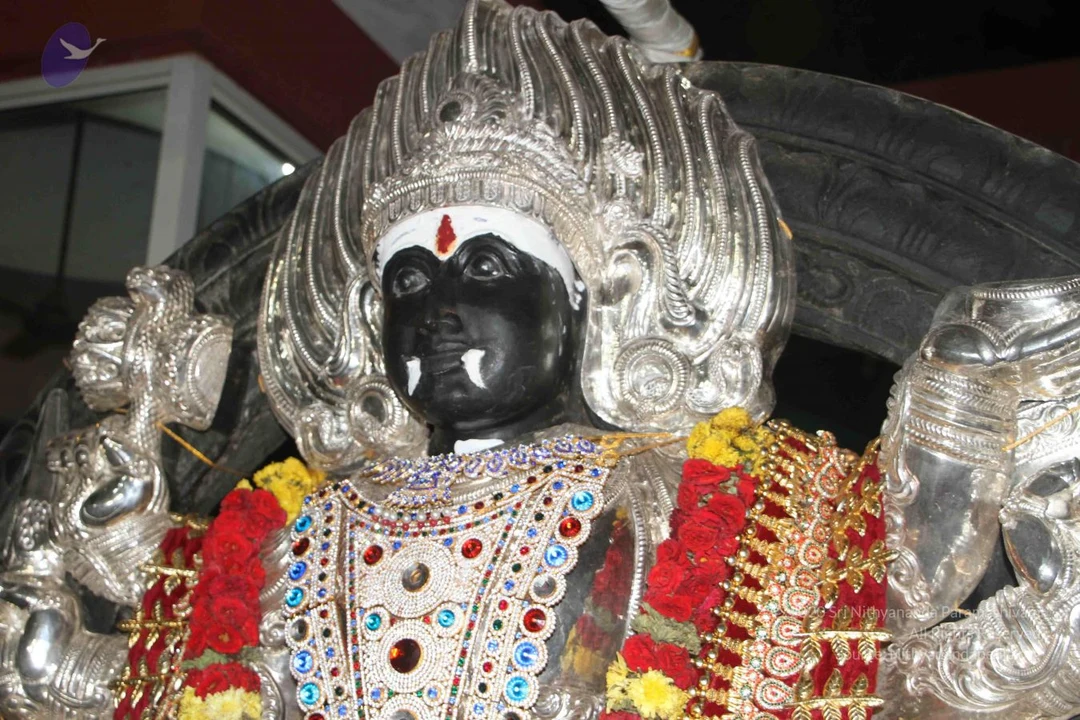
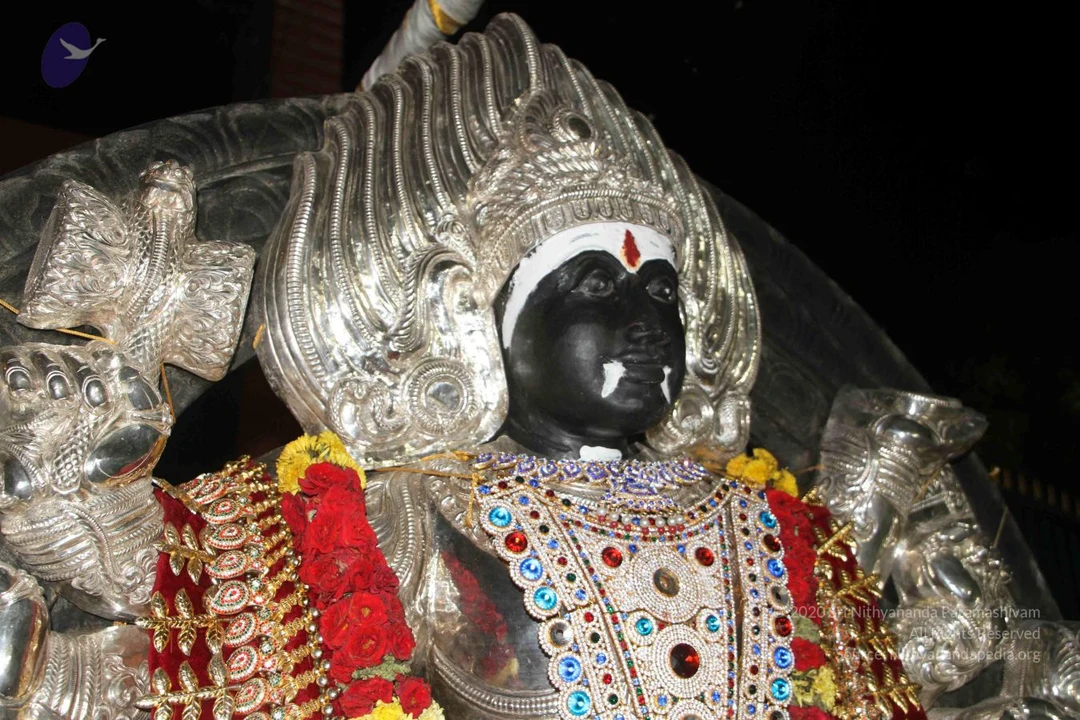
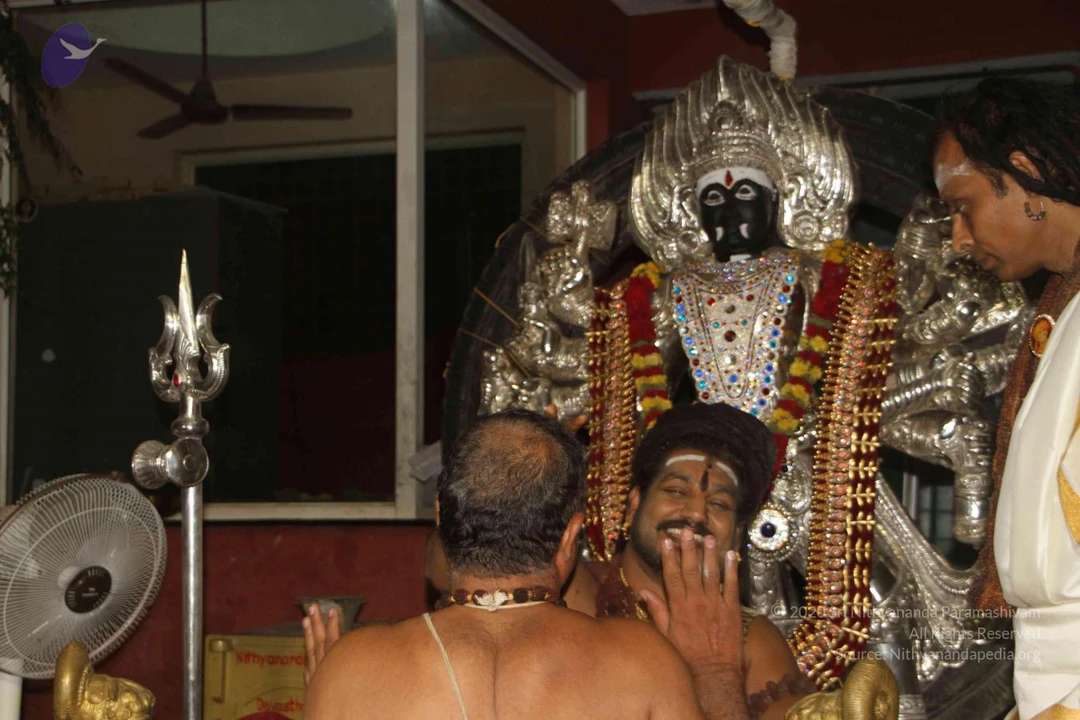
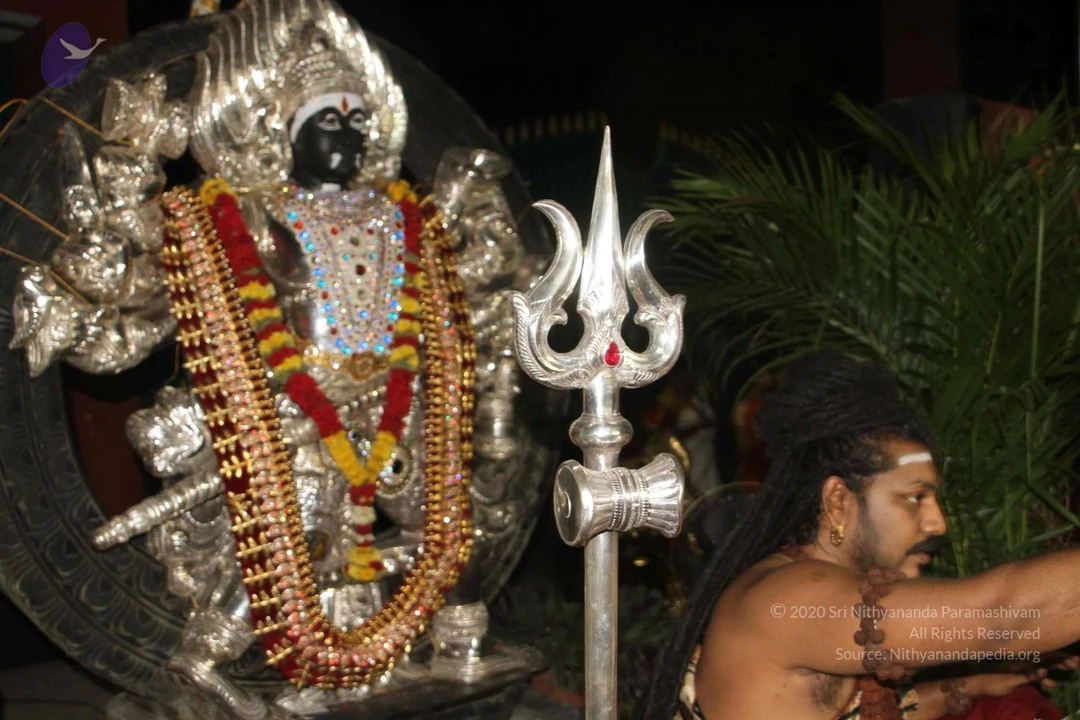
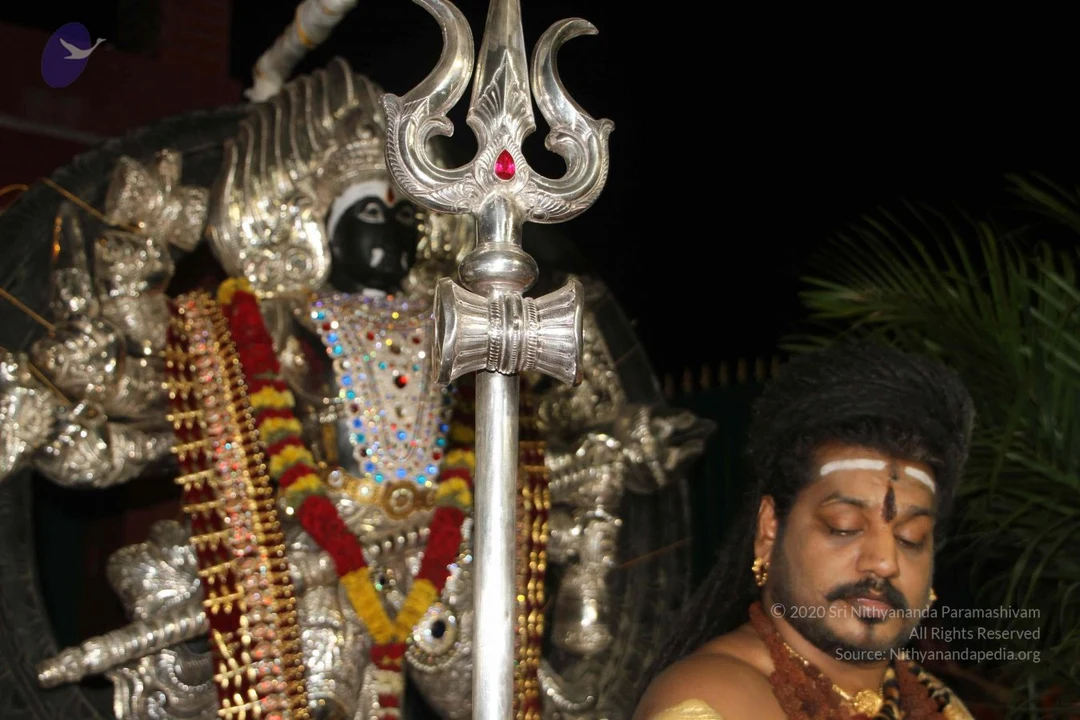
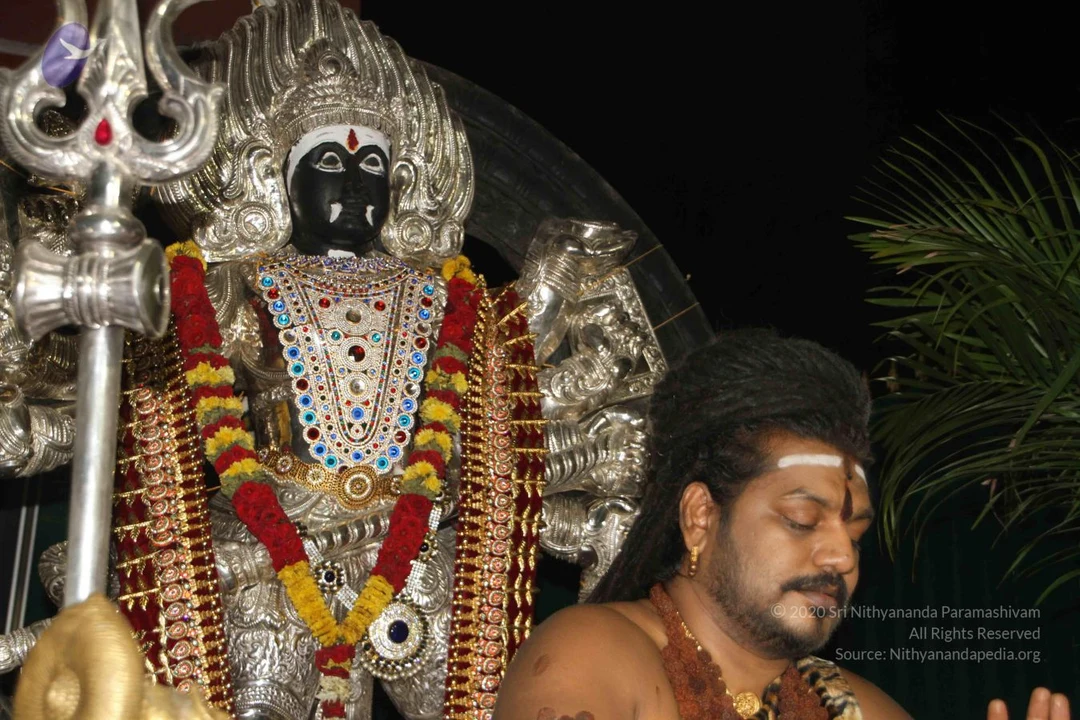
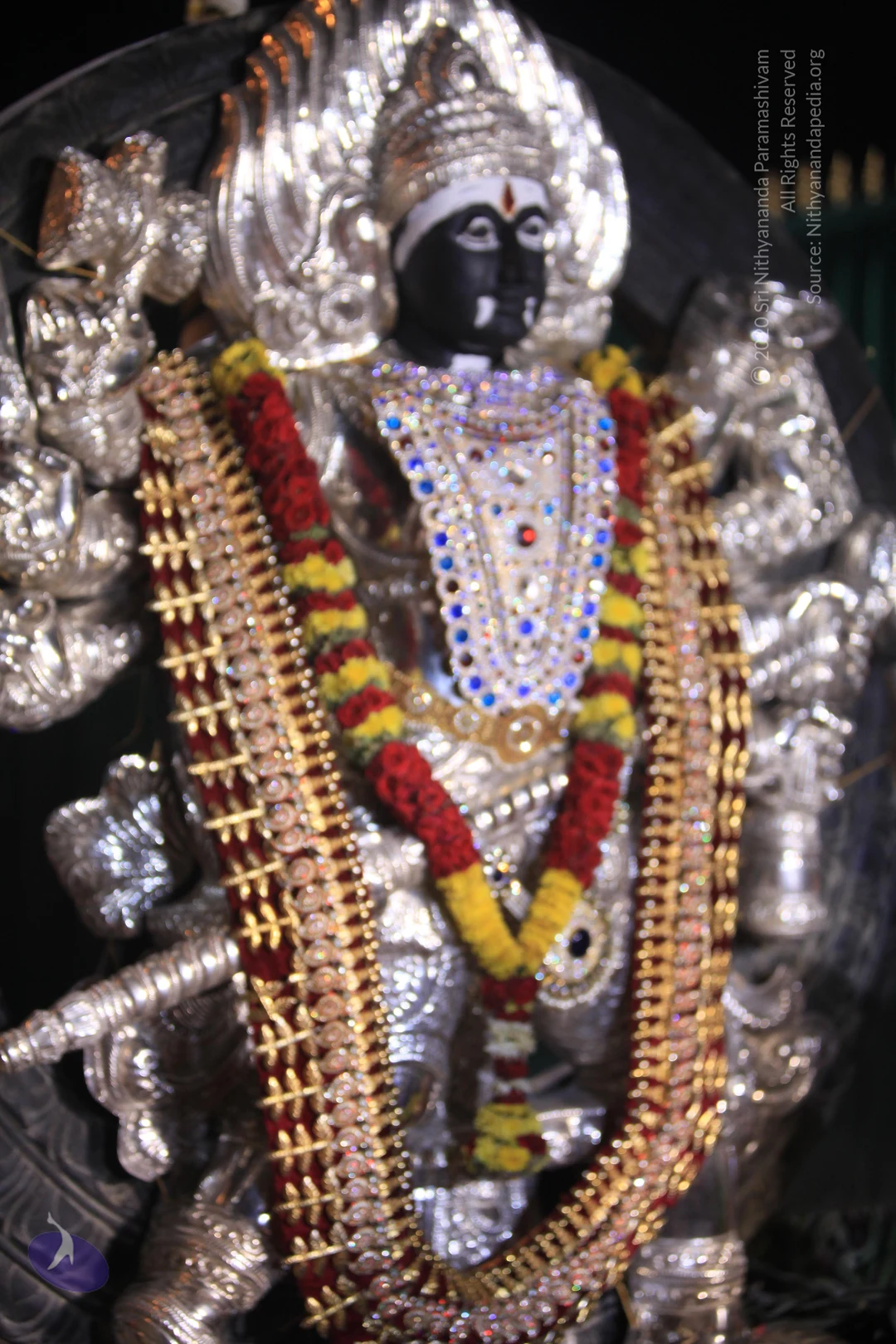
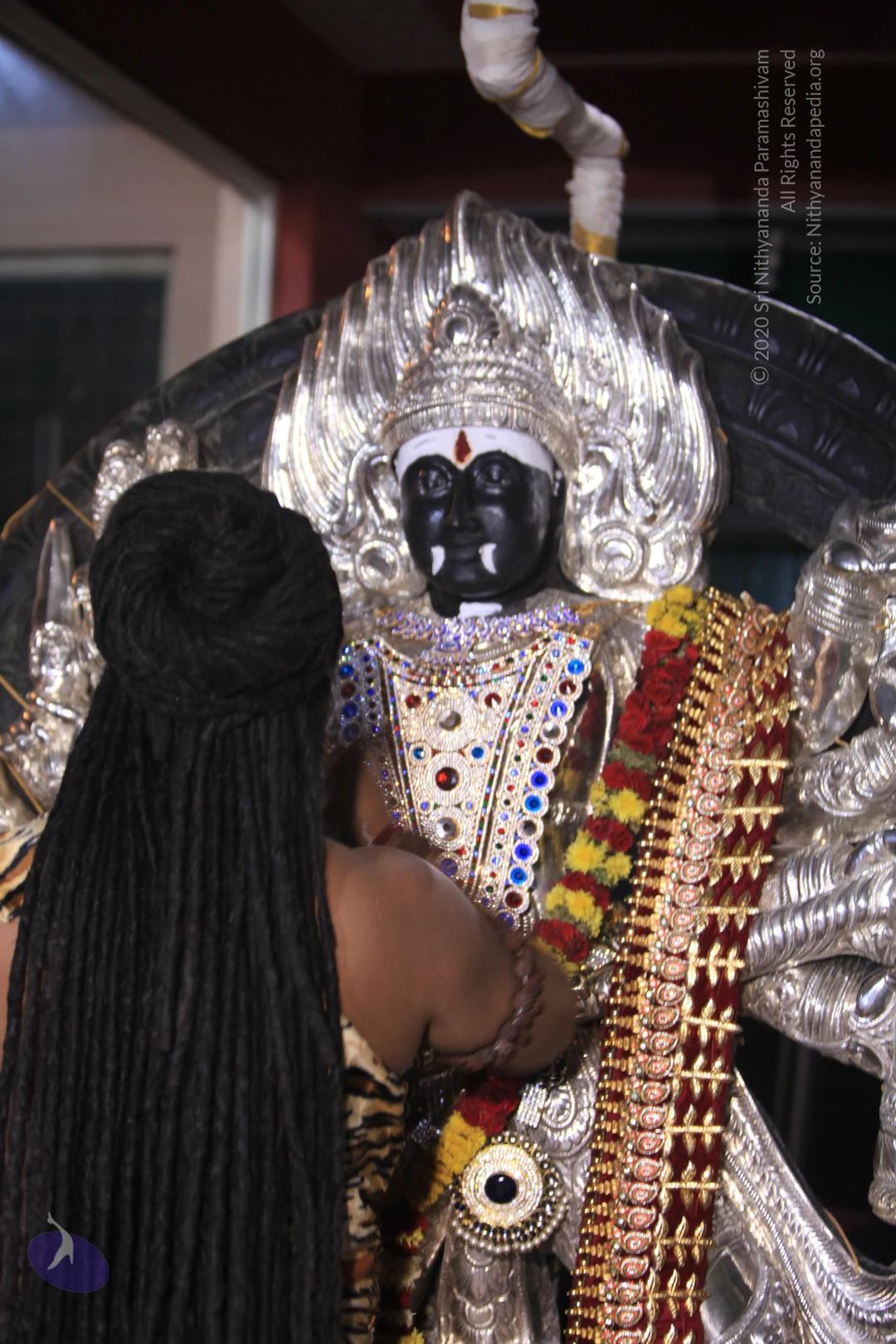
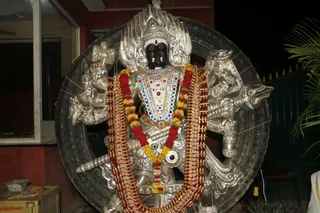
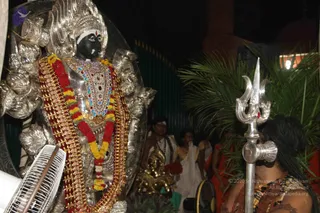
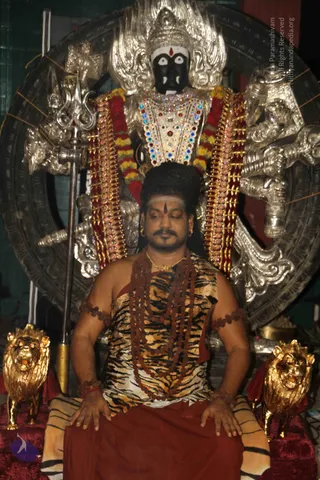
A photograph of a silver deity murti of Kalabhairava at night, set before a circular silver halo-like frame with silver weapons and a trident-like arrangement behind it. The black-faced murti wears a silver crown, a jeweled breastplate with colourful stones, and a garland of red, yellow and white flowers over a gold chain. A small brass lamp and a tray of offerings sit at the left edge, and a partial white-clad figure appears at the far right. The setting appears to be an outdoor courtyard with a red wall and green gate.

PRATYAKSHA-PADA-POOJA

10 photosSource gallery
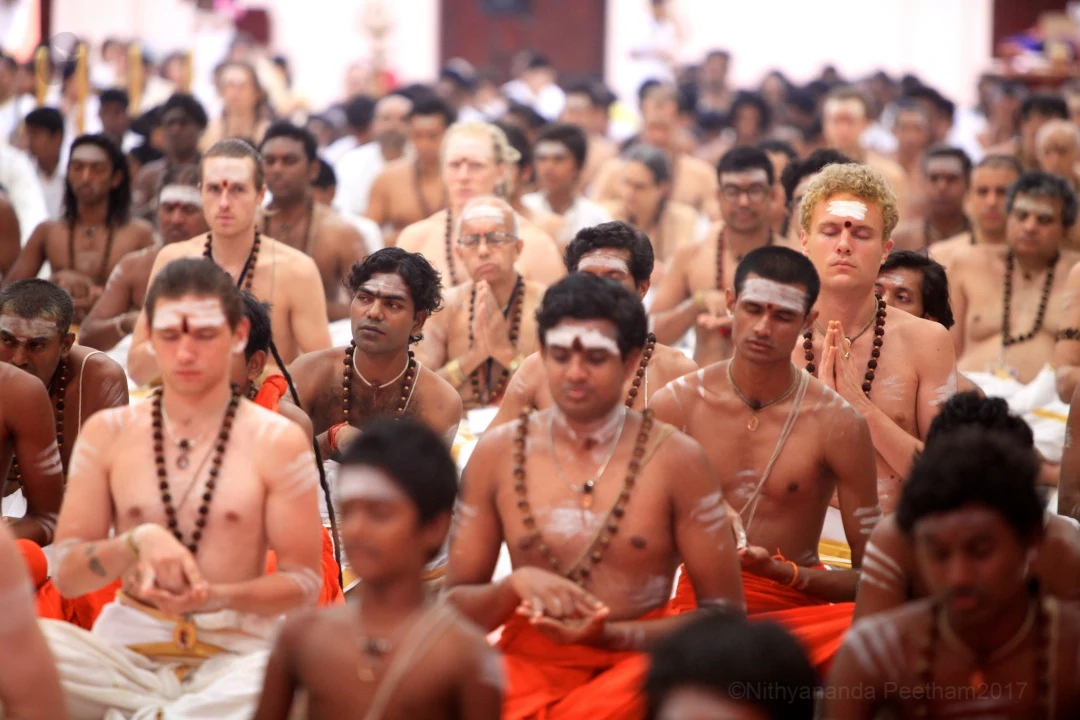
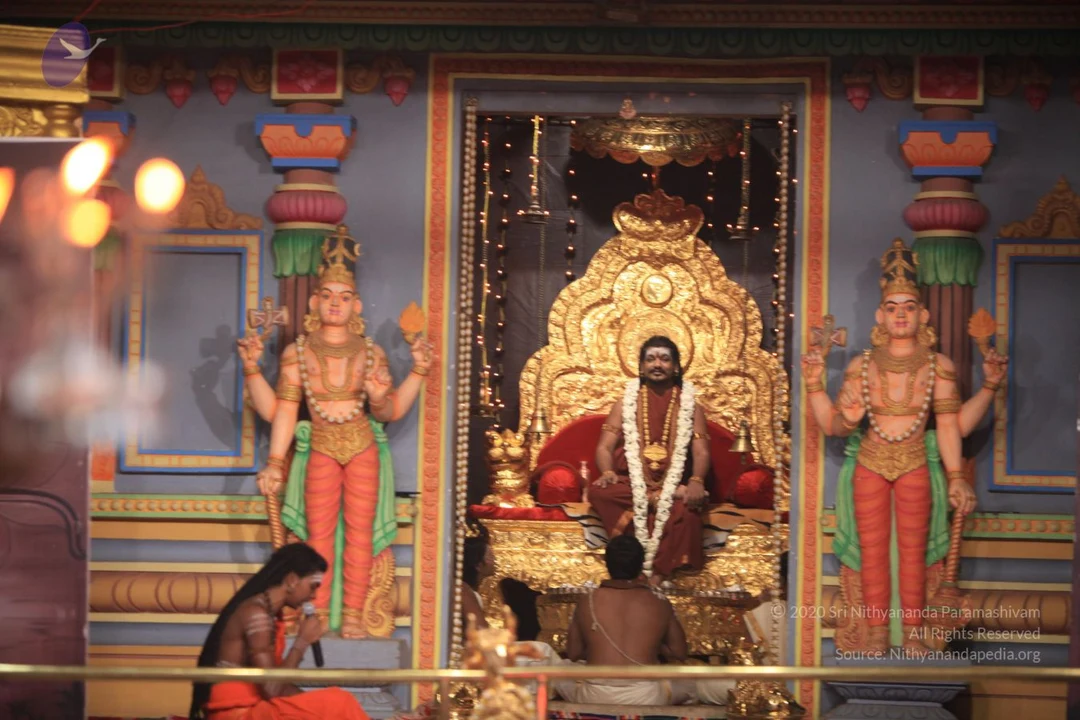
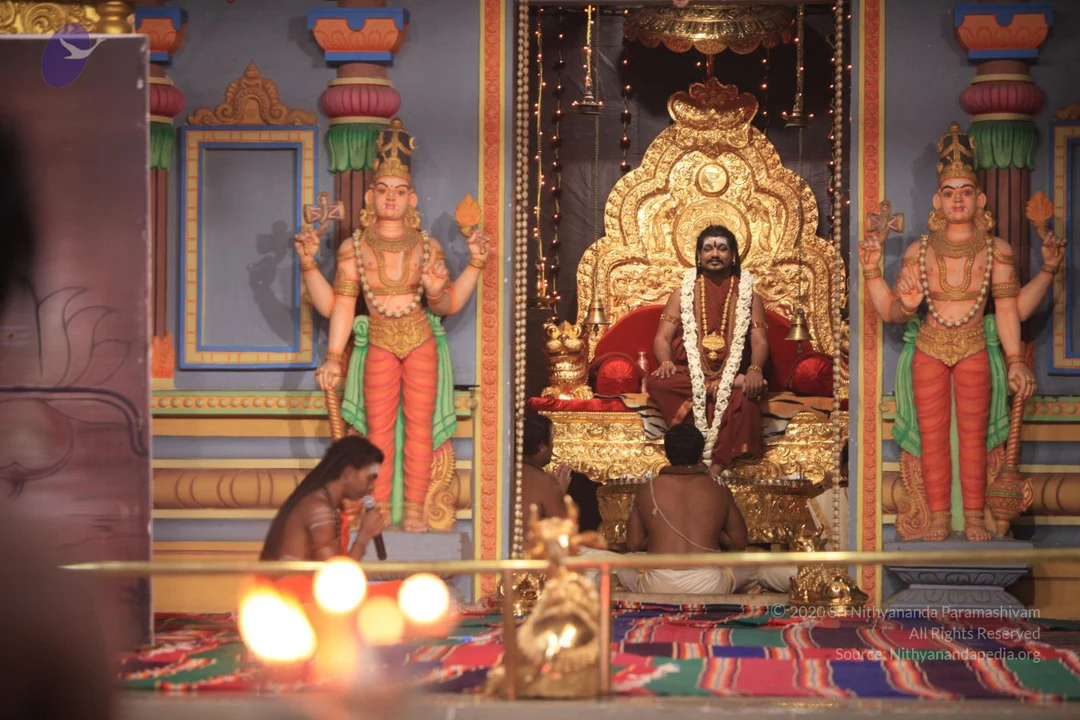
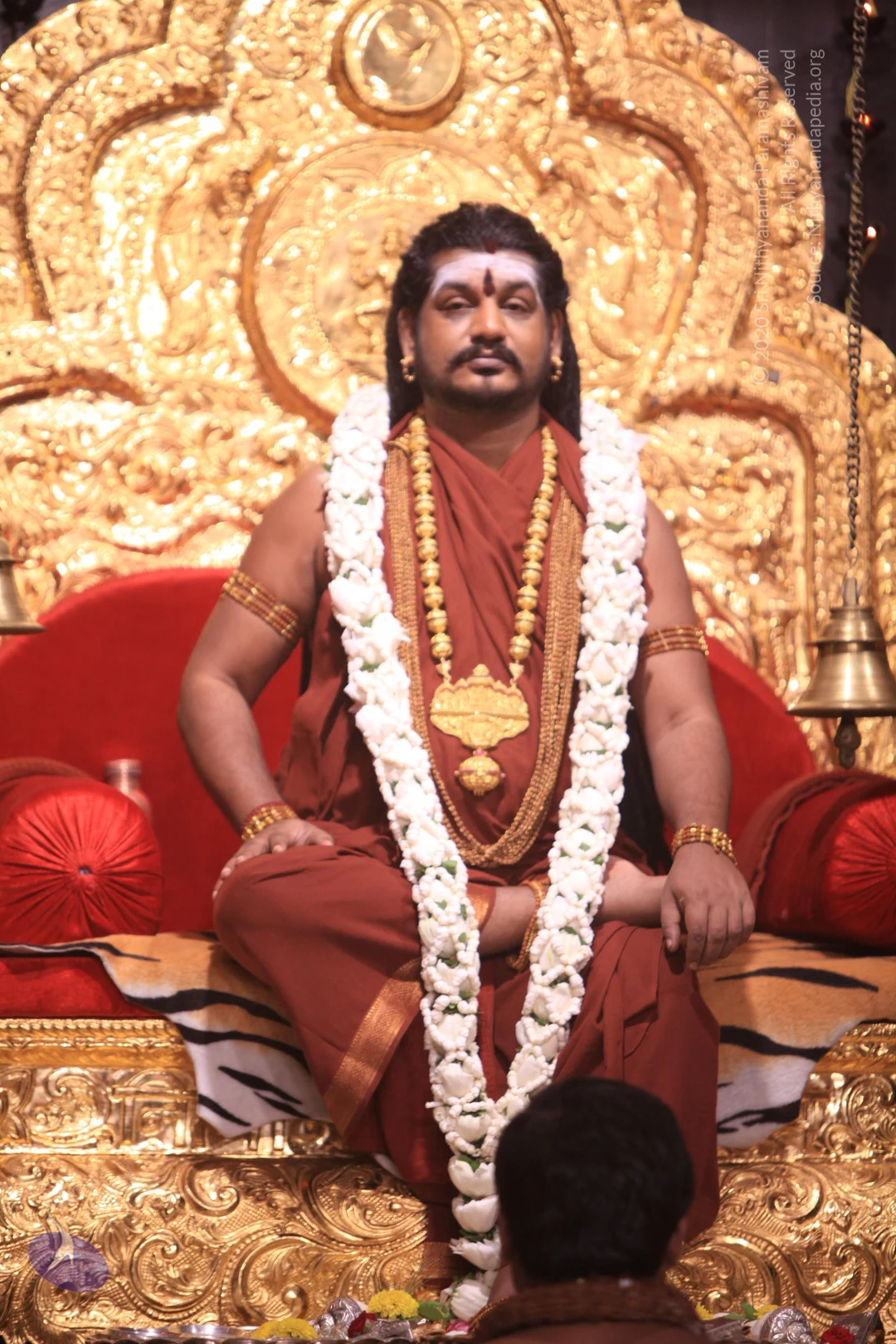
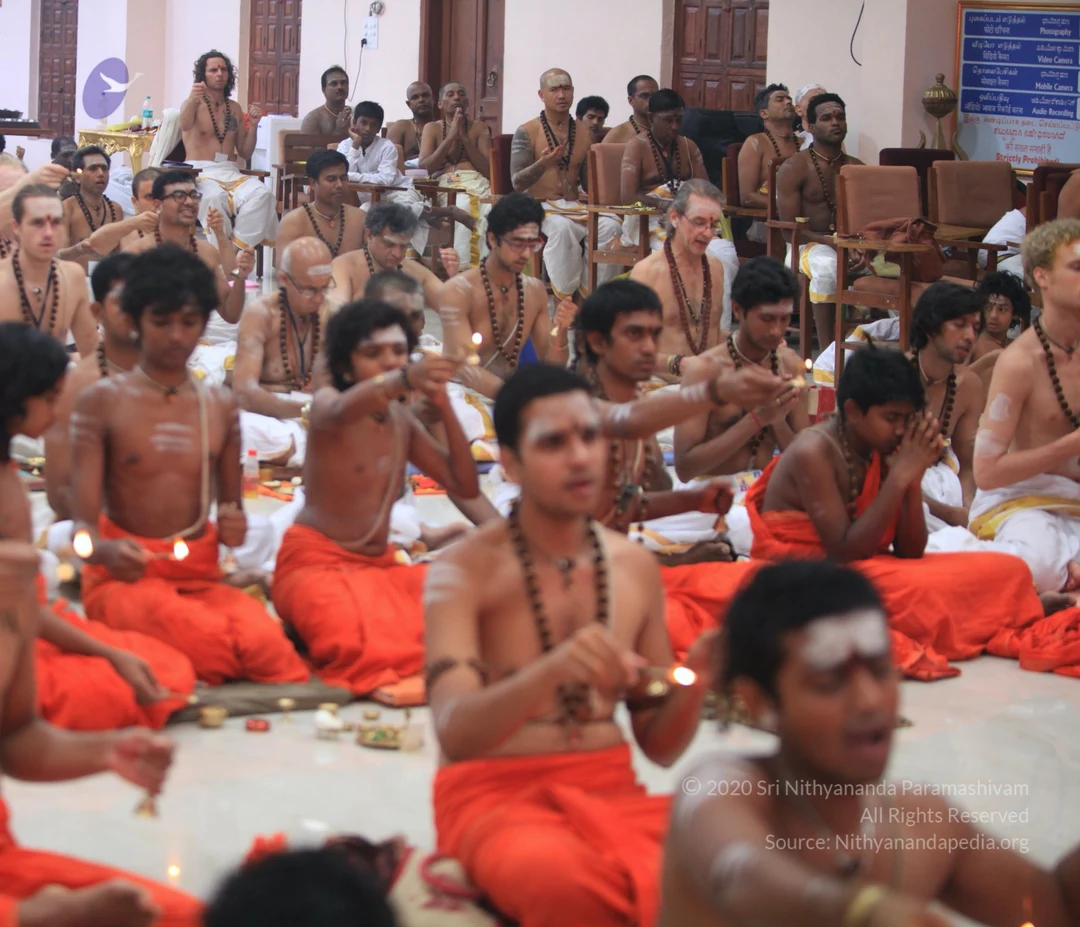
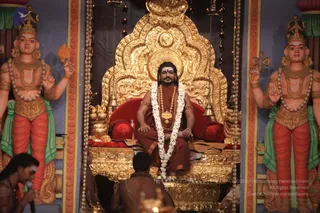
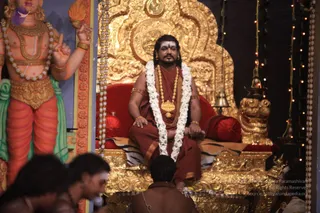
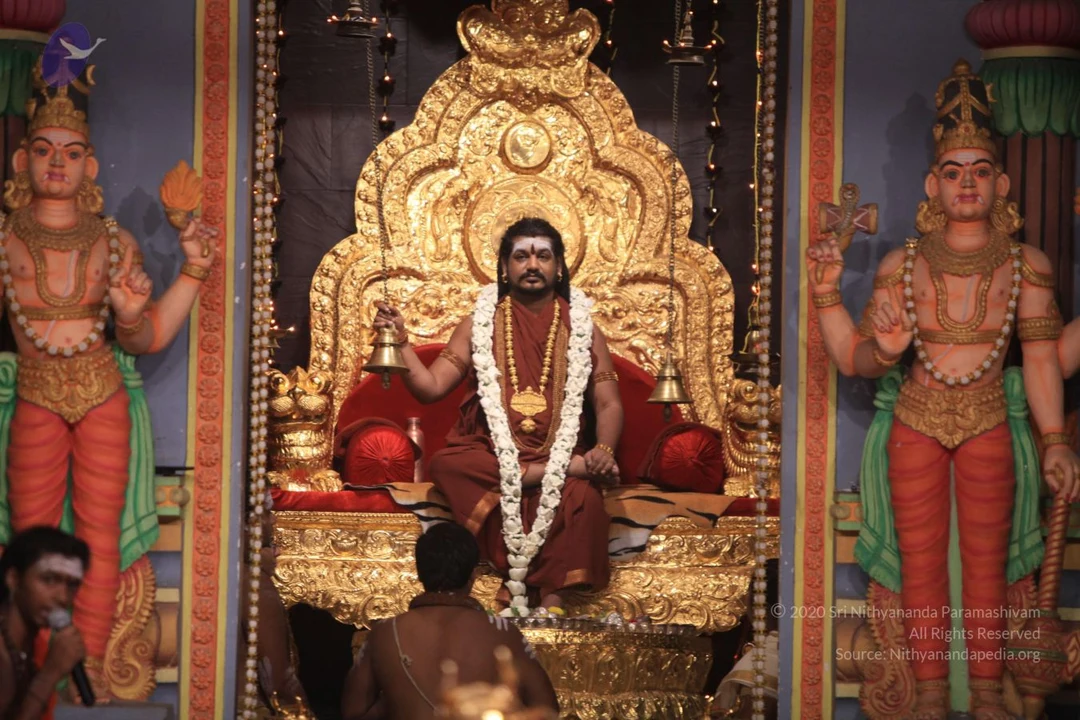
A seated man in saffron-orange robes sits on an ornate gold throne with red cushions, a white jasmine garland draped over his shoulders and a gold pendant at his chest, ringing a small brass bell held in his right hand. Two tall painted deity murti flank the throne, each with multiple arms, gold crowns, beaded necklaces and orange-red dhotis. In the lower left, a man in a white shirt holds a microphone, and in the foreground a bare-backed priest in white dhoti faces the throne, while brass oil lamps hang above. Swamiji (probable): the seated man has long swept-back hair, saffron robes, a rudraksha-style beaded mala and a ceremonial gold necklace, seated on a throne during a puja.A seated man in saffron-red robes sits on an ornate gilded throne with red cushions and a tiger-striped cloth, wearing a long white flower garland, a gold pendant necklace and a rudraksha-style mala. Swamiji (probable): the seated figure has long dark hair and ceremonial gold necklaces, consistent with the page's mention of Swamiji. Two large painted deity statues in orange dhoti and gold jewellery flank the throne. At lower left a man with a microphone speaks, and in the foreground a shaved-headed attendant in a bare-chested pose sits facing the throne with a brass vessel nearby. Gold bells hang from the canopy and a gold kalasha-like offering sits before the throne.A seated man in a golden ornate throne, dressed in rust-red robes with an orange sash, wears a white jasmine garland, a gold pendant necklace, bangles and a forehead vibhuti marking, with hair swept back. Behind him, a red velvet cushion and a gold carved lion-head armrest surround the throne, and hanging bells and string lights frame the dais. A painted deity figure with multiple arms stands at left. In the foreground, two devotees' heads and a bare-backed person in red are seen from behind, facing the throne in darshan. a person seated in a throne, with a devotee offering reverence in the foreground.A large seated assembly of bare-chested devotees in a temple hall, many with white sacred ash bands on their foreheads and bodies and wooden rudraksha malas around their necks. Several wear orange or saffron cloths over white dhotis, and others wear white. Most sit with eyes closed or heads bowed, with hands folded. Foreground figures are blurred. Their presence and the sustained rows suggest a collective ritual sitting. No single figure is clearly identifiable as a person from appearance, so no candidate is named.A photograph from the back of a large hall filled with many seated devotees, mostly women in white and cream sarees and dhotis, with some in yellow, blue, teal and pink floral clothing. Two large screens on either side show a man in red and white robes. At the front, a golden shrine and stage hold deity murtis and ornate decorations. Golden staffs stand upright among the crowd. The scene looks like satsang or darshan in an ashram hall.Interior of a large temple hall viewed from behind a seated congregation of men and boys in white dhotis and white shirts, many bare-chested with rudraksha malas around their necks. Rows of devotees sit on a white tiled floor facing a golden shrine with an ornate gold canopy, lit oil lamps, and a deity murti on a platform. Two large screens on either side show a close-up of a figure in red and white robes. Brass lamps stand along the front edge, and a cameraman's tripod is near the stage. Attendees appear to be in a satsang or puja setting.

NITHYA-SATSANG

13 photosSource gallery
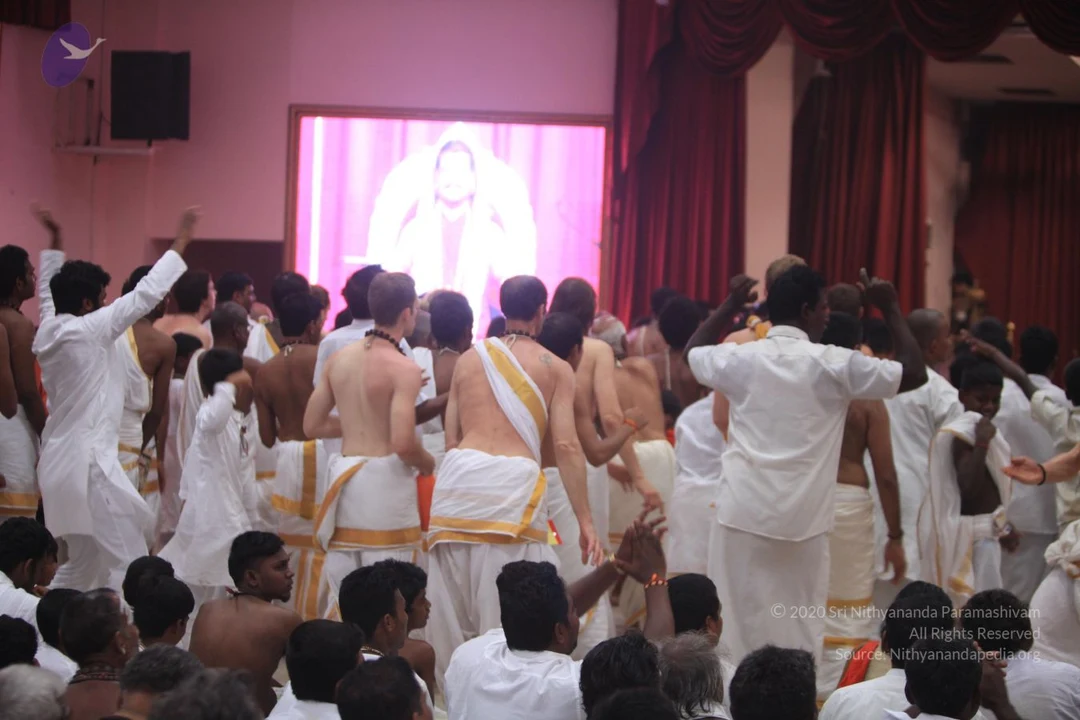
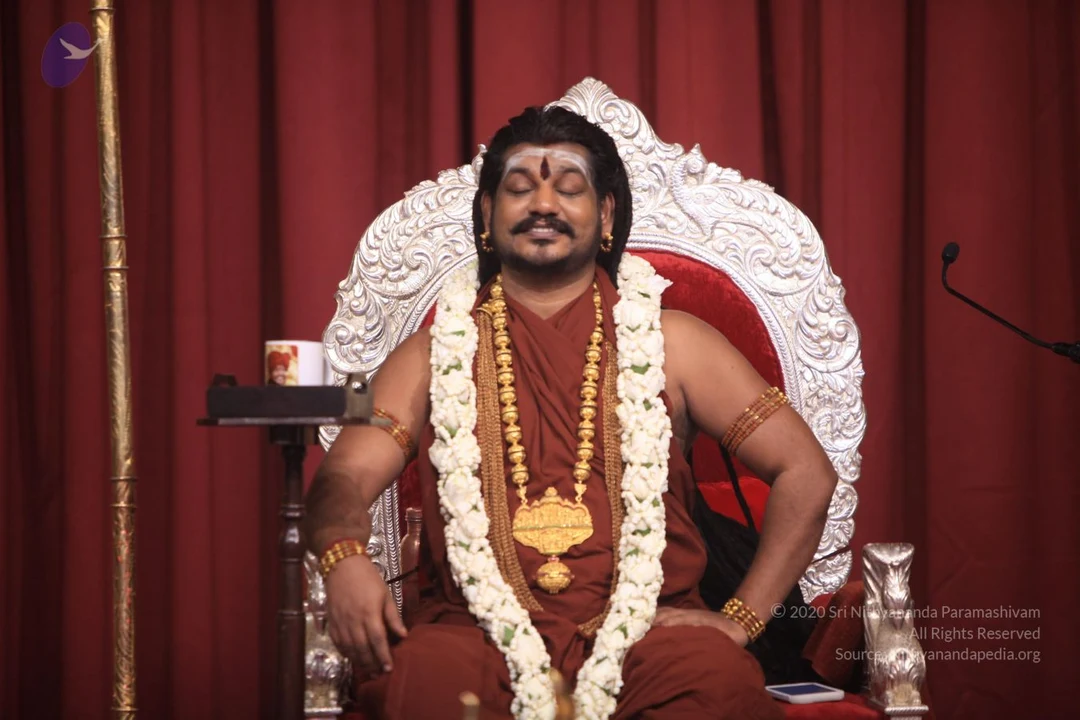
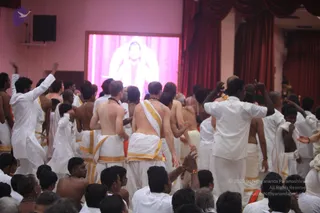
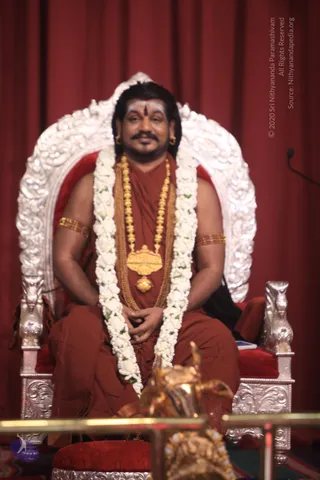
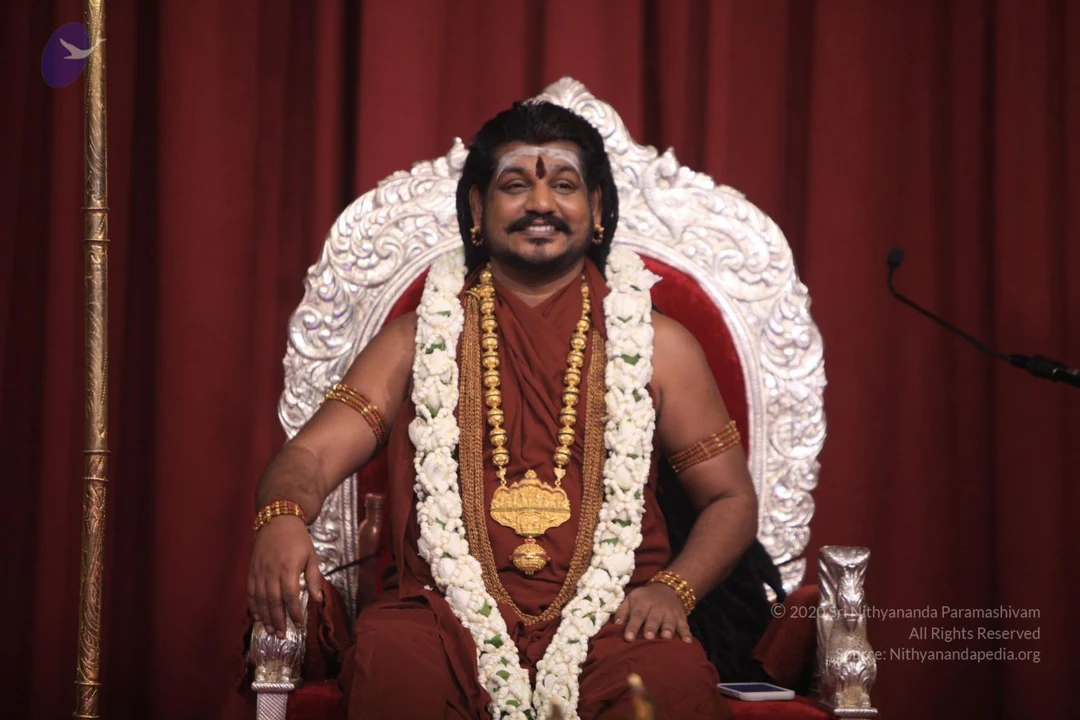
A seated man in a rust-red robe sits on an ornate silver throne with carved scrollwork against a deep red draped curtain. He wears a long white flower garland, a heavy gold necklace with a large gold pendant, gold armlets and bangles, and a red tilak with white markings on his forehead. Long dark hair is swept back. A microphone stands at right and a silver vessel sits beside the throne. Appearance-based candidate: a person, seated in a discourse setting with his hands resting on the armrests.A large crowd of men dressed in white shirts and white dhotis fills an indoor hall, many with white or red tilaka marks on their foreheads. Some wear rudraksha or red threads and one man on the left wears an orange cloth over his shoulder. Several men sit cross-legged on the floor while others stand in the background with bare chests and white dhotis. Wooden poles or staffs are visible on the left edge, and the hall has framed artwork on the walls behind the crowd.A dense crowd of devotees in white dhotis and white shirts, many bare-chested with gold-bordered white cloths draped over their shoulders, fills a hall. Several raise their arms and hands. A large pink-lit screen at the back shows a glowing projected figure with arms raised, surrounded by a bright halo, and red curtains frame the stage. Some devotees wear rudraksha malas. The scene resembles a congregational satsang or discourse viewing.A man with long dark hair, a red-orange tilak on his forehead and a thick moustache sits eyes closed on an ornate silver throne with a red cushion before a red velvet curtain. He wears a rust-red robe, a long white flower garland, a heavy gold necklace with a pendant, gold bangles and a rudraksha-style ornamented chain. A white cup sits on a small wooden side table and a microphone stands at right. A gold-finished staff stands at left.A man seated on an ornate white and silver throne in front of red drapes, speaking into a microphone on a stand. He wears a rust-orange robe, a heavy gold necklace with a pendant, gold bangles on his upper arms, a white flower garland, and a white-and-red forehead tilak. His right hand is raised in a gesture while he talks. A small framed picture of a saffron-turbaned figure sits on a stand at left, and a silver vessel is at the lower right. Discourse setting. Swamiji (probable): long swept-back hair, a gold pendant necklace and ornate ceremonial clothing in saffron tones, consistent with the page's discourse context.A large seated audience fills the frame at an indoor satsang or discourse. Many men wear white dhotis and shirts, some bare-chested with sacred ash and kumkum marks on their foreheads. In the foreground a young man with long light-brown hair, bare-chested, wears rudraksha malas and palms pressed together. Beside him a bearded man in a saffron-orange shawl and white forehead markings sits with hands joined. A few devotees hold small bamboo or wooden sticks, and a banner with a blue emblem hangs at top left. The photograph is taken from the front, looking across rows of devotees.

KALABHAIRAVA-HOMA
26 photosSource gallery
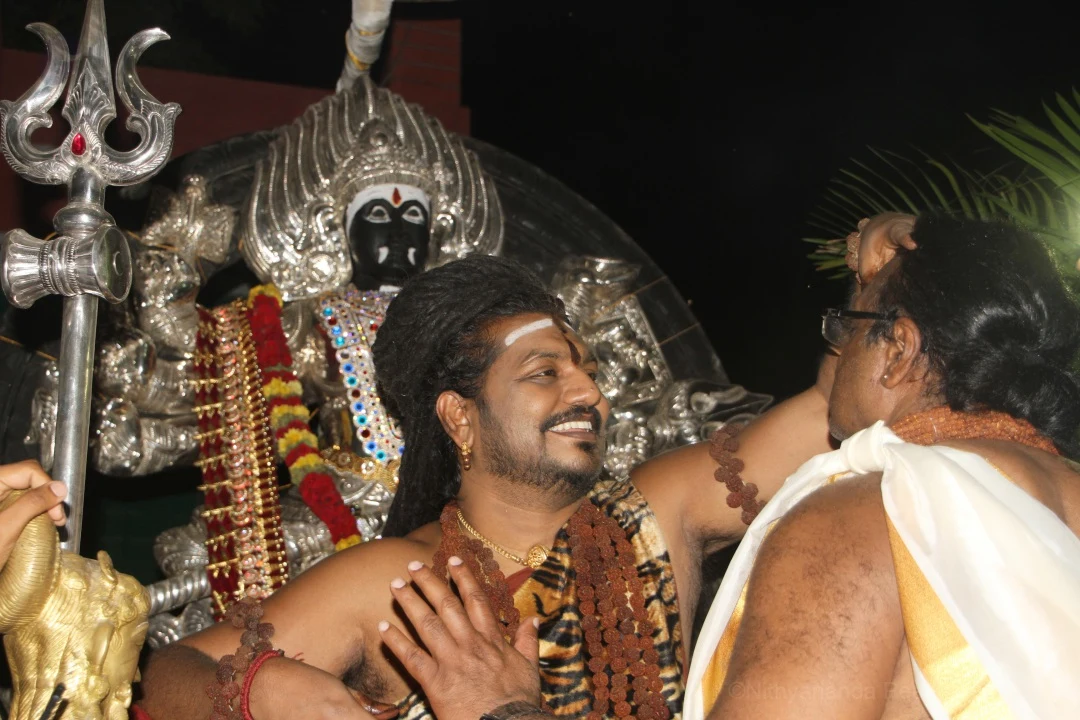
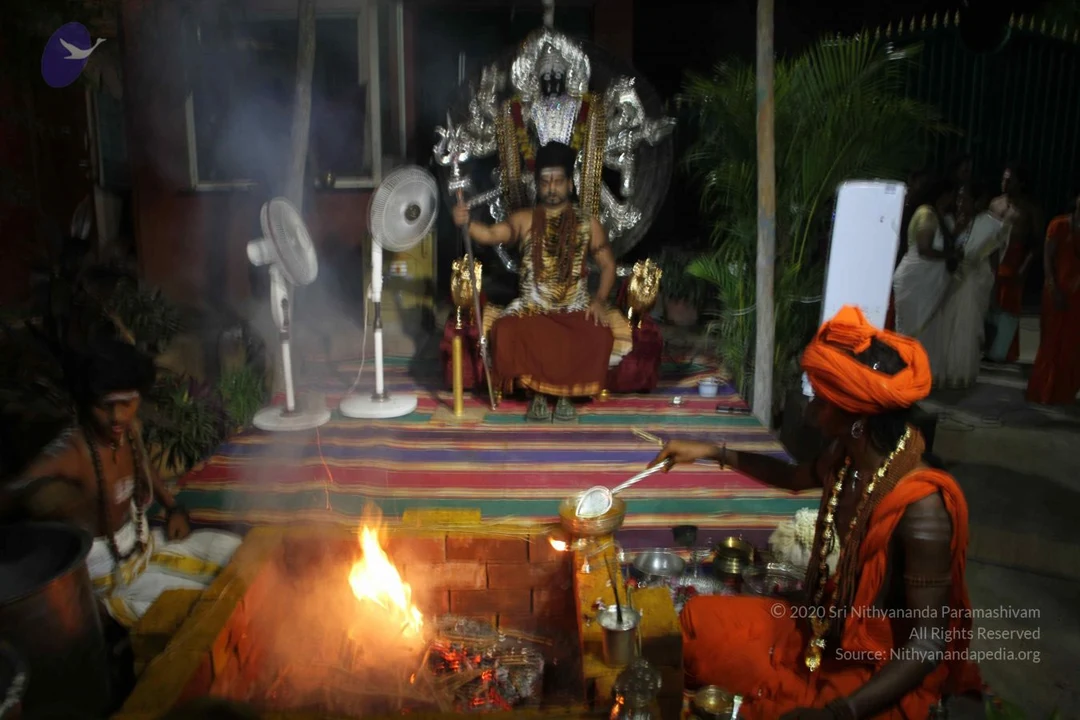
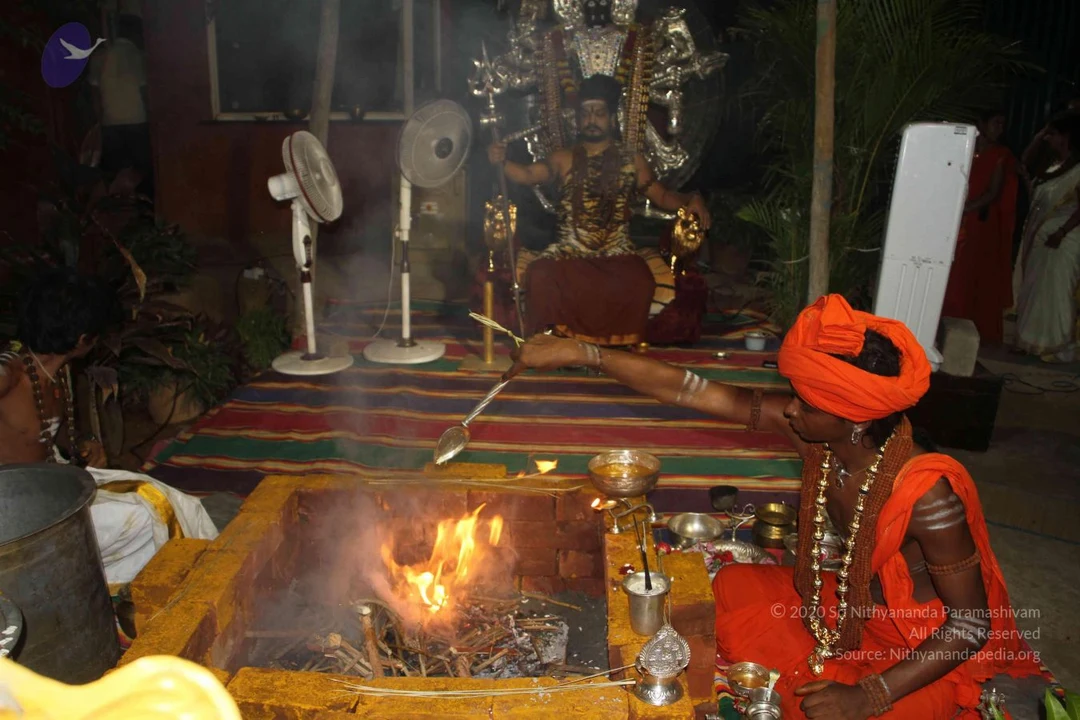
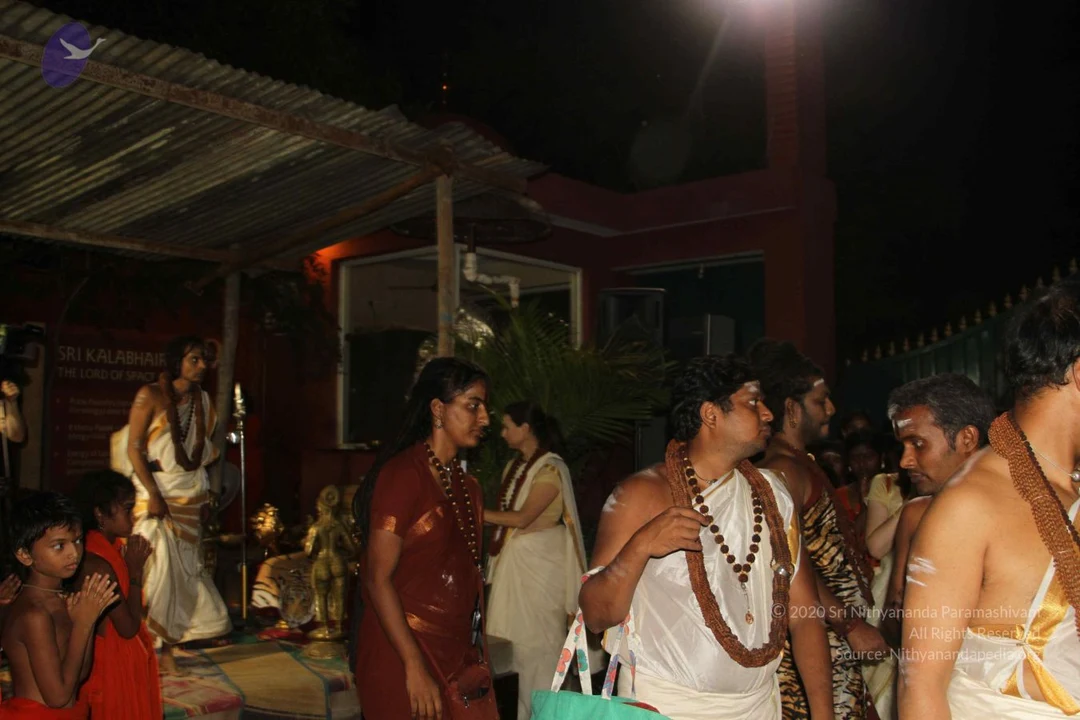
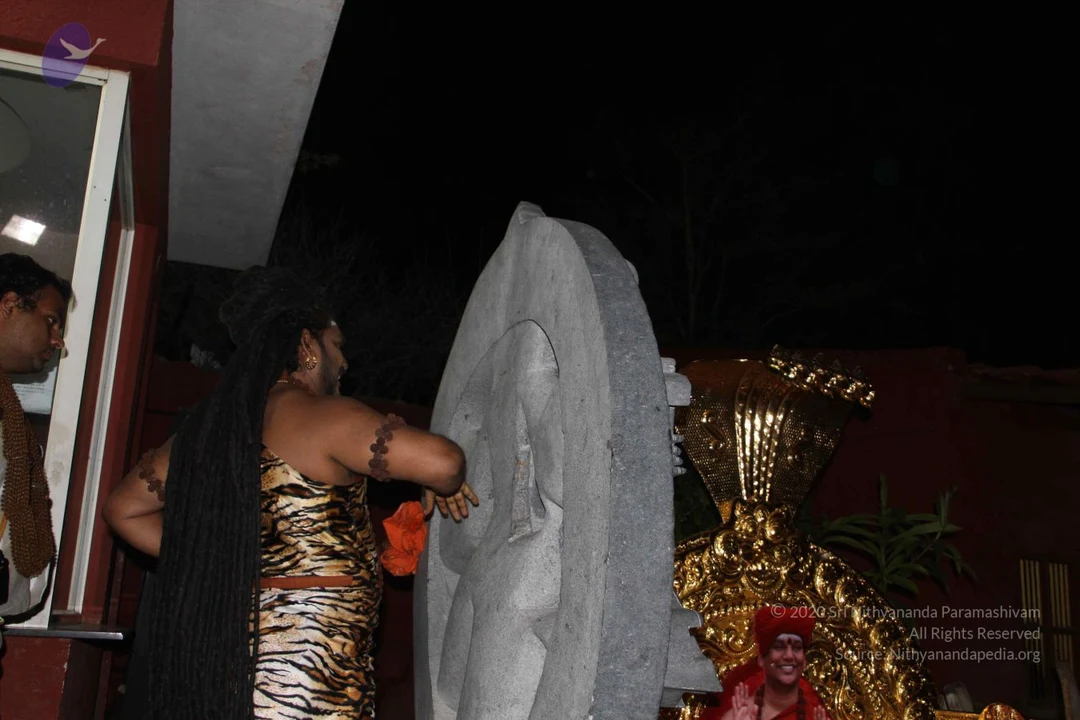
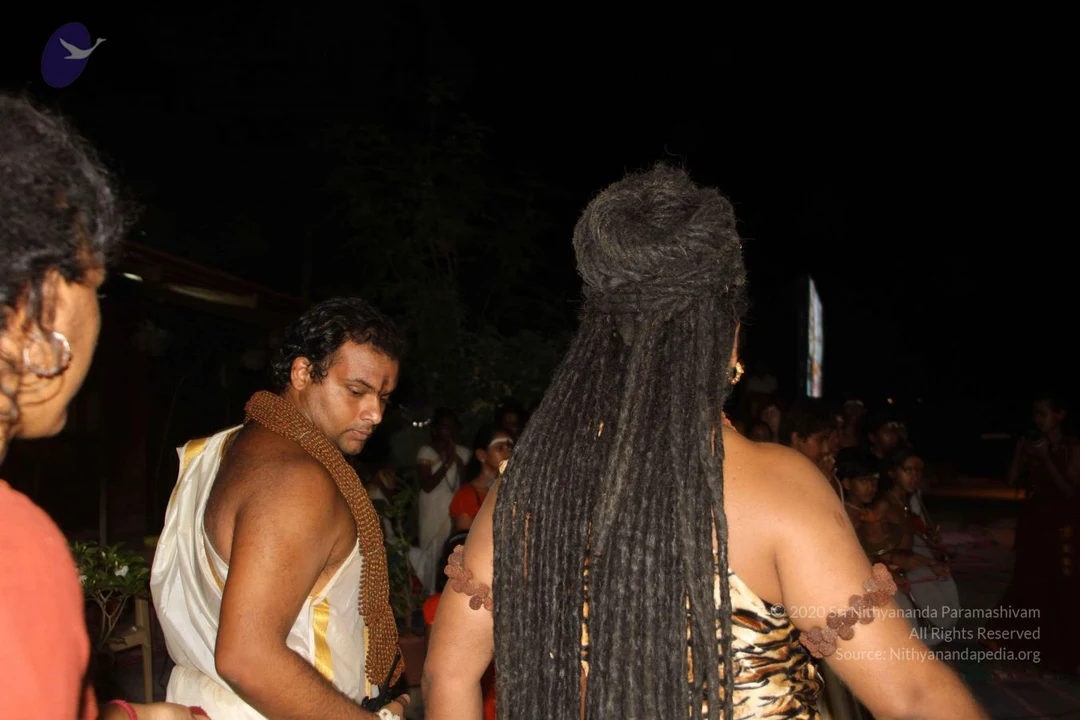
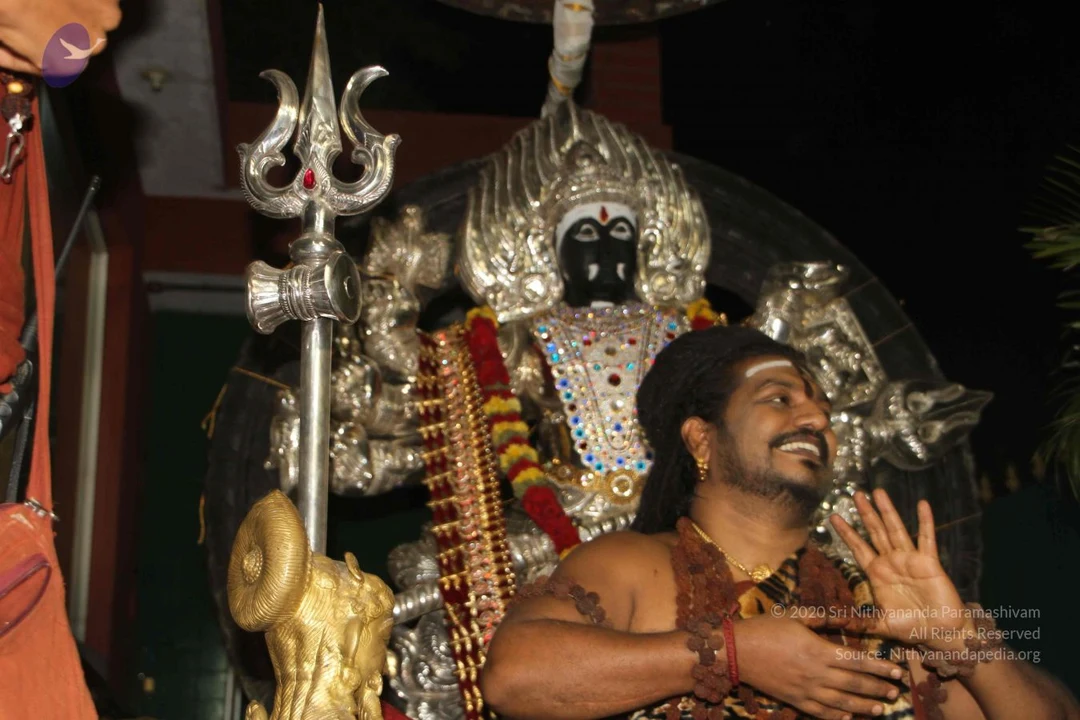
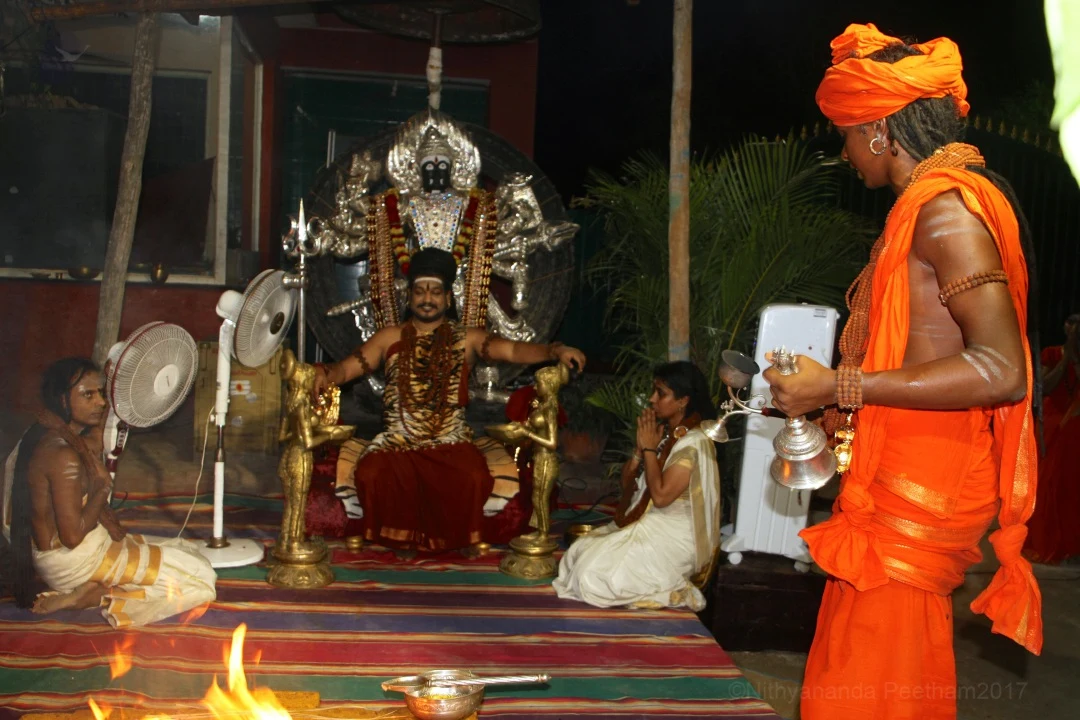
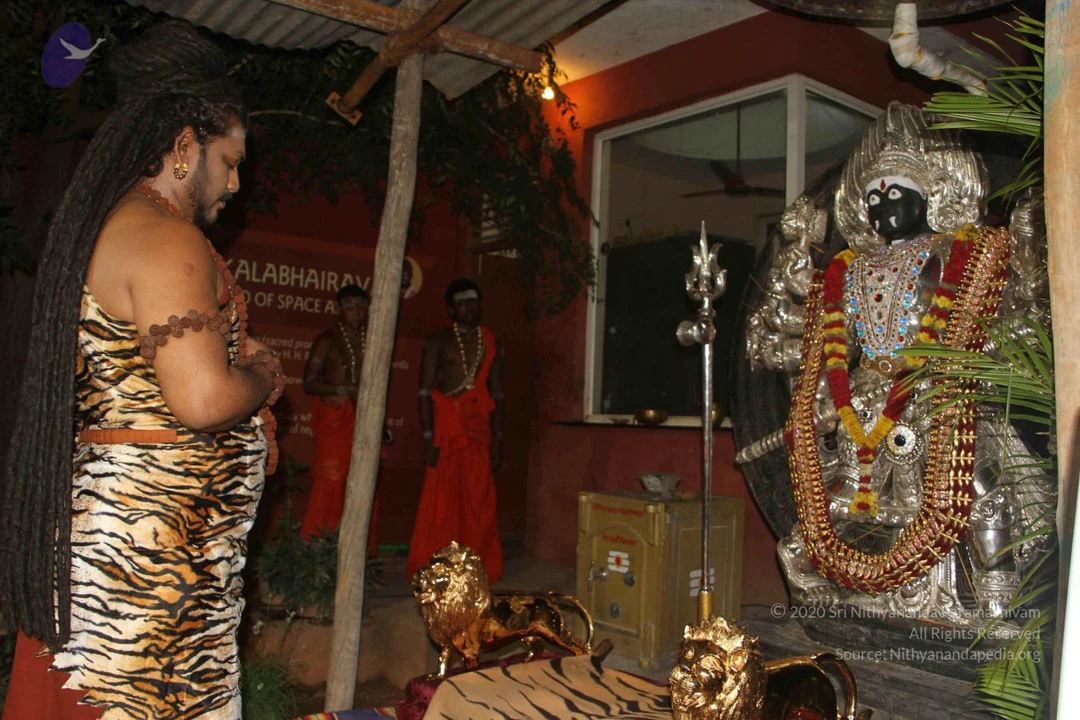
A man with long dreadlocks stands at left, bare-chested under a tiger-striped wrap, with rudraksha beads on his arm and neck, hands folded in prayer before a silver deity murti. Two men in orange-red dhotis with rudraksha malas stand behind him. The silver murti, adorned with gold and jewelled ornaments and red-and-yellow flower garlands, stands at right beside a trident and a golden lion figure. The small shrine room has a red wall and a golden safe. The scene appears to be a devotional moment at a shrine, and the standing figure's appearance is not clearly confirmed as a person.Night photograph of a shrine in an open-sided ashram structure with a corrugated metal roof and red walls. A long-haired man with a rudraksha mala and gold earring stands at left in a tiger-striped garment, hands joined in prayer, with a long-haired man wearing a rudraksha bead necklace and ornate gold necklace who is stepping forward to the left of the shrine. Two men in saffron-orange dhotis and rudraksha malas stand with hands joined in the background. At right stands a silver deity murti of Kalabhairava with a black face, jewelled ornaments, red and yellow garlands, and a silver trident in front. A golden lion figure and a small brass lamp sit on the altar. Banner text partly visible on the red wall.Night-time homa at an outdoor ritual area with a small brick fire pit burning brightly at the lower left. A seated figure in an orange-red dhoti and a sash, wearing a rudraksha mala and gold necklaces, sits before an ornate silver backdrop with a trident-like staff in hand, on a striped cloth with ceremonial gold-tipped seats. A man in white dhoti tends the fire at left. In the foreground right, a figure in an orange turban and orange shawl with gold chains pours an offering with a ladle into the fire. Standing devotees in white and orange clothing are visible at the far right, and two box fans stand near the altar.Night-time homa at an outdoor ritual area. A fire burns in a brick-and-mud fire pit on a yellow-brown border. A man in an orange turban and orange shawl, with rudraksha beads and gold chains, pours offerings from a ladle into the flames with his right hand. Behind him, a seated figure with long hair and gold ornaments sits before an ornate silver deity murti with trident and crown. Brass kalasha, bowls and an oil lamp sit around the pit. Two fans and a striped mat are visible; a woman in a sari stands at the right edge. Three people are visible, with a fourth partly visible at the left.Night-time ritual scene in an open-air courtyard. A man seated on a raised red-and-gold throne-like seat with a dark crown-like headdress, wearing a rudraksha mala and a red-brown cloth, is flanked by golden lamp-bearer figures and a large silver deity backdrop. A standing attendant in saffron-orange turban and dhoti holds a brass handled ritual vessel and a small bell-like object. A seated woman in white sari with folded hands and a seated man in white dhoti sit on a striped mat, and a fire burns in the foreground. Fans and a white appliance sit nearby.A standing man in saffron-orange robes and a matching orange head cloth performs a fire ritual before a silver deity murti with a tall crown, garlanded with beads. He holds a lit oil lamp in one hand and a pink-and-white cloth offering in the other, while a fire burns in a brick homa pit in the foreground. A second man in white dhoti sits cross-legged on a striped mat to the left beside an electric fan. Brass vessels, a trident-like ritual object and a small kalasha sit near the fire. The setting appears to be a temple shrine at night. Two people are visible.

DARSHAN
28 photosSource gallery
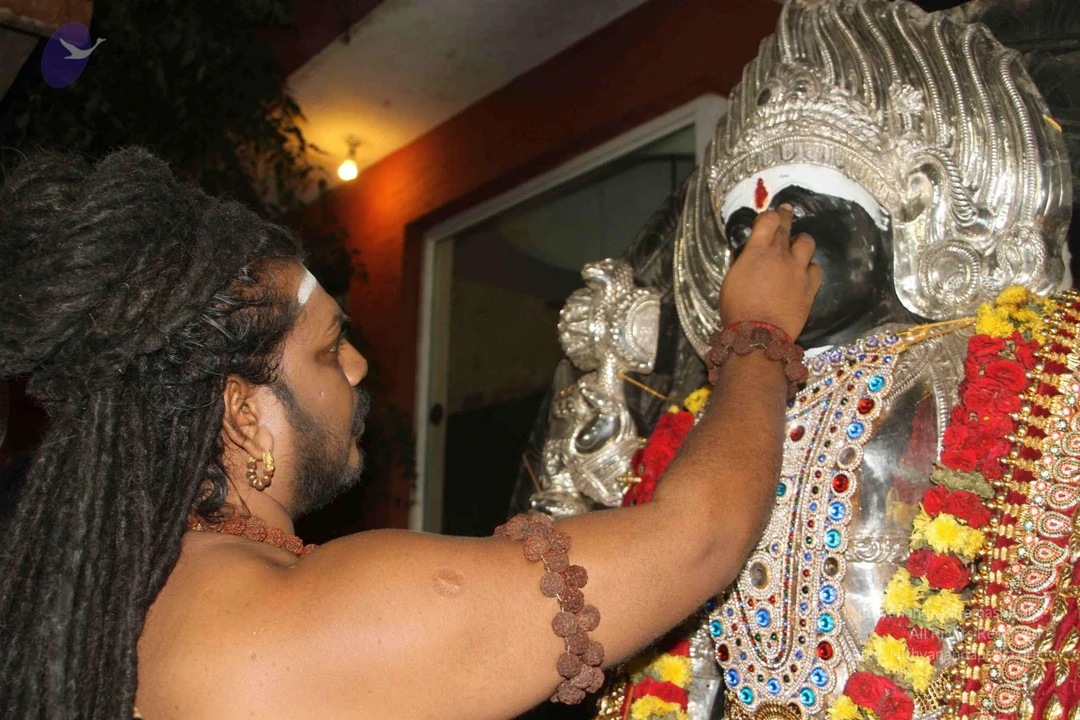
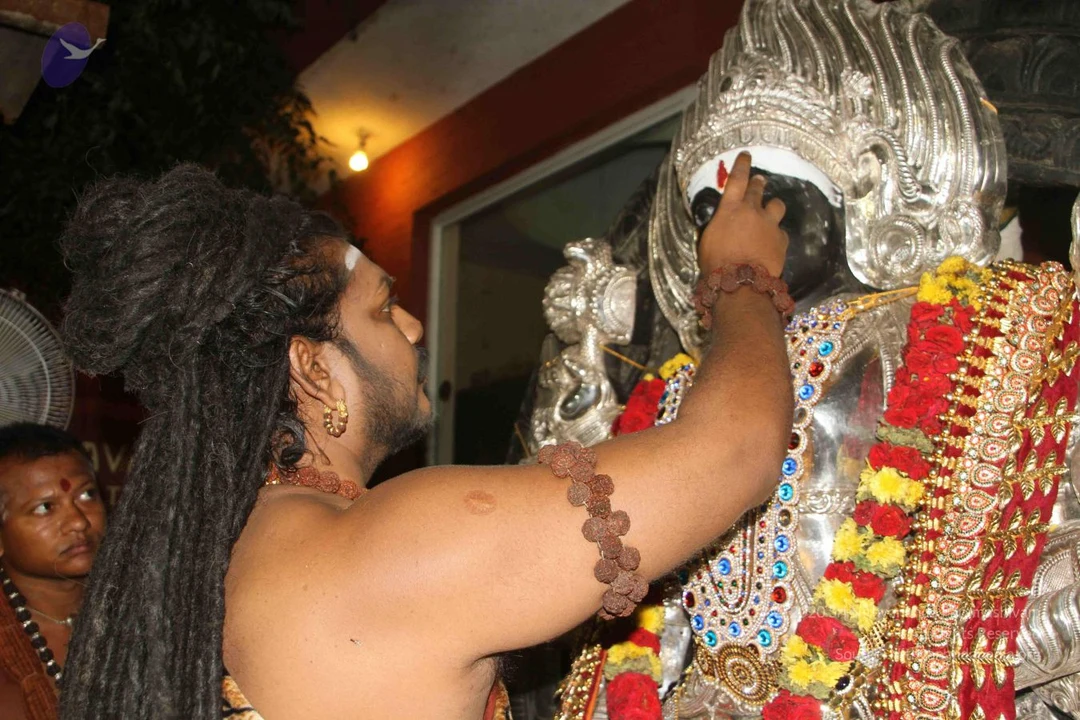
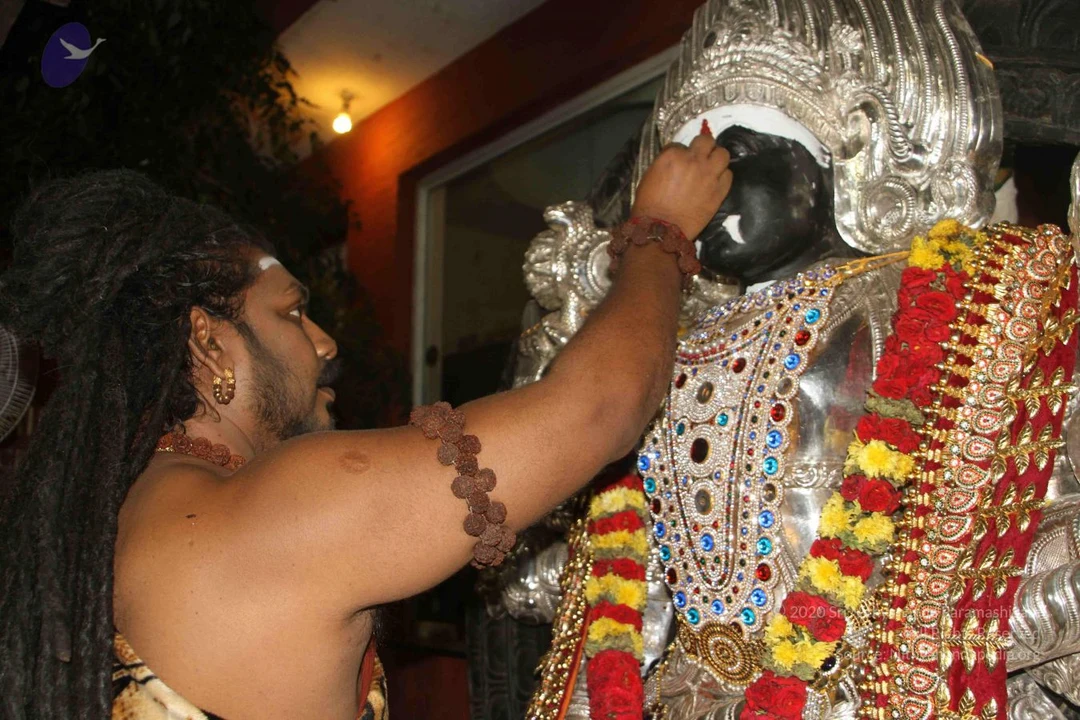
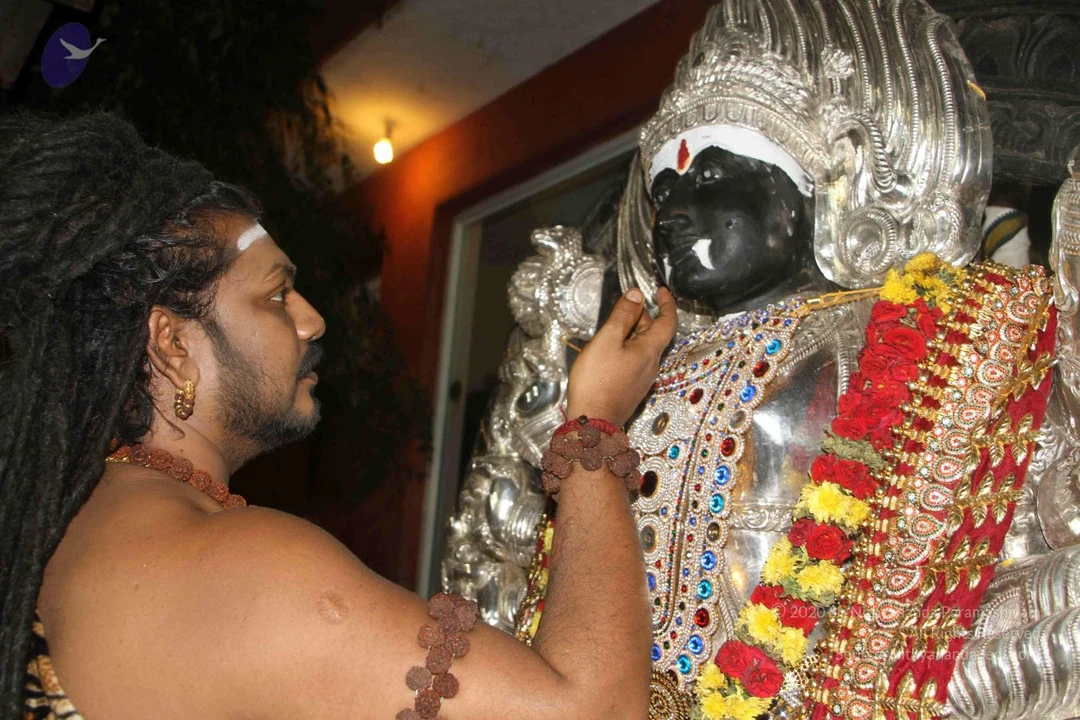
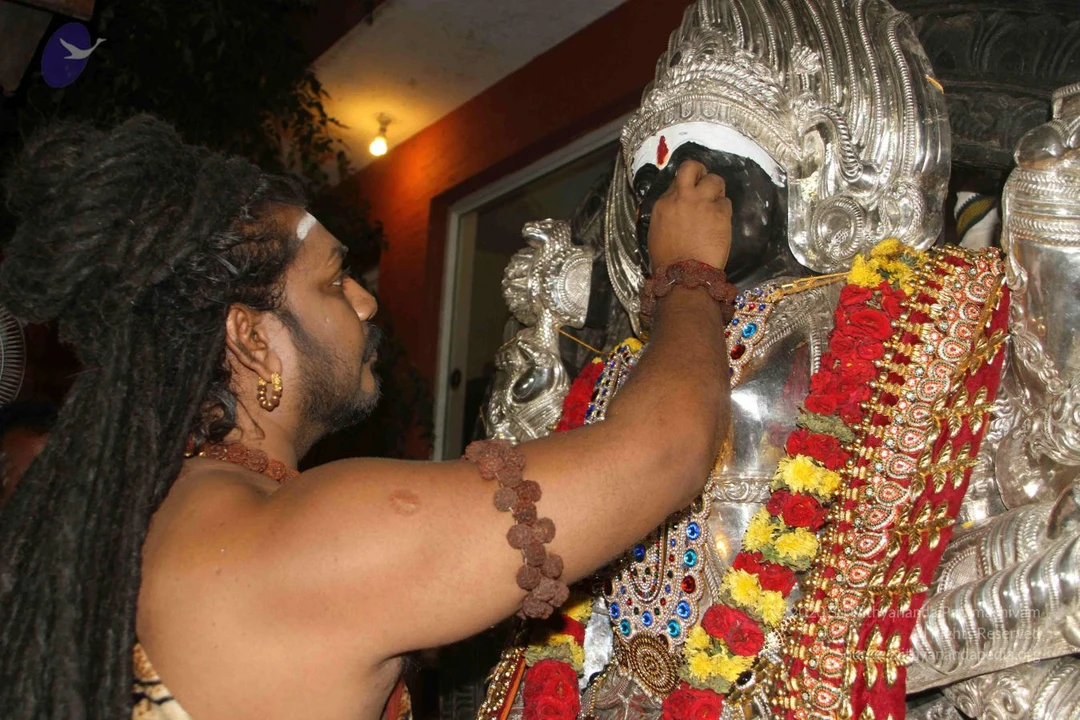
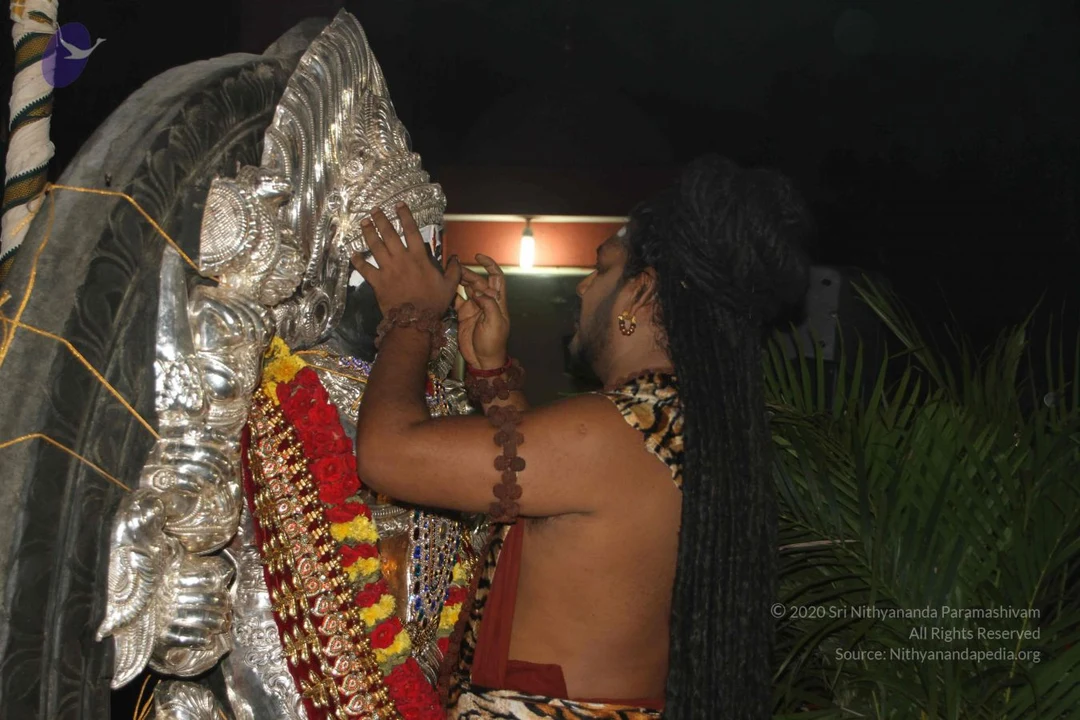
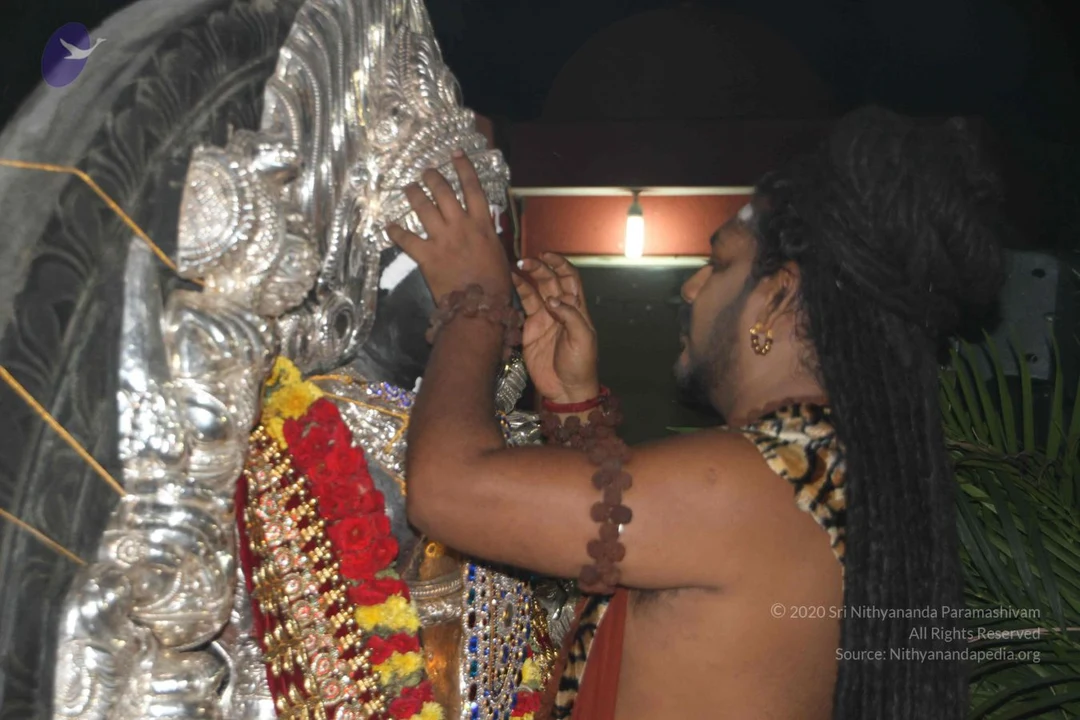
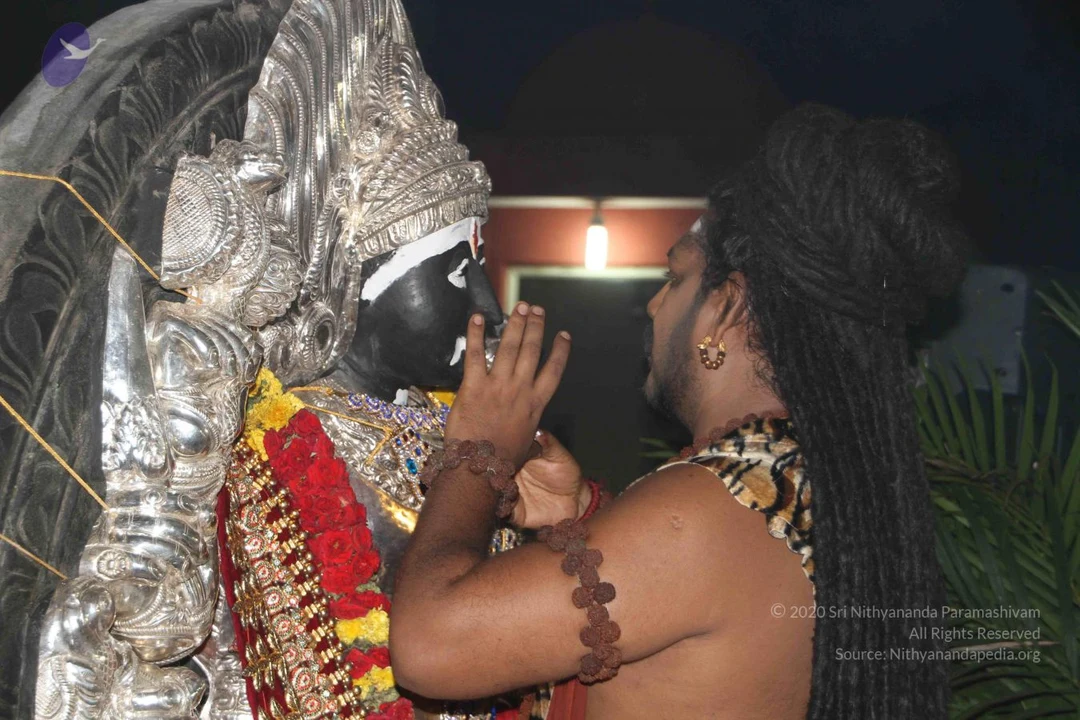
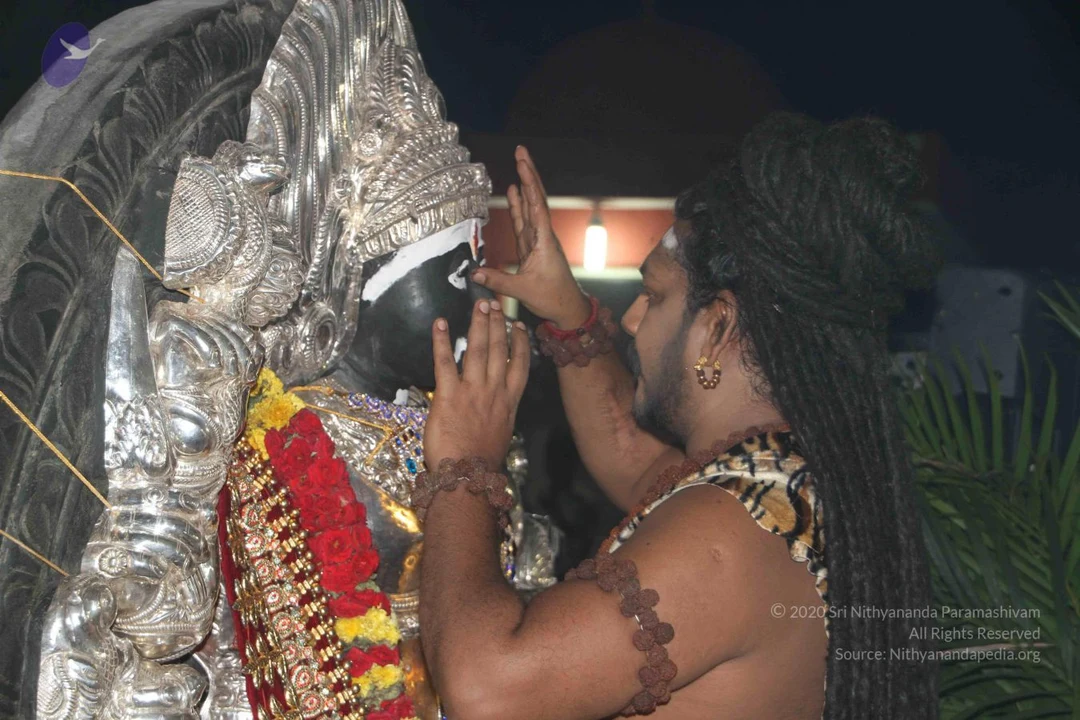
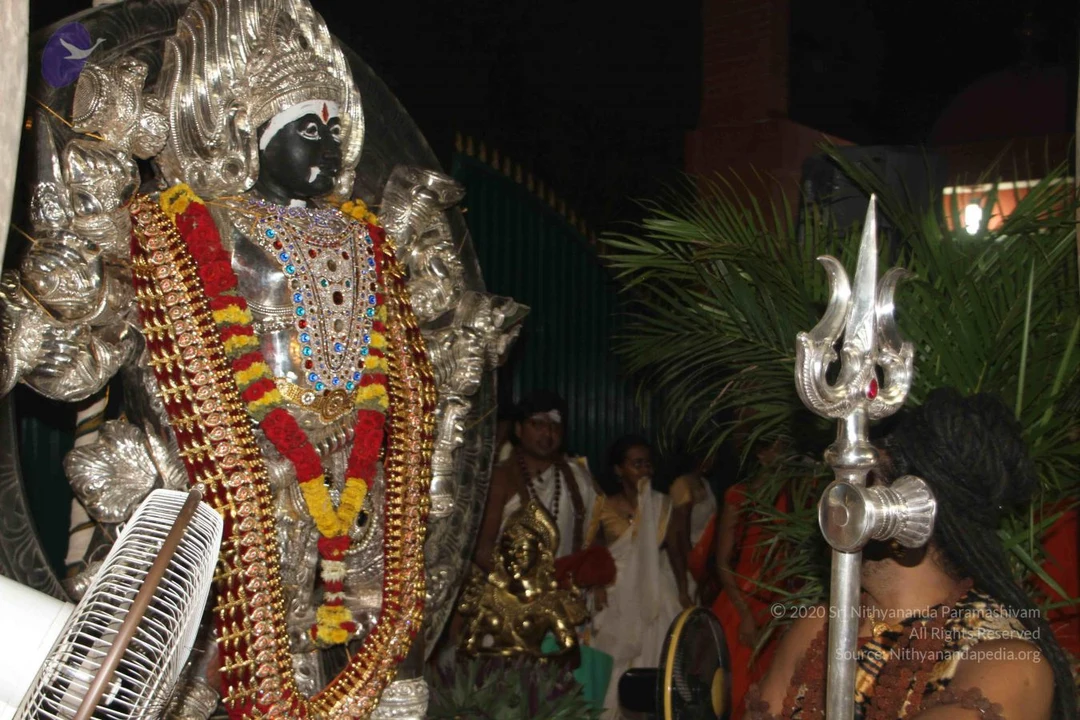
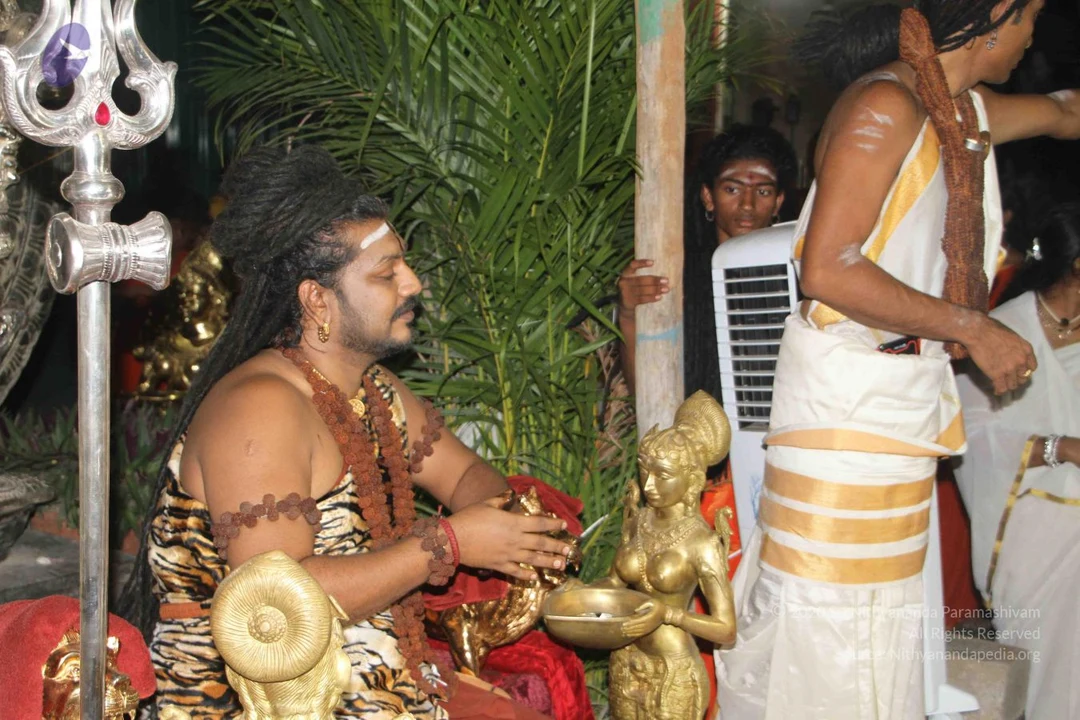
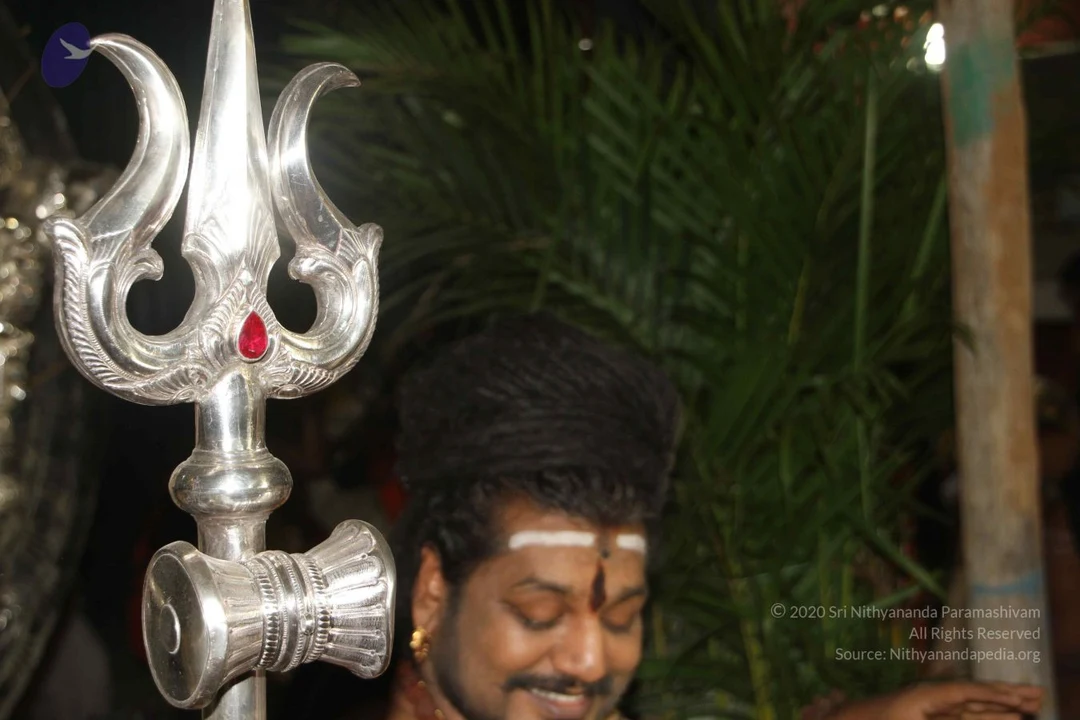
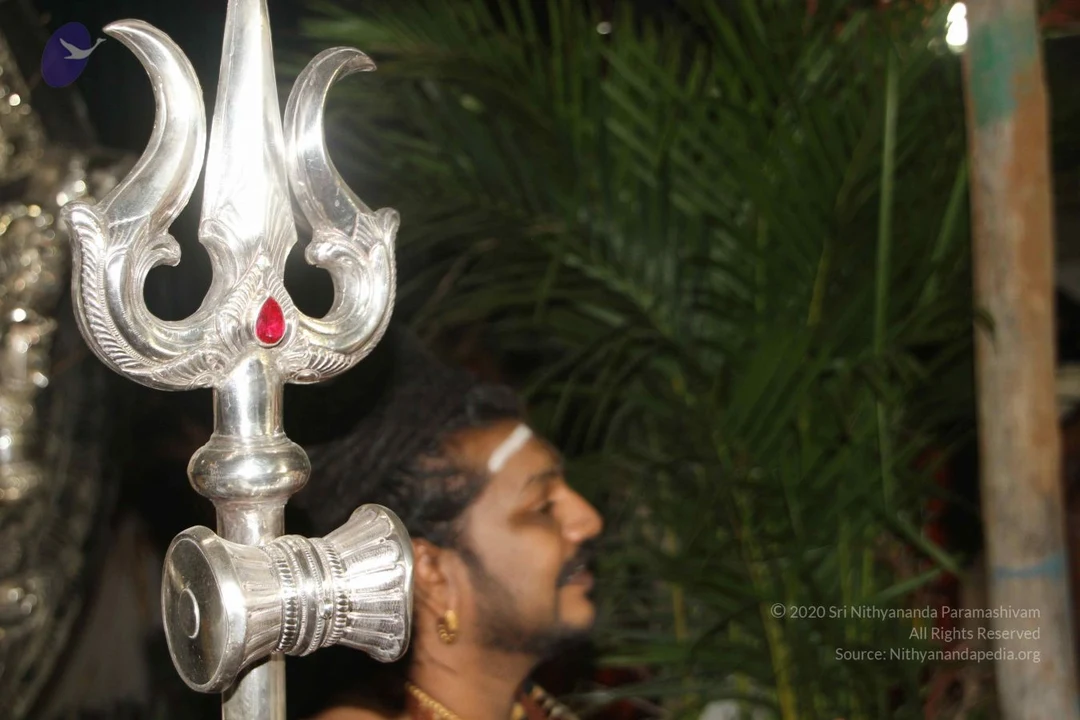
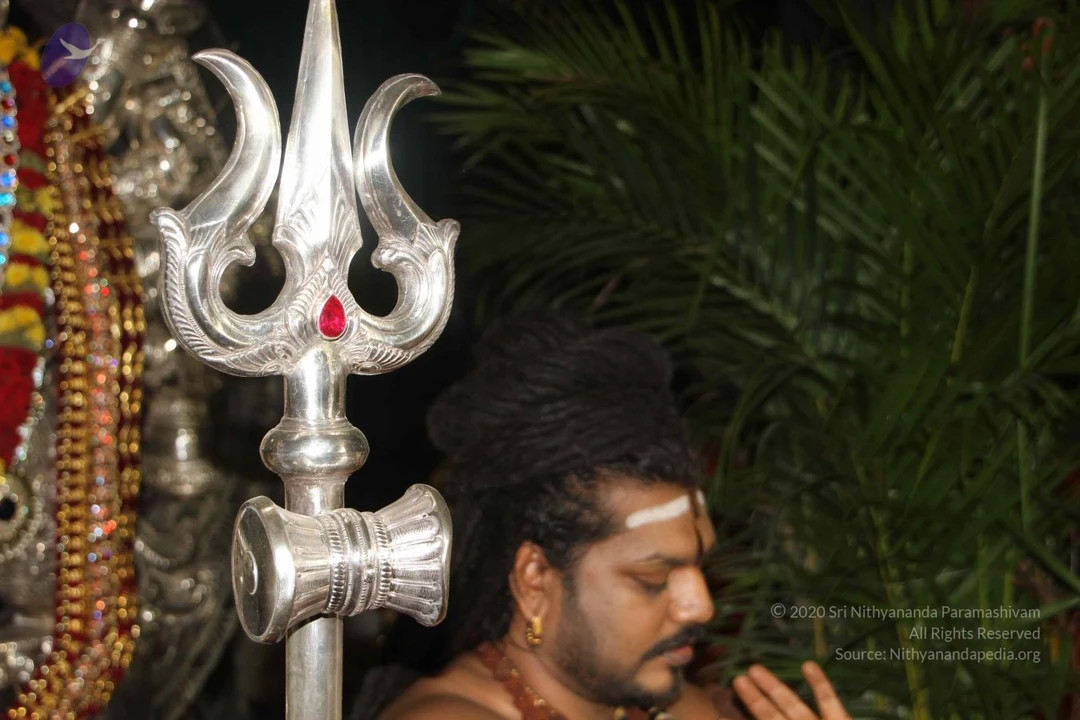
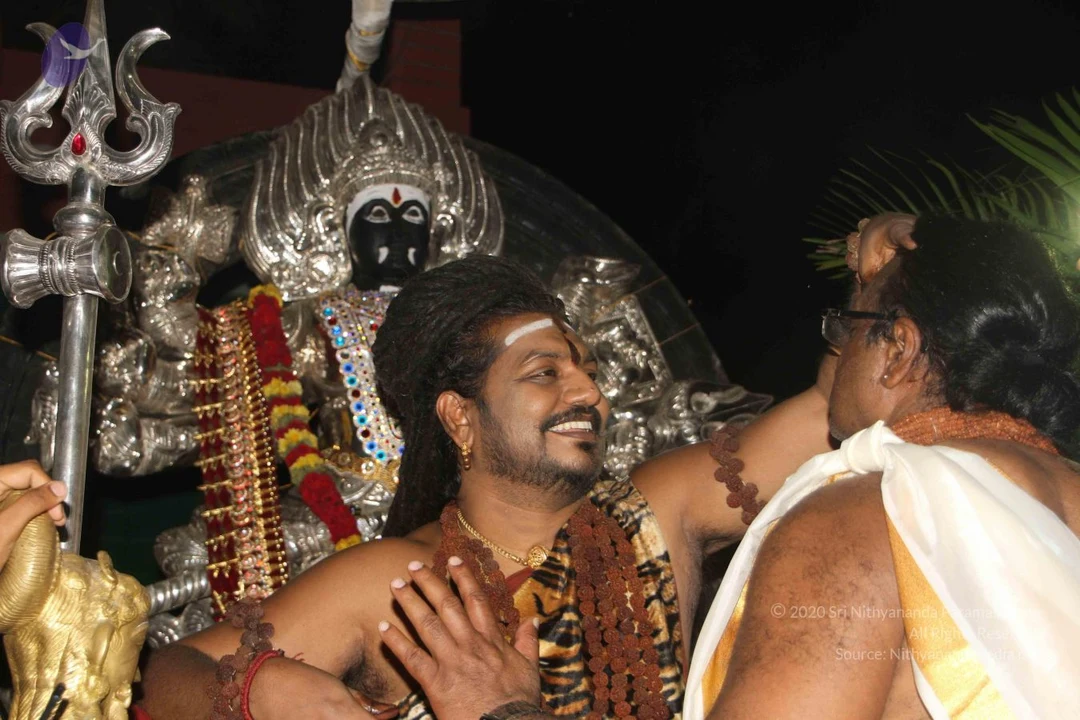
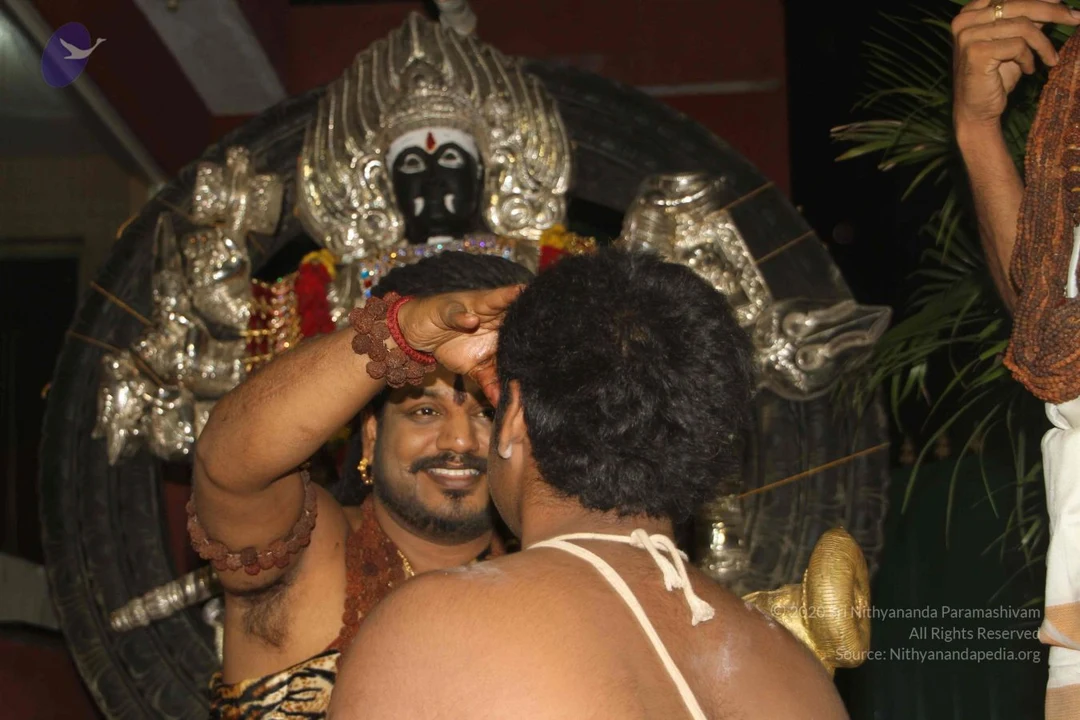
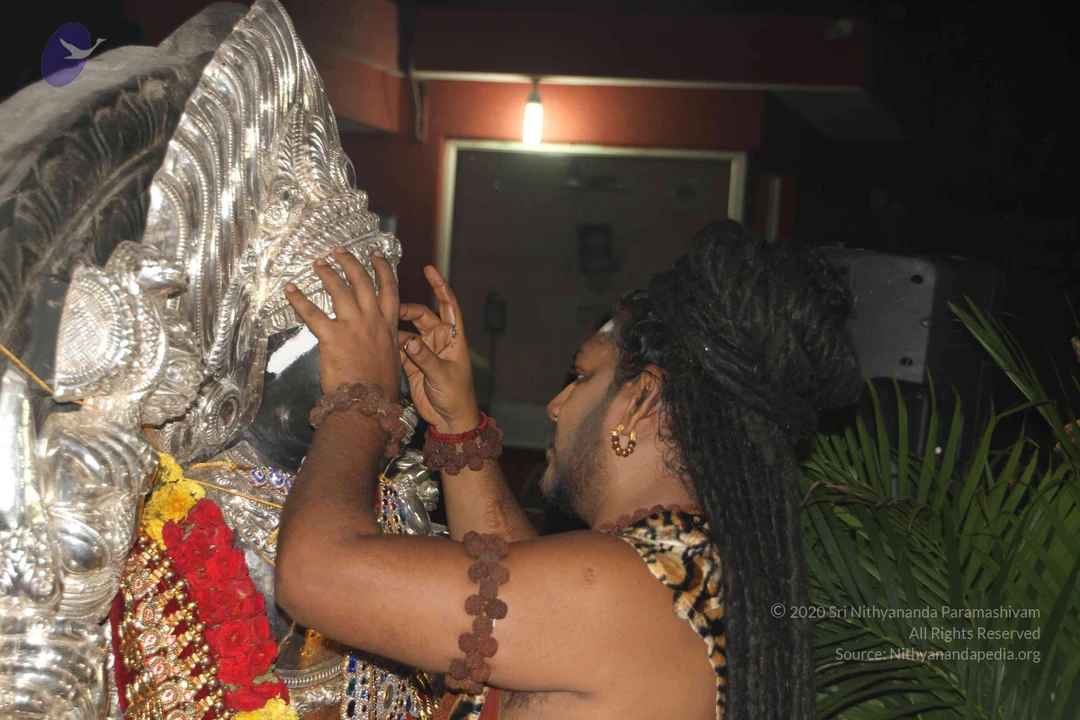
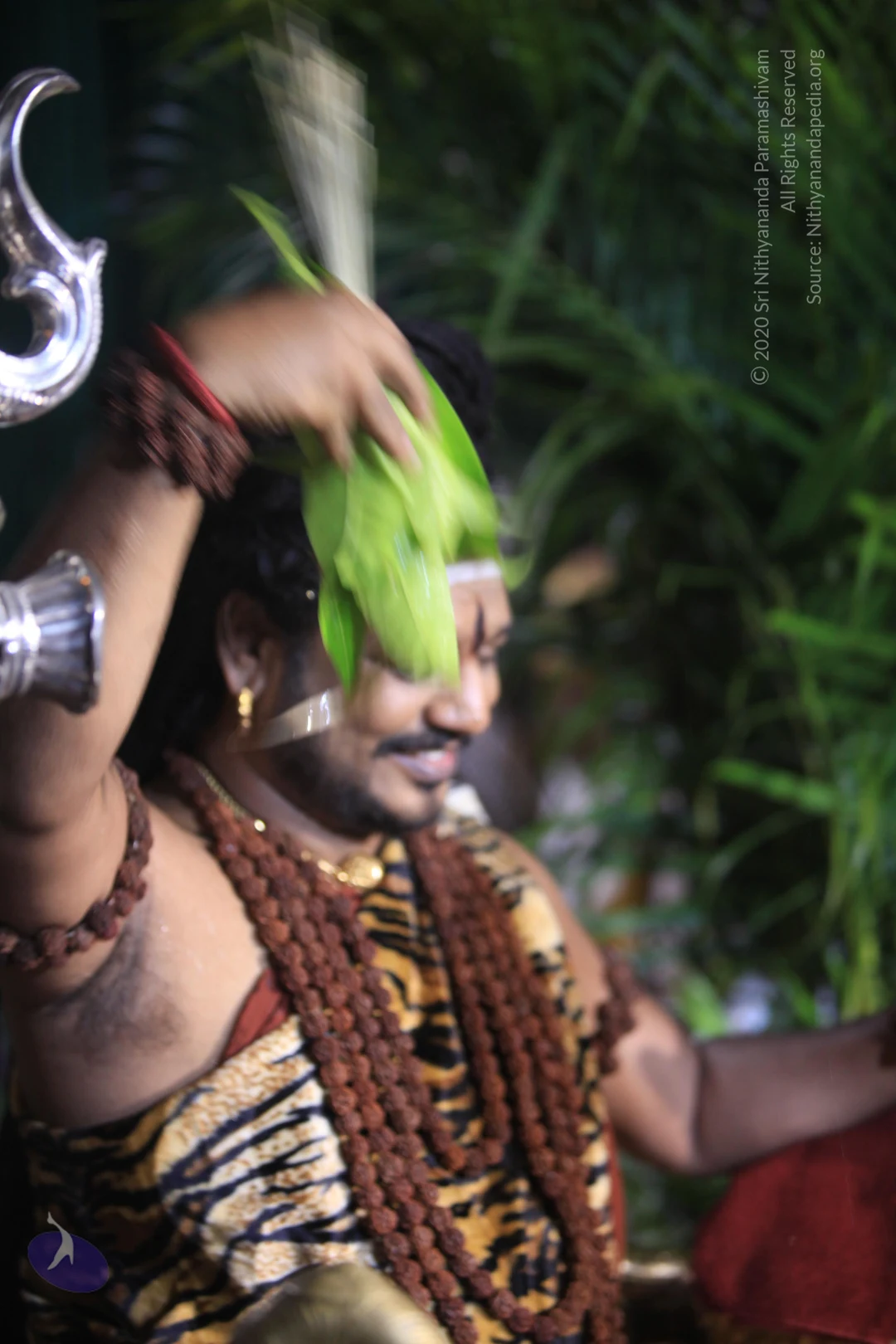
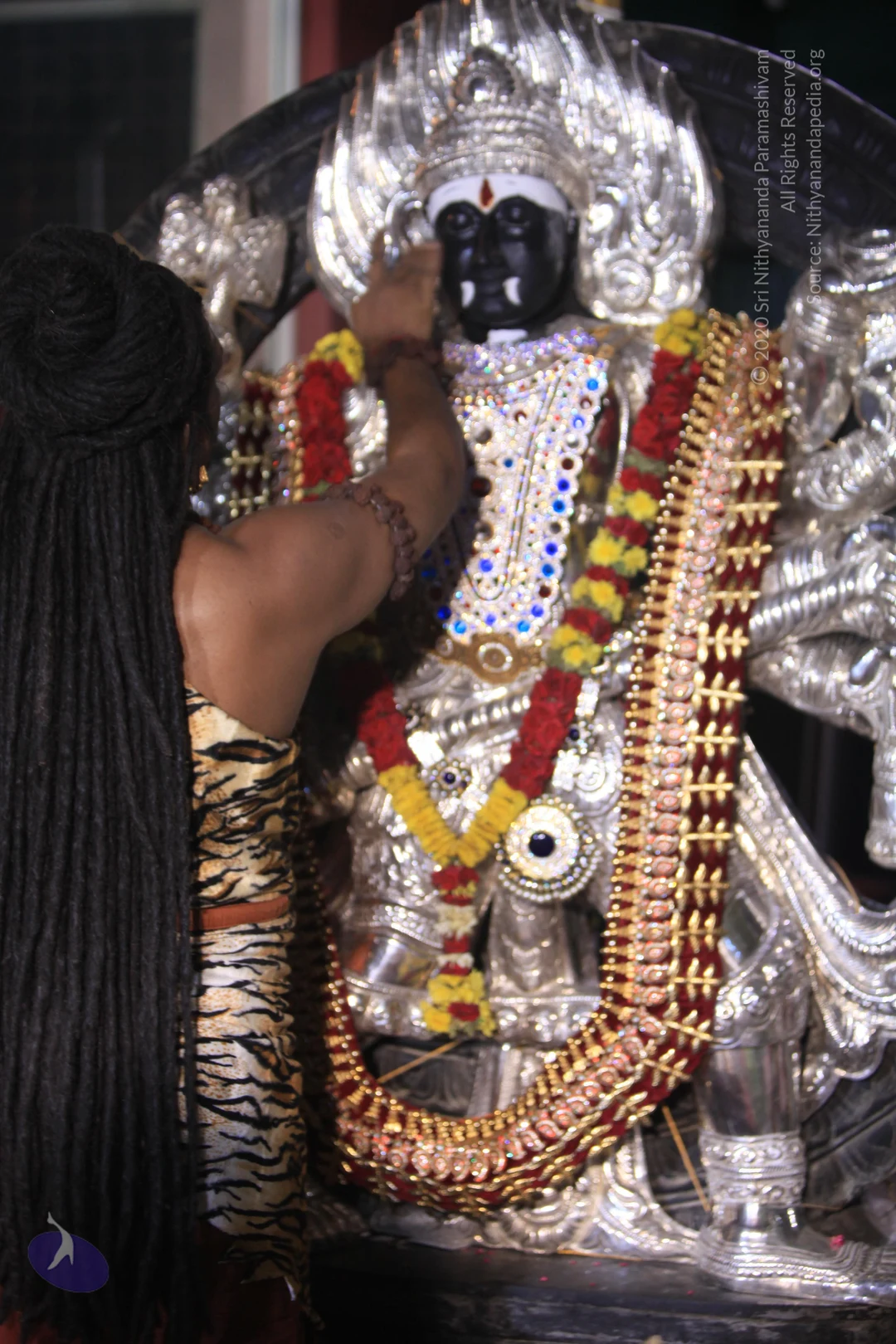
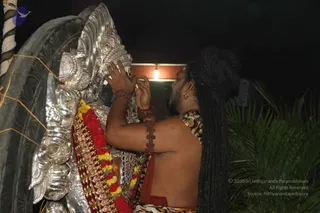
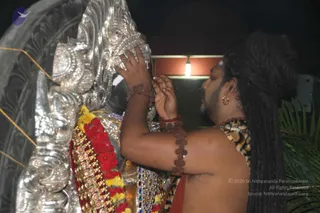
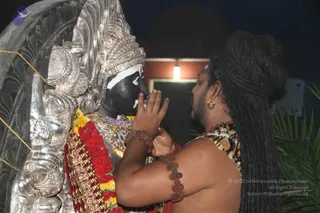
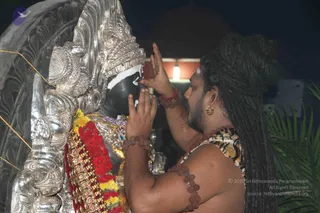
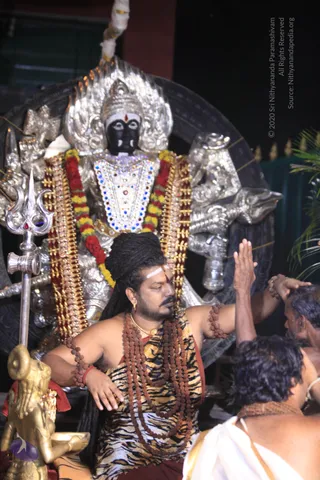
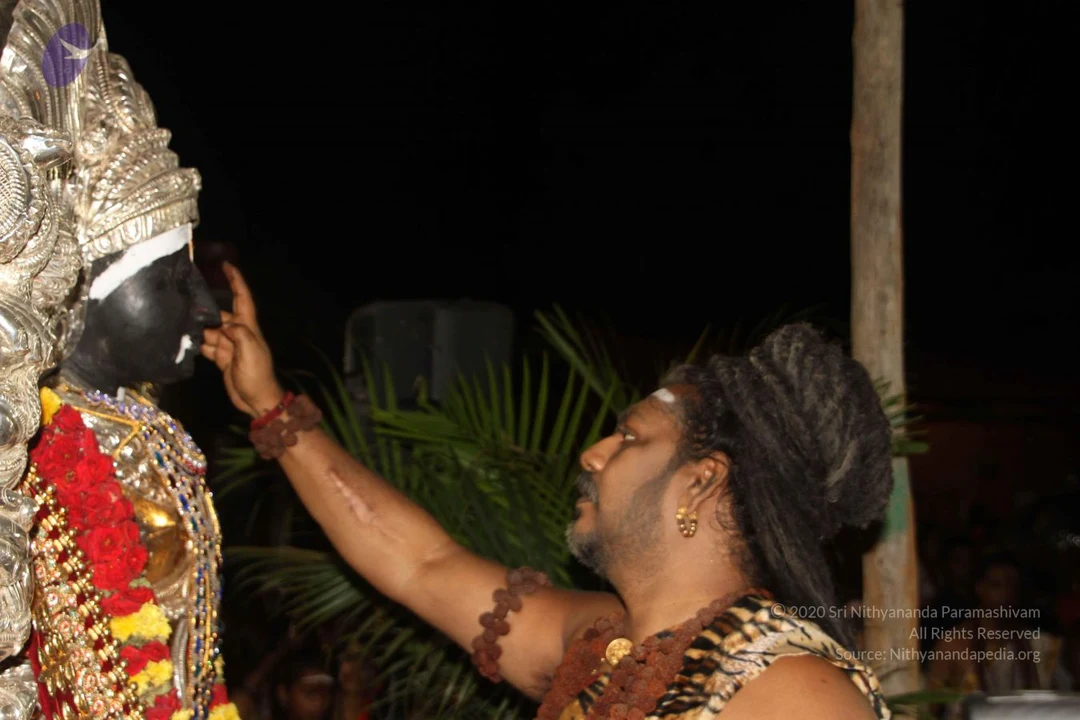
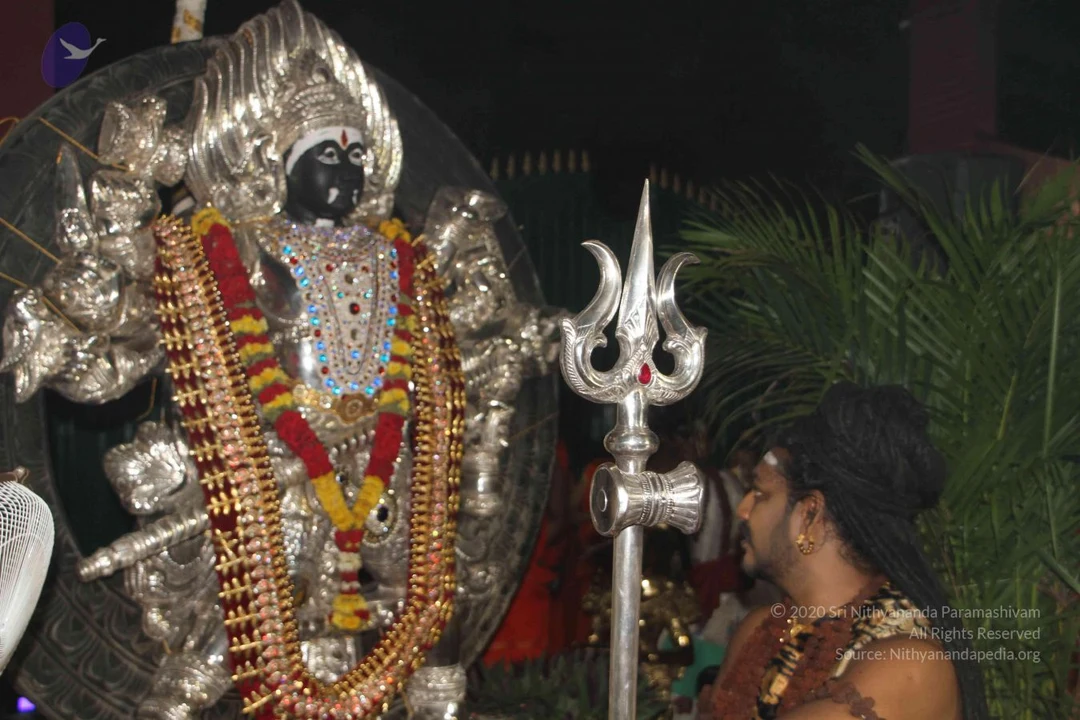
A figure in profile at night touches a large ornate silver deity murti with both hands, one palm pressed to the metal face and the other raised near it. The figure wears a bare-shouldered leopard-print cloth over a red-brown lower garment, with rudraksha beads on the arms, small gold earrings, and long dreadlocked hair tied up at the back. The silver murti is adorned with a garland of red roses and yellow flowers, and gold-coloured ornaments. A lamp glows in the dark background beside palm fronds. The scene suggests a devotional darshan or puja. a person cannot be confirmed from appearance alone, so the figure is described by role as a devotee performing worship at the murti.A photograph taken at night of a man with long dark hair worn up at the back, wearing a patterned leopard-print shawl over a bare chest and rudraksha bead bracelets on his wrists, reaching up with both hands to touch an ornate silver deity murti. The silver figure has a tall silver crown or halo and is draped with a red garland of flowers and jewelled gold-coloured adornments. A single bright ceiling light and dark palm fronds appear in the background. Probable Swamiji (appearance cues: long swept-back hair, rudraksha malas, ornate gold earring and shawl) performing a close devotional gesture at the murti. Only one physical person is visible.Night photograph of a long-haired man with a bare upper body and a rudraksha mala on his arm, folding his hands in namaskar before a large silver-clad deity murti with a tall silver crown and a red-and-yellow flower garland. A small warm lamp glows on a wall behind them and palm fronds frame the right edge. The man wears a patterned cloth wrap and a gold hoop earring. The murti's face is painted black with white markings.A man with long dreadlocked hair pulled back and a small gold hoop earring stands at night beside a silver-clad deity murti. He places both palms against the black face of the murti, which wears a silver crown and a garland of red and yellow flowers over an ornate silver-and-gold embellished garment. He wears rudraksha beads on his wrists and a patterned yellow-and-black wrap over bare shoulders. A lit lamp glows in the background beside palm fronds. The scene suggests darshan or a close-contact worship moment at a temple shrine.Night-time photo at an outdoor temple procession. A large silver-plated deity murti with a black face, wearing a red and yellow flower garland, jeweled necklace and a silver crown, stands at left beside a white fan. At right, a silver trident (trishul) is held upright in the foreground, and a person with long dark hair and a rudraksha mala is seen from behind in orange and gold clothing. Behind them, two people in white dhoti-style garments and a bare-chested man with a rudraksha mala stand near a golden figurine and a palm plant. Lights glow in the background.A bare-chested man with long dark hair tied up, wearing a rudraksha mala and a gold earring, stands beside a large silver trident (trishul) with a red stone set in its shaft. Beside him is a black-faced silver deity murti adorned with a red and yellow flower garland, a jewelled necklace and an ornate silver halo, set against palm fronds and a dark background. A devotee figure in red-orange cloth stands behind. The man's appearance is consistent with a person, given his long hair, rudraksha mala and adornments, and he appears to be in devotional worship before the murti.

01-Pada-Puja
7 photosSource gallery
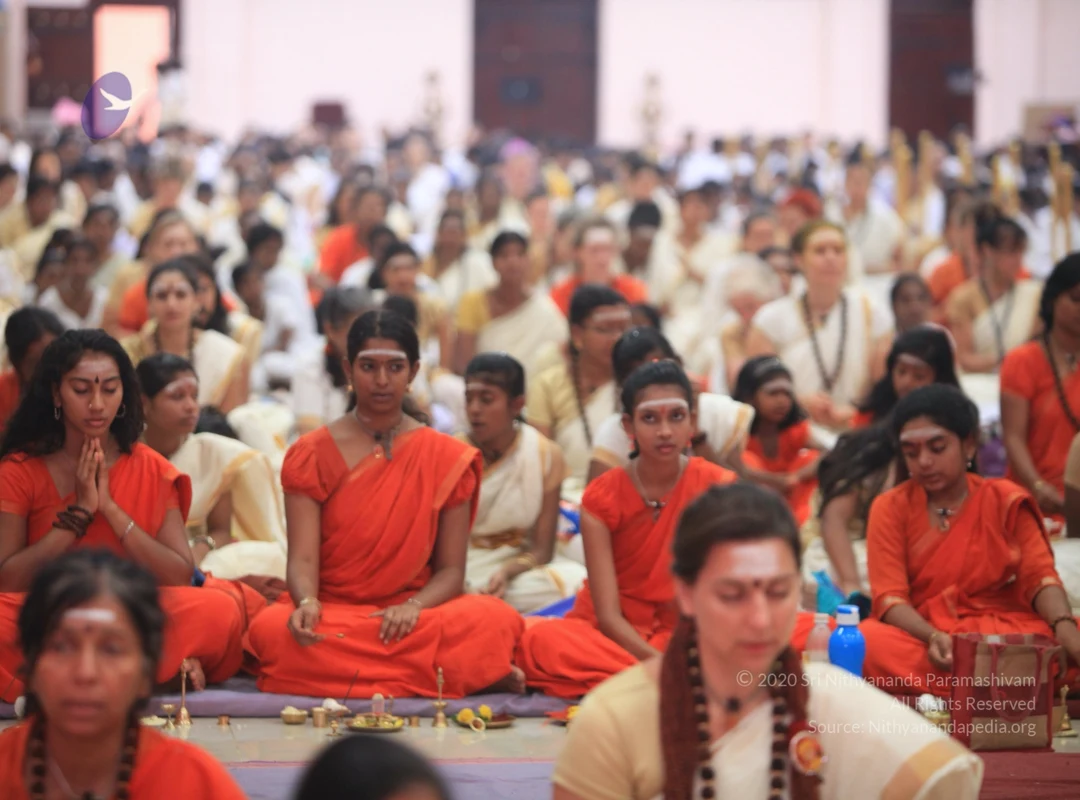
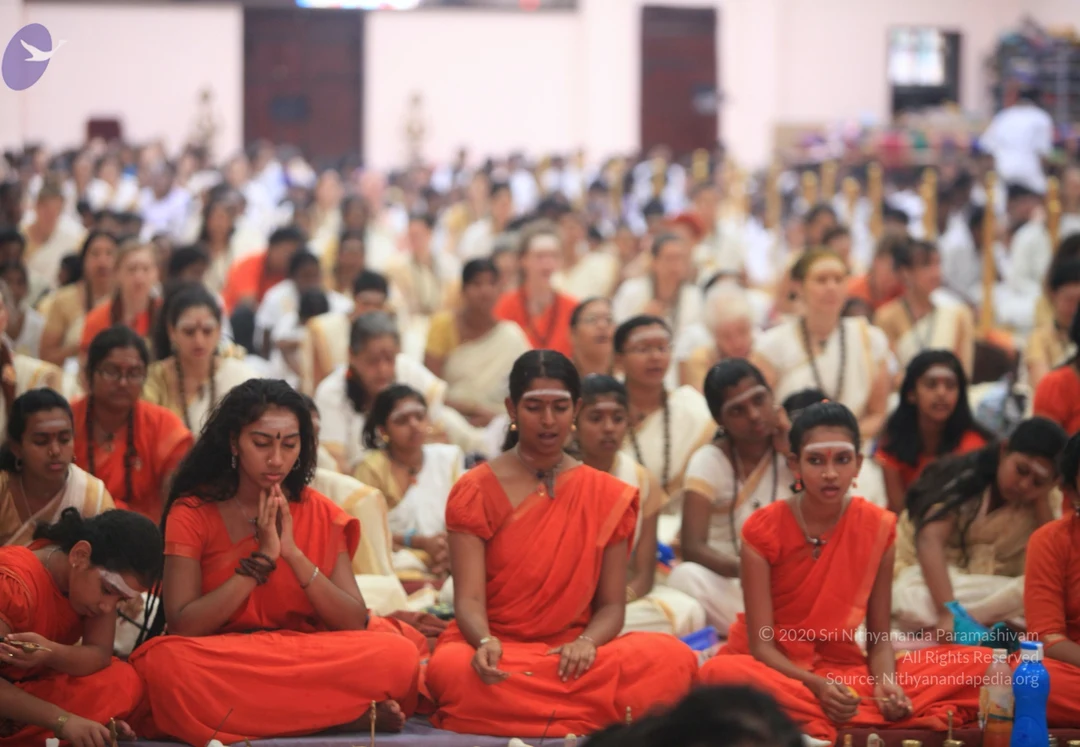
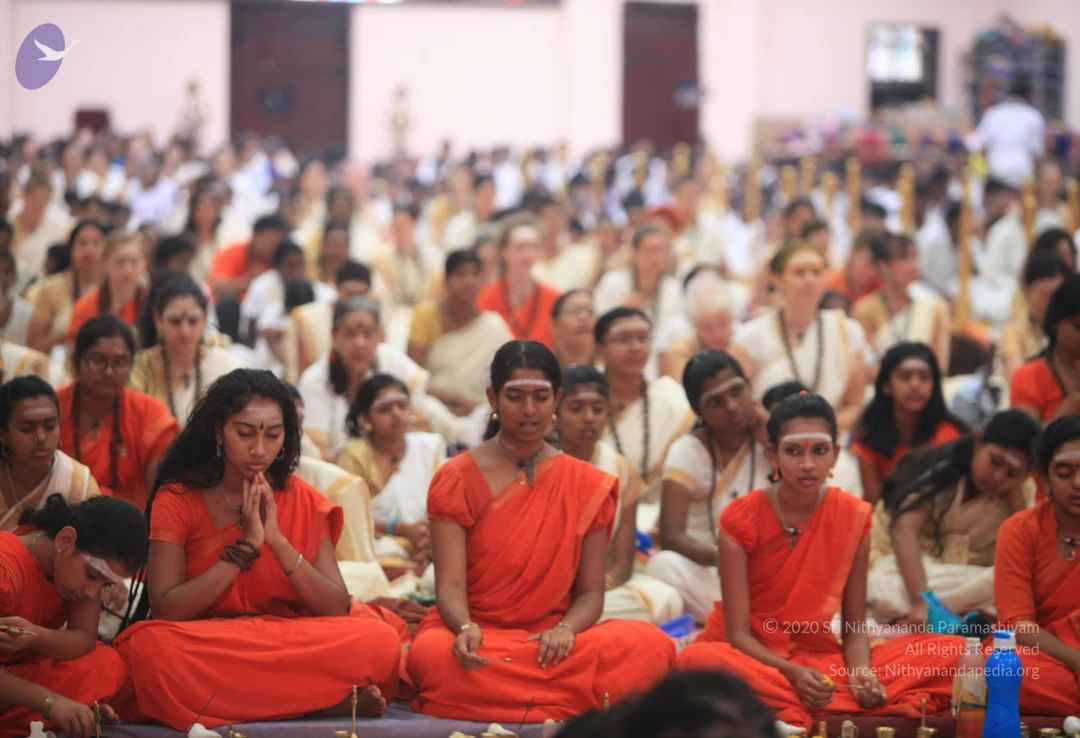
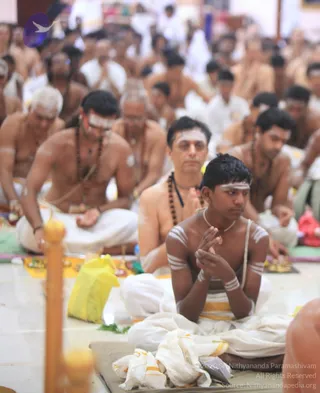
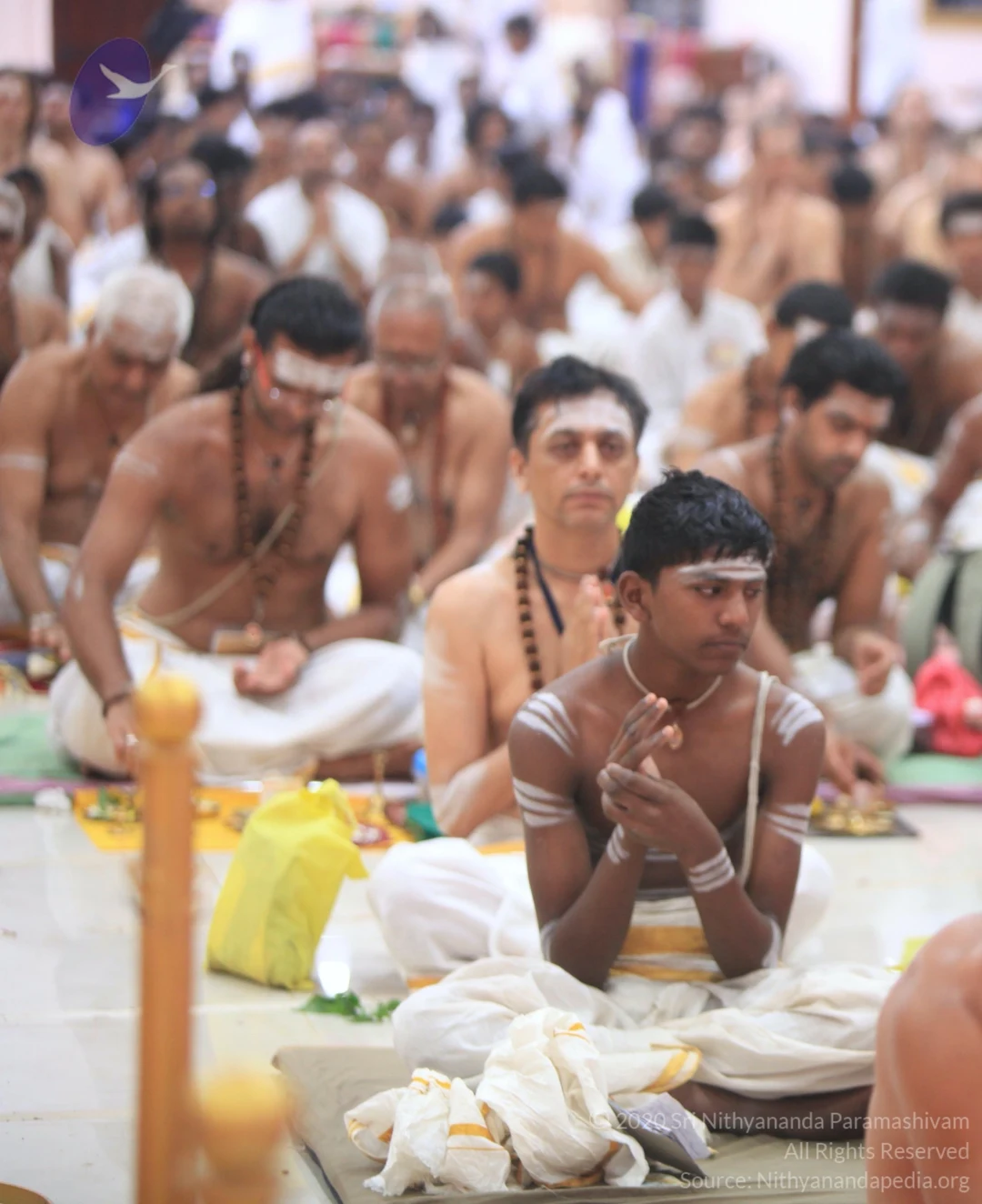
A large seated congregation of men and boys sits on the floor of a hall for a ritual. In the foreground, a young boy with wet-looking dark hair and white sacred ash stripes on his arms and chest sits with palms pressed together in prayer, wearing a white dhoti with a gold border and a thin white sacred thread. Behind him, a man in a white dhoti with bare chest, rudraksha mala and a horizontal white tilak on his forehead sits with hands folded. Other shirtless men with white forehead marks and rudraksha malas sit in rows behind, some with hands joined or resting on their knees. A yellow cloth bag, folded white cloths and a brass lamp sit on the floor near the front. Several people appear in the background, many with bare chests and white ash markings.A seated man in rust-orange robes sits on an ornate gold throne with red cushions and a tiger-stripe cloth, eyes closed, wearing a white garland of flowers, a gold chest pendant on a beaded necklace, gold bangles and a white tilak on his forehead. A bare-backed priest in white dhoti with white sacred markings sits facing the throne before a gold platform with flowers. Gold bells hang from above and small oil lamps line the background, with a copper vessel on the side. The throne is the central focus of this temple-style ceremony scene.A man with long dark hair, white and red forehead markings, and a dark beard sits cross-legged on a red cushioned throne with a golden ornate backrest and a tiger-striped cloth. He wears rust-red robes, a long white flower garland, a heavy gold necklace with a pendant, golden bead necklaces, and gold bangles. A devotee with dark hair sits in the foreground below him, with flowers and offerings at the base of the throne. Probable Swamiji is seated in the central position of the throne, with the cues of long hair, ornate gold necklaces and saffron-red clothing. A brass bell hangs on the right.A large seated gathering of devotees fills a hall during a pada puja-style ceremony. In the foreground, a young woman in an orange-red sari with white vertical forehead markings sits cross-legged with palms pressed together in prayer. Beside her, a woman in orange sari holds a small object and sits on a purple mat near brass puja plates, flowers and oil lamps. Behind them, many participants wear white and cream clothes with orange and red garments, and several have white tilak marks on their foreheads and rudraksha malas. Rows of people extend into the background under white walls and tall lamp fixtures. No individual can be confidently identified as a person from this view.A large seated congregation fills a hall during a Pada Puja-style gathering. In the foreground, several young women in saffron-orange saris sit cross-legged with hands folded or held before them, some with white forehead markings and fingers holding small items. Behind them, rows of people in white and cream clothing sit closely together, some with garlands and beaded necklaces. Blue water bottles sit on the floor at right, and pale walls and wooden doors frame the room. Many more people are visible in the blurred background, with some standing near the back.A large hall filled with seated devotees during a pada puja-style gathering. In the foreground, young women in saffron-orange sarees with white forehead markings sit cross-legged on mats, several with palms pressed together in prayer and eyes closed. Behind them, rows of people in white and cream traditional dress, some wearing rudraksha-style beaded necklaces, sit in meditative posture. Tall brass lamps stand along the front of the rows, and a blue water bottle rests near the foreground. The hall has pale walls and a distant stage area with a person in white.

03-Kalabhairava-Homa
52 photosSource gallery
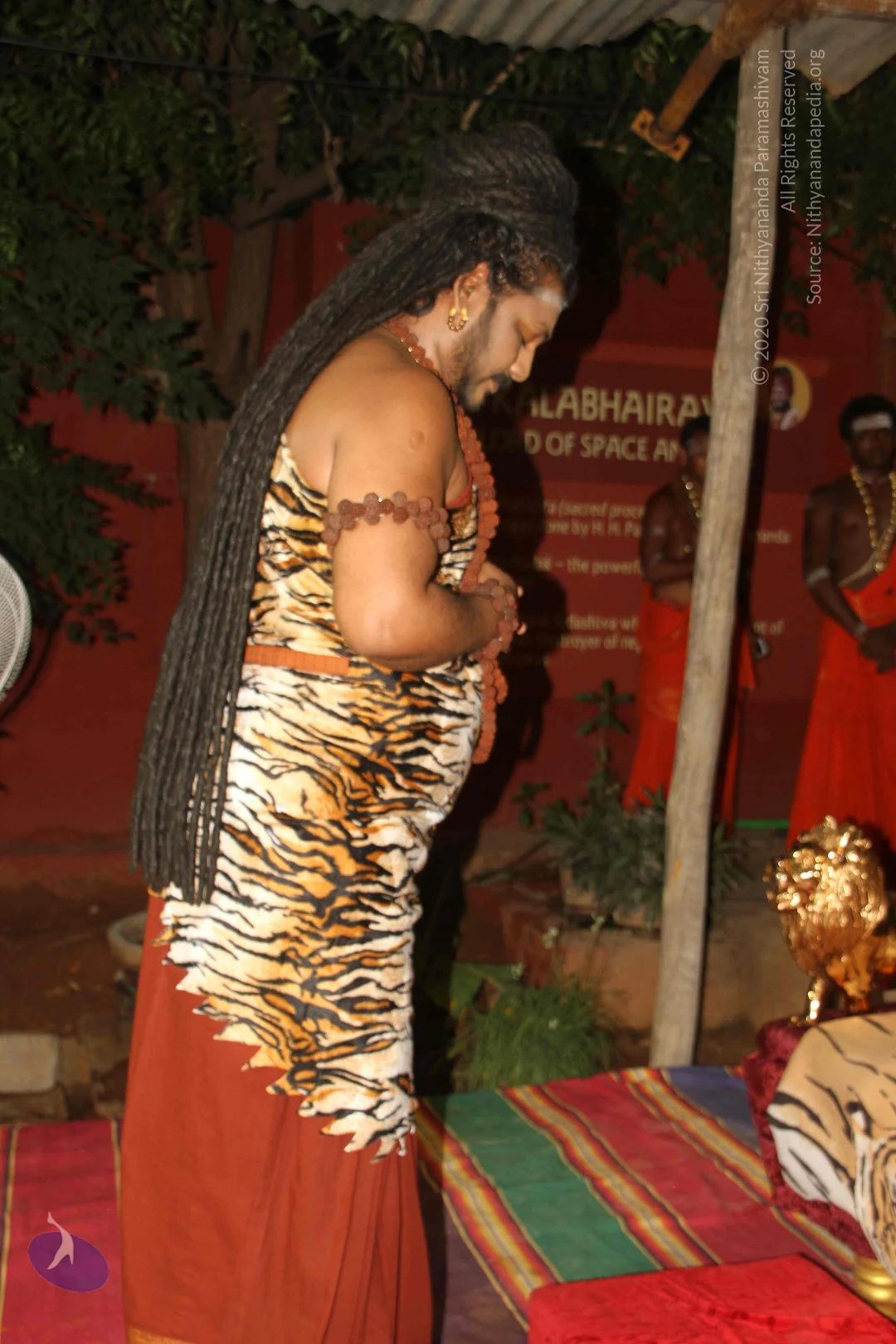
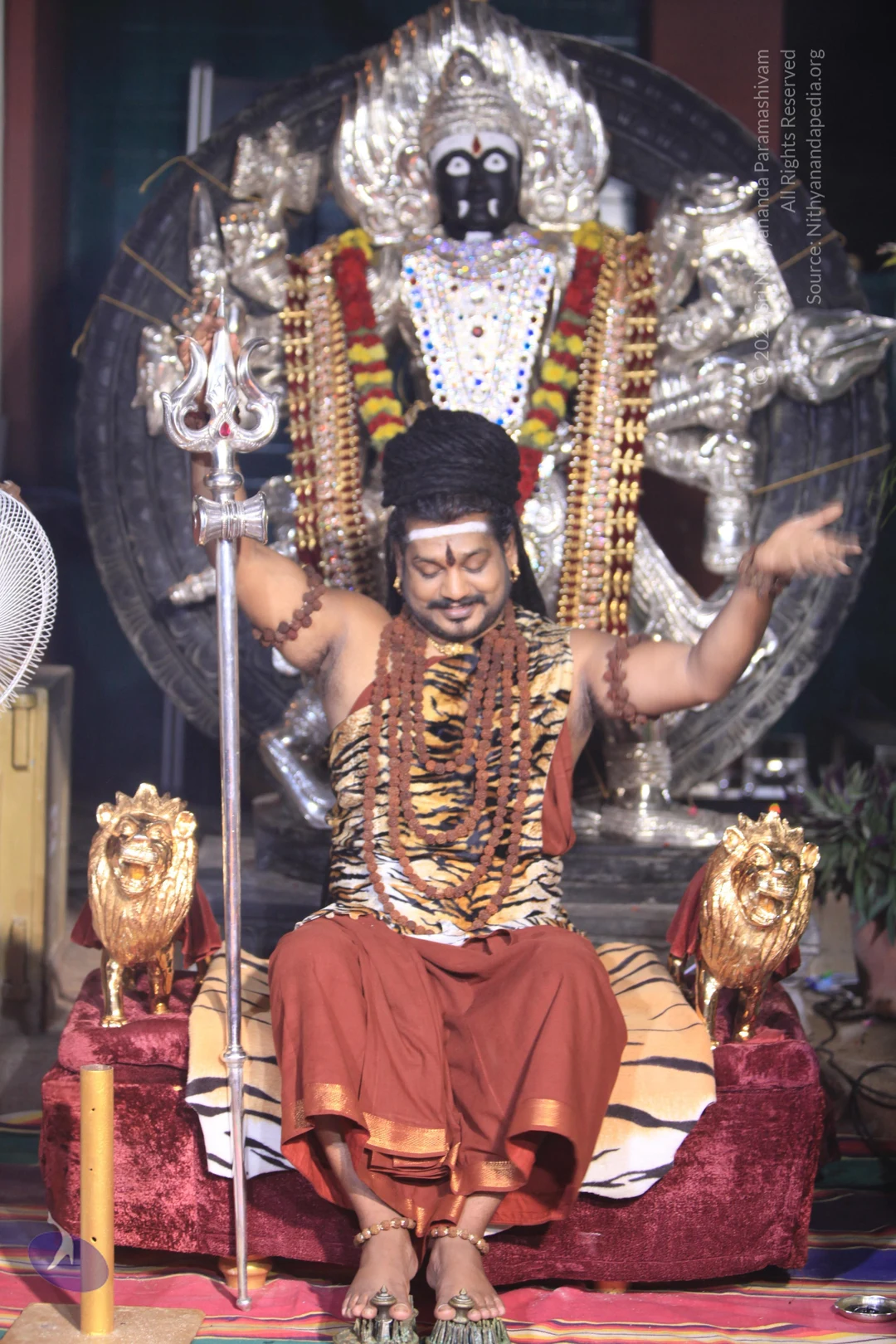
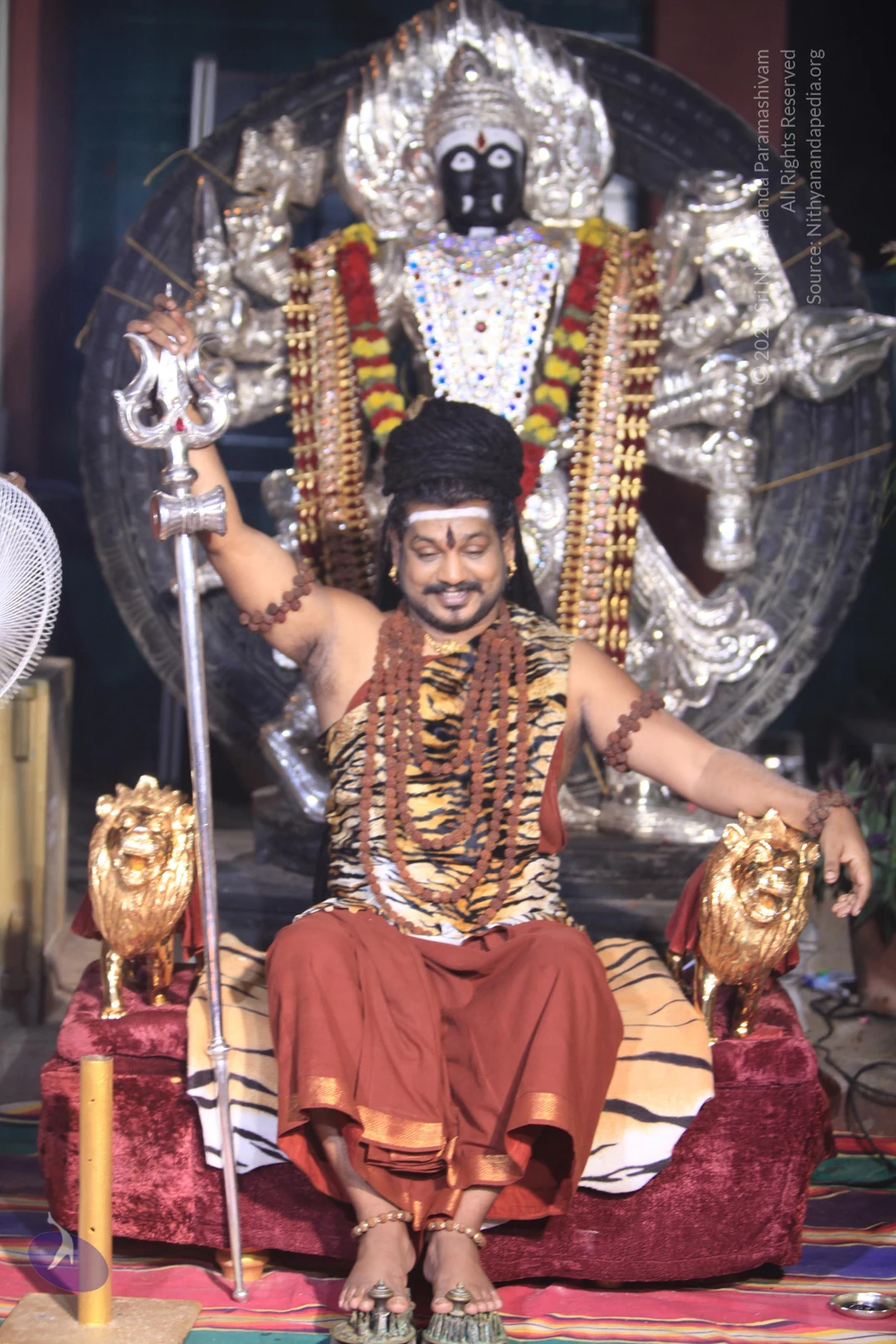
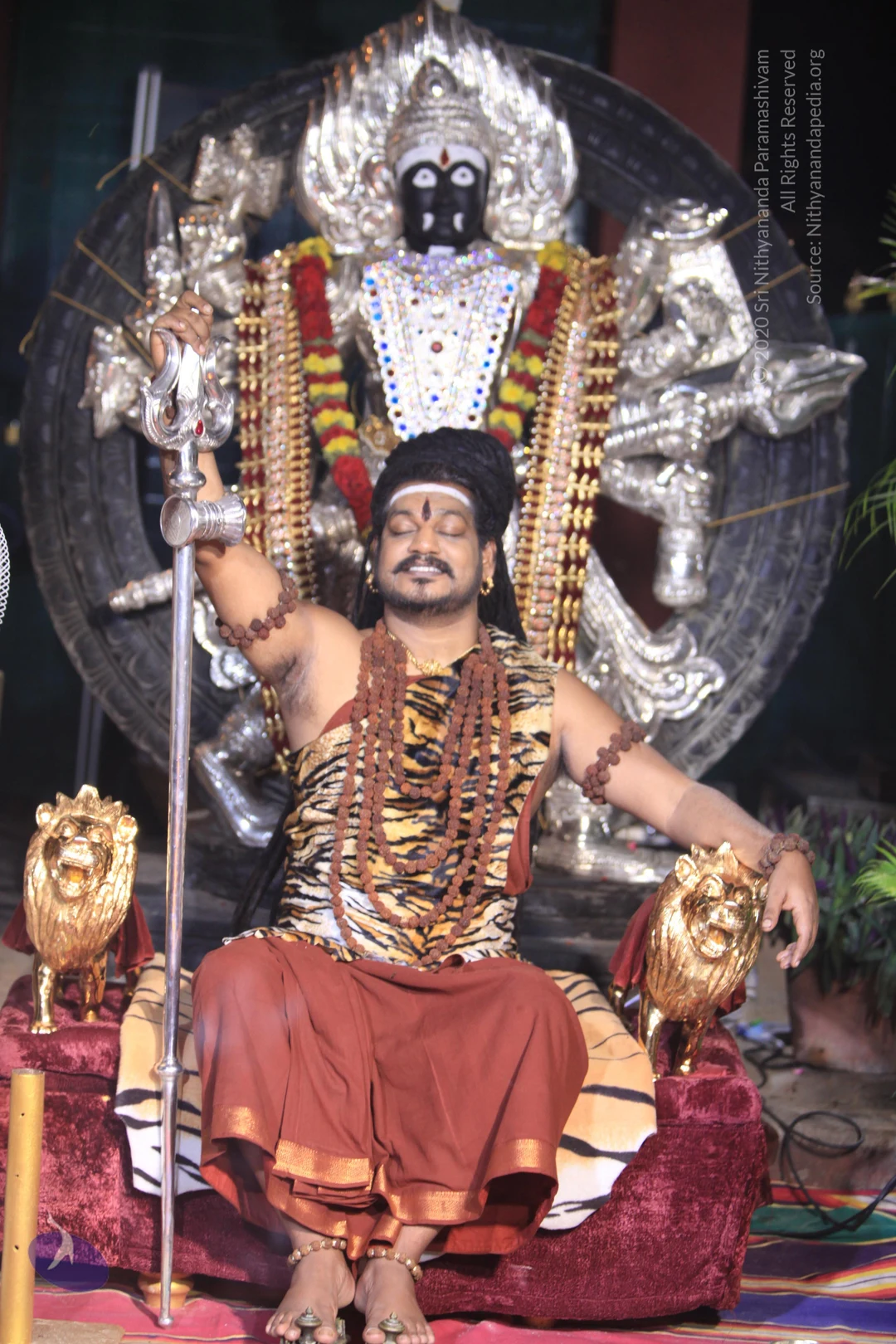
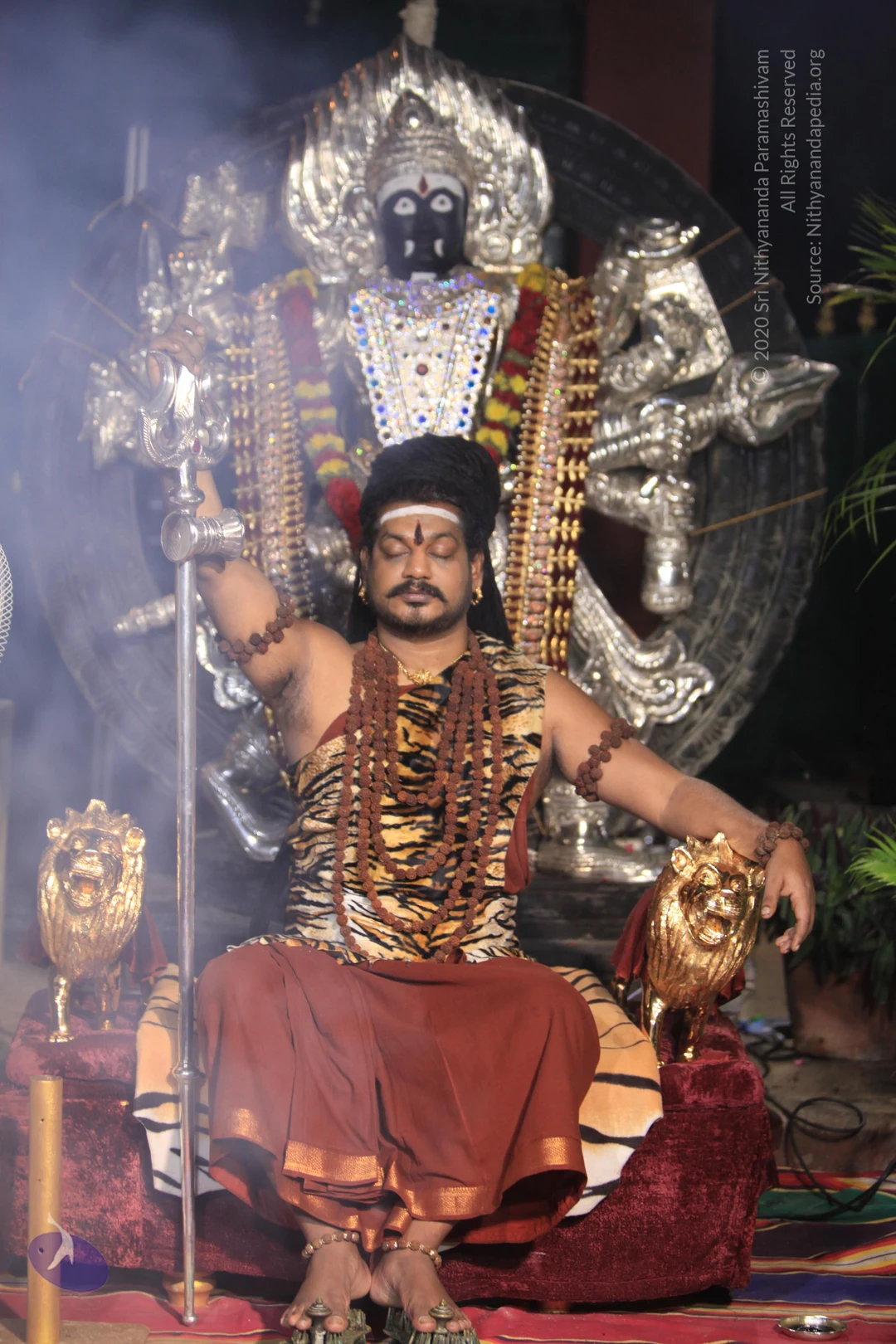
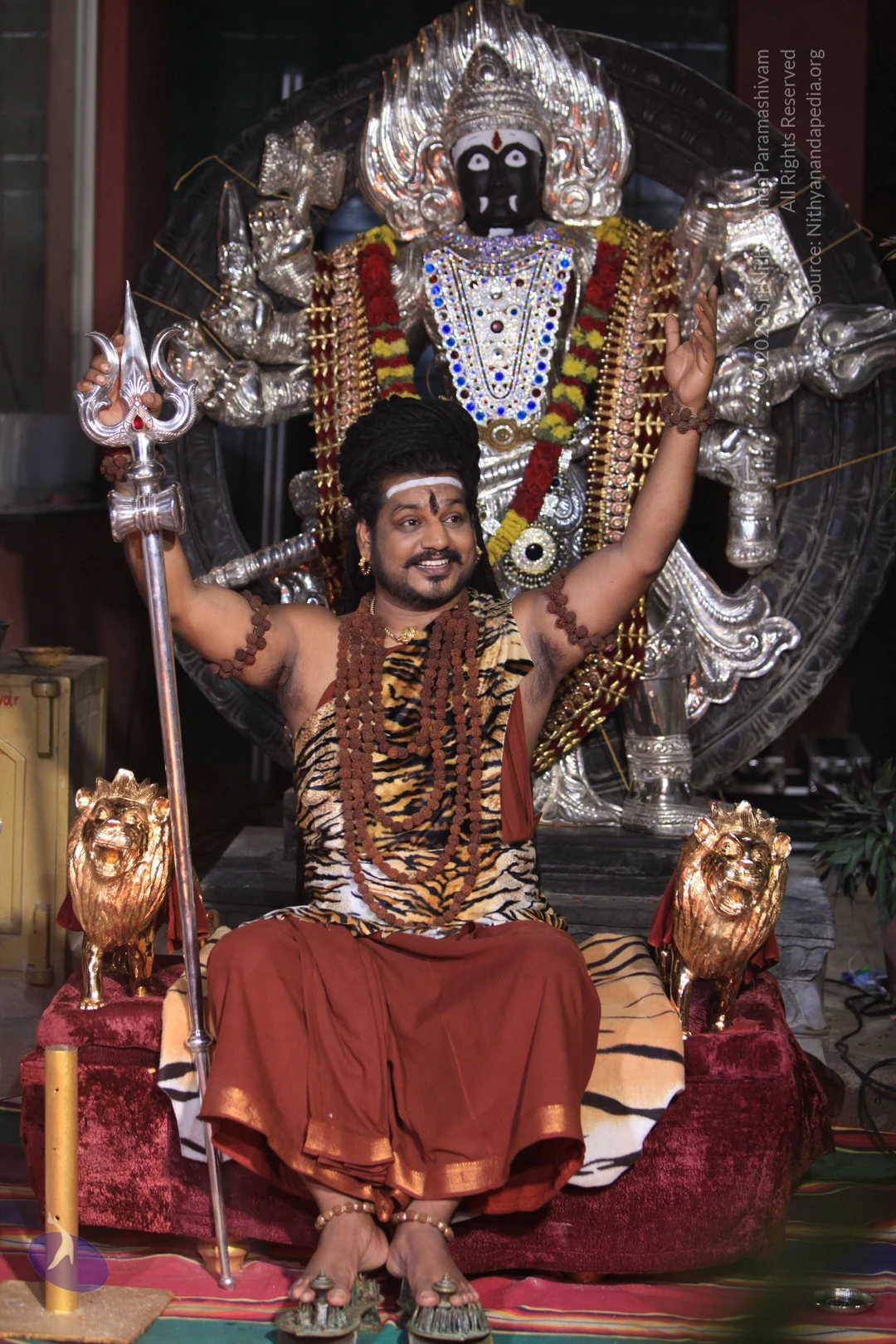
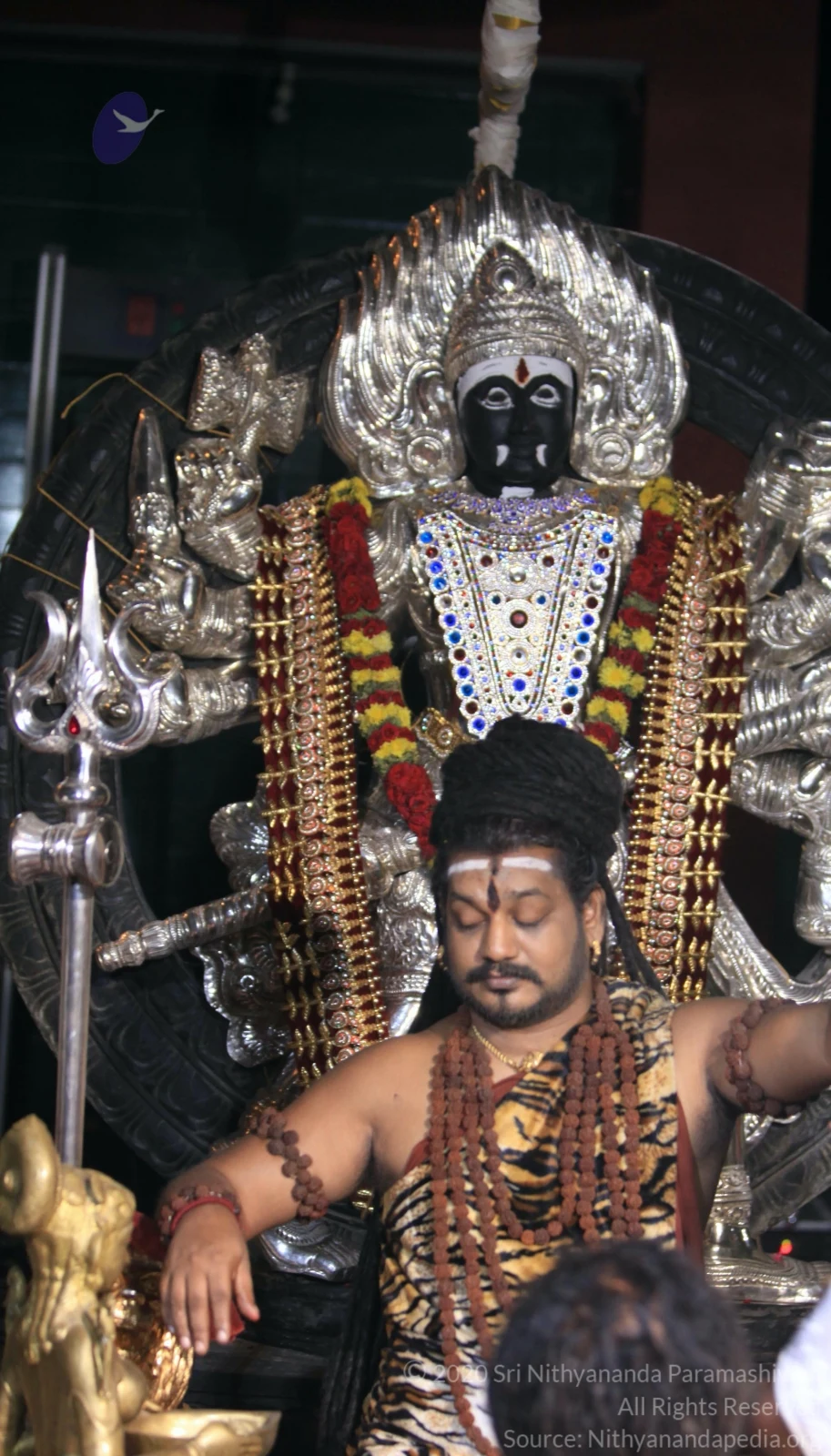
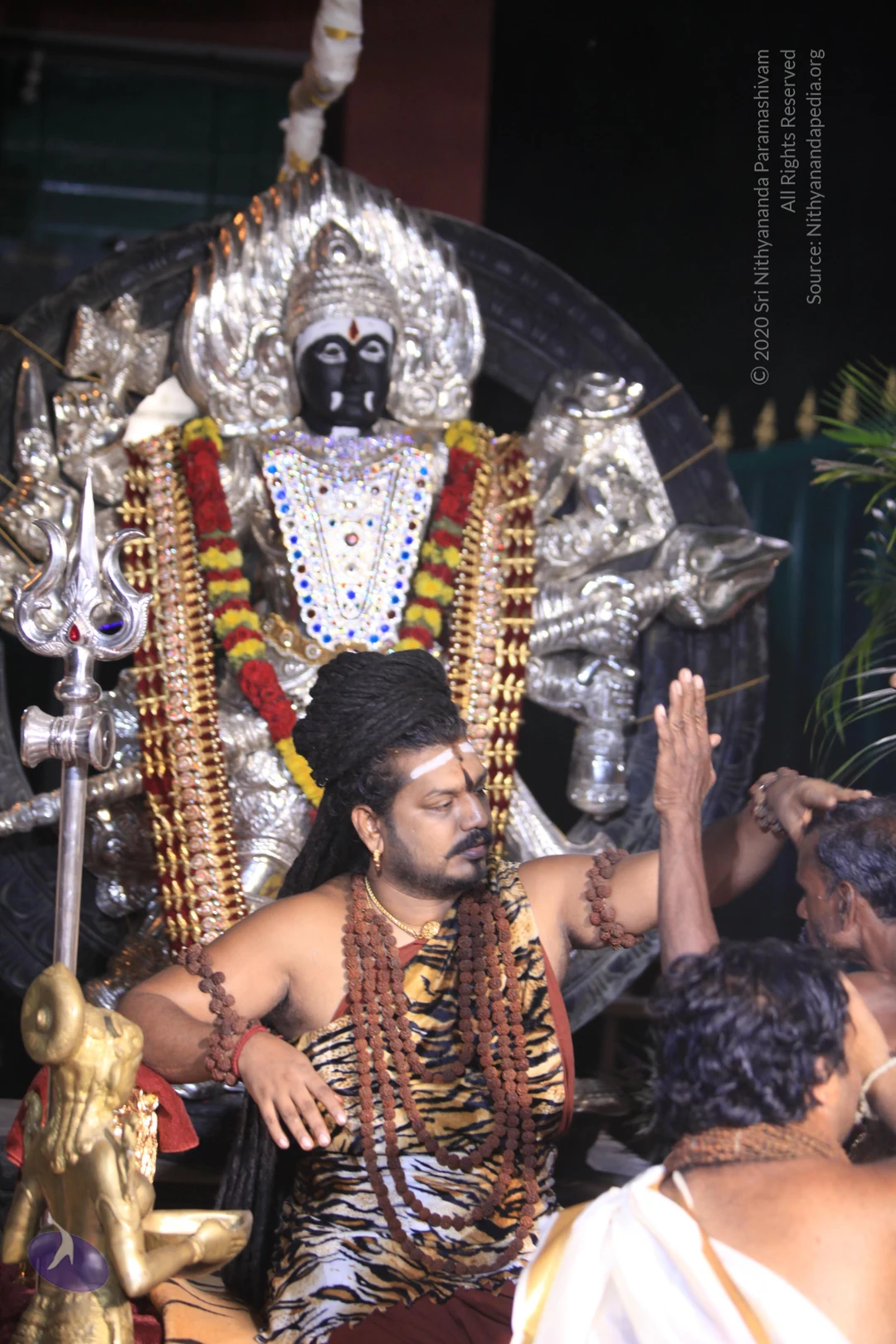
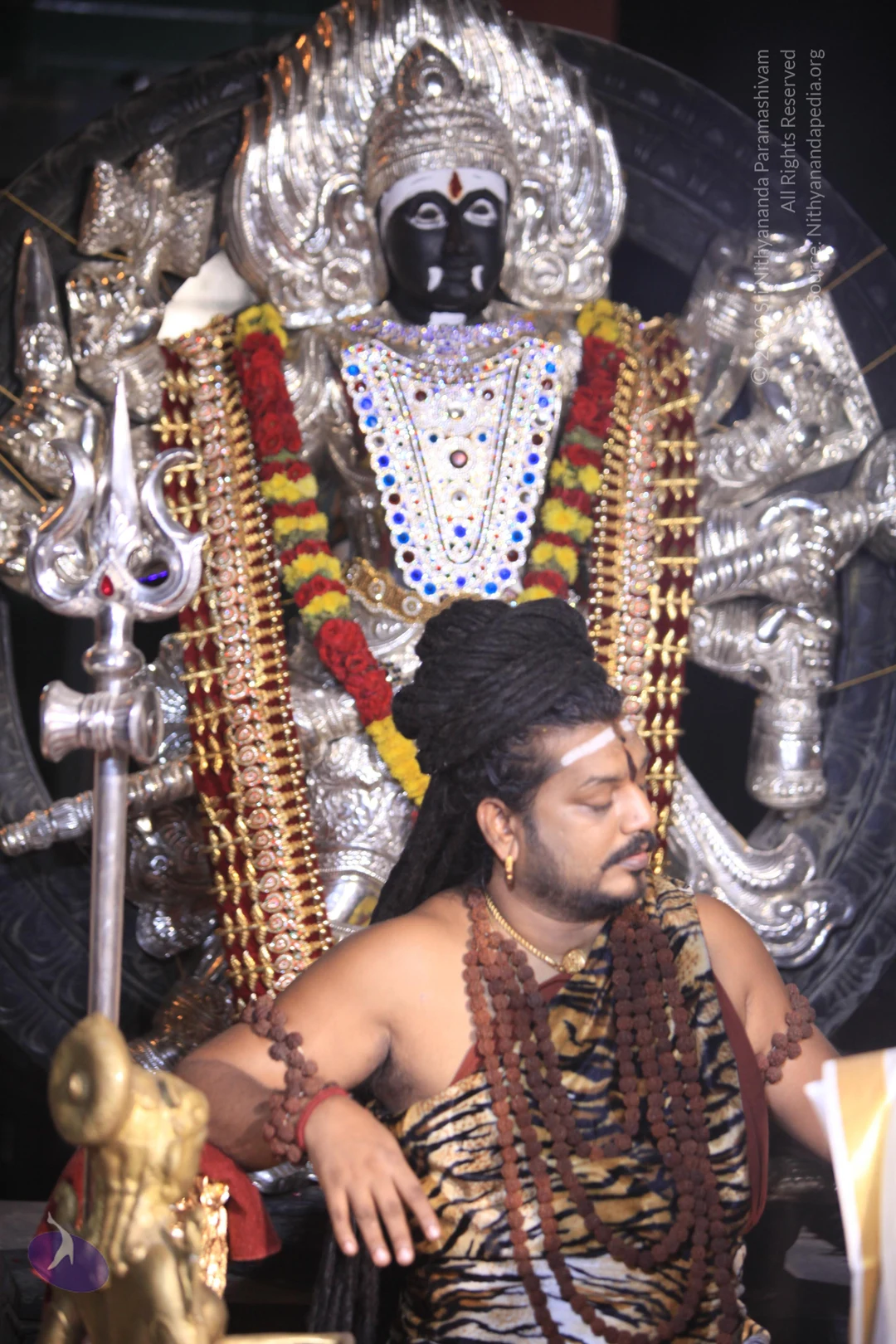
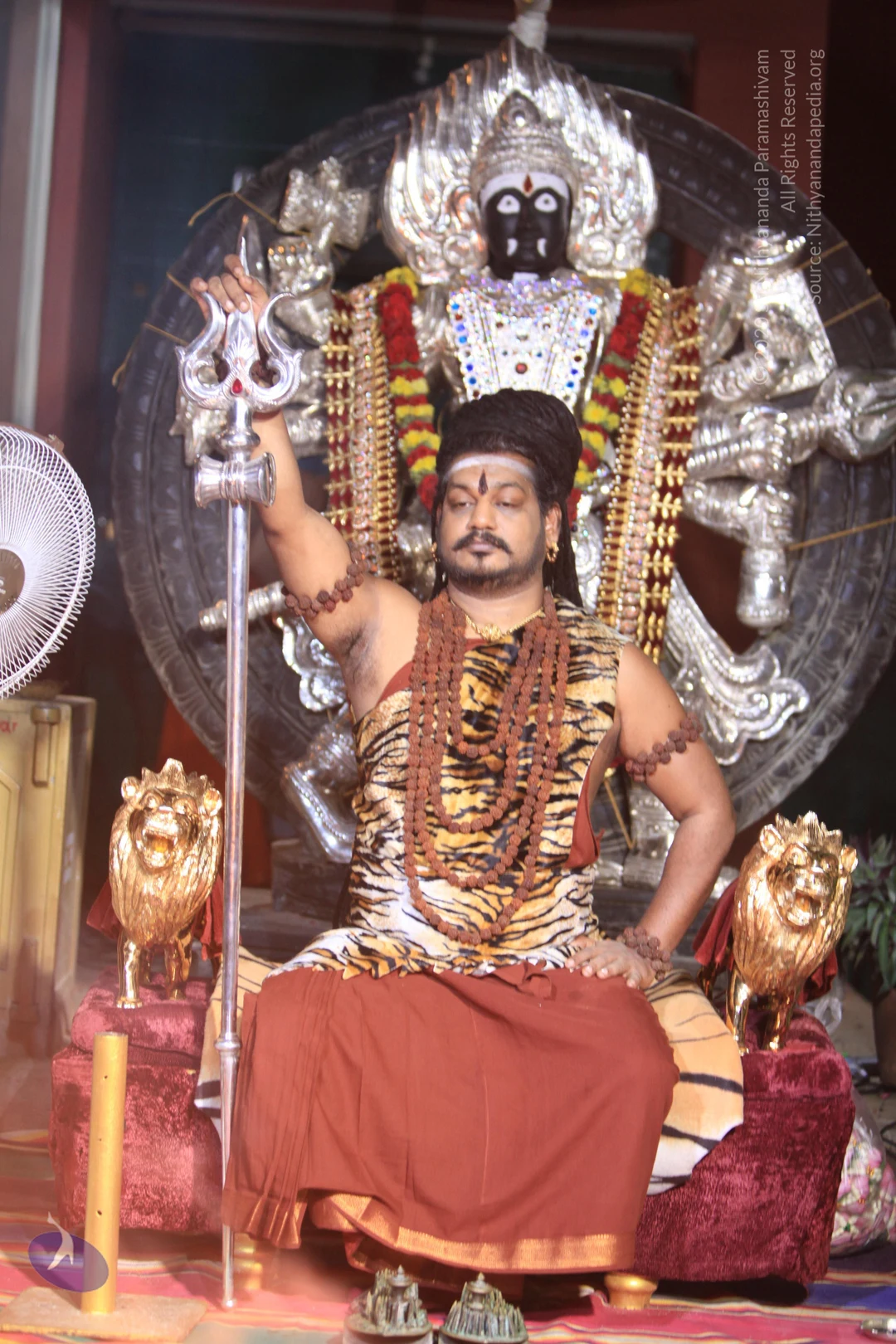
Photograph of a person standing in profile at an evening outdoor ceremony, eyes lowered and hands folded in front of the chest. The person has very long dark matted hair piled high, a tiger-striped wrap over the upper body, an orange-red cloth at the waist and legs, and rudraksha beads on the neck, upper arm and wrists. A red backdrop behind carries partly visible lettering, and two other men in orange cloths stand at the right and back. A golden lion figure and a striped cloth-covered seat appear at the lower right.A seated man with long dark hair piled high, white and red tilak on forehead, and a red bindi, sits on a red velvet seat with golden lion figures on either side. He wears a tiger-striped garment, a red-brown rudraksha mala across his chest, rudraksha armlets and a red lower cloth, with eyes lowered. Behind him a large silver deity murti with a black face, jewelled breastplate, red-and-yellow flower garlands and a trident stands within a silver halo-like arch. Incense and offerings are faintly visible at the edge.A seated man with long swept-back dark hair, a white and red tilak on his forehead, rudraksha malas around his neck and arms, and a tiger-striped garment, raises a silver trident in his right hand with eyes closed. Behind him a large silver deity murti with a jewelled chest plate, red and yellow flower garlands and a black face with white eyes stands in a silver arch. Gold lion figures flank the seat in the lower corners. Swamiji (probable): the seated man shows long swept-back hair and rudraksha malas, cues matching the page's Swamiji flag, though identity is uncertain from appearance.A brick-lined fire pit blazes in the foreground, with a white cloth bundle wrapped in white flower garlands burning in the flames, as in a homa. Behind it, a seated man in a striped shawl and beaded necklaces sits before a silver deity murti with a crown and many arms, with a trident and a gilded lamp stand at his sides. To the left a bare-chested young man in white dhoti kneels, and to the right a woman in white sari sits with hands folded in prayer. In the right foreground an ascetic in an orange-saffron cloth and turban, wearing rudraksha malas and gold pendants, stands tending the fire with tongs. Brass plates of flowers and kalasha vessels sit on the platform, and fans and a palm plant surround the outdoor pavilion at night.A night-time homa at an outdoor shrine. In the foreground, a brick fire pit holds a flaming yagna with a white cloth bundle wrapped in white flower garlands. Behind it, a seated man in a tiger-striped garment with a red lower cloth and rudraksha beads is flanked by two golden lamp-bearing figures and sits before a large silver deity murti with a crown and trident. A woman in a white sari sits with folded hands to the right, and a figure in orange robes with long matted hair and a rudraksha mala stands at the right edge, pouring from a vessel near trays of flowers and offerings. Two fans stand in the background and a striped mat covers the floor. The seated man's appearance is consistent with the page's a person reference, though not certain; the cues shown are the tiger-striped garment, rudraksha beads and ceremonial setting.A photograph of a homa at night under a corrugated roof. A brick fire pit burns in the foreground with a large mound of offerings in the flames. Behind it, a man with long dark hair and a striped tiger-pattern garment, wearing rudraksha malas, sits on a golden chair before a large silver deity murti with a crown and multiple arms holding weapons, including a trident. A seated man in white dhoti with bare upper body sits to the left, and a woman in a white sari holds a lit oil lamp to the right. Steel vessels with flower petals, a kalasha and brass plates sit on a striped mat. A fan stands in the room.
04-Darshan
15 photosSource gallery
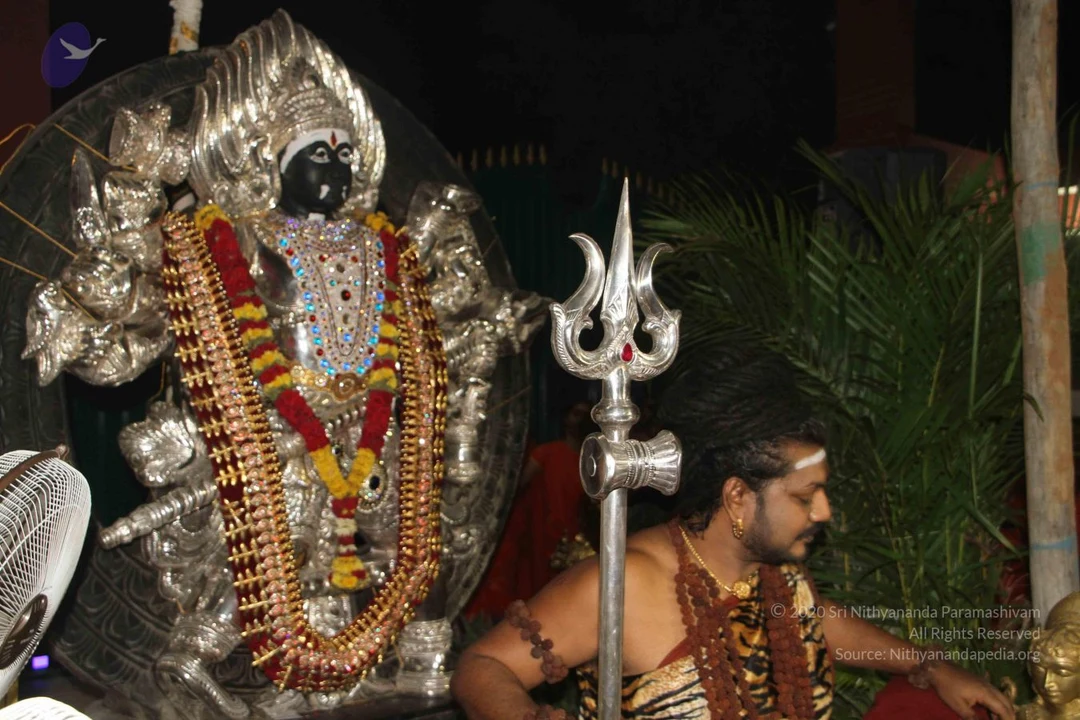
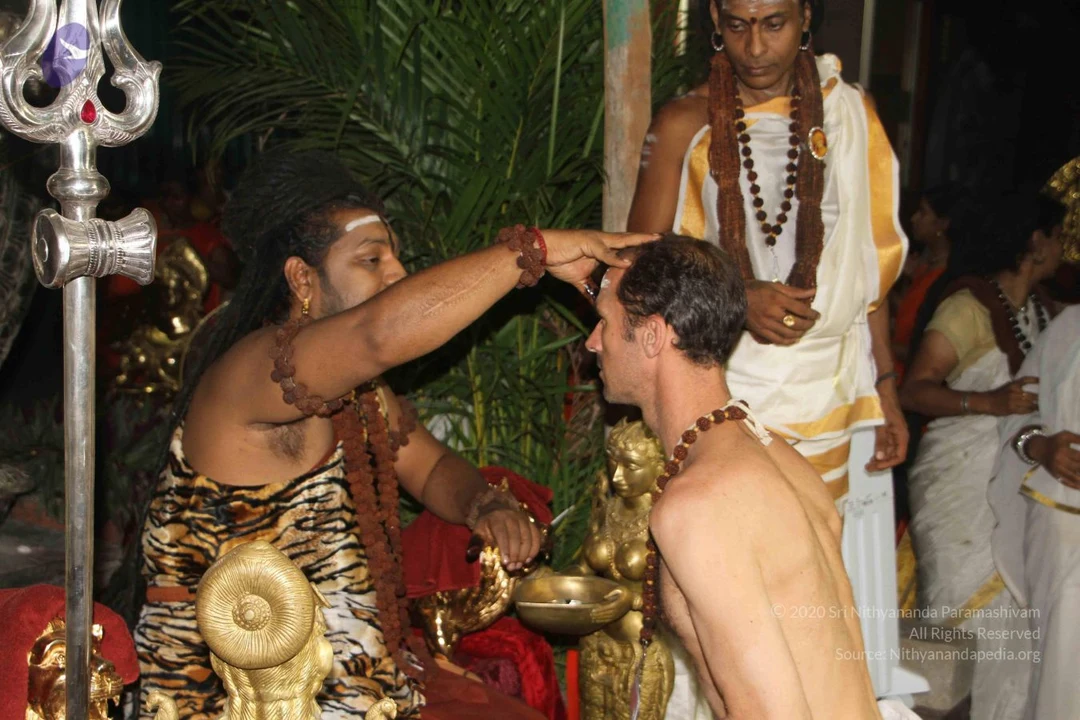
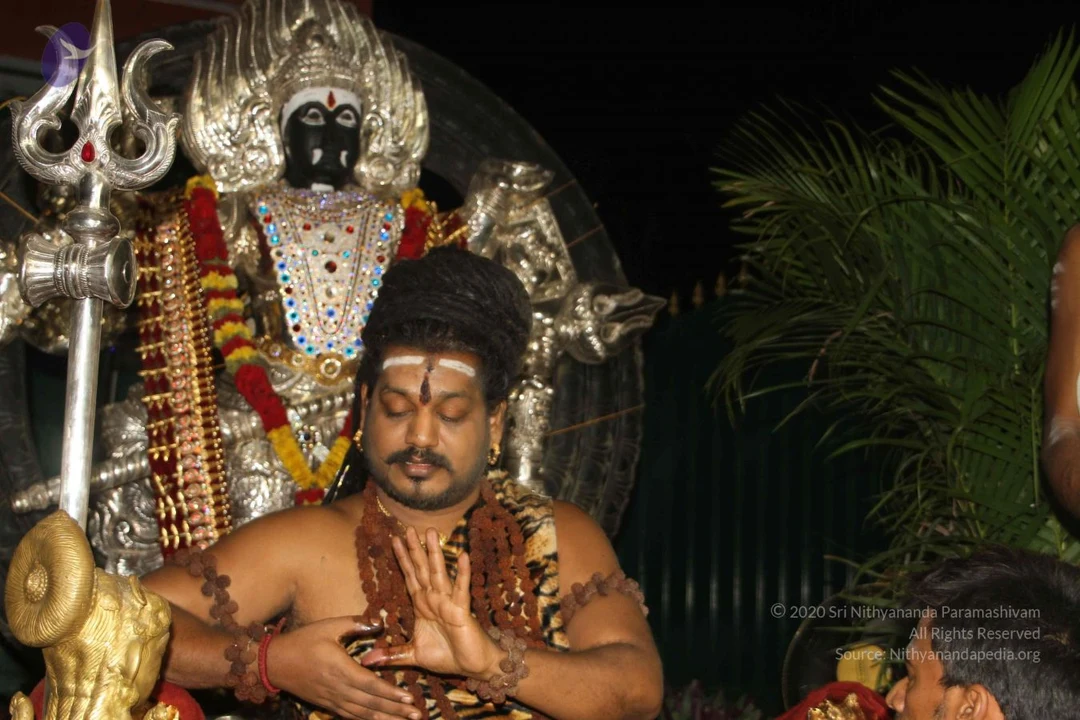
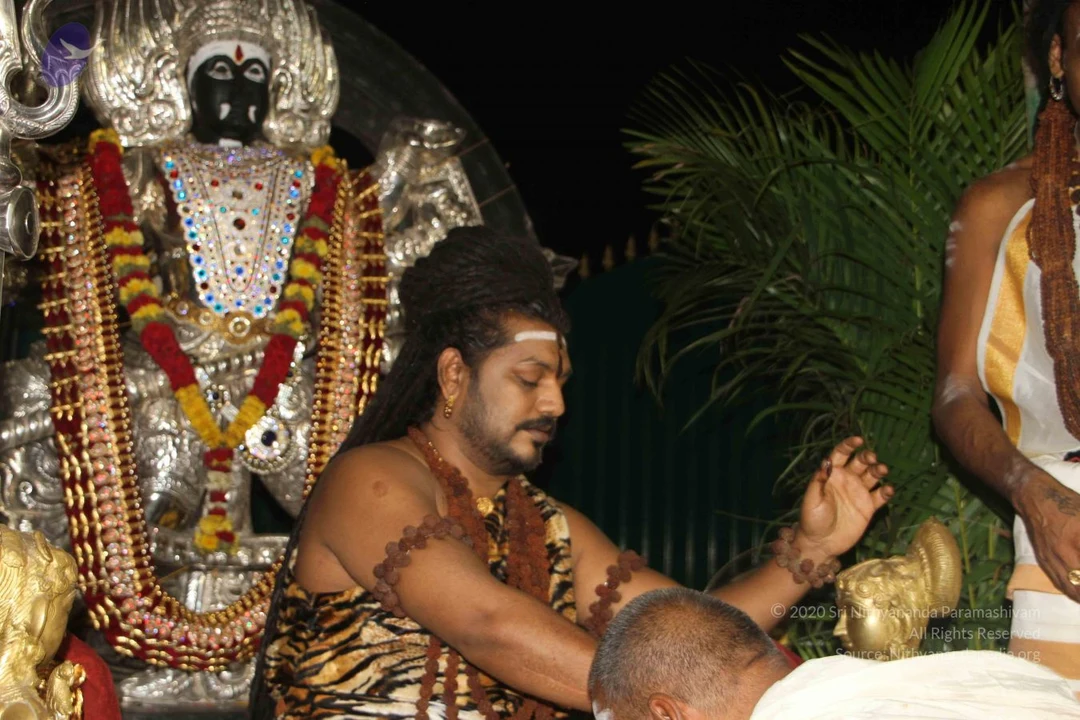
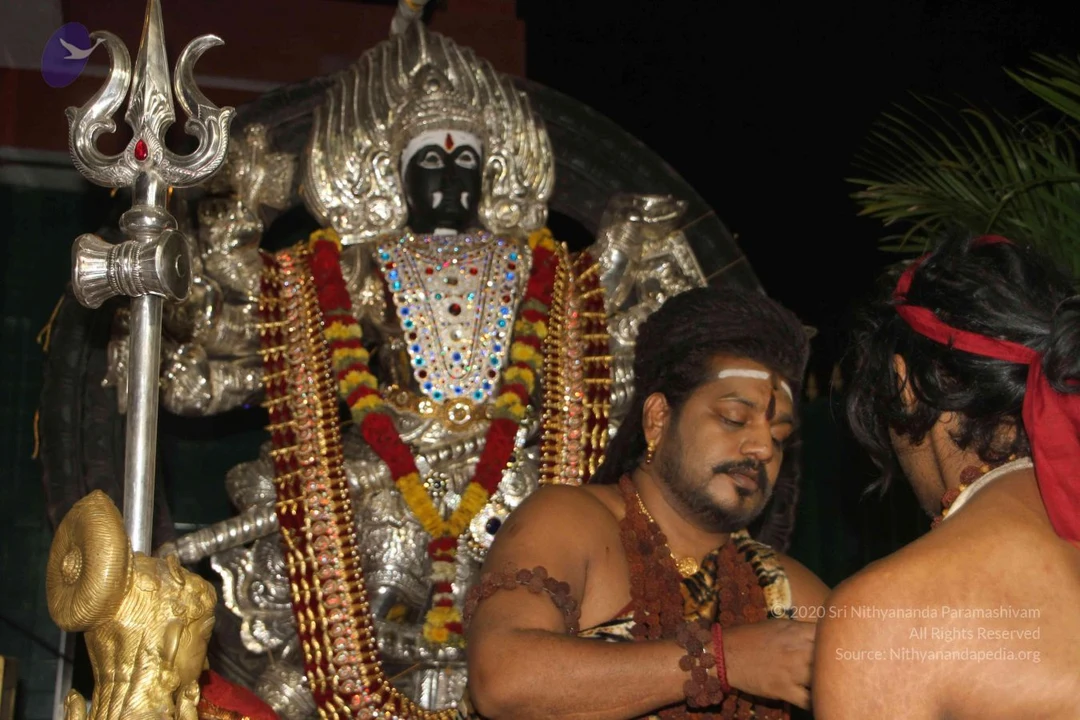
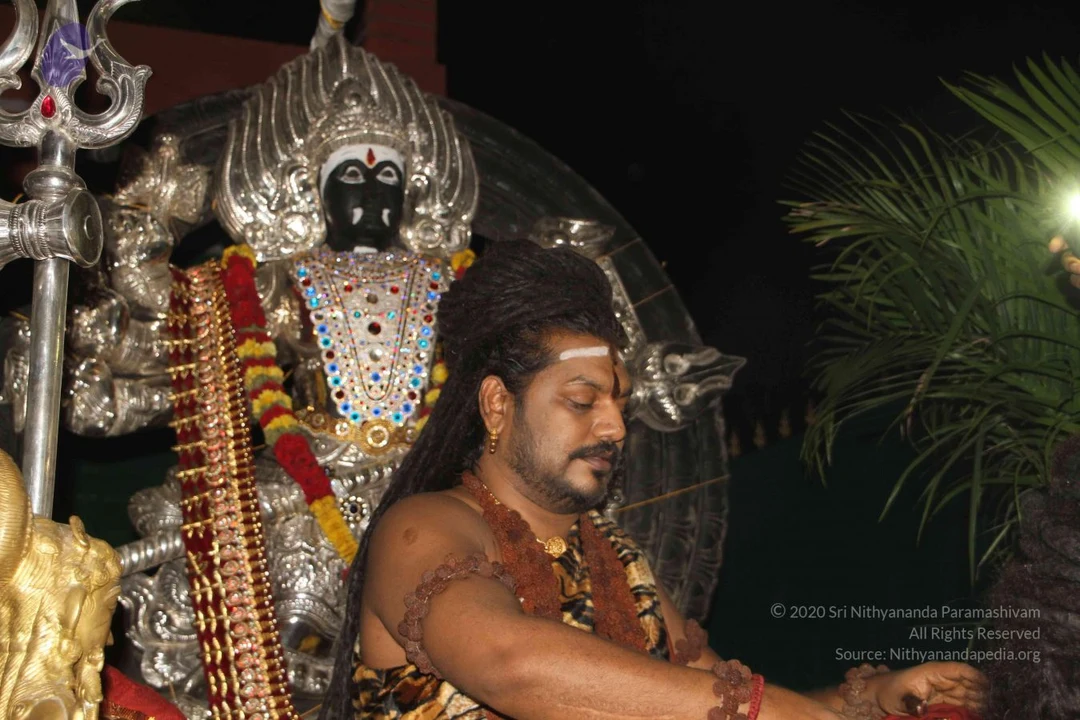
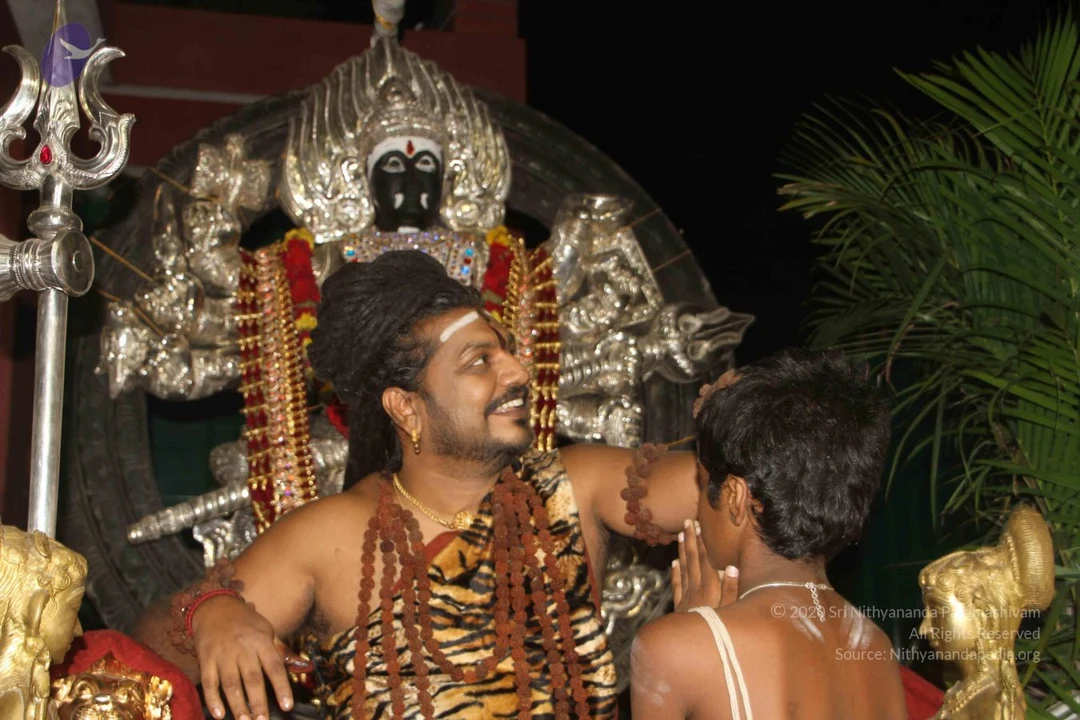
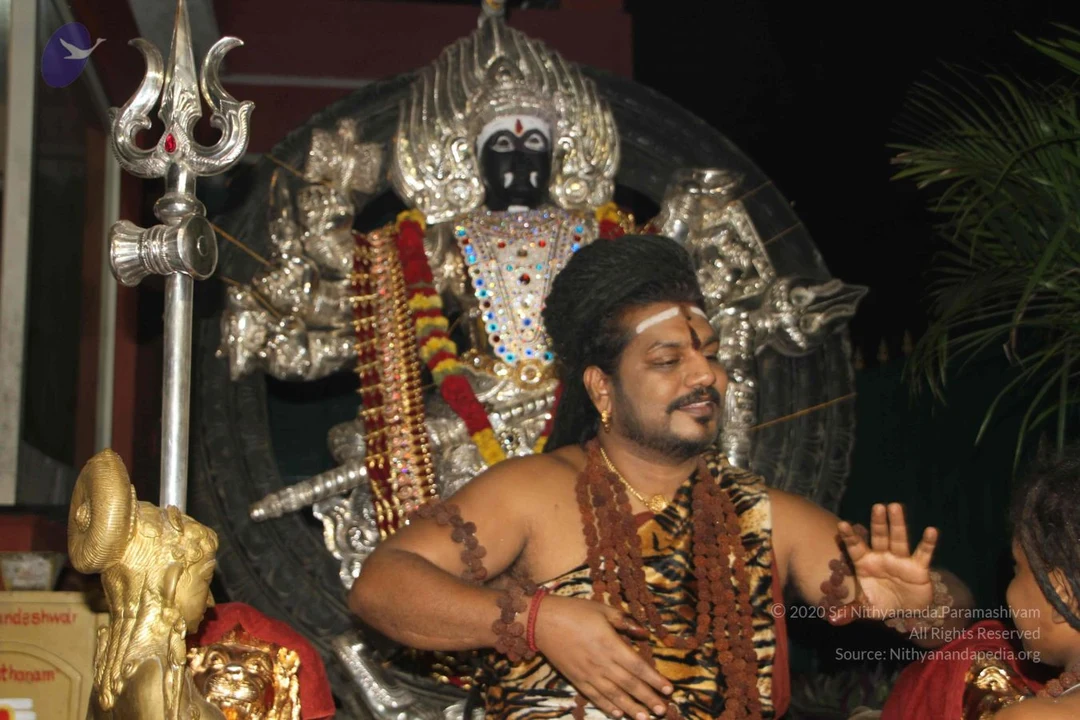
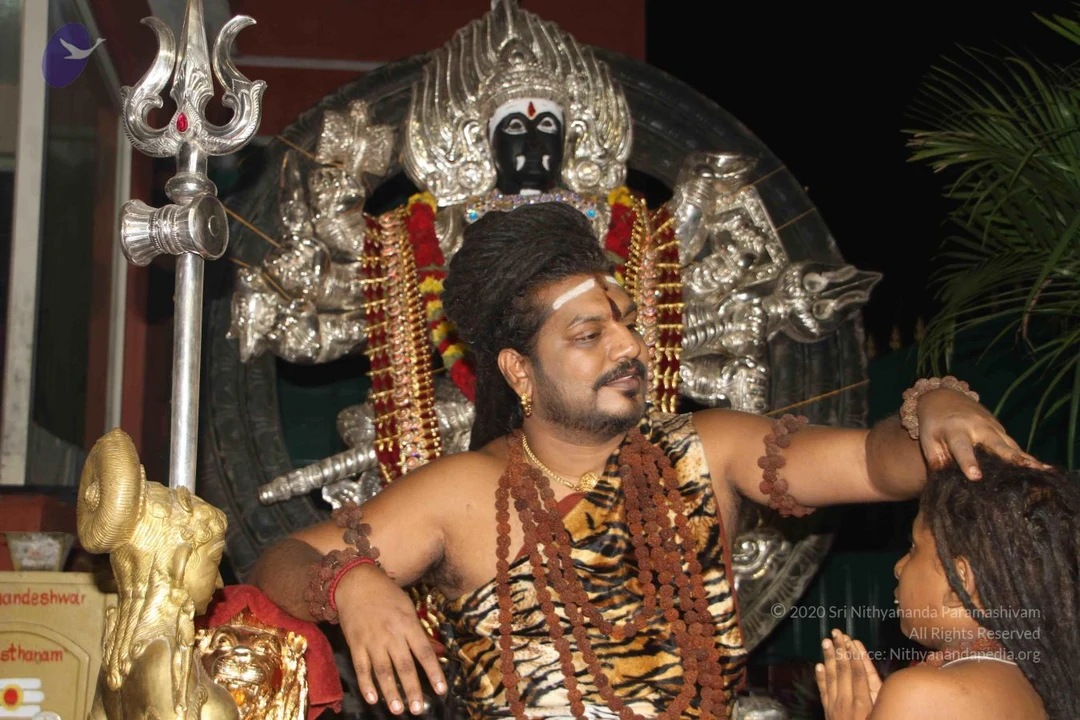
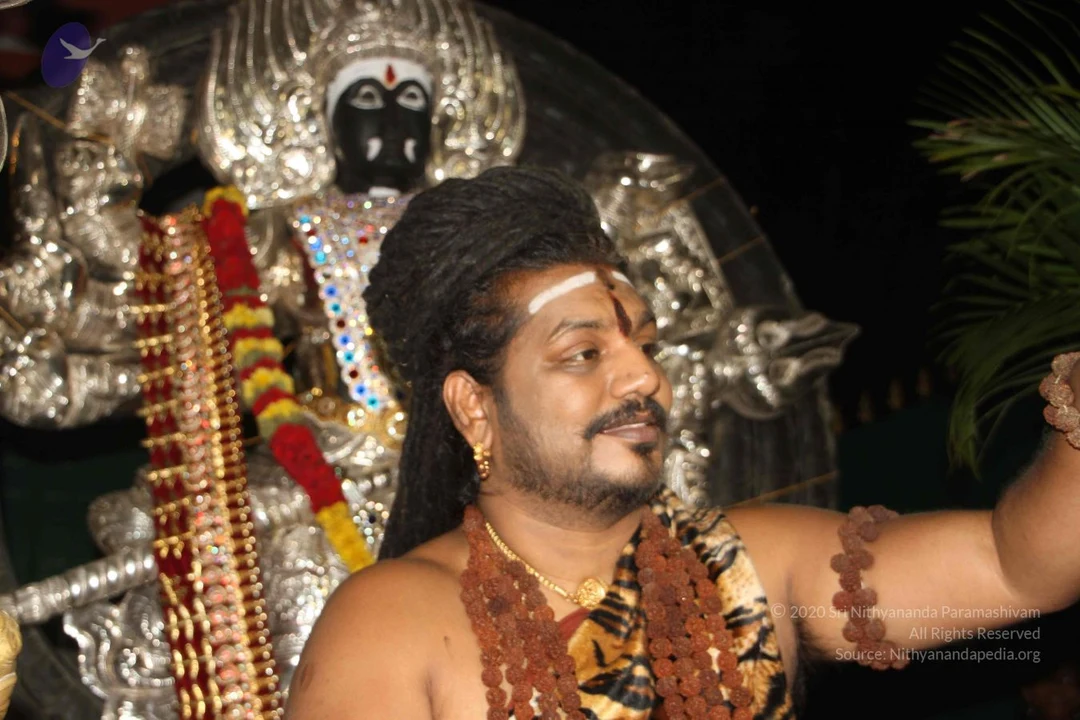
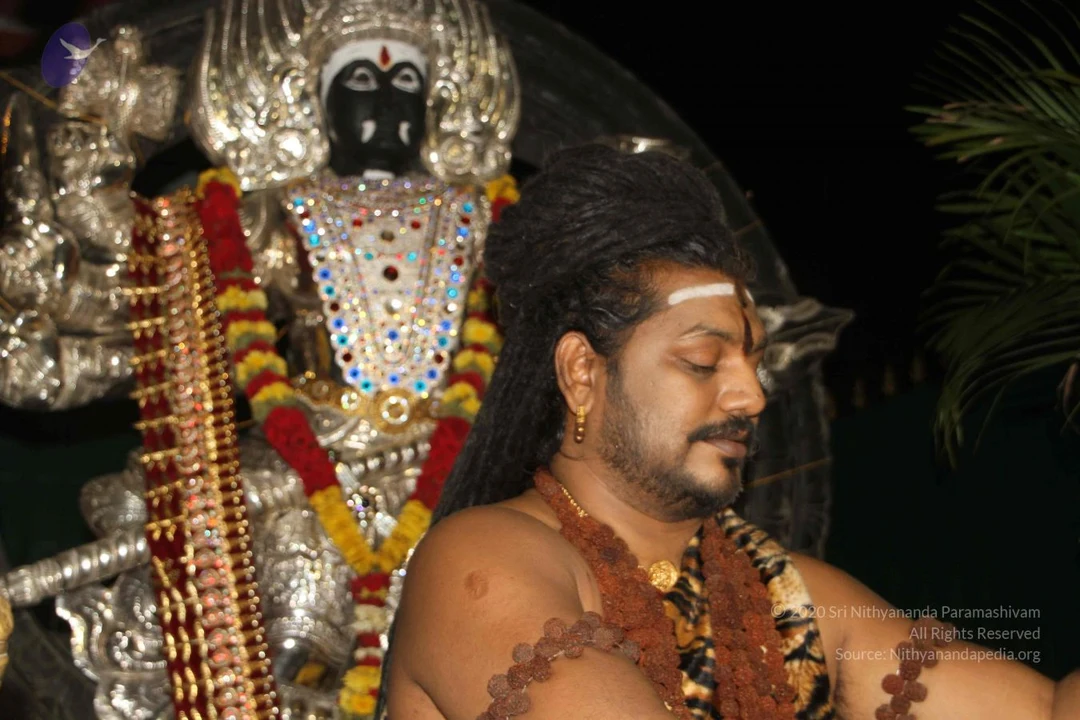
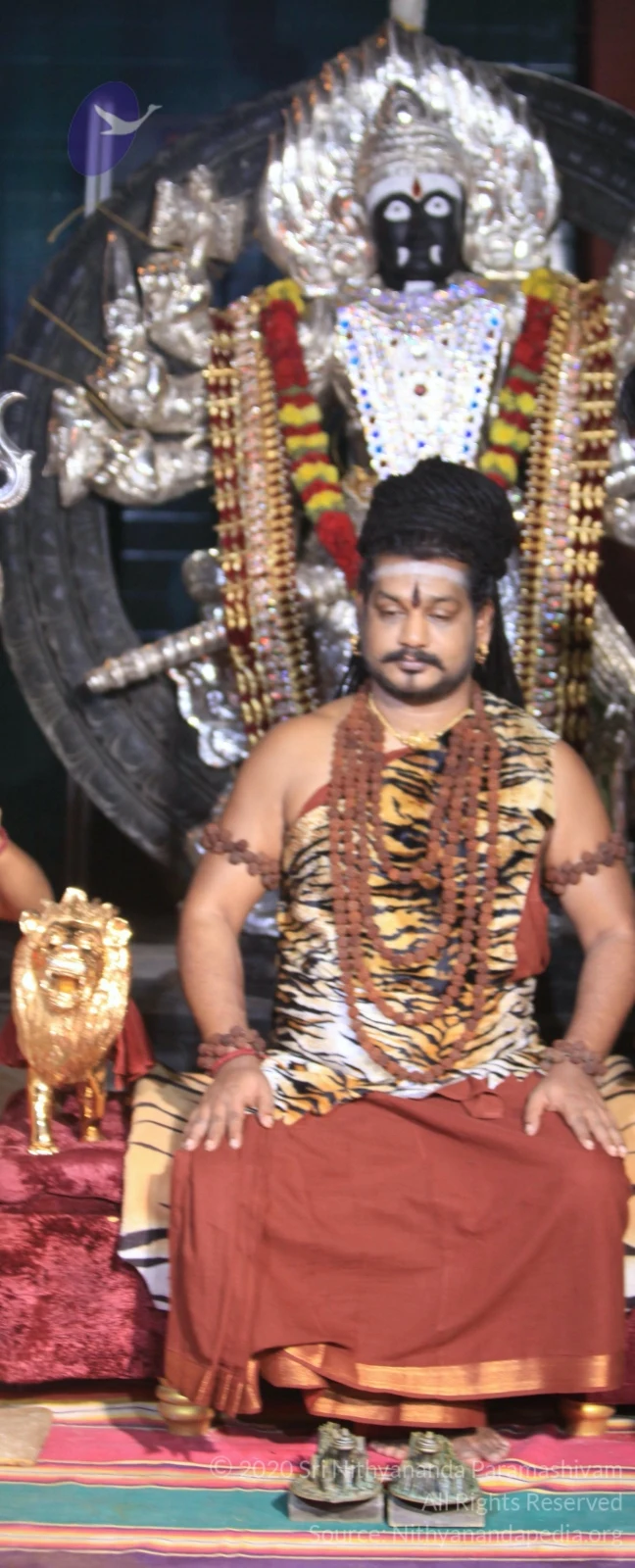
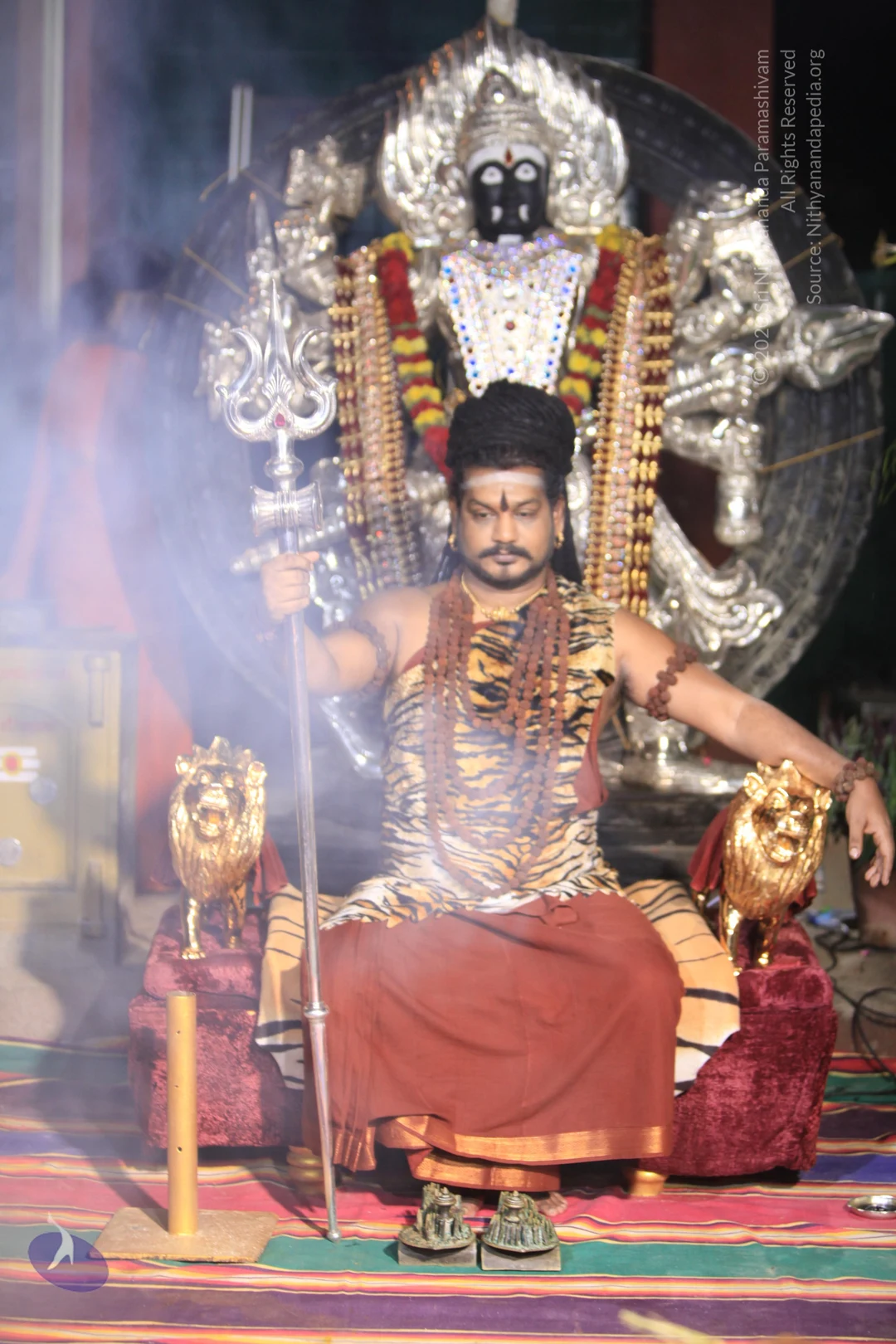
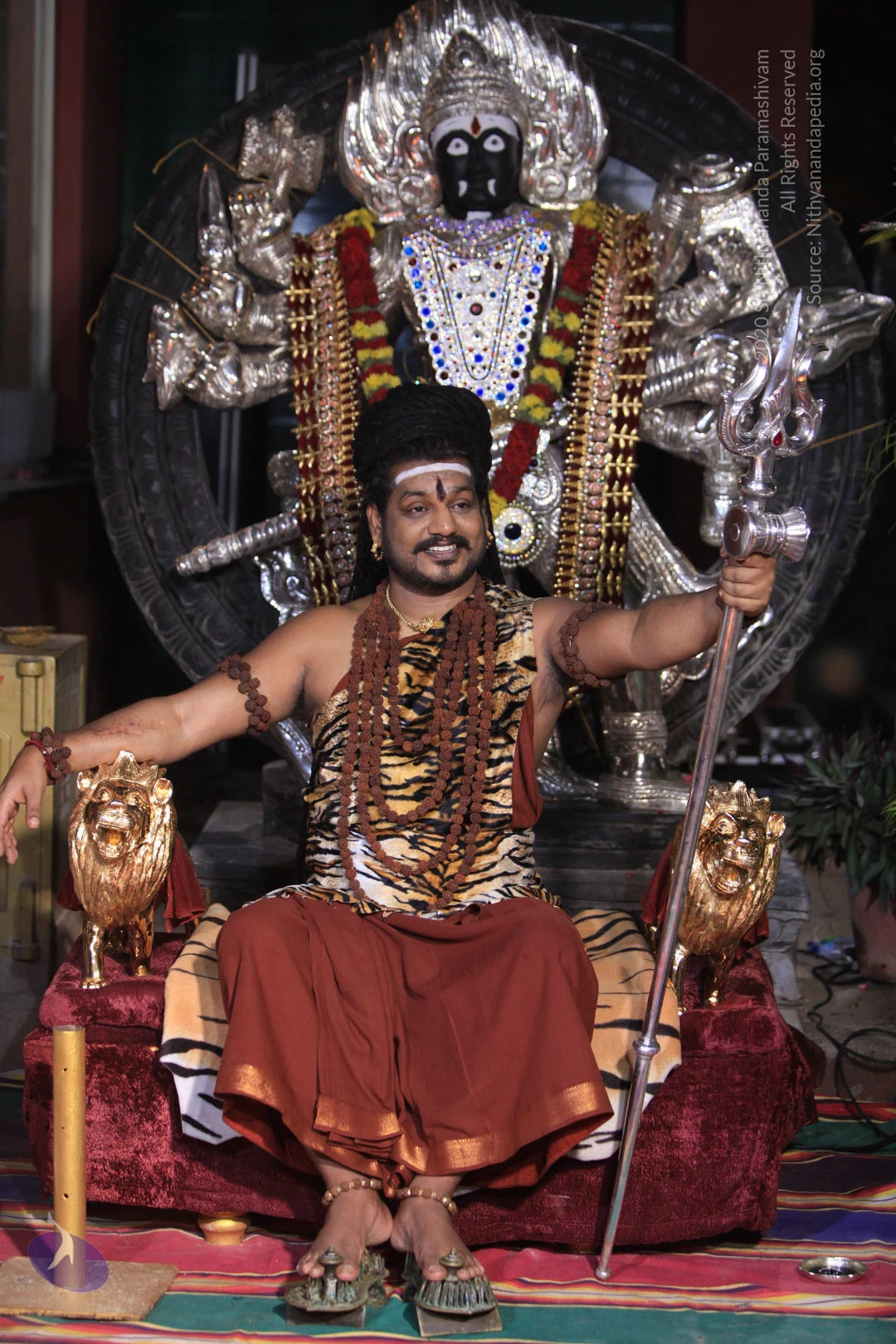
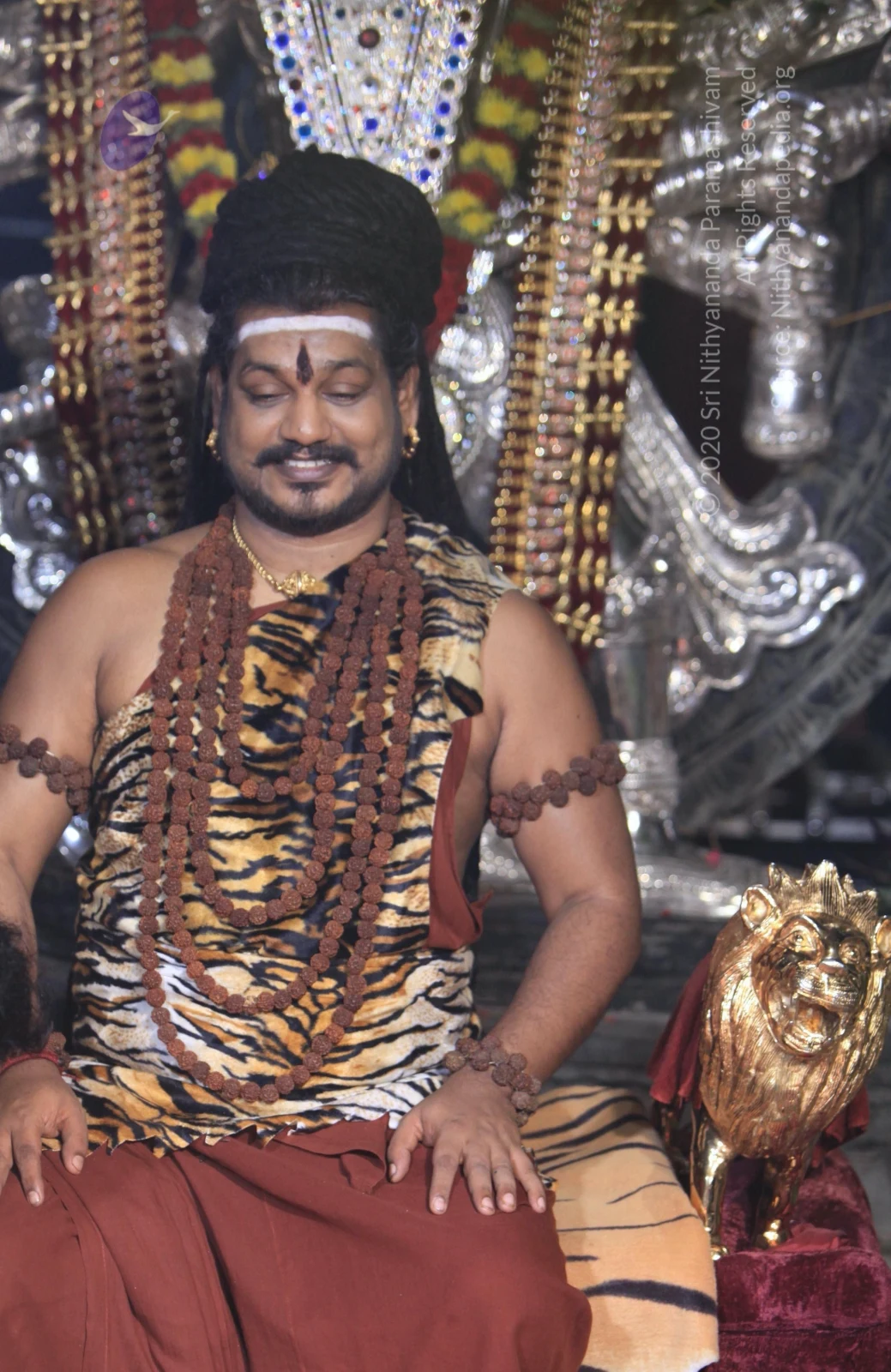
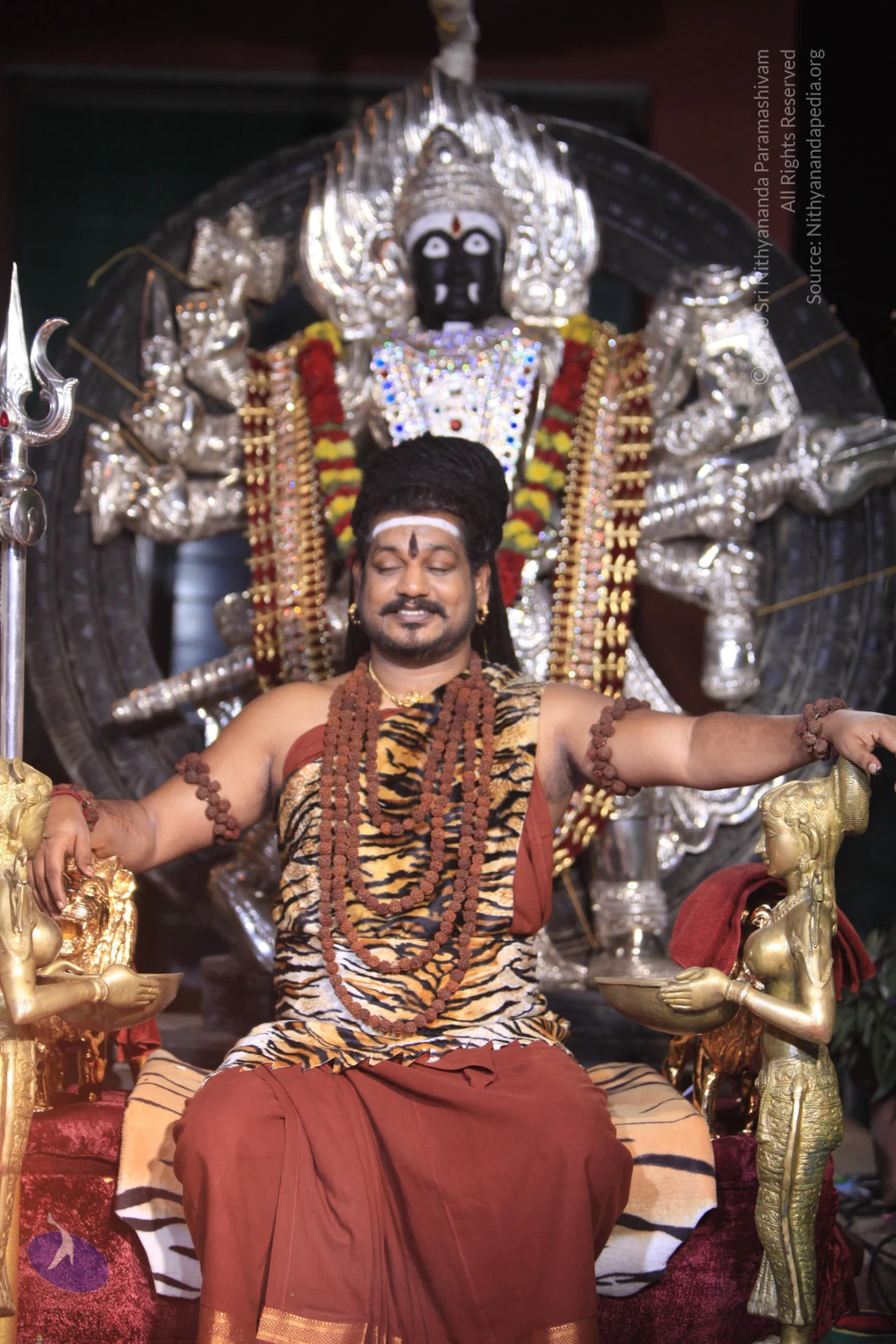
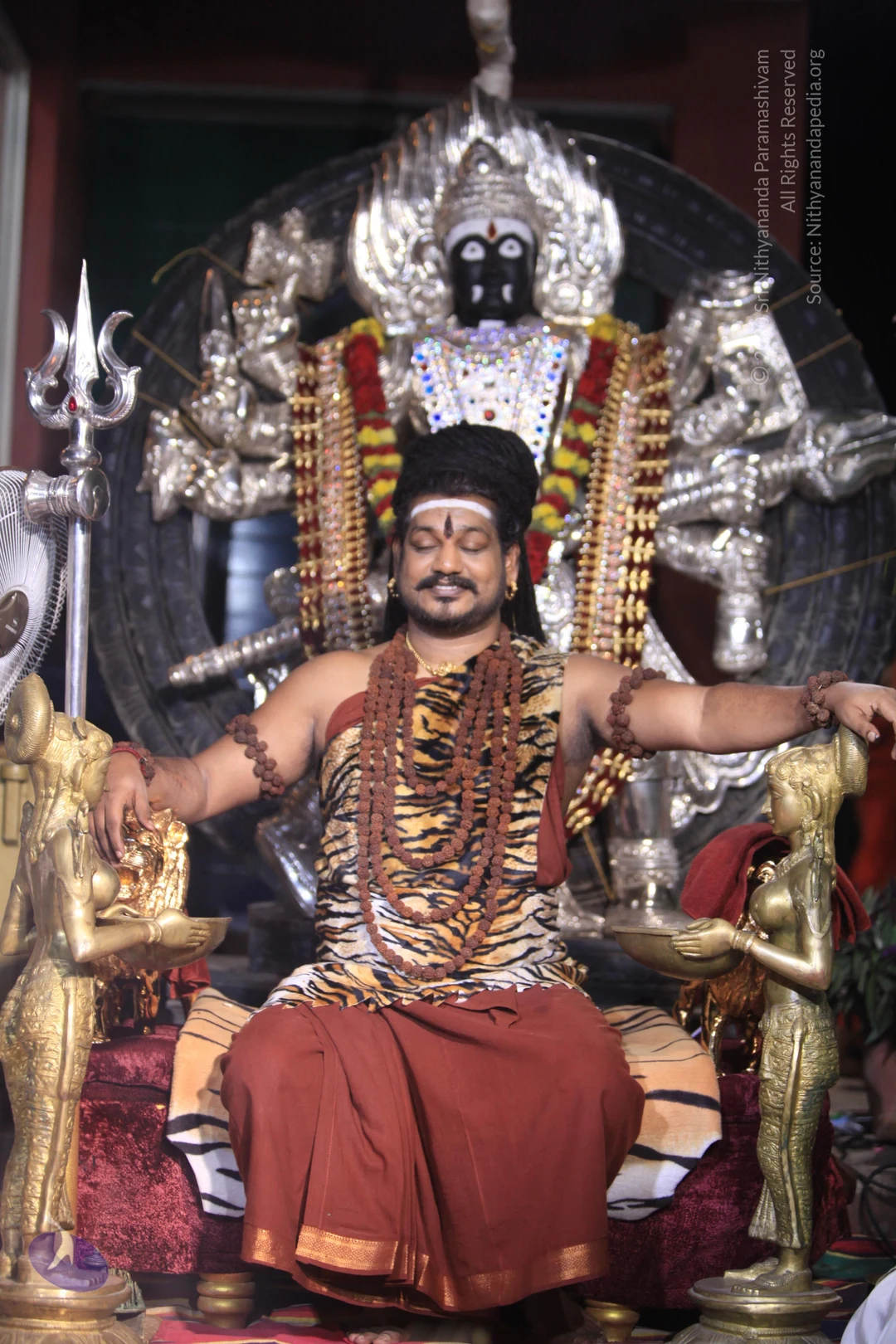
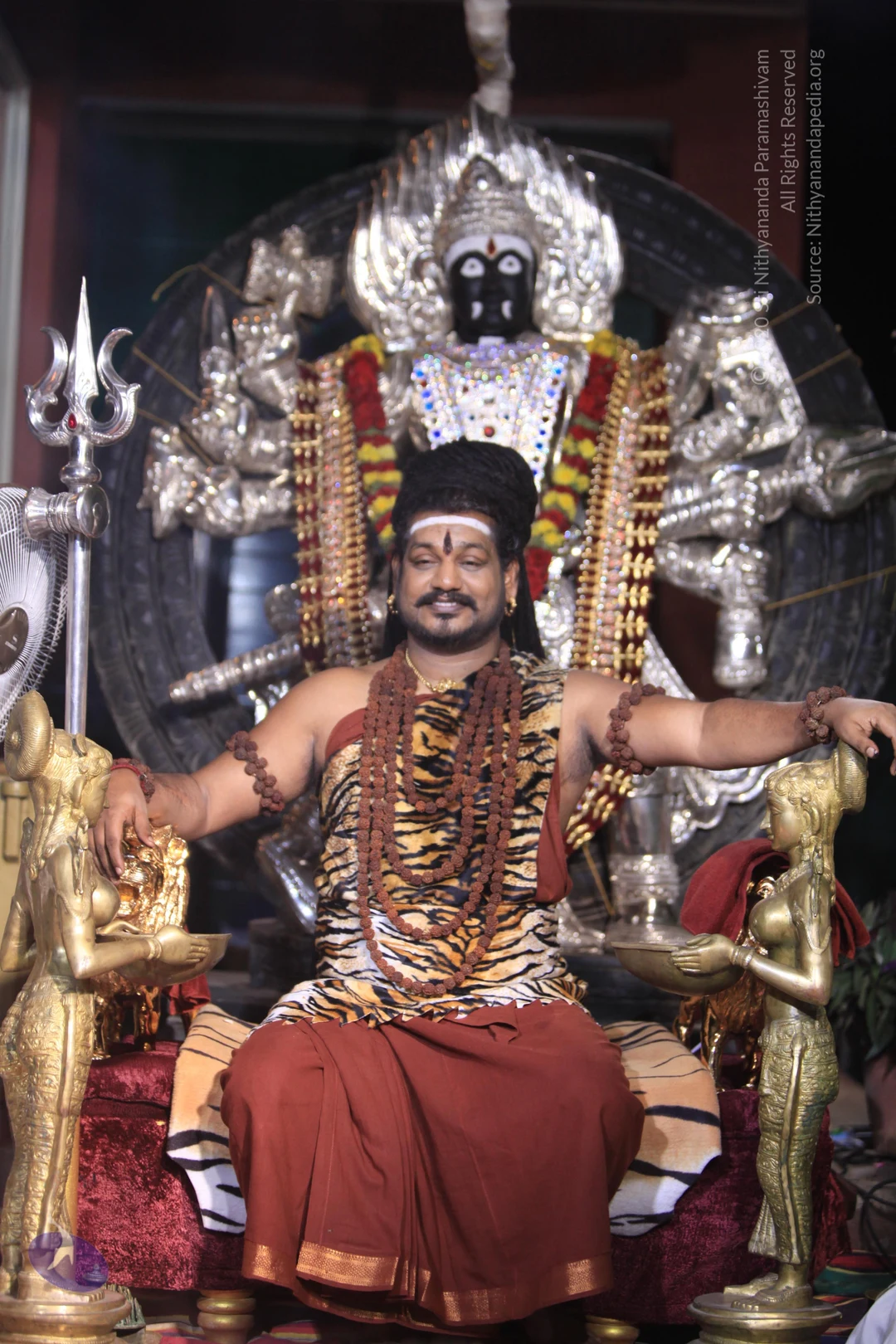
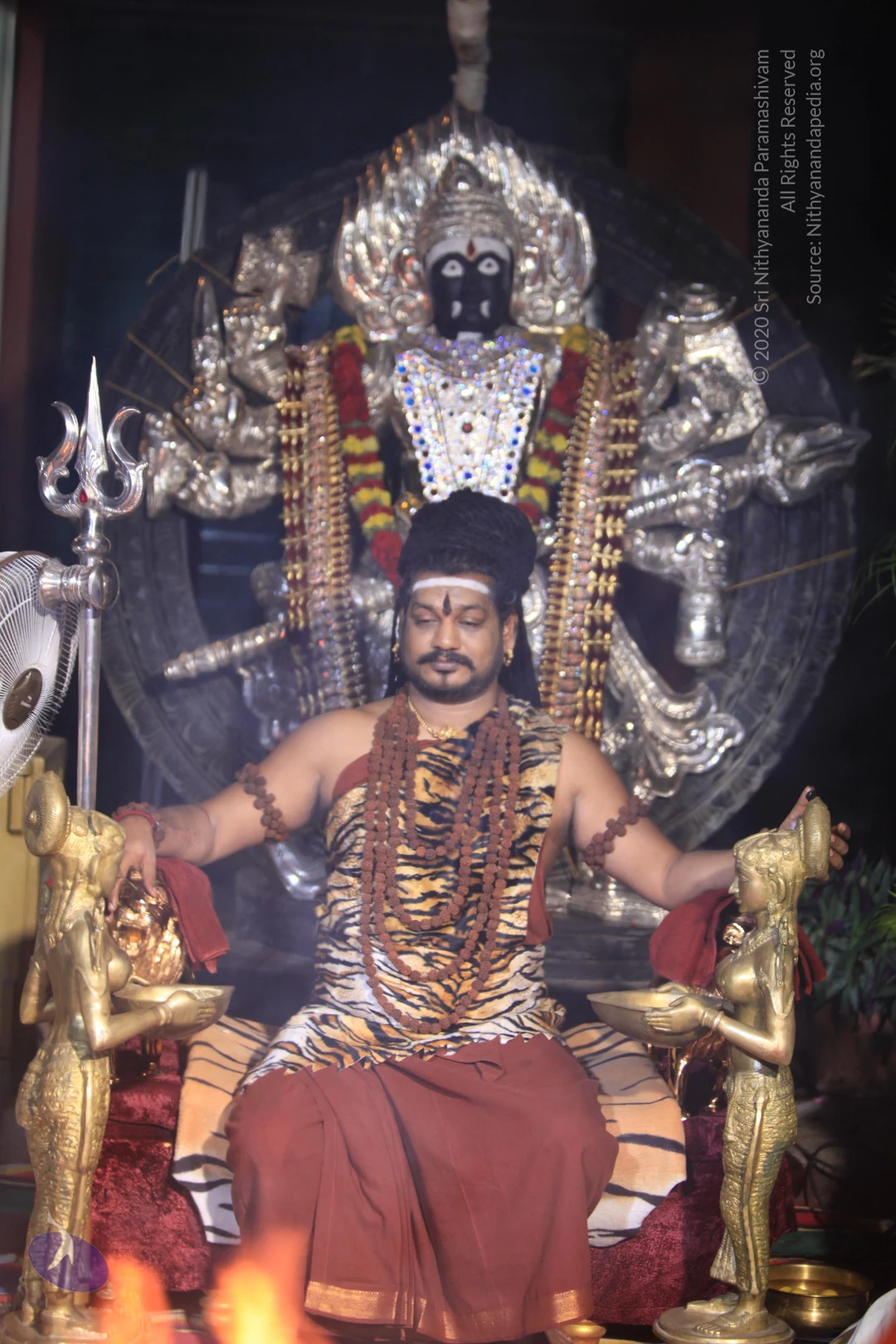
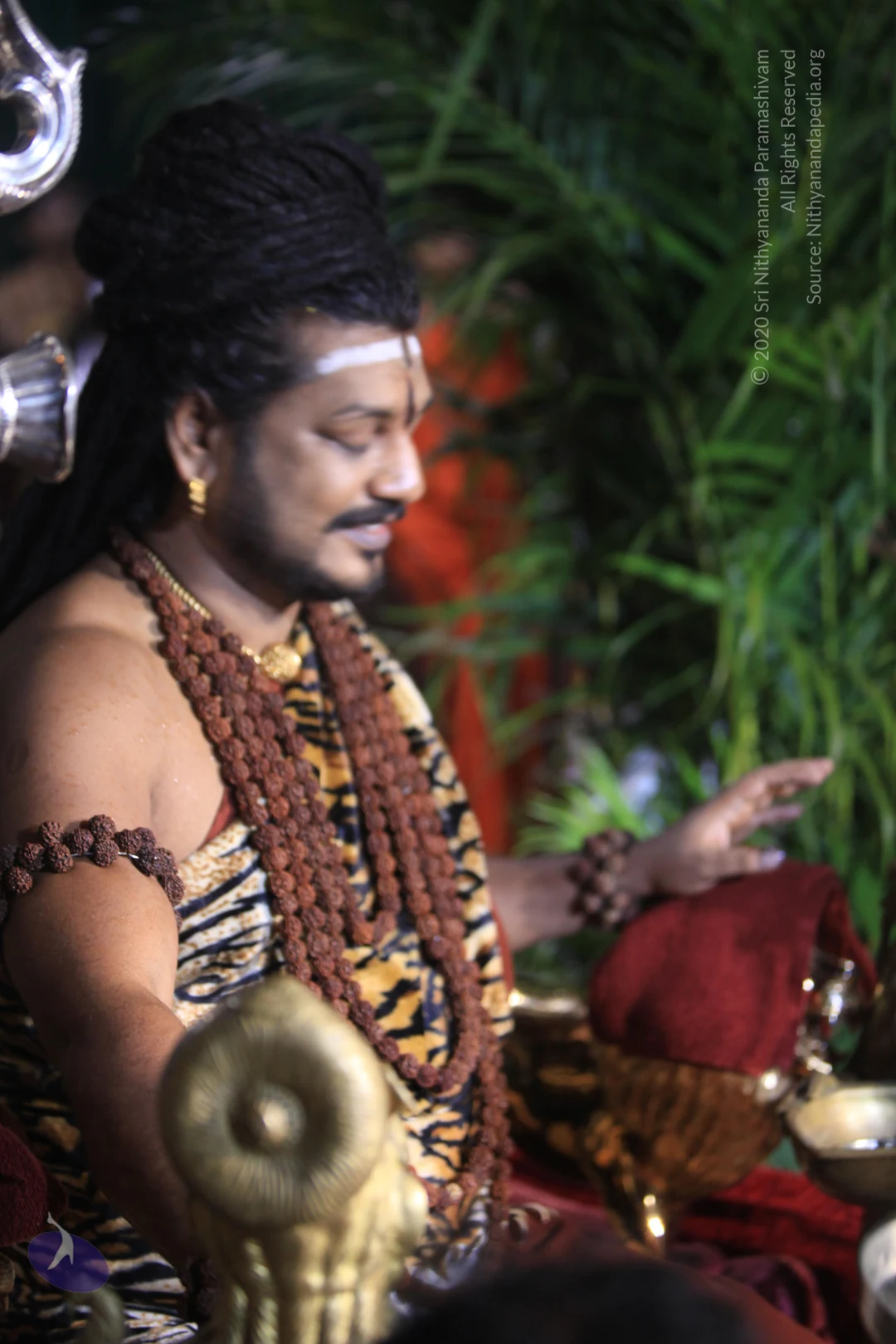
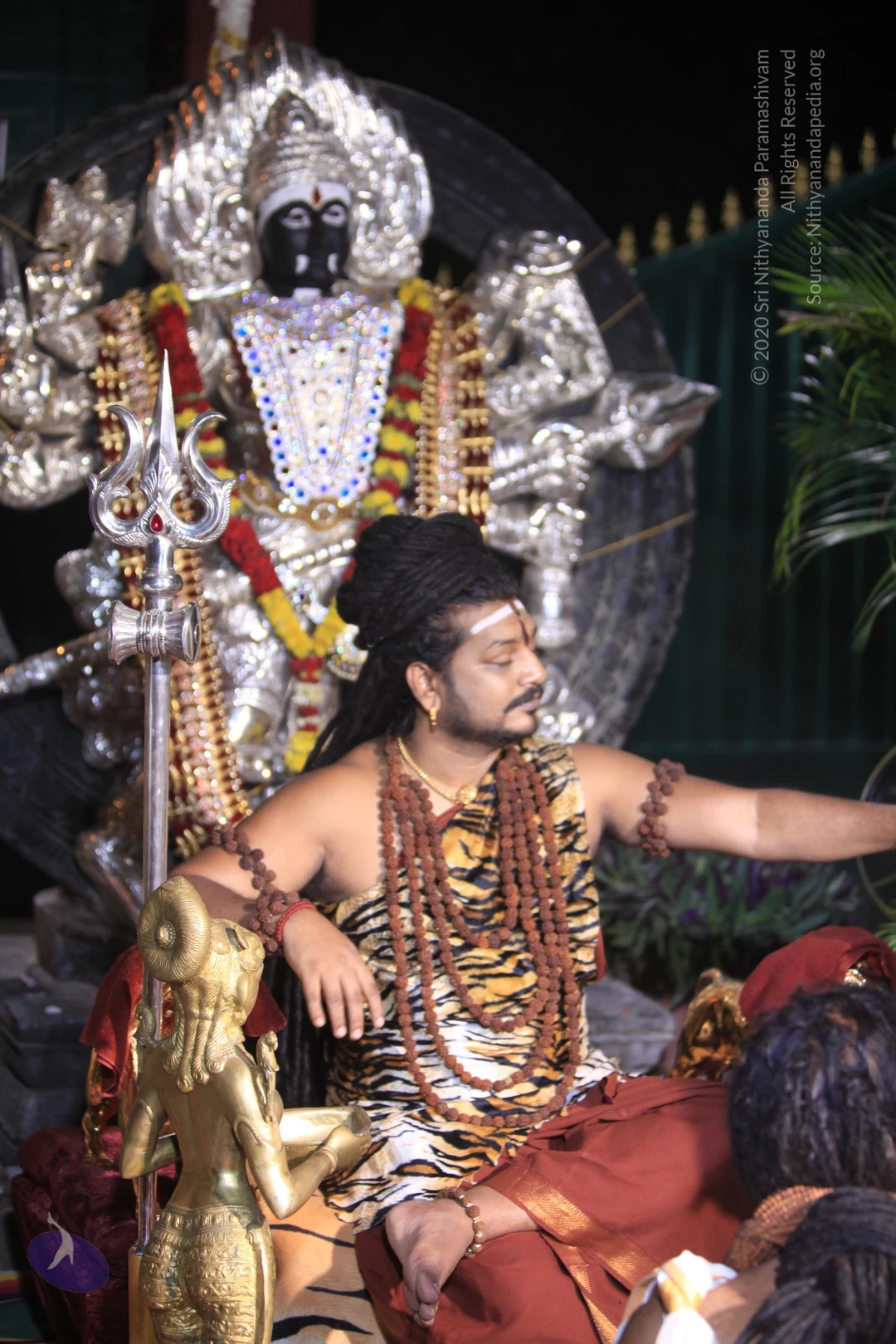
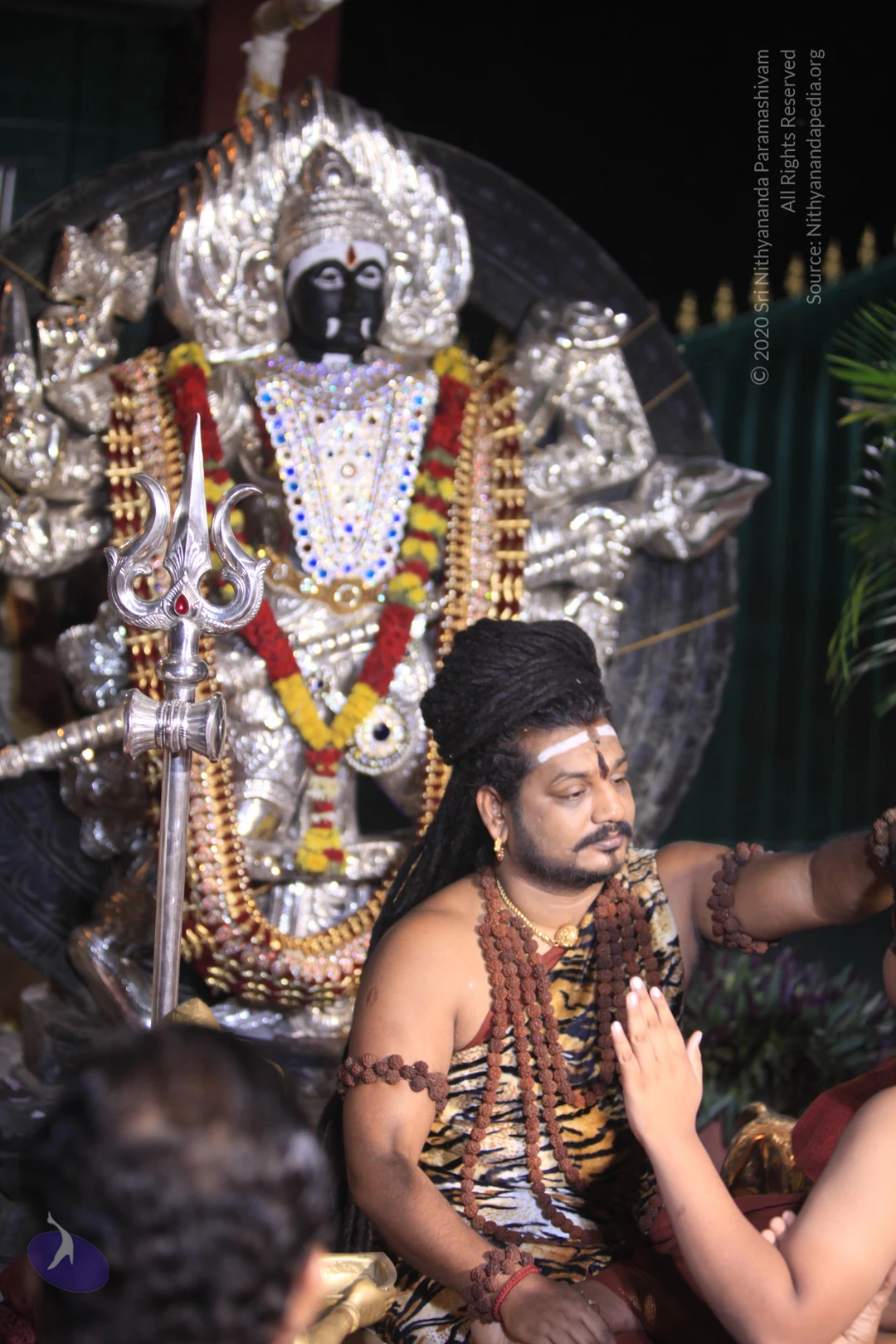
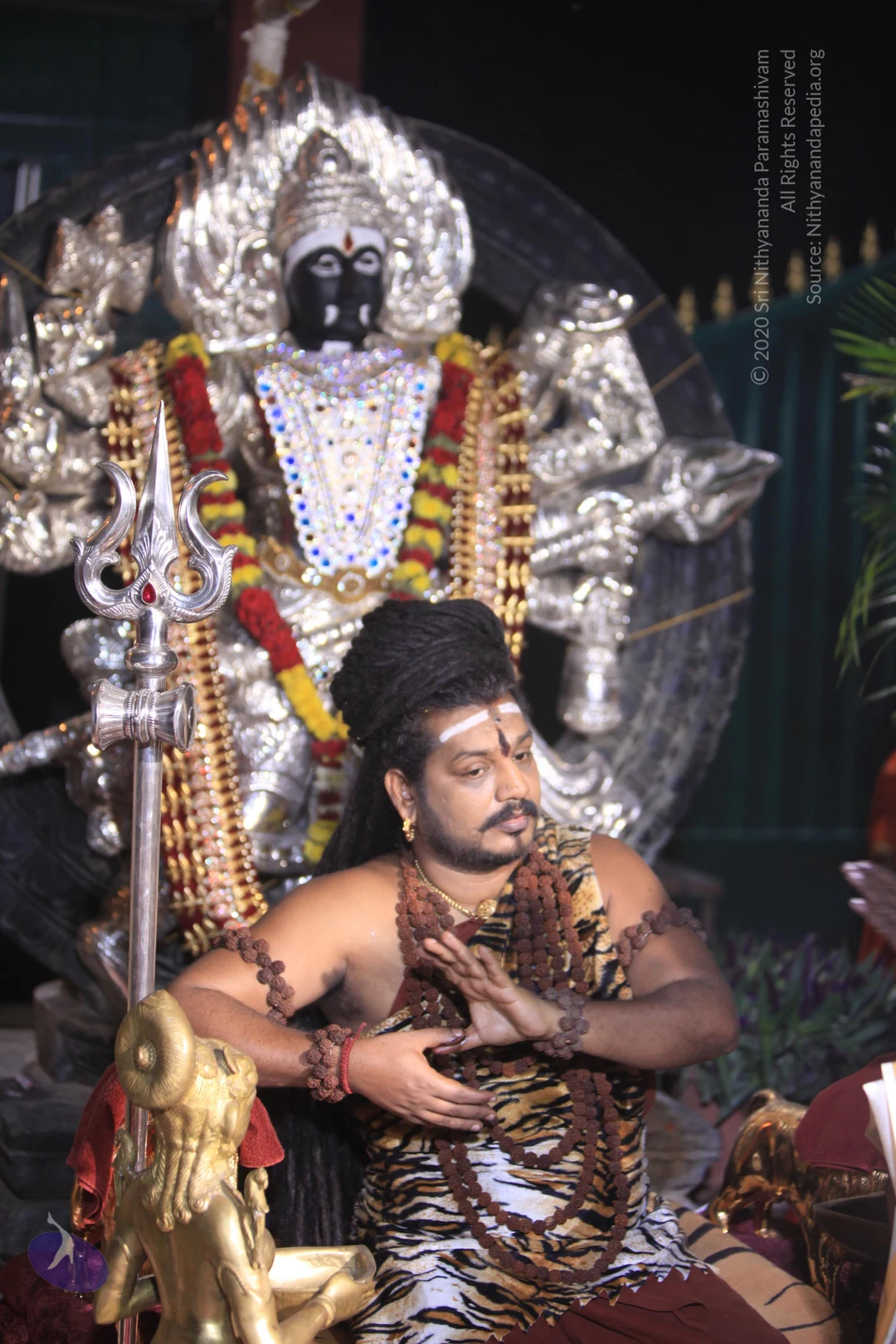
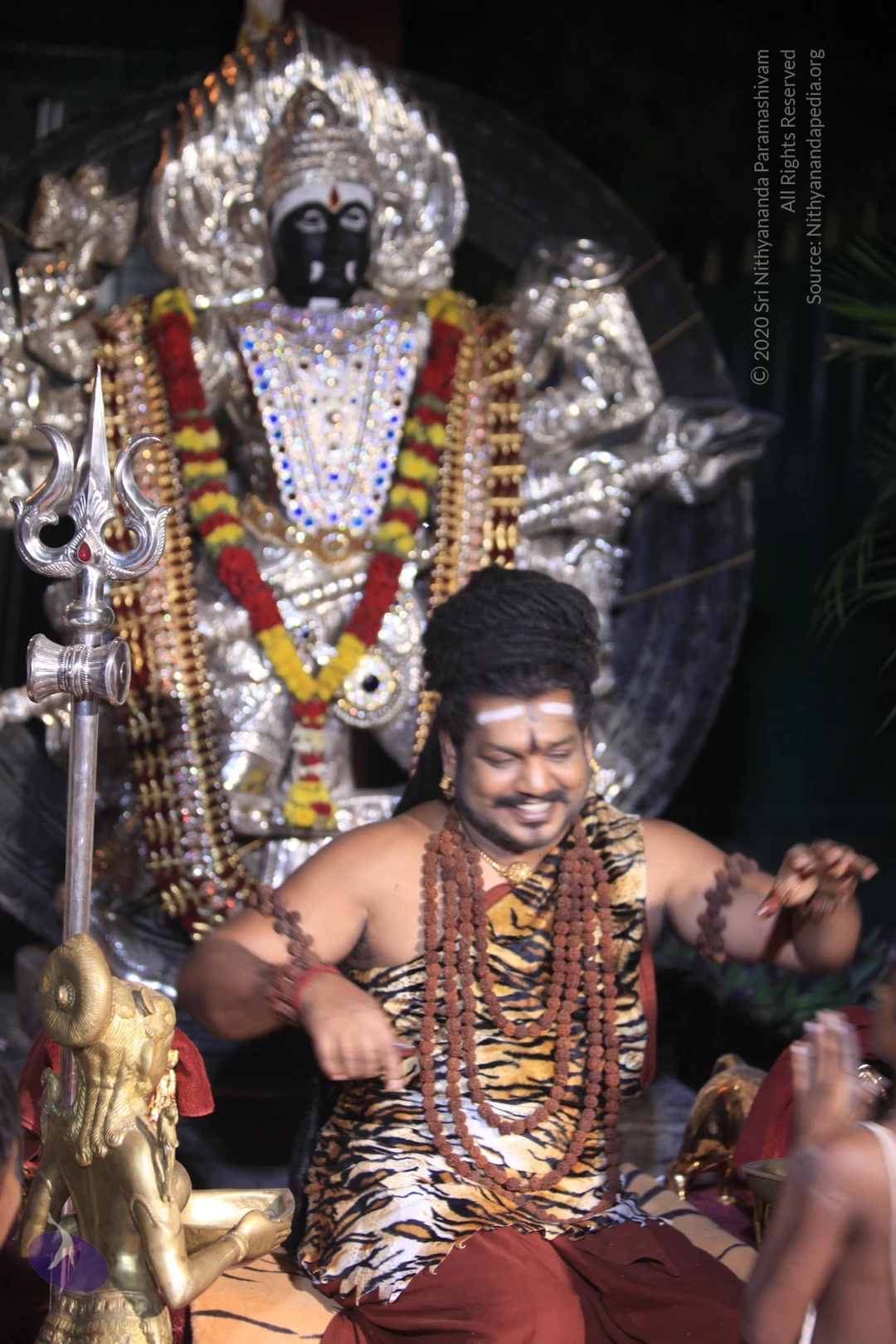
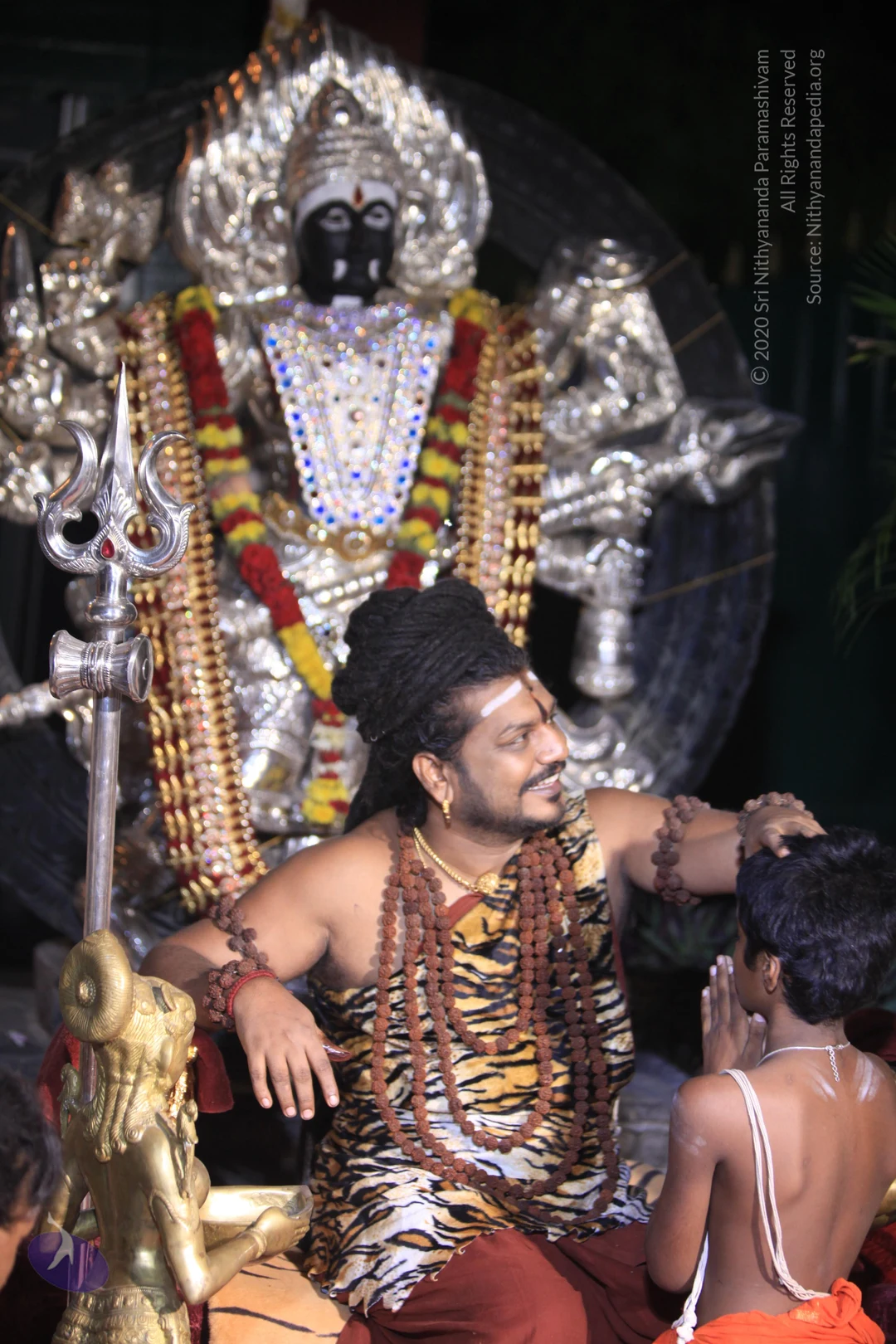
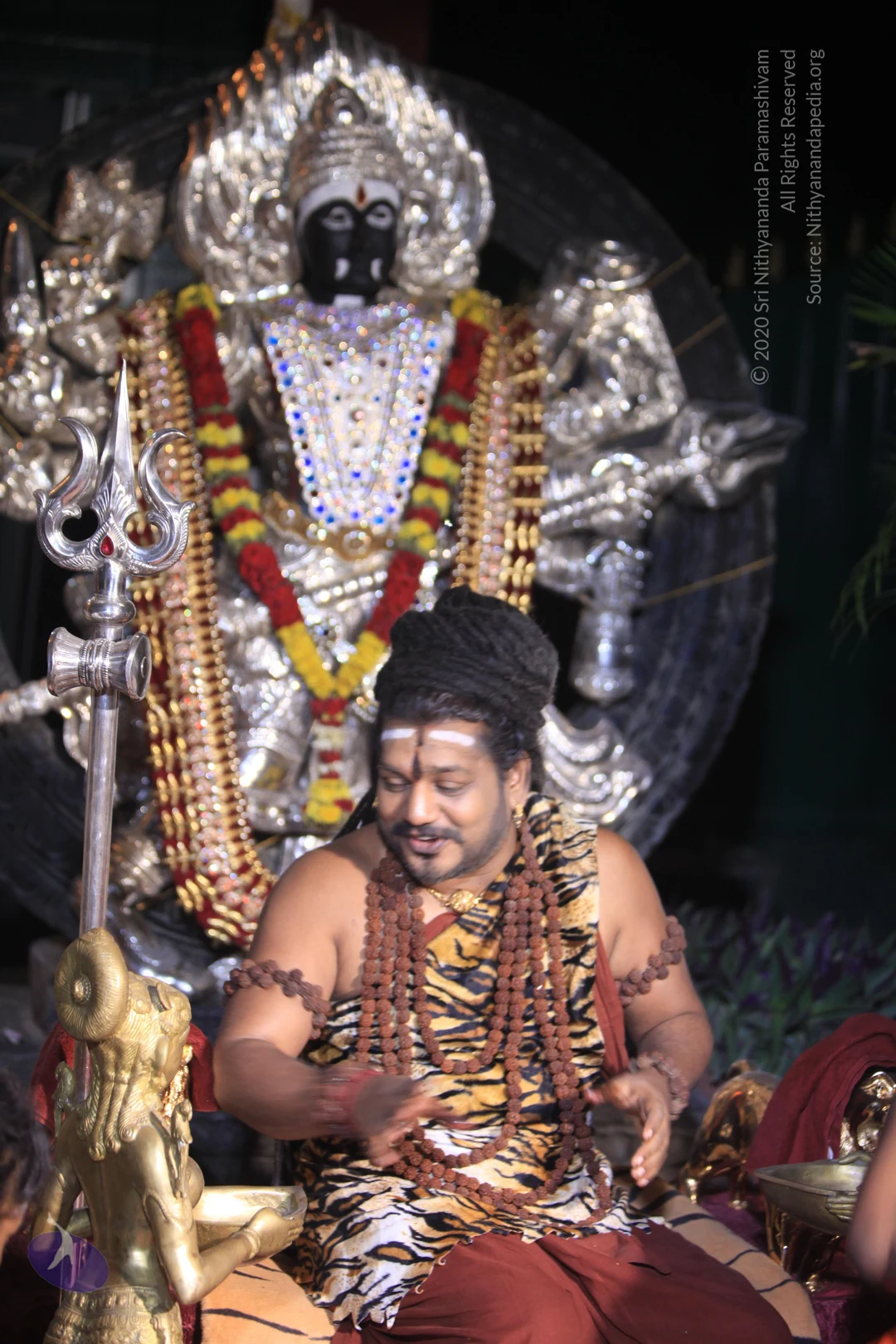
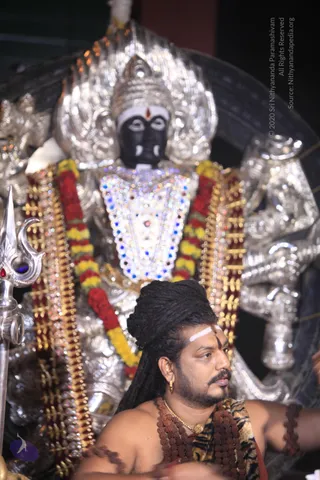
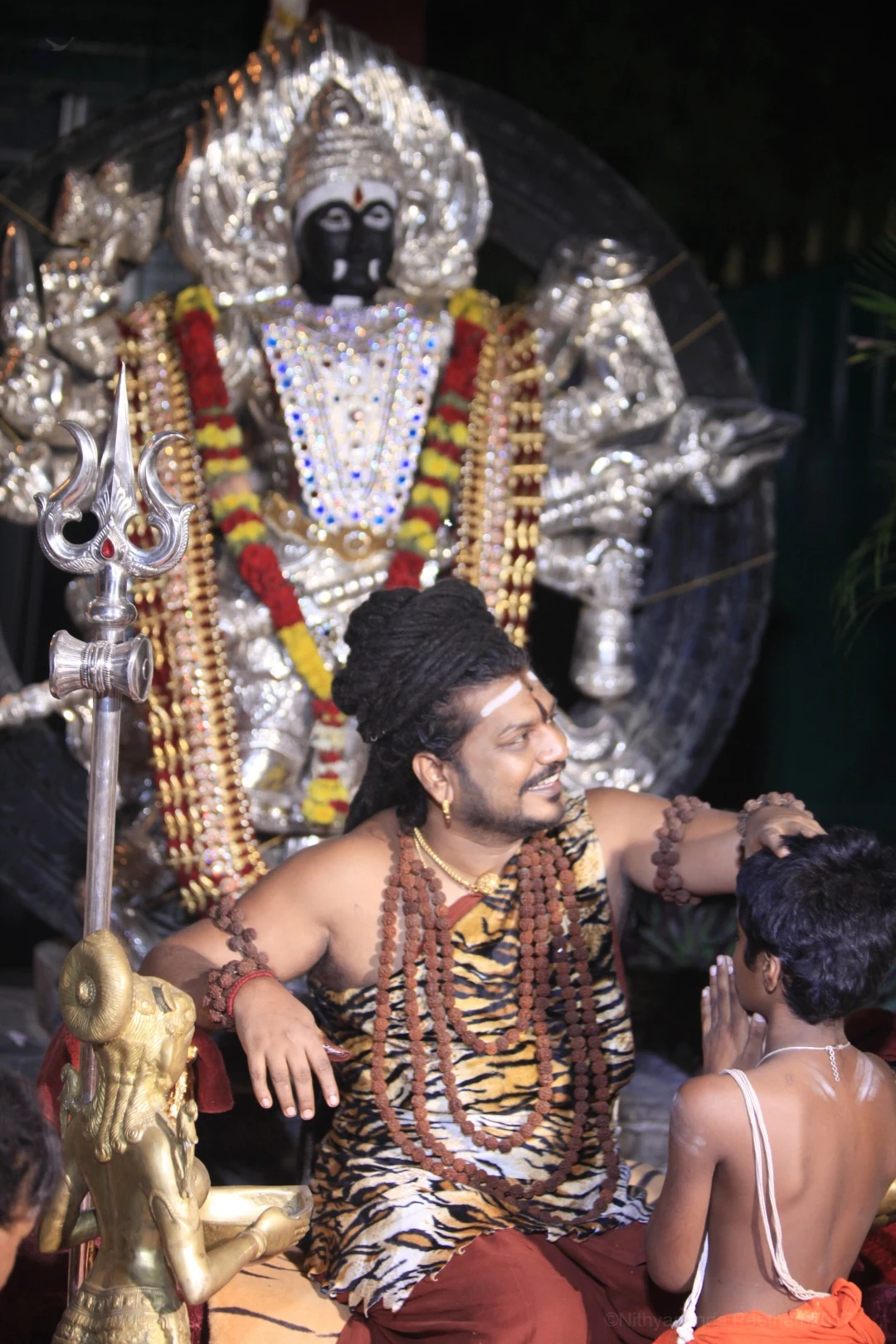
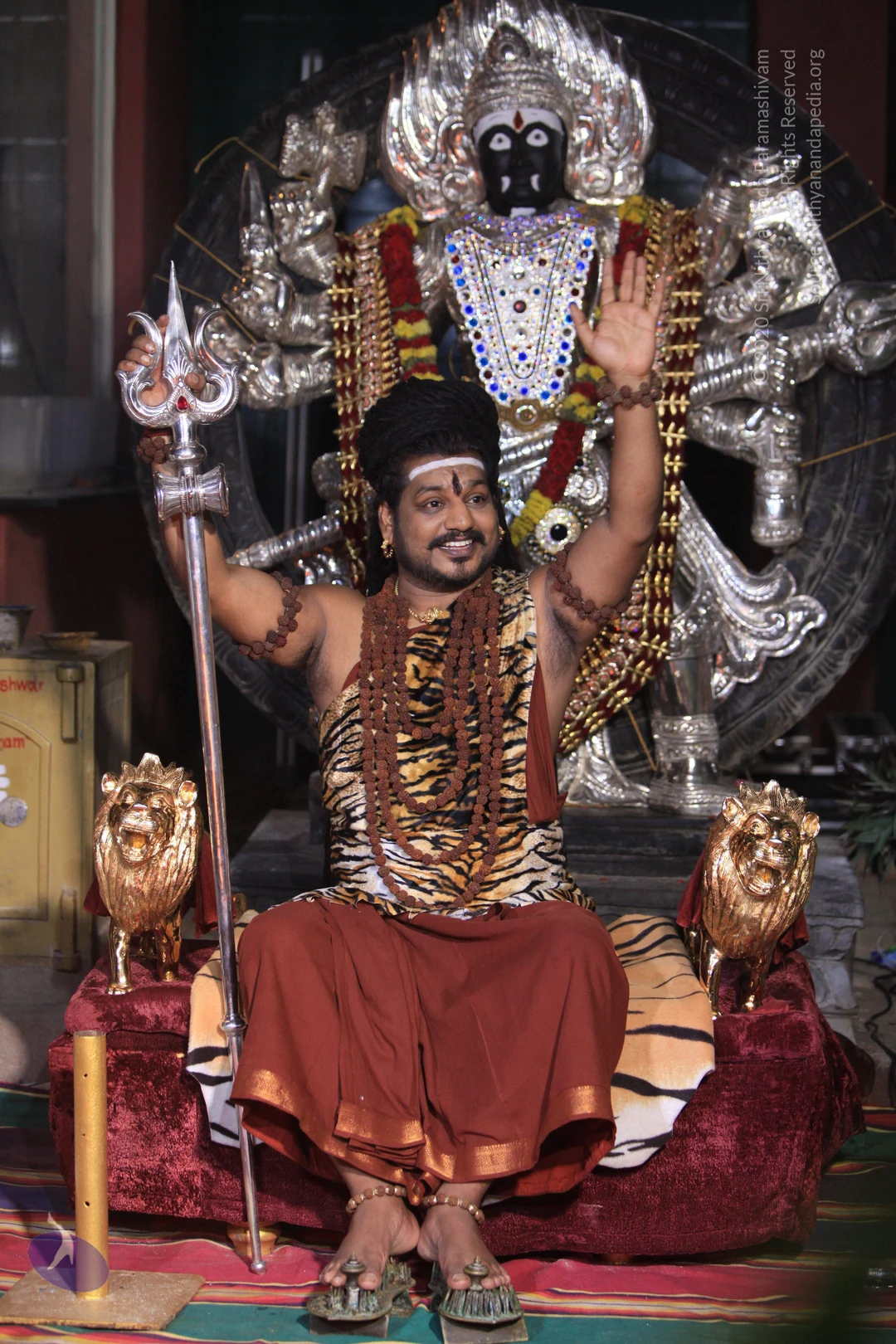
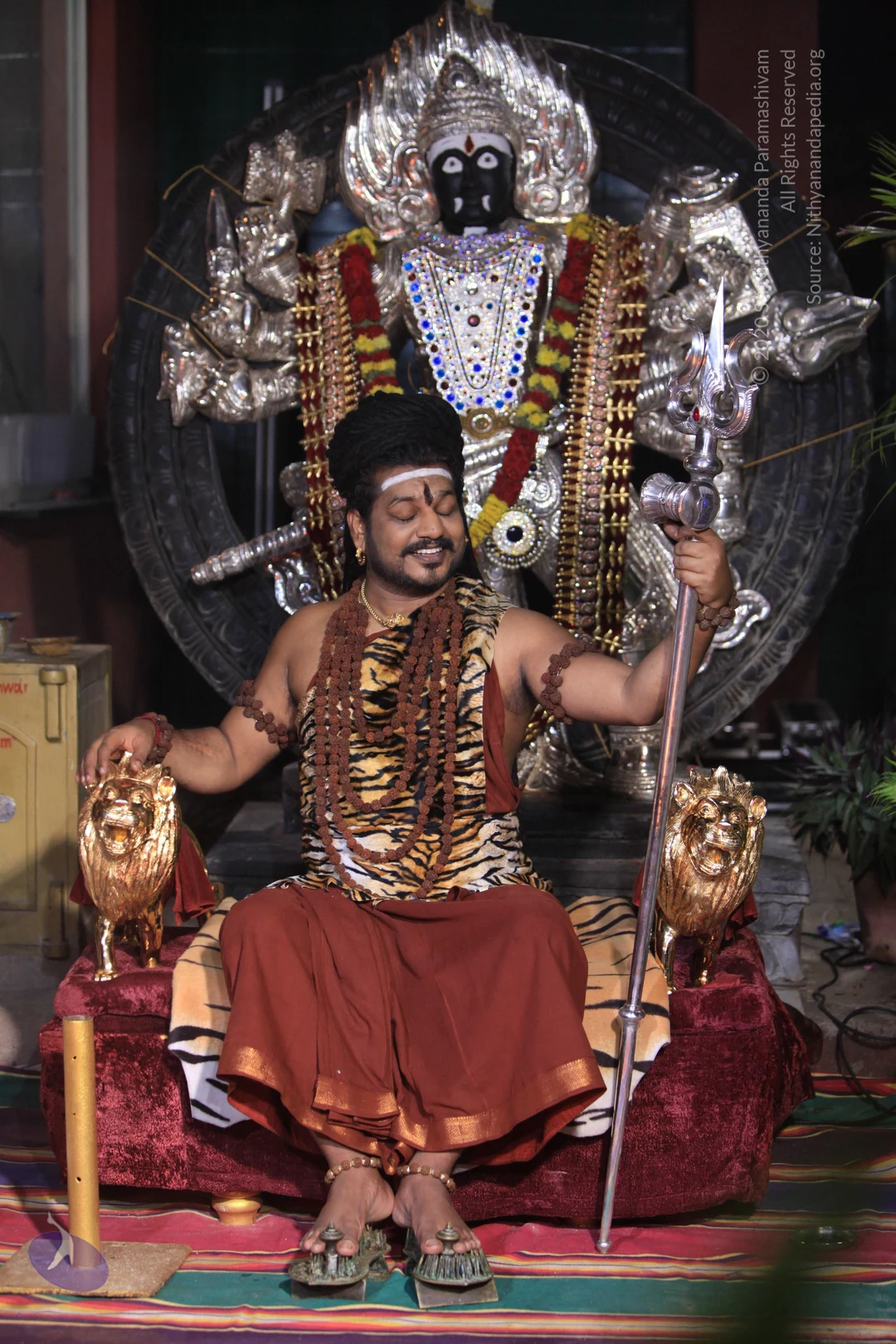
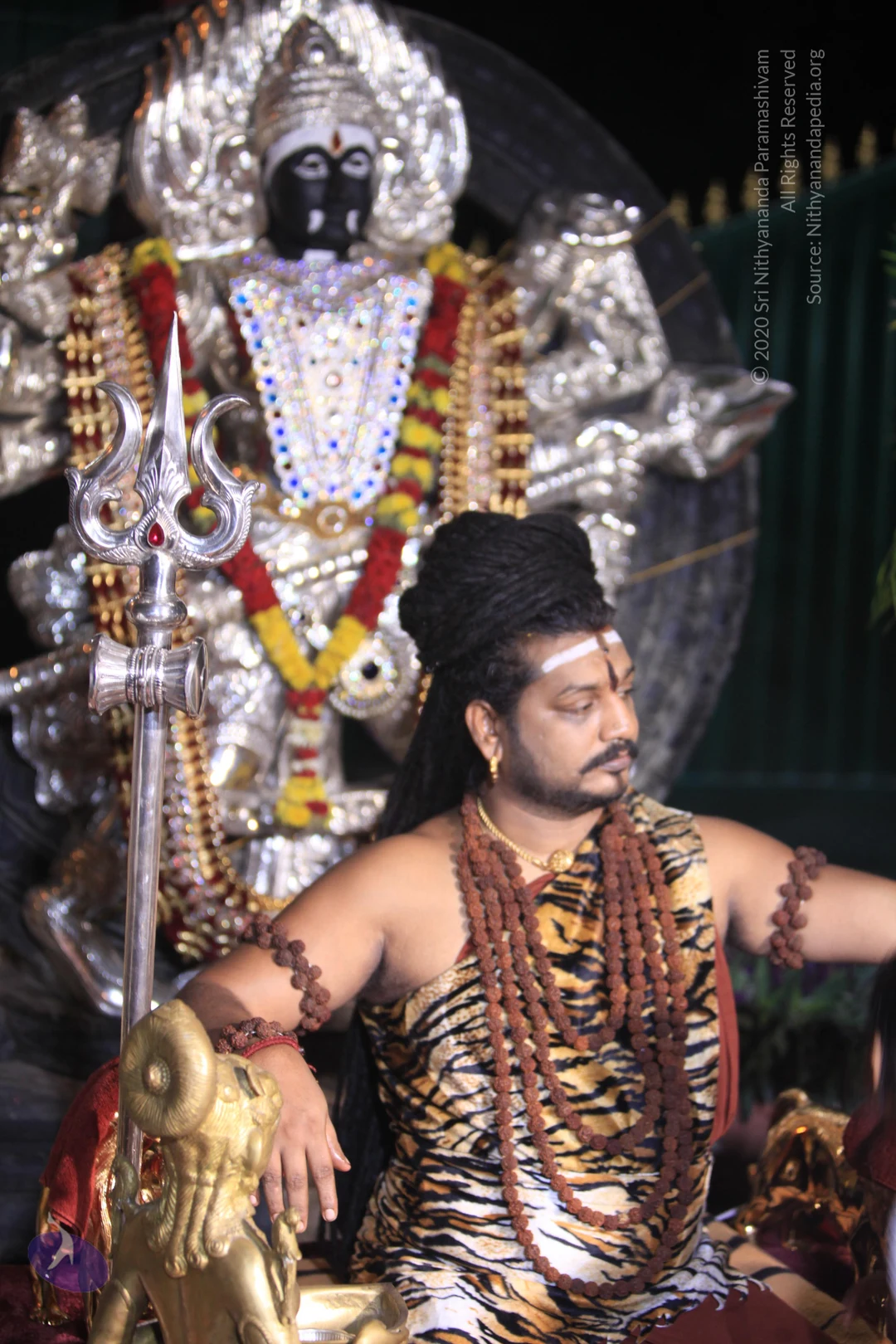
A man with long dark hair coiled high sits before a silver deity murti adorned with red, yellow and orange garlands and a jewelled breastplate. He wears a tiger-striped sleeveless garment, multiple strands of rudraksha beads, a gold chain, and rudraksha bracelets on his arms. A silver trident with a red gem stands at left, and a gold lion-like figure rests in the foreground. A man with long hair, tripundra markings on his forehead, and an ornate tiger-print garment sits in a ceremonial setting.A man with long dark dreadlocked hair tied up sits on a red-cushioned seat beside a silver trident (trishul) and a gold figure of a seated deity. He wears a tiger-striped sleeveless garment, multiple strands of rudraksha malas, rudraksha bracelets, a gold chain, a white tilak on his forehead, and red-and-maroon cloth around his waist. His right arm extends outward while he sits with eyes lowered. Behind him stands a large silver deity murti with a jewelled white chest ornament, a crown, and garlands of red and yellow flowers, set against a dark background with palm leaves. Another person's head is visible at the lower right.A seated man with long swept-back dark hair, a white tilak and red bindi, wearing a tiger-striped garment and multiple rudraksha malas and bracelets, sits before a large silver deity murti with a trident and red-and-yellow garlands. He holds one hand raised in a blessing or devotional gesture while another person's hand is visible at right. a person in a ceremonial setting with a silver trident and ornate silver deity behind him. A person with dark hair is partially visible at lower left.A seated man with long dark hair tied up, a white tilak with a red dot on his forehead, eyes closed, wearing a tiger-striped saffron-and-black garment and multiple rudraksha mala necklaces and bracelets, sits in front of a large silver deity murti with a black face, a silver crown and a red-yellow marigold garland. A silver trident stands at left and a golden figure sits at the lower left corner. The seated man appears to be a probable Swamiji by his long hair, tiger-striped garment and rudraksha malas, sitting in front of the deity murti. A small blue bird logo appears at the upper left.Photograph of a seated man with long matted dreadlocks, a white vertical tilak on his forehead, and many rudraksha mala necklaces and armbands, wearing a tiger-striped garment. He raises one hand toward a silver-plated deity murti behind him with a black face, a crown, a jewelled white collar and garlands of red and yellow flowers. A silver trident stands at left beside a gold figure. Two other men are partly visible at right, one in a white dhoti. a person cues: long dreadlocks, rudraksha malas and tiger-print garment.A man sits in the foreground beside a large silver deity murti decorated with a silver crown, a jewelled white breastplate, and red, yellow and gold garlands. He wears long dark hair piled up in a loose knot, a white forehead tilak with a red bindi, a gold chain, and a multi-strand rudraksha mala over a bare chest with a tiger-print wrap. A silver trident with a red gem stands at the left edge. The man is the only physical person visible; he is described as a priest-like devotee with distinctive long hair, rudraksha malas and a gold necklace, consistent with a person presence, though appearance alone is not conclusive.

May 23 2017

1 photoView all
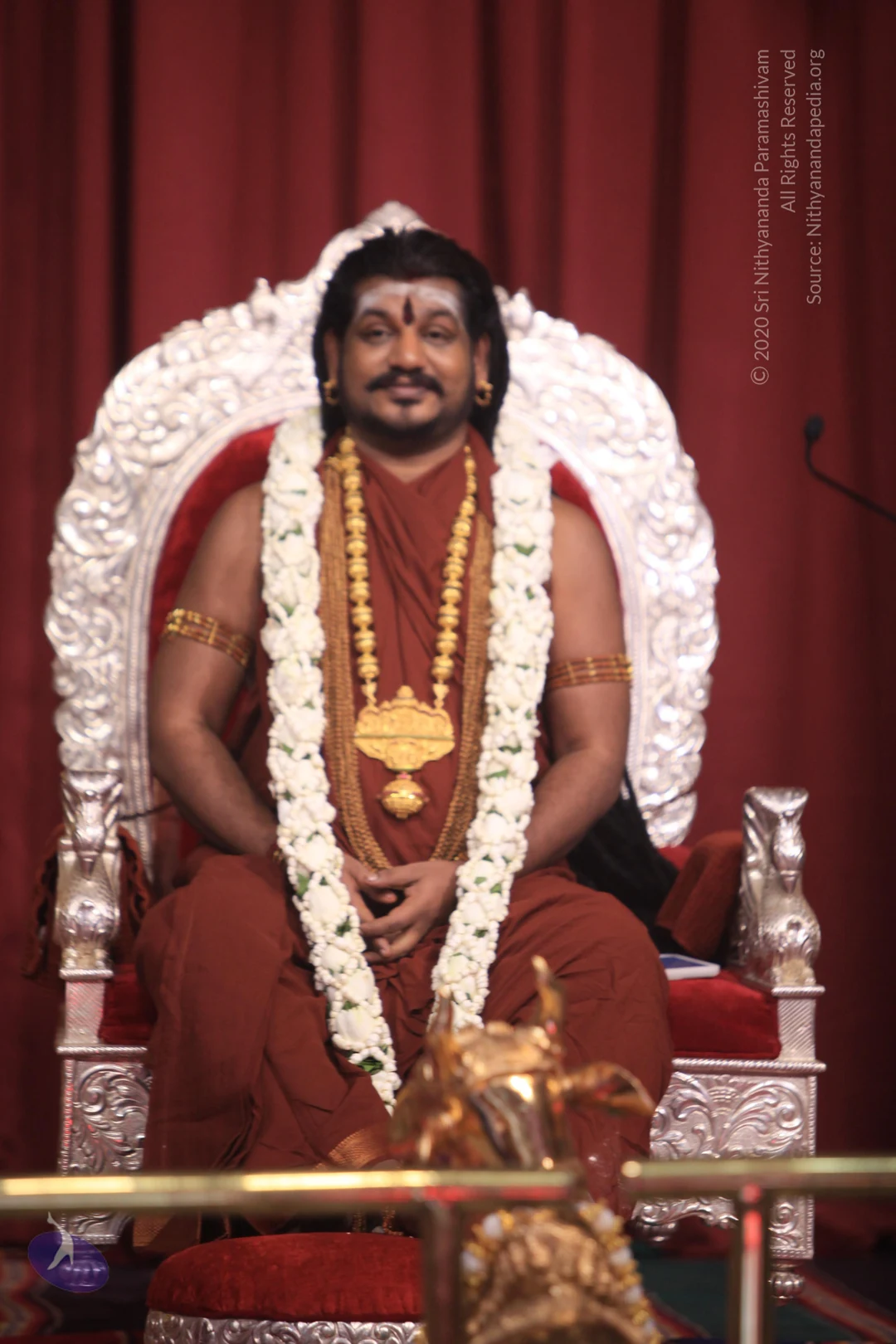
A man seated on an ornate silver-and-red throne against a deep red curtain. He wears a rust-red sannyasi robe, a long white flower garland, a heavy gold bead necklace with a gold pendant, gold armlets, and gold earrings, with white and red forehead markings. His hands rest folded in his lap and a microphone stand is visible at the right edge. A brass or gold ritual vessel sits in the foreground. Swamiji (probable): the long swept-back hair, ornate gold jewellery, garland and red sannyasi robe match the cues for the page's subject, shown in person on the dais.