Skip to content
Saturday

18 January 2014

Have You Forgotten about Yourself?

Dated photos
75
Source pages
1
Media
2

January 18 2014

Original wiki page
Contents

Title

Have You Forgotten about Yourself?

Description

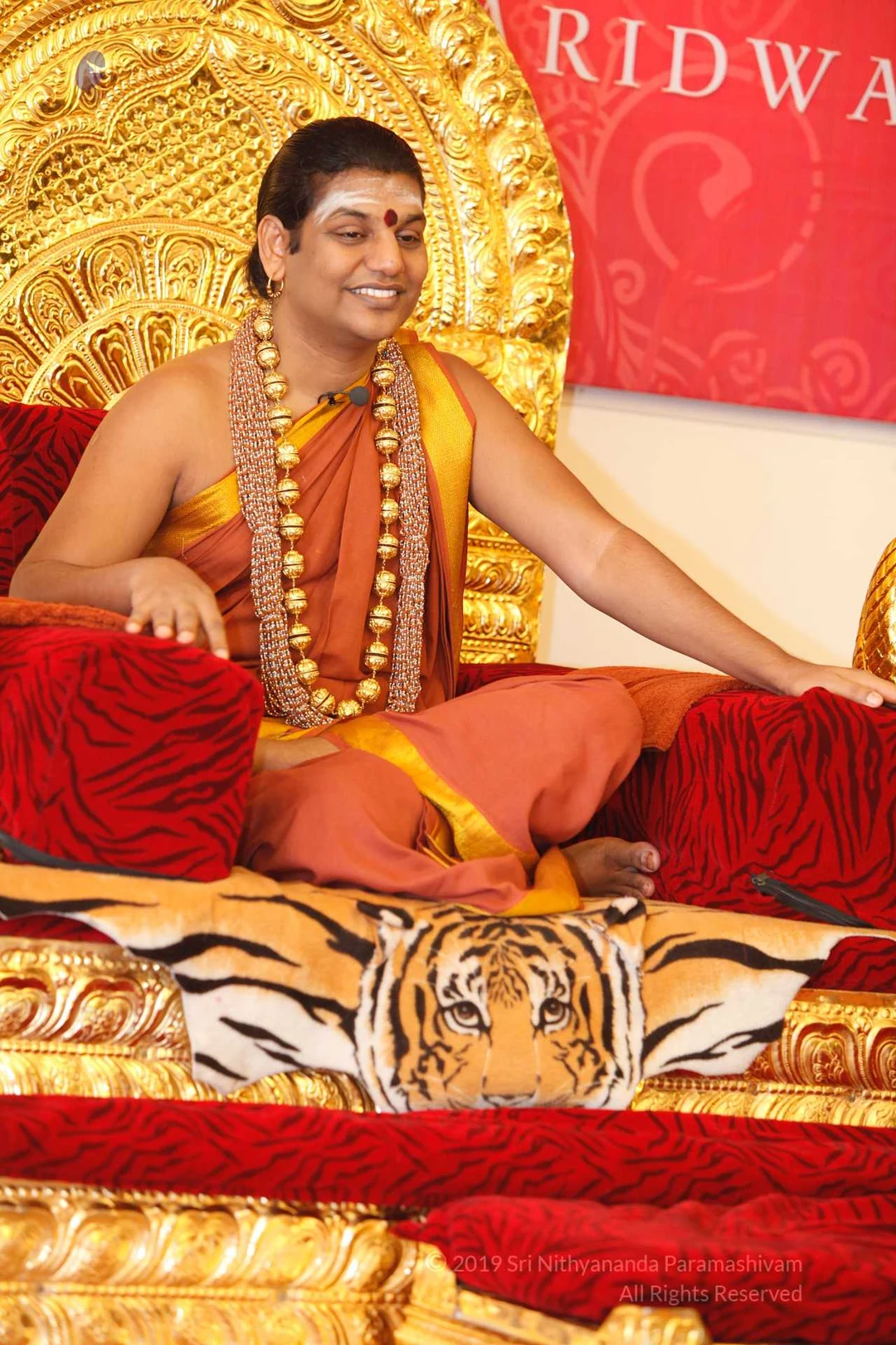
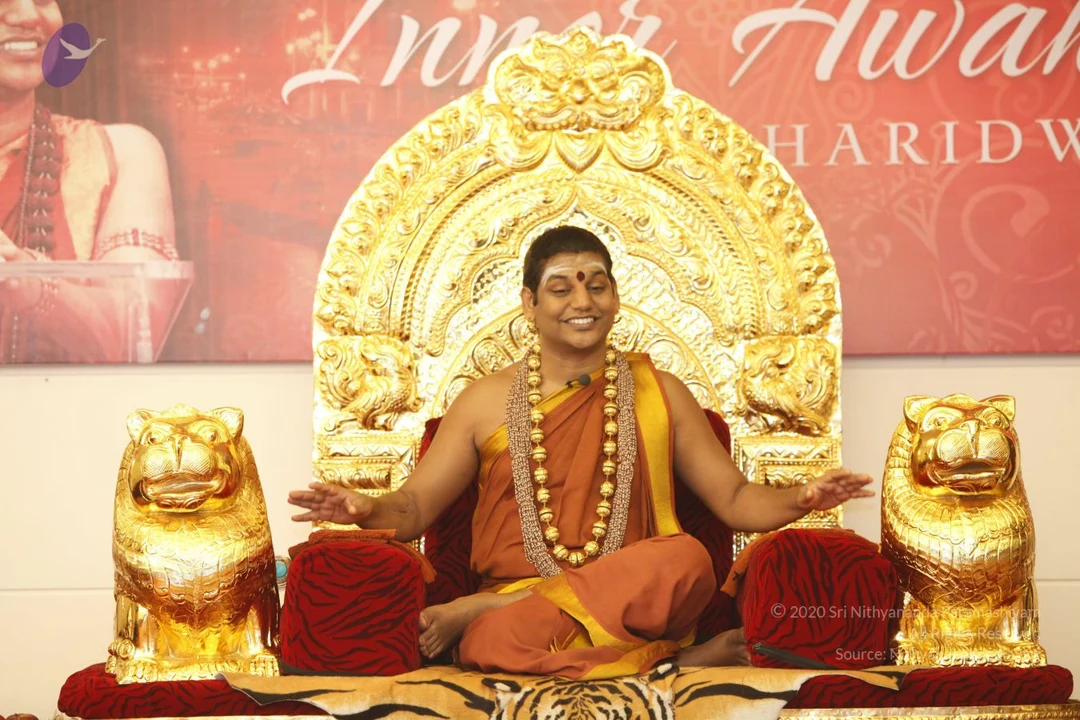
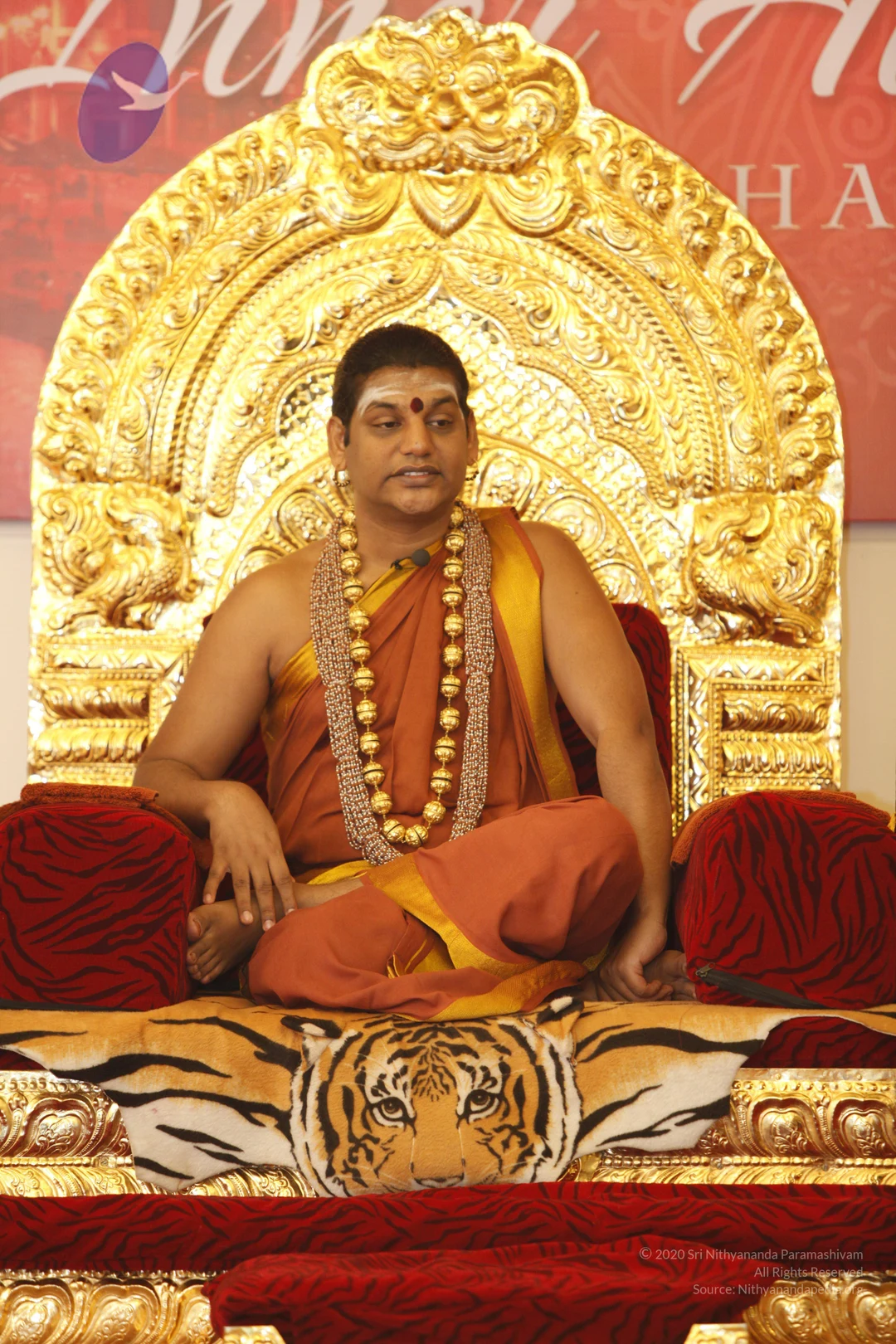
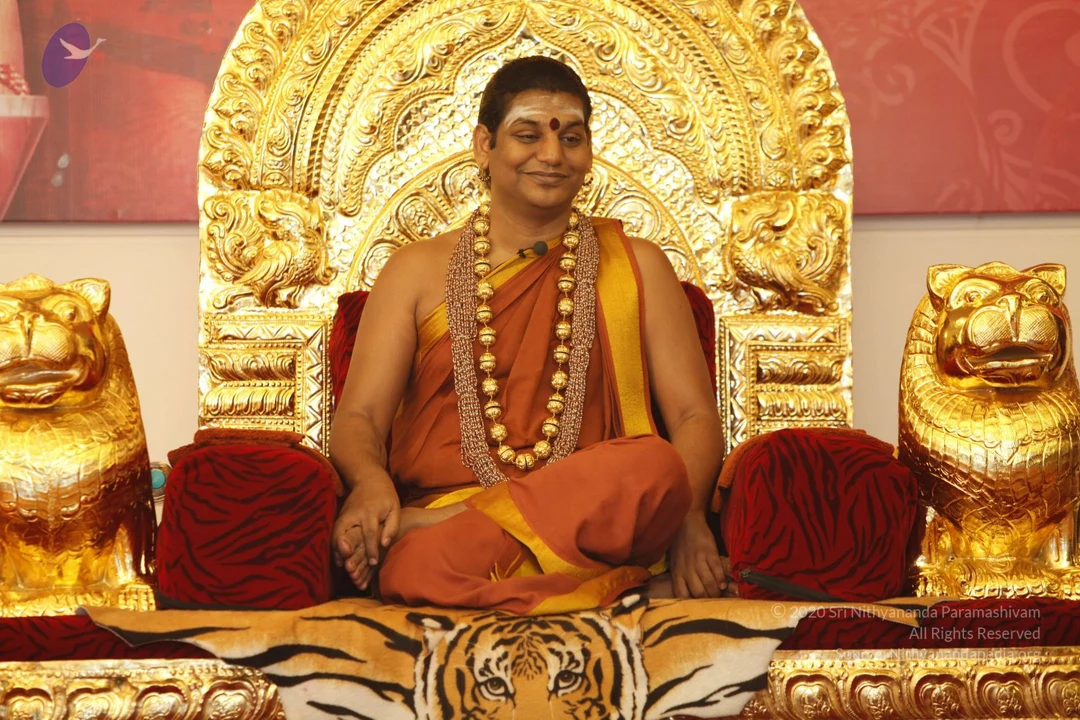
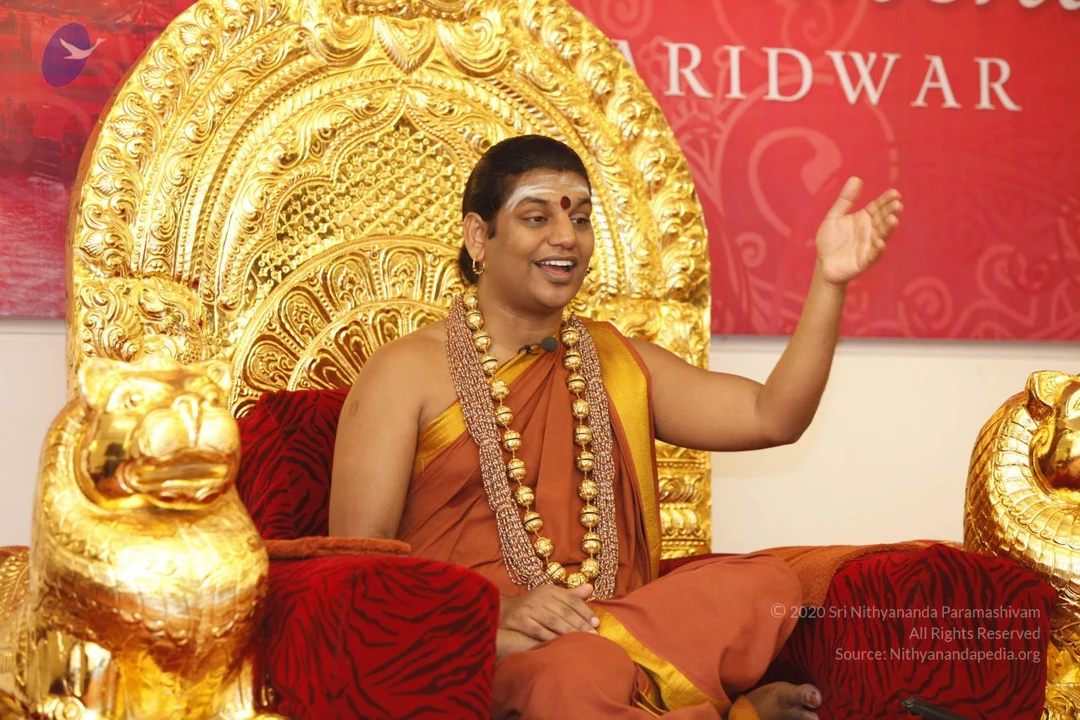
In today’s morning Satsang, Paramahamsa Nithyananda reminds us that SDHD (self-doubt, self-hatred, self-denial) is the source of all root patterns. We must continually complete with SDHD because it is the reason for all failures in life – it drains us of our inspiration, strength, and energy. If we are in incompletion with SDHD, no matter how much wealth we have, life will be hell because heaven and hell are created from within, not outside of us. Let us be in a constant state of completion – Mahanirvana!

Video and Audio - Have You Forgotten about Yourself?

VideoAudio

Transcript

[00:00:15]

I welcome all the devotees, disciples, samajis, satsanghis sitting with us through Nithyananda TV, Sadhna TV, Eshwar TV, Janashree TV, through two-way video-conferencing having Nayana Deeksha all over the world in the Nithya Satsangh. Cities sitting with us in two-way video-conferencing having Nayana Deeksha: Nithyananda Nagaramu-Hyderabad, Nithyananda Nagara-Bangalore, Oklahoma-Somanatham, Houston-Kalahasti, Scottsdale-Arizona, San Jose-Madurai, Tiruvanmiyur-Chennai, Ohio-Ma Shivananda, Seattle-Chidambaram, Guadeloupe-Rameshwaram, Ohio-Prayag, Los Angeles-Arunachalam, Toronto-Kailasam, Bangalore City Center, Vancouver-Bhubaneshwar, San Jose-Madurai, Houston-Kalahasti, Scottsdale-Arizona, Singapore-Singapuram, Temple City-California, St. Louis-Tirumala, Charlotte-Srisailam, Saudi Arabia, Hong Kong-Sirkazhi, Hyderabad-Gupta Kashi, New Zealand-Adi Arunachalam, London-Kashi, San Diego-Tirualavai, Devon-UK, Singapore-Singapuram, Oman-Sivagangai, Jorpati-Nepal, Kanchipuram Dhyanapeetam, Coimbatore Dhyanapeetam, Mollieres-France.

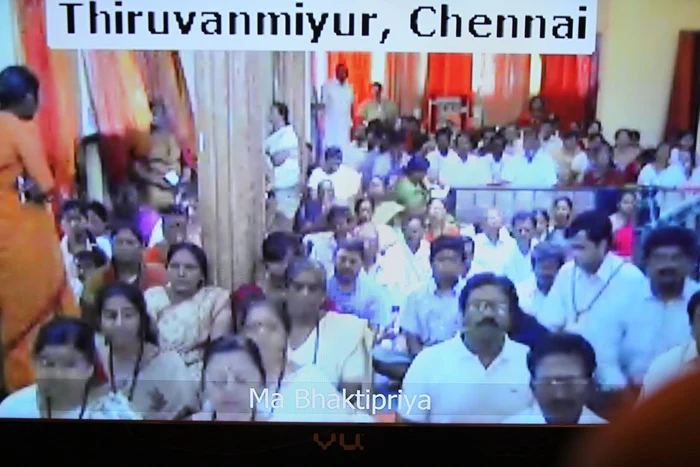
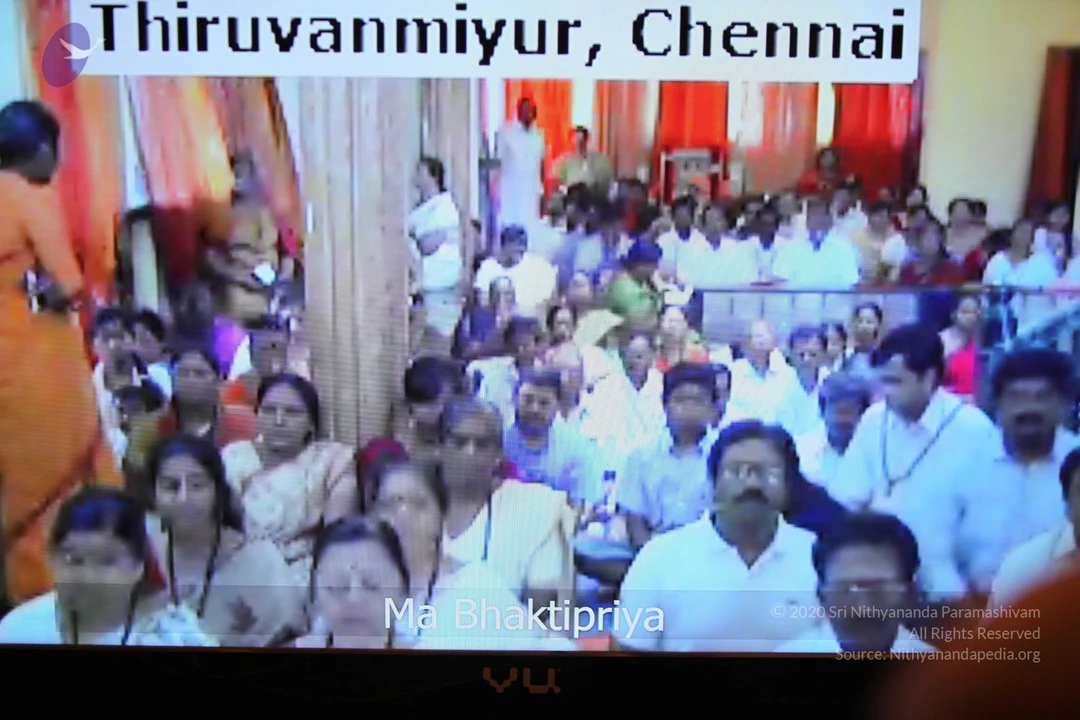
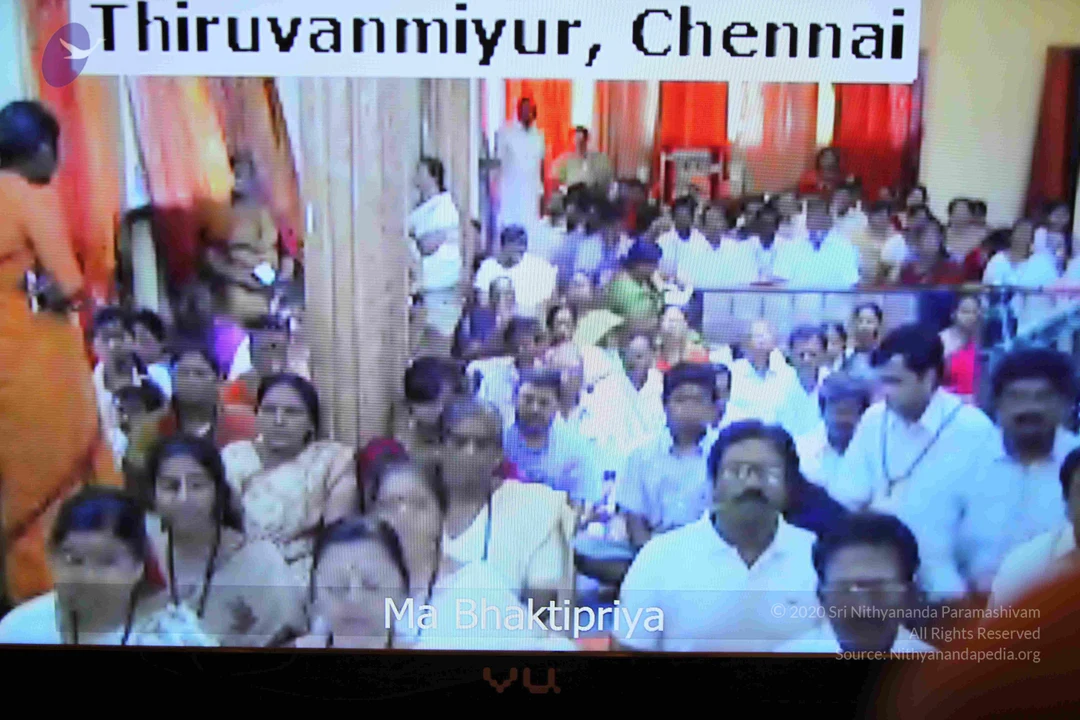
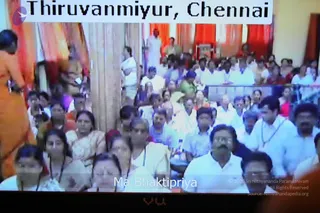
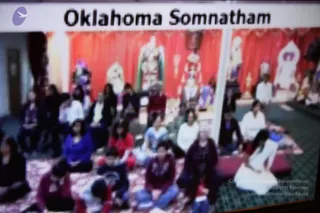
[00:02:09] I welcome all of you with My love and blessings. I’ll expand on Kalpataru. Before that, today in two cities – Oklahoma-Somanatham and Tiruvanmiyur-Chennai – devotees have gathered to attend the Kalpataru Darshan. I welcome all the devotees gathered specially for today’s Kalpataru darshan in both the cities. My blessings to both of you.

[00:02:51] I will expand on Kalpataru and few of the Mahabharata characters. Continuously I am talking on this one subject for last few days. Wherever I may go, this side, that side, but I come back to this one subject, this one topic – SDHD, Self-Doubt, Hatred, Denial; Self-Doubt, Hatred, Denial.

[00:03:31]

Please listen. Whether you own hundred crore or two-hundred crore or three-hundred crore, or billion dollar or trillion dollar, as long as you are suffering with SDHD, life will be hell. Understand? Hell or heaven are made from inside, not from outside. I am going to talk on this one subject, maybe for rest of My life, not just this year, next year. Of course, I am going to live at least 126 years in the body, in this physical body healthily. So, maybe rest of My life I am going to talk about this subject. Last year full year I was speaking on the Science of Completion. Now I am speaking on what you should complete. Yesterday full year I was introducing the Science of Completion. Now I’m going to introduce what you should complete.

[00:05:12]

Actually, if you dig deeper, deeper, deeper, deeper, deeper, the root of the root patterns - anxiety, fear - all this is from self hatred. See, you yourself do not want to bless you with what you wanted. One side you wanted a beautiful life. You yourself do not want to bless that you should have it. Yourself have a tremendous doubt. You yourself have a tremendous hatred. You yourself decide you can’t have that life you wanted. That’s very funny. Why should you have this kind of attitude towards you? Because – listen, I am defining why – because, you have started forgetting slowly, slowly, about you. When you started falling into unconsciousness, some part of you started hating you. When you are conscious you want to do something. When you are dull, tired, the same part of you does not want that.

[00:06:54]

Already yesterday I gave you the medicine for depression. Yesterday or day before yesterday, I don’t know. Few days before I gave the medicine for depression. What’s the medicine? Slap yourself. Wash the face. Simply show up. Why this wash the face, you know? You should slap yourself so strongly, your fingers should have their printleft in your cheek. Why you should wash, you know? So that others don’t see you have slapped yourself.

[00:07:43]

That is what you are doing. Please listen, every time you put yourself in depression, you are abusing you. You are disrespecting you. Look deeper and deeper why you become violent, why you become abusive. Because some parts of you, you cannot tolerate, you go on abusing others. A group of people who can’t tolerate themself, abuse others when they gather, naturally they become terrorist organization. [00:08:33]

Understand, human-beings, all their root patterns are from the SDHD – self-doubt, hatred and denial. Only when you complete with that self-doubt, hatred and denial you even become a human-being. Till then you are only a demon, ‘raakshasa’ - demon. Life of a raakshasa or demon is the worst thing can happen to a human-being. Even in Mahabharata you can see, like the characters who do good to themselves and others, who do good to themselves and bad to others, who do bad to themselves and others. Who does bad to themselves and others is ‘demon’. Who do good to themselves, bad to others, are ‘Nara’, human-beings. Who do good to themselves and good to others are ‘Devatas’, divine beings.

[00:10:16]

Continuously do good. Continuously be in the space of Completion. Be in the space of poornamadah poornamidam poornaath poornamudhachyathe, poornasya poornamaadaaya poornamevaa vasishyathe

You’ll be always in the space of maha nirvana, maha nibbana, maha nirvana. Buddha is from Mahanirvani Akhada. He studied, meditated with the Mahanirvani parivrajaka sadhus. That is why he calls the enlightenment state as ‘nirvana’. He calls himself as ‘Sakya Muni, ‘Sankhya Muni’. He belongs to Sankhya Tattwa. He followed the Sankhya principles. He called himself as a ‘Sankhya Muni’. In course of time it became ‘Sakya Muni’. And he calls himself ‘Gautama’ The Buddha. Gautama Rishi belongs to MahaNirvani Akhada. All his teachings, if you see, is completely established on Sankhya. All the technical terms he uses is completely from the philosophy of Mahanirvani Akhada. Buddha is one of the preacher, Mahamandaleshwar of Mahanirvani Akhada. Still, Mahanirvani Akhada has Buddhism as one of the ‘madis’. We have fifty two madis, means subsects. Buddhism is one subsect. Always be in the space of completion. Always be in the space of nirvana, maha nirvana.

[00:12:58]

Especially the SDHD – self-doubt, self-hatred, self-denial – complete with that. Self-doubt, hatred, denial, that is the source from which all the root patterns start evolving. I can say, that is the root of all root pattern.

Your self-doubt, self-hatred, self-denial is responsible for why you are not achieving what you want to achieve in the life. Your SDHD sucks all the energy, all the inspiration, all the strength you have. Your SDHD neither allows you to do something great, nor lets you live in peace. Complete with your SDHD. Completion with your SDHD awakens Kalpataru energy in you. It makes the space you create as reality in you. When you do not have SDHD inside - self-doubt, hatred, denial inside - anything you create will always be good to you and to others. You go on causing others’ reality. You become a sincere catalyst for everyone’s reality and your own reality. You become a sincere catalyst for others’ reality and your own reality.

[00:15:24]

Let you all achieve, experience, live, express, radiate, share and explode in eternal bliss, Nithyananda.

[00:15:38 - 00:15:58] Promotional information

Photos

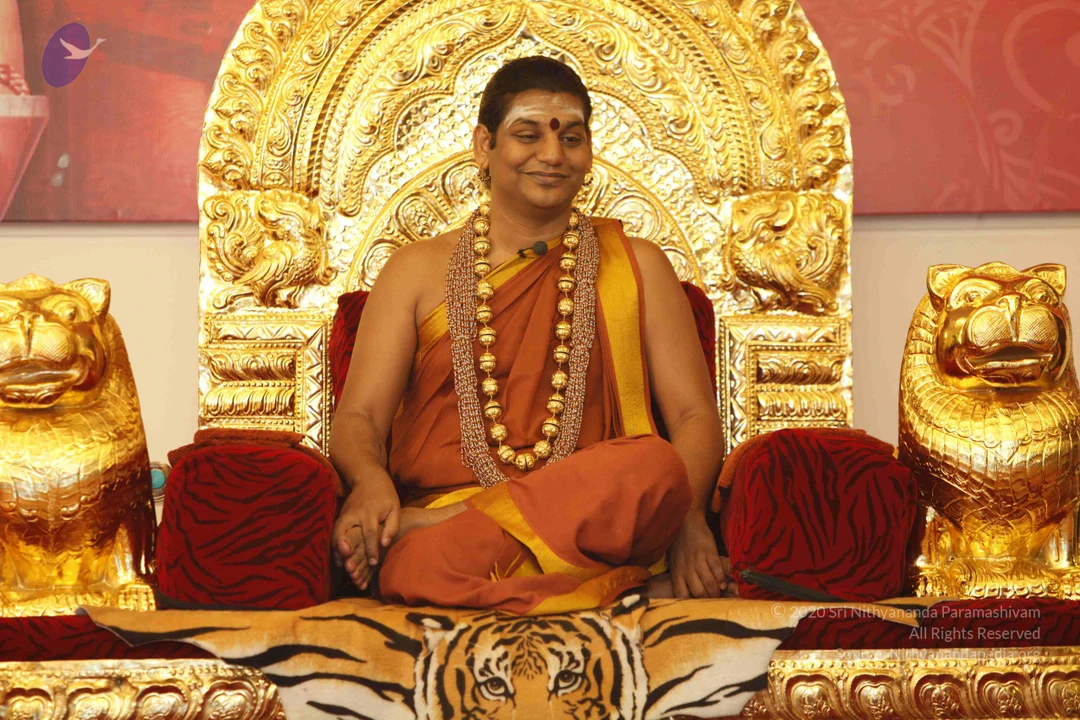
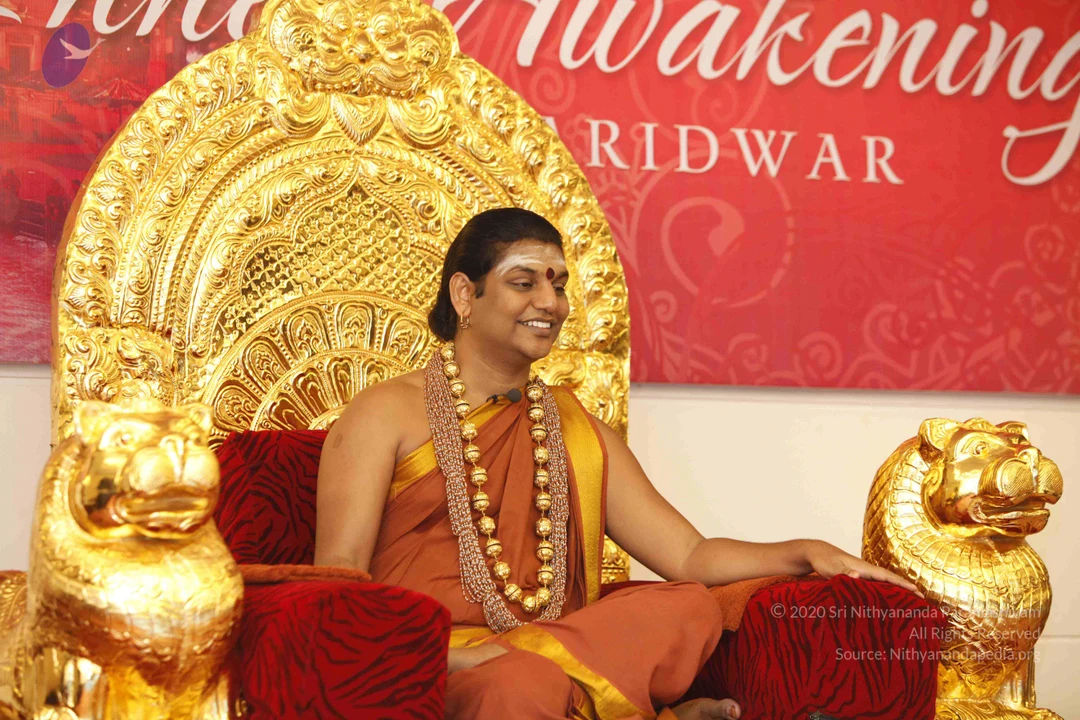
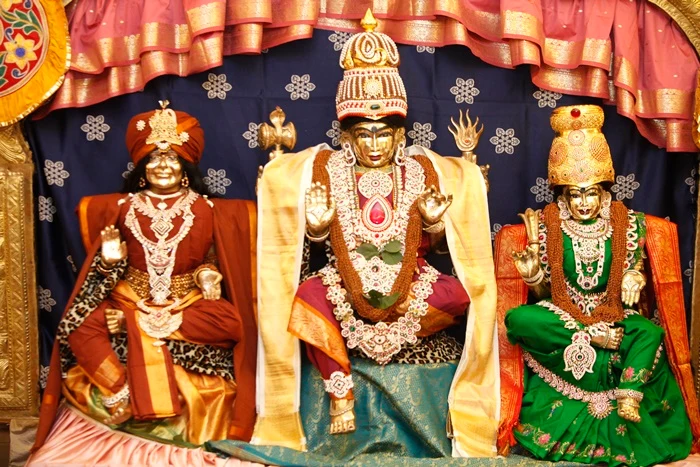
Leela Alankar
http://nithyananda.org/sites/default/files/photo-gallery/2014-01jan-18th-nithyananda-diary-haridwar-IMG_6708Leela%20Alankar_0.JPG

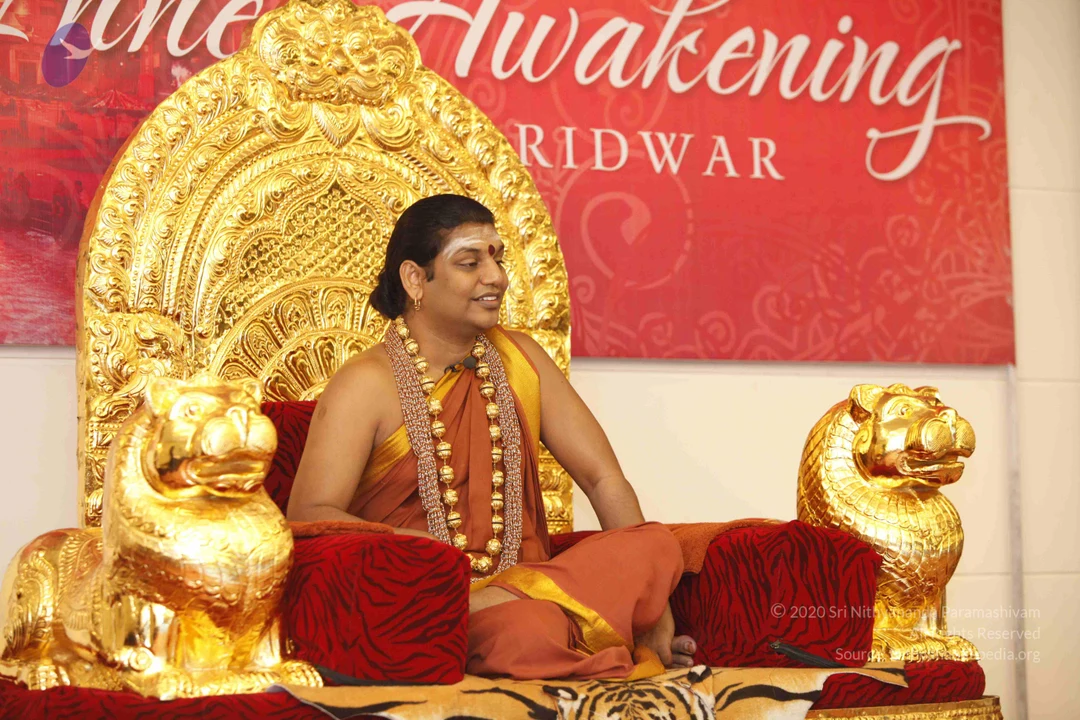
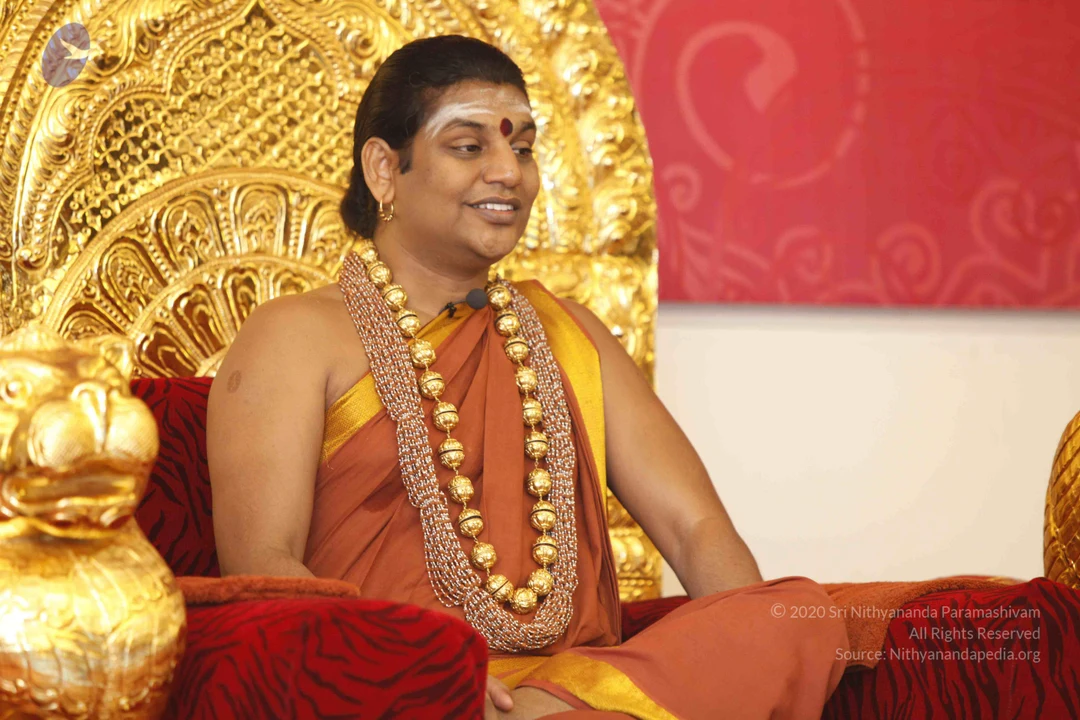
Nithya Satsang

Sarvadarshan

http://nithyananda.org/sites/default/files/photo-gallery/2014-01jan-18th-nithyananda-diary-IMG_DSC00695sarvadarshan_2.JPG

Chennai Engalleria Book Fair Stall

Darshan
Nithya Satsang
Tags

Paramahamsa Nithyananda, Mahabharata, SDHD, self-doubt, self-hatred, self-denial, root patterns, life, inspiration, strength, energy, wealth, hell, heaven, outside, state, completion, Mahanirvana.

Photos Of The Day:

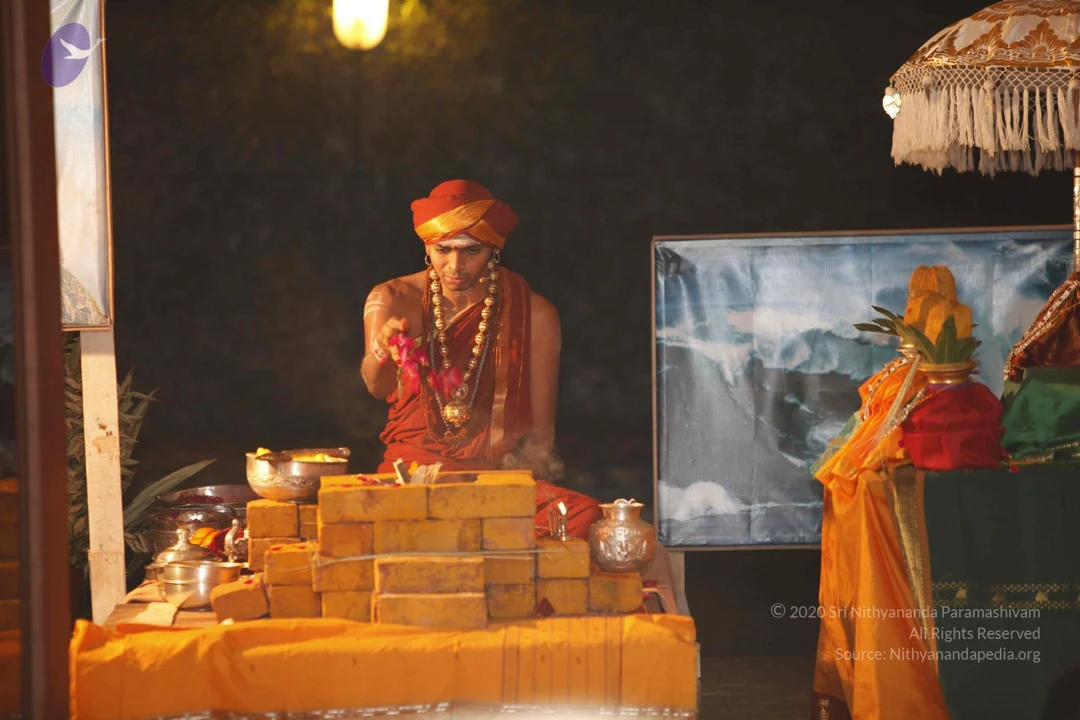
Homa
Kalpataru
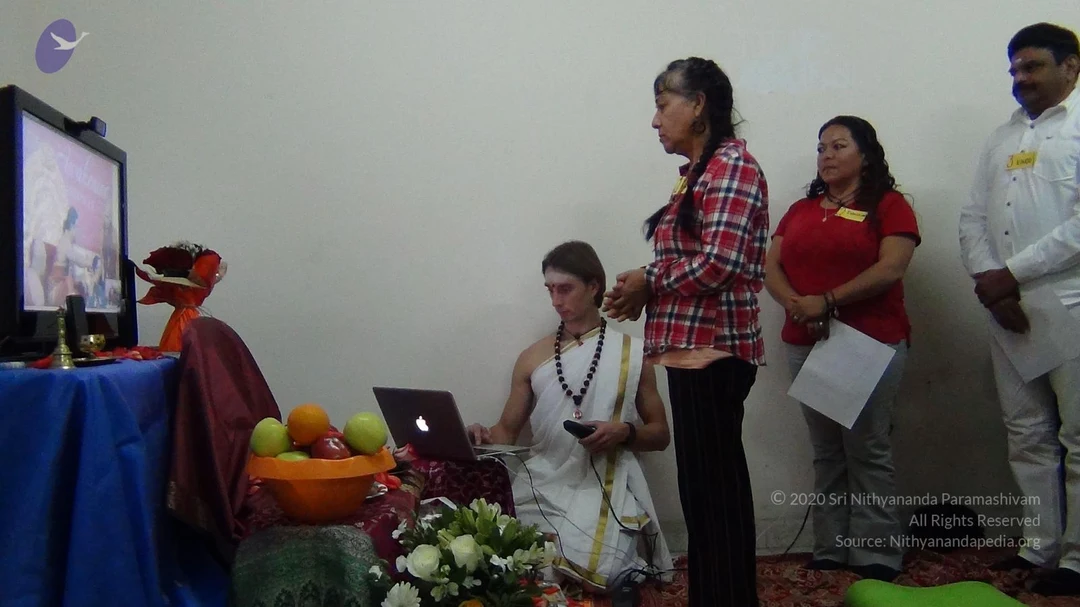
Satsang
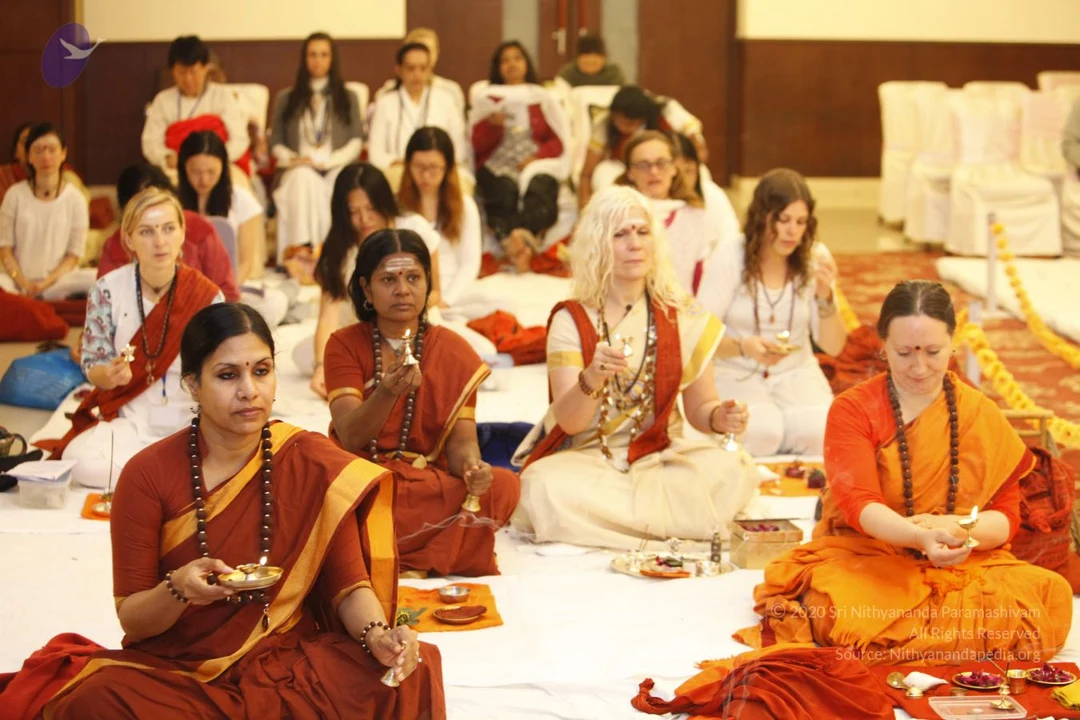
Photos Of The Day:

01-PUJA

02-NITHYA-SATSANG

03-DARSHAN

04-HOMA

Photos from this day

View all 75 photos

Chennai Engalleria Book Fair Stall

3 photosSource gallery
A photograph of a bookstall with a maroon banner reading "ENGALLERIA PVT. LTD" across the top. Shelves are stocked with books and framed covers. At the centre, a framed portrait of a figure in saffron/orange robes with long hair is decorated with a garland, and a smiling man in a white shirt stands in front. A woman in a green sari is at the left edge, and another person is partly visible in the background.Photograph of a wooden bookshelf display at a book stall, with rows of paperback books stacked on five shelves. Many covers carry a red and yellow banner reading a Tamil title in the top area. Other books show landscape photos, dark covers and colourful artwork. The lower left corner shows the dark hair of a person partly visible at the edge of the frame, but no face or full figure is shown.Interior of a book stall with blue metal shelving stacked with books and DVDs whose covers show a saffron-robed figure with long hair and a crown-like headdress, and several framed portraits of a smiling young woman. Several people browse or stand among the shelves: a man in a dark blue shirt with a backpack holds an open book, a man in a white shirt stands centre, a woman in a purple sari with orange trim stands at right, and a man in a red-striped shirt is at far right. A woman with a white and orange garment is at lower left. Another man in white stands behind the shelves, and a framed image of a saffron-robed figure is on the right wall.

Nithya Satsang
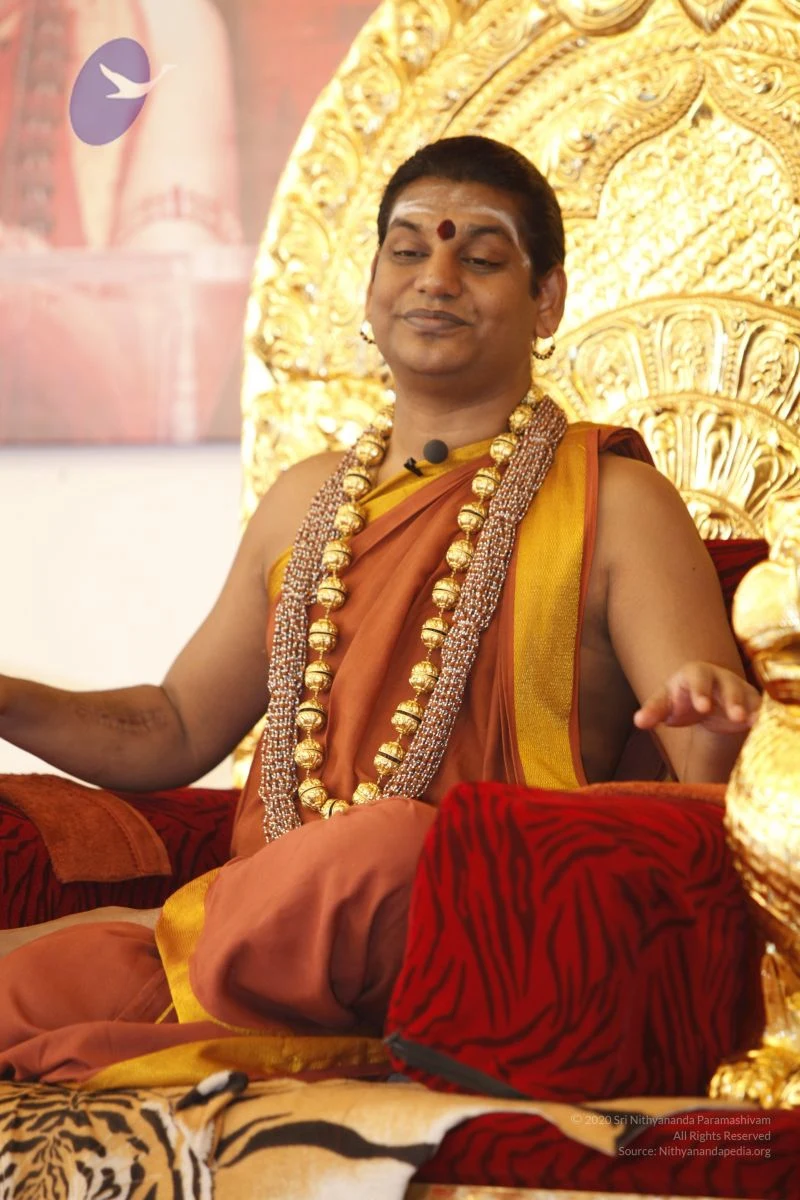
7 photosSource gallery

Homa

11 photosSource gallery
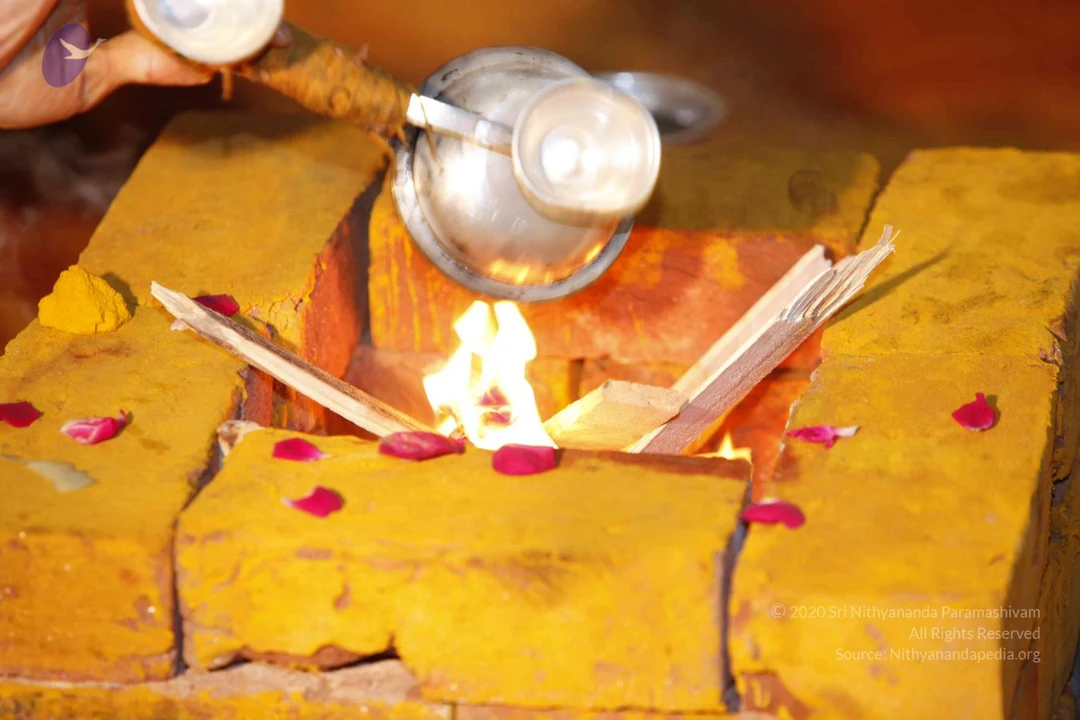
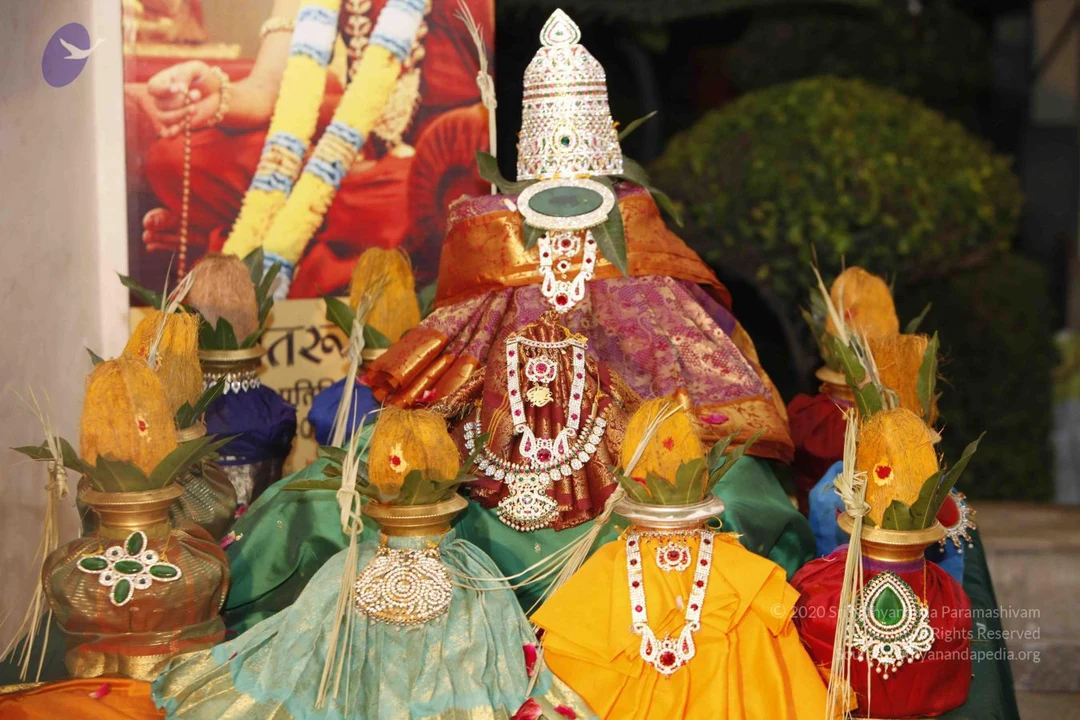
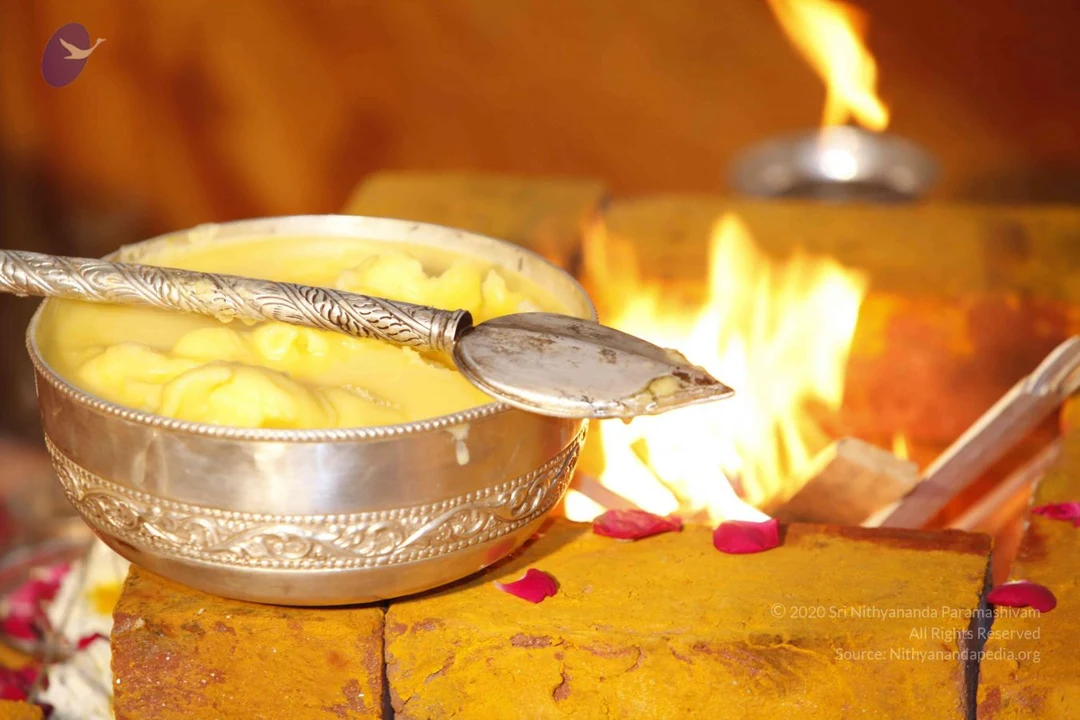
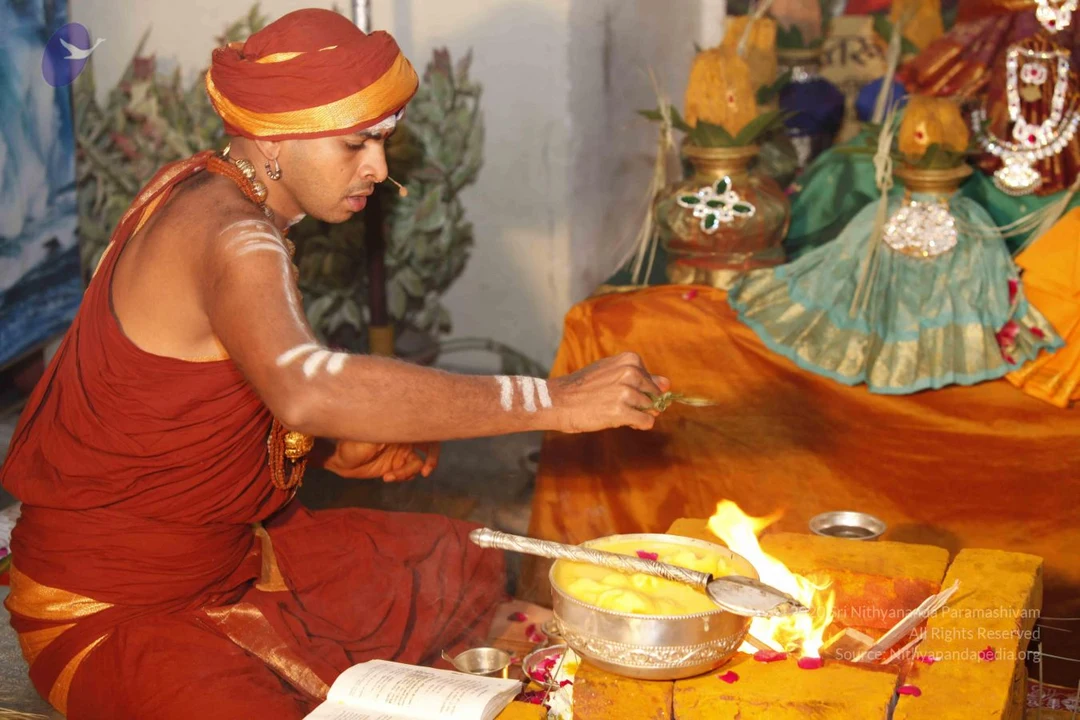
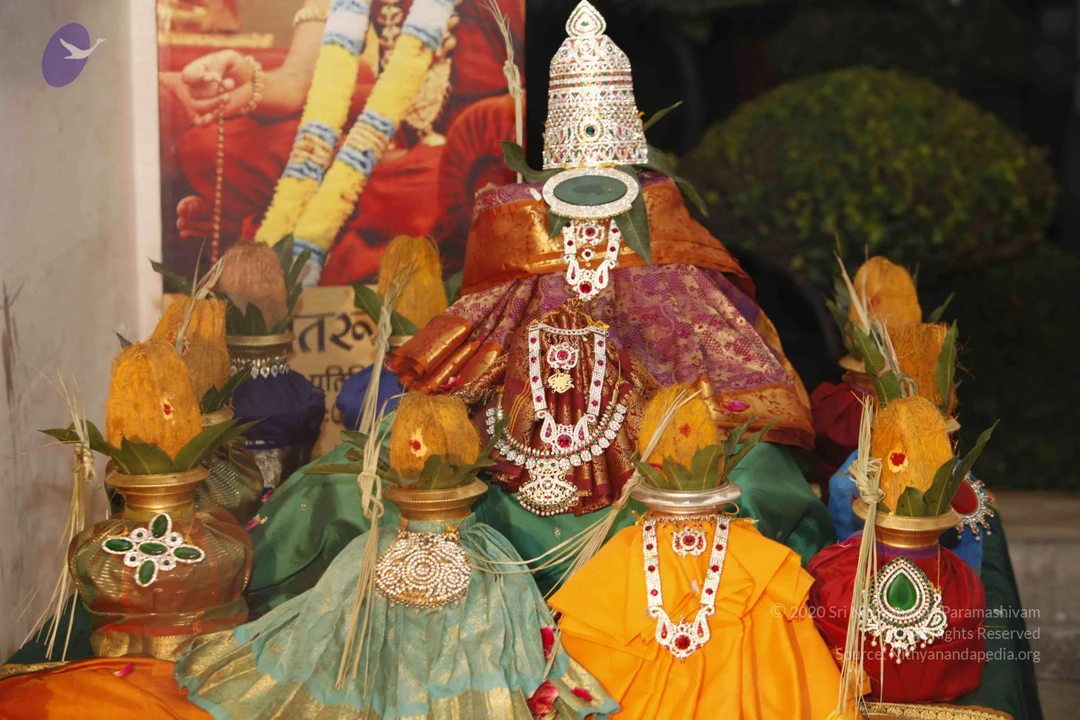
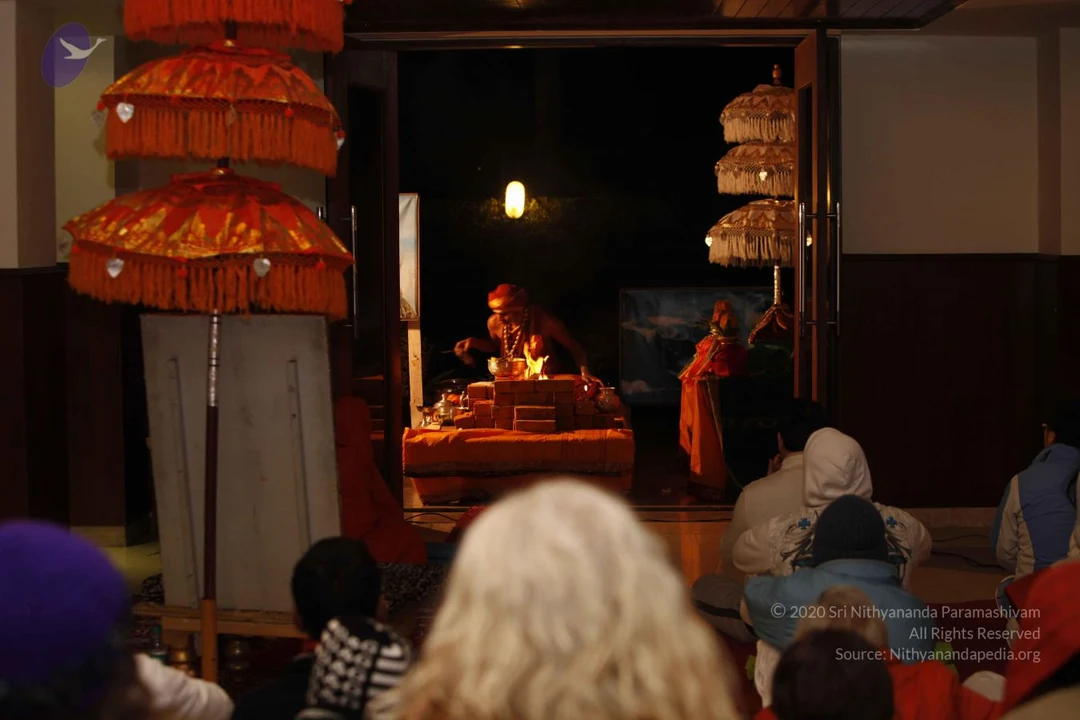
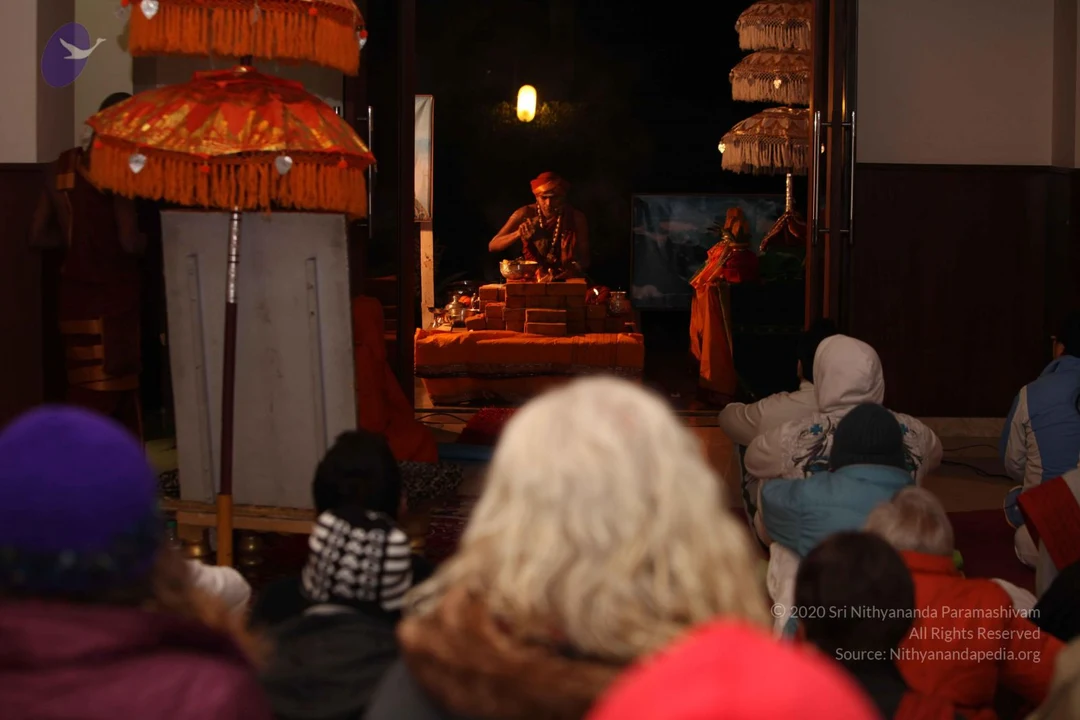
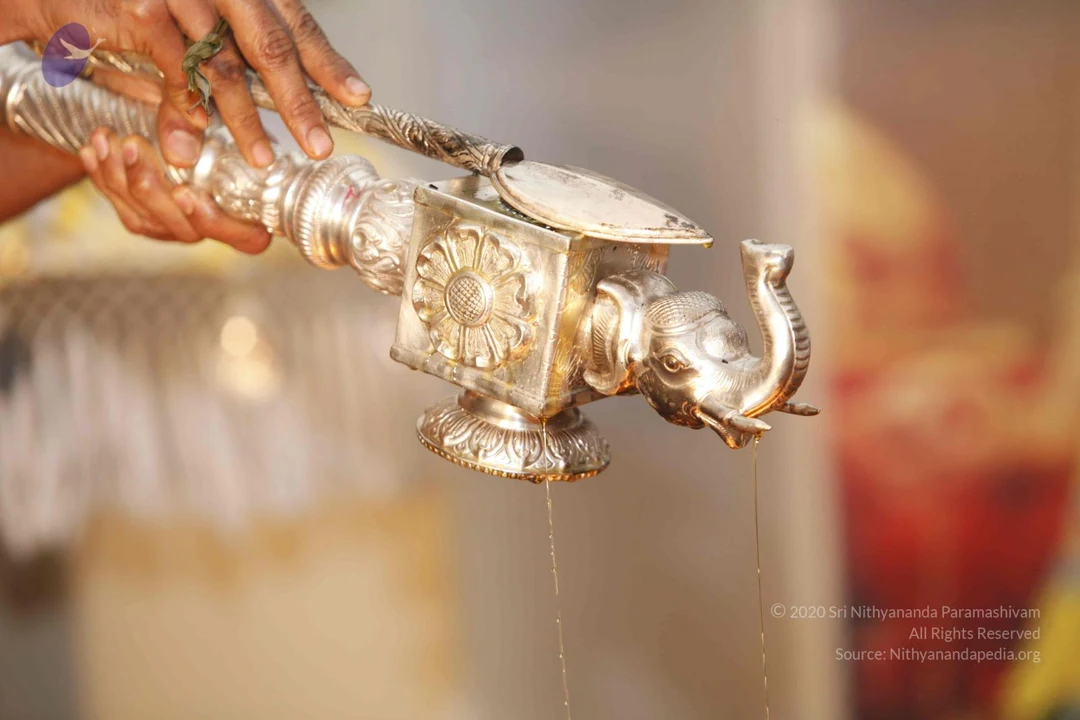
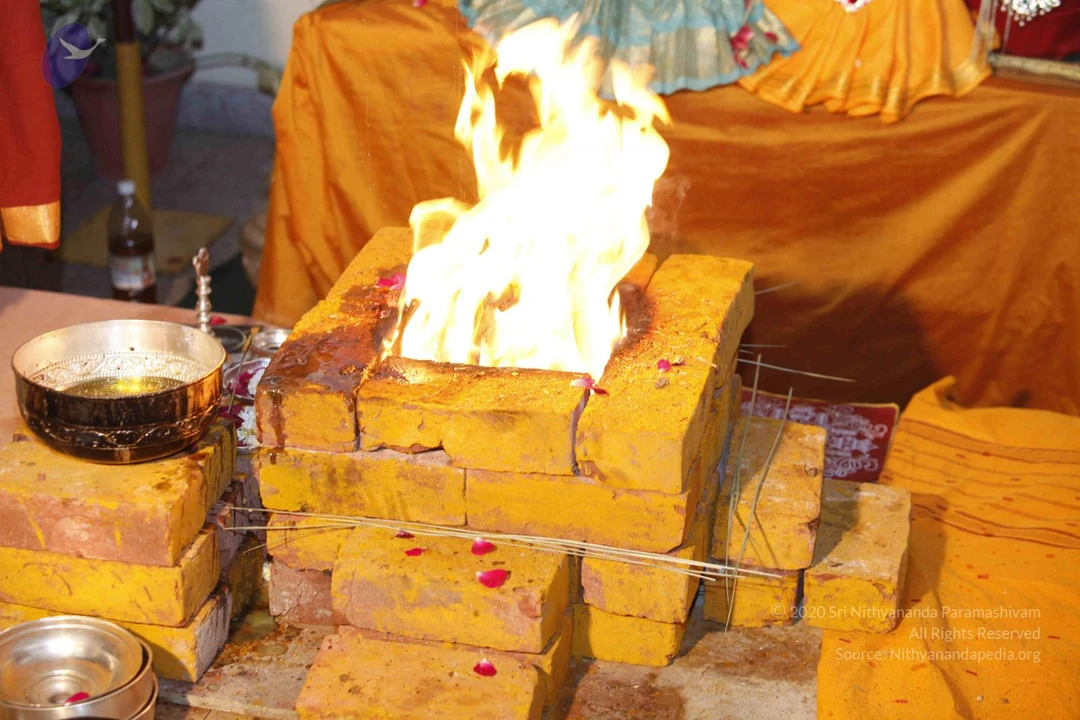
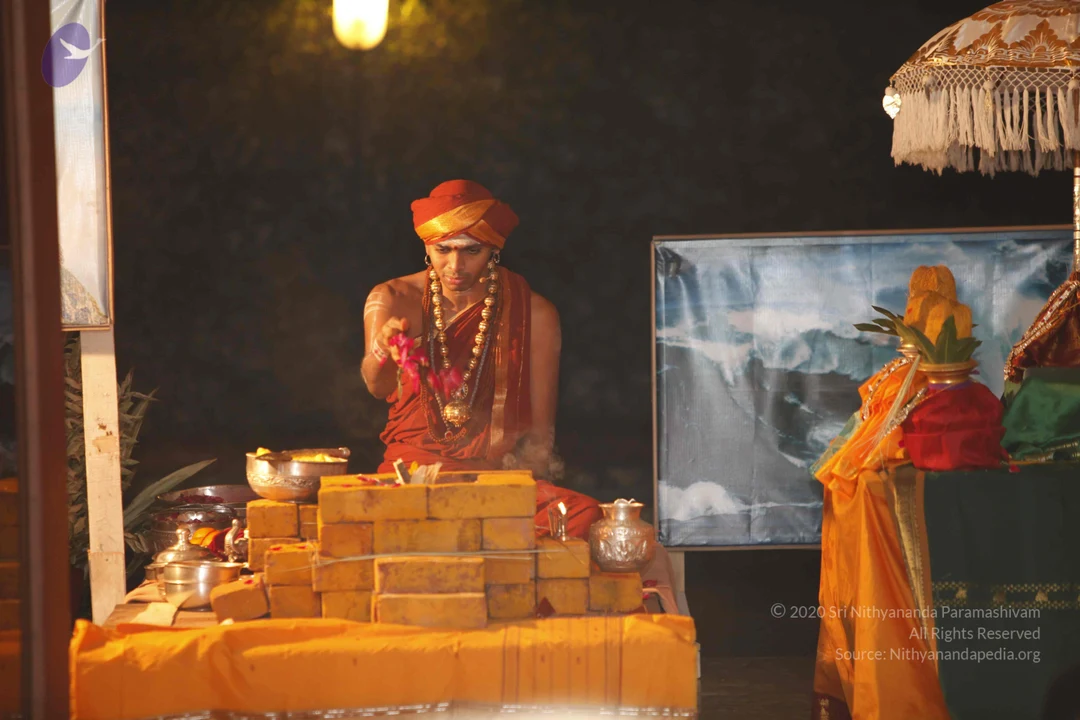
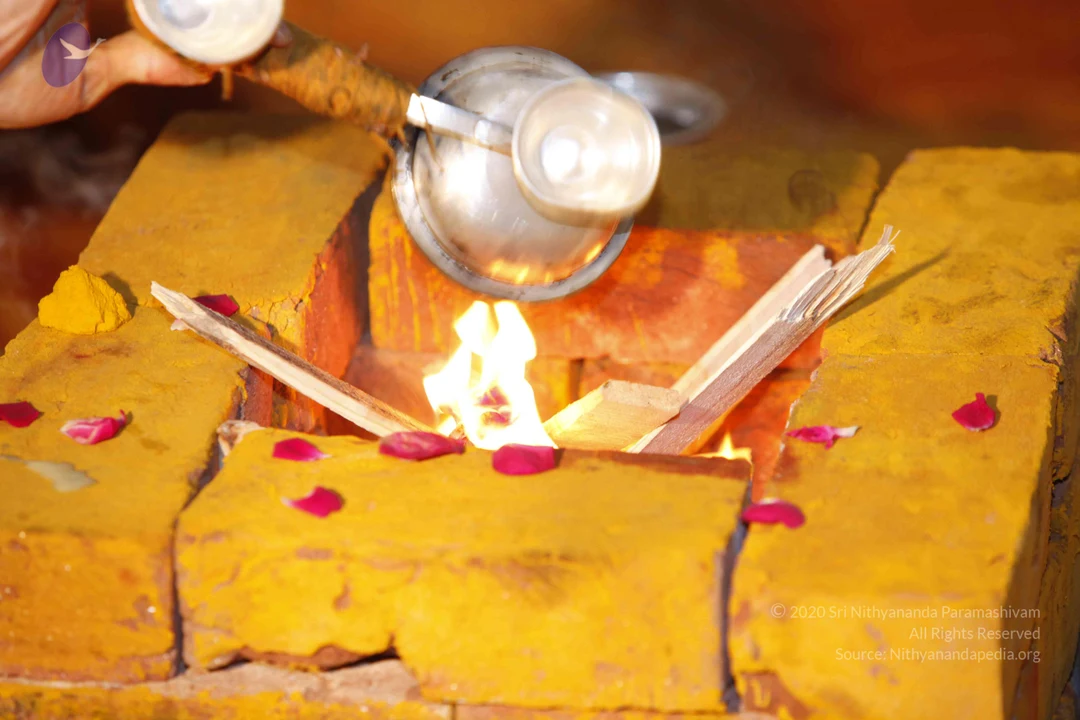
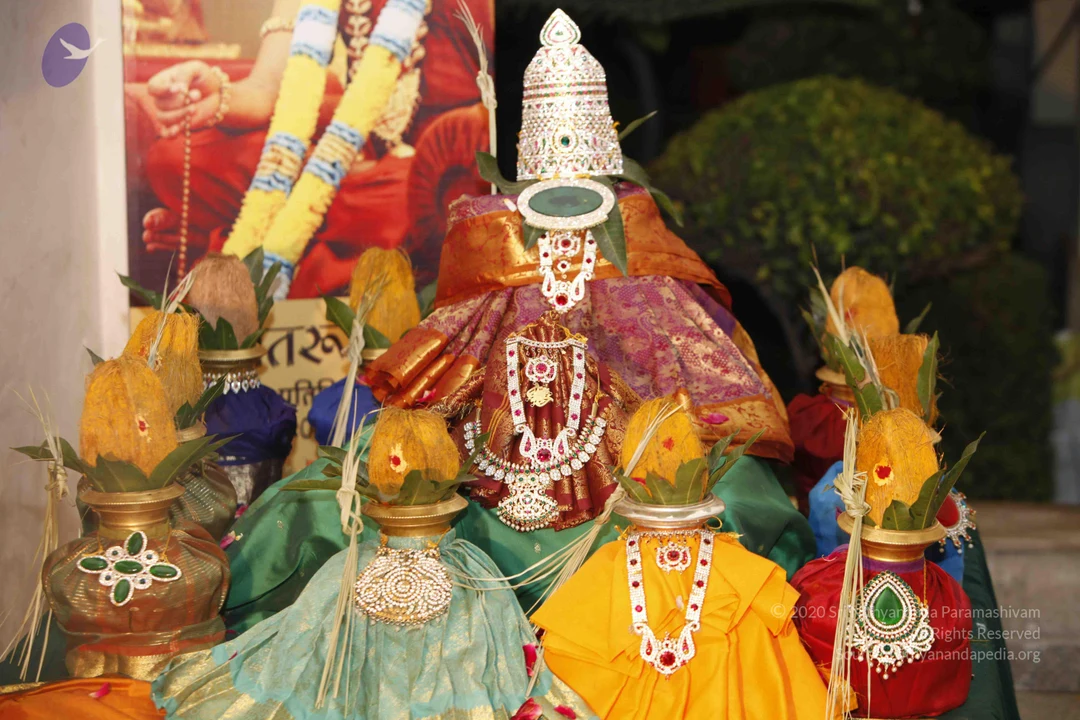
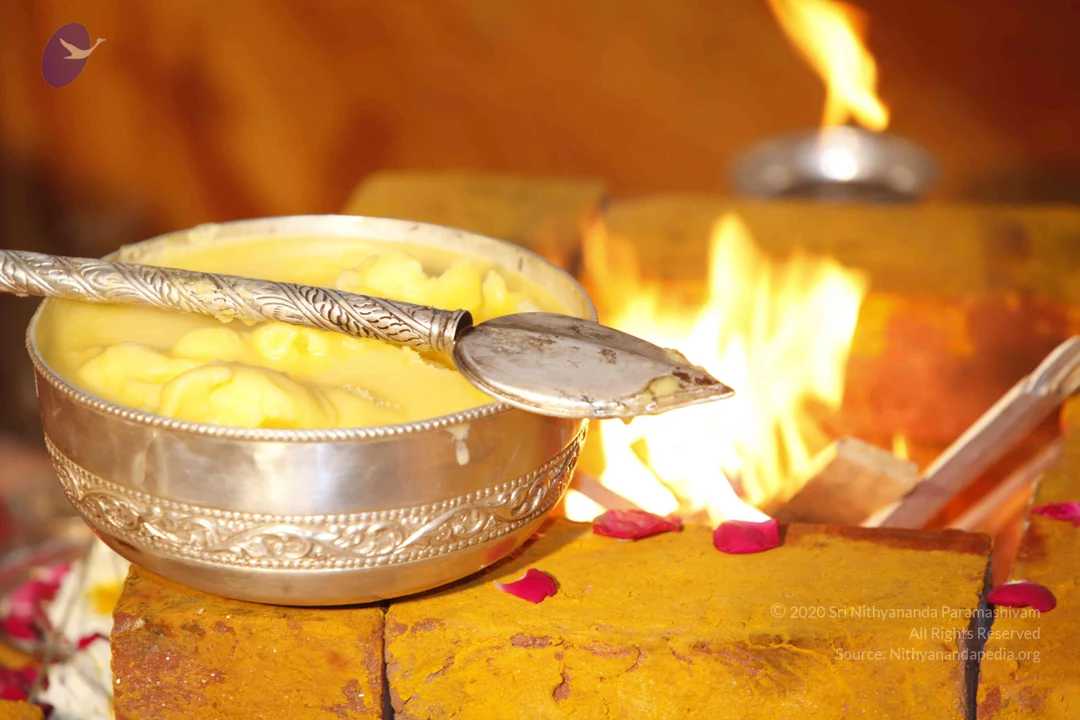
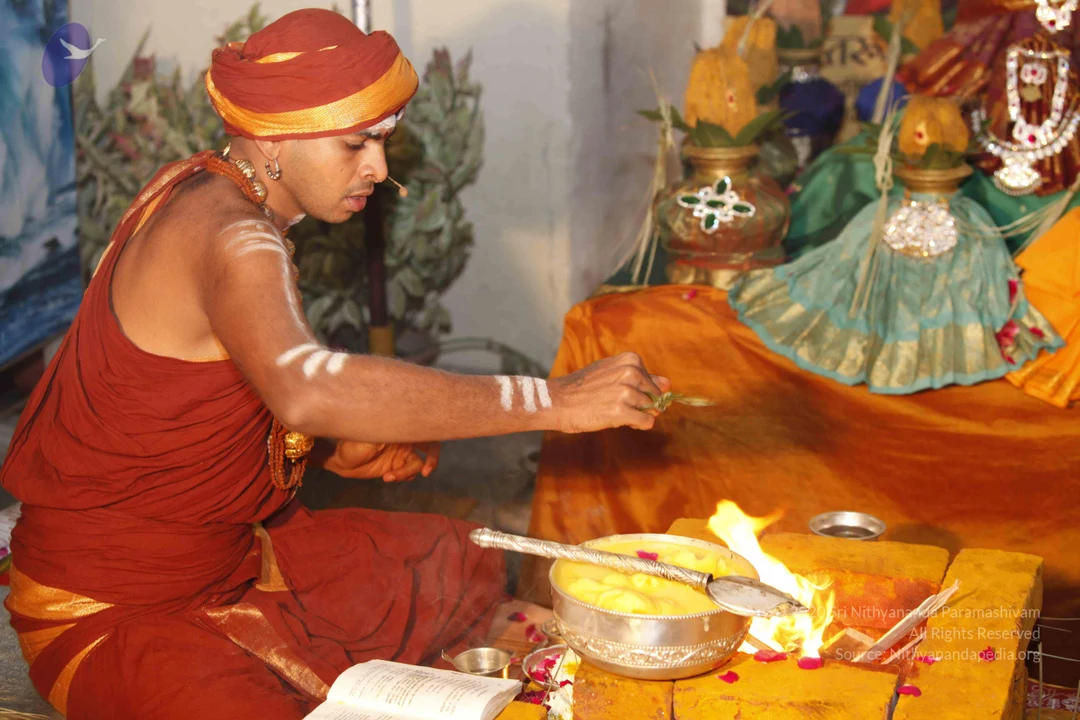
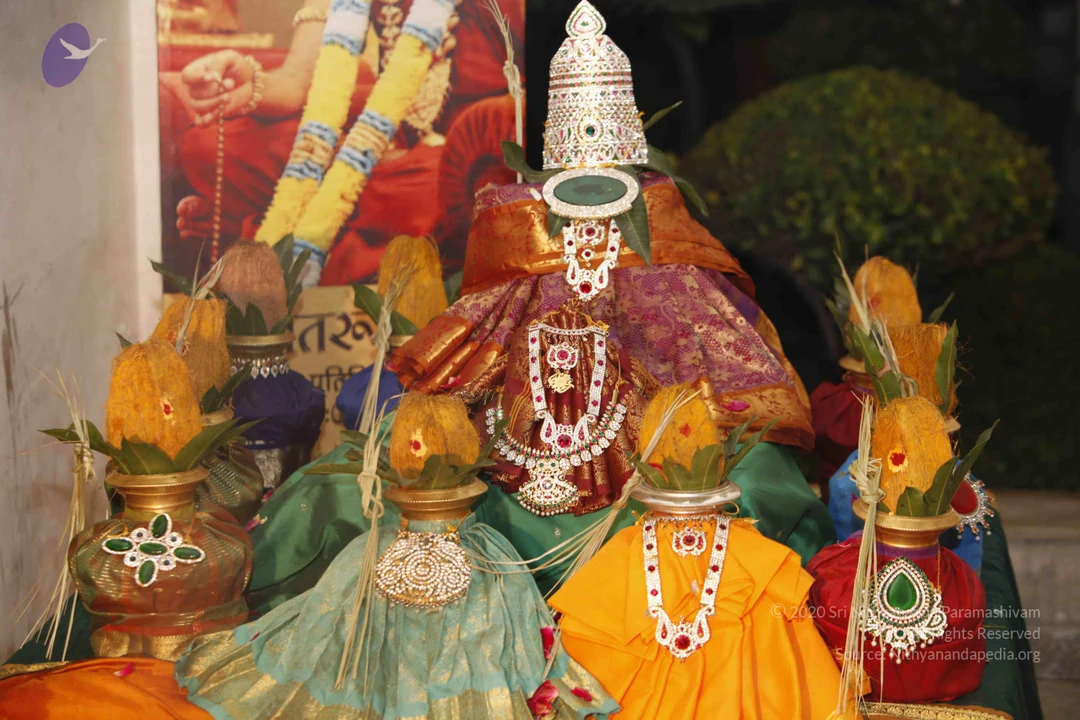
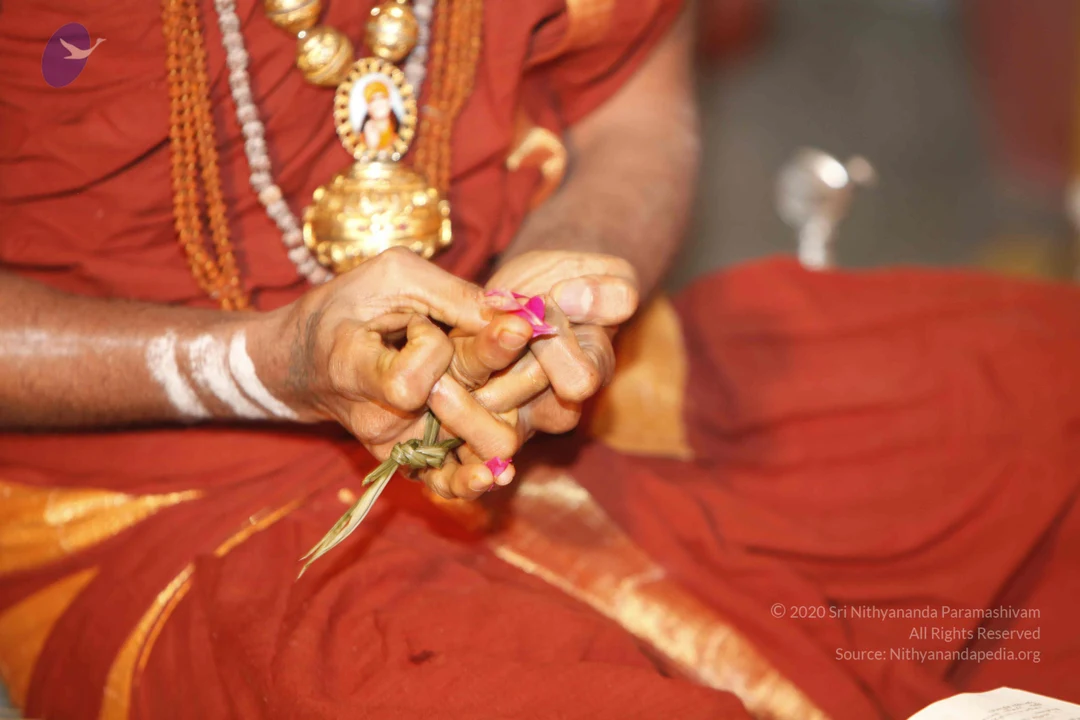
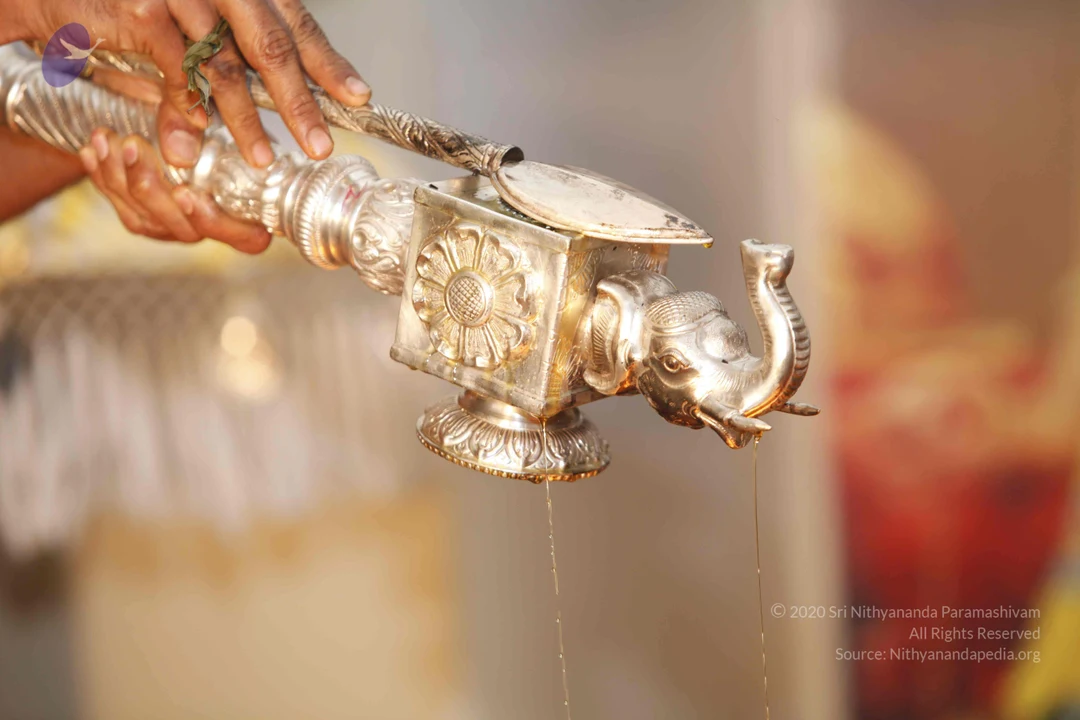
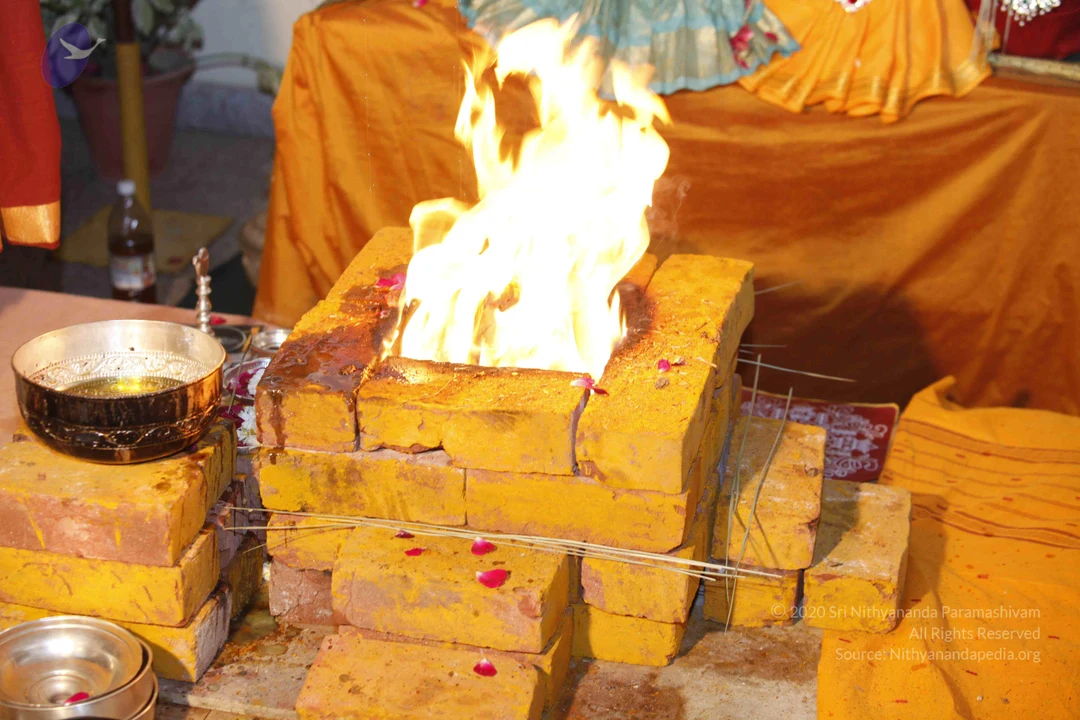
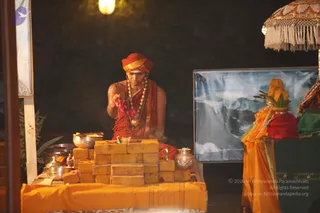
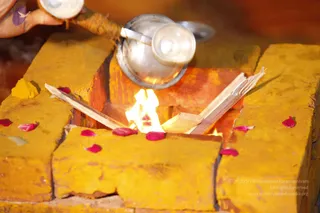
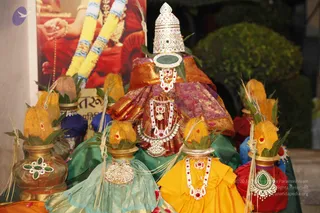
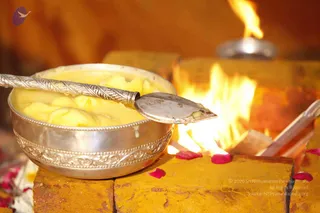
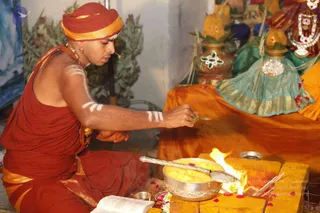
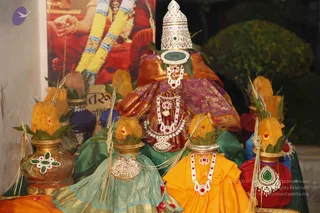
A photograph of a priest in saffron-red robes and a red-and-gold turban seated at an evening ritual, holding pink flower petals over a stack of yellow-wrapped offering bricks on a yellow cloth-covered table. Silver bowls, a small silver kalasha and a metal lamp sit on the table. Behind him a backdrop shows a wave image, and at right a decorated golden umbrella and an orange-draped altar with a red cloth are visible. A rudraksha mala and a gold necklace are worn on his bare chest, and the scene is lit warmly against a dark background. The figure's appearance is ambiguous, so no identification is made.Close view of a homa fire pit built from yellow-turmeric-coated bricks. A small flame burns on wooden sticks laid in the centre, with red rose petals scattered over the bricks. A hand at the top left pours from a metal ladle or vessel into the fire. No people's faces are visible and no person is identifiable in the frame.A decorated kalasha arrangement with a central tall ornamented pot dressed in a purple and gold silk drape, crowned with a jewelled silver-and-gold cap and green stone, and hung with white beaded and red-stone necklaces. Surrounding pots are wrapped in yellow, blue, green, red and teal cloths, topped with coconuts and mango leaves, with gold and jewelled ornaments. Behind is a red-robed figure holding a mala against a painted backdrop with yellow and white garlands. No people are visible.Close-up photograph of a homa fire ritual. A large silver bowl with engraved floral border holds yellow ghee, with a long silver ladle resting across its rim. Behind it, a bright fire burns in a yellow-brick fire pit, with a silver vessel and rose petals scattered on the bricks. No people are visible.A priest seated on the floor performs a fire ritual beside a brick fire pit. He wears a red-orange turban with gold edging, a rust-red dhoti and shawl with gold borders, and a gold necklace. White ash marks streak his arms and forehead. He holds a small leaf or offering over a silver bowl of yellow offering while flames rise from the pit. An open book rests on the floor. Behind him stands a deity murti with kumkum and gold garlands, flanked by brass kalasha pots with mango leaves and a teal-and-gold draped cloth. Orange cloth and marigold petals decorate the altar area.A decorated deity murti dressed in a purple and orange silk sari with a tall silver crown set with green and red stones, heavy gold and jewelled necklaces, and a green mirror-like ornament at the crown base. Around it stand several decorated brass kalashas topped with coconuts and mango leaves, each draped in coloured cloth (teal, orange, red, green) and adorned with jewelled ornaments. A large framed photo behind shows a figure in red robes holding a rudraksha mala, with yellow and white garlands hanging at the top. Flower petals lie on the ground. Only statues and printed images are visible; no physical people are present.

Kalpataru

5 photosSource gallery
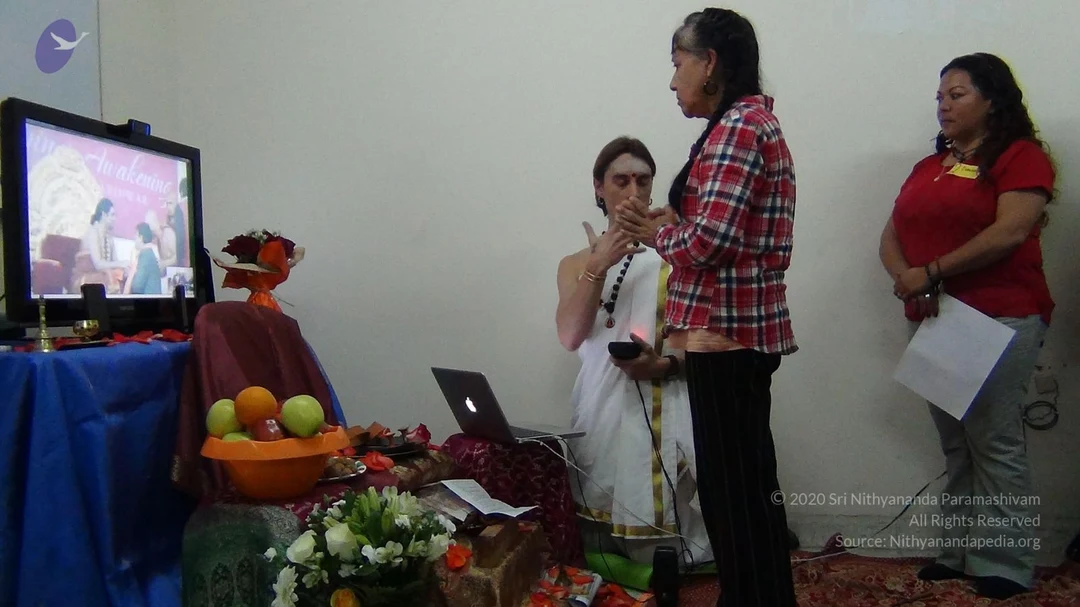
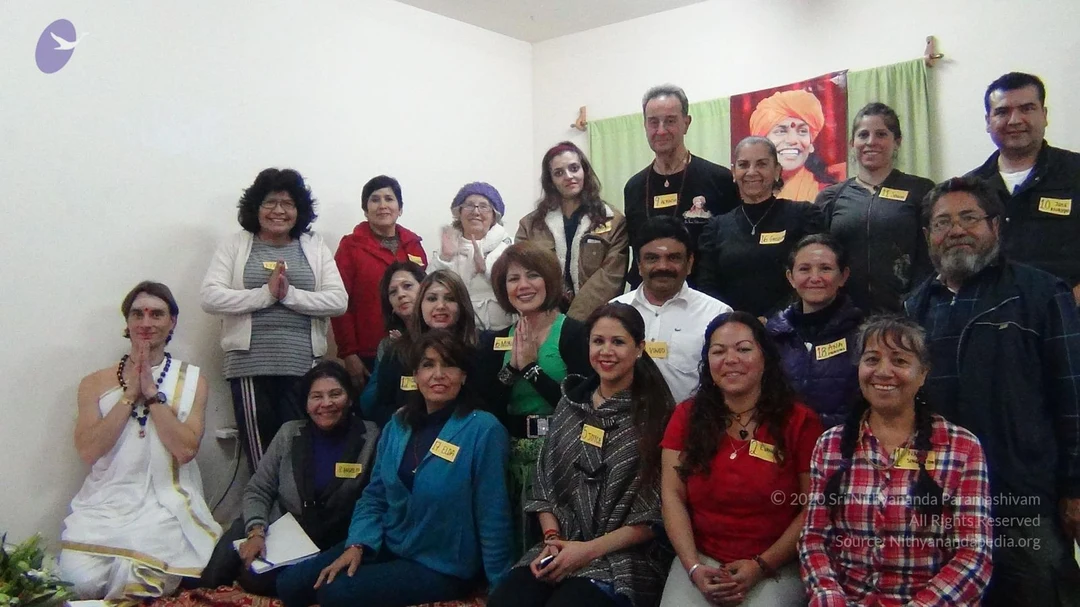
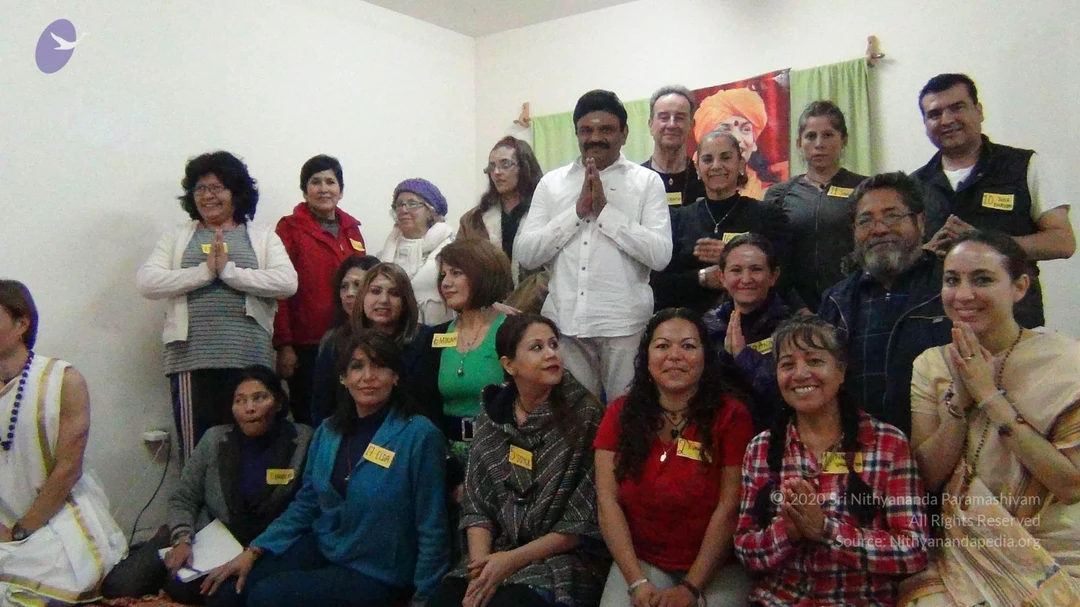
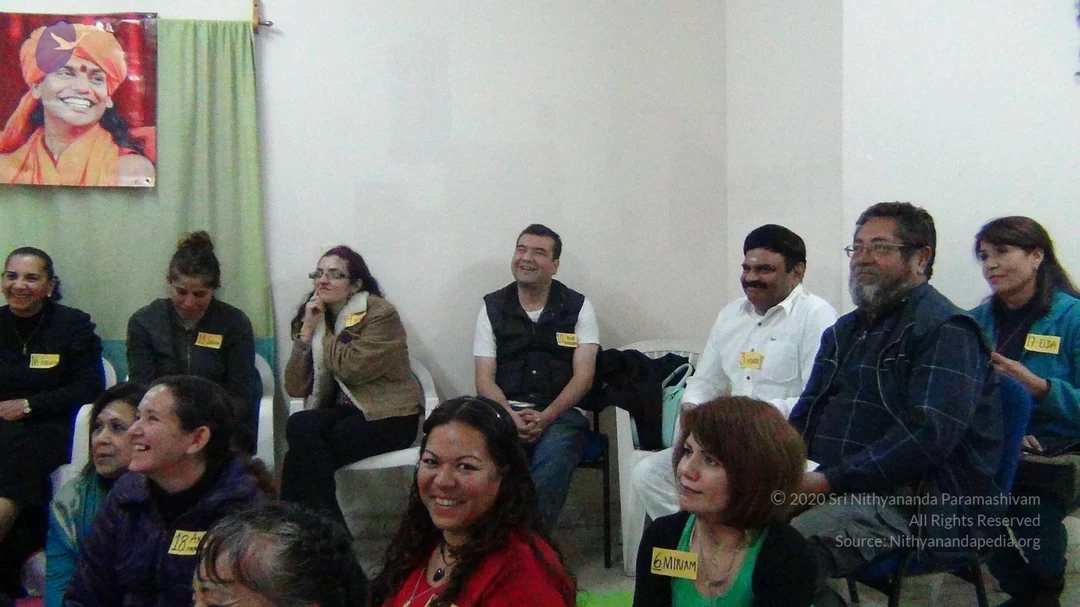
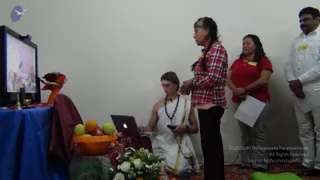
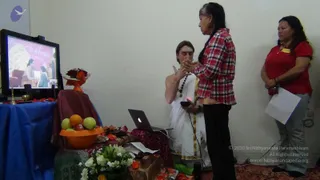
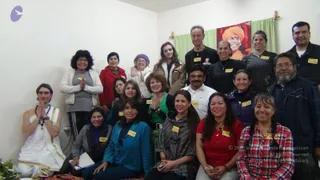
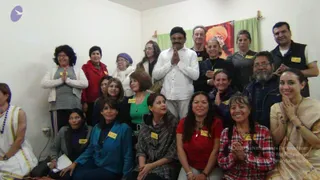
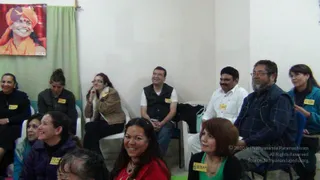
A satsang setting in a plain white-walled room. A seated man in white dhoti and shawl with gold border wears a dark beaded mala and bindi, working at an open laptop on a low table. Beside him a flat-screen monitor shows an image, a small fruit bowl of oranges, green and red apples, a brass lamp and white flowers sit on draped cloth, and an orange-and-red cloth figure rests on the left. A woman in a plaid shirt and dark trousers stands with a paper in hand, another woman in a red top with a name tag watches, and a man in white shirt stands at the right. a person candidate appears seated in white ritual clothes with a mala, though the cues are not distinctive enough to confirm identity.A photograph of a small indoor puja setup in a plain white-walled room with a red patterned rug. On the left, a blue-draped table holds an orange bowl of fruit, marigold and rose petals, a bouquet of white and red flowers, a brass lamp and a laptop. A wall-mounted television shows a pink graphic reading "Awakening". A person in white ritual dhoti with a gold border and a dark rudraksha mala stands at the table, performing a gesture with raised hands, while a woman in a red-and-white plaid shirt and dark trousers stands facing them with her hands joined in namaste. At the far right, a woman in a red top and grey trousers holds a white paper and watches. The person in white has a red tilak and is not visibly identified as a person.Group photograph of about twenty smiling adults posed indoors against a plain white wall with green curtains. A poster of a smiling man in an orange turban and orange robe is pinned high on the right. Seated at the front left, a man in a white dhoti with a gold border, wearing rudraksha beads, holds his hands in namaskar. Around him, women and men wear casual coats, sweaters and red or teal clothing, many with name badges pinned to their chests.A group photo of about 20 people posed indoors against a plain white wall with green curtains. Many stand or sit with palms pressed together in namaste. Centre, a man in an all-white kurta holds namaste. Behind him a large red and orange framed picture shows a figure in an orange turban, and an older man in a dark jacket stands at the back. Women wear red, teal, green and plaid tops and cardigans; name tags are pinned to several people's clothing. On the far left a seated person in white with a rudraksha mala. On the right a smiling woman in cream and gold dress holds namaste. No individual's identity is established from appearance; the orange-turbaned figure appears in a picture on the wall and is a depiction, not a physical person.A seated audience of devotees in a plain white-walled room, many wearing name tags, watches a satsang. On the left wall hangs a red-backed portrait of a smiling man in an orange turban and saffron robe, labelled by the page as Swamiji, appearing as a depiction. In the foreground a woman in a red top smiles, and a woman in a green top sits beside a man in a white shirt. Several attendees in dark jackets and jeans listen attentively on white plastic chairs, with green curtains behind them.

Satsang
33 photosSource gallery
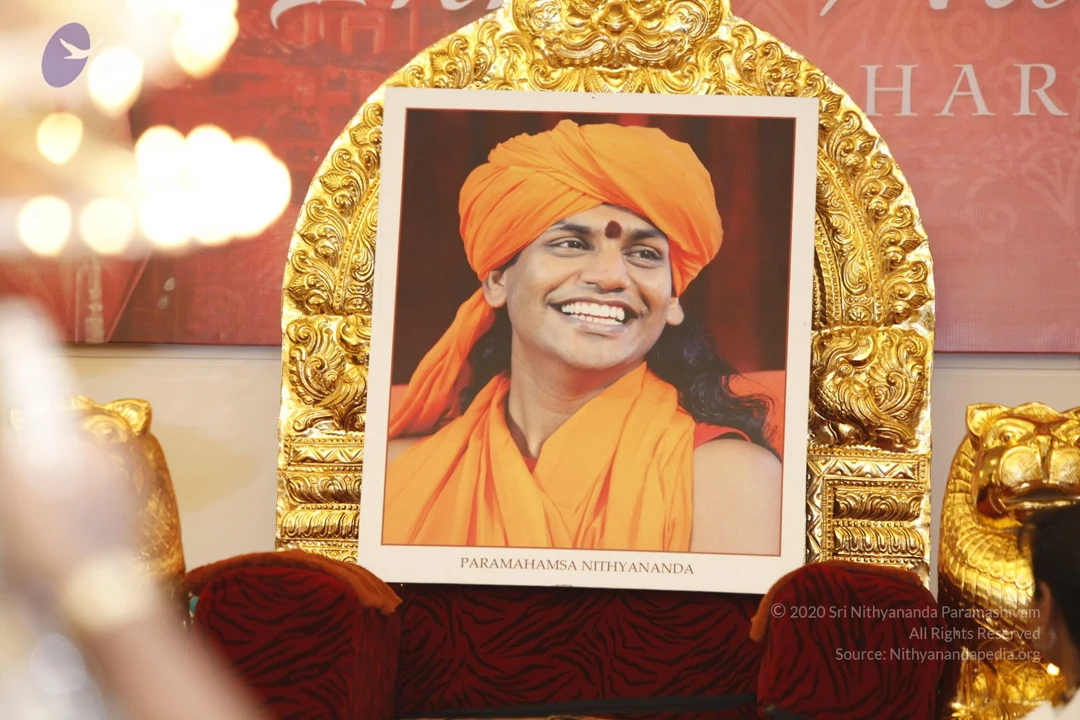
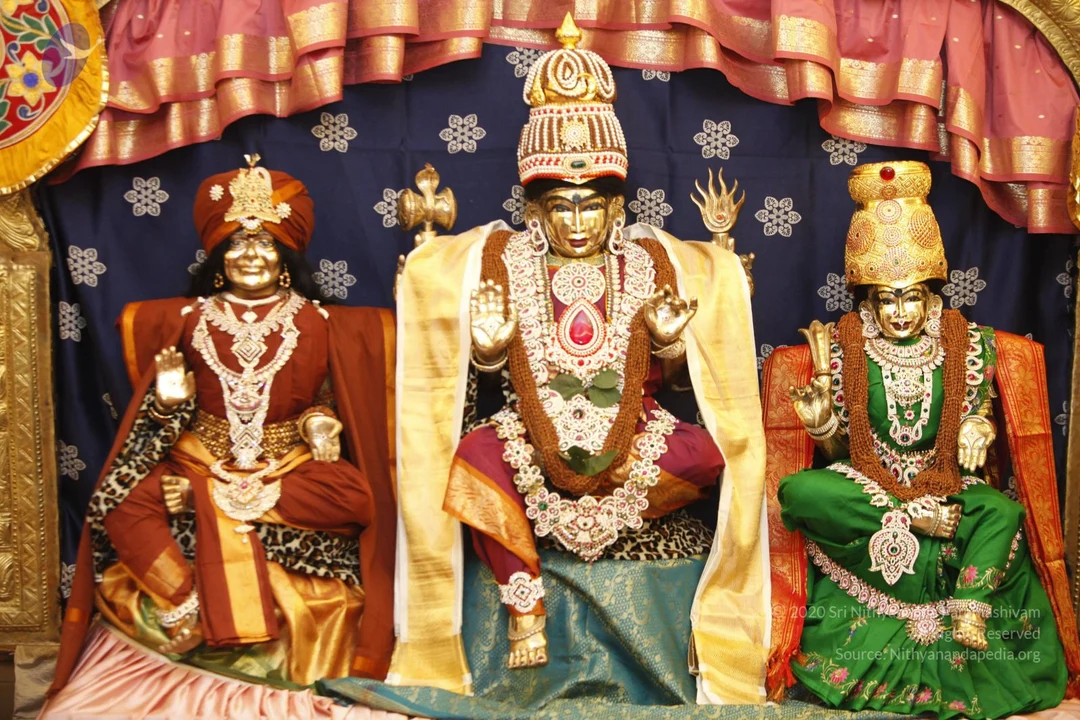
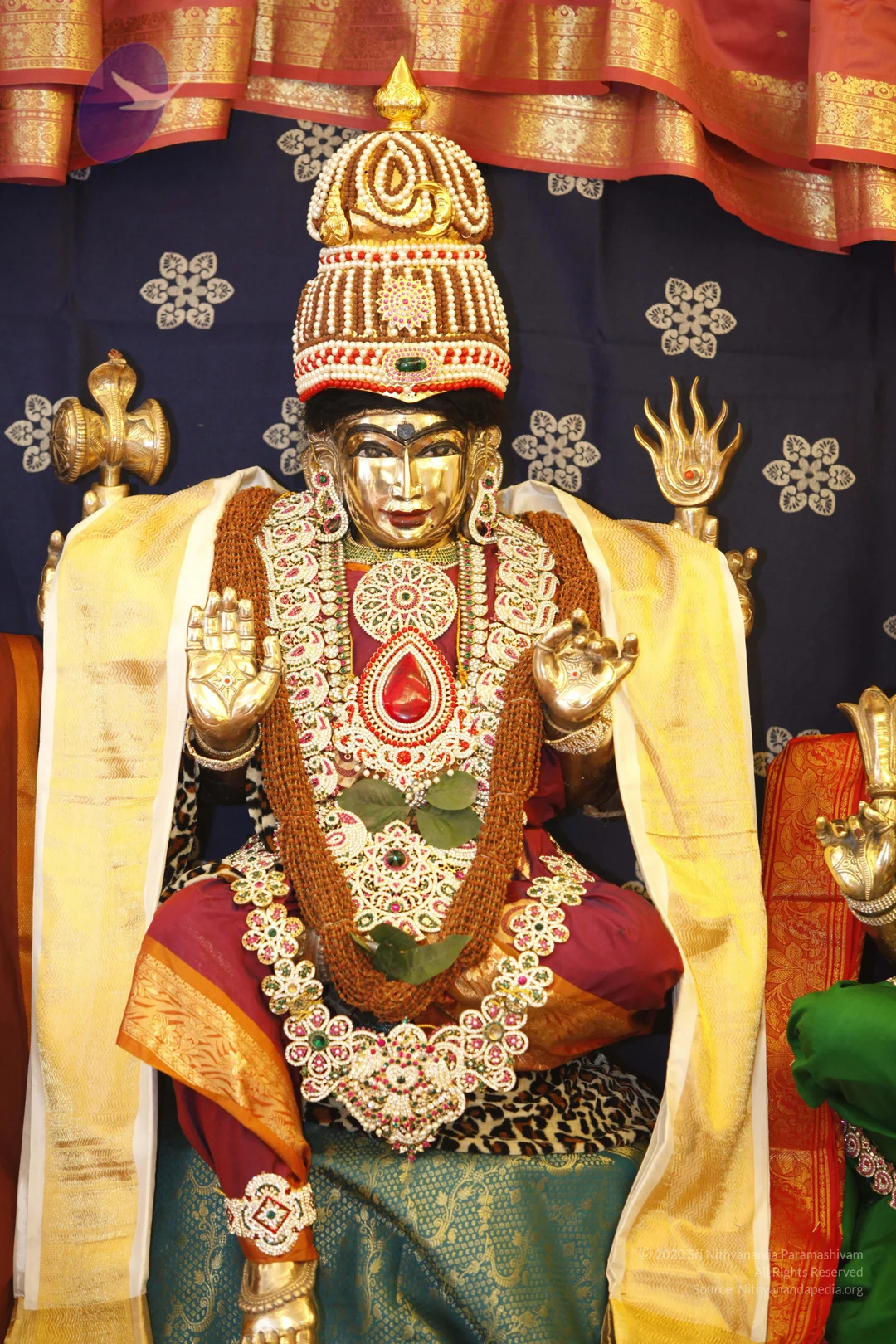
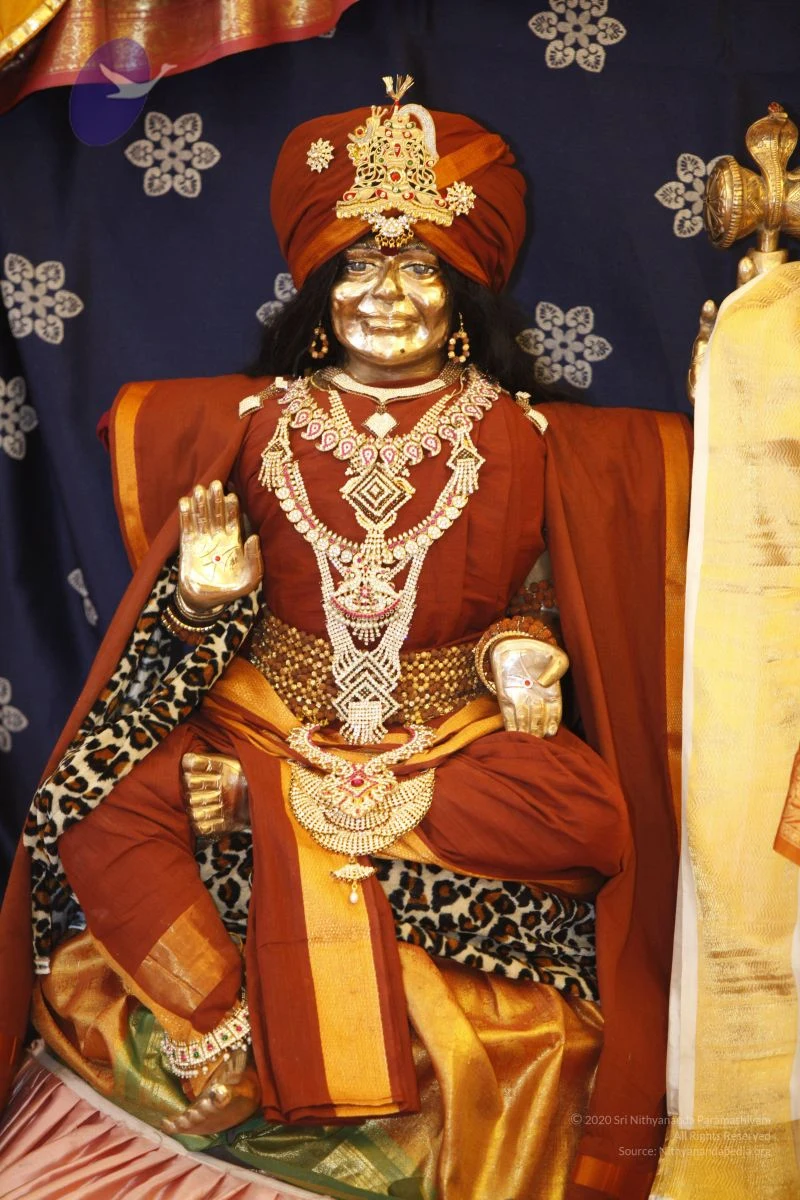
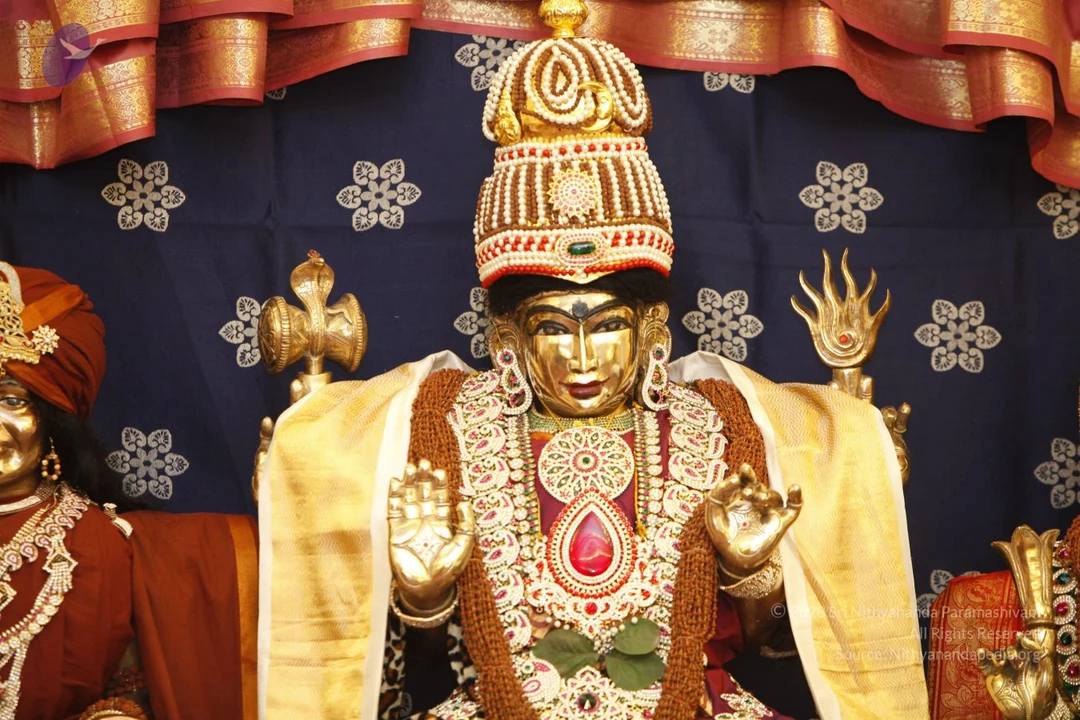
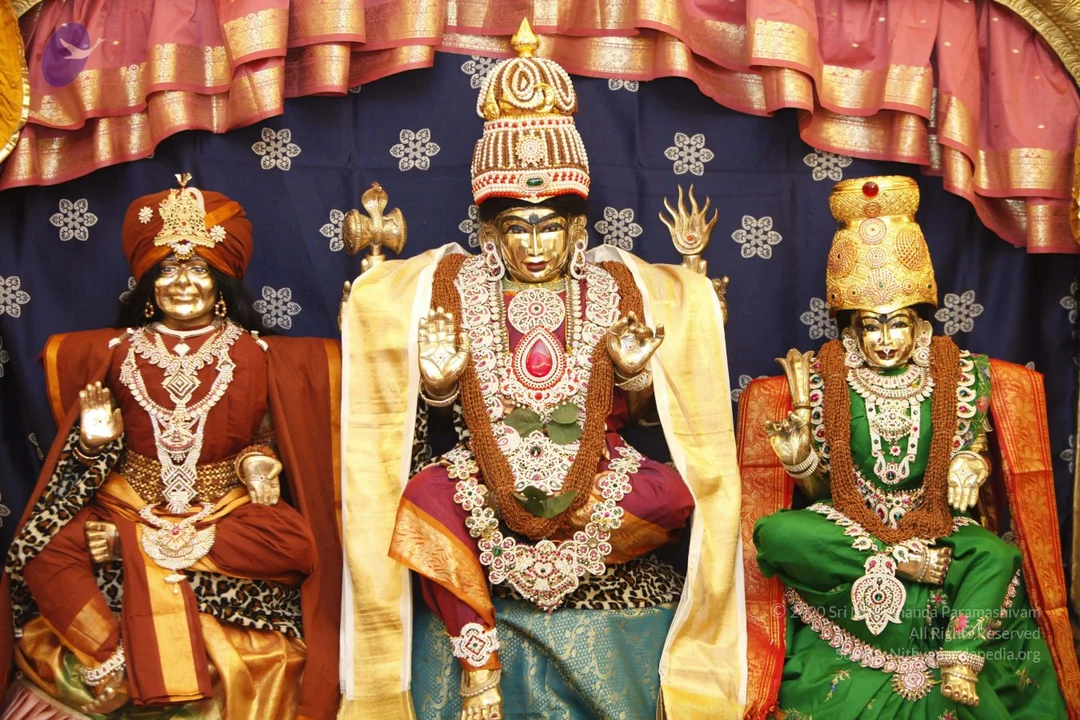
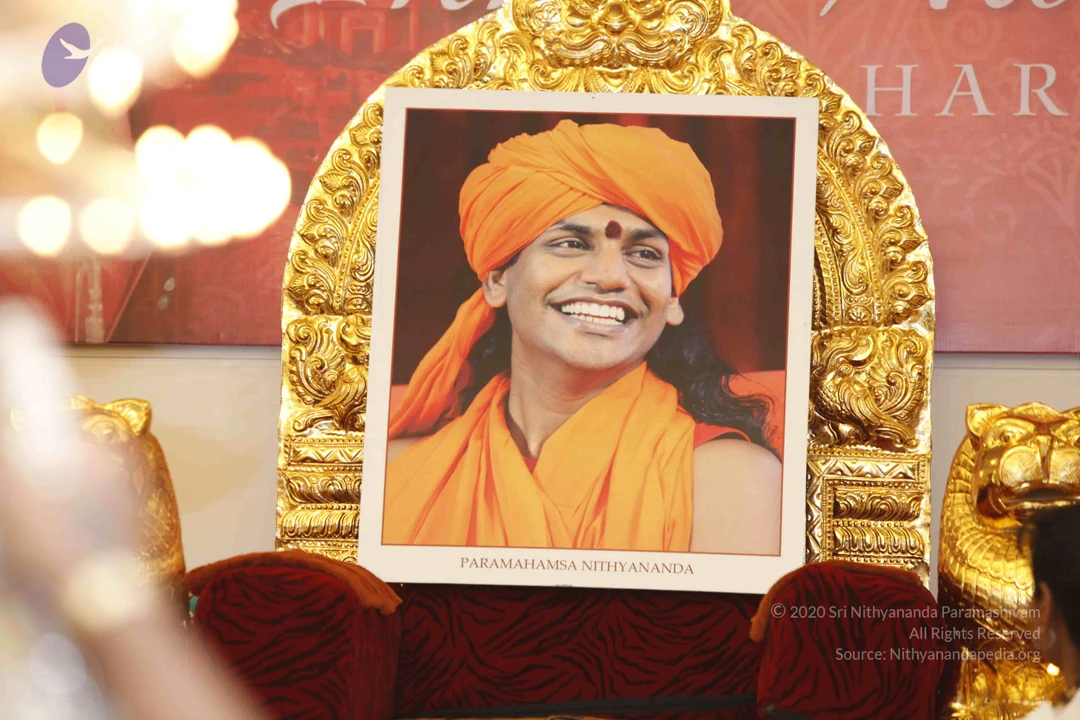
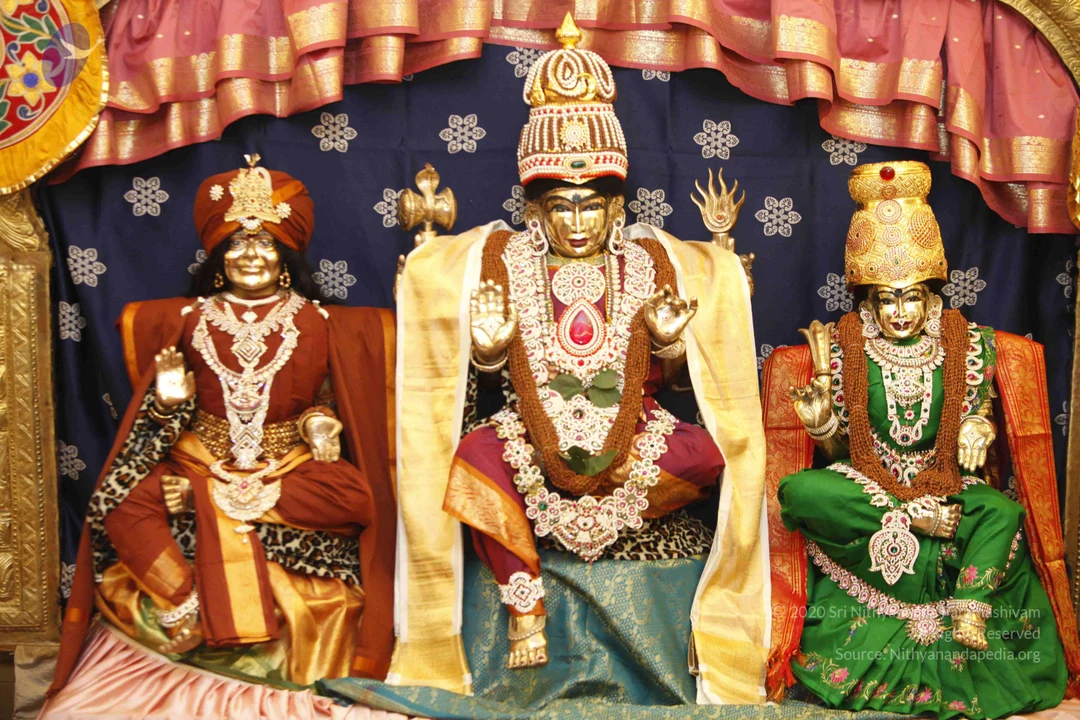
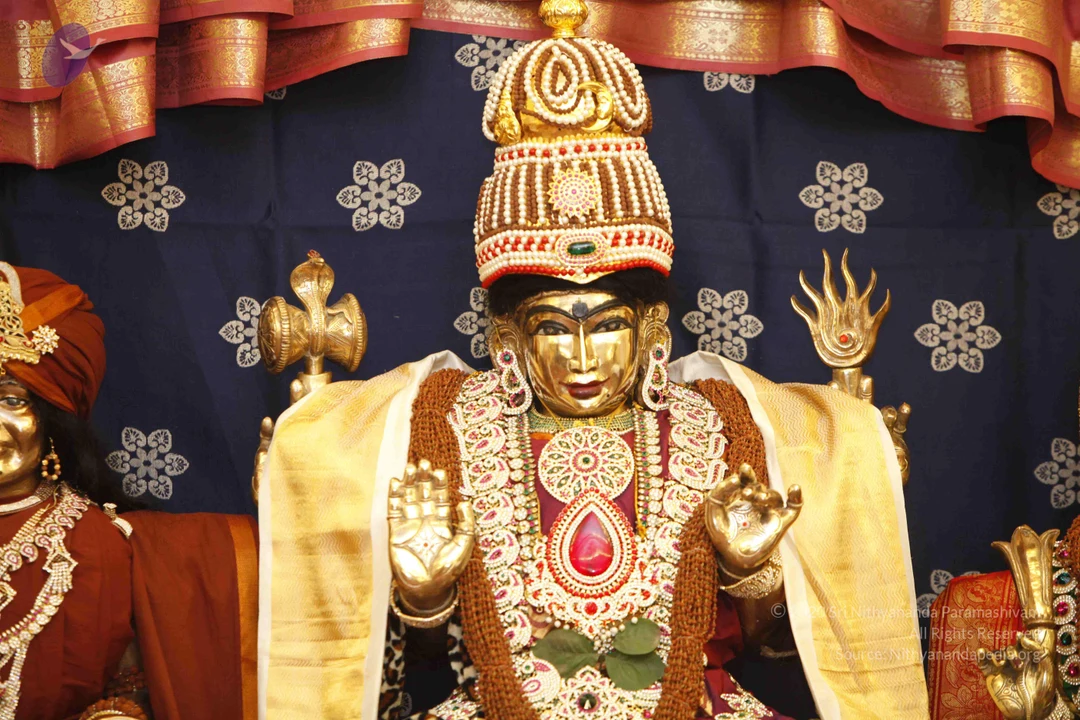
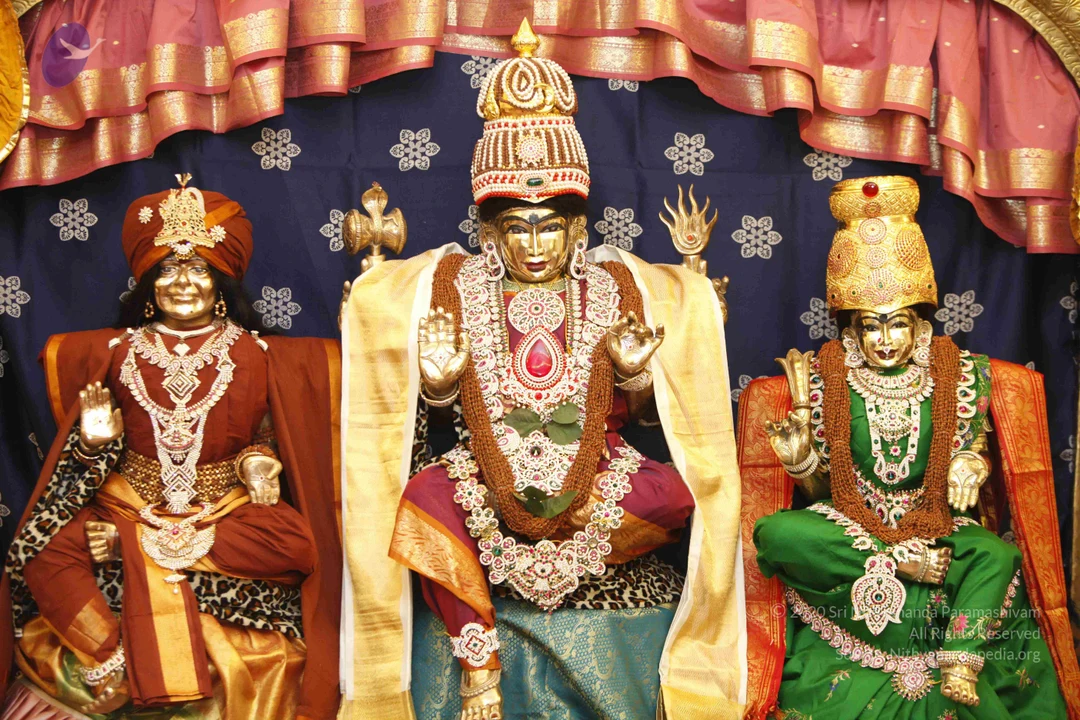
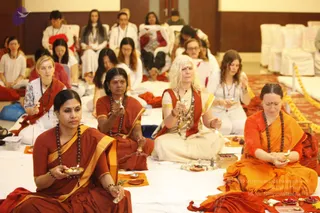
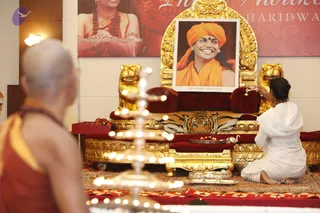
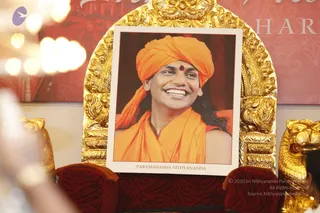
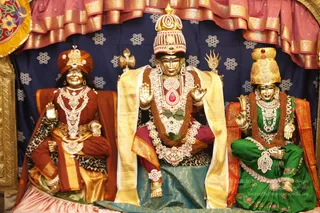
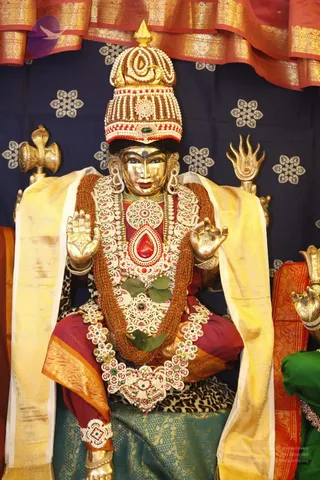
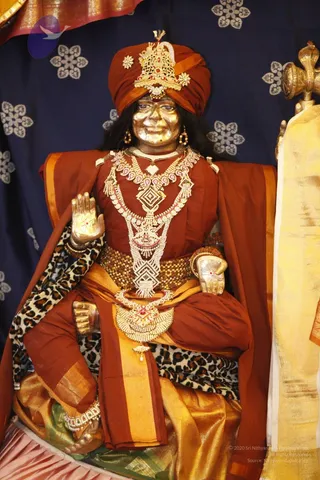
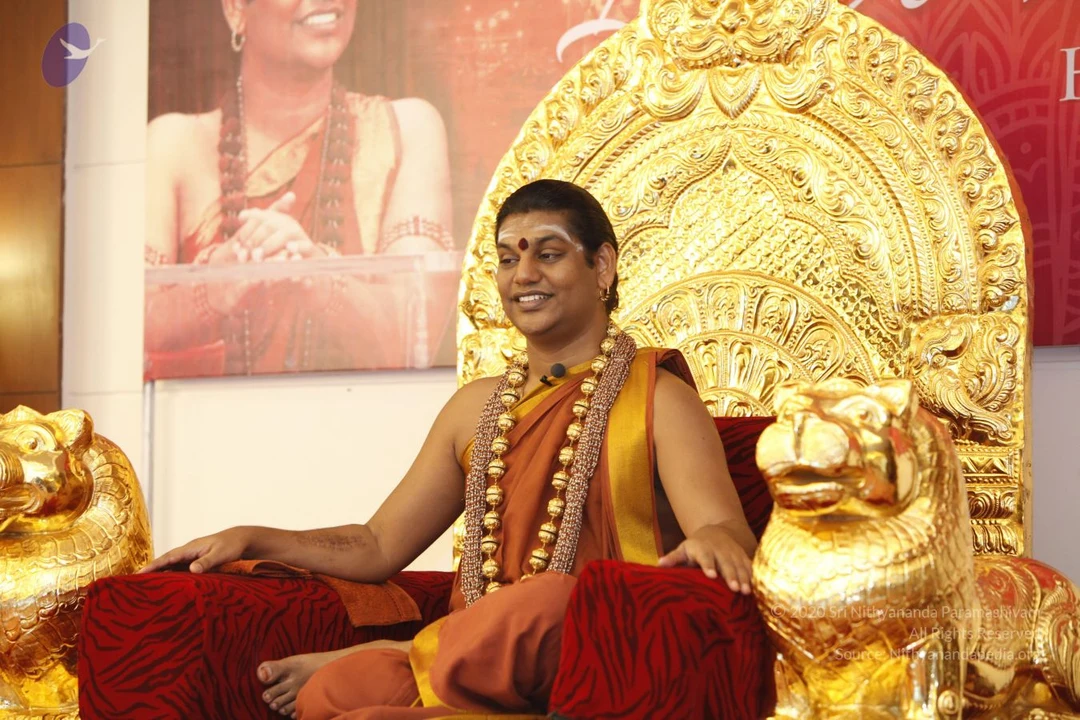
A photograph of a seated group in a hall with white floor coverings and white chairs behind them. In the foreground, several women wear rust and orange saris and rudraksha malas. The woman at far left holds a small brass lamp, the woman in the centre holds a brass plate and bell-like object, and the woman at far right holds an oil lamp. Another woman in a white sari and red shawl holds a lamp. A woman with a vibhuti forehead mark holds a small object. Behind them, many women and a few men in white clothing sit in rows, some with hands together in prayer. Marigold garlands line the edge of a red carpeted platform on the right, and small brass plates with offerings are on the floor. Some attendees are visibly wearing rudraksha malas and lanyards.A ritual scene before a gilded throne (peetha) with golden lion-head armrests and a tiger-skin cushion. A large framed portrait labelled "PARAMAHAMSA NITHYANANDA" shows a smiling figure in an orange turban and orange robes, placed at the top of the throne. A woman in a white garment sits cross-legged on the carpet at the right, holding a small flame or lamp near the throne. In the foreground at left, a shaven-headed person in red-orange robes sits facing the throne, with a tall brass lamp stand with lit oil lamps in front of him. A red table with offerings and a silver tray stand to the side, and a red-and-gold patterned carpet covers the floor. The backdrop shows a banner with a woman in red and the words "HARIDWAR" partly visible.A photo of a printed portrait placed on an ornate golden throne with carved lion-head armrests and red velvet cushions. The framed print shows a smiling man in an orange turban with a red bindi, wearing orange shawl-style robes, captioned "PARAMAHAMSA NITHYANANDA" at the bottom. Behind the throne is a red backdrop with gold script. Blurred chandelier lights and a partial figure appear in the foreground. The portrait is a depiction, not a physical person.Three seated golden murti figures are displayed against a navy backdrop with white snowflake-like motifs and a pink gold-bordered drape overhead. The central figure wears a tall ornate gold crown, a white and gold shawl, a red-and-maroon dhoti, layered white floral garlands and a rudraksha mala, and holds a hand in abhaya-like gesture. On the left, a figure in a rust-orange turban, orange-brown robe, gold shoulder band and leopard-print cloth holds a gold object. On the right, a figure in a gold crown with a red jewel and a green saree with gold border wears pearl and gold necklaces. Gold trishula-style staffs stand behind the central figure.A gilded metal murti of a seated deity is adorned with a tall beaded crown with a golden finial, red and green stones, layered jewelled necklaces, a rudraksha-style brown bead garland with green leaves, and a red-and-gold patterned skirt under a gold shawl. The figure raises its hands in mudra before a navy background with white floral motifs, with a golden trident and a cobra-hooded staff at its sides. A red and gold border drapes overhead. The photo is watermarked with the archive copyright, which is not transcribed.A gilded statue of a seated figure in a rust-red turban with a jewelled gold crown ornament, rust-red robes with gold borders, and a leopard-print shawl draped over the shoulders. Heavy layered gold and pearl necklaces, a jewelled waist belt, and gold bangles adorn the figure, which holds one hand raised in blessing. A gold cobra-hooded staff rises beside the throne against a navy blue backdrop with white floral motifs. No physical people are visible; the figure is a statue, so this is a depiction of a deity or sacred figure rather than a candidate in person.

Photos Of The Day:

8 photosSource gallery
A photograph of a large screen showing a live video-conference link to a satsang hall. A banner at the top reads Thiruvanmiyur, Chennai. On the left, a woman in an orange sari stands near a wooden pillar. Behind her, a crowd of devotees sits in white and pastel clothing, many wearing glasses, with a man in a white shirt and a seated older woman in the foreground. Red and orange drapes hang on the back wall, and a caption reads Ma Bhaktipriya.A photograph of a video screen showing a live two-way video-conference feed labelled "Oklahoma Somnatham" at the top. Behind a red draped backdrop, a shrine holds deity murtis and decorative pieces, with a kalasha-like vessel and flowers. Many seated devotees sit on a patterned rug and on a red cushioned bench, dressed in dark, white, blue and red clothing. A few figures are partly visible at the far right. The image is blurry and shows a screen rather than the room directly.A satsang setting in a plain white-walled room. A seated man in white dhoti and shawl with gold border wears a dark beaded mala and bindi, working at an open laptop on a low table. Beside him a flat-screen monitor shows an image, a small fruit bowl of oranges, green and red apples, a brass lamp and white flowers sit on draped cloth, and an orange-and-red cloth figure rests on the left. A woman in a plaid shirt and dark trousers stands with a paper in hand, another woman in a red top with a name tag watches, and a man in white shirt stands at the right. a person candidate appears seated in white ritual clothes with a mala, though the cues are not distinctive enough to confirm identity.A photograph of a small indoor puja setup in a plain white-walled room with a red patterned rug. On the left, a blue-draped table holds an orange bowl of fruit, marigold and rose petals, a bouquet of white and red flowers, a brass lamp and a laptop. A wall-mounted television shows a pink graphic reading "Awakening". A person in white ritual dhoti with a gold border and a dark rudraksha mala stands at the table, performing a gesture with raised hands, while a woman in a red-and-white plaid shirt and dark trousers stands facing them with her hands joined in namaste. At the far right, a woman in a red top and grey trousers holds a white paper and watches. The person in white has a red tilak and is not visibly identified as a person.Group photograph of about twenty smiling adults posed indoors against a plain white wall with green curtains. A poster of a smiling man in an orange turban and orange robe is pinned high on the right. Seated at the front left, a man in a white dhoti with a gold border, wearing rudraksha beads, holds his hands in namaskar. Around him, women and men wear casual coats, sweaters and red or teal clothing, many with name badges pinned to their chests.A group photo of about 20 people posed indoors against a plain white wall with green curtains. Many stand or sit with palms pressed together in namaste. Centre, a man in an all-white kurta holds namaste. Behind him a large red and orange framed picture shows a figure in an orange turban, and an older man in a dark jacket stands at the back. Women wear red, teal, green and plaid tops and cardigans; name tags are pinned to several people's clothing. On the far left a seated person in white with a rudraksha mala. On the right a smiling woman in cream and gold dress holds namaste. No individual's identity is established from appearance; the orange-turbaned figure appears in a picture on the wall and is a depiction, not a physical person.
01-PUJA

1 photoSource gallery
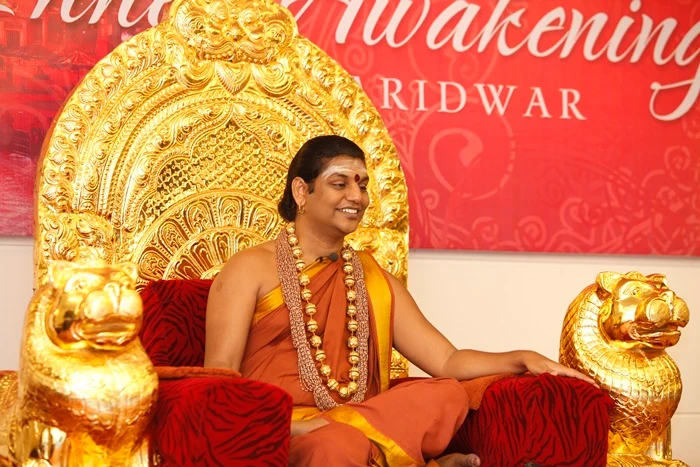
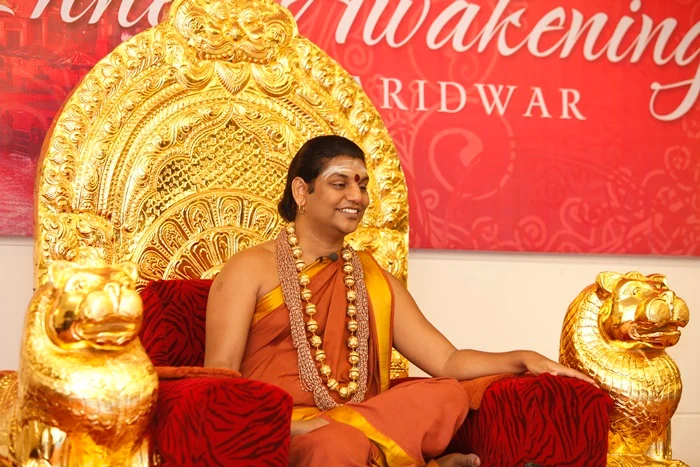
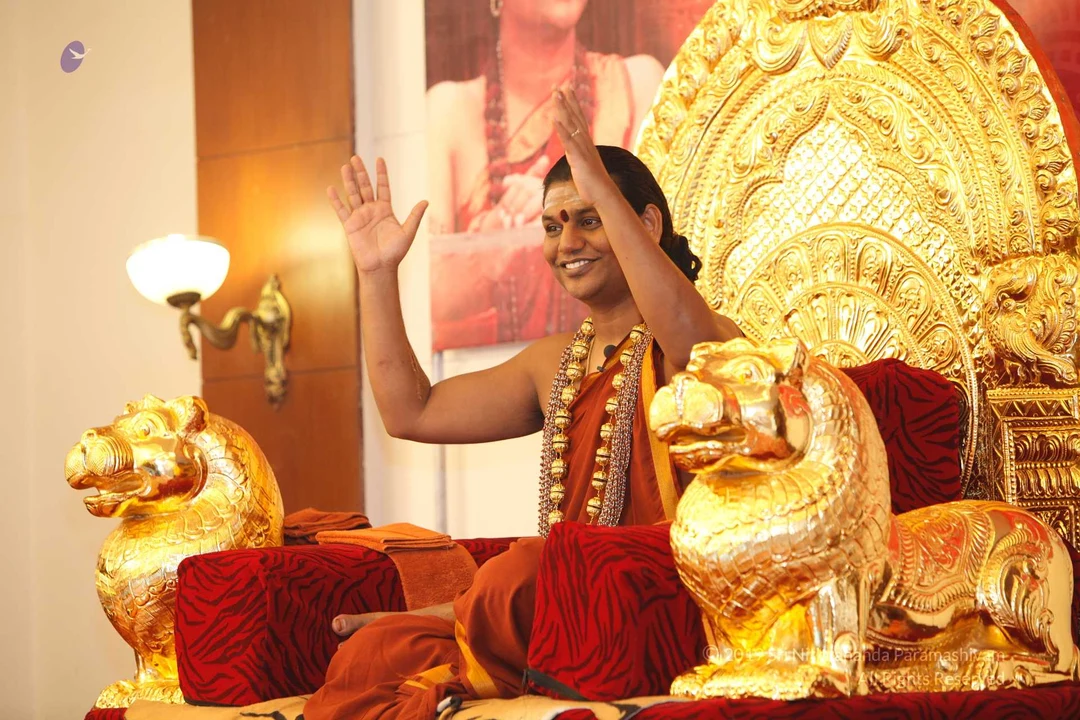
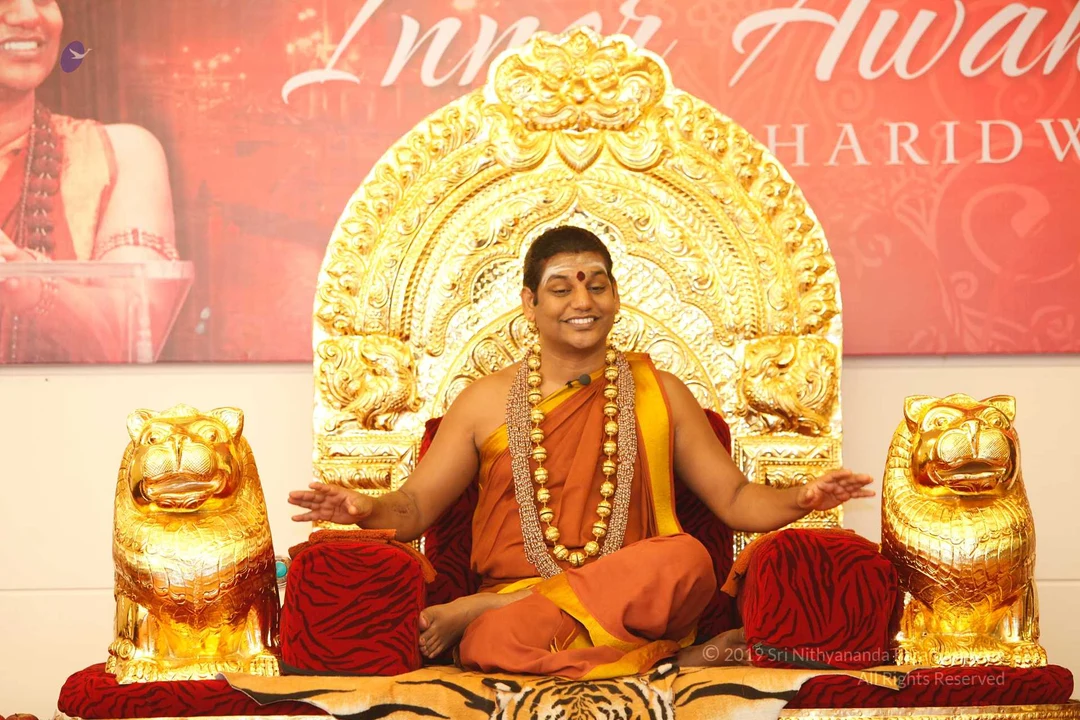
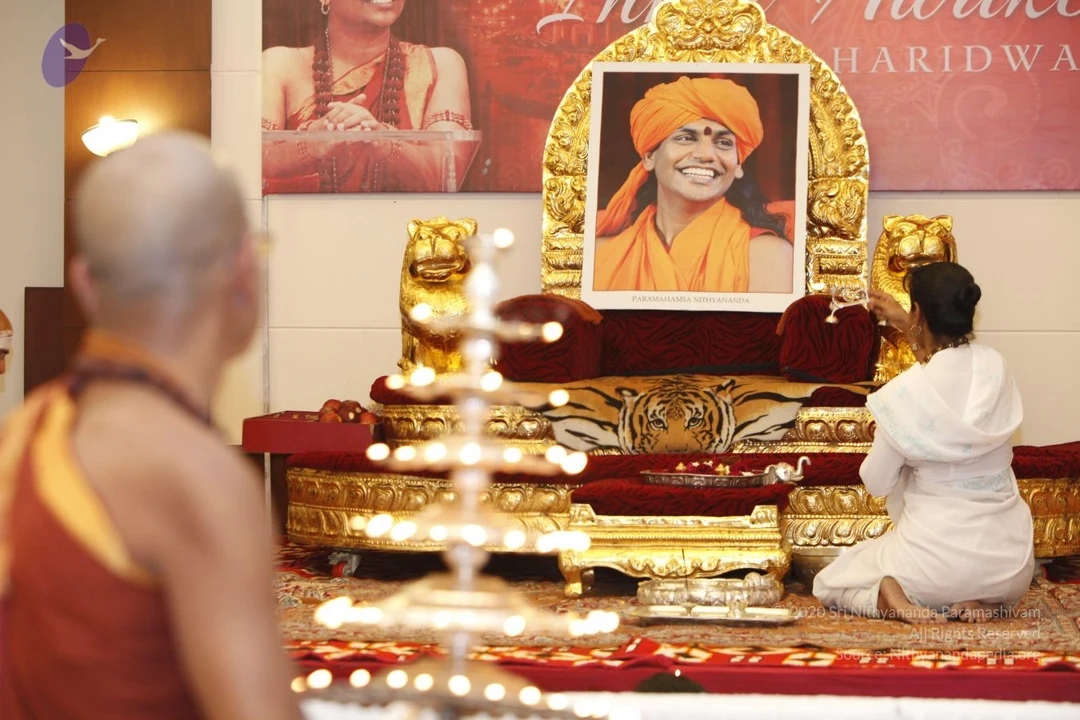
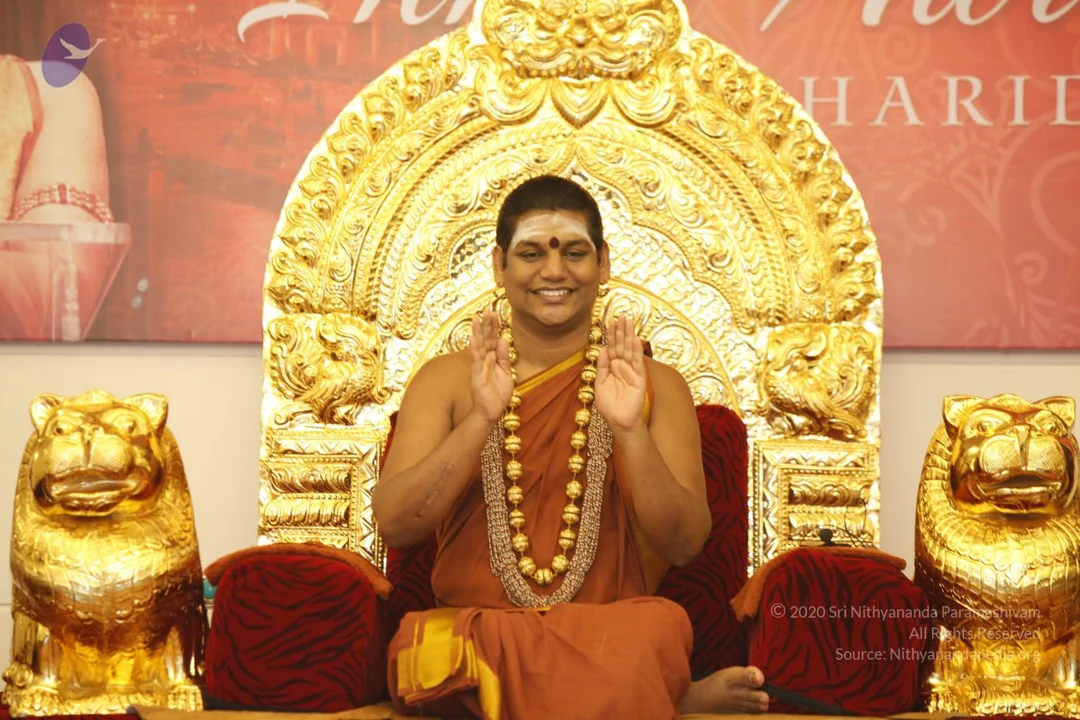
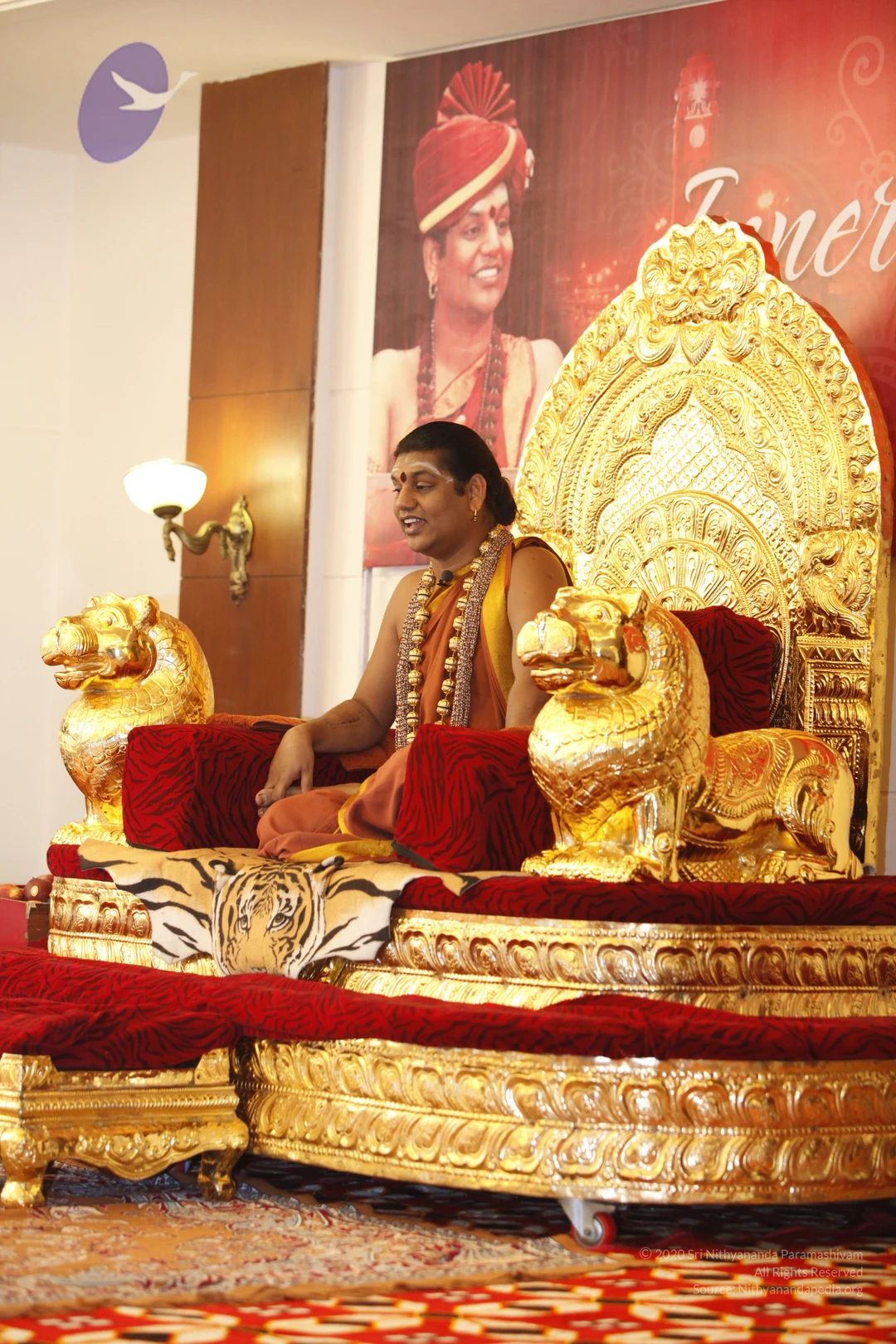
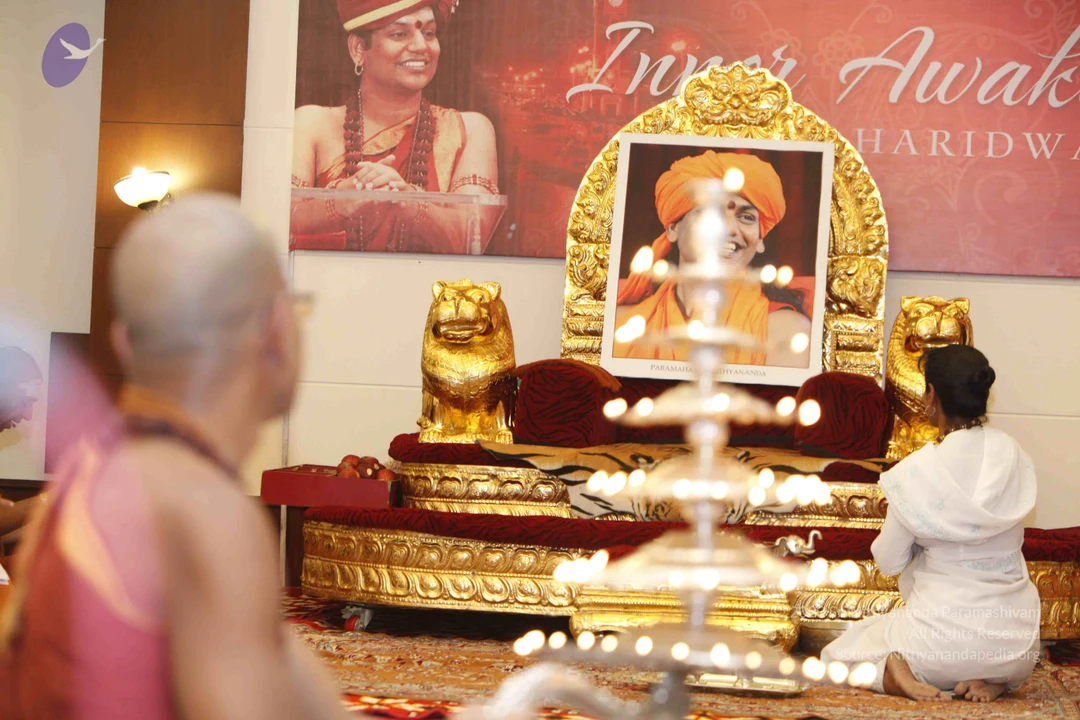
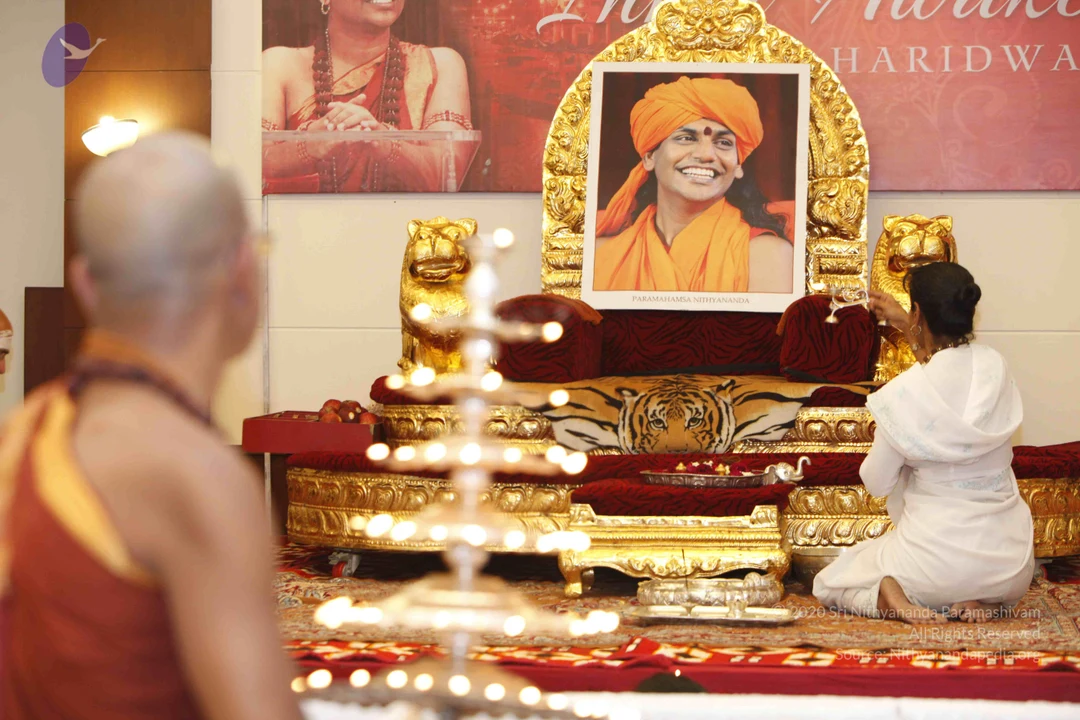
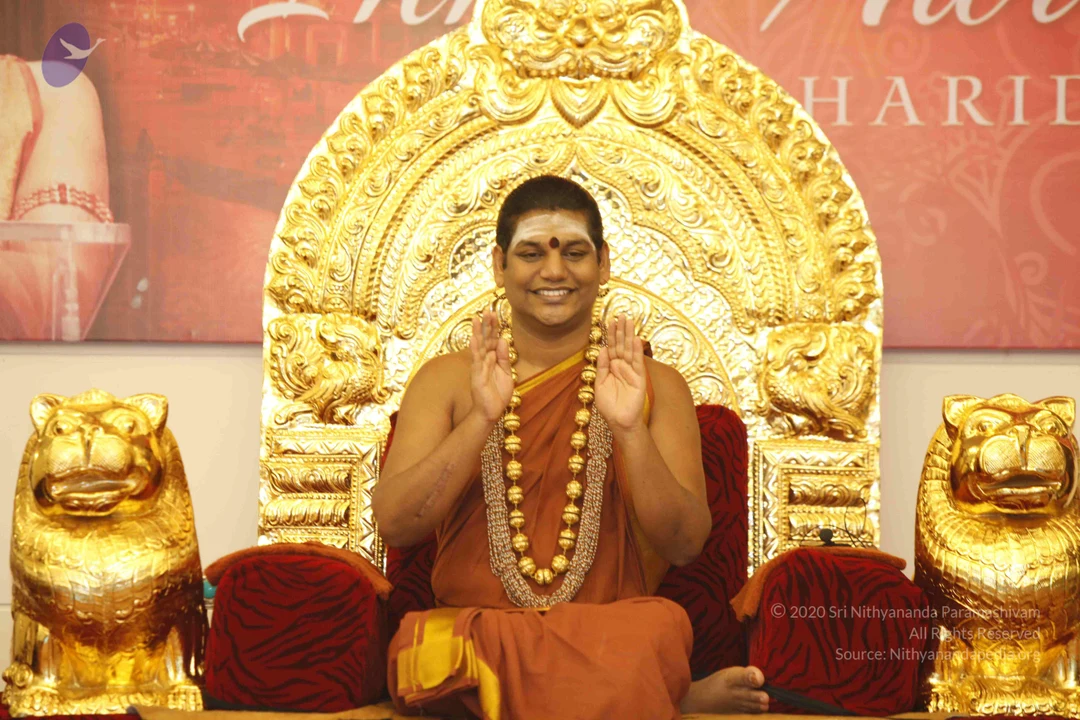
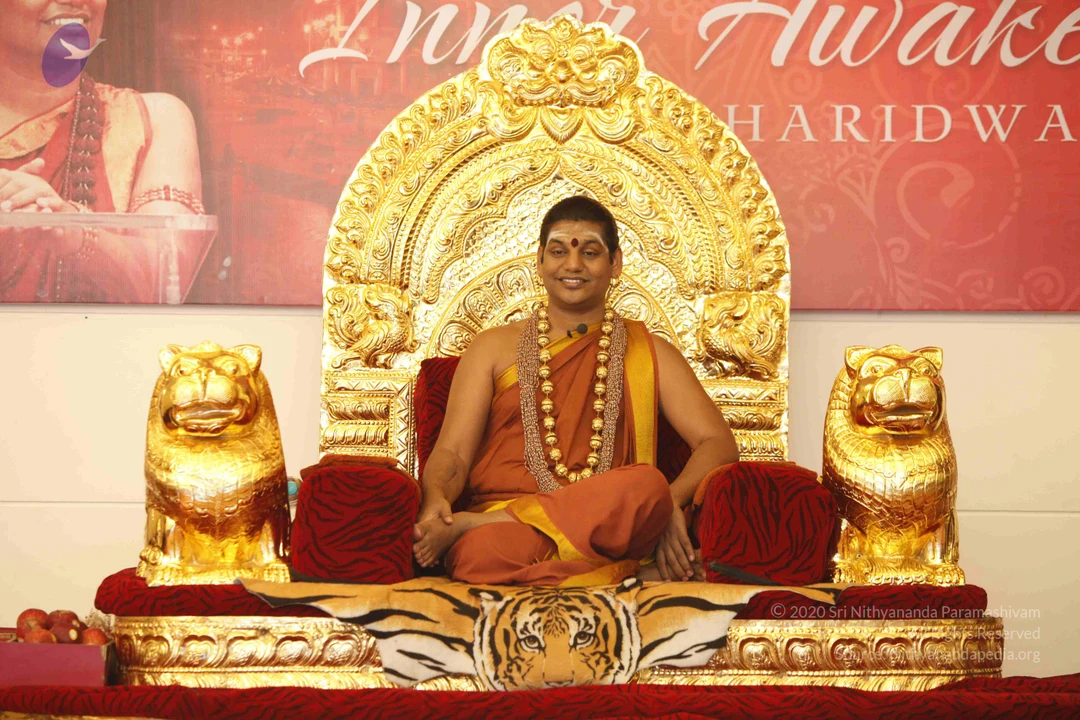
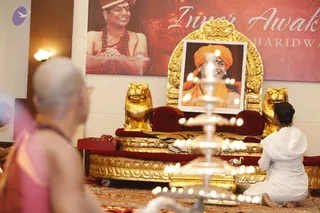
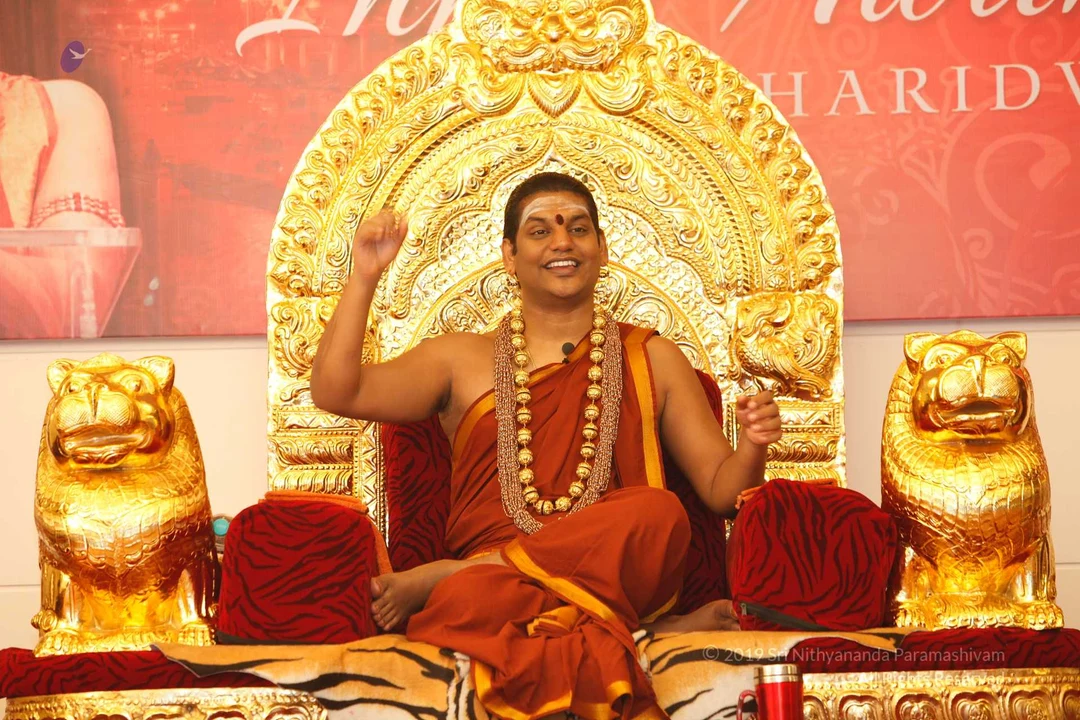
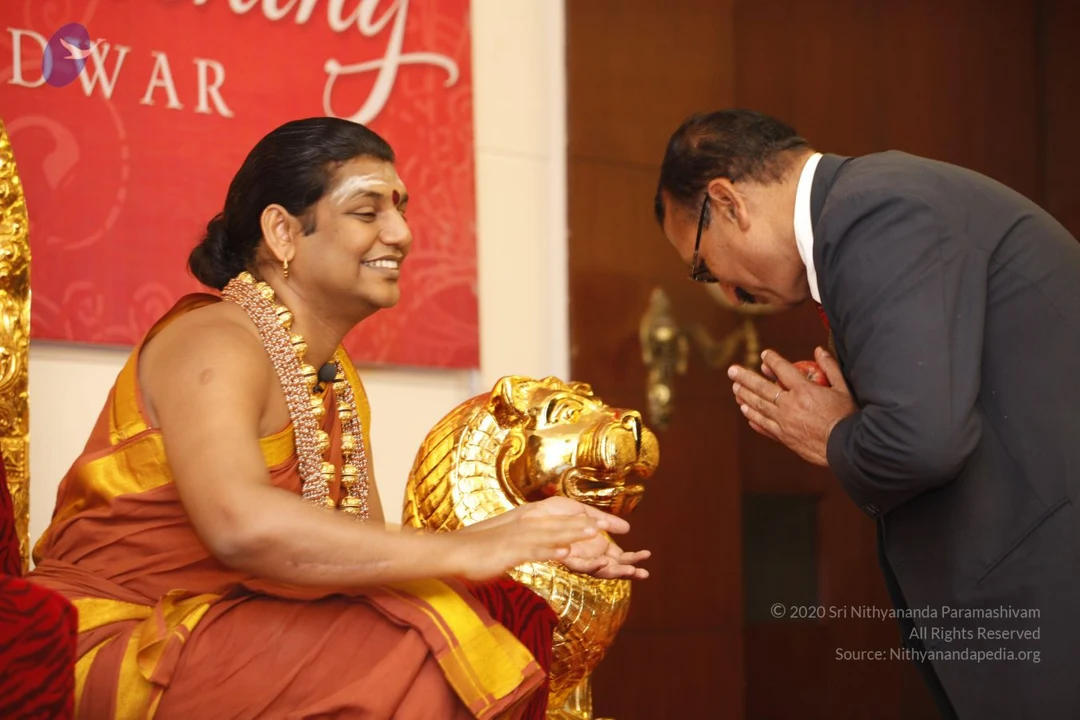
A photograph of a ritual space with a golden throne-like seat flanked by two gilded lion sculptures and red cushions with a tiger-striped cloth. Centred on the throne is a framed portrait of a smiling figure in orange turban and saffron robes, with a label reading PARAMAHAMSA NITHYANANDA. Above it a large banner shows a second portrait of a smiling figure in red turban and red robes with rudraksha malas standing at a lectern, under the words Inner Awakening and Haridwar. In the foreground a tiered silver lamp with many lit oil lamps is lit, and a person in white clothes kneels in prayer at the right. At the left, a bald figure in a pink-red robe sits with their back to the camera. Red and gold fabric covers the floor.

03-DARSHAN

13 photosSource gallery
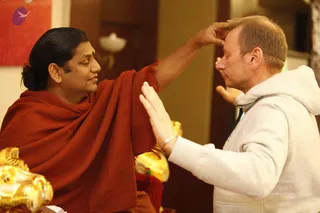
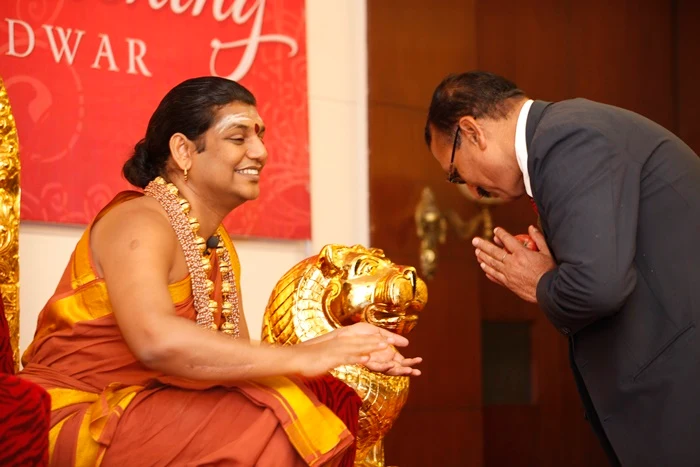
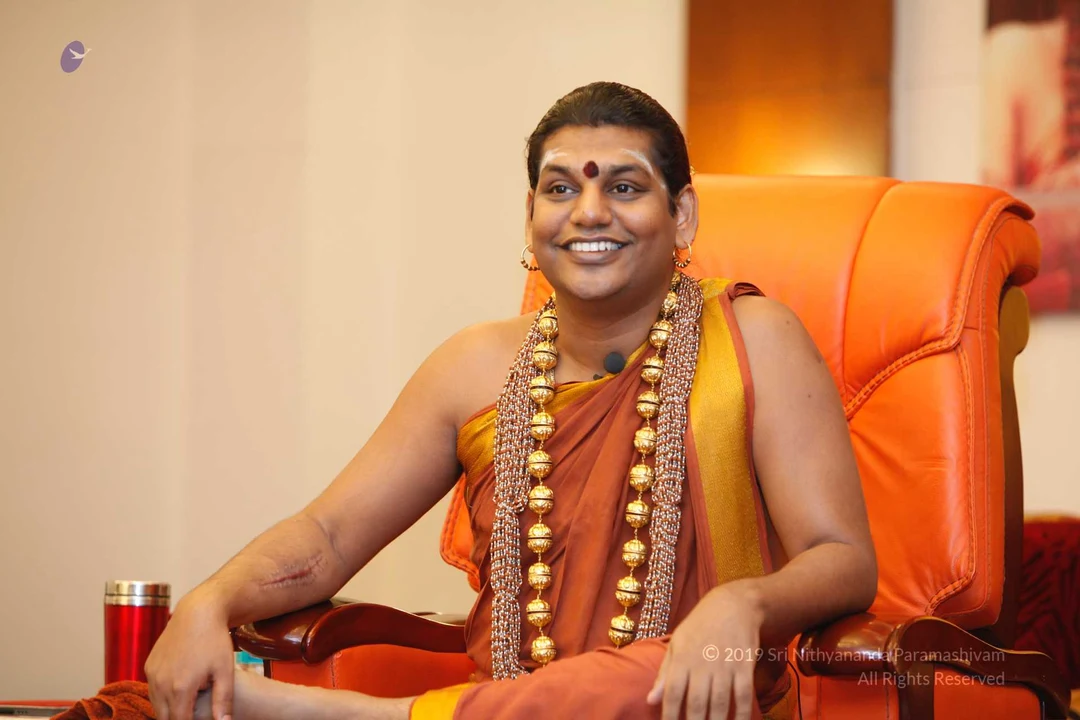
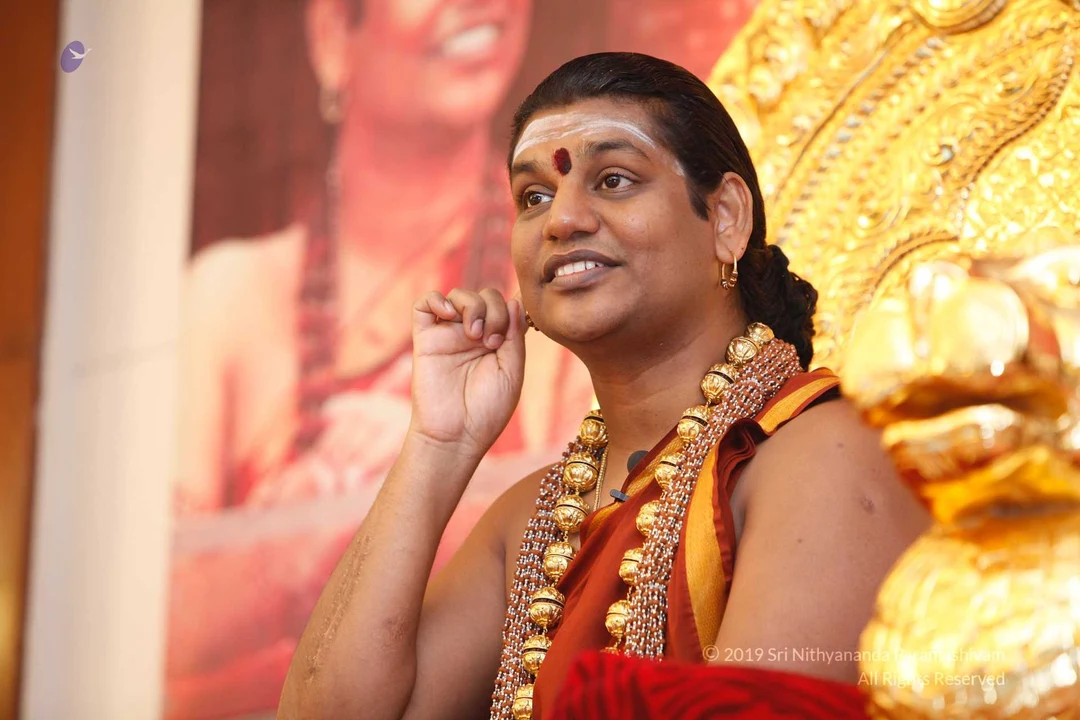
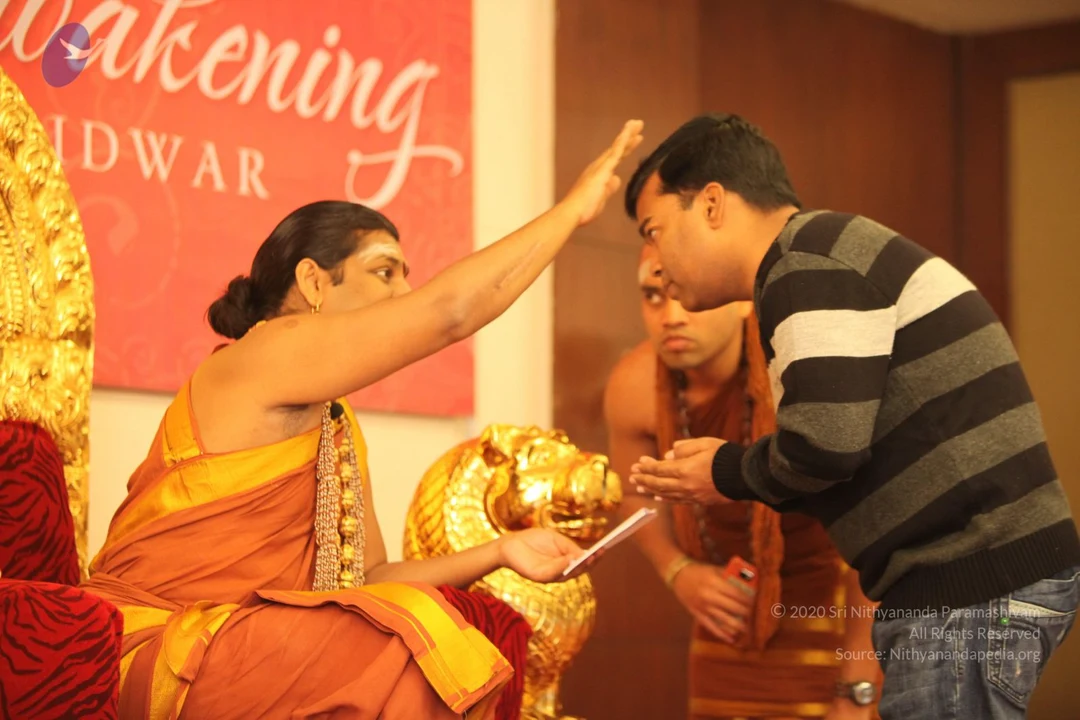
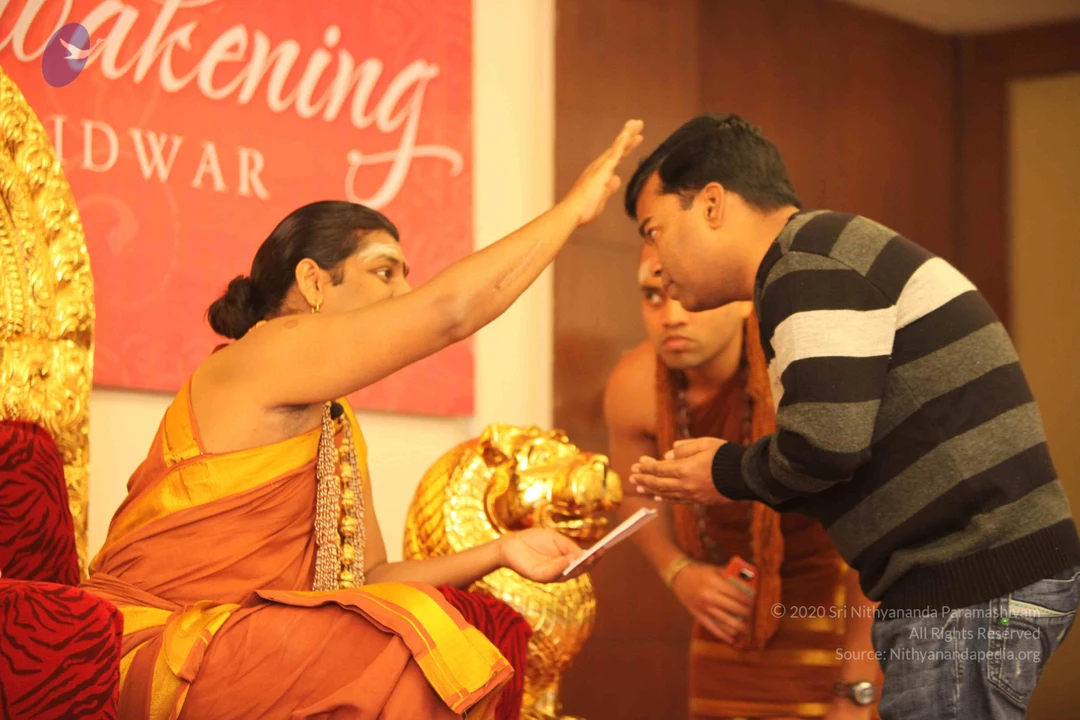
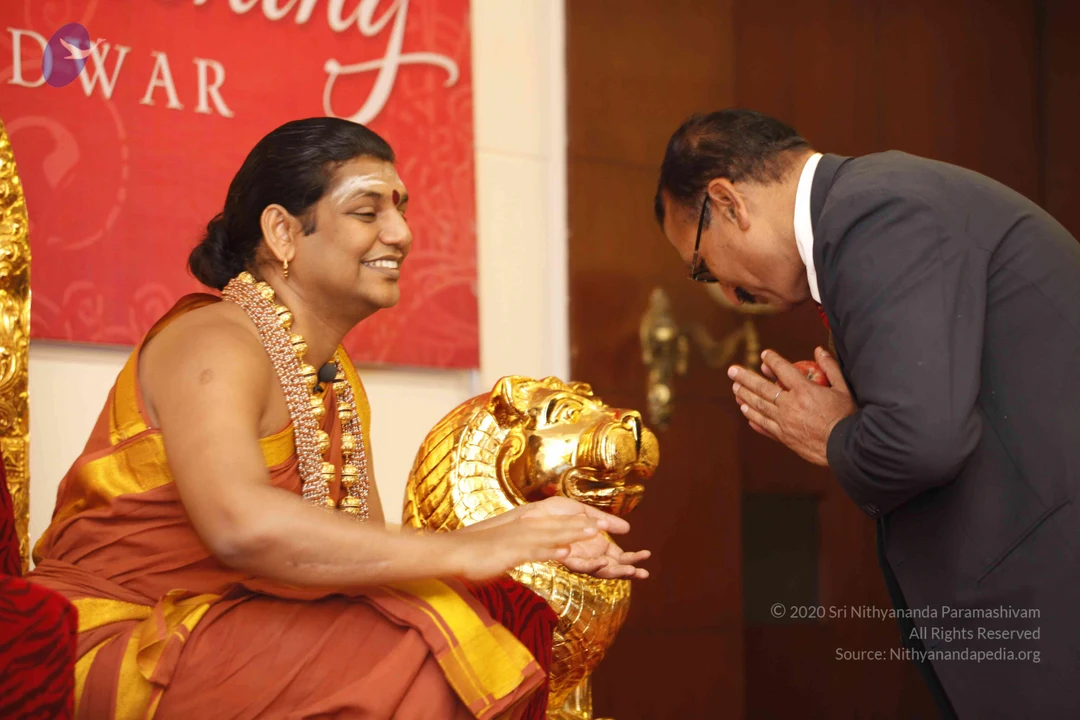
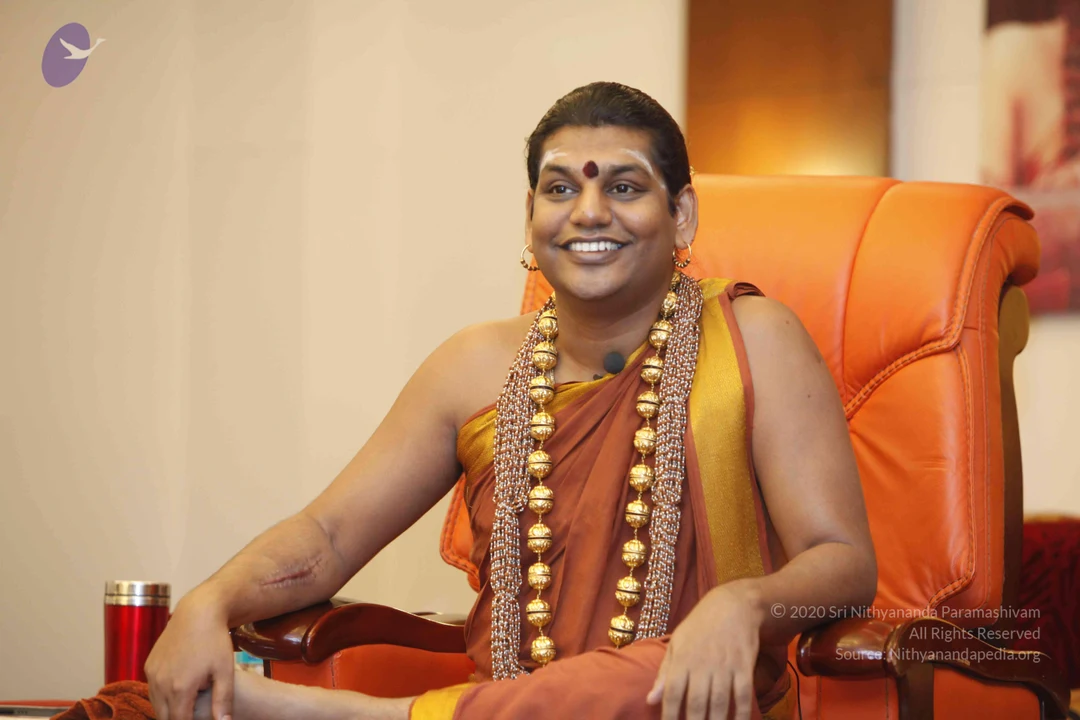
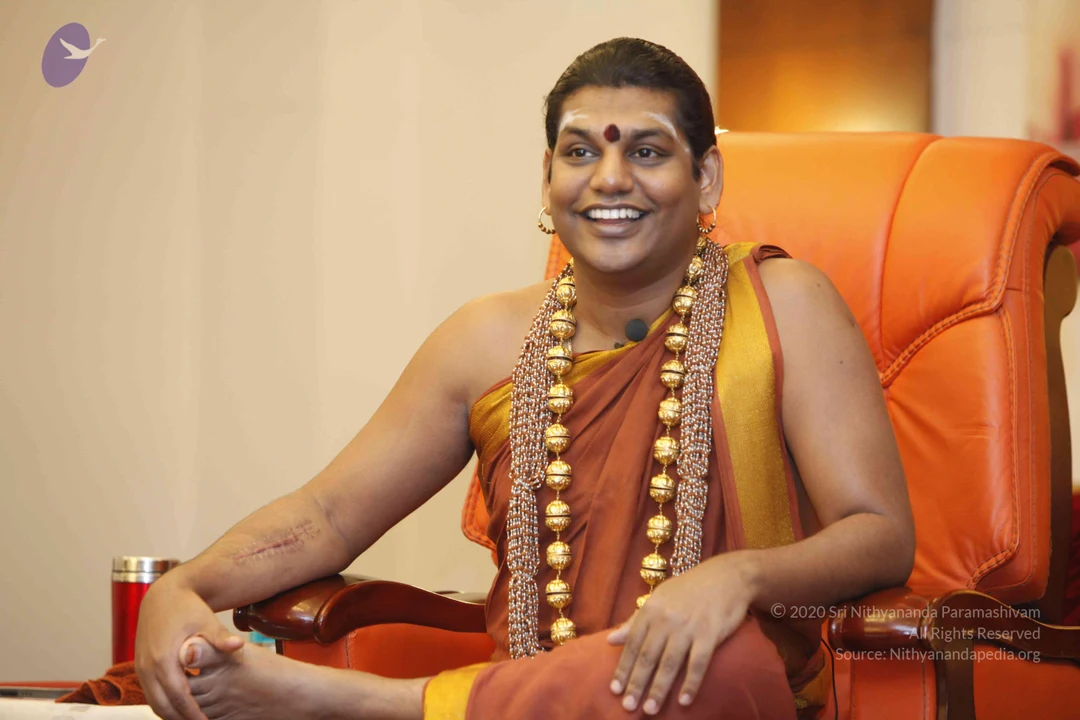
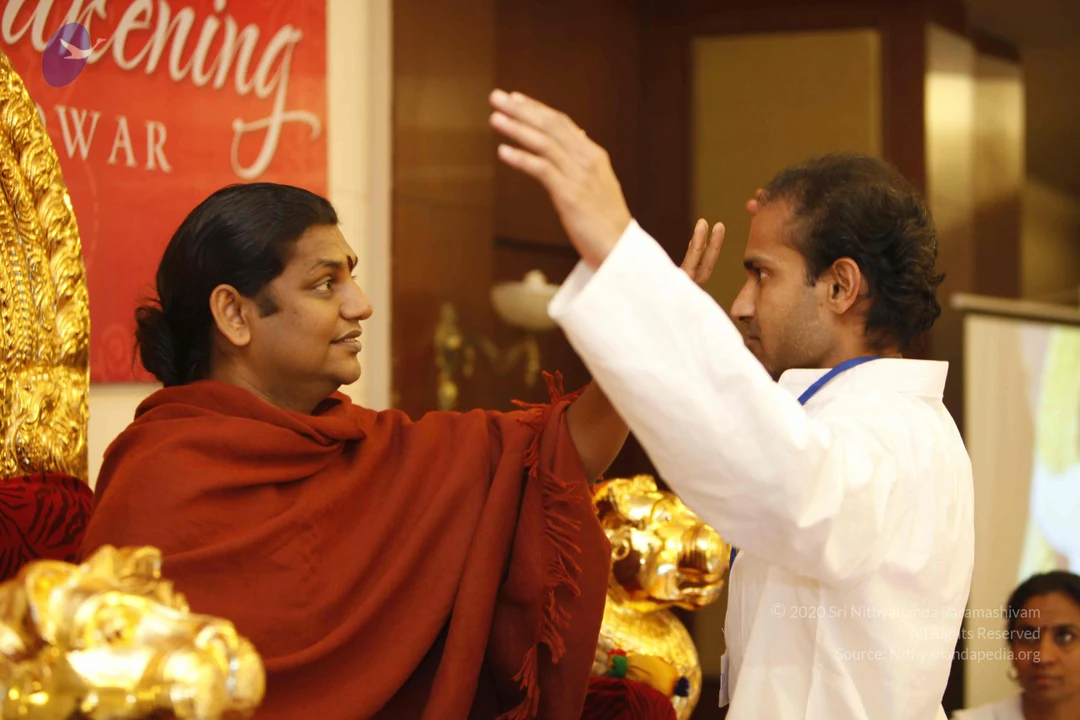
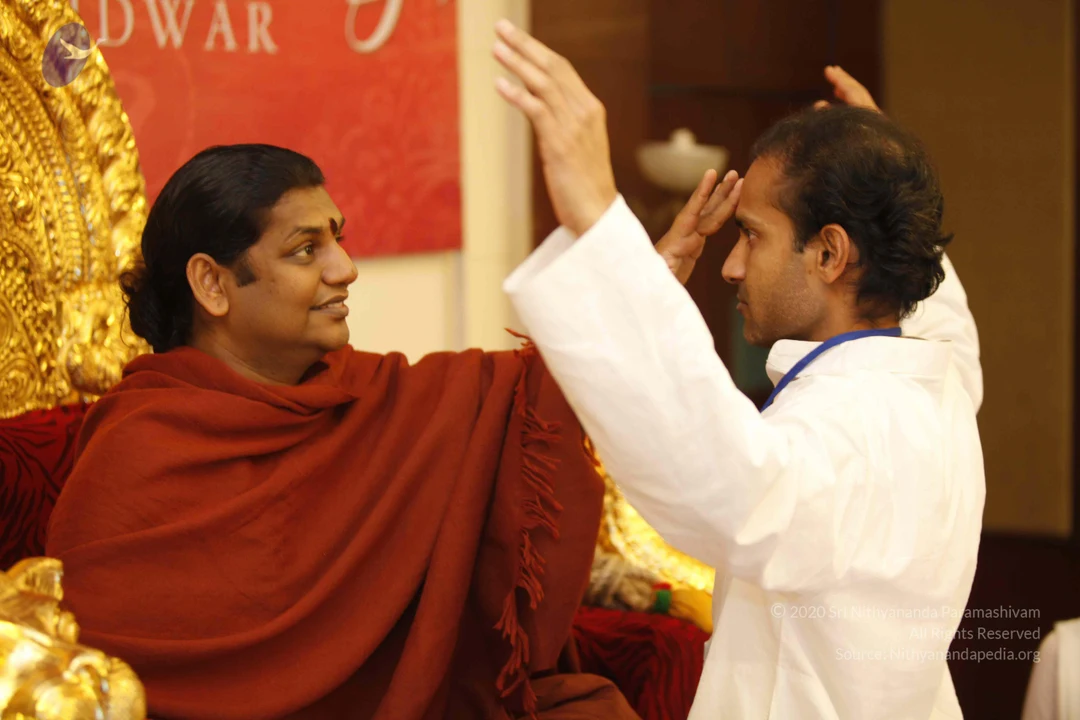
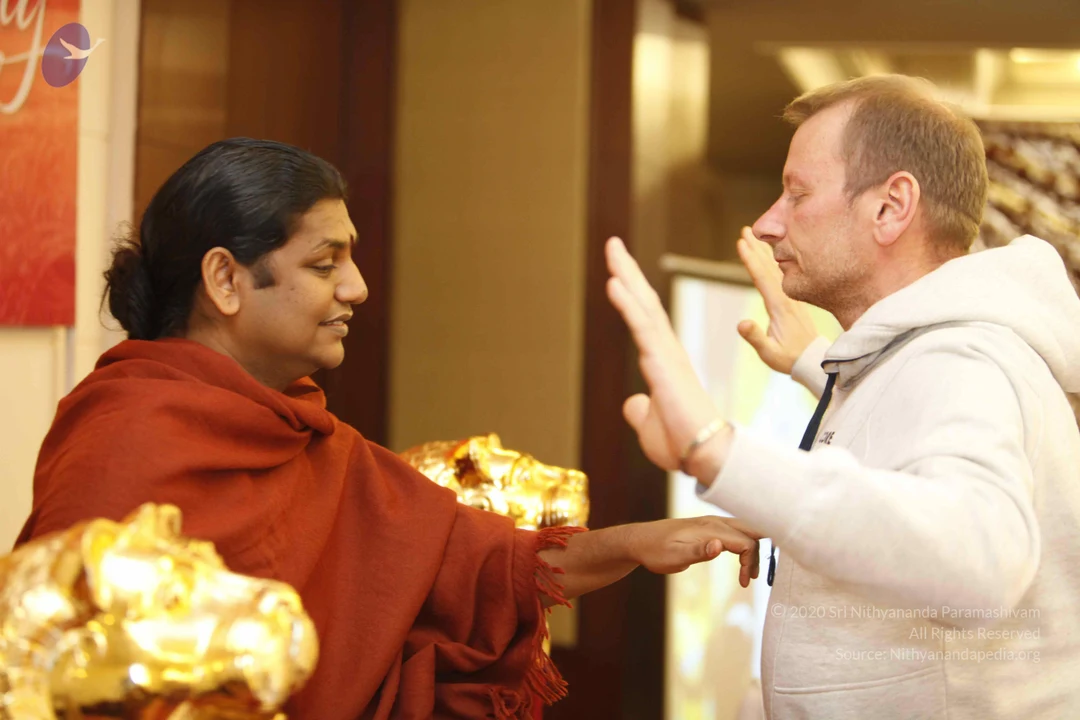
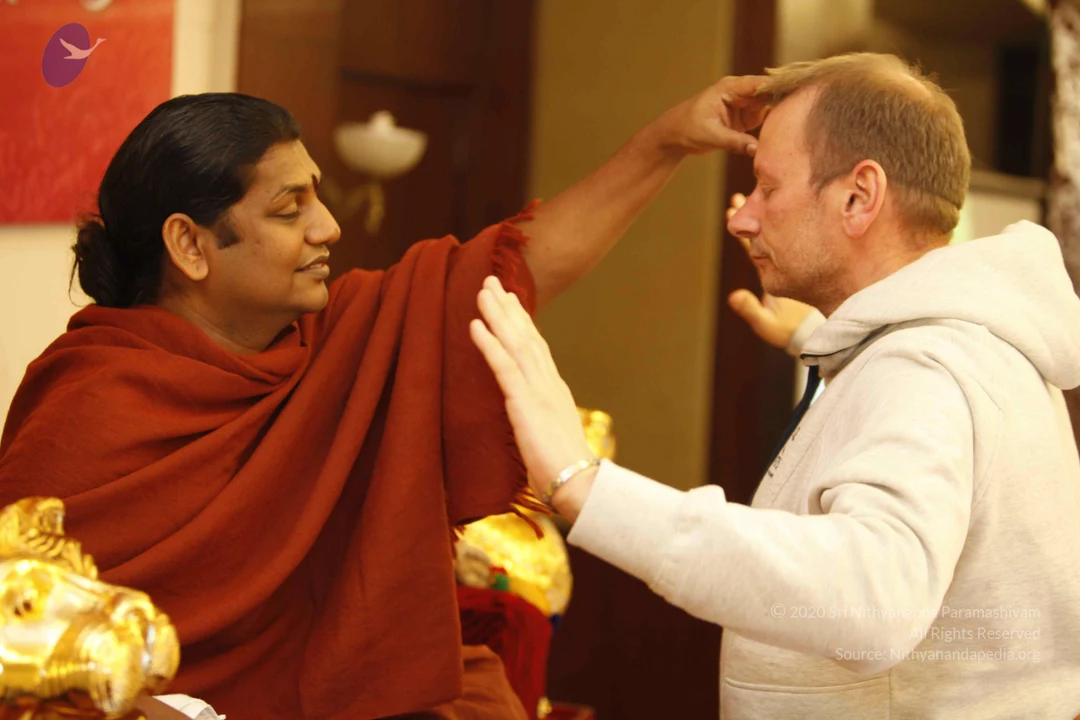
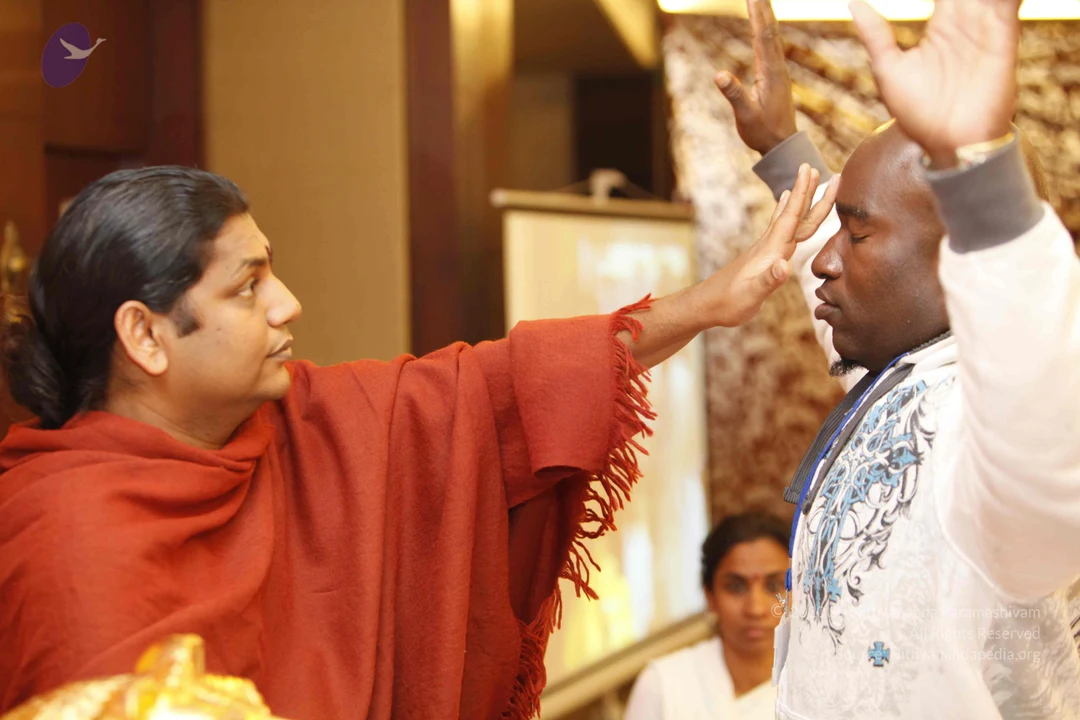
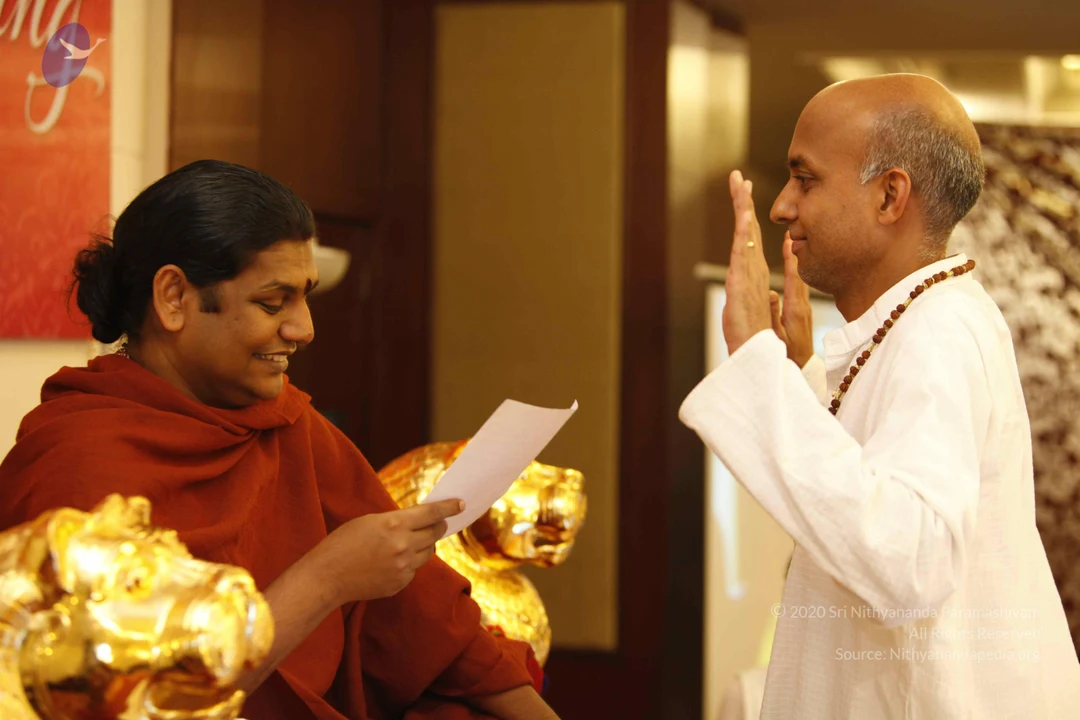
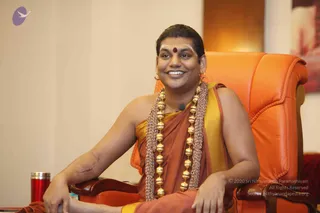
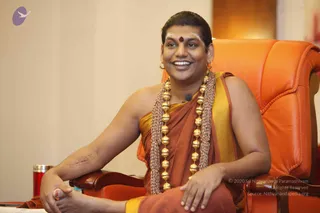
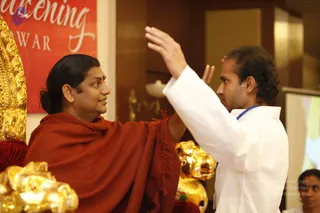
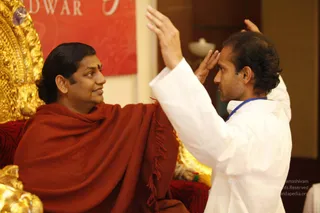
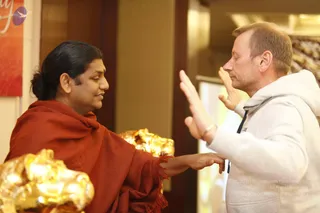
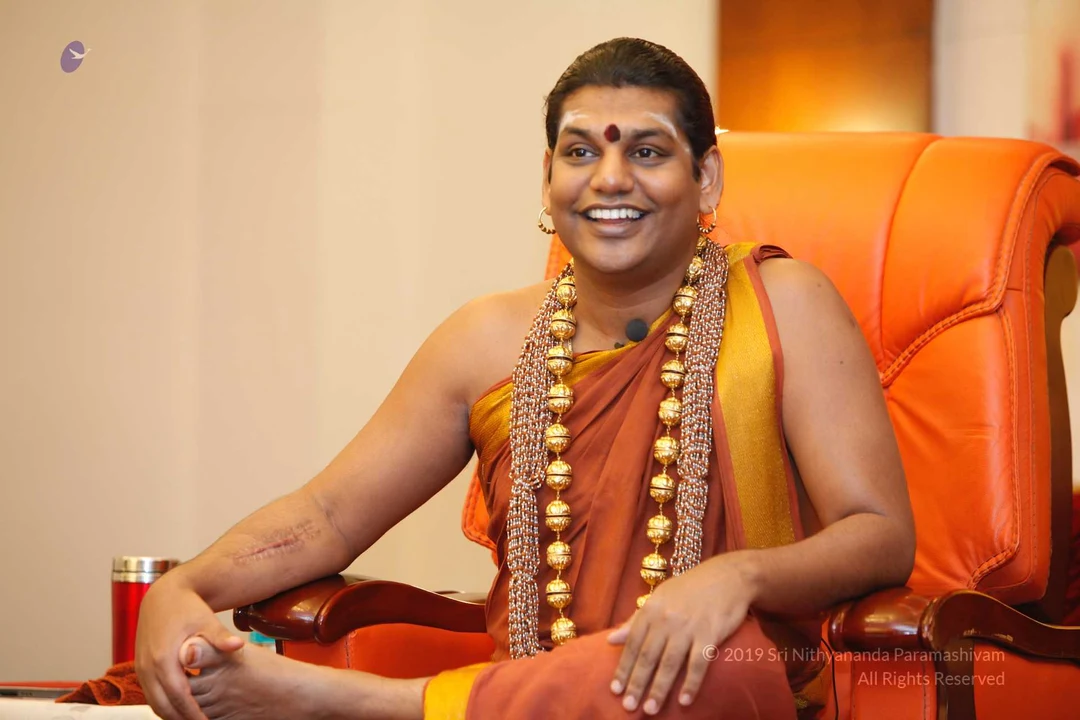
A smiling man sits in an orange leather armchair with wooden armrests, wearing an orange-and-gold saffron robe over a bare shoulder, a red bindi on his forehead, and a long layered necklace of gold beads and rudraksha-style strands. A small clip microphone is pinned at his chest. A red thermal flask sits on a side table at left, and a warm beige wall fills the background.A smiling man with short swept-back hair sits in a large orange leather armchair against a plain cream wall. He wears an orange and gold-bordered saffron cloth draped over one shoulder, a red bindi and white tilak on his forehead, gold hoop earrings, and a long necklace of gold beads and silver-toned rudraksha-style strands reaching his waist. A small clip microphone is pinned at his chest. His right arm rests on the armrest, and he holds his left foot in his hand. A red thermos sits on a small table at left.A photograph of a satsang setting with a seated figure in a rust-red shawl with long dark hair tied back, facing a standing man in a white kurta with a blue lanyard whose raised hands extend toward the seated figure, as if giving blessing or energy. Gold ornate carved elements, possibly a throne or ornamental seat, flank the scene, and a red banner with partial script stands behind. A woman in glasses is partly visible at the lower right edge. a person appears as the seated figure, distinguished by the long swept-back hair and rust-red shawl, with the standing man as a devotee receiving the gesture.A photograph of a seated figure in a rust-red shawl with dark hair swept back, a red tilak on the forehead, sitting on an ornate gold throne with red cushions. Facing him, a man in a white kurta with a blue lanyard raises both hands to the figure's head in a blessing gesture, palms near the crown. A red banner with gold lettering is behind them. a person is seated on the throne, a distinctive presentation with swept-back hair, ornate gold seat and red shawl; the man in white is a devotee receiving blessing.A photograph of two men facing each other indoors in a warmly lit hall. On the left, a person with dark hair tied back in a low bun wears a rust-red shawl draped over the shoulders and holds a gold-coloured ceremonial item. On the right, a balding man in a light grey zip hoodie raises both palms toward the other, eyes closed, in a gesture of greeting or blessing. Gold-coloured objects and a red banner edge the frame.Two people stand face to face in an indoor room with warm wood-panelled walls and a red decorative hanging. On the left, a person with long dark hair in a low bun wears a rust-orange shawl draped over the shoulders and extends one arm to rest a hand on the head of a man on the right. The man has short light-brown hair and wears a light grey hooded sweatshirt, eyes closed, his palm raised toward the other person's arm. Golden decorative objects, including a golden figure, sit at the lower left.

January 18 2014

1 photoView all
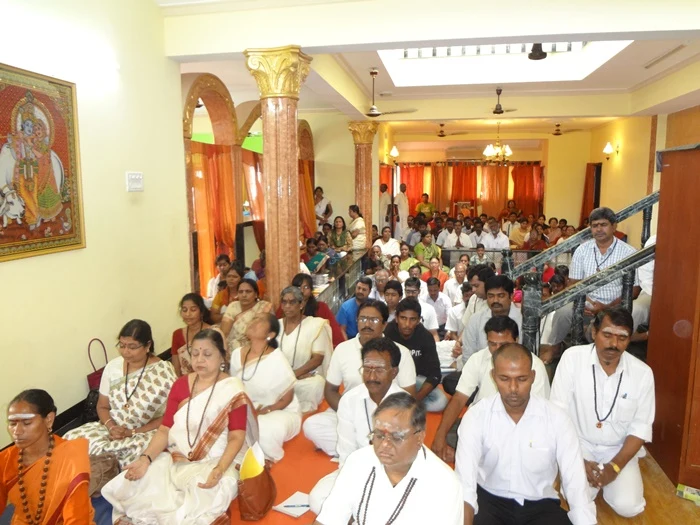
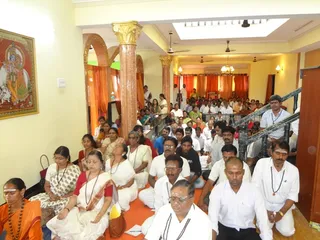
Indoor satsang hall with cream walls, orange curtains and a framed devotional painting of a deity on the left wall. Many seated devotees in white and pastel clothes sit on orange mats in rows, several with rudraksha malas. In the foreground a woman in orange robes with white forehead markings and beads sits near a woman in a red-bordered sari and a man in white with glasses and a mala. A staircase with metal railings runs along the right side, with more people standing and seated behind. No single leader is clearly visible in the frame.