Skip to content
Friday

18 January 2013

Dated photos
275
Source pages
1
Media
5
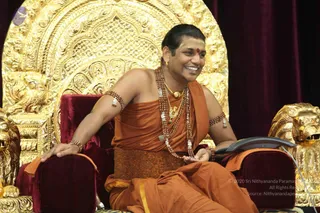
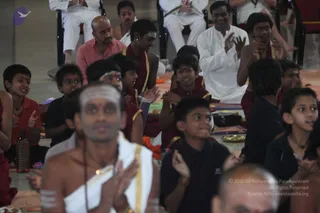
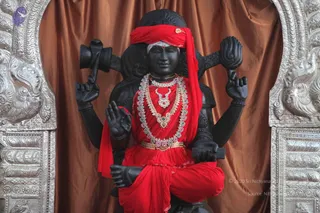
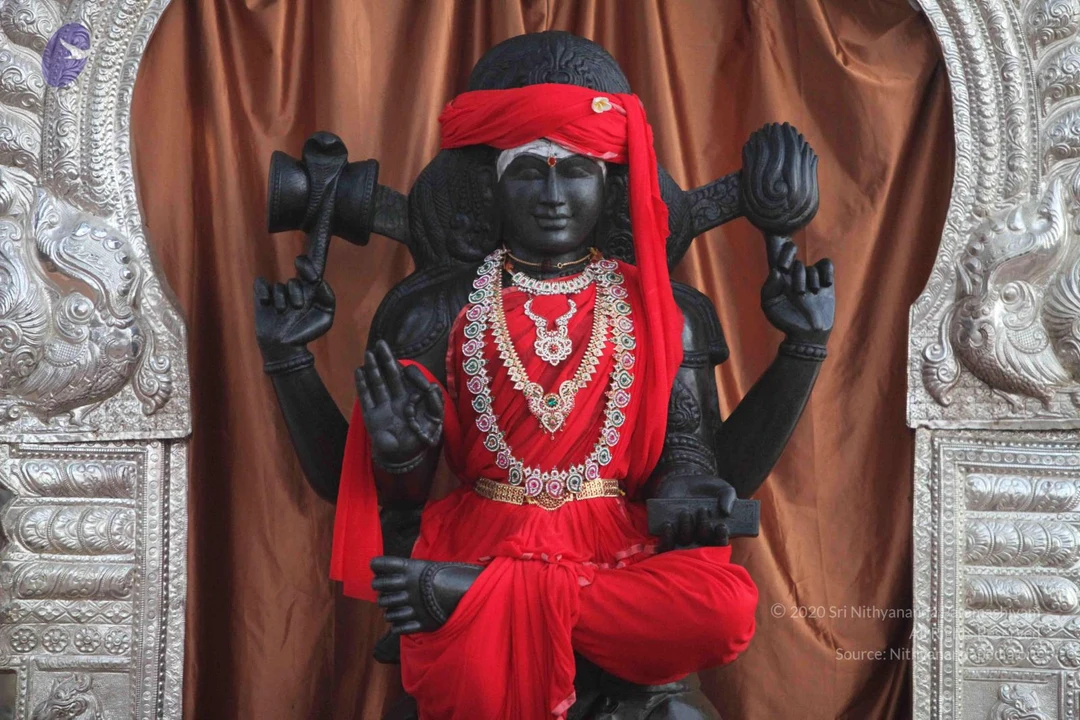
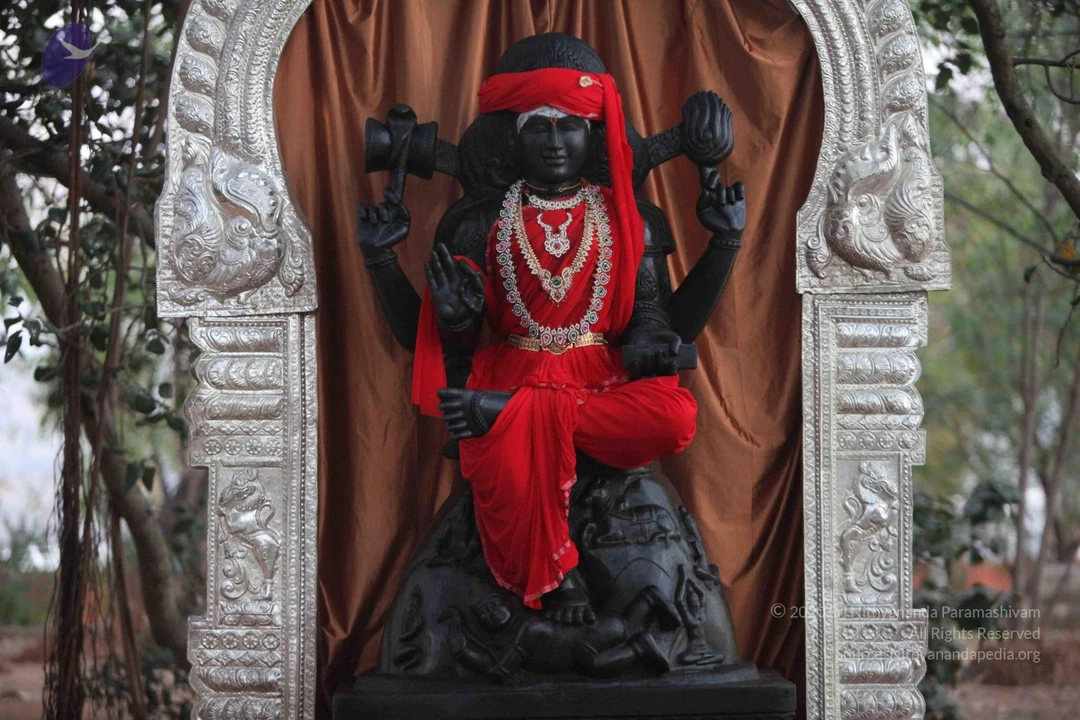
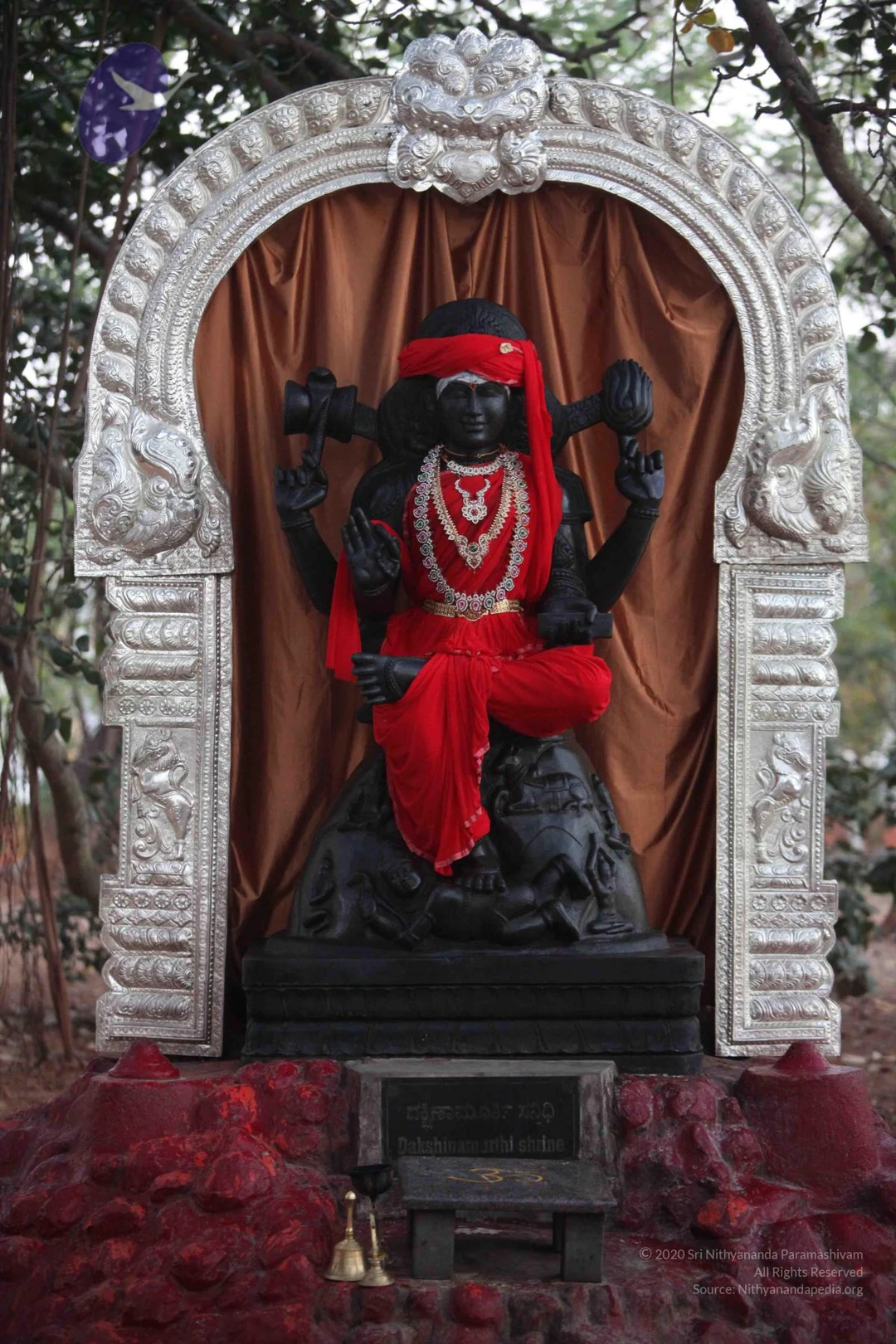
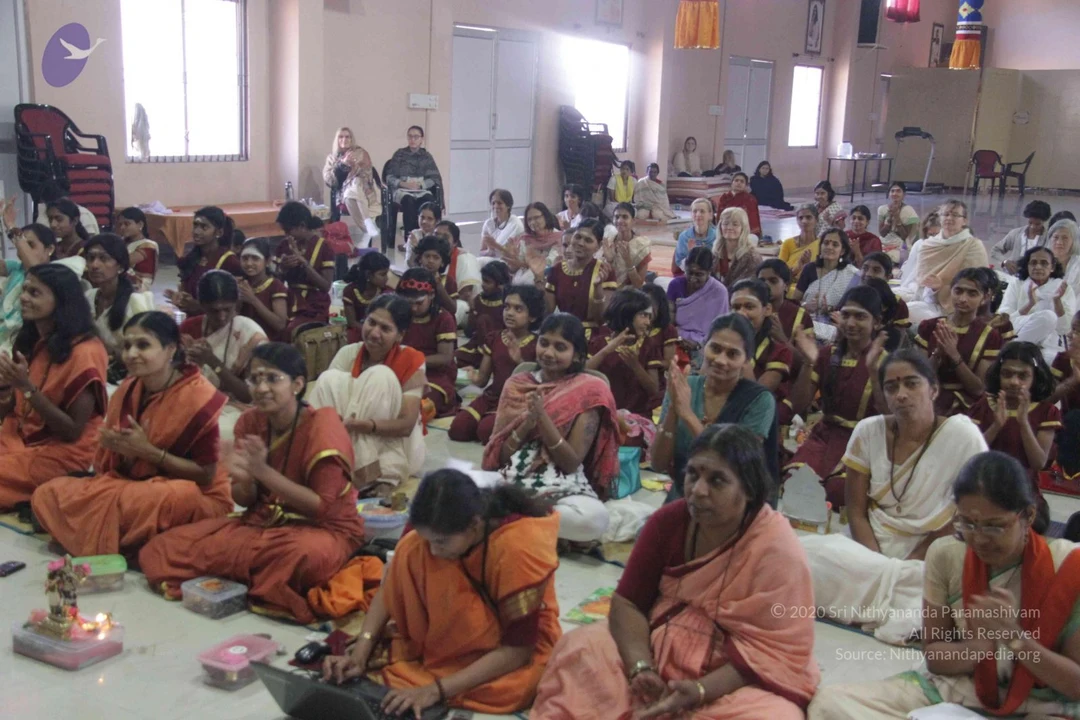
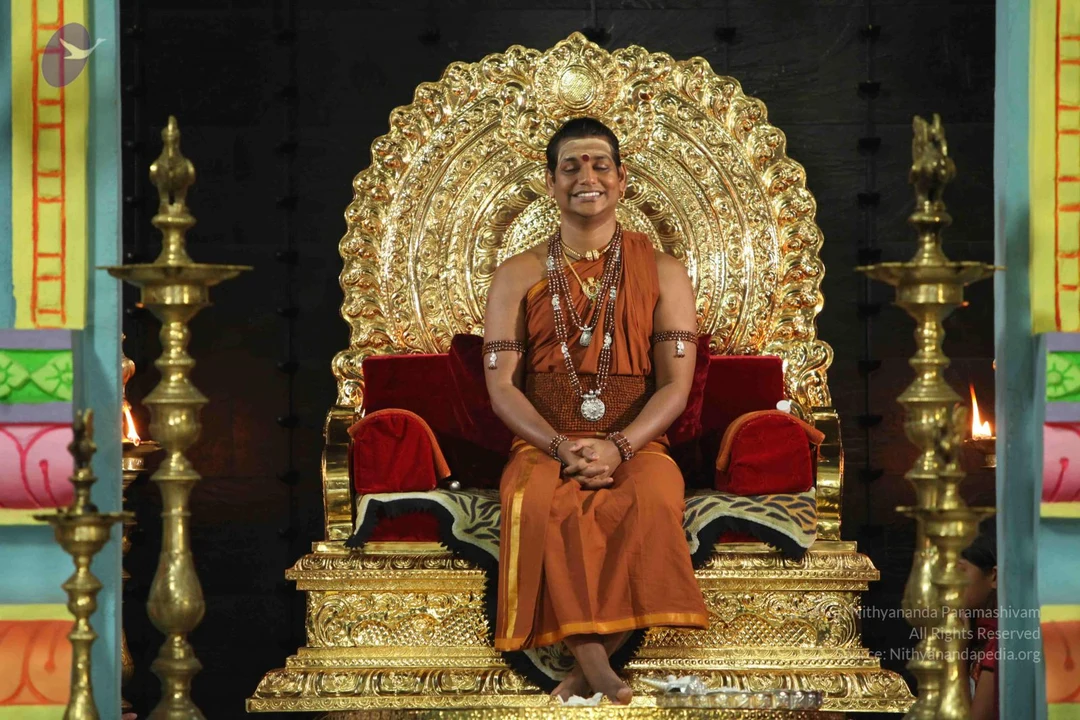
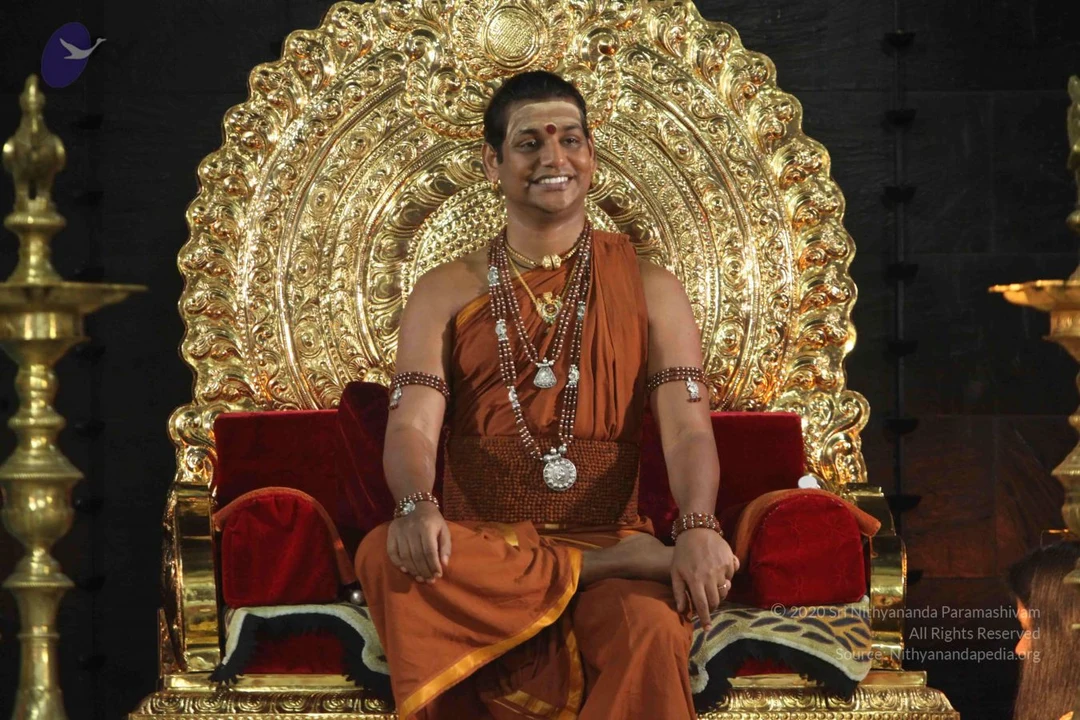
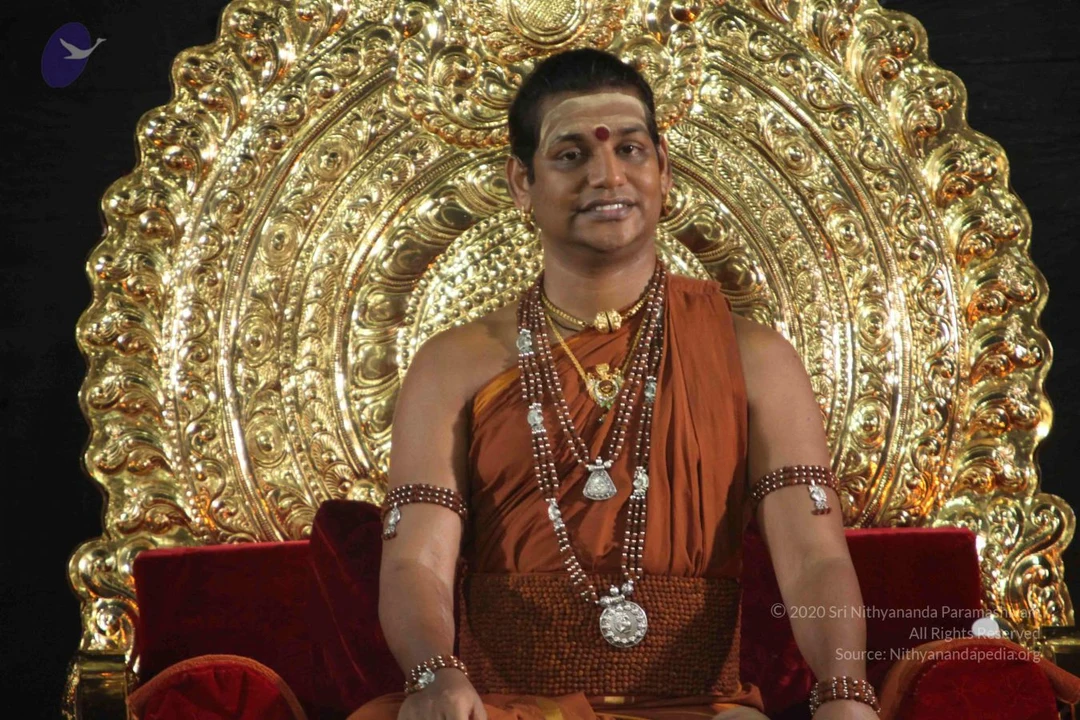
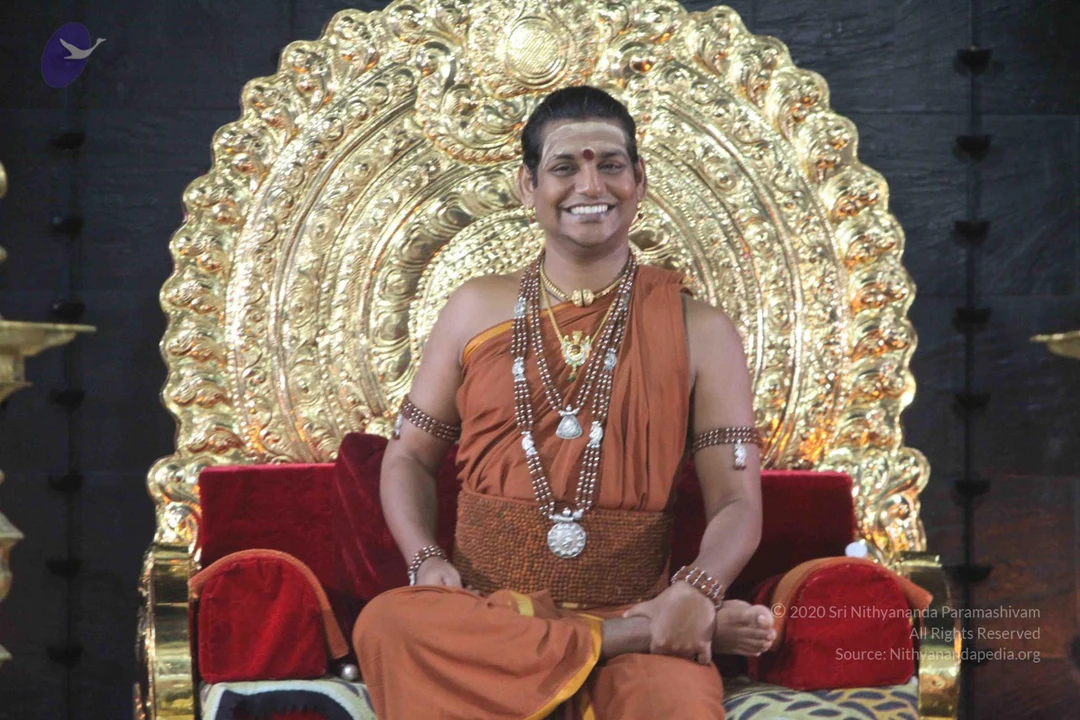
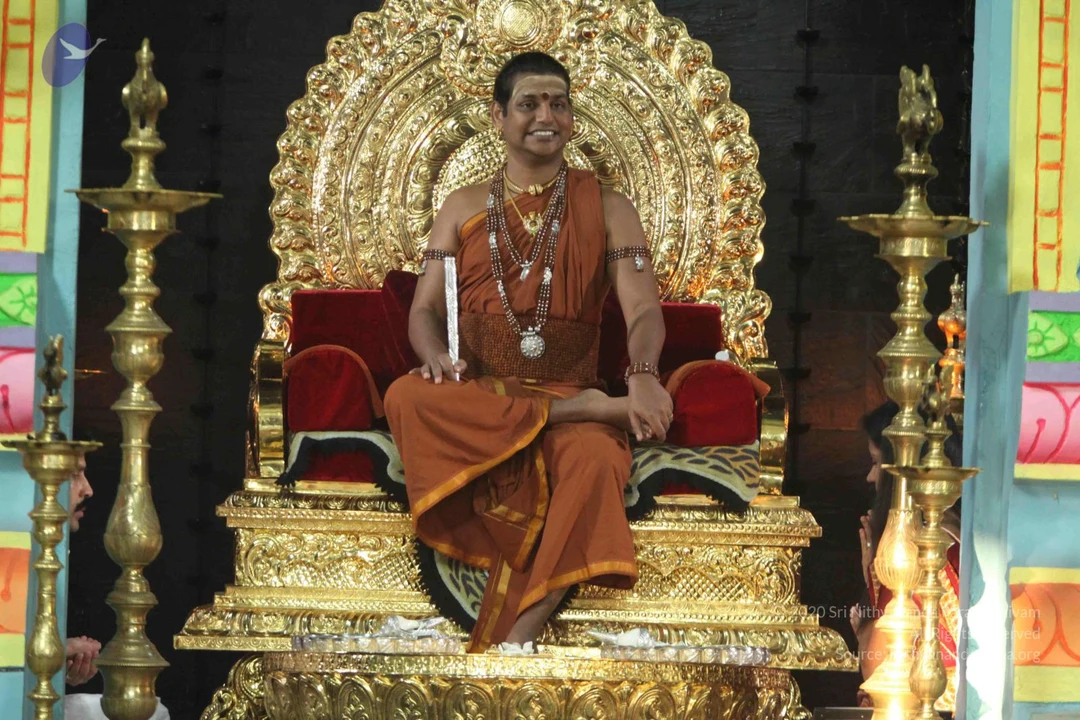
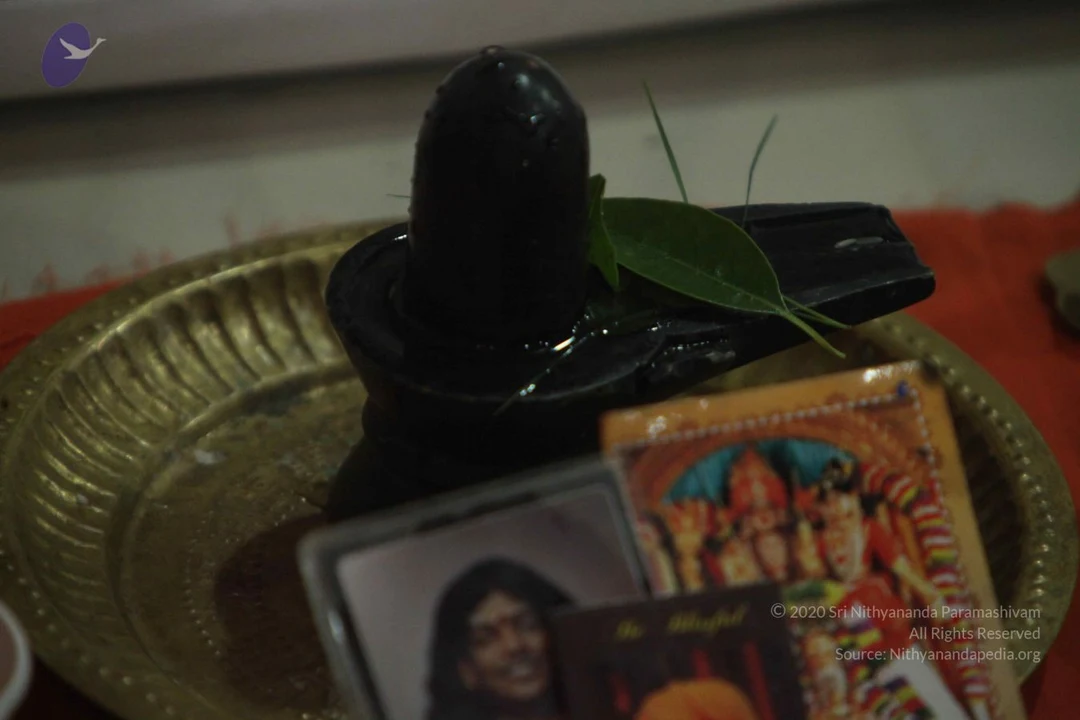
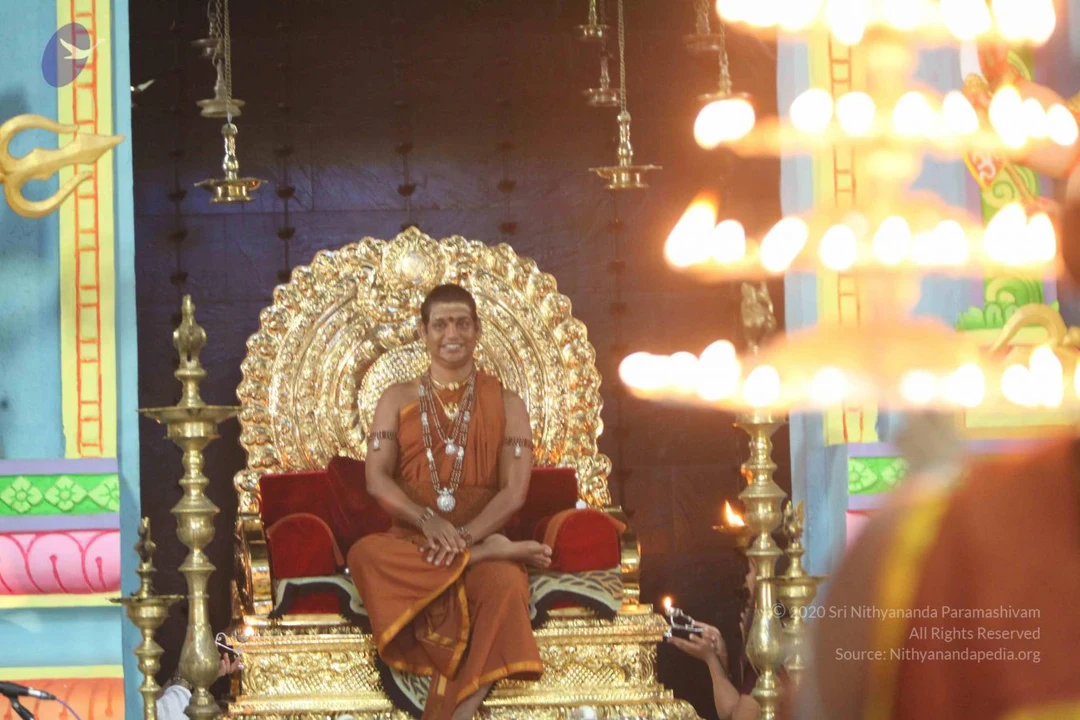
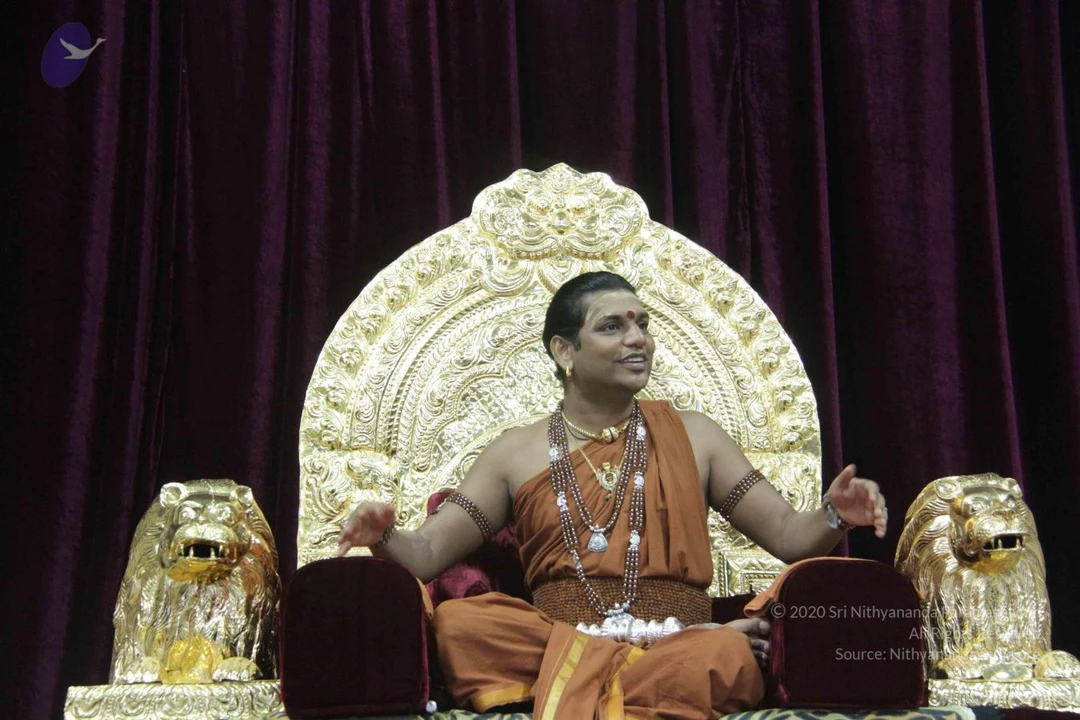
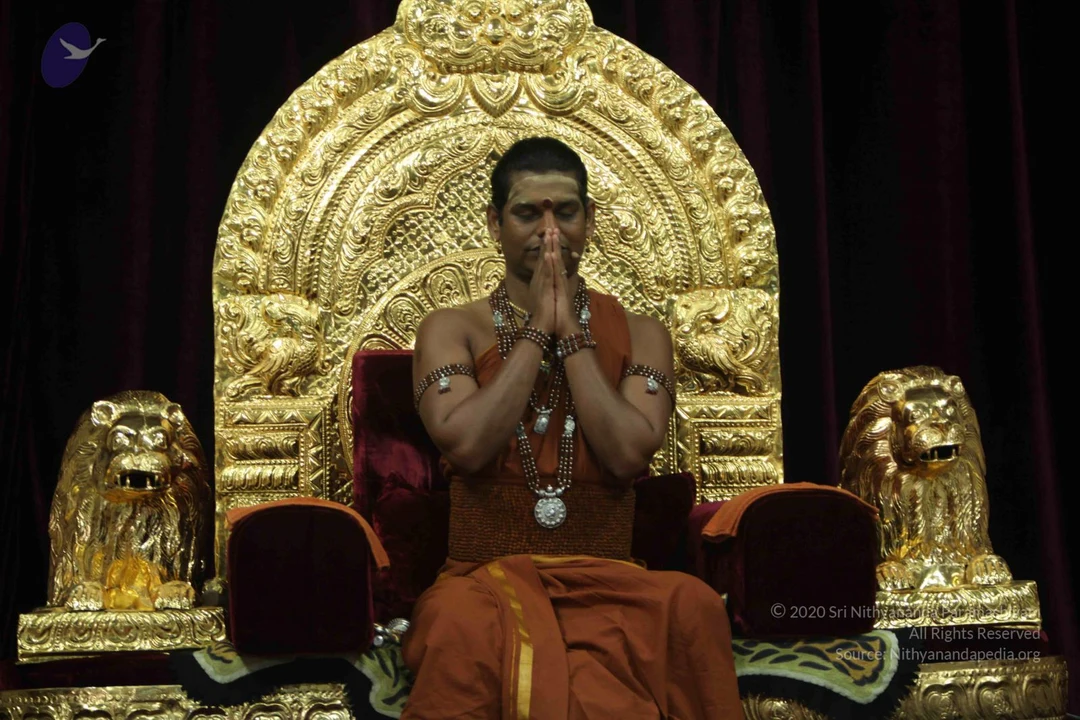
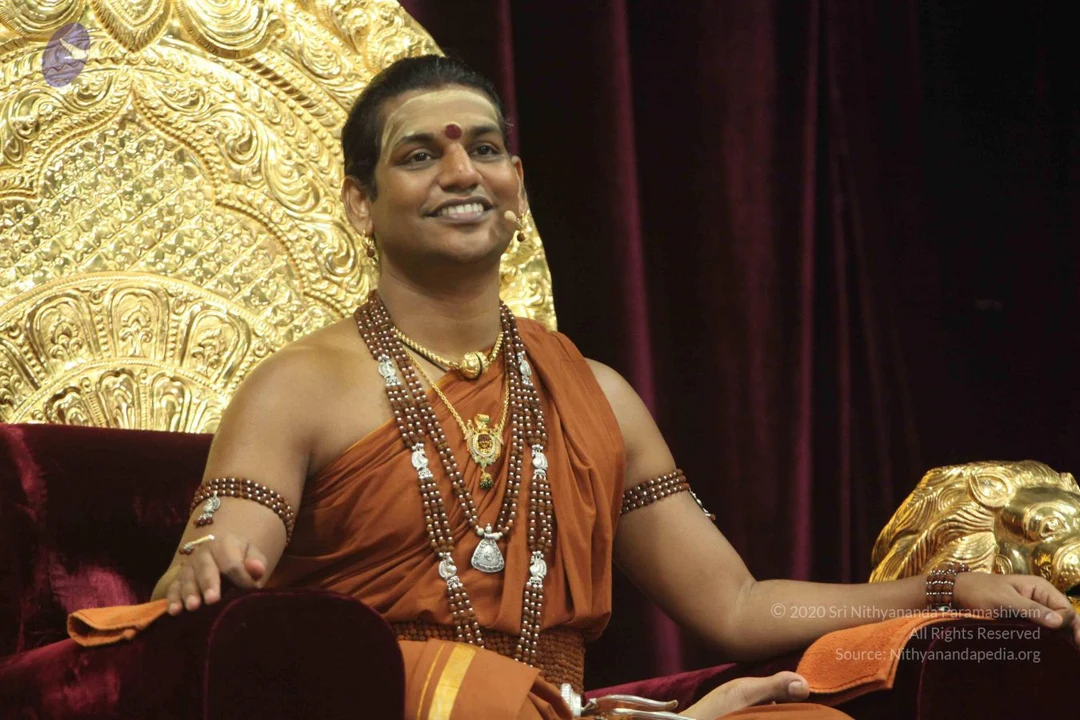
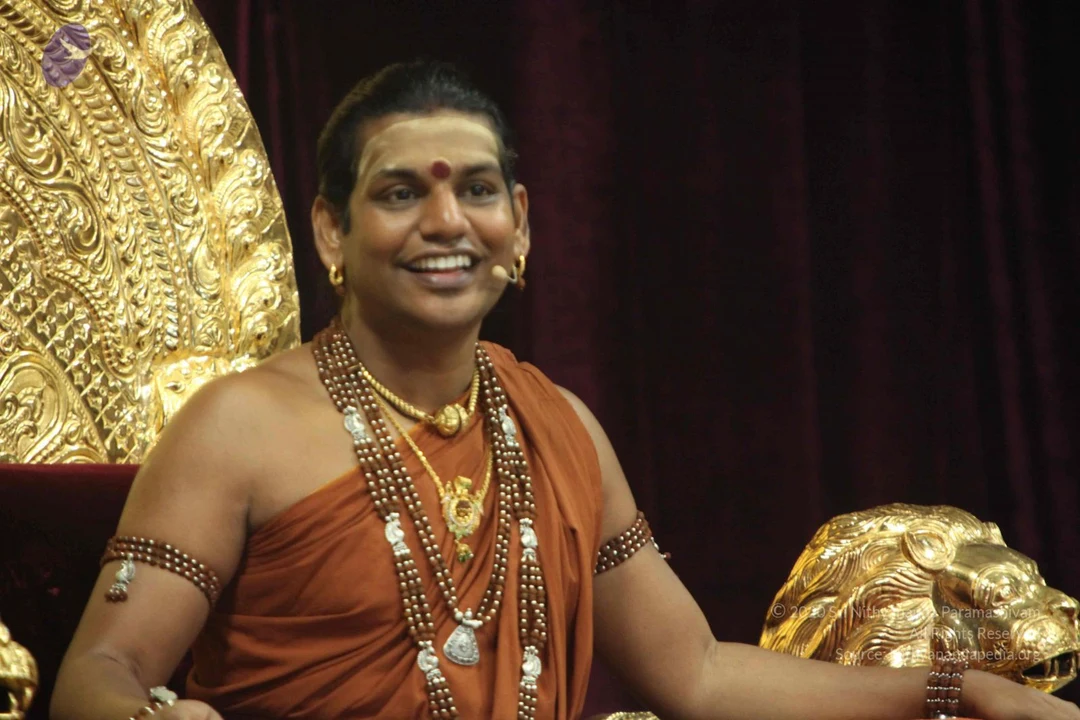
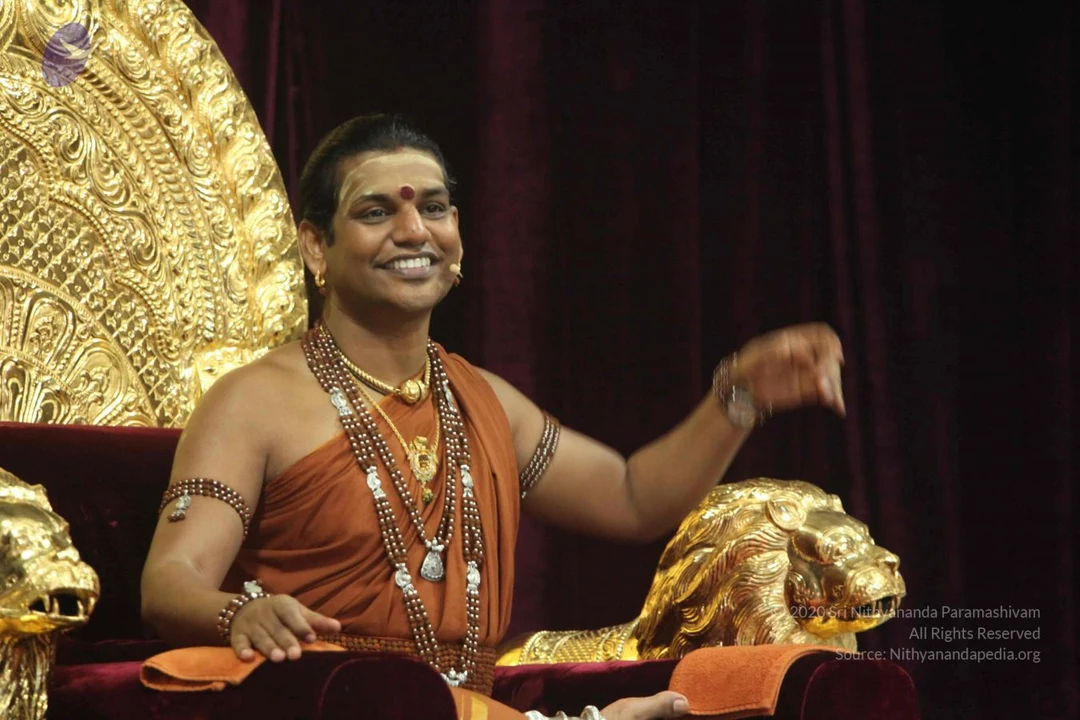
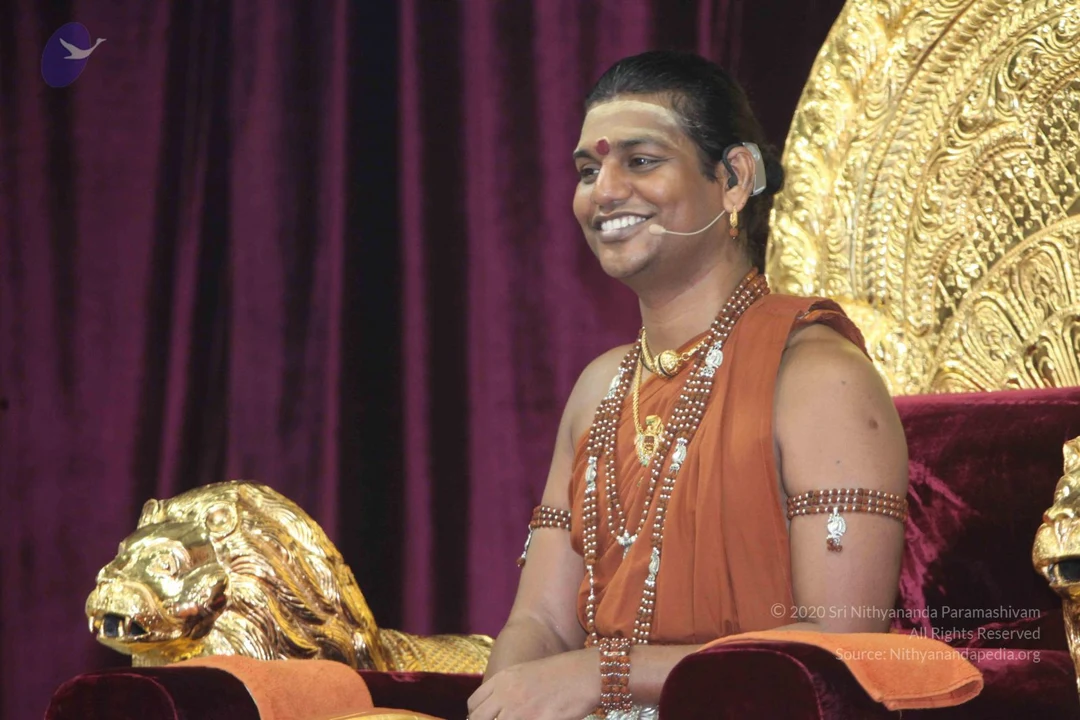
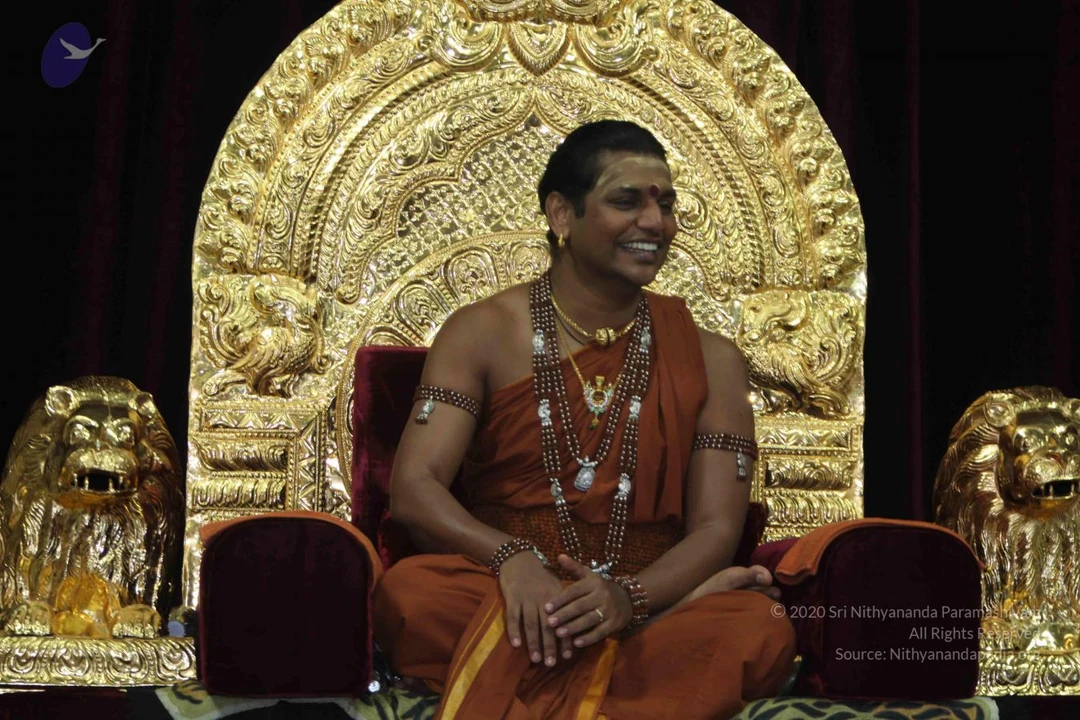
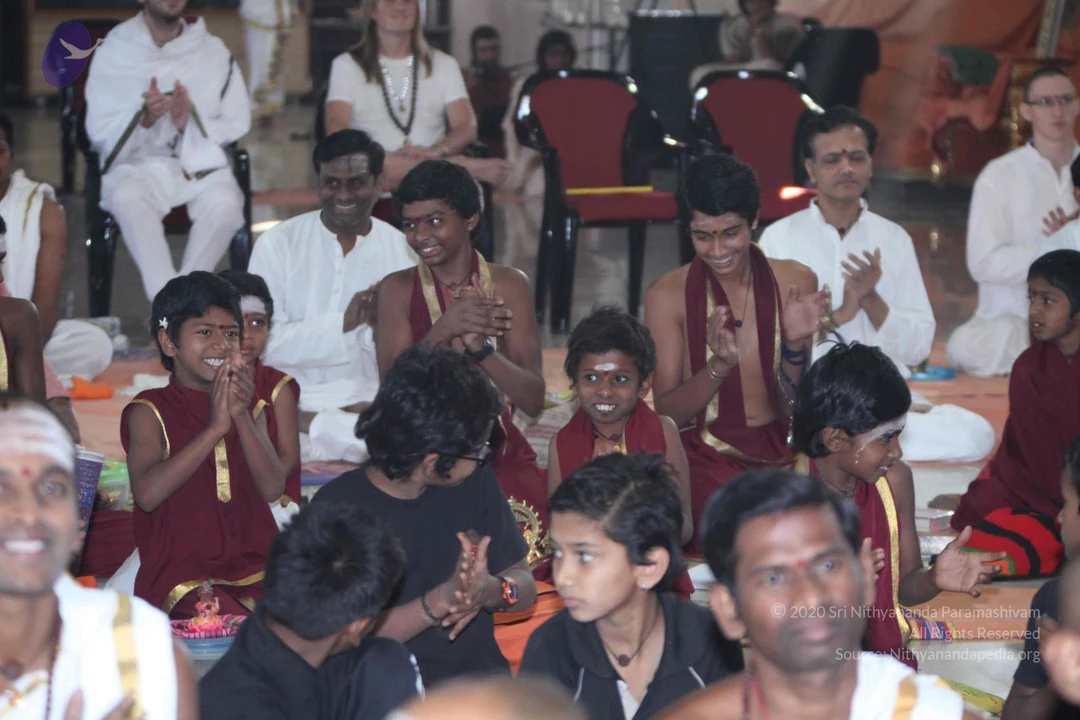
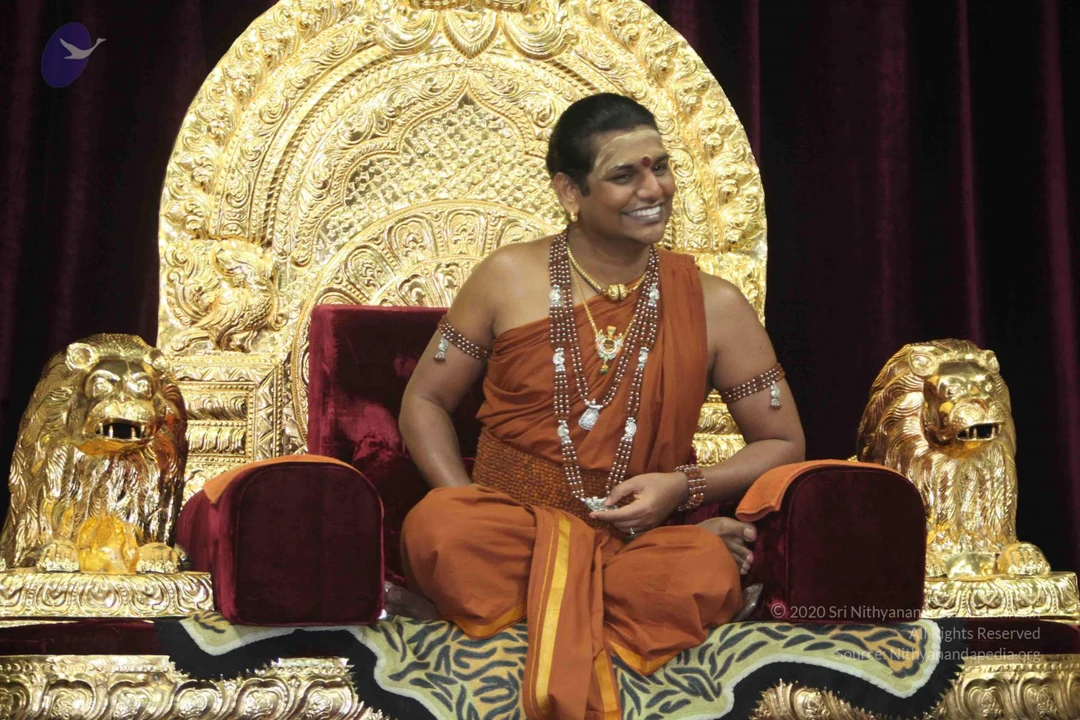
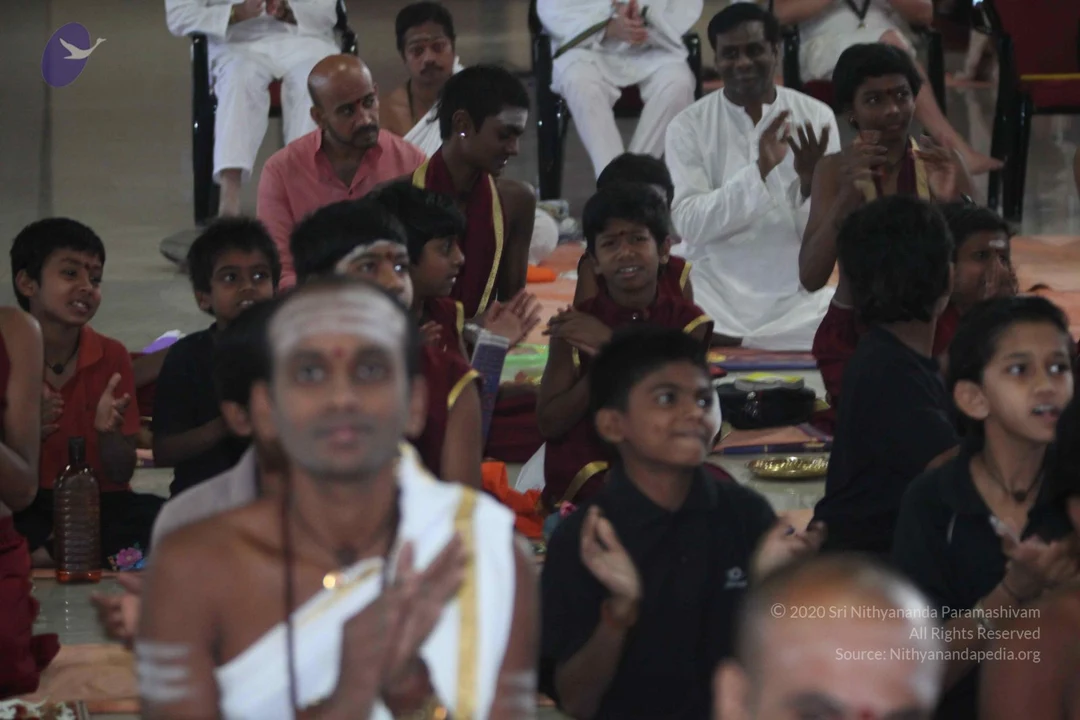
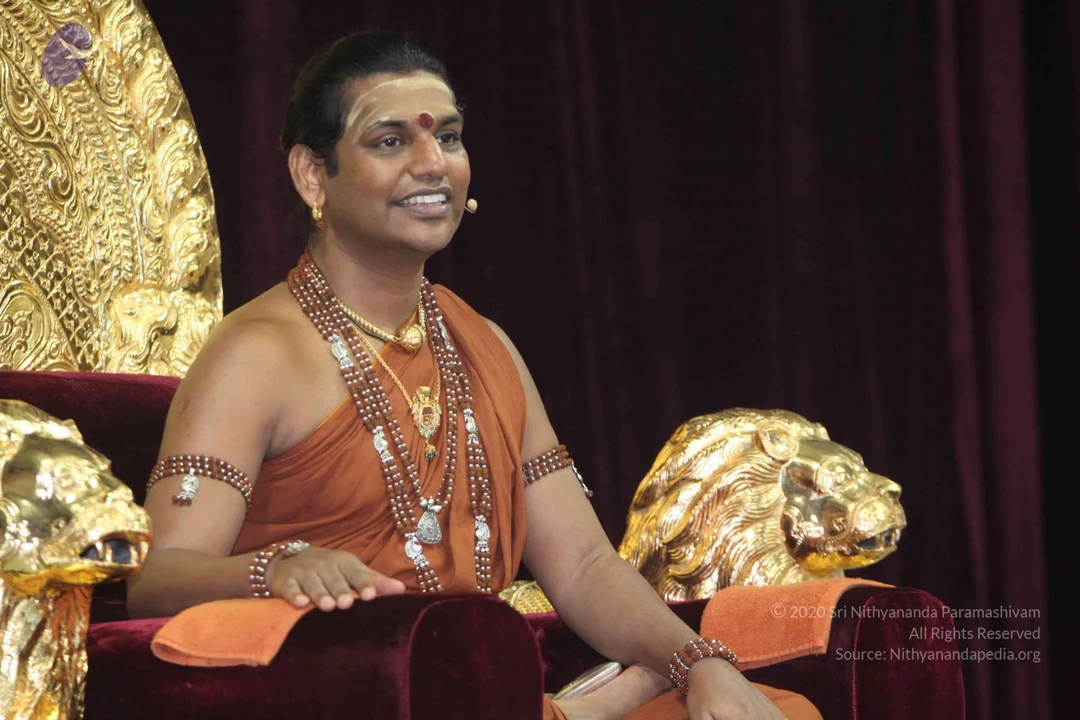
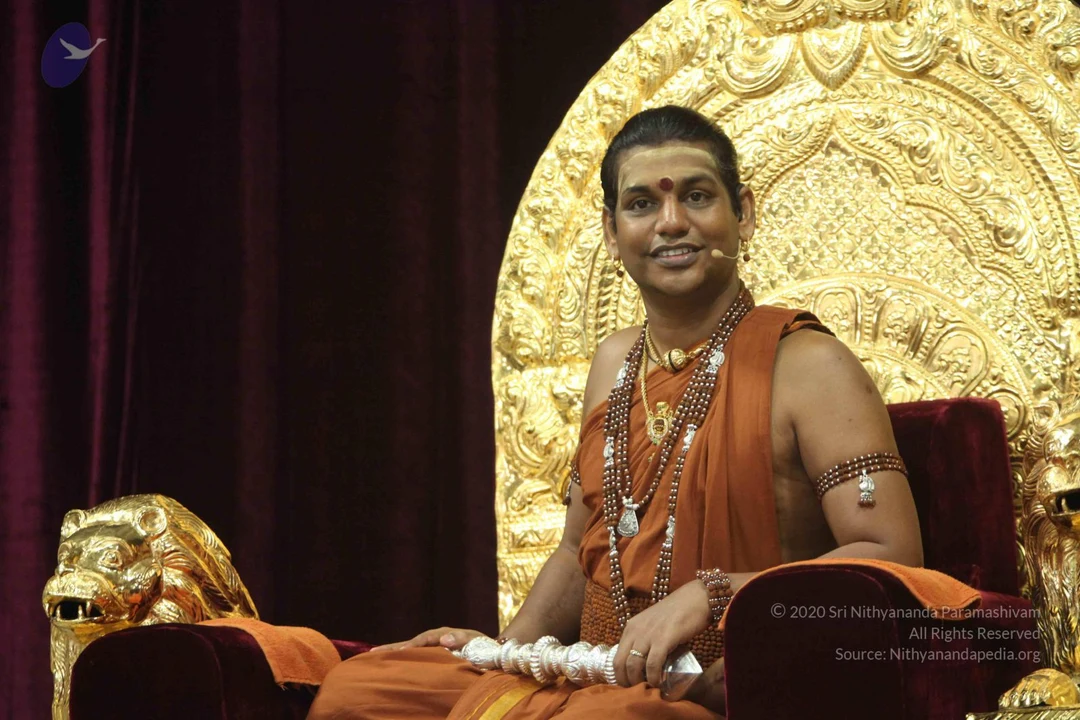
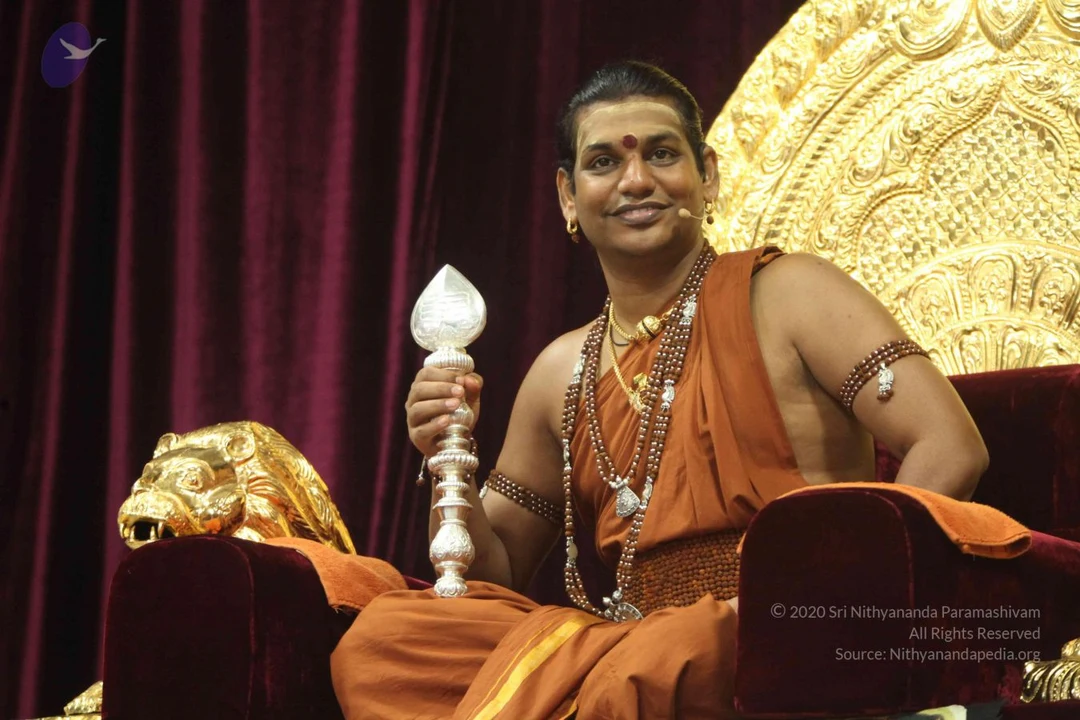
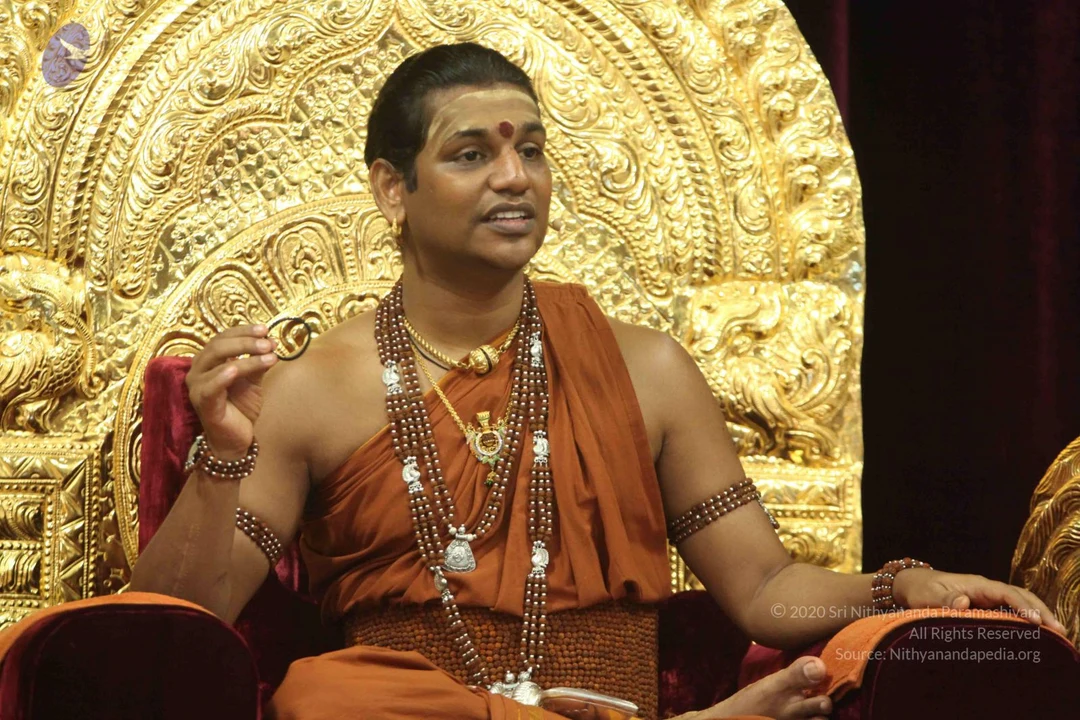
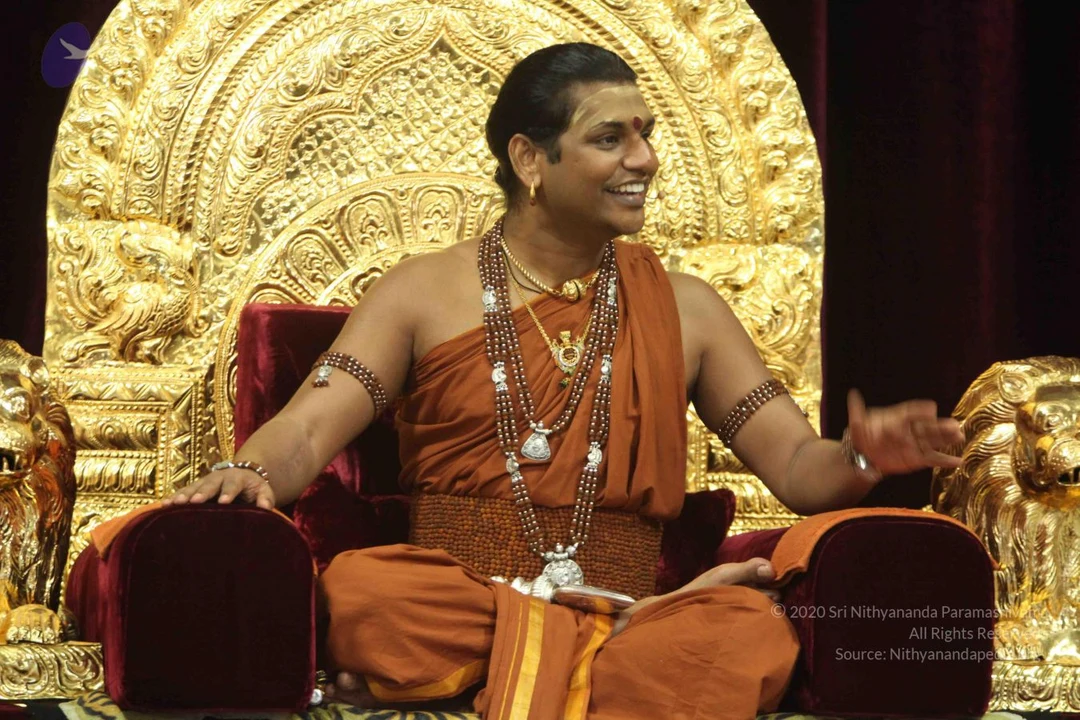
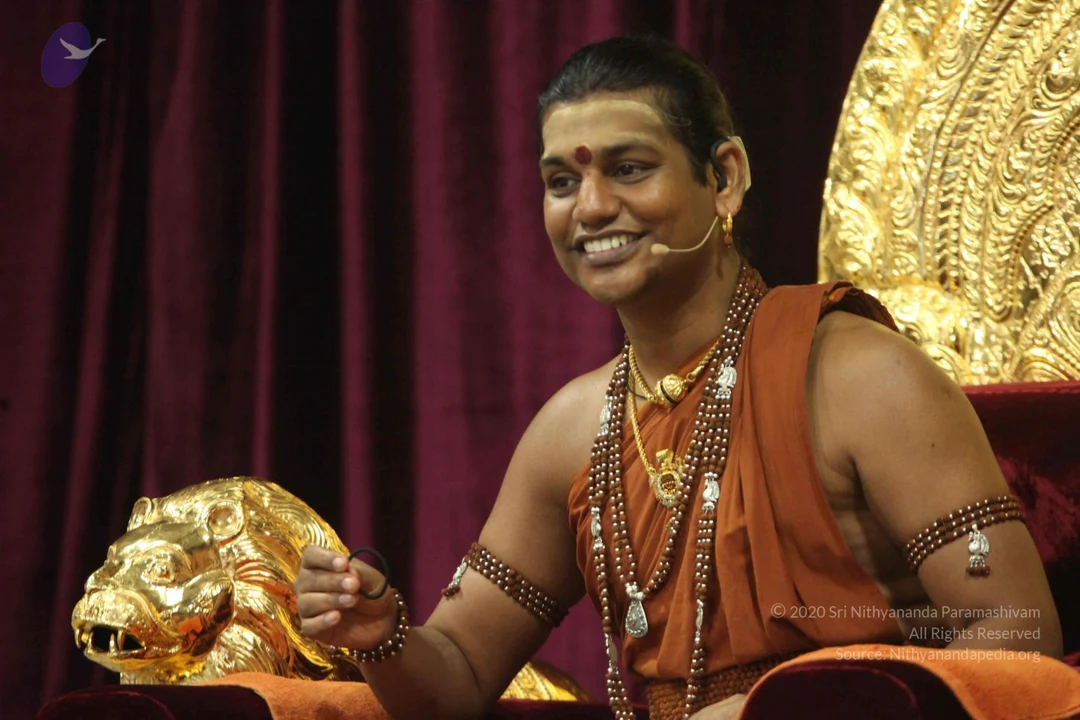
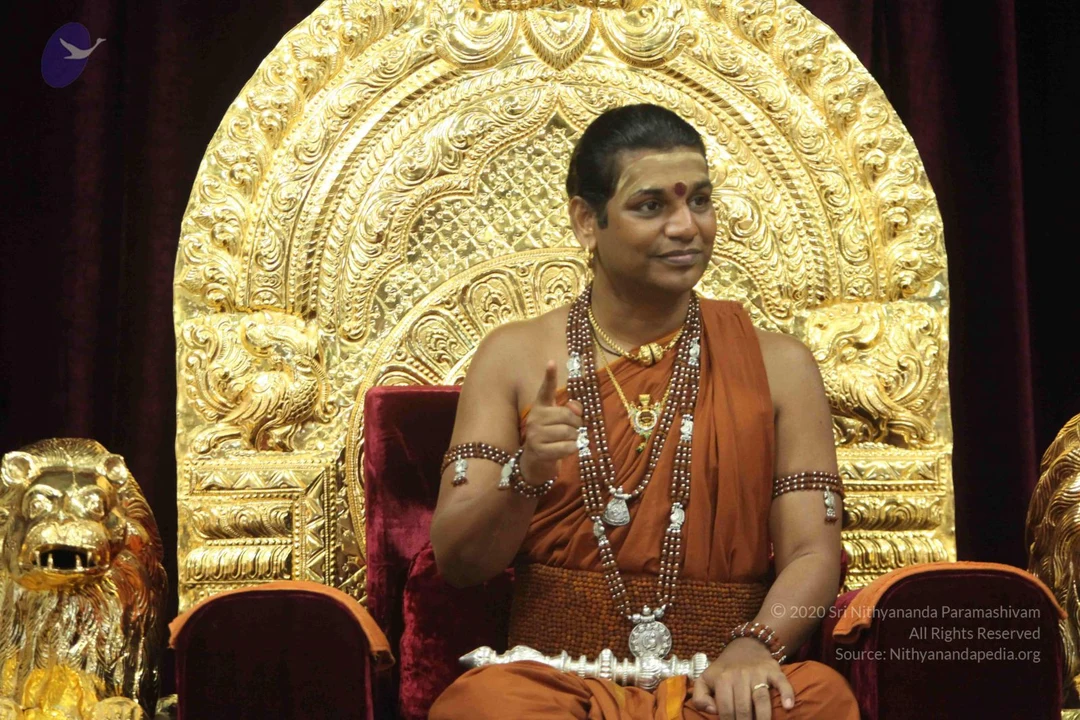
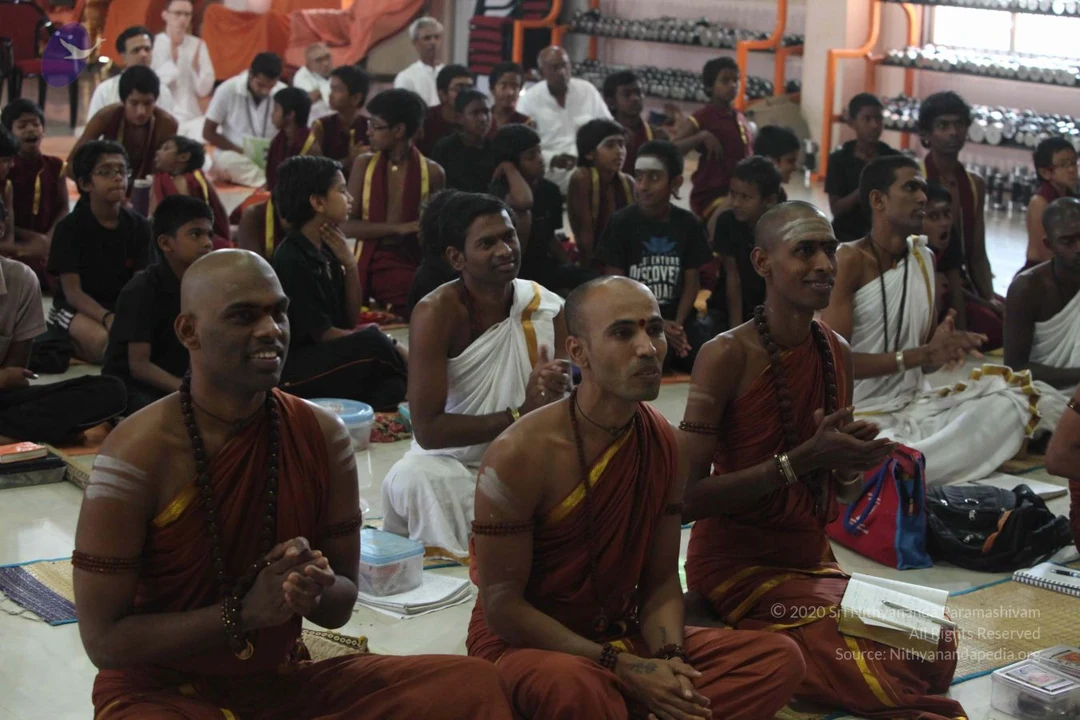
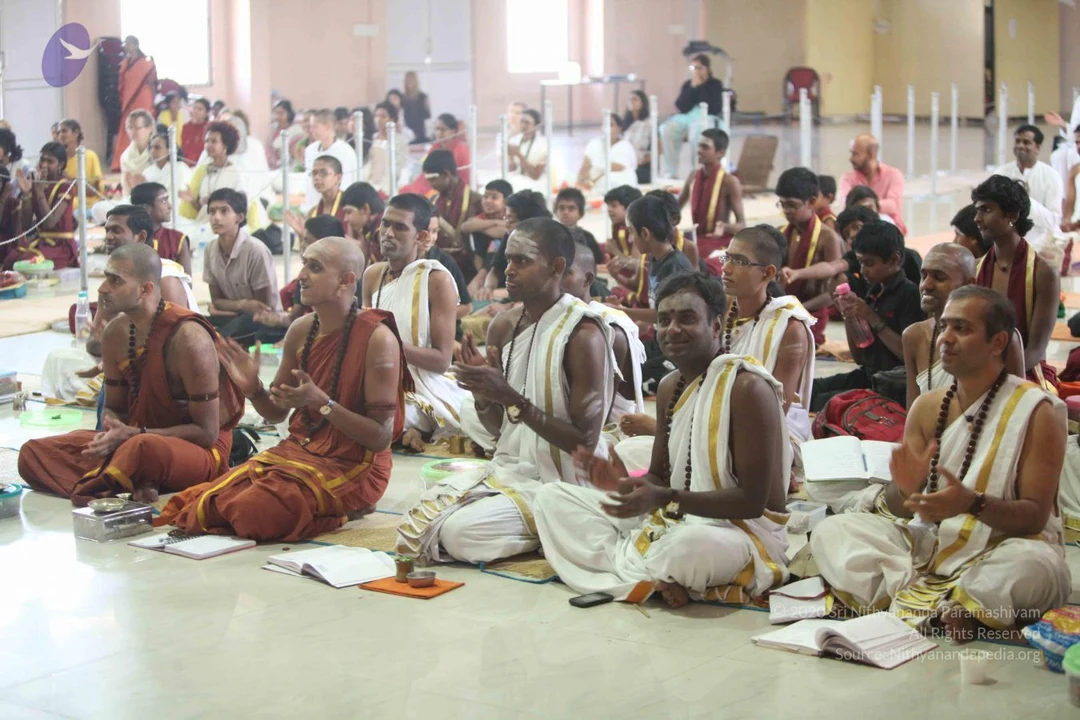
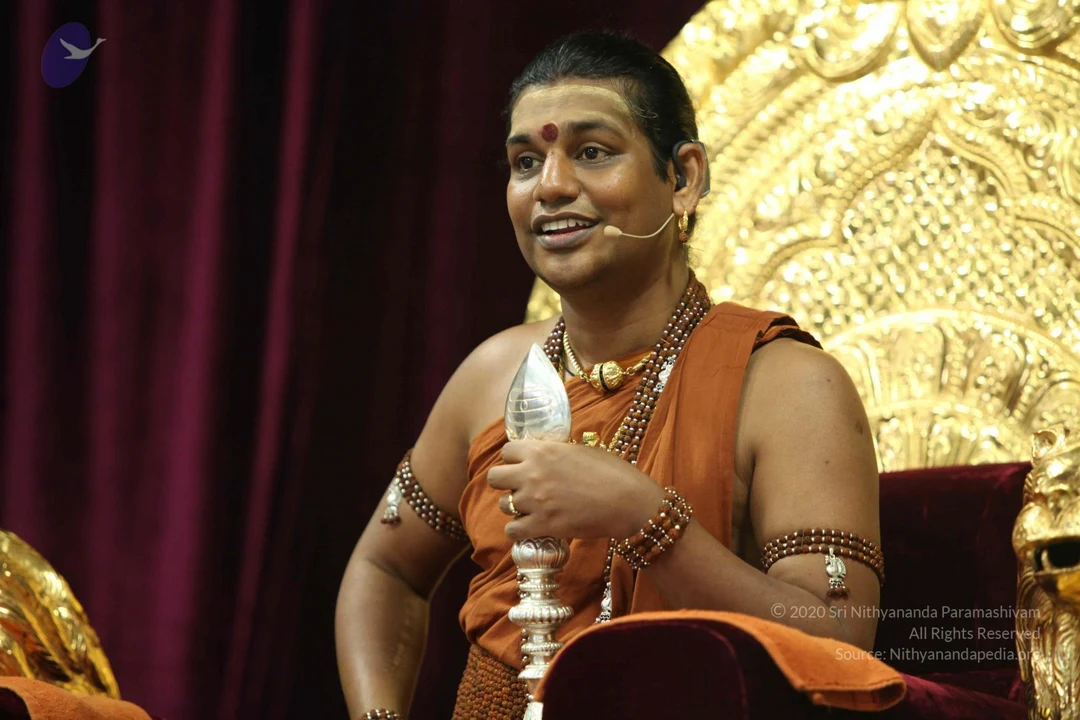
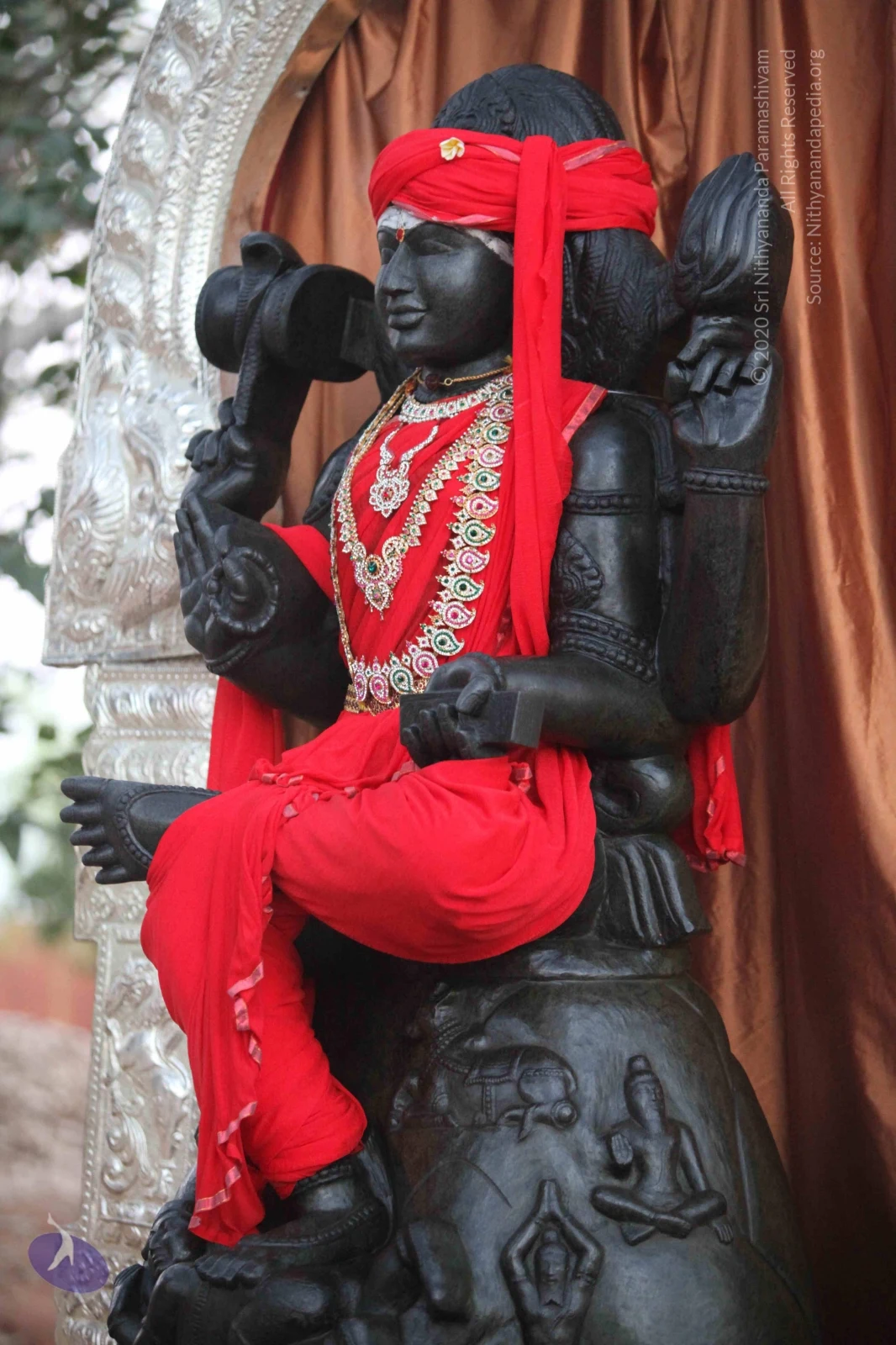
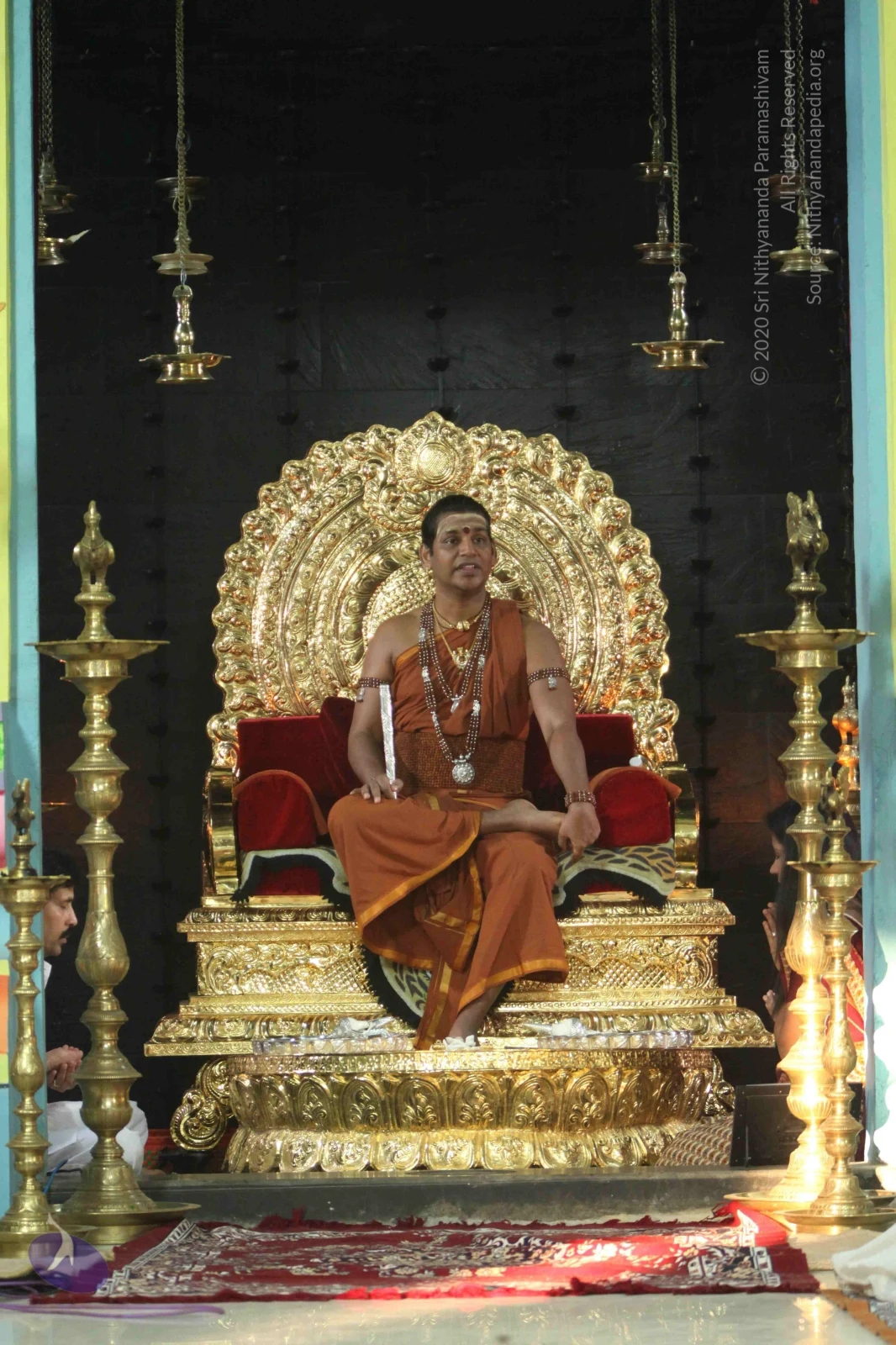
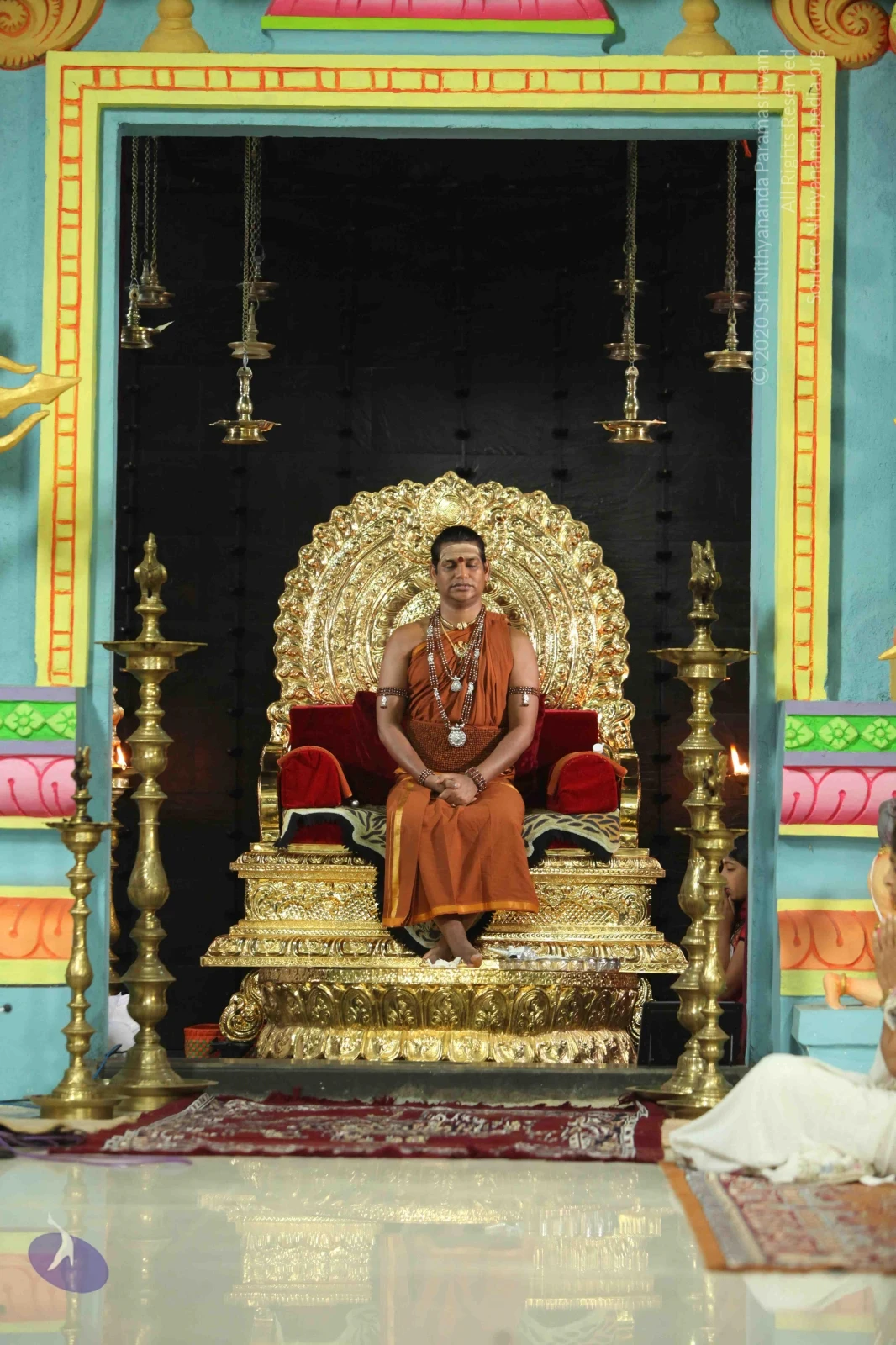
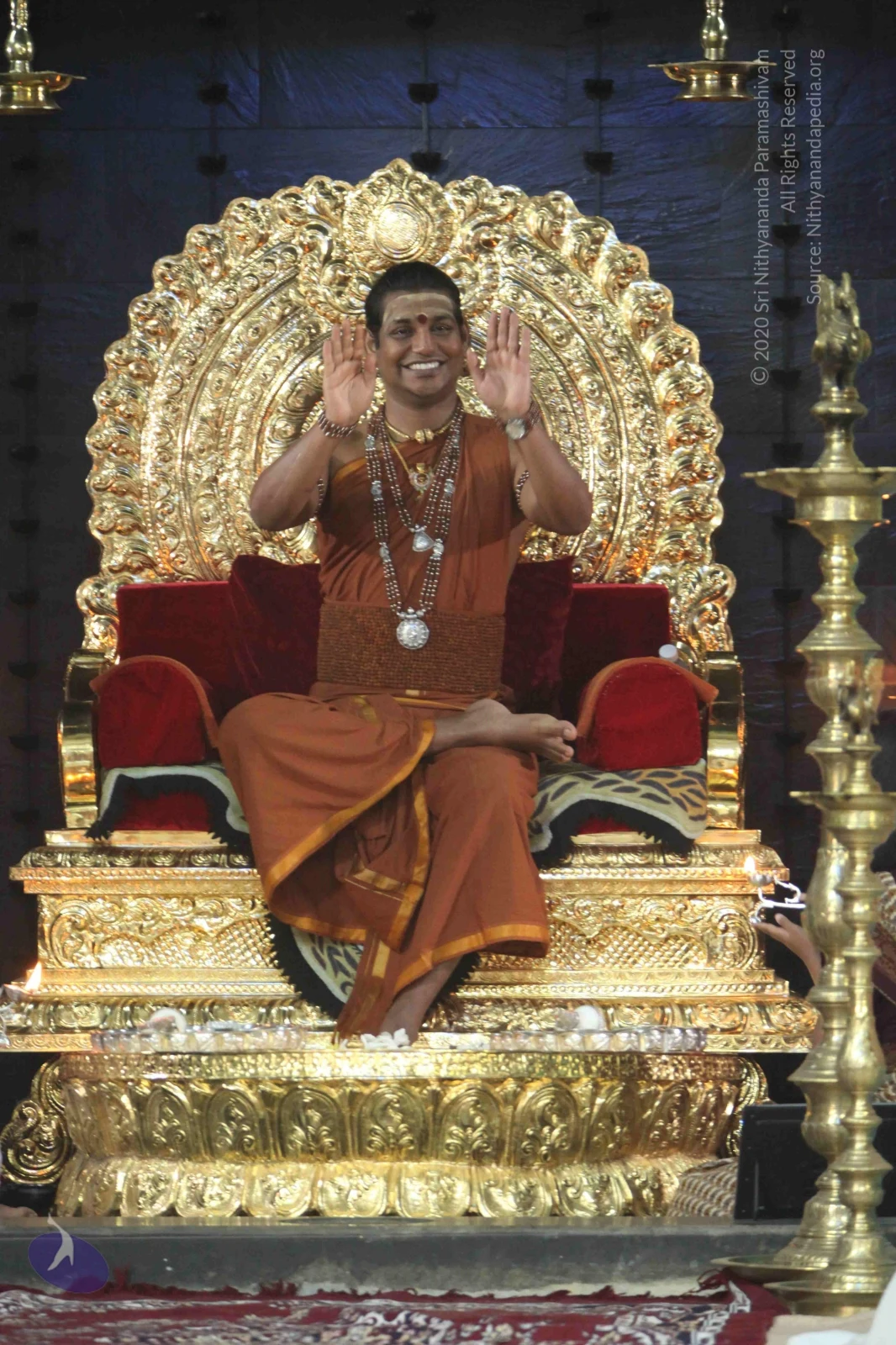
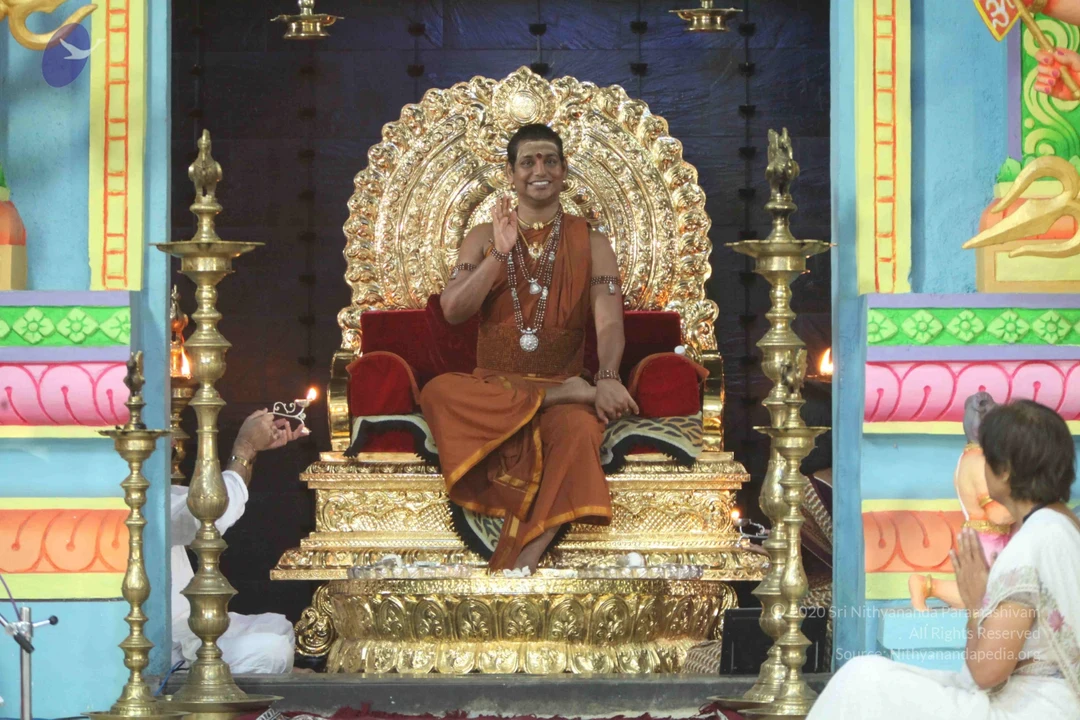
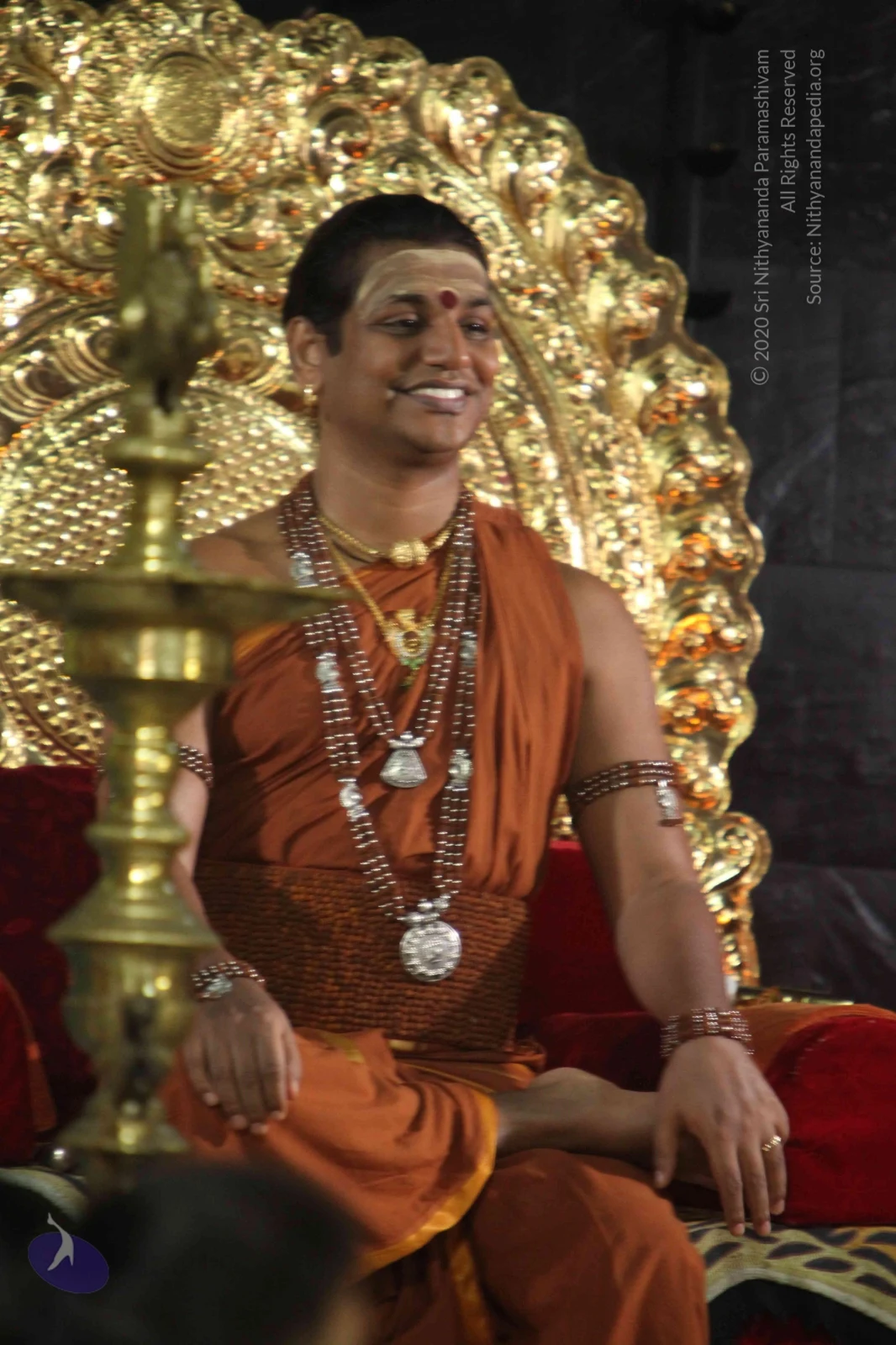
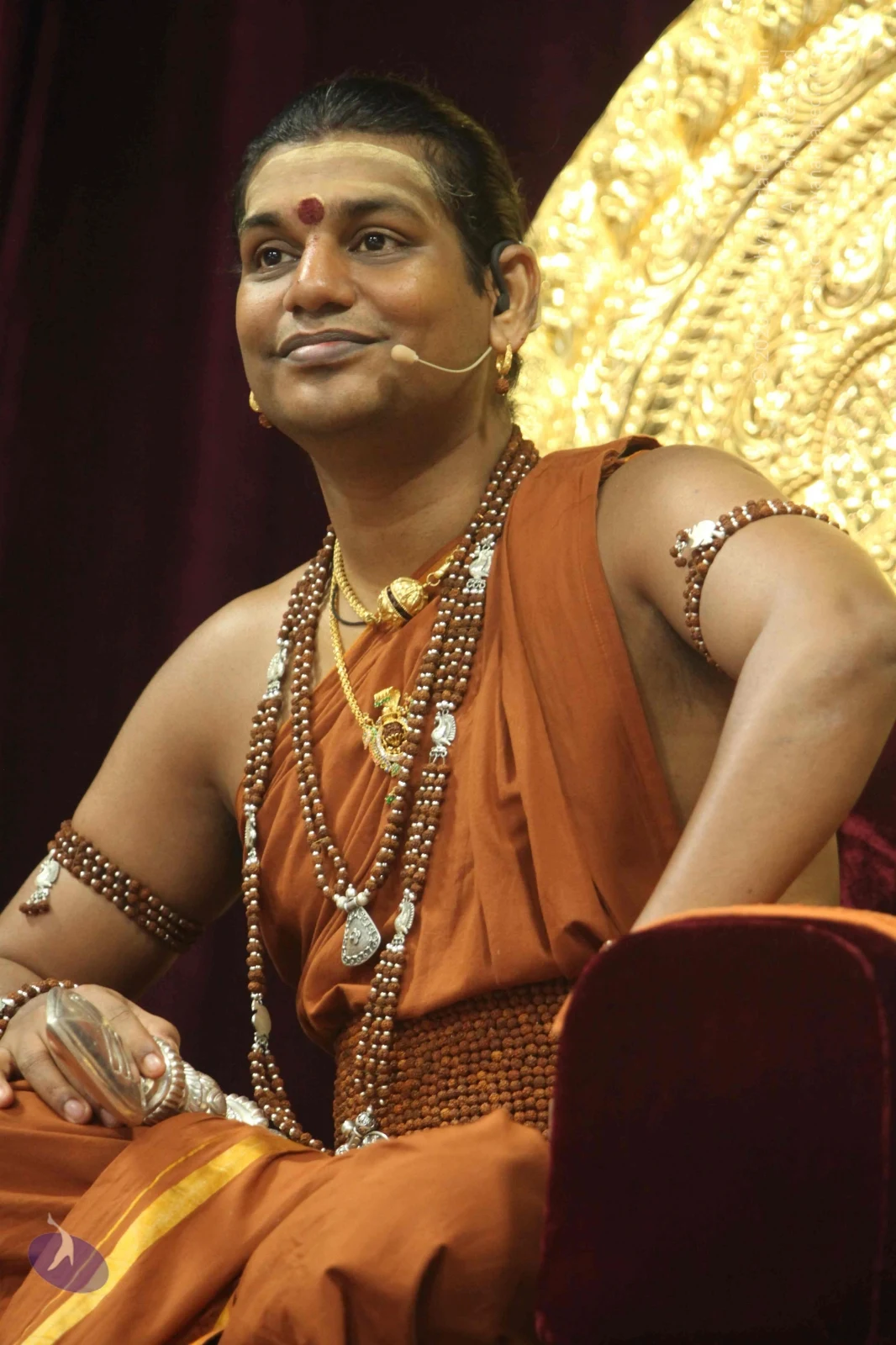
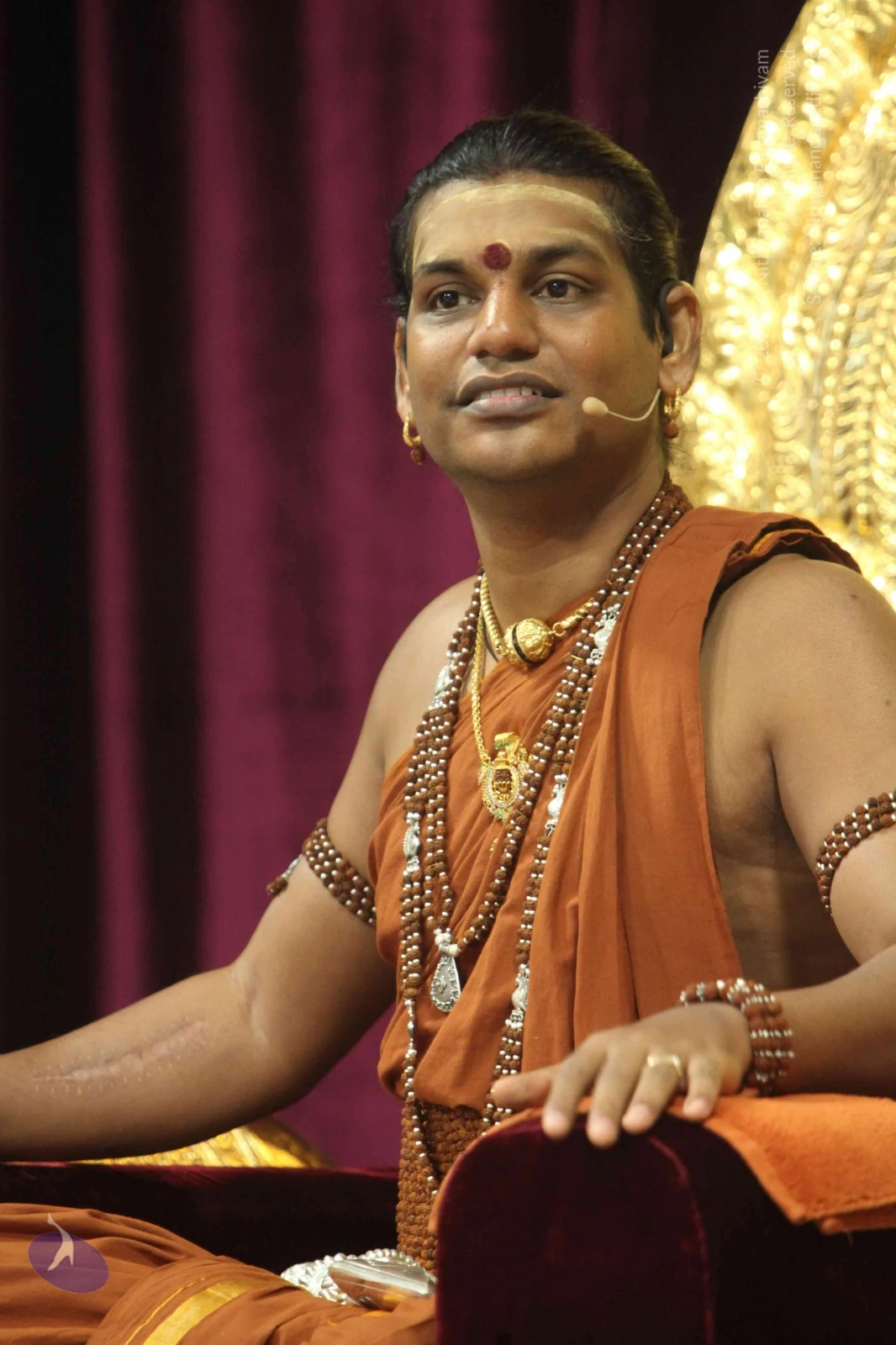
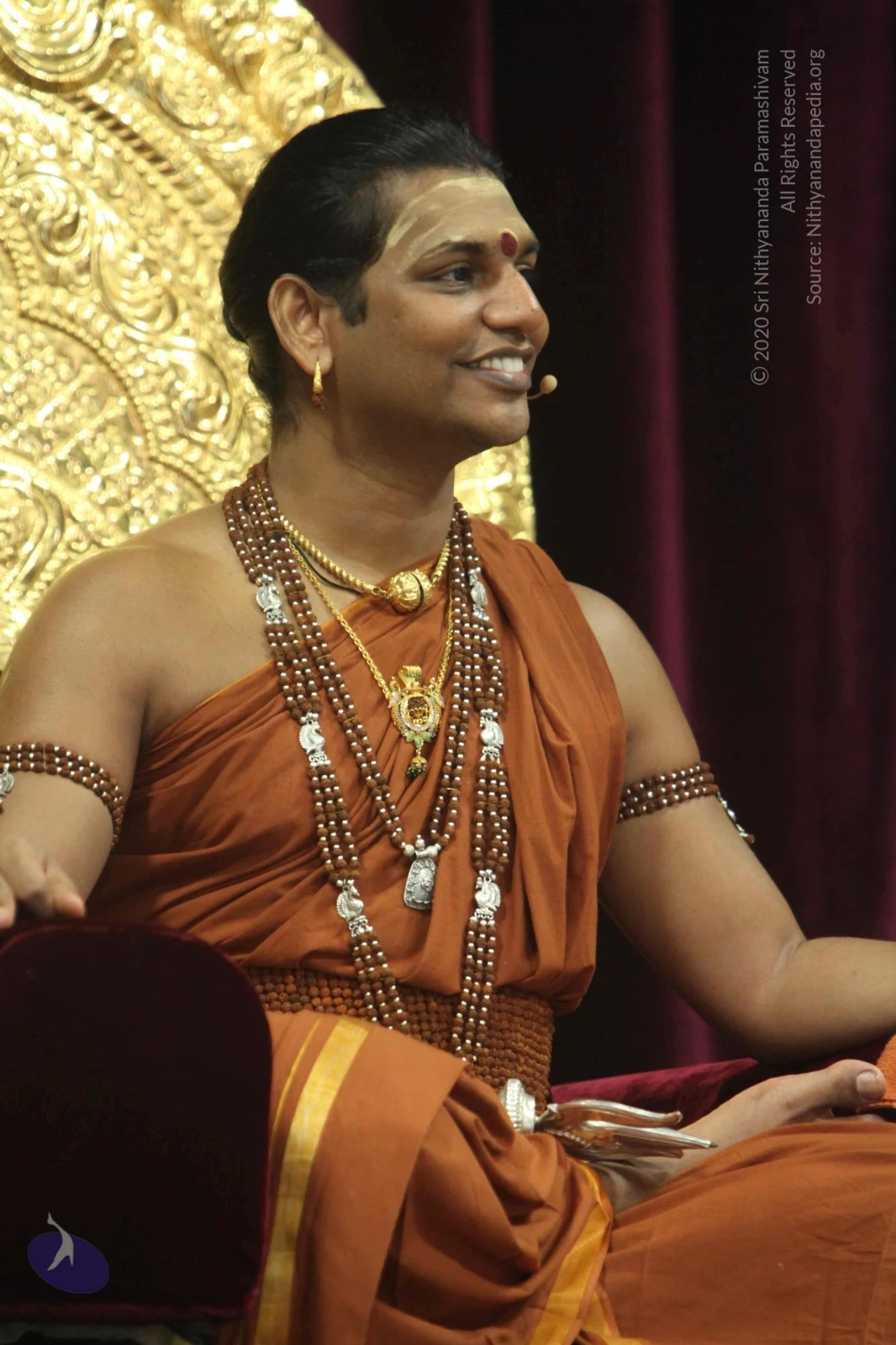
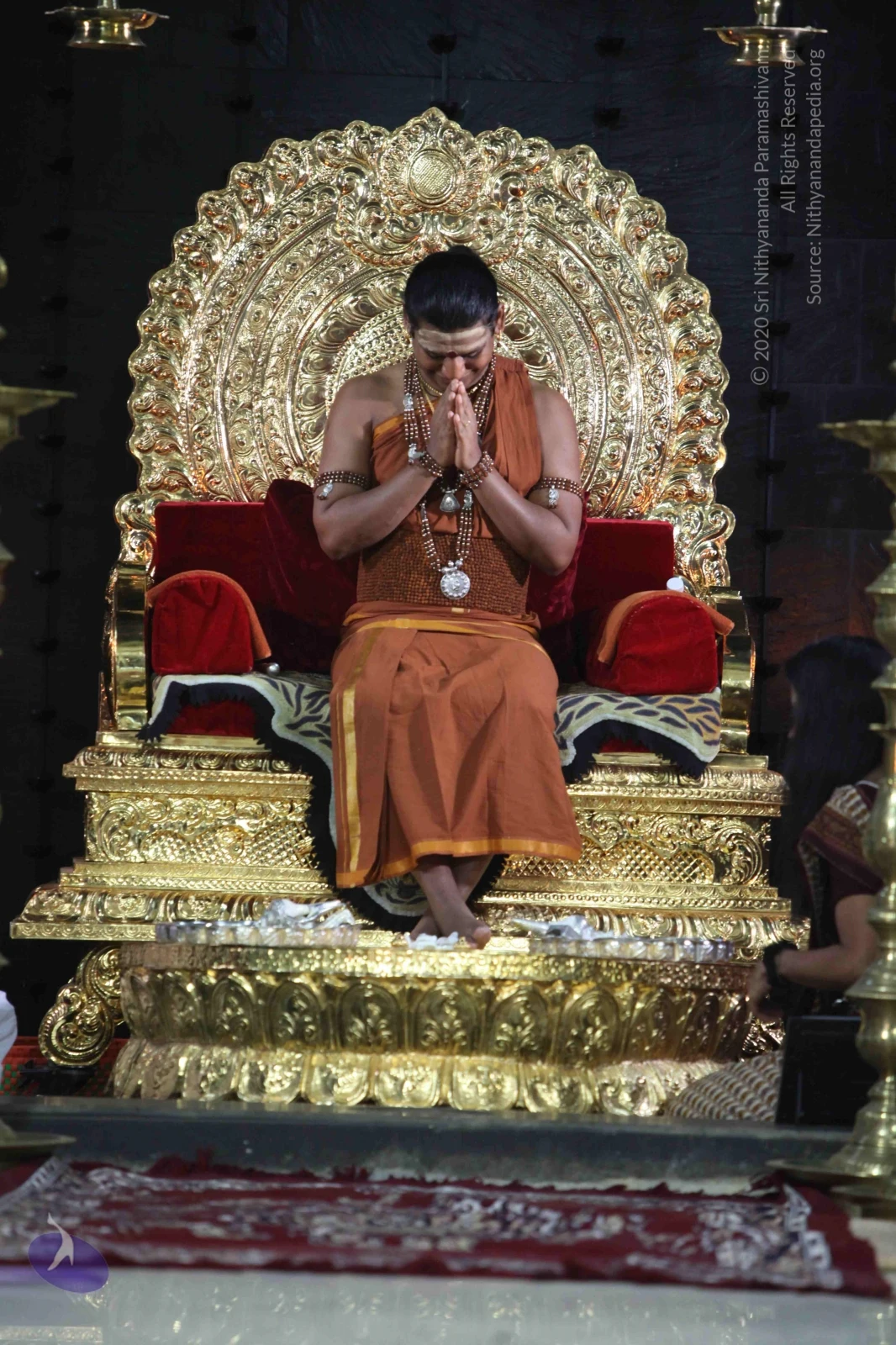
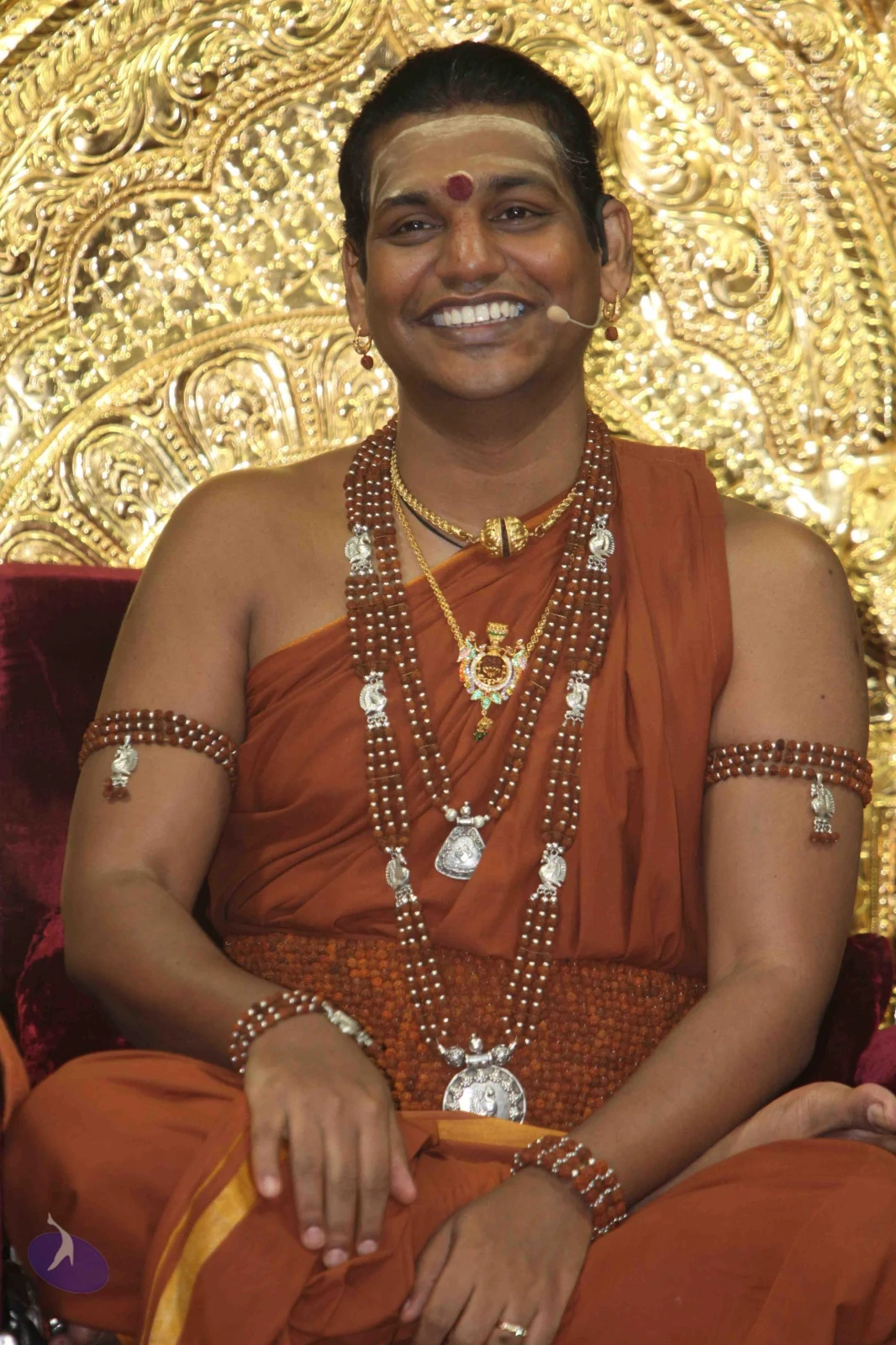
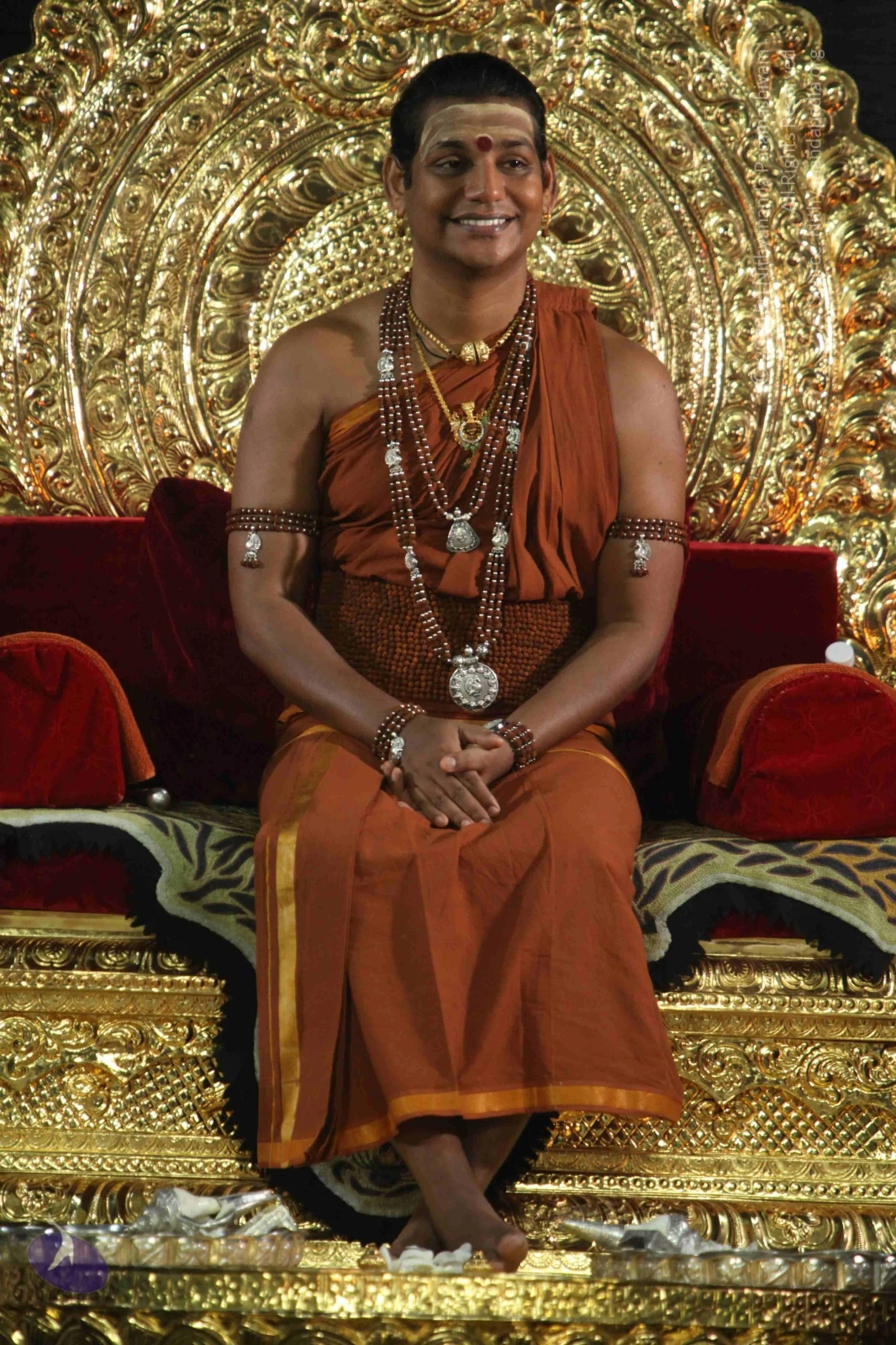
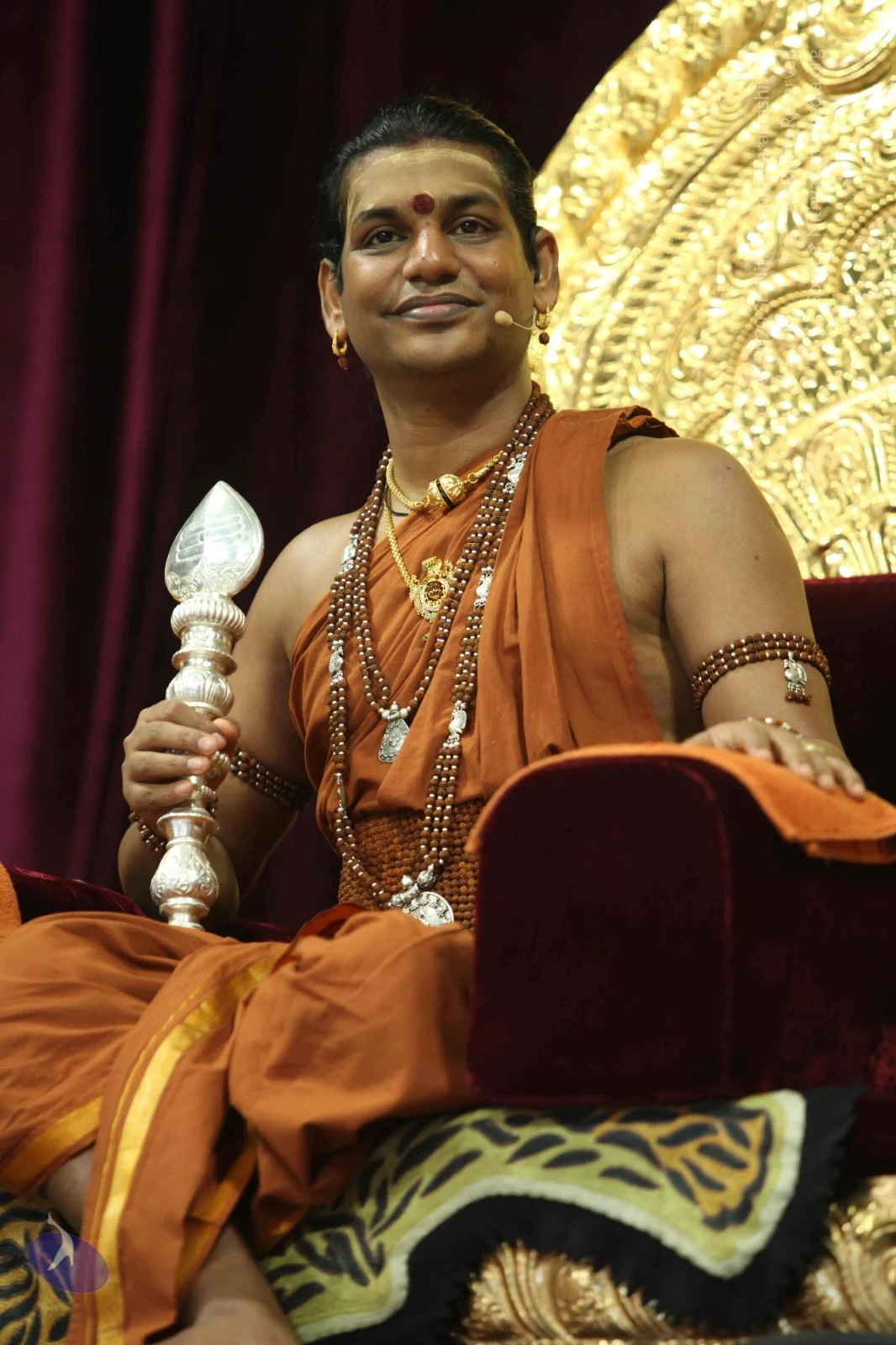
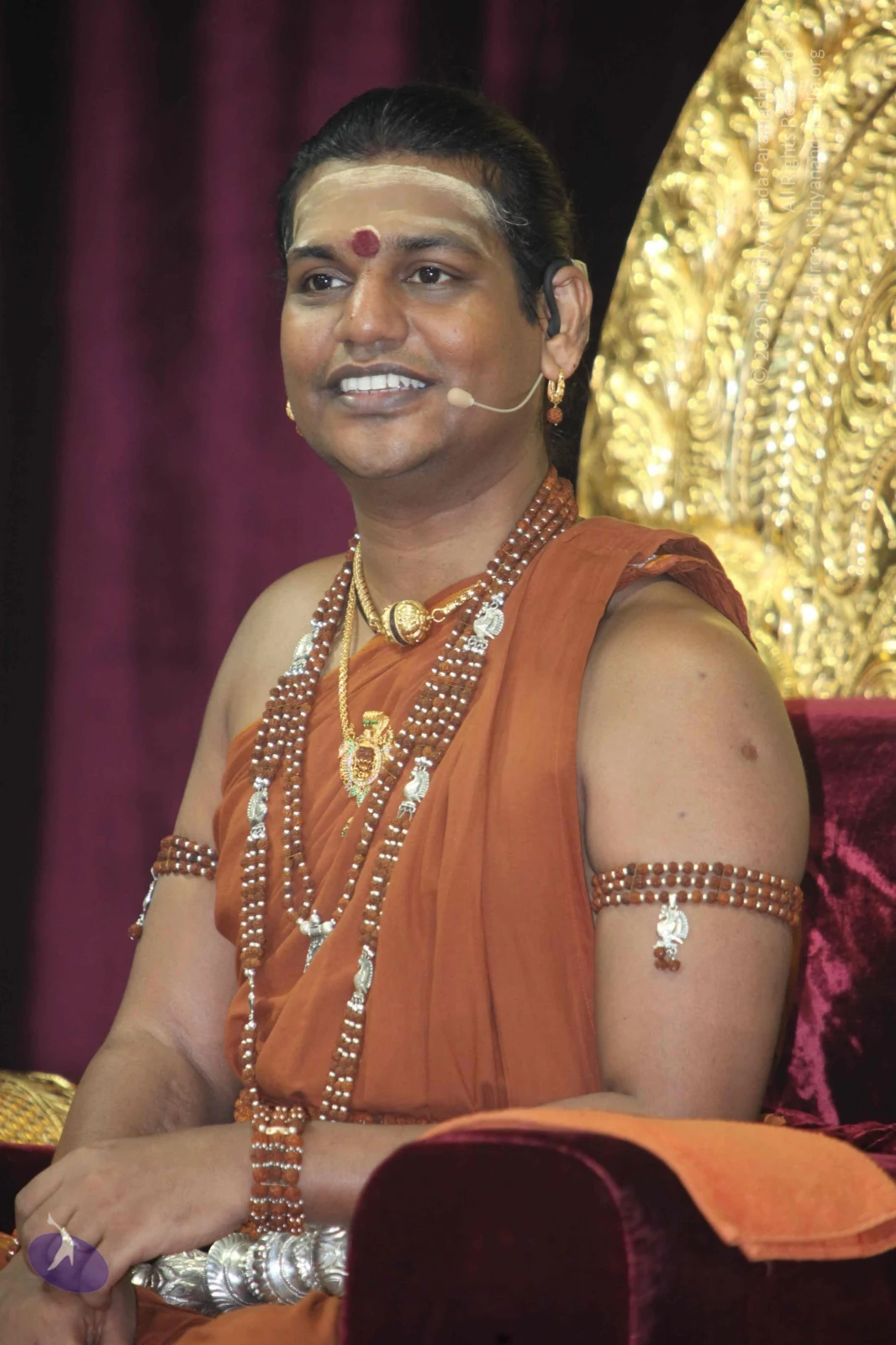
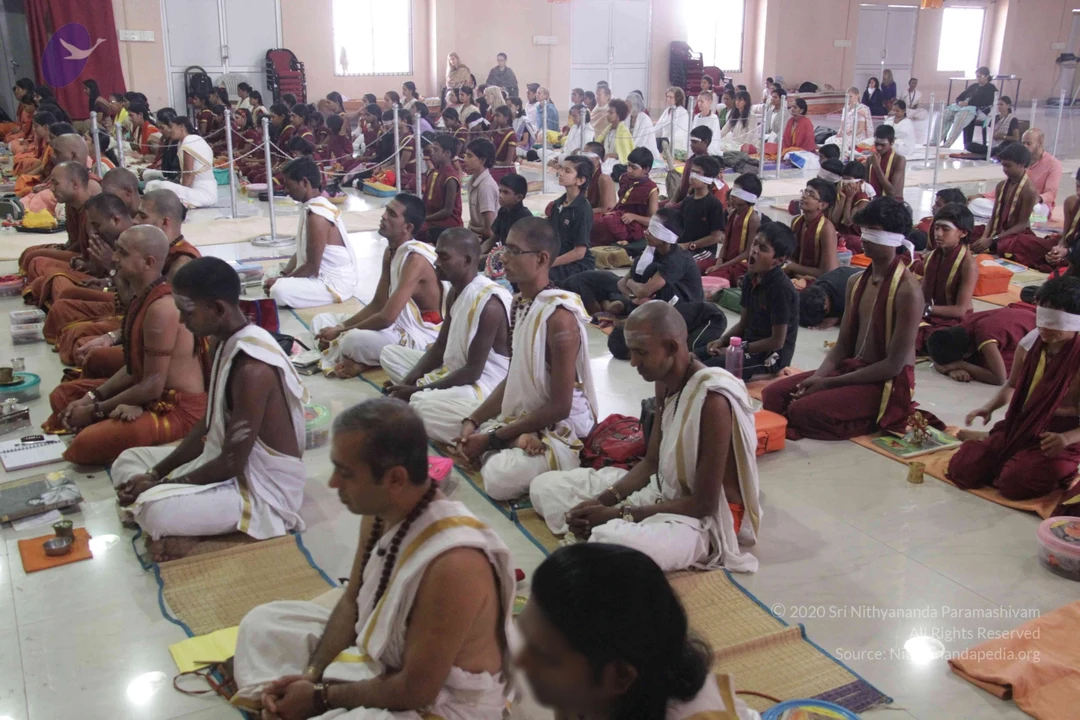
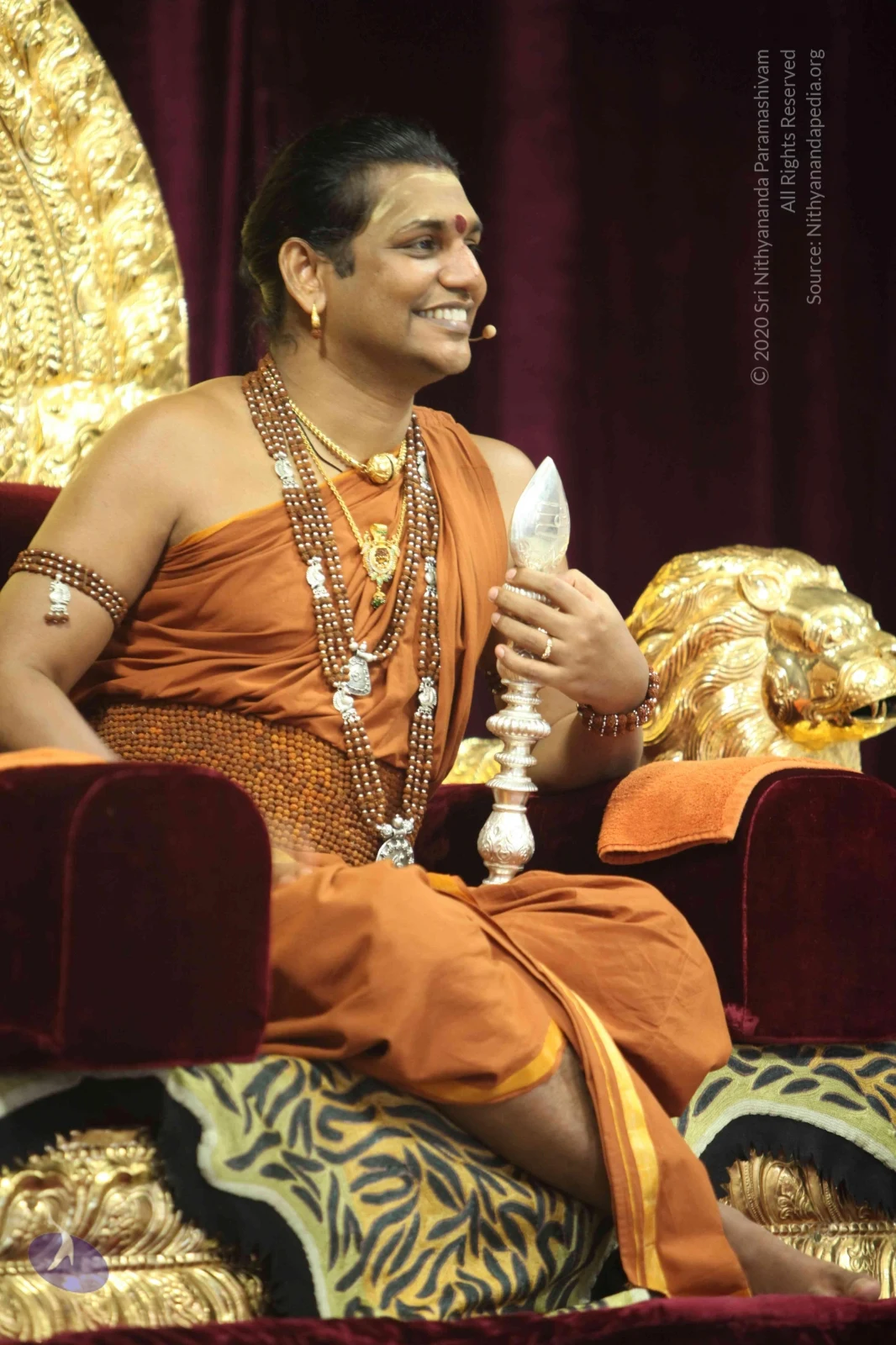
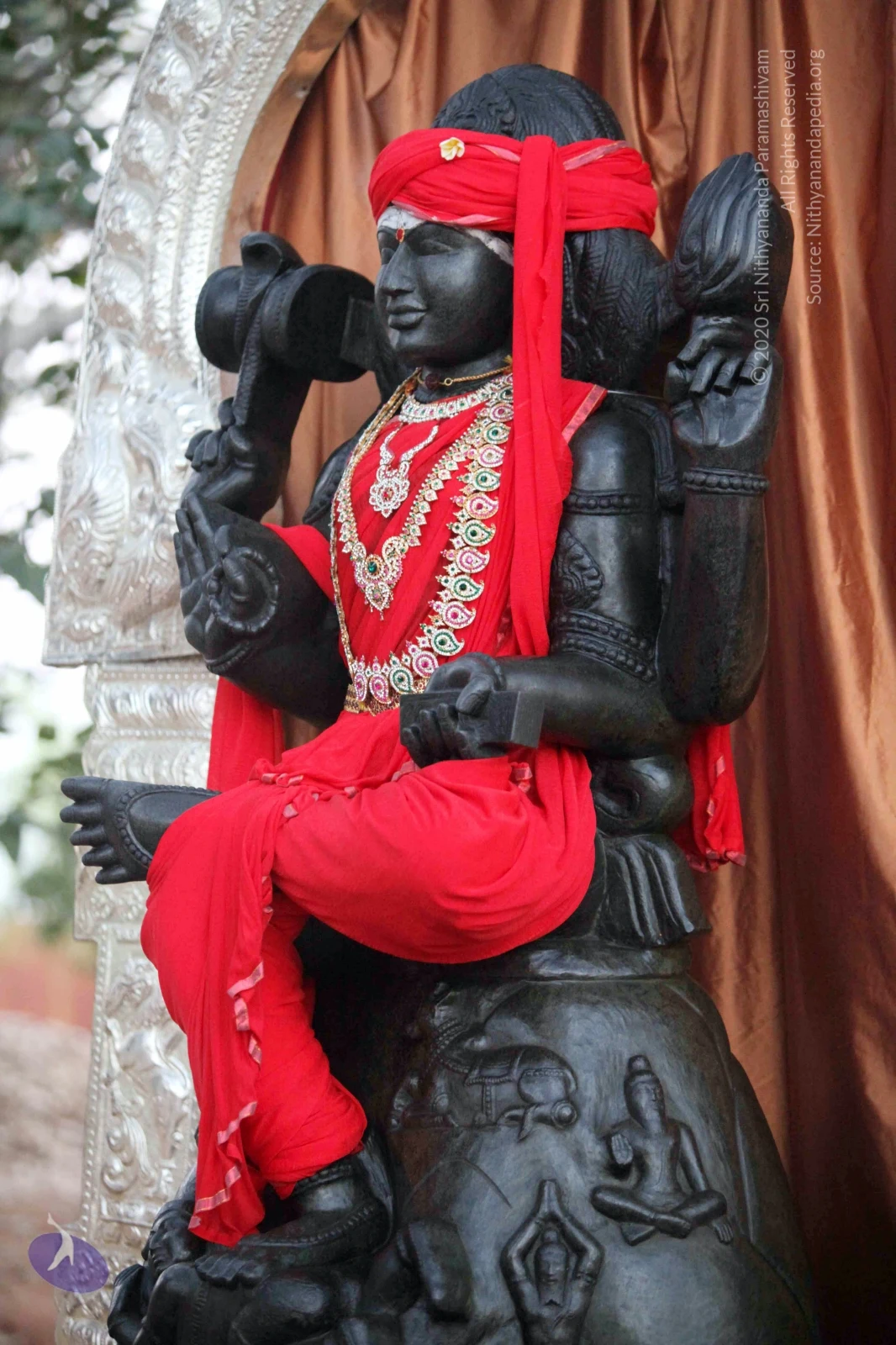
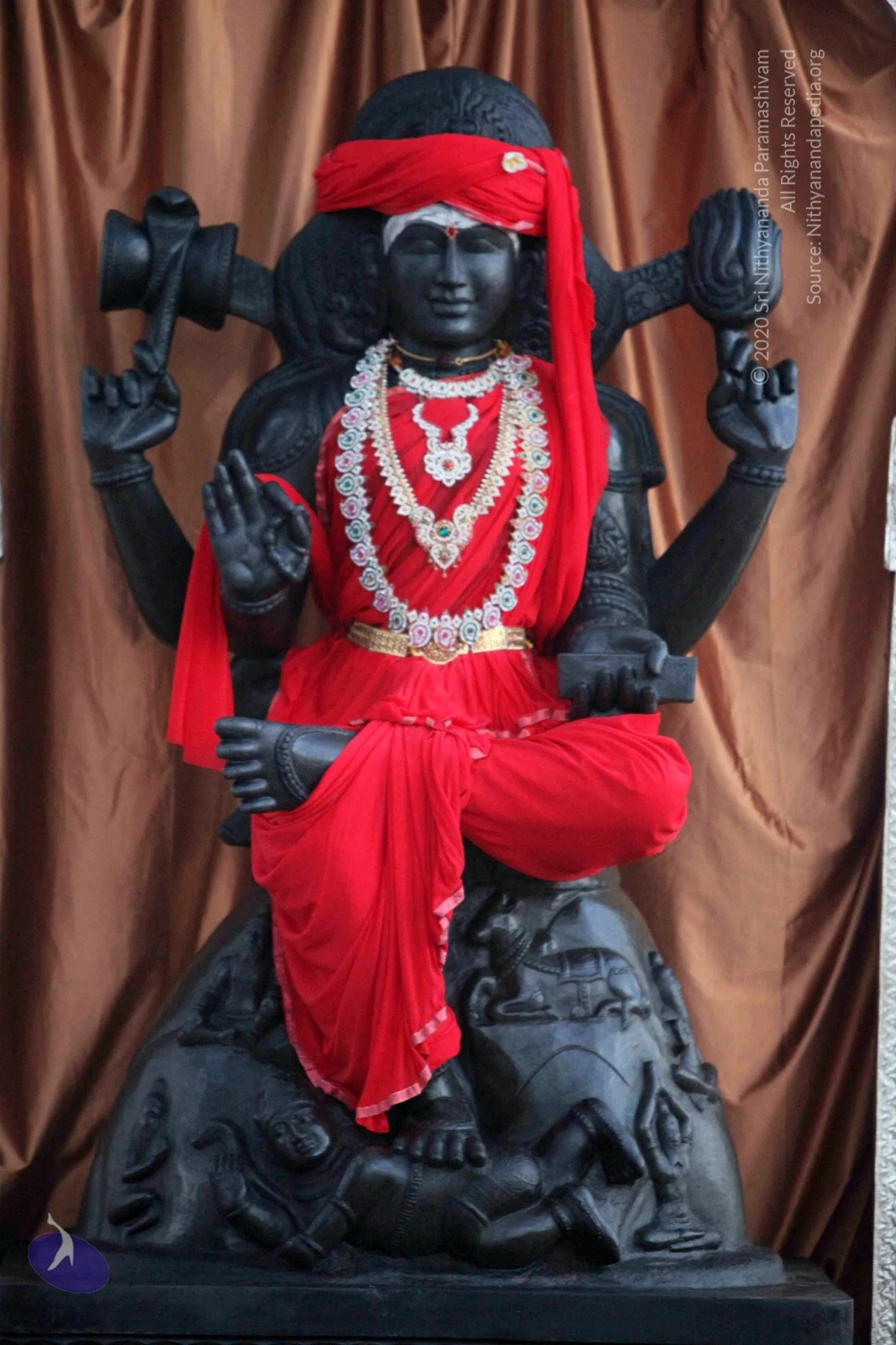
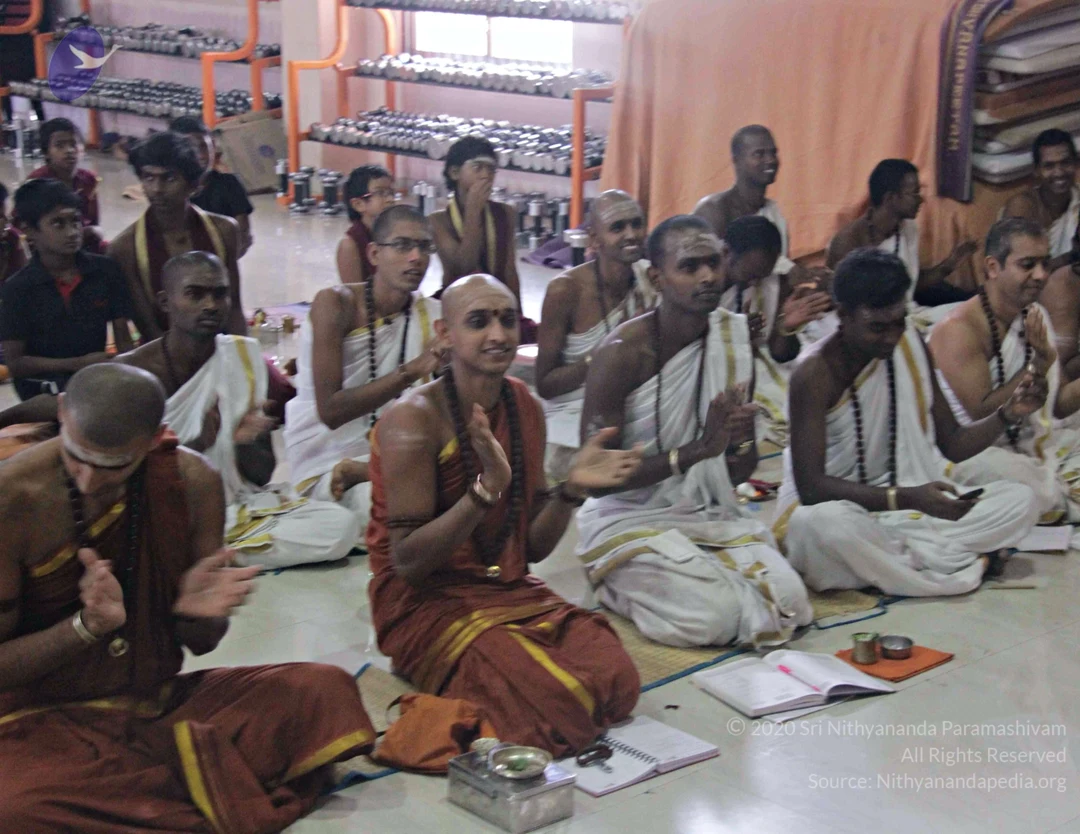
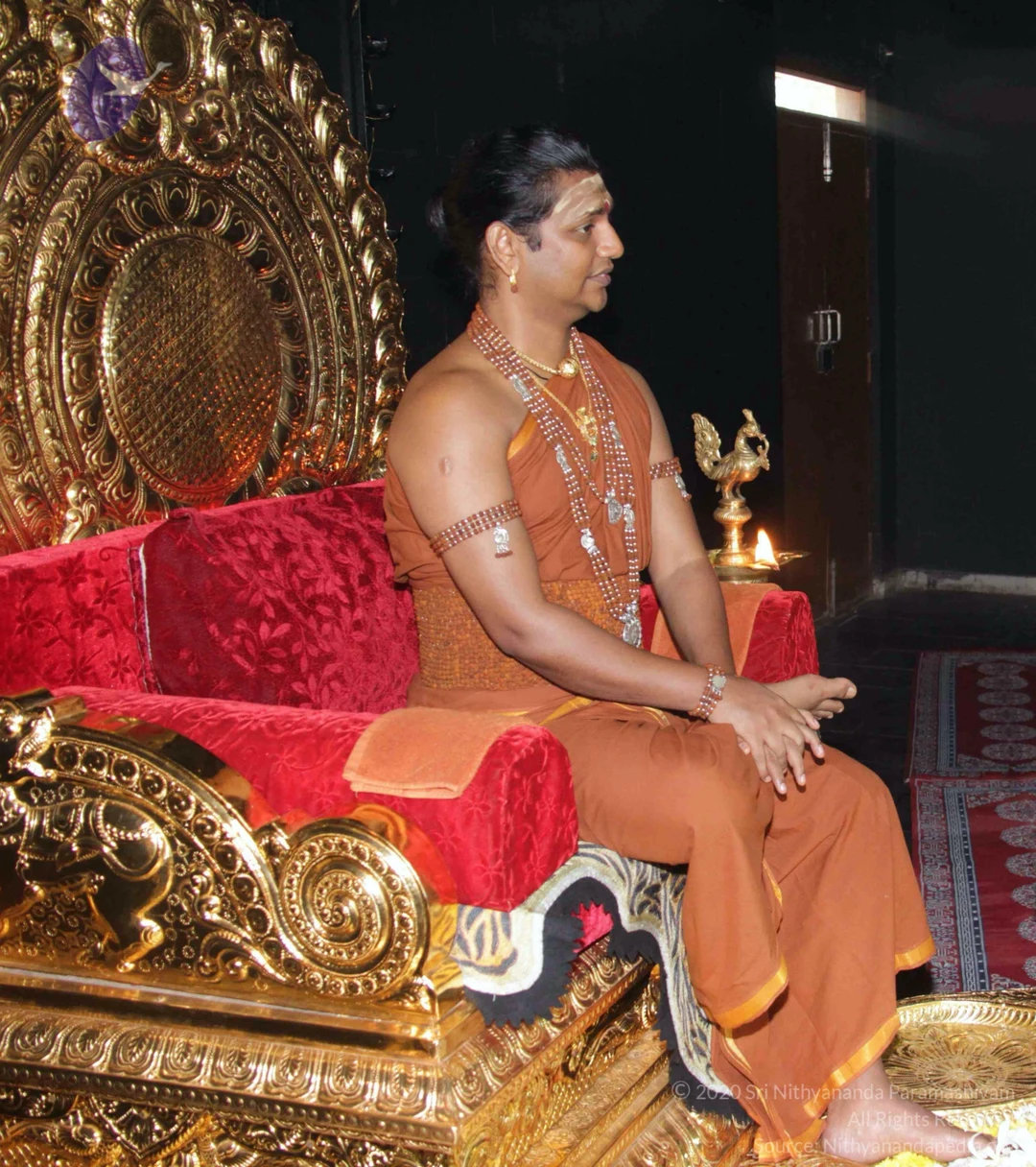
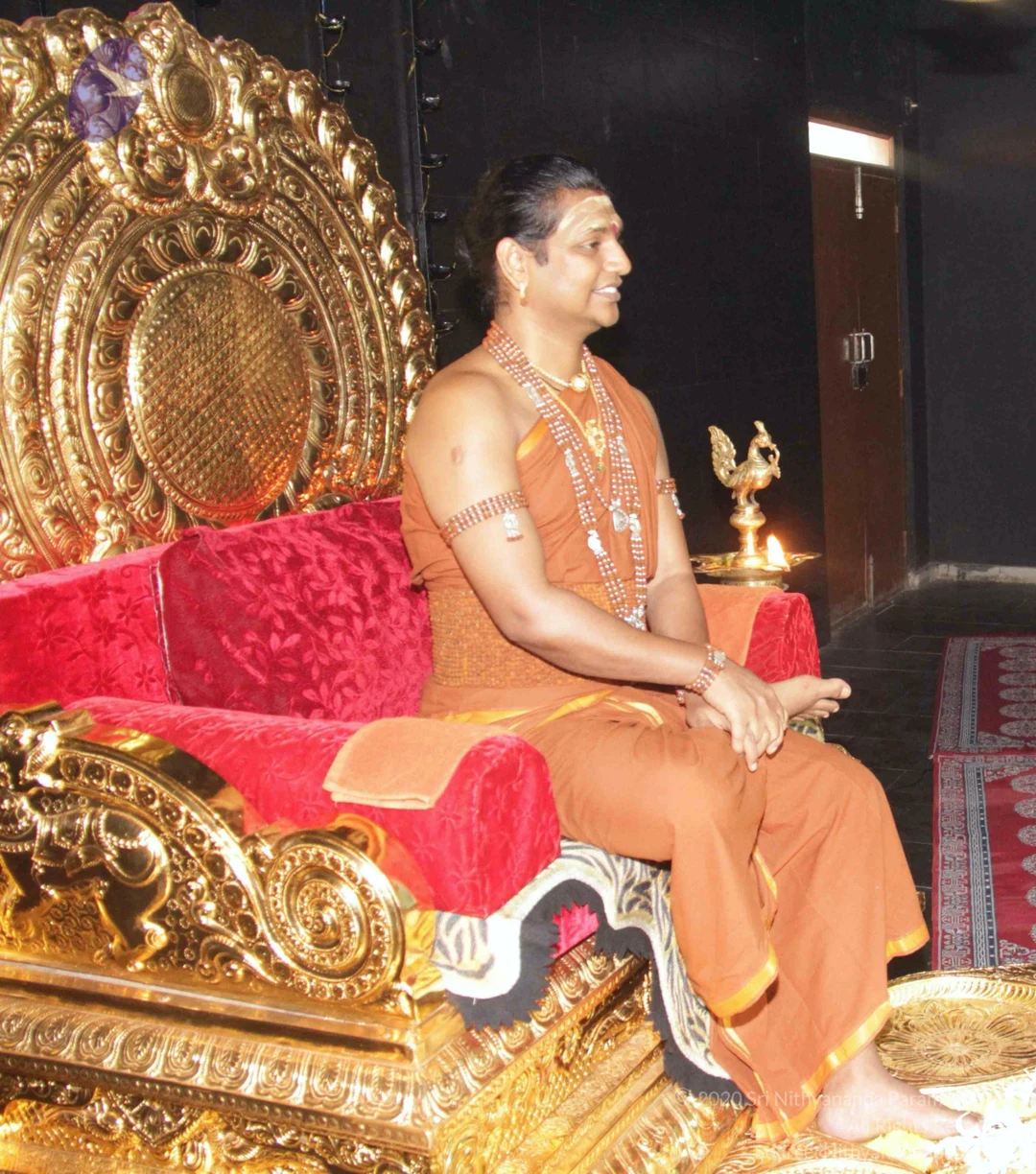
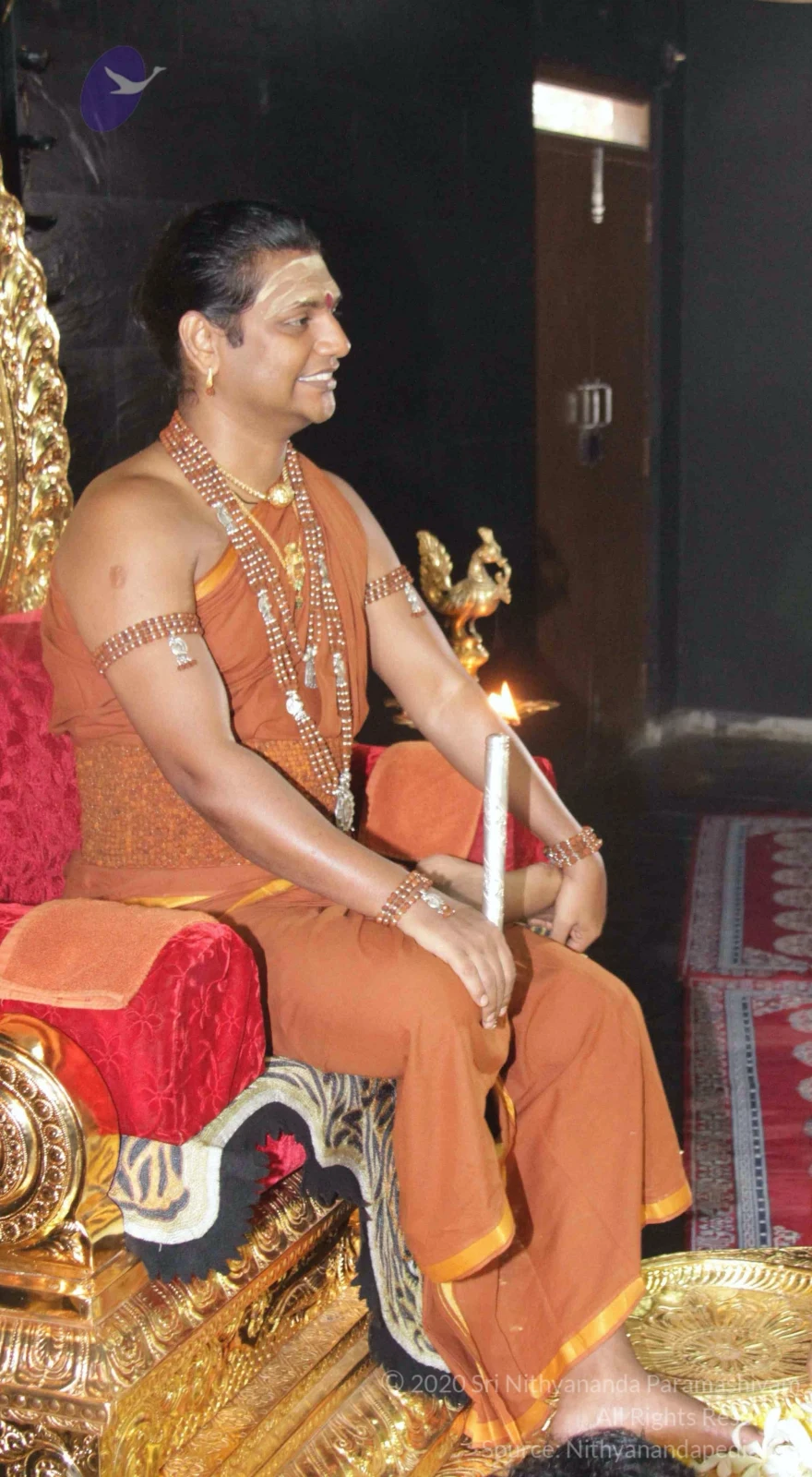
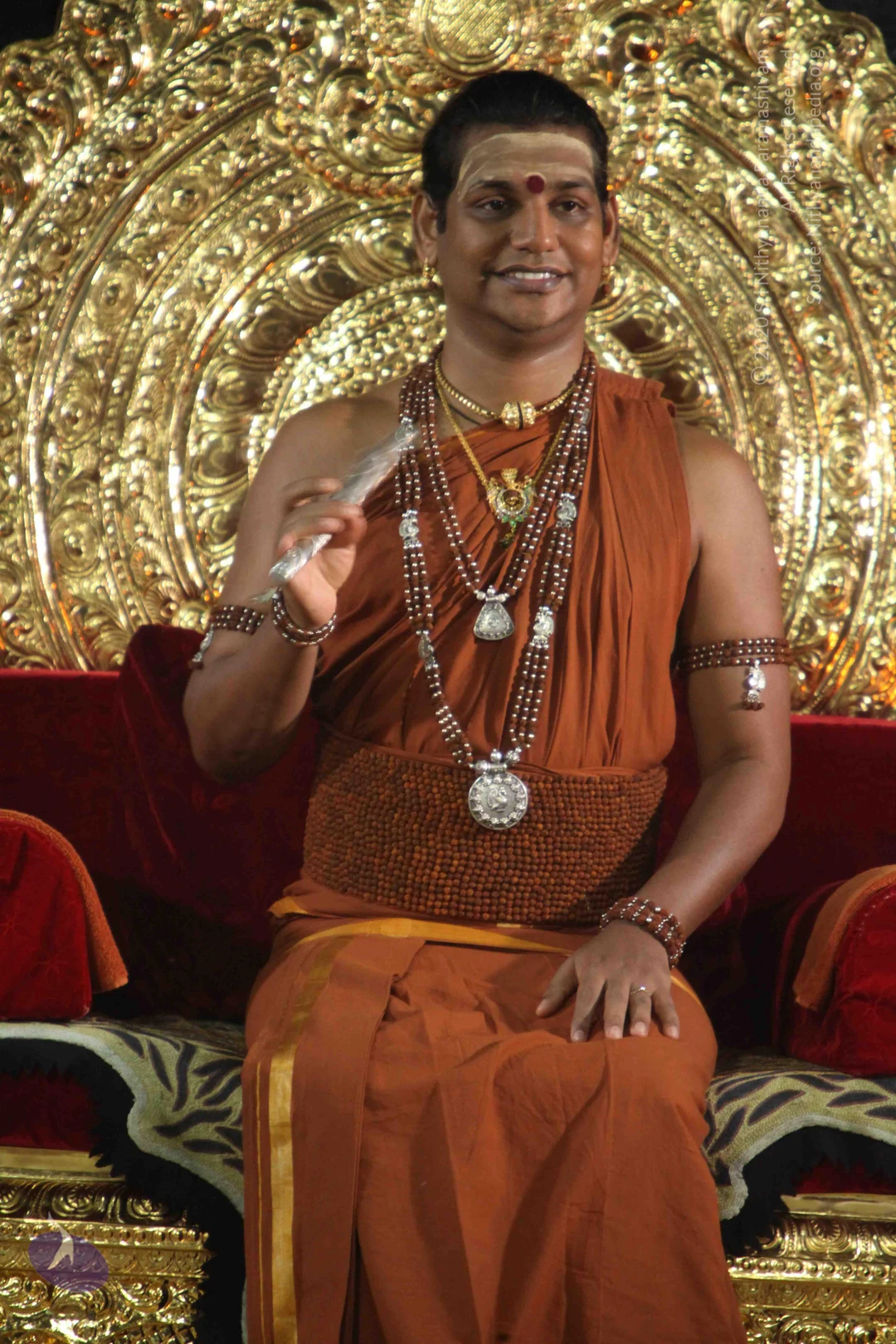
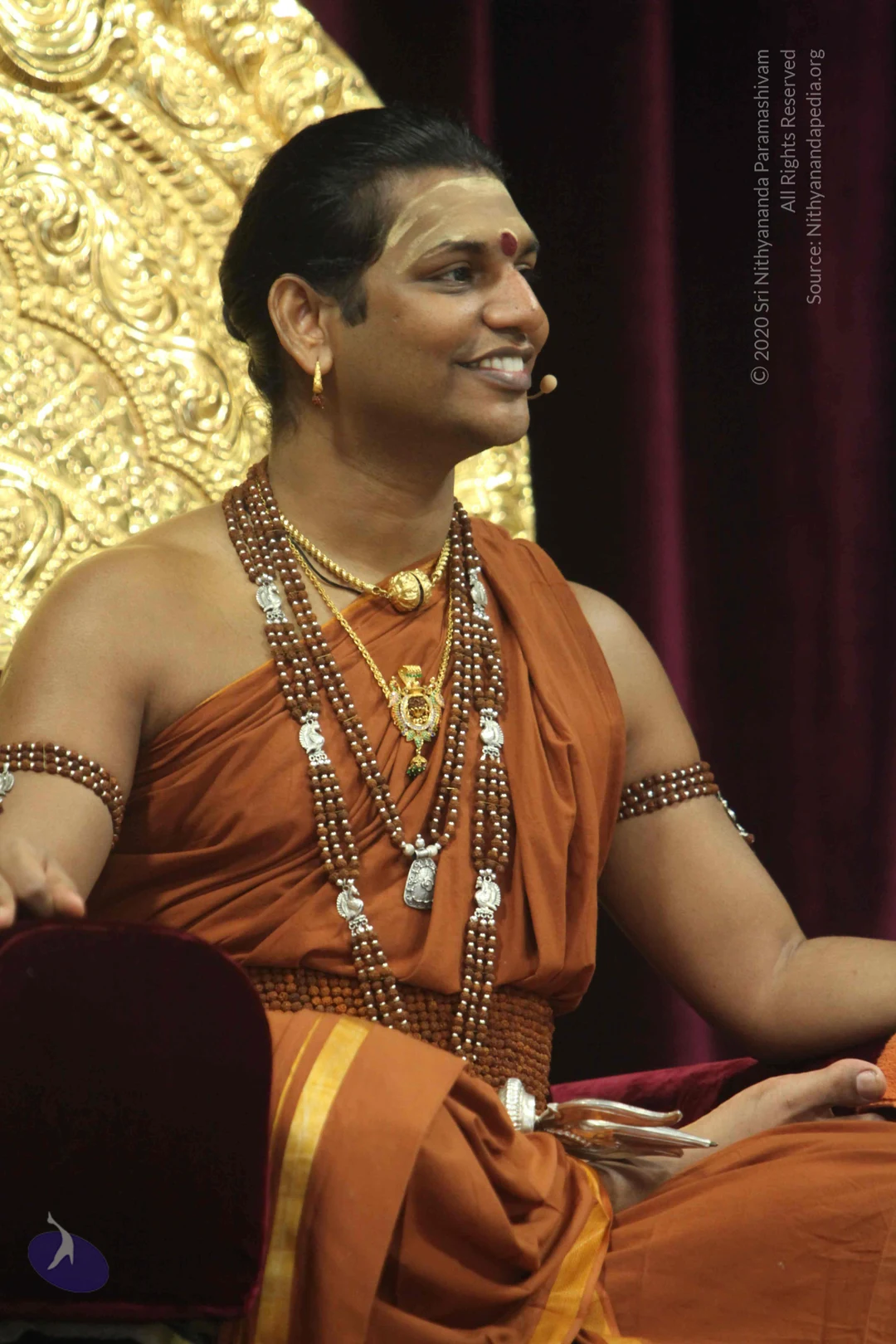
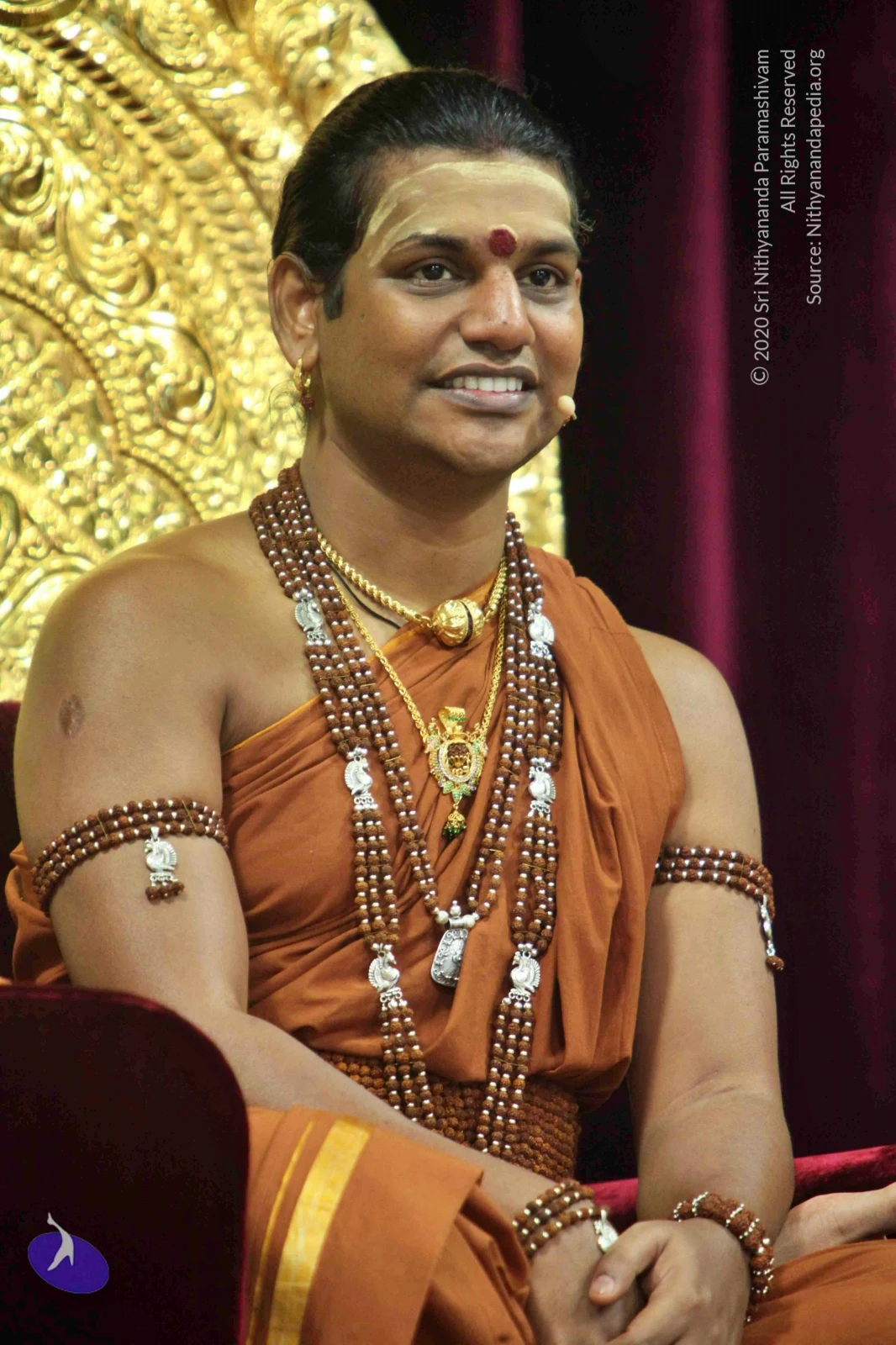
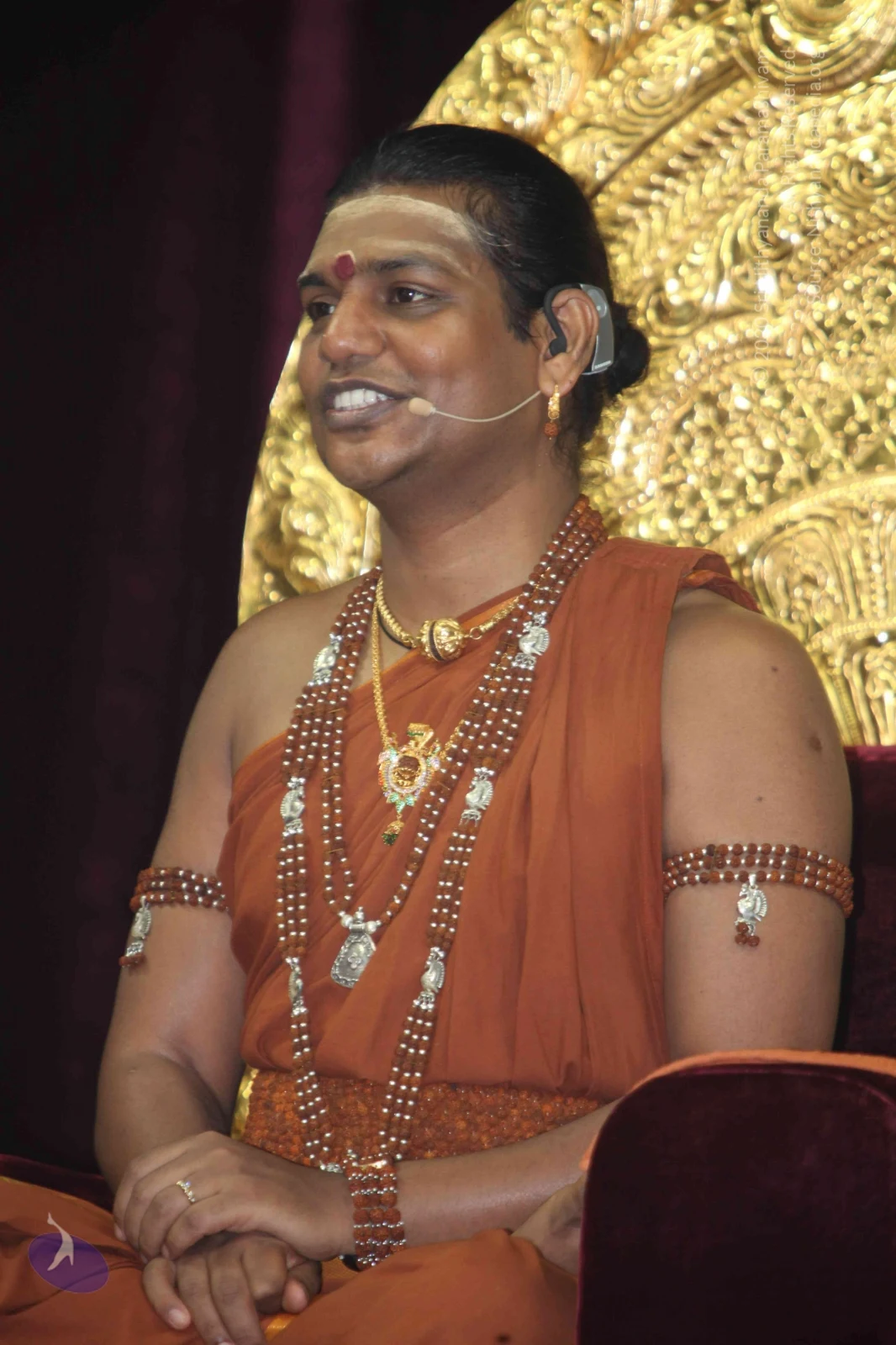
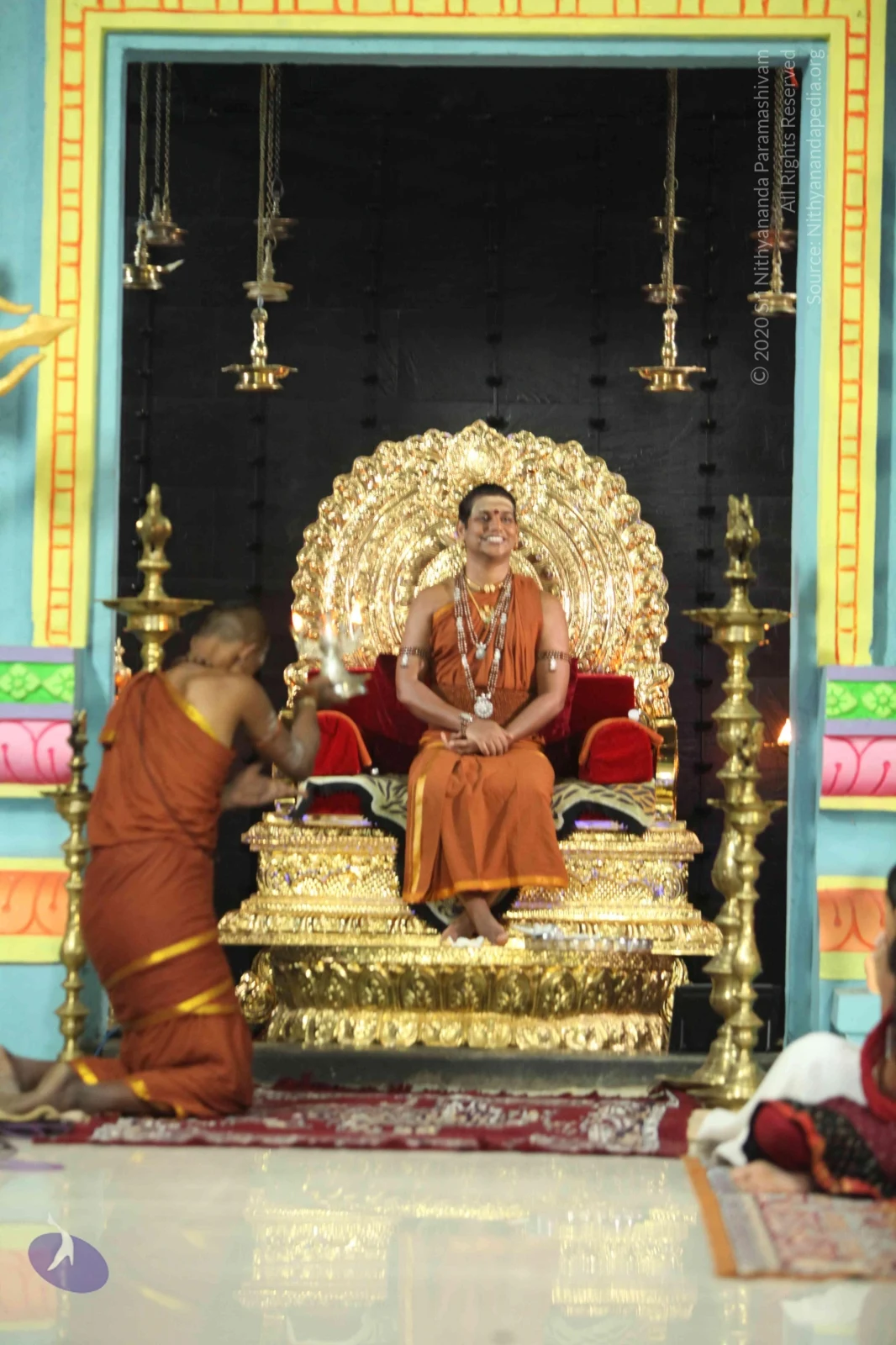
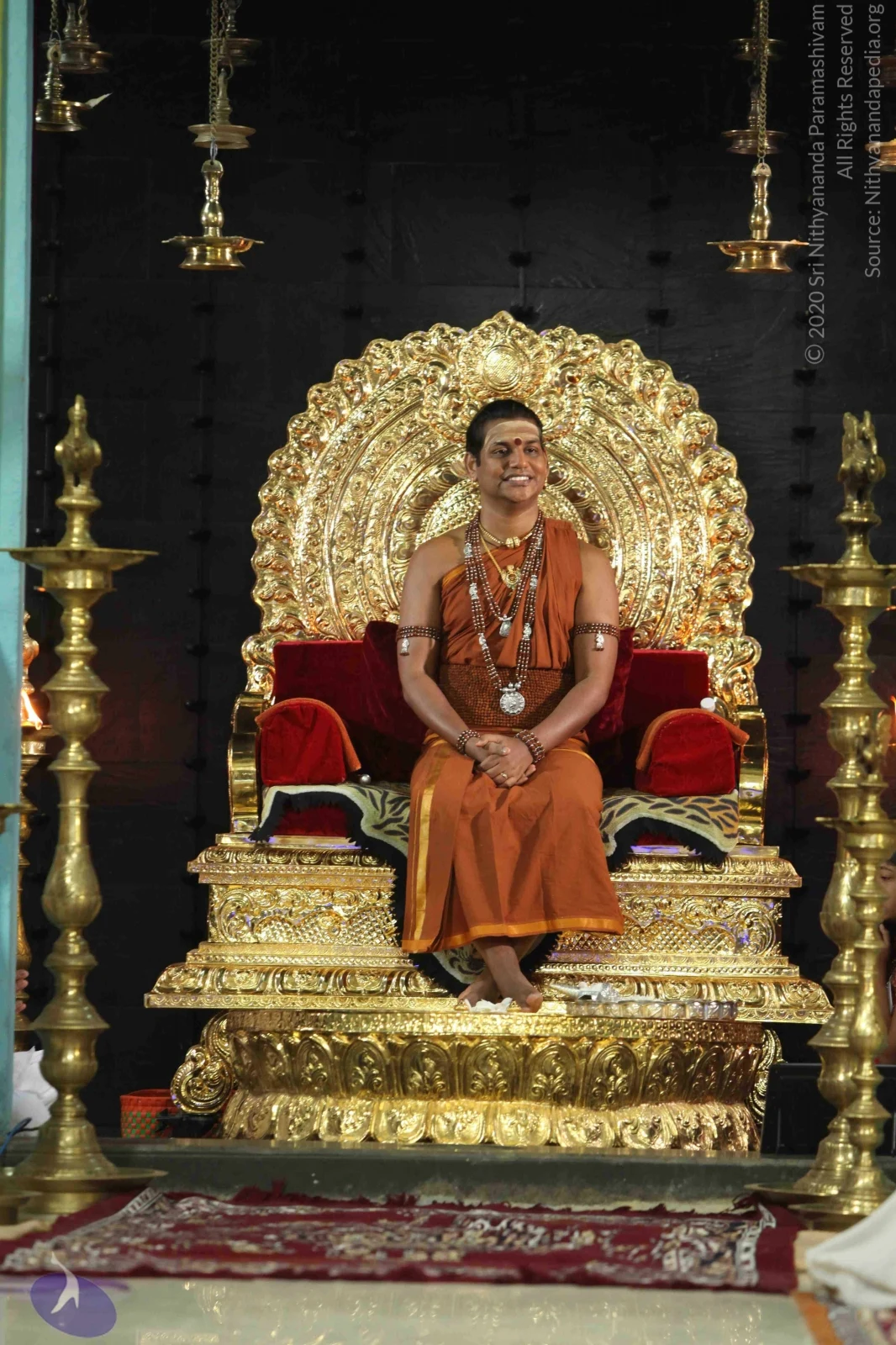
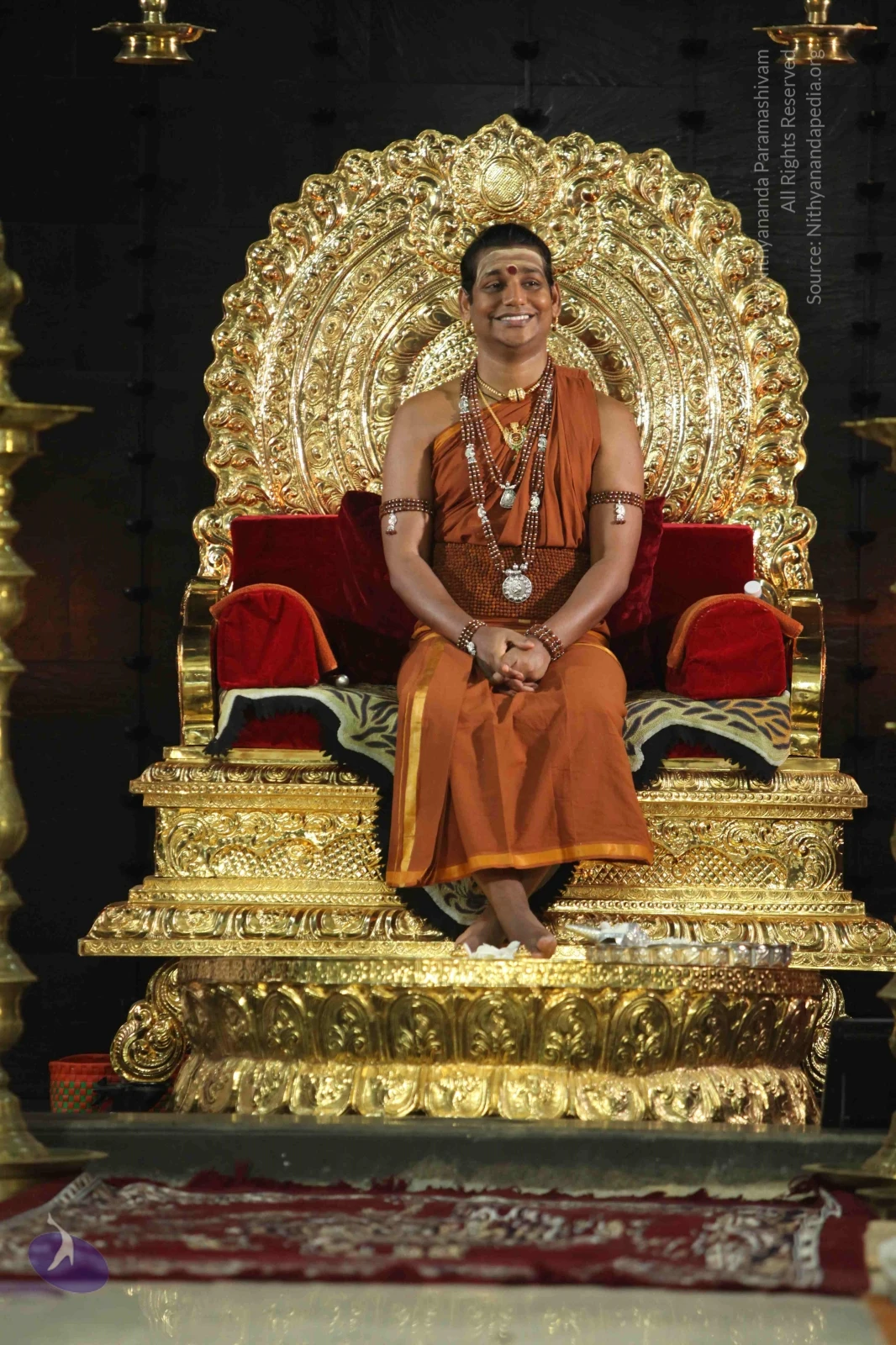
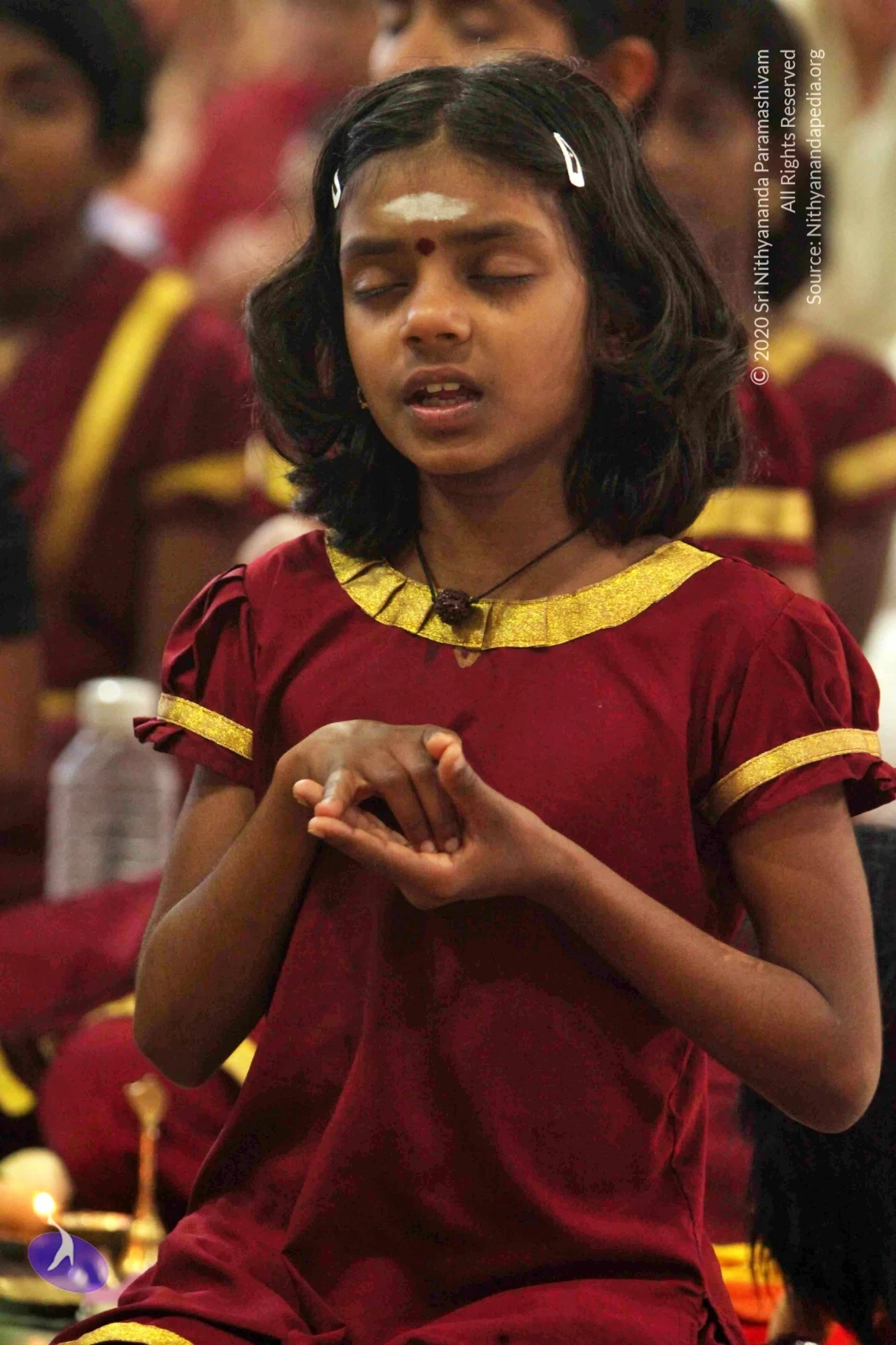
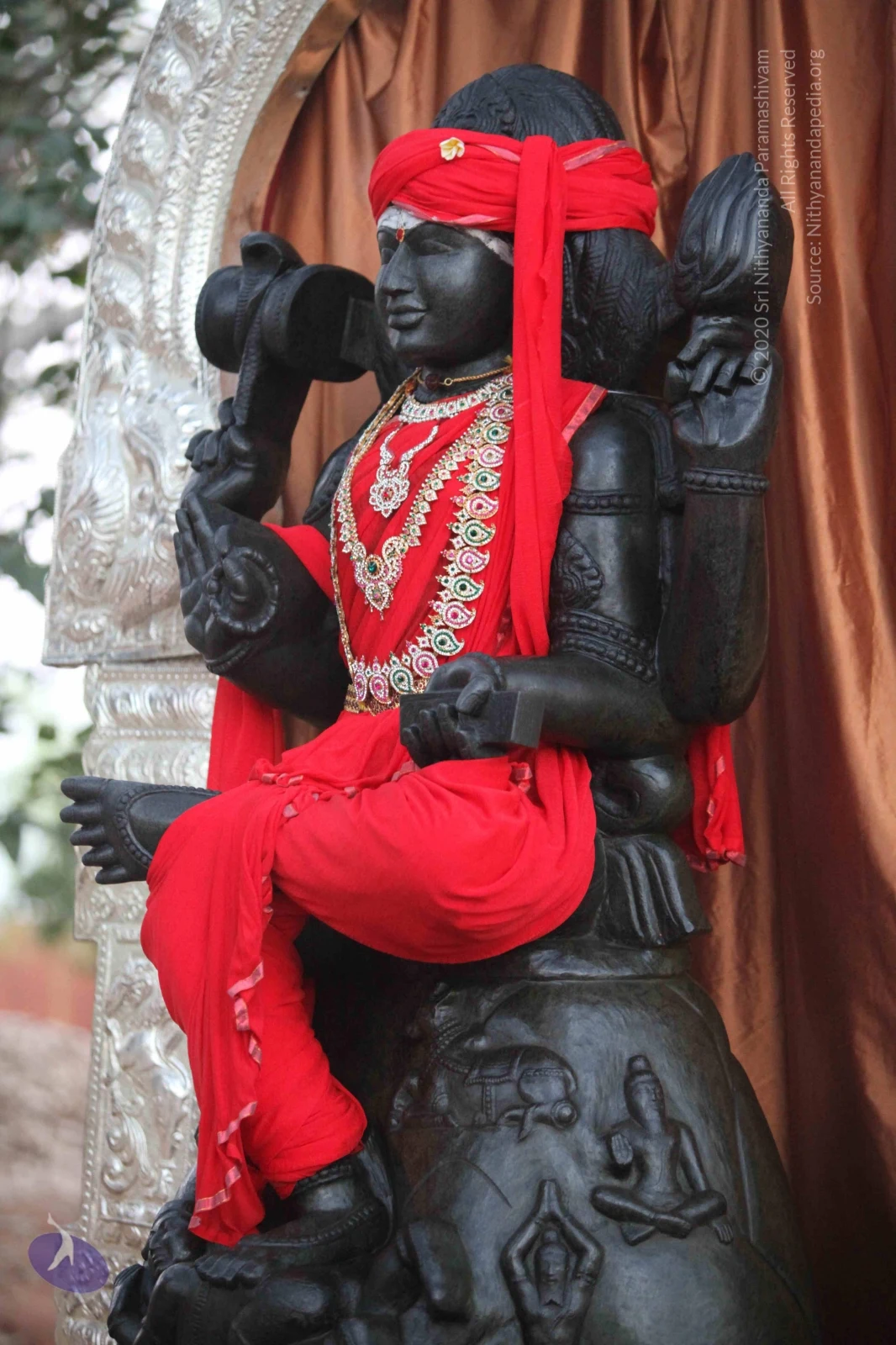
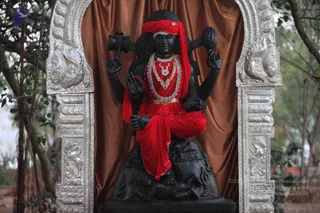
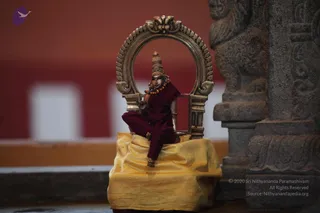
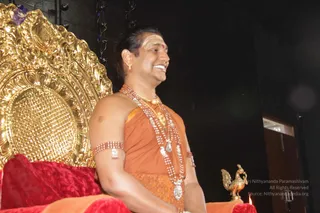
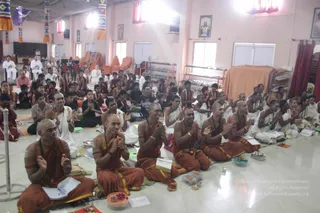
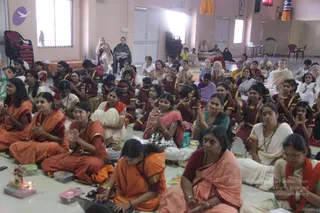
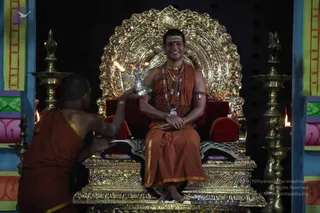
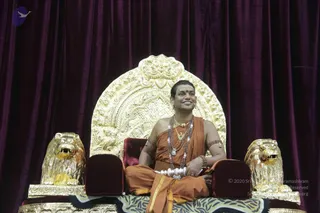
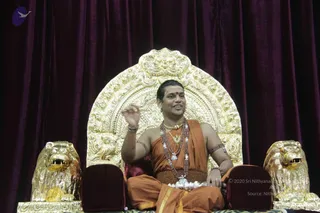
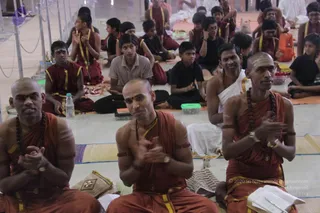
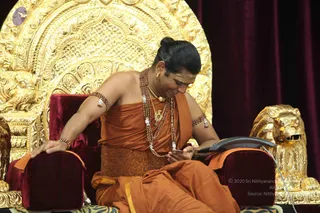
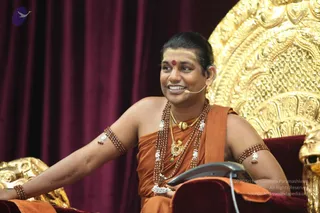
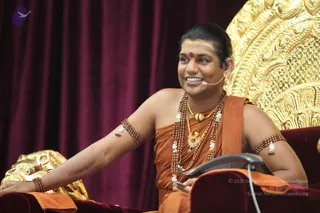
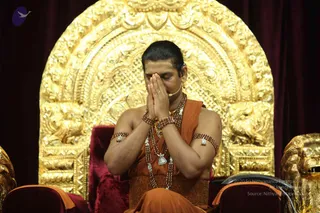
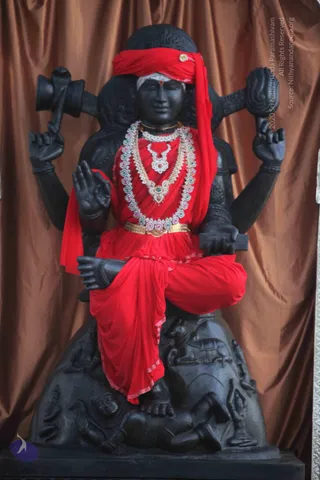
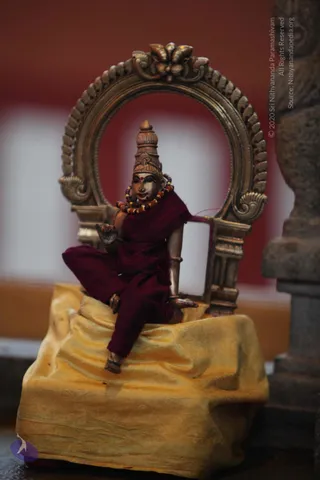
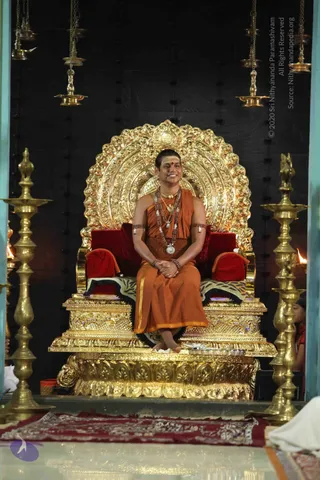
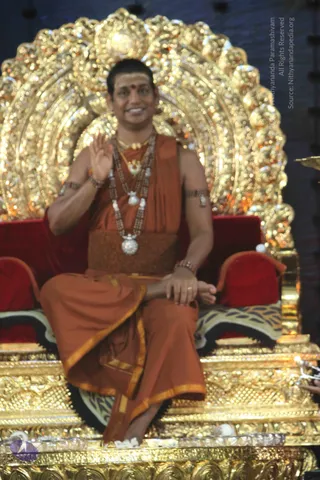
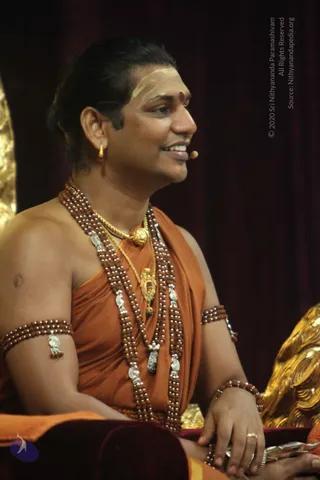
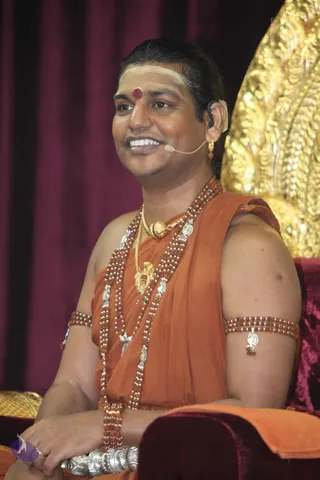
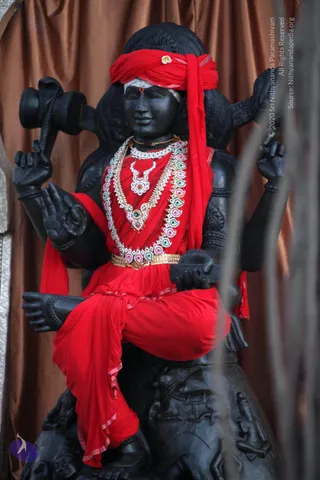
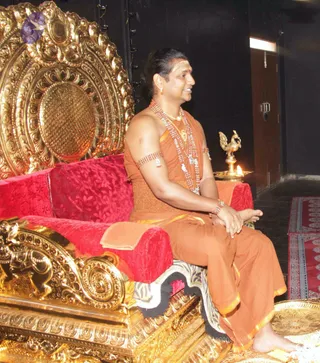
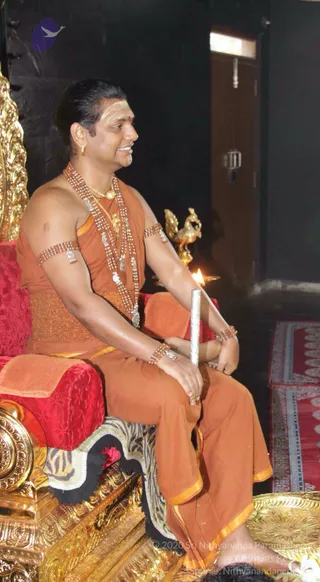
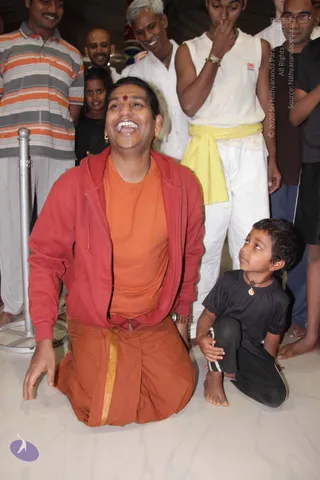
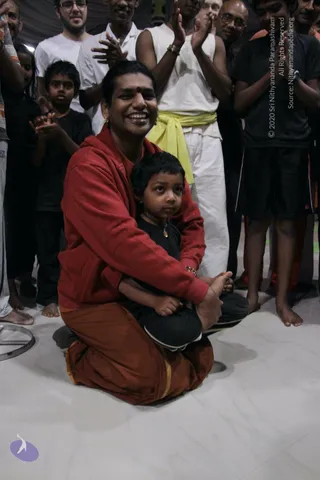
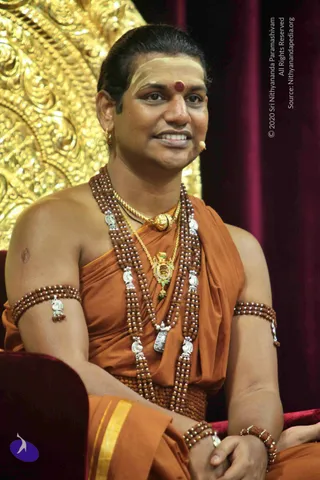
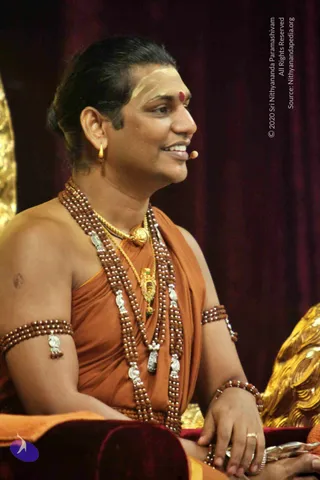
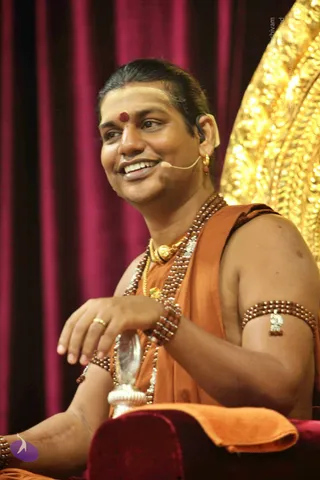
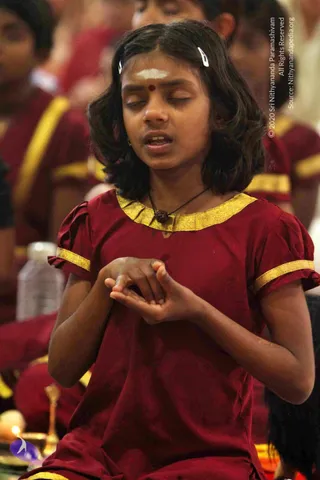
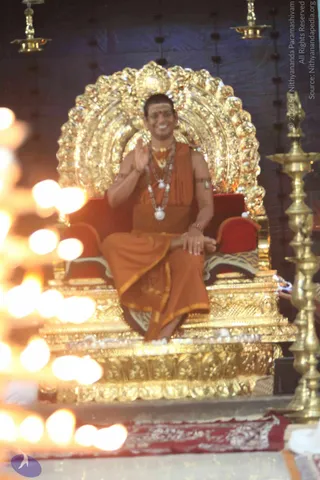
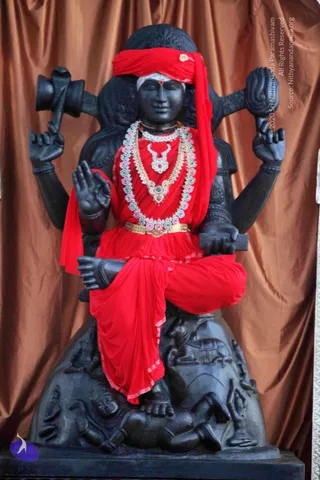
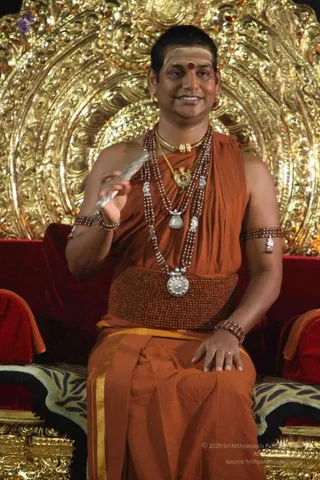
A photograph of a smiling man seated on a red velvet armchair in front of an ornate gold throne with carved lion heads on the armrests. He wears a saffron-orange draped robe over his shoulder, a brown wooden bead waist belt, multiple rudraksha bead malas and a gold pendant necklace, gold armbands and a red bindi on his forehead. He holds a small dark object in his hand. a person: the man has a swept-back hairstyle, saffron robe, rudraksha malas and ceremonial gold ornaments, and is seated on a throne, consistent with the page reference to a person at this event.A seated group of children and adults clap and watch an event, with several boys in maroon shirts with gold trim and dark-shirted children in the foreground. In the front left, a man with white sacred ash marks on his forehead, arms and chest wears a white dhoti with a gold border and his palms are pressed together in a greeting gesture. Behind them, a man in a white kurta clapping, a bald man in a pink shirt and a boy in a white shirt sit among rows of chairs. A brass plate and small offerings rest on the floor mats.A black stone deity murti seated in a cross-legged posture before a brown draped curtain, framed by ornate silver repoussé panels with peacock-like motifs. The murti has four arms holding a damaru-like drum and a flaming object, with raised hands in abhaya-style gestures. It wears a red cloth draped over its body and head, a red dhoti-like wrap, a multi-strand jeweled necklace with coloured stones, and a gold belt. A vertical tilak and a white band cross the forehead. No living people are present.

January 18 2013

Original wiki page
Contents

Title

Video and Audio - Gurukul Milestone - Levitation || Nithyananda Satsang

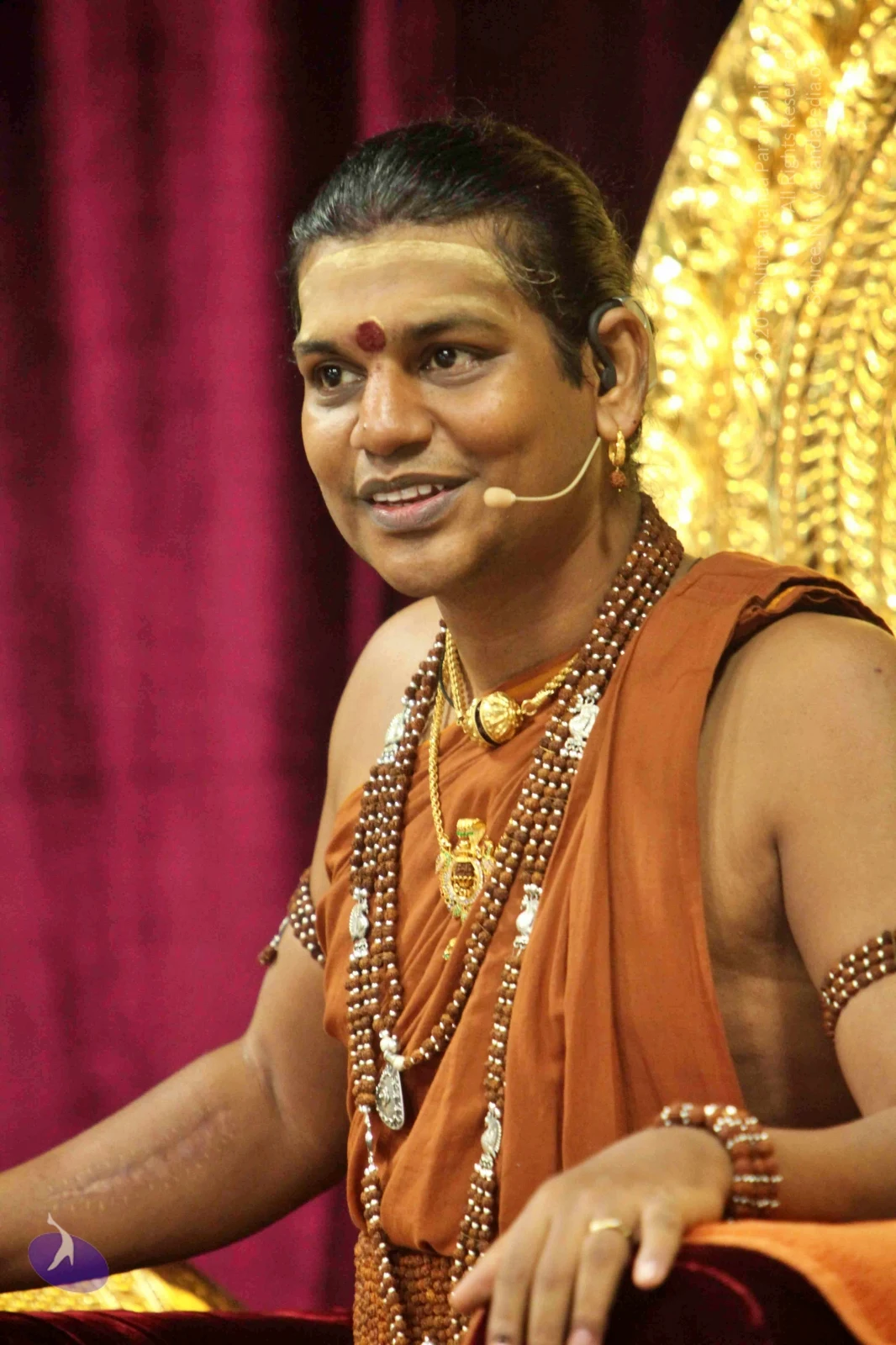
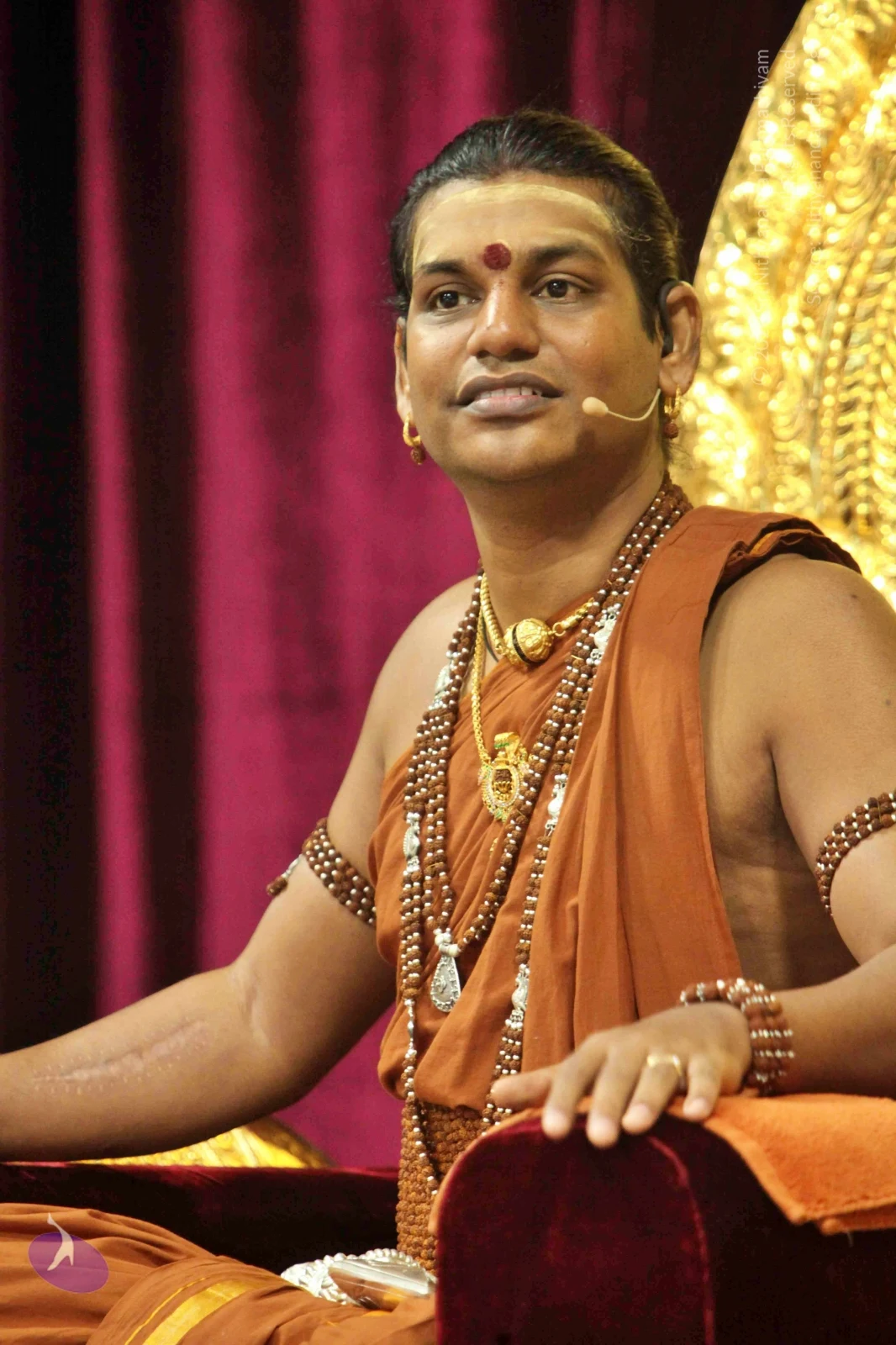
In this video Supreme Pontiff of Hinduism HDH #Nithyananda Paramashivam announces that he was able to successfully initiate a Gurukul student into the power of levitation. He says the Gurukul students will experience a very stable levitation that will be easily captured in pictures and video. HDH declares that upon completion of their studies at the age of 18 years, each Gurukul student will be a genius; and that now the science of making Gods starts expressing physically.

VideoAudio

Transcript

(00:15) Sadāshiva samārambām jnanasambandhaācharya madhyamām Asmadācharya paryanthām vande guru paramparām

(00:44) I welcome you all with My love and respects. And today another one important milestone - I made a first child levitate today! And... I was waiting for the gurukul kids to evolve, to receive the Kundalini Awakening, today we did.

(01:22) When I blessed it just clicked with him. See, it is not necessary always My blessing clicks. The person also has to be without filters. If the person is with filters, it’ll take little time to click. It was so beautiful. His inner space caught it. So, that gave Me so much of joy. Then I allowed him to continue with this yoga.

(01:52) Today is a milestone for gurukul kids... And... real milestone for gurukul kids. Because now.. it is now just a simple downloading of the bio memory. I can tell by tomorrow the whole gurukul kids will start levitating. Today, tomorrow we have two sessions, one or two days only it will take, not more than that. It's just tak tak tak tak tak transmission, over.

(02:44) Nothing else. Transmission of that bio memory. That's all. Nothing else. Hmm. So, today will be the actually milestone of the history of gurukul. Because... You see, I was waiting for the gurukul kids to get prepared. Now immediately you will see levitation will start happening. Not like you guys hopping, there’s be a very stable levitation. They will stay in the air for photography and videography.

(03:27) See, when you, we take pictures of you guys levitating, we will not have a clear picture of you in the sky. Even if we get you off ground, we will get you only moving. But when you get a pictures of gurukul kids in, off ground, you, you, you will see a clear, unshaky frame. That kind of levitation they will have.

(03:50) Millions of doors now open. Millions of doors to experience the Nirahara samyamas, all samyamas. Millions of doors open. God! Now the science of making Gods starts expressing physically.(applause) Our gurukul has become a happening place. (applause) Maybe in a month we will do the MRI, CT scan, QEEG and prove our kids brain are active, alive, intelligent, aware at least ten times more than outside school kids.(applause)

(05:17) At least 10 times. And I commit with integrity and authenticity at least ten times... Each of My kid by 18 they complete the education, they will be geniuses, not just having a degree or.. genius. Nothing less than genius. (applause) We make geniuses. I tell you one more thing, very soon hundreds and hundreds of people will come and settle down in the ashram just to keep their kids in the gurukul. (applause)

(06:07) You’ll see. I will have hundreds and hundreds of ashramites. The main reason for them to become ashrimite is that they want their kids to grow in gurukul. (applause) We just now need to build a infrastructure, nothing else. Just build infrastructure. Child prodigies, we will create. Hmm.

(06:37) Just we want some more places to be built. Construction has to happen. That’s all. Nothing else. Anyhow, now we are building people, naturally building will happen.

(06:52)

Video and Audio - Deeper Truths about Authenticity || Part 1 || Nithyananda Satsang

Transcript

(00:15)

Sadashiva Samarambham Gnanasambandam Acharya Madhyamam Asmad Acharya Paryantam Vande Guru Paramparam.

(00:43)

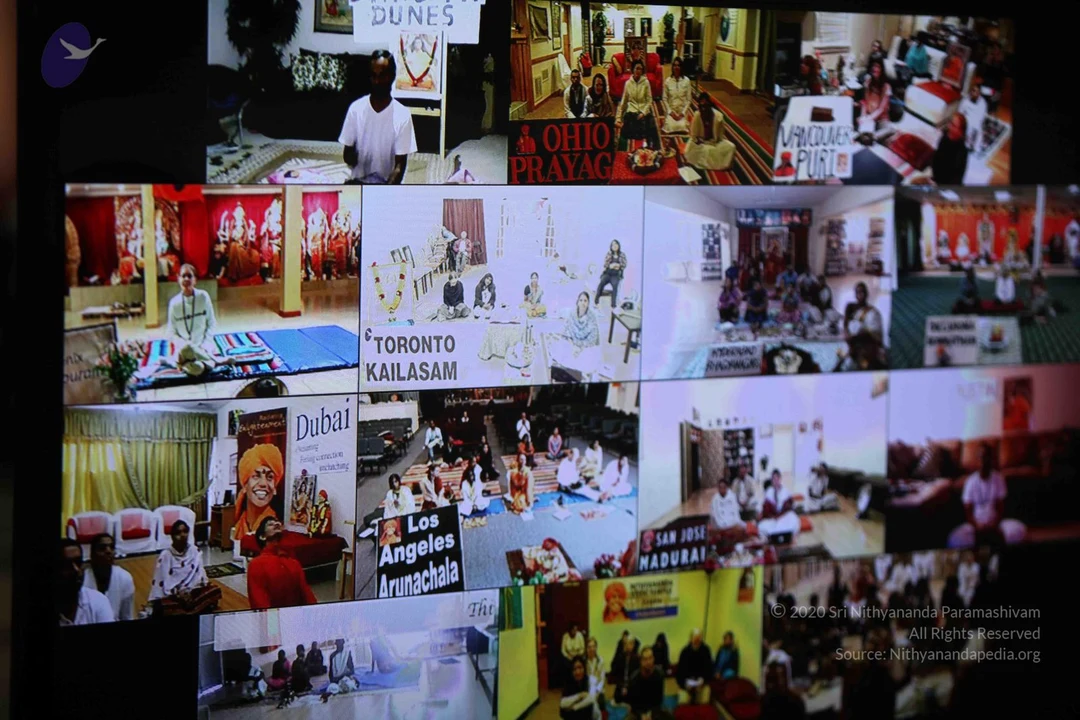
I welcome you all with My love and respects. I welcome all the devotees, disciples, samadhis, satsangis sitting with us in 446 places...Nithyananda TV, 35 places two way video conferencing having a Nayanadeeksha. In 228 cities in 25 countries around the world. I welcome you all with My love and blessings.

(01:23)

The cities sitting with us in 2way video conferencing having Nayanadeeksha. Dakota - Dunes, Vancouver - Puri, Ohio - Praya, Seattle - Chidambaram, Los Angeles - Arunachalam, Dubai - Tiruvannamalai, Oklahoma, Hyderabad Bhagyanagaram, Toronto Kailasam, San Jose Madurai, Austin, Sidney - Australia, North Hollywood California, Hong Kong Adyar Chennai, Johor - Malaysia, Omen Sivagangai, Bangalore - Nithyananda Vidyalaya, Lawspet Pondicherry, Sripuram - Chennai, Chicago Loop, Ayvarped Malaysia, New York - Varanasi, Singapore - Singhapuram, Guadalupe - Rameshwaram, Charlotte SriSailam, St. Julien - France, Bengaluru - Marathahalli, St. Louis Turvamala, EdgeWater New Jersey, Louis Ville - Kenntucky, Malleshwaram Atlanta Ujjaini, New Zealand - Adiarunachalam.

(02:32)

I welcome all of you with My love and blessings. Today, Nirahara Samyama, third level second day. And beautifully, as per My Anyakara, Brahmanyam Bahuputratam is happening. I tell you guys, this is the greatest blessing you guys can give for Me. Evolving to My Anyakara. Really, even if you don't evolve, I have no other way. I commited with you guys I have to take the responsibility for your inauthenticity and we will have to pull along. Neither you are going to leave Me, nor I am going to leave you. We will pull along, pull along for years and janmas and I won't leave. But you guys have blessed Me without the need for pulling along.

(03:52)

Really, So beautifully. The whole ashram is evolving to the new tattva. To all the new tattvas, four tattvas: Integrity, Authenticity, Responsibility and Enriching… Yesterday I was meditating. I realised the whole Rgveda stands for Integrity. Whole Yajurveda stands for Authenticity. The Katho Upanishad is in Yajurveda; Shraddha. Whole Yajurveda stands for Authenticity. Whole Samaveda stands for Responsibility. And, whole Atharvaveda stands for Enriching.

(04:57)

So these Chaturvedas, I was looking at the Upanishad… See, I wanted to embed Upanishad in Gold. Golden Letters and display in our temple... So that time I was working on what all Upanishad to choose. I wanted to spread all Vedas. So from each Veda I wanted to pick up two, two Upnishad. Well known, authentic, ancient Upanishad, not recent one. There are some recent ones also. Means like a in the course of times there is a recent day, they added. There is upanishad, Allaho Upanishads, you should know. Singing the glory of Allah. During Muslime period it was written. No, yes, It is Allaho Upanishad, it is called. It is, it is there. Ahu.. So of course, these all recent Upanishades but, the ancient, old Upanishad. See, from each Vedas, they wanted two Upanishads. So I was working on it.

(06:13)

When I picked up, I was shocked... seeing the coincidence. The whole Ishavasya Upanishads is Integrity. The whole Katho Upanishads is Authenticity. The whole Kena Upanishads is Responsibility. The whole Parivraraj Upanishads is Enriching... I'm still working. I'll come up with more and more details and references. I was wondering how to make Deities for all these four Vedas. Now because each Vedas represent each Veda, we will have the same Veda Deities. Deities of those Vedas.

(07:12)

And I'm also seeing so much of auspiciousness. Because you guys evolve in tattva. Kalabhairava is so happy. Kalabhairava has decided to build this whole campus beautifully... And make this campus alive, living. Now I don't even bother about construction, these, that away. Everything will happen. Because building human beings is the basic need, which is happening now. So now everything else will follow. All the materials will become buildings.

(08:06)

We were literally having material outside stones and inside stones. When the inside stons become temple, outside stones will become temple. see, we have material for ten temples, do you guys know? How many lakh stones we have? Three lakhs stones we have. One thousand pillars we have. And how many thousand square feet flooring stones, we have? Around forty thousand square feet, easily. Fifty thousand square feet stone, flooring we have. It is not become, temple, why?

(08:51)

Because human beings have not… You guys are also still... now, raw material. When you become the product, that also will become a product. I can see Kalabhairava is doing it. It is not a Vastu problem, it is va-stu problem. It is not the problem of Shani, it is the problem of you allowing Shani to influence you. Cooperating with Shani, instead of realizing and competing with Shani... And I'm also going to add new clarity with these Chaturvedas, with these truths to Navagrahas. Inauthenticity is Rahu, Covering the inauthenticity inside you is Shani. Justifying inauthenticity is Shani. Being reminded about your inauthenticity is Kethu. Taking responsibility for your inauthenticity and enriching others is Guru.

(10:19)

Aligning yourself with integrity and directly enriching, without taking authenticity is Shukra: Asura Guru. Asuras have high level of integrity but not authenticity... High level of integrity. If they give word, they live by it and die by it. But not authenticity, not authentic, and not responsible... I’ll help you guys to understand, all these Grahas also. With this Chaturveda. Come on, let's enter in today's satsang.

(11:27)

In the Integrity there will be two doors, two routs. Entrance to authenticity and its Ok. With entrance to authenticity you enter the Ultimate, If you just take the road, It's Ok. You entered, “into hell” One person, who is inauthentic is enough to destroy a whole group. One drop poison is enough to destroy the whole pot milk. You can't say: No, no, no. How can this be? So much milk, only one drop, poison. That's the way life works.

(12:16)

Because poison is stronger. Inauthenticity has its own seductive power... Just like your fantasies you create, seeing the porno, pulls the external women or men or pushes you to external women or men. It’s ok, cute feeling which you carry inside, pushes you towards inauthenticity. What is that which pulls you towards the external women? The fantasys you carry inside. What is that which pulls you towards the external men? The fantasys you carry inside you. Same way, the concept you carry inside, It's ok. It’s ok, means you are attracting inauthenticity, going towards inauthenticity. The collective, “ It’s Ok” awakened at that time.

(13:45)

When the collective “It’s Ok” wakes up, the Buddhi - Medha, intelligence itself votes for Inauthenticity. Understand. The words we discuss, the words we comment, the words we pass while we are in a casual mood is your mind. Not the words which you utter in front of Me. That doesn't... become mind. That stays as Intellect, that doesn't become art. Understand. There is only paint. The words you utter while you are casual, it’s ok mood, that is the foundation. The logic, is being used to justify inauthenticity is shukra. Shukras, the Shukra not gracing. If the Shukra’s grace us , the logic will be used to discover Inauthenticity. If Shukra doesn’t grace …

(15:06)

Sometimes if Shukra is engaged by Buddha, some other forces, or he is busy with Surya, your logic will be used to justify your Inauthenticity. But unfortunately the whole thing has happened in unconsciousness. Mahadeva knows now the unconsciousness of the Cosmos is getting poisoned. He wakes up. He takes the responsibility for the inauthenticity. He pulls out that poison from... The deepest subconscious level, menas the depth of the ocean. He pulls that out and if he does not drink, take the responsibility, who will take?

(16:32)

I take the responsibility for the inauthenticity of the Humanity, and I'll make sure the Humanity gets out of its Inauthenticity. Shiva meditates, does Tapas for Humanity to get Enlightened.. Takes the responsibility. I take responsibility. He says: “I'll stay in Smashan. I'll just have ordinary Rudraksa as My Abarana, and sacred ashes, ash as My cosmetic and some lion, the tiger skin or elephant skin as My blanket and bed sheet.

(17:38)

When He does all these, He takes up the responsibility for the inauthenticity of the people, means what all come to you through inauthenticity, I am not going to have it. What all makes you inauthentic I am not going to have it. What, from where inauthenticity comes, towards which the inauthenticity moves, I'm not going to have it. Means I don't like inauthenticity. So I tell you tell you, the real renunciation is, out of which you derive in inauthenticity, towards which your inauthenticity drives you, renounce that! That is Tapas. Renonciation means, out of which inauthenticity derives is derived, towards which the inauthenticity drives you. Renounce that!

(18:45)

Video and Audio - Deeper Truths about Authenticity || Part 2 || Nithyananda Satsang

Transcript

(00:16)

Renounce the beginning of your inauthenticity and end of your inauthenticity. Both will be pleasure. It is out of the pleasure memories inauthenticity arises. It is towards the pleasure inauthenticity drives. Memory to pleasure is the journey of inauthenticity. What is the length of inauthenticity? Mem, pleasure memory to pleasure is the length of inauthenticity. If you renounce both the ends, inauthenticity will shrink and disappear.

(01:00)

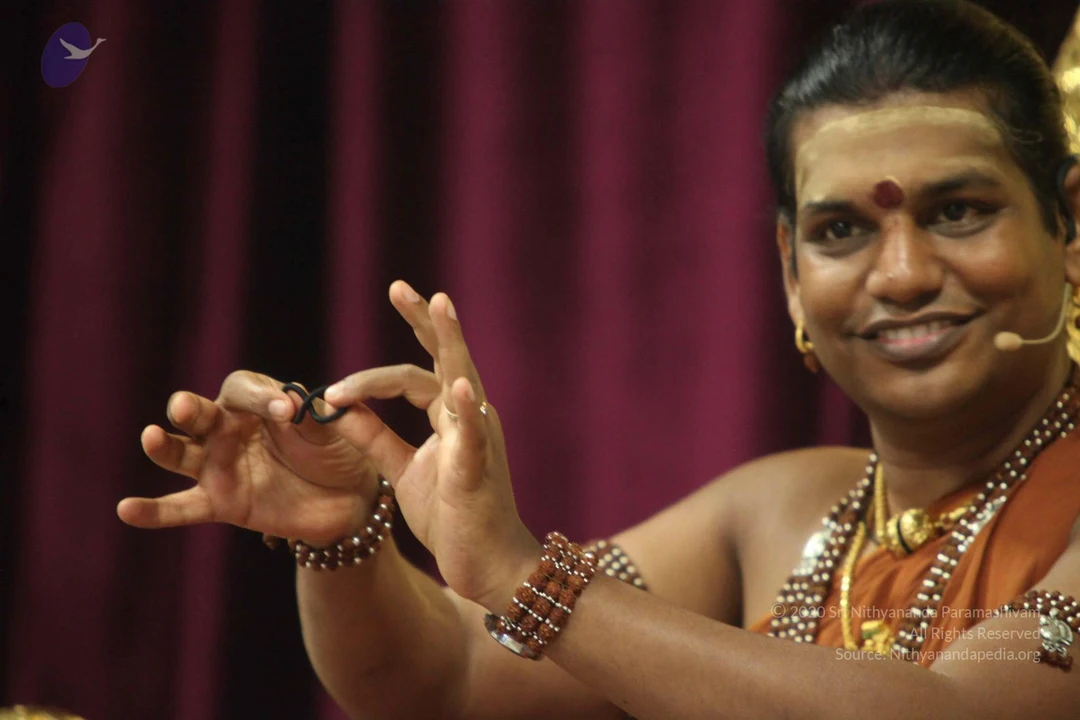
Understand, there is an elastic wrap, rubber, wire. You pull. One end is pleasure memory, other end is pleasure. If you renounce both the ends what will happen? It’ll shrink. Listen, If you pull both ends, this end is pleasure memory, this end is pleasure. From pleasure memory inauthenticity starts to, towards pleasure, pleasure it leads. If you remove the pleasure from both ends and renounce both ends, what happens? Inauthenticity shrinks and disappears and if you bring the twist in inauthenticity means… try to authenticate your inauthenticity, try to hide your inauthenticity by justifications. Now it is what? Nothing. Zero. Am I right? Zero. You bring the twist, it becomes infinity. Your inauthenticity will become infinite. That is maya.

(02:35)

Understand! It is zero. When you bring a twist in the inauthenticity, it becomes infinity. Am I right? Now it’s a symbol of infinity. So maya is அனாதி(anadhi) when it is twisted by the justification. Authenticity become, sorry understand, inauthenticity becomes infinite when you twist it with justification. How many of you feel, “God. The maya in front of me is so big, Infinite. When will I cross this?” Authentic raise your hand. When you stop justifying your inauthenticity, infinite will become zero.

(03:39)

Infinite is not infinite. If you can drop your justification of your inauthenticity. How many of you know, still you are justifying your inauthenticity? Raise your hand. I’ll raise My hand. Understand. I’m giving you the shock. I’ll explain now, how... How many of you authentically with integrity justify? Please, tell Me. With authenticity and integrity declare how many of you really still justify your inauthenticities? Raise your hand. So, for all of you: maya is infinite. Just now I made a statement. I also do the same. With only one small twist, I know any moment I can remove this twist.

(05:02)

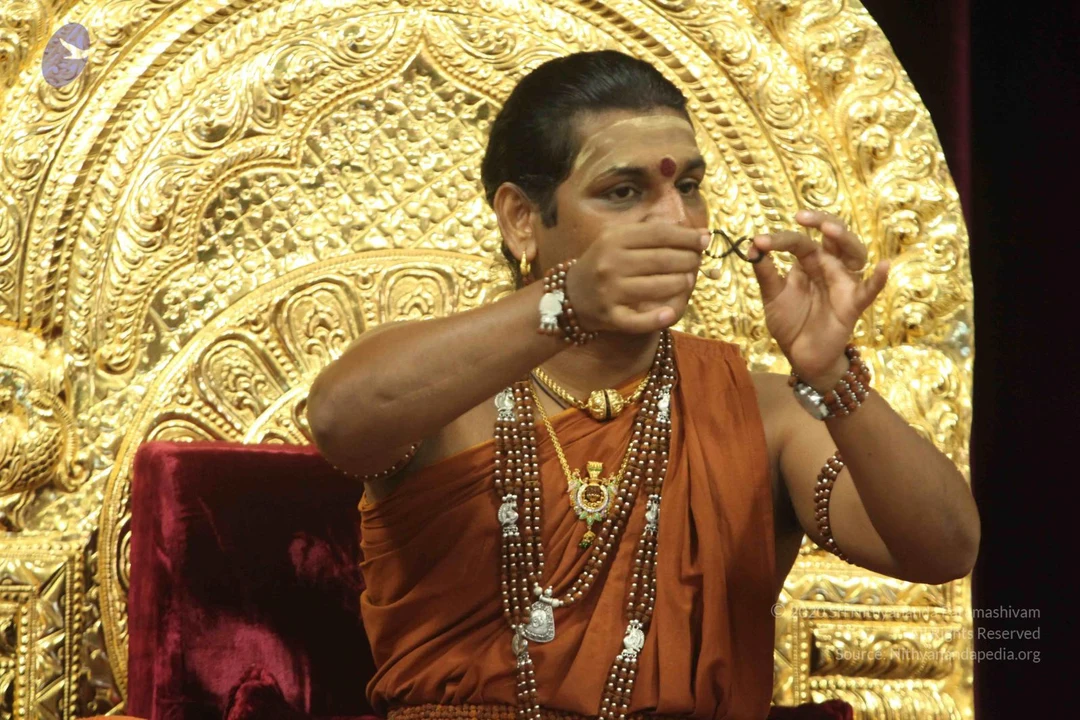
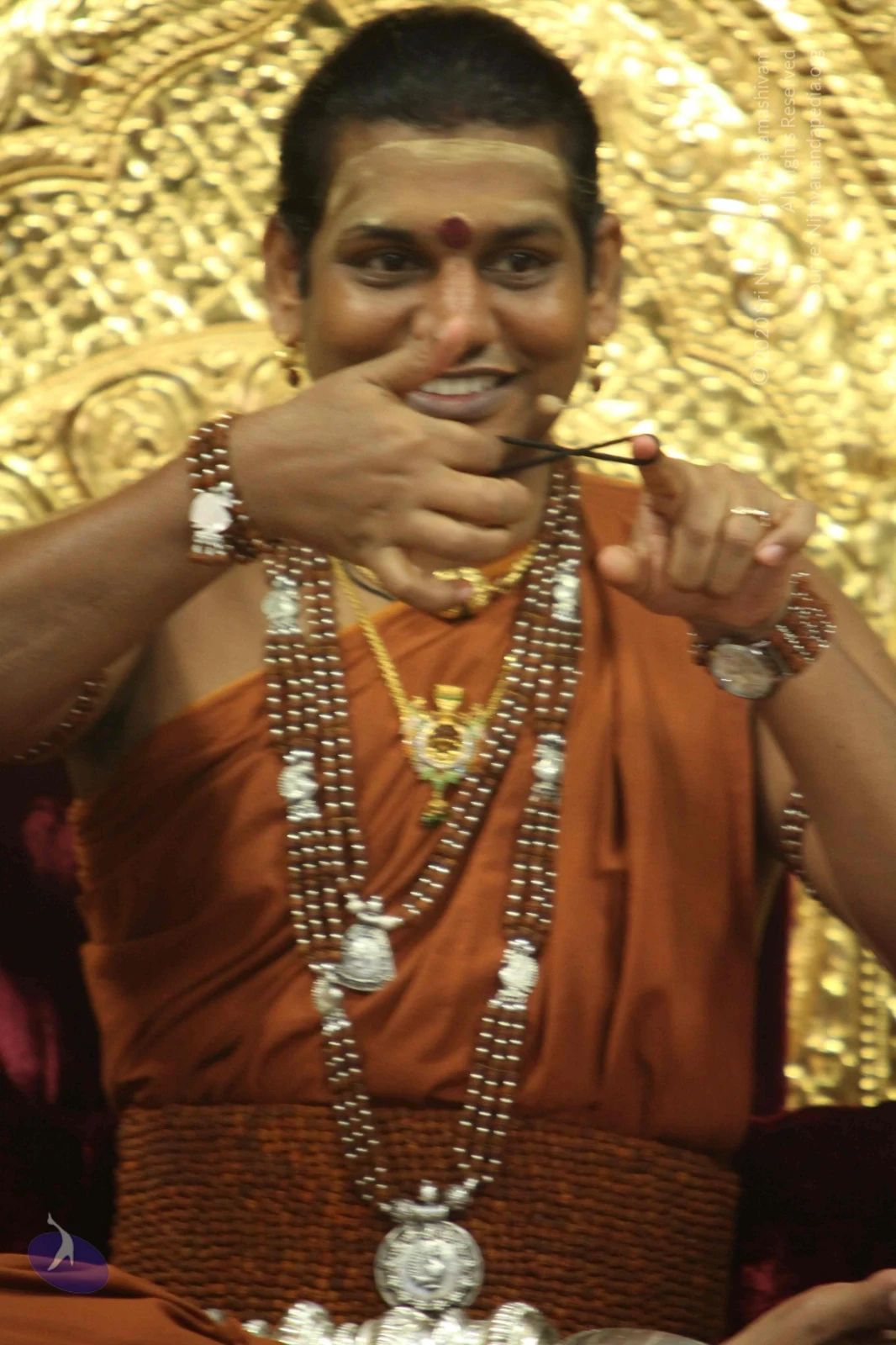
The identity which I’m showing as an Incarnation hood is a twist which I have to play, for you to understand the twist. The body I'm carrying is not infinite. The being I'm projecting to you is not infinite. The being I feel is infinite. The being I'm projecting to you is not infinite. That is what I mean, even this form is not ultimate. When you come near, I will… see this rubber band, looks now infinite. This is not infinite. What for it is shown like infinite when you come near, this infinite will be shown to you and the science will be shown to you how to make this as zero again.

(05:59)

When you end from My one end of listening to My words, the infinite will be shown. When you travel, travel, travel, travel, travel towards Me, the zero will be shown. By then you will know the science of moving from infinite to zero. That is what Krishna means when He says: “If you know Me you will be liberated.” If you know My zero you will become zero. Are you listening?... I’ll give you the example:

(06:50)

Yesterday I declared a statement: Jnanasambandhar does not talk about any food, about any food item. Jnanasambhandar gave Me a Darshan and told Me: “I do not have a food pattern, so I’d never sang anything of food pattern in Me, in My verses.” I declared that, but Tamil department, Publication department discovered some 5 references where he speaks about, he mentions the word ‘sugar cane’, ‘banana’, ‘mango’ and the ‘rice grain’, ‘rice grain’. 5 places, 5 or 6 references they brought. You understand! Now, what you will think? ‘The Swamiji’s vision of Jnanasambhandar is not authentic.’ Is it not ? That is where you have to land, come to the conclusion.

(07:51)

But when I went to the room and read the print out line by line, I was so happy. I tell you, I was so happy. I discovered what Jnanasambhandar said is a complete truth. Honest truth. He lived without any food pattern in his whole life, because all five names of the food items he is using just to refer their colours, never as a eatable product. Understand, when he sees mango, he remembers the colour of yellow. He is using the example of mango not for the taste, colour of yellow. When is talking about sugar cane, he is not using for the taste of the sugar cane, the height of the sugar cane. 5 eatable, edible products he is using, not even once he is mentioning related to the food pattern. Do you understand?

(09:07)

God. What he said is true. What Jnanasambhandar said is true... Read all the 5 references. Nowhere he is connecting that product to the taste. The moment I utter the word ‘sugar cane’, what do you remember? Read.

(09:38)

“கையரு கேகனி வாழையீன்று கானலெல் லாங்கமழ் காட்டுப்பள்ளிப் பையருப் கேயழல் வாயவைவாய் பாம்பணை யான்பணைத் தோளிபா, பணைத் தோளிபாகம்…”

(09:50)

He is not using the banana with the taste. Please understand. What he is telling:

(10:05)

கையரு கேகனி வாழையீன்று கானலெல் லாங்கமழ் காட்டுப்பள்ளிப்...

(10:09)

Means, when you cut the banana whether the, after it ripes or the tree, it doesn't die. It goes on multiplying, becomes a forest. So the banana is not referred here as the edible. It is referred here to the point of expansion.

(10:37)

பையருப் கேபழல், கேயழல் வாயவைவாய் பாம்பணை...

(10:41)

(10:47)

“முடிகையி னாற்றொடு மோட்டுழவர் முன்கைத் தருக்கைக் கரும்பின்கட்டி கடிகையி னாலெறி காட்டுப்பள்ளி...”

(10:55)

Here what he says: முன்கைத் தருக்கைக் கரும்பின்கட்டி...

(11:00)

Means, just like a sugar cane - the hand >>Swamiji is measuring his arm with his hand>>

(11:09)

All of you understand? So he is referring the measurement of the sugar cane, not the taste of the sugar cane. Context is not the taste of the food. If he refers ‘tiger’, for somebody it can be the context of food, because they eat. If he refers as ‘Rishabham’, buffet, bull. For somebody it can be reference of the food because they eat McDonald’s burger, but what he means by the ‘Rishabham’, he means the vehicle of Shiva. Understand? So, you cannot bring this as a reference to tell: He referred about edibles. Then he speaks about Rishabham. What about that?

(12:08)

தோடுடையசெவி யன்விடையேறி…

(12:11)

Second line is edible. >>Swamiji laughing>> Am I right?

(12:20)

தோடுடையசெவி யன்விடையேறிய பங்கன்... காடுடையசுட லைப்பொடிபூசி

(12:33)

So, how he measures the, how he refers the bull, the same way only he refers the sugar cane. All of you understand? Now, this is this. >>Swamiji showing rubber band as infinite>> This can be considered as the justification of what I declared. Superficially. If you walk in, you will understand this zero. When you walk into Me by listening, you will understand the authenticity of the declaration yesterday happened. Yesterday, I did not tell this in the satsang. Yesterday I only told in the satsang: I referred throughout, ah, 4000 songs. There is no reference about the food. That’s what I made a statement yesterday. Am I right?

(13:30)

But today what statement I made. Jnanasambhandar gave Me Darshan and told Me... Actually, honestly I have not read all the 4000 verses. Even if I have started preparing whole night, can I go through all the 4000 verses? When I revealed in the yesterday's satsang, I… I revealed as if… I had been through. See, first time when I declared, in all 4000 verses there is no word of ‘Saiva Siddhanta’, at that time also I never verified. Jnanasambhandar verified and told Me. It was a Darshan. Yesterday again it was a Darshan of Jnanasambhandar. He told Me: “Ey, I don’t, I haven’t, I lived as Nirahari. I don’t have a food pattern. I never sang about food in my verses. You declare this.” That is why I declared.

(14:36)

Now what I showed yesterday is this >>Swamiji showing rubber band as infinite>> Complication. The infinity maya. Especially the statement I made, I did not even make it very clearly, that Jnanasambhandar told Me and all that. I just said: “All 4000 verses I verified, he never sang about... what? Food. When you hear that statement, when you look at Me, you feel I’m infinite ‘Oh God! How can this fellow finish all 4000 verses? It is so authentic. It is true. Oh. Wow. Wow. Wow. Wow.’ When you bring these 5 reference you can say: He is just justifying. Now any refe., anything I respond to it, you can call it as justification of his inauthenticity. Then I continue to stand as justification of inauthenticity to you. Only then hoax scandals are created.

(15:36)

But when I let you listen and ask you to come in and give you the references of all five, see, is there anywhere, he is connecting with these items with the taste or eating? How many worked and got these five references? Do you understand what I said now? Not a single place, he equates them with the taste or eating. You understand? He is not saying ‘the taste of sugar cane’ he is saying ‘shape of sugar cane’.

(16:21)

In every reference, I only see all other things related to the food... He even talks about the medicine, but never talks about as eating. In Hindu tradition சுக்கு is medicine, medicine especially Tamil Na, Tamil Nadu, சுக்கு is a medicine.

(16:53)

“இடுதுயர்க் காயொடு சுக்குத்தின்னும் நிலையமண் தேரரை நீங்கிநின்று…”

(16:58)

Means

(17:00)

இலைமரு தேயழ காகநாளும் இடுதுவர்க் காயொடு சுக்குத்தின்னும்…

(17:04)

Means ma, understand, it is a old type of alcohol method.

(17:12)

இடுதுவர்க் காயொடு சுக்குத்தின்னும்...

(17:14)

Which is a poison, the எட்டிகாய், எட்டிகா, a very little quantity of the எட்டி with the சுக்கு, சுக்கு is the poison breaker. It breaks poison. எட்டி is the poison. A very little quantity of poison with the சுக்கு, which is poison breaker, it comes up as alcohol. So when you take that, it raises to the head, that kind of person can’t have Shiva. Shiva moves out of him.

(17:51)

So, even here he does not refer food. He refers about medicine. I went through each reference. I just felt “Oh Mahadeva. You came.” Every reference strengthened My trust towards the experience. Authentified, authenticated Jnanasambhandars’ Darshan and I declare today with Integrity and Authenticity, taking Responsibility and Enriching others and Me with the clarity of ‘I won’t give up on Me and others and everything and world.’ I declare: “Janasambhandars’ grace and blessings are there on Me and he is going to express through this body powerfully as 293.”

(19:00)

Video and Audio - Deeper Truths about Authenticity || Part 3 || Nithyananda Satsang

Transcript

(00:15)

What is needed to become an Incarnation, you know? Tremendous courage, to trust the authentic visions and darshans and the metaphysical experiences happening in you. Yesterday when Gnanasambandam gave me the darshan, it was a second moment treating. I should have the tremendous courage to go behind it. I could have thought: “No, let Me refer and then I will come and declare tomorrow.” It won’t work. Declare now. He has said it - done. Put yourself, taking the responsibility of the risk, of proof of this experience.

(01:13)

Second, when you guys brought seemingly negative evidence, having the ability to look in and find out with the right context: “Yes, he is uttering the word about edible, but what way? He does not have pattern...” Clear? (Swamiji laughing). Clarity, ability, strength, to have the patience, not giving up and approaching it with the right context, even if the negative evidences are brought.

(02:14)

Now when you look in, every line, every word, what a pure child. There are some more references today I received. I now itself declare: All those references will not have the food pattern meaning. I have not seen those references... They will not have the food pattern meaning. I’ll speak on every reference and prove My Jnanasambandar is right. I’ll defend Him. (applause) Get any number of references.

(03:10)

When you see a sugar cane and you don’t remember the taste of it, I promise, he never tasted it. If you have tested even once, you cannot go without remembering the sweetness of it. And not one food item, 5 food item. He’s born and brought up in Tanjore, which is filled with banana, rice and sugar patties and mango. And not a single item is referring with a taste. Even mango he’s referring to color... Once he says banana and refers at with some other reason, Ok. But 10 times he quotes different products. You see, it is not that in his time everybody was not eating. Whole world was eating. He is not saying the taste of any food. ‘Don’t eat’ may be the instruction, that does not mean He was eating.

(04:33)

All I’m saying is, he was in the Nirahari lifestyle and he did not have the pattern of Ahara lifestyle. And he does not refer to Ahara lifestyle and even if it was there in unconsciousness, it cannot be hidden in 4,000 verses… Get all the references more and more. Let Me tell you. So, this job of listening to Me is the job of making infinity into (showing a circle)... Either you can take My words now as a justification of My inauthenticity or leading you to authenticity.

(05:32)

If you think I’m leading you to authenticity, you are a disciple. If you think I’m justifying the inauthenticity, you are a dead tractor... Clear? And I take the responsibility even for the inauthenticity of the dead tractors. And I will transform them, I won’t give up on them. (Applause). Clear now? Do you want to show any other references came? I’ll see all of them and then expand on further.

(06:21)

"குவலய மேத்தவி ருந்தவூராம் தாறுடை வாழையிற் கூழைமந்தி தகுகனி யுண்டுமிண் டிட்டினத்தைப், டிட்டினத்தைப் பாறிடப் பாய்ந்து பயிலும்"

(06:31)

Understand, here he is referring, mandi means a monkey, he is eating the - the banana, the scene which he saw, which he sees and the best fruit, which he thinks he gives it to the child. Understand, here again it is only a scene he is seen. A monkey takes one fruit and eats banana and throws. He takes another one, eats, then he gives it to the child. What he thinks as good, he gives it to the child. Same way, what you think as you “good”, you give it to Me. Here again, he is not referring to any of the taste pattern.

(07:23)

See here:

(07:24)

தாறுடை வாழையிற் கூழைமந்தி தகுகனி யுண்டுமிண் டிட்டினத்தை...

(07:30)

When, by eating, eating, if finds out of the qualification of the fruit and he does not measure anywhere the taste of the fruit.

(07:39)

தகுகனி உண்டு, மிண்டிட்டினத்தை…

(07:44)

After eating, what he, she thinks is the ripe, gives it to the child. If it is not ripe, he may not, she may not give it to the child. After it is ripe, it's the right way, even here, nowhere he refers, the taste.

(08:02)

சுவைகனி உண்டு... Doesn't say.

(08:04)

தகுகனி உண்டு...

(08:05)

Maybe the edible quality, the quality to chew, the ability to chew... If he says

(08:17)

சுவைகனி உண்டு...

(08:21)

over. It doesn't say

(08:26)

சுவைகனி உண்டு... தகுகனி உண்டு...

(08:28)

means that a monkey chews the fruit and sees, chews the banana and sees whether the banana is chewable and then whatever is chewable gives it to the child.

(08:49)

These are all the scene you would have seen while He was walking through the paddy fields, going to place to place. Even here, He does not remem; ahhh; refer as the taste of the food. Understand? Come on, get. Next.

(09:12)

See it says:

(09:13)

தாறுடை கூழையாற்... தாறுடை வாழையிற்...

(09:16)

means the whole bunch of the banana. The monkey stay, puts the mouth and whatever is qualified for the child to eat, it gives. It just describes the scene. He is not saying, whatever is tasty he is giving to the child, even there he is not referring the taste. (09:36)

Next…

(09:44)

"தேனார்ந்தெழு கதலிக்கனி யுண்பான்றிகழ் மந்தி மேனோக்கிநின் றிரங்கும்பொழி வேணுபுர மதுவே"

(09:54)

Understand, here He refers the expression of the monkey, when he eats something and shows, it shows very clearly, he has never tasted the food, he wa.., you see, when a monkey eats certain things and how he looks, even here he is not saying how he feels in the tongue, how he looks, so he doesn't know how he feels in the tongue. Understand!

(10:33)

"தேனார்ந்தெழு கதலிக்கனி யுண்பான்றிகழ் மந்தி மேனோக்கிநின் றிரங்கும்..."

(10:38)

The joy which is expressed in the eyes of the monkey, which has eaten the fruit. HE would have seen. The monkey eating the fruit and after the joy with, joy, standing and gazing. So, even now He does not understand what monkey feels in the tongue. He only understands, what the monkey is showing in the eyes... Clear? No food pattern.

(11:15)

When you see a monkey eating a fruit, you will only remember, first the taste it’ll feel in it’s tongue. Am I right? But you remember and refer the joy which is radiating in his eyes, what do you mean? You do not know what the monkey is feeling in the tongue... If you know what the monkey is feeling in the tongue, will you remember, will you refer, what he’s showing in the eyes?... No, tell Me. All you guys tell Me logically.

(11:59)

He says: “When a monkey eats a banana and how He just gazes

(12:06)

மேனோக்கிநின் றிரங்கும்பொழில்...

(12:11)

How He gazes! He could have said how He felt the taste in the tongue. No, then next He talks about a rice paddy

(12:28)

கழிவிட்டுயர்… "சங்கந்தரு கழிவிட்டுயர் செந்நெல் வியன்மேவிவந் துறங்கும்பொழில் வேணுபுர மதுவே".

(12:36)

Means, He is referring the height of the rice paddy.

(12:43)

கழிவிட்டுயர் செந்நெல்...

(12:50)

Understand? He is not referring to the taste of this rice grain... When I read the whole, each references, it was almost like a doing psychoanalysis on Jnanasambandar. Clear? Anymore references - get it. And I know, My founder's words (laughing and applause) are true.

(13:44)

Tags

Morning Yoga, Satsang - Pada Puja, Dial-the-avatar, Nirahara Samyama, Vibhuti Materailization

Photos Of The Day:

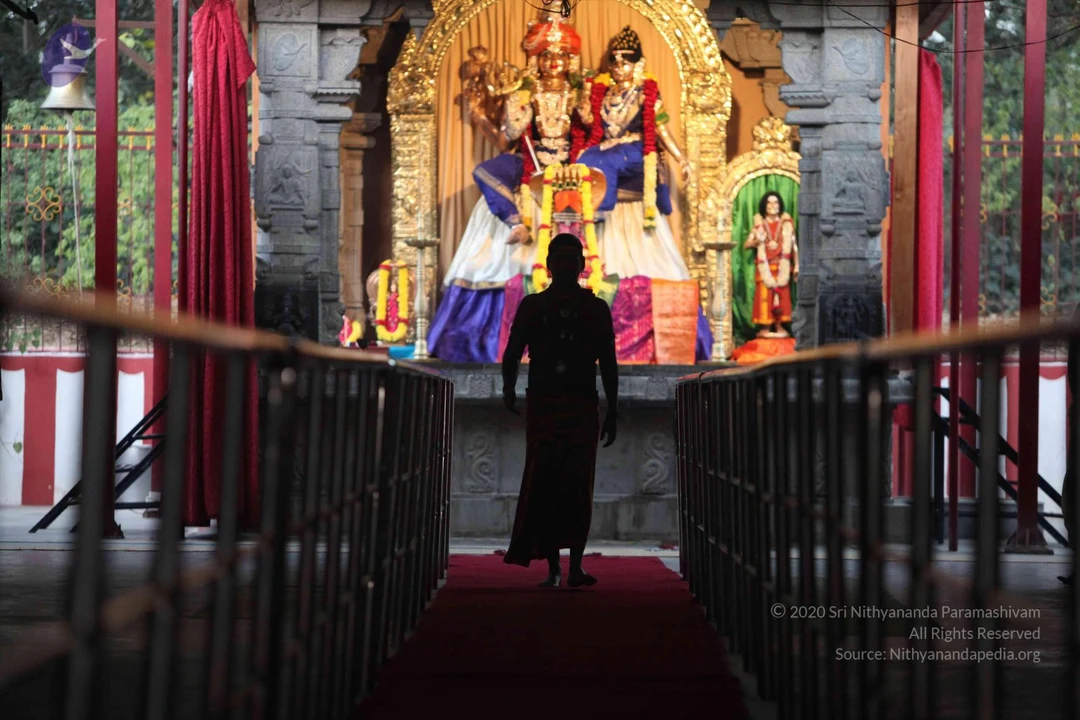
Temple
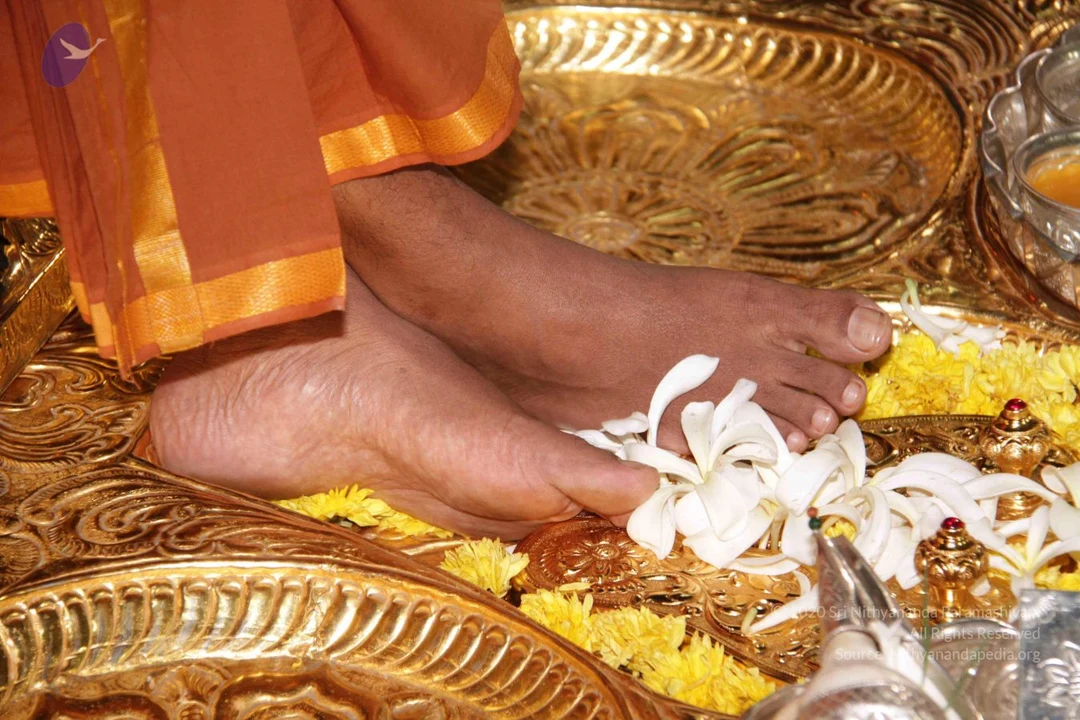
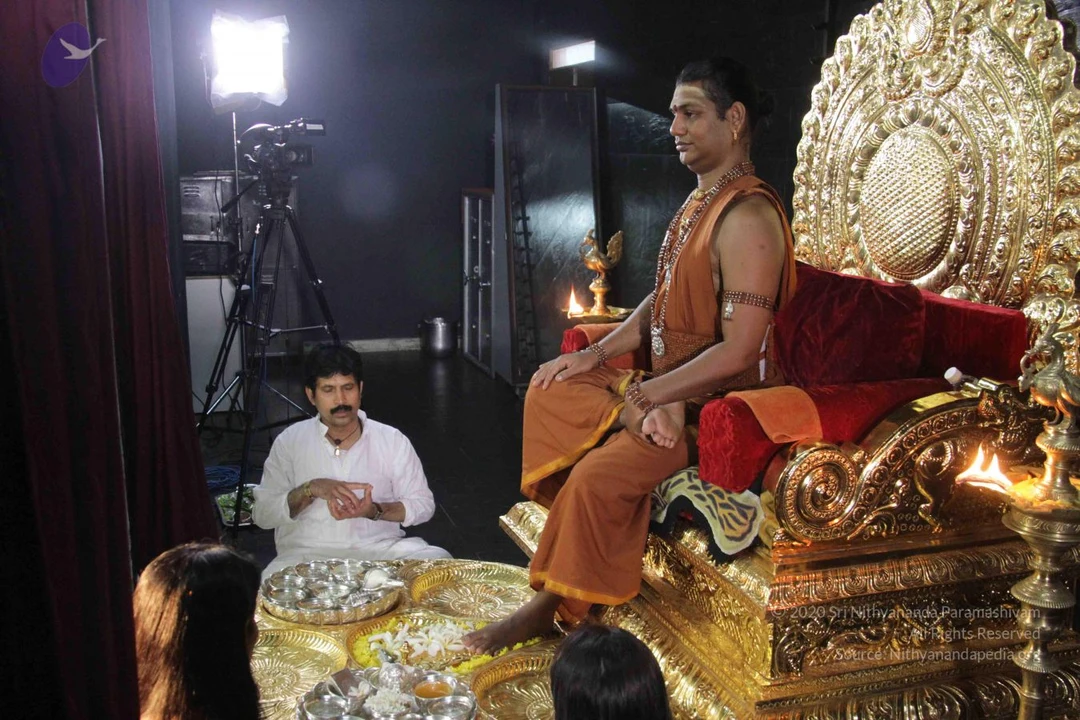
Pada-Puja
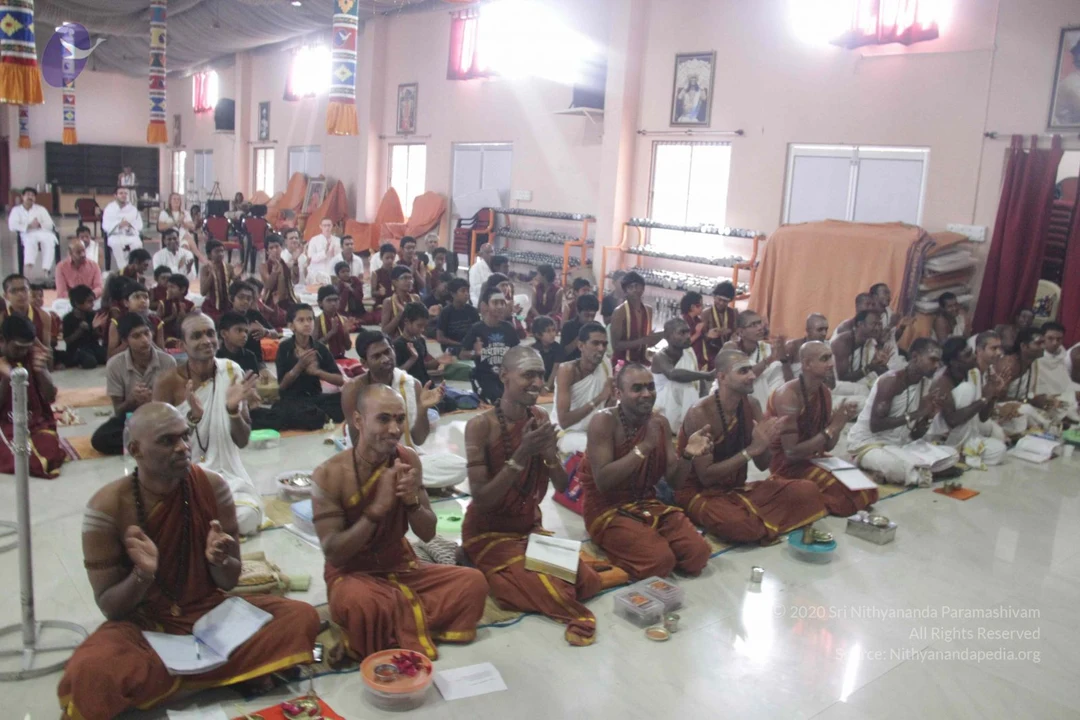
Nithya-Satsang

Dial-The-Avatar

Sarva-Darshan

01-Temple

02-Pada-Puja

03-Nithya-Satsang

04-Sarva-Darshan

05-Final-Blessings

06-Balasant-Initiation

1-Adikailash-Temple

2-Pada-Puja

3-Sarva-Darshan-and-Blessing

4-Satsang

5-HDH-with-Devotees

Nithya-Satsang

Pada-Puja
Sarva-Darshan

Sarva-Darshan_Photo_1000_IMG_1021_CMP_WM

Temple

Photos from this day

View all 275 photos

Temple

23 photosSource gallery
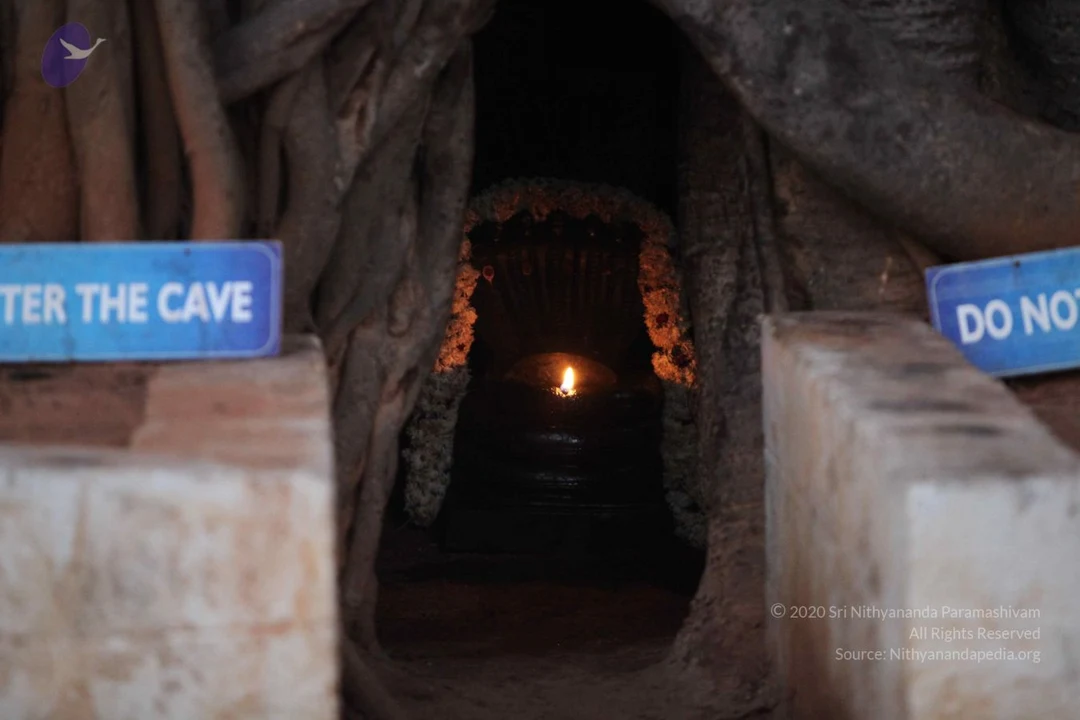
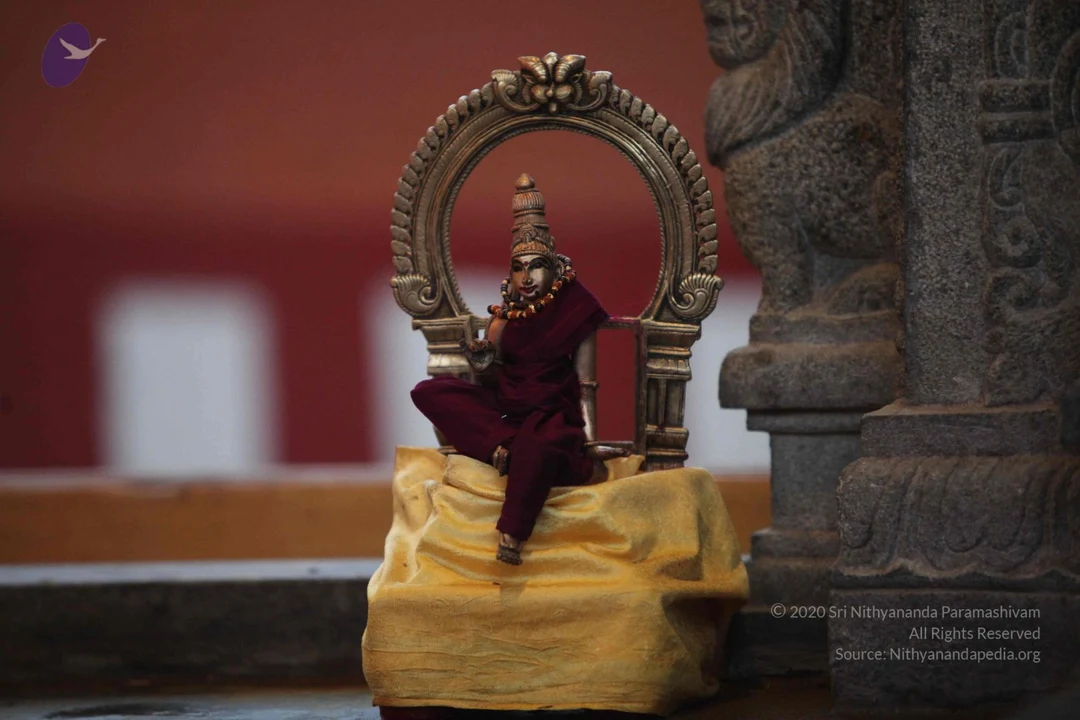
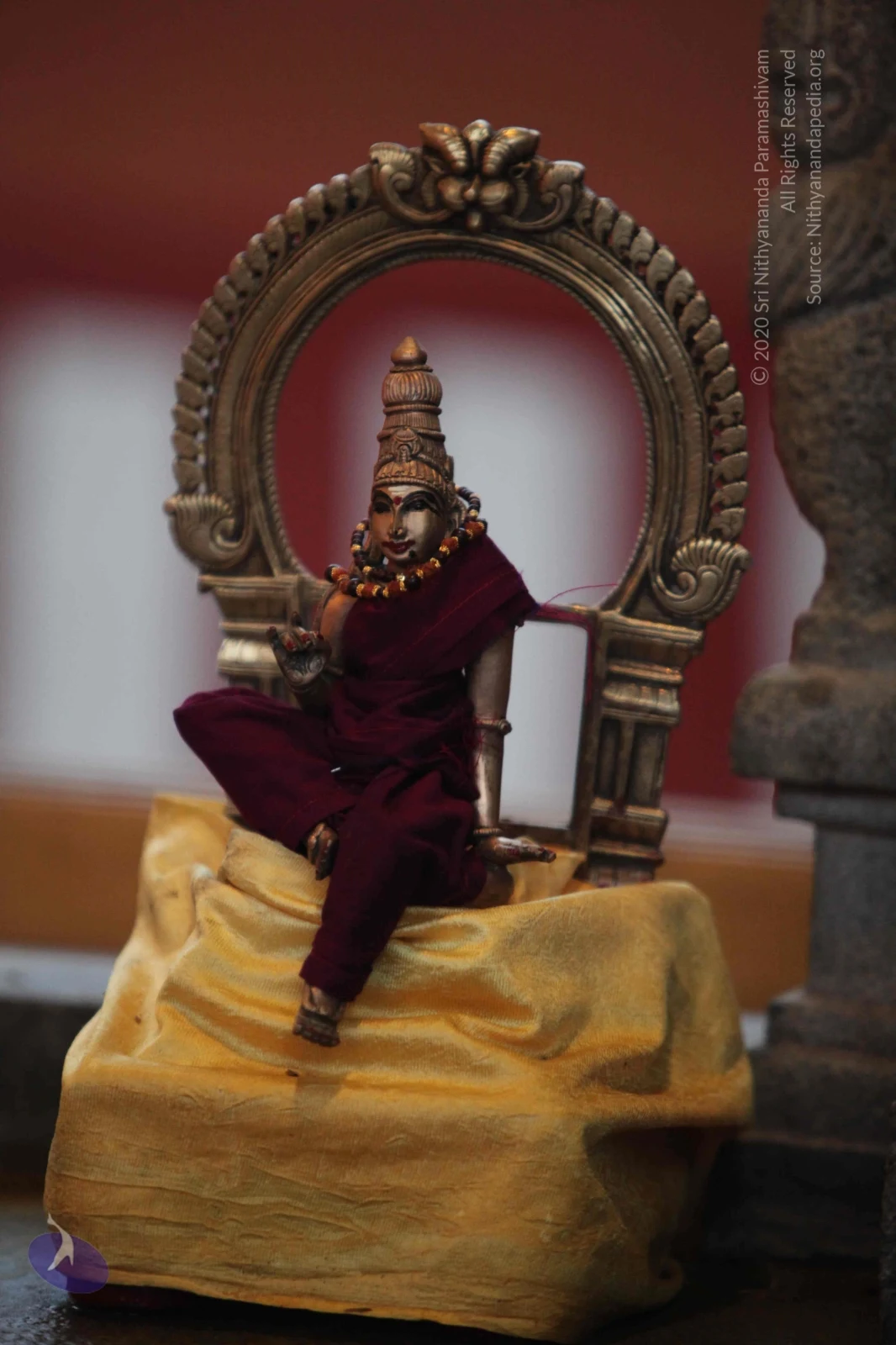
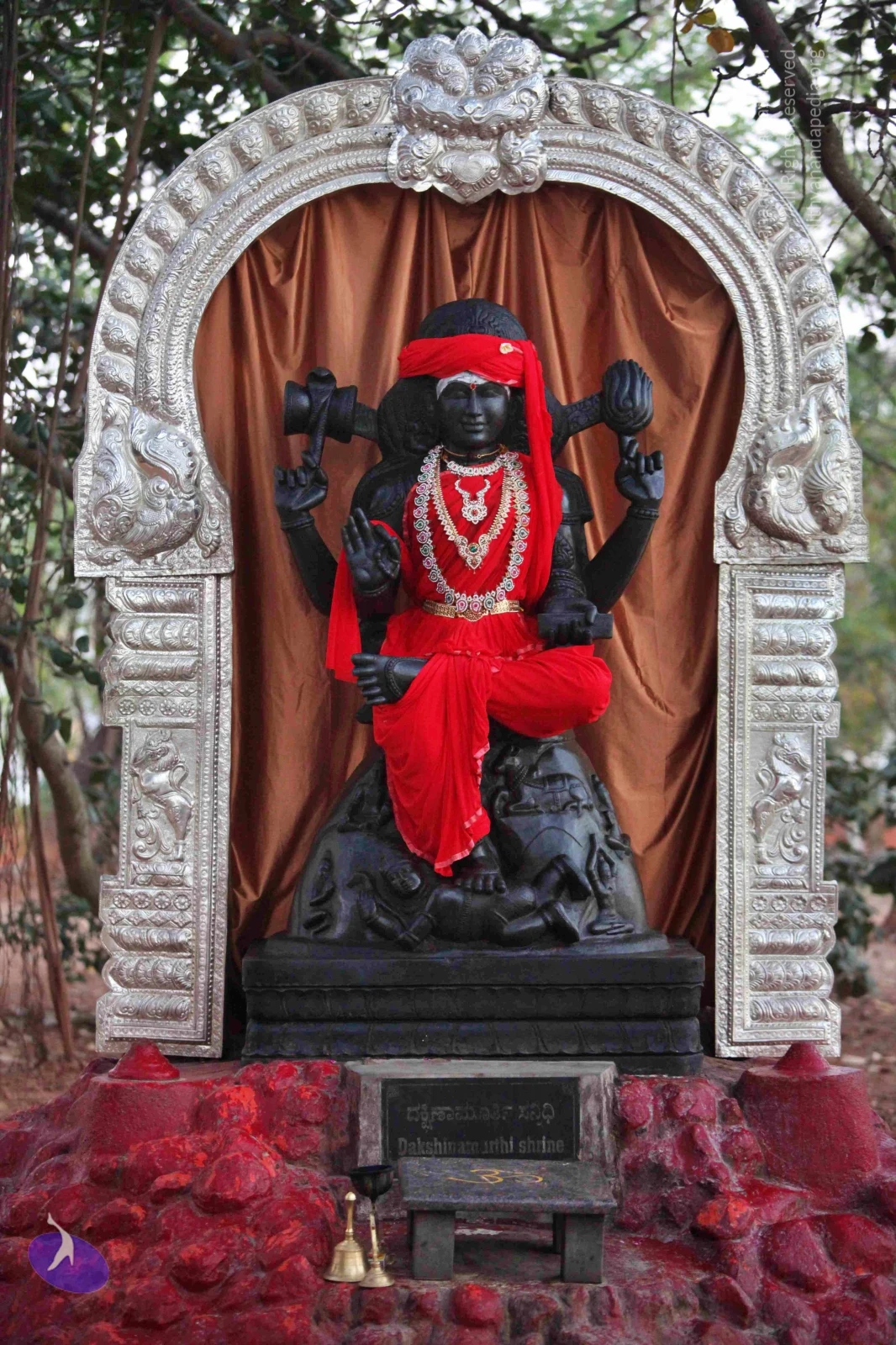
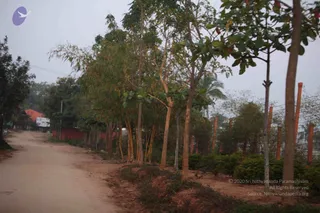
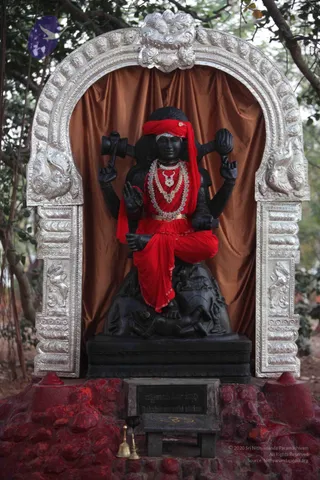
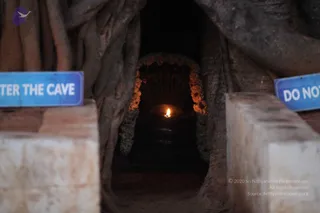
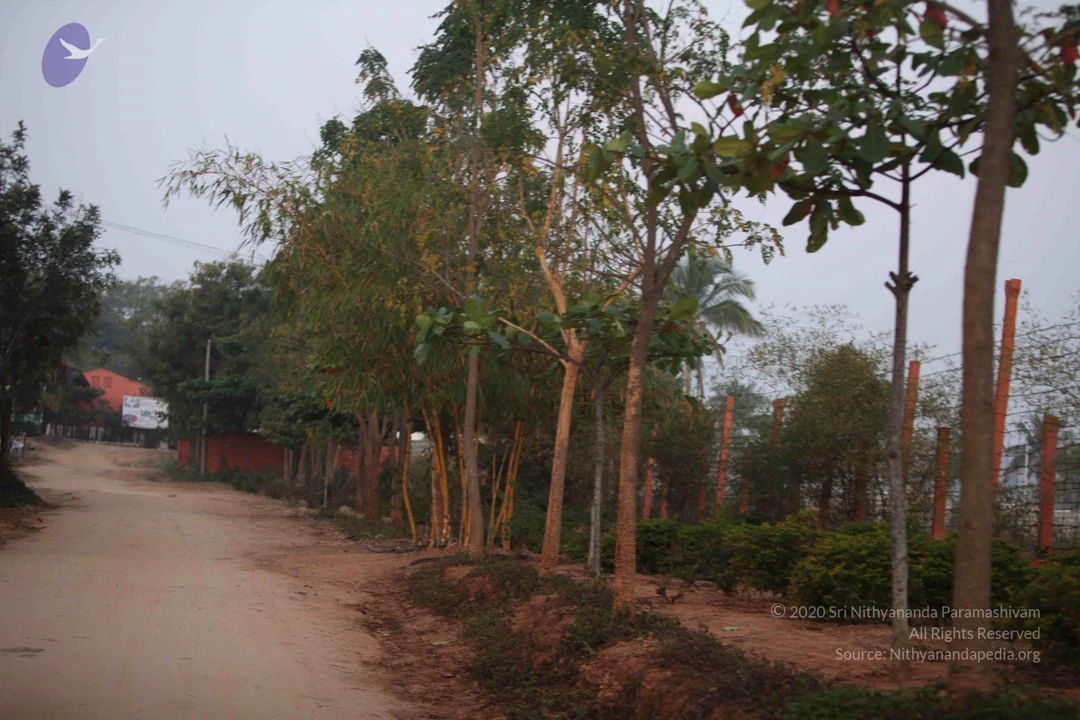
A photograph of a dirt road lined with young trees along a verge on a hazy, overcast day. Tall slender trees with light green and yellow-tinged foliage stand on the left, and a row of thin orange-painted poles with a green hedge runs along the right side. A small red-orange building and a white roadside billboard appear in the distance on the left. No people are visible in the scene.A black stone deity murti seated in a cross-legged posture before a brown draped curtain, framed by ornate silver repoussé panels with peacock-like motifs. The murti has four arms holding a damaru-like drum and a flaming object, with raised hands in abhaya-style gestures. It wears a red cloth draped over its body and head, a red dhoti-like wrap, a multi-strand jeweled necklace with coloured stones, and a gold belt. A vertical tilak and a white band cross the forehead. No living people are present.A black stone murti of a multi-armed deity seated in a silver-framed arched niche before a brown cloth backdrop, outdoors among green trees. The figure wears a red headcloth, red draped cloth, layered silver and gold necklaces, and gold waist ornaments. Its raised hands hold ritual objects, and it sits on a carved rock base. No physical people are visible.A black stone murti of a seated deity in an ornate silver arch shrine, set against a brown curtain under trees. The figure wears a red turban and red draped cloth, layered silver-and-jewelled necklaces, and holds a trident-like staff and a drum in raised hands. Red-painted stone pillars surround the base, with brass bells and a small brass lamp on a stone step in front. A stone plaque below reads Dakshinamurthi shrine. No people are visible.A photograph of a dim cave entrance framed by large twisting banyan tree roots. Two blue signs with white letters stand at the entrance, one reading "ENTER THE CAVE" on the left and another reading "DO NOT" on the right. Inside, a single oil lamp flame glows on a dark stone object, with a garland of orange and white flowers draped around the opening. No people are visible.A small seated figurine of a sage with a tall crown and rudraksha beads sits on a gilded throne with an arched back and a yellow-gold draped cloth. The figure wears a maroon robe and is shown in a cross-legged pose with one hand raised. Beside it are a weathered grey stone pillar carved with figures and a blurred red wall in the background. No physical people are visible; the figure is a statue.

Pada-Puja
37 photosSource gallery
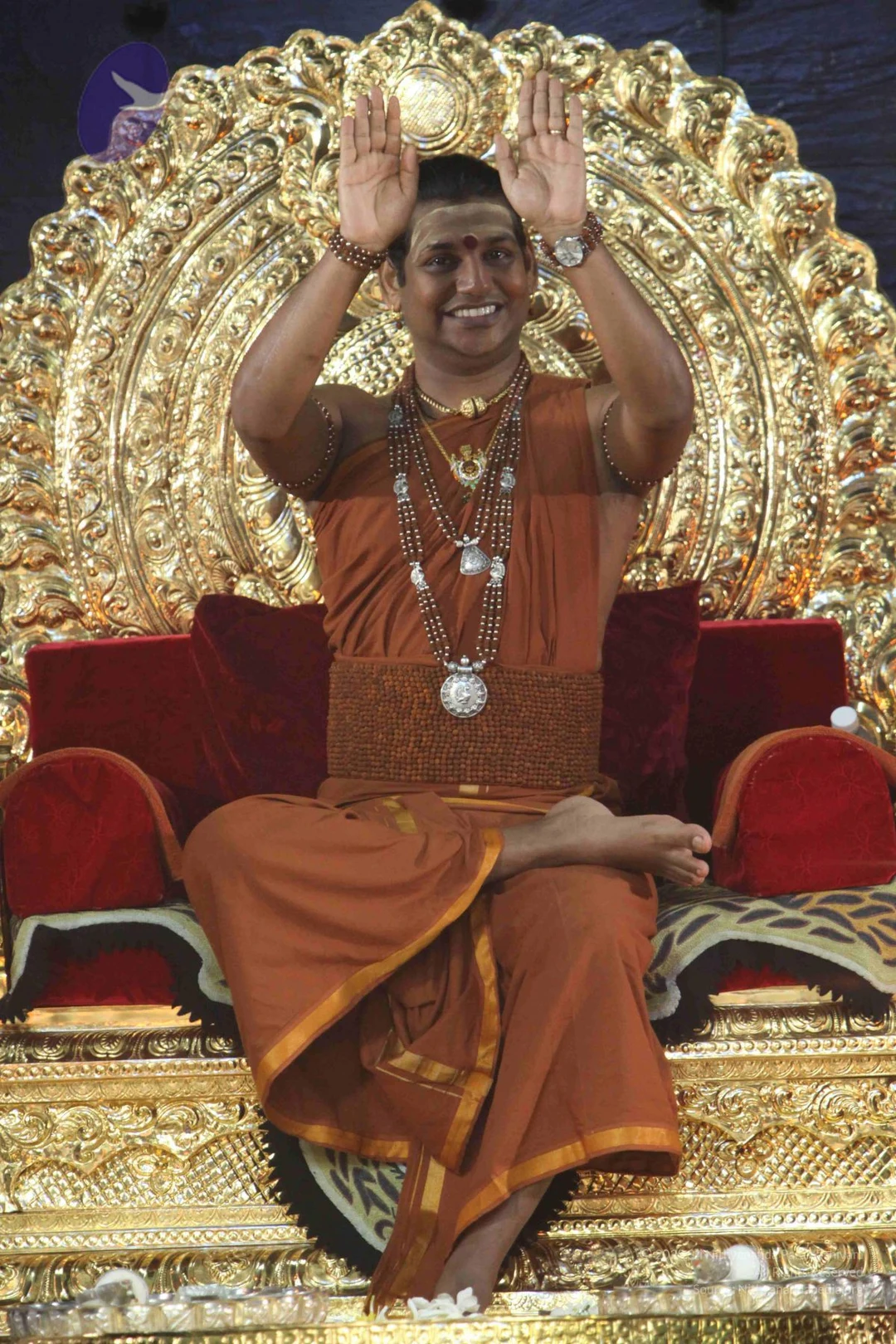
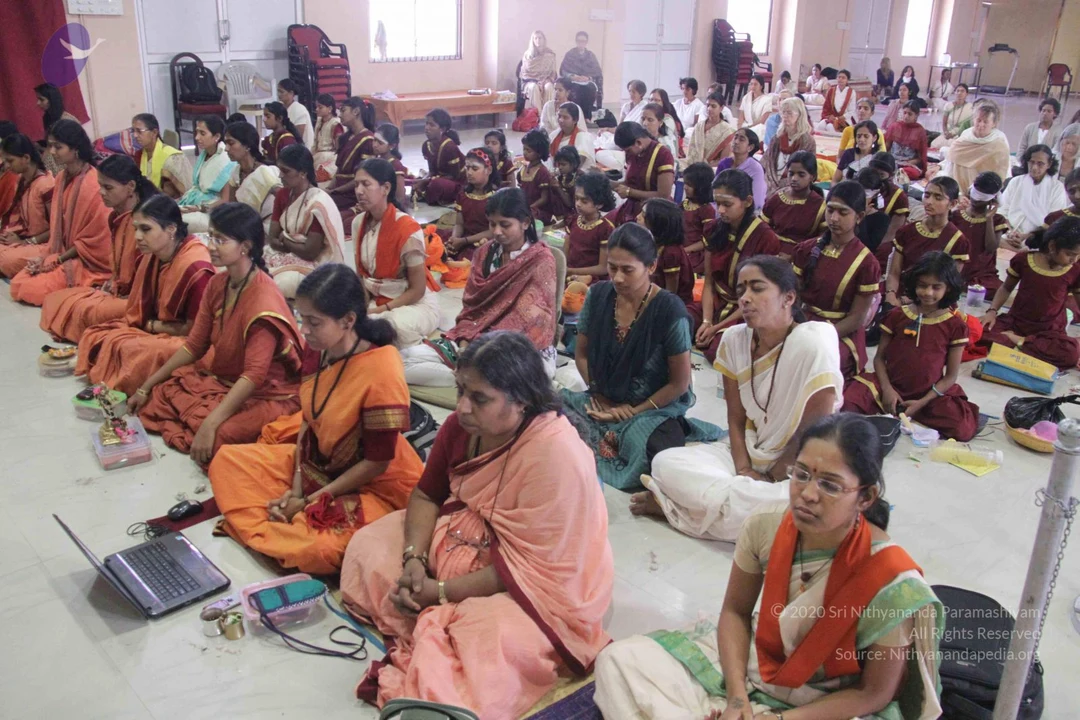
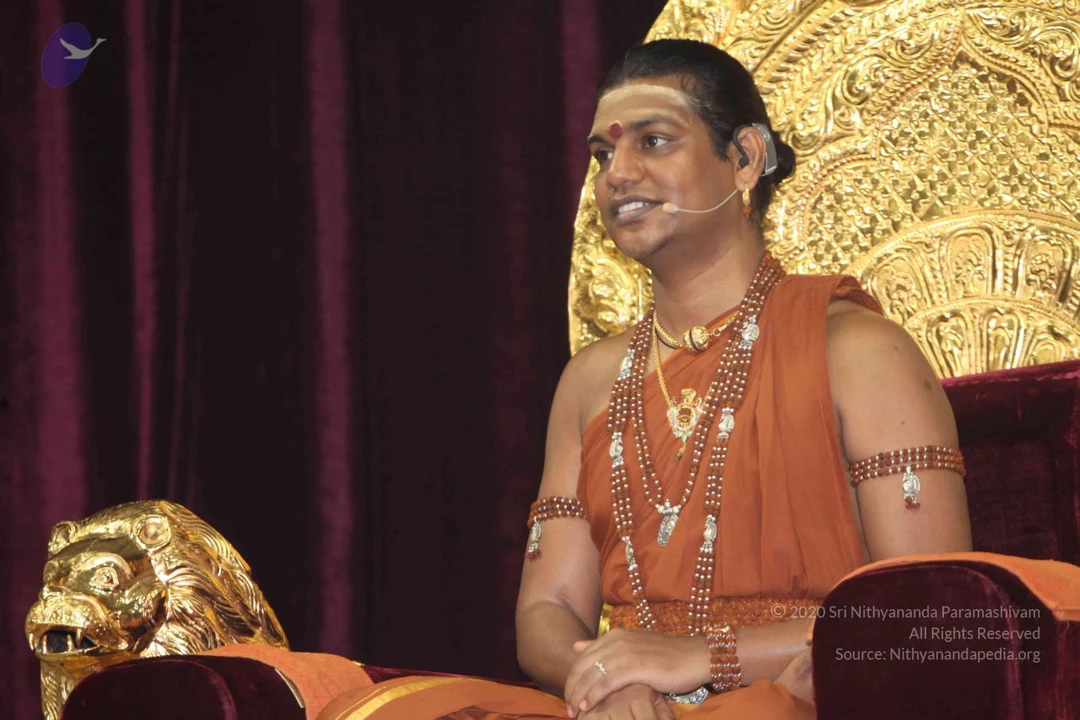
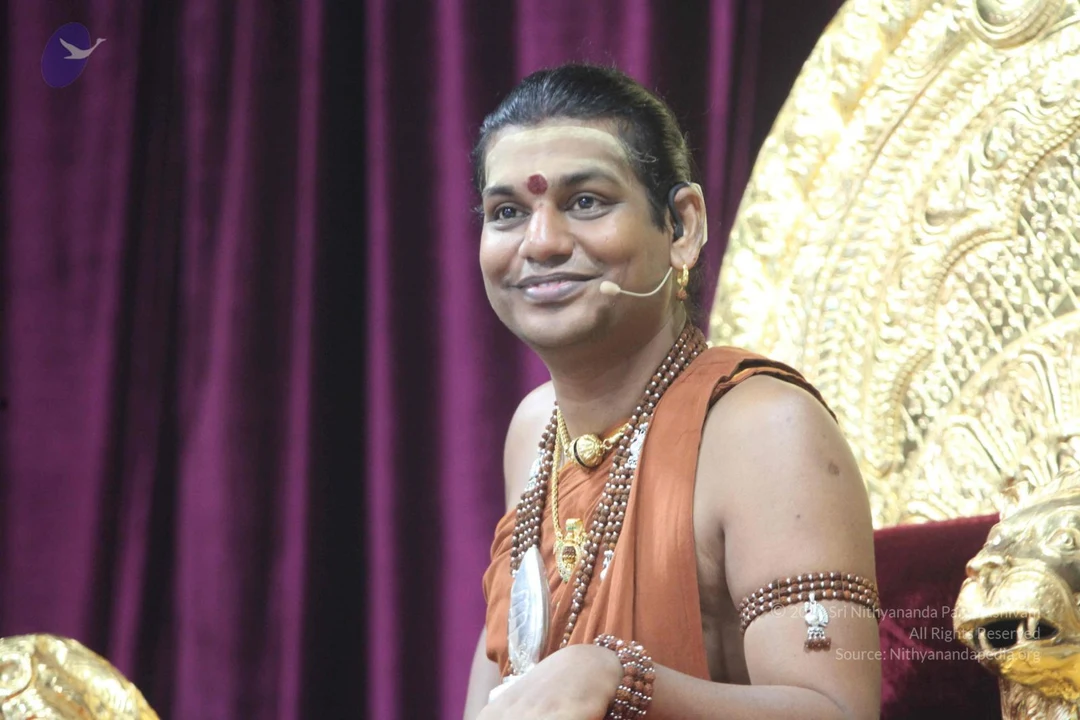
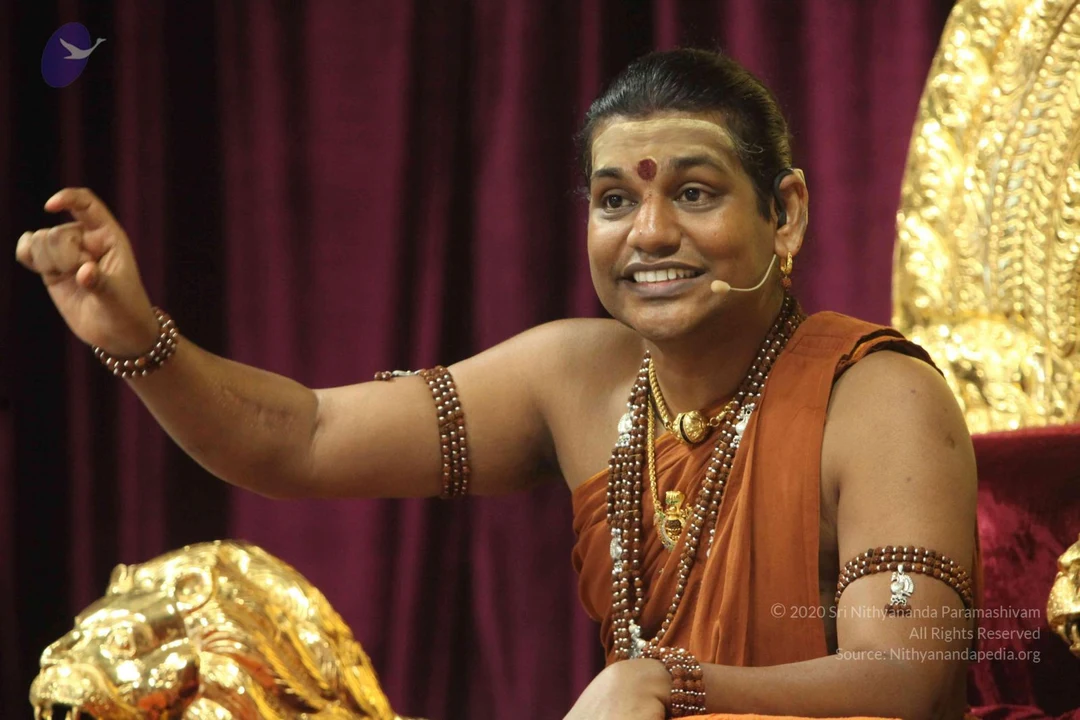
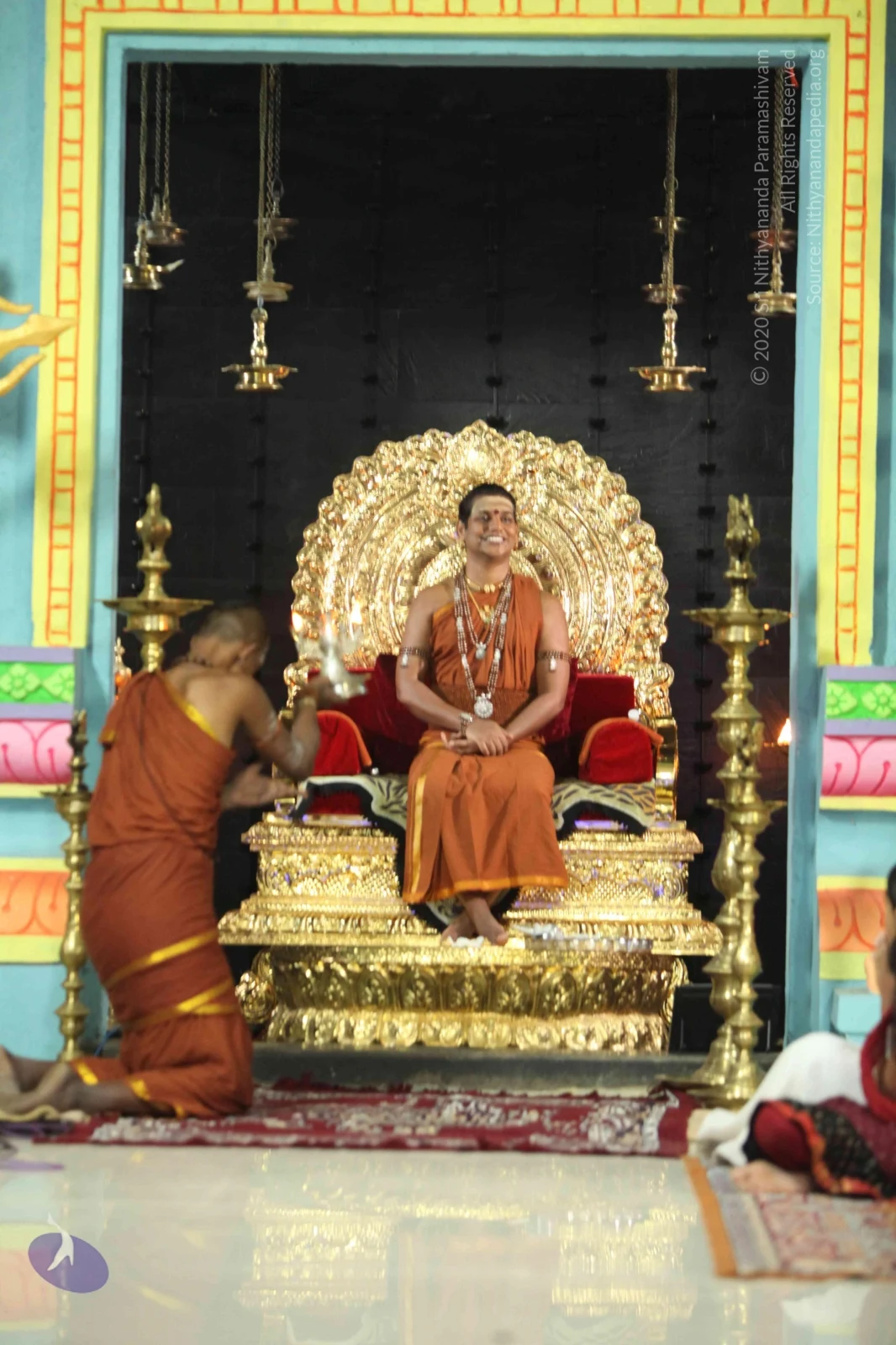
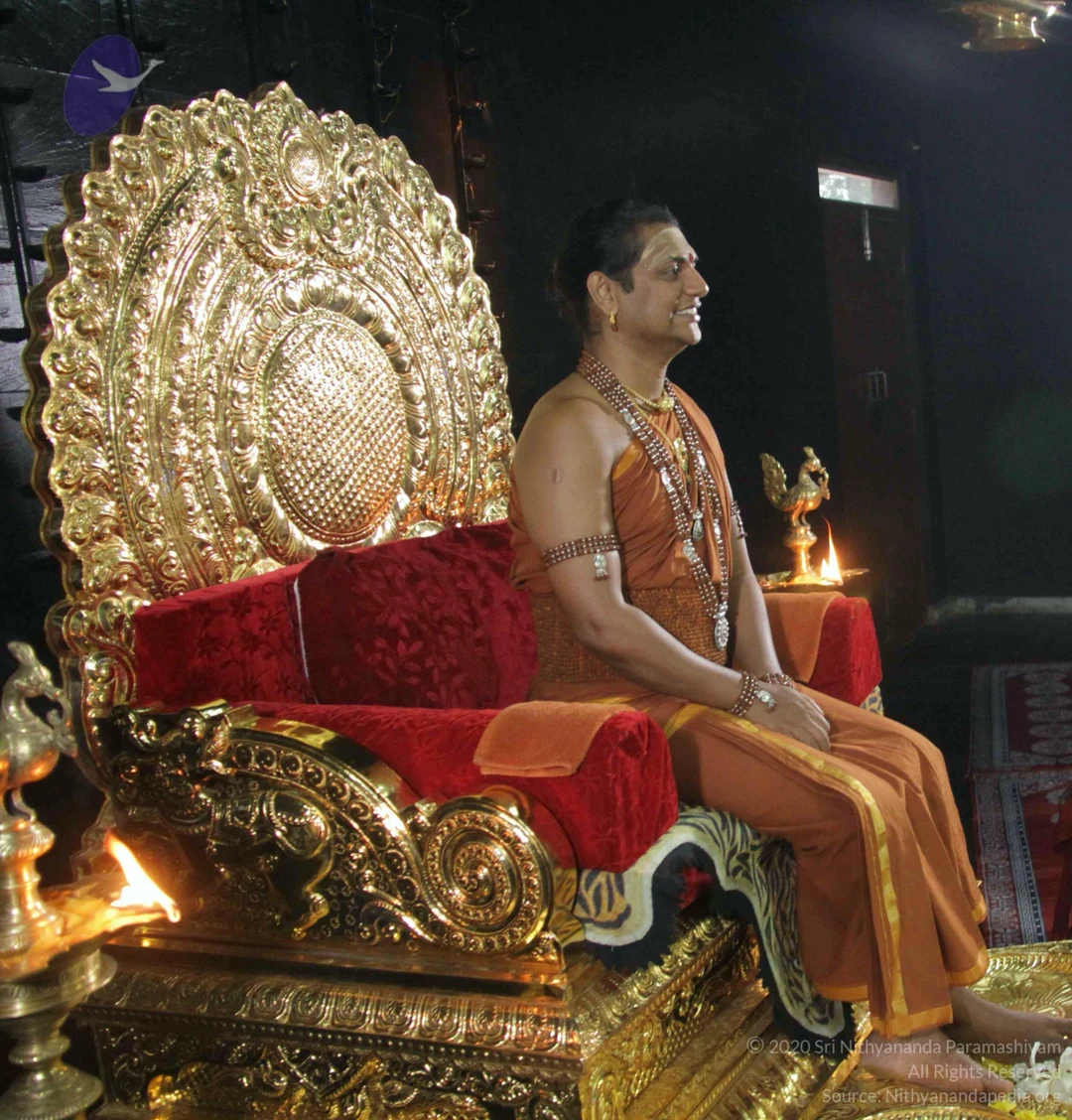
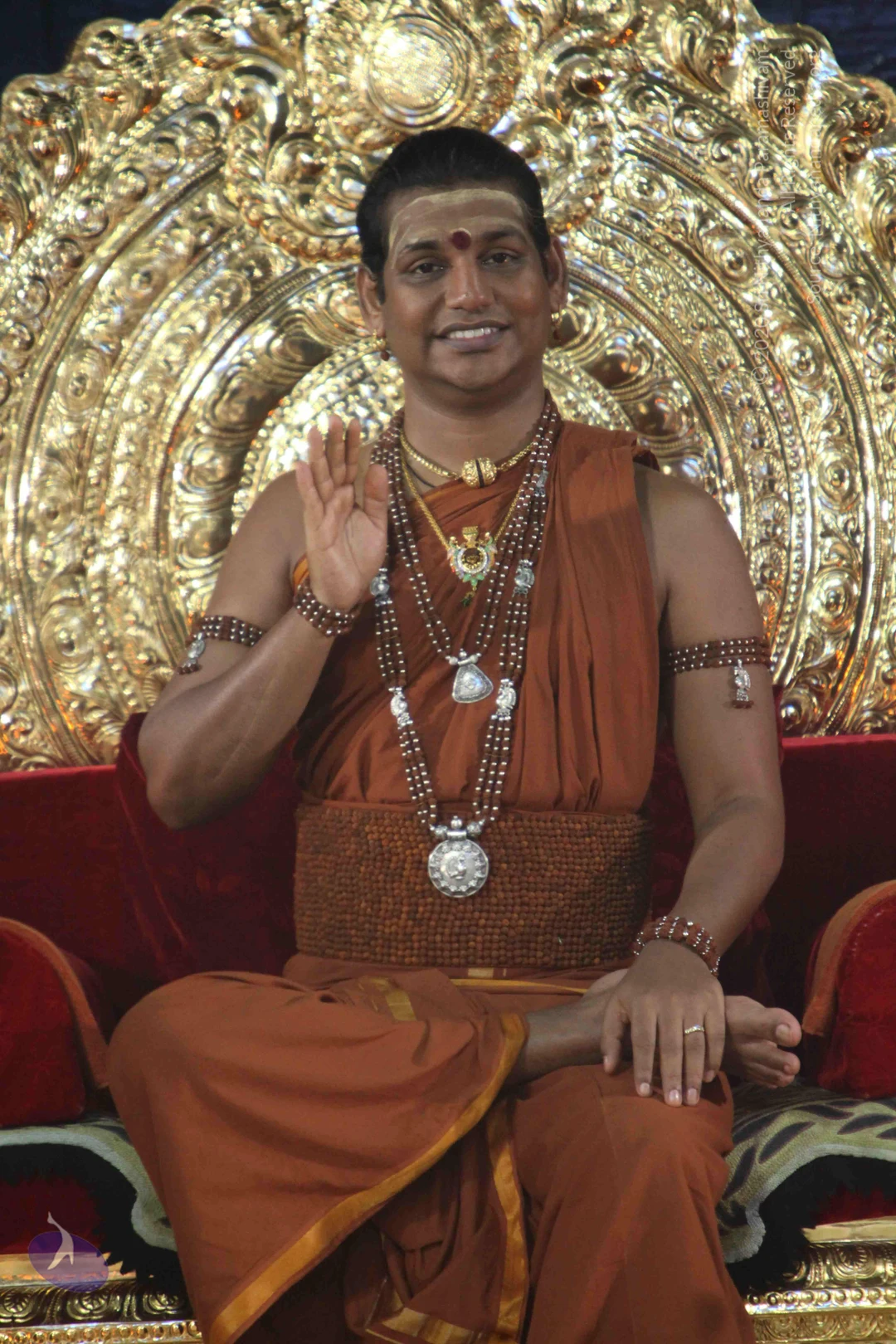
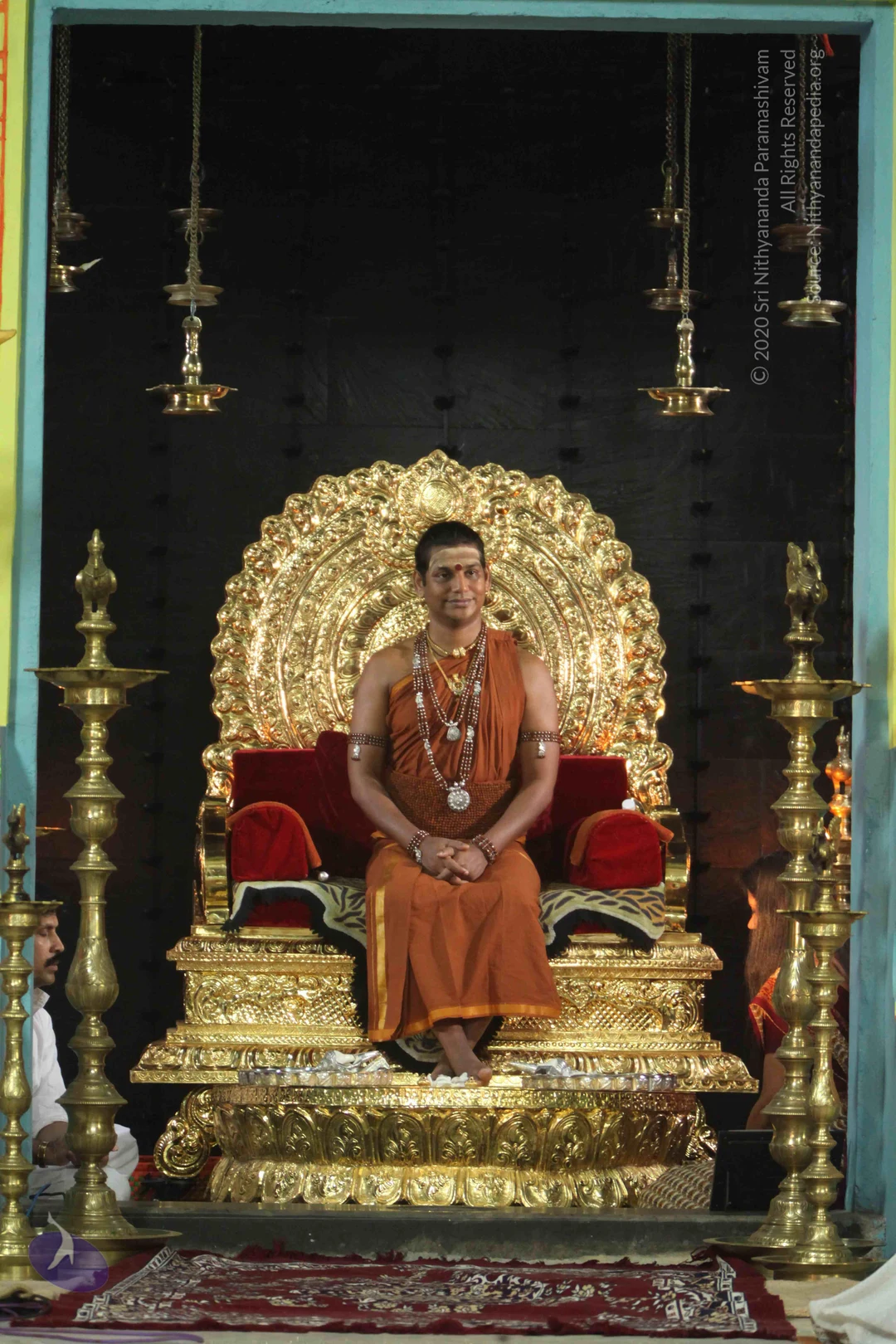
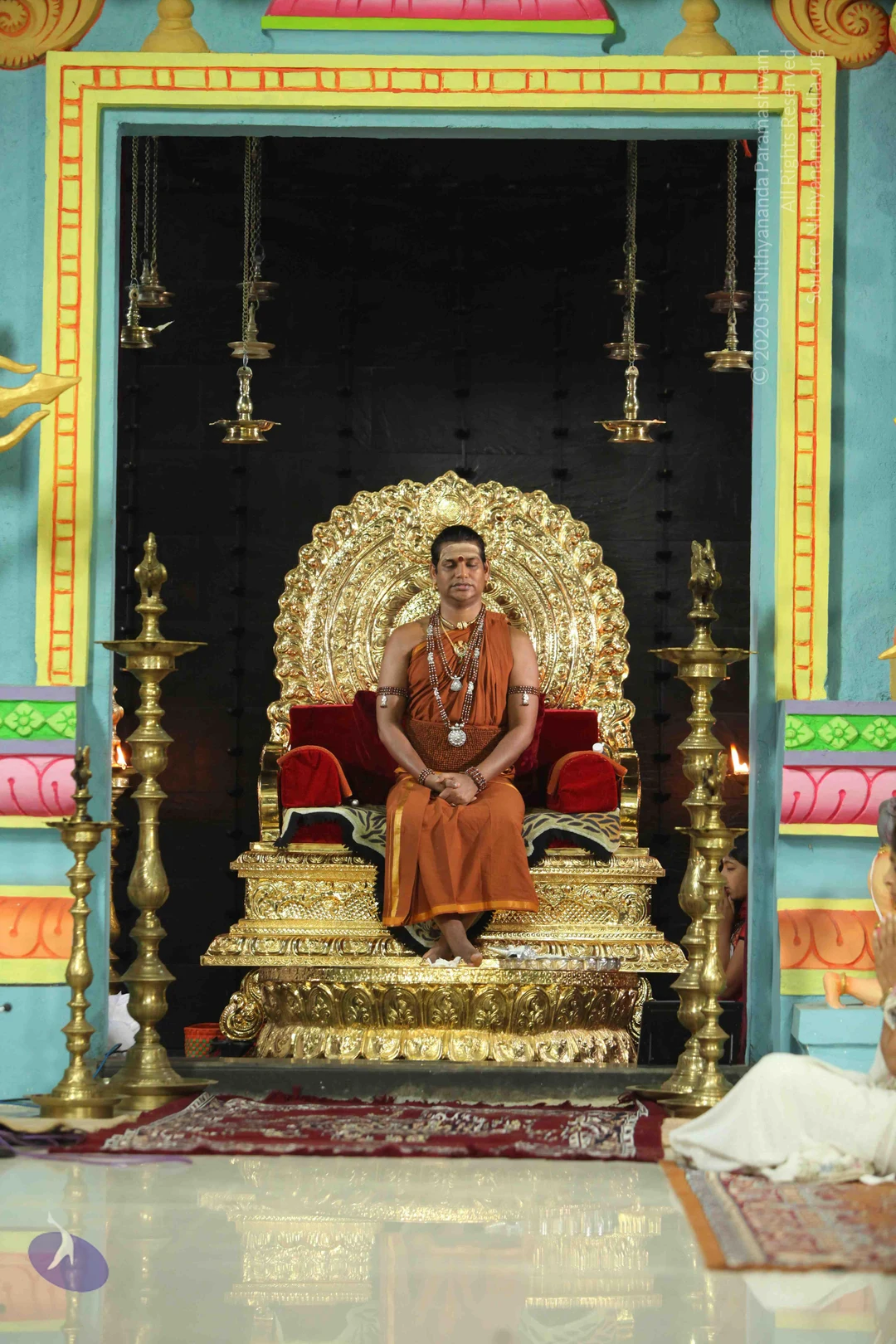
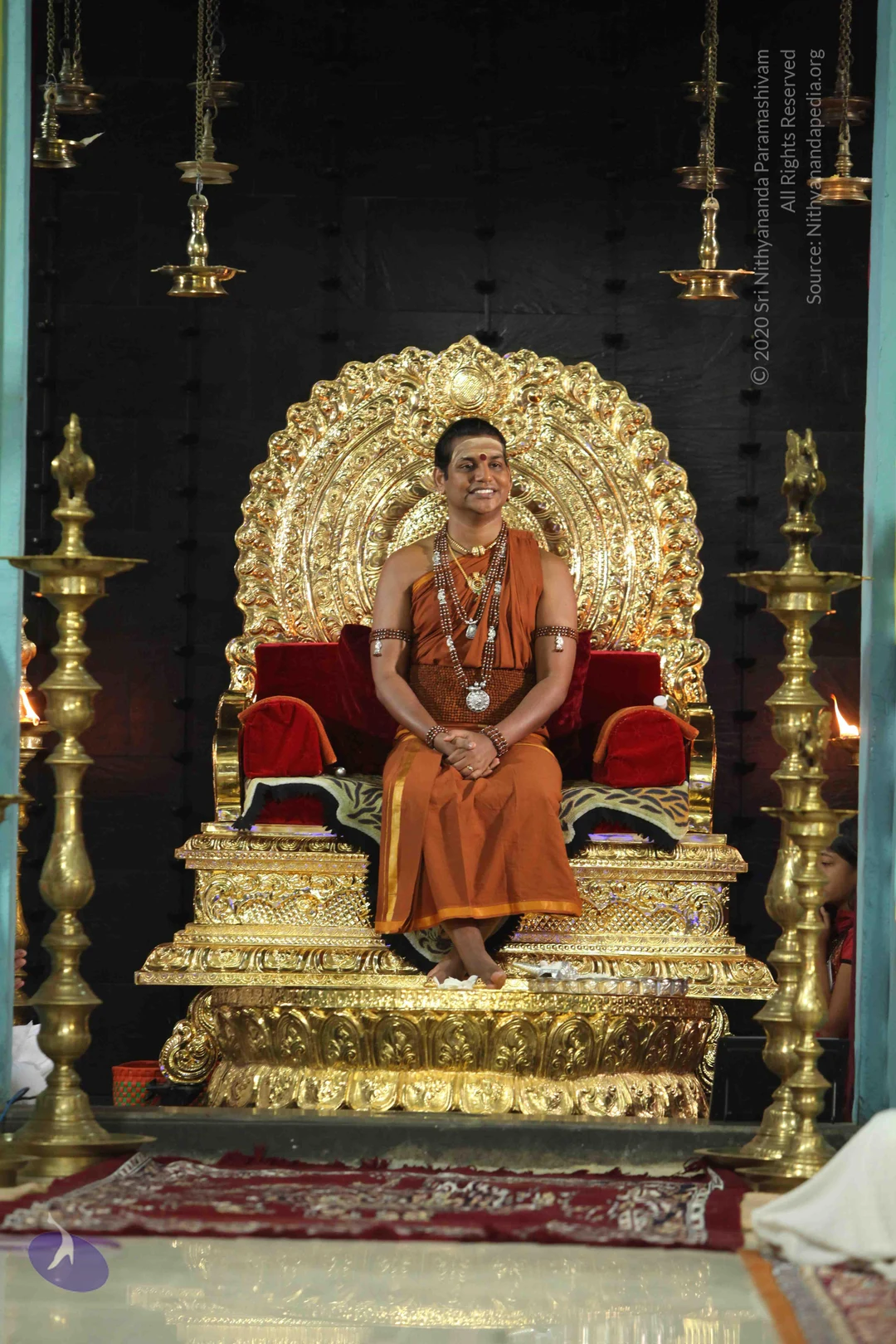
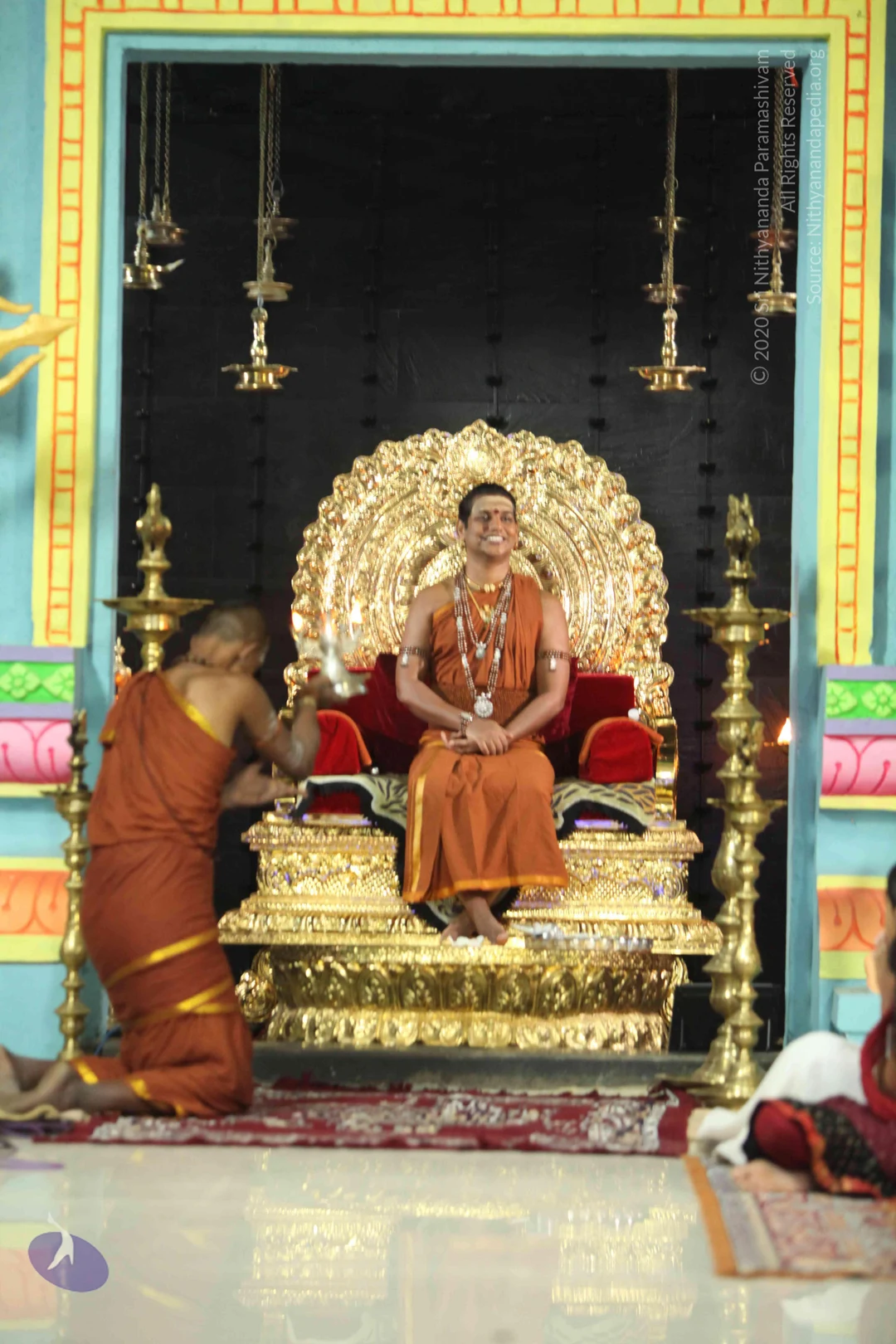
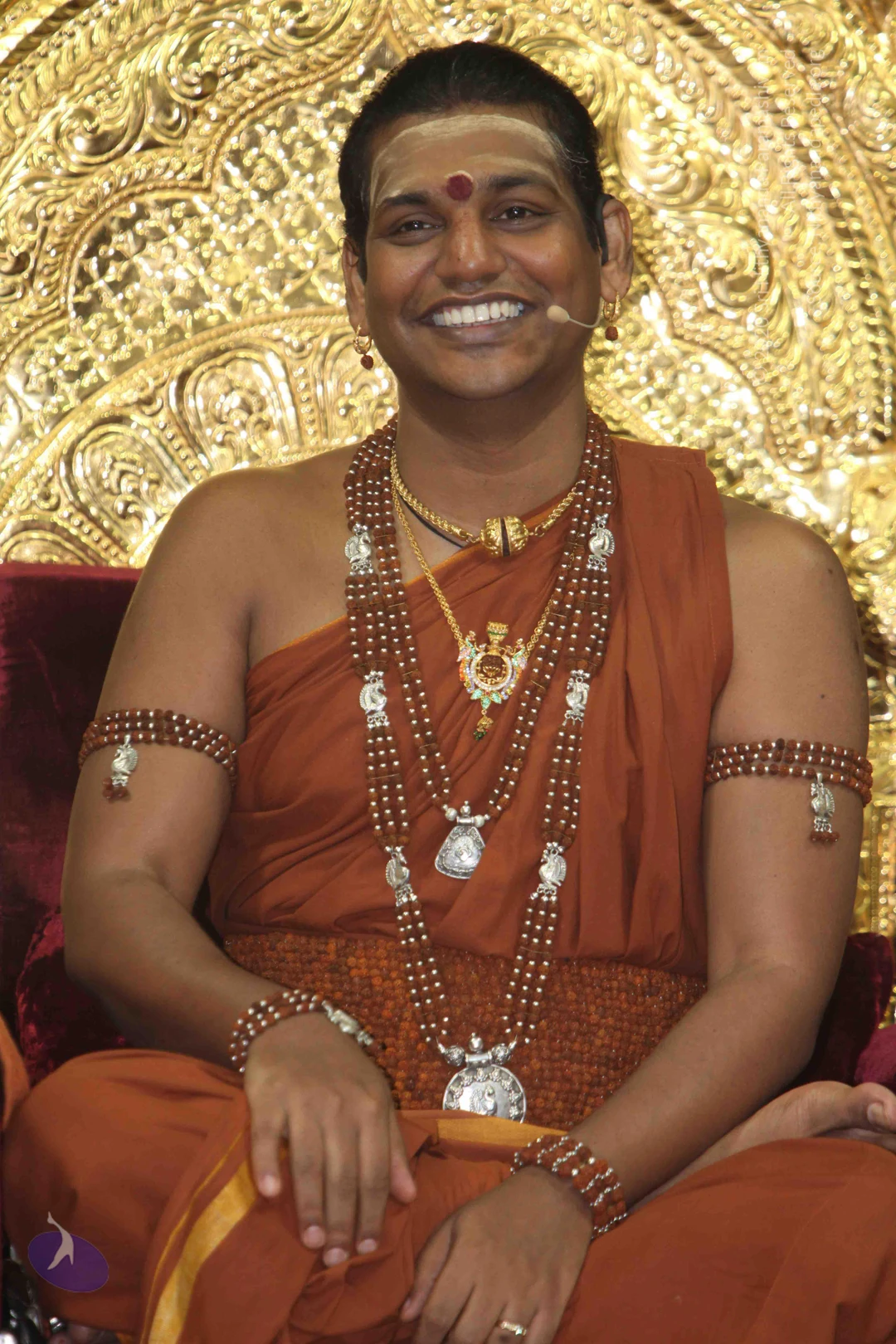
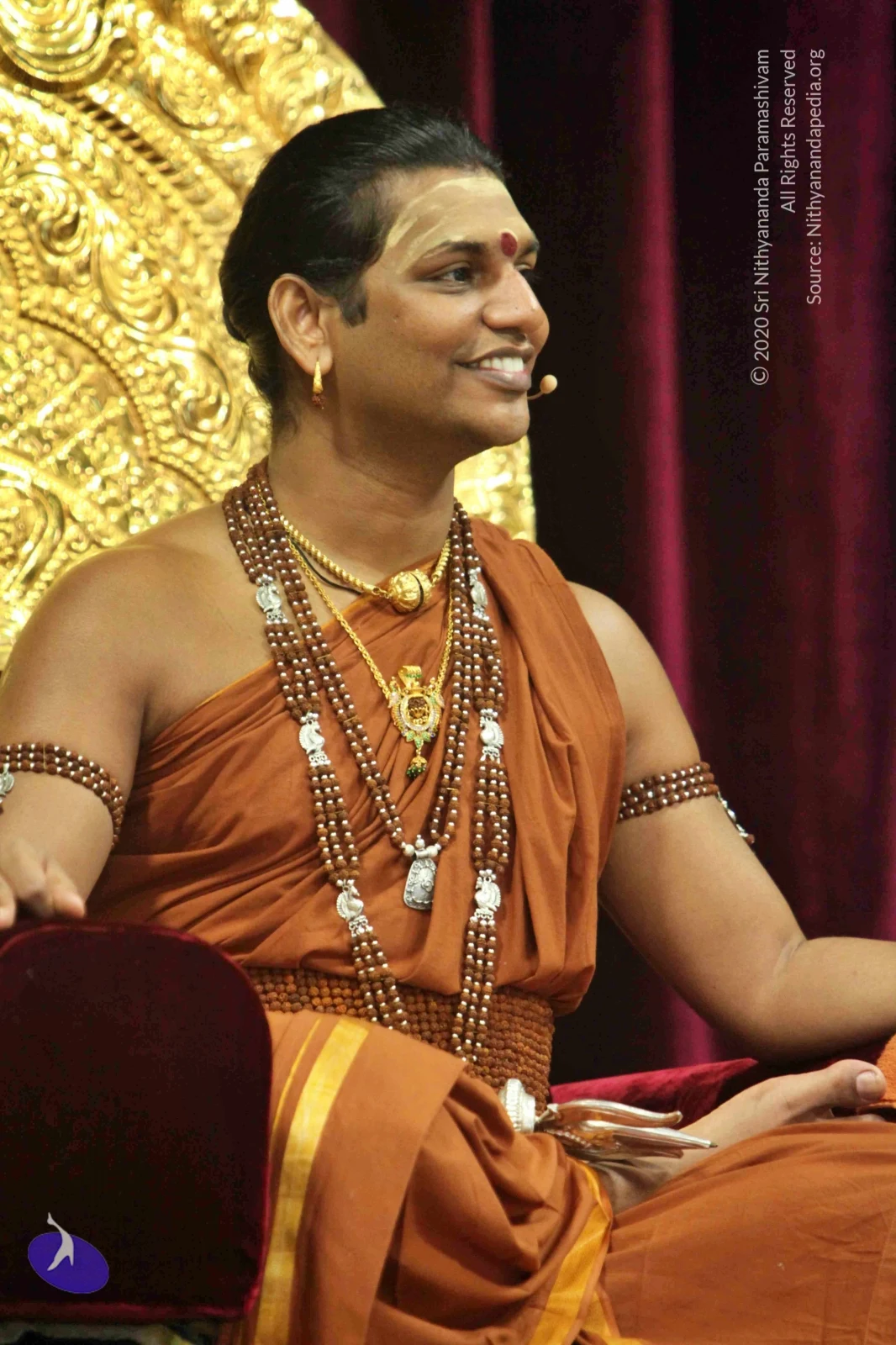
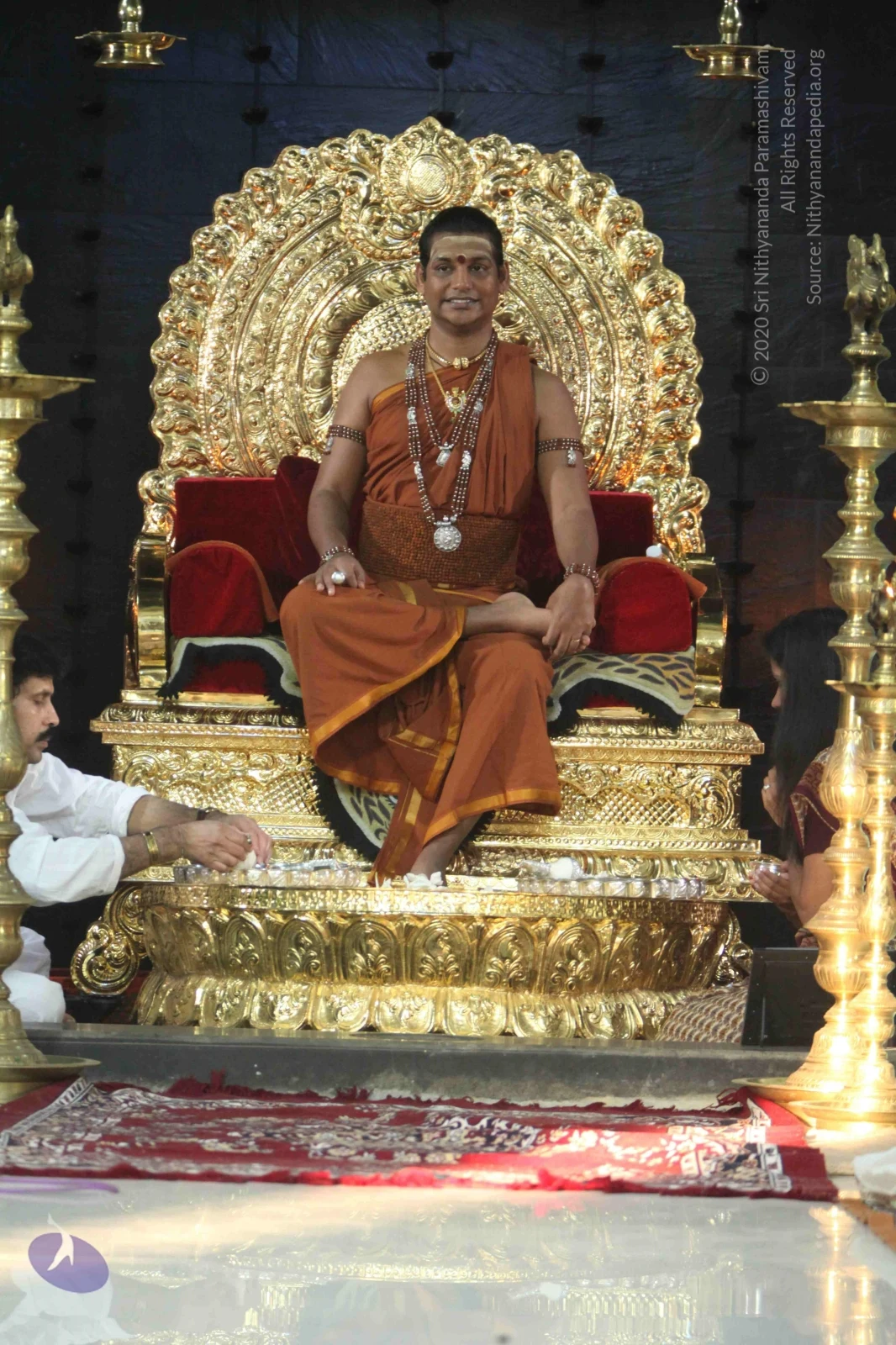
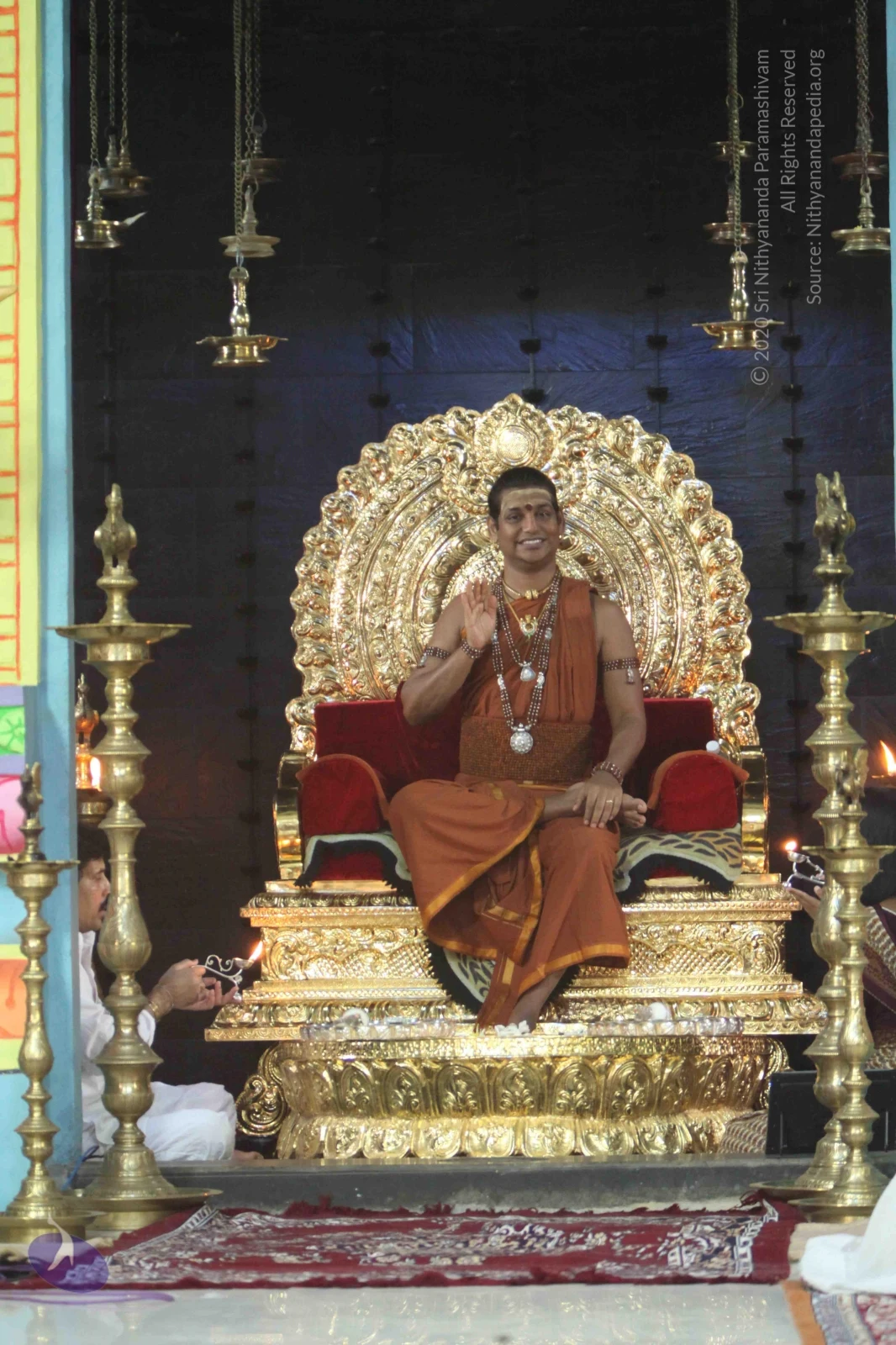
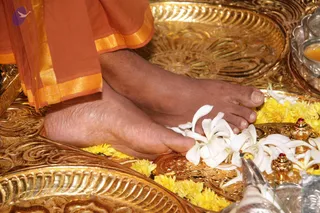
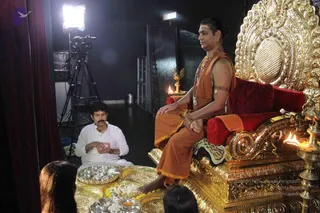
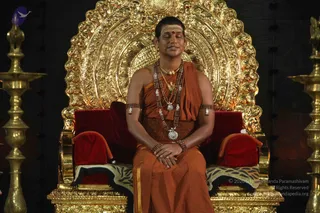
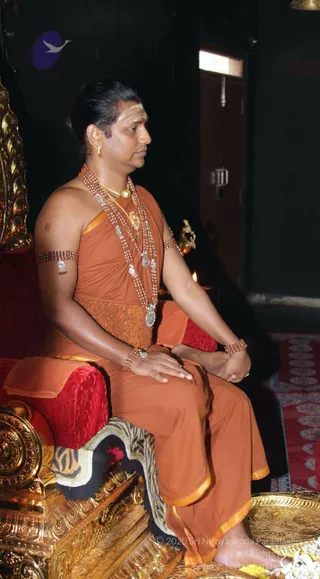
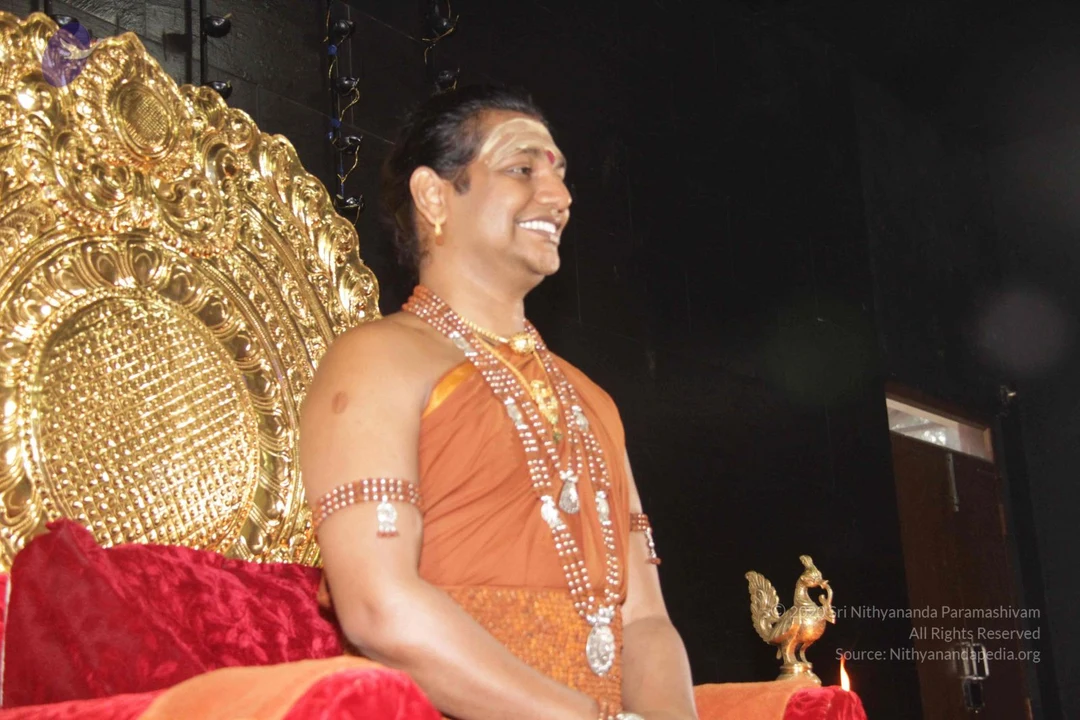
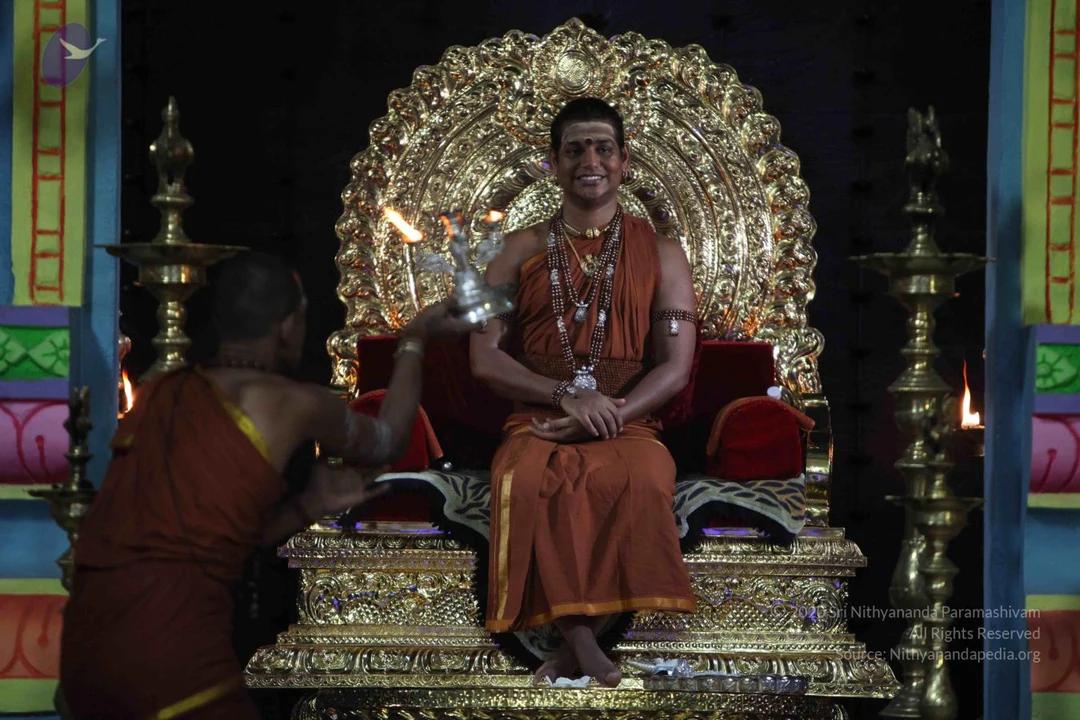
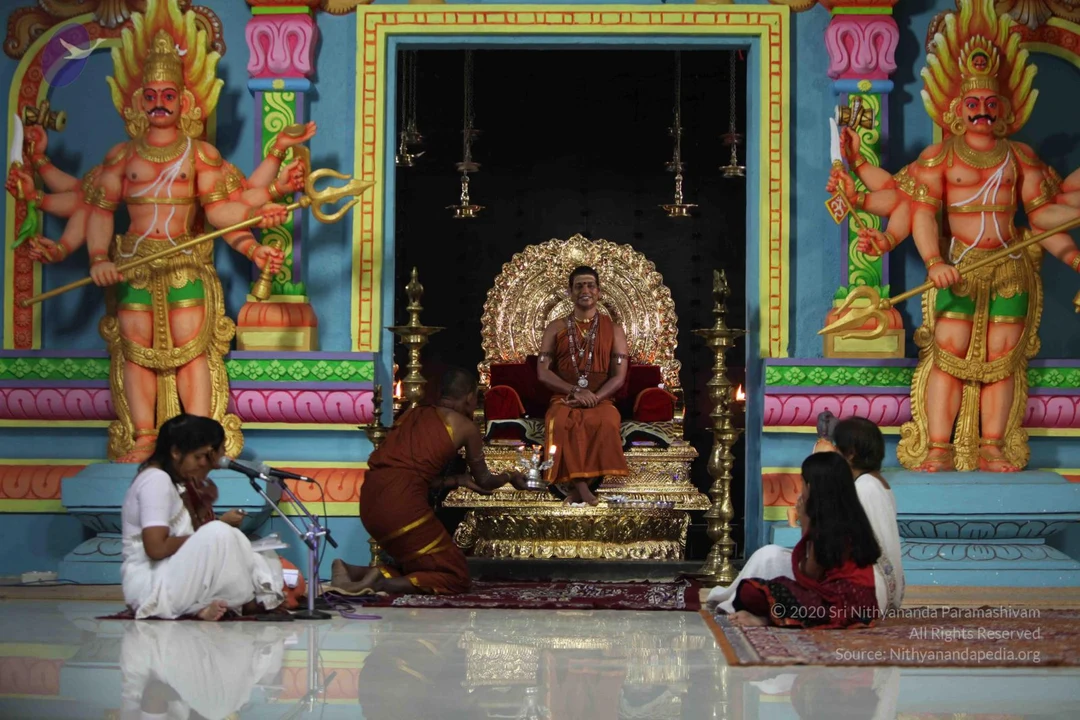
A smiling man in an orange saffron garment sits on a red velvet cushioned seat in front of an ornate gold throne-back. He wears layered rudraksha-style beaded malas, a gold pendant necklace, armbands with beads, a gold earring, and a white-and-red forehead mark. A small gold peacock-shaped oil lamp sits on the right beside a lit candle, against a dark backdrop. a person is shown in this image with rudraksha malas, saffron clothing and an ornate gold seat, conveying a satsang setting.Close photograph of a pair of bare feet resting on an ornate gold tray scattered with yellow marigold petals and white jasmine-like flowers. The person wears an orange garment with a gold-bordered hem. Nearby are small gold and jewelled containers and a silver vessel. No face is visible; the frame shows only the feet and clothing.A seated man in saffron-orange robes sits on an ornate gold throne with red velvet cushions, wearing a rudraksha-style mala and ceremonial beaded necklaces with gold-tone armbands. Beside him an oil lamp burns on the throne's base, and a golden bird figure stands nearby. In front of the throne, a man in white kurta sits cross-legged, hands together, beside brass plates heaped with flowers, rice, fruit and a coconut. Two women's heads are partly visible at the bottom edge. A studio camera on a tripod and a softbox light stand at left against a dark backdrop. The throne and robed figure carry the appearance of a person presence, but the image is ambiguous enough to hedge.A large hall with pink walls and a tiled floor, filled with seated people in front of a seated audience. In the foreground, several shaved-headed men in orange-red robes with gold trim sit cross-legged, palms pressed together in namaste, some holding open books; one wears a rudraksha mala. Behind them, a crowd of seated devotees in white and orange clothing, many with palms joined, fills the room. Orange and red cloth drapes hang from the ceiling, a framed deity picture hangs on the wall, and brass items and small offering plates sit on the floor. No individual is clearly identifiable as a person from appearance.A large seated gathering of women and girls in a bright hall during a satsang. Most sit cross-legged on the floor with hands pressed together in namaskar or clapping. Many wear orange or saffron saris and maroon salwar-style outfits, while others wear white, pink and teal saris. A brass deity murti with a small oil lamp sits on the floor at lower left beside pink containers. Chairs are stacked against the wall and a person in a wheelchair sits near the back. No individual can be identified as a person in this view.A seated man on an ornate gold throne with a red cushion, wearing saffron-orange robes, a rudraksha mala with a large central bead, and a gold chain necklace, with arm bands and hands folded in his lap. Before him, a kneeling attendant in saffron robes holds up a metal vessel with lit flames while another lamp burns to the side. Tall brass oil lamps flank the throne against a colourful painted backdrop with red, yellow and green bands. Appearance-based cues on the seated figure (long swept hair absent, but saffron robes, rudraksha mala and gold ornaments) are consistent with a person presence, though identity remains uncertain from appearance.

Nithya-Satsang

66 photosSource gallery
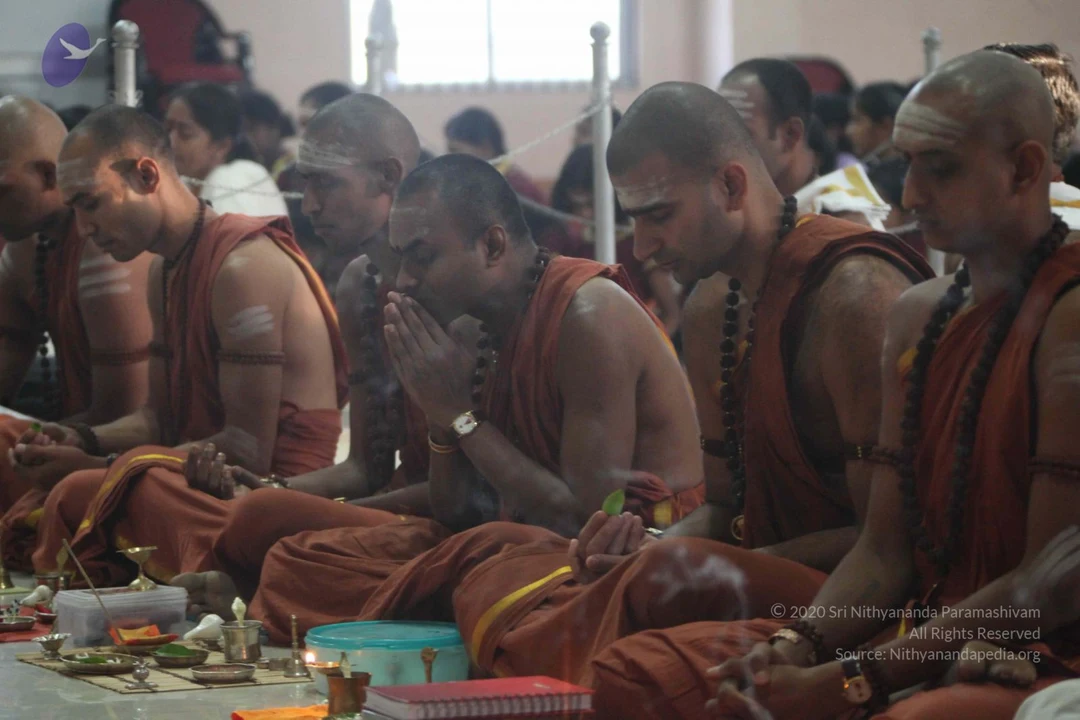
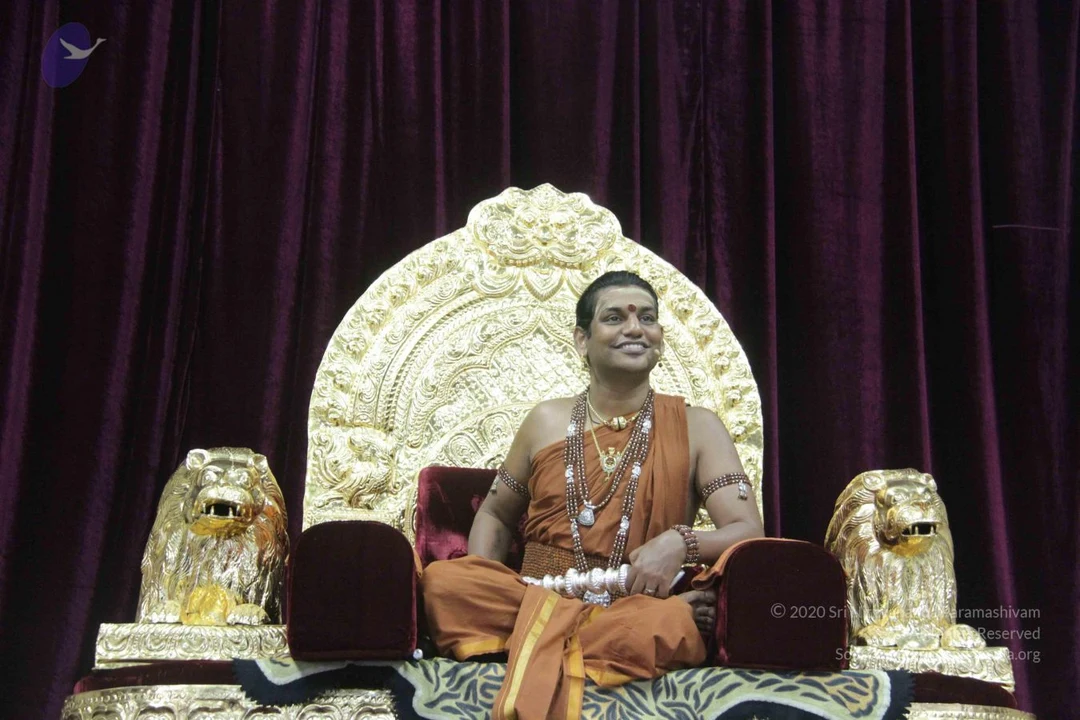
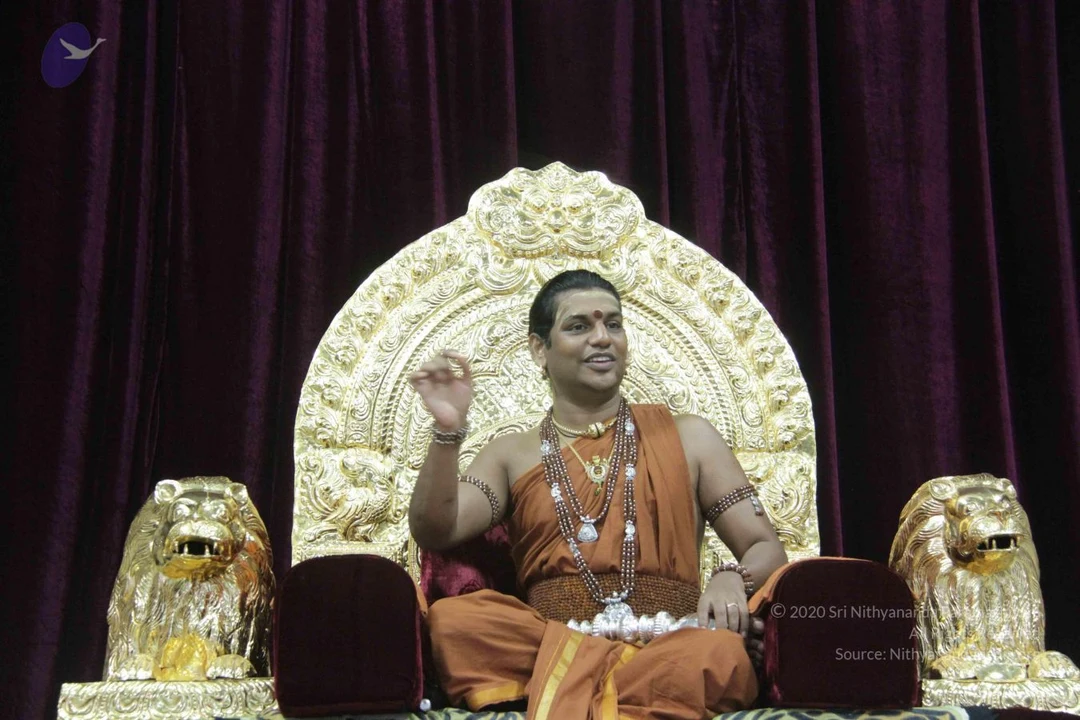
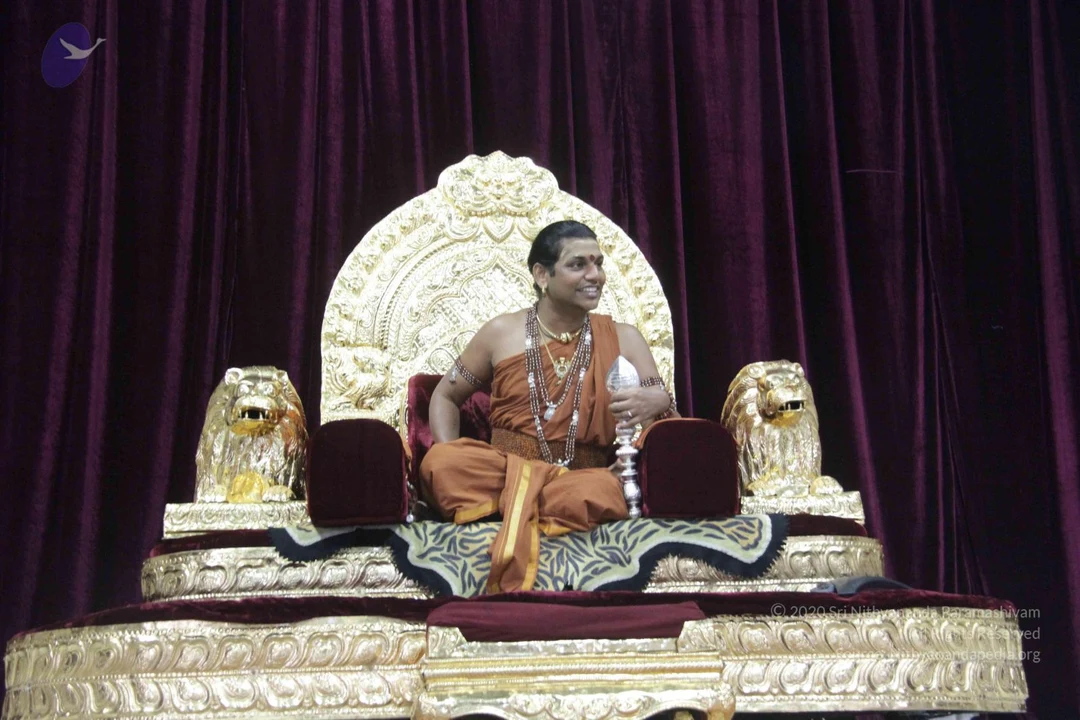
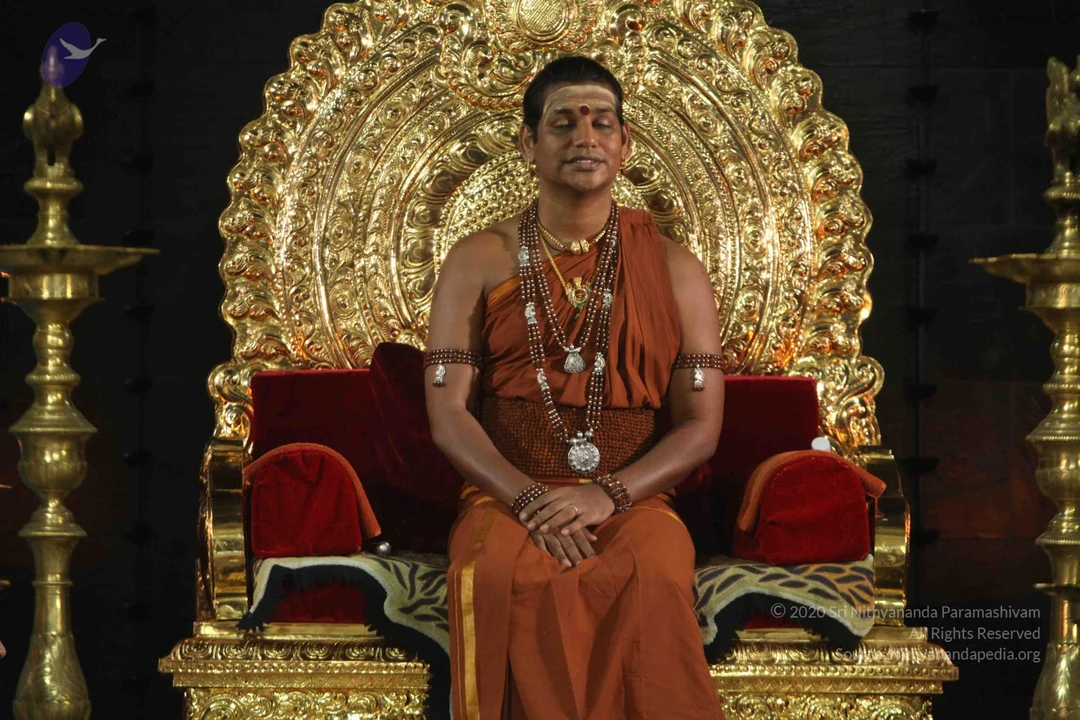
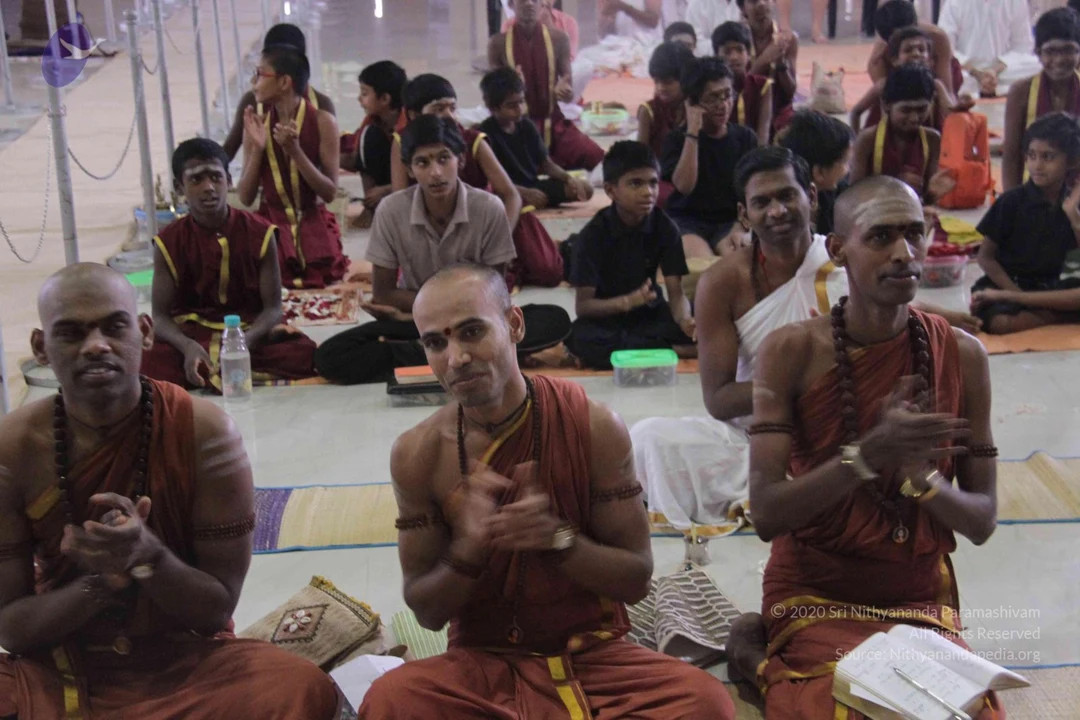
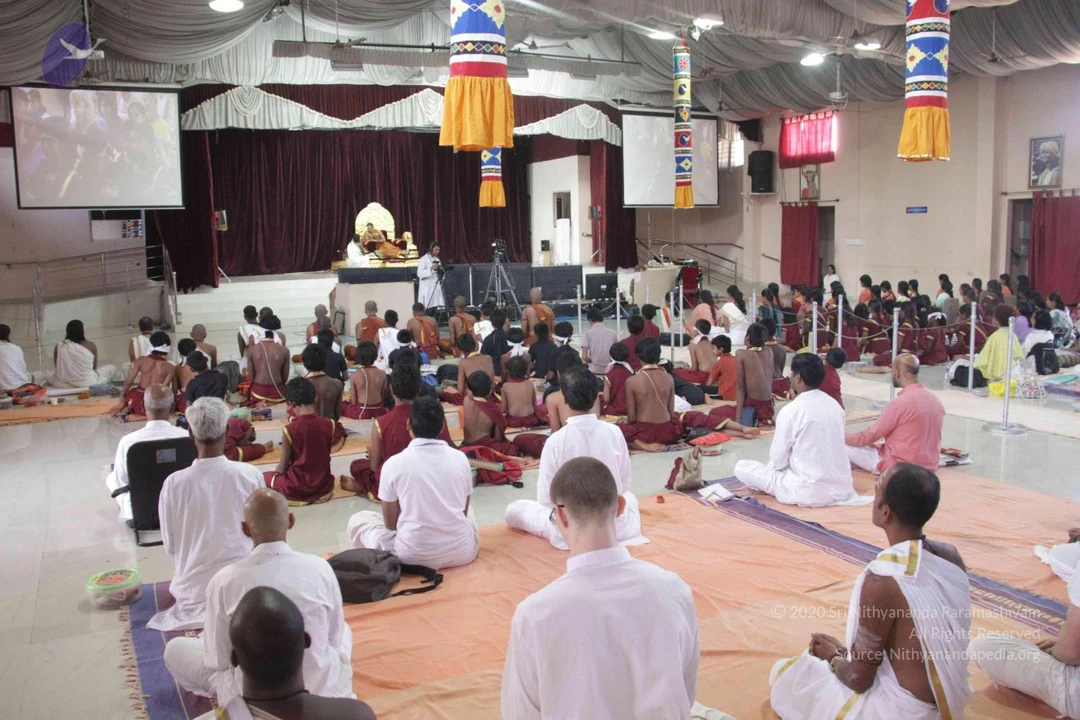
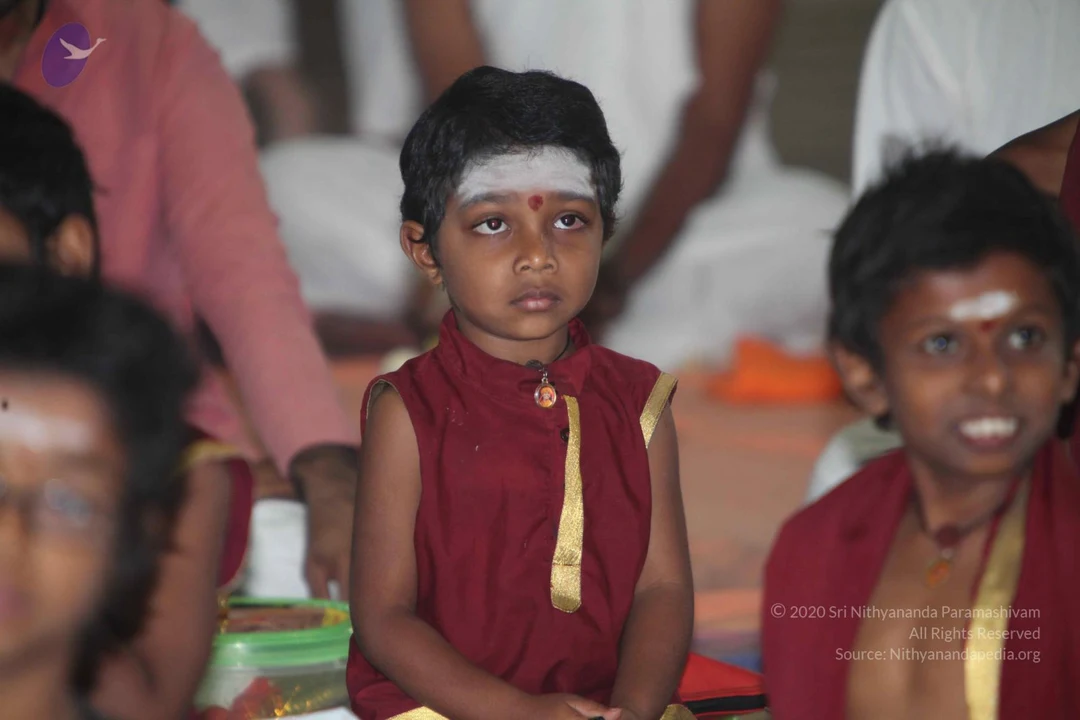
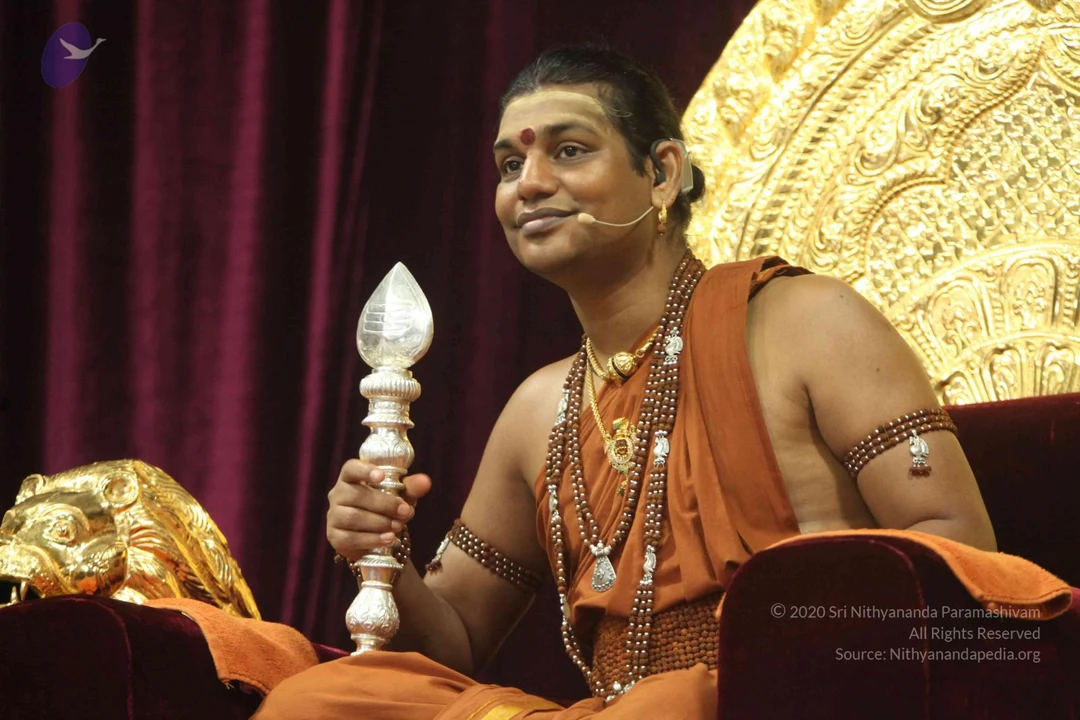
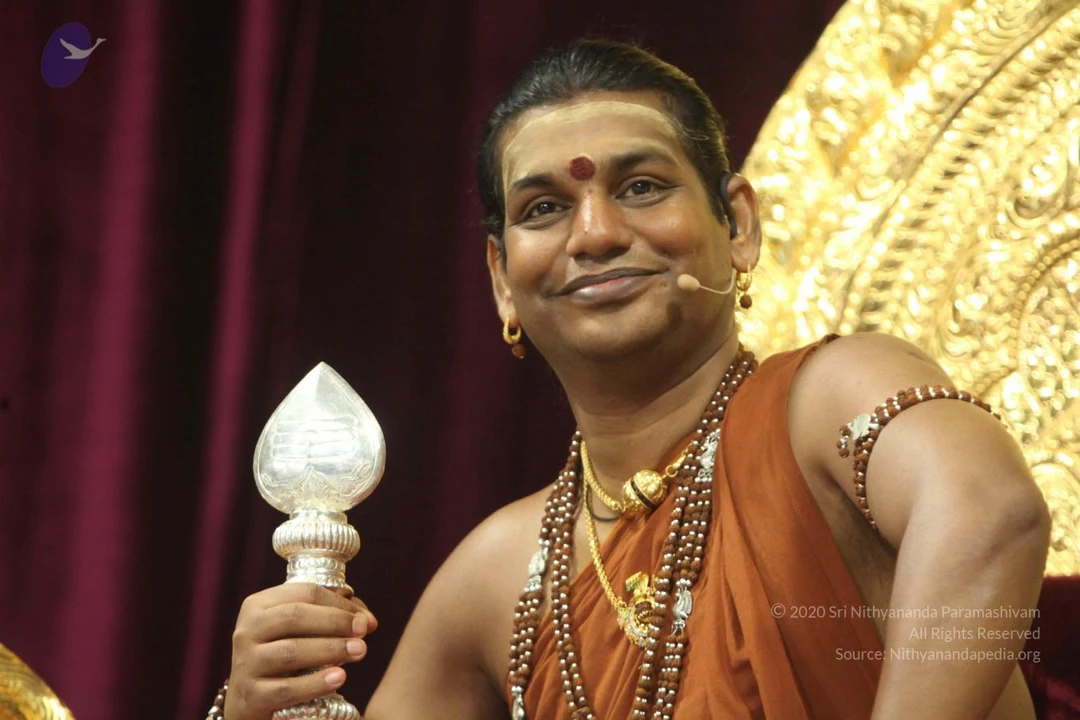
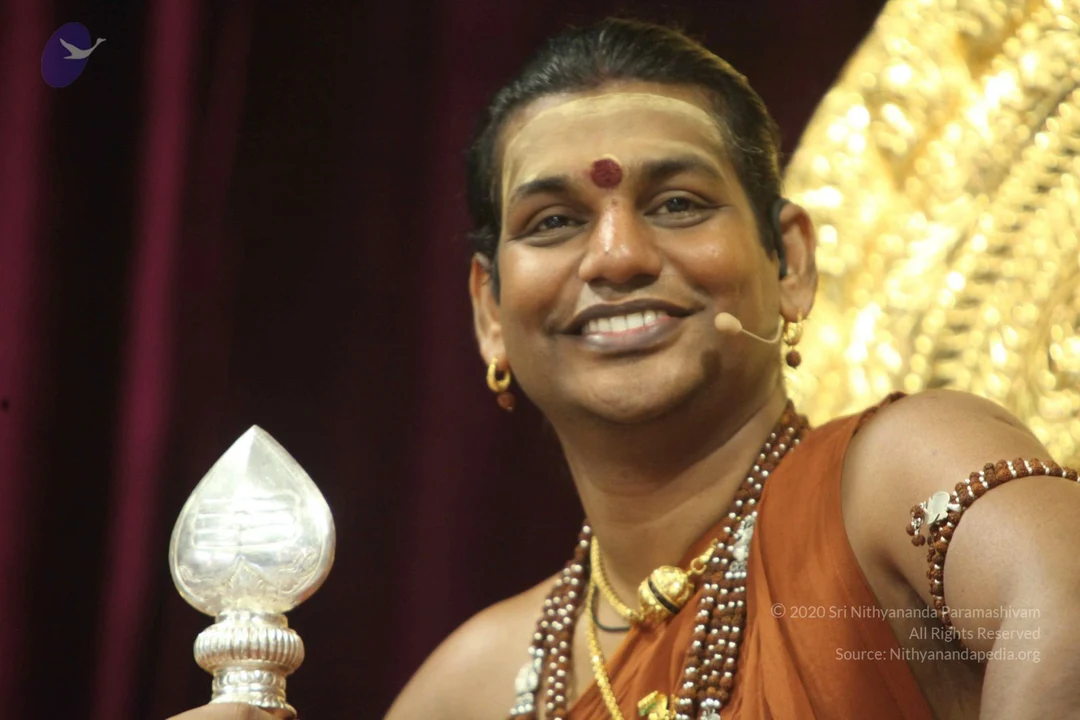
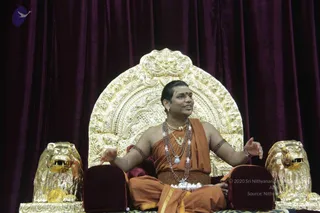
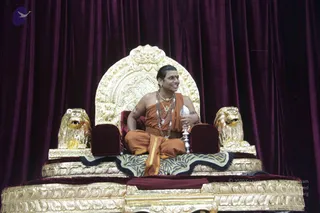
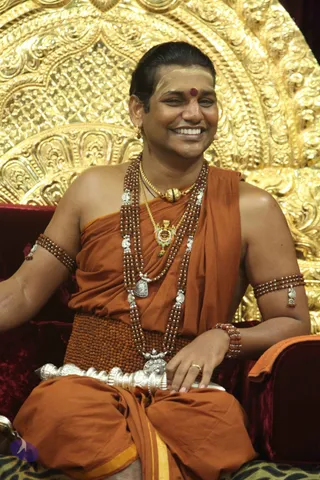
A man in orange-saffron robes sits on an ornate golden throne with a large arched gold back carved with floral and scroll motifs, flanked by two golden lion figures. He wears layered rudraksha malas, a gold pendant and necklace, armbands, and a red bindi, and holds a small white object in his hands. Behind him hangs deep maroon velvet drapery. The setting suggests a stage or satsang dais, with a patterned cloth covering the base of the throne.A man seated cross-legged on an ornate gilded throne with carved floral backrest, flanked by two gold lion figures, in front of deep maroon velvet drapes. He wears an orange-saffron dhoti and shawl, multiple strands of rudraksha beads, a gold pendant necklace and a silver chest ornament, with bangles on his upper arms. He raises one hand in a gesture while speaking. A small red bindi is on his forehead.A seated man in saffron-orange draped clothing, bare-shouldered with a rudraksha mala and a ceremonial gold necklace, sits on an ornate gold throne with a carved arched backrest before deep burgundy velvet drapes. Golden lion sculptures flank the throne on either side, and the man has his arms spread open while speaking. A red bindi is on his forehead and he wears a gold bracelet on each arm. Probable Swamiji by visible cues: long swept-back hair, saffron clothing, rudraksha malas and gold necklace, seated on a throne during a discourse.A seated figure sits on an ornate gold throne with carved lion figures on both sides and a large gilded back panel, against a deep maroon velvet drape. The person wears an orange-saffron cloth draped over one shoulder, a dark red bindi, multiple strands of beaded rudraksha-style malas and a gold pendant necklace, and holds a silver ceremonial staff upright in one hand. The figure smiles and looks off to the side.A man in orange saffron robes sits on an ornate gold throne with a carved, arched back and red velvet cushions. He wears a red bindi on his forehead, multiple rudraksha mala necklaces, a ceremonial gold pendant, and beaded bracelets on his wrists. His hands rest folded in his lap. Tall brass oil lamps stand on either side of the throne against a dark background.Indoor satsang hall with a white floor and mats. Front row: three shaved-headed men in saffron-orange robes with rudraksha malas, seated and pressing palms together in greeting; the central man has a red bindi and the man on the right wears a gold wristwatch. Behind them, a man in white dhoti and shawl with a white tilak sits among many boys in maroon-and-gold gurukul robes, some in black or grey shirts, many seated on floor mats, watching attentively. Water bottle, open book and small containers are on the floor. Several dozen people are visible in total.

Dial-The-Avatar

5 photosSource gallery
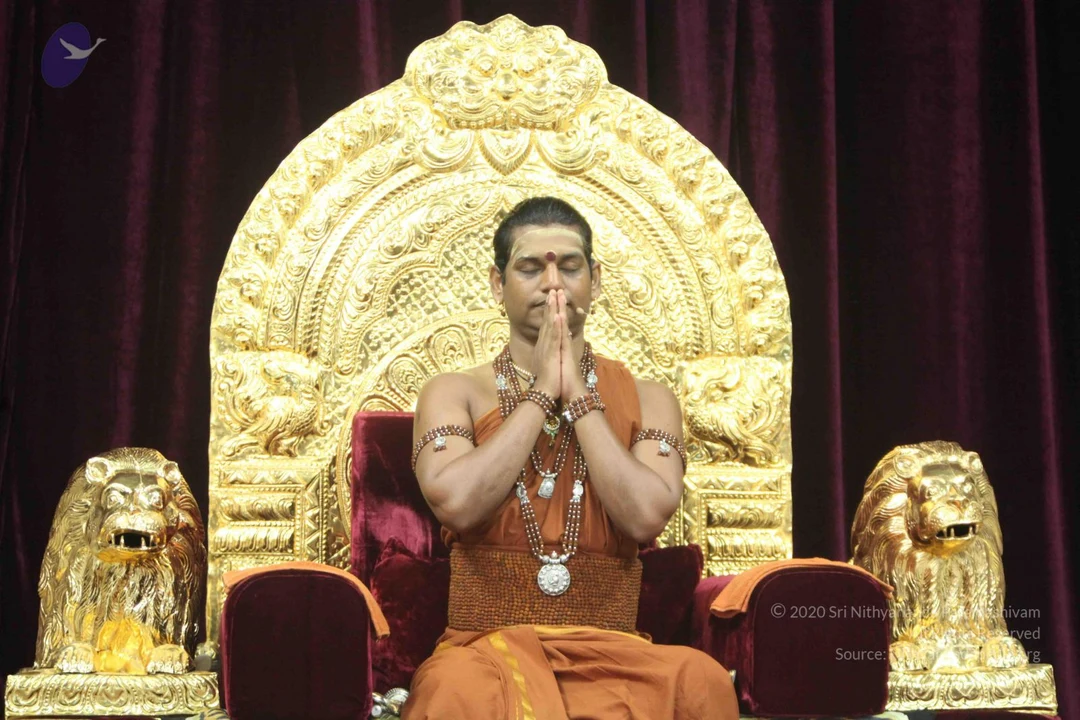
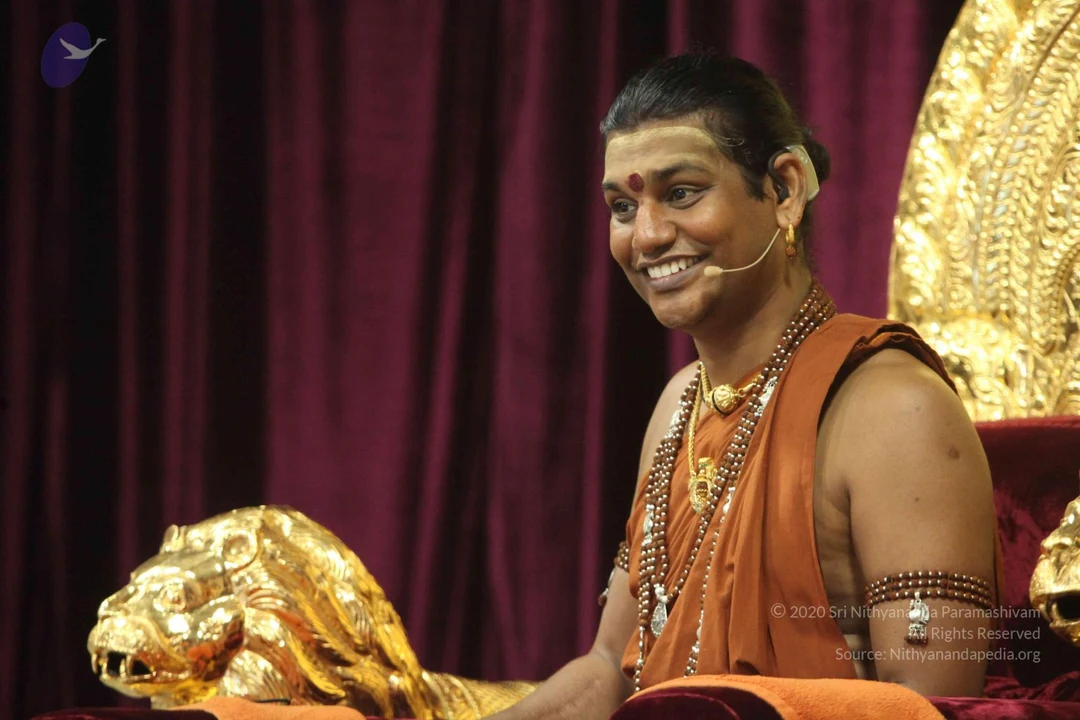
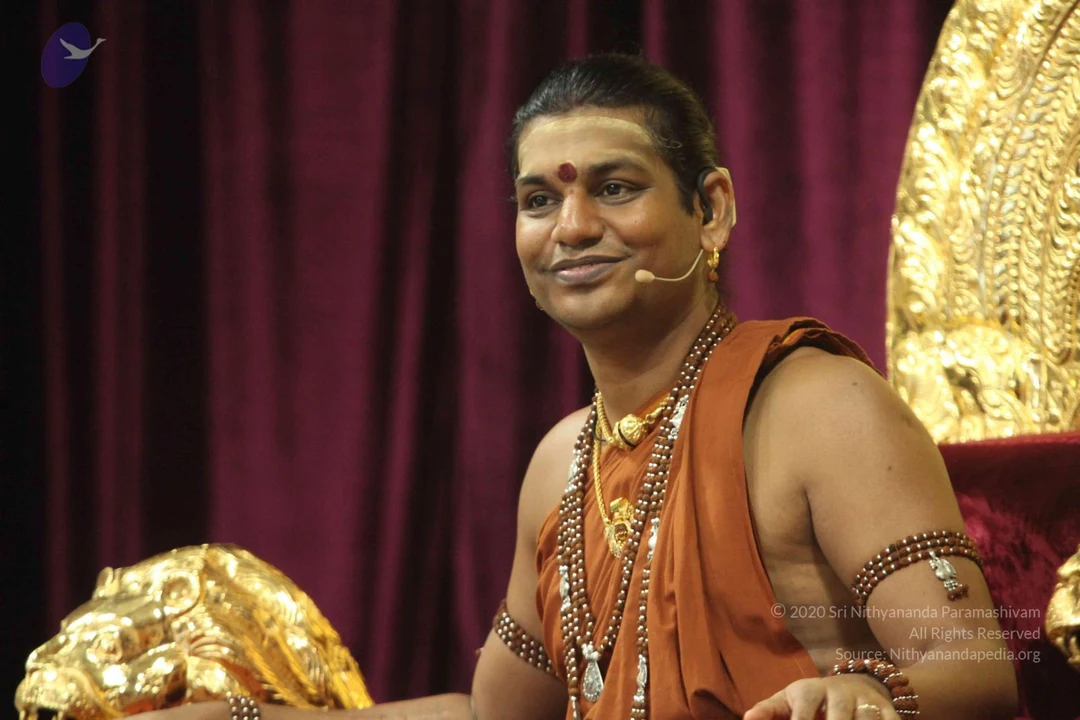
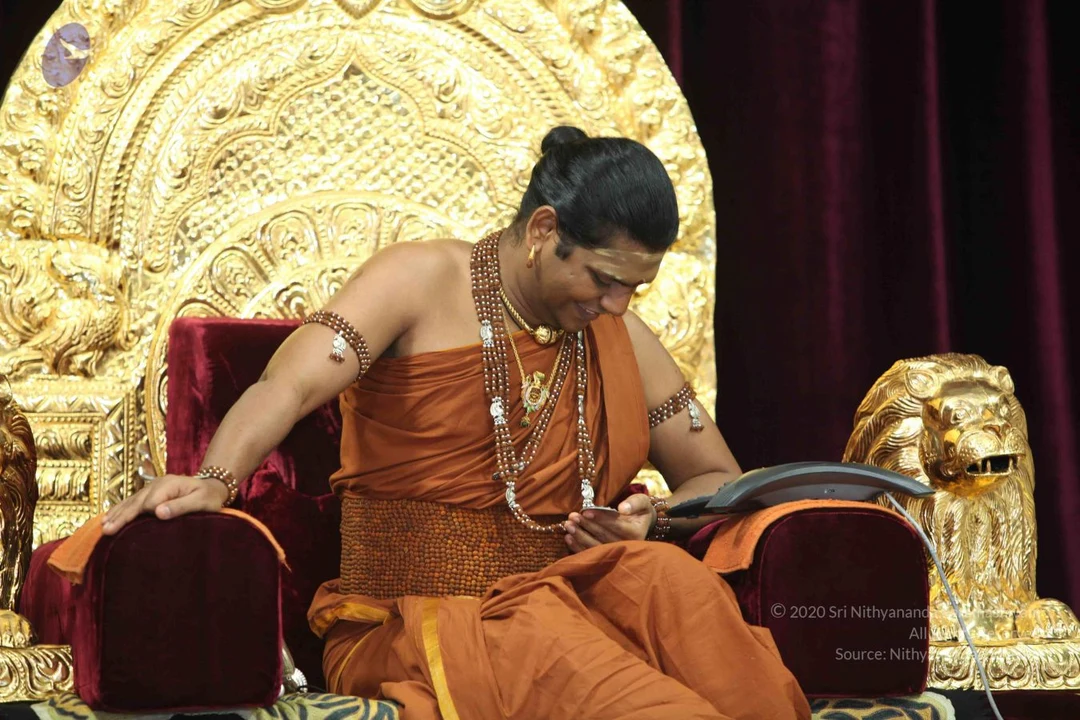
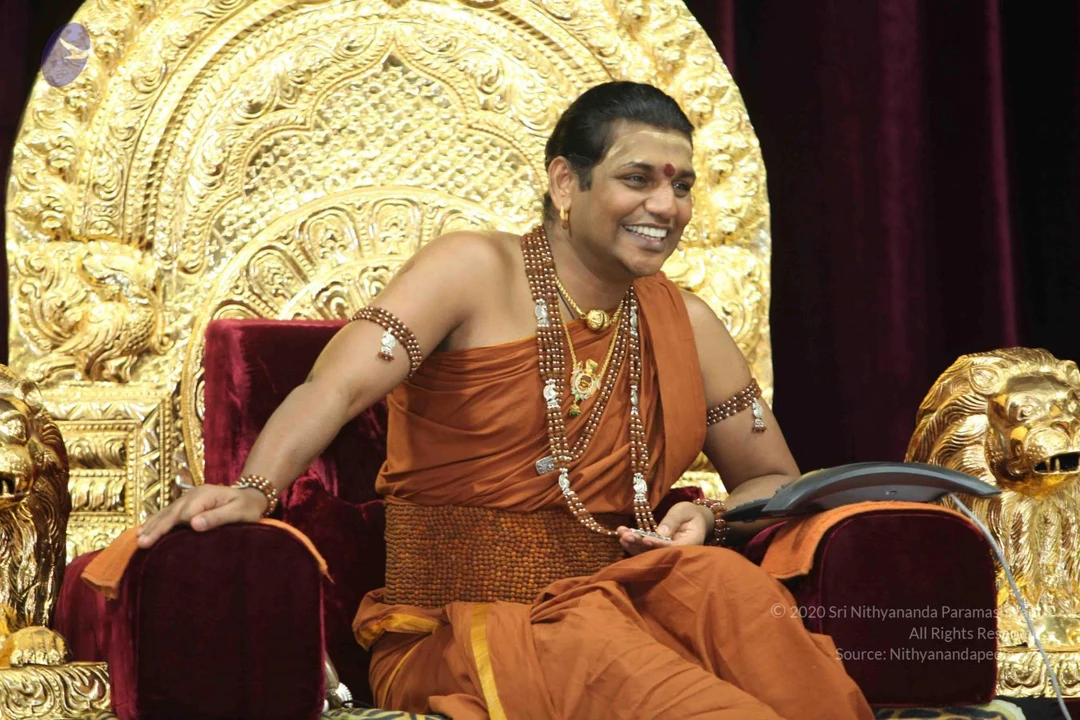
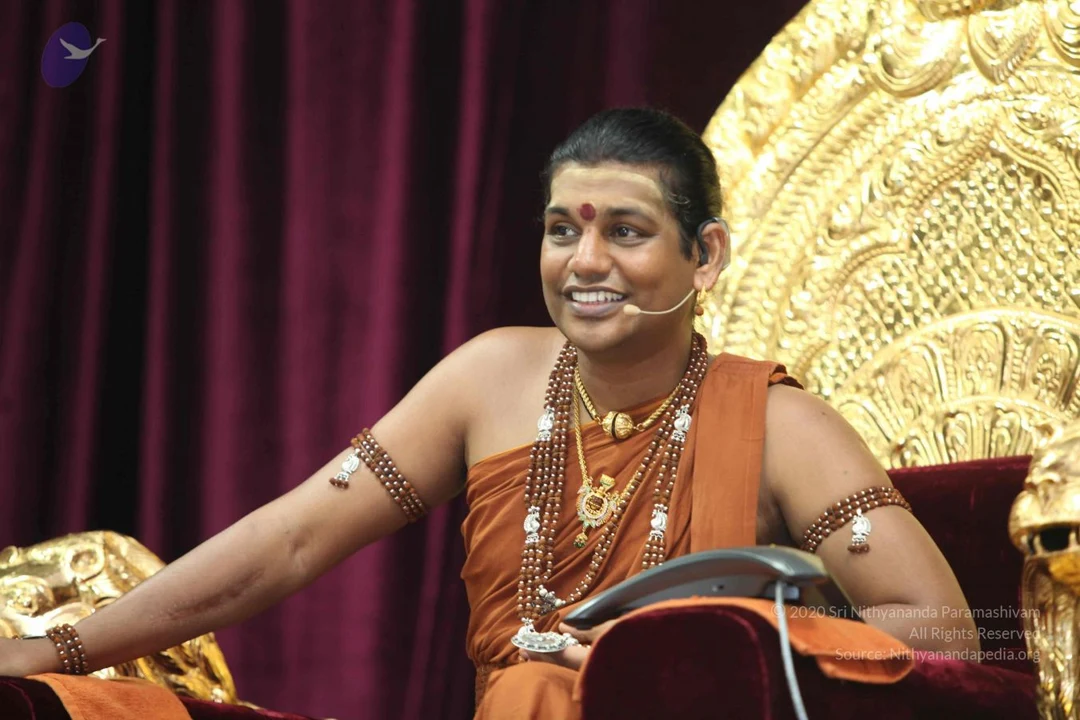
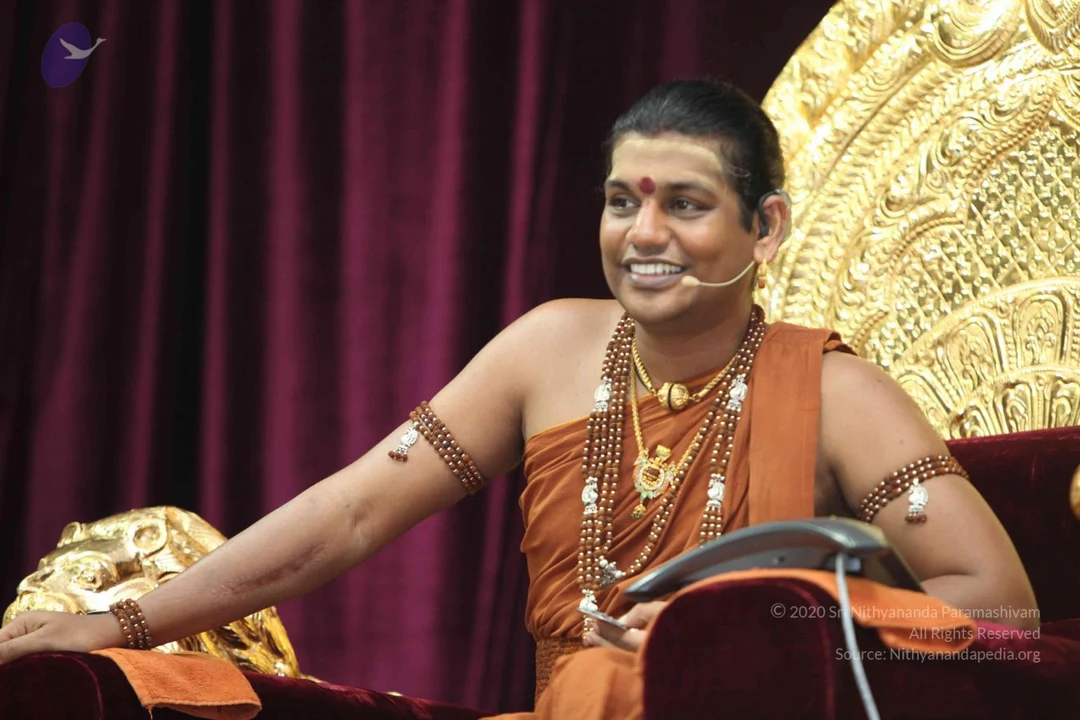
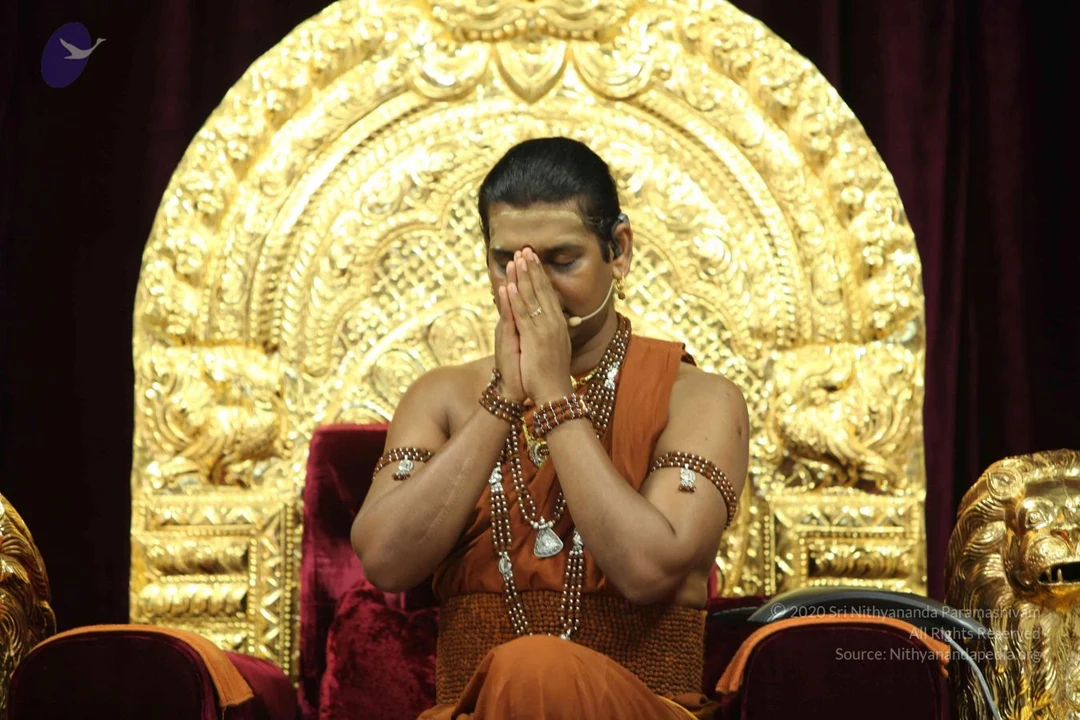
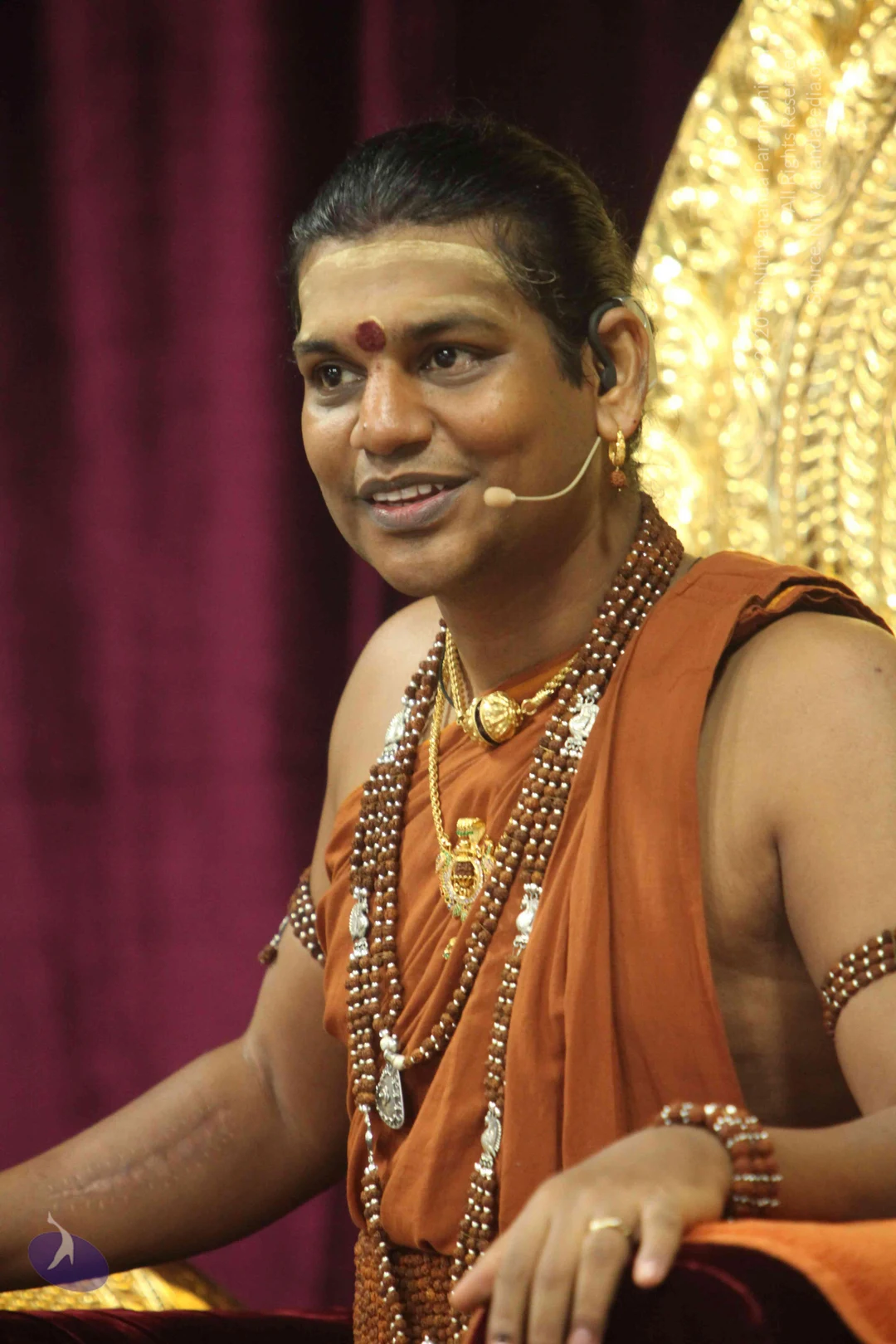
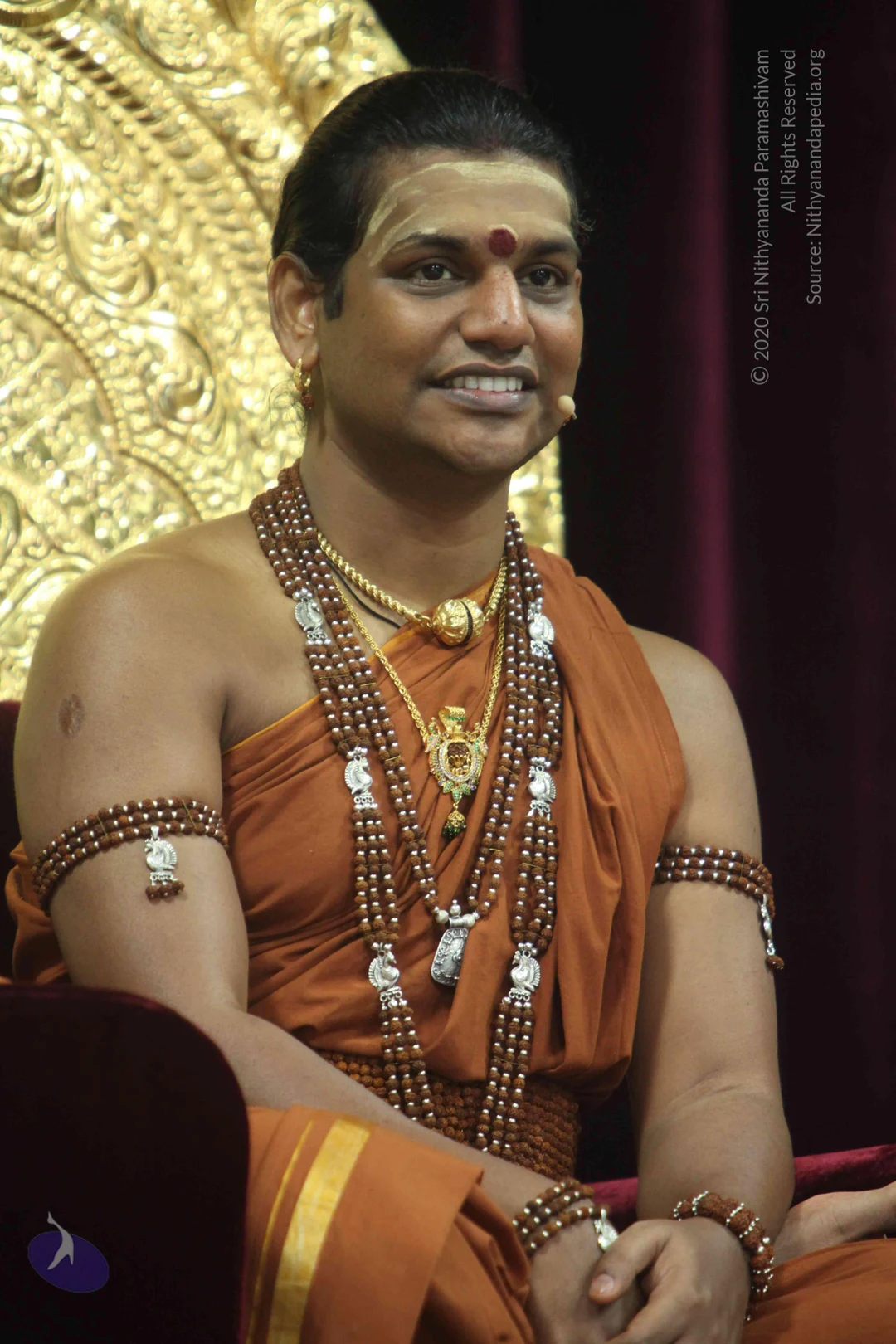
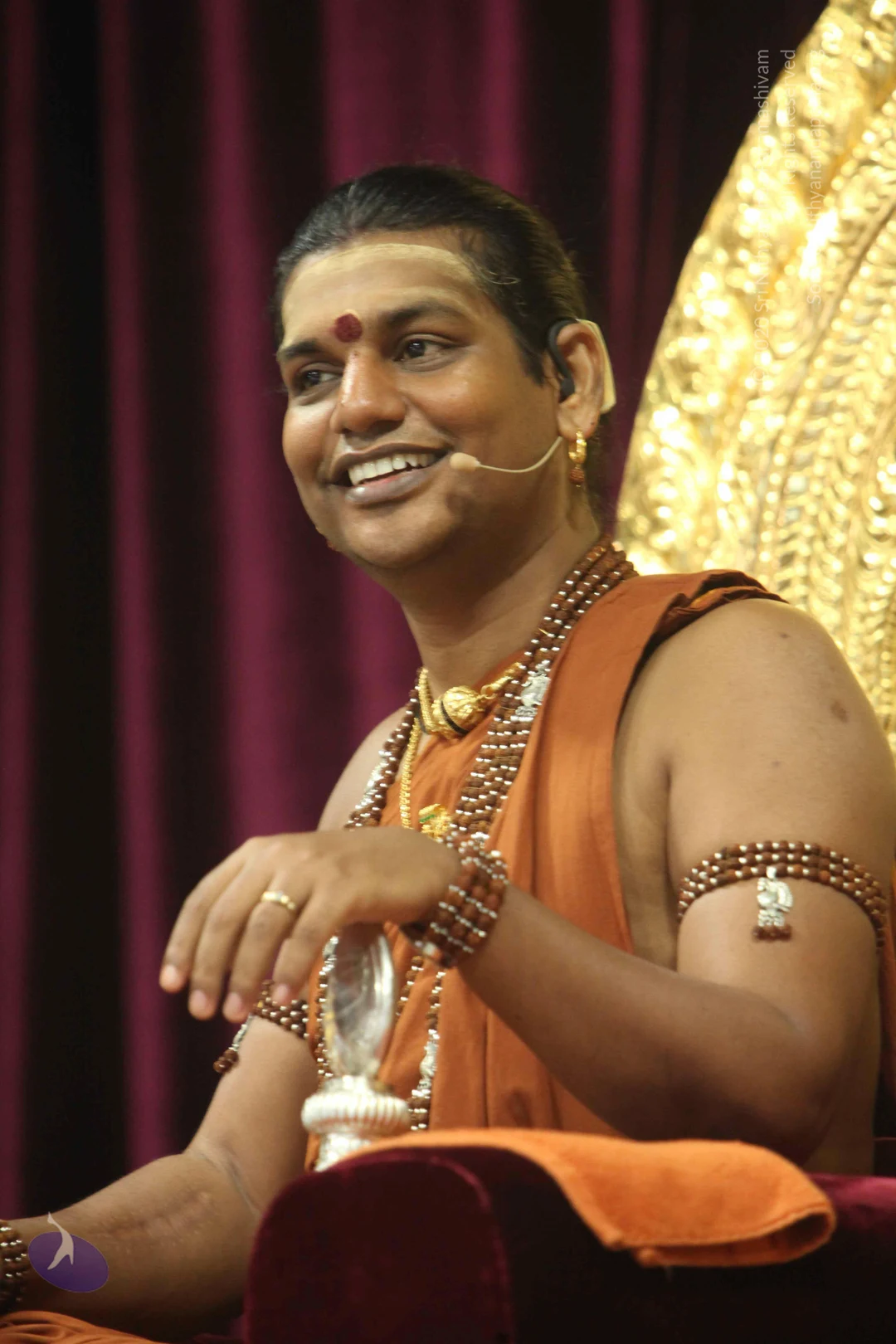
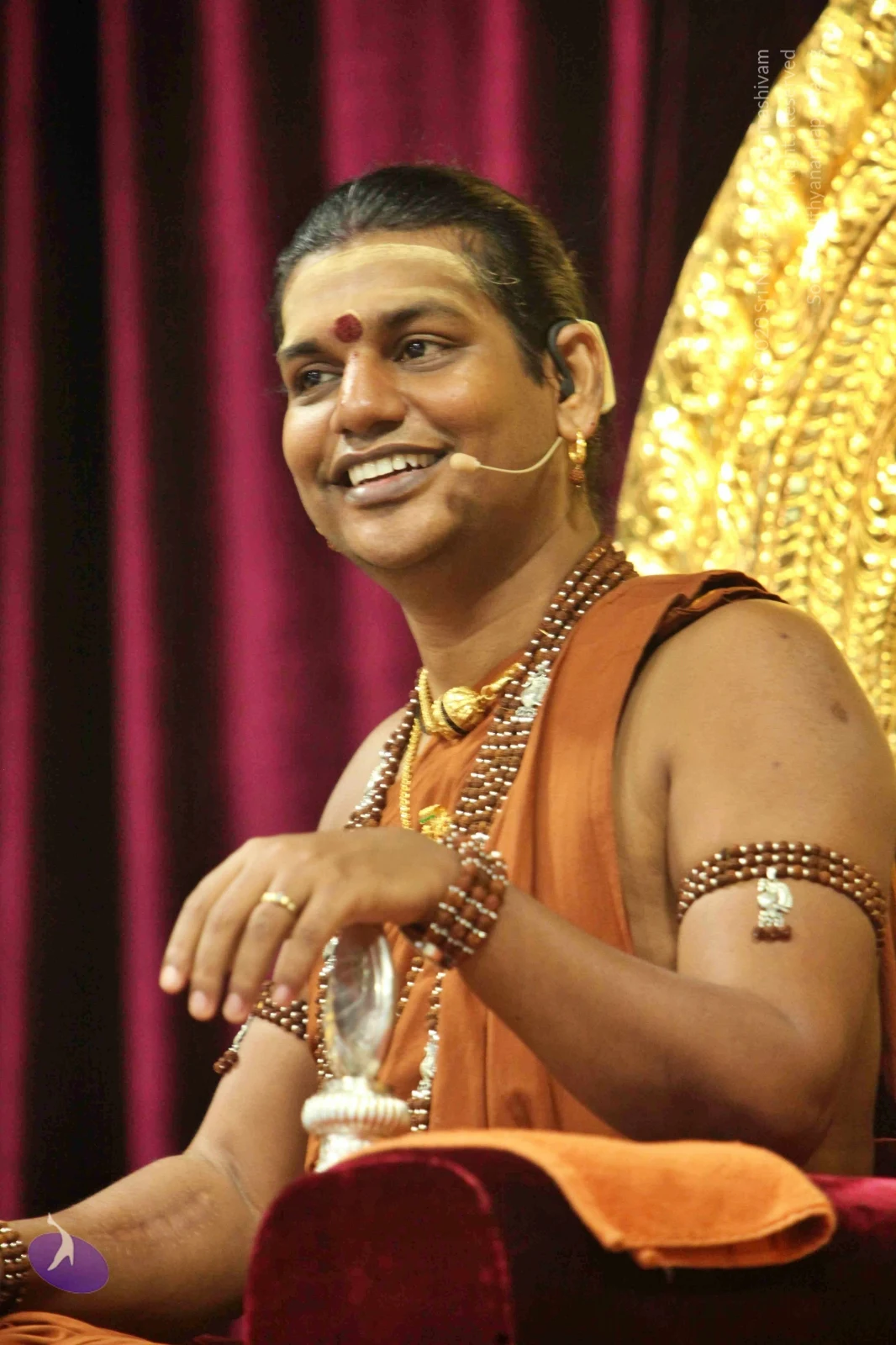
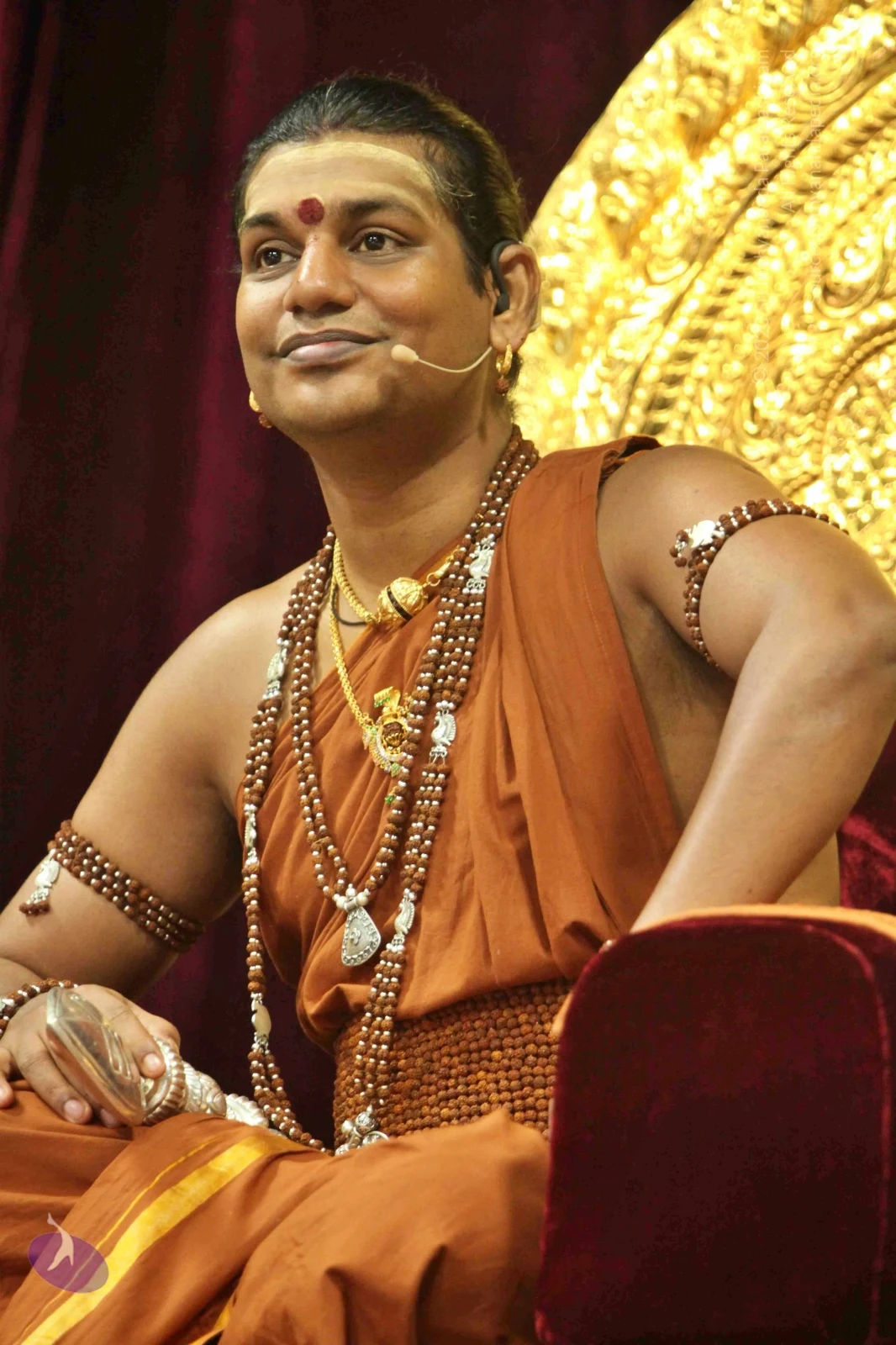
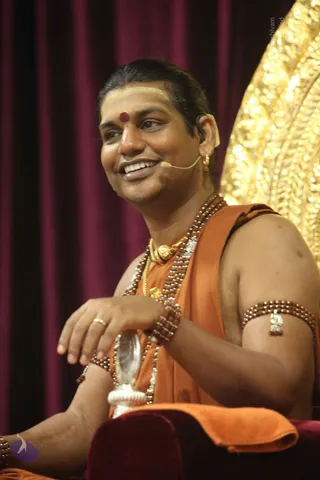
A man with his hair swept up in a bun sits on a plush burgundy velvet throne with gold armrests, seated before an ornate gilded backdrop with carved scrollwork. He wears an orange-saffron dhoti-style wrap that drapes over one shoulder, layered rudraksha malas, a gold necklace with a pendant, a wide beaded waist belt, and beaded armlets. He looks down smiling while holding a small device in one hand, and a tablet-like screen rests on the armrest beside him. Gold lion sculptures flank the throne, and a dark maroon curtain hangs behind.A photograph of a smiling man seated on a red velvet armchair in front of an ornate gold throne with carved lion heads on the armrests. He wears a saffron-orange draped robe over his shoulder, a brown wooden bead waist belt, multiple rudraksha bead malas and a gold pendant necklace, gold armbands and a red bindi on his forehead. He holds a small dark object in his hand. a person: the man has a swept-back hairstyle, saffron robe, rudraksha malas and ceremonial gold ornaments, and is seated on a throne, consistent with the page reference to a person at this event.A photograph of a smiling man seated on an ornate gold throne with a red velvet cushion and burgundy drapery behind him. He wears a saffron-orange draped garment over one shoulder, rudraksha bead malas across his chest and arms, a gold pendant and gold necklace, and a small red bindi on his forehead. A headset microphone is attached near his face, and his hair is swept back. He gestures with one arm toward the side of the stage. The appearance is consistent with a person seated on the throne, based on the saffron clothing, rudraksha malas and ceremonial gold ornaments, with the page noting a person at the event.A photograph of a smiling man seated on a red velvet throne-like chair in front of a gold carved backrest and maroon curtains. He wears an orange saffron wrap over his bare shoulder, multiple strands of rudraksha beads, a gold pendant necklace, rudraksha armbands with silver ornaments, and a red bindi on his forehead. A small microphone is attached near his face, and he rests one arm on a gold lion-head armrest. a person, seated in saffron clothing with rudraksha malas and ceremonial gold necklace on a throne. A clock-like device sits on the side table.A man seated on a red velvet throne before an ornate gold-leaf arch with carved lion heads at its base. He sits with palms pressed together at his forehead in namaskar, eyes lowered. He wears an orange saffron wrap, a long mala of wooden rudraksha beads with a silver pendant, beaded armlets and a tilak on his forehead, with a small headset microphone at his ear. Swamiji (probable): the long swept-back hair, saffron clothing, rudraksha malas and ceremonial adornments match the page's claim. A gilded lion statue appears at the right edge. The page is a satsang discourse setting.

Sarva-Darshan

3 photosSource gallery
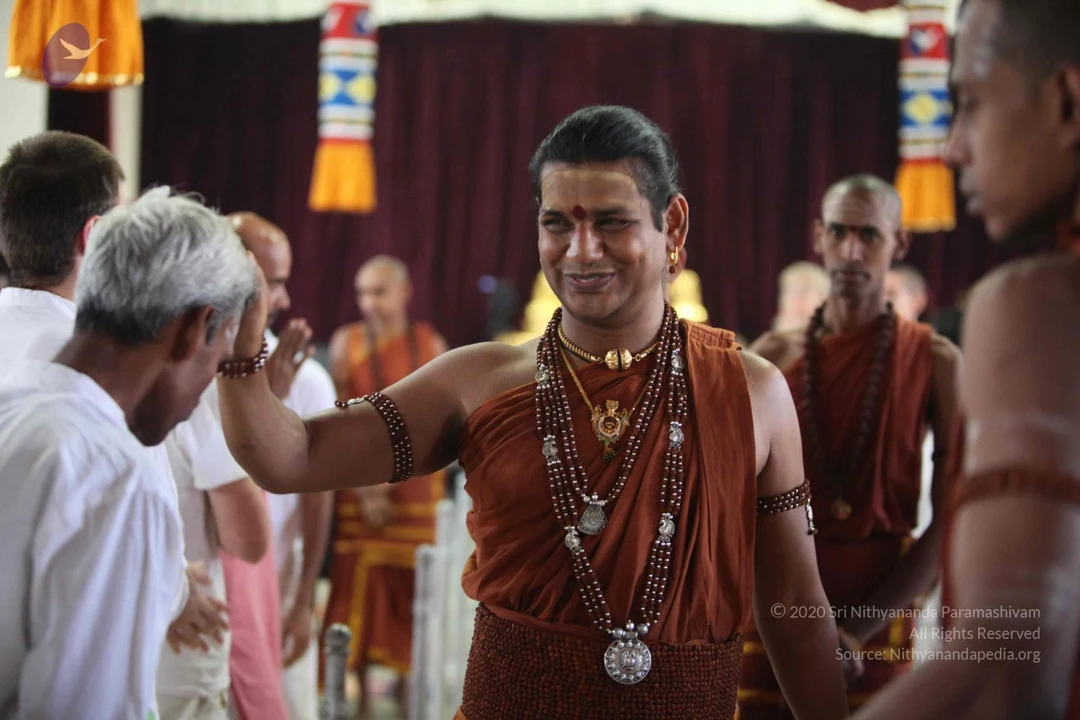
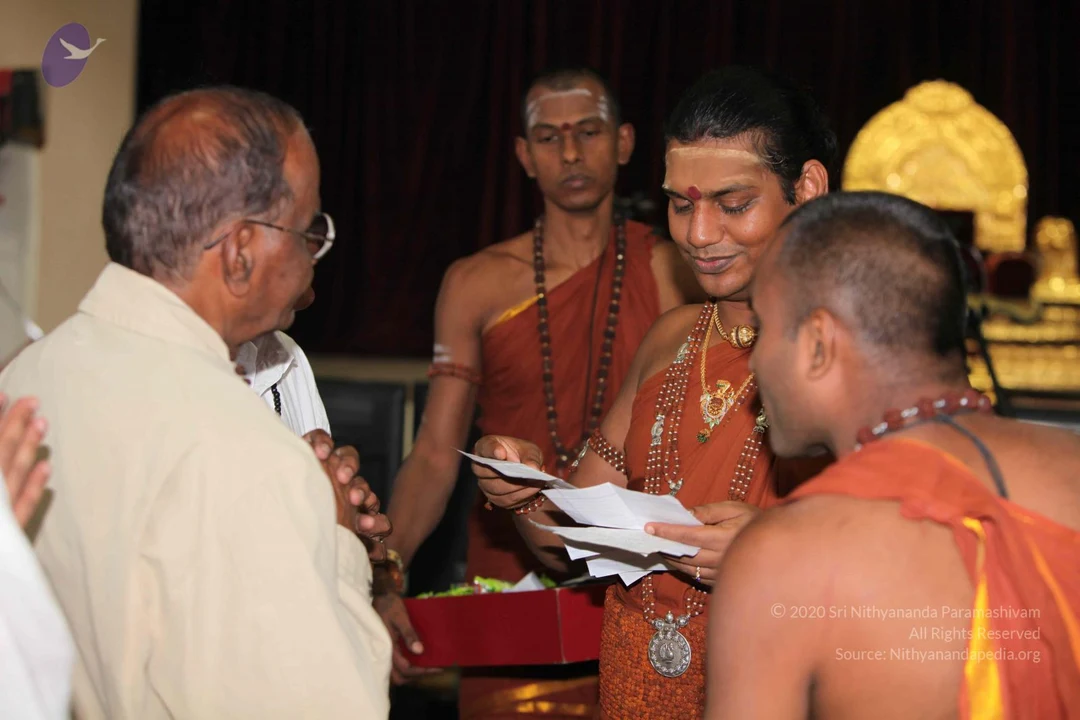
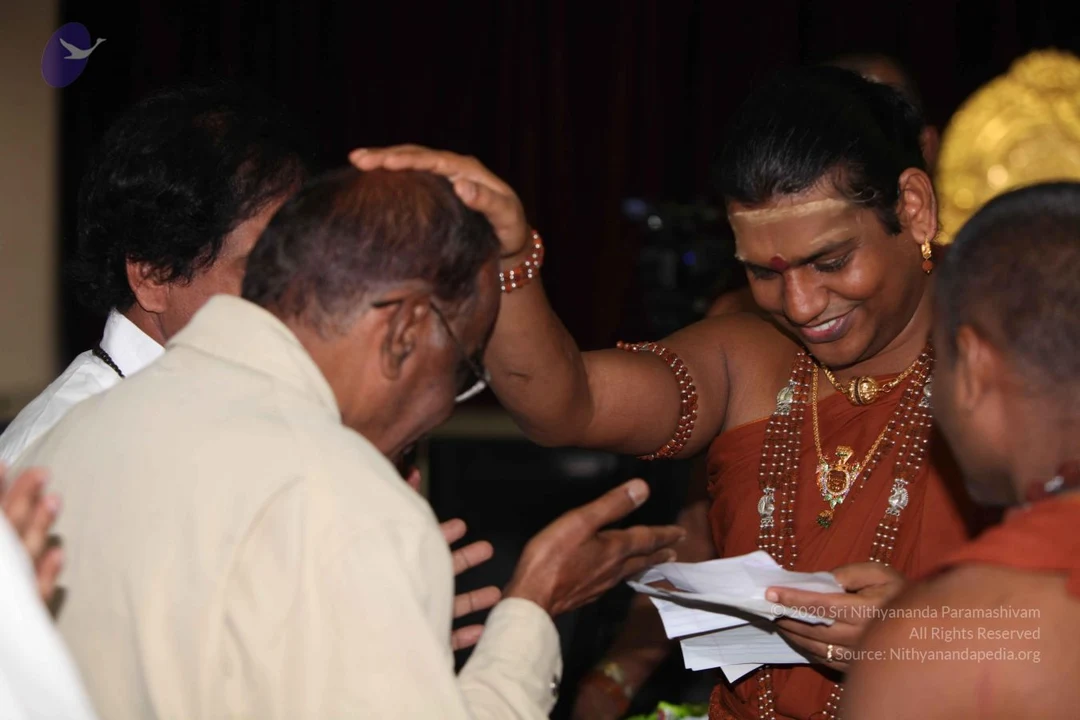
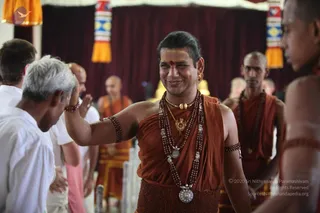
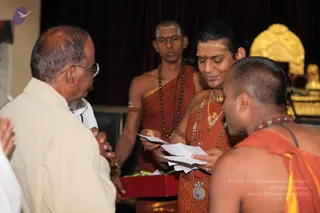
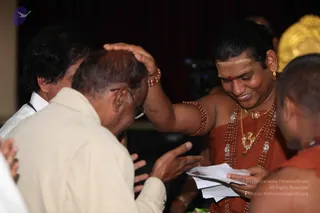
A photograph of a saffron-robed sannyasi with swept-back dark hair, a red tilak on his forehead, and layered rudraksha mala necklaces with silver pendants, raising one hand in greeting toward a man in white clothes at left. Other saffron-robed monastics stand behind and beside him, one in the background wearing a rudraksha mala, and a bald monk at right. A maroon curtain with yellow and red tassels hangs behind them. Swamiji (probable) is the central figure, shown by his distinctive long swept-back hair, ornate gold necklace, and rudraksha malas. Five people are visible, counting partially visible ones at the edges.A photograph of a ritual exchange indoors. An elderly man in a cream shirt and glasses stands at left with hands pressed together in greeting. A young man with a red bindi and ash-marked forehead, wearing an orange-saffron cloth, multiple beaded rudraksha malas and ornate gold pendants, holds a bundle of folded papers and passes them forward. Behind him a bare-shouldered priest in orange wears a rudraksha mala and white tripundra markings. At right, a shaved-headed man in orange with a red beaded necklace turns toward the exchange. A red tray with green leaves sits low in the frame, and a gilded shrine arch glows in the background behind dark red drapes.A photograph of a man in a saffron-orange robe with long swept-back dark hair, a red bindi and a horizontal white tilak on the forehead, wearing layered rudraksha malas and an ornate gold pendant necklace, placing his right hand on the head of an older balding man in a cream shirt and glasses who bows forward. The figure in orange holds a stack of papers in the other hand. Another man in white stands at left, and a partly visible saffron-robed figure is at right, with a golden deity murti or ornament in the upper right. Blessing or darshan setting. Swamiji (probable) on the basis of the saffron robe, long hair, rudraksha malas and gold necklace, as the person giving the blessing.

01-Temple

7 photosSource gallery
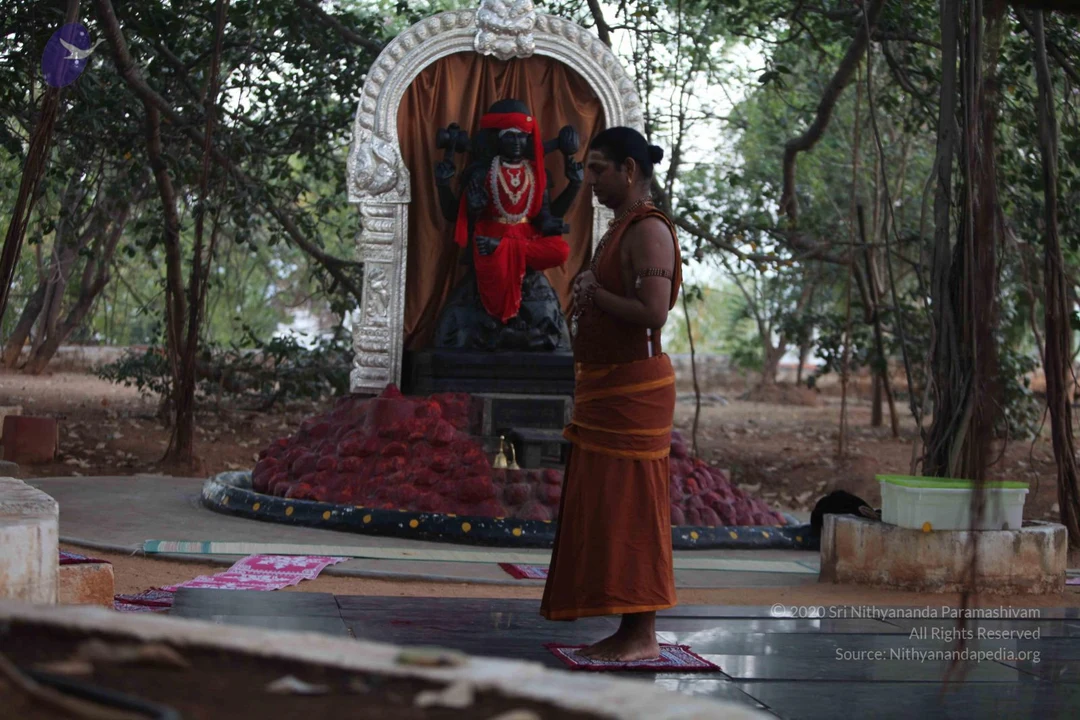
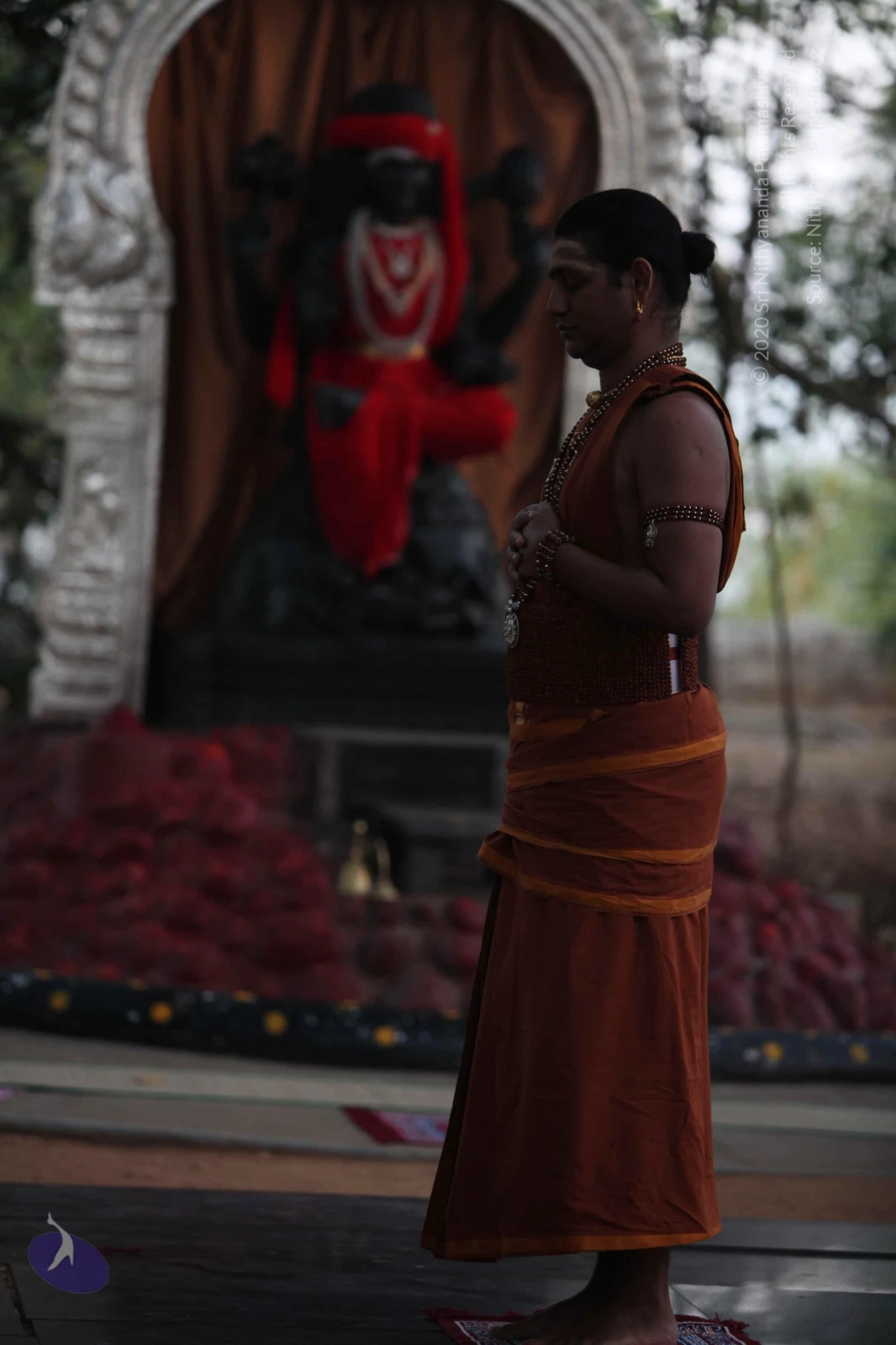
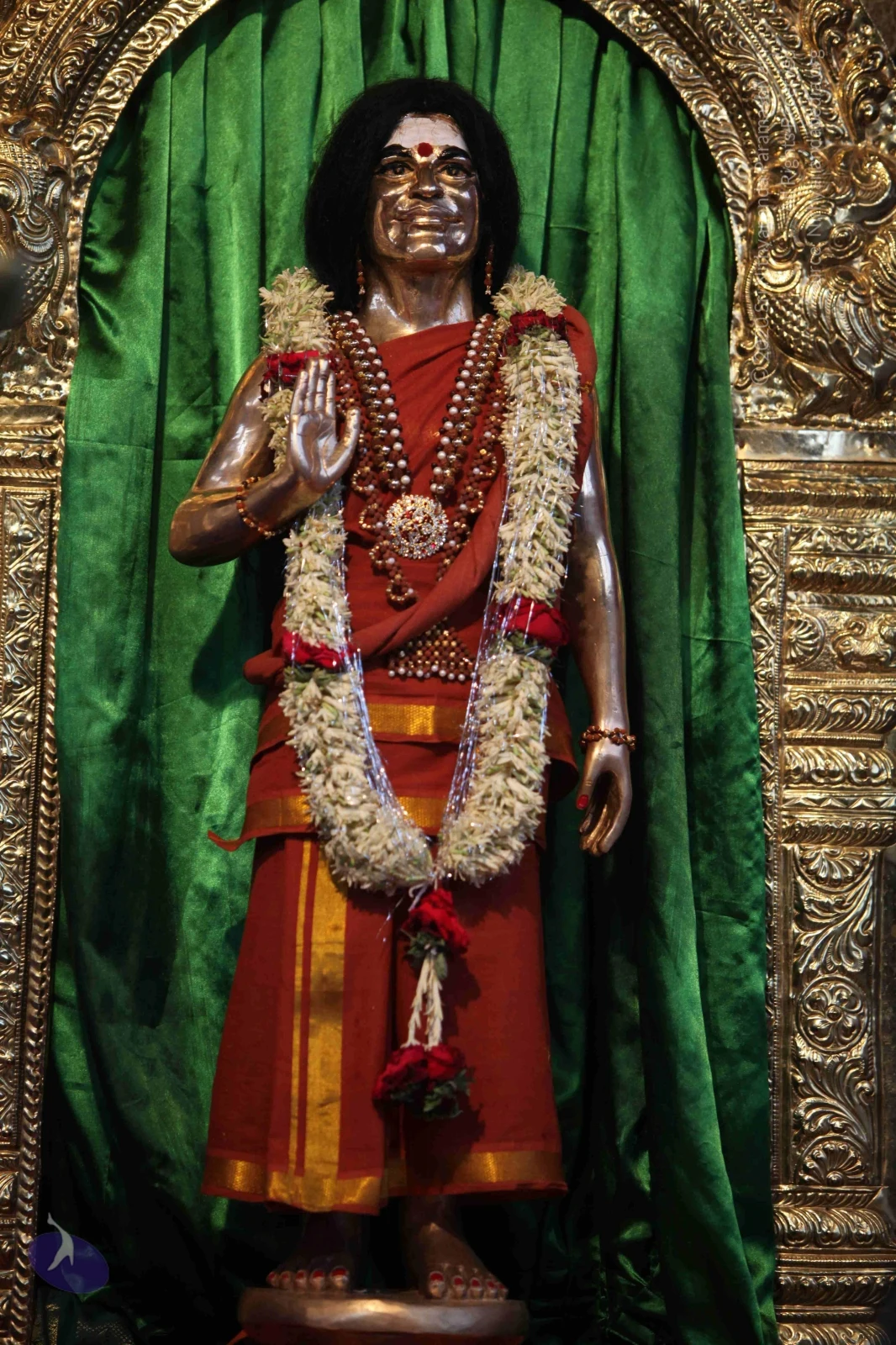
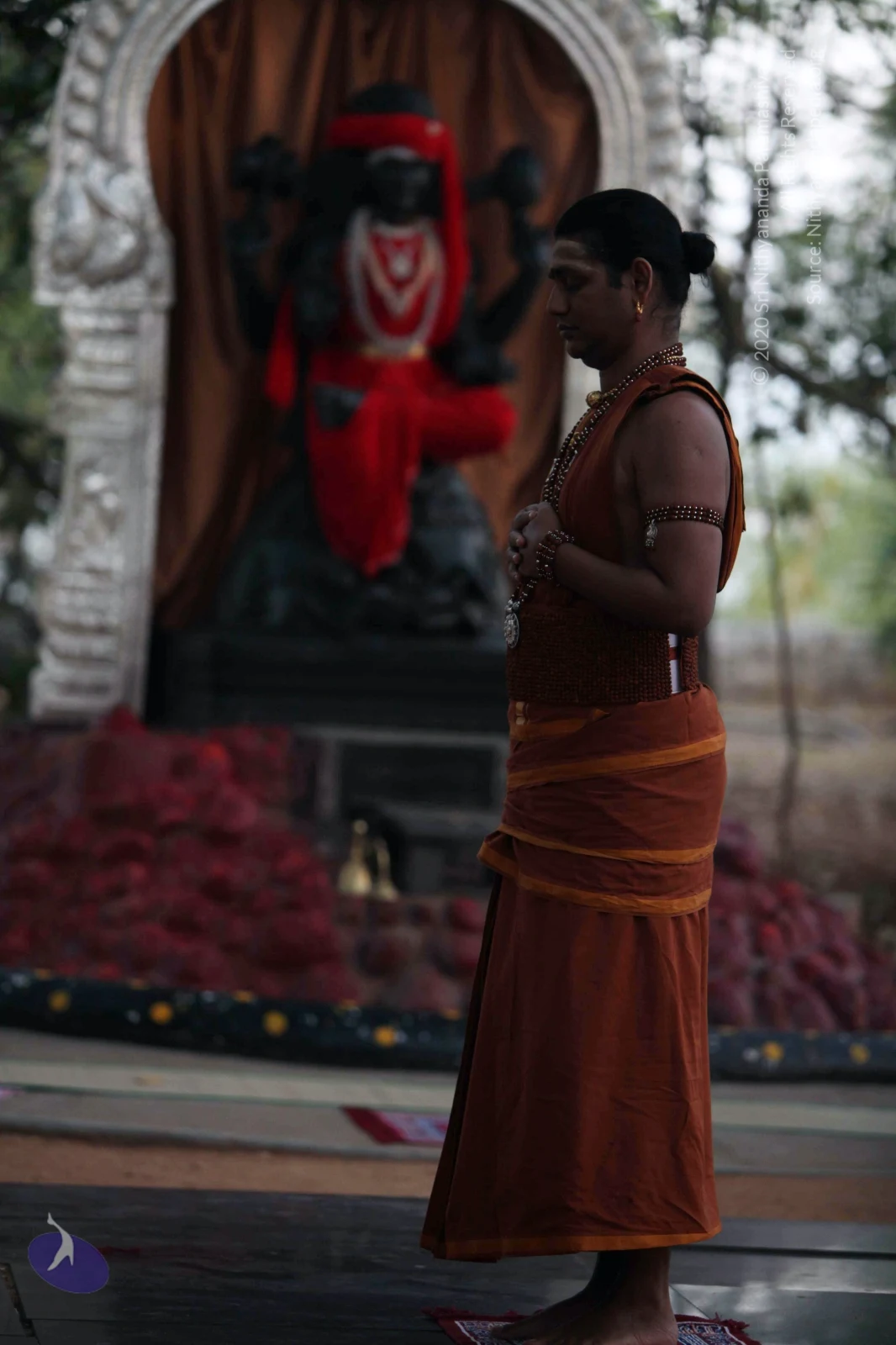
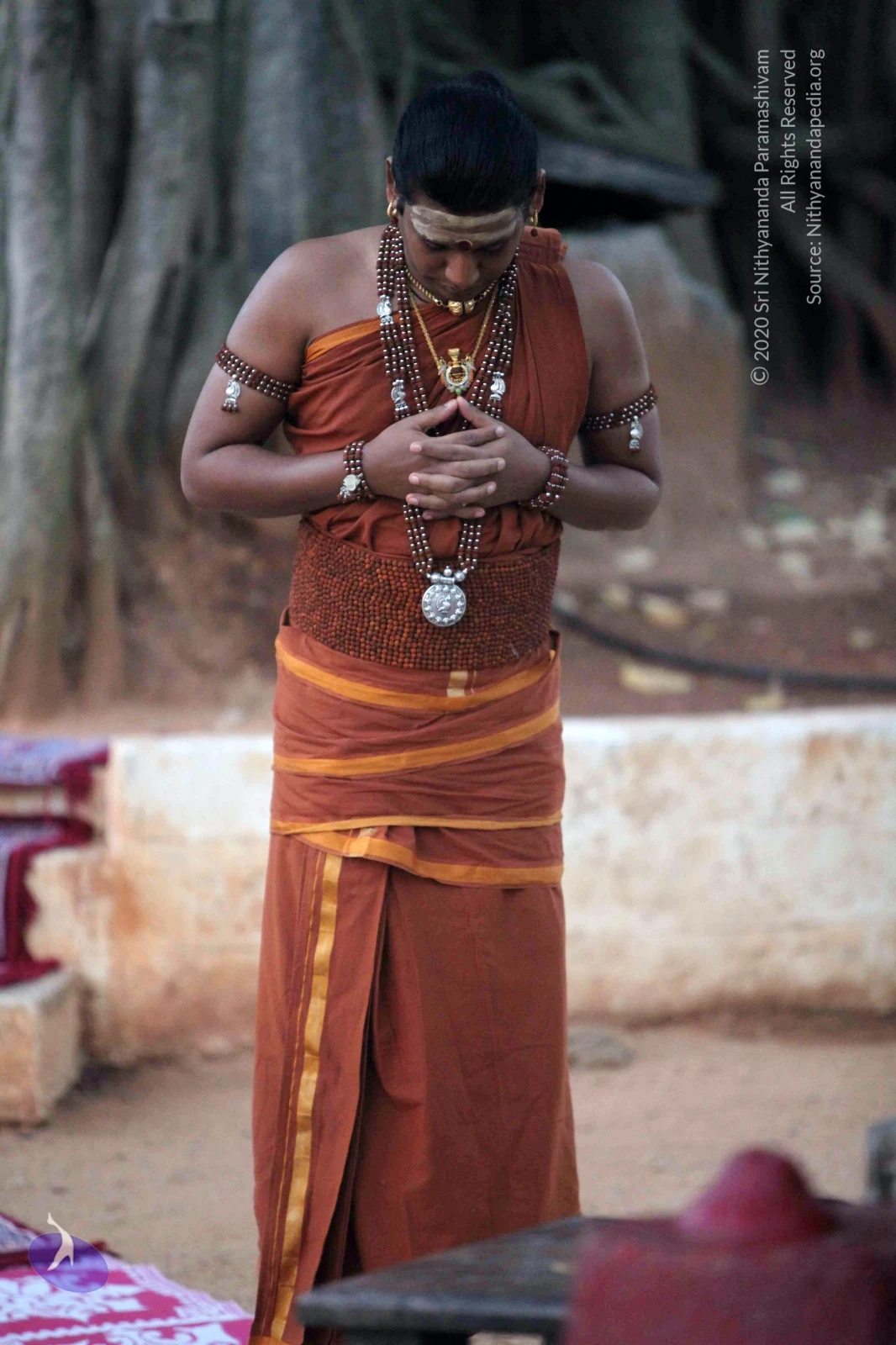
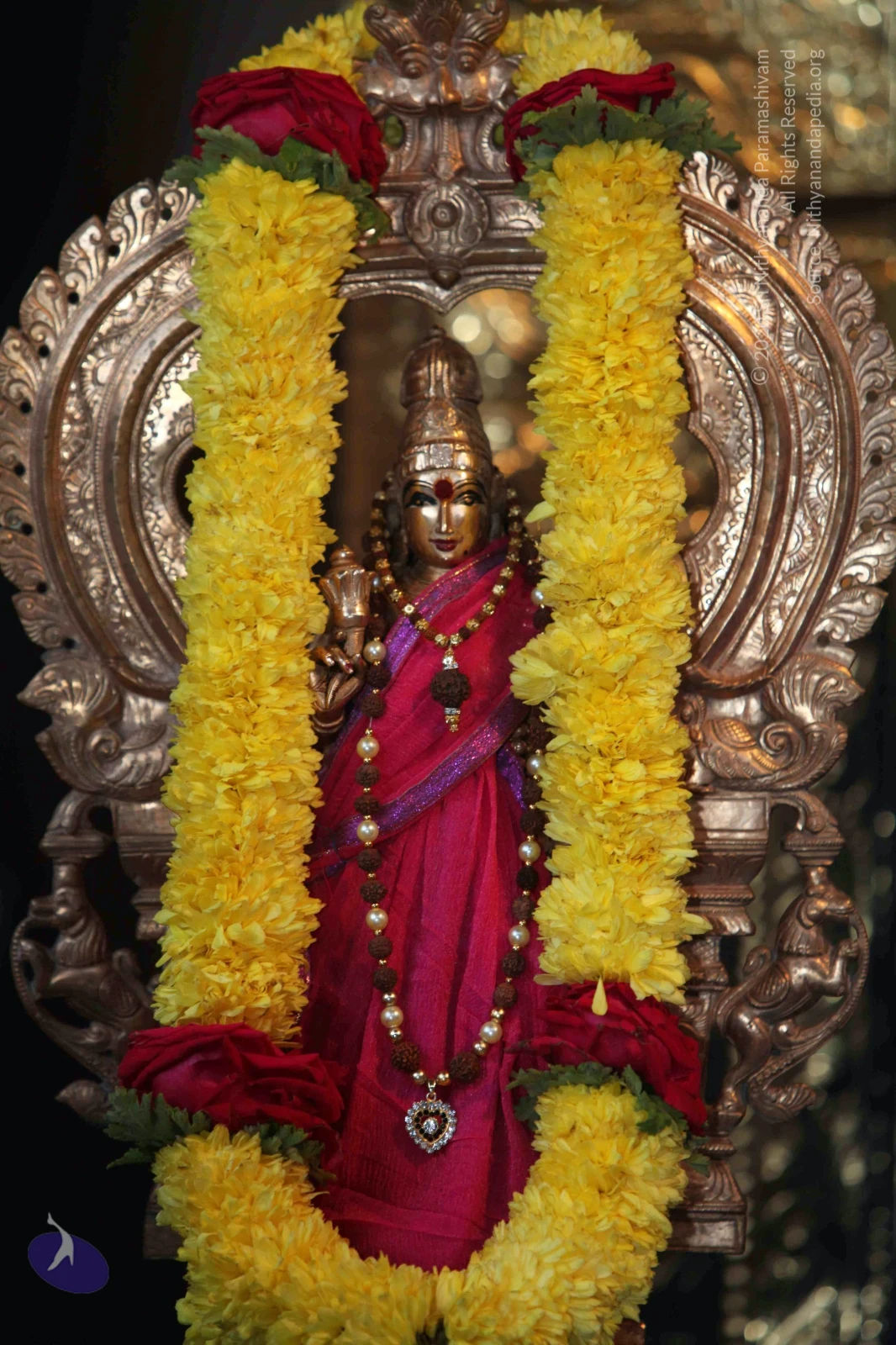
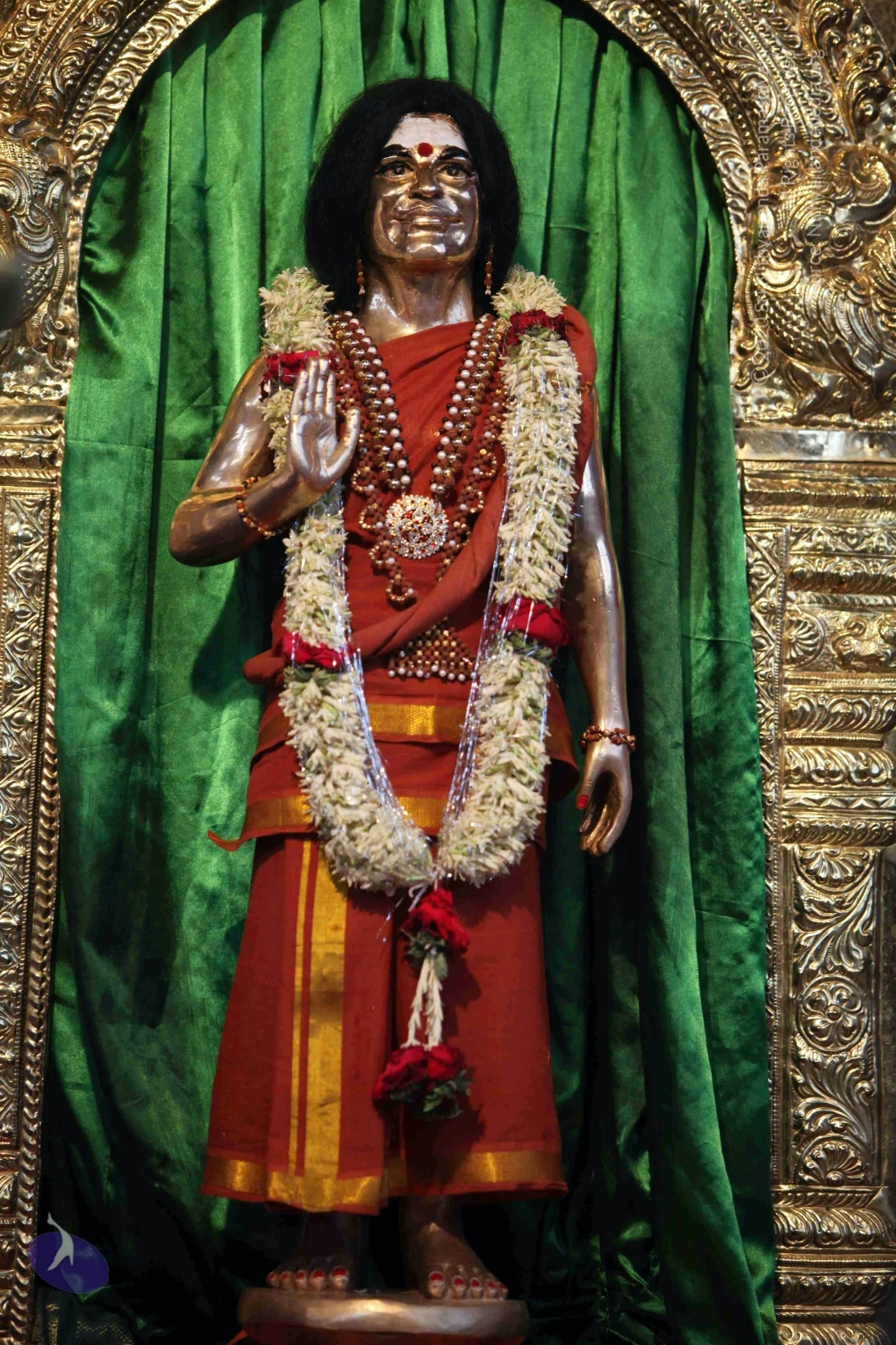
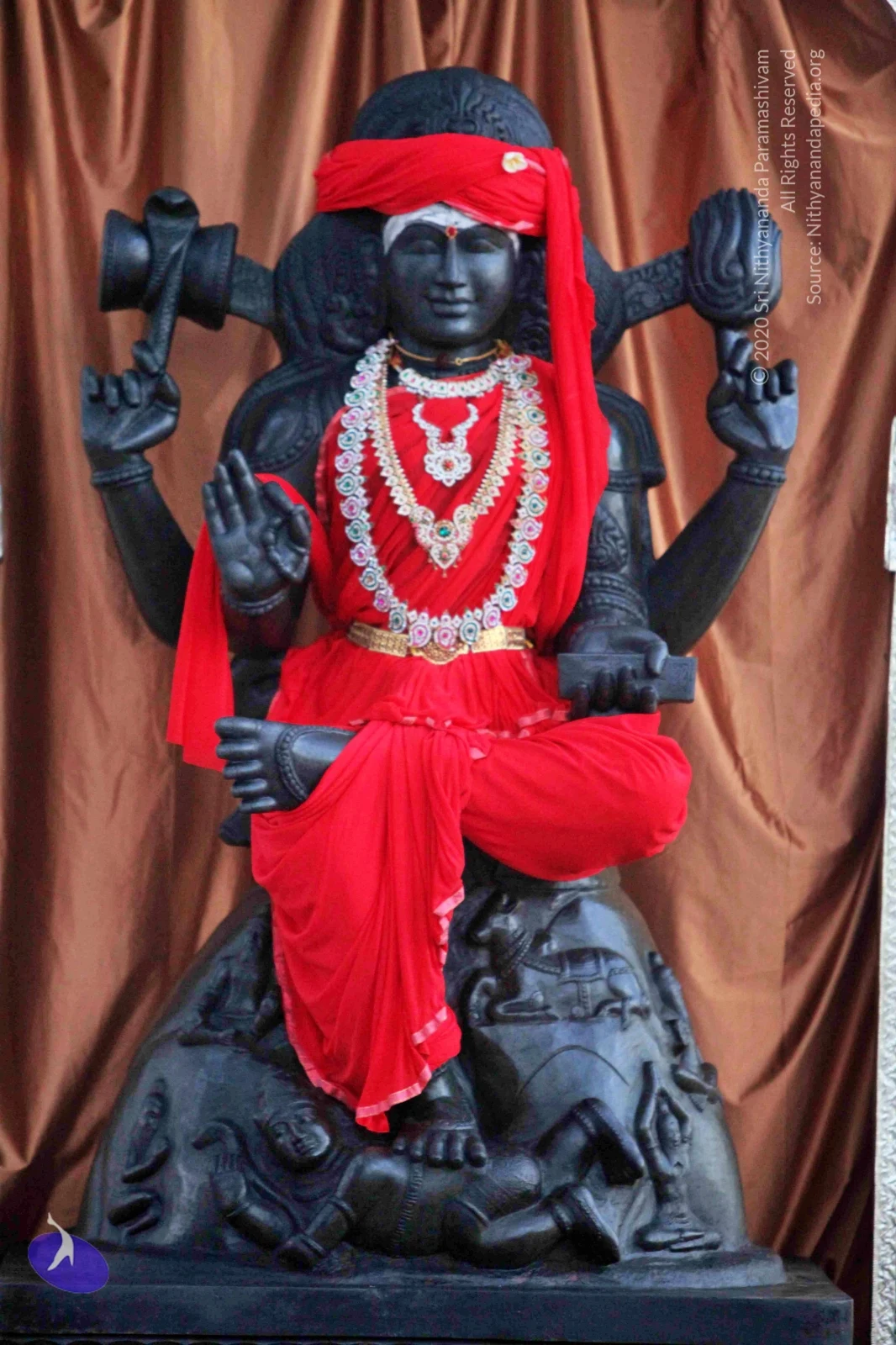
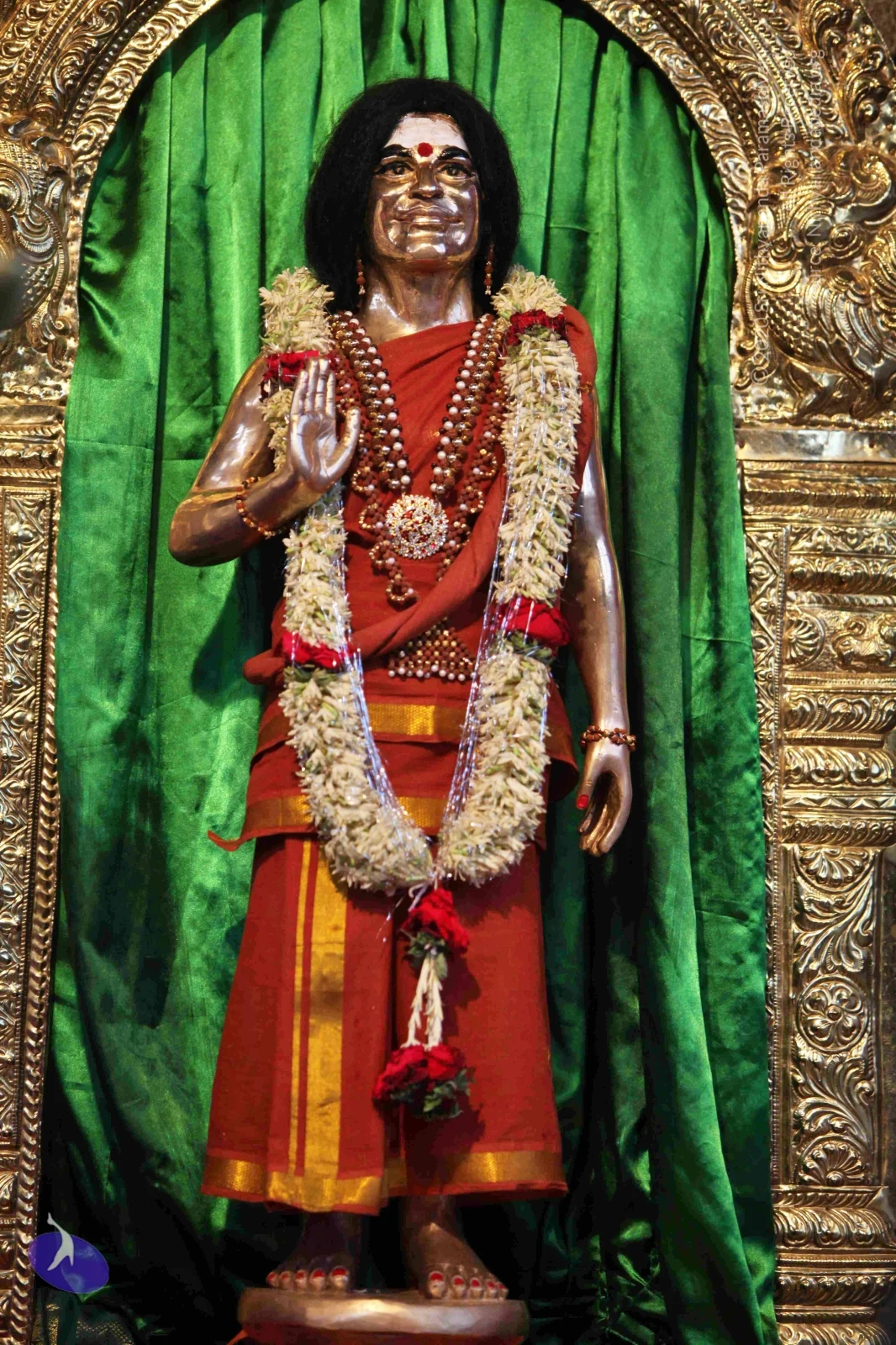
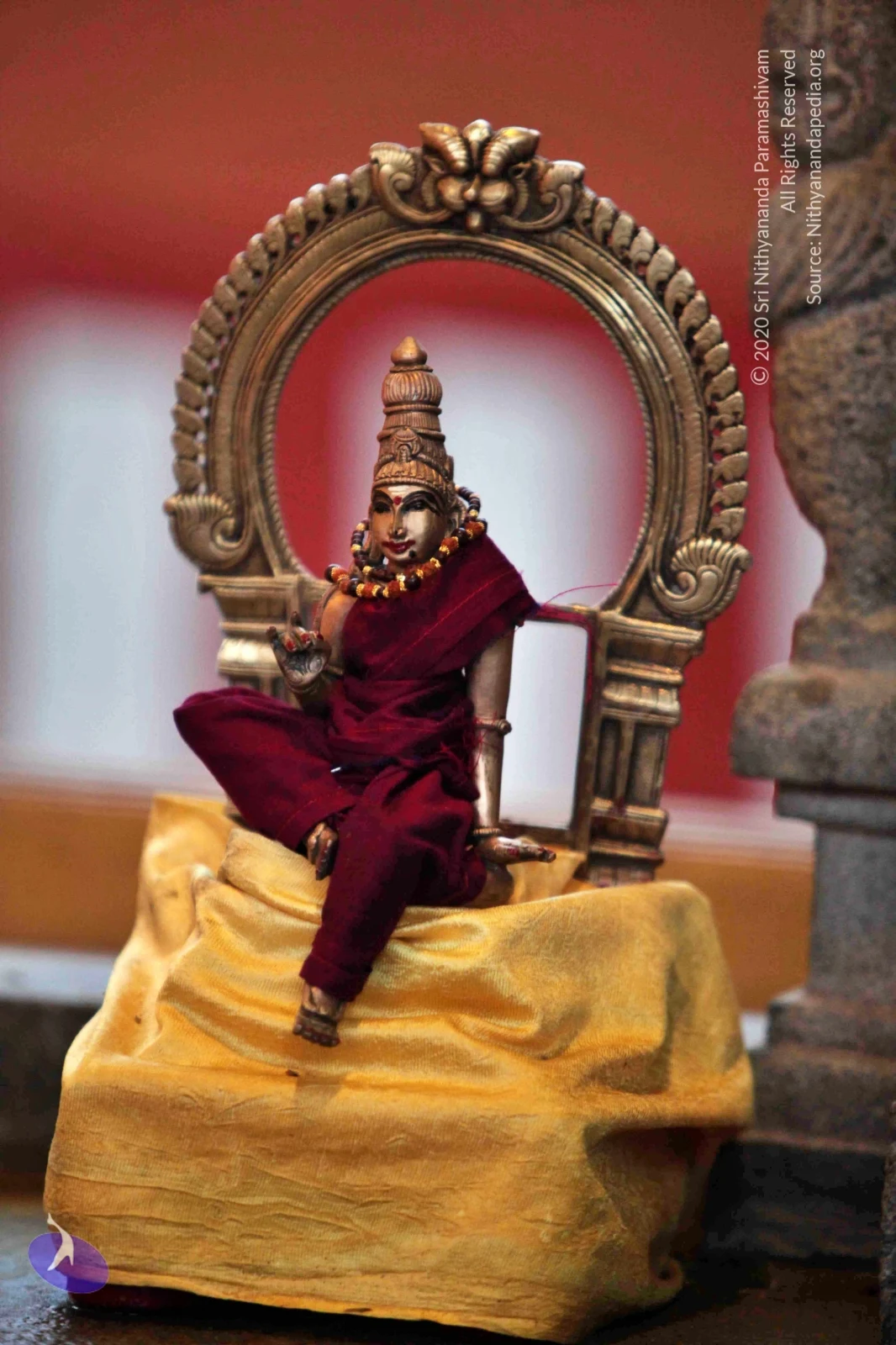
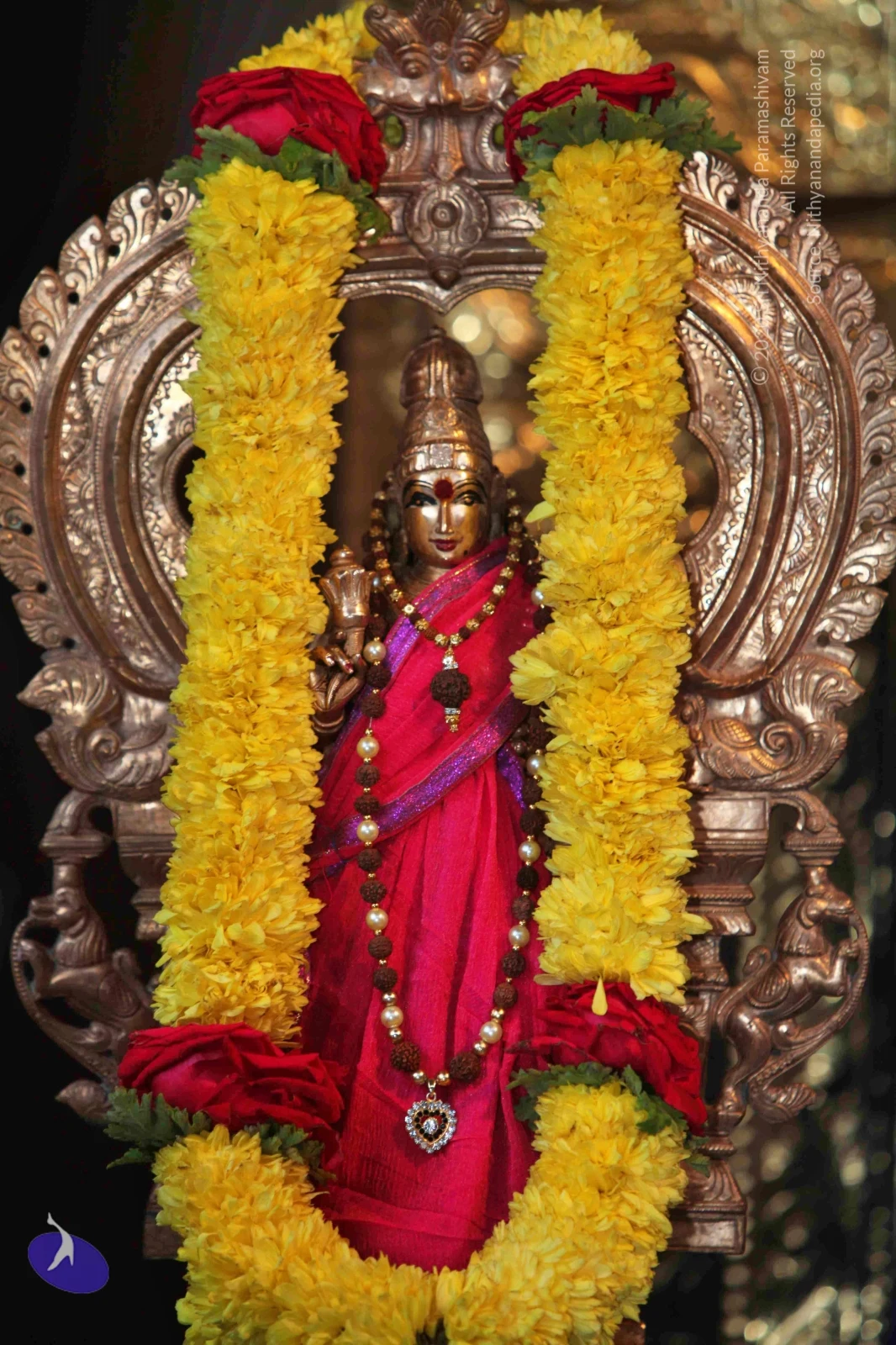
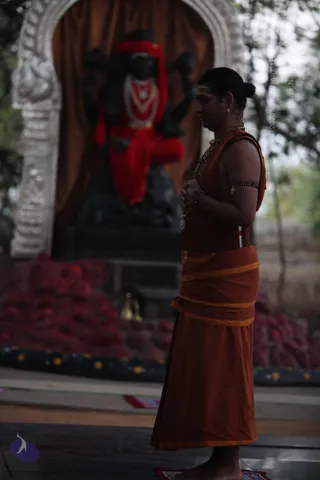
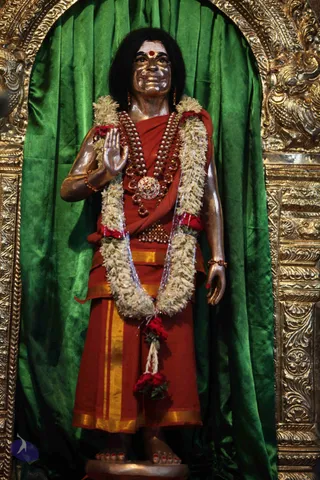
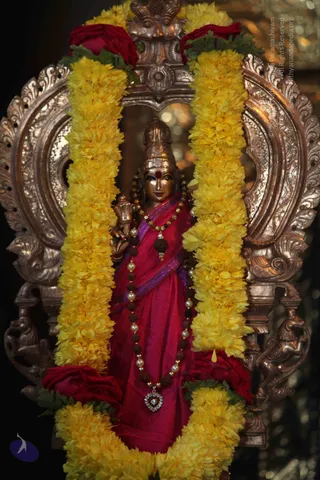
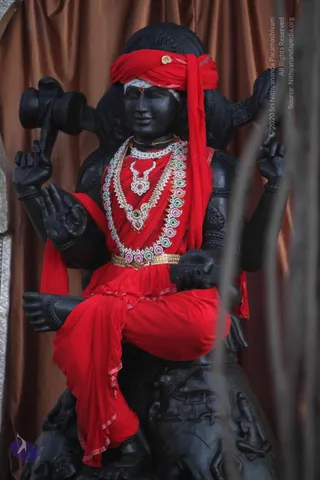
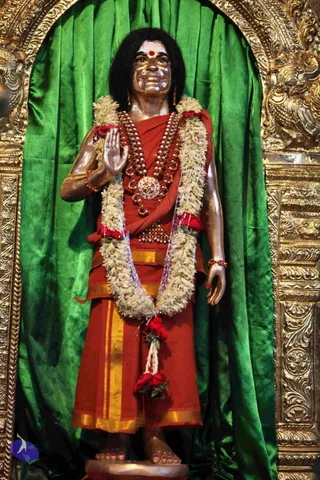
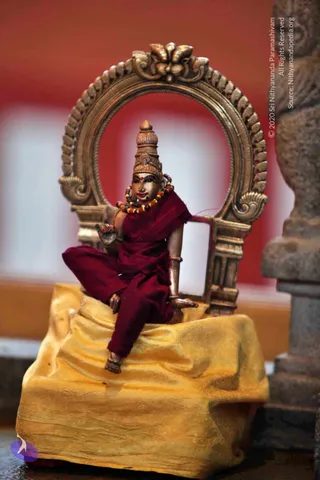
A man in profile stands barefoot on a wooden platform in front of a dark stone deity murti draped in red cloth with a red garland and necklace, set in an arched stone niche with a brown curtain. He wears an orange-brown dhoti and a beaded rudraksha-style mala across his chest, with a beaded armlet, earring and hair in a topknot. His hands are folded at his chest in prayer. Red flower offerings are heaped at the base, with brass bells nearby and trees behind.A life-size statue stands in an ornate gold-framed niche against a green silk backdrop. The figure has long dark hair, a red tilak on the forehead, and a raised right hand in blessing. It wears a red-orange dhoti with gold borders and a red-orange shawl, multiple strands of beaded rudraksha-style malas, a jewelled pendant, and a long white jasmine garland with red flowers. The statue is a depiction, not a living person, and its glossy bronze-toned finish is visible.A bronze deity murti of a female goddess stands within an ornate copper-toned arched frame carved with foliage and scrollwork. The figure wears a magenta and purple sari, a tilak on the forehead, and a long necklace of rudraksha beads and pearls with a jewelled heart pendant. Thick garlands of yellow marigolds and red roses drape both sides of the frame, and bokeh lights glow behind. No people are visible.A black stone statue of a multi-armed deity murti seated in a relaxed cross-legged pose on a carved pedestal, dressed in a red sari-style drape with pink edging and a red turban with a white flower. It wears layered jewelled necklaces with red, green and pink stones, a gold belt and a bindi. A brown draped cloth forms the background, and a grey metal grille lies in the foreground.A large black stone statue of a multi-armed deity seated in lalitasana-like cross-legged pose on a rocky base carved with figures. The statue wears a red turban with a small white flower, red draped garment, gold belt, and layered jeweled necklaces with red, green and white stones. A red shawl falls over one shoulder. Behind it hangs a brown draped fabric backdrop.A small metallic figure of a seated sage or saint sits on a gold brocade cushion before an ornate gilded arched frame. The figure wears a conical headdress, a maroon cloth draped over the body and matching wrapped lower garment, and a strand of dark rudraksha-style beads around the neck. One hand is raised in a mudra and the other rests on the knee. Behind it is a red-and-white blurred background and a dark stone pillar to the right. This is a statue, not a living person.

02-Pada-Puja

15 photosSource gallery
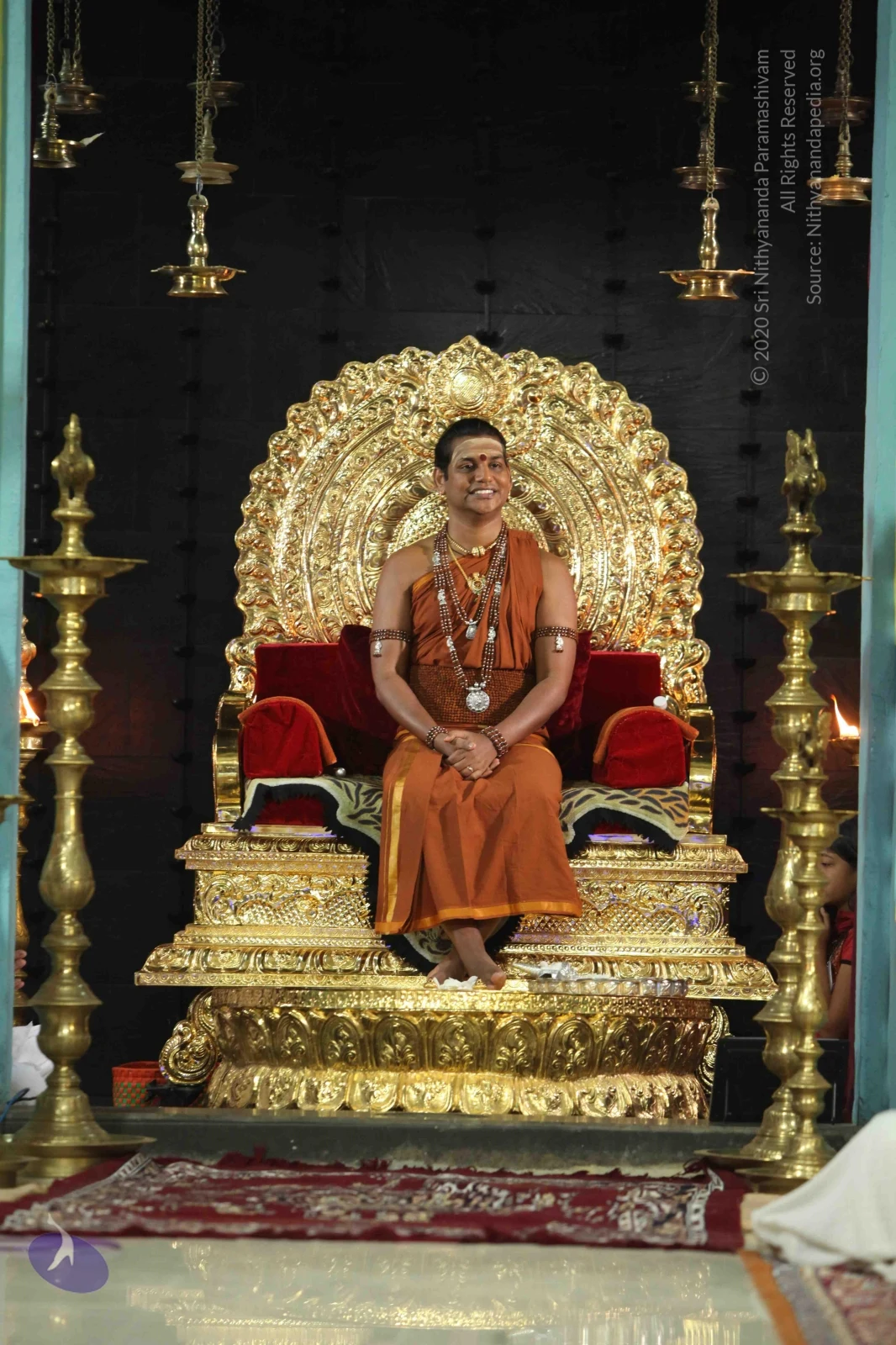
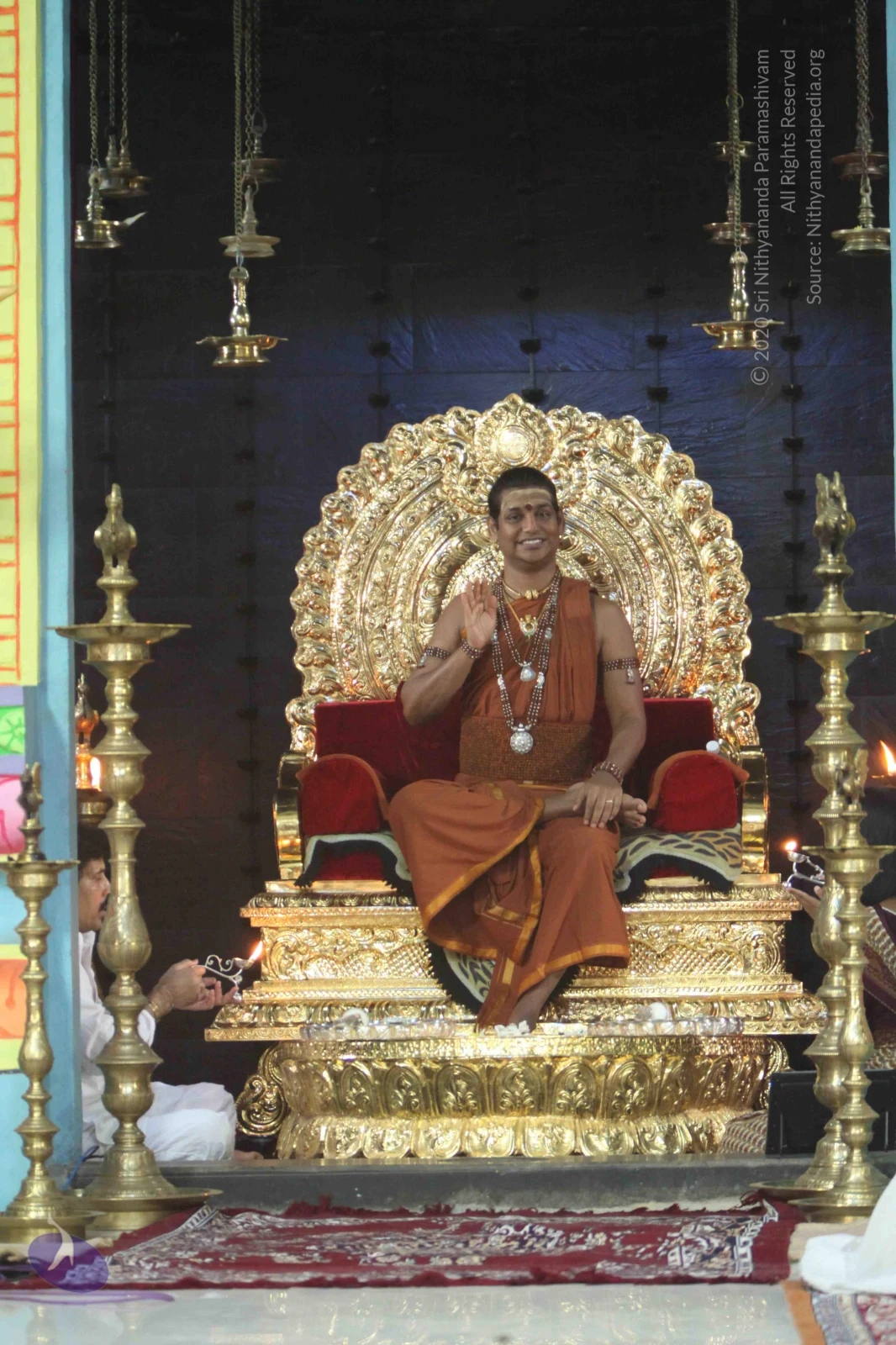
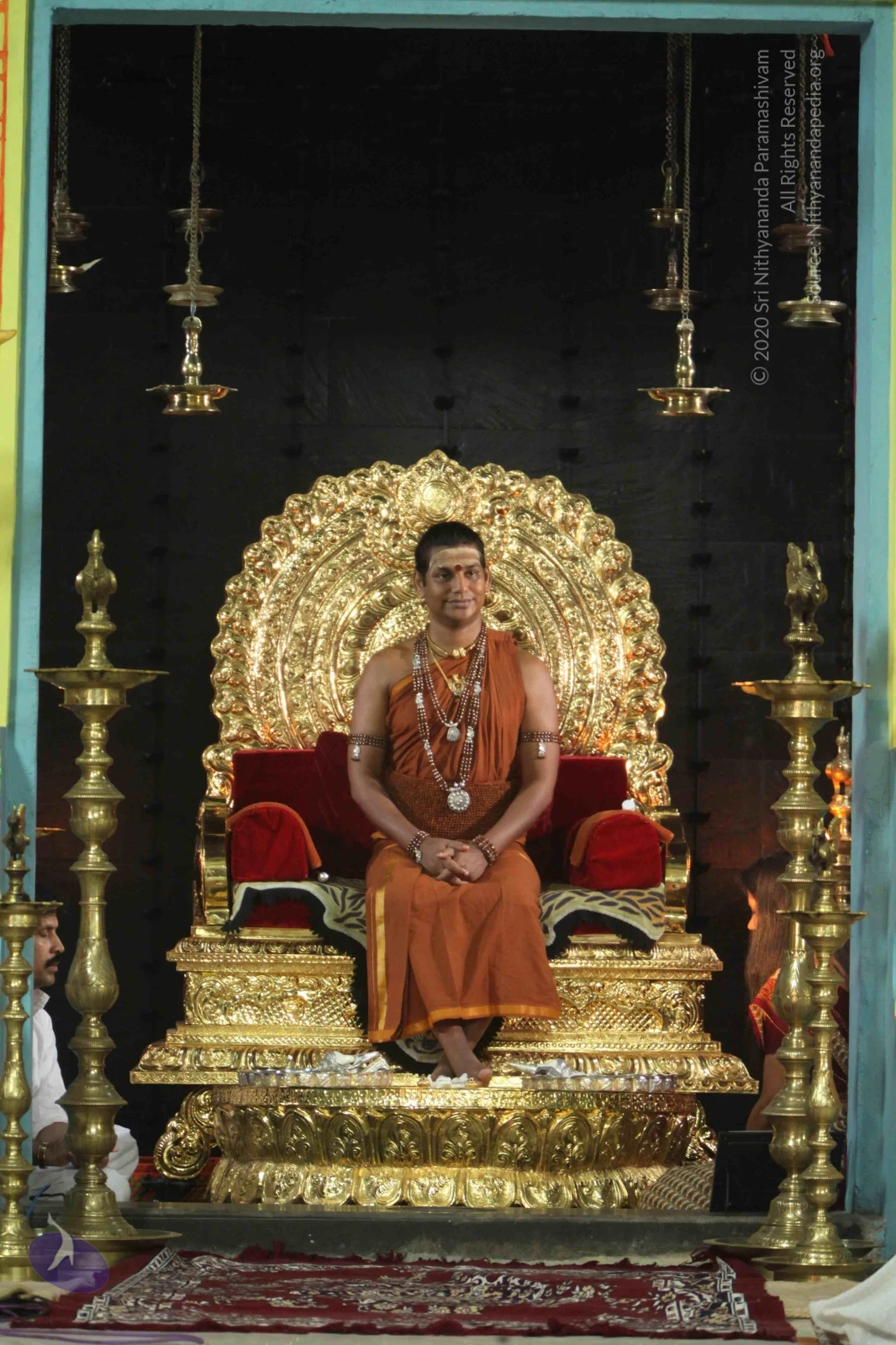
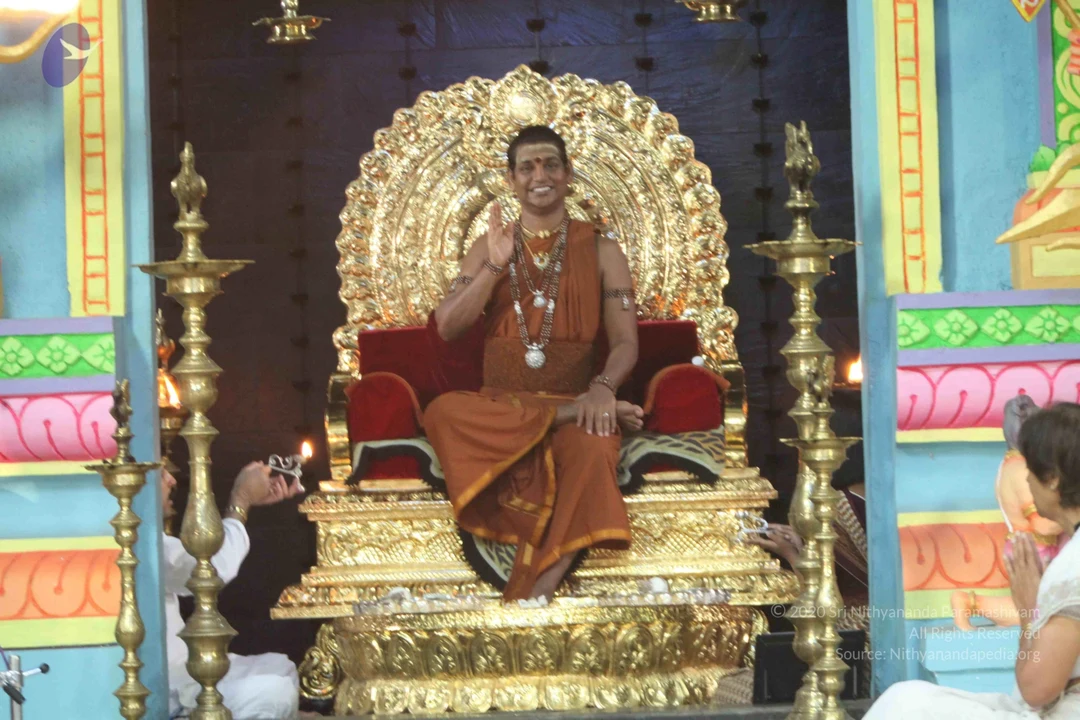
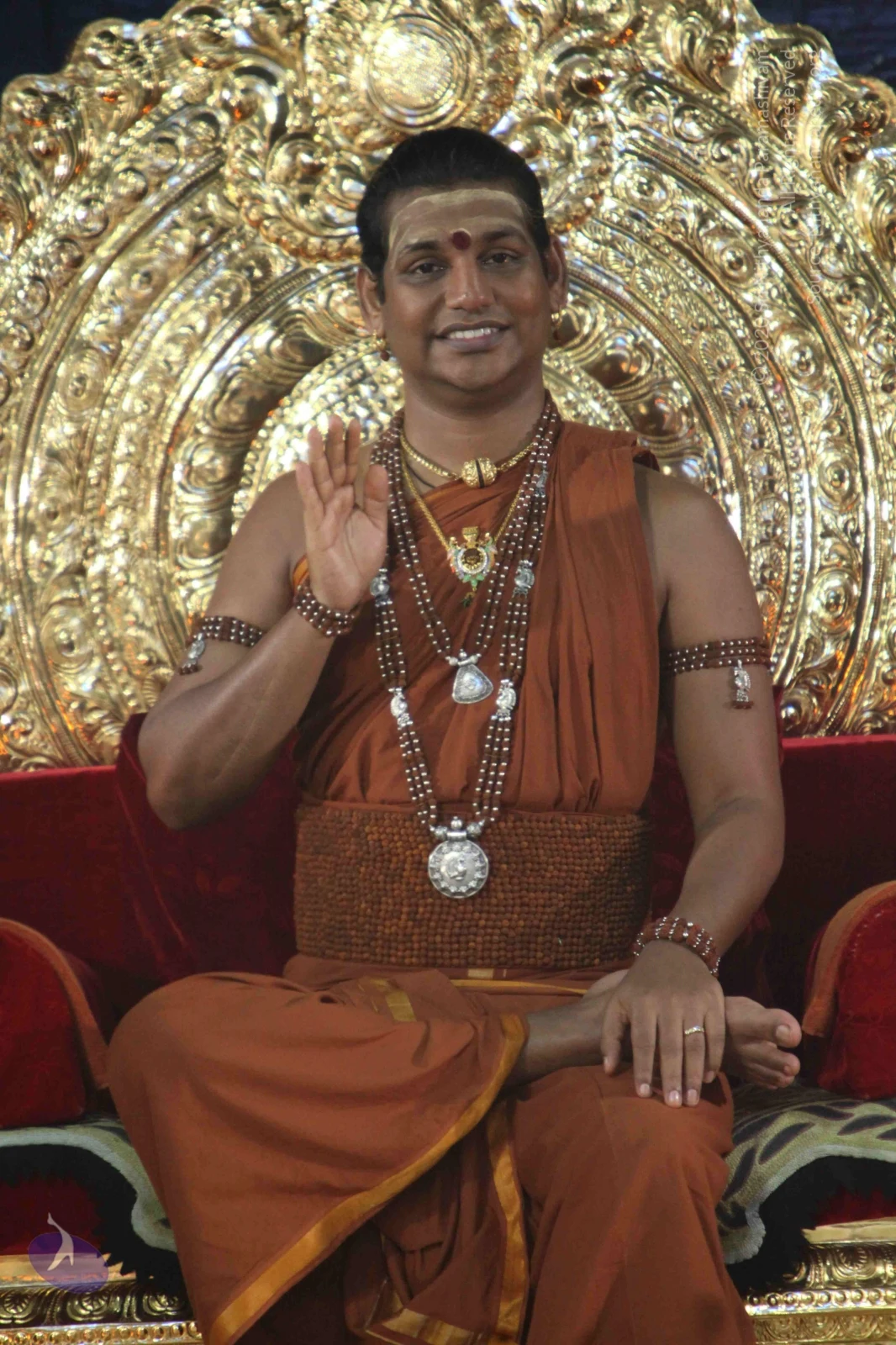
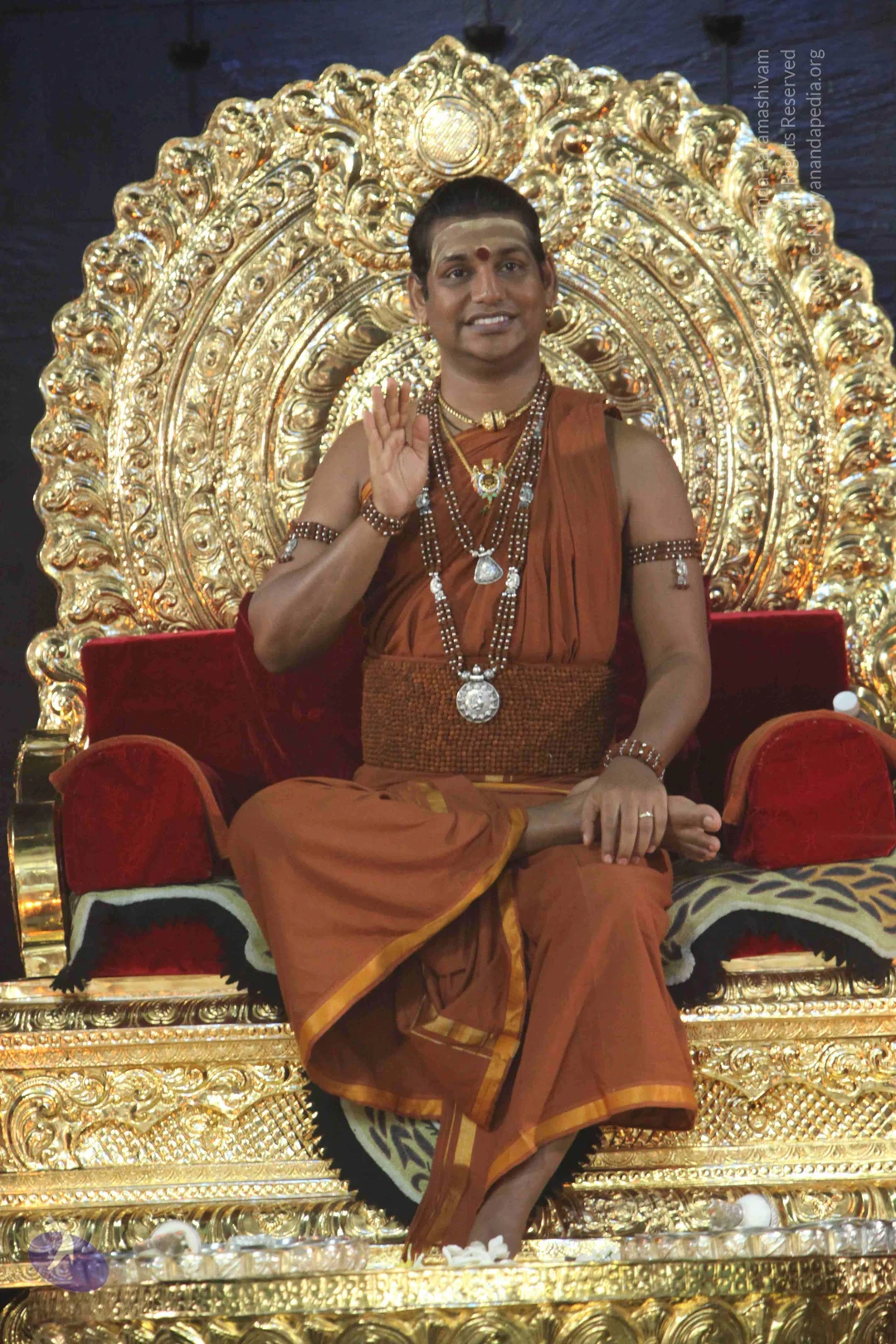
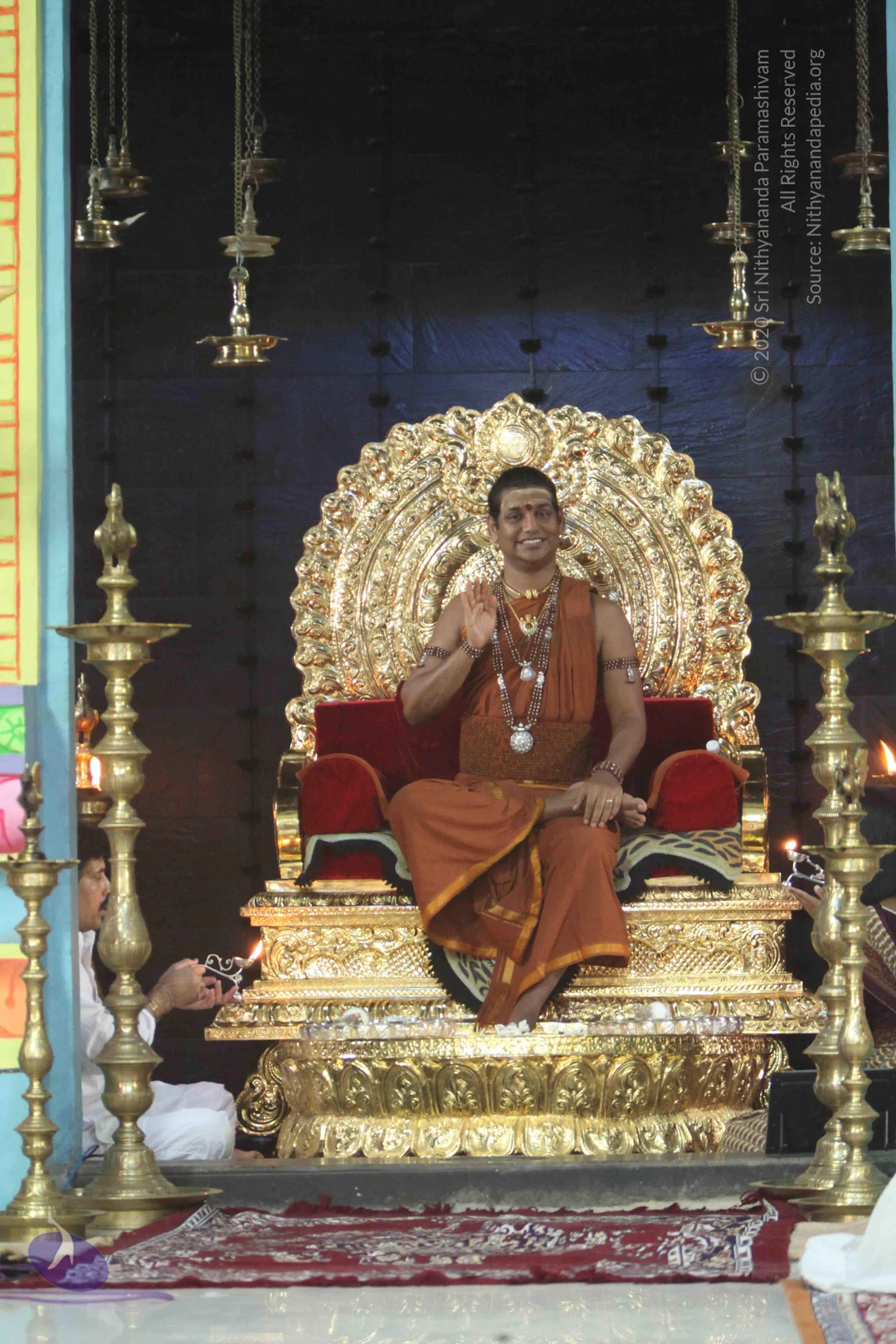
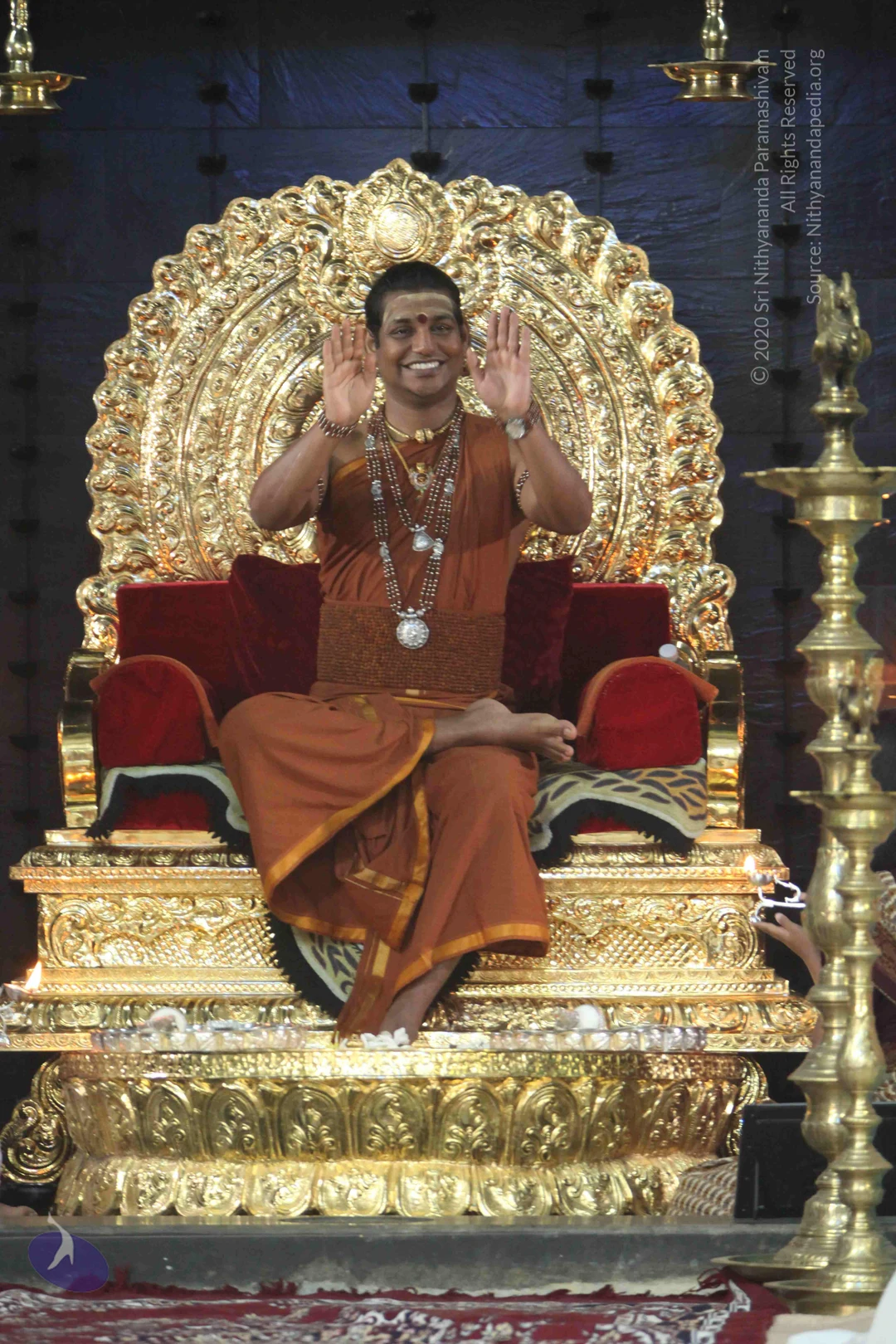
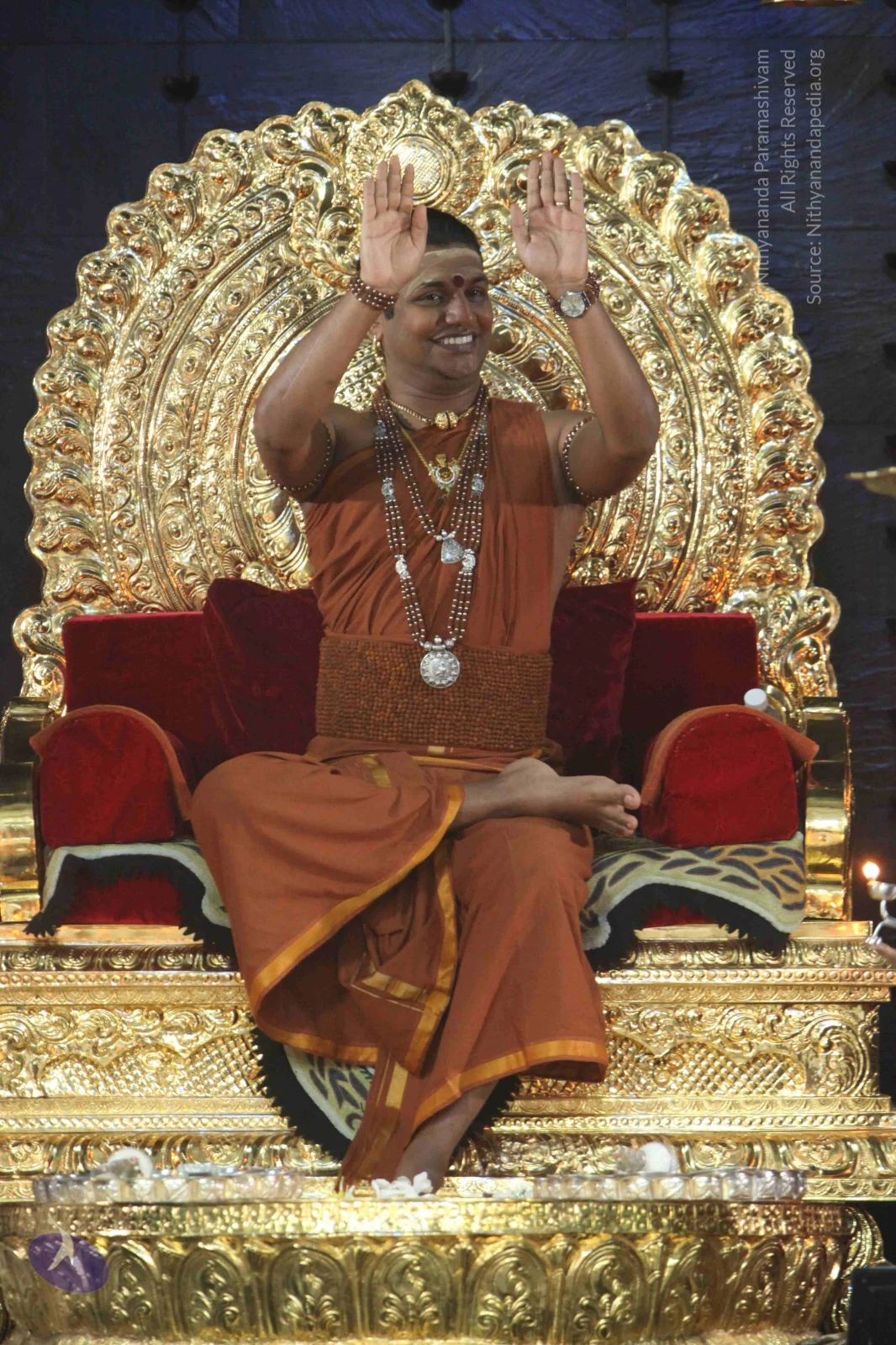
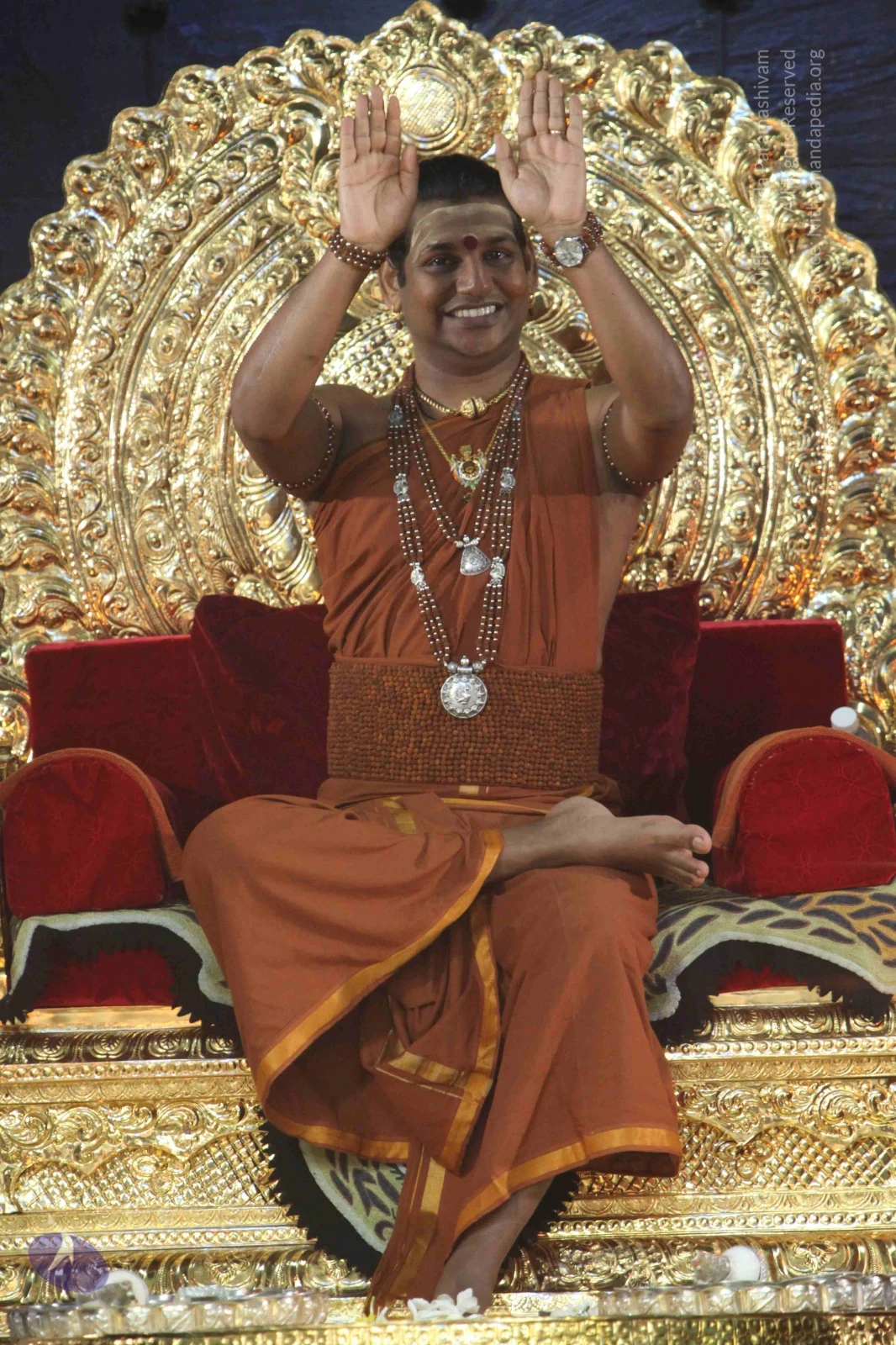
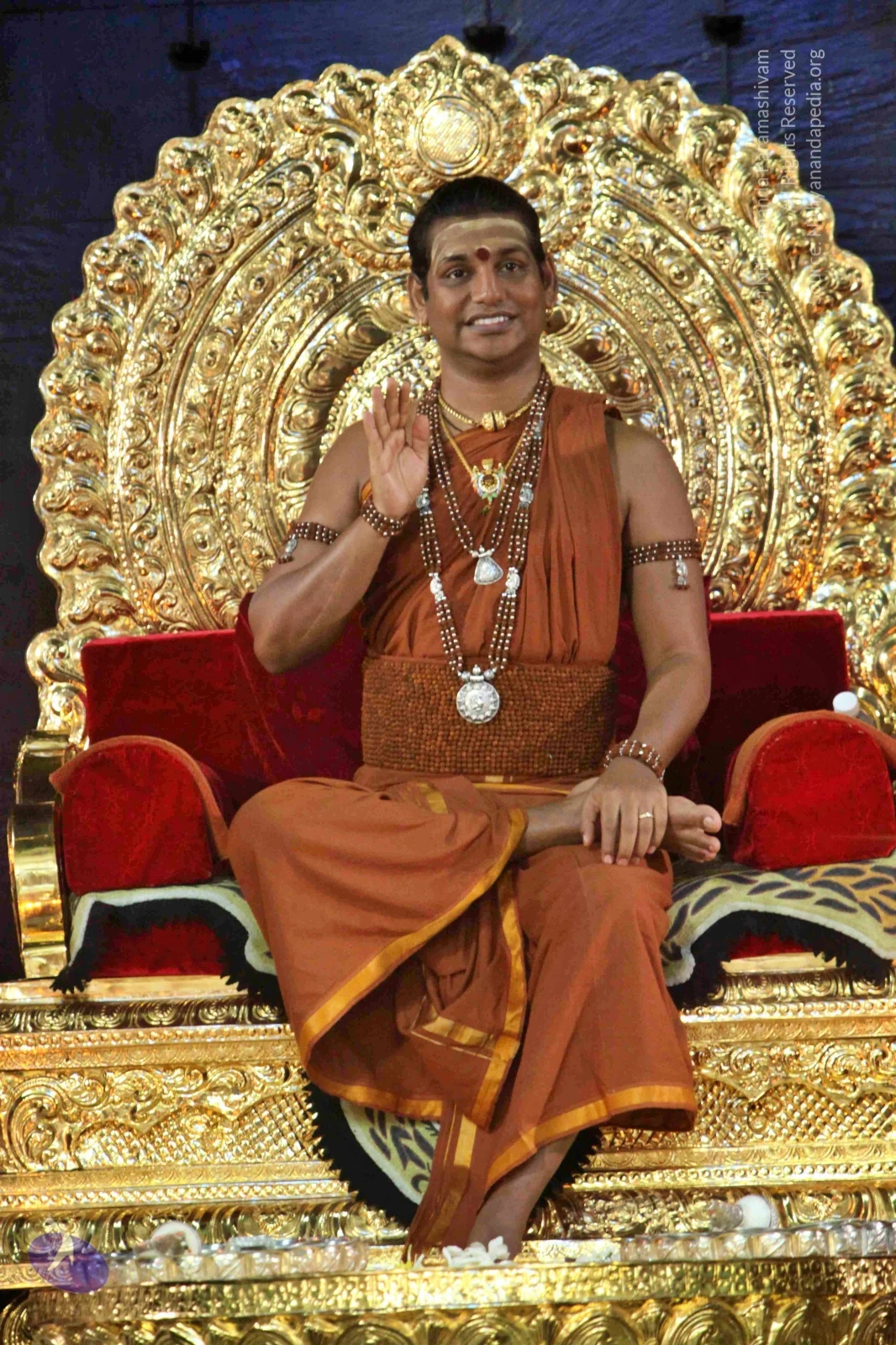
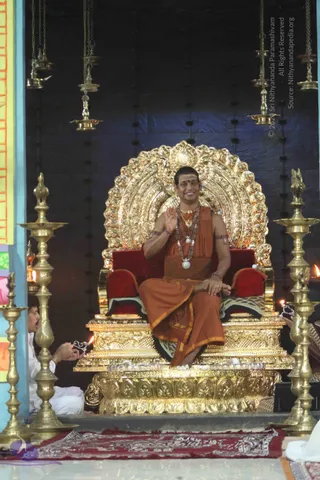
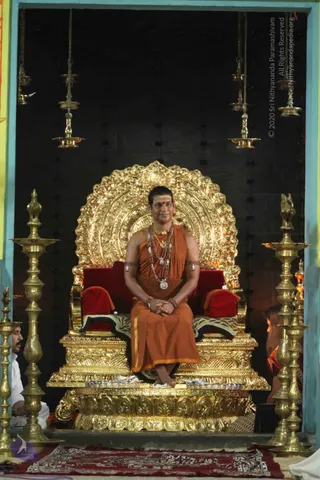
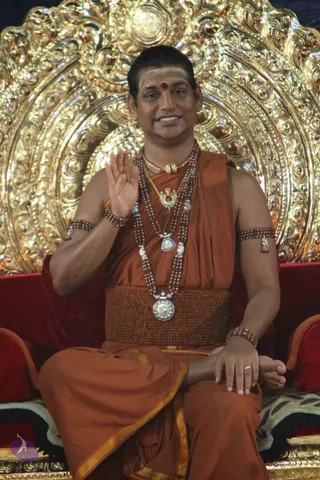
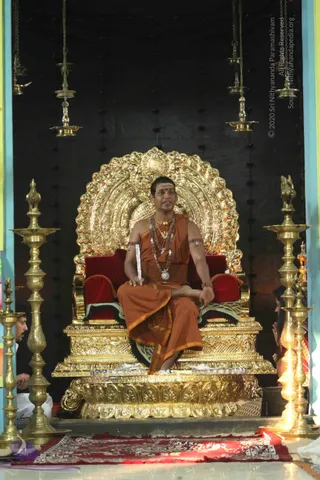
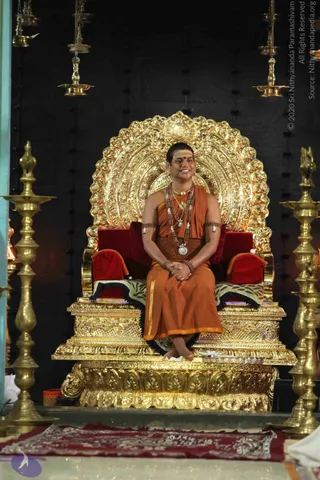
A photograph of a seated man in a golden throne with an ornate gold arched backrest and red cushions. He wears saffron-orange robes with a gold-bordered cloth, multiple strands of rudraksha-style beads, a large silver pendant and gold necklaces, and armlets. He has a red bindi on his forehead and raises his right hand in a wave while smiling. The throne sits on a gold pedestal decorated with floral and paisley patterns.A man in orange saffron robes and multiple rudraksha malas sits on an ornate gilded throne with a tall arched back and red velvet cushions, a tilak on his forehead and a gold necklace at his chest. Brass standing lamps flank the throne and hanging brass oil lamps hang from chains against a dark wooden wall. A red patterned carpet lies in front, and a seated attendant in white is at the left edge.

03-Nithya-Satsang

21 photosSource gallery
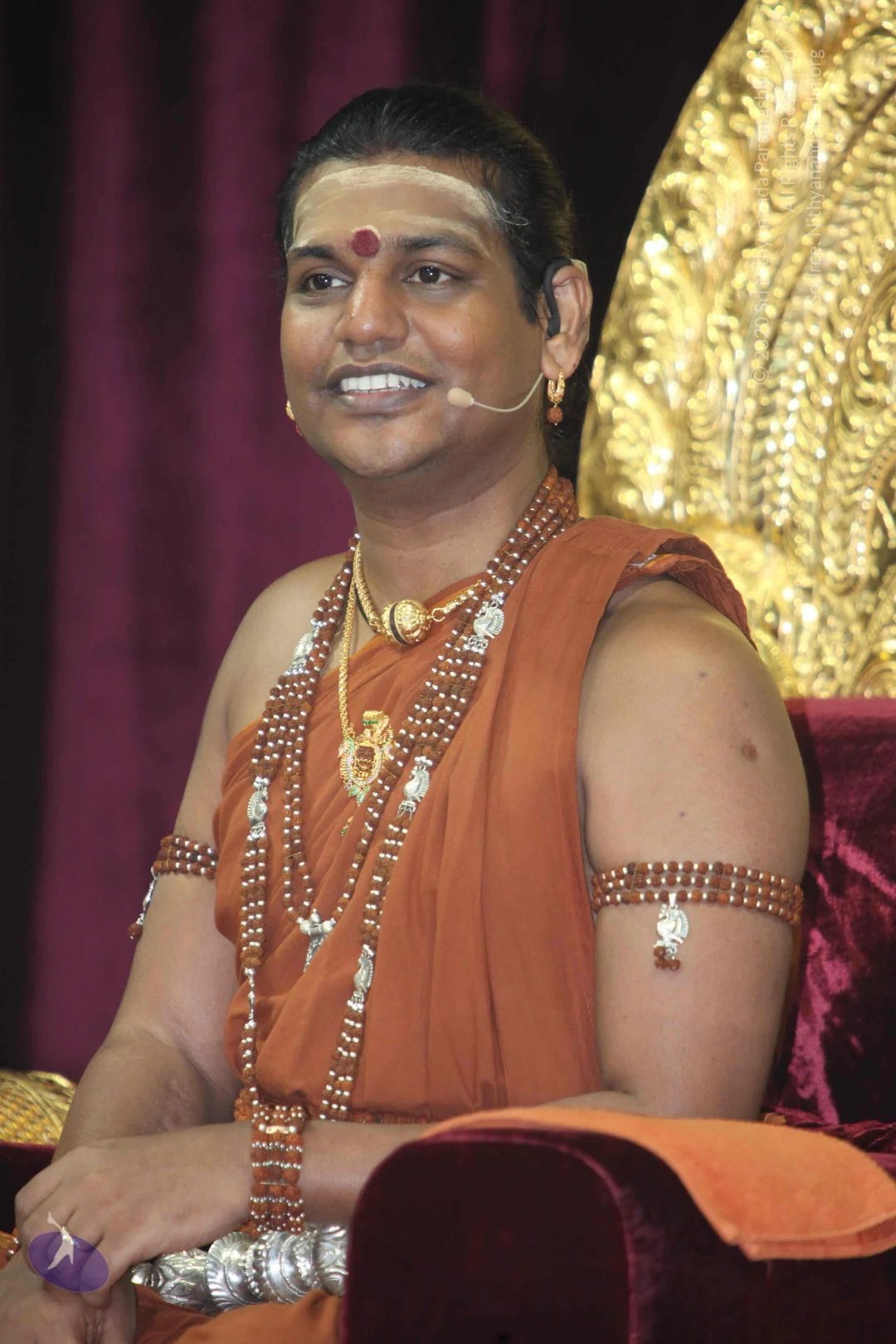
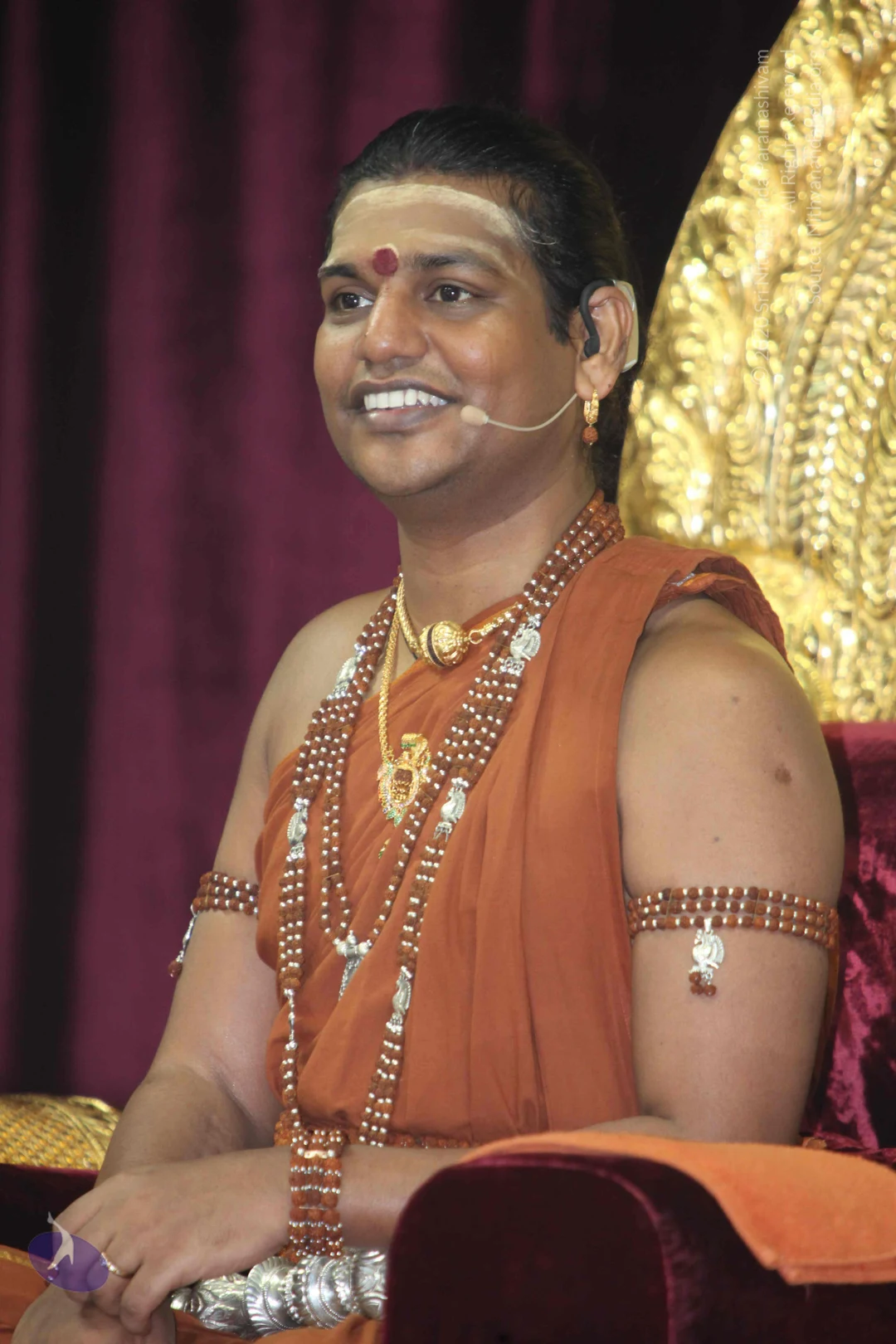
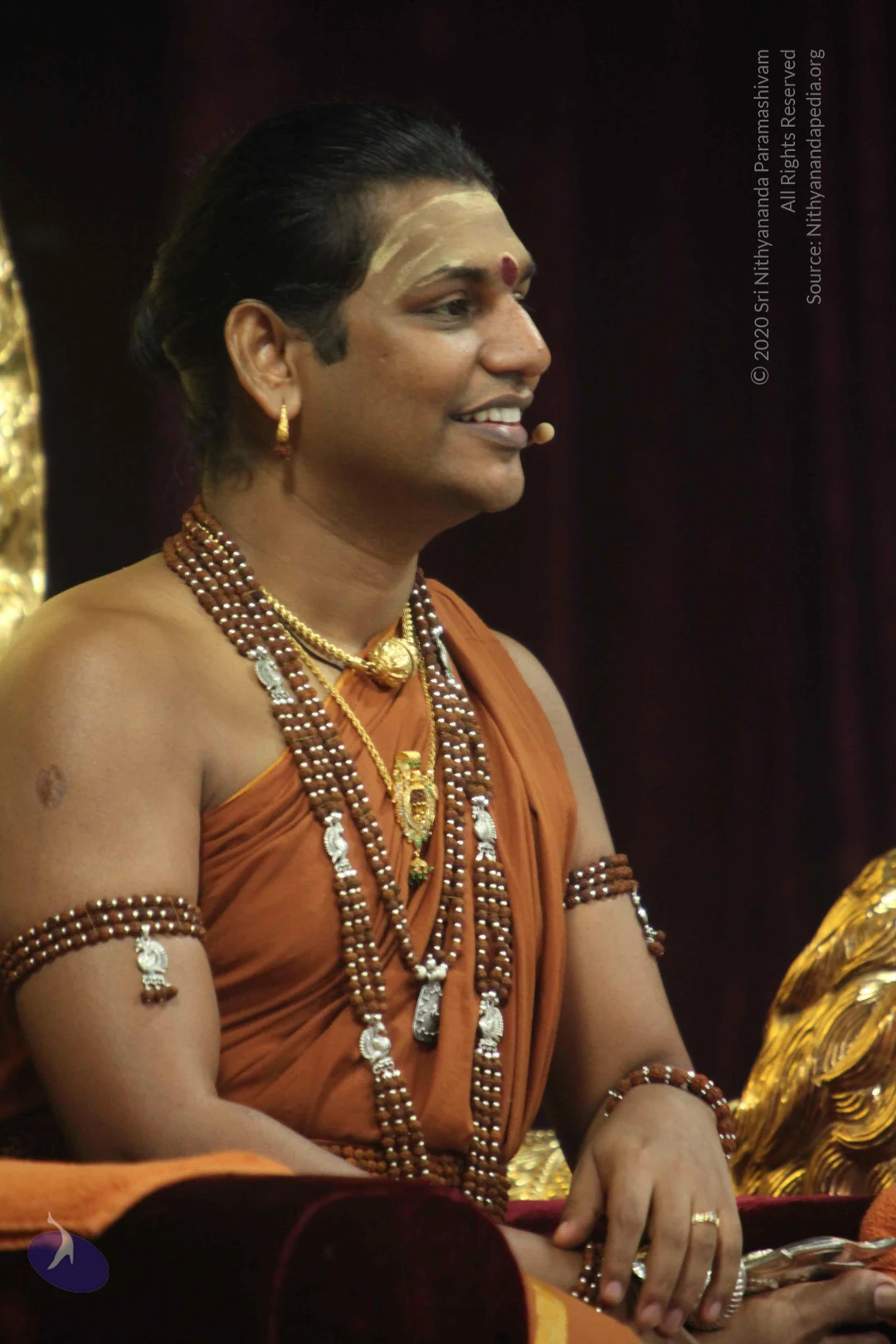
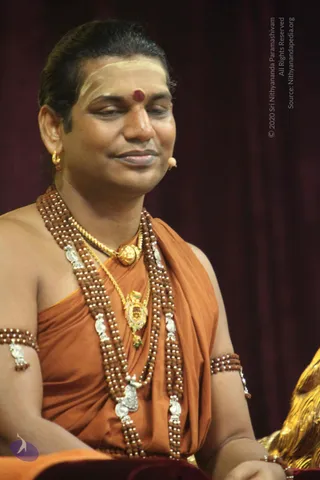
A man seated in front of a dark maroon velvet curtain, wearing an orange-saffron cloth draped over his shoulder and bare chest, with multiple strands of rudraksha malas and silver pendants across his chest and upper arms. He wears a gold necklace with a central gold pendant, gold earring, a headset microphone, and a white tilak with a red dot on his forehead. His hair is swept back. A golden figure is partly visible at the right edge. a person appearance cues include the saffron clothing, rudraksha malas and ceremonial gold necklace, seated on stage as a speaker.

04-Sarva-Darshan

2 photosSource gallery
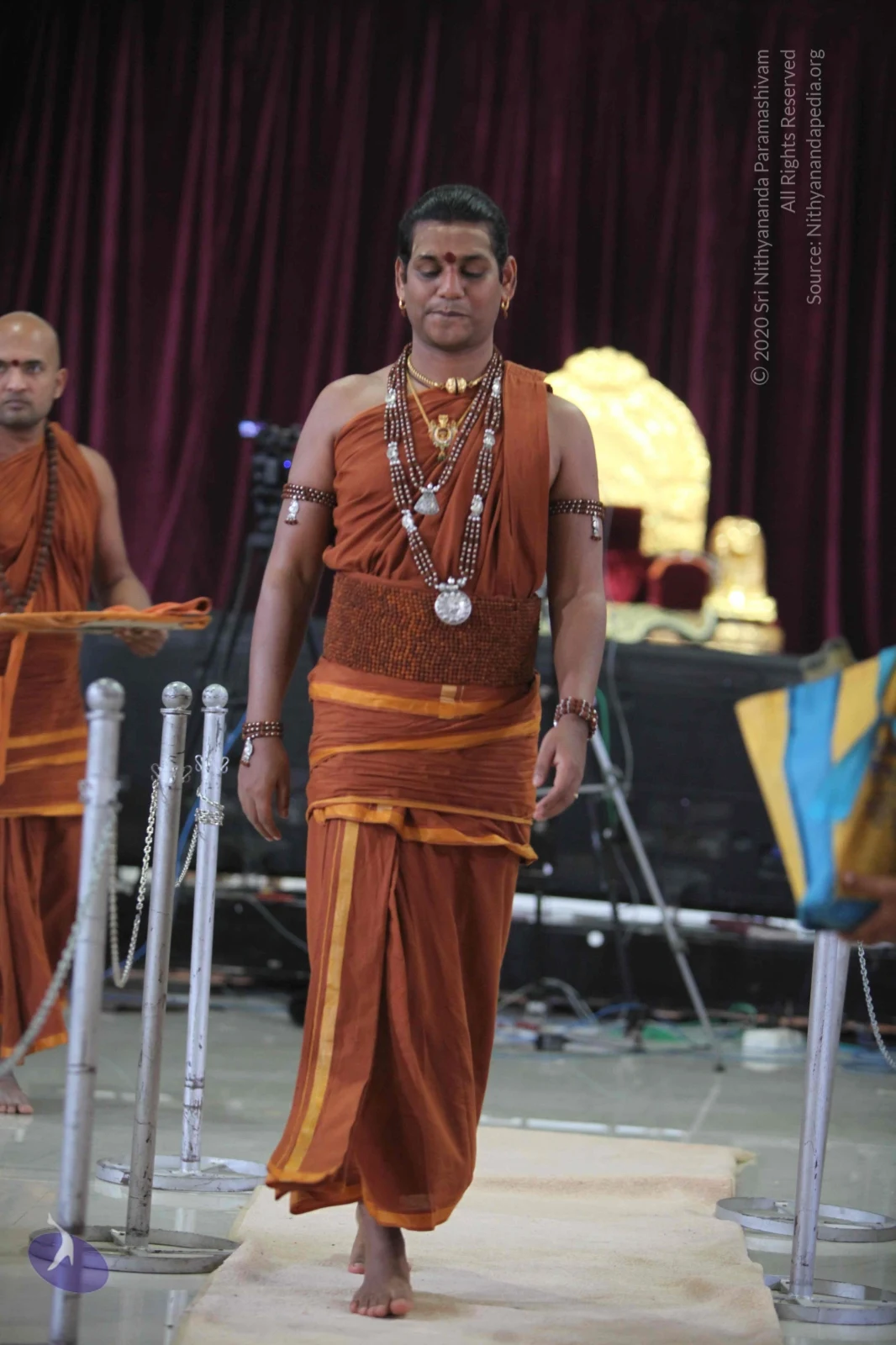
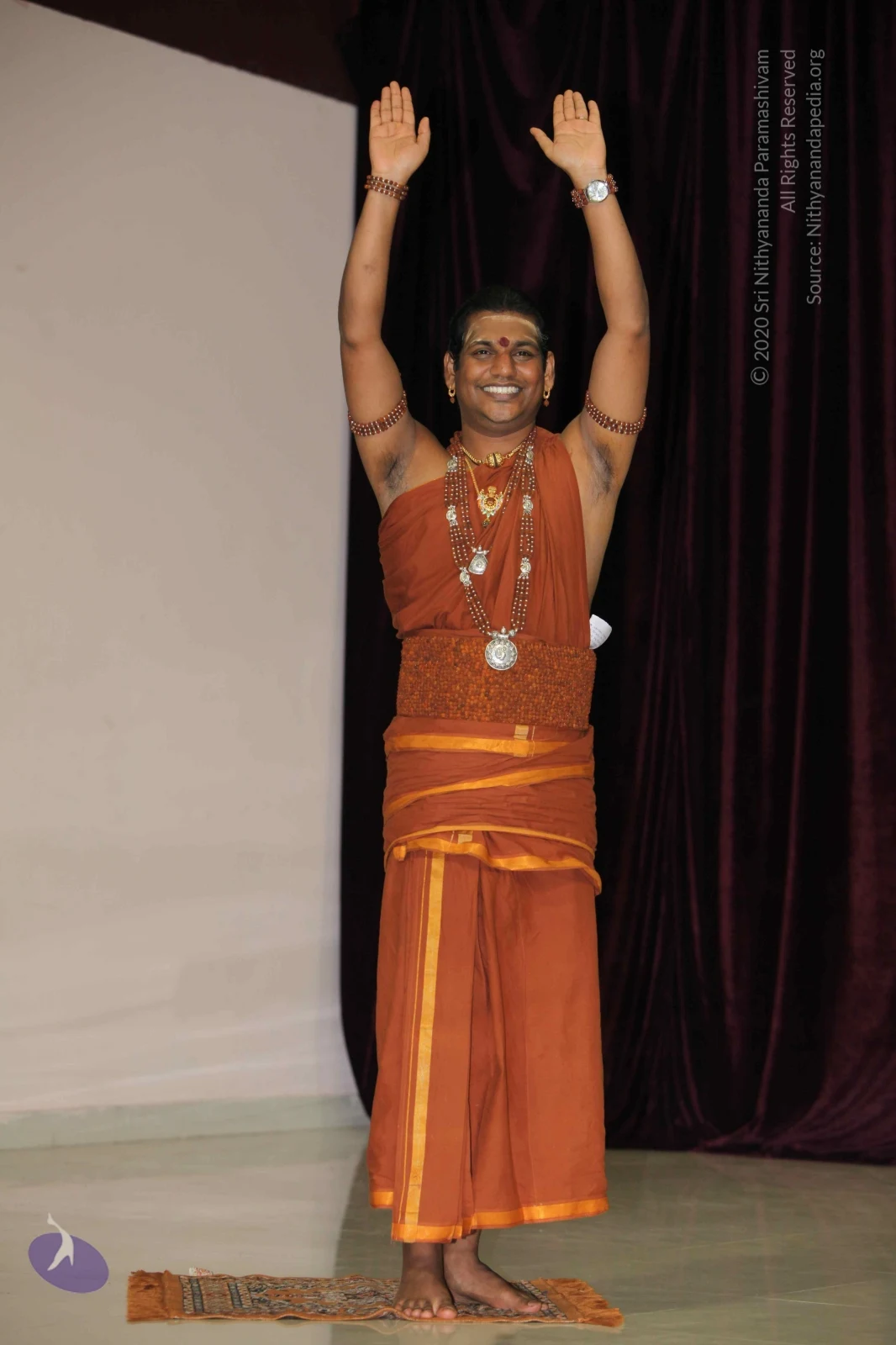
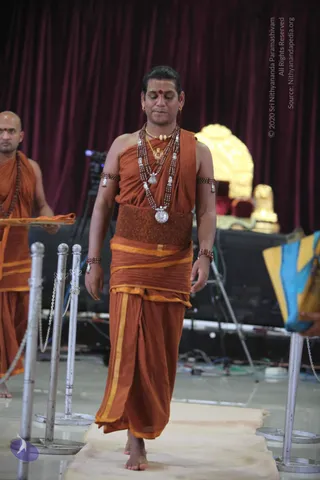
A photograph of a barefoot man in saffron-orange sannyasi dress walking along a pale carpet runner on a stage. He wears a red-orange dhoti with gold border, a wide beaded rudraksha-style waist band, layered rudraksha and silver-pendant malas, a gold chest pendant, beaded armlets and wrist bands, and a red bindi with a vertical mark on his forehead. Behind him stand a second robed attendant in saffron holding an orange cloth, a maroon draped curtain, and a golden throne-like seat with a peetha or dais. Metal stanchions with chains line the walkway.

05-Final-Blessings

1 photoSource gallery

06-Balasant-Initiation

6 photosSource gallery
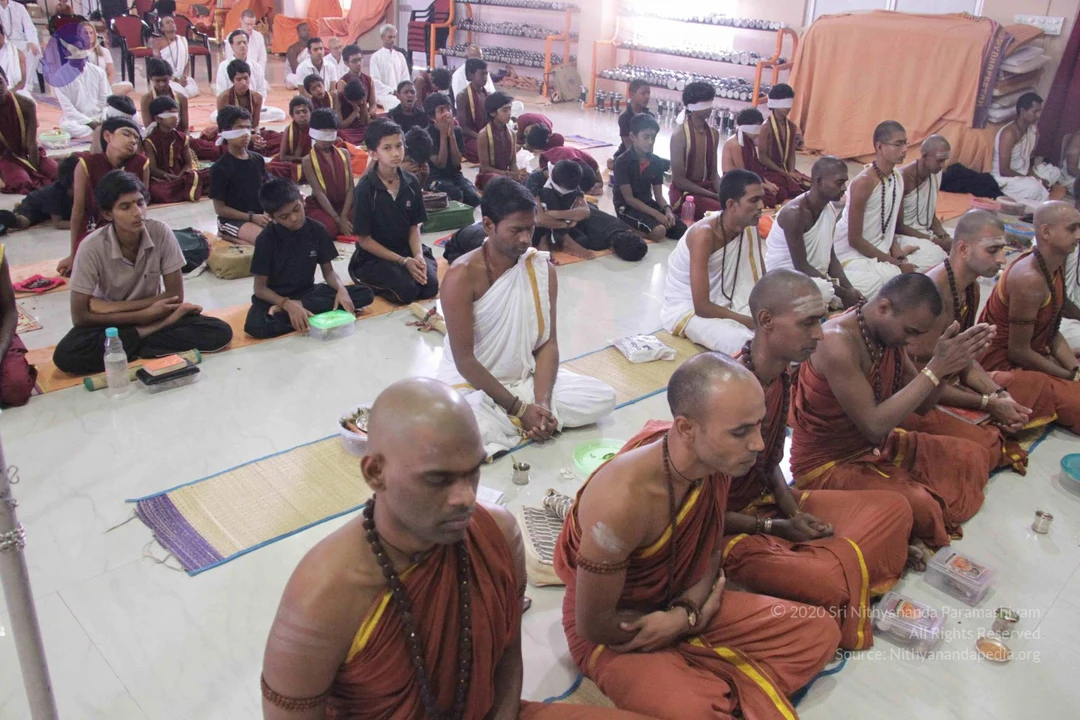
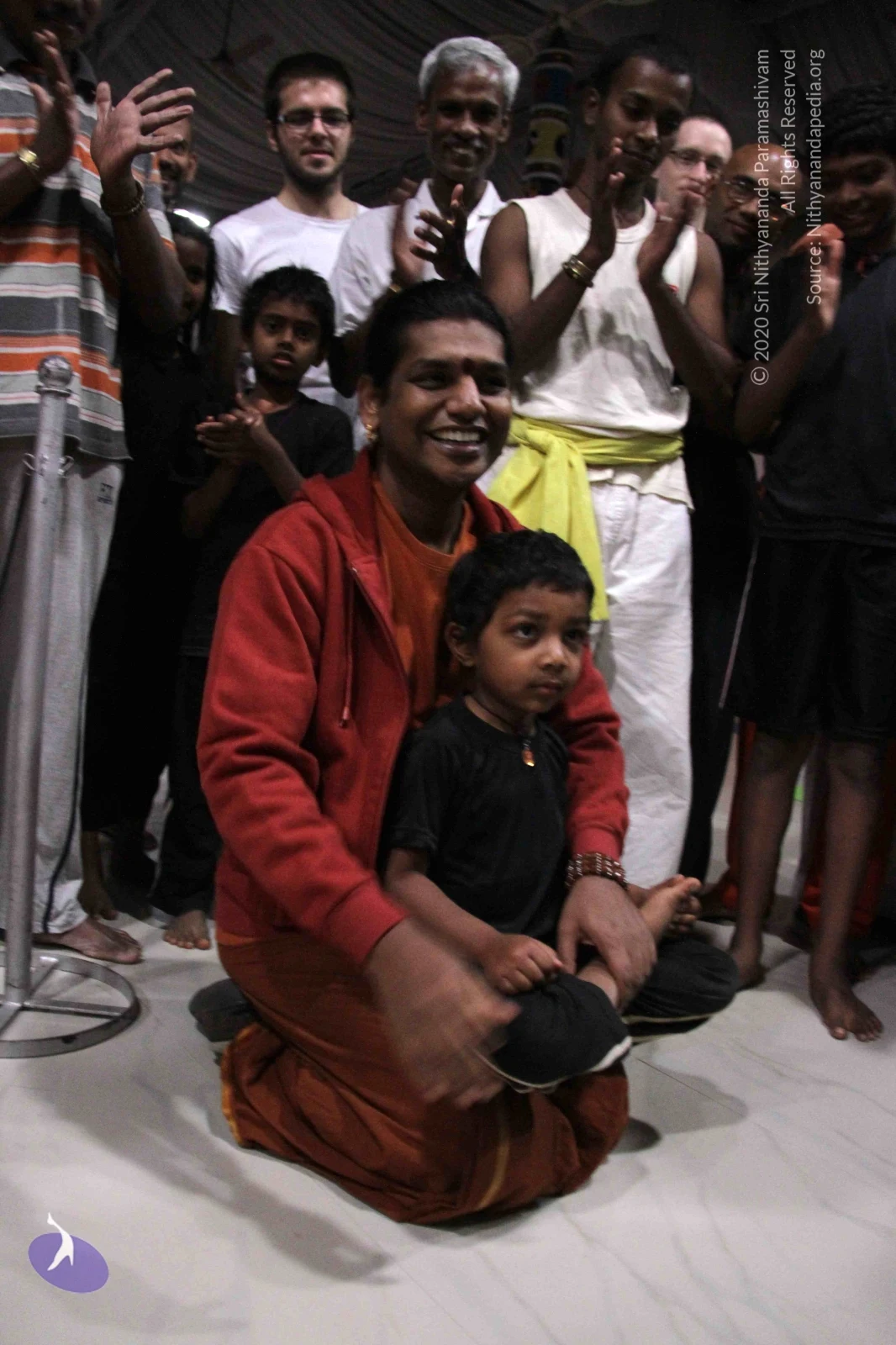
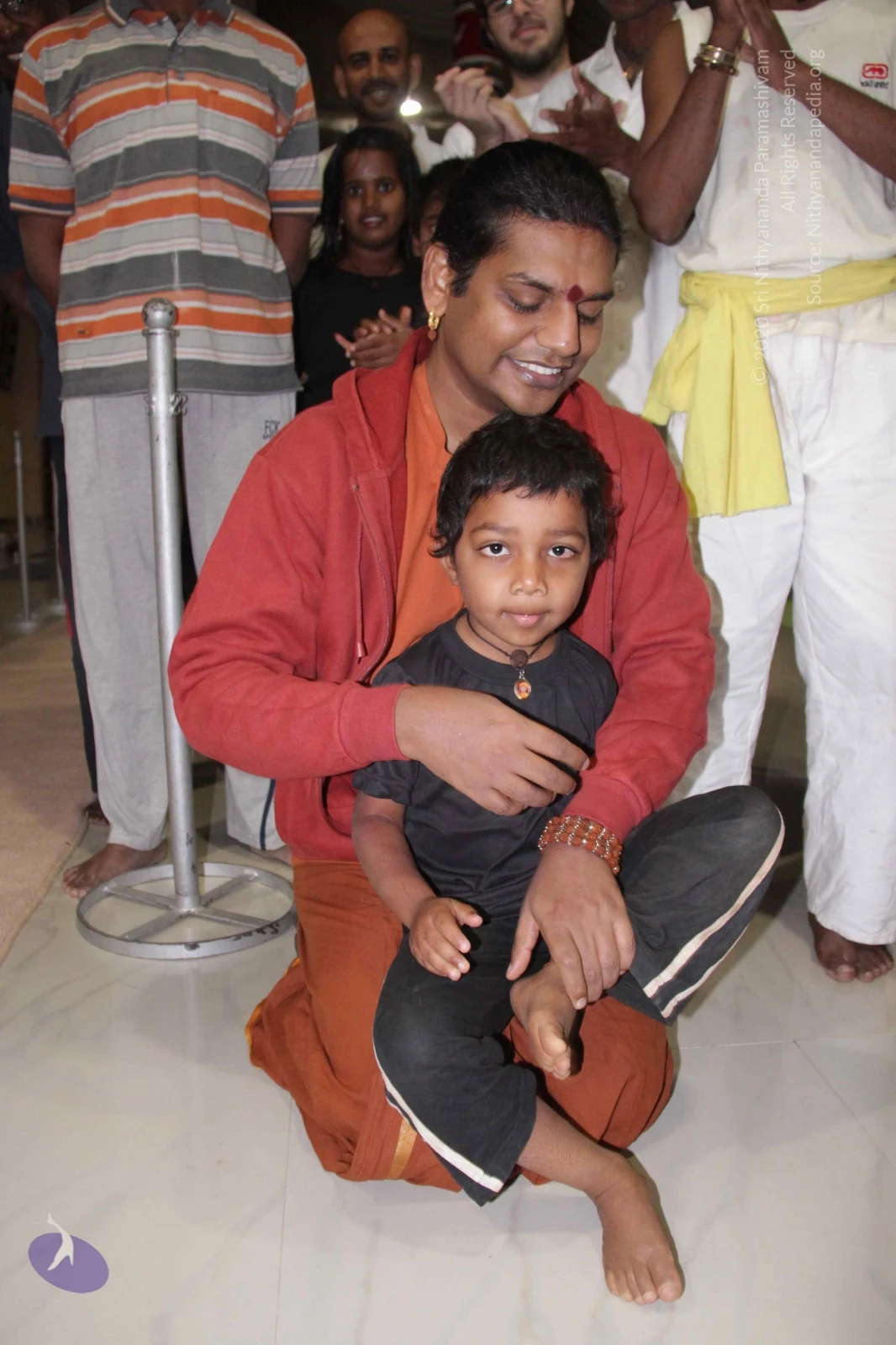
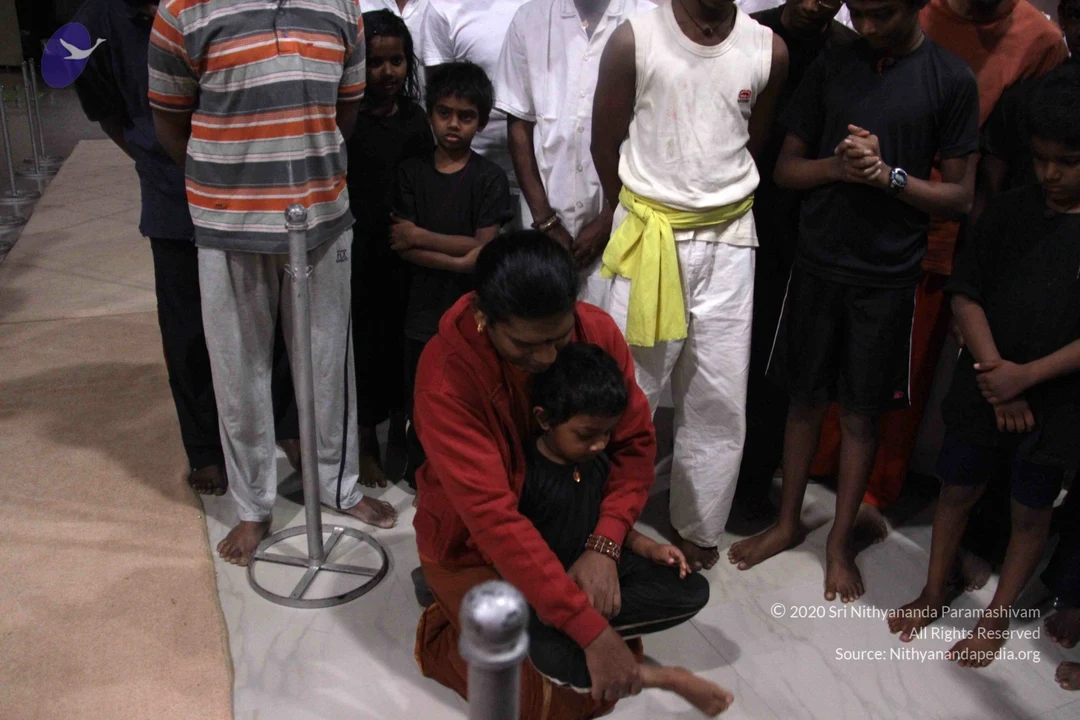
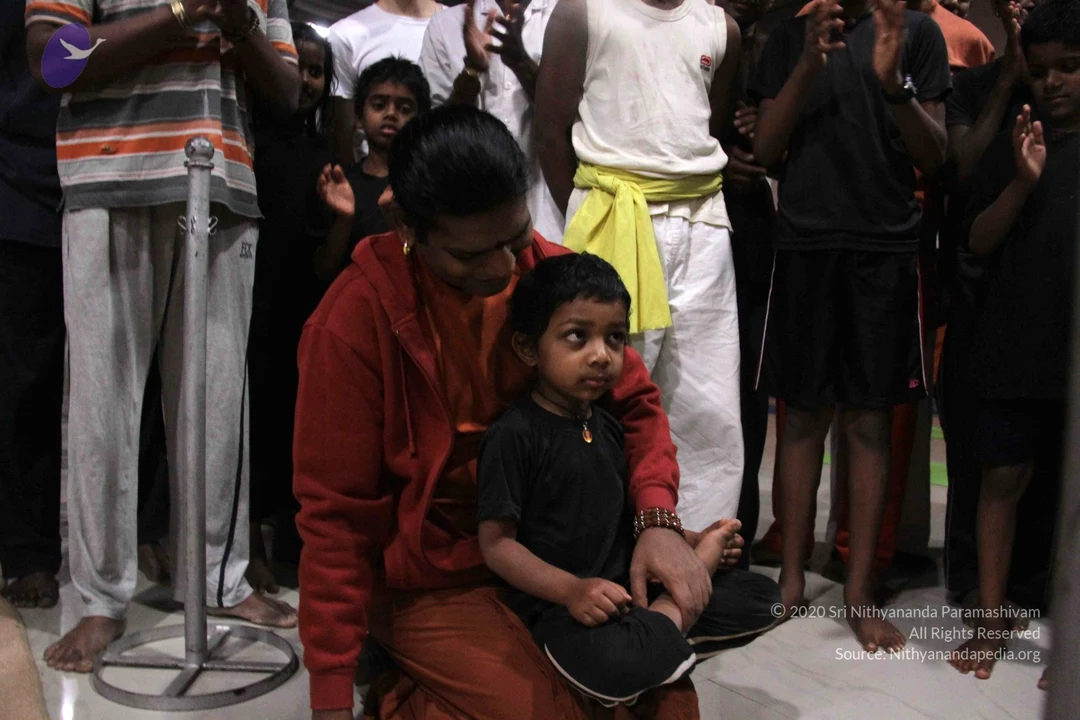
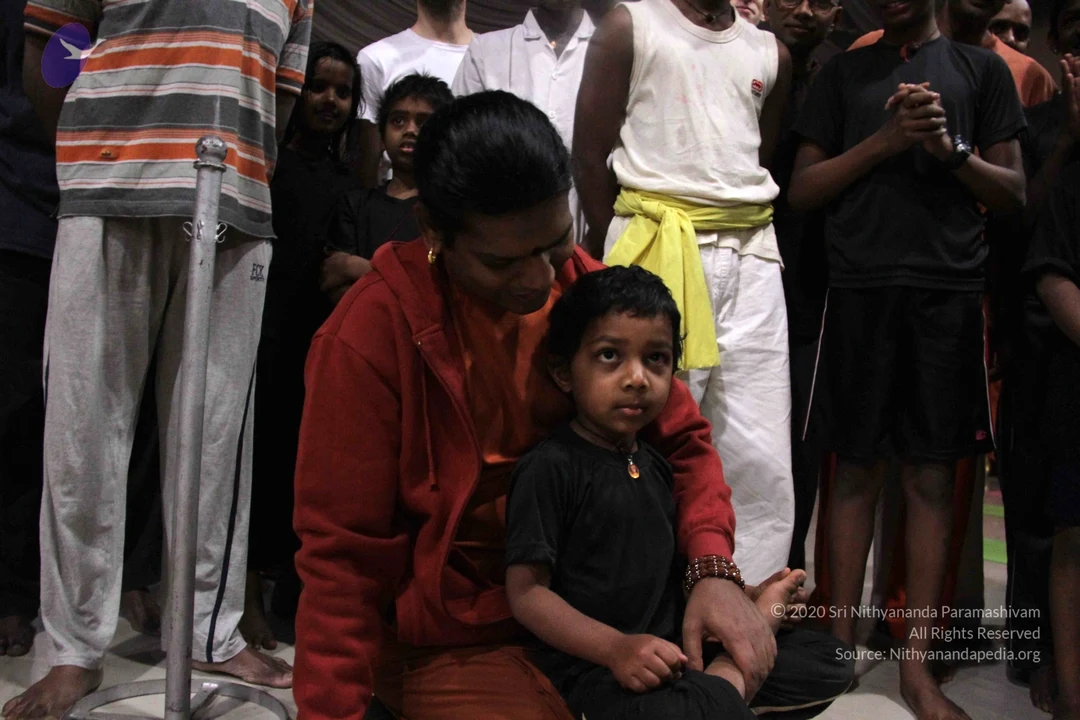
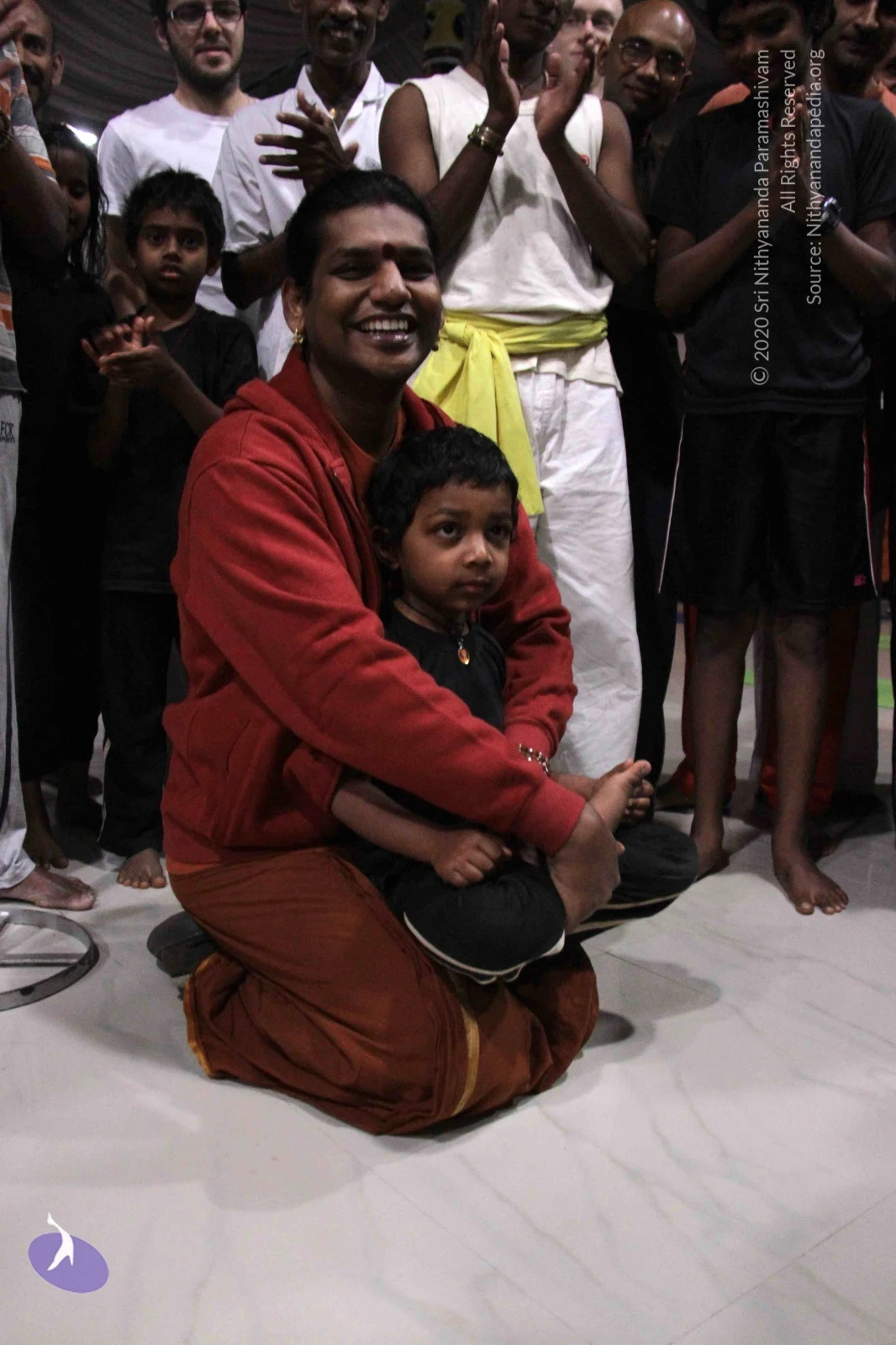
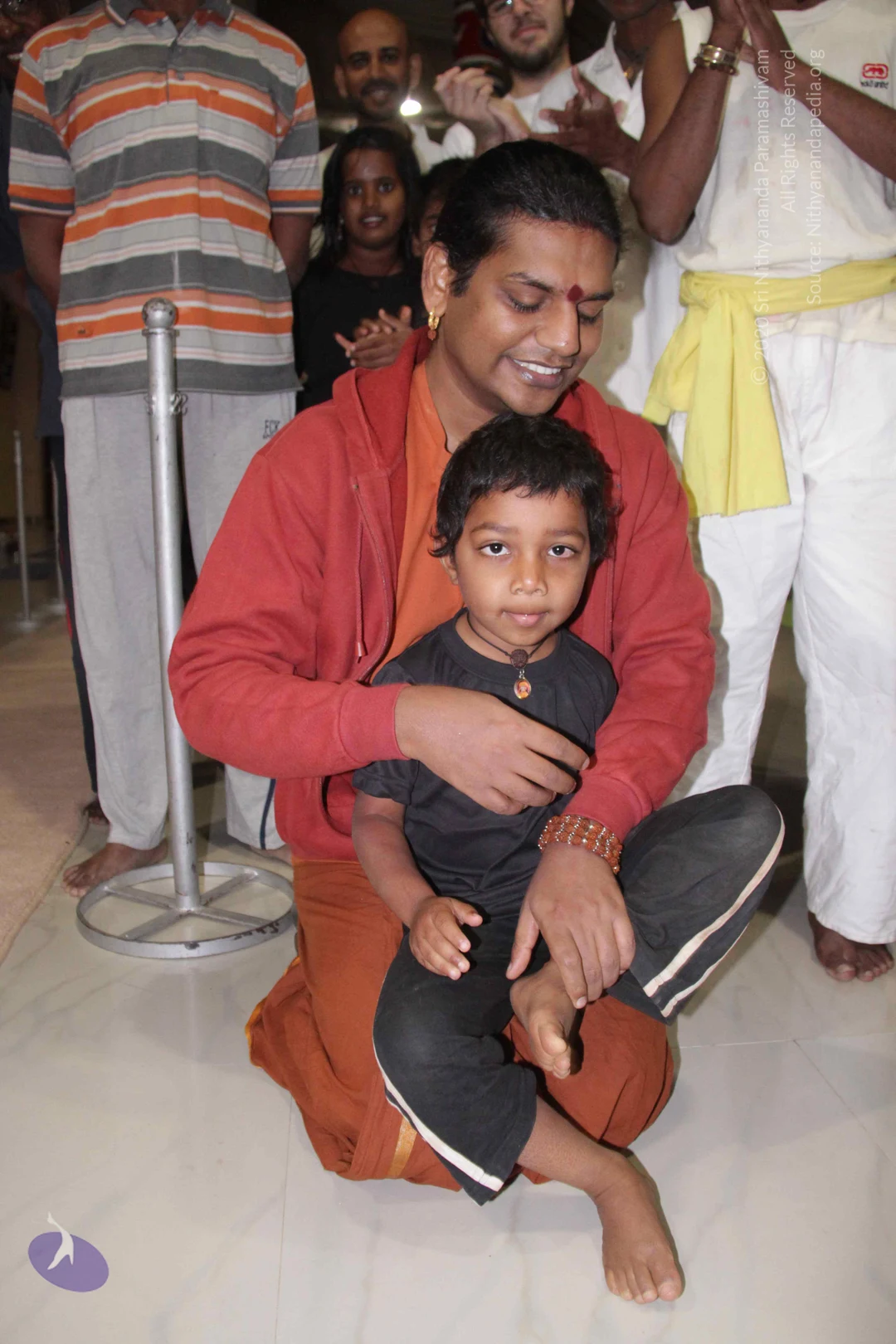
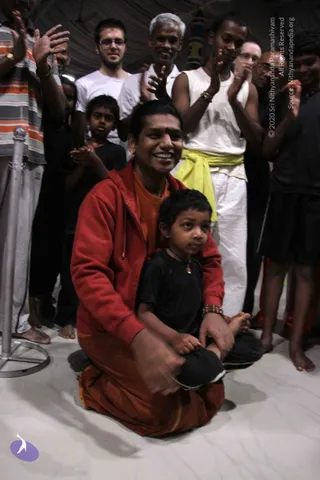
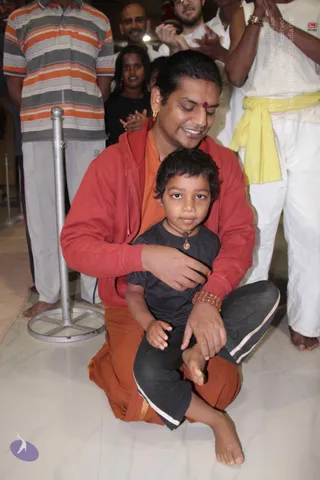
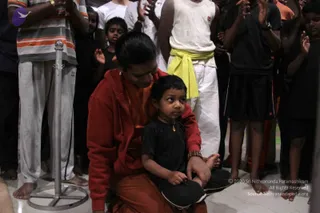
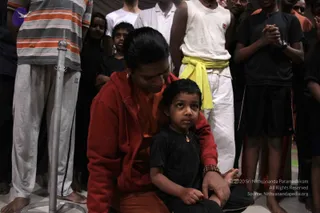
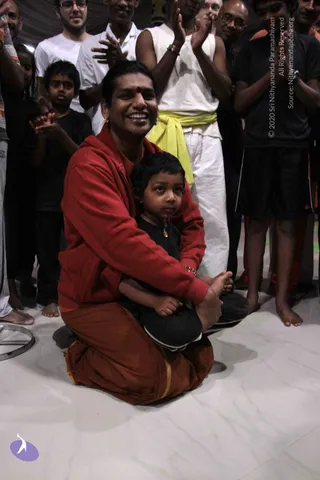
A seated man in a red zip-up hoodie over an orange top and orange dhoti smiles broadly while holding a small boy in a black t-shirt on his lap, the boy wearing a dark pendant. Behind them a crowd stands clapping, including a man in a sleeveless white top with a yellow sash, a grey-haired man in white, a bespectacled man in a white t-shirt, and several children in dark clothes. The floor is pale marble and a metal stanchion is at left.Indoor photograph of a child sitting cross-legged on a white marble floor, seated in front of a woman in a red top and orange-brown wrap who holds and steadies him from behind. Around them, a line of barefoot children and young people stand in the background, including a girl in black and boys in white and black shirts, one with a yellow sash. Metal stanchion posts and a beige carpet edge frame the scene.A photograph of a seated woman in a red zip-up hoodie over orange robes, holding a young boy in a black t-shirt and dark shorts on her lap. The boy looks upward while the woman gazes down at him. Standing around them are several onlookers in casual clothes, including a boy in a white sleeveless top with a yellow sash, a boy in a striped top and grey trousers, and others with hands raised or pressed together in applause or prayer. A metal stand stands at the left edge of the frame on a white tiled floor.A photograph of a seated adult in a red zip-up top over an orange garment, holding a young child in a black t-shirt with a small pendant on their lap. A rudraksha-style bead bracelet is on the adult's wrist. Behind them, a standing crowd of young people in black shirts, white tank tops and grey track pants with a yellow sash watches; a metal stand pole is at left. The adult is not clearly identifiable as a person from visible cues, so the a person field is unsure.A smiling man in a red zip-up jacket and rust-orange dhoti sits cross-legged on a white marble floor, holding a small child in black clothes against his chest. A red tilak is on his forehead. Behind them, a crowd of standing people in white kurtas, a white sleeveless top with a yellow waist sash, and black t-shirts claps their hands. A man in a white shirt and a bald man in glasses are among them. The setting appears to be an indoor hall.

1-Adikailash-Temple

1 photoSource gallery
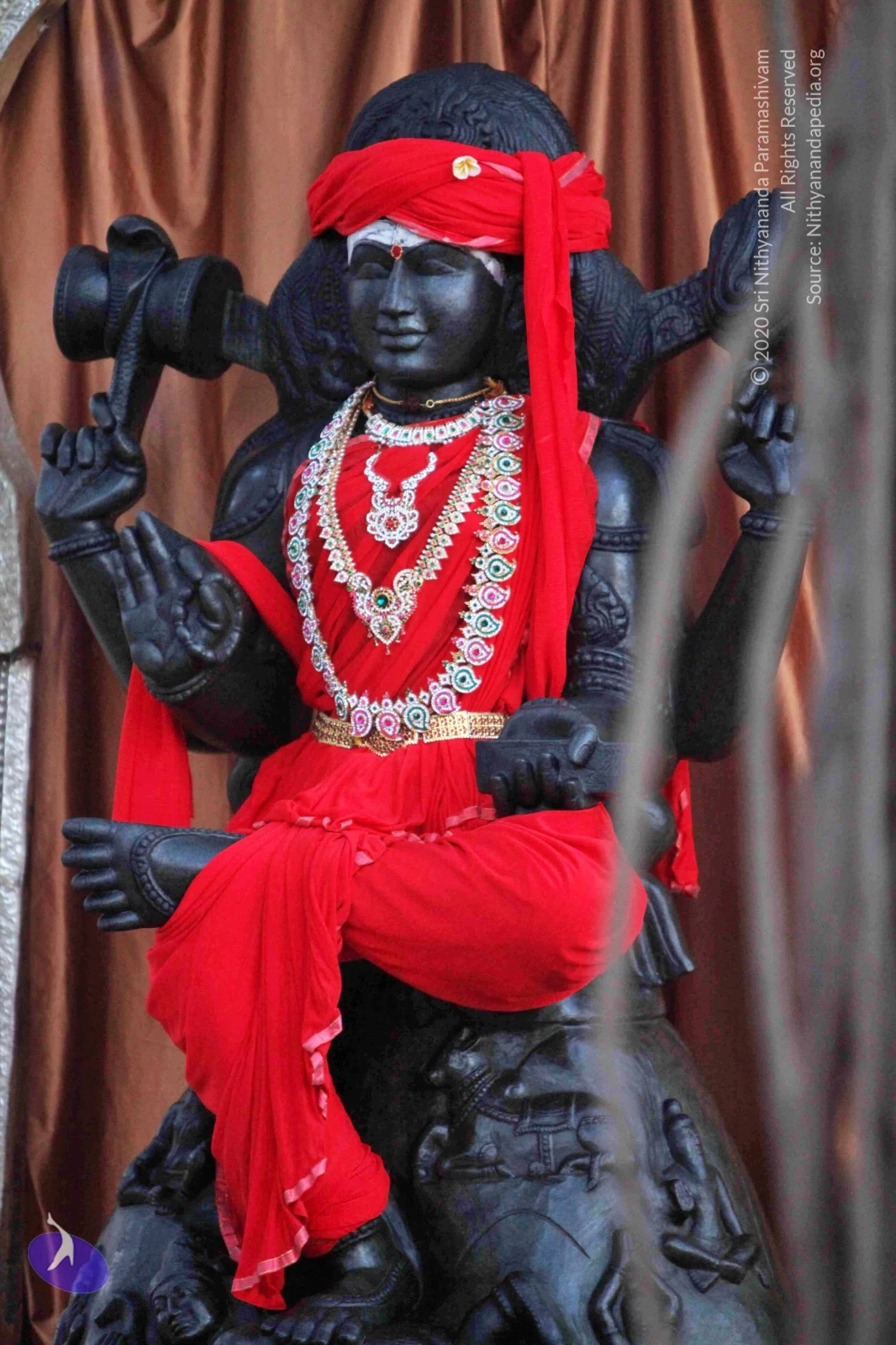
A black stone deity murti seated in a cross-legged pose, wrapped in red cloth with a red turban and a gold-and-gem necklace set with pink, green and white stones. Its multiple arms hold ritual objects, one hand raised in a mudra. A brown curtain forms the backdrop and a metal grille partly obscures the foreground. The figure is a statue, not a living person.

2-Pada-Puja

13 photosSource gallery
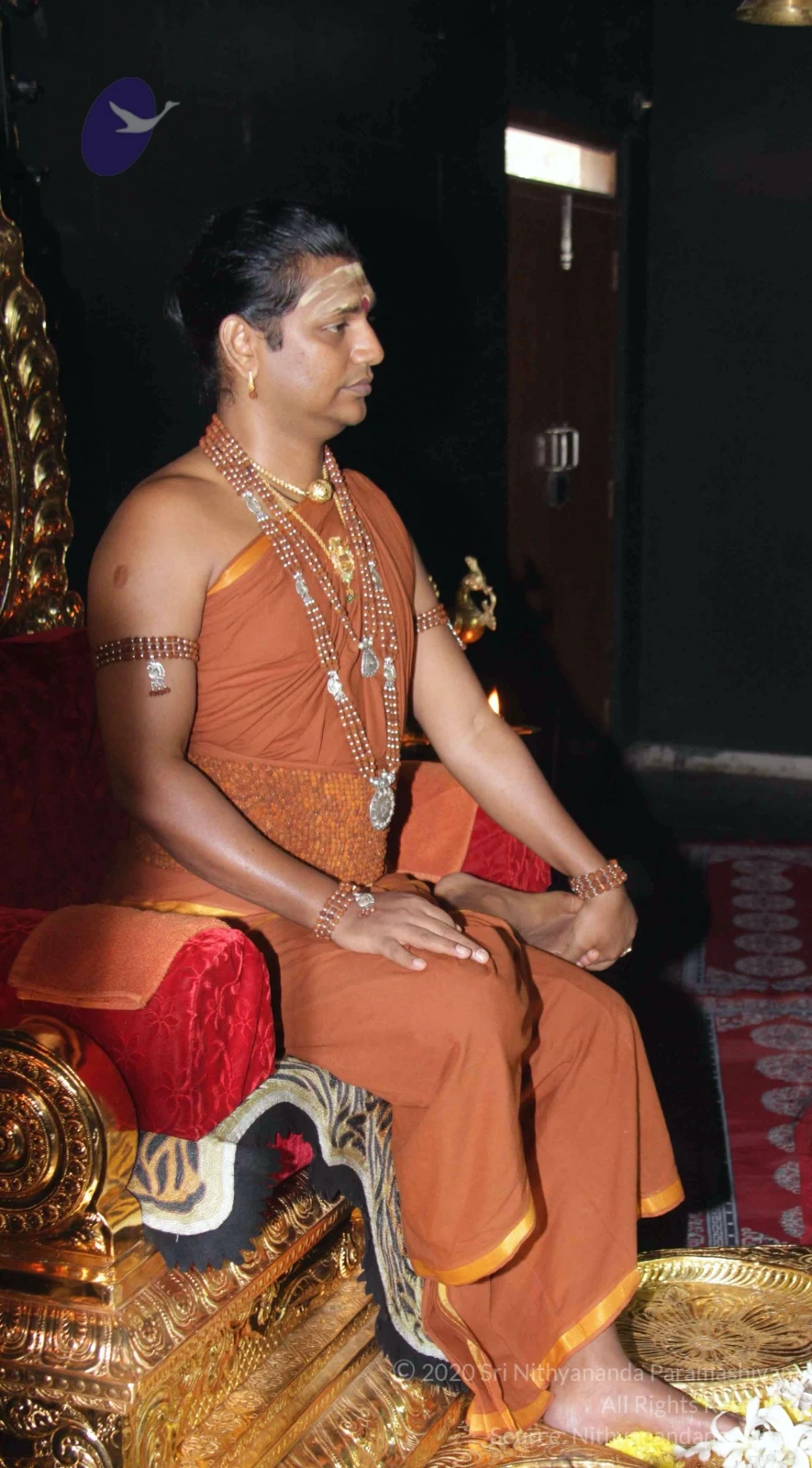
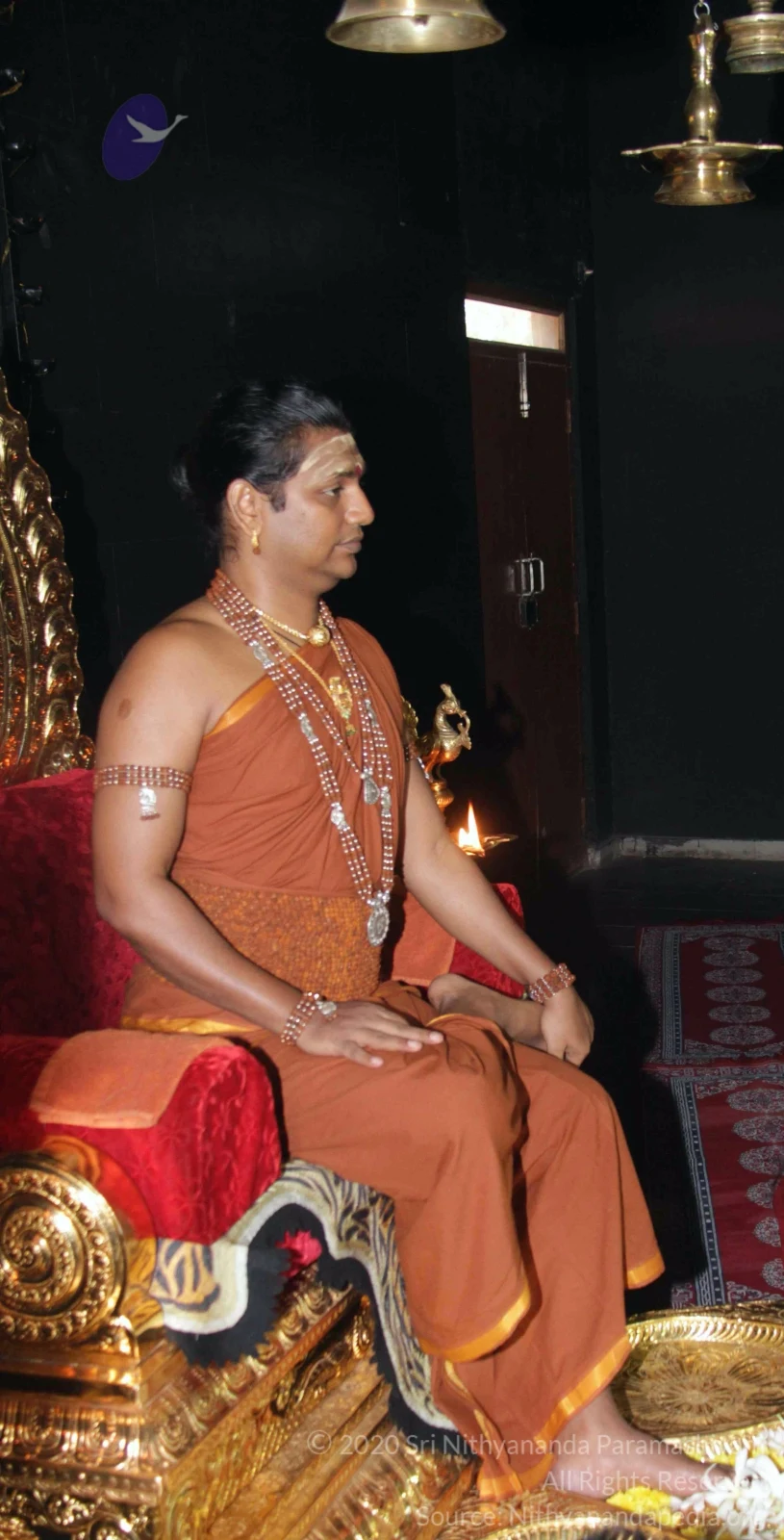
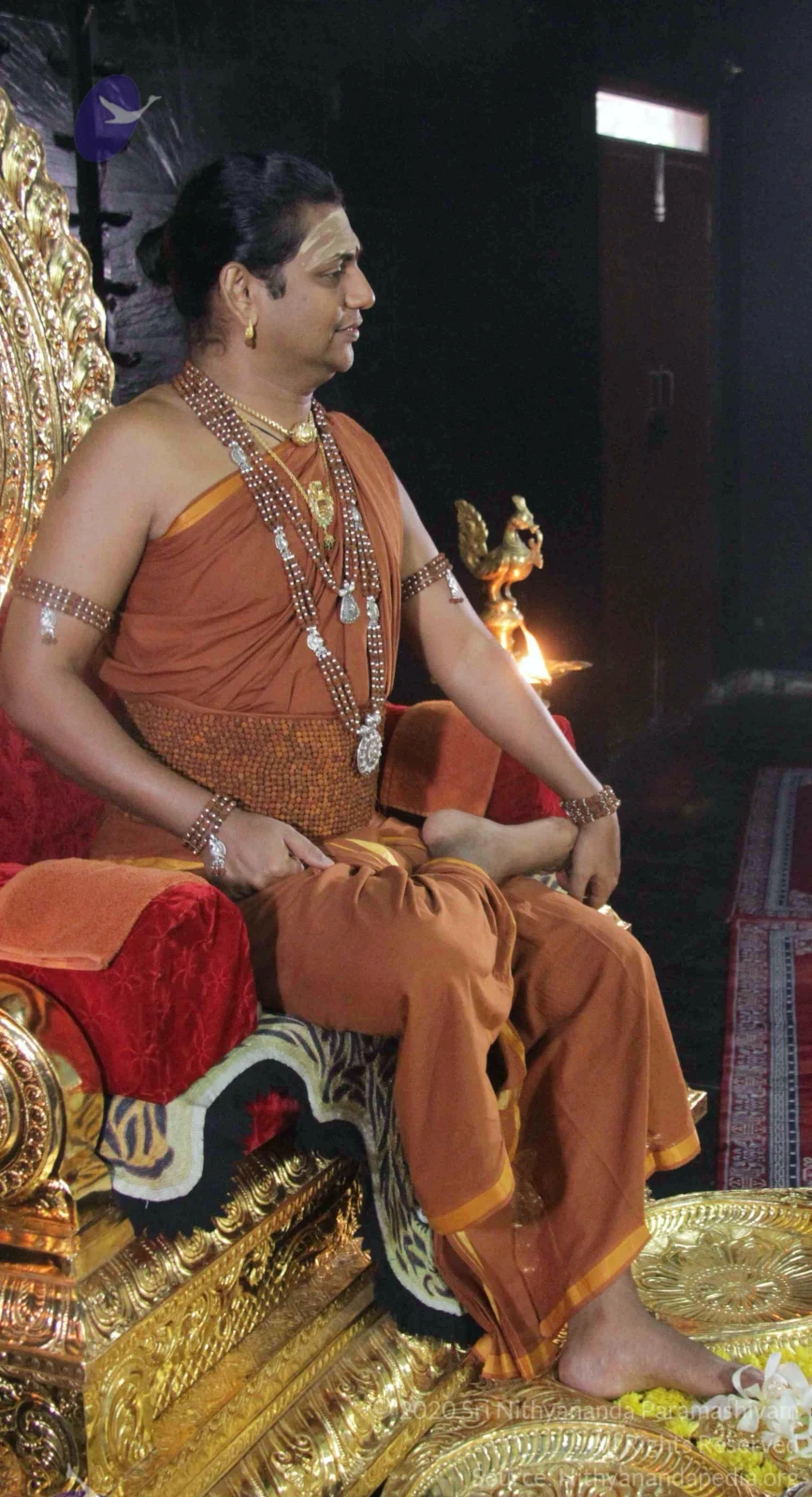
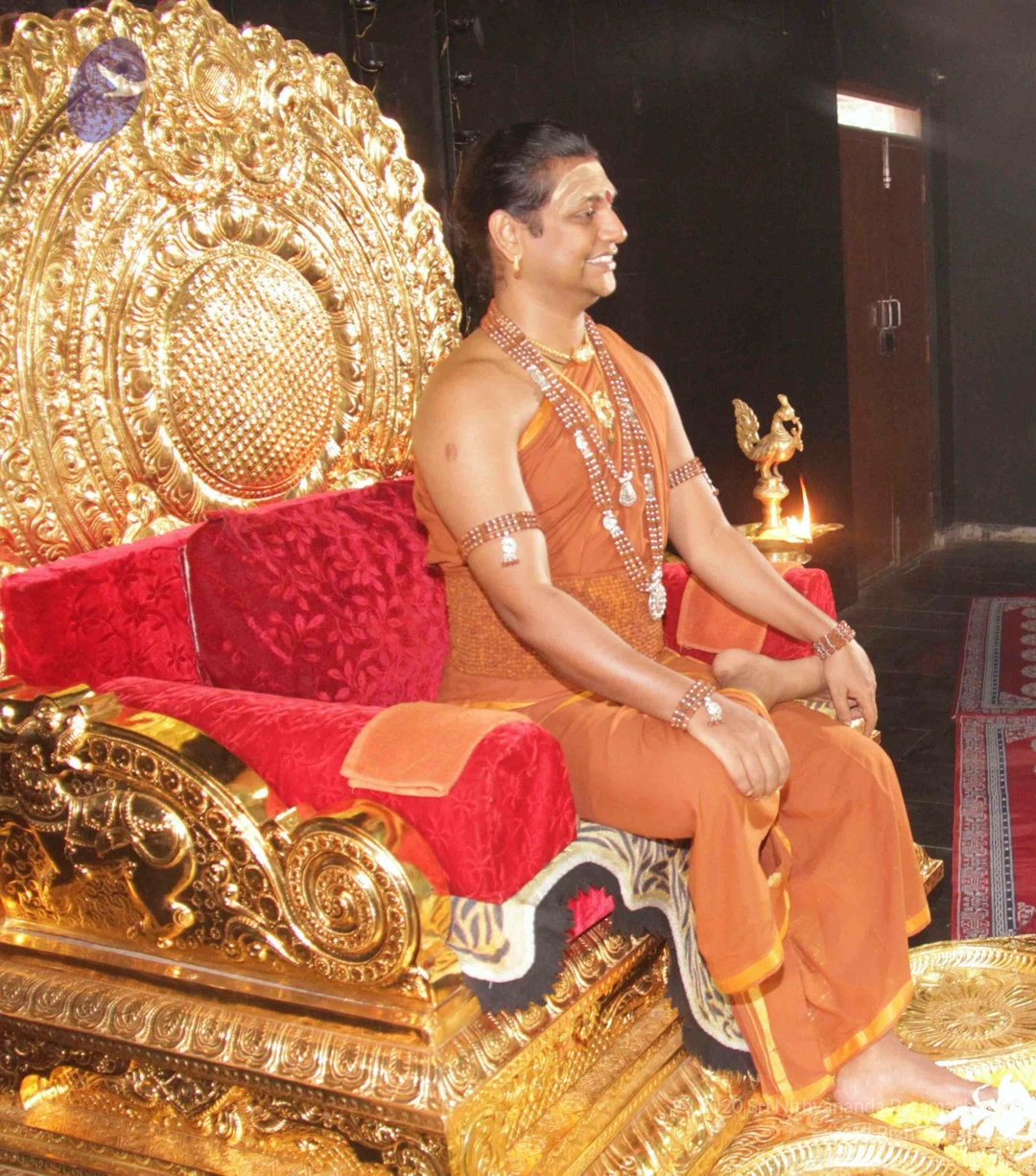
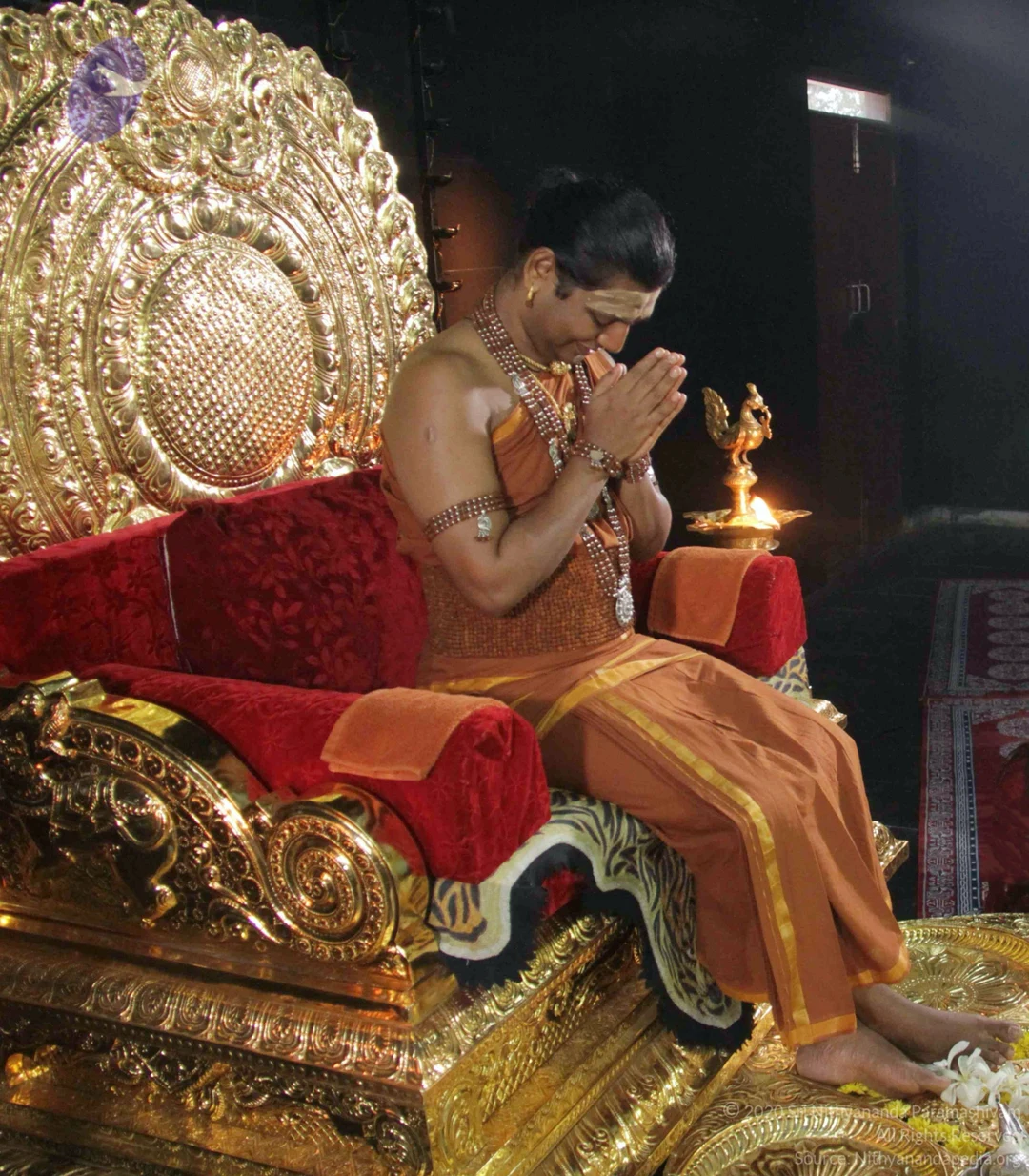
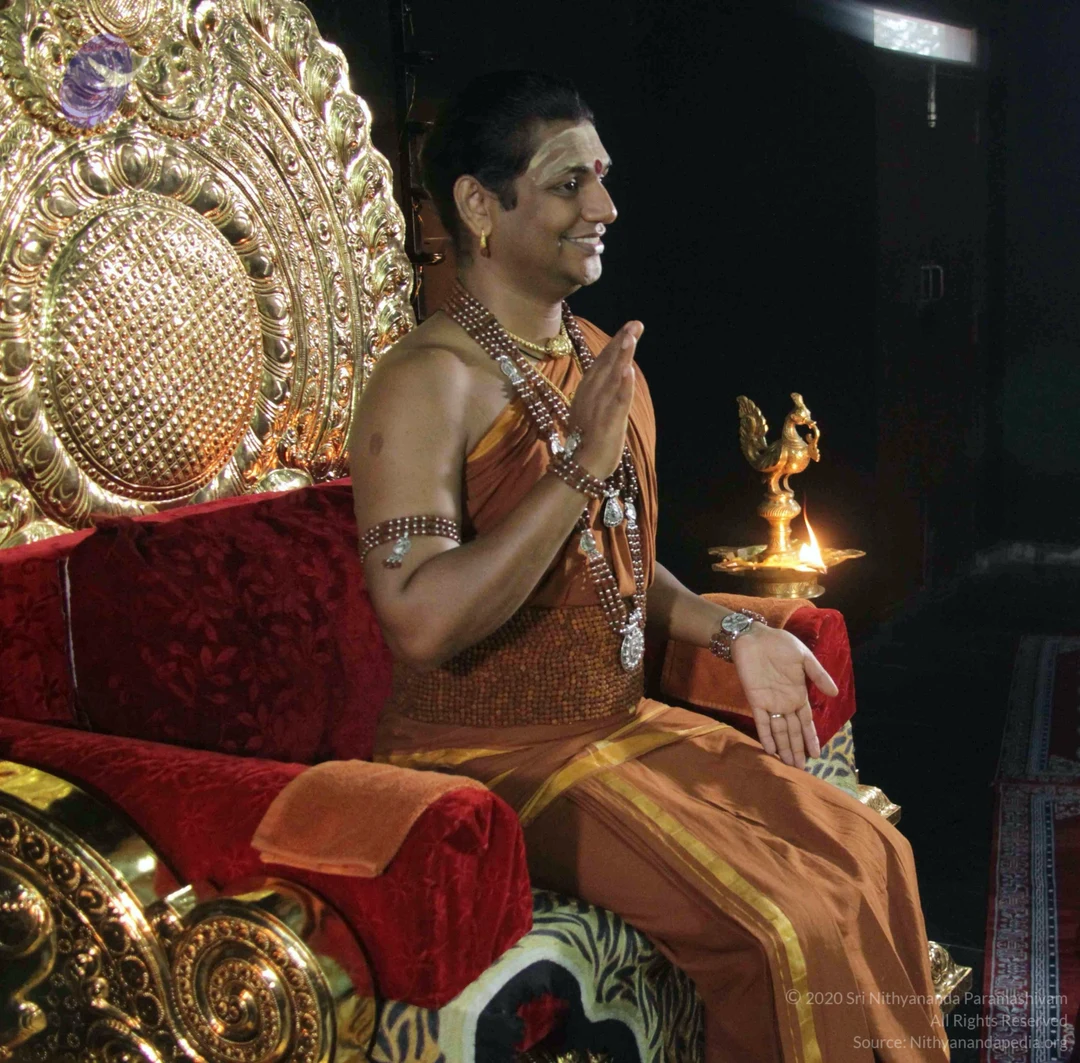
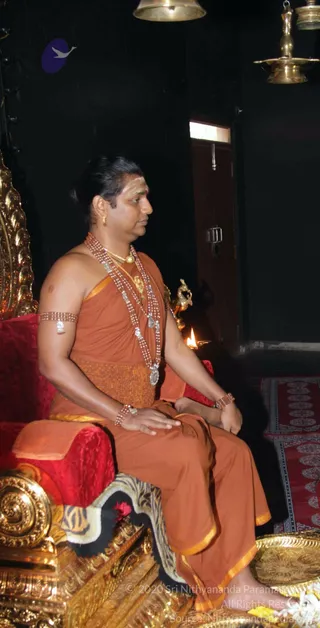
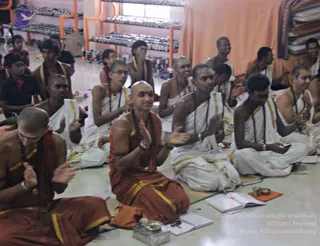
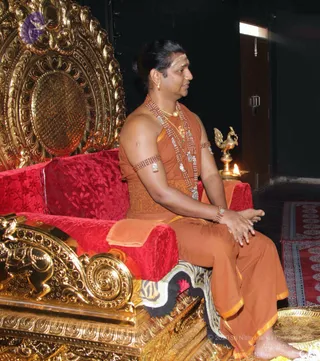
A seated man in an orange-saffron dhoti and shawl sits in profile on an ornate gold throne with red velvet cushions. He wears multiple strands of beads and a gold pendant around his neck, beaded bracelets and armlets, and a vertical tilak on his forehead. A gold plate with flowers sits at his feet, and a small oil lamp glows in the dark background. Visible resemblance to a Swamiji candidate is noted: long swept-back hair, saffron clothing and rudraksha-style malas, so this is an in-person photograph.A seated man in an orange-saffron dhoti and shawl sits on an ornate gold-and-red velvet throne with a tiger-striped cloth draped over its base. He wears layered beaded rudraksha-style necklaces, a gold pendant, a beaded armband and bangles, and has a white-and-red tripundra mark on his forehead. A brass oil lamp with a lit flame stands beside him, and a hanging brass lamp is visible above in a dark room. The seated figure has distinctive adornments and saffron clothing matching the page's a person reference, so this is an appearance-based a person on a throne.A seated group of young male students and monks in a hall with orange curtains and shelves of steel vessels behind them. Several shaved-headed men in white dhotis with gold borders and orange-red robes sit cross-legged on mats, palms pressed together in prayer or chanting. A few wear rudraksha malas and forehead vibhuti; one in the centre, in an orange robe with a rudraksha mala, smiles with hands folded. A notebook, small brass cups and a steel tiffin-style box sit on the floor in front. Some people in the back watch or look on. No identifiable a person figure is visible in this crowd.A man with swept-back dark hair and a white-and-ochre tilak on his forehead sits on an ornate gold throne with a red velvet seat cushion and gold lion-carved armrests. He wears an orange-saffron unstitched garment, multiple strands of rudraksha-style beaded malas, a gold necklace with pendant, beaded armlets and a bangle. A brass oil lamp with a lit flame and a gold peacock-shaped stand sits beside him, and a brass plate lies at the lower right on a patterned carpet. The background is dark. Appearance cues include the swept-back hair, saffron clothing, malas and ceremonial gold necklace, so this is a probable Swamiji seated on his throne during a satsang or darshan setting.A man seated on an ornate gold throne with a deep red velvet cushioned seat and armrests, wearing an orange saffron-coloured dhoti and shawl with a yellow border, multiple strands of rudraksha beads and a gold chain around his neck, beaded armbands and bracelets, and a sacred forehead marking. He sits bare-footed on a patterned rug beside a brass oil lamp with a flame and a golden decorative vessel. A dark wall and a wooden door are behind him. The seated figure with long swept-back hair and rudraksha malas matches appearance cues for Swamiji (probable), with a throne and ceremonial orange clothing; this is a physical person seated in person.A man seated on an ornate gold-and-red throne, dressed in saffron-orange robes with a bare shoulder and orange sash, wearing multiple strands of rudraksha beads on his neck and arms, a gold necklace, and a white vertical tilak with a red bindi on his forehead. He holds a white ceremonial staff across his lap and looks to the side while smiling. Behind him stand a brass rooster figure and a lit oil lamp against a dark wall with a wooden door. a person with rudraksha malas, saffron clothing and a ceremonial throne, seated in a ritual setting.

5-HDH-with-Devotees

2 photosSource gallery
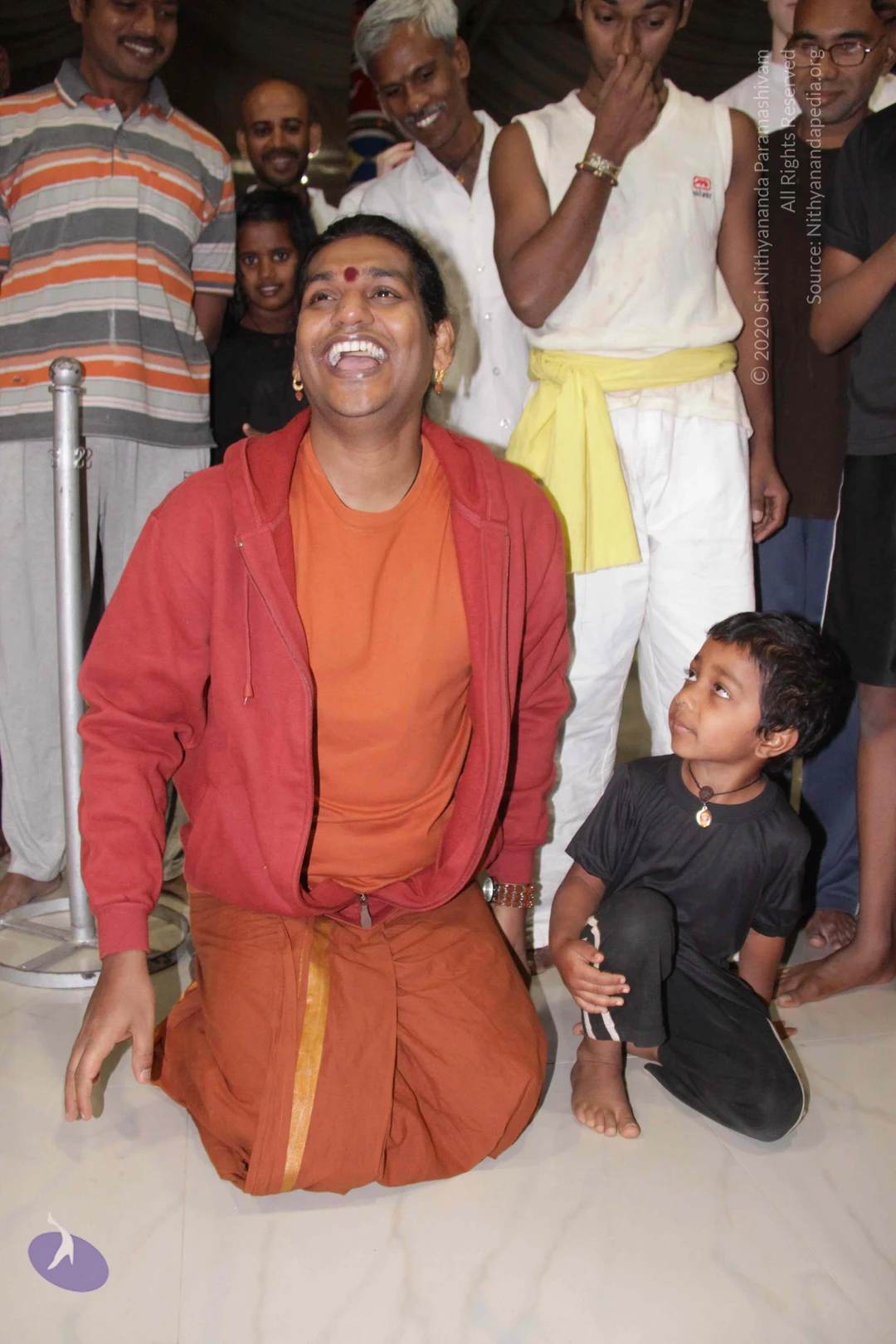
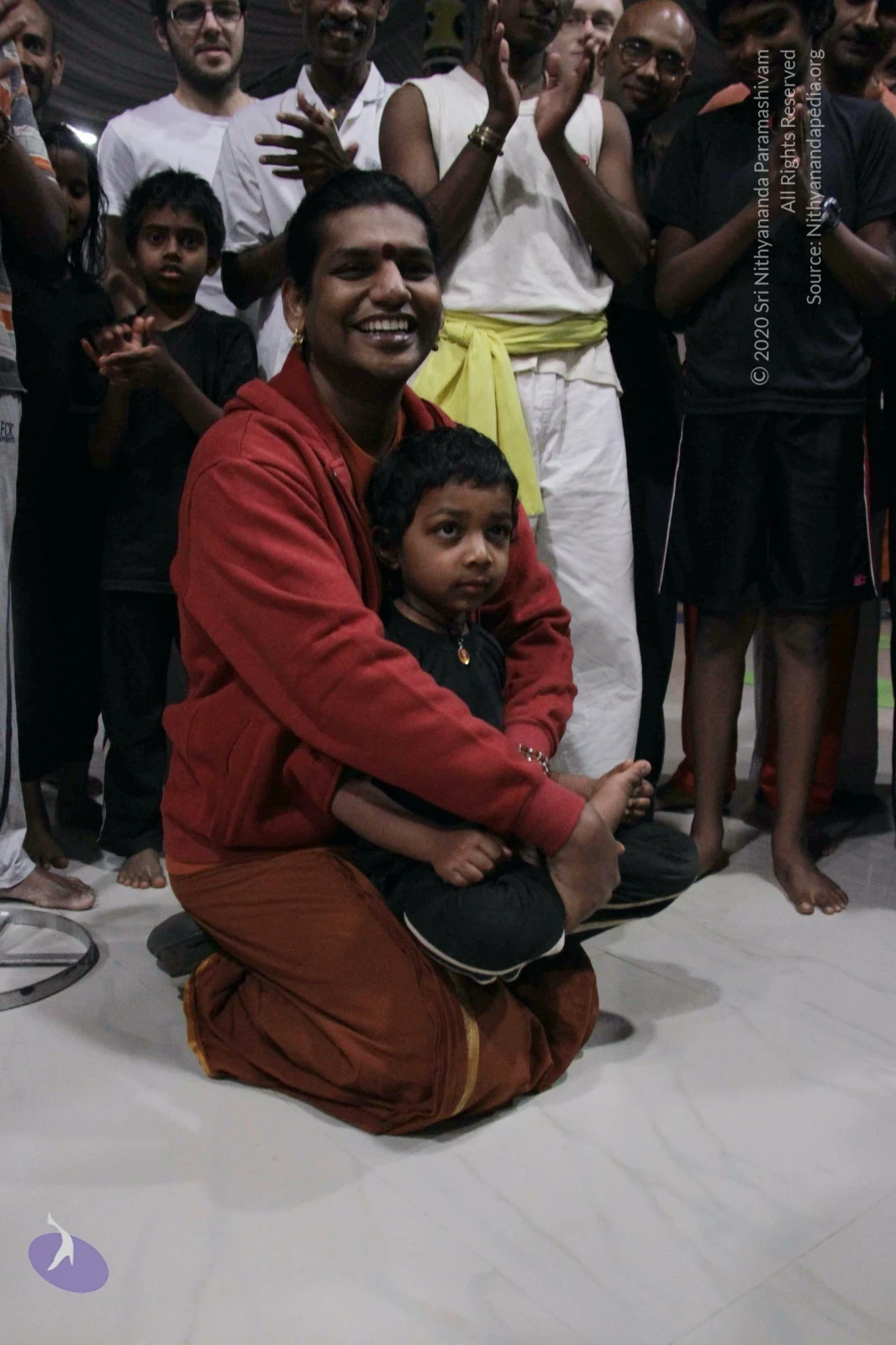
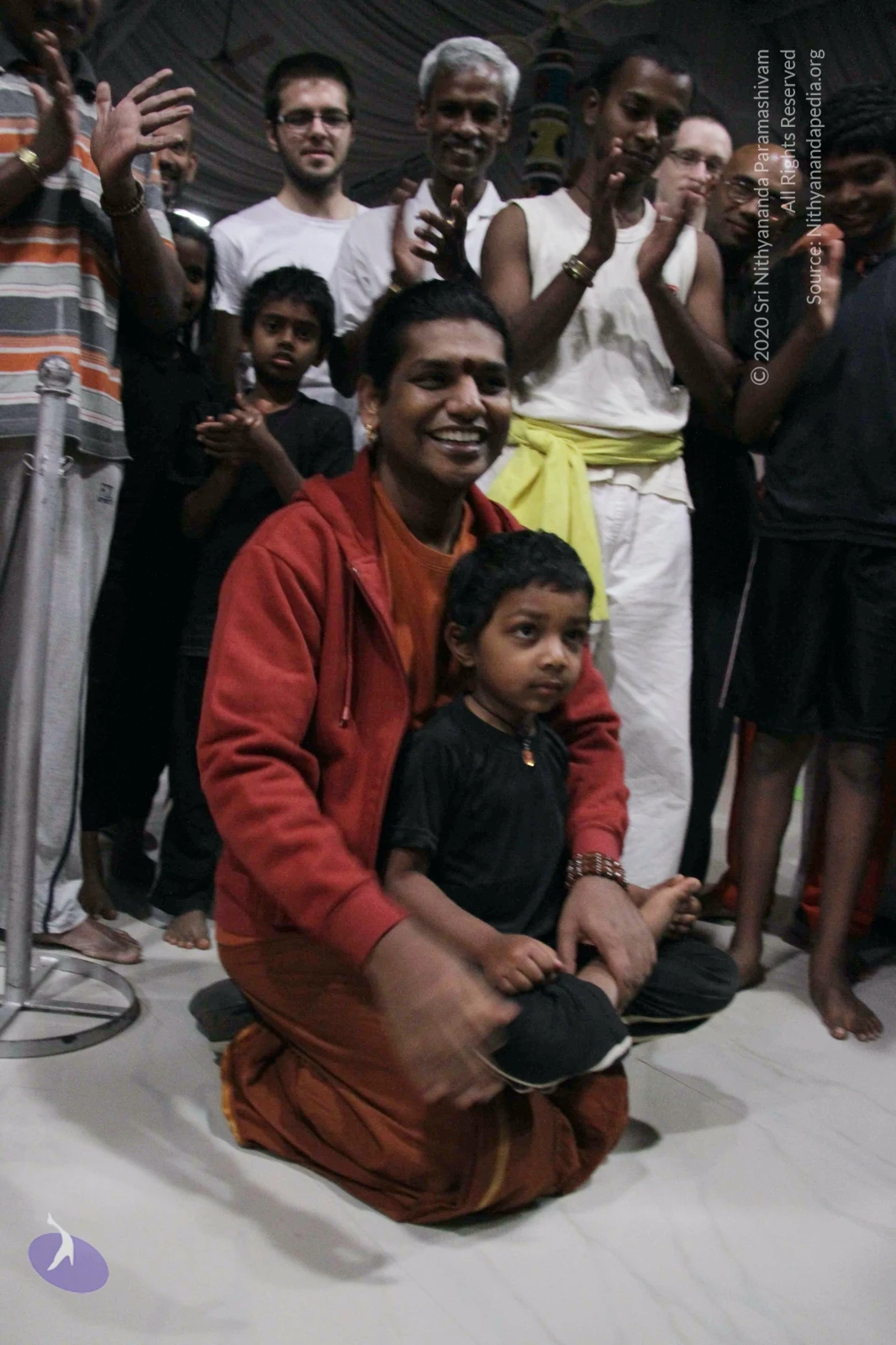
A kneeling man in an orange t-shirt, rust-orange dhoti with a gold border, and a red zip-up hoodie laughs broadly, with a small red bindi on his forehead and gold earrings. A young boy in a black t-shirt with a pendant necklace kneels beside him, looking up at him. Behind them, a crowd of men in striped polos and white sleeveless and collared shirts, one with a yellow cloth at the waist, smile and watch on a white marble floor. A silver stanchion stands at the left edge.A smiling man in a red zip jacket and rust-orange dhoti sits cross-legged on a white marble floor, holding a young boy in a black top who sits in his lap; a small red-brown tilak marks his forehead. Behind them a crowd stands clapping, including a man in a white sleeveless kurta with a yellow sash and several men and boys in dark clothing. A small bronze or metal ring lies at the left edge. The scene resembles a gathering celebrating a child, with applause and a cheerful atmosphere.

Nithya-Satsang

8 photosSource gallery
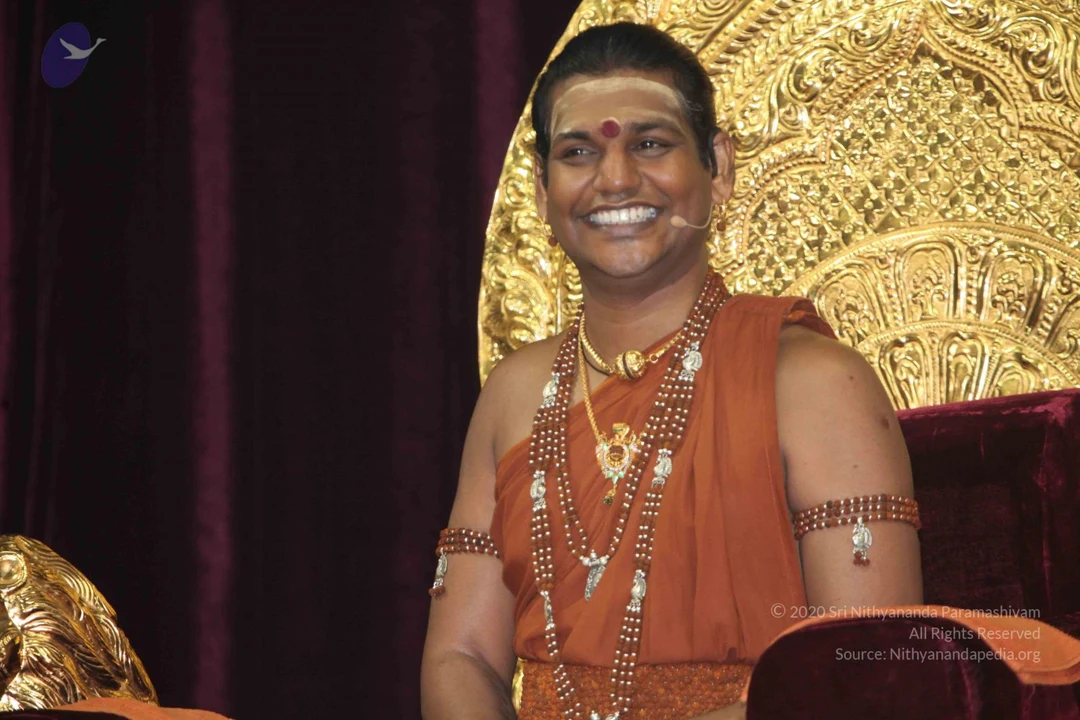
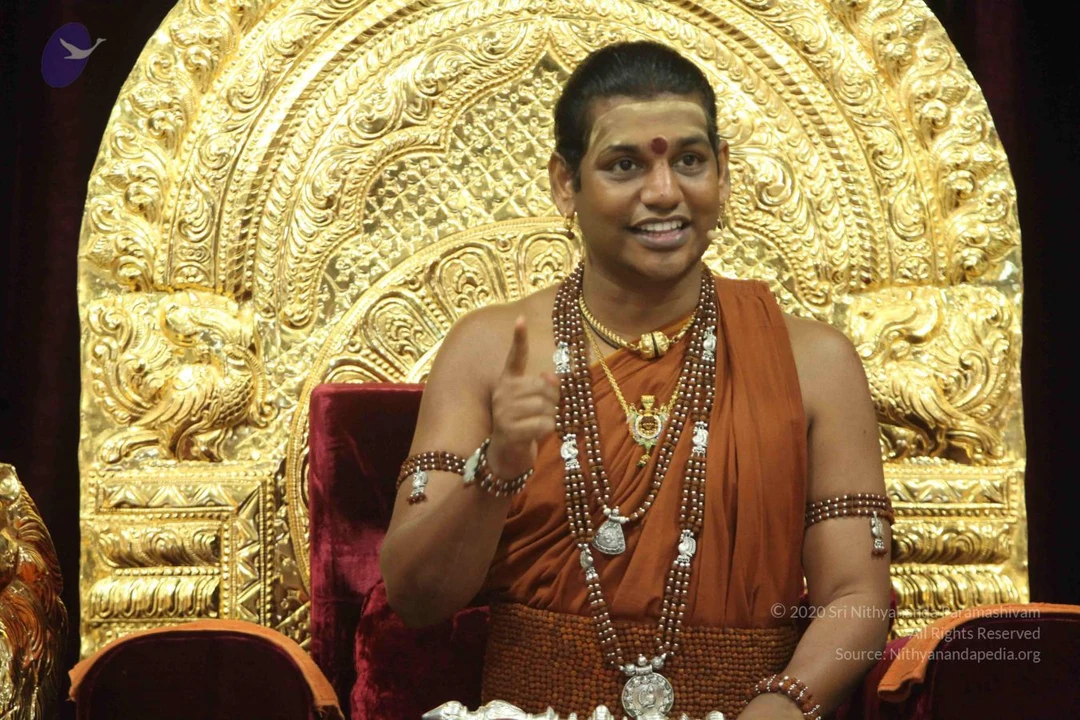
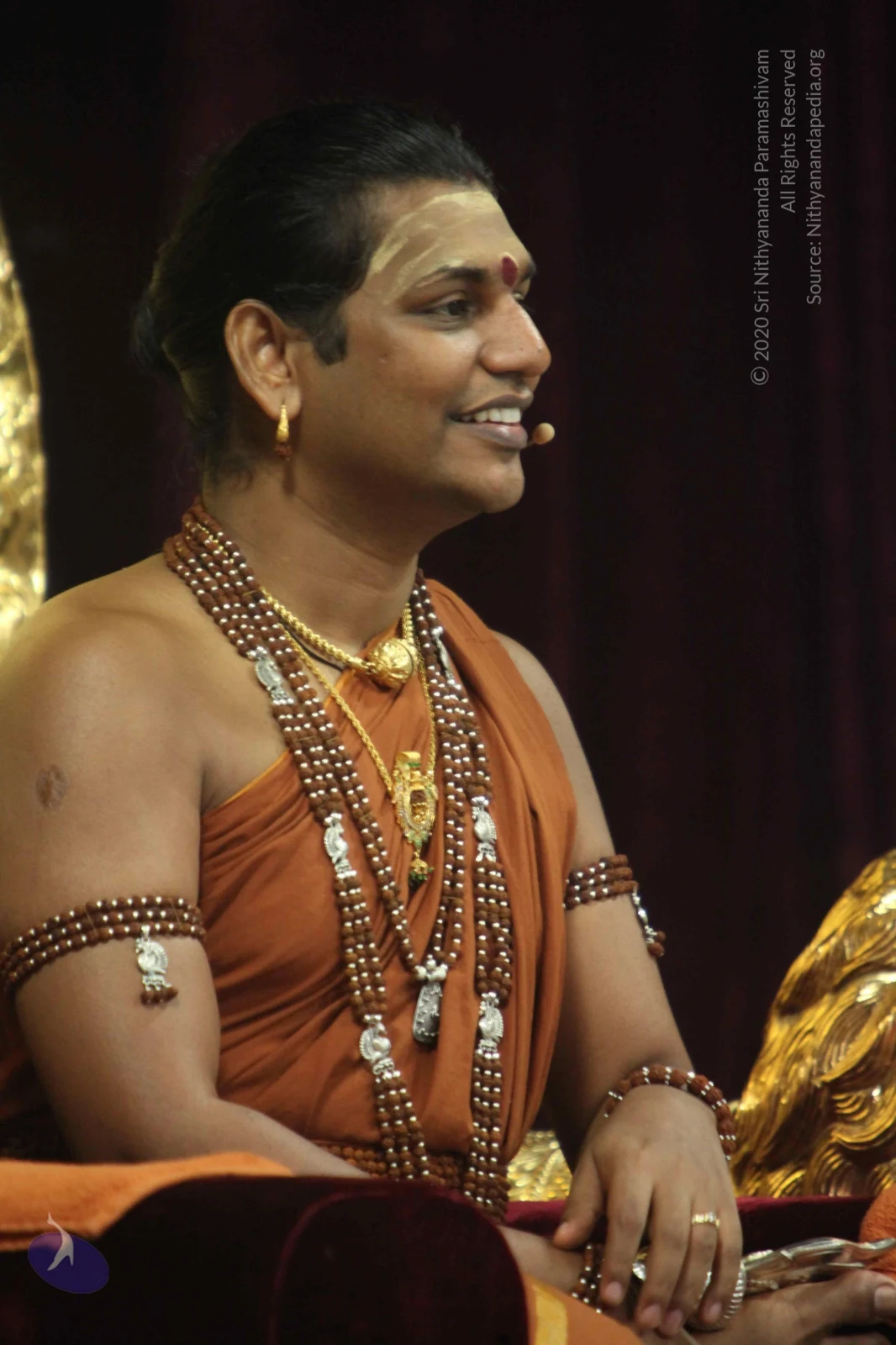
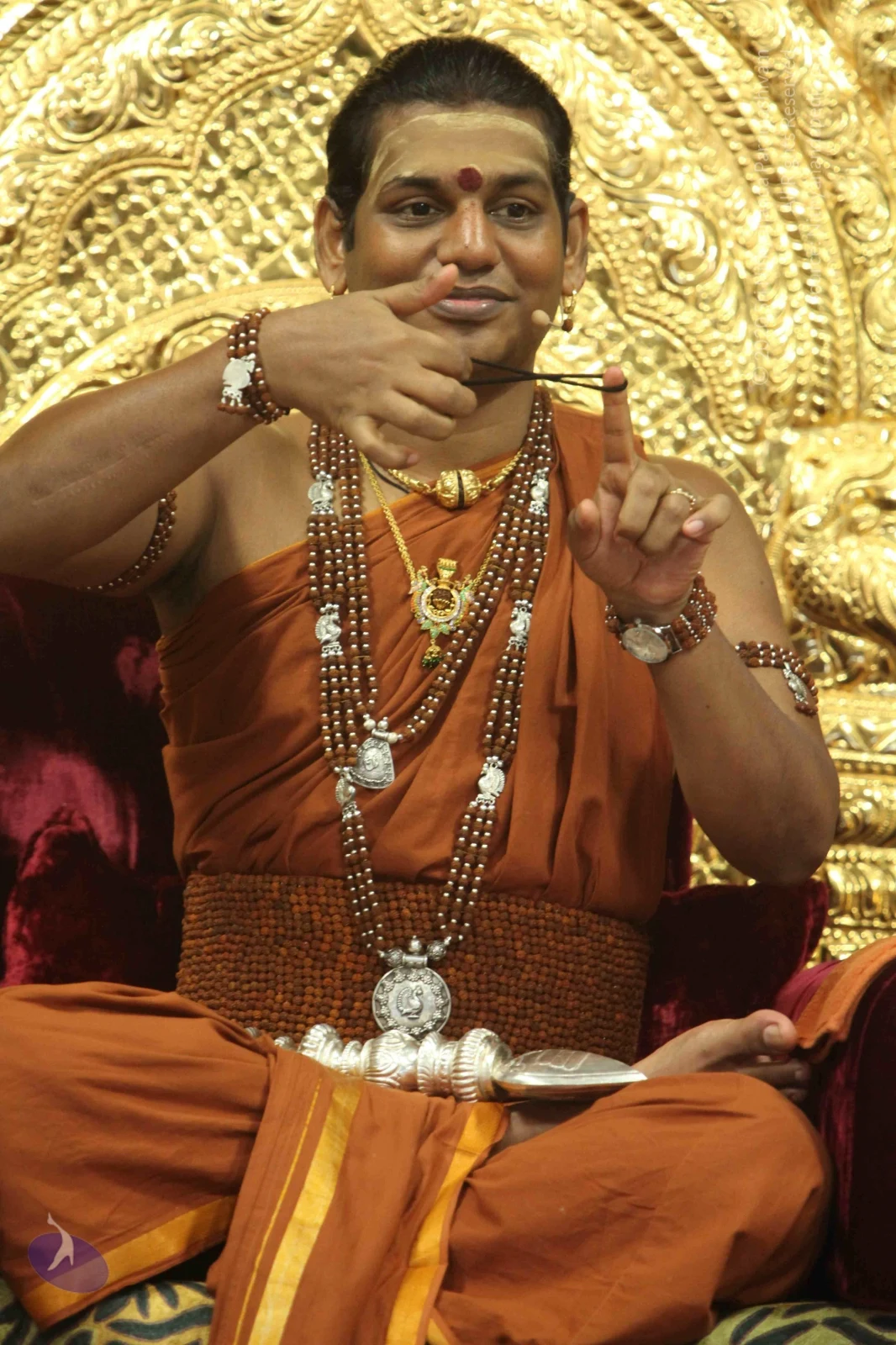
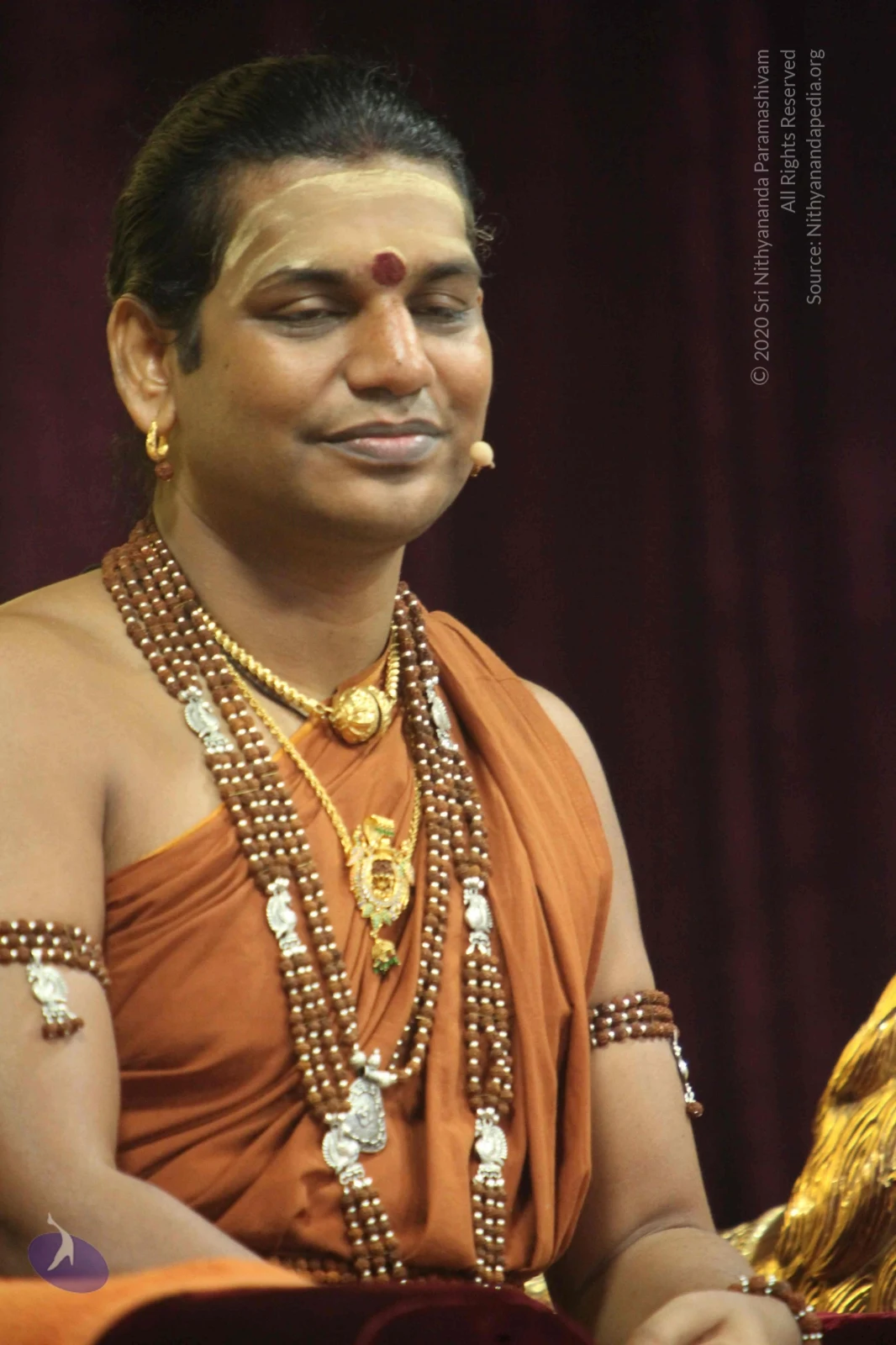
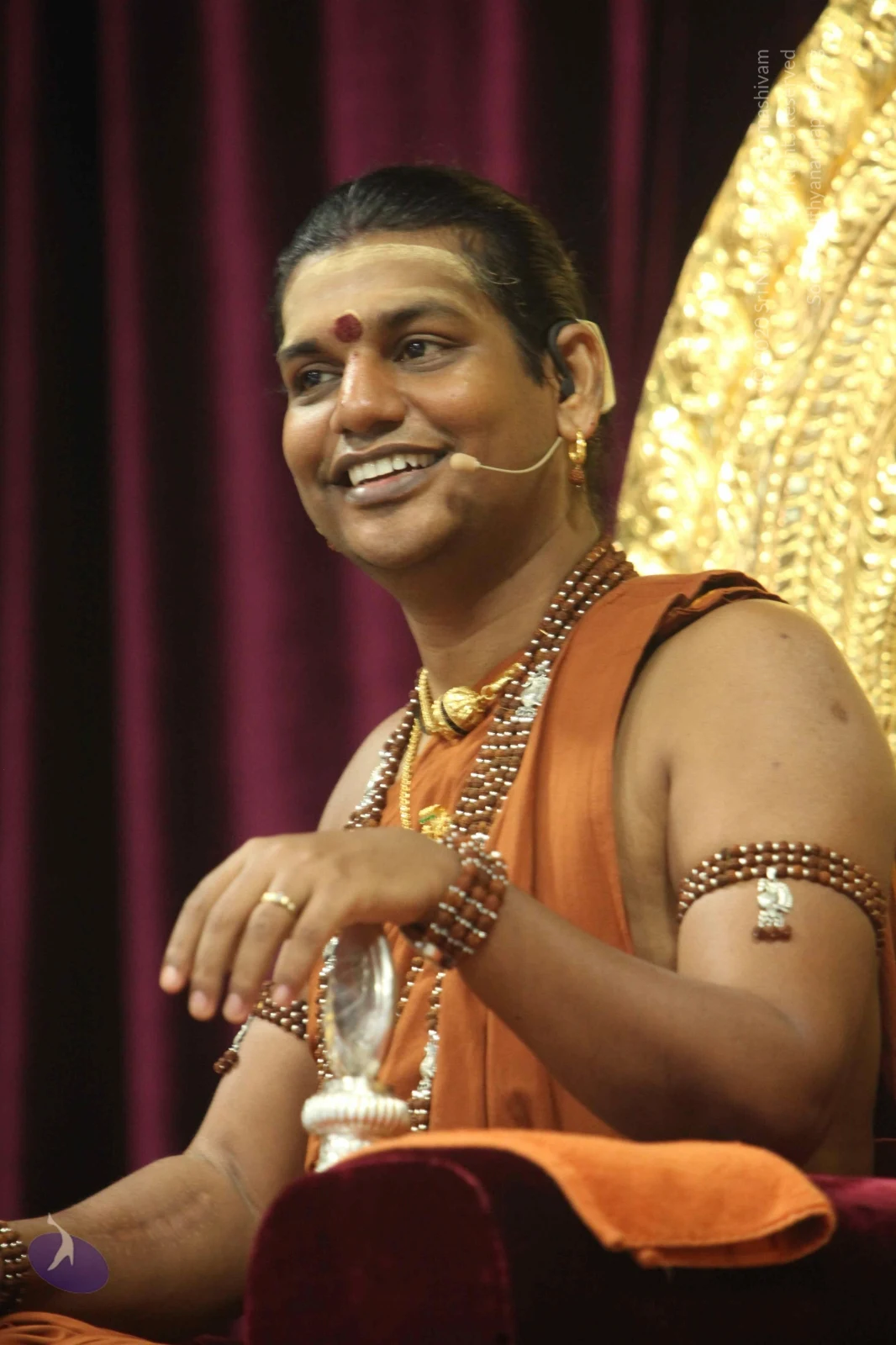
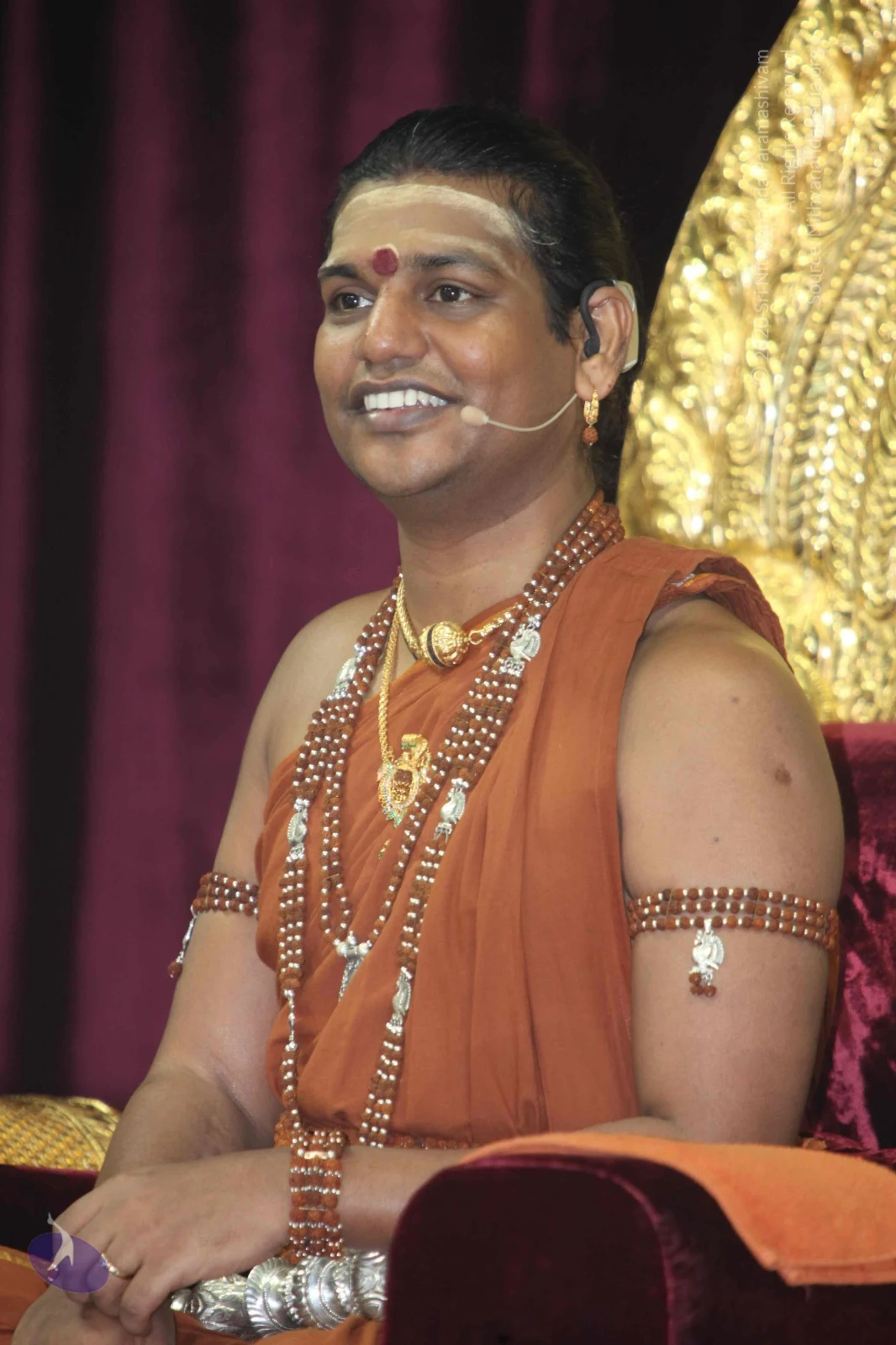
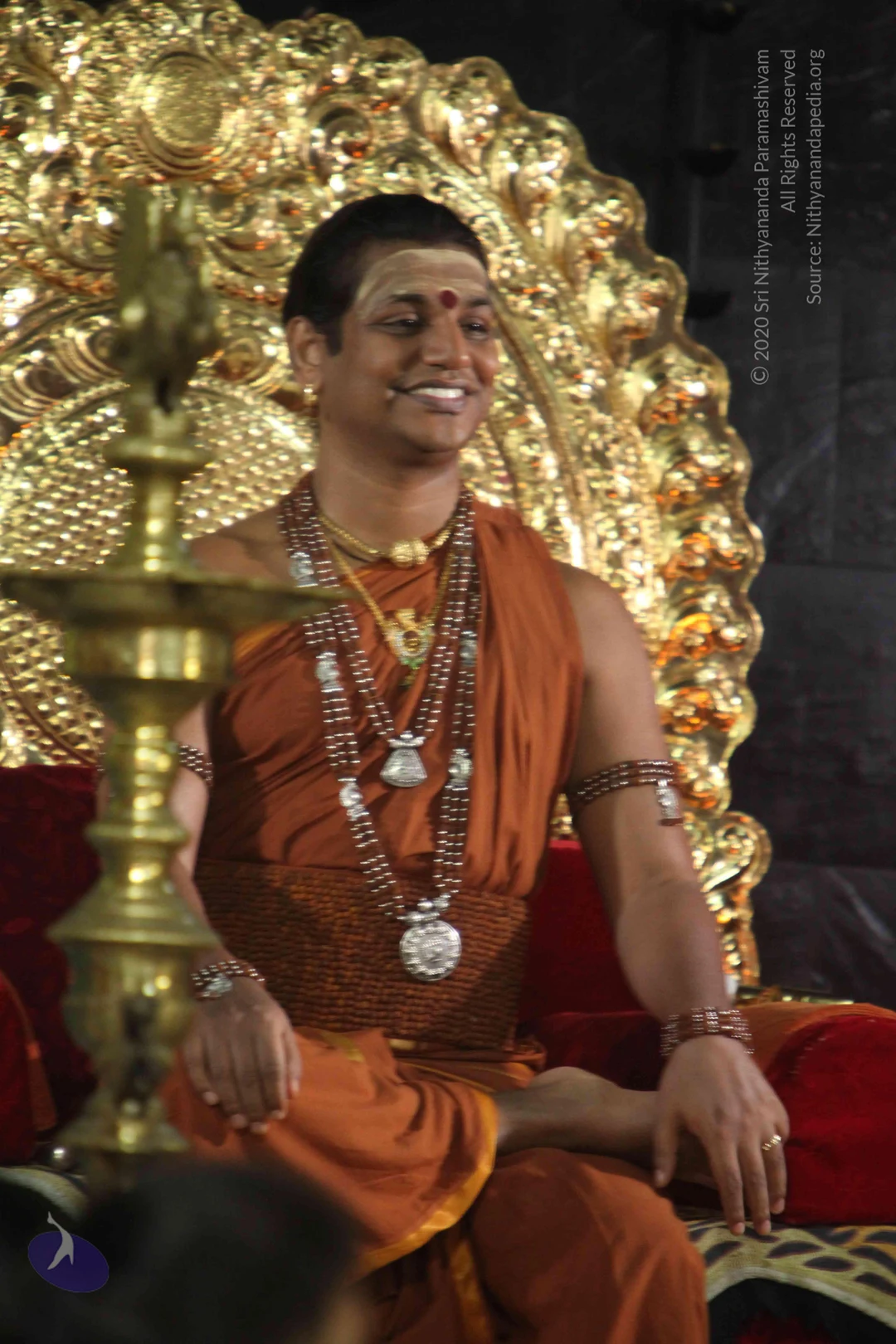
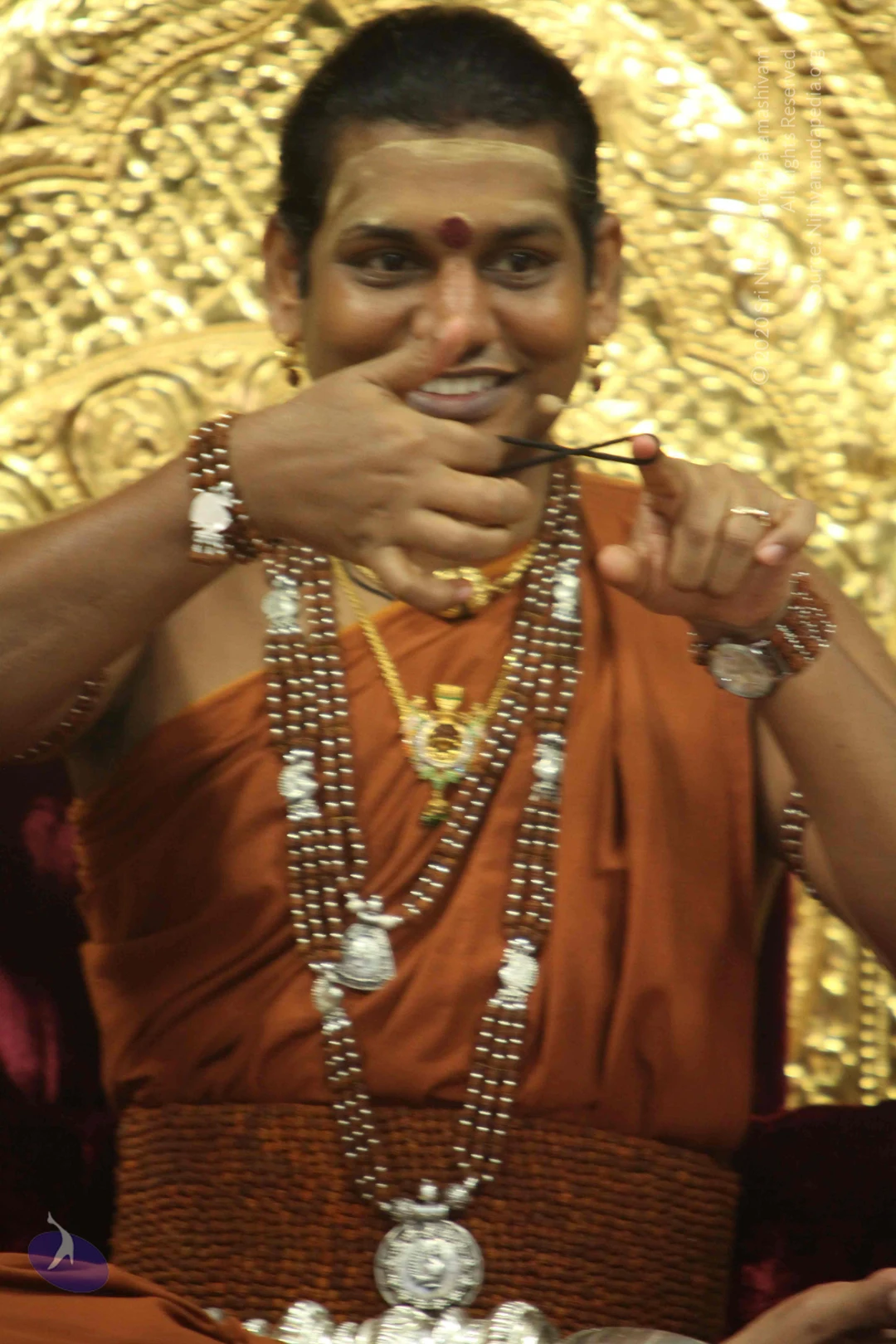
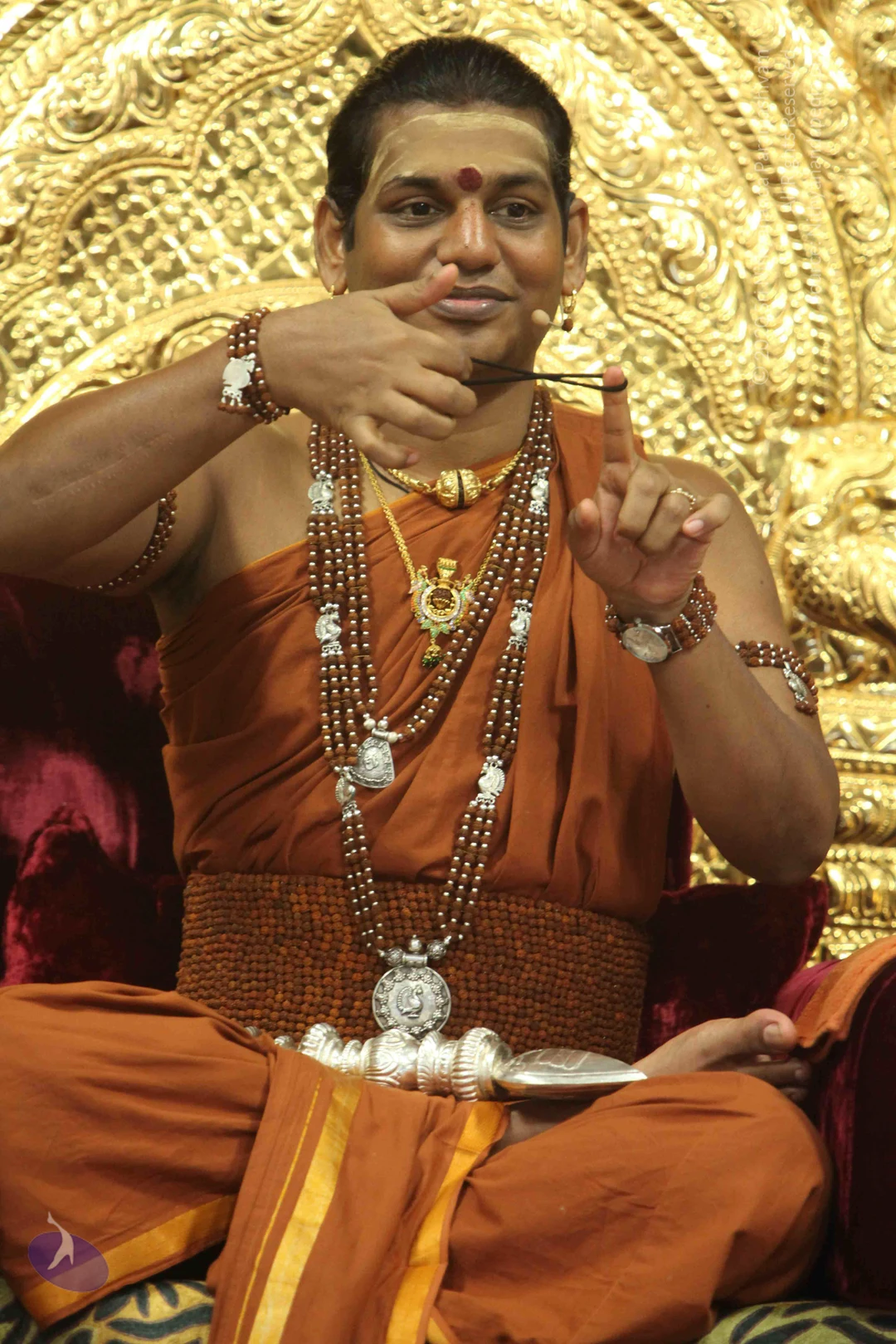
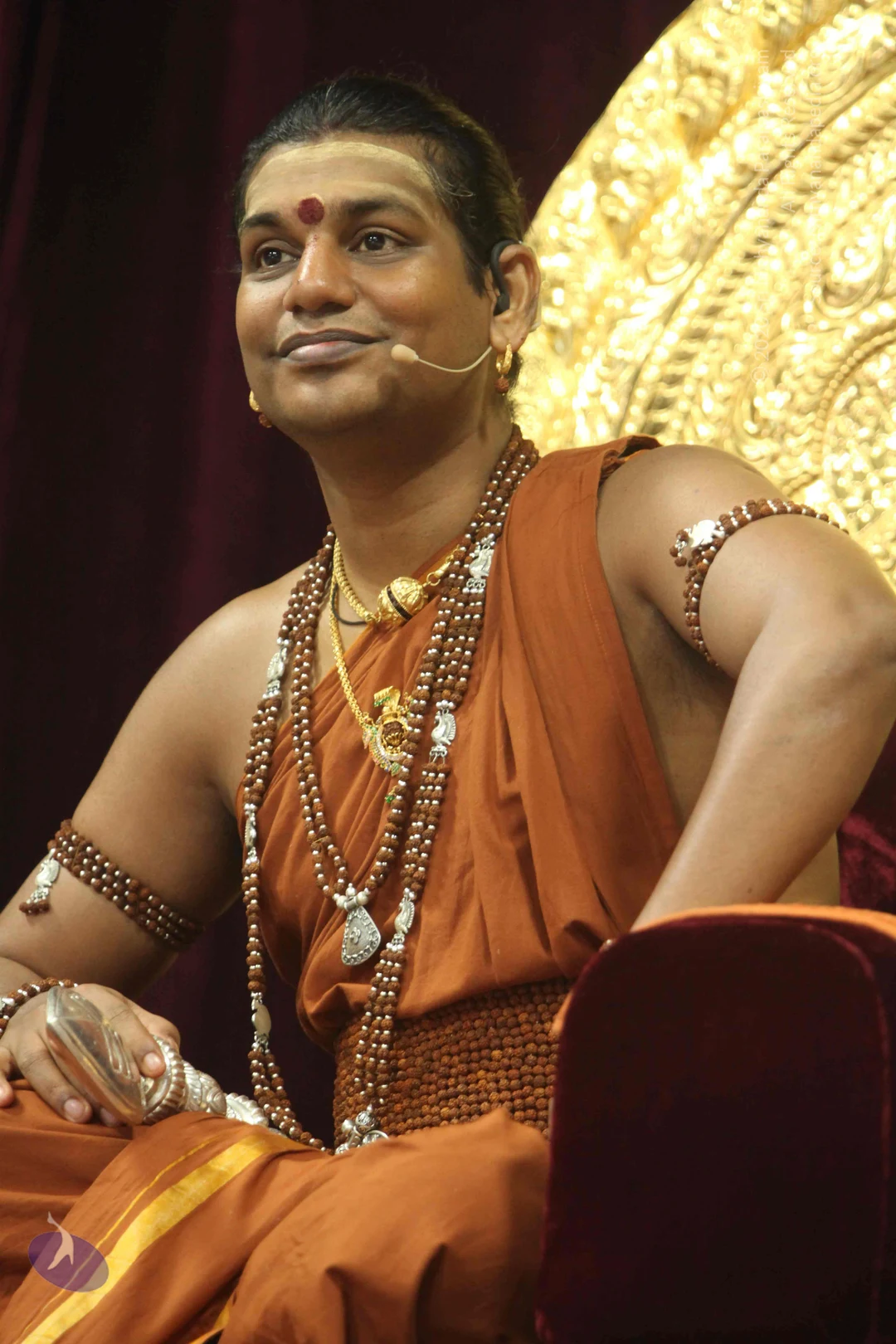
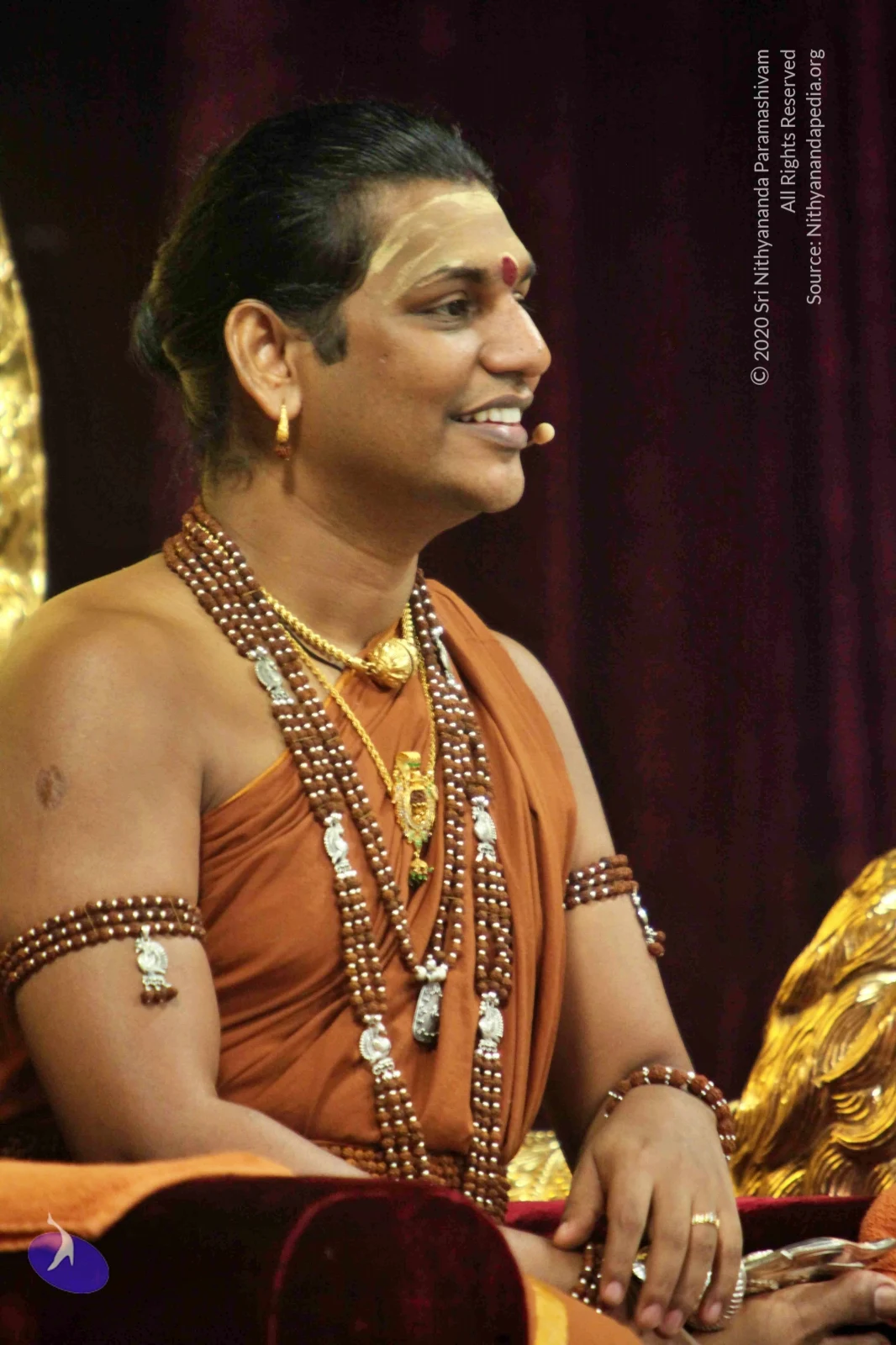
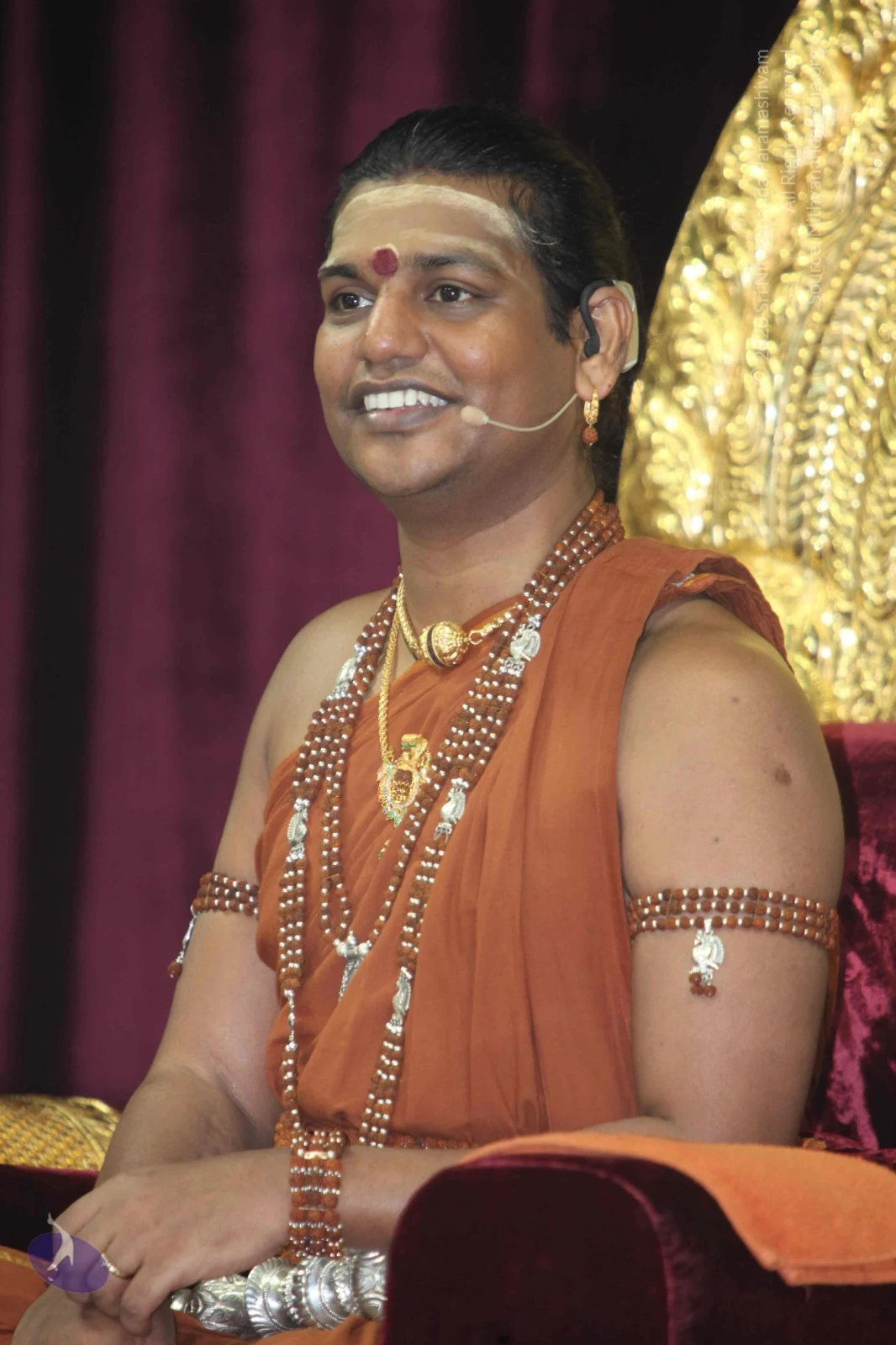
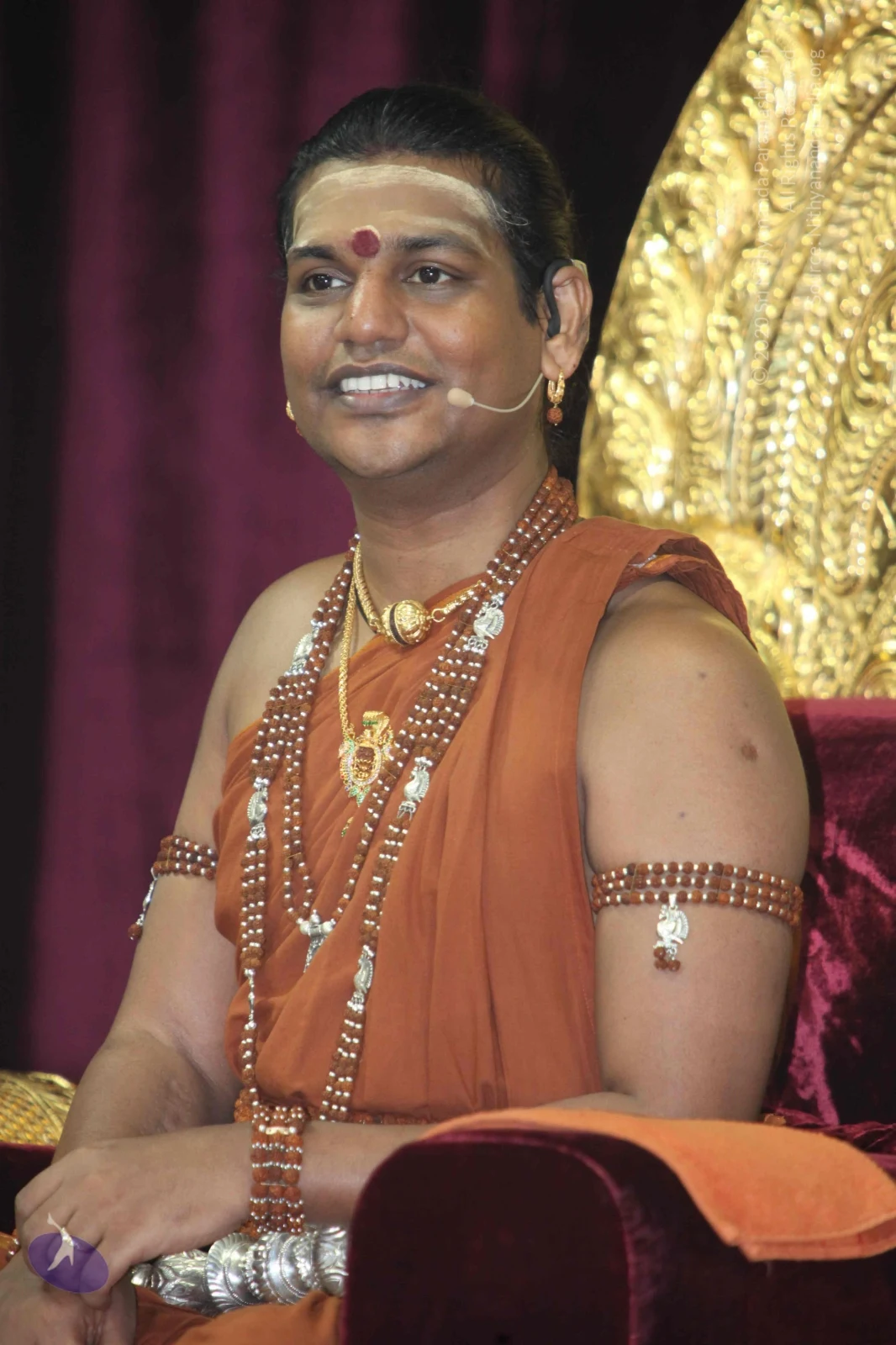
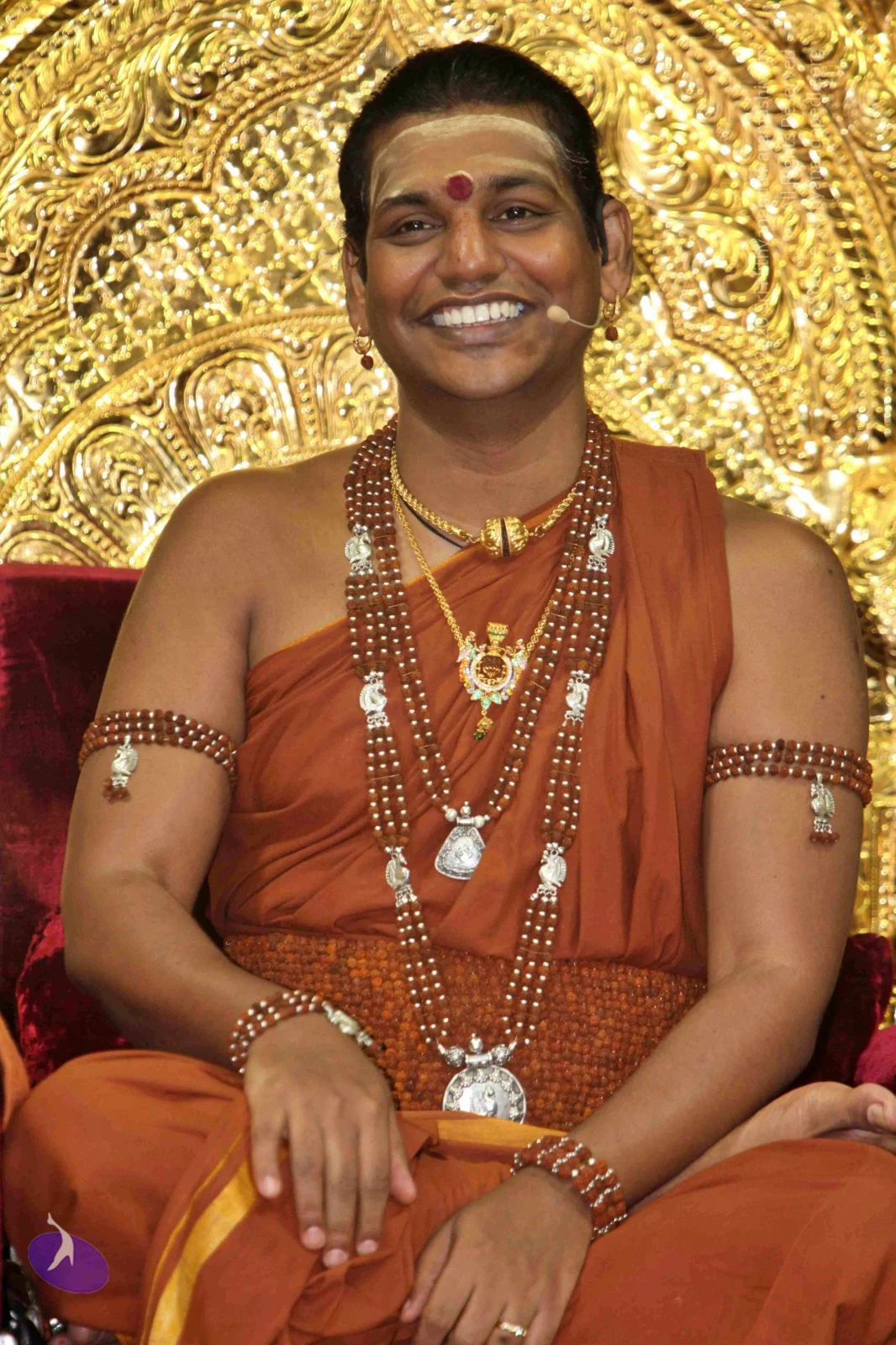
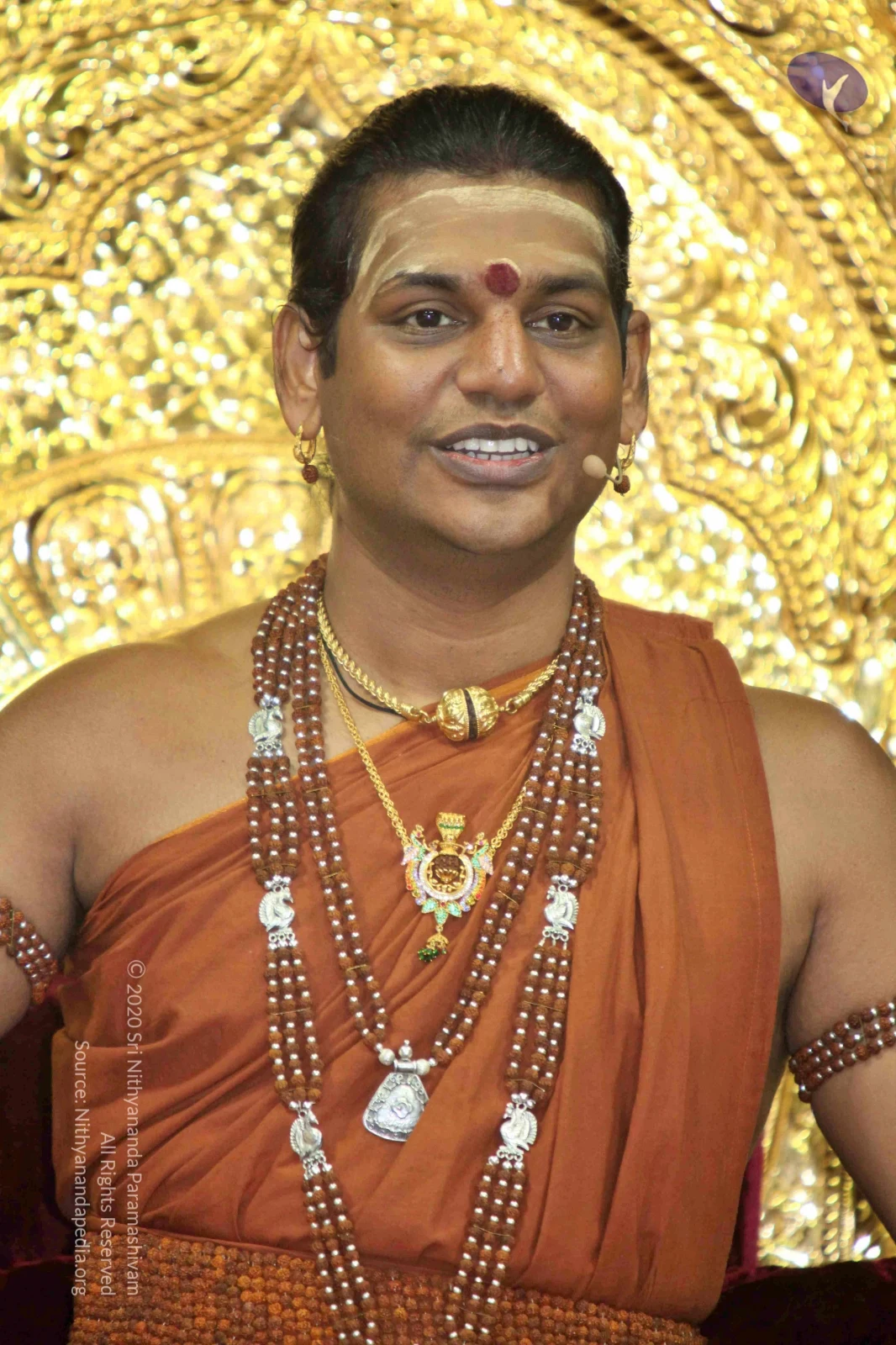
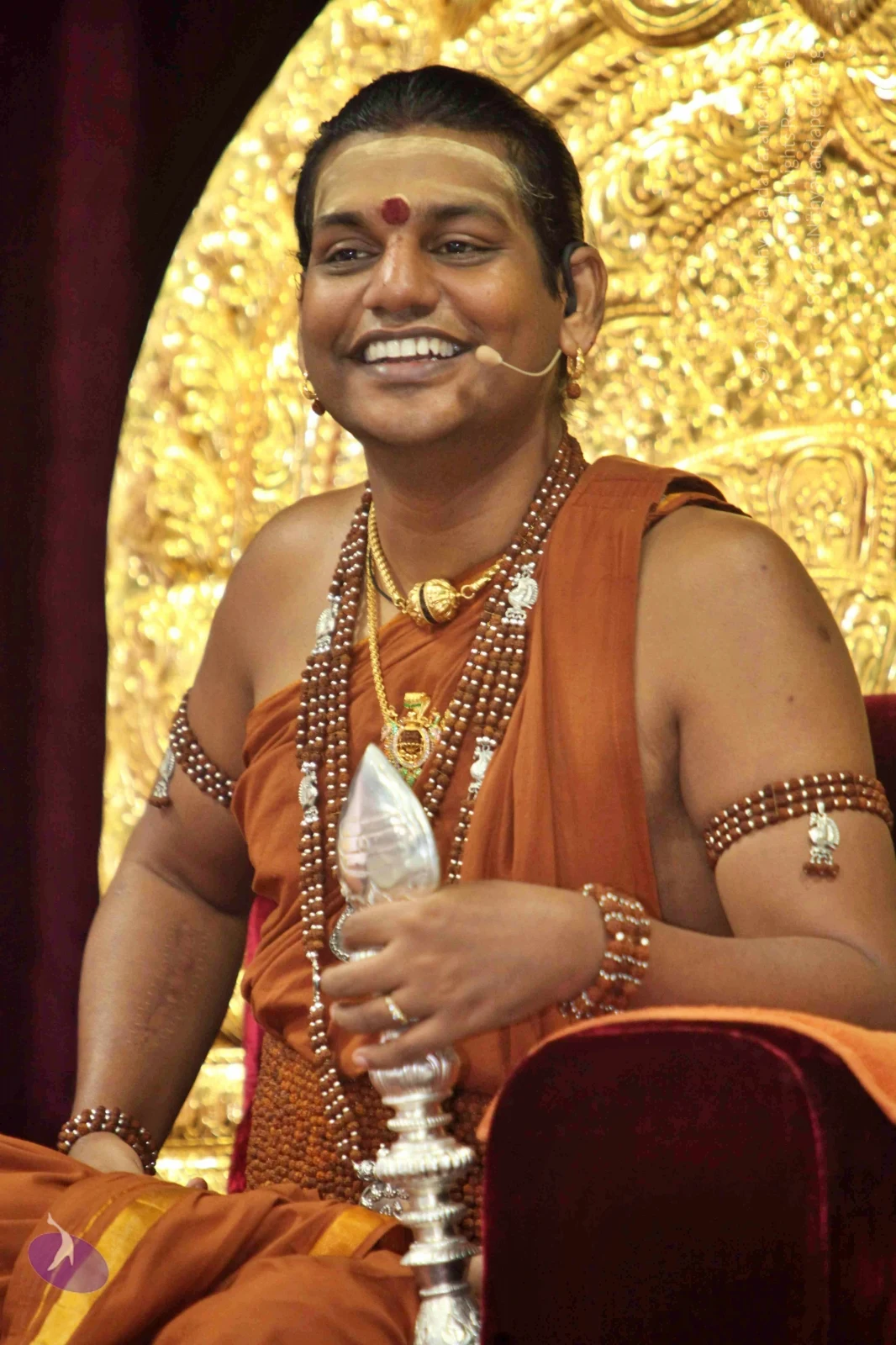
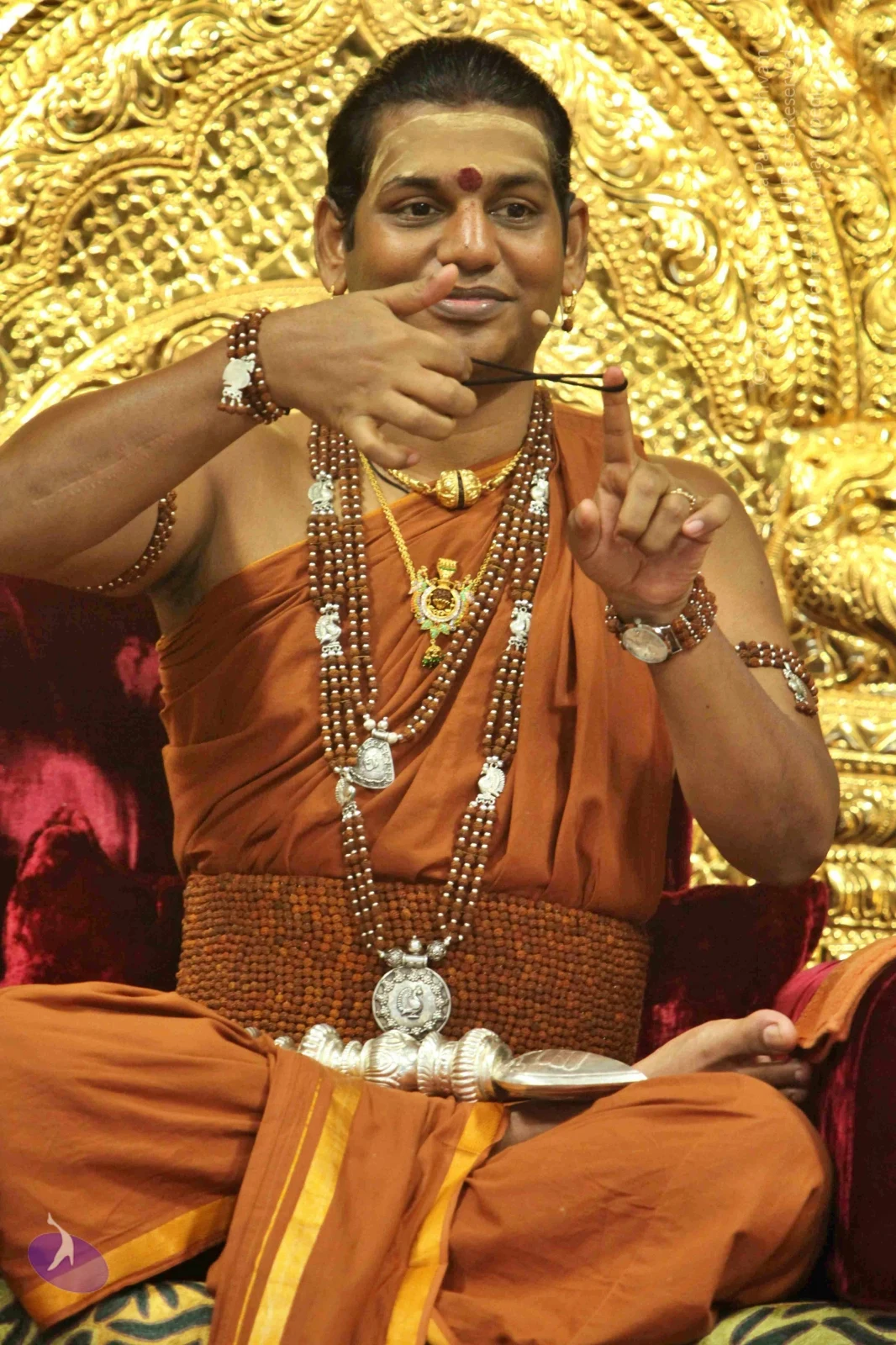
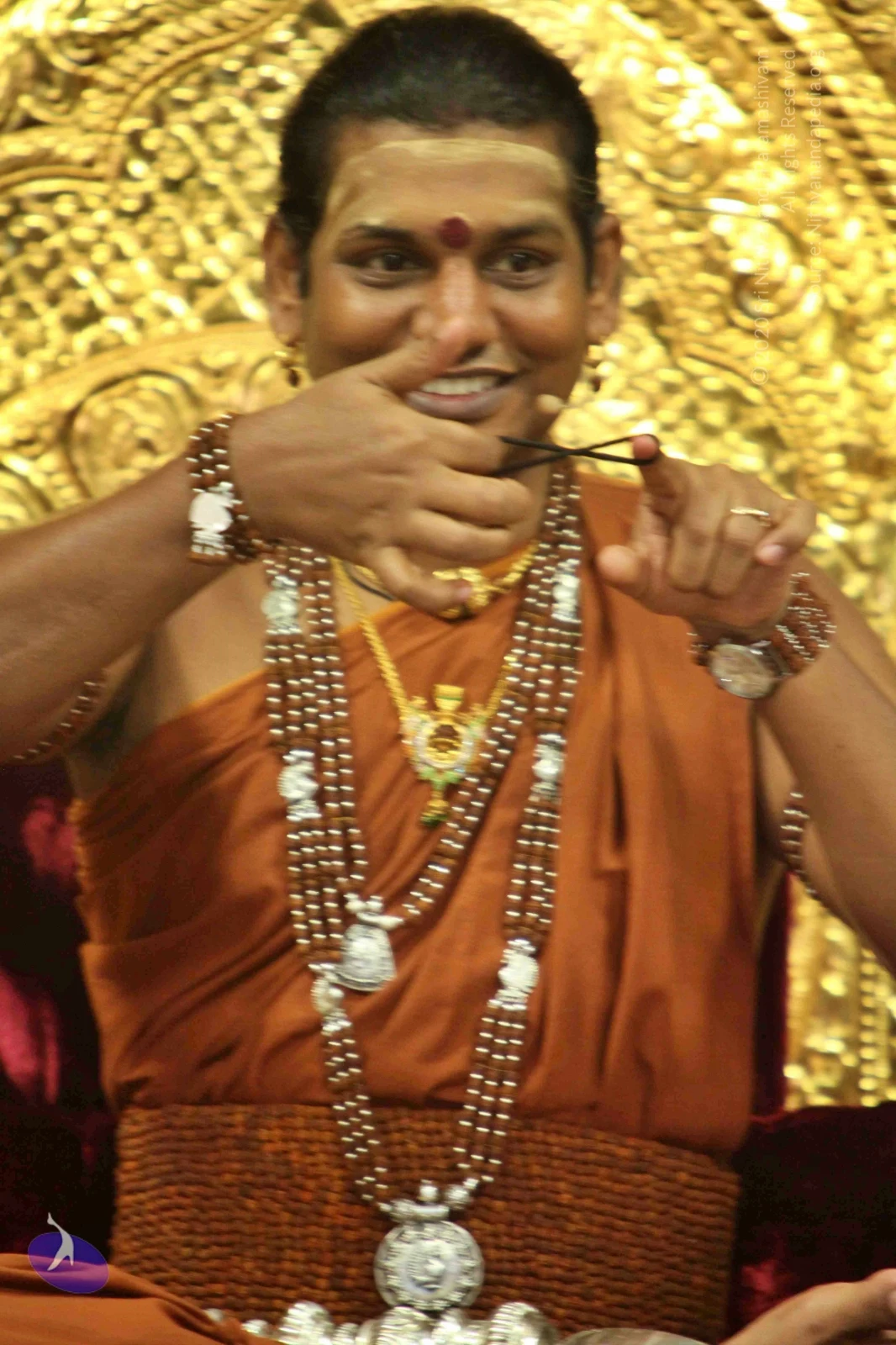
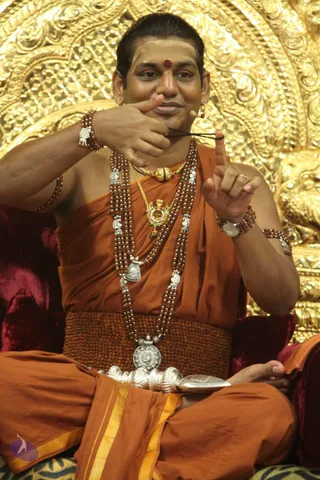
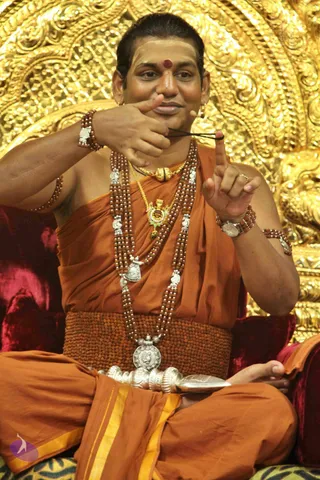
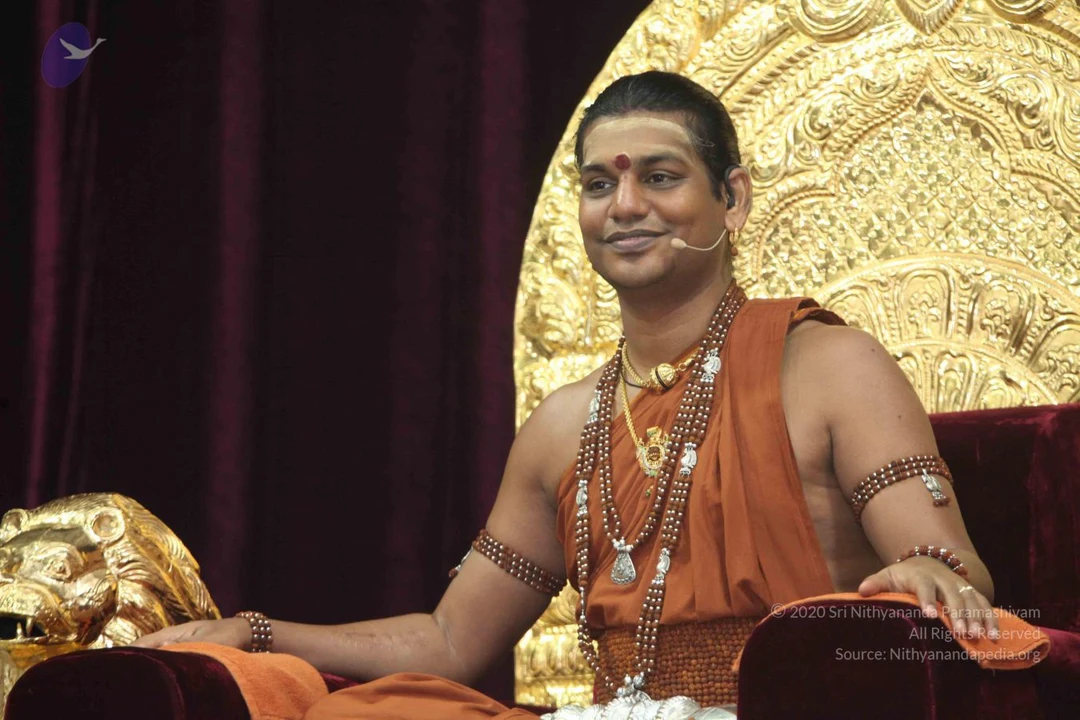
A seated man in an orange saffron dhoti and shawl sits on a red-cushioned throne in front of an ornate gold-embossed backdrop with burgundy curtains. He wears multiple strands of rudraksha malas, rudraksha armlets with silver pendants, a gold chain with a green-and-gold deity pendant, and a red bindi with white tilak on his forehead. A small microphone is clipped near his face, and he smiles with his hands resting in his lap. a person appearance cues include the saffron clothing, layered rudraksha malas and ceremonial gold necklace, shown in a seated satsang setting. One person is visible.Photograph of a seated man in an orange draped garment with multiple strands of rudraksha beads across his chest and arms, gold chain and pendant, gold earring, and a red bindi with white forehead markings. He wears a small head microphone, smiles and looks to his right against a deep maroon curtain, with a gold ornate chair or object partly visible at the right edge.A smiling man sits on a red velvet throne in front of an ornate gold-embossed backdrop. He wears orange saffron robes, layered rudraksha malas with silver pendants, a gold chain with a colourful pendant, rudraksha armlets and bracelets, and a red kumkum bindi with white tilak on his forehead. A small microphone is clipped near his face. A purple logo appears in the lower-left corner. One physical person is visible.Close-up photograph of a smiling man in orange saffron garments with bare shoulders, wearing multiple strands of rudraksha and silver-accented mala beads, a gold chain with a large gold bead pendant, a multicolored ornamental pendant, and a red bindi with white tilak marks on the forehead. A small headset microphone is clipped near his face. He stands before an ornate gold-embossed backdrop. The strong appearance cues of a saffron-clad figure with layered rudraksha malas and ceremonial gold necklaces match the a person label, so this is treated as a person in attendance during a satsang setting.A smiling man in saffron-orange robes sits on a red velvet chair before a deep magenta curtain and a gold ornate backdrop. He wears a headset microphone, multiple strands of rudraksha mala around his neck and arm, a gold pendant, and a red bindi with a tilak on his forehead. His hair is swept back, and he rests one hand on a silver-topped staff. The setting suggests a stage discourse.A seated man in saffron-orange robes sits on a red velvet throne against an ornate gold-embossed backdrop. He wears layered rudraksha malas, a gold pendant, a rudraksha waist band, silver bracelets and a wristwatch, with a red bindi and white tilak on his forehead. He gestures with raised fingers while speaking, apparently addressing an audience, with a small microphone clipped near his face.

Pada-Puja
4 photosSource gallery
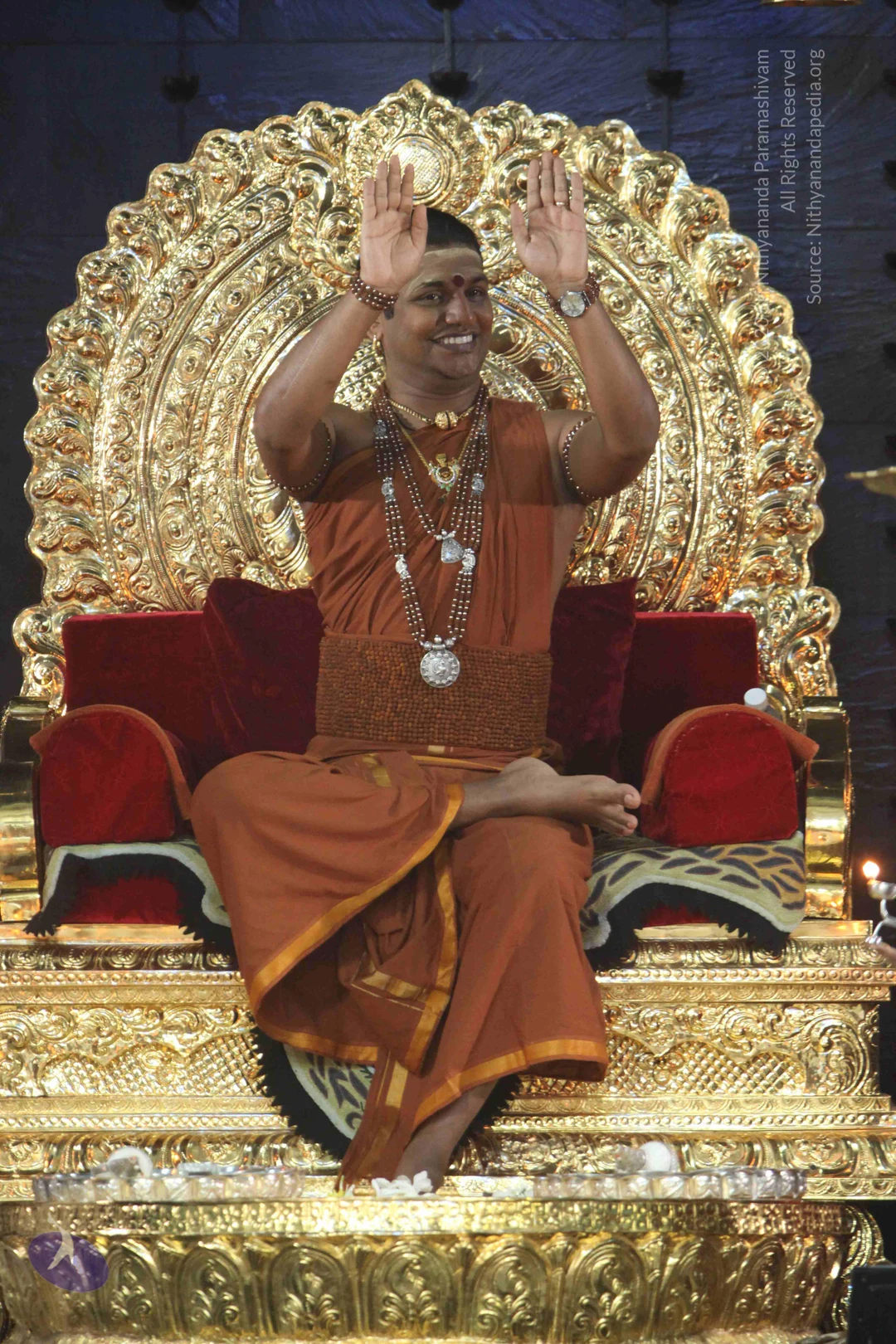
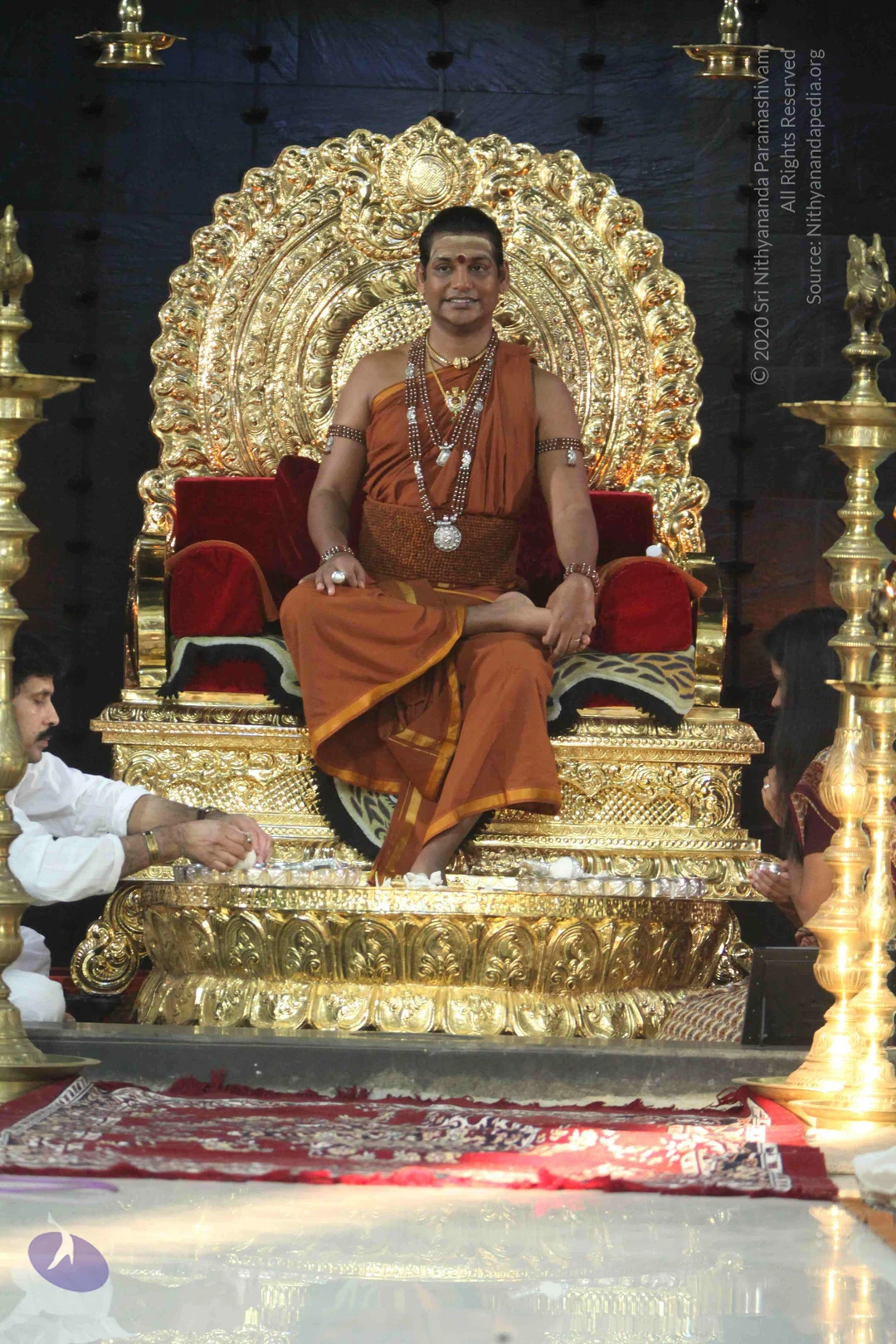
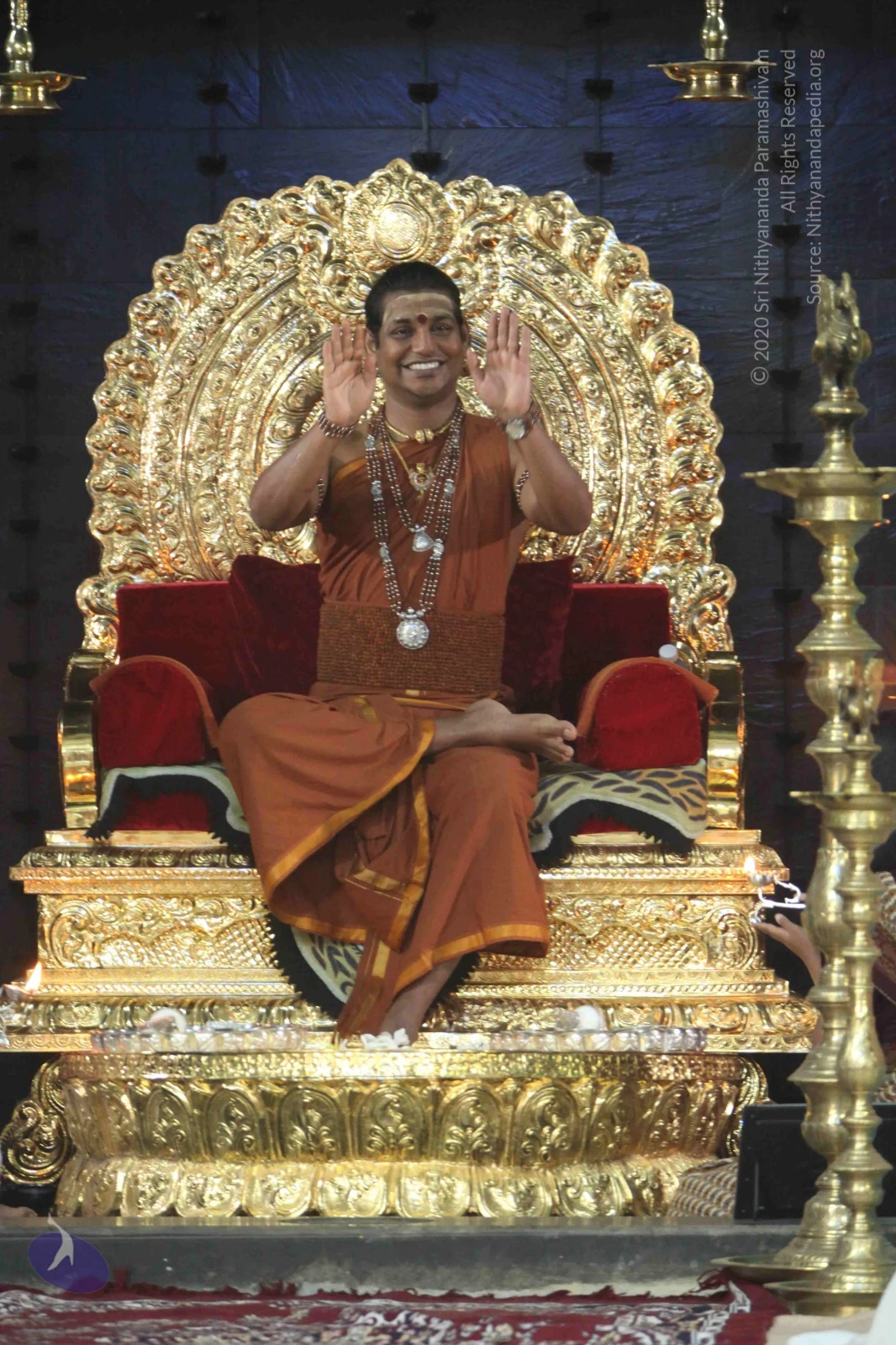
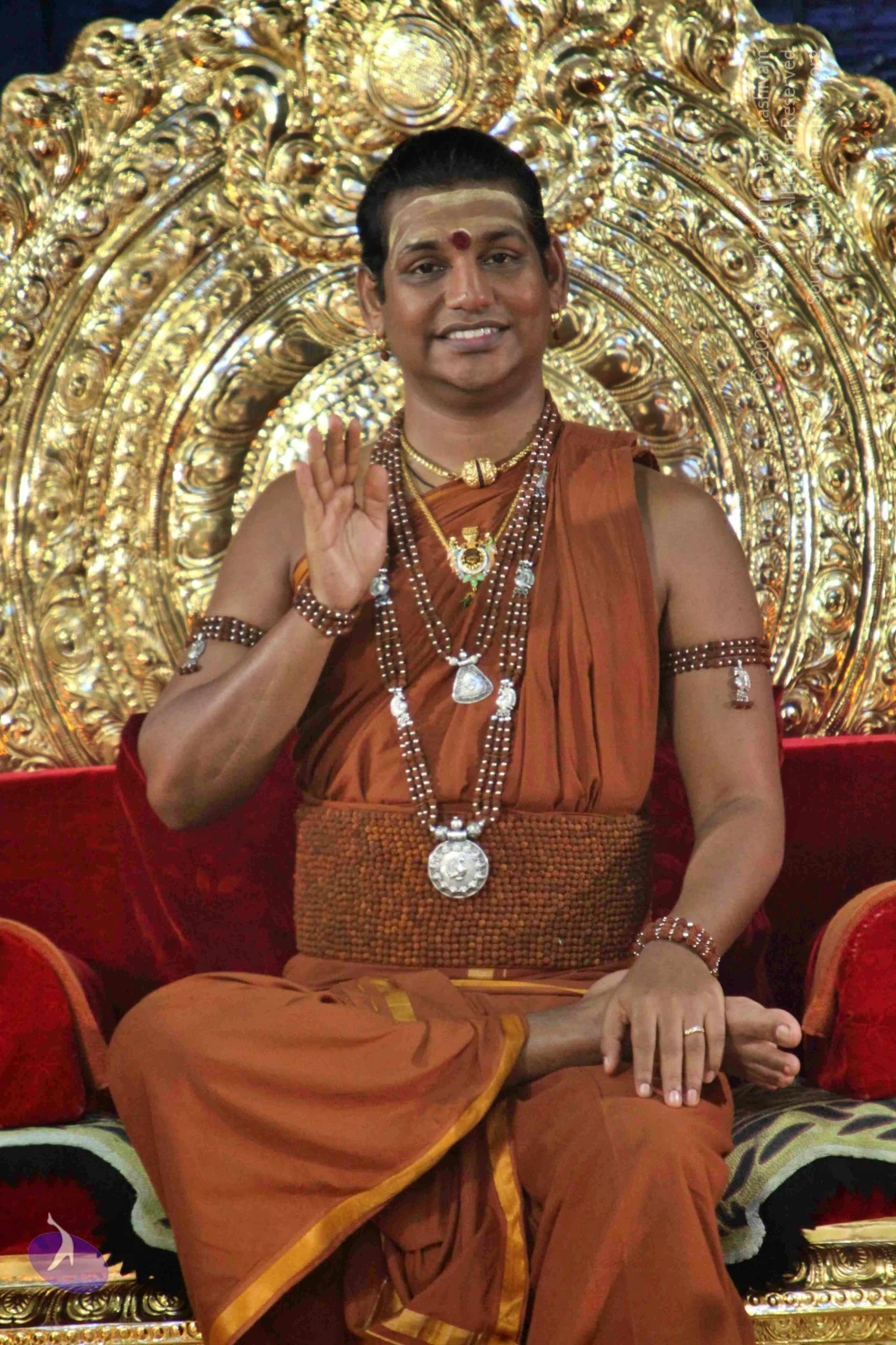
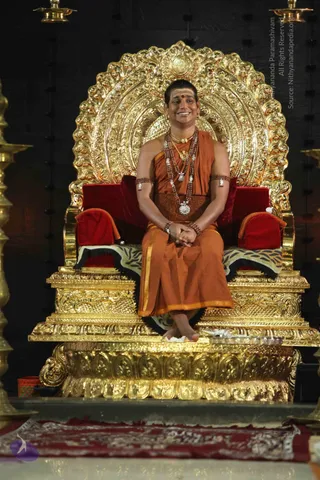
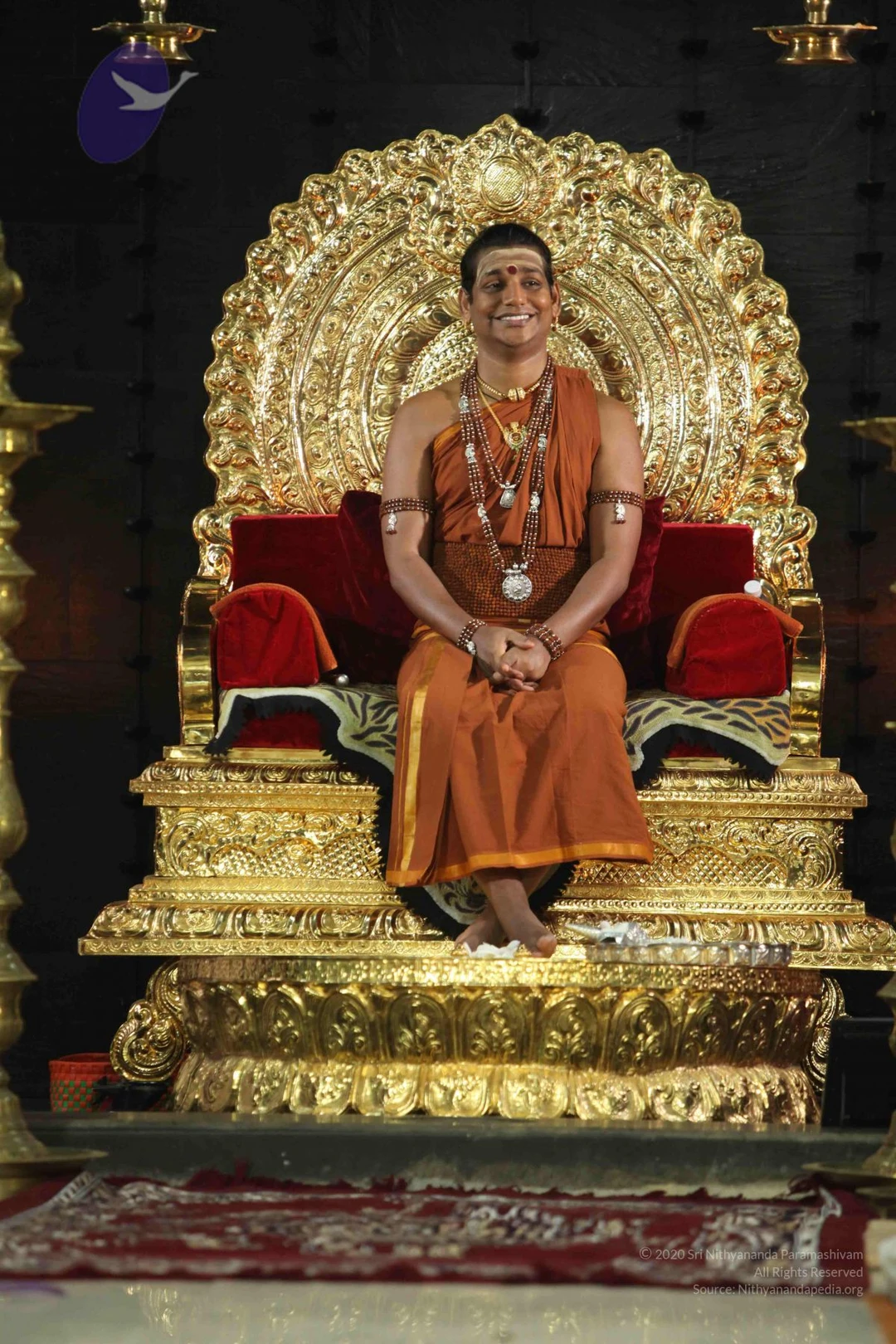
A man seated on an ornate gilded throne with a large arched gold backrest, red velvet cushions and a patterned mat. He wears a saffron-orange garment with a gold-bordered cloth, multiple strands of rudraksha beads, a large silver pendant, a gold necklace, beaded armlets and bangles, with a red bindi on his forehead. He sits barefoot with hands clasped, smiling. Tall brass oil lamps stand on either side and brass lamps hang from the ceiling.A seated man in a saffron-orange robe sits on an ornate gold throne with a large gold arched backrest and red velvet cushions. He wears a rudraksha mala with a silver pendant, a ceremonial gold necklace, beaded armbands, and a red bindi with a tilak on his forehead. His hands are folded in his lap and he smiles while his bare feet rest on a gold footstool. Brass lamps flank the throne and a red patterned rug lies below. The setting appears to be a ceremonial satsang hall.A young girl with shoulder-length dark hair and small white hair clips sits with eyes closed and lips parted, chanting or singing. She wears a maroon short-sleeved dress with gold trim at the neckline, sleeves and yoke, and a dark rudraksha-style bead necklace. A red bindi and white vibhuti mark show on her forehead. Her hands are joined in front of her chest in a mudra. Other children in maroon outfits with gold trim sit blurred behind her, and a brass lamp with a lit oil flame is visible at lower left. No adult is clearly identifiable in the frame.A seated man in saffron-orange robes and a rudraksha mala with ornate silver pendant sits on an elaborate gold throne with a large gold arched backrest and red cushions. He raises one hand in greeting and smiles, with a red tilak mark on his forehead and bangles on his wrists. Blurred oil lamps in the foreground and tall brass lamp stands flank the throne in a temple or hall setting. a person: the seated figure wears saffron robes, multiple rudraksha malas and a ceremonial pendant, and sits enthroned as the central figure of the scene.
Temple

4 photosSource gallery
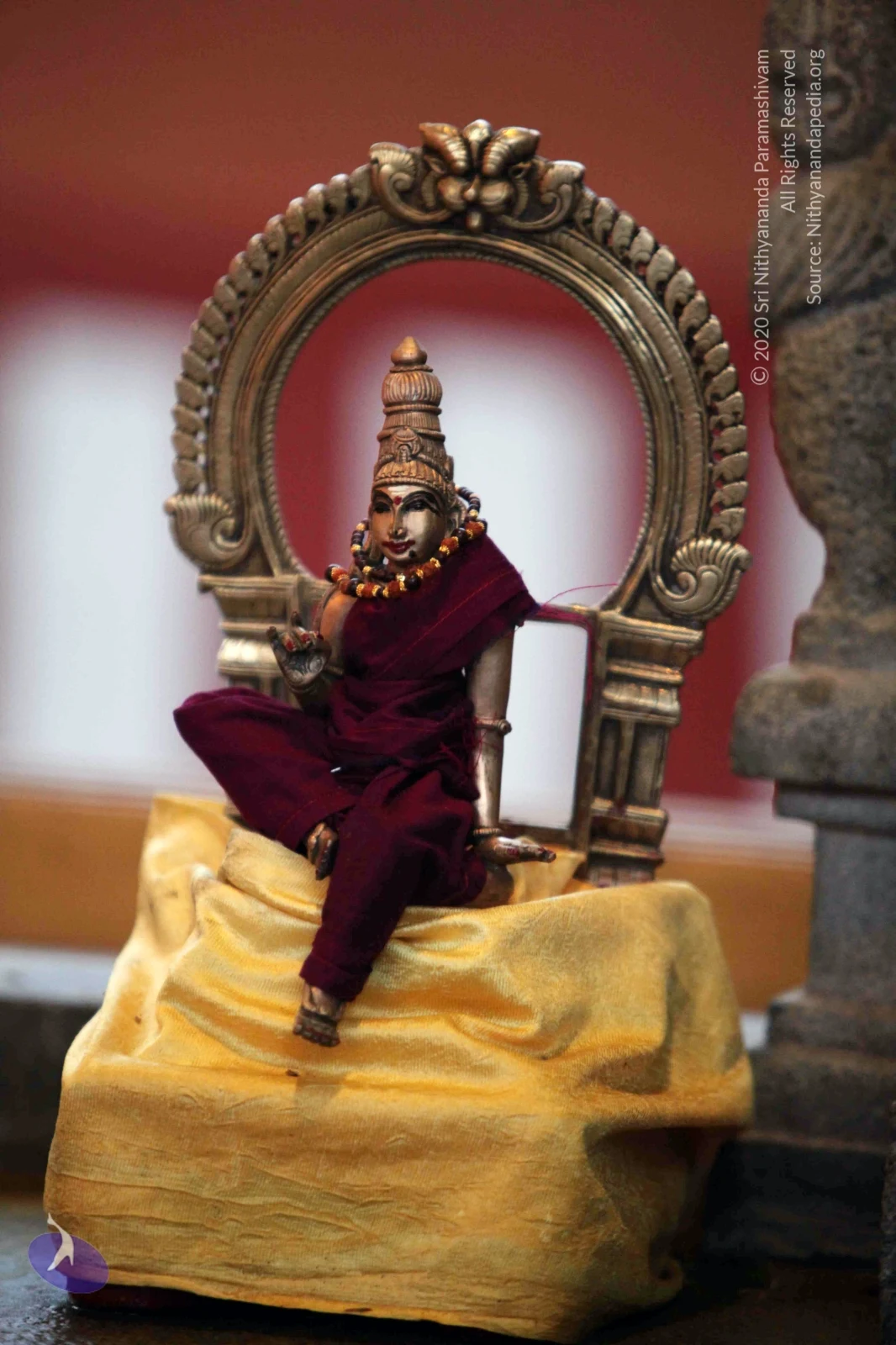
A dark stone statue of a four-armed deity seated in lotus-style pose on a rocky pedestal carved with small figures. The murti wears a red turban with a small flower ornament, red draped garments with pink trim, a gold waist belt and layered jeweled necklaces set with green, pink and white stones. Its hands hold objects including a drum-like item and a raised palm gesture. A brown draped curtain forms the backdrop.A black stone statue of a four-armed deity is seated on a carved pedestal decorated with animal and figure reliefs. The figure wears a red turban with a small white flower, a red draped garment, a gold belt, and layered jeweled necklaces set with pink, green and white stones. Behind it hangs a brown curtain. A translucent wire or cord crosses the foreground. No living people are visible.A bronze-toned life-size statue of a standing male figure with long dark hair, a red bindi and a raised right hand in blessing. It wears a saffron-red dhoti with gold borders, a red shawl draped over one shoulder, layered rudraksha and pearl malas, a jewelled pendant, and beaded bracelets. Thick white jasmine garlands with red flower accents hang from the neck and shoulders. The statue stands within an ornate gold-toned arched frame against a green velvet drape. The scene is a single figure with no physical people visible.A small golden metal figurine of a seated sage or saint sits on a yellow silk cushion before an ornate gold arched frame. The figure wears a deep maroon cloth wrapped over the shoulder and draped across the lap, a rudraksha-style bead necklace with red and orange beads, and a conical tiered crown or headdress. The right hand is raised in a mudra. The background is red and blurred, with a stone pillar at the right edge. The figure is a statue or murti, not a living person, and no physical people are present.

January 18 2013

1 photoView all
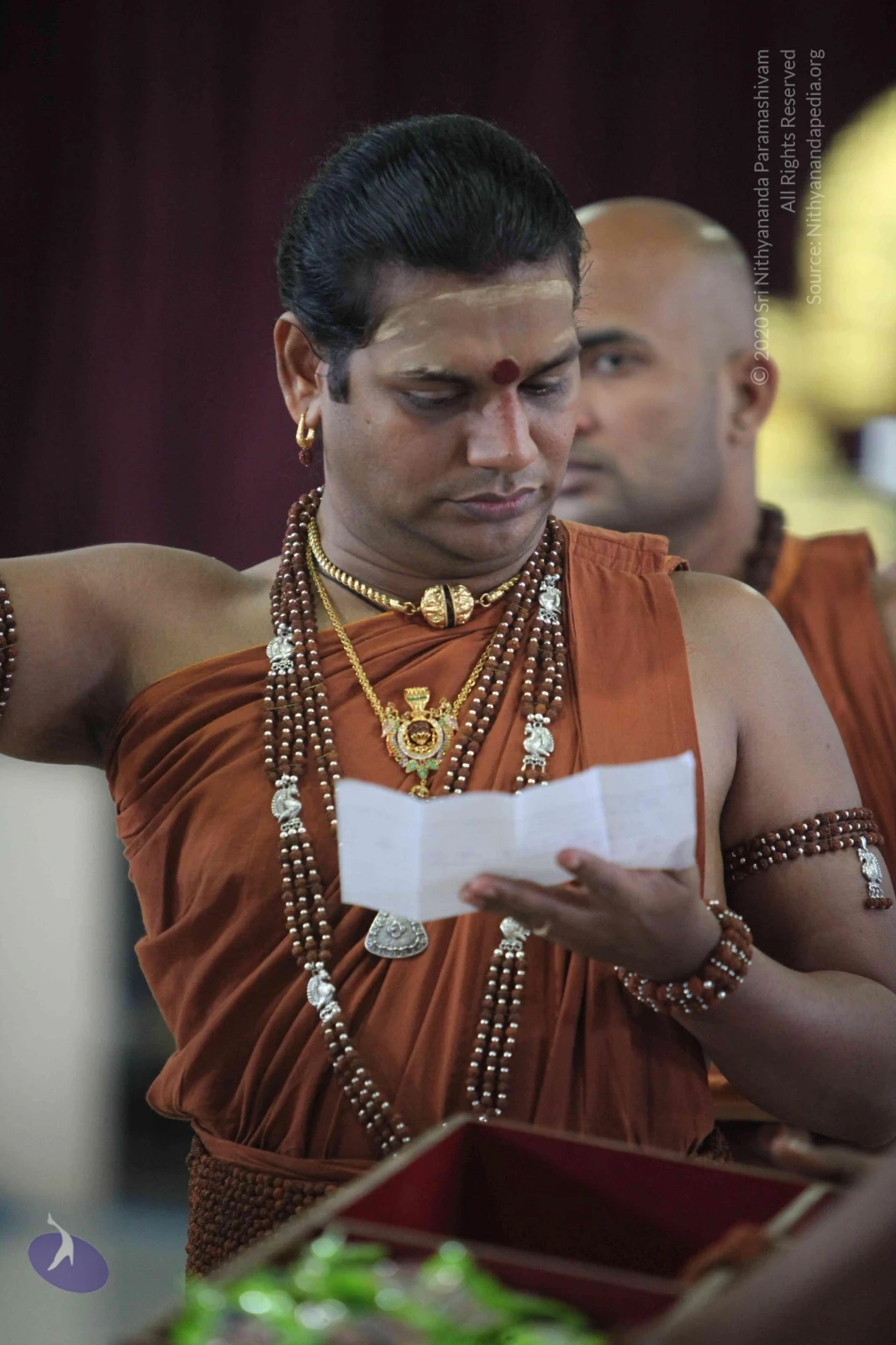
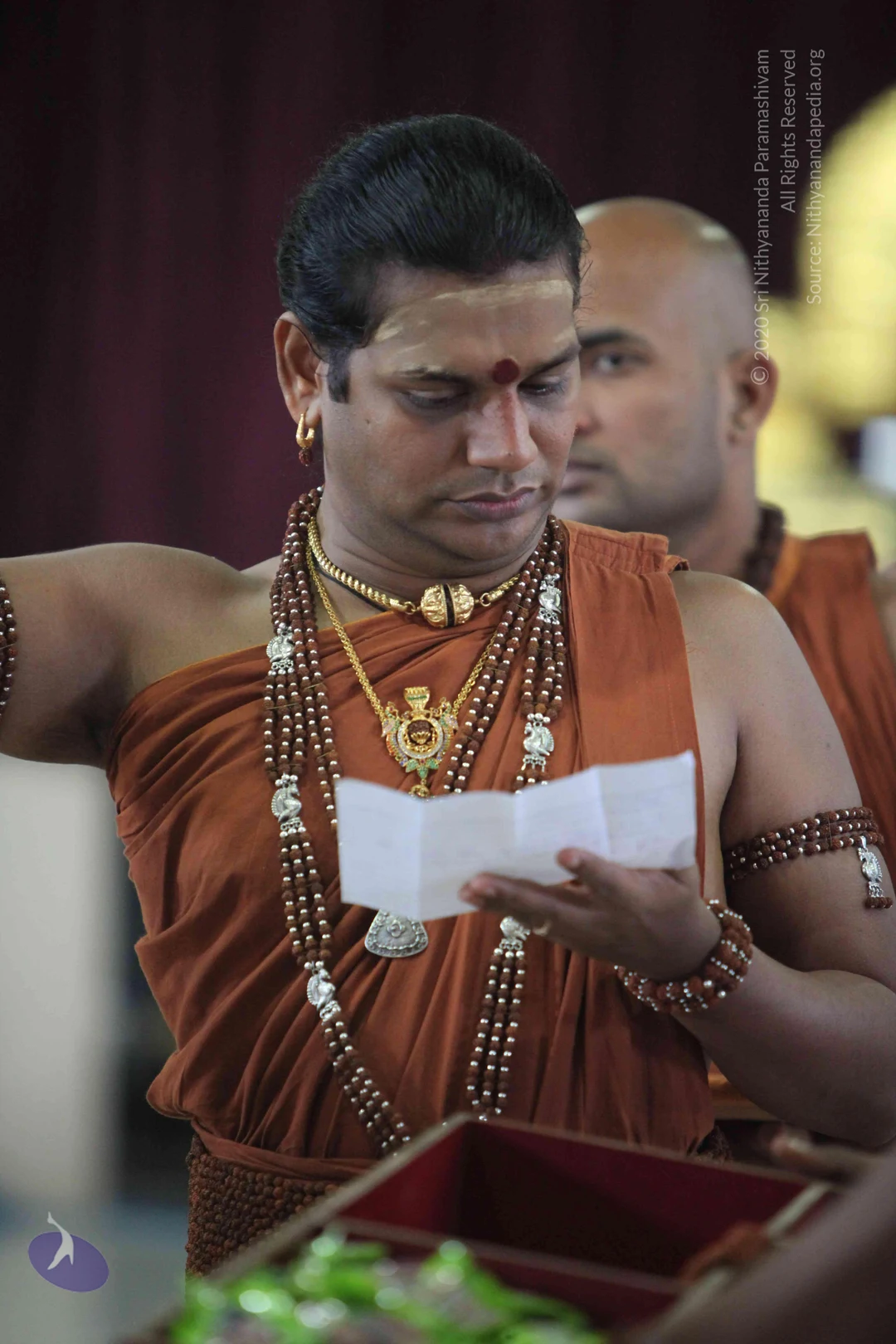
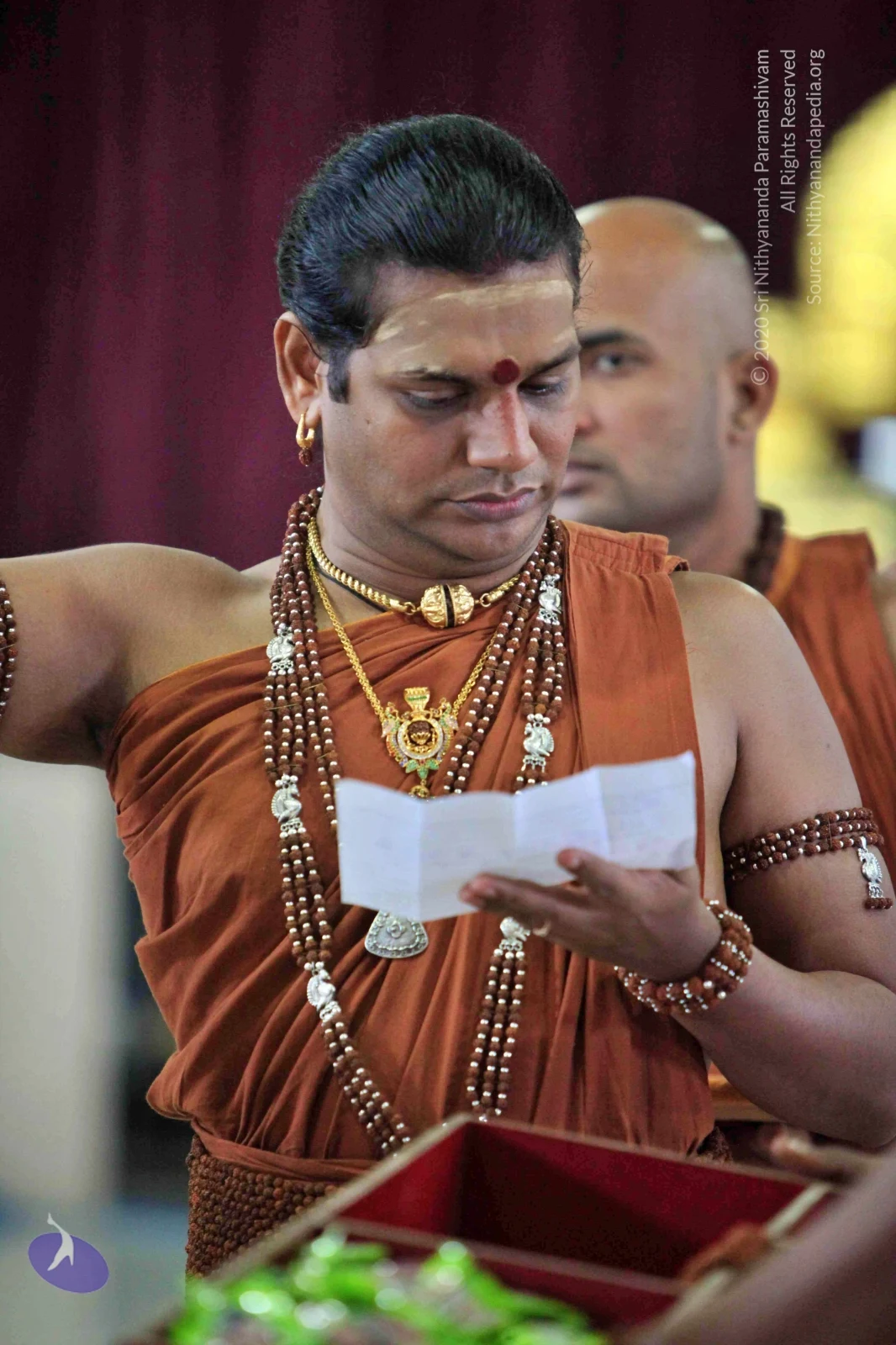
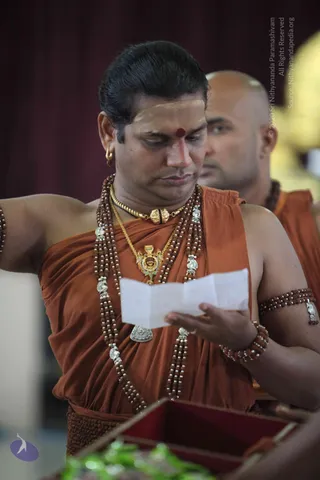
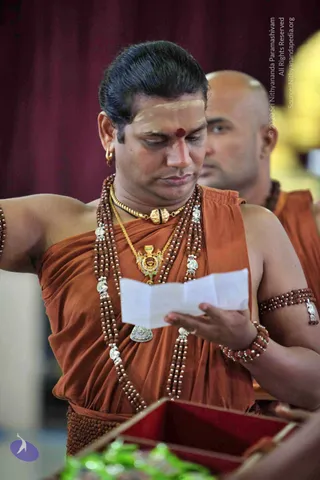
A man with slicked-back dark hair, a white and red tilak on his forehead and gold hoop earring, wears a saffron-orange unstitched robe over the shoulder with multiple strands of rudraksha malas, a gold chain with a pendant, and a gold ceremonial neck piece. He holds a folded white paper and reads it, looking down, with rudraksha bracelets on his wrist and upper arm. A bald man in orange clothes stands blurred behind him. In the foreground a red-lined box holds green leaves or flowers. The background is a deep red curtain.

January 18th 2013

56 photosView all
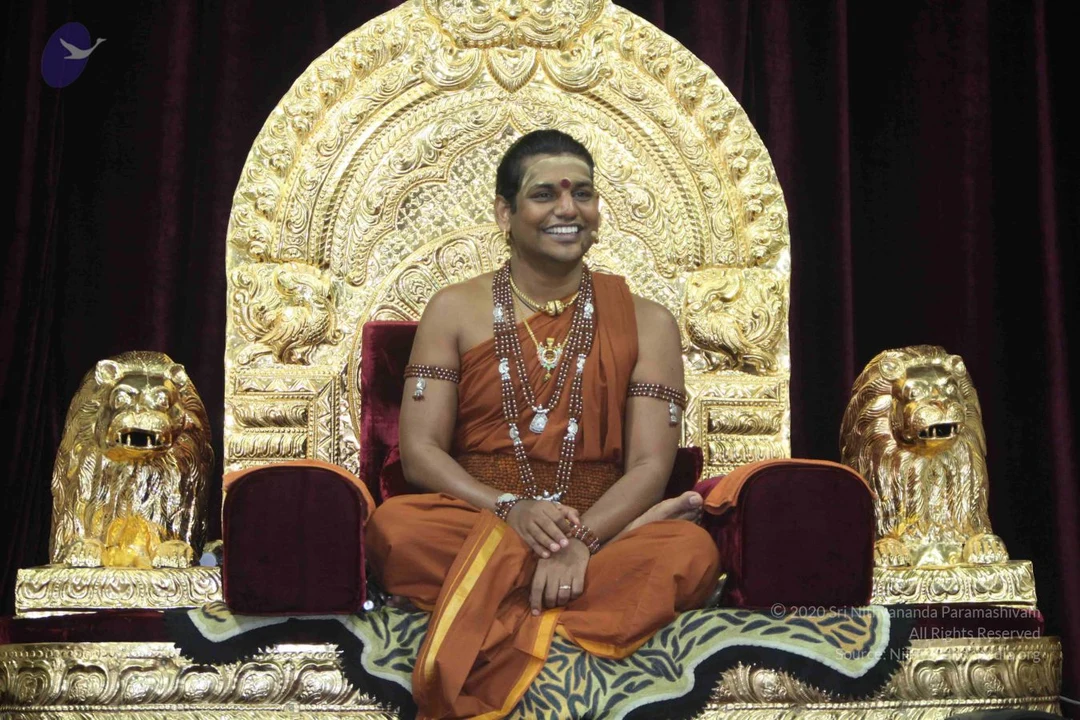
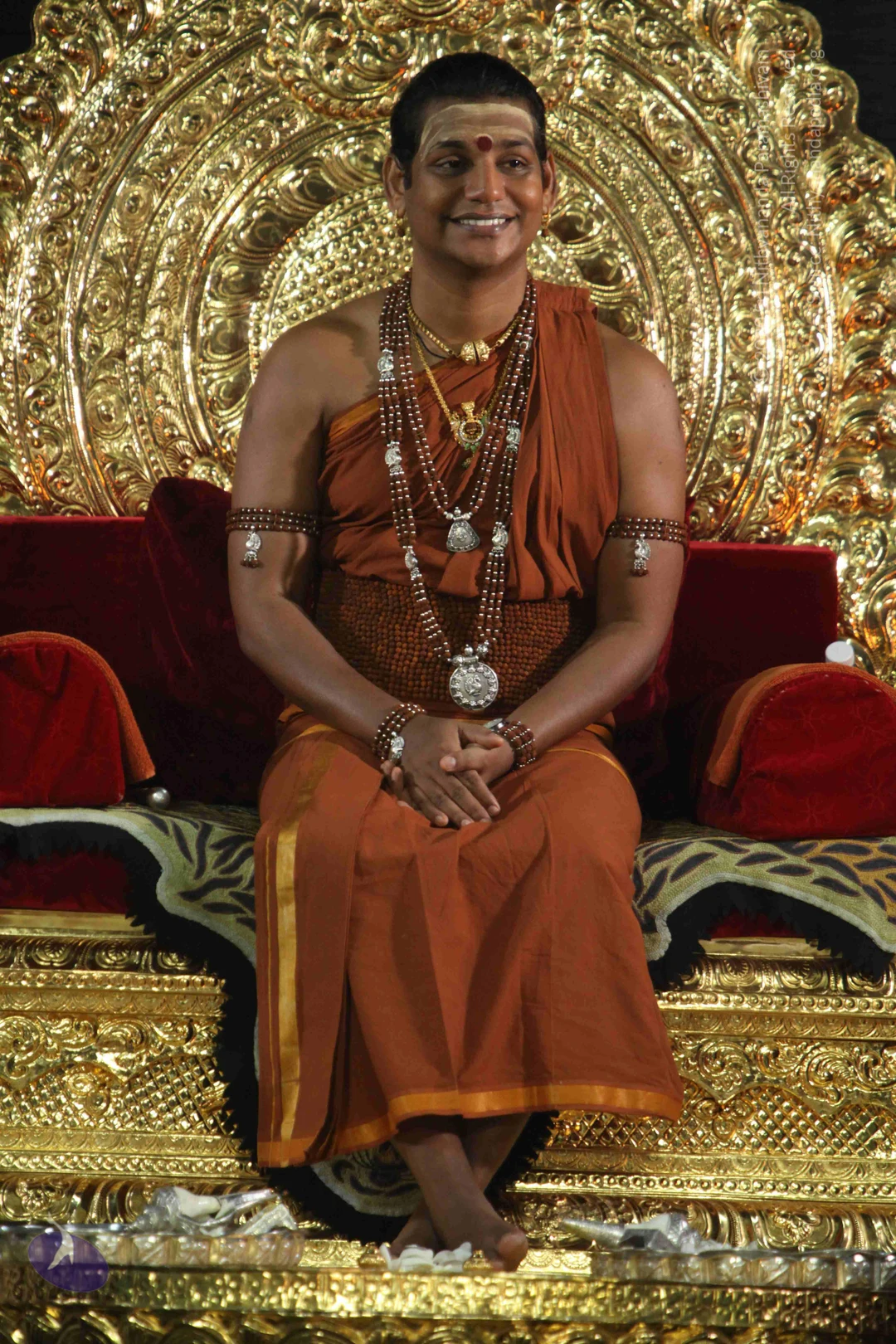
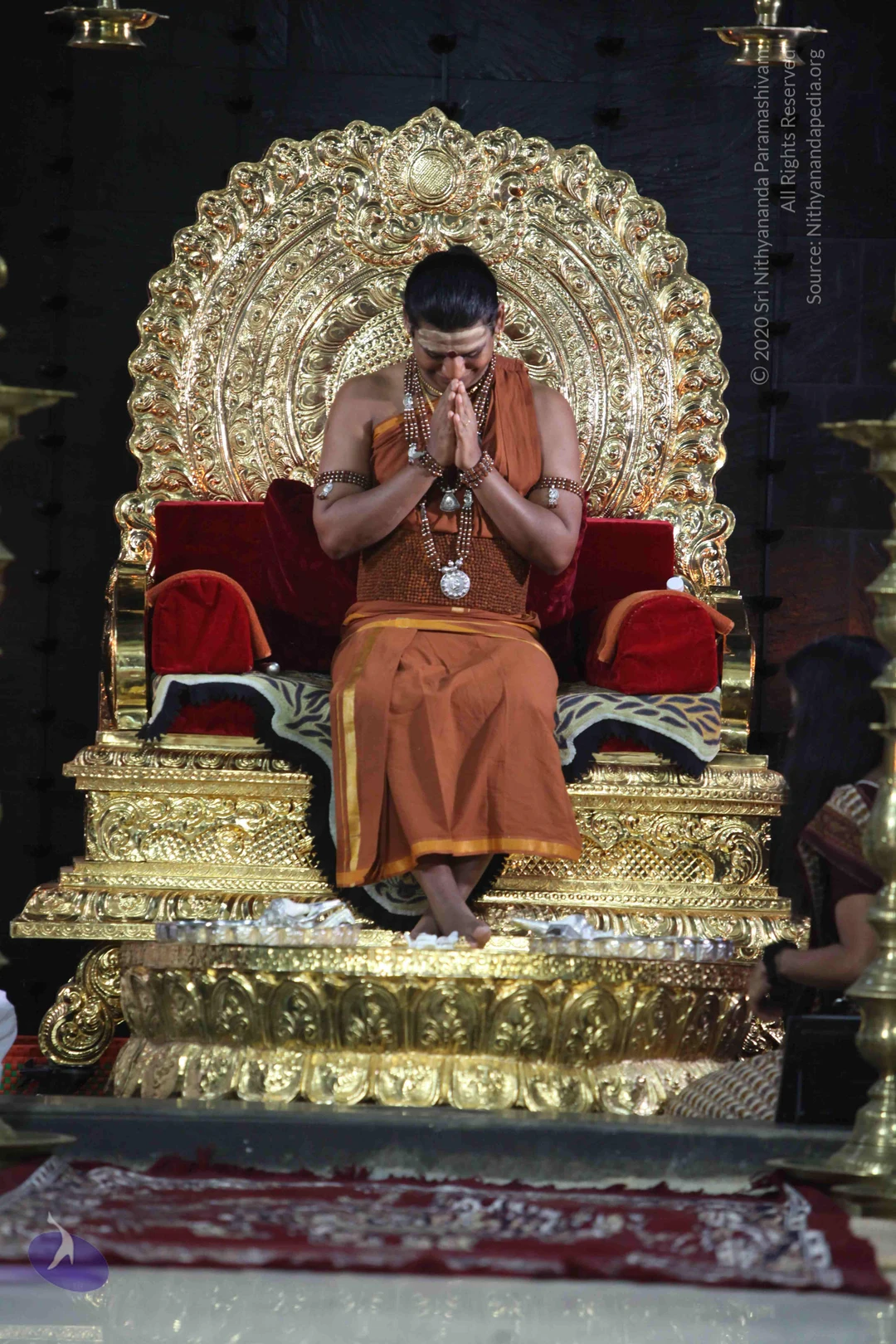
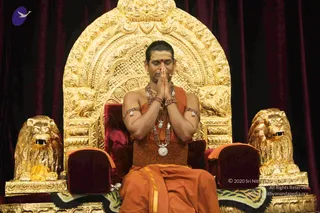
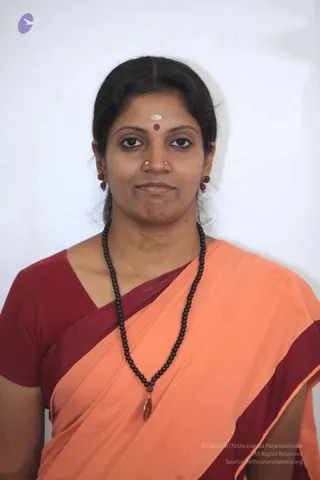
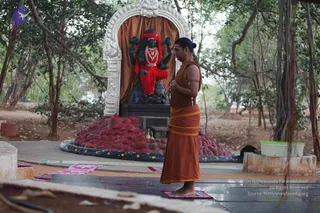
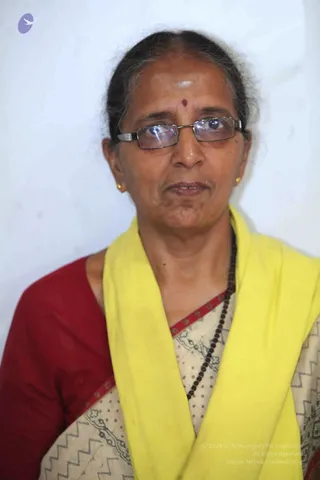
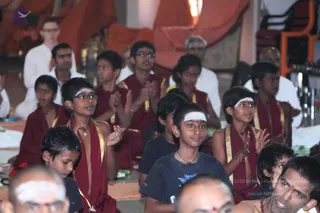
A seated man in orange saffron robes sits on an ornate gilded throne with a carved arched back, flanked by two golden lion sculptures and draped in deep maroon velvet curtains. He presses his palms together in anjali namaskar with eyes closed and a red bindi on his forehead. He wears layered rudraksha malas and a large silver pendant, with bands on his upper arms and a woven orange waist cloth. The throne's gold carvings and lion figures dominate the composition. A translucent purple logo sits in the upper left corner, and a with a source credit to in the lower rightHead-and-shoulders studio portrait of a woman standing against a plain white backdrop. She wears a peach-orange saree with a maroon border and a maroon blouse, a long dark beaded mala with a rudraksha-style pendant, rudraksha drop earrings, a small gold nose stud, a red bindi and a white vibhuti mark on her forehead. Her hair is pulled back and she faces the camera with a calm, neutral expression.A man stands barefoot on a dark tiled platform before a black stone deity murti seated in an arched white niche, outdoors among tall trees with aerial roots. The deity wears a red cloth, red garland, red headband and a necklace of red beads, and a mound of red offerings lies at its base. The standing man wears an orange-brown sleeveless top, an orange dhoti with a yellow border, a rudraksha mala and bracelets, with his hair tied in a topknot, hands folded in namaskar. Small brass lamps sit near the base, and a red-and-pink mat lies on the floor. A green bucket sits at the right edge. The scene suggests worship at an outdoor shrine.Head-and-shoulders portrait photo of an older woman with grey hair pulled back, wearing rimless-framed glasses, small gold earrings, a red bindi and a white vibhuti line on her forehead. She wears a red blouse, a cream sari with a printed grey pattern and red border, a bright yellow shawl draped over her shoulder, and a dark beaded rudraksha-style mala around her neck. She faces the camera against a plain white wall. No a person candidate is visible.Indoor satsang or ritual gathering with many seated participants on the floor. Foreground and middle rows show boys and young men in maroon robes with gold-edged shawls, many with white vibhuti stripes on their foreheads and some with red bindi marks; several clap with palms together. Behind them, men in white clothes sit among the crowd. Orange drapery hangs in the background and a lamp flame glows at top centre, with red chairs at the right edge. Several faces are cropped at the bottom of the frame.A seated man in saffron-orange draped robes sits on a red velvet throne cushioned with a striped black-and-gold cloth, in front of an ornate gold repoussé backdrop. He wears a sandalwood-and-red tilak on his forehead, layered rudraksha malas with a large silver pendant, a gold necklace, a beaded rudraksha waist belt, and beaded armlets and wrist bands. He holds a small white ceremonial item in his raised right hand and smiles toward the camera. Two red cushions with orange covers flank him. Only one person is visible.