Skip to content
Tuesday

7 January 2014

World’s most worshipped deity – Mother Ganga

Dated photos
64
Source pages
1
Media
2

January 07 2014

Original wiki page
Contents

Title:

World’s most worshipped deity – Mother Ganga

Description:

In today’s morning Satsang, Paramahamsa Nithyananda elaborates on the world’s most worshipped deity – Mother Ganga. She is the embodiment of love, completion, pure inner space and divinity. She landed on the planet earth to give completion to all of humanity. She has the power to heal us of any deep incompletions just by spending some time living near Her. Spiritual practice is increased a thousand fold when practiced next to Her. Let us all appreciate, worship and protect this ancient, sacred waterway – the Ganges.

Link to Video:

VideoAudio

Transcript

(0:19)

|| nithyānandeśvara samārambhām nithyānandeśvari madhyamām | asmat ācārya paryantām vande guru paramparām ||

I welcome all the devotees, disciples, samajis, satsangis who are sitting with us all over the world at this time through Nithyananda TV, Sadhna TV, Eshwar TV, and through two-way video-conferencing having Nayana Deeksha in thirty-five cities in many countries around the world. Cities sitting with us in two-way video-conferencing having Nayana Deeksha: Ohio-Ma Shivananda, New York-Varanasi, Devon-UK, Guadeloupe-Rameshwaram, Hong Kong-Sirkazhi, London-Kashi, Indrani-New Jersey, San Jose-Madurai, Bangalore City Center, Toronto-Kailasam, Los Angeles-Arunachalam, Nithyananda Nagaramu-Hyderabad, Ohio-Prayag, Seattle-Chidambaram, Hyderabad-Gupta Kashi, Jorpati-Nepal, Enriching Temple-Bidadi, Johor Bahru-Malaysia, Nithyananda Dhyanapeetam-Rajapalayam, Uttarahalli-Bangalore, Redmont-Washington, Australia-Philip Island, Coimbatore-Nithyananda Dhyanapeetam, Enriching Temple-Bidadi, Kulim-Tiruttani, Hong Kong-Sirkazhi, Houston-Kalahasti, Kuala Lumpur-Palani, San Diego-La Jolla, Hosur-Dhyanapeetam, Singapore, Winnipeg-Canada, Port Washington-New York, Singapore-Singapuram, Oklahoma-Somanatham, Varanasi, Nithyananda Nagara-Bangalore. I welcome all of you with My love and respects.

(02:46)

Today, I will continue to expand on different great characters of Mahabharata and the great sacred secret explained in the Mahabharata. Today is sixth day of twenty-third Inner Awakening, Level-2 second day. Yesterday we all had the session in the banks of Ganga. Understand, Ganga is the great-grandmother of Mahabharata. Bhishma is the "Pitamaha" "grandfather" of Mahabharata. Ganga is mother of Bhishma, understand. Actually, Ganga is in a way, father and mother, both, of Bhishma because Shantanu (Bhishma's father) did not bring up Bhishma. So, Ganga is the great-grandmother of Mahabharata. It is on the laps of Ganges, it is on the banks of Ganges, the whole Mahabharata started. Even just sitting on the Ganga heals us so much!

(04:05)

Yesterday it was nothing; we did not even have big lessons or sessions; it was just some question answers, spending little time together; it's almost like getting to know each other, that's all. And just sitting in the banks of the Ganga for half-an-hour or one hour. So much! I tell you, I HAPPENED in the banks of Ganga! Please understand, I took birth in Tiruvannamalai, but I HAPPENED, I blossomed in the banks of the Ganga! Ganga is such powerful energy! Some more cities are joining……..

(05:34)

Ganga is a River of Knowledge, River of Enlightenment! There are some shlokas which says, "Just by drinking the Ganga water you can get enlightened"! Maybe when I was immature, I would have suspected, doubted all those verses and thought “This is too much exaggeration. Out of devotion for Ganga they sang these verses.” But after becoming a matured enlightened being, an incarnation, I will not dare to doubt these verses! I will only say that they are literally true! With all My integrity and authenticity, I can vouch with My integrity and authenticity, just by living around Ganga and drinking the Ganga water everyday, even remembering the Ganga's sacredness, one can become enlightened, because it's such a powerful technique, powerful method, powerful process! Don't think because I am in the banks of Ganga I am just floored by Ganga and I am blabbering something. No! Ganga heals all the violence we carry, Ganga heals all the incompletions we carry. See, the lust is an incompletion, anger is an incompletion, violence is incompletion; all the in-completions we carry, Ganga can purify, Ganga can really, really purify!

(07:32)

I used to sit in the banks of Ganga, just seeing, I have realized the Oneness with Ganga. How the things float on the waters of Ganga does not pollute the Ganga, same way I have seen, the thoughts and incompletions floating in My inner-space does not make My inner-space polluted, it does not touch My inner-space. When you understand your incompletions are not powerful enough to make your inner-space incomplete, you become eternally complete. I can say, that experience I received from Ganga, on the banks of Ganga. It heals, heals, heals and brings love. Really, Ganga can bring tremendous love in our heart. I was wondering, can this Ganga can have influence, special effect even on Me who is always in that consciousness? But I tell you with integrity and authenticity, it is! I may be default residing in that enlightened consciousness in My incarnation-hood, even in Me that kindling happens! From yesterday evening, I am all excited, as if I am in puppy love. Even matured romance has lots of pros and cons. You have a lot of thinking through, pros and cons, will it work out or not and all that. Puppy love is the most sweetest love in the life where you don't have any responsibility or ideas of making it work... Yes or No. You know only one thing - you are in love - thats all. I can say, from yesterday evening I am in that space, as if seeing Ganga first time!

[10:06]

Ganga's character in Mahabharata is embodiment of Love and pure inner-space. From pure inner-space, dharma is born, understand. That is why they portray Bhishma is born out of Ganga. But Dharma (Bhishma) should not go and sit with Self-Denial (Duryodhana) and eat the food of Self-Denial. From the beginning, you should not allow Self-Denial to be associated with you, with dharma, because Self-Denial sometime becomes so powerful, it binds, it makes even dharma forget its purpose. Even Bhishma has to give up on himself and others because of the power of Self-Denial, Duryodhana. Such powerful demon, Self-Denial! But, when all the blood in Bhishma left his body, all the Self-Denial is completed, he feels thirsty and asks, when he was in the arrow-bed, he asks Arjuna, “Can you get little water?” He puts an arrow and Ganga comes out and fills Bhishma again. Means, if your Self-Denial is completed, again the pure inner-space awakens in you. When Ganga fills Bhishma again, he lives in the space of dharma, and leaves the body as he wanted.

[12:18]

Actually, Ganga is the first foremost character in Mahabharata. Because her "screen space" is very less, after Bhishma's birth and after she hands over Bhishma to Shantanu, she is not interfering the story much. So we forgot her. Otherwise, Ganga is the great-grandmother of Mahabharata, almost the first character in Mahabharata. Shantanu is born as "Shivamsha" (part of Shiva). That is why, with that Shiva Amsha only, Ganga lives. How can Ganga live with anybody else? Shantanu was born as Shivamsha. With that Shivamsha, she (Ganga) lives and gives birth to, for Ashta Vasus she gives birth. In the whole mess of the layers and layers of socio-political personalities and characters, the pure inner-space is pushed back. And, Ganga is not just a river, collection of water; it’s a largest living deity! There is no river, no hill, no other physical object on the Planet Earth is worshipped by so many millions of people.

(14:09)

This statement I can make with all My integrity and authenticity: There is no other deity which is worshipped by so many millions of people like Ganga! Even Himalayas is not worshipped by so many millions like Ganga! See, largest worshipped deities in the Planet Earth: Tirupathi Venkateshwara, Arunachala, Himalayas, Ganga, if you see the whole list, understand, if you see the whole list, Tirupati Venkateshwara, Sabarimalai Ayyappa, Arunachala, Ganga, Himalayas, nothing can be even compared to Ganga, because the number of people worshipping it, the millions of people revering it! Last few days whenever I have time I go and sit in the banks of Ganga. I see even the local people, with so much of reverence they just come and sprinkle the water and go, just to do namaskar to Ganga!

(15:42)

I tell you, the largest worshipped single deity on the planet earth is Ganga! Ganga is such embodiment of divinity! Actually, Ganga lands on the Planet Earth to complete everyone. The very context for her coming to Planet Earth is for Completion. Bhagiratha's forefathers were incomplete, and to complete them Bhagiratha brings Ganga to Planet Earth. For the sake of Completion only, Ganga even comes to Planet Earth. So, she is the pure inner-space, completing everyone continuously.

(16:47)

I have a question from Jnanatma: 'Swamiji, Bhishma gave word to his father Shantanu and followed Integrity till the end of his life. However, it feels Hastinapur would have been saved if he broke his word and fulfilled higher dharma of being the King of Hastinapur. Which one is better? Fulfilling the word just because he gave, or okay to break the word if it solves higher purpose?' Swamiji: First thing, if Bhishma has broken his word, he would not have been "Bhishma". Neither he would have been a great King of Hastinapur, nor he would have been able to protect the dharma. If he had a son, that fellow would have been ten times worse than Duryodhana, because he is born out of incompletion. He would have been embodiment of Gandhari, Dhritarashtra, Shakuni, Duryodhana put together. At least, now, these fellows are separate, separate; all the time they cannot be together to conspire. If Bhishma had a son, he would have had the brain of Shakuni, heart of Gandhari, stomach of Dhritarashtra and prana of Duryodhana.

[18:11]

Understand, Self-Doubt always starts with stomach, and Self-Hatred always starts in brain, Self-Destruction always starts in your heart, and Self-Denial becomes your prana, breathing. If you see, all these four were killed exactly on that points. By the heart broken way only Gandhari died, with the stomach problem only Dhritarashtra died; read the Mahabharata. And for Shakuni, he was hit on the head by Bhima and he was killed. And for Duryodhana, his prana was on his thigh, and the thigh was broken for the prana release; it is by hitting his prana, Duryodhana was killed, because those qualities sit in those areas. Understand, first thing, fulfilling the word you gave is the highest purpose. By not breaking the word, Bhishma has done maximum possible good to Hastinapura. If he had broken his word, the son would have been a disaster; nothing would have been left after him. He would have wiped the whole earth away! Because, personality like a Bhishma, breaking his word would have caused only disaster to the Planet Earth. In that case, anybody breaks the word, it will only be more and more incompletion; can never be in the space of Completion.

[20:19]

Yudhishtira did not break his word but broke the spirit of the word. When he uttered the word "Ashwatthama has died" -- he uttered the word "Ashwatthama, the elephant, died"; ‘the elephant’ - at that moment Krishna blew his conch. Technically, Yudhishtira did not drop his Integrity; but actually he was part of the conspiracy. Immediately, his inner-space which was always floating above the earth, fell to the ground. The story says very clearly, his chariot always used to be floating on the, above the earth, but it landed on the floor, landed on the earth!

(21:14)

This concept yesterday night I was explaining to all My sannyasis. Actually, the "Ganga effect" only, yesterday night I was sitting with My sannyasis. See, this, actual matter you see around you is Bhuloka. Matter is not reality; matter is matter. That is Bhuloka, Planet Earth - the walls around you, the floor under you, roof above you. How it occurs to you is a reality. If you think you cannot go out of this room, you are caught, whole day you are made to sit here, then you take it, “Oh, God!', this is a prison suffocating". It occurs as a hell to you, lower frequency than its existence. But other way if you think, “Wow! What a beautiful place! Whole day I am allowed to sit here in the presence of Swamiji! Many people in the street are not allowed to sit here. I am allowed to sit. And this building also protects me from the cold and allows me to experience Swamiji's Presence!”, then this same building occurs to you in a higher reality. This place becomes like a protection and gift for you. Then this same hall is Svar Loka, higher loka, Tapo Loka.

[23:18]

Please understand, the same matter, how it occurs to you is reality - whether it occurs to you lower than its existence or higher than its existence. If it occurs to you lower than its existence, your life will be hell, suffering, incompletion. It occurs to you higher than its existence, your life will be heaven, joyful, complete. I tell you, Ganga can complete any lower occurrence you have. I can give this as a authentic spiritual practice. Actually, just for this I wanted to create a ashram in the banks of Ganga. Anybody in the Planet Earth, has some incompletions that they are not able to complete, strong incompletions, just come and spend time in the banks of Ganga, drinking Ganga water, eating the food cooked in Ganga water. Whenever you find time, morning and evening, sit in the lap of the Ganga, sleep in the breeze of Ganga. I tell you with all my integrity and authenticity, Ganga will complete you; because even the people who are dead, their incompletions, curses given to them, their incompletions she has completed! And you are ALIVE! She can enter into your muscle-memory, bio-memory, bio-energy and complete you! Do pranayama in the banks of Ganga; that Ganga prana will go inside. Eat the food cooked in the Ganga water, drink Ganga water, live in the banks of Ganga, sit in the banks of Ganga and meditate, sleep in the banks of Ganga in her breeze, enjoy the weather in the banks of the Ganga, I tell you, she can complete you! That is why, many sadhus who live here, even if they don't do any spiritual practice they will be liberated, they will become a Jivan Mukthas; just because of Ganga's power to complete. She is here to complete, complete, complete!

[26:19]

I will make an ashram specially for Completion. Anybody can stay here and achieve Completion. Anything she will complete! You have a strong anger pattern, lust pattern, violence pattern - anything she will complete, because she is embodiment of Completion! See the context for which she came to Planet Earth, the purpose itself for Completion! Jagan Mata! I can say, she is Jagan Mata (Mother of the Universe), because only when she landed, the biggest source of water on Planet Earth happened. Before her, only a little bit here and there, that underground water was used for life to exist. It is only after her landing on the Planet Earth the life became "lifestyle" in Planet Earth. Understand, life becoming lifestyle is done by Ganga Ma. What an amazing purpose!

[28:00]

Originally she lives in the world of Gods. Bhagiratha does tapas and asks Ganga Ma to land on the Planet Earth. When Ganga agrees to come to the earth to complete the ancestors of Bhagiratha. Then the fear ‘her power, when she lands Planet Earth may not be hold, Bhooma Devi (Mother Earth) may not be able to hold her’. Then, again, Bhagiratha calls Mahadeva for help. Mahadeva says, “Alright.” He puts his head when the Ganga lands on the Planet Earth. The Ganga Maiyya, Ganga Matha enters into Mahadeva's hair, matted lock, and she starts enjoying His presence, His nearness and intimacy; doesn’t come out 😃 And she is there having vacation 😃 enjoying Mahadeva's presence. Mahadeva's Sahasrara (Crown Center) is filled with the Amrita (nectar) of Enlightenment -- Sahasraramrita. She was enjoying that amrita and started living there. Here this poor fellow Bhagiratha is begging, 'Hey hey hey, come, come, come. You are having your honeymoon' She literally having moon and honey together, with her honey! Having honeymoon, not coming down! Moon is there one side, honey is there on Mahadeva's Sahasrara, and she is having honeymoon with Him!

[30:20]

And then again Bhagiratha does tapas to Mahadeva. Mahadeva wakes up and, 'Oh, oh, I forgot, I forgot she is here. I will allow.' Then through His jata He allows few streams to come out. That few streams are only Bhagirathi, Alakananda, all these different streams...Kedar Ganga and all these different streams, including Yamuna. Yamuna is not a separate river actually. In course of time, for geographical purposes, we named it as Yamuna, because for little more time she is running as a separate stream and joining. See, how the Alakananda, Bhagirathi, Mandakini and all joined, they all joined within few hundred kilometres. And Yamuna takes few thousand kilometres and joins in Prayag. That's all. Otherwise all are same streams only.

So Alaknanda and Bhagirathi join in Dev Prayag within 60 km. But the Yamuna joins maybe thousand kilometres or little more than that. She joins in Maha Prayag, Prayag, Allahabad. So, understand she starts running... Yamuna joins after 800 kilometers. Otherwise, if you see the origin, in origin all of them are almost same distance only. The distance between the Alakananda's origin and Bhagirathi's origin, and the Bhagirathi's origin and Yamuna's origin, are all same distance only, not much. Anyhow, she (Ganga) starts flowing.

[32:29]

And the funny thing, one great Rishi, Jahnu Maharshi, is doing tapasya in Himalayas. In the flow, in the speed, She started melting the Shiva Linga that Jahnu Maharshi made. Jahnu Maharshi made a Shiva Linga out of sand and he was worshipping. She was flowing so fast, she started slowly dissolving that Shiva Linga. This fellow (Jahnu Maharshi) did not bother even for a second. He just swallowed the whole Ganga! Please understand, even to hold Ganga, Shiva has to put his head down. Shiva Bhakta, he just swallows the whole Ganga. This means Shiva bhaktas are more powerful than Shiva.

No! This story - Shiva Bhaktas are more powerful than Shiva. He just swallows the whole Ganga, drinks the whole Ganga, saying ‘you are so violent and arrogant you don't bother that I am doing a Puja!’ It's like a old man treating a small girl. 'You are jumping around like a small girl! Come on!' He just takes and swallows the whole Ganga! Thats it. Again this Bhagiratha, Oh God! Then he does tapas towards Jahnu Maharshi and prays to Jahnu Maharishi, 'Please, please, for my sake, forgive her and allow her (set her free); because my grandfathers, my ancestors ashes are all lying; so she has to purify it.' Then Jahnu Maharshi says, “Alright”, and he touches his ears and allows the Ganga to come out. That is why she has one more name Jahnavi. Ganga has one more name Jahnavi, means, daughter of Jahnu Maharshi. Through Jahnu Maharishi's ears she comes out.

[34:33]

That is why, this brahmins even now when they do a ritual, if they want to purify themself they will touch the right ear; means the Ganga, remembering the Ganga if they touch the right ear they become pure. This Ambananda will be doing all the time. [Swamiji demonstrates] No, there is a verse. What he does is as per shastra. Shastras say remembering Ganga, you are purified. You are complete! Even by remembering the Ganga, you become pure! That is what is the tradition. So actually, the origin of the Bhagirathi and Alakananda, the distance between them, and the Bhagirathi and Yamunotri, distance, both are one and the same. But the Bhagairathi and Alakananda join very quickly, and Ganga and Yamuna join little late; that's all. So, Ganga, she comes out of Jahnu's ears.

[35:45]

Then the story says that Bhagiratha does not even want to leave Ganga on her own. He himself guides the Ganga making way and Ganga comes and washes away all the ashes of Bhagiratha's ancestors and completes Bhagiratha's ancestors, and she gives a boon to Bhagiratha, 'I will be available on the Planet Earth forever completing everyone and all their incompletions.' Embodiment of Poornatva, Ganga Matha - embodiment of Poornatva, embodiment of Completion! So beautiful, all you guys are fortunate; you are doing your Completion in the banks of the Ganga; in the breathing space of Ganga you are doing your Completion.

[36:50]

The tradition says, "Sadhana done in the Gangas bank brings thousands of times more result!" It’s true! Ganga Mata is such powerful energy, such beautiful energy, such great energy. The largest worshipped deity is Ganga. She is the Kalpataru for Planet Earth. Whatever, whoever wants, she goes on showering. She is like a mother. Physically also she gives what you want, and spiritually also she showers what you want. Actually, instead of putting all our faith on any deity made of stone, we can put it on Ganga, because that is more relevant, more relevant. Wherever Ganga is not there, as a substitute to Ganga you can have stone deities and metal deities. All deities are substitute to Ganga; but if Ganga is there, nothing else is required, nothing more is required. Largest embodiment of Divine, the Ganga.

[38:28]

I commit with Ganga Mata, Ganga Maiyya, with all My Integrity and Authenticity, I will strive put My best efforts to keep her clean and stop the pollution happening from externally. Of course, internally nobody can pollute her; she is as pure as herself; you can’t even compare her purity with anything else. But these external impurities being dumped on it, many parts of the Ganga, common man is not able to use it for drinking and taking bath because of the external pollutions. I will work to stop that. It is My commitment to Ganga Mata! We should protect Ganga Mata without getting polluted. The pollutions of our lifestyle and corruption of our mind, we are trying to dump it on Ganga. She is the Kalpataru.

[39:54]

Come on! Meditate on Mother Ganga. Let Mother Ganga be a Kalpataru. I have also decided, on the banks of Ganga we will find a place and make an ashram and plant our Banyan Tree here! So, Ganga and Kalpataru together!

Sit straight. Close your eyes. Cognize the Ganga Mata, the Kalpataru energy is filling you all, filling all of us. Create a deep prayerful mood, the prayerful space, deeply praying to Ganga to awaken your Kundalini Shakthi and make your inner-space blissful and make what you want as reality. Pray to Ganga Mata.

NamahShivaya!

[41:20]

Photos

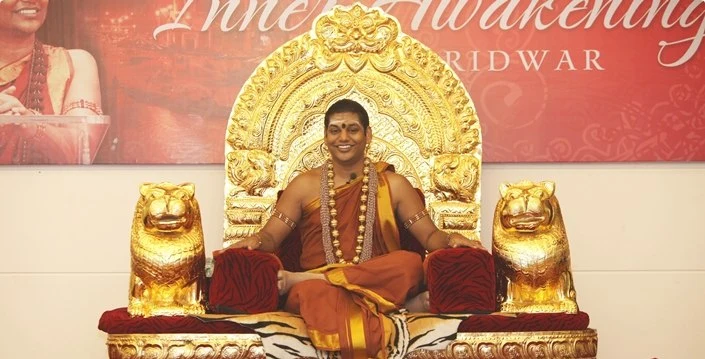
Nithya Satsang
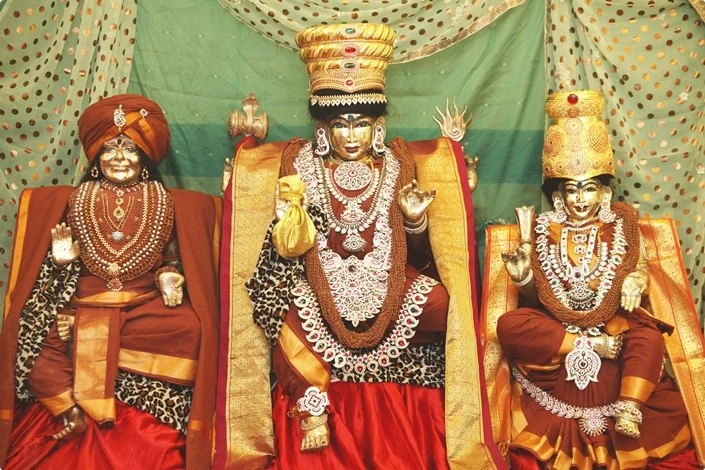
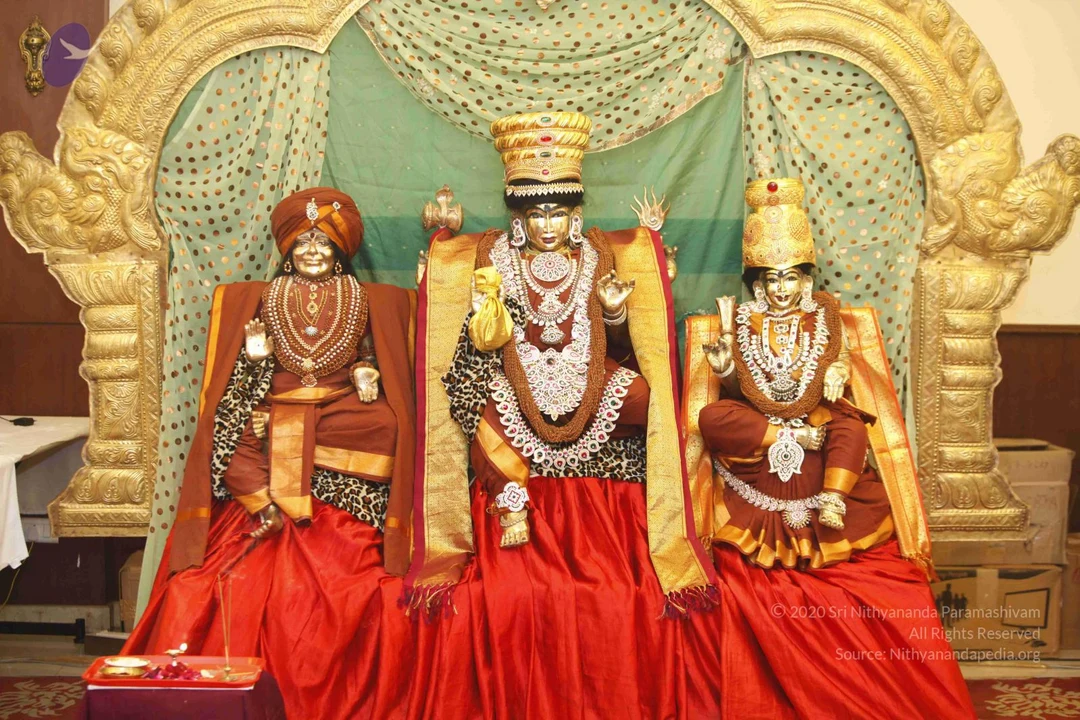
Nithyanandeswara
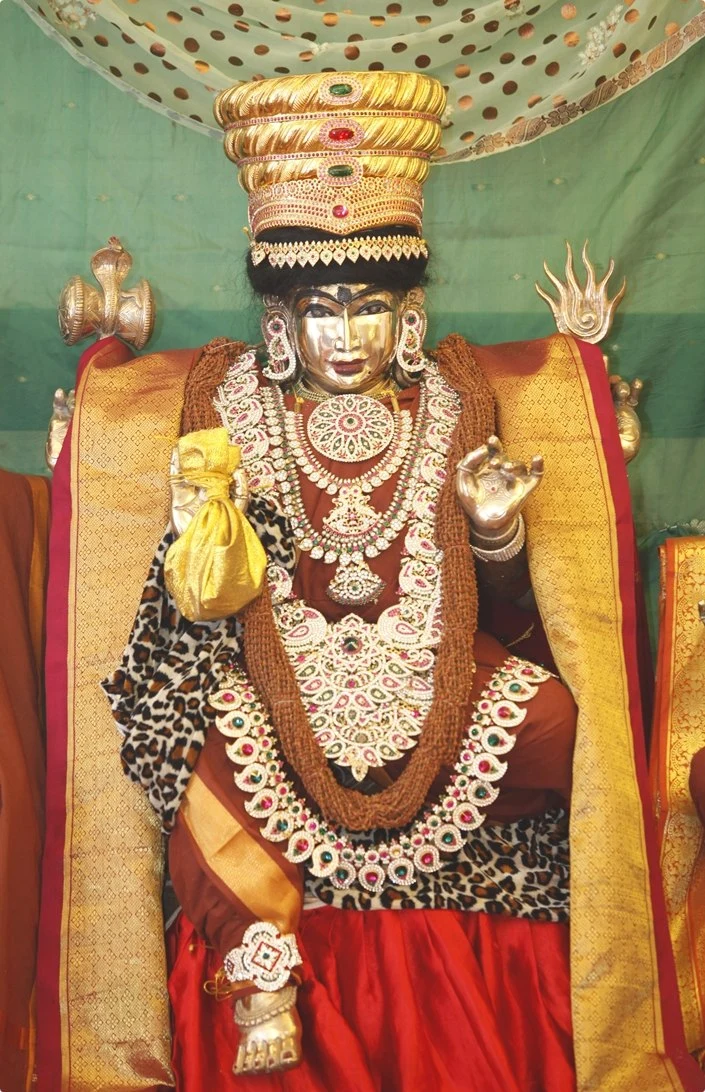
Nithyanandeswara

Nithyanandeswari
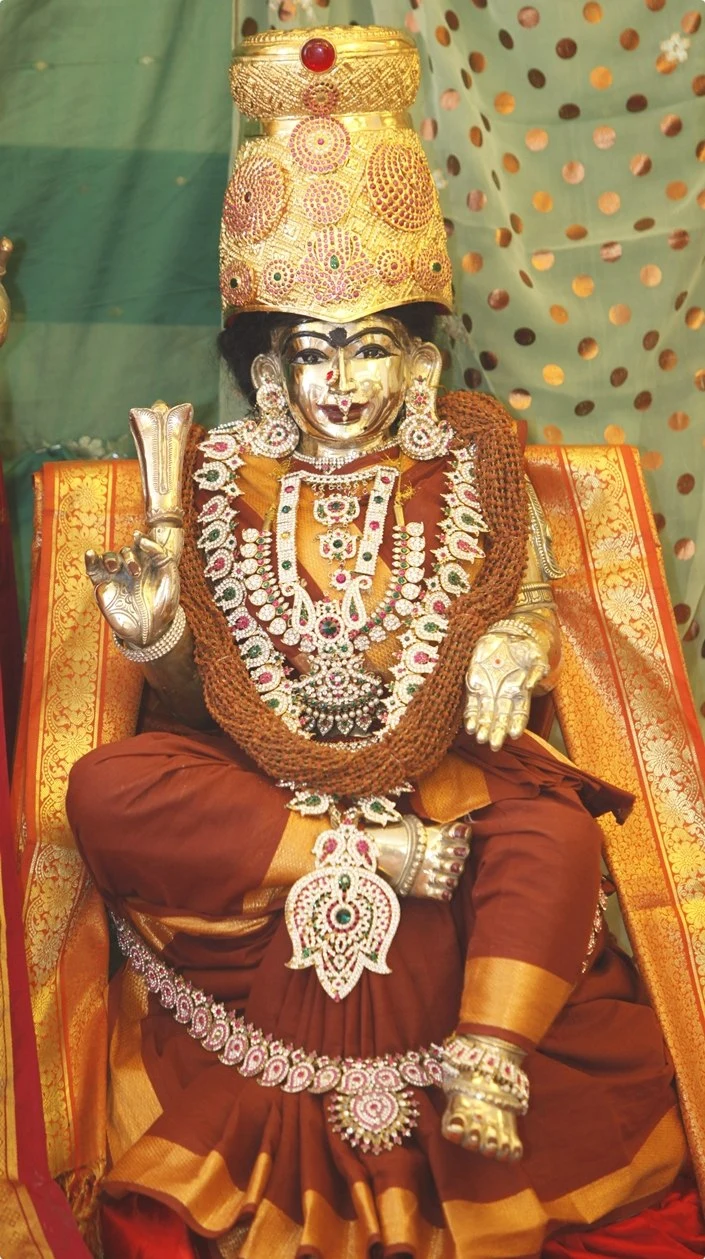
Nithyanandeswari

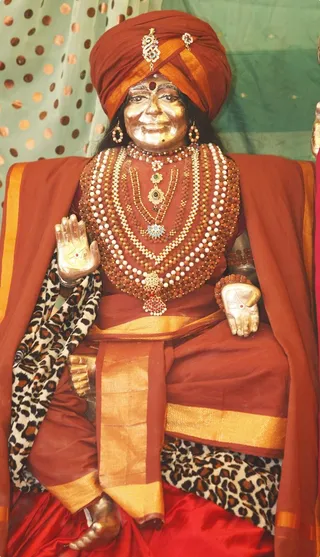
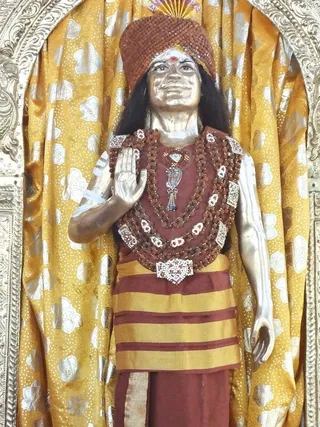
Swamiji Utsavamurthy
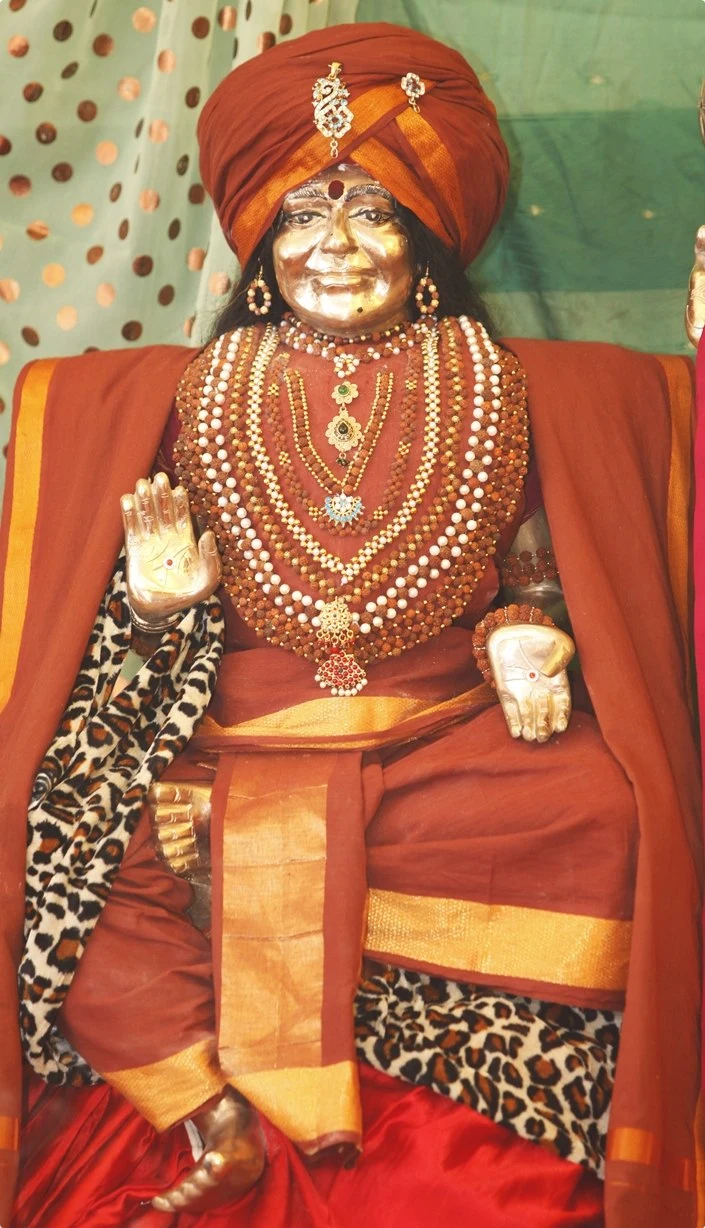
Swamiji's Utsavamurthy

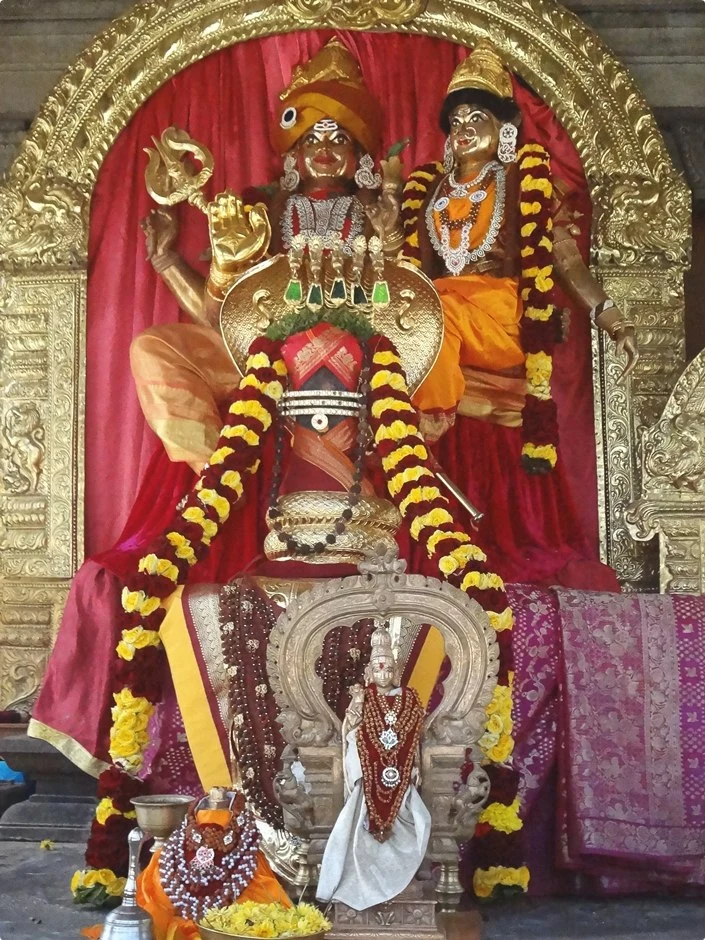
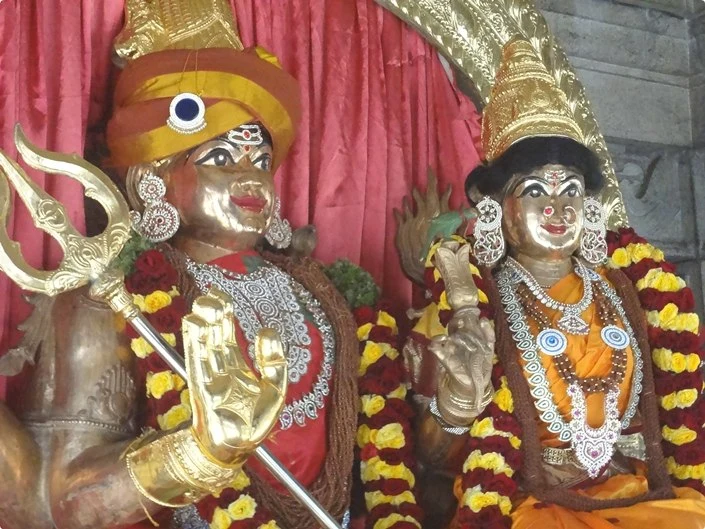
Temple

Swamiji Utsavamurthy
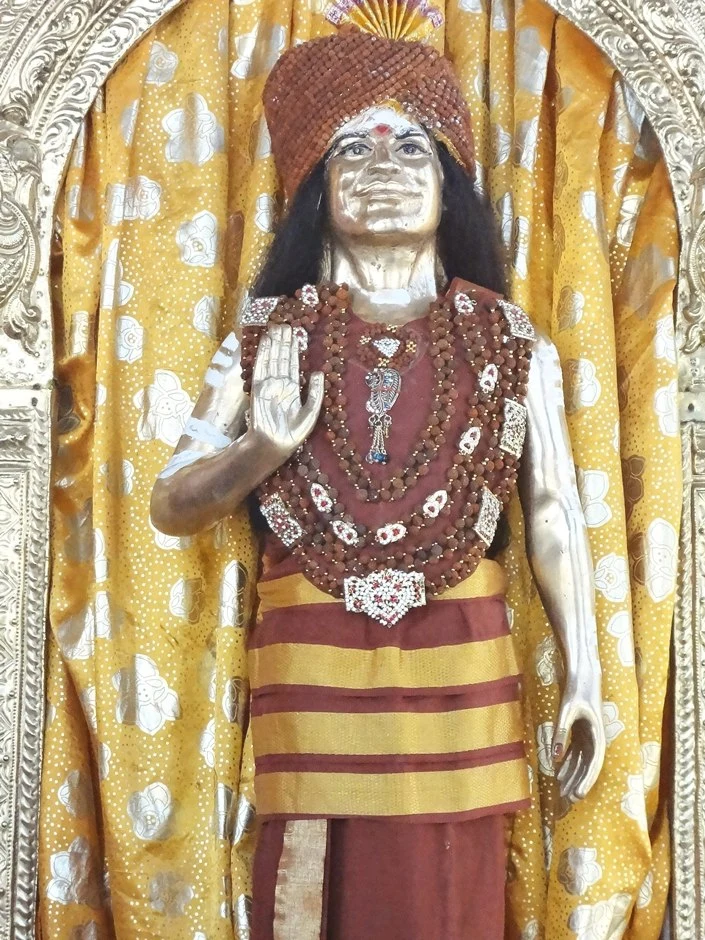
Swamiji's utsavamurthy

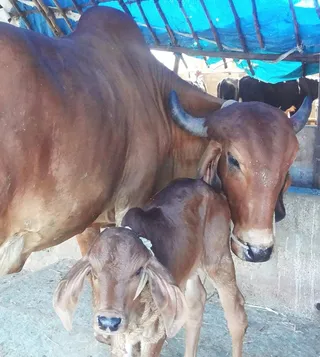
New Calf born in Adheenams Goshala
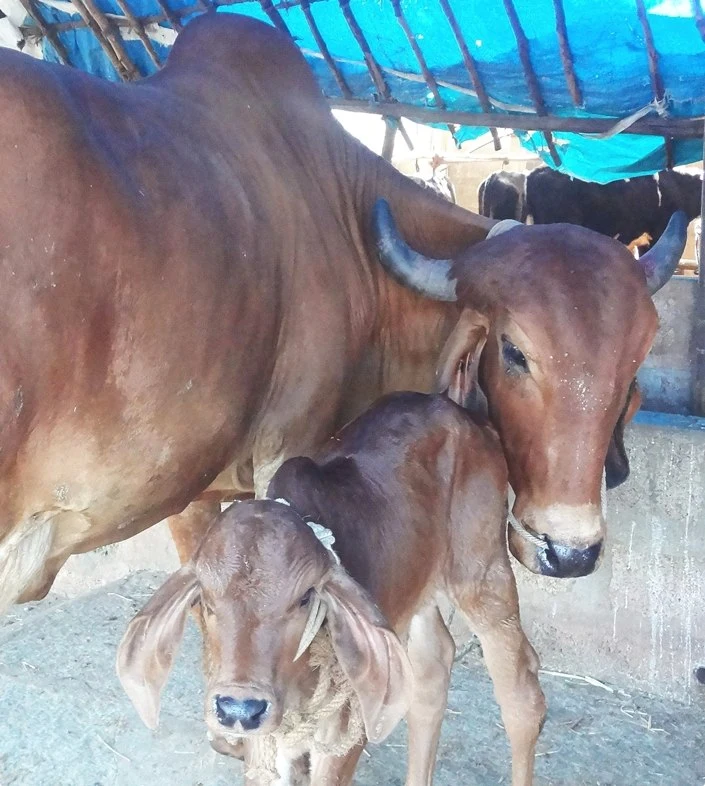
Today new Calf was born in Adheenams goshala.

Darshan

Nithya Satsang

Tags:

Paramahamsa Nithyananda, deity, Mother Ganga, love, completion, inner space, divinity, earth, humanity, spiritual, worship, ancient, sacred, Ganges.

Photos Of The Day:

Satsang
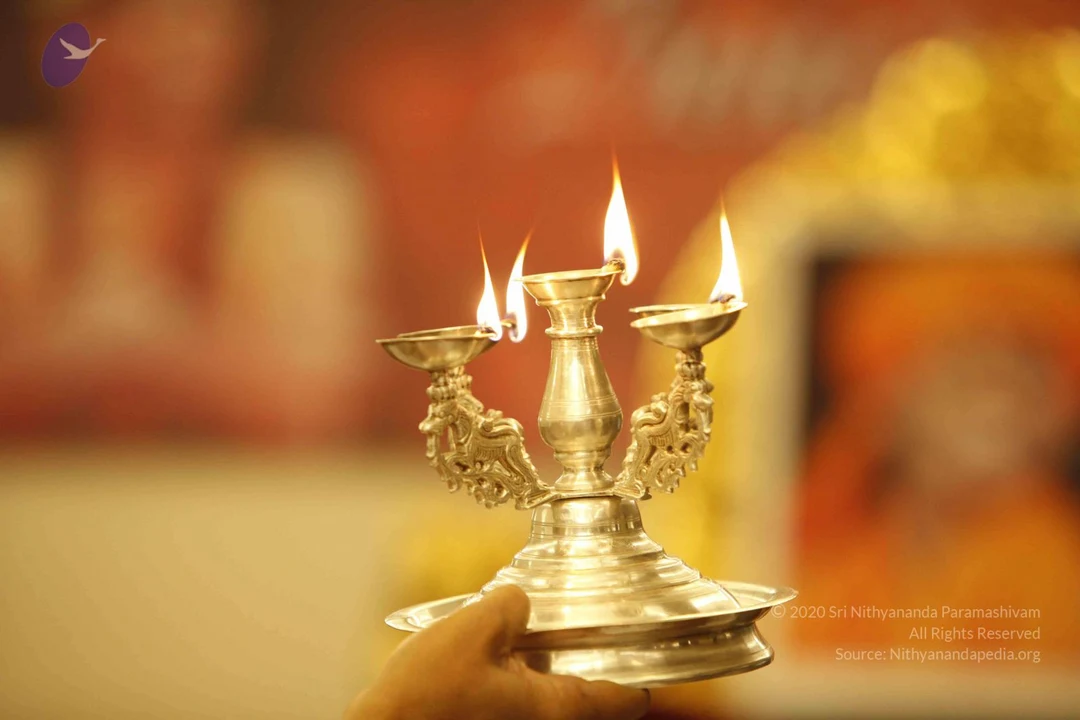
Darshan

IA

Photos Of The Day:

Satsang
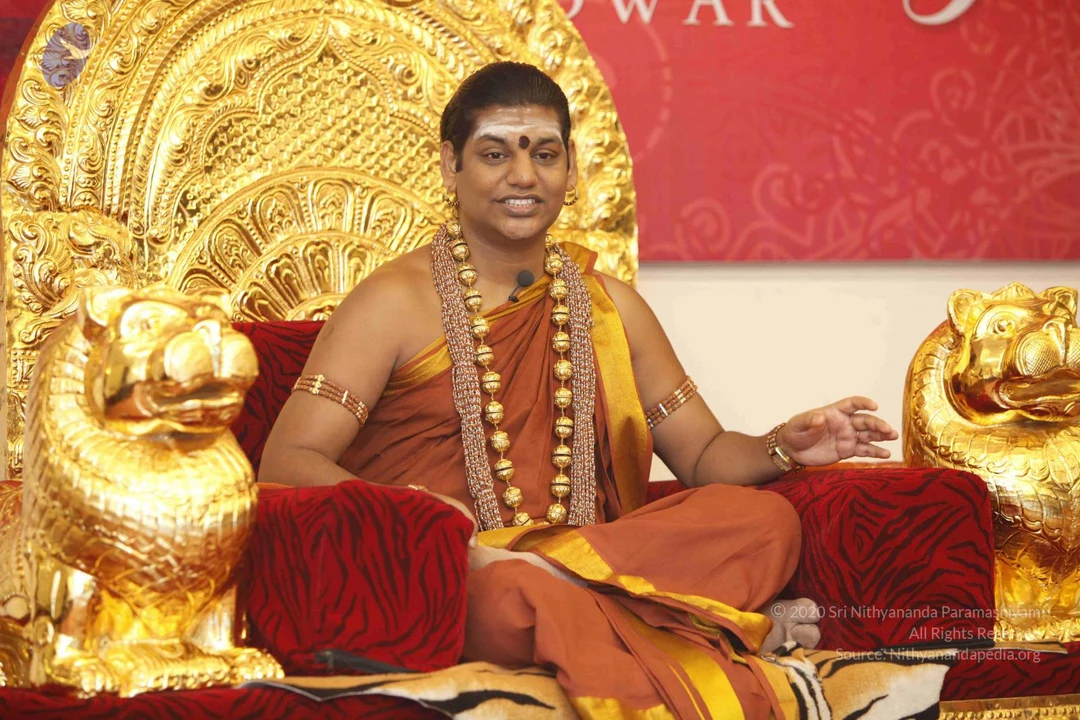
Darshan
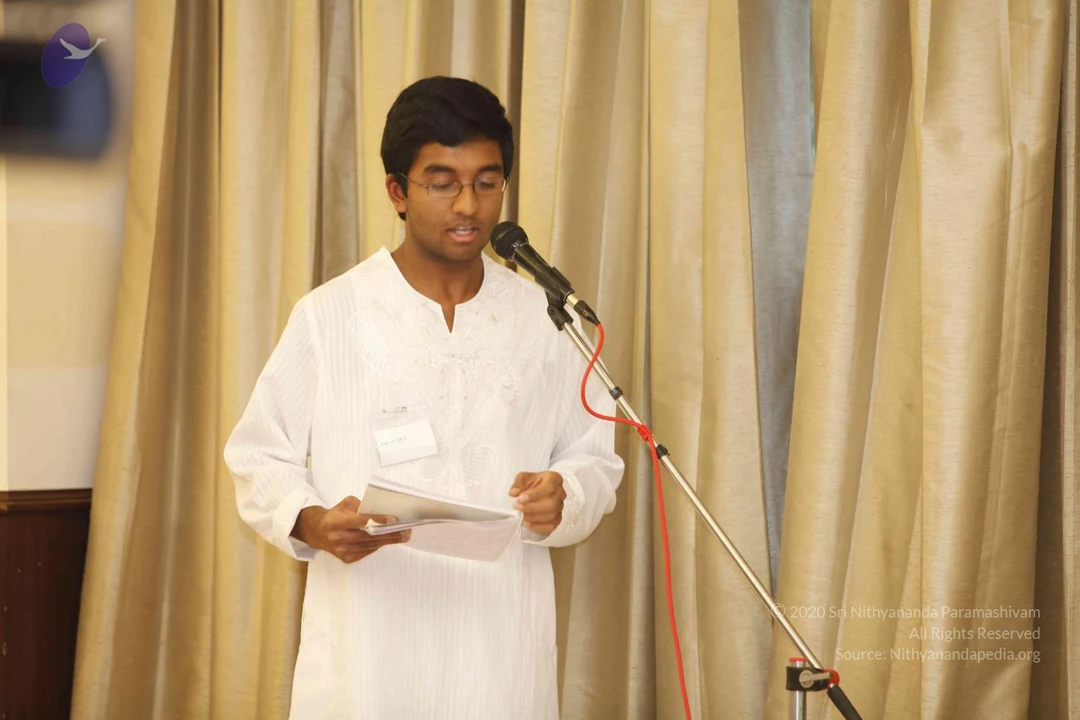
Inner-Awakening

Photos from this day

View all 64 photos

Nithya Satsang

6 photosSource gallery
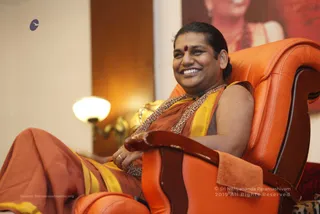
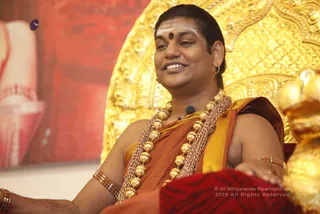
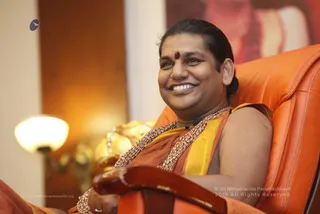
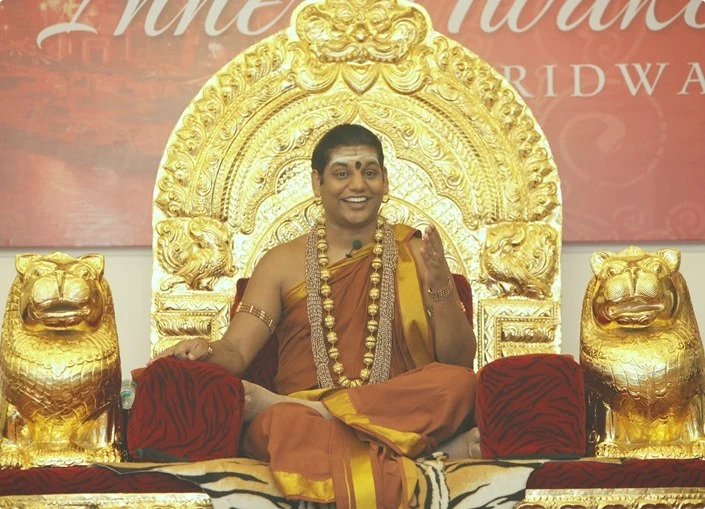
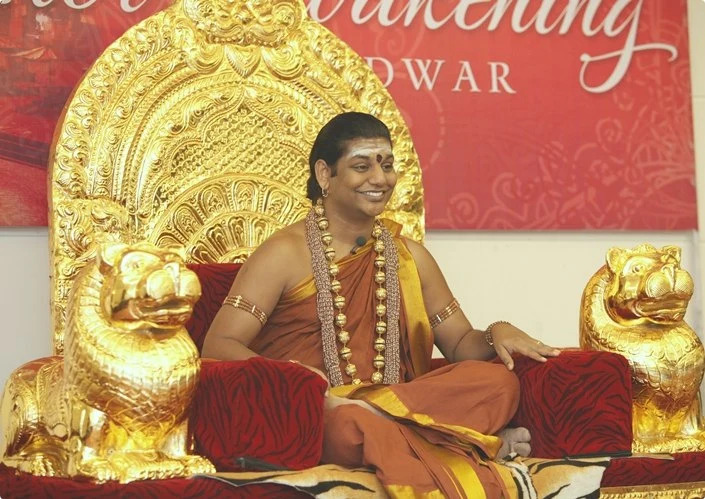
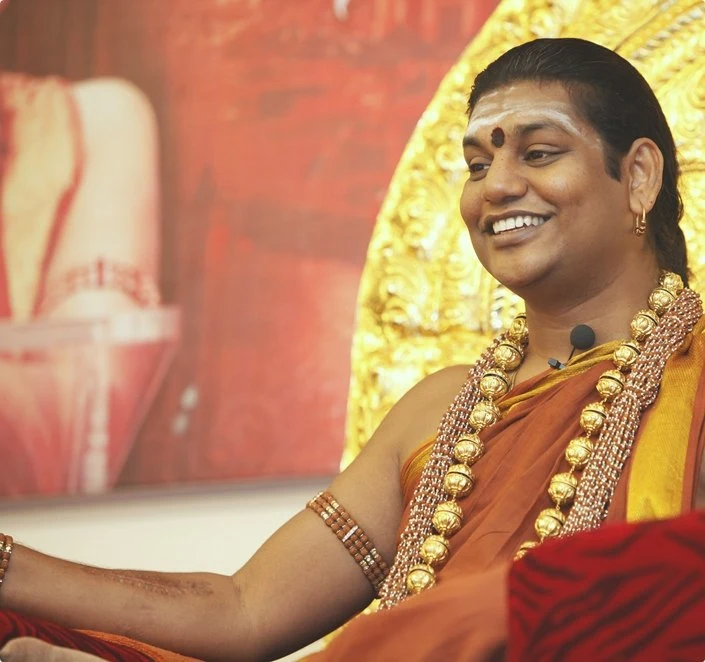
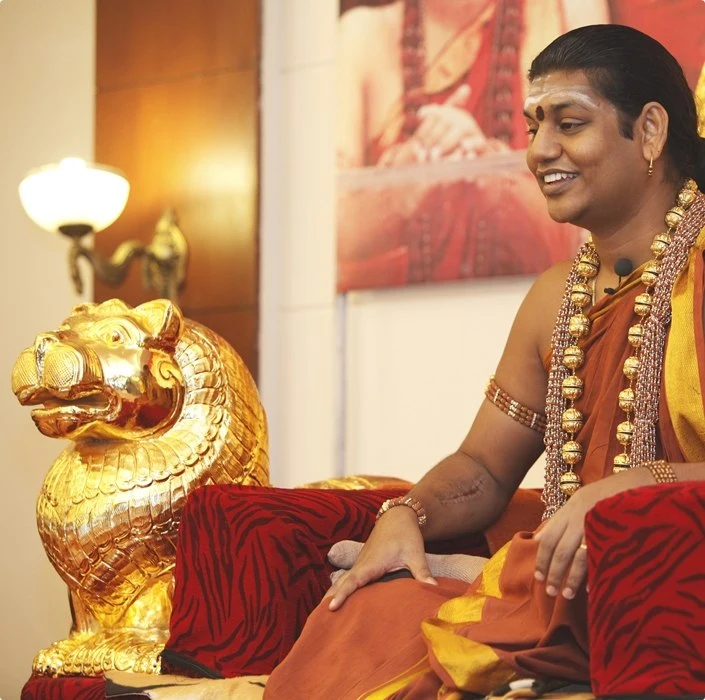
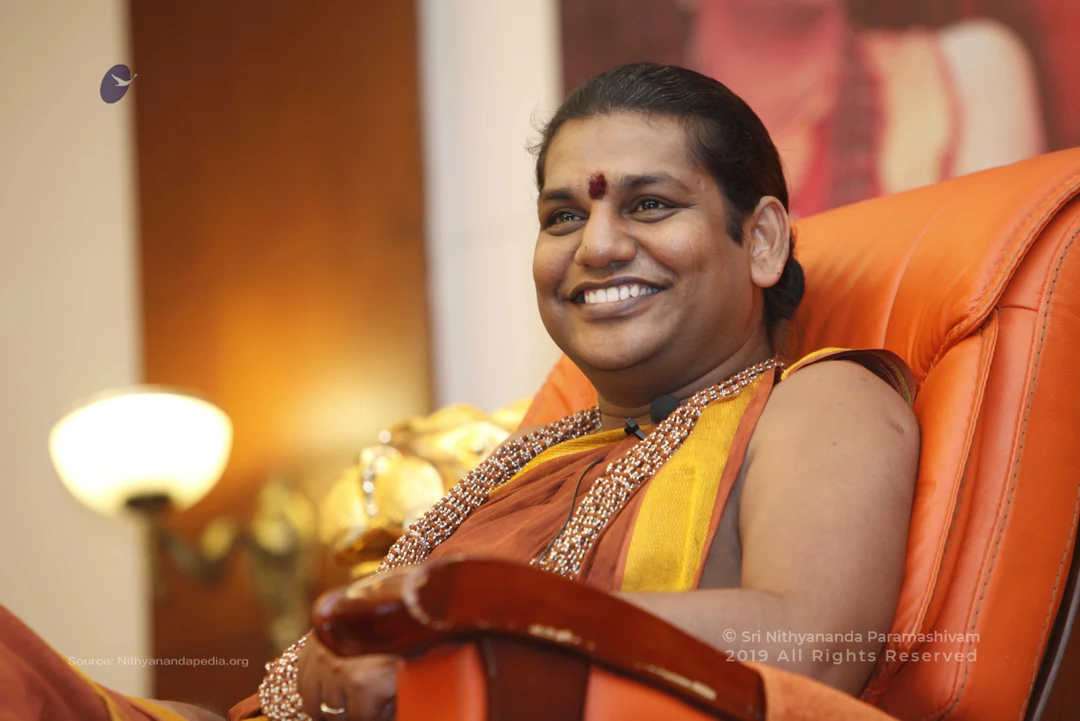
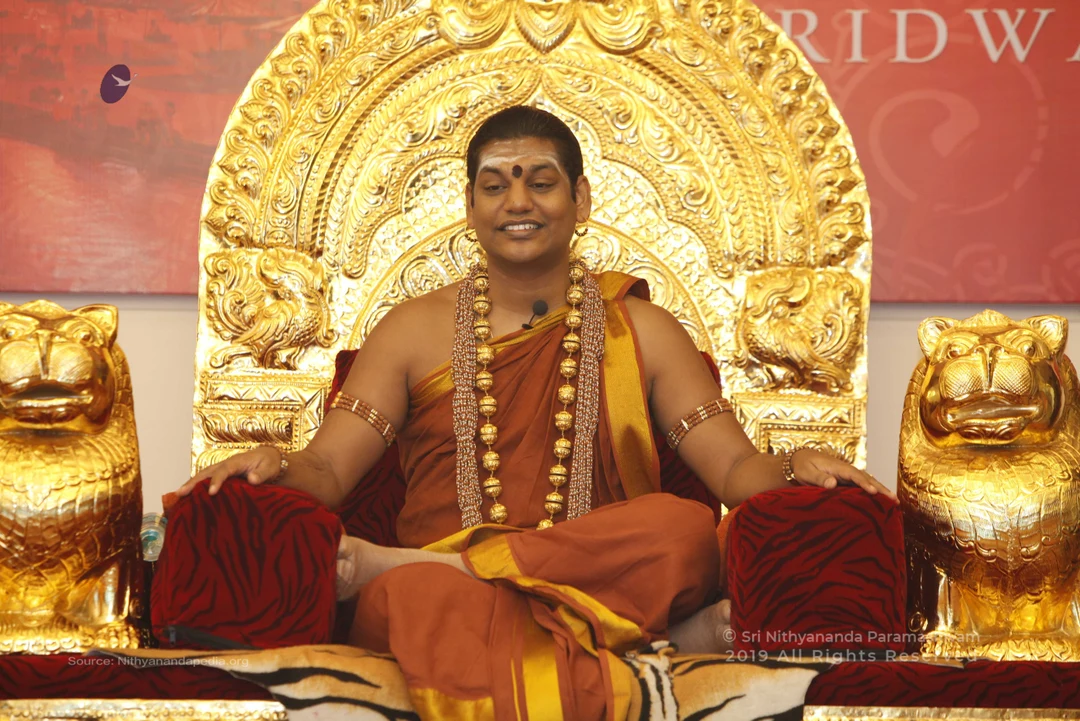
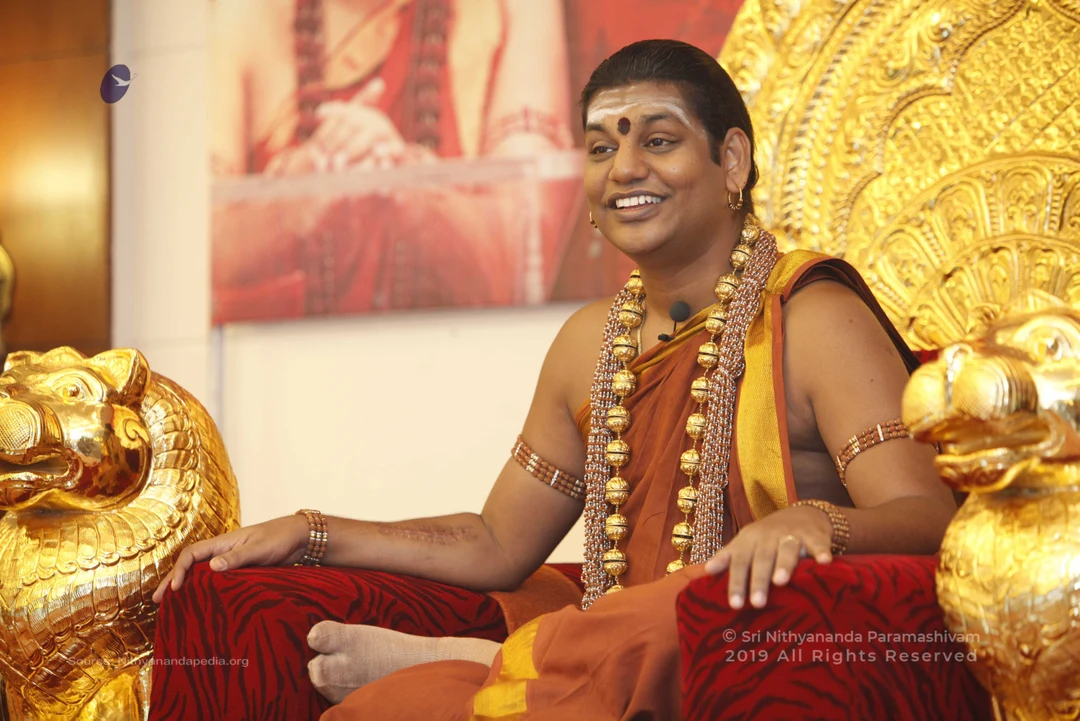
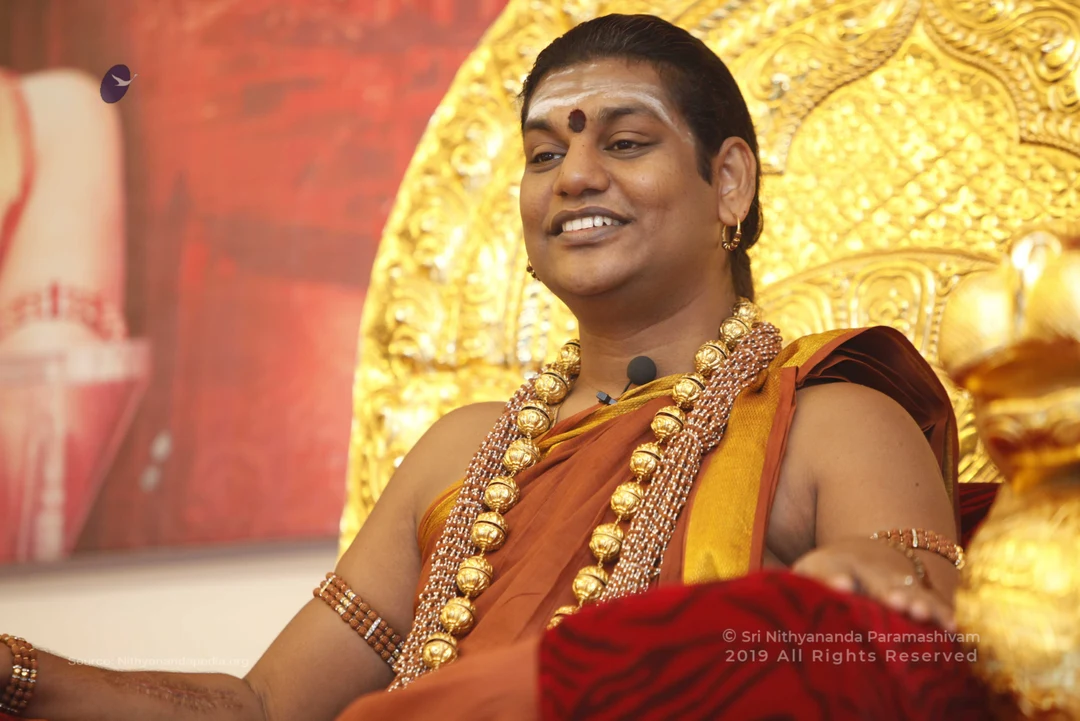
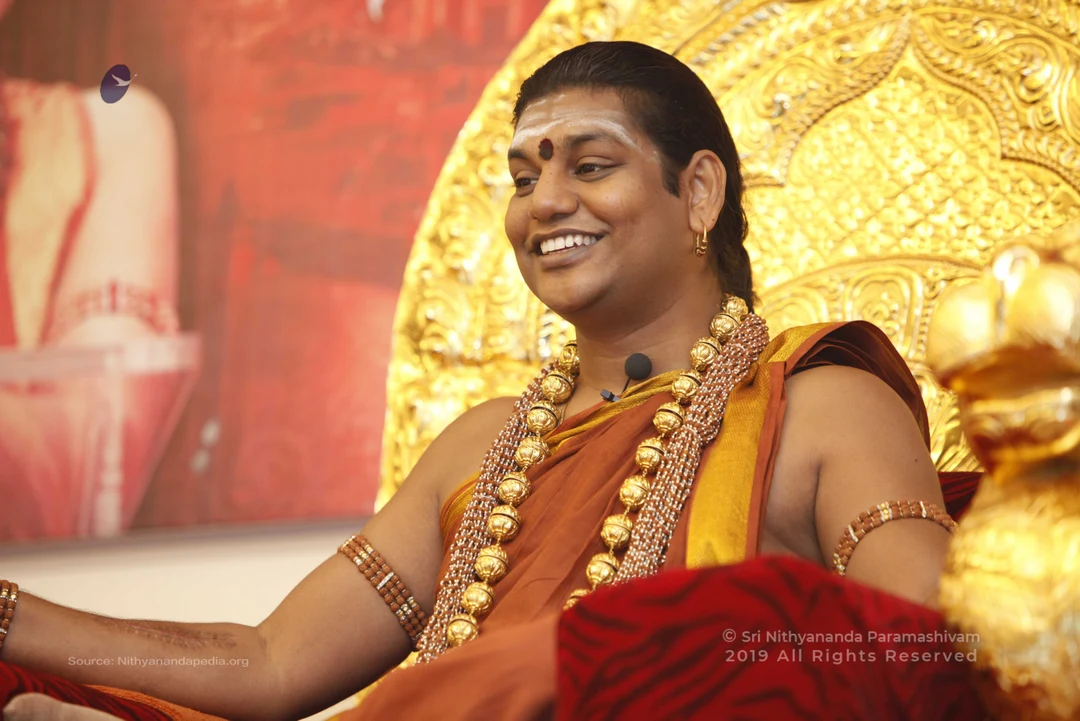
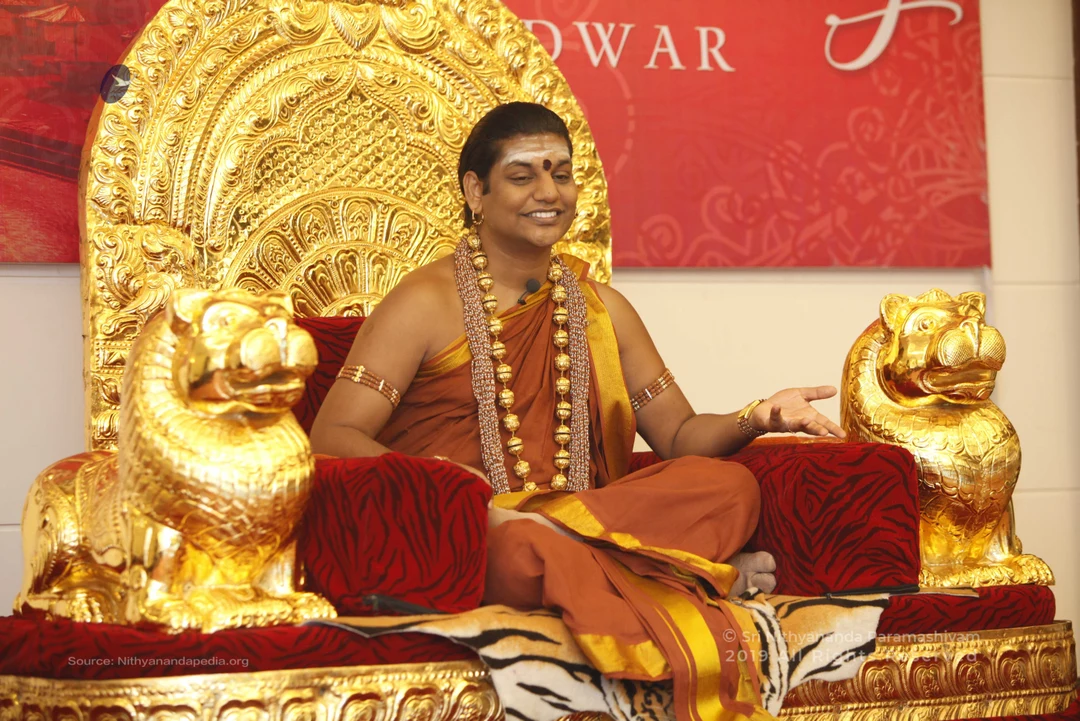
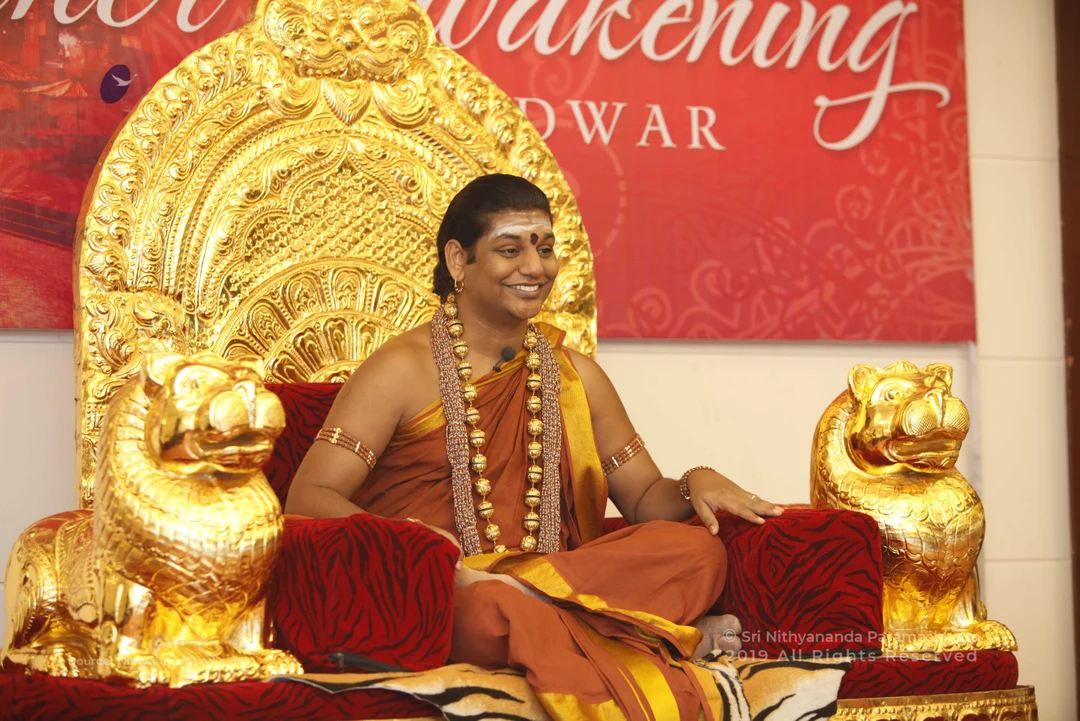
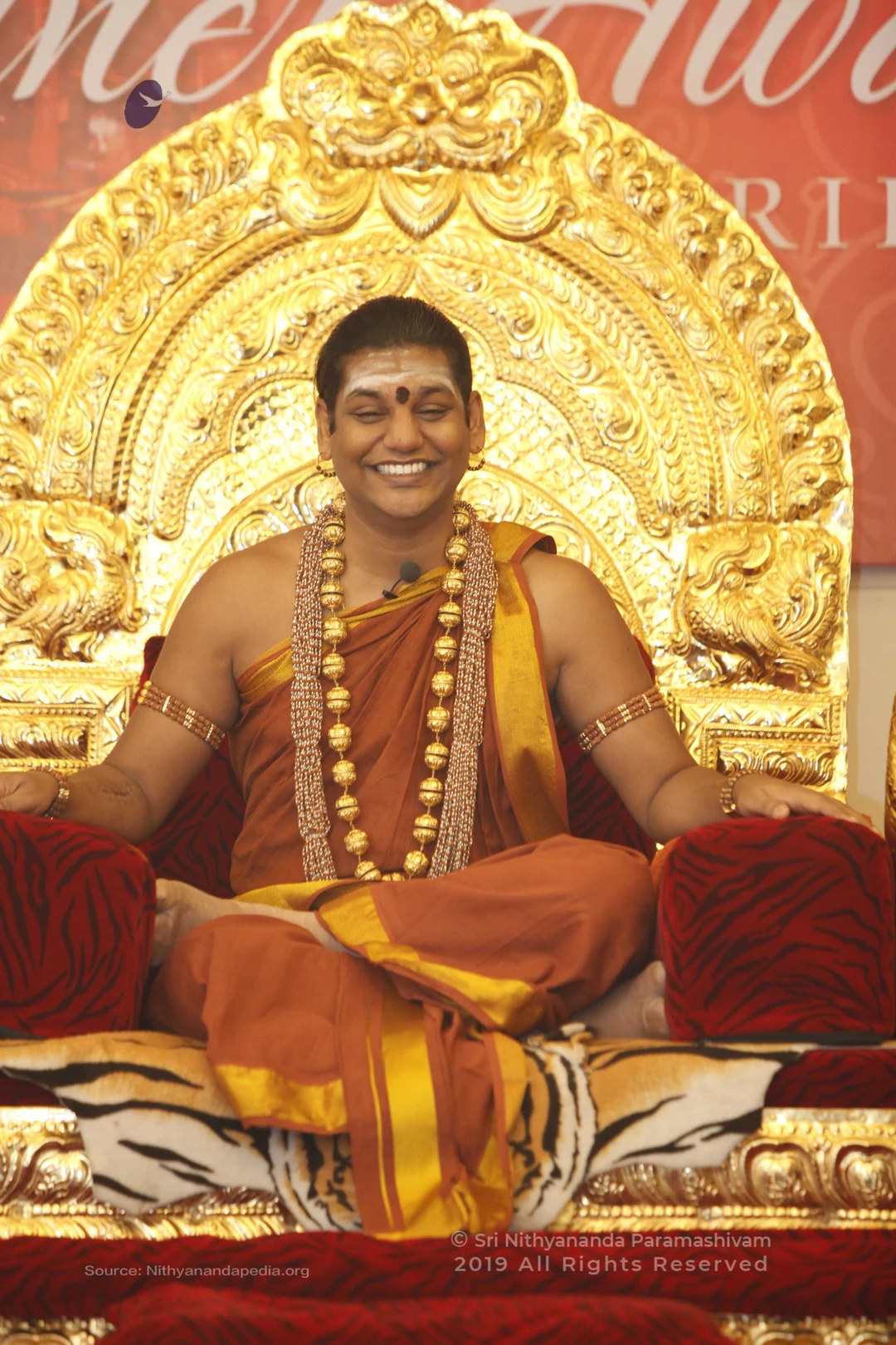
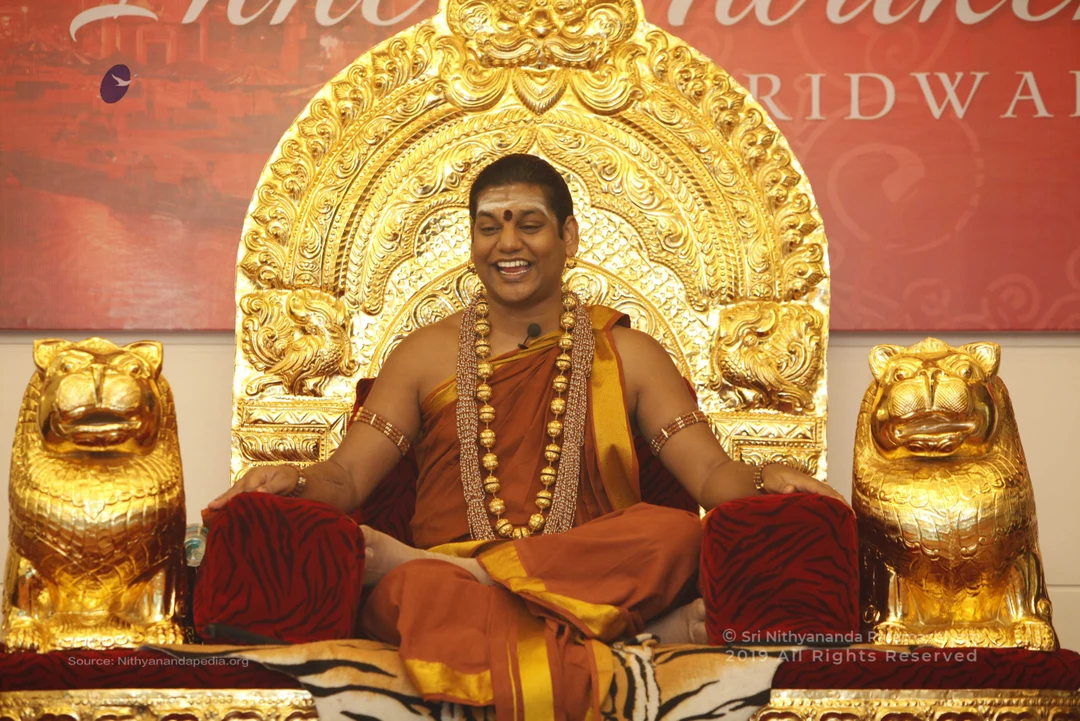
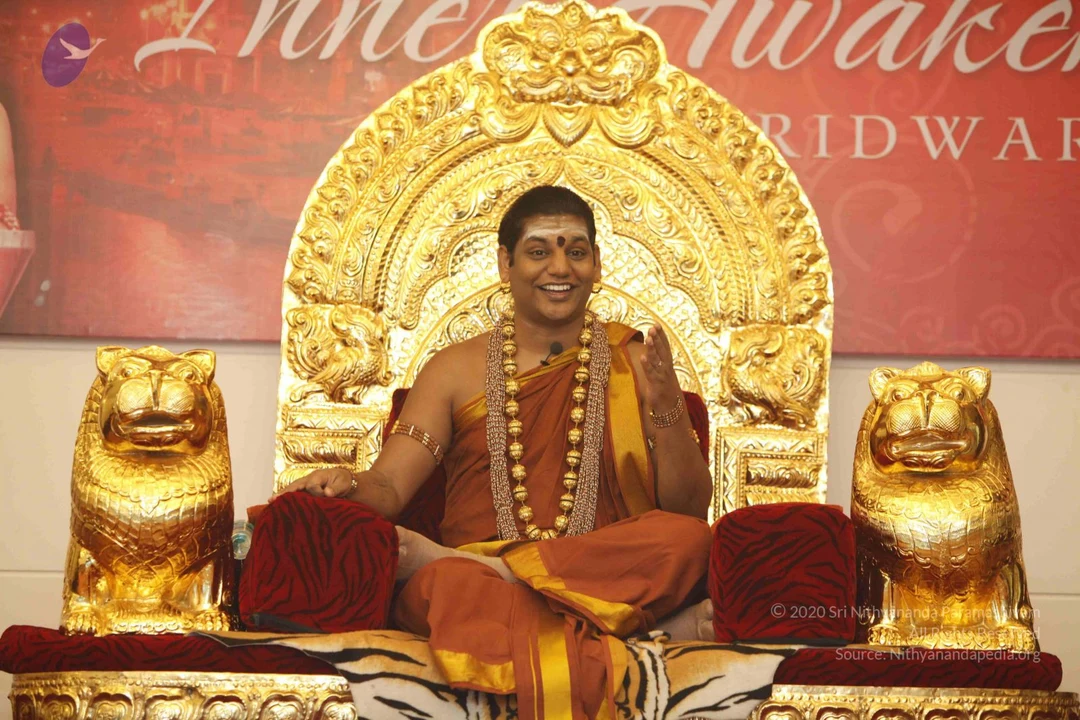
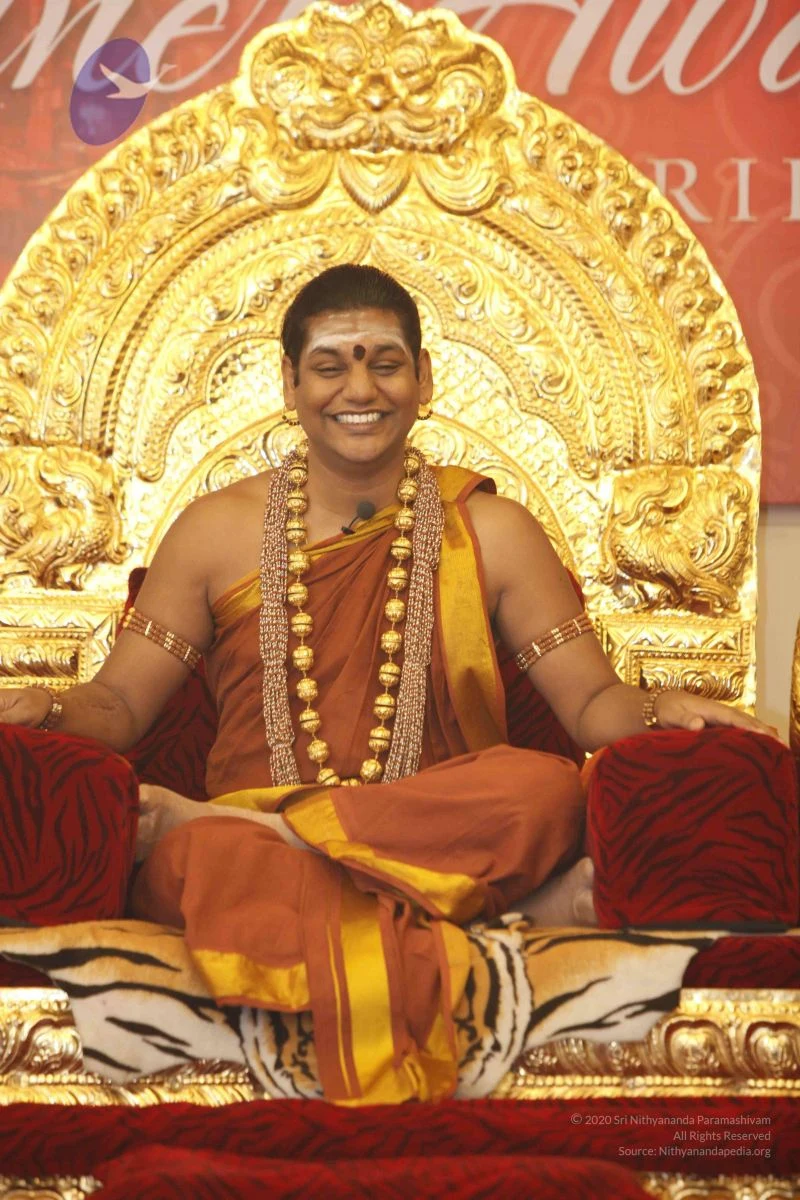
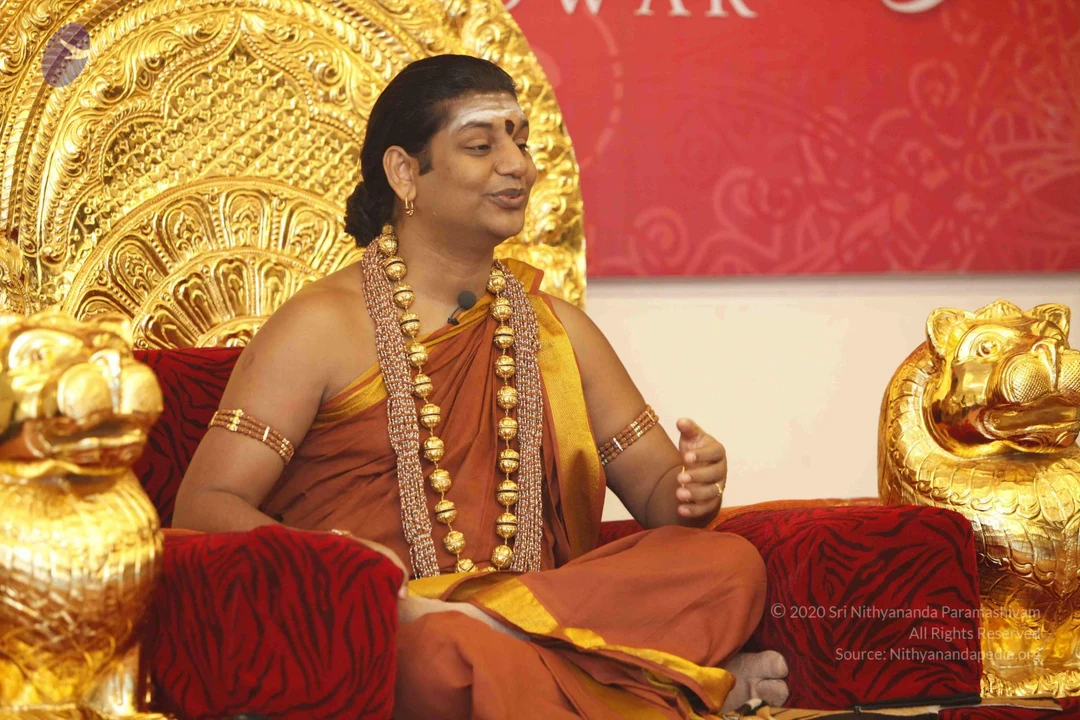
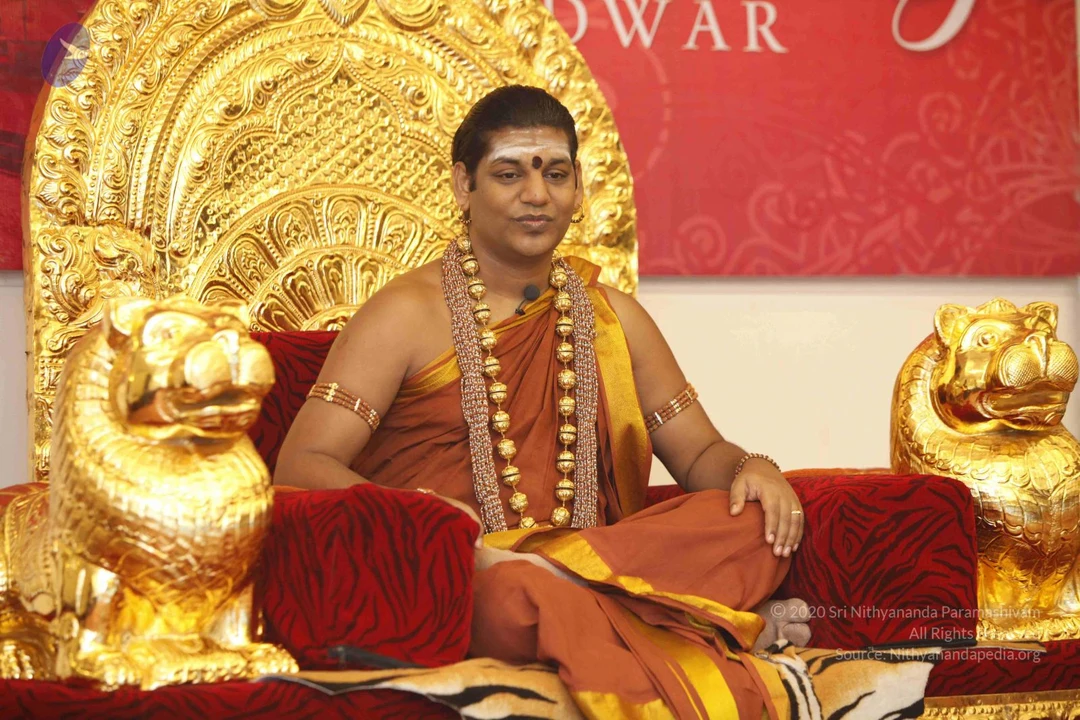
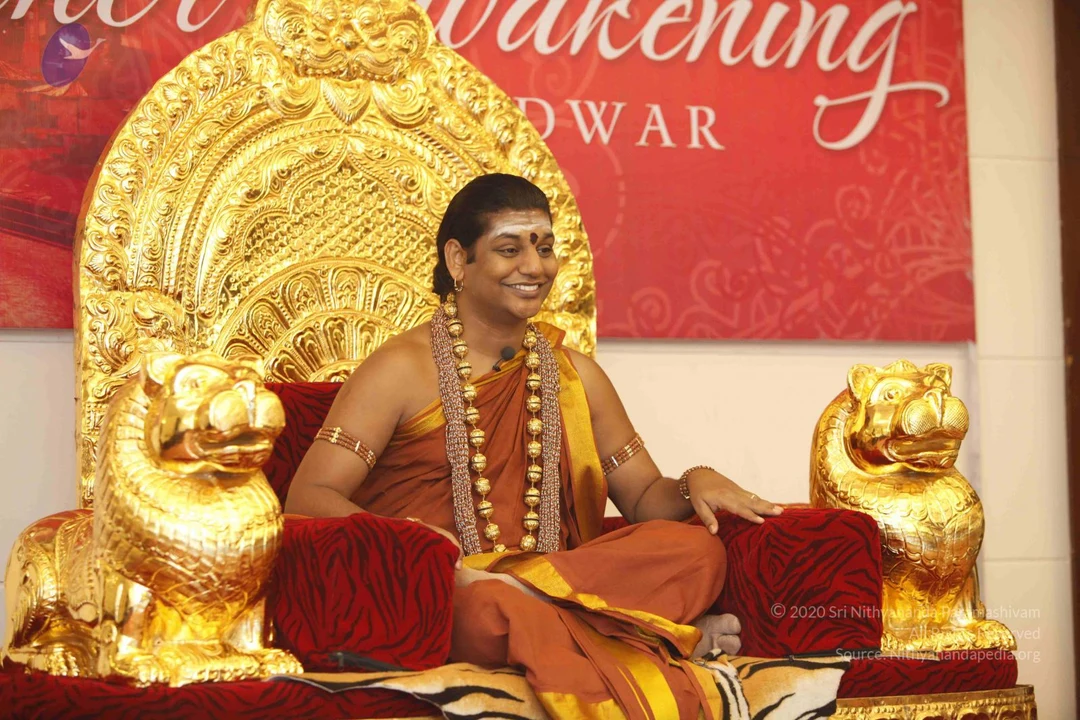
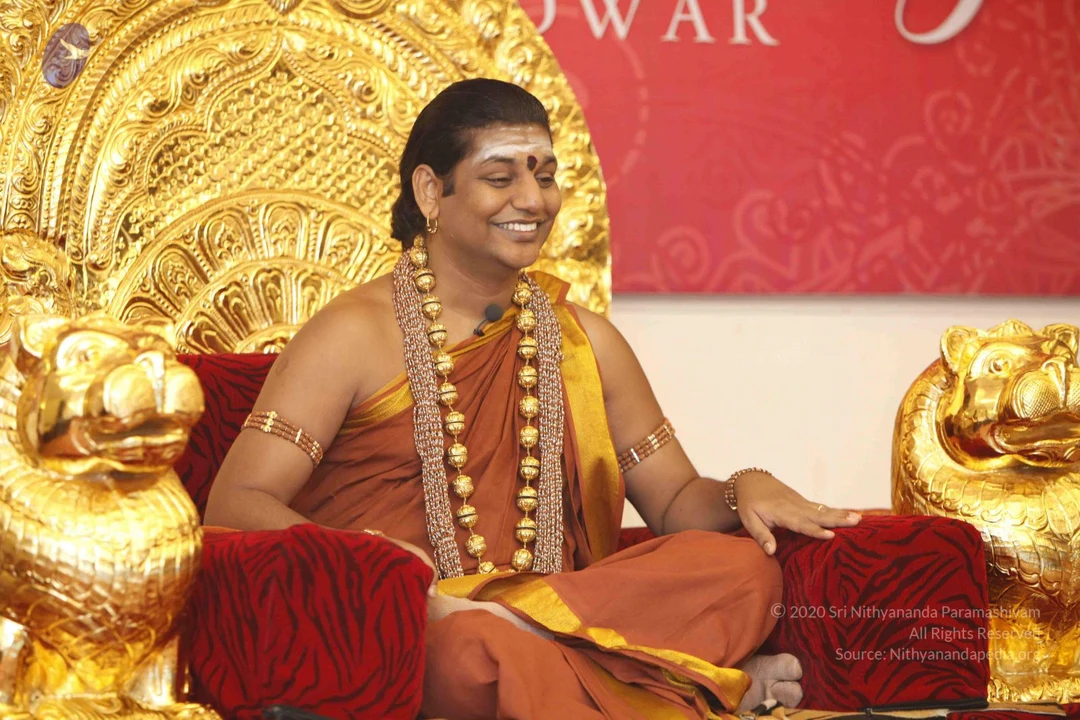
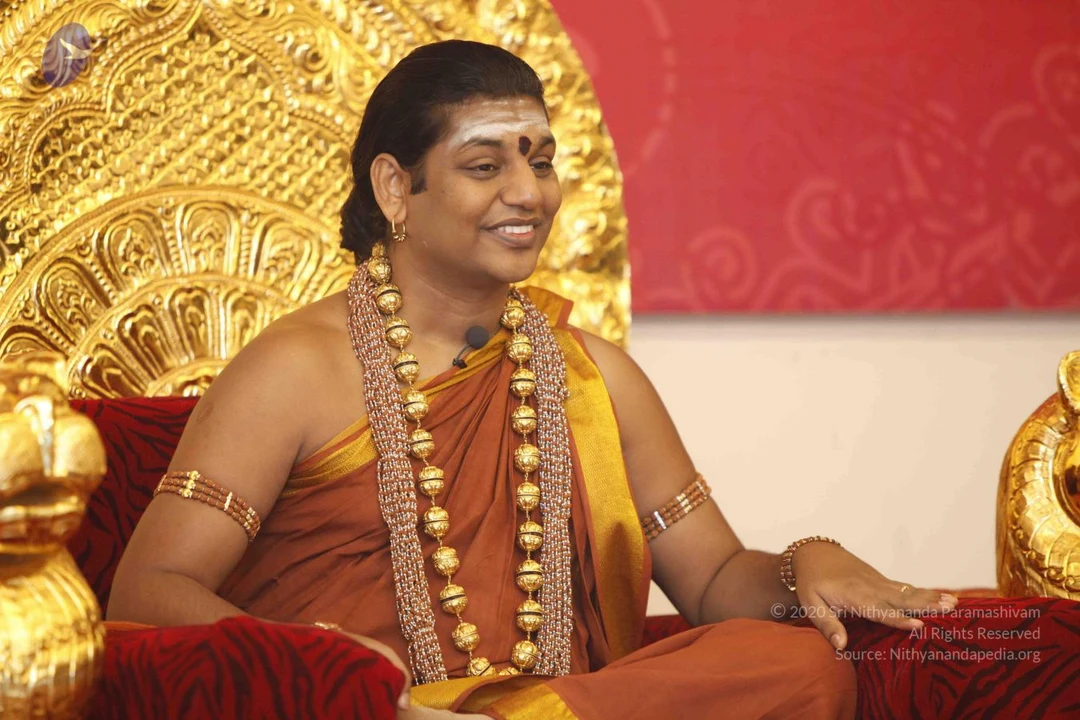
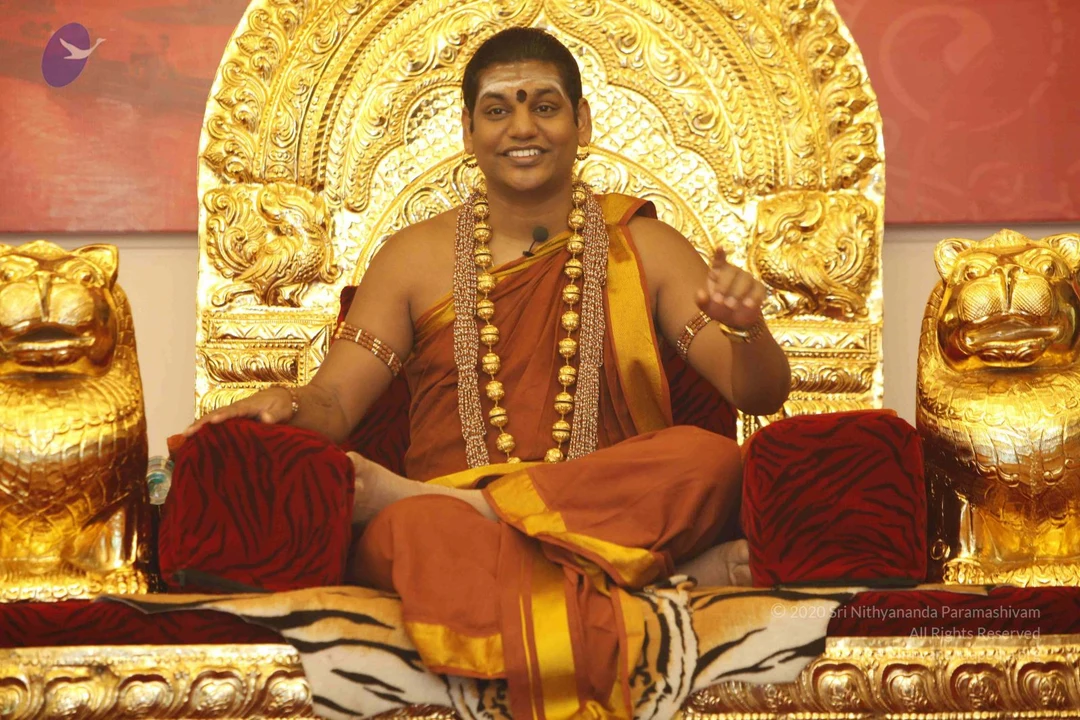
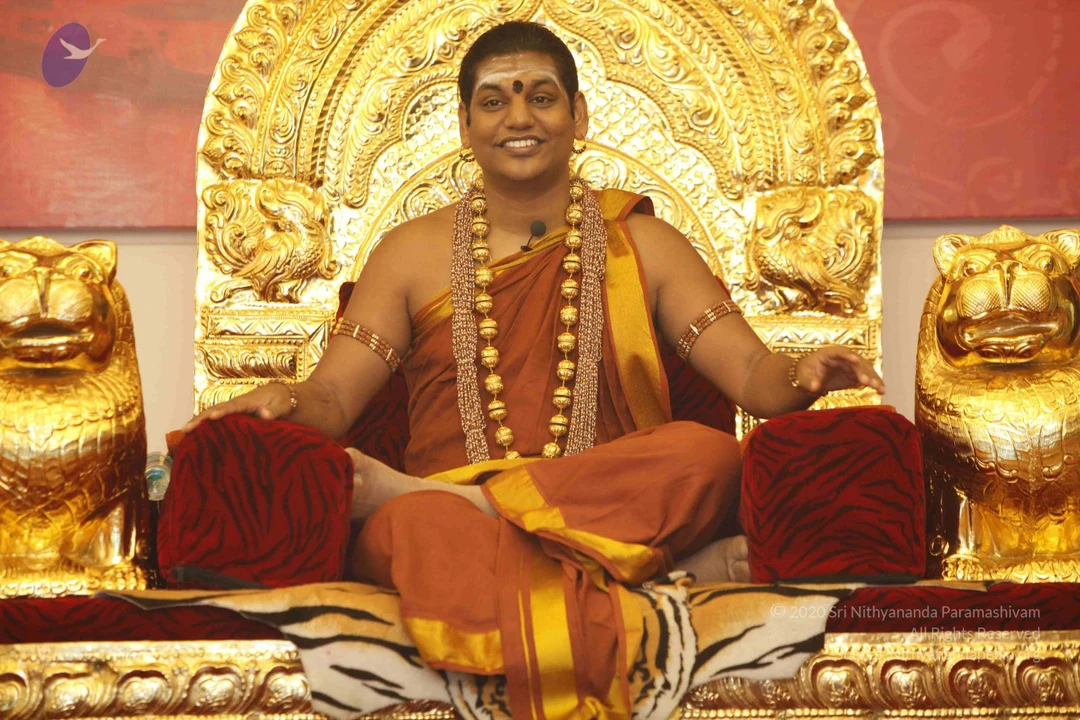
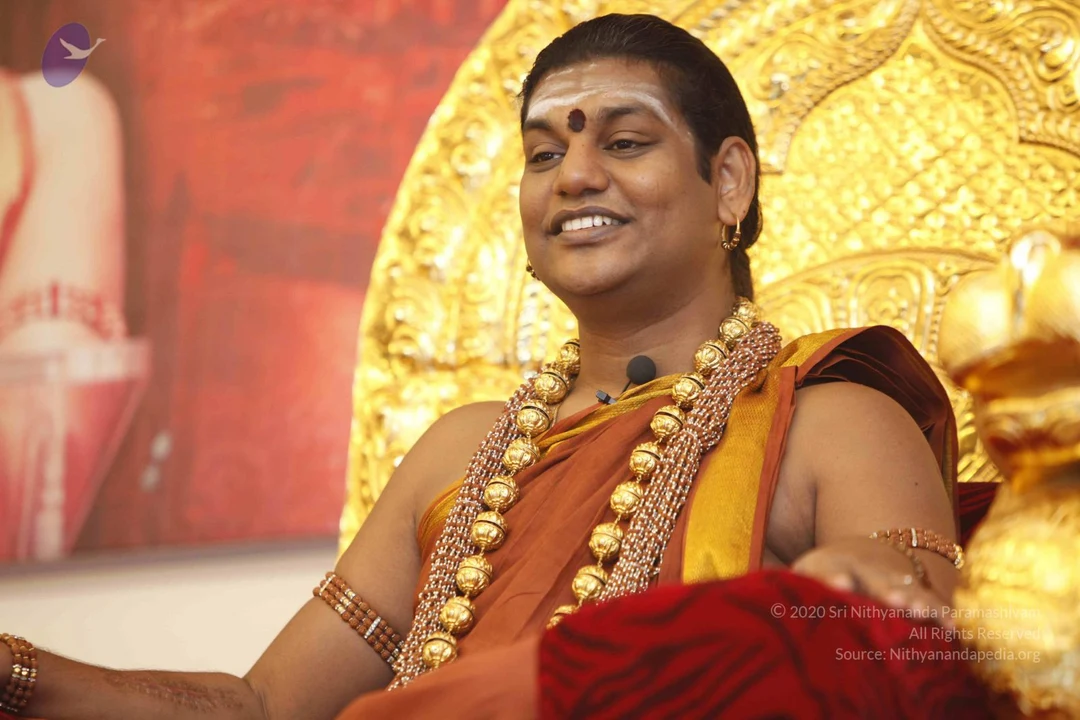
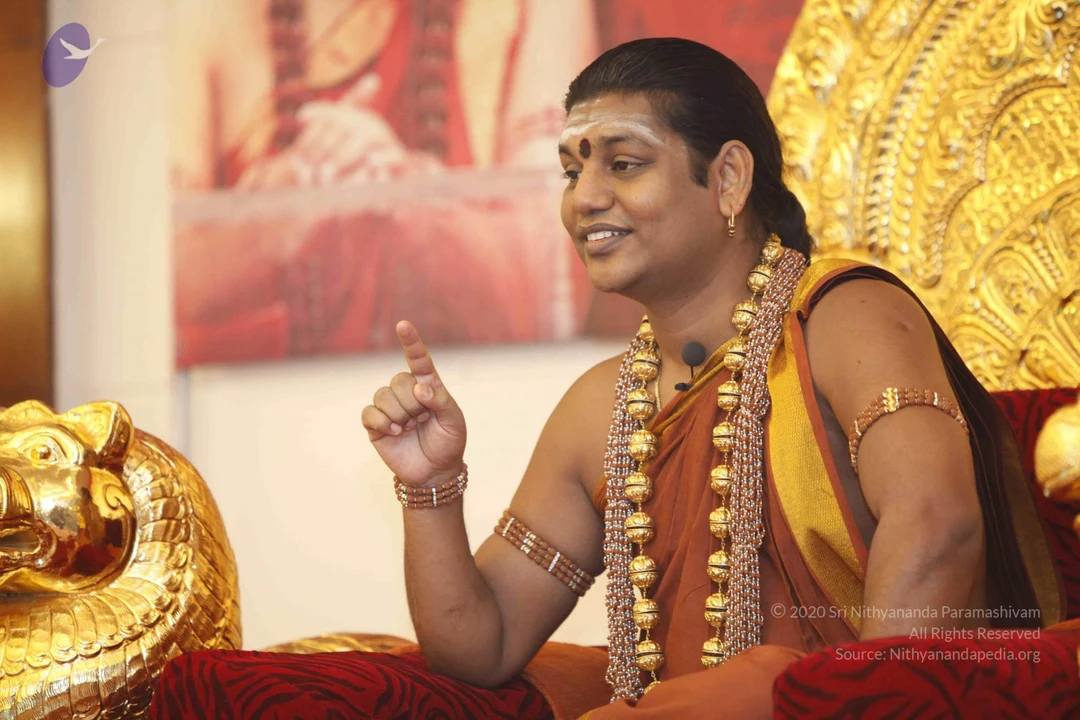
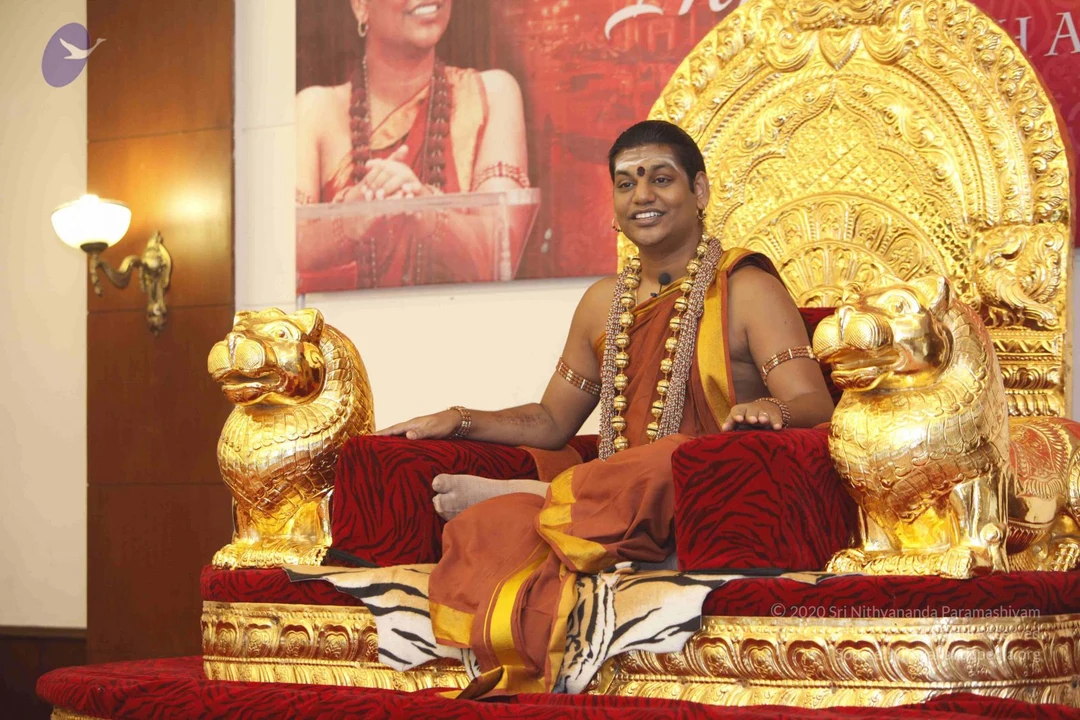
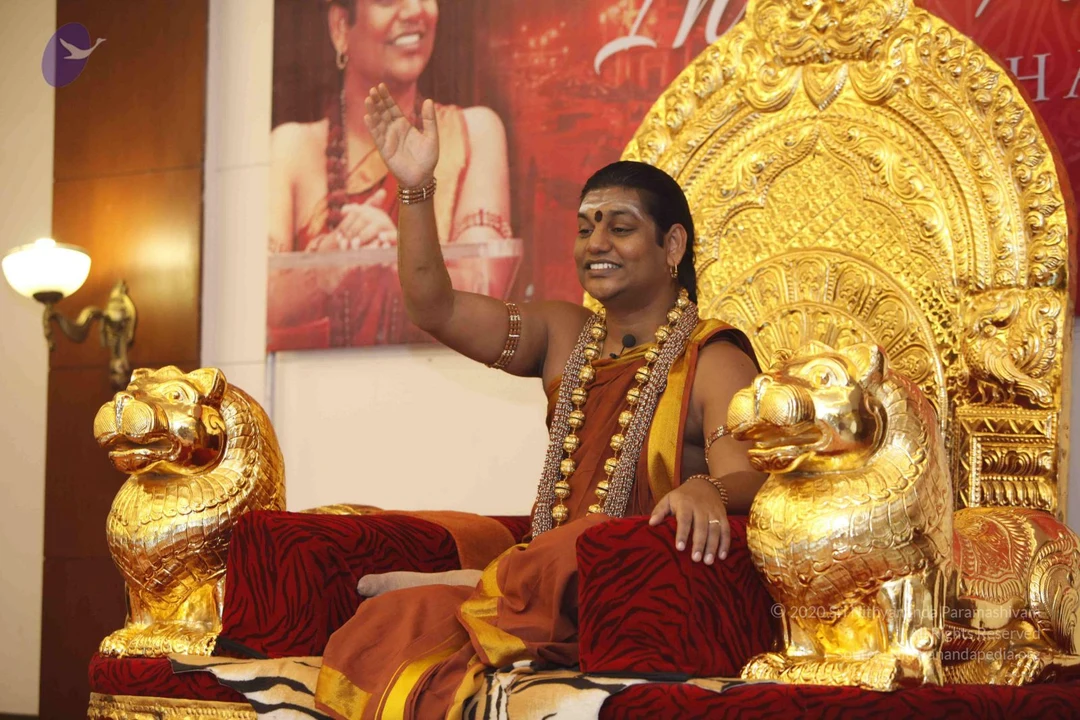
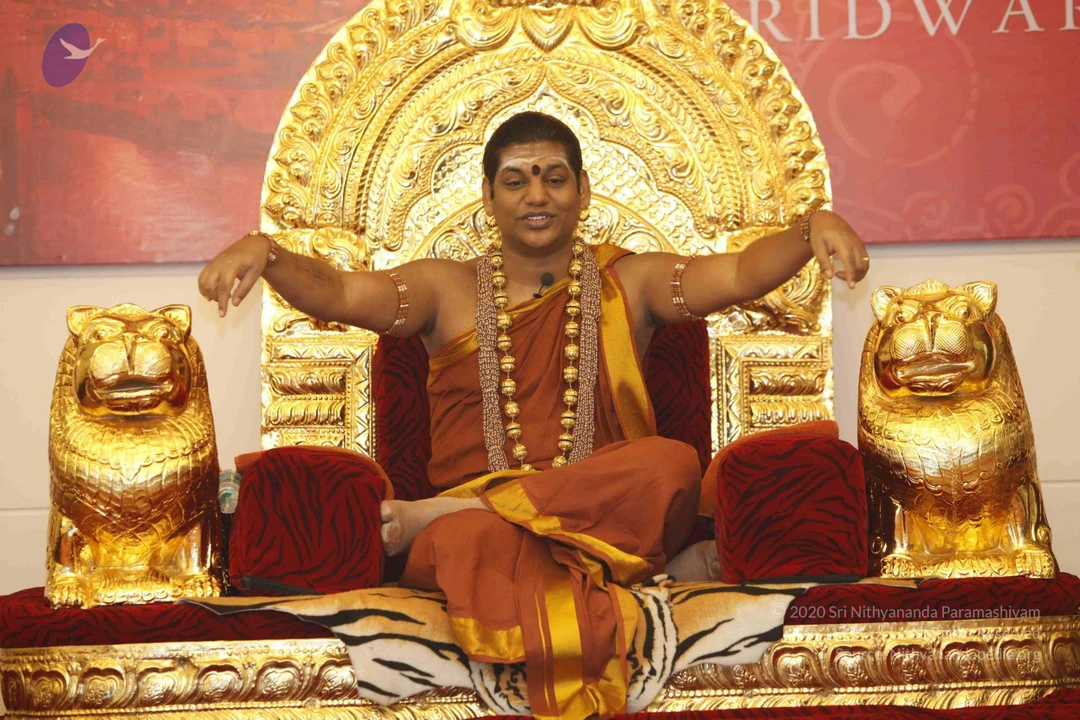
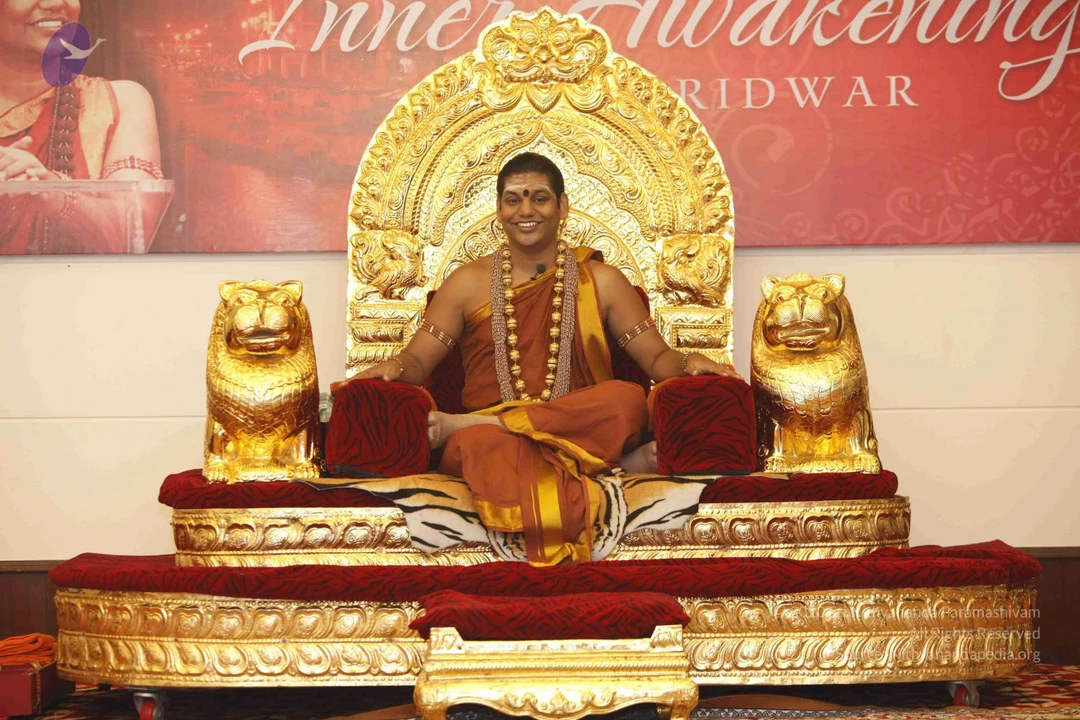
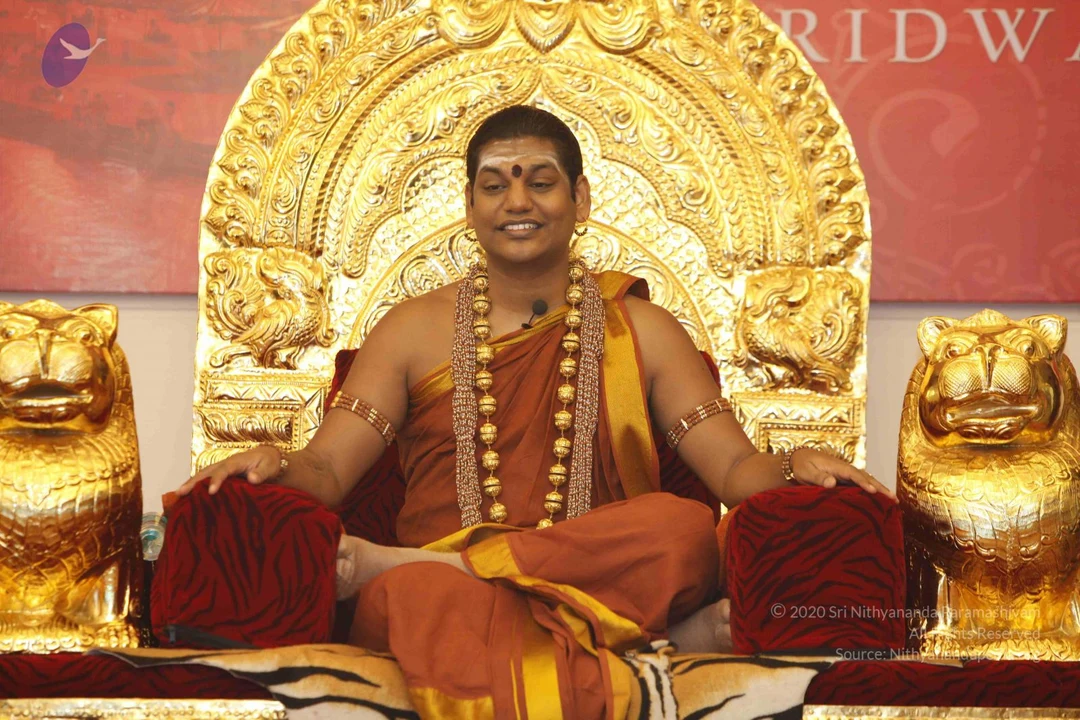
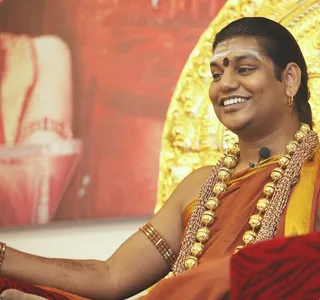
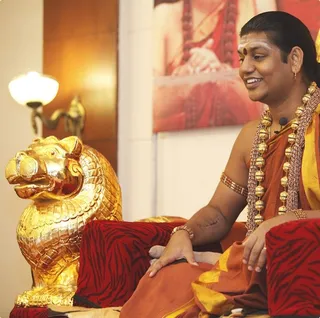
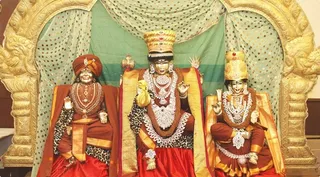
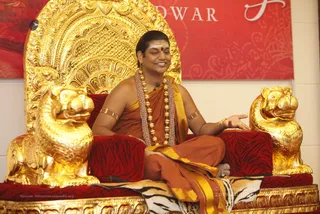
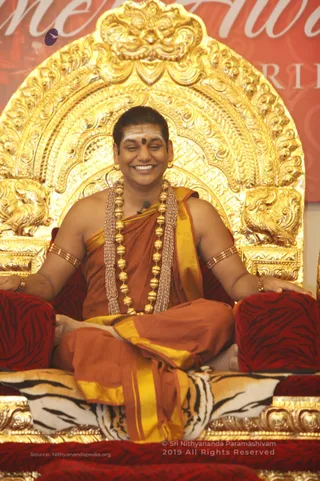
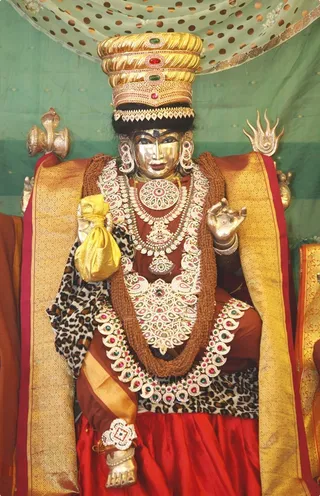
A man in saffron-orange robes with a gold-bordered shawl sits cross-legged on an ornate gold throne with carved backrest and two golden lion-head armrest pillars, draped with a tiger-striped cloth and red cushions. He wears a rudraksha mala and a ceremonial gold necklace and has a red bindi on his forehead, with hands resting on the armrests. Behind him a red banner with partial lettering reads 'Inner Awakening' and 'Haridwar'. a person appears in this photo, seated on the throne in the role of a teacher; appearance cues are the saffron robes, rudraksha mala and gold necklace.A smiling man in saffron and gold robes sits cross-legged on an ornate golden throne carved with floral motifs and flanked by two golden tiger-head armrests, with tiger-striped red cushions below. He wears a long rudraksha mala with a gold necklace, a gold armband and bracelet, and a small red mark on his forehead, with a lapel microphone clipped to his robe. His right hand is raised mid-gesture as he speaks. Behind the throne a red backdrop shows partial gold lettering reading Nithyananda and Haridwar. a person appears to be the seated speaker, identified by saffron and gold ornamentation, rudraksha mala and ceremonial throne; the photo appears to be from a satsang.A seated man in saffron-orange robes with a gold-bordered shawl sits on an ornate golden throne with carved lion heads and a red velvet cushion, draped with a tiger-striped cloth. He wears a rudraksha mala with gold beads, gold bangles, gold earrings and a vibhuti/tilak mark on his forehead, smiling with one hand resting on his knee. Behind him, a red banner bears partly visible decorative lettering reading 'Nithyananda' related event text (partial). a person seated on his throne, presiding over a satsang or Nayana Deeksha broadcast.Close photograph of a smiling man seated on a red cushion in front of a large ornate gold backdrop and a red painted panel. He wears an orange-saffron shawl draped over a bare shoulder, a long multi-strand necklace of gold beads and rudraksha-style brown beads, a gold armlet with beaded bracelets, gold hoop earrings, white forehead markings and a red bindi. A small clip-on microphone is attached to his collar. The swept-back hair and ceremonial gold necklace are visible cues; appearance suggests Swamiji (probable) giving satsang.A seated man in saffron and gold-bordered robes sits on a red velvet cushion with tiger-stripe pattern beside a golden lion sculpture with open jaws. He wears a gold-bead necklace, rudraksha-style beaded garland, gold bangles and a wrist mala, with white and red tilak on his forehead and a small earring. He smiles, looking to his left, with a small clip microphone on his chest. Behind him a framed red-toned painting of a robed figure hangs on a cream wall beside a wall lamp.Three life-sized figures seated side by side on a gilded throne-like dais beneath a green draped canopy with gold-and-red dot pattern and ornate gold arch. The figure on the left wears an orange-red turban, a red-and-black leopard-print shawl and a layered rudraksha-style bead mala. The central figure is adorned with a tall gold crown, a white and gold layered necklace, a dark bead mala and an orange-red sari with gold border, holding hands in mudra. The figure on the right wears a gold crown, multiple white pearl-style necklaces and a red sari with gold border, raising one hand. All appear to be statues or painted sculptures rather than living people.

Temple

2 photosSource gallery
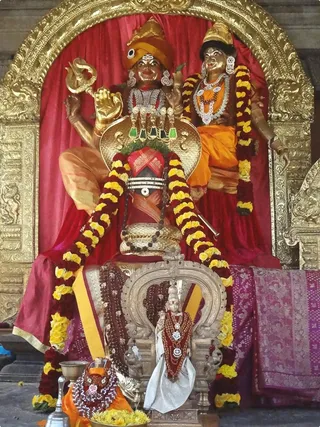
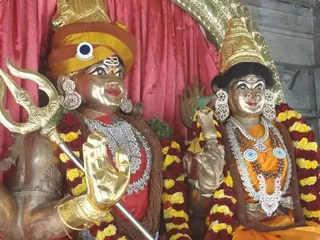
A photograph of a temple shrine with gold-framed arch and red drapery behind a group of painted or gilded deity statues. Two large figures stand above: the left one has four arms holding a trident and a drum-like object, wears a yellow turban and a silver necklace with green stones; the right one wears a gold crown, pearl and red-stone necklaces and an orange dhoti. In front, a seated figure wears a red and gold cloth with a yellow-garlanded body and a golden seat. Yellow and orange marigold garlands drape the statues. In the foreground a small silver lamp and a brass bowl sit beside flower petals and a red-and-white decorated pedestal figure. No living people are visible.Two golden metal statues of deity murti stand against a red curtain, decorated with red and yellow marigold garlands and silver ornaments. The figure on the left holds a trident in one hand and makes a raised hand gesture, wearing a yellow and orange turban with a blue-and-white disc, a red garment and silver necklaces. The figure on the right wears a tall golden crown, orange robes, a multi-strand silver and blue-bead necklace and large silver earrings, with one hand raised in a blessing gesture.

Darshan
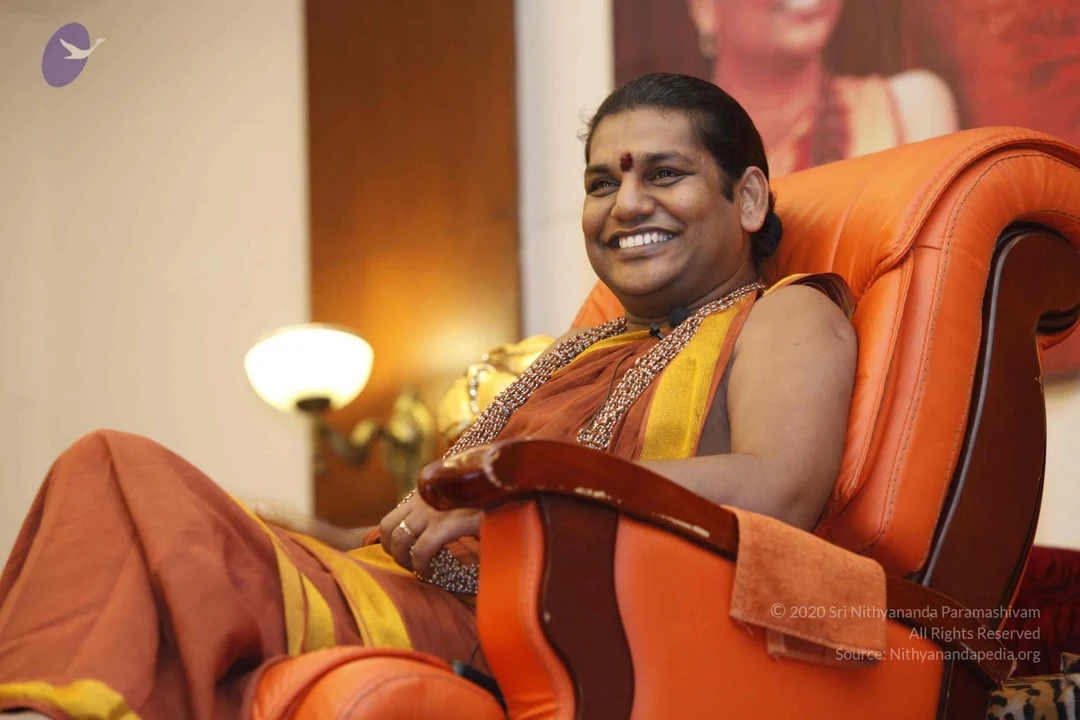
2 photosSource gallery

Nithya Satsang

6 photosSource gallery
A smiling man with slicked-back hair, a white vibhuti line with a red kumkum dot on his forehead, and a rudraksha-style gold bead necklace sits on a red and gold throne with golden lion-head armrests. He wears an orange and saffron garment with a gold border, gold bangles on his upper arms and wrists, and a small microphone clipped to his clothing. A large red and orange painted portrait hangs on the wall behind him, and a golden canopy frames the throne.A smiling man with swept-back dark hair sits on a golden throne with an ornate gold-embossed backrest, wearing an orange saffron garment with a gold border, rudraksha-style beaded malas and a large gold bead necklace, gold bangles on the arm, a gold earring, white and red forehead markings, and a small lapel microphone. A red-cushioned seat and a gold finial sit in the foreground, with a red and white backdrop behind.A man seated cross-legged on an ornate golden throne with a high gilded back and two golden lion-shaped armrests draped in red velvet and tiger-striped cloth. He wears orange-saffron robes with gold borders, multiple beaded gold necklaces, gold armbands and a red bindi, and gestures with one open hand while smiling during a talk. A red banner with gold lettering behind him is partly visible, and a microphone clip sits on his chest. a person: the flowing saffron robes, ornate gold necklaces and armbands, and the throne with his manner of speaking are consistent with a teacher giving a satsang discourse.A smiling man with closely cropped dark hair, a white vertical tilak and red bindi sits cross-legged on an ornate gold throne with a carved gold arch, draped over red velvet cushions and a tiger-striped cloth. He wears an orange-saffron dhoti and shawl with gold borders, bare arms with beaded bangles, and a long layered necklace of gold beads and rudraksha-style strands. A small microphone clips to his shawl. Behind him a red banner with partially visible white script reads of a religious event. a person: the seated figure has the bald-shaved head of a sannyasi-style presentation with orange robes and gold ornaments, but the cues are not distinctive enough to confirm identity.A seated man smiles broadly on an ornate gold throne with arched carved backrest, flanked by two gold lion sculptures. He wears a saffron-orange robe with gold border, a multi-strand bead necklace, gold armbands and a red tilak on his forehead, with a small microphone clipped near his collar. He rests his hands on red velvet cushions over a tiger-striped rug. Behind him a red banner with white lettering and a gold-lettered backdrop is visible. Appearance-based label: a person, seated in a satsang setting on the throne.

Satsang

24 photosSource gallery
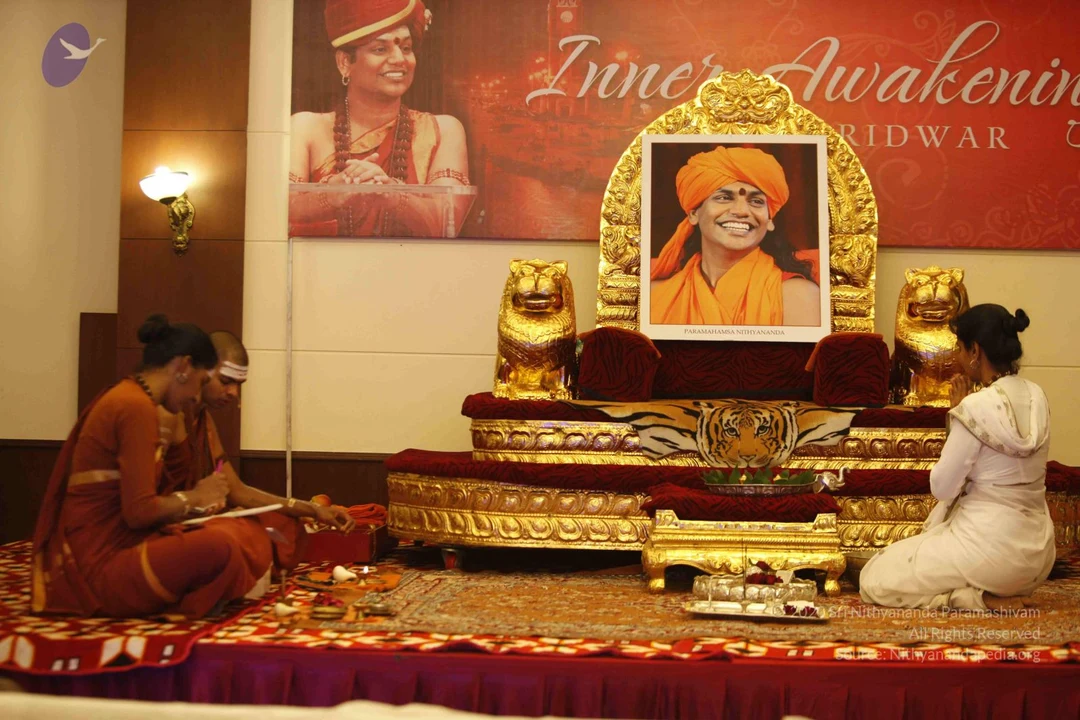
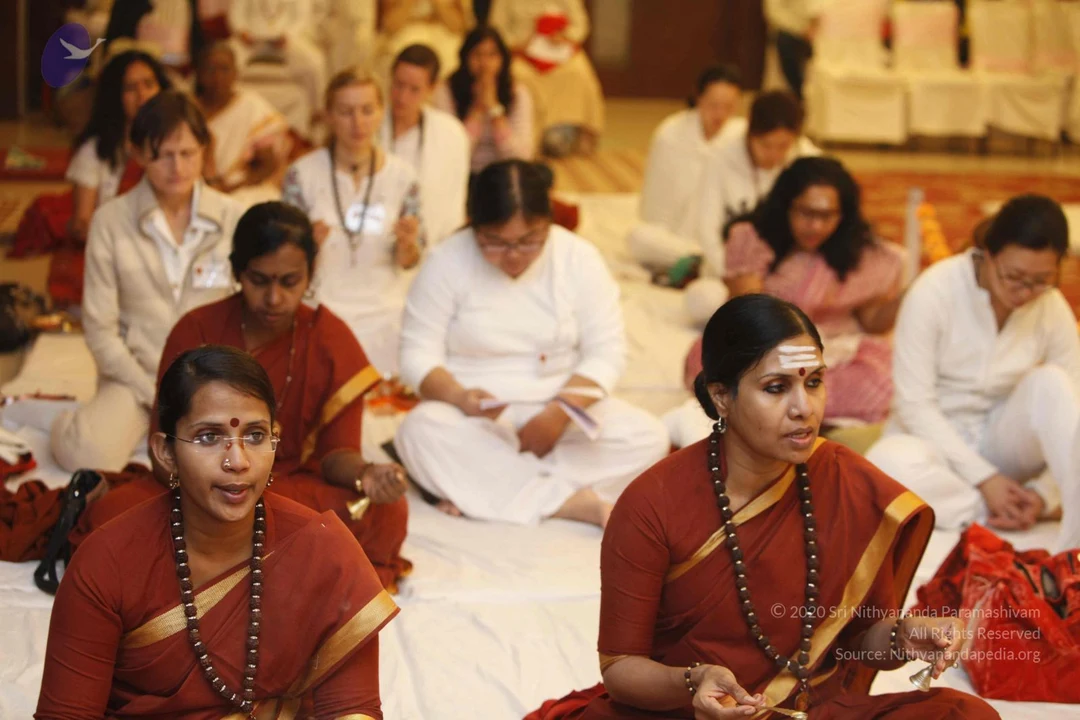
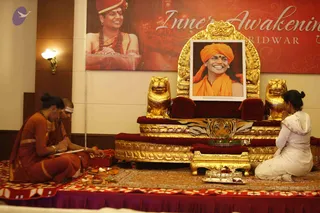
A close photograph of a hand holding a polished silver ritual lamp with five lit oil flames on a tiered base and curved ornamental arms. The blurred background shows warm orange and gold tones. No people's faces are visible and no one is identifiable as a person in the scene.Indoor ritual scene before a golden throne with lion-shaped armrests and a tiger-skin cloth draped across its seat. A framed portrait labelled "Paramahamsa Nithyananda" shows a smiling figure in saffron turban and saffron robe, placed above the throne. Two people in orange clothing sit cross-legged on the left, one with a white headband and one with a bun, holding a notebook and offerings. On the right, a woman in white kneels with folded hands before the throne. Trays of flowers and ritual items sit on the red-draped floor. Behind is a large red banner with a portrait of a woman in red and saffron, with a city skyline.Close photo of a woman's hand holding a small silver spoon or ritual vessel, her forearm extended in the foreground. She wears a white garment with a blue and red patterned sleeve, a dark rudraksha mala, and bangles. Out of focus behind her, an orange-draped seated figure and a teal cushion sit on a low wooden platform.A photograph of a seated satsang gathering on white floor sheets, with several women in white ritual clothing and a foreground pair of women in rust-red saris with gold borders and wooden rudraksha malas. The two foreground women sit close to the camera; one has a red bindi and nose stud, the other wears a white tilak on her forehead and holds a small brass bell or lamp in her hand. Behind them, women in white salwar or sari, some with eyes closed and some reading small booklets, sit in rows. A pale wall, white cloths and a red carpet edge frame the room. No clearly identifiable a person figure is visible.Close-up photo of a puja arrangement on an orange cloth. A hand in a rust-red robe holds an incense stick near a brass bowl of rose petals and a small brass incense holder with smoke rising. Brass plates hold red rose petals and a small oil lamp with a lit wick. A white conch shell sits beside scattered red petals and green leaves, and a folded orange cloth holds a beaded rudraksha-style mala with a red flower. The scene is set on a white cloth. A watermarked copyright line appears in the lower right corner.A seated devotional gathering in a hall with cream walls and white-covered chairs at the back. In the foreground, women sit on white sheets chanting; several wear dark red saris with gold borders and rudraksha malas, one with a white tilak on her forehead. A woman in a pink-and-red patterned sari reads from a small purple book, and a woman in white holds her hands in anjali. Some attendees wear white clothing, and a few men and women sit in the background among rows of chairs with pink and white covers. Marigold garlands lie along the mat edge. The scene suggests a satsang or group chanting session.

Darshan
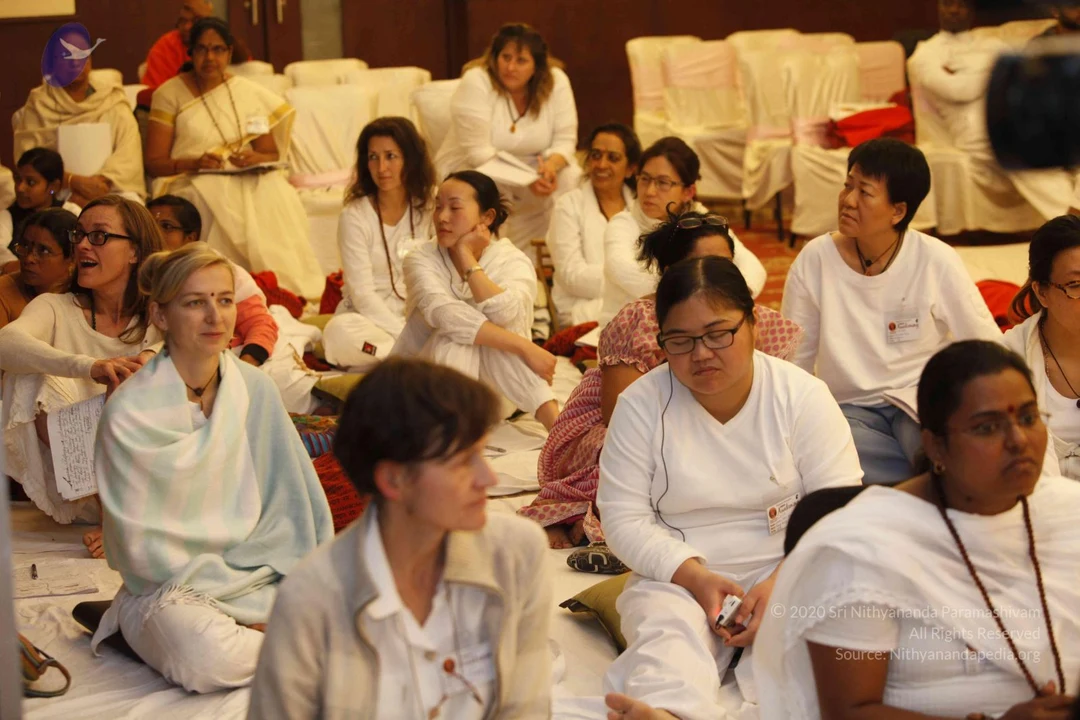
17 photosSource gallery
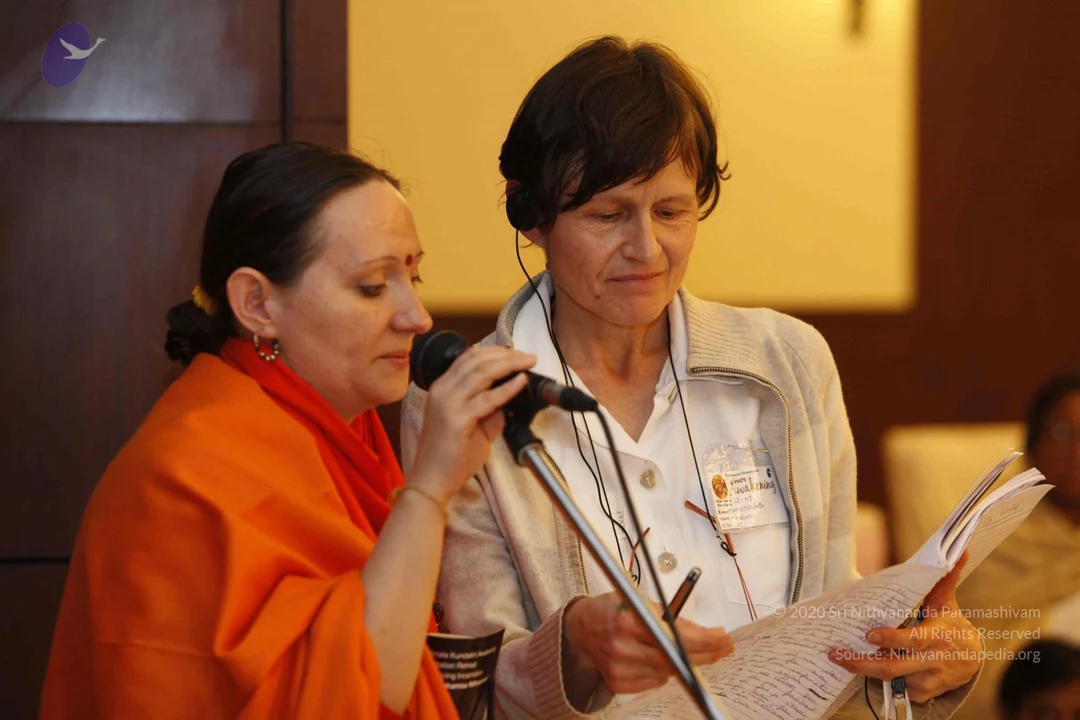
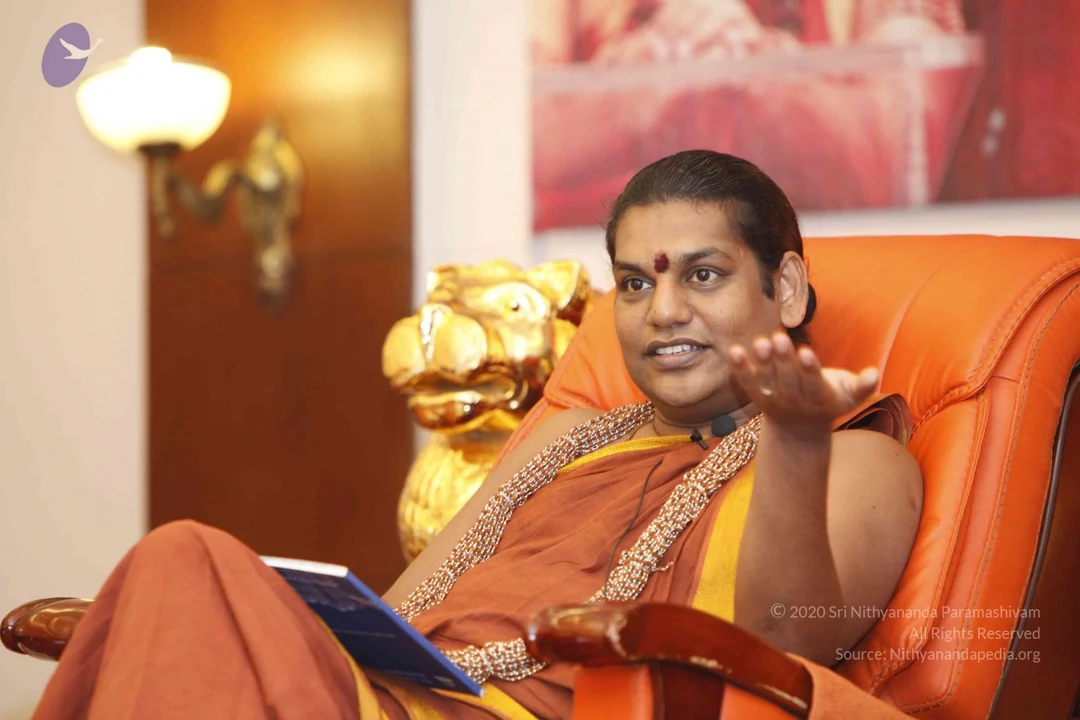
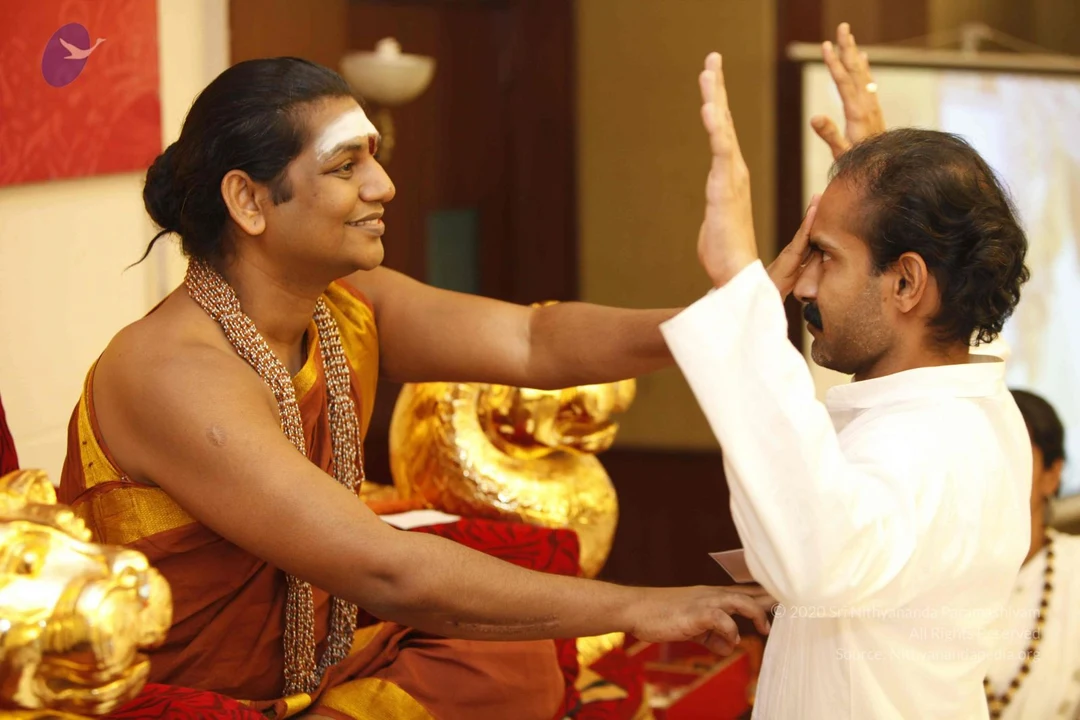
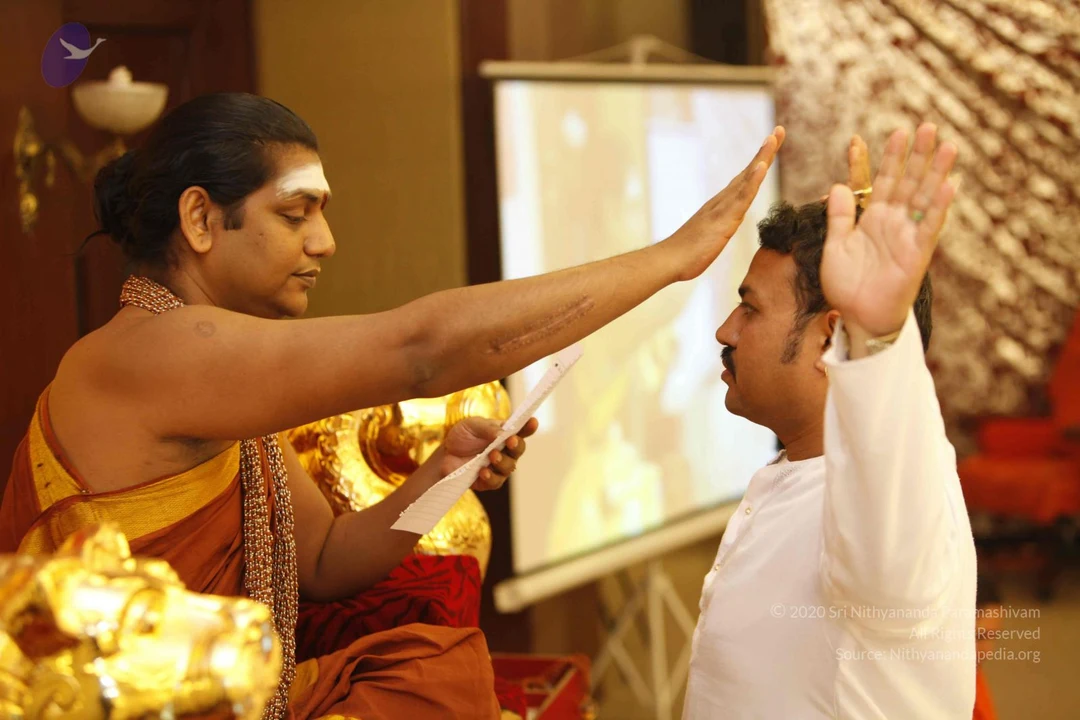
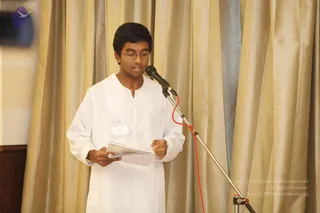
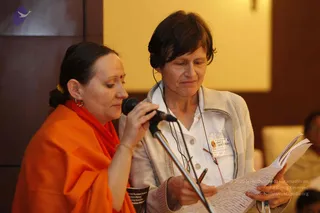
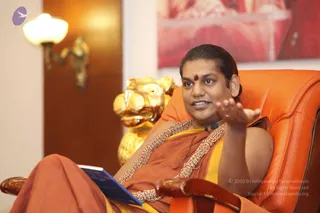
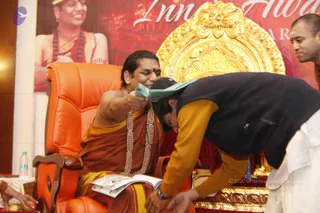
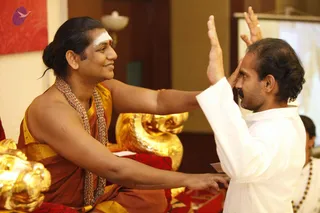
A young man with short dark hair and rectangular glasses stands at a microphone on a stand, reading from loose printed pages held in both hands. He wears a white kurta with subtle embroidered detailing and a small name badge on his chest. Behind him hang full gold-beige curtains, and a blurred dark object sits at the upper left. The setting looks like a hall or event room.Two women stand together at a microphone on a stand in a warmly lit room with dark wood panels. The woman on the left wears an orange-red shawl over an orange top, a red bindi and a dark hair bun, and speaks into the mic. The woman on the right wears a white collared shirt under a light grey zip cardigan, headphones and a lanyard badge, and holds an open printed booklet of handwritten pages while looking down at it. Partial figures appear at the right edge.A man seated in a large orange leather armchair speaks while gesturing with his right hand open, palm up. He wears a saffron-orange robe with a gold-yellow border, a red kumkum dot on his forehead, a rudraksha-style beaded necklace of pale beads, and a small clip microphone on his collar. A closed blue book rests on his lap. Behind him is a golden lion-shaped sculpture and a wall lamp, with a framed red and pink painting on the wall.A seated audience at a satsang gathering in a hotel-style hall with pink-and-cream chair covers stacked at the back. Dozens of devotees, mostly women, sit cross-legged on white floor sheets, dressed in white kurtas, salwar and white tops with rudraksha-style brown beaded malas. Several hold notebooks or pens and listen attentively; one woman in a pale green and white shawl sits at left, and a woman in a pink patterned salwar sits centre. A camera operator's lens is visible at the top right. No speaker or ceremonial figure is shown in frame, and no one is identifiable as the teacher.A seated man in an orange leather chair wears a rust-brown robe with a yellow-gold border and long silver-beaded ceremonial necklaces, and has a red tilak on his forehead; he extends his arm toward a bowing devotee in a black sleeveless vest over mustard-yellow top and white dhoti, who holds a light blue cloth. Behind them a large gold ornate throne back stands before a red banner with a photo of a smiling woman in red-and-white dress. A man in white kurta with a sandalwood tilak watches at right, and a printed book lies open on the seated man's lap. Seated figure matches the page's Swamiji (probable) cues: long swept-back hair, ceremonial beaded necklaces and saffron-toned robe, while the bowing devotee is a devotee offering a cloth.A photograph of a seated man in orange-and-gold silk clothing and a shawl, wearing layered rudraksha mala necklaces and a white sandalwood forehead mark, leaning forward and touching the forehead of a standing man in a white kurta and a grey shawl. Behind them are golden deity murti and a golden kalasha-like vessel, a red cloth, and a wooden background.

IA

10 photosSource gallery
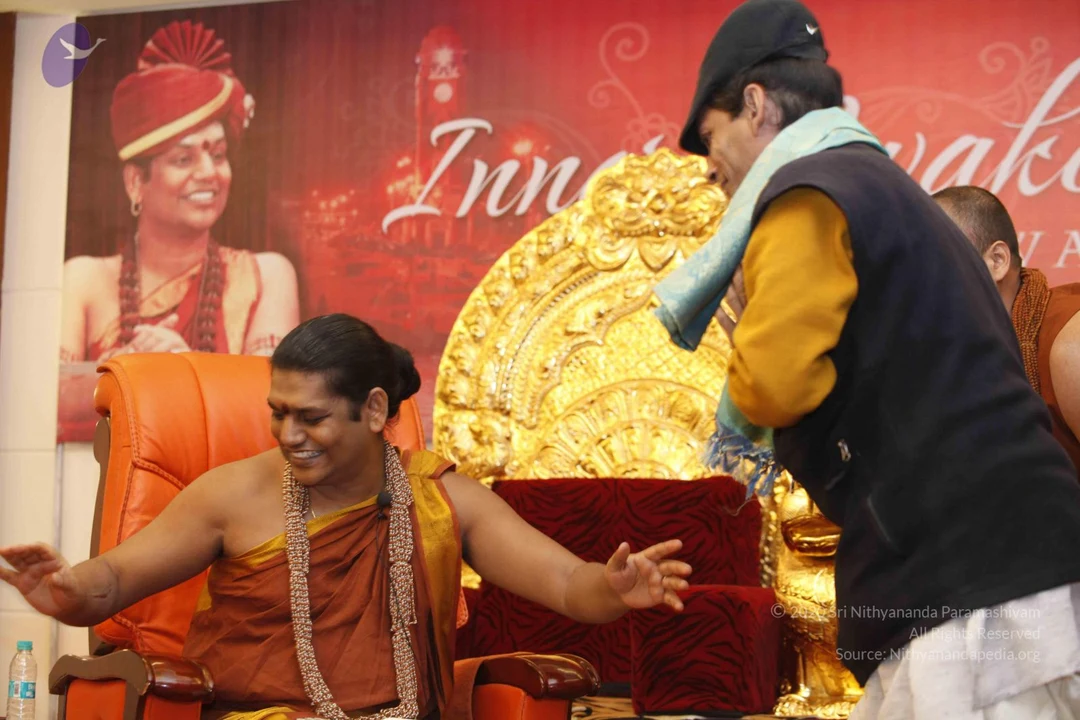
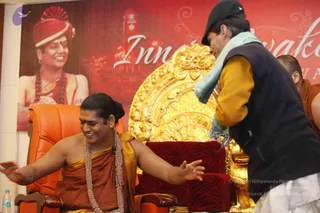
A young man with short dark hair and rectangular glasses stands at a microphone on a stand, reading from loose printed pages held in both hands. He wears a white kurta with subtle embroidered detailing and a small name badge on his chest. Behind him hang full gold-beige curtains, and a blurred dark object sits at the upper left. The setting looks like a hall or event room.Two women stand together at a microphone on a stand in a warmly lit room with dark wood panels. The woman on the left wears an orange-red shawl over an orange top, a red bindi and a dark hair bun, and speaks into the mic. The woman on the right wears a white collared shirt under a light grey zip cardigan, headphones and a lanyard badge, and holds an open printed booklet of handwritten pages while looking down at it. Partial figures appear at the right edge.A man seated in a large orange leather armchair speaks while gesturing with his right hand open, palm up. He wears a saffron-orange robe with a gold-yellow border, a red kumkum dot on his forehead, a rudraksha-style beaded necklace of pale beads, and a small clip microphone on his collar. A closed blue book rests on his lap. Behind him is a golden lion-shaped sculpture and a wall lamp, with a framed red and pink painting on the wall.A seated audience at a satsang gathering in a hotel-style hall with pink-and-cream chair covers stacked at the back. Dozens of devotees, mostly women, sit cross-legged on white floor sheets, dressed in white kurtas, salwar and white tops with rudraksha-style brown beaded malas. Several hold notebooks or pens and listen attentively; one woman in a pale green and white shawl sits at left, and a woman in a pink patterned salwar sits centre. A camera operator's lens is visible at the top right. No speaker or ceremonial figure is shown in frame, and no one is identifiable as the teacher.A seated man in an orange leather chair wears a rust-brown robe with a yellow-gold border and long silver-beaded ceremonial necklaces, and has a red tilak on his forehead; he extends his arm toward a bowing devotee in a black sleeveless vest over mustard-yellow top and white dhoti, who holds a light blue cloth. Behind them a large gold ornate throne back stands before a red banner with a photo of a smiling woman in red-and-white dress. A man in white kurta with a sandalwood tilak watches at right, and a printed book lies open on the seated man's lap. Seated figure matches the page's Swamiji (probable) cues: long swept-back hair, ceremonial beaded necklaces and saffron-toned robe, while the bowing devotee is a devotee offering a cloth.Photograph at a satsang event: a smiling man with hair tied in a bun, wearing an orange-brown dhoti-style garment with gold trim and a long white beaded mala, sits in an orange leather chair with arms outstretched. Beside him a man in a dark navy vest over a mustard-yellow top and a light blue scarf bends forward toward him, and a bald man in orange robes is partly visible at right. Behind them a golden ornate throne with red cushions stands before a red backdrop showing a portrait of a smiling woman in a red turban and a cityscape, with large decorative lettering. A water bottle sits at left. A portrait on the backdrop shows a figure in red turban and saffron clothing.

Satsang

24 photosSource gallery
A close photograph of a hand holding a polished silver ritual lamp with five lit oil flames on a tiered base and curved ornamental arms. The blurred background shows warm orange and gold tones. No people's faces are visible and no one is identifiable as a person in the scene.Indoor ritual scene before a golden throne with lion-shaped armrests and a tiger-skin cloth draped across its seat. A framed portrait labelled "Paramahamsa Nithyananda" shows a smiling figure in saffron turban and saffron robe, placed above the throne. Two people in orange clothing sit cross-legged on the left, one with a white headband and one with a bun, holding a notebook and offerings. On the right, a woman in white kneels with folded hands before the throne. Trays of flowers and ritual items sit on the red-draped floor. Behind is a large red banner with a portrait of a woman in red and saffron, with a city skyline.Close photo of a woman's hand holding a small silver spoon or ritual vessel, her forearm extended in the foreground. She wears a white garment with a blue and red patterned sleeve, a dark rudraksha mala, and bangles. Out of focus behind her, an orange-draped seated figure and a teal cushion sit on a low wooden platform.A photograph of a seated satsang gathering on white floor sheets, with several women in white ritual clothing and a foreground pair of women in rust-red saris with gold borders and wooden rudraksha malas. The two foreground women sit close to the camera; one has a red bindi and nose stud, the other wears a white tilak on her forehead and holds a small brass bell or lamp in her hand. Behind them, women in white salwar or sari, some with eyes closed and some reading small booklets, sit in rows. A pale wall, white cloths and a red carpet edge frame the room. No clearly identifiable a person figure is visible.Close-up photo of a puja arrangement on an orange cloth. A hand in a rust-red robe holds an incense stick near a brass bowl of rose petals and a small brass incense holder with smoke rising. Brass plates hold red rose petals and a small oil lamp with a lit wick. A white conch shell sits beside scattered red petals and green leaves, and a folded orange cloth holds a beaded rudraksha-style mala with a red flower. The scene is set on a white cloth. A watermarked copyright line appears in the lower right corner.A seated devotional gathering in a hall with cream walls and white-covered chairs at the back. In the foreground, women sit on white sheets chanting; several wear dark red saris with gold borders and rudraksha malas, one with a white tilak on her forehead. A woman in a pink-and-red patterned sari reads from a small purple book, and a woman in white holds her hands in anjali. Some attendees wear white clothing, and a few men and women sit in the background among rows of chairs with pink and white covers. Marigold garlands lie along the mat edge. The scene suggests a satsang or group chanting session.

Darshan
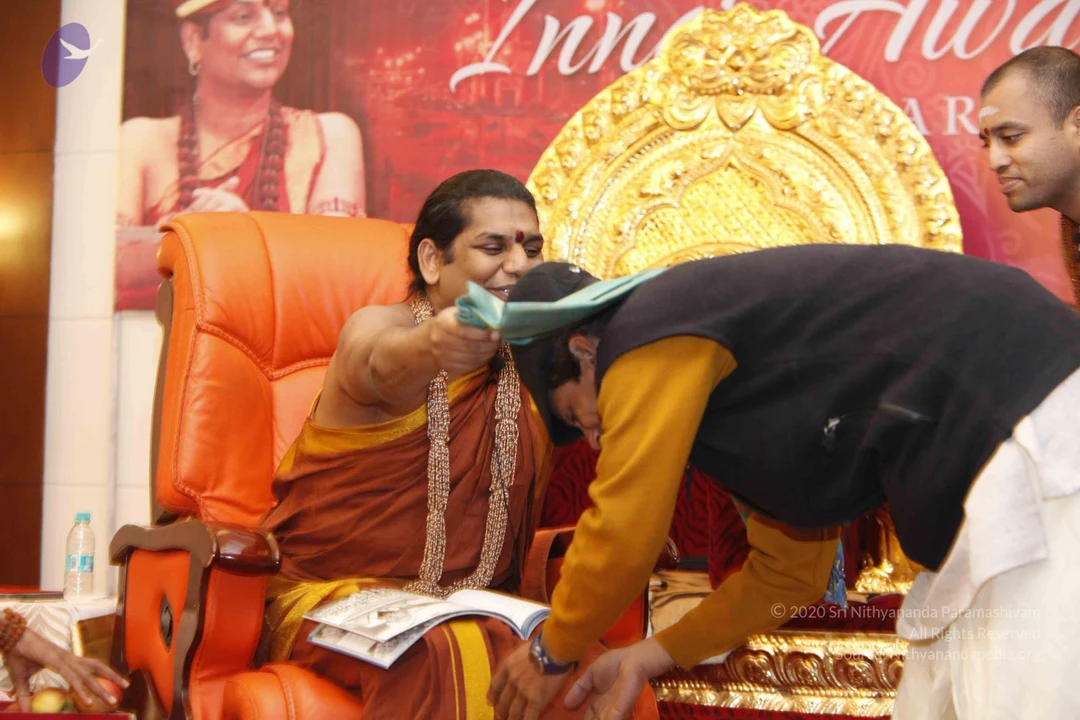
17 photosSource gallery
A young man with short dark hair and rectangular glasses stands at a microphone on a stand, reading from loose printed pages held in both hands. He wears a white kurta with subtle embroidered detailing and a small name badge on his chest. Behind him hang full gold-beige curtains, and a blurred dark object sits at the upper left. The setting looks like a hall or event room.Two women stand together at a microphone on a stand in a warmly lit room with dark wood panels. The woman on the left wears an orange-red shawl over an orange top, a red bindi and a dark hair bun, and speaks into the mic. The woman on the right wears a white collared shirt under a light grey zip cardigan, headphones and a lanyard badge, and holds an open printed booklet of handwritten pages while looking down at it. Partial figures appear at the right edge.A man seated in a large orange leather armchair speaks while gesturing with his right hand open, palm up. He wears a saffron-orange robe with a gold-yellow border, a red kumkum dot on his forehead, a rudraksha-style beaded necklace of pale beads, and a small clip microphone on his collar. A closed blue book rests on his lap. Behind him is a golden lion-shaped sculpture and a wall lamp, with a framed red and pink painting on the wall.A seated audience at a satsang gathering in a hotel-style hall with pink-and-cream chair covers stacked at the back. Dozens of devotees, mostly women, sit cross-legged on white floor sheets, dressed in white kurtas, salwar and white tops with rudraksha-style brown beaded malas. Several hold notebooks or pens and listen attentively; one woman in a pale green and white shawl sits at left, and a woman in a pink patterned salwar sits centre. A camera operator's lens is visible at the top right. No speaker or ceremonial figure is shown in frame, and no one is identifiable as the teacher.A seated man in an orange leather chair wears a rust-brown robe with a yellow-gold border and long silver-beaded ceremonial necklaces, and has a red tilak on his forehead; he extends his arm toward a bowing devotee in a black sleeveless vest over mustard-yellow top and white dhoti, who holds a light blue cloth. Behind them a large gold ornate throne back stands before a red banner with a photo of a smiling woman in red-and-white dress. A man in white kurta with a sandalwood tilak watches at right, and a printed book lies open on the seated man's lap. Seated figure matches the page's Swamiji (probable) cues: long swept-back hair, ceremonial beaded necklaces and saffron-toned robe, while the bowing devotee is a devotee offering a cloth.A photograph of a seated man in orange-and-gold silk clothing and a shawl, wearing layered rudraksha mala necklaces and a white sandalwood forehead mark, leaning forward and touching the forehead of a standing man in a white kurta and a grey shawl. Behind them are golden deity murti and a golden kalasha-like vessel, a red cloth, and a wooden background.

Inner-Awakening

10 photosSource gallery
A young man with short dark hair and rectangular glasses stands at a microphone on a stand, reading from loose printed pages held in both hands. He wears a white kurta with subtle embroidered detailing and a small name badge on his chest. Behind him hang full gold-beige curtains, and a blurred dark object sits at the upper left. The setting looks like a hall or event room.Two women stand together at a microphone on a stand in a warmly lit room with dark wood panels. The woman on the left wears an orange-red shawl over an orange top, a red bindi and a dark hair bun, and speaks into the mic. The woman on the right wears a white collared shirt under a light grey zip cardigan, headphones and a lanyard badge, and holds an open printed booklet of handwritten pages while looking down at it. Partial figures appear at the right edge.A man seated in a large orange leather armchair speaks while gesturing with his right hand open, palm up. He wears a saffron-orange robe with a gold-yellow border, a red kumkum dot on his forehead, a rudraksha-style beaded necklace of pale beads, and a small clip microphone on his collar. A closed blue book rests on his lap. Behind him is a golden lion-shaped sculpture and a wall lamp, with a framed red and pink painting on the wall.A seated audience at a satsang gathering in a hotel-style hall with pink-and-cream chair covers stacked at the back. Dozens of devotees, mostly women, sit cross-legged on white floor sheets, dressed in white kurtas, salwar and white tops with rudraksha-style brown beaded malas. Several hold notebooks or pens and listen attentively; one woman in a pale green and white shawl sits at left, and a woman in a pink patterned salwar sits centre. A camera operator's lens is visible at the top right. No speaker or ceremonial figure is shown in frame, and no one is identifiable as the teacher.A seated man in an orange leather chair wears a rust-brown robe with a yellow-gold border and long silver-beaded ceremonial necklaces, and has a red tilak on his forehead; he extends his arm toward a bowing devotee in a black sleeveless vest over mustard-yellow top and white dhoti, who holds a light blue cloth. Behind them a large gold ornate throne back stands before a red banner with a photo of a smiling woman in red-and-white dress. A man in white kurta with a sandalwood tilak watches at right, and a printed book lies open on the seated man's lap. Seated figure matches the page's Swamiji (probable) cues: long swept-back hair, ceremonial beaded necklaces and saffron-toned robe, while the bowing devotee is a devotee offering a cloth.Photograph at a satsang event: a smiling man with hair tied in a bun, wearing an orange-brown dhoti-style garment with gold trim and a long white beaded mala, sits in an orange leather chair with arms outstretched. Beside him a man in a dark navy vest over a mustard-yellow top and a light blue scarf bends forward toward him, and a bald man in orange robes is partly visible at right. Behind them a golden ornate throne with red cushions stands before a red backdrop showing a portrait of a smiling woman in a red turban and a cityscape, with large decorative lettering. A water bottle sits at left. A portrait on the backdrop shows a figure in red turban and saffron clothing.

January 07 2014

5 photosView all
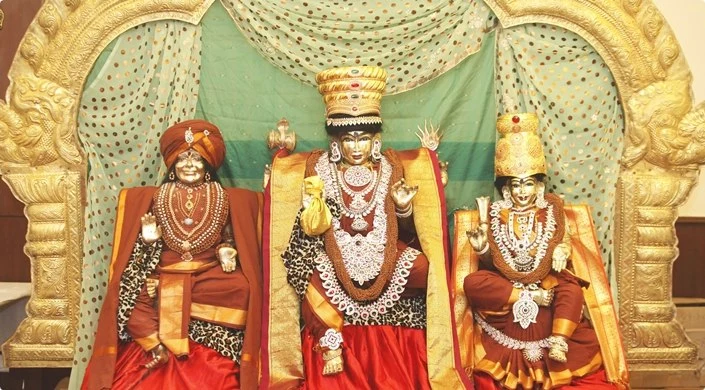
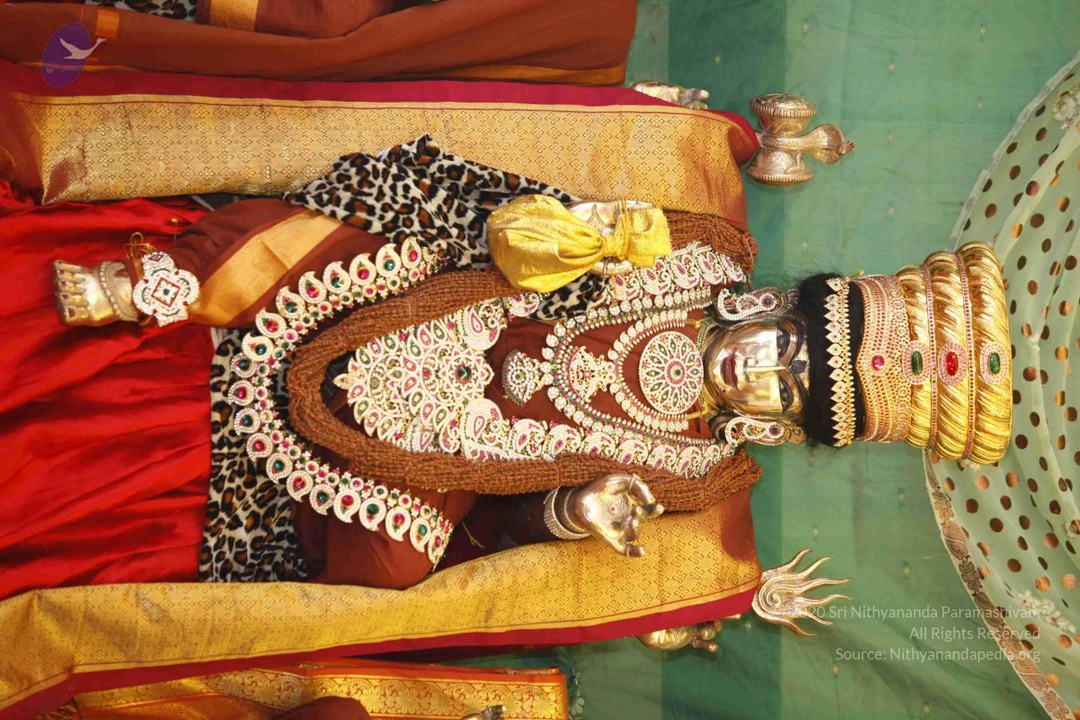
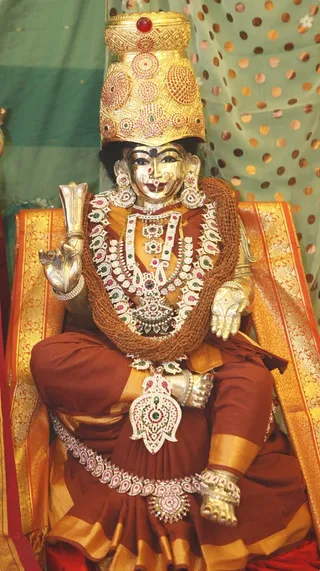
A silver-faced deity murti seated on a throne-like seat draped in gold-bordered maroon and red cloth, against a green backdrop with a polka-dot cloth canopy above. The murti wears an elaborate gold crown set with red and green stones, layered jewelled necklaces, a rudraksha-style mala, a leopard-print shawl and a red skirt. It holds a yellow silk pouch in one hand and makes a blessing gesture with the other. Silver trident-like and cobra-shaped ornaments flank the seat. No physical people are visible.A seated golden metal deity murti. It has a jewelled necklace of red, green and white stones, large dangling earrings, and a brown beaded shawl draped over the shoulders. It wears a rust-brown and gold sari, with a gold-bordered cloth on the throne behind it and a green and gold polka-dot backdrop. The raised hand displays a mudra. No physical people are visible.A gold-painted statue of a seated guru figure in a rust-red turban with gold ornaments, wearing layered rudraksha and bead malas with a gold pendant, rust-red robes with gold borders, and a leopard-print shawl. The right hand is raised in abhaya mudra and the left rests on the lap; the feet are gold. The statue sits on a red cloth and leopard-print cushion before a green backdrop with copper polka dots. No physical people are visible.A brown cow stands in a shed with a blue tarpaulin roof and bamboo poles, with a small brown calf beside her, its ear tagged with a white cord. Dark cattle are visible in the background. The calf is on a concrete floor with straw scattered around. No people are visible.A gilded statue of a standing male sage in an ornate golden shrine niche draped with yellow fabric printed with silver floral motifs. The figure wears a rust-red woven turban with a red tilak, layered rudraksha malas with jewelled silver ornaments, a red and gold striped waist cloth, and a silver pendant. The right hand is raised in blessing. Statue only; no physical people present.