Skip to content
Tuesday

30 July 2013

Completion-Science of Eternal Bliss

Dated photos
171
Source pages
1
Media
2
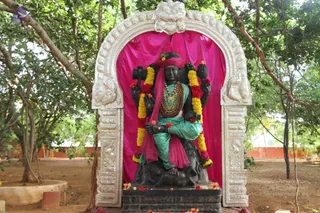
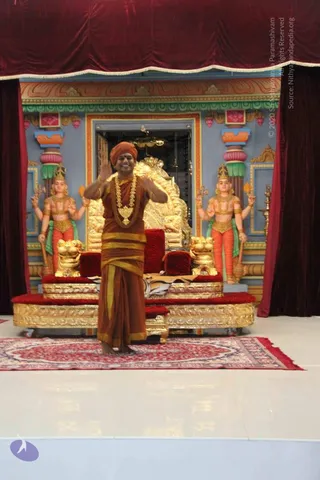
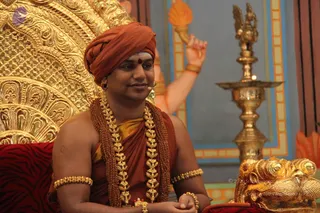
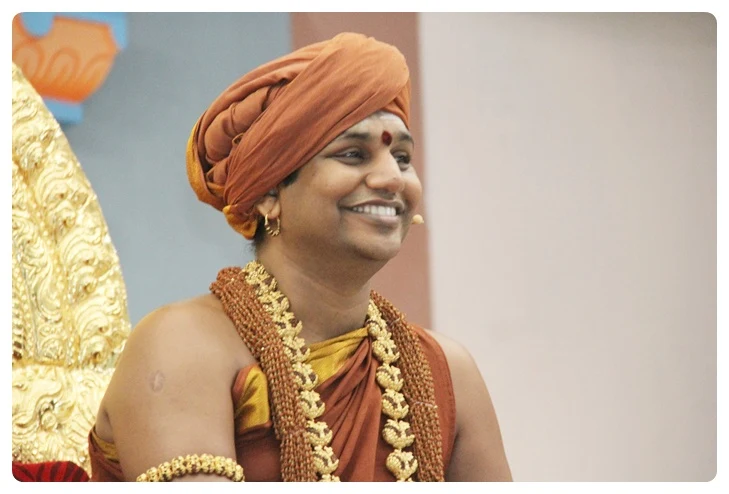
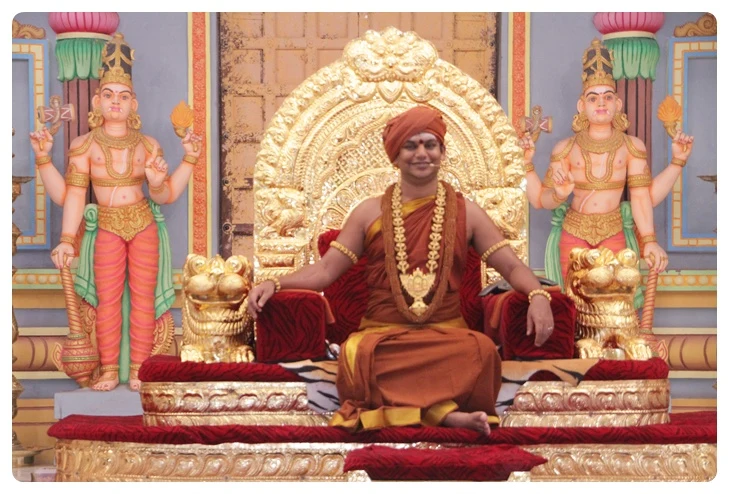
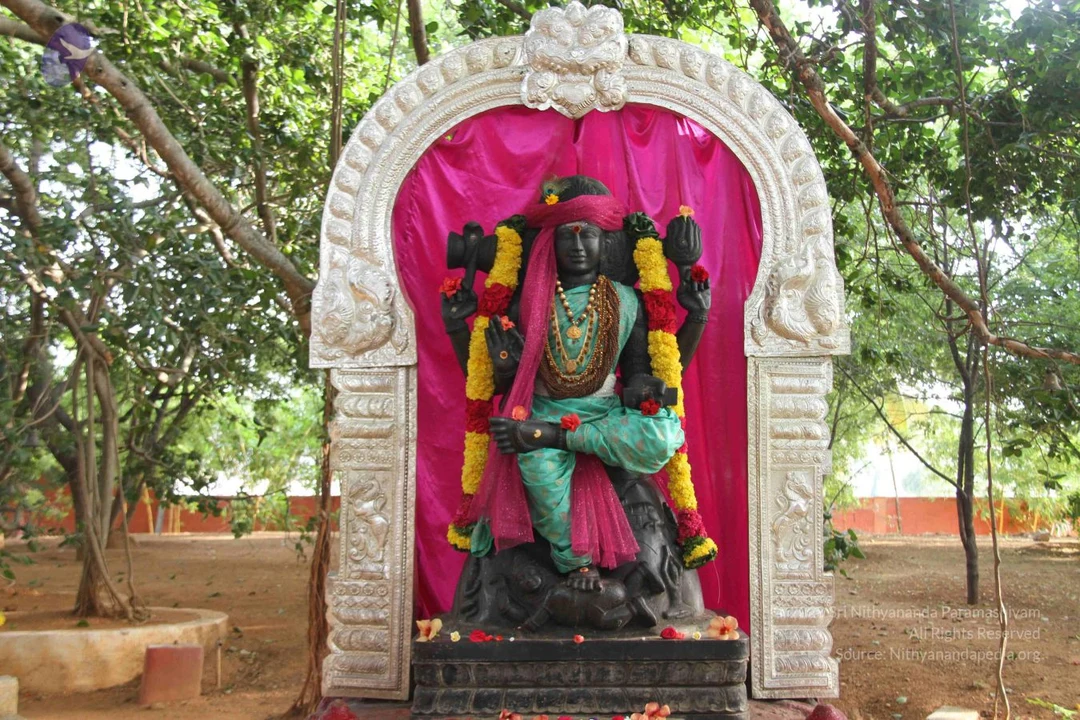
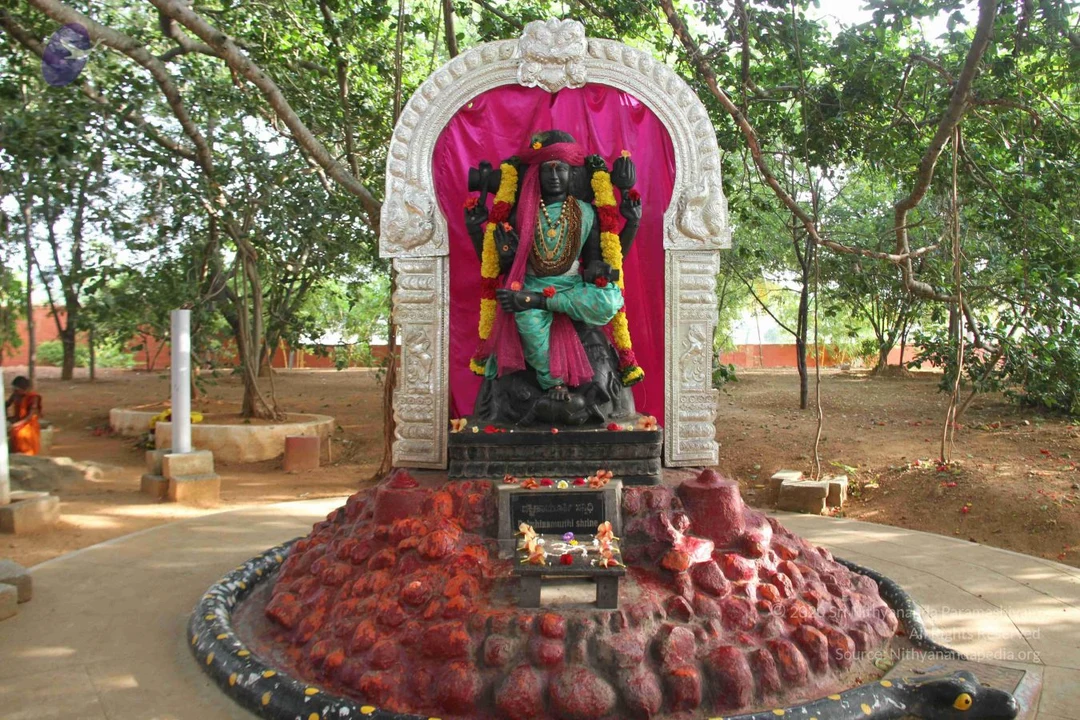
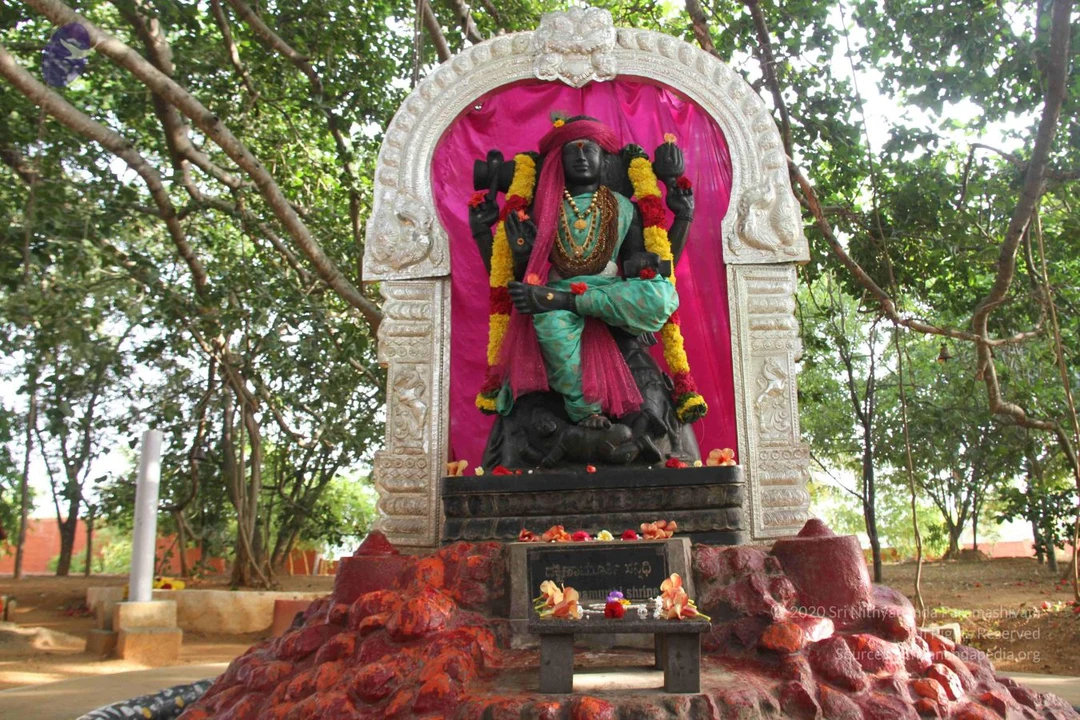
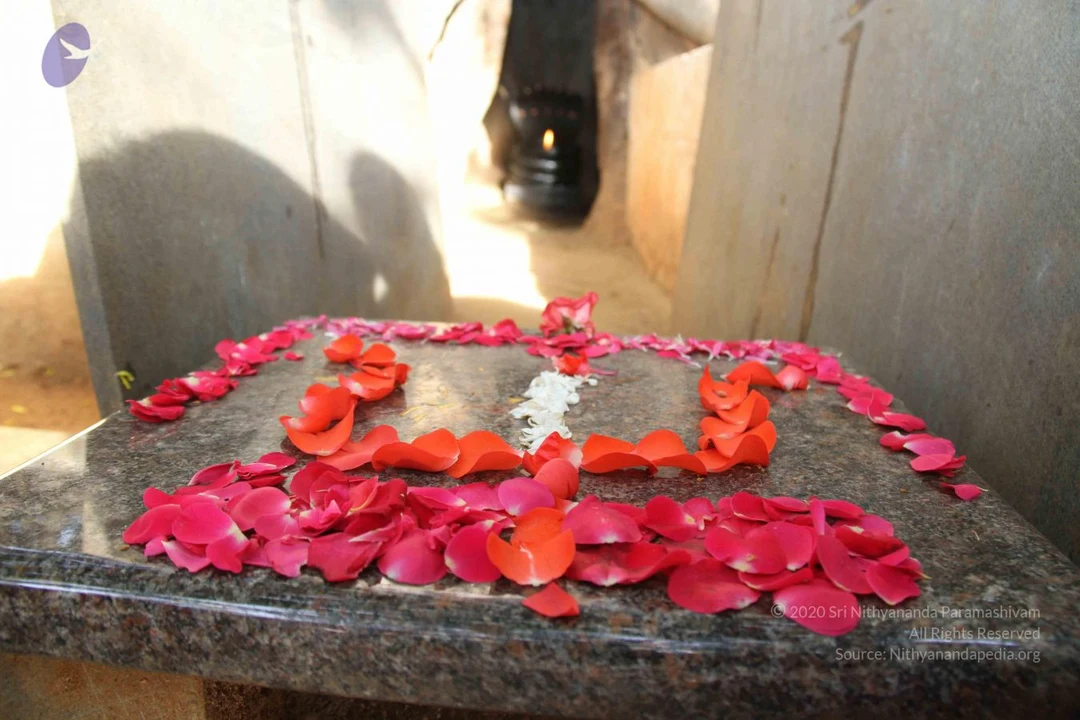
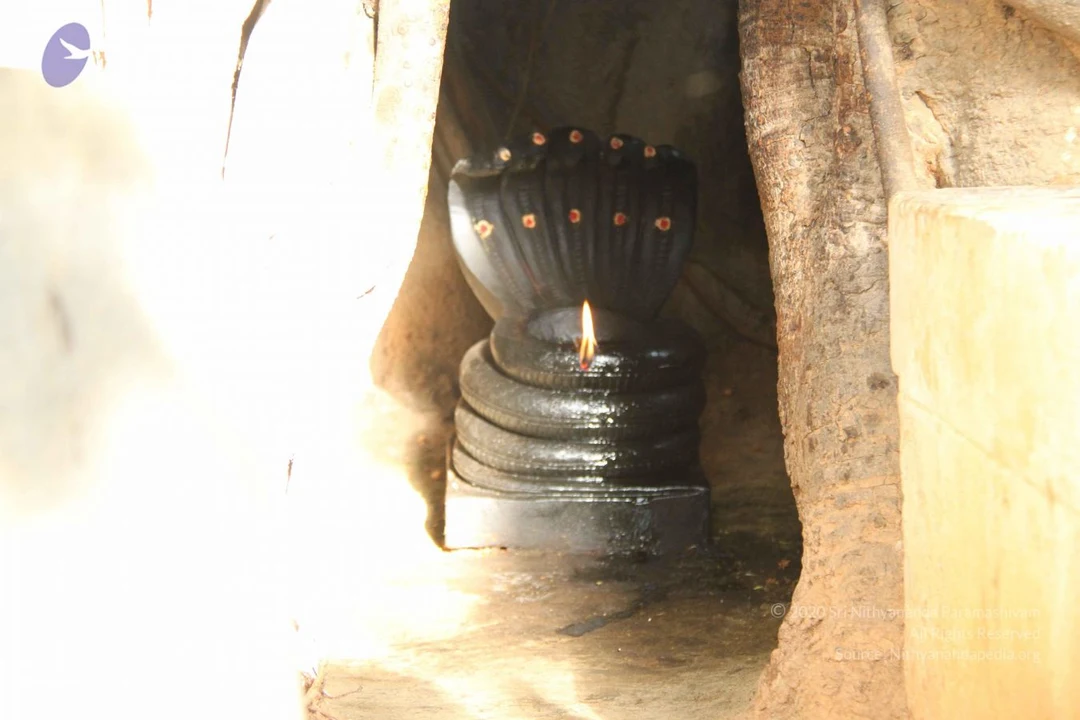
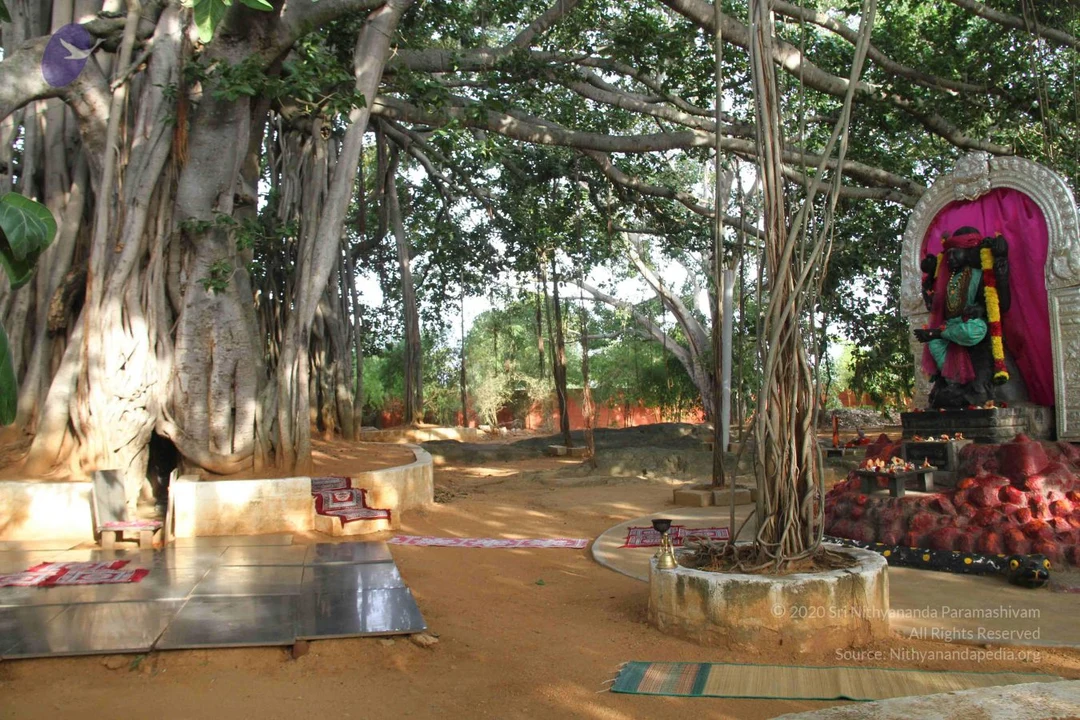
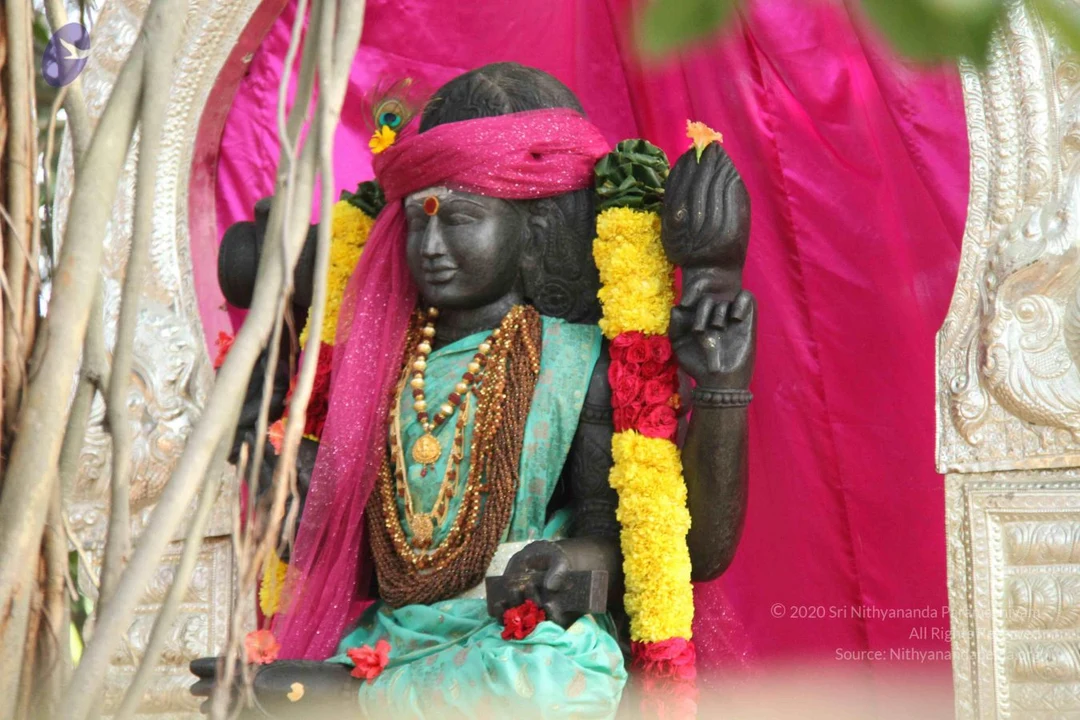
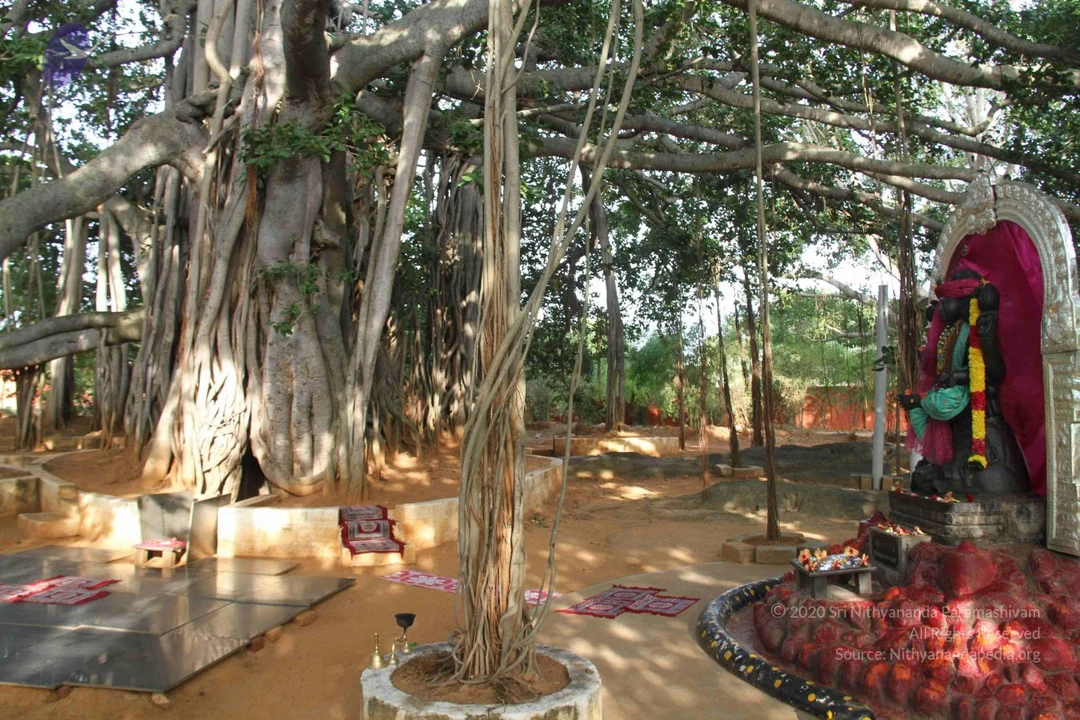
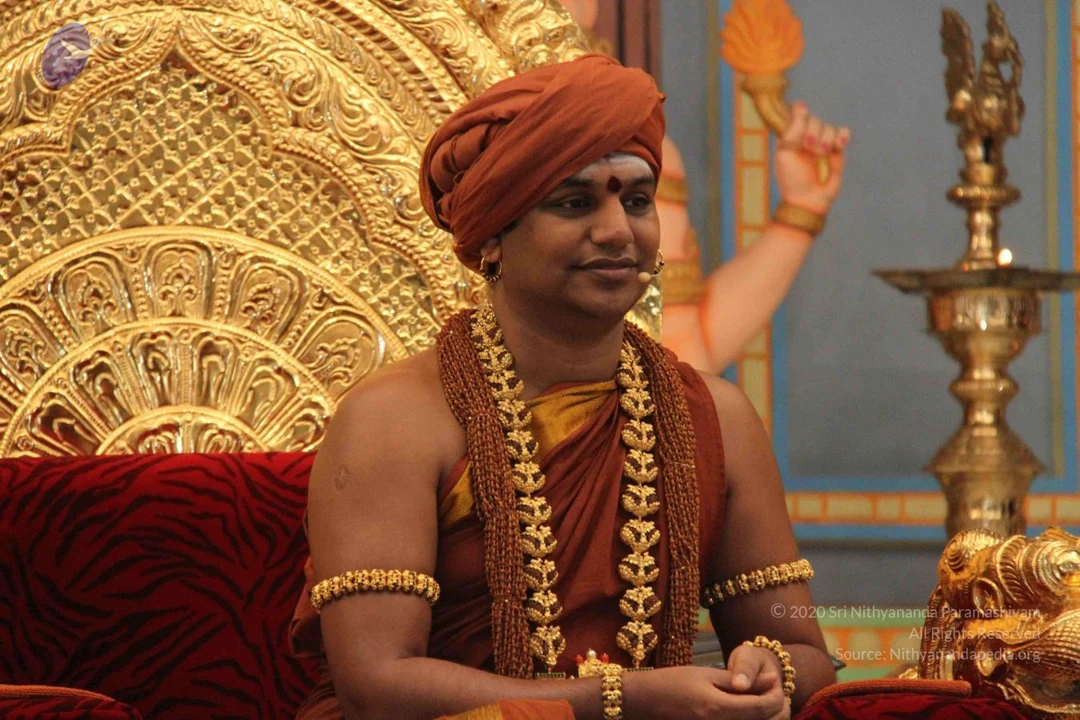
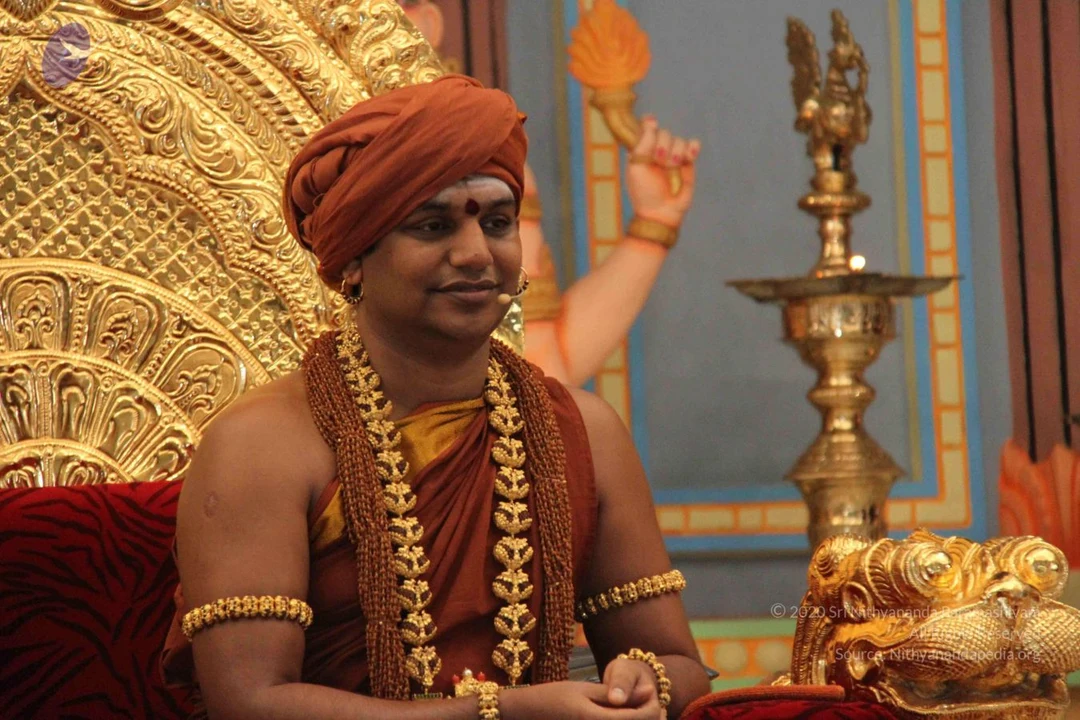
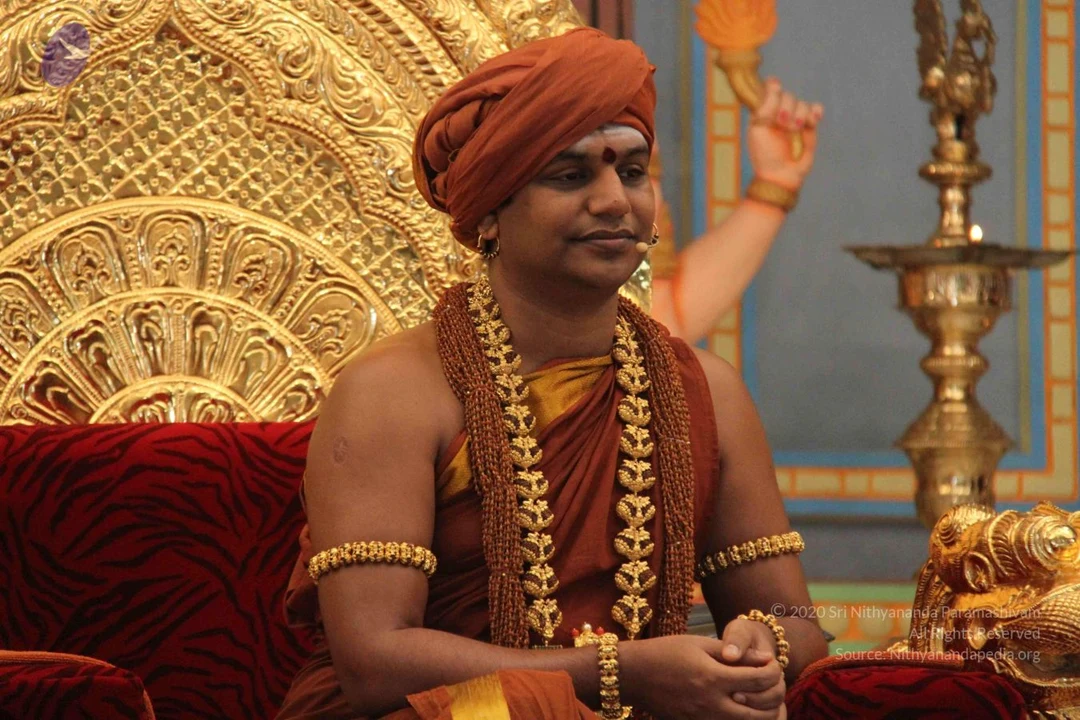
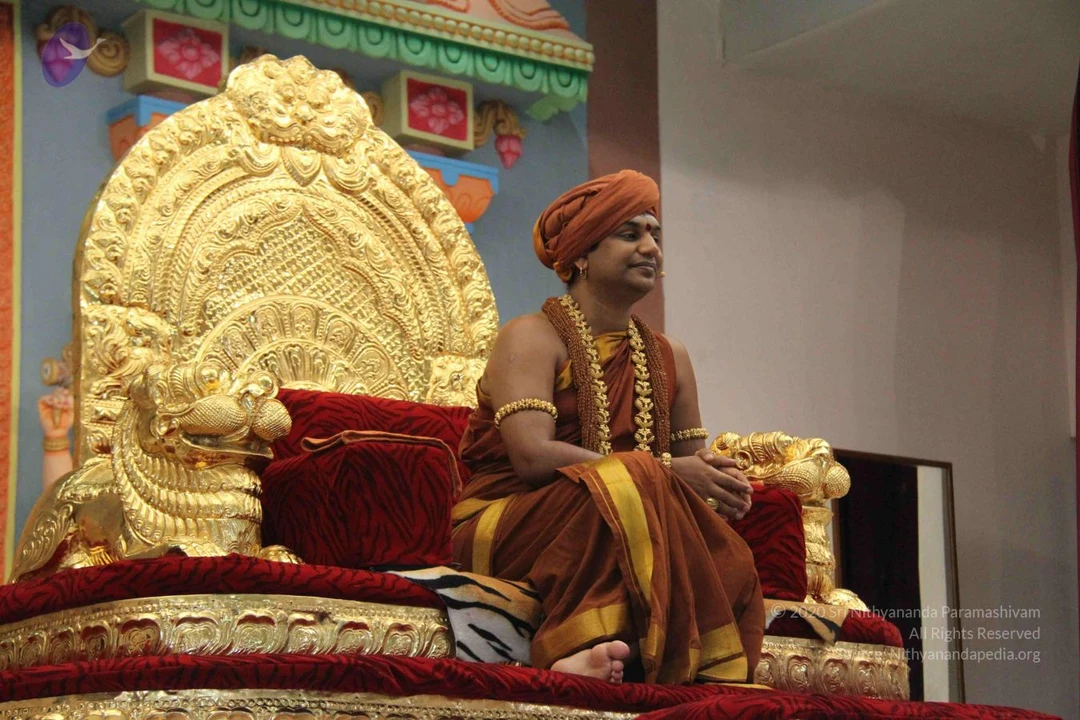
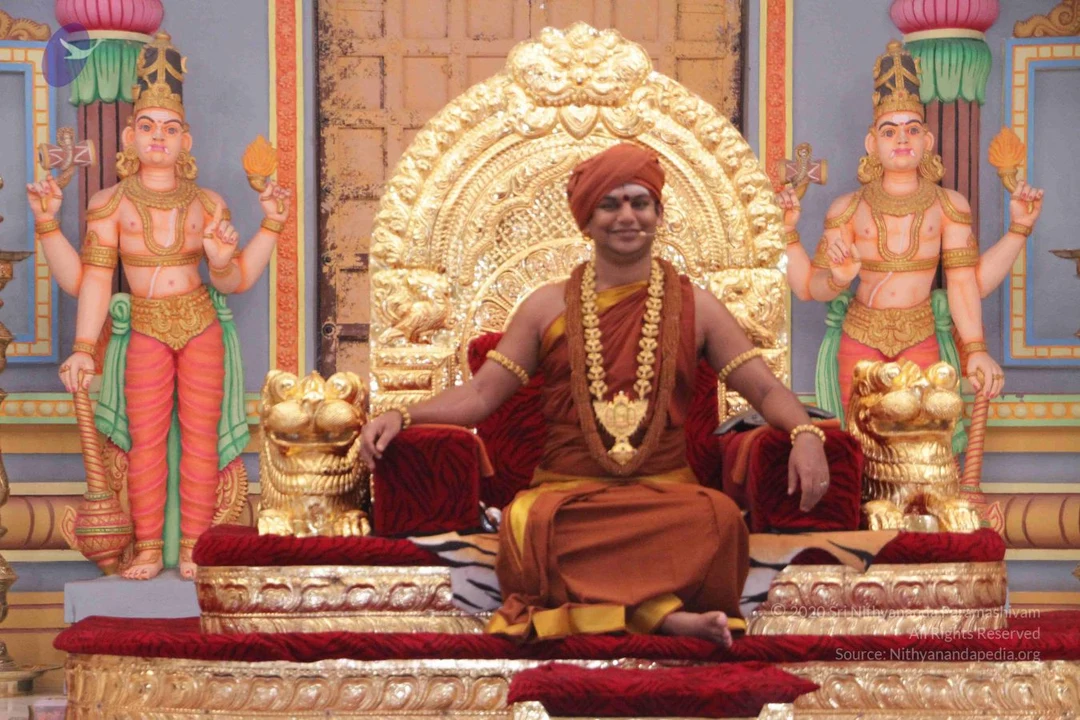
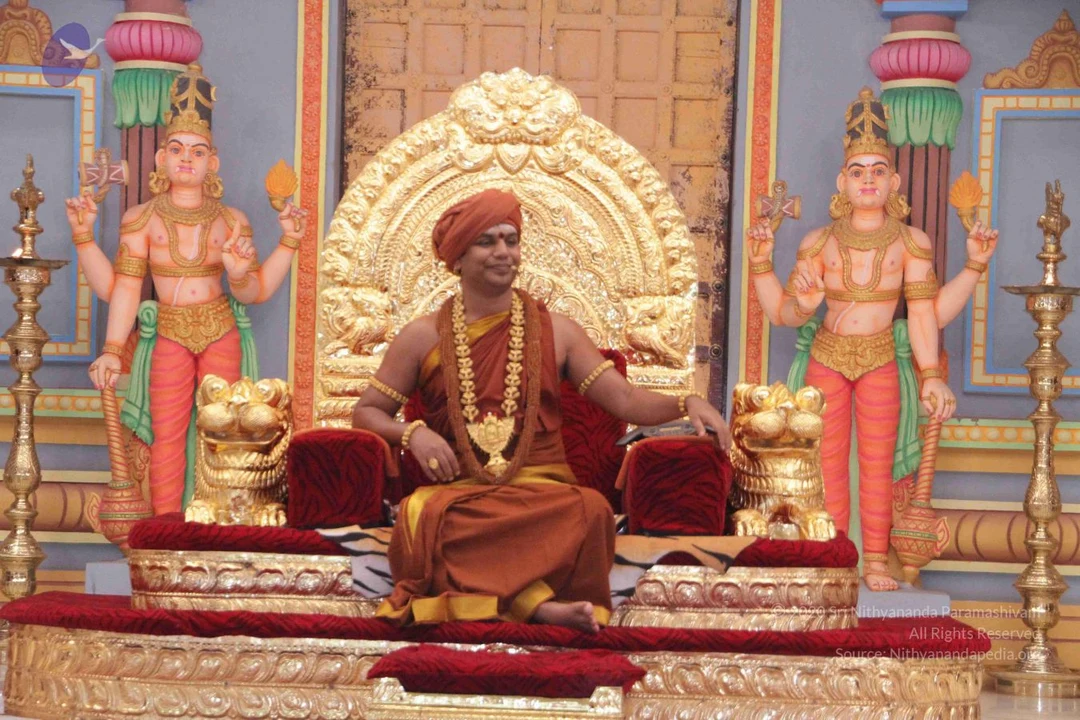
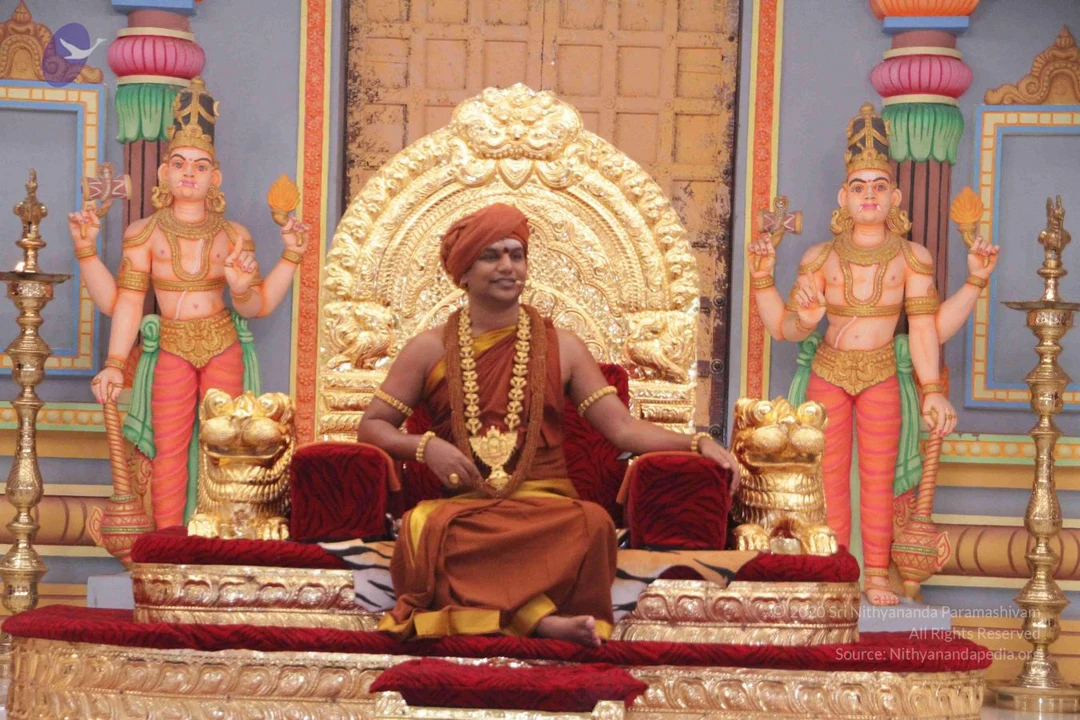
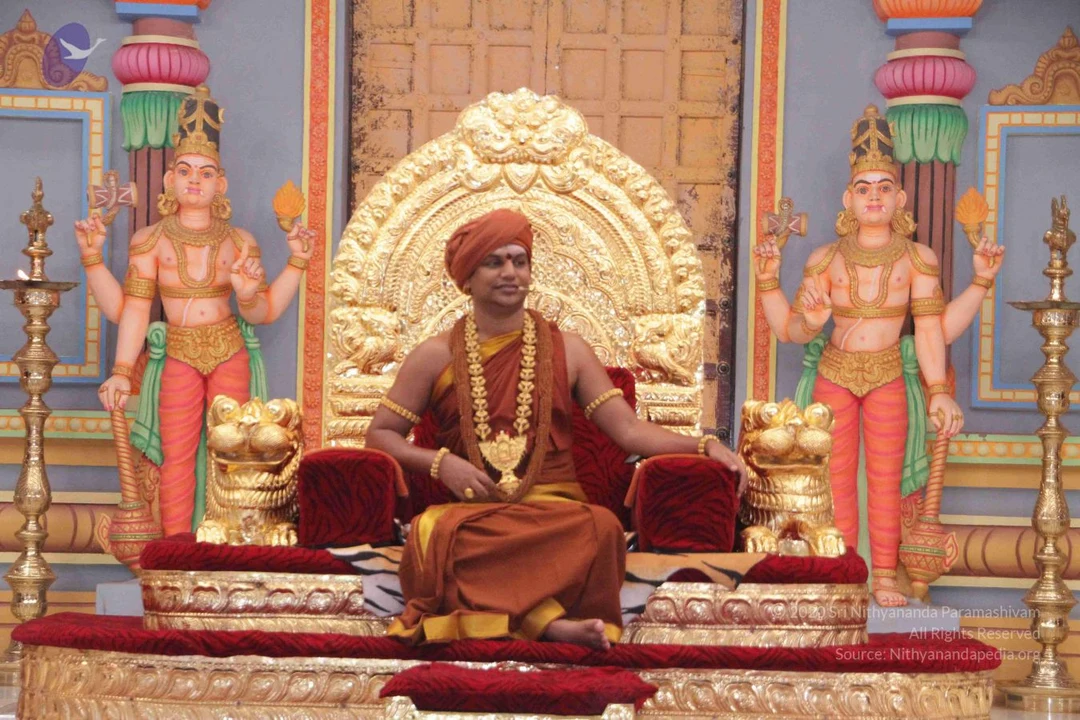
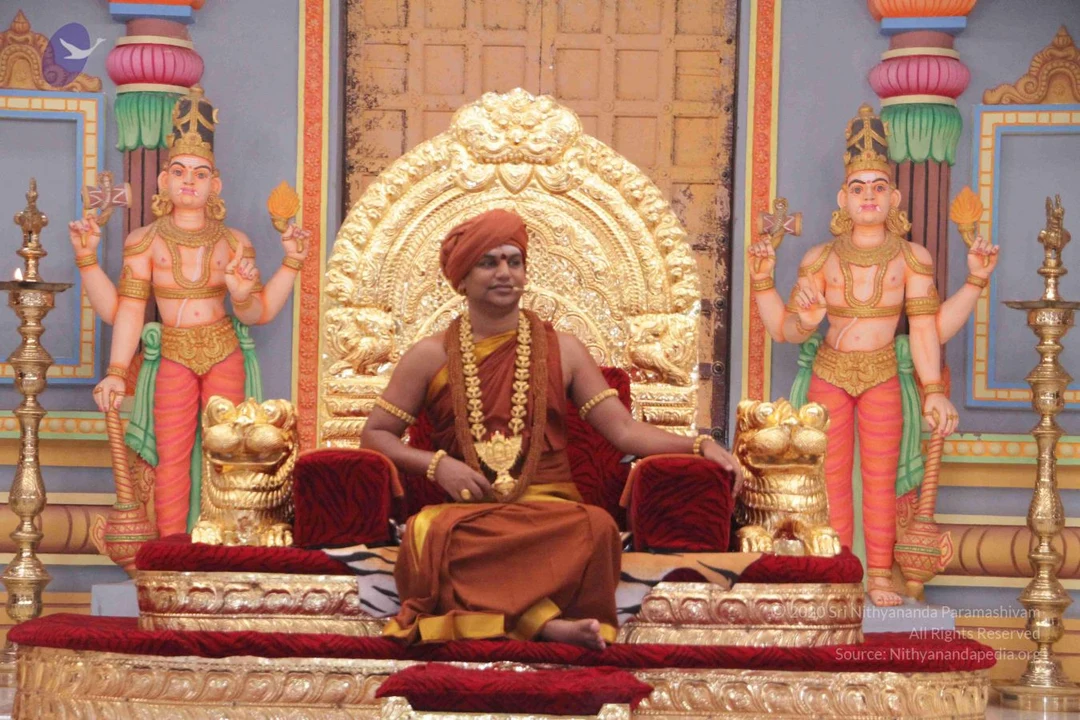
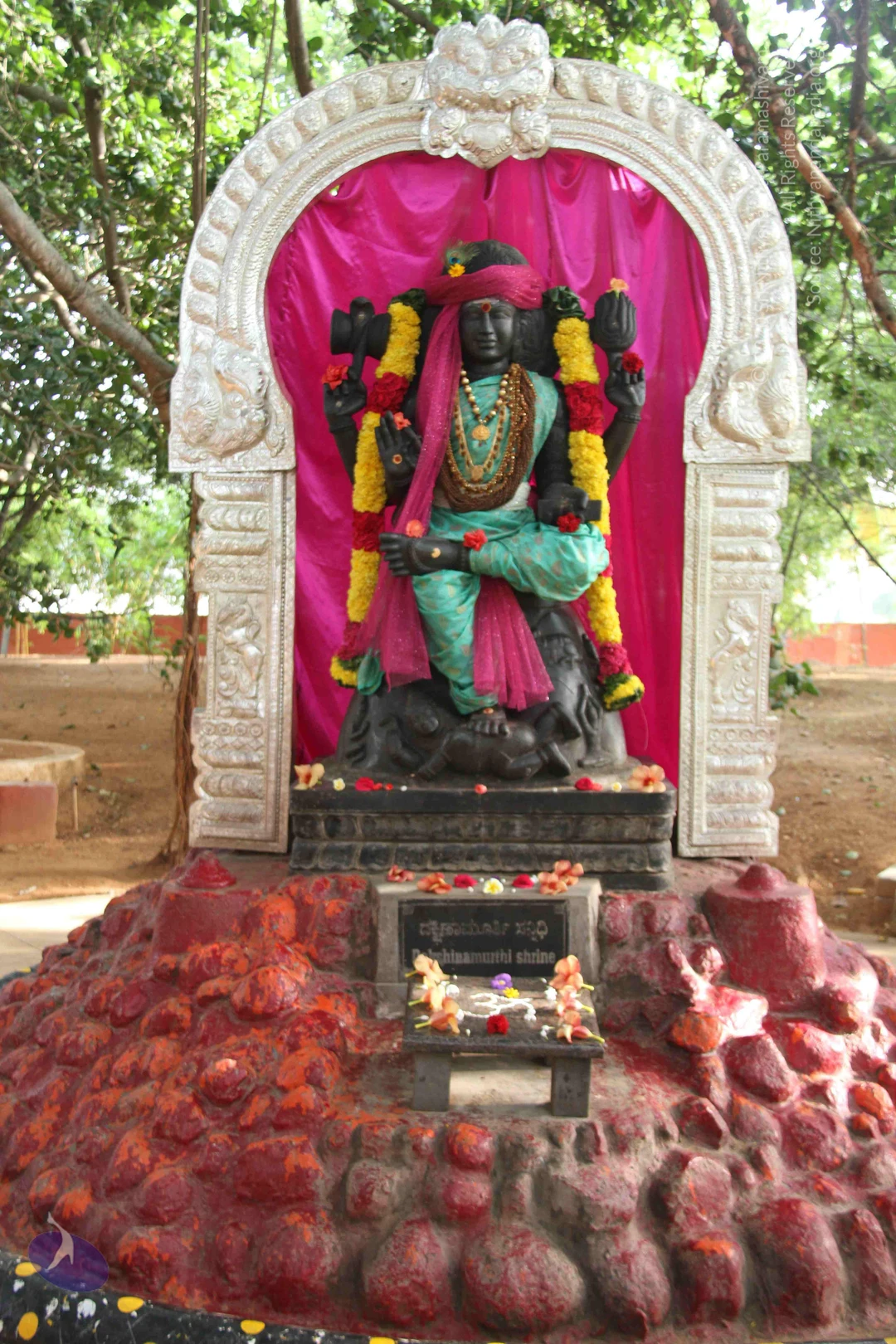
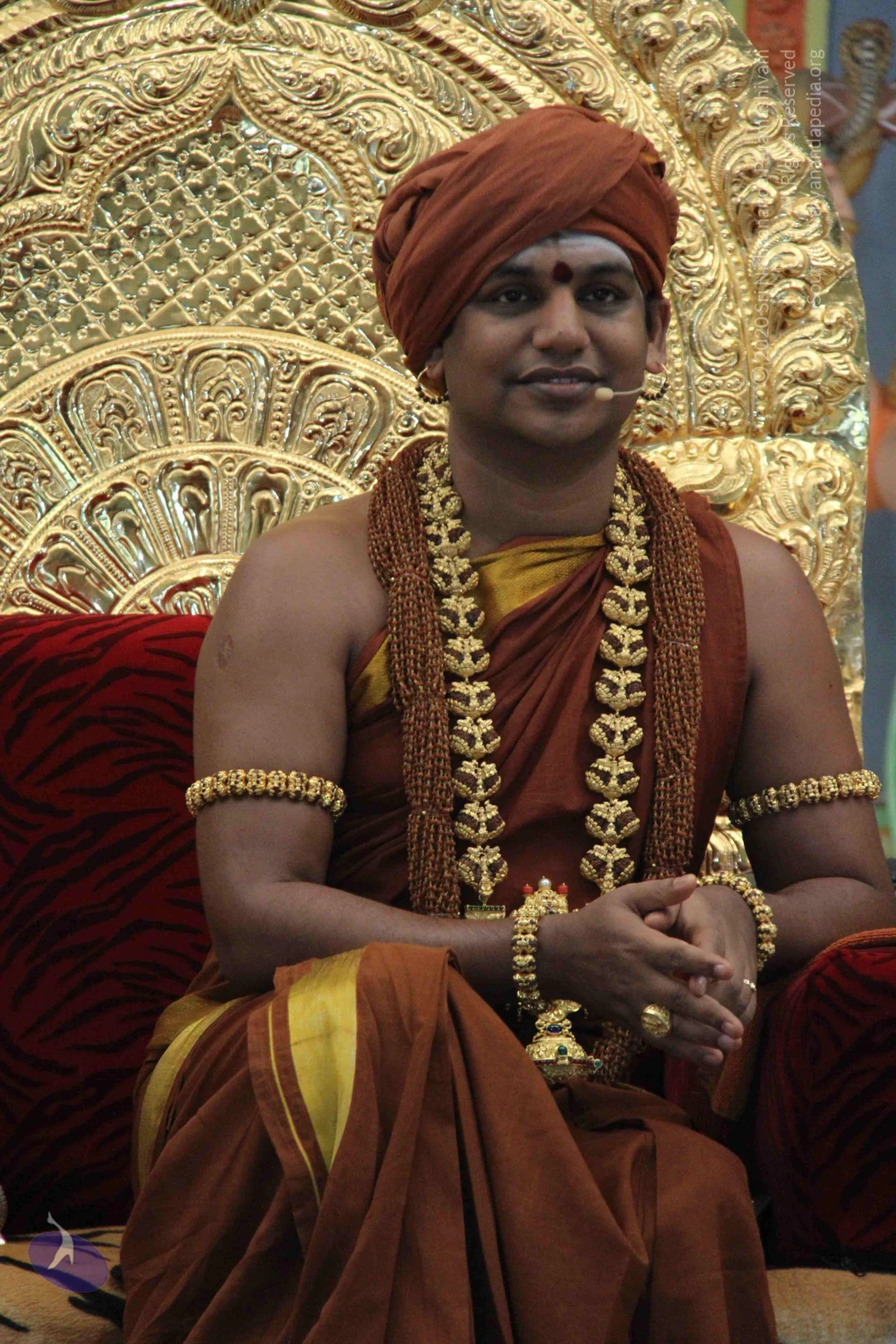
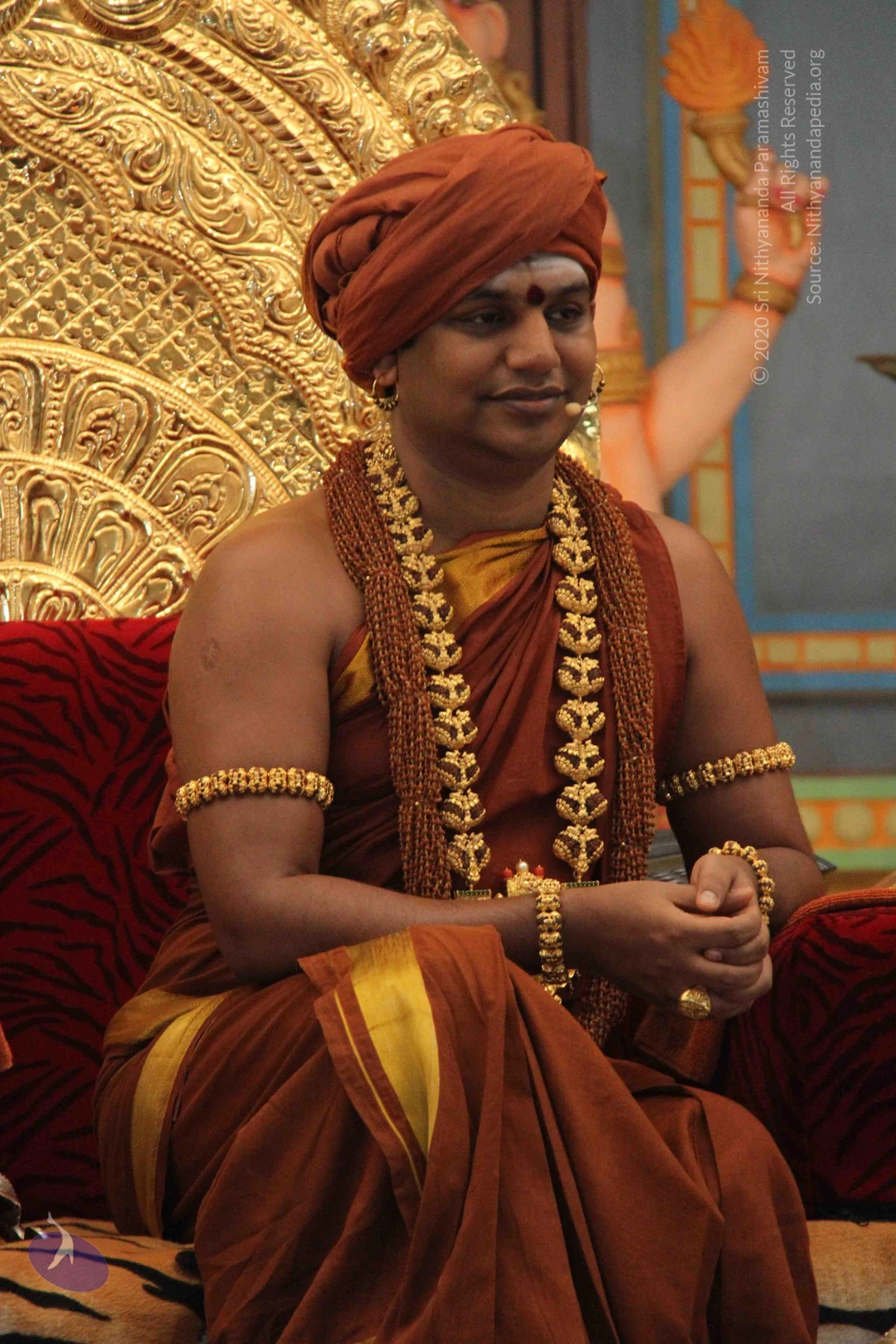
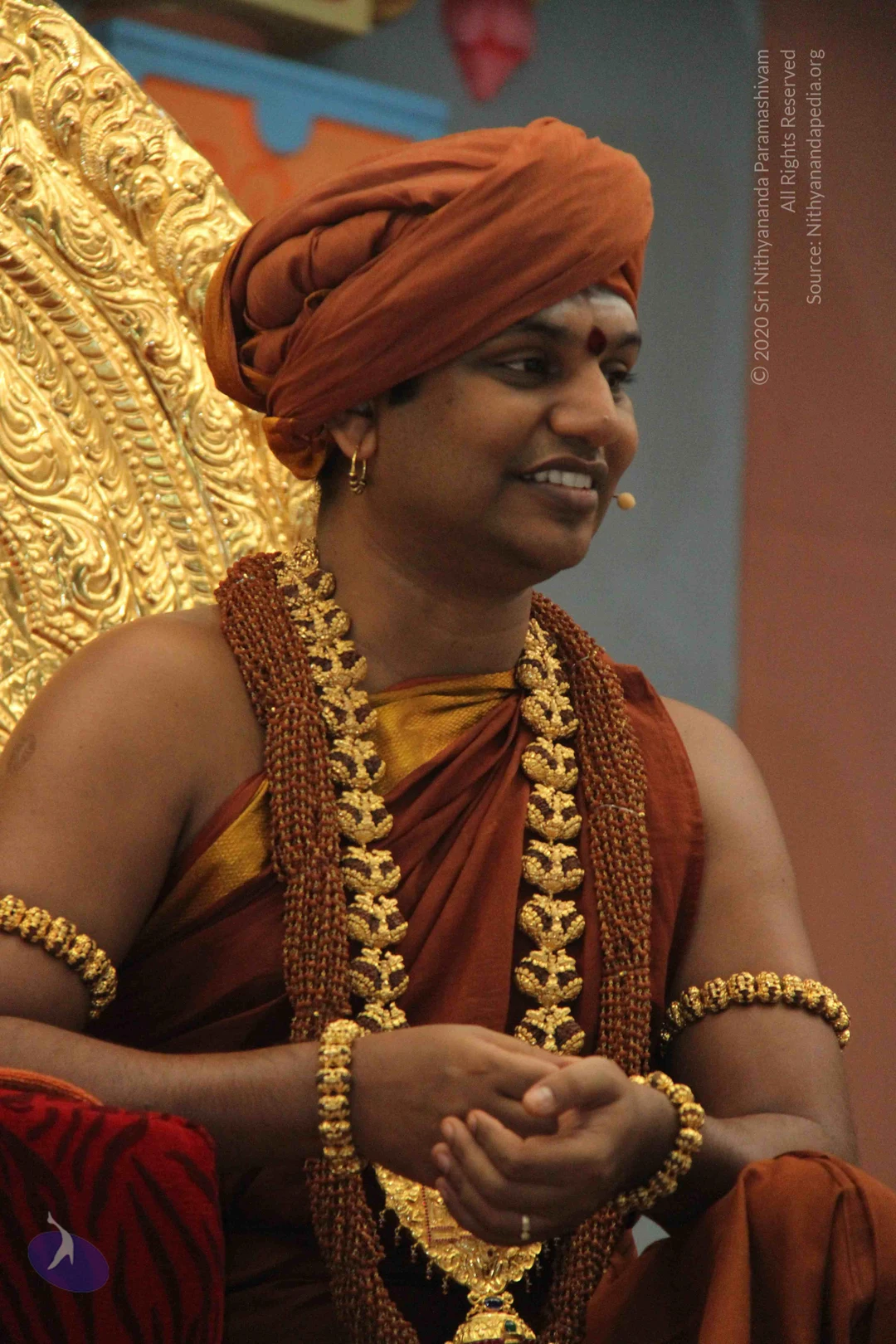
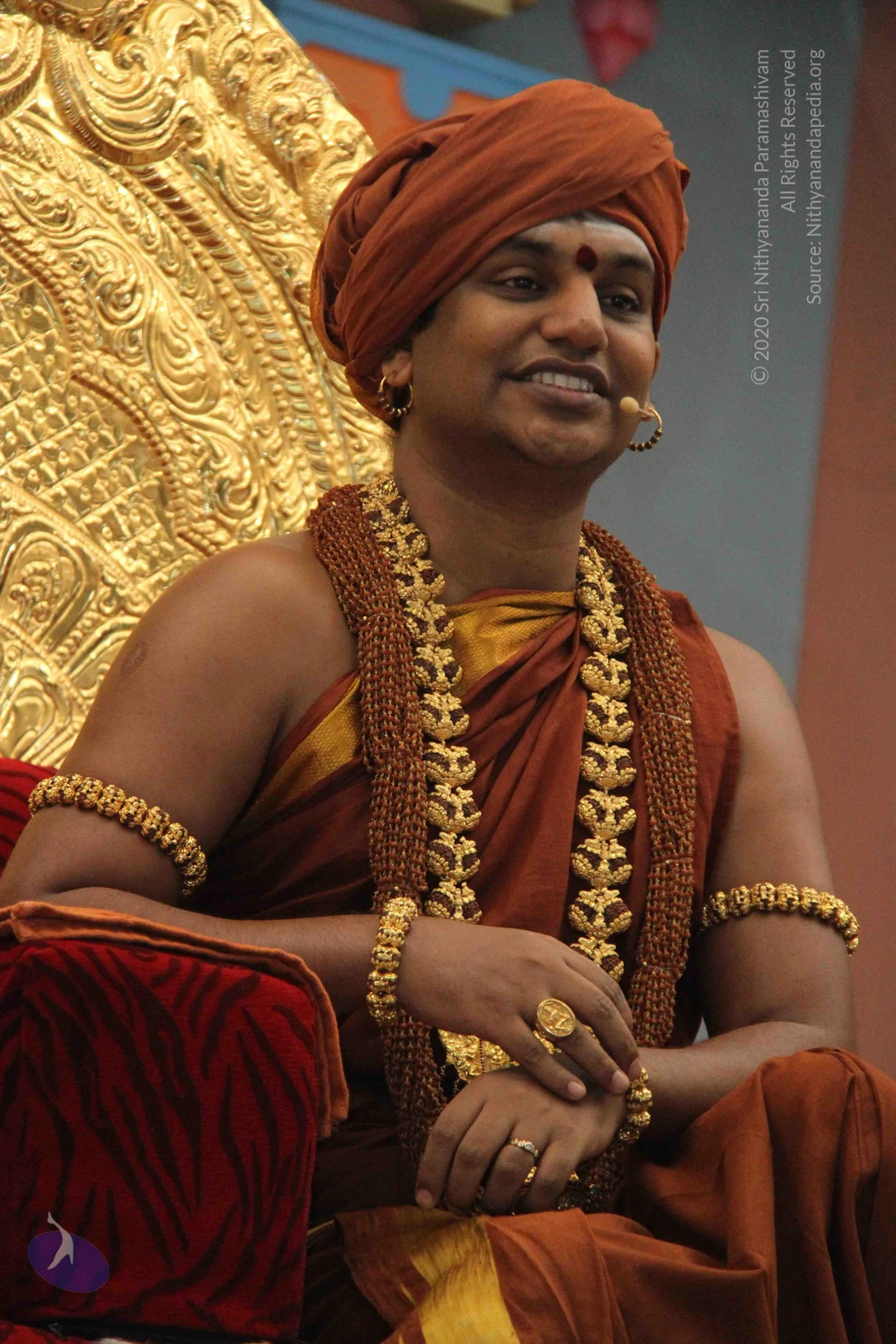
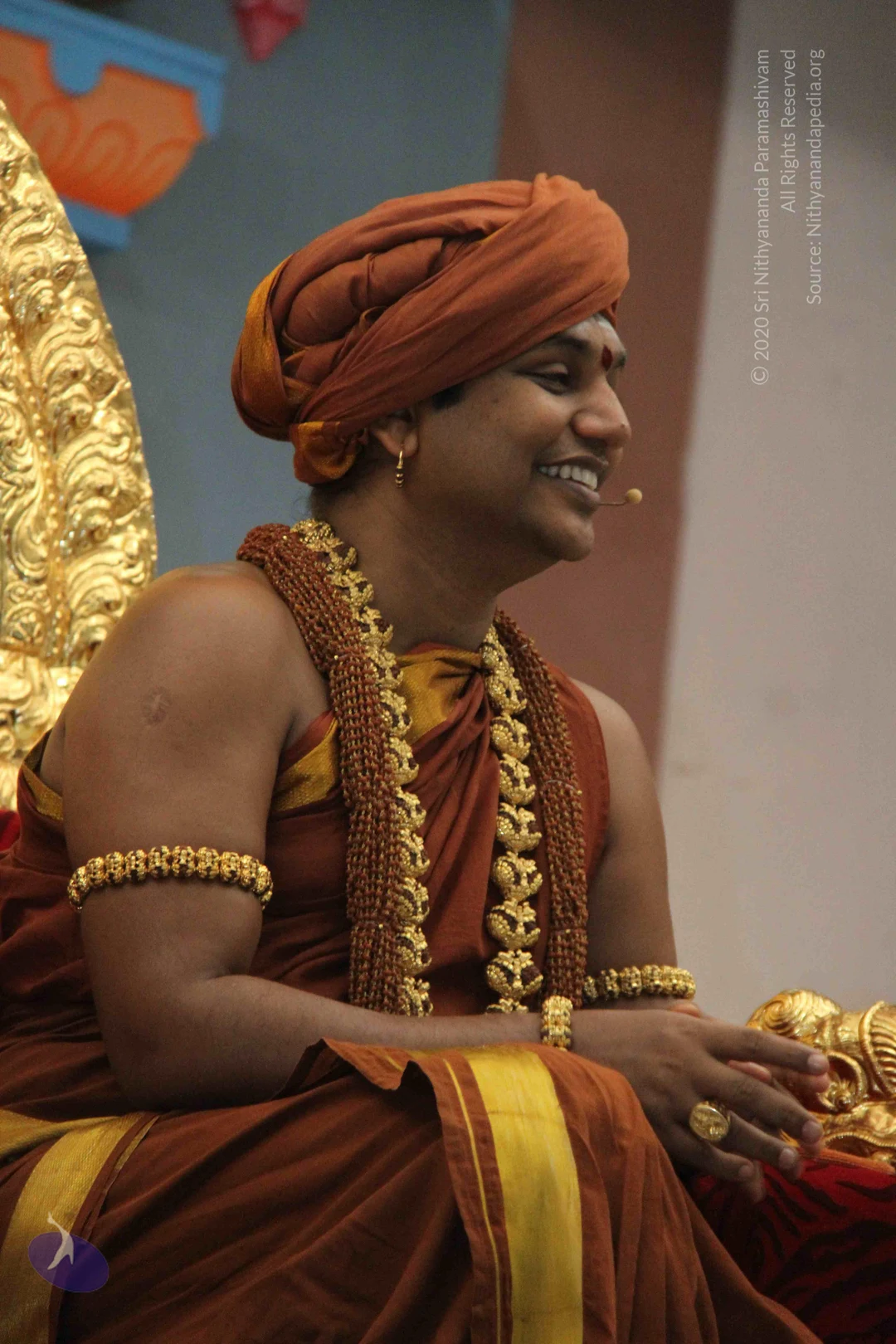
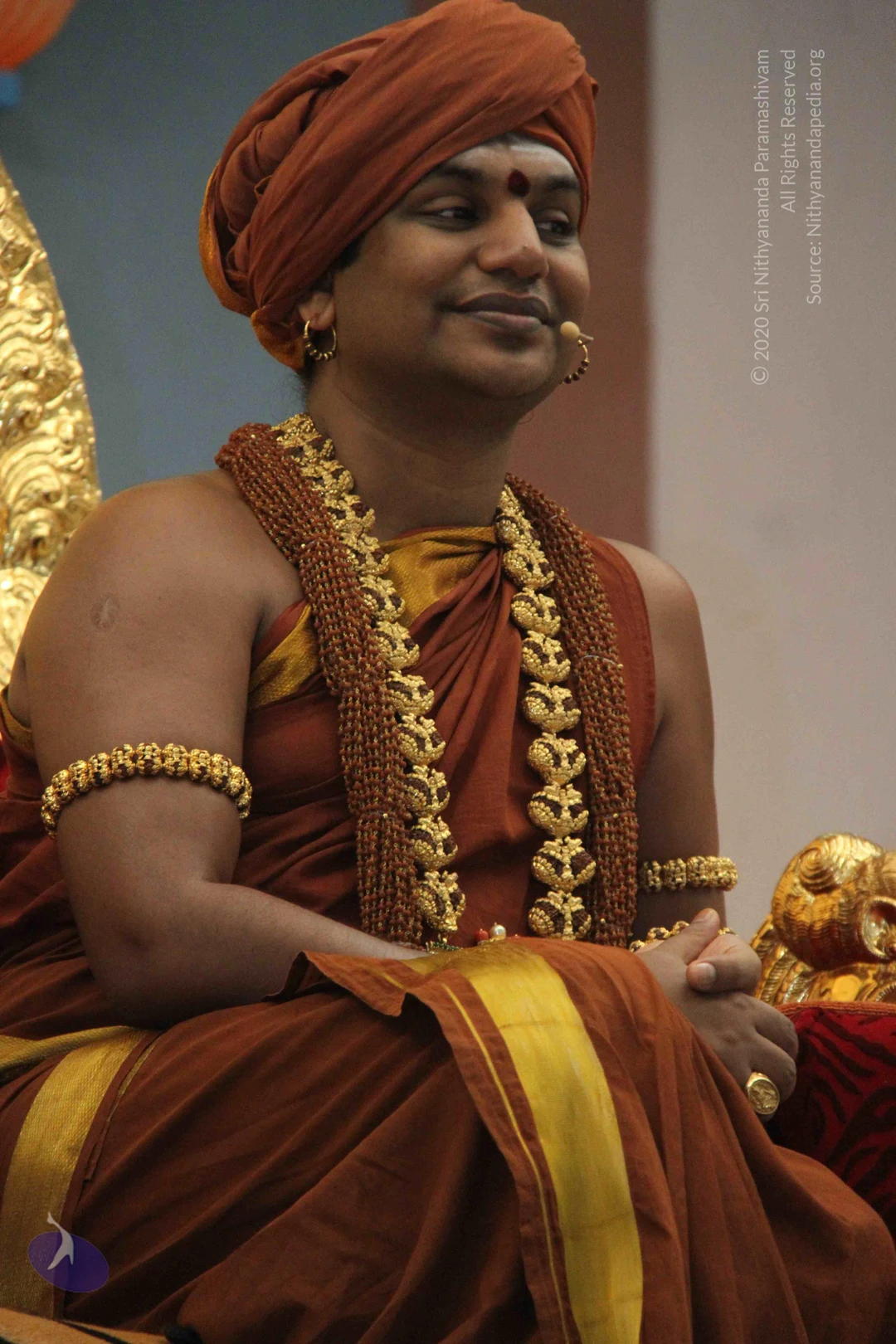
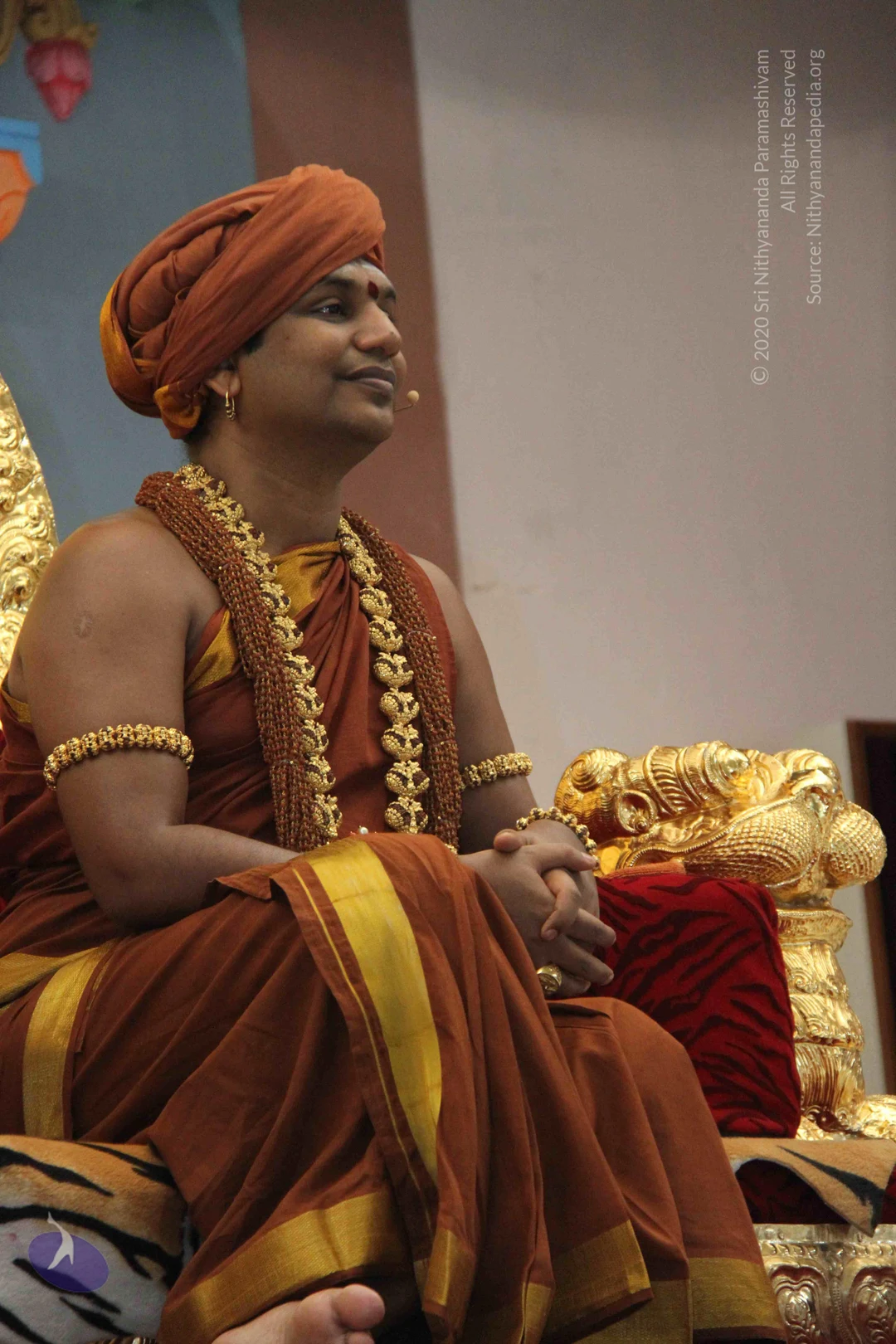
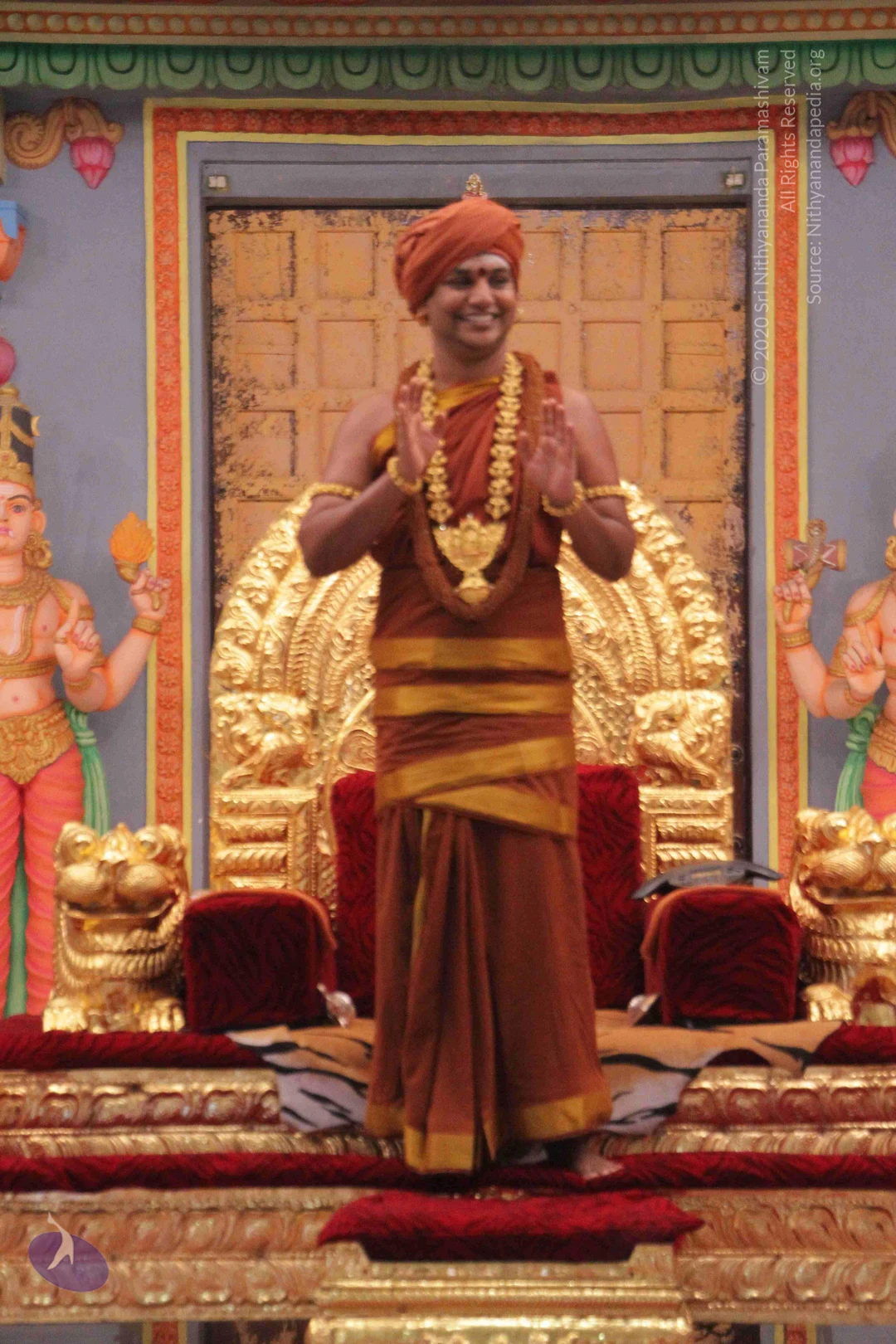
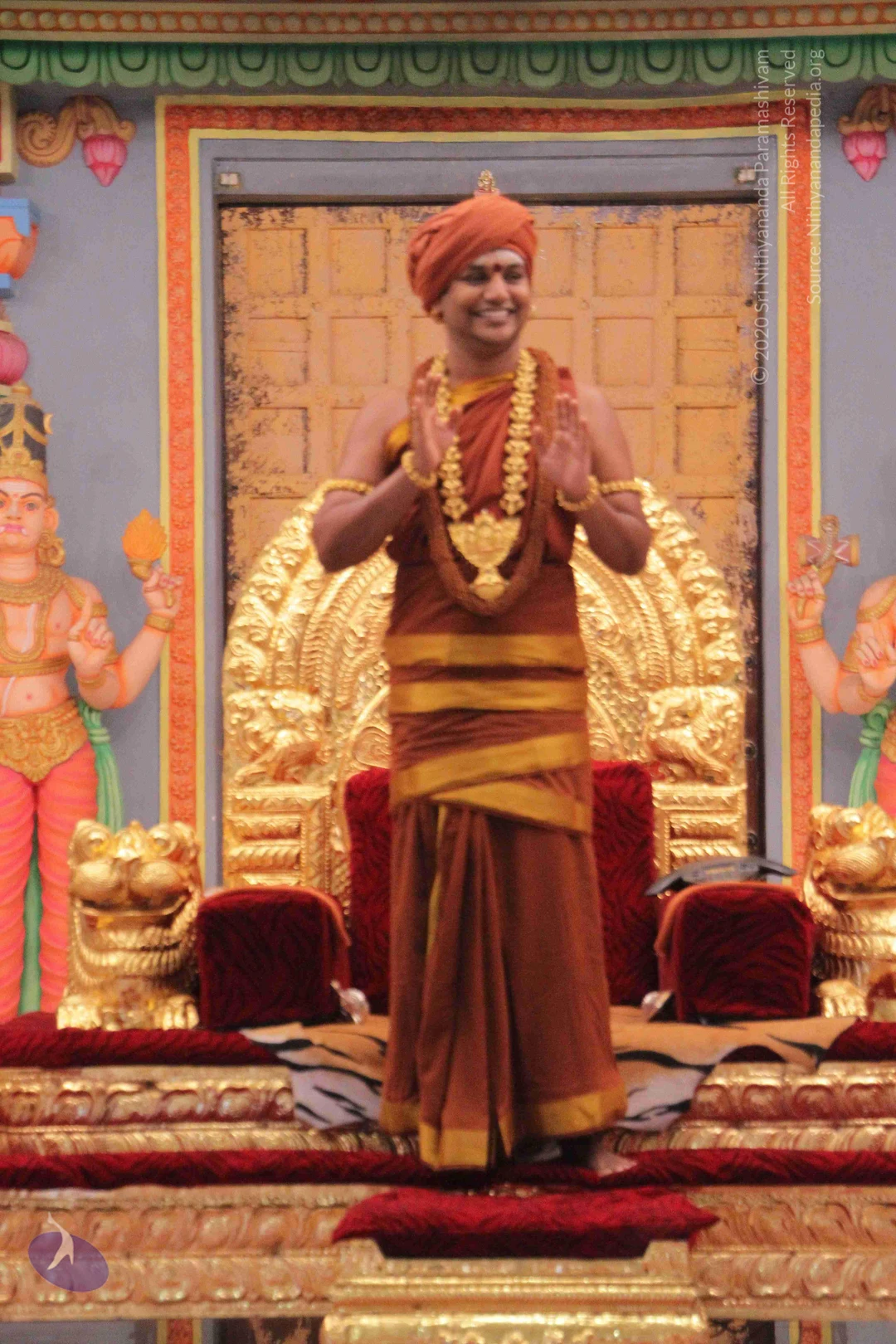
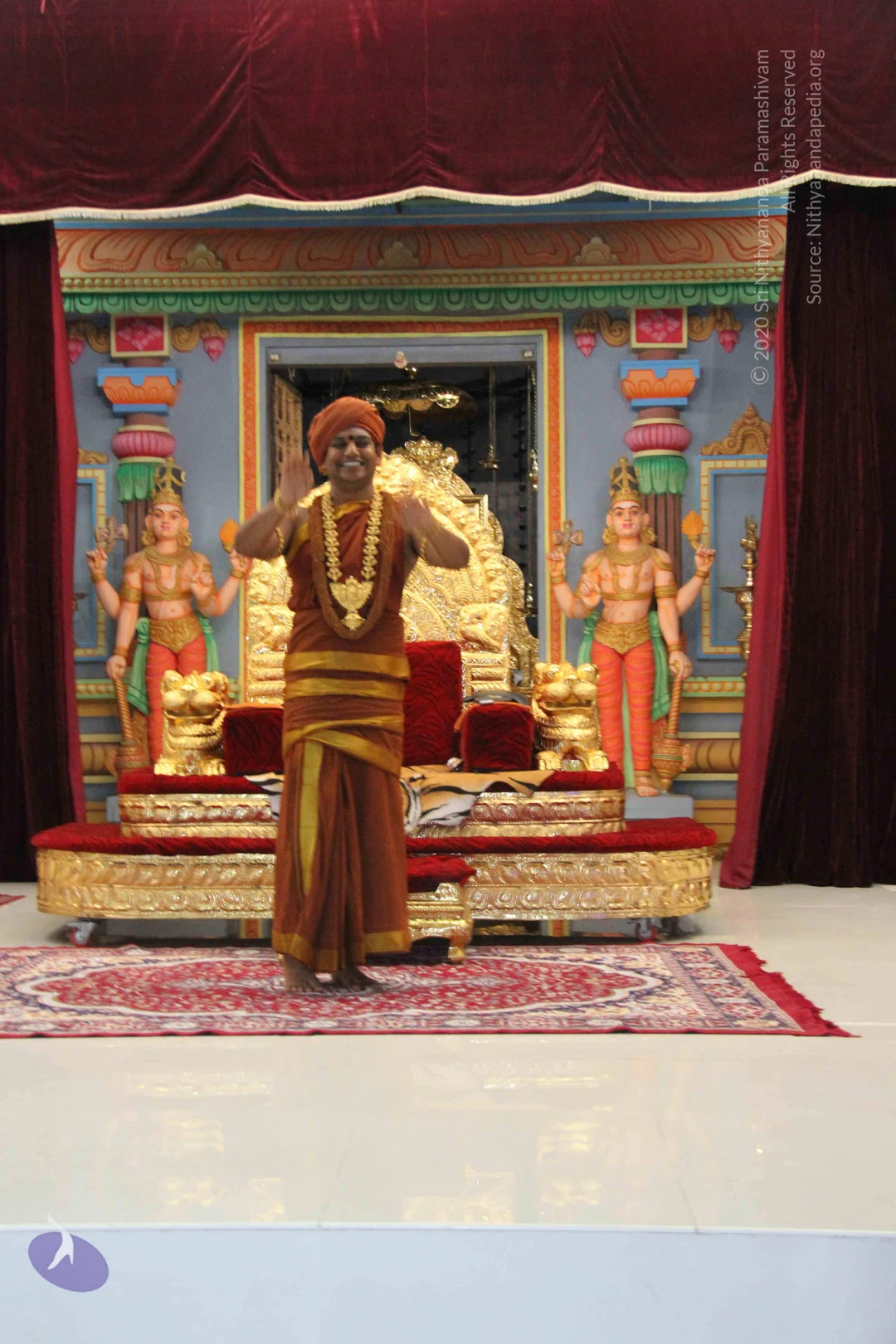
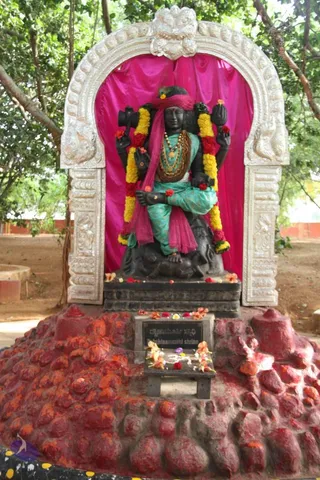
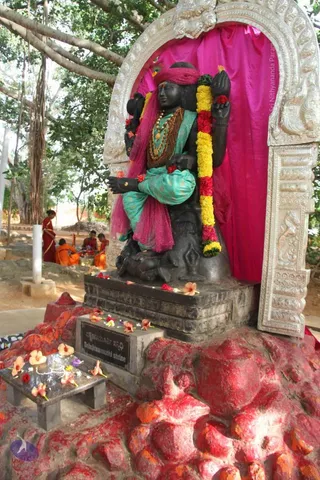
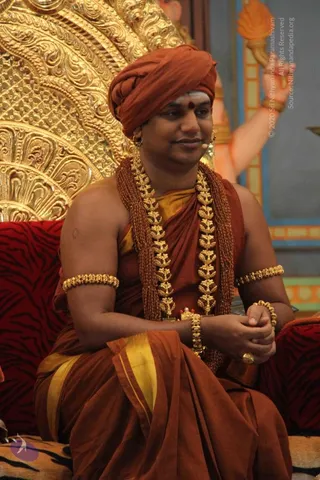
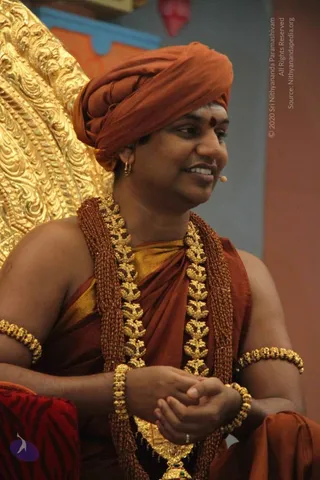
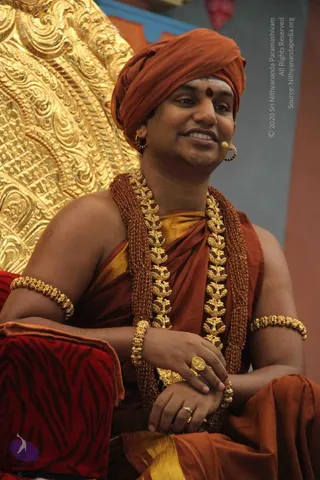
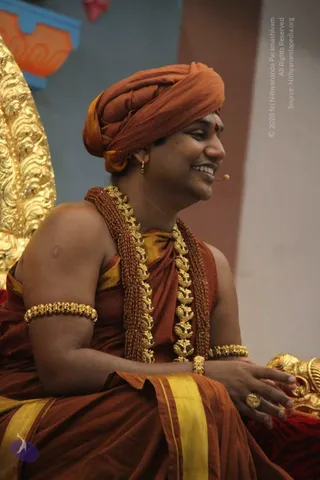
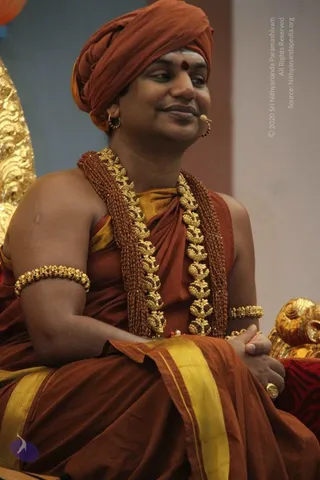
A black stone deity murti stands in a silver-framed niche backed by a bright magenta cloth, set outdoors among trees. The murti has multiple arms holding objects, wears a turquoise dhoti, a magenta sash and headwrap, and layered gold and beaded necklaces. Yellow and red marigold garlands drape its shoulders and arms, and flower petals lie at its base on a dark pedestal. Sunlit ground and a low orange wall appear behind. No living people are visible, and the figure is a statue rather than a person.A photograph of a single man standing barefoot on a white stage before an ornate golden throne with red velvet cushions, flanked by two painted deity statues with four arms and orange dhotis. The man wears an orange-brown turban, a brown-orange robe with gold borders, a heavy gold-toned pendant on a garland of flowers, and bangles, and he smiles with palms pressed together in a greeting gesture. A red velvet curtain and a patterned red carpet frame the scene, and a brass lamp stands at the right edge.A seated man in an orange-saffron turban and saffron dhoti-style wrap with a gold-yellow inner cloth sits on a red-and-black tiger-striped cushion before an ornate gold-leaf throne back. He wears layered gold ceremonial necklaces, a rudraksha-style mala, gold armlets and bangles, a red bindi with a vertical tilak, and a small earring. A brass oil lamp with a lit flame stands beside him, and a gold carved lion-head ornament sits at lower right. Behind him a painted figure raises one arm holding a flame-like object. Swamiji (probable) is seated centrally, with distinctive saffron turban, layered gold necklaces and saffron wrap as cues.

July 30 2013

Original wiki page
Contents

Title:

Completion-Science of Eternal Bliss

Description:

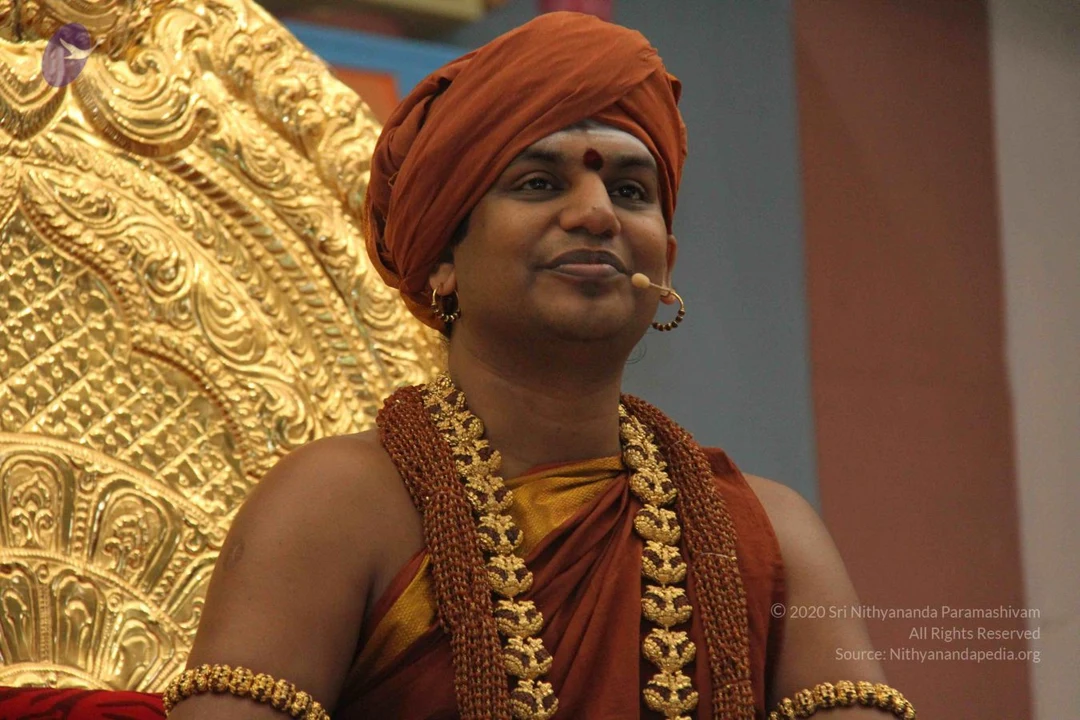
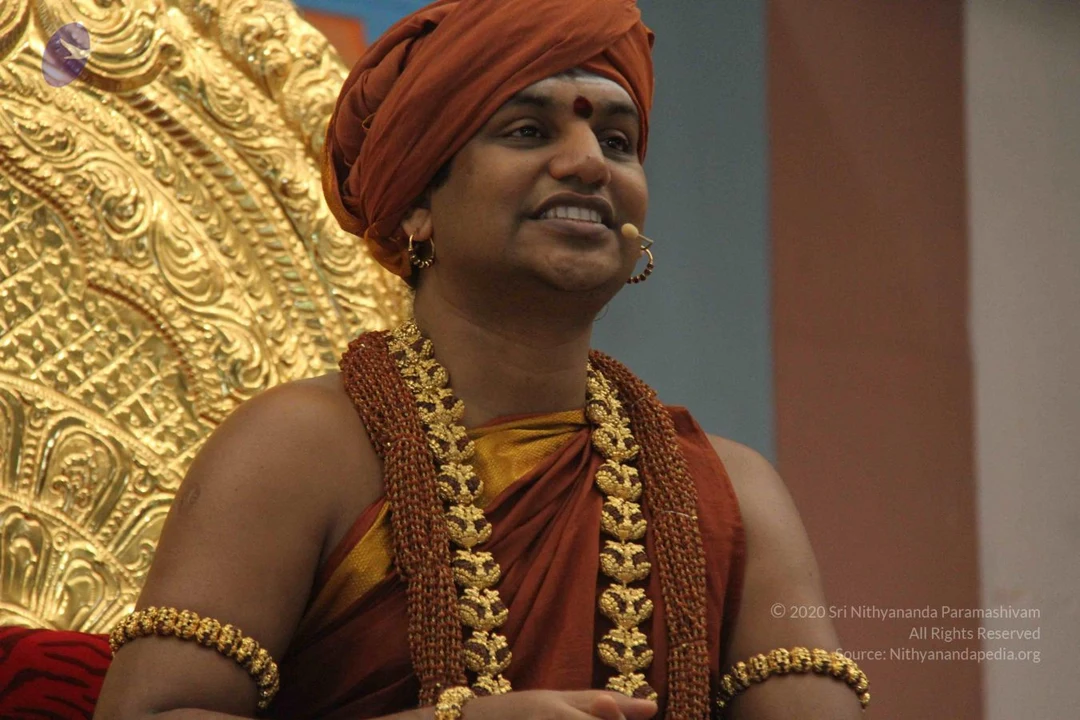
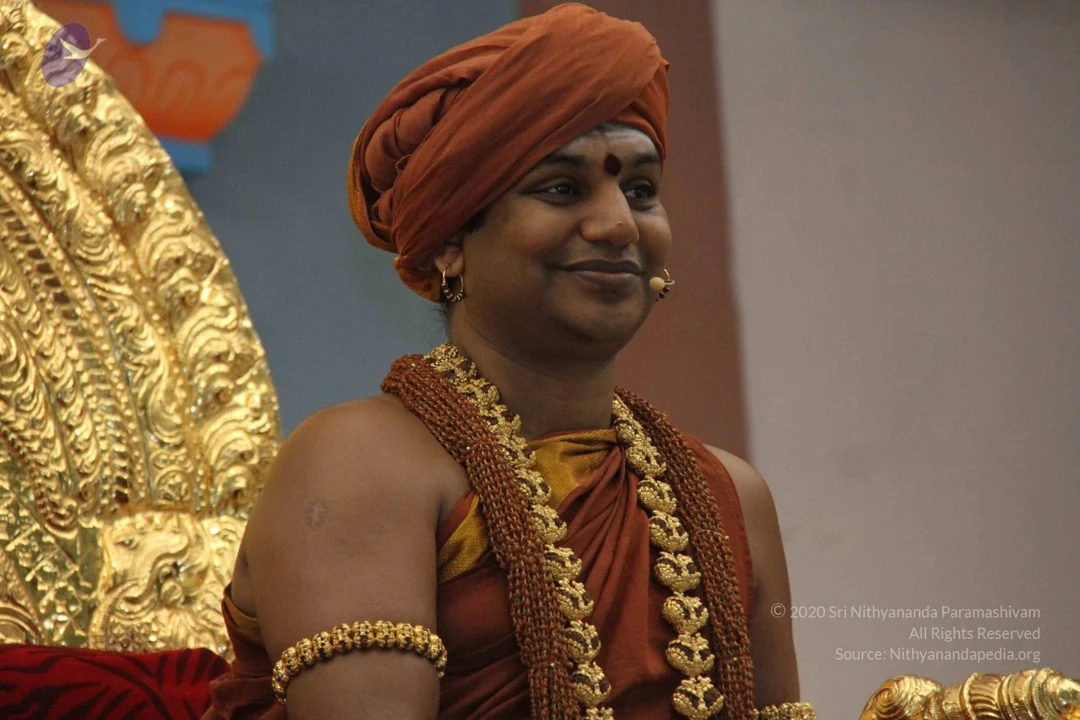
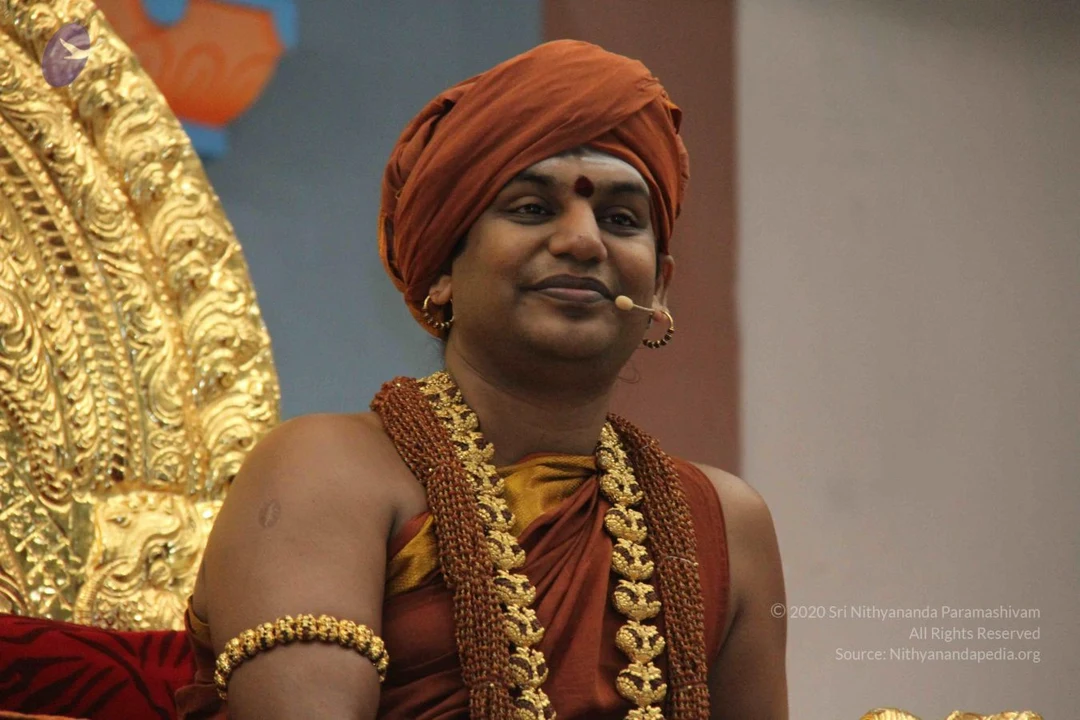
In today’s morning Satsang, Paramahamsa Nithyananda beautifully describes how the science of completion, developed by the Vedic tradition, is the essence of every successful religion, spiritual group, and psychology. He explains the importance of making the science of completion part of educational systems around the world. It is a proven, powerful technique that will directly reduce the world’s collective negativity because it empowers people to release themselves from the suppressed, negative emotions that they carry, reducing suffering and disease. Completion creates more and more inner space, allowing us to live!

Link to Video:

VideoAudio

Transcript:

Nithyanandeshwara Samaarambhaam Nithyanandeshwari Madhyamaam | Asmadaachaarya Paryanthaam Vande Guru Paramparaam ||

I welcome you all with my love and respects. I welcome all the devotees, disciples, samajis, satsanghis sitting with us all over the world through Nithyananda TV, Sadhana TV, Lotus News Channel, Eshwar TV and two-way video-conferencing.

I welcome all of you with my love and blessings.

Today, I will expand on the truth of “COMPLETION IS THE ESSENCE OF ALL RELIGIONS”.

Completion should be the essence of all religions. The science of completion is the essence of all Religions and Completion should be preached as the essence of all religions.

Please understand, some religions teach what is completion; some religions show you what is not completion, what will be the effect of incompletion. Some religions teach you the science of completion; some religions show you the effect of incompletion.

I have a story:

Mulla Nasruddin tell his friends, ‘Did you know I am a hero?’ All the friends ask, ‘How come you are a hero?’ Mulla replies, ‘Well, it was my girlfriend’s birthday. She said if I ever brought her a gift she would just drop dead in joy! So, I didn’t buy her a gift and saved her life!’

Some understand the truth in a straight way; some in a perverted way. But, truth is a truth how much ever you coat it. All religions either show you the science of completion, or show you what will happen if you are incomplete.

Completion, the science of completion is the essence of Sankhya. The science of completion is the essence of Vedanta. The science of completion is the essence of Yoga. The science of completion is the essence of Nyaya and Vaiseshika. Read each of these philosophies, read each of these philosophies with the understanding about the science of completion. You will then understand that all these philosophies lead only to the science of completion. They only teach you different ways to complete.

Poornathva, the science of completion is the essence of all religions. Listen to the truths. Listen to the truths of the science of completion. Every successful philosophy in the modern day, including

Psychology; every successful religious and spiritual groups in the modern day including, Scientology, all of them used this science of Poornathwa from Vedic tradition, whether it is Scientology or Landmark teaching system, all of them. The founder of Landmark has acknowledged that all his knowledge the source is India – Bharat. Whatever may be the philosophy, whether it is Scientology or Landmark educational system, the essence is the Vedic knowledge, the source of the knowledge is Vedic tradition.

Listen! The science of completion should become the basic knowledge, the basic education in all schools, colleges, educational institutions, so that the collective negativity is reduced and people are free from the suppressed hatred, violence, anger, lust and all the suppression's are released from the system.

The science of completion is the science of eternal bliss. The science of completion is the science of eternal bliss. The science of completion is the science of eternal bliss!

Understand, go on looking into the life. Every field, in every step, every line, every small agitation you carry in your life, every moment of powerlessness you experience in your life, has the source of incompletion in you. The power of completion proves you go on living in Poornathva, living in eternal bliss!

Life, life, everything in life starts with completion. Only one thing I will not complete, and that is talking

about completion! Only that I am not going to complete! In life, you may put up with something, you may be angry about something. I am not saying you should put up with more and more things, angry with less and less things. No! I am saying, be complete with everything. Bring completion with everything, so that you put up with something; and even if you don’t put up with something, you are not incomplete with that thing…..you are not incomplete with that thing.

Mulla Nasruddin was asked by a friend, ‘What was the argument between you and your father-in-law?

Mulla said, ‘I didn’t mind when he wore my hat, my coat, my shoes, my suit. But, when he sat at the dinner table and laughed at me with my own teeth, that was too much!’

So, you may put up with him using your shoes, hat, coat, suit; but you may not be able to put up with him using your teeth!

Listen! Listen! You need to know, whether you put up with something or are not able to put up with something, be complete with everything! Be complete about everything. Completion about everything is required. Complete! Complete! Complete!

Listen! If you are not complete, sometimes even small things, even small things will hurt you. If you are not complete, even small things will hurt you sometimes. Or, you will be hurting that, and that will be in turn hurting you! Sometimes, you are hurt by incompletions. Sometimes you go on hurting others and other things with incompletions!

A shop in a remote county had a sign: “Danger! Beware of Dog!”

However, the shop had a very harmless, old hound dog asleep on the floor next to the cash register. One customer entered the shop and asked the storekeeper, ‘Is that the dog we are supposed to beware of?’

The owner replied, ‘yes, that is him!’

The customer could not help but laugh, and he said, ‘he does not look like a dangerous dog to me! Why in the world do you need that sign?’

The storekeeper said, ‘because, before I posted that sign, people kept tripping over him!’

Sometimes, the dog may not hurt you; you will be hurting it! Sometimes your incompletions may not be hurt you directly, but you will be hurting it! Even you hurting constantly your incompletions in turn will hurt you!

20:00

Understand, life starts creating more and more inner space with more and more completions. I tell you,with more and more completion, life starts creating more and more inner space and you start living!Any suffocation in the life, please listen, any suffocation in the life, when it is unattended, becomes disease. Please listen, any suffocation in the life left unattended becomes suffering. Any uneasiness unattended becomes disease.

21:39 Hindi

21:50

However you try to bend the life, twist the life, manipulate the life, life remains as life. Your incompletions are nothing but trying to manipulate, pervert the life as you want without knowing the truth life remains as life.

A lawyer, an engineer, and a mathematician were called in for a test. First, the engineer was called and he was asked, ‘What is two plus two?’ The engineer thought a while and, finally answered, ‘Four.’ Then the mathematician was called in and asked the same question, ‘What is two plus two?’ The mathematician thought little while, with a little thought he replied, ‘4.0’. Then the lawyer was called in and was asked the same question, ‘What is two plus two?’ The lawyer answered quicker than the engineer and mathematician he just straight away said, ‘come to the point,what do you want it to be?’

You may pervert, manipulate, interpret, push, pull as you want but two plus two remains as four, world remains as the world, fact remains as a fact. Incompletions are nothing but not looking at the fact and trying to pervert it, interpret it, manipulate it. Understand I am defining incompletions. All your plans to manipulate, pervert, exploit, is incompletion. I know one person did not take sannyas because the person has to forego all her makeup and jewellery. I said, ‘you cannot have your jewellery and makeup’ and that person dropped sannyas. How much ever you interpret, manipulate, truth remains truth, life remains life. Sometime people try to manipulate even sannyas. I wanted this one thing to be pure, unmanipulated sannyas. Sannyas should remain as pure as it is and unmanipulated.

25:54 Hindi

26:16

Many times if you win your competitors you think your life is successful. If you are more rich than your neighbor, you think you are successful. If you are more rich than your brothers you are successful. If you live great life than your siblings you are successful. No life is all about completion not about having more than your competitors. Life is successful only with completion. I have a story: Two lawyers were walking through a forest suddenly both of them spotted a vicious-looking bear. The first lawyer immediately opened his briefcase, pulled out a pair of sneakers and started putting them on. The second lawyer looked at him and said, ‘You are crazy. You will never be able to outrun that bear. You think you can outrun that bear?’The first lawyer said, ‘ No I don’t have to outrun that bear. I just have to outrun you!’ Means the bear will be busy with you. Understand, it may be successful at some crises moments. The success in the crises moments is only “survival success”, not “life success”. Success in the life happens with completion. Success in the life happens with completion. Listen, success in life happens with completion.

28:54 Hindi

29:35

Incompletions makes you feel that even small work is difficult. Listen, the extra cholesterol, over fat in your body makes you even walking very difficult. When the extra cholesterol, extra fat is in your body even walking is made very difficult. Even with walking, you feel, ‘ this is paining that is paining. ‘ Sometime I ask people, ‘ just tell me which part that is not paining?’ When you carry incompletions even small work seems to be too big work. I have seen even among my staff there are some people who will never bother even about big works, they just do next, next, next, next, next. There are some people even a small work like putting a stamp or closing a cover, ‘ oh today I did twenty cover closing and posting.’ They will boast about posting and the courier guy who really delivers he does not boast about it, delivering, but the people who paste it and post it boast about posting. I have seen incompletions make you feel you are doing lot of work. I have a story again: A doctor and a lawyer were talking at a party their conversation was constantly interrupted by people describing their ailments and asking the doctor for free medical advice. After an hour of this the exasperated doctor asked the lawyer, ‘What do you do to stop people from asking you for legal advice when you are out of your office?’ The lawyer just said, ‘I give it to them, and then I send them a bill.’ Doctor was shocked, but agreed to give it a try. The next day still feeling slightly guilty the doctor prepared the bills when he went to place them in his mailbox he found a bill from the lawyer!

No it is incompletions which make you feel you have done too much. I tell you honestly, I really tell you honestly, I don’t feel at all I am doing anything. One great thing, in my inner space I don’t feel I am doing anything that is why I never become tired. That’s the secret of my inspiration and continuously doing something or the other. Sometime I may not be sitting with you in the satsang, but that doesn’t mean I am sleeping. Continuously doing something became my lifestyle, and it is neither boring nor tiring, because my inner space I don’t believe or I don’t feel I am doing something. If you have too much of incompletion, even a small thing will look so difficult. I have seen people describe their work more than what they do. More than what they actually do, they describe it. 34:06 Hindi

34:24

Incompletion will make you constantly make you, make you exploit others. With incompletions will be constantly exploiting others, constantly eating others, hitting at others. I have one more story: Lawyer says to the judge, ‘Your Honour I wish to appeal my client’s case on the basis of newly-discovered evidence.’ Judge asks, ‘What is the nature of the evidence?’ Lawyer said, ‘Judge I discovered that s my client still has ten-thousand dollars left.’ No, incompletions will constantly make you suck others, exploit others, because incompletions will give you the feeling you are working too hard, you are worthy of everything. Most incomplete beings on the planet Earth are politicians. They think they are working so much, they are worthy of owning the whole world and they try to own, not just own, possess.

36:28 Hindi

37:15

Essence of today’s satsang: Incompletions will make you feel you are working too much. Incompletions will make you feel the whole world should be yours. Incompletions will continue to make you feel you can own, possess the whole world. Incompletions continuously make you exploit yourself and others.

37:49

Photos From The Day:
Tags:

Paramahamsa Nithyananda, science, Vedic, religion, spiritual, psychology, completion, educational, world, powerful, technique, collective, empowers, emotions, creates, inner space, live.

Photos Of The Day:

Nayana-Deeksha
Temple
Paduka-Puja
Swasti-Mantra

Sarva-Darshan

Nithya-Satsang

Final-Blessings

Photos Of The Day:

Temple

Paduka-Puja
Sarva-Darshan

Nithya-Satsang

Final-Blessings

Photos from this day

View all 171 photos

Photos From The Day:

18 photosSource gallery
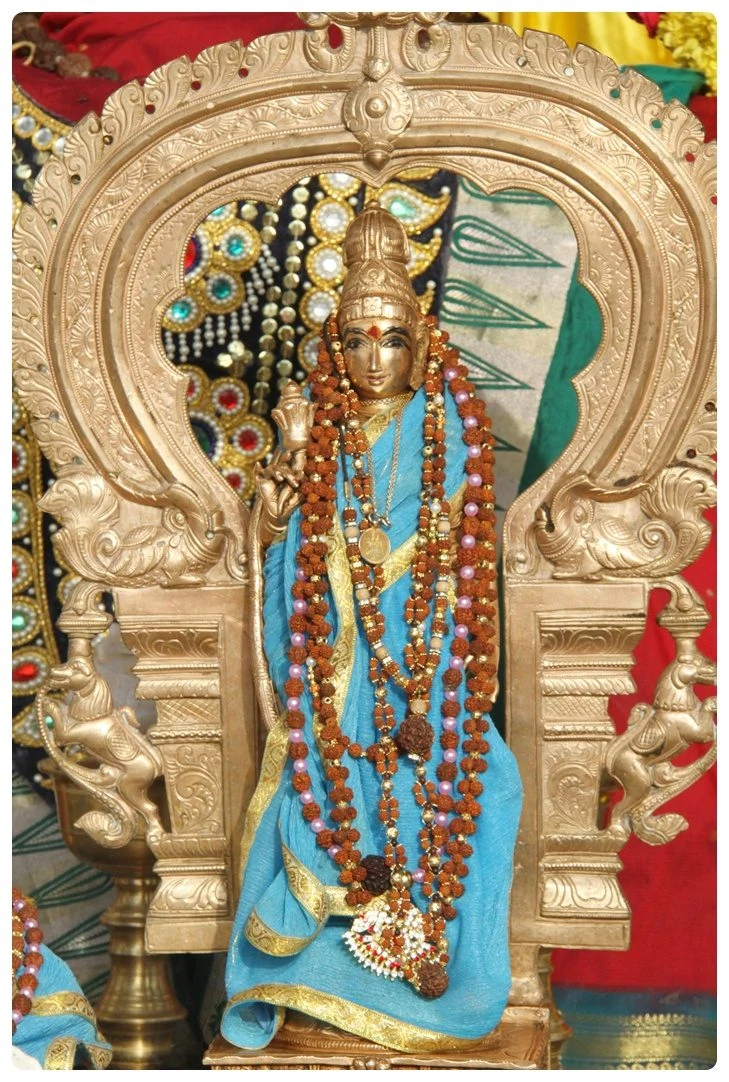
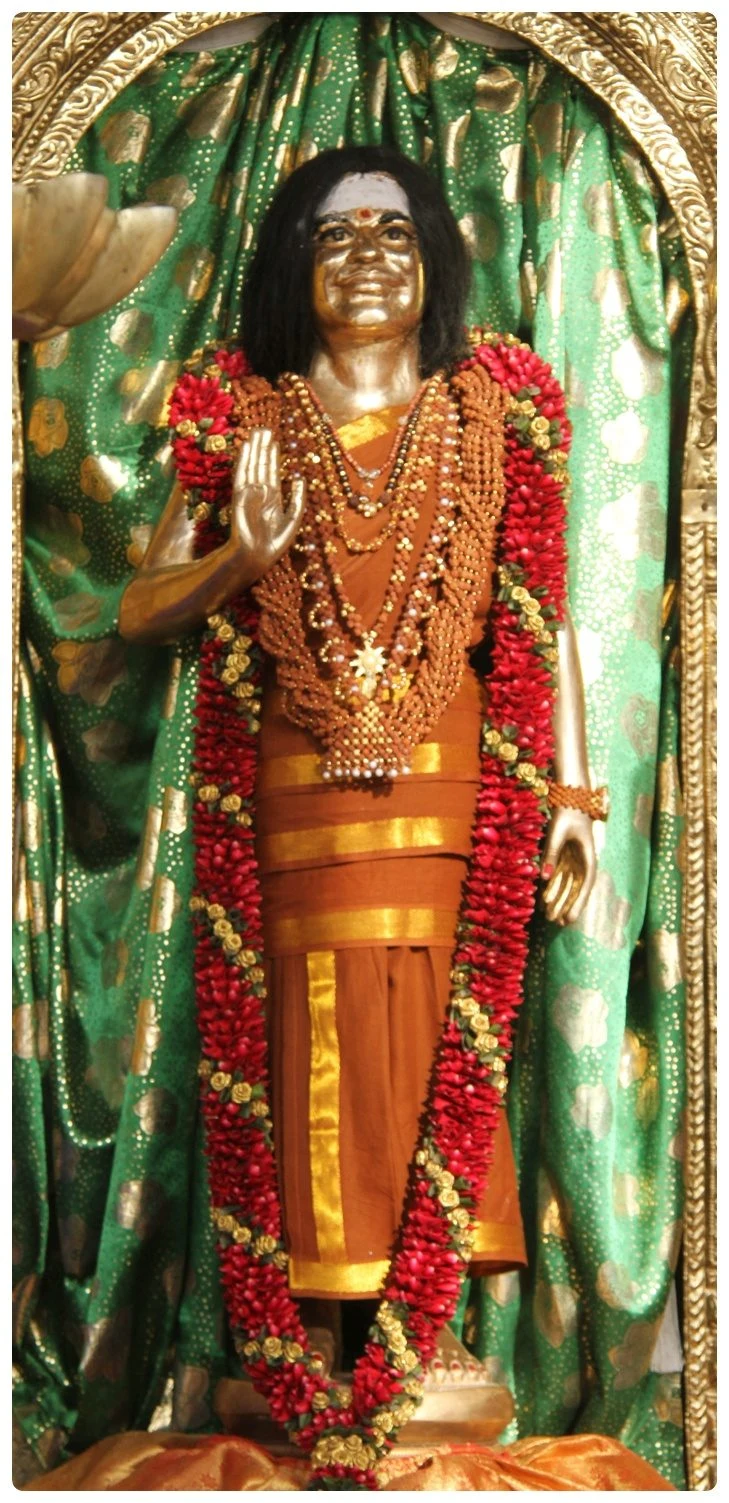
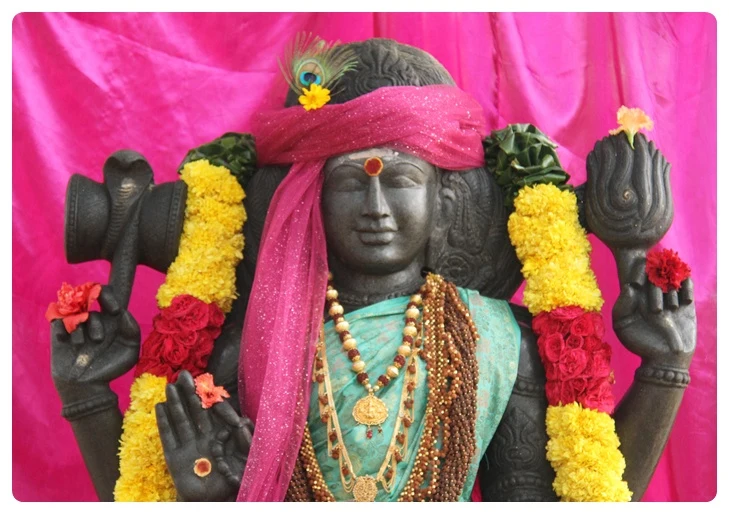
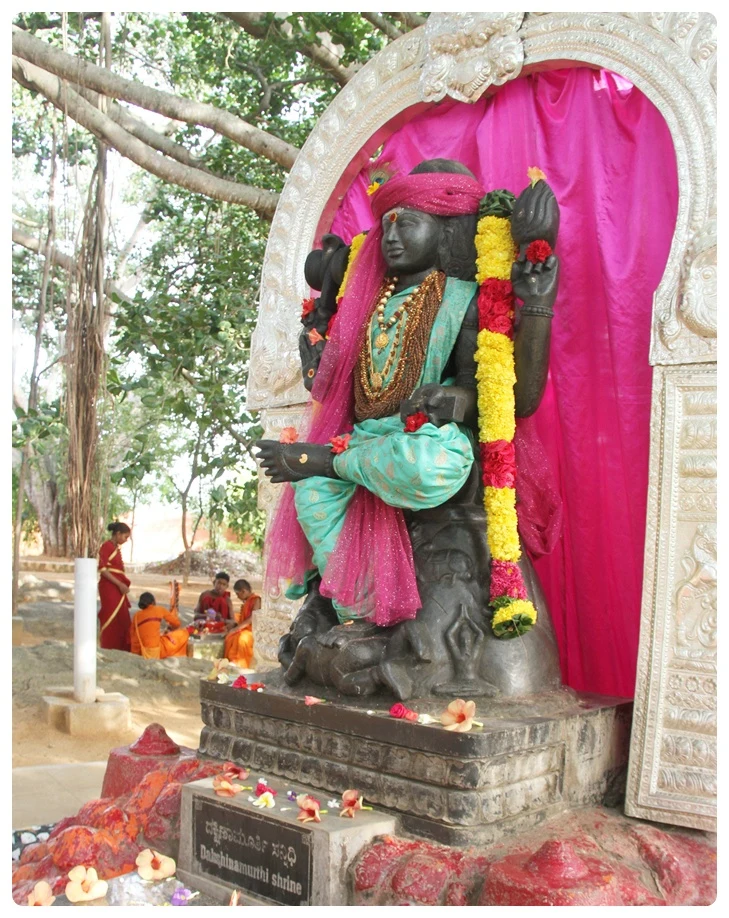
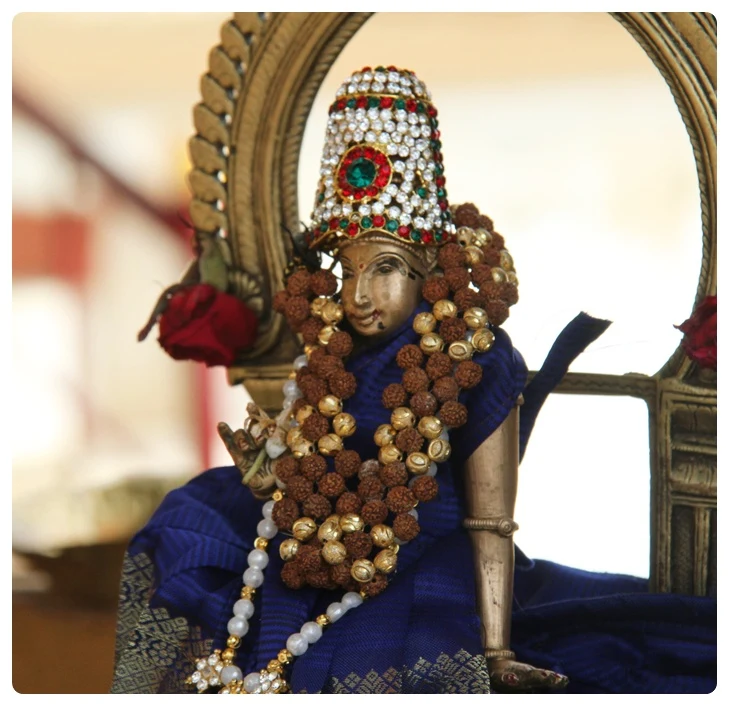
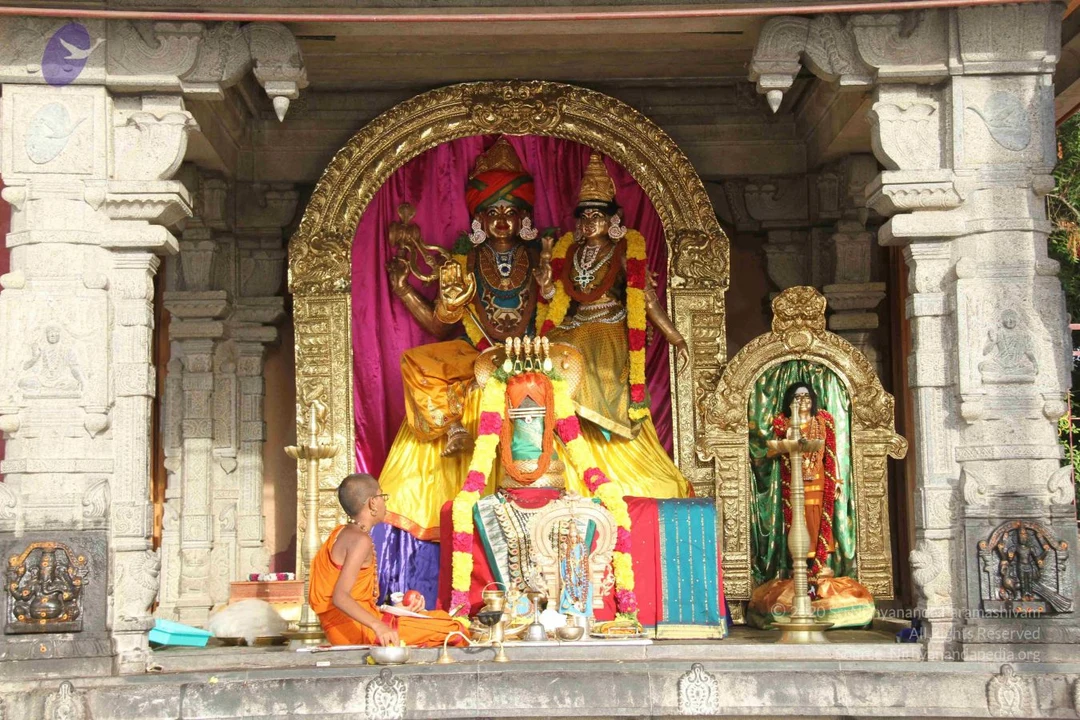
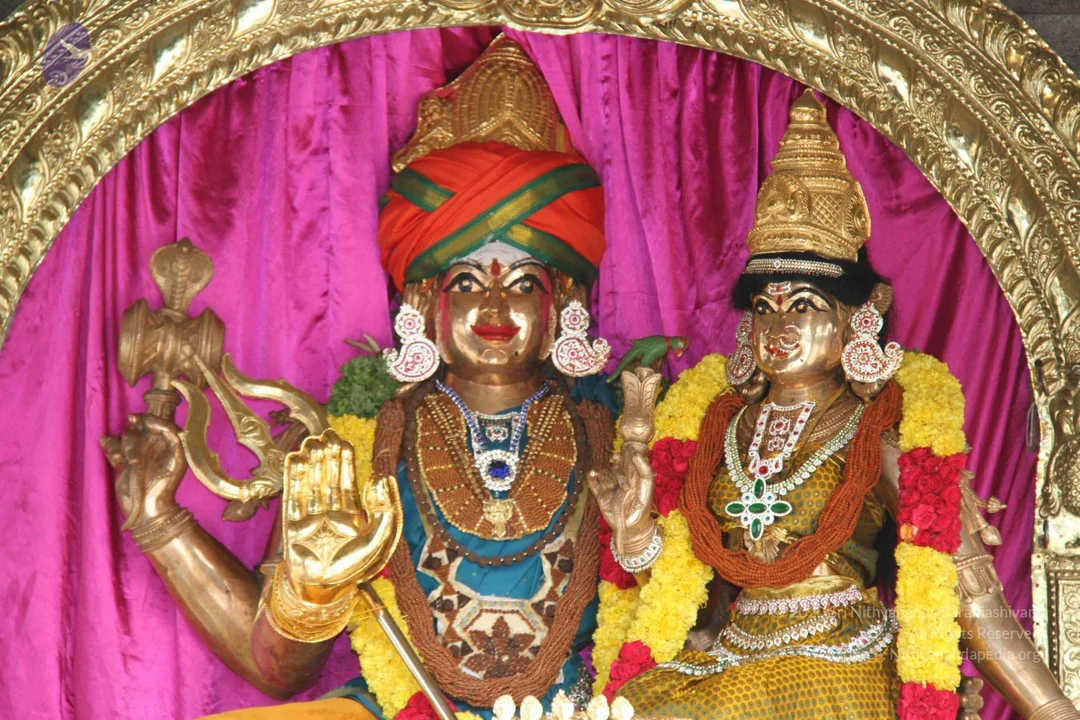
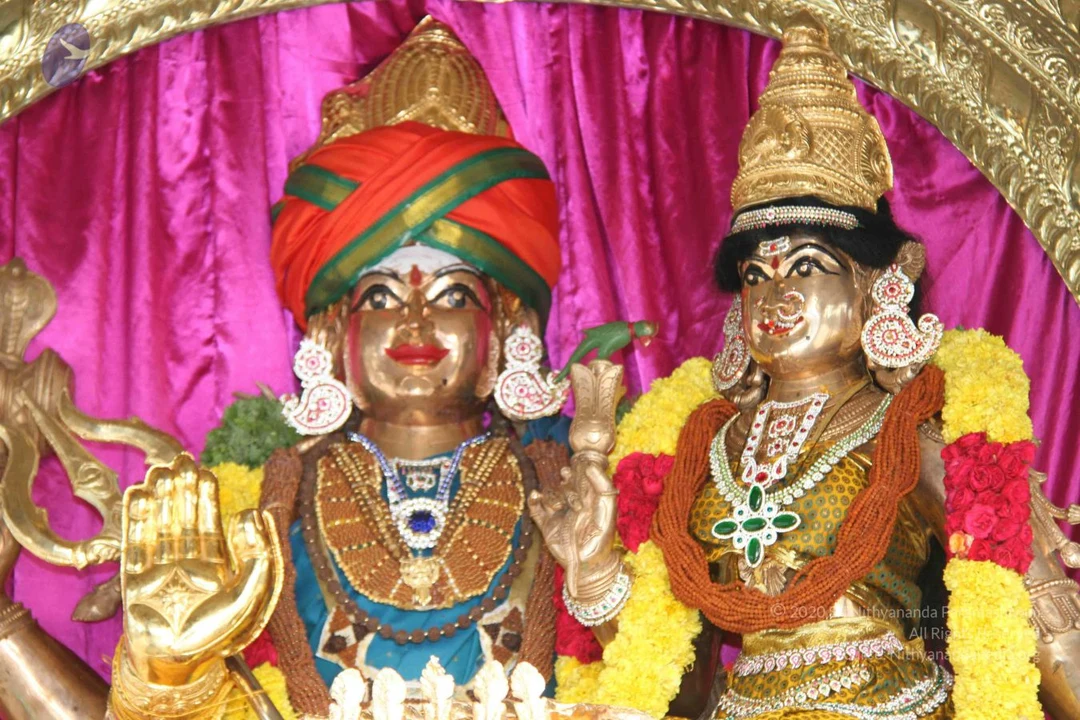
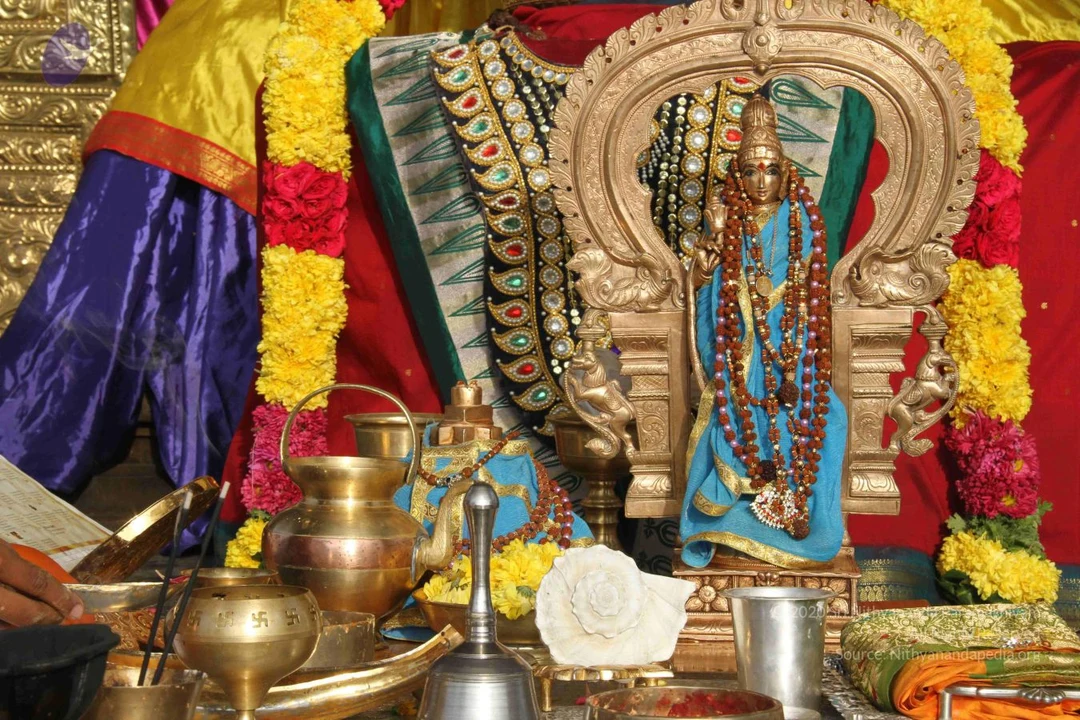
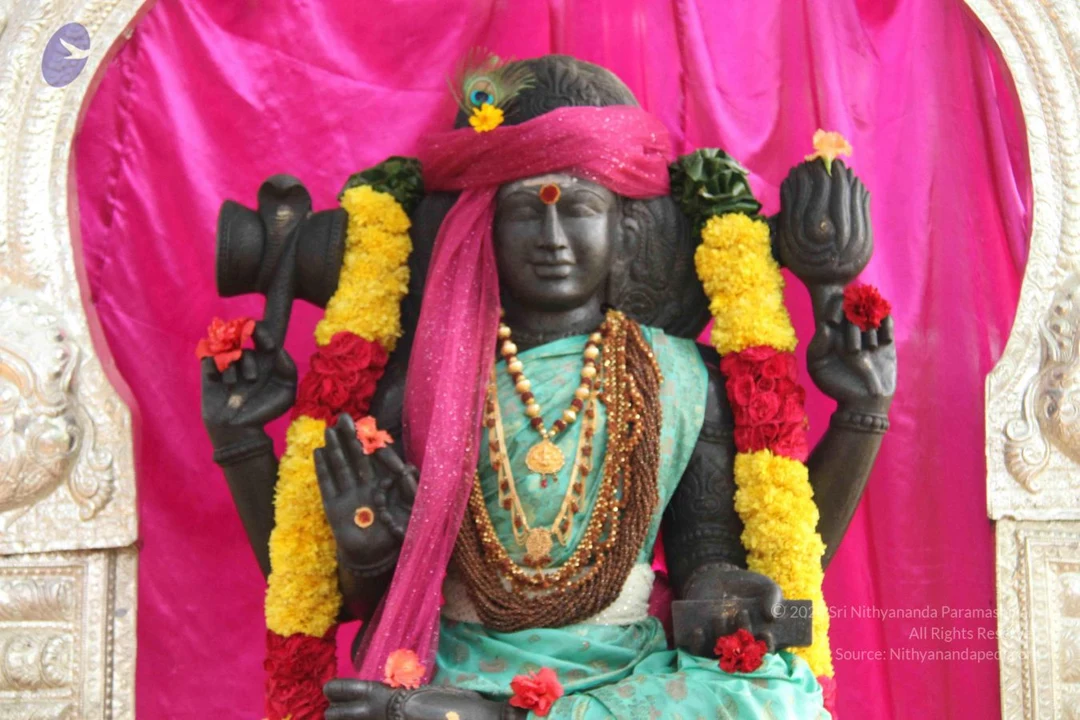
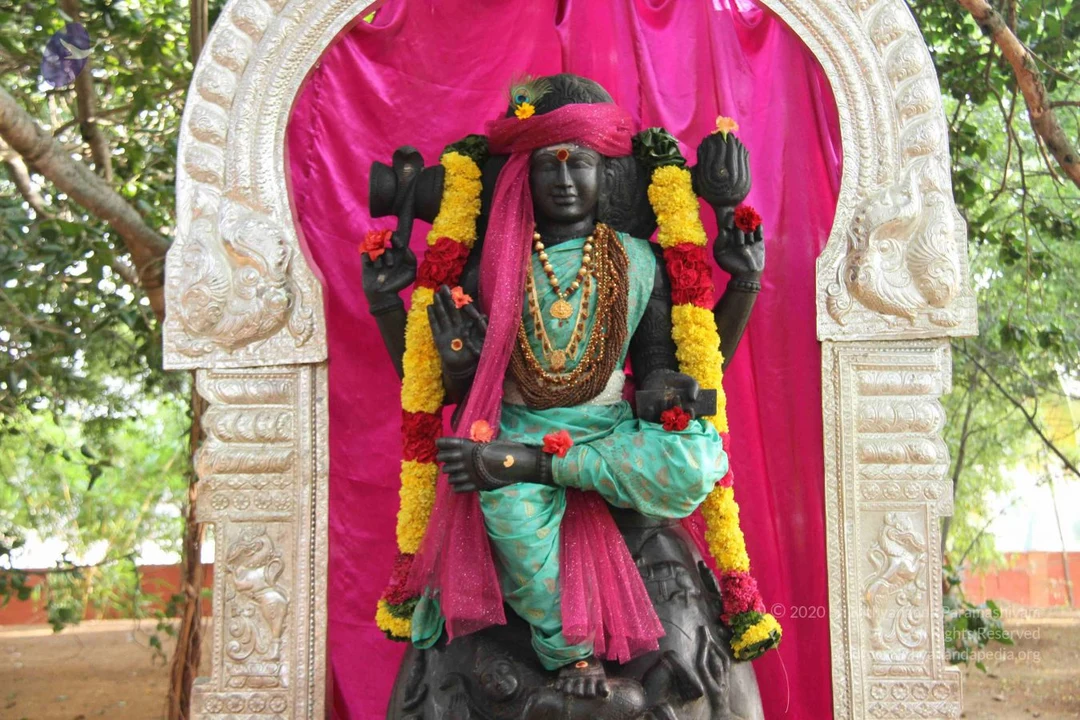
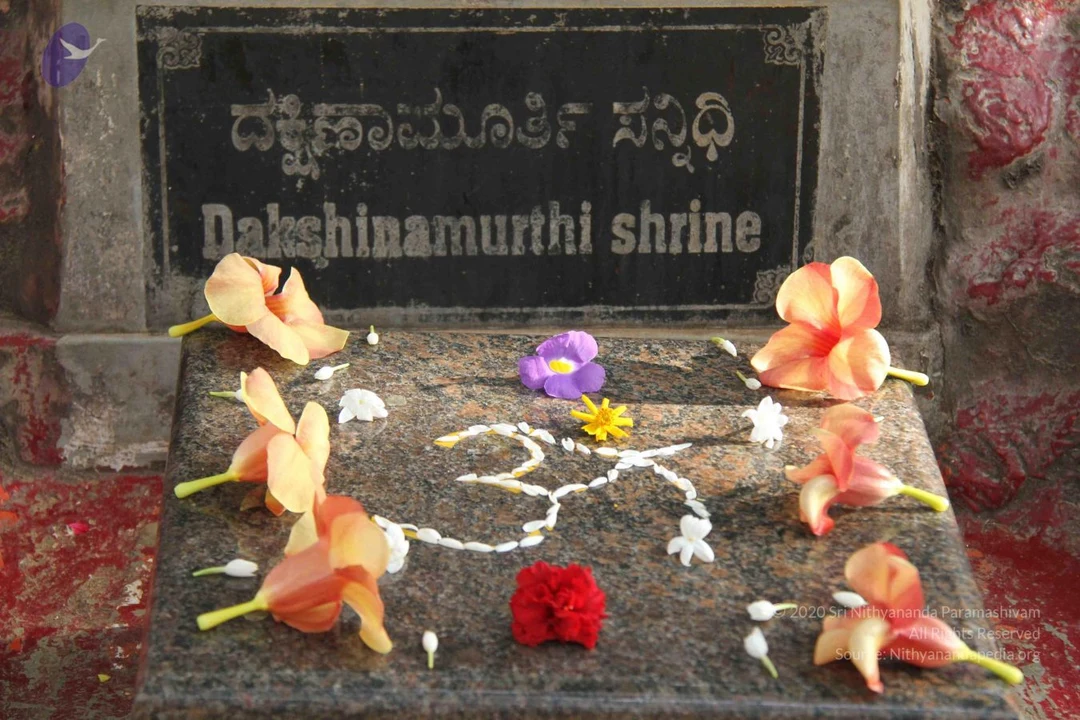
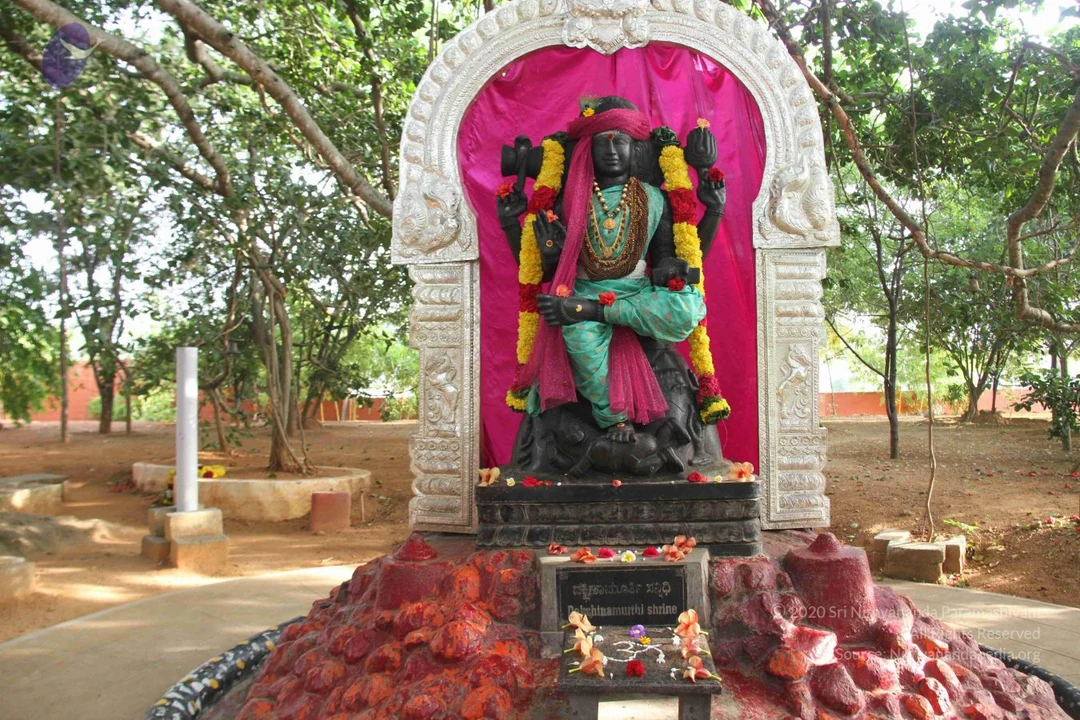
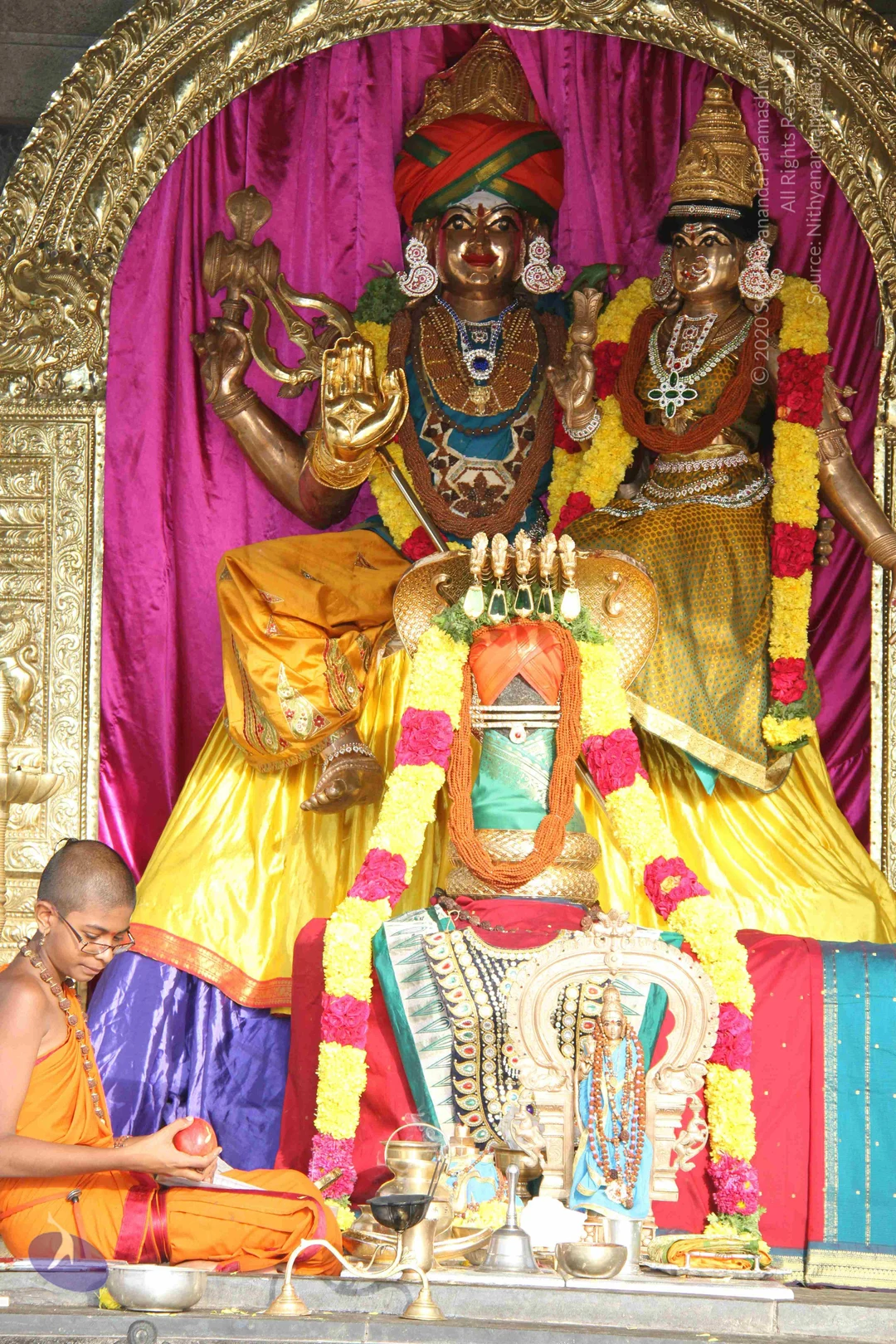
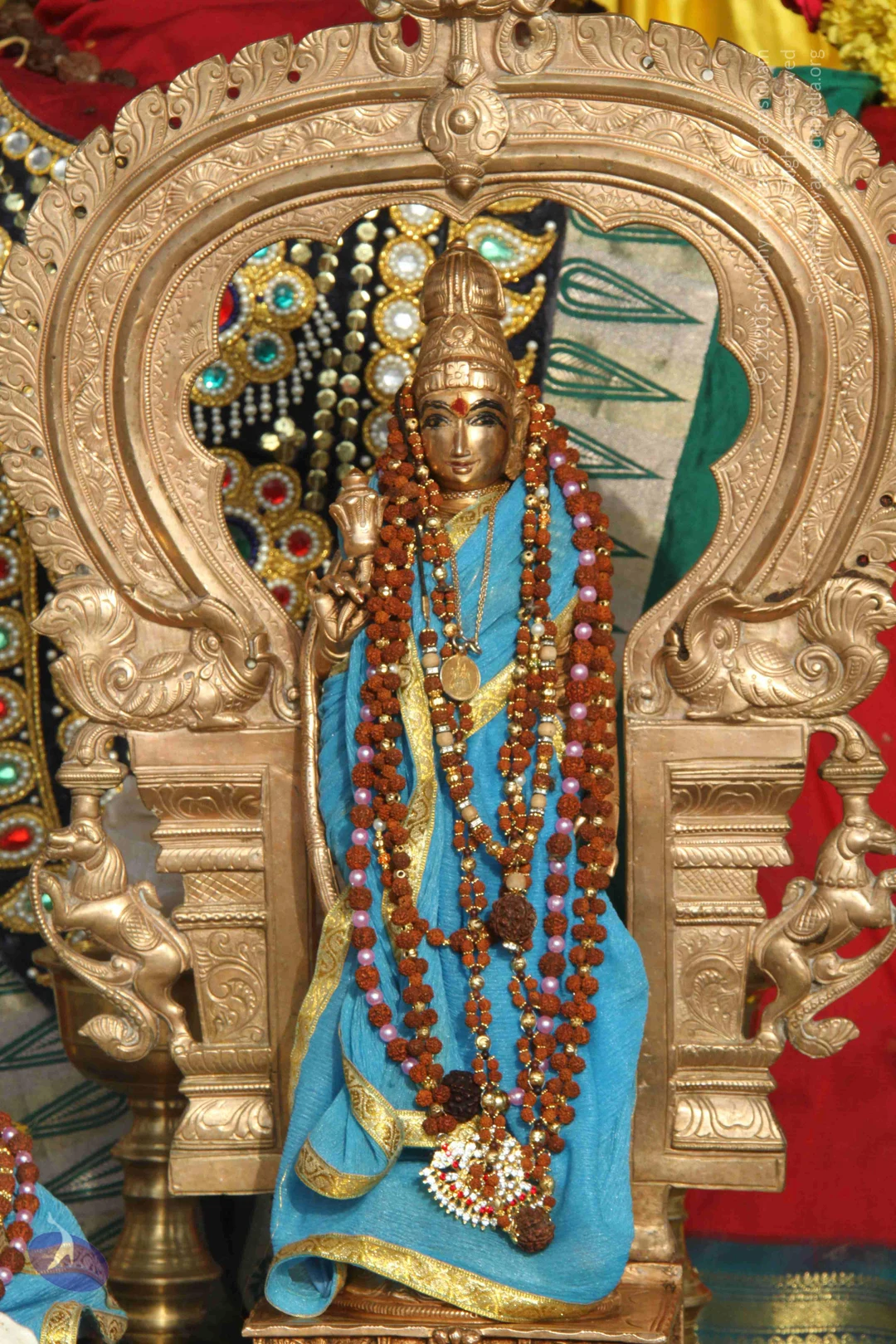
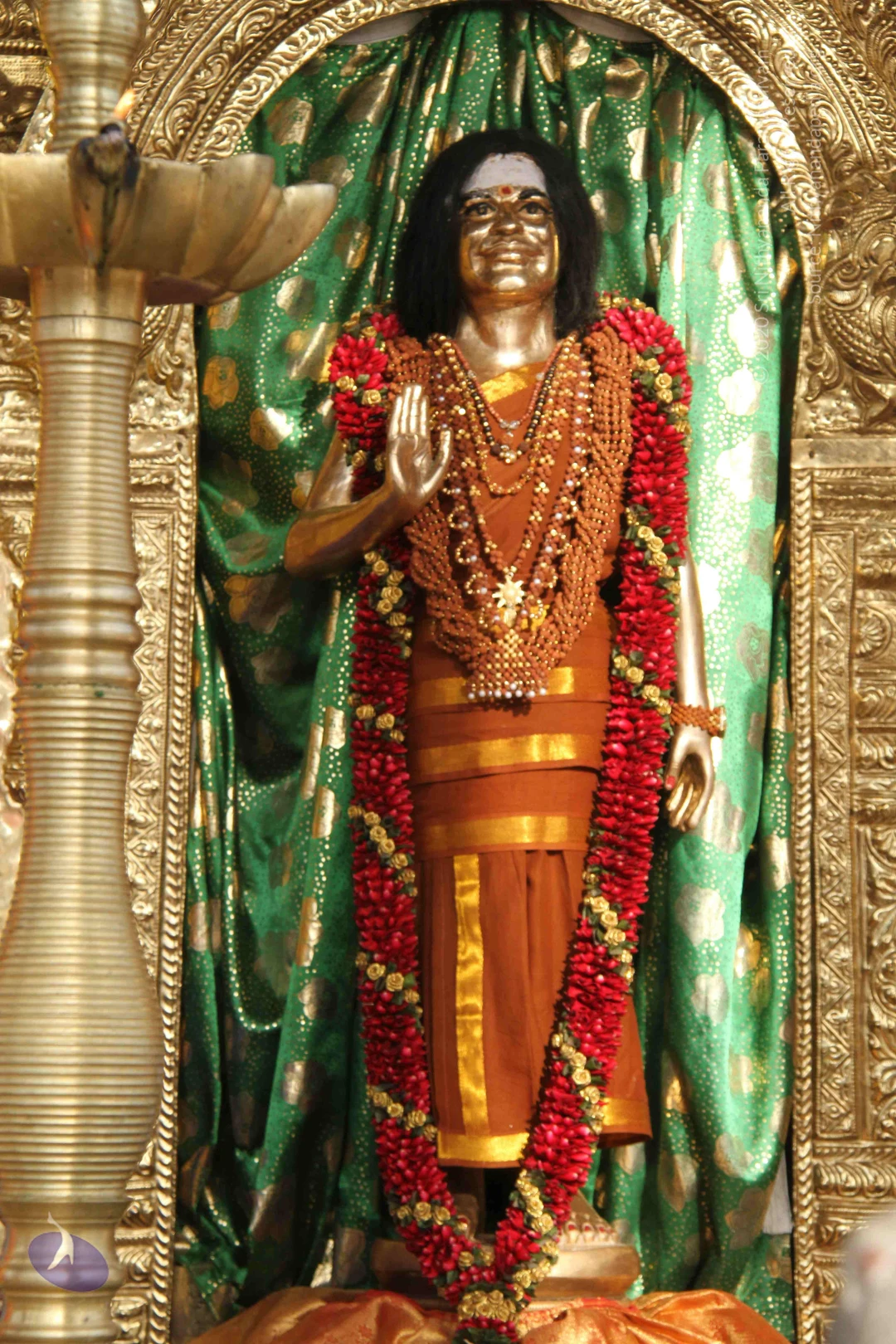
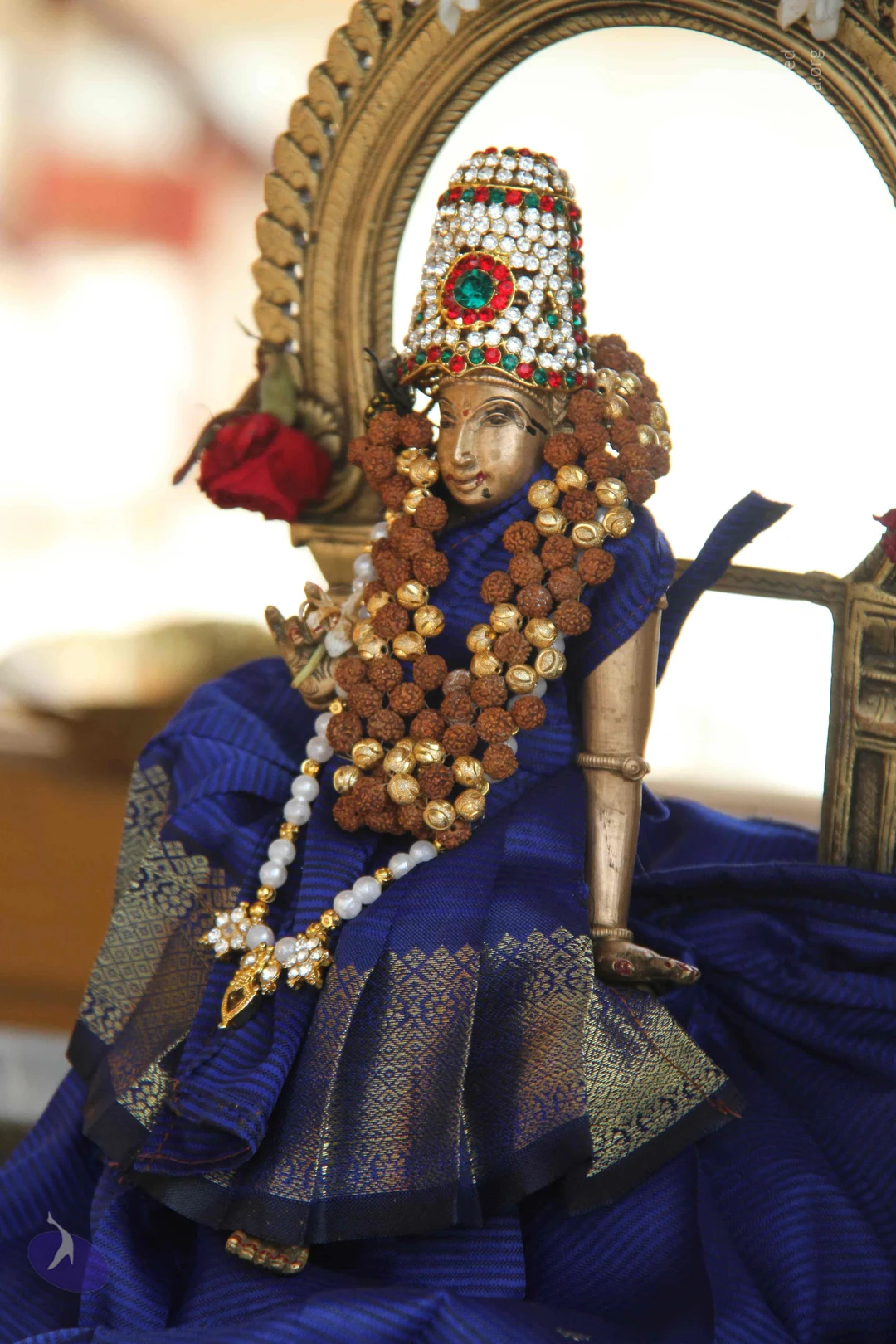
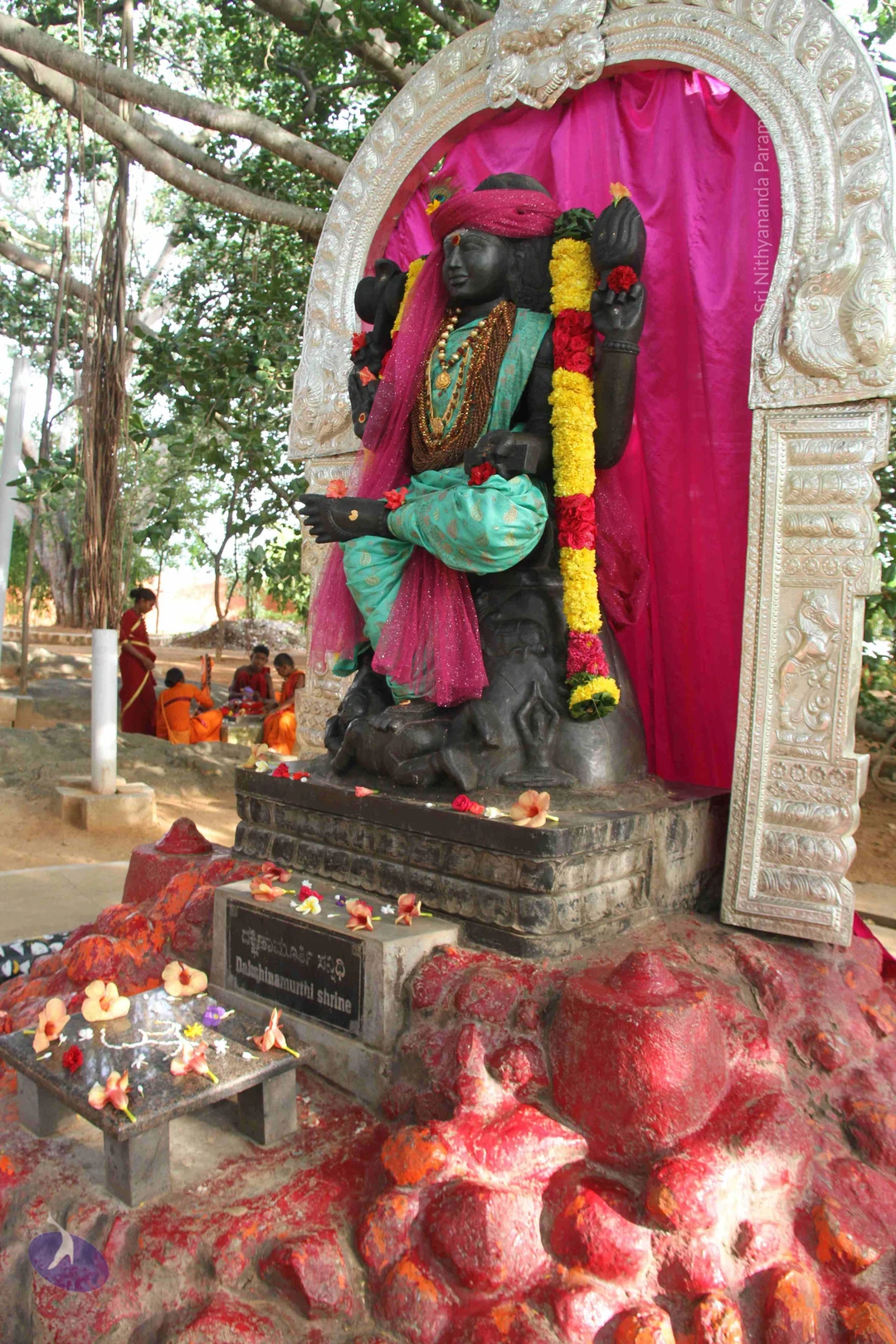
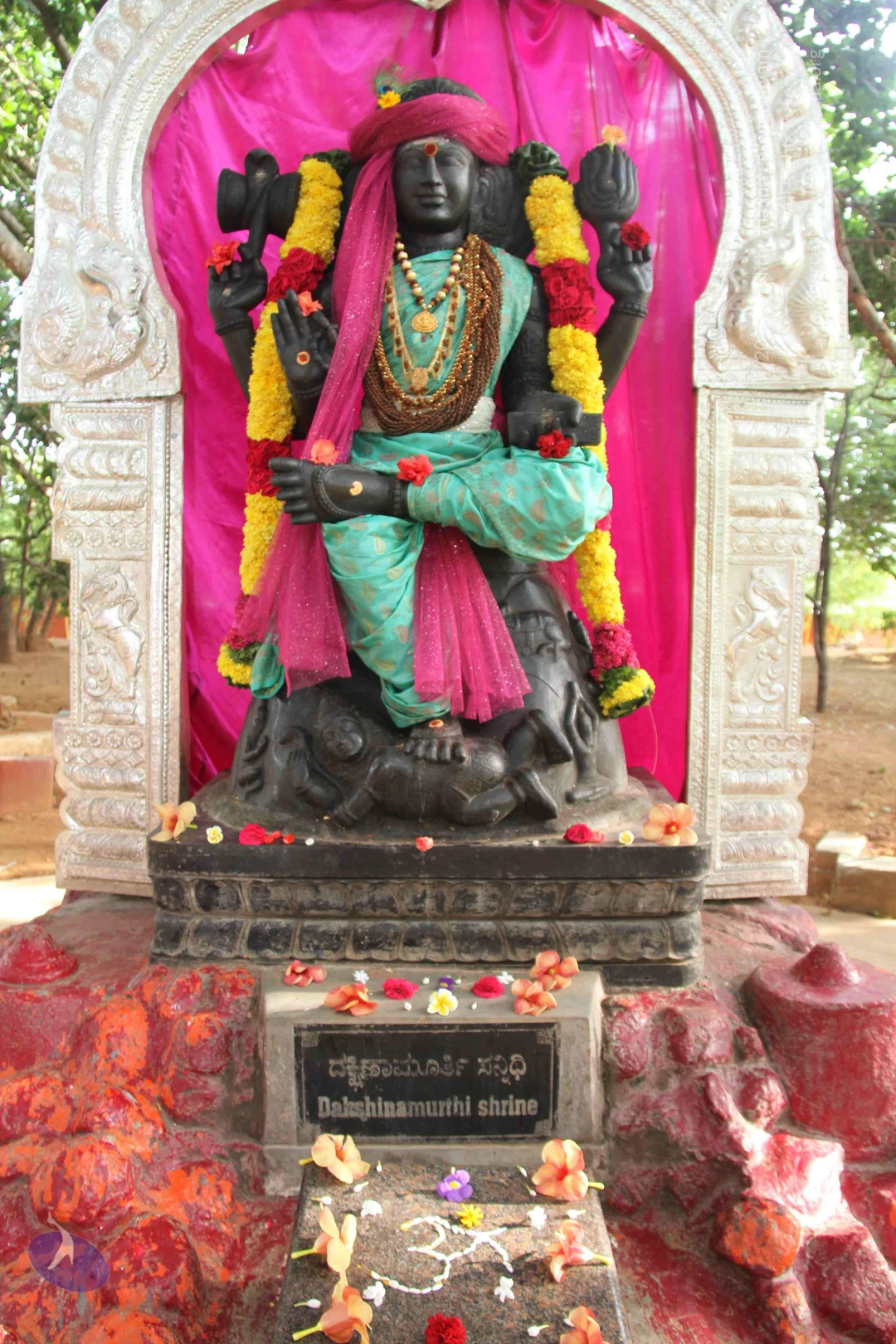
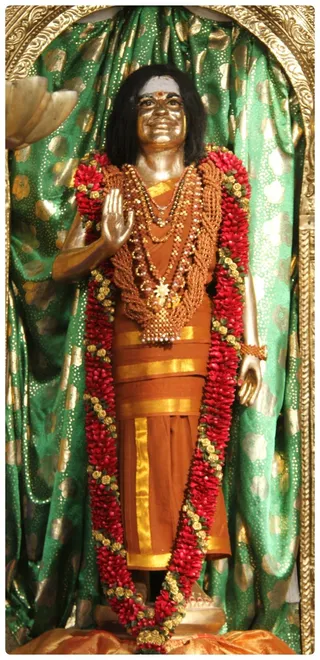
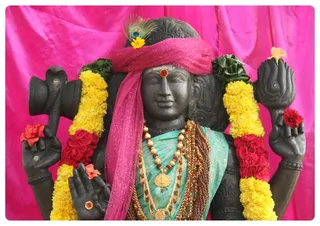
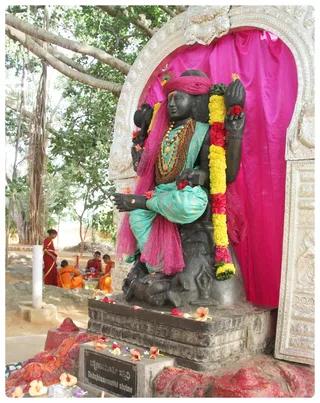
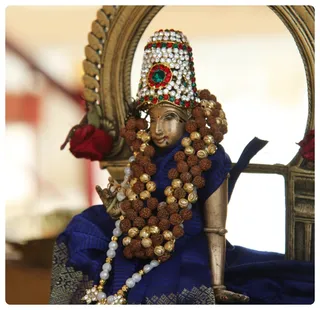
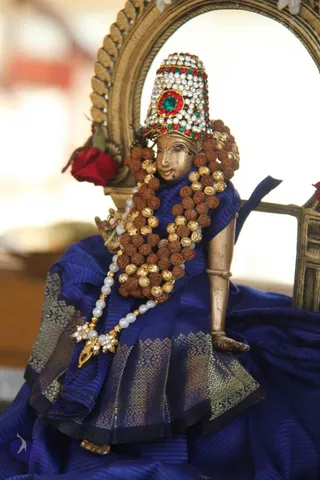
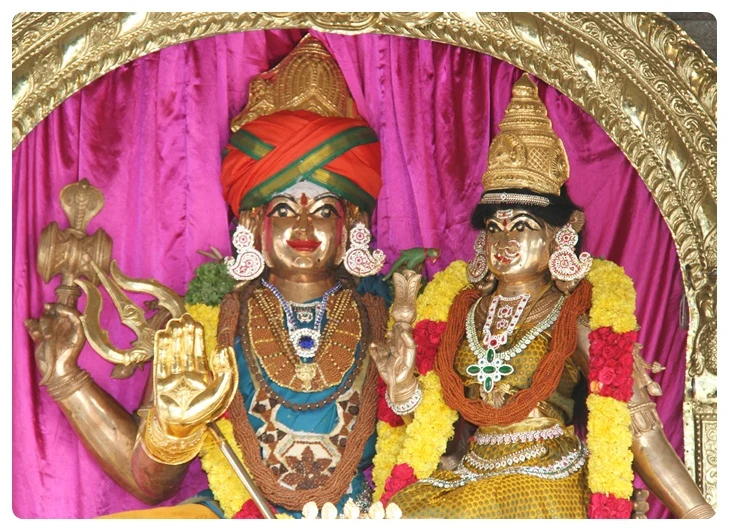
A pair of gilded metal murti statues of a deity couple seated within a gold ornate arch against magenta draped cloth. The male figure wears an orange and green turban, a blue and brown patterned garment, and a heavy rudraksha-style mala with jewel-set gold necklaces; he holds a trident in one hand and a raised palm gesture. The female figure wears a gold crown, a red and green jewelled necklace, a brown mala and a yellow silk garment, and holds a lotus stem. Both have large pink and white earrings and are adorned with yellow and red garlands. No living people are visible.A golden-bronze seated figure on an ornate gold throne with carved arch and lion-like side supports, in front of a backdrop of gold, red and green embroidered cloth with jewelled sequins. The figure wears a blue saree with gold border, multiple strands of rudraksha beads and gold beads, a gold pendant, and a tall crown-like headdress with a red tilak on the forehead, holding a small lotus-like object in one hand. A brass oil lamp stands beside the throne. This appears to be a deity murti rather than a person, with no visible human bodies in the scene.A gilded statue of a standing male figure in a golden arched niche framed by ornate gold relief and draped with green fabric patterned with gold motifs. The figure has long dark hair, a white forehead marking with a red dot, and wears an orange-brown robe with gold borders and layered rudraksha-style beaded necklaces with a gold pendant. Red and yellow flower garlands hang from the shoulders to the feet, and the right hand is raised in a blessing gesture. A golden lotus-shaped vessel is partly visible at the left edge. No physical people are present; the figure is a statue, so the appearance-based identification is not used.A dark stone murti of a four-armed deity is adorned with garlands of yellow marigolds and red roses and a red-and-pink flower on the arm. A peacock feather and yellow flower are tucked into a pink silk headwrap, and a red bindi marks the forehead. The figure wears a teal silk cloth, a gold pendant necklace, and rudraksha-style brown and red beaded malas. Behind it hangs a bright pink satin backdrop. No people are visible in the photograph.A dark stone statue of Dakshinamurthi, a seated deity form, sits in a carved white arch framed by bright magenta cloth. The murti wears a pink turban, a turquoise and gold garment, a gold-and-bead necklace, and garlands of yellow marigolds and red roses across its shoulder and arm. Red and white flower petals are scattered on the pedestal. Beneath a large banyan tree in the background, several people in orange and red robes sit near a small ritual setup with lamps and offerings. A black sign with a Kannada inscription sits at the base of the shrine, reading Dakshinamurthi shrine. The scene shows a shrine within an outdoor grove.Close-up photograph of a brass deity murti seated in an ornate brass frame with a circular arch. The figure wears a jeweled crown set with white stones and red and green gems, a deep blue silk cloth, and layered garlands of rudraksha beads with gold-coloured round beads, plus a white pearl-like strand. Red roses decorate the frame on either side. The background is softly blurred.

Nayana-Deeksha

2 photosSource gallery
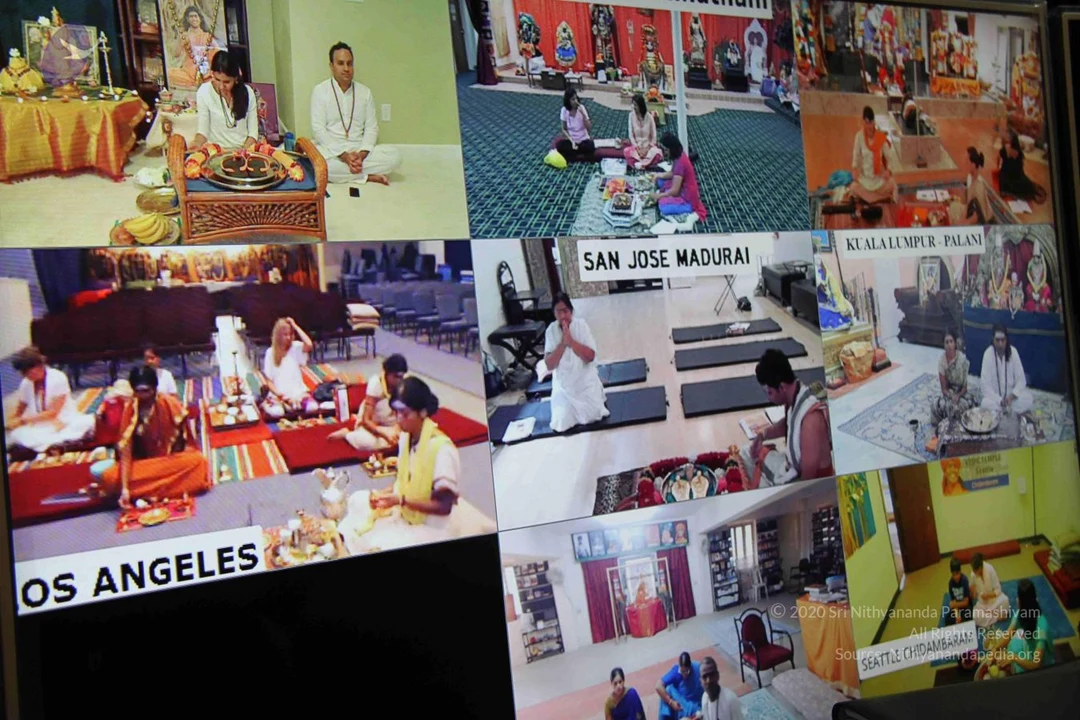
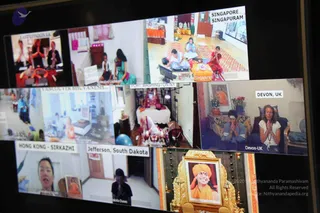
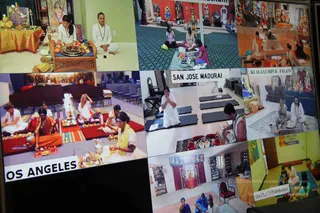
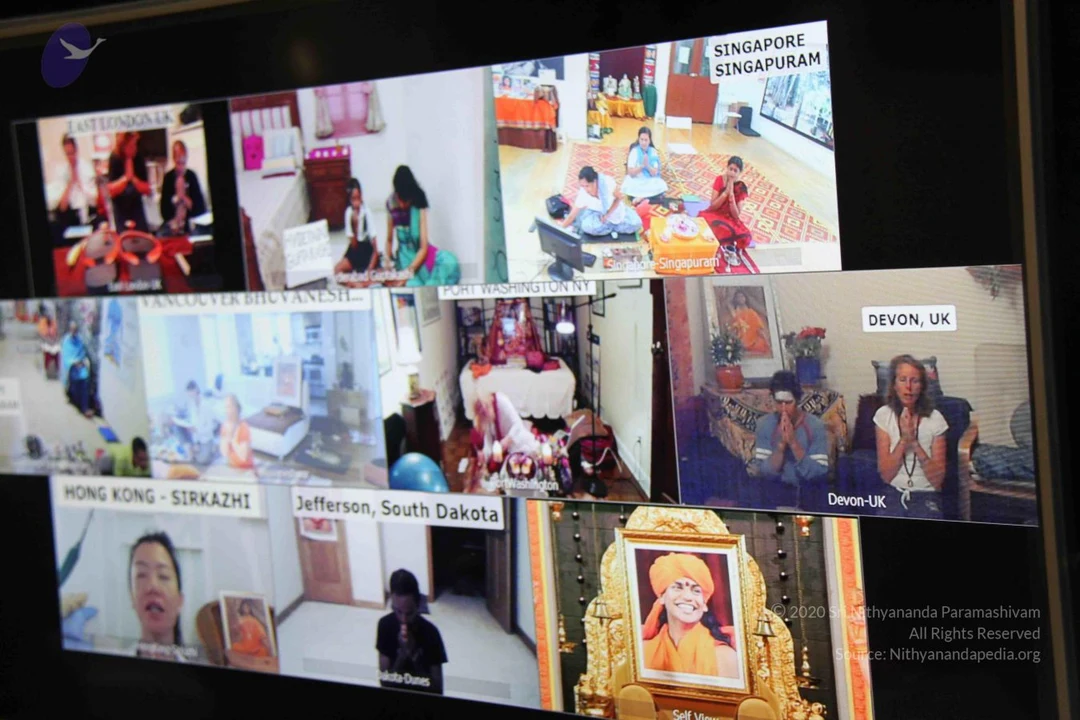
A multi-panel video-conference screen shows several small live feeds of devotees in different locations, labelled with place names such as Singapore Singapuram, East London UK, Devon UK, Fort Washington NY, Hong Kong Sirkazhi, Jefferson South Dakota and Vancouver Bhuvanesh. Some participants press palms together in anjali, one woman in white sits with hands folded, and a home shrine shows a framed portrait of a figure in orange robes and an orange turban, smiling, labelled Self View. The bottom-right panel shows a gilded frame holding that orange-clad portrait, displayed like a shrine. The image is a photograph of a screen, and the participants are shown on the screen rather than physically present.A screen-grid video conference of multiple satsang locations, with each tile showing a different group. Top-left, a man in white and a woman in white sit before a gold-draped altar with fruit and a brass tray. Top-centre, a group sits on green carpet beside a red-draped shrine with deity murtis. Centre-left, a label reads Los Angeles and people in white and orange sit on red and striped mats near a puja setup. Centre, a label reads San Jose Madurai and a woman in white sits with palms joined on a mat. Right tiles show Kuala Lumpur-Palani and Seattle Chidambaram, with people seated near altars and framed images. Many participants wear white, orange or yellow clothing.

Temple

30 photosSource gallery
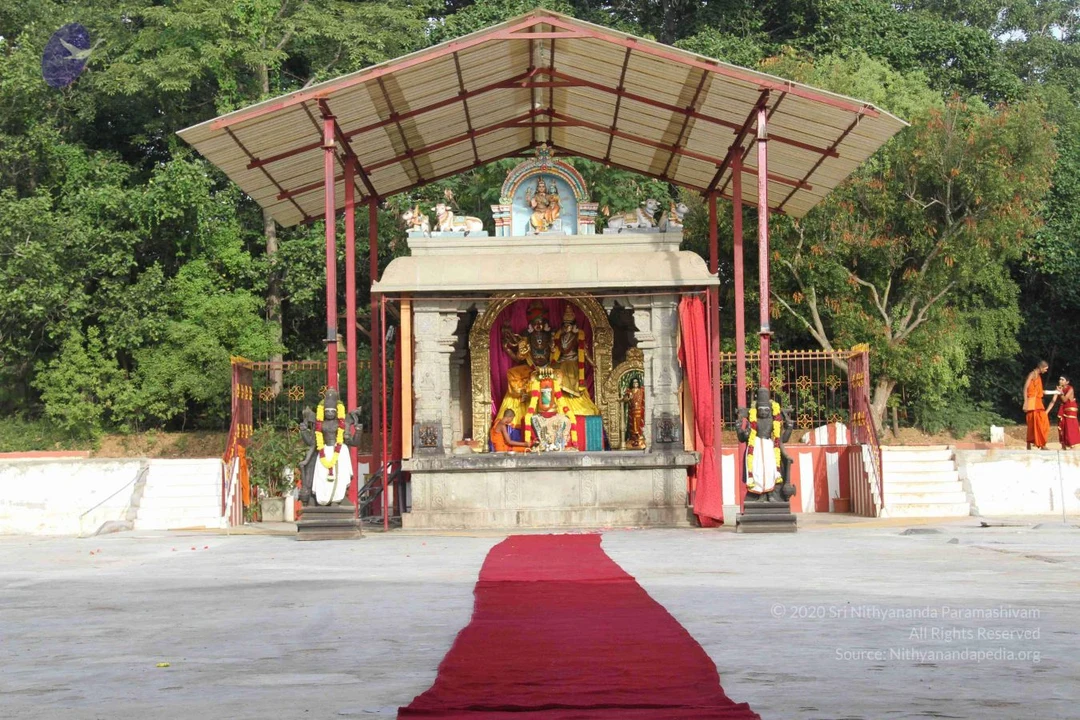
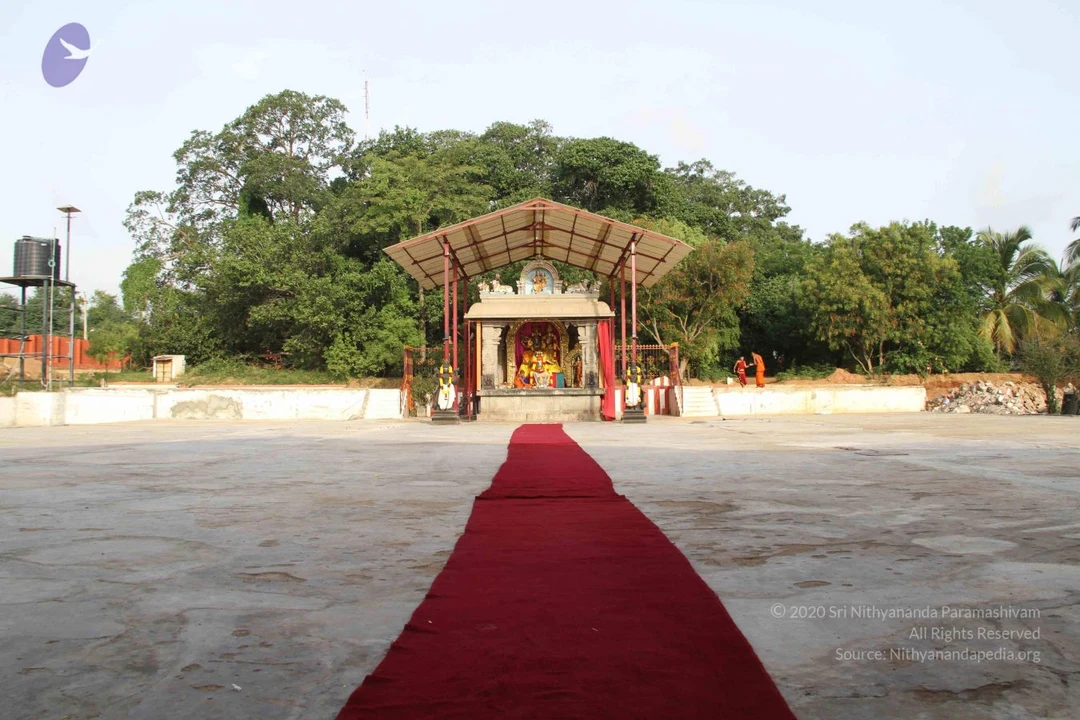
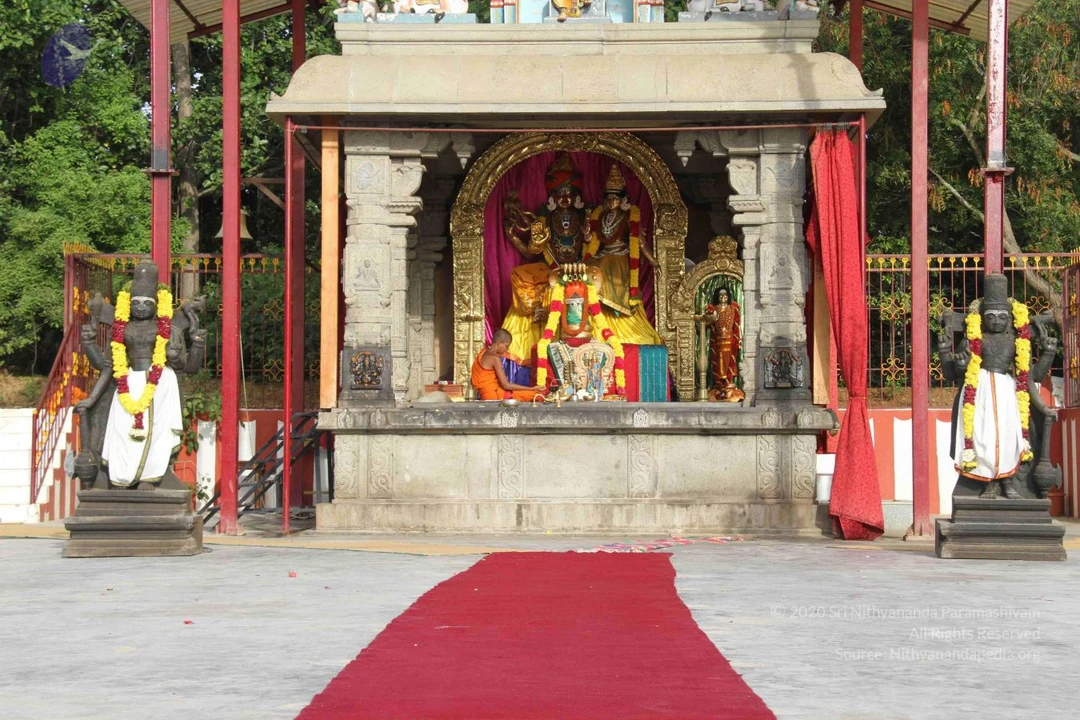
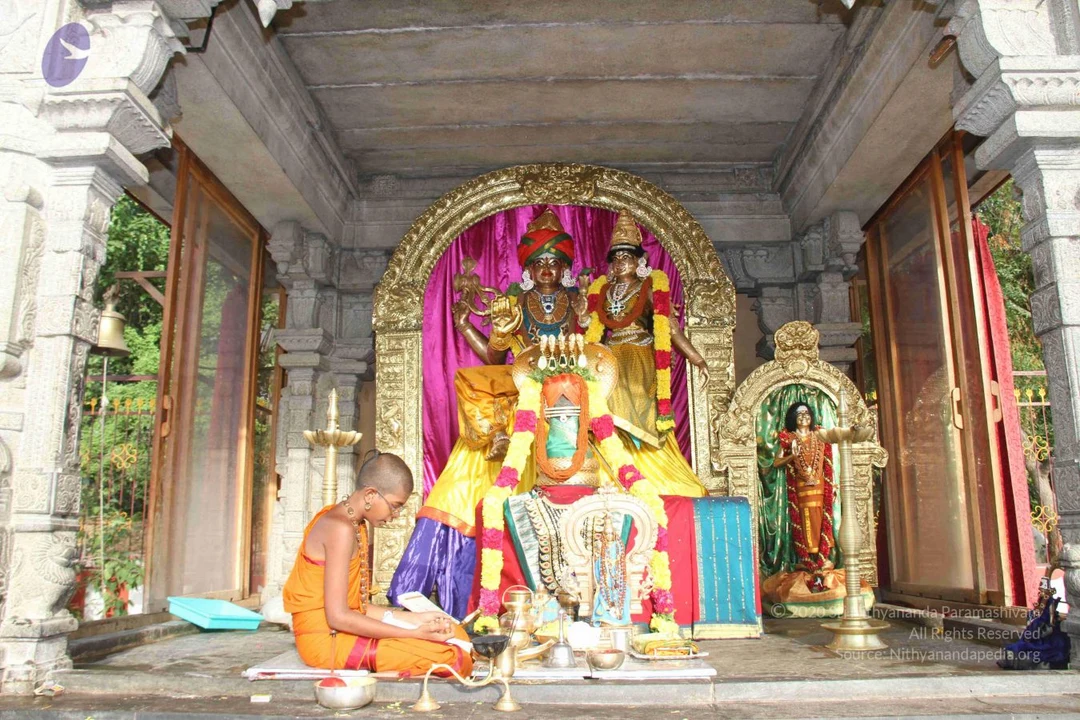
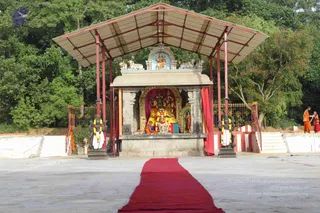
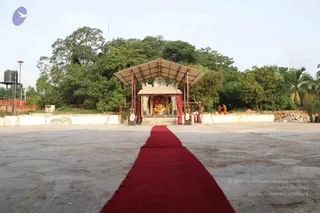
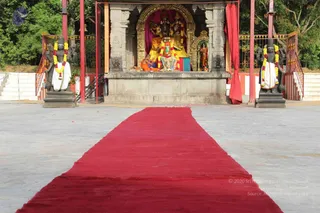
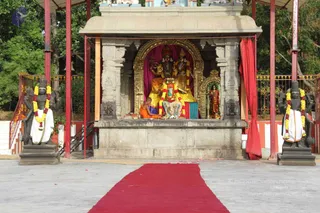
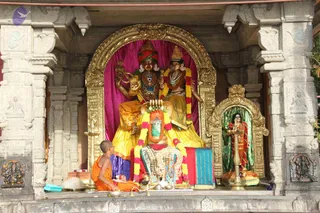
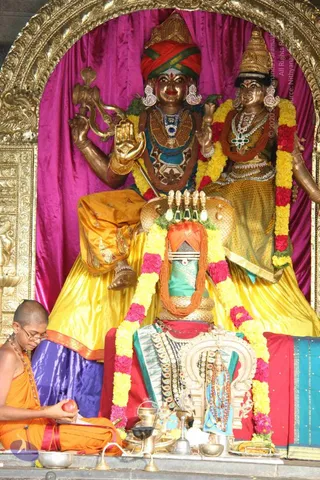
A bright, hazy sun shines over a dusty open ground at an ashram-style compound. In the foreground, a half-built steel scaffold frame of pipes and trusses stands on bare red earth. To the left, a low brick building with a tiled roof and small finials sits beside a white minivan and a parked car, with green shrubs along the edge. No people are visible.Outdoor temple shrine under a corrugated metal canopy on red-painted posts, surrounded by green trees. A grey stone shrine houses a gilded deity murti with garlands and a red curtain, flanked by two small guardian figures with garlands. A long red carpet runs from the foreground toward the shrine across a paved courtyard. On the right edge, two people in orange and red robes stand near a low wall.A photograph of an open paved courtyard leading to a small open-sided shrine with a sloped metal roof supported by red-painted poles. A long red carpet runs from the foreground to the shrine steps. Inside the shrine stands a decorated deity murti with a red and gold backdrop, flanked by garlands and lamps. Dense green trees and palms fill the background under a pale sky. Two figures in orange robes stand near the right edge of the shrine area, and a water tank and low walls are visible at the left.A long red carpet runs across a pale stone courtyard toward a shrine with a golden arched niche and pink-red curtains. Inside the shrine, large gold-clad deity murti sit on a raised platform, decorated with red and yellow garlands. A seated figure in orange robes sits before the central murti on the platform, possibly a devotee or priest; the figure is too small and indistinct to confirm identity. Two dark stone guardian statues stand on either side, each draped with a marigold garland and wearing white dhoti-like cloth. Tall red-and-white railings and trees frame the scene.A stone shrine with a gilded arch frames a group of deity murtis garlanded with marigolds and yellow flowers, with a red-and-maroon backdrop. A bare-headed man in an orange robe kneels at the base of the shrine, apparently tending the murtis. Two large dark stone dvarapala guardian figures in white dhotis stand on either side, each wearing a yellow-and-orange garland. A long red carpet runs across the open paved courtyard, under a red-pillared canopy with trees behind.A photograph of a temple shrine with a gold-framed arch and pink backdrop housing a pair of large painted deity murtis, a male figure in a red-and-green turban holding a trident and a female figure in a golden crown with yellow garments. Both are garlanded with marigold and rose garlands and wear ornate necklaces. In front, a kalasha-like vessel and a central lingam-shaped object sit on a throne-like platform draped in cloth and marigold garlands. A shaven-headed priest in an orange robe sits cross-legged at lower left, handling a puja vessel with brass lamps and bowls before him. A smaller shrine with a green curtain holds another garlanded figure at right. Carved grey stone pillars frame the scene. No physical person is clearly identified as a person.

Paduka-Puja
32 photosSource gallery
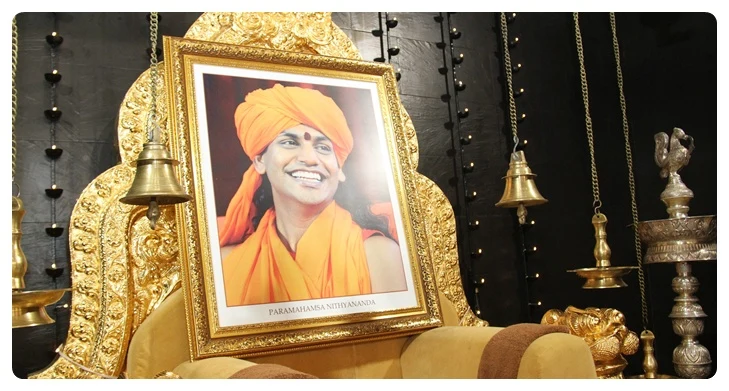
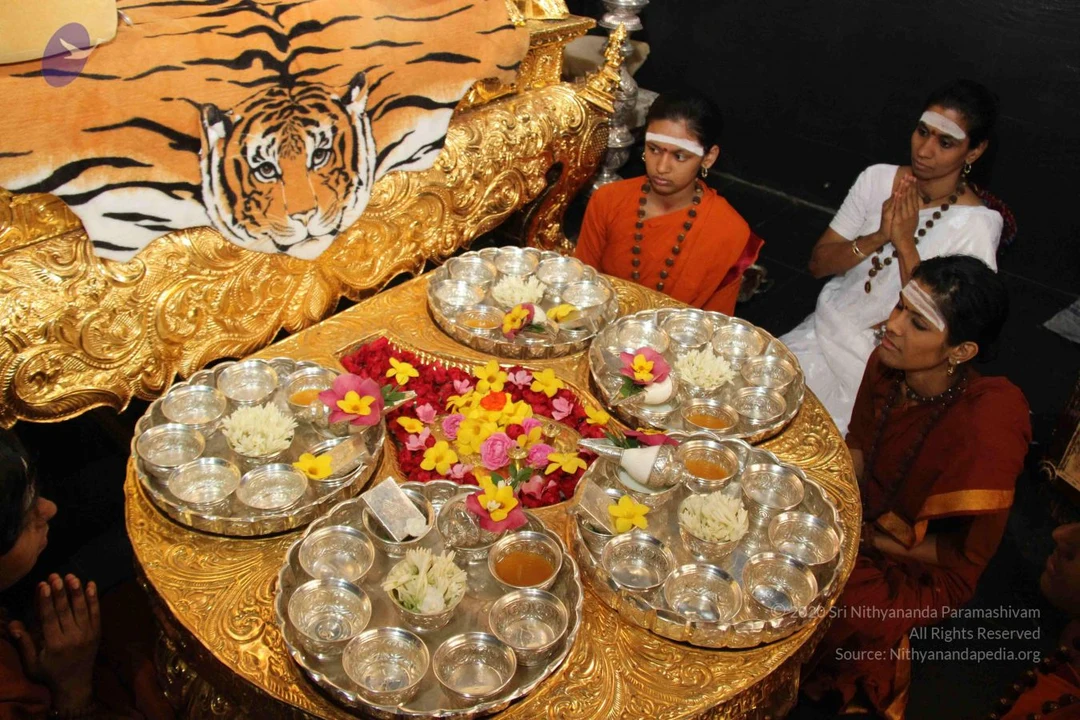
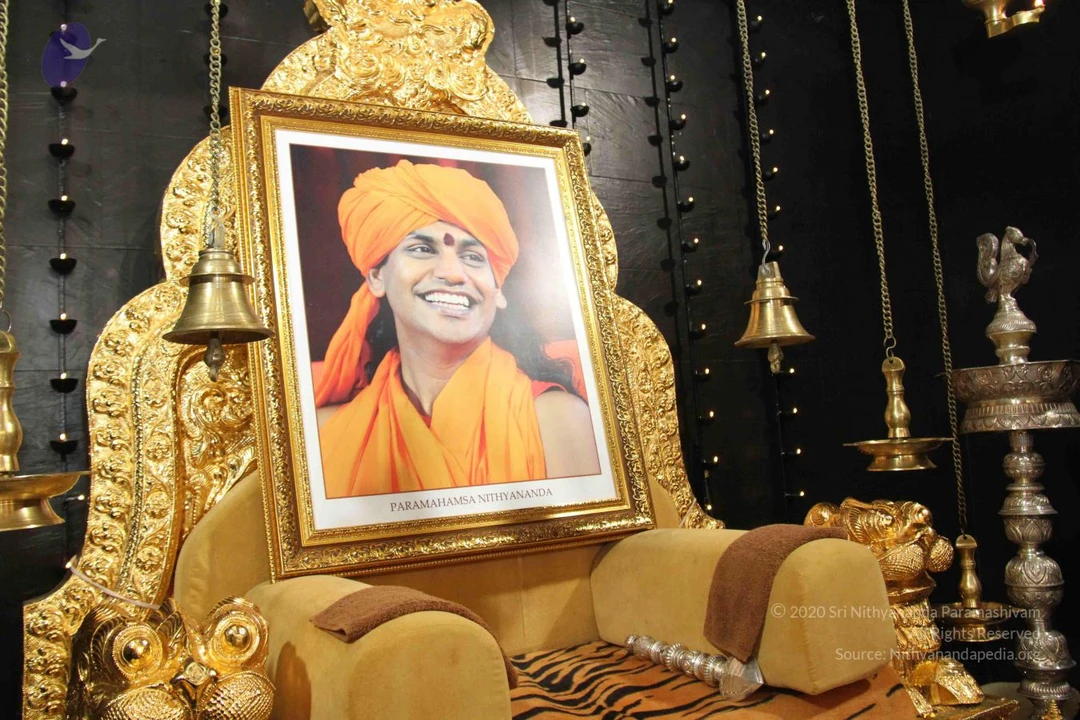
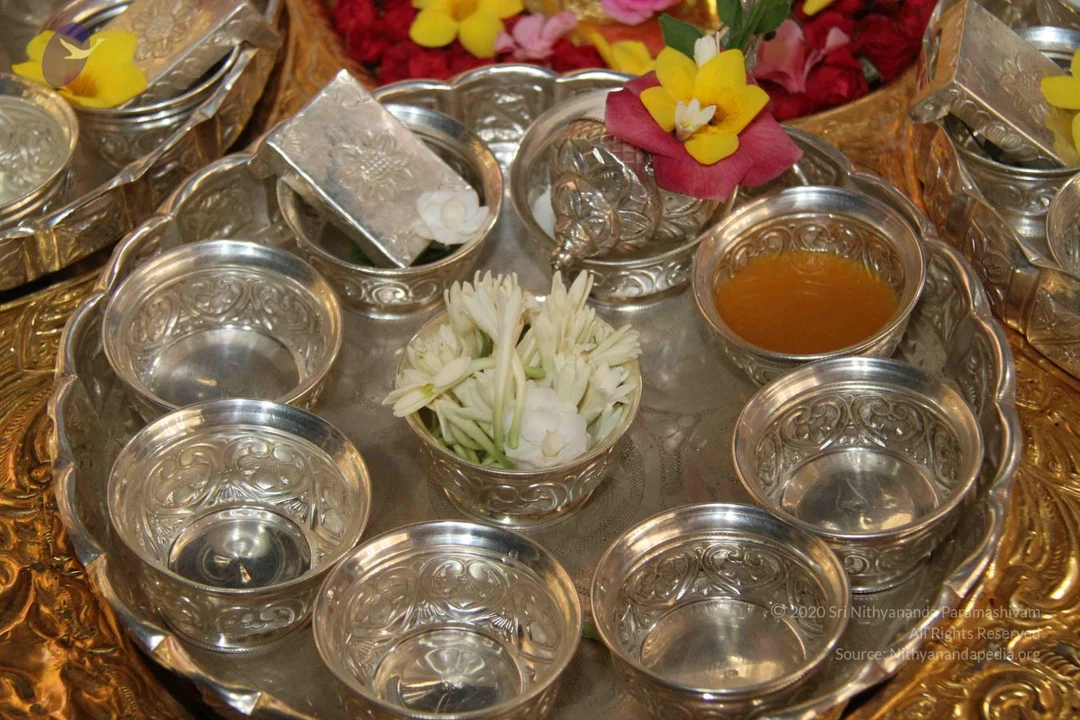
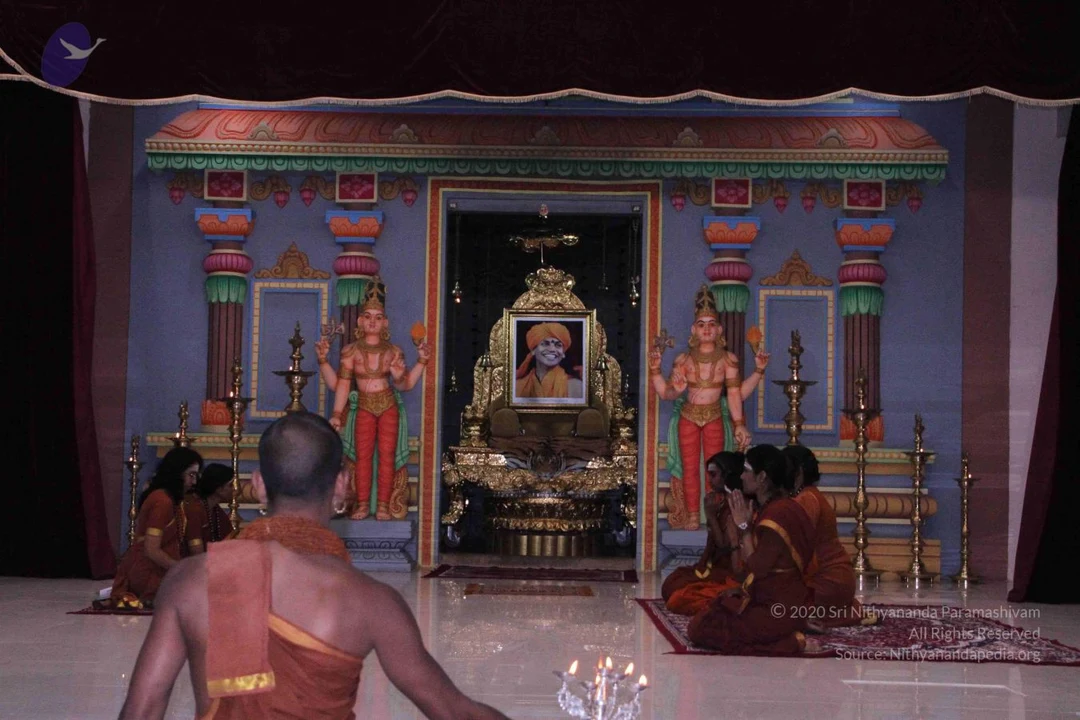
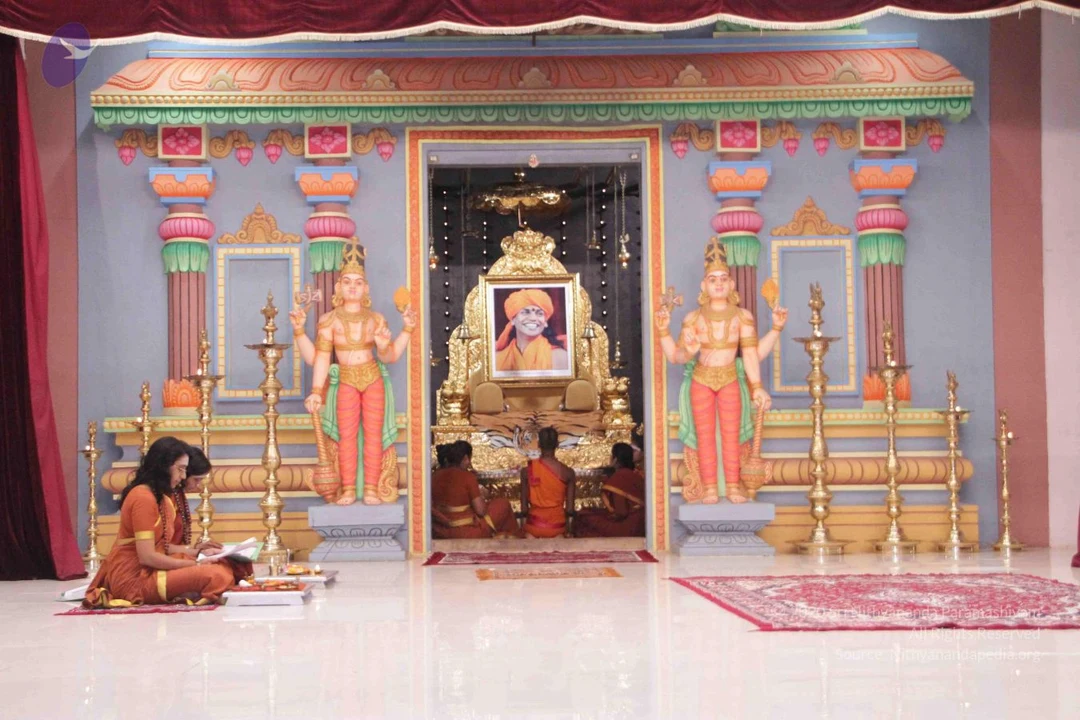
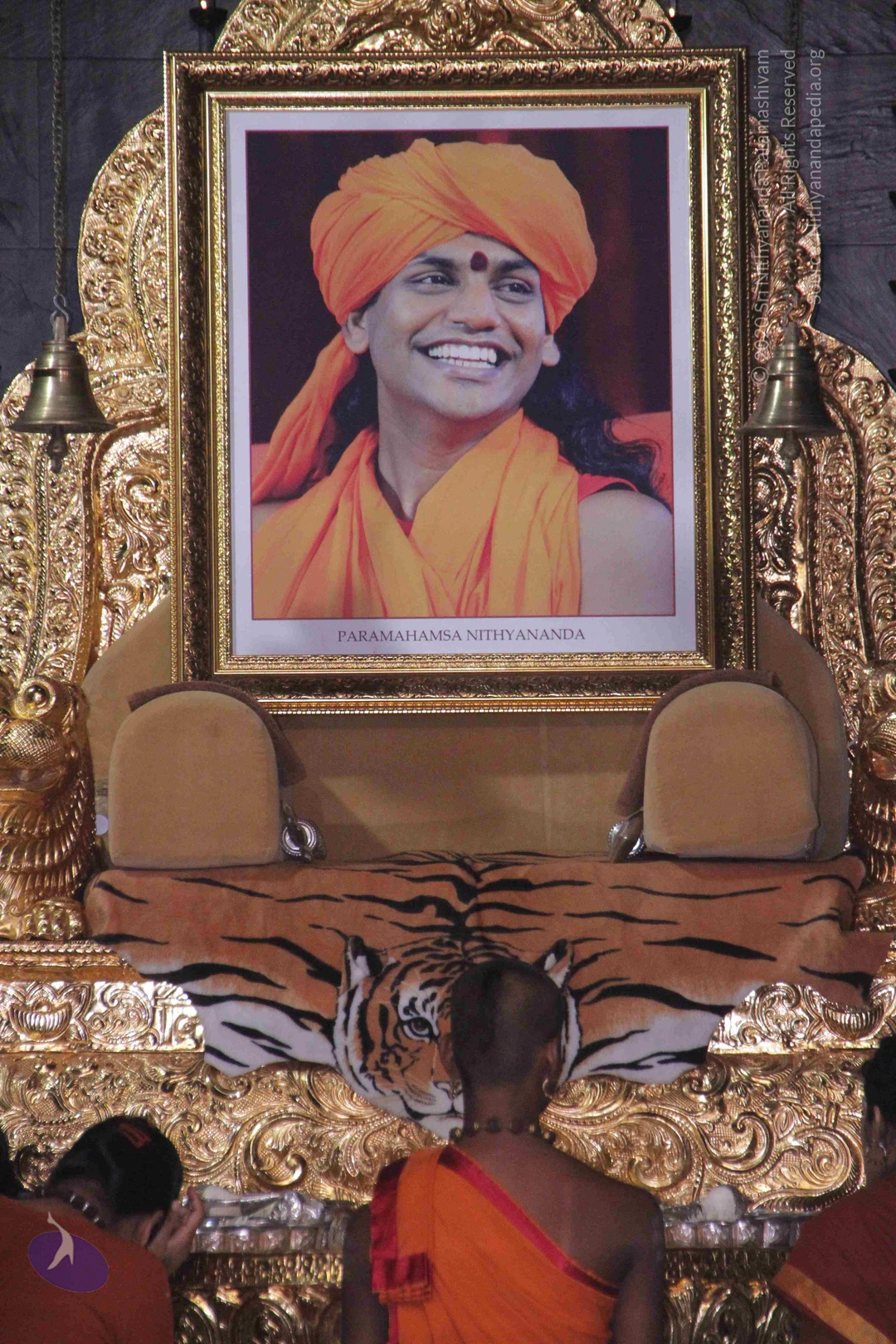
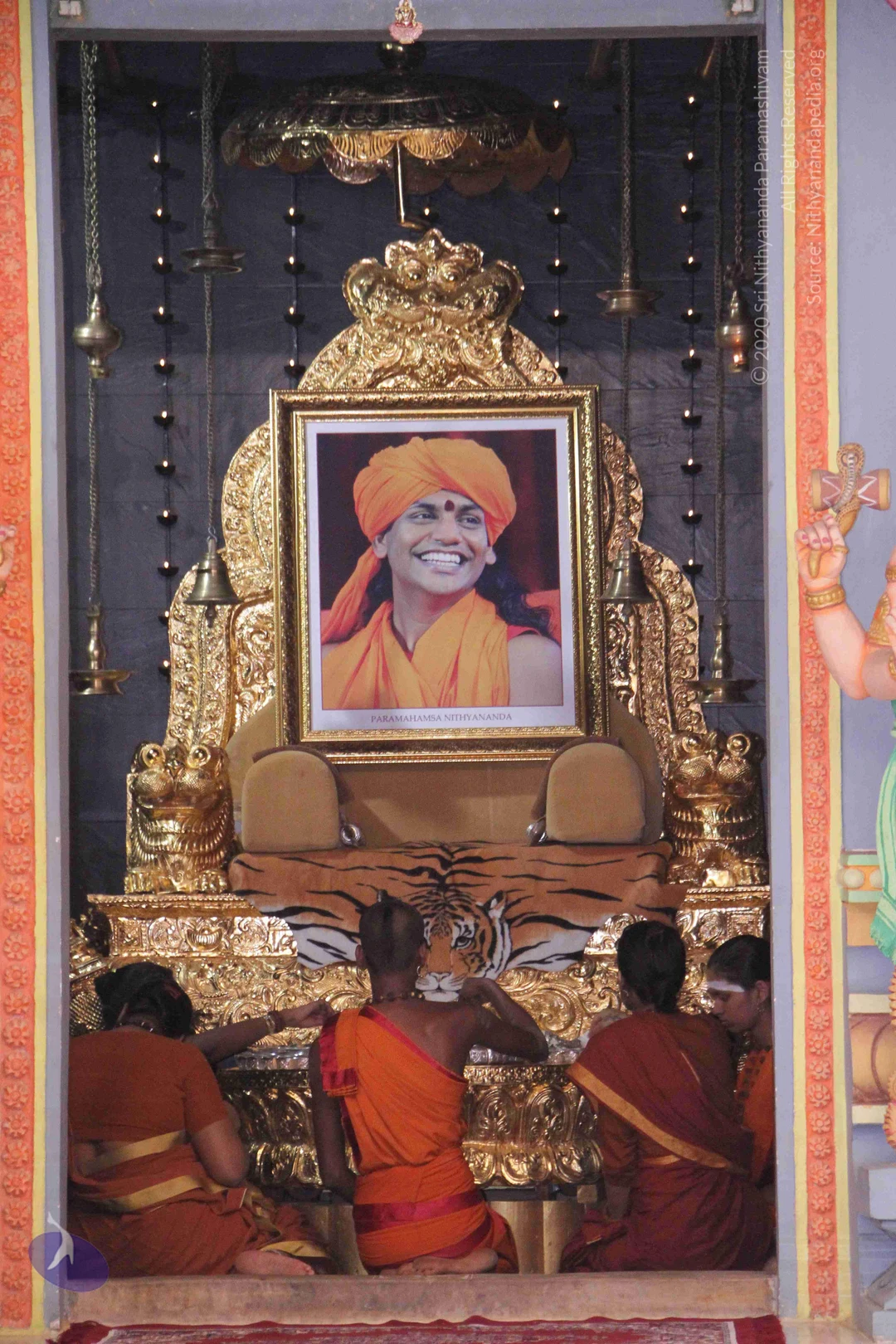
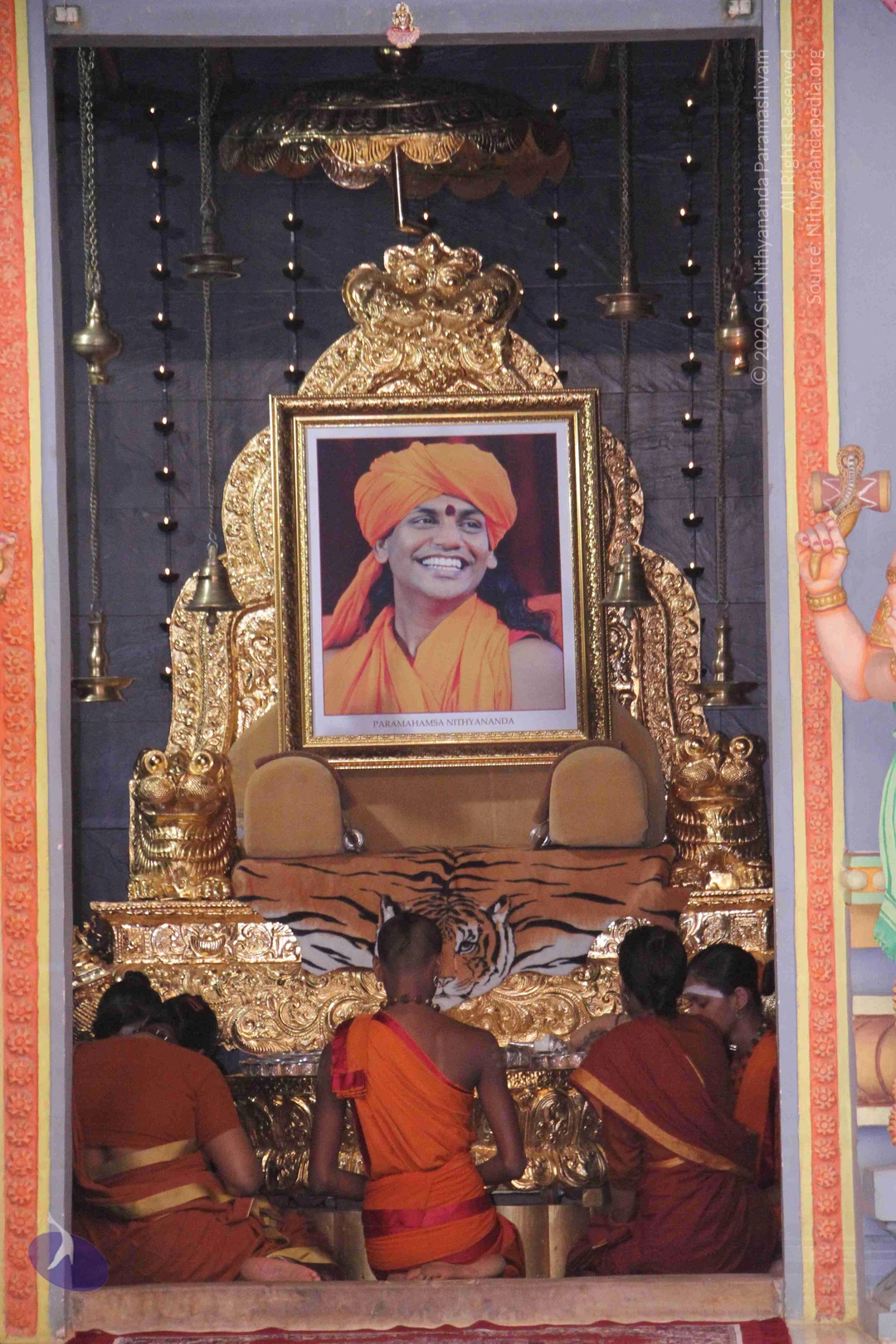
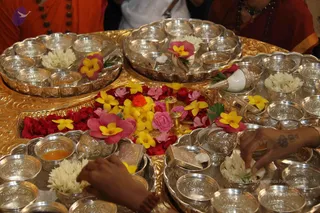
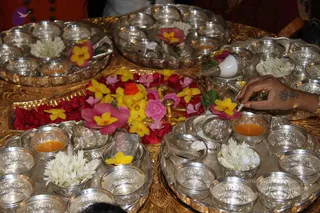
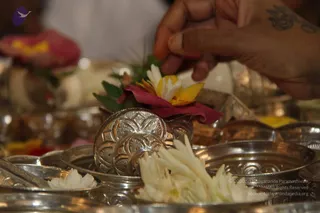
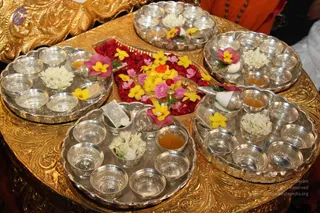
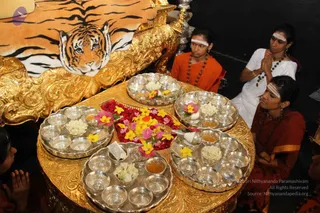
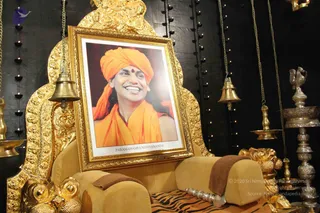
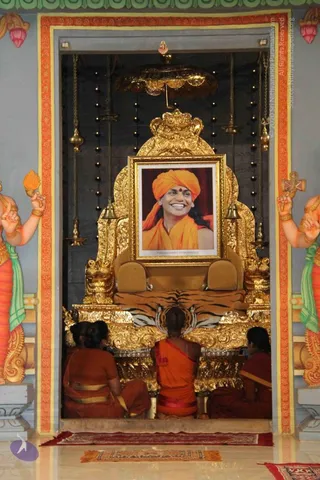
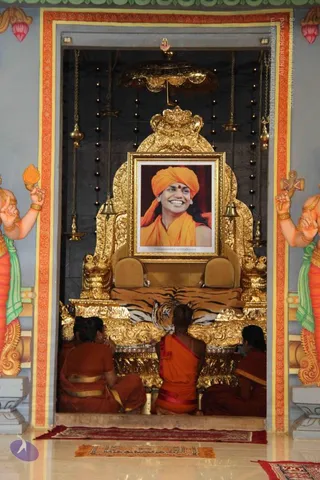
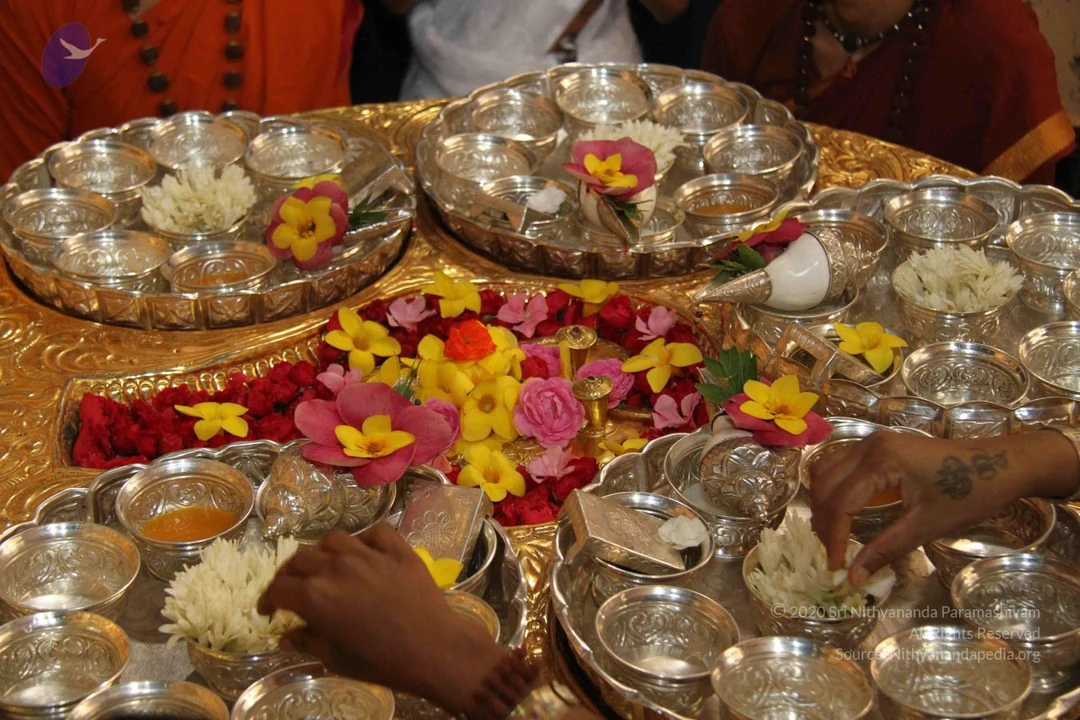
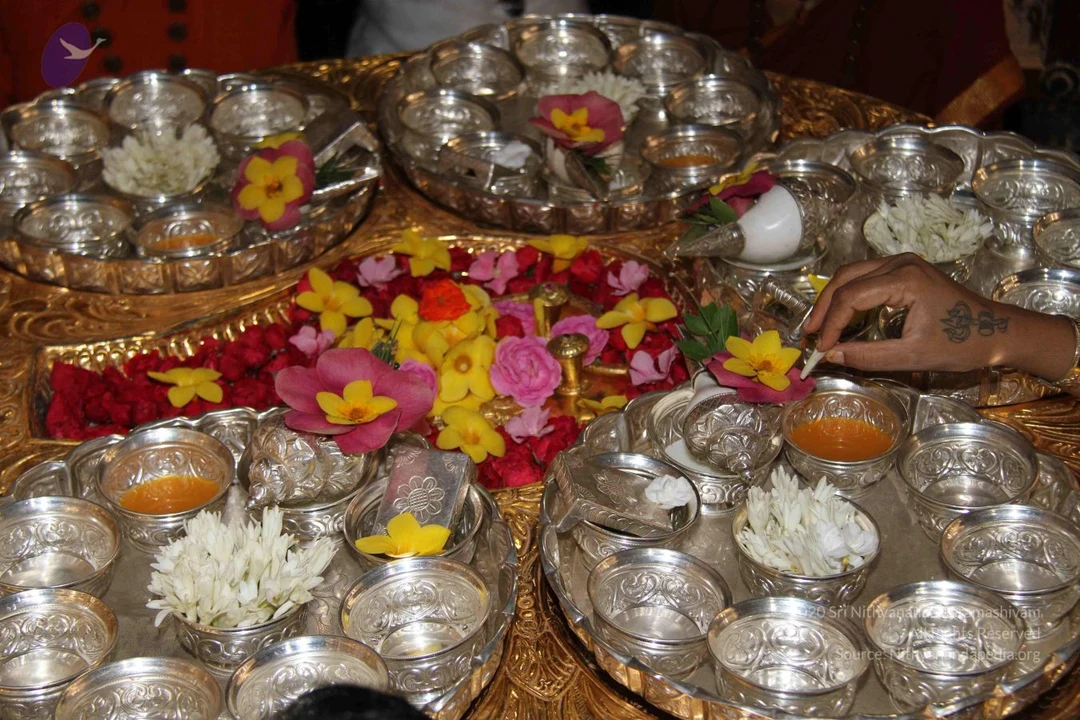
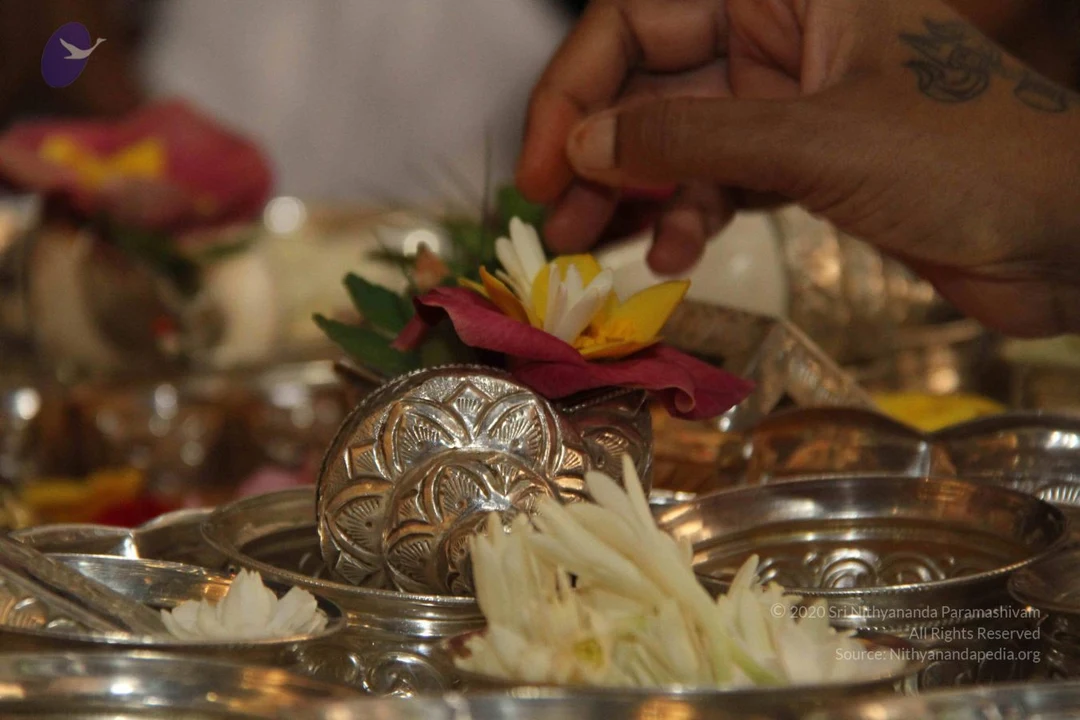
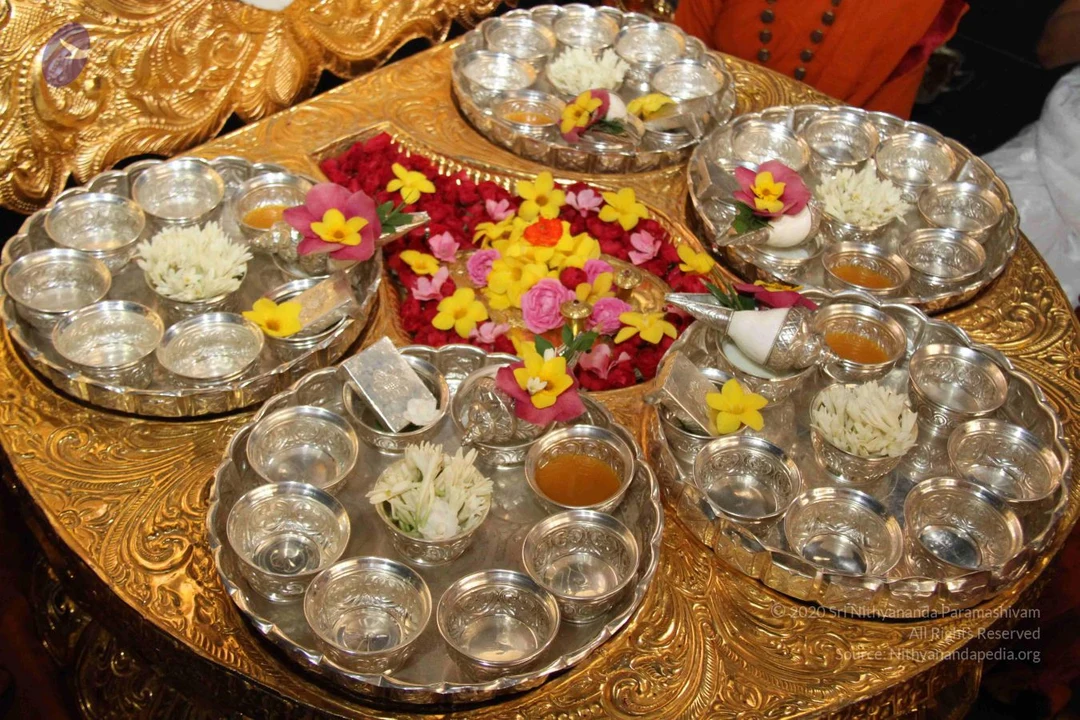
Overhead view of a ritual puja tray arranged on a gold-patterned surface. Silver bowls hold white jasmine-like flowers and small oil-filled cups, and a central platter is heaped with red and pink blossoms and yellow plumeria-type flowers around a small brass lamp. A silver-and-white vessel stands at the upper right. At the lower right, a bare hand with a tattoo places flowers into a bowl, and at the lower left another bare hand arranges flowers. At the top edge, the orange and maroon robes and beaded malas of two people are partly visible.Close-up of a ritual worship setup on a gold-patterned tray. Silver bowls and small silver vessels hold orange paste, white jasmine flowers and yellow and pink blossoms. A central red-flower-filled plate surrounds a small brass deity murti or shiva-linga form. A bare hand with a tattoo, wearing bangles, reaches to a bowl with a spoon or small ladle. The scene suggests a puja offering arrangement; no people's faces are visible.Close-up photo of a puja offering: a hand with a tattoo places a red and yellow flower onto a small silver vessel with embossed floral patterns. Around it are silver plates and bowls holding white jasmine-like flowers and petals, with green leaves. No people's faces are visible, only the hand. The silver ritual vessels suggest an abhishekam or puja arrangement.Ritual offering arrangement on an ornate gold-embossed table. Several silver trays hold small silver bowls filled with white jasmine flowers, honey-coloured liquid, and other offerings. Yellow and pink flower petals and blooms are arranged around a central pile of red rose petals, with a silver kalasha-style vessel and a small silver container visible. No people are visible in the frame apart from a sliver of orange clothing at the top edge. The setting suggests puja preparation.A photograph of a ritual scene in a temple-style hall. In the foreground, a golden table holds several silver trays arranged with small silver bowls filled with white flowers, yellow and pink blossoms, a mound of red rose petals, and a brown liquid in a bowl. Behind the table, a large tiger-striped cloth draped over a gilded throne-like seat. Three women sit in front of the offerings: one in orange robes with a white forehead band and rudraksha mala, one in white with hands pressed together in namaskar and a white forehead band, and one in red-orange robes with hands folded and a white forehead band. No a person candidate is visible.A golden ornate throne with a tiger-striped cushion and brown towel rests before a black wall hung with brass bells and chains. Centered on the seat is a large gilded framed portrait of a smiling man wearing an orange turban, orange shawl and a red bindi, captioned "PARAMAHAMSA NITHYANANDA" on the print. Brass oil lamps, a silver kalasha-style vessel and an ornate silver stand flank the throne. No physical people are present; the central figure is a printed portrait on display.

Swasti-Mantra

4 photosSource gallery
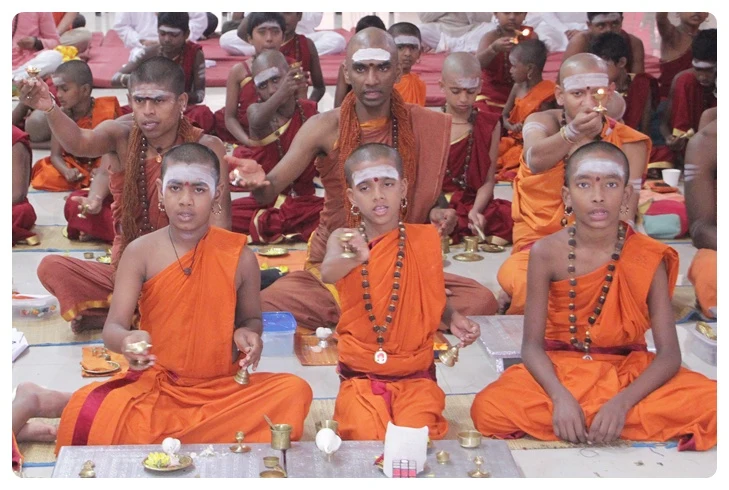
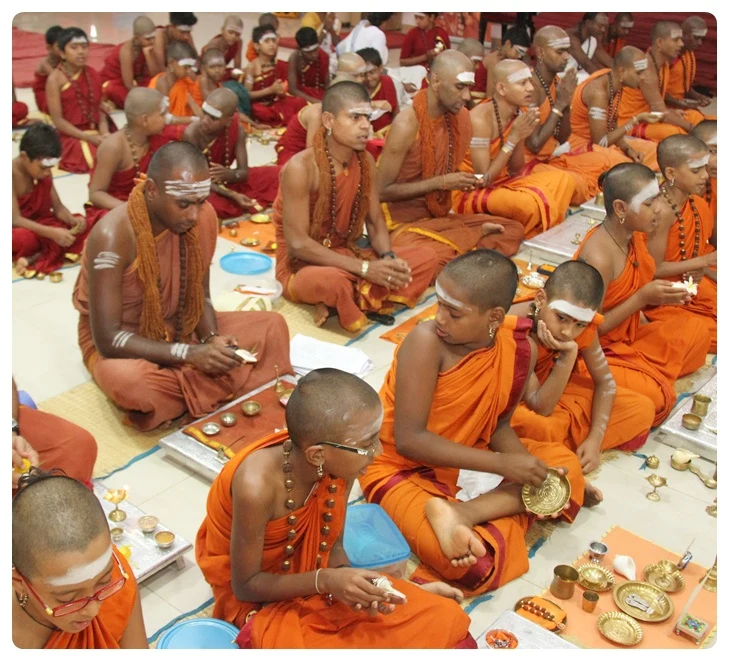
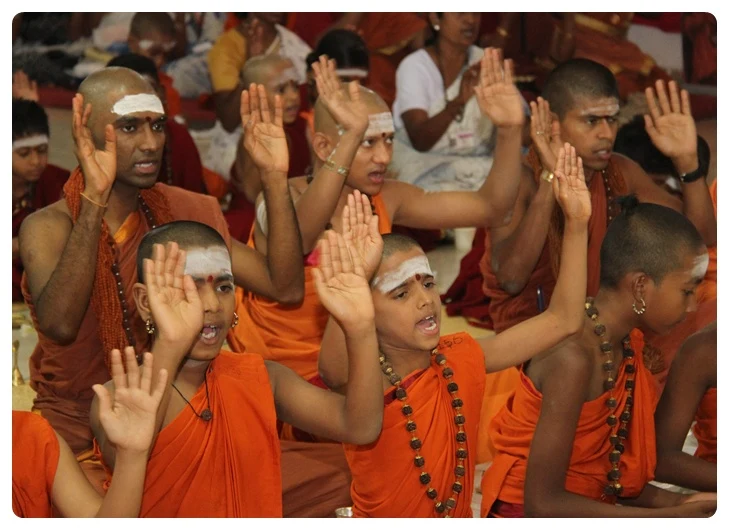
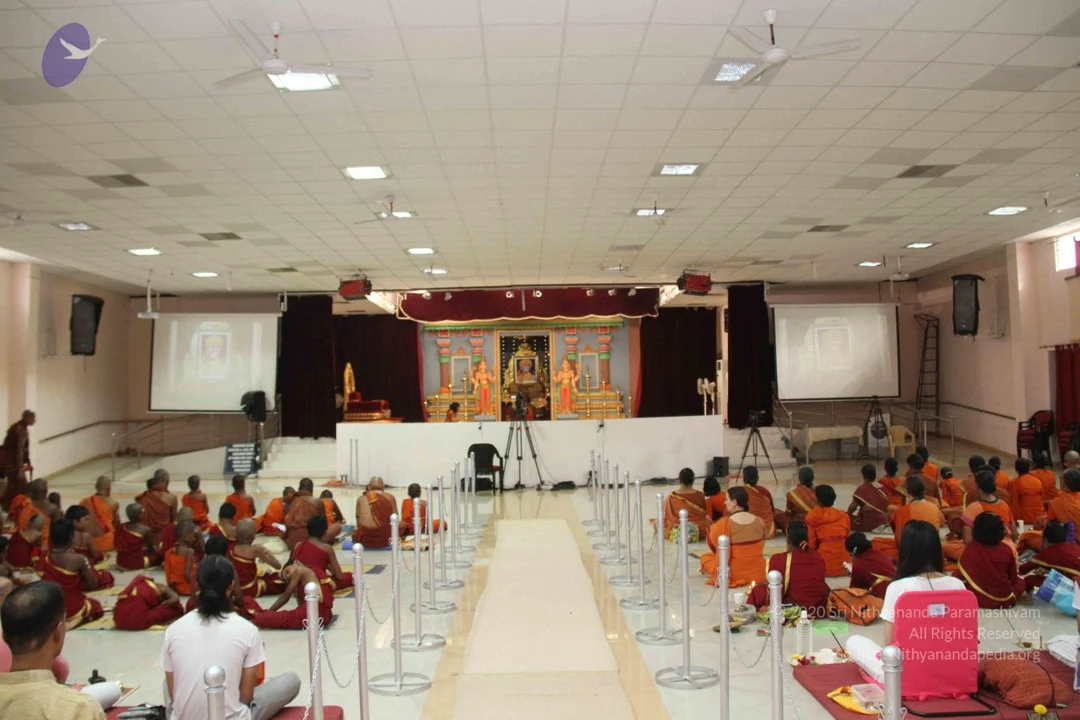
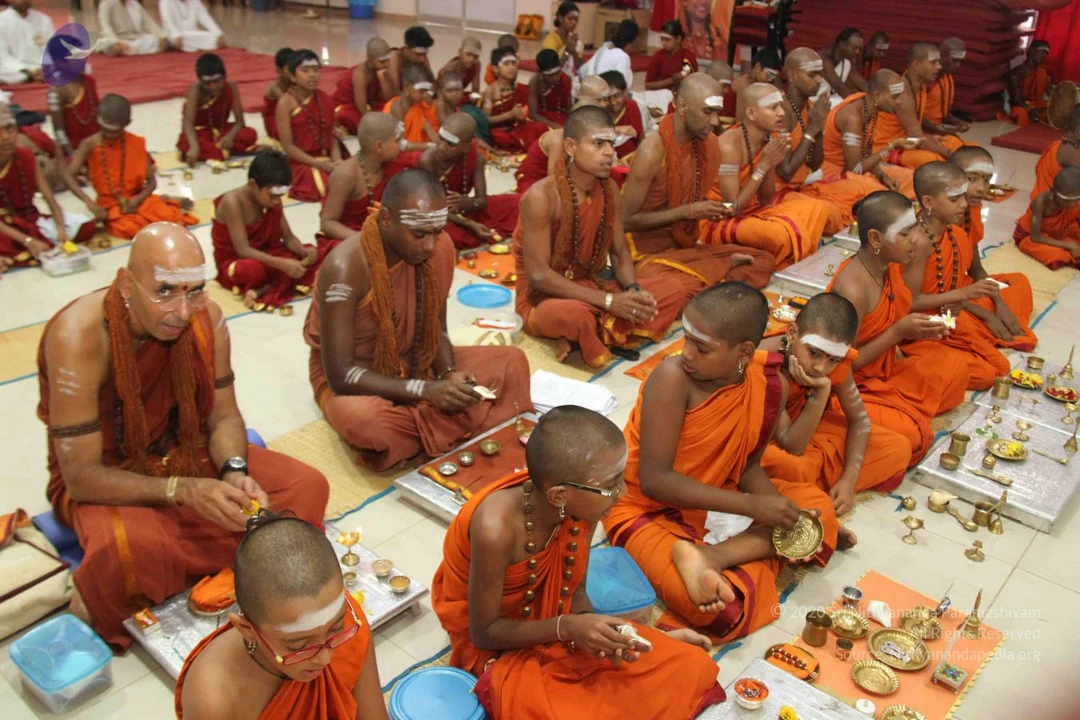
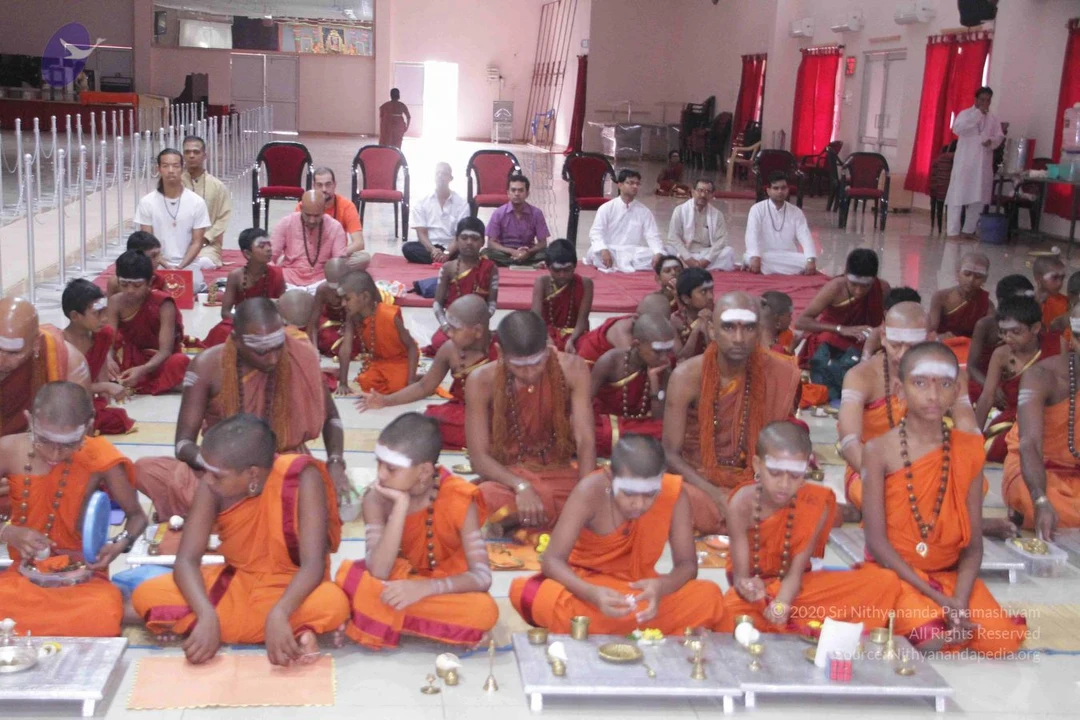
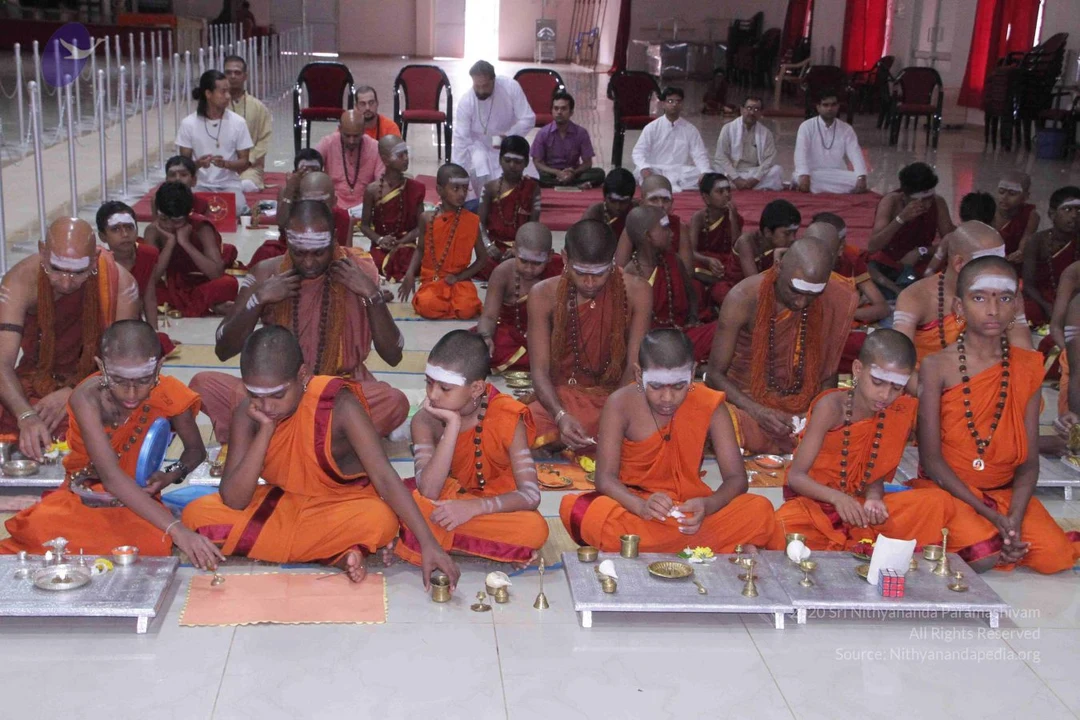
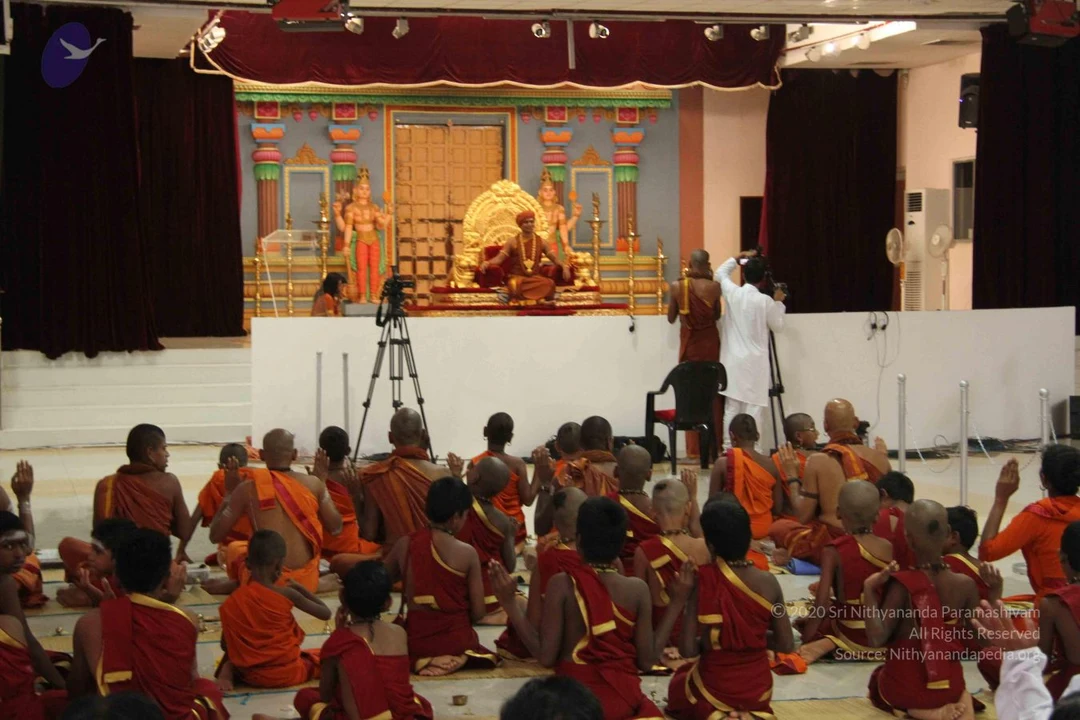
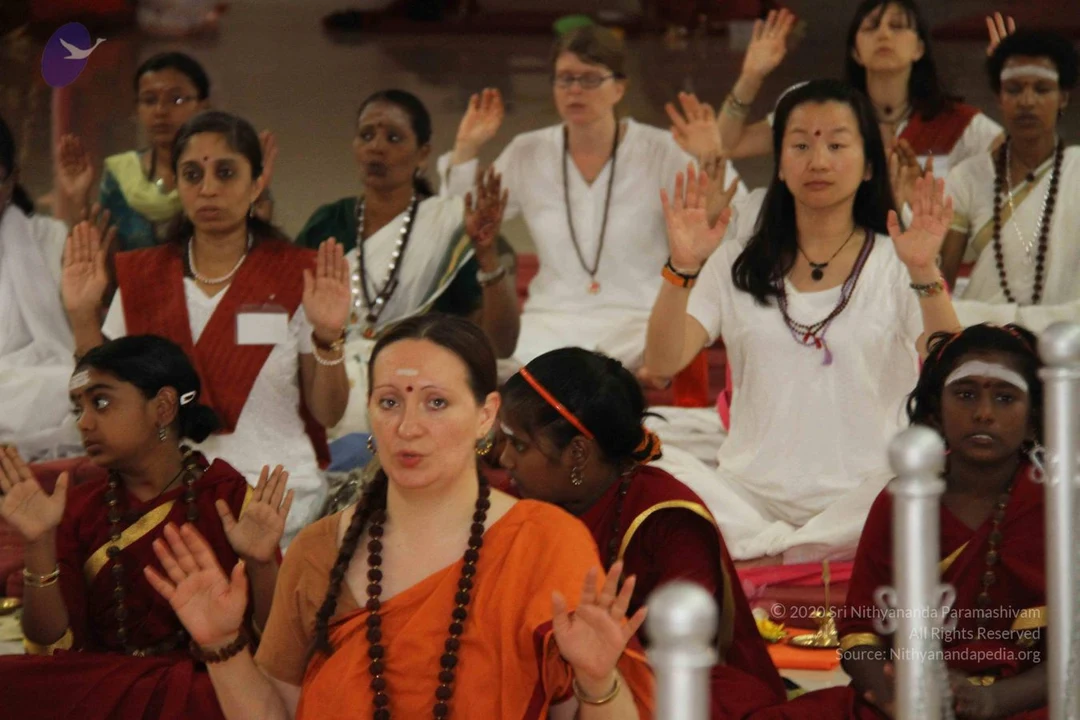
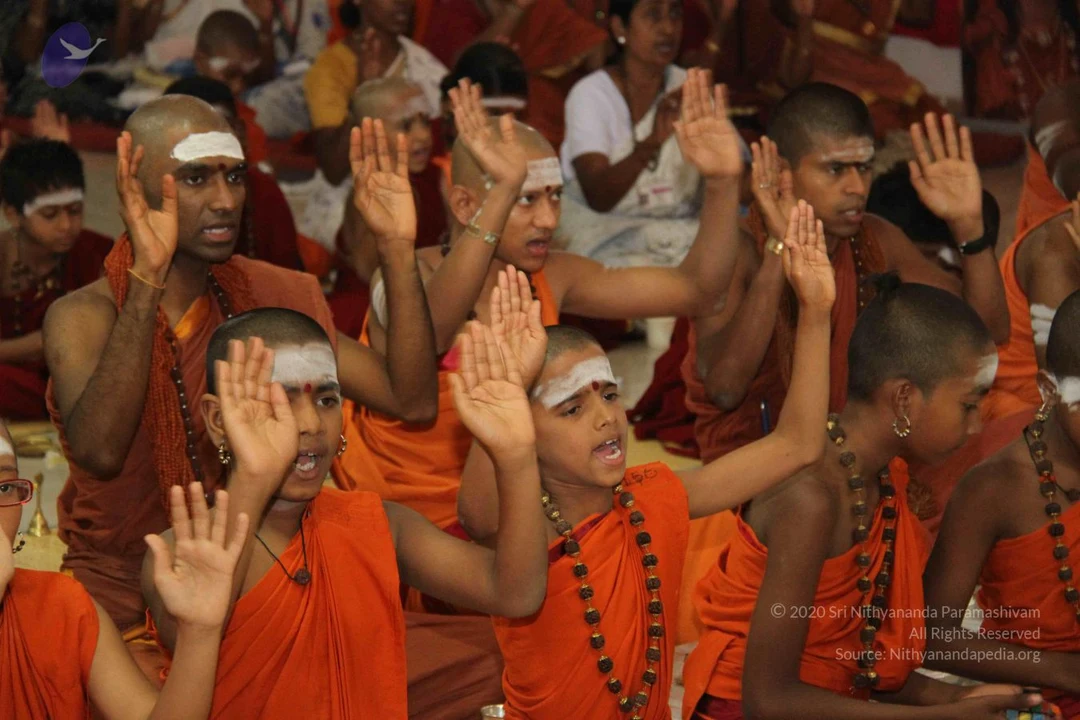
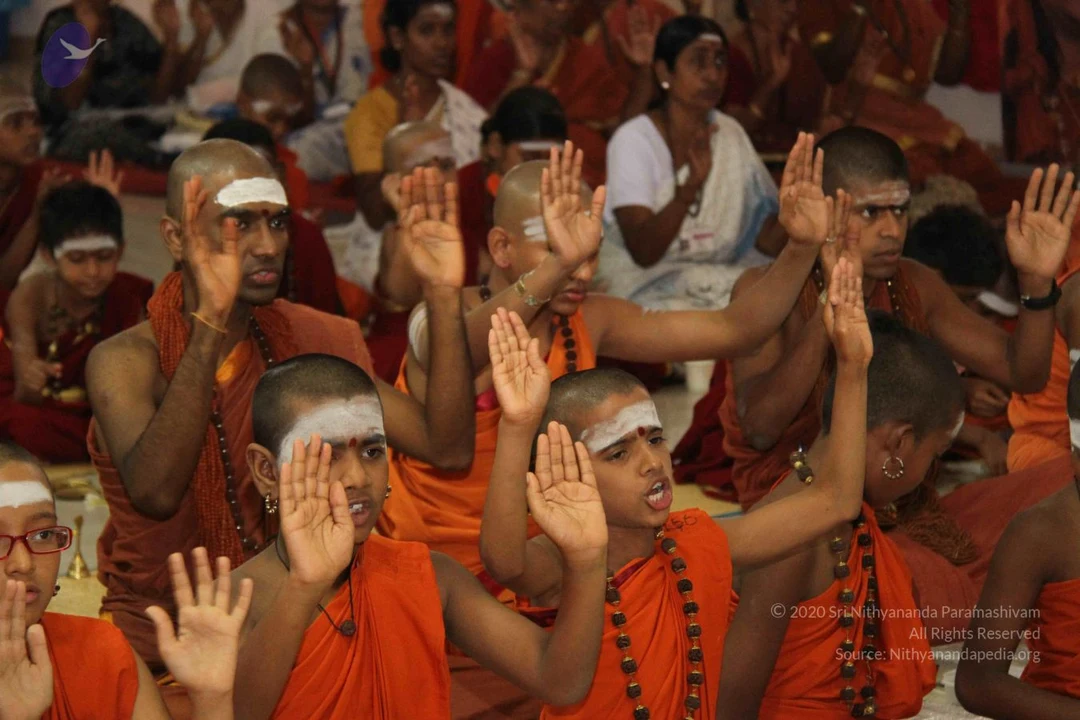
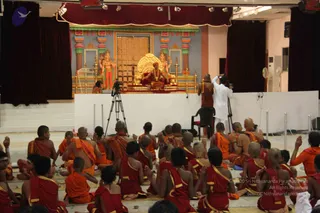
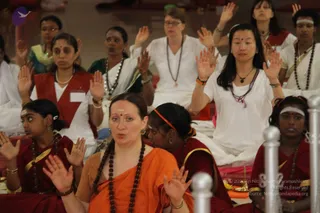
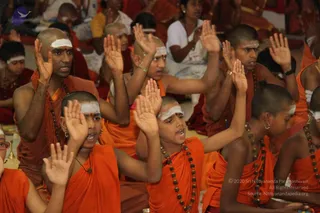
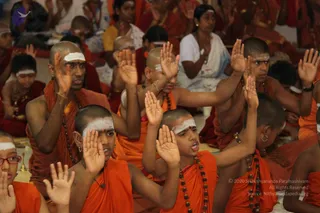
A photograph of a satsang hall with a raised stage set against a painted backdrop of two standing gold-coloured deity figures flanking a wooden door. A seated figure in an orange-red robe, a gold-and-red headwrap and a beaded necklace sits on an ornate gold throne in the centre. Dozens of shaven-headed sannyasi-style devotees in saffron and maroon robes sit cross-legged on the floor facing the stage, several with raised hands. Near the stage, a cameraman in a white shirt and a monk in orange stand behind tripods, and a red-cushioned chair is placed to one side. Hanging maroon curtains, stage lights and a wall-mounted air conditioner frame the scene.A seated satsang gathering of devotees with raised open palms. In the foreground, a woman in an orange saffron sari with a long rudraksha mala and a bindi and white forehead marks speaks with her right palm lifted. Around her, women in white and maroon-red robes raise their hands, some wearing rudraksha malas and beaded necklaces. A young girl in maroon with gold trim and a white forehead mark raises her palms at left, and another in a red and gold sari sits beside the foreground woman. Metal stanchions and brass lamps are visible at right. A purple logo appears at the top left corner.A photograph of a seated group of young and adult sannyasis in saffron-orange robes, many with shaved heads, white vertical tilak marks on the forehead and rudraksha malas around their necks. Several raise open palms upward in a chanting or blessing gesture, mouths open as if reciting together. Behind them, more seated devotees in orange and red, and a woman in a white top, fill the hall. The setting appears to be a satsang gathering.A large group of devotees seated closely together during a chanting session, many with raised open palms. Most wear saffron-orange robes and rudraksha malas, and several have white vertical tilak marks on their foreheads. Shaved-headed boys in front raise their hands while chanting, one wearing red-framed glasses at left. Behind them, women in white and yellow saris sit among the crowd. The setting appears to be an indoor satsang hall. A small logo appears at the upper left corner.

Sarva-Darshan

18 photosSource gallery
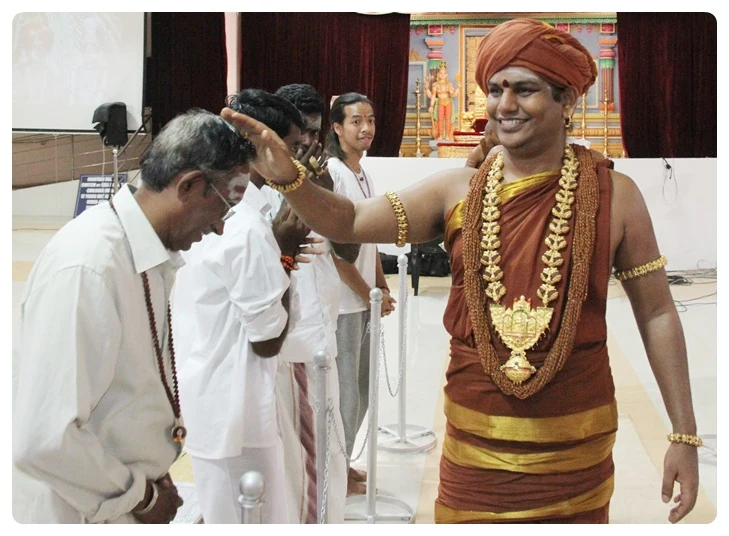
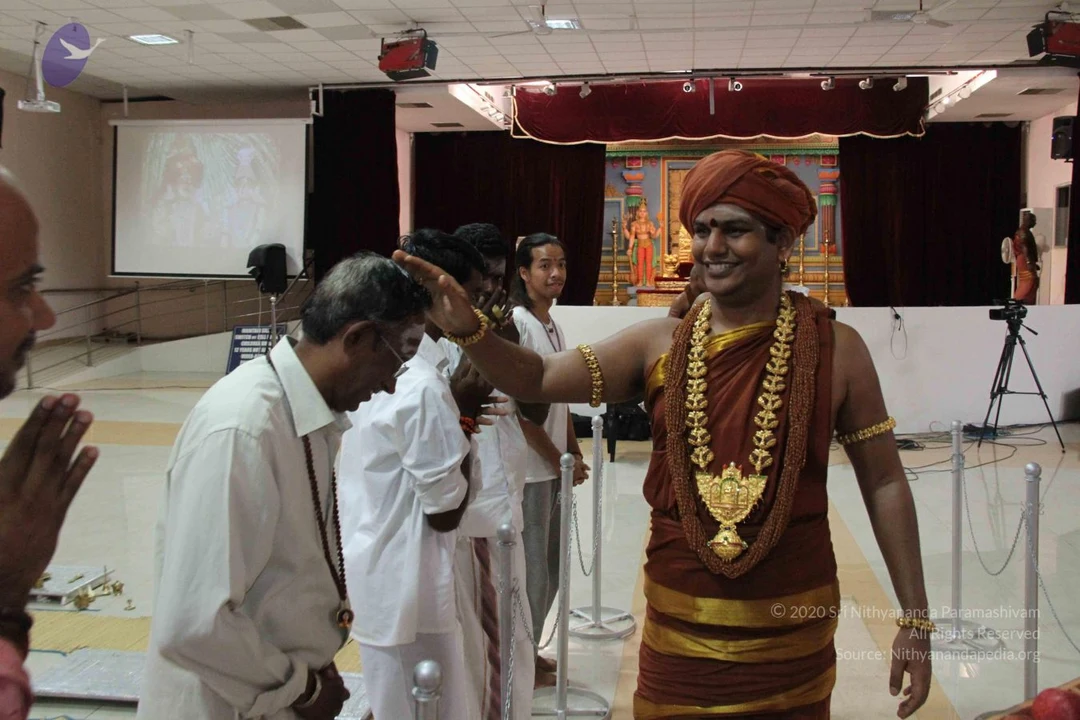
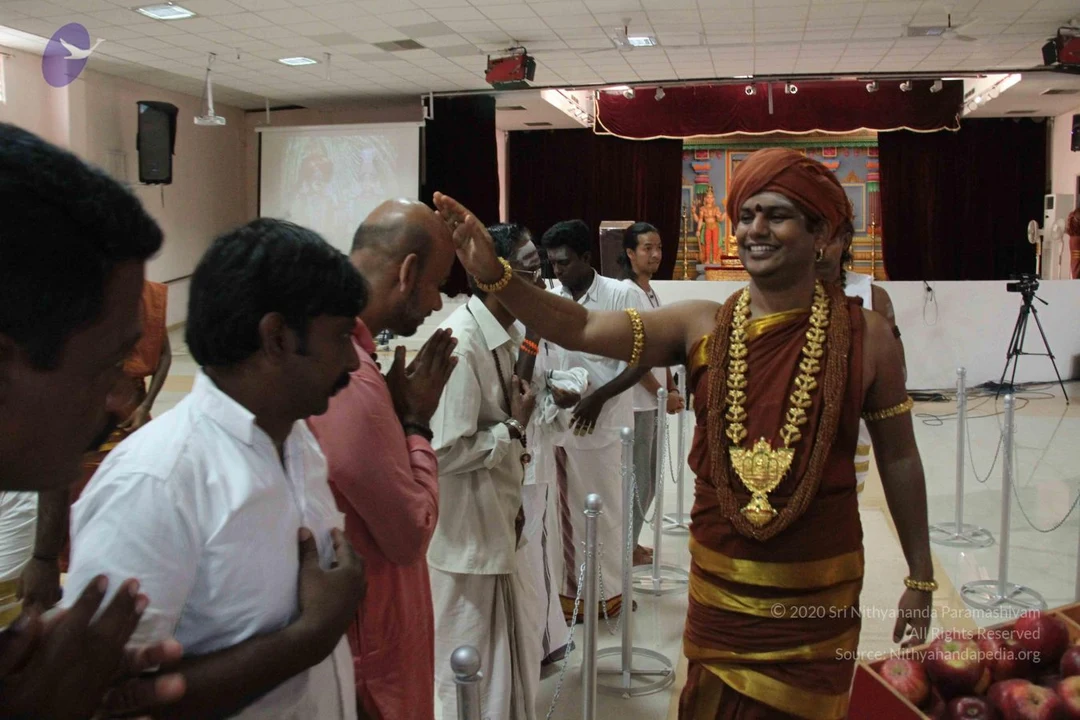
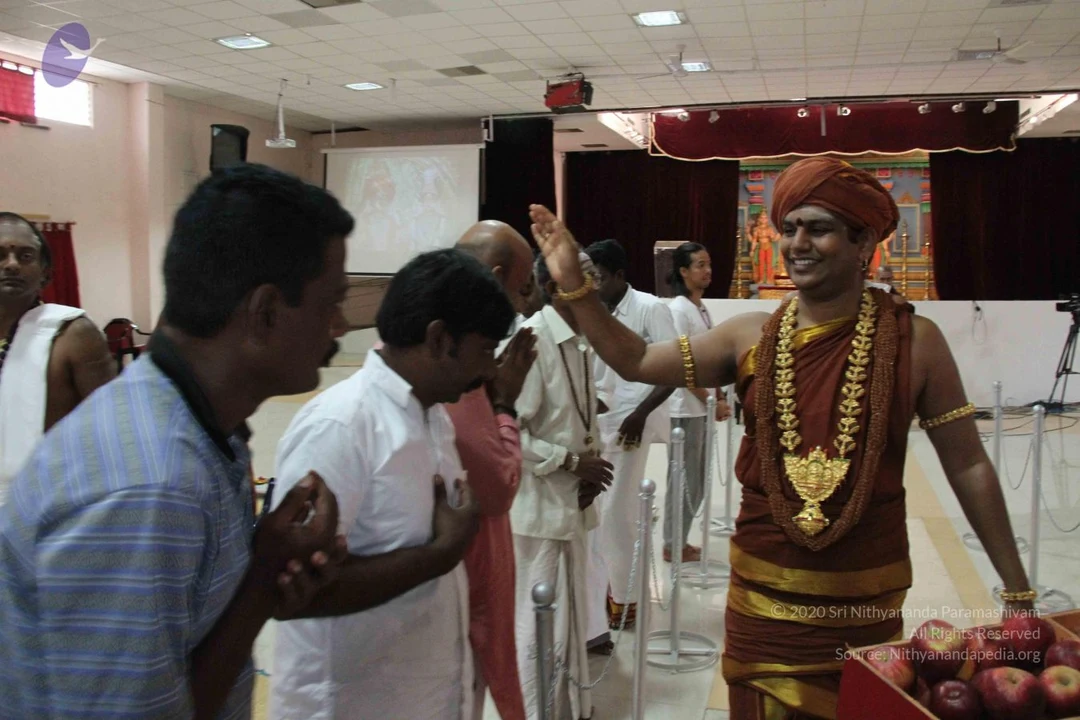
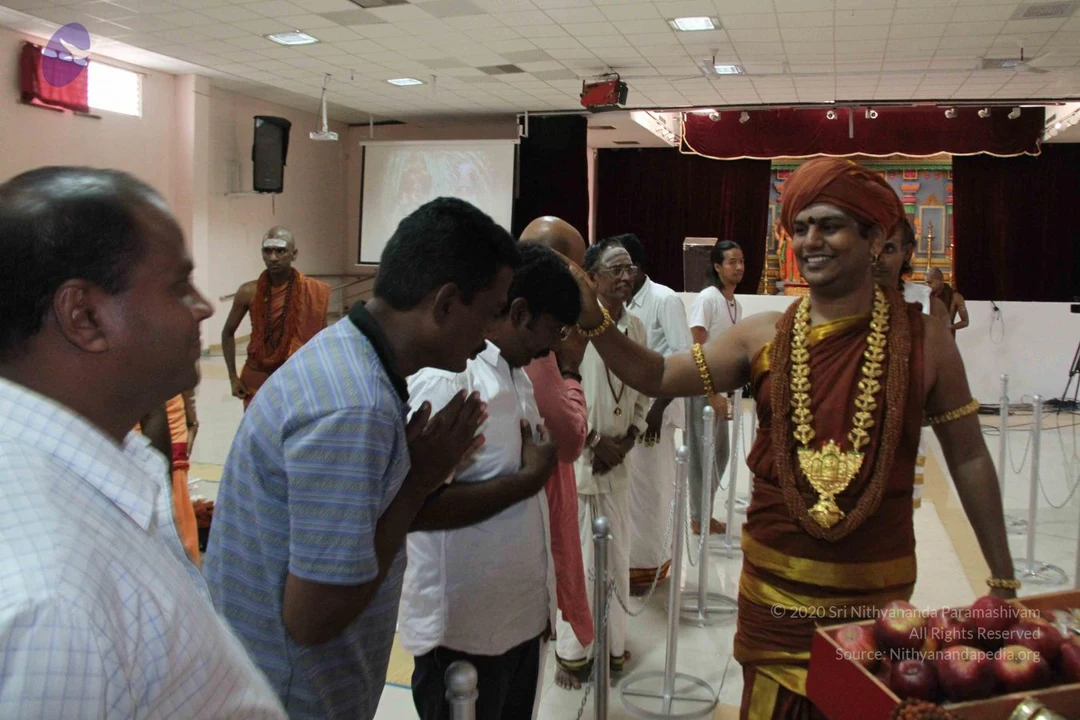
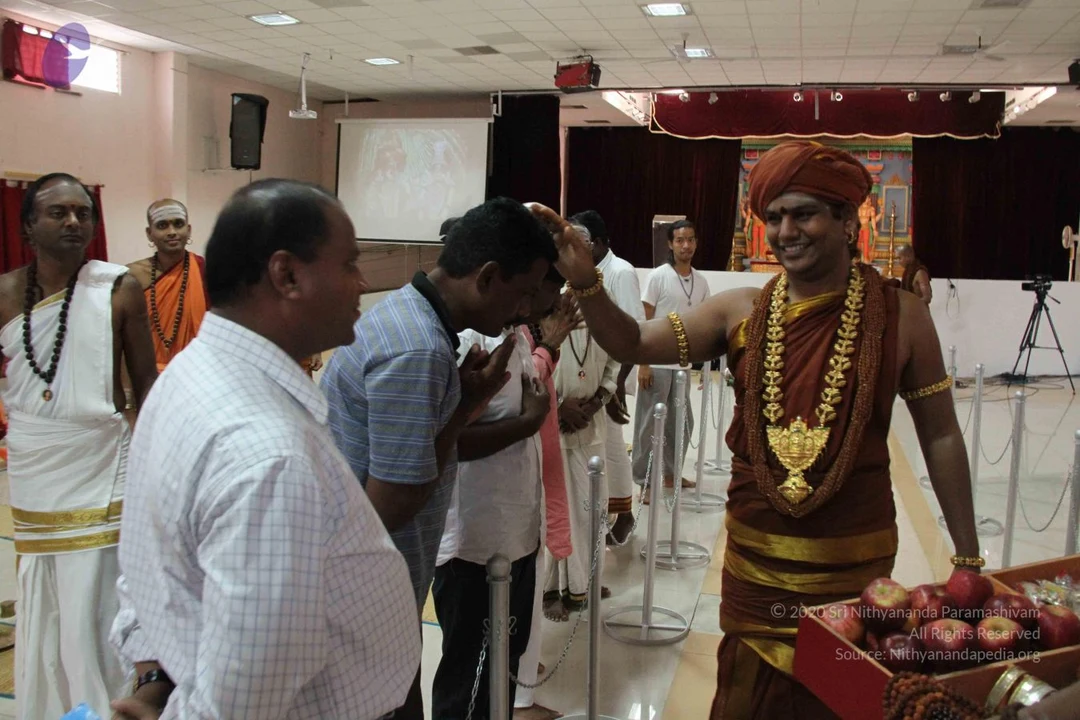
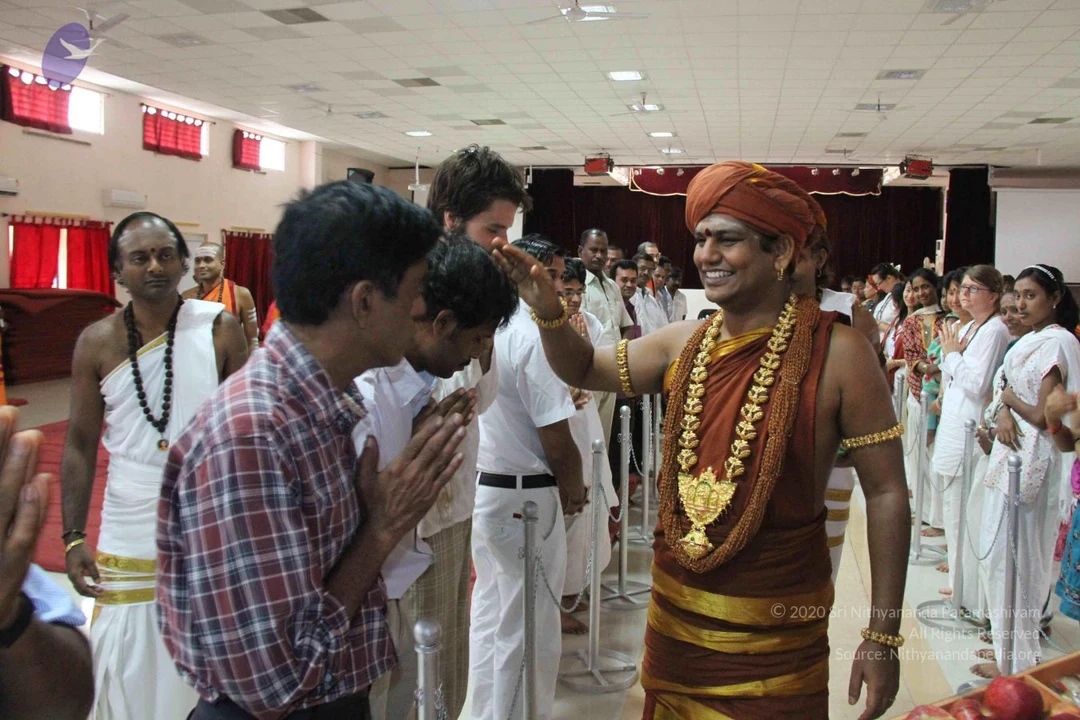
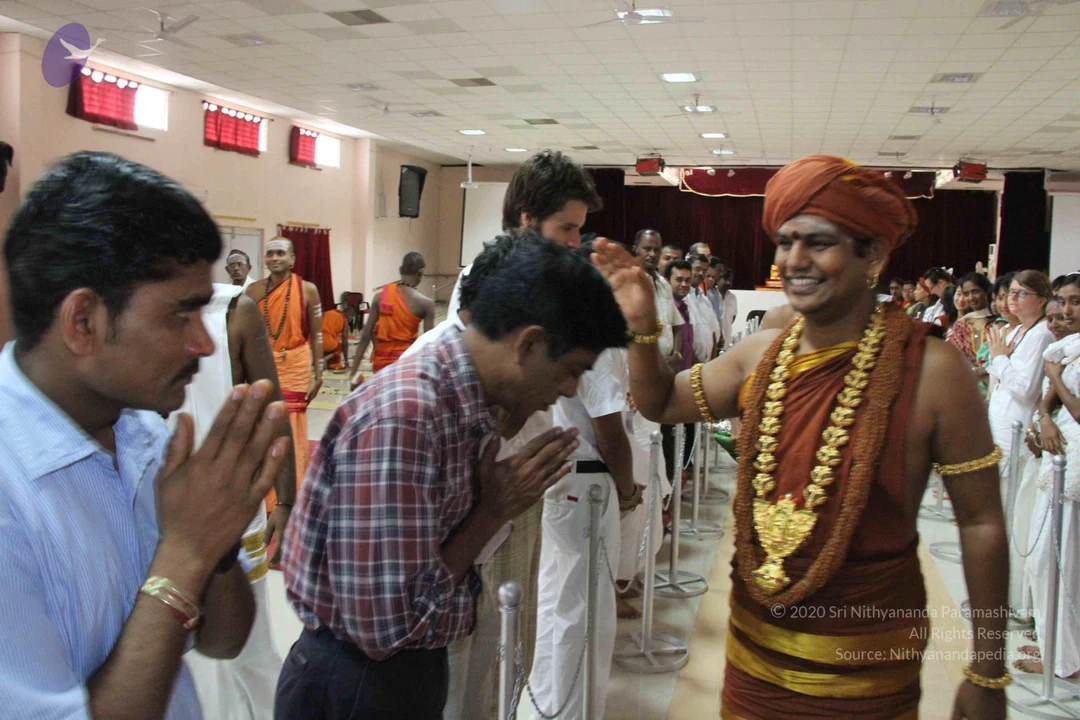
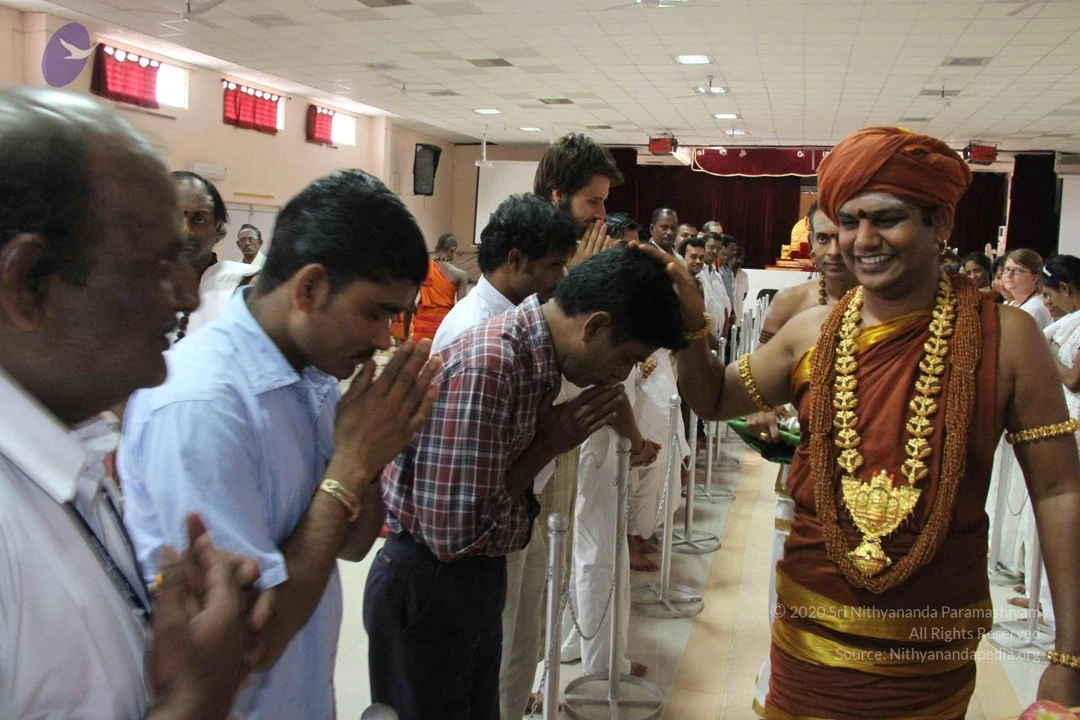
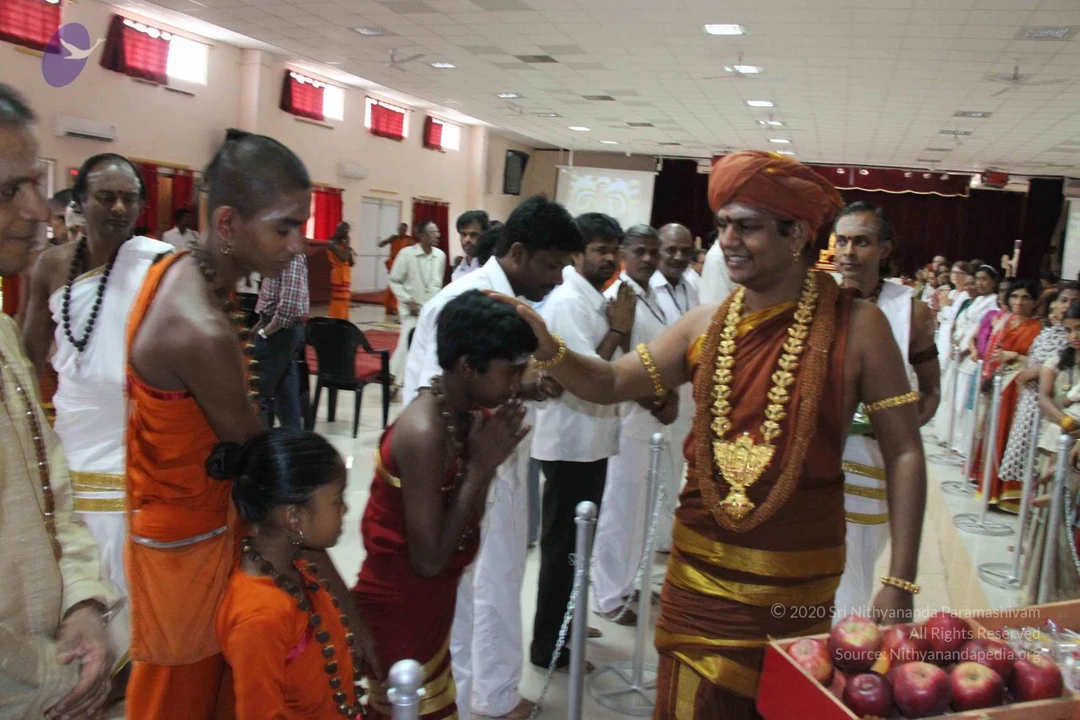
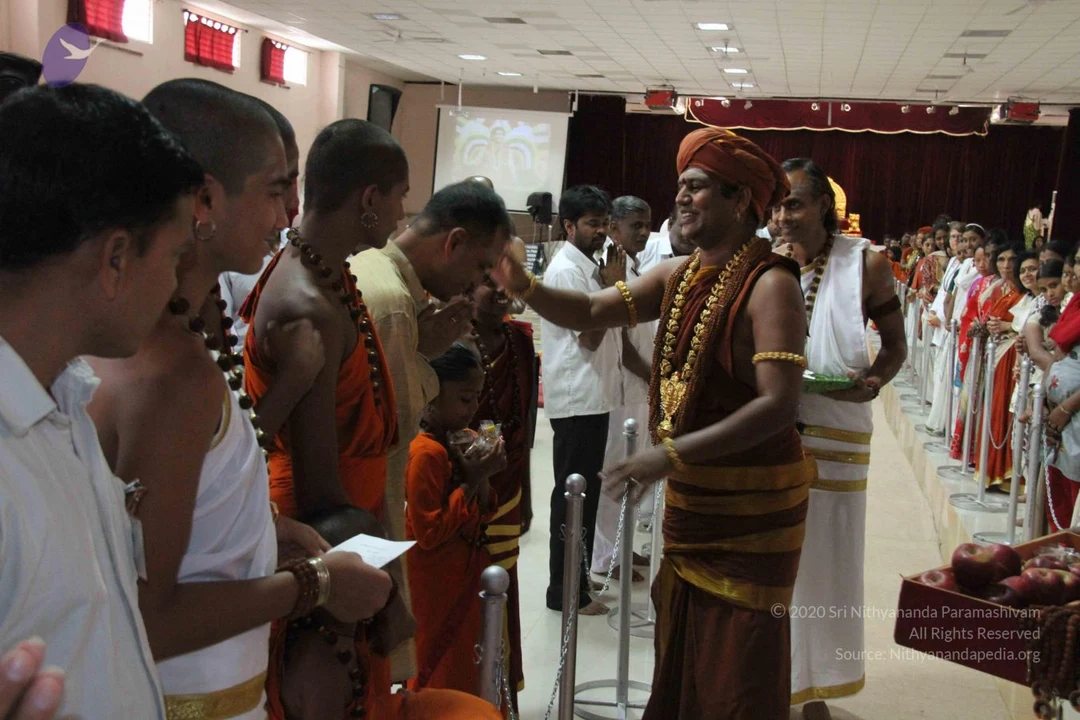
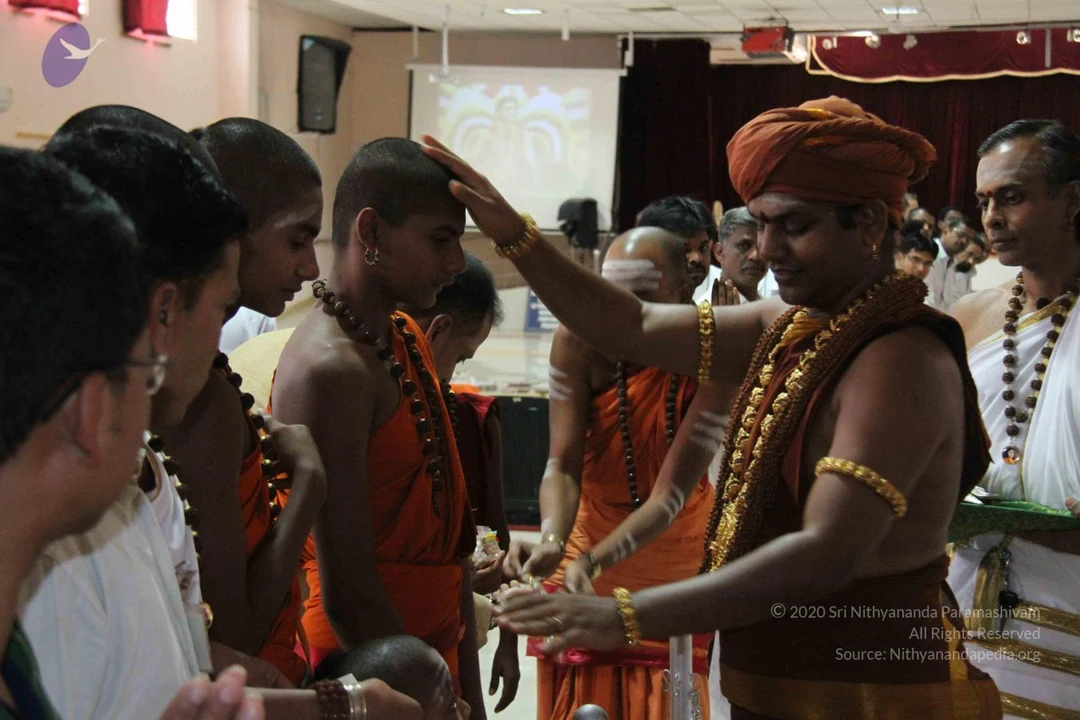
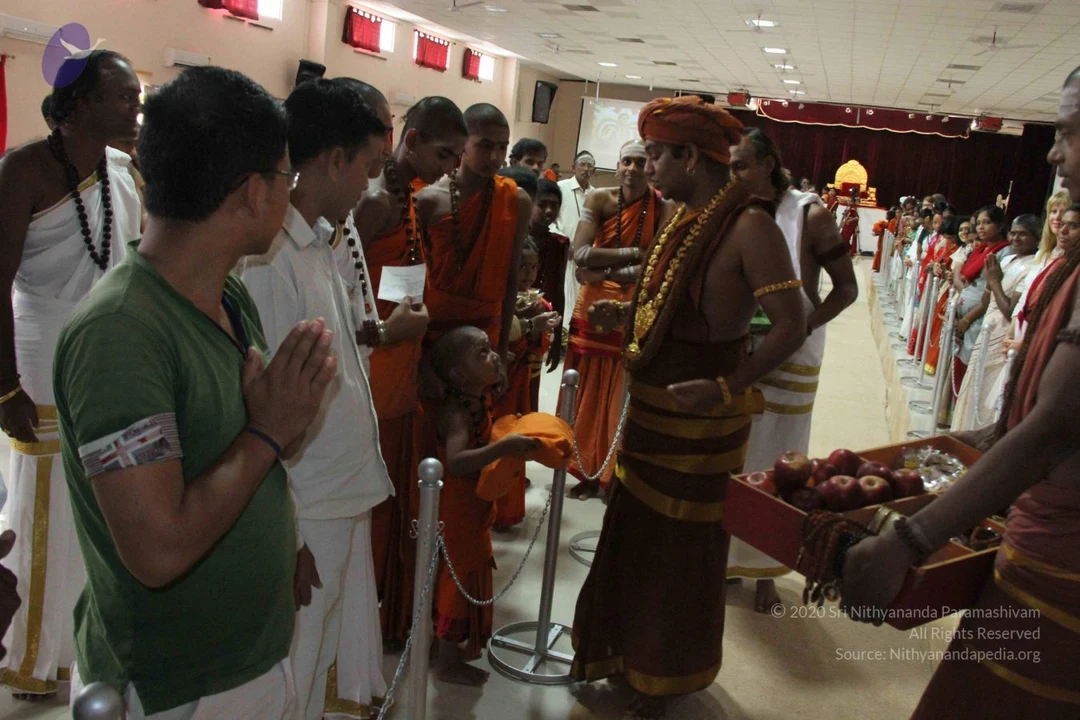
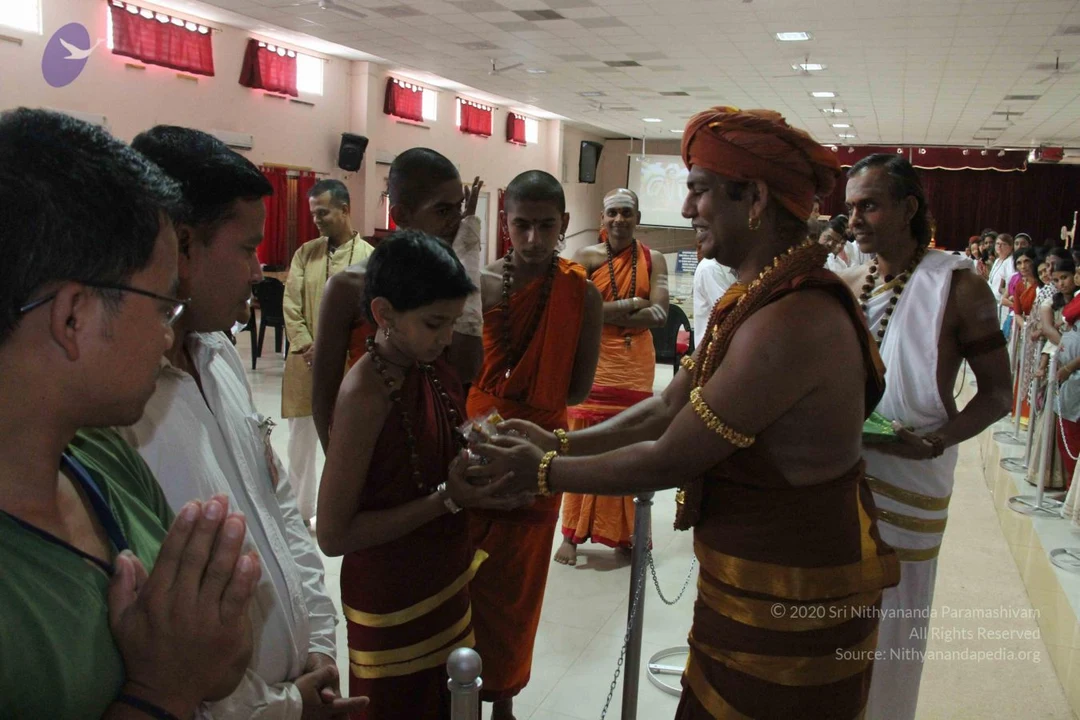
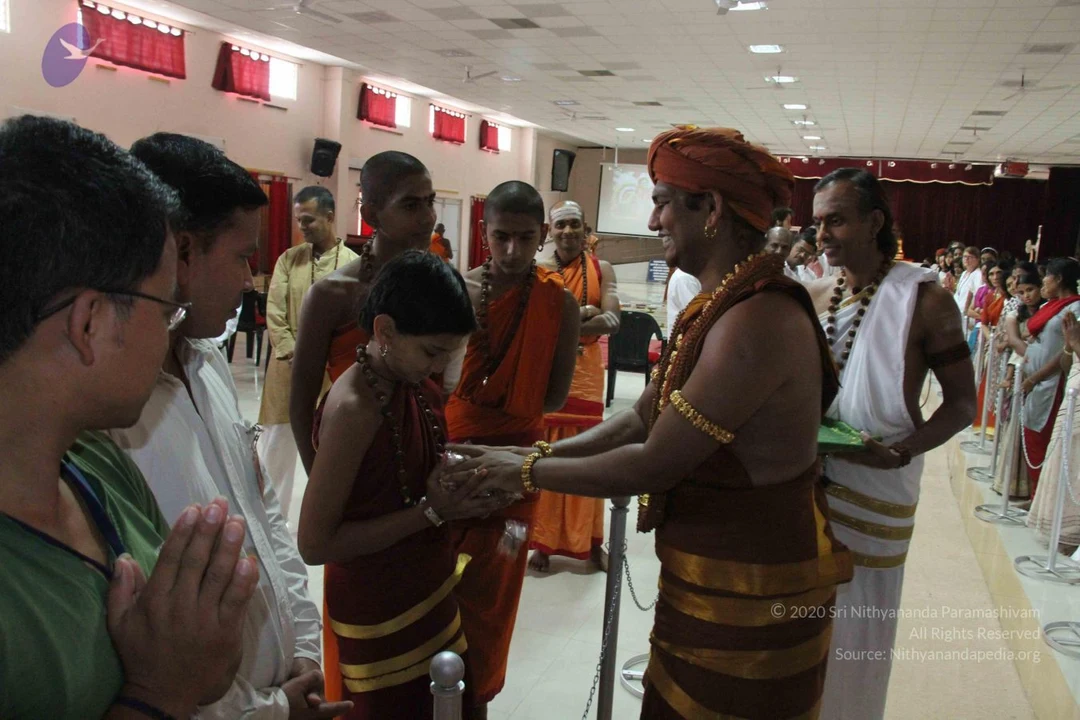
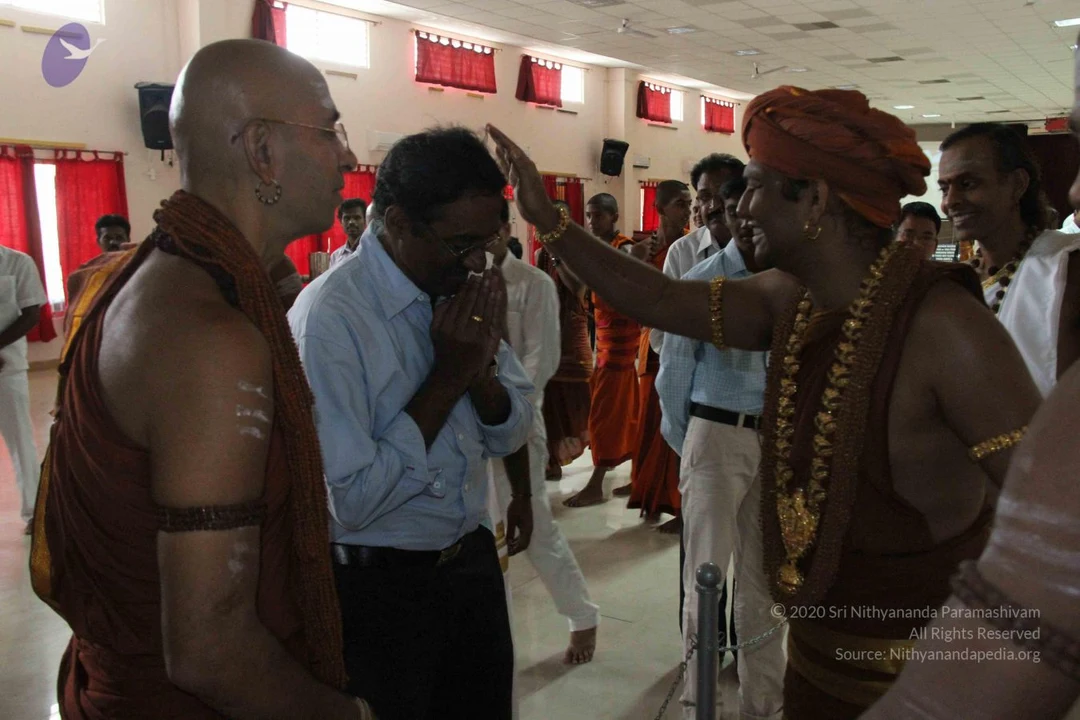
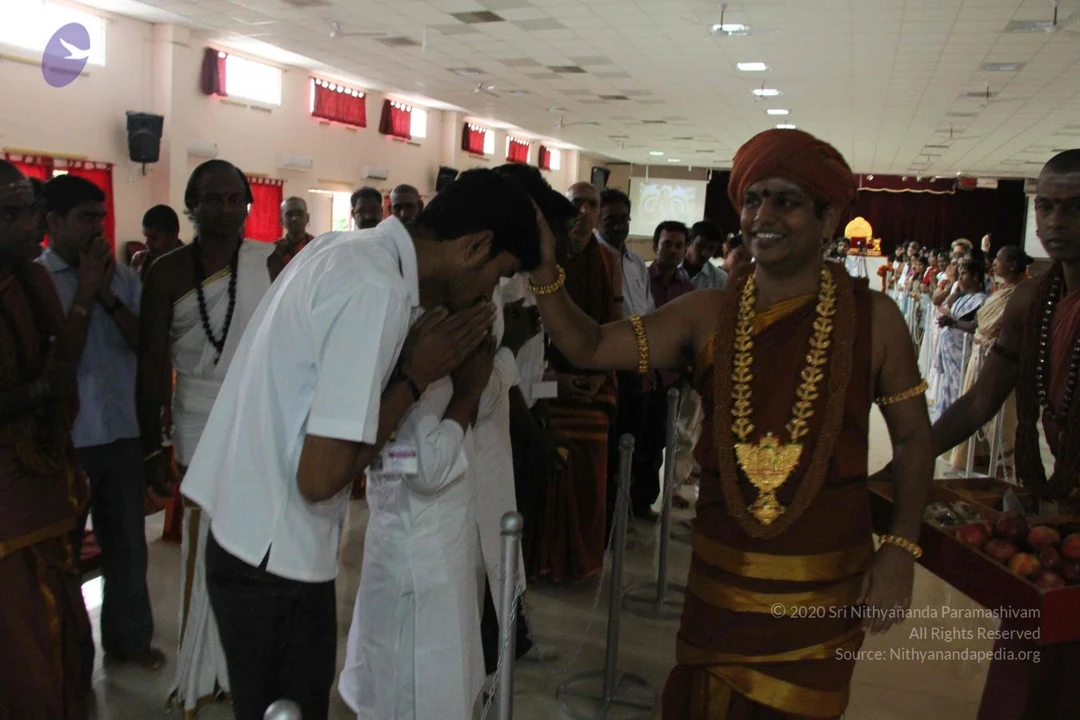
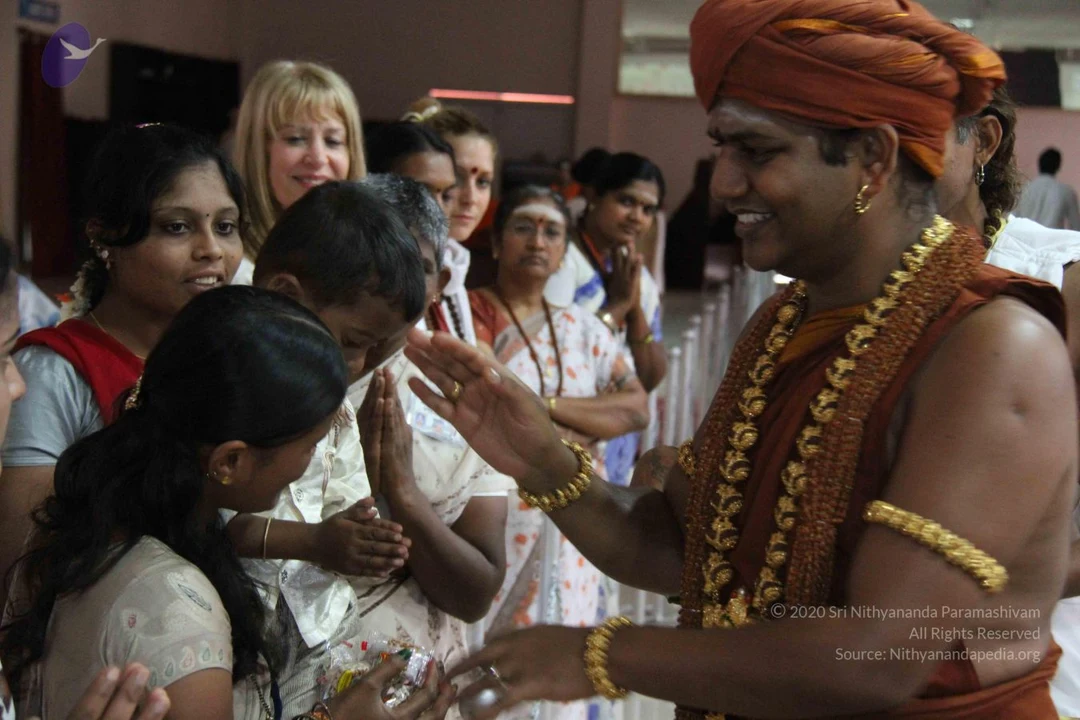
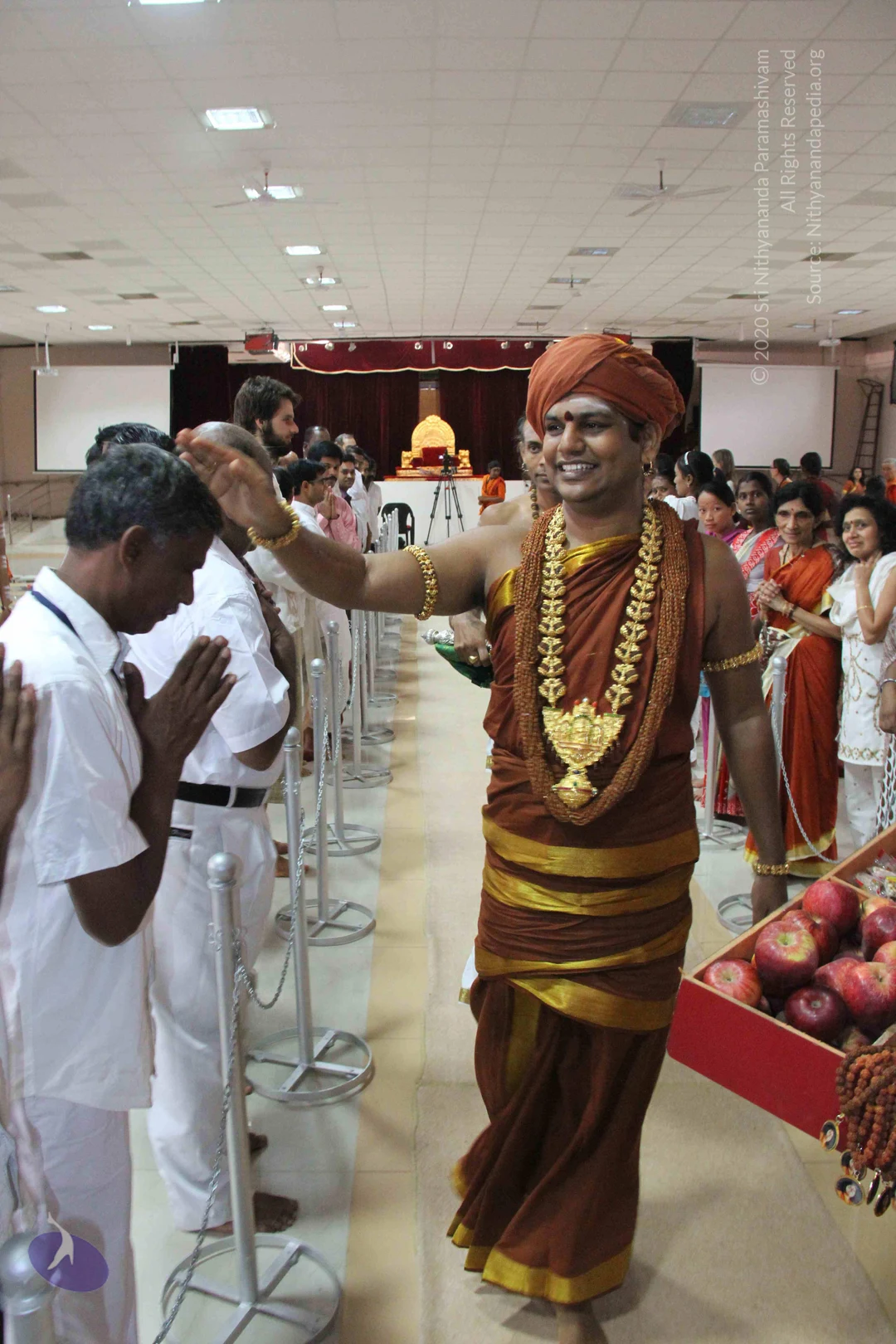
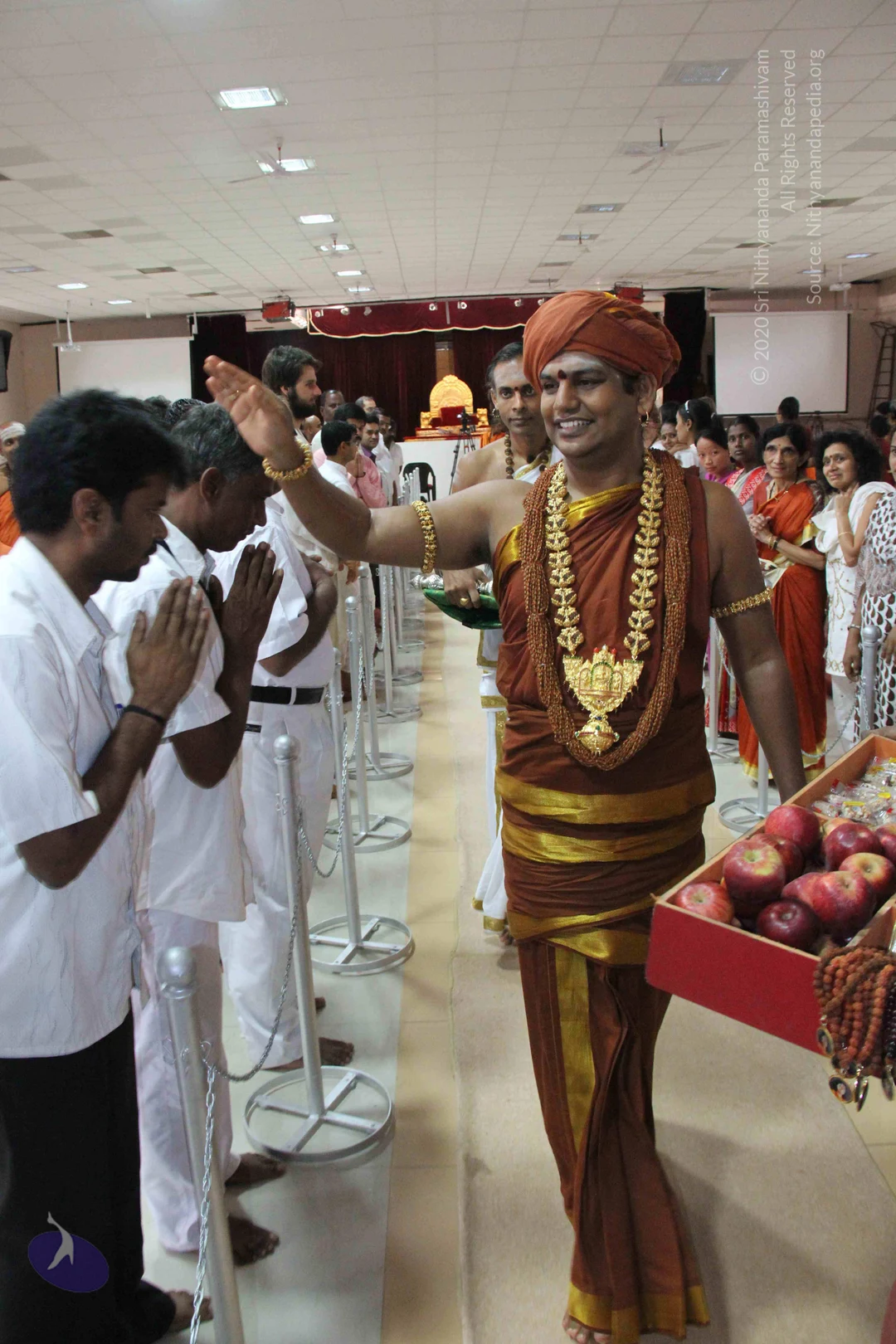
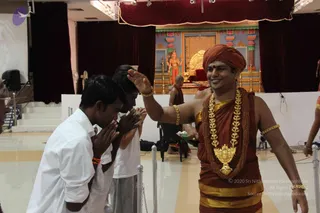
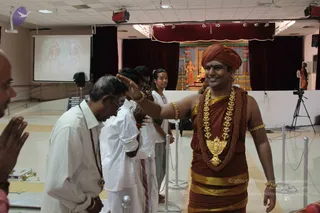
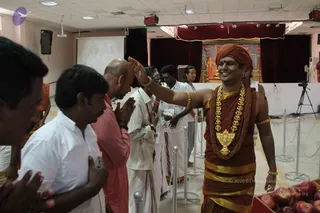
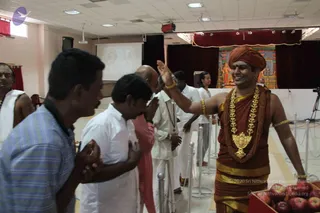
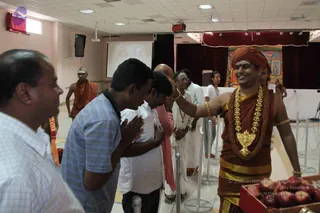
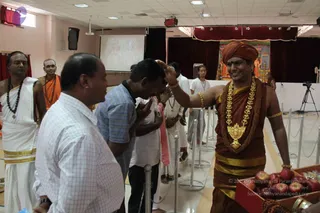
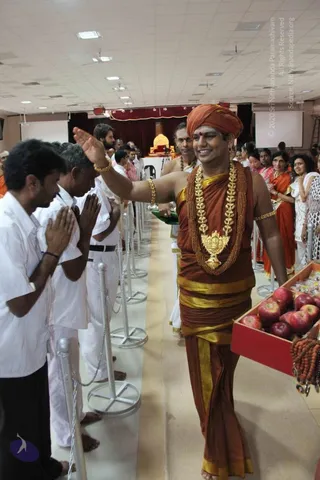
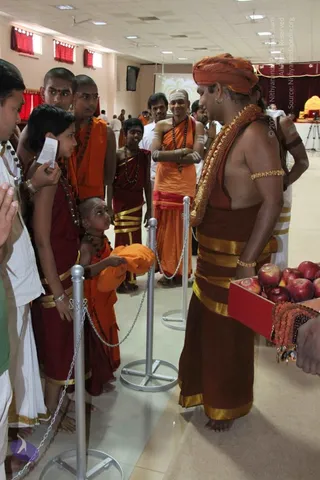
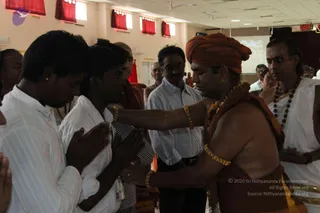
A photograph of a smiling man in a rust-orange turban and rust-orange dhoti with gold border, wearing a heavy gold-and-bead garland with a gold pendant, gold armlets and bangles, raising his right hand in blessing toward two young men in white shirts who stand with palms pressed together in namaste. The man at right appears to be the Swamiji candidate, a probable match on his turban, saffron-orange attire and ornate gold necklaces. Behind them a stage shows a deity murti figure, golden ornamental seats and red velvet drapes, with a seated figure in orange near the throne.A photograph of a hall with a red curtain and a deity mural behind a stage. A man in an orange-brown turban and matching saffron-brown dhoti-style garment, wearing a heavy gold necklace with a large pendant and gold armlets, smiles while raising his right hand in blessing over the head of a man in white. Other men in white shirts and dhotis bow or stand nearby. Metal stanchions with chains line the floor, and a projector screen shows an image. A man at the left edge holds his palms together in namaskar. a person cues: orange-brown ceremonial clothing, turban and gold necklaces; the figure is shown in person giving blessings.Indoor hall event where a smiling man in an orange-red turban and rust-orange dhoti with gold waist band extends his right hand in blessing toward a line of devotees. He wears a heavy gold necklace with a gold pendant, a rudraksha-style beaded mala and gold bangles. Nearby, a man in a pink shirt and a man in white dhoti-style clothing press palms together in namaskar, and others in white shirts and white dhotis stand behind metal stanchions. A large red-and-gold backdrop with a painted deity mural hangs on the stage, and a projection screen is visible at left. A basket of red apples sits at lower right. Swamiji (probable) in saffron-orange turban, gold necklace and rudraksha mala giving blessings to devotees.Indoor photo of a hall with a stage backdrop, a projection screen showing an image, and a deity display with a red curtain. A man in a rust-orange turban, saffron-orange wrap with gold border, rudraksha mala and a large gold ceremonial pendant stands smiling at right, one arm raised toward a line of devotees. Several devotees in white dhotis and striped shirts stand with palms pressed together in greeting. A basket of red apples sits at lower right behind a metal stanchion barrier. The man's appearance has several distinctive ceremonial cues, so the identity is a person, shown as a figure greeting devotees.A photograph of a hall with a projector screen, a red curtain and a decorated shrine backdrop. A man in an orange-red turban, gold ceremonial necklaces, a rudraksha-style mala and a red-brown wrap stands at right smiling and extending his hand to a devotee, with a tray of red fruit beside him. Several devotees in white dhotis and shirts stand in a queue behind metal stanchions, one man in a blue striped shirt with hands folded in anjali, another bowing with hand on chest. A bald man in an orange-saffron robe stands at left background.A photograph of a darshan line in an indoor hall with a stage backdrop. A smiling man in a rust-orange turban and rust-orange dhoti with heavy gold ornaments and a gold pendant over a large beaded mala places his hand on the forehead of a devotee bowing before him. The devotee wears a white shirt and a grey-blue striped shirt is nearby. Behind them, white-clad priests with rudraksha malas and an orange-clad attendant stand near metal stanchions, and a tray of apples and rudraksha malas sits on a table in the foreground. A projector screen and a decorated stage with red curtains are visible. Probable Swamiji (orange turban, ornate gold necklaces, rudraksha mala) is giving blessings to devotees.

Nithya-Satsang

30 photosSource gallery
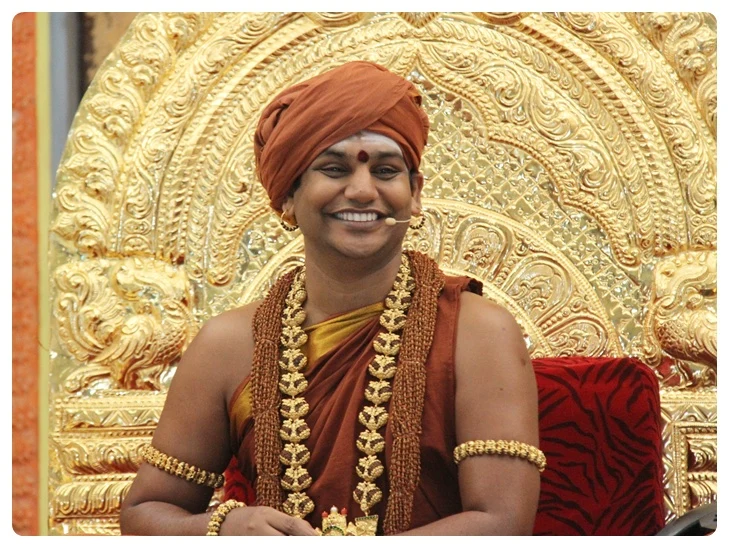
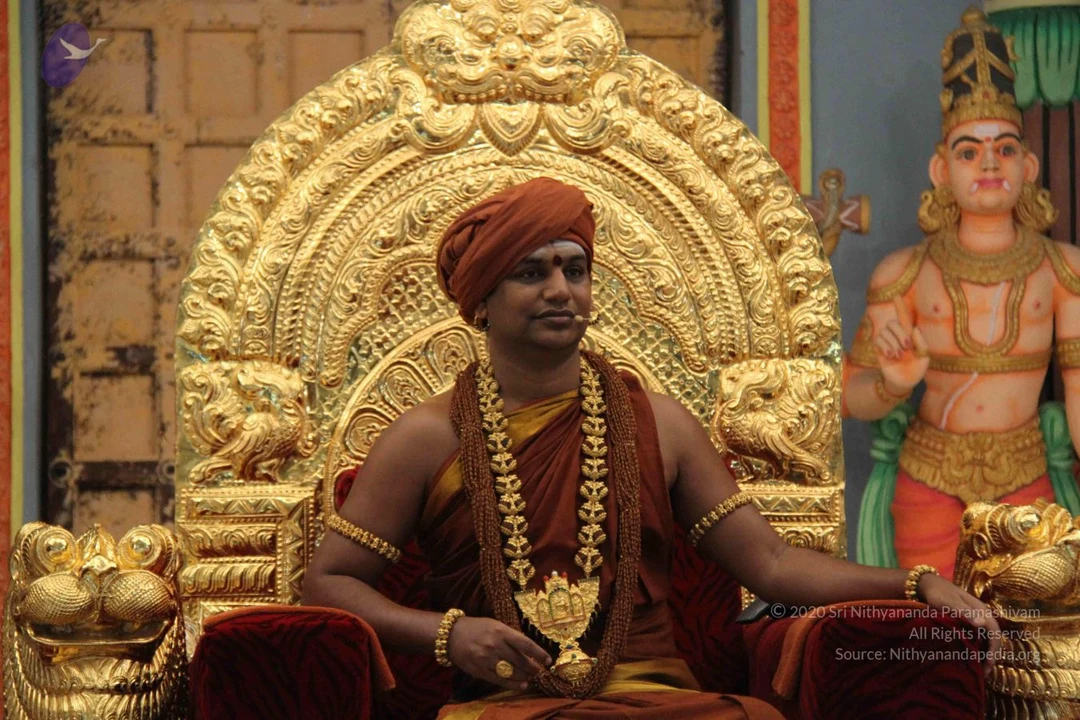
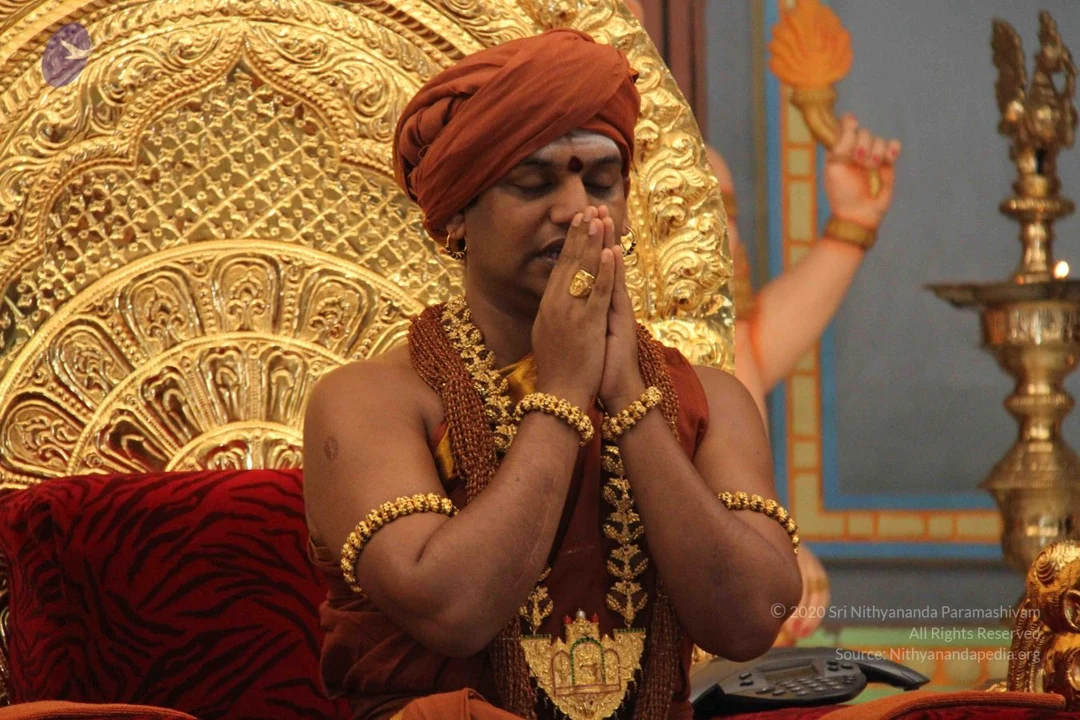
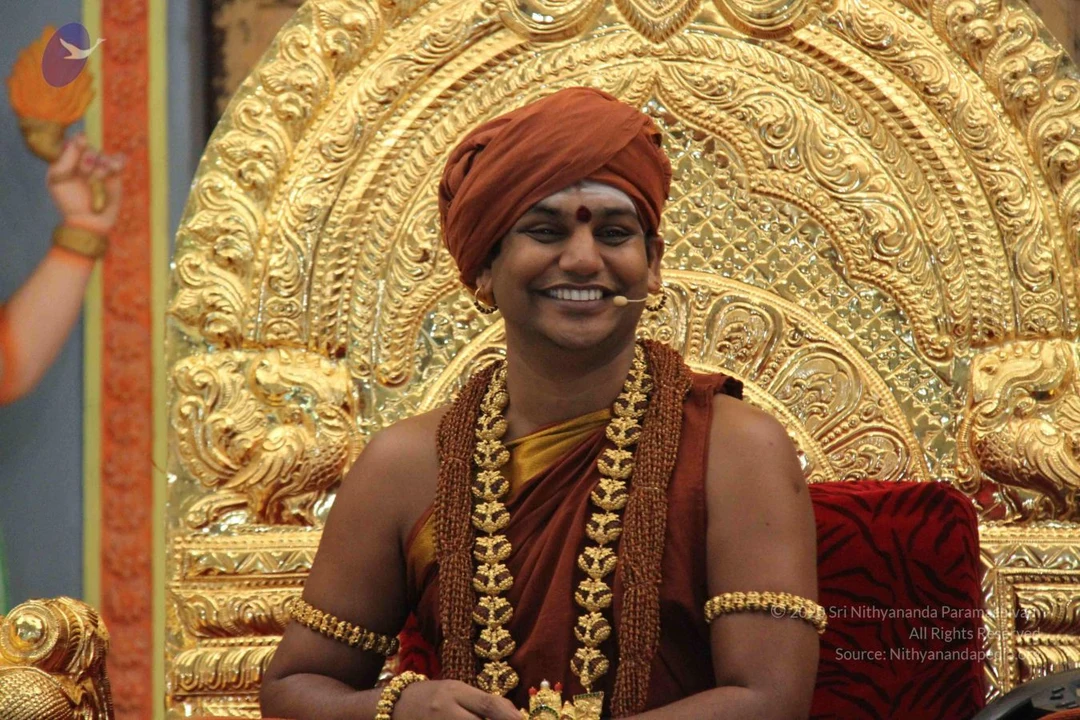
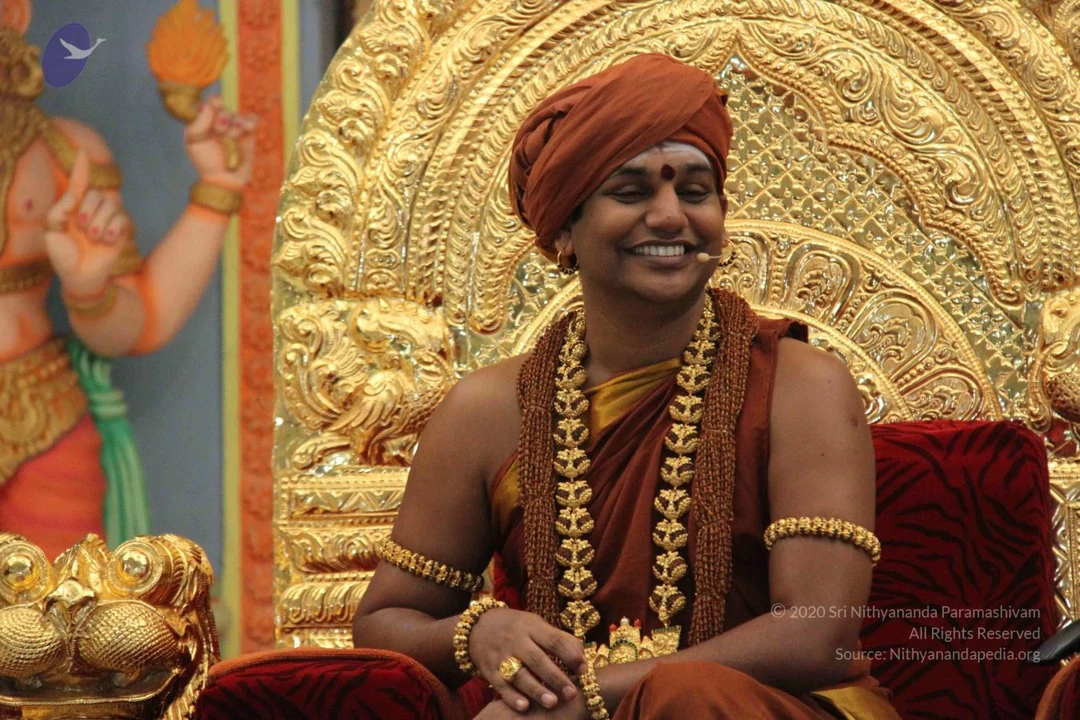
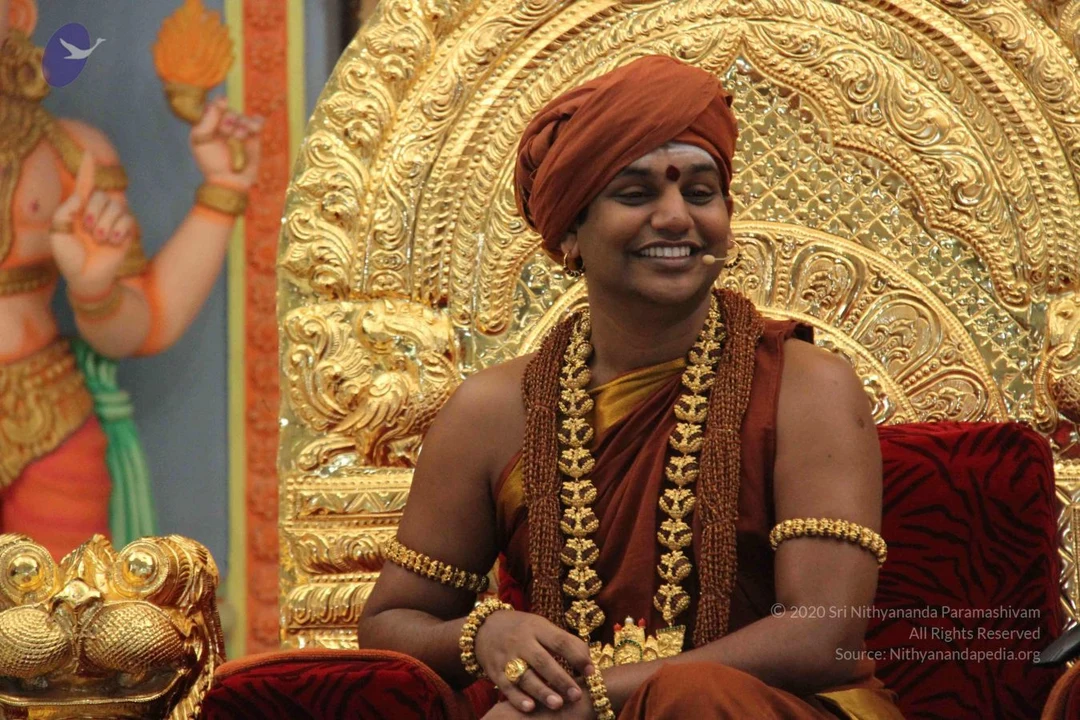
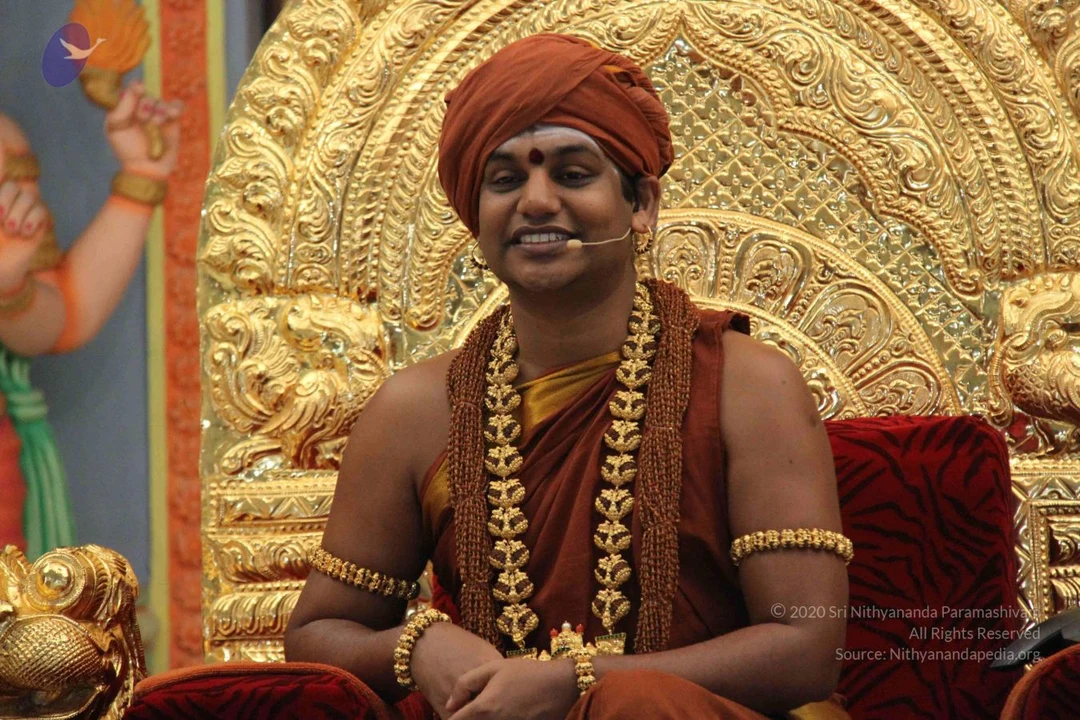
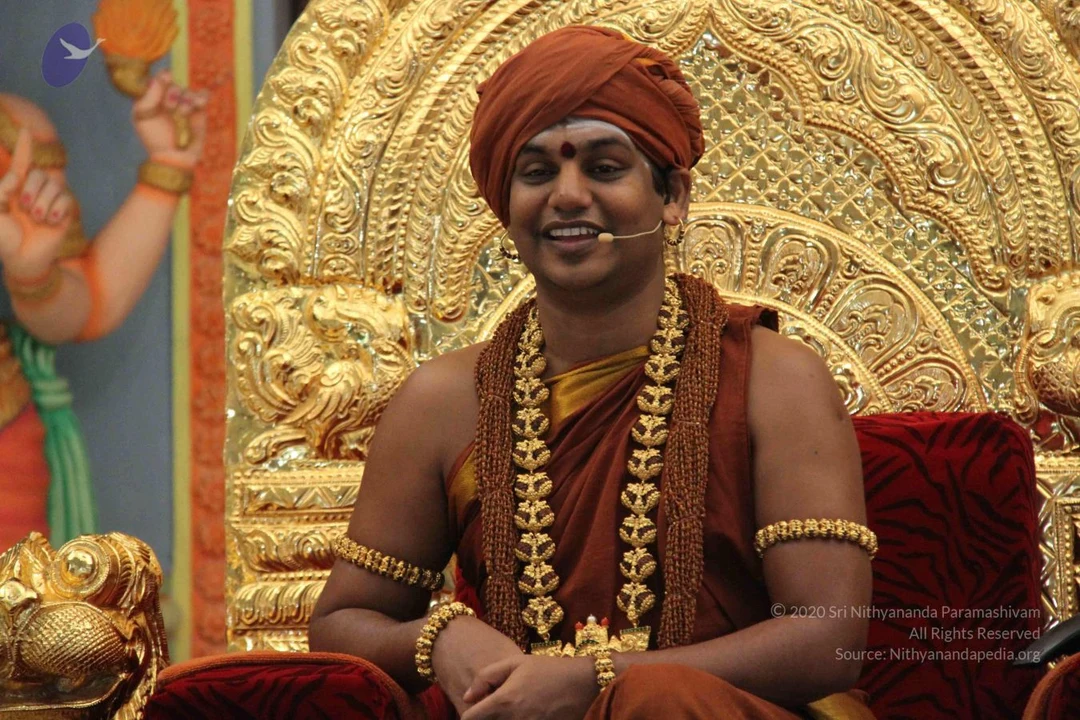
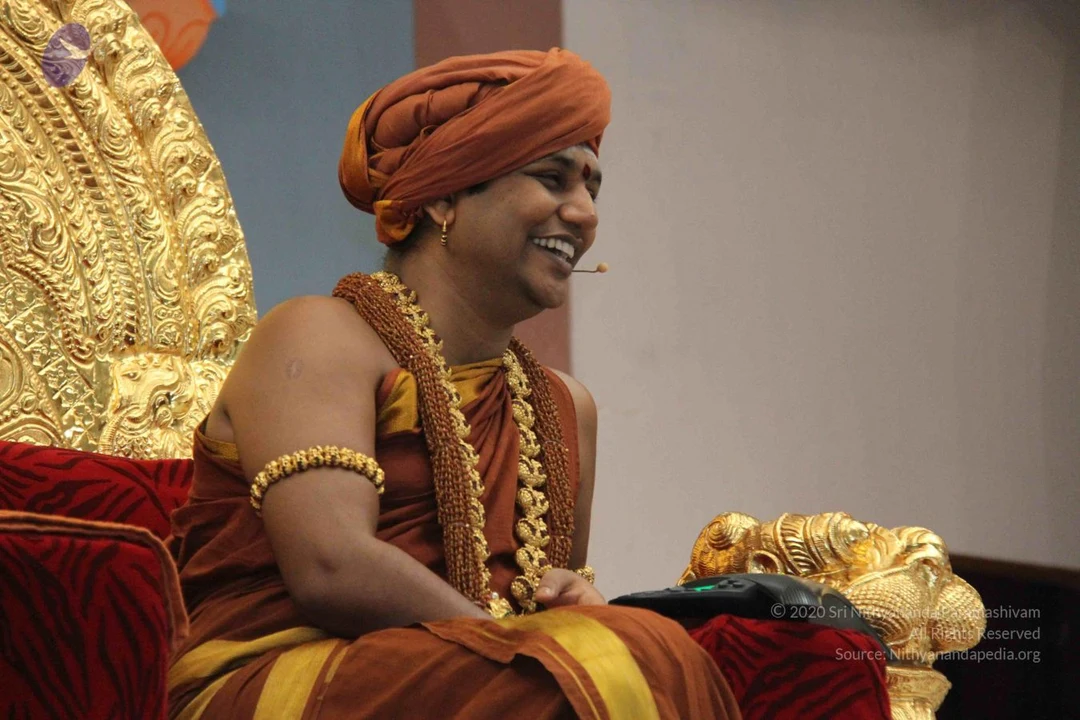
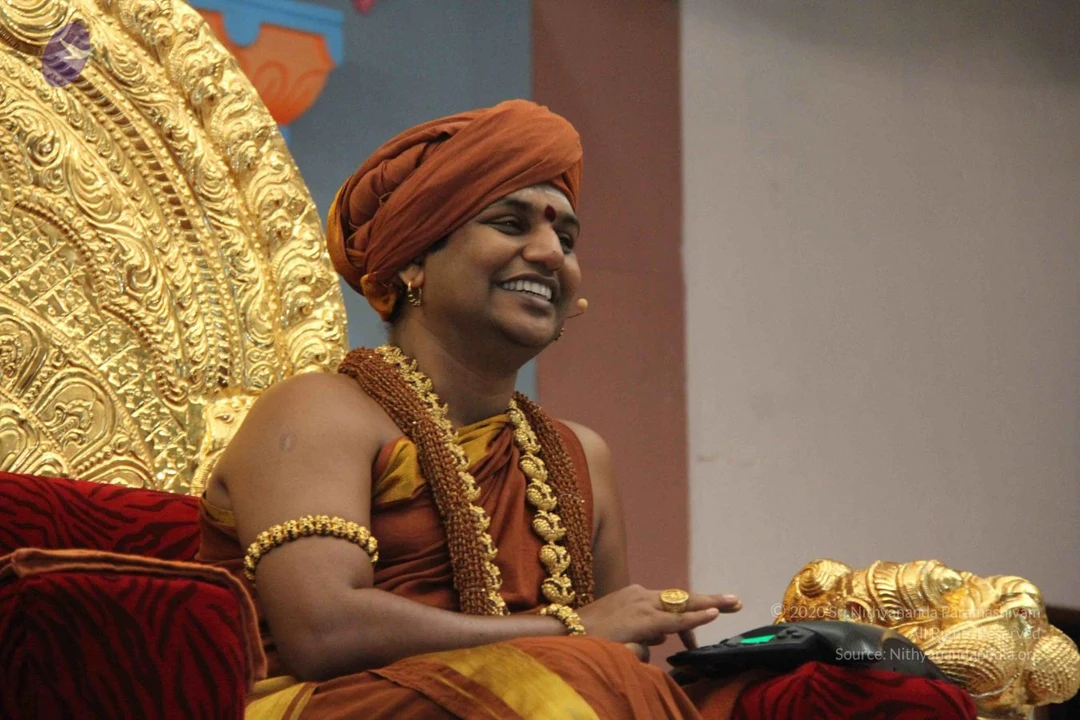
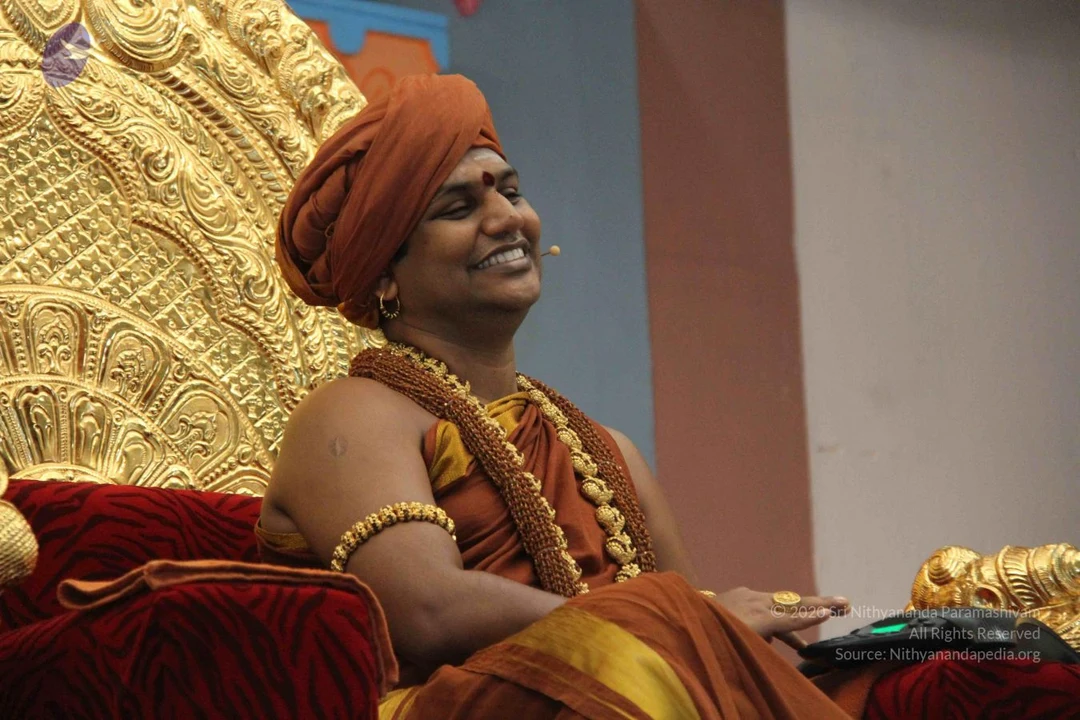
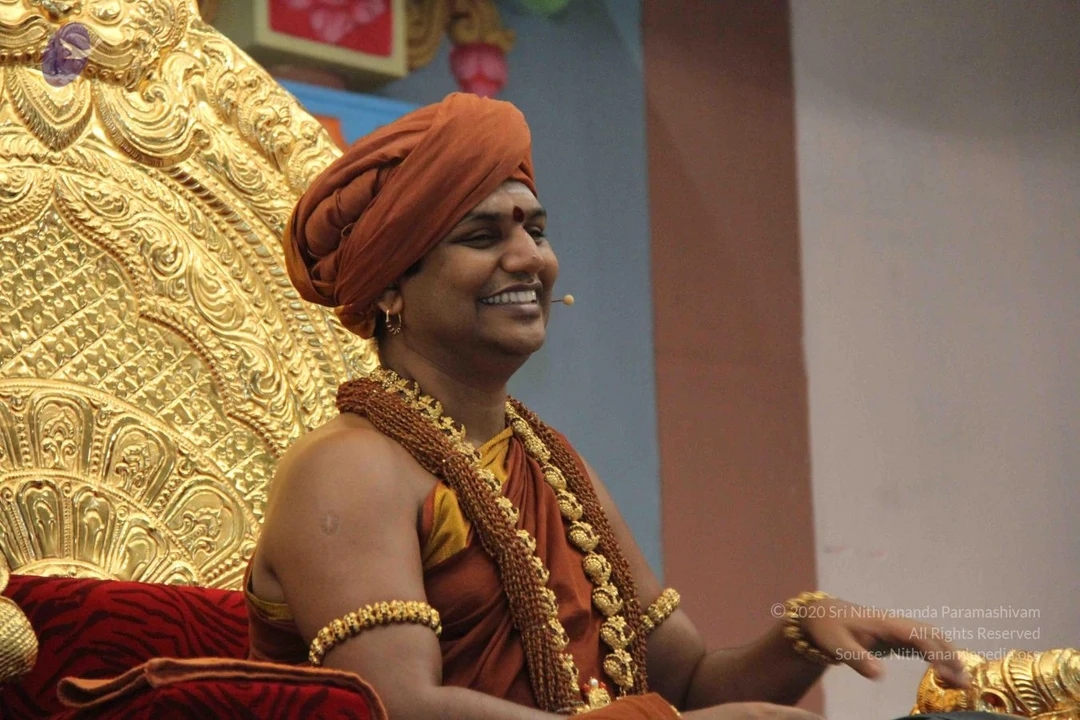
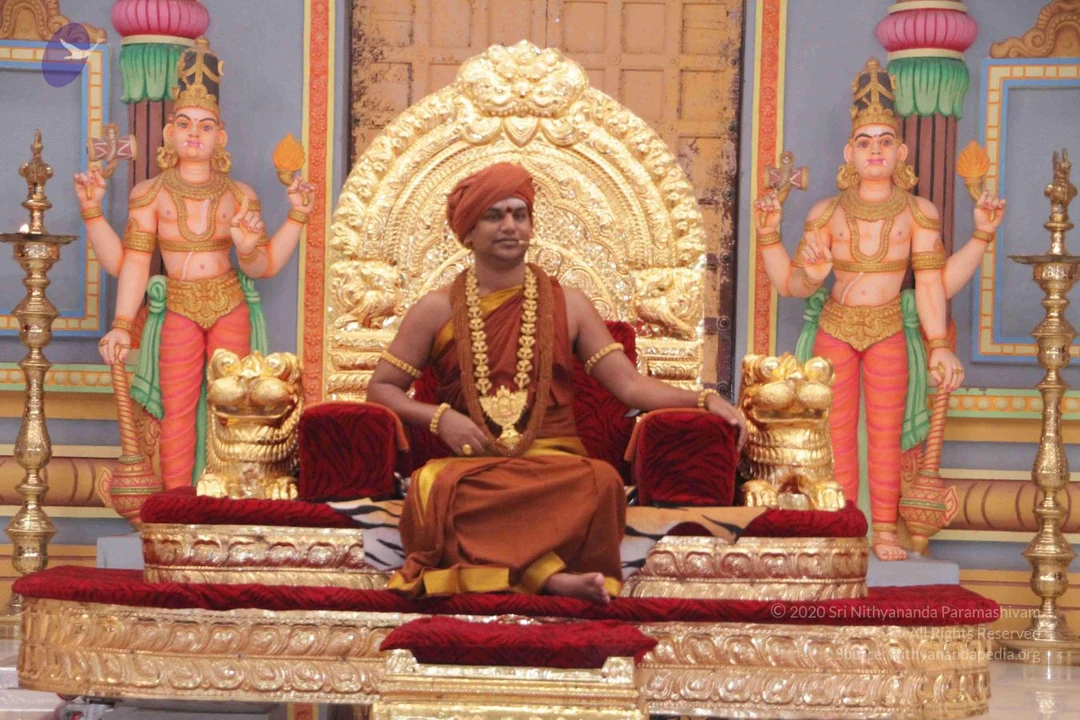
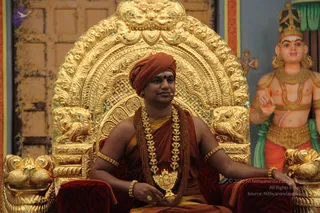
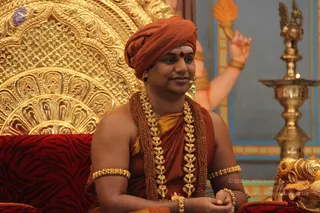
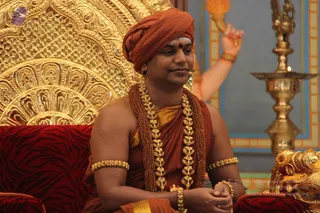
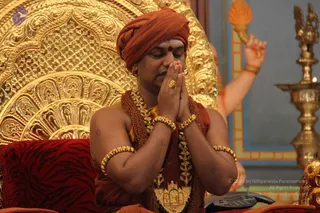
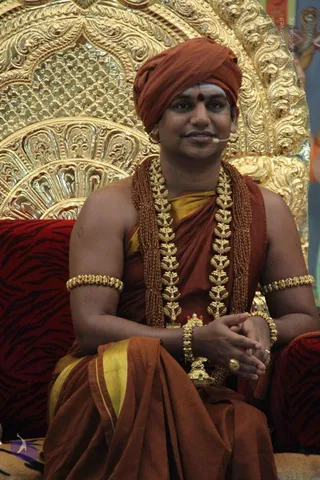
A man seated on an ornate gold throne with a carved gilded arch and lion-shaped armrests, wearing a rust-orange turban, a rust-orange shawl over a saffron-yellow garment, a heavy gold-beaded mala necklace with a gold pendant, gold bangles on the upper arms and wrists, and a small lapel microphone. He has a tilak mark on his forehead and sits with his right hand open on his thigh. Beside the throne stands a painted statue of a figure with a gold crown, gold ornaments and orange dhoti. The page links this photo to a morning satsang discourse; the seated man is a probable Swamiji by appearance, with turban, saffron clothing, gold necklace and throne as cues.Photograph of a man seated on a red velvet cushioned throne in front of an ornate gold backrest with embossed floral and fan-shaped patterns. He wears an orange-red turban, a red bindi and white tilak on his forehead, rudraksha-style beaded mala necklaces with large gold ceremonial pendants, gold armlets and bangles, and an orange-red and gold shawl draped over bare shoulders. He sits with hands folded, smiling. To his right stands a tall brass oil lamp with a lit flame, and behind him a painted figure with raised arm and a gold torch-like finial. The setting resembles a stage or temple hall. One person is visible.A seated man in an orange-saffron turban and saffron dhoti-style wrap with a gold-yellow inner cloth sits on a red-and-black tiger-striped cushion before an ornate gold-leaf throne back. He wears layered gold ceremonial necklaces, a rudraksha-style mala, gold armlets and bangles, a red bindi with a vertical tilak, and a small earring. A brass oil lamp with a lit flame stands beside him, and a gold carved lion-head ornament sits at lower right. Behind him a painted figure raises one arm holding a flame-like object. Swamiji (probable) is seated centrally, with distinctive saffron turban, layered gold necklaces and saffron wrap as cues.A man seated on an ornate gilded throne with red tiger-striped upholstery, wearing a saffron-orange turban, orange robe with gold border, layered gold and rudraksha-style beaded necklaces, gold armlets and bangles, and a red tilak on his forehead. His hands are clasped in his lap and he looks to the side. Behind him a brass lamp with a lit flame stands on the right, and a golden deity figure with raised arm appears in the background. This is a Swamiji (probable) seated in a satsang setting: the saffron turban, ornate gold necklaces and armlets, and throne match his presentation, and the printed caption identifies the event.A seated man in an orange-red turban and saffron-red robe sits with palms pressed together in namaste, eyes closed, in front of an ornate gold throne-back with repoussé floral and fan patterns. He wears a gold-toned necklace, a rudraksha-style beaded mala, gold armlets and bangles, and a red tilak on his forehead. Behind him a brass oil lamp with a lit flame and a gold figure with a raised arm stand on a red tiger-striped cushion, with a telephone visible at the lower edge. The setting suggests a satsang or discourse hall.A smiling man in a saffron-orange turban and matching saffron-orange garment sits on an ornate golden throne with intricate carved and embossed gold scrollwork. He wears a tilak with a red dot on his forehead, multiple strands of rudraksha beads and a long ceremonial gold necklace, plus gold armlets and bangles. A small headset microphone is visible near his face. A red cushion rests on the seat beside him, and a partial arm with orange sleeve and gold bangles is visible at the left edge.

Final-Blessings

1 photoSource gallery
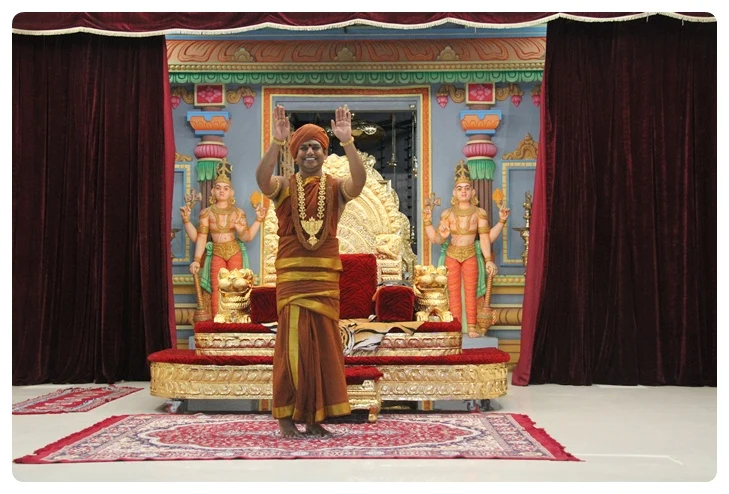
A man stands barefoot on a red carpet in front of a gilded throne (peetha) flanked by two painted standing deity murti figures holding ritual objects, with red velvet curtains framing the stage. He wears an orange-saffron turban, a saffron and gold-bordered dhoti and shawl, and a heavy gold necklace with a pendant and a rudraksha-style mala. Both arms are raised with open palms facing outward, and he smiles as he addresses the audience. Ornate blue, green and red painted pillars and a gilded arch frame the throne. Probable Swamiji cues: orange turban, saffron robes, ornate gold necklace, and a throne setting, presented as the speaker.

Temple

11 photosSource gallery
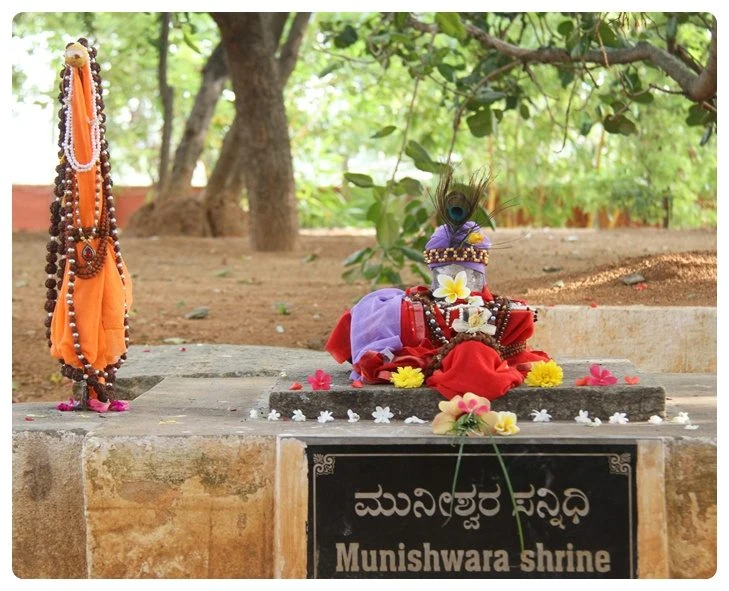
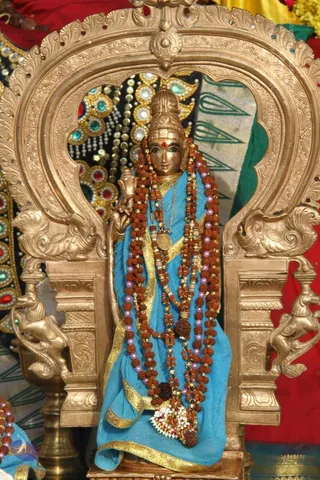
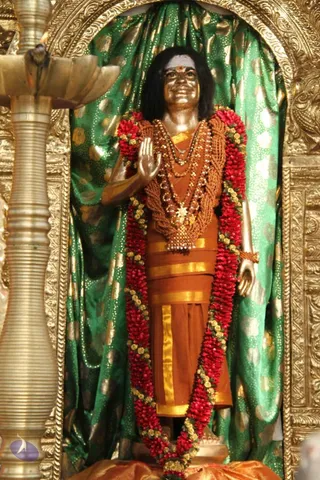
Photo of a golden shrine with a magenta curtain backdrop showing a large bronze-coloured deity murti of a seated couple, the male figure holding a trident and a cobra-topped staff, wearing a red-and-green turban, with the female figure beside him in a gold sari and ornate necklaces. Marigold and red flower garlands hang across the shrine. In front is a Shivling draped with an orange cloth and rudraksha beads, with brass lamps, bells and a kalasha-like vessel on the platform. At lower left a young shaven-headed priest in orange robes and glasses sits cross-legged holding a red apple-like offering over the puja tray. Gilded arch frames the scene.A gilded metal murti of a deity seated on an ornate golden throne with arched back and carved makara-style side brackets. The figure wears a blue sari with gold border, draped with multiple strands of rudraksha malas and pink beads, plus a gold pendant and a red bindi on the forehead. One hand holds a ritual object near the chest. Behind the throne are embroidered red and gold fabrics with mirror and jewel decoration, and brass lamps and flowers appear at the edges. No physical people are visible.A gilded statue of a long-haired figure stands in an ornate golden niche draped with green cloth bearing gold floral motifs. The statue wears a rust-orange garment with gold borders, layered rudraksha and bead malas, a star pendant, and a red-and-yellow flower garland. Its right hand is raised in blessing, and a brass oil lamp with a lit wick stands at the left edge of the frame. The figure is a statue, not a living person, and no physical people are visible.A small brass deity murti seated in an ornate brass arched frame, dressed in a royal blue silk sari with gold zari border. The figure wears a jeweled crown set with white, red and green stones, multiple rudraksha and gold bead malas, and a pearl necklace with gold pendant. A red rose rests beside the frame. The figure is a statue, not a physical person, so no living people are present.A black stone statue of Dakshinamurthi, a four-armed Shiva form, sits in a silver arched shrine with a magenta cloth backdrop. The figure wears a turquoise dhoti, a pink headcloth, and layered beaded necklaces, and it is garlanded with yellow and red flower chains. Red and orange flowers are scattered at its base and on a small stone offering ledge, with a dark plaque reading Dakshinamurthi Shrine. The shrine stands on a raised mound coated in red-orange pigment, surrounded by trees and dry ground. No people are visible.A photograph of a black stone Dakshinamurthi statue seated in a silver-framed arched shrine beneath a large banyan tree. The deity has a red head cloth, garlands of yellow and red flowers, beaded necklaces, and a teal and pink draped garment, with a pink curtain behind. Red-painted rocks and scattered hibiscus flowers surround the base. A small stone plaque below reads Dakshinamurthi shrine in Kannada and English. In the background, several people in orange and red robes sit near the shrine. No one is standing in front of the statue.

Paduka-Puja
11 photosSource gallery
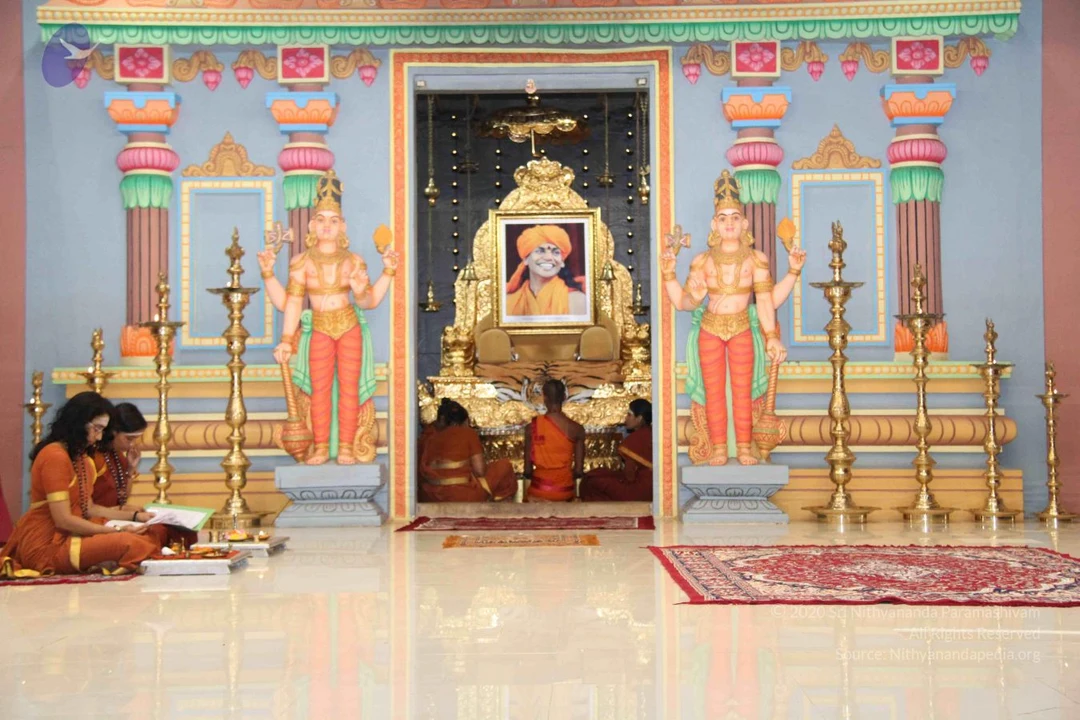
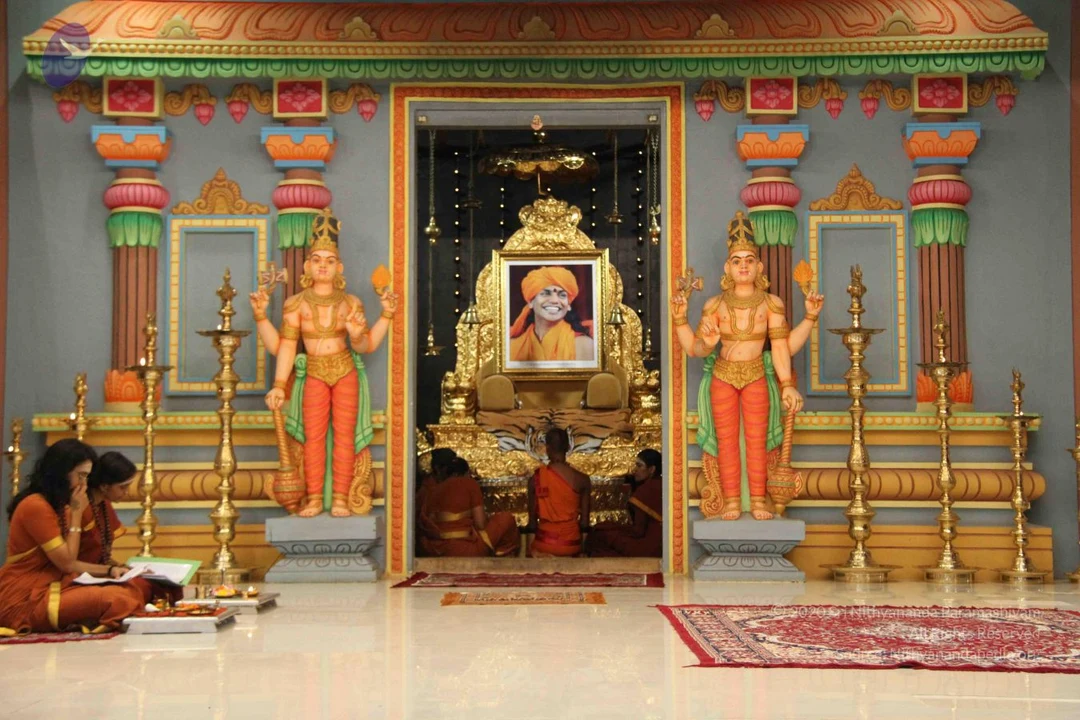
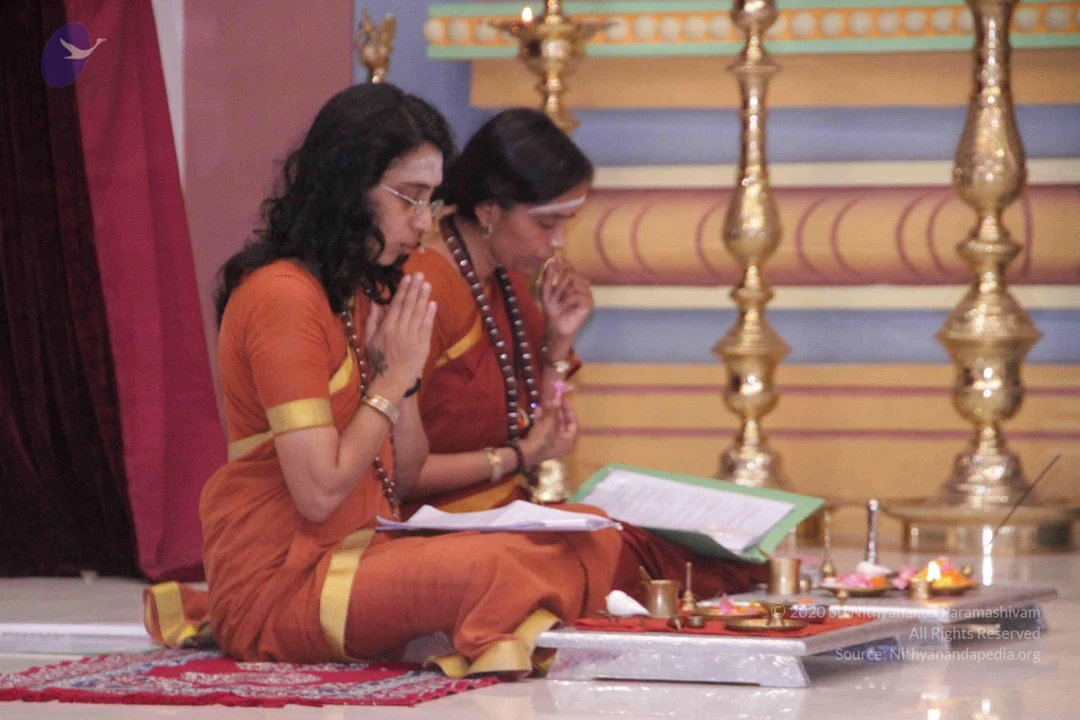
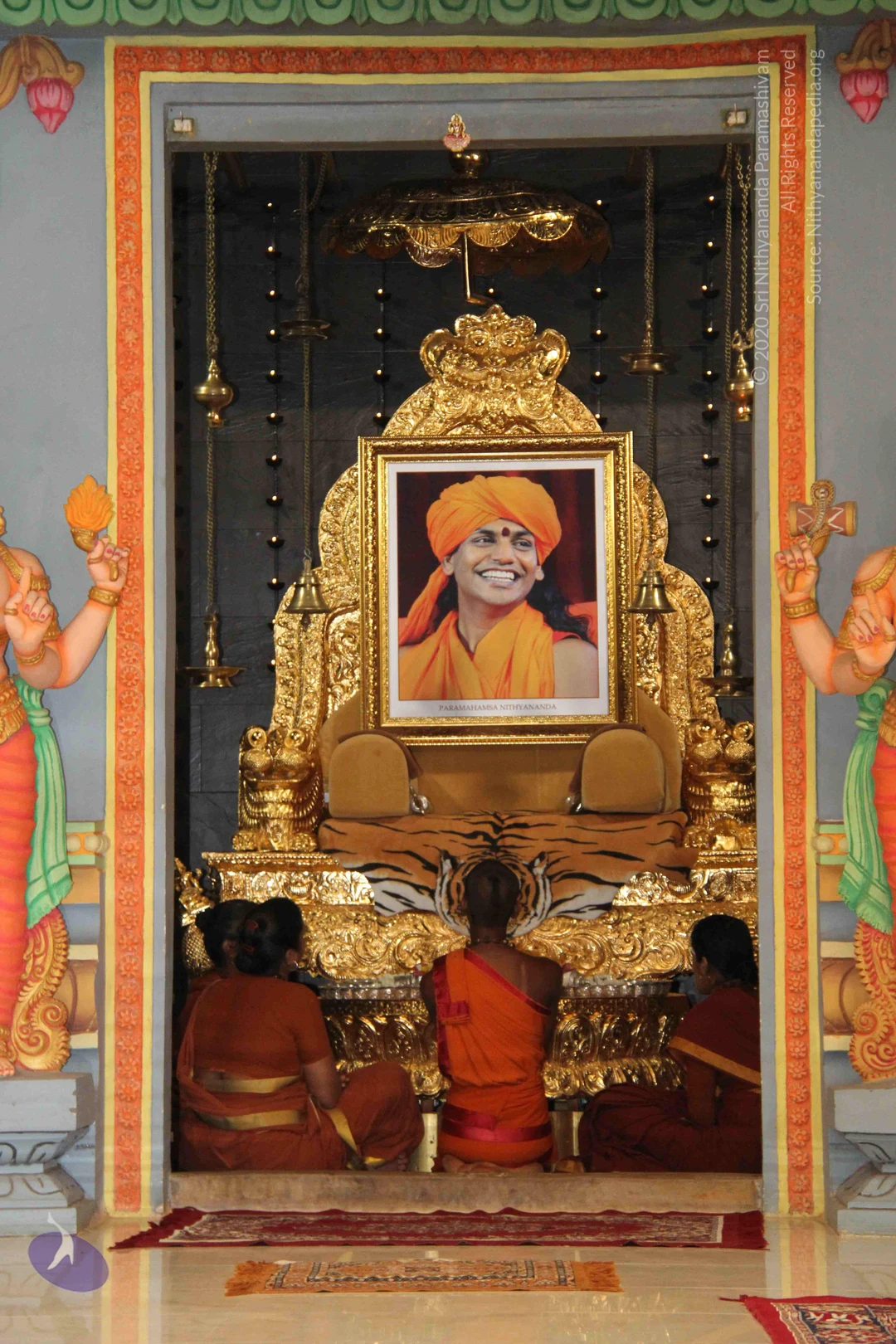
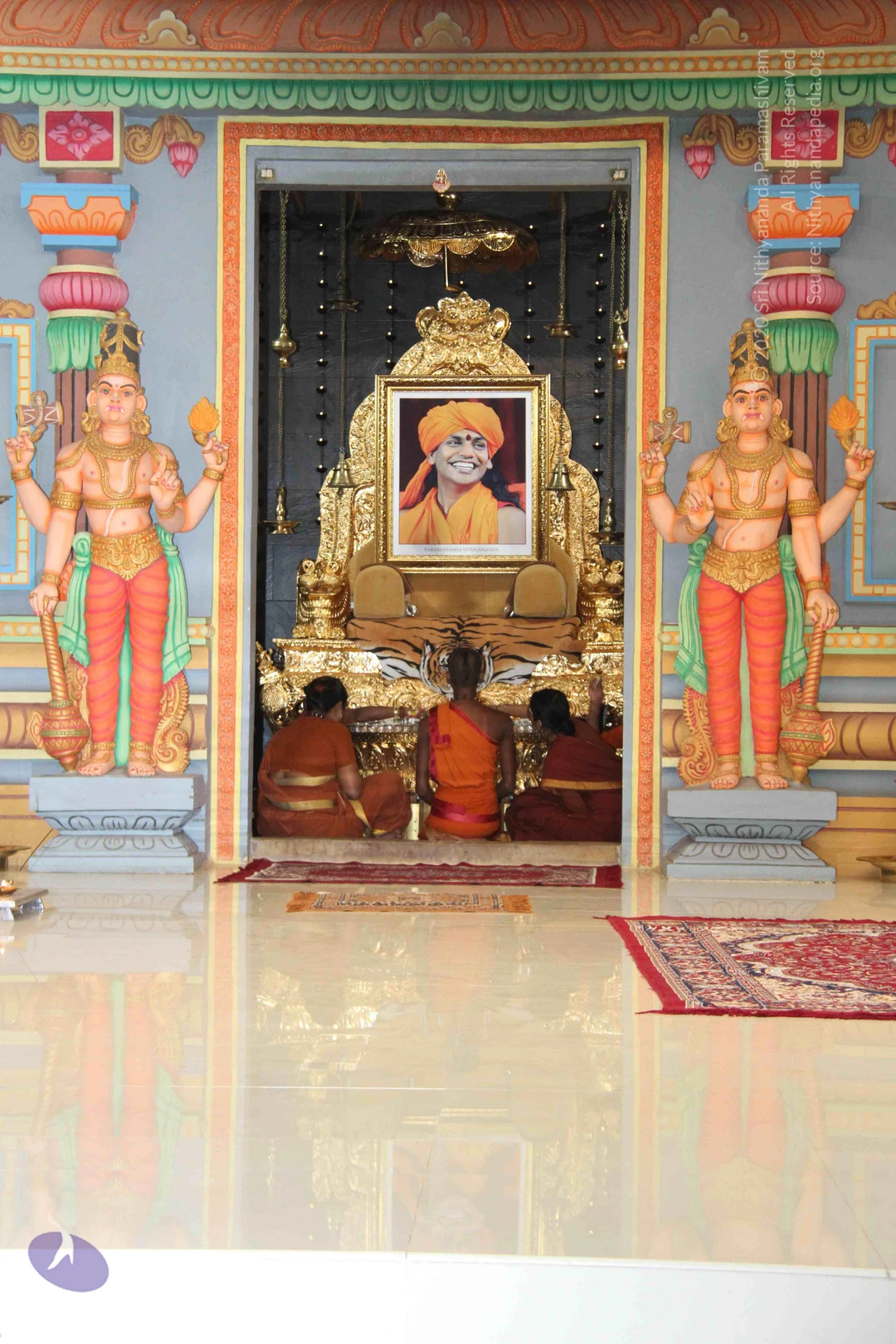
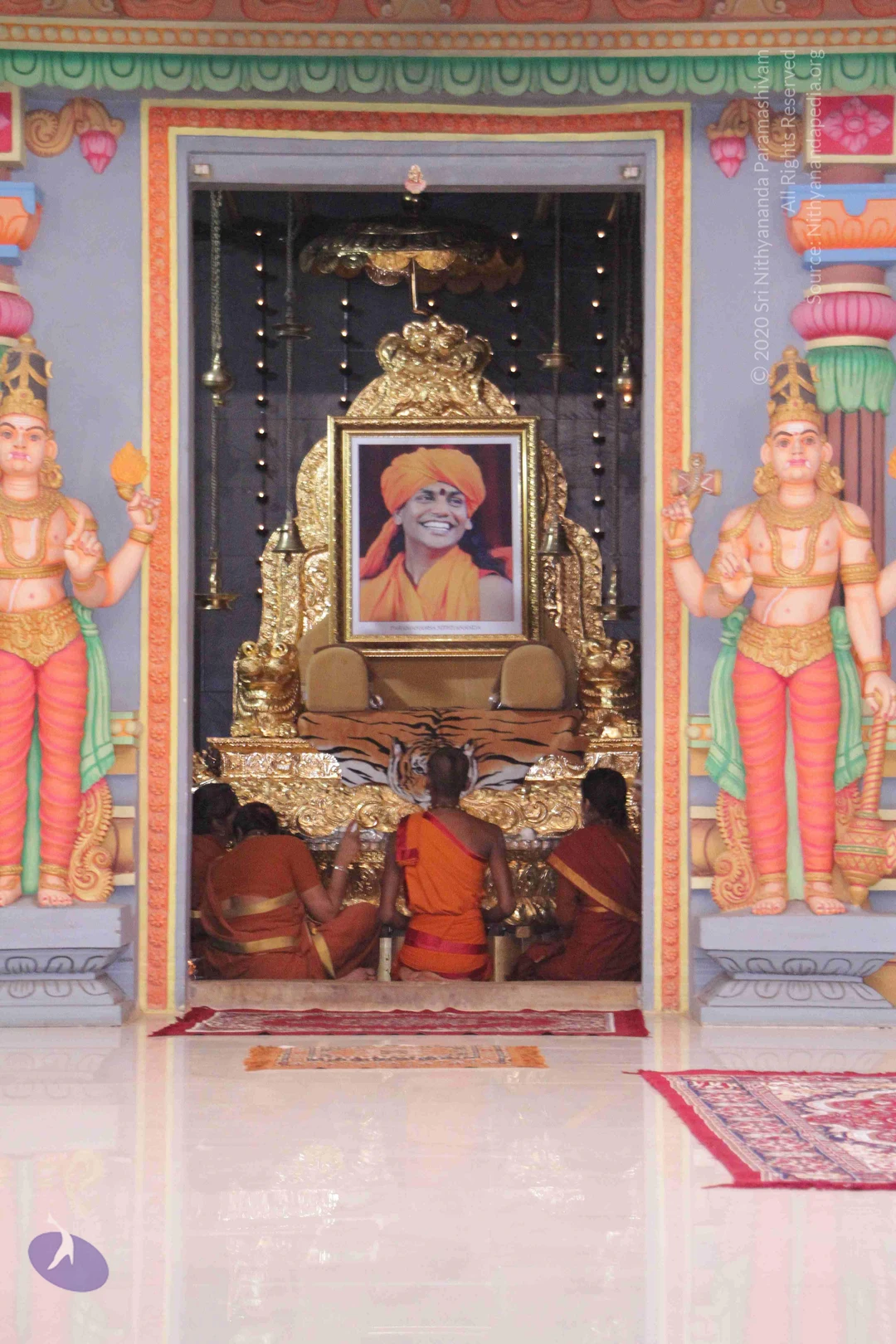
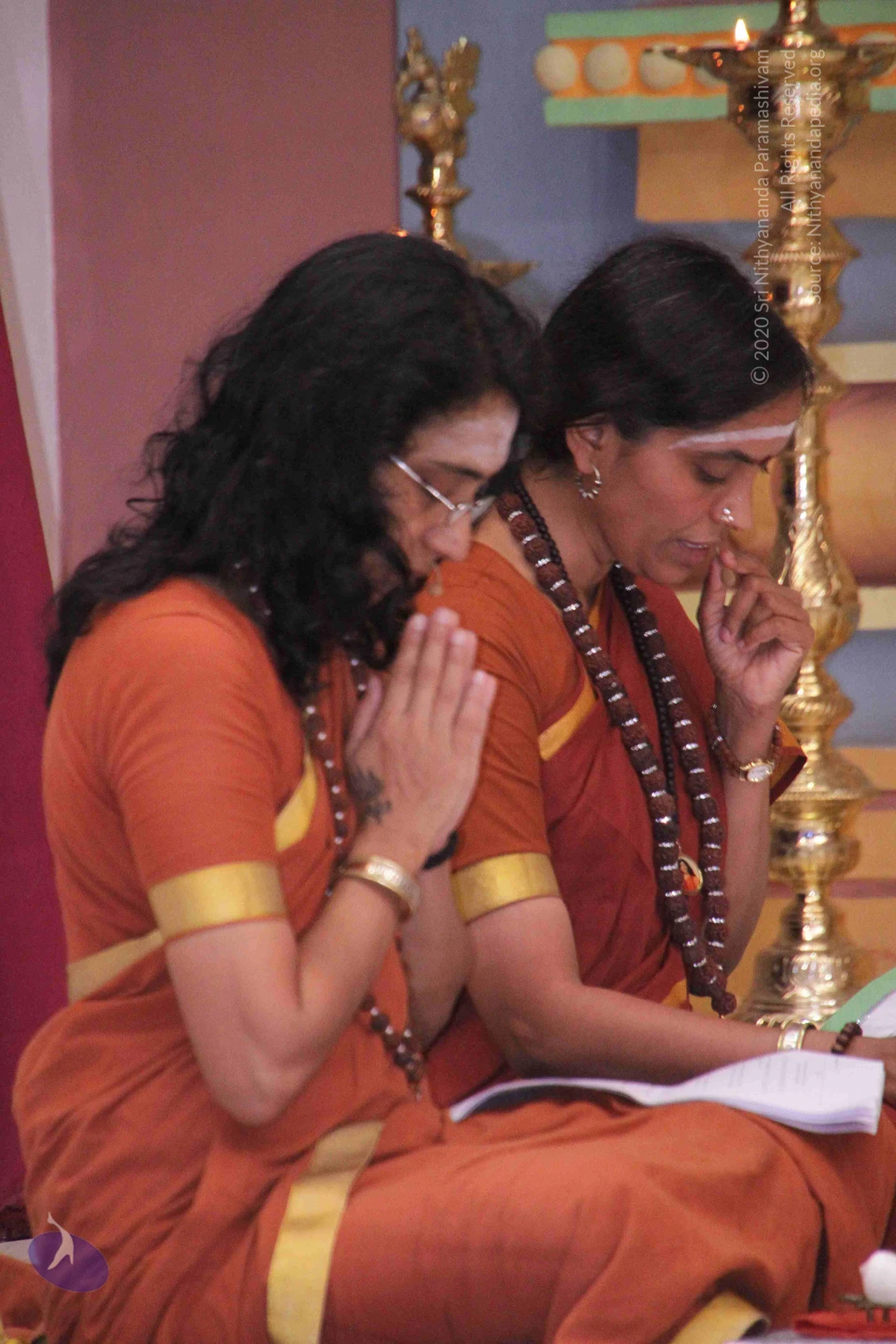
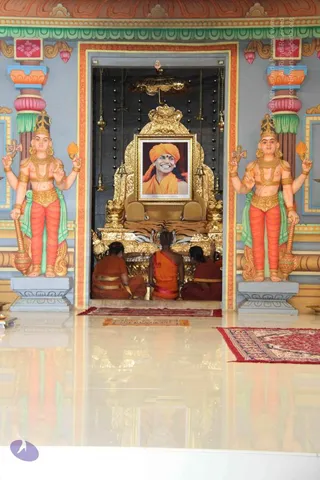
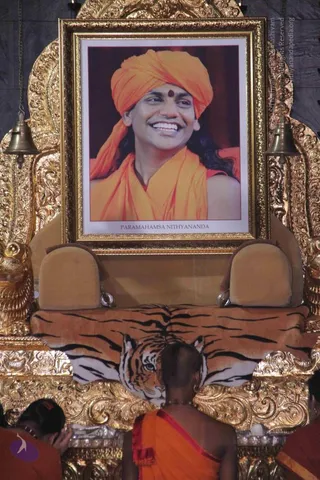
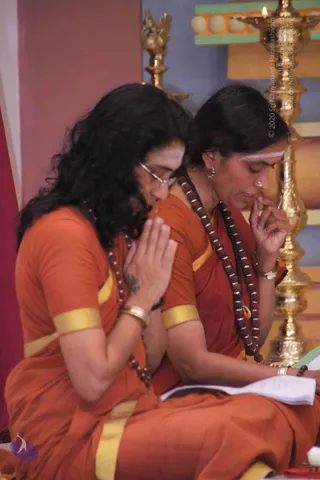
A golden ornate throne canopy frames a framed portrait labelled "PARAMAHAMSA NITHYANANDA" showing a smiling man in an orange turban and orange shawl with a red bindi, placed on a golden throne draped with a tiger-skin cloth. Three devotees in orange robes kneel and sit in front of the throne in a shrine room, with a gold parasol above, hanging brass lamps, and painted yellow-green dvarapala guardian figures on either side holding flaming torches and a conch. Red and patterned rugs cover the marble floor.A golden ornate throne draped with a tiger-skin cloth stands in a niche before a framed portrait labelled "PARAMAHAMSA NITHYANANDA", showing a smiling man in an orange turban with a red bindi and orange shawl. Three devotees in orange and red saris kneel in prayer at the base of the throne, one with hands folded. Hanging brass lamps, bells and a golden canopy surround the niche, and painted dvarapala-style guardian figures with raised arms flank the doorway. The portrait is a depiction, and the portrait's appearance cues (orange turban, shawl, bindi) match a Swamiji depiction.Photograph of a decorated temple hall with a gilded throne draped with a tiger-skin cloth, set before an ornate doorway. A framed portrait labelled "Paramahamsa Nithyananda" sits on the throne, showing a smiling man in an orange turban and orange robe, with bells and a hanging golden canopy above. Two painted, multi-armed guardian statues in red and green dhoti-style garments flank the doorway. Three people in orange and maroon clothes kneel in front of the throne, one in orange in the centre, appearing to perform puja or offerings. Red and patterned rugs lie on a glossy white marble floor.Ornate gold-carved throne with a large framed portrait labelled "Paramahamsa Nithyananda" above it, showing a smiling man in an orange turban with a red bindi and orange shawl. Below the portrait, two cushioned golden armrests flank a seat draped with an orange tiger-striped cloth. Brass bells hang on the left and right of the throne. In front, a bald devotee in orange robes with a red-edged cloth sits with his back to the camera, and another person in orange is partially visible at the lower left, facing the throne. The scene is a shrine-like setting honouring the portrait on the peetha.Inside a temple shrine, a large golden throne (peetha) stands in an arched niche with a tiger-striped cloth draped over its seat and a gilded canopy above. A framed portrait on the throne shows a smiling man in an orange turban and saffron robe, labelled with a printed name. Before the throne, a devotee in an orange robe kneels with three women in orange saris, all seated on the floor facing the throne. Painted deity murtis with crowns and red-pink dhotis flank the doorway, and bells and lamps hang from the canopy. Red and patterned rugs cover the polished white floor.Two women seated closely together in orange and rust saris with gold borders, praying with hands folded and eyes lowered, one wearing glasses and the other holding a rudraksha mala and touching her face. Both wear white forehead markings and rudraksha necklaces. A tall gold oil lamp with a lit flame stands behind them against a pink and blue wall, and an open booklet rests on one woman's lap. No man in saffron or ornate attire with a distinctive a person cue is visible.

Sarva-Darshan

4 photosSource gallery
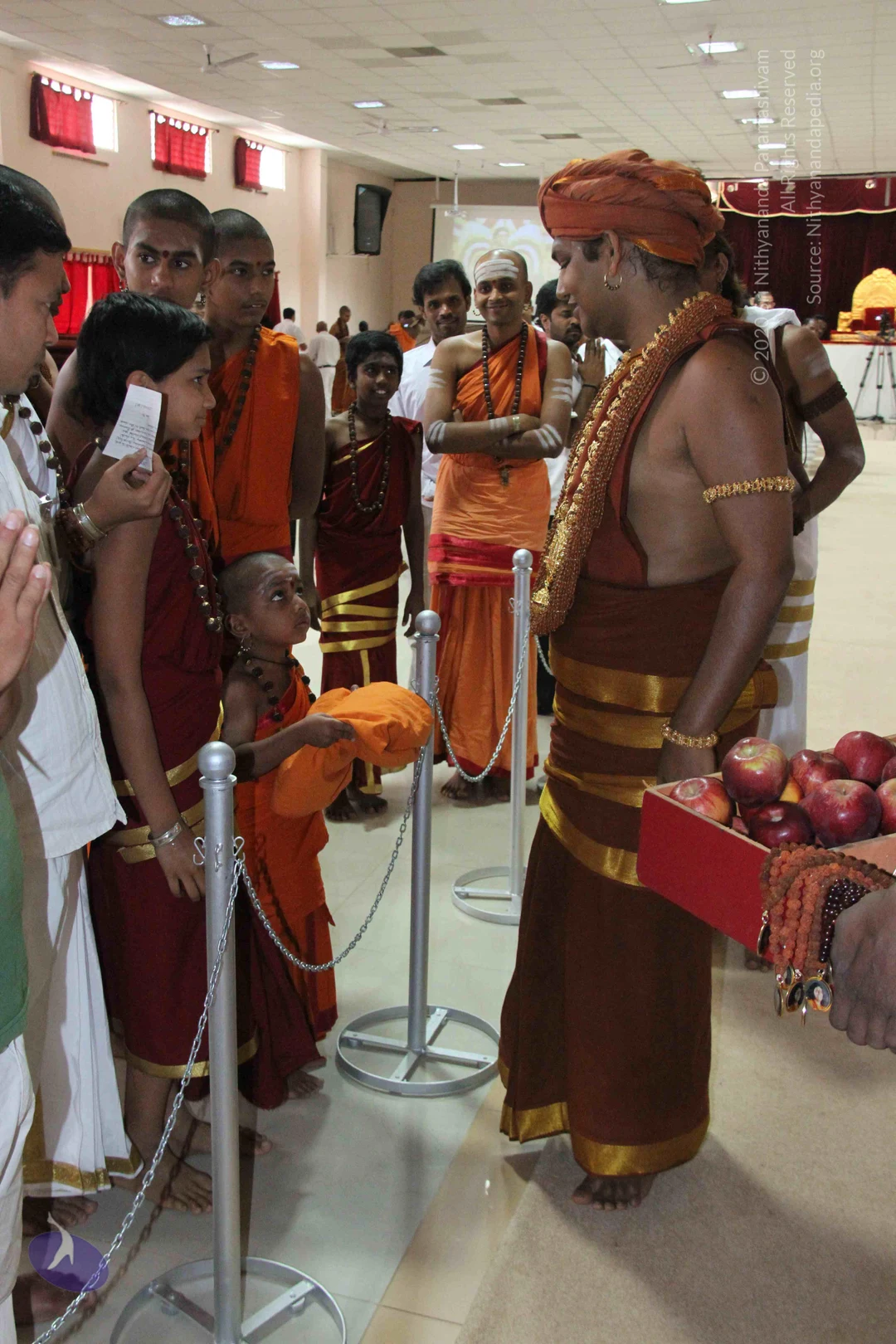
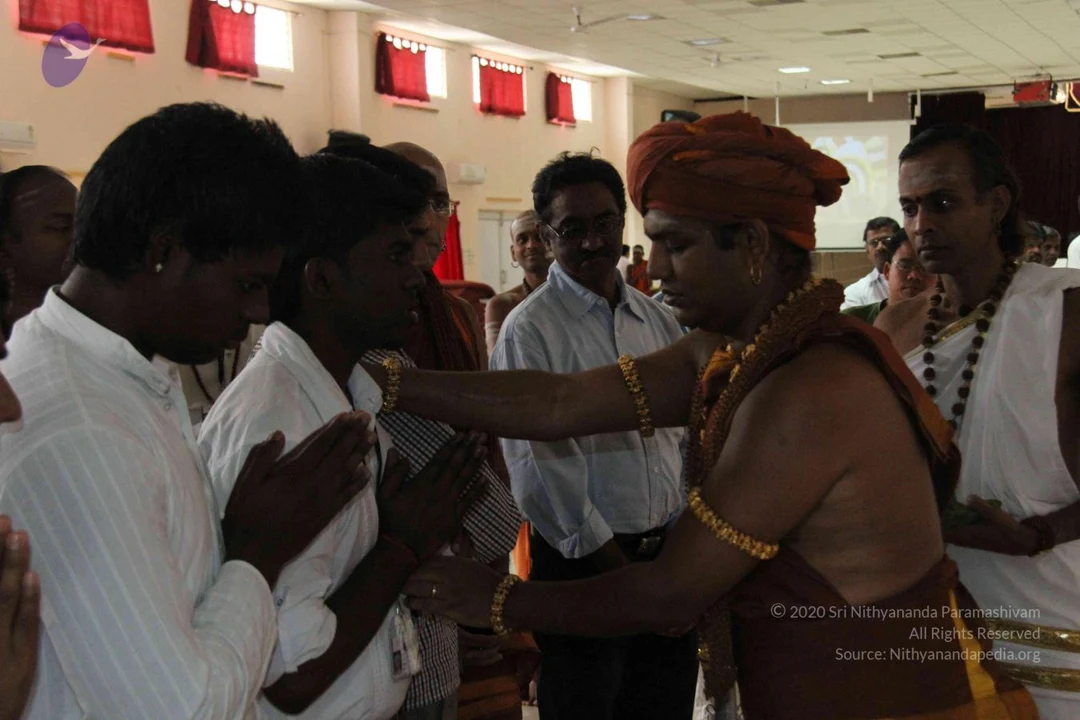
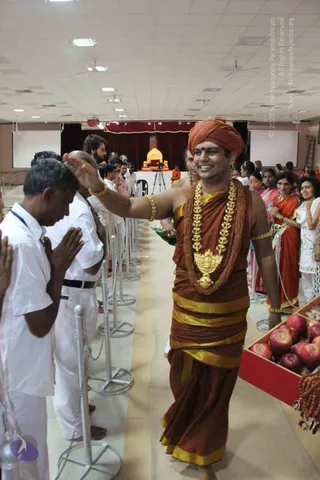
A man in an orange-red turban and rust-brown dhoti with gold borders walks down a carpeted aisle in a hall, smiling and raising one hand in blessing. He wears a long mala of rudraksha beads with a large gold ceremonial pendant and gold bangles. To his left, men in white shirts stand with palms pressed together in namaste, and to his right women in orange and red saris stand with hands folded. A red wooden tray of apples is held beside him. At the far end, a large golden throne with red cushions stands on a stage with a red curtain and a camera tripod. Swamiji (probable) is the central figure in the robes, turban, gold pendant and rudraksha mala, with a red chandlo on the forehead.Photograph inside a hall with white ceiling tiles and fluorescent lights, showing a procession lane lined with stanchions and chains. A smiling man in an orange-brown turban, rudraksha mala and gold ceremonial necklace with a lotus-style pendant, wearing a brown-orange wrap with gold borders, raises one hand in blessing while carrying a red box of apples and rudraksha malas. Men in white shirts and white dhotis stand on the left with palms pressed together, some barefoot. Women in orange and white saris stand on the right, and a golden throne-like seat is visible at the far end of the hall. Probable Swamiji's appearance matches the orange turban, mala and gold necklace cues, shown as a figure greeting devotees during a darshan-style procession.A photograph inside a hall with red curtains and ceiling lights. A man in an orange turban, gold-trimmed brown dhoti and a heavy gold necklace stands barefoot holding a red tray of apples and rudraksha malas, facing a small boy in orange robes and rudraksha beads who reaches toward him with an orange cloth. Behind a silver stanchion and chain, young boys in red and orange robes and shaved heads watch, with a smiling man in orange robes and white tilak lines standing with folded arms. Several devotees in white dhotis stand nearby, and a gold-lit deity murti or altar is visible at the back right. The orange-turbaned figure shows distinctive ornate gold jewellery and orange headwear, a compatible presentation, but the appearance is not conclusively identifiable.A photograph of an indoor satsang hall with red curtains and a projection screen behind. In the centre, a man in a saffron-orange turban, bare-chested with a saffron-orange shawl and gold necklaces and bangles, stands with his hand raised in blessing over a younger man in a white shirt who has his palms pressed together in prayer. Another white-shirted man with folded hands stands to the left, and a man in a light shirt and glasses watches from behind. On the right, a man wearing a white dhoti-style garment and rudraksha mala beads stands near a gold-trimmed fabric. The orange-turbaned figure has long wavy hair and distinctive ceremonial gold adornments, consistent with the page reference to a person, though the identification is appearance-based and uncertain.

Nithya-Satsang
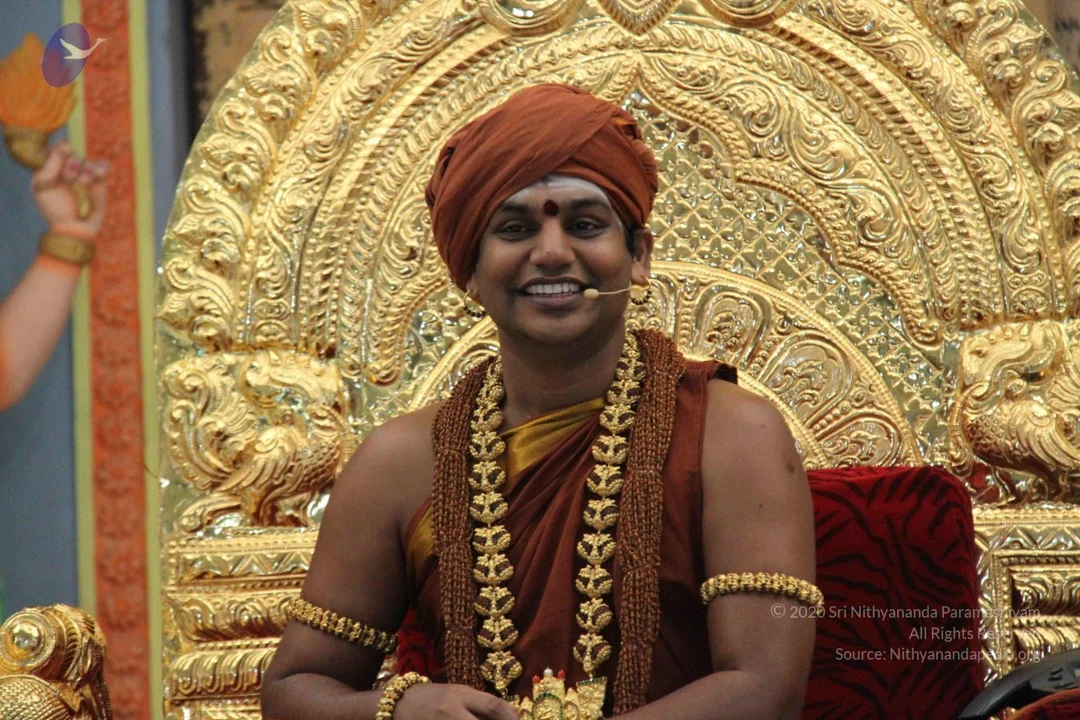
9 photosSource gallery
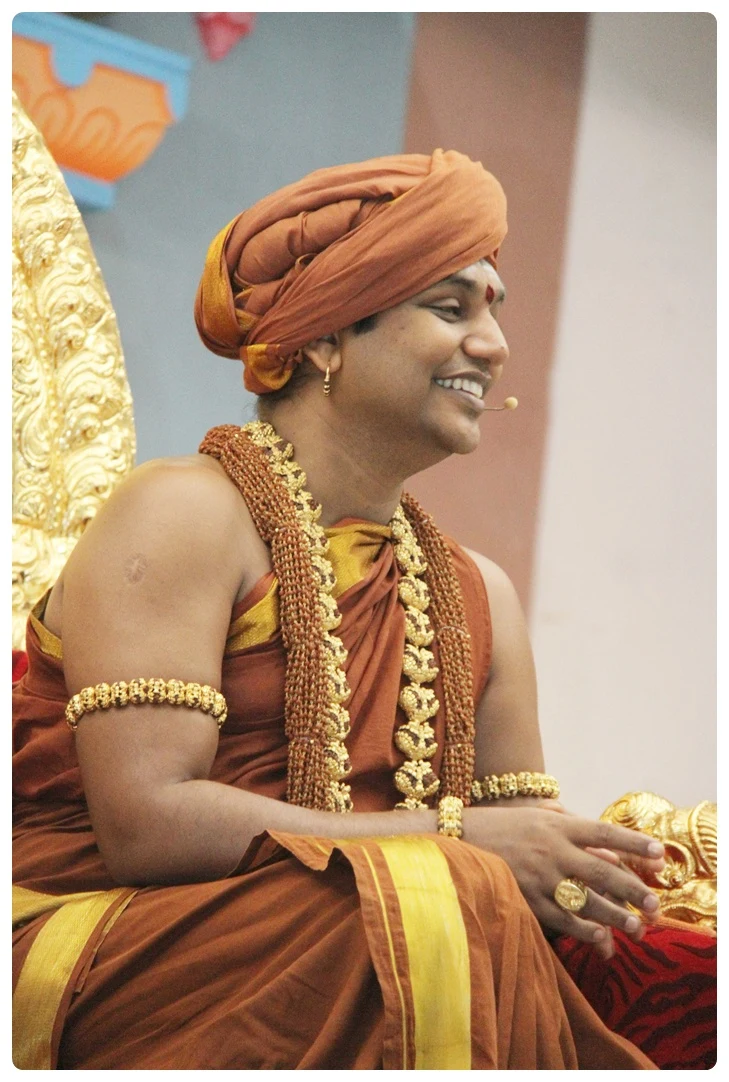
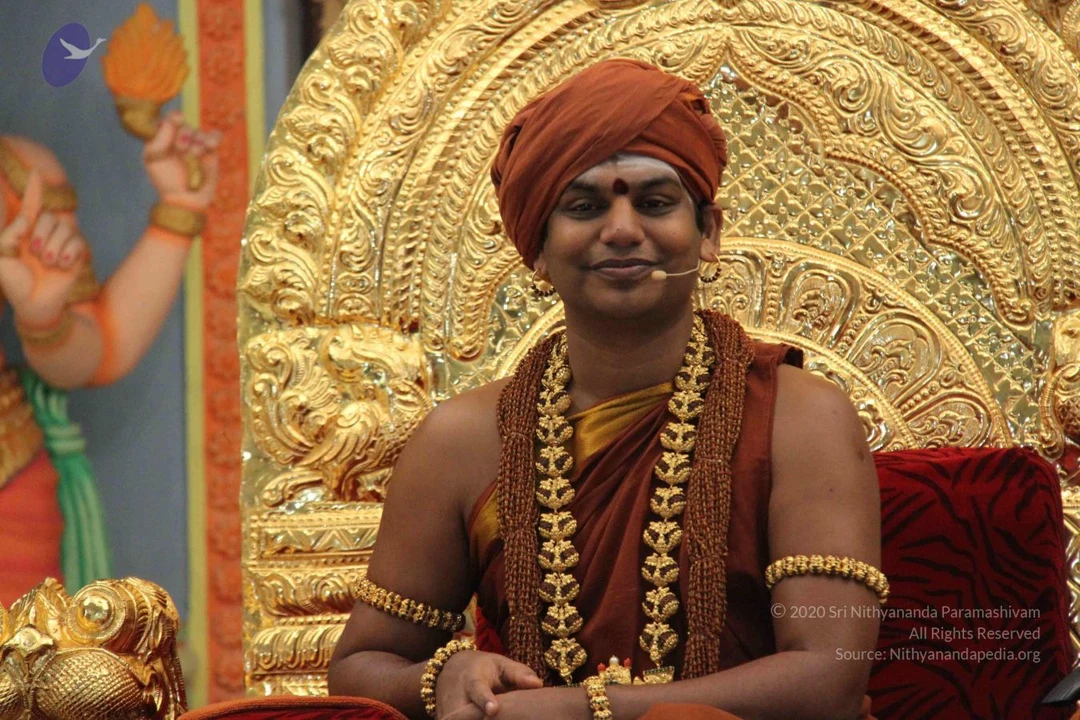
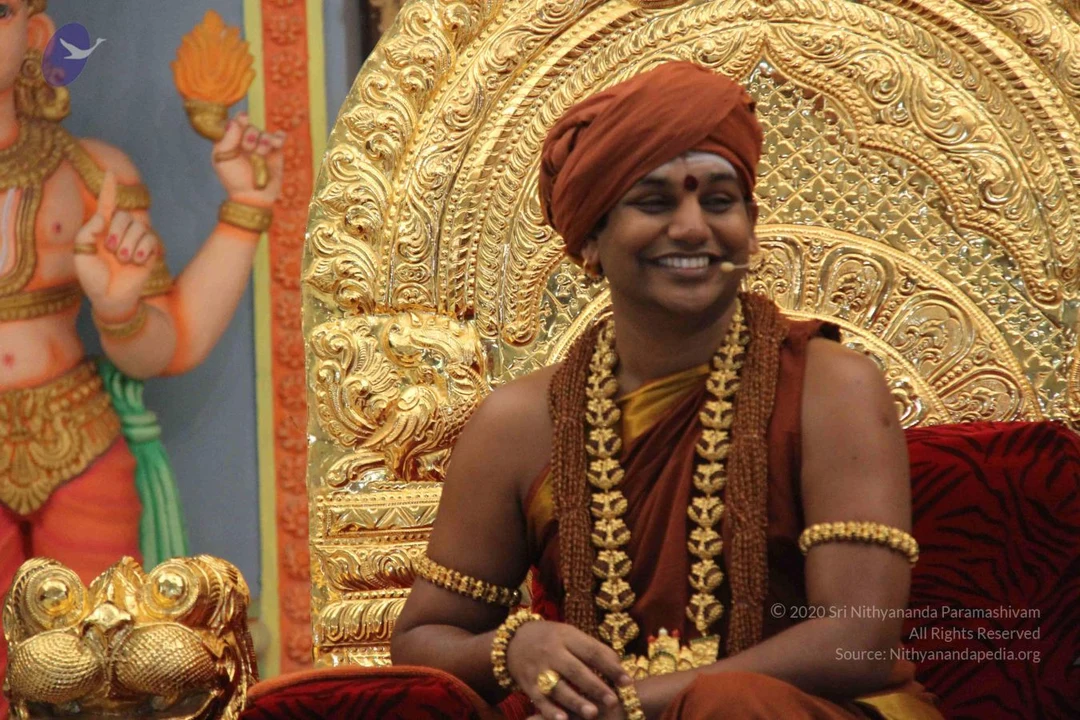
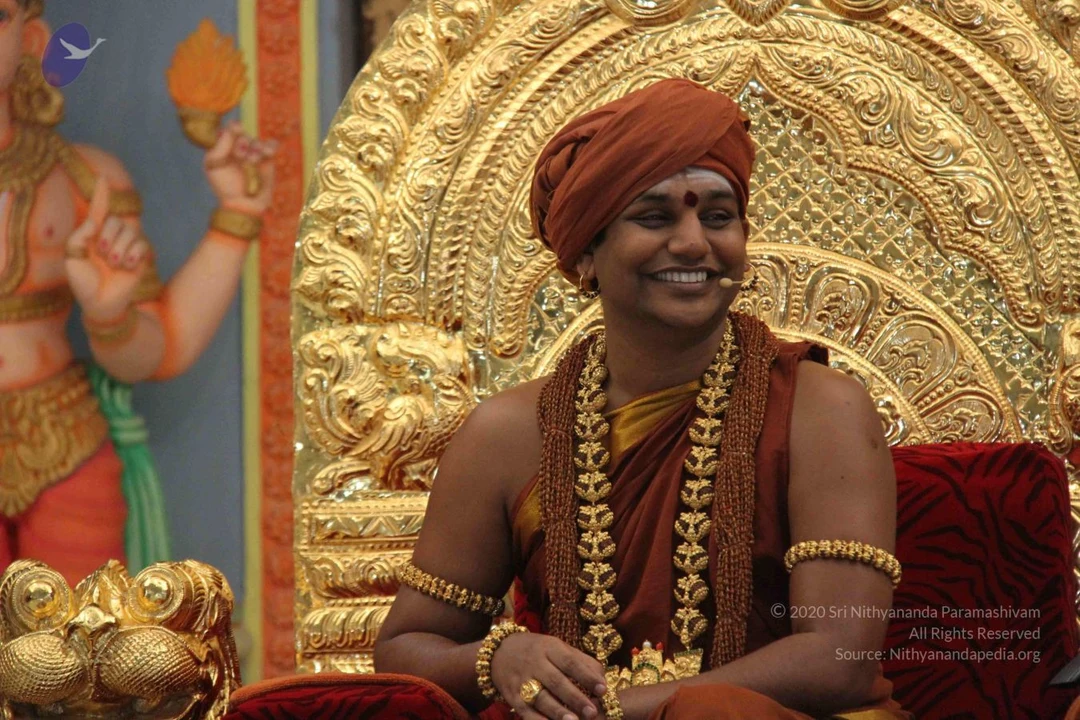
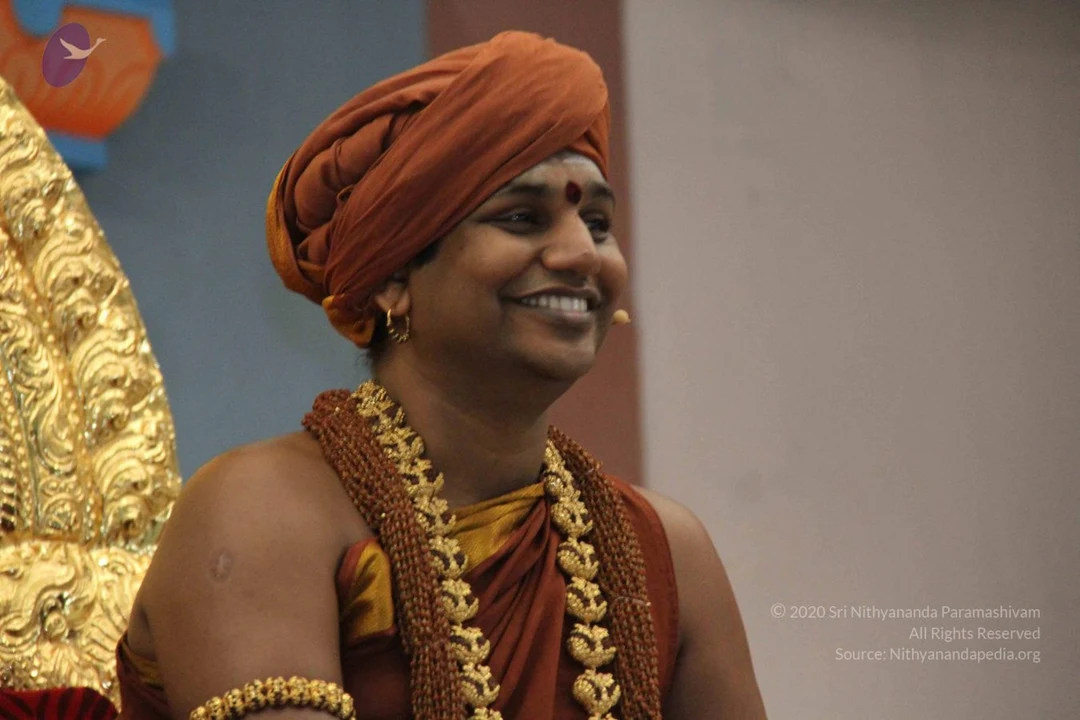
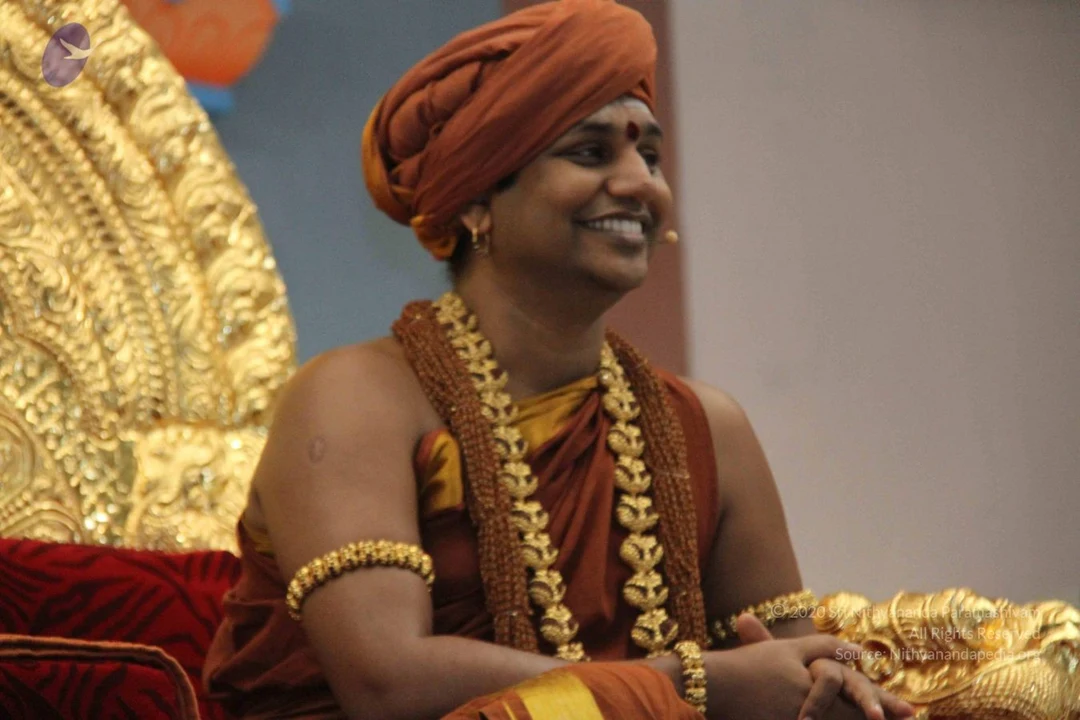
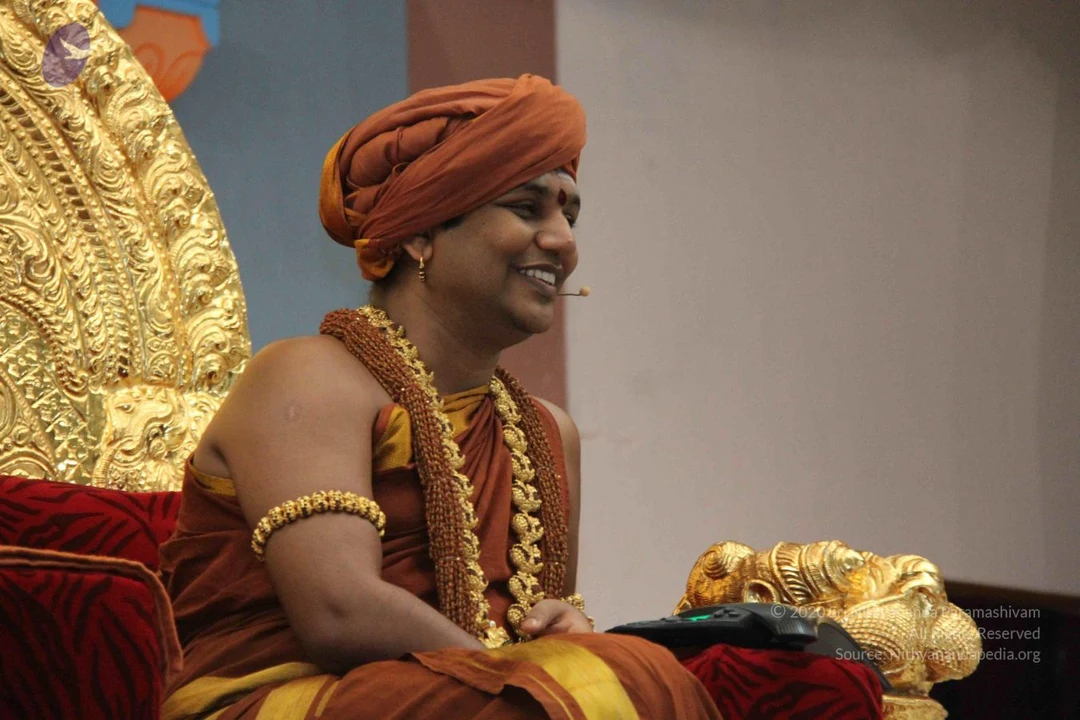
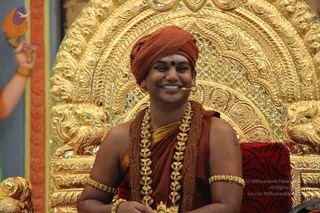
A photograph of a seated man in a rust-orange turban and matching orange-brown robe with gold border, wearing a heavy gold necklace of leaf-shaped pendants alternating with rudraksha beads, gold armbands and bracelets, and a gold ring. He has a red bindi on his forehead and a small microphone near his mouth, hands clasped in his lap, smiling. Behind him is an ornate gold repoussé throne back with peacock-fan patterns and a red tiger-striped cushion. a person is seated on the throne, shown as an in-person speaker during a discourse.A man seated on a red and black tiger-striped cushion before an ornate gold throne-back, wearing a rust-orange turban with a red bindi, rust-orange robes with gold borders, multiple strands of gold and beaded necklaces, gold armlets and bangles, a gold ring, and a small clip-on microphone. His hands are folded in his lap and he gazes to the side with a slight smile. A gilded deity figure with raised arm is partly visible behind him. Swamiji (probable): the seated man has a turban, saffron-orange robes and ceremonial gold necklaces. Seated on a throne as the speaker, he matches the page's note of a satsang discourse.Probable Swamiji (probable) seated on a golden throne with ornately carved gilded backrest, smiling and gazing to his right. He wears a saffron-orange turban with a red bindi on his forehead, a saffron-orange wrap over a gold-bordered garment, and a long necklace of rudraksha beads alternating with ornate gold beads, plus gold armlets and bangles. His hands are clasped at his lap and a small lapel microphone is clipped near his mouth. A red patterned cushion is visible at the lower left. One physical person is present.A smiling man sits on an ornate gold throne with red tiger-striped cushions, wearing an orange-saffron turban with a red bindi, an orange-saffron shawl over his shoulder with gold border, a thick rudraksha mala with gold bead garland, gold armlets, bangles and rings, and a small headset microphone on his ear. Probable Swamiji in person, appearing as a seated speaker in saffron clothing with distinctive turban, ornate gold necklaces and rudraksha cues.A smiling man in a rust-orange turban and rust-orange shawl with gold border sits on an ornately carved gold throne. He wears layered gold-beaded necklaces with rudraksha-style brown beads, a gold bangle on his upper arm, gold bangles on his wrist and a gold ring, with a red bindi on his forehead and a small earring. A headset microphone is attached near his mouth, and a red striped cushion is visible beside him. Probable Swamiji by appearance cues: rust-orange turban and shawl, rudraksha-style necklaces and ceremonial gold jewellery, seated on a throne as the speaker.A seated man in an orange-rust turban and rust-orange robe with a gold-bordered yellow edge sits on a gold-carved throne-like seat. He wears layered rudraksha and gold bead necklaces, gold bangles on his upper arm and wrist, a gold ring, and a small red bindi. He has a headset microphone and is smiling while looking to the side, hands resting in his lap. Swamiji (probable): the saffron/orange turban, ornate gold necklaces, rudraksha mala and distinctive ceremonial adornments match the event's presenter, seated as the satsang speaker.

Final-Blessings
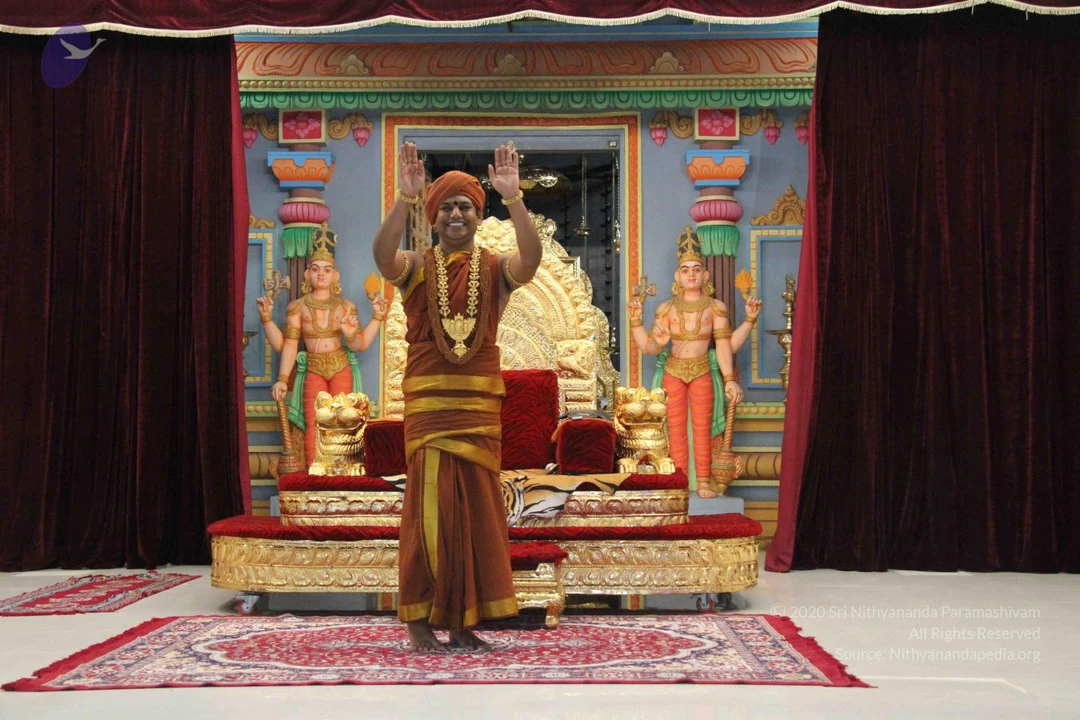
1 photoSource gallery
A photograph of a single man standing barefoot on a white stage before an ornate golden throne with red velvet cushions, flanked by two painted deity statues with four arms and orange dhotis. The man wears an orange-brown turban, a brown-orange robe with gold borders, a heavy gold-toned pendant on a garland of flowers, and bangles, and he smiles with palms pressed together in a greeting gesture. A red velvet curtain and a patterned red carpet frame the scene, and a brass lamp stands at the right edge.