Skip to content
Friday

26 April 2013

THE SUPREME PONTIFF OF HINDUISM HDH BHAGAVAN NITHYANANDA PARAMASHIVAM

Dated photos
52
Source pages
1
Media
2
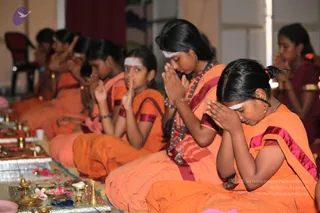
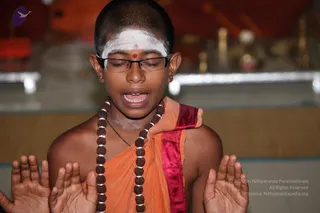
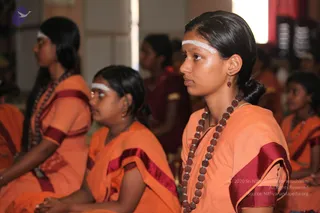
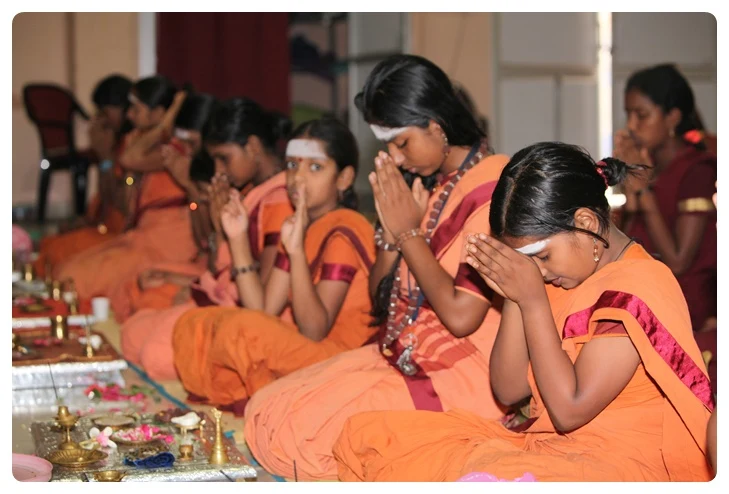
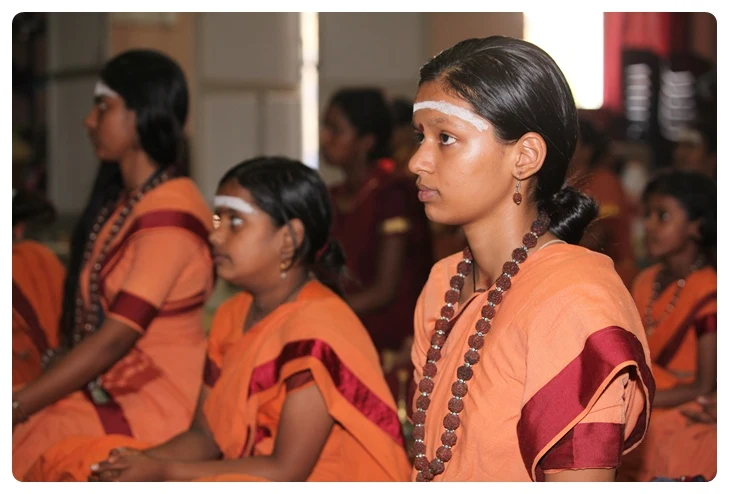
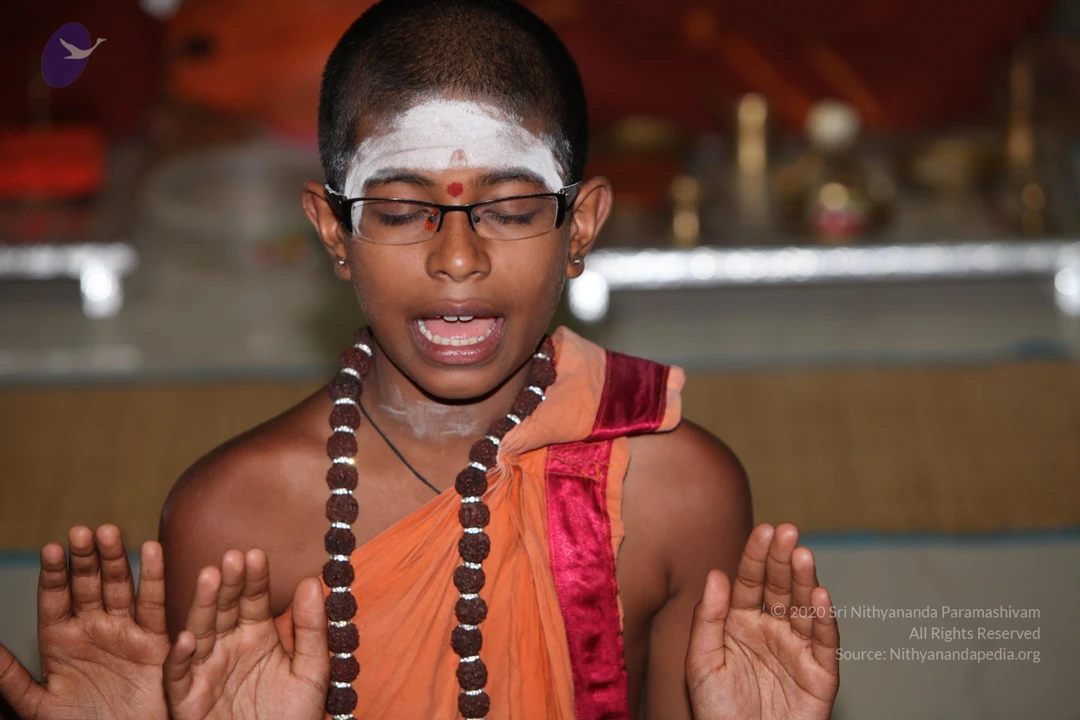
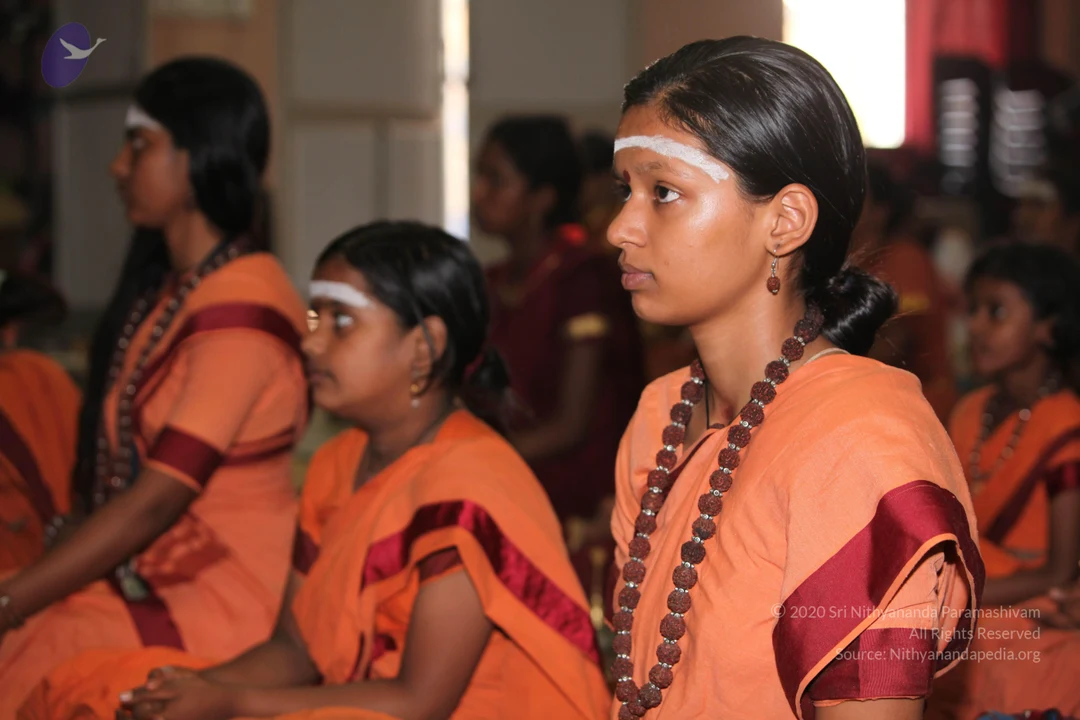
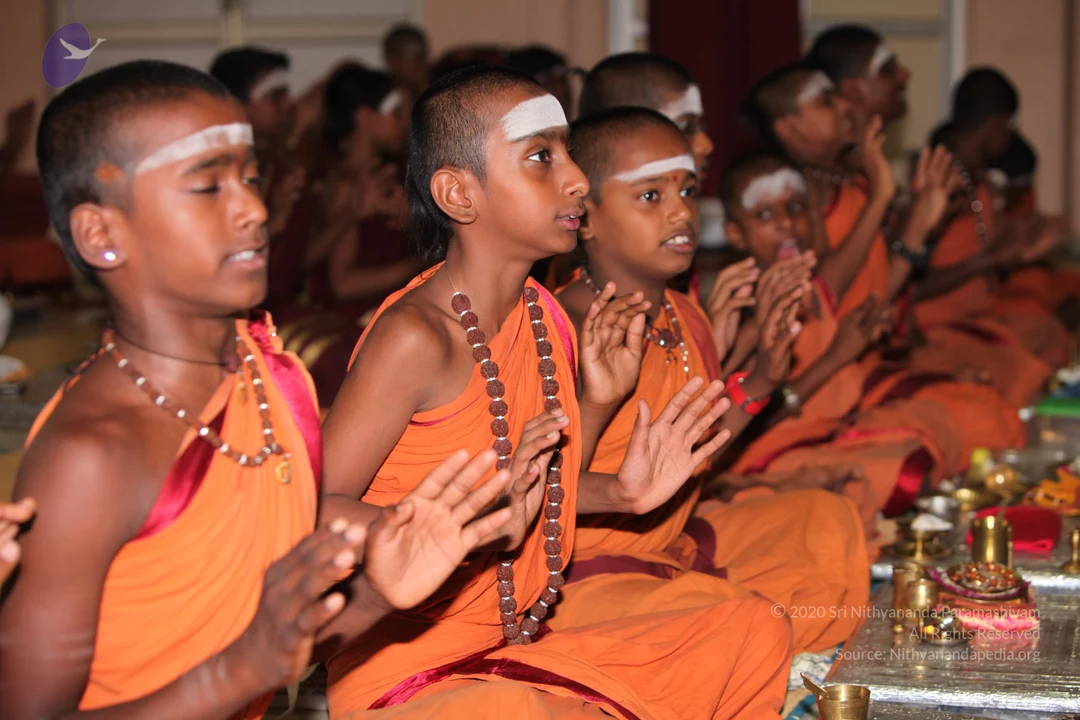
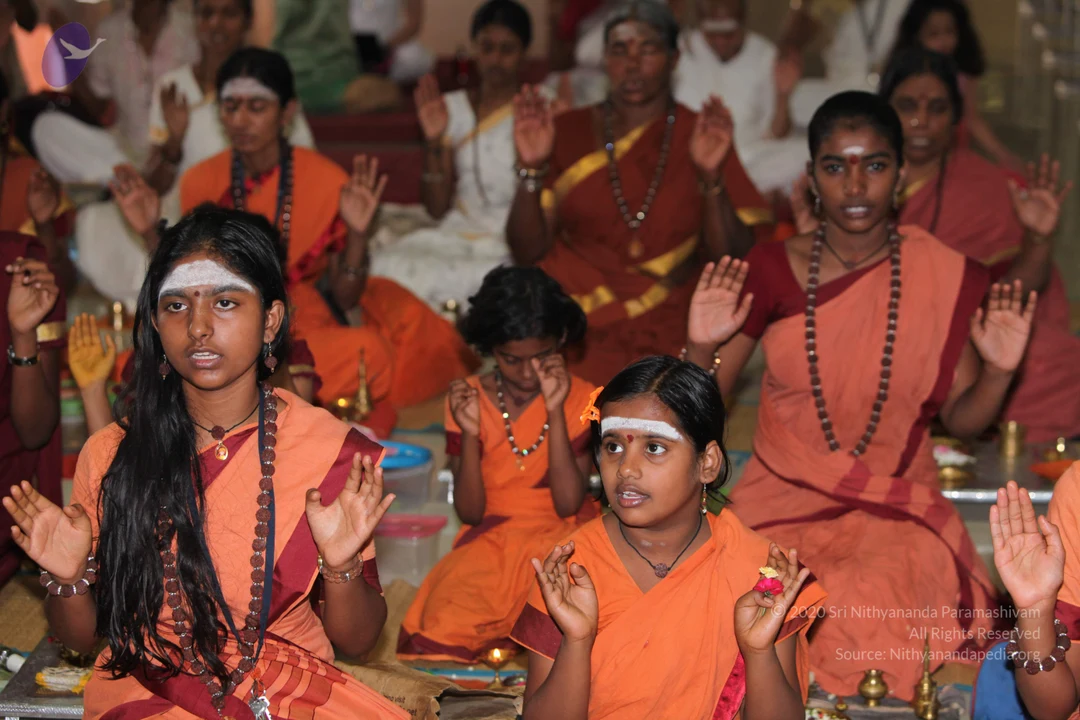
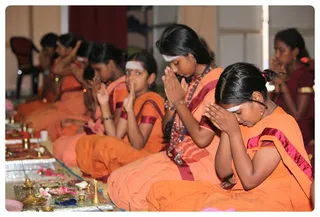
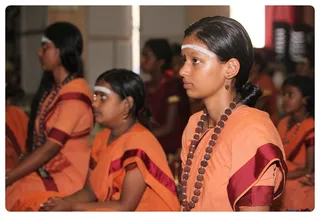
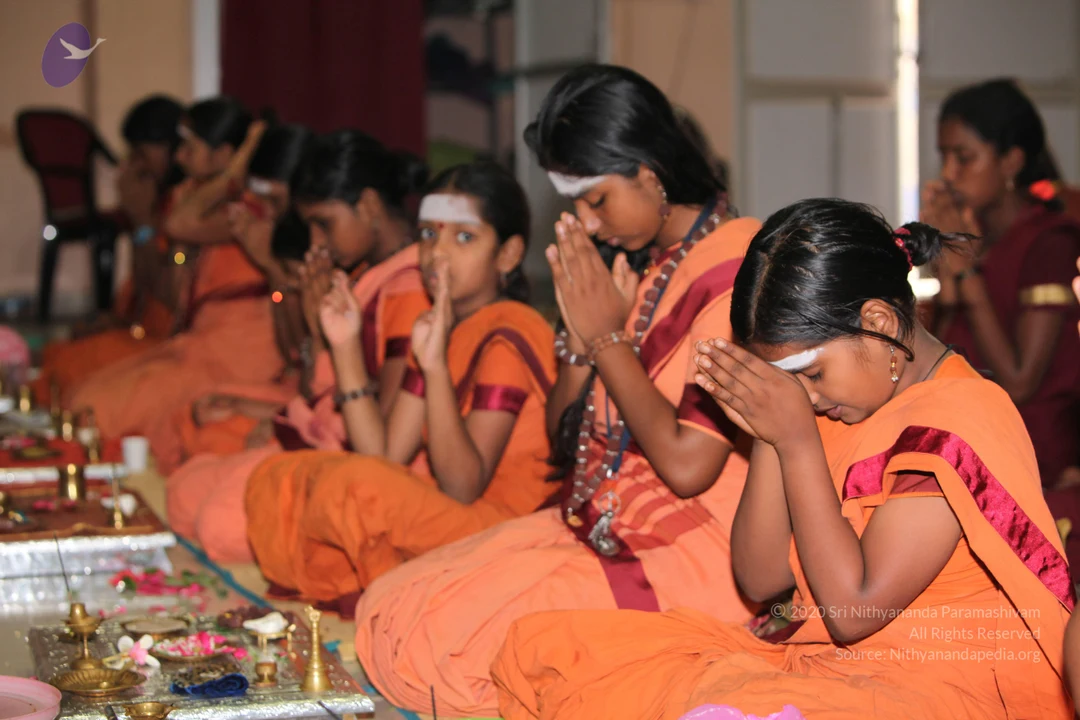
A photograph of a row of young girls seated on the floor in a pada puja setting, praying with palms pressed together. They wear saffron-orange salwar-style dresses with maroon borders and white forehead bands, and some wear rudraksha malas. Brass oil lamps, flower petals and a silver tray with offerings sit in the foreground on the left, and a woman in a maroon sari sits at the far right. No a person is visible in the image.Close photo of a young boy in a saffron-orange shawl with a deep red border, eyes closed and mouth open mid-chant, palms raised outward. He wears a long rudraksha mala with silver spacers, wire-rimmed glasses, a white sandalwood band on his forehead and a red dot at its centre. The background is a blurred temple interior with brass and red tones.Photograph of young women and girls seated in rows at a satsang, wearing orange saris with maroon borders and long rudraksha malas. The foreground woman has a white vertical forehead mark, a low bun, and small drop earrings, looking forward attentively. Others beside and behind her sit similarly dressed, some with white forehead marks. The hall has pillars, red walls and soft light from a window at the top right. No a person candidate is visible in the frame.

April 26 2013

Original wiki page
Contents

Title:

THE SUPREME PONTIFF OF HINDUISM HDH BHAGAVAN NITHYANANDA PARAMASHIVAM

Description:

In today’s morning satsang, Paramahamsa Nithyananda discusses the meaning of birth purpose and life purpose – “happening” purpose. Birth purpose is bio memory, our true reason for living. Happening purpose is muscle memory -- what society teaches us should be our life’s purpose. Conflict between these two creates feelings of powerlessness and lack of fulfillment. When we bring integrity to our awareness we can align our sense of purpose, free ourselves from conflict and discover enlightenment.

Link to Video:

VideoAudio

Transcript:

Nithyanandeshwara Samaarambhaam Nithyanandeshwari Madhyamaam | Asmath Aachaarya Paryanthaam Vandhey Guru Paramparaam ||

Today’s subject for Nithya Satsangh: “FULFILLMENT IN THE LIFE”. Please listen! All the unfulfillment in your life reminds you to become more authentic to your purpose of happening. Purpose of birth is different, purpose of happening is different. Fortunately, if both align, you will become Jeevan Muktha. Why you are born is your “praarabdha” – purpose of birth. Purpose of happening means, after birth so many things which came to you – your education, your knowledge, your intellect, your society - all the things came to your life decides purpose of your happening. 

Purpose of happening can be changed. It is called “aagaamya” in Sanskrit. Purpose of birth can’t be changed. If your purpose of birth and happening are aligned, you become enlightened, you become complete.  Things which happen around you, attracts your attention, makes you take momentary decision, gives you tremendous passion, kind of a fulfillment, kick, feeling of fulfillment, but not the fulfillment itself. Many a time, things which are happening around you gives you so much of passion, before even you achieve the fulfillment of your life, birth, you leave the body.

(3:04)

I will give you examples. Vivekananda - he was filled with so much of energy, by the grace of Ramakrishna he found purpose of his birth and purpose of happening. Both aligned, he completed and left the body.  See, when I say the word “the purpose of happening”, what appears to be your goal based on your desires and options you choose. You may choose to become a great engineer. You may choose to become a great doctor. You may choose to become a great architect. You may choose to become a great actor. These all is purpose of happening, because these all you decide after somebody tells you, society shows you. It is called “aagamya”. Means, after you see, look around, do the window shopping, you pick up the object you need to buy, but you did not go to the shop or mall with that aim when you started from your house. When you started from your house, with what idea you are going, means, if you are going to buy groceries, that is the purpose of your life. After going there, you see too many things displayed. You go around, do the window shopping; along with groceries you start buying jewels also, clothes also. That is purpose of happening. Make out the difference. For what you start from the house and go to the mall is purpose of birth. What all inspires you and you start doing other than your main purpose is purpose of happening. Many a time, you spend all your money in purpose of happening and forget the purpose of birth itself! Aligning this two will directly lead you to success. Aligning this two will directly lead you to success.

(5:49)

Please listen! How to align? I will give you the simple basic truth. Constantly be in Integrity in your thinking. Even the subtle negativities, wipe them, wipe them, wipe them. Infuse complete awareness into your thinking and bring Authenticity in your thinking and actions.  I will give you the essence in Hindi.

(HINDI)

Aligning! Either you align or malign! Either you align the purpose with the purpose of your birth or malign the purpose of your birth! It is so unfortunate, human- beings do not know how to align with even their own birth, purpose of their own birth. When you constantly practice Integrity, you will see not only negativities are weeded out, negativities disappear, you will also see the unusual happening inside you, suddenly, hundreds of thoughts constantly which you repeat in you unconsciously will start disappearing, it will start evaporating. You will find more space in your inside!

If you feel more space inside you, you will feel conflict-free and powerful. Too much of traffic congestion inside your inner space is powerlessness and contradictions and conflicts. If your inner space traffic is too congested, you will feel contradictory, conflict and powerless. If your inner space has lot of free space, means you are relaxed, you are in restful awareness, you have joy, you have fulfillment, you are YOU! That takes away so much of conflicts, contradictions and powerlessness. 

(HINDI) (9:44)

People ask me, as I said, ‘How can I find out my purpose of birth?’  I think you should continue, continue, continue to practice Integrity.

(HINDI)

Constantly practice Integrity; Means, infusing awareness in your thinking, Infusing awareness into your thinking. Your thinking has to be filled with Integrity. Be very clear, any word you give it to others, you will fulfill. Any word you give it to you, you will fulfill. You fill fulfill the words you gave it to you. You will fulfill the words you gave it to others. When you start living this, the words you give it to you will start reducing. You will become more aware, more conscious of the words you utter towards you. When you become more aware of the words you utter towards you, when you reduce the words you utter towards you, you will have so much of inner space, so much of inner space, you become enlightened! You become enlightened! 

(11:50)

Understand the purpose of enlightenment, the purpose of happening. The happening happens more with the information fed to your senses, which becomes your muscle-memory. Like if you are constantly eating pizza, that will become muscle-memory in your tongue. If you are constantly listening to certain music, that will become muscle-memory in your body. If you are constantly enjoying certain visuals, that will become muscle-memory in your eyes. So, if the purpose of your birth, purpose of your birth is like your bio-memory with which you came, the purpose of happening is which is forced on you. If you start living Integrity, which is forced on you will lose power over you. The fight between your bio-memory and muscle-memory, bio-memory will win. Bio-memory will take over the muscle- memory. 

See, all the conflicts you have in your life is the conflict between what you feel as purpose of you and what society teaches you as purpose of you. That is why, all over the world, not only me, any spiritual Guru when they teach about Integrity, Authenticity, Responsibility and Enriching, simply people get inspired, because it is already in your bio-memory. Integrity and Authenticity is your bio-memory, purpose of your birth. Any other strategy towards life is taught to you by society. Because it is taught to you by society, it is superficial; it has only the strength of your muscle-memory. But Integrity and Authenticity, because you came with it, it has strength of your bio-memory, support of your bio-memory. 

(14:28)

See, when a seed is created, it is inbuilt to become a tree. After the tree starts sprouting, tree continues to grow, expand, and gives the fruit. This whole mechanism is programmed, available in the format of programming inside the seed.

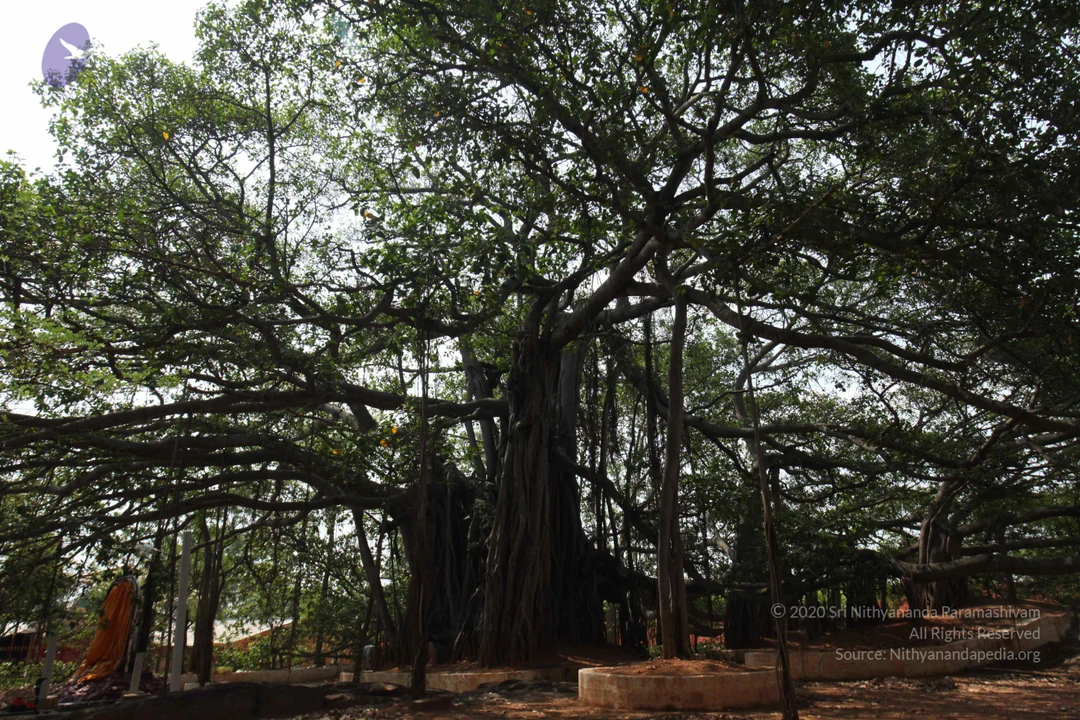
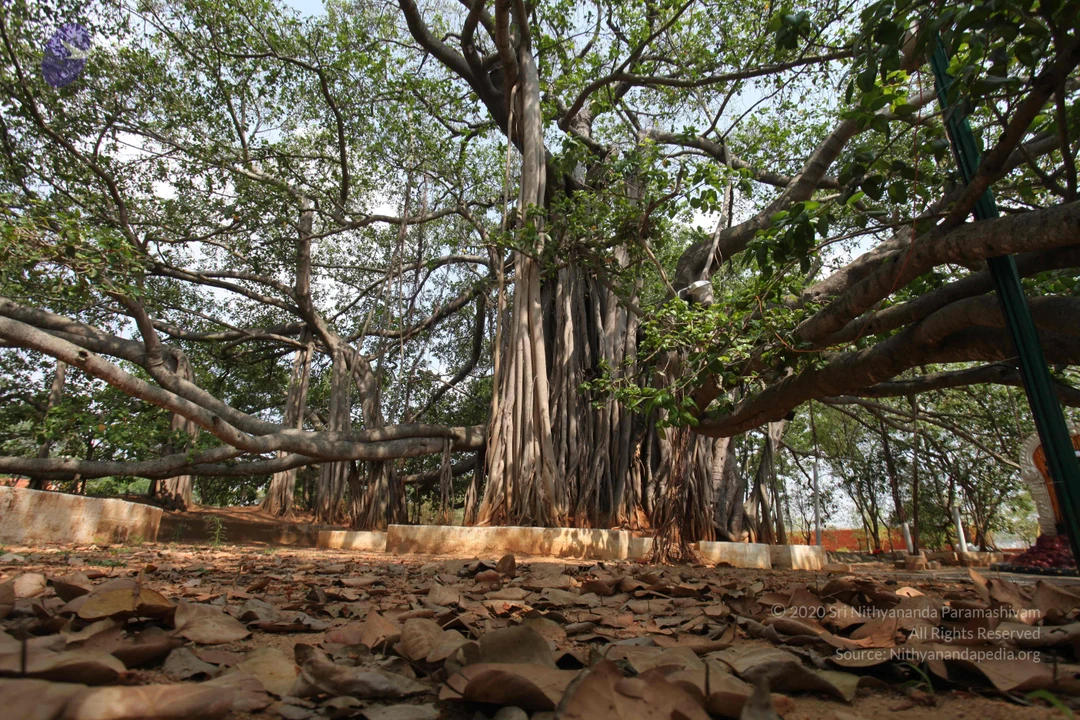
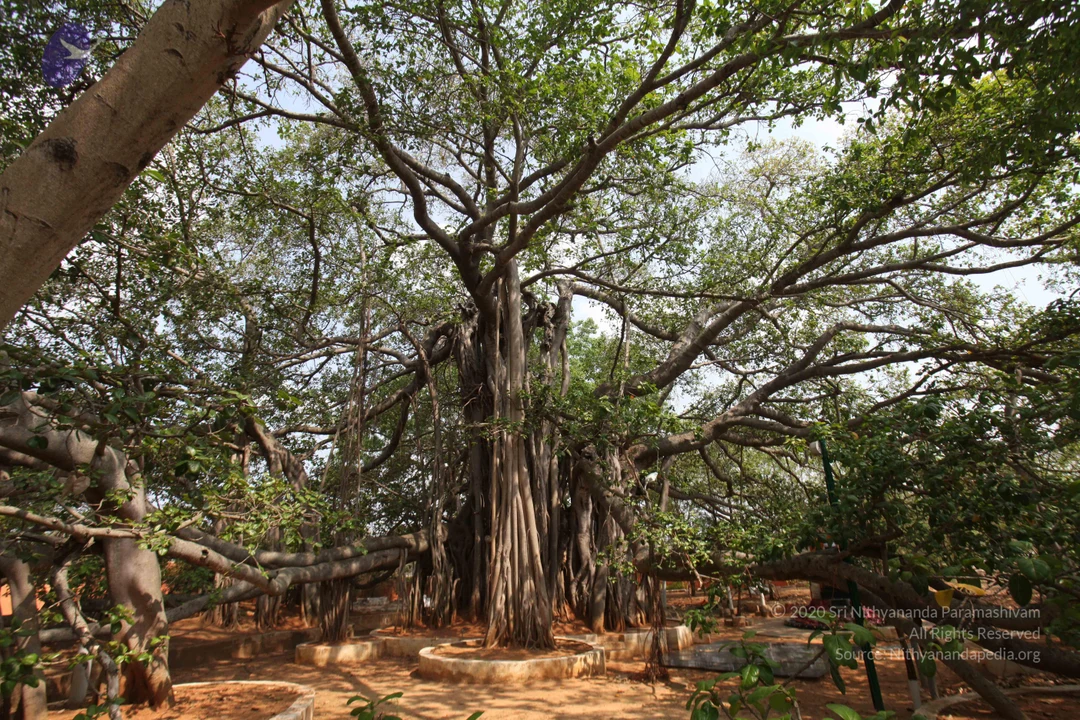
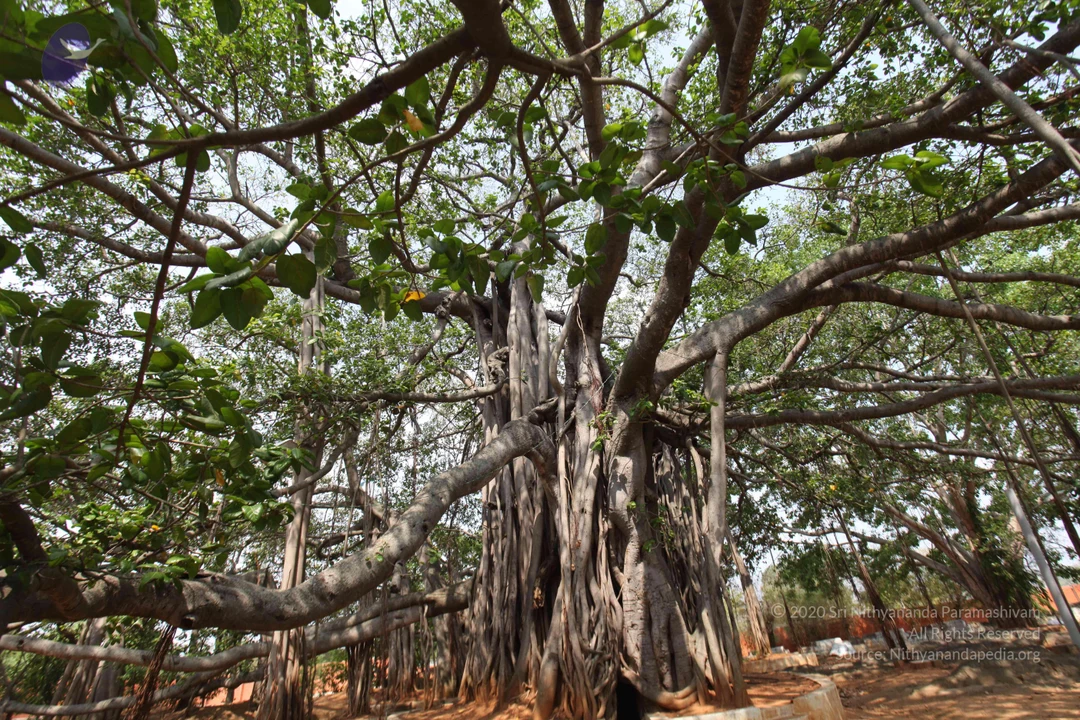
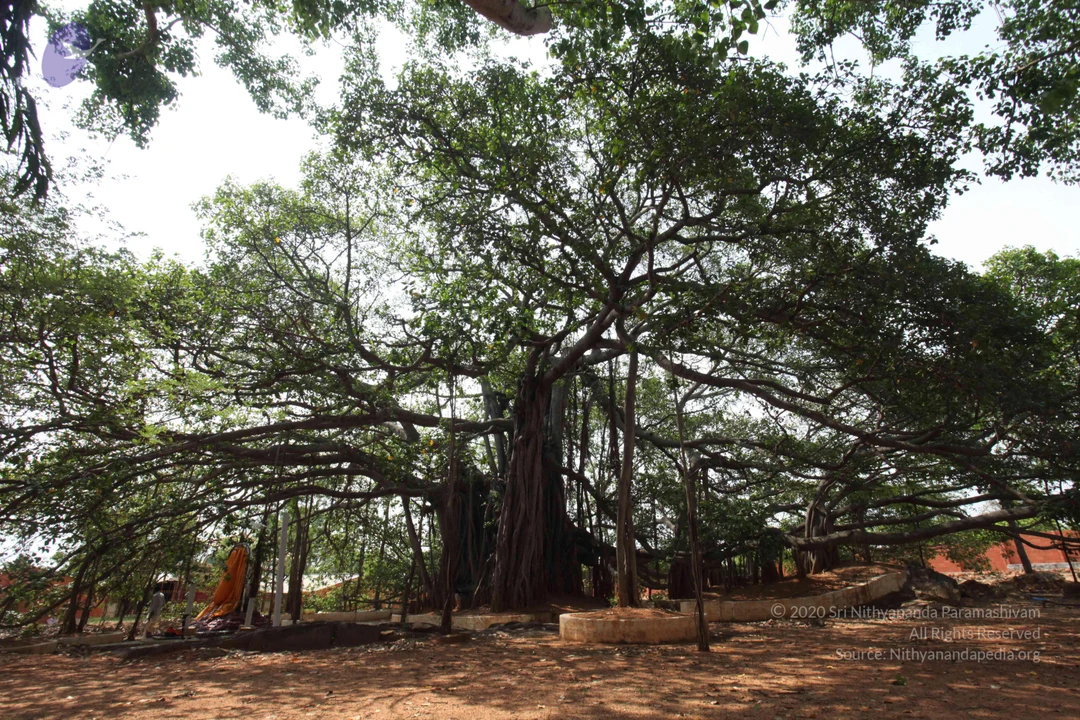
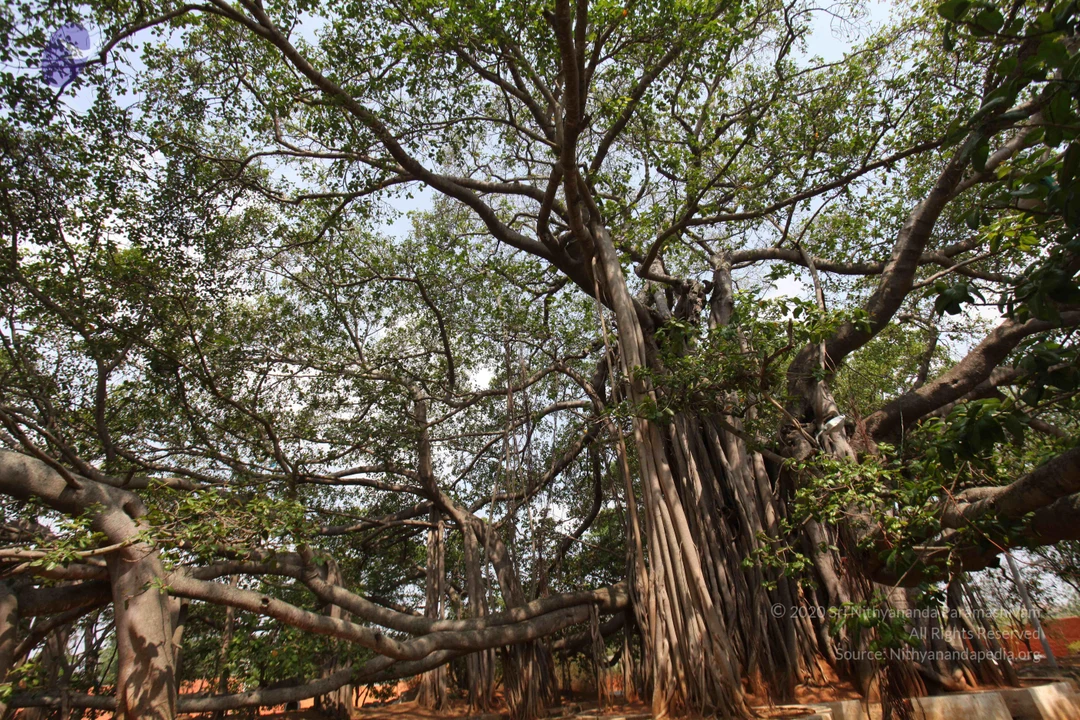
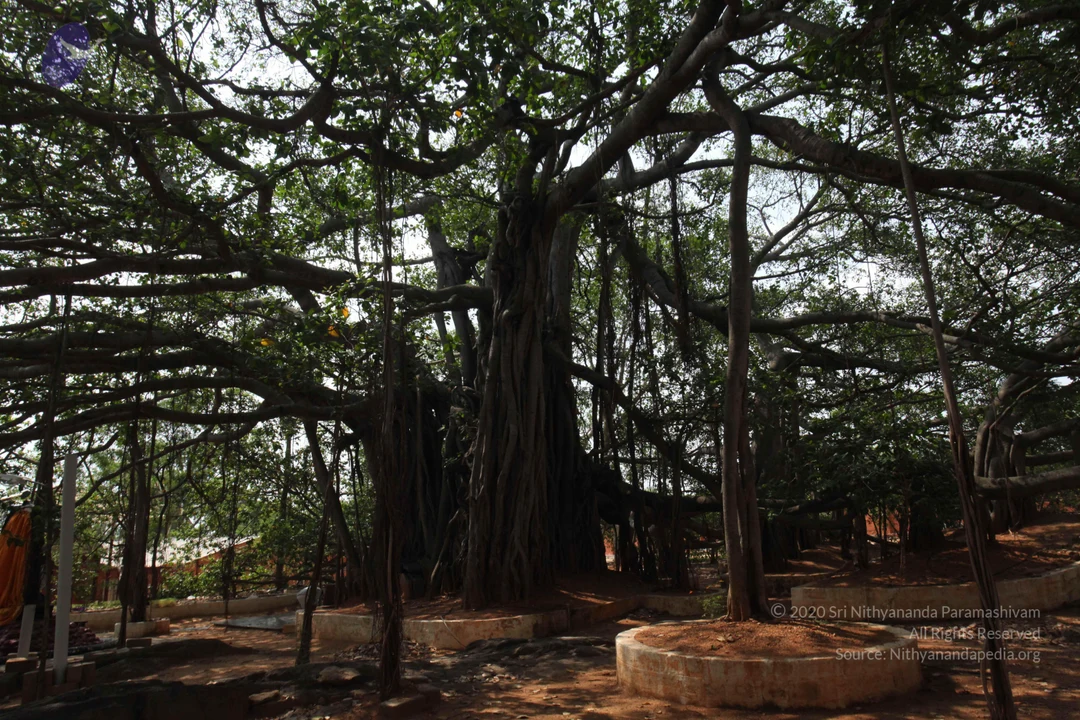
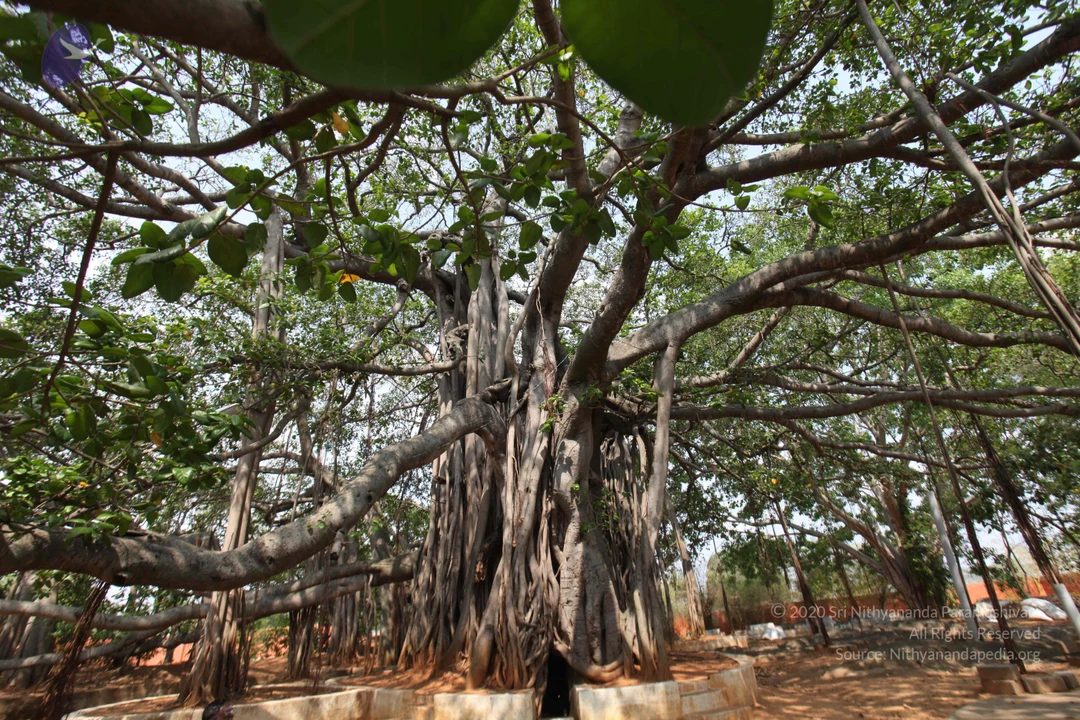
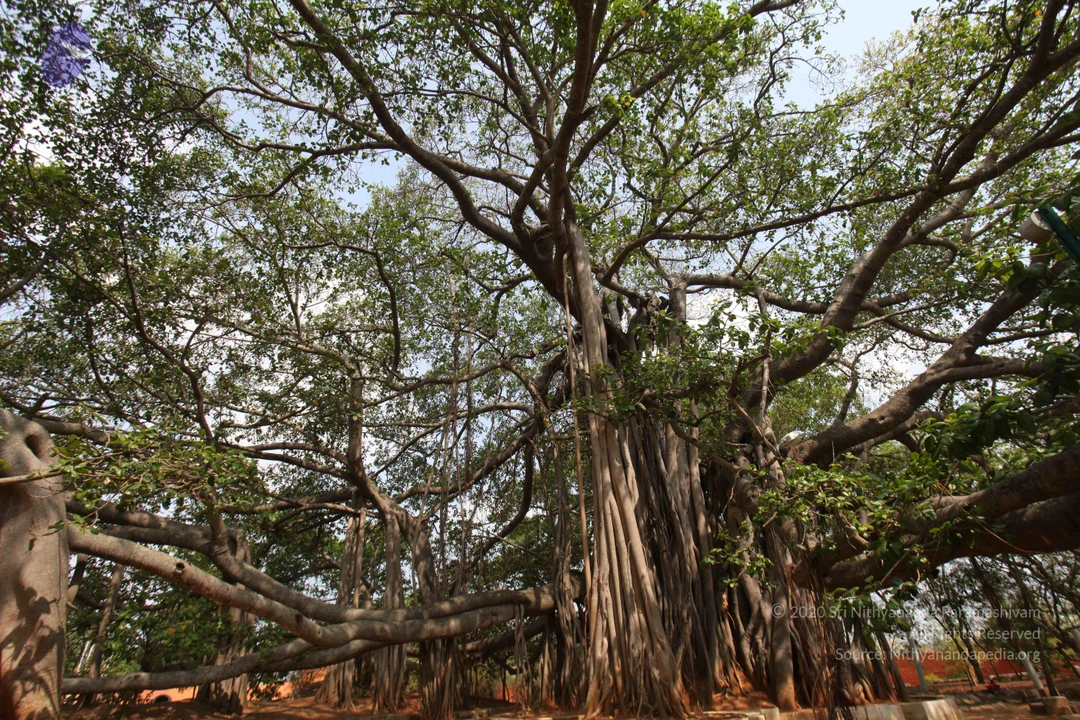
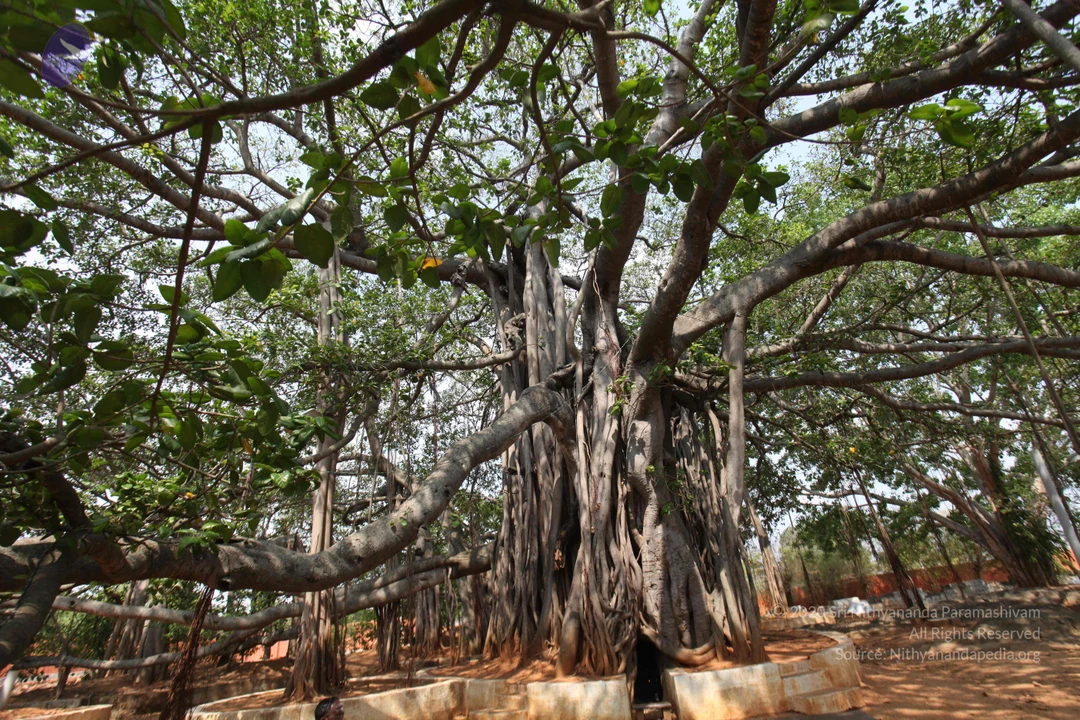
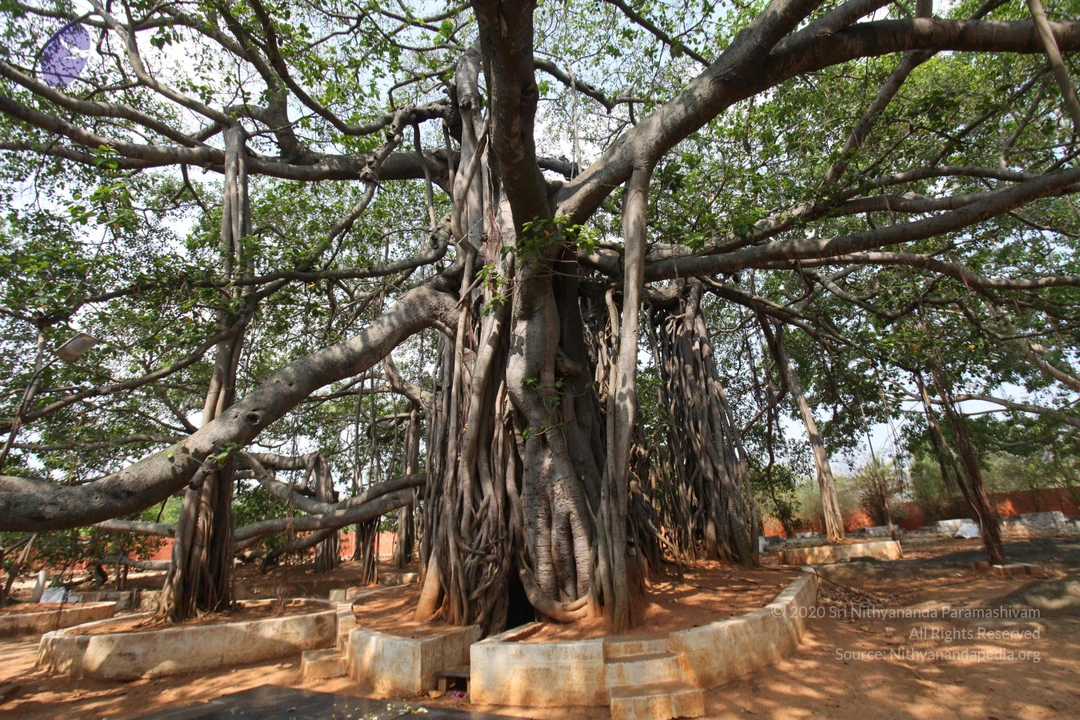
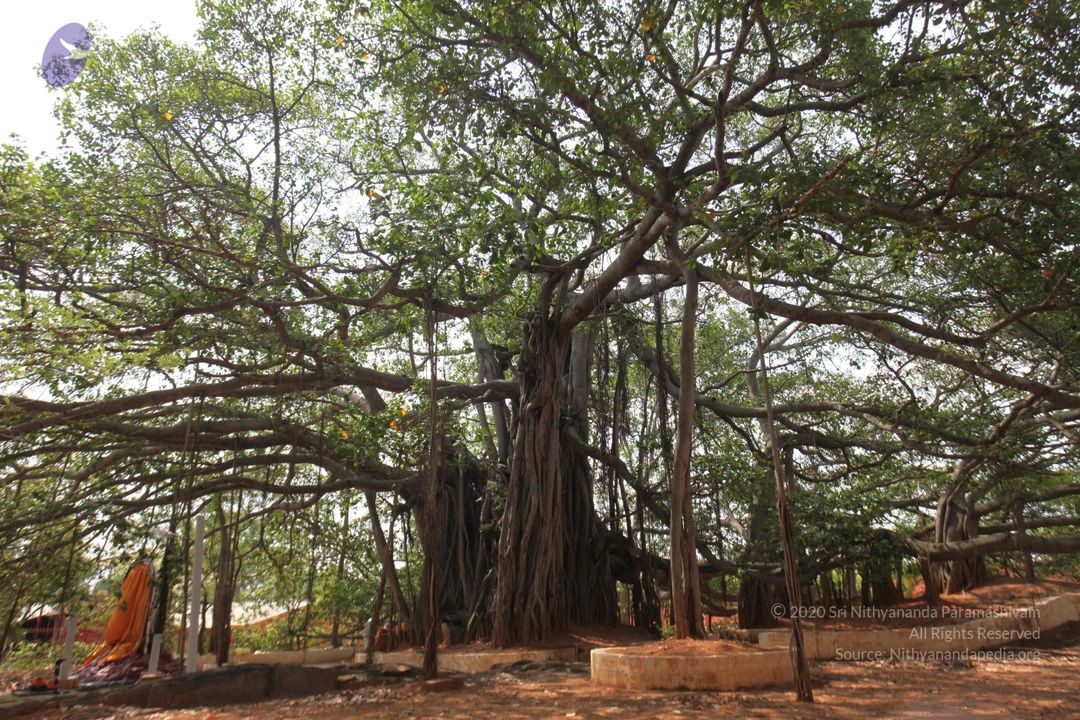
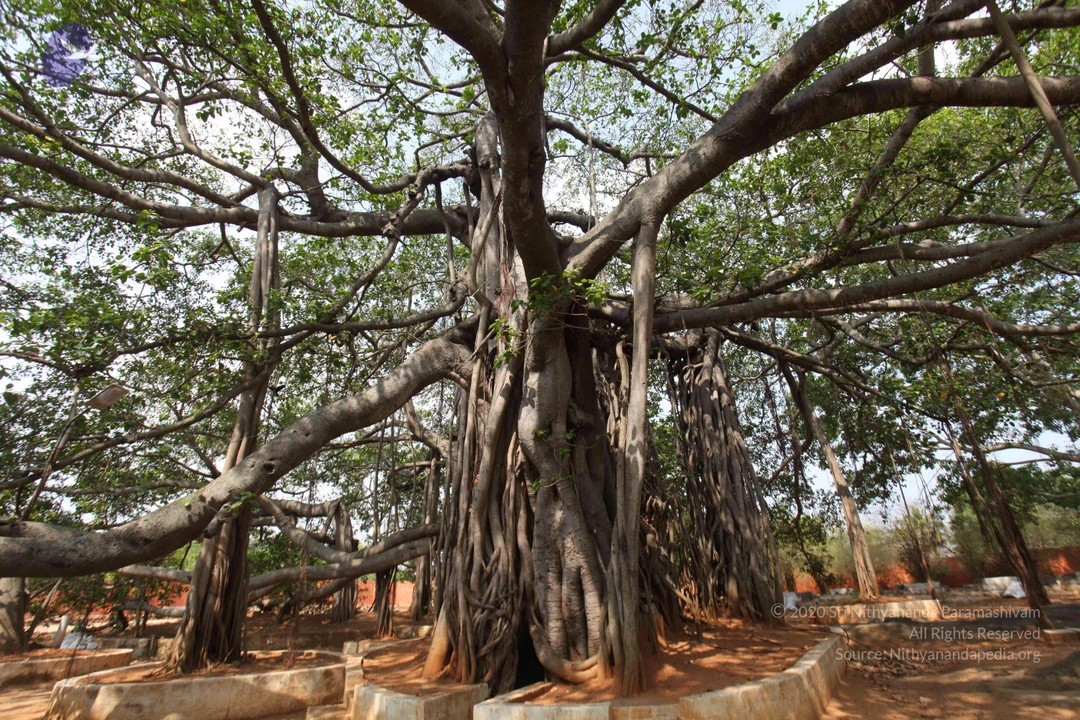
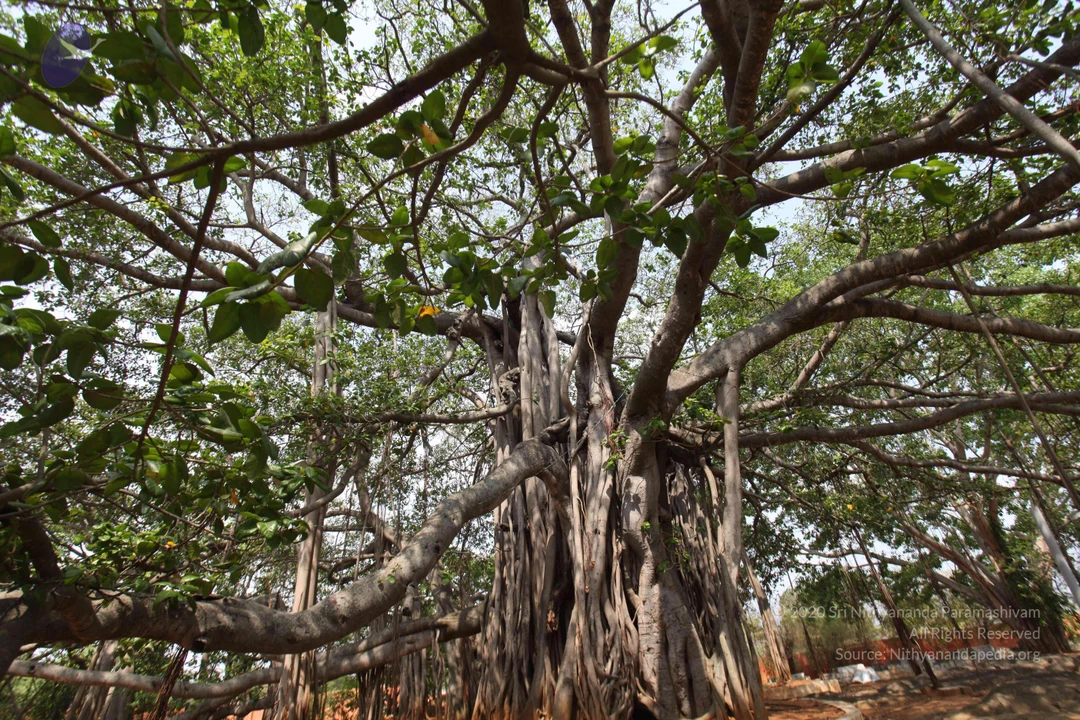
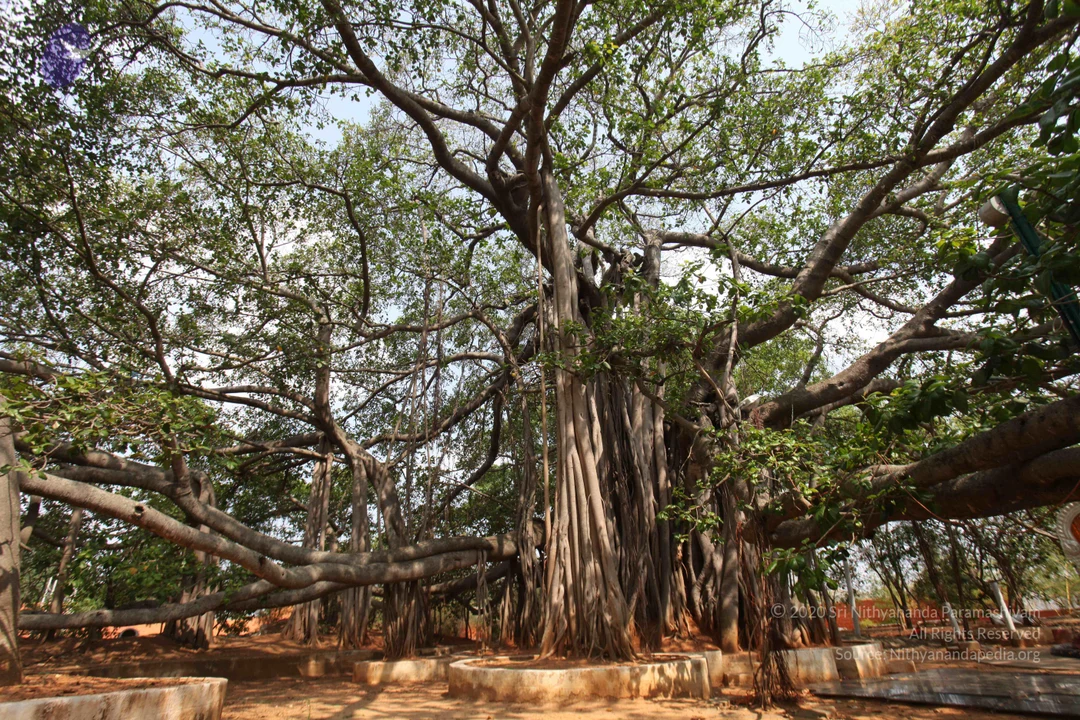
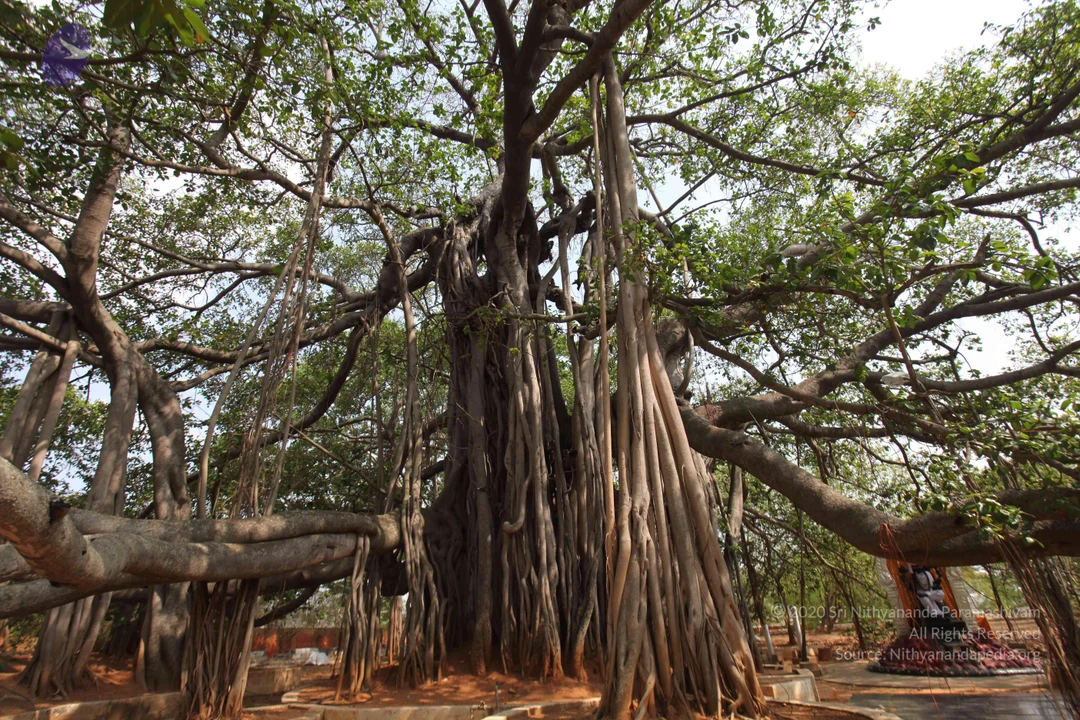
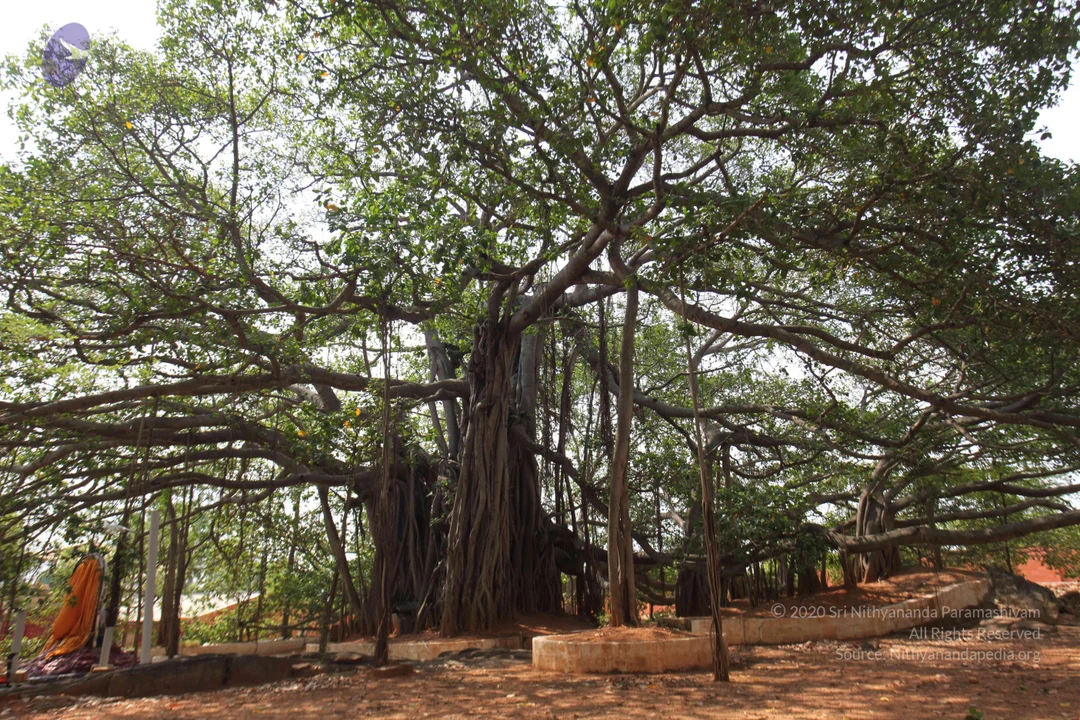
Same way, when you take birth, the whole thing which you are supposed to do is available in you as a program.  Please listen! When a banyan seed grows as a ten branches and still that tree continues to push itself, expand that eleventh, twelfth, thirteenth branch, even the decision to push and create eleventh, twelfth, thirteenth, next, next branches, is available in the form of programming inside the seed. Same way, please listen, please understand, how in a banyan tree seed the whole programming of the banyan tree is available. First the seed should become banyan tree – banyan seed cannot become mango tree – banyan seed becoming banyan tree is Integrity. And the tree continues to push itself, push itself, push itself and become huge is Authenticity. The tree deciding to multiply itself and stand by itself is Responsibility. And it giving the seeds is Enriching. Please understand, these four principles are available in the form of seed inside the tree, sorry, inside the seed; the whole thing is available inside the seed. The seed becoming a tree, continues to flourish, taking responsibility to stand for what all it can offer to the world and giving more seeds - all four are available inside the seed in the form of programming. Same way, all these four are available in you in the form of programming the moment you took birth. 

(17:32)

If you teach Integrity, Authenticity, Responsibility and Enriching to a banyan tree, it will not find all these four as strange. It will find all four are purpose of its own birth. Same way, in you, when you start listening to Integrity, Authenticity, Responsibility and Enriching, you will find all these four are purpose of your birth. It is there part of you as your bio-memory. So, naturally, you are inspired. This is natural law of Life. You will be inspired to realize it, to live it. Anything which is forced on you as a purpose of happening by society can go only up to the level of muscle-memory; it cannot become bio-memory. It is like a gold coating on any jewellery; it can go only upto certain level. For example, 1 kilogram silver vessel is there. How much ever you coat the gold, even if you make half a kilogram gold coating on it, it is only coating. It stays only as muscle-memory. But the bio-memory is silver. But if you melt the whole thing, now you will have a new material: one kilogram silver, half kilogram gold. Now the gold also becomes bio- memory. Same way, if you die and come back in next janma (birth), whatever you accumulated in the past janma as a muscle-memory can become bio-memory; you may choose to have them as bio-memory. But, in this janma, as long as you have the body, whatever is accumulated continues to remain as muscle-memory. 

Your life is nothing but a great fight between bio-memory and muscle-memory. If these two are in tune, you are enlightened! If both are in tune, your hands are available for you, your eyes are available for you, your body is available for you, you are available for you! But, as on now, unfortunately most of the time your body is not available to you. You want to do something, but your body says, ‘I am sick.” Your mind is not completely available to you. All your planning intelligence is not completely available to you. If the muscle-memory is completely available to bio- memory, that life is called “Enlightenment”, “Jeevan Muktha”!  I will give you the essence in Hindi.

(20:52) (HINDI)

(23:39)

When you practice Integrity, you will find your purpose. It is like a if the banyan tree is, banyan tree is growing as a banyan tree, unfortunately some parasites come and land on it. Now how will you separate the parasite and the tree? If you go to the root’s, root’s root, you will find banyan tree is banyan tree, parasite is parasite. Whatever is parasite, you know now how to separate and remove it. Your bio-memory is your Integrity, your original purpose. Muscle-memory is the parasite on you. If you start practicing Integrity continuously, you will see you will be able to distinguish between bio-memory and muscle-memory, parasite and the root tree. And automatically, parasite will fall out.

(HINDI)

So, the essence of what I wanted to share through today’s satsangh:  The purpose with which you came is in your bio-memory. The purpose which is forced on you by society is muscle-memory. The conflict between the muscle- memory and bio-memory is powerlessness, unfulfillment. If you can practice Integrity, you will find your bio-memory, purpose of your birth. And when you find that, you can drop the purpose forced on you and be liberated. Very important, very important thing you need to know, you become conflict-free. When you find the purpose of your birth, bio-memory, that will become conflict-free and you will reach Enlightenment! You will reach Enlightenment! When you are conflict-free, when you live a conflict-free life, your body, your mind your strategy planning mechanism is available to you to fulfill your purpose. You will live in completion.

(HINDI)

Photos From The Day:
Tags:

Paramahamsa Nithyananda, birth, life, society, conflict, power, awareness, enlightenment

Photos Of The Day:

01--Pada-Puja
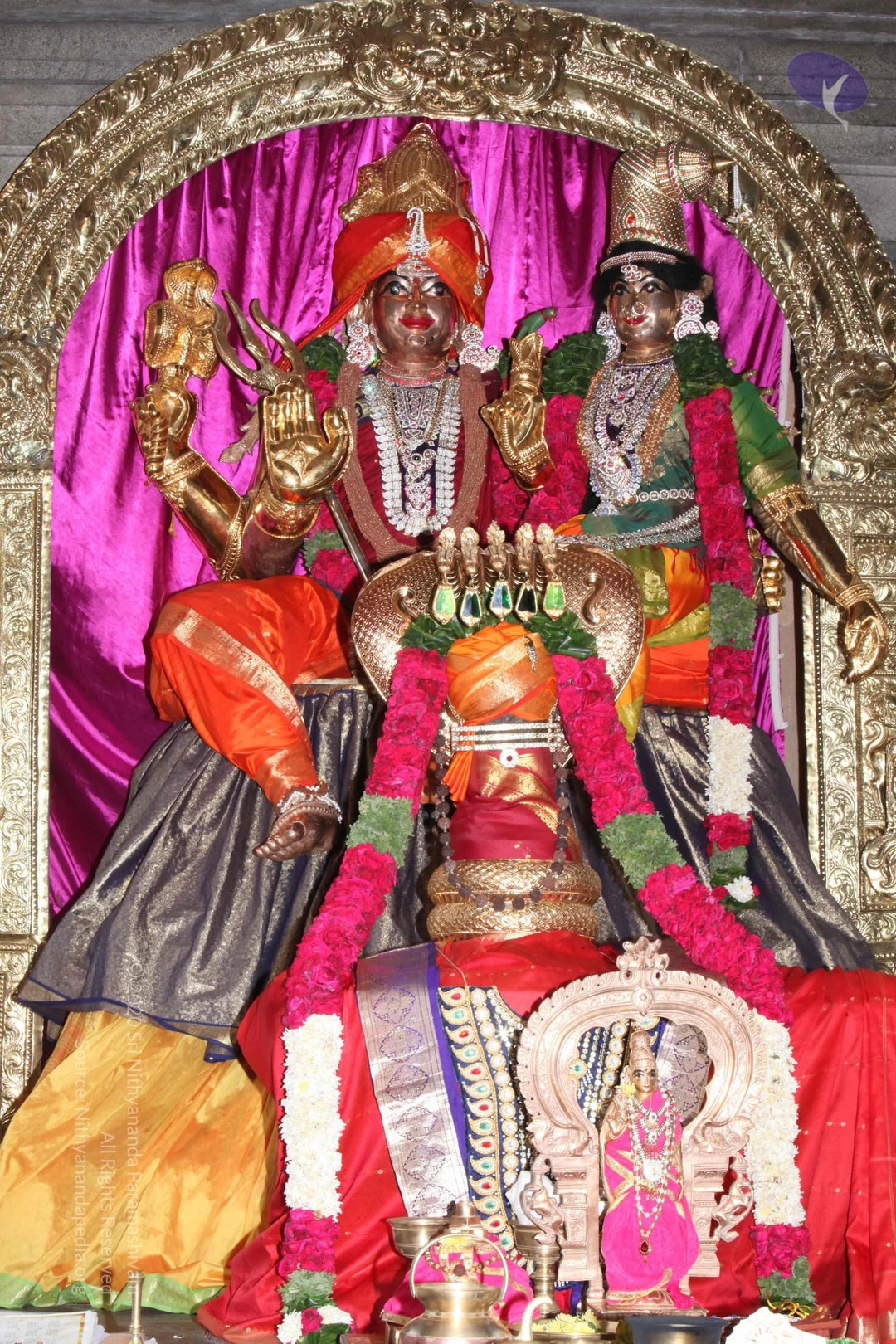
02--Temple
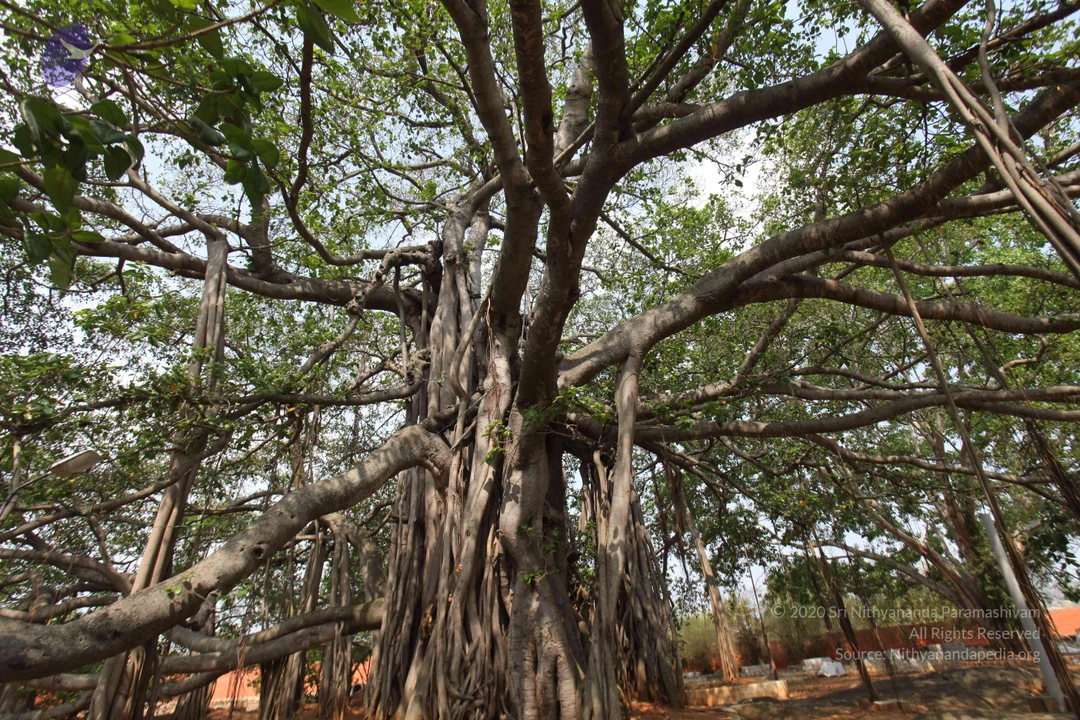
03--Banyan-Tree
04--Satsang

05--AdiKailash

Photos from this day

View all 52 photos

Photos From The Day:

4 photosSource gallery
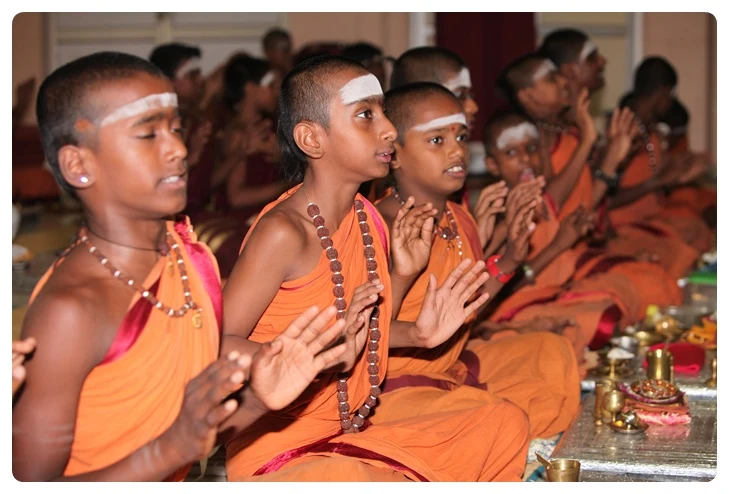
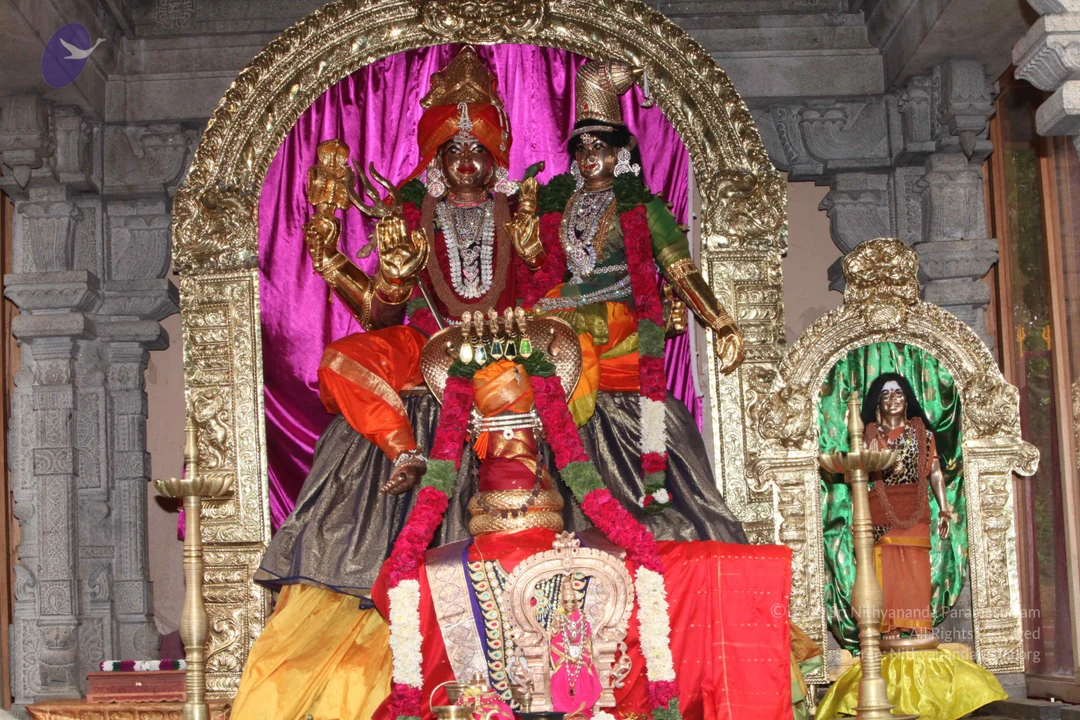
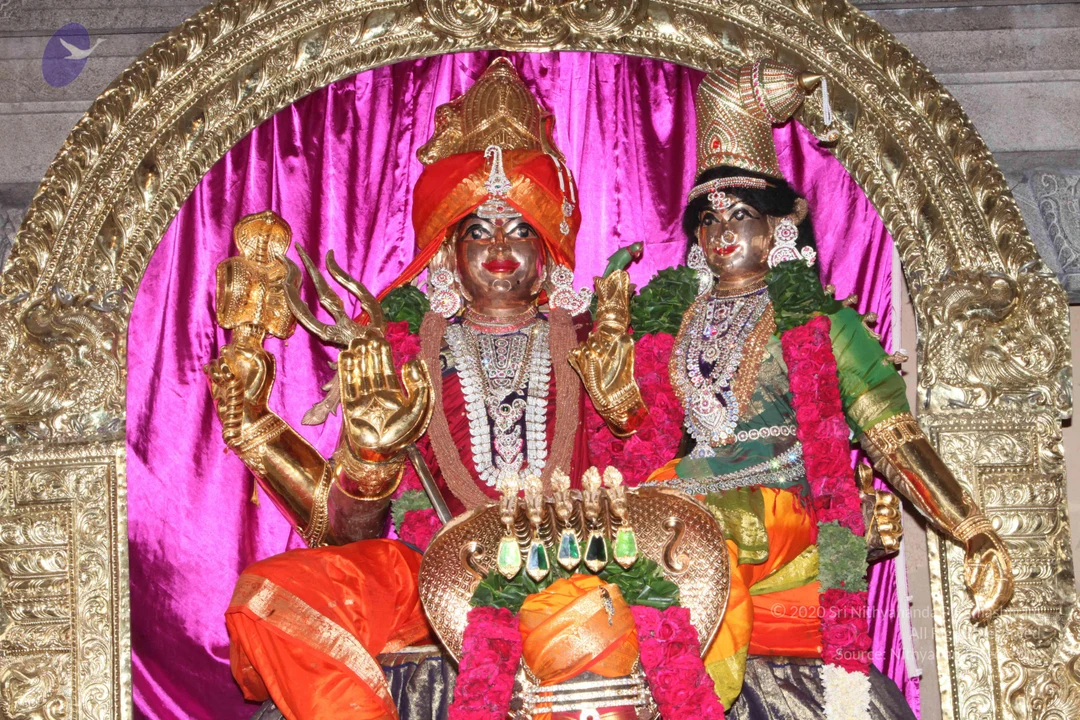
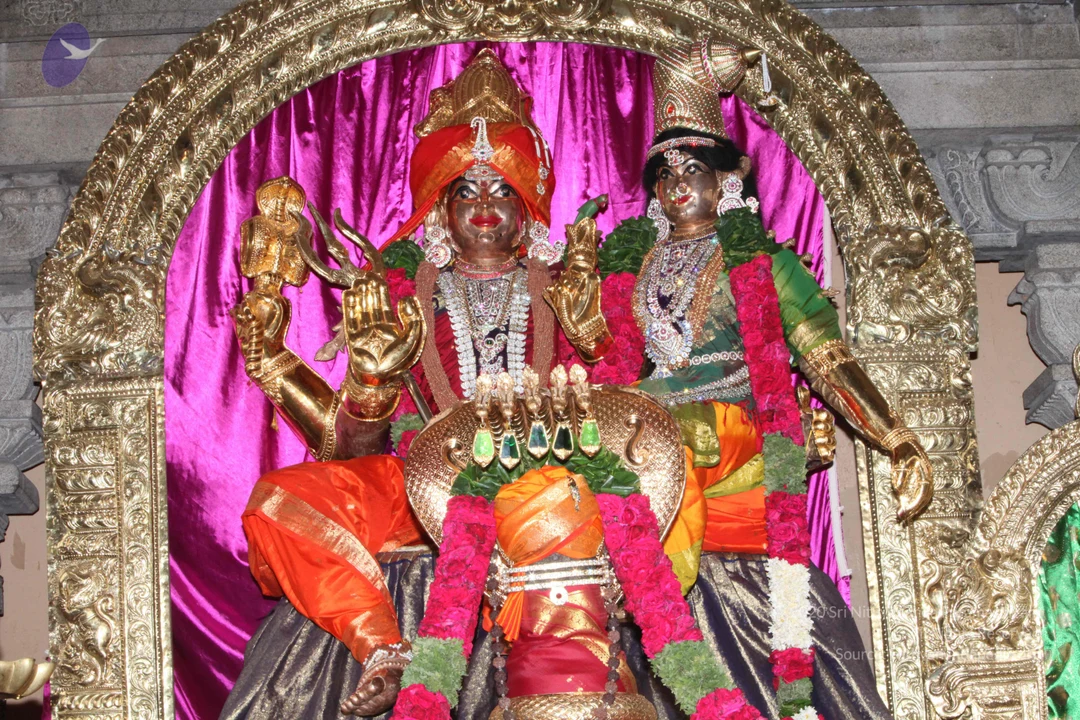
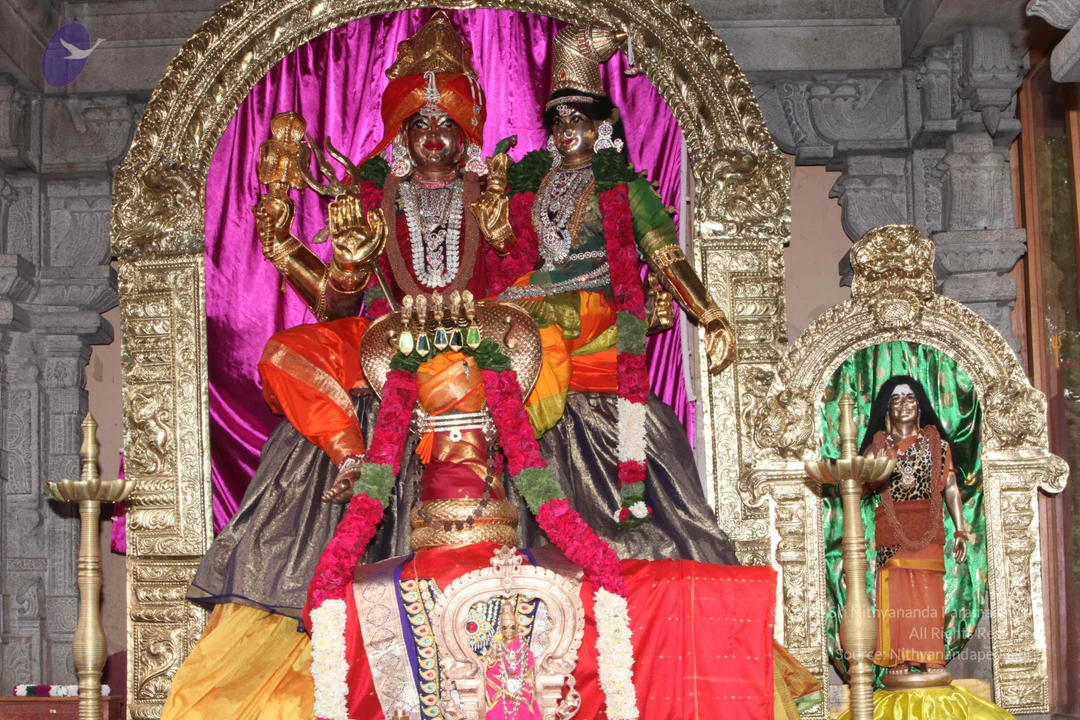
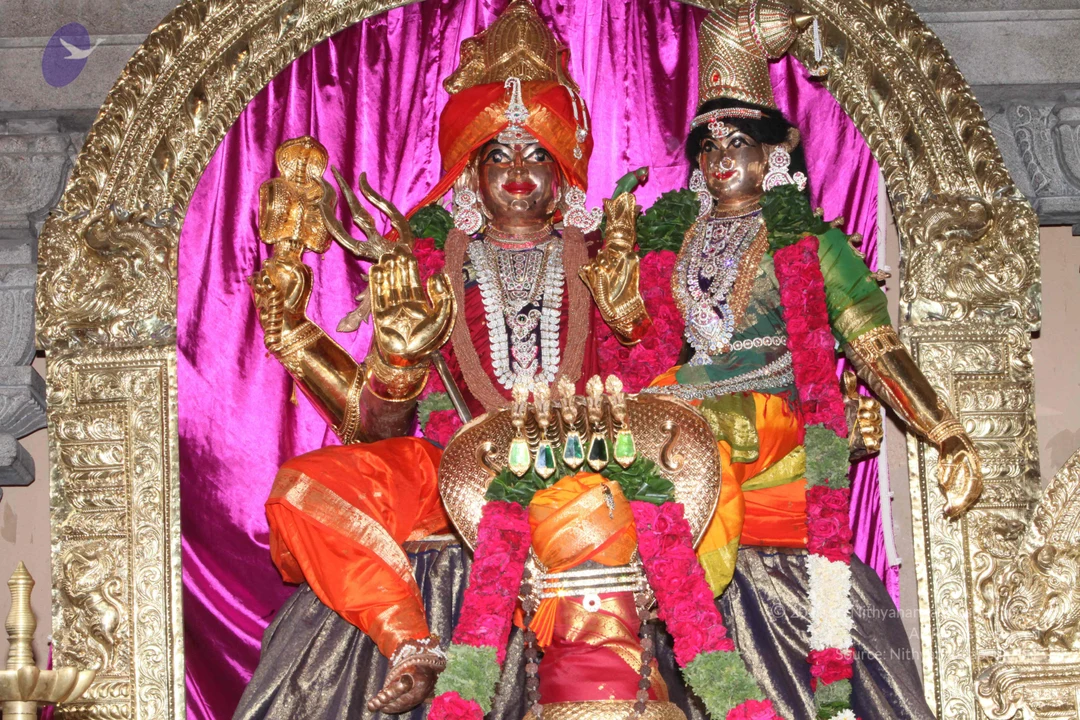
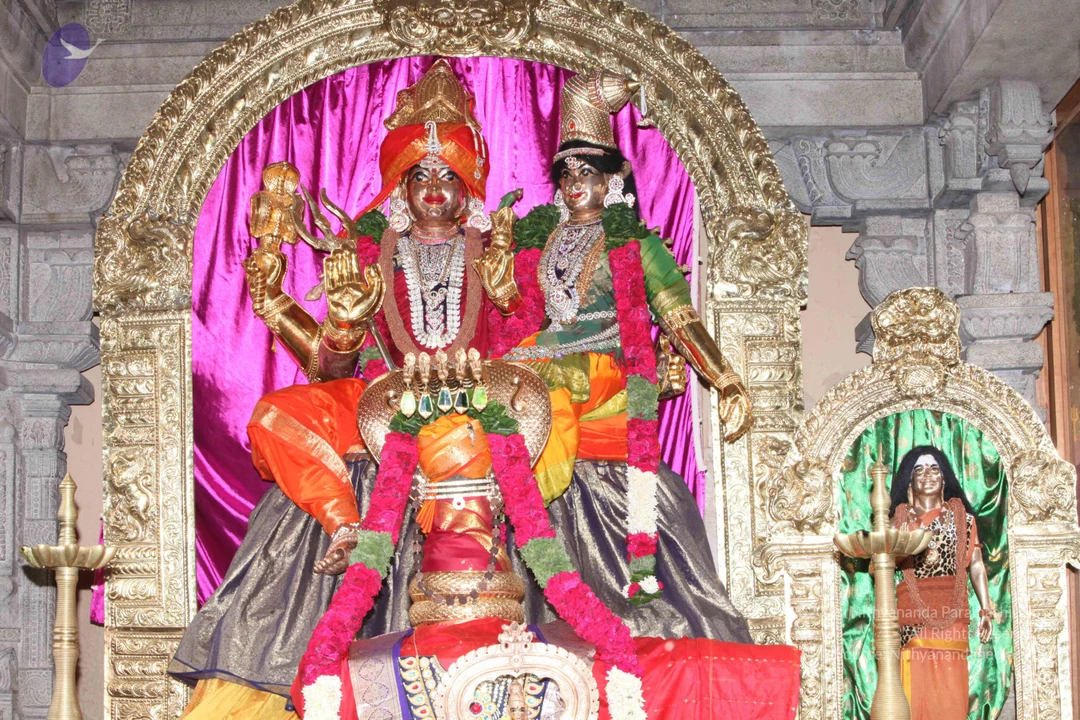
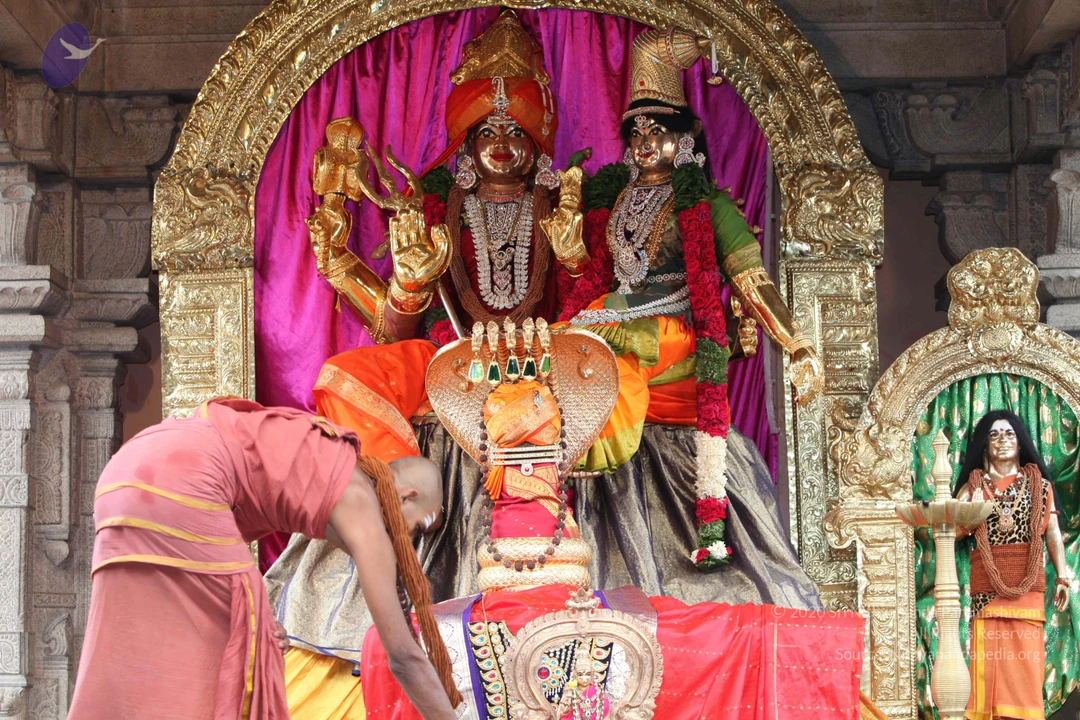
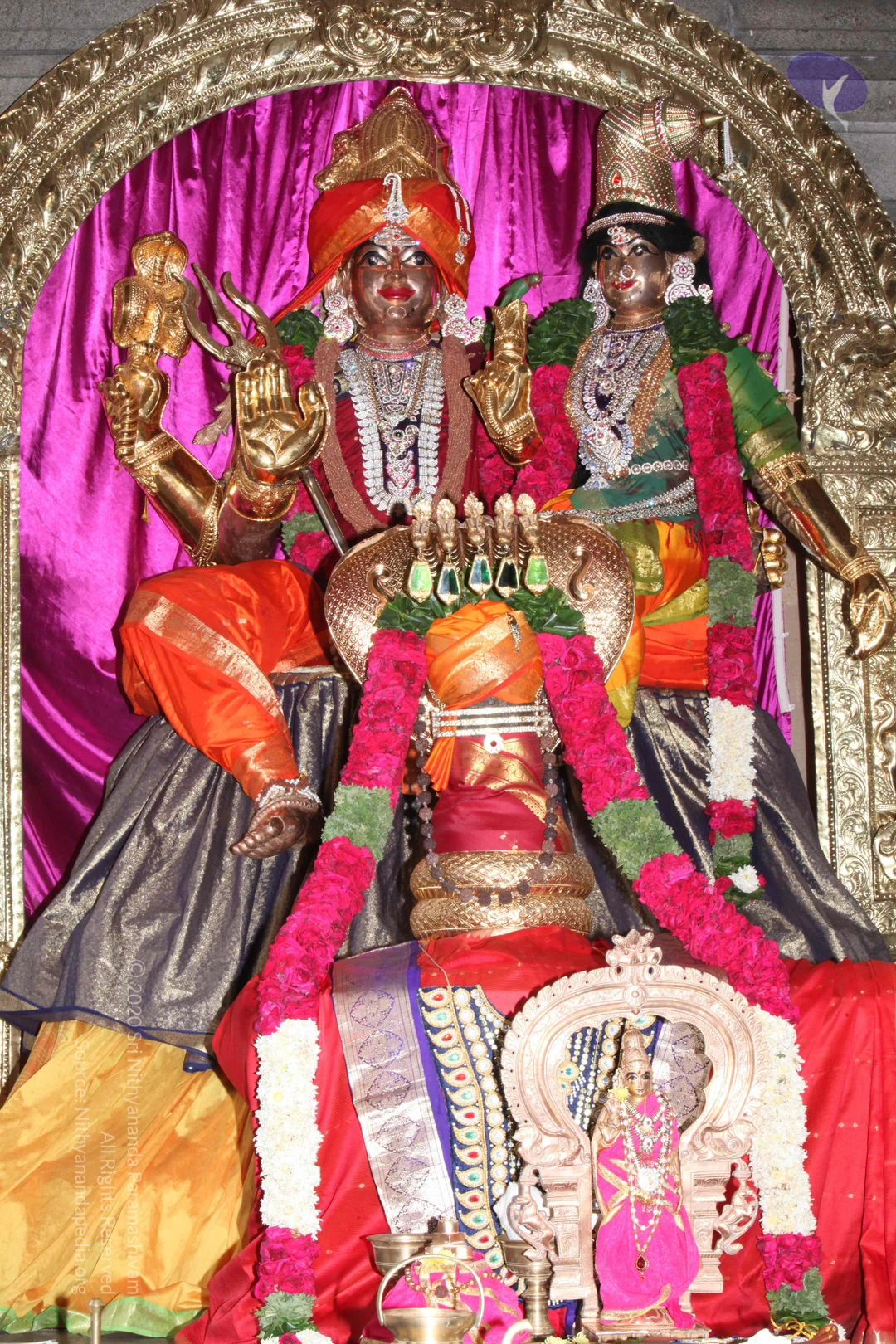
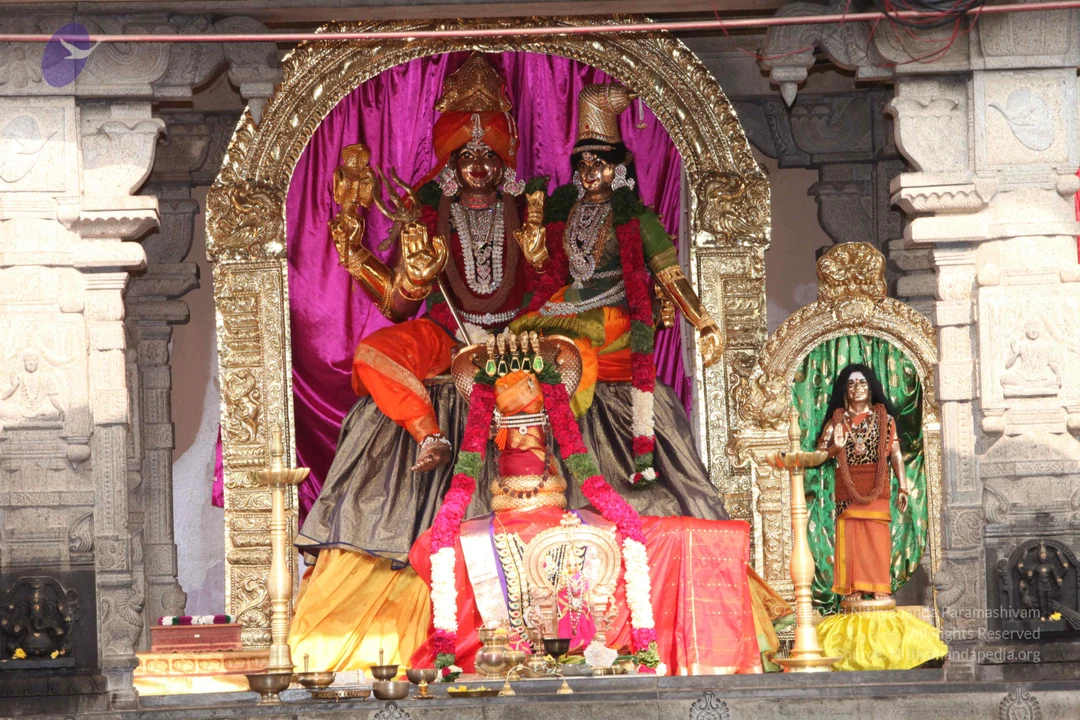
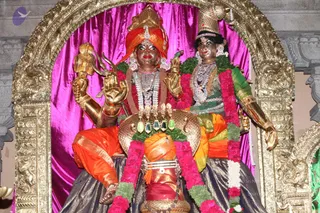
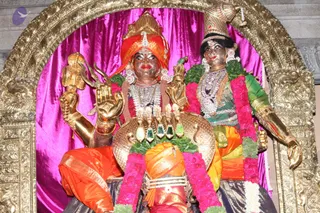
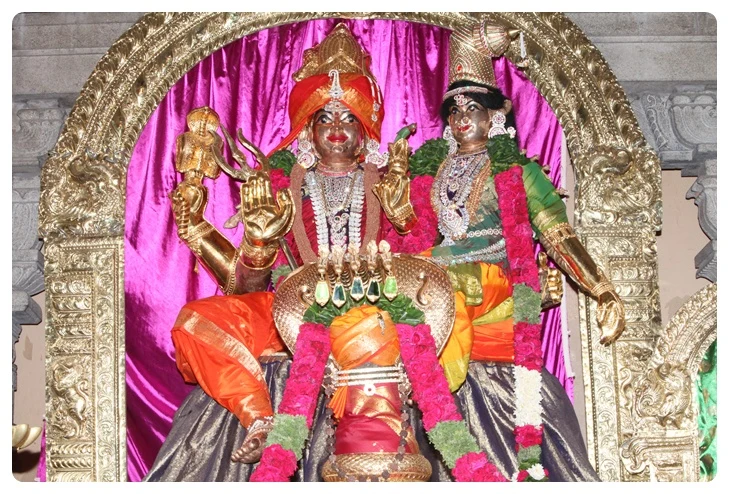
Photograph of two large painted deity murtis seated side by side on a golden throne before a magenta curtain and gilded arch. The figure on the left has four arms, an orange-red crown, a red and orange dhoti, and holds a trident and a drum-like instrument; the figure on the right wears a green and gold garment and a tall crown. Both are adorned with white and red beaded necklaces, large earrings, and red and pink flower garlands, with a vibrant orange cloth draped across the central pedestal. These are statues, not living people.Several young boys seated in a row in saffron-orange robes with white forehead markings and rudraksha malas around their necks, hands pressed together in anjali mudra while chanting. Brass puja vessels and small brass lamps sit on a silver tray in the foreground, with a red cloth draped over the tray. Other seated participants in orange robes are visible behind them in a hall setting.A photograph of a row of young girls seated on the floor in prayer, palms pressed together at chest or forehead level. Most wear saffron-orange dresses with magenta or maroon trim and white vibhuti marks on their foreheads; one wears a red-and-white outfit at the far right. Several have rudraksha malas or beaded necklaces and bangles. In the foreground, brass oil lamps, a brass plate with flower petals, and small offering dishes sit on a low table. No a person candidate is visible.Several young women and girls sit in rows wearing orange saris with maroon borders and long rudraksha mala necklaces. Their foreheads bear white vibhuti markings. The foreground student sits upright gazing ahead, with a bun and small earrings. Others sit alongside in an indoor hall, possibly during a satsang or meditation session, with a white pillar and pale walls behind them.

01--Pada-Puja

5 photosSource gallery
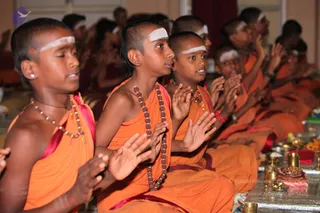
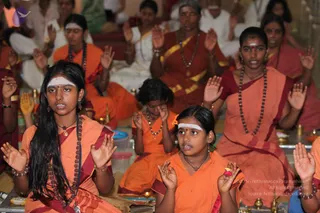
A photograph of a row of young girls seated on the floor in a pada puja setting, praying with palms pressed together. They wear saffron-orange salwar-style dresses with maroon borders and white forehead bands, and some wear rudraksha malas. Brass oil lamps, flower petals and a silver tray with offerings sit in the foreground on the left, and a woman in a maroon sari sits at the far right. No a person is visible in the image.Close photo of a young boy in a saffron-orange shawl with a deep red border, eyes closed and mouth open mid-chant, palms raised outward. He wears a long rudraksha mala with silver spacers, wire-rimmed glasses, a white sandalwood band on his forehead and a red dot at its centre. The background is a blurred temple interior with brass and red tones.Photograph of young women and girls seated in rows at a satsang, wearing orange saris with maroon borders and long rudraksha malas. The foreground woman has a white vertical forehead mark, a low bun, and small drop earrings, looking forward attentively. Others beside and behind her sit similarly dressed, some with white forehead marks. The hall has pillars, red walls and soft light from a window at the top right. No a person candidate is visible in the frame.A photograph of several young boys seated in a row during a puja, dressed in saffron-orange robes with red-pink borders and rudraksha malas around their necks. Each boy has a white vertical tilak on his forehead. Their palms are pressed together in devotion or raised in offering, and their eyes are closed or lowered. Brass vessels and a silver tray with ritual items sit in the foreground on the right. The boys are chanting or reciting, and the background shows more seated participants in similar orange robes. The scene is an indoor ashram-style gathering.A photograph of a seated group of devotees in orange and maroon saris with rudraksha malas, many with white vibhuti marks on their foreheads, performing a puja with palms raised in a devotional gesture. In the foreground, two young girls in orange clothing sit closest to the camera, one holding a small flower, and brass lamps and vessels sit on a cloth before them. No a person candidate is visible in the frame.

02--Temple

17 photosSource gallery
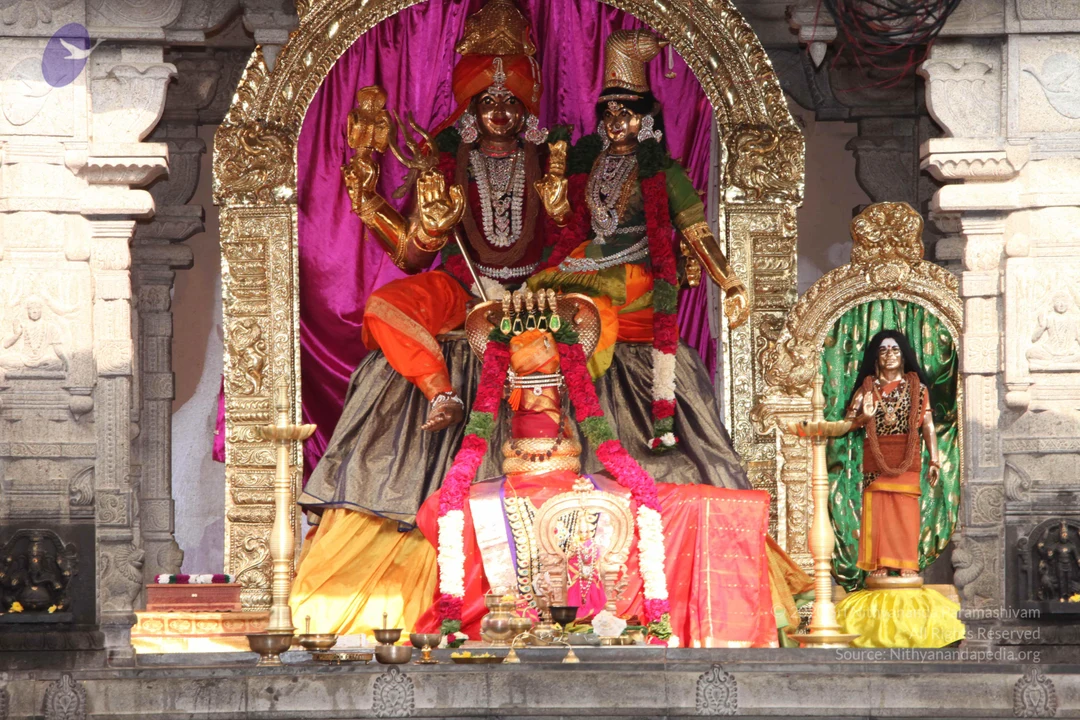
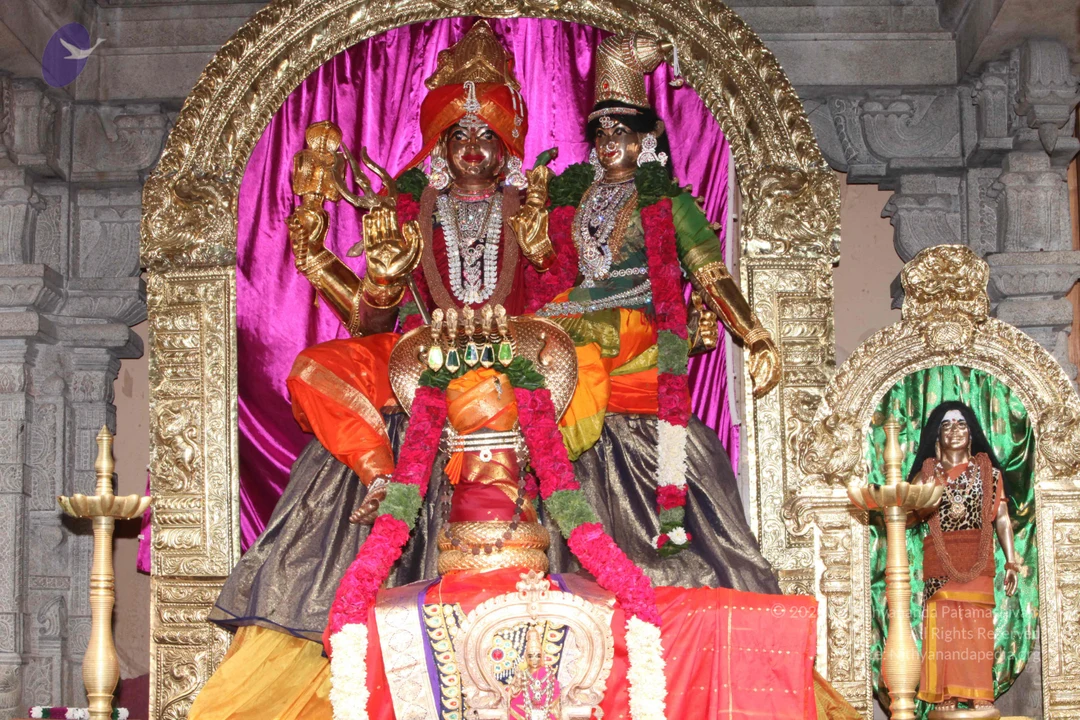
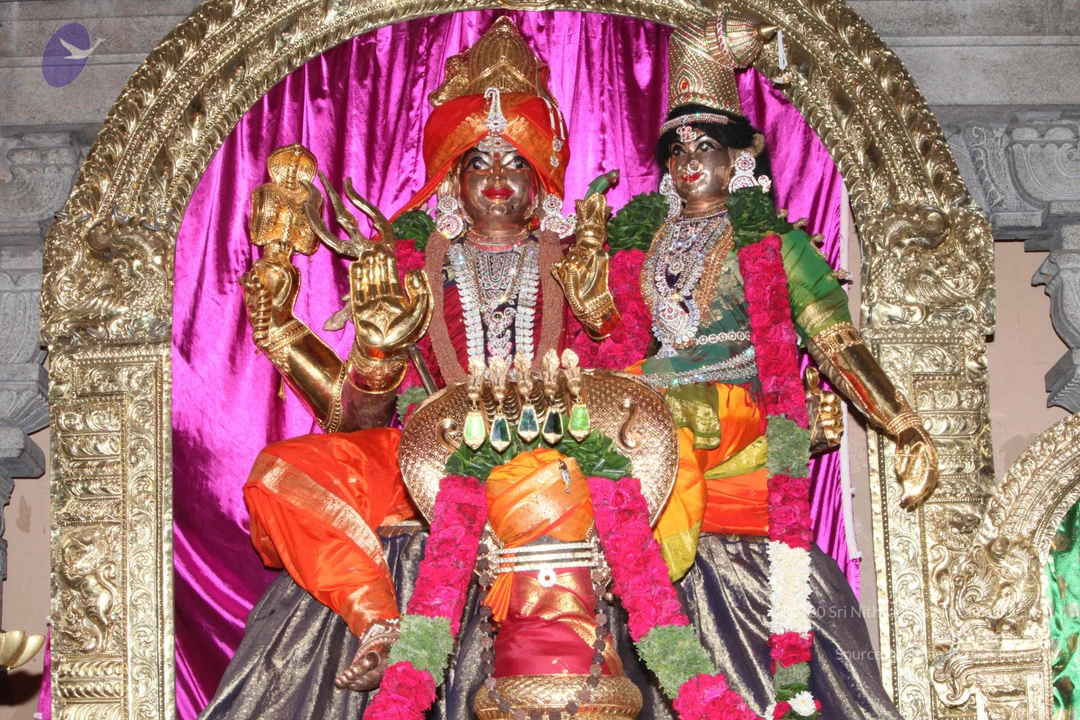
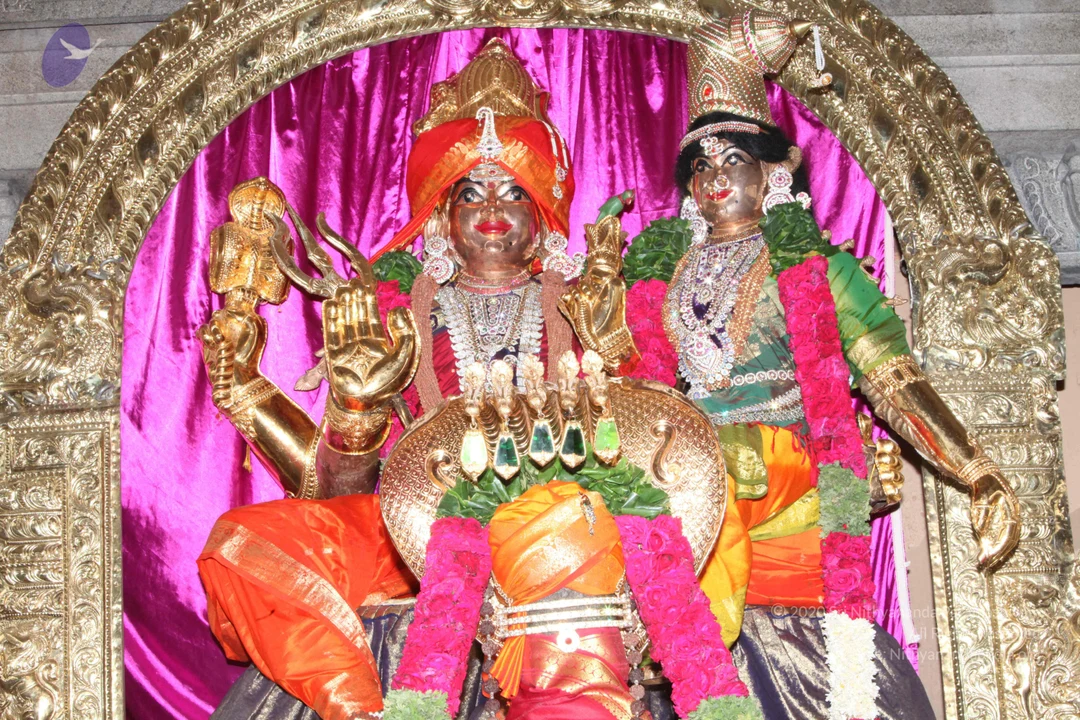
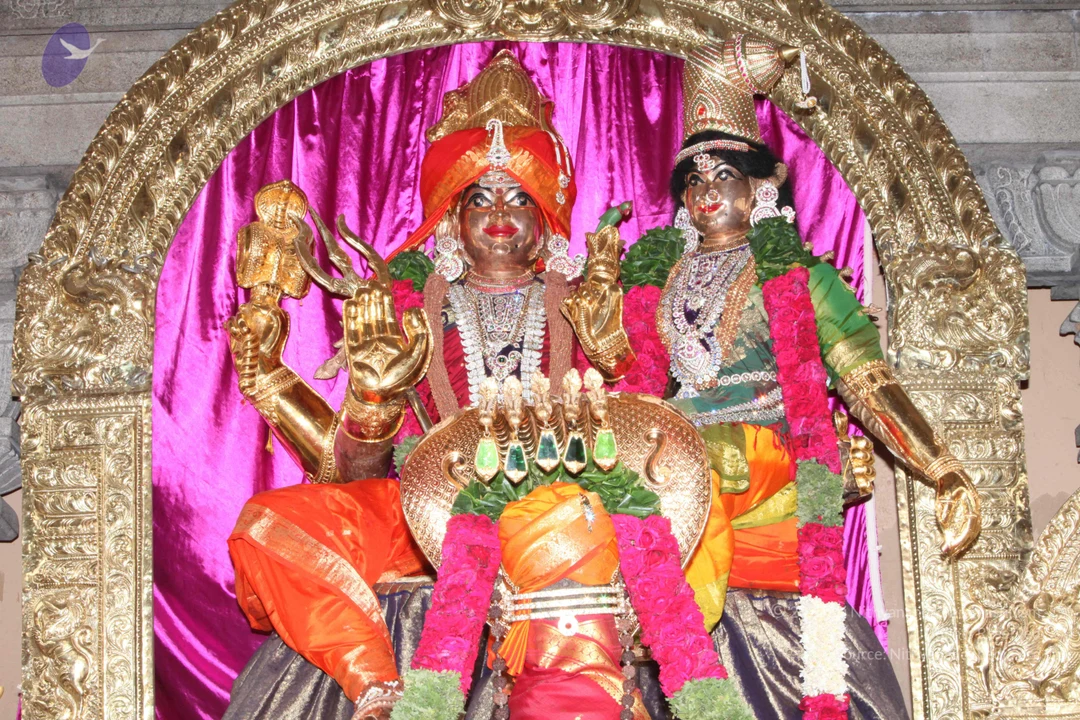
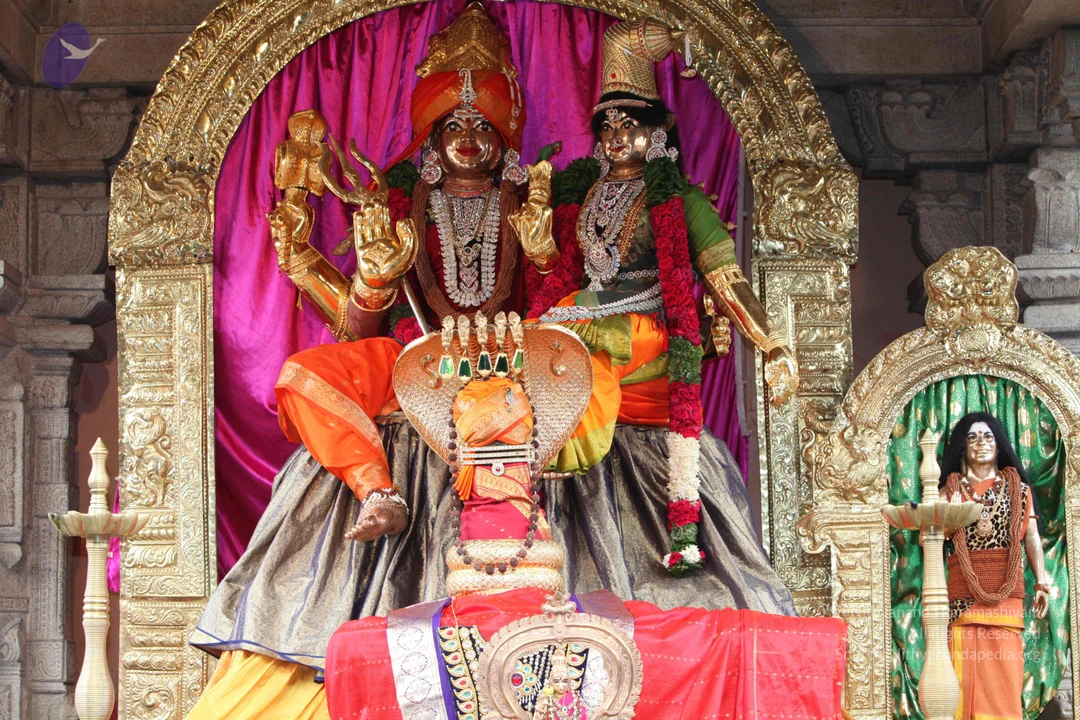
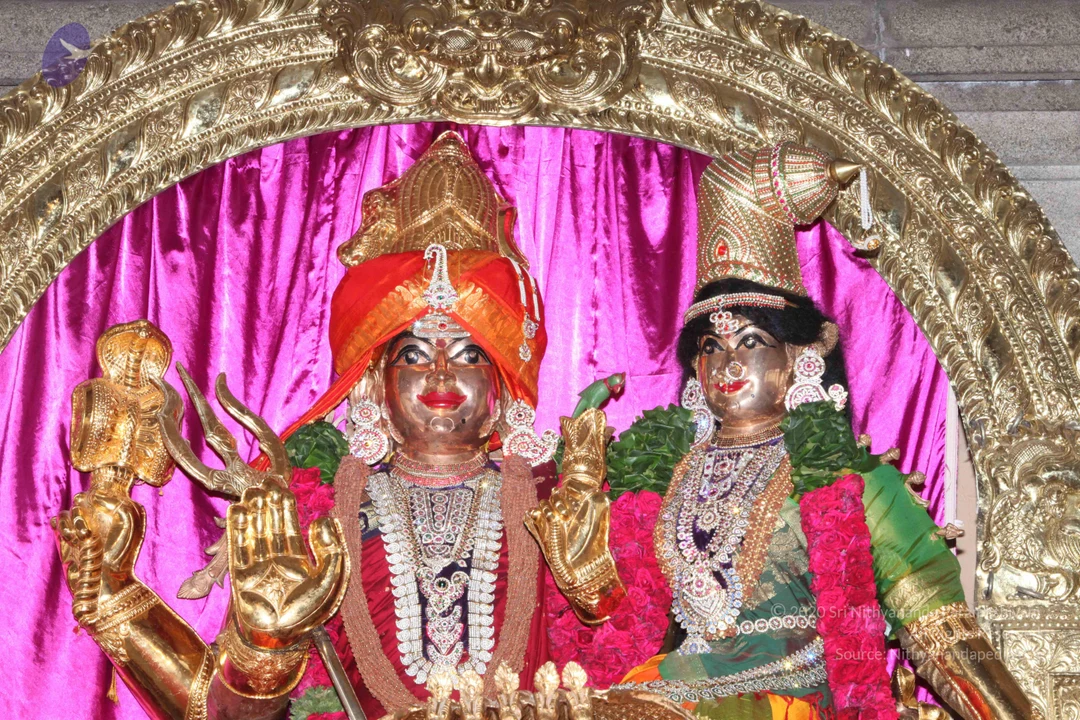
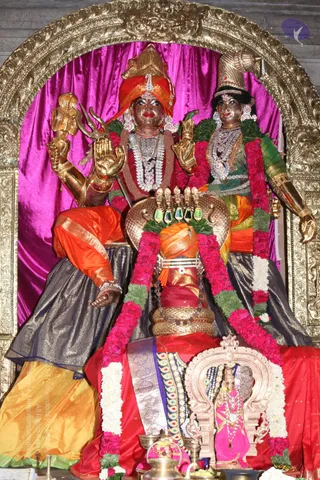
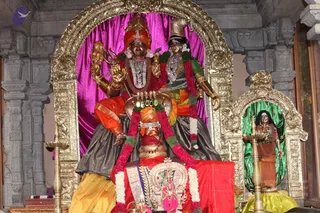
A decorated deity murti pair seated on a cobra-hooded throne before a magenta drape and ornate gold arch. The taller figure wears an orange-red turban and holds a trident and a gold staff, with a rudraksha-style necklace and white silver jewellery. The consort figure to the right wears a green and gold sari, a silver crown and a red garland. Both are draped with red and pink flower garlands, and a small pink-clad figure sits in a gilded niche below. Brass oil lamps and offerings lie in front. No living people are visible.Photo of a temple sanctum showing a decorated murti group under a gold-framed arch with a magenta velvet backdrop. Two figures stand tall, one holding a trident and the other a crown-like headdress, both draped in garlands of red and white flowers, pearl and bead necklaces, and orange, red and green cloth. A seated figure in front wears a red and gold ceremonial dress and a golden crown, with a red cloth draped over a platform below. Brass oil lamps stand on either side, and a smaller figure in a green-curtained niche to the right wears red and orange clothing. These are statues, not physically present people.A temple sanctum shrine with ornate gold-framed arches and grey stone walls. Two large deity murtis stand at top, one with a trident and a gold crown and garlands, the other holding a small object and wearing a red-and-gold crown. Between them sits a seated figure wrapped in a red-and-gold cloth with rows of gold and green ornaments and a red garland. Brass oil lamps, bowls and a kalasha stand on the floor in front, and a magenta drape hangs behind. On the right in a green niche, a standing figure in orange robes with a rudraksha mala and long dark hair stands beside a lamp; this figure is a statue, not a physical person, and no identification is made from appearance. The scene shows a worship arrangement with lamps and offerings.A photograph of a temple shrine with two large deity murtis seated side by side on a raised pedestal. The left figure wears an orange-red turban and holds a trident-like staff, adorned with white and pink garlands, a pearl necklace and gold armlets. The right figure wears a tall gold crown and a green and gold sari-style garment with garlands in pink and green. Behind them hangs a magenta cloth, framed by an ornate gold arch carved with floral motifs. A smaller shrine on the right holds a seated figure in orange and green garments against a green backdrop, with brass oil lamps flanking both shrines. The pedestal is decorated with flower garlands and a kalasha-style gold motif. No living people are visible.Two painted deity murtis, a male and a female figure, are seated side by side on a raised golden seat within an ornate gold-carved arch. The figure on the left has gold skin, an orange and red turban-style crown, a trident and drum-like implement raised in the hands, and a white bead necklace. The figure on the right wears a gold crown, green and gold blouse, layered silver jewellery and red rose garlands. Both are draped in rose, pink and green garlands, and a magenta velvet backdrop surrounds them. The statues are seated over a kalasha-like base wrapped in orange cloth. This is a deity murti display, not a living person.Two deity murti seated side by side within a gold-leaf arched frame against a magenta satin backdrop. The figure on the left wears an orange turban, has a gold trident-like staff raised in one hand, and wears layered pearl and stone necklaces, with an orange dhoti and a pale cloth. The figure on the right wears a tall gold crown, a green and gold blouse with a pink-and-white garland, and gold jewellery. Both are draped in pink and green flower garlands and sit on a large round gold shield-like base with green leaves.

03--Banyan-Tree
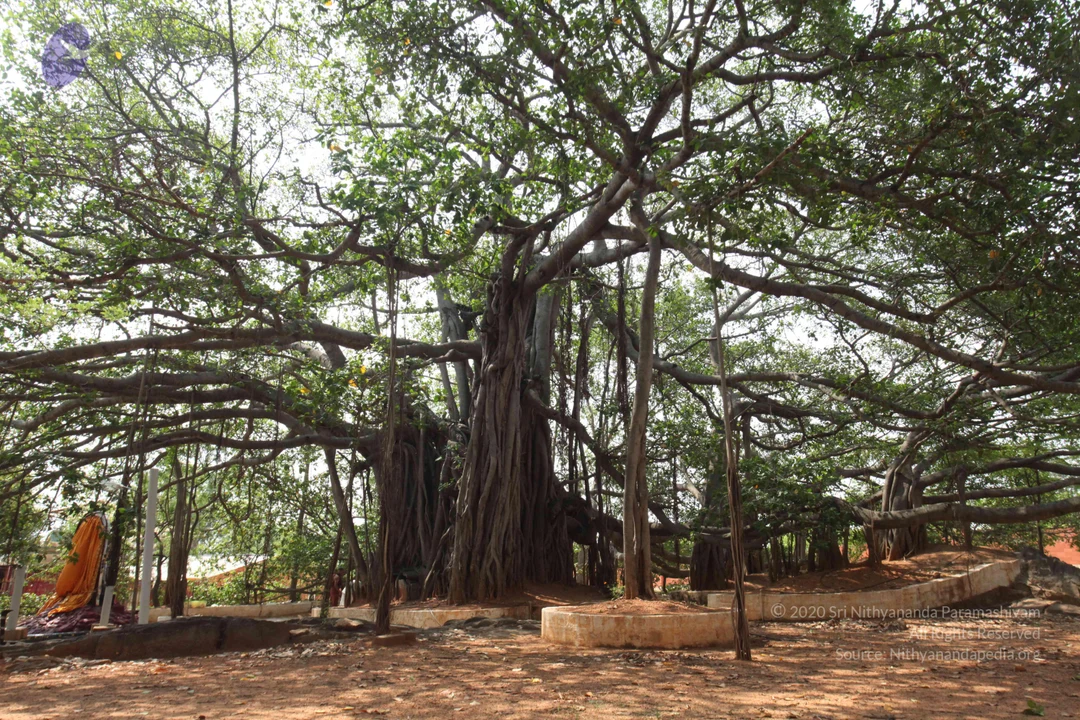
20 photosSource gallery
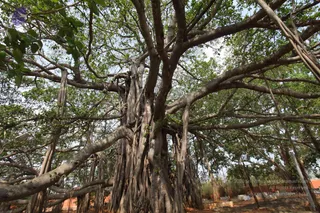
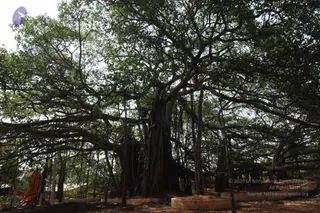
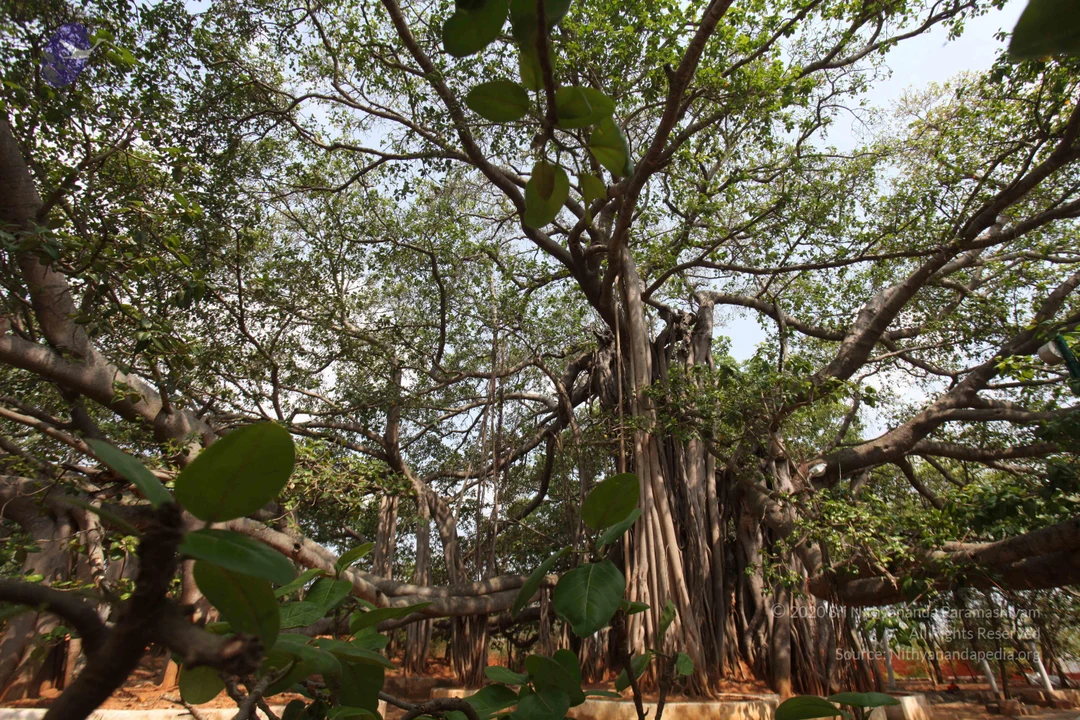
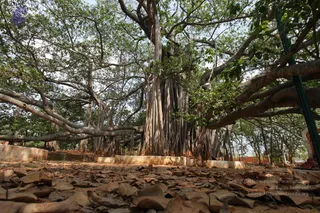
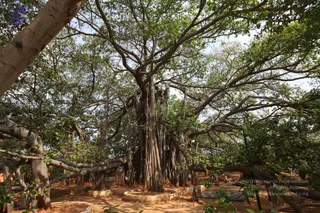
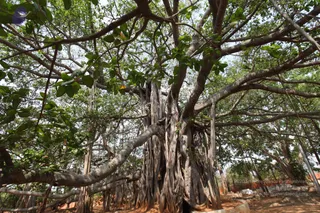
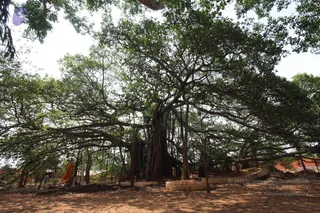
A large, sprawling banyan tree dominates the frame, its many thick grey-brown limbs spreading horizontally overhead and its numerous aerial roots hanging down and merging into the trunk and pillars. Green leaves fill the canopy against a pale sky. Below, bare reddish earth, a low concrete platform and an orange-brick wall are visible at the edge of an open grounds area. No people are present.A large, sprawling banyan tree dominates the frame, its thick trunk and aerial prop roots supporting a dense canopy of green leaves with scattered small yellow fruits. Stone platforms with circular bases surround the trunk on bare reddish earth. At the far left edge, an orange and saffron cloth drapes over a structure beside a pole. No people are visible. Overlaid in the lower right is aA large banyan tree dominates the scene, its wide horizontal limbs spreading across the frame and dense green foliage overhead. Many aerial prop roots hang down and thicken around the trunk, which stands behind a low cream-coloured concrete curb. The ground is covered with dry brown fallen leaves. At the right edge a green metal pole and part of a small shrine with orange and red decoration are visible. No people are present.A large, sprawling banyan tree dominates the frame, with thick aerial prop roots descending from wide horizontal branches to a central trunk cluster. Circular stone or concrete platforms surround the base on reddish-brown earth, and a green metal post stands at the right edge. No people are visible; the scene is a quiet outdoor grove under pale sky.Looking up at a large banyan tree with a thick, gnarled trunk and many spreading branches covered in green leaves. Numerous aerial roots hang and descend from the upper limbs toward the ground. Patches of blue sky show through the canopy. Below, reddish-brown earth is bordered by low stone or brick edging and a short wall, with other tree trunks visible to the right. No people are visible.A large, sprawling banyan tree dominates an open dirt ground, its thick trunk and many aerial prop roots spreading into a wide canopy of dense green leaves. Beneath the tree, a circular raised stone platform surrounds the base, and an orange cloth hangs over a small shrine-like structure at left. No people are visible in the scene, which appears to be an outdoor sacred grove or ashram site.

04--Satsang

3 photosSource gallery
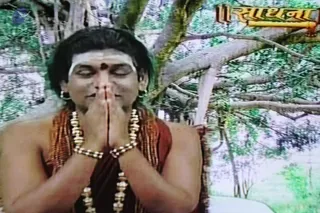
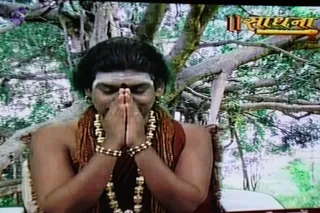
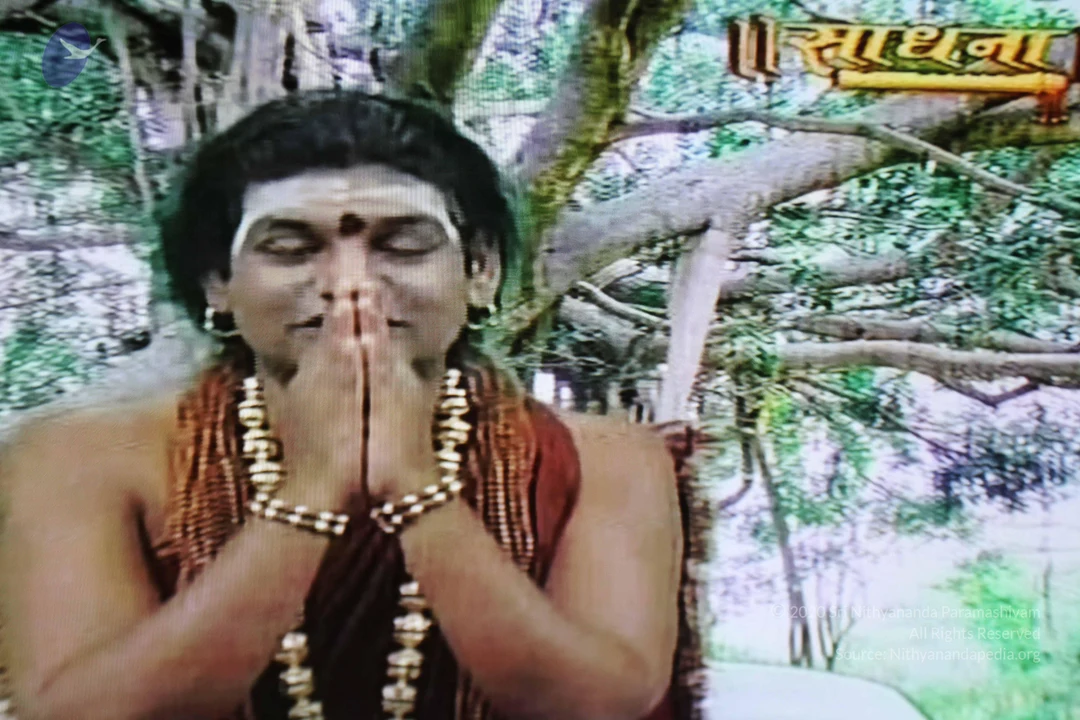
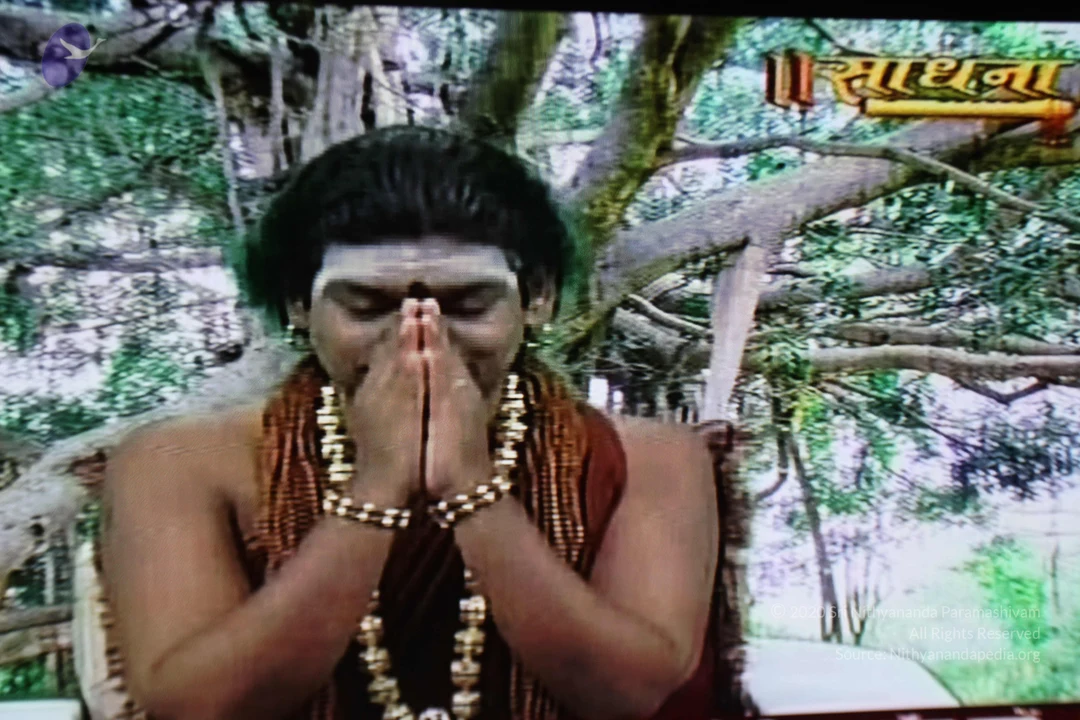
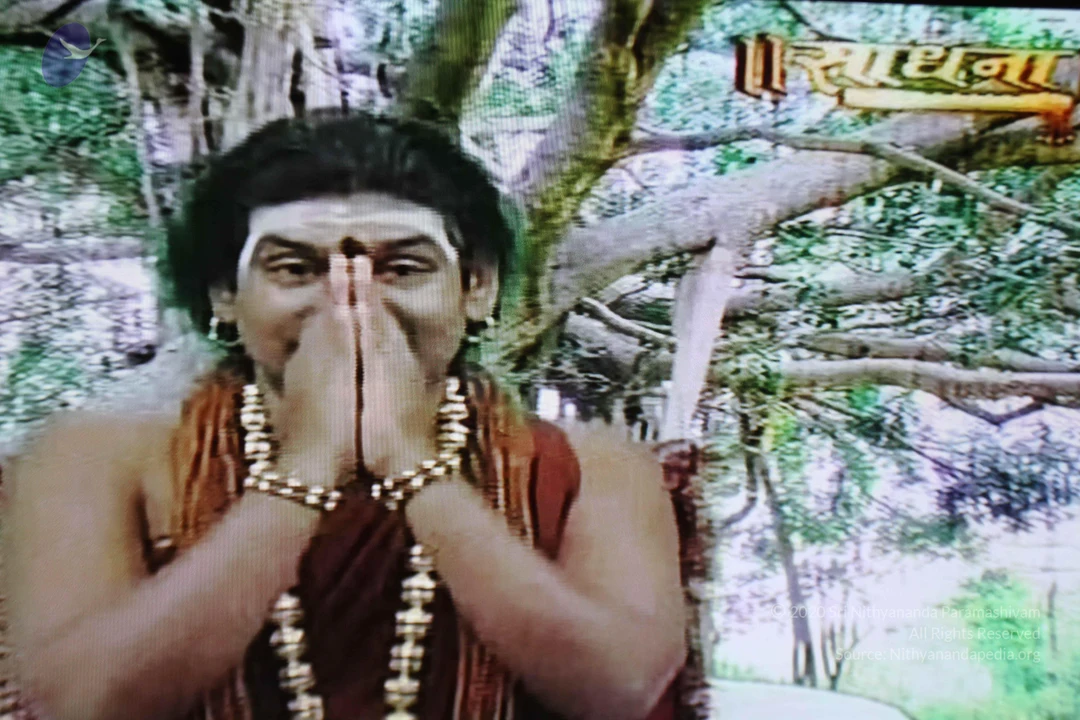
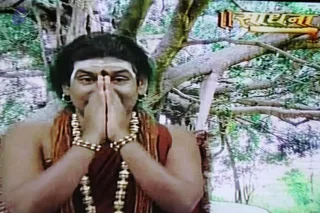
A screen capture of a television broadcast shows a bare-chested man with shoulder-length dark hair and a white band across his forehead, a red tilak mark between his eyes, and eyes closed in a namaste gesture with palms pressed together at his chest. He wears layered rudraksha malas and gold-coloured beaded necklaces over an orange-red shawl. Behind him is a leafy tree with branches on a painted or video backdrop. In the upper right, the gold-lettered Sadhana logo is visible. The image is a photo of a TV screen, so the man is shown on a screen rather than physically present. Appearance-based candidate for a person, with qualifying cues of rudraksha malas, gold necklaces and orange-red shawl; identity is probable only from appearance, so the field is depiction and the label is noted in the description.A photograph of a television screen showing a bare-chested man with black hair and a white forehead mark, his palms pressed together in namaskar with eyes closed. He wears a long rudraksha mala draped over his shoulders and bead necklaces with gold-coloured ornaments, with a reddish-brown cloth around his waist. The background is a painted or video backdrop of a large tree with branches and foliage. A sadhana logo appears in the top right corner of the screen.A screen capture of a man with long dark hair and a white tilak on his forehead, palms pressed together at his face in a namaskar gesture. He wears a rust-orange shawl over bare shoulders and several ornate gold-toned beaded necklaces. Behind him is a large leafy tree and a gold-lettered banner reading a Devanagari word. The image appears to be a video still shown on a television or monitor, with scan-line texture visible across the picture.

05--AdiKailash

3 photosSource gallery
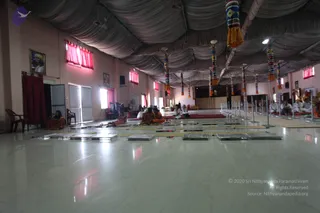
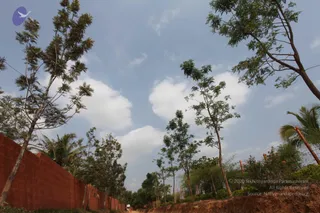
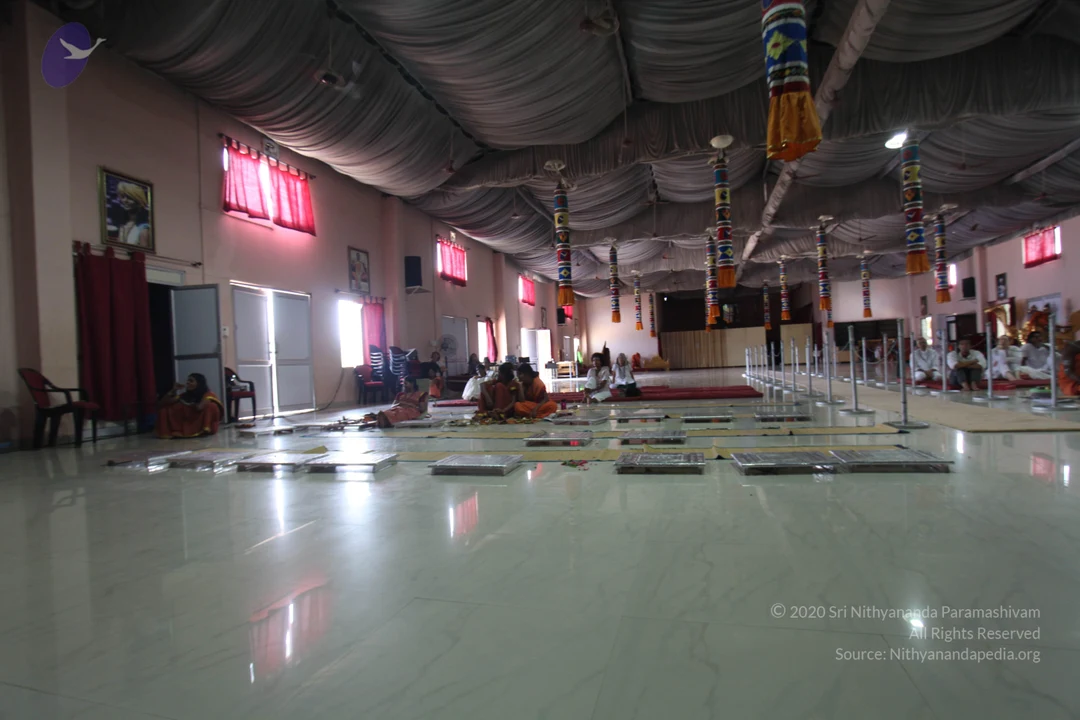
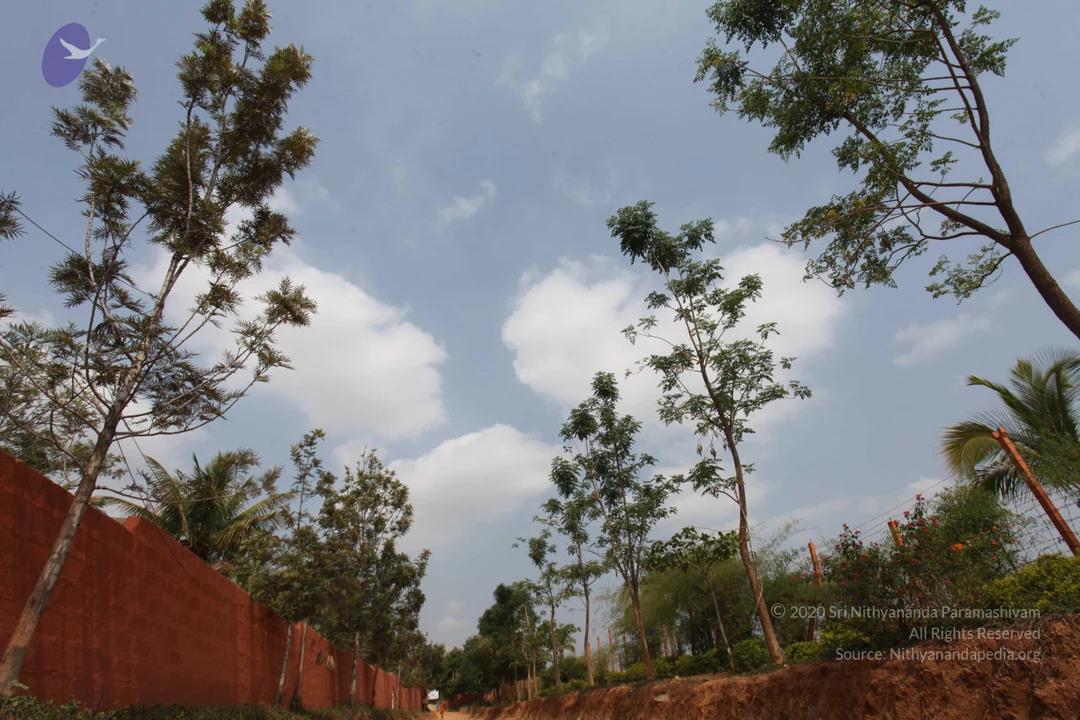
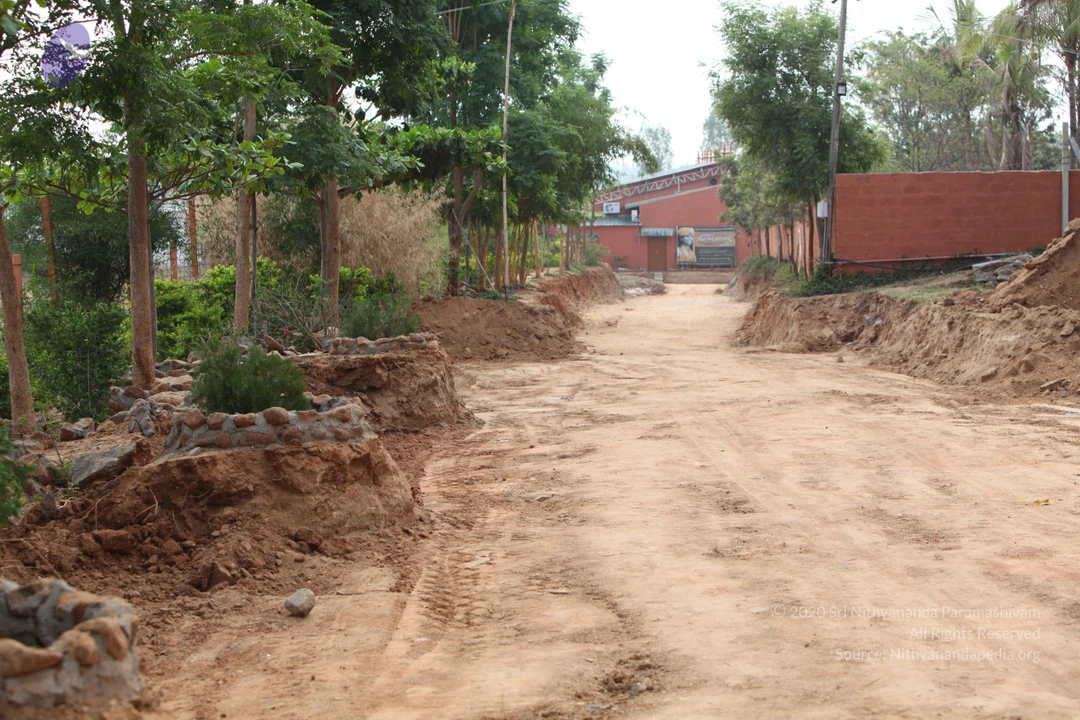
A wide photograph of a large hall with a polished white marble floor and a draped grey fabric ceiling. Colourful striped tassel decorations hang from the ceiling in rows. Red curtains frame the windows on the left. Along the floor, a few people in orange and saffron clothes sit on mats near rows of small metal trays and marigold petals. Along the right side, several people in white clothes sit in rows on red mats facing the front of the hall, beneath a framed picture on the wall. A few seated figures are visible near the left wall.Outdoor landscape view looking up at a pale blue sky with scattered white clouds. Tall slender trees with feathery foliage line a dirt path on the right, with a red-orange brick boundary wall running along the left side. Palm trees and flowering red shrubs sit beside a wire fence at the right edge. No people or ritual activity visible.A photograph of an unpaved dirt road lined with newly built stone-faced earth embankments and young green trees on the left. Tyre tracks mark the sandy red soil. On the right, a low red-painted compound wall runs along the road, with a red building behind it and a small signboard on the wall. Palm trees and a pale sky appear in the background. No people are visible in the scene.