Skip to content
Tuesday

17 July 2012

Supreme Pontiff of Hinduism HDH Bhagavan Sri Nithyananda Paramashivam

Dated photos
226
Source pages
1
Media
5
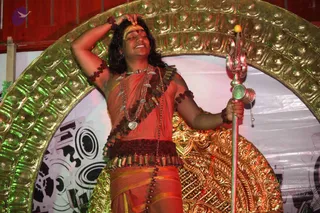
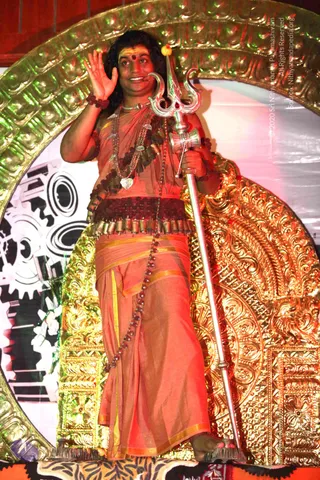
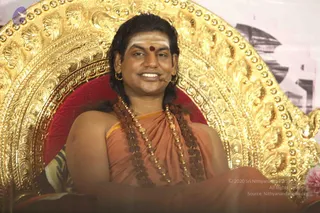
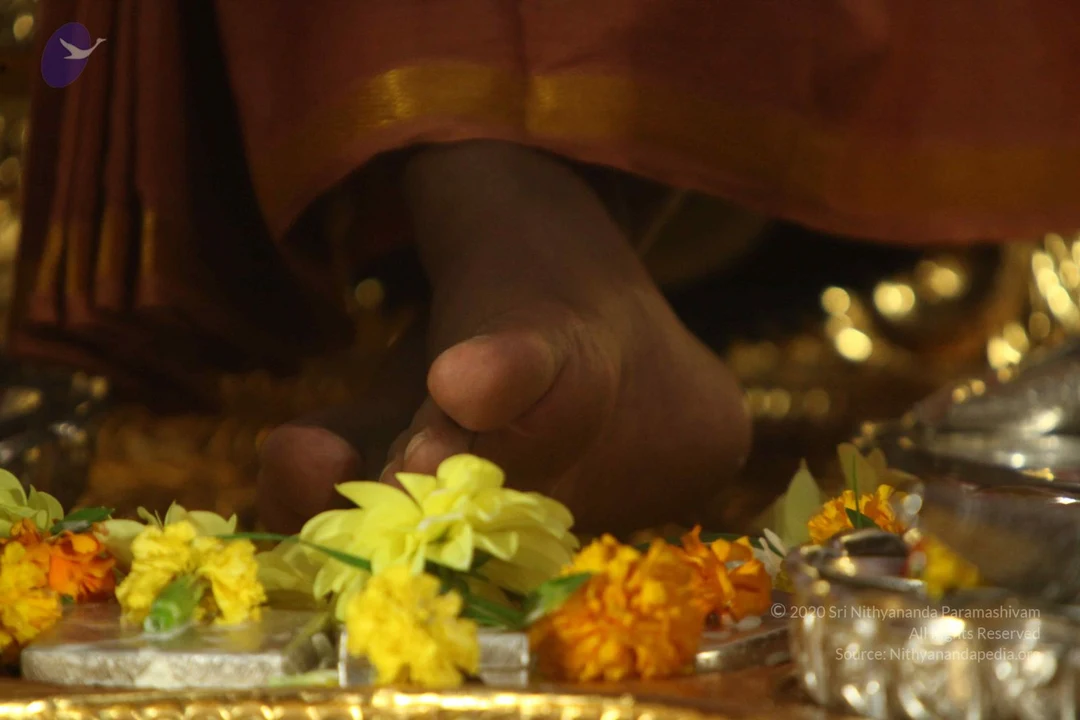
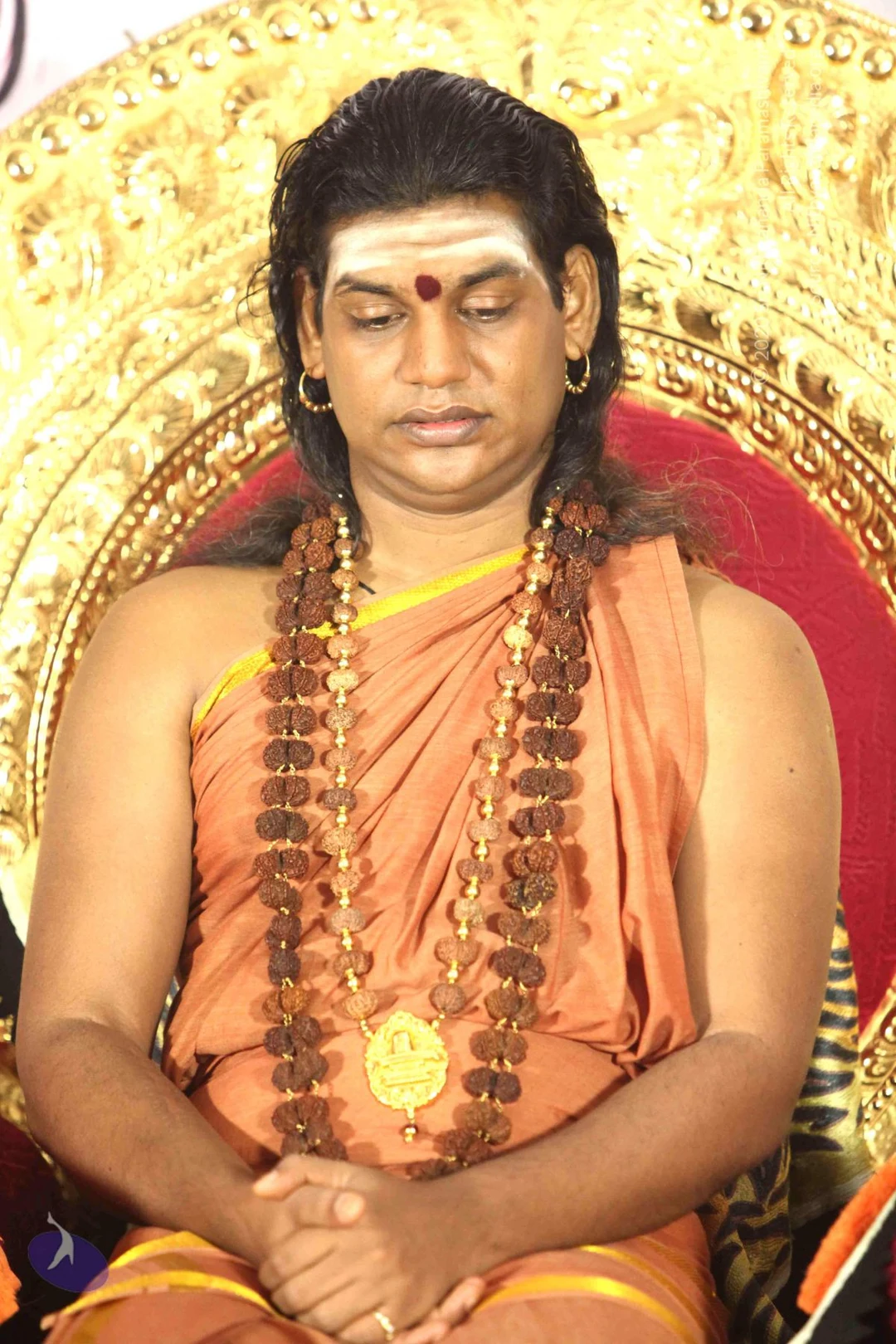
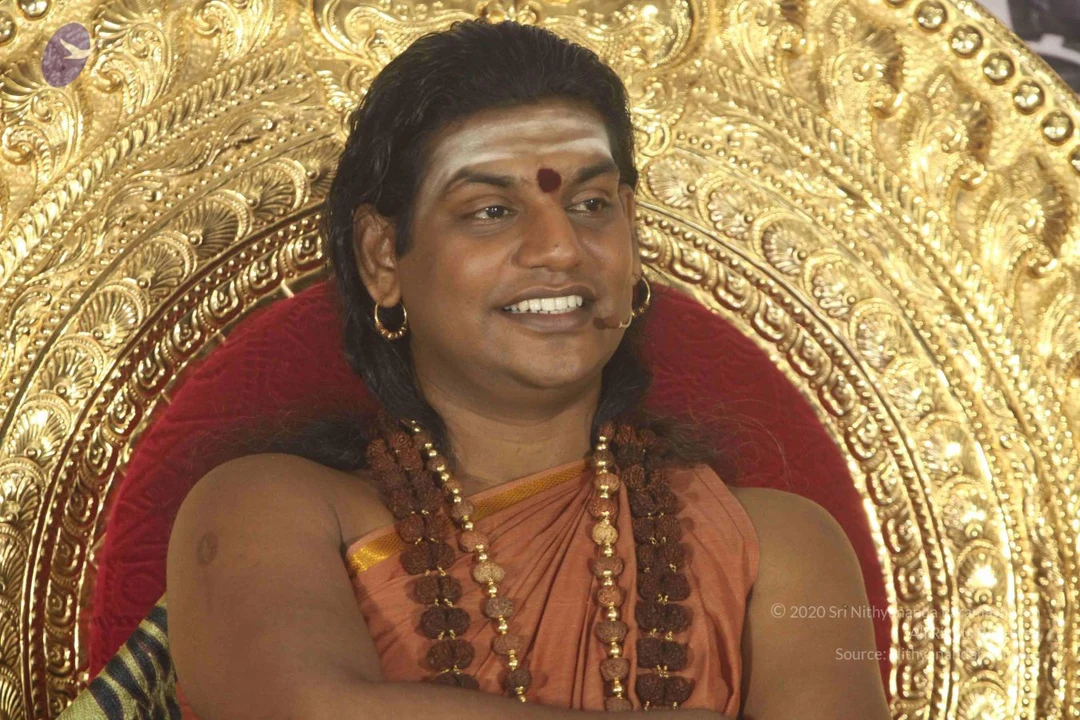
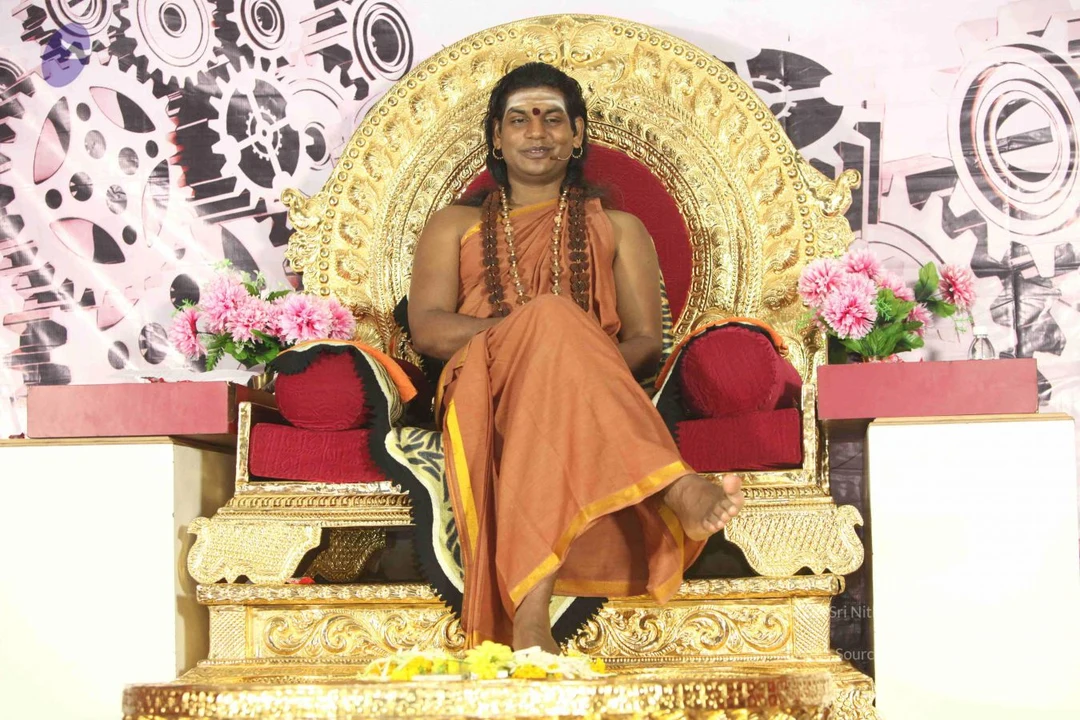
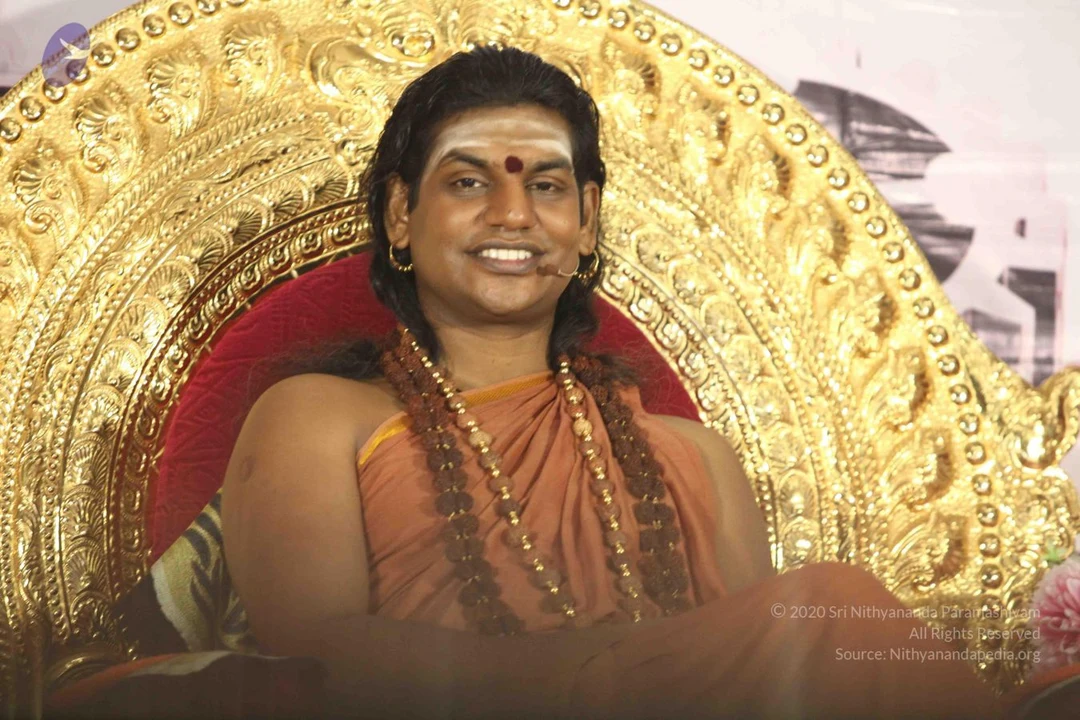
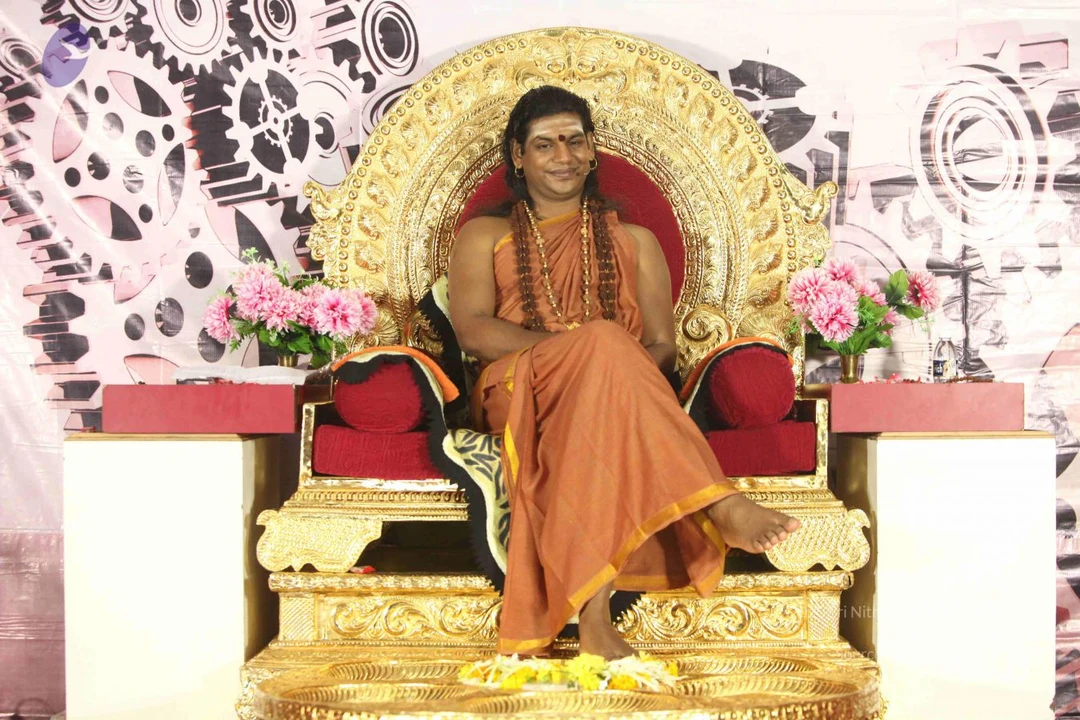
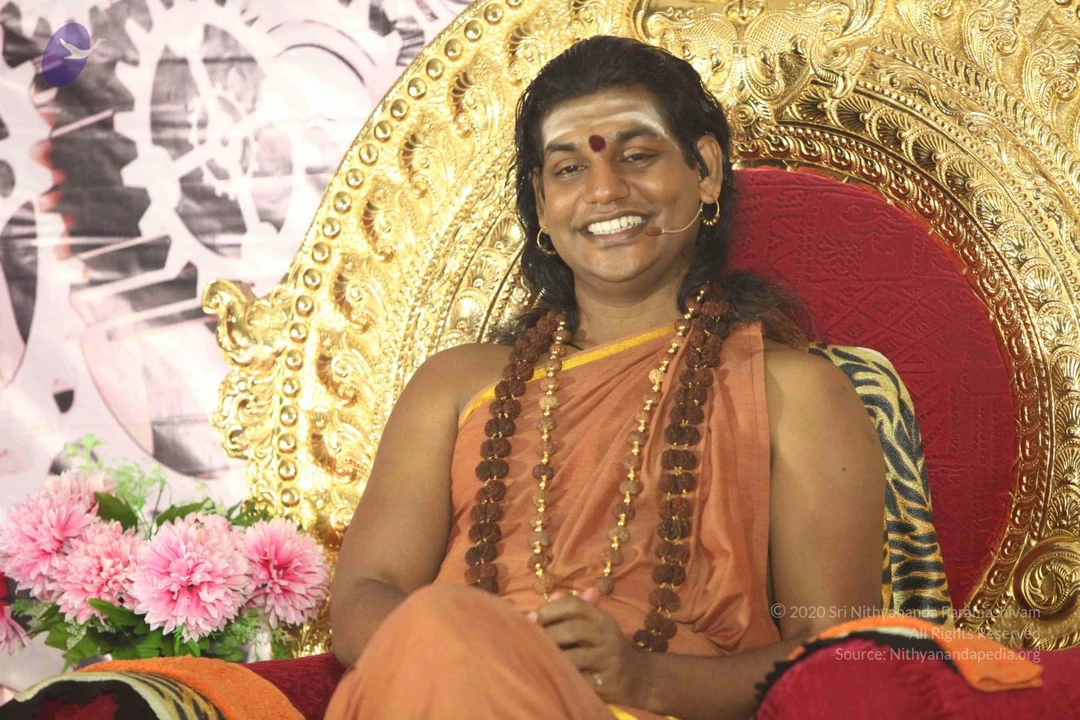
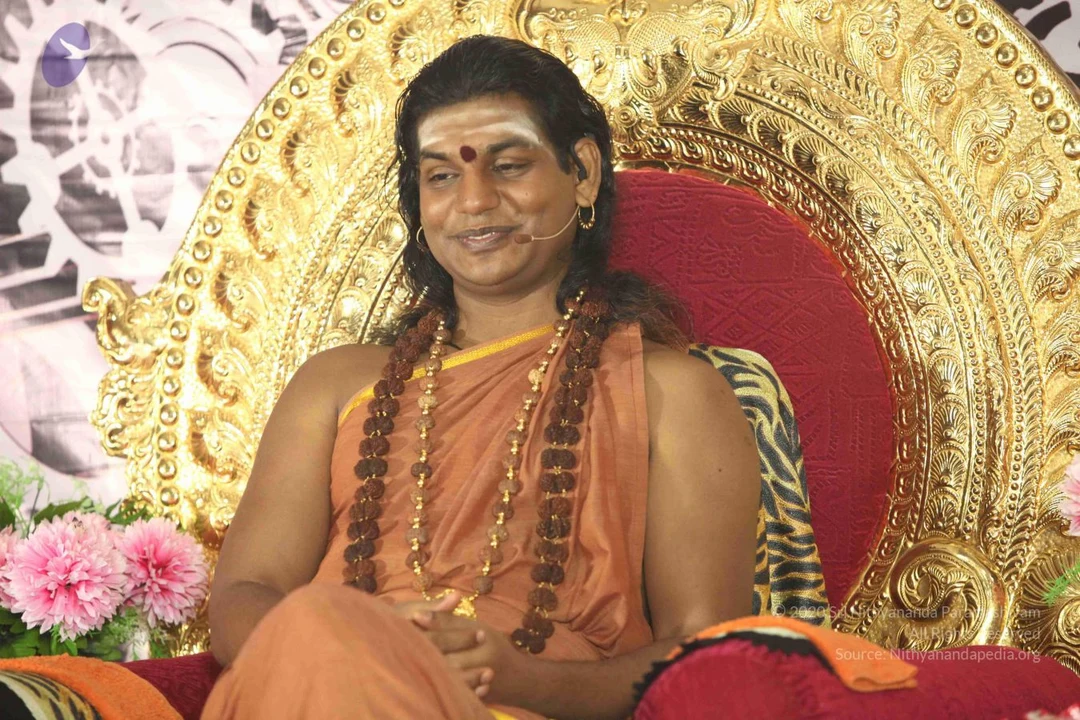
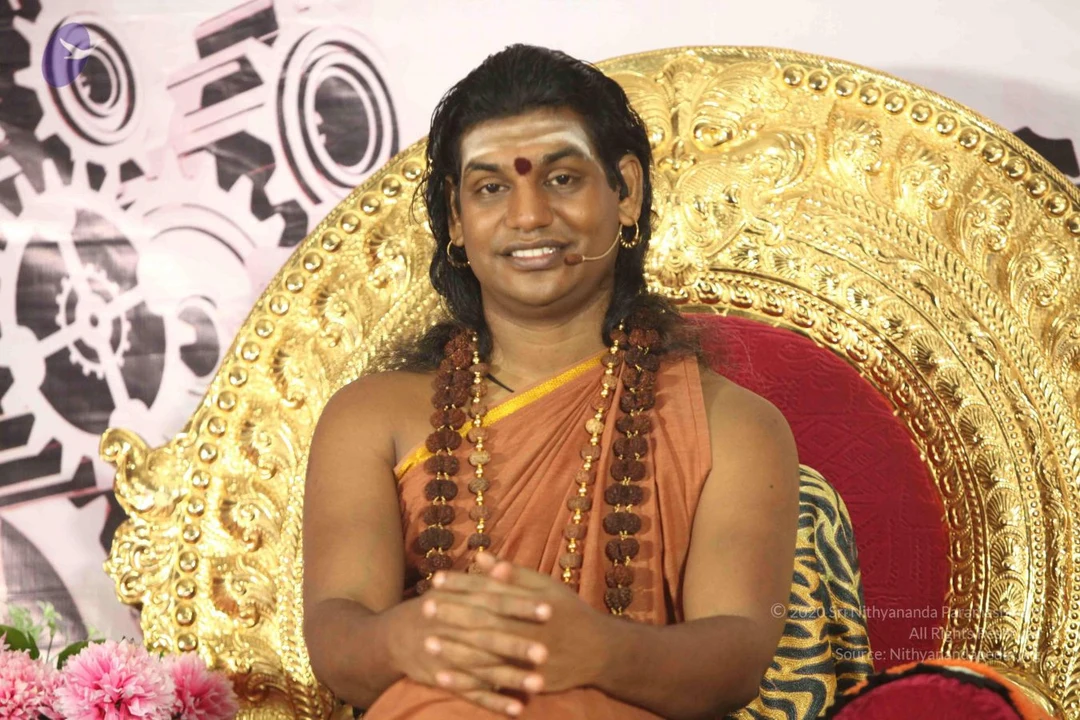
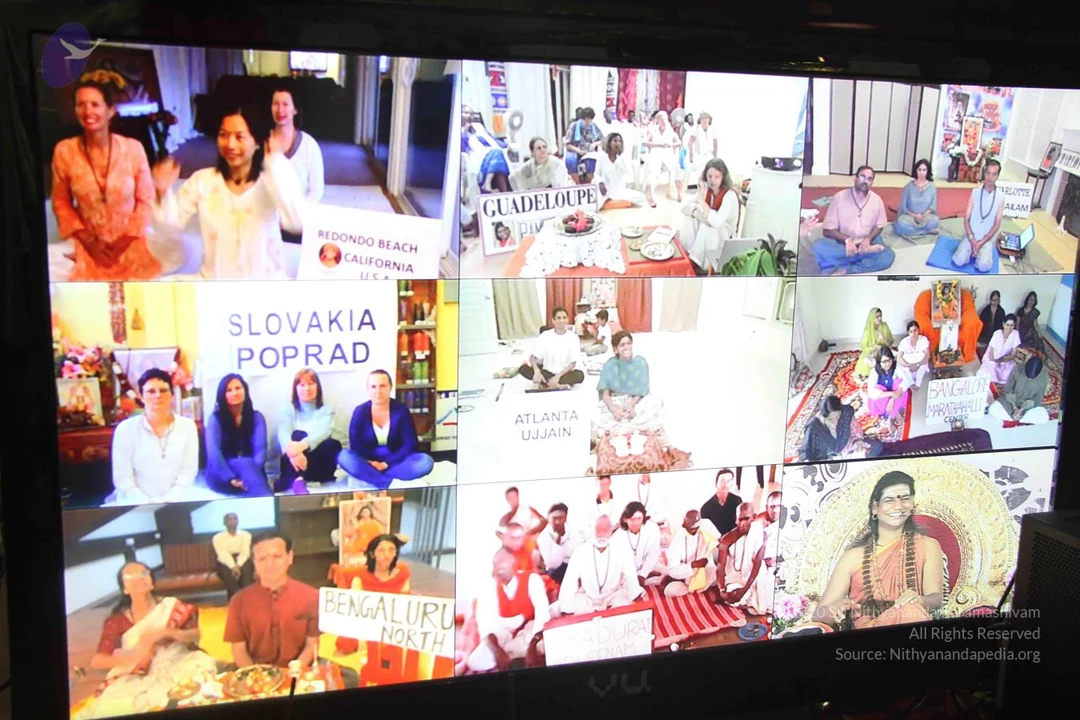
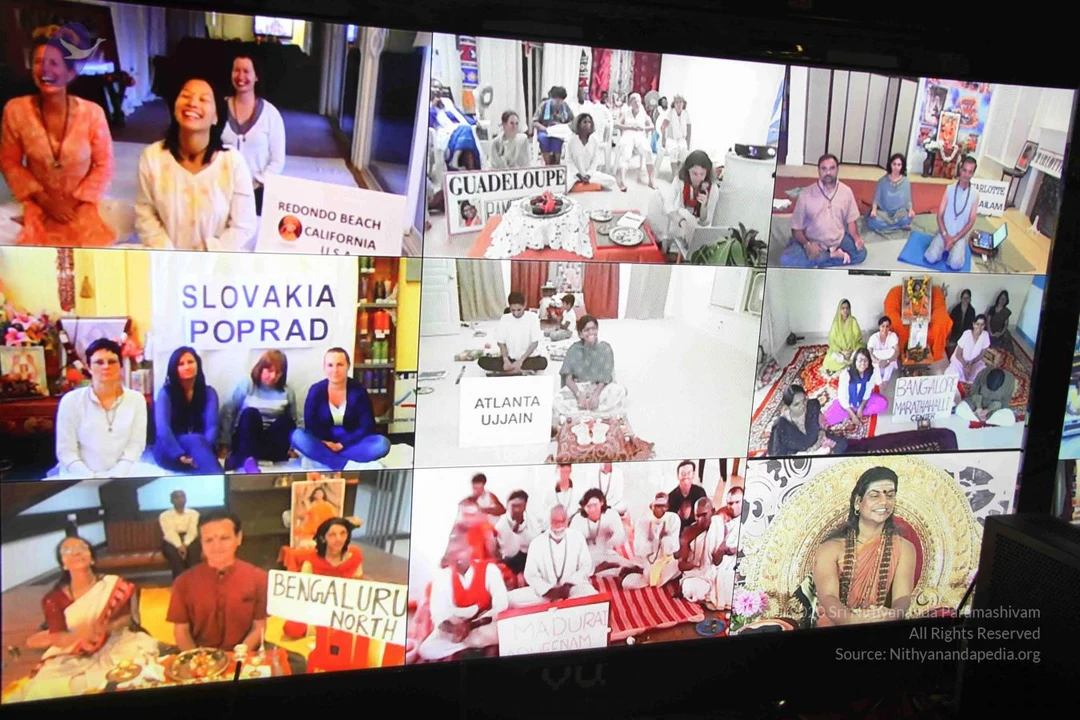
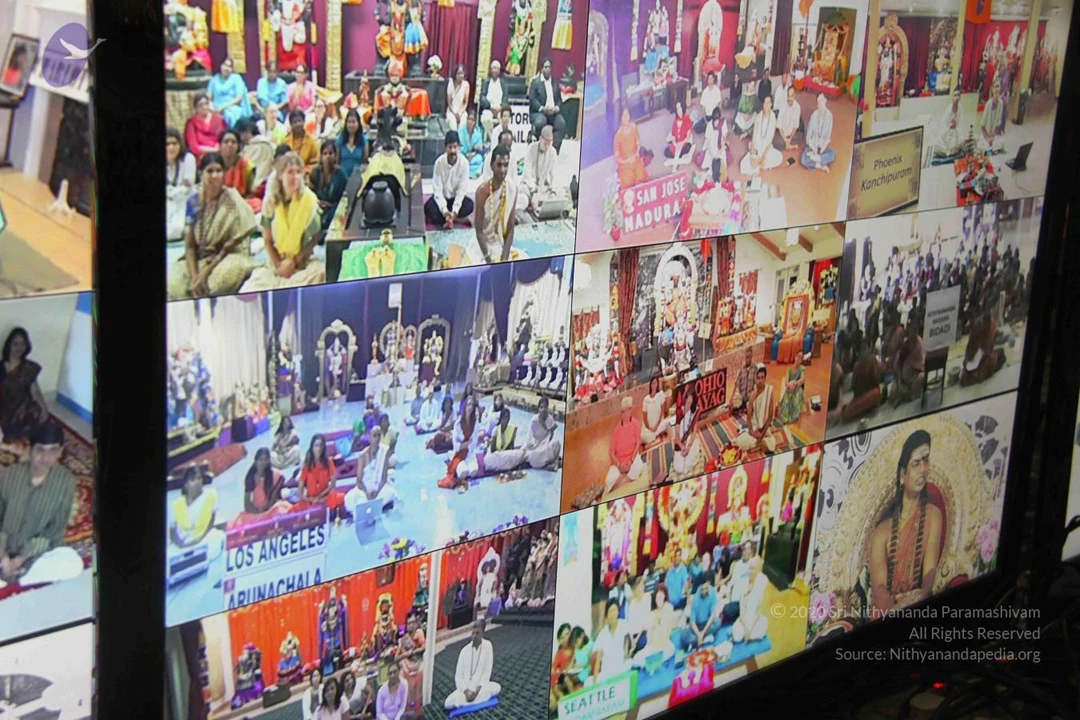
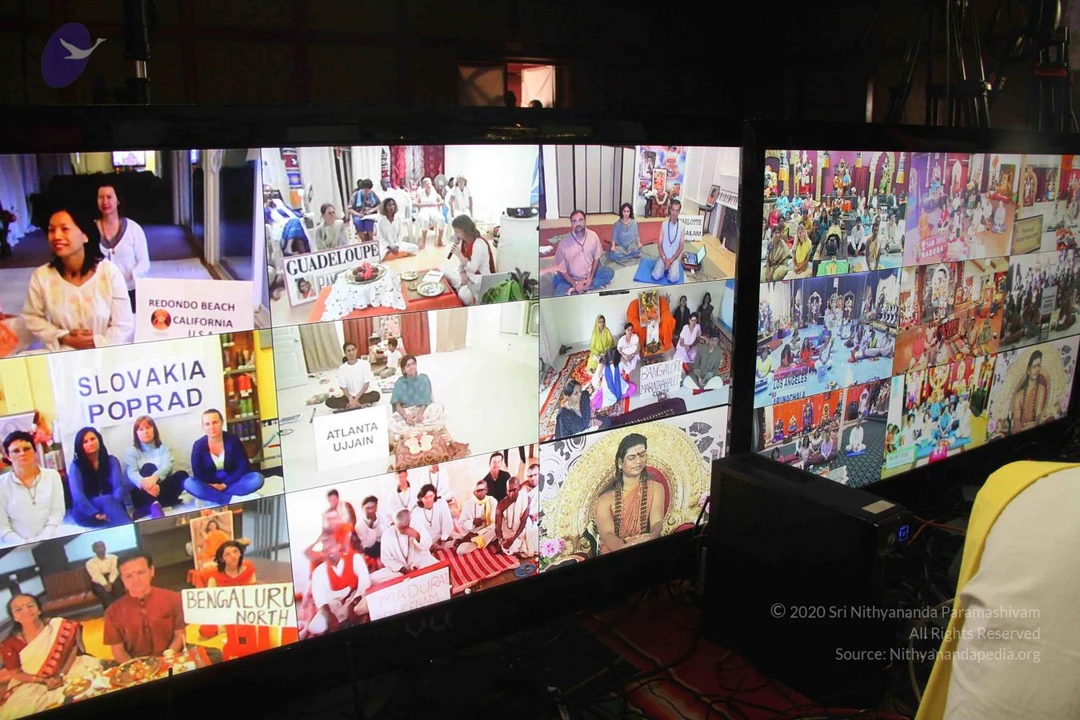
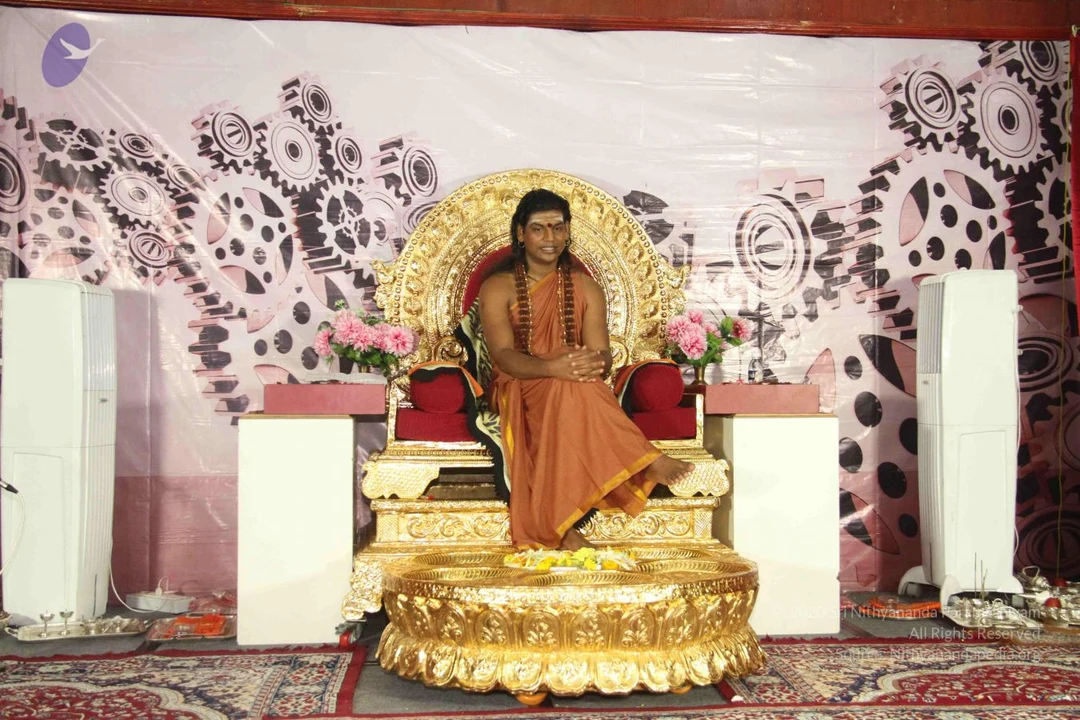
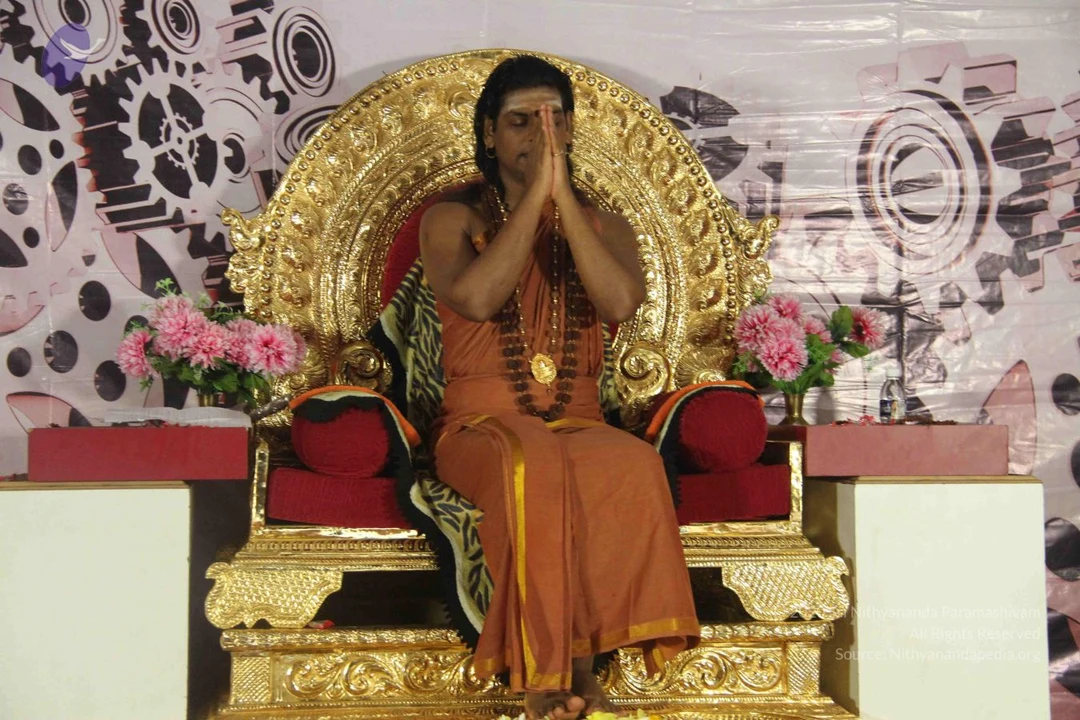
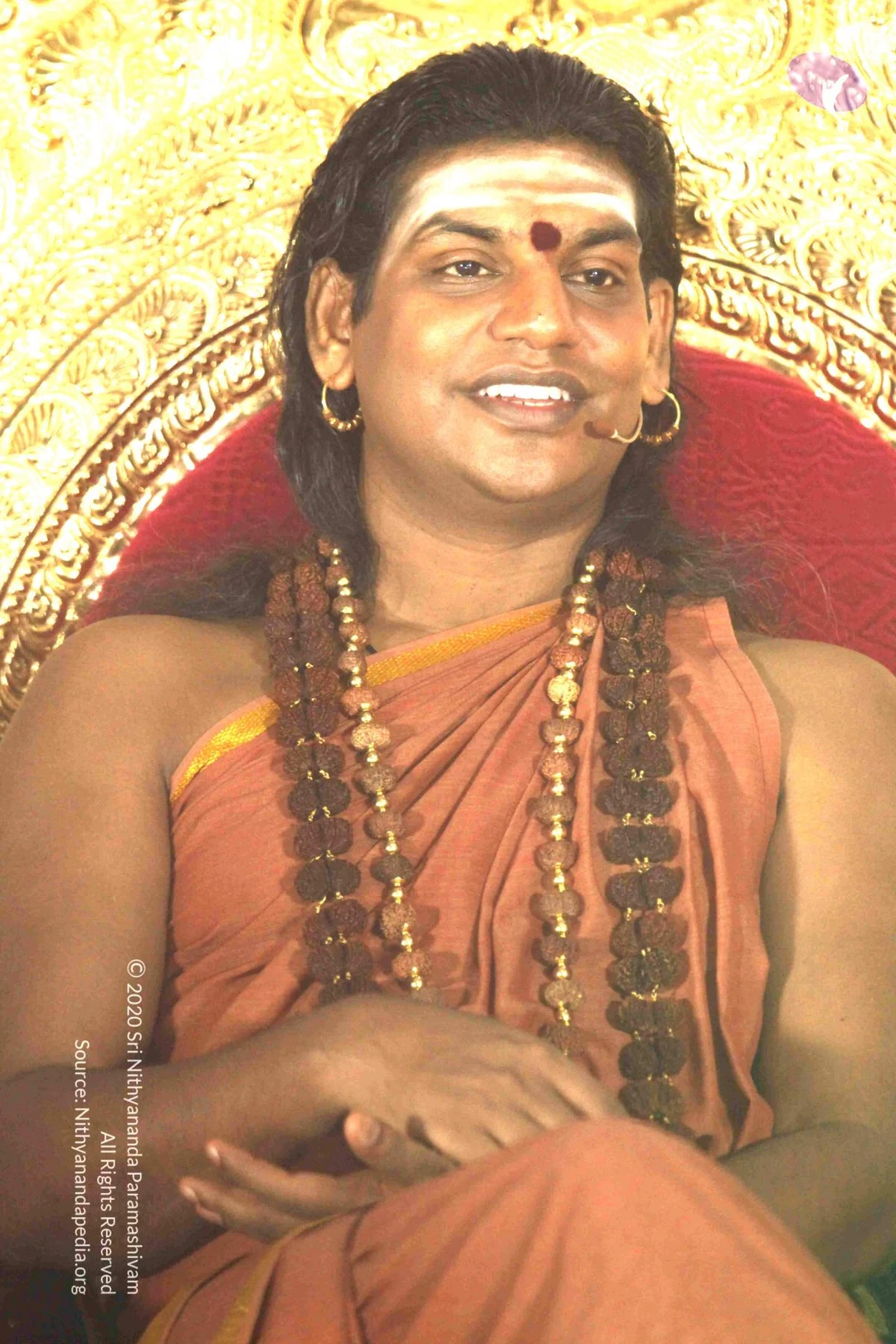
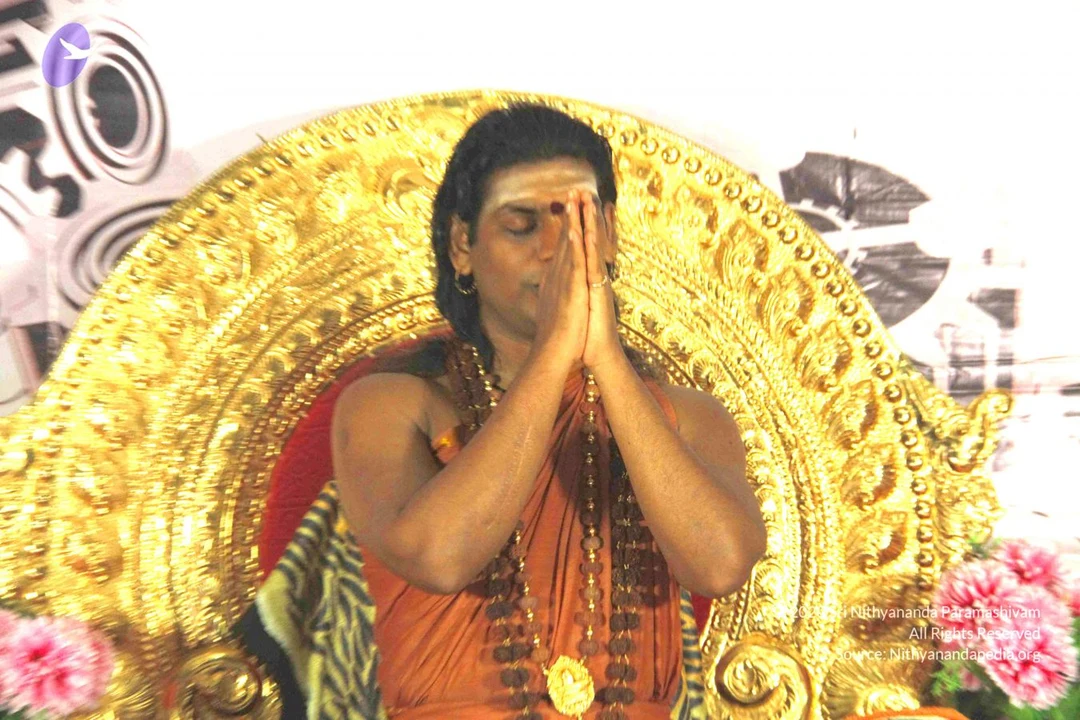
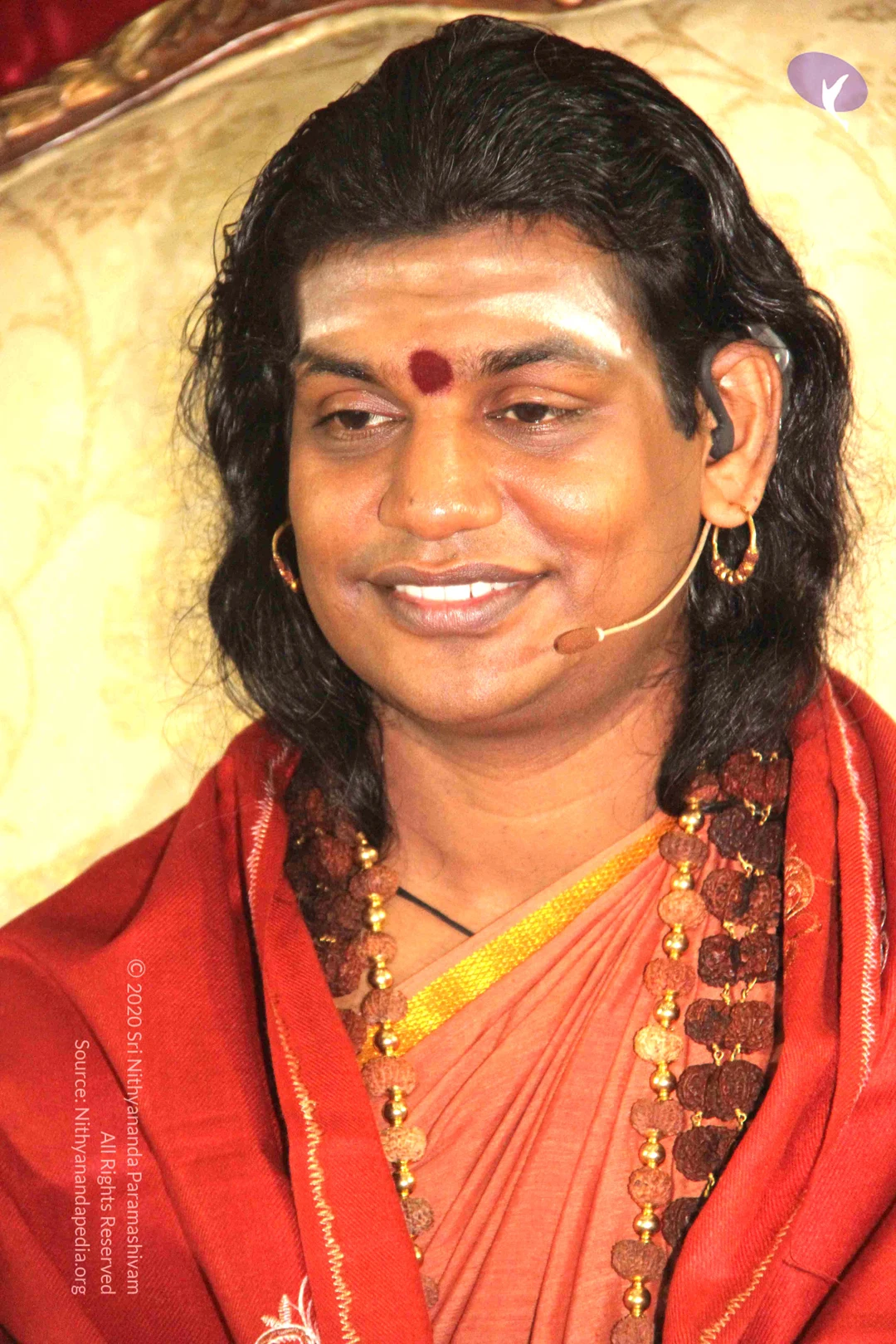
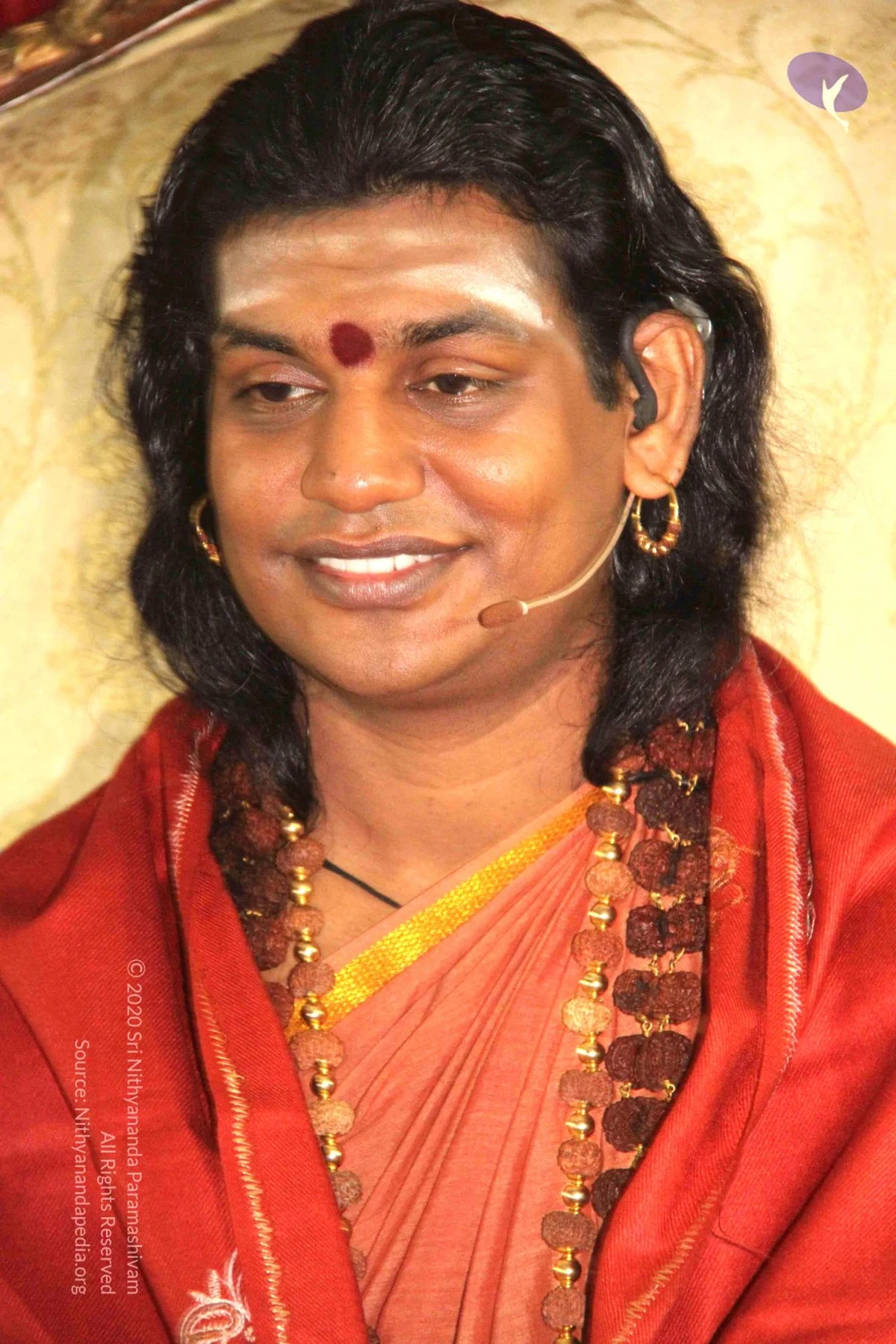
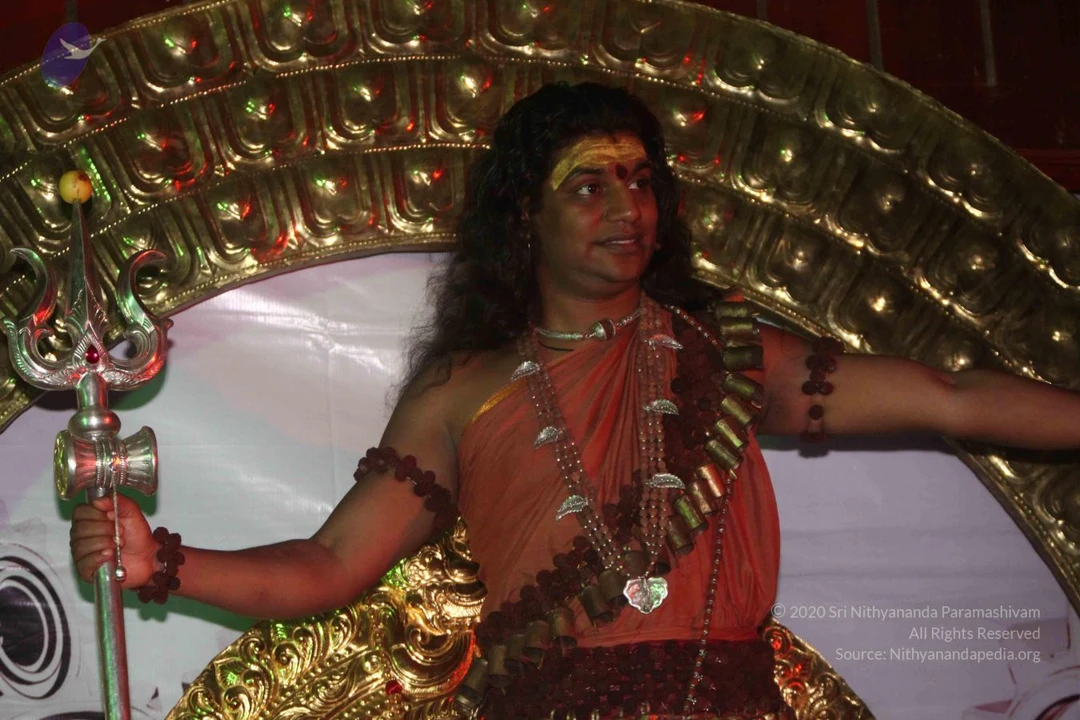
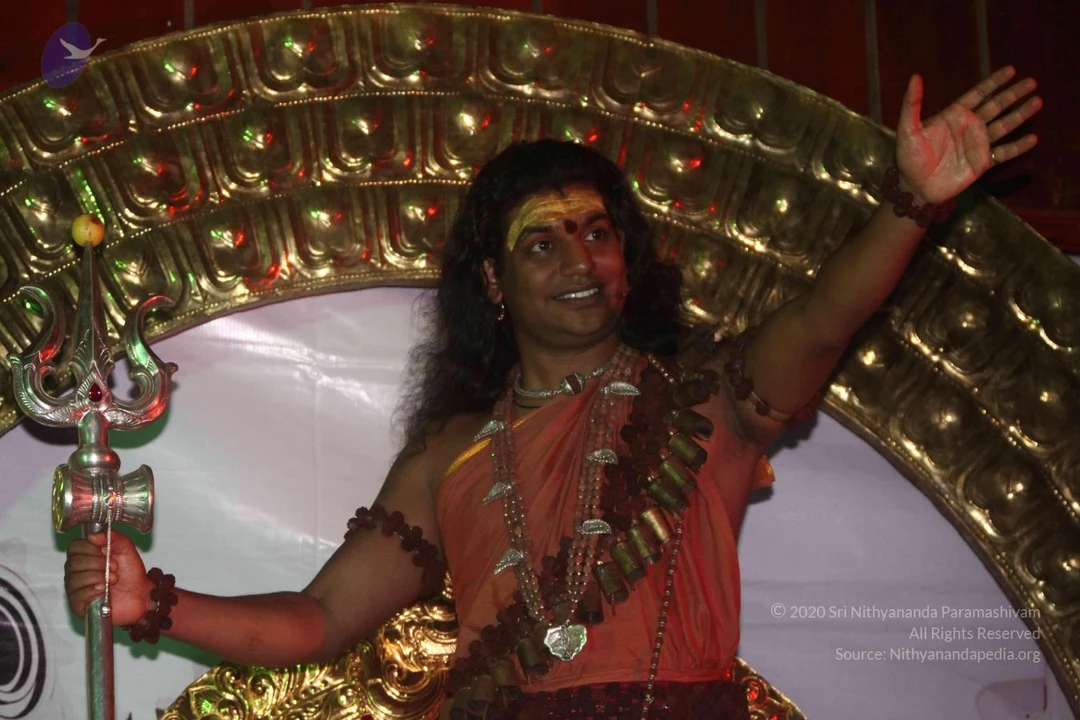
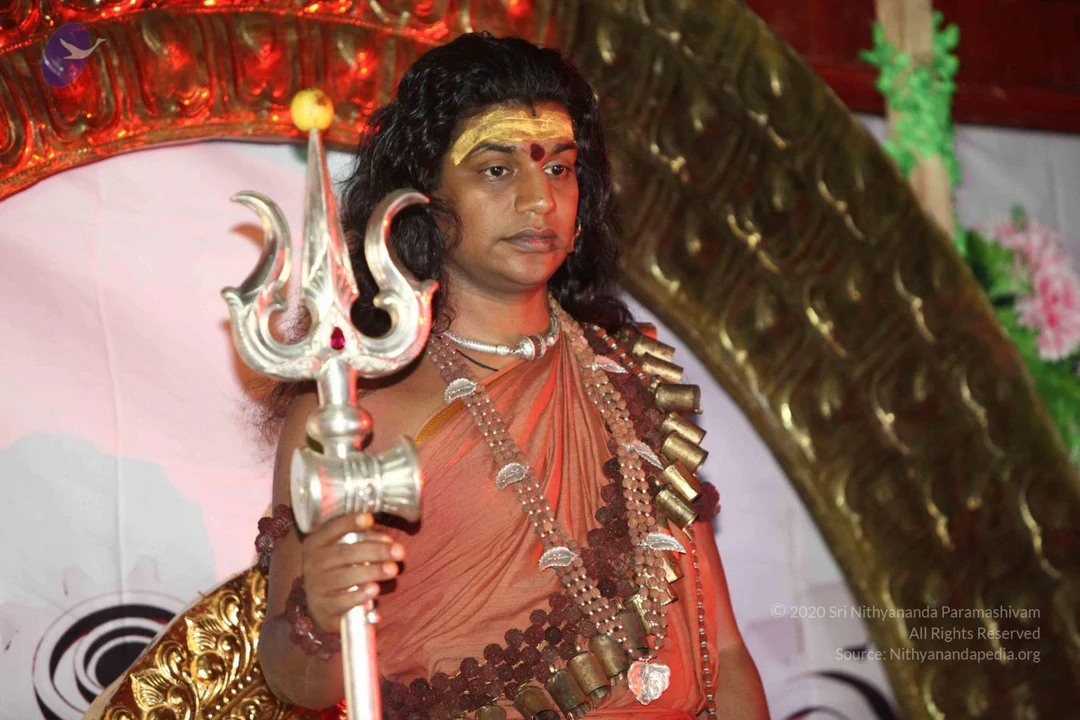
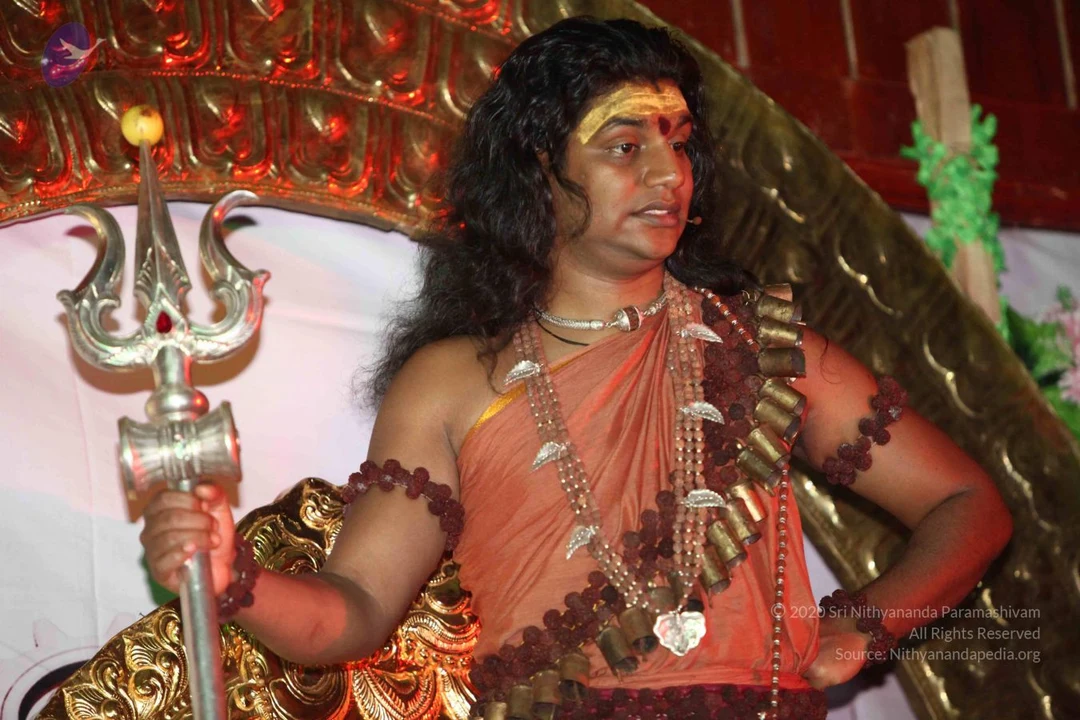
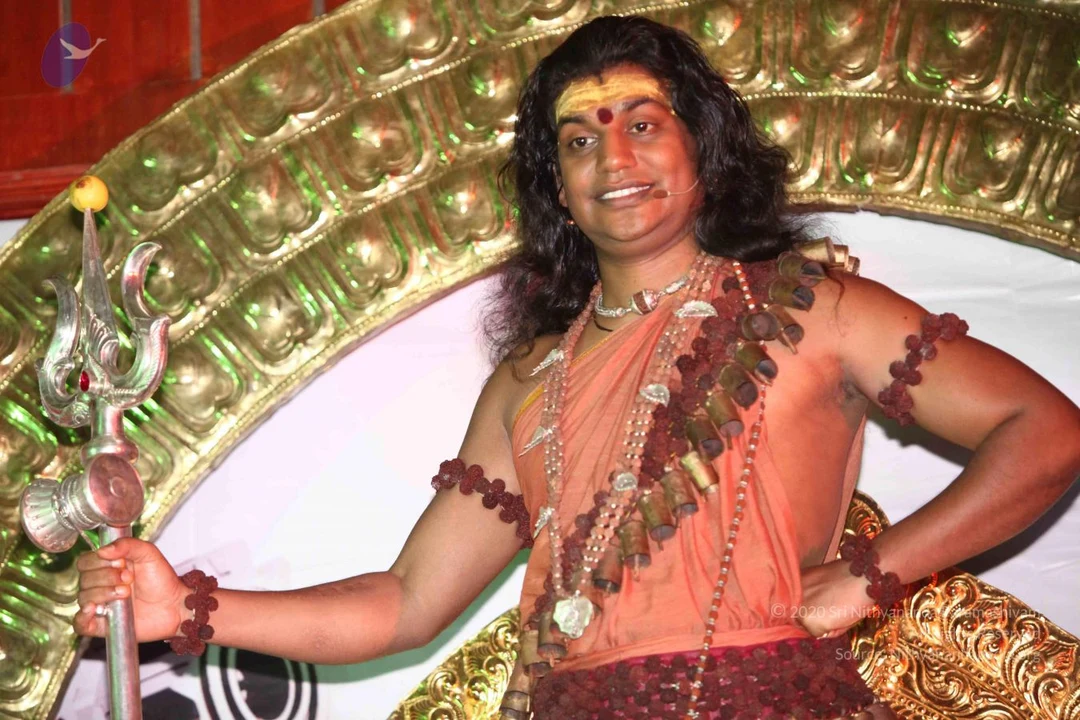
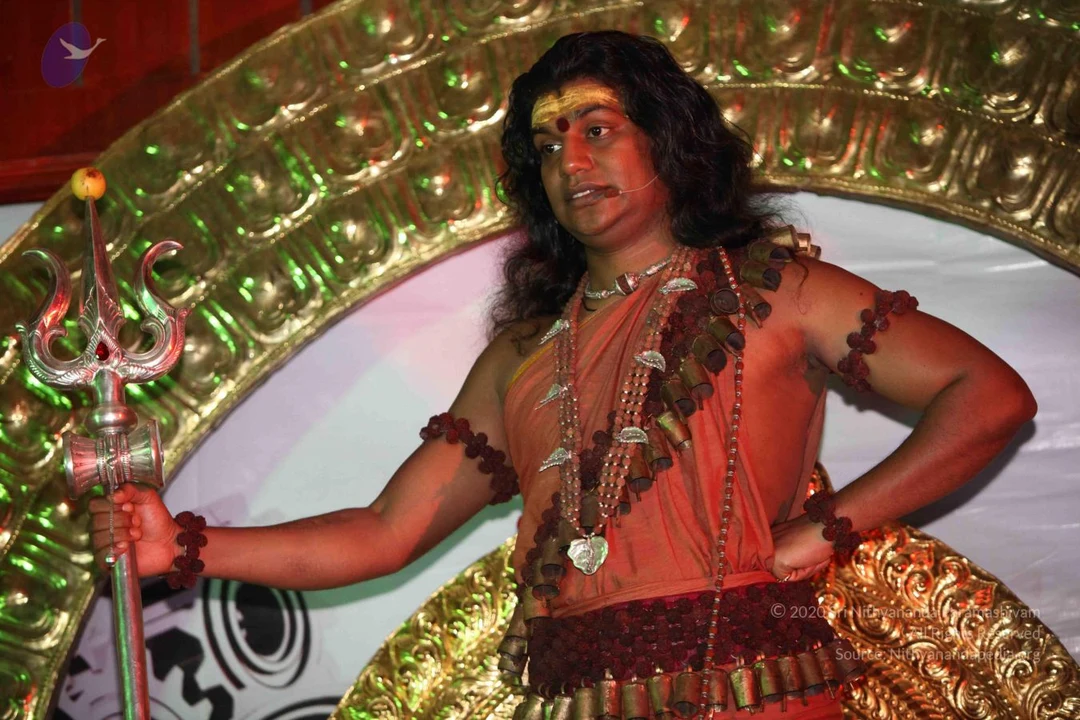
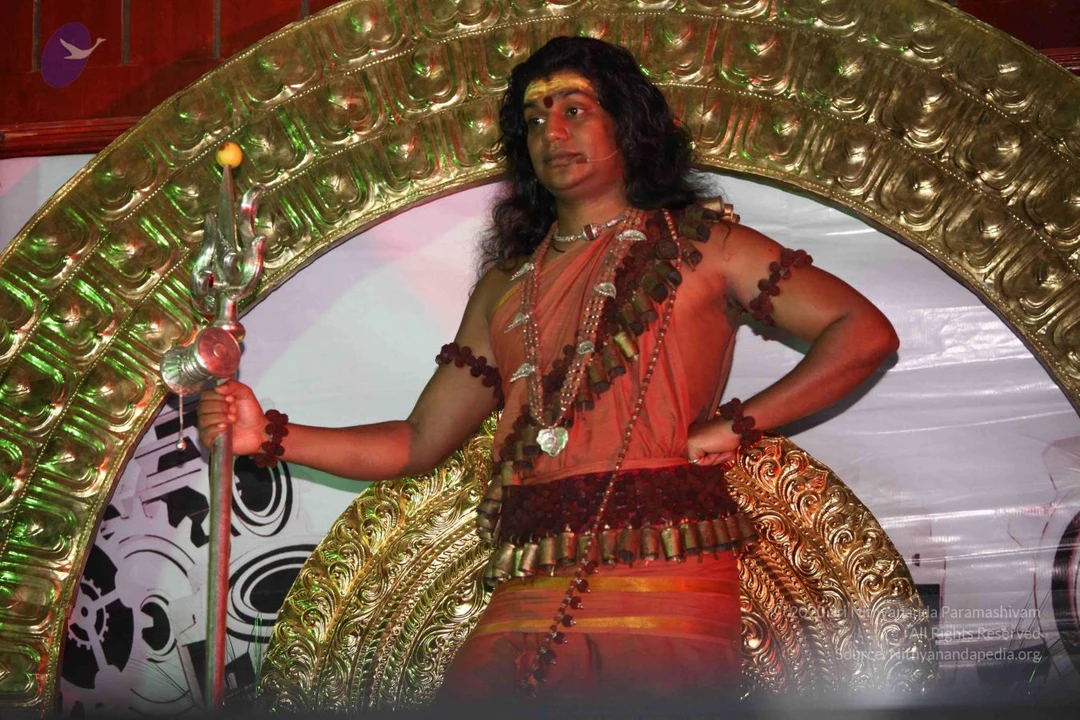
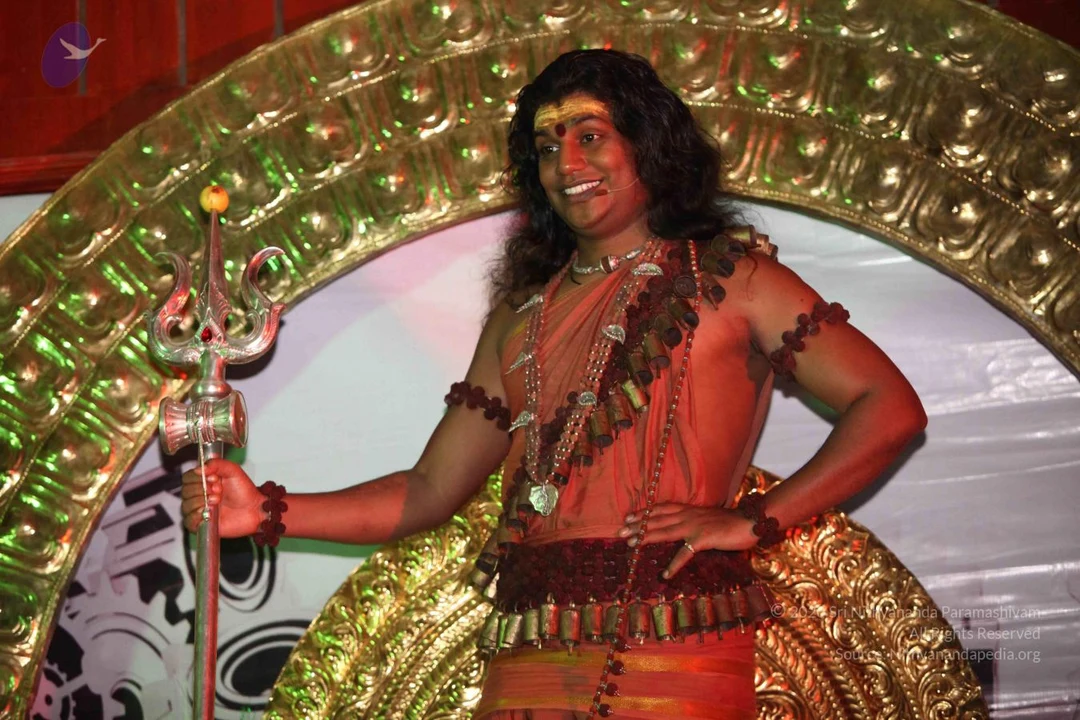
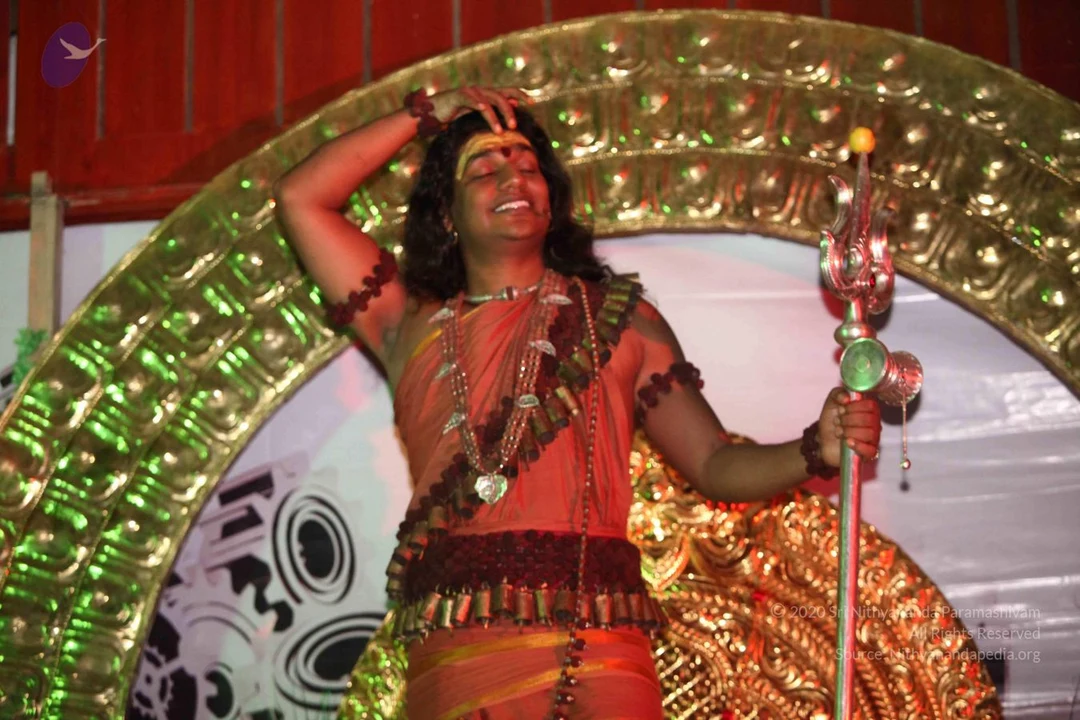
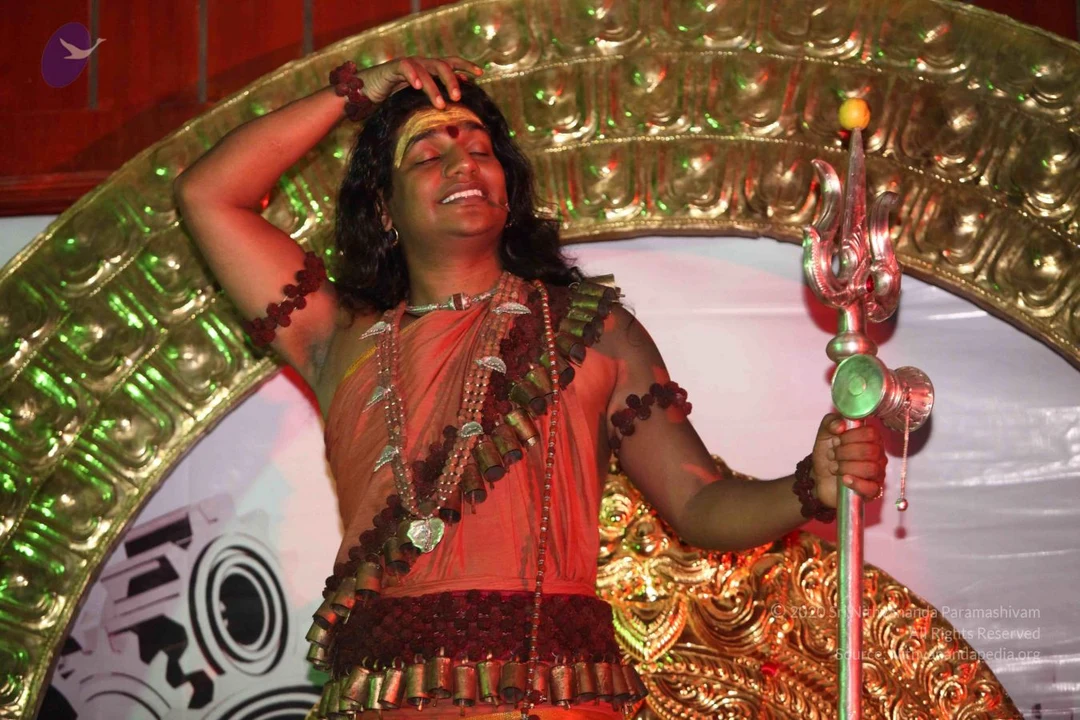
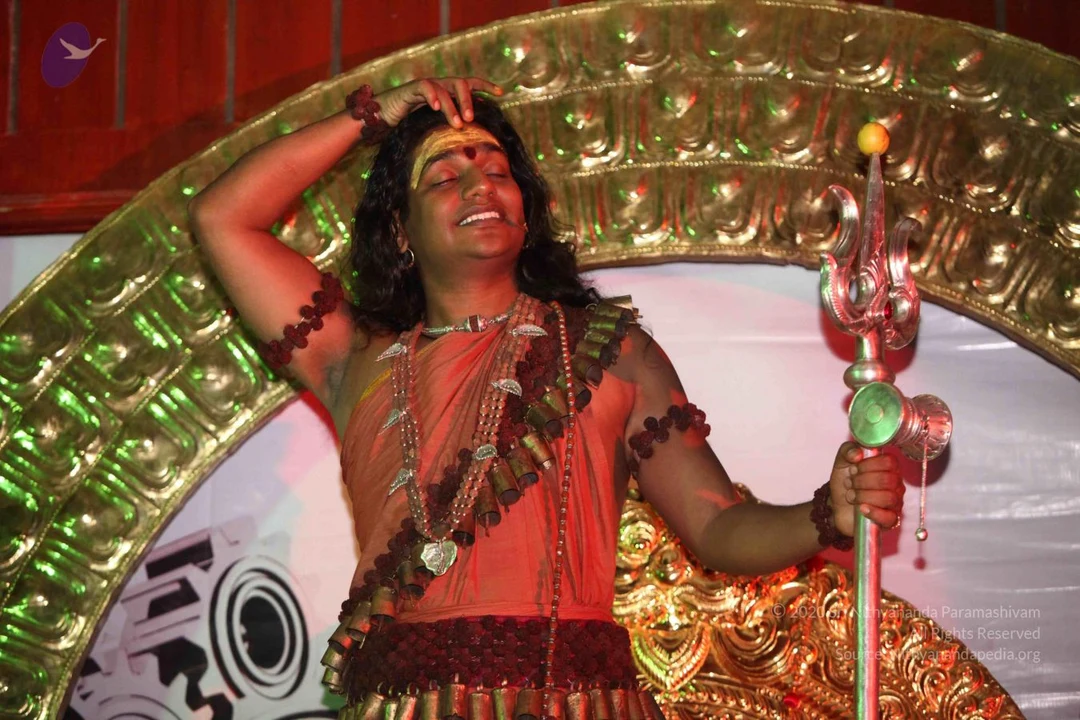
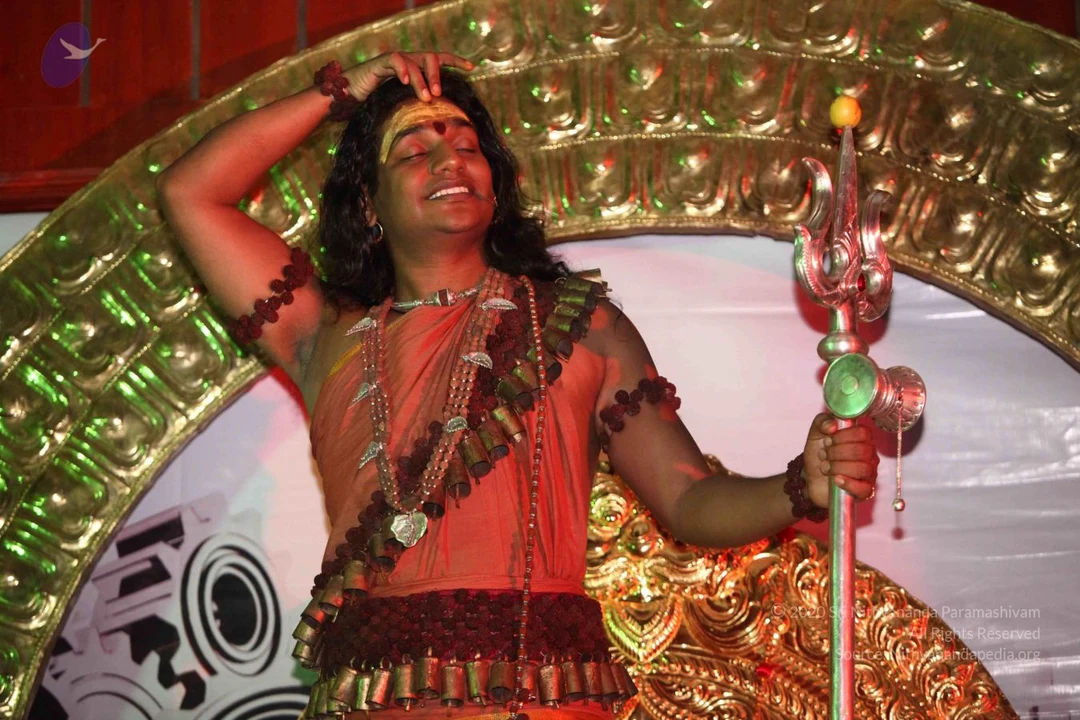
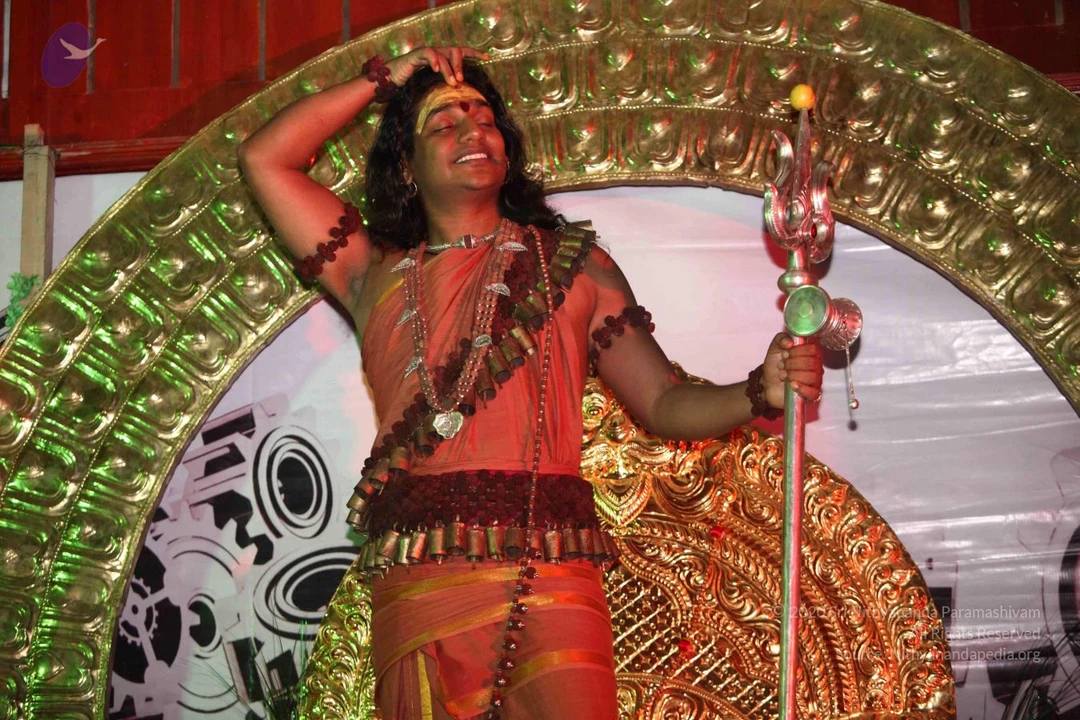
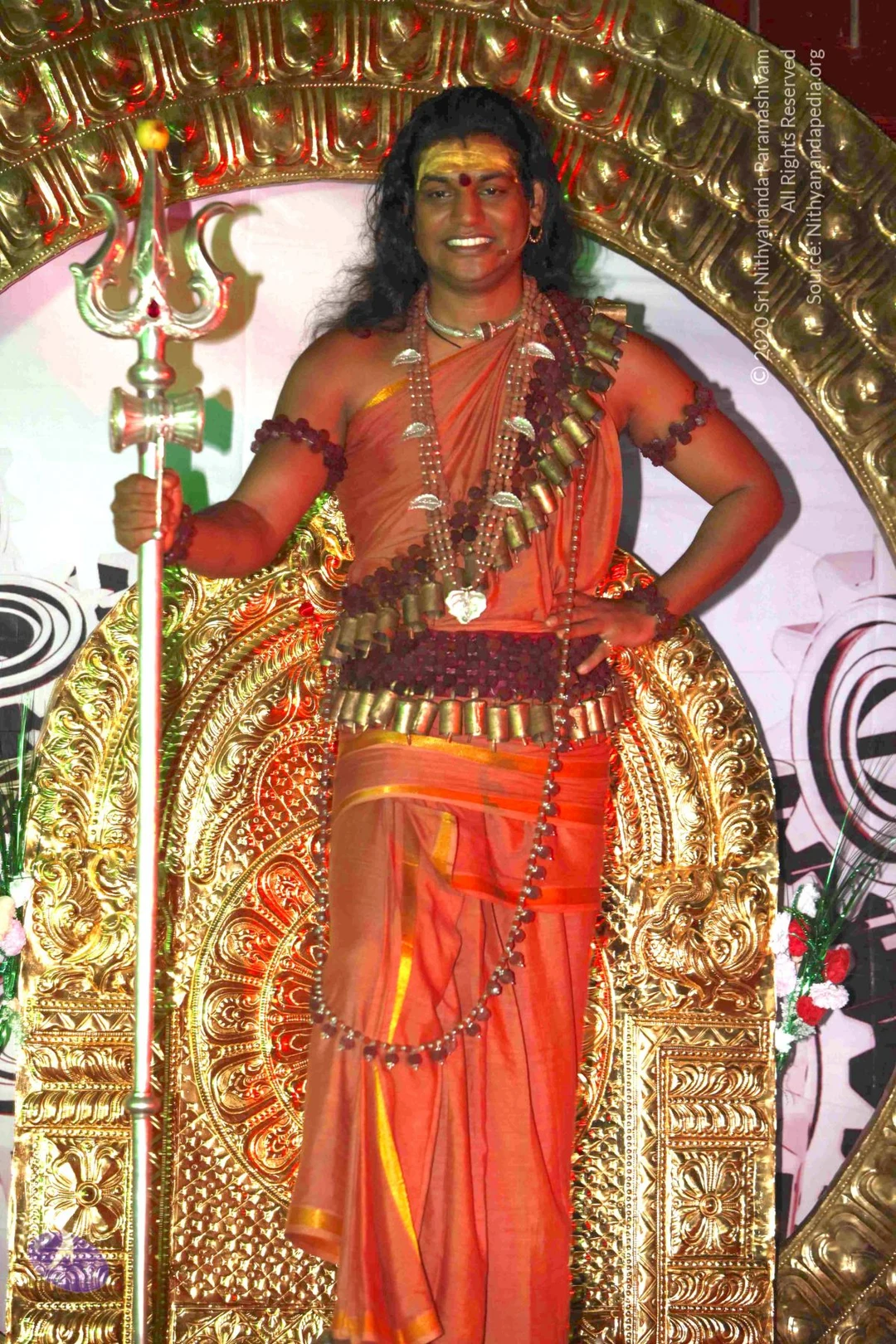
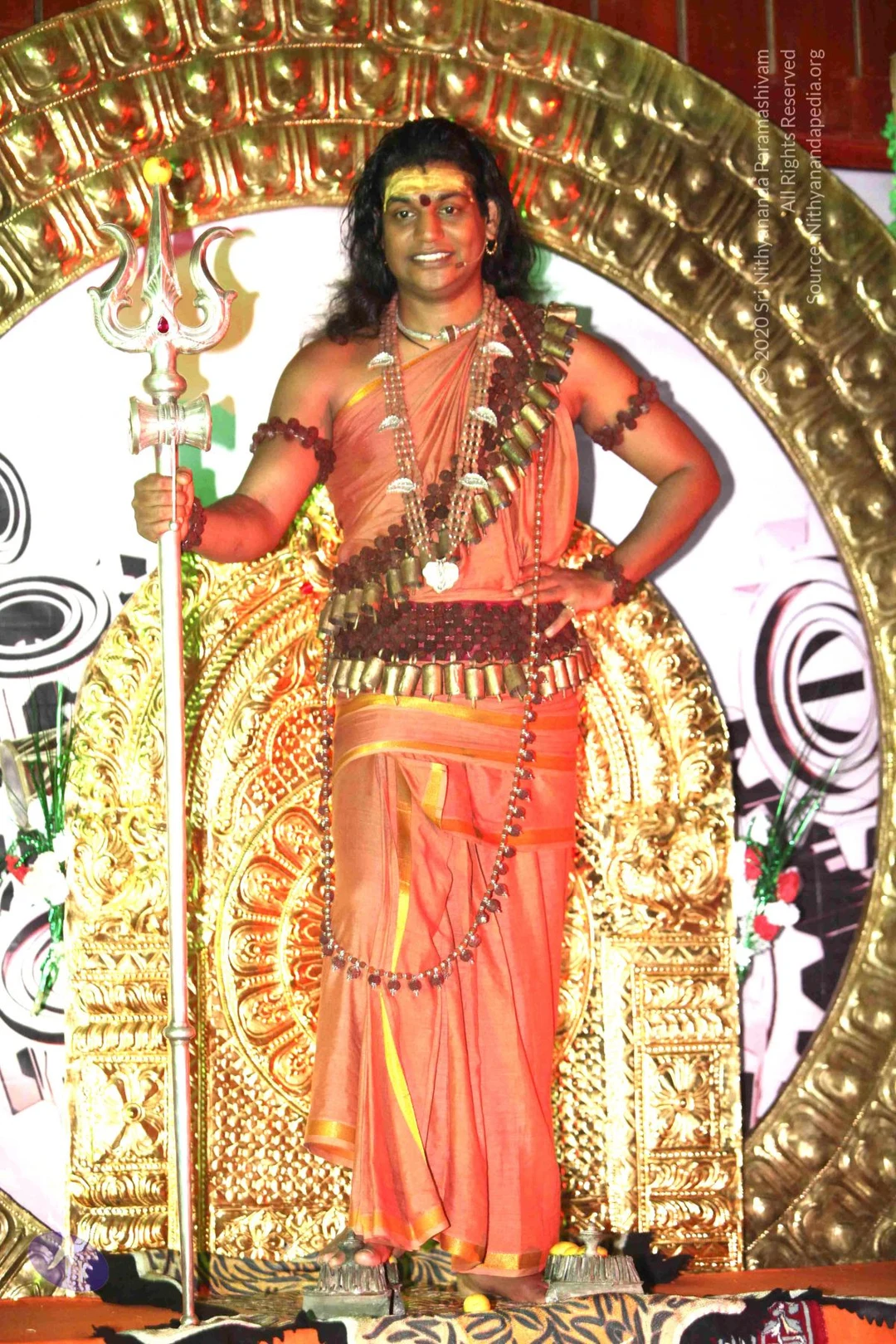
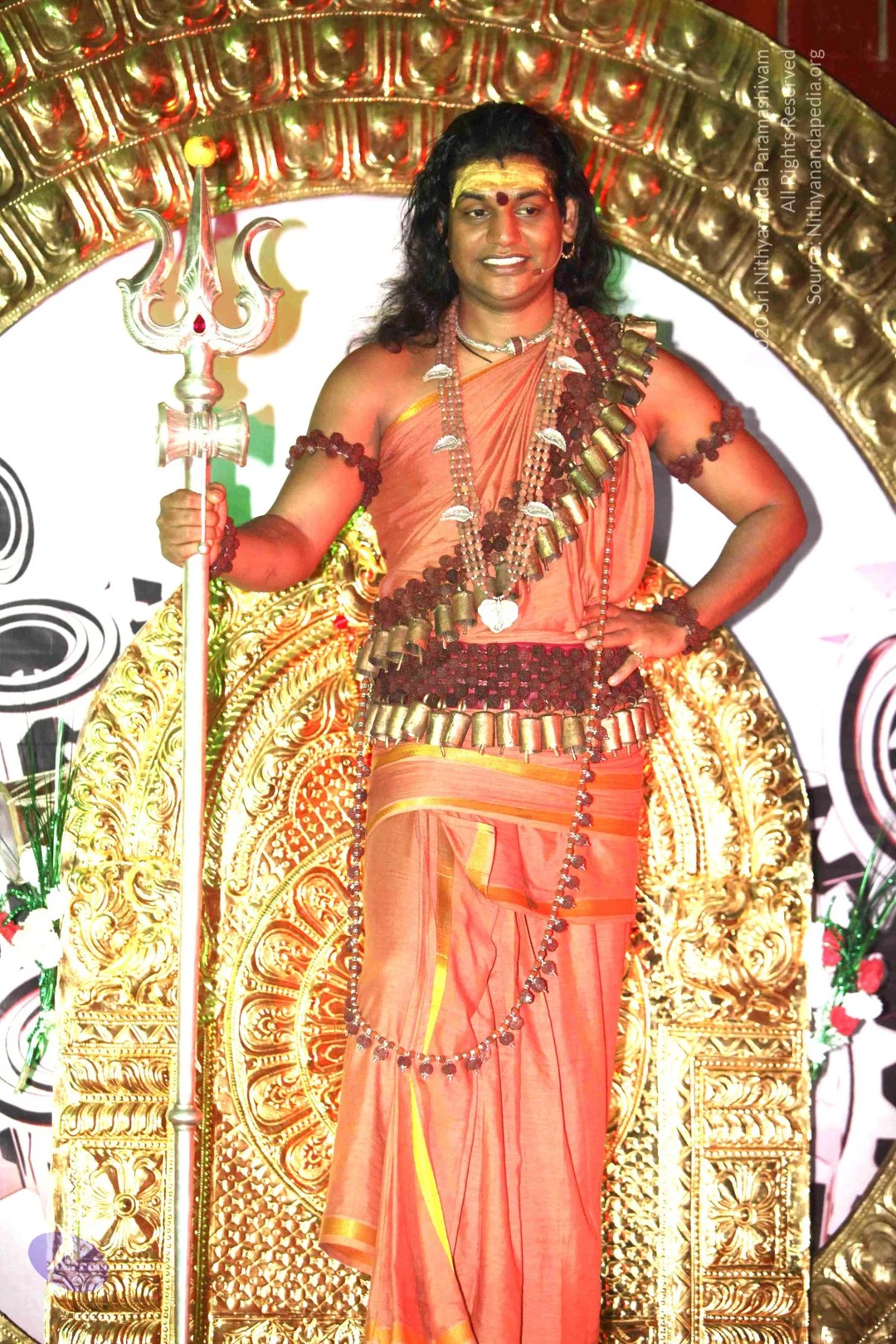
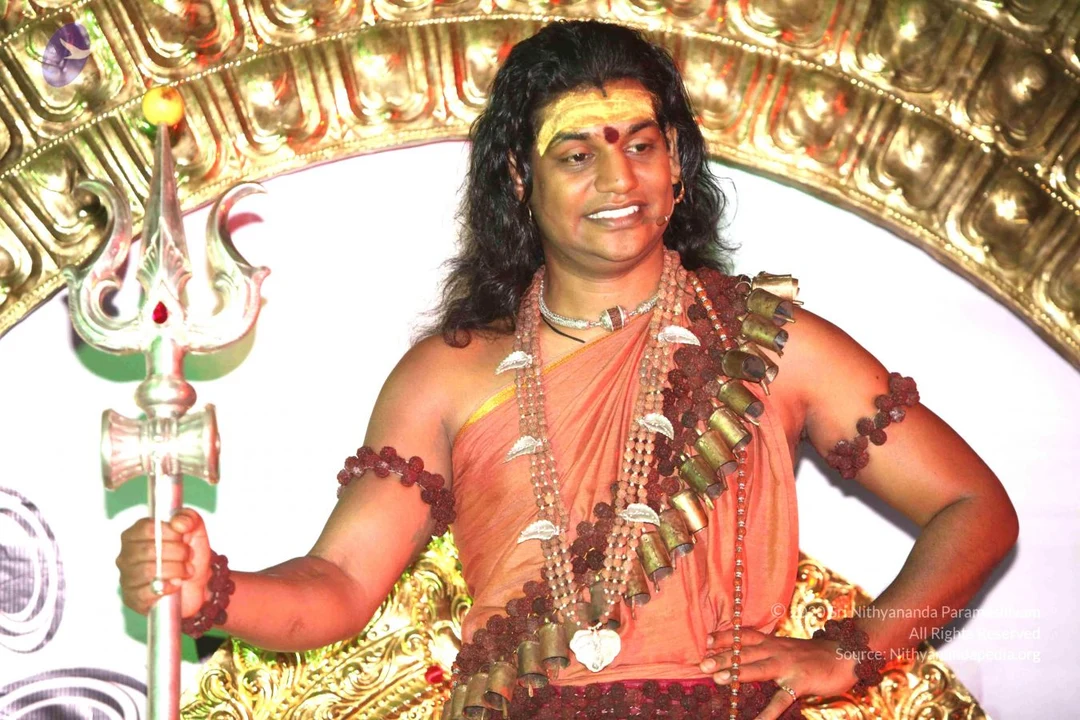
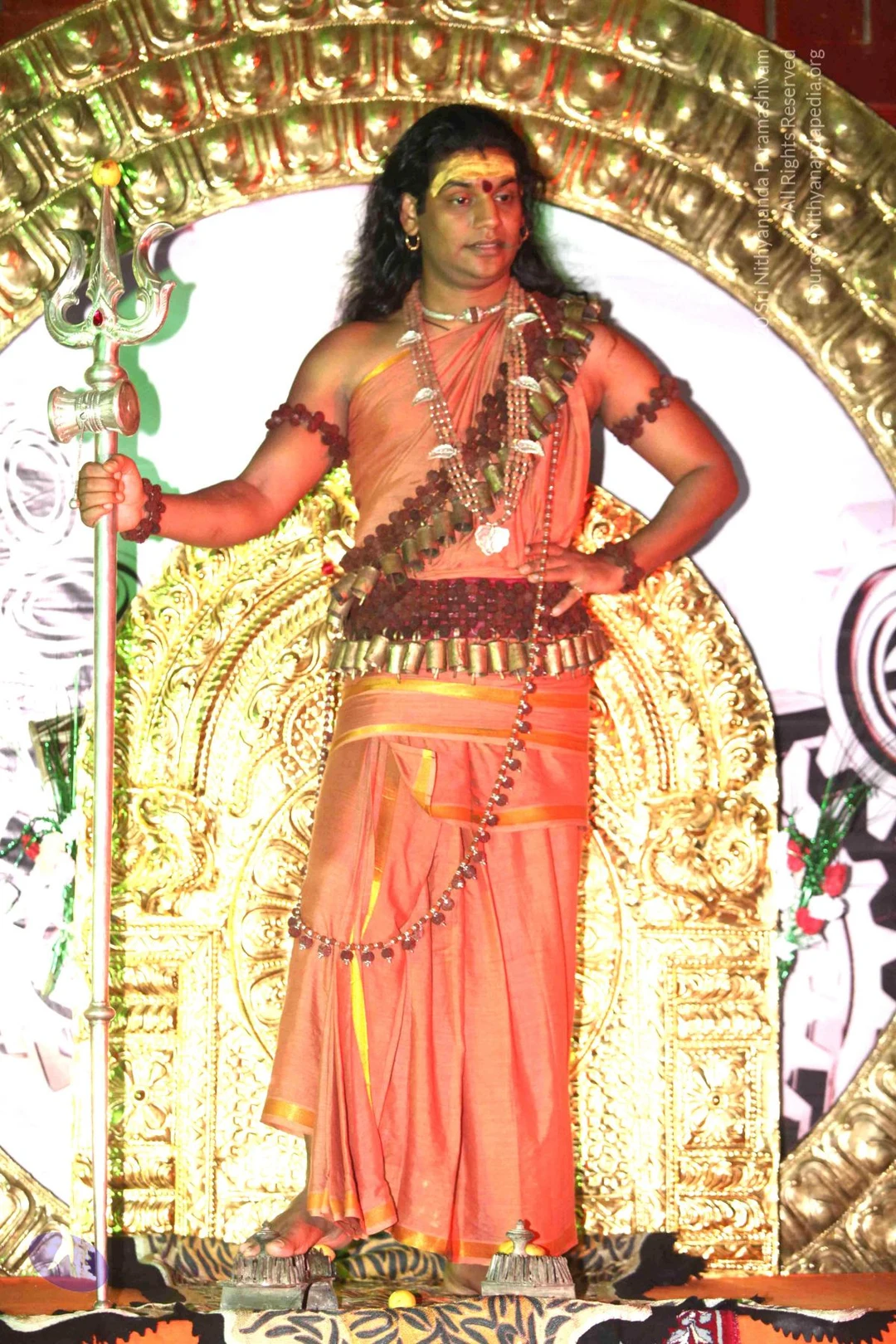
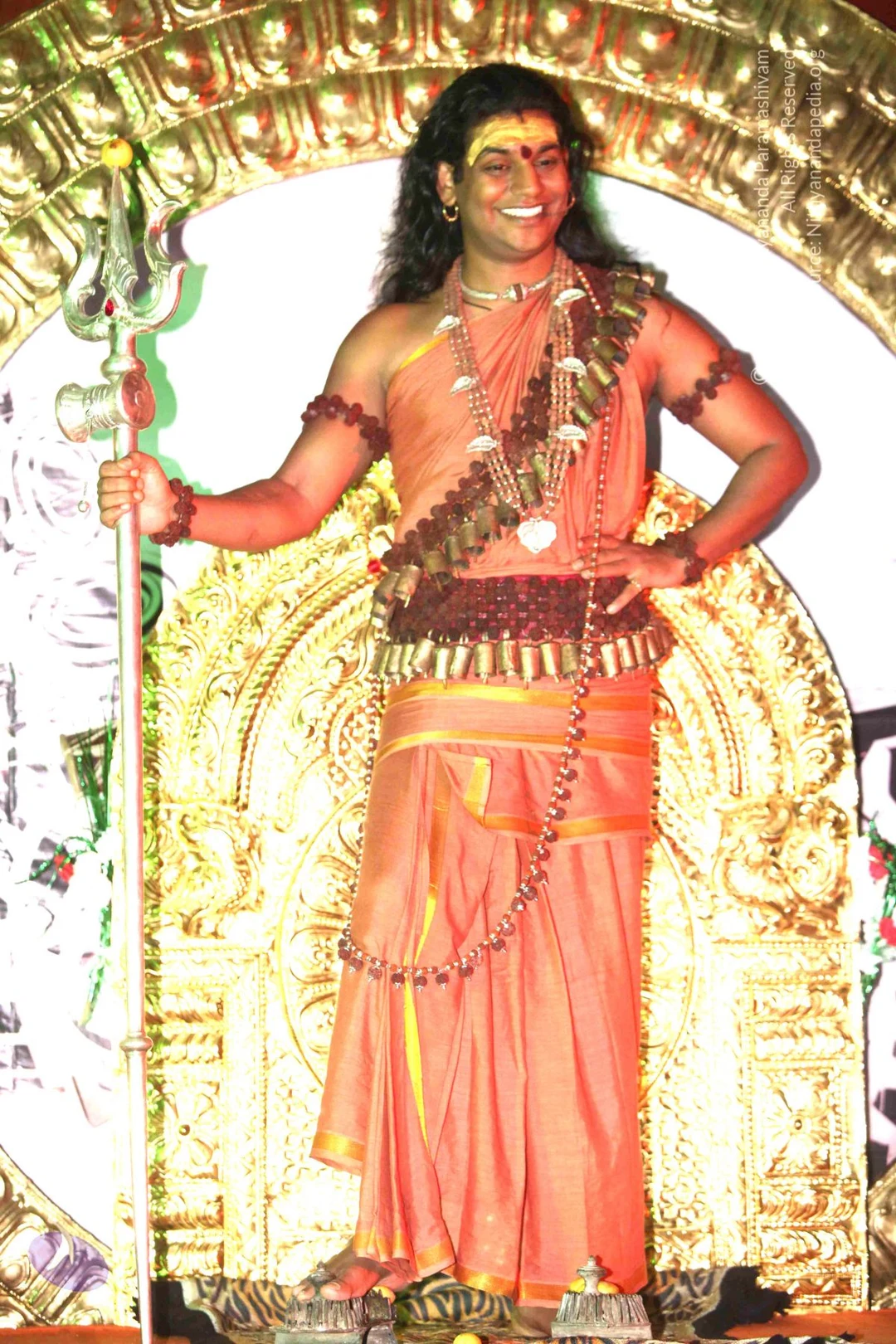
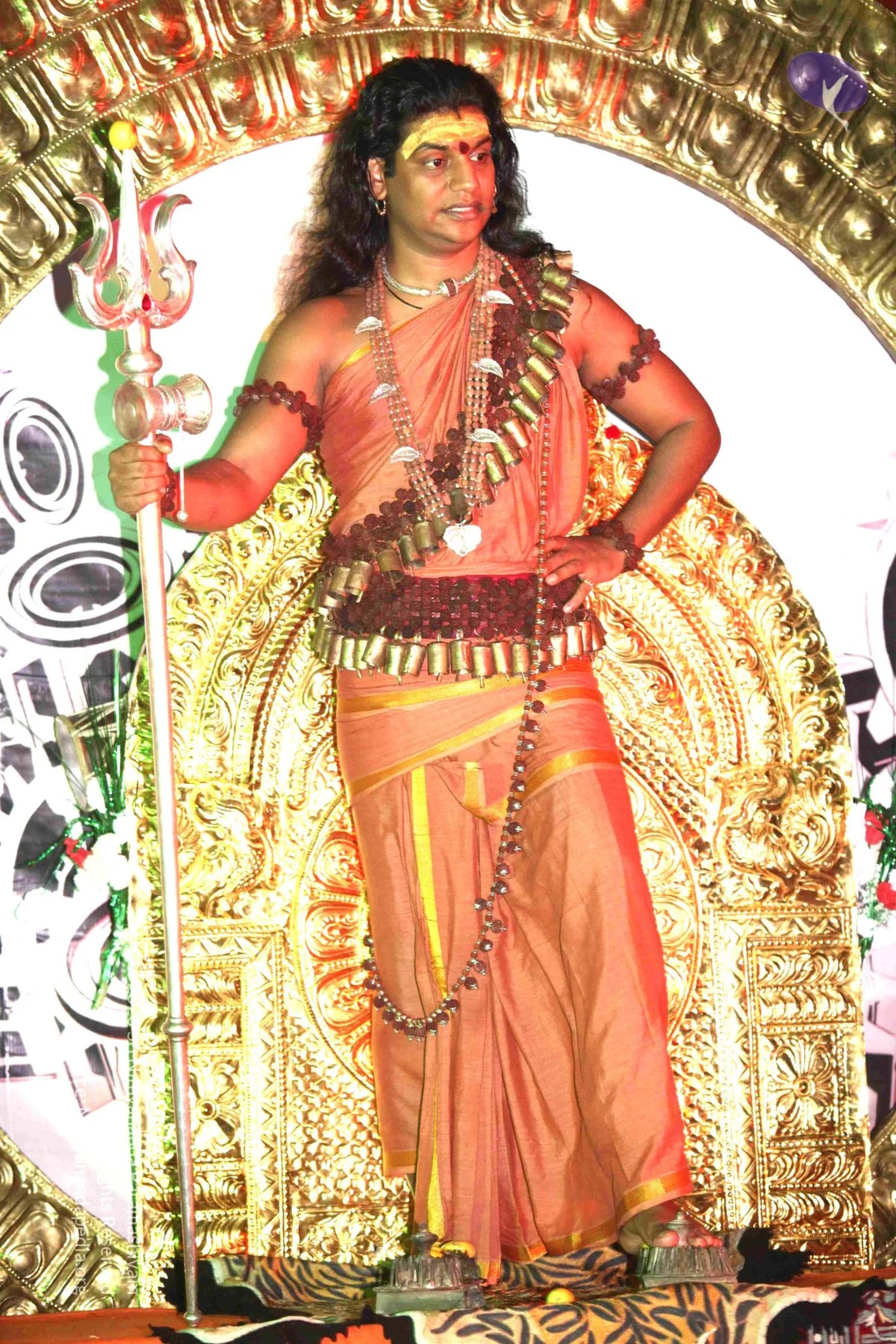
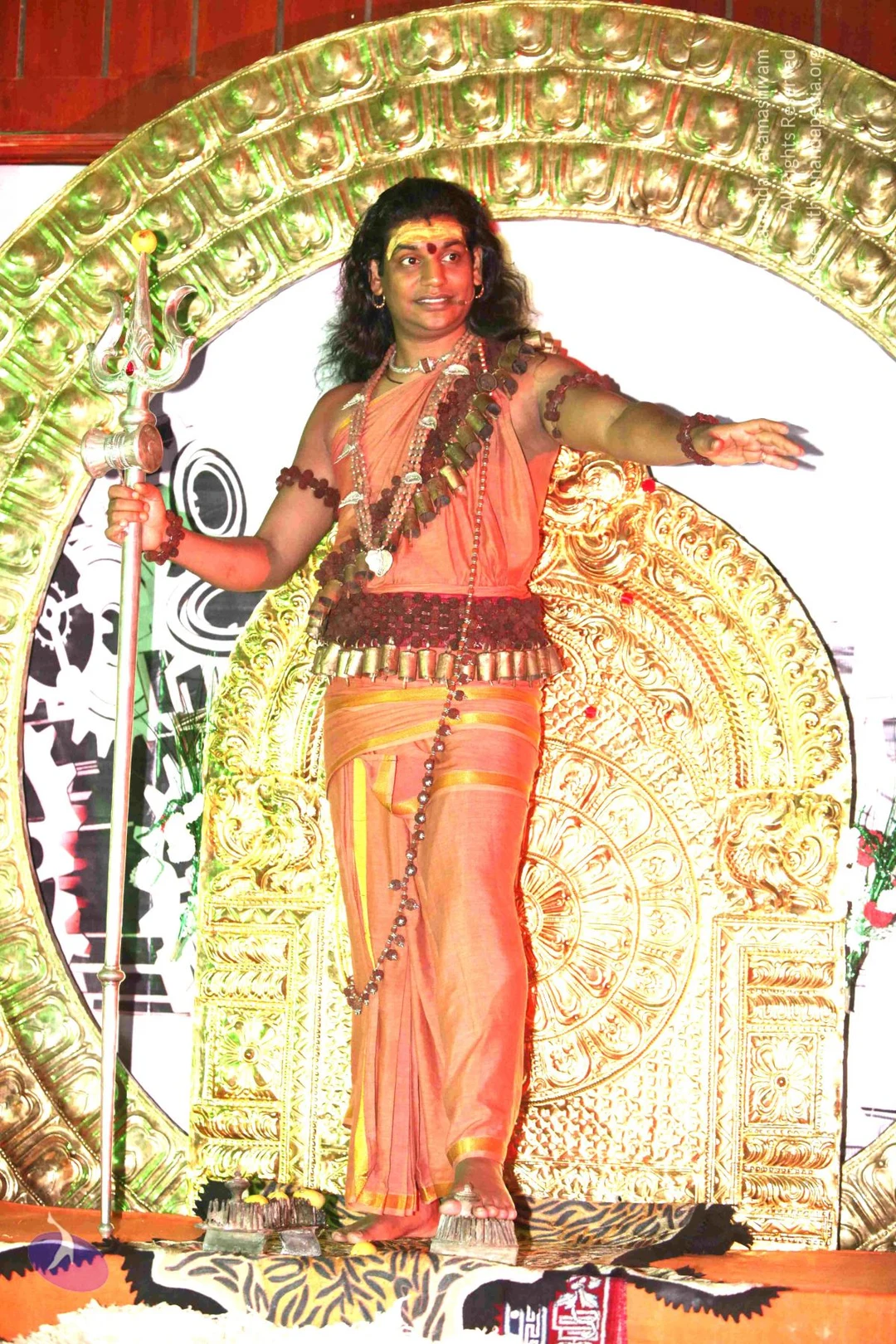
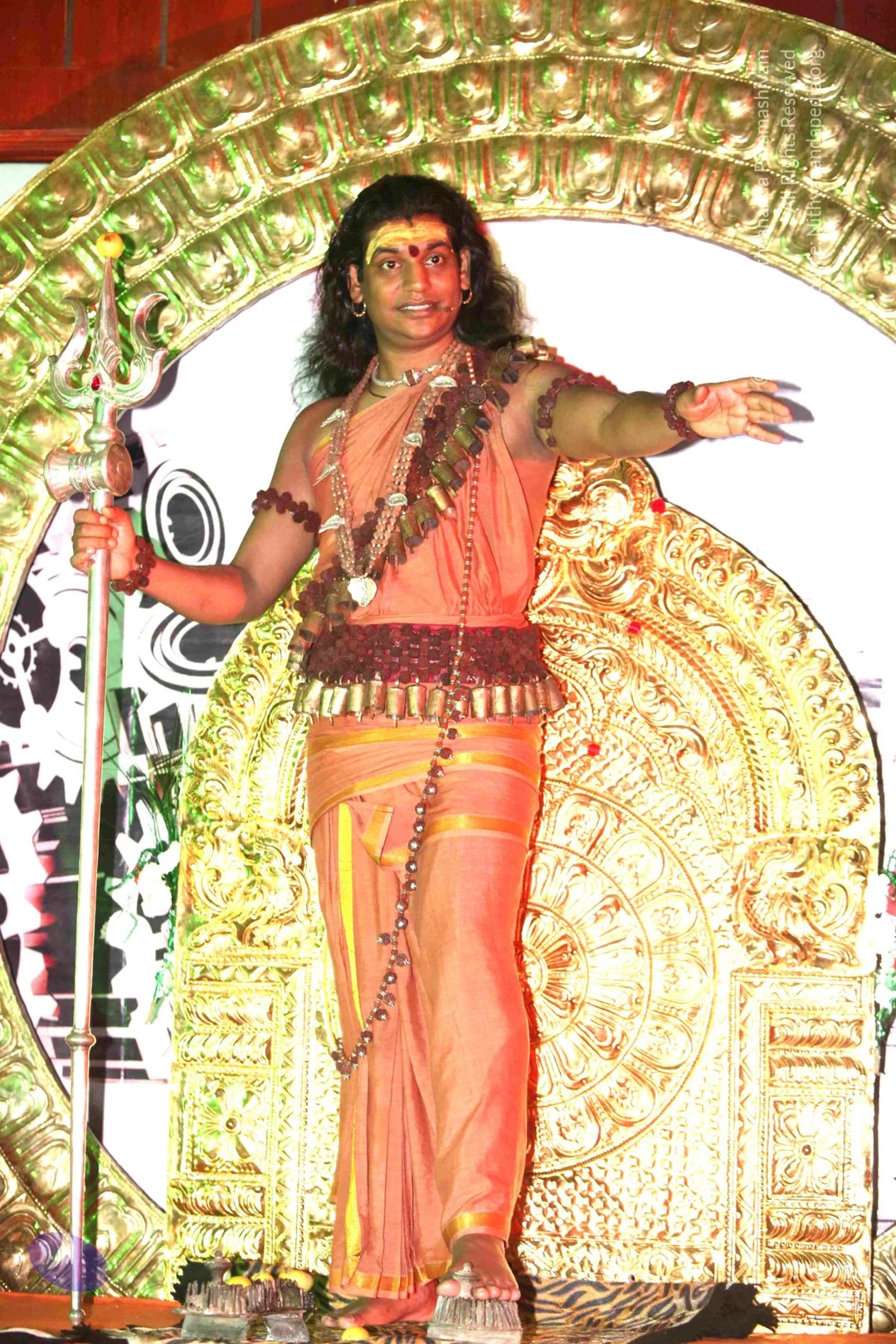
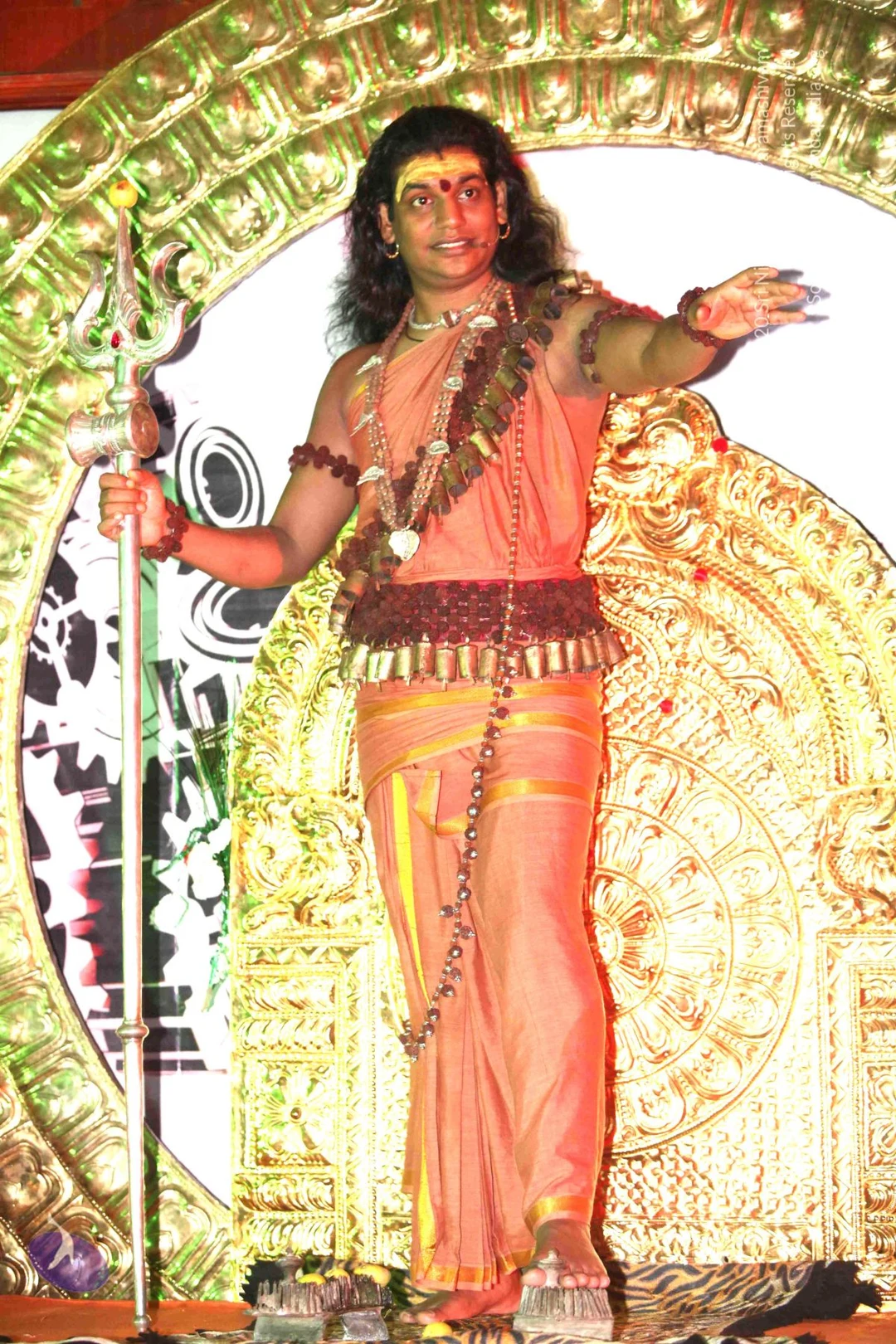
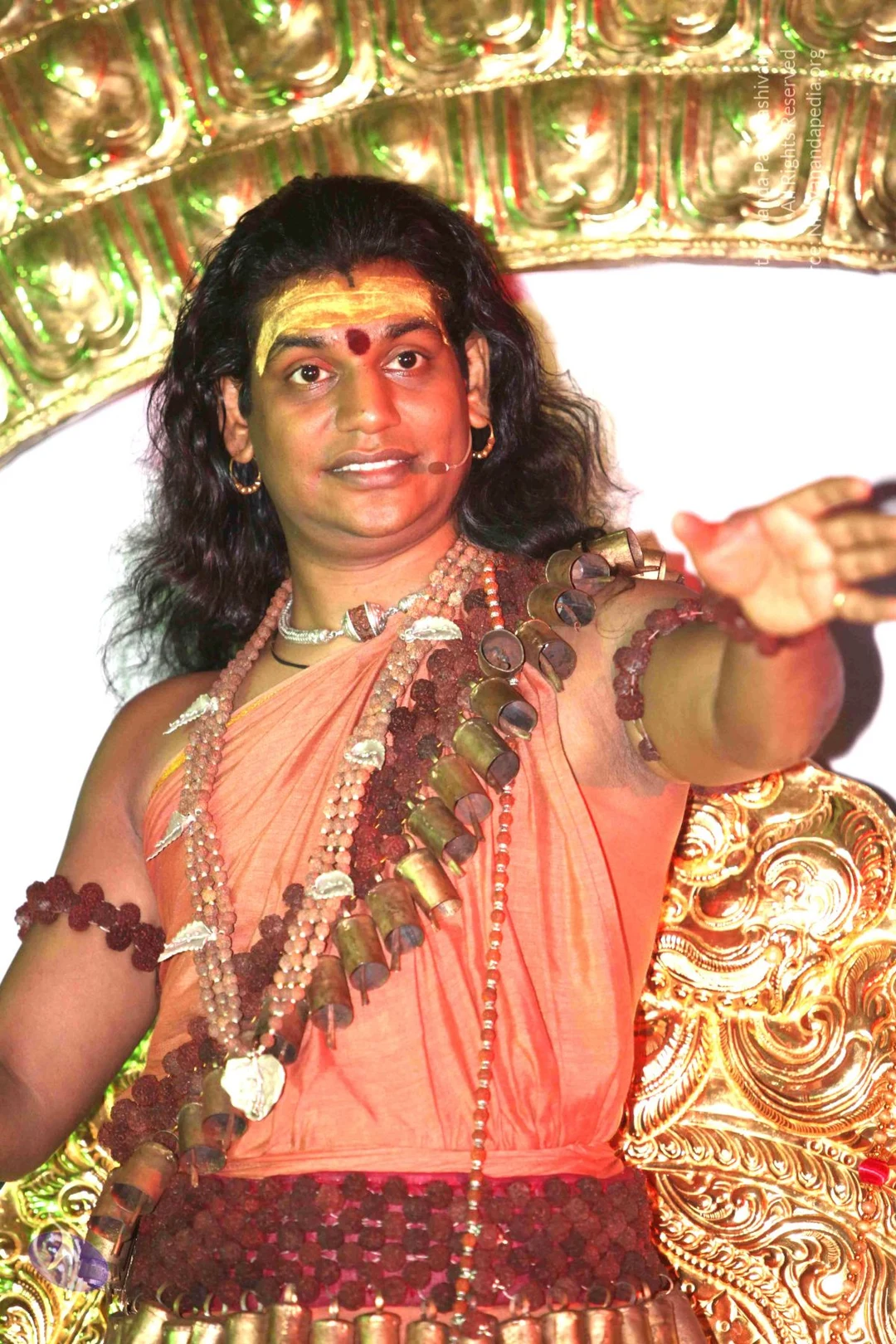
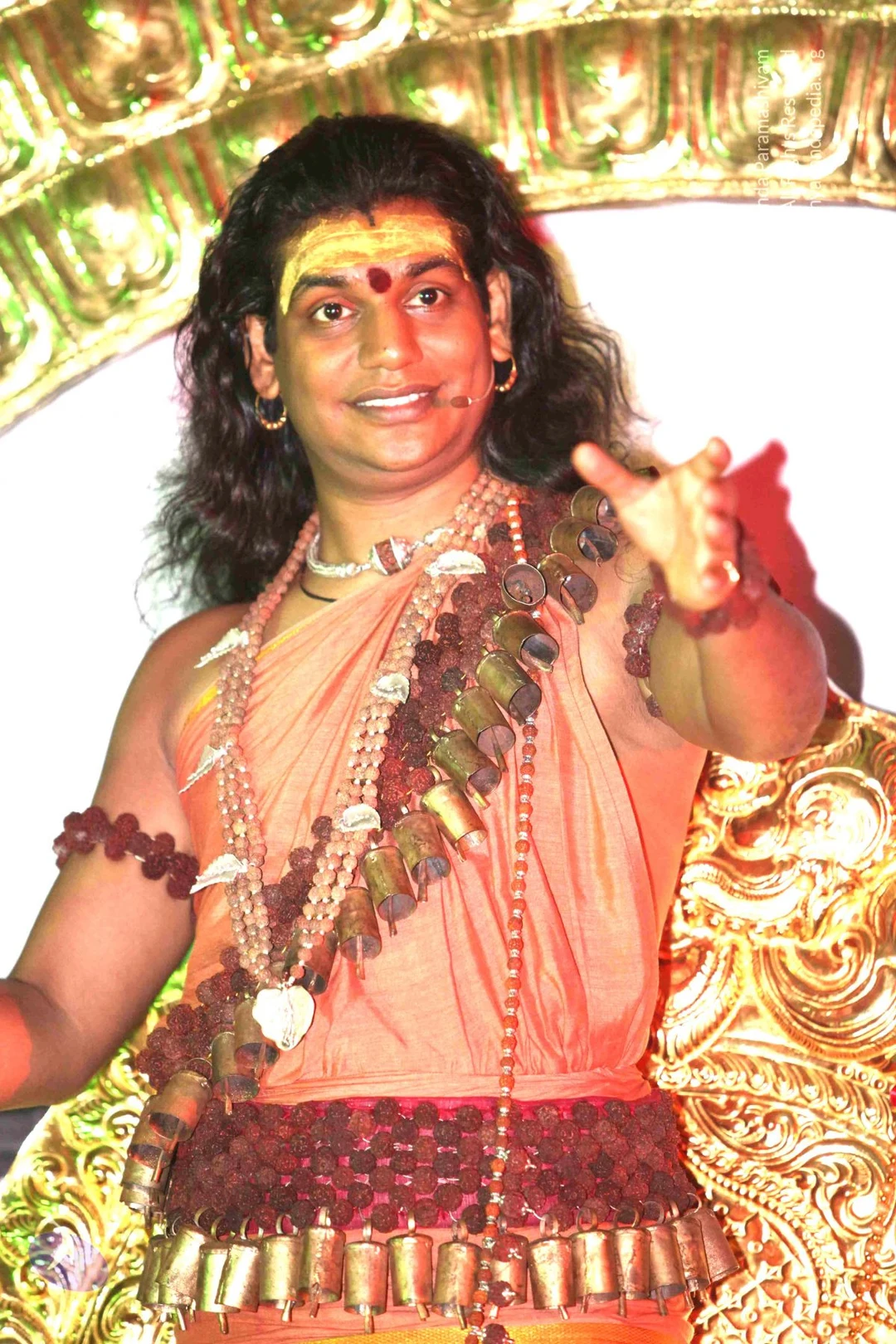
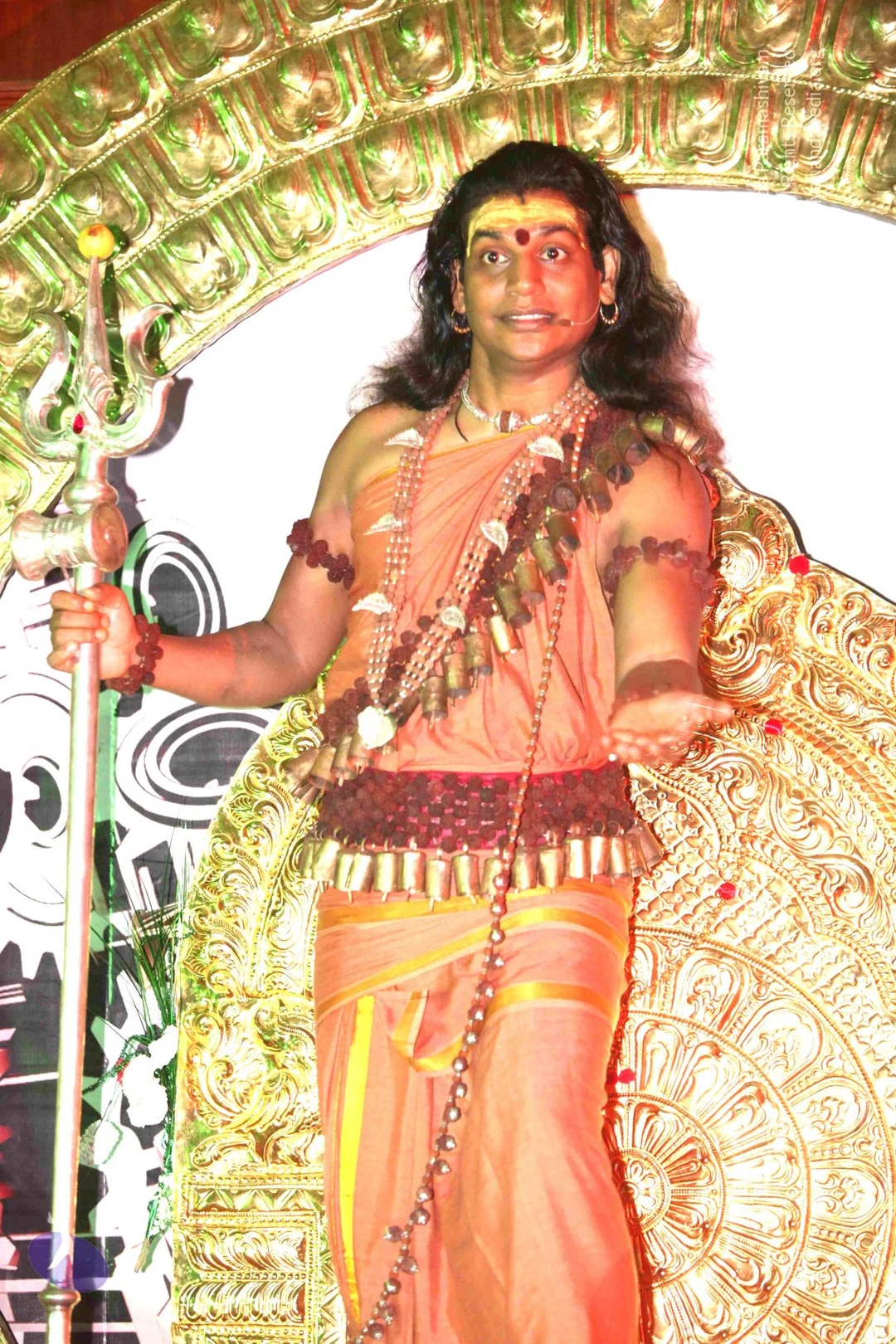
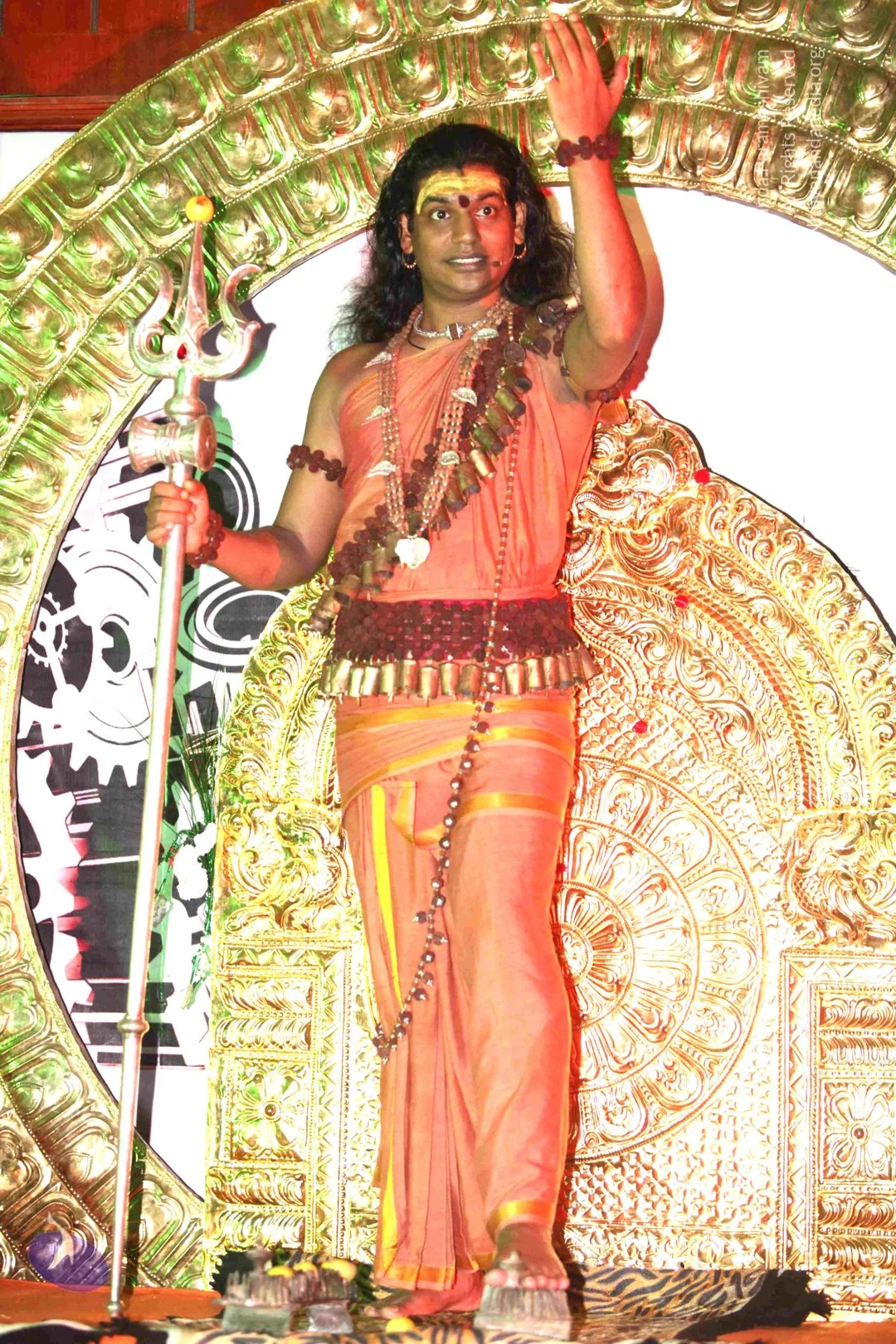
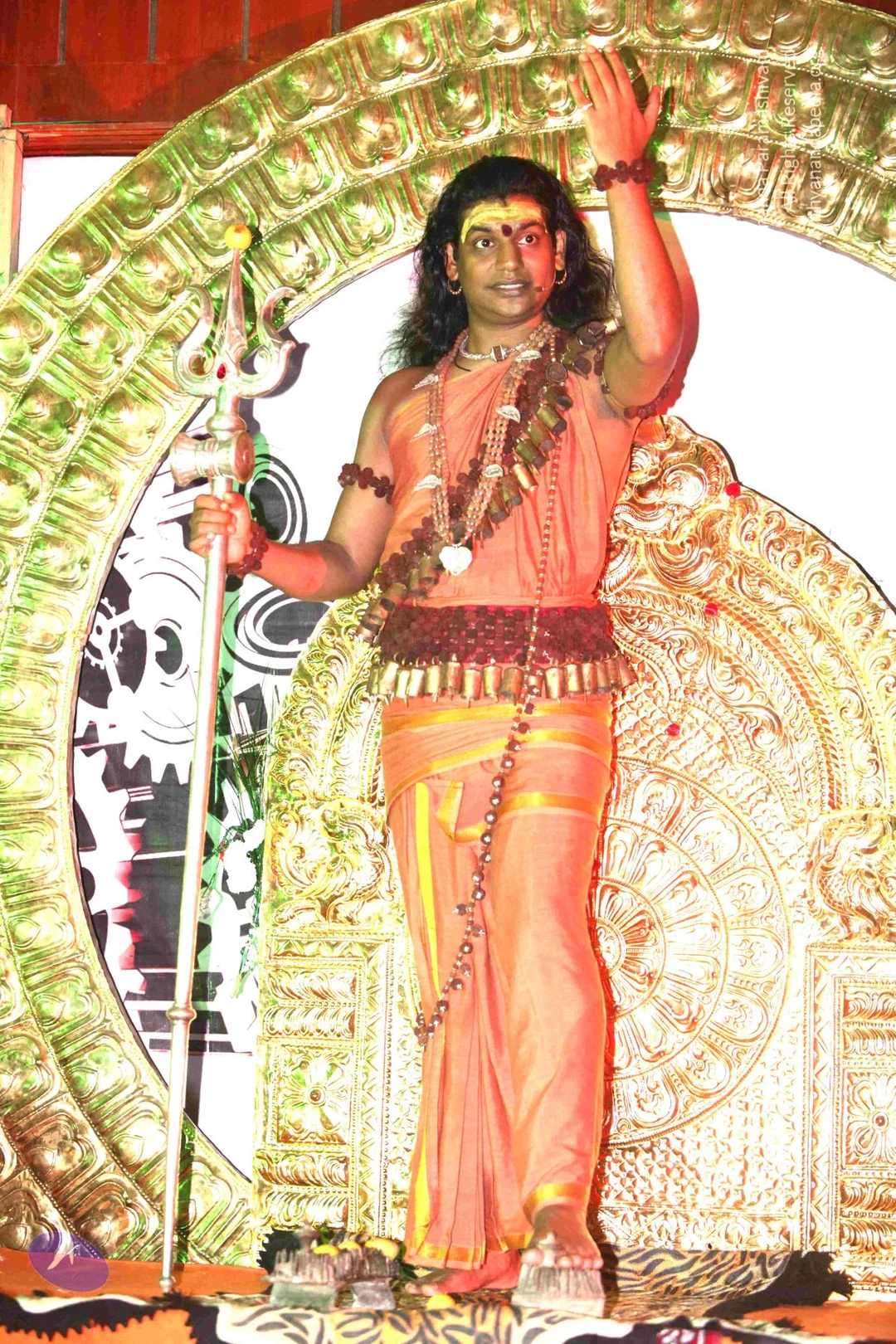
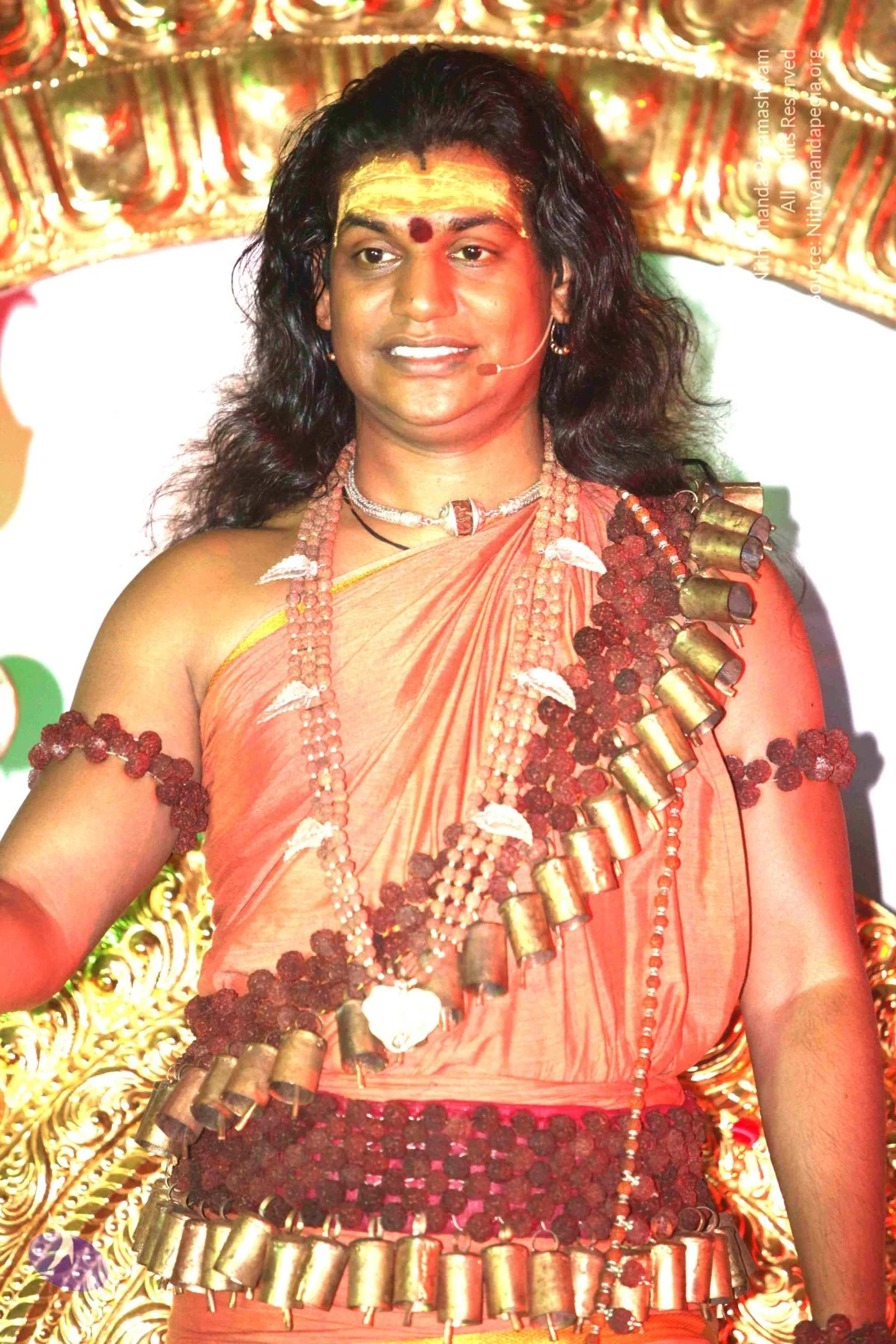
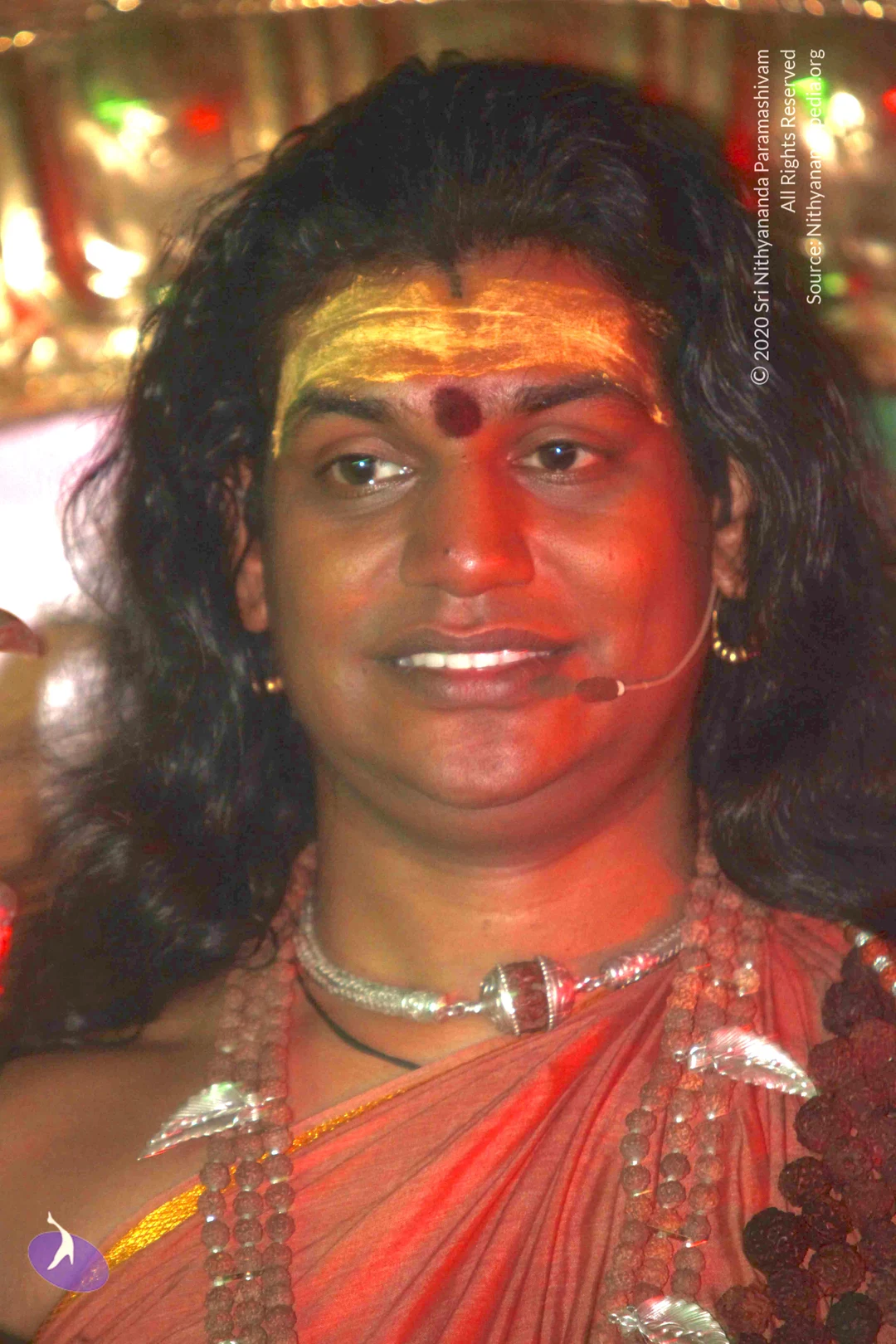
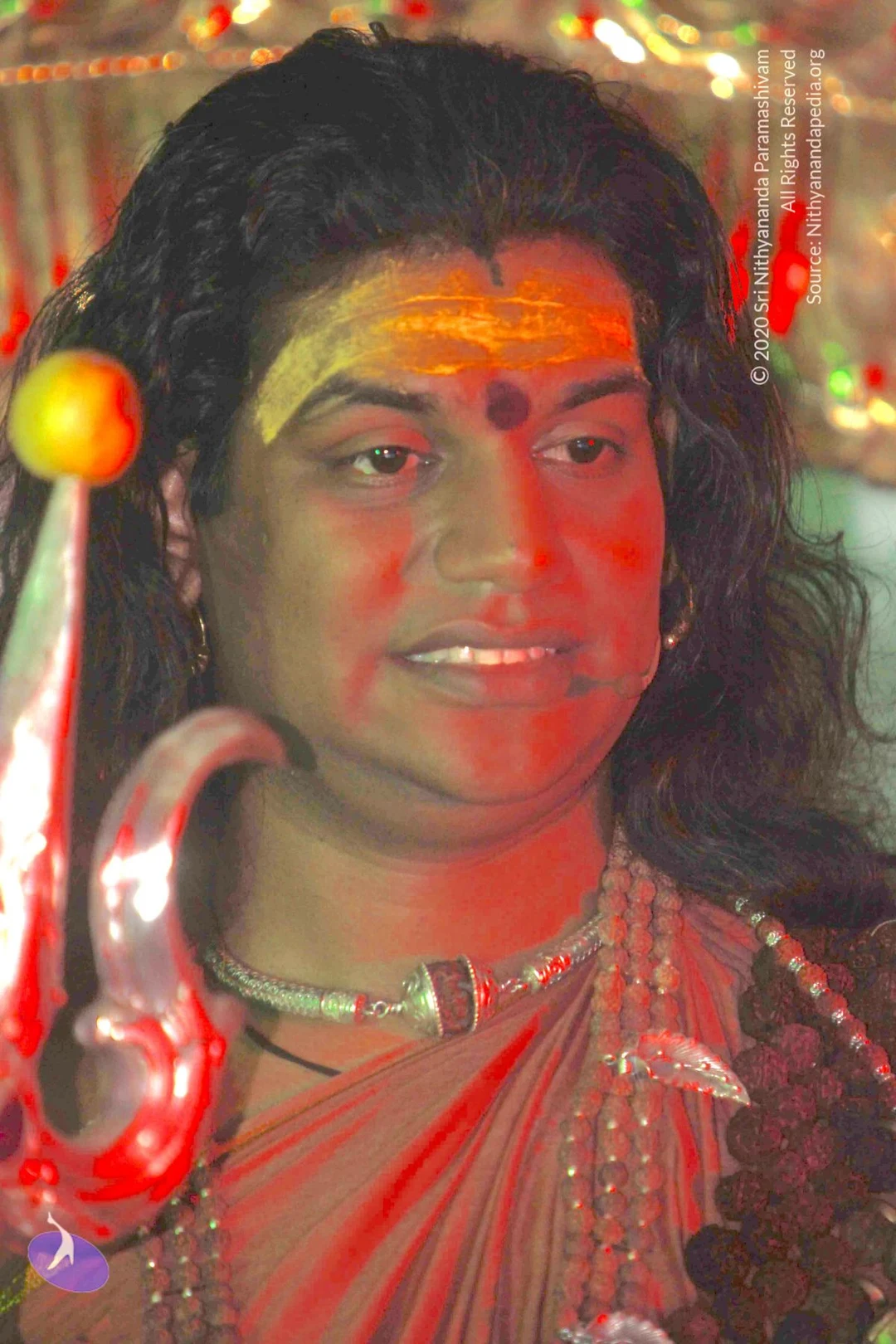
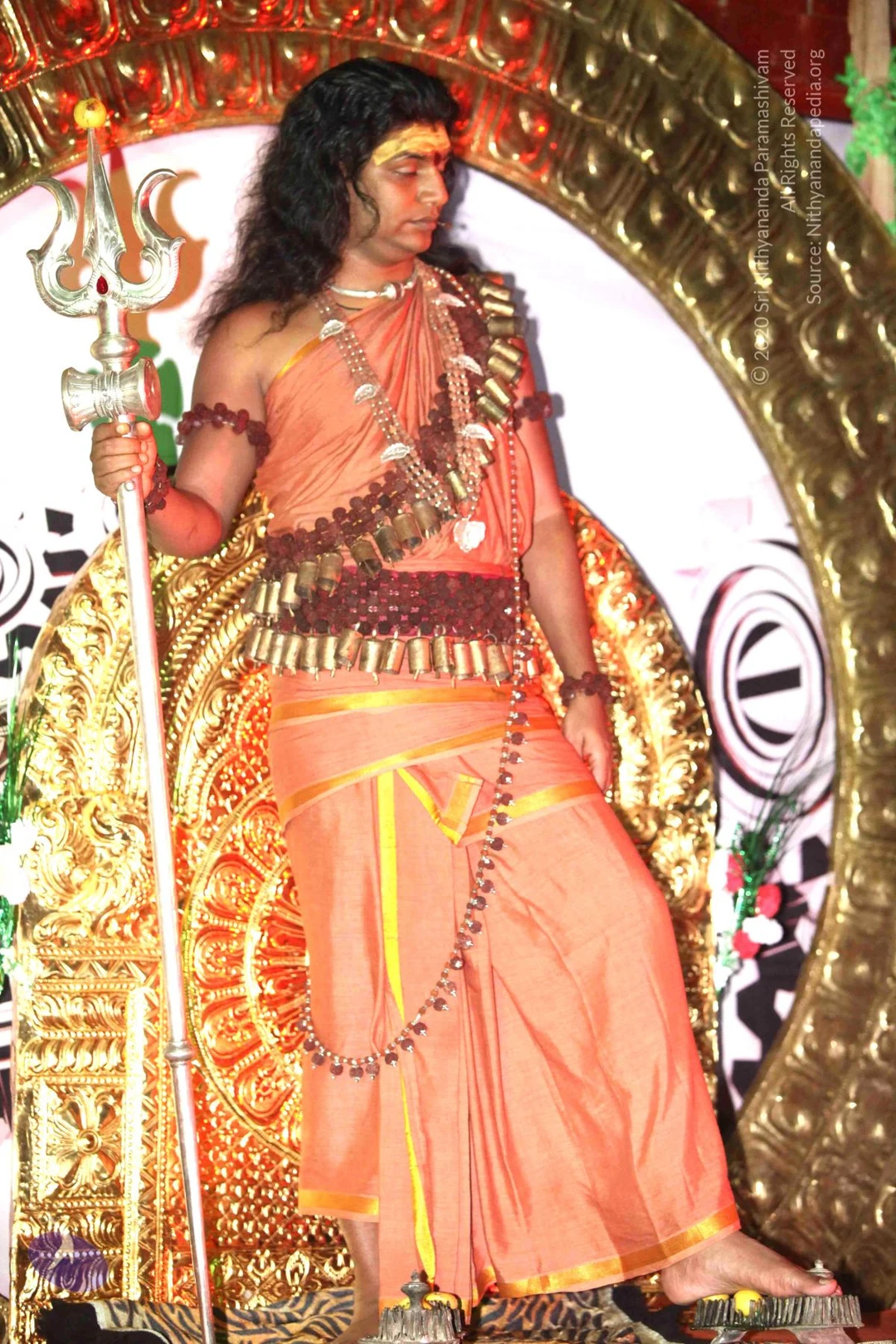
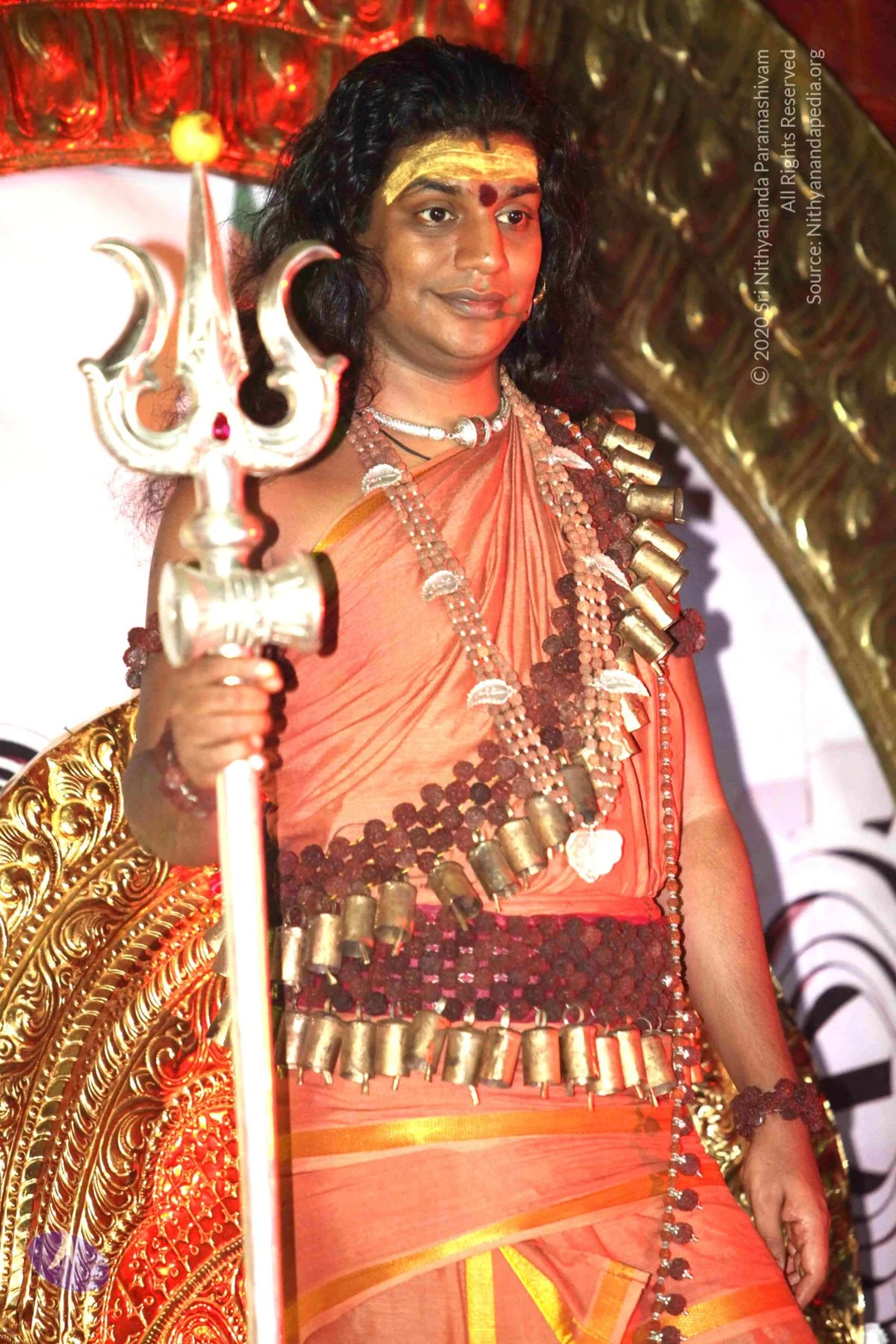
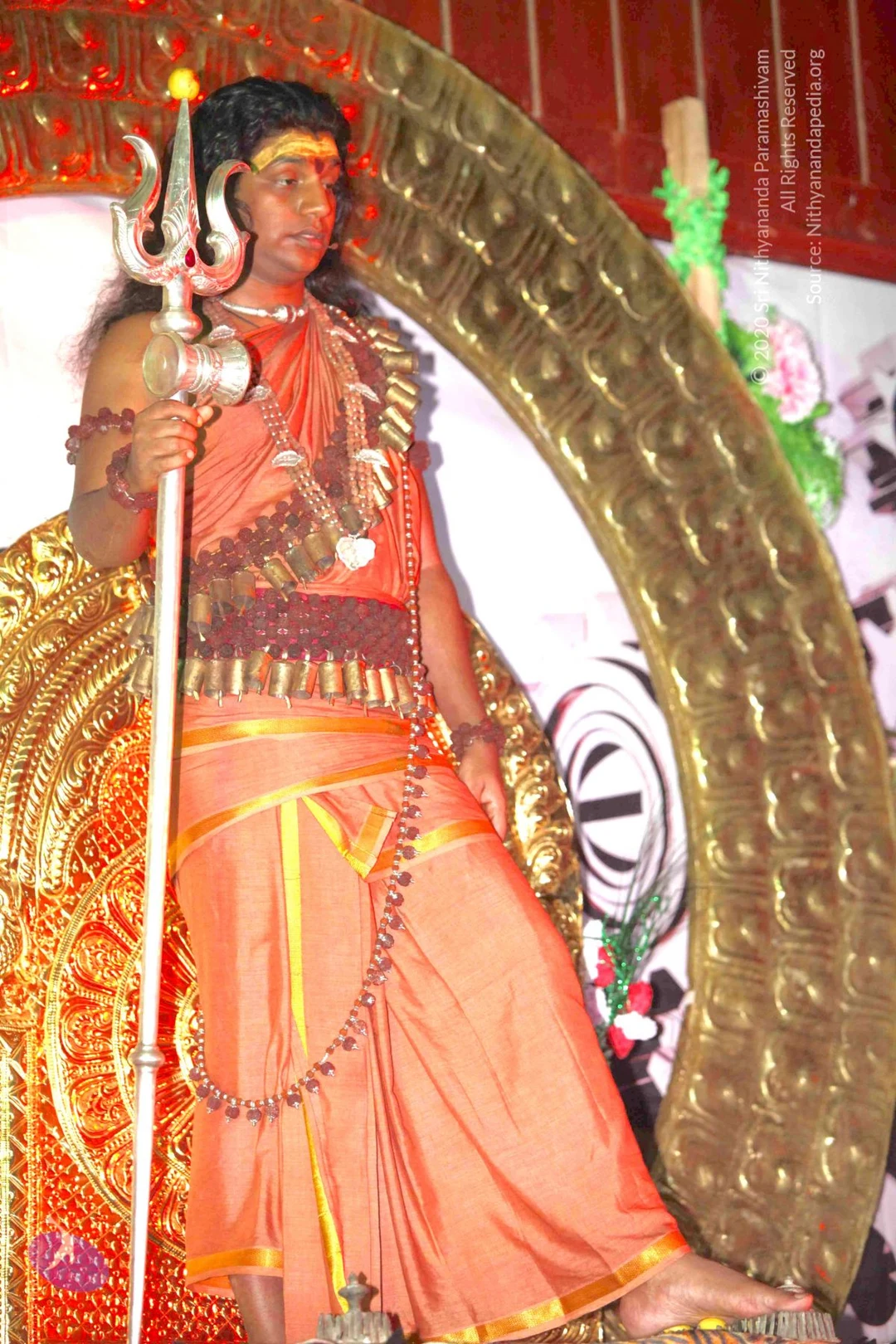
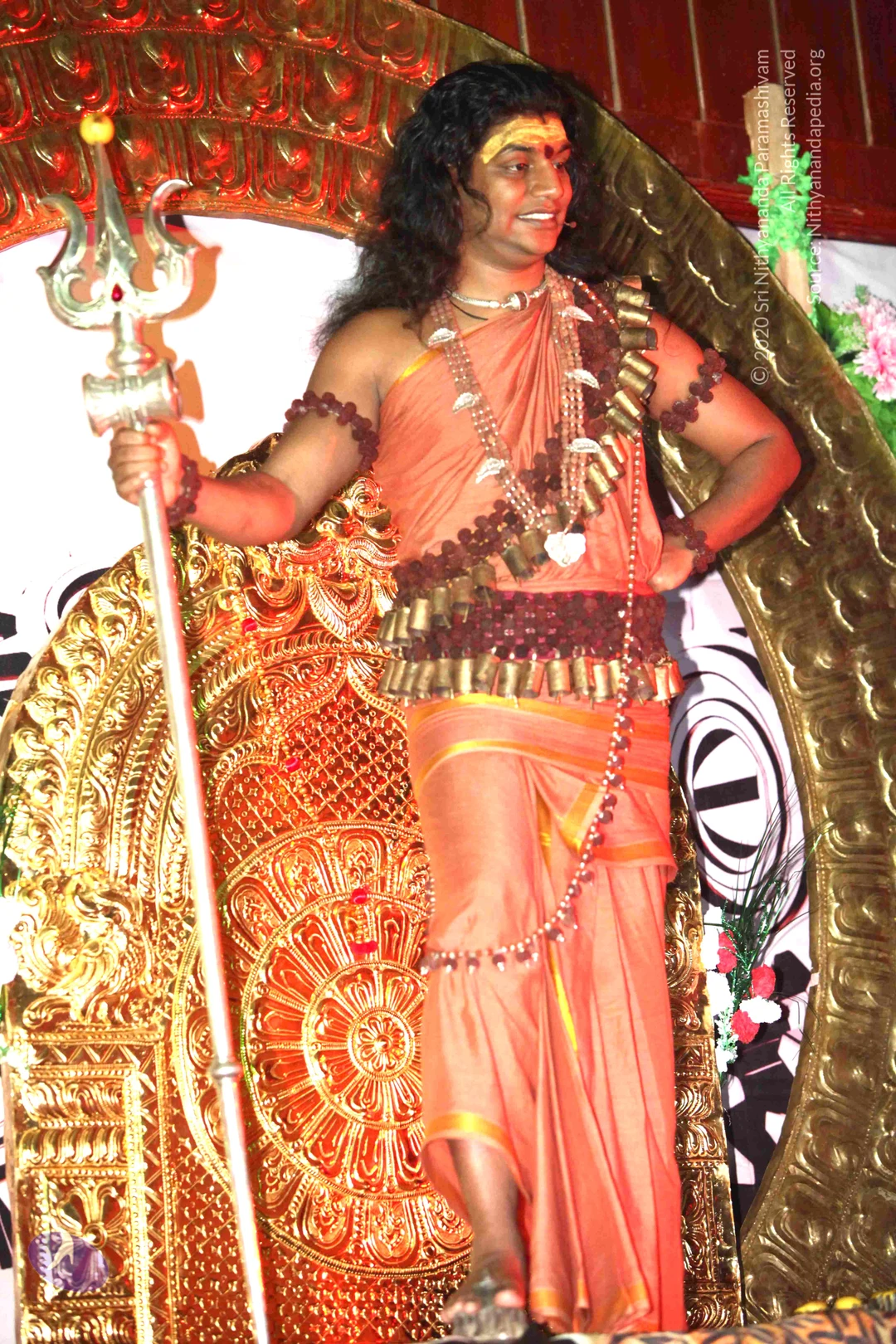
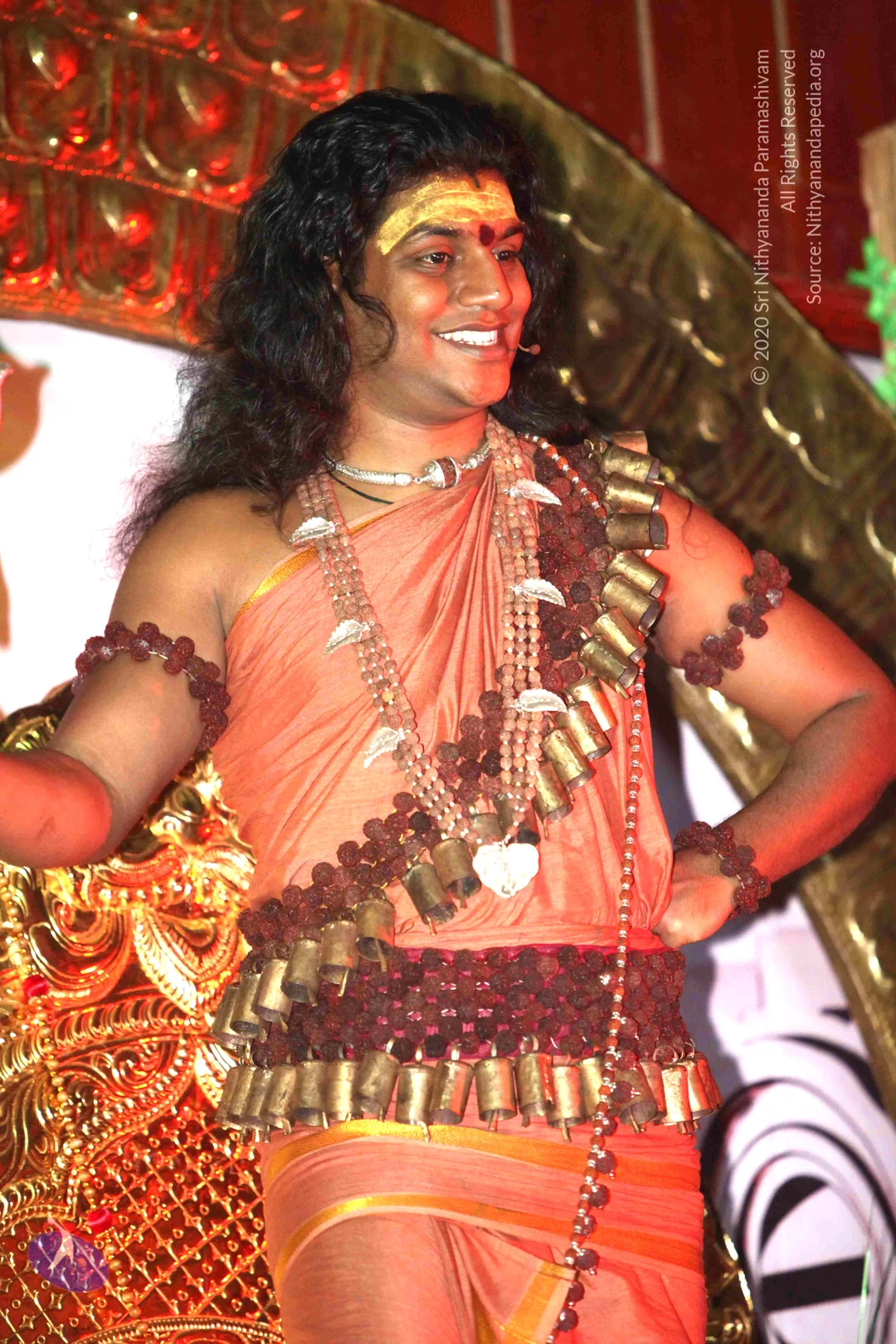
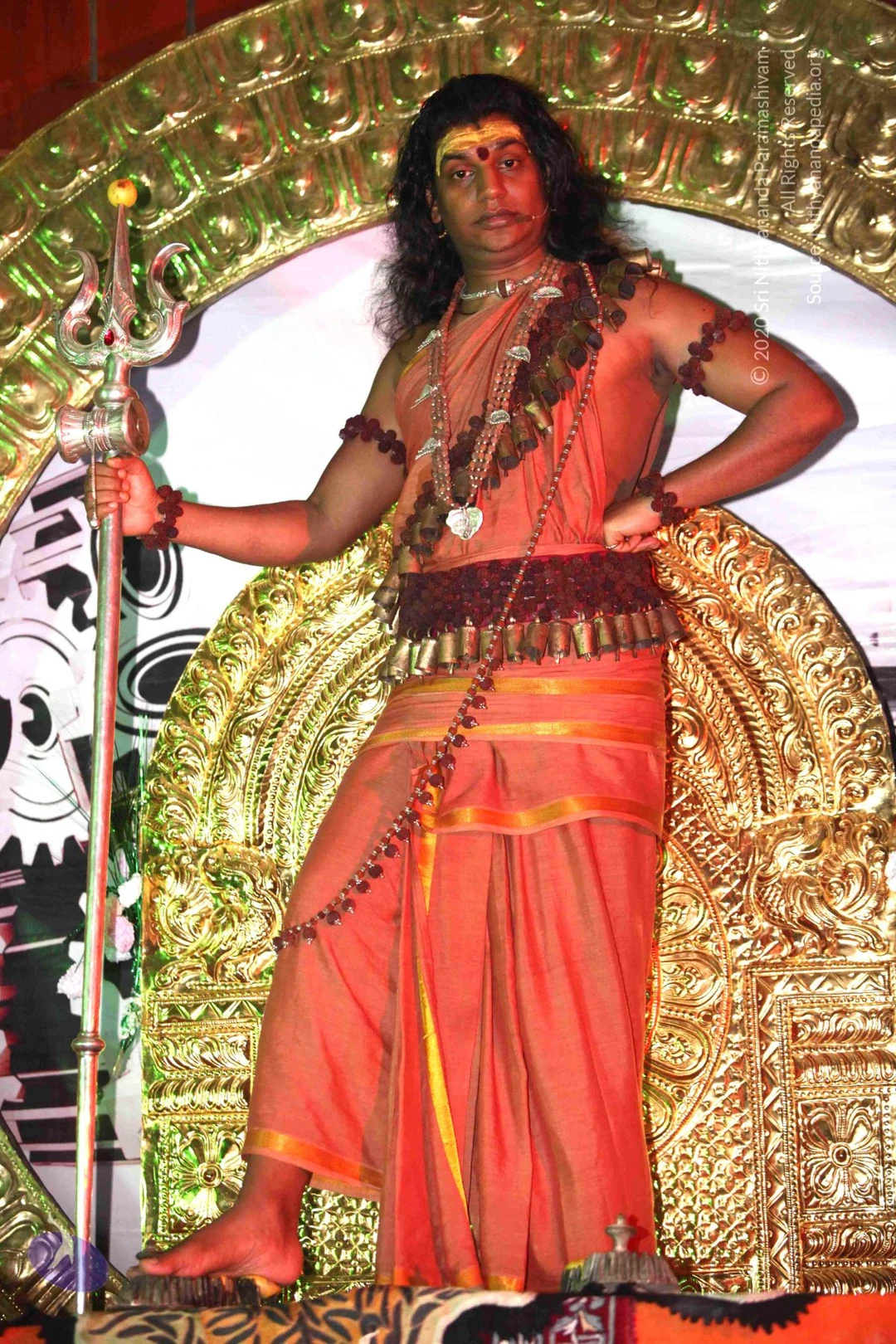
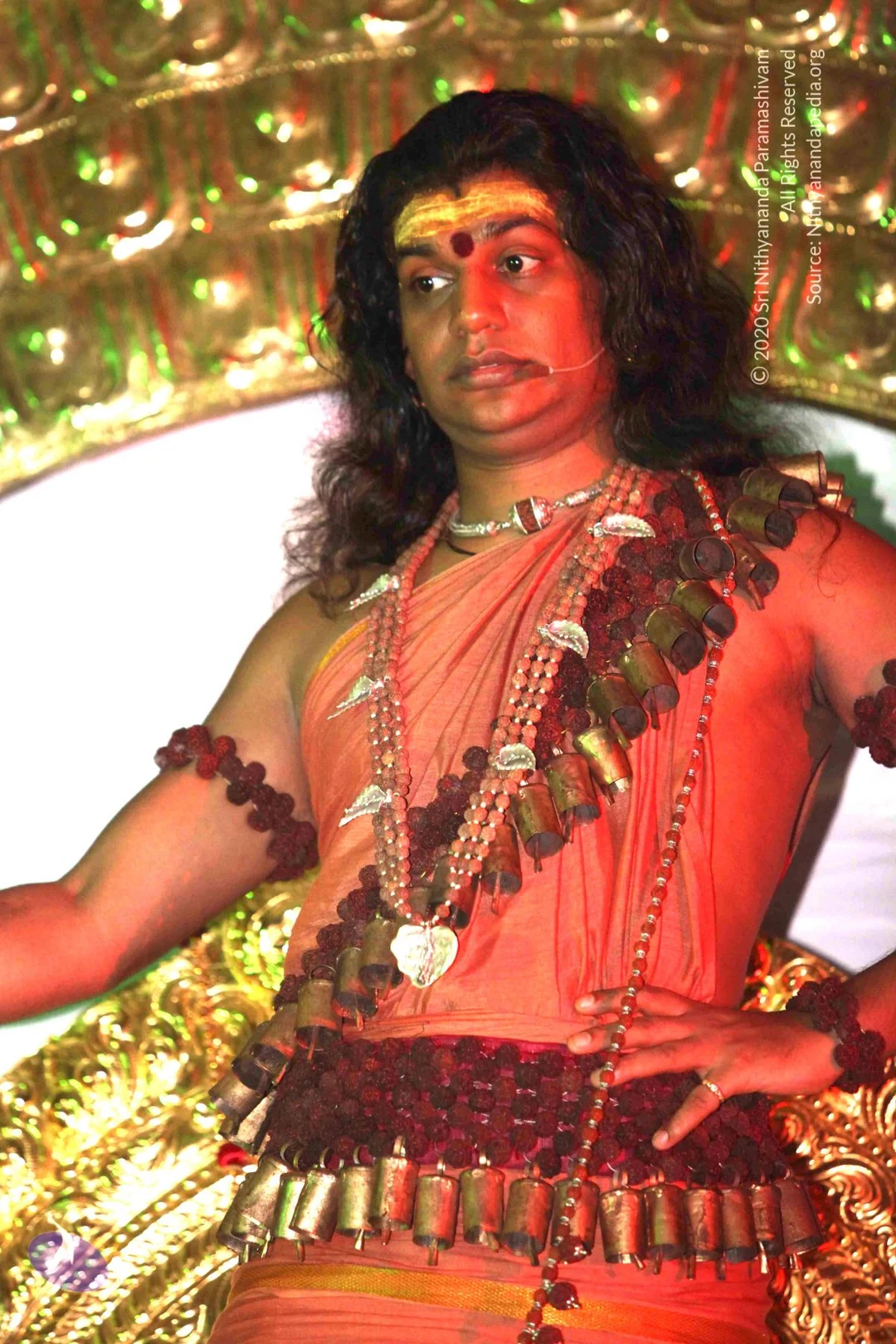
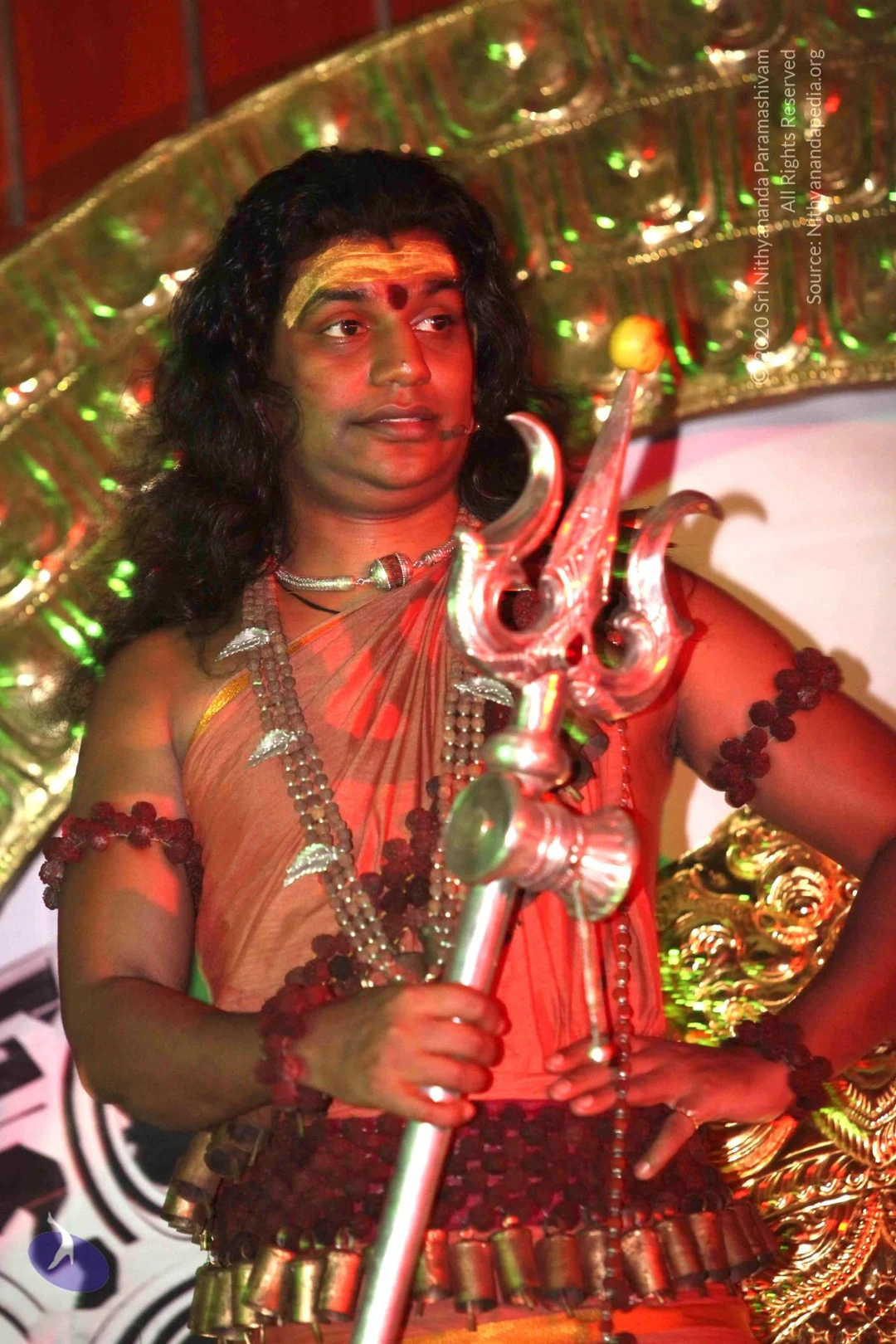
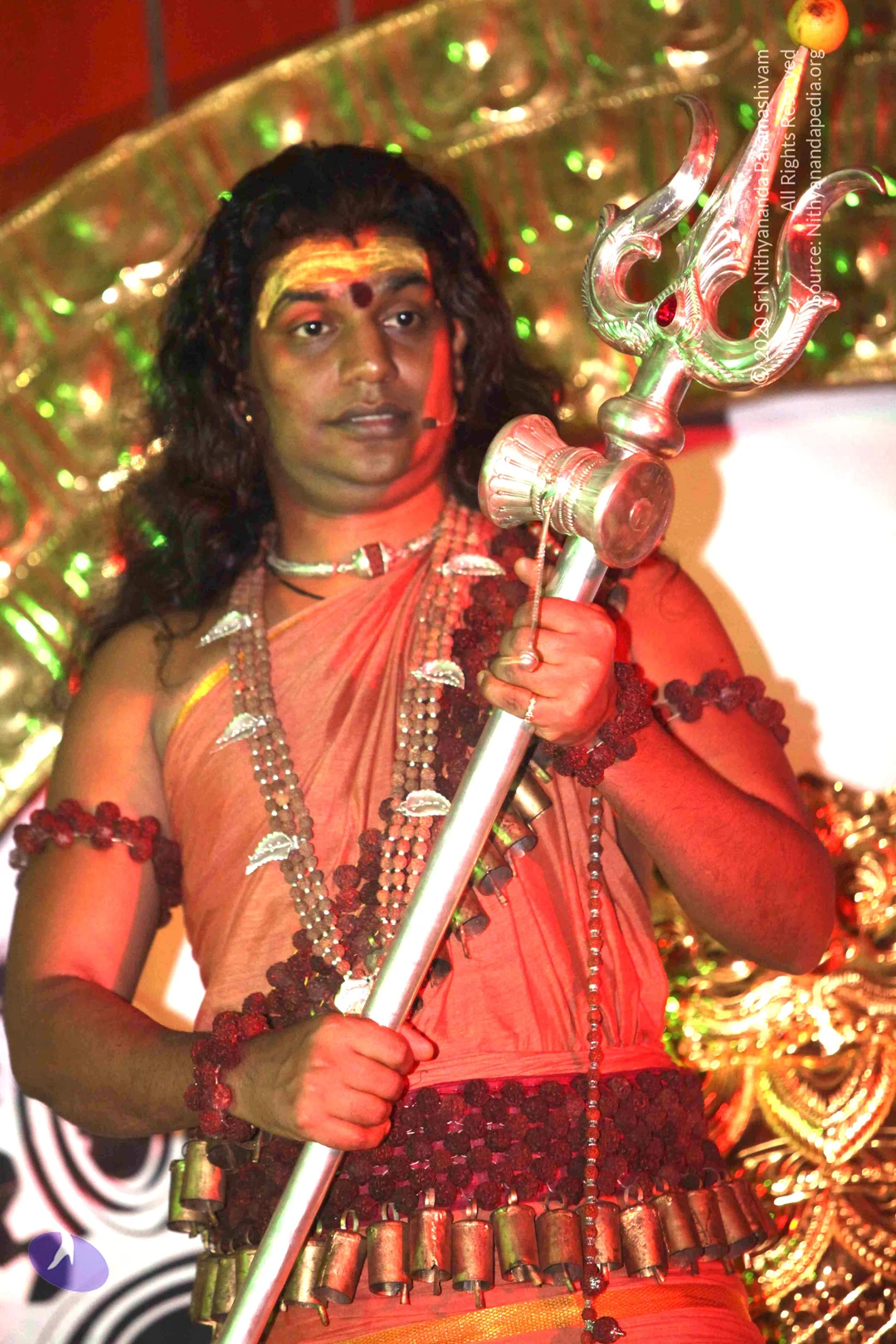
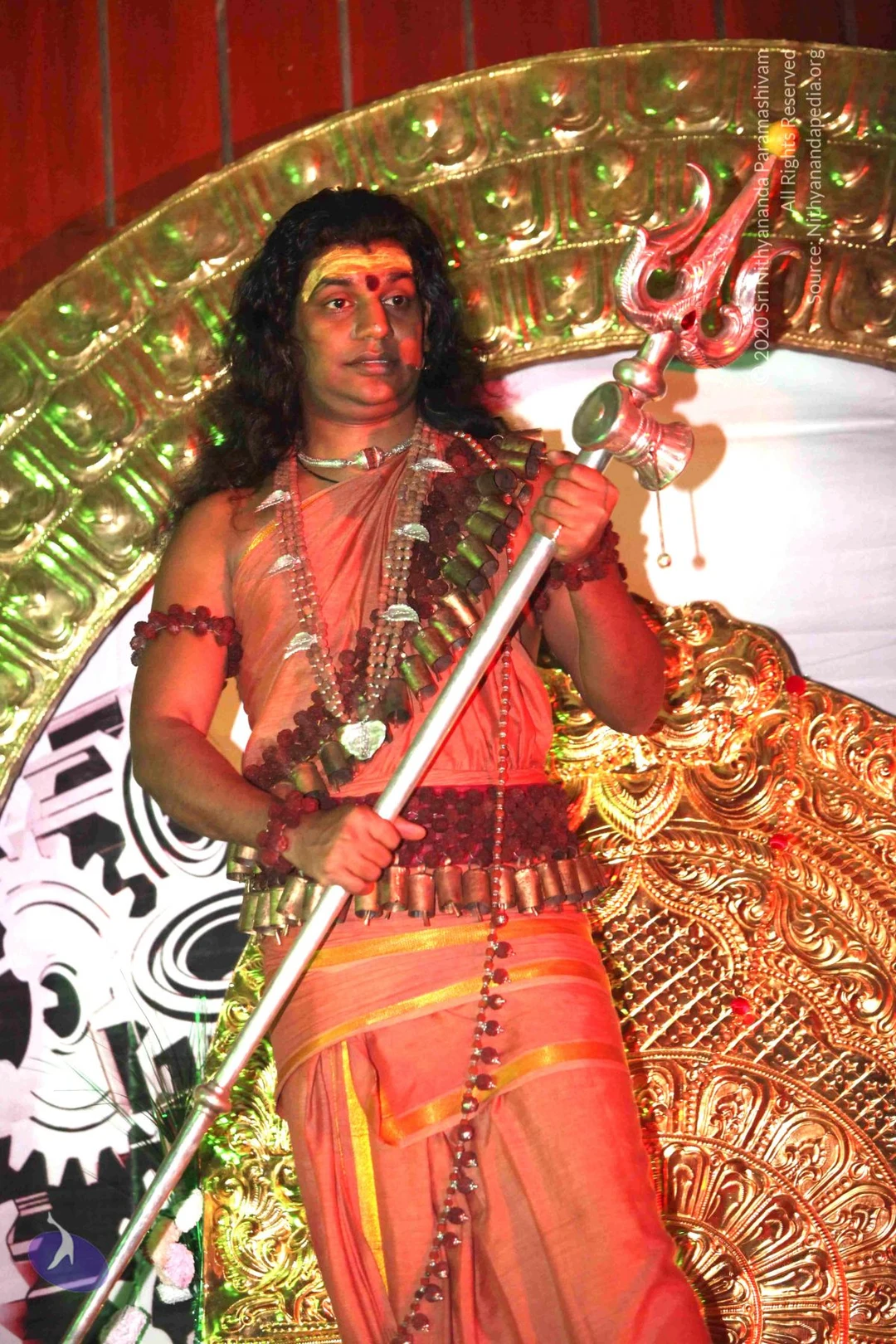
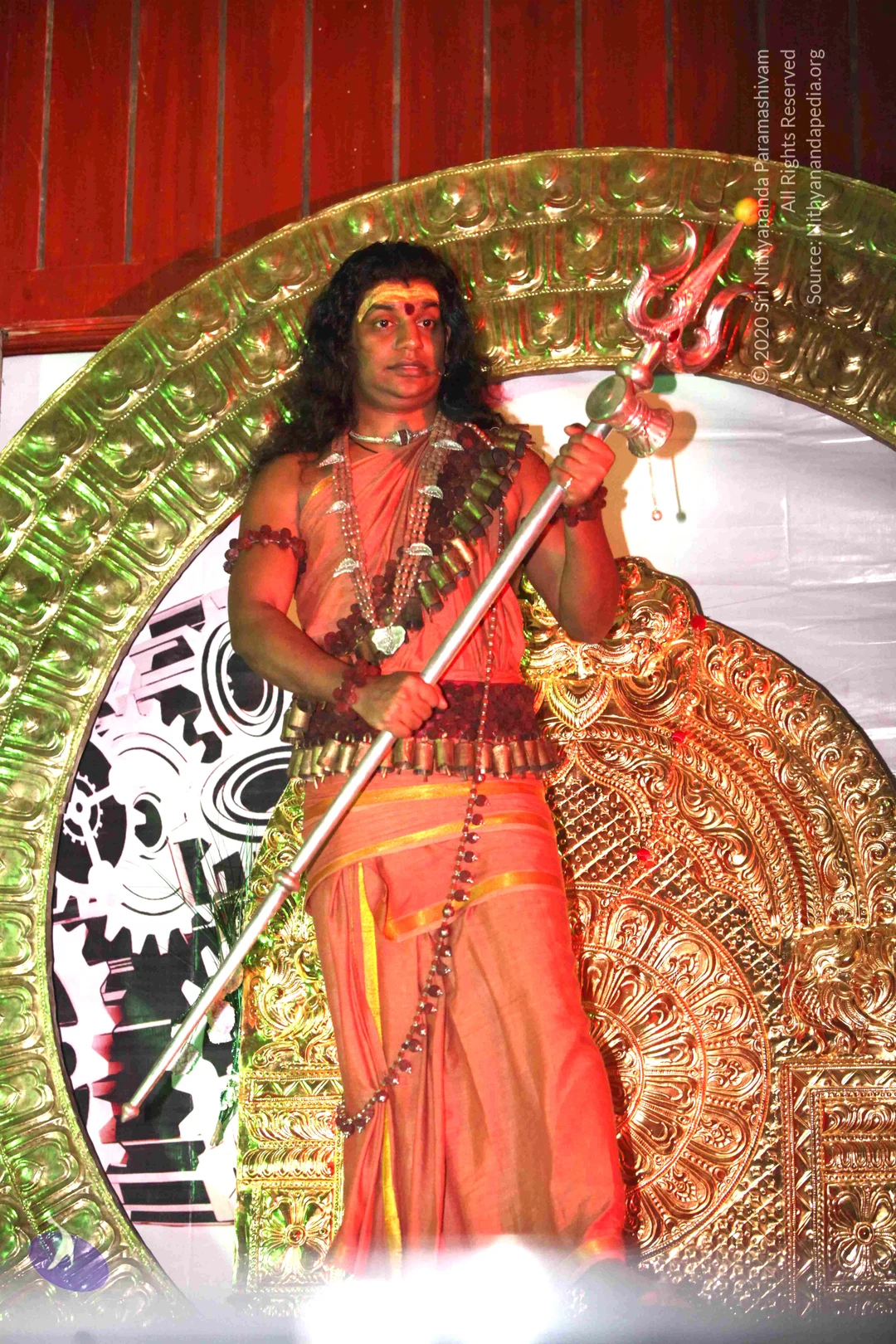
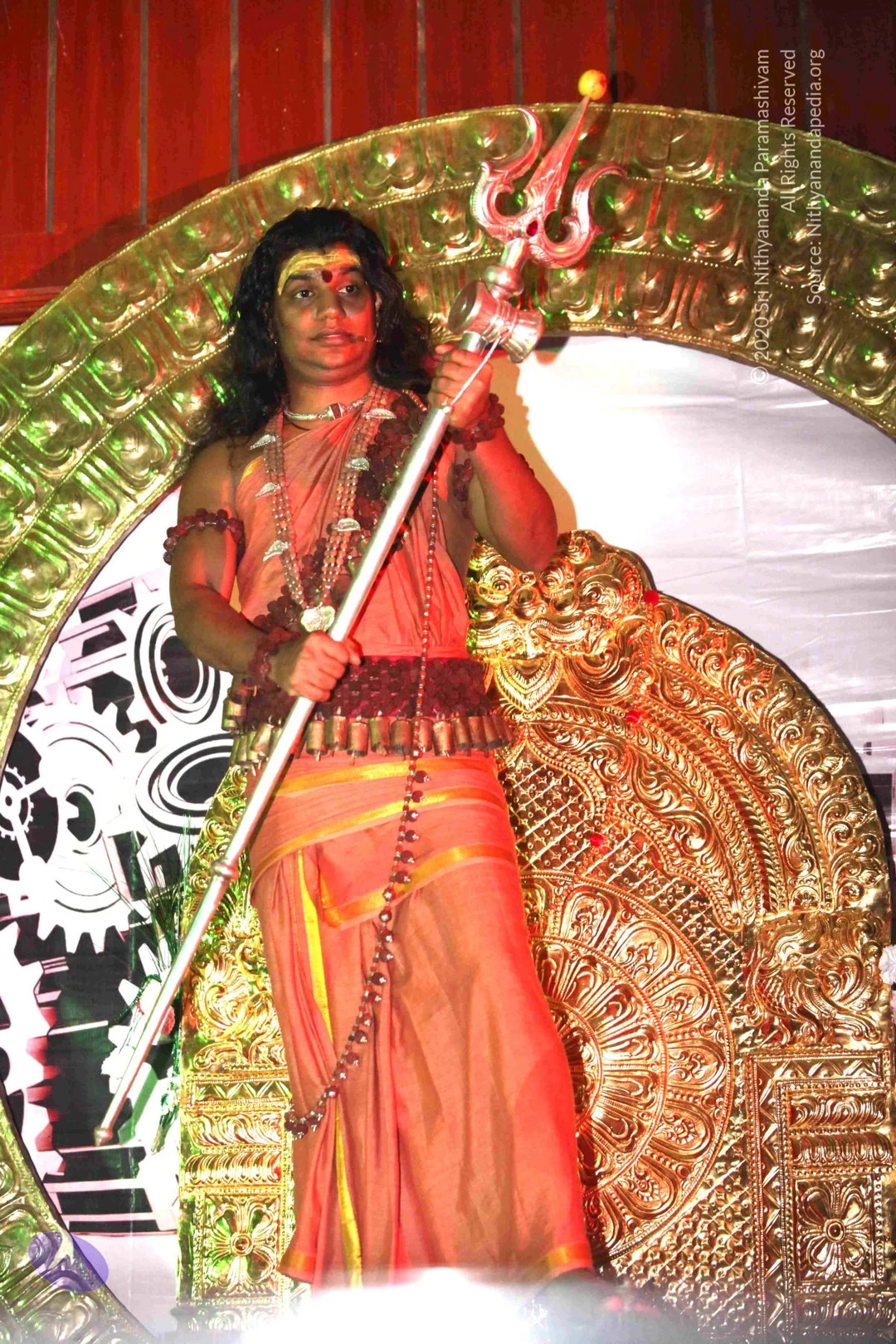
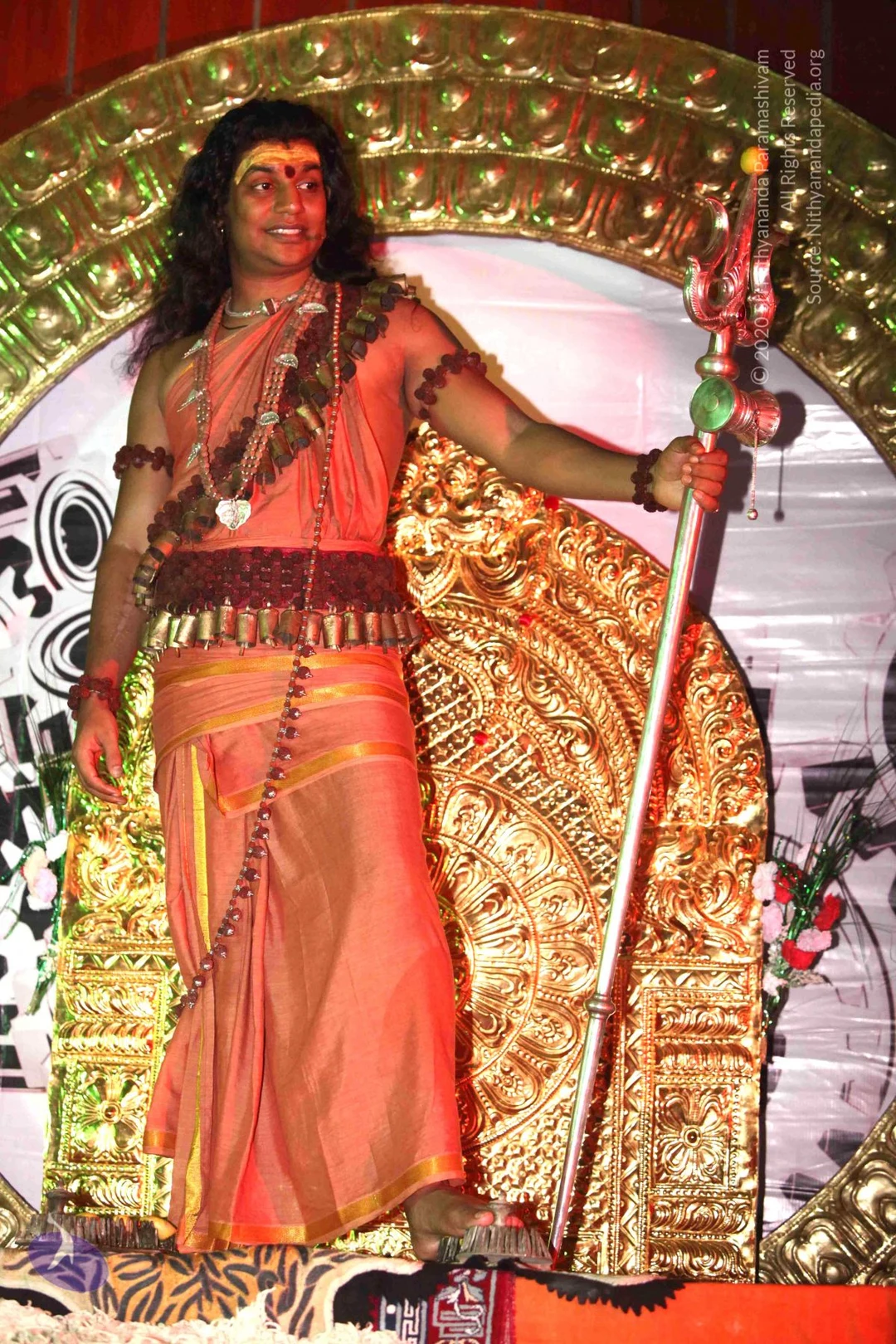
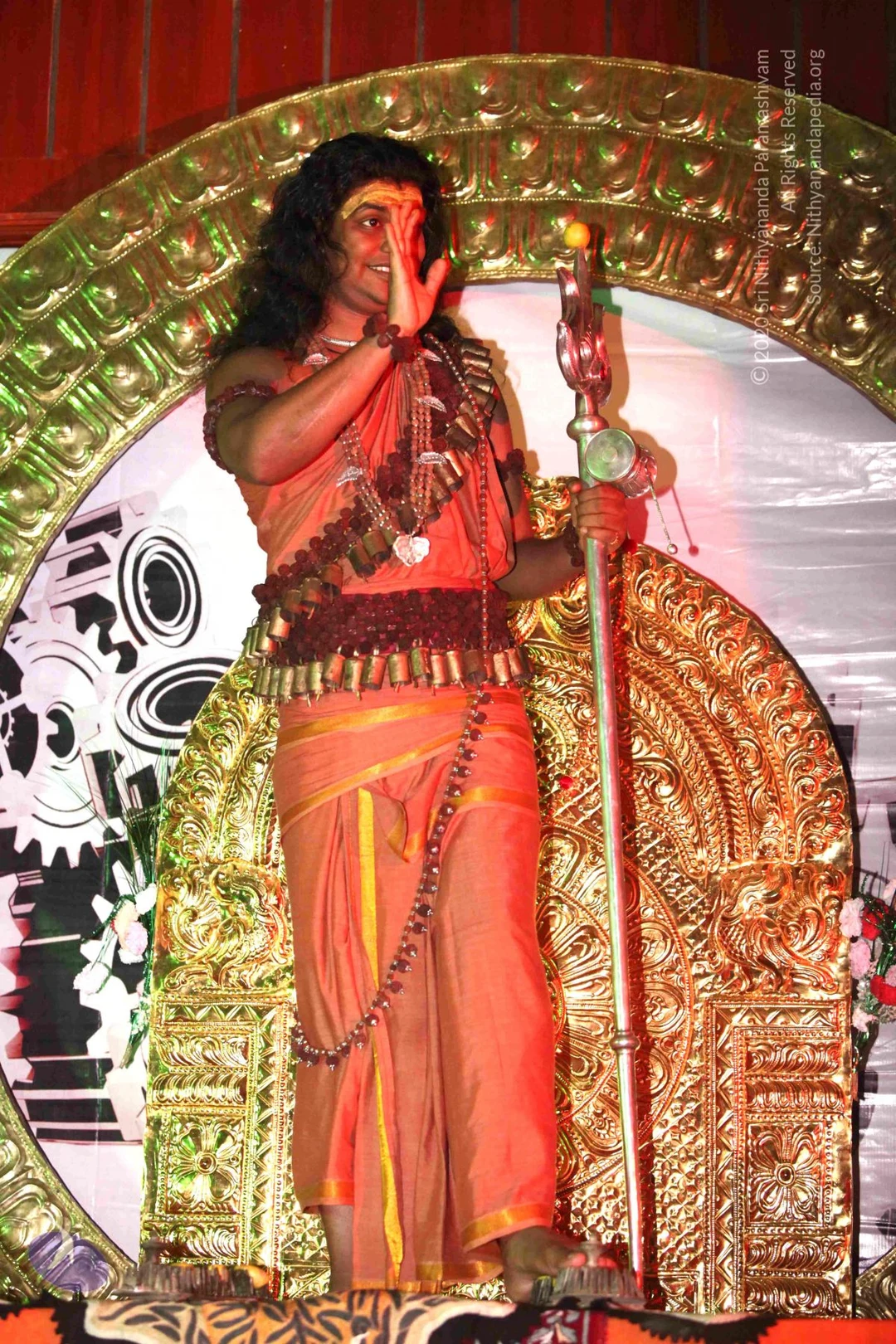
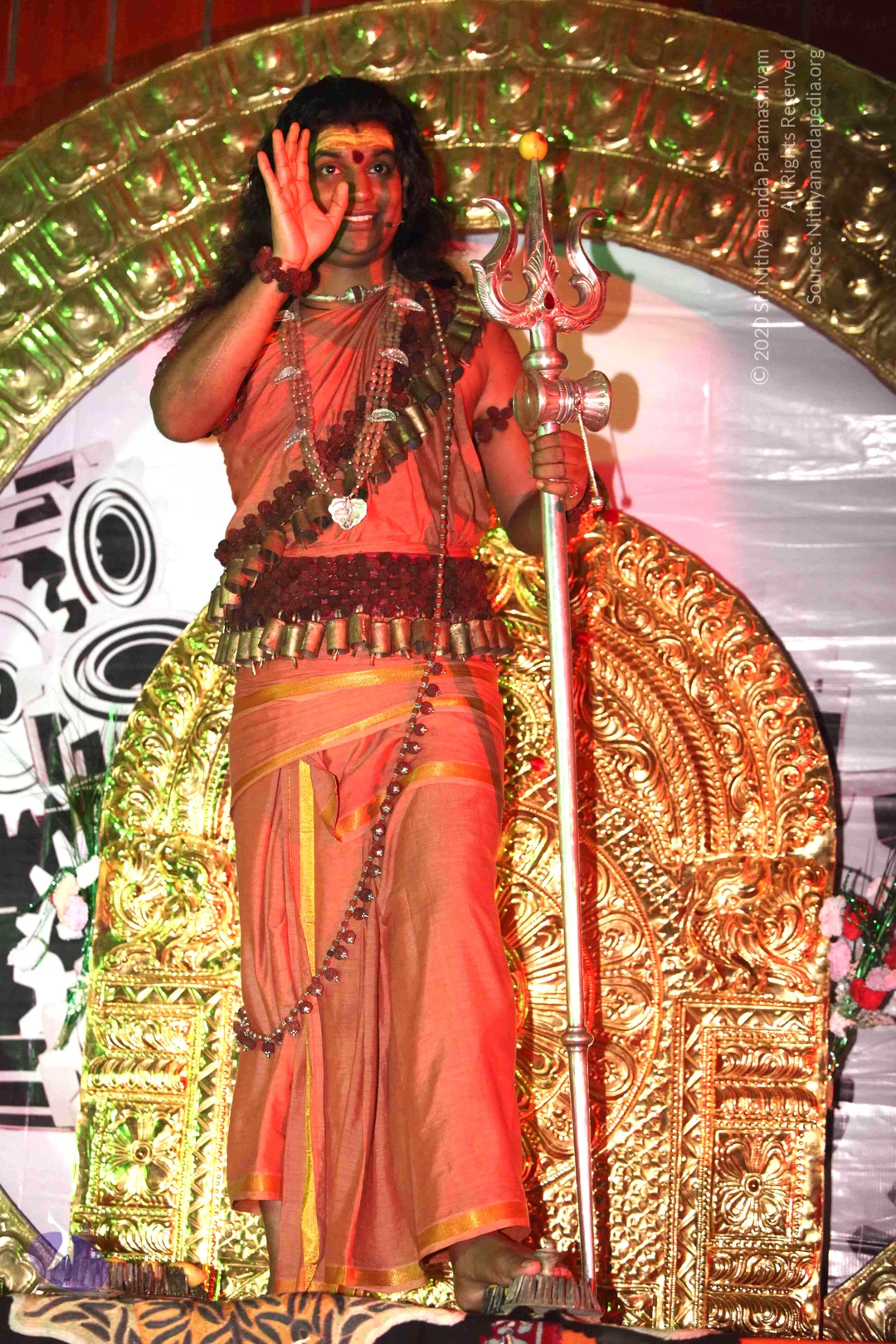
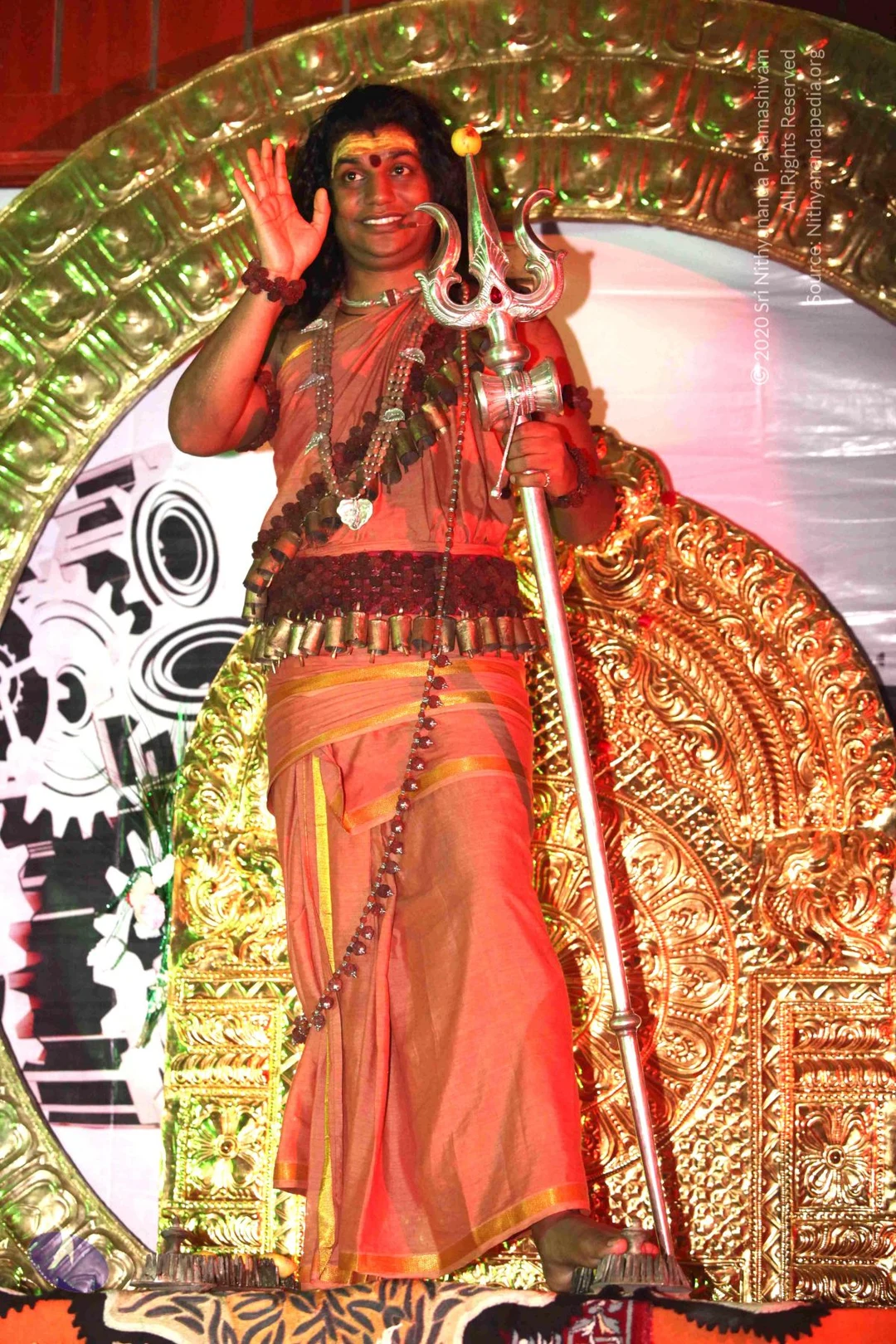
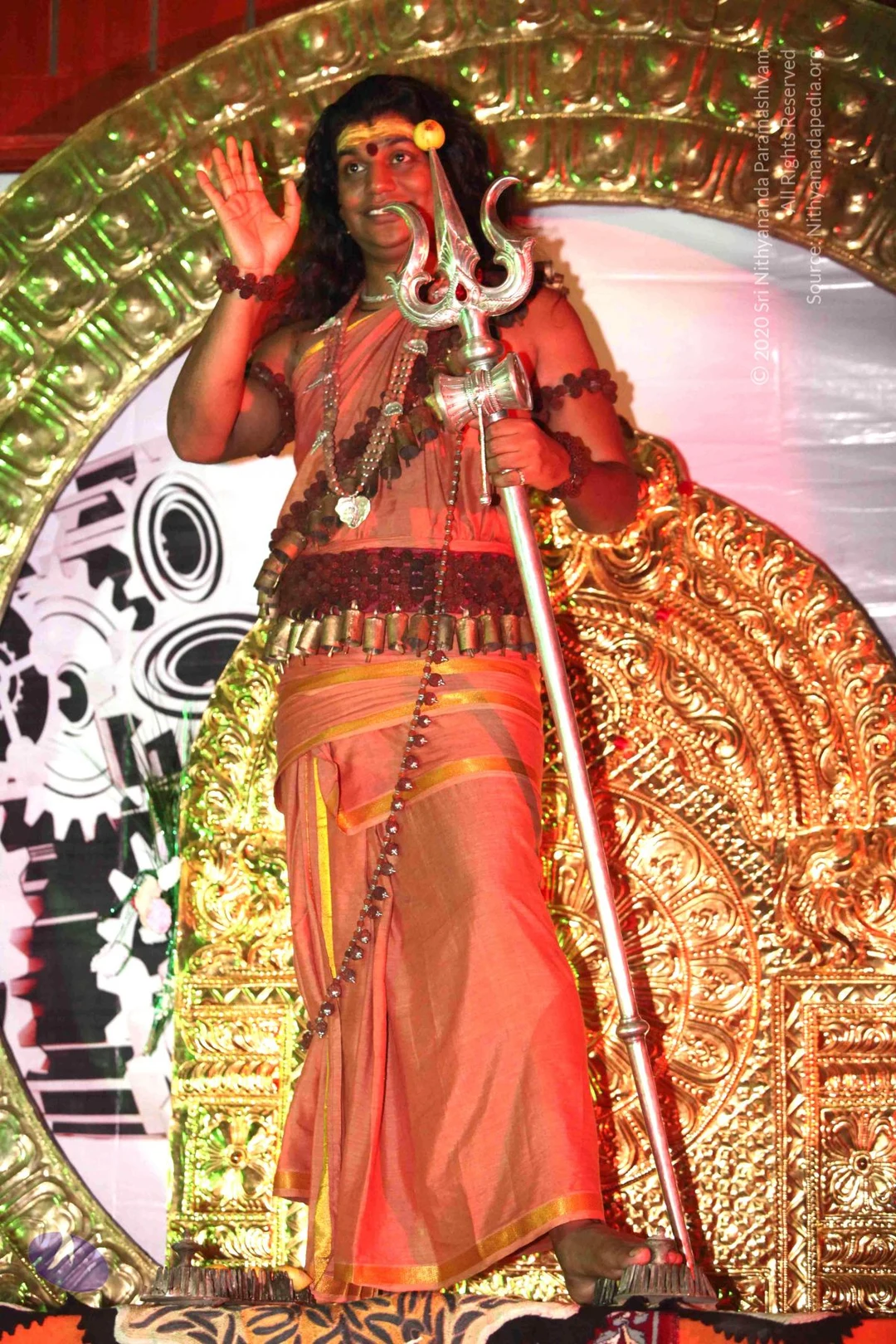
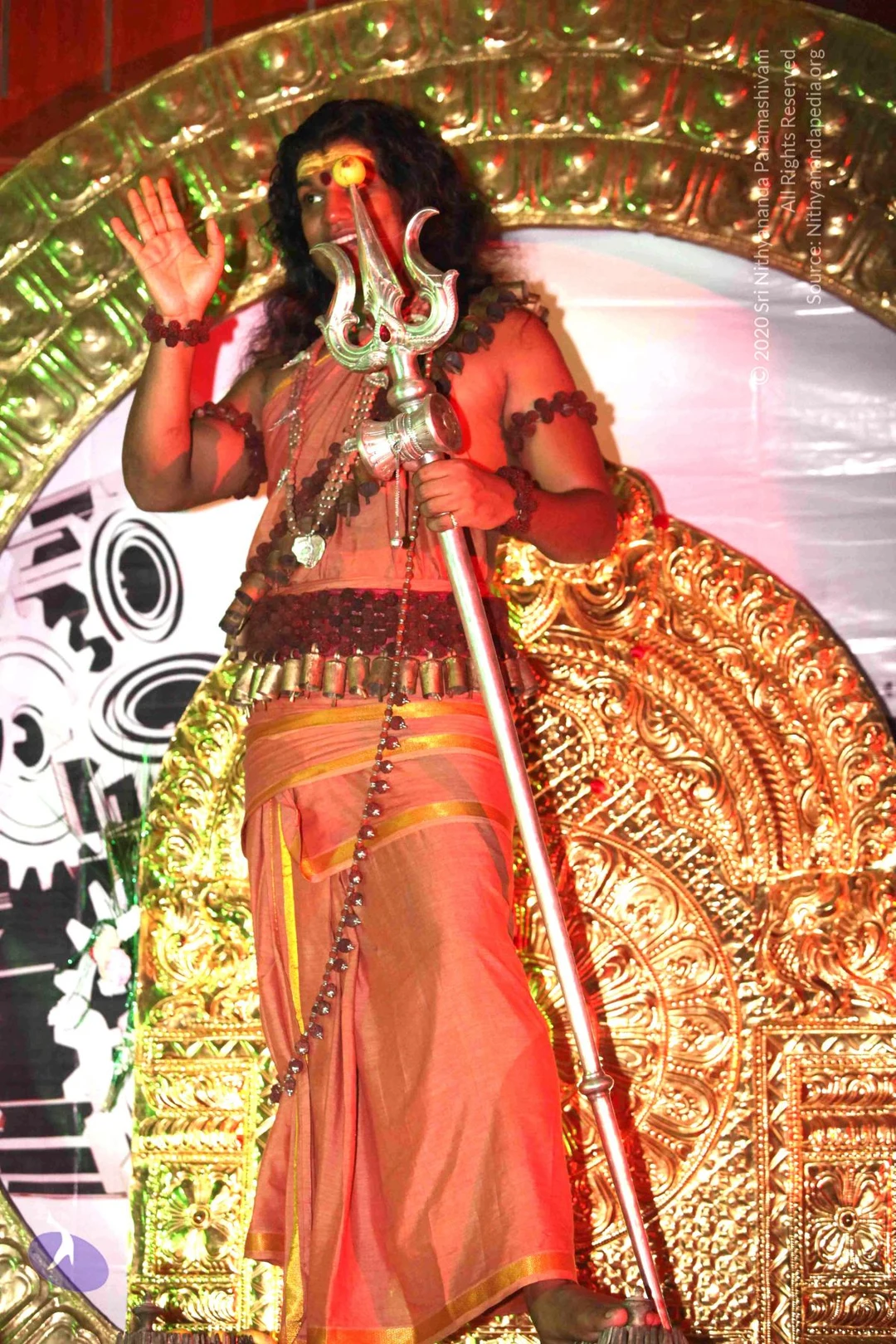
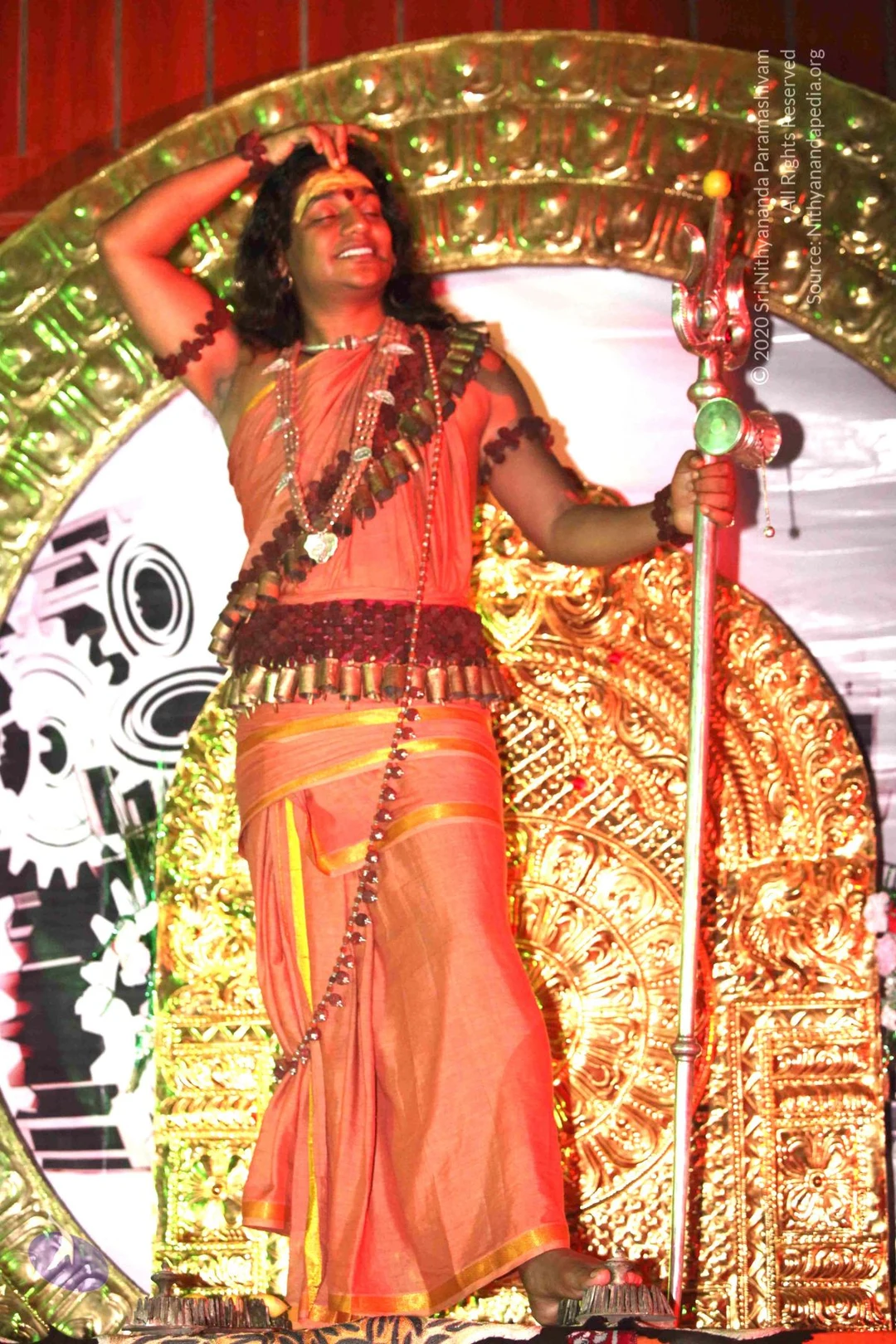
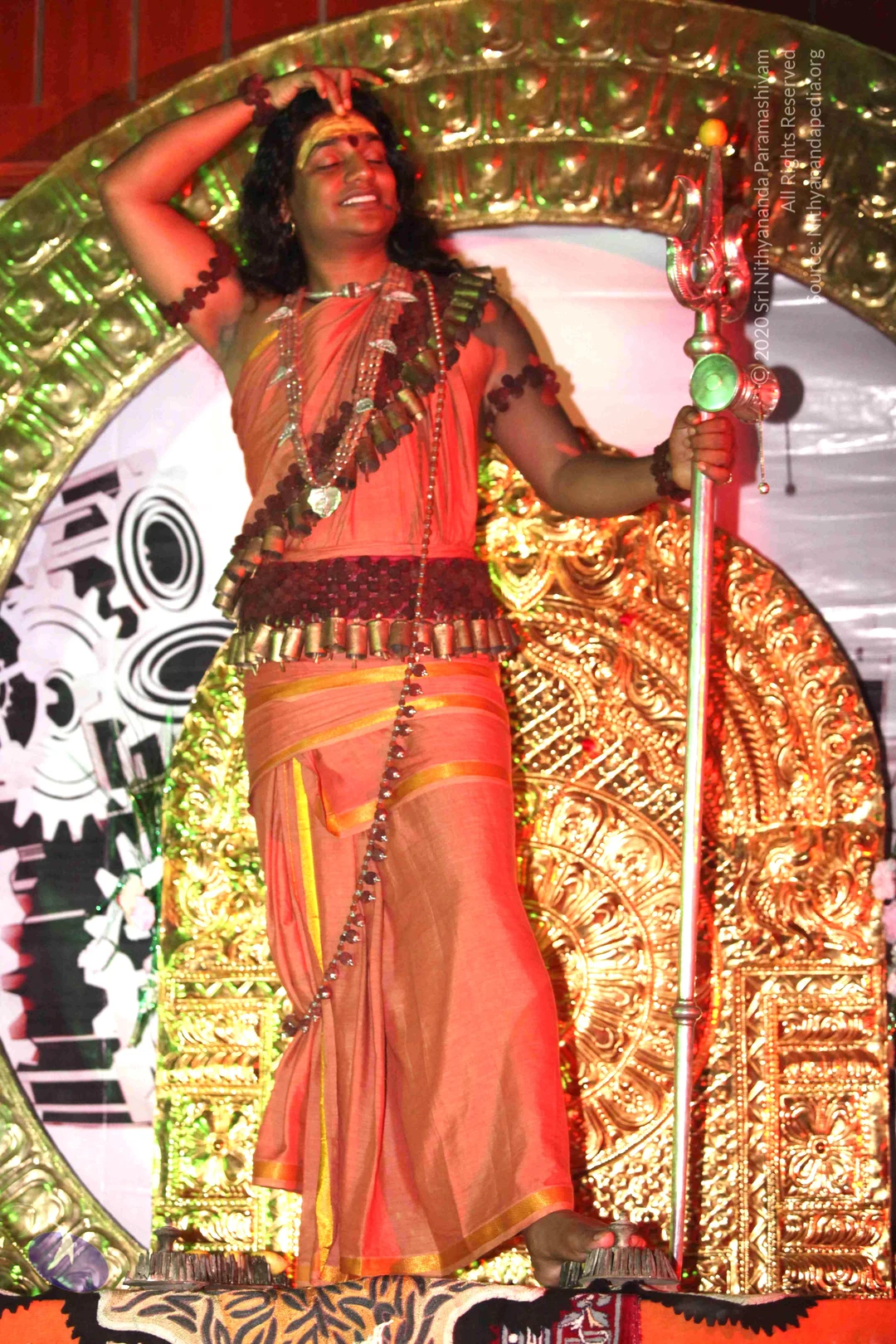
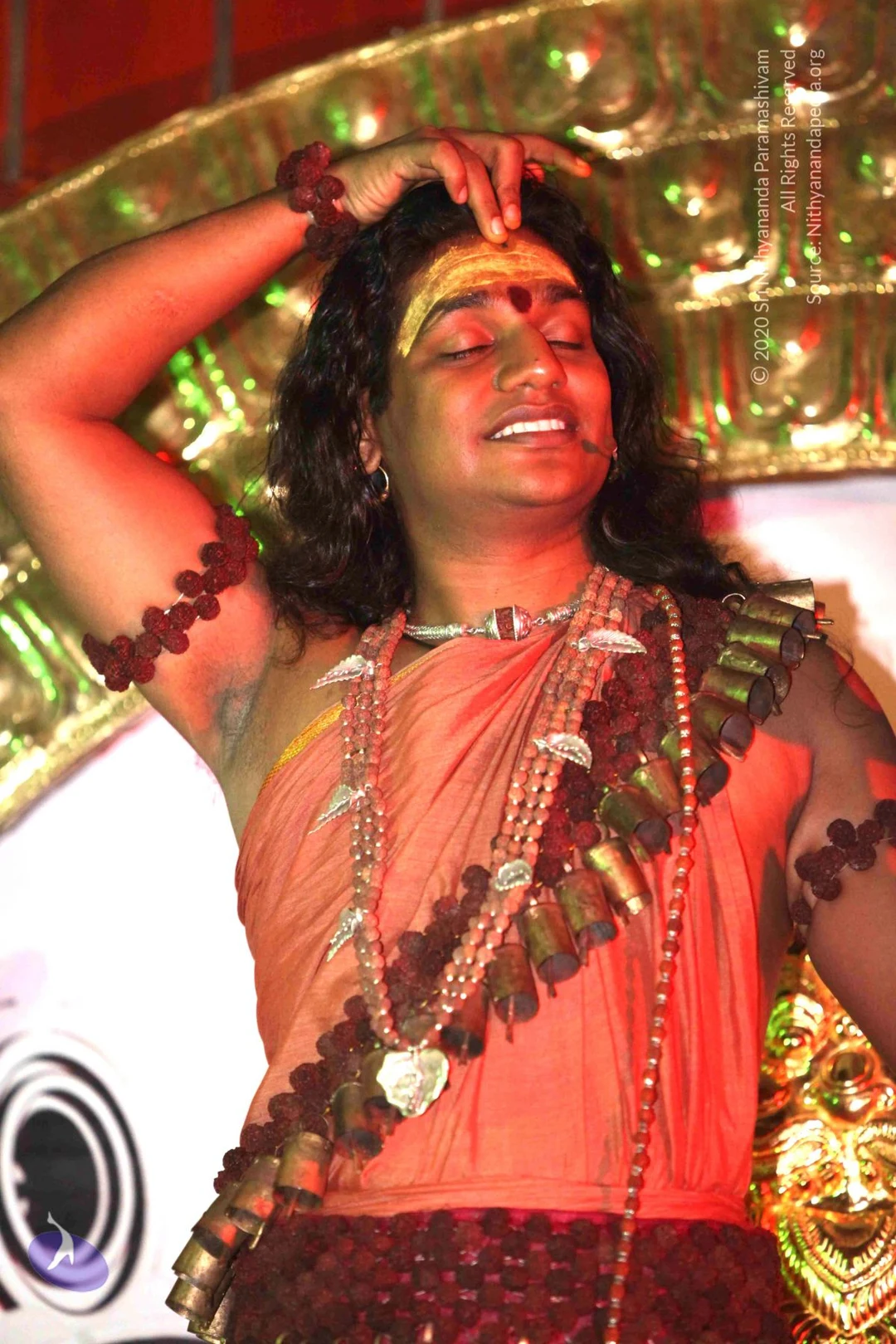
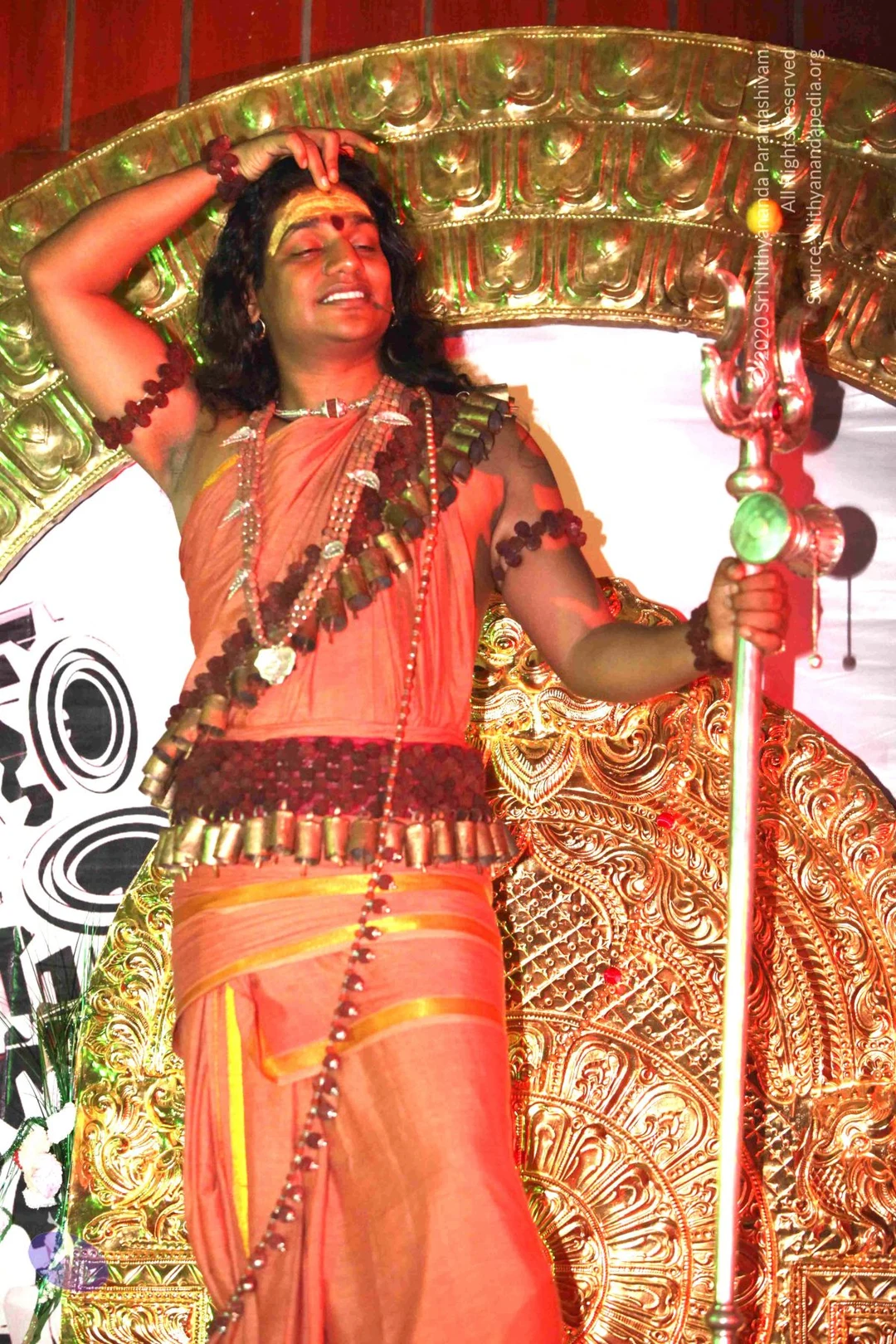
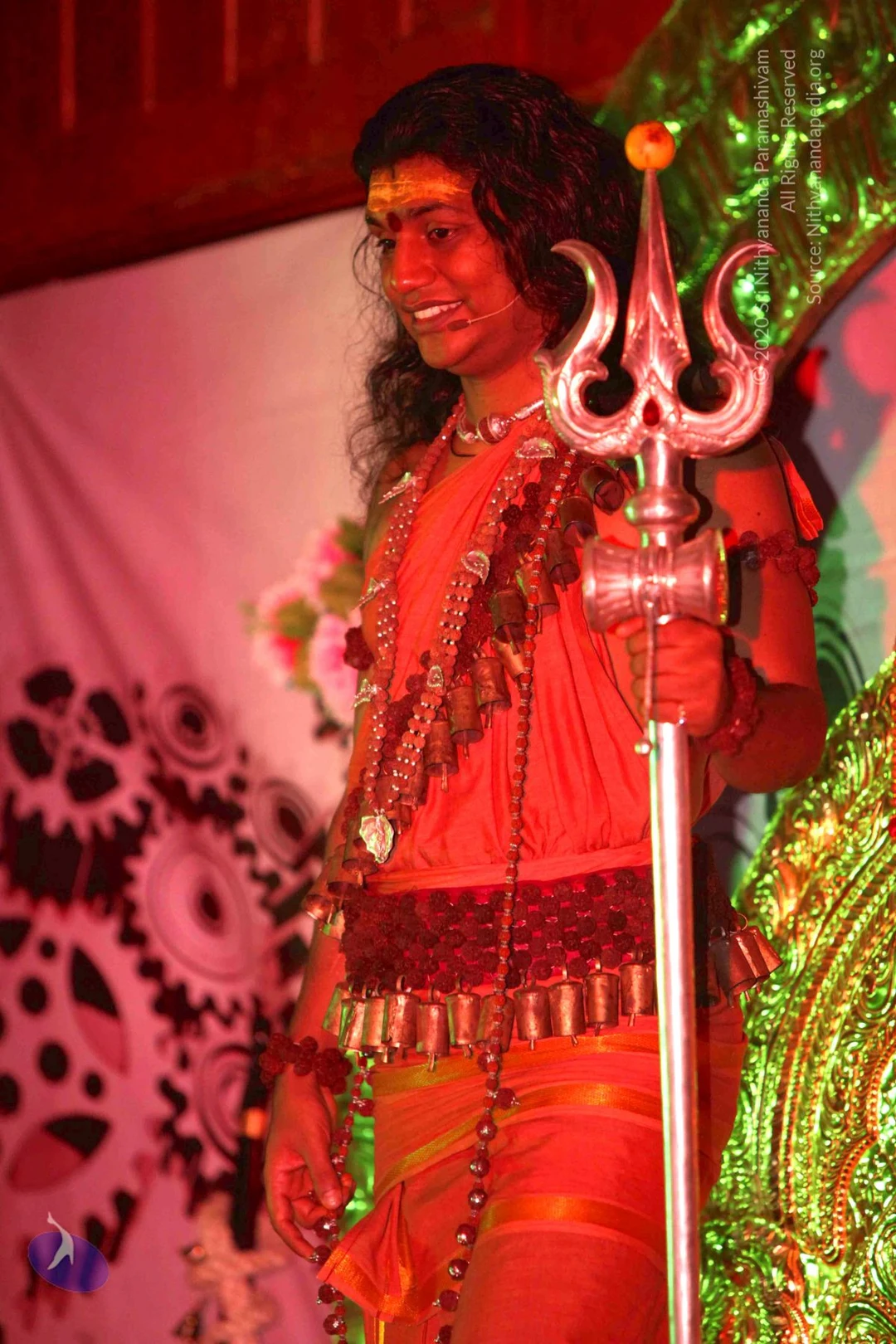
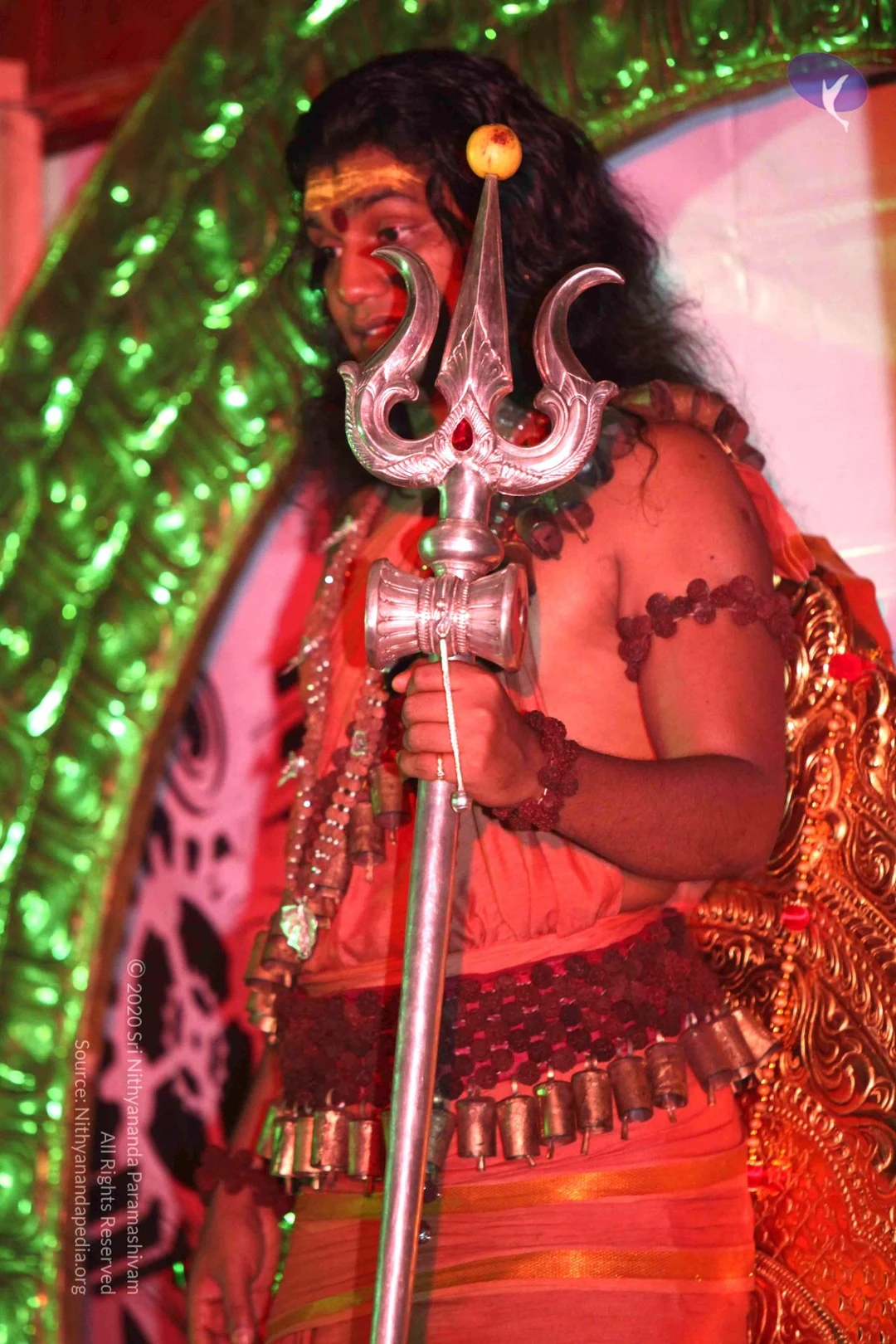
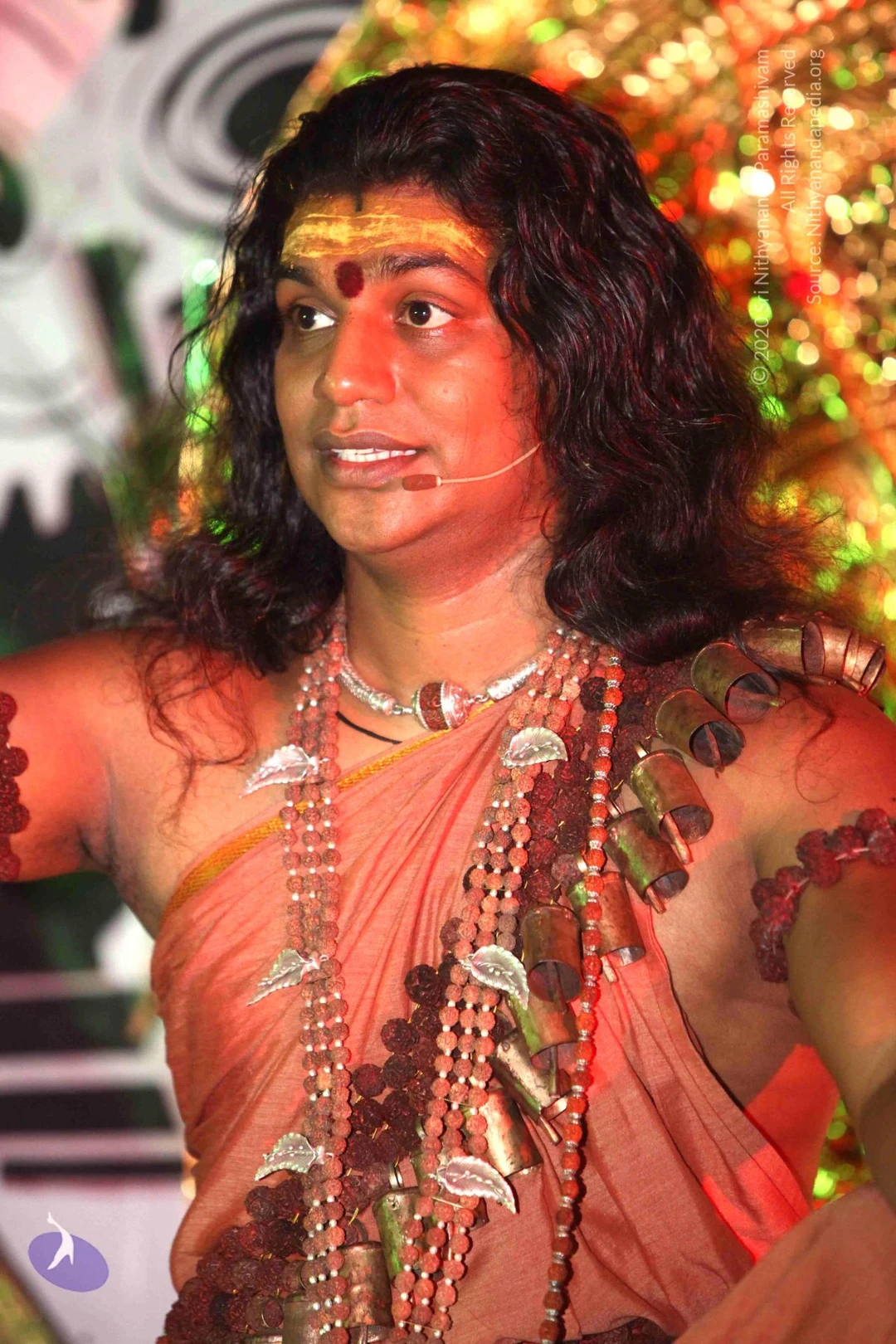
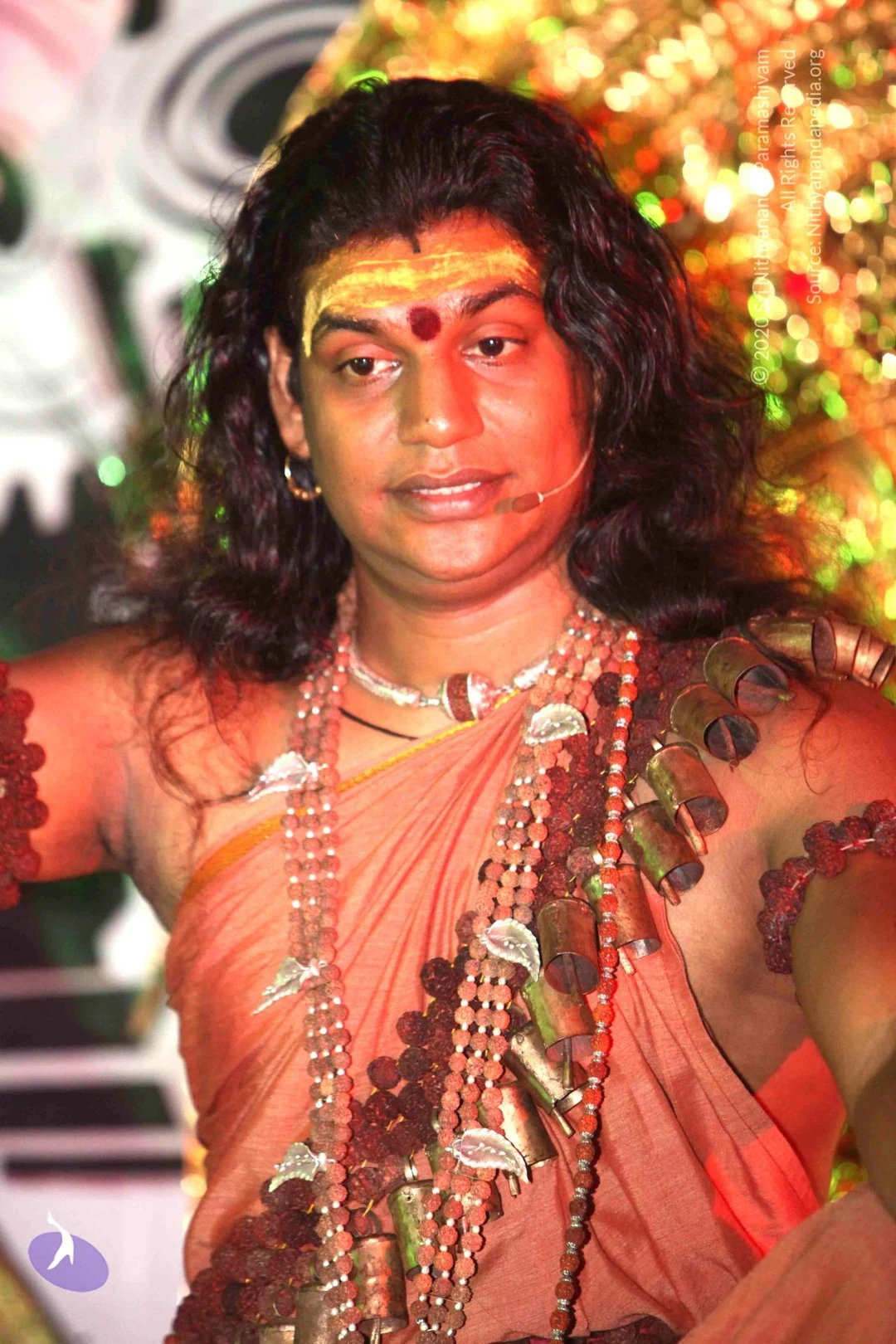
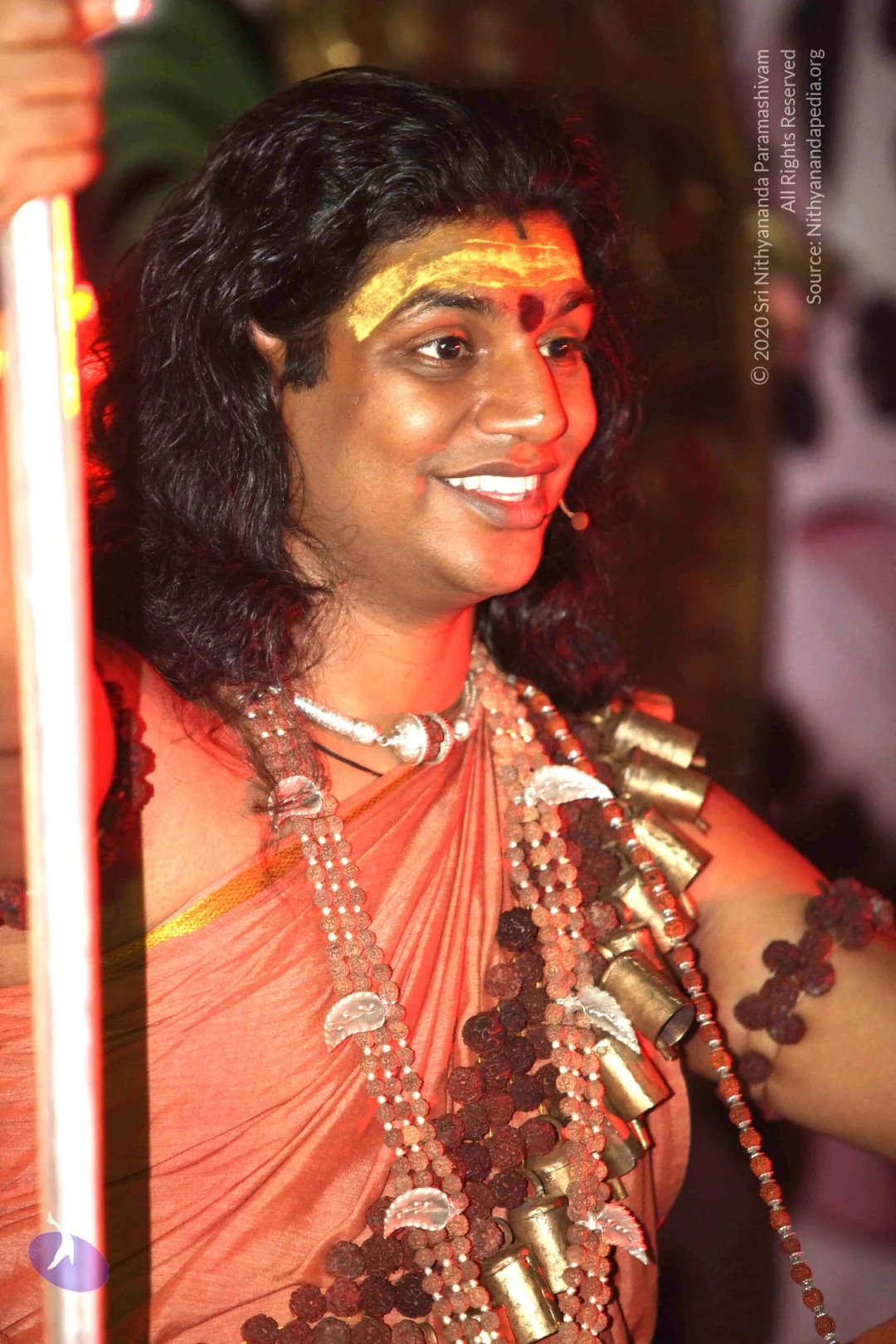
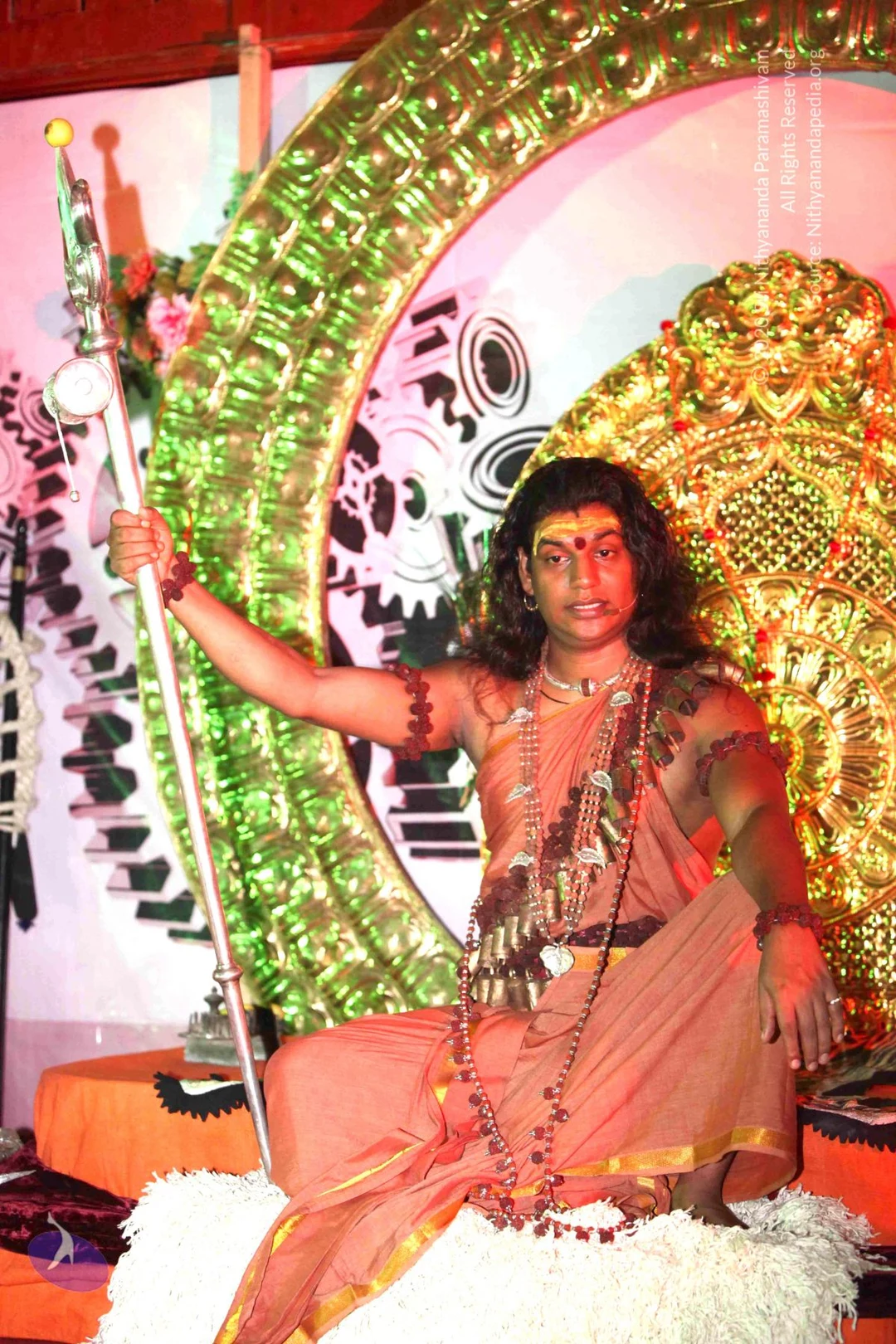
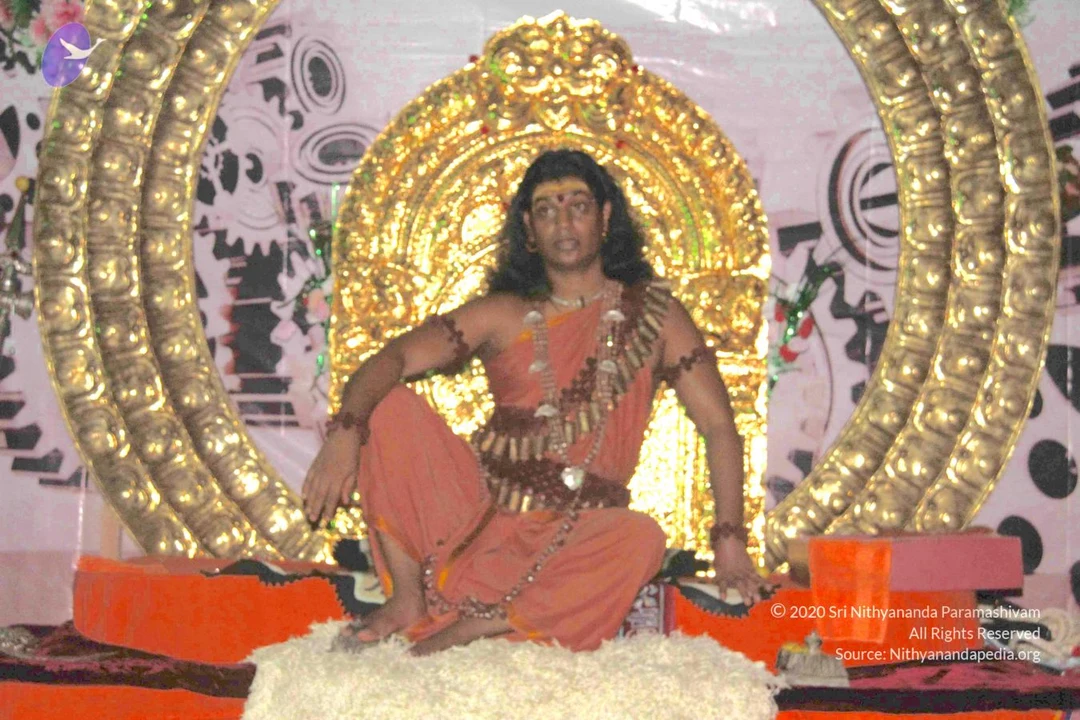
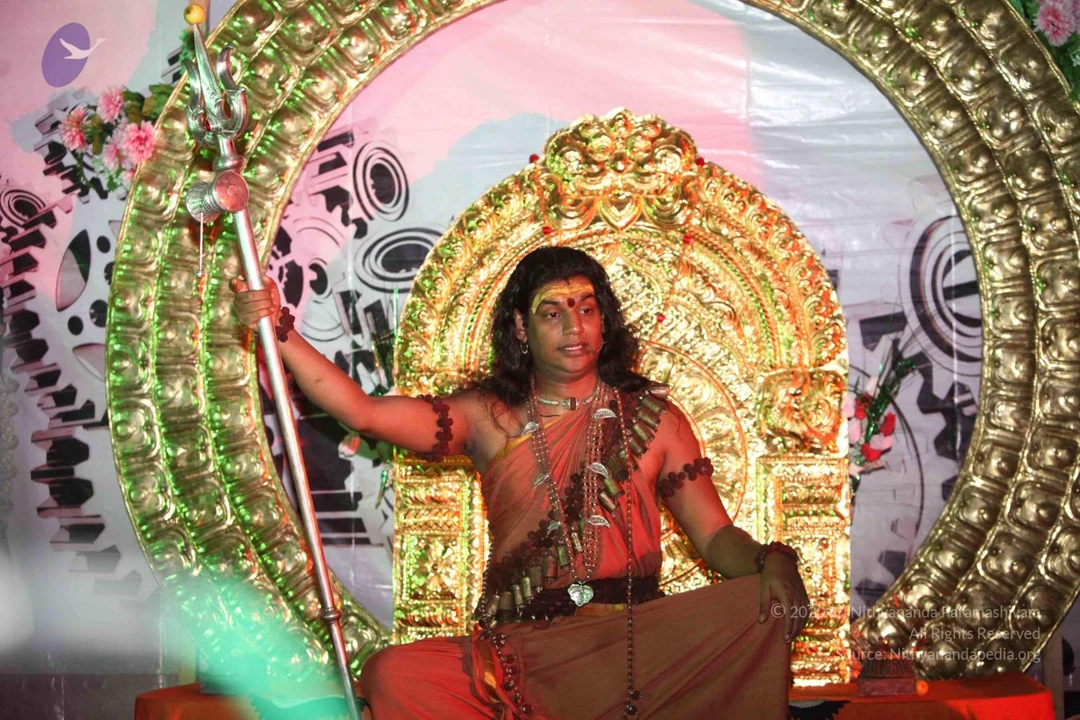
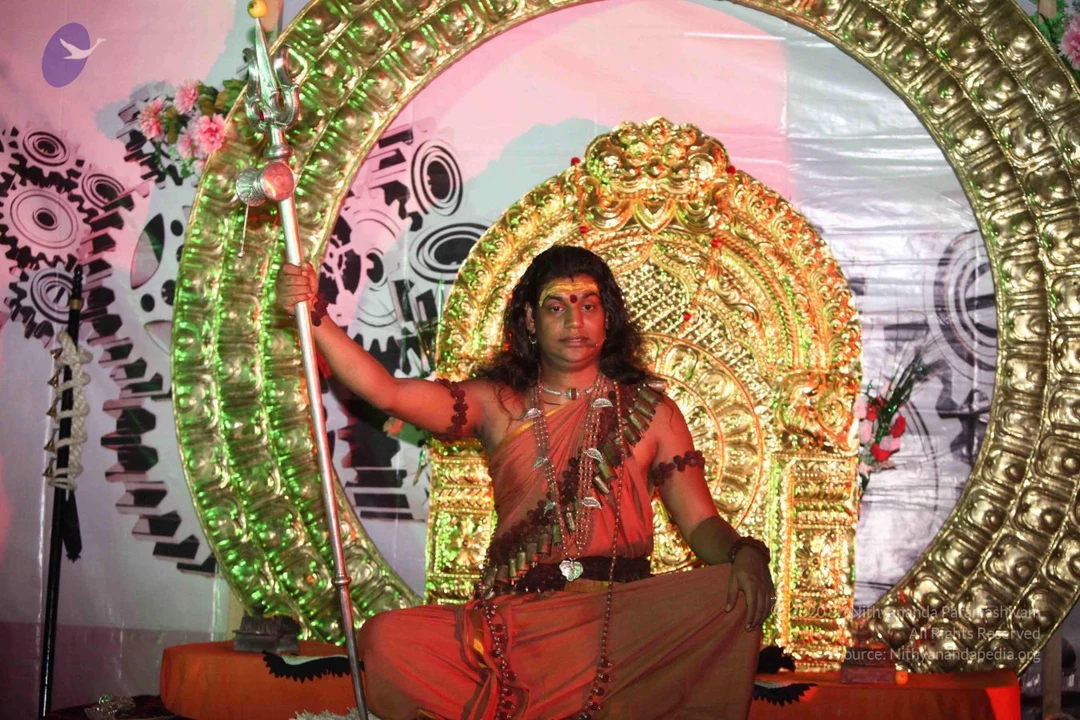
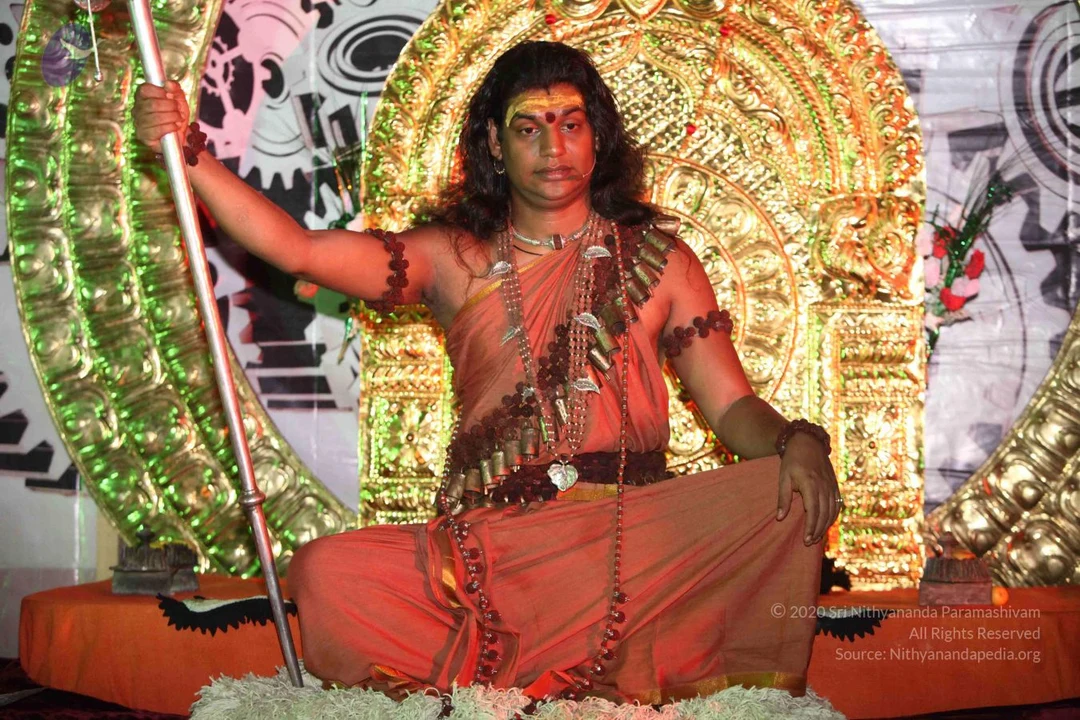
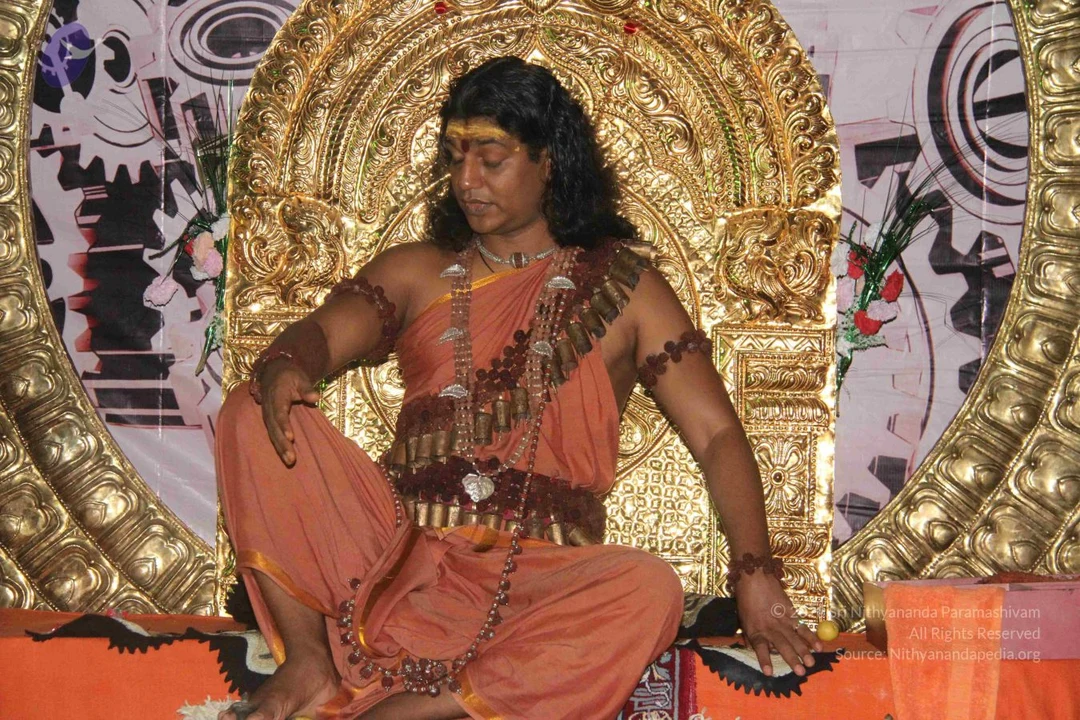
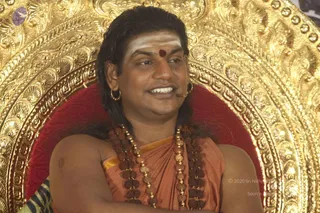
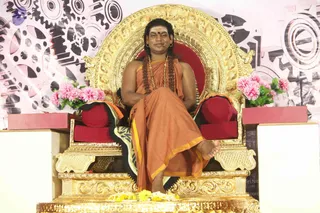
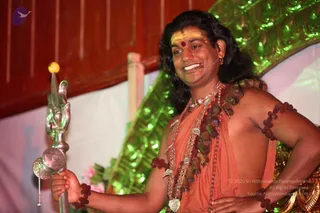
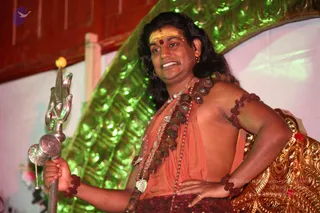
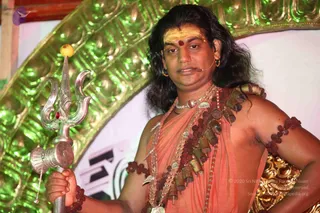
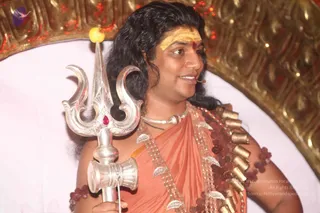
A figure in a costume of deity-style attire stands on a golden ornate stage, smiling with eyes closed and one hand raised to the head. He wears a saffron-orange cloth draped over the body, a waist belt of rudraksha beads and brass bells, layered bead and pearl necklaces, bangles and rudraksha armbands, and a gold headband with a red bindi. He holds a silver trident with a green-tinged shaft in the other hand. Behind him is a large gilded arch and golden throne-like backdrop with a red wall and a partly visible printed backdrop.A single man stands on a raised stage in front of an ornate gold-embossed arch and panel backdrop, waving his right hand while holding a tall silver trident in his left. He wears a saffron-orange draped garment with gold border, layered rudraksha malas, a red-brown beaded waist belt with metal bells, and a red bindi with a yellow tilak on his forehead. Long dark hair falls past his shoulders. A printed photo credit and copyright line run along the right edge.A photograph of a man seated on an ornate gold throne with red cushioning, smiling at the camera. He wears an orange-saffron robe draped over his shoulder and multiple rudraksha mala necklaces, with a white tripundra marking and red bindi on his forehead, and a small microphone clipped near his mouth. Behind him a faint temple structure is visible in a pale backdrop. a person (orange robe, multiple rudraksha malas, ornate throne, microphone) is seated in this in_person setting.

July 17 2012

Original wiki page
Contents

Title:

Supreme Pontiff of Hinduism HDH Bhagavan Sri Nithyananda Paramashivam

Description:

TALKS FROM MORNING SATSANG ON JULY 17 2012 IN MADURAI, INDIA In today’s morning satsang, Paramahamsa Nithyananda (Swamiji) answers a question regarding religious conversion. Paramahamsa declares that conversion is actually intentional, applied violence. When a person encounters a spiritual truth through direct experience, his inner space evolves and undergoes transformation. At that point he may choose to adopt the formal religion associated with the truth he has discovered and embrace it as a devotional practice. This is the only legitimate form of conversion. All other avenues – outside pressure or bribery (feeding the poor in order to convert them) - are simply a veil for aggression.

Link to Video:

VideoAudio

Link to Video

Link to Video

Transcript:

Religious conversion is conscious Crime

Q&A with Paramahamsa Nithyananda

Today is, as per the solar calendar, new month in the Vedic tradition. So from today, the Indian villages, in Bengal, in UP, many of the Indian states, even in Madhya Pradesh, all the states which follow the solar calendar, all those states, this whole month they will drink Neem juice and cleaning the stomach. They will live on liquid diet and our Nirahar Samyama is matching with it. We have not planned. Automatically it has happened.

All the states which follow the solar calendar - See Andhra and Karnataka follow Lunar calendar. Tamilnadu, Kerala, UP, Madhya Pradesh, West Bengal, Gujarat – all these states follow Solar calendar. So as per the Solar calendar, today is the new month beginning. In the whole 12 months, this one month they will be with the liquid diet. It is almost like a Ramzan. From this tradition only they started the Ramzan. One thing in Ramzan is they eat after sunset. Here they don’t eat even after sunset. The whole month they live on liquid diet. Drinking Neem juice in the morning. They worship mother. The whole West Bengal, this is the only month they eat less sweet, because they don’t eat. Indian villages these traditions were there. I don’t know whether now in the cities it is not there . But still in the Indian villages these 5-6 states which follow the solar calendar they all do this observation. They go to the local deity of that village. So this is the offering given to the deities. Let’s start the Satsang.

Q: How does one stay faithful to his/her religion assuming they feel a deep connection and find truth in their religion, while currently maintaining a connection with the Guru. I will say the prayer in Hebrew before bed and then chant for the morning Pooja. Is there a contradiction here? Does the subtle sense of guilt only exist in the mind?

A: Don’t worry. There is no such thing as contradiction. Have everything. You will see automatically whatever needs to be dropped by itself. See, there should not be conversion. Conversion is a violence. I wanted to tell you all religious conversion is violence. Never ever anybody in my Sampradaya will practice religious conversion. No. No conversion!

In transformation you never have pain. Suddenly you will see some of your old faiths and beliefs have completely left you due to your new discovery. Then it is not conversion. It is transformation. So after transformation, you may / may not choose legally to adopt that new religion you discovered.

Please understand, it is a very subtle issue. This has to be handled with lot of sensitivity. Because I see so much of psychological violence, cultural invasion. As a Indian, born and brought-up in a village, I know the sufferings of religious conversion. Our poverty is being exploited. For the sake of bread and butter, people converting to different religion, I have seen. I have seen villages getting converted.

I have seen the cultural invasion happening and the psychological violence being done. So I tell you as a sufferer, victim of religious conversion, with tremendous sensitivity and love and compassion for humanity, I make this as a law for Nithyananda Sampradaya and all my devotees and disciples – “Thy shall not convert”. We will only spread, radiate transformation.

Understand I can tell you millions of stories, painful stories, where conversion is nothing to do with the religion. It is more to do with politics. It became a power-centric action not spiritual-centric action.

I tell you a small example. I used to have a Shiva deity from the young age. May be from the age of 8~9 till 22. And after I realized my Avataric mission, I stopped doing morning Pooja. I used to worship with a small deity which I used to carry wherever I go. Now after I became the successor of Madurai Adheenam, I have to start my every day morning with the worship. So from the Madurai Adheenam I have been given a Shiva Linga , which is a hereditary, traditional. Even to shift from my old Shiva Linga to new Shiva Linga, it was such a big difficult. I tell you when you relate and live with a deity, that deity has become part of your inner space. So now if you see, I will keep both Shiva Lingas. I am not able to give-up that old one. For an incarnation after realizing incarnation-hood, it is not change from one Sampradaya to another Sampradaya, it is change of one deity to another deity. Both are representation of same Shiva. Because, religion is your love affair. Understand, it is such a personal sweet experience.

I know among my own devotees who consider me as the mother, they do not want to see the masculine Kala Bairava form and some of my own disciples who connect with me more like a Kala Bairava, do not want to see Meenakshi Bhava Darshan. Religion is personal experience. It is deeper than any love or any love affair. Love affairs are only between minds. But Religion is between consciousness.

The very being, I tell you, if you forcibly ask somebody to eat certain food, change their dress, it is physical violence. If you forcibly ask somebody to think in certain pattern, it is mental violence. Without making the other person understand, if you pass any law and force it on the people, it is emotional violence. Religious conversion is conscious violence. Most powerful violence on the planet earth. That is why all consciousness based religions; Vedic tradition, Buddhism, Jainism, Sikhism, Sufiism, none of us believe in conversion.

It’ s my vision - One day I will surely gather all these traditions which do not believe in conversion. Even Greek Orthodox Church does not believe in conversion. The traditions which do not believe in conversion, we will all gather together and declare to the whole humanity “No conversion, only transformation”, as a law. Let us not be violent to the human civilization. There are enough of people who are violent to human civilization who are greedy of money. Money mongers keep humanity in poverty, power mongers politicians keep humanity in fear. There are so many groups, vested interest groups, vomiting enough of venom and violence on humanity. We religious leaders, spiritual leaders should stop this concept of conversion.

People ask me, “Swamiji, you are the successor of Madurai Adheenam. Great saint who revived Madurai Adheenam, he himself converted people from Jainism and killed thousands of monks. I wanted to make it very clear, I do not believe this story.

First thing. He only transformed the king, Pandya king. Whoever had that transformation followed him. Second: Such a loving person like Gnanasambandar can never afford to kill people. May be it is a later interpolation. I don’t think there would have been any violence or killing in Thirugnanasambandar’s life. Such a great saint! Can’t afford to kill people. Surely he wouldn’t have done and if it was true – I can’t even say “if it was true”! I know. I have seen the inner space of Thirugnanasambandar. I live in that inner space. Gnanasambandar can’t afford to kill people. Such a great saint! May be some of these Jain monks have committed suicide by themselves or ran away. Anyhow, now I am making it very clear for my Sampradaya - Only transformation, No conversion! Let me make it very clear.

When the transformation happens you discover the new religion. It is not preached to you. You discover it. So we will only help people to discover the Vedic tradition. That is why in Hindu tradition, there is no conversion. We will help people to discover Vedic tradition.

So, I am only supporting you to discover. So do not have any conflict. Have both hand in hand and enjoy the best things. No need to carry guilt. At some time what is more useful for you will stand with you and what is not will automatically merge into the other one. Your Hebrew prayer may merge simply into the morning chanting or your morning chanting may merge simply into the Hebrew prayer. And even if they don’t merge and they are standing individually and supporting you, perfectly alright. Nothing wrong! What is wrong? Nothing is wrong!

I tell you very clearly. I have so much of love for Buddha and Mahaveera. So many masters even Islam Masters, Sufi Masters, I have so much of love and respect for all of them. I read many of their books not just to come and blabber and repeat in the discourses. No. As my personal enjoyment, personally I enjoy their words, their life, their teachings, their expressions.

So many Christian Masters have contributed to me. Thomas Kempis, St. Francis of Assisi. Still I have so much of love for St. Francis of Assisi and Thomas Kempis. There is a beautiful book “Practicing the presence of God” by Brother Lawrence. I tell you I would have read that book atleast 50 times. “The imitation of Christ” that is by Thomas Kempis. But both the books I used to read, even the “Imitation of Christ”. Both books have given me lot of inspiration and encouragement. And the same way the letters of St. Francis of Assisi. The book title is “Go Forward”. There are two books. One more book “Go Forward”, by a sadhu of Ramakrishna Order – Swami Premeshananda. His letters, they also give the same tile “Go Forward”. And the St. Francis of Assisi, his compilation of his letters is also called “Go Forward”. That was the book I always used to keep next to my bed and read.

I have been inspired, encouraged by many spiritual, religious leaders, masters from all traditions. Let it be on record. Let the history not be distorted or changed by my next generation disciples, because of their vested interest to promote the Vedic tradition. I stand for Vedic tradition. I stand with Vedic tradition. I stand by Vedic tradition. No doubt. But I wanted this to be on record; I was also helped, supported, inspired, encouraged by many religious and spiritual leaders from many other traditions.

So I tell you. No conversion. Only transformation! Support human beings to discover whatever you discovered, whatever you experienced.

One of the biggest problems India is facing is religious conversion and persecution of the majorities. Yesterday Supreme Court has taken Somoto Cognizance of 78 pilgrims dying in Amarnath, within few days of the Pilgrim path opened. Last year the whole year the whole season of pilgrimage only 82 people died. This year already 78 people within few days. Supreme court has taken a somoto cognizance and they asked the Central Govt and State Govt of Jammu Kashmir and Amarnathiji Shrine Board – the Authorities to come and explain. Death toll is actually 83 not 82, sorry 83. Media reports are saying “These guys don’t even bother to create basic amenities.

China seems to be much better in taking care of Kailash Yatris than Jammu Kashmir Govt taking care of Amarnath Yatris, because they provide more facilities and safe trip. Even Kailash so many people don’t die. Such beautiful infrastructure is created. I am taking pilgrim Yatris to Kailash but I am afraid to take people to amaranth. Still I have not taken people to Amarnath. It is inside India. These guys don’t care.

Hindus need to tell we are international minorities. See. Now it is time whole world is one country. So, we will have to again and again remind the world’; we are international minorities being persecuted everywhere, unattended everywhere. Common, there is so much of money. Hindus pour for the religious traditions and religious rituals. Just my native town temple Arunachala Temple that income is more than enough to make a 4 lane road to Amarnath. One year income is enough. But every state it is really painful to see so many pilgrims dying in Amarnath and Supremen court has to take Sumoto Cognizance to save the pilgrims. I immediately donated Rs.10 Lakhs to Hindu Helpline to save Amarnath Yatris, as our humble contribution. The VHP has taken up the job of setting up a private Hindu helpline to save the lives of the pilgrims and we are all also going to give more.

We will be continuously giving more money. Of course I am not going to touch the money which I allotted to Kailash. That is only for Kailashnath.

But there is so much money. We Hindus are very religious people. There is so much money sitting in our hand to promote our tradition and to support the people who are practicing our tradition. It is much worse than China Govt. I was shocked when China Govt did not accept. Of course they have their own procedures. They do not want to accept any donations from outside or Doctors from outside. But what about Amarnath? Why can’t they just save the lives of the people who go to this Amarnath Temple?

People have to become aware, whatever religion they may be, but these basic things should be provided for every person, who takes up the religious pilgrimage.

May be when I come back from Kailash, I may go and stay in Amarnath for a week just to do social service. Not as an organized trip. Just to do social service to take care of people and give medical help, medical support and really wanted to go and take care of the Amarnath yatris.

And I also tell you guys from next year I will surely take you guys to Amarnath. We will go to Amarnath also. We will go to Kailash and Amarnath also, because I wanted to make sure that we put our effort to support the Yatris of Amarnath. 83 people dying in Cardiac arrest. Or I can say safely allowed to die. Made to die, that is the right word. I will use; “allowed to die and made to die”. Should not have happened.

Anyhow I started with religious conversion and went all around upto Amarnath and came back. Alright. Let us have just Amarnathji darshan . You have come all the way. This is his cave where he sits in Tapas. Can you show the Amarnathji? This is a small deity worshipped there.

(A Shivalinga formed out of Ice is shown here). Yes. Now you can see Mahadeva. Great!

Anyhow, don’t bother. Have both, enjoy both. After all, religions or spiritual traditions are created for you to grow and transform yourself.

Q: In yesterday’s Satsang, you spoke about the extraordinary characterization and truthful representation of the characters in the serial “Devon ke dev Mahadev’. Can you speak more about this, Swamiji? Also, whatever is shown in the serial, how much of it is philosophically true?

A: It is a nice question. Please understand, bringing a methodical story to life is not a joke. If I put all my intelligence, philosophical strength, understanding, all my abilities and try to do a serial on Shiva, it will not be better than Devon Ke Dev. I tell you, they are doing best job. It is amazing job they are doing. There are lot of subtle points. When Devi assumes human body, what happens, there are so many subtle points, philosophical points. They are presenting so beautifully. They are neither missing the philosophical thread, nor missing the story line and making it so alive.

I tell you, in ISCON, they give you so many movies related to Krishna with English sub-titles. I tell you all our devotees should watch Devon Ke Dev with English sub-titles. It is the best thing they are doing to the whole Vedic tradition. The best thing they are doing to the whole Vedic tradition. See, they are able to make the whole thing alive in front of you. And even those people who are acting, they have put so much of effort into the whole thing to present to be honest and truthful to the original tradition. See, one of the worst things happened to the Hindu Mythology is, even the word ‘mythology’ is wrong, ‘Hindu Puranas’ is, it was understood by the Western angle through the western historians eyes, constantly we are being disrespected, abused, blamed saying they don’t have a meaning, they are just fantasies and all that. Maxmuller translated Upanishads just to prove there is nothing in Upanishads, he writes in his letter.

But till 90’s all our Indology Scholars in India are all nothing but followers of Maxmuller. It is just last 10 years a new awakening has happened when the Sanskrit knowledge has started spreading all over the world. We were awakened to the truth. Maxmullerians cannot represent the Vedic tradition to its truth in true form with true respect.

I tell you, Devon Ke Dev is a ripple effect of that awakening. The Purana is beautifully presented. Purana is the history written with the philosophical explanations. History with philosophical foot notes is Purana. So, Devon Ke Dev people, the producers, the directors and story writers the whole team is really true to the concept of Purana. Purana is not just history. Purana is history with the understanding of philosophy. Incidents recorded with the big picture of philosophical understanding. With the understanding of the big picture when incidents are recorded, that is called Purana. If the facts are recorded like everyday news paper, it is called history.

We, Indians, know only how to write Puranas, we are not newspaper guys.

Devon Ke Dev is really doing honest and true service to the Vedic tradition. I don’t see even a trace of Maxmullerism in Devon Ke Dev. They are truly, honestly reviving. Especially the people who are supporting, their philosophical team Devdatt Bhatnaik what a beautiful job they are doing. I wanted to specially mention his name: Devdatt Bhatnaik for doing amazing research and supporting.

The whole serial is presented in such a beautiful way, all the concepts of an incarnation, why even an Incarnation needs Tapas, everything is so beautifully presented to a common man. So many questions you guys ask me: “ Swamiji, you are an incarnation, why did you need to do Tapas?” Parvati is an incarnation. She is doing Tapas. All these difficult questions, they are presenting it so beautifully to the whole mass. That is the beauty. Visually they are able to present. And I recommend everybody to enjoy it.

Photos From The Day:
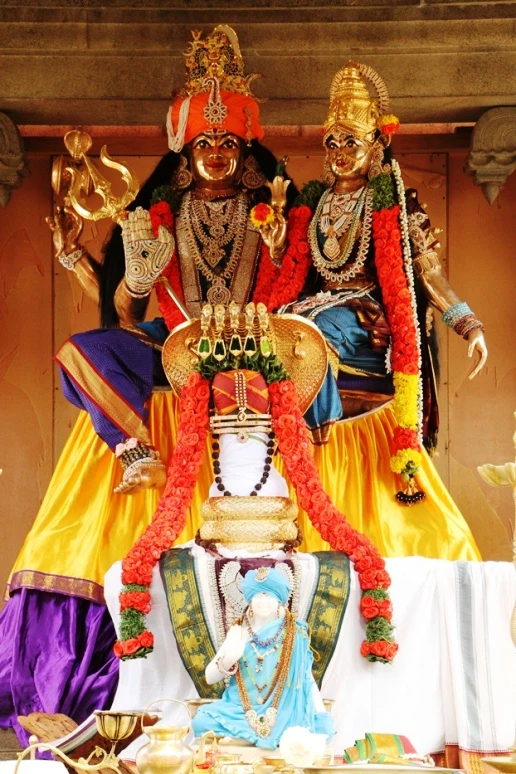
Sakshi Pramana:

Sharing from Inner Awakening

Tags:

Paramahamsa Nithyananda, answer, question, religion, violence, encounter, spiritual, truth, experience, evolve, transformation, choose, embrace, bribery, feed, poor, aggression.

Photos Of The Day:

Inner-Awakening-Yoga
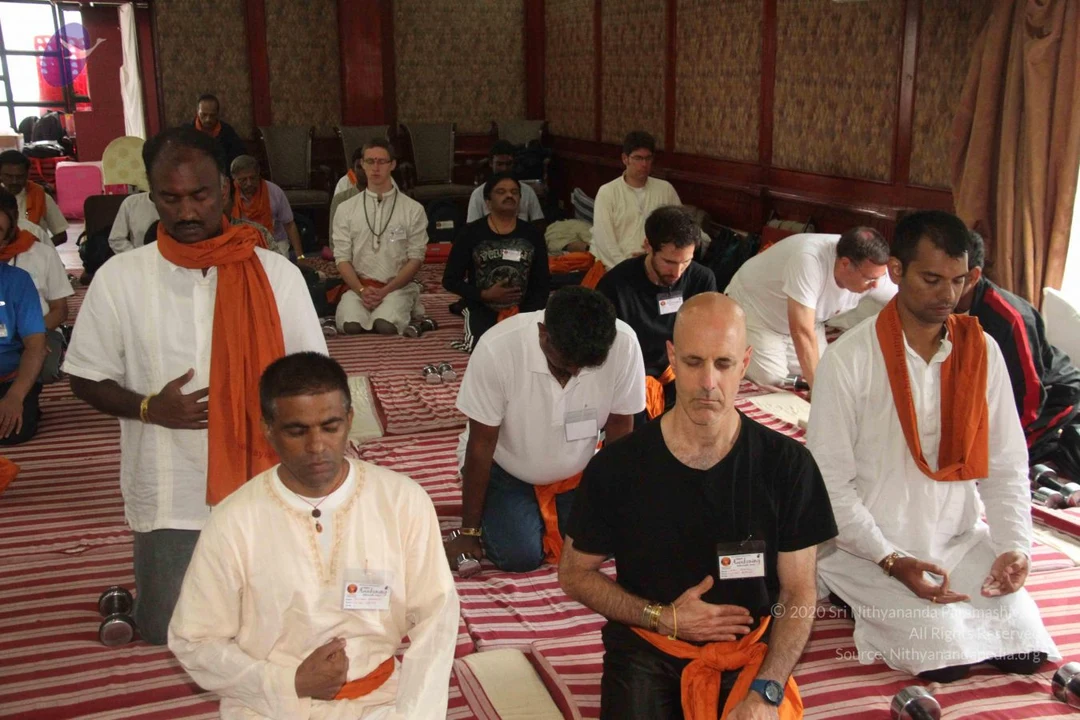
Pada-Puja
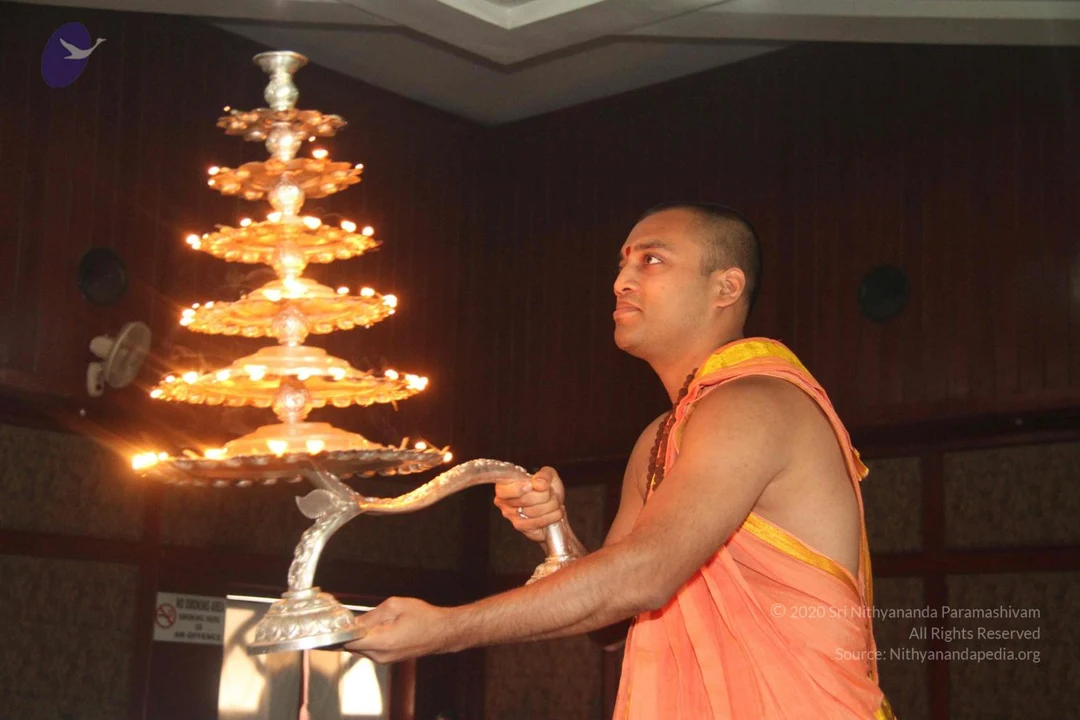
Nithya Satsang
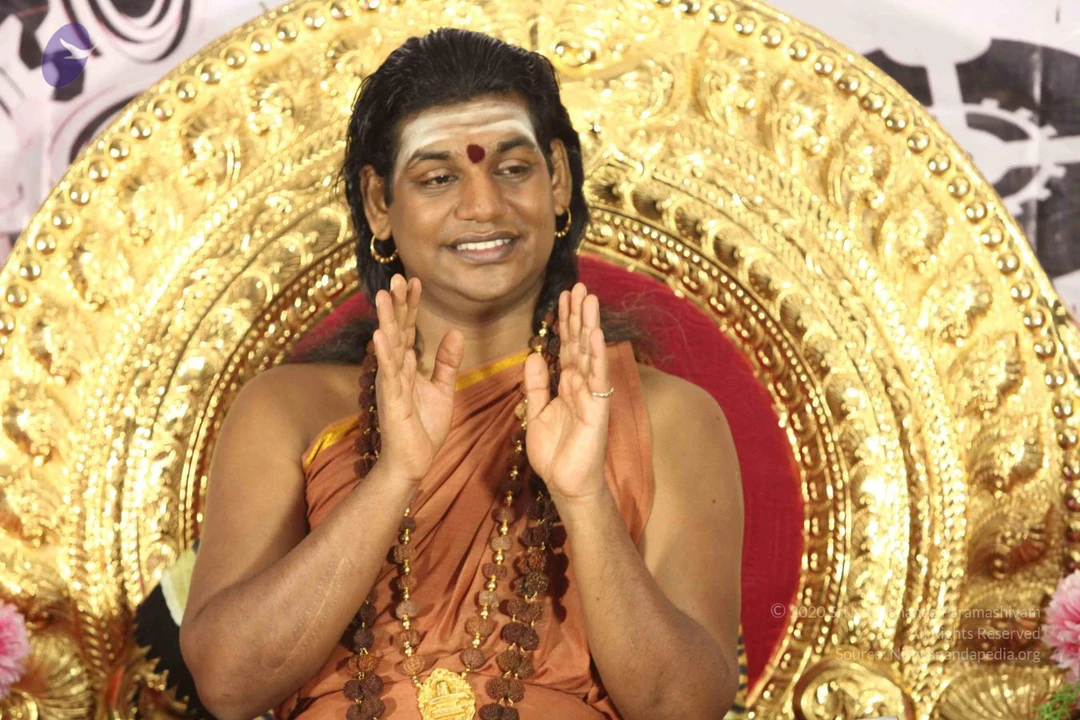
Sarva-Darshan

Energy-Darshan

Inner-Awakening-Session

eNGenius

Kalabhairava-Darshan

Photos from this day

View all 226 photos

Photos From The Day:

17 photosSource gallery
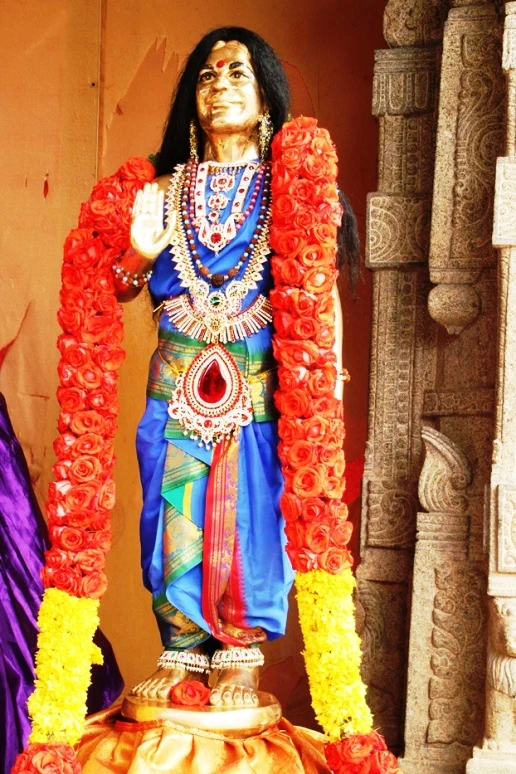
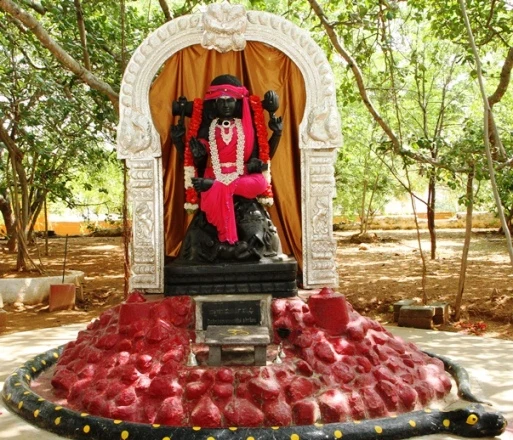
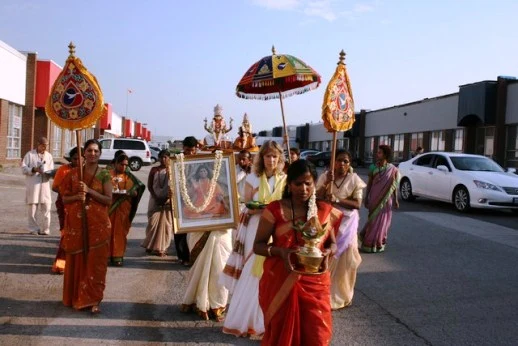
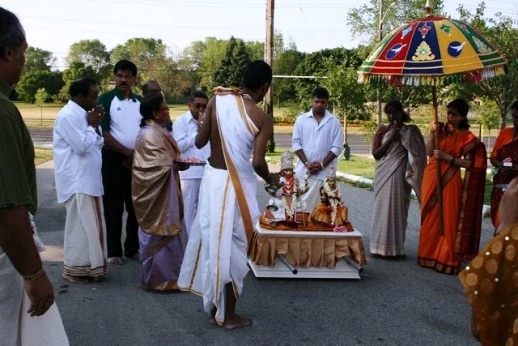
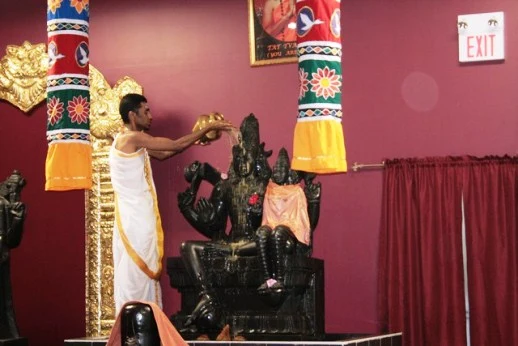
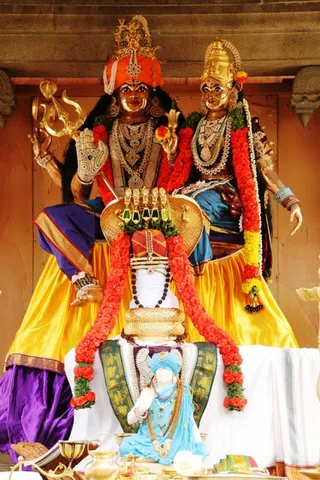
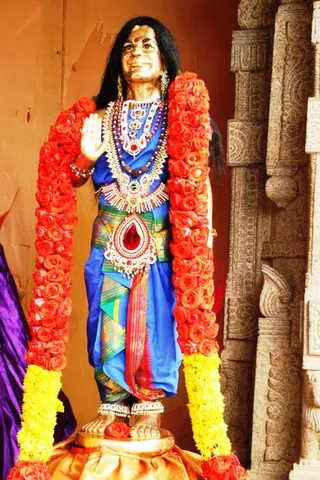
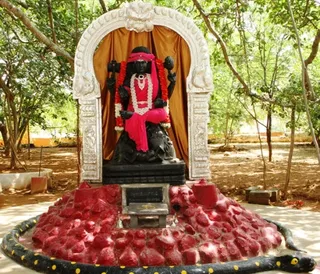
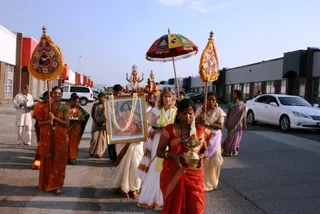
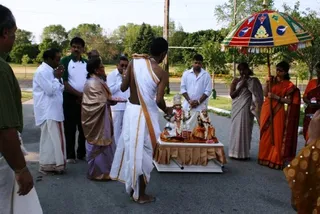
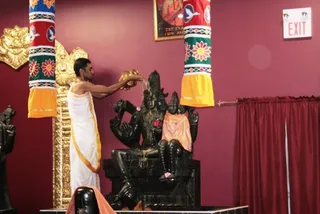
A photograph of a temple shrine with a large gilded deity murti pair seated on a yellow draped throne, a seated male figure with a trident raised in one hand and a female figure beside him with a crown and gold ornaments. Both wear garlands of red and orange flowers with green leaves. In front, a white-clad figure with a blue turban and blue cloth, bearing many gold and beaded necklaces, is decorated with a long garland of red flowers and sits on a white-draped altar. Brass lamps and vessels sit on the altar, and a silver-and-gold kalasha-like arrangement is in front of the shrine. No living people are visible, so this is a statue shrine with no physical persons present.A life-size statue of a standing male figure with long dark hair, raised right hand in a blessing gesture, stands on a golden pedestal. The figure wears a blue dhoti with a green and gold border, layered gold and jewelled necklaces, a large red-and-white ornamental pendant, and a red bindi. The statue is draped in a long garland of red roses and yellow marigolds. Beside it are carved stone pillars and a purple cloth at the left edge. No living people are visible.A black stone deity murti of a goddess stands in an arched white niche with a golden-brown backdrop, draped in a pink cloth and garlanded with red flowers and white jasmine strands. Her multiple arms hold objects and she sits atop a black pedestal. In front, a large mound of red flowers. Shaded trees and dry ground surround the shrine in an outdoor setting. No people are visible.A street procession moves along a paved road lined with low commercial buildings and parked white cars. Women in saris lead the group: a woman in an orange-red sari carries a brass pot on her head, and another in orange holds a decorated ceremonial umbrella-style standard. A framed portrait of a deity, garlanded with white flowers, is carried at the centre by a woman in a white sari. Ornate multicoloured parasols and a small metal deity figure on a carried stand accompany them, with men in white dhotis and women in pink and purple saris following behind.A photograph of an outdoor Hindu procession on a paved road with trees and a grassy verge behind. A bare-chested priest in white dhoti with an orange-bordered cloth over his shoulder walks beside a small white palanquin-style platform carrying two decorated deity murti with garlands. Several men in white dhoti and shirts and a woman in a sari stand with hands folded in prayer. On the right, a woman in an orange sari holds a multicoloured striped parasol. A man in green shirt stands at the left edge. The scene appears to be a street procession or puja.A man in white ritual dhoti with a gold-bordered cloth over his shoulder pours liquid from a brass vessel over a black stone murti of a seated multi-armed deity. Colourful striped banners with floral motifs hang on either side of the deity, and a framed picture sits on the wall above. The room has maroon walls, a red curtain, and a lit EXIT sign. The scene shows abhishekam, a ritual bathing of the murti.

Inner-Awakening-Yoga

12 photosSource gallery
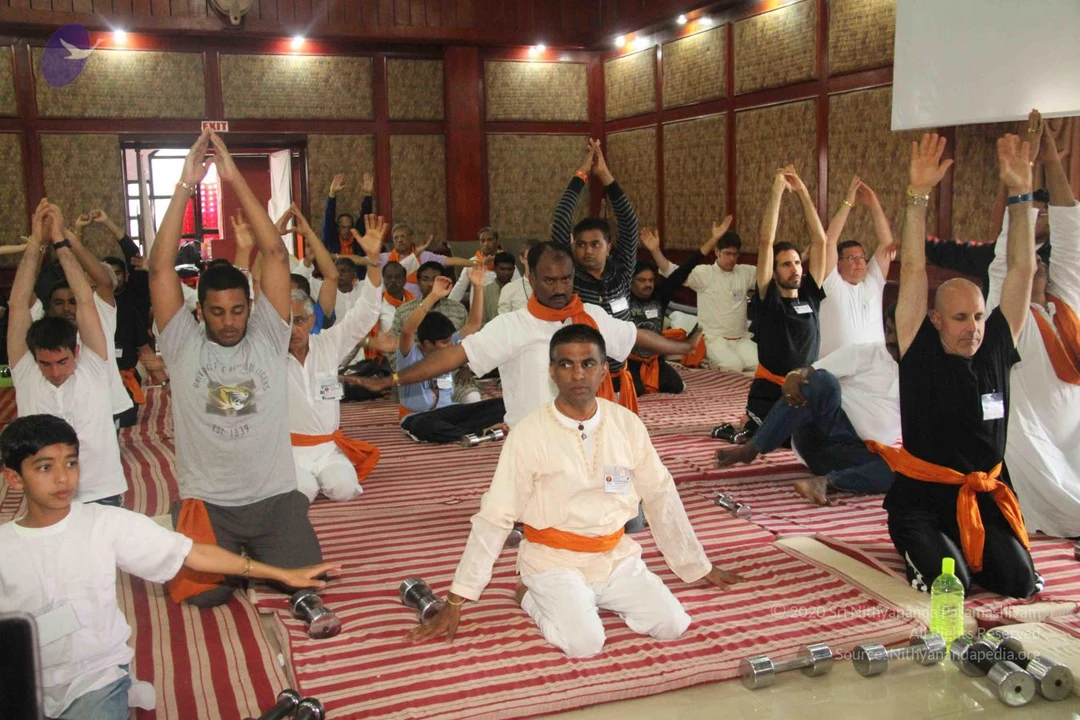
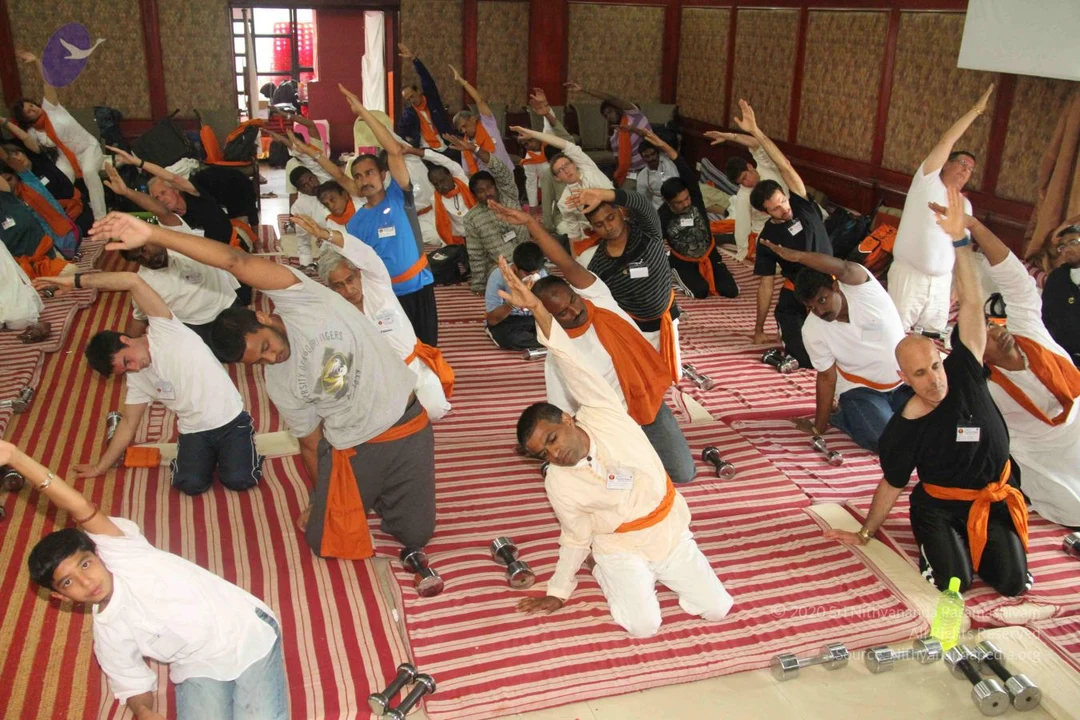
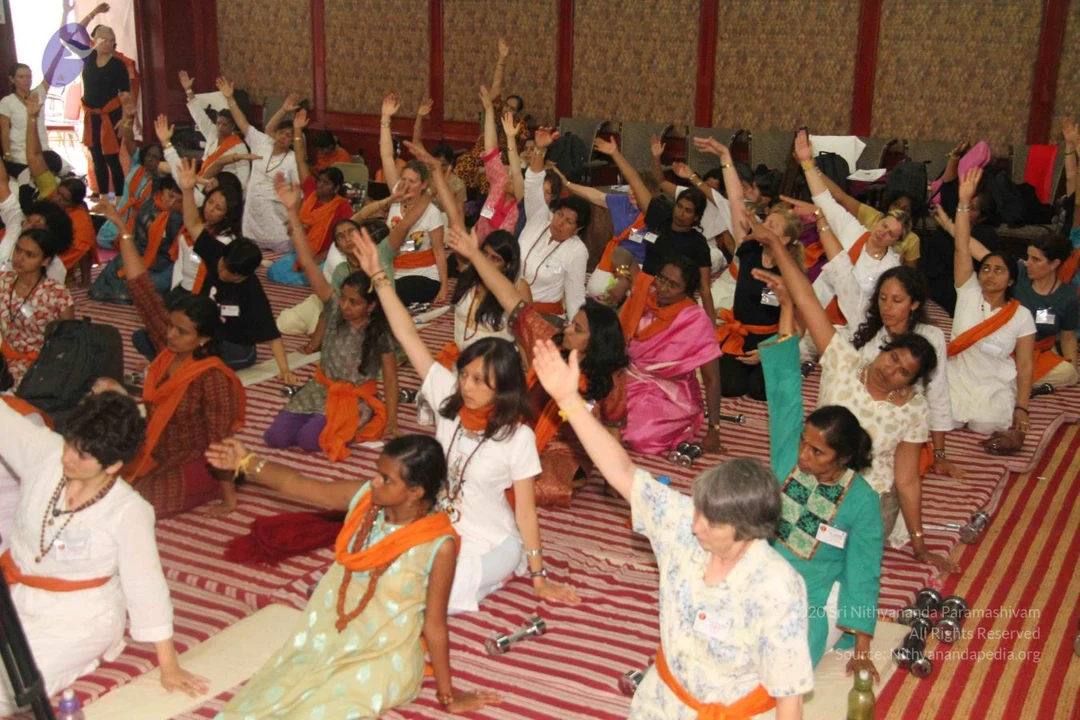
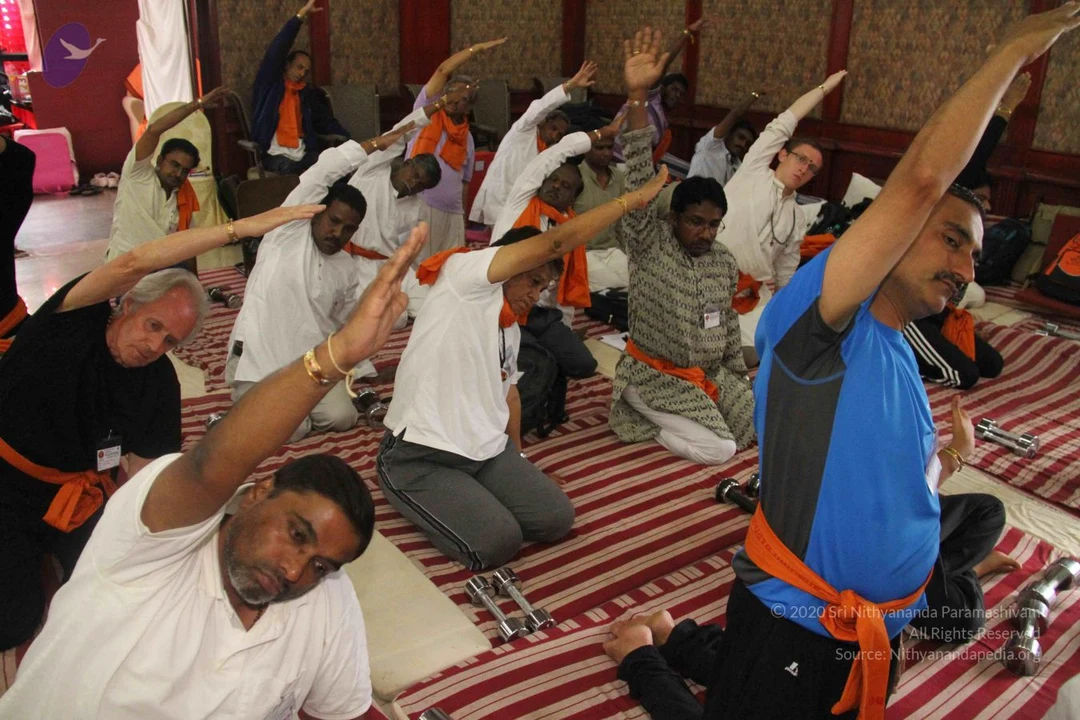
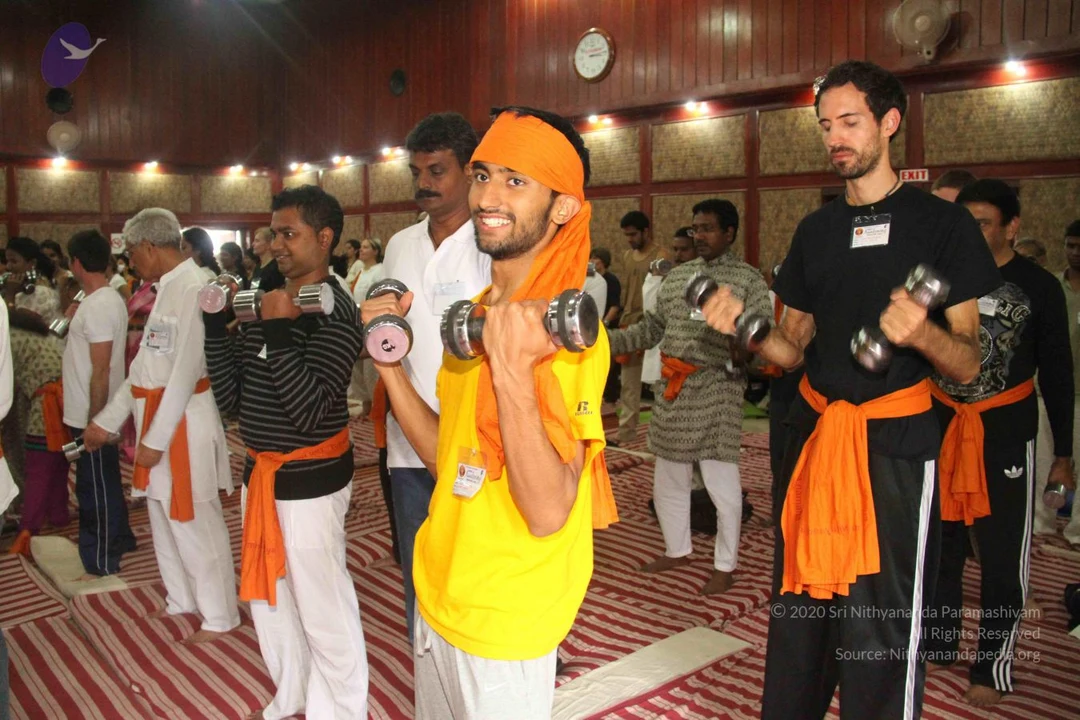
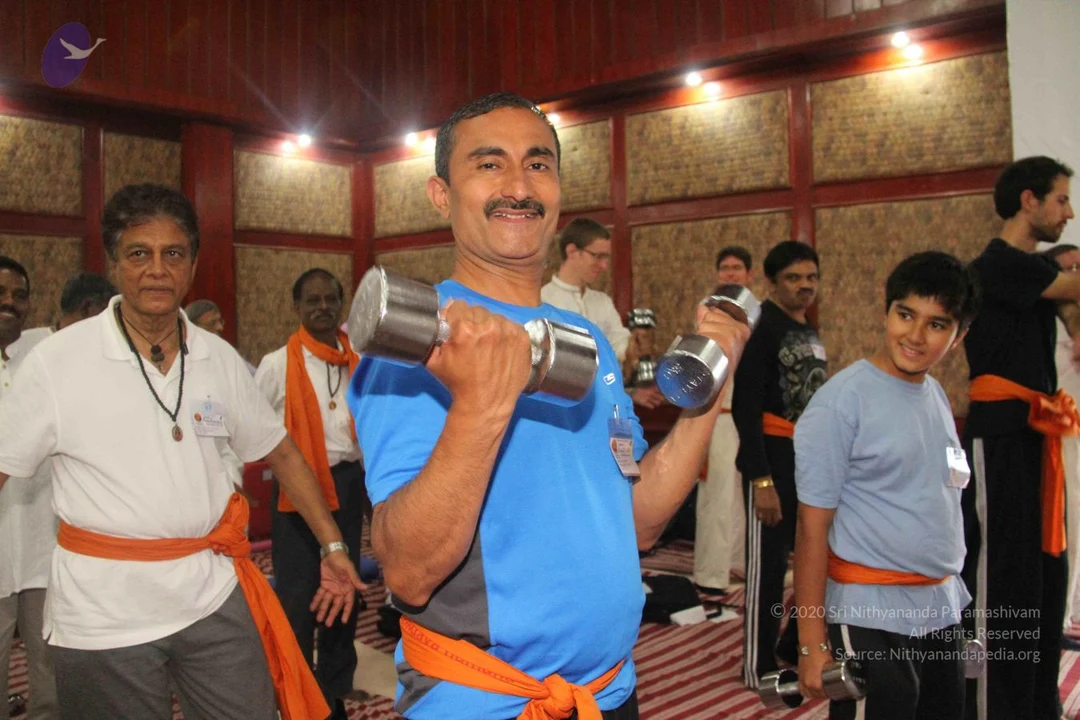
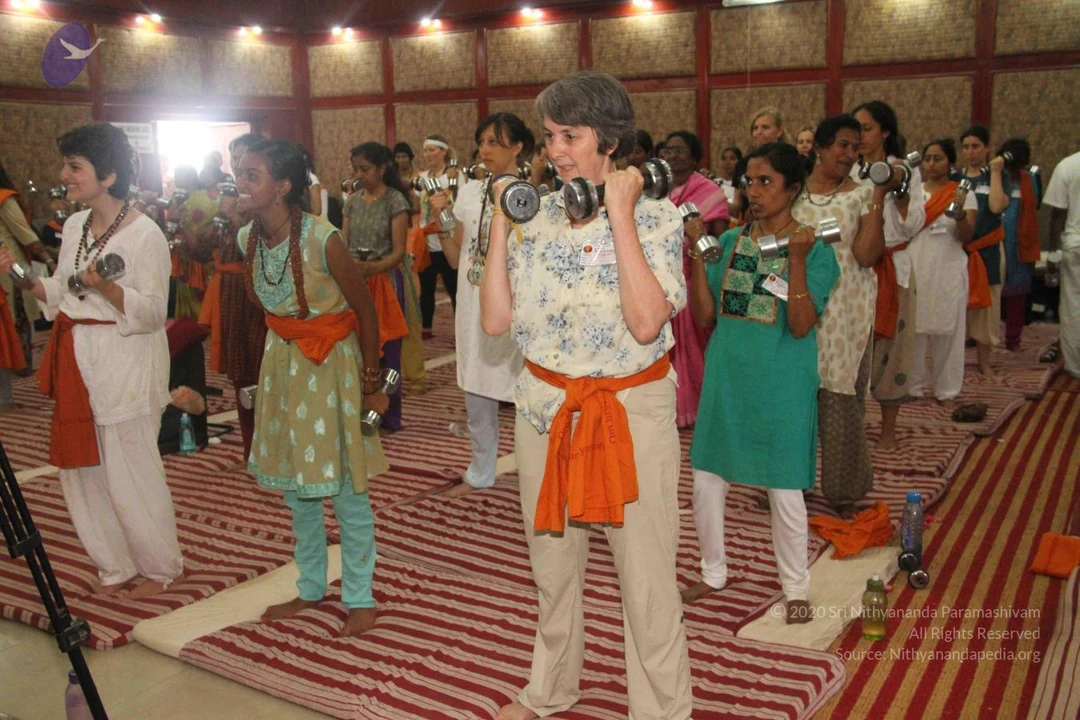
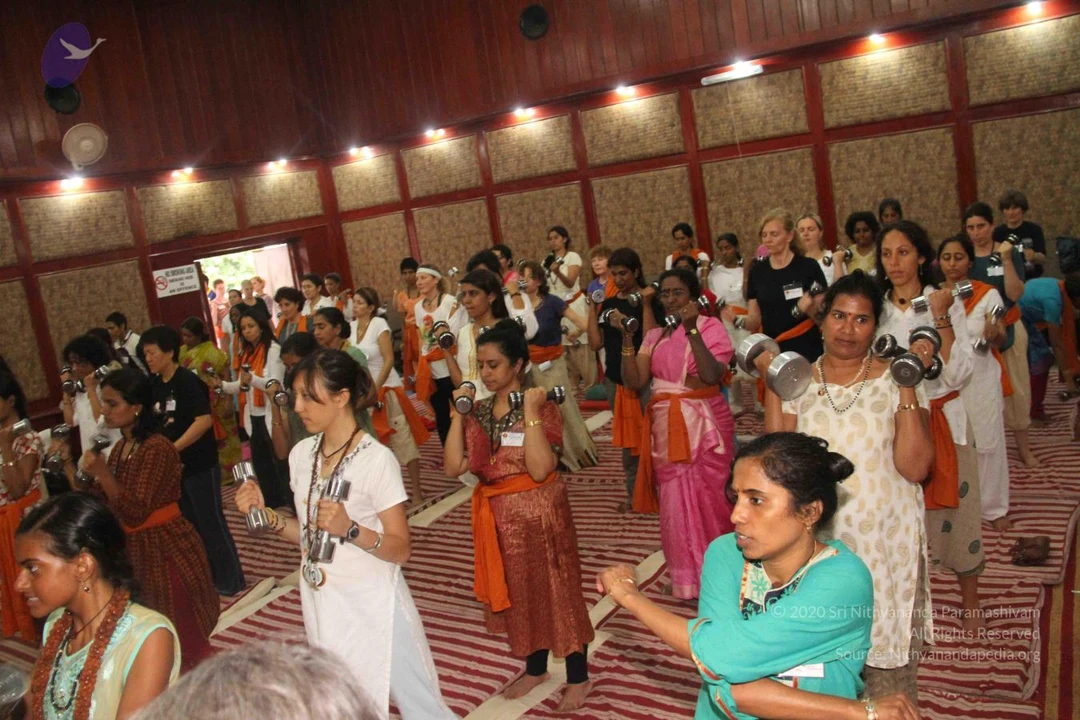
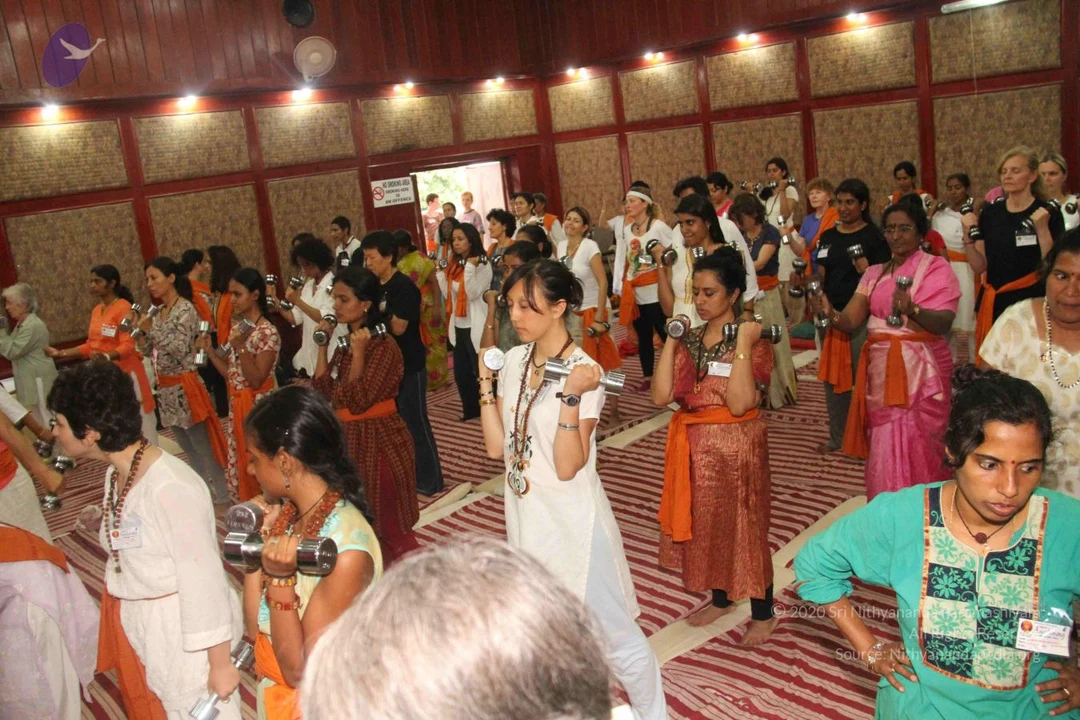
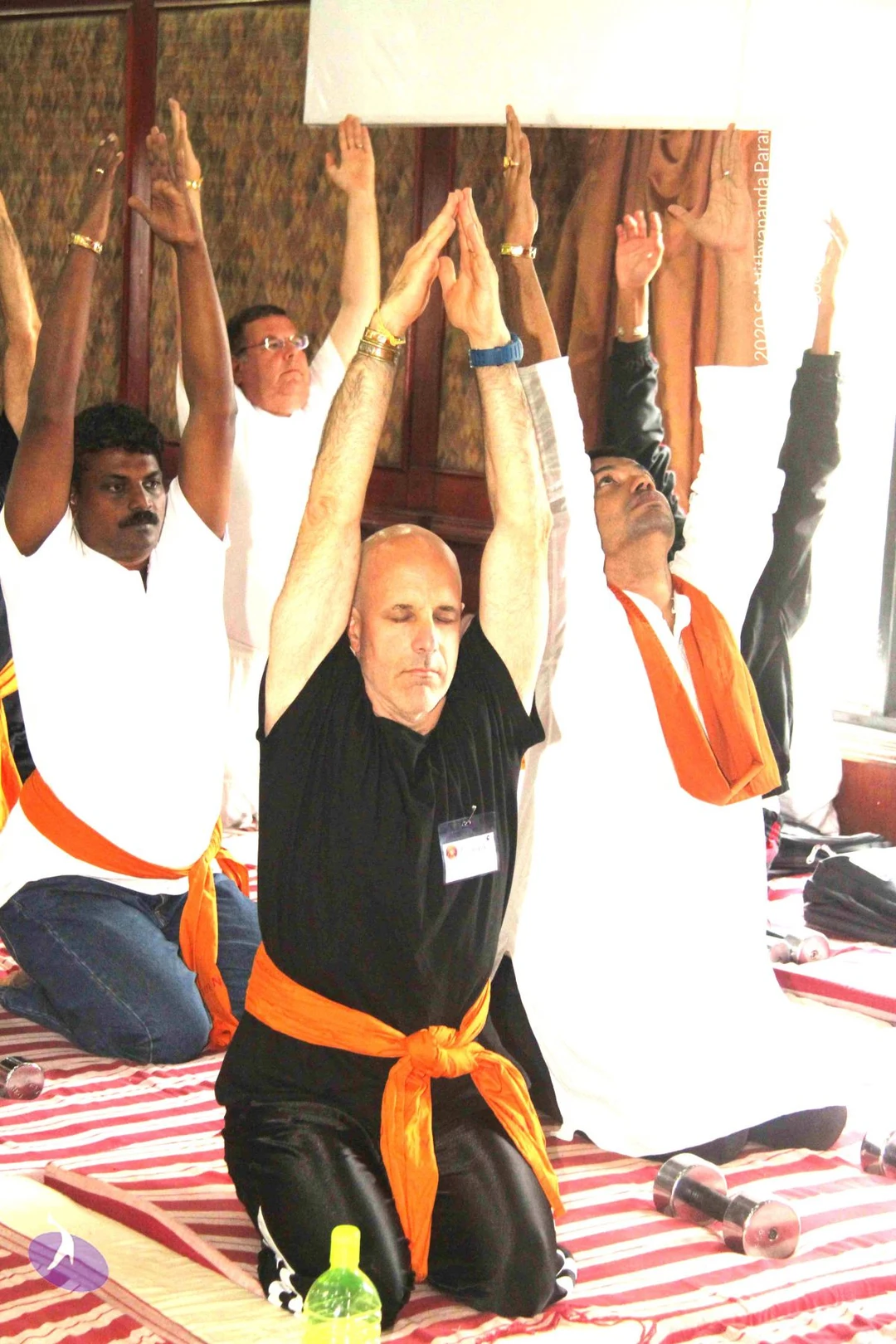
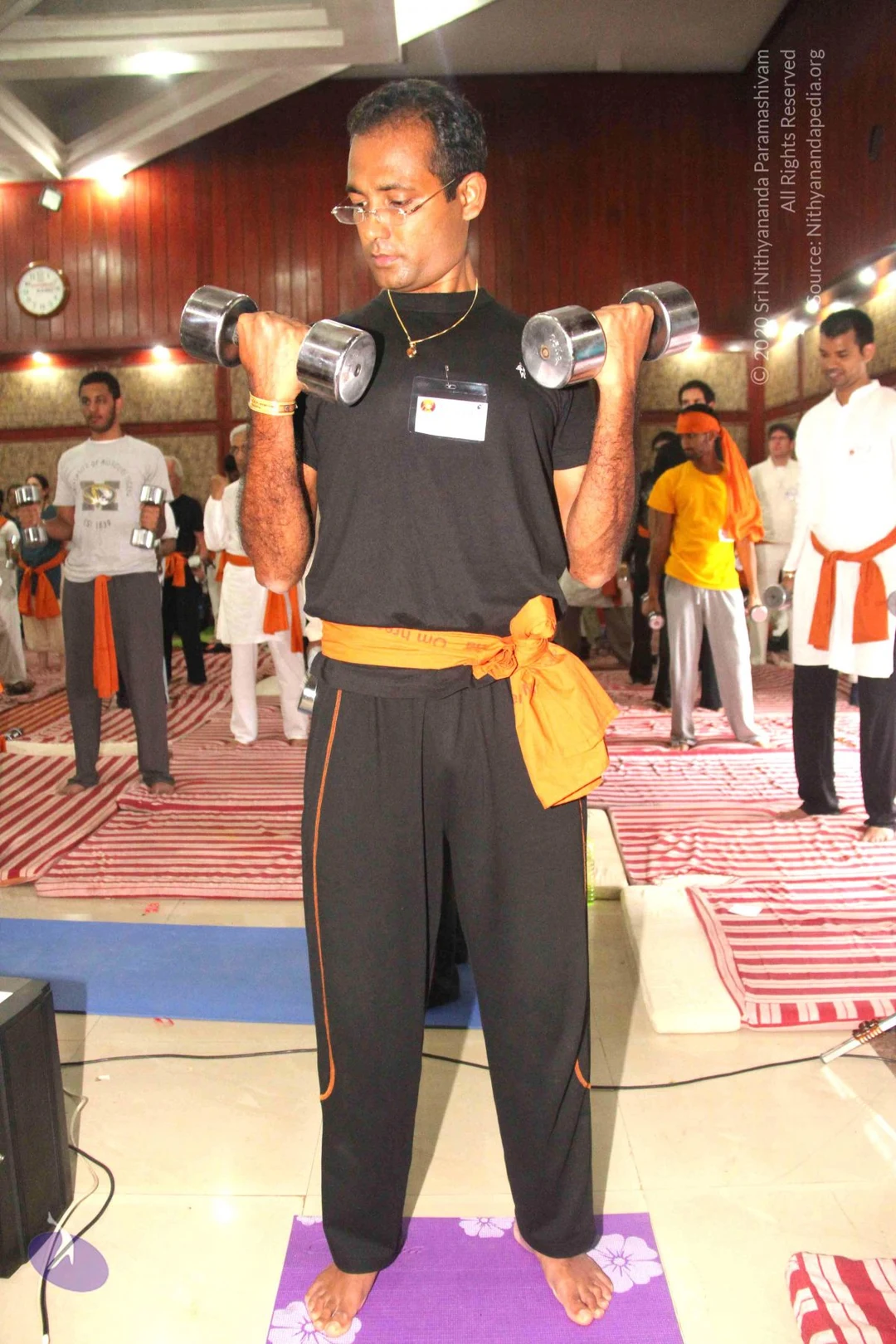
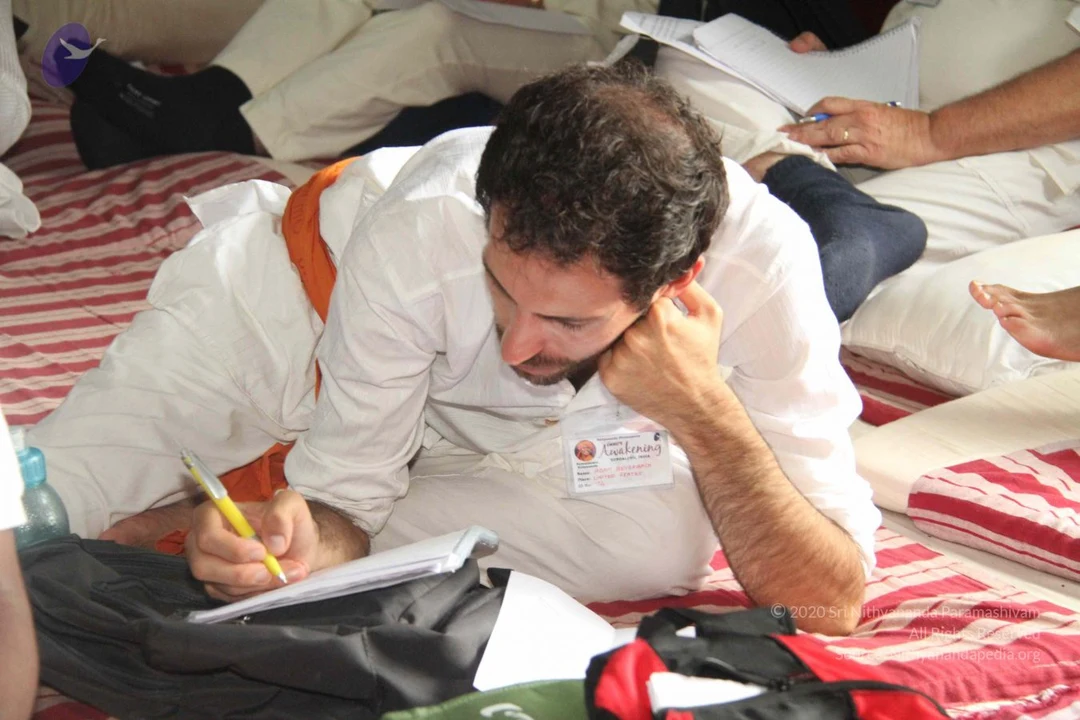
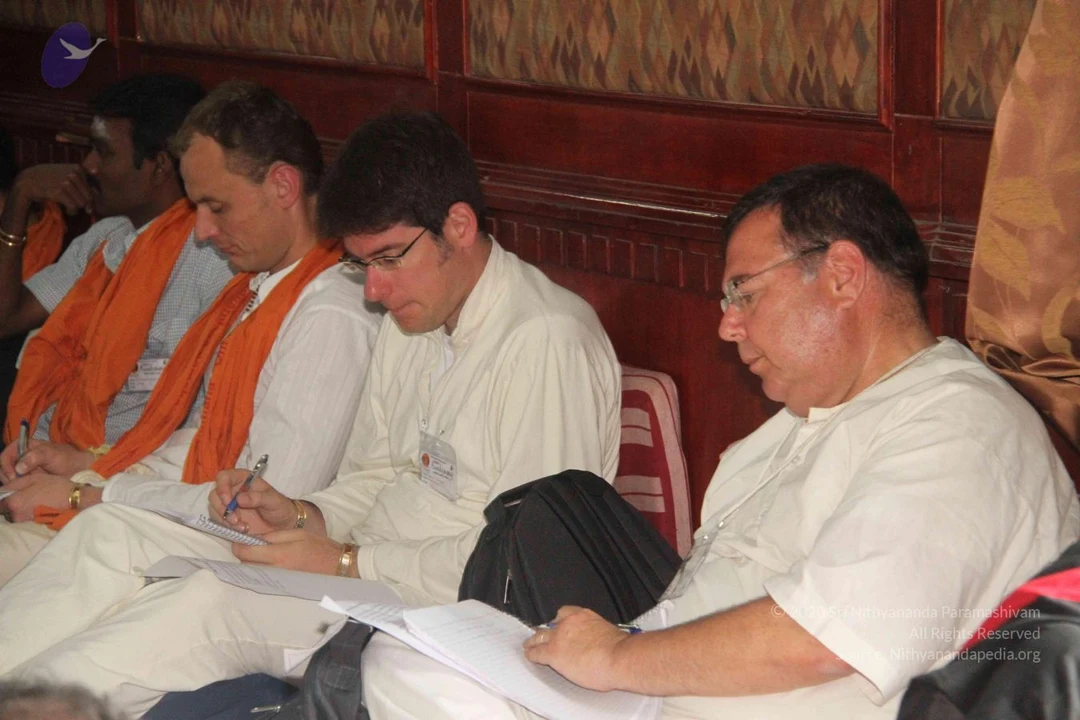
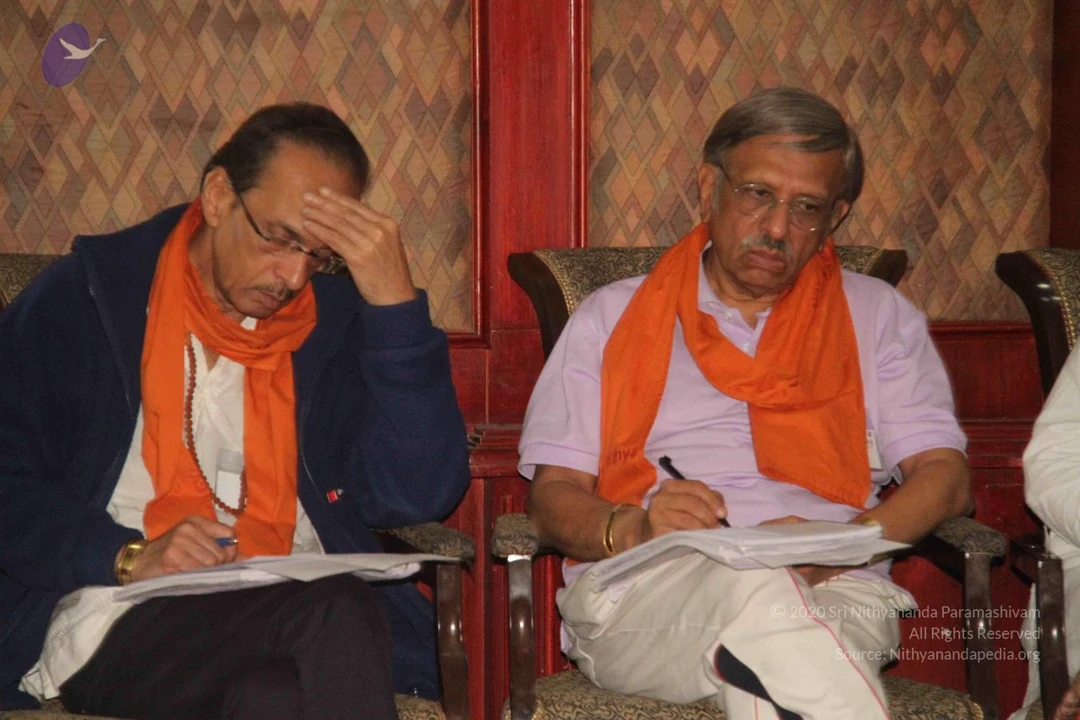
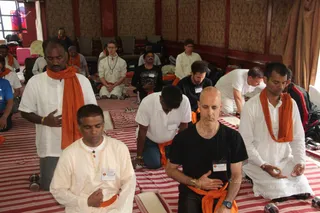
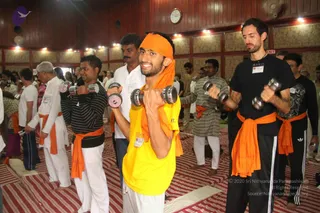
A seated group of devotees in a carpeted hall with red-and-white striped mats and wood-panelled walls, many with eyes closed and hands folded in meditative posture. Several wear orange shawls over white kurta or white shirts, and one man in a black t-shirt wears an orange scarf and a name badge. A man in the foreground in white kurta with orange shawl sits cross-legged, and another man in white with orange shawl kneels with hands at his chest. Folded metal dumbbell-like objects sit on the mats in the foreground. No clearly identifiable a person figure is visible in this group.A group of roughly 30 people in a wooden-panelled hall performs a seated arm-raising exercise on striped red-and-white mats. Many wear orange sashes or orange waist cloths over white or dark clothing, and several have raised arms with hands together overhead. In the foreground a man in white kurta with an orange sash kneels, holding a small hand weight, and to the right a bald man in black with an orange sash raises both arms. Chrome dumbbells lie on the mats and a green water bottle sits at the front right. A tall window and exit sign appear at the upper left. The setting resembles a group yoga or fitness session at an ashram-style hall.A group of roughly thirty people in a wood-panelled hall perform a standing side-stretch exercise on red-and-white striped mats, arms raised overhead. Most wear white shirts or tops with orange sashes tied at the waist; a few wear dark or grey clothing. Several participants, including one in a cream kurta and orange sash in the foreground, hold small silver dumbbells, which lie scattered across the mats. A water bottle sits on the floor at right. Ceiling-mounted screen and wall panels frame the room. The scene reads as a group yoga or fitness session rather than ritual activity.A large seated group of women and some girls performs an arm-raising yoga or stretching exercise on red-and-white striped mats in a hall with patterned wall panels. Many wear orange or saffron shawls and scarves, white tops, saris and salwar kameez in pink, green and yellow. Some hold small hand weights, and several participants wear rudraksha-style beaded necklaces. No clearly identifiable a person figure is visible in this crowd, so the scene shows ordinary participants at a group practice session.A group of about a dozen men perform a standing arm-raising exercise while seated or kneeling on red-and-white striped floor mats in a room with patterned wall panels. Most wear orange sashes over white, grey or patterned kurta-style clothes, and several hold small hand weights. A man in the foreground wears a white shirt, another in the right foreground wears a blue top with an orange sash, and an older man on the left wears black with an orange sash. Their arms are raised overhead in a group yoga or exercise session.A group of people in an indoor hall with wooden-panelled walls and a red-and-white striped mat floor do dumbbell exercises together. In the foreground a smiling young man in a bright yellow shirt and orange head wrap lifts pink and silver dumbbells. Beside him a man in a black t-shirt with an orange sash lifts weights, and others in white kurta-pyjama, black tracksuits and orange sashes exercise nearby. No individual is identified as a person in this image.

Pada-Puja

9 photosSource gallery
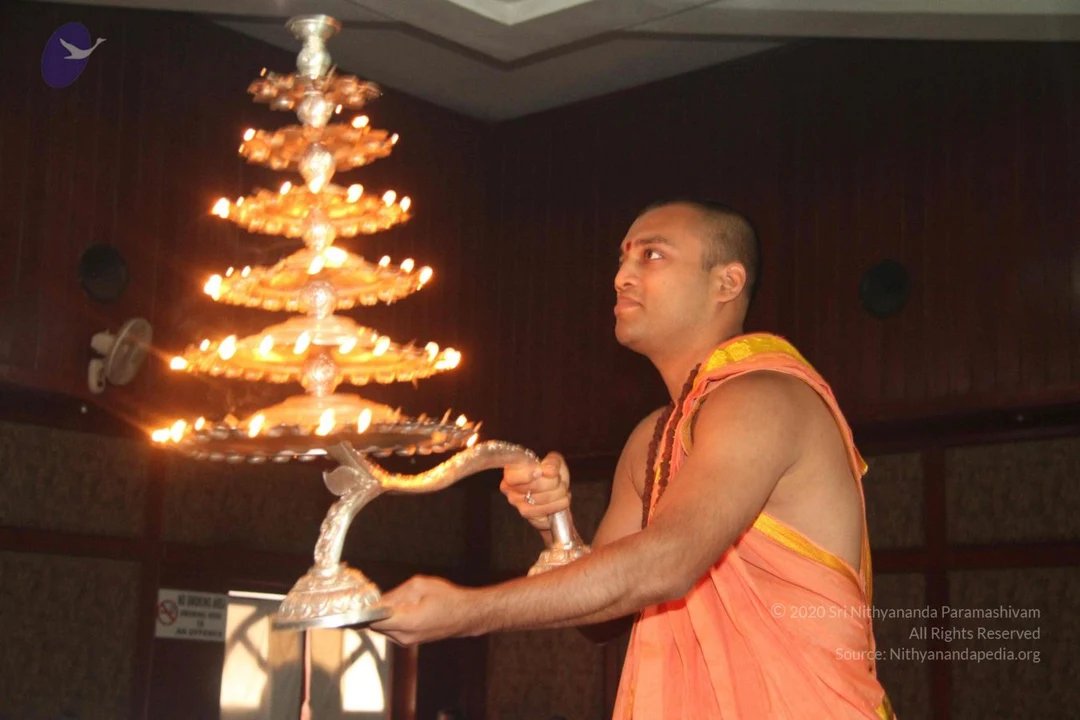
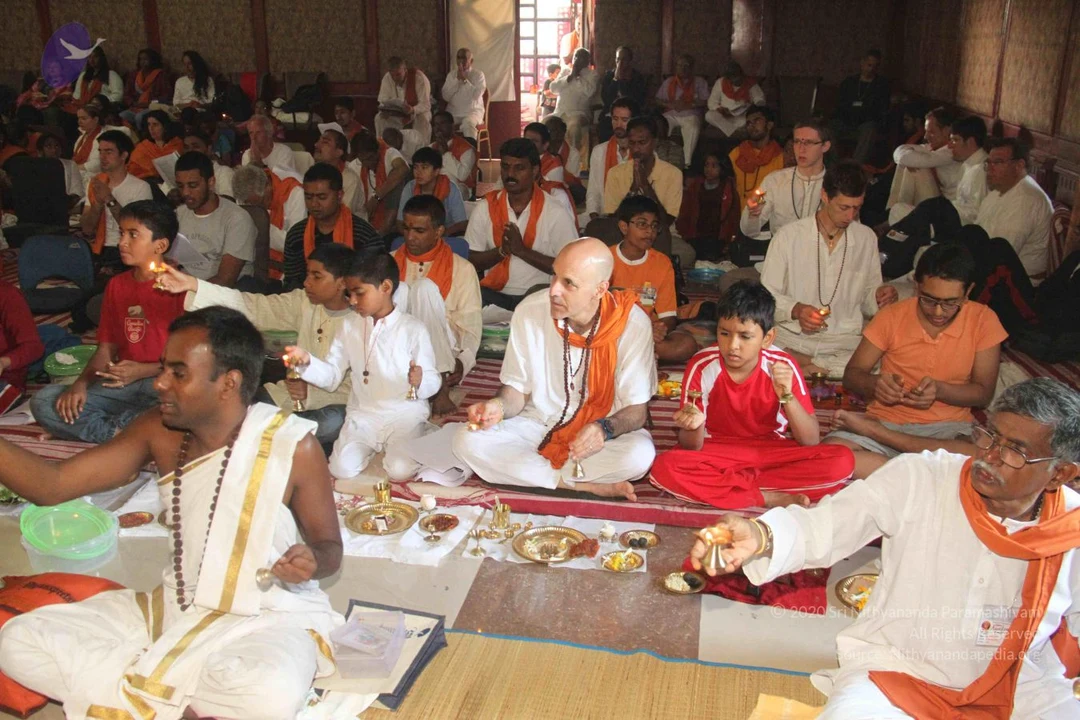
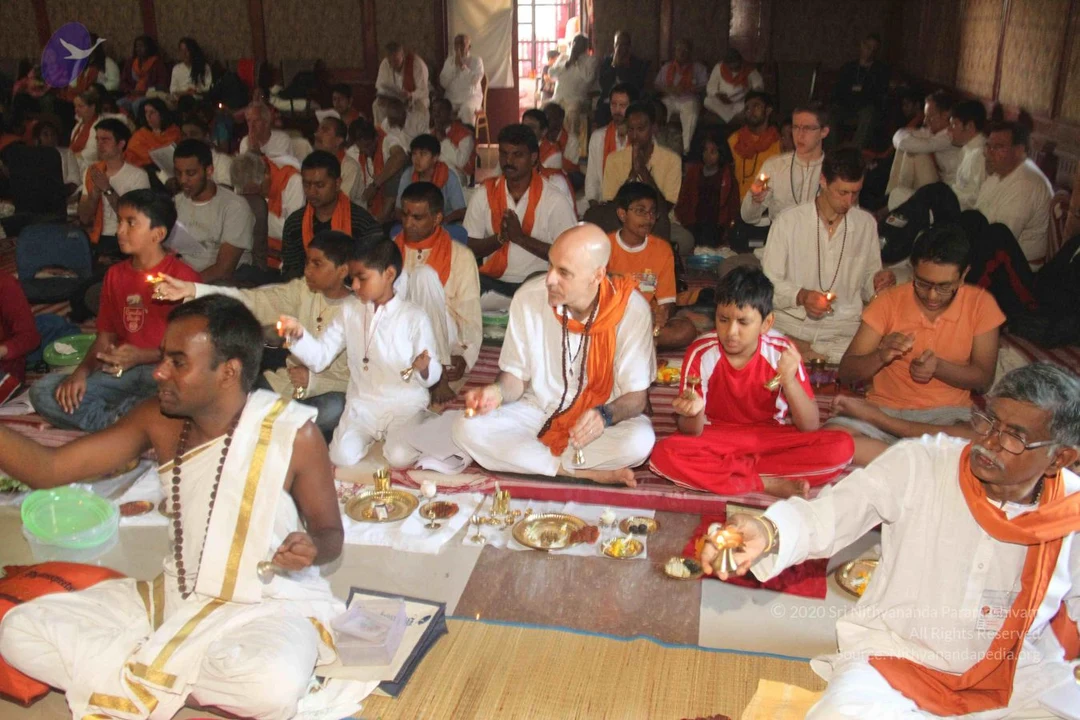
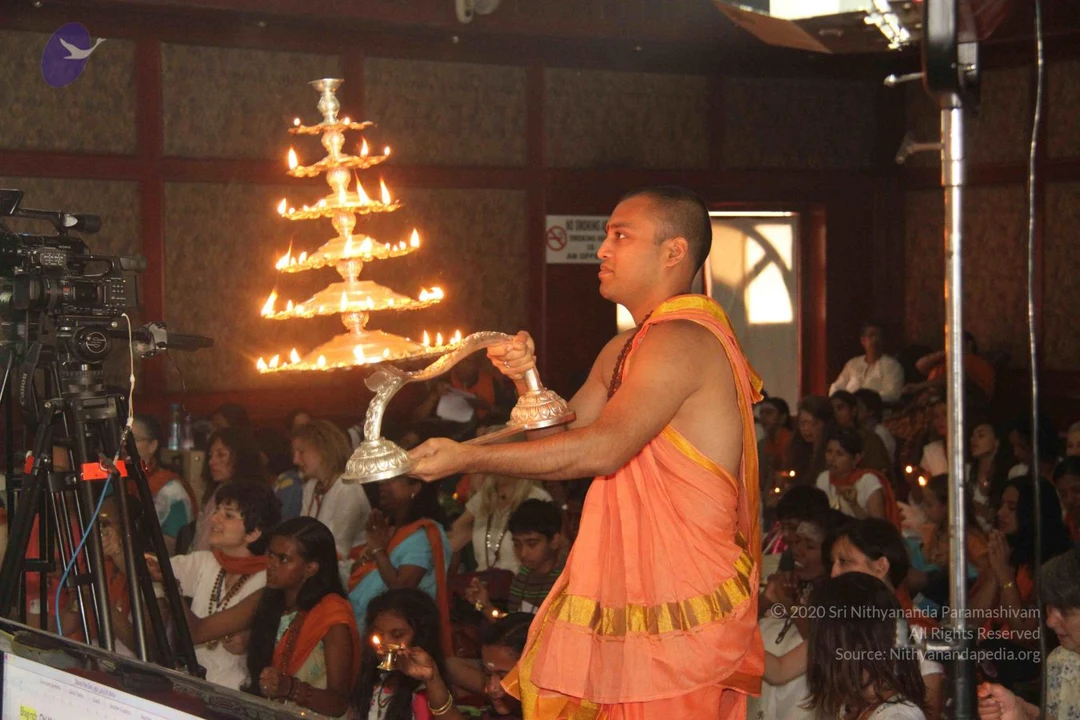
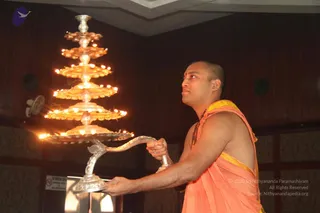
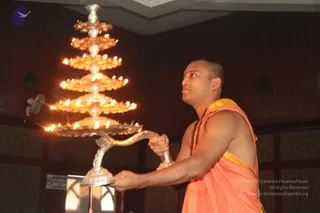
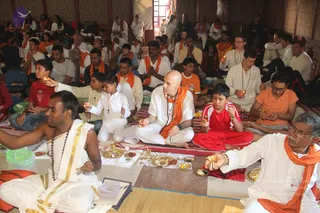
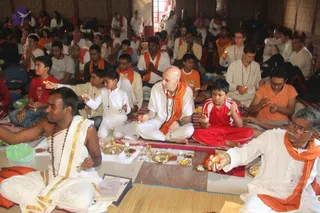
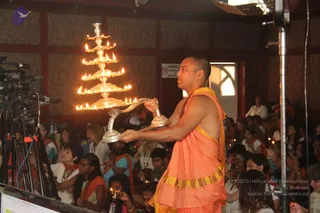
A man in an orange-saffron dhoti with a gold-bordered yellow shawl stands in profile, holding a tall silver multi-tiered aarti lamp with many lit oil lamps blazing upward. He wears a rudraksha mala around his neck and has a shaved head, gazing upward. The setting is an indoor hall with dark wooden paneling and a wall fan; a small no-smoking sign is visible at lower left.A man in a saffron-orange dhoti and wrap, bare-chested with a rudraksha mala across his chest and a red tilak on his forehead, holds up a tall silver multi-tiered oil lamp (aarti) with many lit wicks, a silver-cobra style handle at its base. He stands in a wood-panelled hall with a dark ceiling, looking upward toward the flames. A faint logo sits in the top-left corner and a copyright line is in the lower right.A seated group ceremony in a wooden hall with patterned walls. A bald man in white clothes with an orange shawl and a rudraksha mala sits centrally on a mat, holding a small brass lamp. Around him, devotees in white and orange or red clothing sit cross-legged, several holding lit oil lamps and brass plates, with small children among them. A man at lower right in white with an orange shawl rings a handbell over a brass tray of offerings, and a man at lower left in white dhoti with gold border and mala holds a ritual vessel. Brass plates, bowls of kumkum and small lamps are set on a white cloth in front of the group.Indoor group puja in a hall with patterned walls, where seated devotees hold small oil lamps and offering vessels on mats. In the centre, a bald man in white clothes and an orange shawl sits cross-legged with a diya, his hands near brass plates of offerings. Beside him a boy in a red tracksuit lights a lamp, and a young boy in white kurta holds a lamp. On the left, a man in white dhoti with gold border and a rudraksha mala holds a spoon over a brass plate. Many others in orange shawls, white and orange clothes sit in rows behind them. Brass lamps and plates of fruit and sweets sit on the floor. Ritual participants, possibly satsang or puja, are shown; the centre man is an unconfirmed a person candidate in white with an orange shawl and rudraksha mala.A man with a shaved head, bare-chested except for an orange-saffron shawl with gold border, stands before a seated crowd holding a tall silver multi-tiered aarti lamp with many lit oil lamps while performing aarti. A rudraksha-style mala is visible at his neck. Audience members, many in orange and saffron shawls and white, sit in rows; a video camera on a tripod and a stand-mounted light are at left. A devotee in the foreground holds a small lit lamp. The room has wood-panelled walls and a no-smoking sign.Close-up photo of a gold ceremonial tray with yellow and orange marigold flowers and green stems, a silver dish and a clear glass bowl. A hand in the upper centre, with a reddish-orange garment edge above, suggests an offering or puja being arranged. No face is visible.

Nithya Satsang
27 photosSource gallery
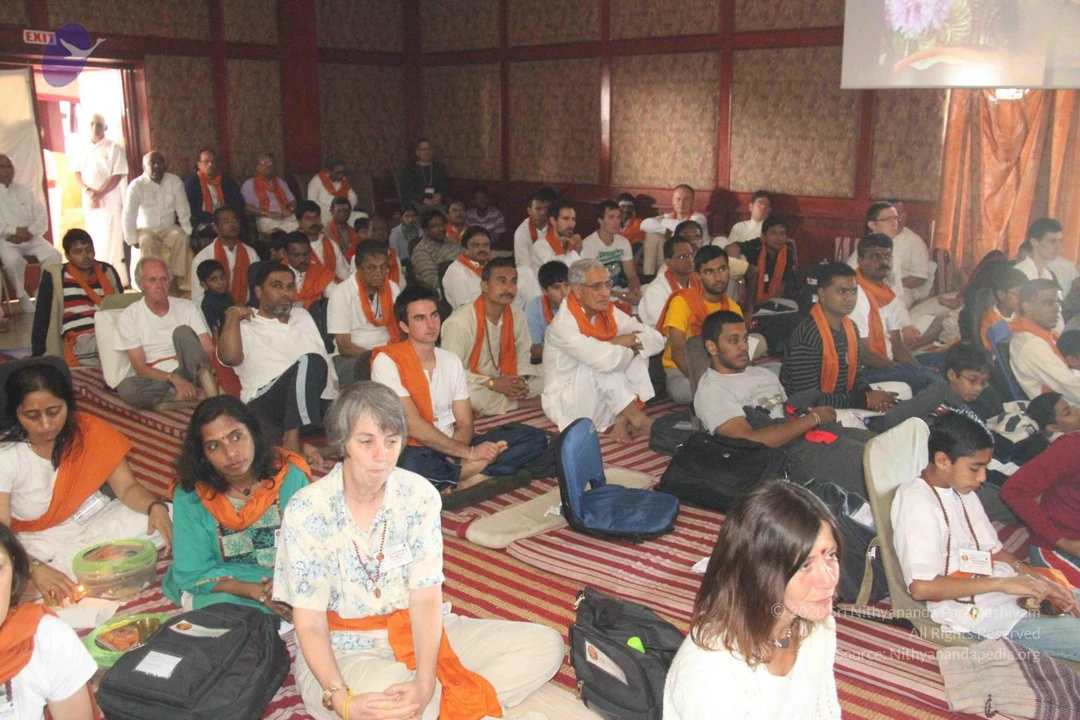
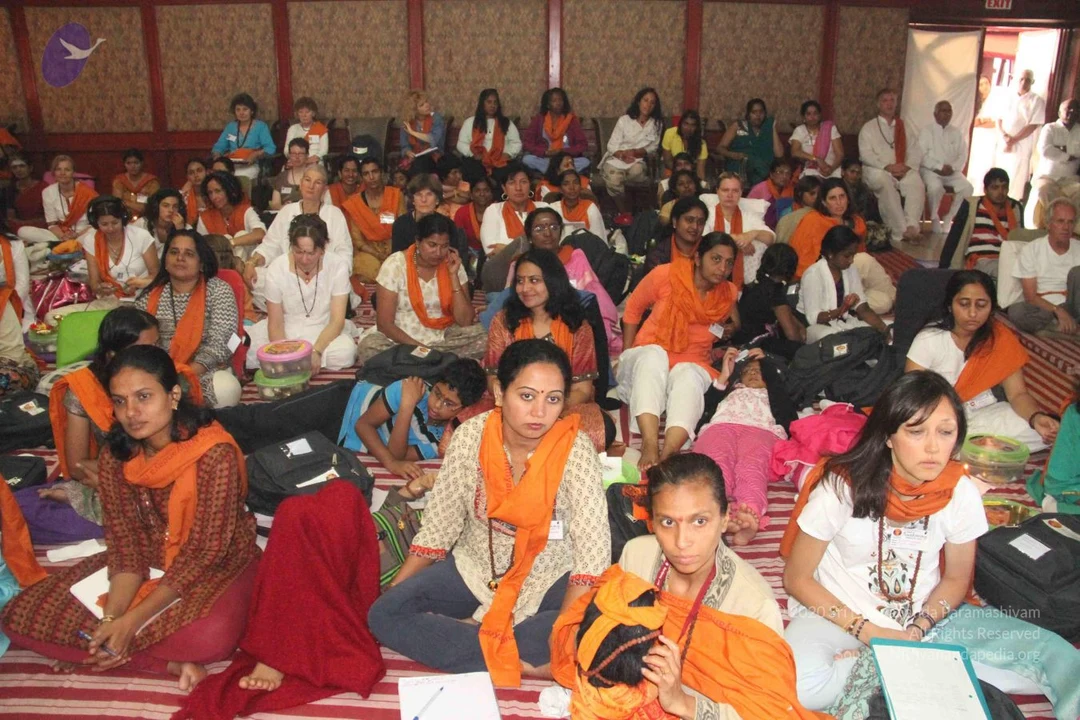
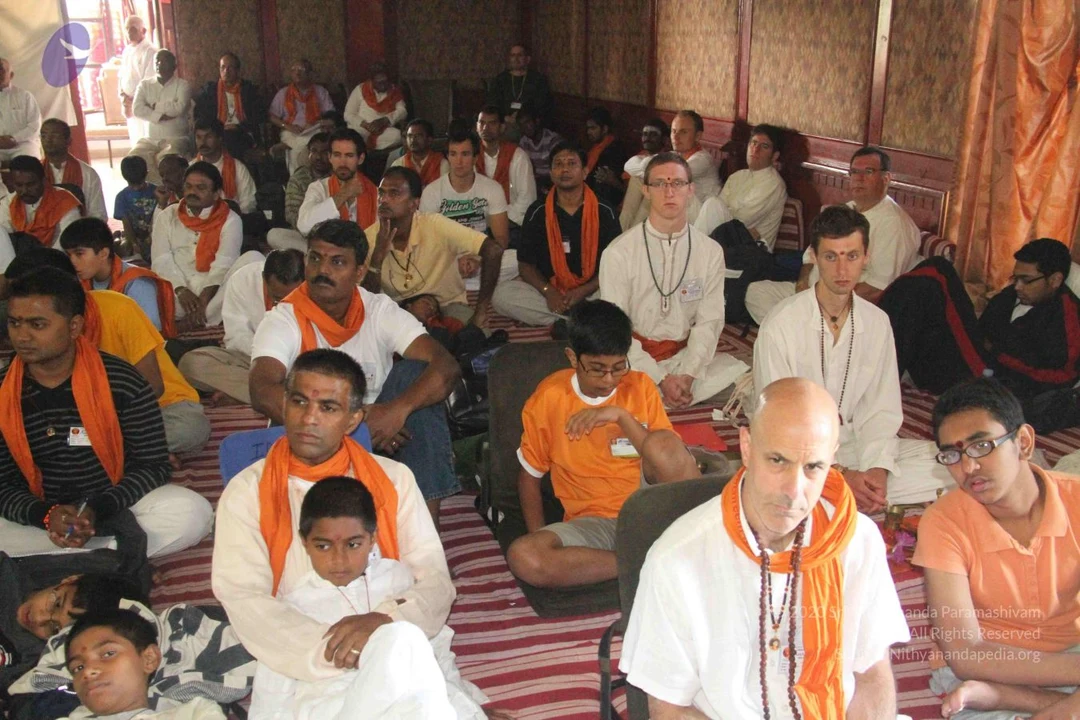
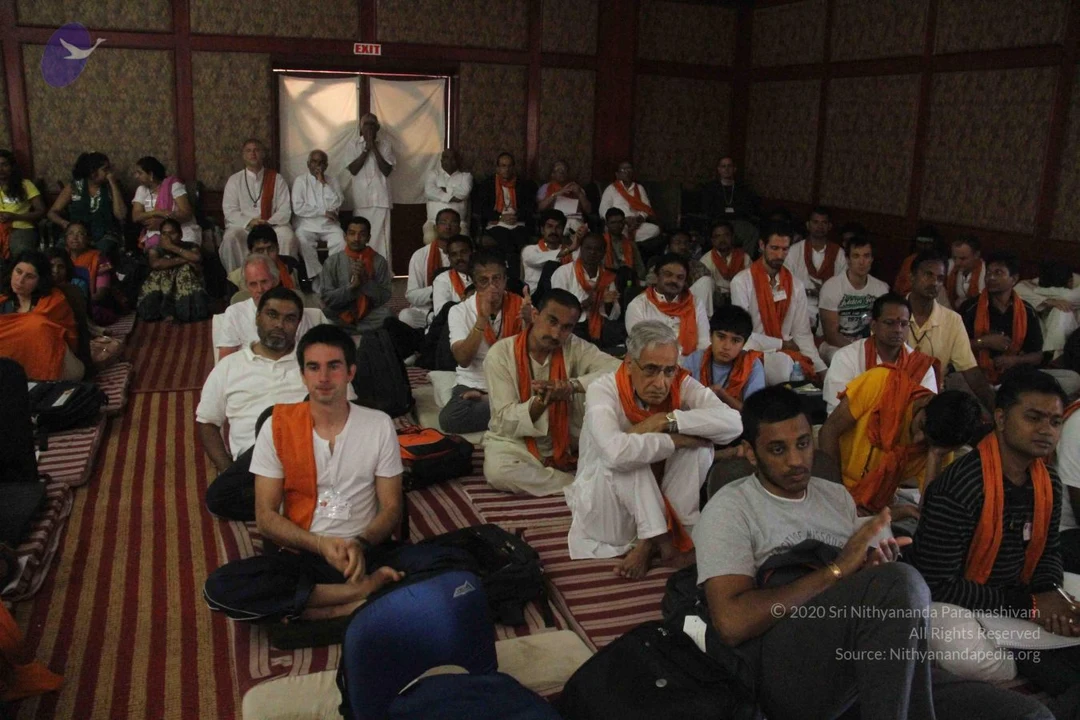
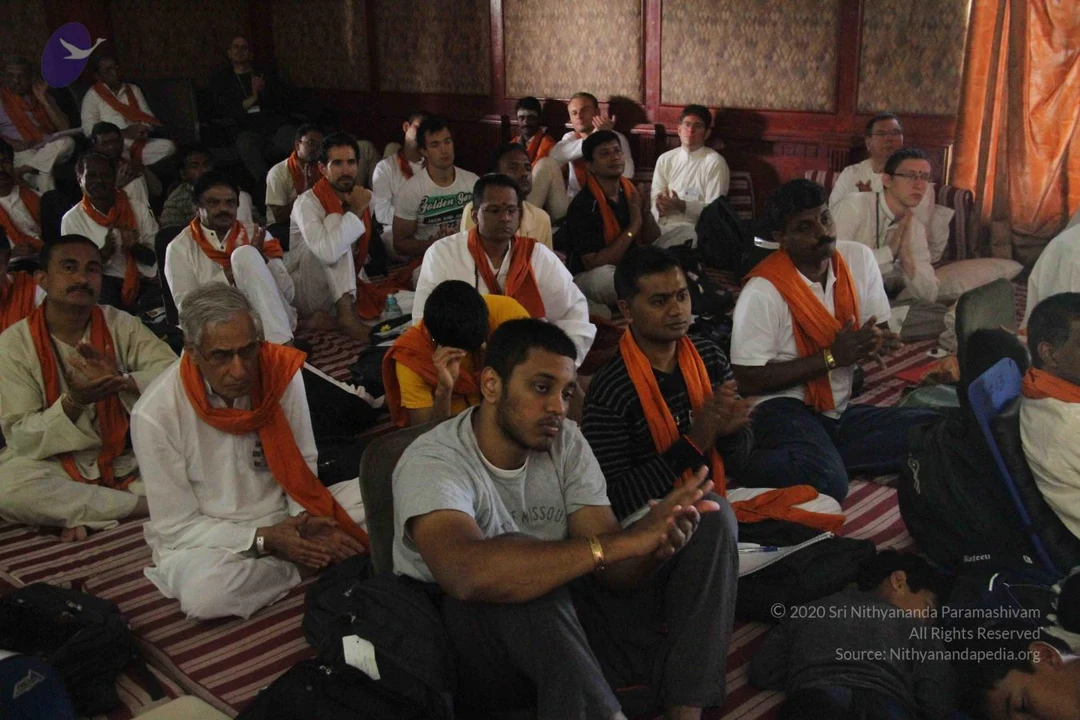
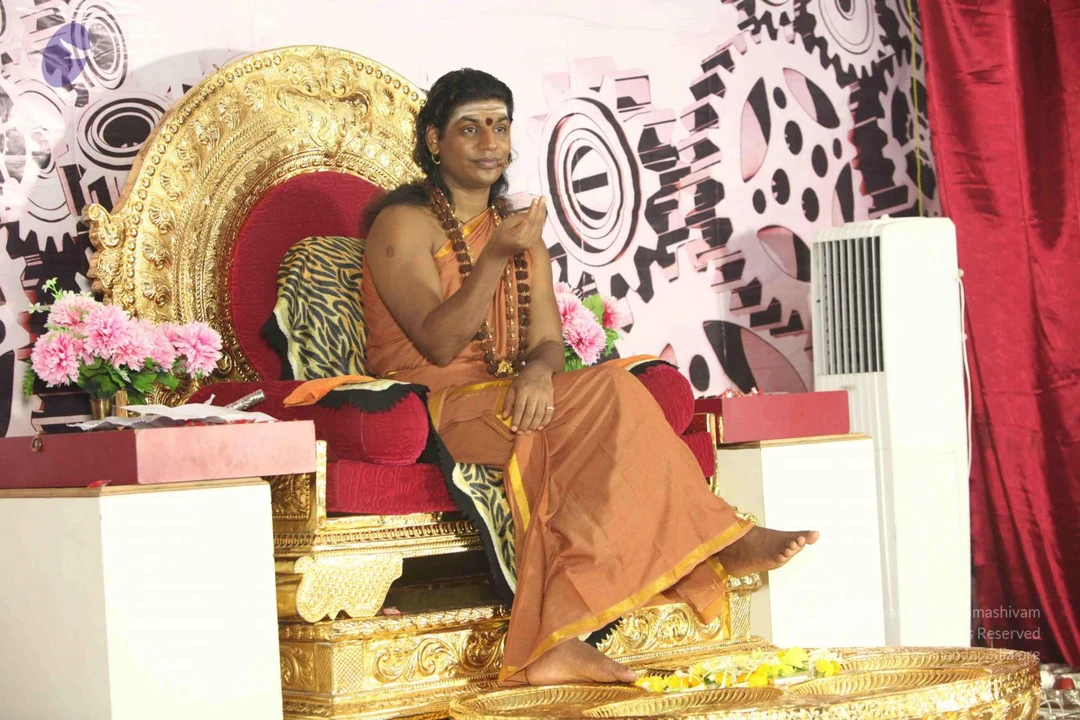
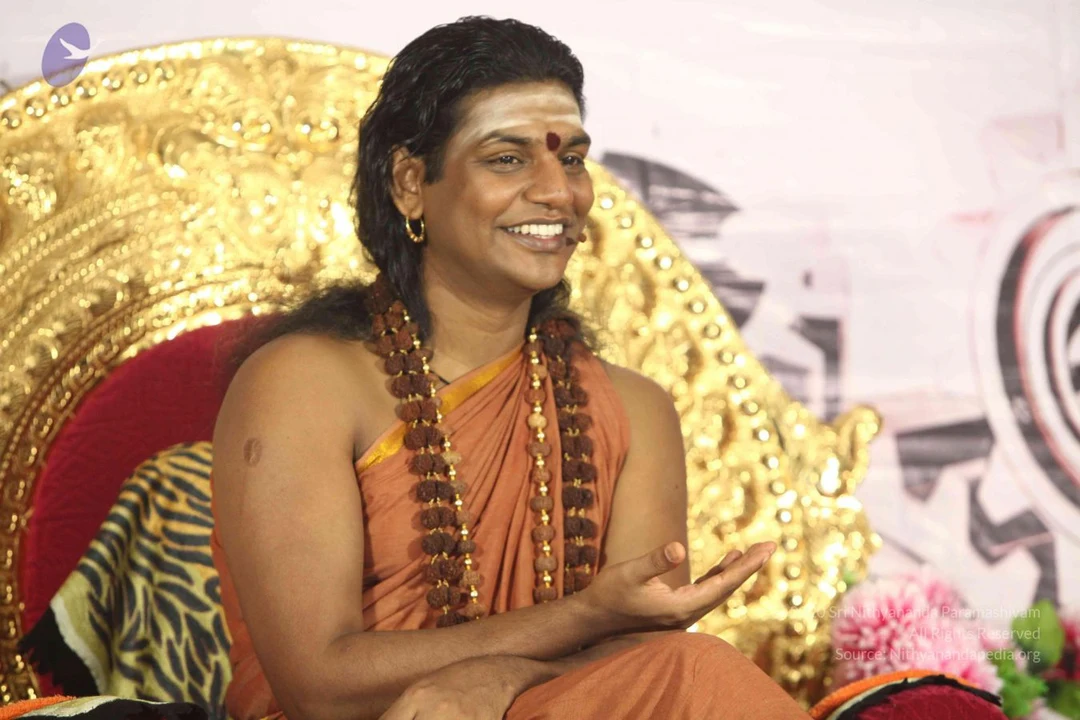
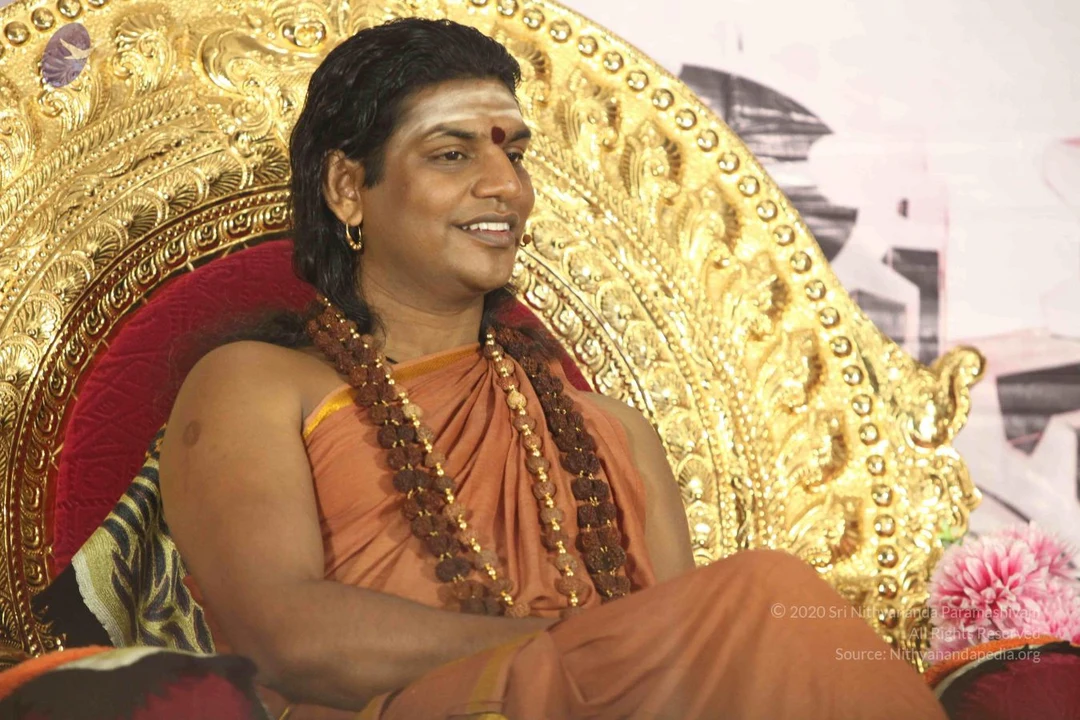
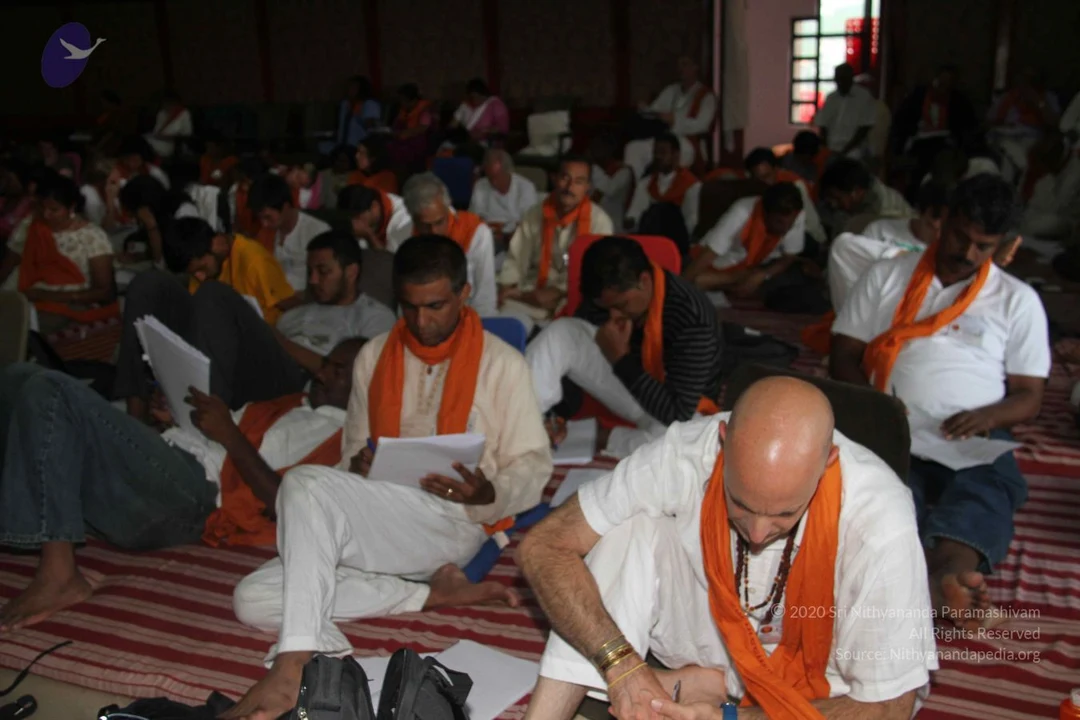
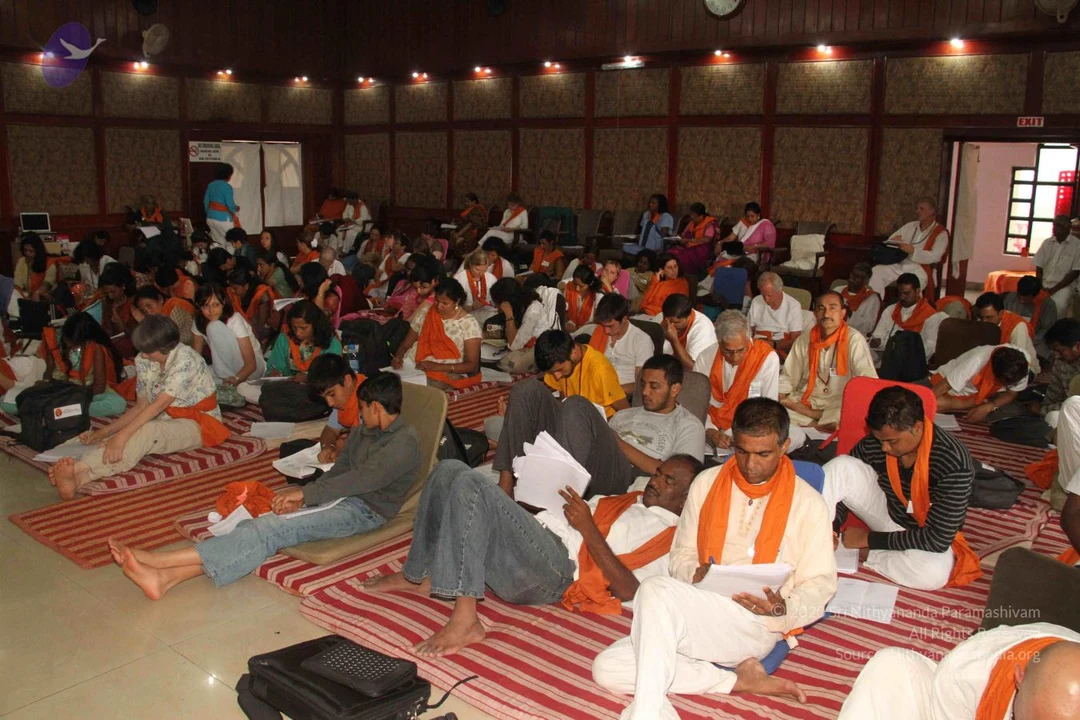
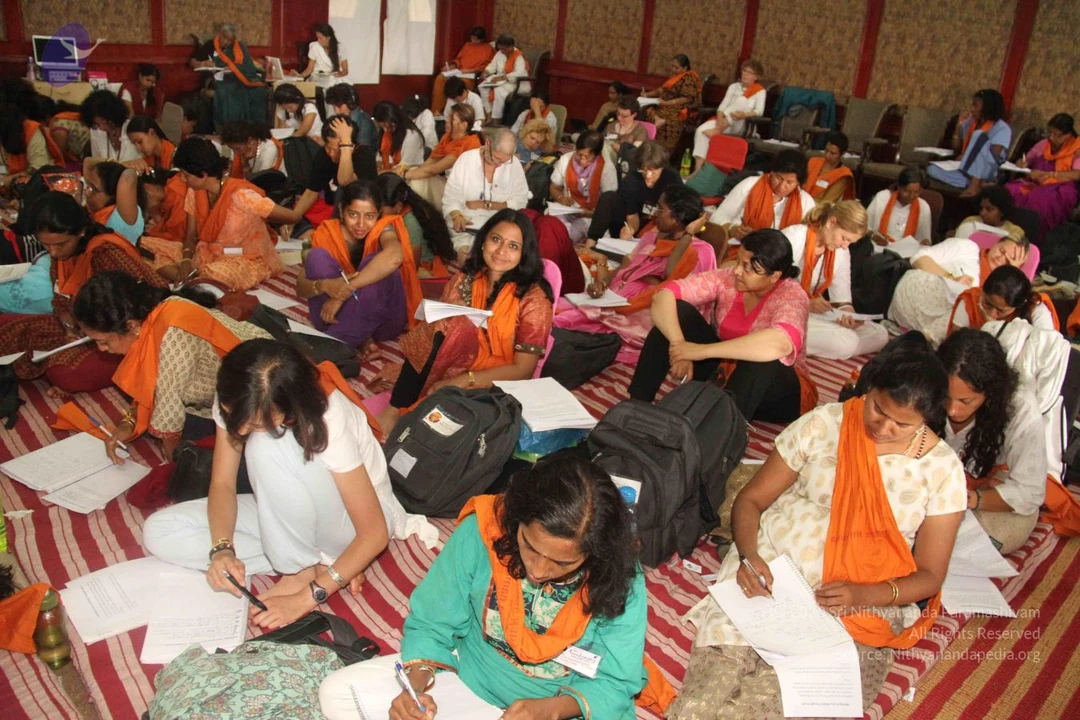
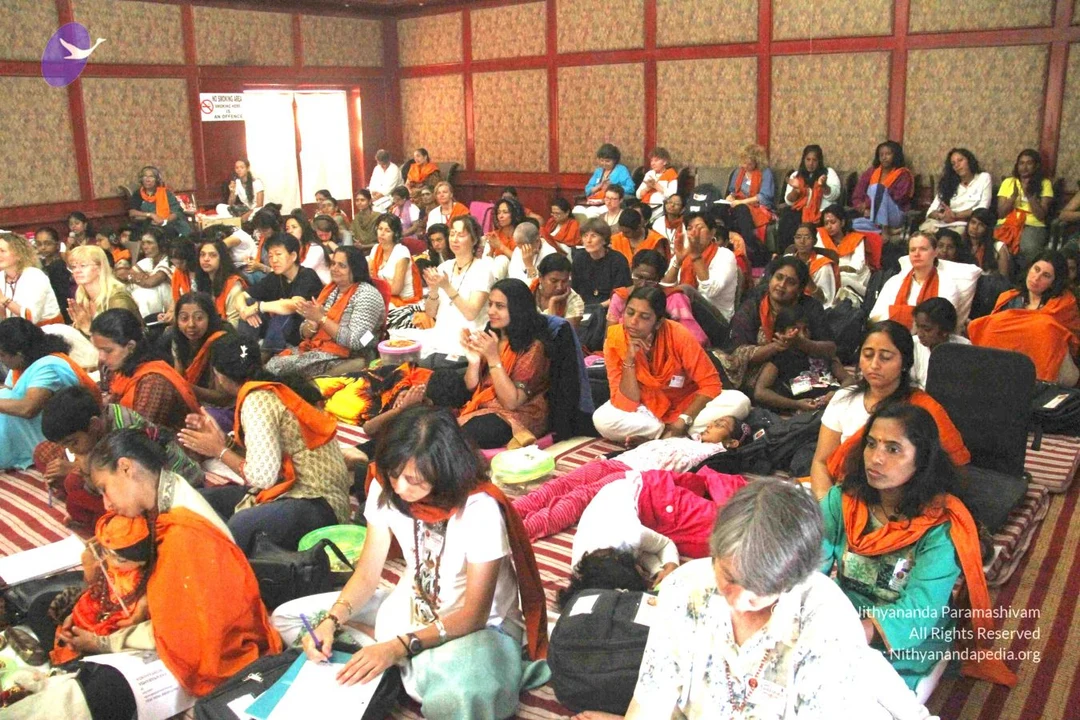
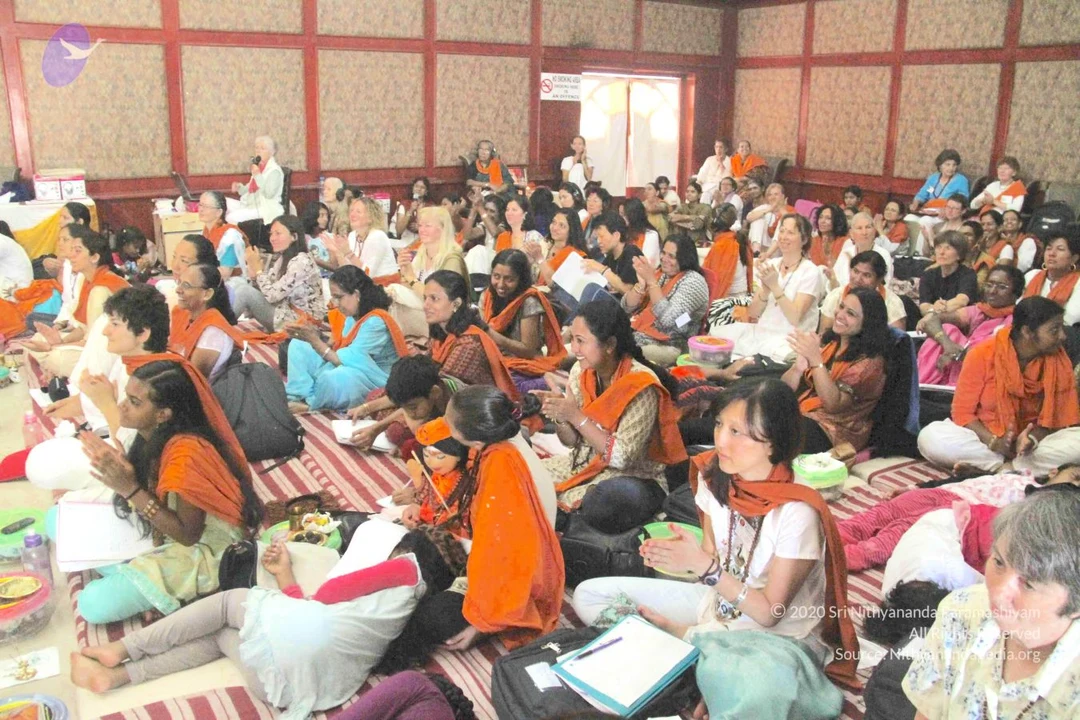
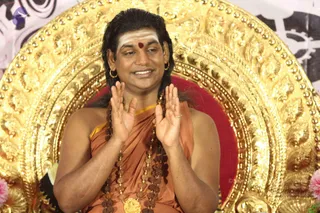
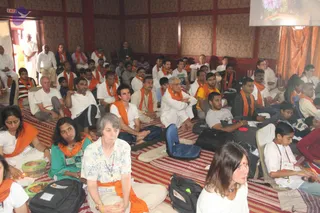
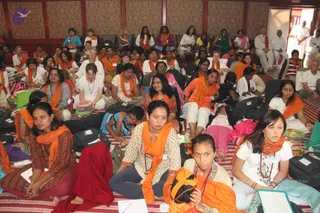
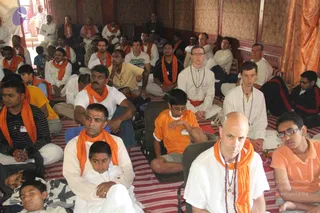
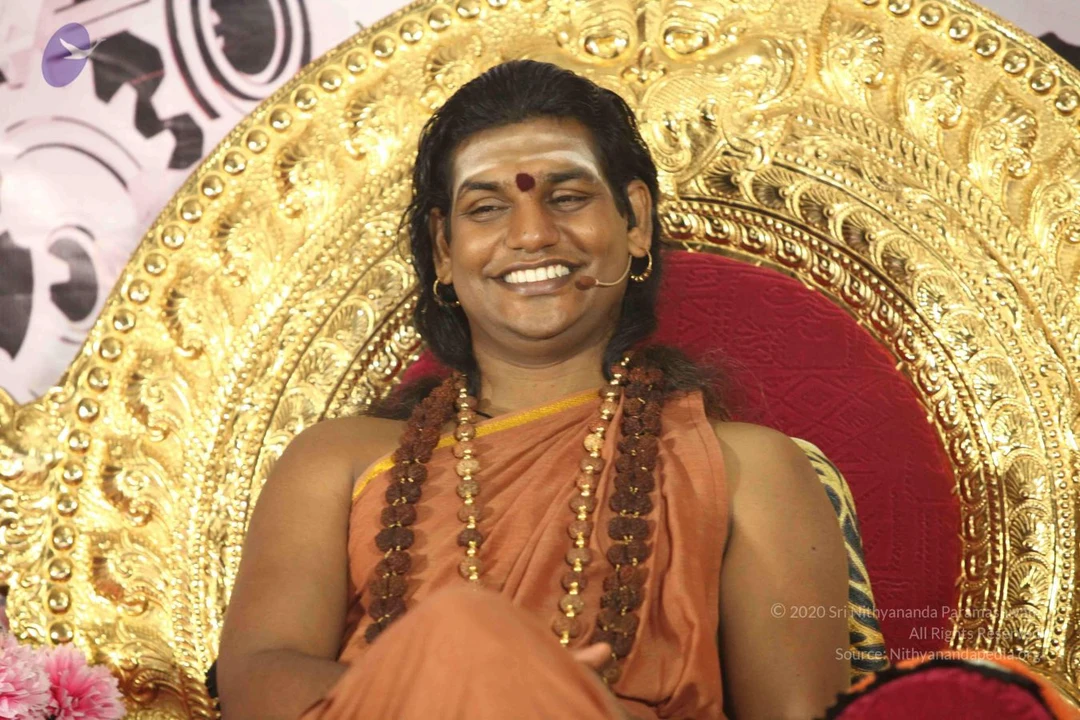
A man seated on an ornate golden throne with a red cushion, hands raised with palms facing outward in a gesture of blessing or address, smiling. He wears an orange-brown shawl draped over the shoulders, multiple rudraksha mala necklaces, a gold pendant, earrings, and a white sandalwood tripundra with a red bindi on the forehead. Pink flowers appear at the lower corners. Visible candidate appearance with long swept-back hair and rudraksha malas matches the page's identification cues, so the identity is probable.A man seated on an ornate gold throne with a red cushioned seat, smiling and turning his head to one side, arms folded across his lap. He wears an orange-saffron robe with a yellow-gold border, multiple rudraksha malas with gold bead accents, small gold hoop earrings, a white tripundra with a red bindi on his forehead, and a small headset microphone.A photograph of a man seated on an ornate gold throne with a red cushioned seat and carved gold armrests, in front of a pink and black gear-pattern backdrop. He wears an orange-saffron dhoti and shawl with yellow borders, a rudraksha mala and a long gold necklace, a red bindi on his forehead, and a small microphone at his ear. His bare feet rest on a gold footstool with yellow flowers. Pink flowers stand in vases on the side tables. Swamiji (probable): long hair swept back, saffron clothing, rudraksha mala and gold necklace, seated on a throne in a discourse setting.A seated satsang audience fills a wood-panelled hall with patterned wallpaper and orange curtains. Many devotees wear orange shawls over white or light clothing and sit on striped red mats, some with bags and water bottles beside them. A man in white kurta stands at the left near the exit, and a projector screen is visible at the top right. Foreground women and a young boy wear rudraksha malas. No clearly identifiable speaker is shown on stage in this frame, so no a person candidate is described.A photograph of a large seated satsang audience inside a hall with red-brown patterned walls and a red-and-white striped floor covering. Many attendees wear orange shawls or stoles over white, cream and patterned kurtas, and some sit cross-legged with notebooks, bags and tiffin containers nearby. At the far right near an open doorway, a few figures in white robes stand.A seated congregation in a wood-panelled hall with red-and-white striped mats and an orange drape at right. Men and boys sit close together wearing orange saffron shawls and white kurtas; some wear orange or yellow t-shirts and rudraksha malas. In the right foreground a bald man in white with an orange shawl and beaded mala sits facing forward, and a teenager in an orange shirt and glasses sits beside him. A small boy in white rests on a seated man's lap at lower left. Attendees appear to be listening to a teaching at a satsang gathering. No specific person is identified as a person.

Sarva-Darshan
3 photosSource gallery
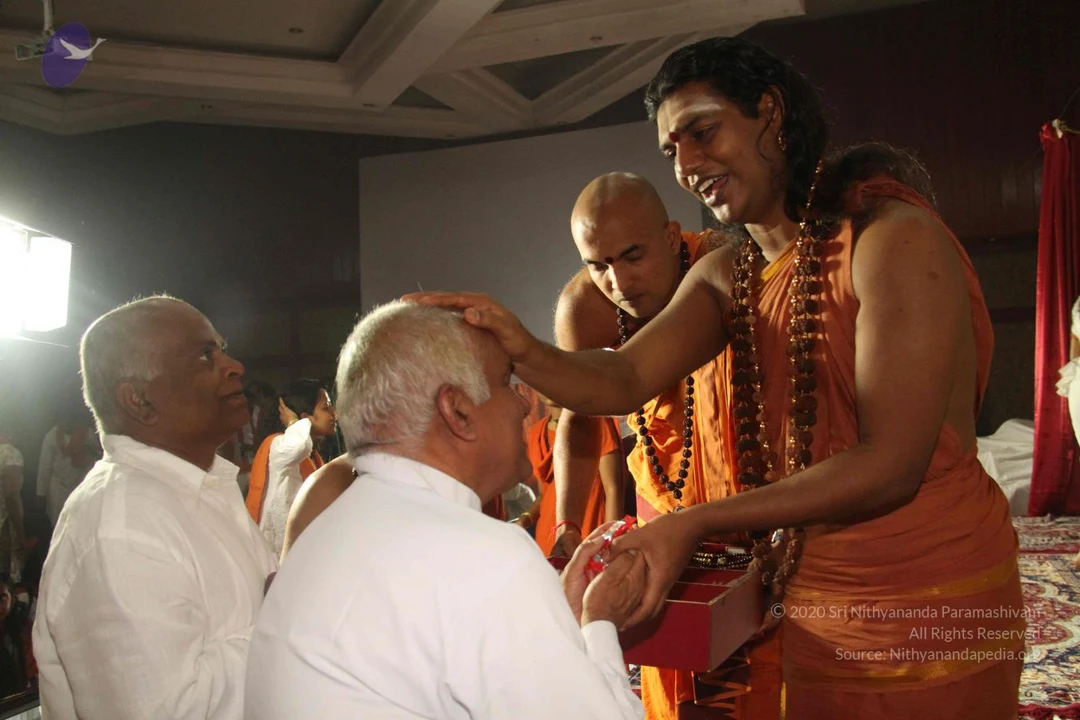
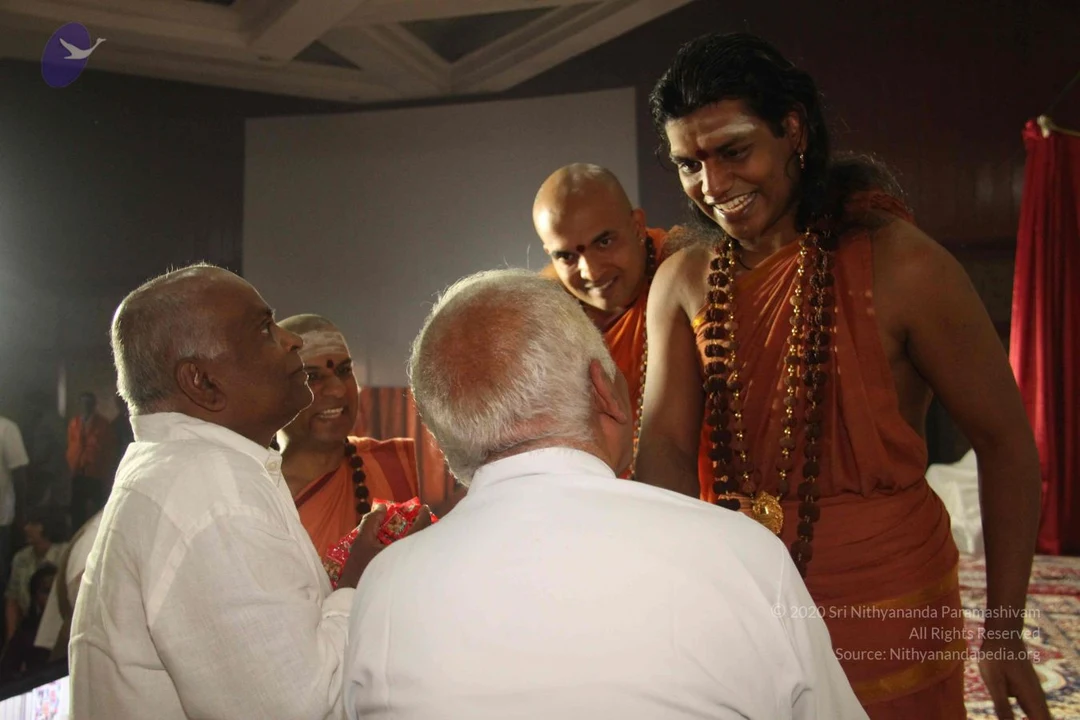
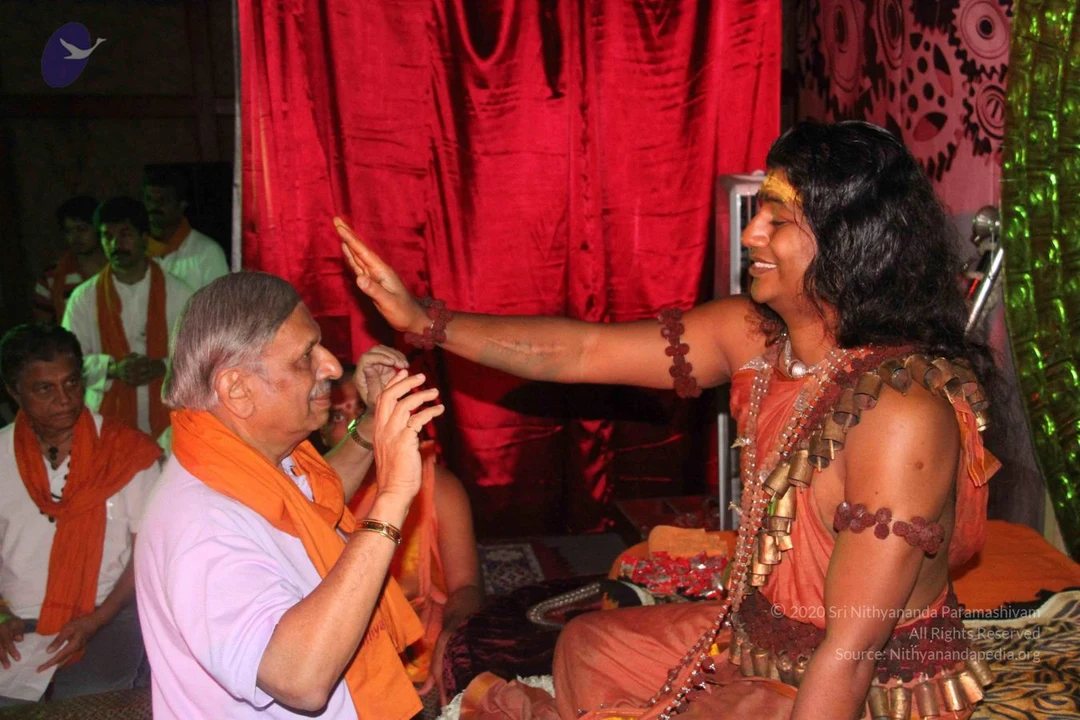
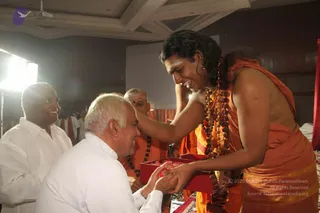
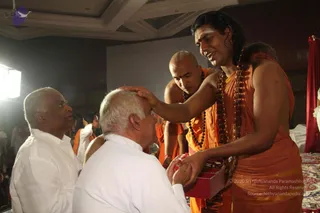
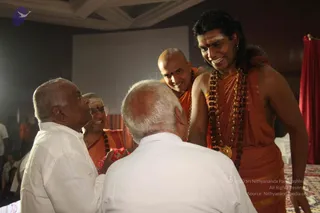
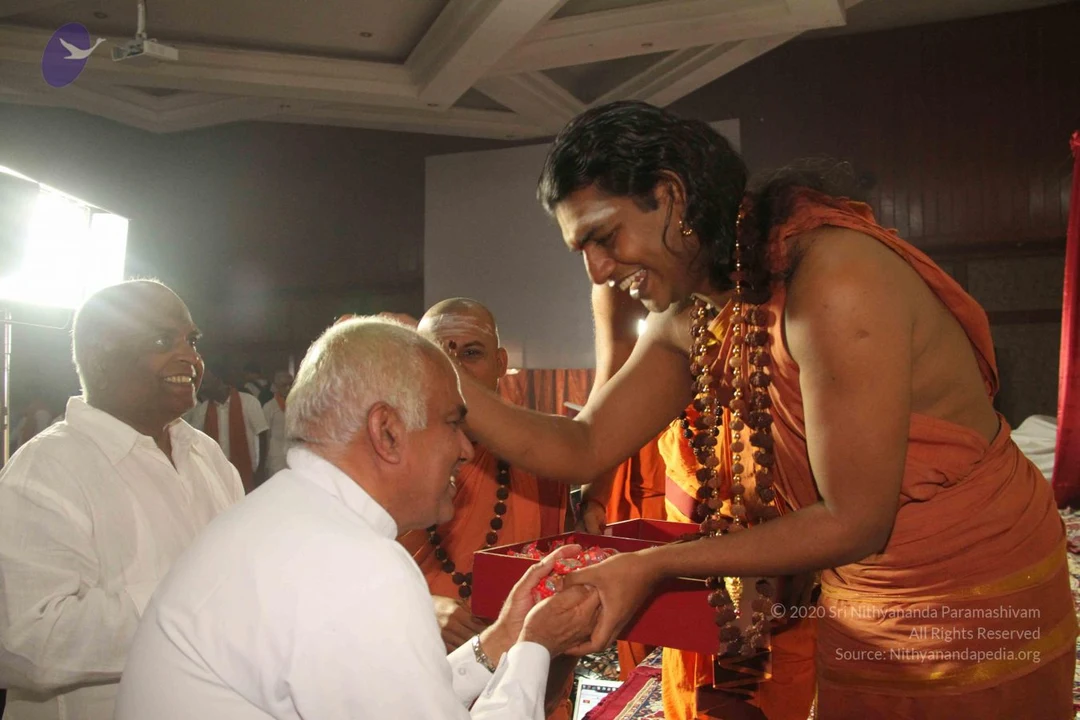
A photograph of a long-haired man in saffron-orange dhoti and shawl, adorned with rudraksha malas and a gold ornament, smiling as he touches the head of a kneeling white-haired man in a white shirt who holds red flower petals from a red box. Behind them, a man in white smiles, and saffron-robed monks stand in a hall with a bright light on the left.A photograph of a long-haired man in an orange saffron dhoti and shawl, wearing layered rudraksha malas and a gold chain, placing his right hand on the head of a seated older man in a white shirt. The seated man holds a small wooden box with red items. Behind them a bald monk in orange robes bows his head, and a man in white stands at left in a bright indoor hall with a white screen and red drapes. The man in saffron is.A photograph inside a hall with a red curtain and patterned floor rug shows a smiling man with long swept-back dark hair wearing an orange saffron dhoti and shawl, rudraksha malas and a gold ceremonial necklace, standing at right; the appearance is a person candidate. Beside him a shaved-headed monk in orange robes with rudraksha beads smiles, and a second orange-robed monk with a white tilak on his forehead stands behind. Two elderly men in white shirts face them, one with his hand raised in a gesture of greeting, with his back to the camera. Several other people are partly visible in the background.

Energy-Darshan
36 photosSource gallery
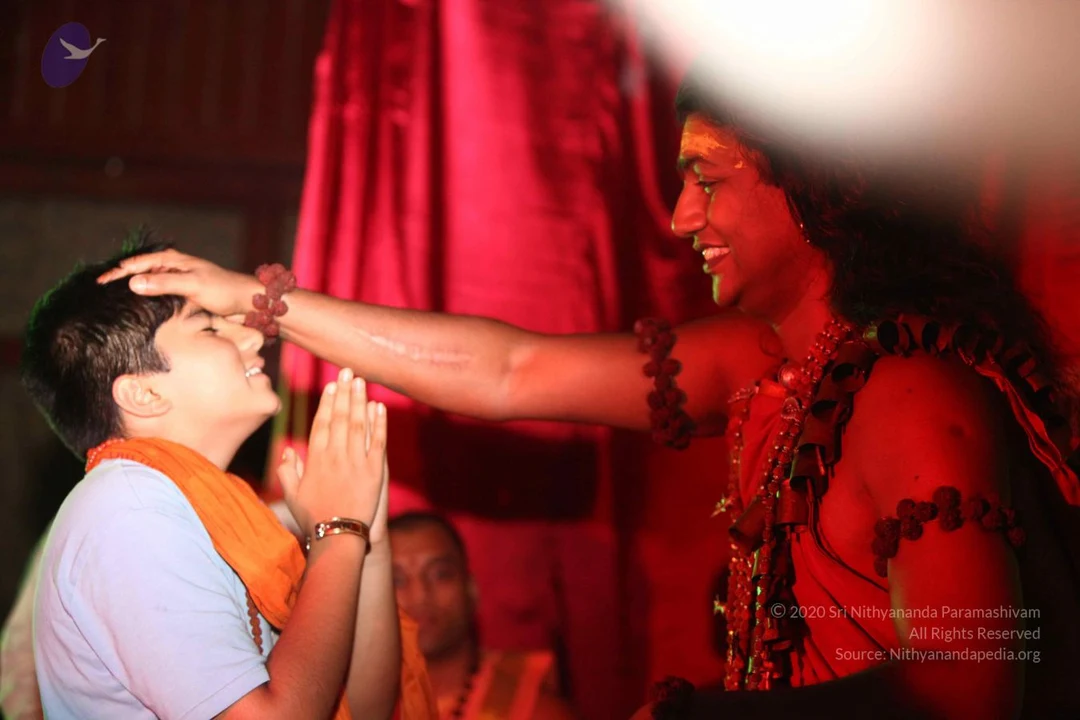
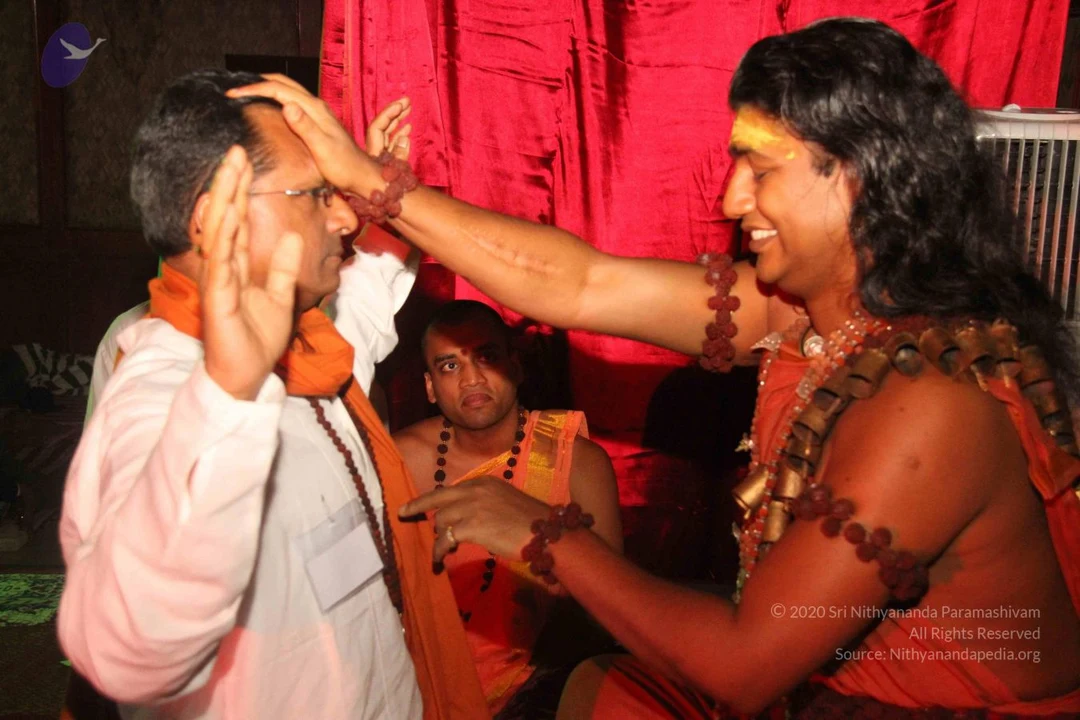
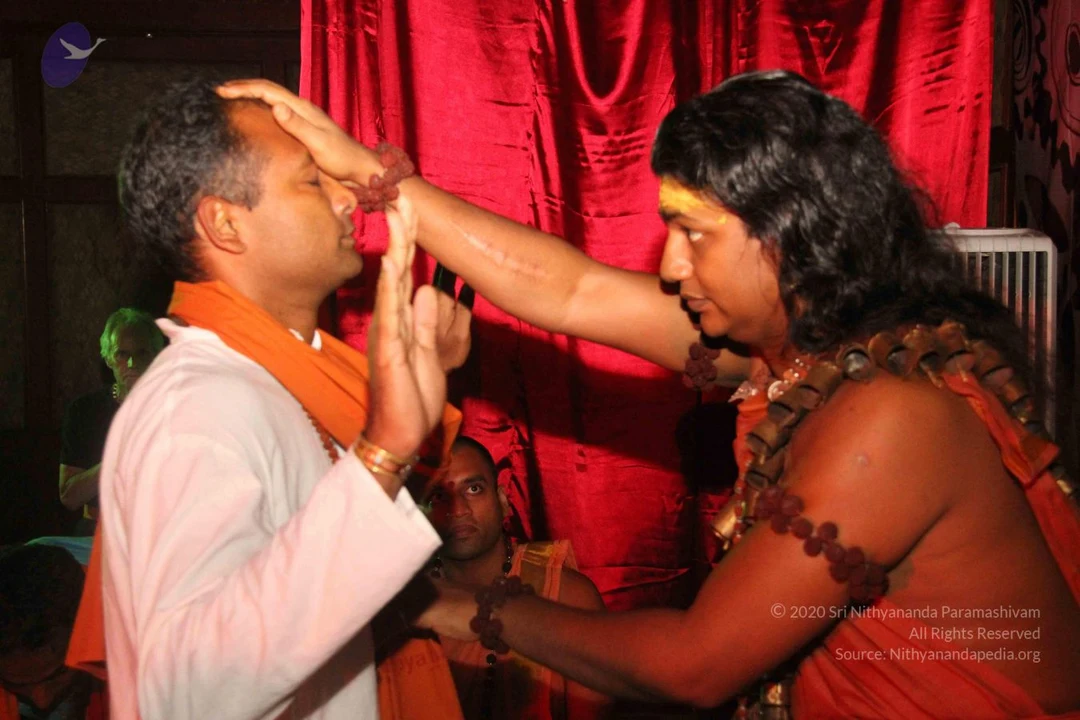
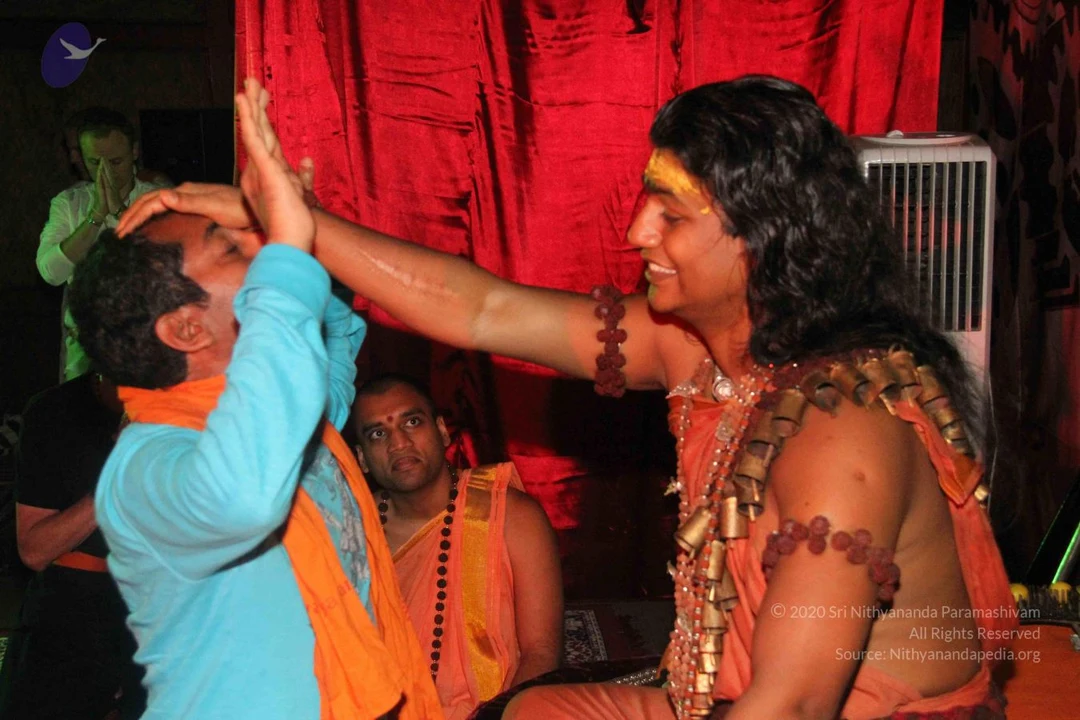
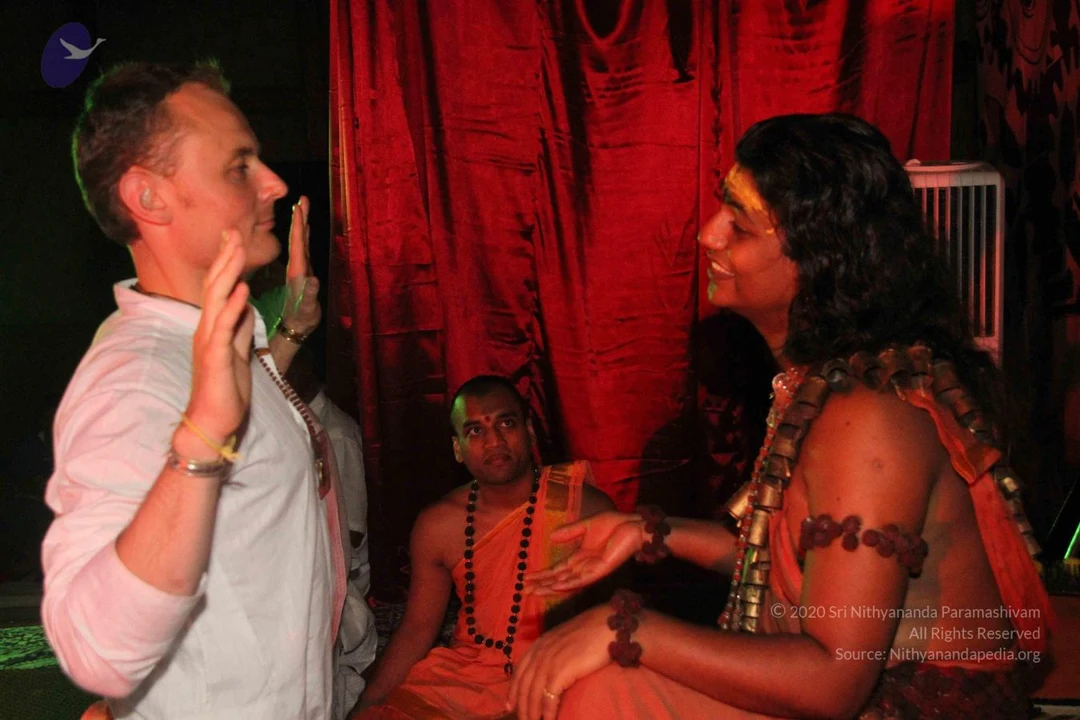
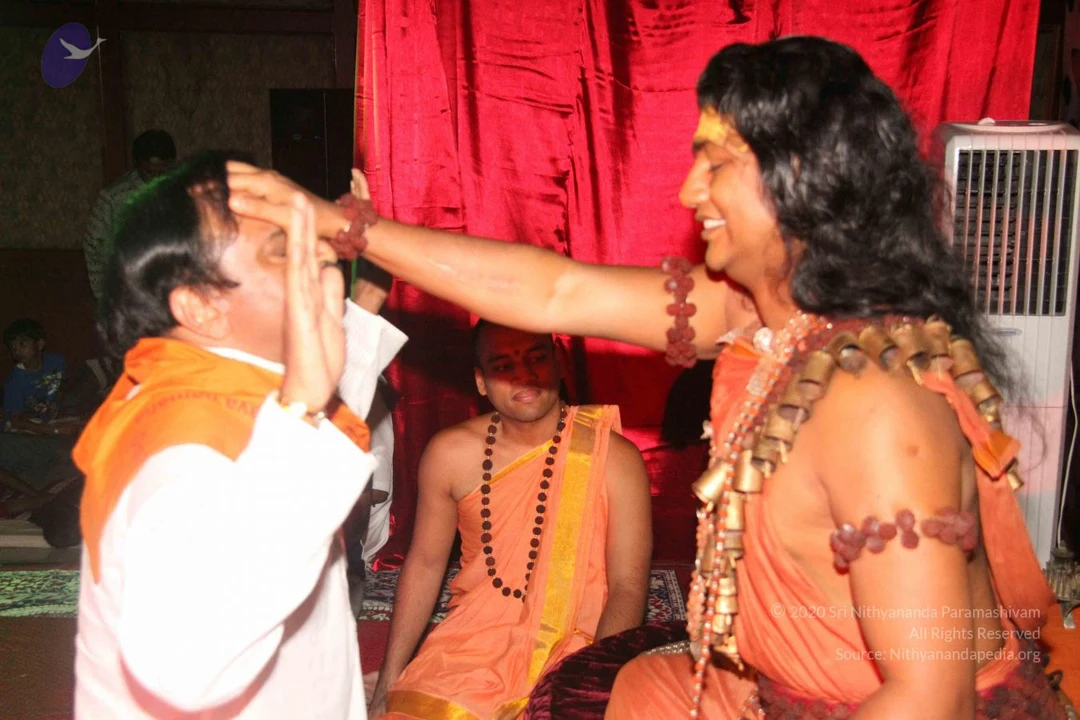
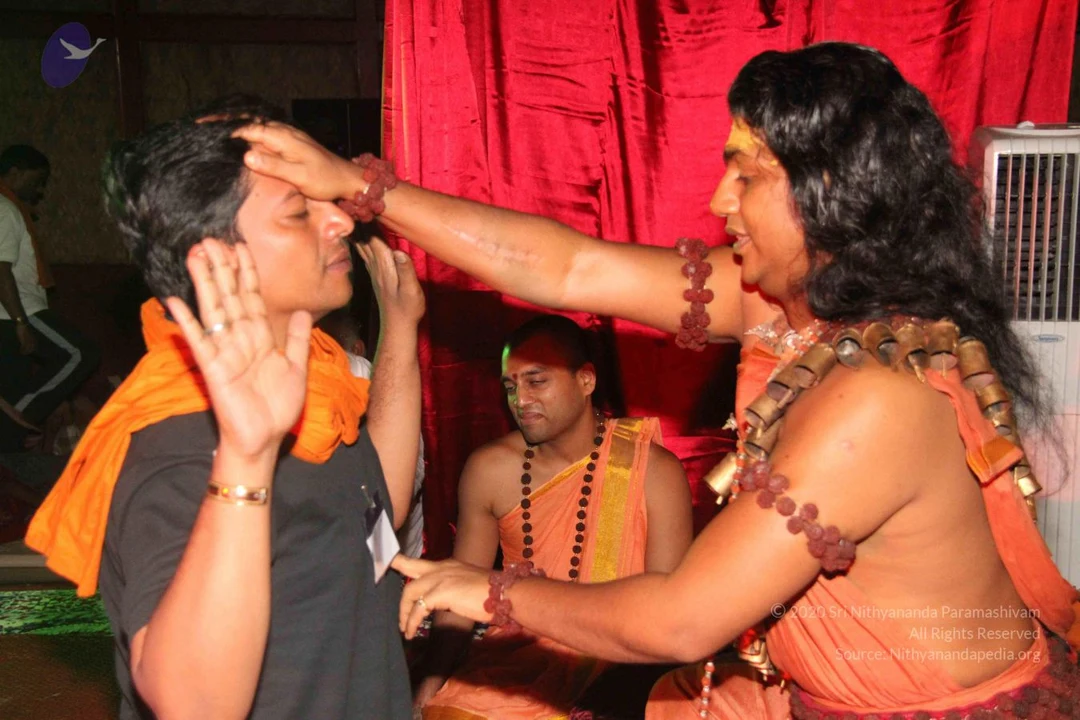
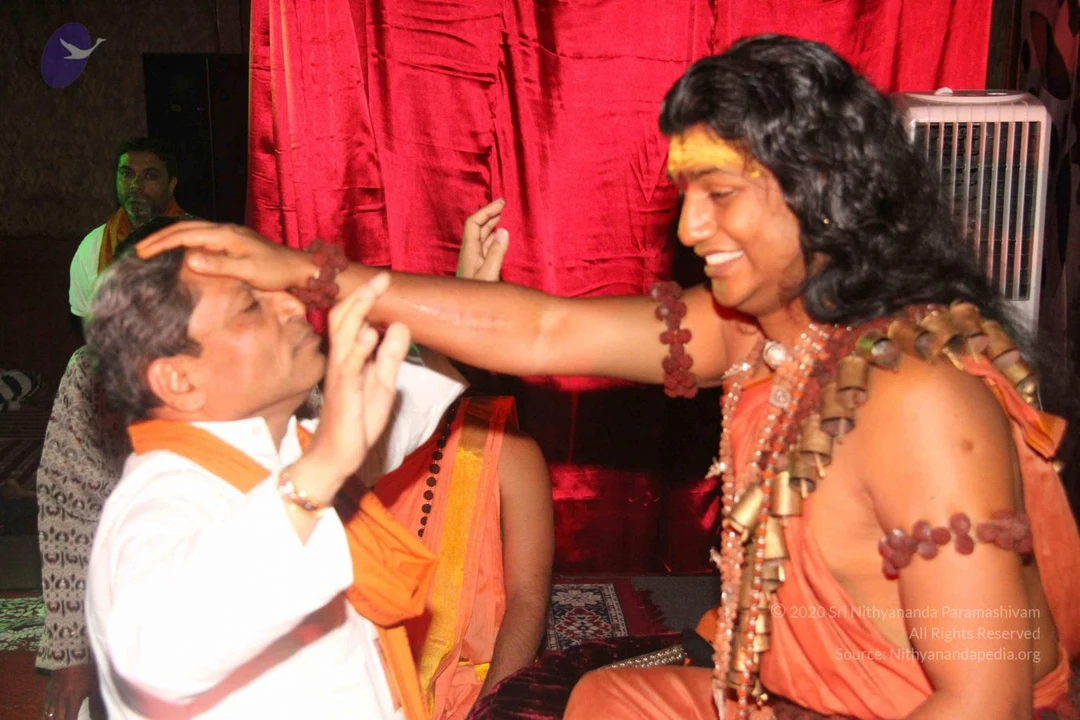
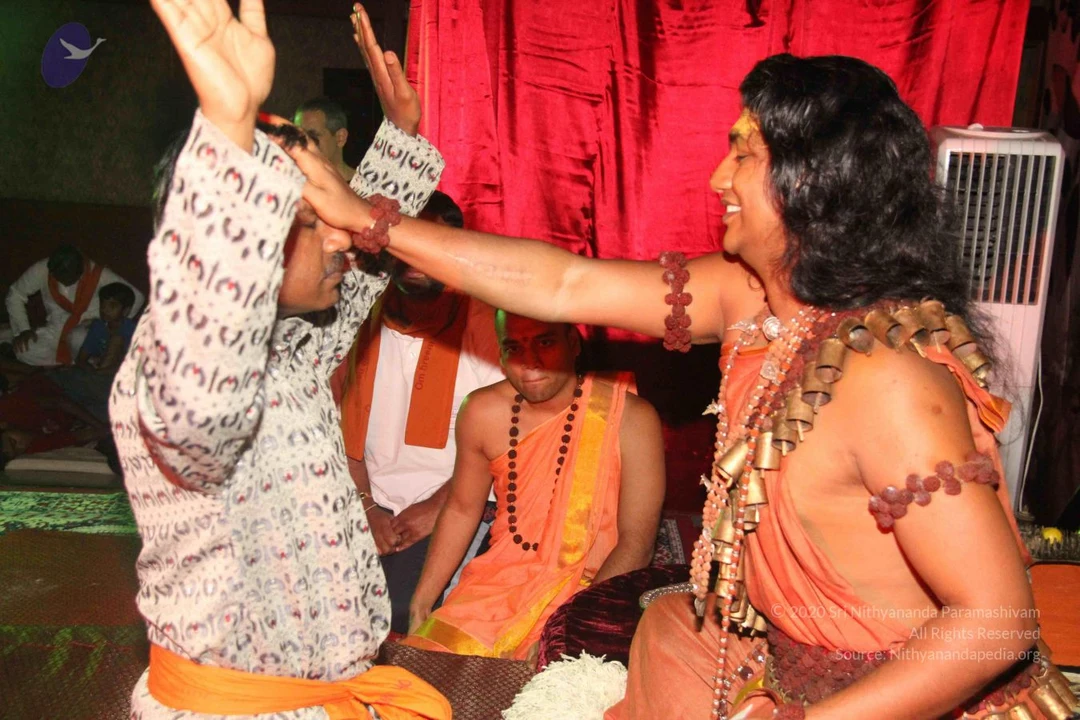
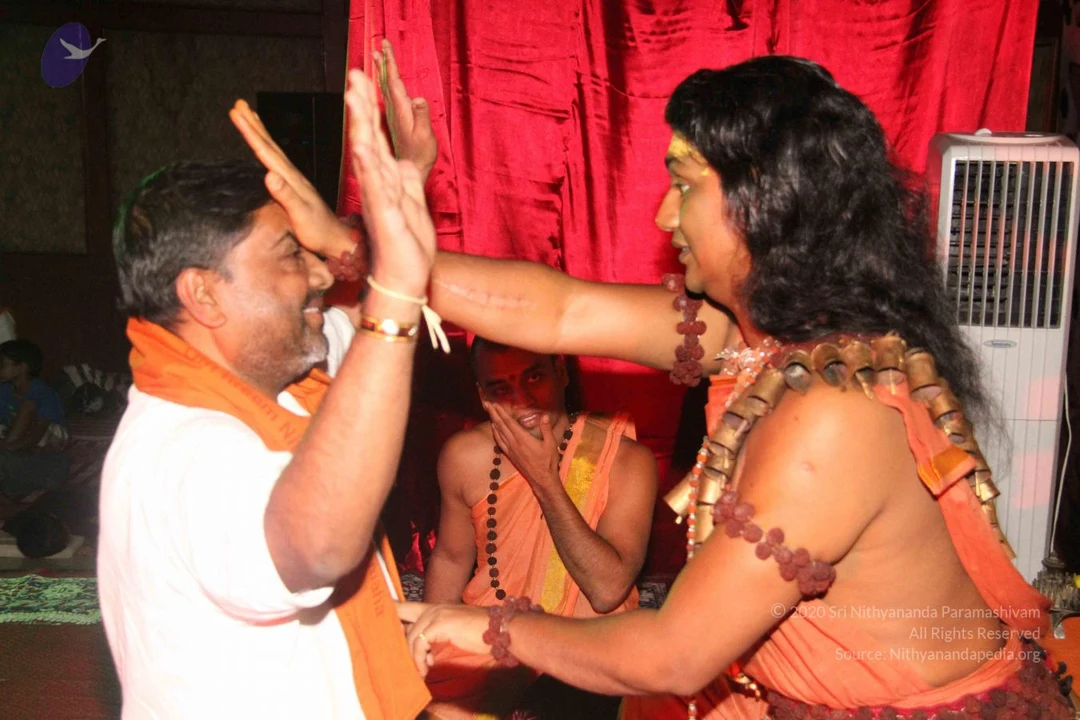
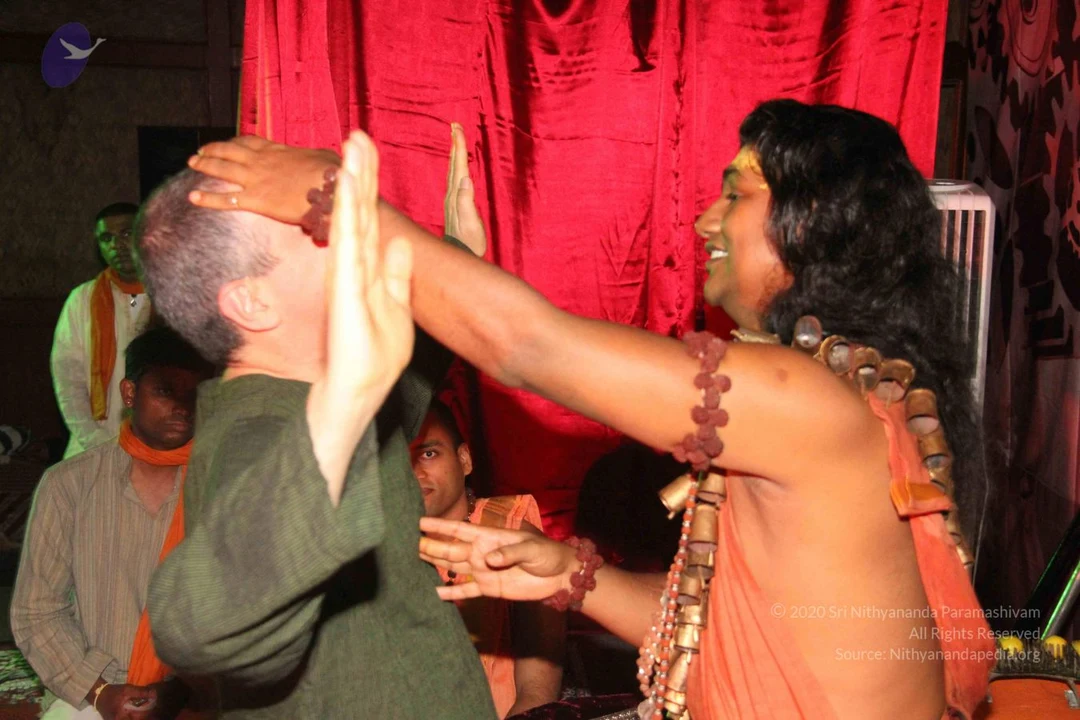
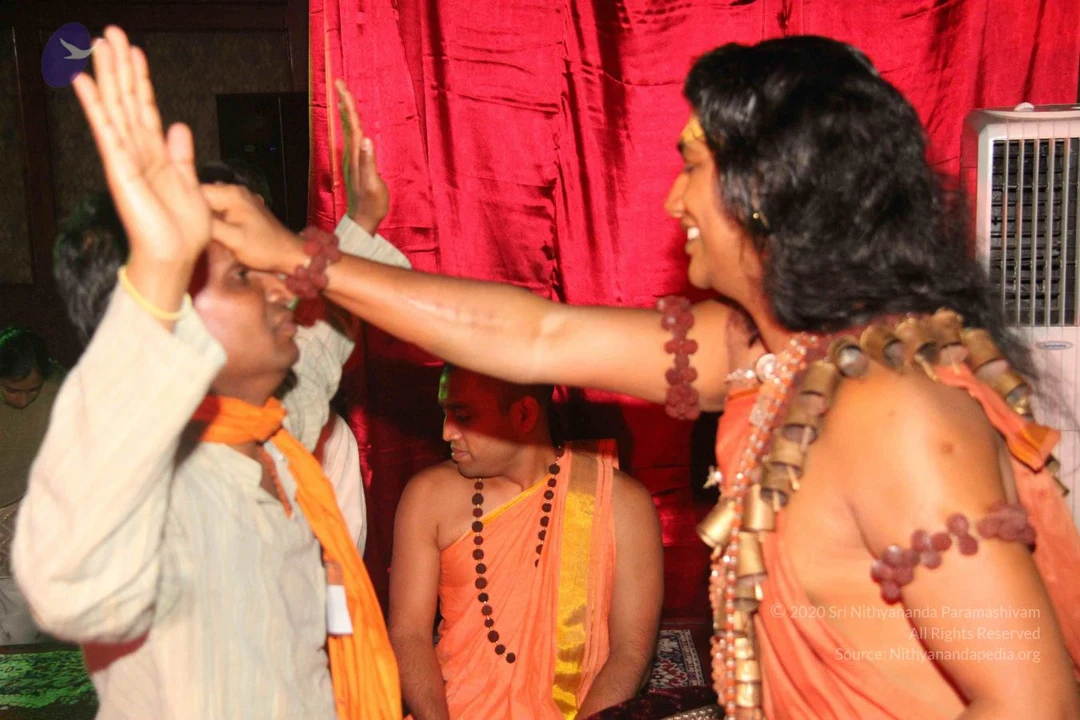
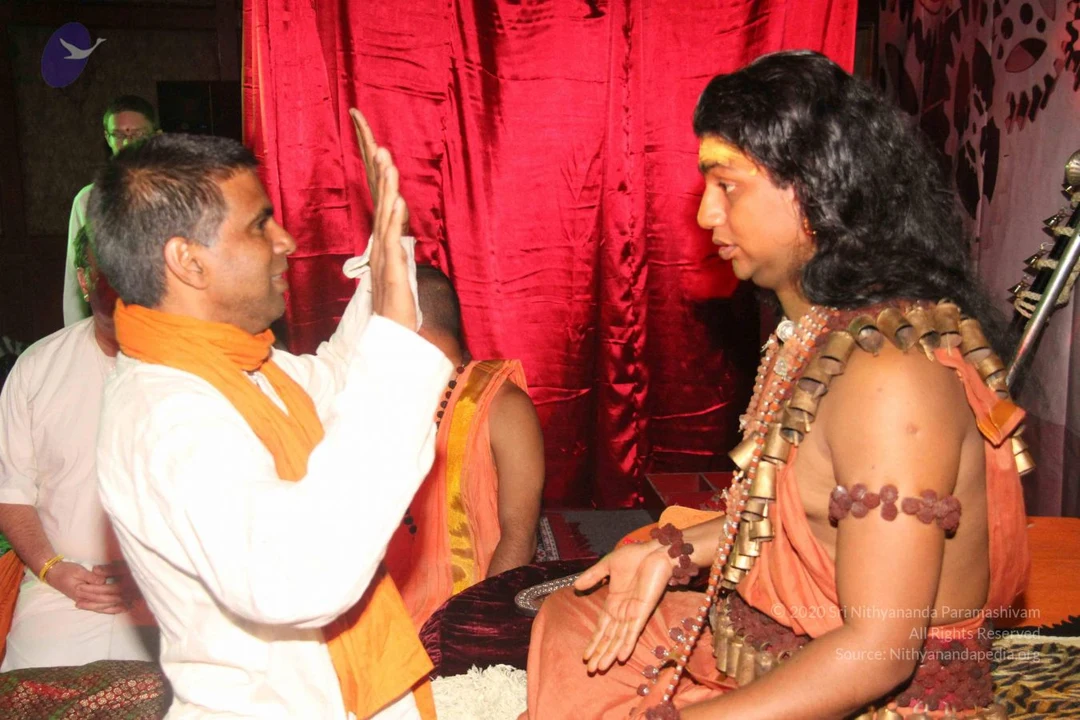
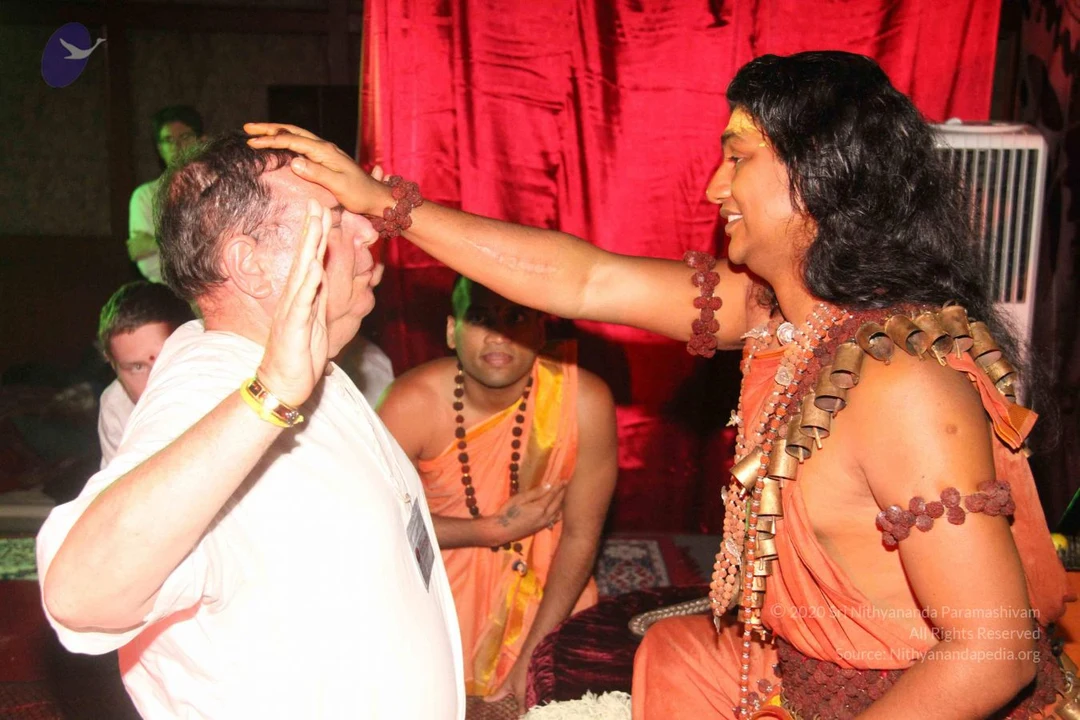
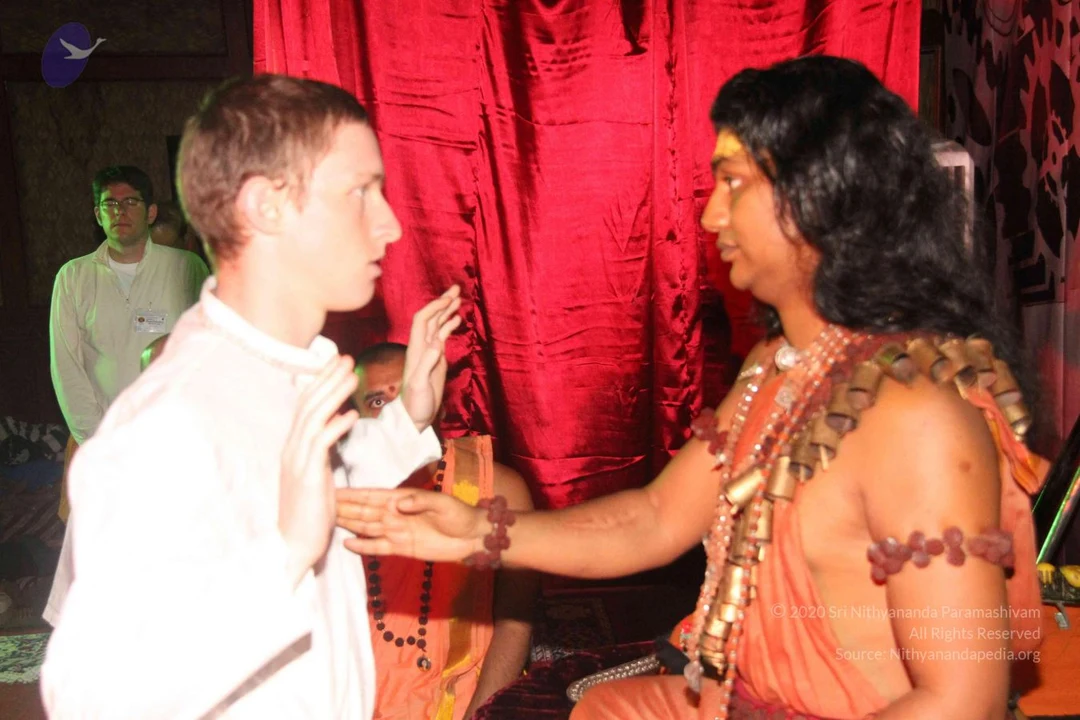
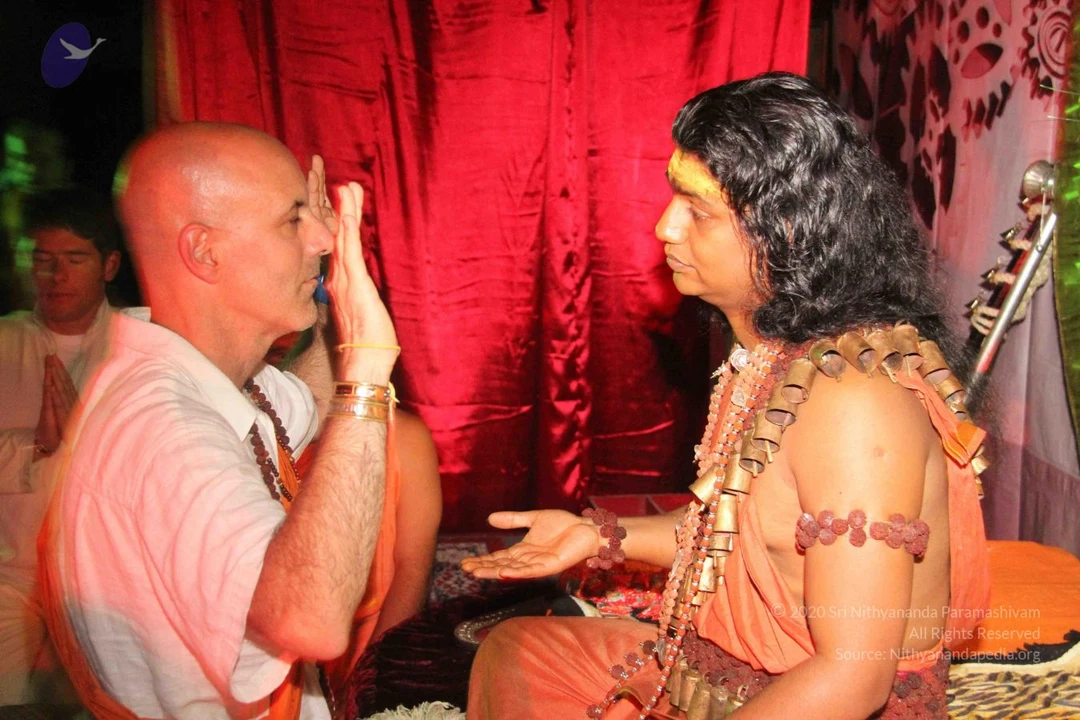
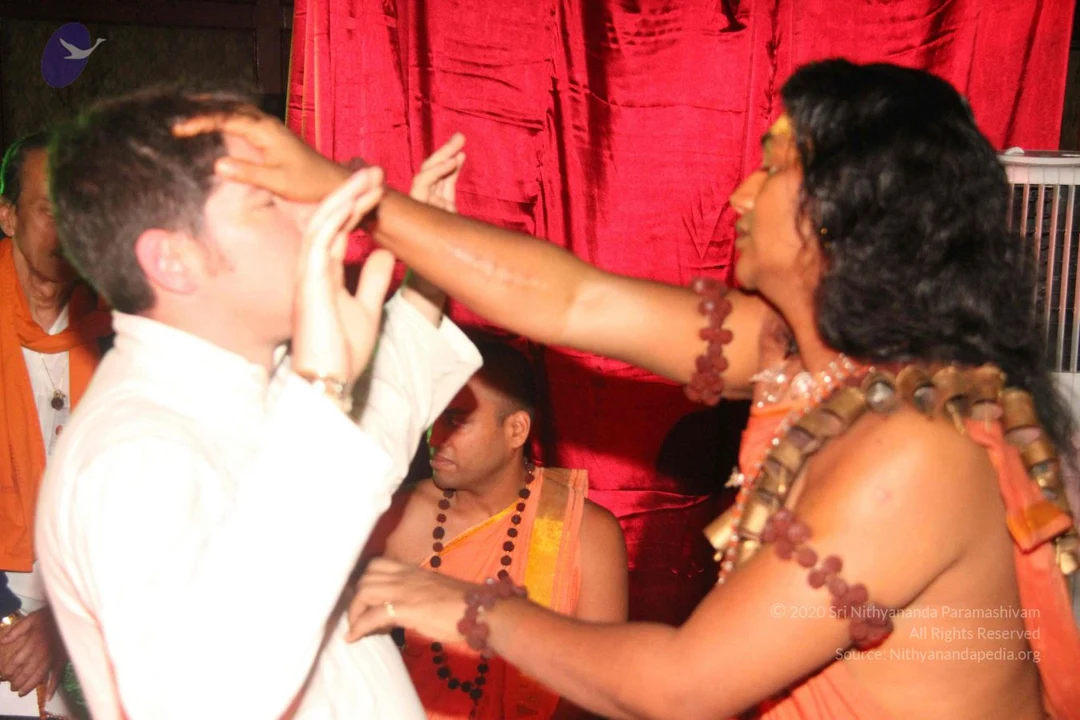
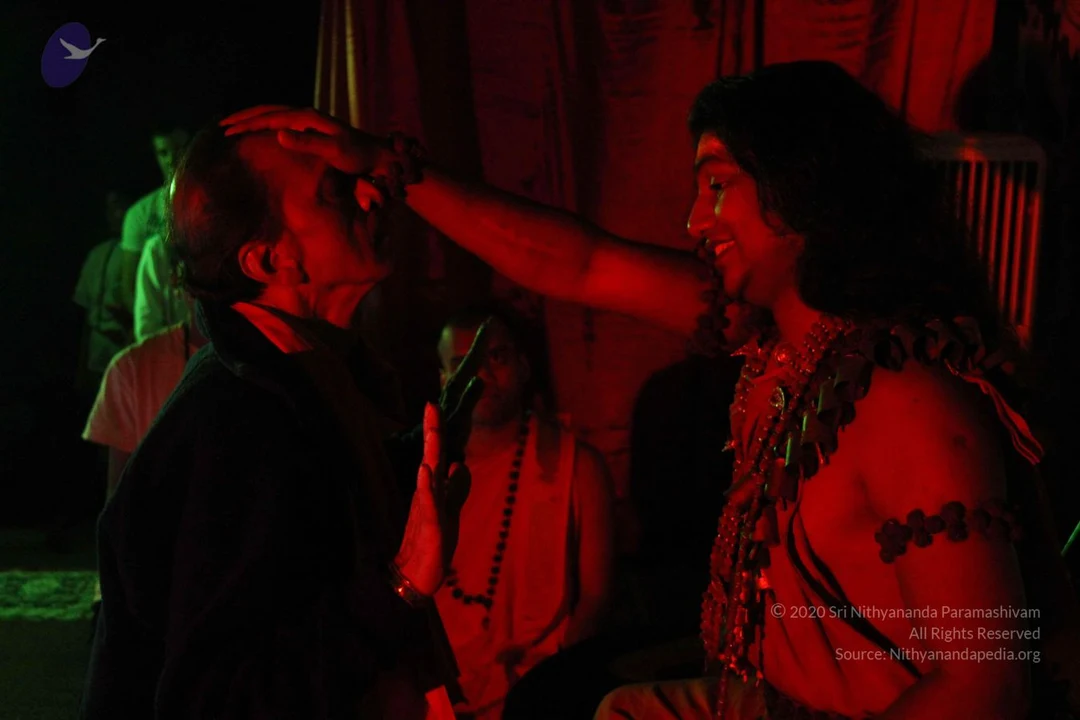
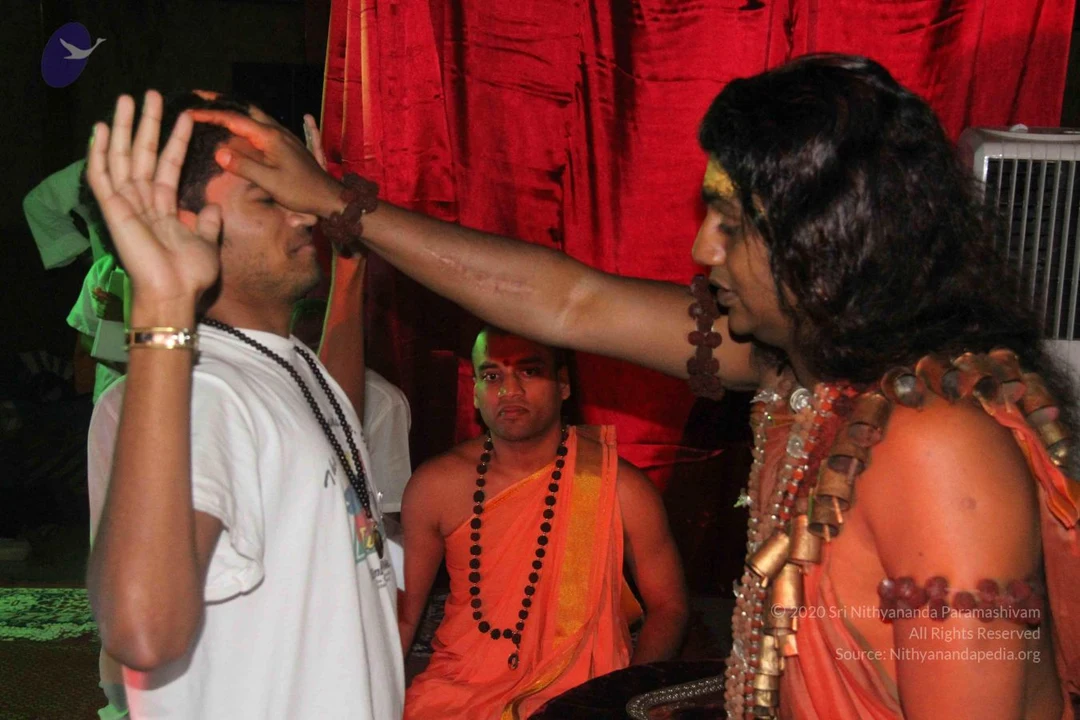
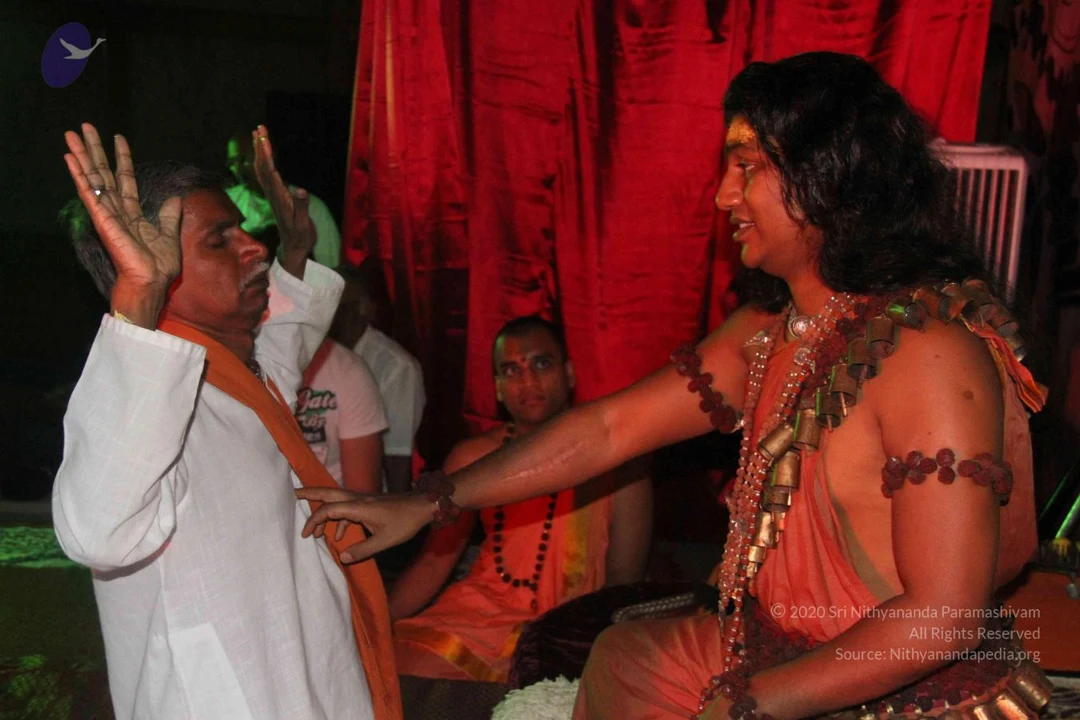
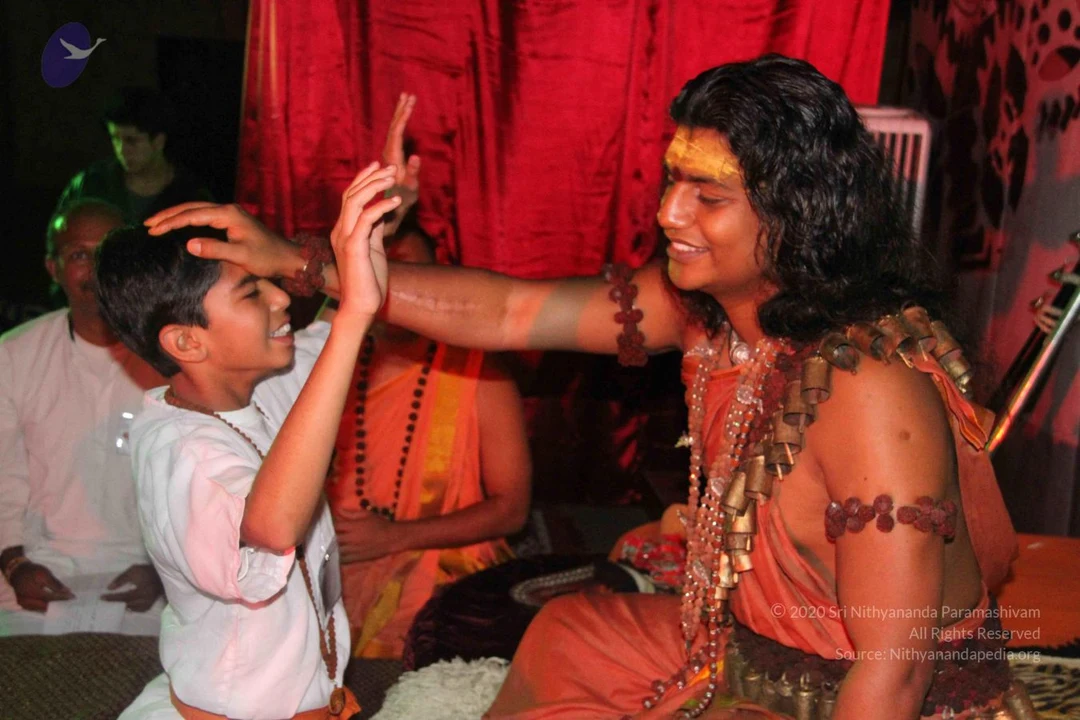
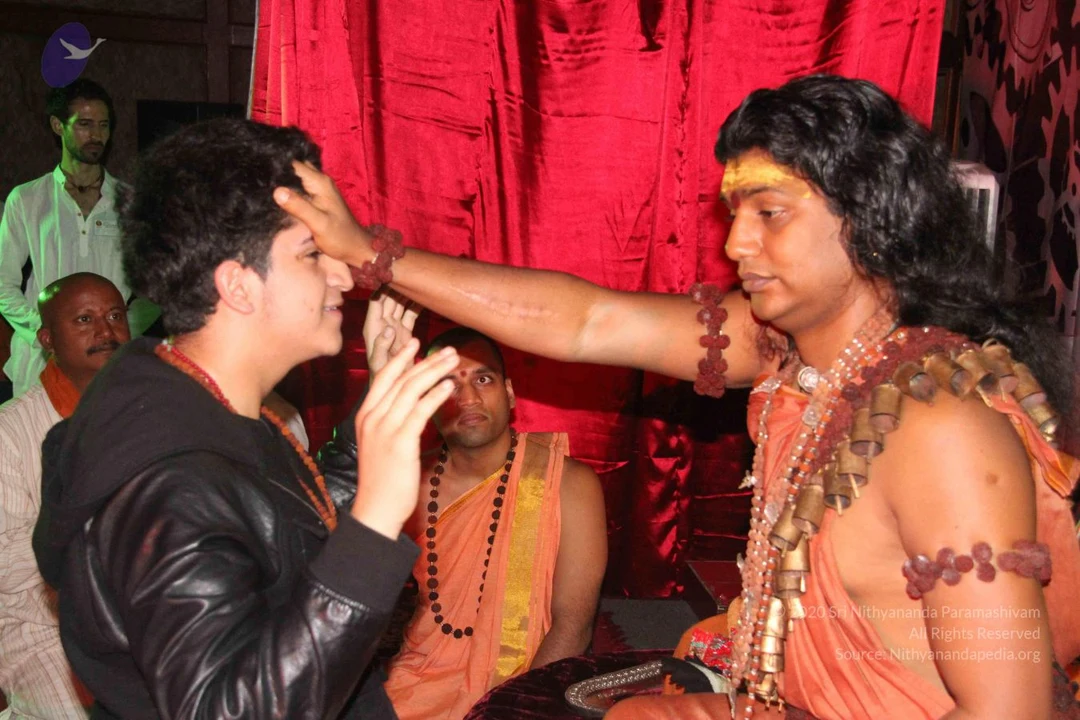
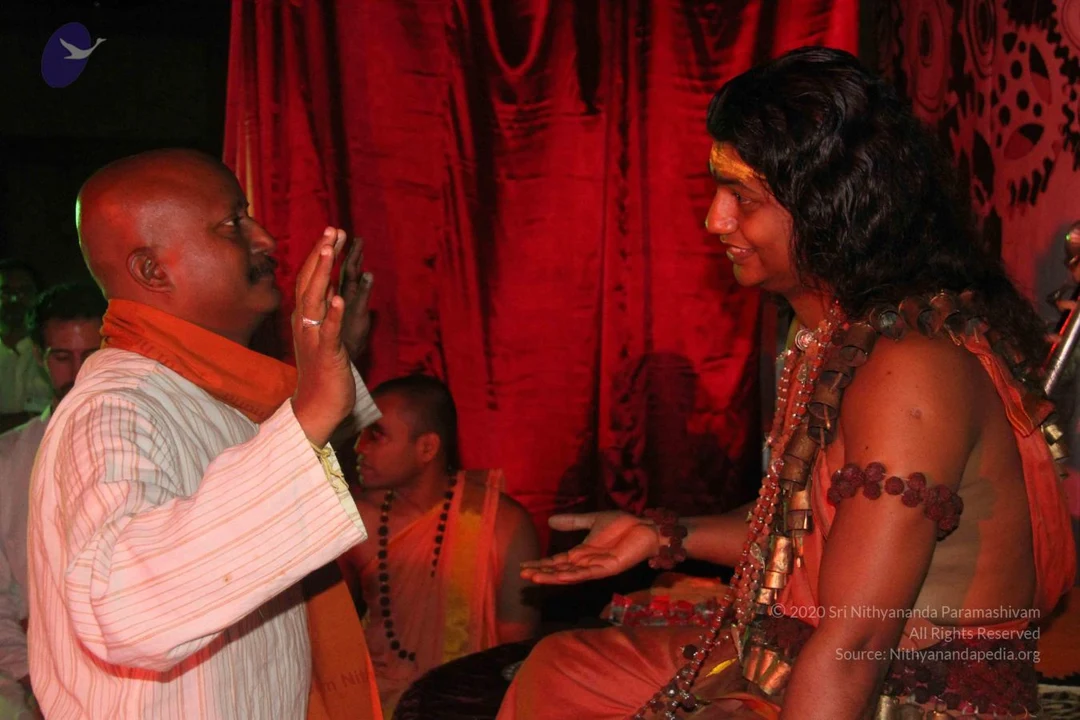
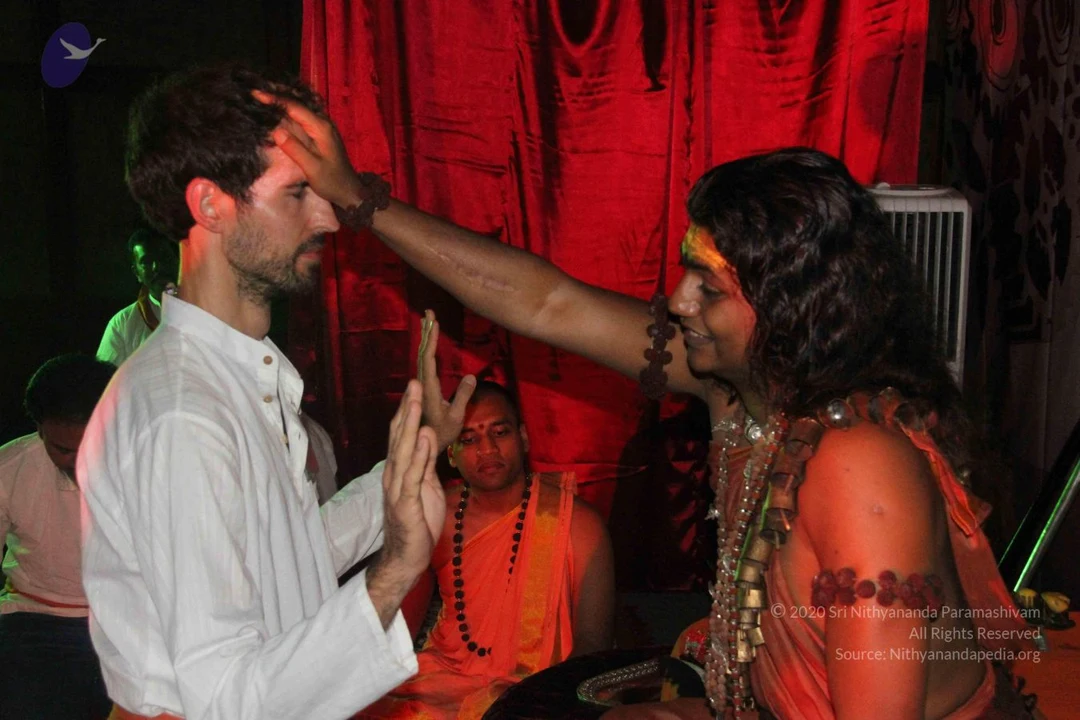
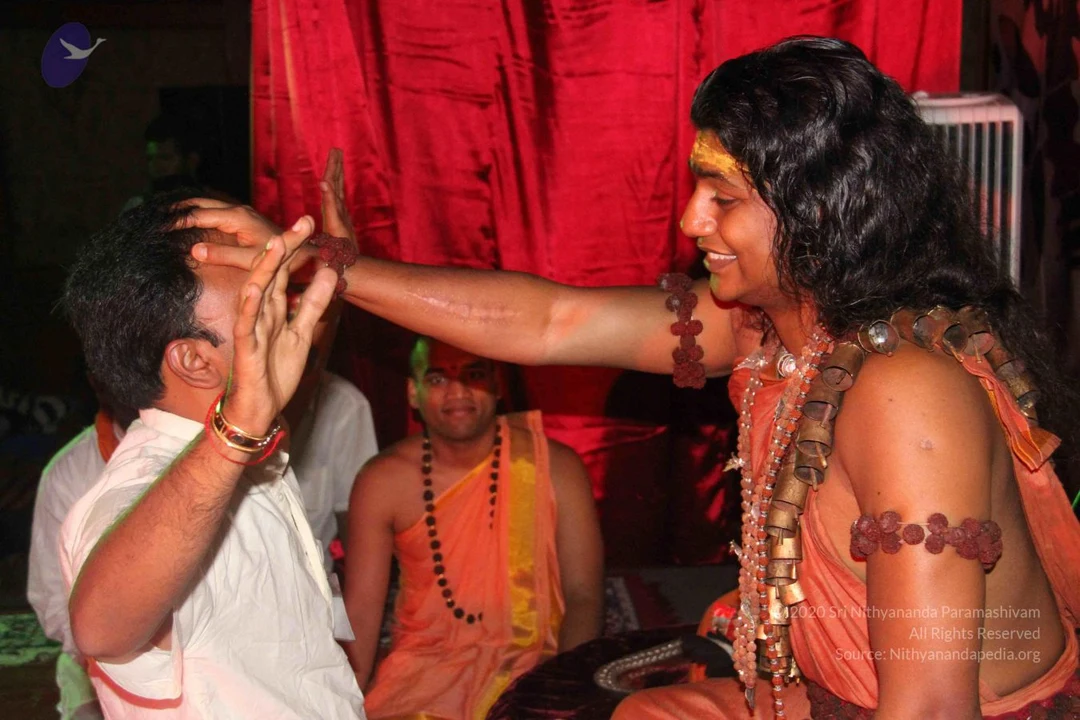
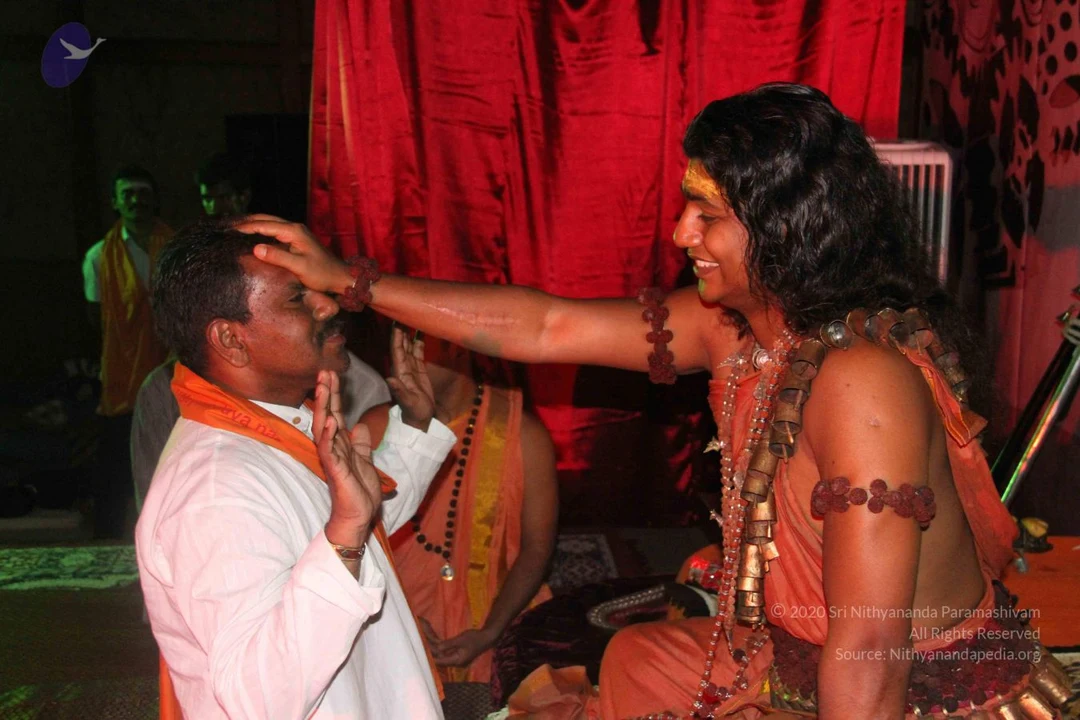
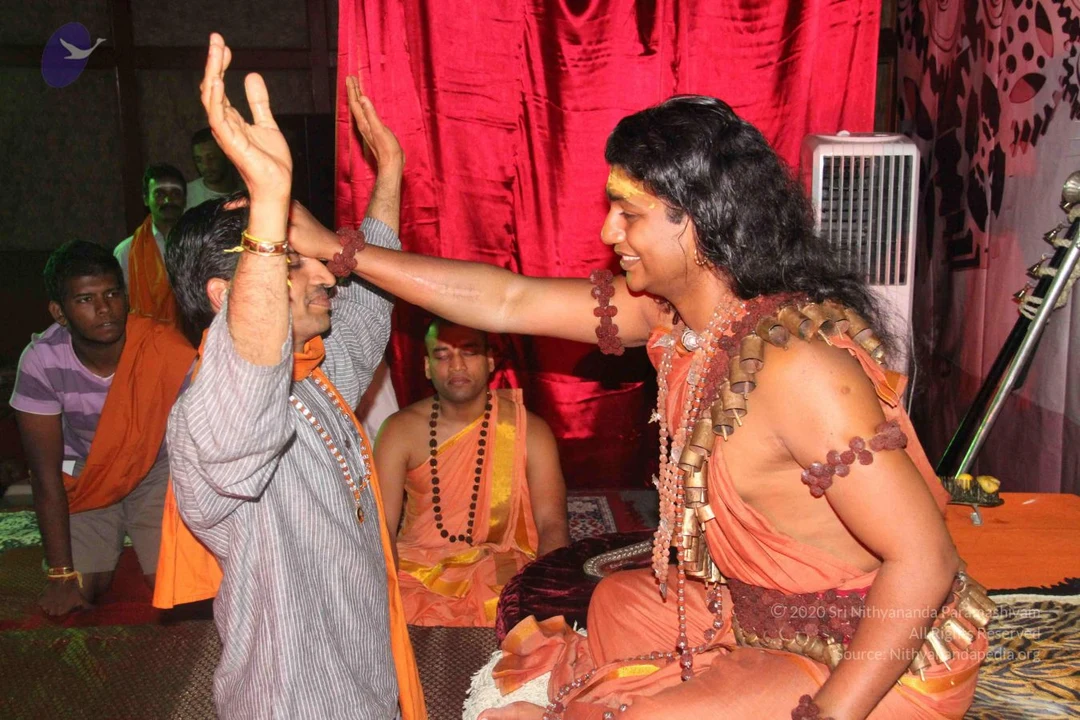
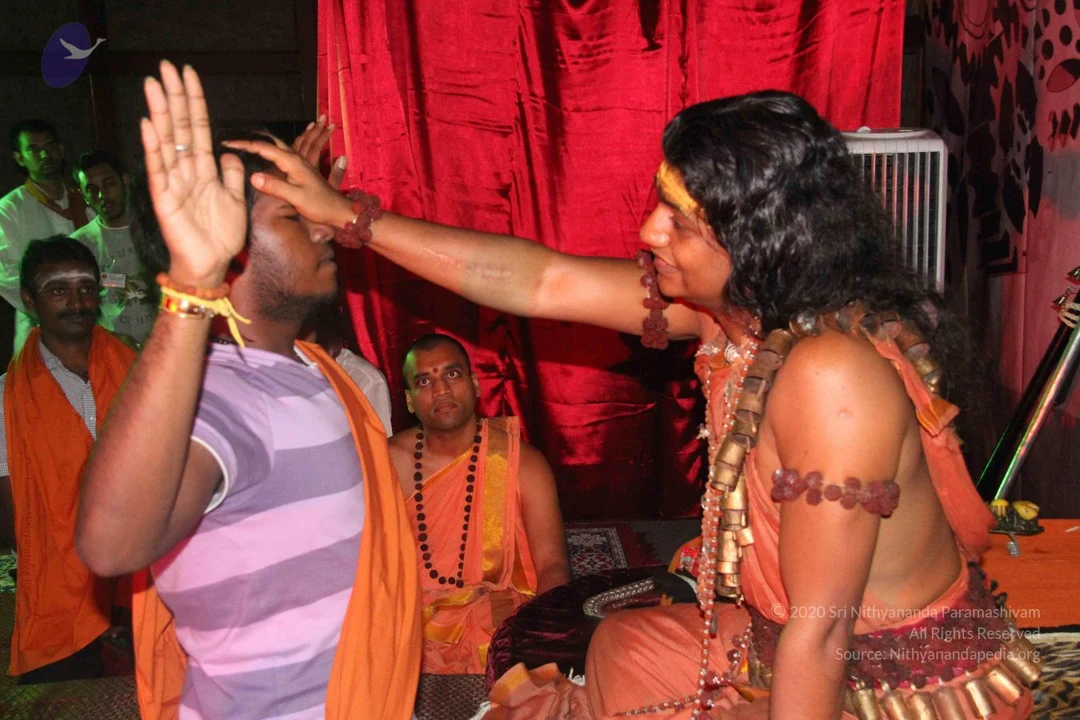
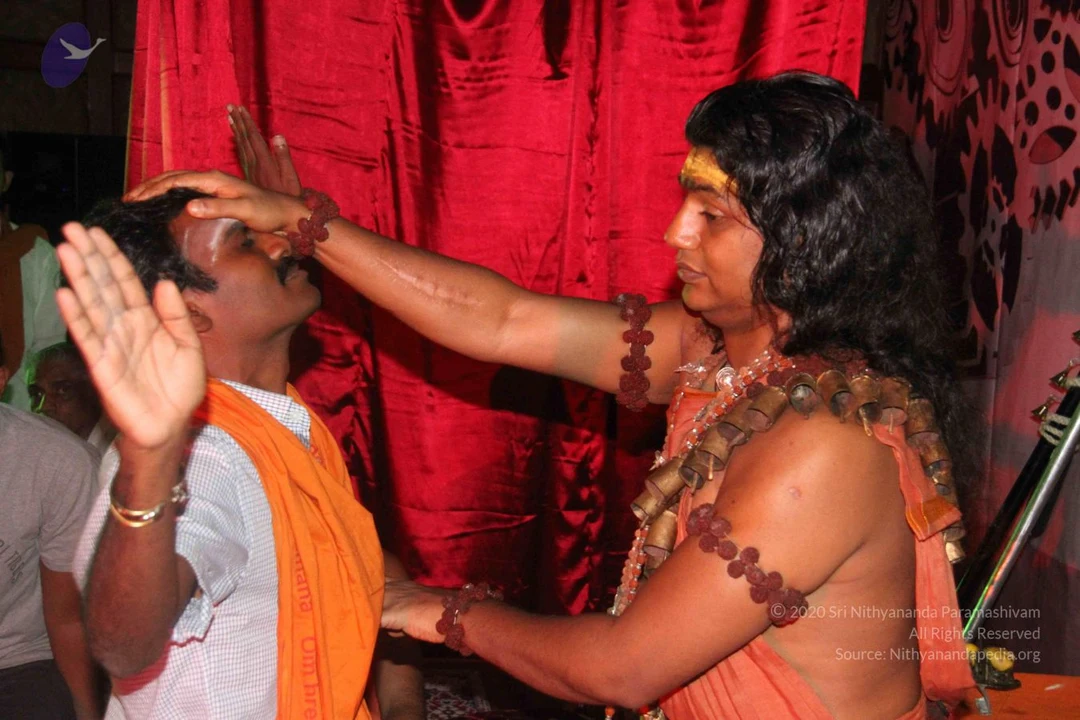
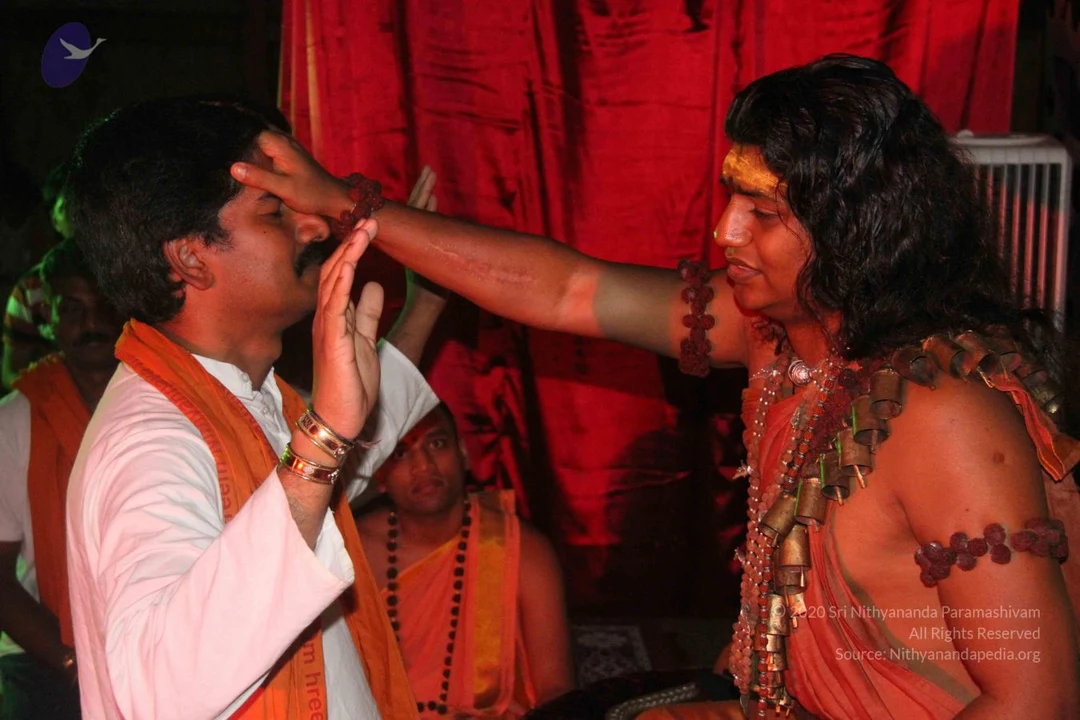
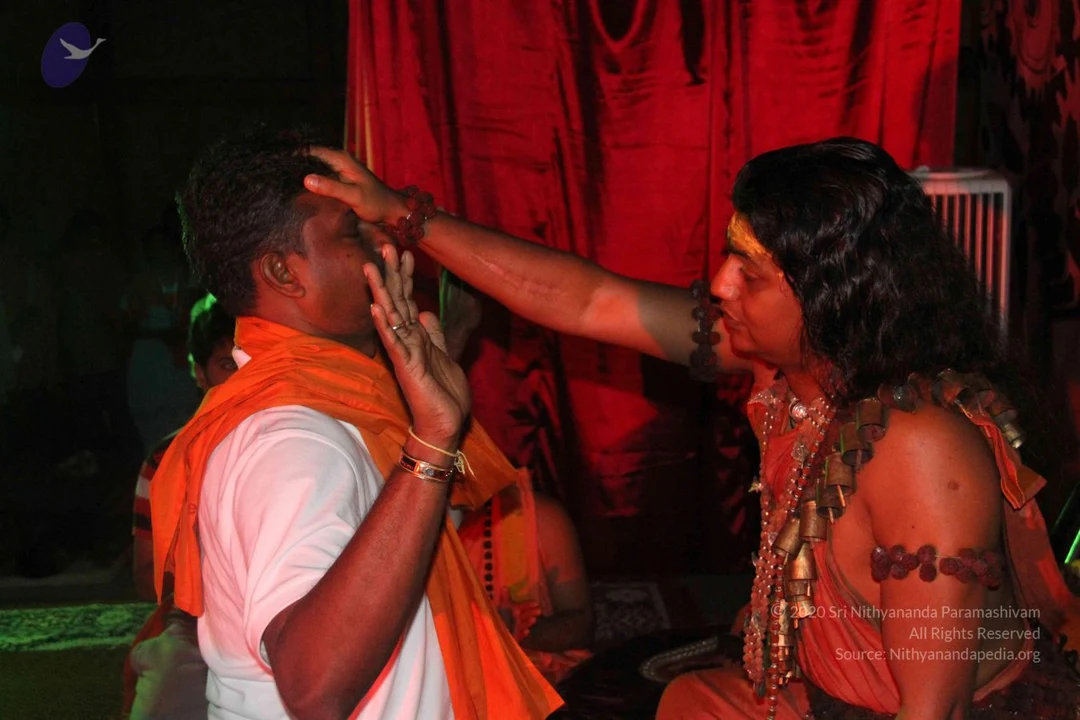
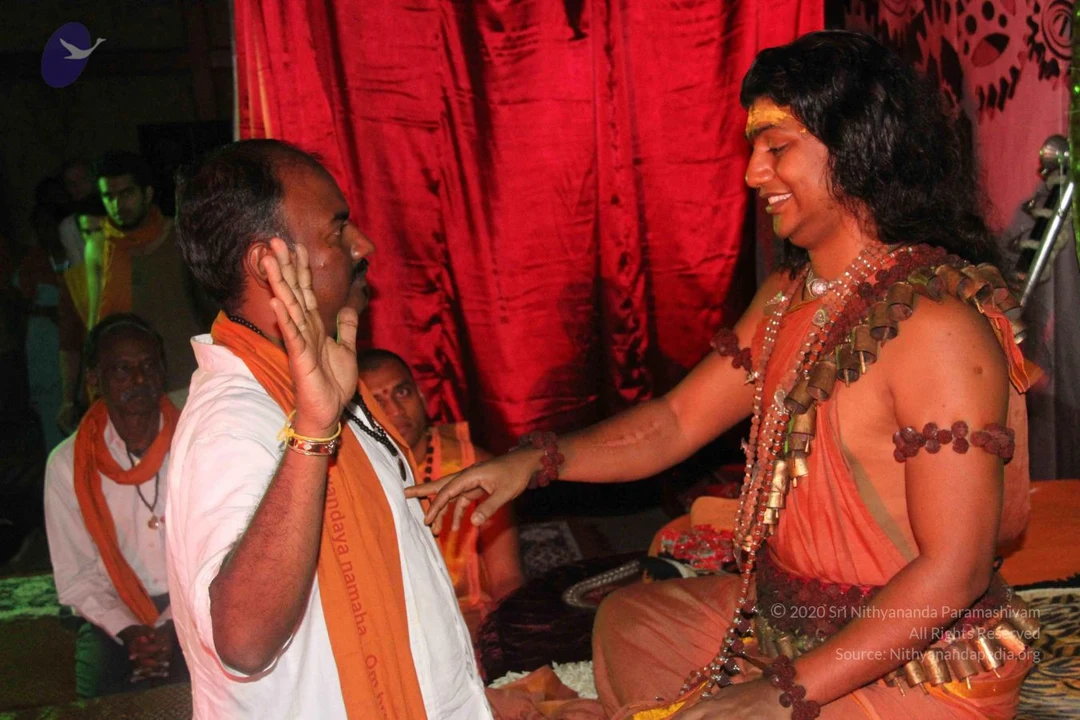
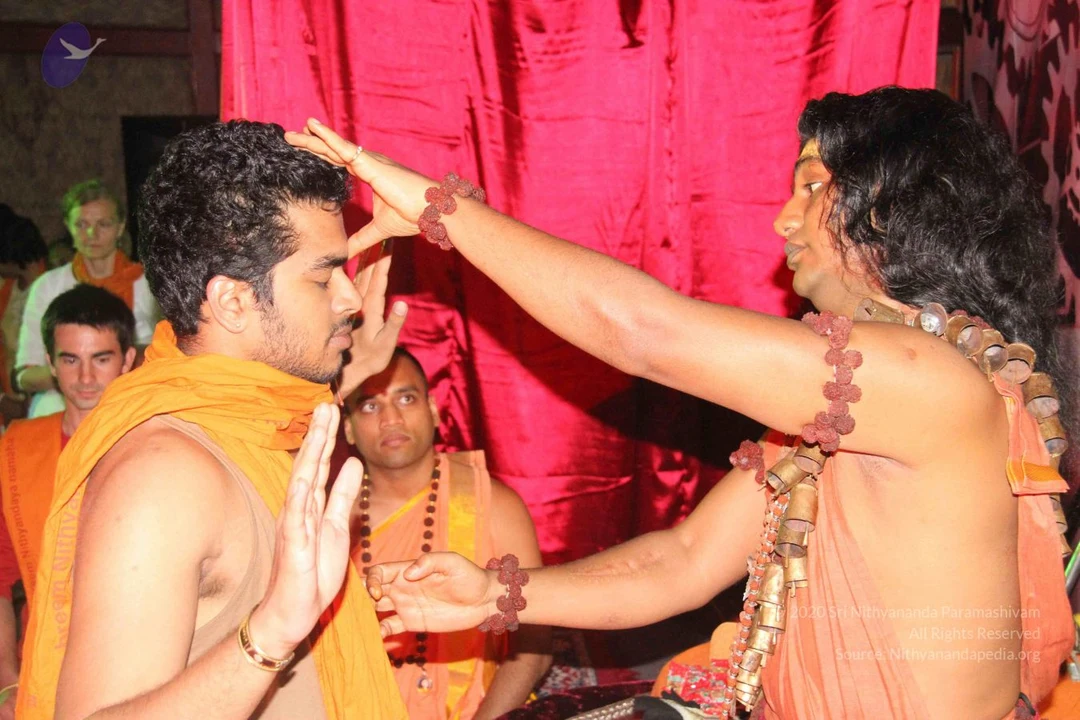
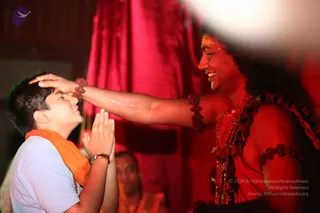
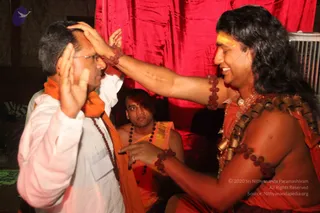
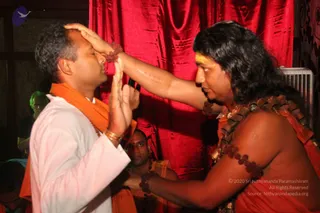
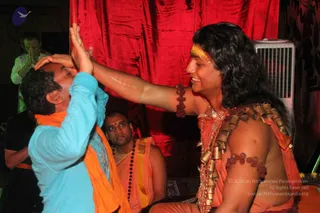
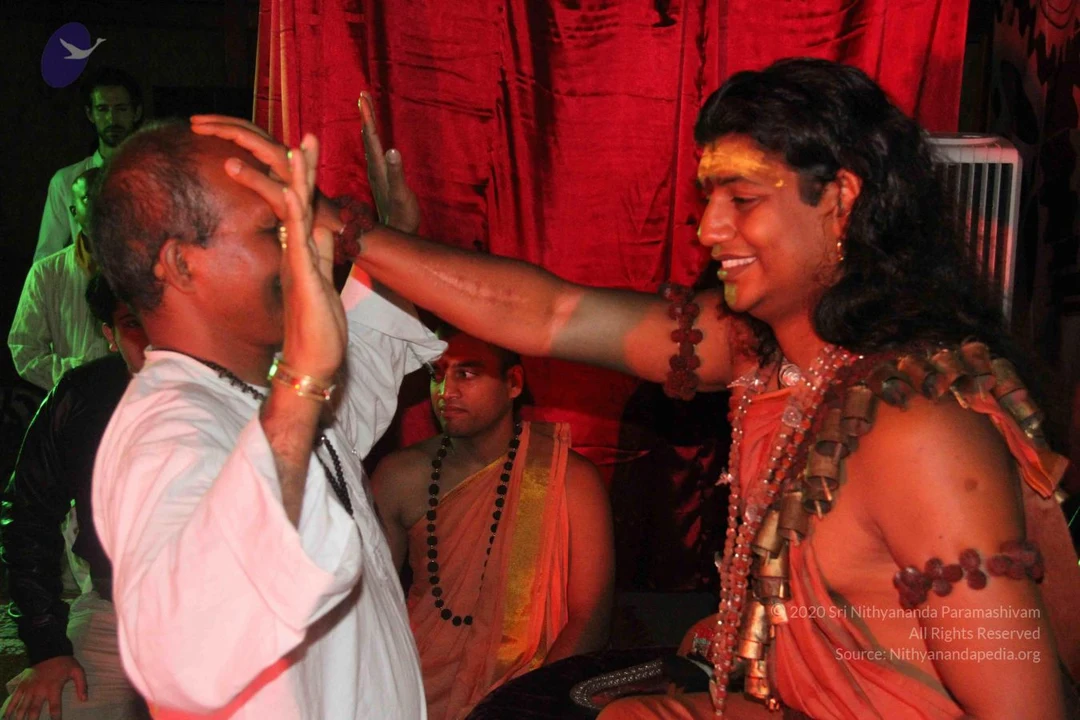
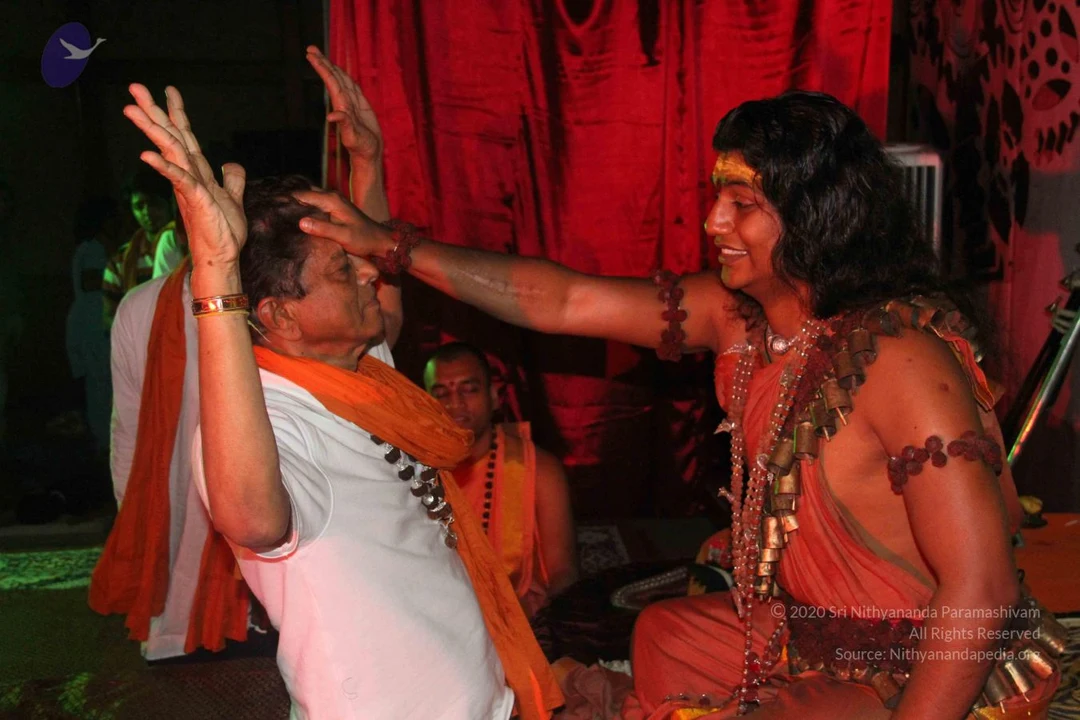
A photograph of a smiling young boy with short dark hair, wearing a light blue t-shirt and an orange-saffron shawl, eyes closed and palms pressed together in namaskar as he bows his head. A long-haired figure with orange-smeared forehead, red-saffron cloth draped over the body, and rudraksha malas on the wrists and chest places one hand on the boy's head in blessing. The warm red-lit setting shows a red draped backdrop, and a bald man in orange cloth stands partly visible behind. The figure appears to be a probable Swamiji (probable) bestowing blessing, marked by long swept-back hair, saffron clothing and layered rudraksha malas, shown in a blessing or darshan moment.A photograph of a long-haired man in saffron-orange robes with a rudraksha mala and ceremonial gold and beaded necklaces, a bright yellow tilak on his forehead, touching the forehead of a man in a white shirt with an orange shawl and glasses. Swamiji (probable): the long-haired figure on the right wears saffron clothing, rudraksha and ornate gold necklaces, and is performing a blessing. A third man in a saffron dhoti and rudraksha mala sits behind them against a red drape. The blessed man holds his hands up in a receiving gesture. Behind them is a red satin curtain.A photograph of an ashram blessing. A long-haired figure with yellow markings on the forehead and a shirtless orange-robed body, adorned with rudraksha malas and a gold necklace, places a hand on the forehead of a man in a white kurta with an orange shawl, who has his eyes closed and palms pressed together. A red velvet curtain hangs behind them. A second orange-robed attendant stands at the right edge, and another person is partly visible at the left. The blessing resembles darshan or padapuja.A photograph of a satsang-style gathering in front of a red draped curtain. A long-haired man in an orange-saffron robe with a red rudraksha mala on his arm and a layered gold-and-bead necklace bends forward and touches his palm to the forehead of a man in a turquoise shirt and orange shawl. The seated robed figure has a yellow tilak on his brow and wears a tan-gold ornamented chest piece. Behind them a bald man in orange with a dark mala watches, and a man in white shirt presses his palms together at the left edge. A window air conditioner sits behind the seated figure. Swamiji (probable): the long-haired robed figure in saffron with rudraksha malas, crown-length swept hair, tilak and ceremonial beaded necklaces is the.Photograph of a satsang-style discussion in a room with deep red drapes. A man in a white collared shirt stands at left with both palms raised in a gesture of greeting or address, a bead necklace and bracelets visible. Seated at center, a shaved-headed monk wears saffron robes and a dark rudraksha mala. At right, a long-haired figure bare-chested except for a saffron shawl wears a large ornate gold necklace, rudraksha malas and beaded armbands, with a yellow-orange tilak on the forehead, and gestures with an open hand in conversation. The scene is lit with warm red light. a person appears to be the figure at right, identified by long swept hair, the saffron shawl, ornate gold necklace and rudraksha adornments.A seated figure with long, swept-back dark hair, saffron-orange robes, a rudraksha mala, ornate gold necklaces and a bead-and-bell garland across the chest reaches out to bless a man in a white kurta with an orange shawl, who has his palms pressed together. A second seated man in orange robes with a gold-bordered cloth and rudraksha mala watches. The setting is a room with a red curtain and a cooler. a person is the figure with the long hair and ceremonial adornments, shown in person.

Inner-Awakening-Session

22 photosSource gallery
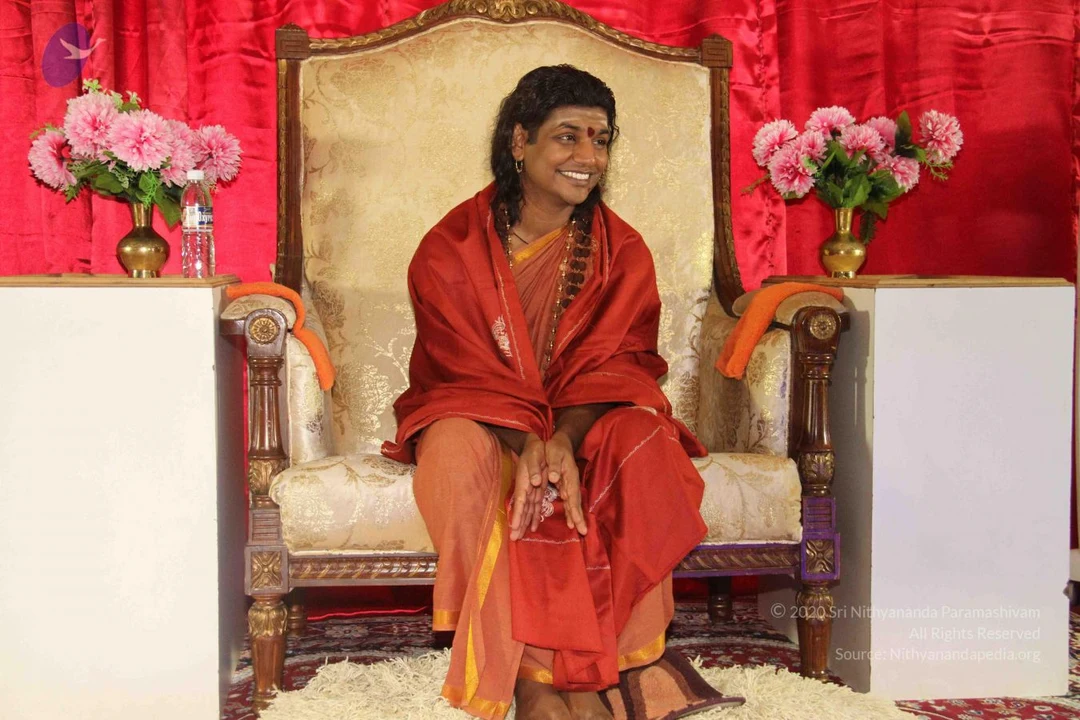
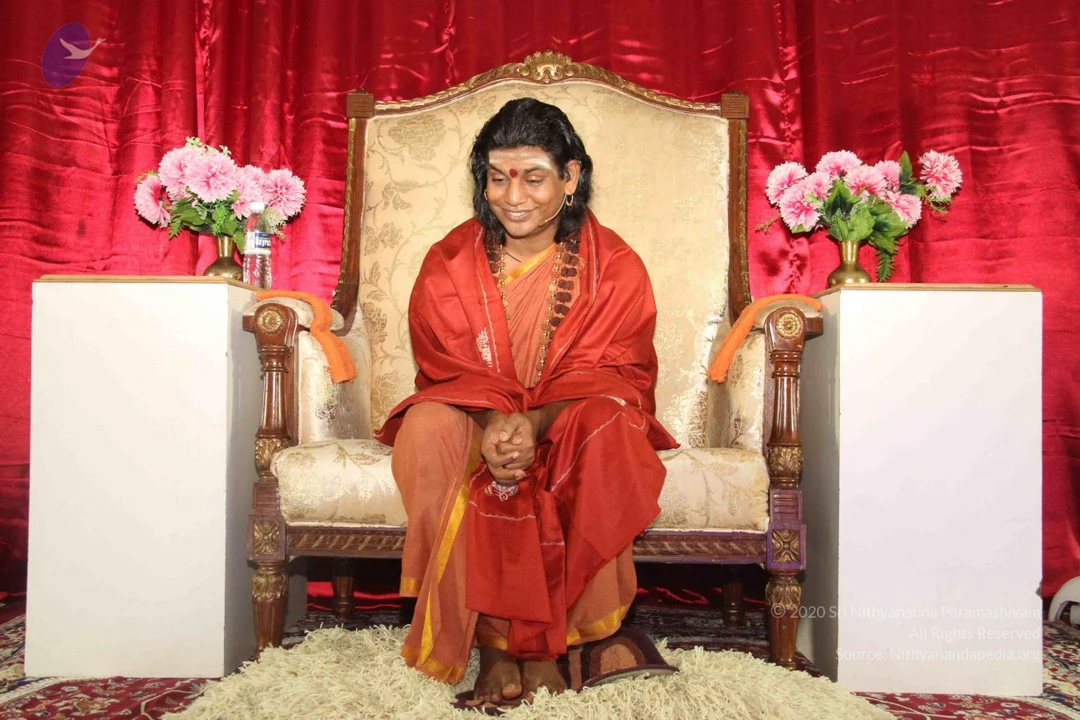
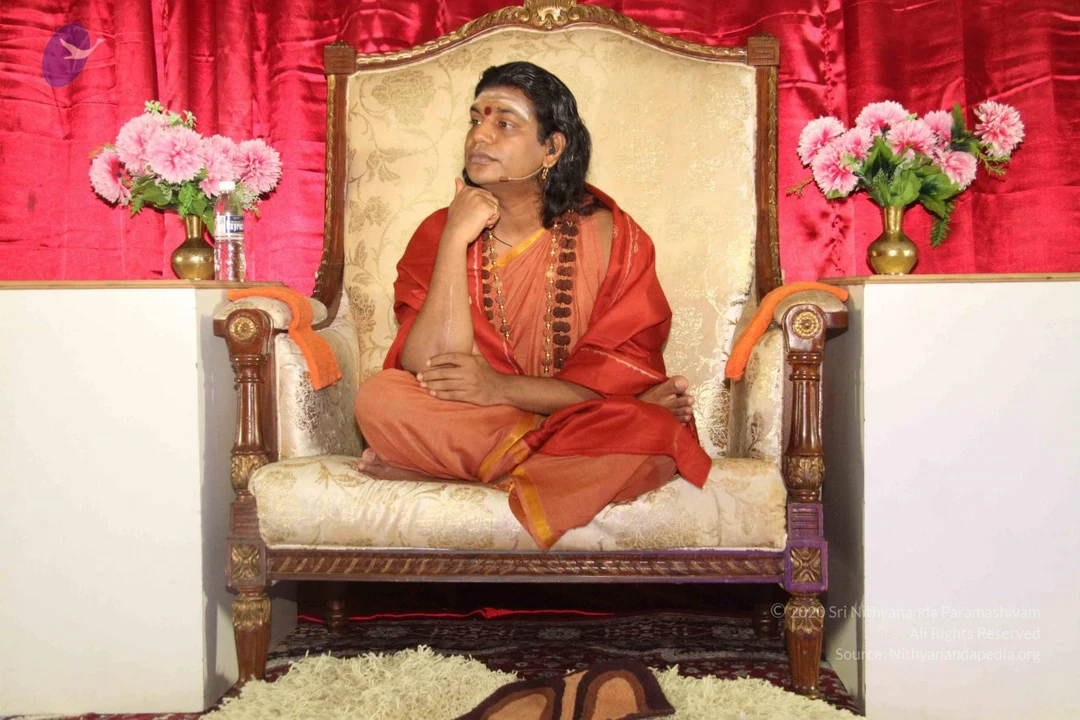
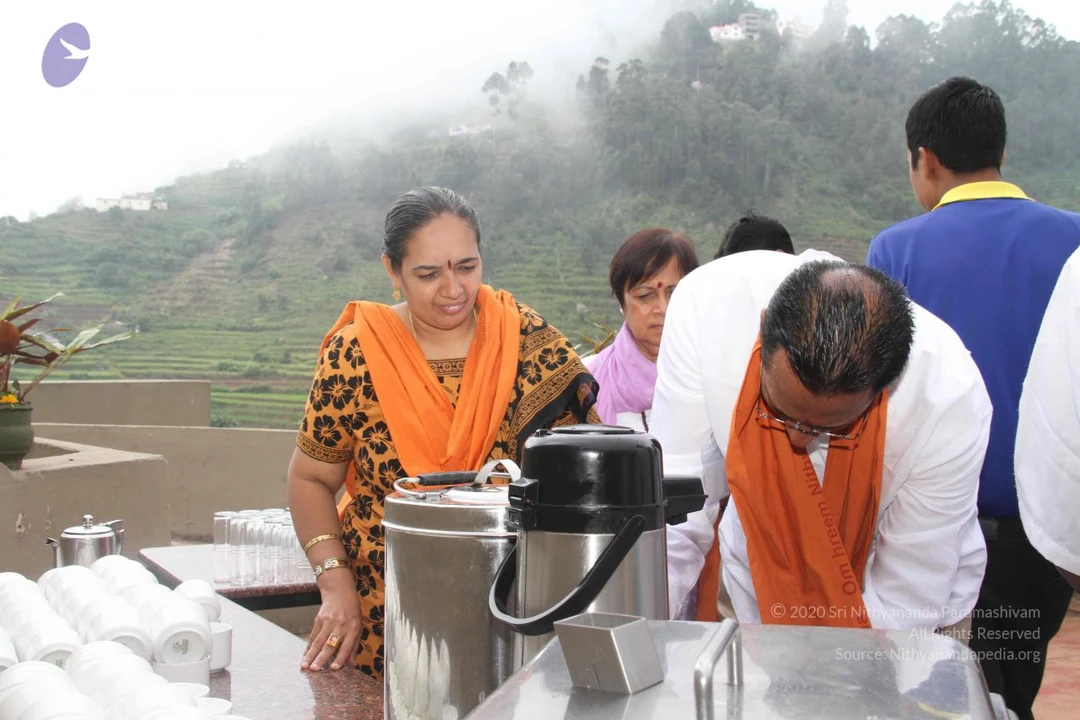
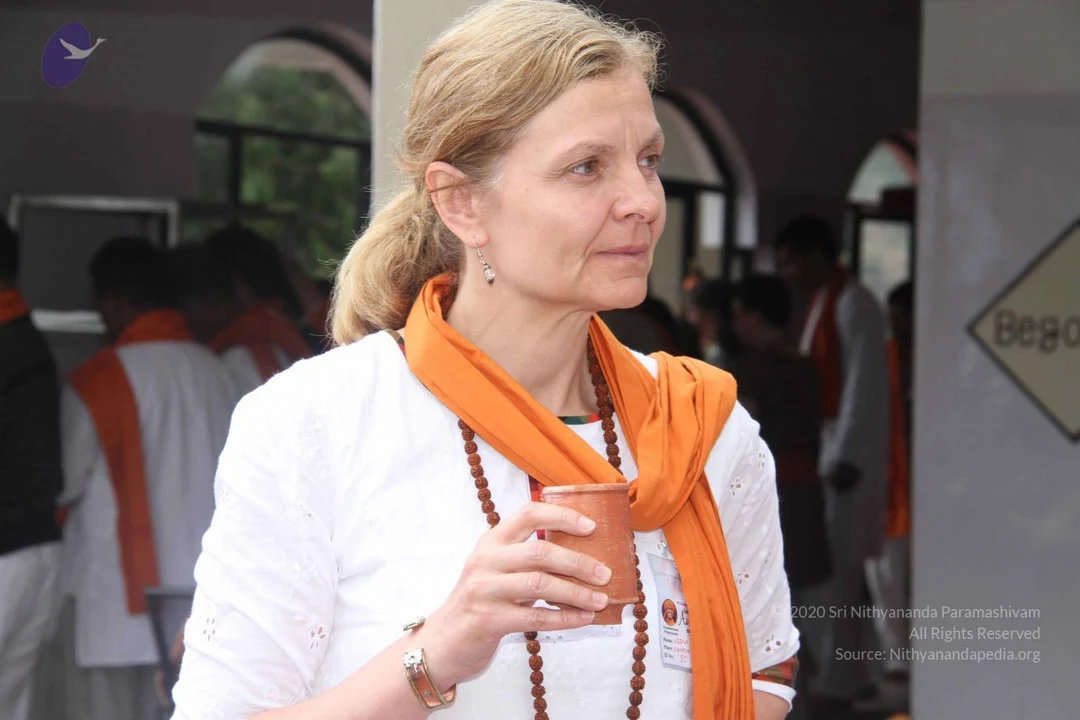
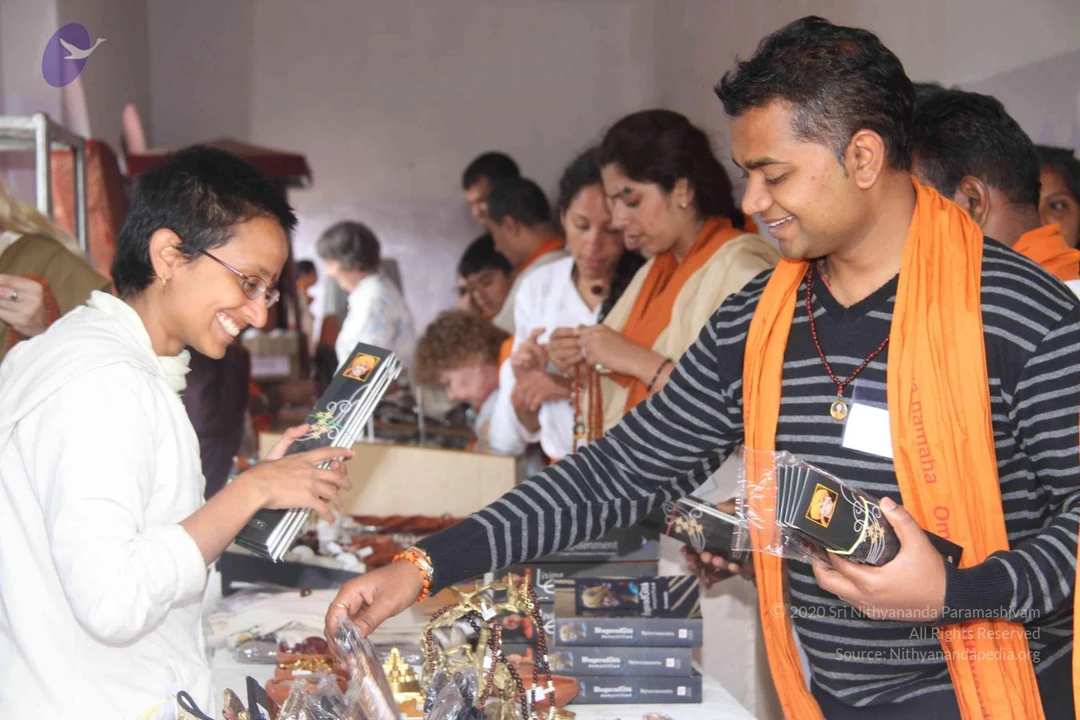
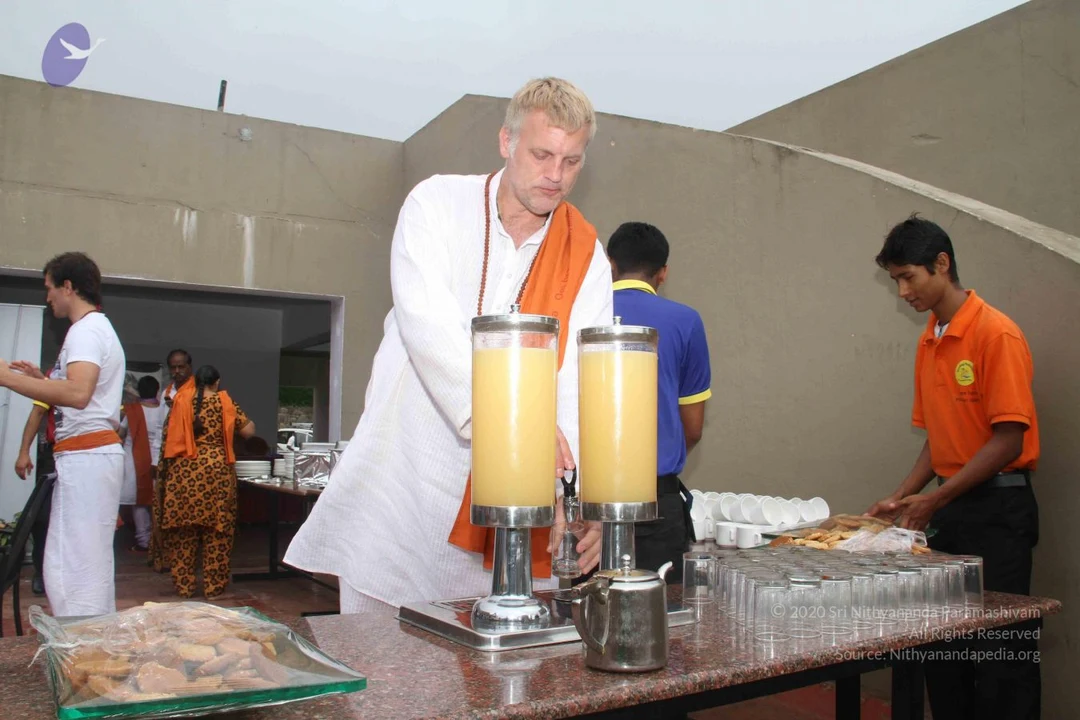
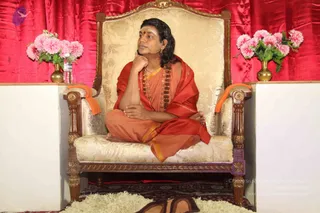
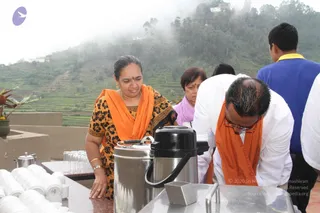
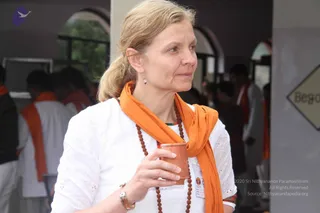
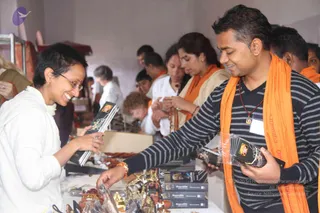
A smiling person sits on an ornate gold-and-cream upholstered throne-style armchair with carved wooden arms, set against a red draped backdrop. The seated figure wears a red-orange shawl over an orange-and-gold-bordered garment, with long dark hair swept back, a red bindi, a rudraksha mala and a beaded necklace. Pink flowers stand in gold vases on small white pedestals at each side, and a white fur rug lies beneath the chair. a person appears in person, seated as the central presence of a satsang-style setting.A photograph of a seated figure on an ornate gold-and-cream upholstered throne with carved wooden arms, set against a red satin drape. The person wears a red shawl over orange-and-saffron robes, a red-orange cloth draped across the lap, and a rudraksha mala with a gold-toned pendant. The head has long swept-back dark hair, a white forehead marking with a red bindi, and a gold earring. The hands are folded in the lap and the eyes are lowered. Pink chrysanthemum-like flowers stand in brass vases on either side, with white pedestals beside the throne and a white shaggy rug at the feet.A photograph of a man seated cross-legged in an ornate cream upholstered armchair with carved wooden arms and gold trim, against a red satin drape. He wears saffron-orange robes with a matching shawl draped over his shoulder, several rudraksha malas around his neck, and a red tilak on his forehead. His head is long hair swept back, and his right hand rests against his chin in a thoughtful pose. Pink carnations in brass vases flank him on either side, and a small water bottle sits on the left. A thin orange cloth drapes the armrests, and a patterned rug lies beneath the chair. Probable Swamiji, seated on the throne with long hair, saffron robes and rudraksha malas.A photo on a hillside terrace with misty green terraced slopes behind. A woman in a black and orange floral sari with an orange shawl stands at a counter beside a steel insulated flask, with stacks of white cups and clear glasses. Beside her an older woman in a purple shawl looks on, and a man in a white shirt with an orange stole reading Om hreem Nithyananda bends over the counter. A man in a blue shirt and yellow collar stands at the right edge.Photograph of a woman with light blonde hair pulled back in a ponytail, wearing a white embroidered kurta-style top, a saffron-orange shawl draped over her shoulders and a rudraksha mala around her neck. She holds a terracotta cup in her right hand and wears a name badge on her chest. Behind her, several people in white clothes and orange shawls stand near an arched colonnade, and a yellow diamond-shaped sign with partial lettering is visible at right.A photograph of a bookstall or merchandise table at an event. On the left, a smiling woman in white with short hair and glasses hands a black-covered book to a man on the right. The man wears an orange shawl over a dark striped long-sleeved top, a red bead mala and a pendant, and has a name badge. Behind them, several people in white and orange shawls browse the table, and a woman in beige with an orange shawl holds beads. The table holds black-covered booklets, small gold and red ornaments, rudraksha-style beads and wrapped items.

eNGenius

17 photosSource gallery
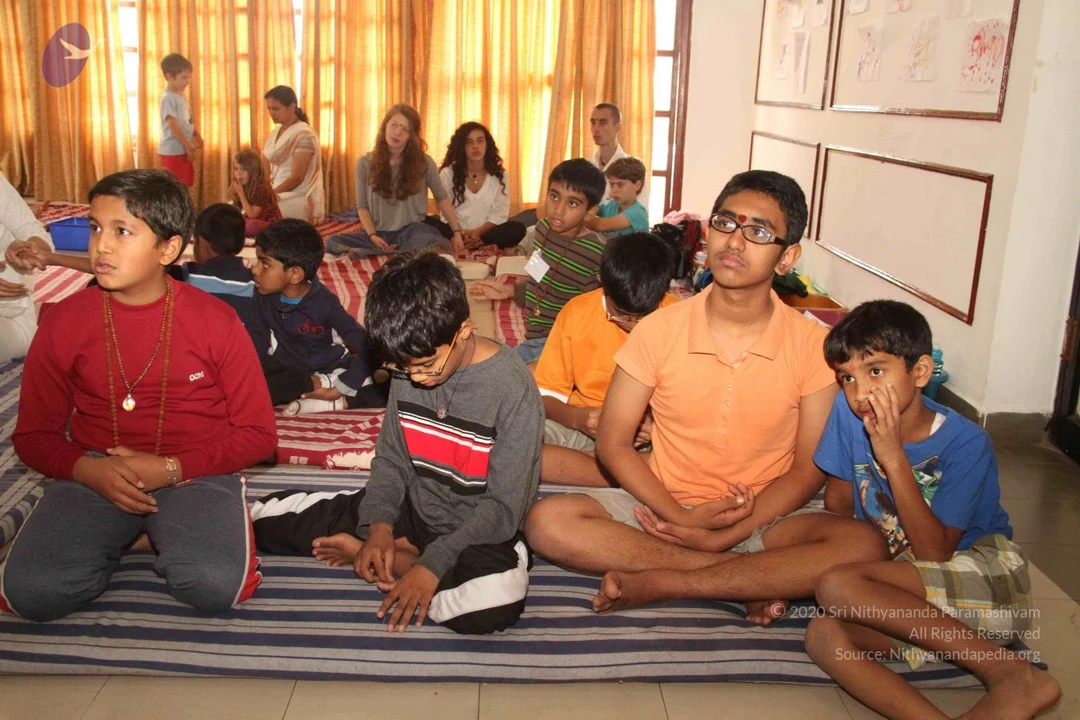
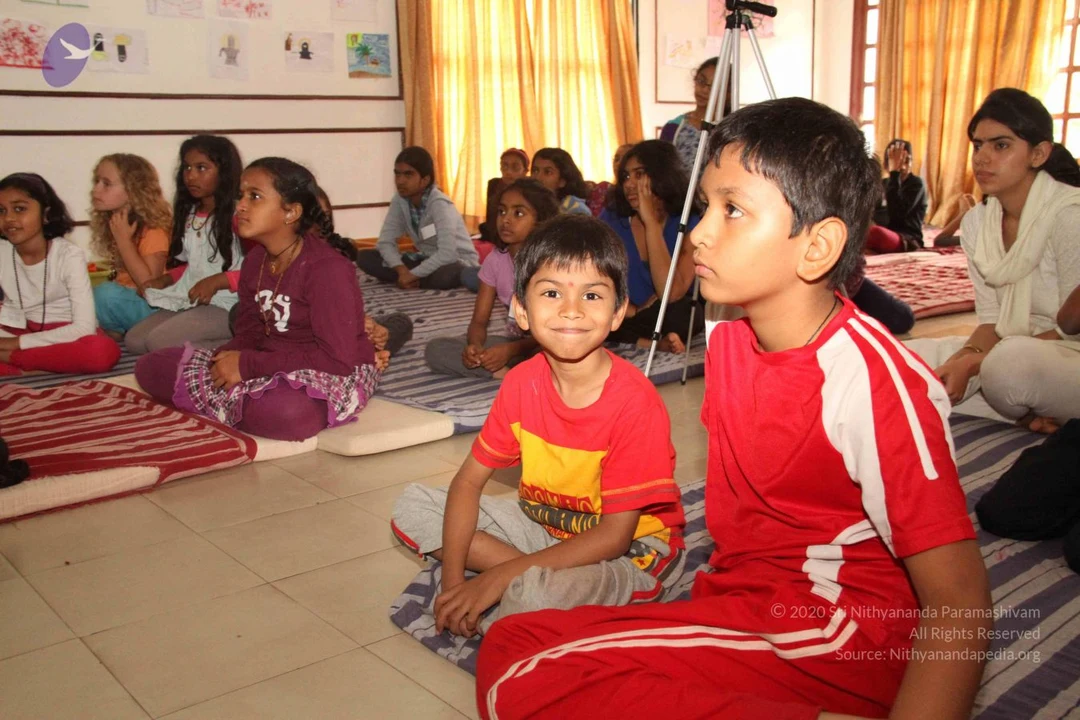
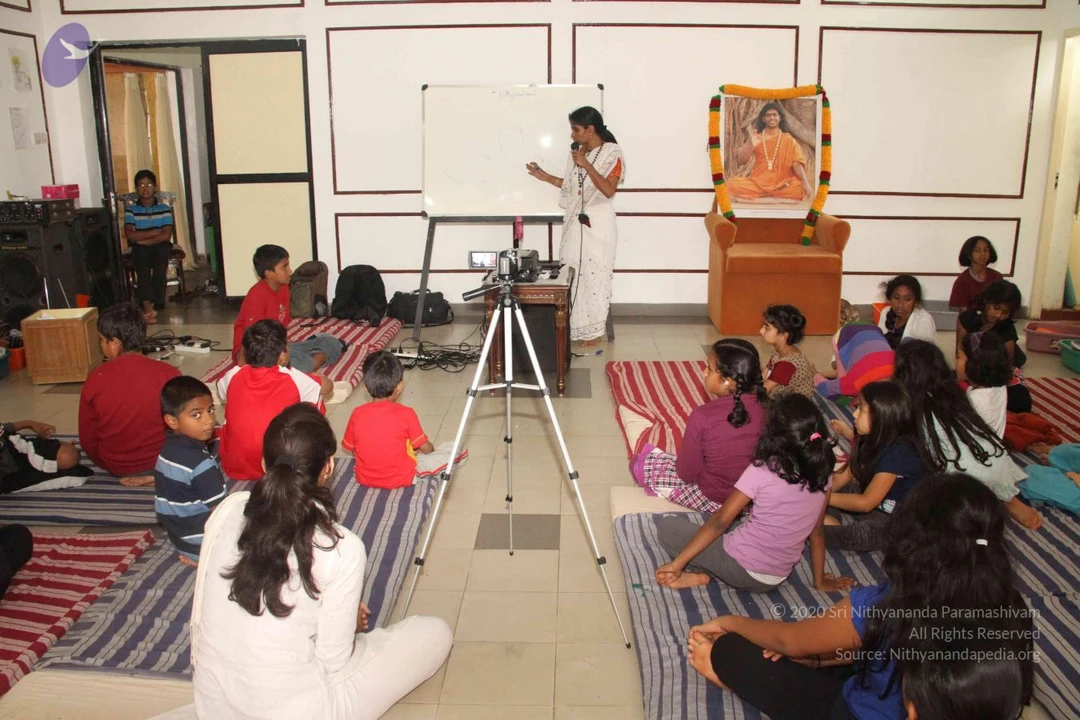
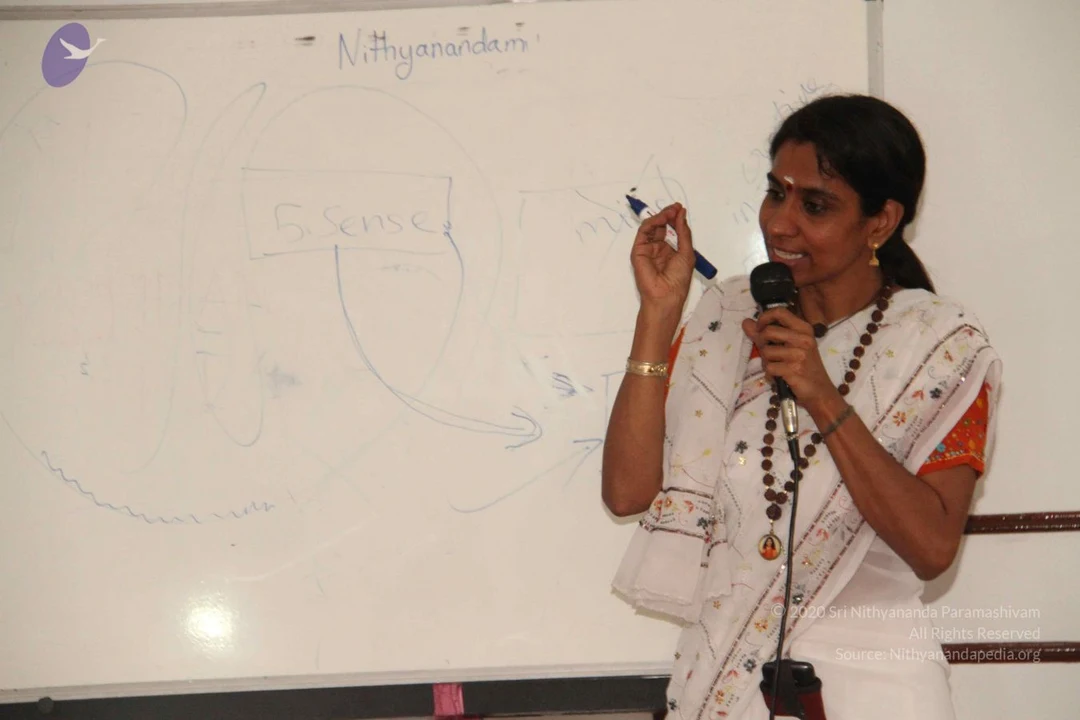
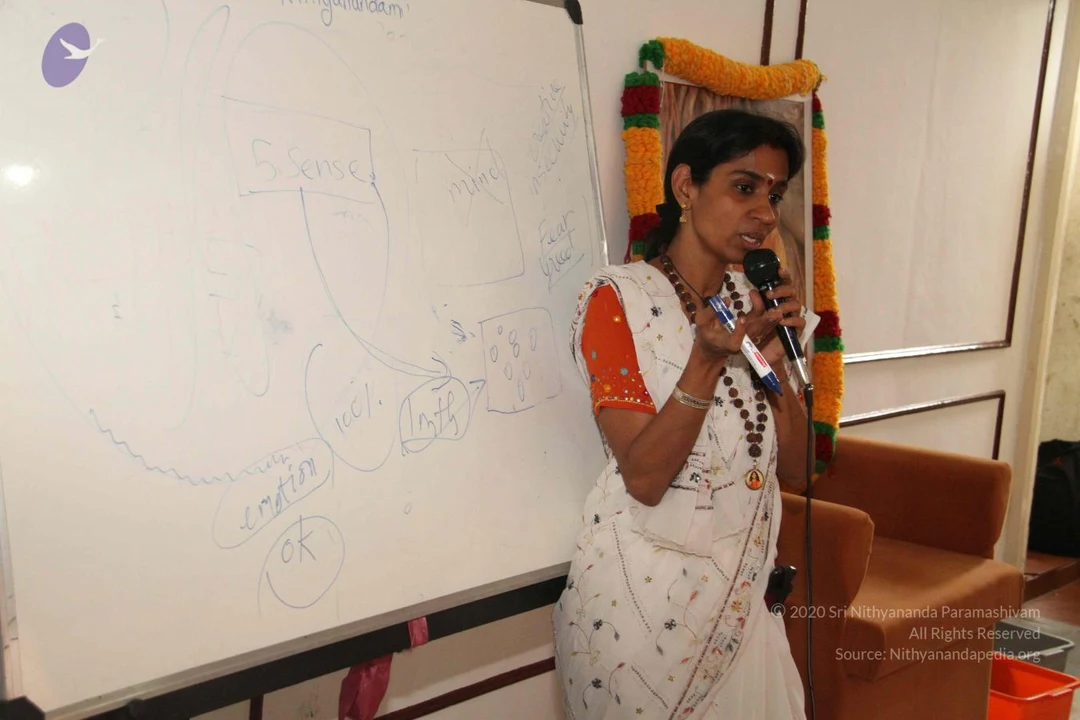
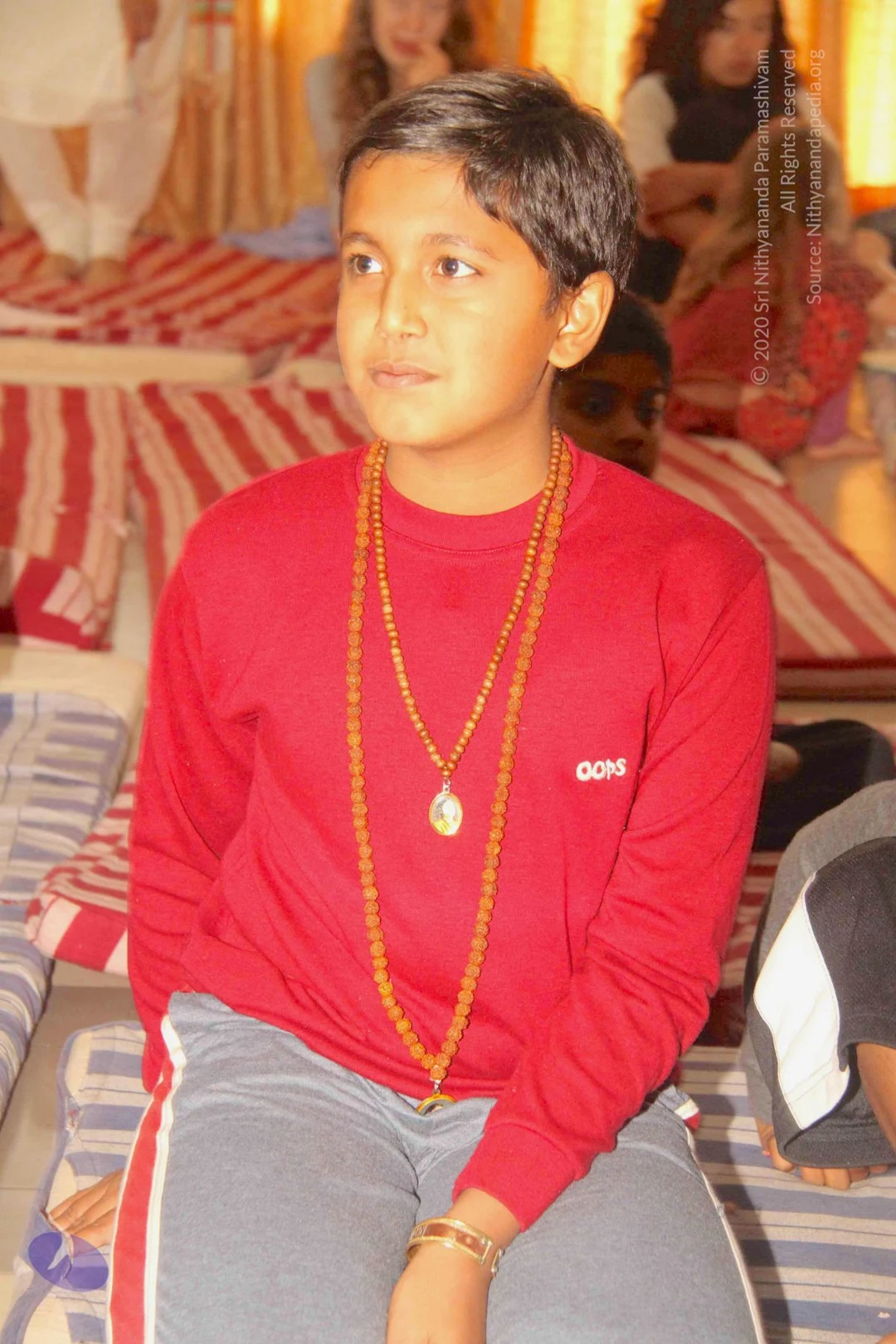
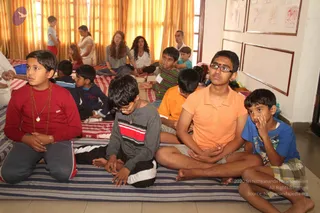
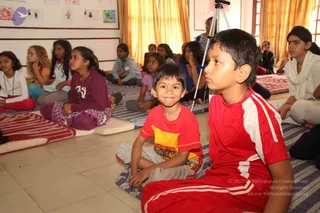
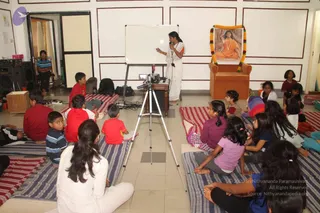
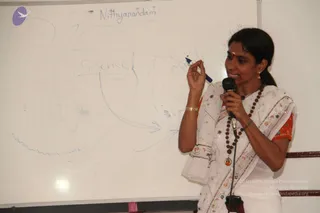
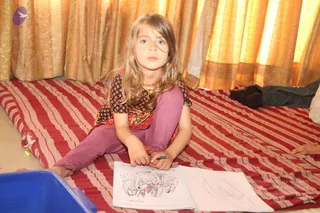
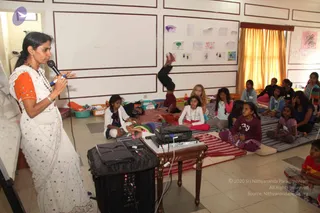
A group of children and a few adults sit on striped mats and blankets in a bright room with orange curtains and a white wall with framed drawings. A boy in a red sweatshirt with a wooden bead mala and pendant sits with hands folded. A teenage boy in an orange polo with a red tilak and glasses sits cross-legged with hands in his lap. Other children in grey, blue and striped shirts listen attentively, while women in light clothing sit toward the back.A photograph of a children's satsang or class in a bright room with yellow curtains and a wall display of child drawings. Children sit cross-legged on striped mats and cushions, facing forward and attentive. In the foreground a boy in a red and white athletic top and red track pants sits beside a smiling younger boy in a red, yellow and orange t-shirt. Behind them girls wear purple, white and blue clothes. A tripod-mounted camera stands at the right. No identifiable a person figure is visible.A classroom-style satsang hall with children seated on striped mats on the floor facing a woman in white who stands near a whiteboard and speaks into a handheld microphone. Behind her, a framed portrait of a saffron-robed sannyasi with long hair and a rudraksha mala sits on a cushioned armchair beneath a marigold garland, a probable Swamiji depiction. Children in red, blue and pink clothes sit in rows; a camera on a tripod faces the group.A woman stands before a whiteboard holding a microphone in one hand and a blue marker in the other, gesturing as she speaks. She wears a white sari with a multicoloured floral border, an orange blouse, a long rudraksha mala and a gold bangle, with a small red bindi on her forehead. The whiteboard shows hand-drawn diagrams, including a box labelled 5. Sense with arrows, and the word Nithyanandam written at the top. The setting appears to be a classroom or talk room.A young girl with long light-brown hair sits cross-legged on a red and cream striped mat in front of gold curtains, holding a blue pen over an open spiral notebook with a line drawing. She wears a dark patterned top with red and orange florals and mauve trousers. A blue plastic tub sits at the lower left, and a person's legs in dark trousers are visible at the right edge. Her hand rests on the page as she looks toward the camera.A woman in a white sari with orange blouse stands at left holding a handheld microphone and gesturing while addressing a room of children seated on mats and rugs. Several children sit cross-legged, one girl in white top and pink leggings, while a child performs a handstand against the wall. A projector, laptop and portable speaker sit on a wooden table and a black case in the foreground. Pale wall panels display children's drawings, and yellow curtains hang at the window.

Kalabhairava-Darshan
83 photosSource gallery
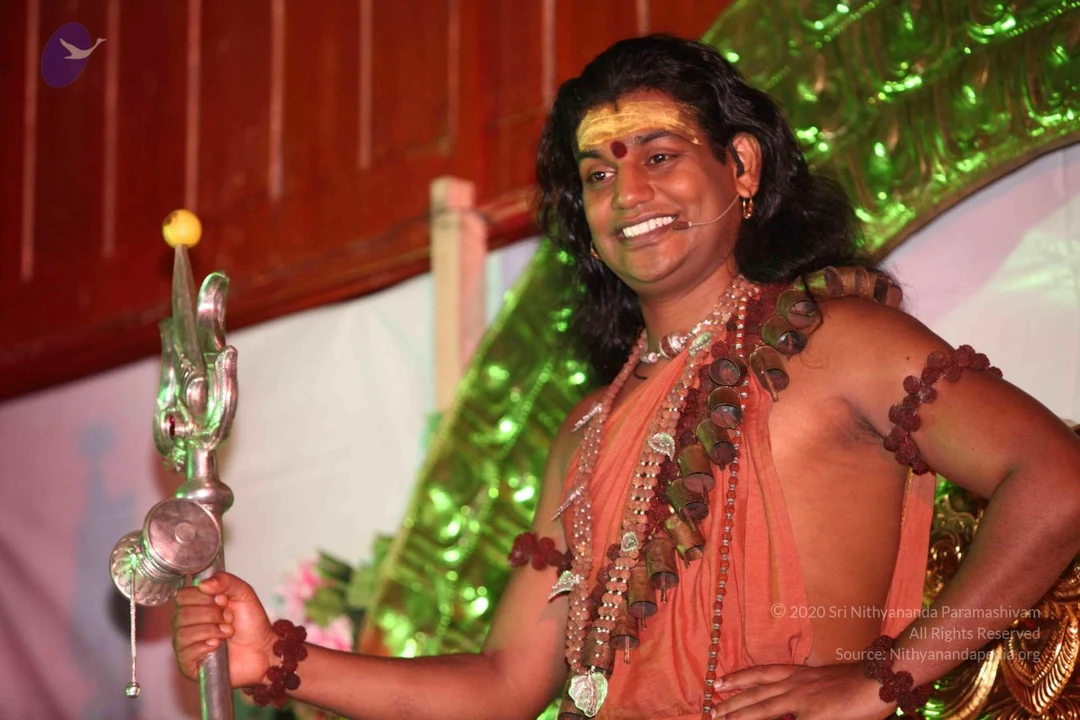
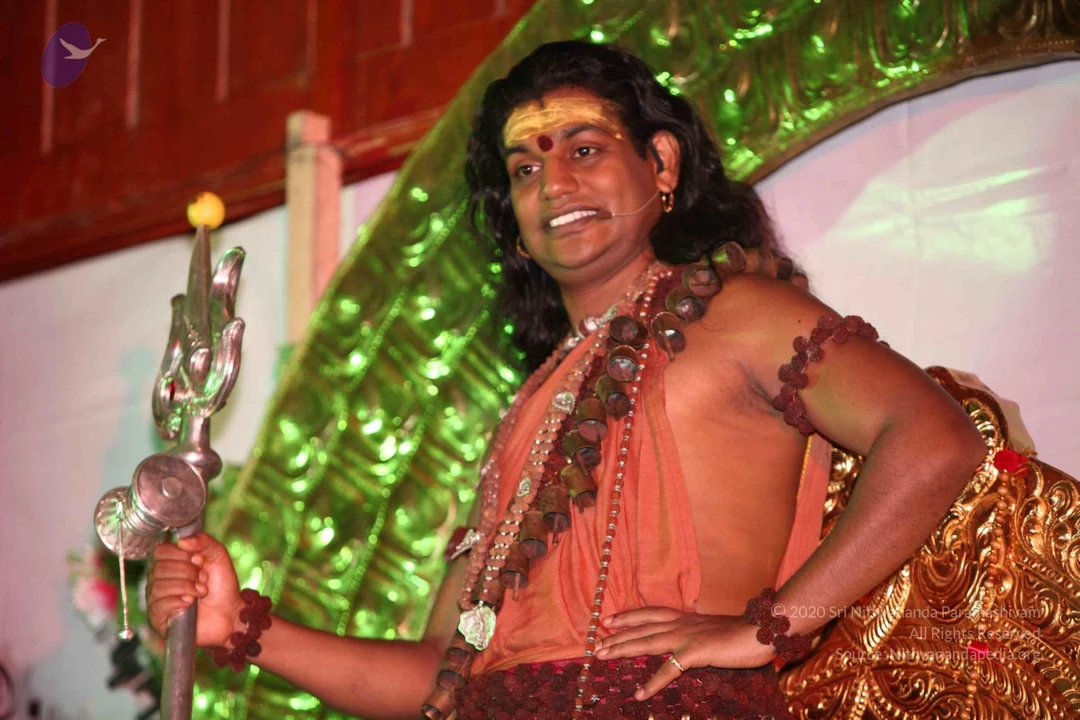
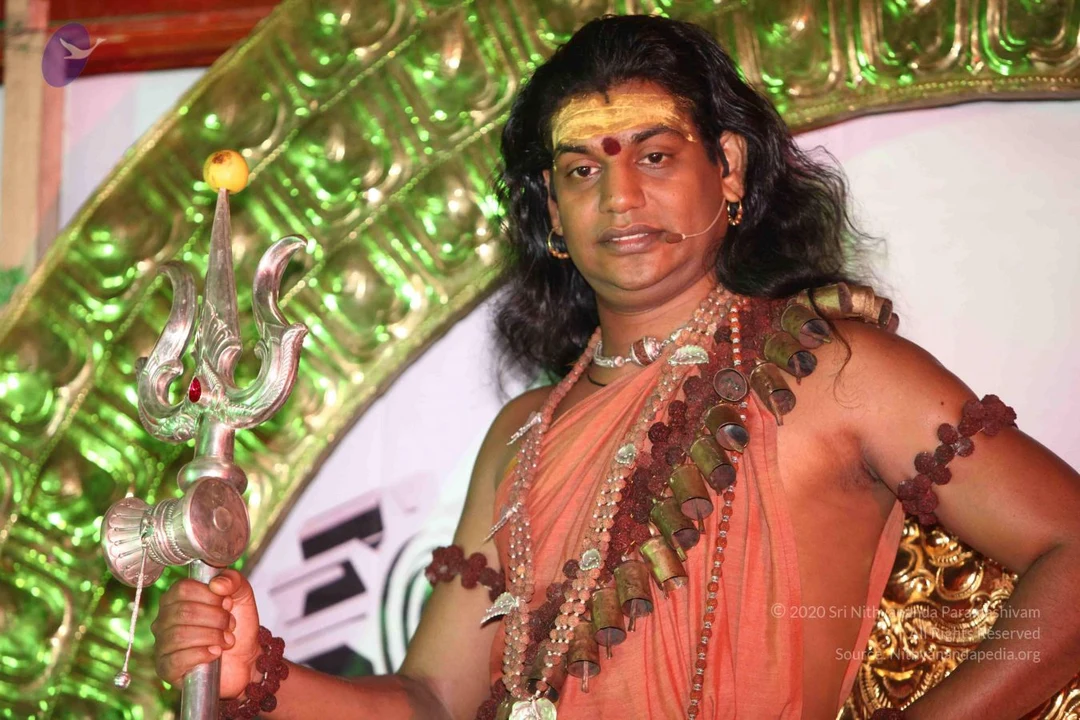
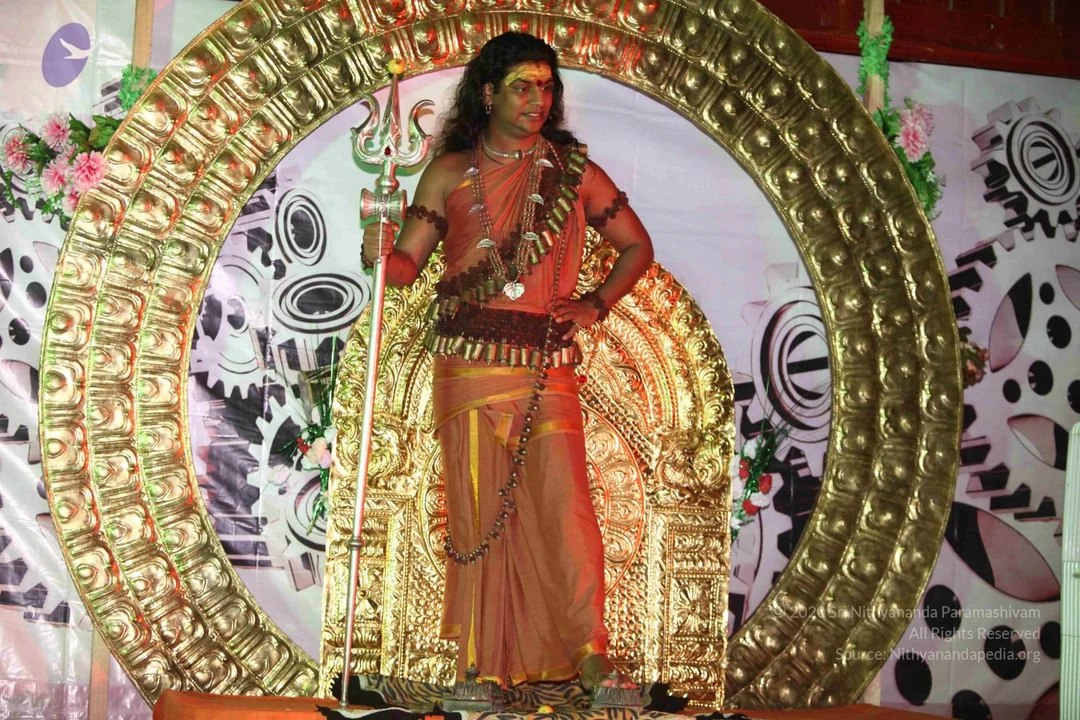
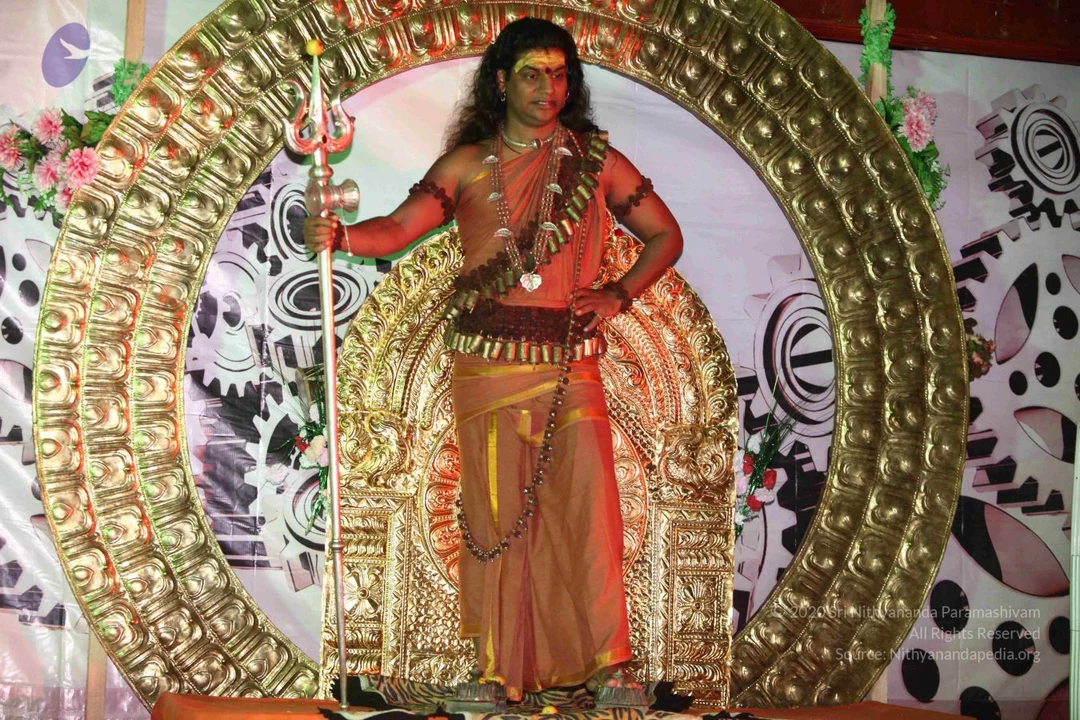
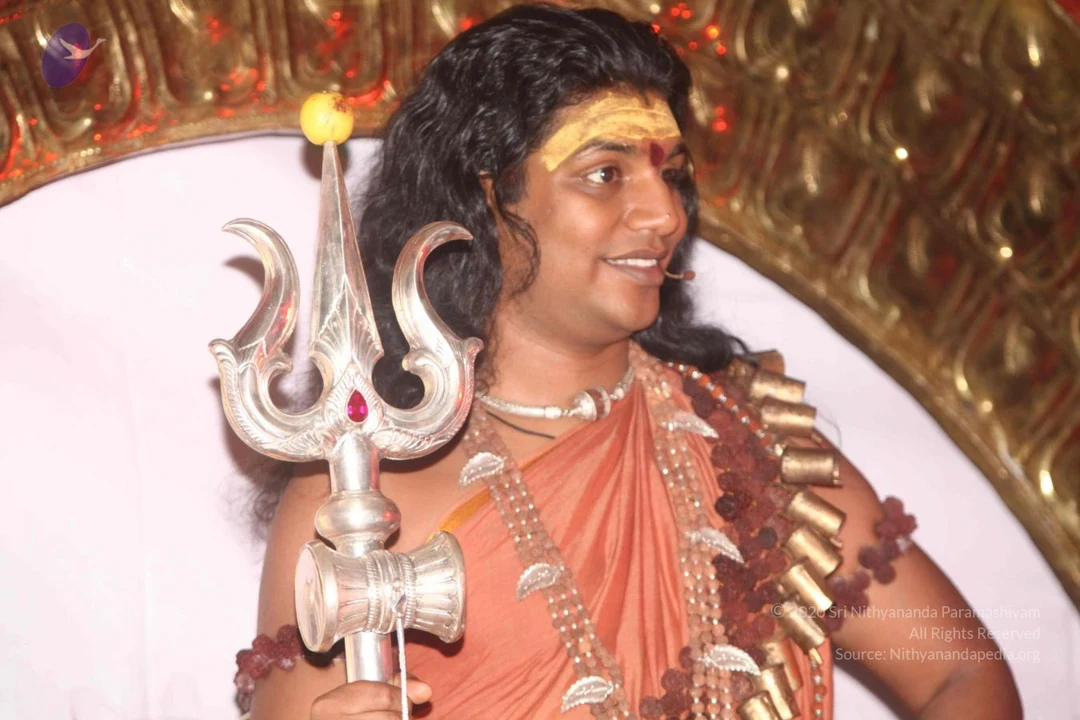
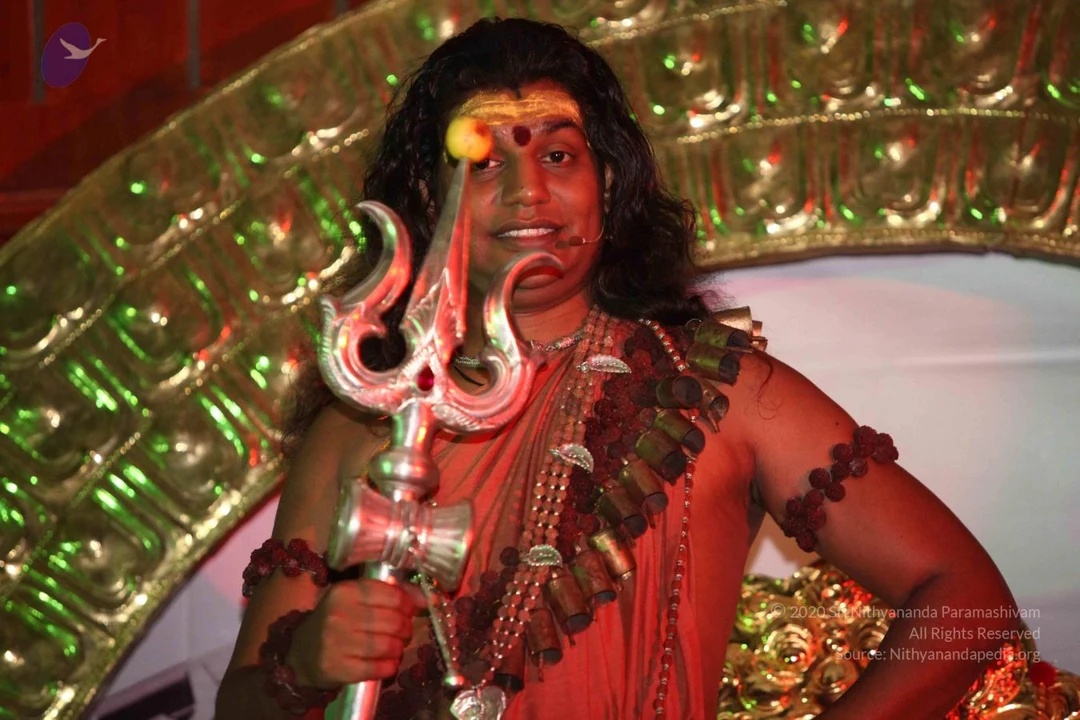
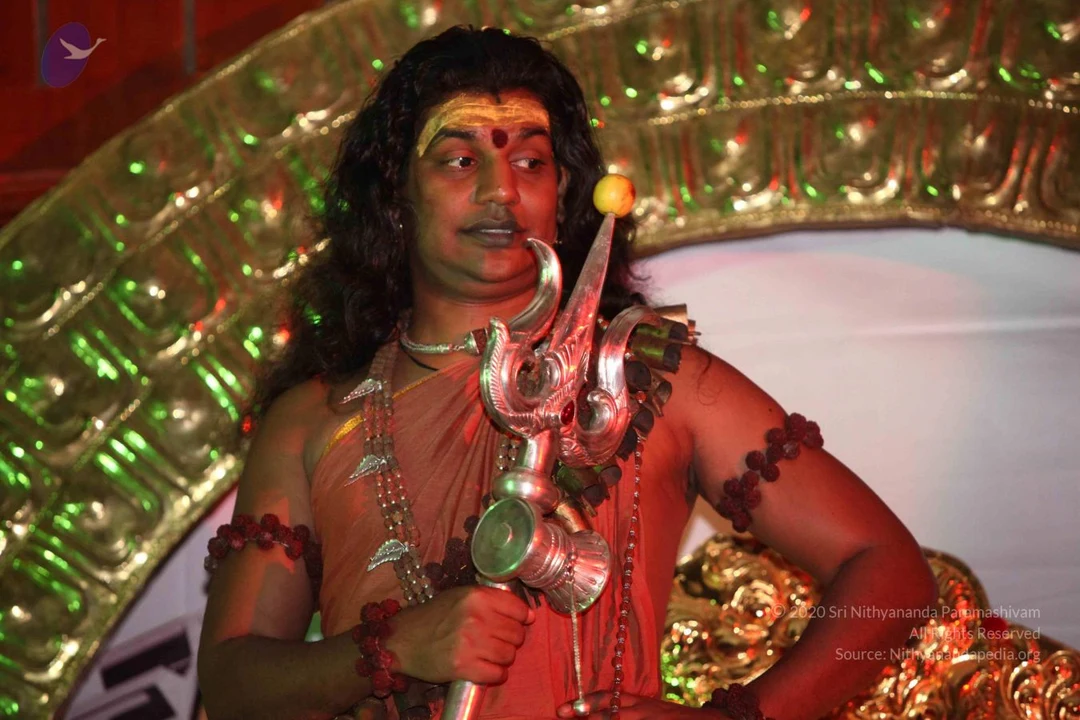
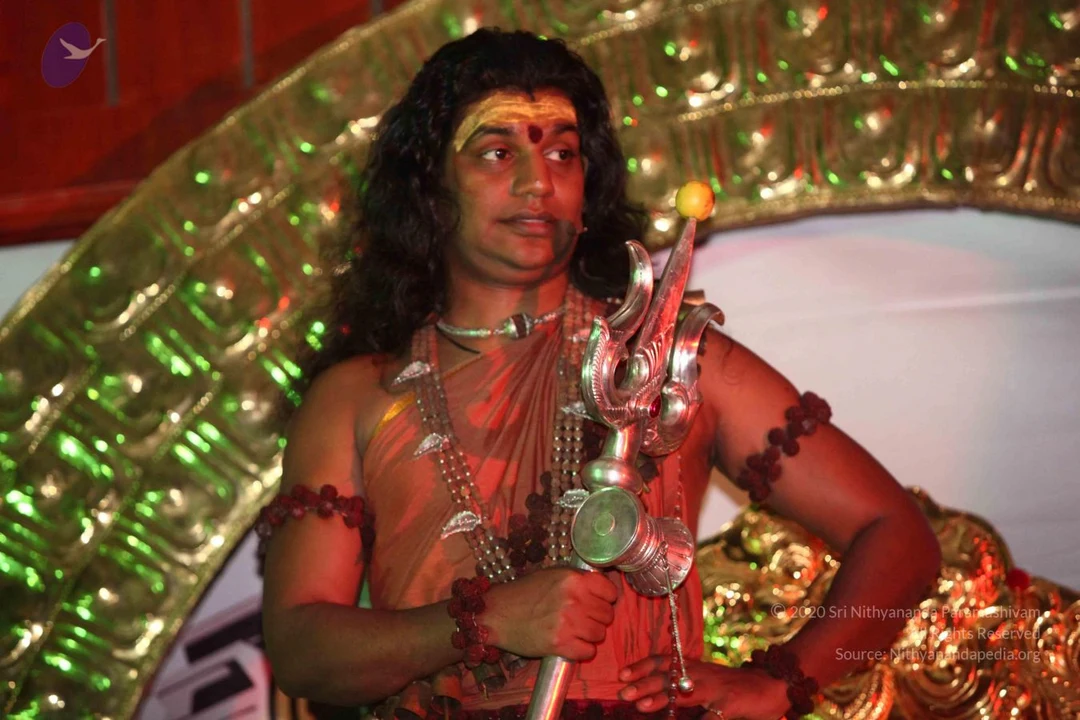
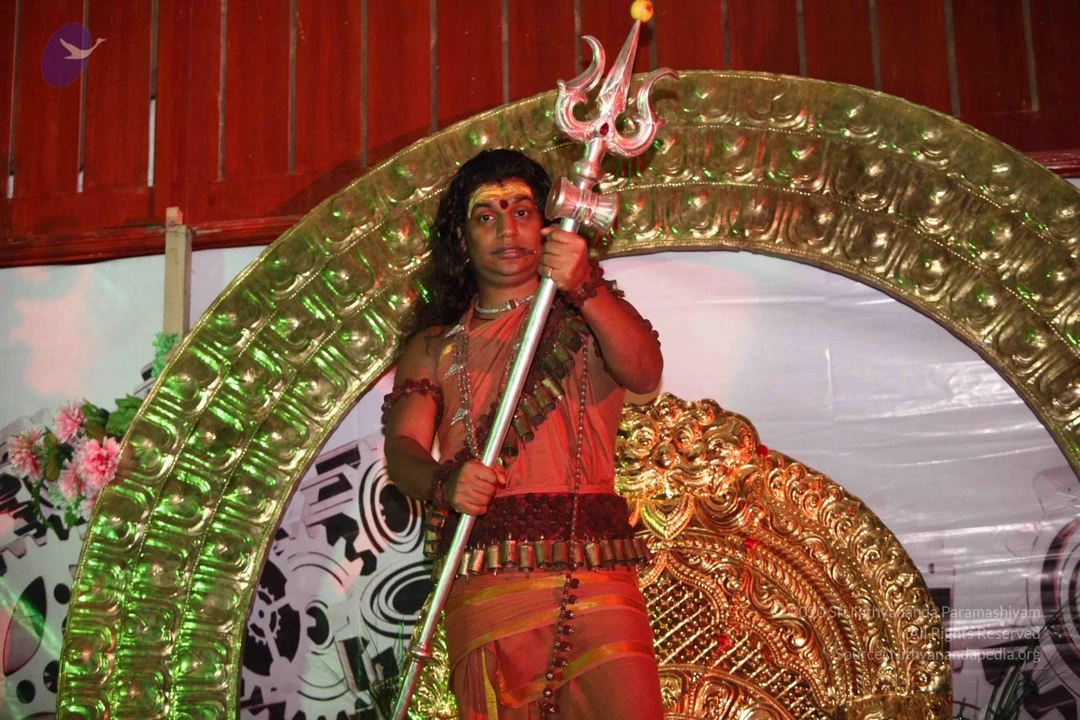
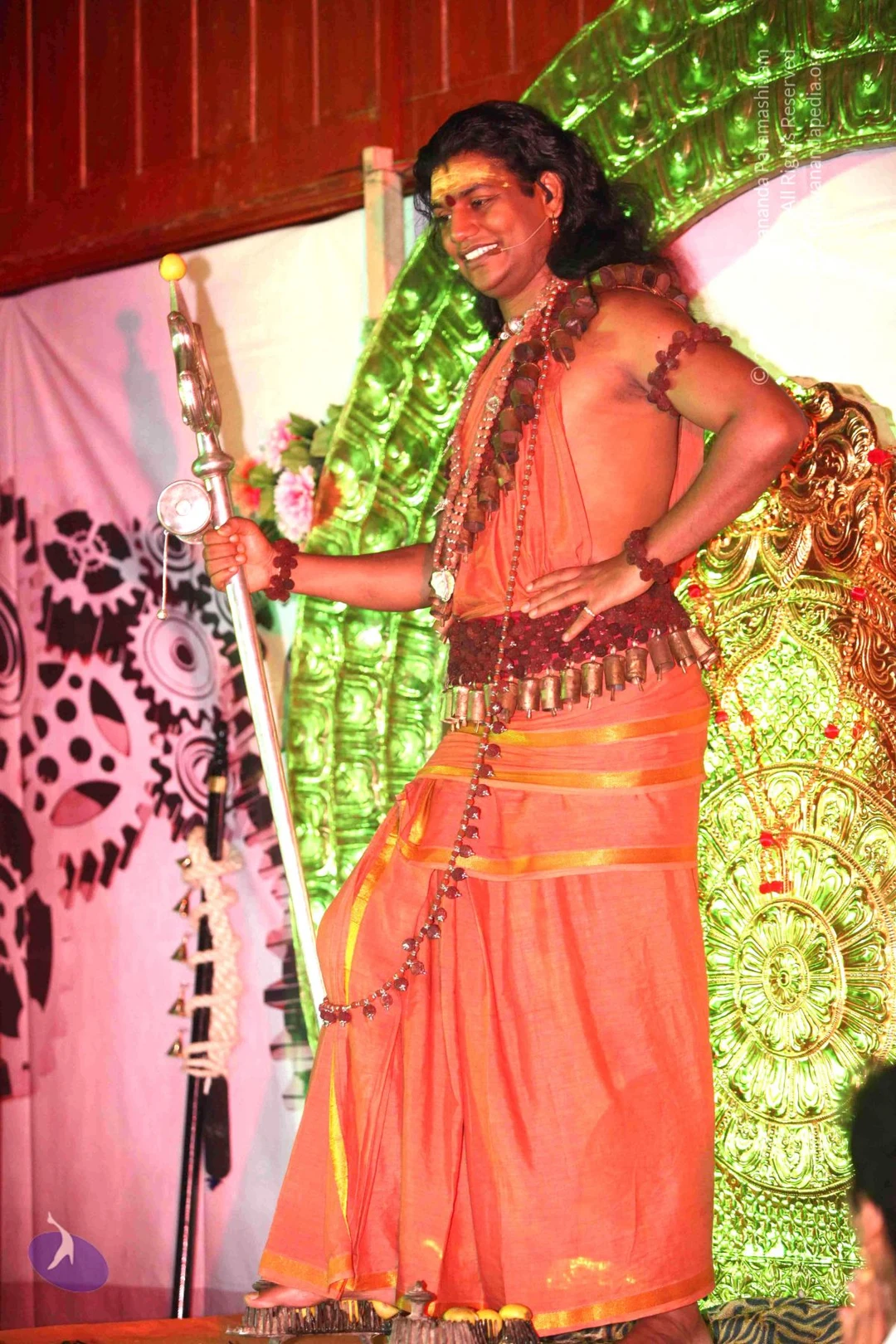
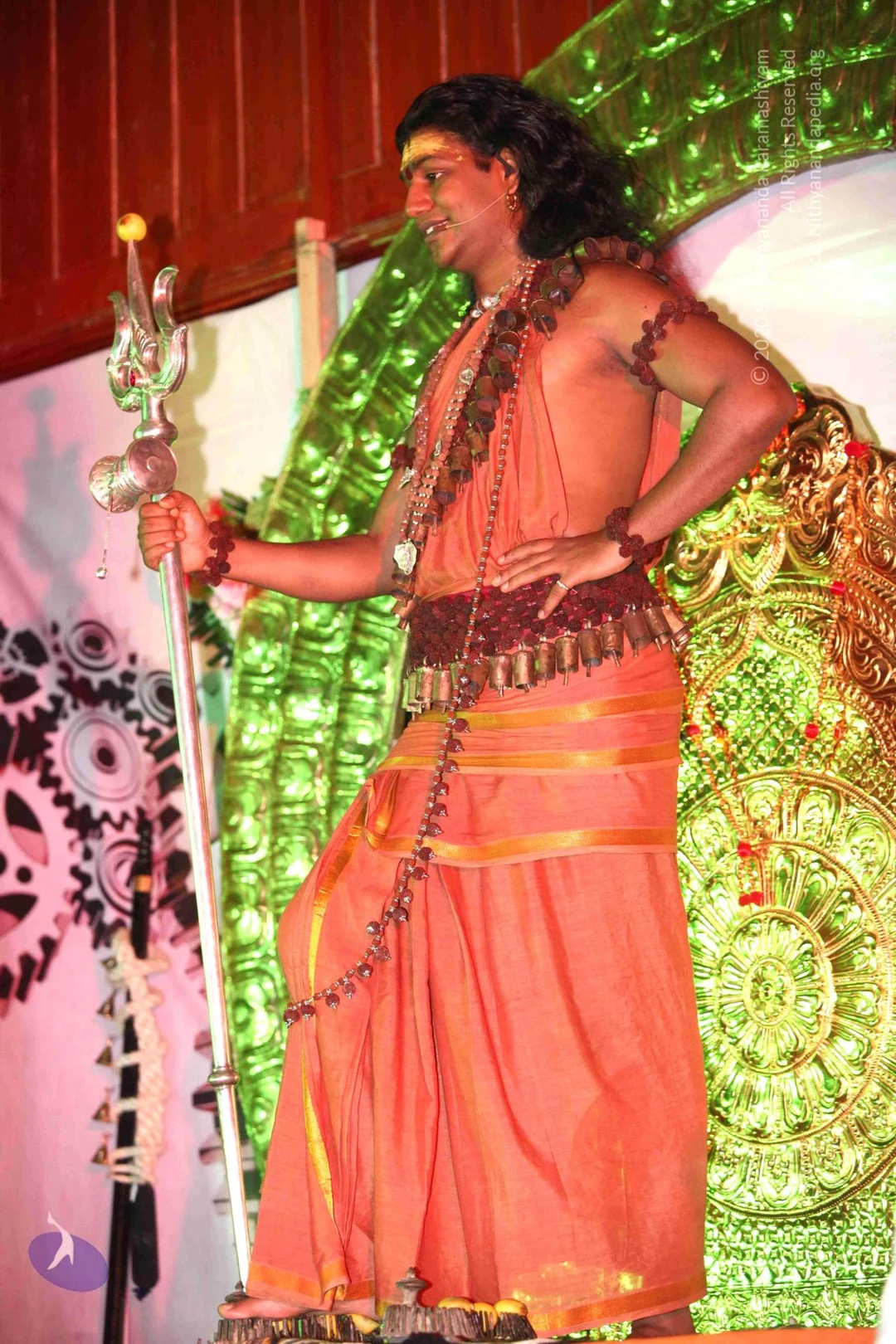
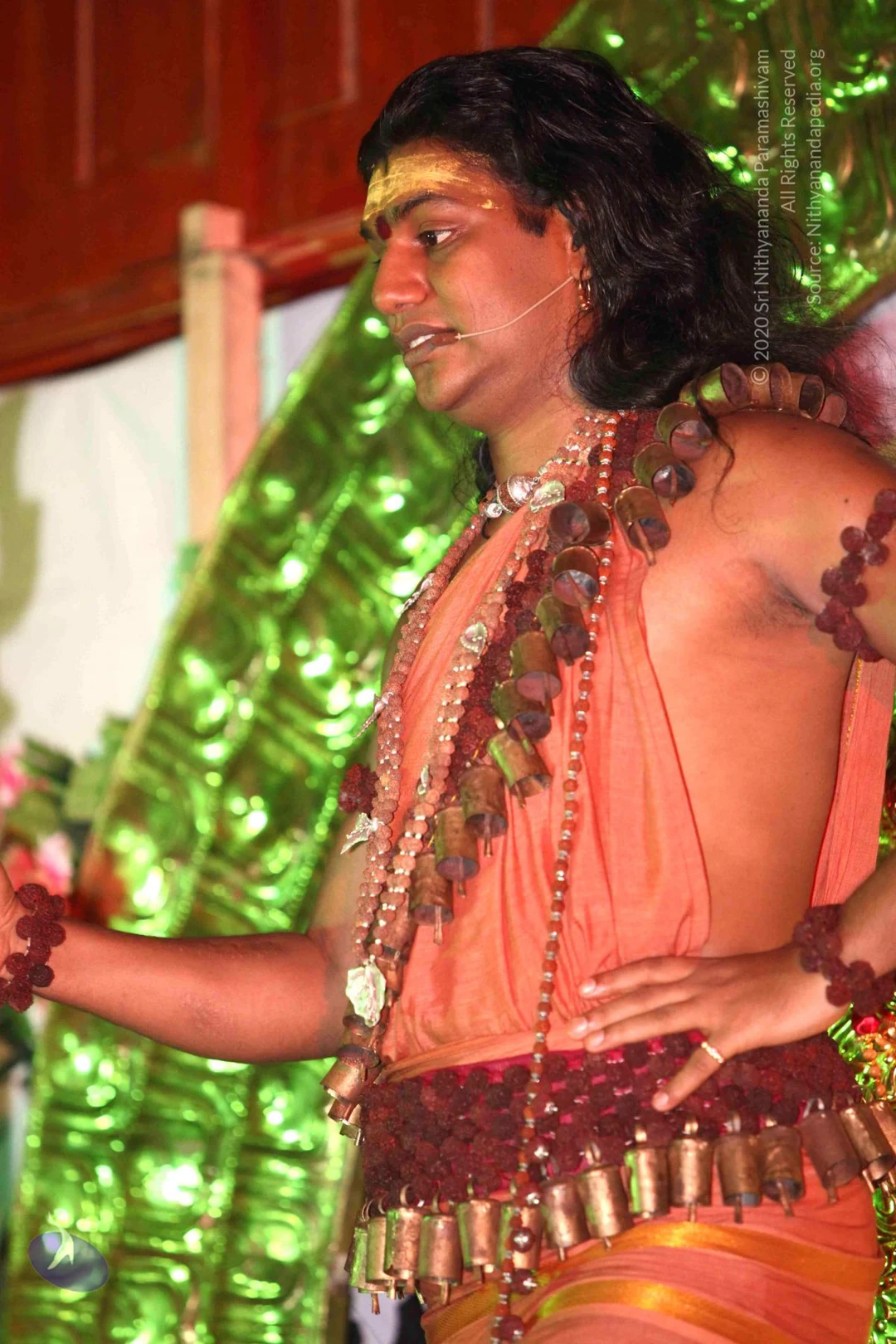
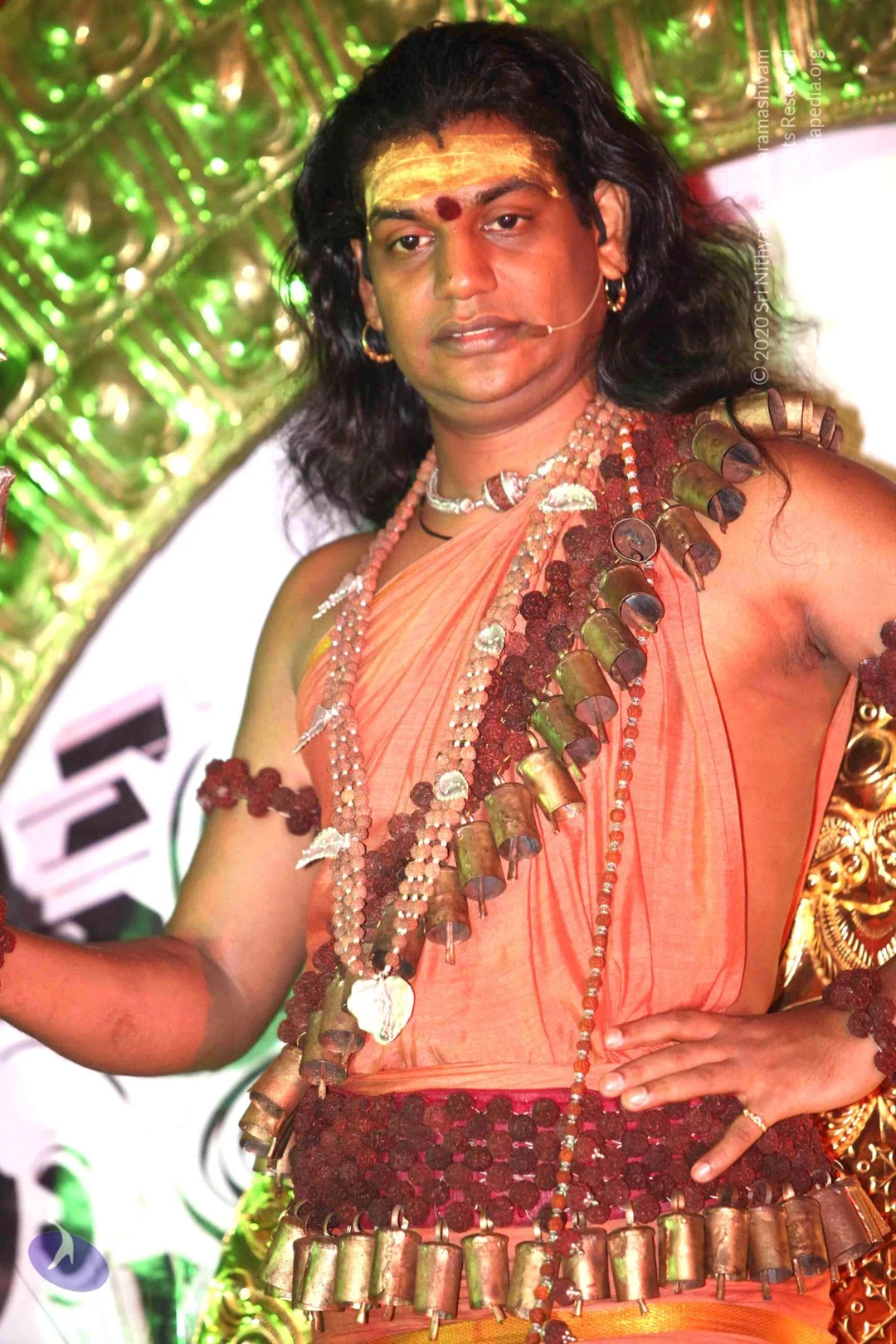
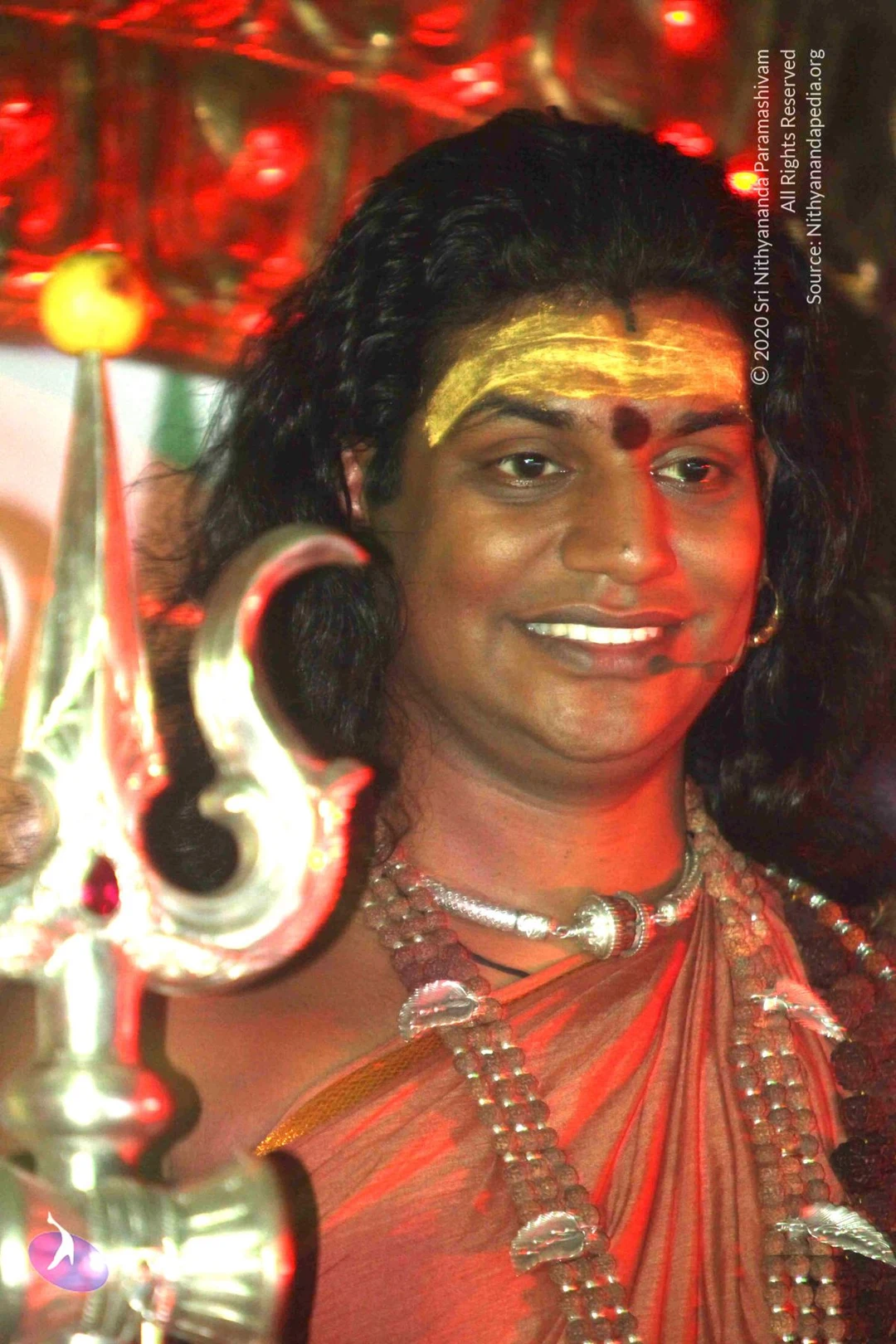
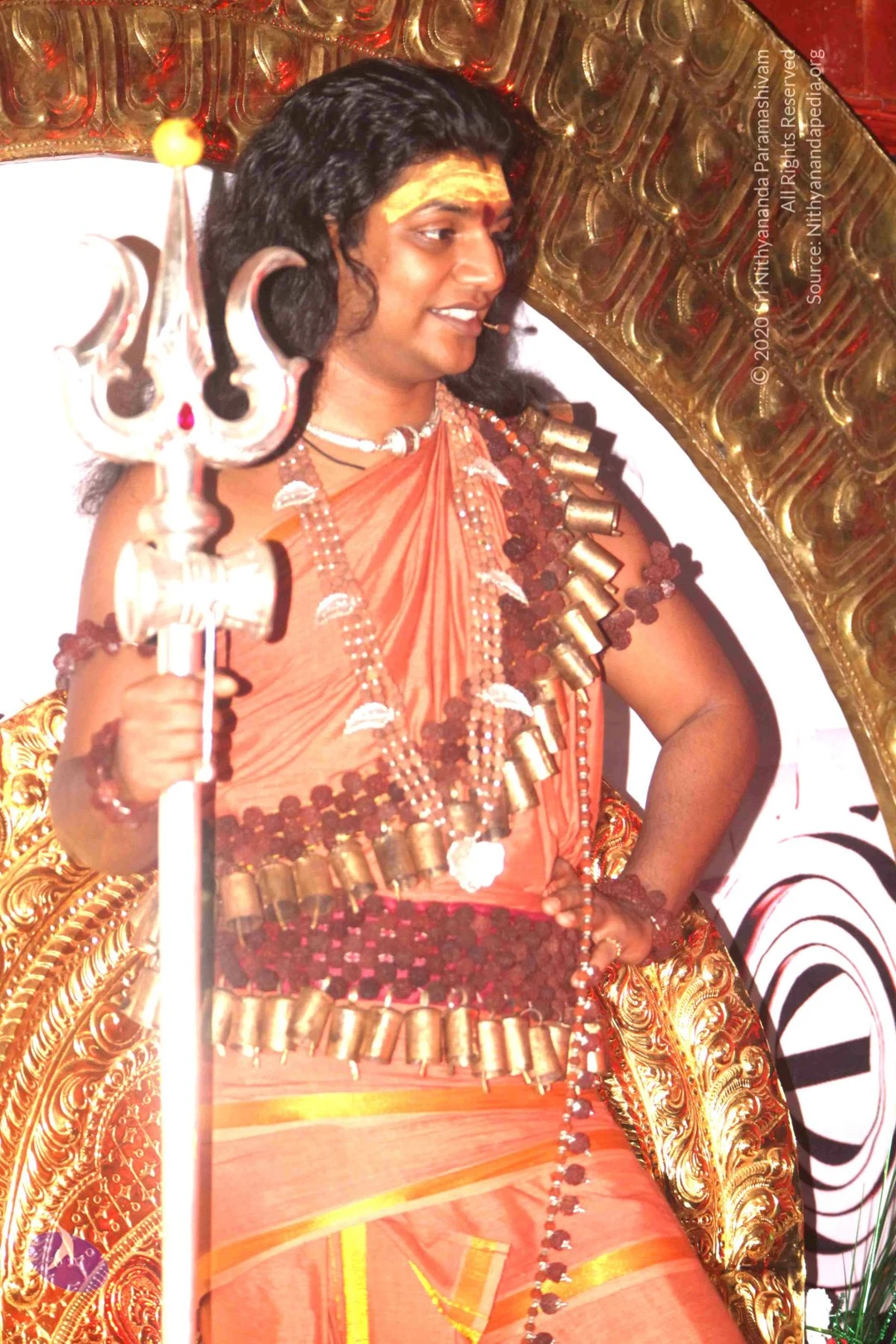
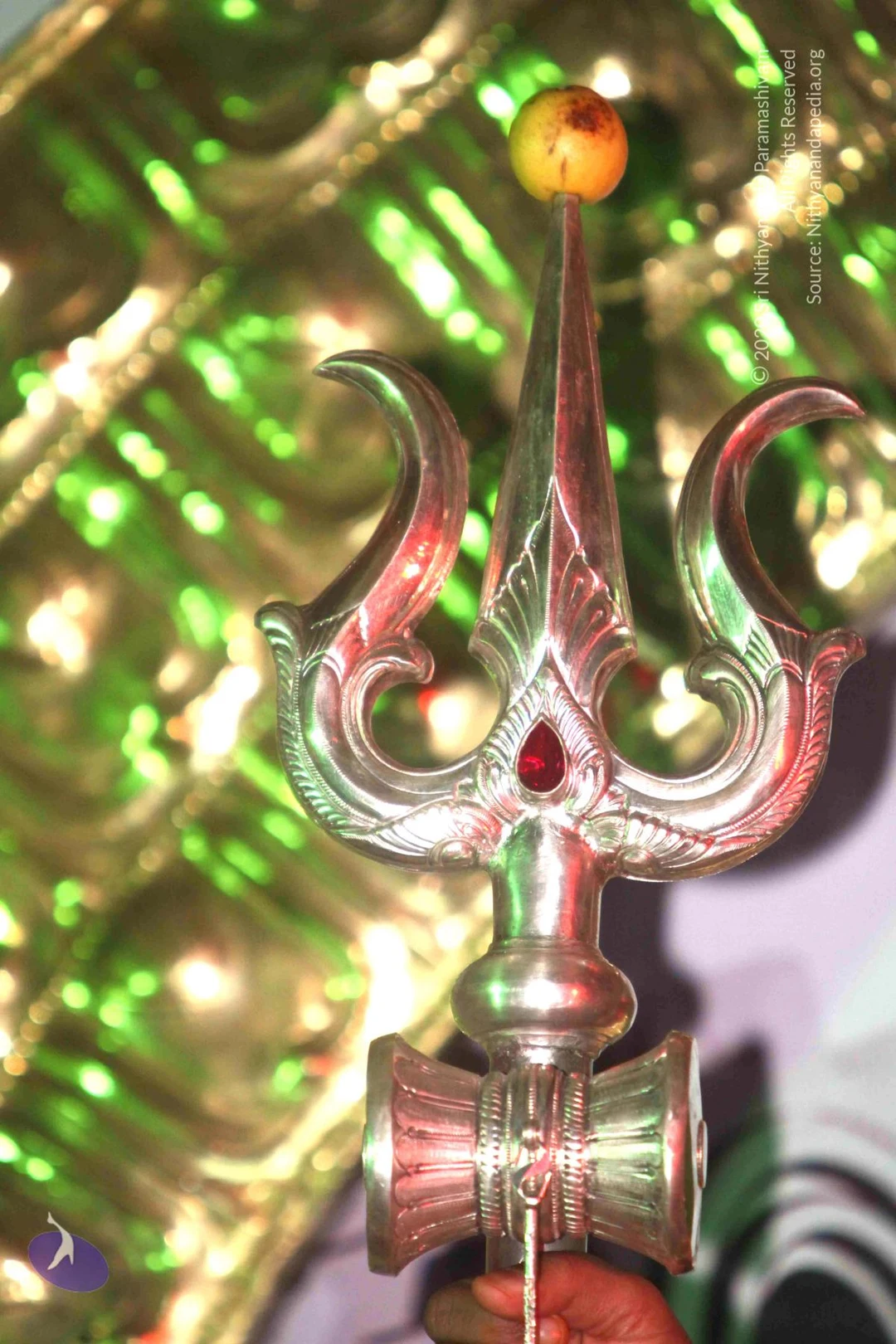
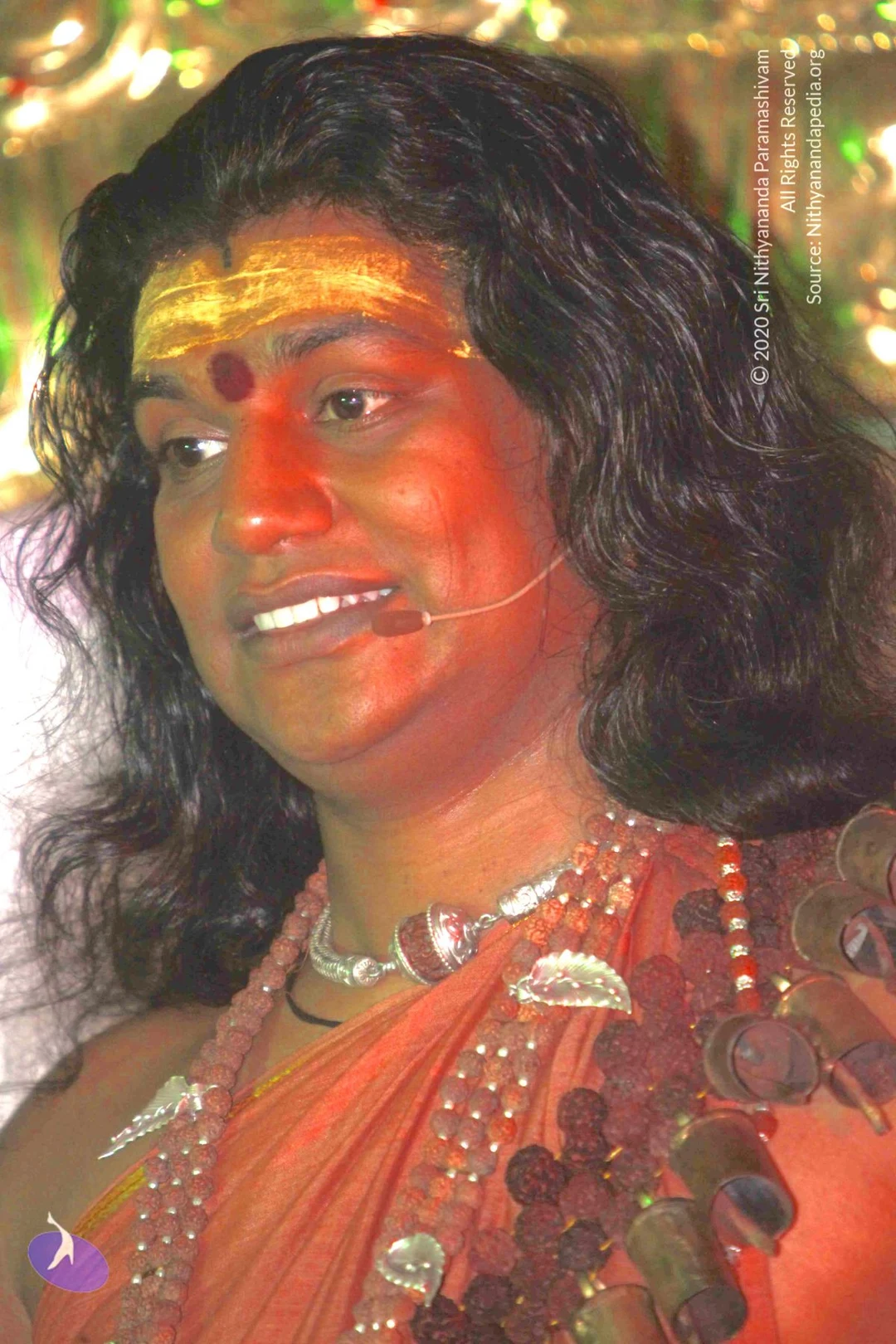
A smiling man stands on a stage holding a silver trident with a round finial in his left hand, his other hand on his hip. He wears a headset microphone and a saffron-orange cloth draped over a bare chest, with a long rudraksha mala and a ceremonial chain of silver beads and pendants. Red rudraksha bands are on his upper arms and wrists, and a gold tilak with a red dot marks his forehead. Behind him are green sequined draping and a red wooden wall. Appearance-based candidate: Swamiji (probable), identified by long swept-back hair, saffron clothing, rudraksha malas and a trident, shown performing a discourse on stage.A photograph of a man standing on a stage in front of a green sequined backdrop, holding a silver trident in his left hand and resting his right hand on his hip. He wears a saffron-orange wrap, a dark red beaded garland, and long rudraksha malas across his chest, with a gold ornamental cloth draped behind him. He has a yellow sandalwood paste mark and red bindi on his forehead, a gold earring, and a small head microphone. He is smiling and looking to the side. The description cues are shoulder-length swept hair, a trident, saffron clothing and rudraksha malas, which together give a person identification at a satsang-style stage event.A photograph of a bare-shouldered man in an orange-saffron dhoti-style wrap, standing before an ornate gilded green-and-gold backdrop. He holds a silver trident (trishul) with a red gem in his right hand and rests his left hand on his hip. He wears long dark hair, a yellow sandal-paste mark with a red bindi on his forehead, small gold earrings, layered beaded necklaces, and rudraksha malas across his chest and upper arm, with brass bells strung on the mala. A small microphone is clipped near his face. a person (a person), a Hindu guru, shown with a trident, rudraksha malas and ceremonial adornments.A standing man in an orange-saffron dhoti and draped cloth stands on a raised platform before a large ornate golden arched frame and a golden throne-like backdrop. He holds a silver trident (trishul) in his right hand, has long swept-back dark hair, a yellow-and-red tilak on the forehead, a rudraksha mala and layered beaded necklaces, and rests his left hand on his hip. Decorative backdrop panels show gear and cog graphics with pink flower garlands at the sides. Appearance-based probable Swamiji (probable) in the central figure with long swept-back hair, saffron clothing, rudraksha mala and trident cues.A photograph of a man standing on a raised dais in front of an ornate gold arched frame and a carved golden throne-like backdrop. He holds a silver trident with his left hand and rests his right hand on his hip. He wears an orange-saffron dhoti and wrap, a rudraksha mala and layered beaded necklaces with a large pendant, and his forehead bears a yellow and red tilak. Flower garlands and pink blossoms decorate the sides, and a backdrop of gear motifs fills the background. Probable Swamiji, with long swept-back hair, saffron clothing, rudraksha malas and ceremonial gold ornaments, standing in a ceremonial display.Swamiji (probable): a person with long, swept-back dark hair and a yellow tilak with a red bindi stands in an orange-saffron robe draped over the shoulders, wearing rudraksha malas and a silver-toned necklace. He holds a large silver trident with a red gem in one hand and smiles toward the side. Behind him is an ornate gold-patterned backdrop with warm lights. Only one person is visible.