Skip to content
Tuesday

4 October 2011

THE SUPREME PONTIFF OF HINDUISM HDH BHAGAVAN SRI NITHYANANDA PARAMASHIVAM

Dated photos
242
Source pages
1
Media
2
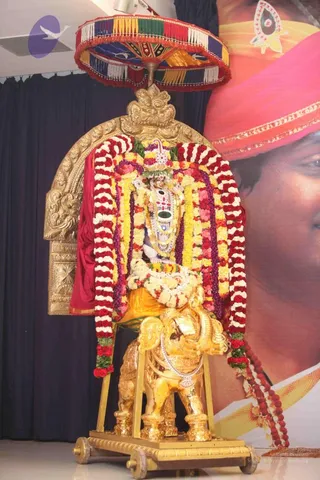
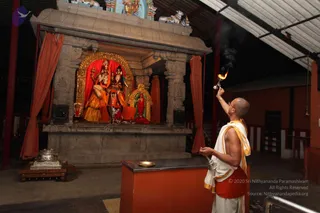
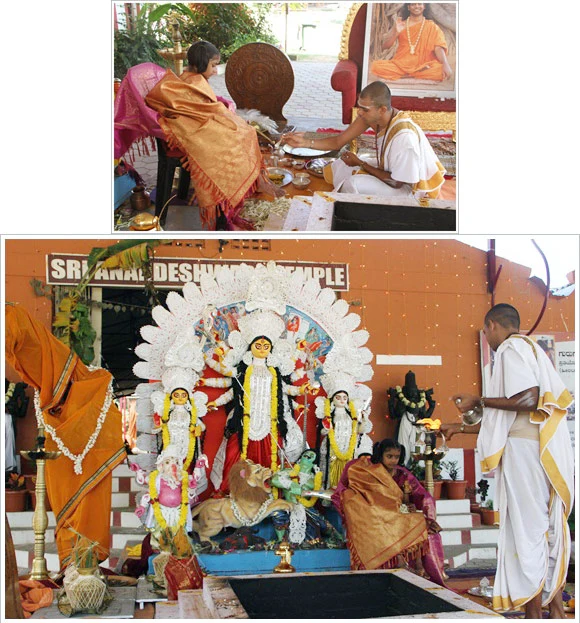
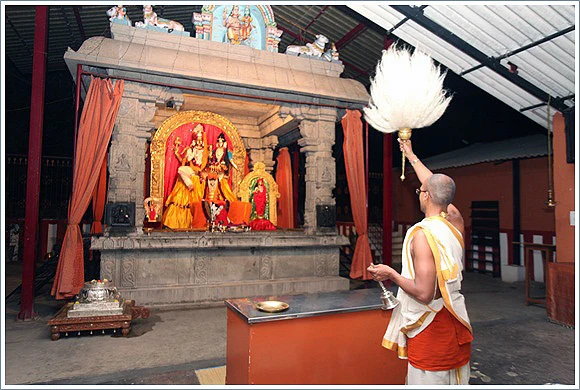
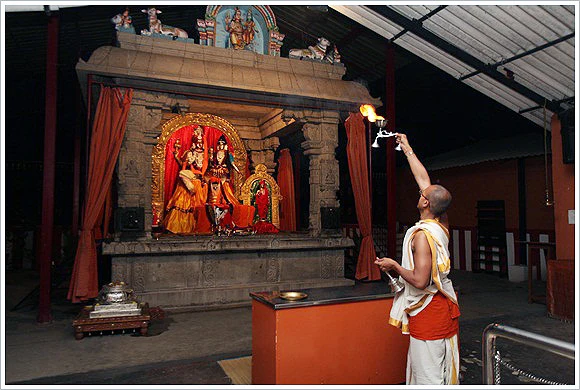
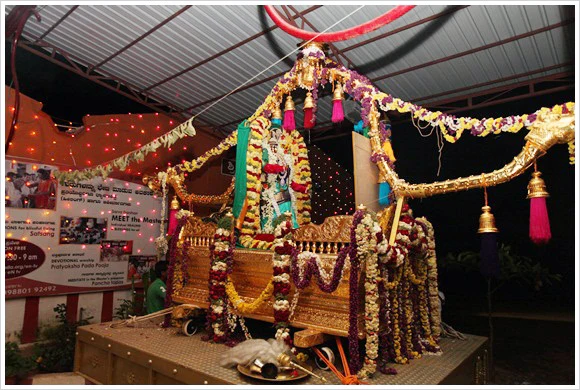
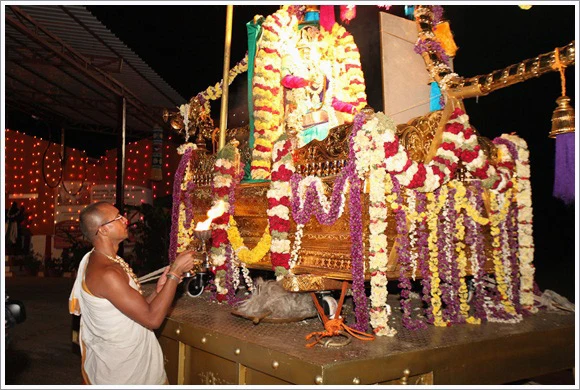
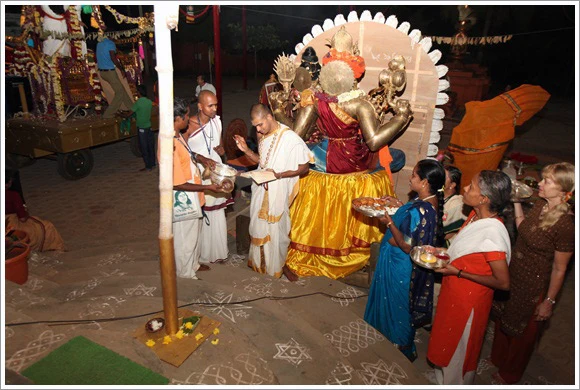
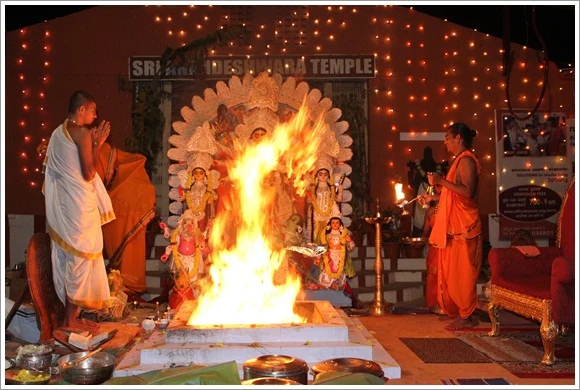
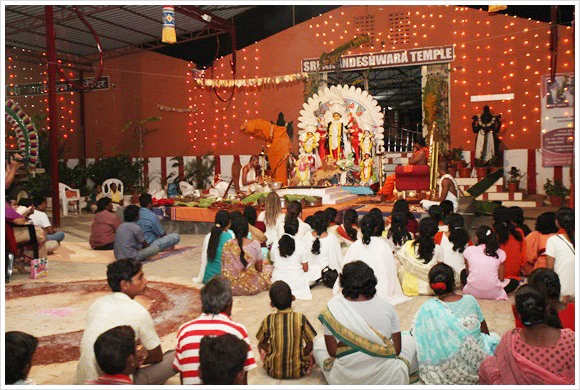
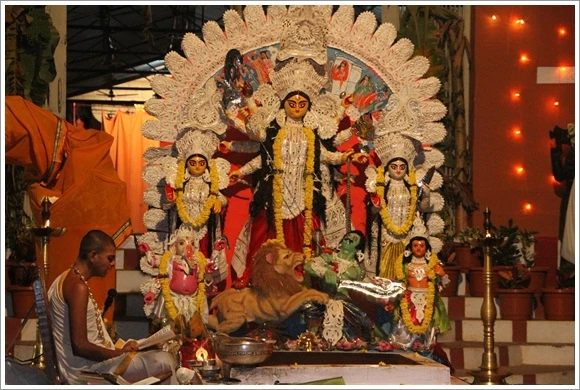
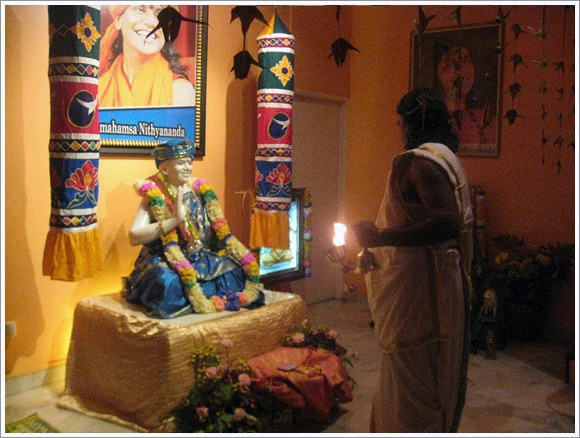
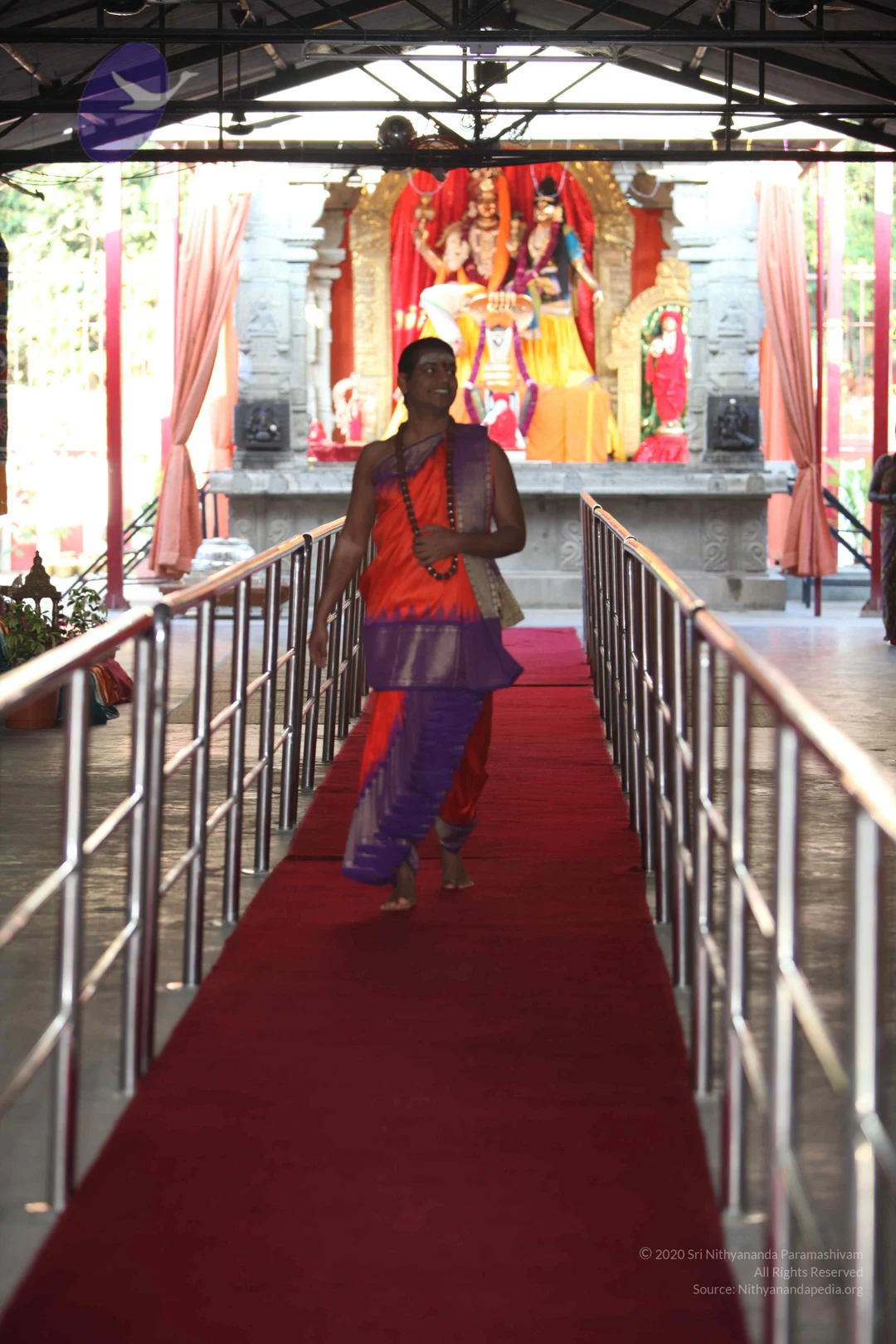
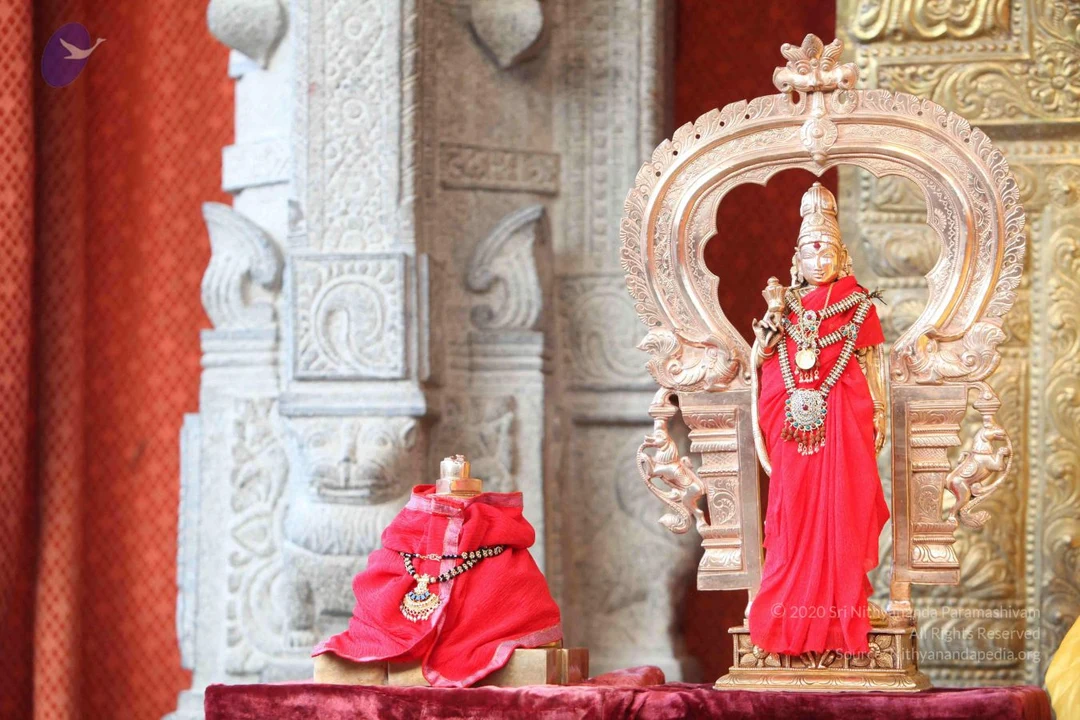
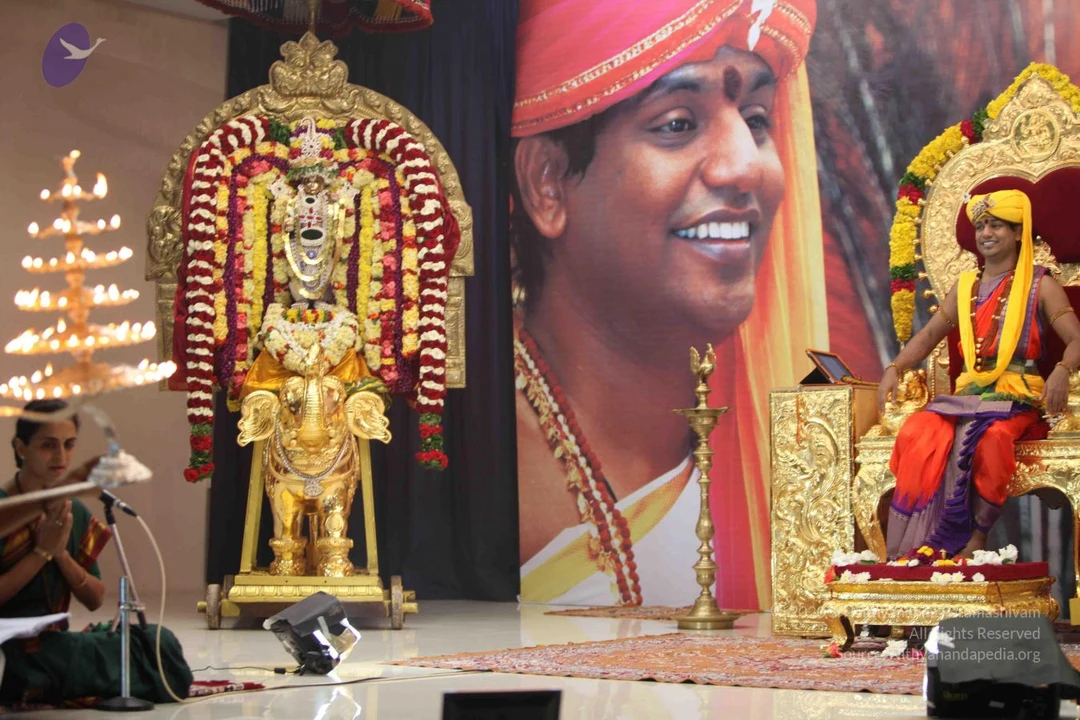
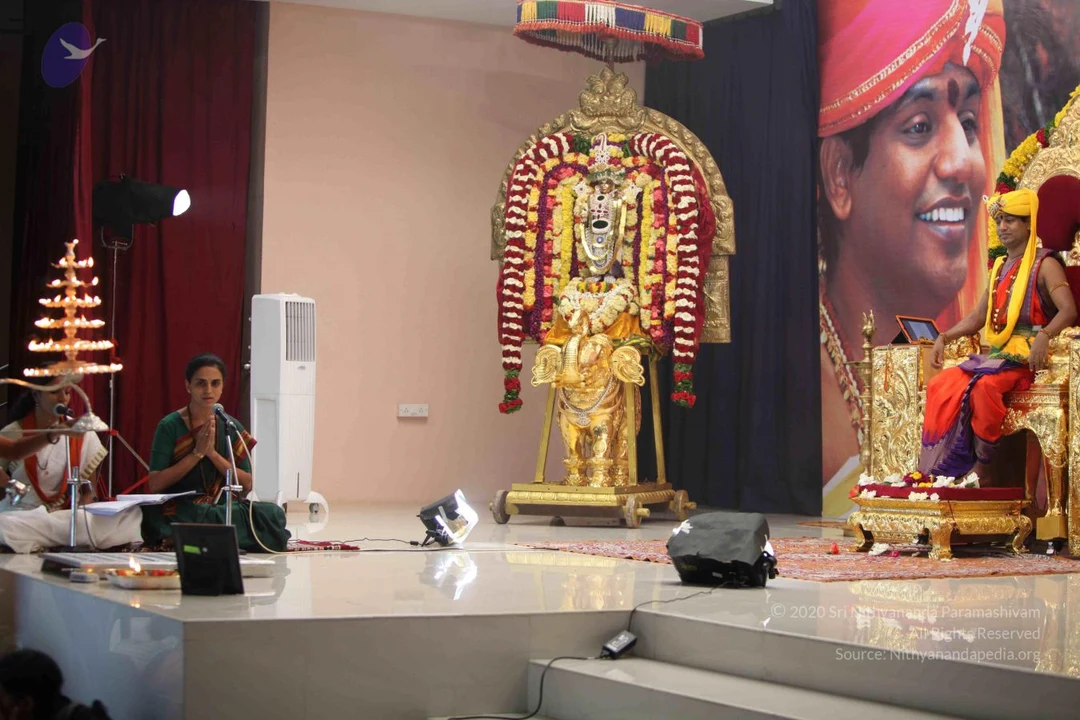
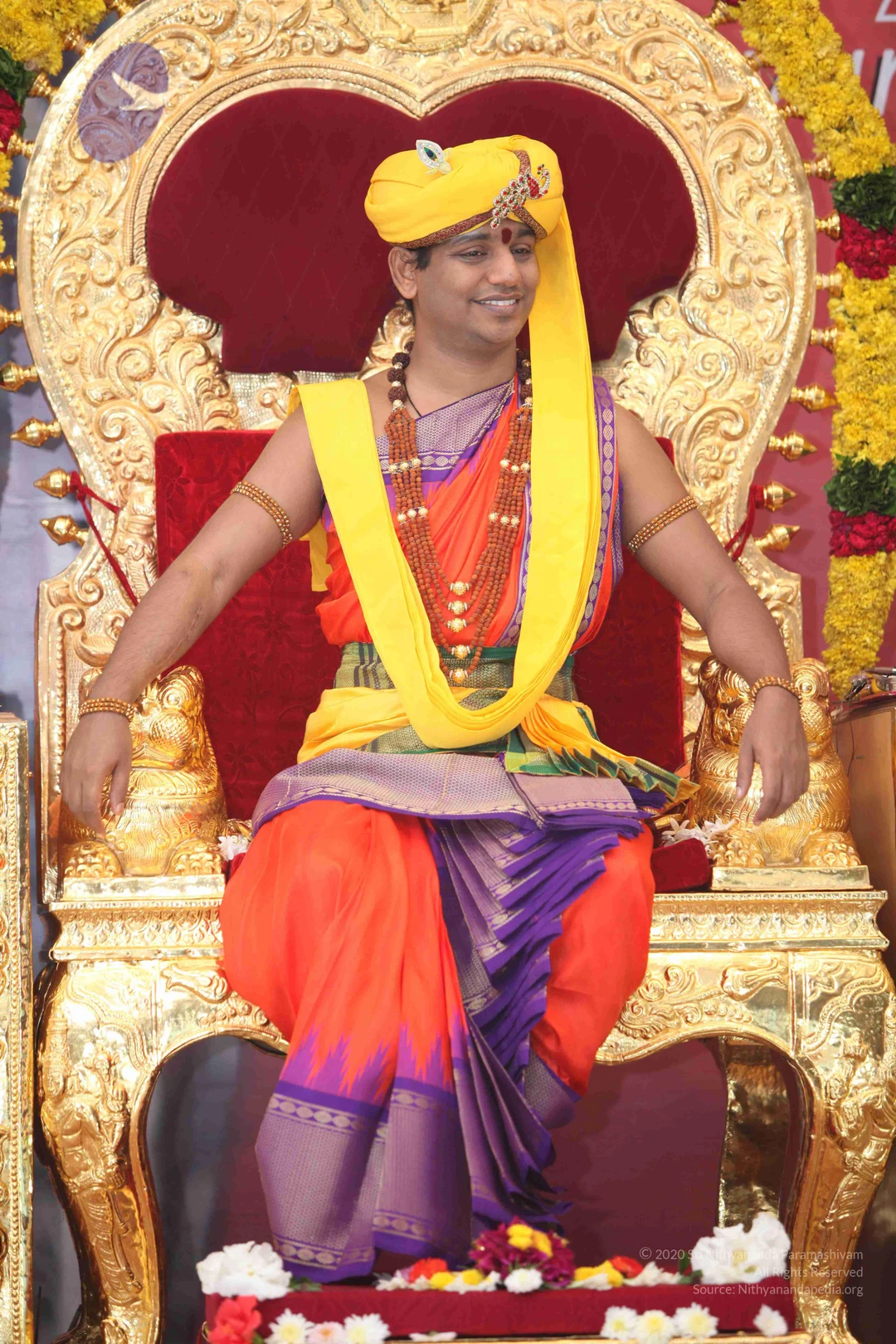
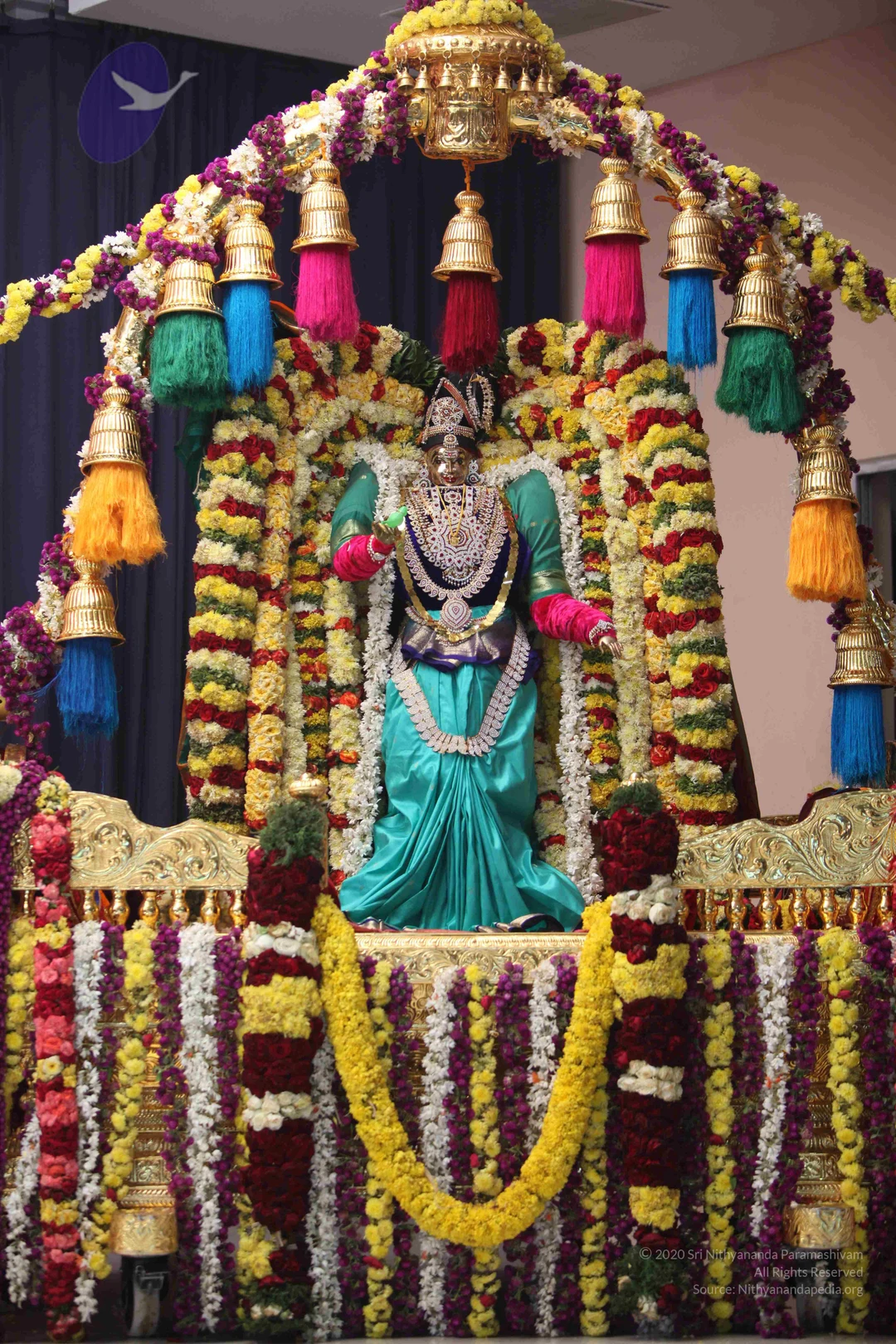
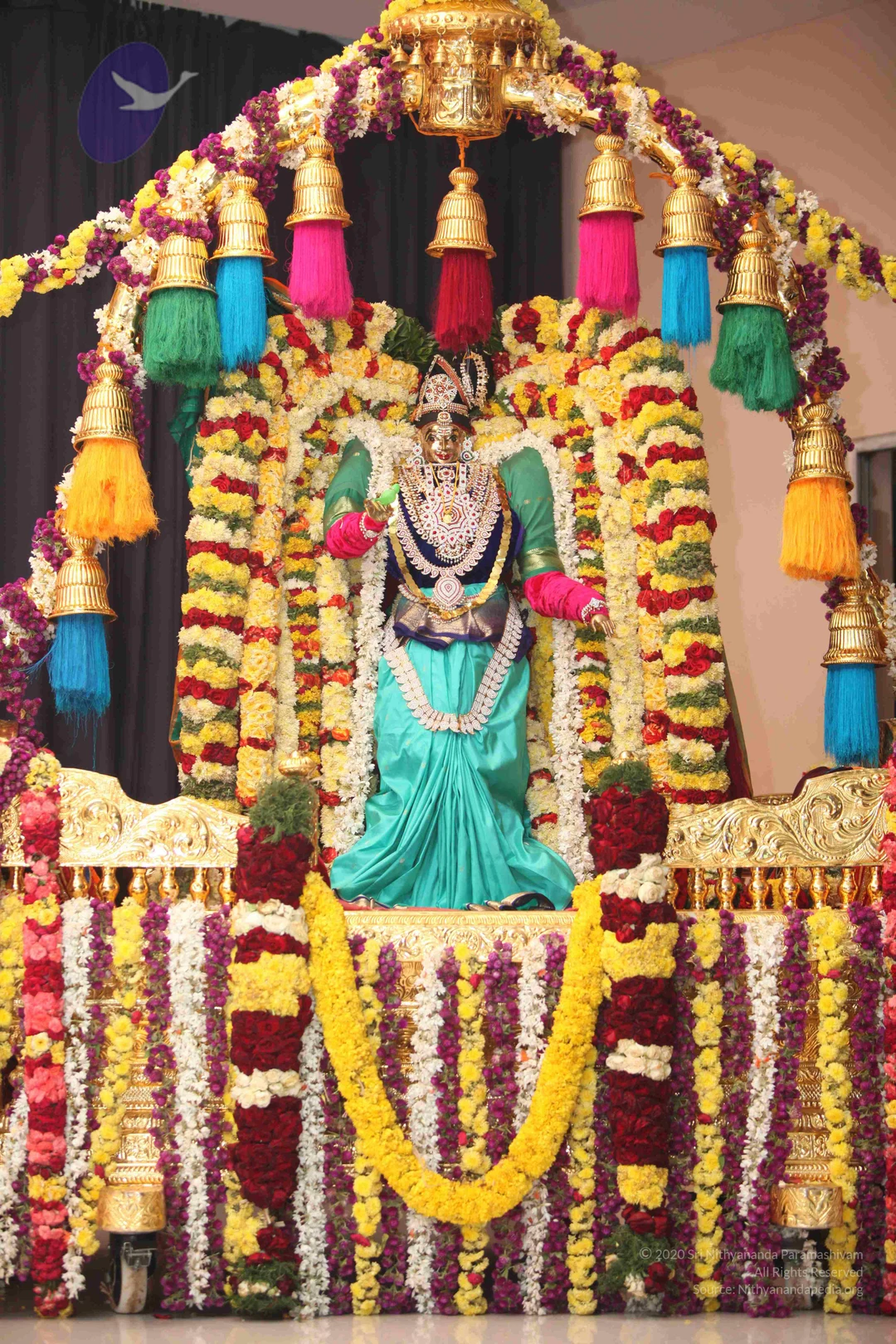
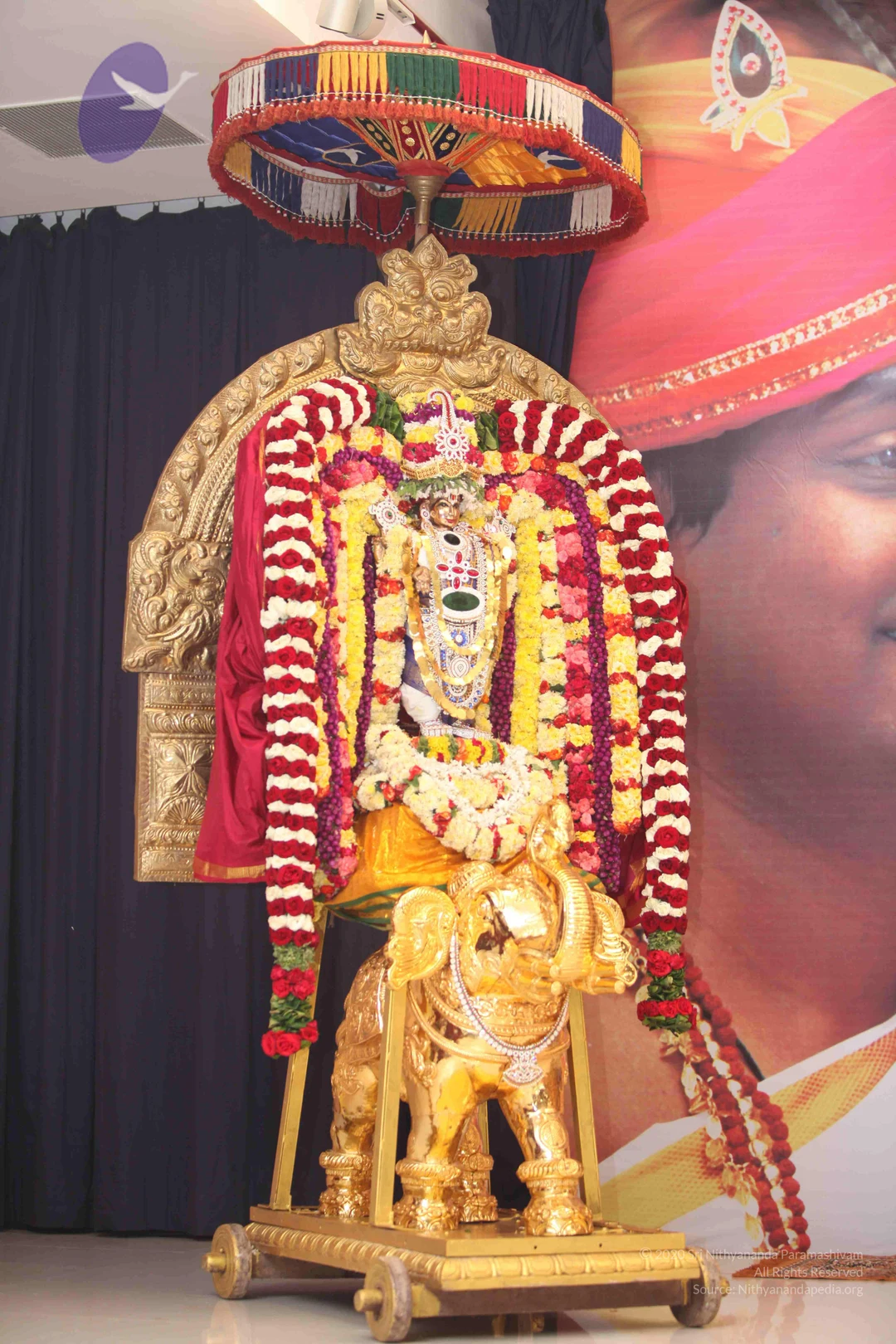
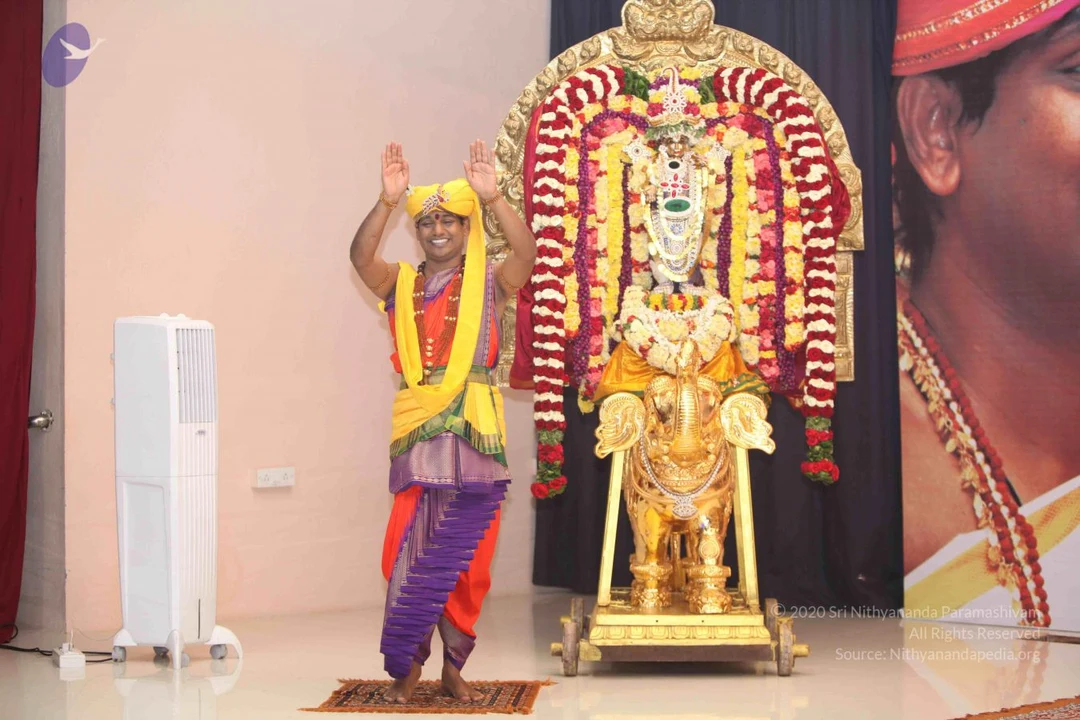
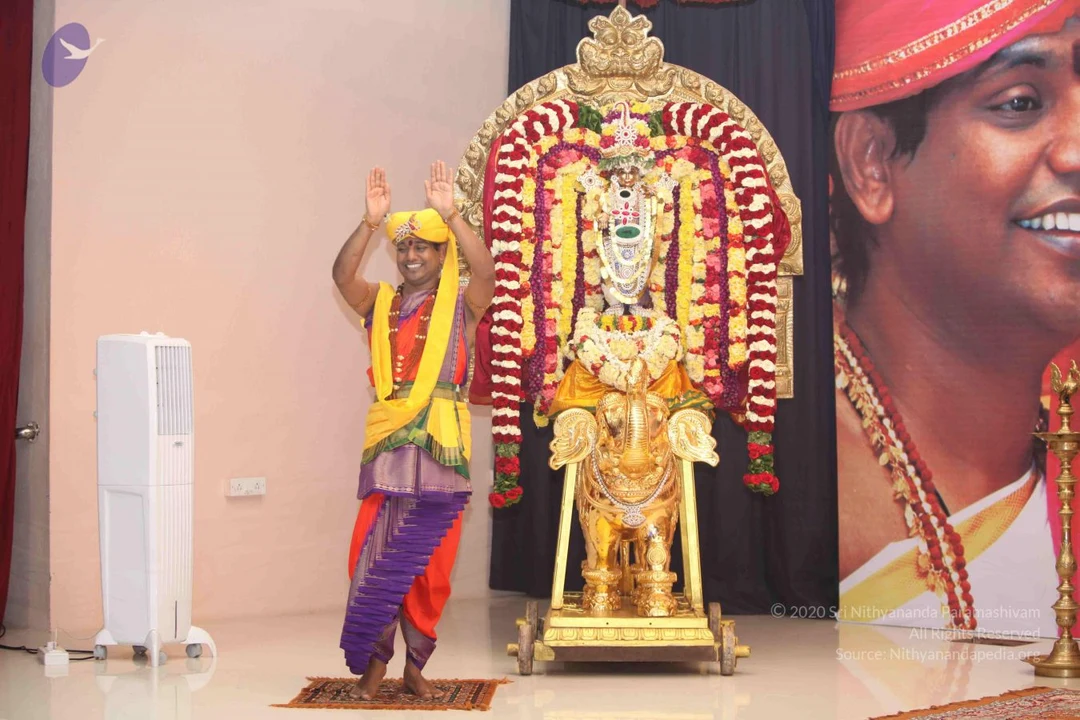
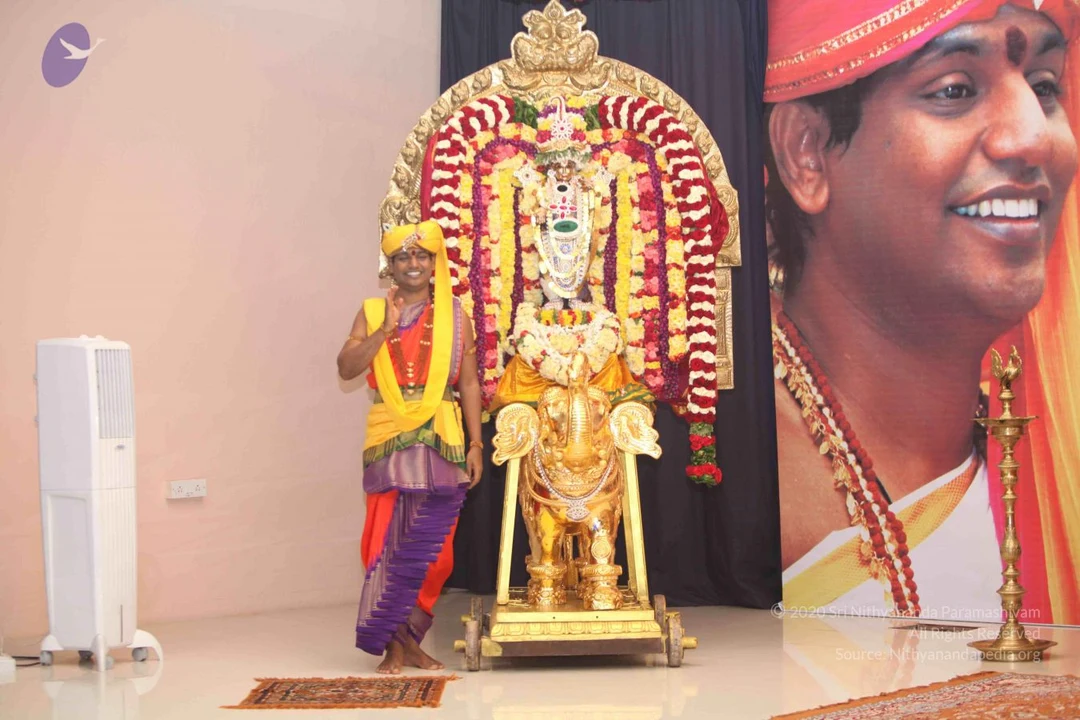
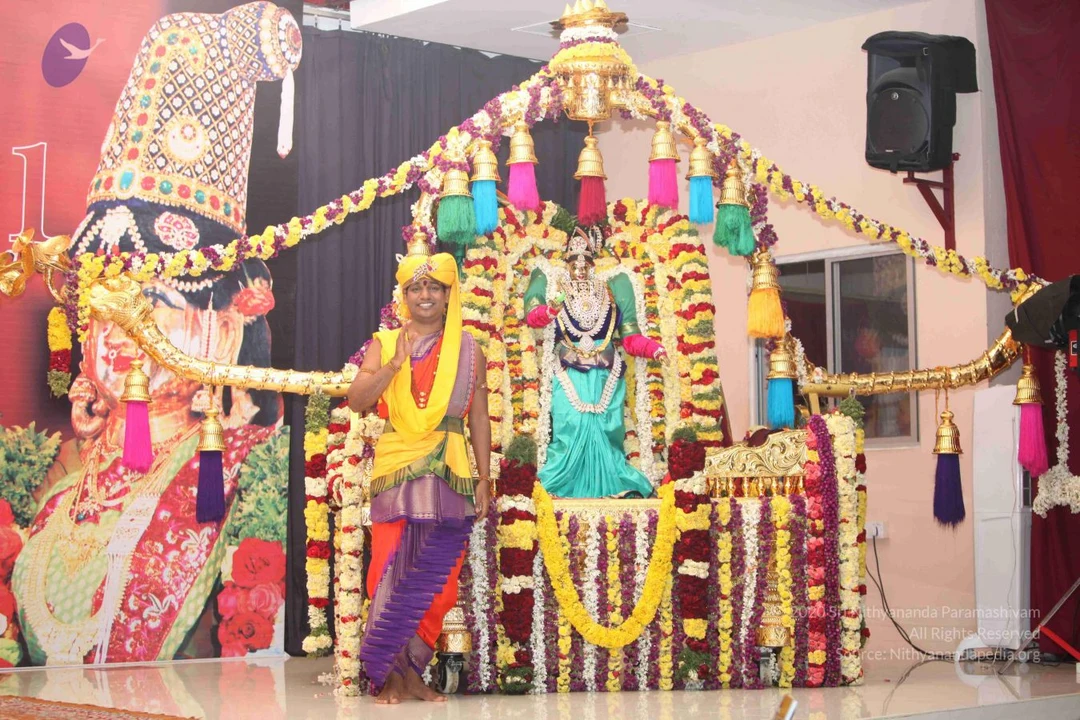
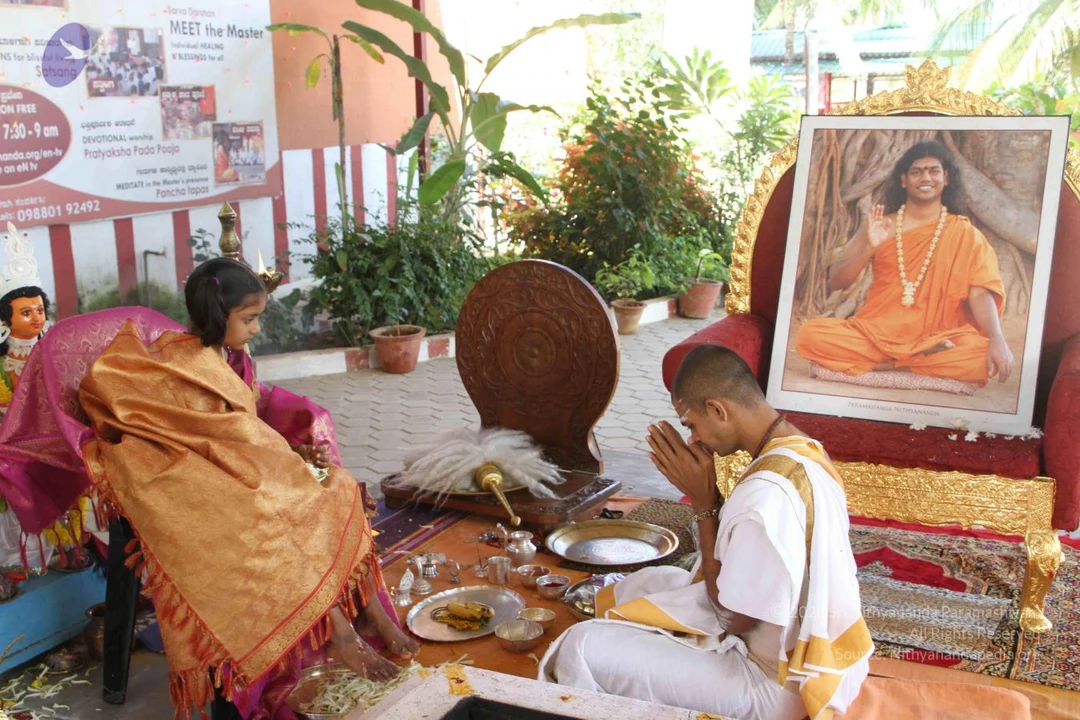
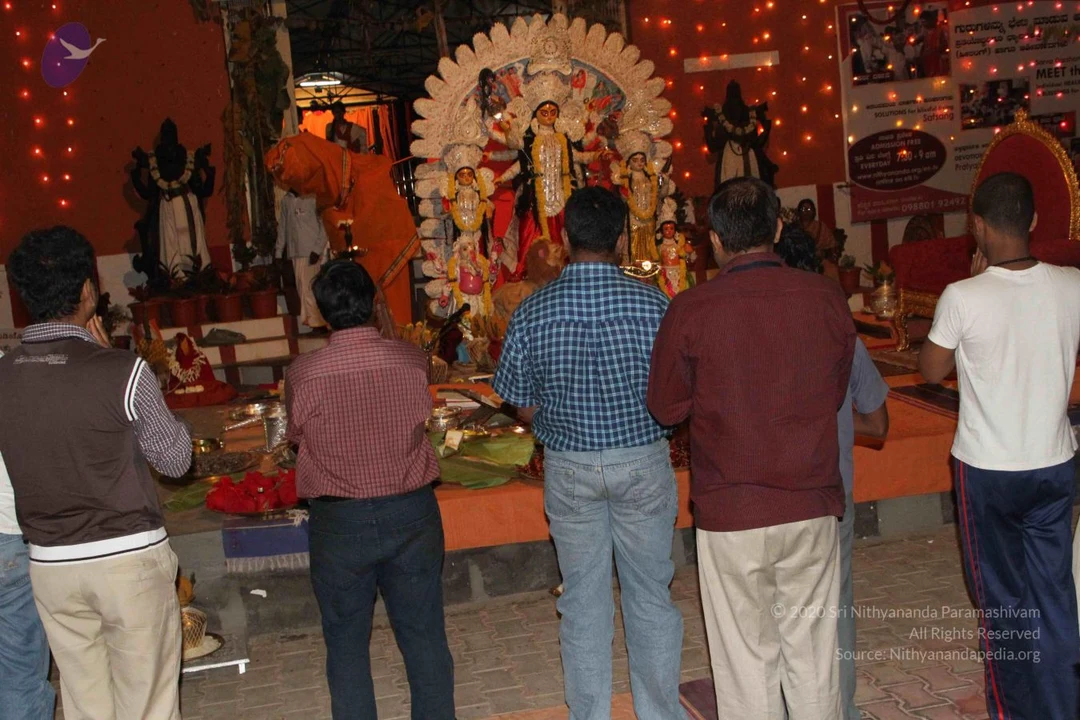
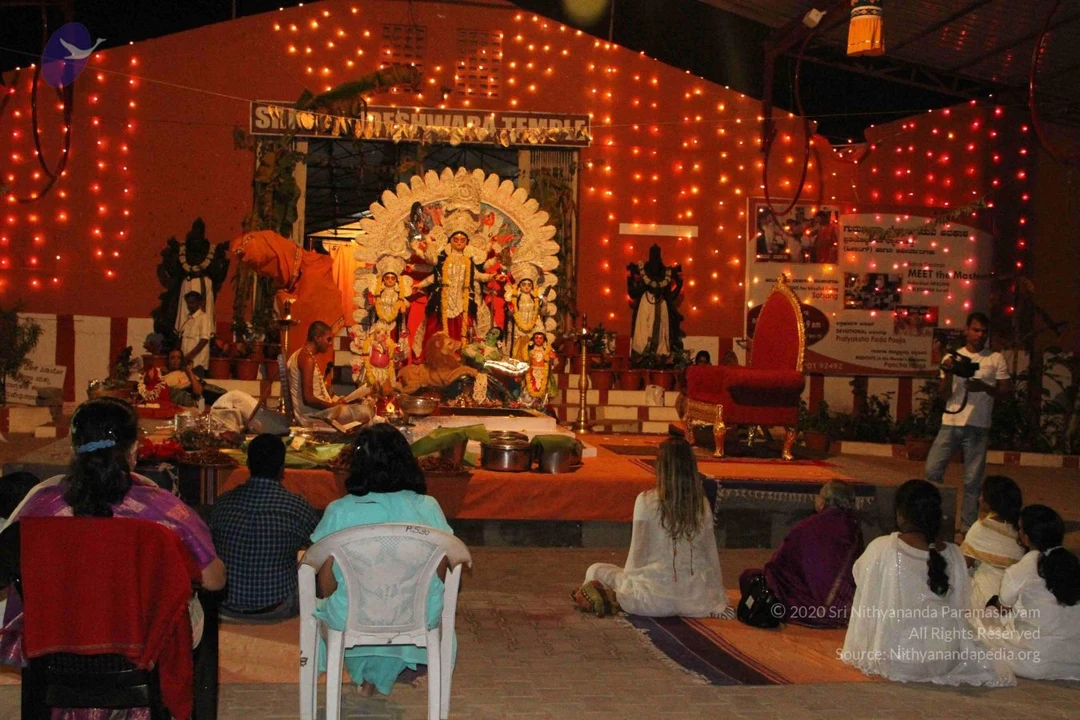
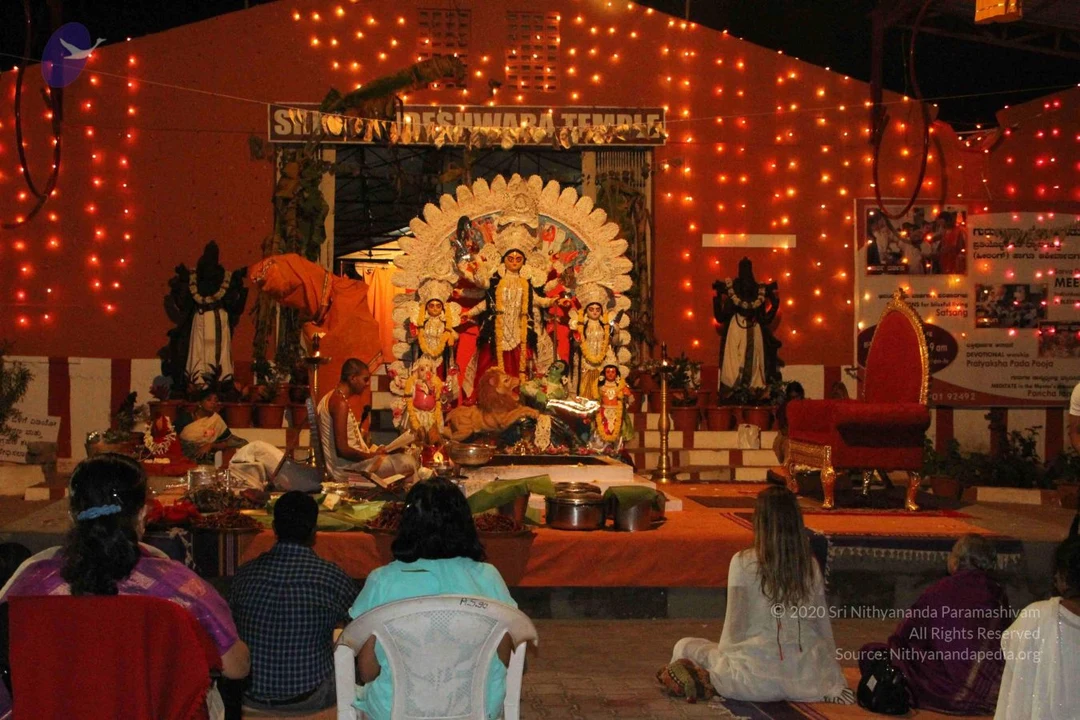
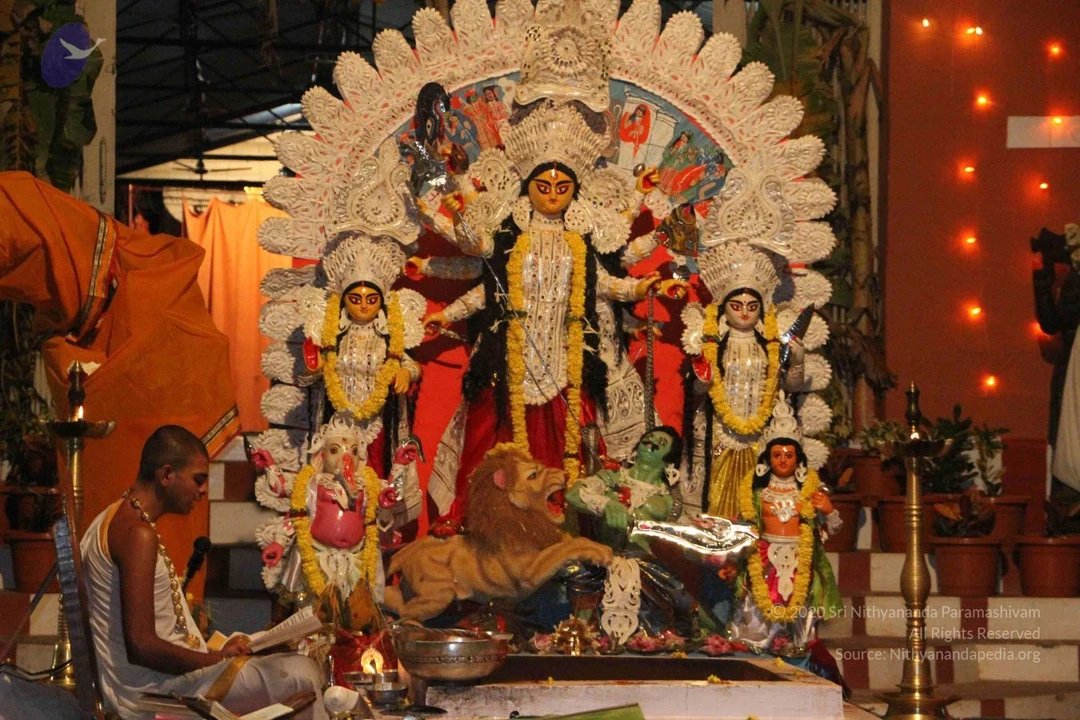
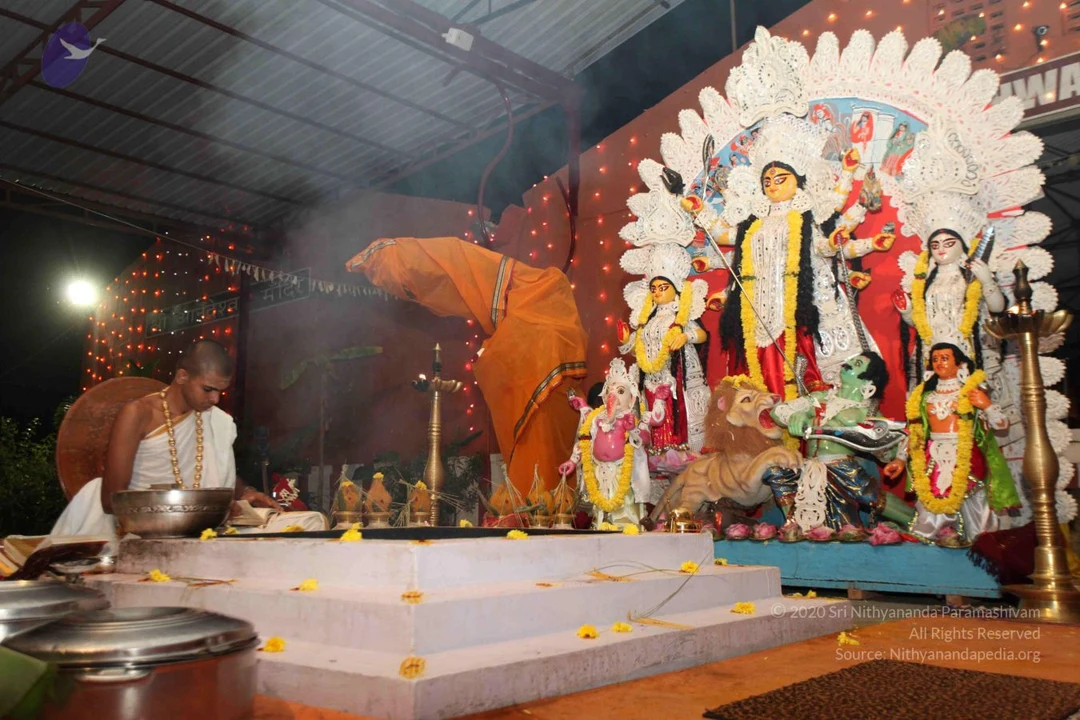
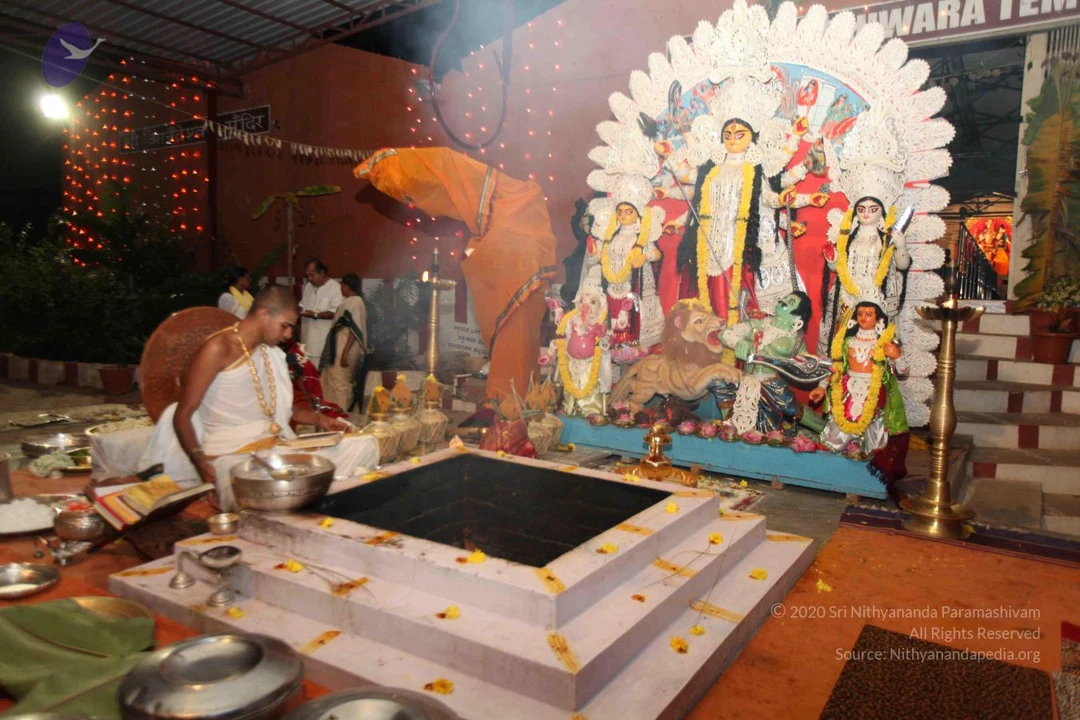
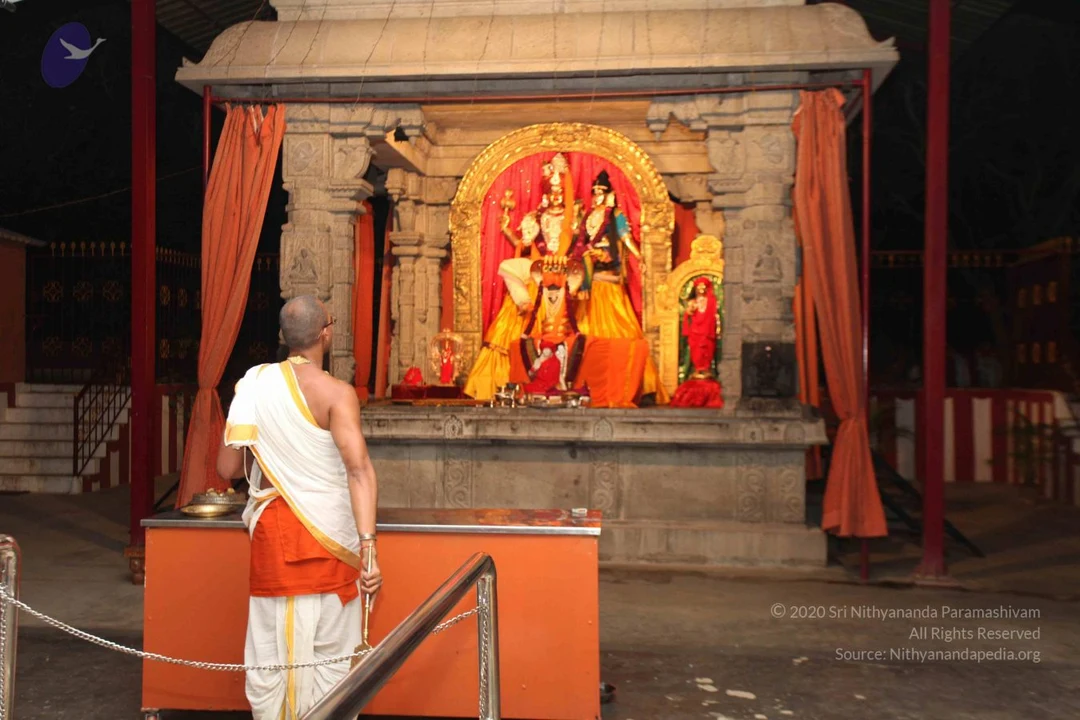
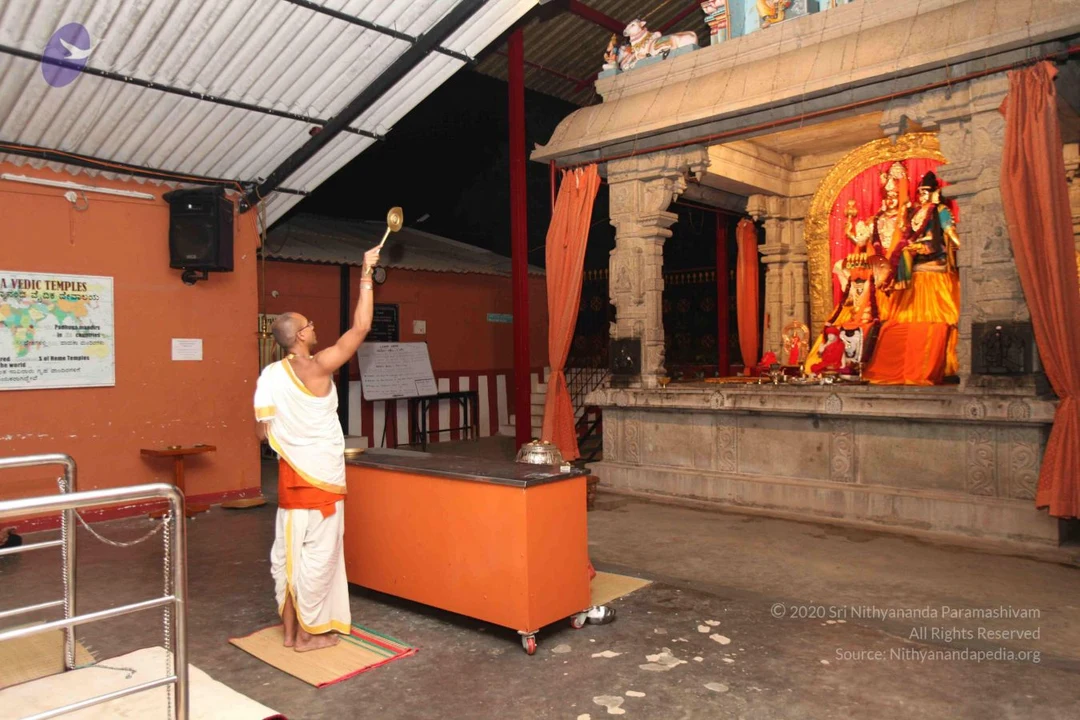
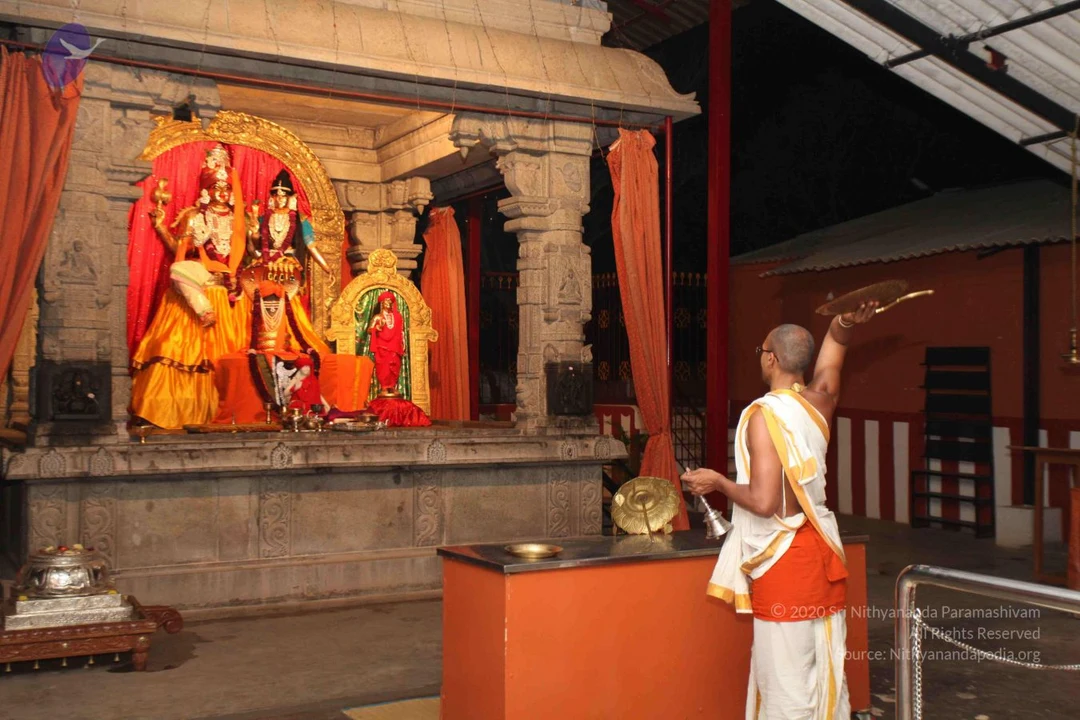
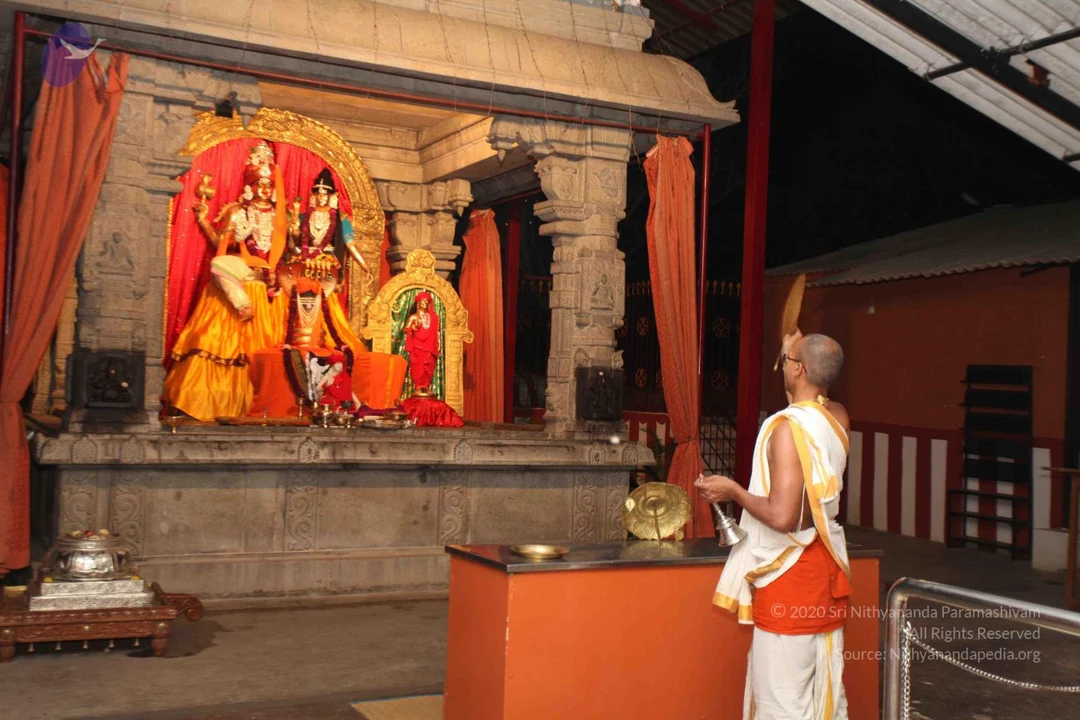
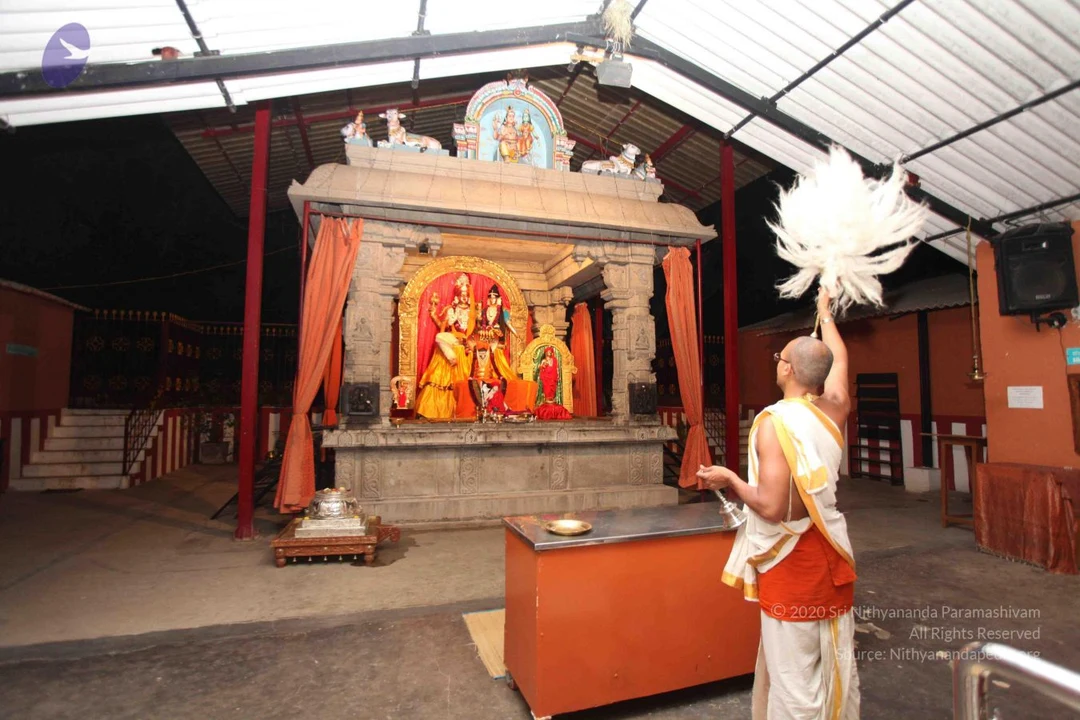
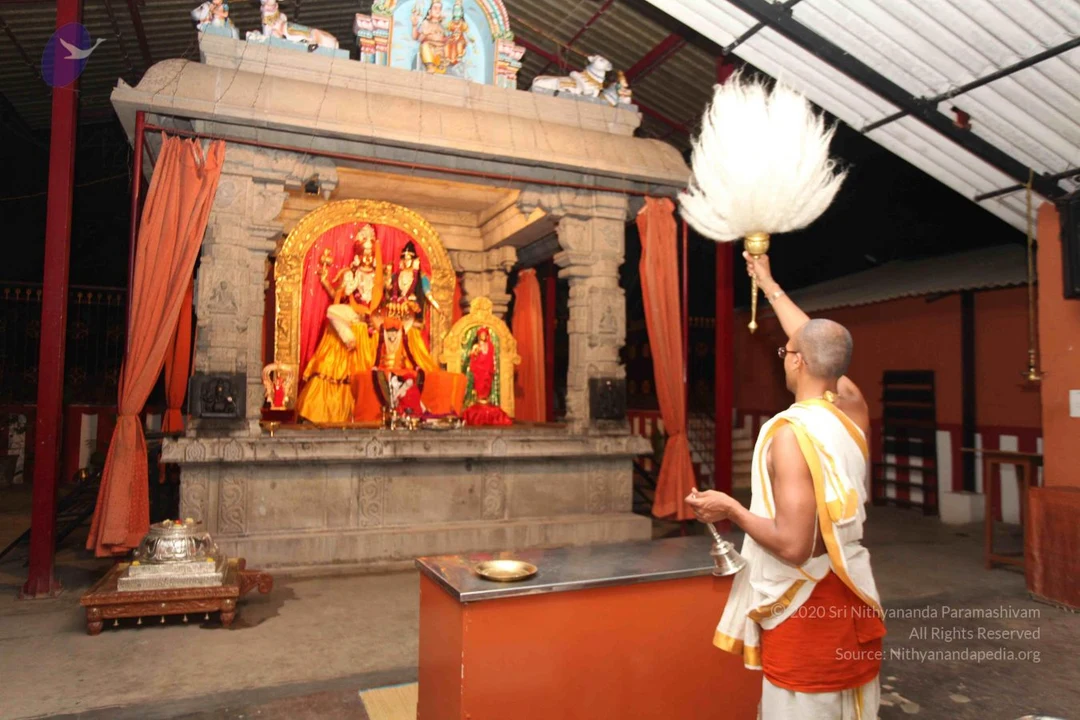
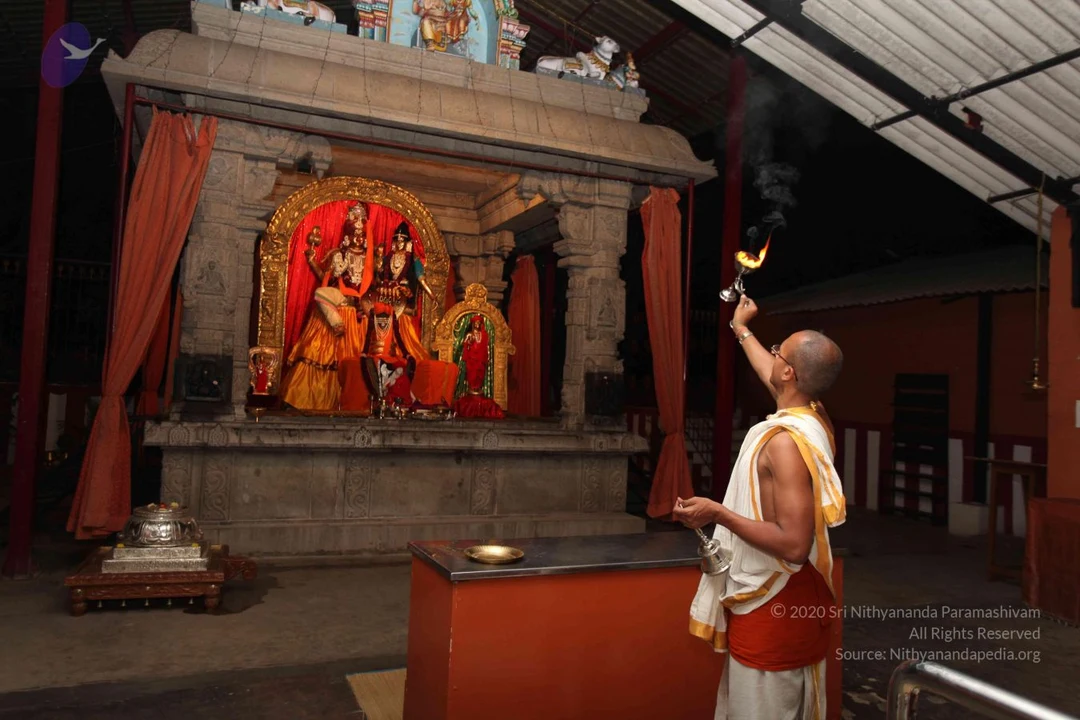
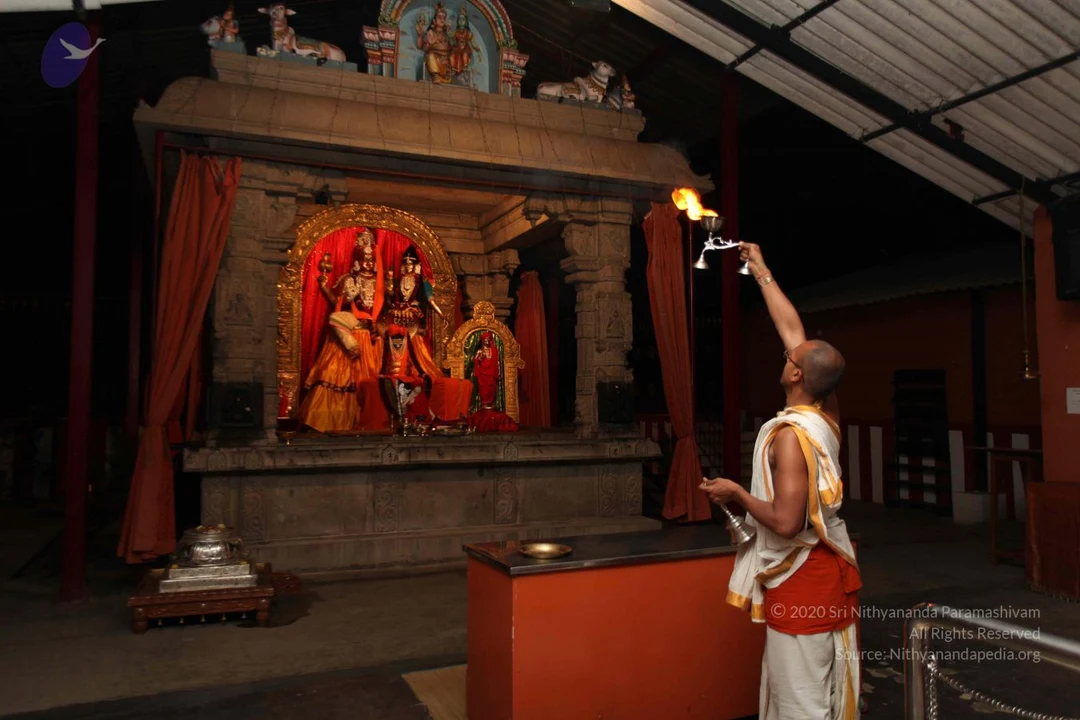
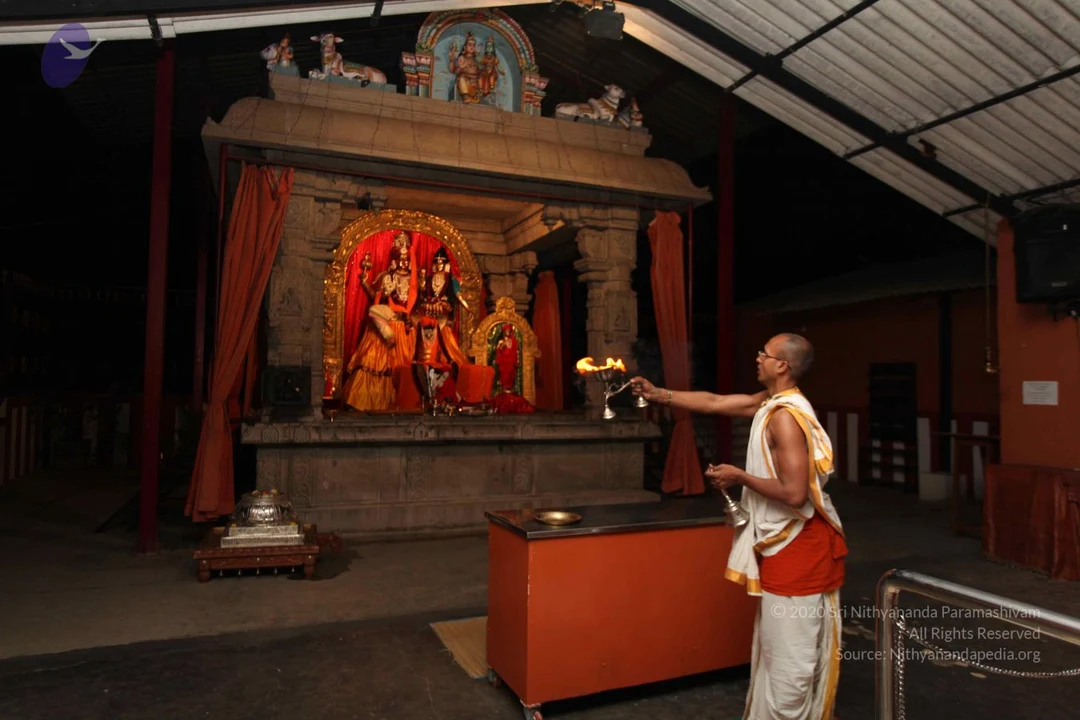
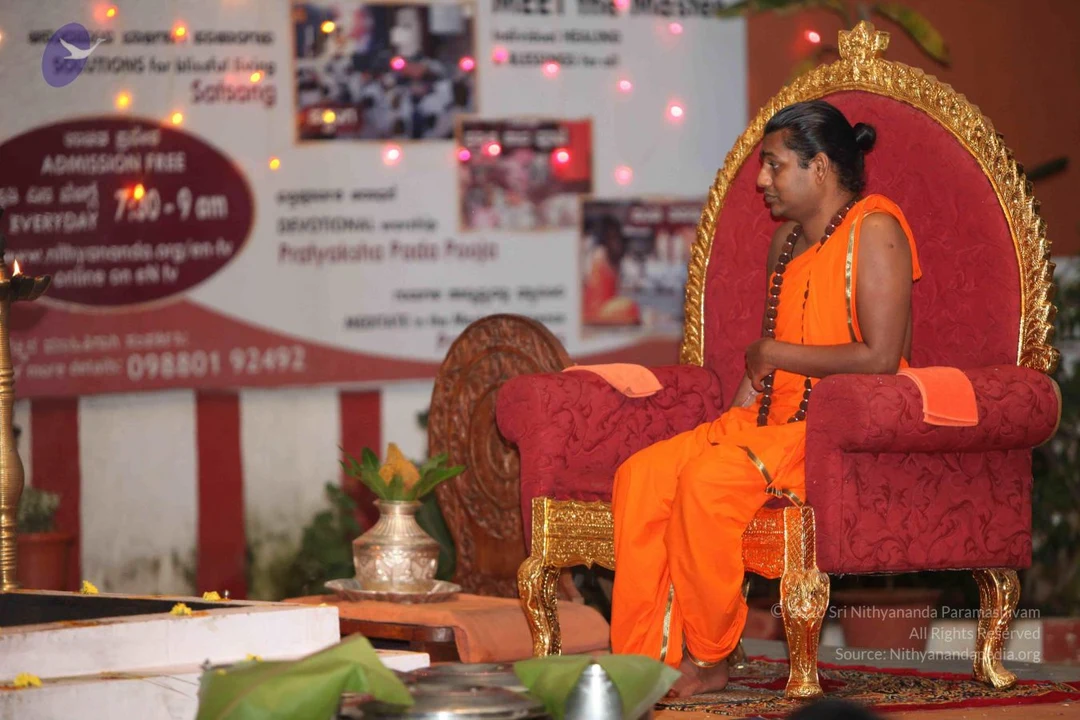
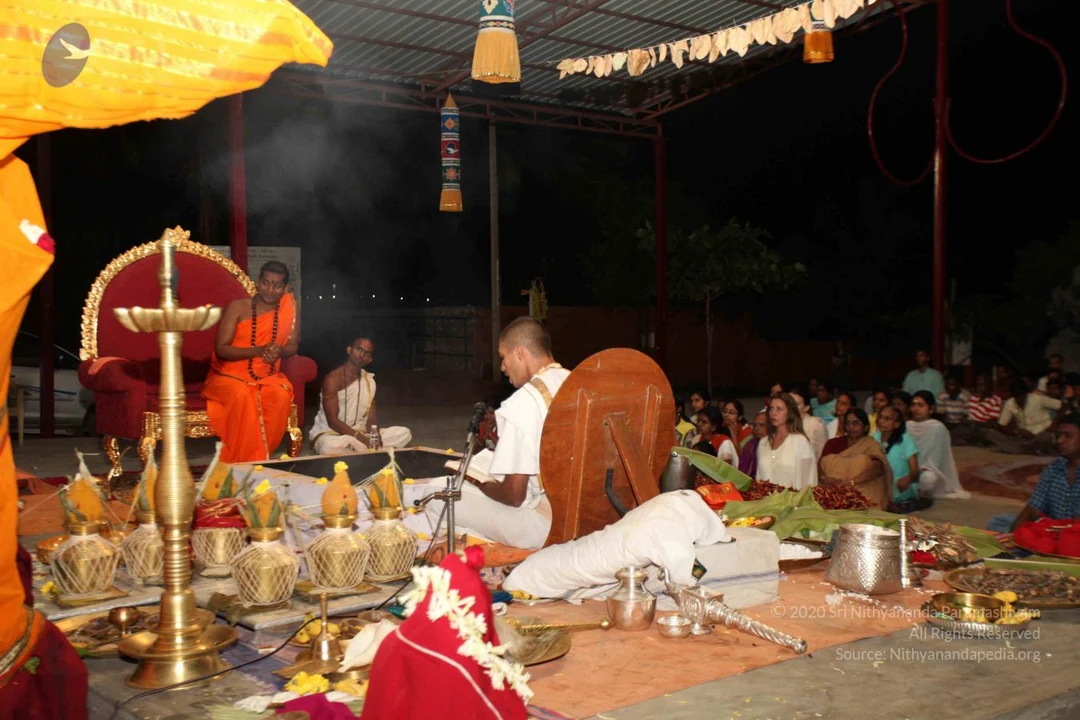
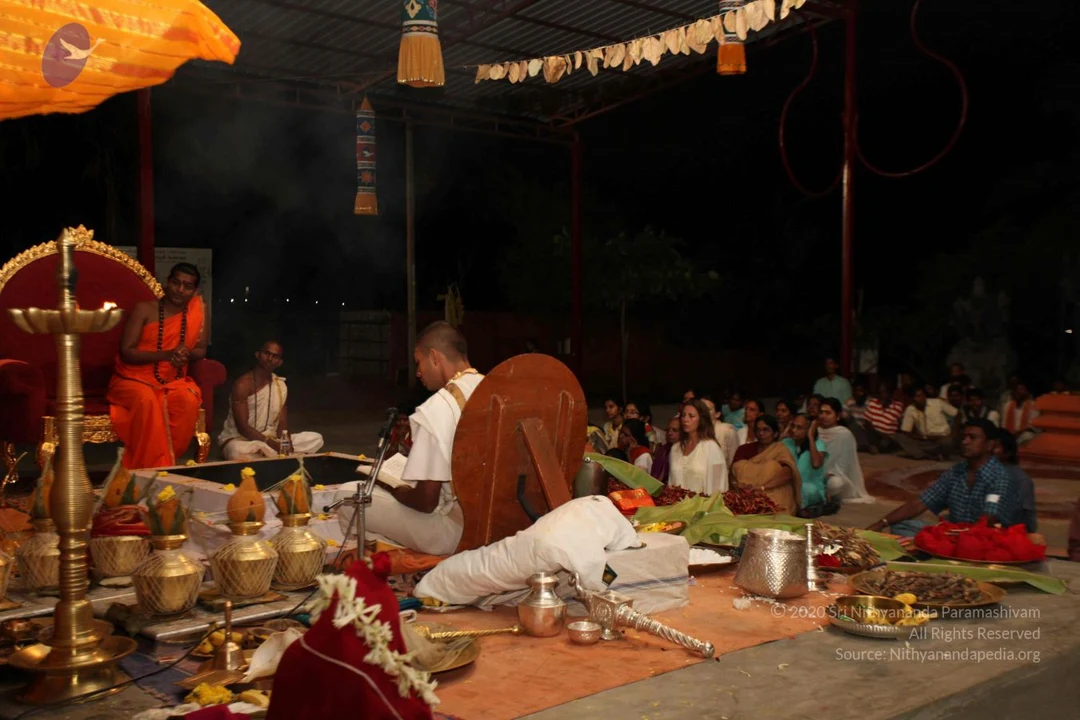
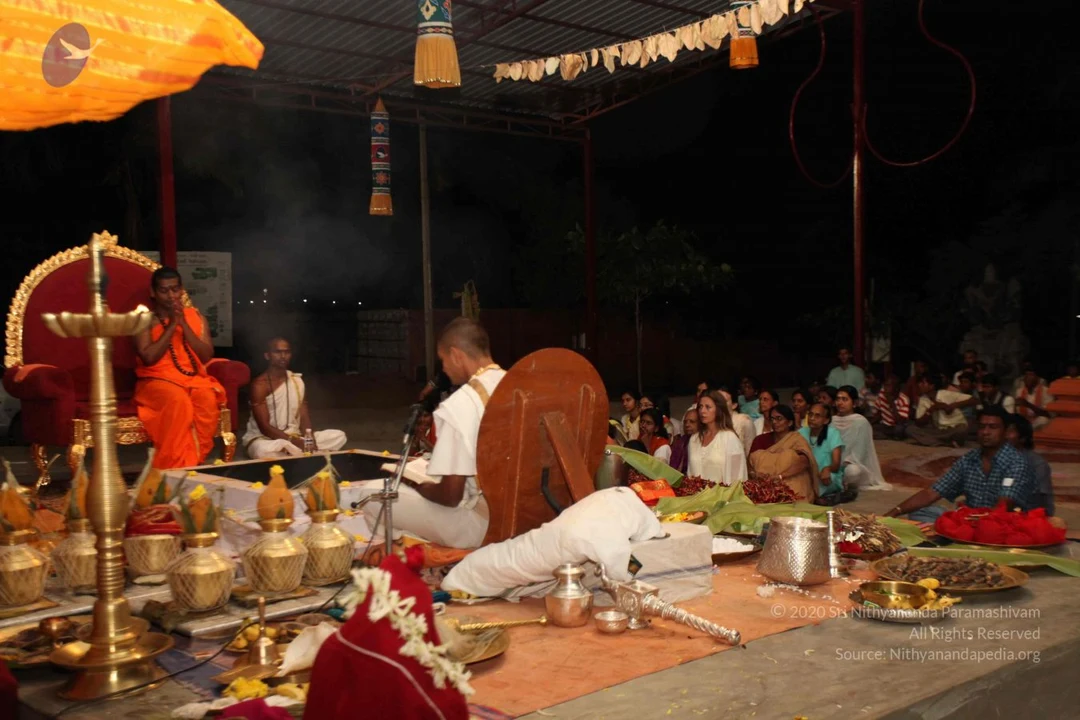
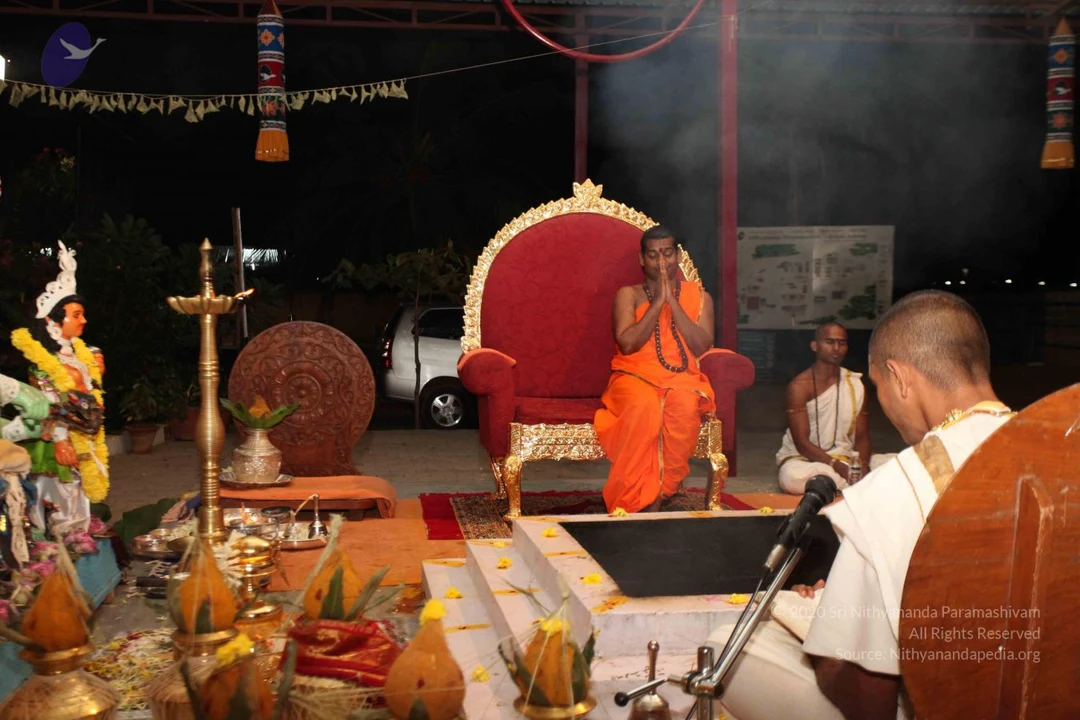
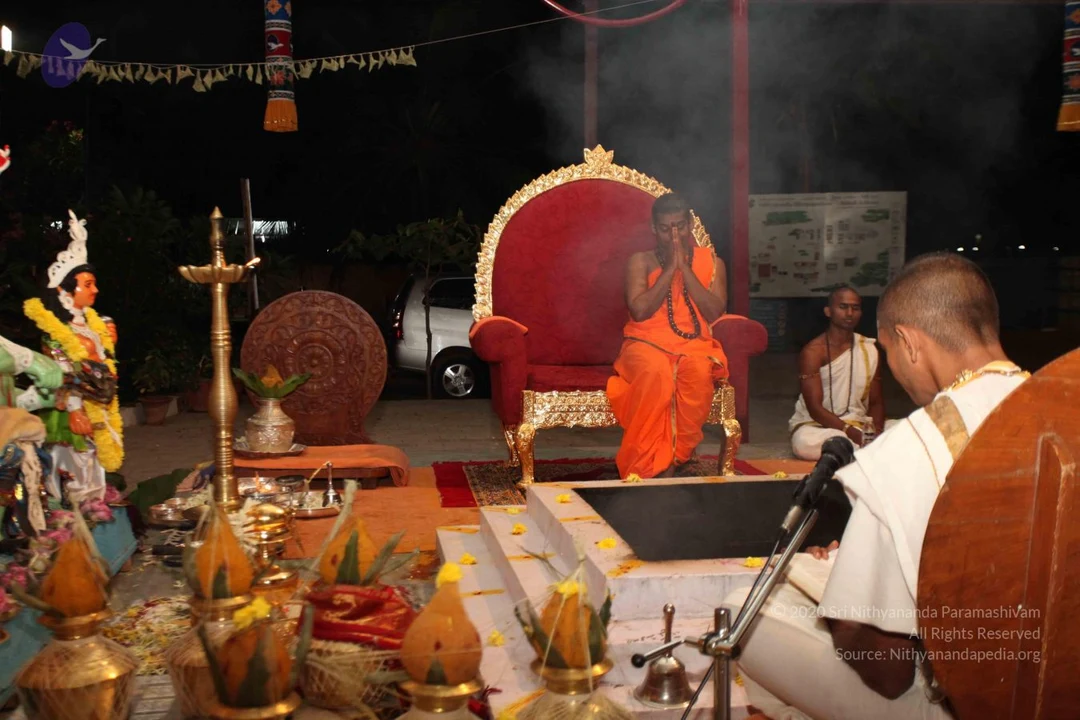
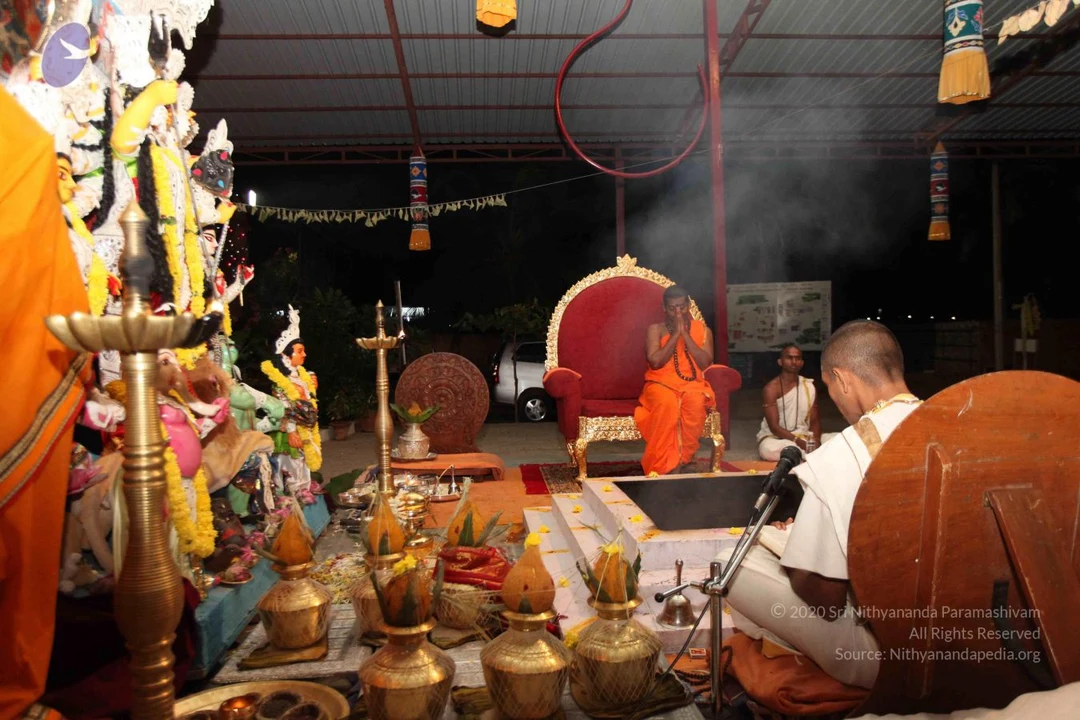
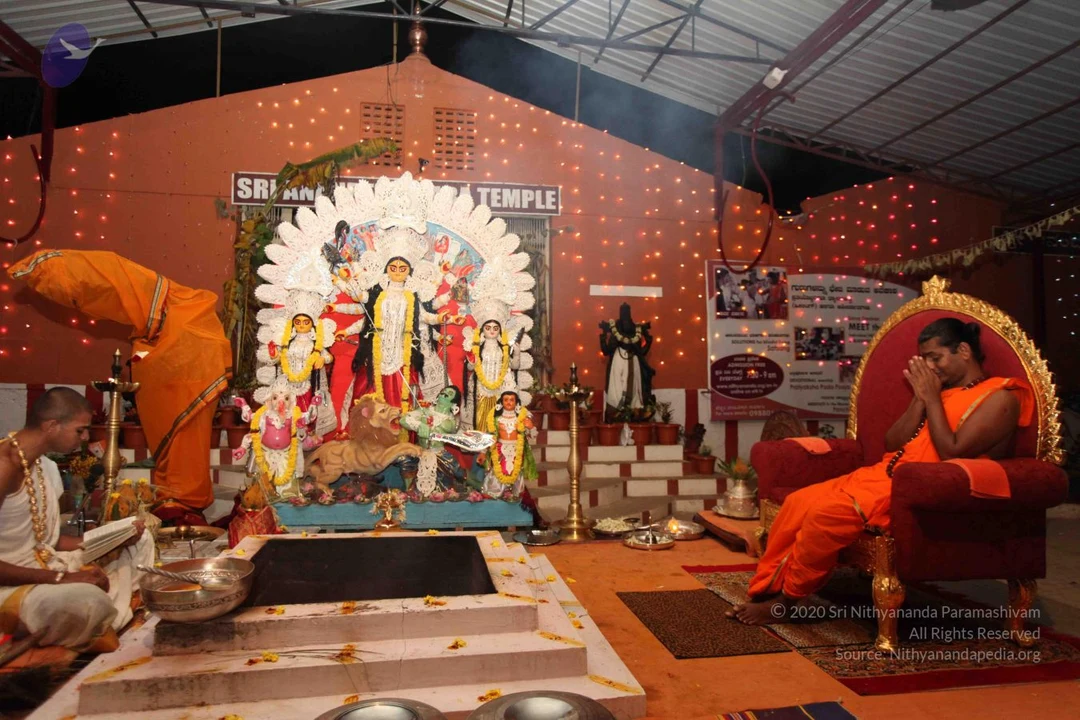
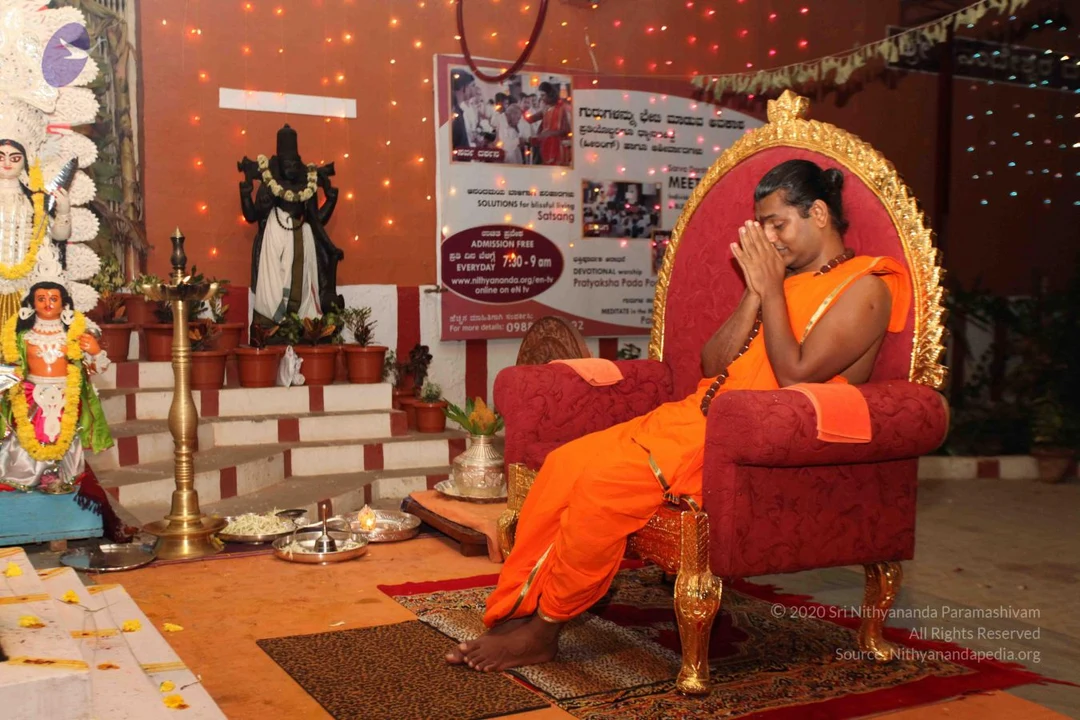
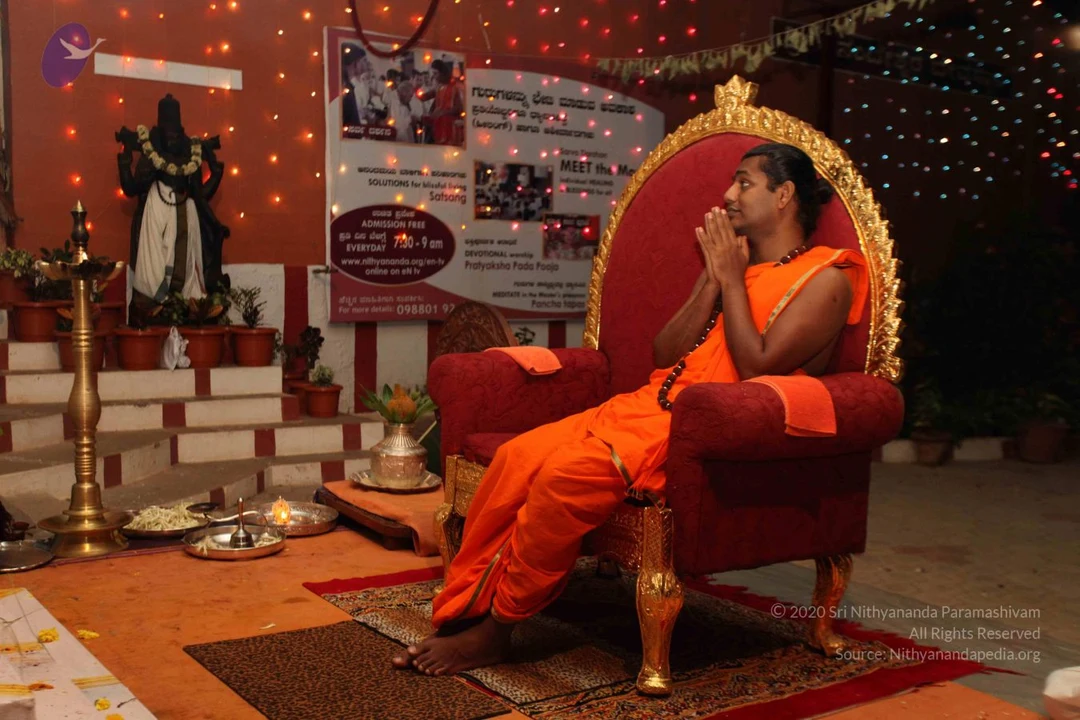
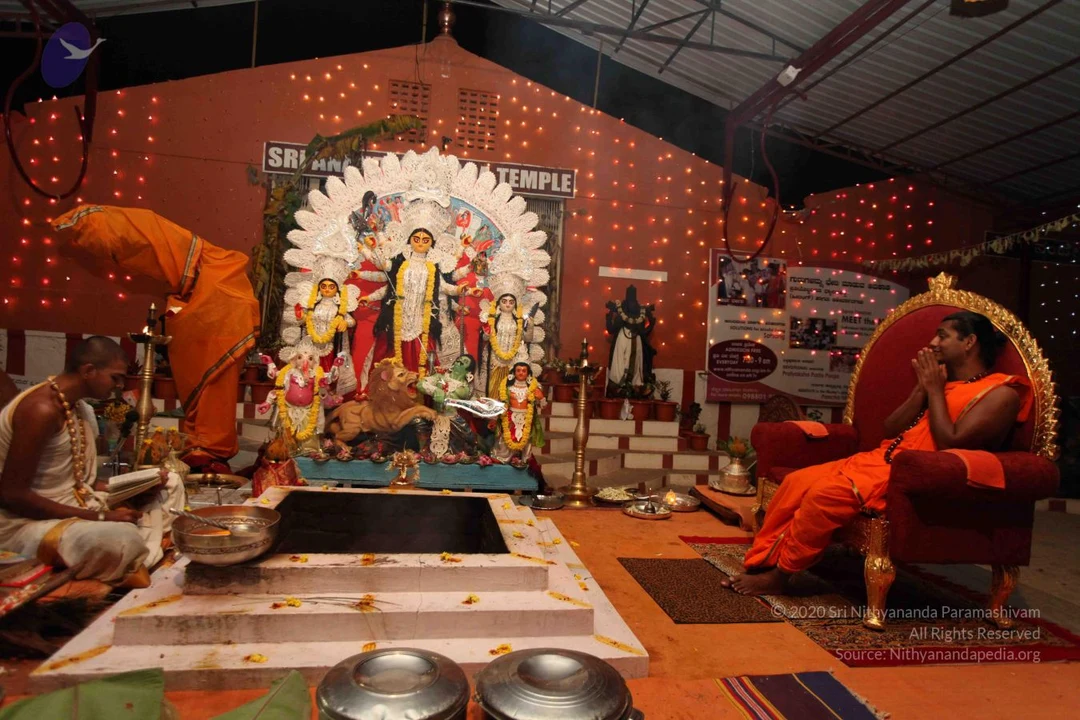
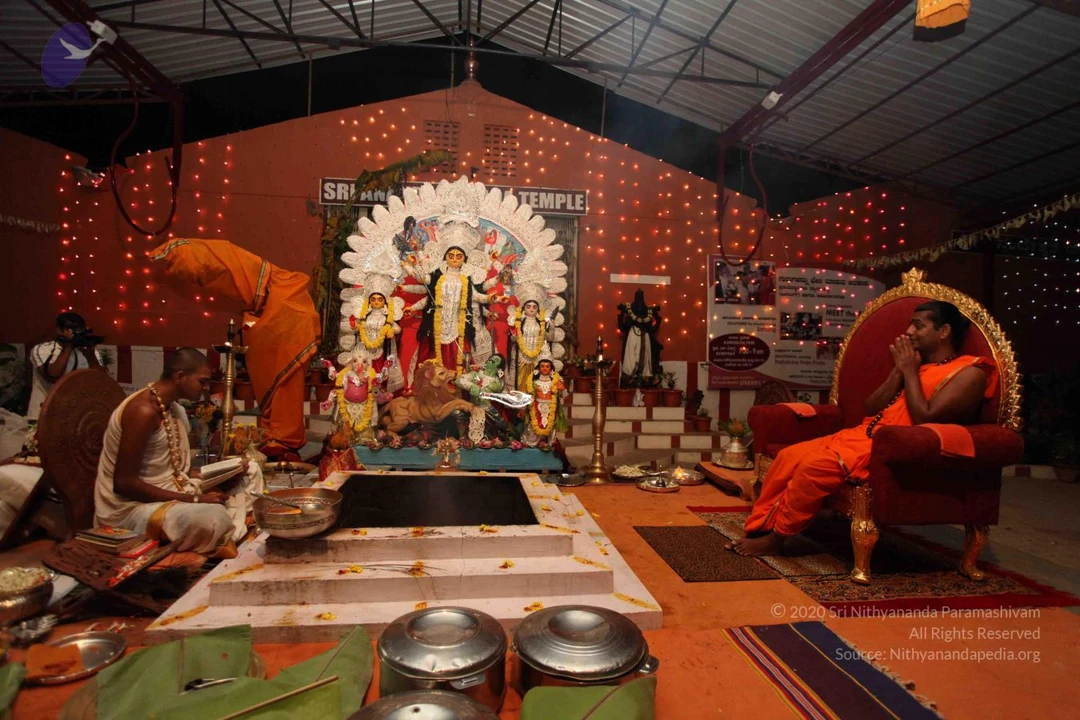
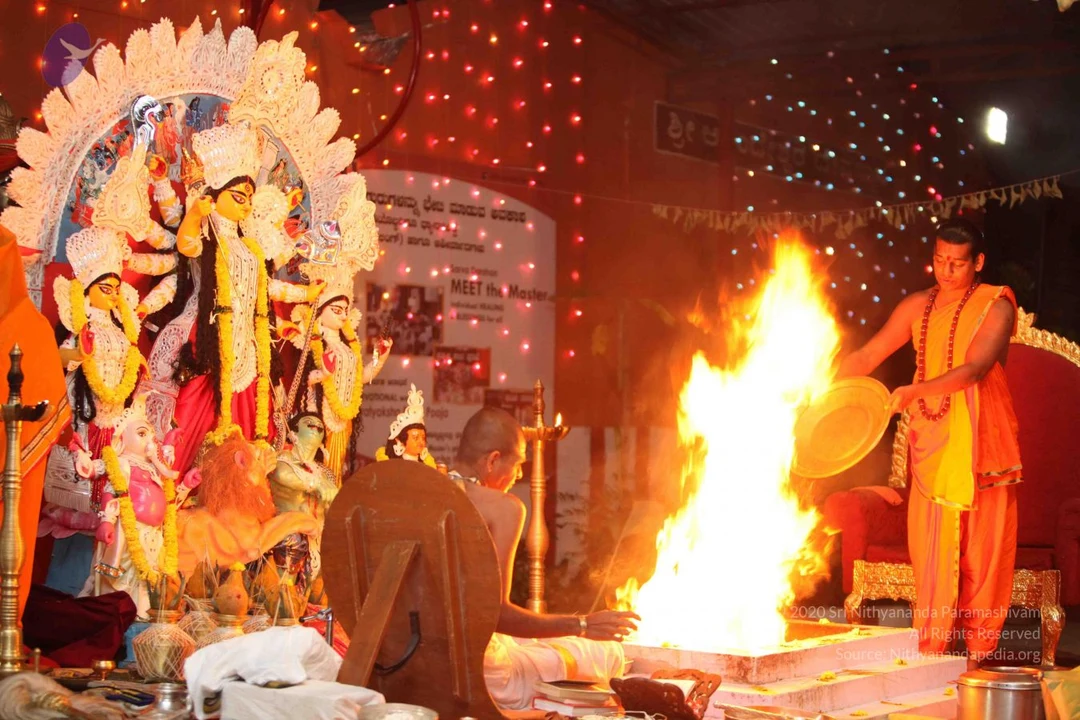
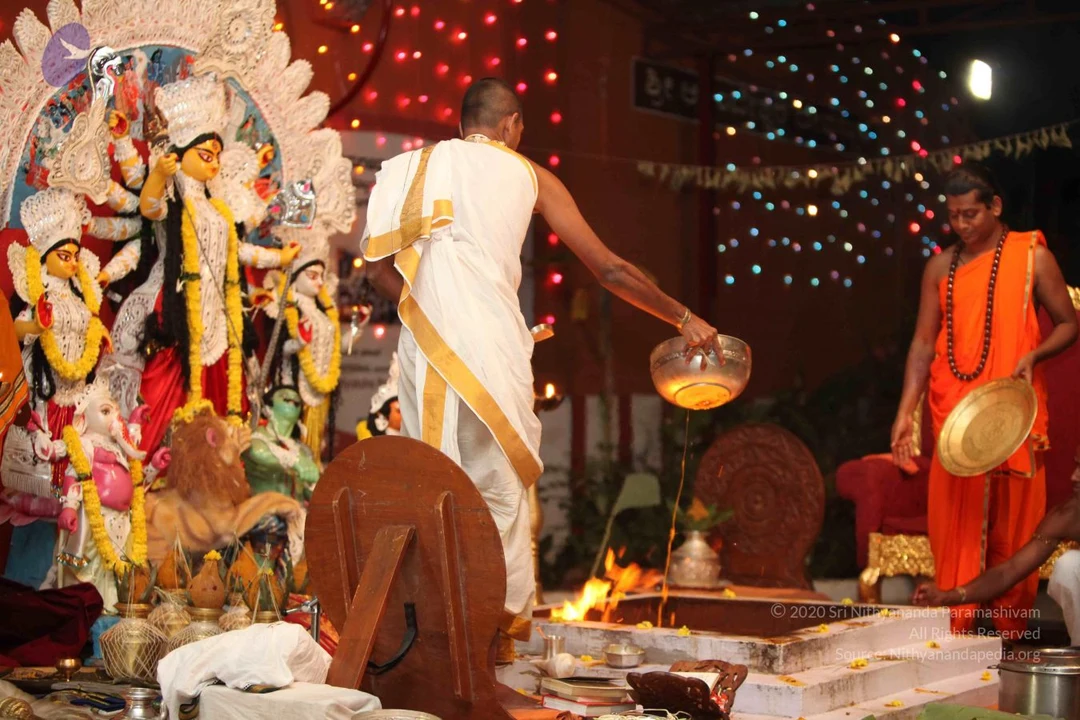
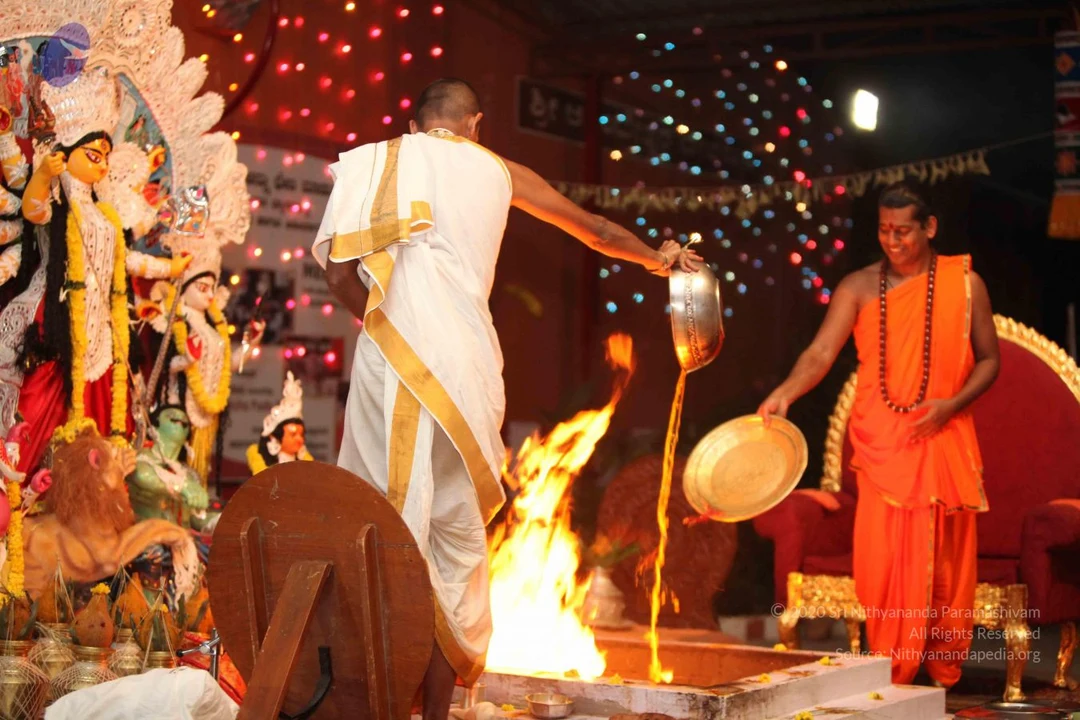
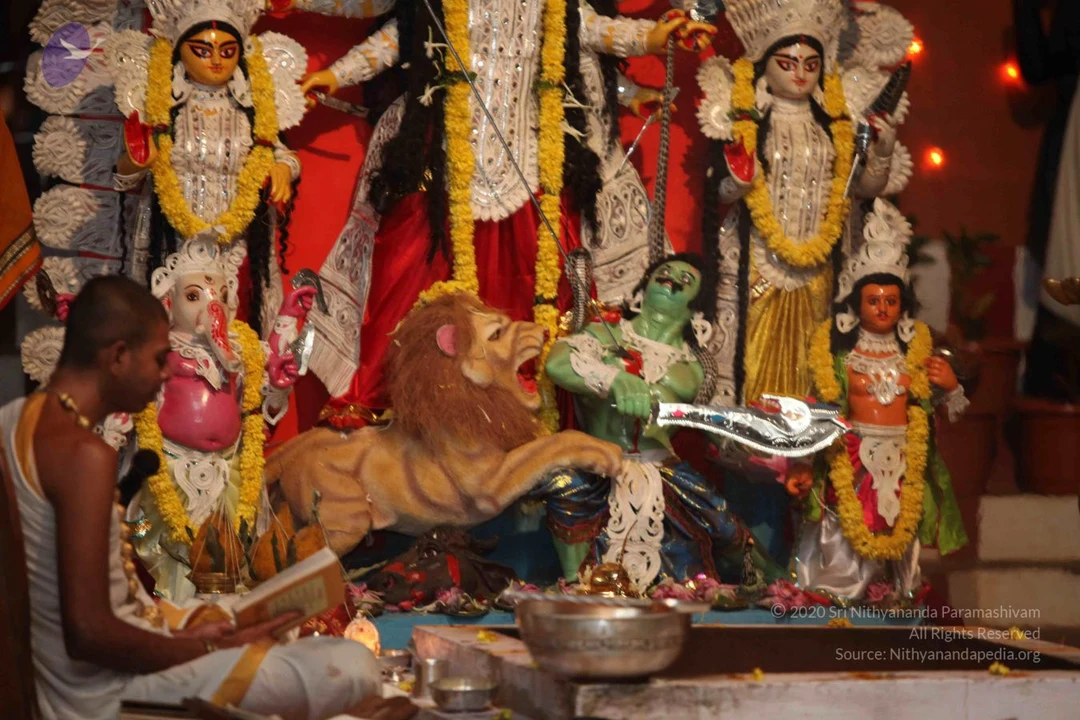
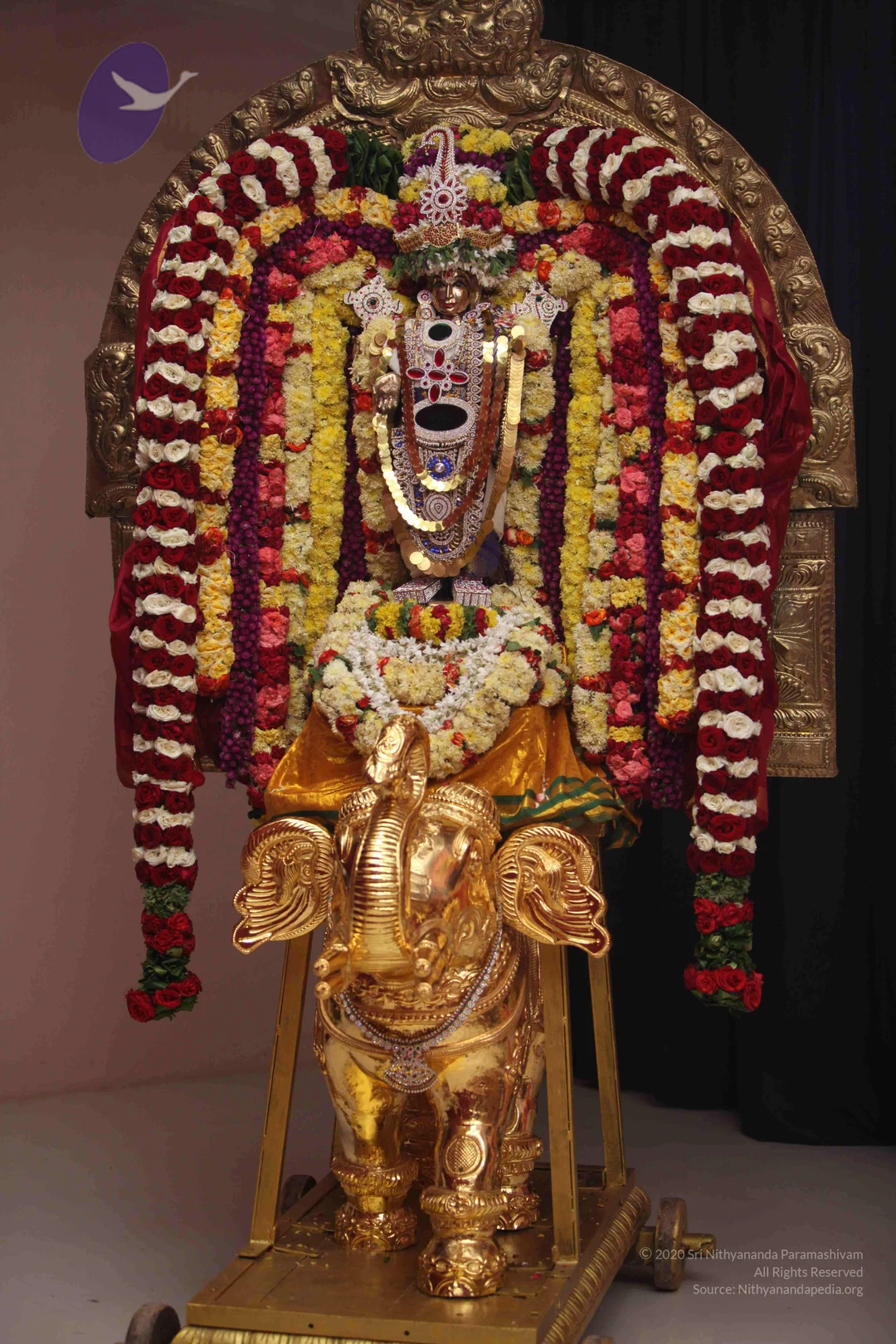
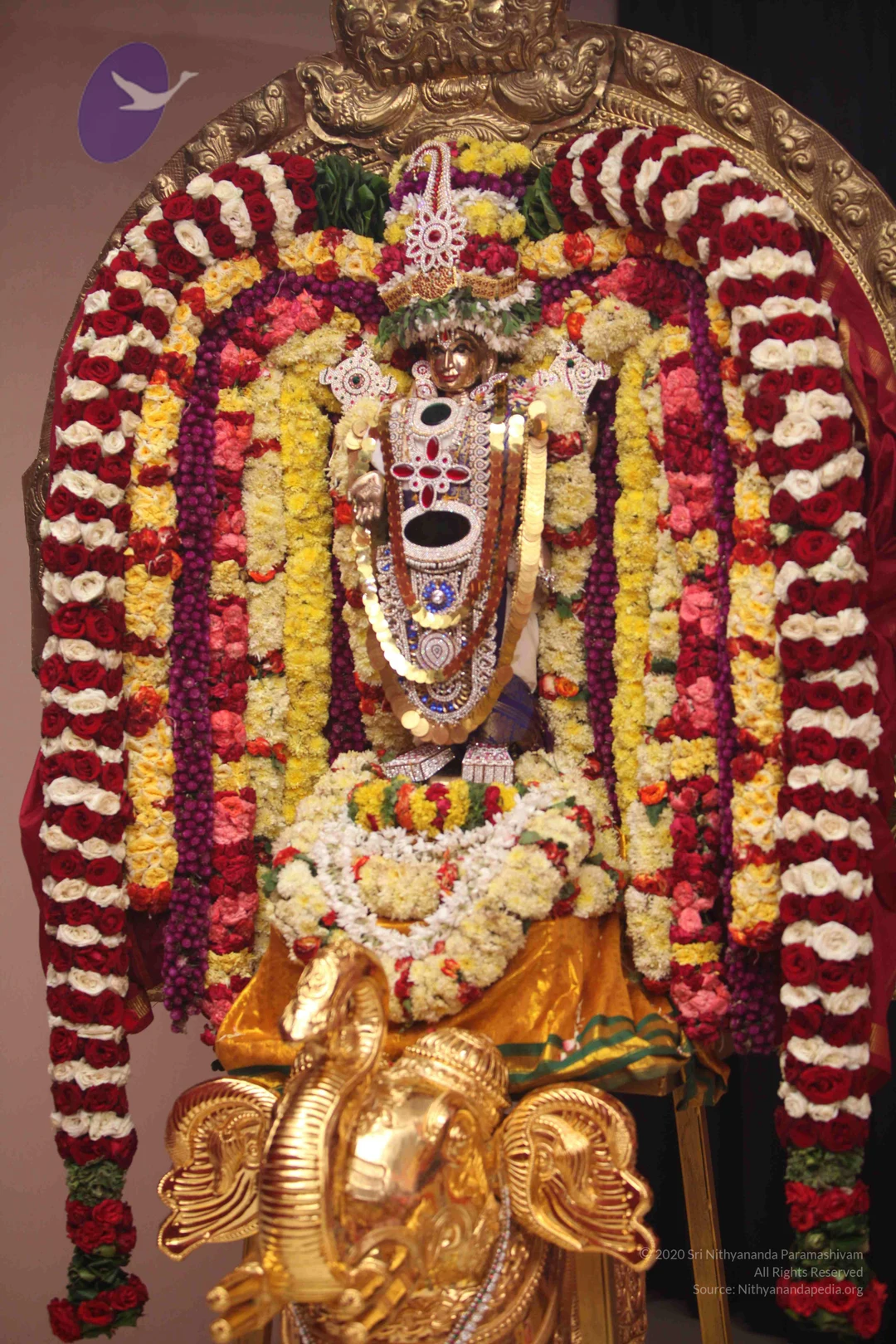
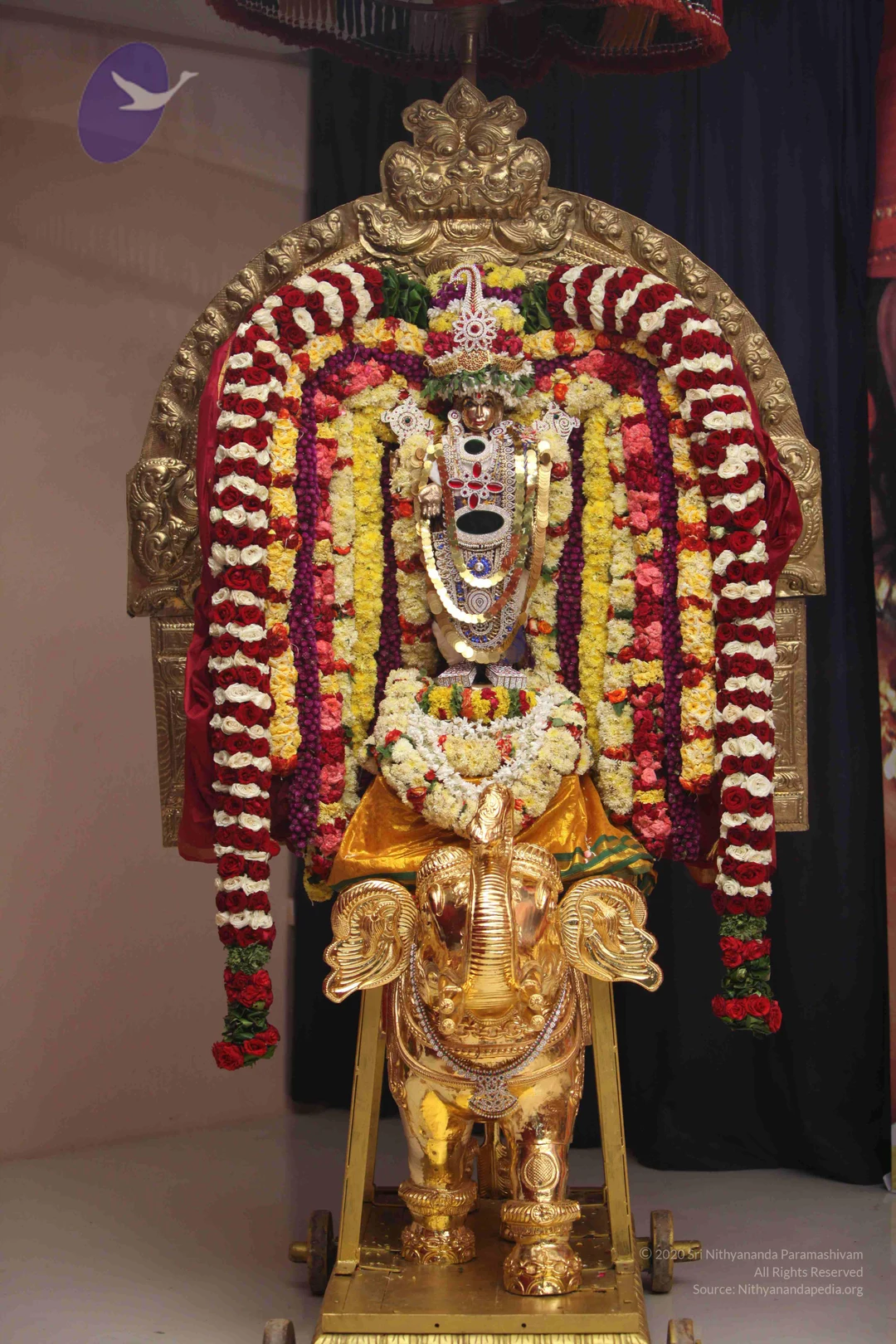
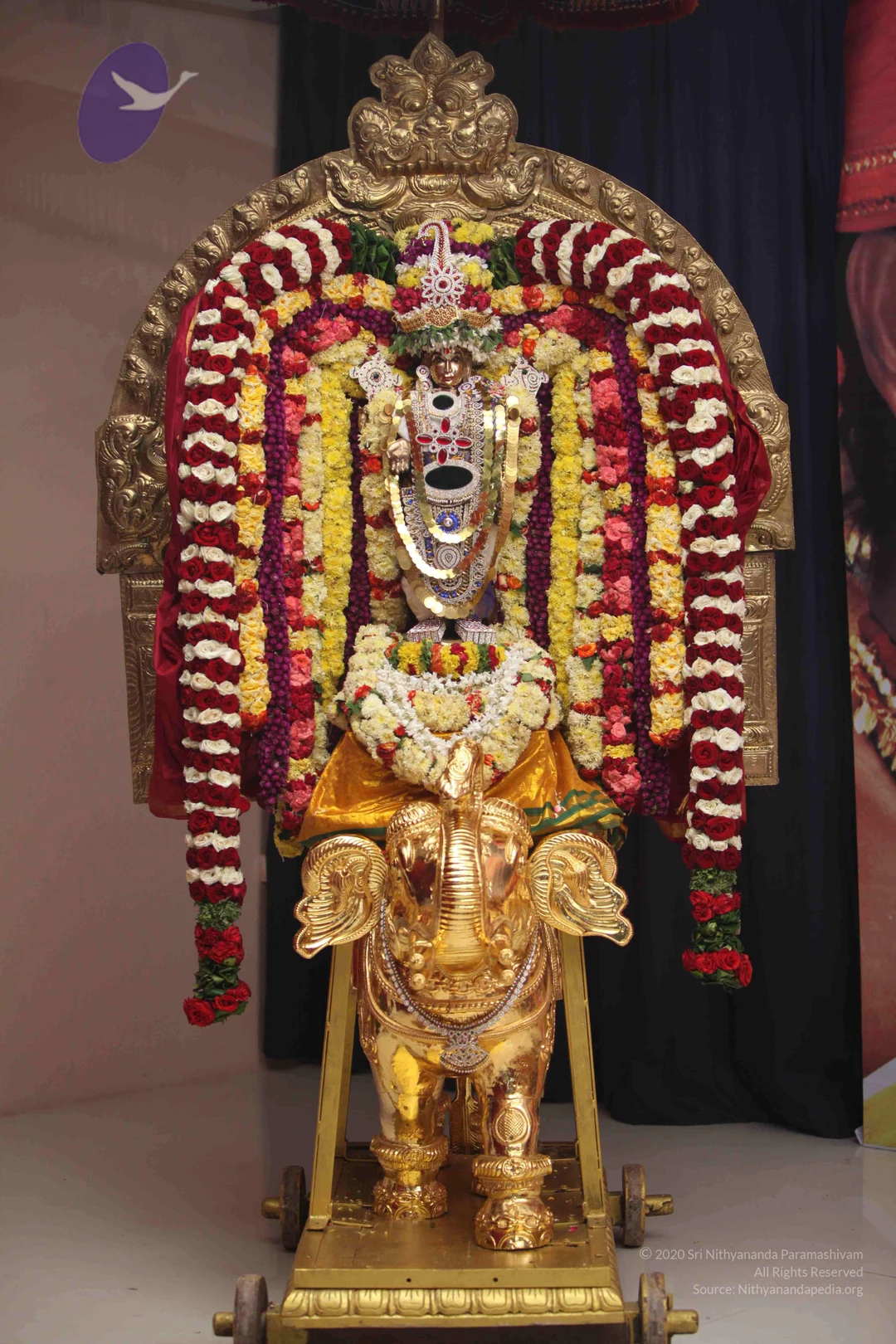
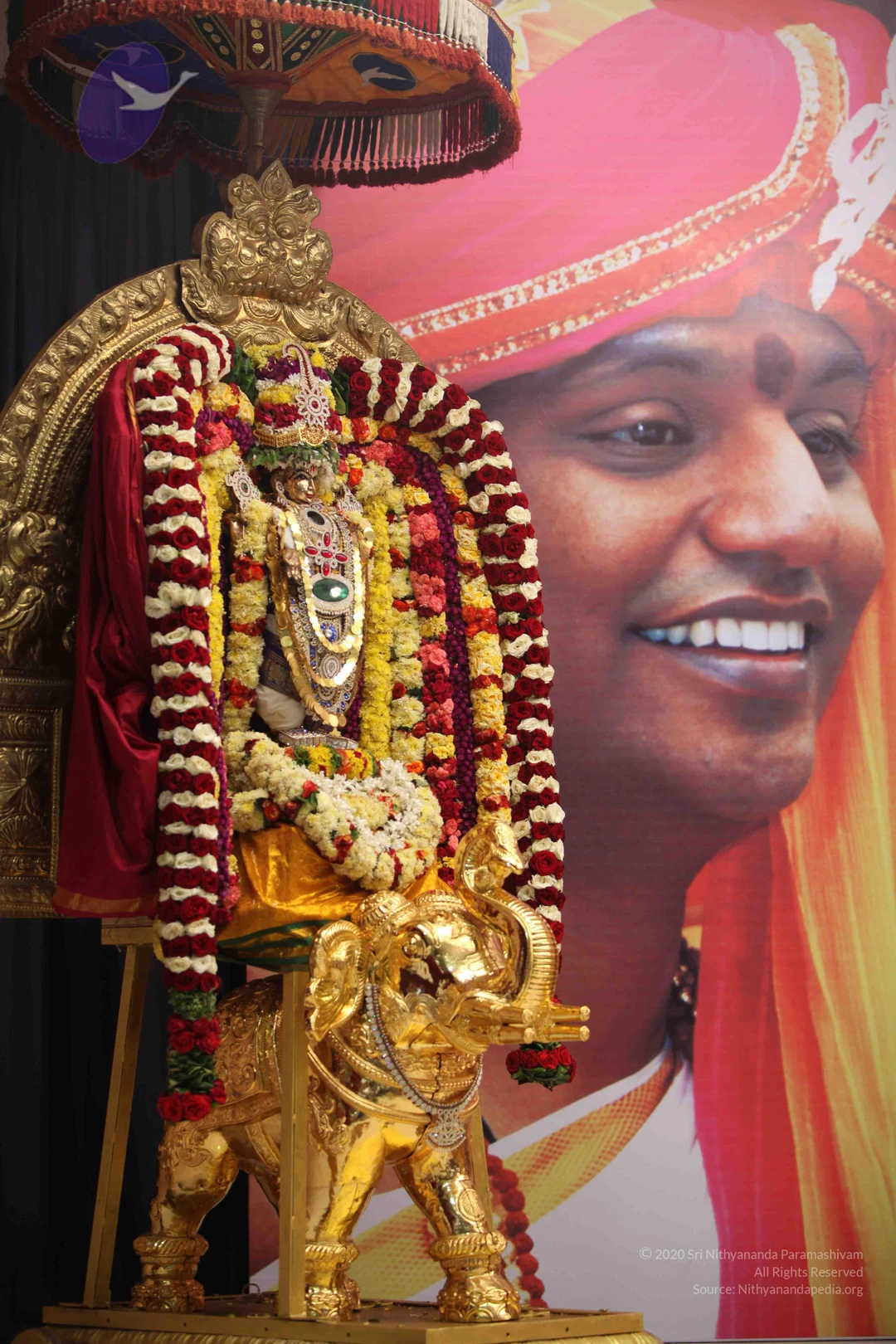
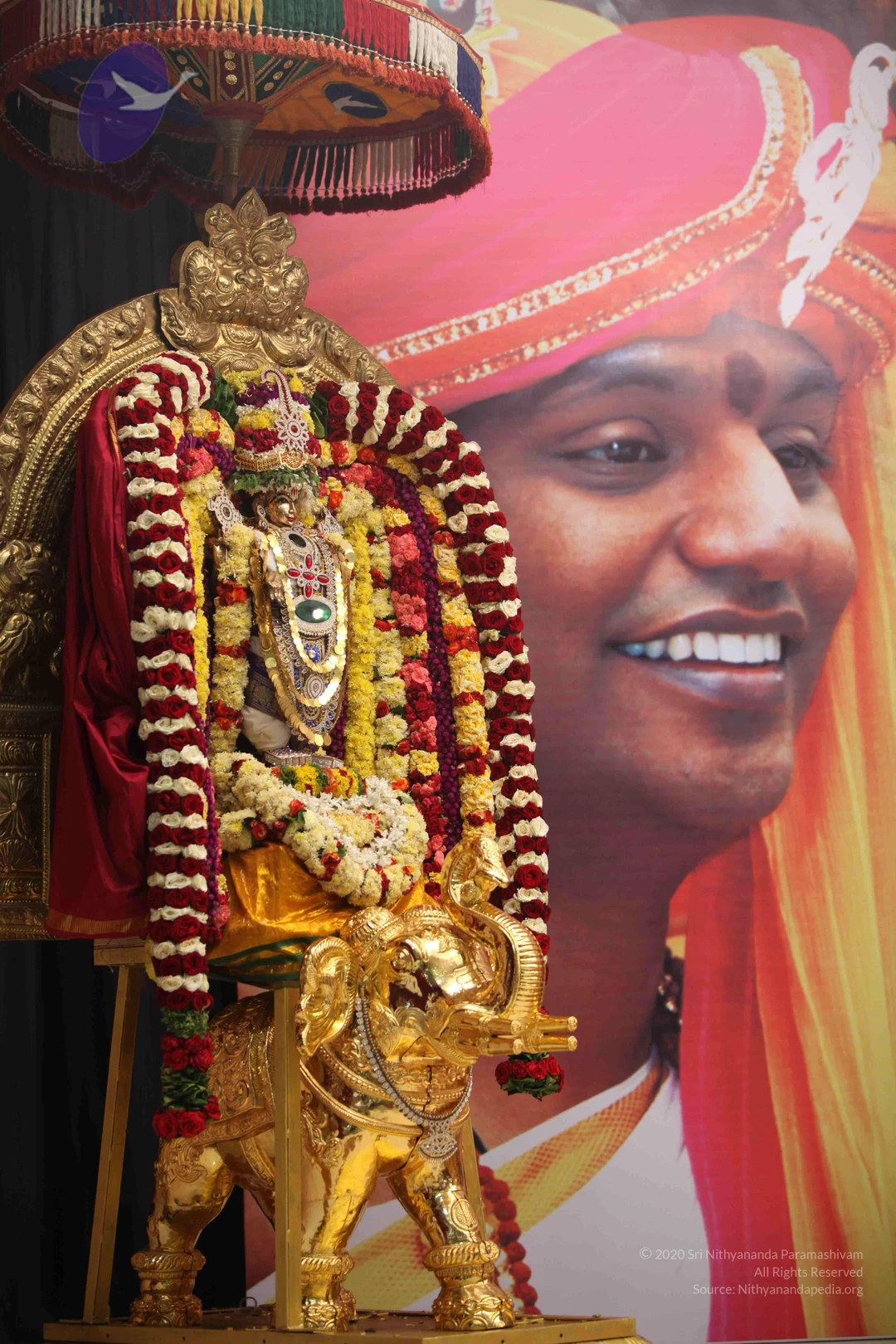
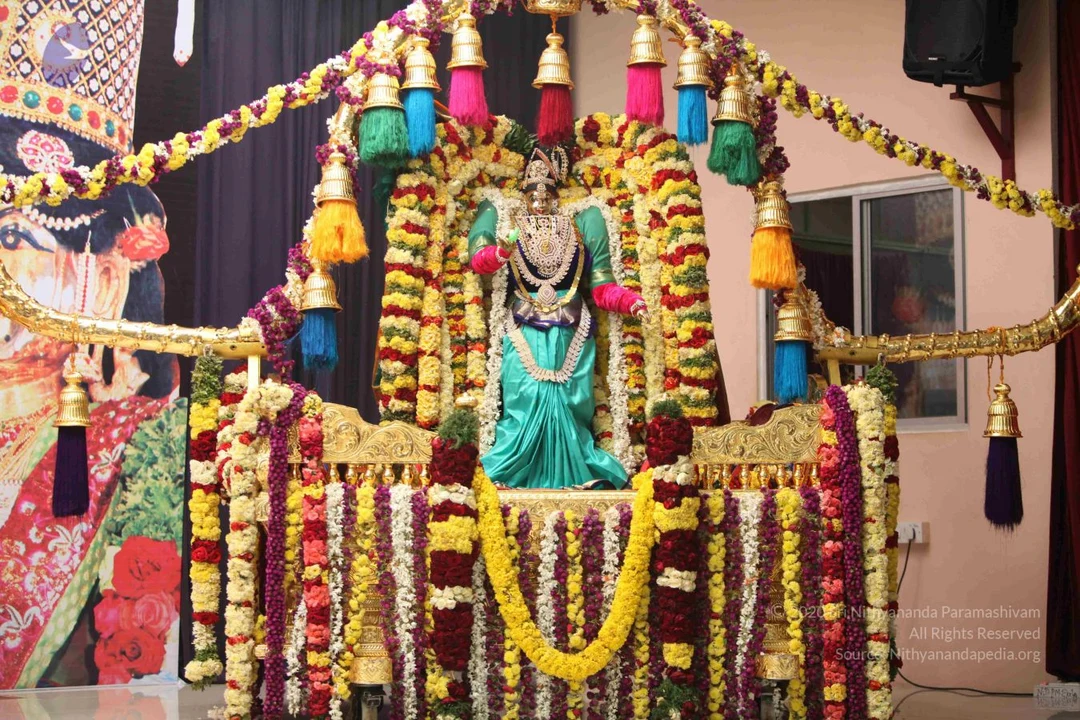
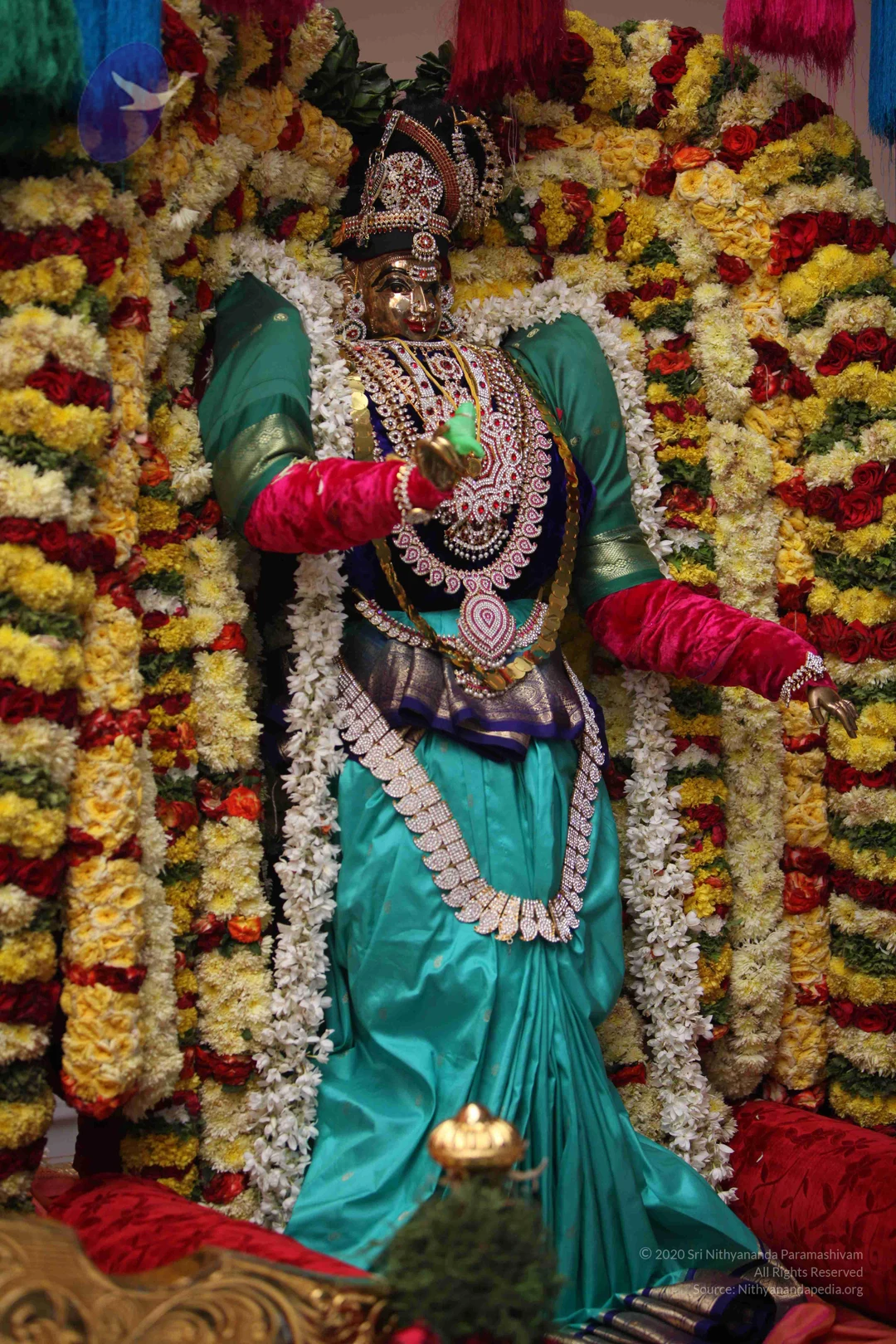
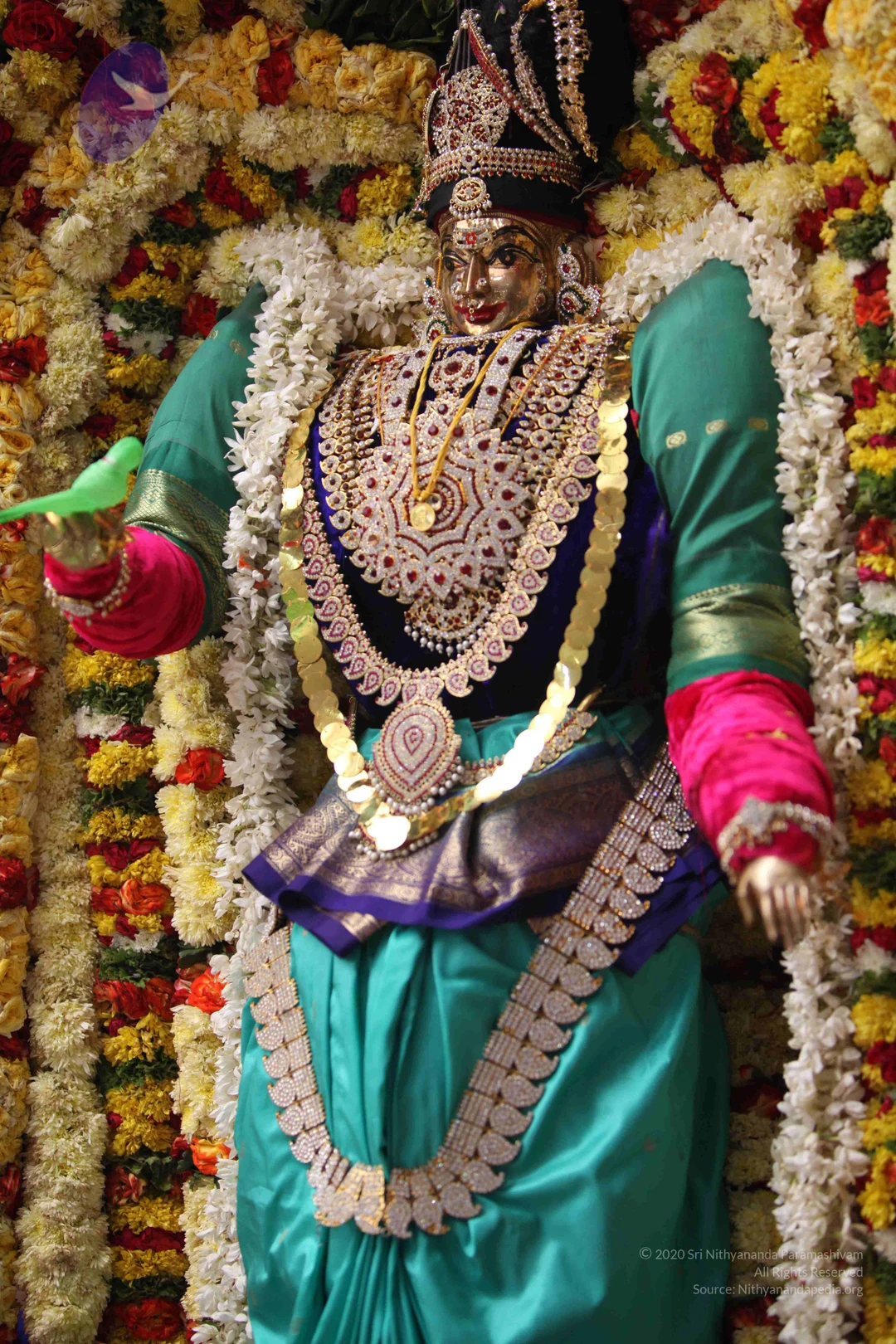
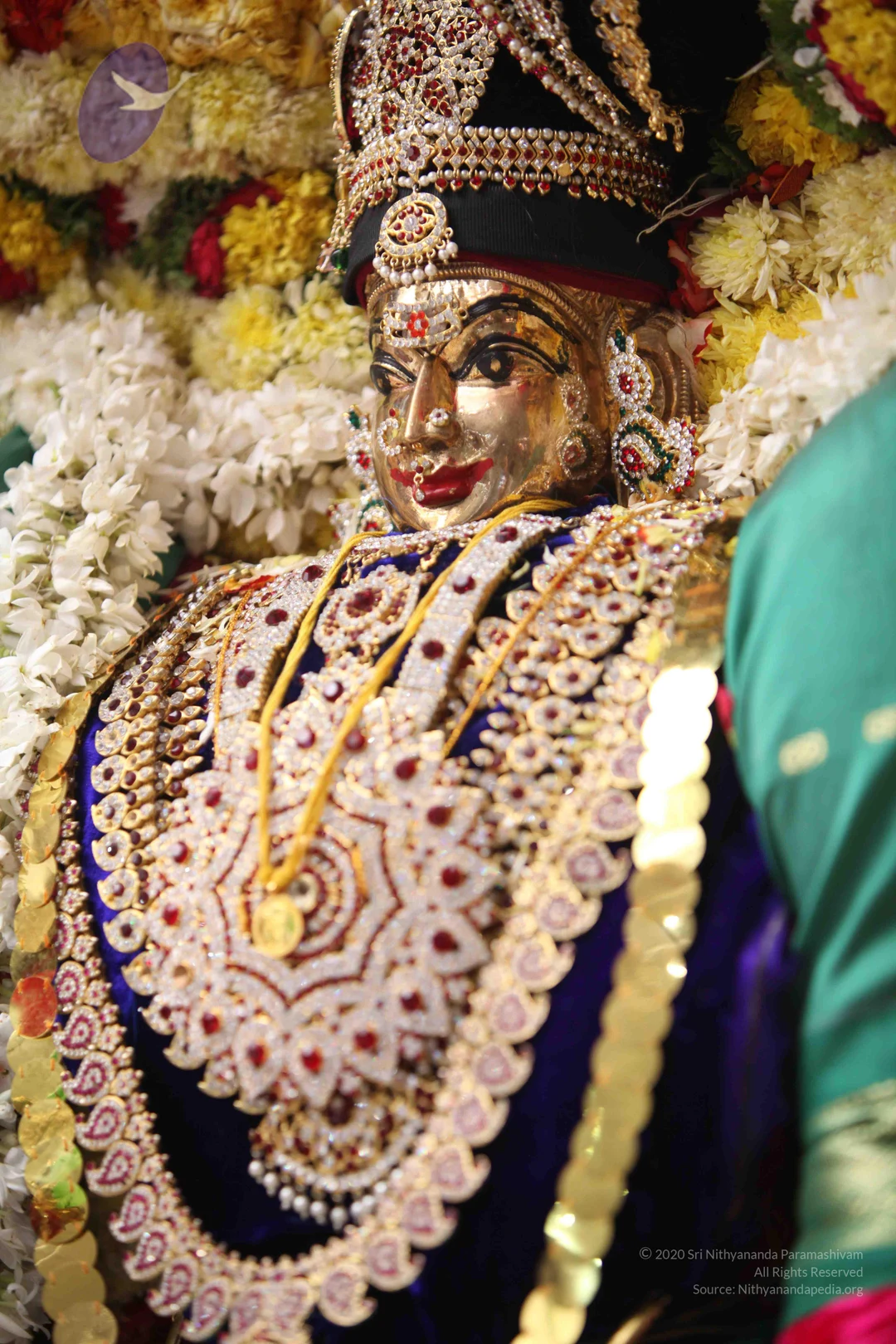
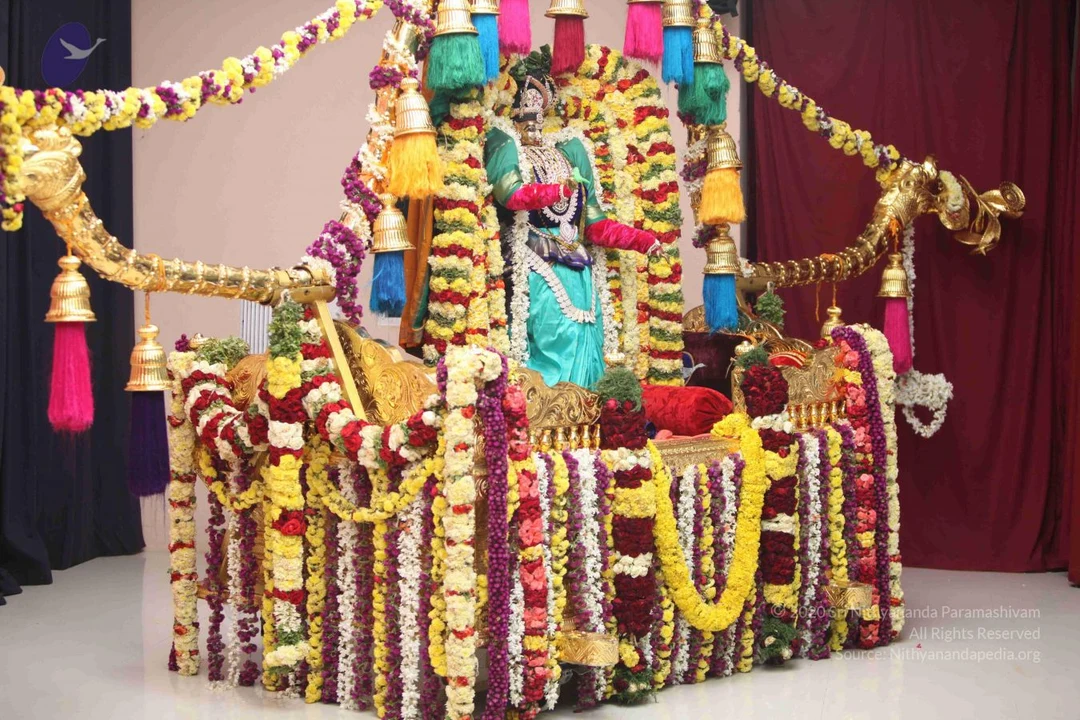
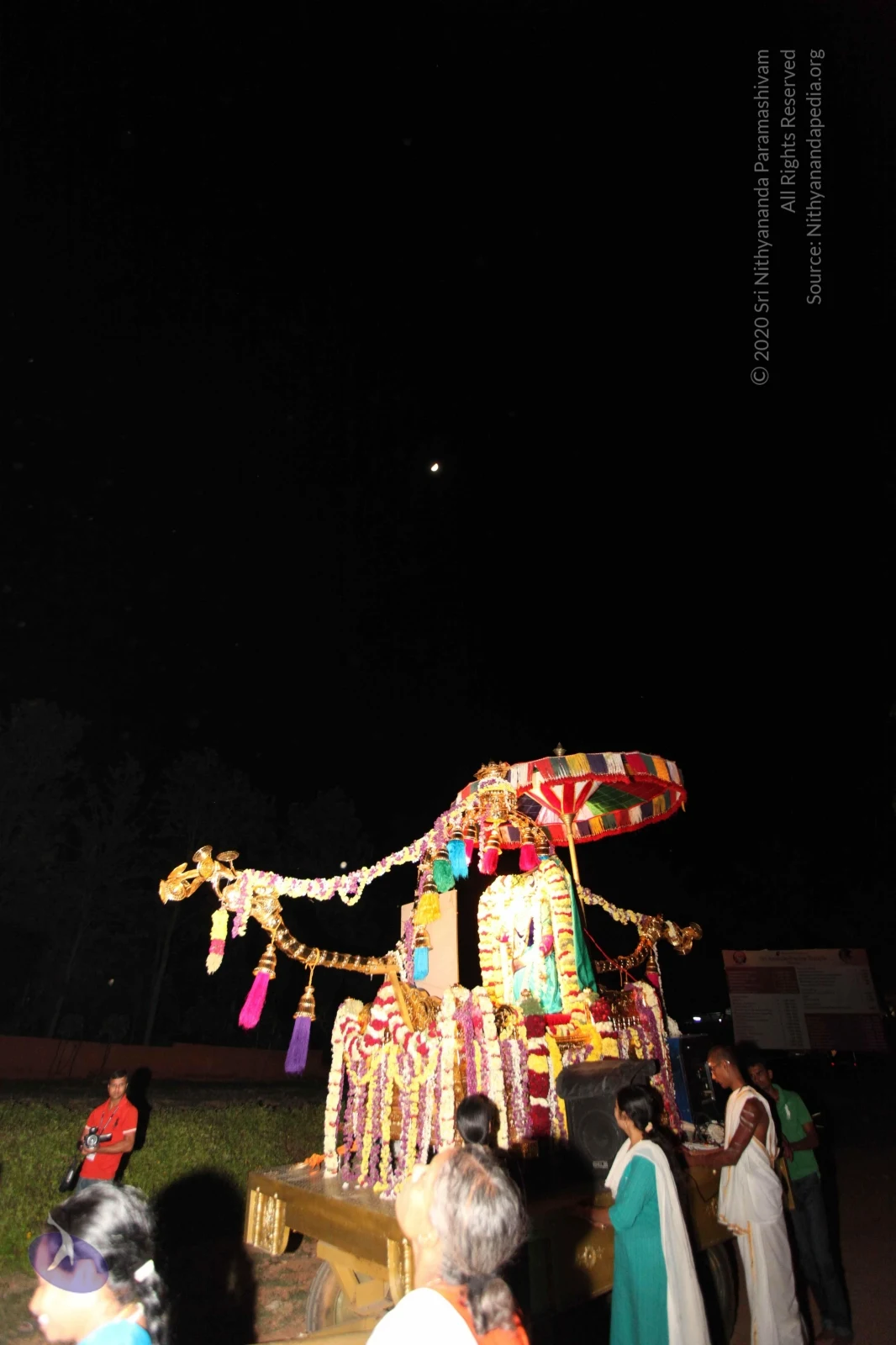
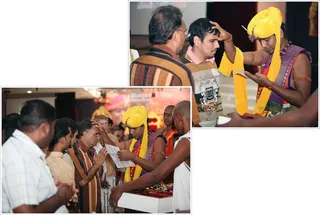
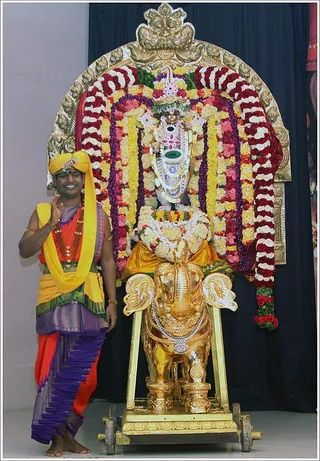
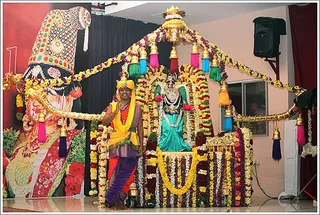
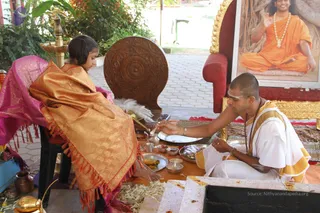
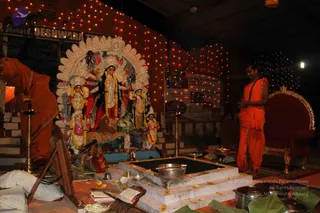
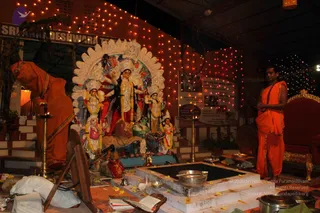
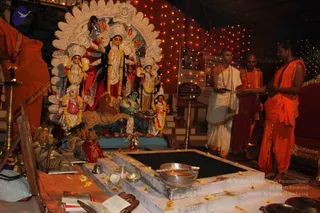
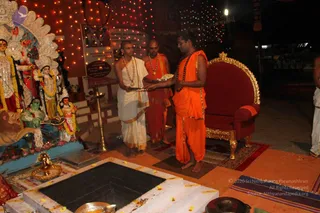
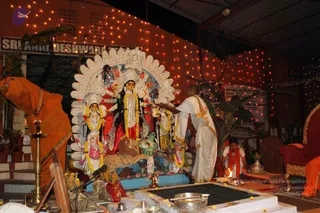
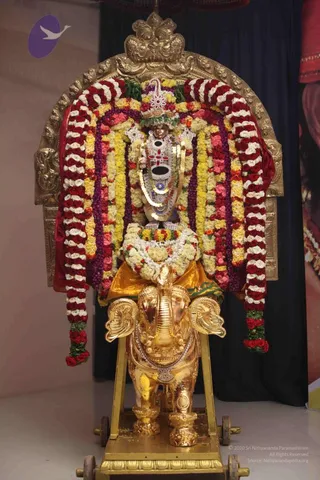
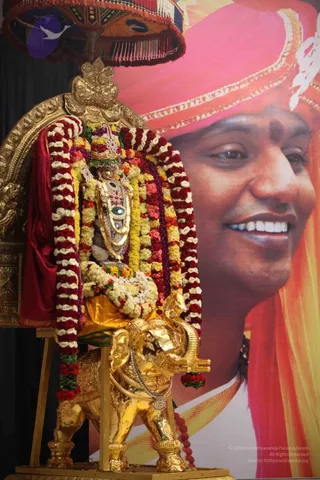
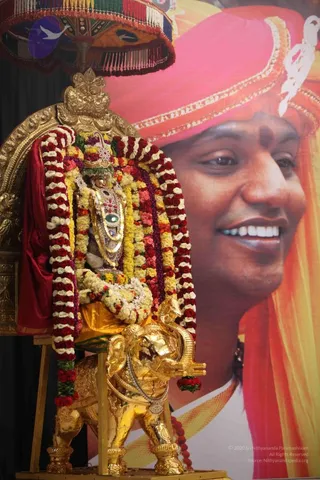
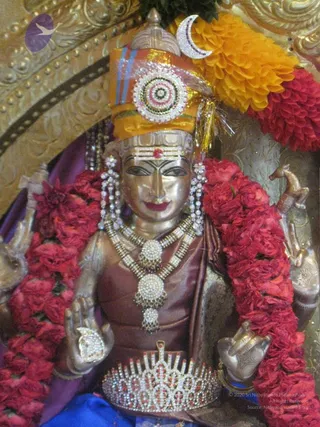
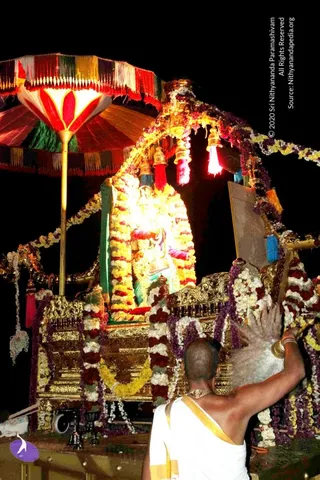
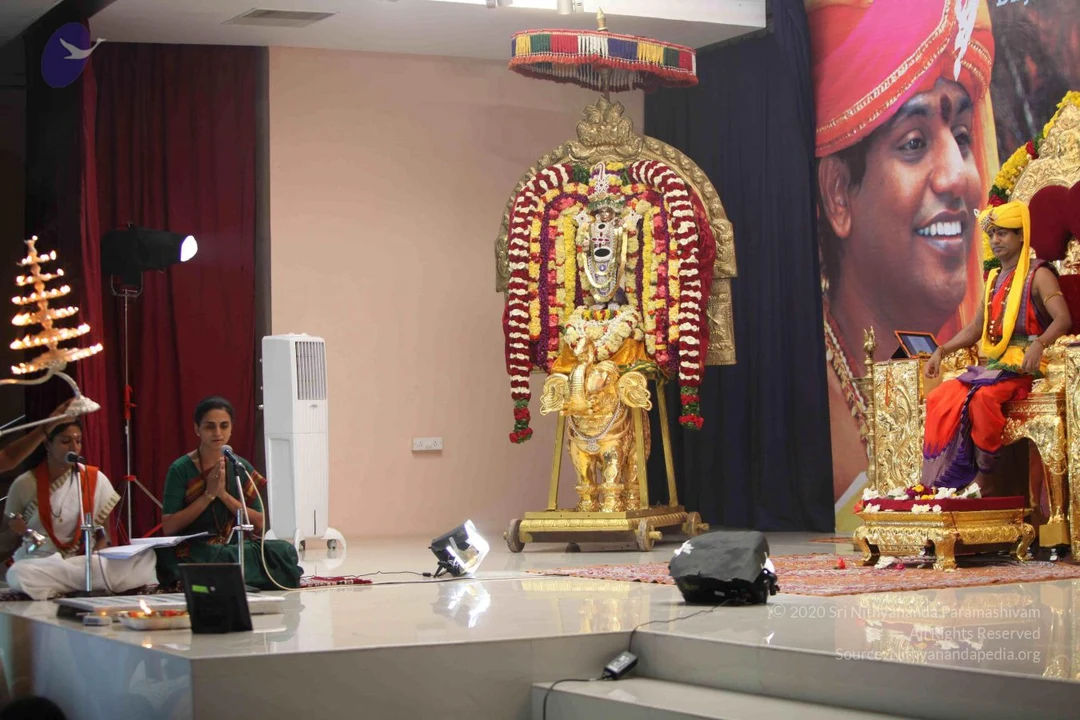
A small deity murti of a standing figure, adorned with a crown, layered jewelled necklaces and a dense garland of red, white, yellow and pink flowers, is set on a golden elephant-shaped chariot-base with wheels. An ornate gold arched backdrop and a multicoloured canopy with tassels sit above it. Behind, a large printed portrait shows a figure in a pink and orange turban and a saffron-toned garment. No physical people are visible. The portrait's identity is not established by any caption in view.A shaved-headed priest in a white dhoti with an orange-bordered shawl and orange waist cloth stands bare-chested at right, raising a lit camphor flame on a silver aarti lamp toward a shrine. Smoke rises from the flame. Before him, on a red-fronted altar with a brass plate, stands a stone shrine with an arched golden frame and orange and red drapes holding deity murtis, including a seated figure and a standing consort. A small red-clad figure stands in an adjacent niche. A silver vessel sits on a carved wooden stand at left, and a stone Nandi bull is visible on the roof ledge.A night-time ritual photograph under an open-sided shelter with a corrugated roof and hanging decorative tassels. A seated figure in saffron-orange robes and a rudraksha mala sits with palms pressed together on a red velvet throne with gold trim, with smoke rising behind him. Beside a stone-edged fire pit, a shaven-headed priest in white dhoti and gold necklace sits and speaks into a microphone, with a brass bell nearby. Brass oil lamps, kalasha pots decorated with mango leaves and flowers, and a deity murti draped in yellow and white garlands stand at left. A second man in white stands near the throne.

October 04 2011

Original wiki page
Contents

Title:

THE SUPREME PONTIFF OF HINDUISM HDH BHAGAVAN SRI NITHYANANDA PARAMASHIVAM

Link to Video:

VideoAudio

Transcript:

Bhagavad Gita

What is Real Heaven?

DATE: Day 39: Oct 4th 2011

The translation oh! Partha, joyful are the warrior who have obtained by chance a battle such as this which has opened the door to heaven. Partha, happy indeed of the kshastriyas warriors who are called to fight in such a battle without seeking. This opens for them the door to heaven.

Two key points- the war was not the option - choice by Arjuna. It was forced on them. They were ready to settle just for five house, not even five village or five street, five house but Duryodhana was not interested. First thing war was forced on them. Second, the word, this word should be understood “which has opened the door to heaven.”

I wanted you to understand this word in a deeper way; normally traditionally they interpret something like Veeraswarga; if somebody dies in the war and he reaches heaven. No. I do not want to attest that concept. I do not want to support it. Here I am going to give the true understanding of this line which Bhagawan says “which has opened the door to heaven.” This war has opened the door to heaven.

Let me describe clearly. Let me give you word by word translation.

Swarga dwaram apaavrtam-wide open this is the key word I wanted to interpret. I wanted all of you to understand. swarga dwaram apaavrtam. Please understand heaven is nothing but living your bio-memory, living your conscious pattern. Please understand patterns forced on you, imposed on you by society, parents, religion, relatives, friends, is different; the pattern you love, you cherish, you enjoy, you assume is different.

The pattern given from outside always people resist, when the pattern comes from inside you feel fulfilled living the conscious pattern. I can give you thousands of examples, thousands of examples. Man who lives his pattern, conscious pattern. I wanted to use the right word. You have the pattern imposed on you by society, by different, different elements which have vested interested on you, which have reason to exploit you; pattern given by them are really, will really be creating conflicts in you. But the conscious pattern with which you are comfortable, you are living, you are flowing; I can say that creates heaven.

Arjuna suddenly says I will leave everything and become a sadhu but his conscious pattern is not sadhu pattern. His conscious pattern which he enjoyed throughout his life is a warrior pattern. This sadhu pattern is forced on him by the society now. Because of the social situations he wants a decent burial to his old pattern; he wants a decent burial for his problems. Please understand there is no such thing as decent burial. Anything you try to burry always crips up and says “aey I am here.” There is no such thing called decent burial. You can’t burry anything. How much ever you try to bury anything decently it will be there like a peeping tomb. "I am here". Even if you bury in all sides he will pop up from your heart in the form of guilt. It will pop up and open his eyes and say "c'mon I am here" .

Arjuna was expecting a decent burial for his problem. He was using retirement, becoming sadhu as a technique. Vivekananda very beautifully says "Wherever this fellows non working, non doing, using religion as a shield, gathering or jumping and dancing, take a stick and beat them. That’s the extreme he is going. He goes to extreme of saying that….. in the north you will see many places in villages these fellows will not do any work, they will not plough their land, do agriculture, do nothing. They will just gather in small, small gathering and sing Hare Rama Hare Krishna Govinda, Govinda, singing and jumping.

It is not that they have devotion so they are practicing. They just want to escape but where will they get food? Always in the bhajan mandalis they will get a good free food. They are there for free food. Vivekananda says don’t ever forgive them. Take a stick, round the whole group and see that not a single fellow escapes and beat them. Even I was shocked how Vivekananda is giving such a strong instruction “beat them.” But I feel these fellows, this non doers using the religion to give a decent burial to their lifestyle of non doing is a crime. All over the world millions do it; millions use the religion as the shield for their non doing.

They have references in every religion. They will pick up some word from Vedas they will pick, then from Bible they will pick up, from Quran they will pick up, from Buddha they will pick up, from Mahavira they will pick up. They are so intelligent; they are more intelligent than any other incarnation. So any incarnation's word they can take it and make their own interpretation. It is called lazy bum vartika, lazy bum bashya; Bashya written by the lazy bums. For any scripture they will write a bashya . See each book will have its own bashyas, Shankar bashya, Ramanuja bashya; different bashyas. Like that these fellows also have their own bashyas; lazy bum bashya. They know how to twist all the statements of all the Masters and make it into a lazy bum theology. They can go on talking, justifying why they are non doers. Why they don’t move their body. Why they don’t create. I tell you heaven is flowing with your natural pattern and expanding.

Here Arjuna’s natural pattern is warrior. Let me tell you how to find out your natural pattern, which makes you feel you are something more than what you are, adding to you. I have seen sometime when you take up some difficult project and complete it, when you bring it you feel wow I have done it. I did it. That feeling is heaven. The feeling of fulfillment which comes to you after tremendous creativity, expressed through you by your natural law of expansion. Swadharma means natural law of expansion.

Photos
Photos Of The Day:

Temple
BGSatsang
KumariPuja

Procession

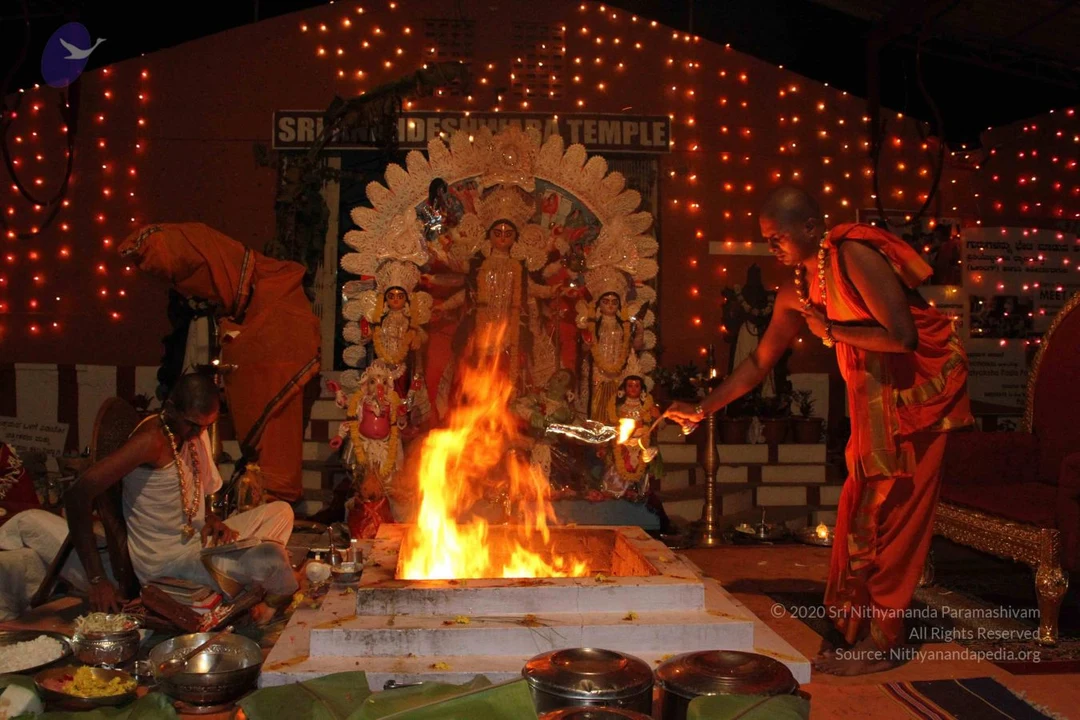
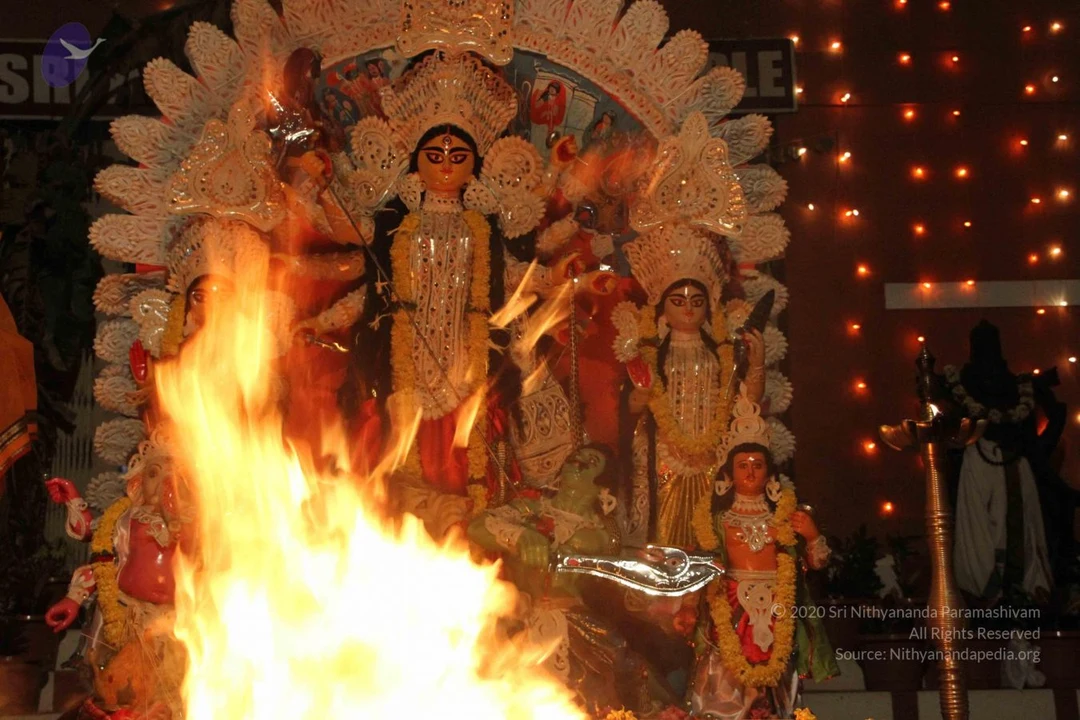
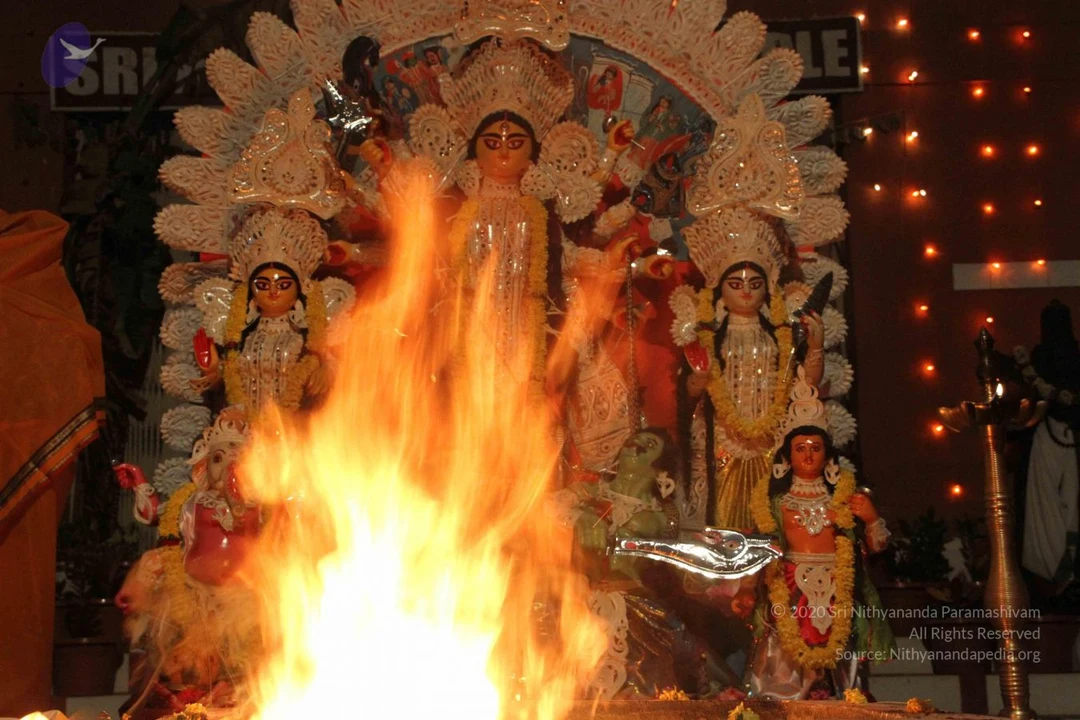
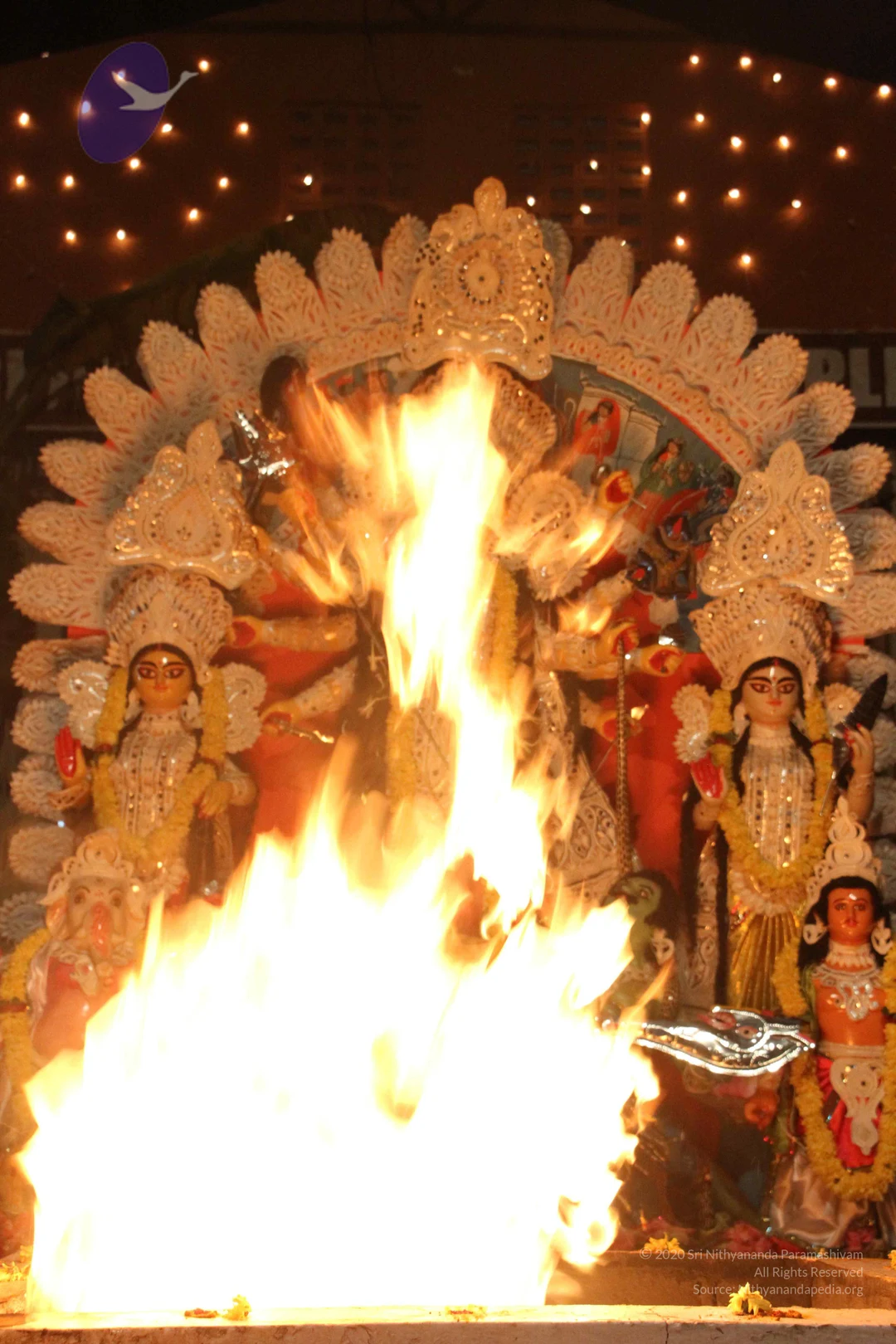
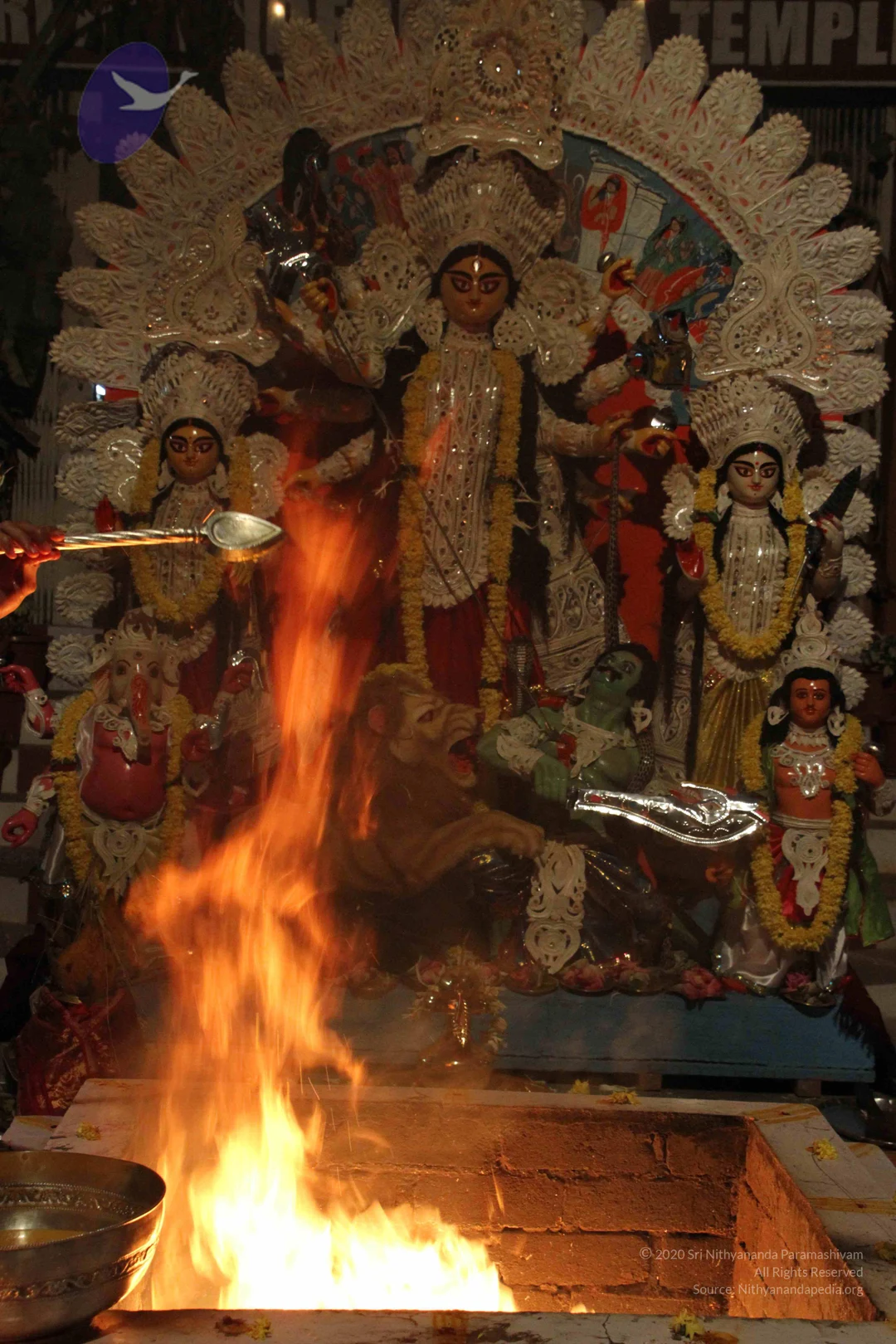
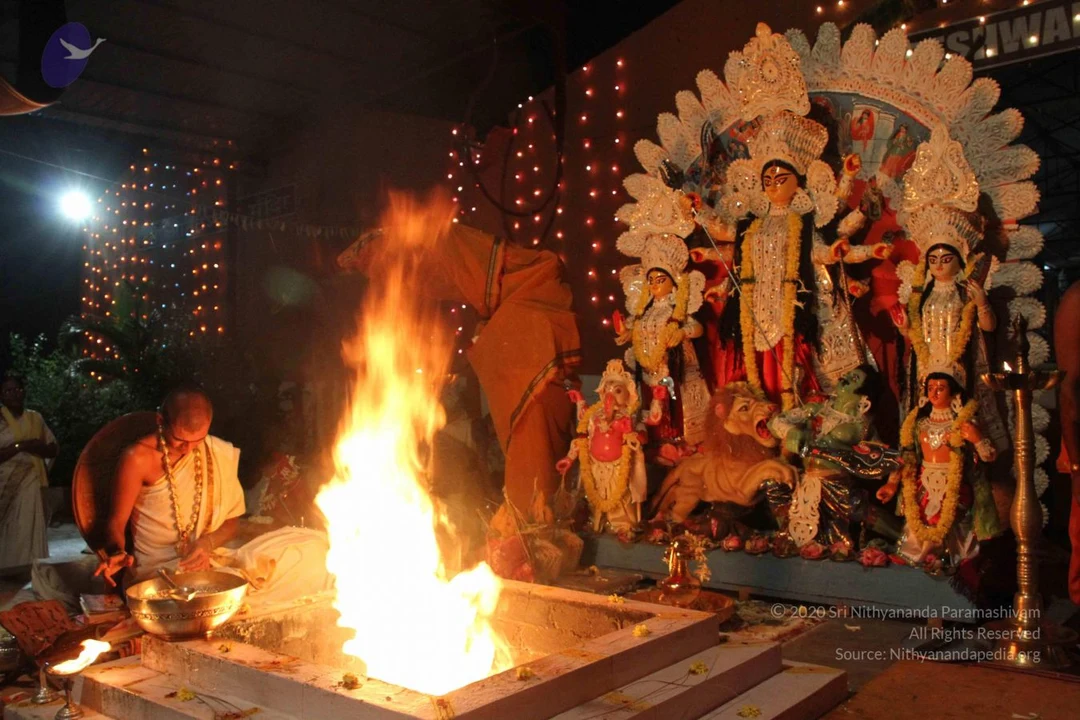
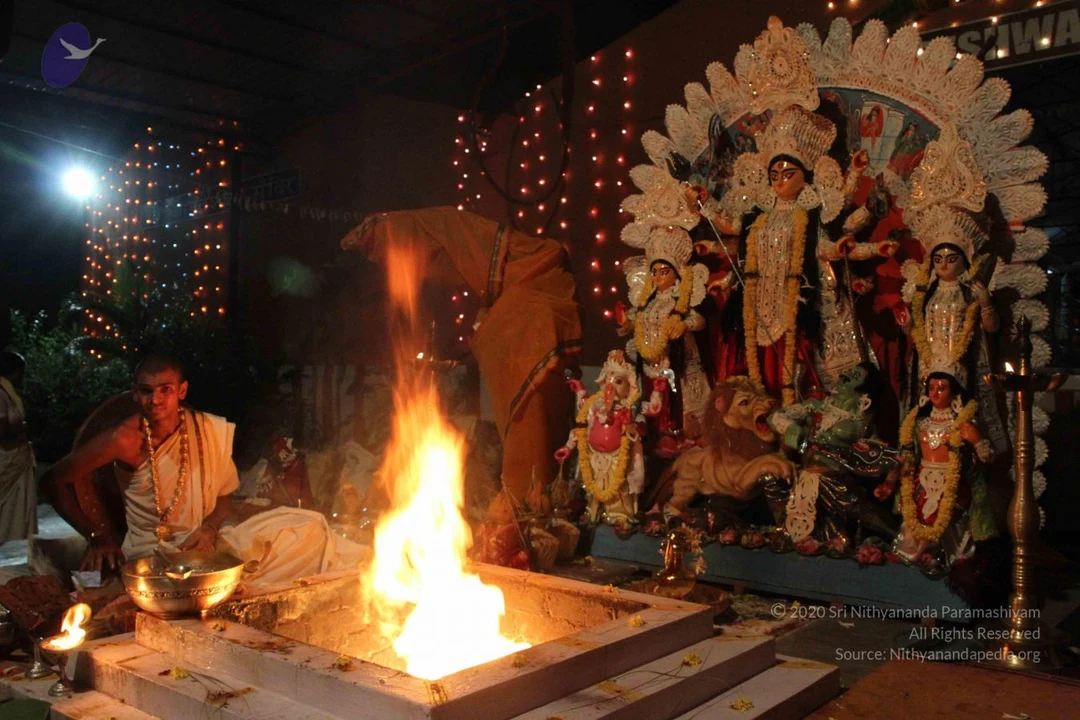
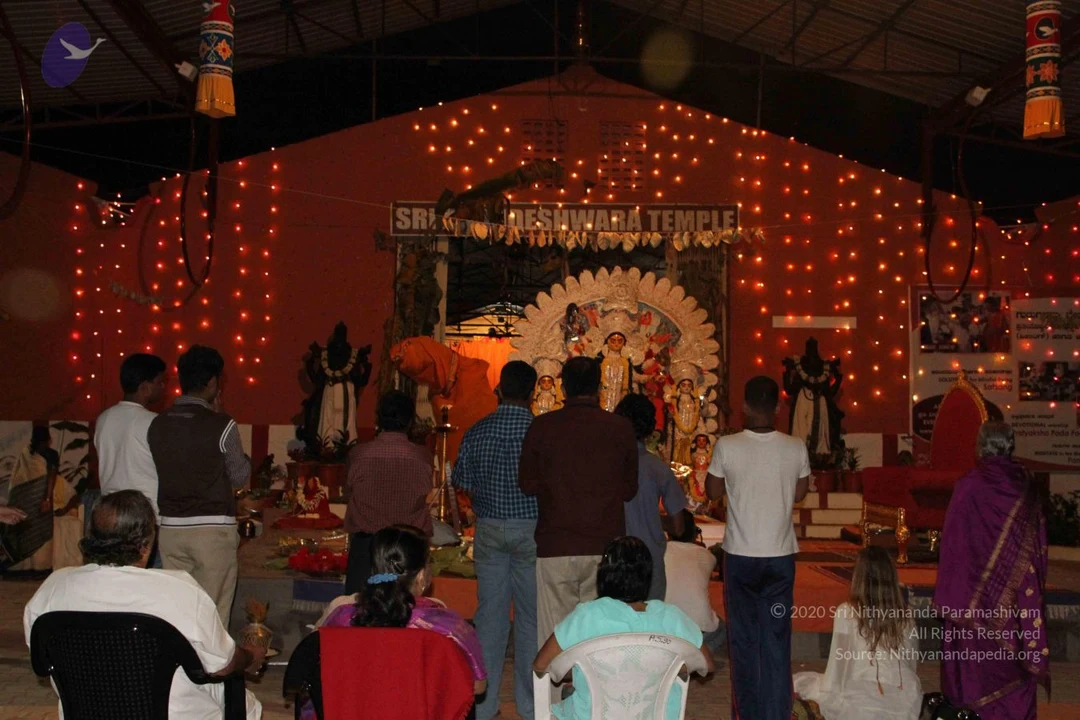
ChandiHoma

NavaratriAlankar

NavaratriMalaysia

Photos Of The Day:

Procession

Photos from this day

View all 242 photos

Photos

21 photosSource gallery
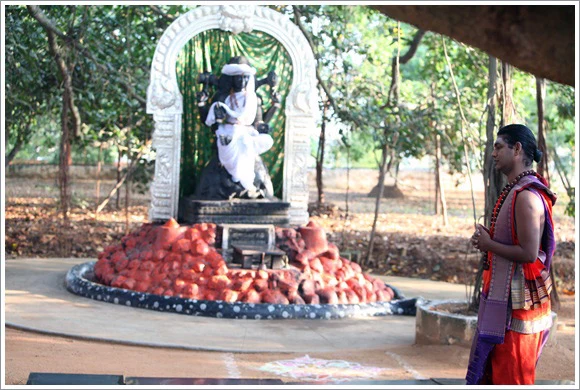
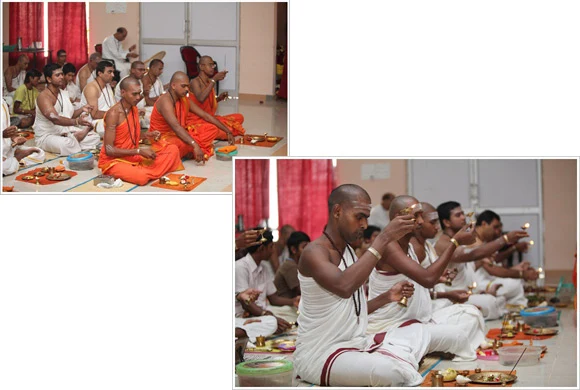
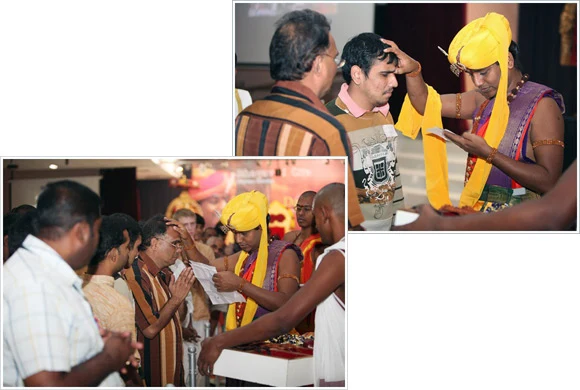
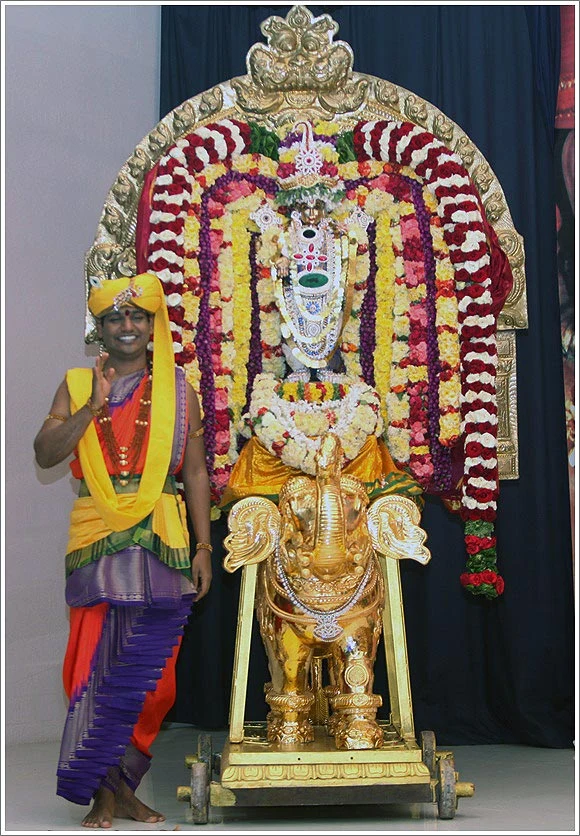
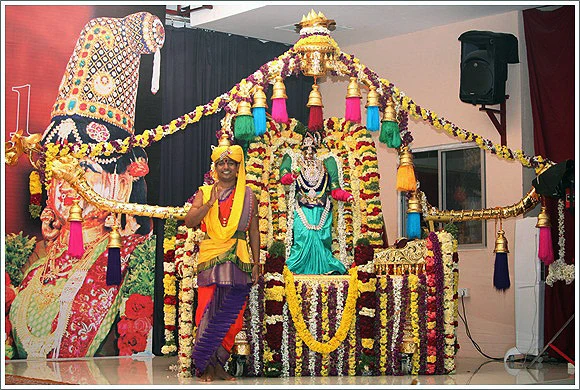
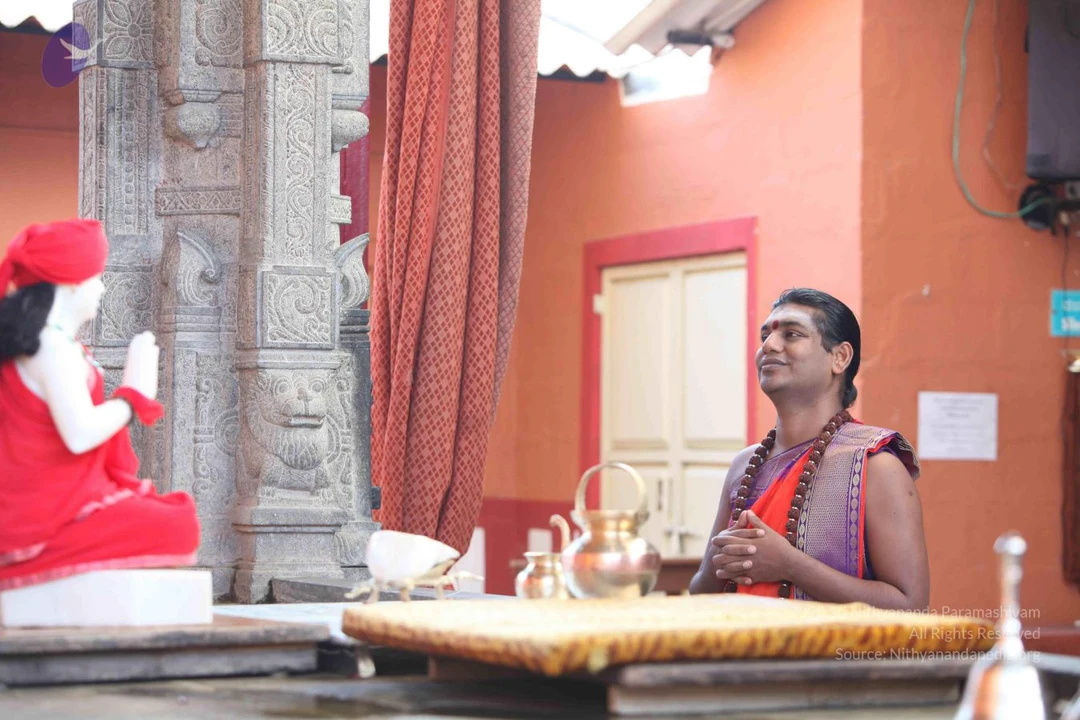
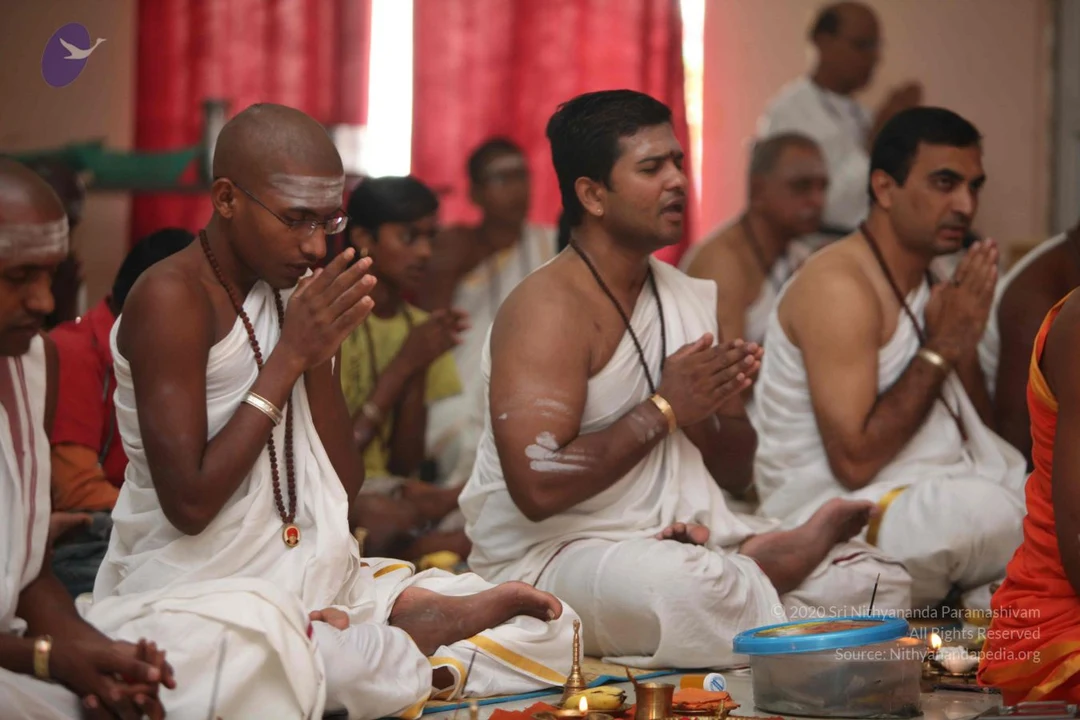
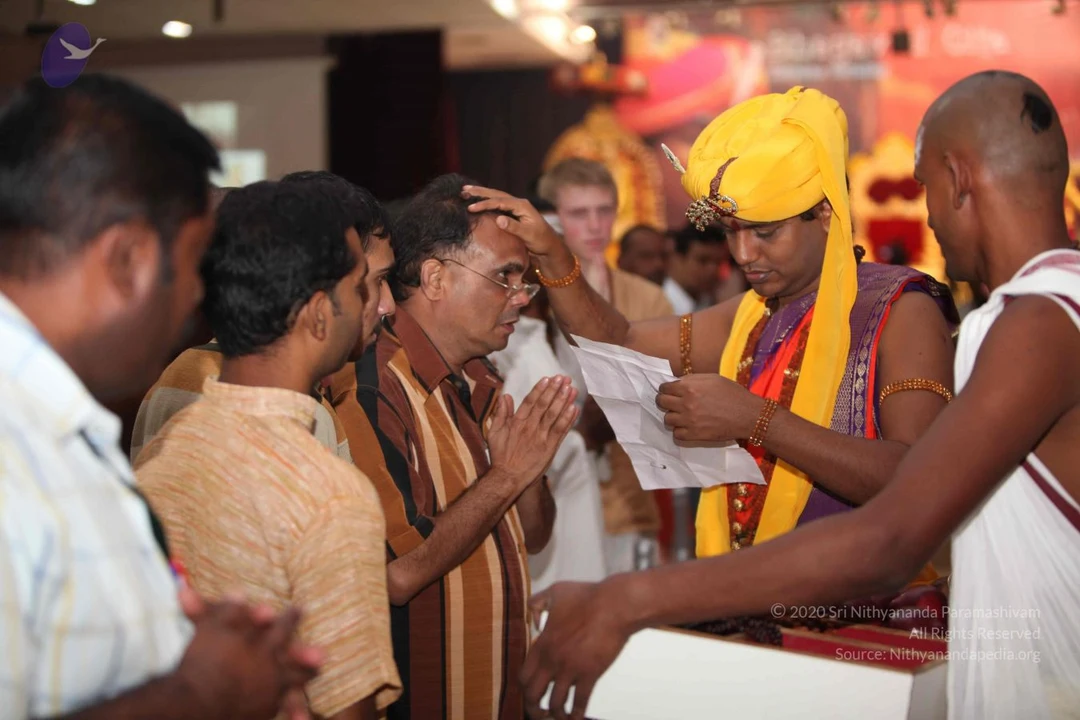
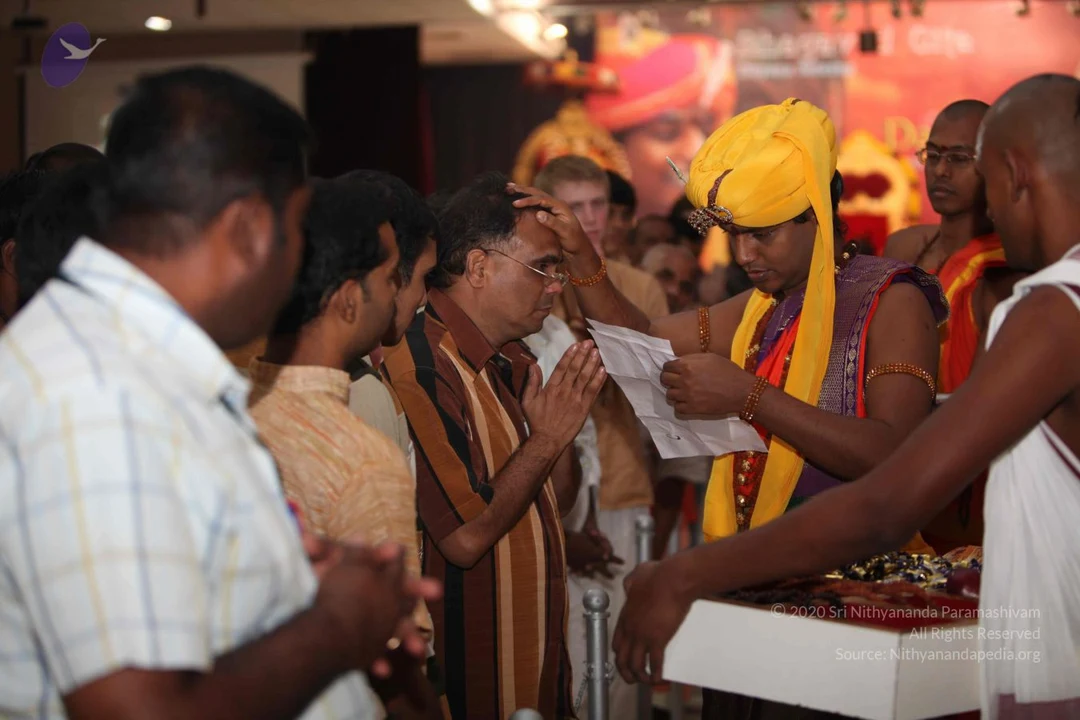
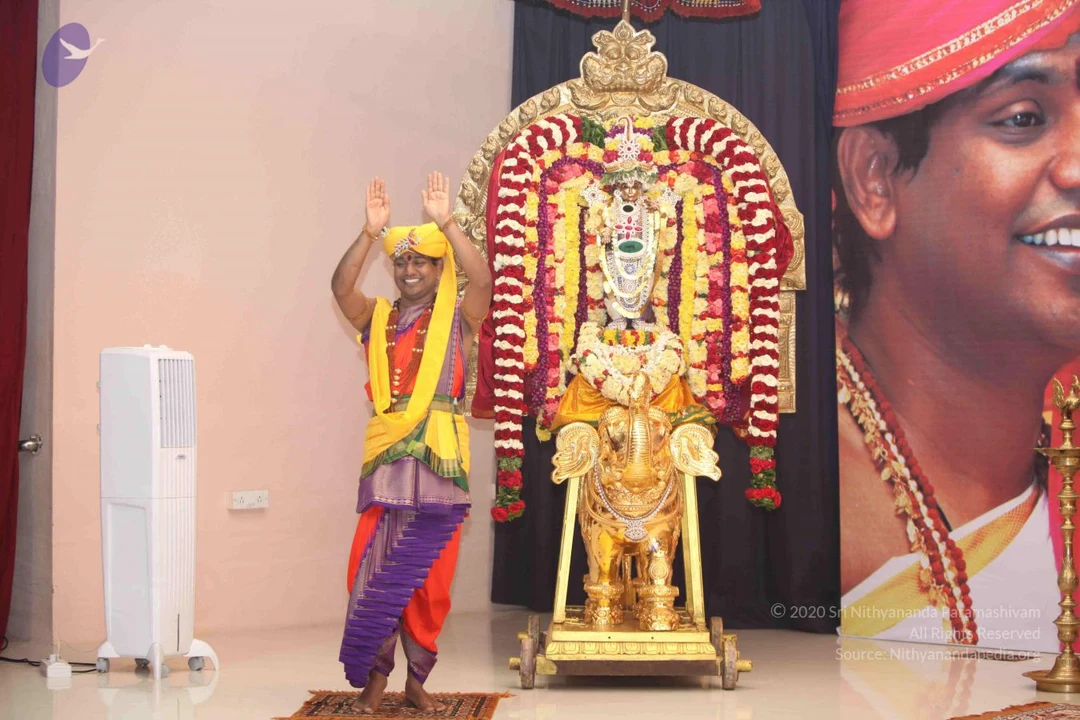
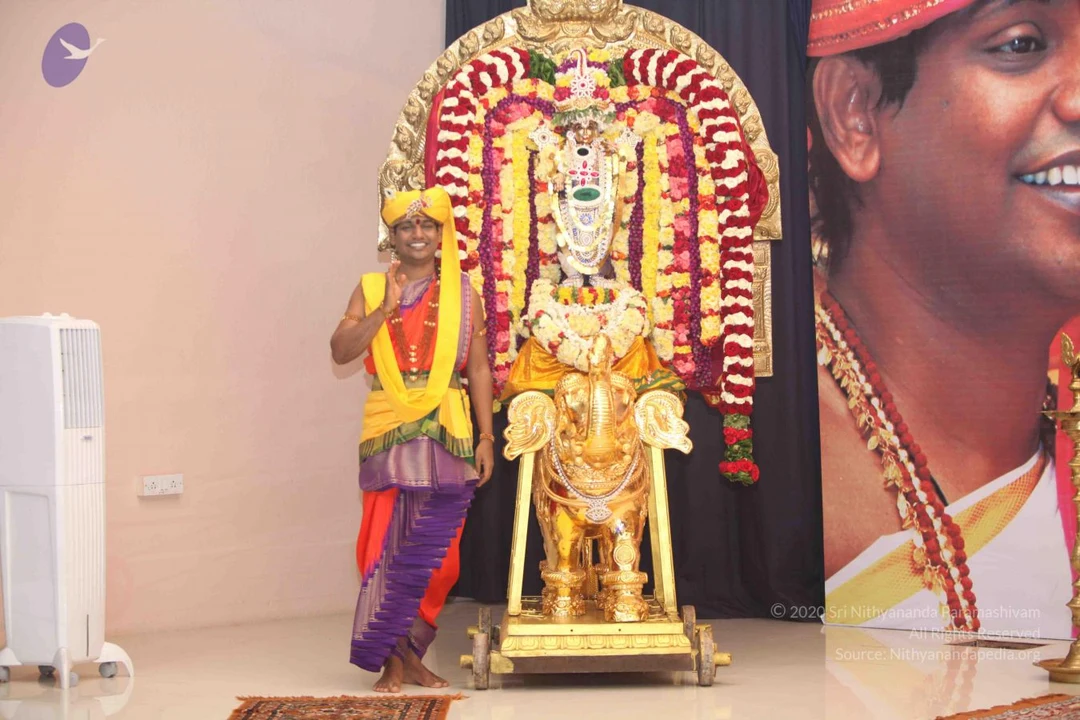
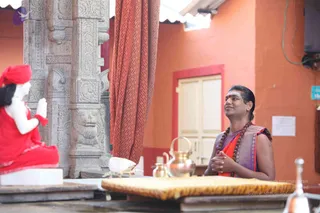
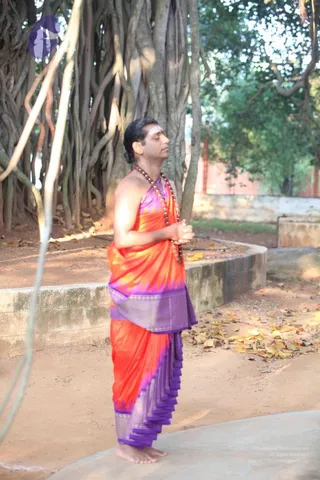
A photograph of a man seated on a low wooden platform in a courtyard with orange-painted walls, a carved stone pillar and a red curtain behind him. He wears an orange-saffron garment with a purple-and-gold shawl and a beaded rudraksha mala, and holds a small object at his chest with eyes closed. In front of him on the platform sit a brass kalasha-style pot, a brass bowl and a small metal jug. A seated white figure draped in red, with a red cloth on its head, sits to the left. Brass bells lie in the foreground.Outdoor photograph of a shrine in a shaded grove. A dark stone deity murti in white ornate dress and crown stands beneath a white arched frame with green drapery, on a raised platform heaped with red-orange offerings. A standing man at right wears a saffron-orange garment, a purple shawl and a rudraksha mala, holding his hands together in prayer. Sandy ground and a small kolam pattern lie at the base.A two-panel collage of a group puja in a hall with pink curtains. In the left panel, several shaved-headed sannyasis in saffron-orange robes sit cross-legged on a white floor, each with a brass plate of offerings and a rudraksha mala. In the right panel, men in white dhotis and bare upper bodies sit in rows, raising small brass lamps and offering vessels, with brass plates of flowers and oil lamps before them. The graphic shows several participants in a collective ritual rather than a single featured figure.Two-panel collage of photographs from a ceremonial event. The upper panel shows a priest in a yellow turban and purple-and-gold ceremonial dress placing a white marking on the forehead of a man in a pink collared shirt, while a man in a dark jacket stands behind them. The lower panel shows a row of devotees with palms pressed together, several in striped shawls and light shirts, facing a priest in a yellow turban and purple vestments who holds a small sheet, with a red-cloth offering table and a second priest in yellow nearby. a person's presence is not clearly identifiable in either panel.A barefoot man in a yellow and orange turban and a multicoloured dhoti with a purple-and-yellow shawl stands at left, raising one hand in a blessing gesture, wearing a red-orange beaded necklace and bangles. Behind him a large deity murti with a white face and decorated crown is adorned with dense garlands of red, white, yellow and orange flowers. The murti sits on a golden elephant-shaped seat mounted on a gilded wheeled cart, under an ornate gold arch against a dark blue drape. The setting resembles a temple or festival stage.A decorated stage with a garlanded deity murti in a green and gold saree-style dress seated on an ornate golden throne-like platform framed by a canopy of marigold and tuberose garlands with pink, green and blue tassels. A standing man in a yellow headwrap and saffron-red top with purple dhoti stands beside the platform with one hand raised near the throne. Behind them a large painted backdrop shows a figure in a red and white sari and a tall decorated headdress, with floral arrangements in red and white. A speaker sits at the right edge.

Temple

16 photosSource gallery
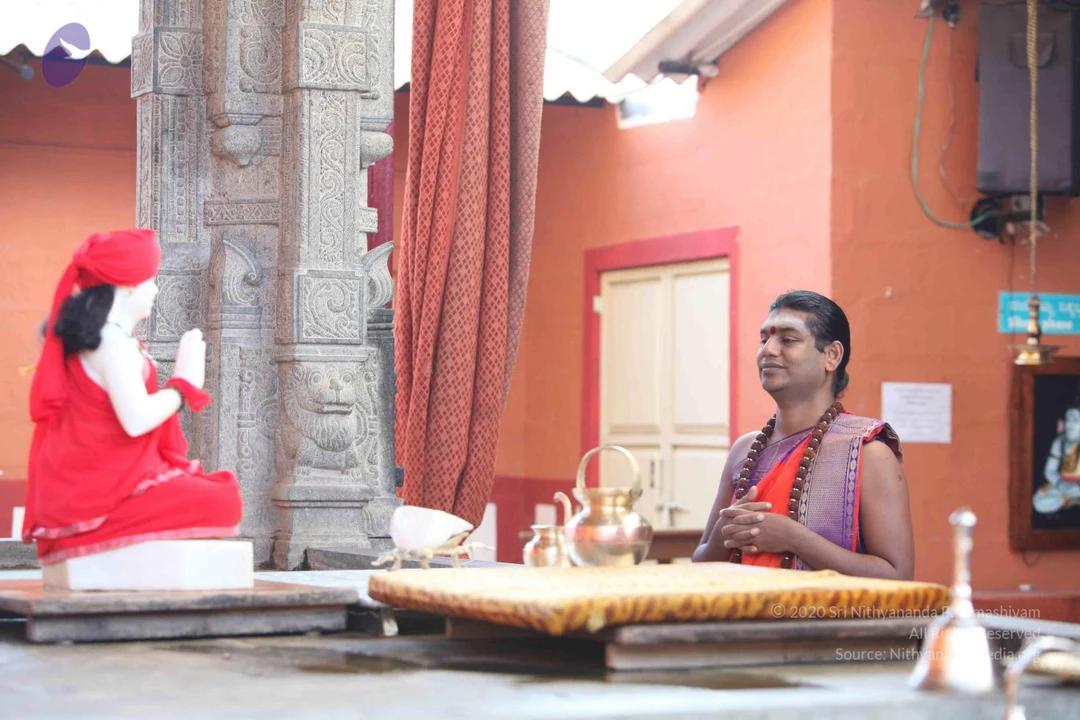
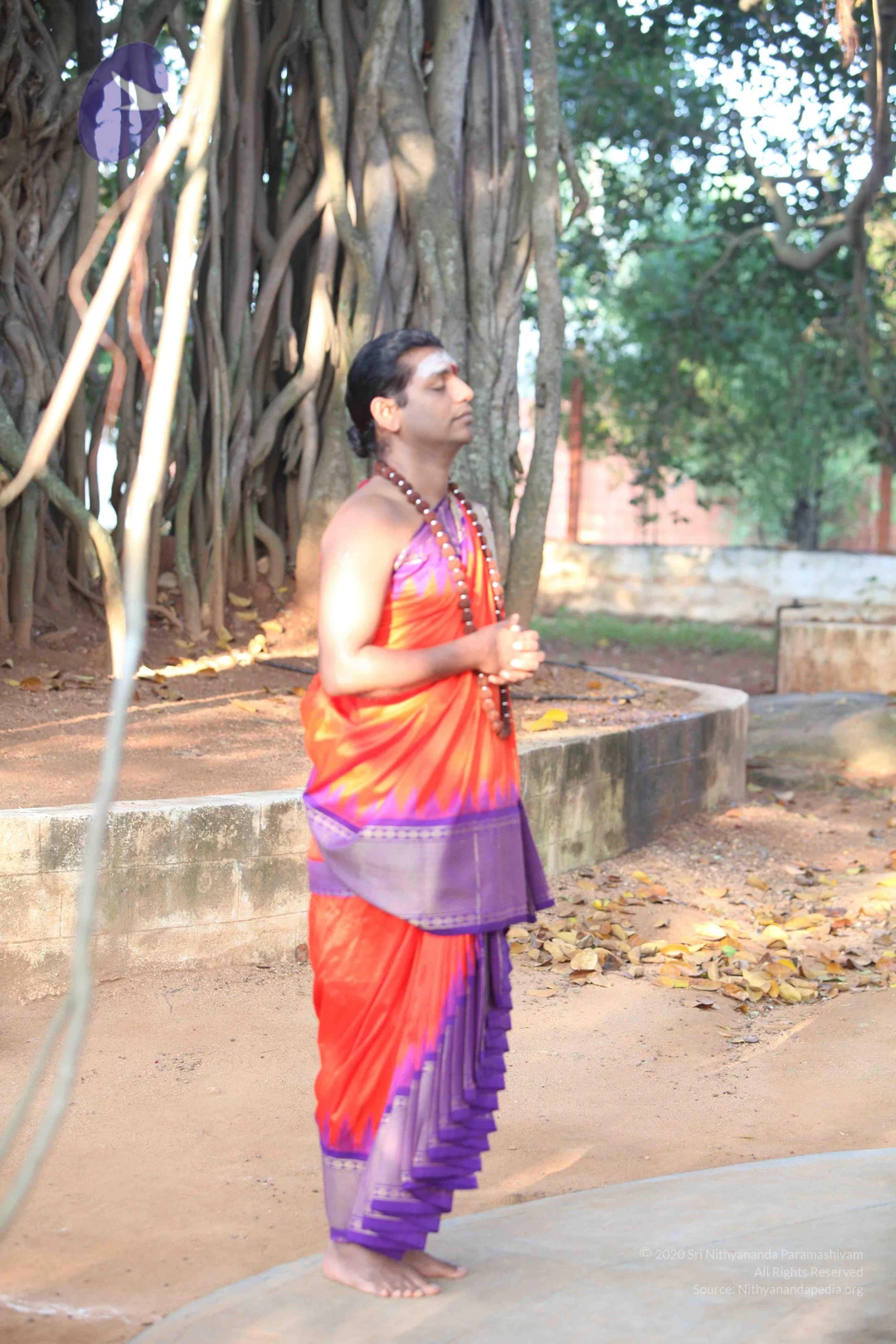
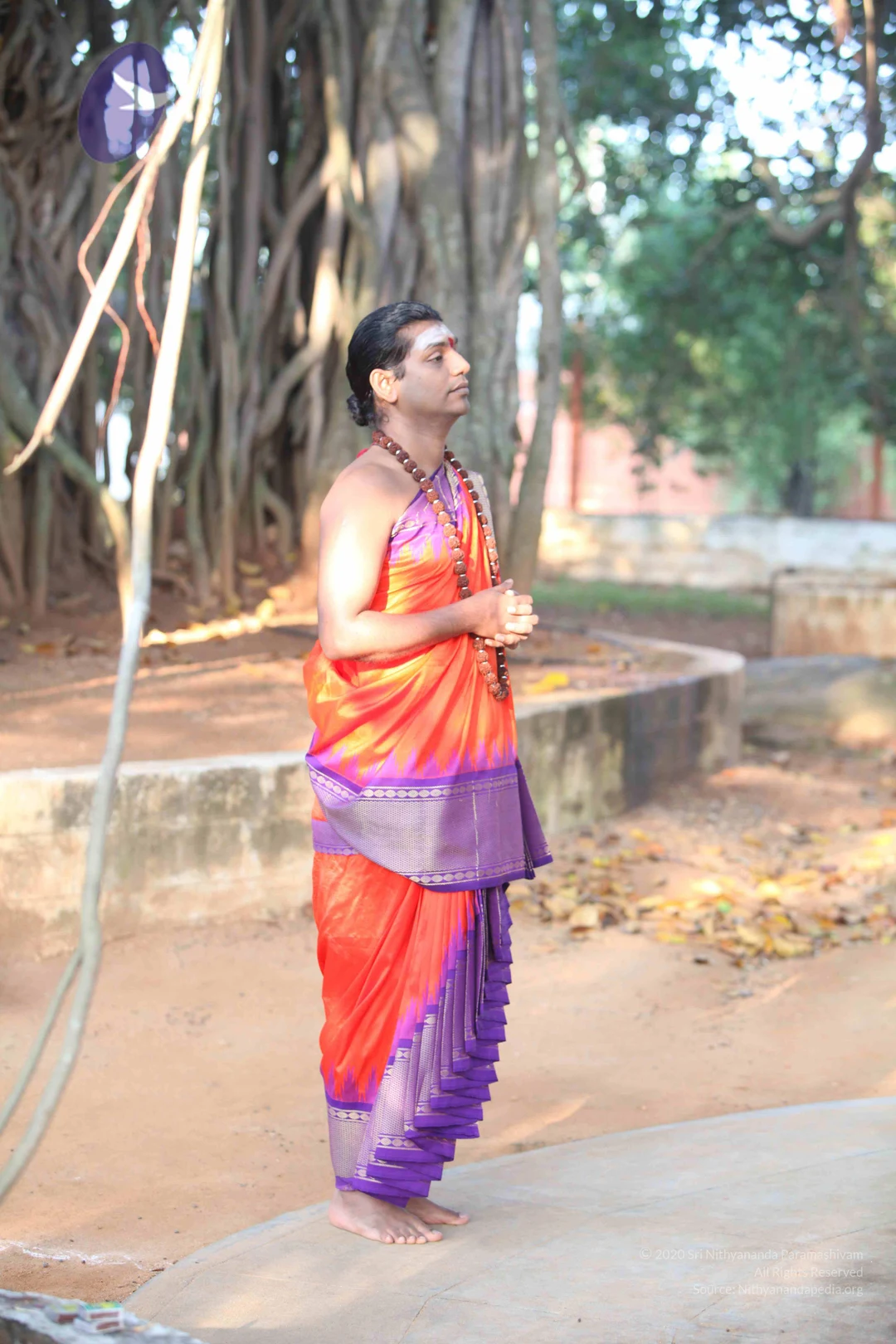
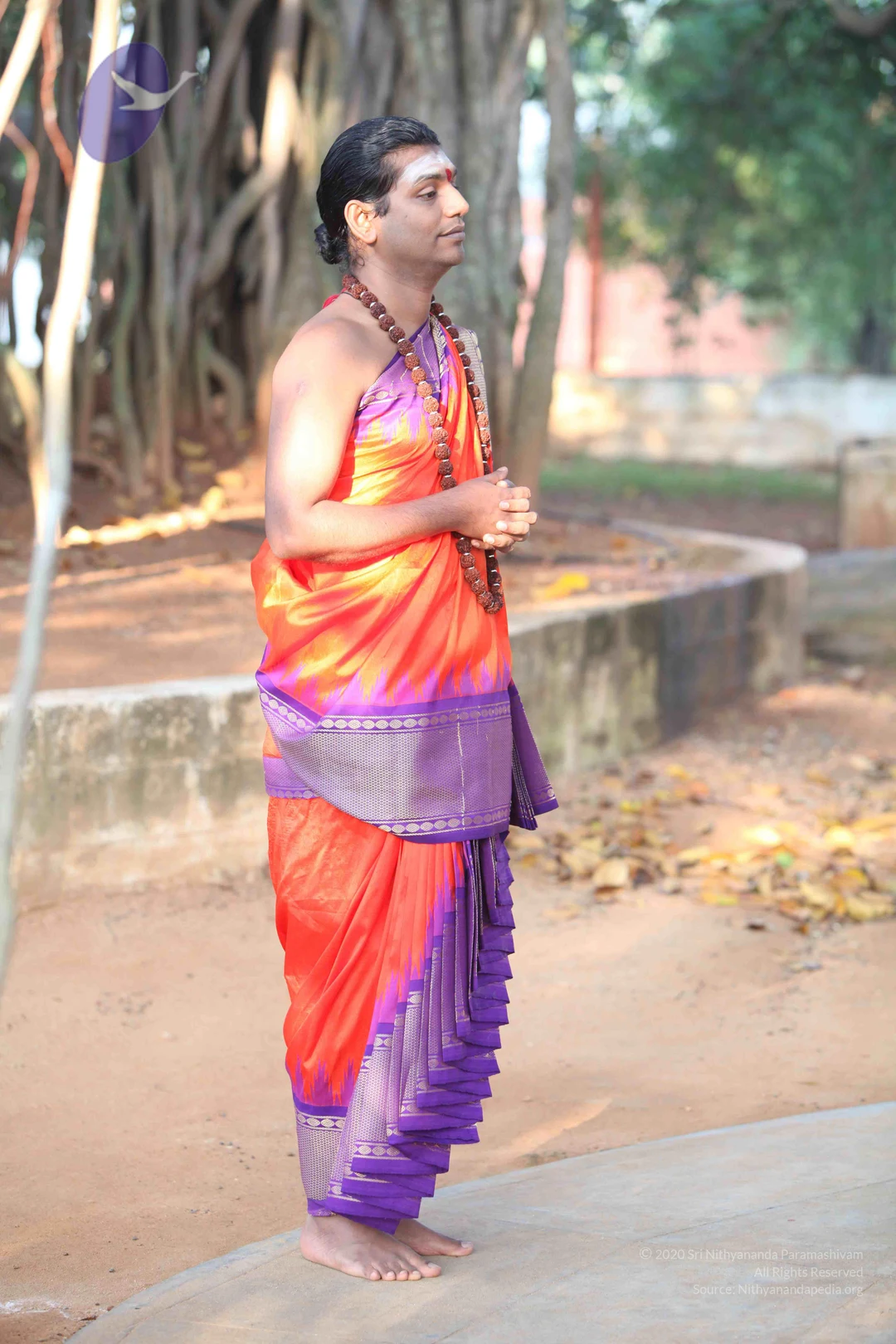
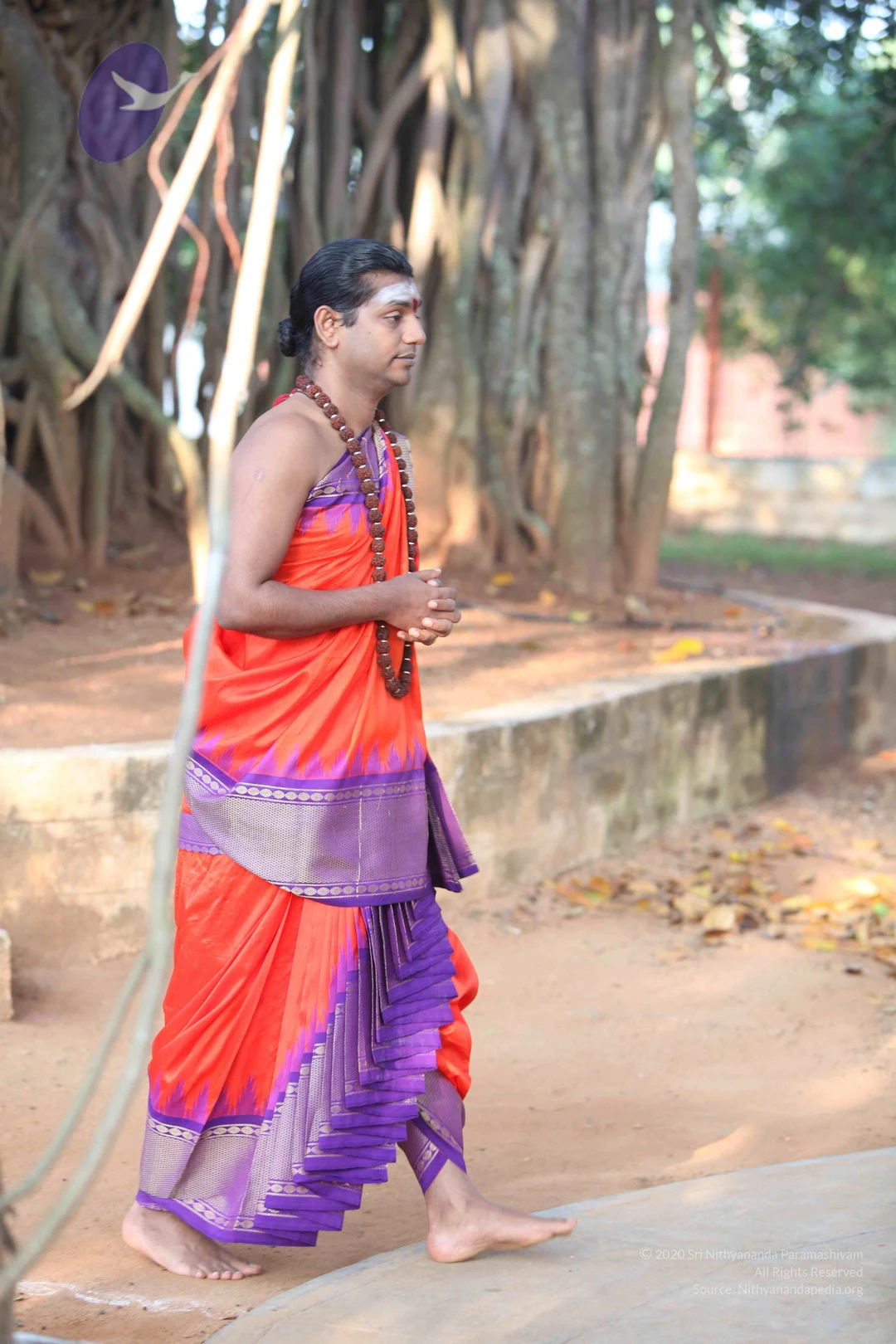
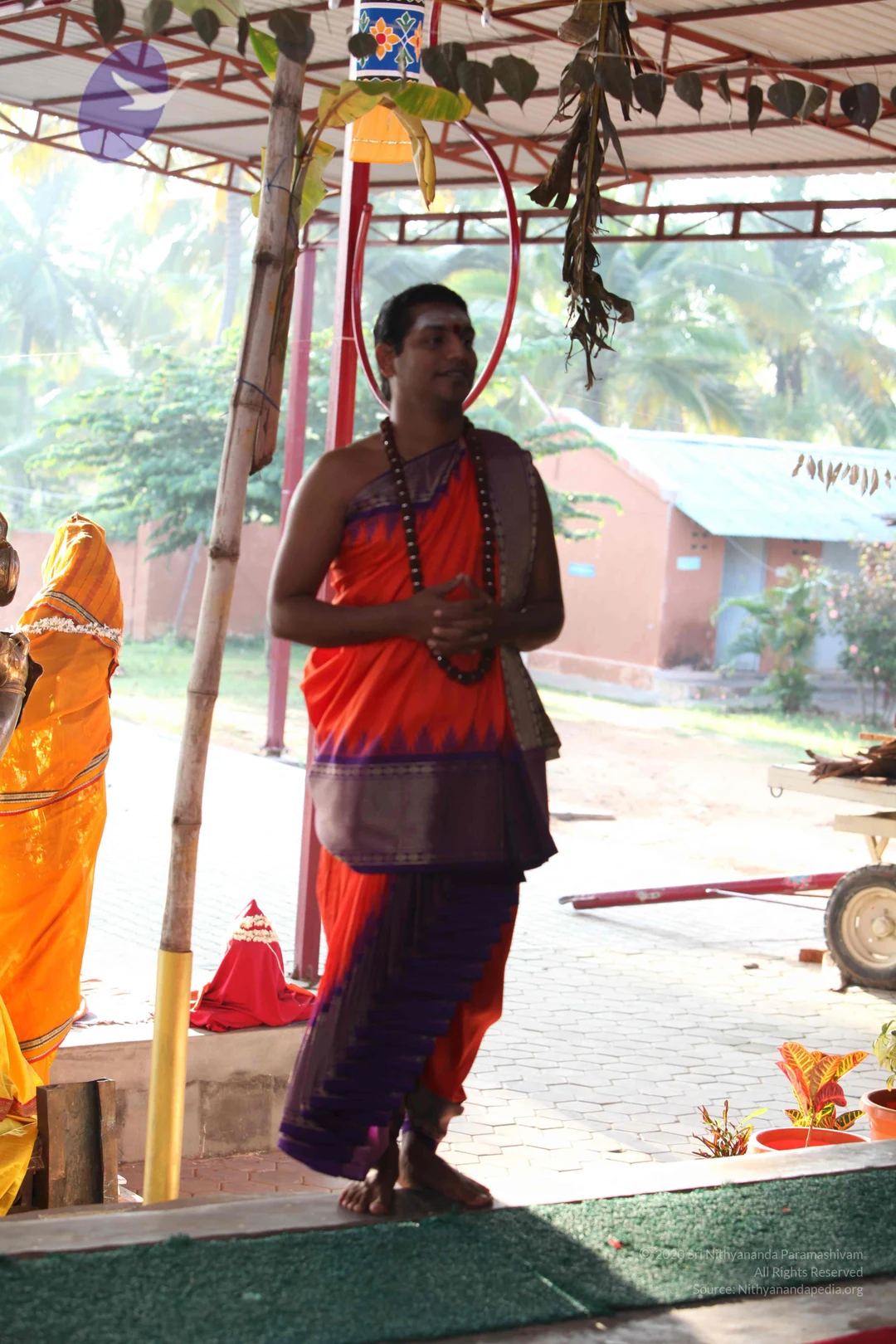
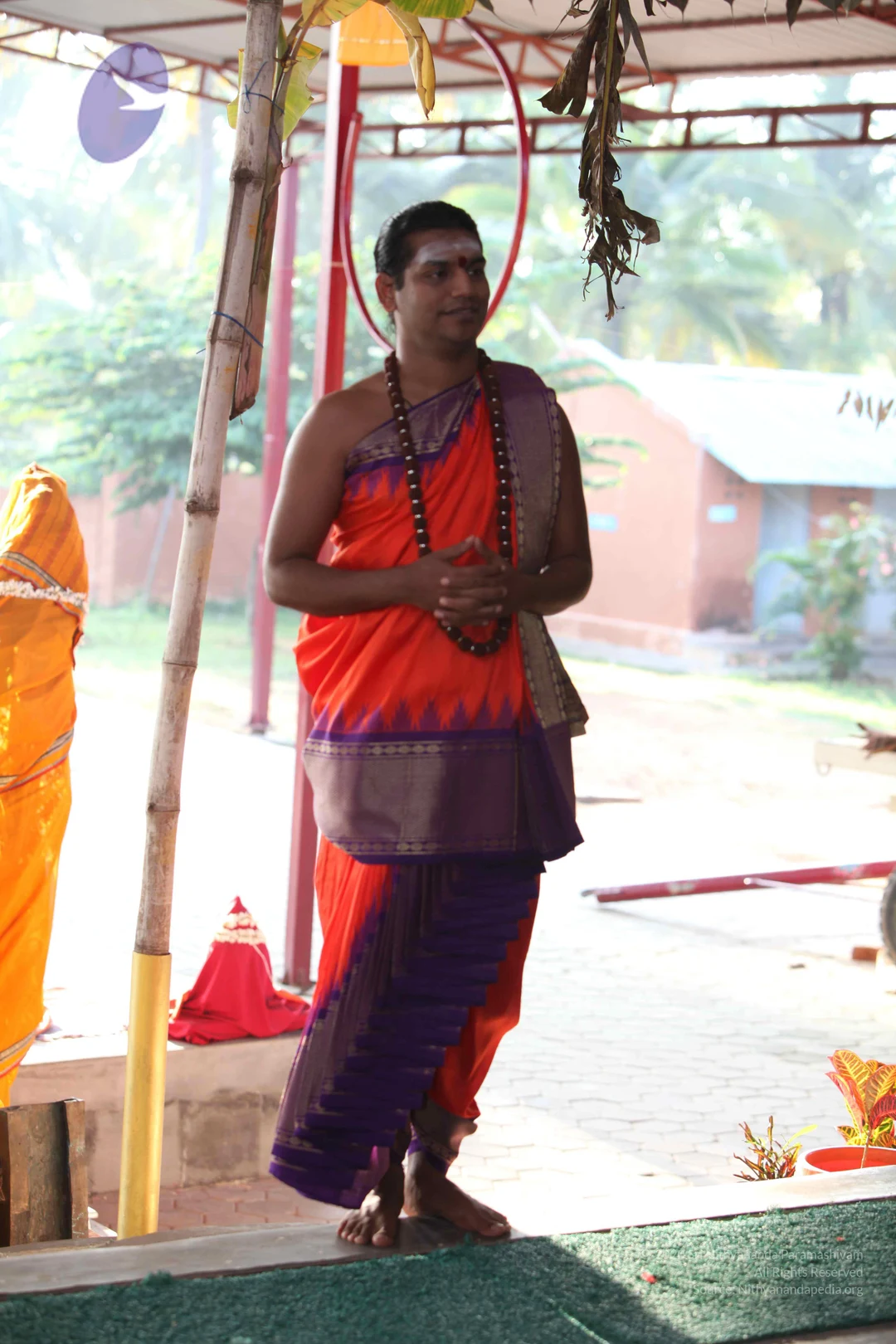
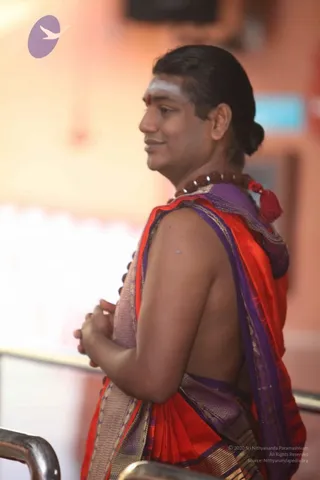
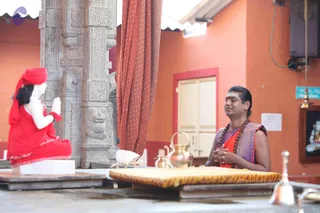
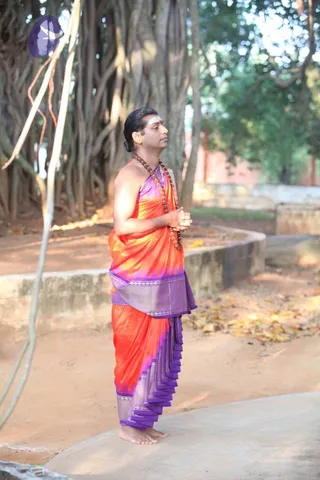
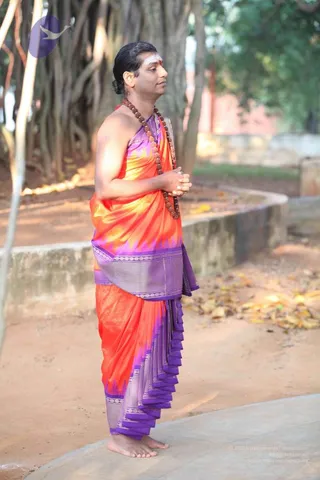
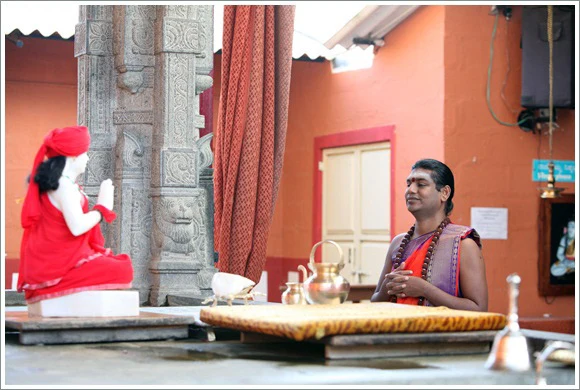
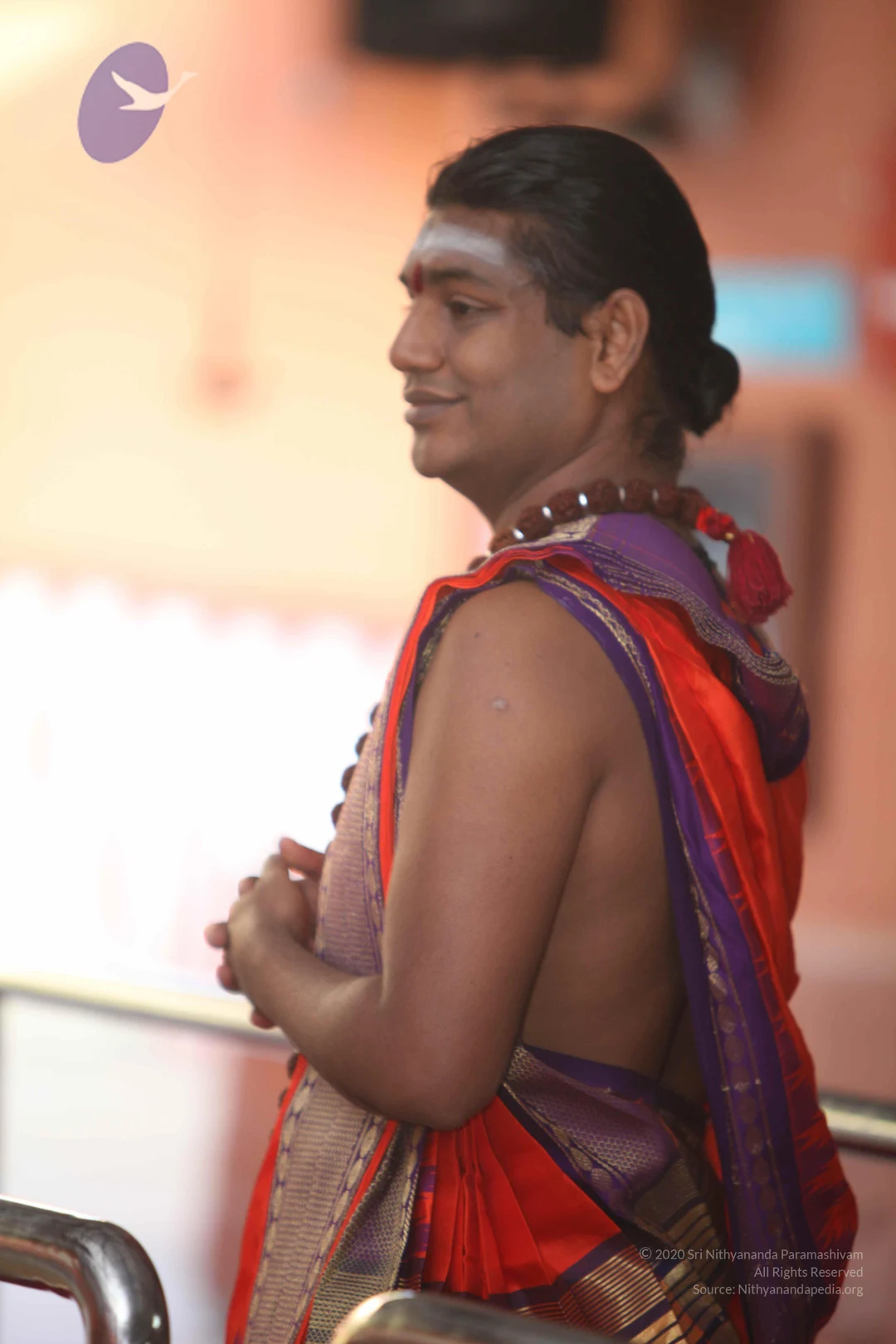
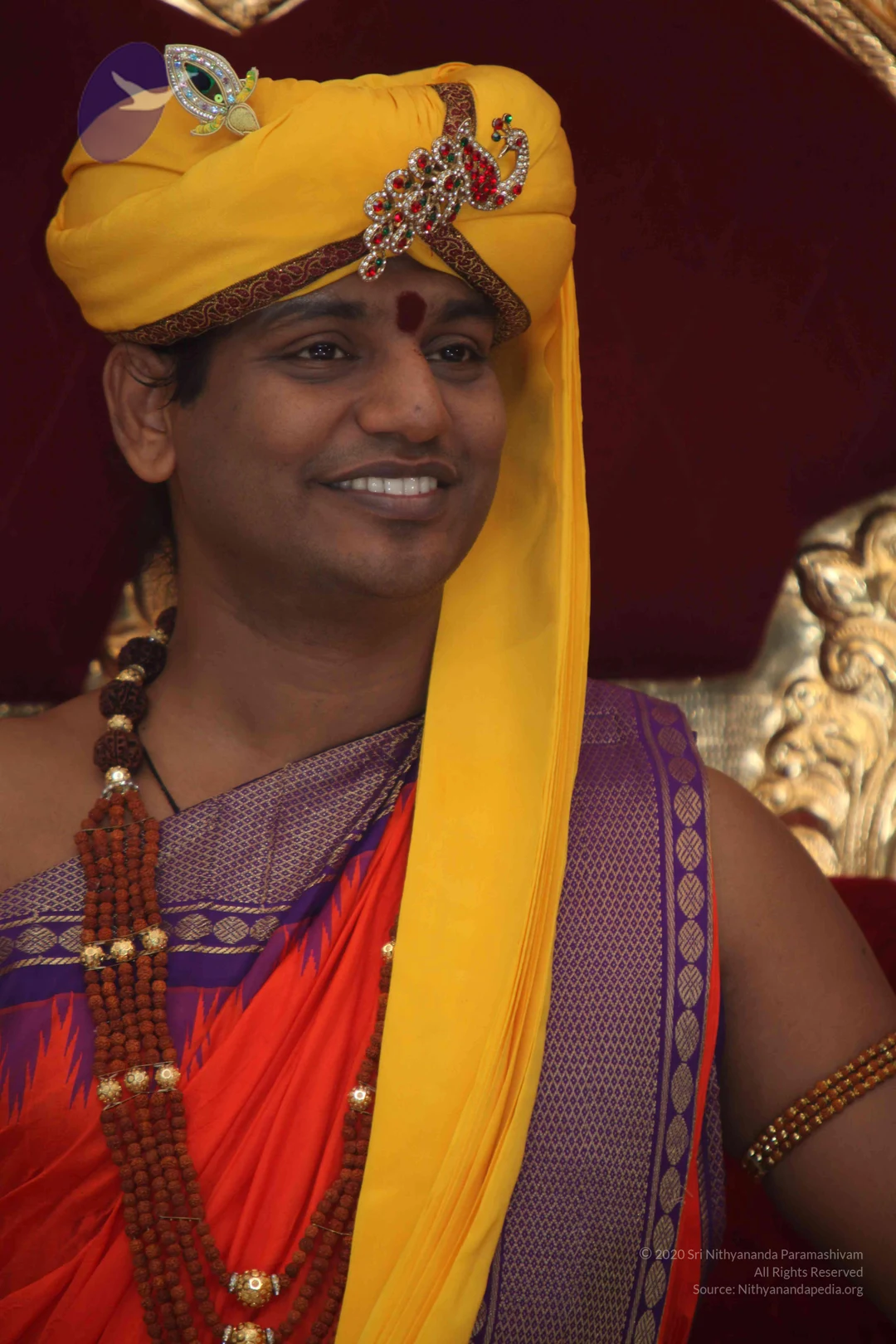
Photograph of a man in profile, shown from the shoulders up and partly from behind, standing near a metal railing. He wears a red-orange silk garment with purple borders and gold zari patterning, draped over the left shoulder and bare on the right shoulder. A rudraksha mala with a red tassel hangs at his neck. He has a white horizontal tilak with a red dot on his forehead, hair swept back into a knot, and his hands are folded in front of him. The background is a soft orange and pink blur.A man with short dark hair and a red bindi sits at a low table in an orange-walled courtyard, hands pressed together in namaste and smiling upward. He wears an orange cloth over the shoulders and a purple-and-gold bordered garment, with a rudraksha mala around his neck. On the table stand a brass kettle, small brass vessels and a white cloth. To the left, a red-robed white statue with a red turban sits with palms joined, beside a carved grey stone pillar. A red patterned curtain hangs behind, and a white door is set in a red frame.A seated man in a temple courtyard with orange-walled surroundings and a carved stone pillar. He wears a purple-and-saffron shawl over bare shoulders, a rudraksha mala necklace, and a red bindi, with hands joined in front of him. Before him is a brass pot, a small brass vessel, a shell, and a brass bell on a yellow cloth-covered seat. To the left stands a white-and-red statue of a seated figure with raised hands, and a brass oil lamp hangs on the right wall beside a framed picture. The scene is an open-air shrine area with a red curtain hanging behind the pillar.A photograph of a single man standing barefoot on a paved circular platform beneath a large banyan tree with many hanging aerial roots. He wears an orange and magenta silk garment with purple woven borders, draped over one shoulder and wrapped around the body, and a long rudraksha mala hangs to his waist. His hair is swept back in a bun, he has a white vibhuti mark with a red kumkum dot on his forehead, and his palms are pressed together at his chest with eyes closed in prayer. Dry leaves cover the ground and a low stone wall lies behind him. Appearance cues are consistent with the page's a person label, including the rudraksha mala and saffron-toned clothing, but the face is not clearly enough visible to confirm.A standing man in a rust-orange and purple silk saree-style draped garment with gold zari borders faces right beside a large banyan tree with hanging aerial roots. He wears a rudraksha mala necklace, a white and red tilak on his forehead, and has his hair tied back, with hands pressed together in front of his chest and bare feet on a concrete platform in an outdoor garden with fallen leaves.A standing man in a sunlit outdoor courtyard beside a large banyan tree with aerial roots. He stands barefoot on a pale concrete edge with his palms pressed together in front of his chest in anjali mudra. He wears an orange and magenta silk veshti with a wide purple and gold woven border, draped over the shoulder and falling in pleated folds to the feet, with a long rudraksha mala of brown beads around his neck. A white tilak with a red bindi marks his forehead, and his dark hair is swept back into a knot. A low concrete wall curves behind him and dry leaves lie on the ground. The appearance matches the a person candidate in visible cues (rudraksha mala, ornate saffron-toned clothing, swept-back hair), but the face is not clearly visible enough to confirm identity, so this is marked unsure.

BGSatsang
55 photosSource gallery
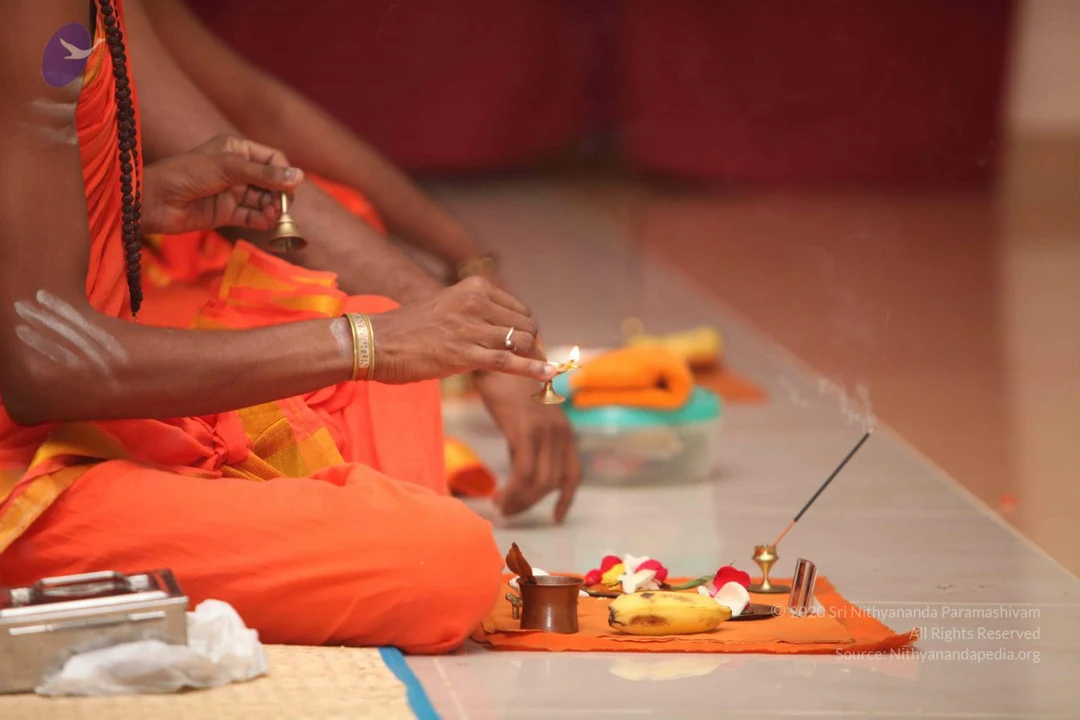
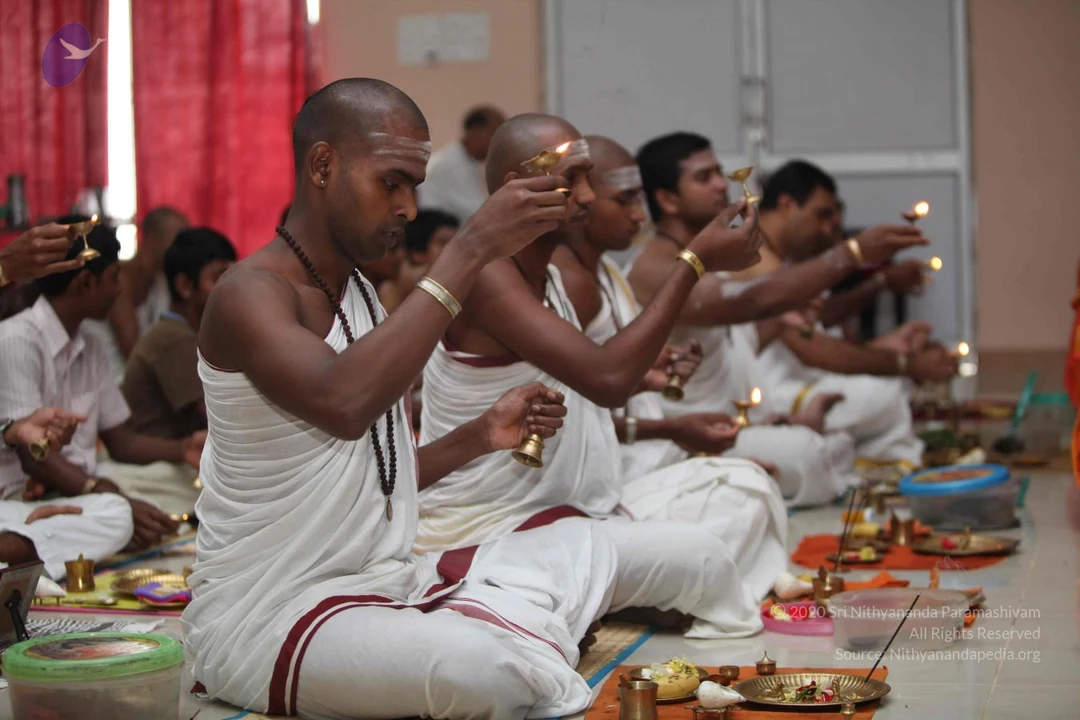
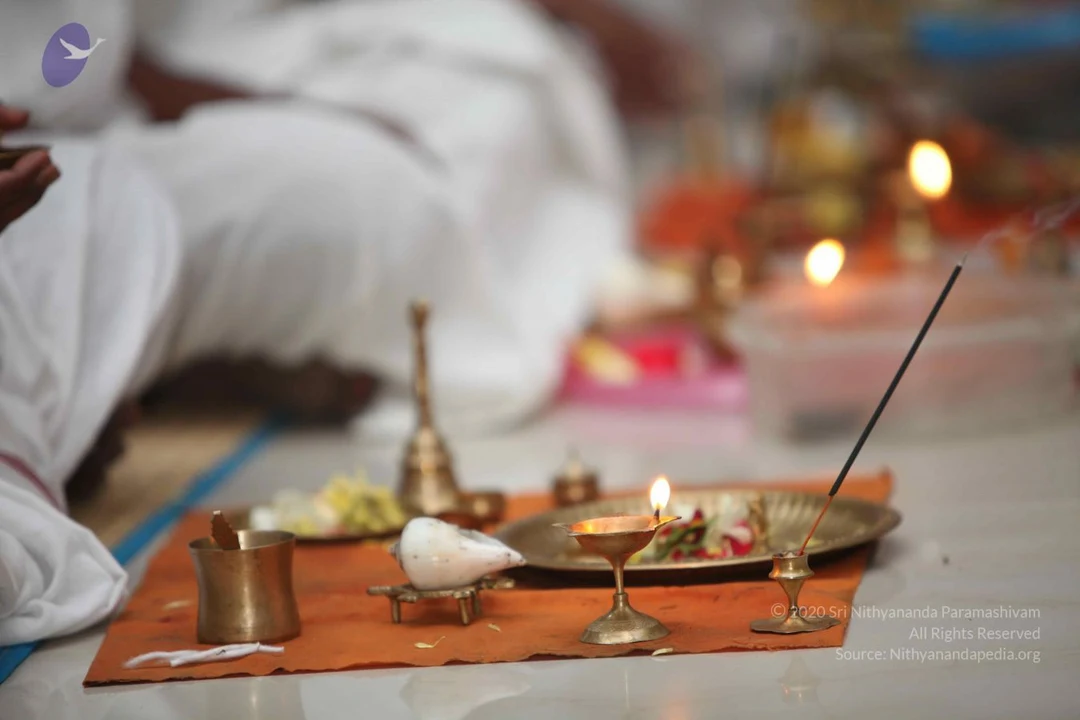
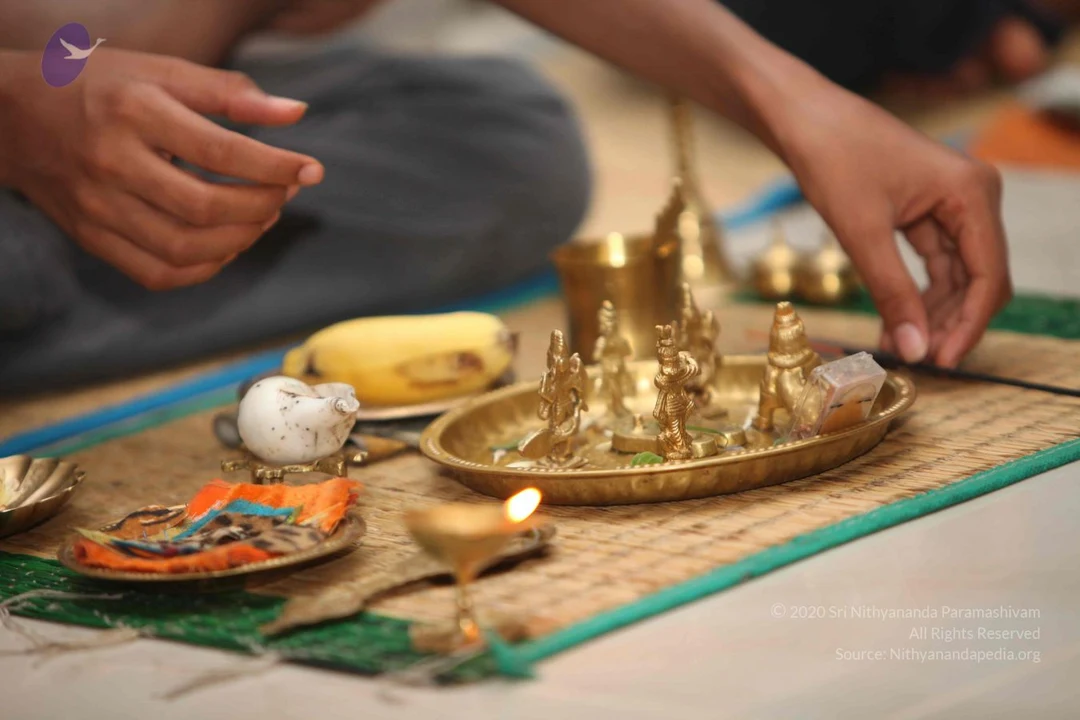
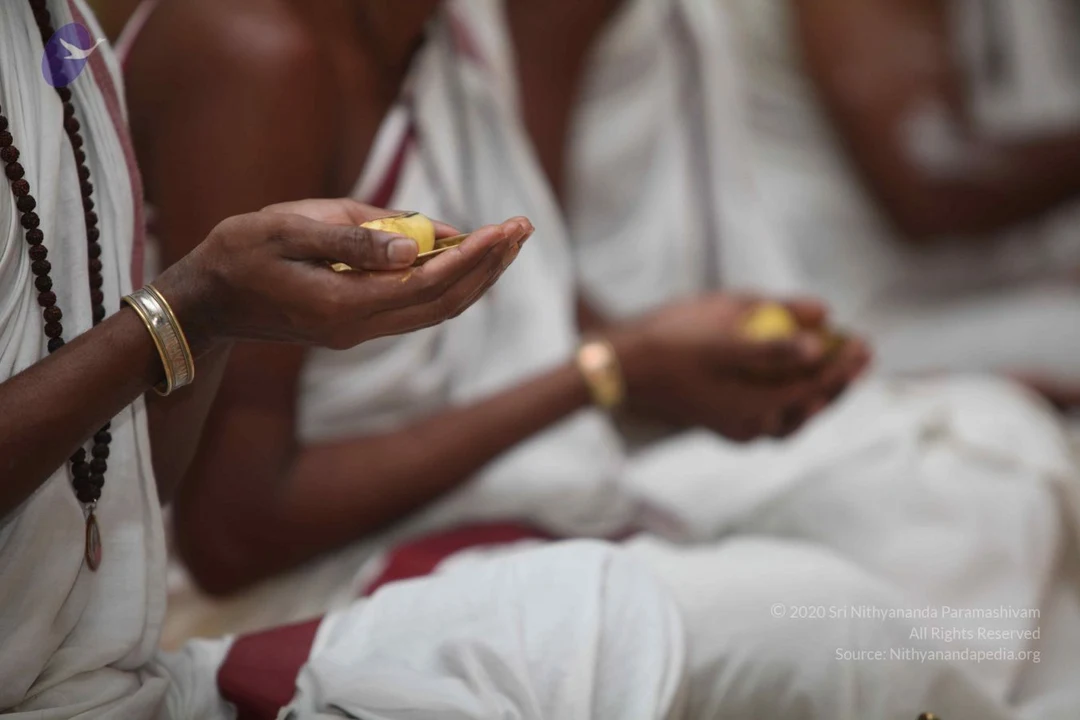
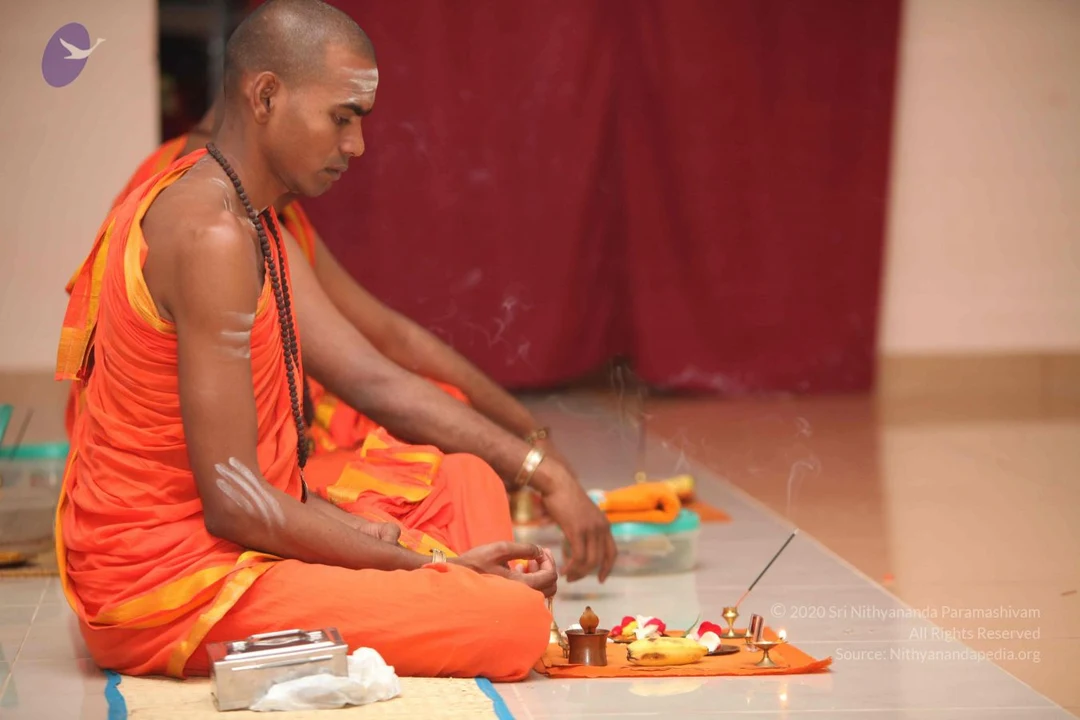
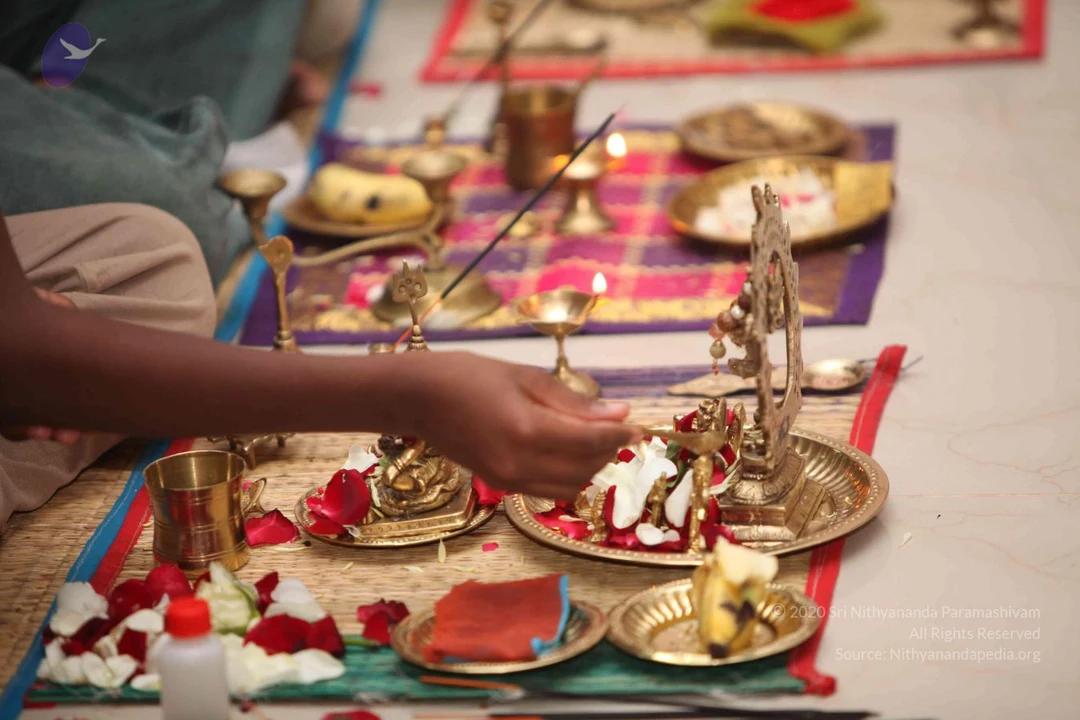
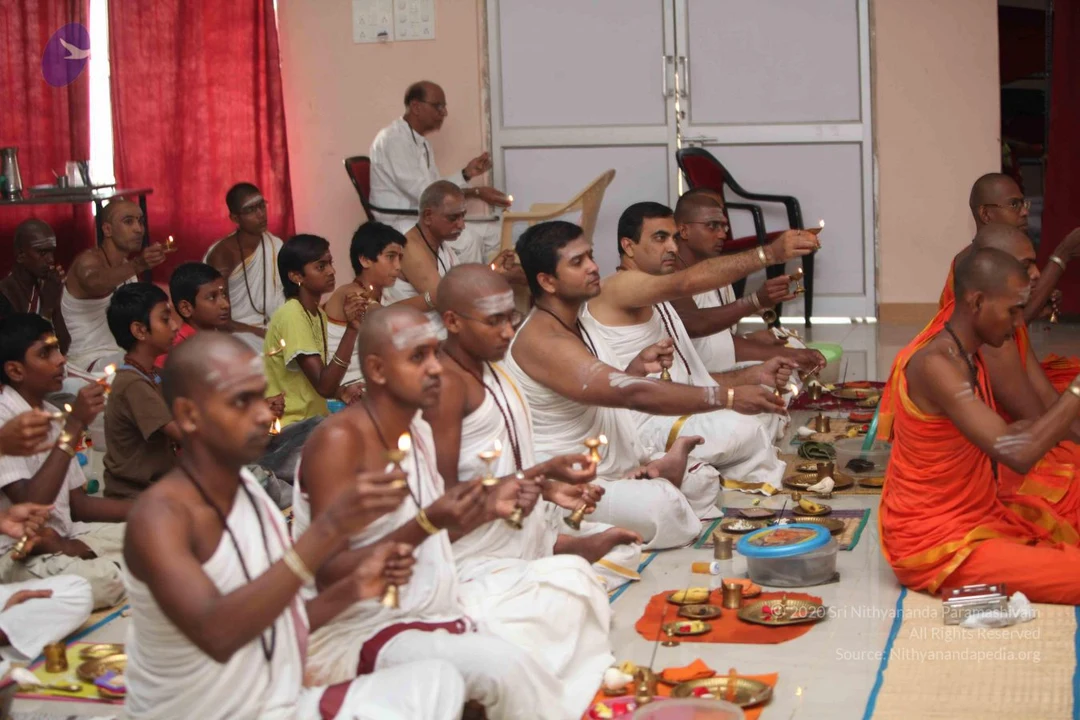
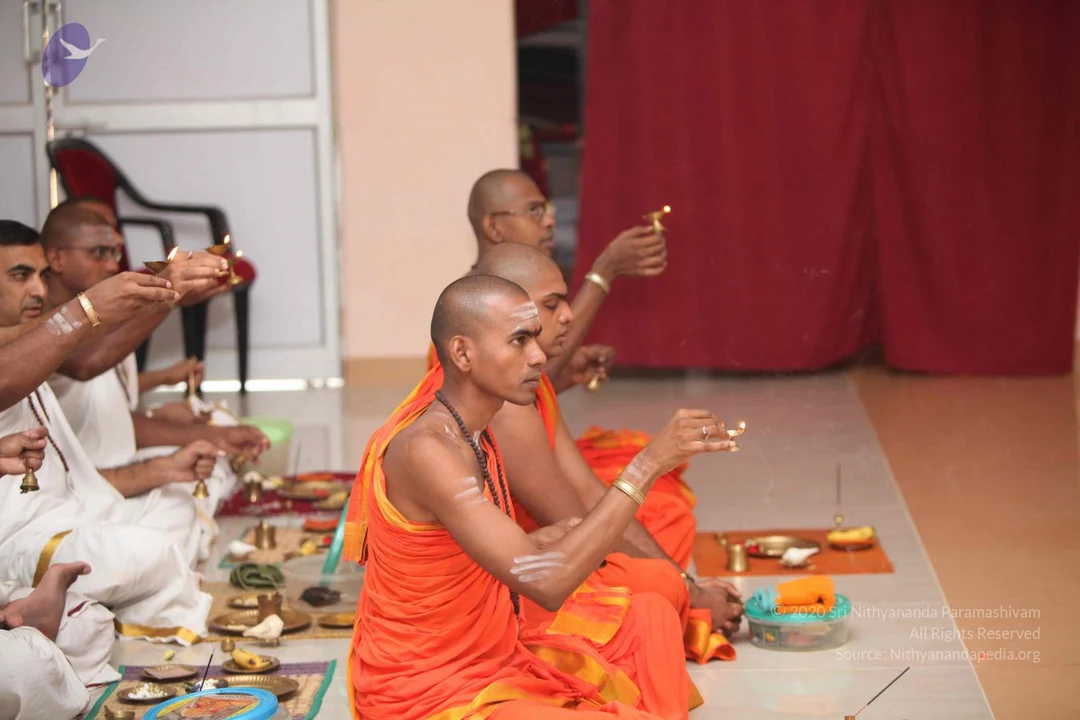
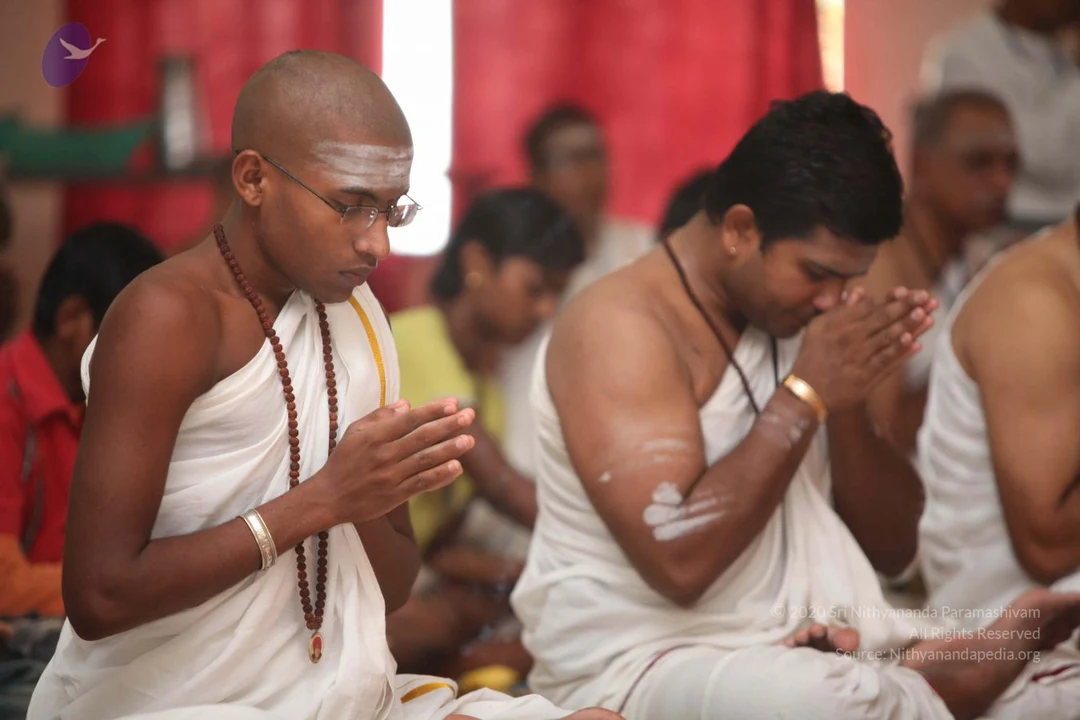
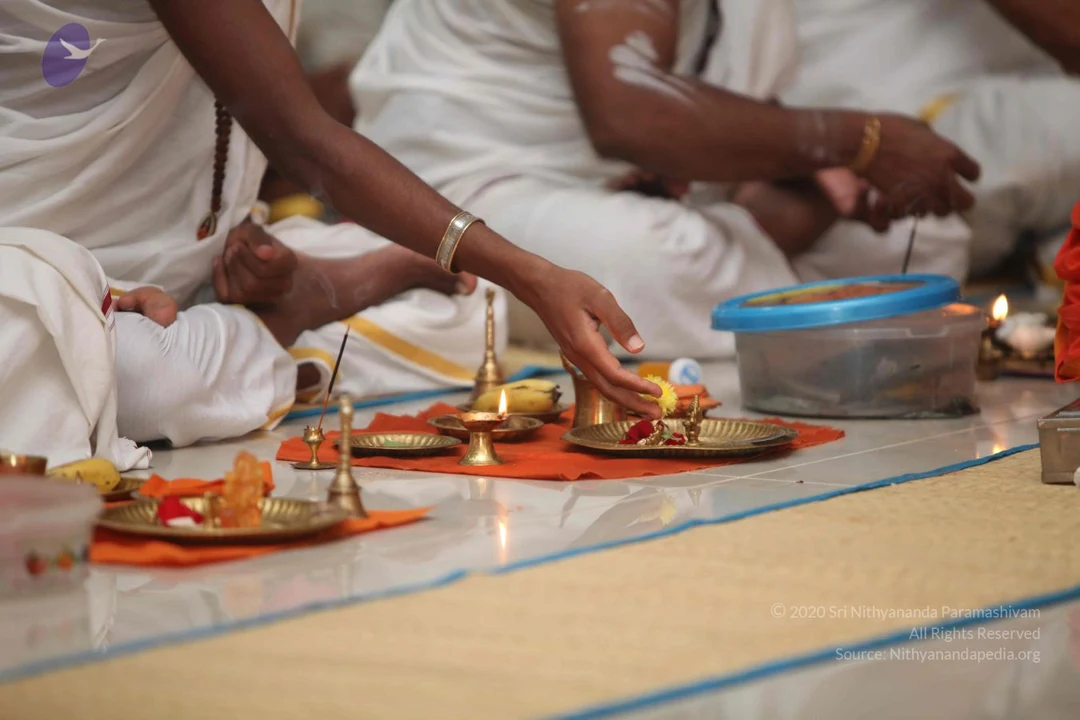
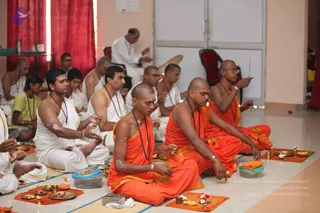
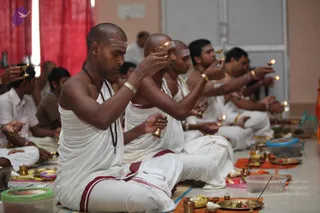
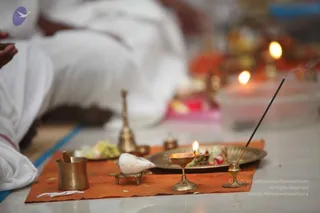
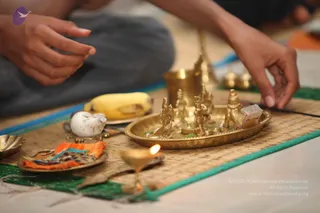
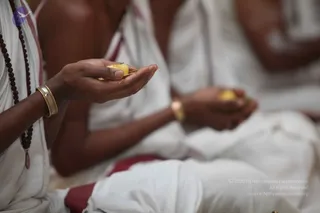
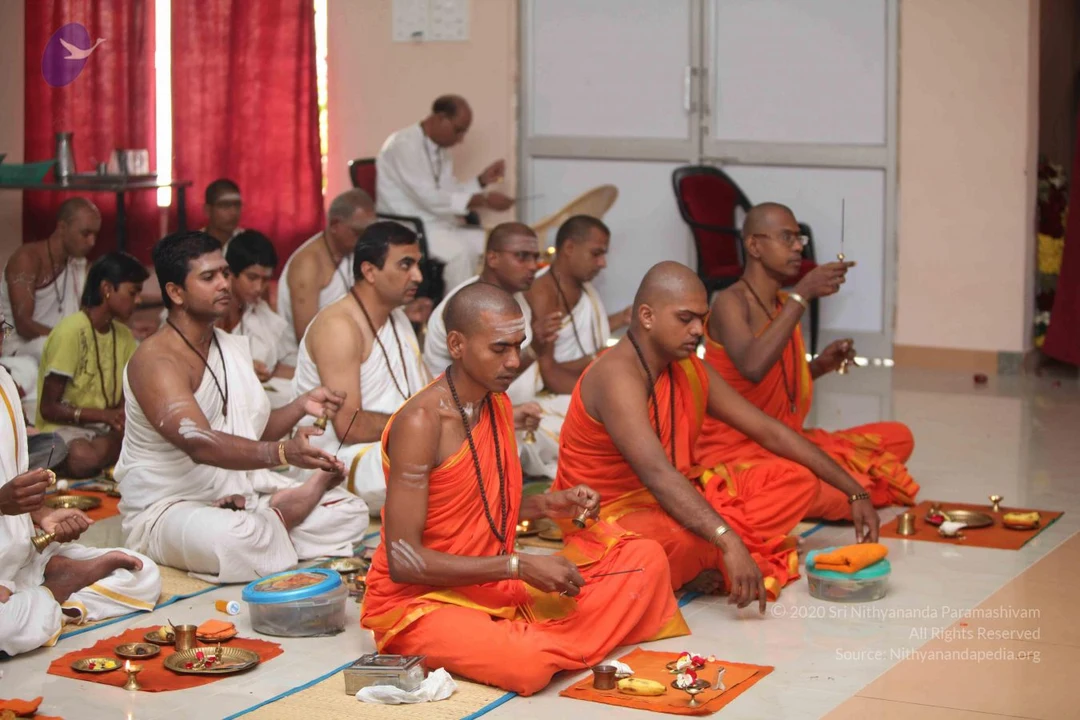
A seated group of men in saffron-orange robes and rudraksha malas performs a puja on mats in a bright room with red curtains and a white door. The foreground devotees, one with white ash markings on his forehead and arms, hold small brass implements and incense sticks above brass plates, lamps and flower offerings on orange cloths. Behind them, rows of men and boys in white dhotis and white shirts sit in worship, and a man in white stands near the back. Metal containers and a small brass box sit on the floor.Close view of seated sannyasis in saffron-orange robes performing a puja on a tiled floor. A figure in the foreground holds a small brass bell in one hand and lights a brass oil lamp with the other; white ash lines mark the forearm and a rudraksha mala hangs over the shoulder. Beside them on an orange cloth are a banana, rose petals, a copper cup, a brass incense holder with a lit incense stick sending up smoke, and a small brass box. A second seated figure in orange and a folded orange and teal towel are visible behind.Several men in white traditional clothing sit cross-legged on a floor during a puja. Foreground priest with a shaved head, tilak on forehead, rudraksha mala and gold bangle holds a lit oil lamp aloft in one hand and a brass bell in the other. Behind him, others raise brass oil lamps toward the flame, wearing white dhotis with maroon borders. Brass plates with flowers, fruit and offerings sit on orange cloths in front of them, and red curtains hang at the left.Close-up photograph of a puja setup on an orange cloth spread over a white floor. A brass oil lamp with a lit flame sits in the foreground beside a white conch shell on a small brass stand, a brass vessel, and a brass plate of flowers and offerings. A lit incense stick stands in a brass holder at right. Blurred in the background, a person in white clothing sits on the floor, and more lit lamps and brass items are visible. No identifiable face is shown.A close photo of a puja setup on a woven mat. A brass plate holds small brass deity figurines, a few green leaves, and a small packet. Beside it sit a yellow banana, a white conch-shaped object, a brass lamp with a lit flame, and a plate with orange and blue cloth or flowers. A brass vessel stands behind. Two people are partly visible at the edges, one with hands near the plate and another seated in grey clothing.Close photo of several people seated in white clothing, seen from the waist up, with hands cupped holding small yellow items. The nearest person wears a long rudraksha mala with dark wooden beads and a gold bangle, and white garments with a maroon edge. Other seated figures in white cloth are blurred behind, with their hands similarly cupped. The setting is a ritual gathering, with no visible deity, throne or festival decoration.
KumariPuja
14 photosSource gallery
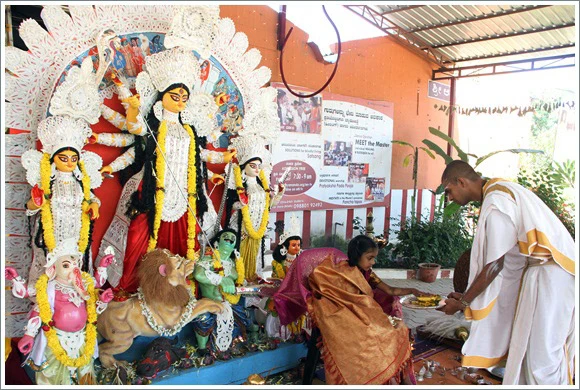
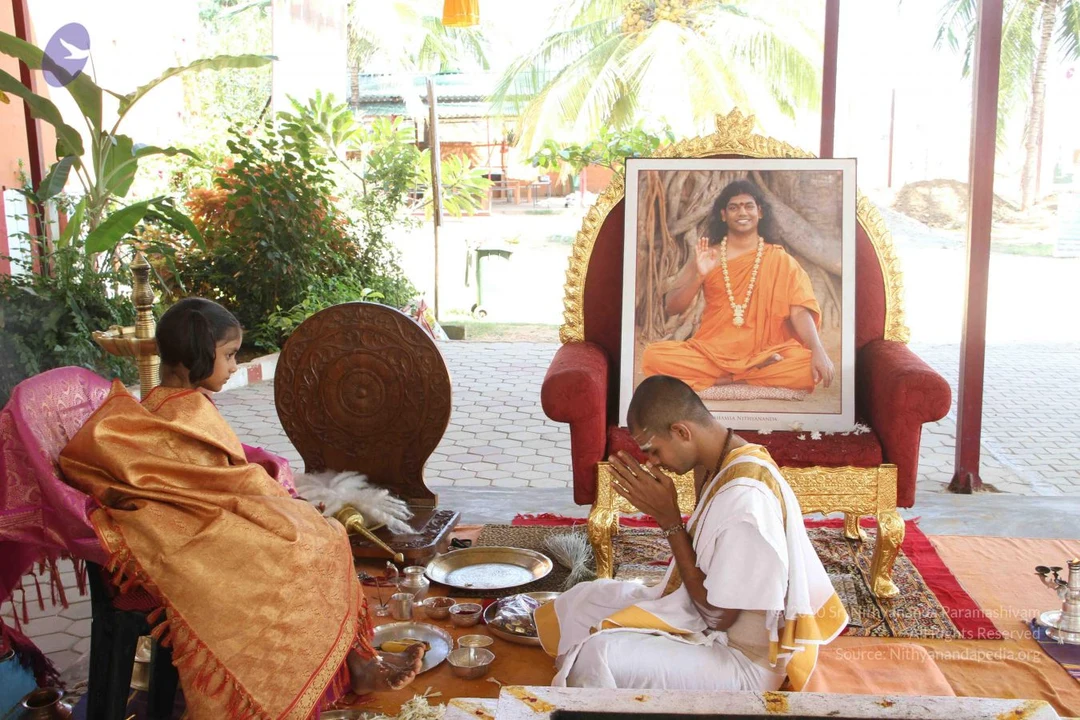
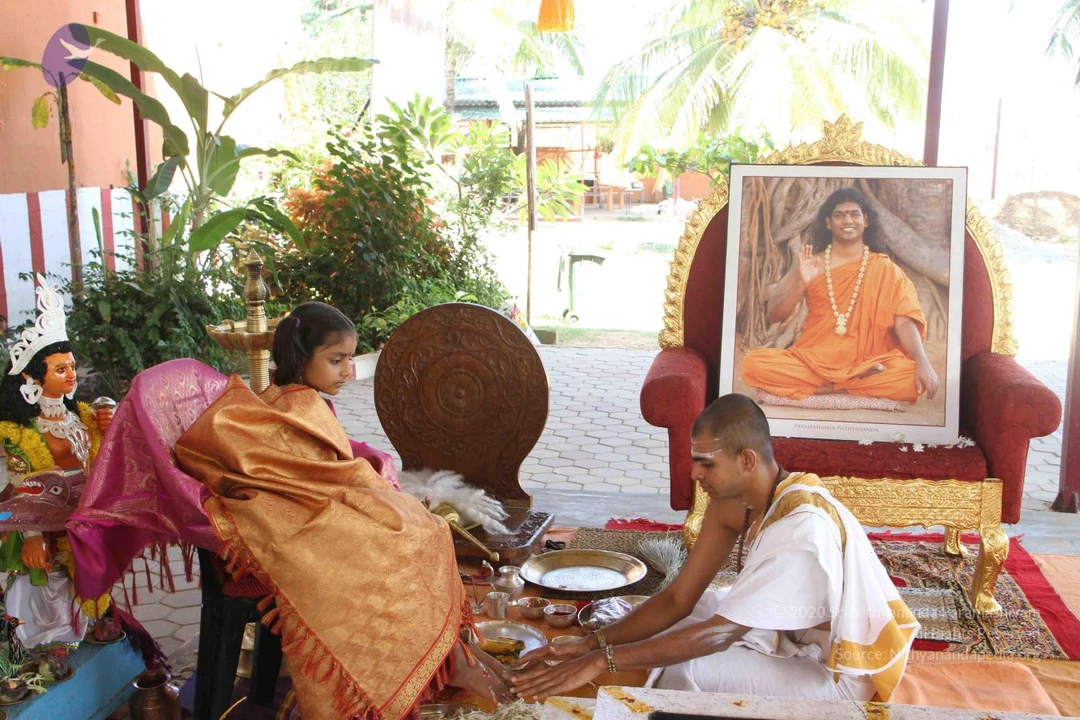
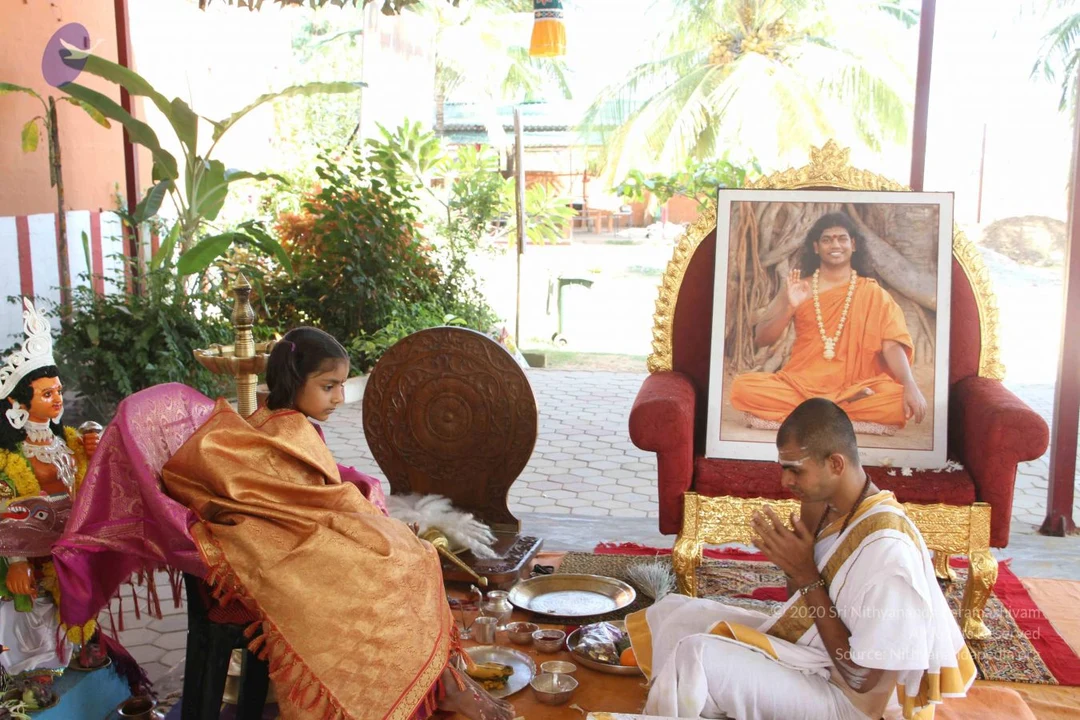
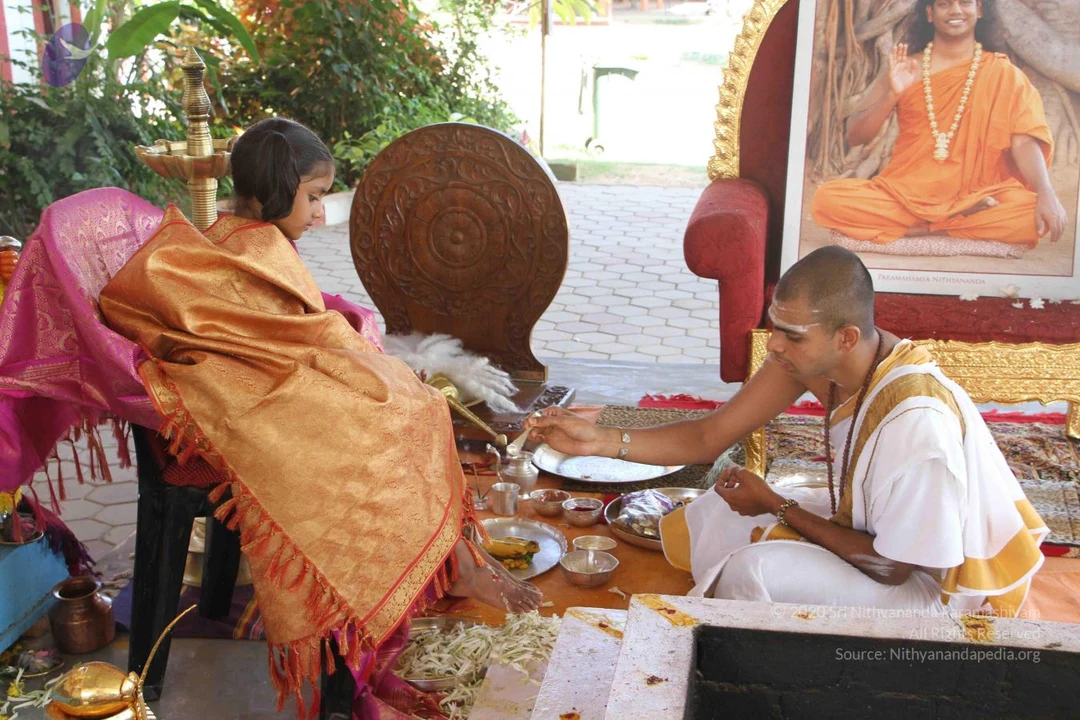
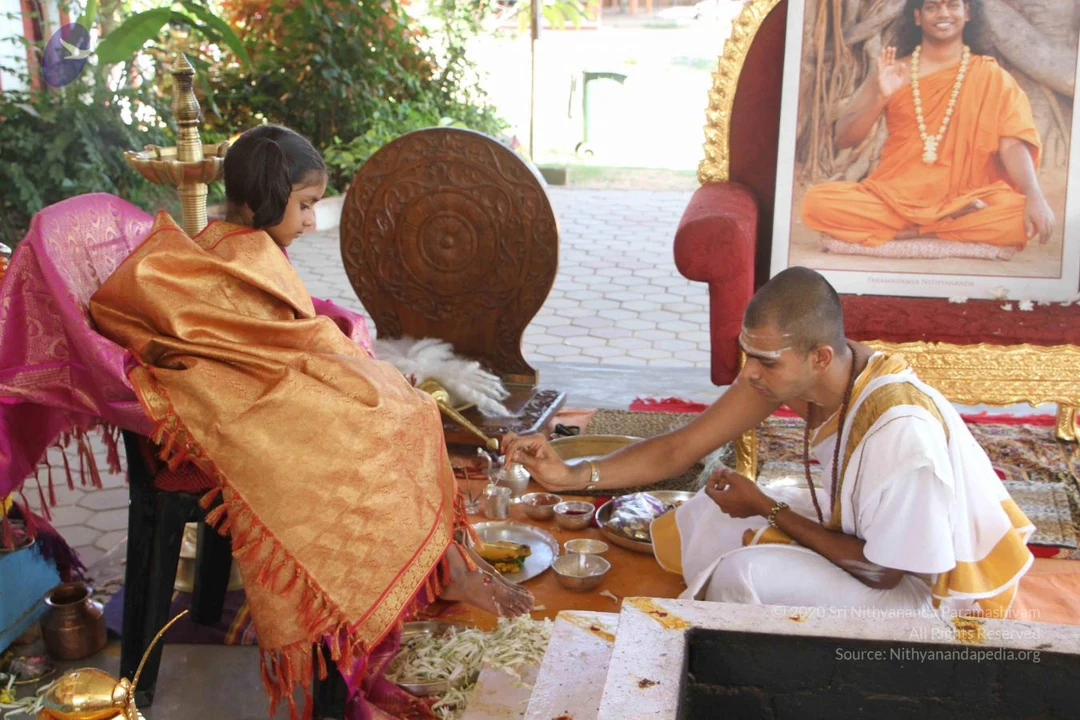
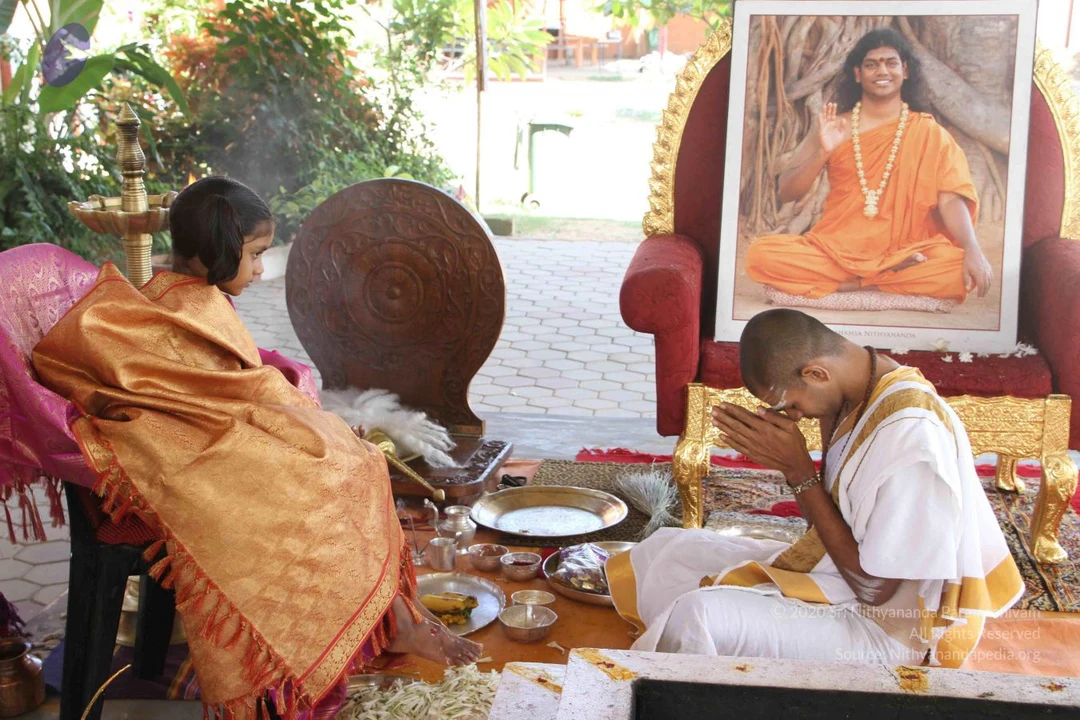
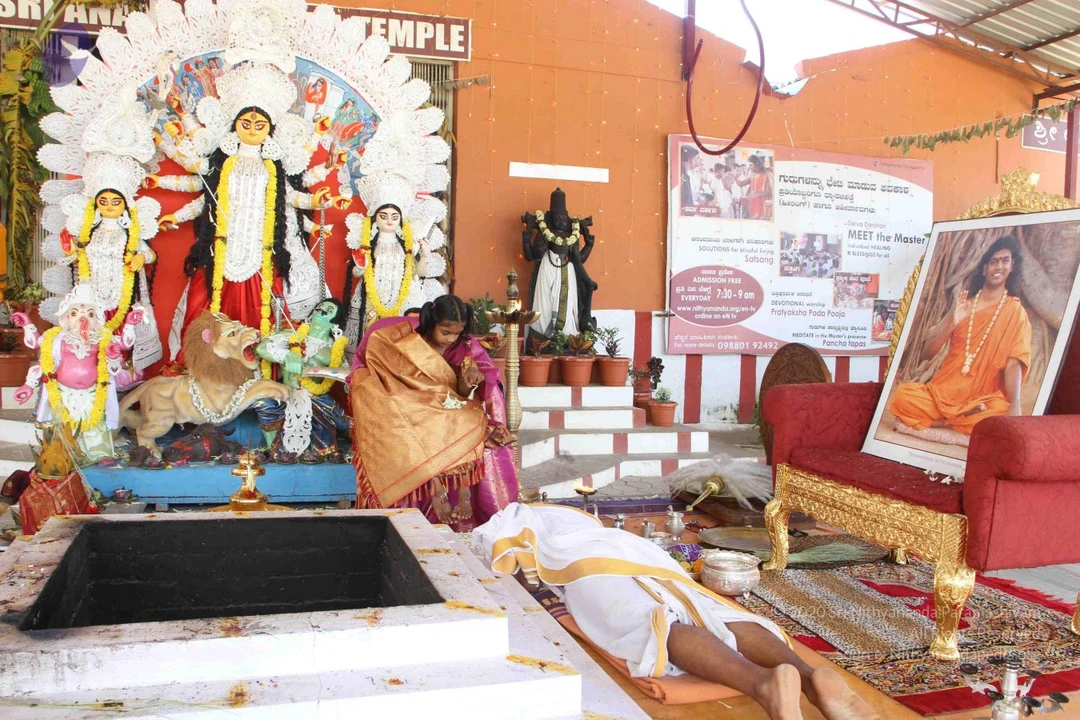
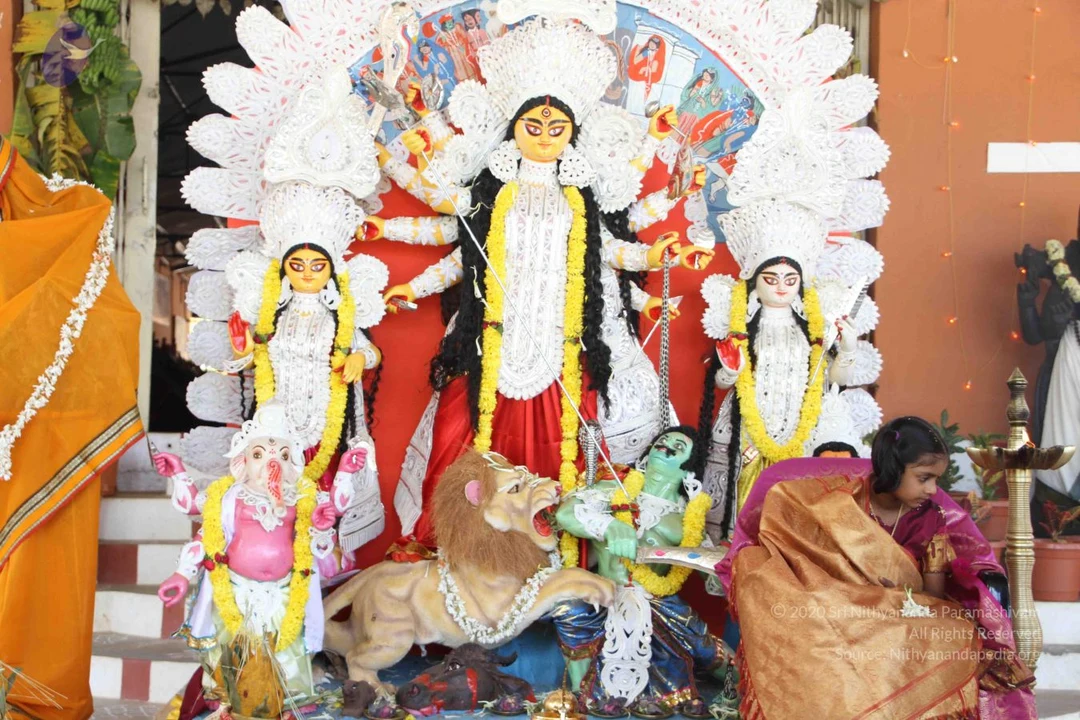
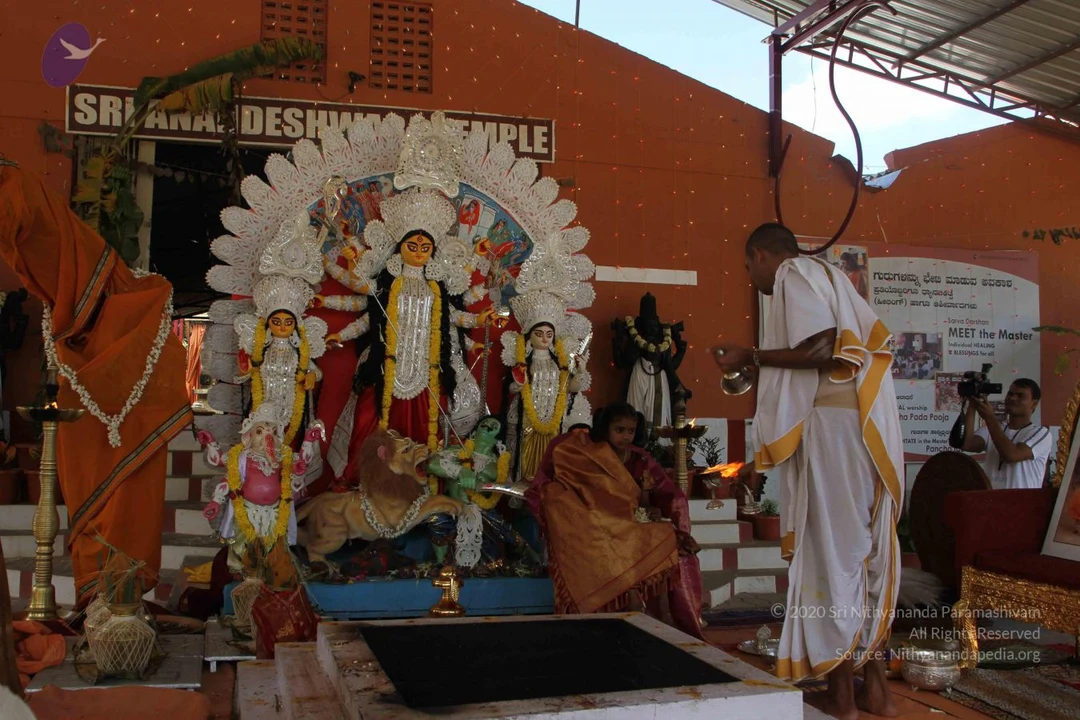
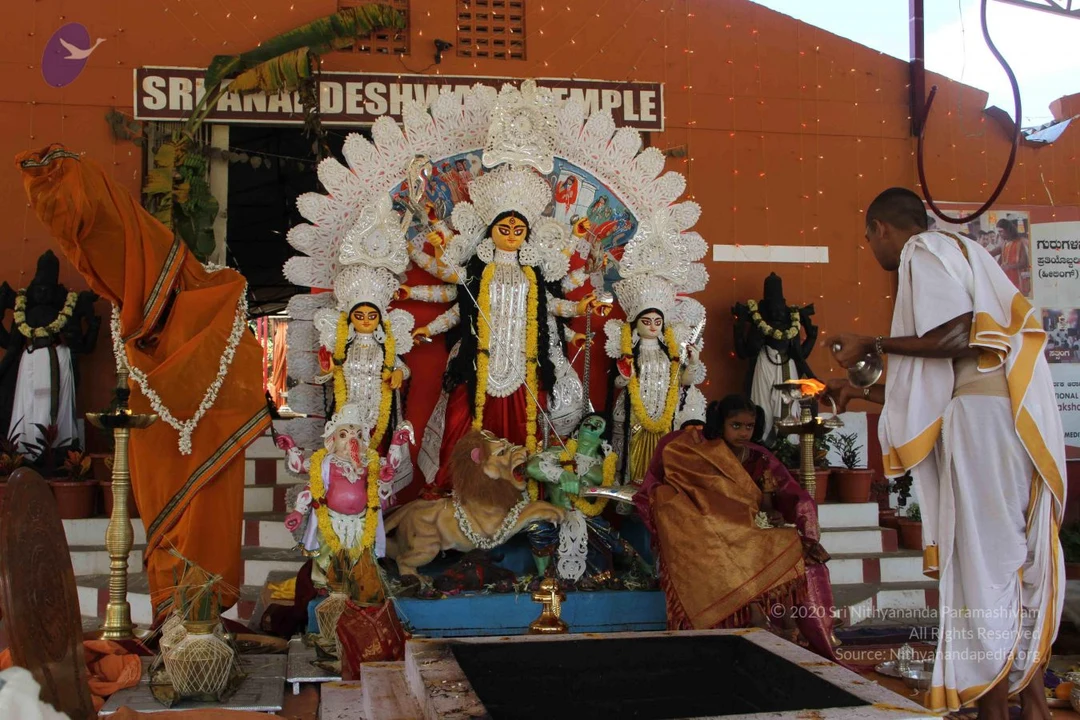
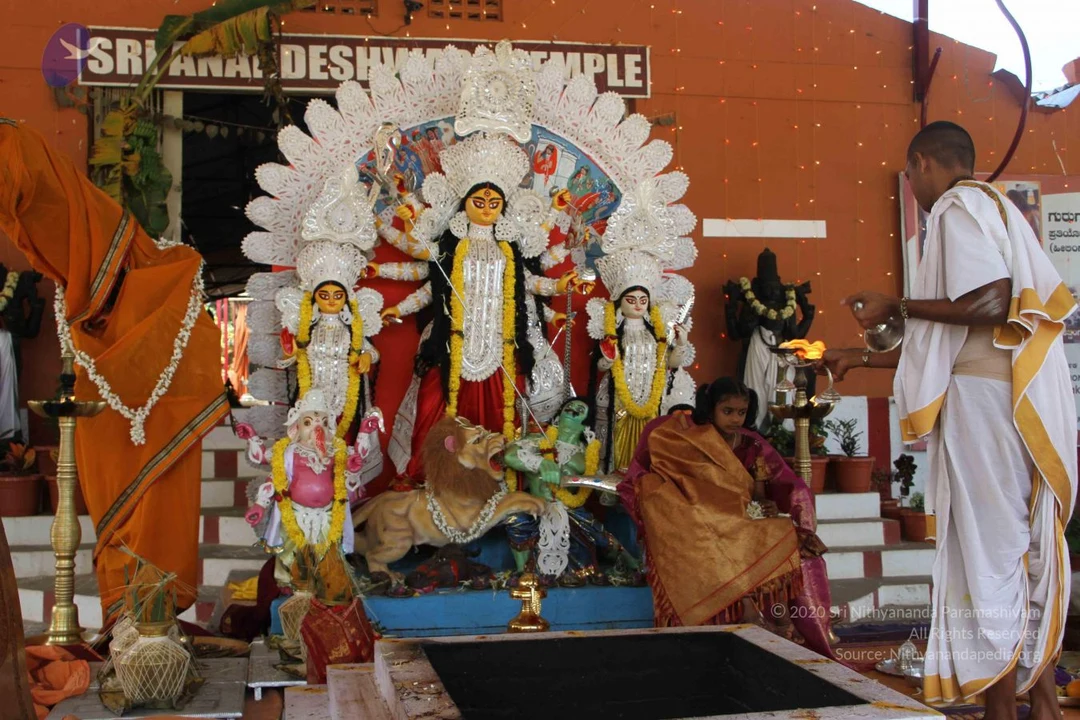
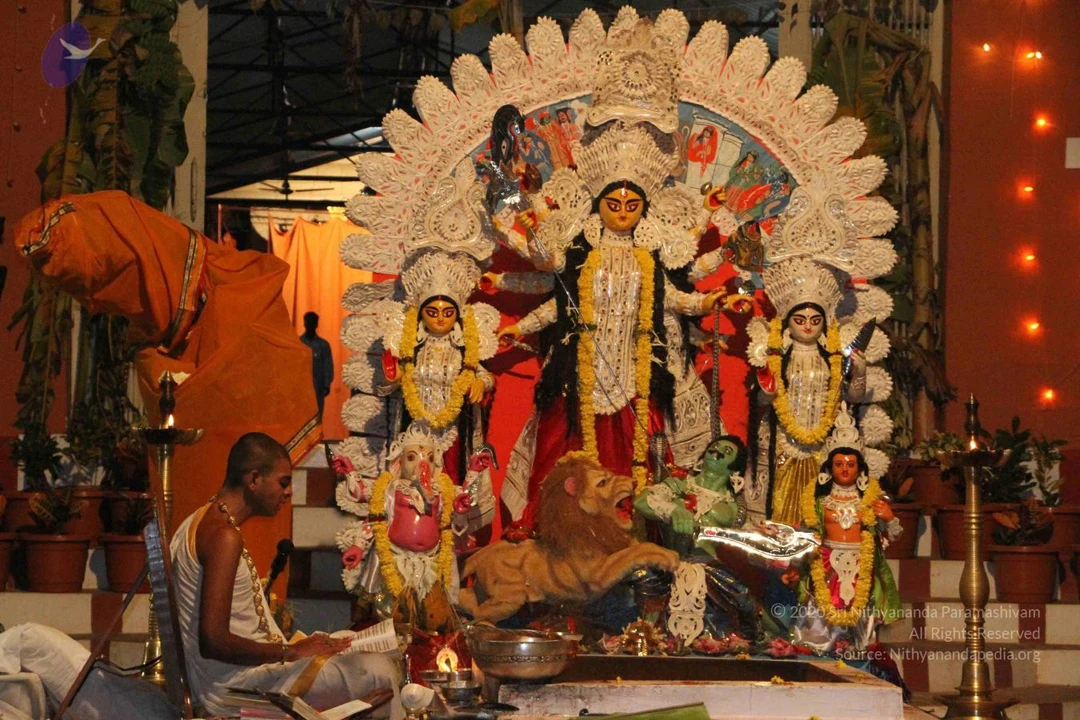
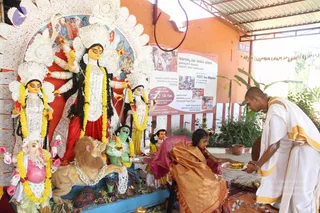
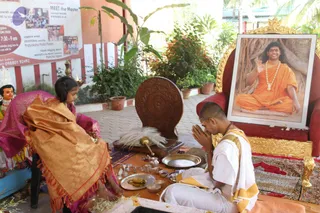
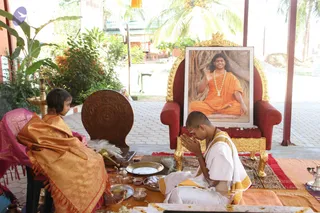
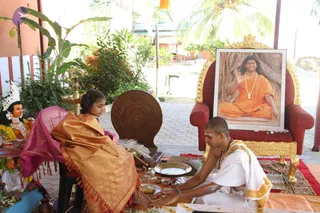
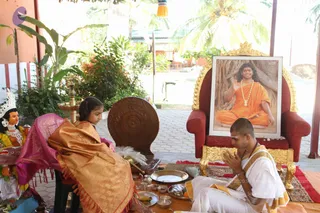
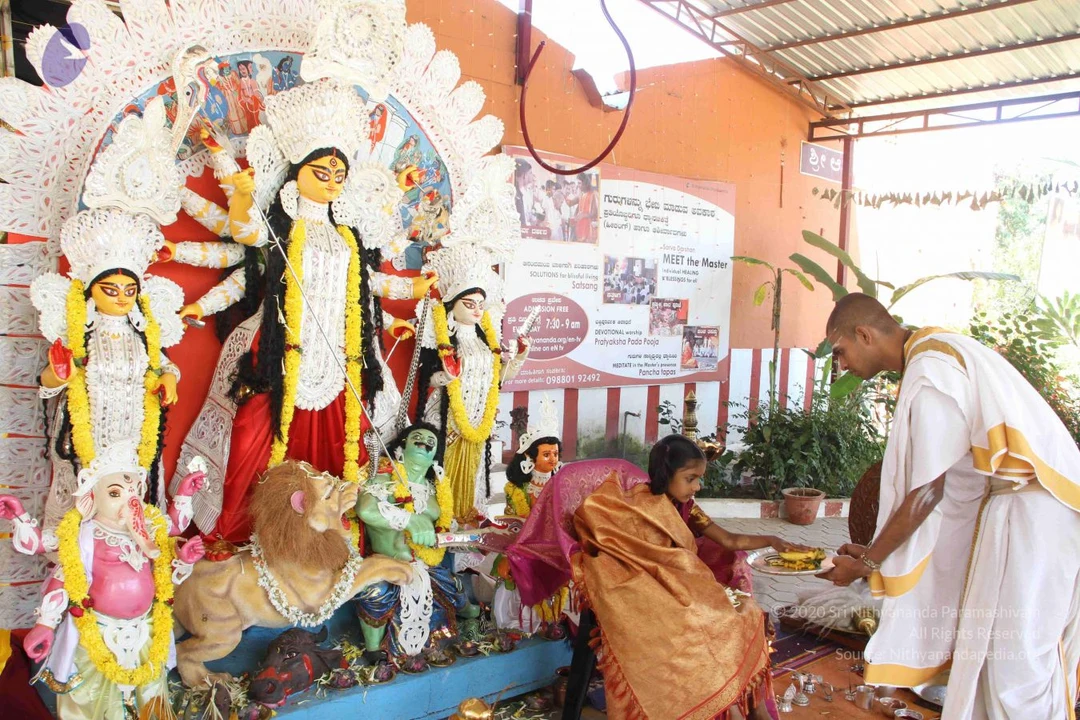
A photograph of a Navaratri-style puja at a temple shrine. A large white-and-red decorated murti of the goddess Durga with multiple arms, holding weapons, stands with a lion mount, flanked by smaller murtis including a pink Ganesha figure and a green-faced figure, all garlanded with yellow marigolds. In the foreground a young girl in a dark orange sari bends forward over a brass plate of offerings. On the right a man with a shaved head wears a white dhoti and shawl with gold borders and tends the offerings. Oil lamps and brass vessels sit on the platform, and a wall poster of Hindu devotional text is behind the shrine. No a person candidate is clearly visible in the scene.A photo of a padapuja-style devotional ritual in an outdoor courtyard. A young girl in an orange and gold shawl over a pink dress sits on a chair with her bare feet placed on a brass tray. A man in white dhoti and white shirt with a gold-bordered shawl sits on the floor with palms pressed together in namaste, with brass dishes, a kalasha-like vessel and a feather fan nearby. Behind them is a large framed photograph of a smiling man with long dark hair, wearing orange robes and a long mala, seated on a red and gold throne. A printed caption reads Paramahamsa Nithyananda. A small deity murti in pink fabric stands at left. Potted plants and a red-and-white wall with a poster sit behind. Petals are scattered on the ground.A photo of a ritual scene under a covered open pavilion with palms and potted plants behind. A large framed portrait of a saffron-robed man seated before a tree trunk, labelled "...a person" or similar on the print, sits on a red velvet throne with gold trim. A seated priest in white dhoti and shawl with gold border, head shaved, kneels in front with palms pressed together in namaskar. Beside him a young girl in a gold silk sari with pink shawl sits on a chair. Brass plates, bowls, a kalasha-style vessel, an oil lamp and a wooden shield-shaped stand with feathered fan are arranged on a mat. Two physical people are visible.A girl in a gold-bordered orange-brown silk sari sits on a dark wooden chair under an open pavilion while a shaved-headed priest in white dhoti and shawl with a gold border kneels before her and washes or anoints her feet over a brass plate with a bowl and small vessels. Behind them a framed portrait labelled "Paramahamsa Nithyananda" shows a figure in orange robes with a white flower garland seated before a banyan trunk, displayed on a red throne-like armchair with gold trim. A decorated deity murti with a crown and garland stands at left, with a brass oil lamp and potted tropical plants nearby; a red-and-white striped wall and palm trees fill the background.A photograph of a ritual scene in an open-sided courtyard with palm and banana plants behind. A portrait of a saffron-robed man with long dark hair, seated in meditation with a raised hand and a long beaded necklace, is displayed on a red and gold throne-like chair with flowers placed before it. A young girl in a gold and orange shawl sits on a wooden seat facing a shaved-headed priest in white dhoti and shawl with a gold-bordered cloth, who sits with palms joined. Brass plates with fruit, bananas, small bowls and a lamp stand on a mat in front, and a painted deity murti with a crown and garland stands at the left. The portrait is a printed depiction, not a physical person.A photograph of a padapuja-style ritual on an outdoor paved courtyard. A young girl with dark hair sits on a dark wooden chair draped with a magenta cloth, wrapped in a gold-bordered orange silk shawl with tassels, her bare feet extended. Facing her, a shaved-headed priest in a white dhoti with gold border and a rudraksha mala kneels on a mat, washing or offering over a silver plate with a small vessel, pouring from a brass vessel. Brass oil lamps, a copper kalasha, steel bowls with offerings, banana leaves and a silver tray surround them. Behind is a red and gold throne with a large wooden carved backrest, and a framed portrait labelled 'PARAMAHAMSA NITHYANANDA' shows a smiling saffron-robed figure with rudraksha and flowers seated in meditation.

Procession
38 photosSource gallery
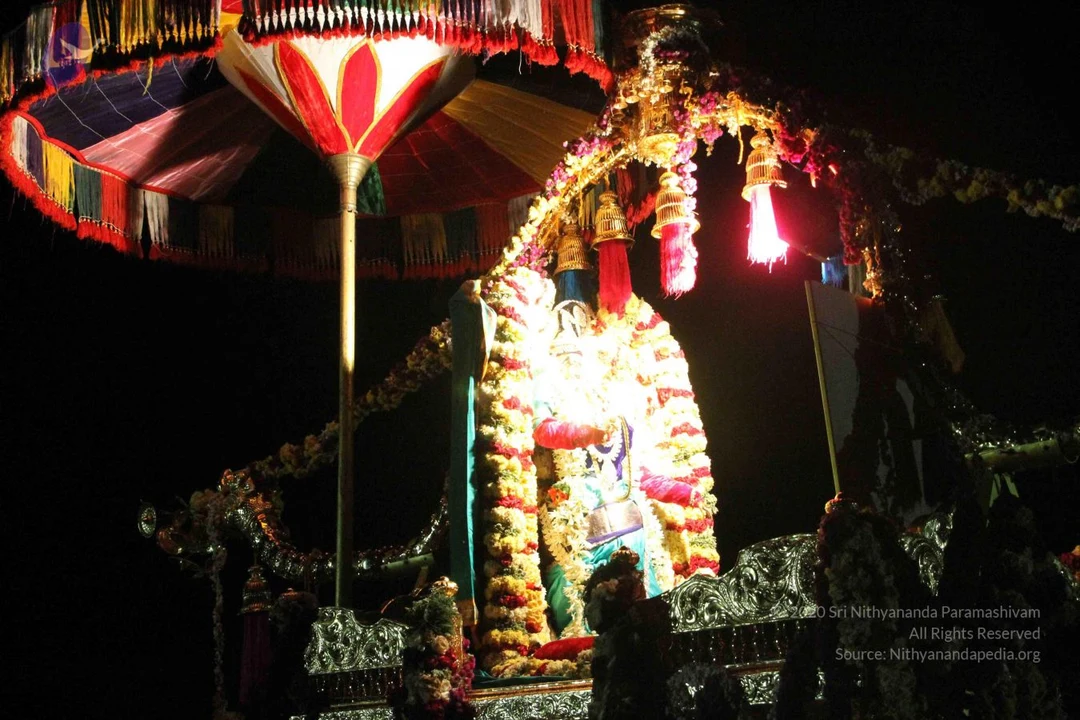
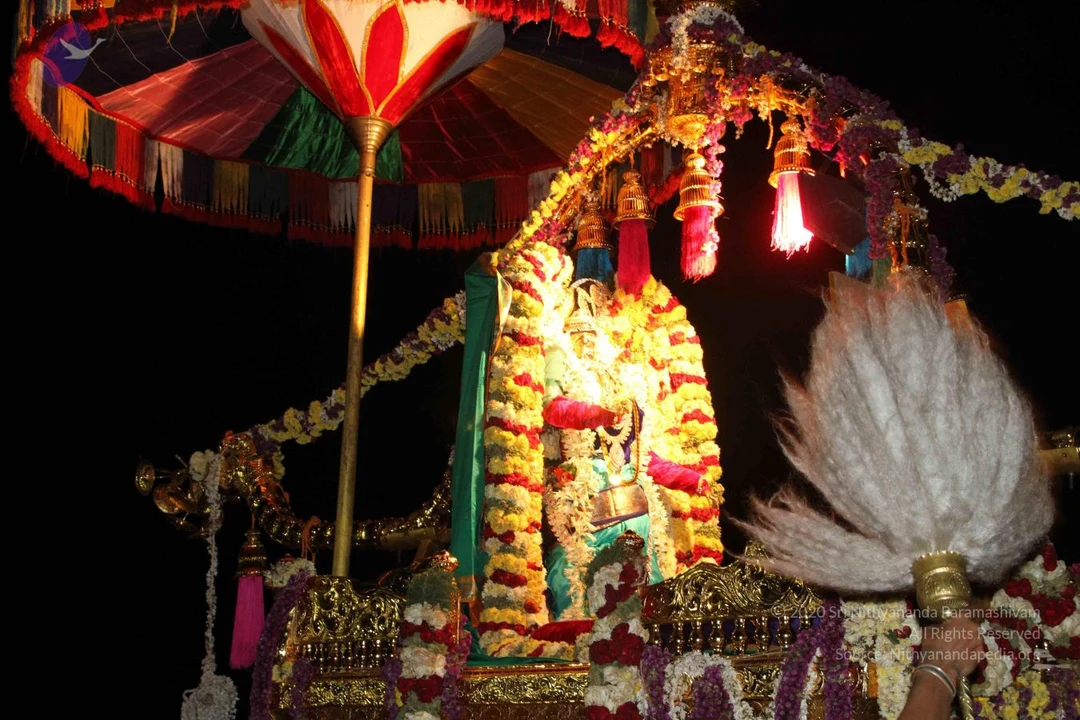
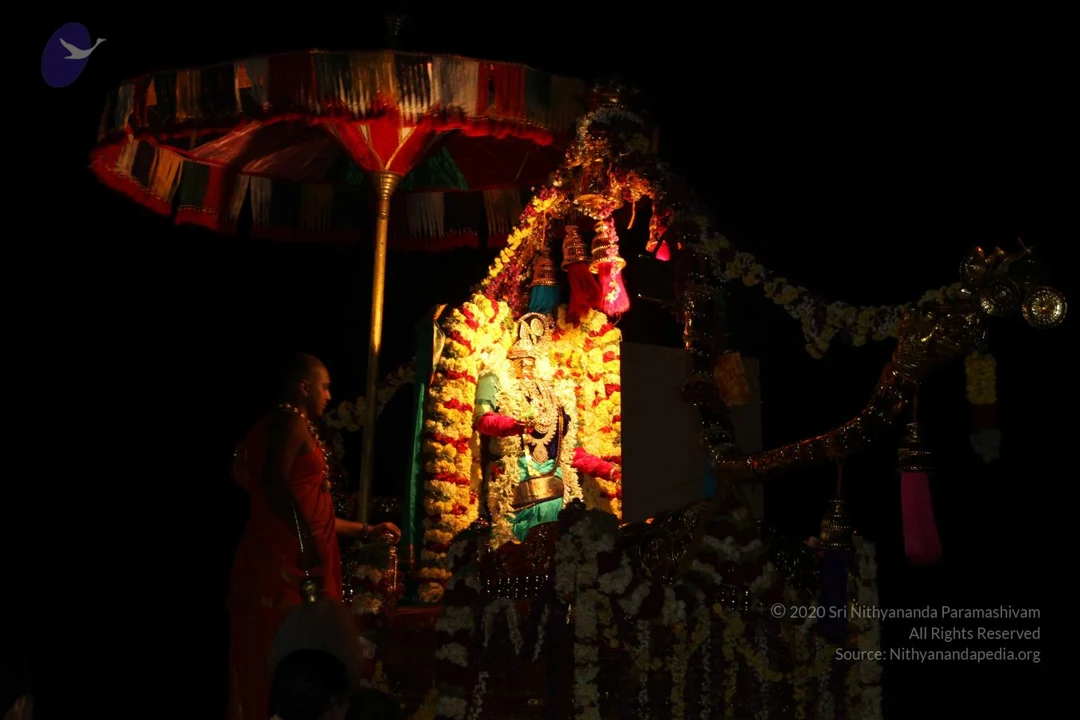
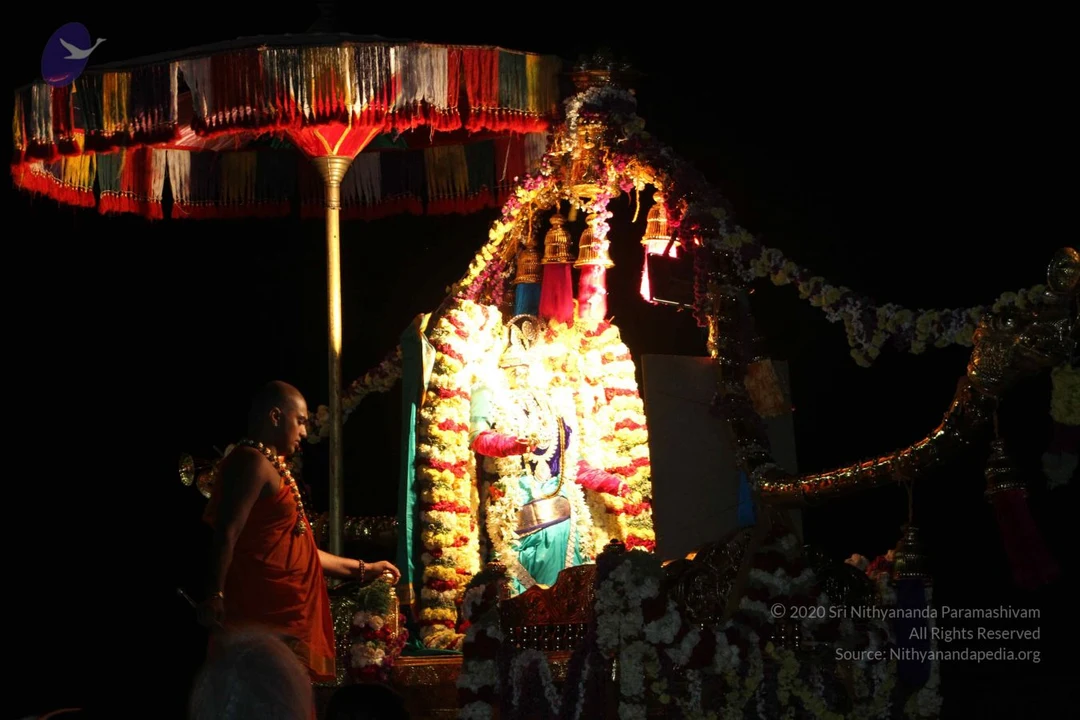
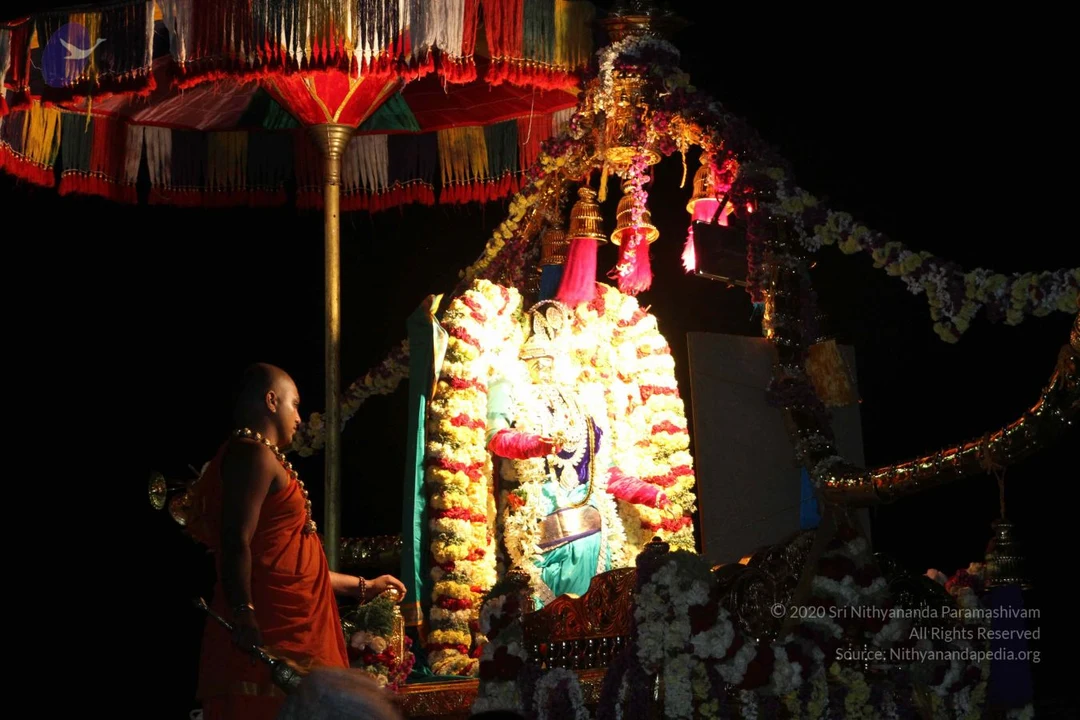
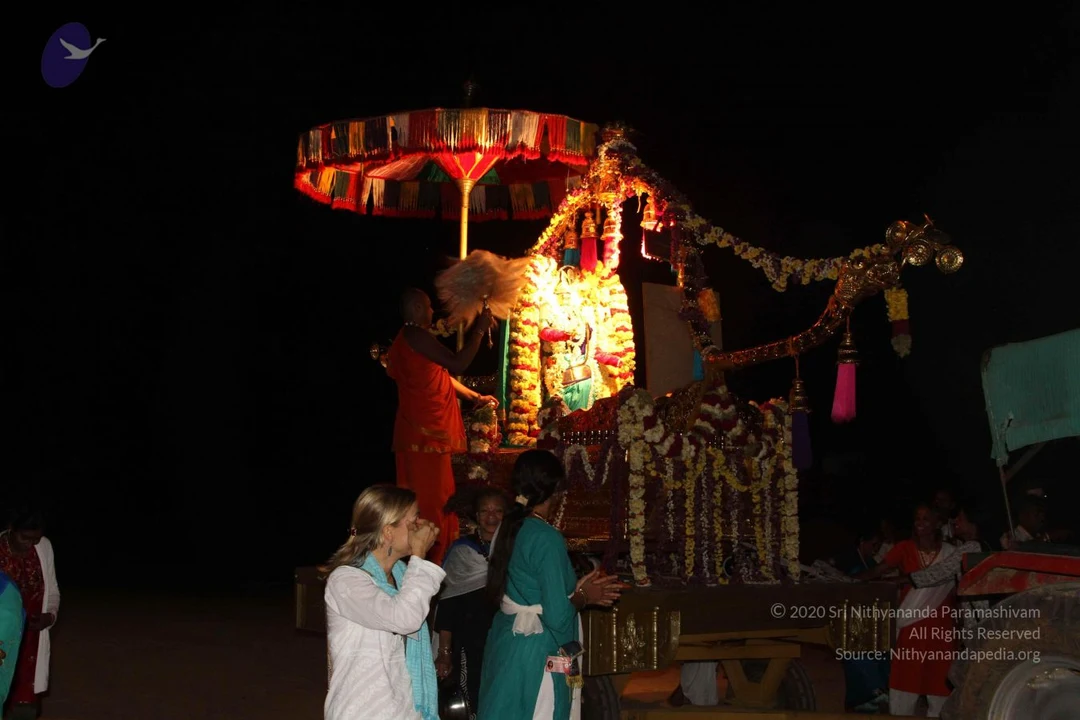
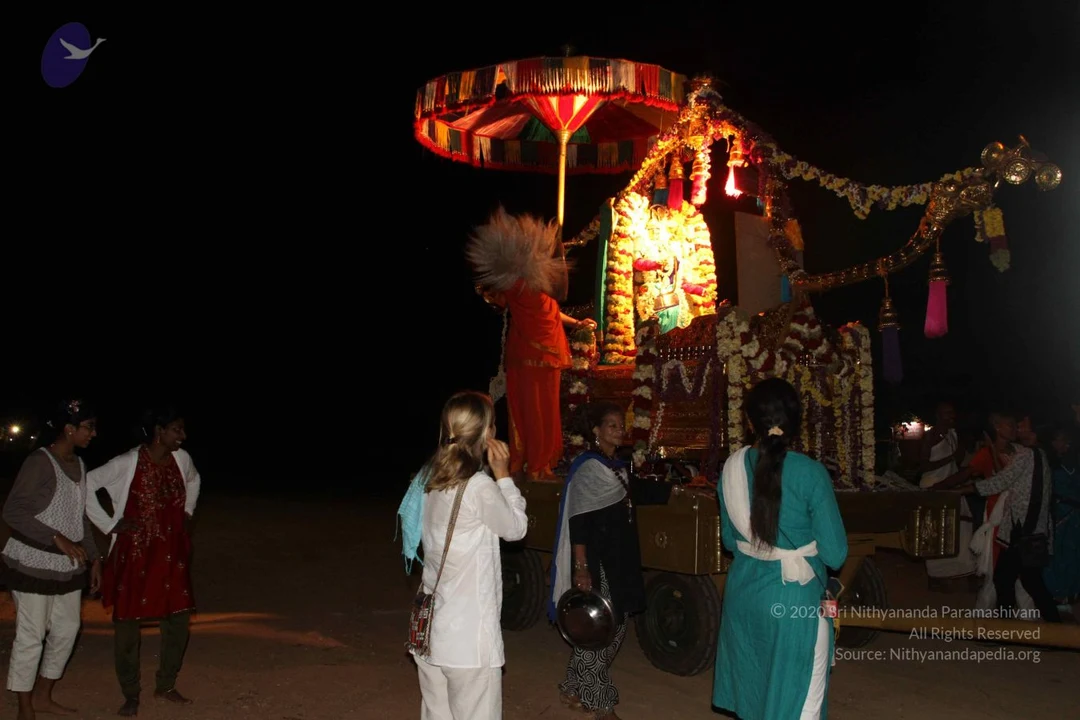
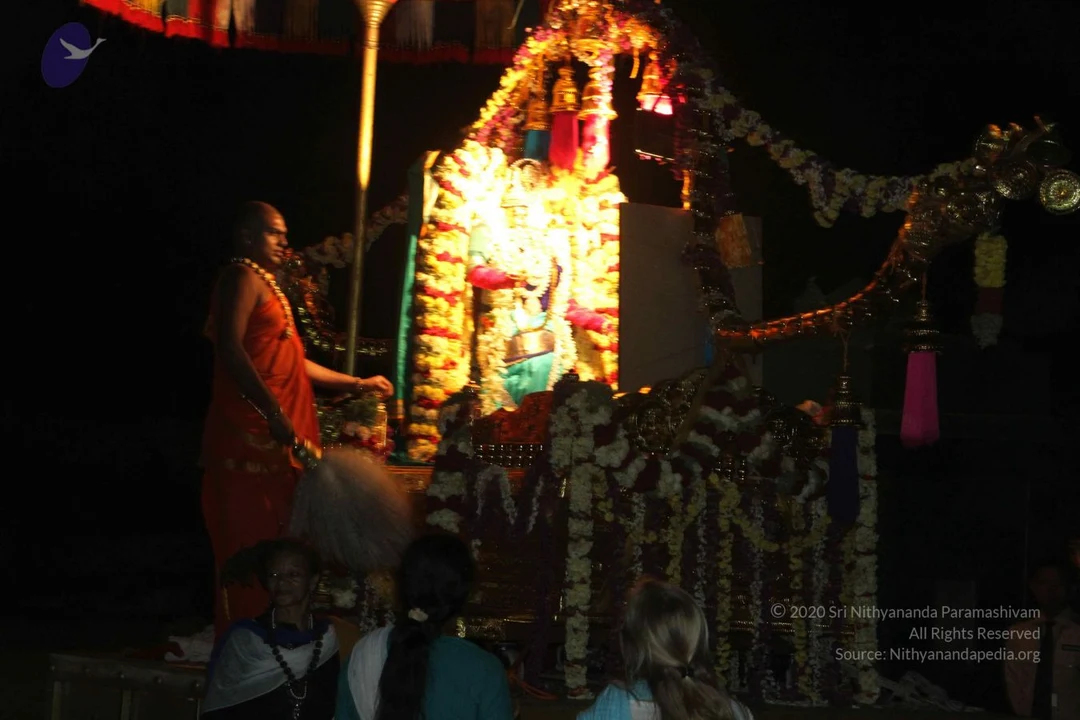
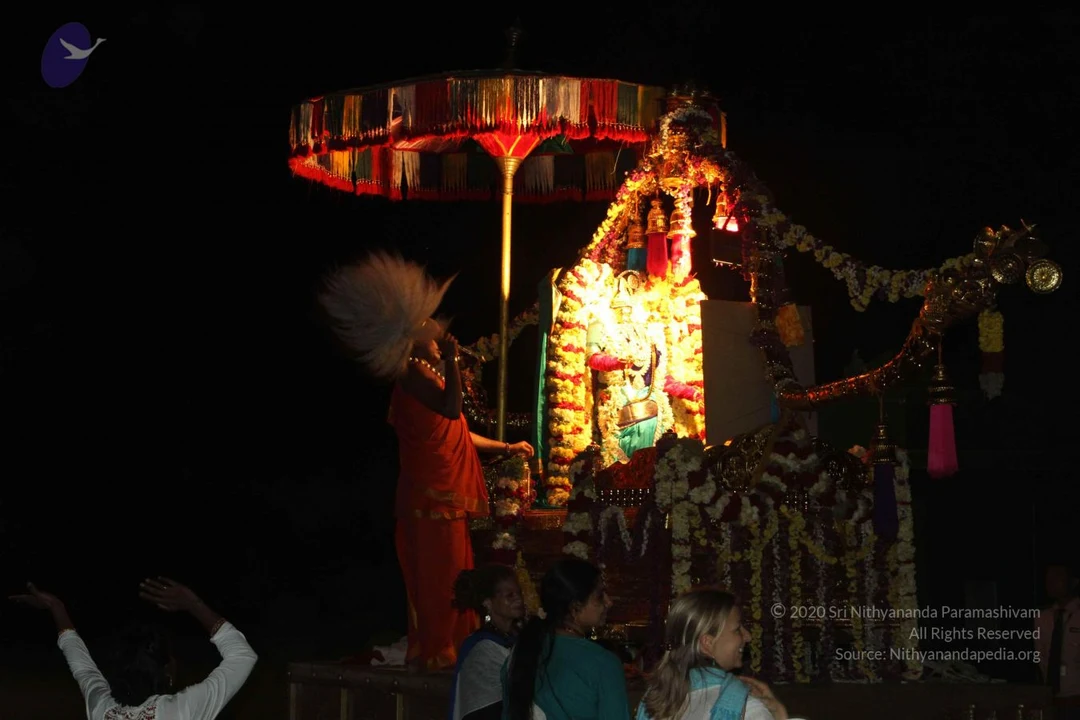
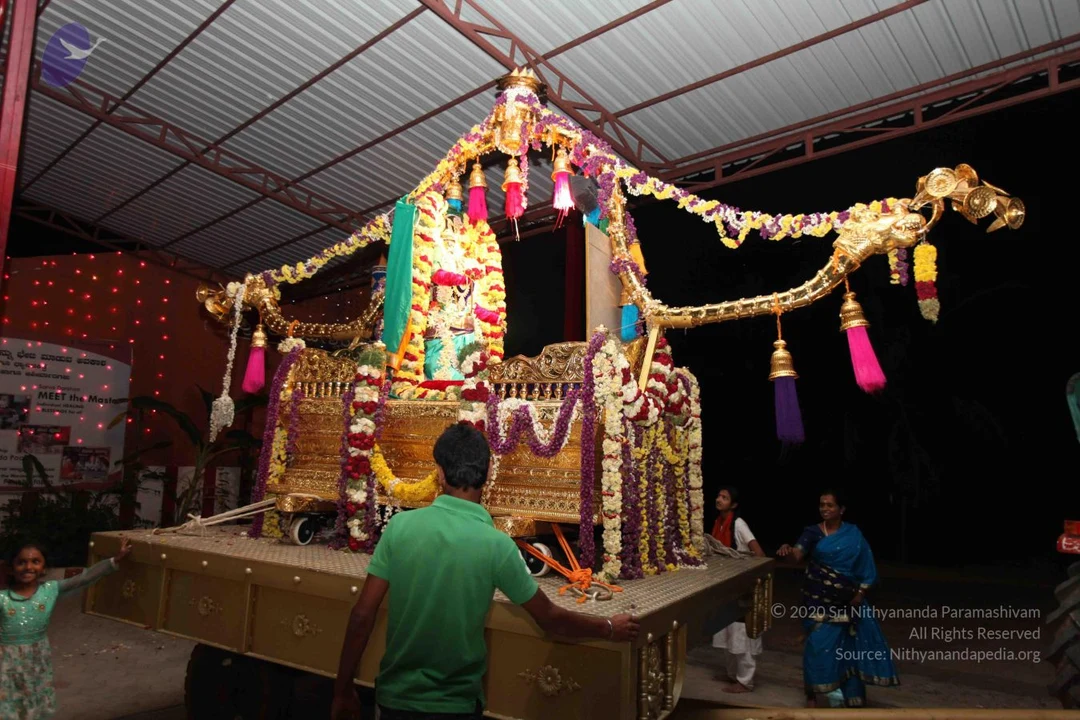
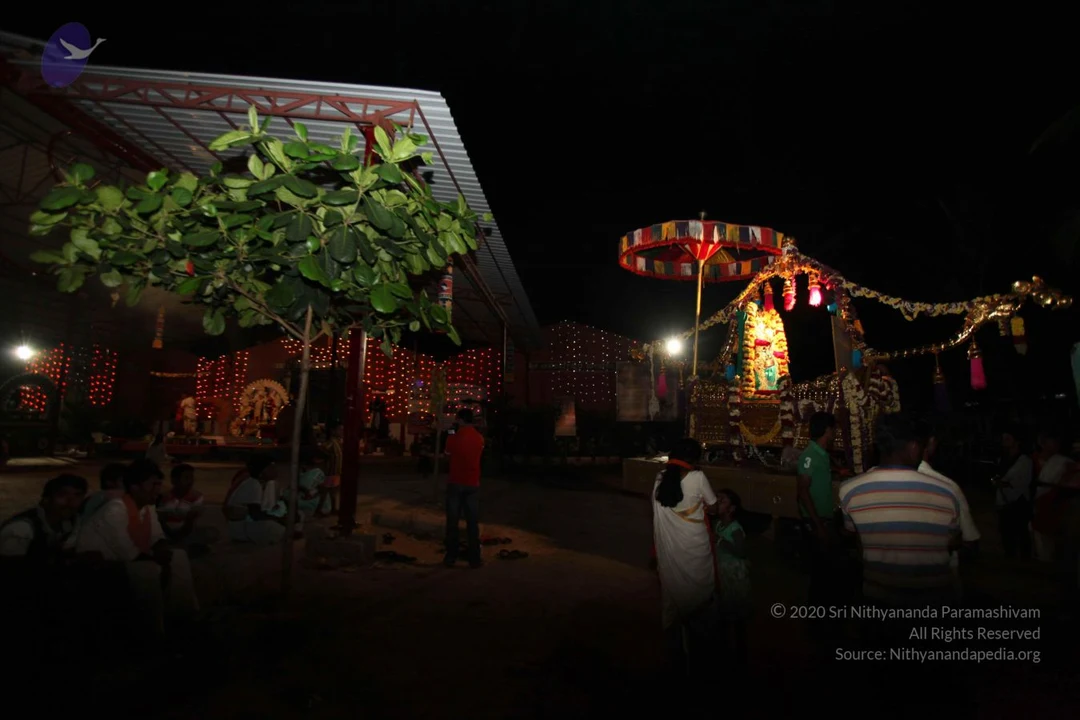
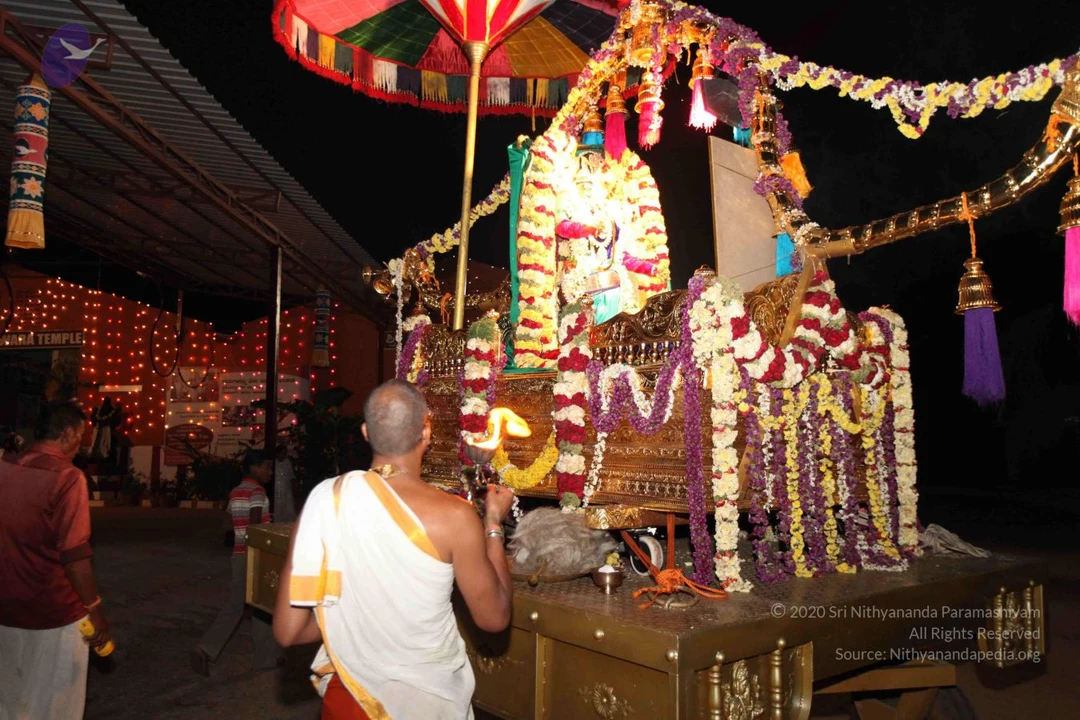
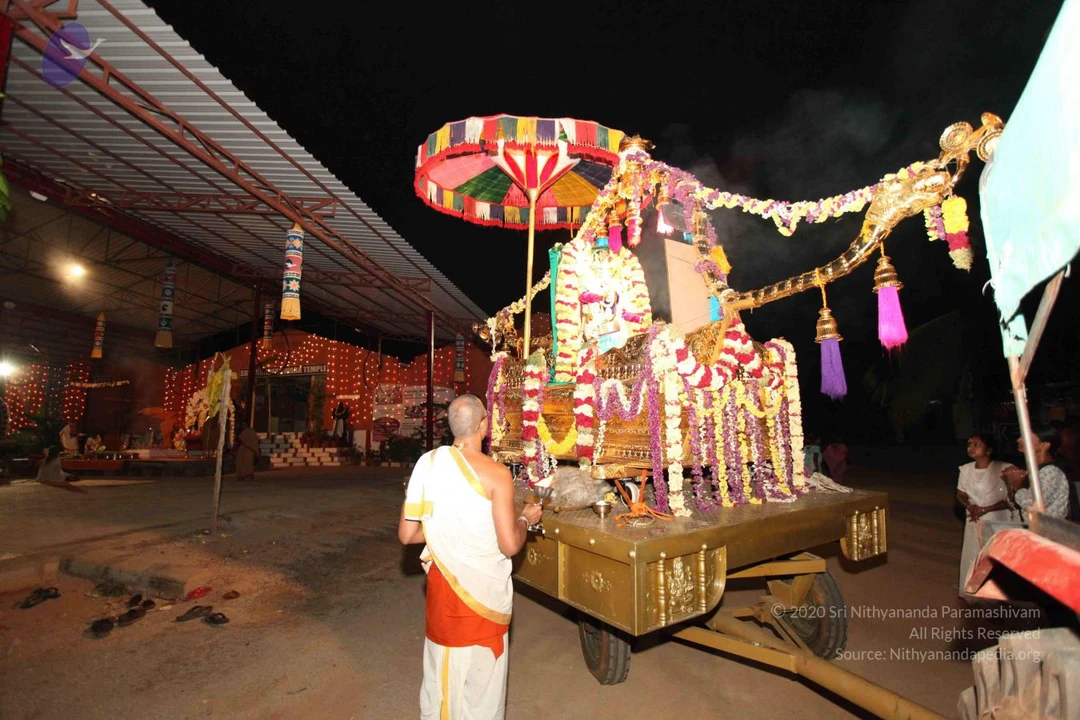
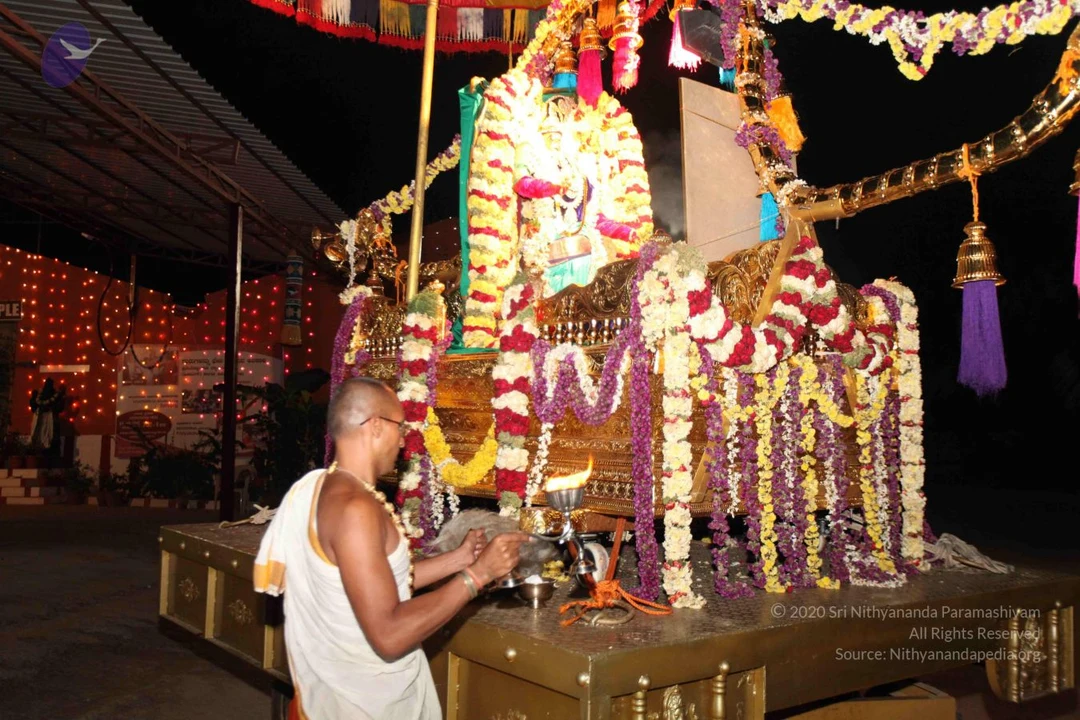
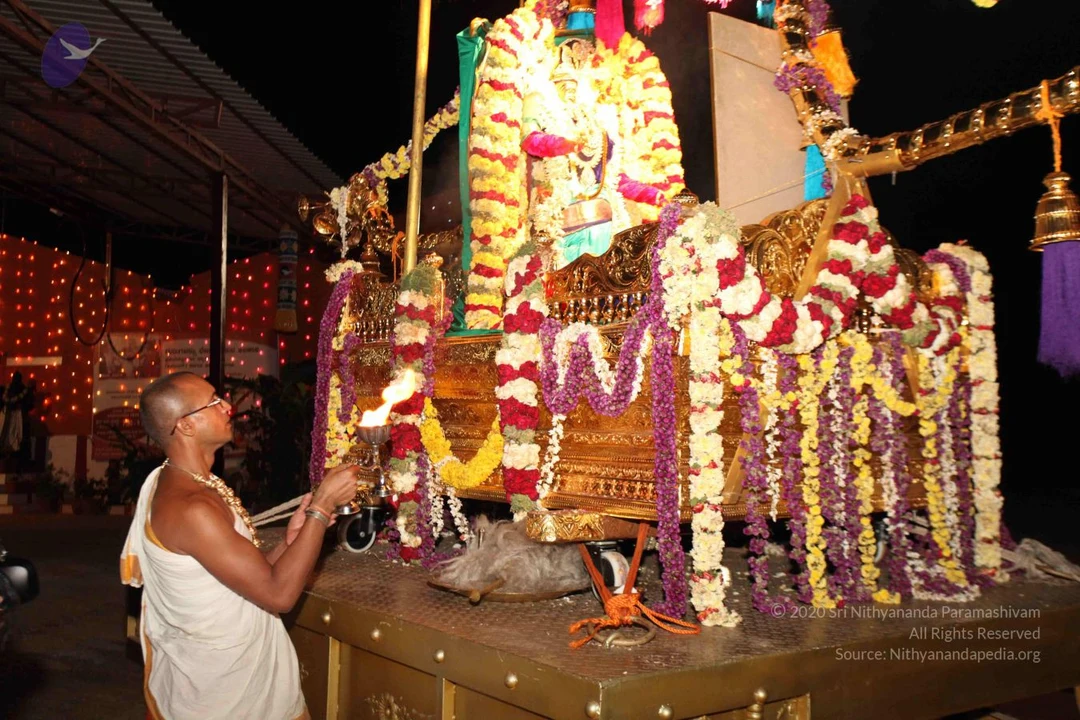
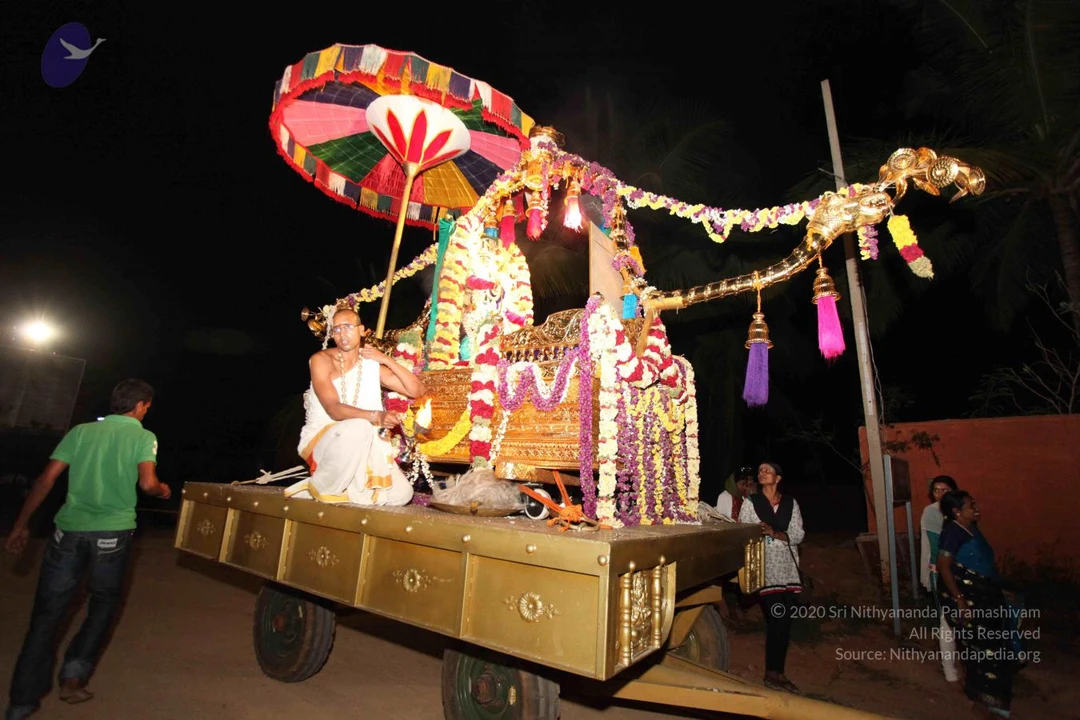
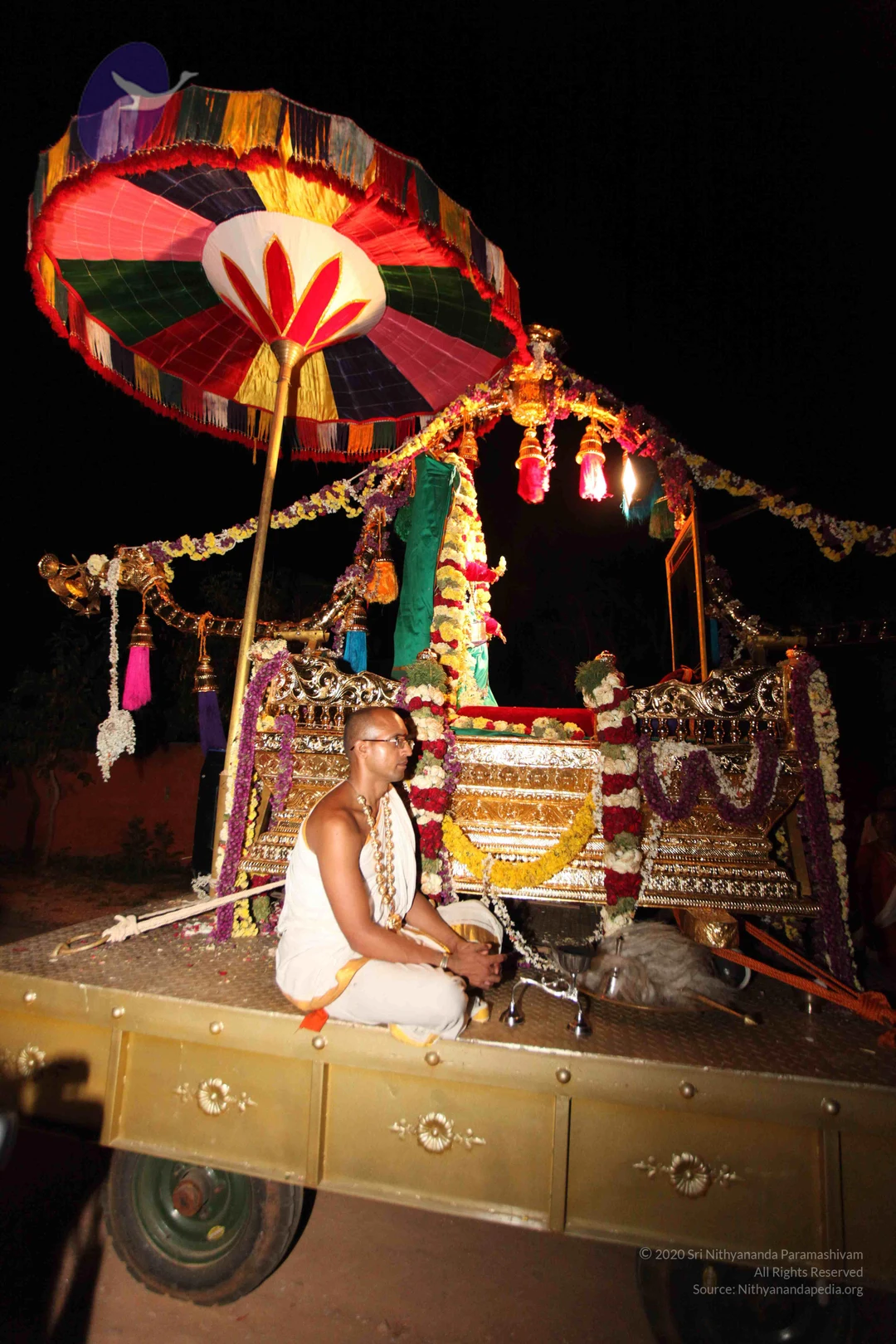
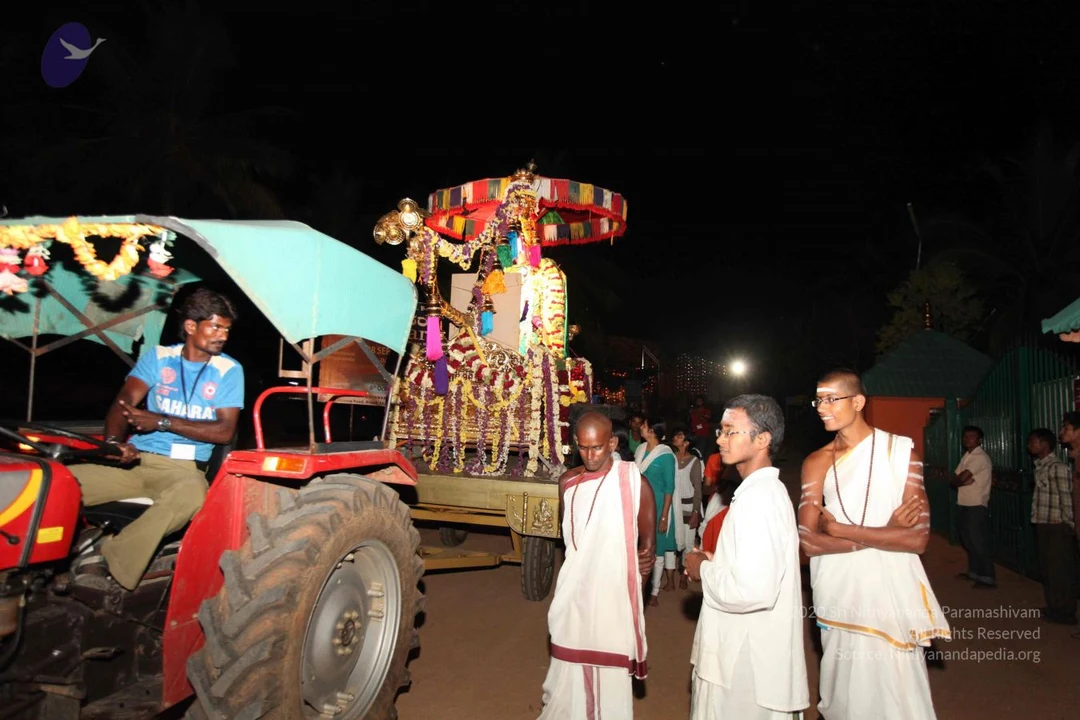
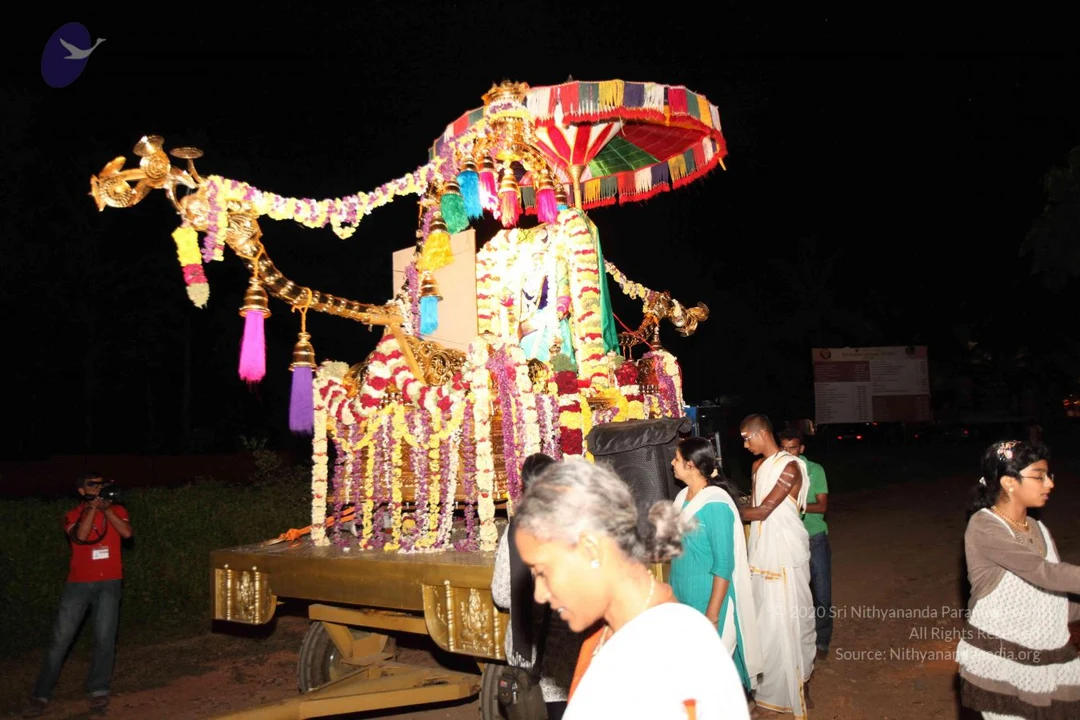
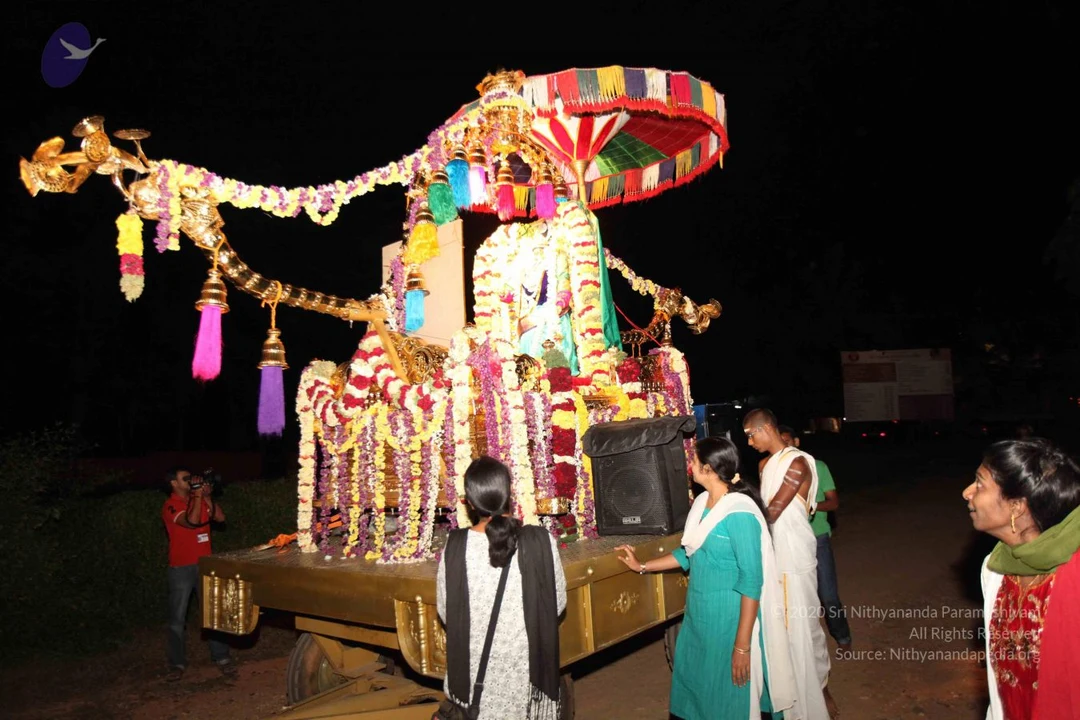
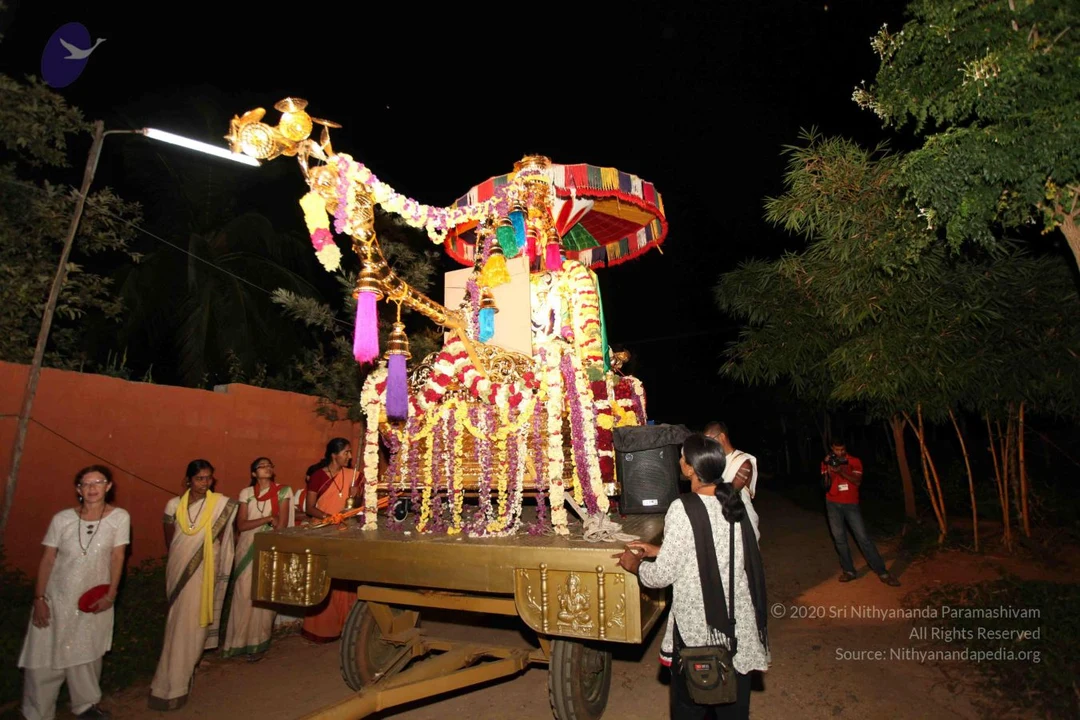
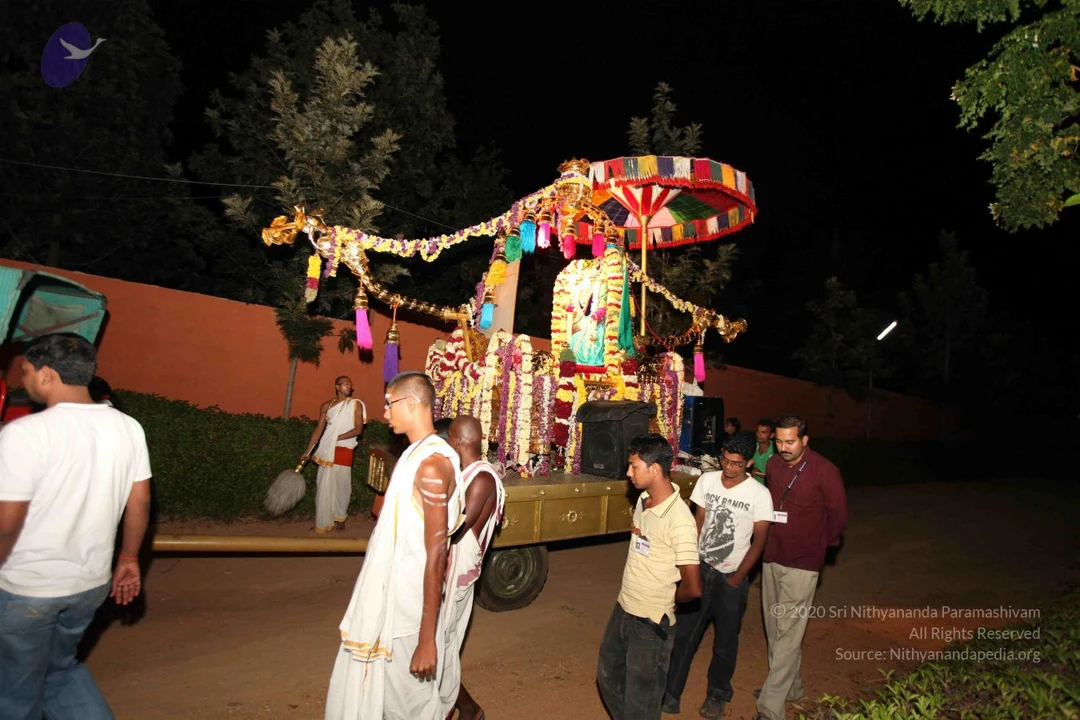
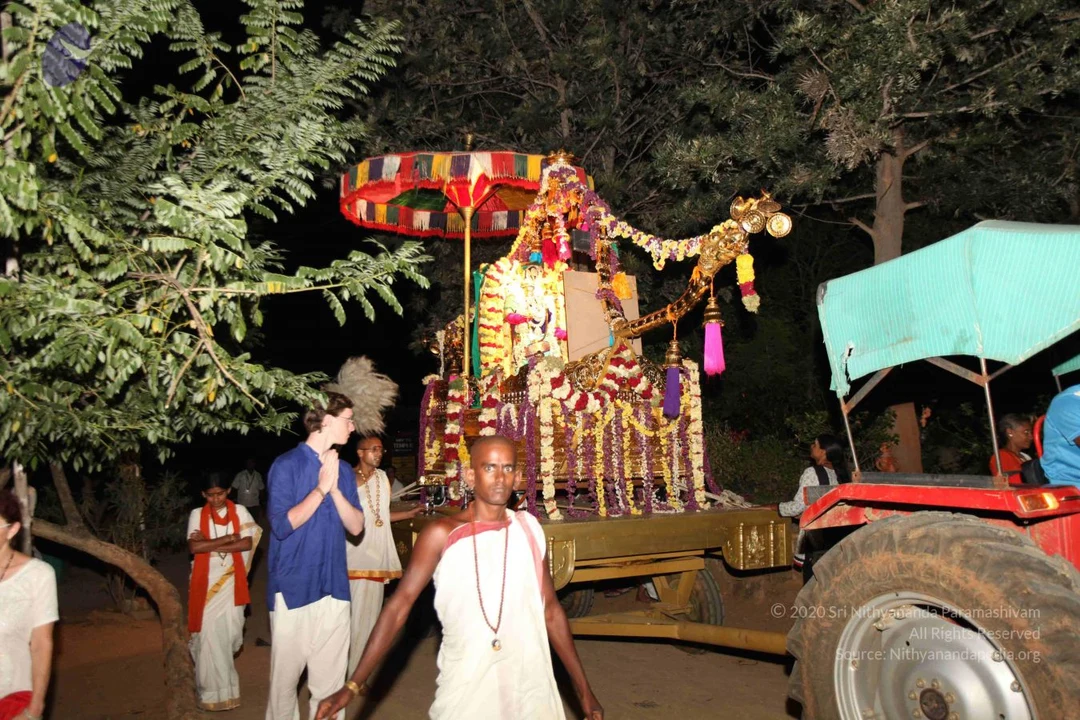
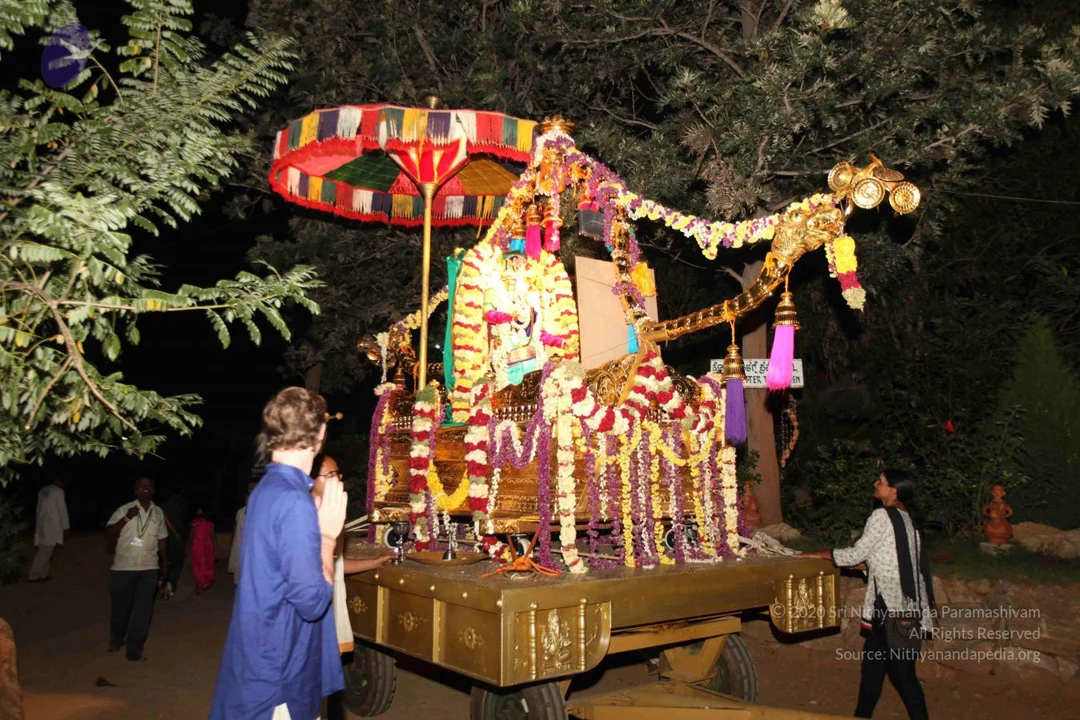
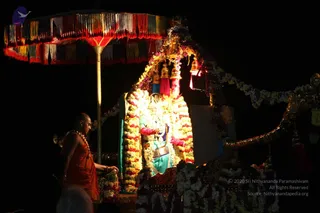
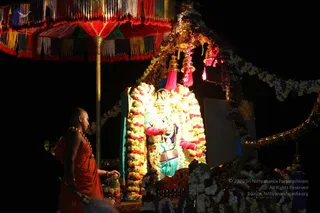
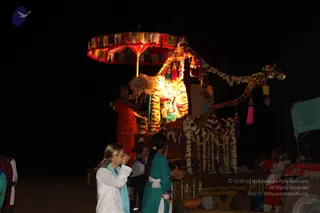
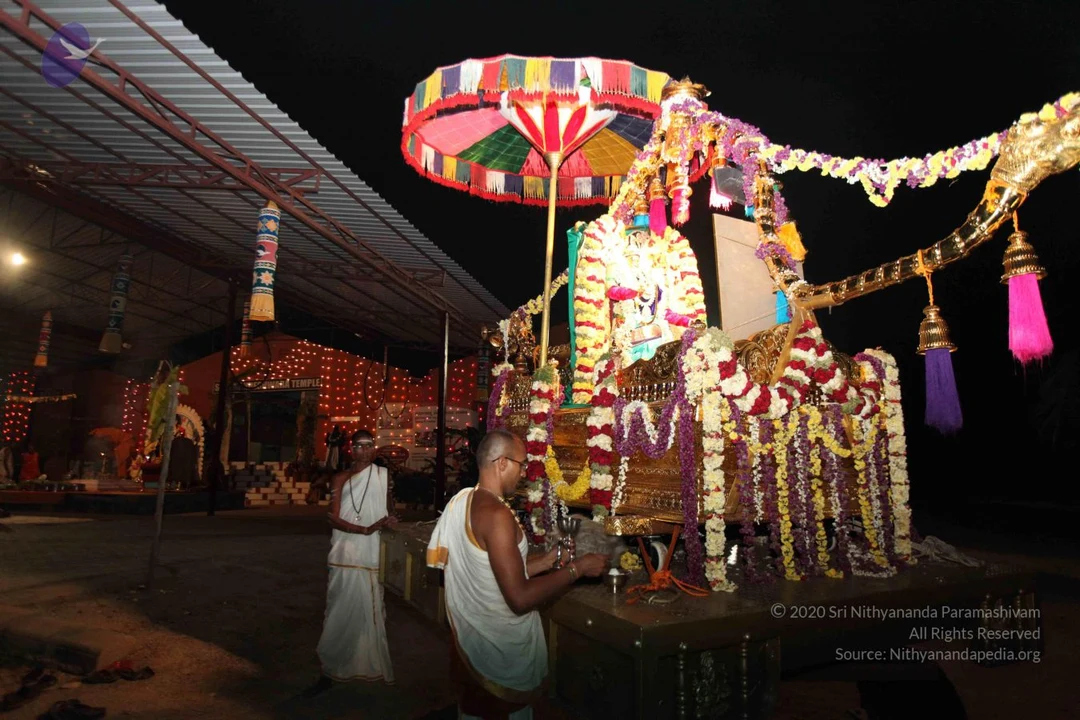
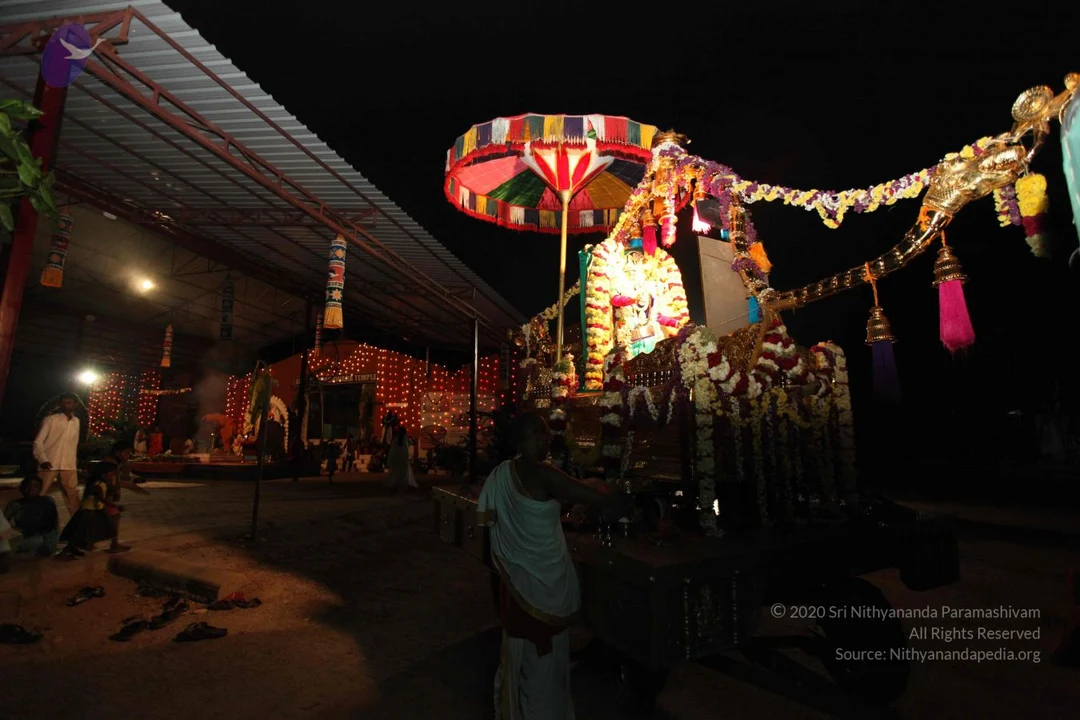
A night procession photograph of a decorated ratha or palanquin. A deity murti stands in the centre, draped in a teal cloth and heavily adorned with garlands of white, yellow and red flowers. Above it hang gold tassels and a large red, yellow and white canopy with fringed panels in red, maroon and yellow, lit by bright light. Silver-coloured carved panels line the base of the vehicle. No people are visible.Night photograph of a festival procession on a golden palanquin-style float. A deity murti, adorned with heavy garlands of yellow and red flowers and wearing a teal cloth, stands at the centre under a golden canopy with a large red, white and green fringed umbrella overhead. Hanging golden lamps with pink and red tassels decorate the frame, and an attendant at the lower right holds a white chamara fan. Only the hand and wrist of a person are visible at the edge; no full human figure is shown.Night procession photograph of a decorated deity murti on a festival chariot. The murti is adorned with dense garlands of yellow and white flowers, a crown, and red and green cloth draped around it. A bare-headed man in saffron-orange robes stands at left beside the chariot, holding a ritual object in his hand. Above is a tall gold-pole umbrella with red, green and multicoloured tasselled fringes. Strings of flowers and brass ornaments trail along the chariot frame against a black background.A night procession photograph of a deity murti decorated with dense garlands of yellow, white and red flowers, mounted on an ornate chariot or palanquin. Brass bells hang above the figure, and a tall umbrella with red, orange and multicoloured tassels shades the scene. On the left, a shaved-headed man in orange-saffron robes and a rudraksha mala walks beside the palanquin with his hand near an offering tray; he appears to be a priest or devotee. The deity is lit brightly against a dark background.Night procession photo. A shaved-headed man in orange-saffron robes with a beaded necklace stands at left beside a decorated ratha/palanquin, holding a cane or staff and a flower offering. On the palanquin a deity murti in teal and blue cloth is almost covered in white and red flower garlands, with a kalasha-like gilded finial and pink tassels above.Night photograph of a festival procession with a flower-decorated chariot (ratha) carrying a deity murti lit by lamps. A red and gold fringed parasol stands above the cart. A monk in orange robes stands on the chariot, holding a white fan-like chamara over the deity; garlands of marigolds hang from the chariot. In the foreground a woman in a white top and blue shawl presses her hands together in prayer, and another woman in a teal kurta stands with folded hands. Several other people in orange, white and teal stand near the cart.

ChandiHoma

68 photosSource gallery
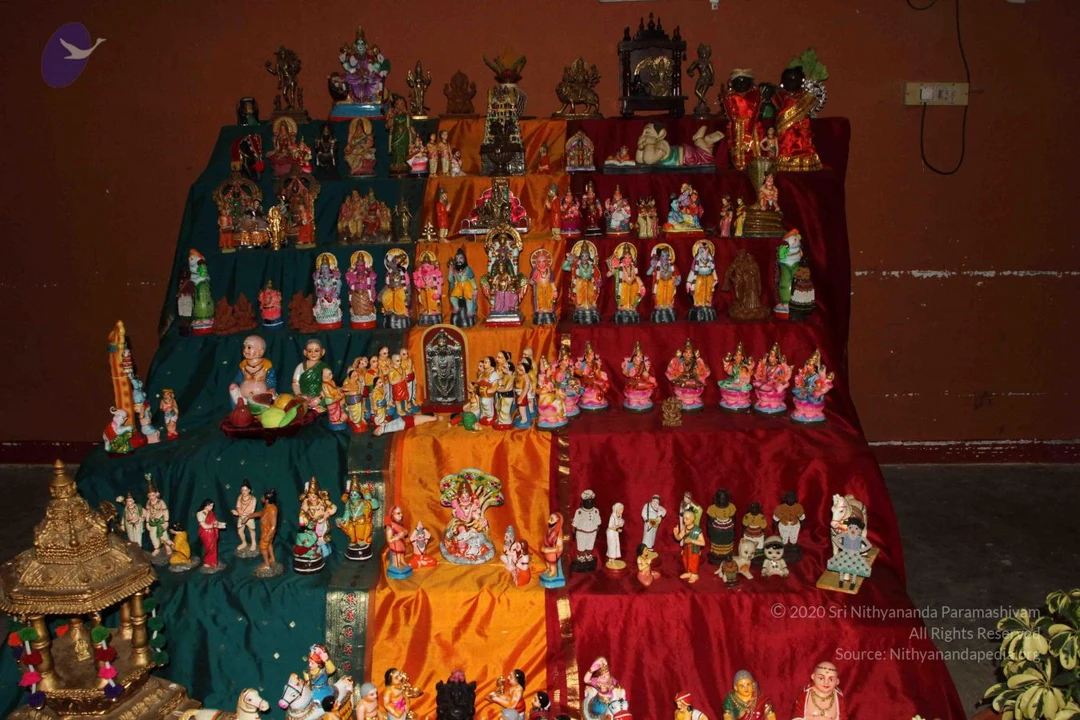
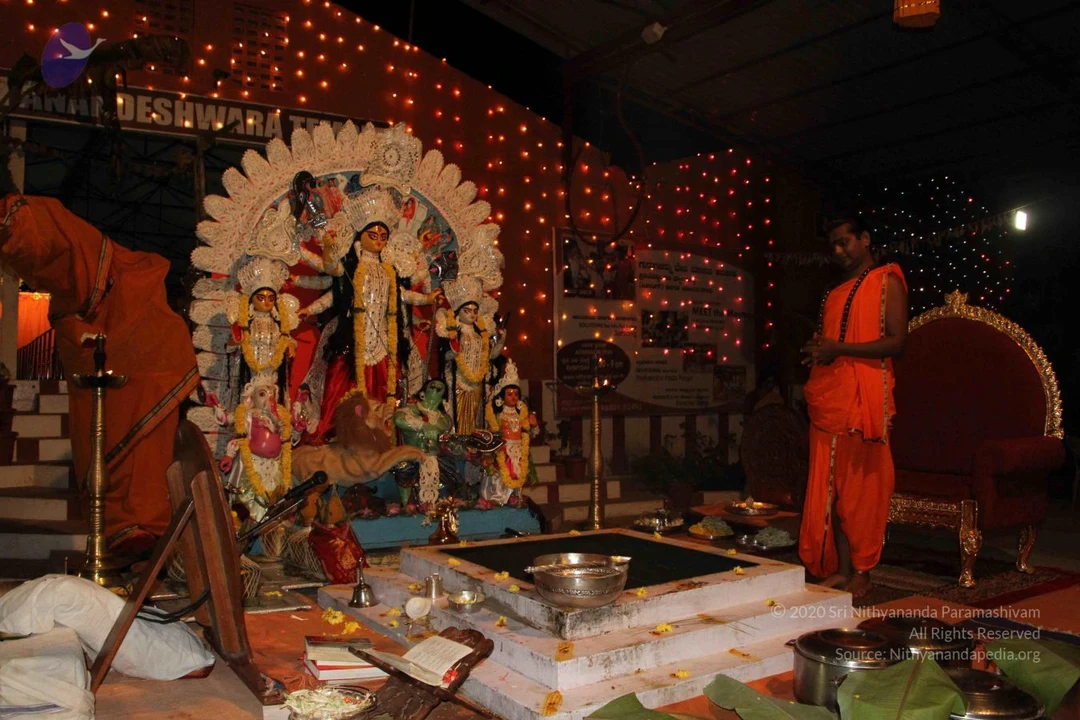
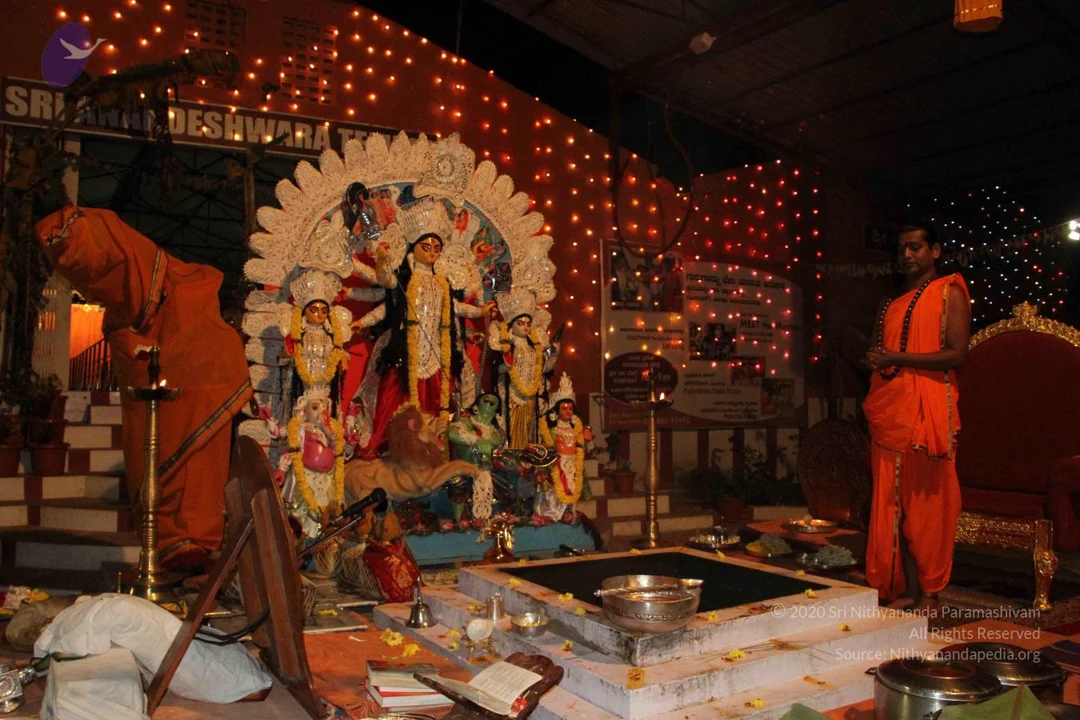
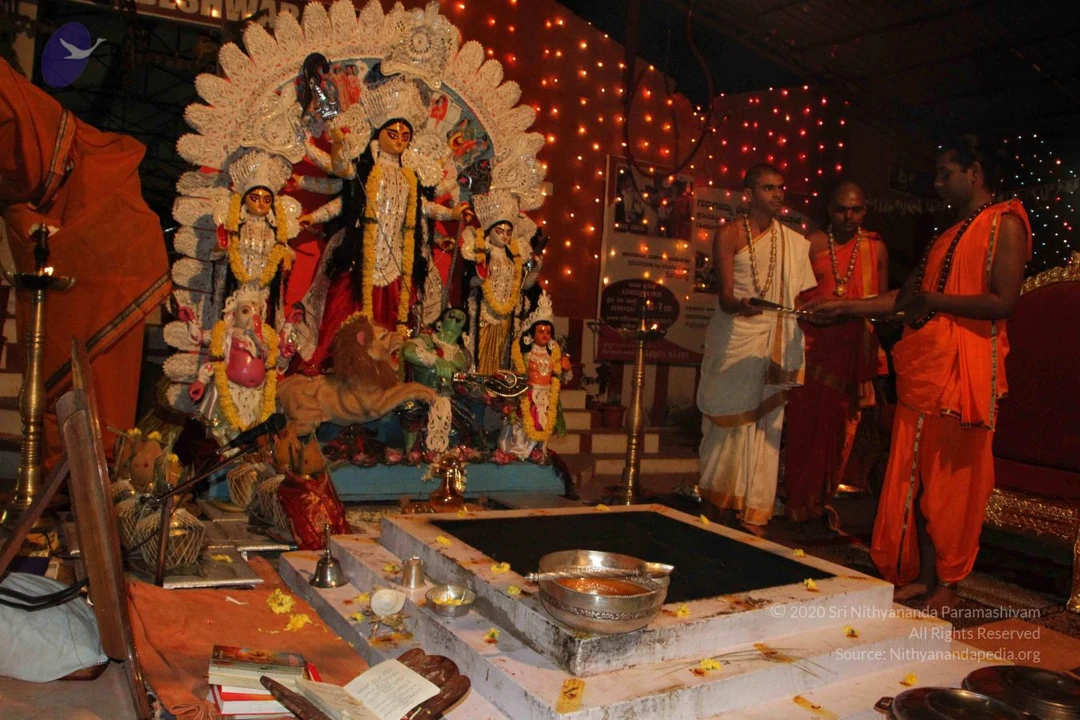
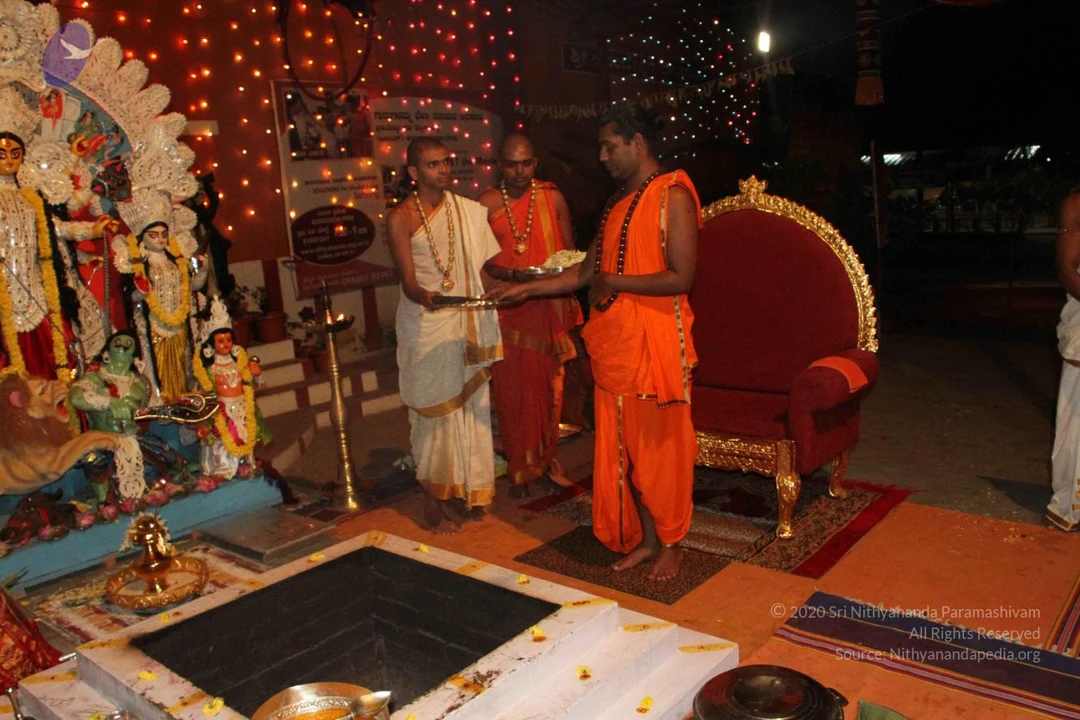
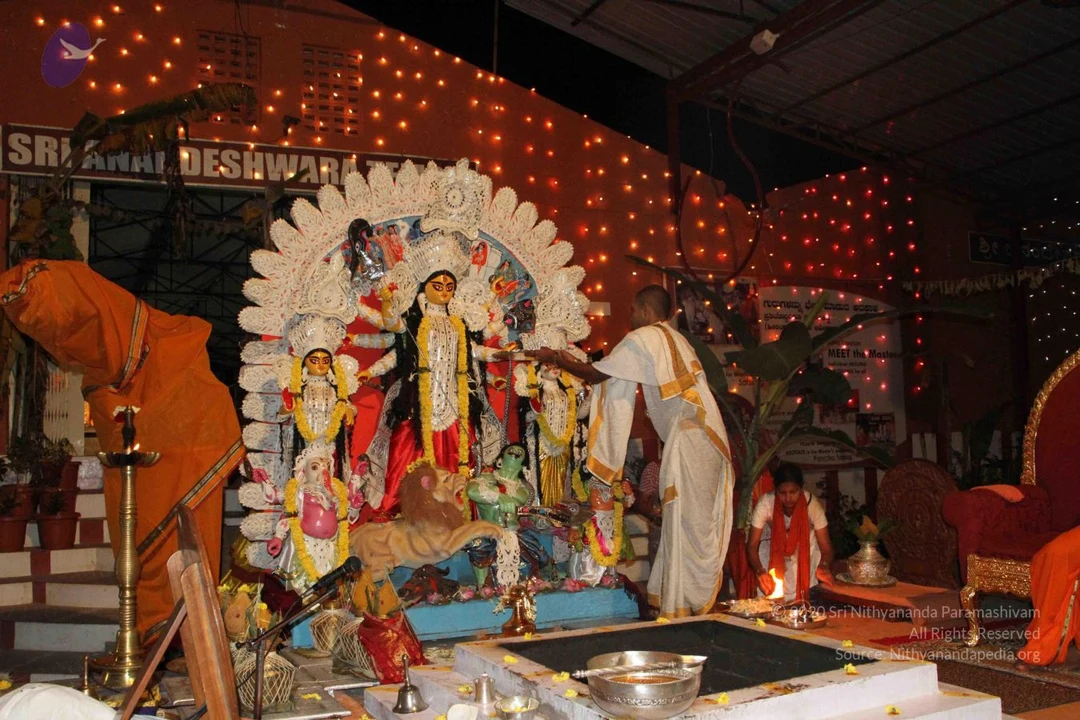
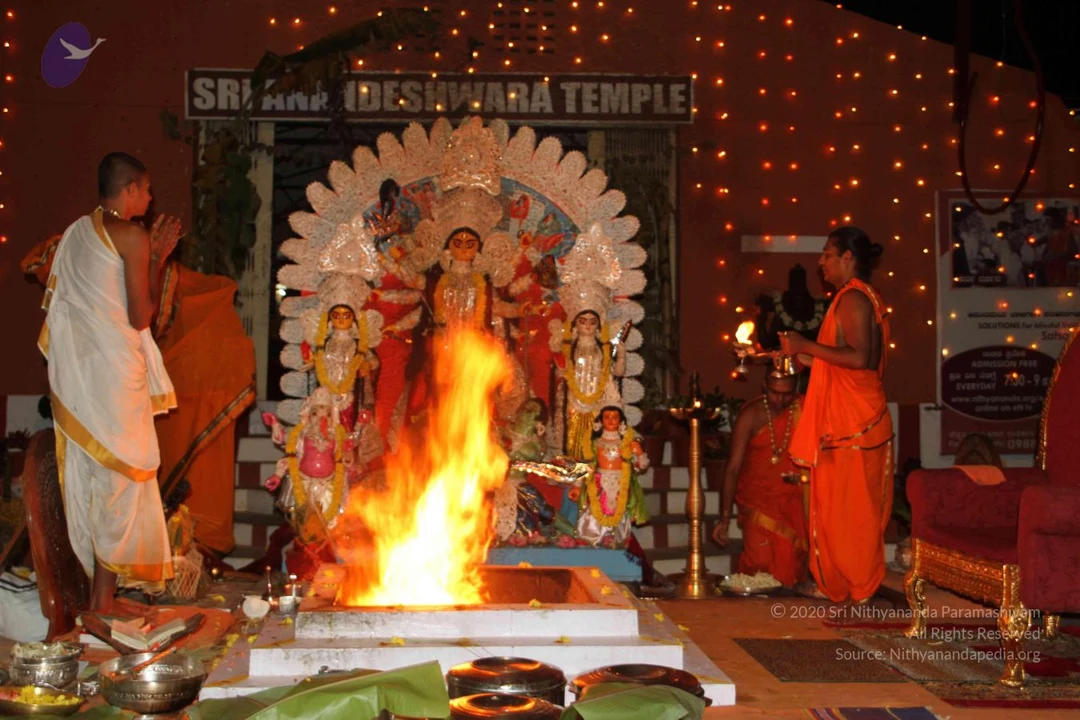
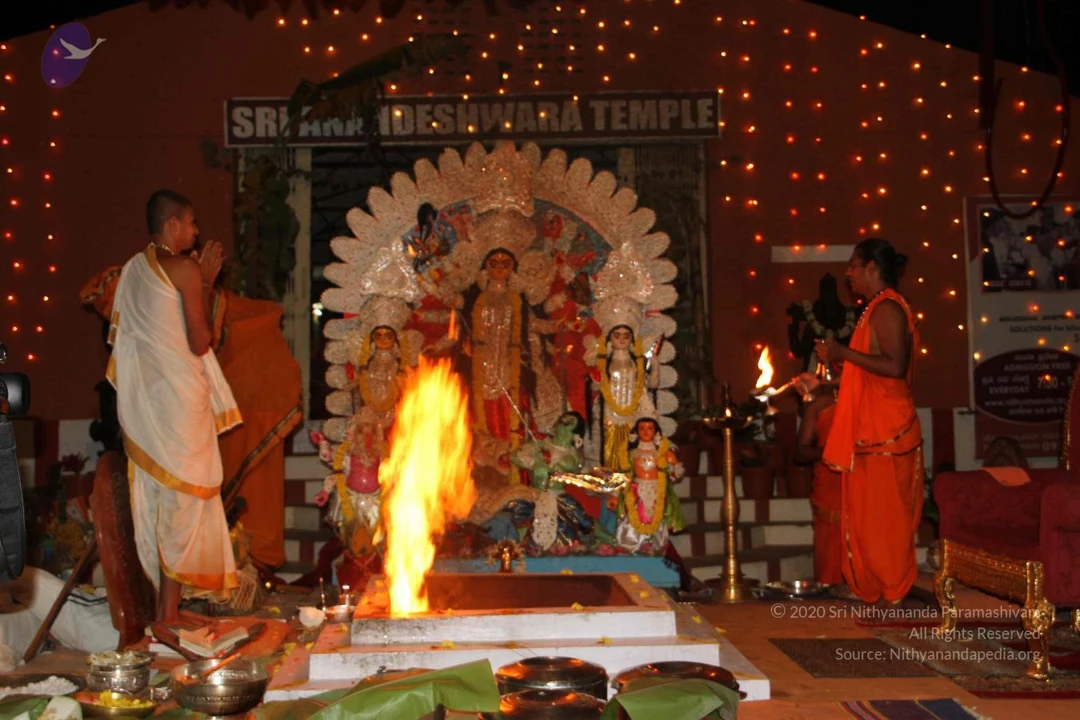
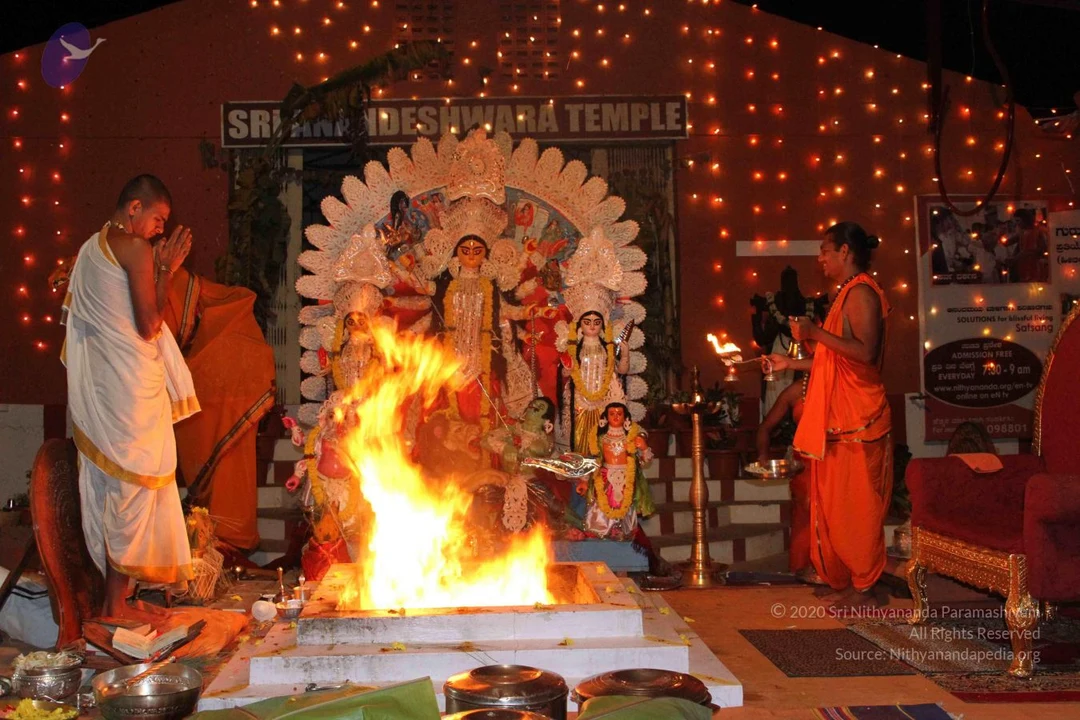
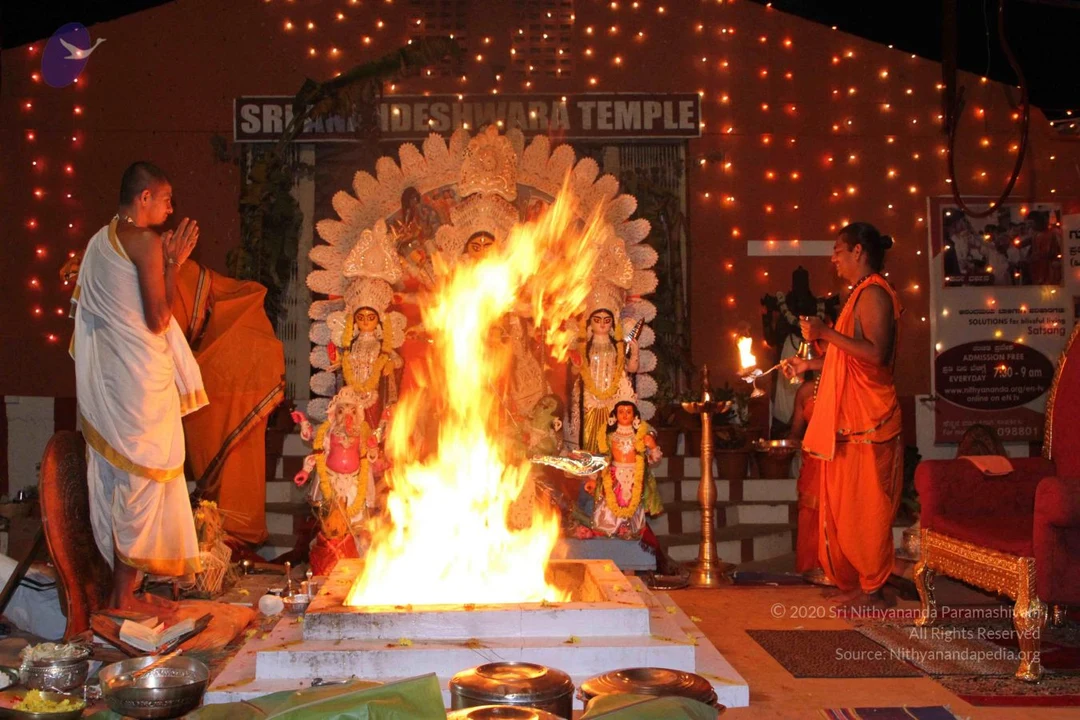
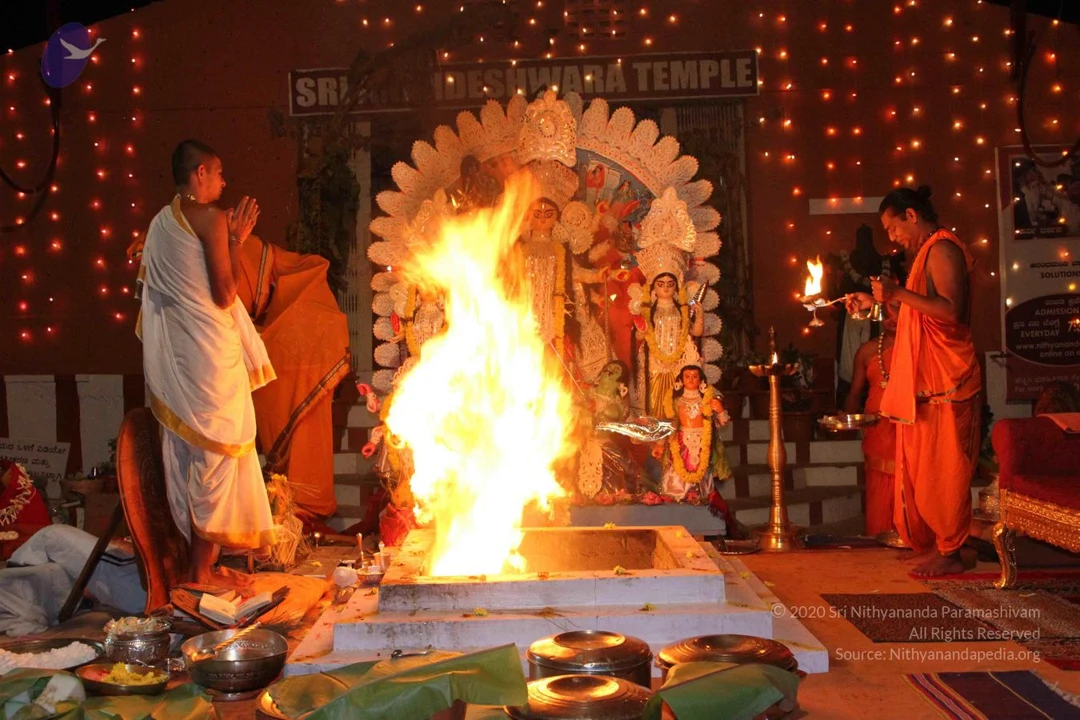
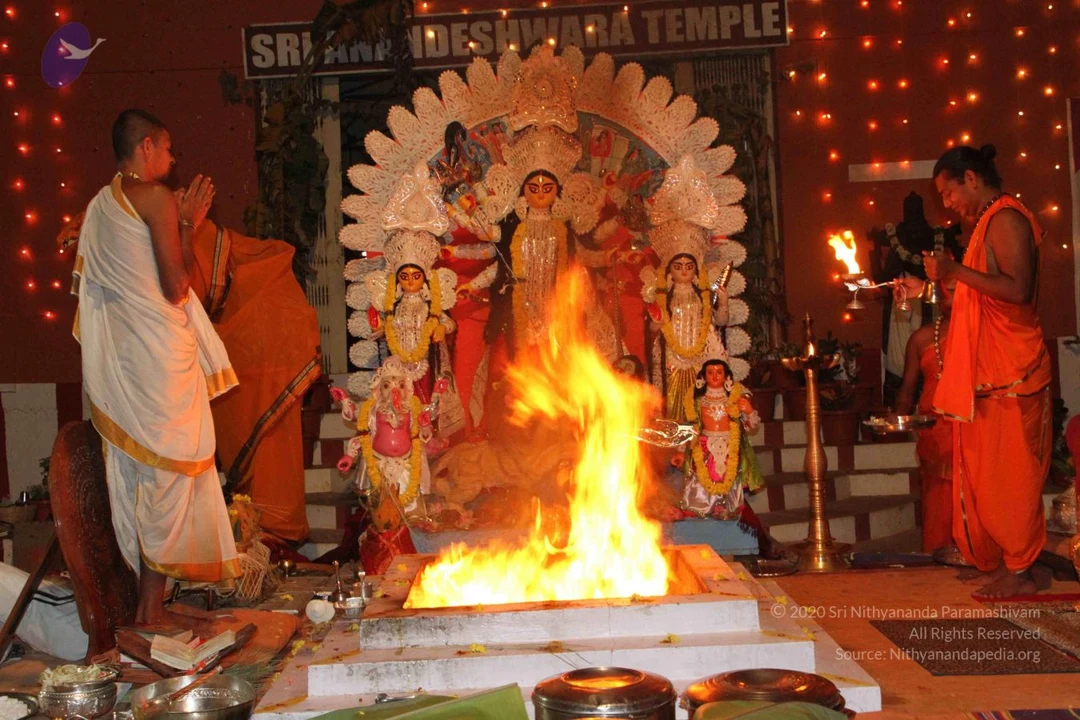
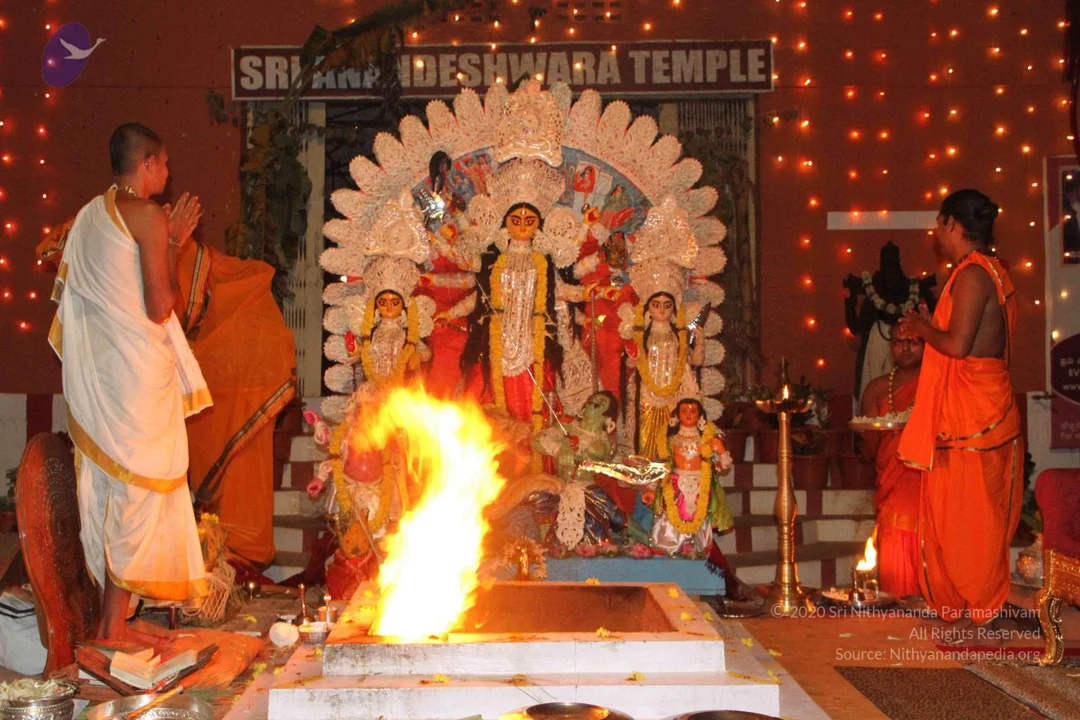
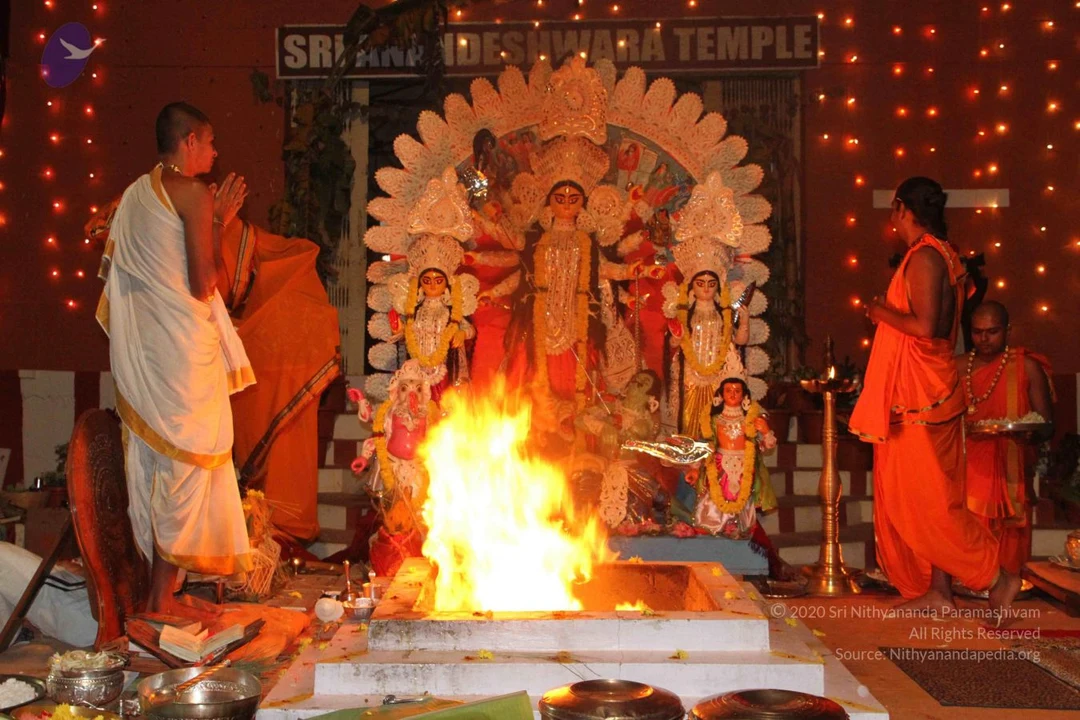
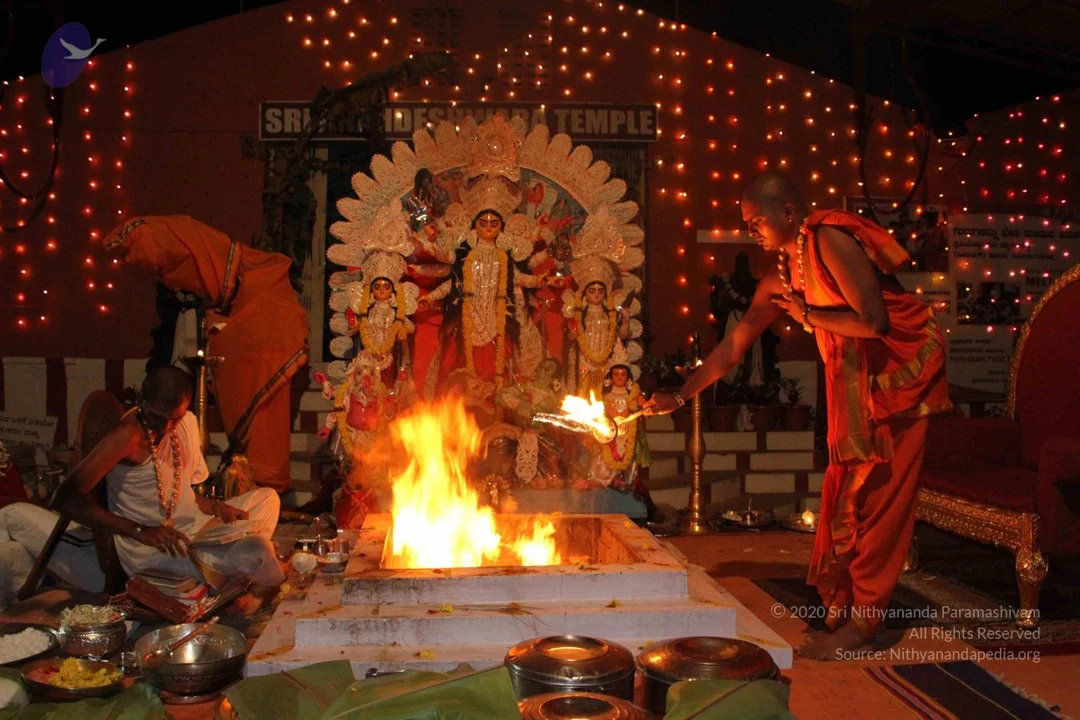
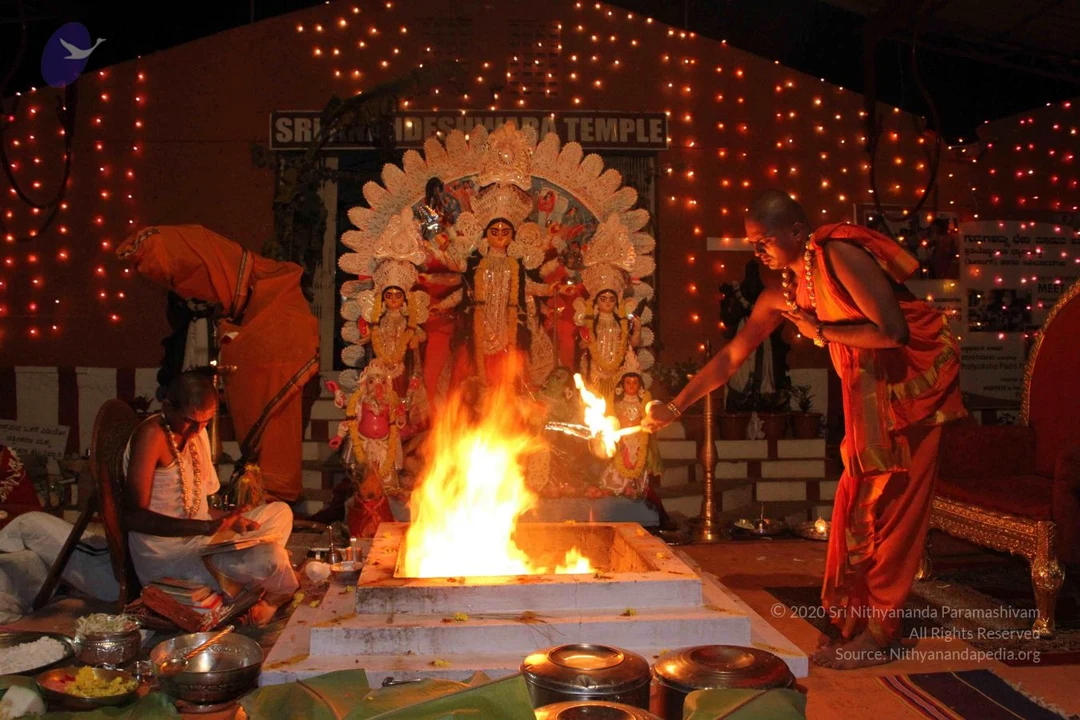
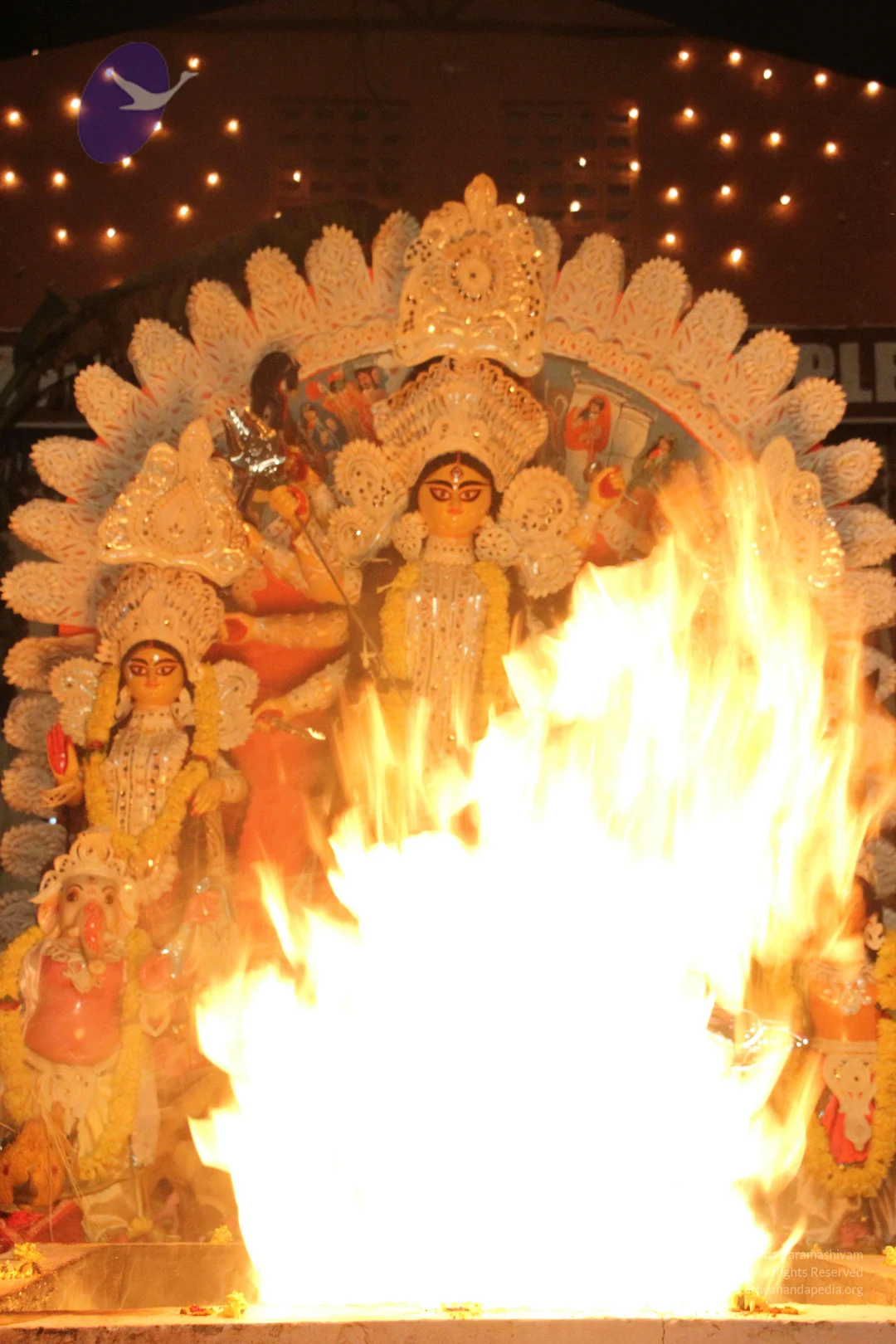
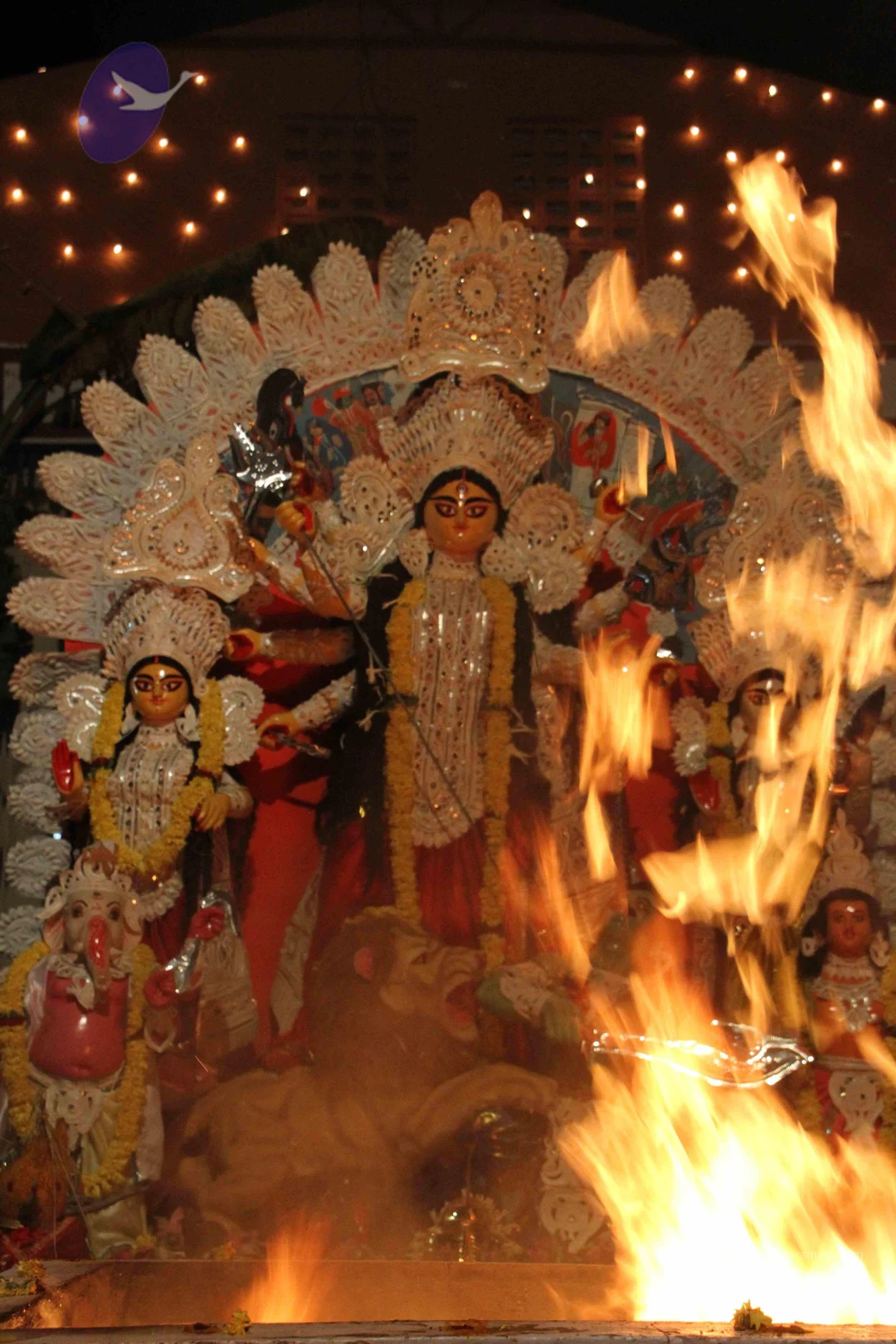
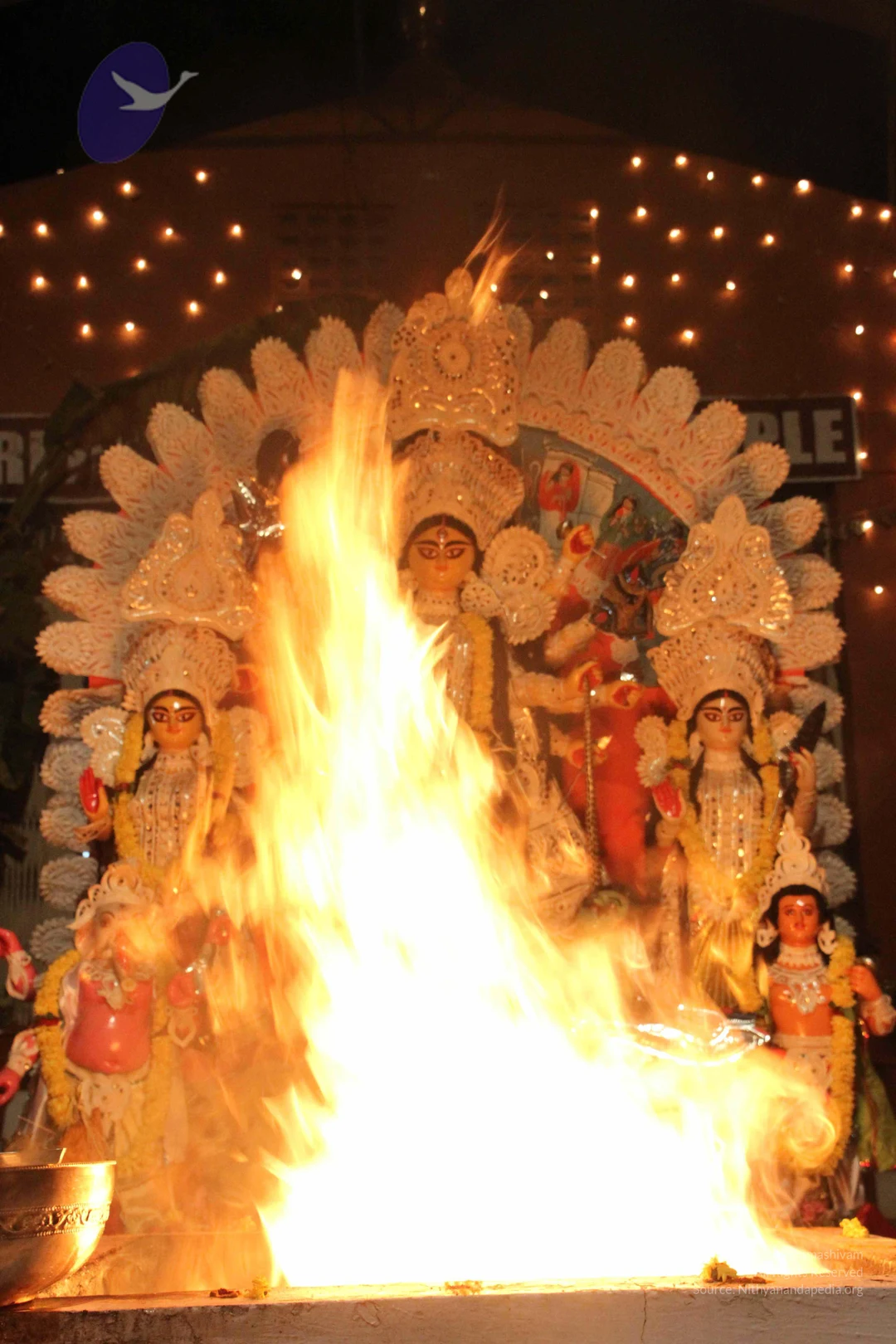
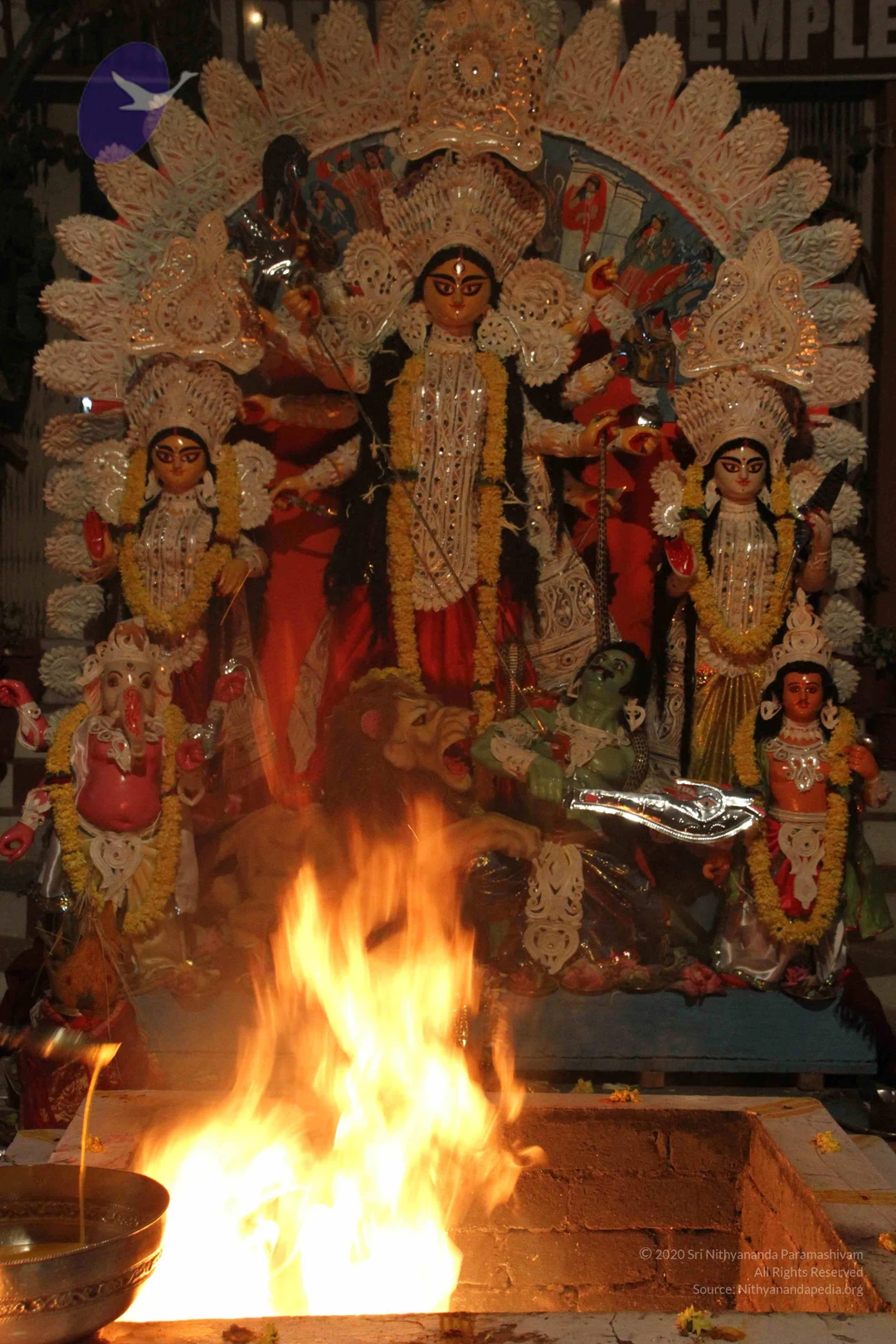
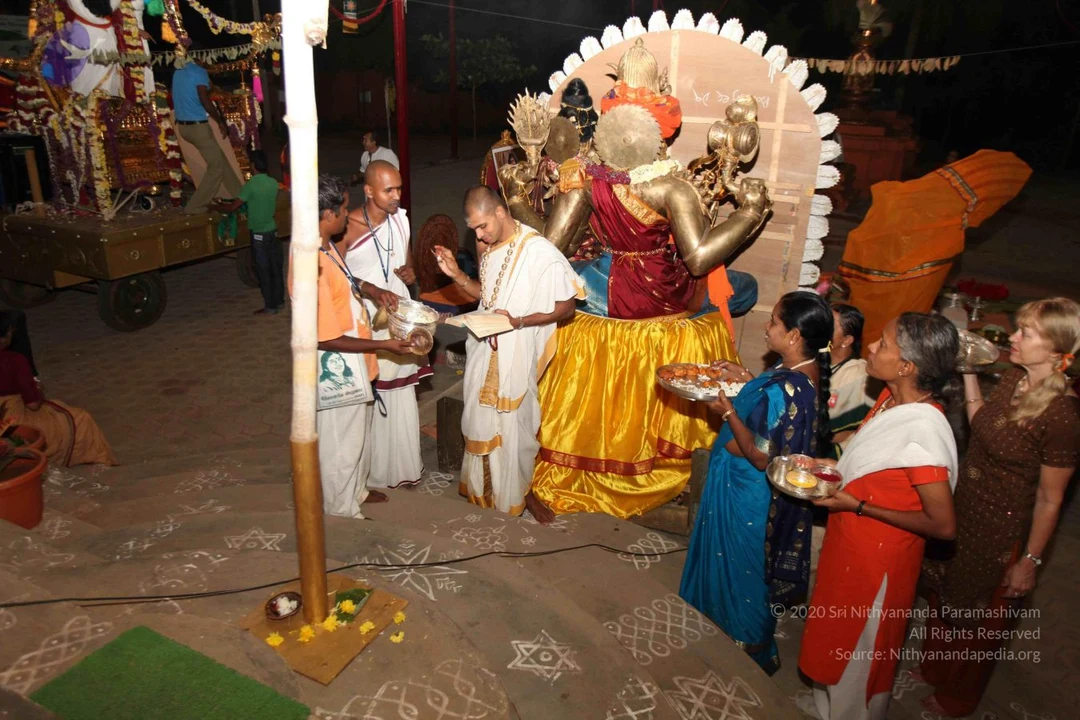
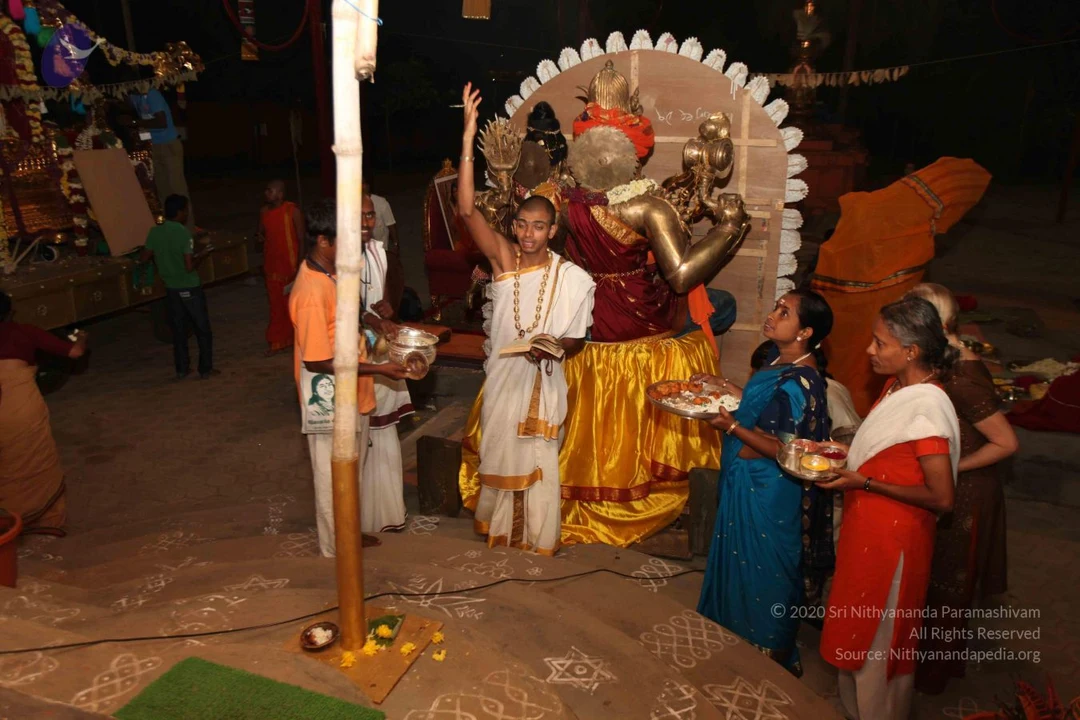
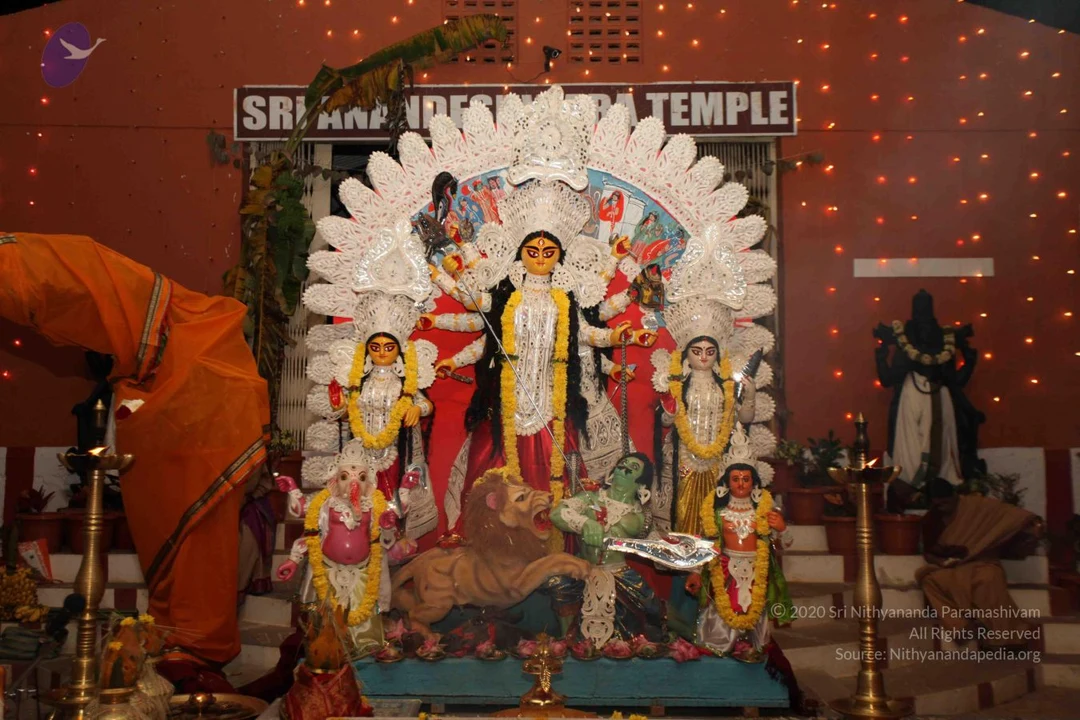
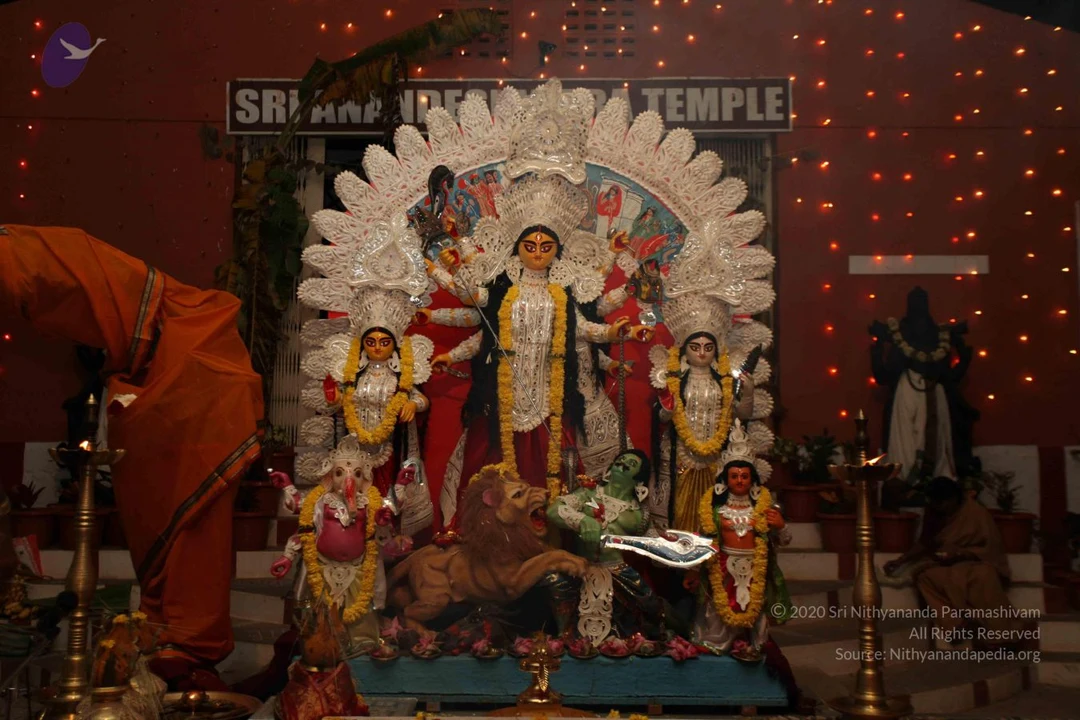
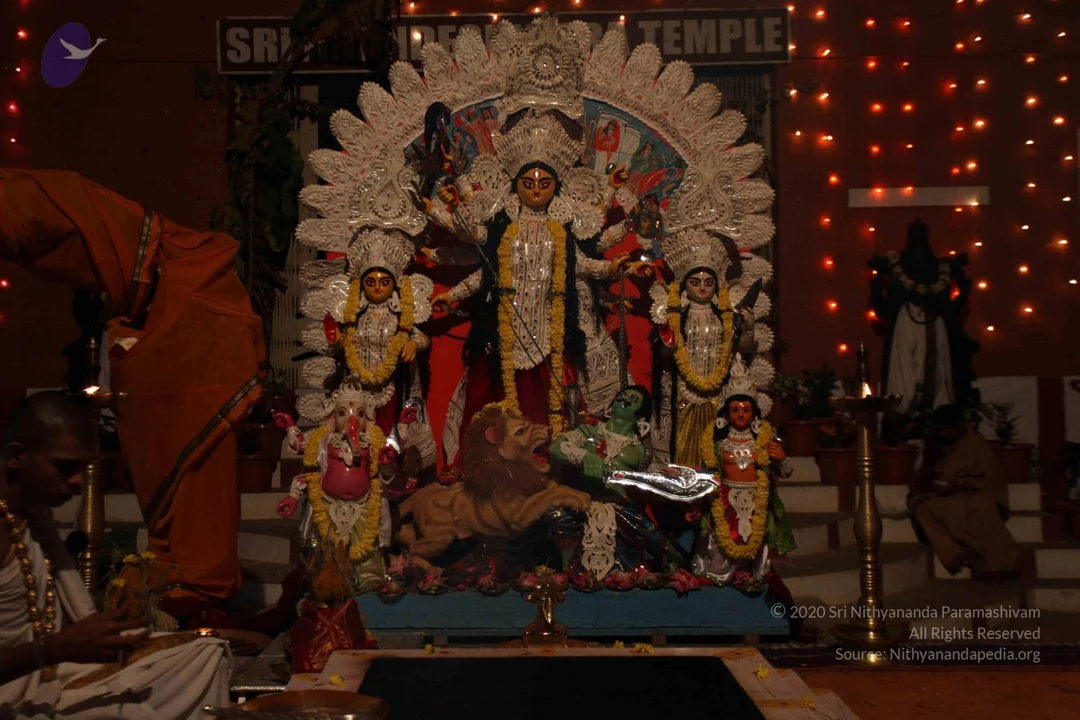
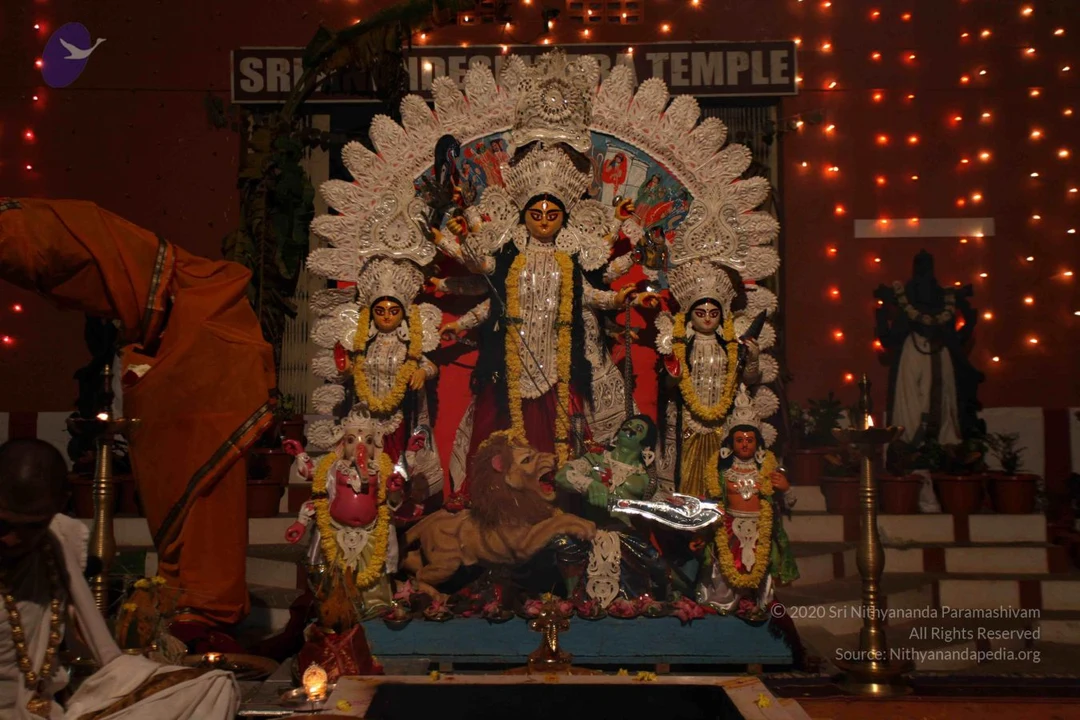
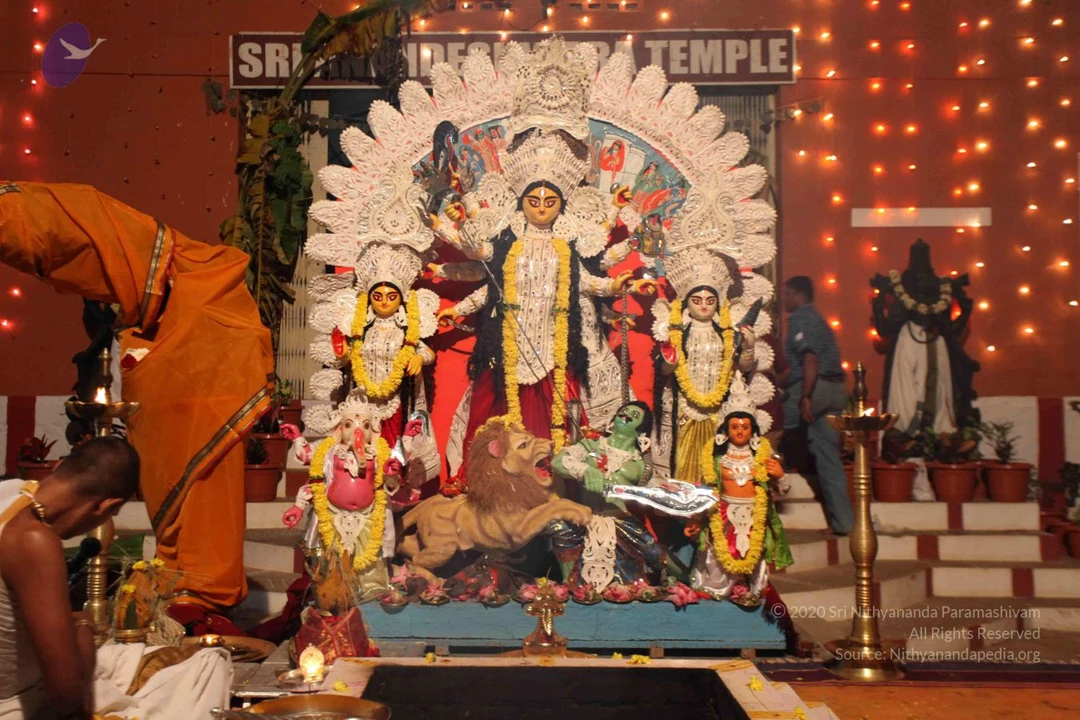
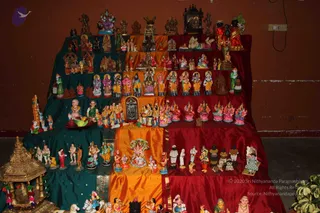
A photograph of a tiered Golu-style doll display set against a reddish-brown wall. Stepped platforms are draped in green, orange and maroon silk cloths and crowded with painted clay and wooden figurines of deities, saints, musicians, dancers and animals, many with bright robes and ornaments. Near the top centre sits a dark wooden shrine with a small image inside. Left foreground holds a gilded canopied palanquin with a small festoon of tassels. Two seated figures, one bald and one with a dark braid, appear among the figures on the lower left. No physical people are visible; all human figures are dolls or statues. No a person candidate is visible.A night photo of a temple shrine with a large white and red painted deity murti of a multi-armed goddess, flanked by smaller figures and a lion, decorated with yellow marigold garlands and set against a glowing red wall of fairy lights. A standing man in orange dhoti and orange shawl with a rudraksha mala stands at right beside an empty red and gold ornate chair. In front, a white stepped platform holds a brass bowl, oil lamps, flower petals, and an open book, with brass vessels and banana leaves in the foreground. Behind him a banner reads Nithyanandeshwara Temple.A night-time puja in a temple hall lit by string lights and oil lamps. A large clay murti of a goddess with multiple arms, red and gold garments, and garlands stands at centre, flanked by smaller deity figures and a lion mount. In front, a man in saffron-orange robes with a rudraksha mala stands at the right beside a gold-trimmed chair, while another person in orange robes bends over at the left near a tall brass oil lamp. A square havan-style offering platform holds brass bowls, flowers, and a metal pot, and books and a bell lie on the floor. Text on the wall reads Sri Nithyananda Deshwara Temple.Night photograph of a Durga-style deity murti with a white, ornately cut arch backdrop, flanked by smaller figures and a lion mount, decorated with yellow marigold garlands and set among red fairy lights. In front, a square black-topped altar stands with a brass bowl of offerings and scattered marigold petals, with oil lamps on brass stands on either side. Three men stand to the right: a white-clad man in a dhoti and shawl holds a ritual object, and two men in orange cloth wear rudraksha malas. An open book lies at the lower left beside brass bells and a conch-like vessel.Night photograph of a ritual at a temple-like shrine lit with warm string lights. On the left stands a colourful deity murti with a crown and garlands, beside a green-faced figure. In the centre, a bald priest in a white dhoti with gold border and gold necklace holds a tray. Beside him a bald man in saffron cloth and rudraksha garland stands. At right, a man in saffron robe with a rudraksha mala holds a plate of flowers and rice toward the priest, beside an empty red velvet throne with gold trim. A square stone yagna pit with marigold petals lies in the foreground beside a brass lamp. A banner with Telugu text hangs behind.Night puja before a large decorated deity murti of the goddess Durga with ten arms and a lion mount, adorned with white and red fringed backdrop, marigold garlands and a silver crown. Two smaller figures flank her. A man in white dhoti and shawl with bare upper body performs aarti with a lit lamp at the front, while a second man in red-orange shawl tends a flame in a fire pit with brass bowls and flower petals. Brass oil lamps and a shrine lit by string lights surround the scene; an orange cloth hangs at left and a gold-trimmed red throne sits at right. A printed banner reads Sri Nithyananda Deshwara Temple. Ritual scene with aarti and homa-style fire offering.

NavaratriAlankar

17 photosSource gallery
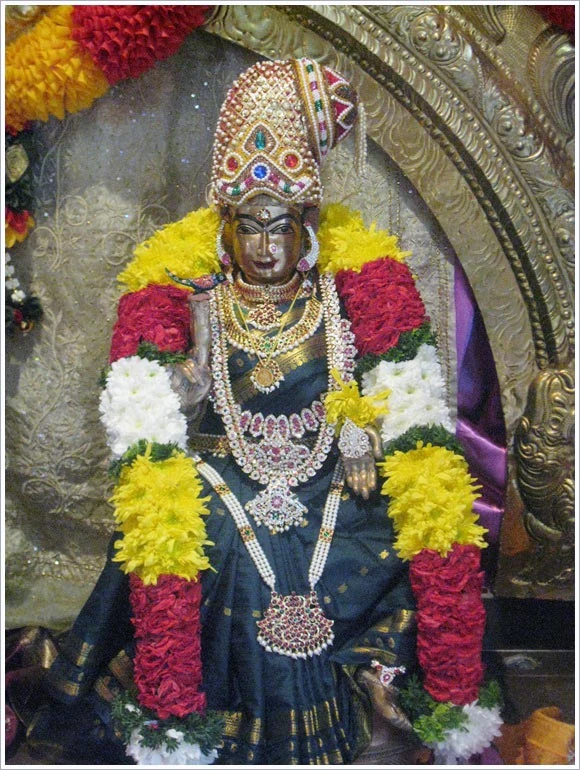
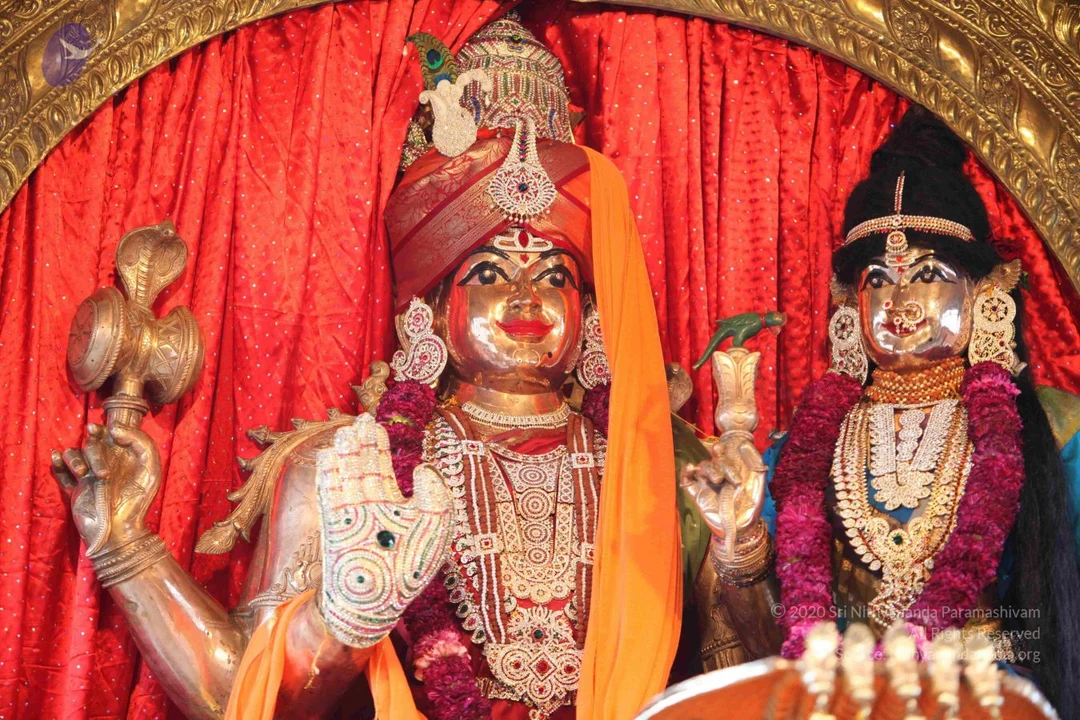
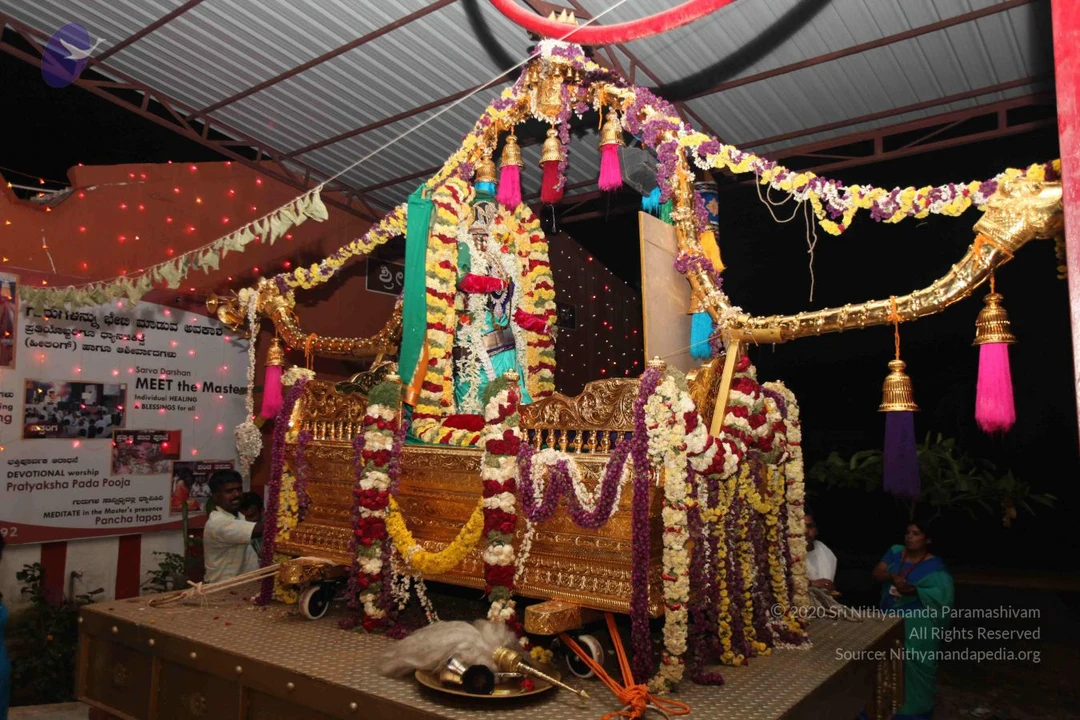
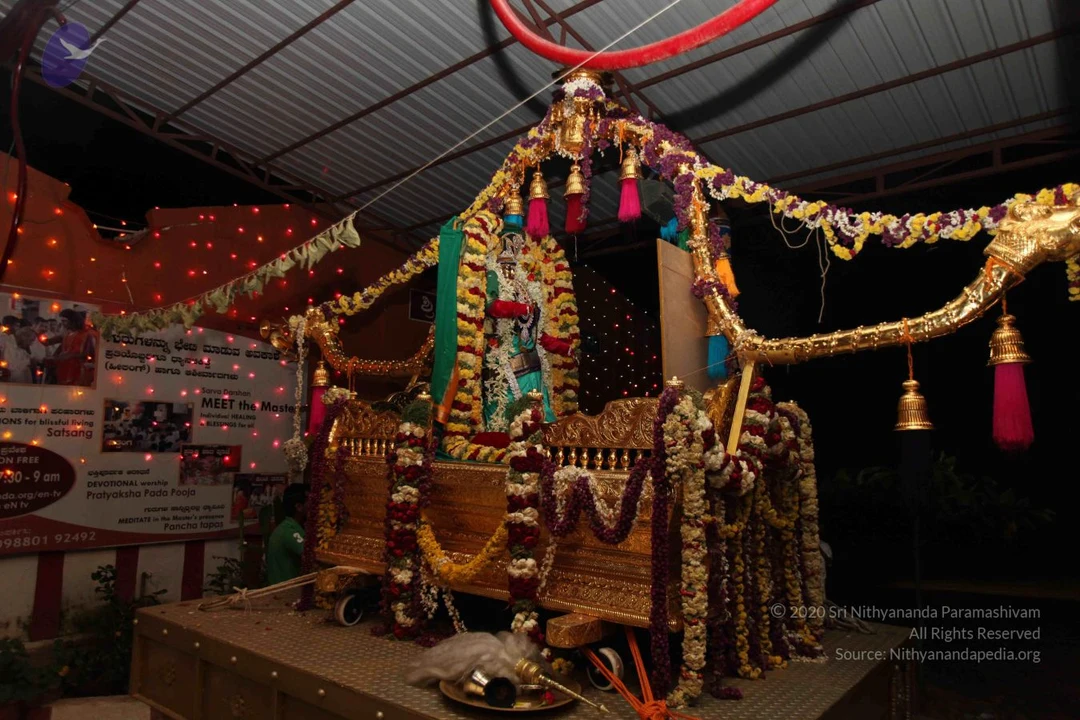
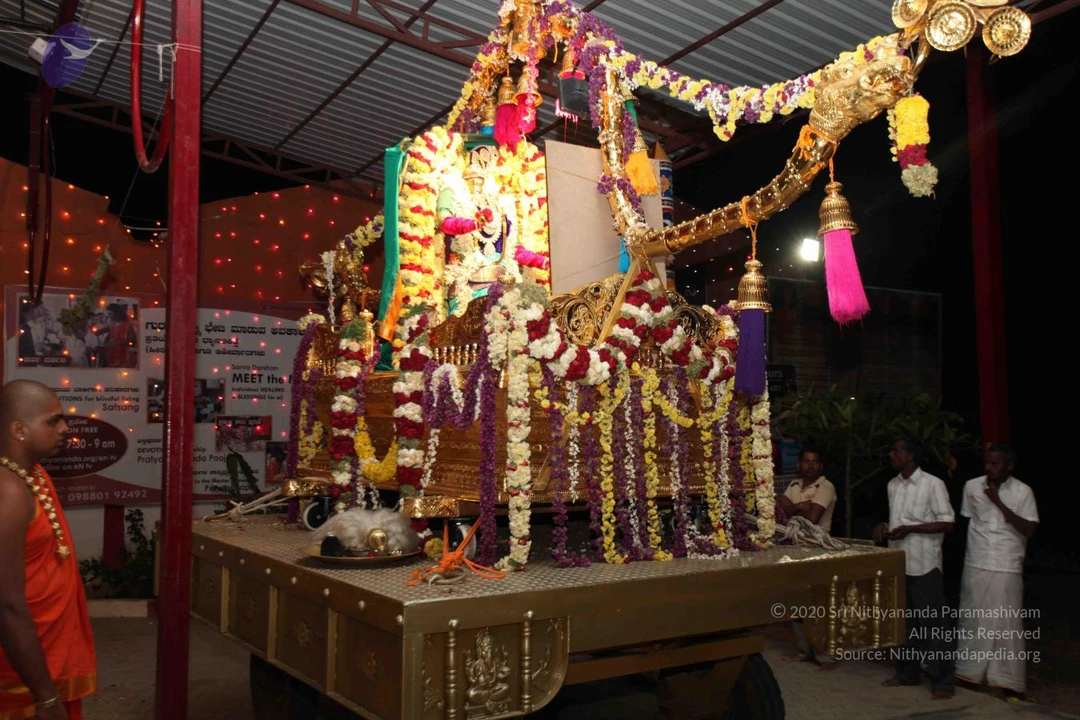
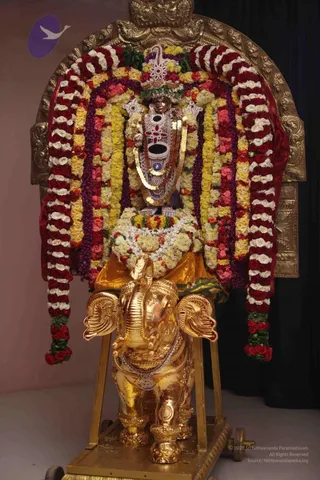
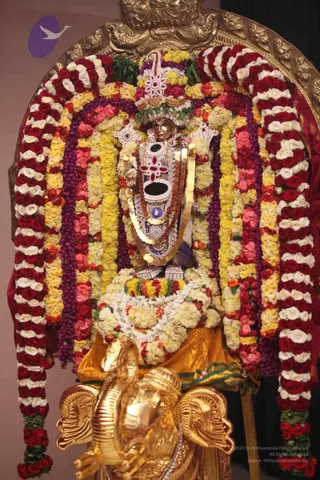
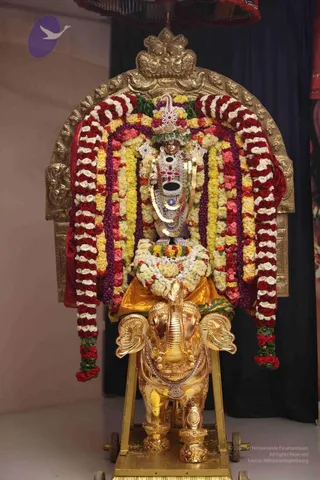
A decorated deity murti is displayed on a gold-plated elephant-shaped vahana platform in front of an ornate gilded arched backdrop. The figure wears a tall ornate crown, a jeweled necklace with red and blue stones, and a long golden garland, and is framed by dense strands of red roses, white roses, yellow marigolds and pink flowers. A red silk cloth drapes behind the arch. No physical people are visible; the setting suggests a puja or procession display.A photograph of a deity murti, a metal or stone figure of a deity dressed and garlanded for worship, standing in front of a golden arched backdrop. Dense garlands of red and white roses, yellow marigolds and purple beads frame the figure from both sides and arch over its head. The murti wears an ornate silver-and-gold crown, a jewelled chest ornament with red stones, layered gold and silver necklaces and a bejewelled arm bracelet. Below it sits a large garland and a golden elephant-shaped stand, and a gold cloth covers the base. There are no physical people visible, and the purple bird logo and copyright text are not described.A photograph of a small deity murti dressed and garlanded for worship, standing on a golden elephant-shaped base mounted on a wheeled golden cart or ratha. Behind it rises an ornate gilded arched frame with embossed floral and scroll designs and a red cloth backdrop. The figure wears a tall ornate crown with red and white stone decoration, a heavy jewelled necklace, and a bright red and white rose garland. Dense garlands of red, white, yellow and purple flowers drape around the arch and fall down the sides, with a golden cloth draped over the elephant base. A dark curtain and a pale wall form the background. No physical people are visible.A deity murti of Krishna-style form stands in a golden shrine arch heavily decorated with red and white rose garlands, yellow marigold strands and purple flower strings. The murti wears a jeweled crown and ornate silver-and-gold necklaces with red stones. It stands on a golden elephant-shaped carriage base with wheels, a ratha-style procession vehicle. A golden yellow cloth drapes the base, and a dark blue curtain and red fabric frame the background.A photograph of a gilded ceremonial throne-like seat with a golden lion base, draped in a red cloth and festooned with thick garlands of red roses, white and yellow flowers. At the centre sits a small deity murti adorned with a jewelled crown, gold necklaces and gemstones. Behind it, a large printed banner shows a smiling person in a pink-and-orange turban with a red bindi and orange-pink shawl, labelled with a copyright line. An ornate golden canopy with red fringe hangs above. No physical people are visible in the foreground.A small deity murti of Krishna-like form is dressed in jewelled ornaments and a gold crown, and is heavily garlanded with red, white and yellow flower strands. It sits on a gold ornate chair and a gold elephant-shaped base, under a gold and red fringed canopy. Behind it is a large printed portrait of a smiling man in a pink and orange turban with a tilak mark and orange shawl, labelled by the printed copyright text at lower right. No physical people are present in the scene.

NavaratriMalaysia

6 photosSource gallery
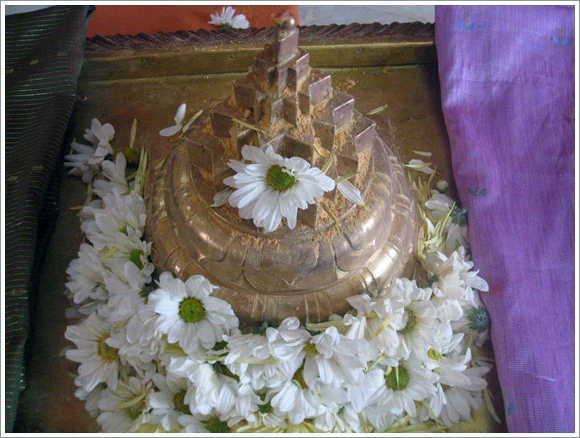
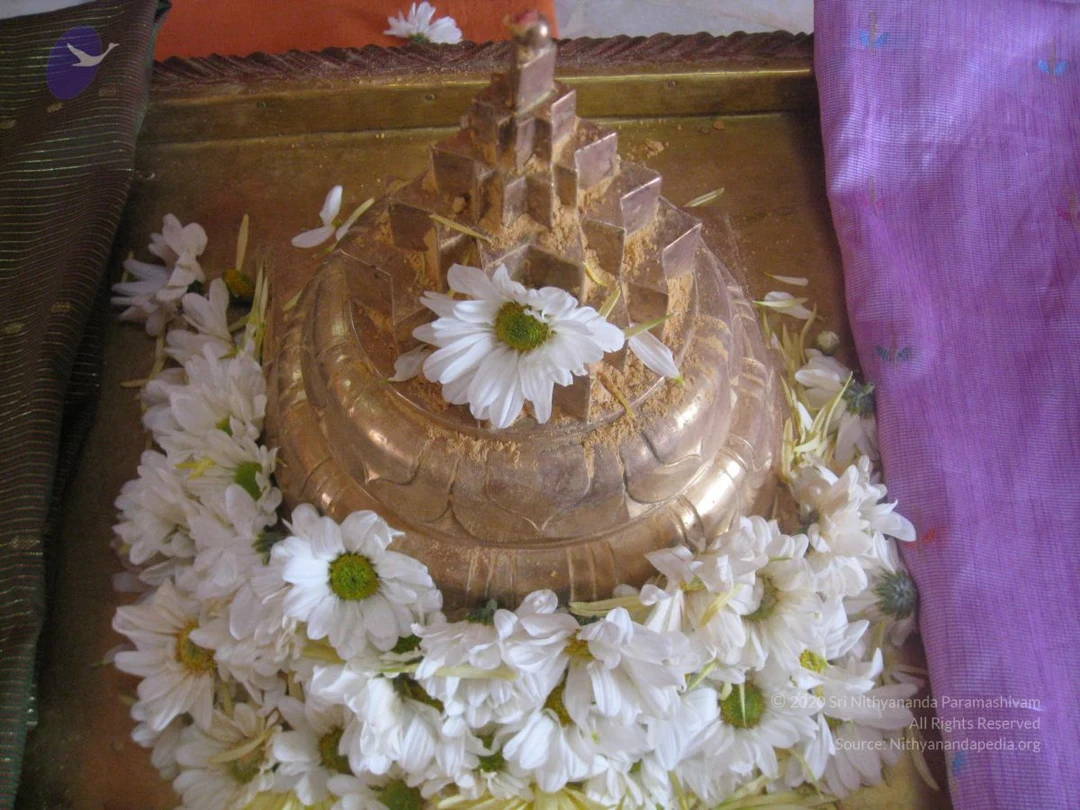
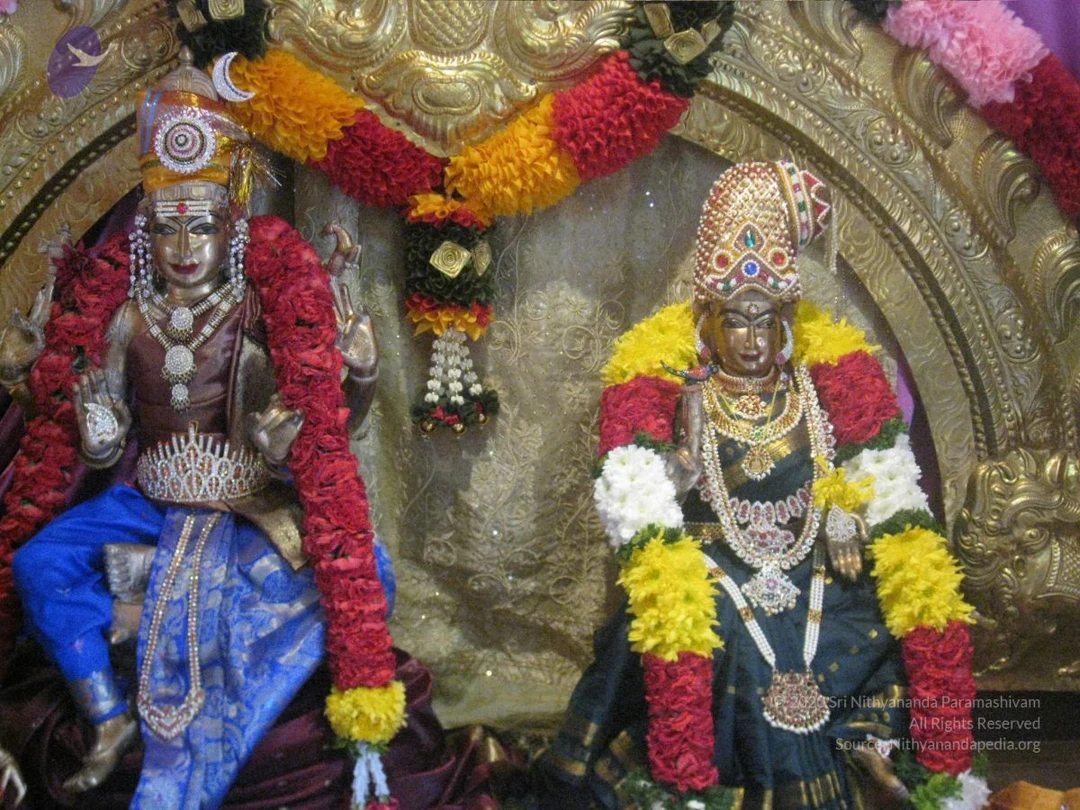
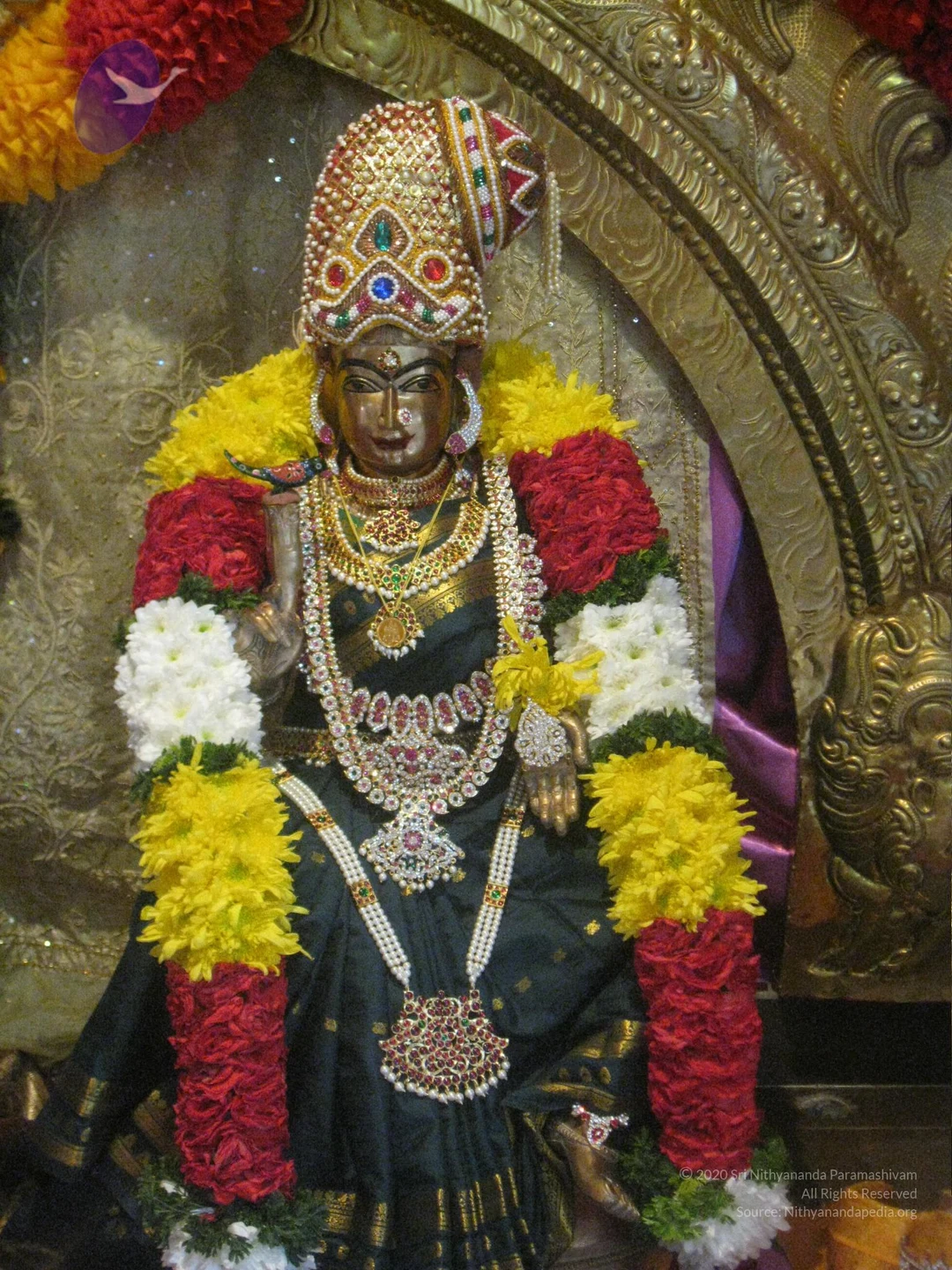
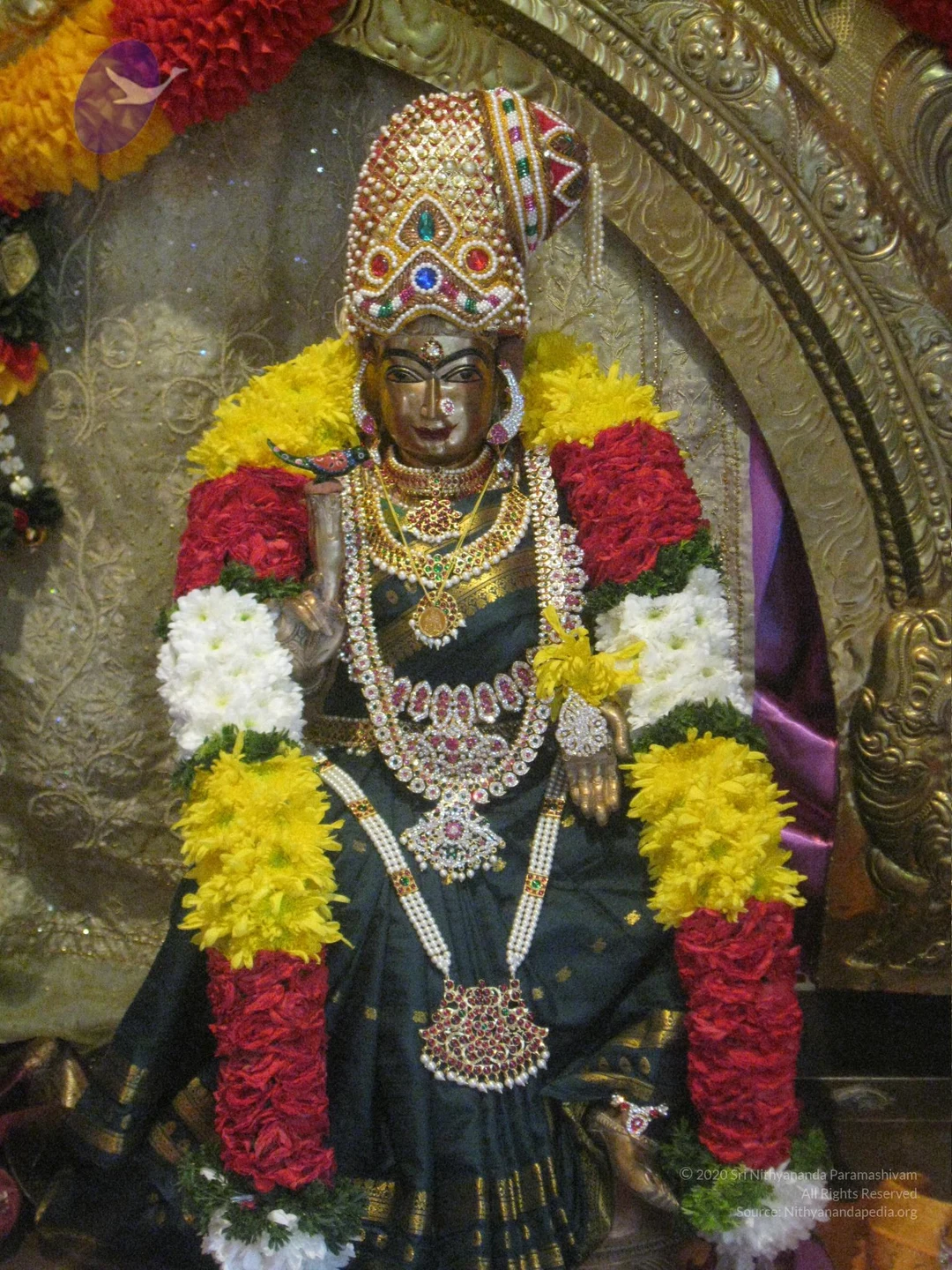
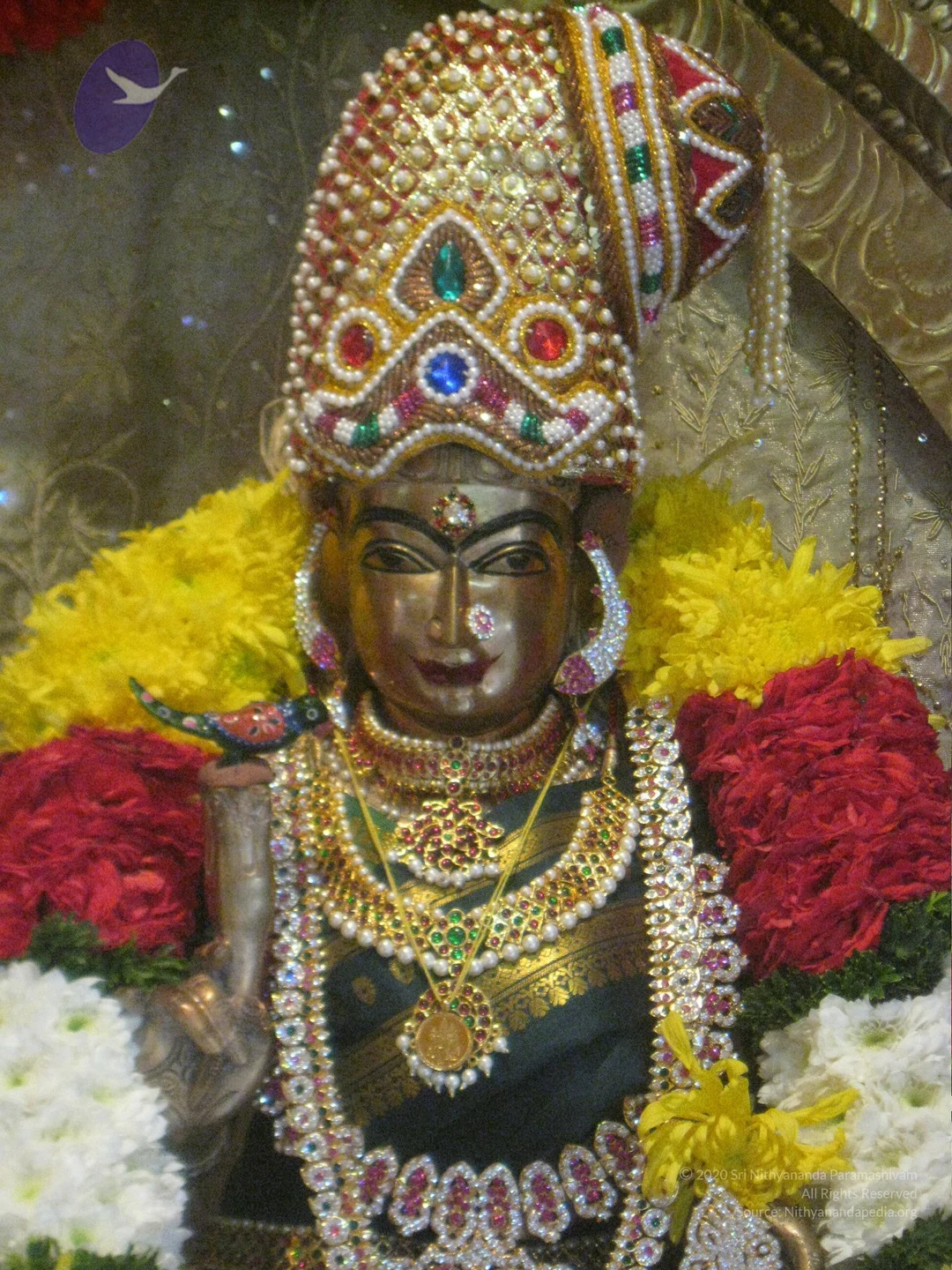
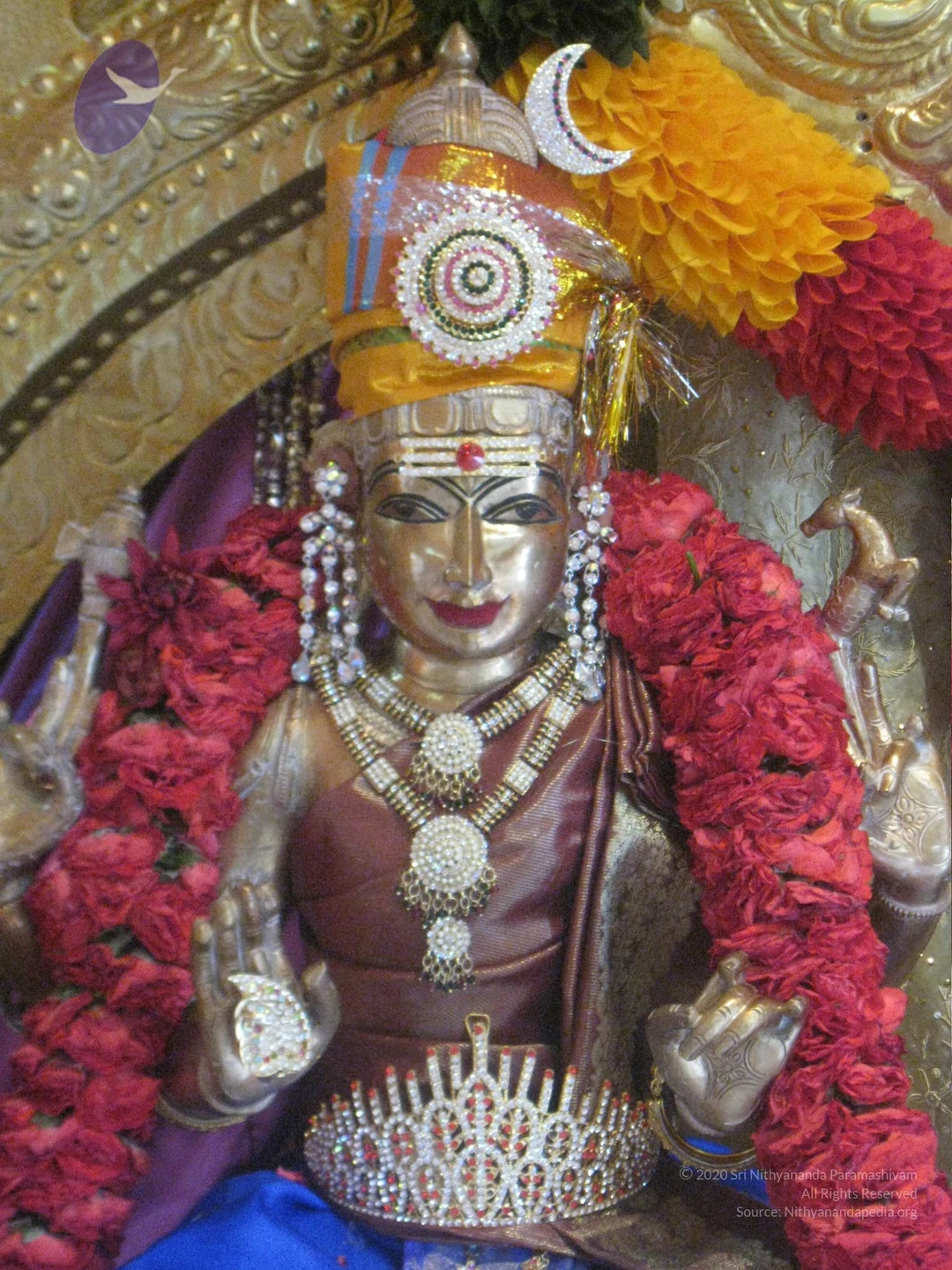
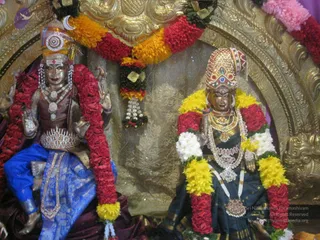
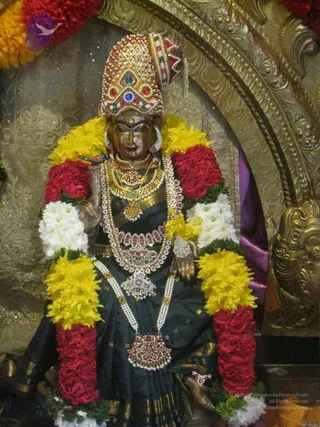
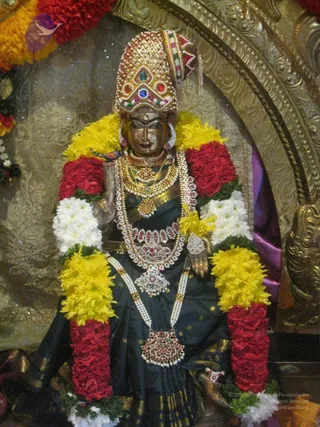
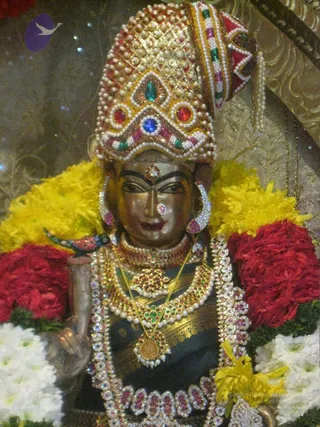
Close overhead photo of a brass or copper-toned shivalinga-style yoni-peetha base with a stepped pyramidal lingam rising from it, dusted with sandalwood or turmeric powder. White daisy-like flowers with yellow centres are scattered on the base and encircle it, with loose petals on the tray. Edges show a dark green-striped cloth and a purple cloth with small embroidered motifs. No people are visible; the lingam and flowers are the main subject.Two metal deity murtis seated side by side in a gilded shrine with ornate golden arch and carved panels. The figure on the left has a tall crown with a crescent moon, blue dhoti with a jewelled belt, and a rudraksha-style bead necklace, one hand raised. The figure on the right wears a jewelled crown, a dark green saree with gold border, layered gold and pearl necklaces, and a bright red and white garland. Both are draped in marigold, red rose and white flower garlands, with a hanging floral garland in the centre and a pink flower arrangement at the upper right. No people are visible.A metal deity murti of a goddess, with a gold and jewelled crown and a dark blue-black silk sari with gold border. She wears layered gold and gem necklaces, a nose ring, and garlands of yellow and white chrysanthemums with red roses. The figure is seated against an ornate gold arched backdrop. No living people are visible.A deity murti of a goddess seated against a gilded arch, dressed in a dark green silk sari with gold zari border and adorned with a jeweled crown, multi-strand gold and ruby necklaces, pearl and stone garlands, and a pendant. Red and yellow marigold garlands and white flower strands drape her shoulders and arms, and her raised hand holds a small object. No physical people are visible, and no a person candidate appears.Close-up photograph of a bronze-toned deity murti adorned for worship. The figure wears an elaborate jewelled crown of red, gold and white pearl-beaded work set with green, red and blue stones, with a tassel hanging at the side. Yellow and red flower garlands surround the face and shoulders. The murti wears layered gold and gemstone necklaces, pearl chokers, large earrings and a nose ring, with a dark green sari bordered in gold. A small decorative bird motif appears near the shoulder. The background is a shimmering gold brocade cloth.A golden metal deity murti seated and adorned for worship. It wears an orange and gold turban with a crescent moon ornament and a jewelled circular medallion, a red bindi on the forehead, and layered jewelled necklaces. A rust-brown silk garment covers the torso, with a jewelled belt below. Red rose garlands drape the shoulders and arms, and a small deer figure appears at the right. A bright orange marigold backdrop and ornate gold-embossed metalwork surround the figure. This is a statue, not a living person.

Procession
7 photosSource gallery
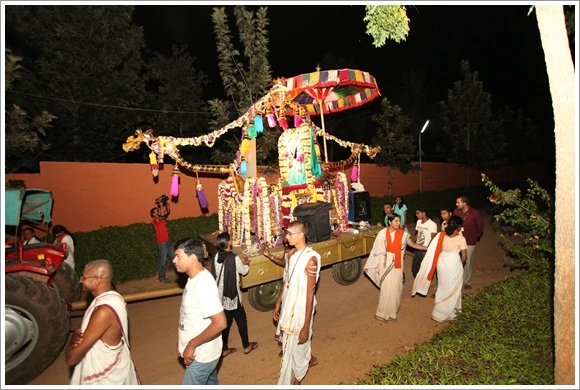
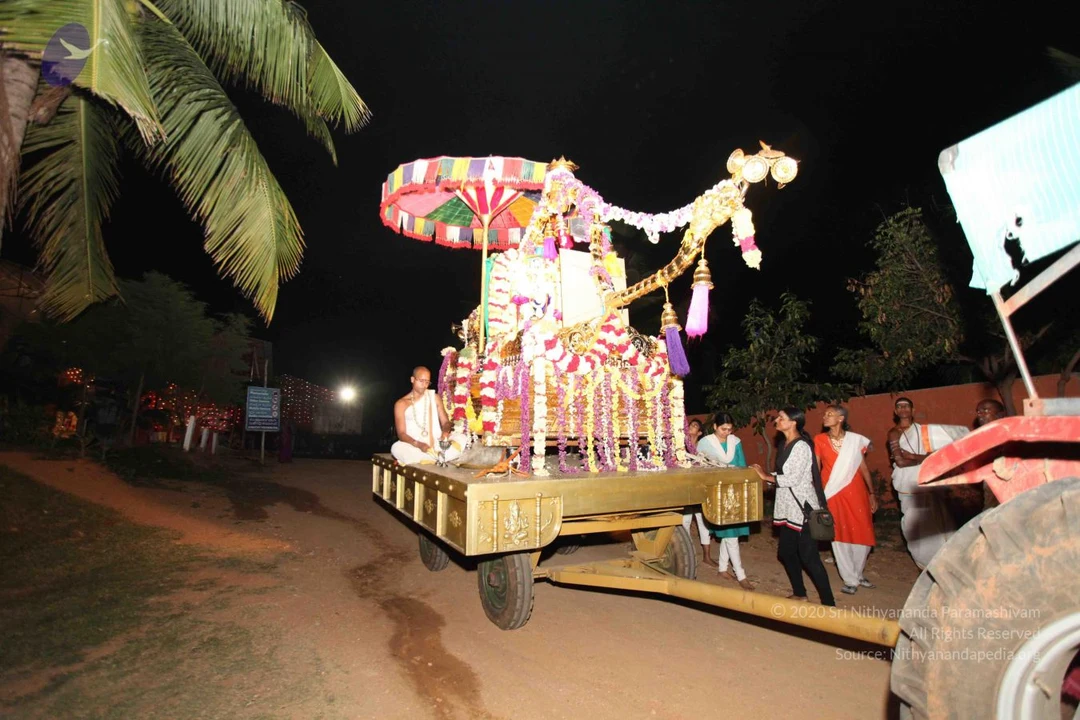
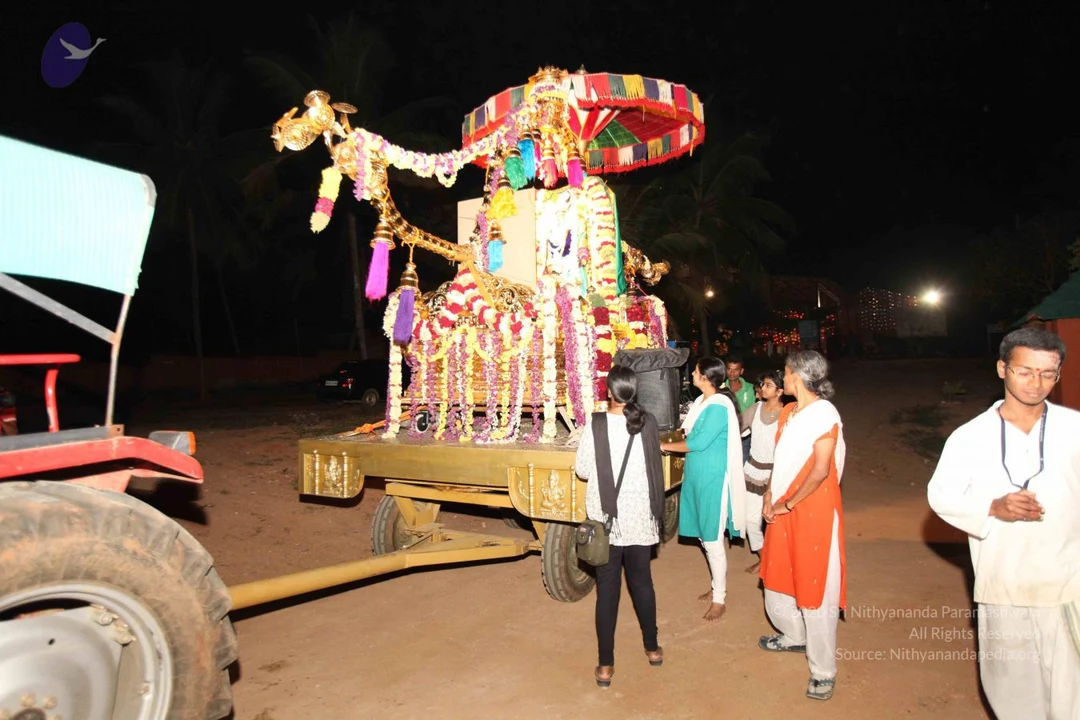
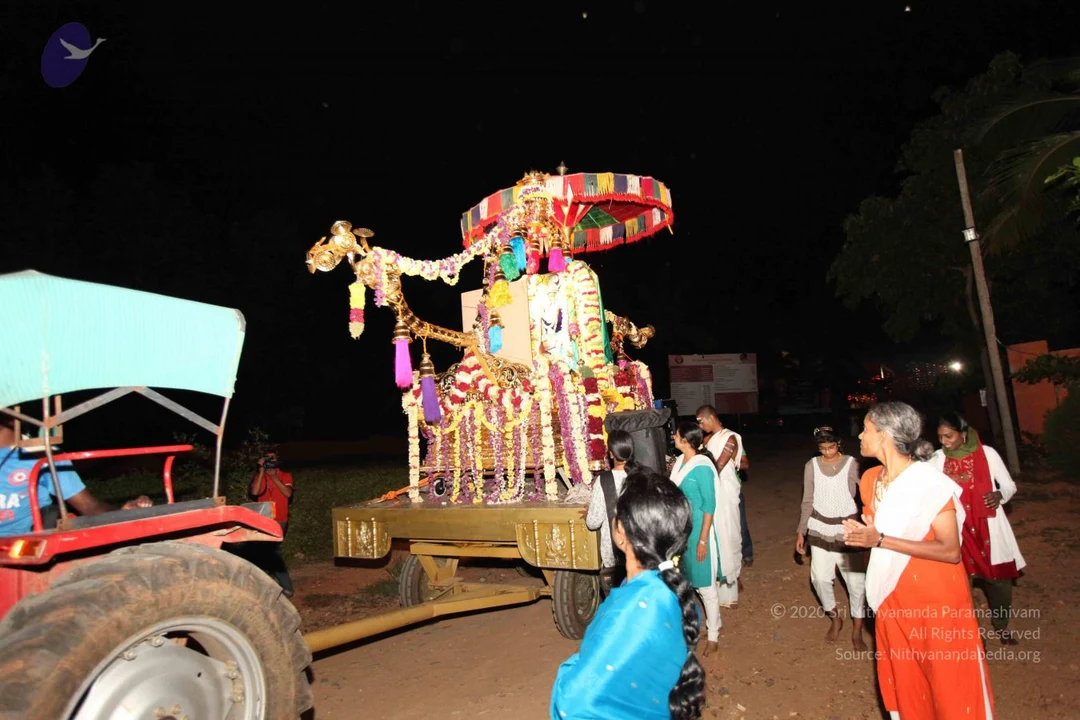
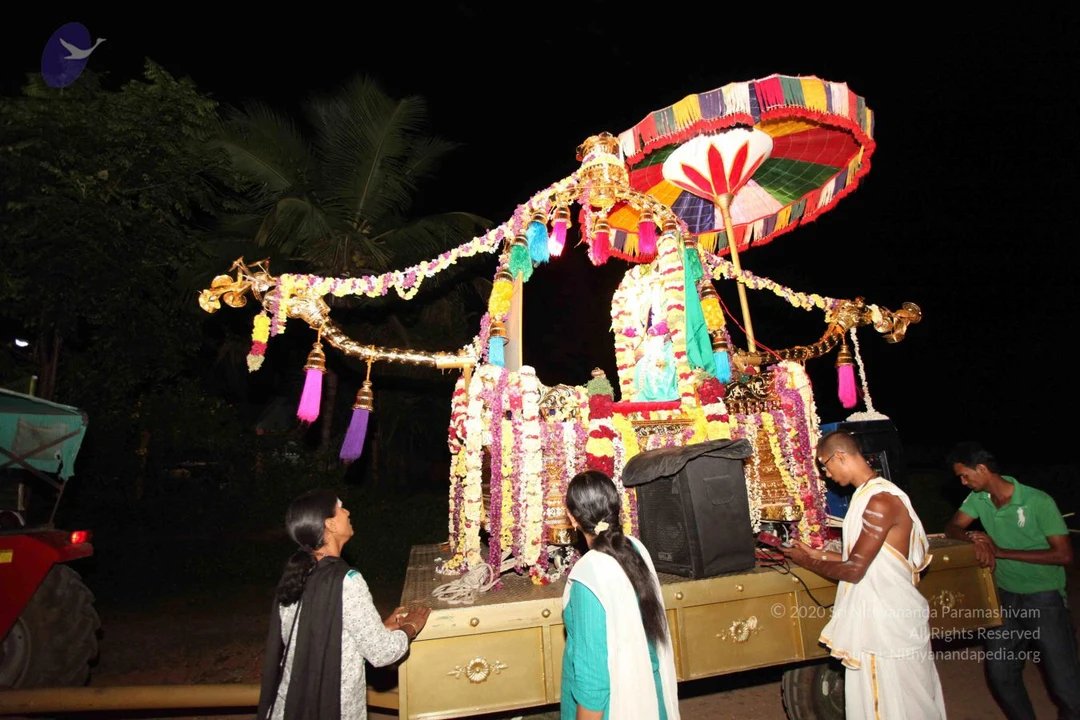
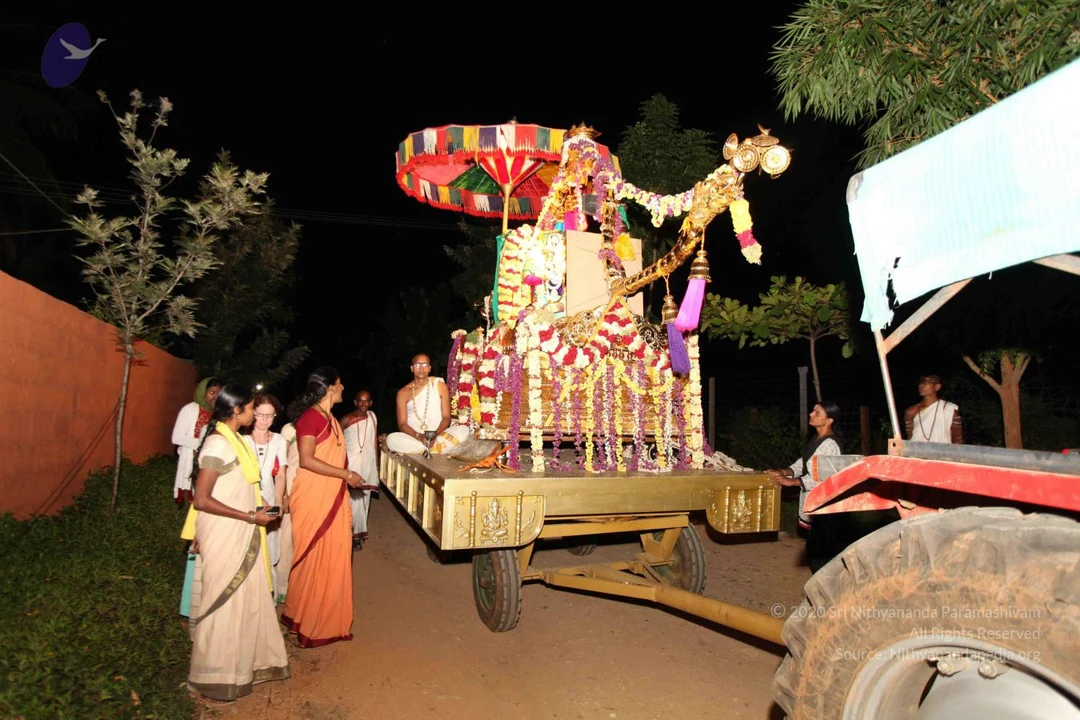
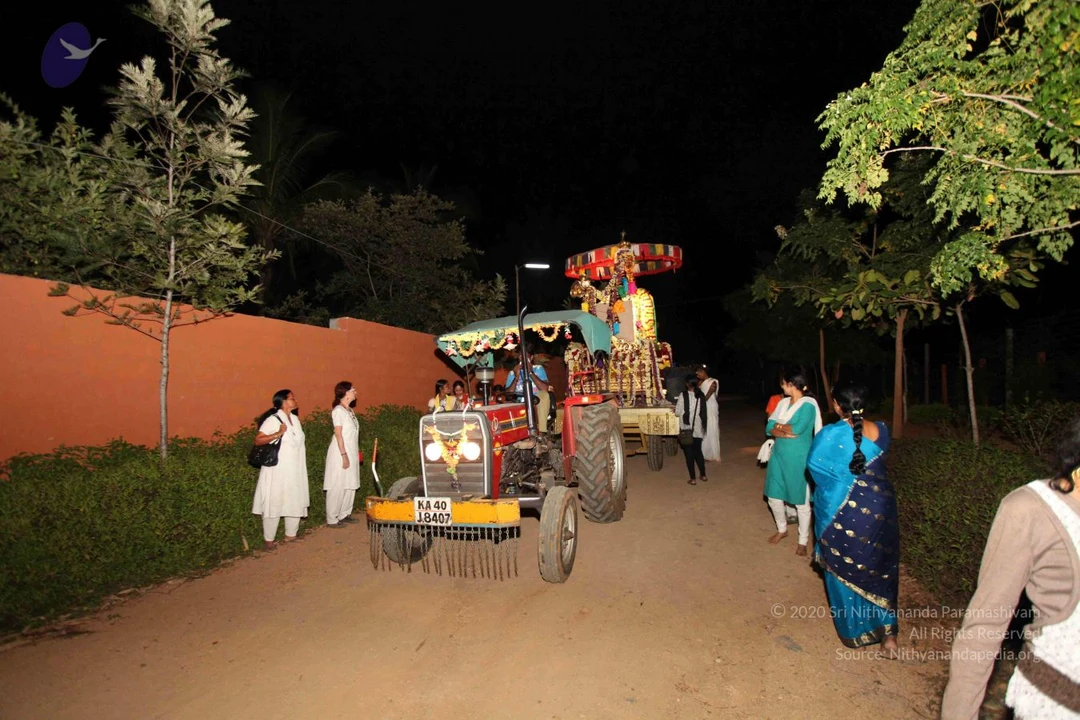
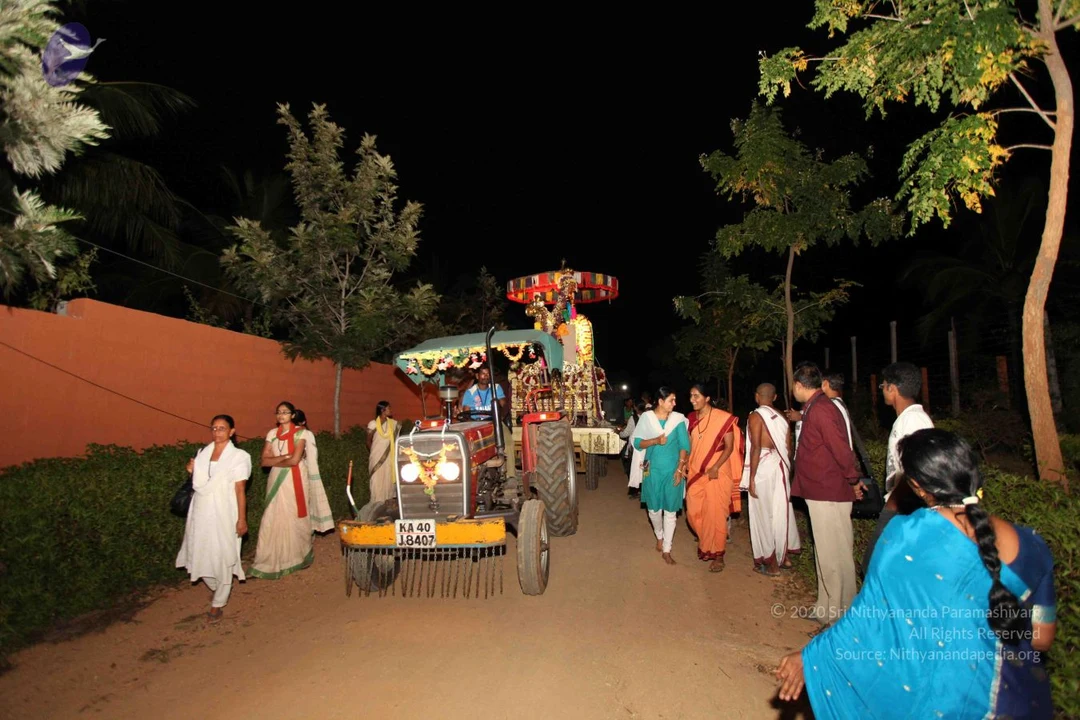
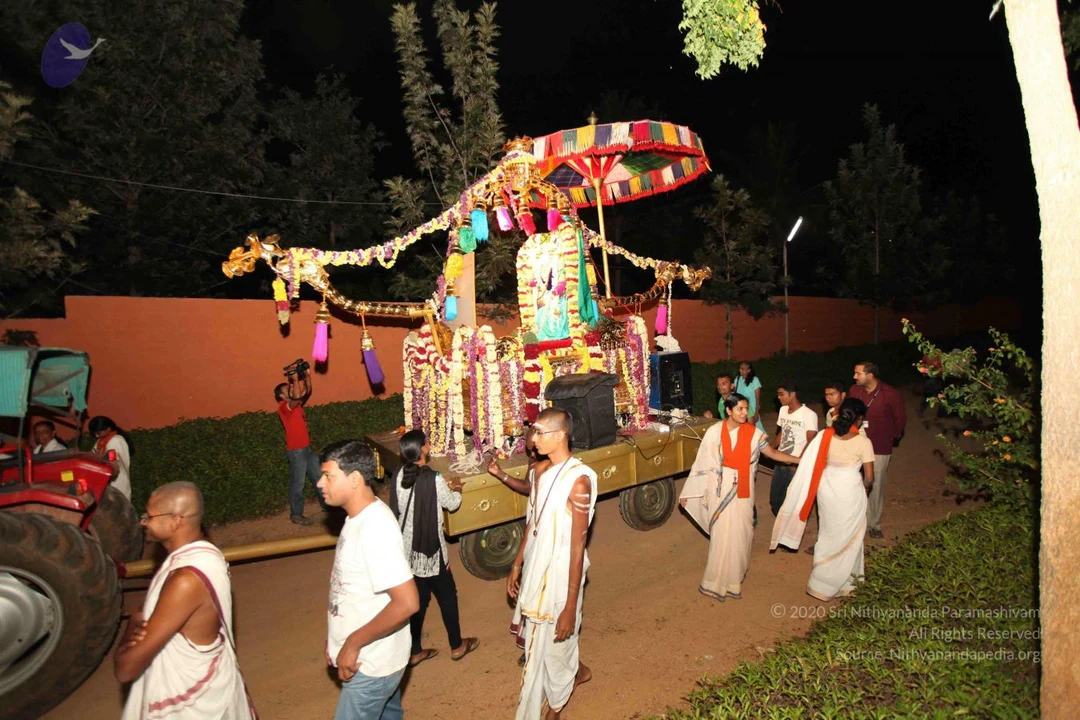
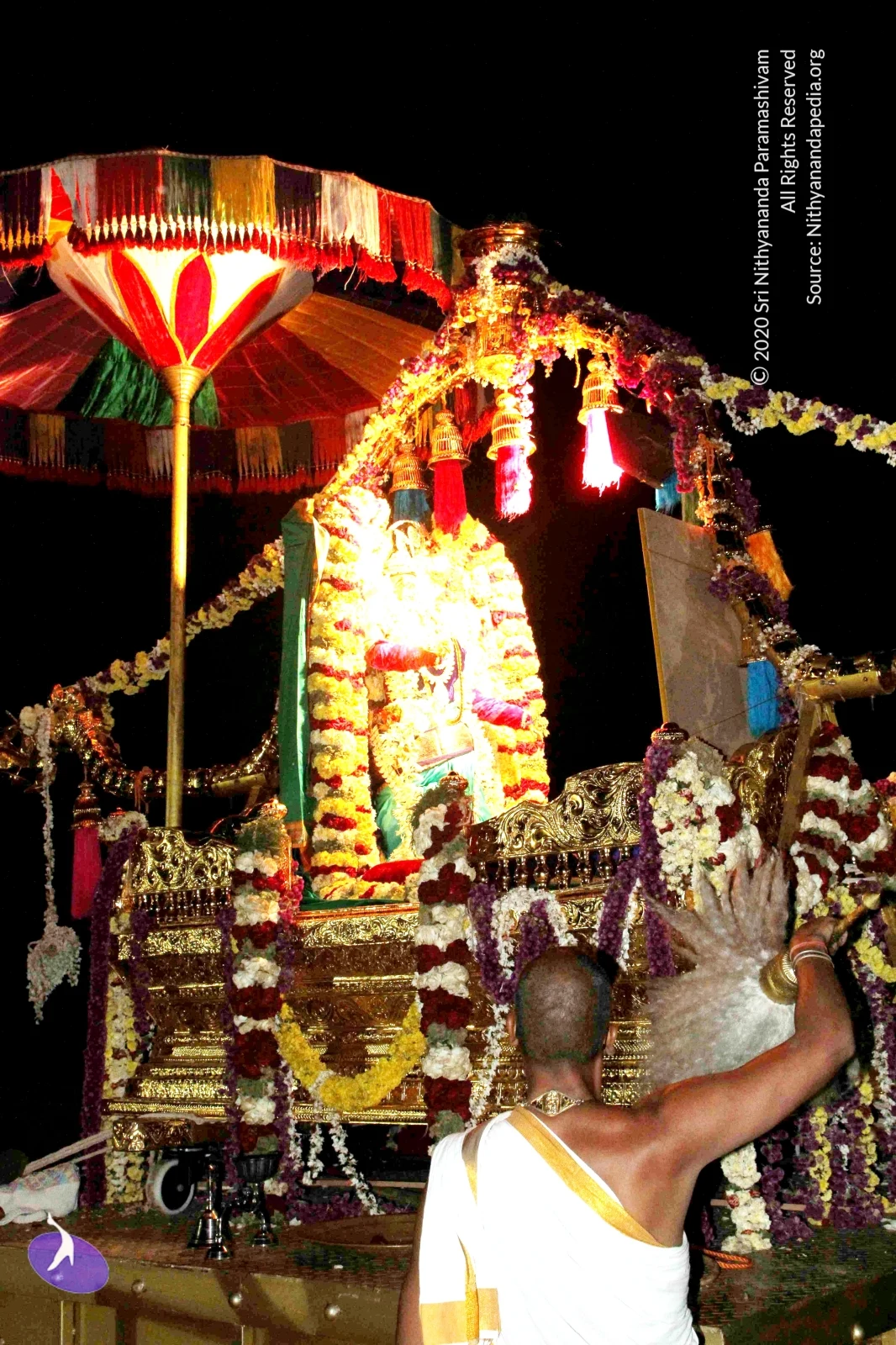
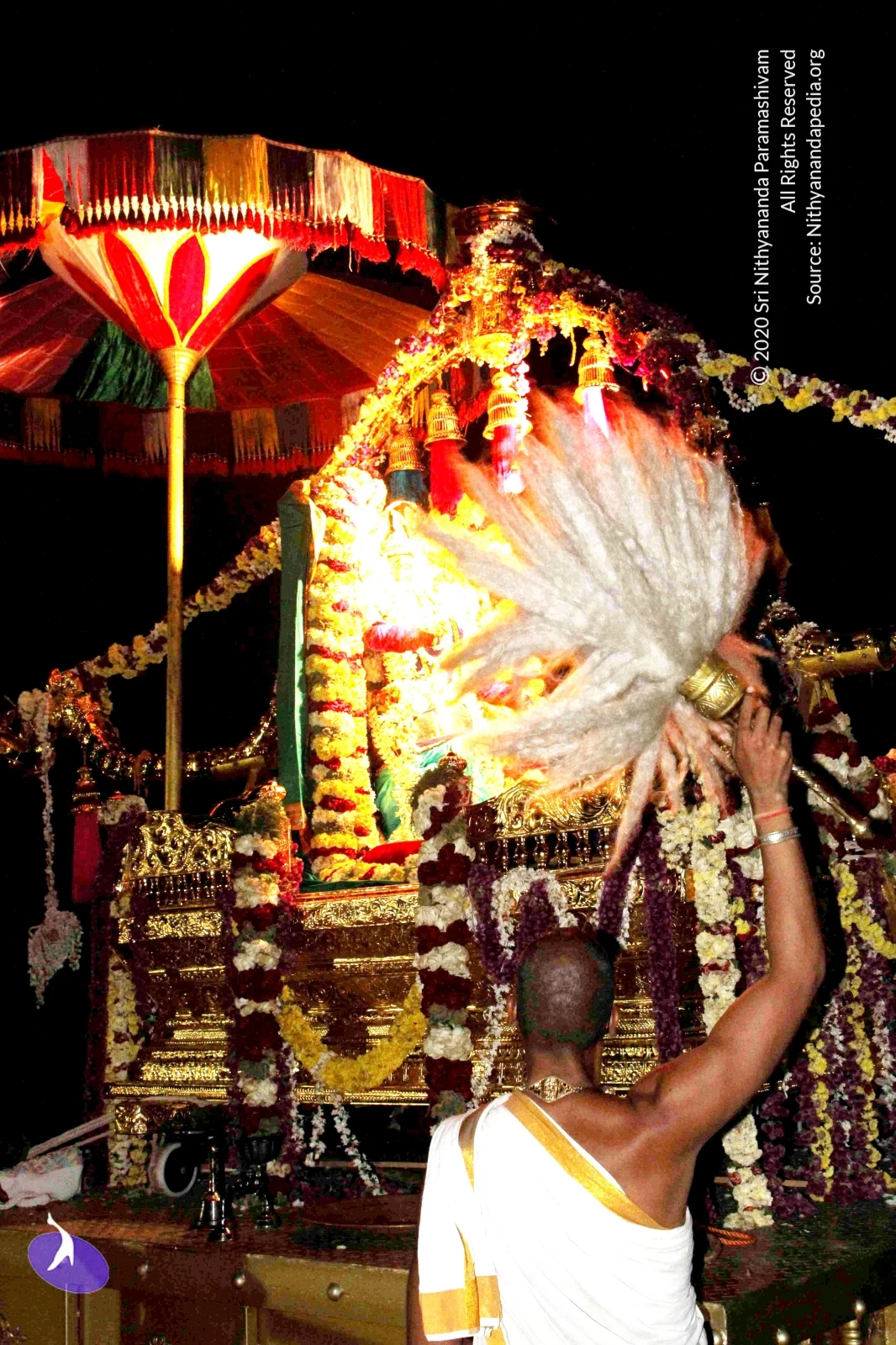
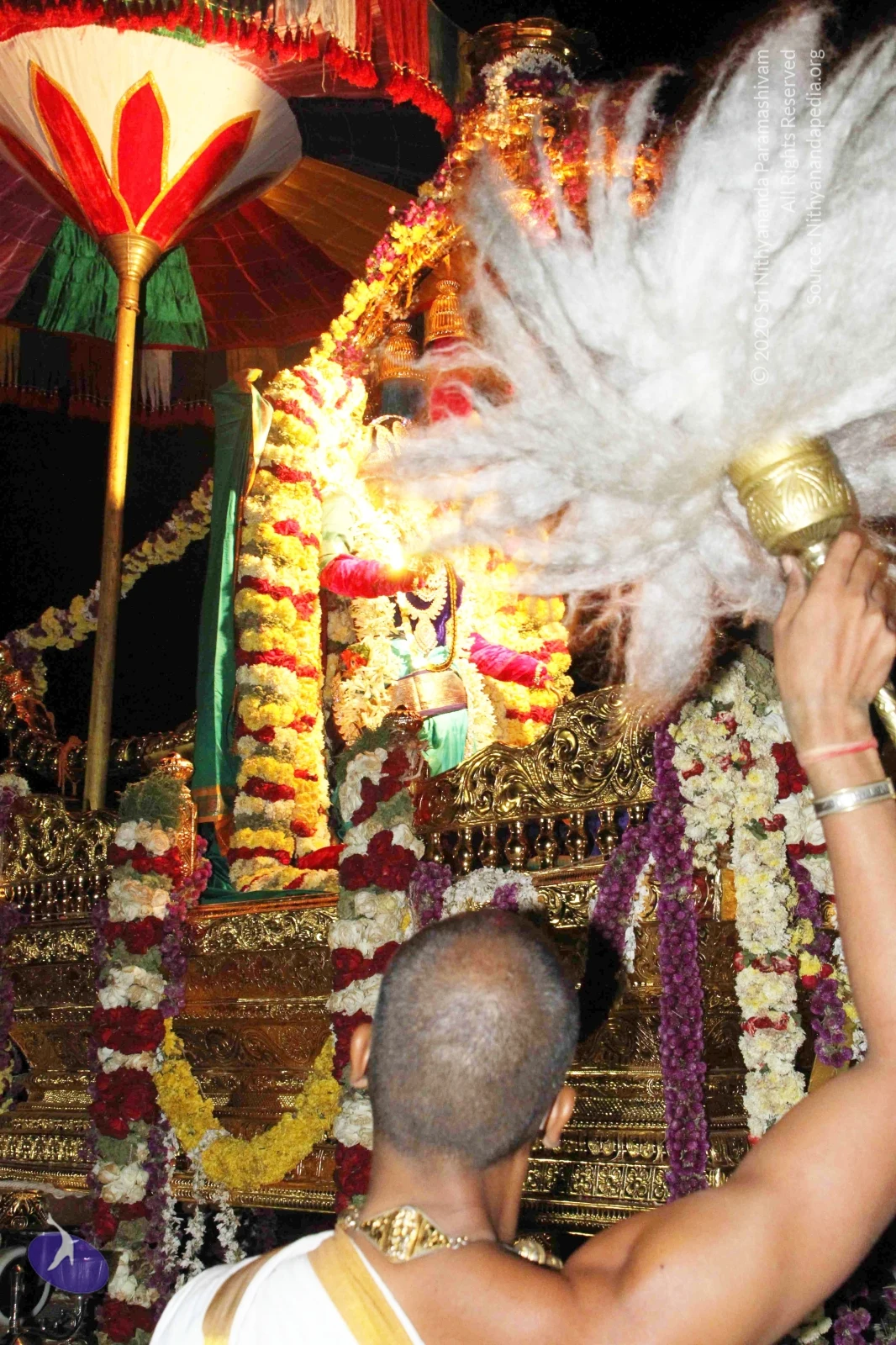
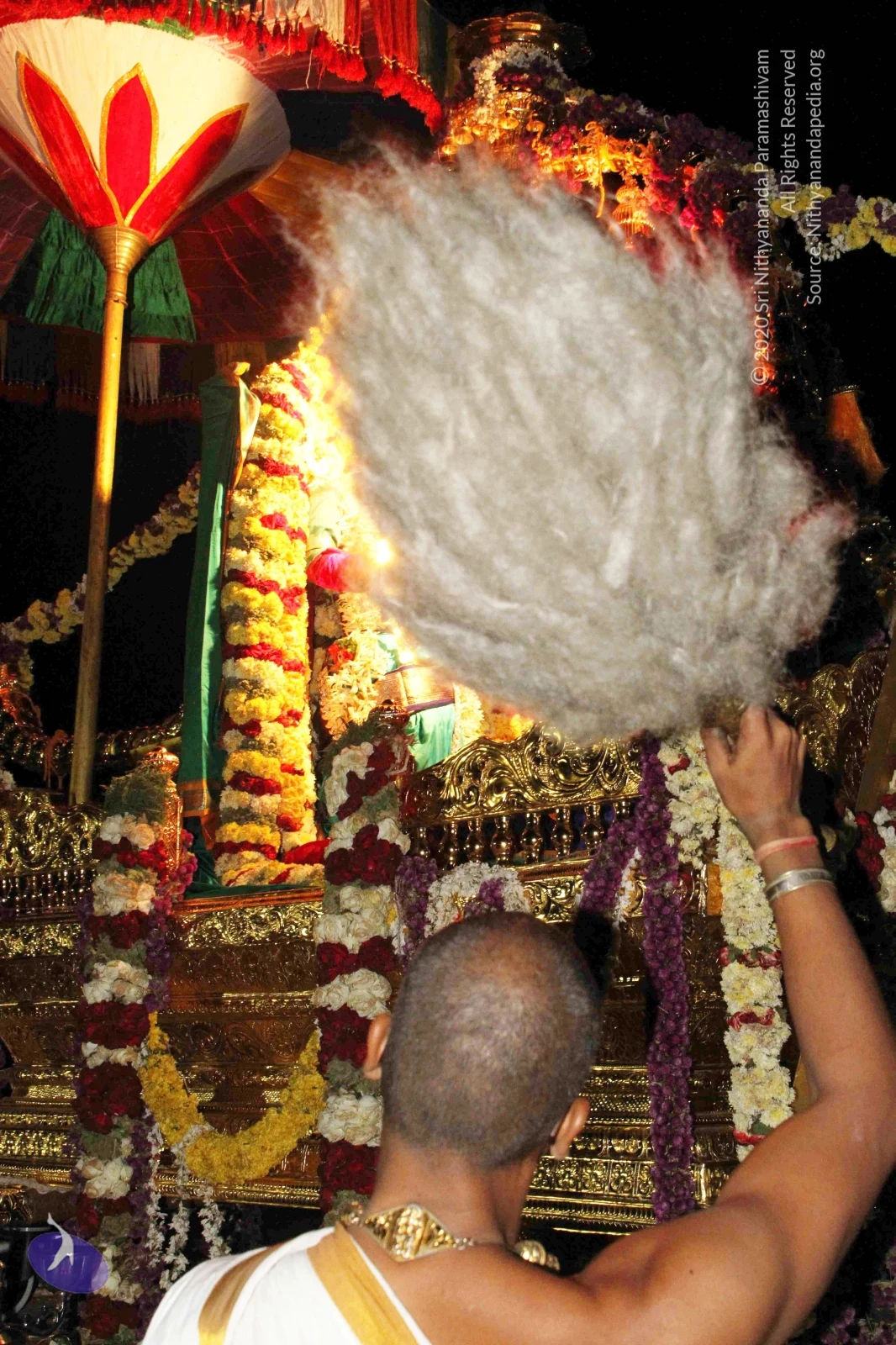
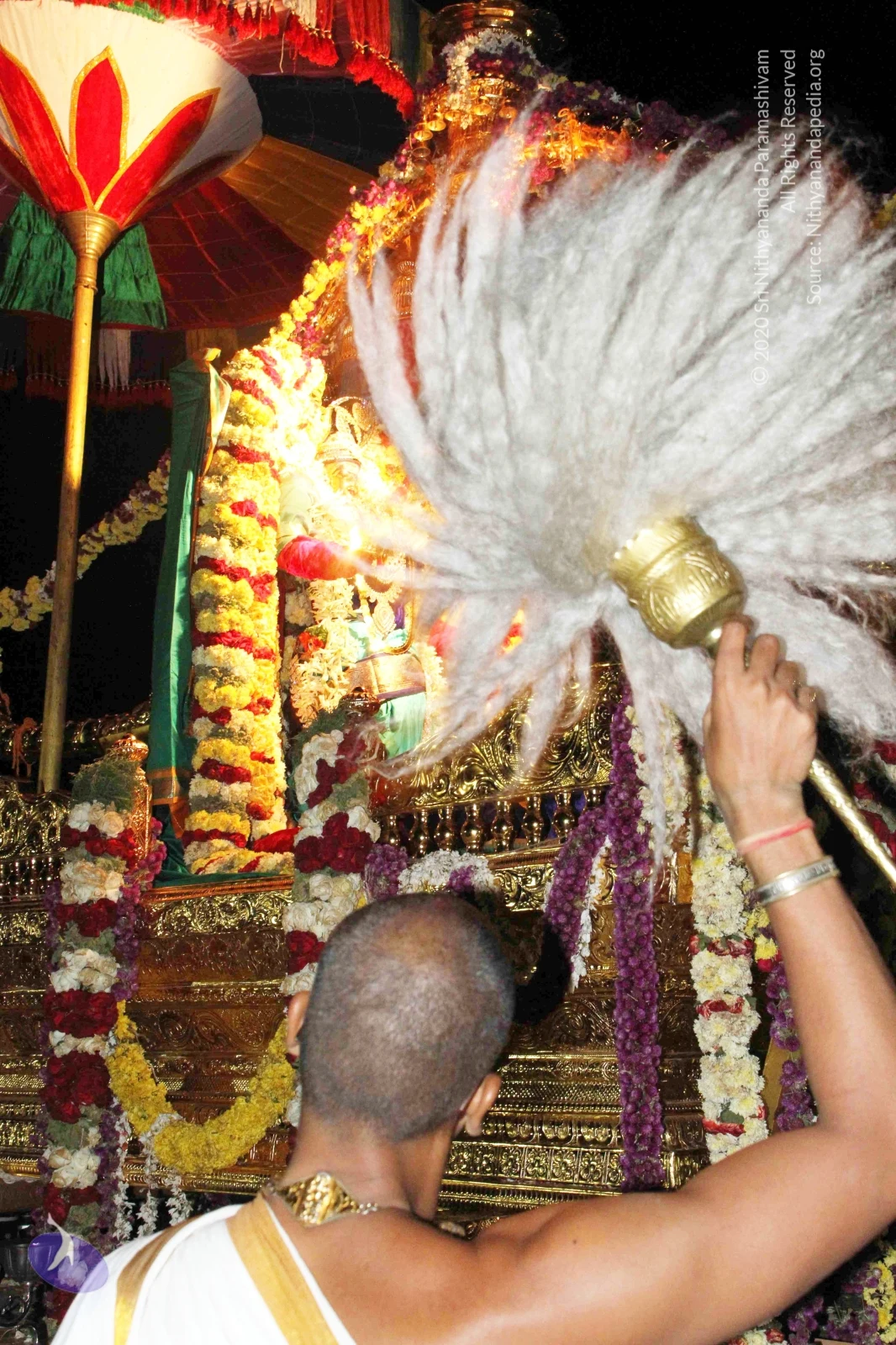
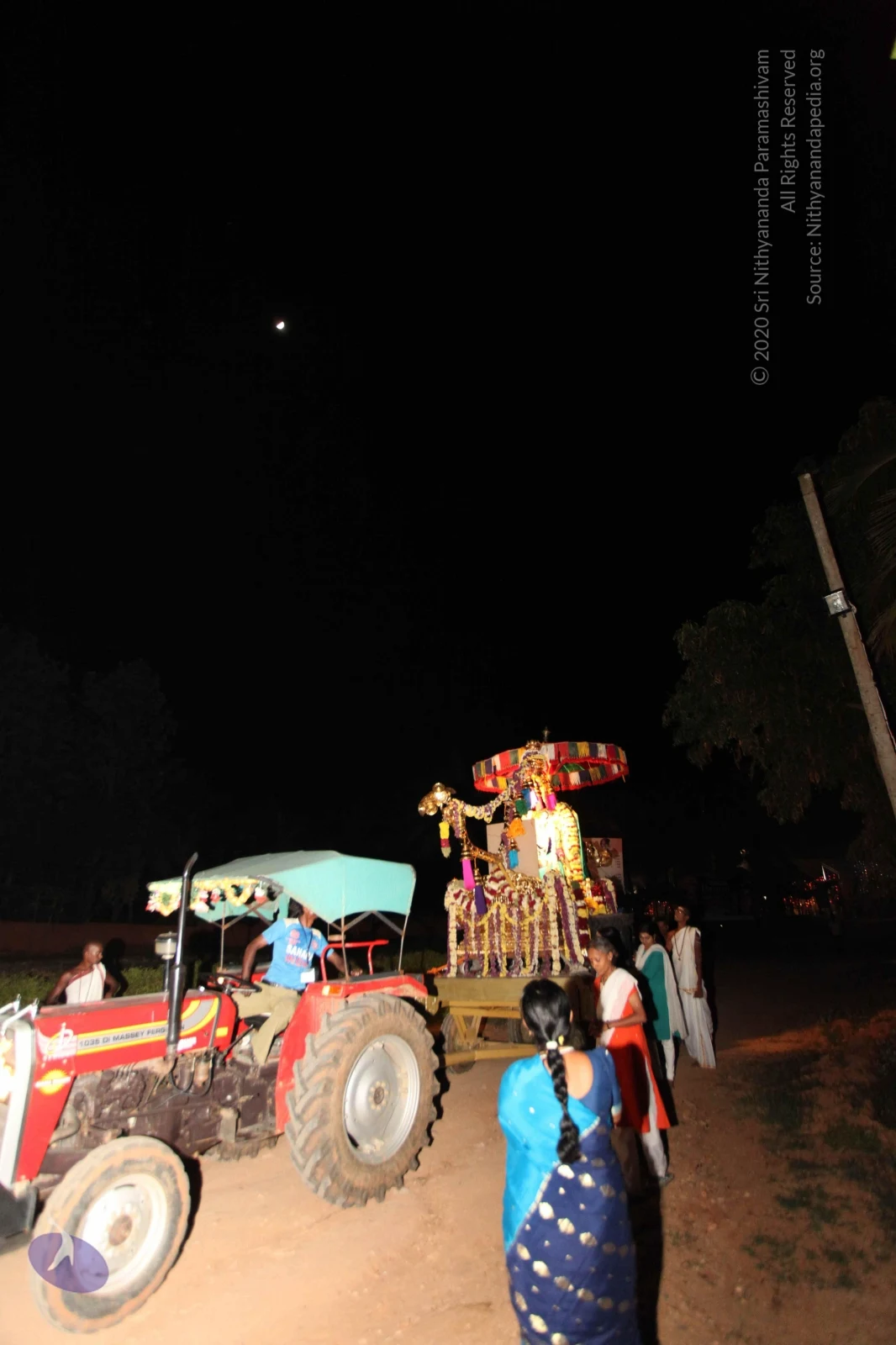
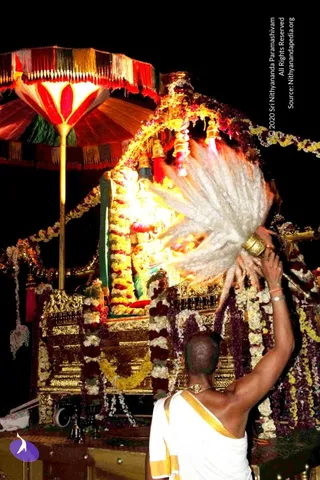
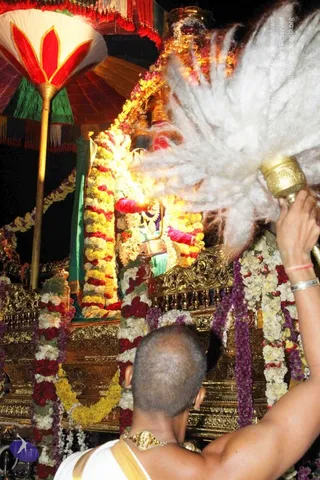
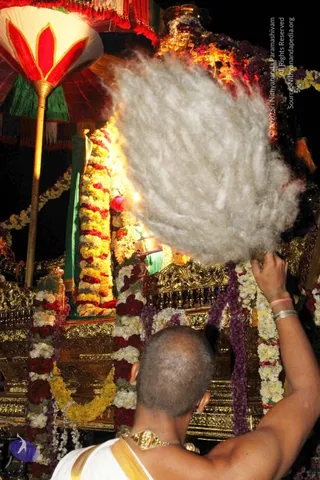
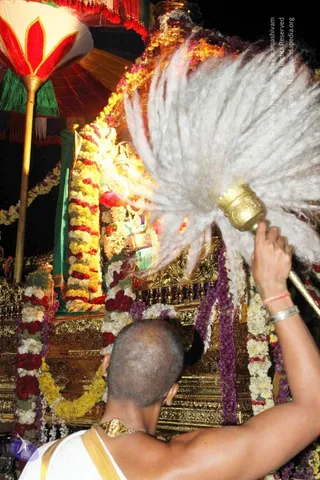
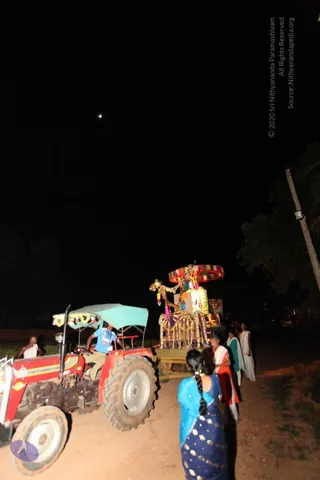
Night photograph of a festival procession vehicle decorated with dense garlands of yellow, white, red and purple flowers. Beneath a large red, yellow and green fringed parasol, a deity murti or image sits in a golden throne-like seat, illuminated by bright light and draped with a green cloth. A man with a shaved head, wearing a white dhoti with a gold border and a gold chain, stands at the lower right with his back to the camera, raising one arm to hold a white whisk-like fan or chamara over the image. Brass lamps and bells sit on the platform in the foreground. Gold tassels hang from the canopy.Night procession scene at a decorated golden ratha or palanquin, draped in yellow, orange, white and purple garlands, with a striped red-and-gold canopy umbrella on a tall pole. A bare-backed man in a white dhoti with gold border, seen from behind, raises one arm toward the shrine, where a figure with long swept-back white hair and a gold ornament is visible. Oil lamps and brass vessels sit on a table in the foreground, and a black background frames the lit deity structure.Night photograph of a festival procession. A shaved-headed man in a white dhoti with a gold-toned ornate necklace and a silver bracelet, seen from behind, waves a large white chamara fan over a deity murti. The murti is adorned with dense garlands of yellow, white, red and purple flowers and stands on an ornate gold palanquin or ratha. A red and gold lotus-shaped canopy and a green cloth hang above, with red tassels at the top. The deity wears a green garment and a red shawl. No a person candidate is visibly present.Night photograph of a procession vehicle decorated with garlands of yellow and red marigolds, white flowers and purple blossoms, with a red and white lotus-shaped canopy above. A bald man in white clothes with a gold-coloured sash and a heavy gold necklace raises a large white fluffy chamara fan toward the gilded palanquin or ratha. A figure draped in green cloth sits within the decorated structure, lit by warm lamp light. The ritual appears to be a temple procession or deity darshan. a person's presence is not established by visible appearance: the figure in the shrine is not clearly identifiable.Night procession scene in front of a richly decorated palanquin or ratha covered in marigold, rose and jasmine garlands in yellow, red, white and purple. A shaved-headed man in a white dhoti with a gold border and a gold necklace in the foreground, facing away from the camera, raises a large white chamara fan with a gold handle toward the deity murti inside the decorated carriage. Gold-embossed panels, a lotus-shaped red and white canopy, and a green cloth hang around the scene.Night procession on a dirt road: a red Massey Ferguson tractor with a light-blue canopy pulls a decorated float carrying a deity murti under a multicoloured canopy, garlanded with marigold and flower strings and hung with tassels. A man in a blue shirt drives the tractor, and a man in white dhoti stands at the left edge. Behind the float, a line of people in white, green and orange-red saris and dhotis walks along, and a woman in a blue sari with a long braid stands in the foreground. A crescent moon shows in the dark sky, with trees and a street lamp at right.