Skip to content
Wednesday

5 October 2011

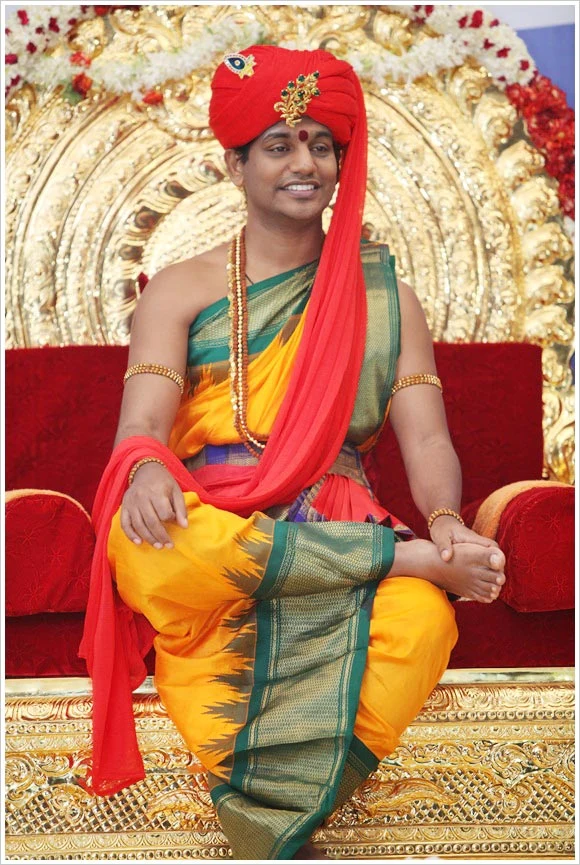
THE SUPREME PONTIFF OF HINDUISM HDH BHAGAVAN SRI NITHYANANDA PARAMASHIVAM

Dated photos
601
Source pages
1
Media
2
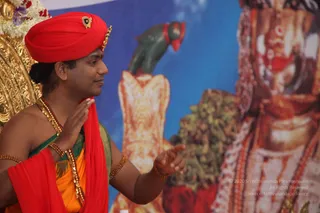
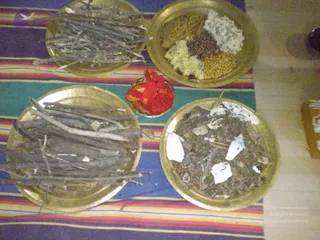
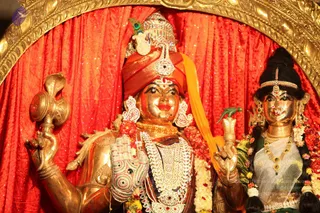
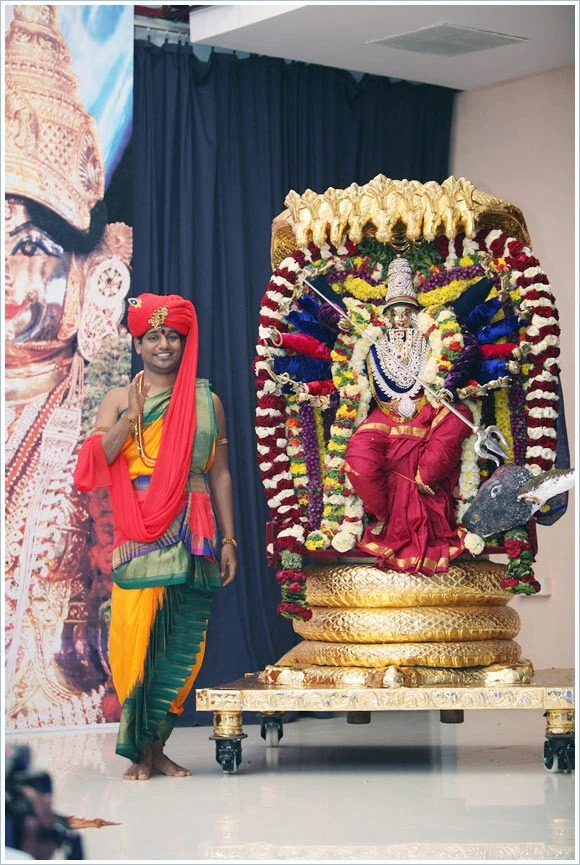
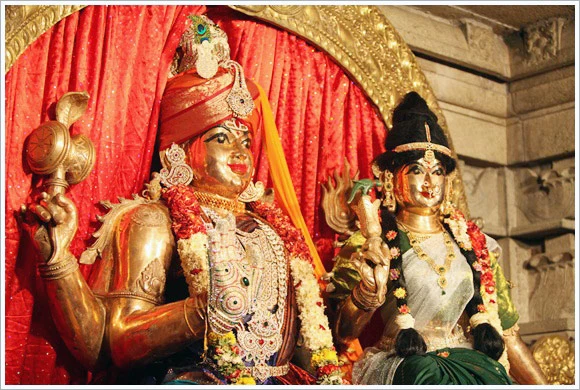
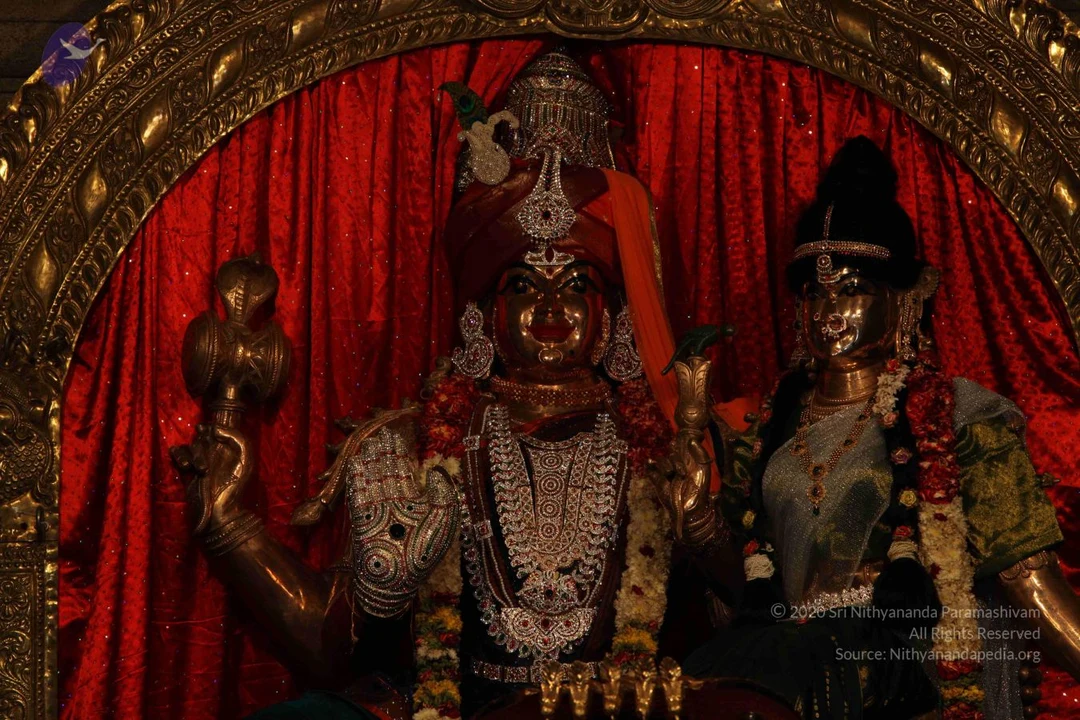
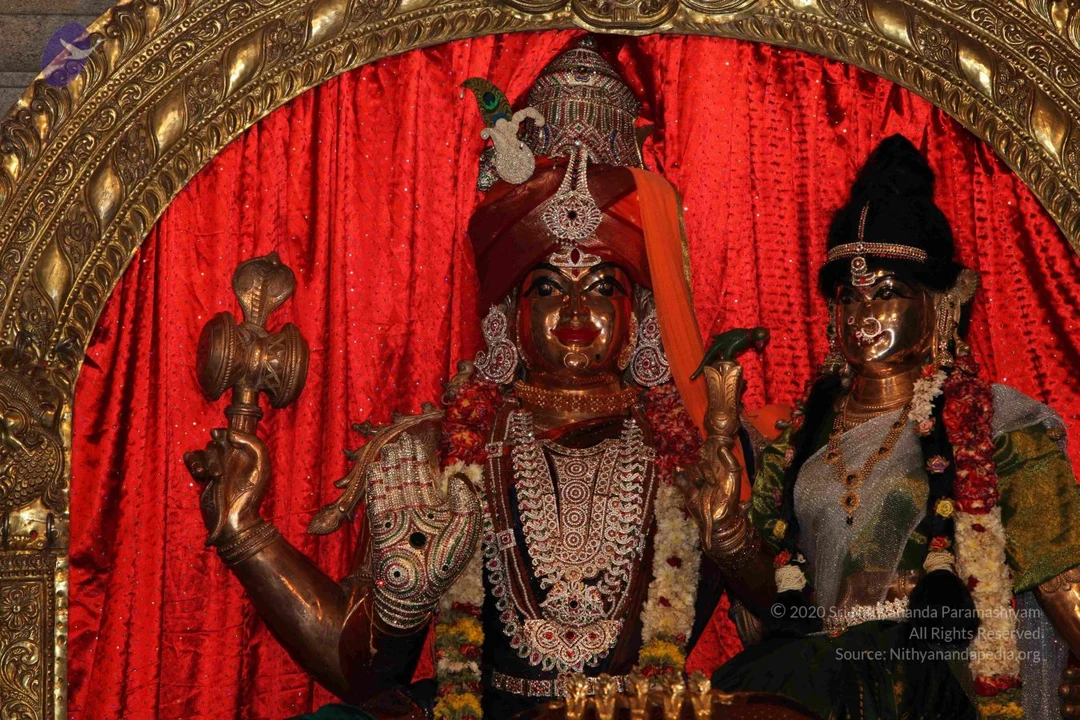
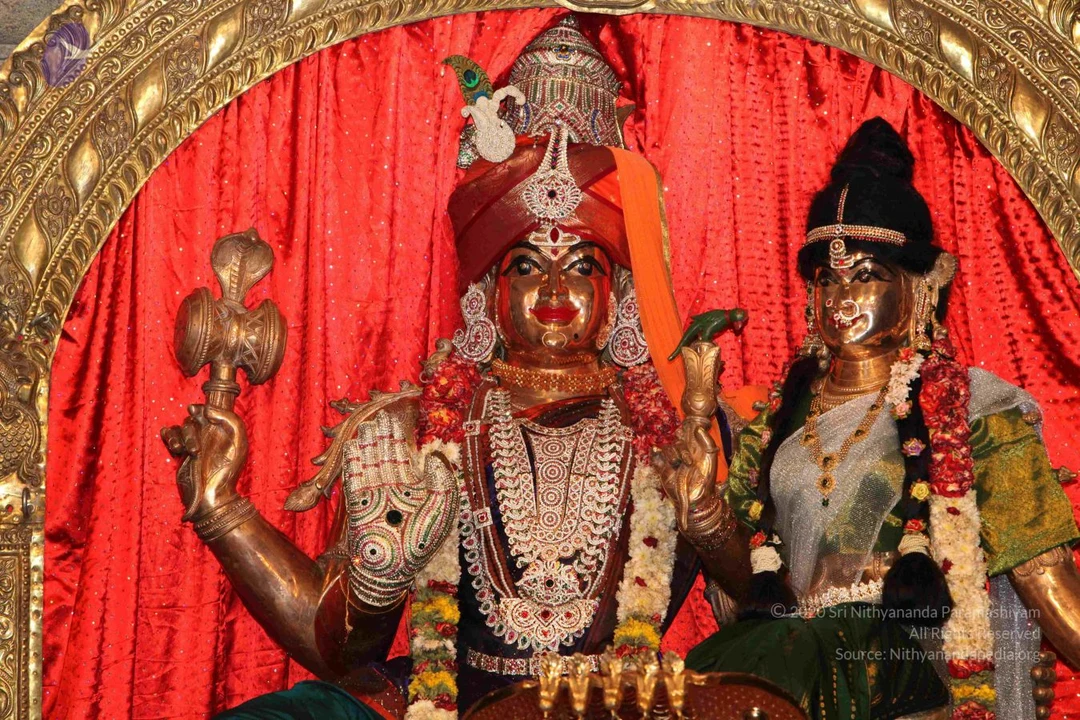
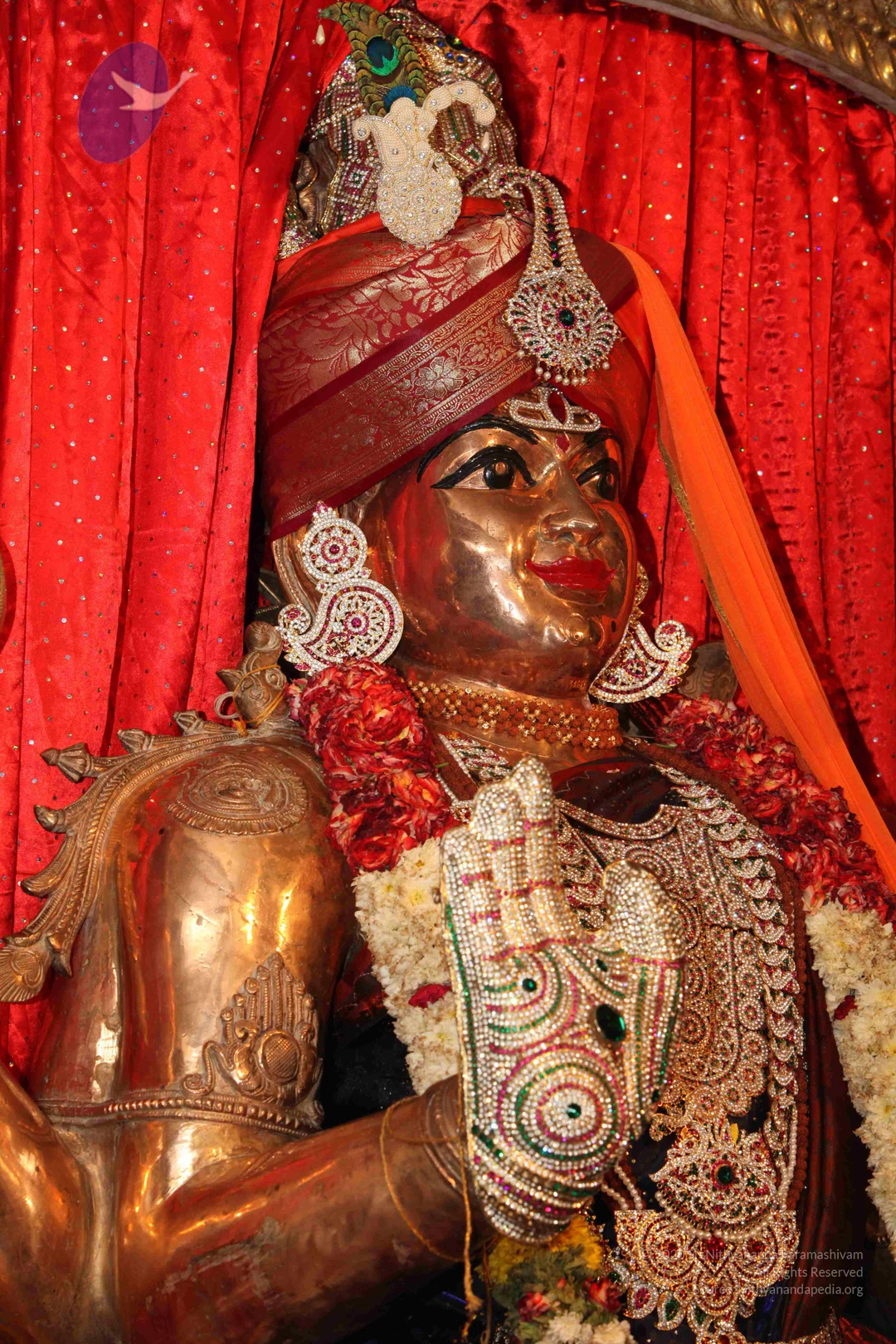
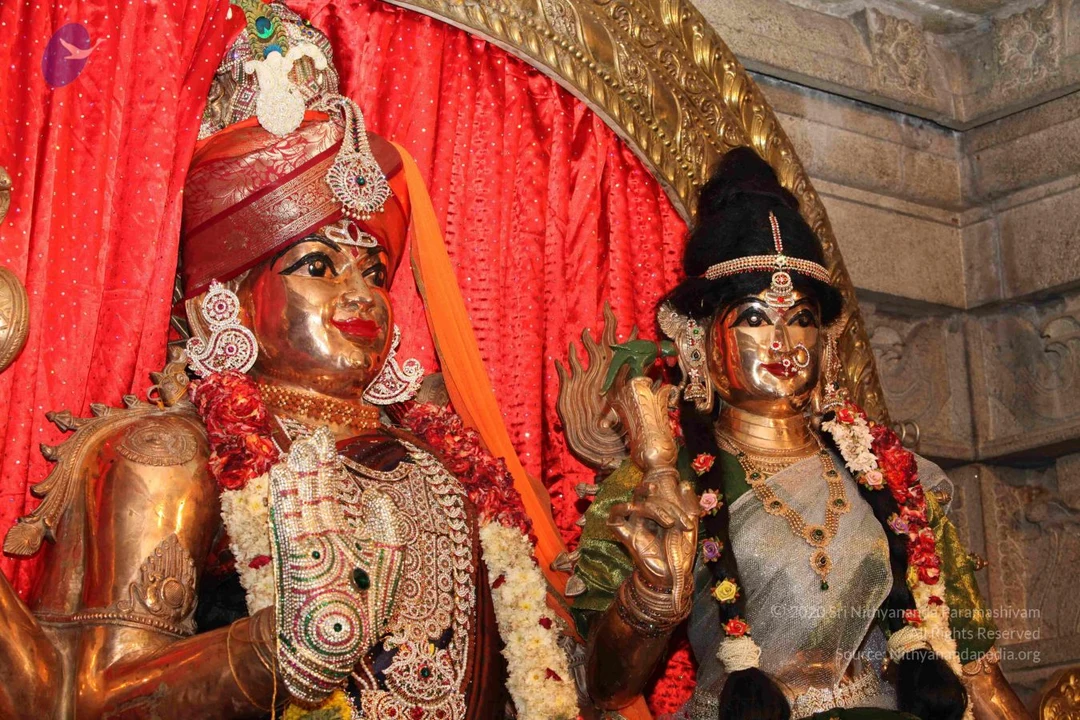
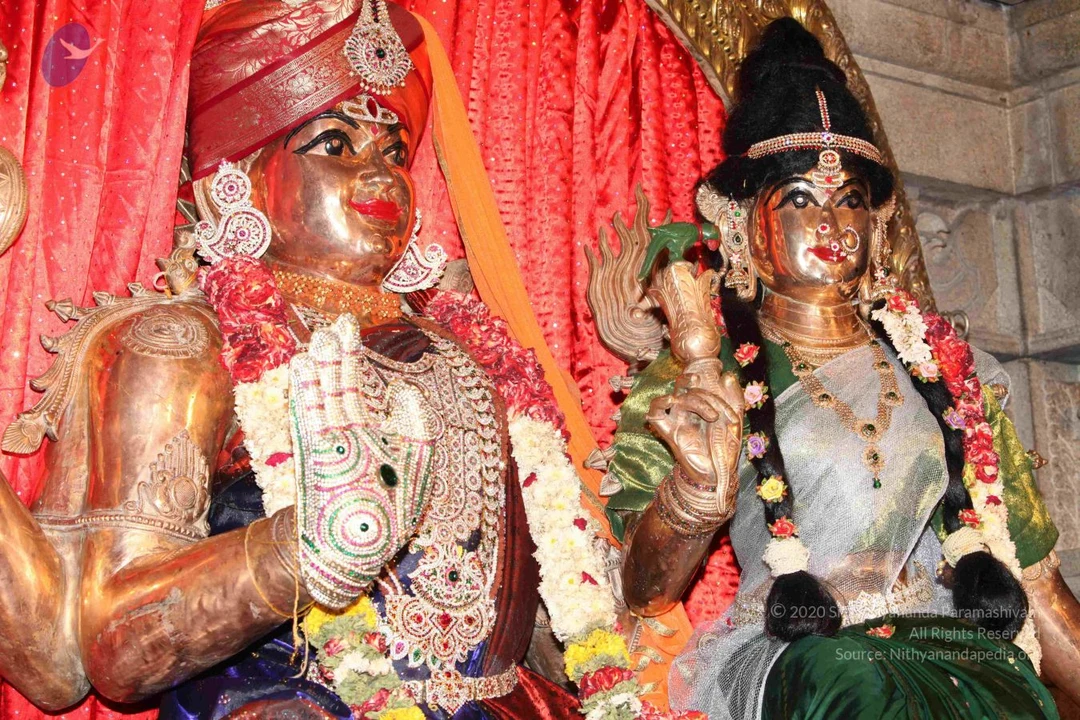
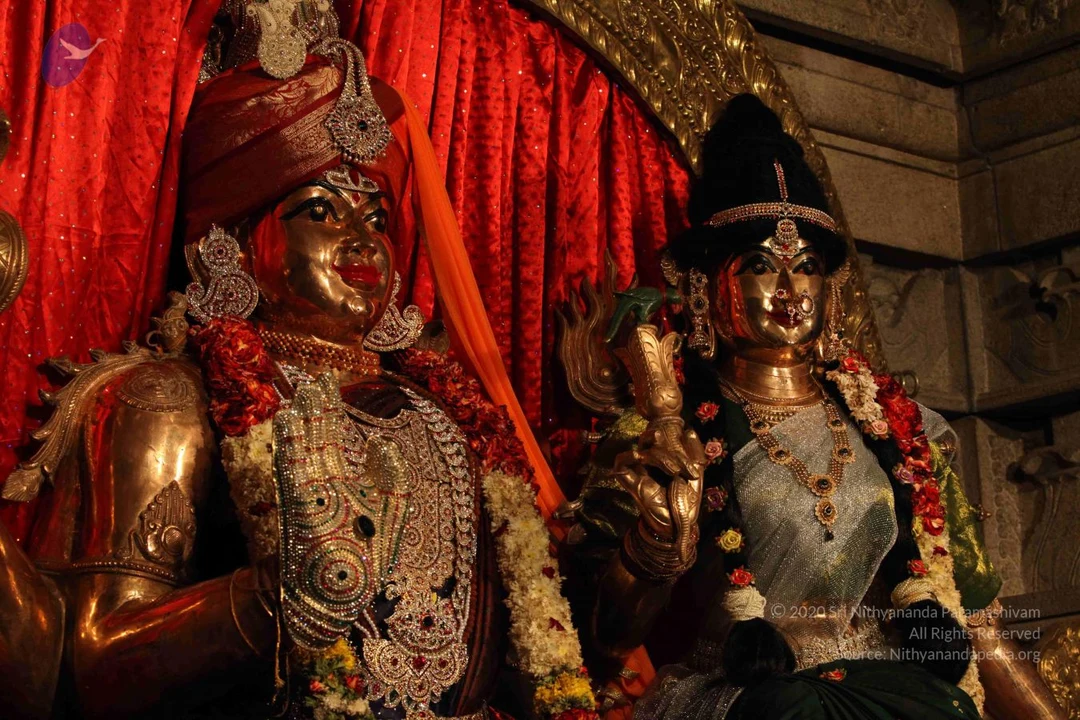
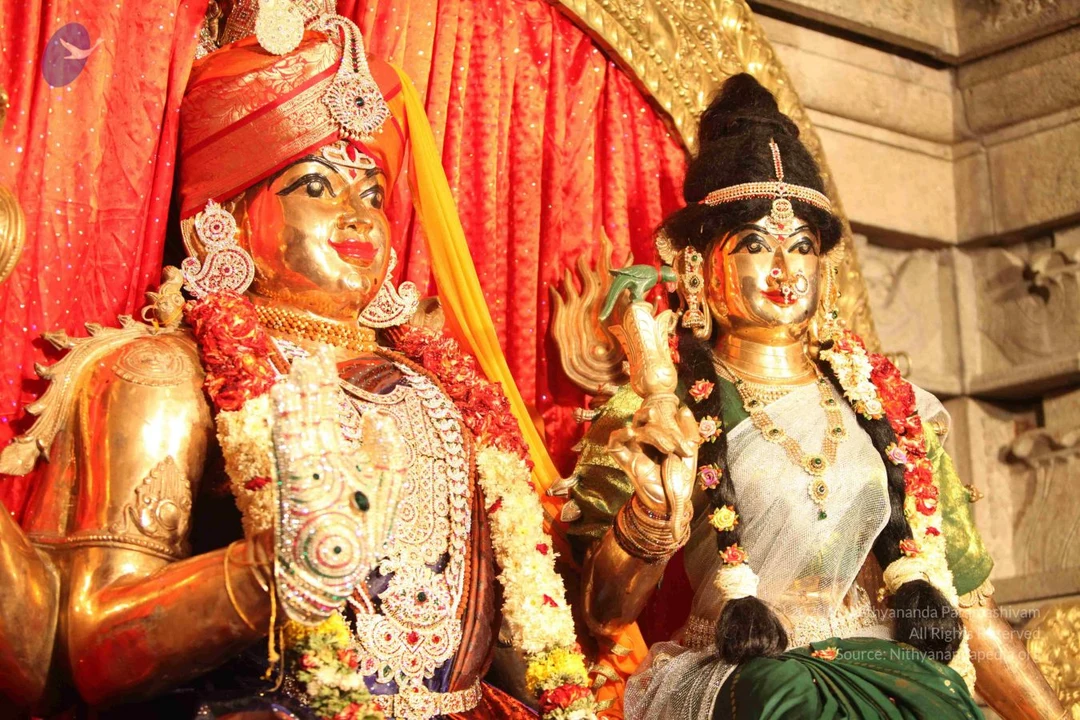
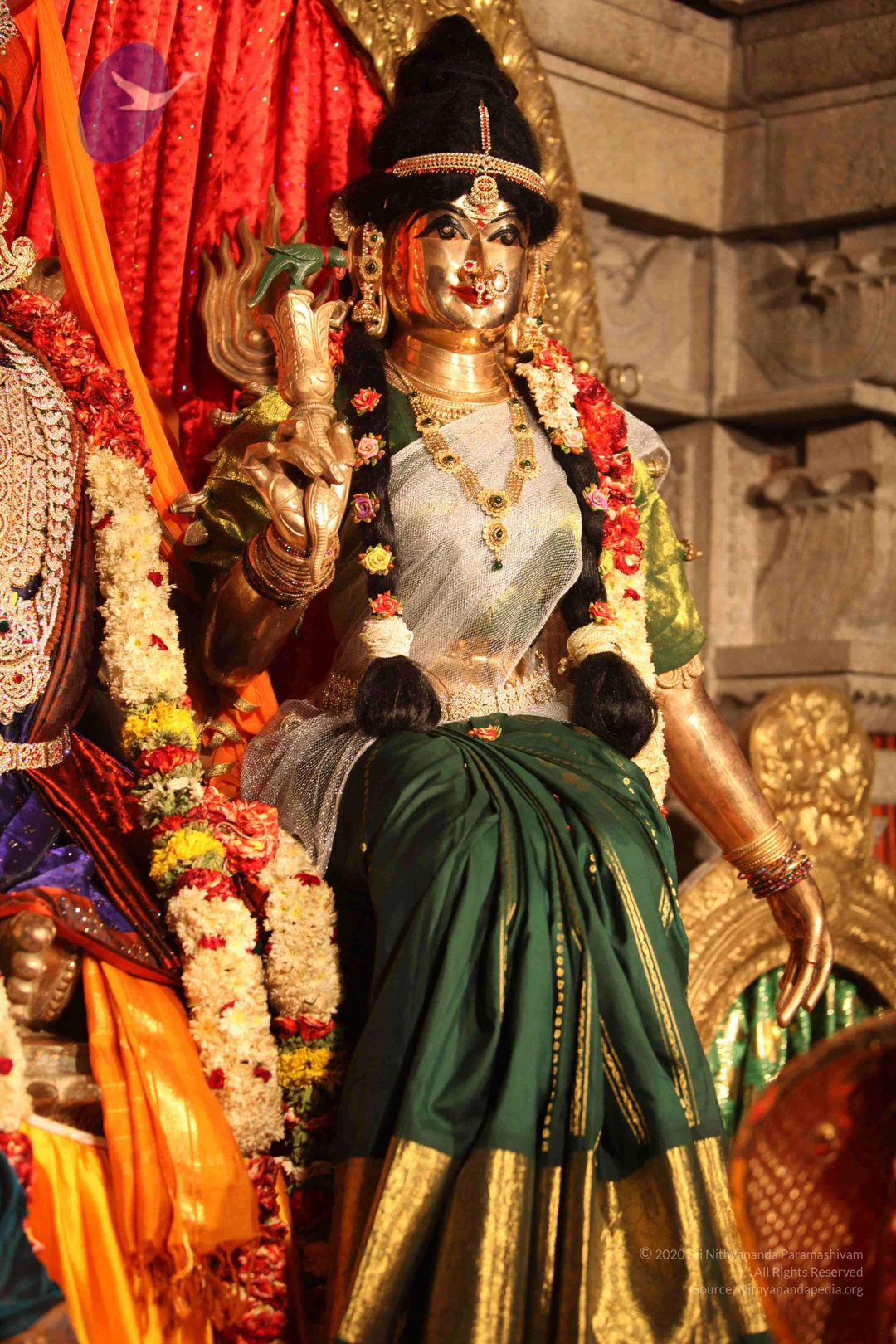
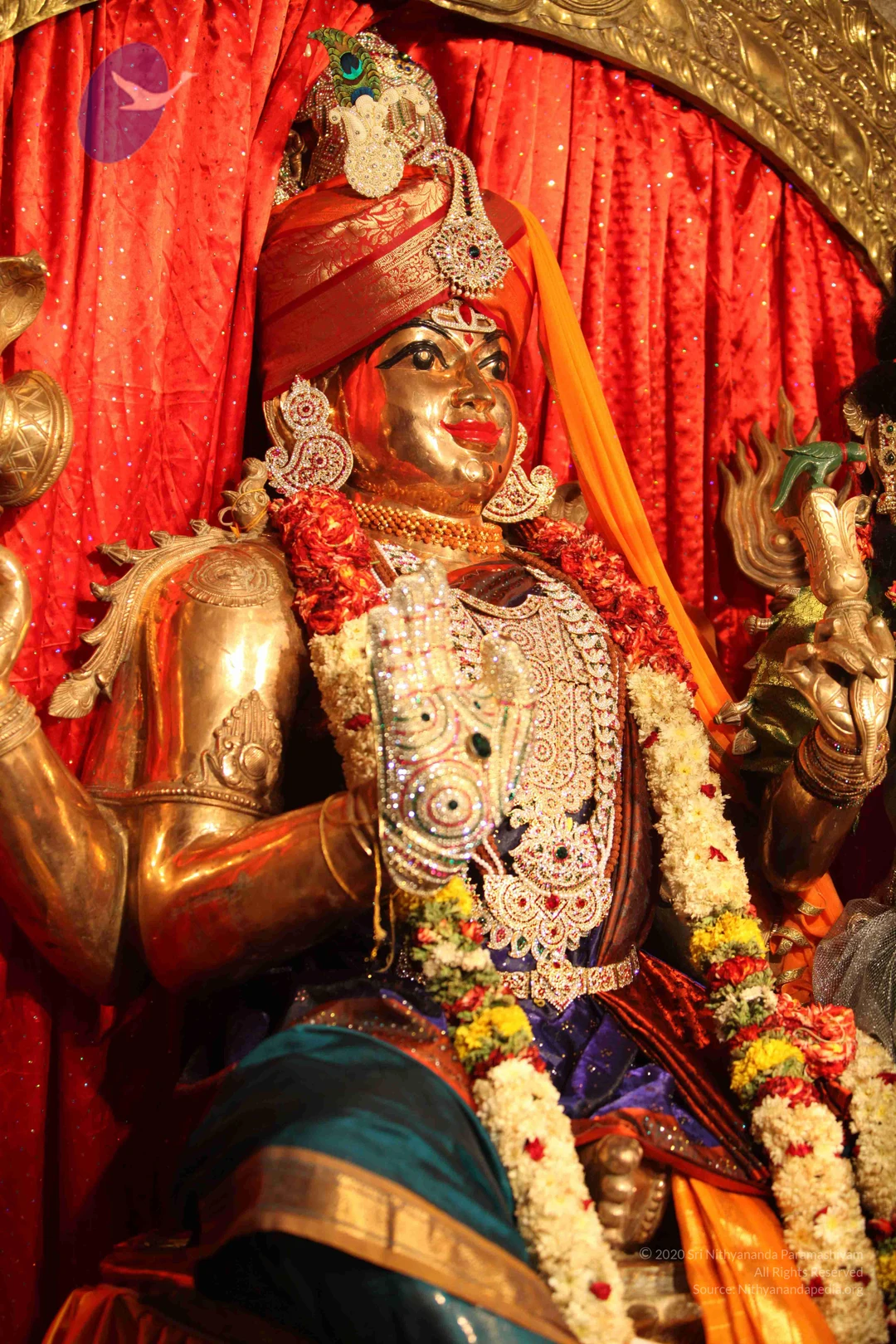
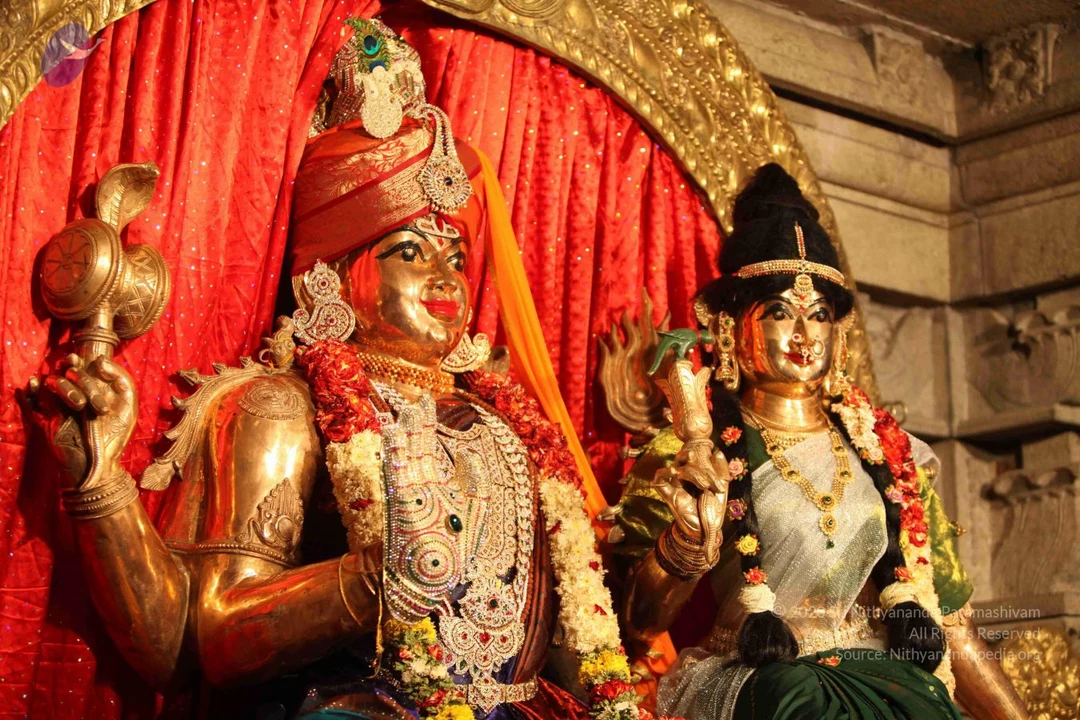
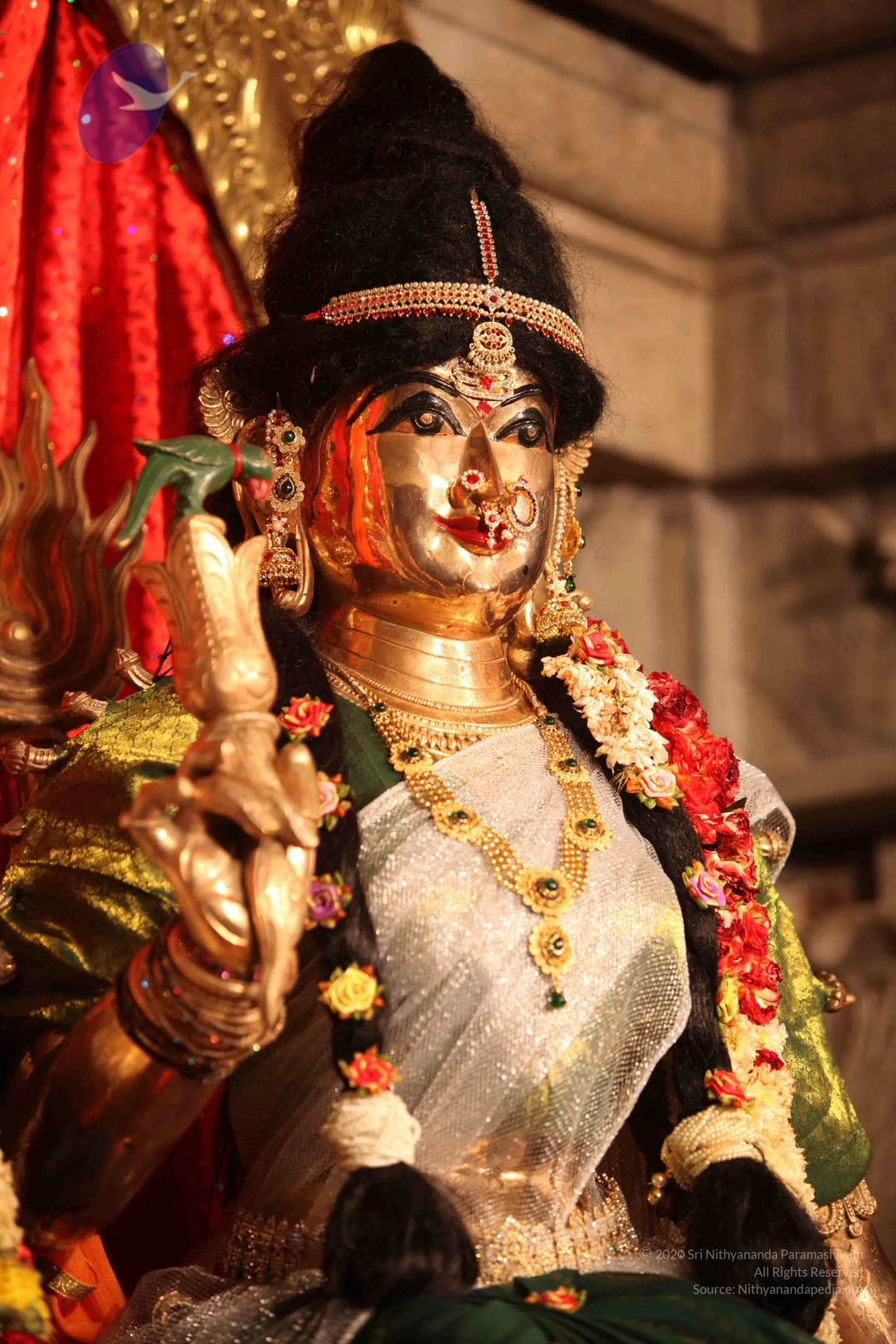
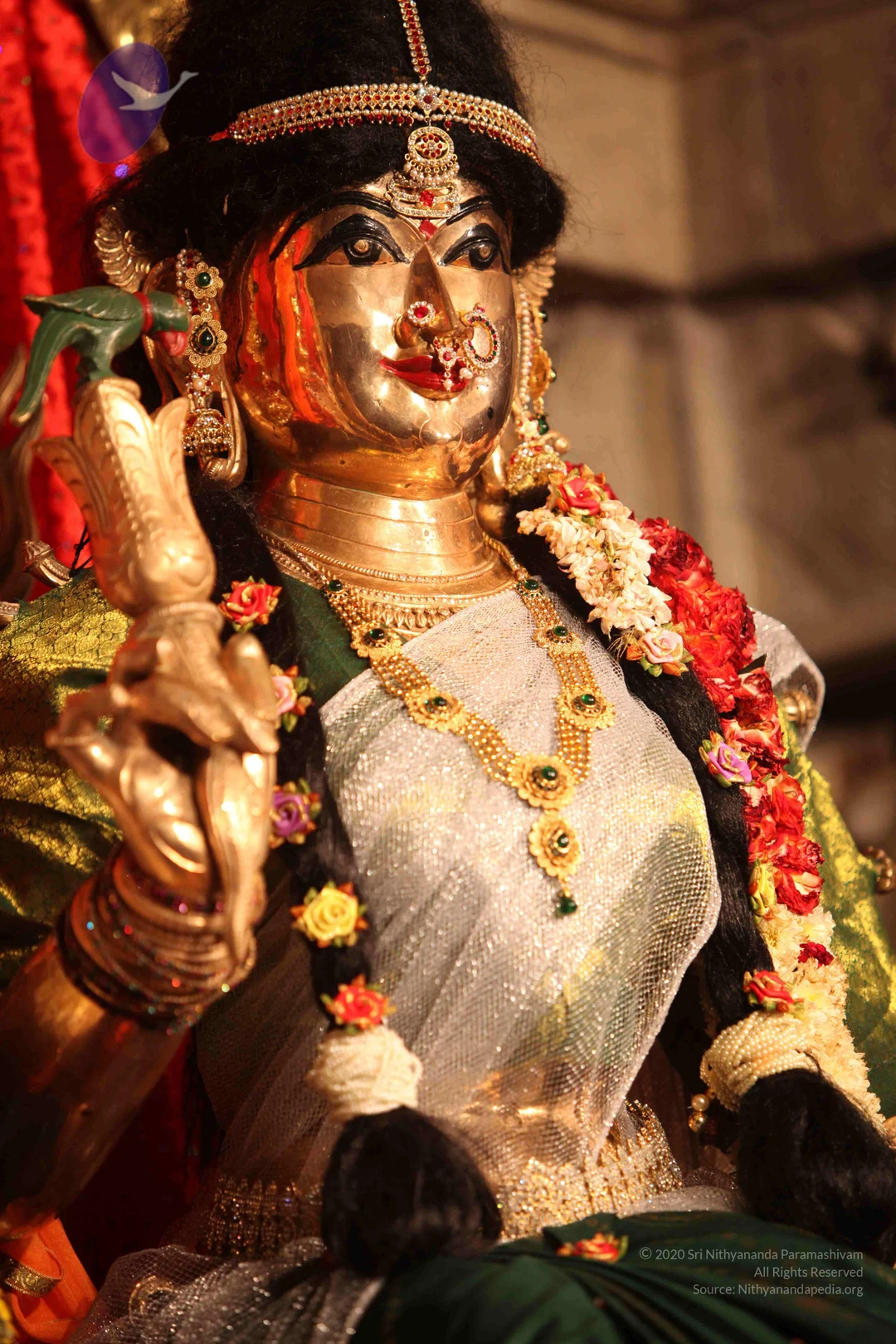
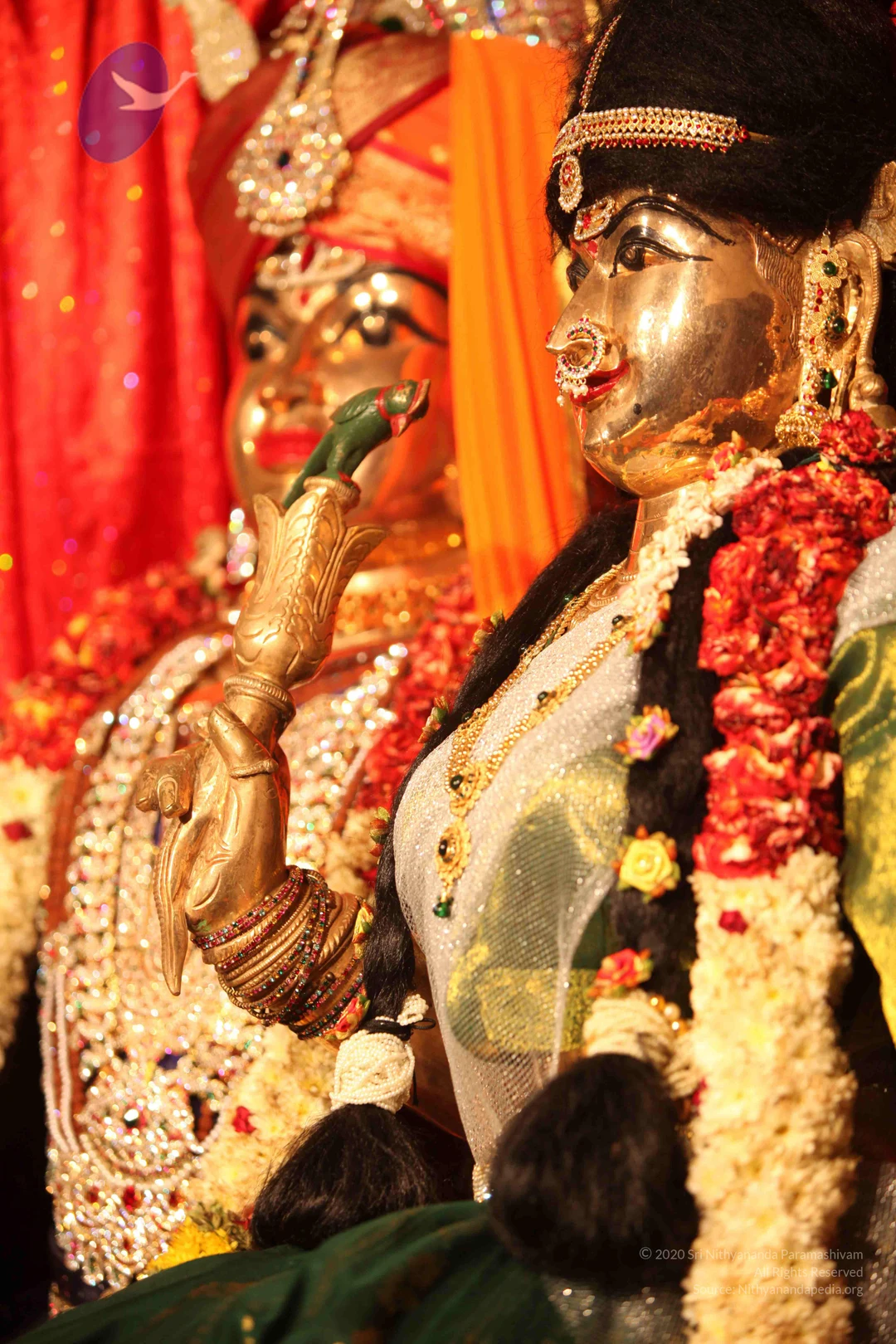
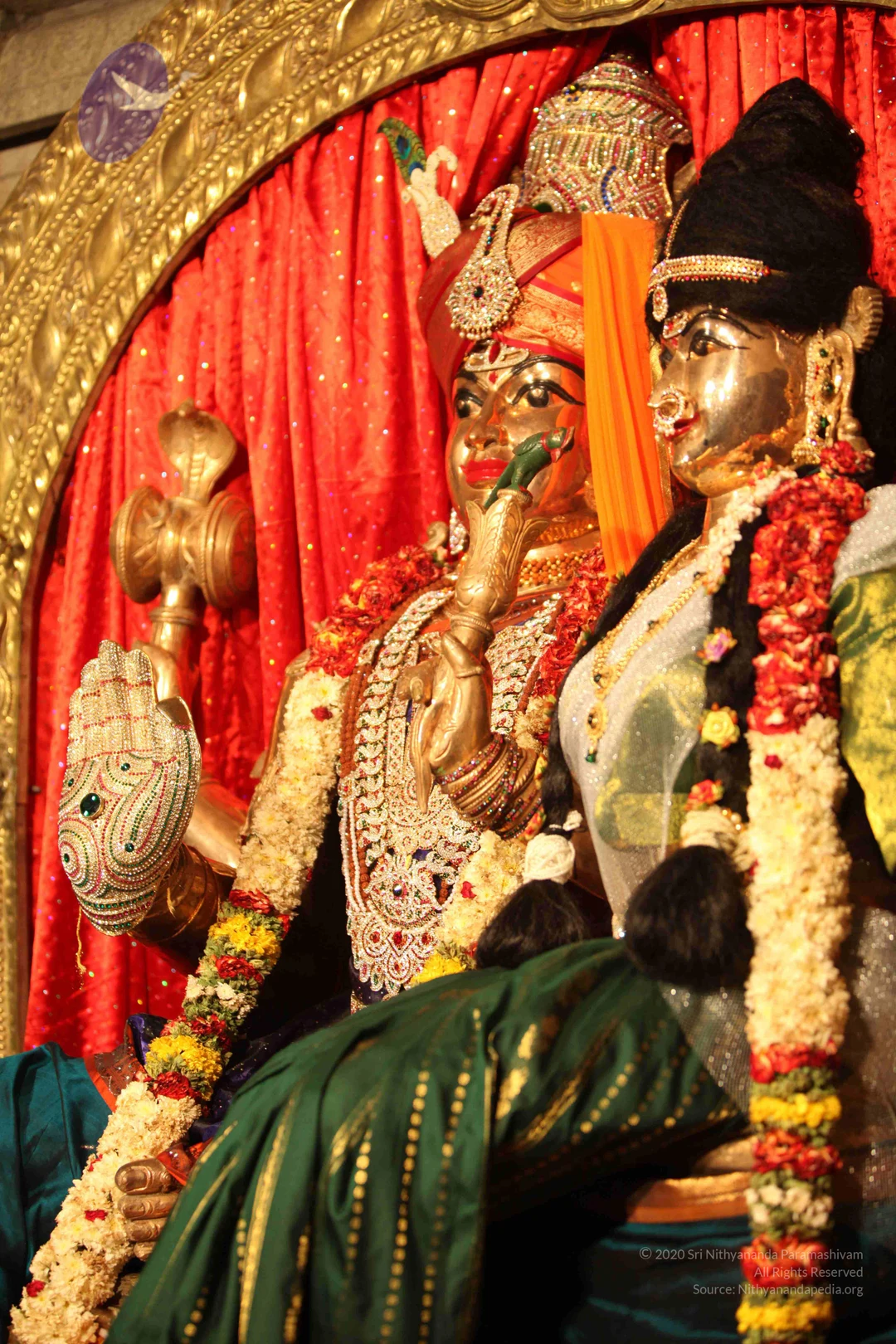
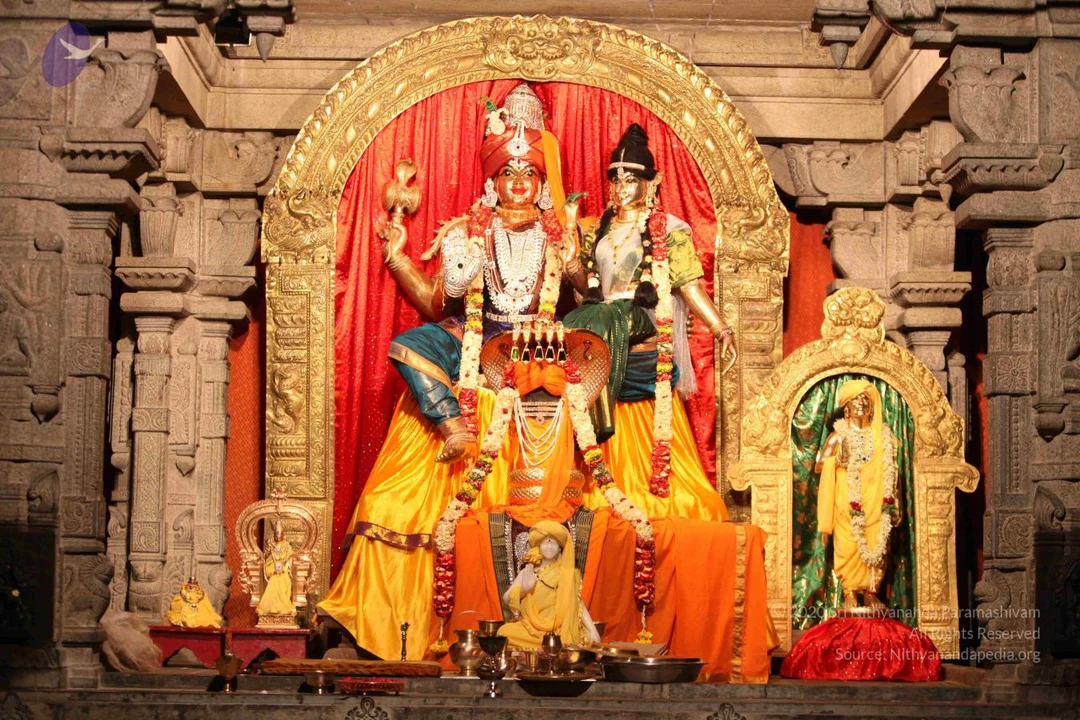
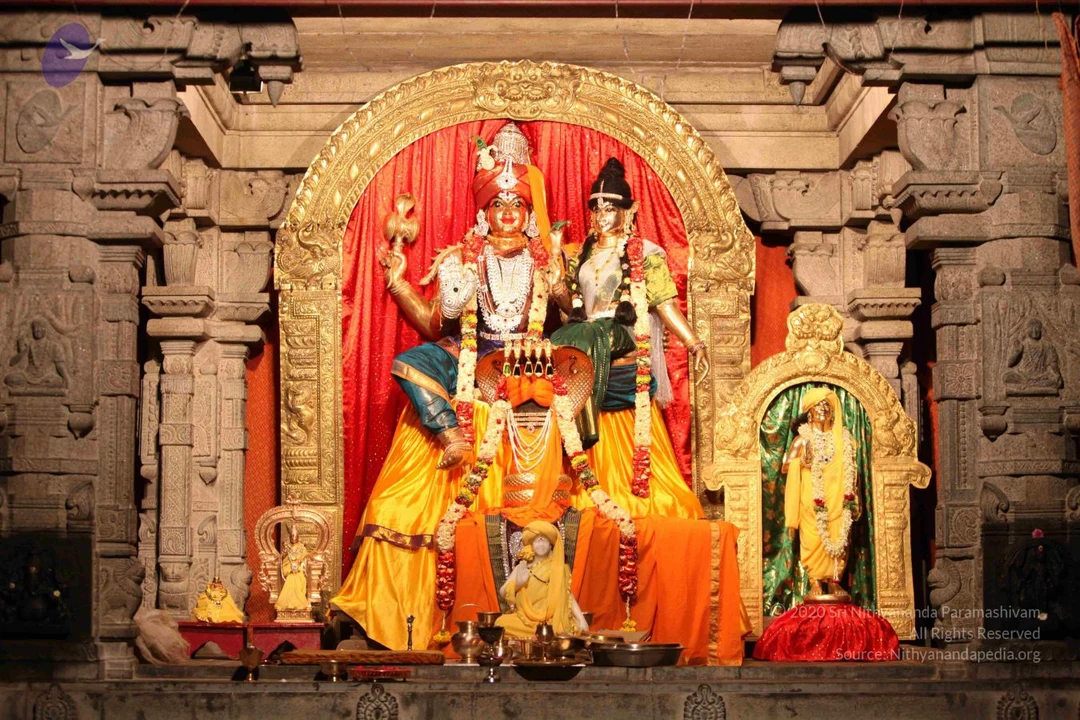
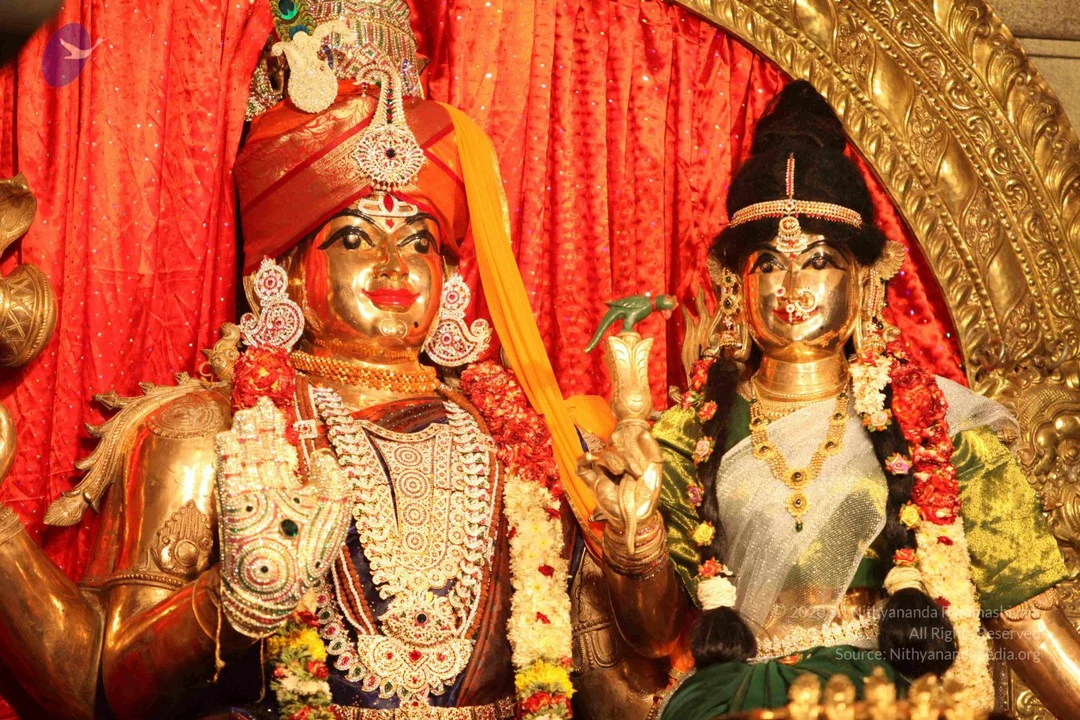
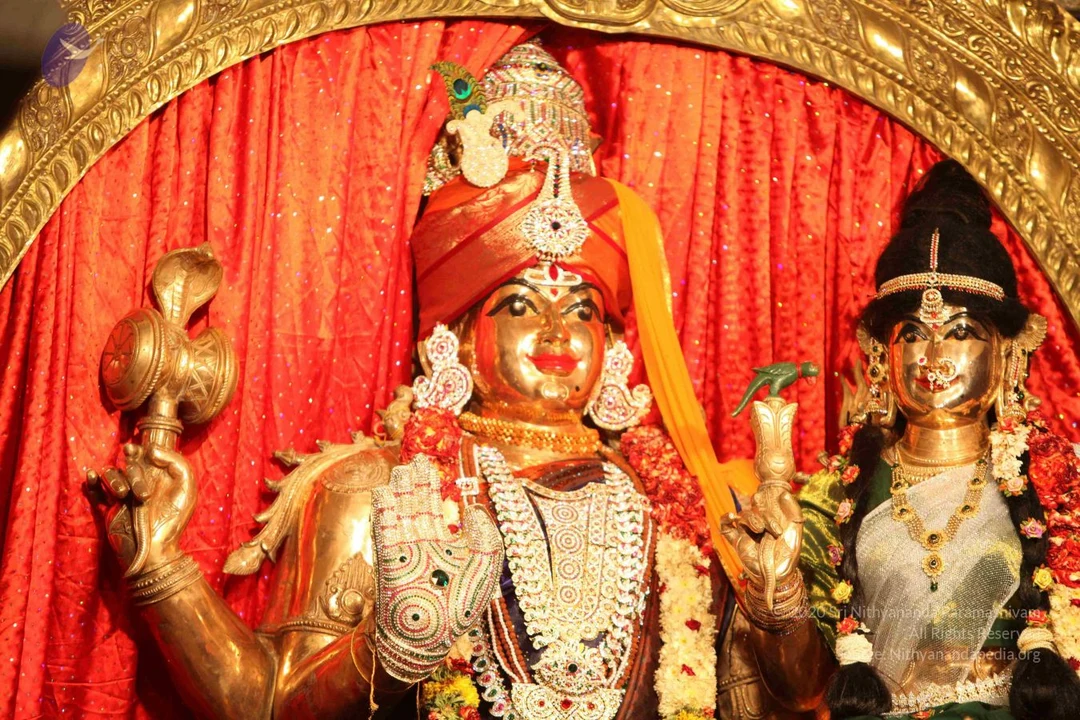
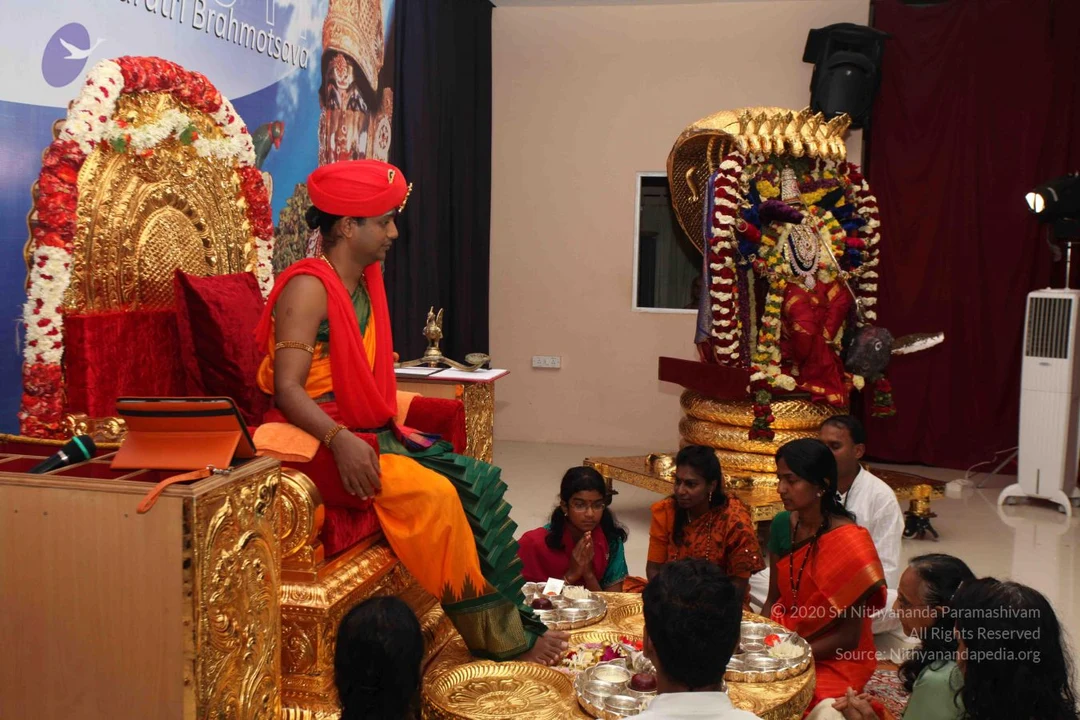
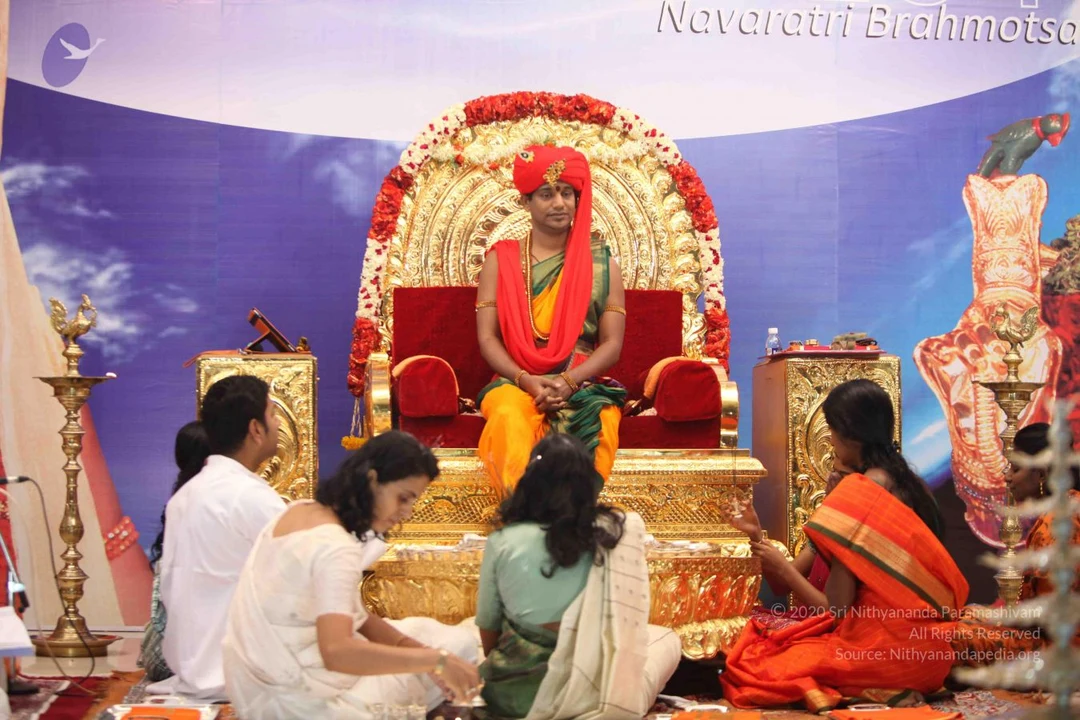
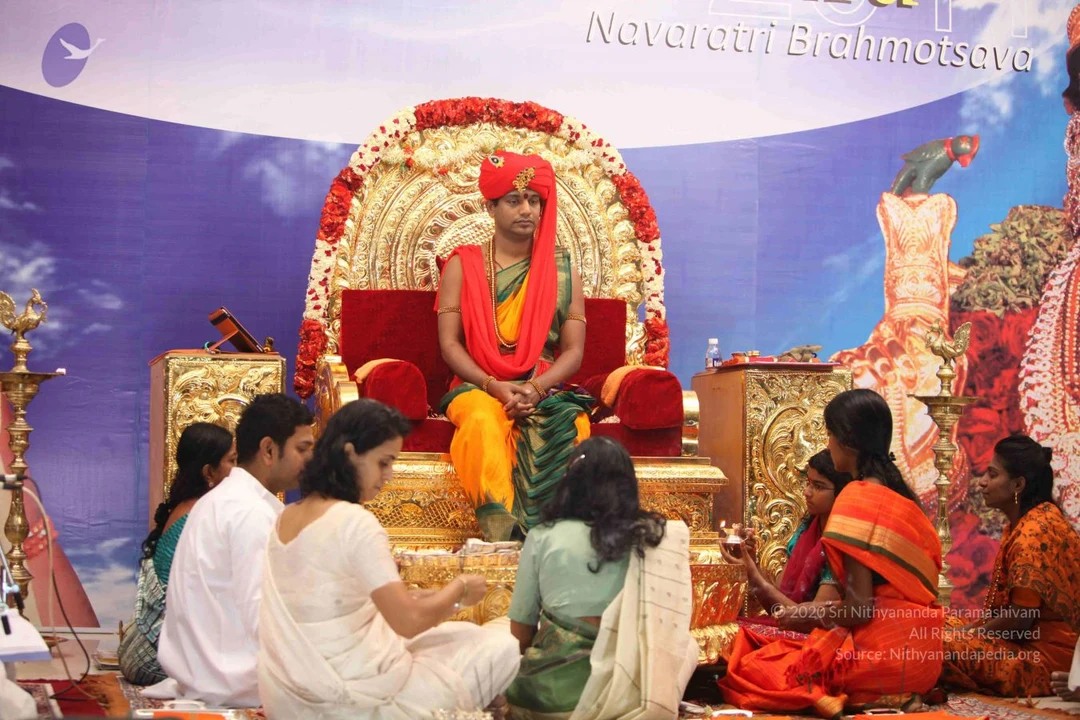
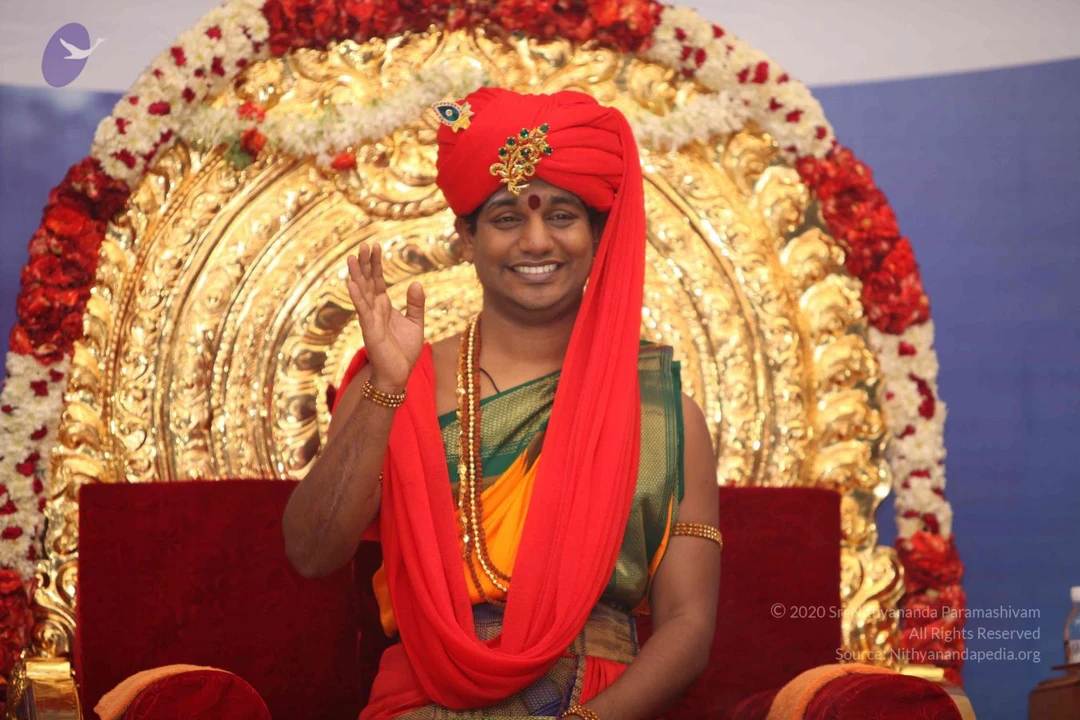
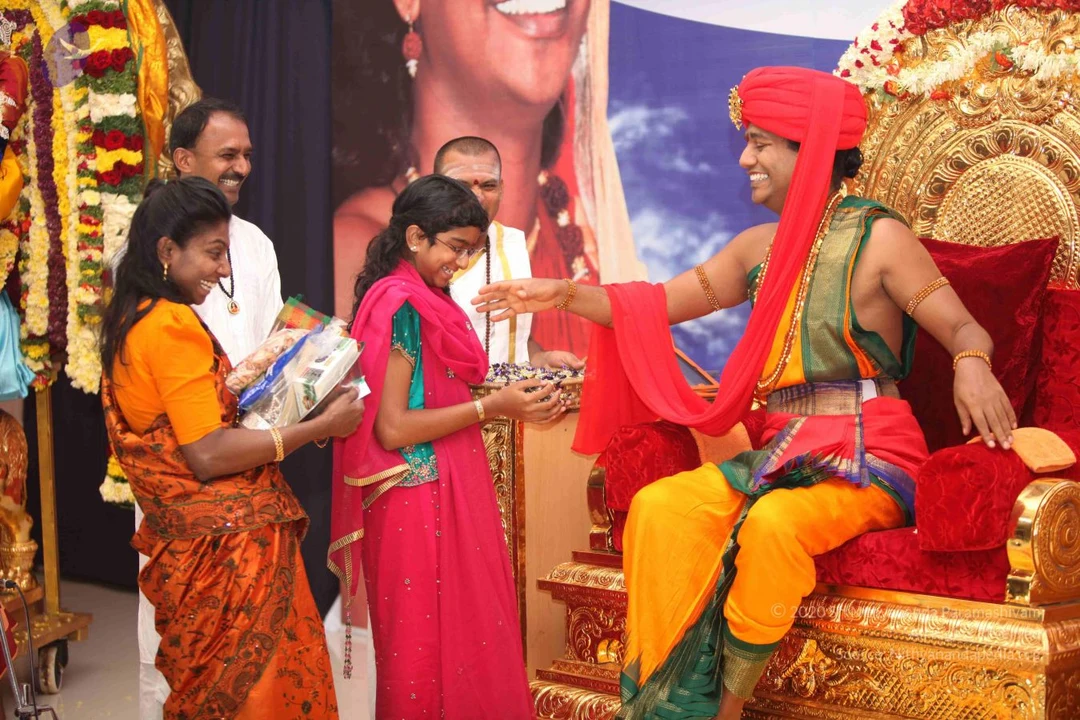
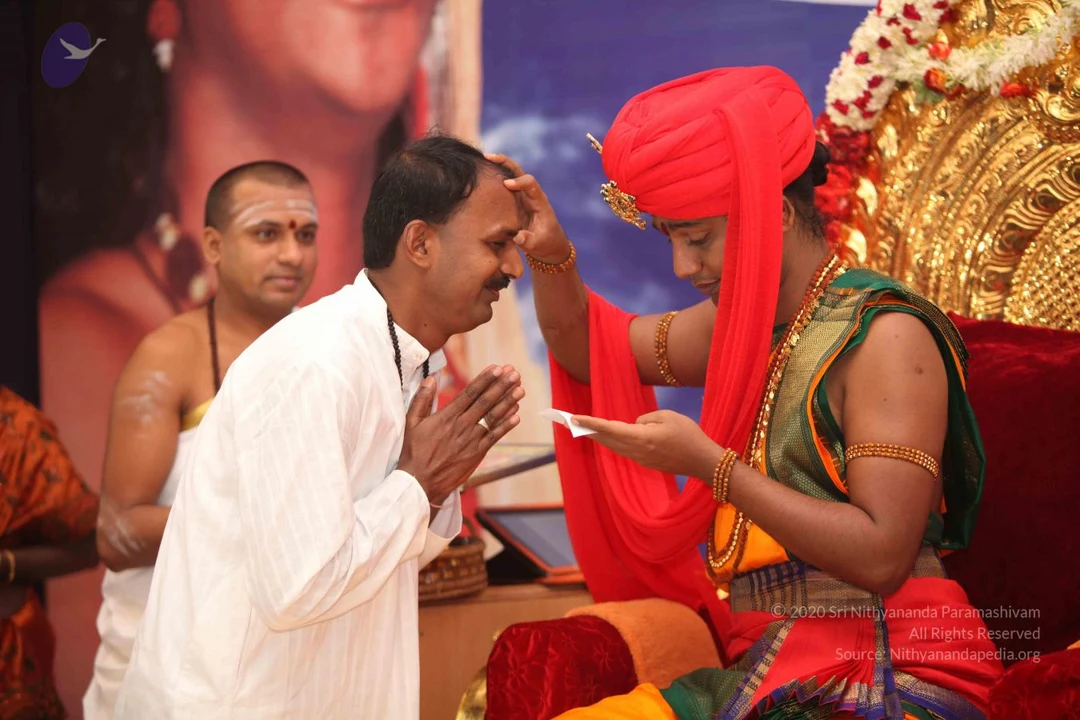
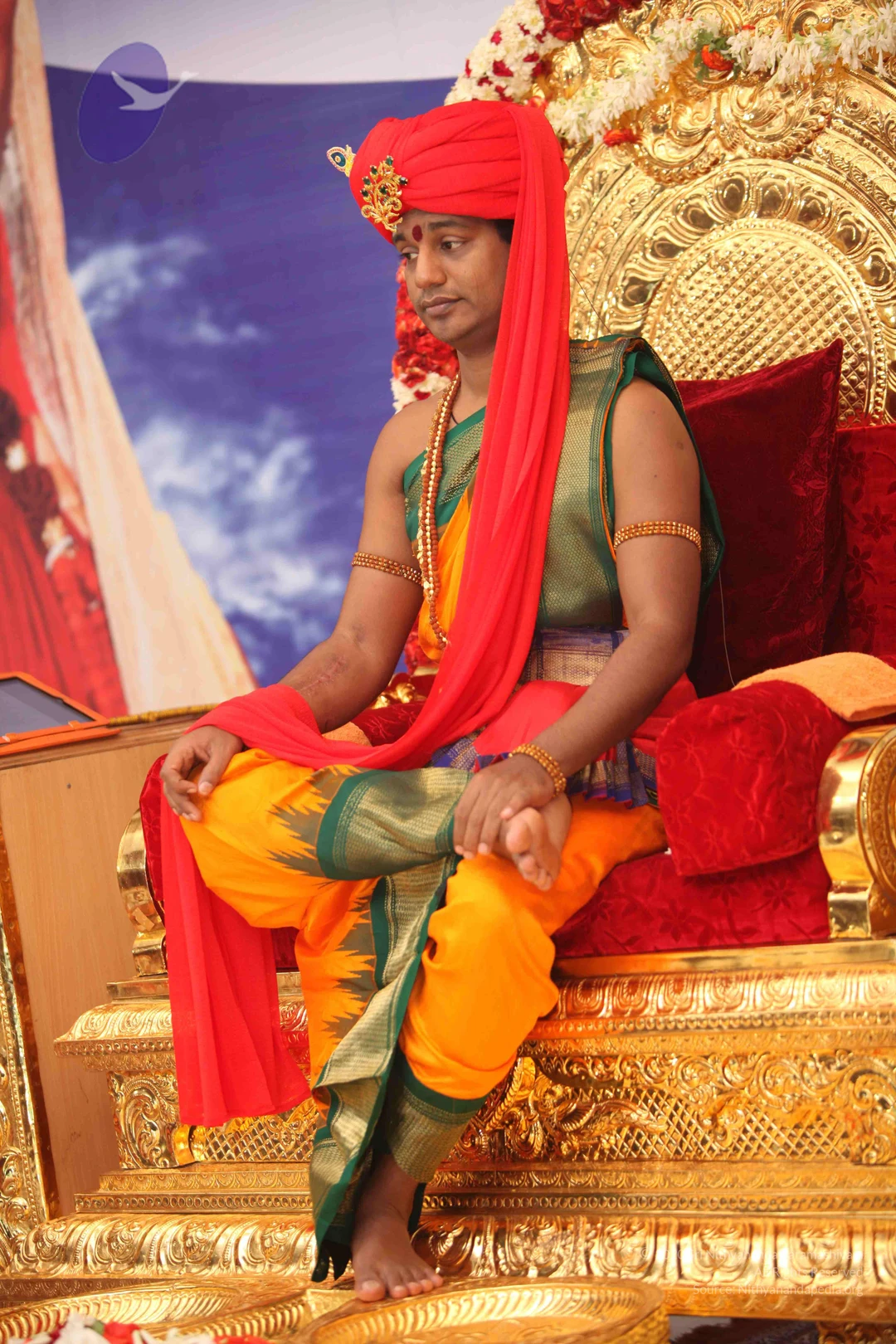
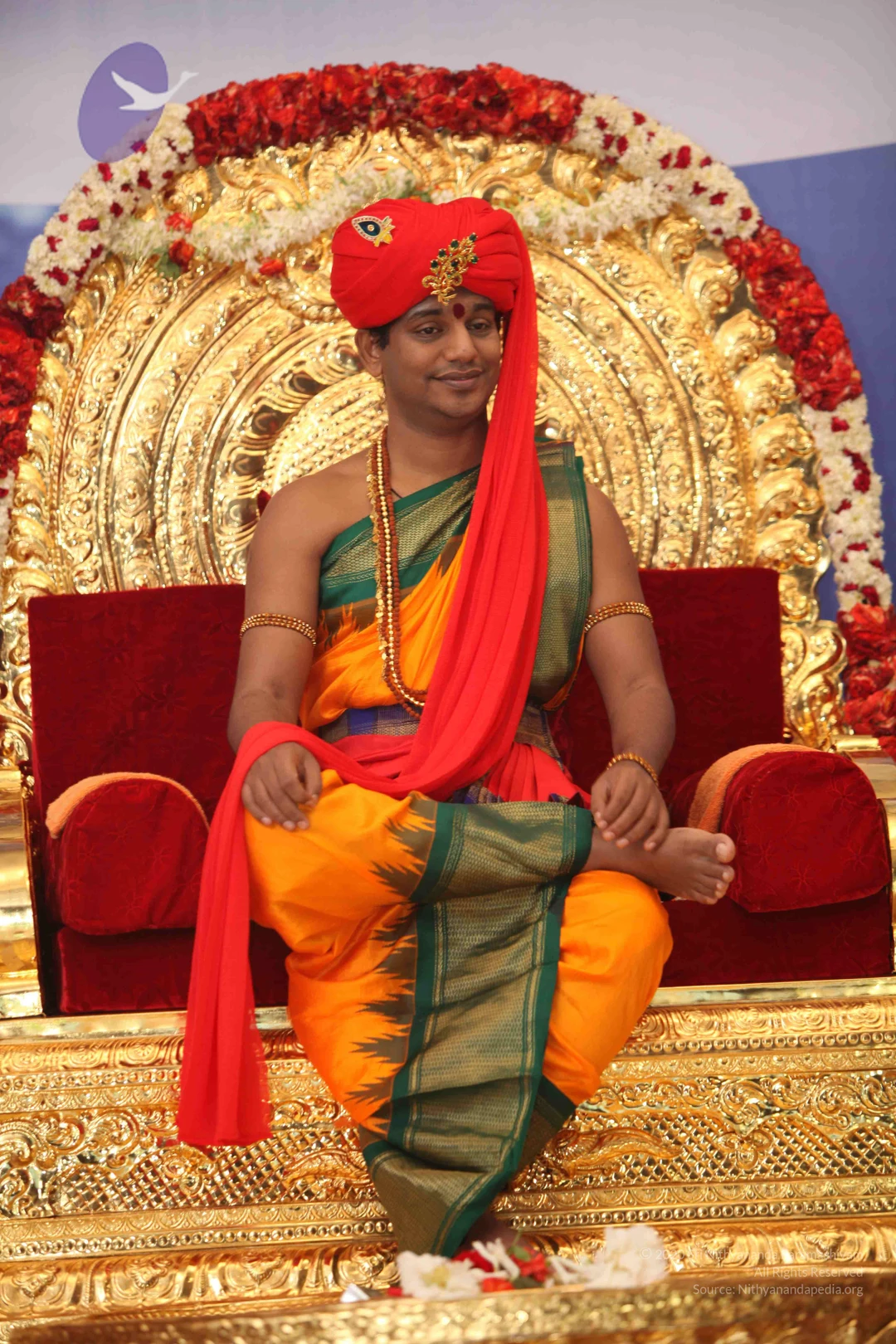
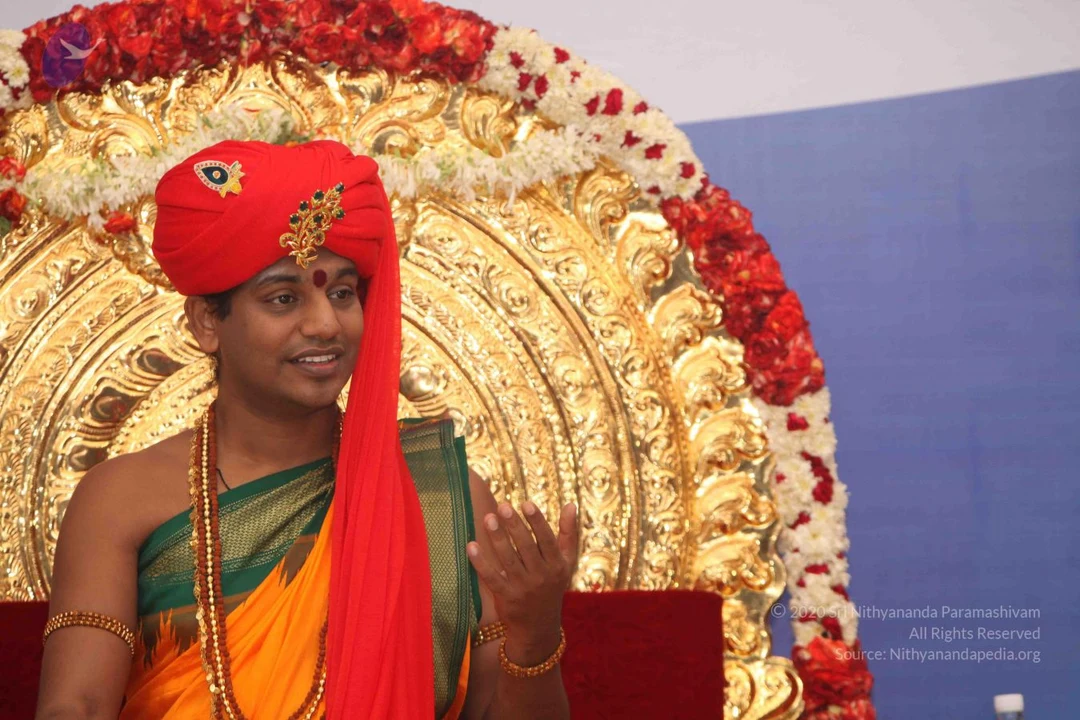
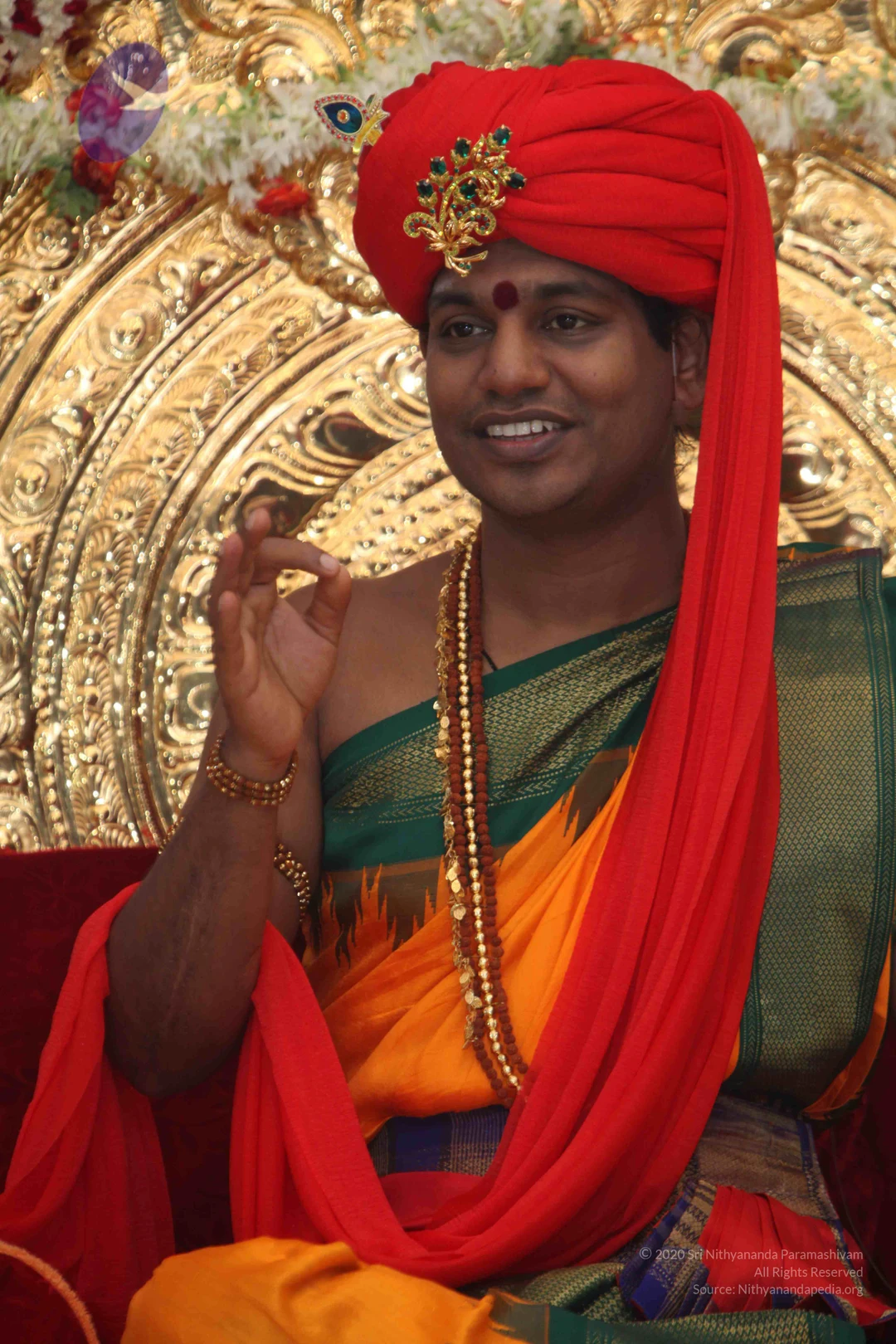
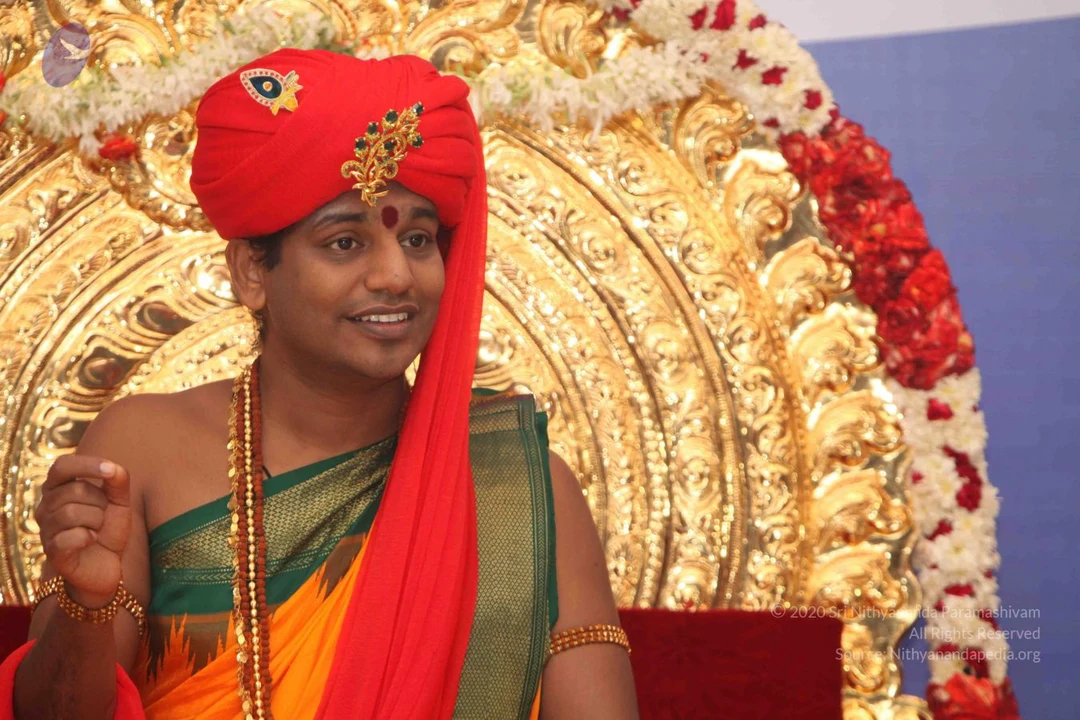
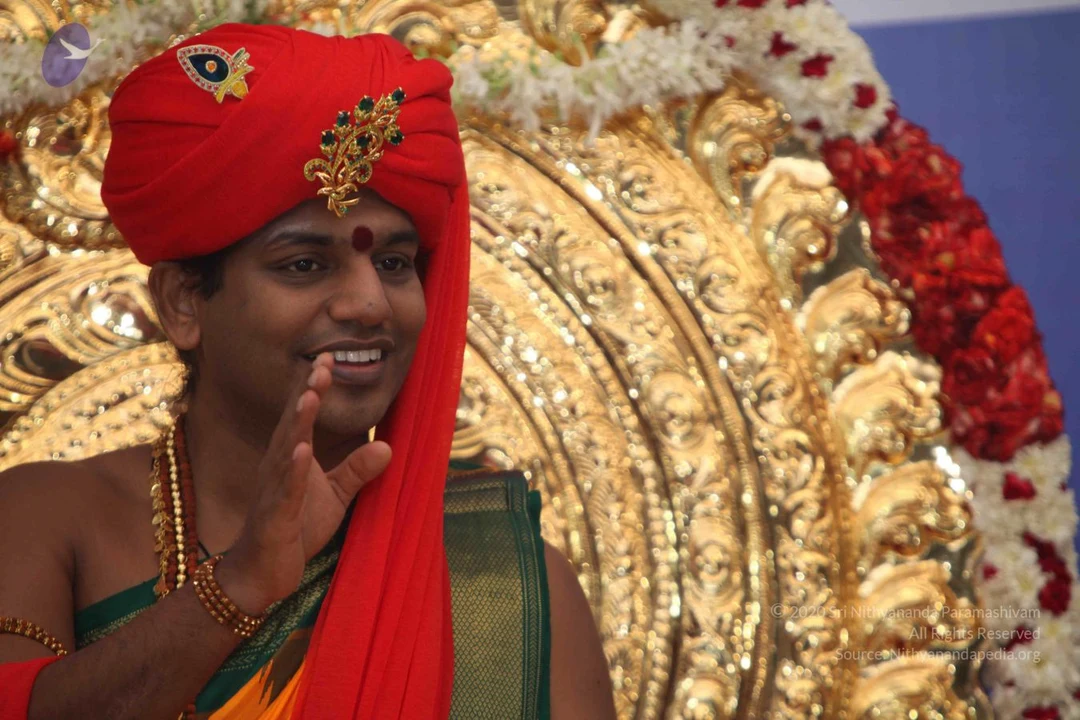
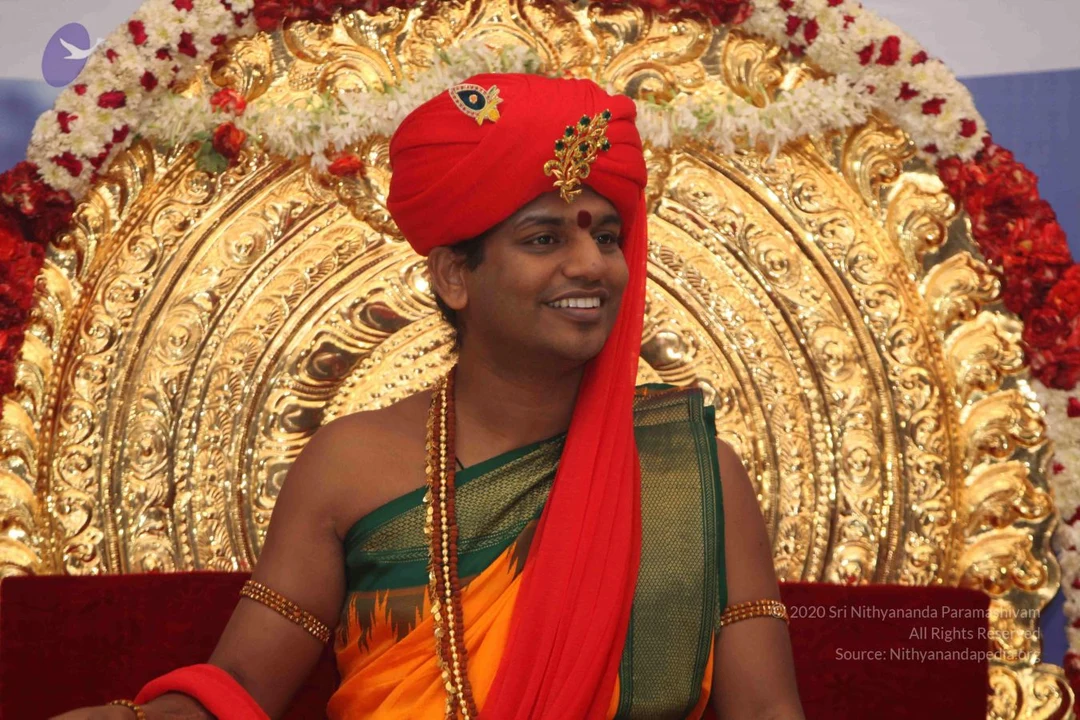
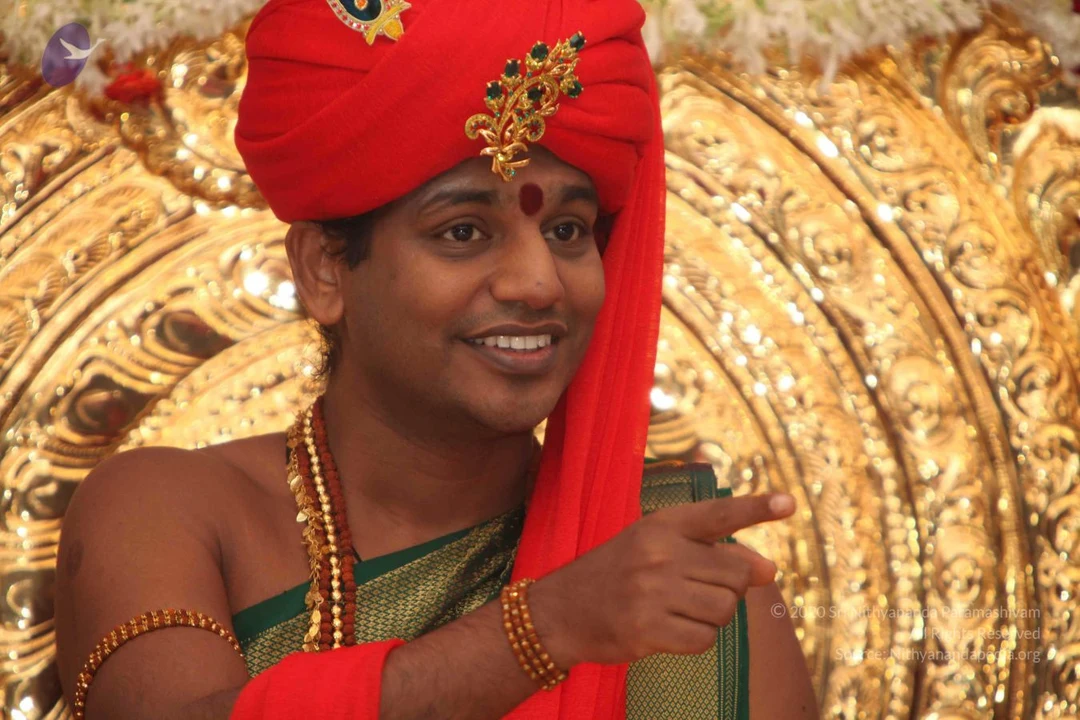
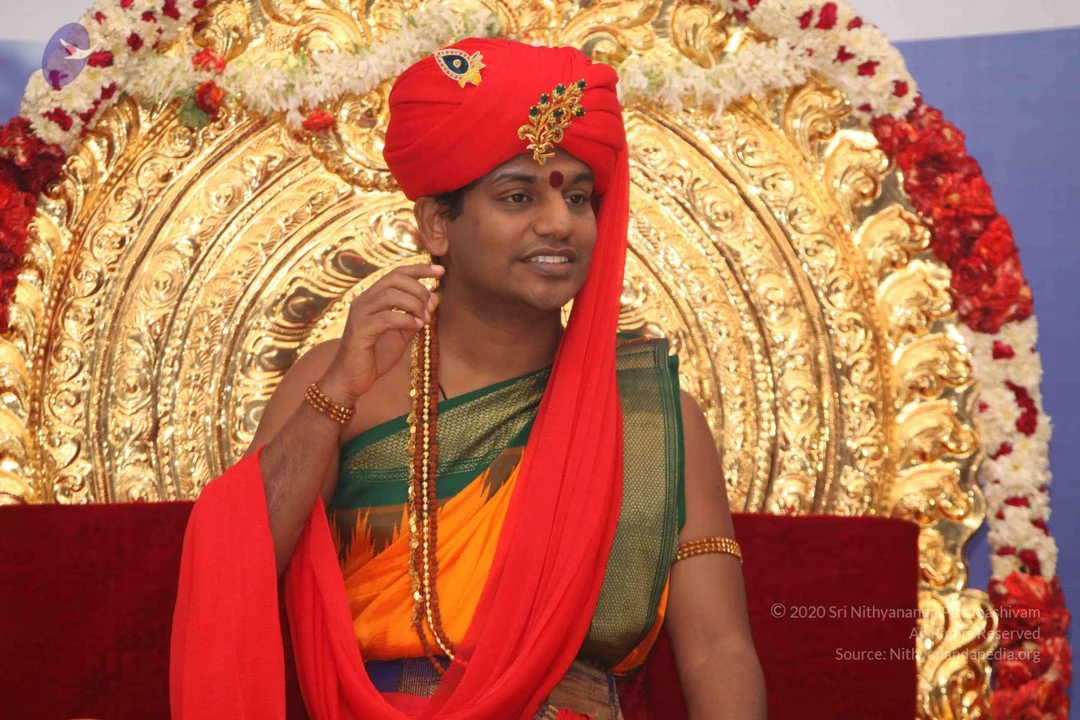
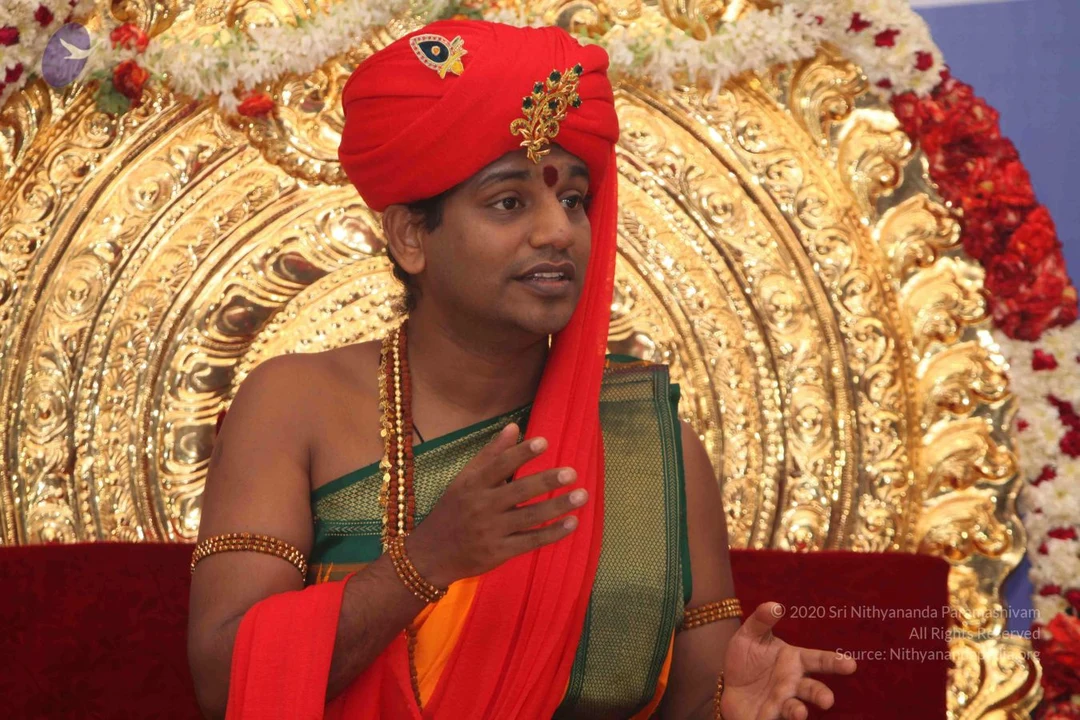
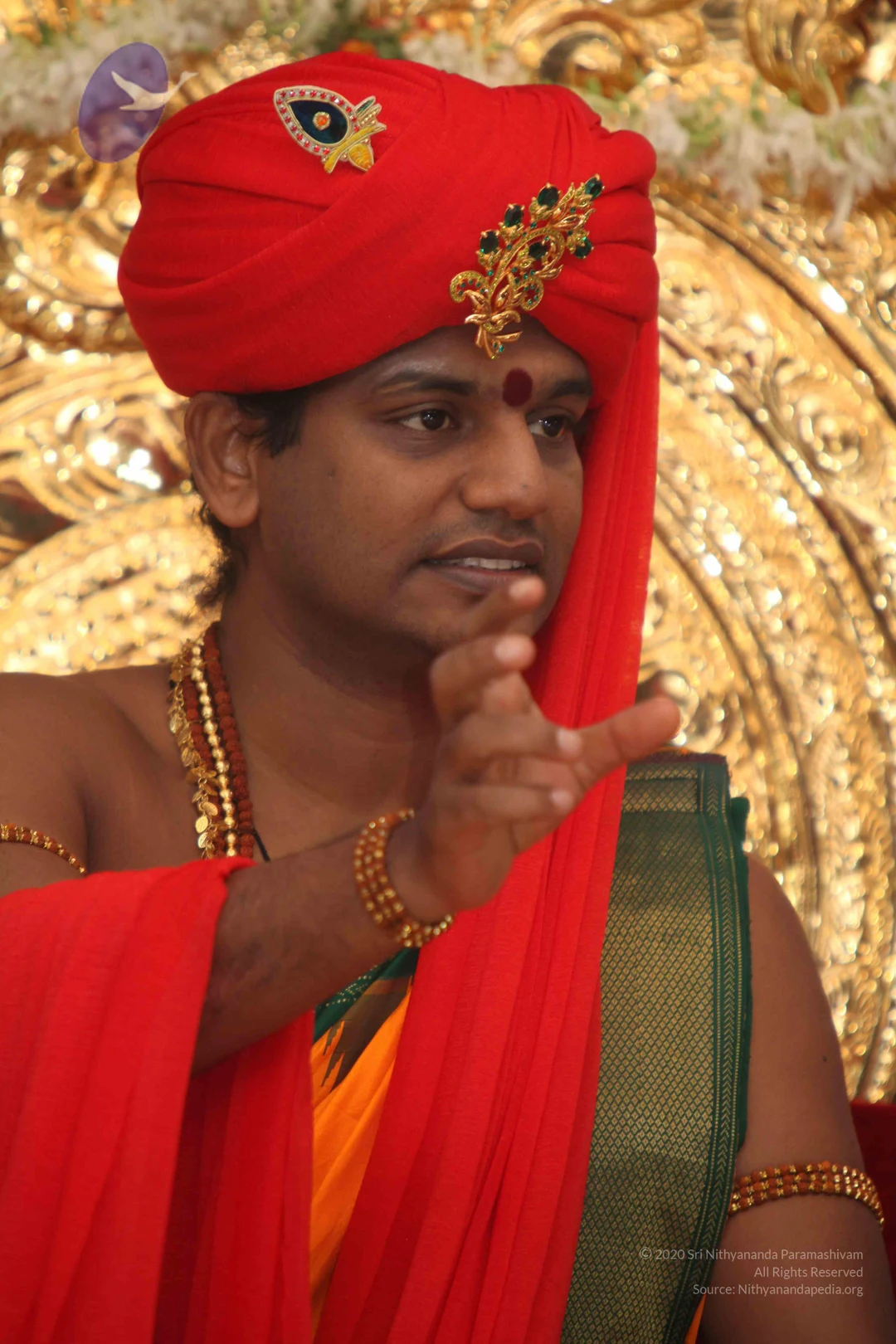
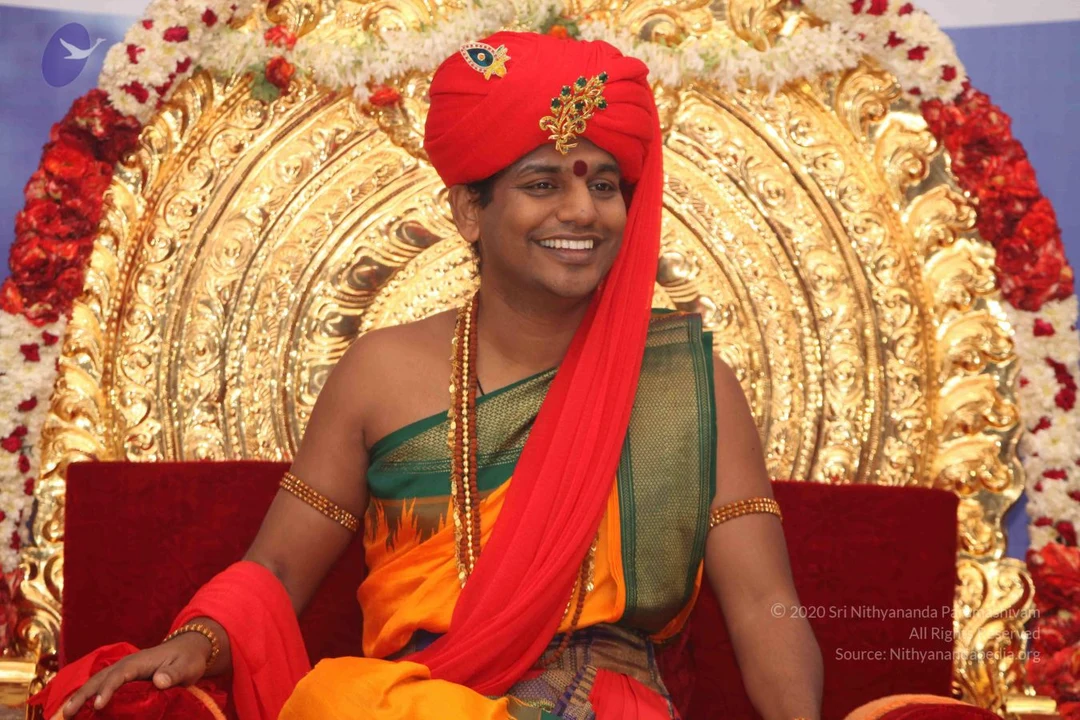
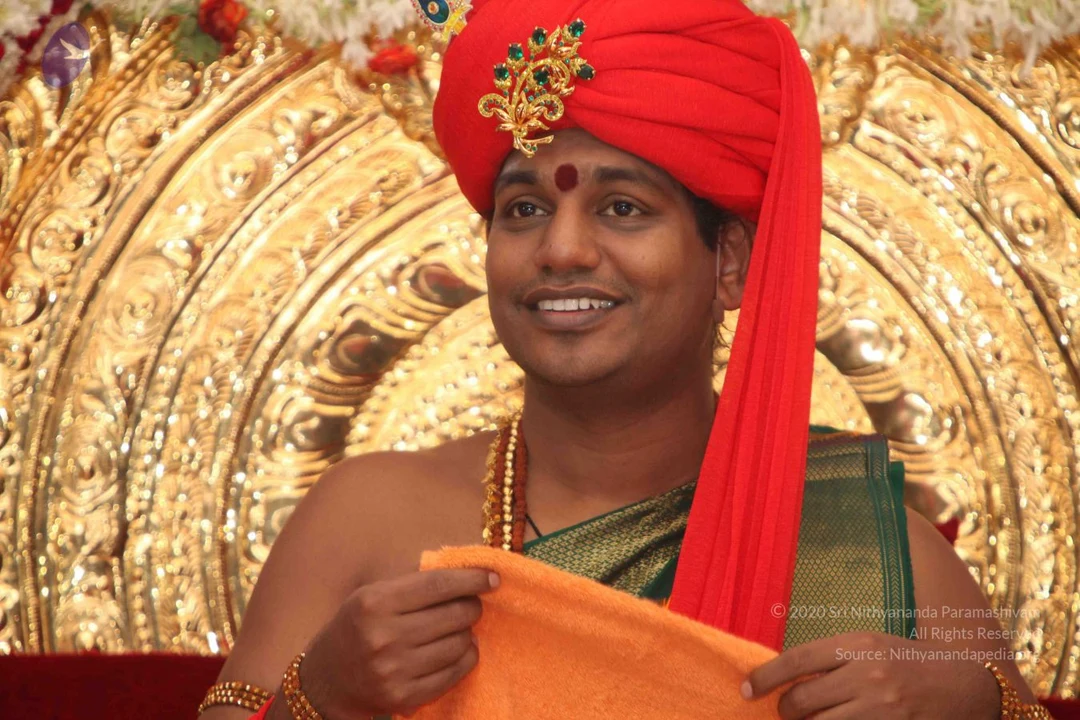
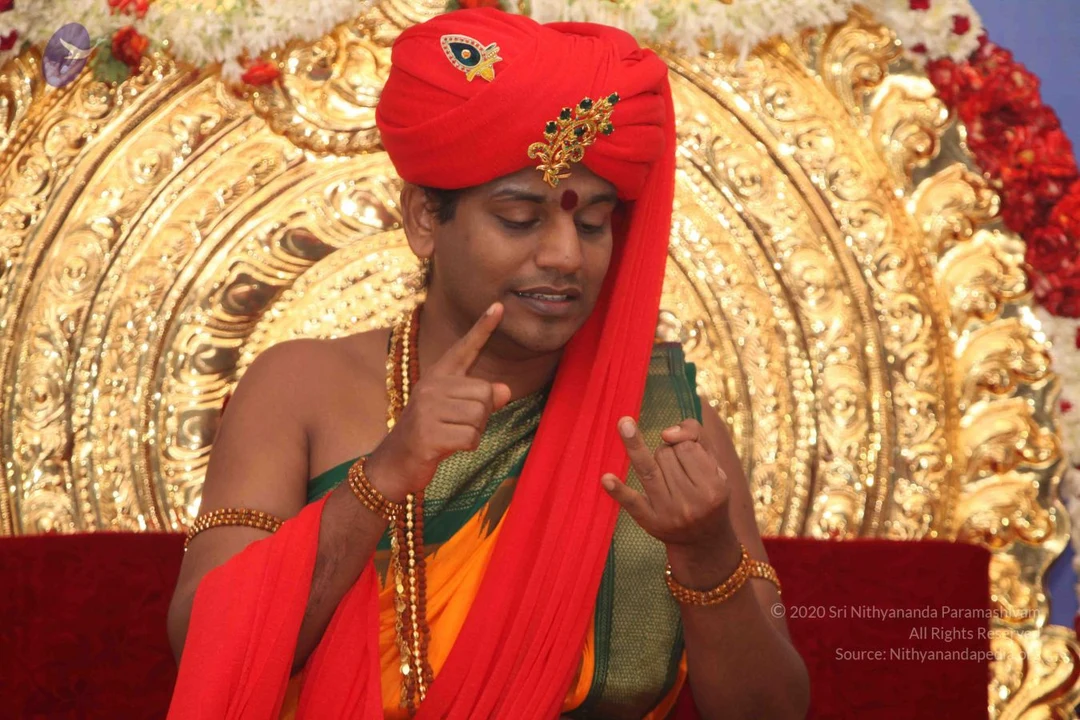
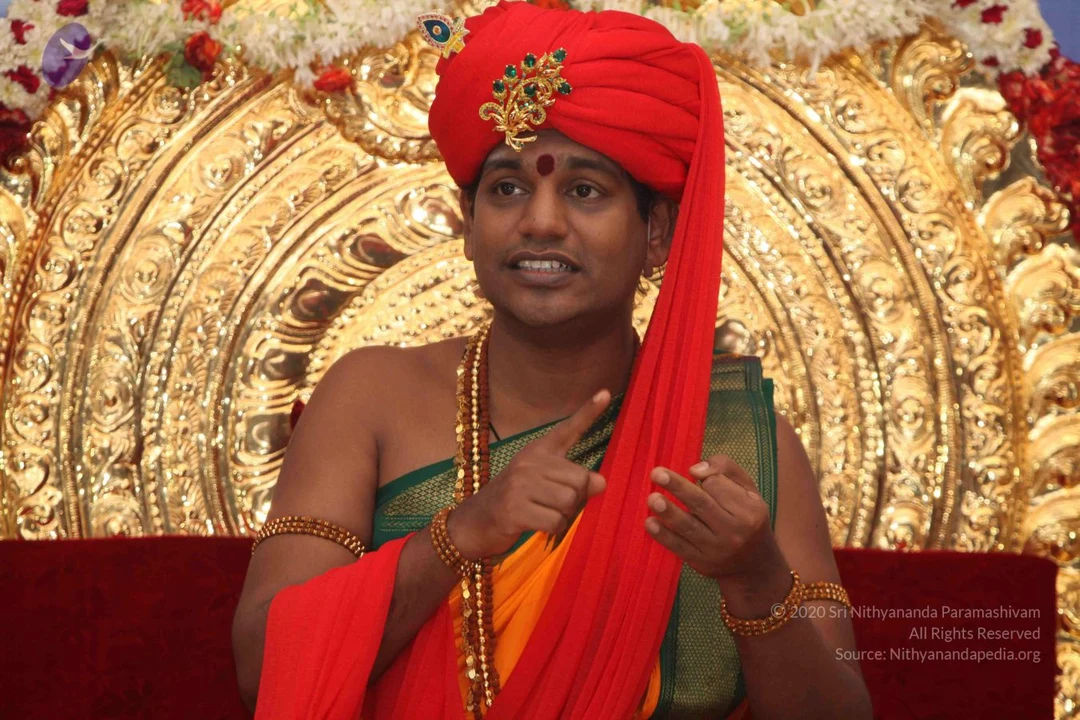
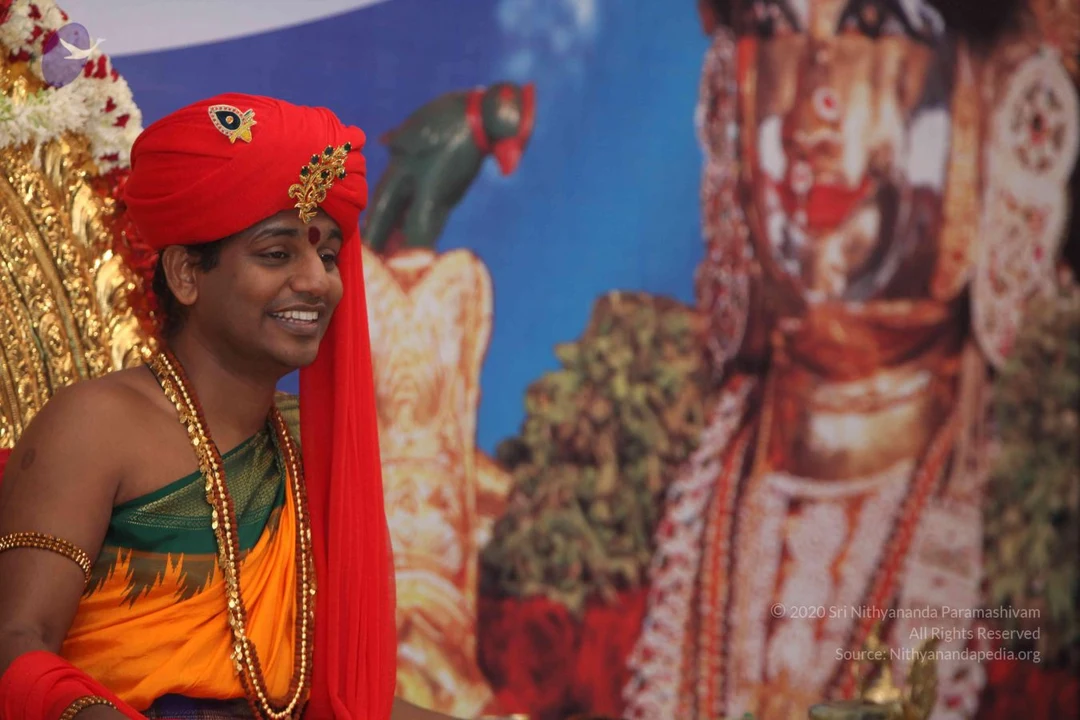
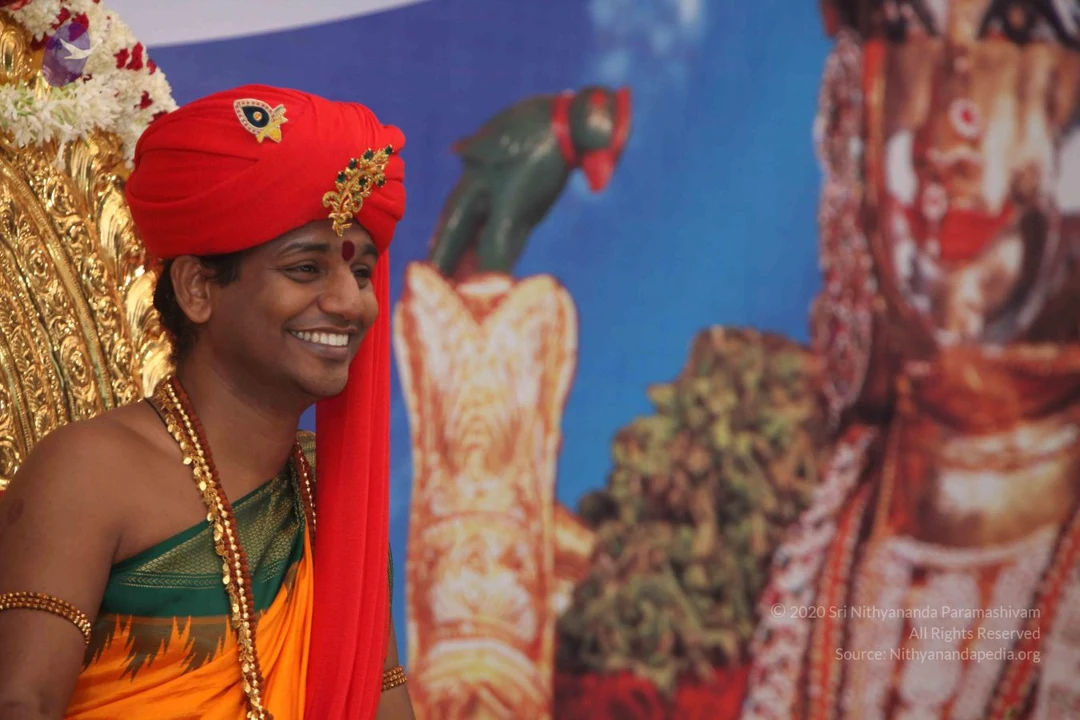
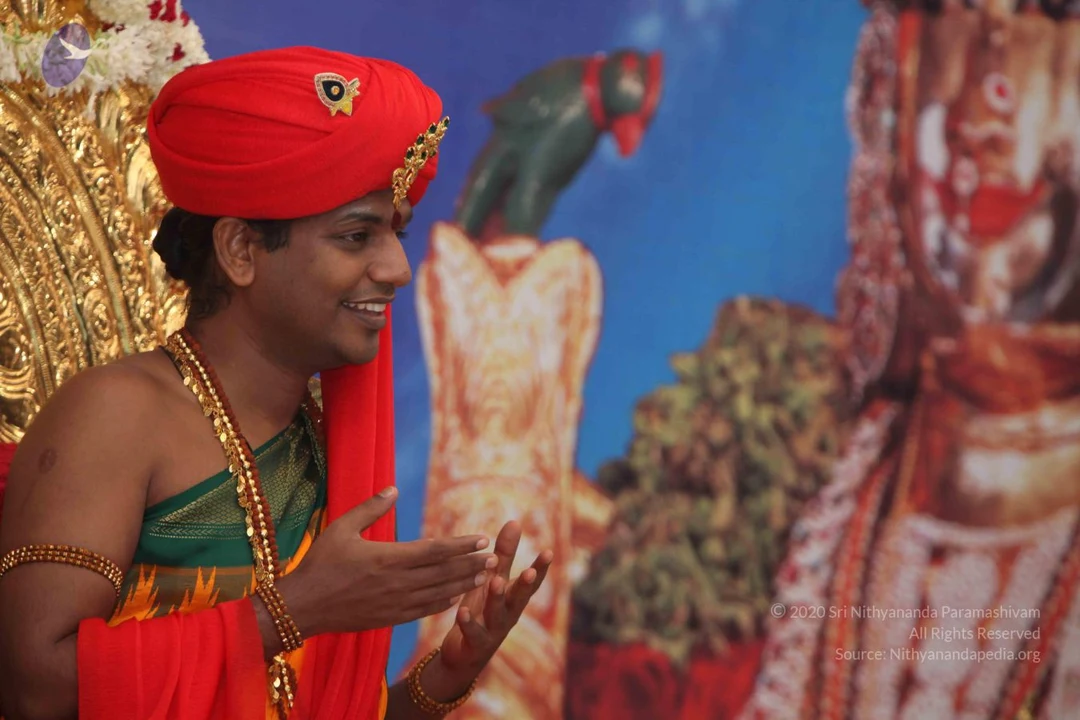
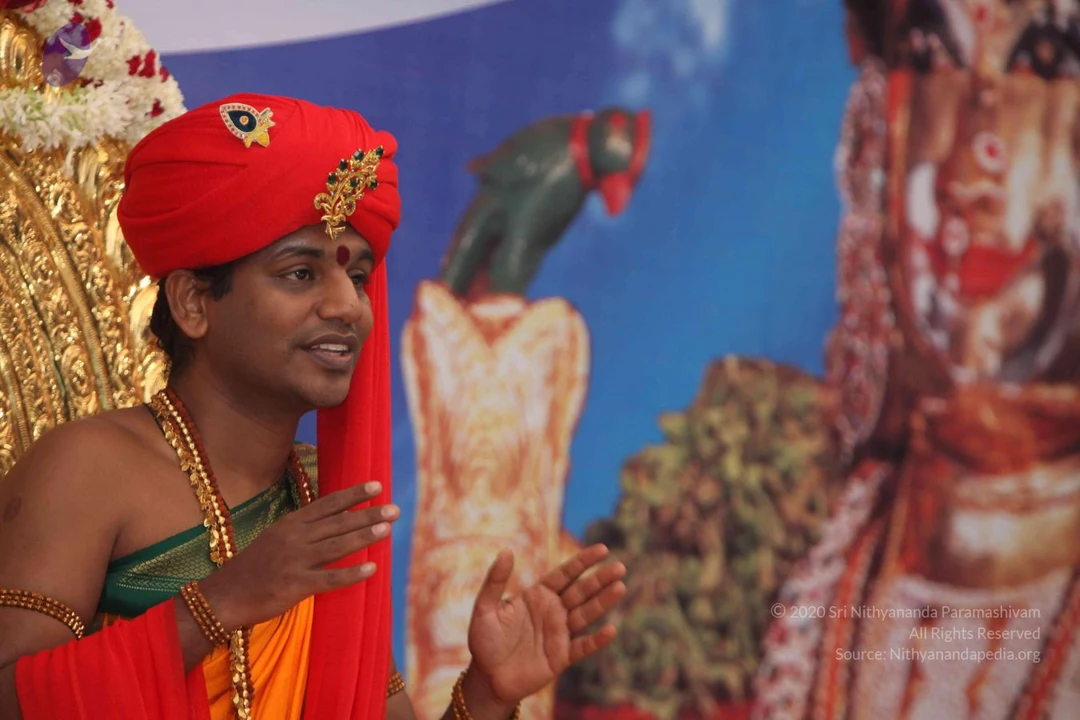
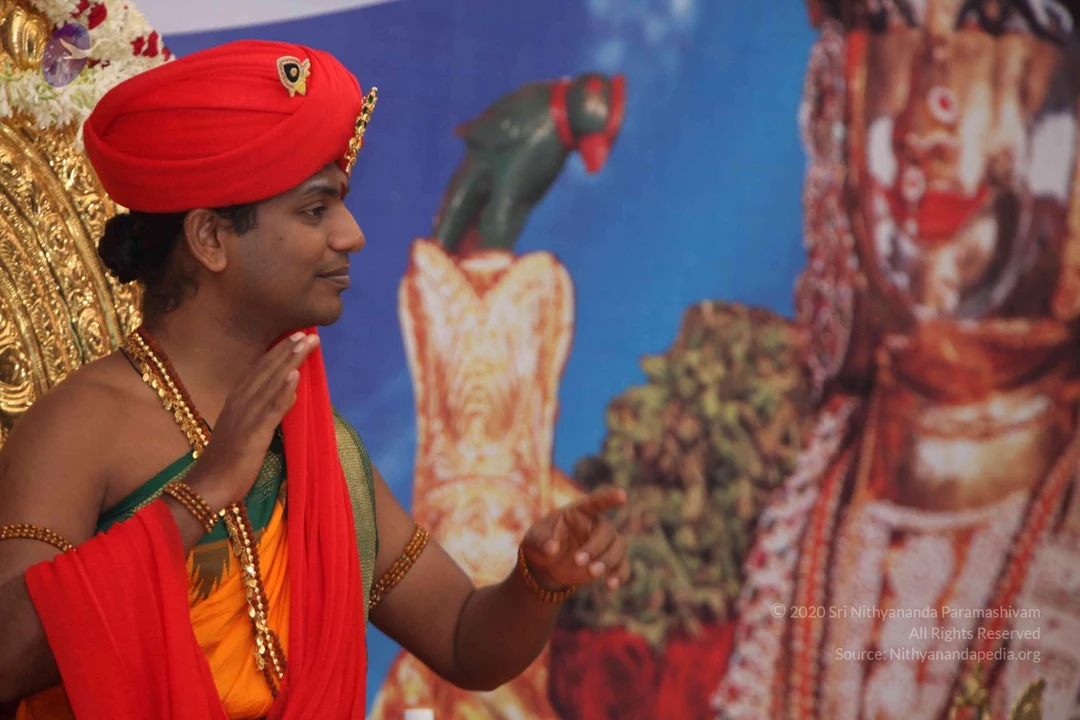
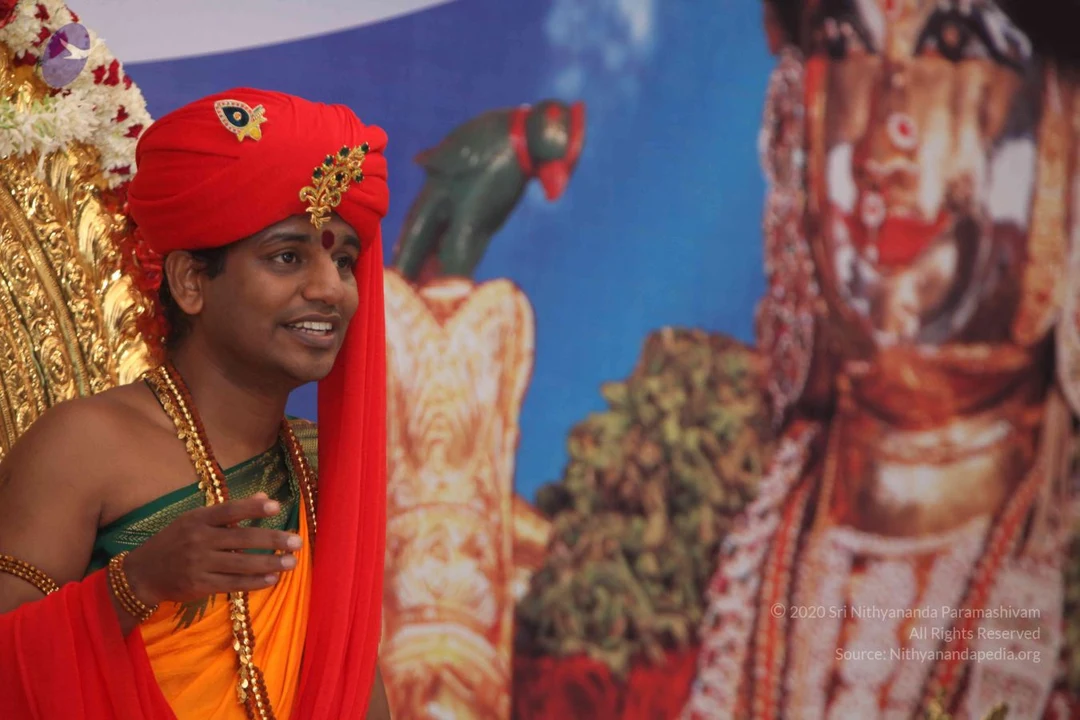
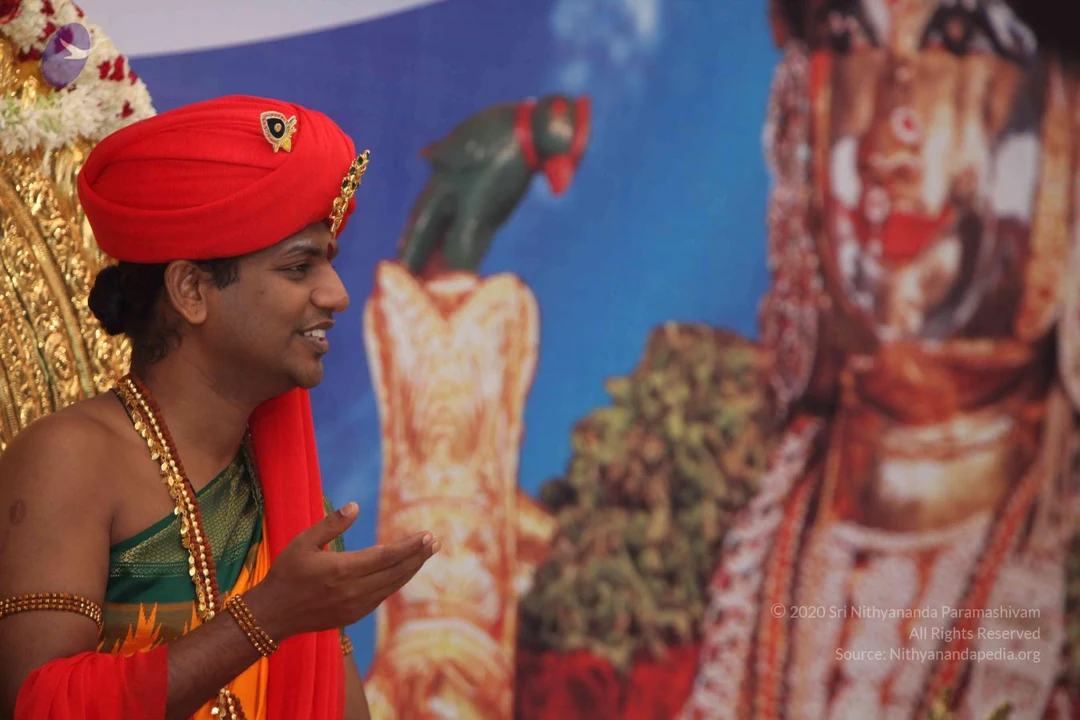
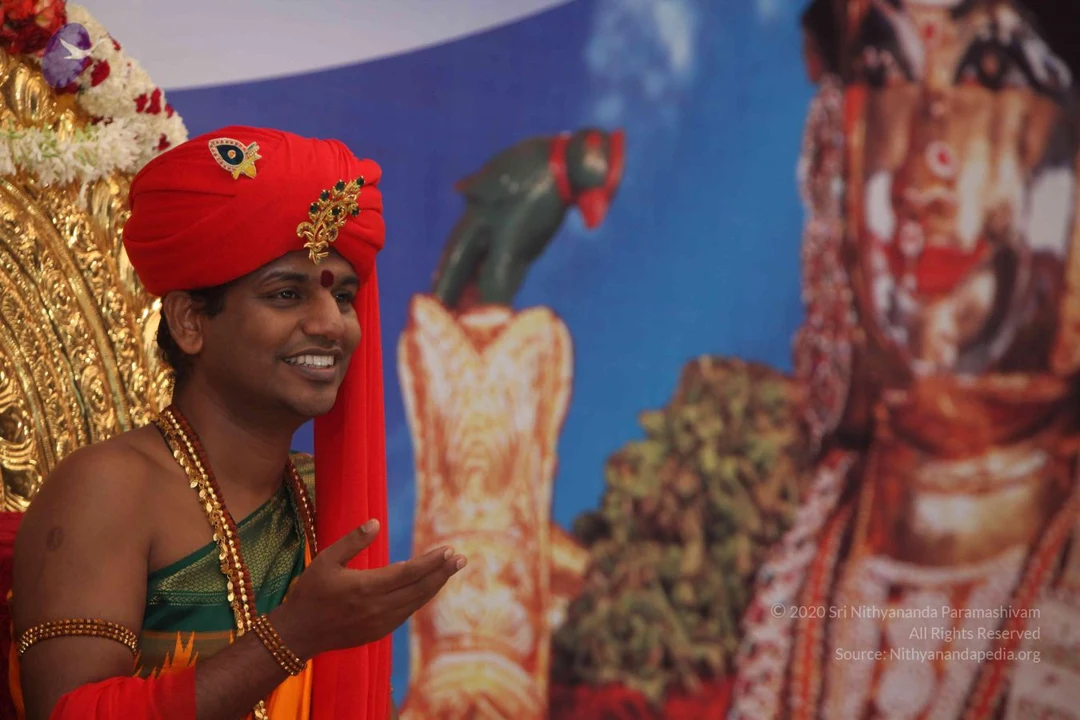
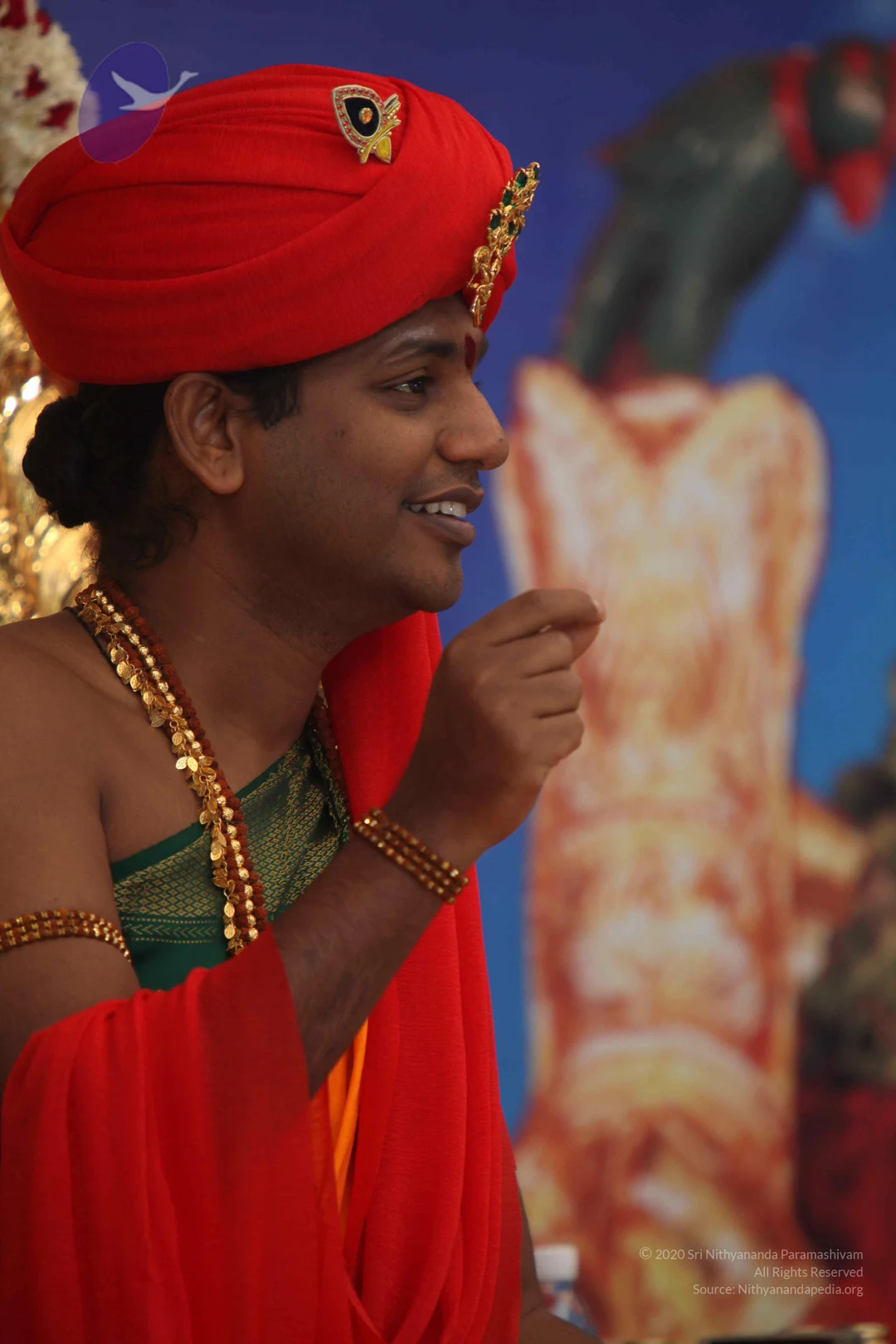
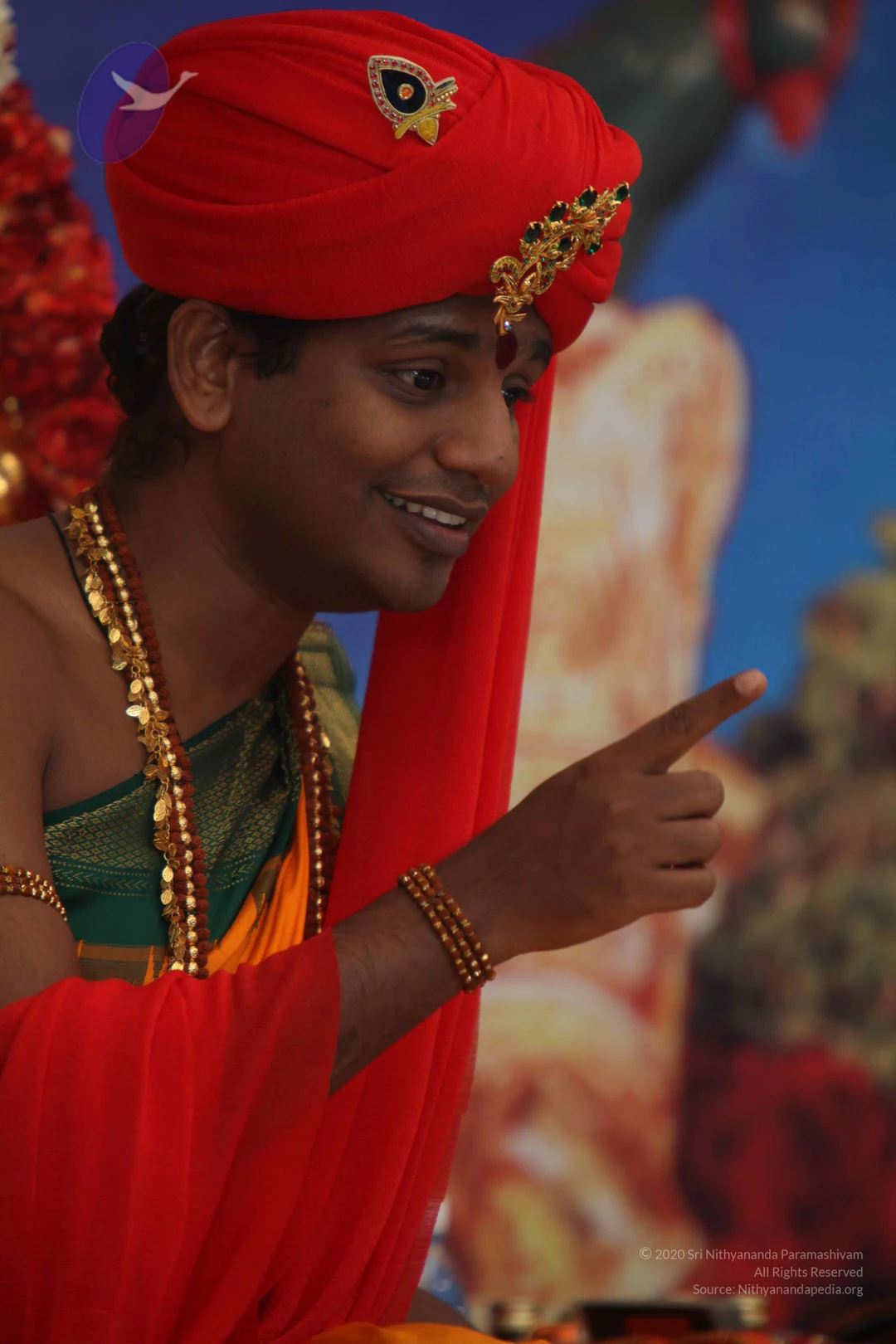
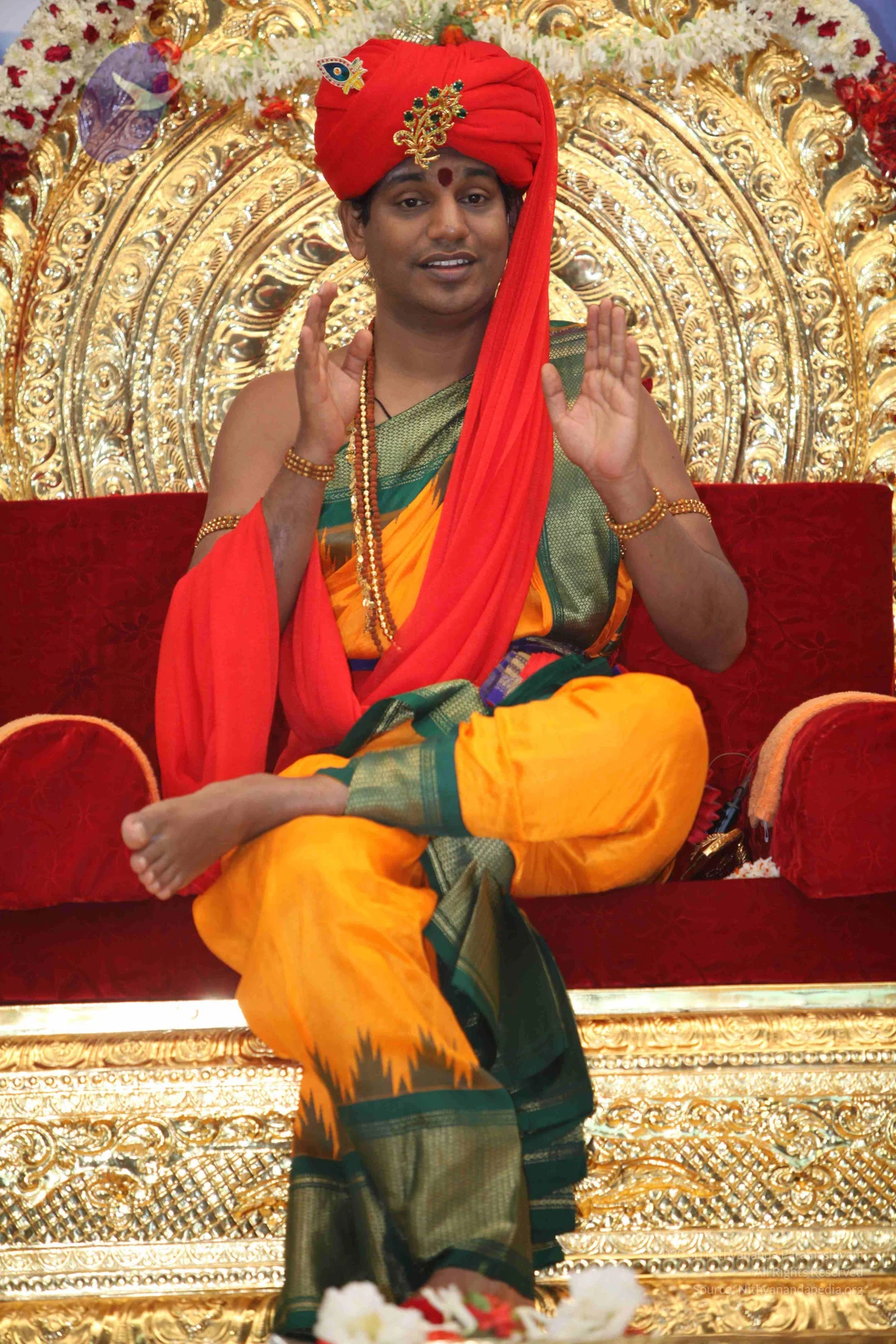
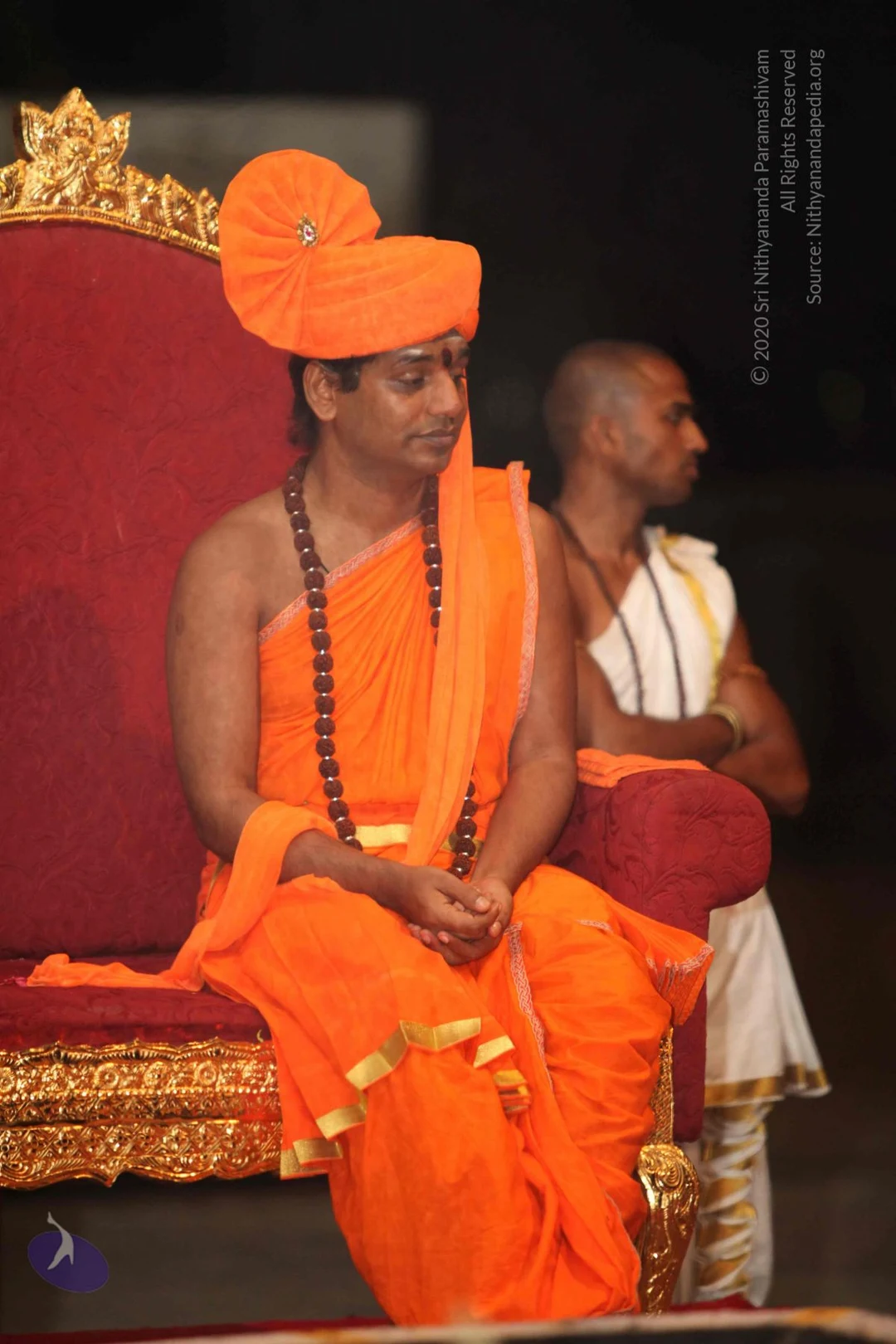
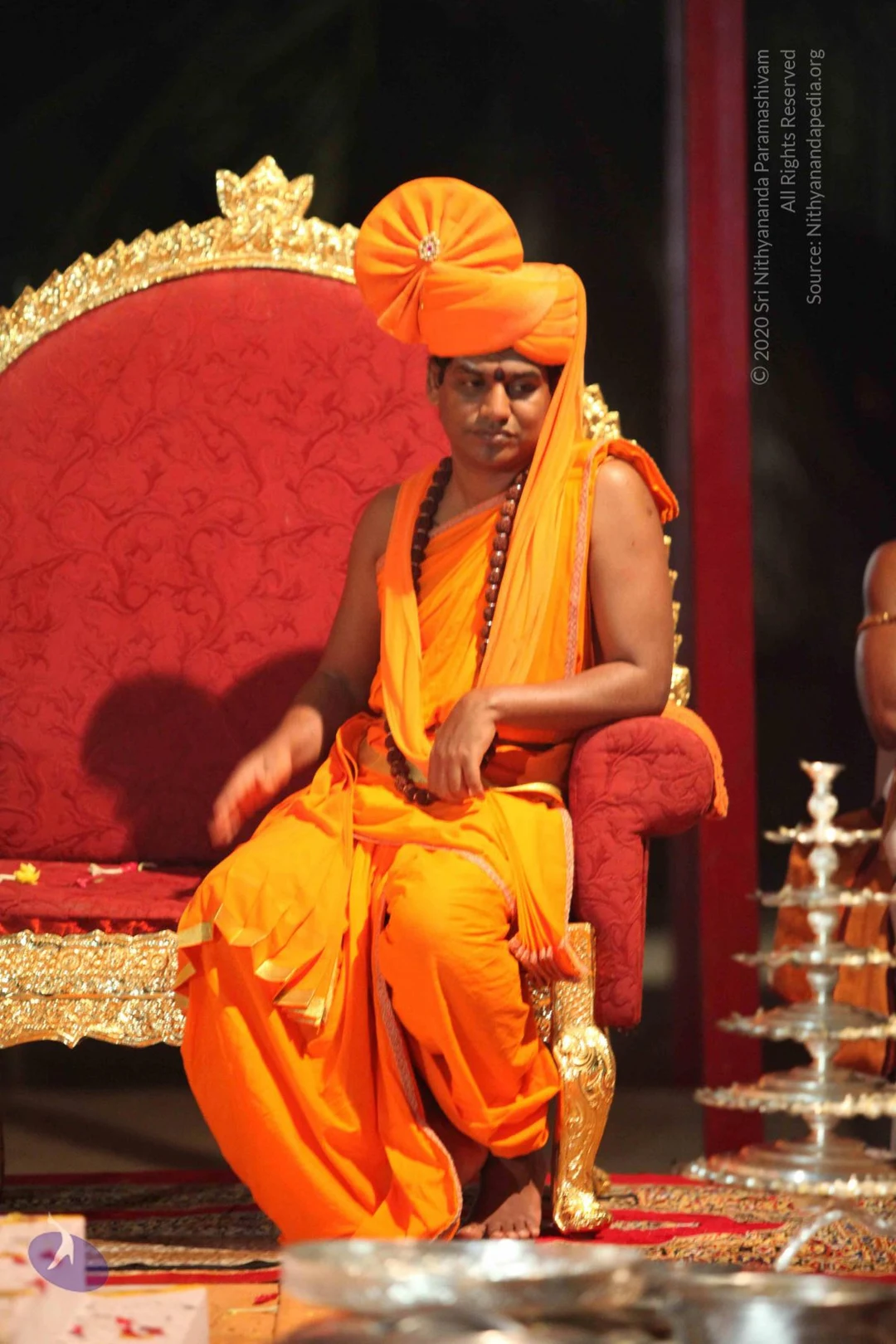
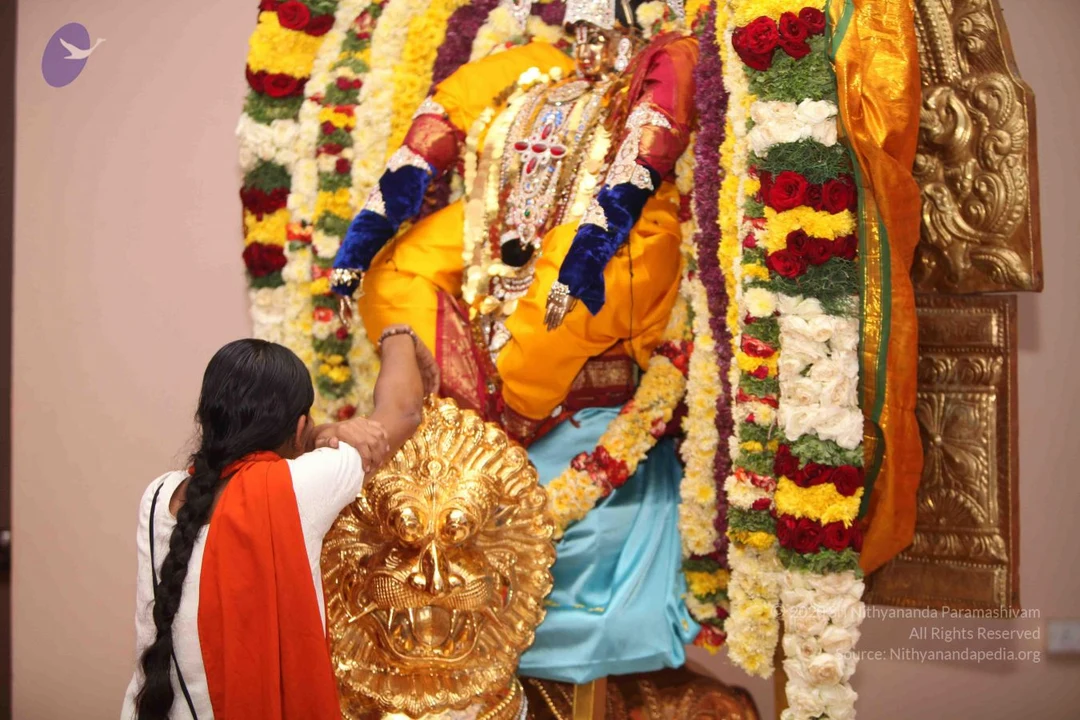
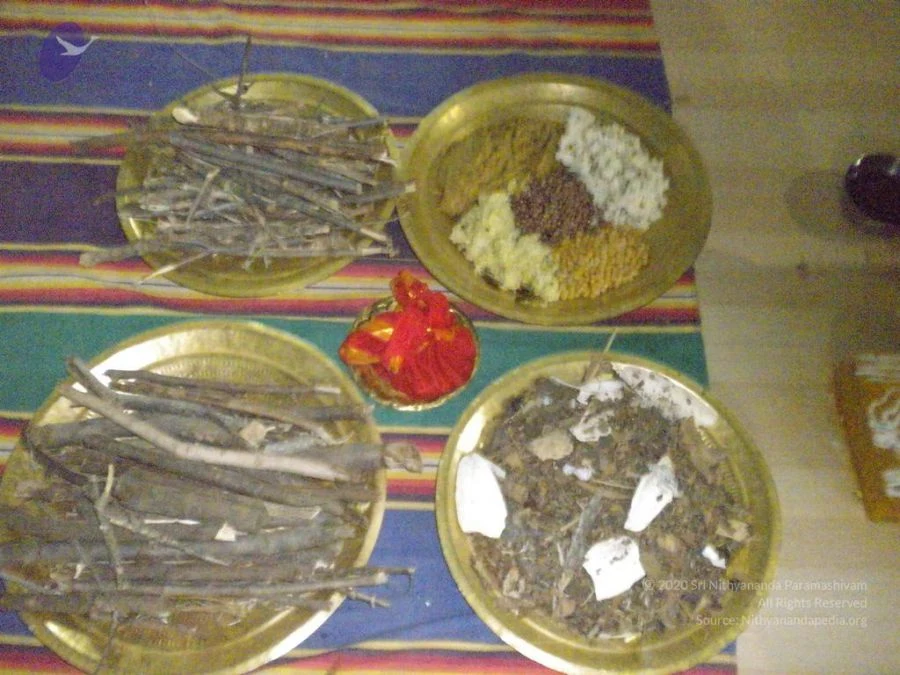
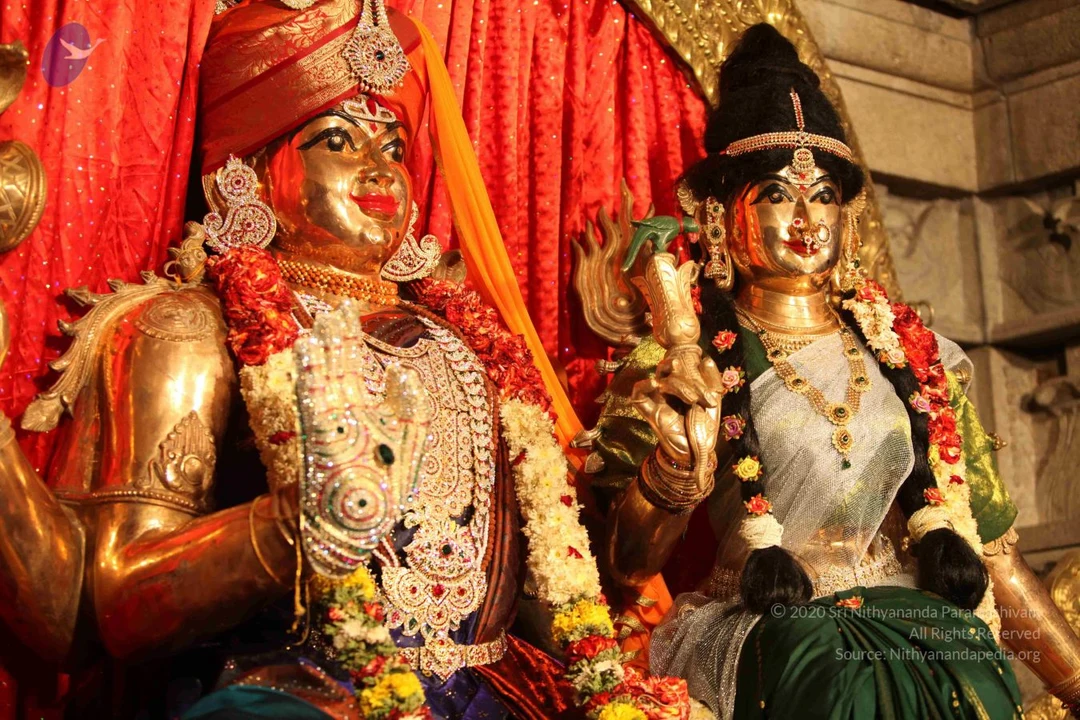
A photograph of a man seated at left in a red turban with a small gold ornament, hands raised in a gesture while speaking, wearing a red shawl over an orange and green garment with gold necklaces and bangles. Behind him is a large printed backdrop showing a deity murti with red and white adornments, a green figure with red cloth, and a blue sky, with a gold throne-like chair edge visible. Appearance-based label: a person, given a red turban, gold ornaments and shawl, seated speaking before a deity backdrop. One person is visible.Overhead photo of ritual materials laid on a striped woven mat. Four brass plates hold sticks and twigs, a heap of dried leaves and crumpled paper scraps, a mound of grains and powders with mustard-like seeds, and a small brass dish of red cloth or petals at centre. No people are visible. This appears to be preparation for a homa or yagna fire ritual.A photograph of a gilded metal deity murti decorated for worship, standing before a bright red sparkling curtain framed by an ornate gold arch. The central figure wears a red and gold turban with a peacock feather, a jewelled tilak, a white flower-and-stone necklace, a green and gold embroidered armlet, and holds a small curved cobra-topped staff in one hand; a green parrot perches on the other hand. Beside it stands a second gilded figure with a black braided hairstyle, a jewelled headpiece, gold necklaces, and a grey and green sari, both garlanded with red and white flowers. Statues only; no living people are visible.

October 05 2011

Original wiki page
Contents

Title:

THE SUPREME PONTIFF OF HINDUISM HDH BHAGAVAN SRI NITHYANANDA PARAMASHIVAM

Link to Video:

VideoAudio

Transcript:

Bhagavad Gita

Straighten out your Consciousness

DATE: Day 40: Oct 5th 2011

Atha cet tvam imam dharmyam sangramam na karisyasi Tatah svadharmam kirtim ca hitva papam avapsyasi

The translation: If you will not fight this righteous war then you will incur sin having abandoned your own duty and you will lose your reputation. On the other hand if you do not engage in this righteous war having abandoned your own natural expansion you will gain guilt, gain sin.

Now Bhagawan is coming down to Arjuna’s level. See Bhagawan is not leaving a single stone unturned. First he spoke in the highest spectrum of consciousness, then he spoke in the level of bio memory, then in the muscle memory. Finally he is coming to the level of engram. Even in the engram level this war is the right thing for you to do. He comes to the level of engram and says literally Bhagawan is playing even with fear and greed of Arjuna. I tell you, for an incarnation to come down to this level, it is a tremendous compassion.

Understand, when an incarnation showers love or shakes you with fear, both happens by his tremendous compassion. He comes down to the language you talk. It’s like one day I go to Gurukul and all the kids are sitting and fighting to share some candy. I also sit with them and have the same fight. A normal man can never grasp, foolish logic can never grasp. You can exploit and abuse this whole verse, this whole situation saying ‘Krishna exploiting Arjuna, threatening him saying ‘ehhh do this war otherwise you will incur sin’ and poor Arjuna fought’. No!

If you see every time how Krishna protected Arjuna, every time how Krishna stood by Arjuna, you will see very clearly Arjuna is not needed for Krishna mission. If Krishna’s mission is all about having this war and killing all these fellows and reducing the population negativity on the planet earth, he does not need Arjuna. It is Arjuna’s fortune, Krishna’s compassion, he comes down even to the level of ordinary fear and greed. Only when you look at from this angle you will understand the compassion of Krishna. He holds the hand, goes to the lowest level of Arjuna and says ‘ehhh you will go to hell. Do what I am saying’.

I tell you, for an ordinary man his greatness is based on how big he raises himself, poses himself. For an incarnation his greatness is measured how low he can come down. Krishna is the first Master who went to the extreme, the lowest valley, to express the love or fear. I tell you that is why he is purnavatara. He is a perfect incarnation. He is a complete incarnation.

Rama would have maintained his grace. See when the Ravana was standing without any weapon, see the grace Rama behaves ‘Go today. Come back tomorrow with weapon’. But here, Krishna, that poor Karna, he is not having any weapon…. lifting the chariot wheel which is stuck in the slush, goes to Arjuna and says come on shoot! Finish this fellow! I tell you for a common man it will look like what a low level. But only an insider knows Ravana story is different, situation is different, Karna’s is different. And not only that all the punyas of Karna was protecting him at that time. Any arrow Arjuna sends goes and falls on Karna as garland.

Then he goes to the next lowest level. He takes a different form, goes with the makeup of a Brahmin, begging Karna. He is almost lying half dead.

He goes and begs ‘oh Karna I have come to beg. I heard you never refuse anything. Oh my unfortune, you have nothing to give. Sorry I am going’.

He is exactly poking at Karna’s ego. Karna built his whole personality based on one statement. I will give at anytime anything anybody wants. Karna comes back to life. It is like when a snake is half dead if you just put the stick on the neck of the snake it will raise the tail almost equalent to its height. Before death he will jump using his last power and energy…..before going fuse the bulb will flash.

So his ego comes out ‘how dare you tell that? Ask what you want. I will give’.

Then Krishna says ‘Now you don’t have anything. You have only all the punyas you earned by giving daana. All right if you can give me that...’

Karna says ‘Take it. It’s yours’.

He did not have water to give daana. He just removes the arrow, his own heart blood he pours in the hand of Krishna and gives daana of all the punya he has done.

I tell you the highest, greatest, happening happened on the planet earth is this scene; Greatest giver and greatest receiver. This receiver is not an ordinary man. He is not receiving for himself. He knows unless Karna comes out of all the good karma he will not become enlightened. Krishna does not want Karna to be sitting in heaven. He wants Karna to be liberated. That is why when Vyasa describes each person’s death, when it comes to Karna he says Karna moksha. He does not say Karna vadha. Neither for Drona nor for Bhishma or for Duryodhana; for nobody Vyasa uses the word moksha. Only for Karna Vyasa uses the word Karna moksha. That chapter he calls as Kaana moksha; greatest giver greatest receiver.

Now when it is established Krishna is an incarnation, all this are glorified, celebrated, enjoyed; but when he was in the body, even Arjuna would have suspected. I tell you for whose sake Krishna did this, even that guy in the corner of the mind would have thought ‘if he can go this cheap level with Karna then better let me be careful. He can do this same to me also’.

Understand, knowing this all is possible he comes down to that level. This is the greatest sacrifice.

Photos:
Photos Of The Day:

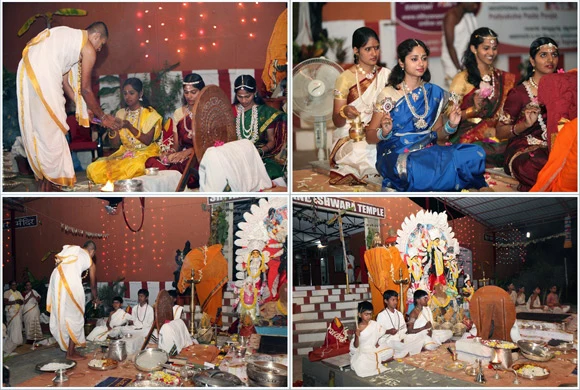
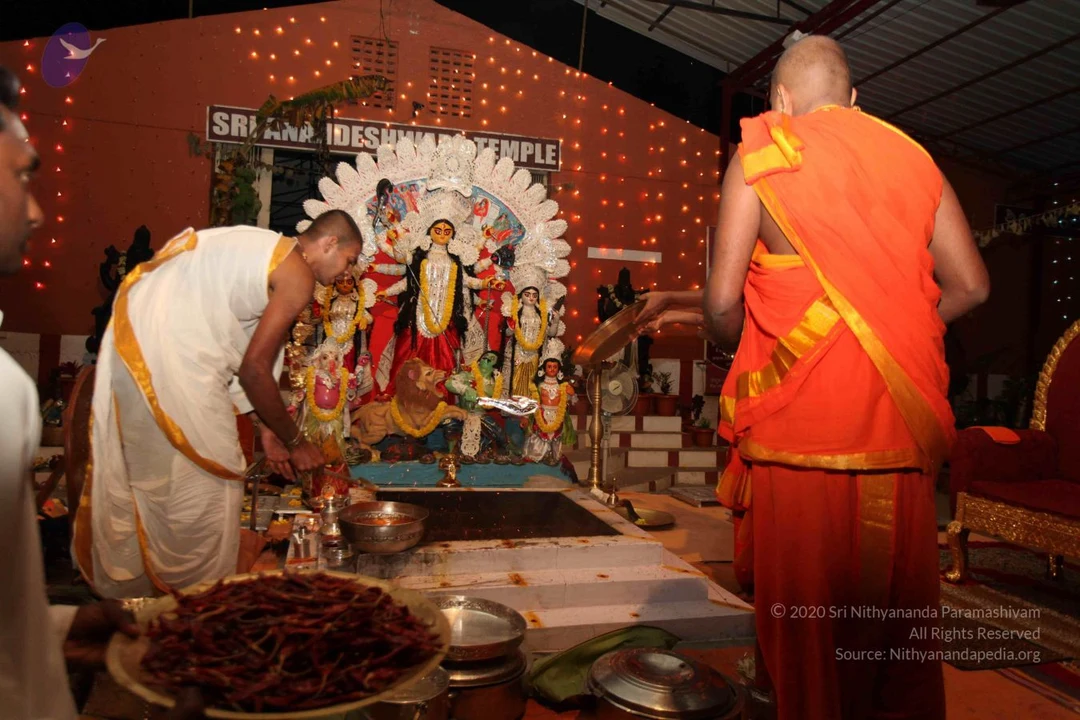
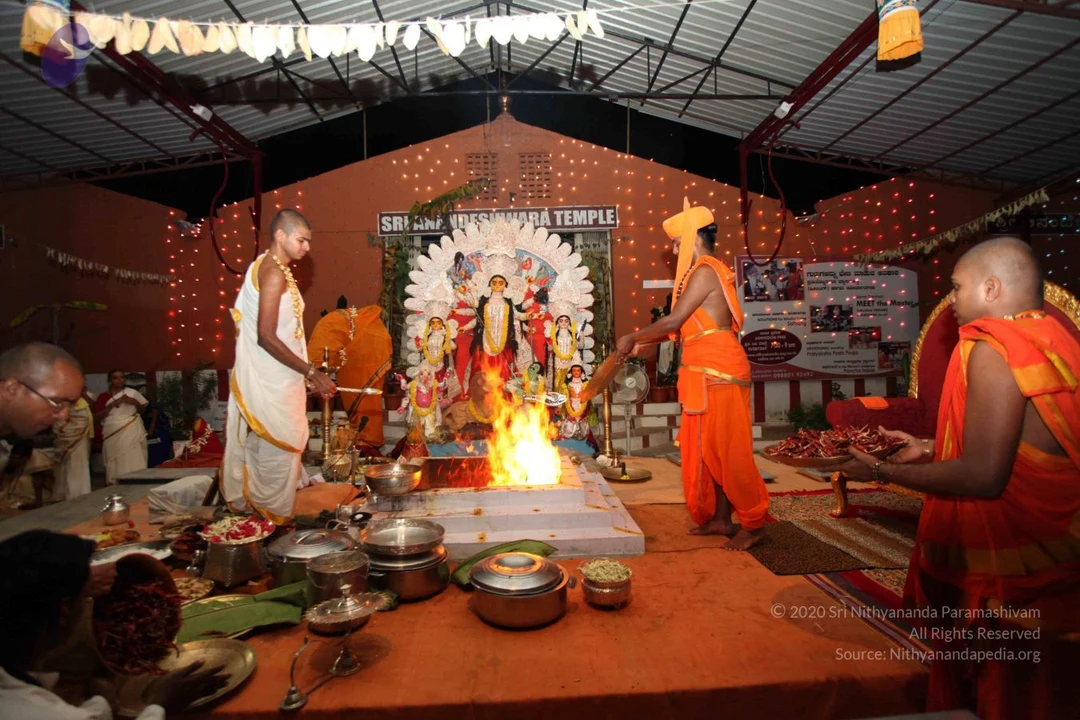
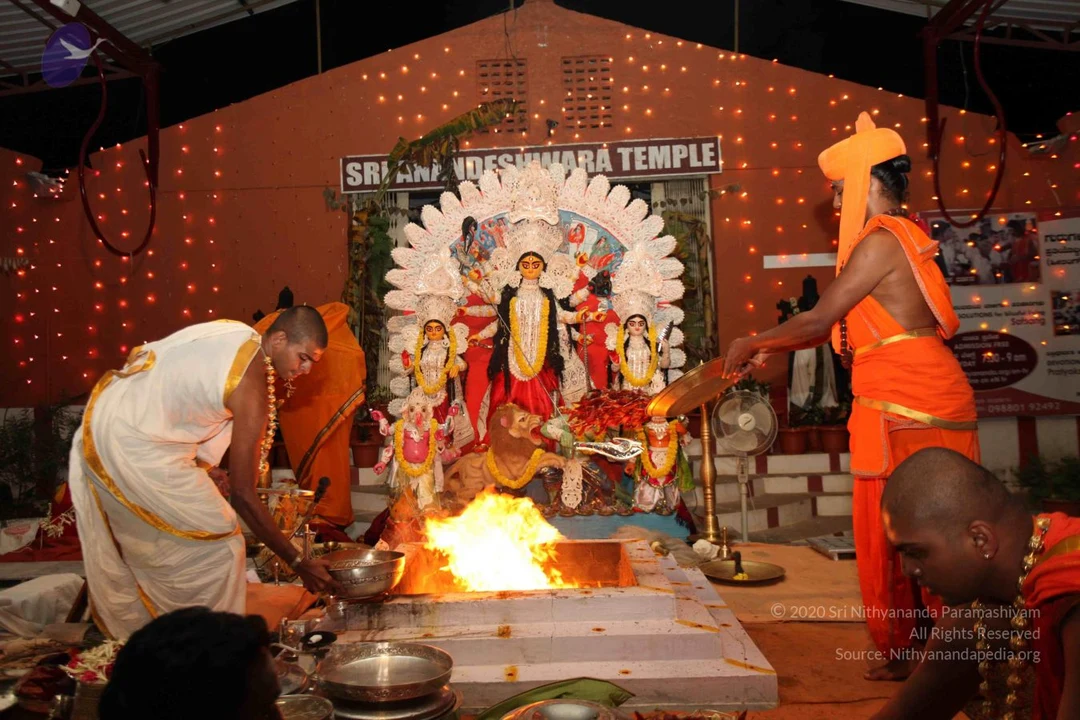
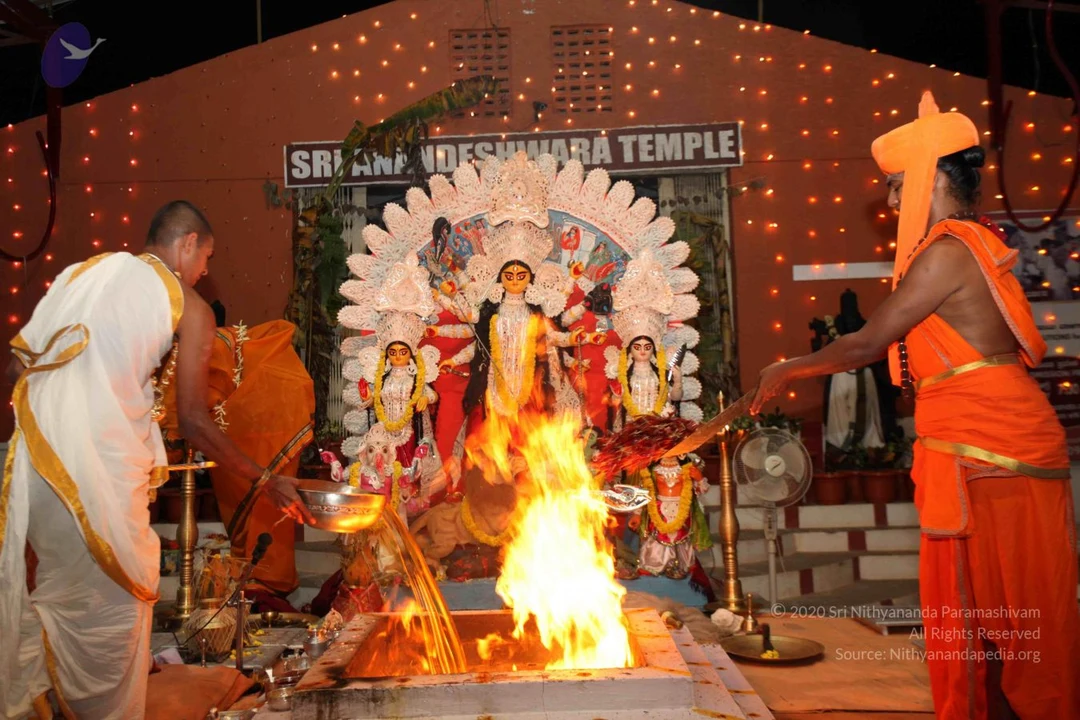
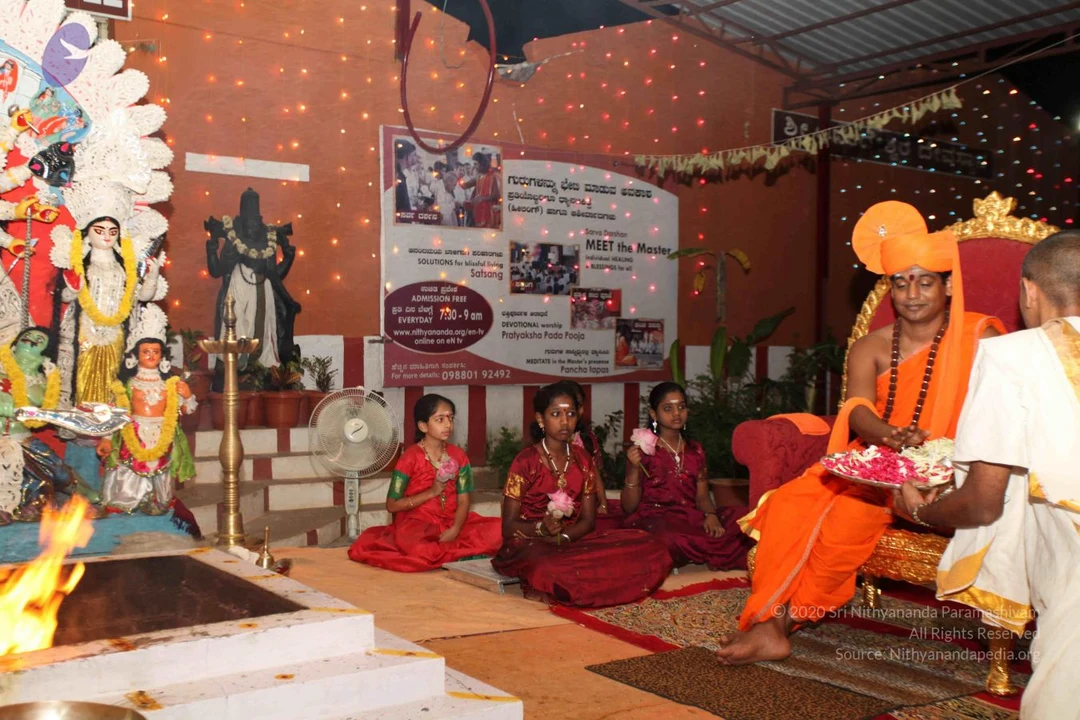
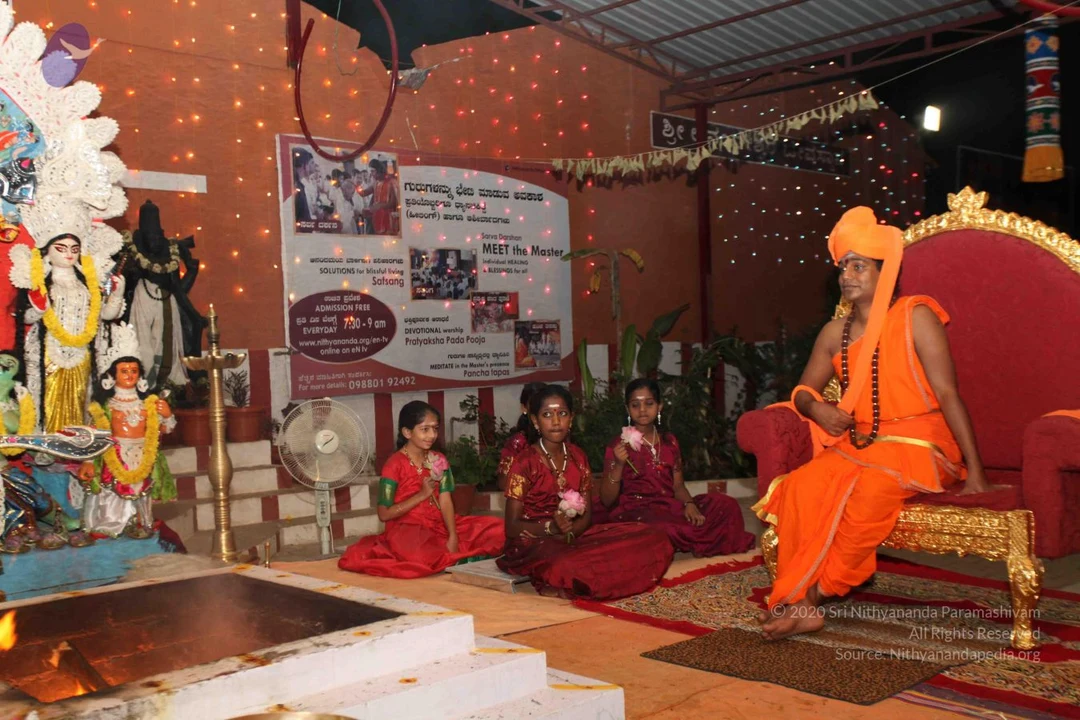
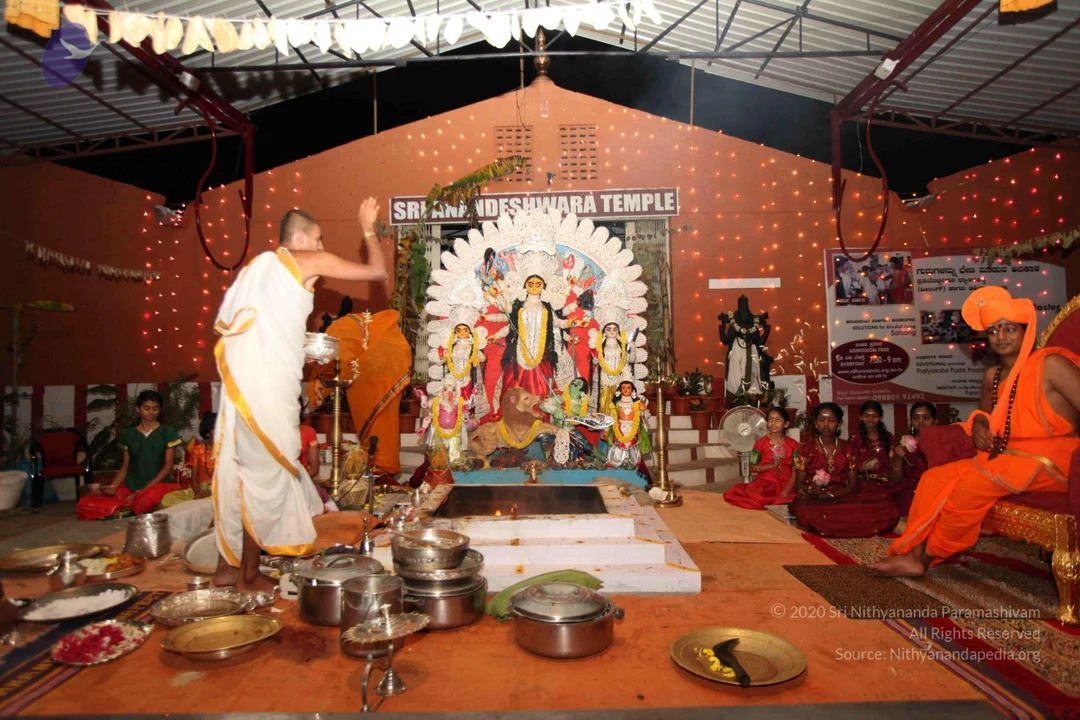
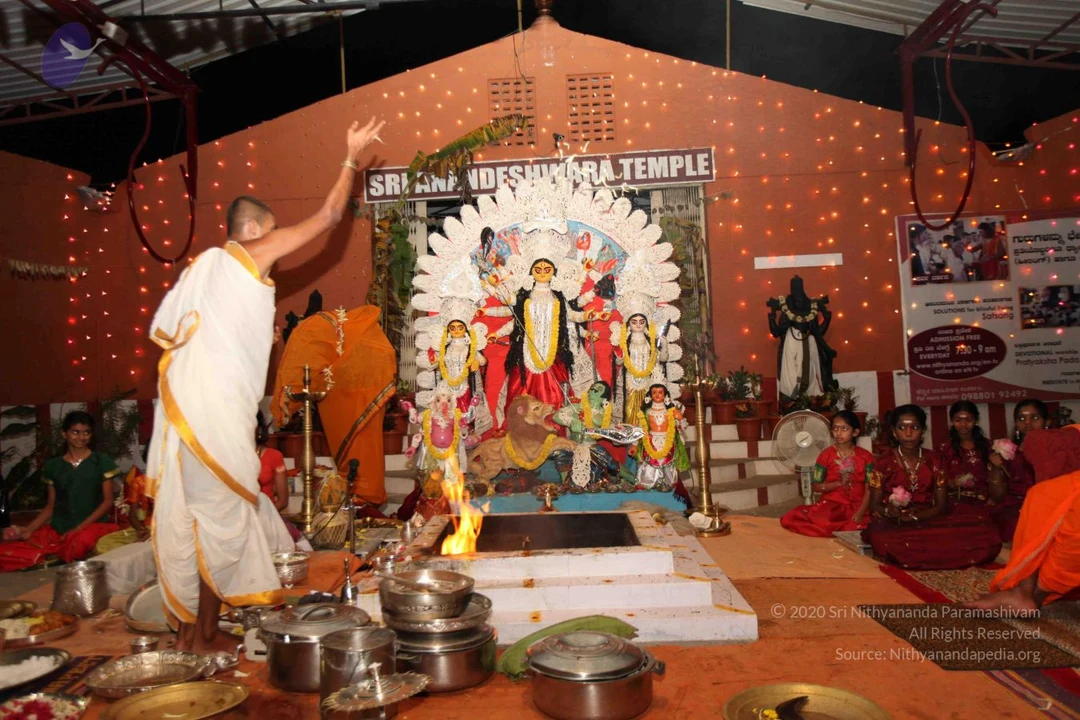
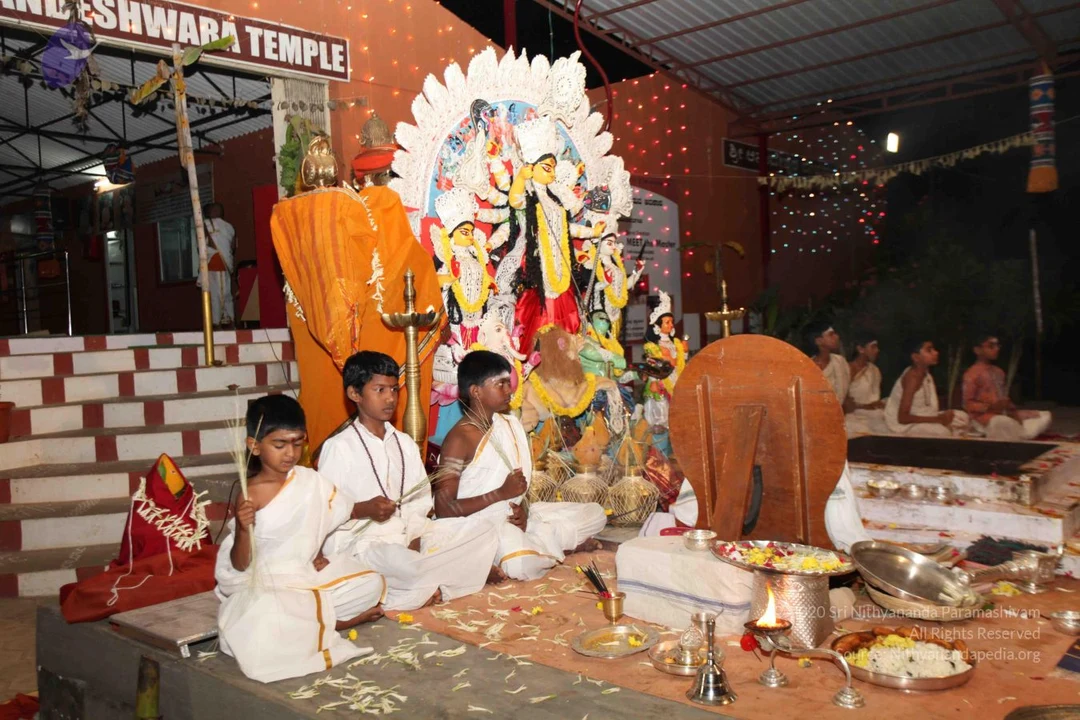
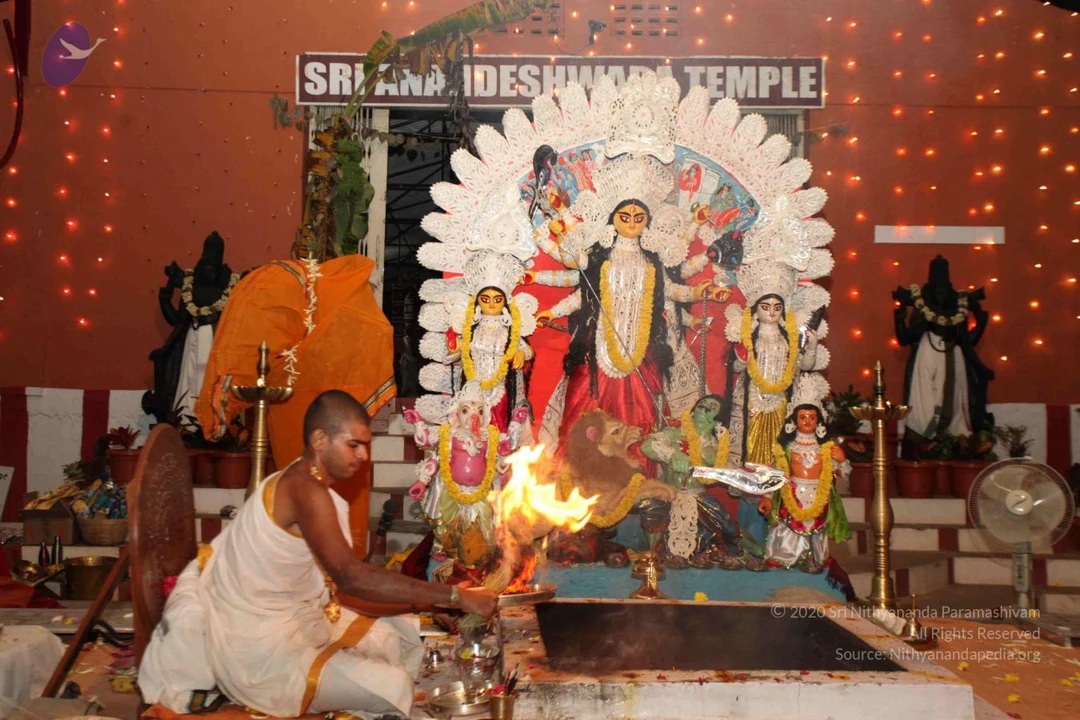
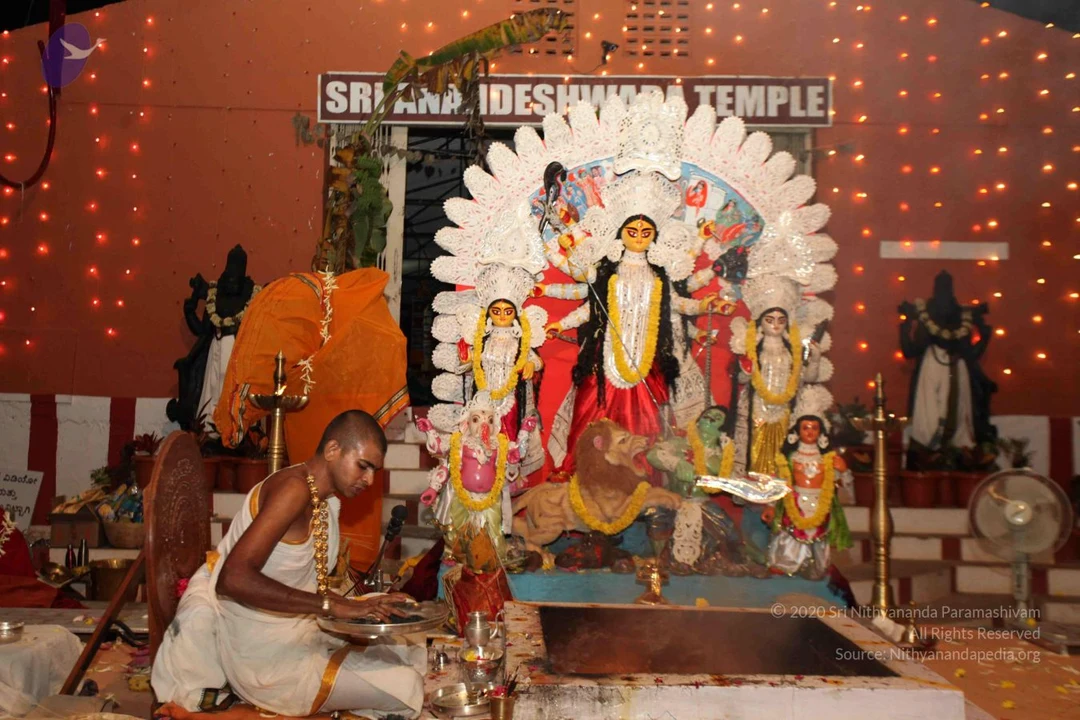
TEMPLE
PADA-POOJA

BHAGAVAD-GITA-SATSANG

SARVA-DARSHAN

AYUDHA-POOJA-IN-BIDADI-ADIKAILASA

SANDHYA-POOJA

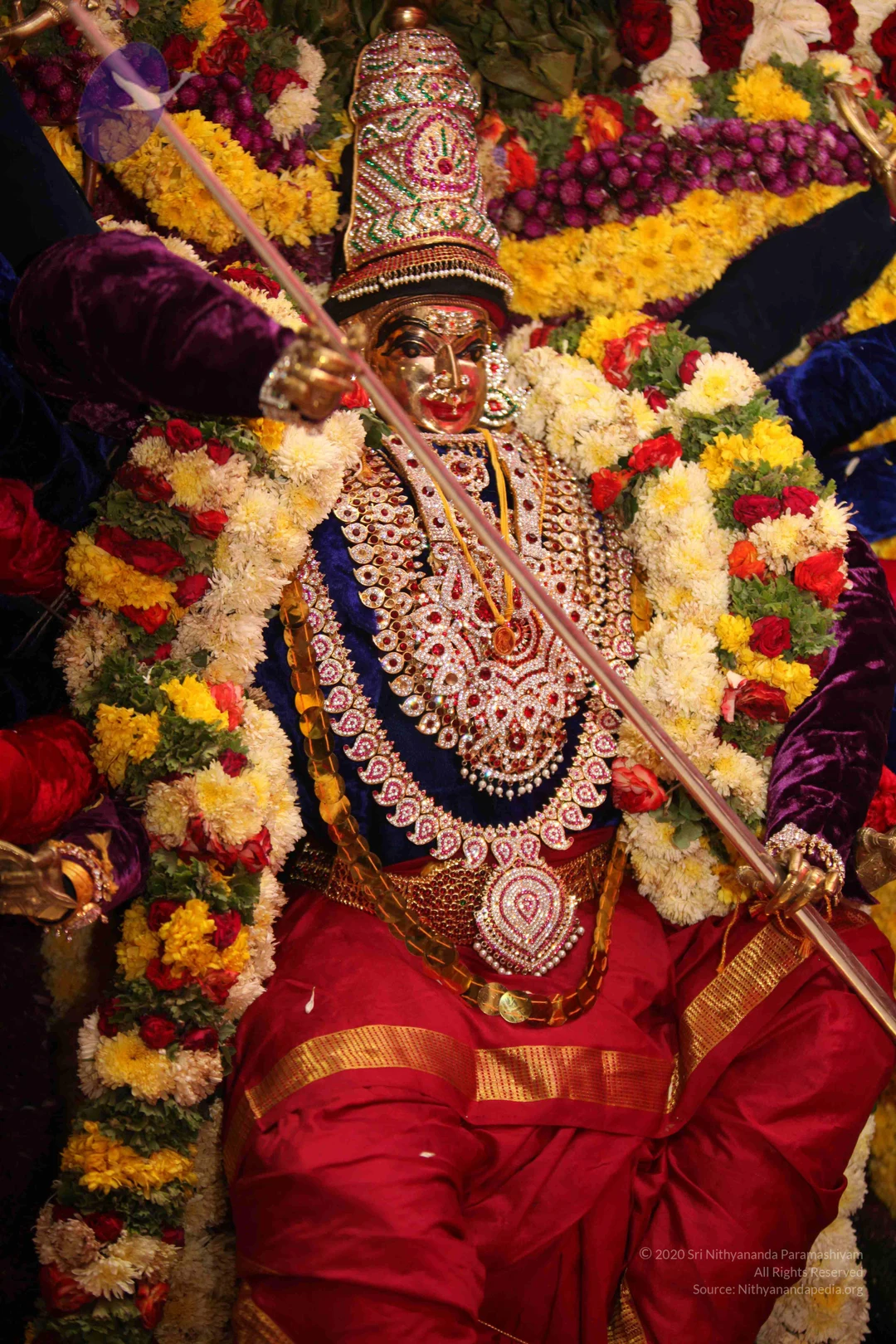
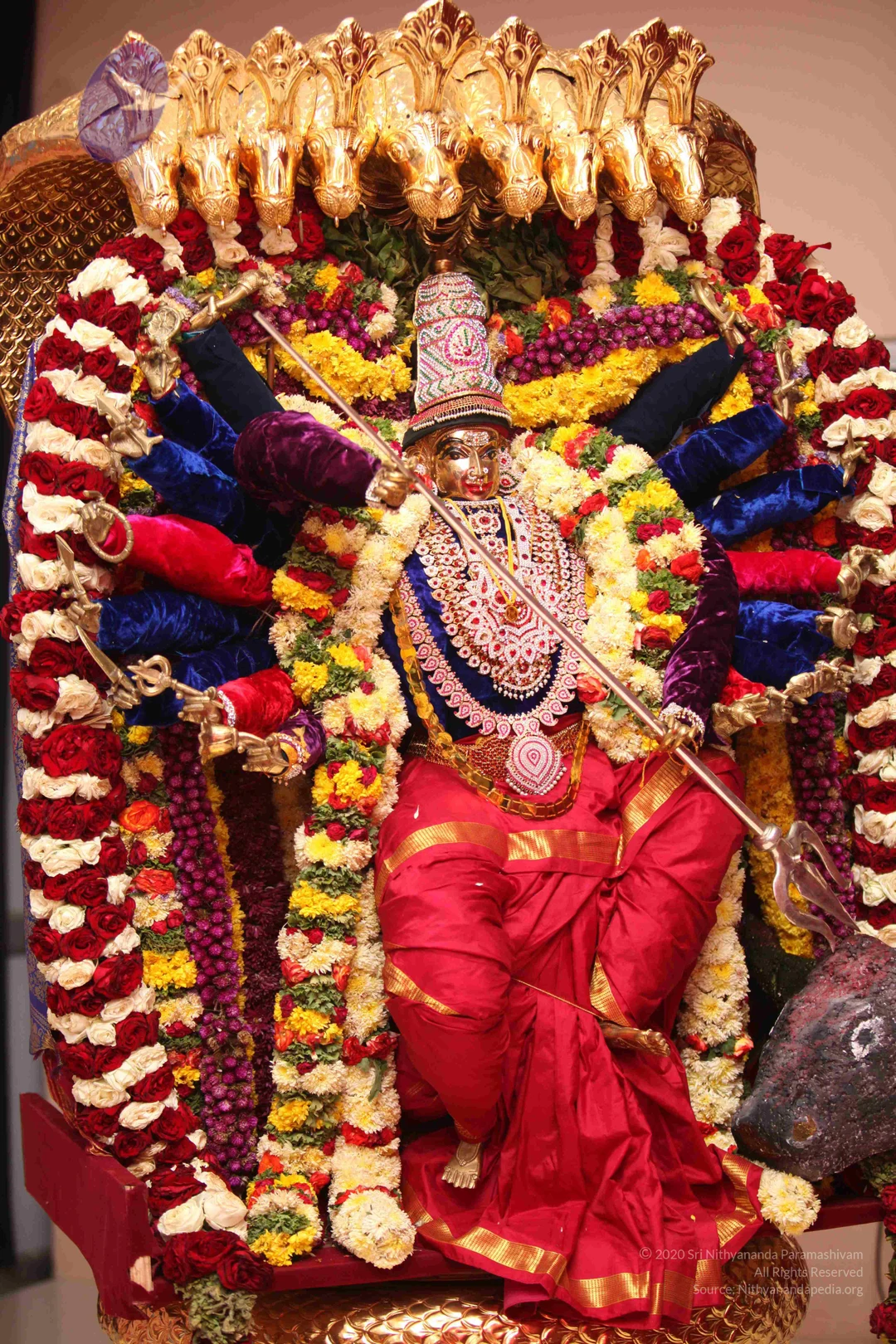
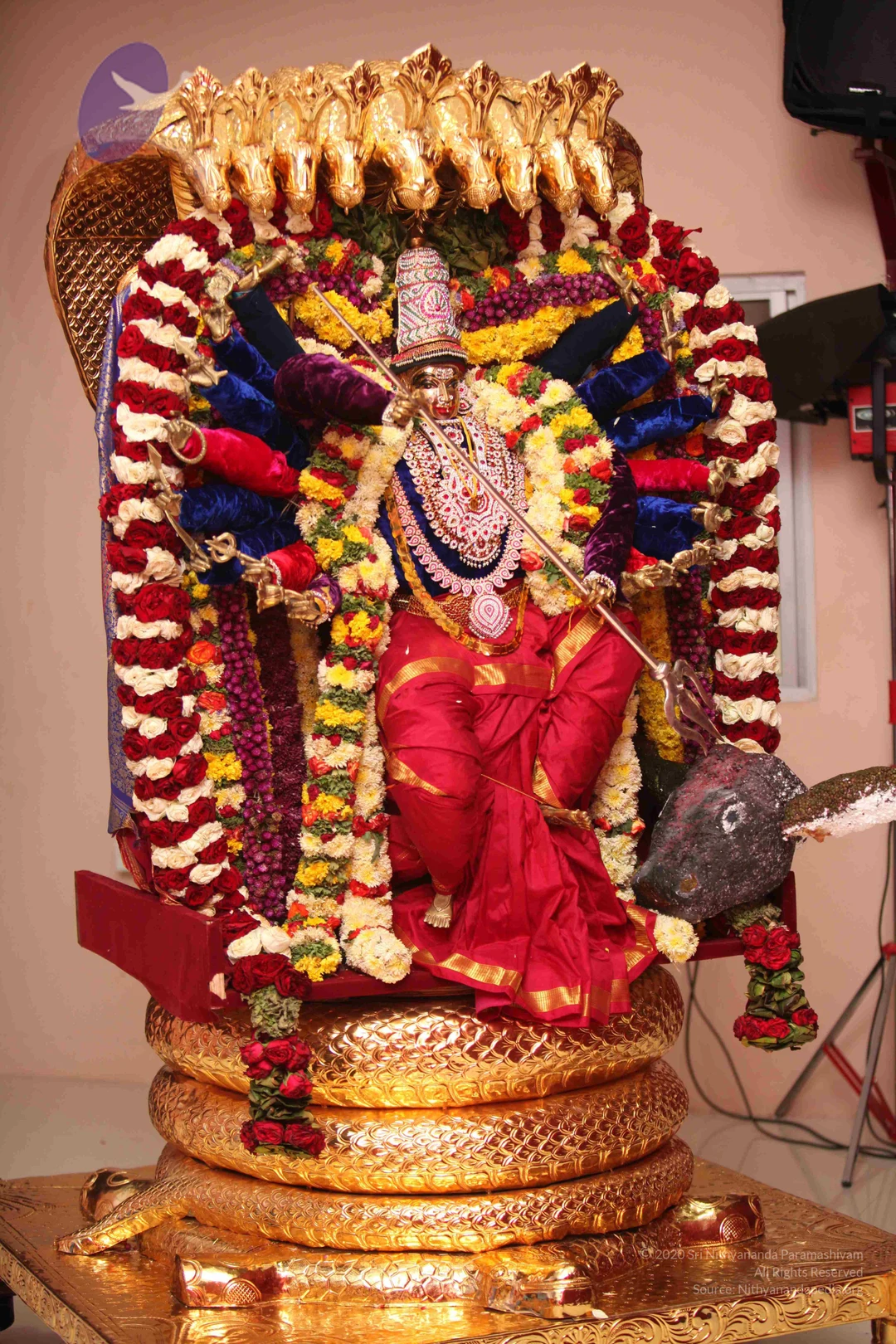
Navaratri_Alankar

NAVARATRI-ASHTAMI-DAY-CELEBRATIONS-IN-MALAYSIA-NITHYANANDA-DHYANAPEETAM

NAVARATRI-CELEBRATIONS-IN-TIRUVANNAMALAI-NITHYANANDA-DHYANAPEETAM

Photos from this day

View all 601 photos

TEMPLE
48 photosSource gallery
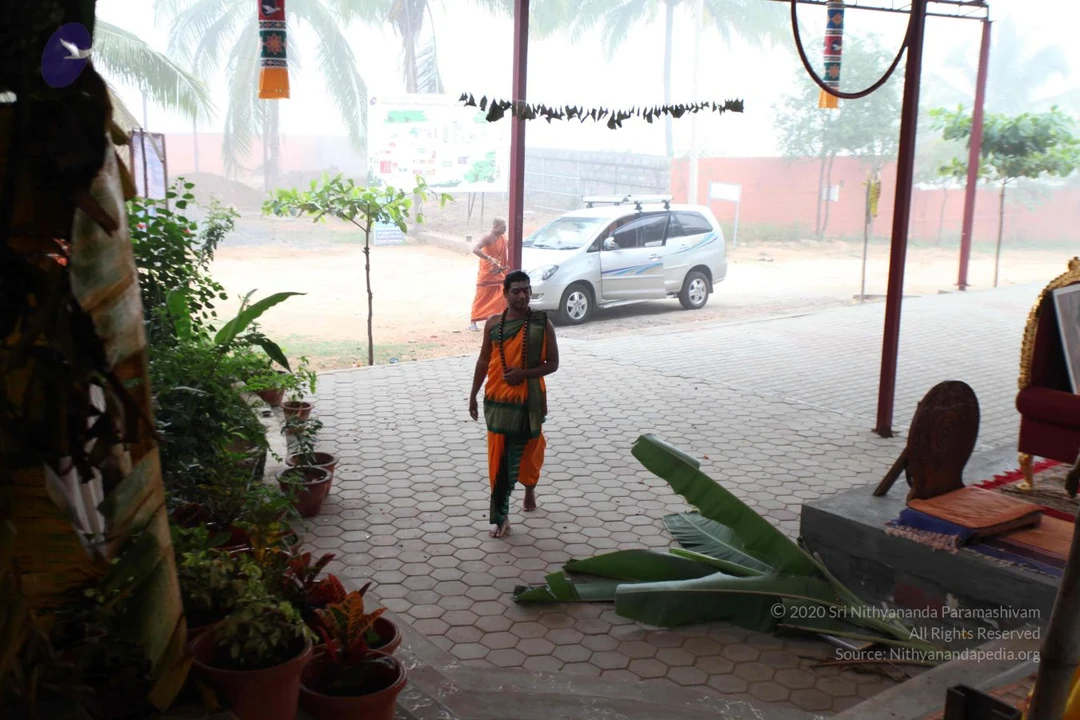
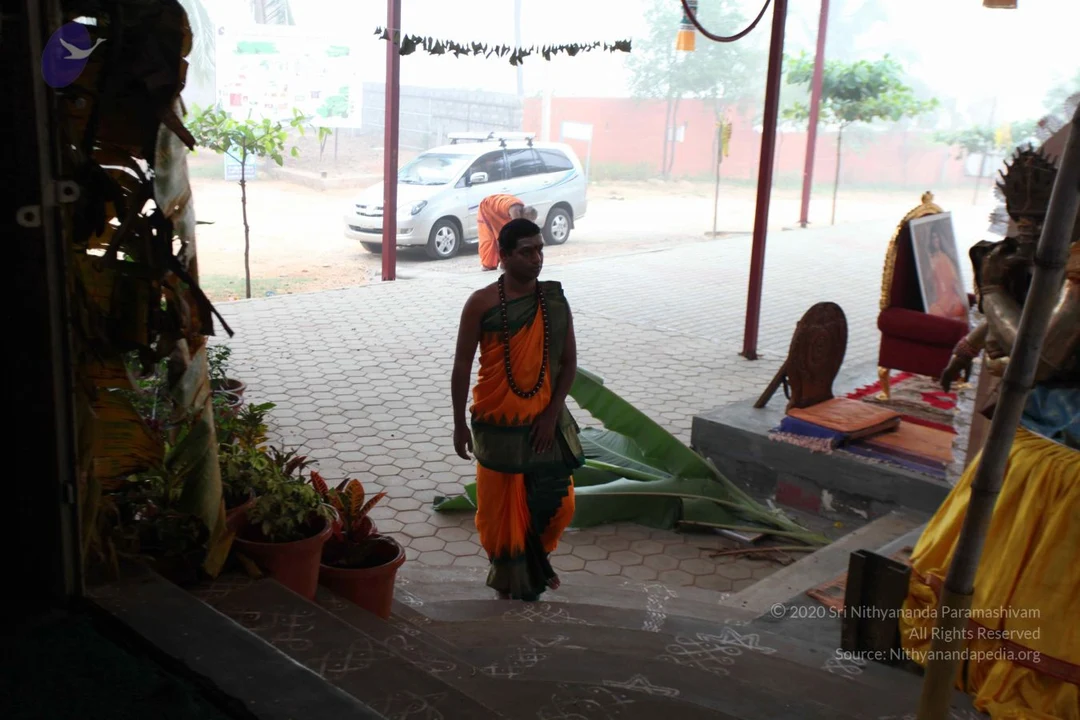
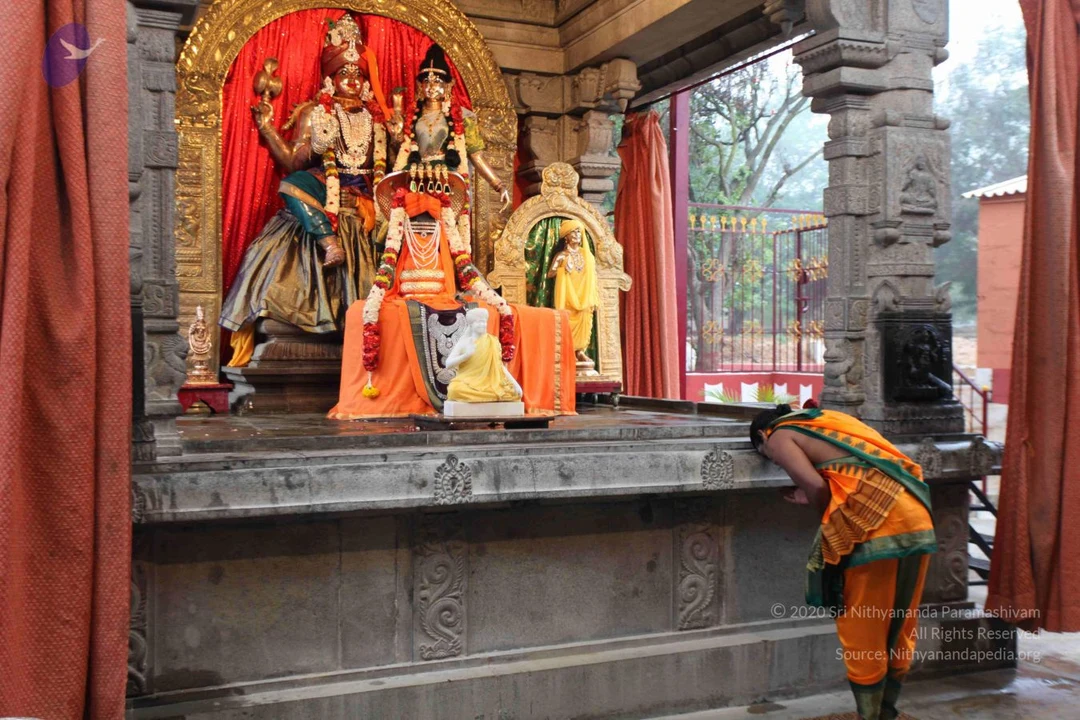
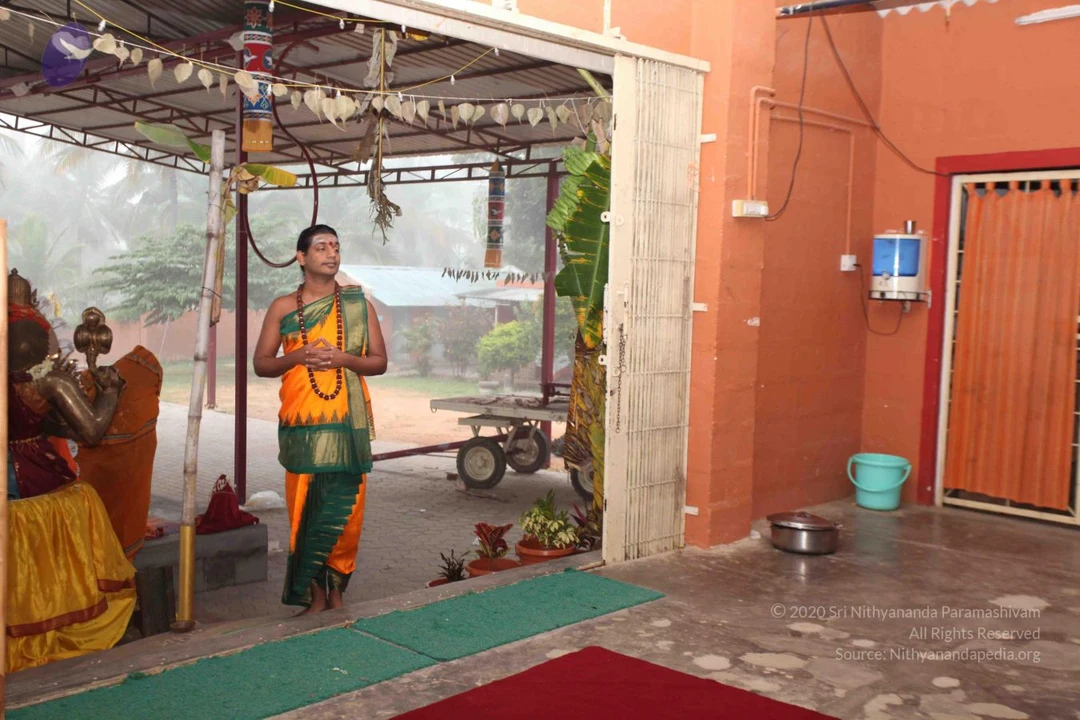
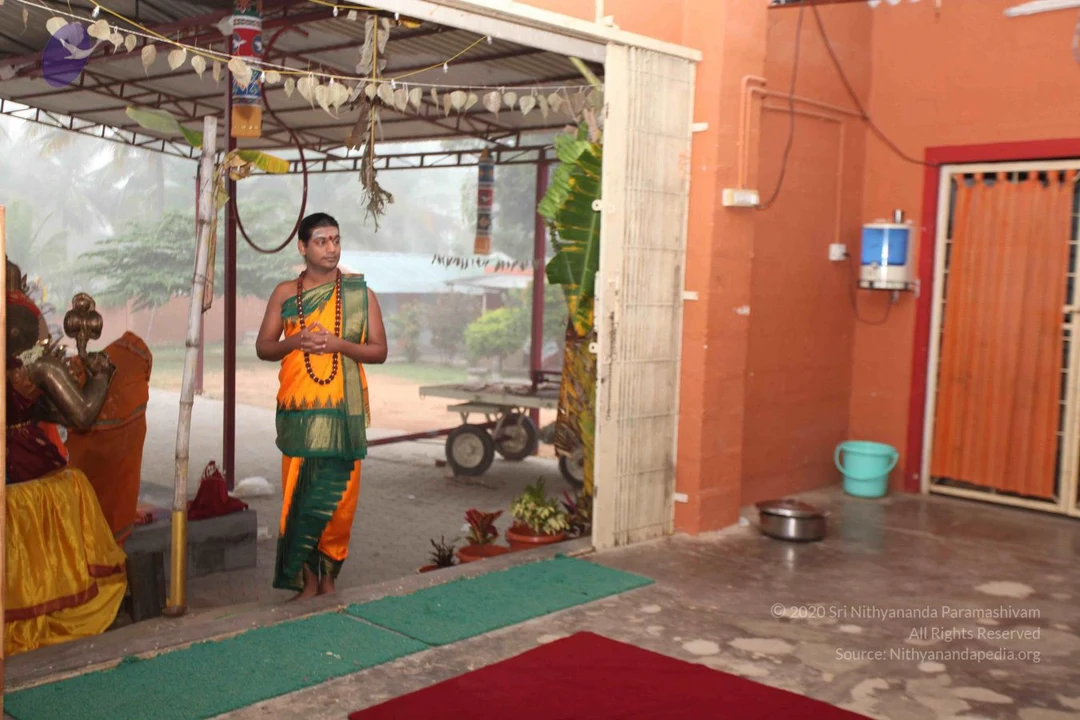
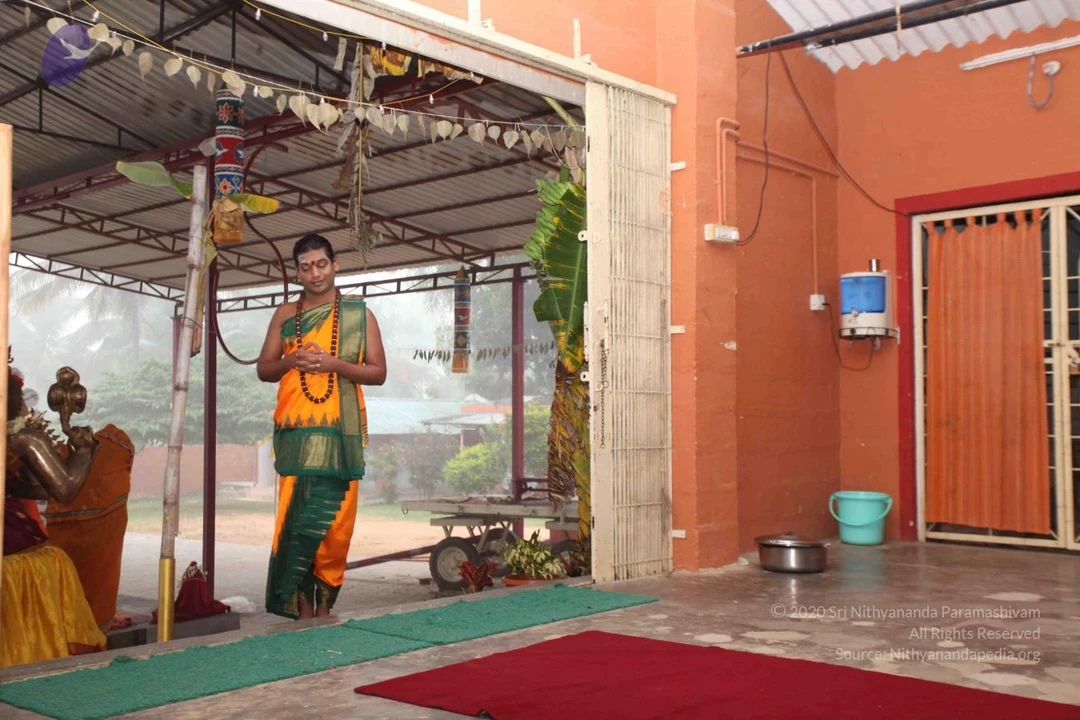
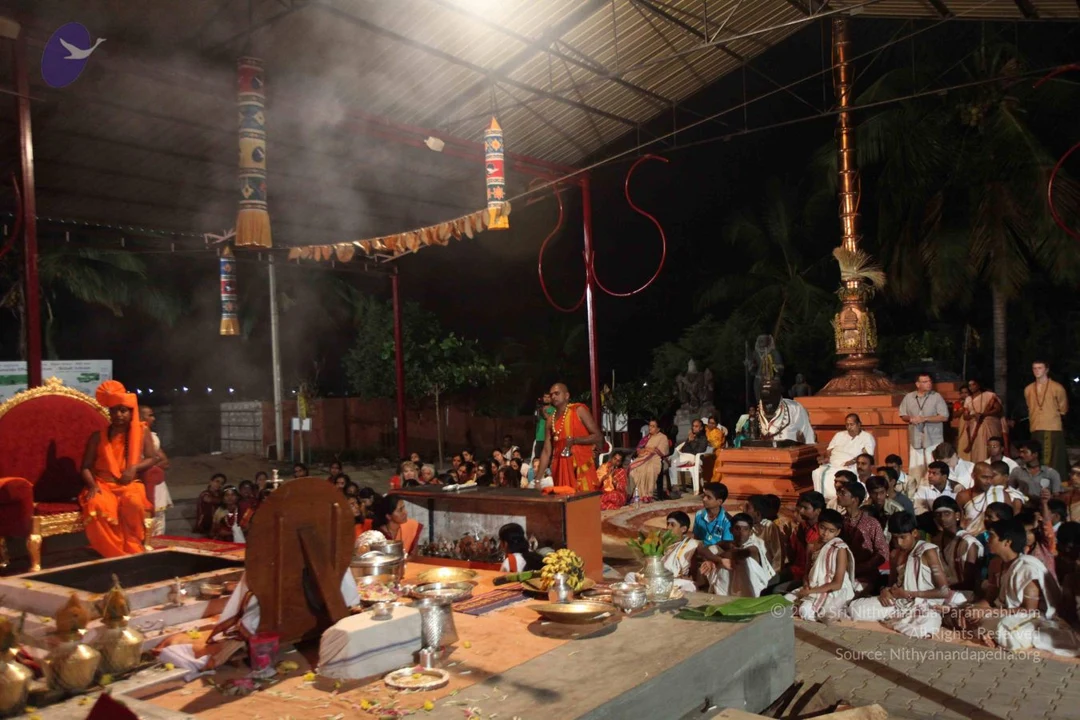
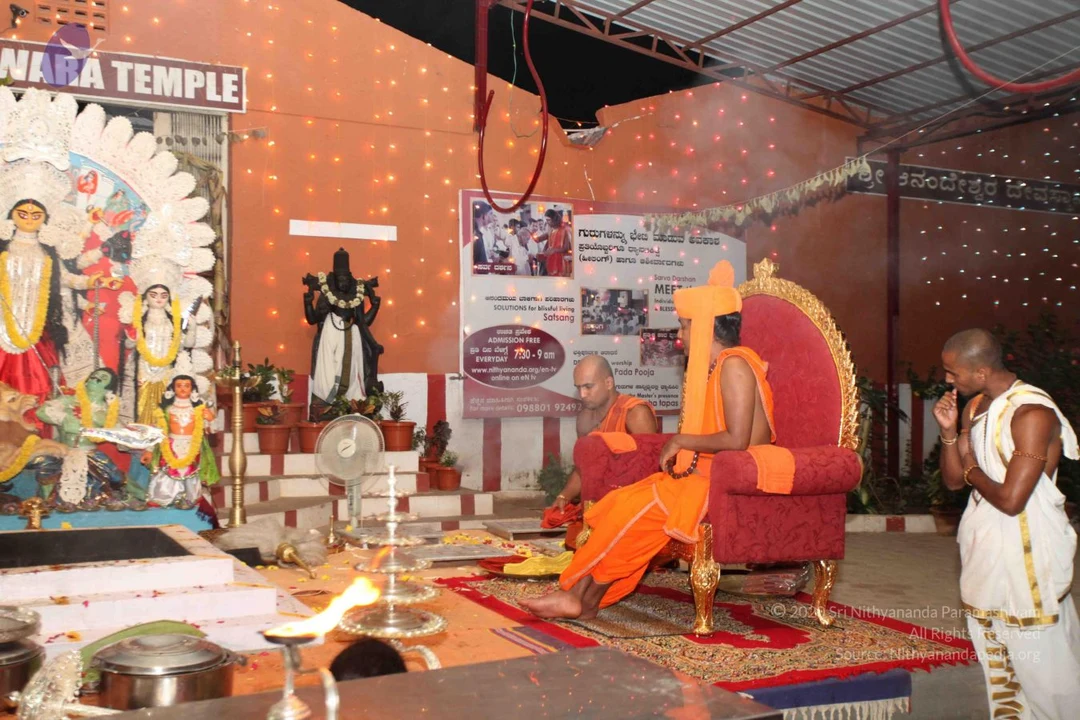
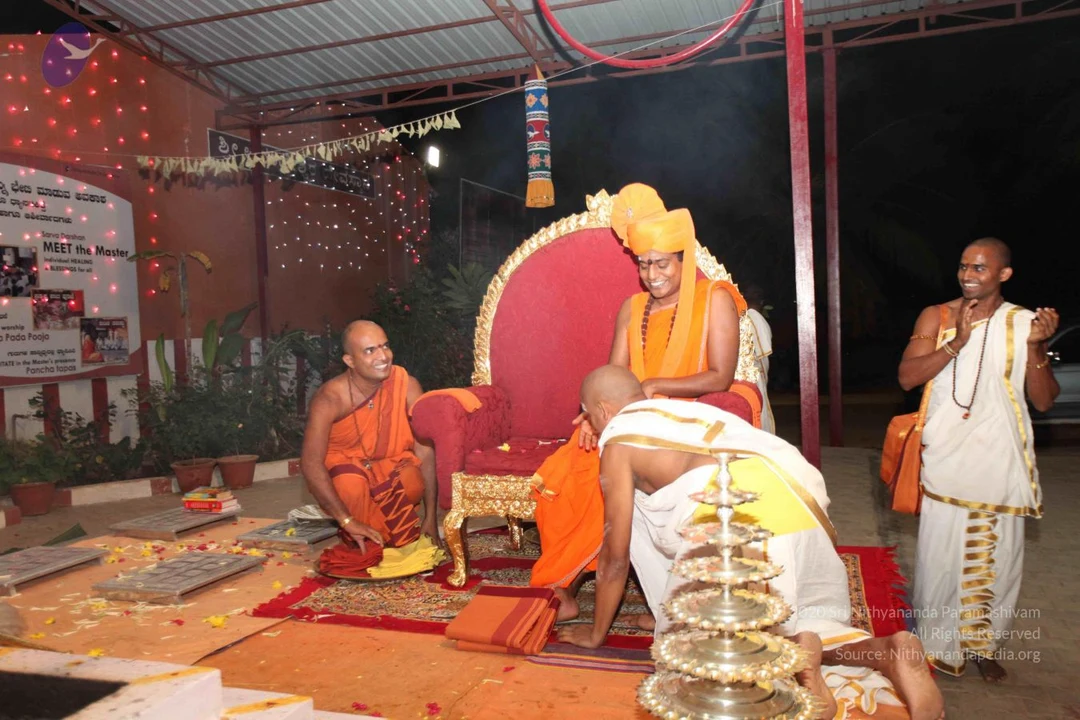
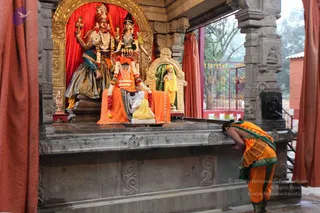
A covered open-air walkway with a red-brick tiled floor and corrugated roof, hung with tasselled orange and multicoloured decorations. A woman in an orange and green sari walks across a sandy yard with her hands pressed together in namaste. A silver minivan is parked nearby, with a site map board and a fence beyond. On the right, a deity murti with a garland and a framed portrait sit on a red-cushioned stand, surrounded by brass items and banana leaves. Palm trees stand in the hazy background.A photograph taken from under a covered walkway with red metal posts and a patterned tiled floor. In the foreground, a man in an orange upper cloth and green-and-orange lower cloth, with a beaded necklace, walks barefoot toward the camera past potted plants and a fallen banana leaf. Behind him, a second figure in an orange robe walks on the sandy ground beside a silver minivan. A low wooden seat and a red cushioned chair sit at the right edge, and strings of dried leaves and orange-and-red banners hang overhead. Two people are visible in total, and no identifiable face is shown clearly enough to confirm an identity.A man in an orange and green dhoti-style garment with an orange shawl and a rudraksha mala walks down steps at the entrance of an open pavilion. Potted plants line the left side and a banana leaf lies on the paved floor. To the right, a deity murti in a yellow cloth stands beside a red-cushioned seat and a small wooden stool. A second person in orange is partly visible further back near a white SUV in the courtyard. The man has no visible long hair, crown or ceremonial gold necklace, so no a person cues are present and identity is uncertain.A photograph inside a plain hall with a corrugated metal roof and orange-painted walls. A man with a red tilak on his forehead wears an orange and green silk dhoti and matching shawl, a rudraksha mala around his neck, and walks barefoot along a red-carpeted ramp lined with silver metal railings. A framed banner with photographs and text hangs on the left wall, and a decorated cloth tube hangs from the ceiling. The page flags a person at this event, but the man's appearance gives only moderate cues (rudraksha mala, orange and green silk clothing), so his identity is uncertain and he is described by role only as a man walking the ramp.A man in saffron-orange dhoti and a green-and-gold border shawl walks along a covered corridor with stainless steel railings and a red-painted floor. He wears a rudraksha mala and a tilak on his forehead, holding his hands together at his waist. Behind him, framed banners and photo panels line the orange wall, including a large banner with a portrait of a seated ascetic and an older bearded figure in a white turban, plus a painting of a seated saint. Colourful patterned pillars flank the windows, and a standing fan stands near the wall. The image is a photograph; only one physical person is visible.A photograph inside a stone temple shrine showing two seated deity murtis on a raised stone platform, draped in orange and red cloth and garlanded with red and orange flower strands. The murti on the left holds a ceremonial staff and wears a crown and gold-embroidered garments; the central figure wears a crown and orange drapery. A small white and yellow figure sits in front, with a smaller yellow-robed figure in a niche to the right. A person in orange and green robes bows low with head near the platform edge at lower right, appearing to offer obeisance. Red curtains frame the shrine opening and a gate with a tree is visible outside.

PADA-POOJA
41 photosSource gallery
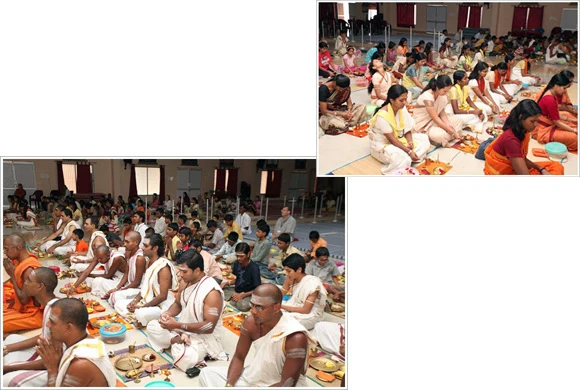
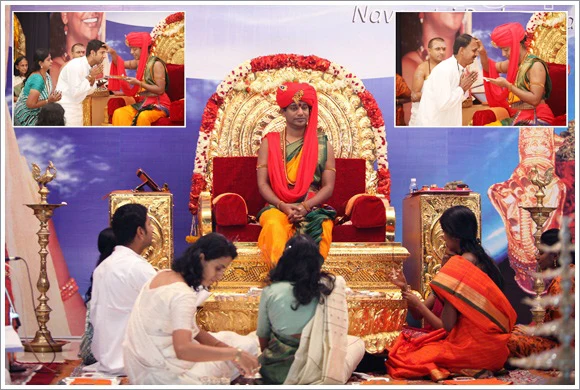
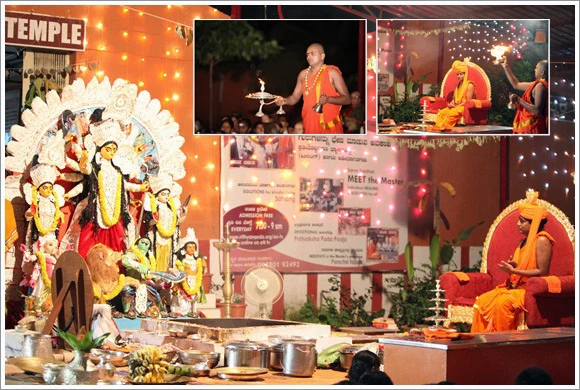
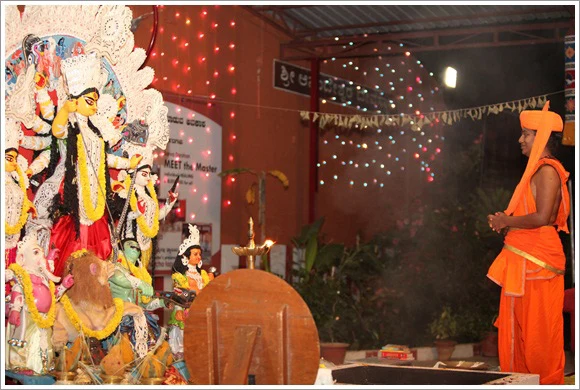
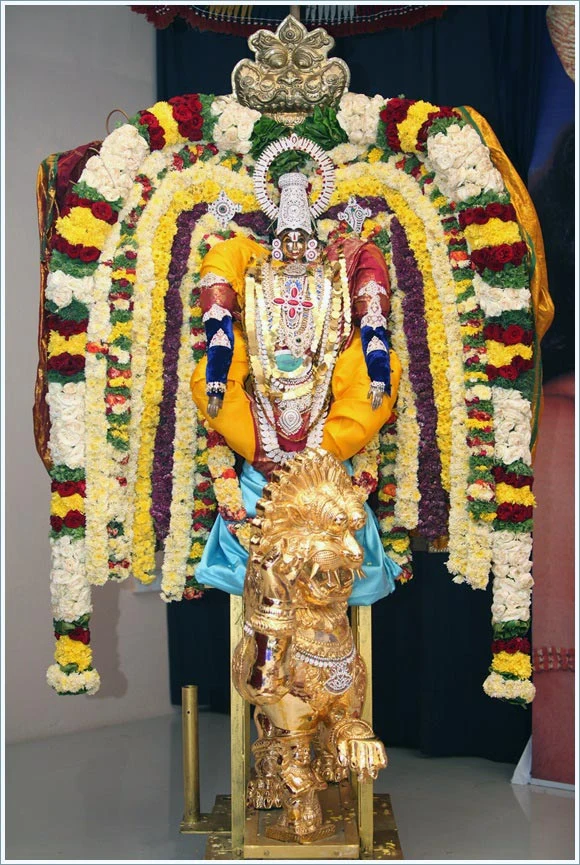
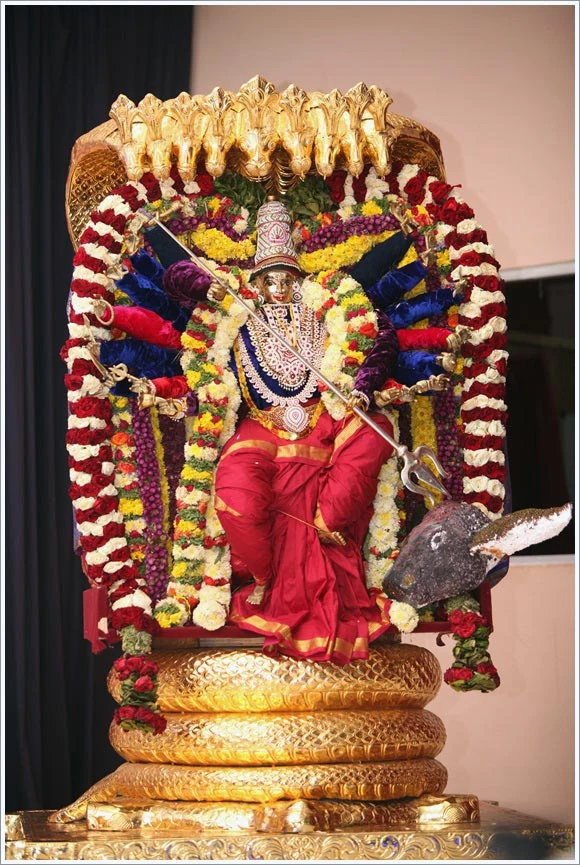
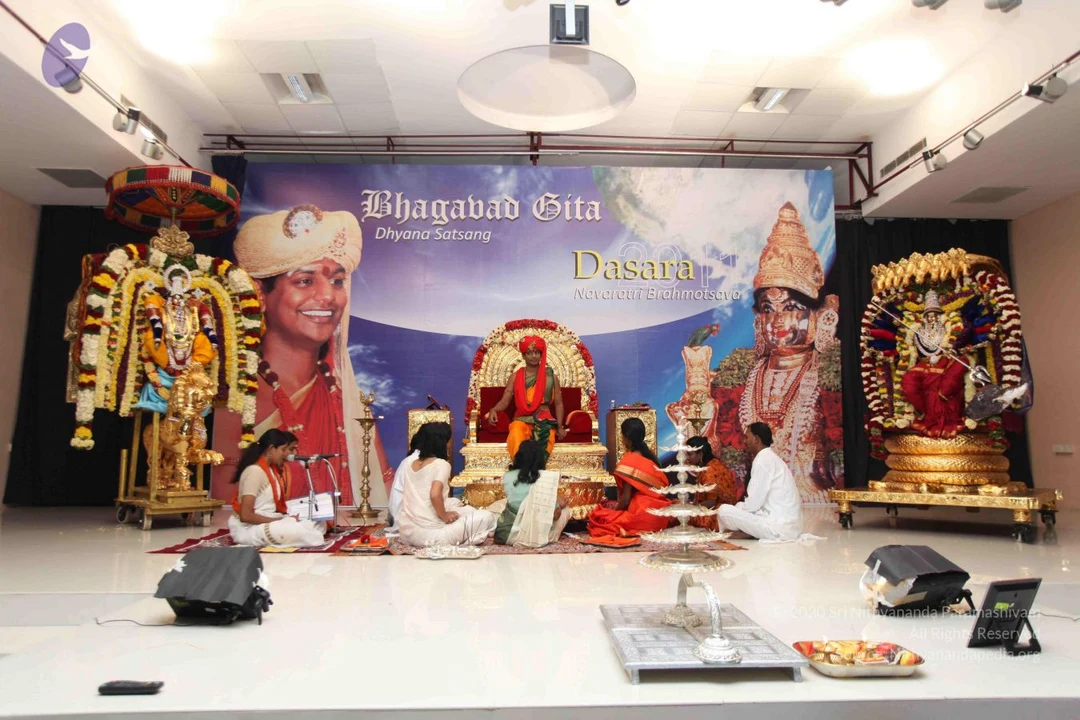
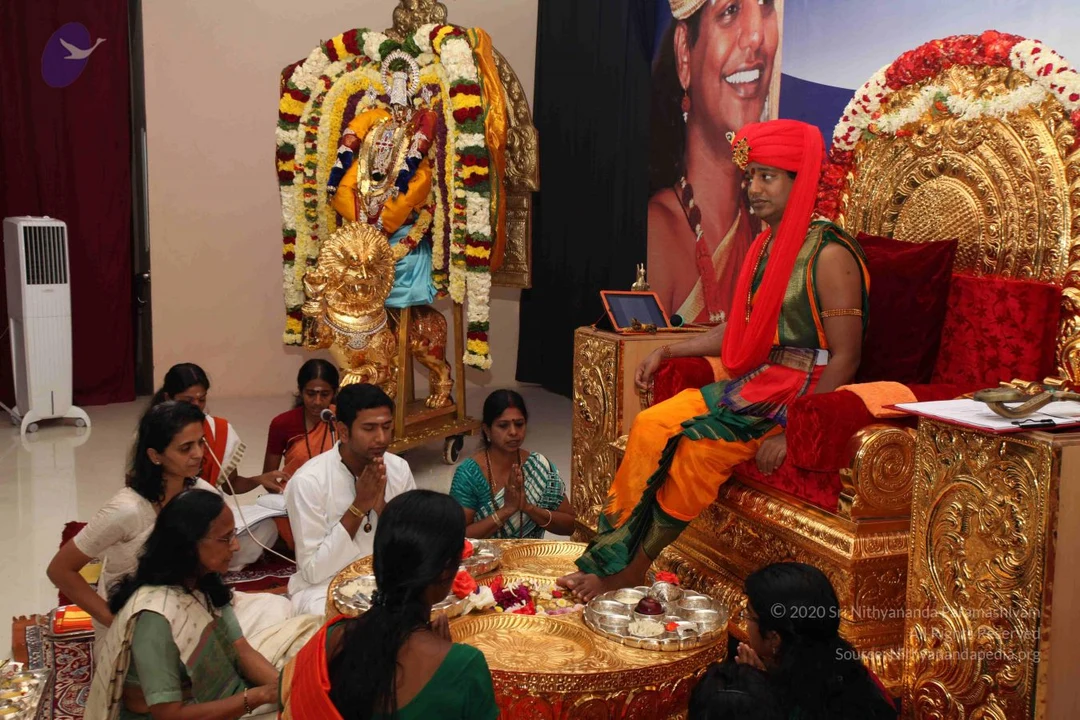
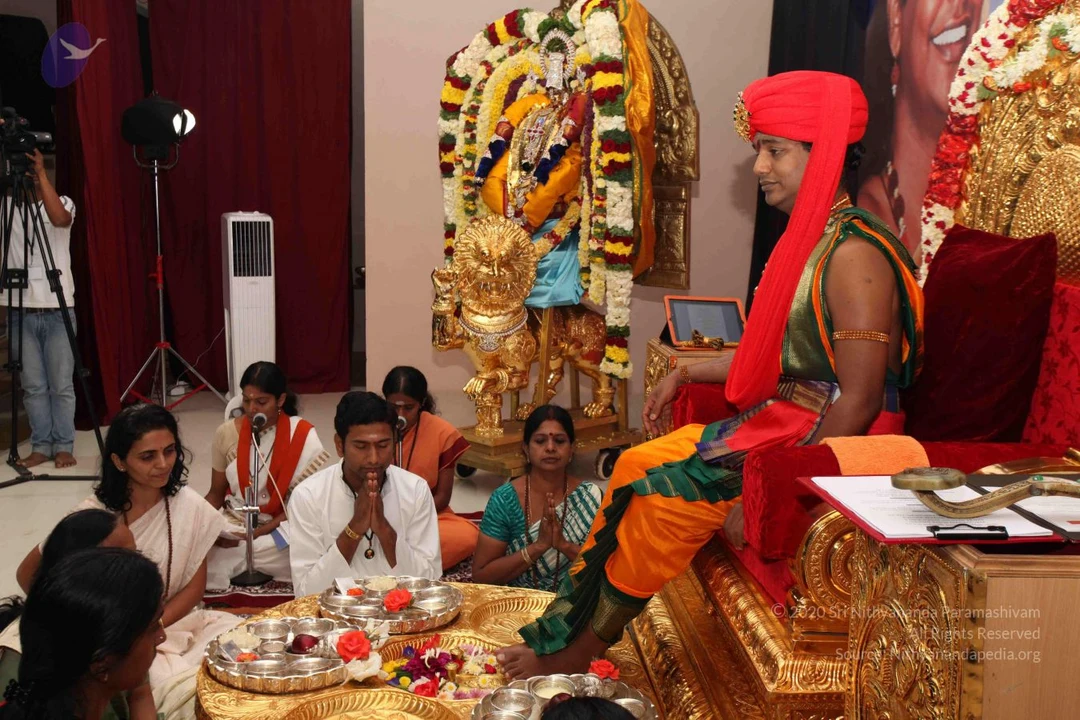
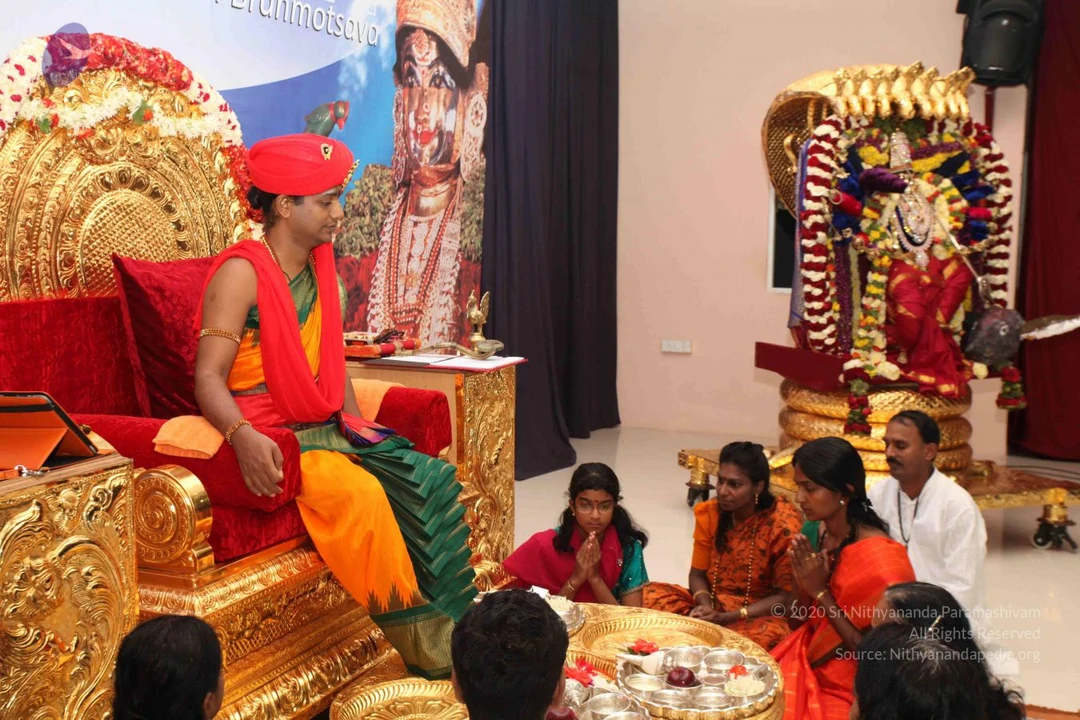
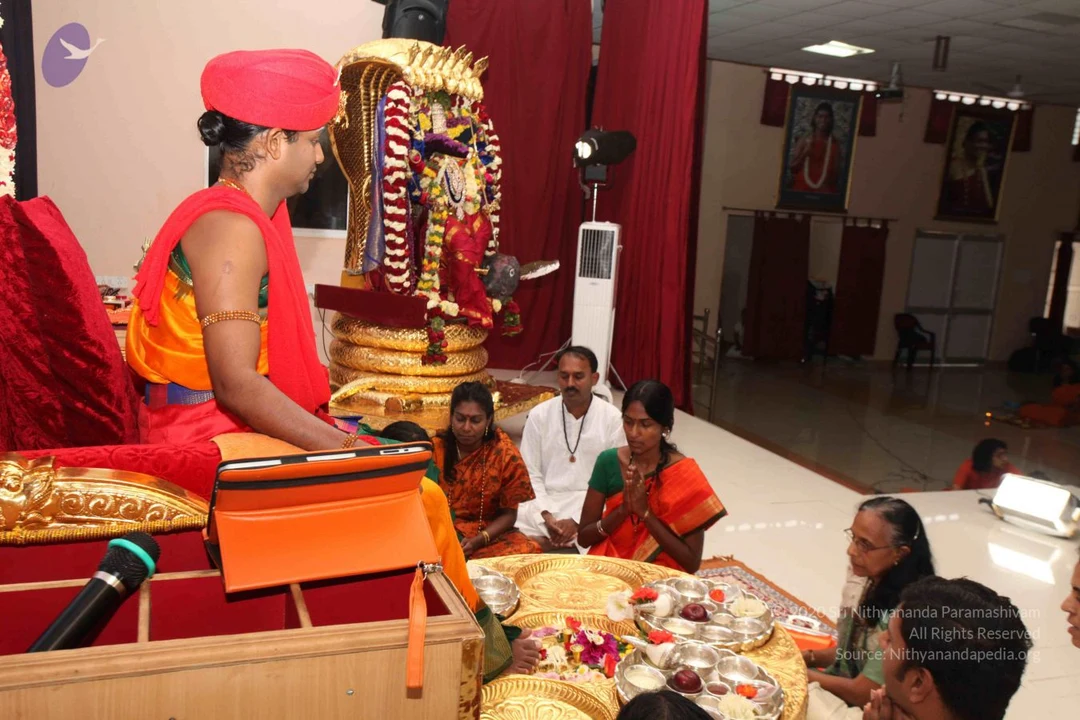
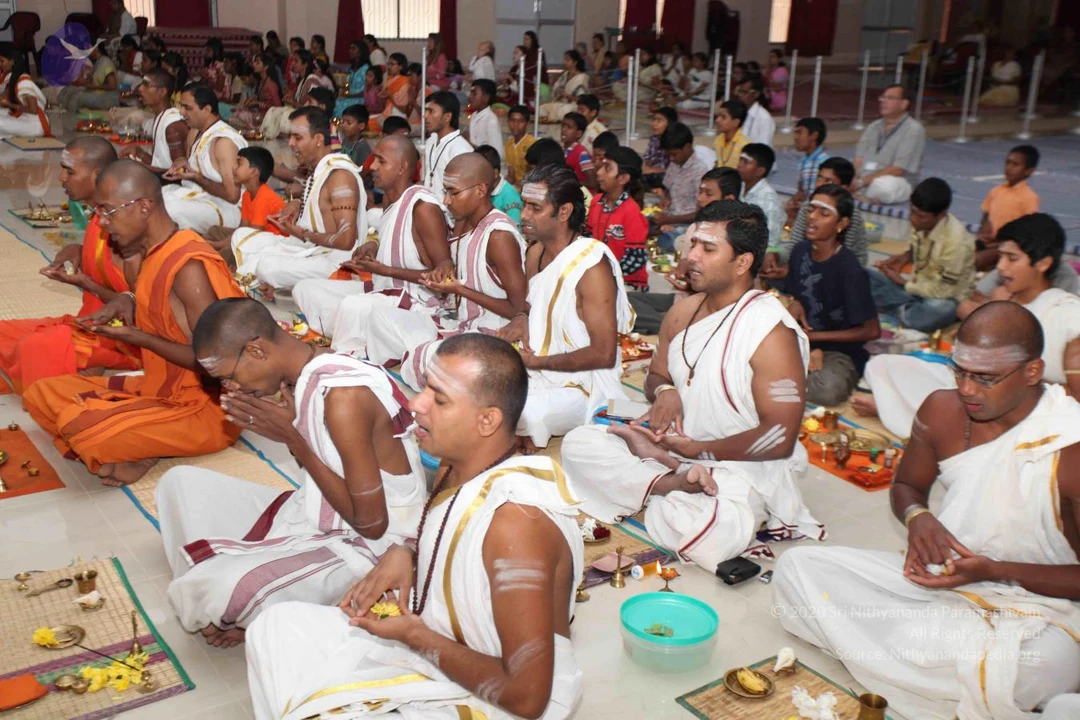
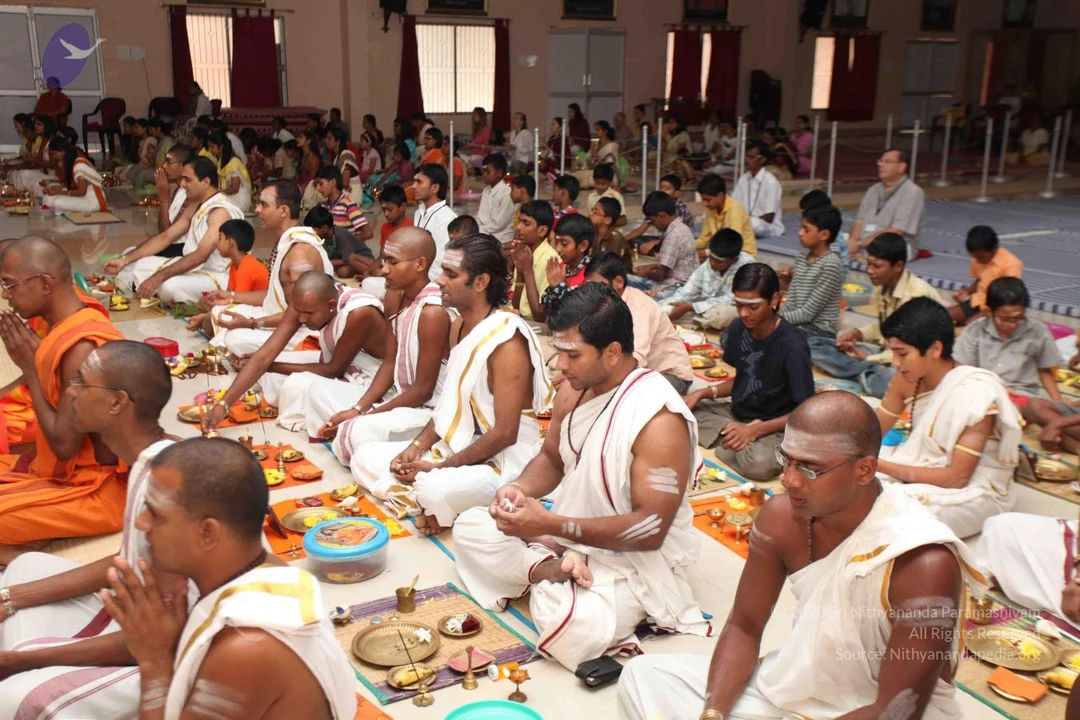
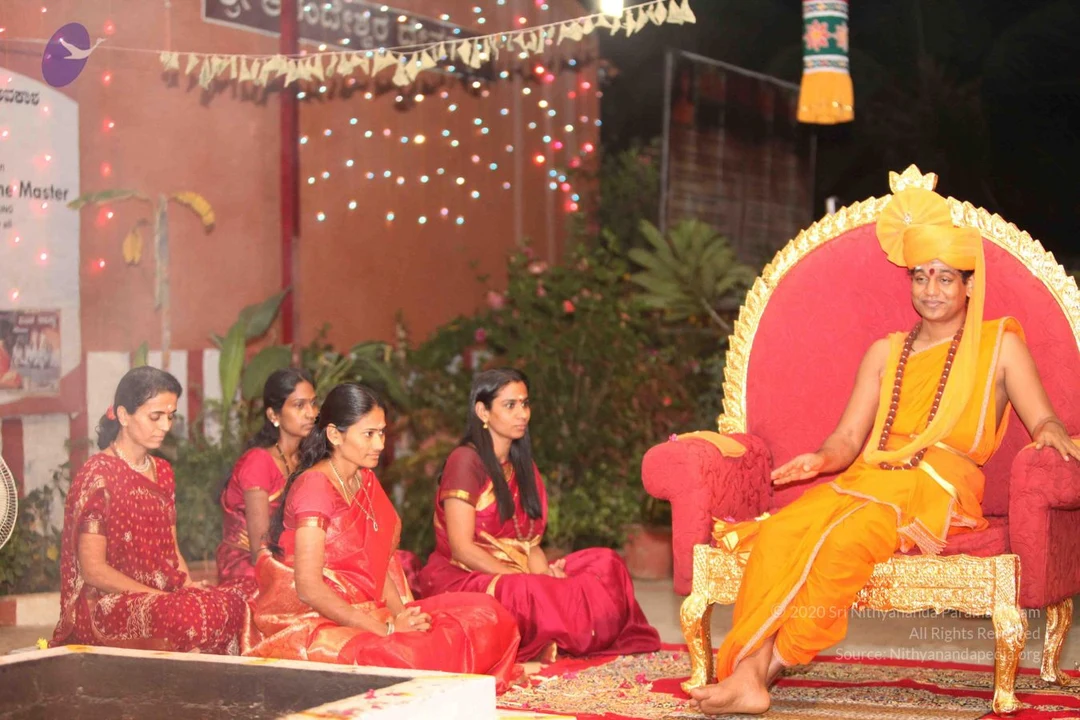
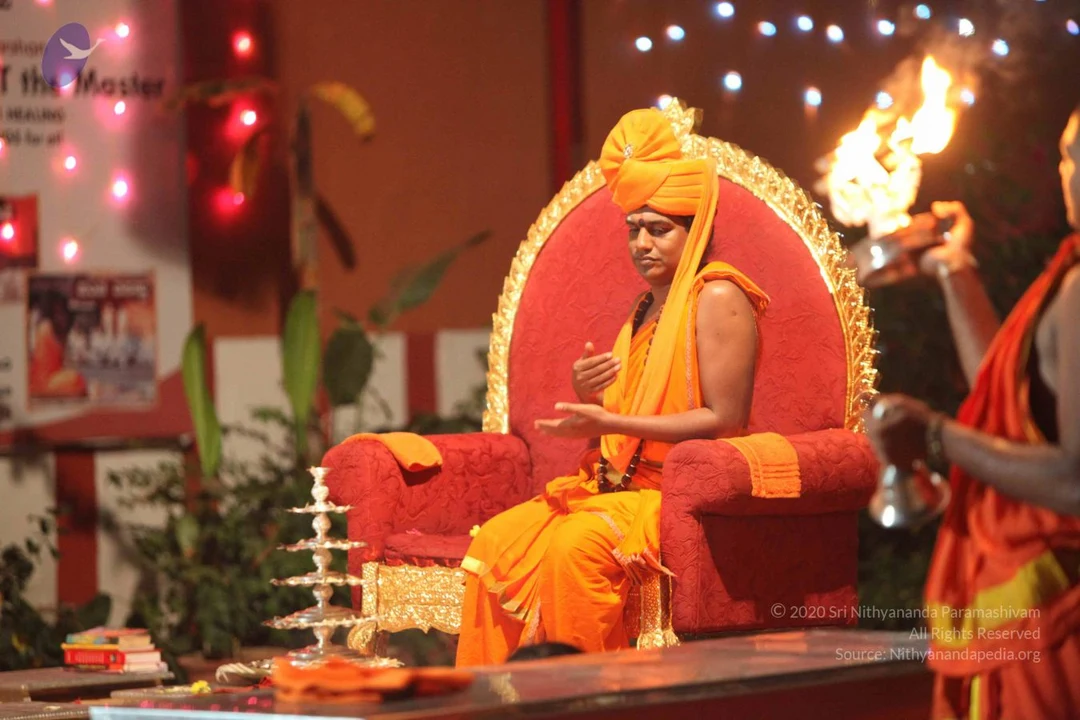
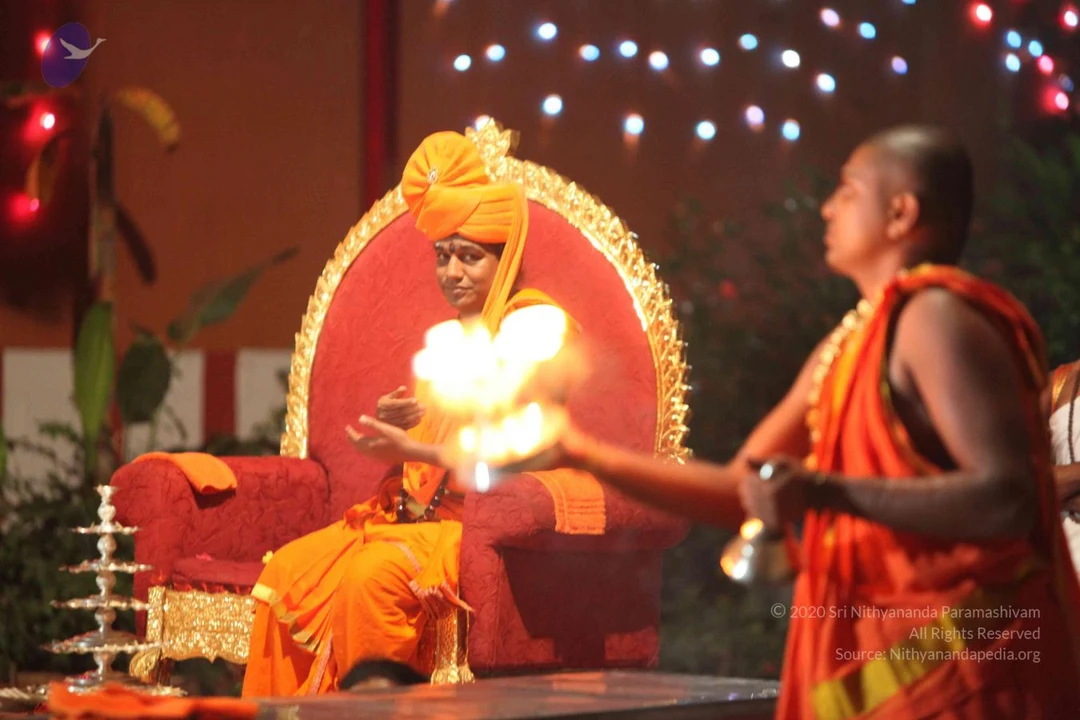
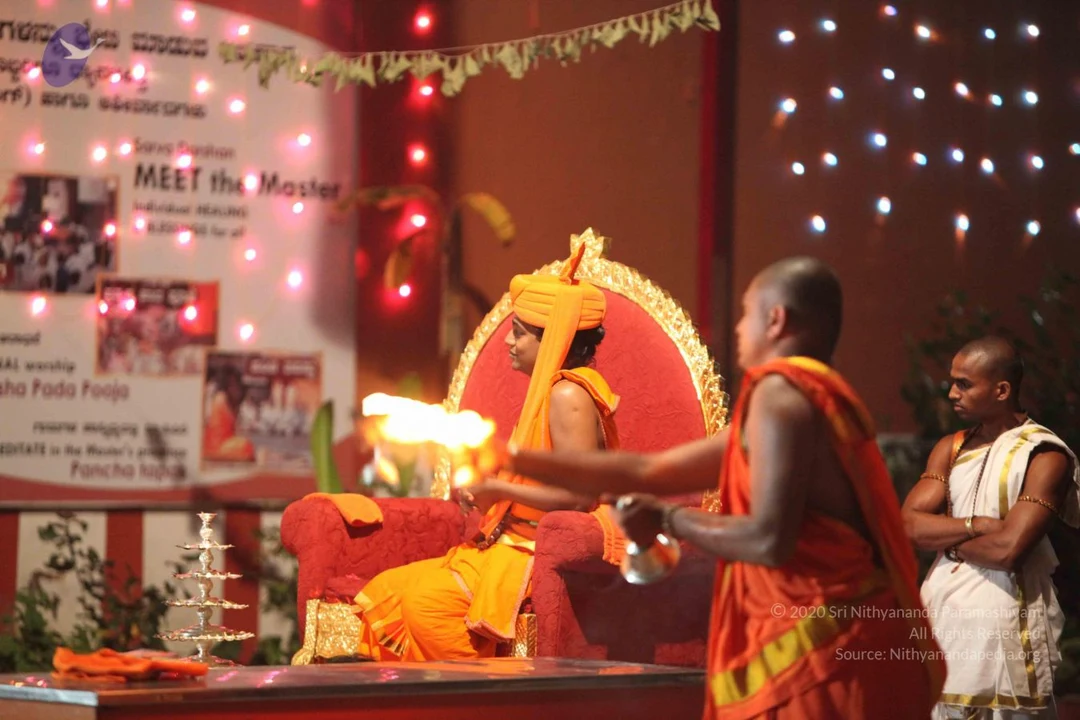
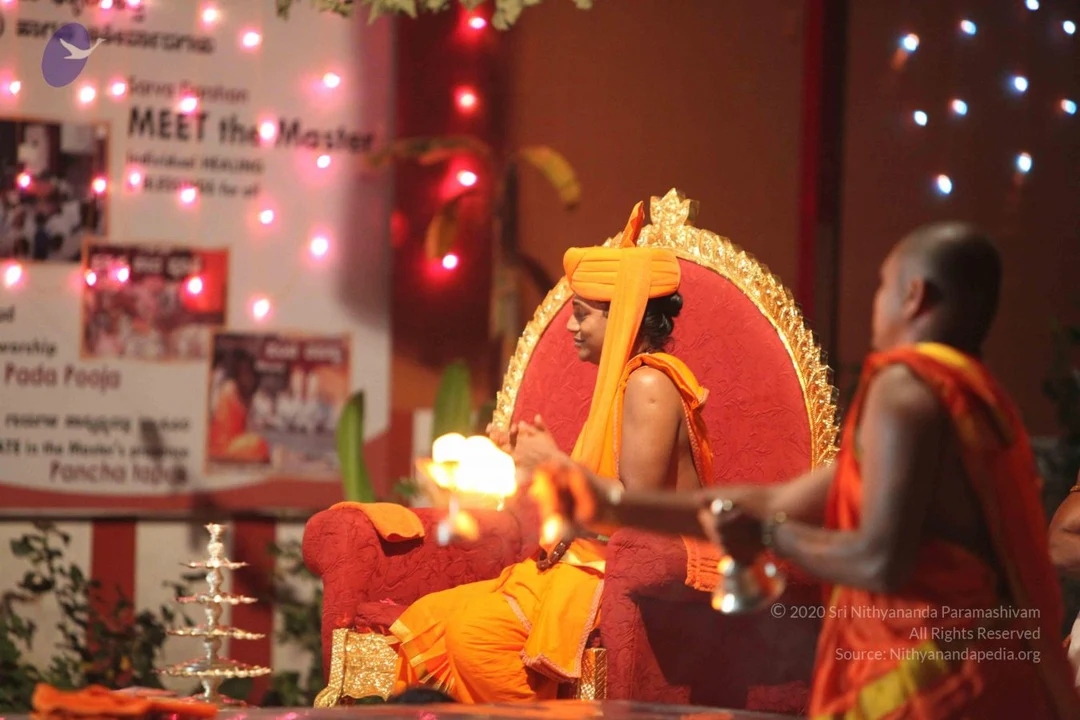
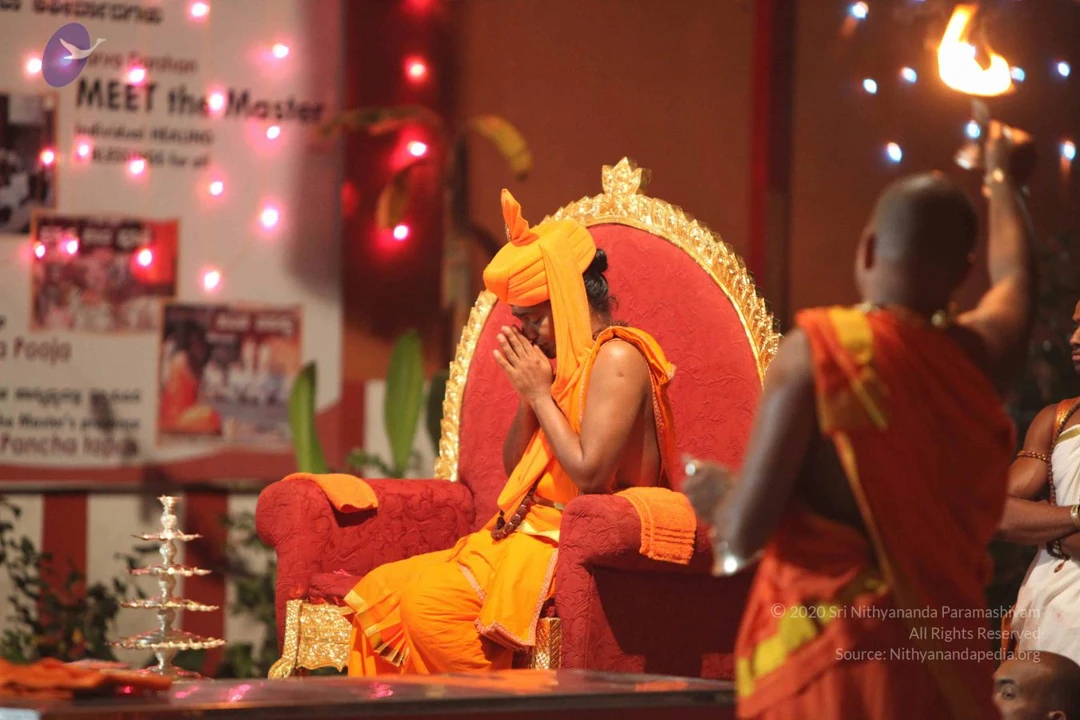
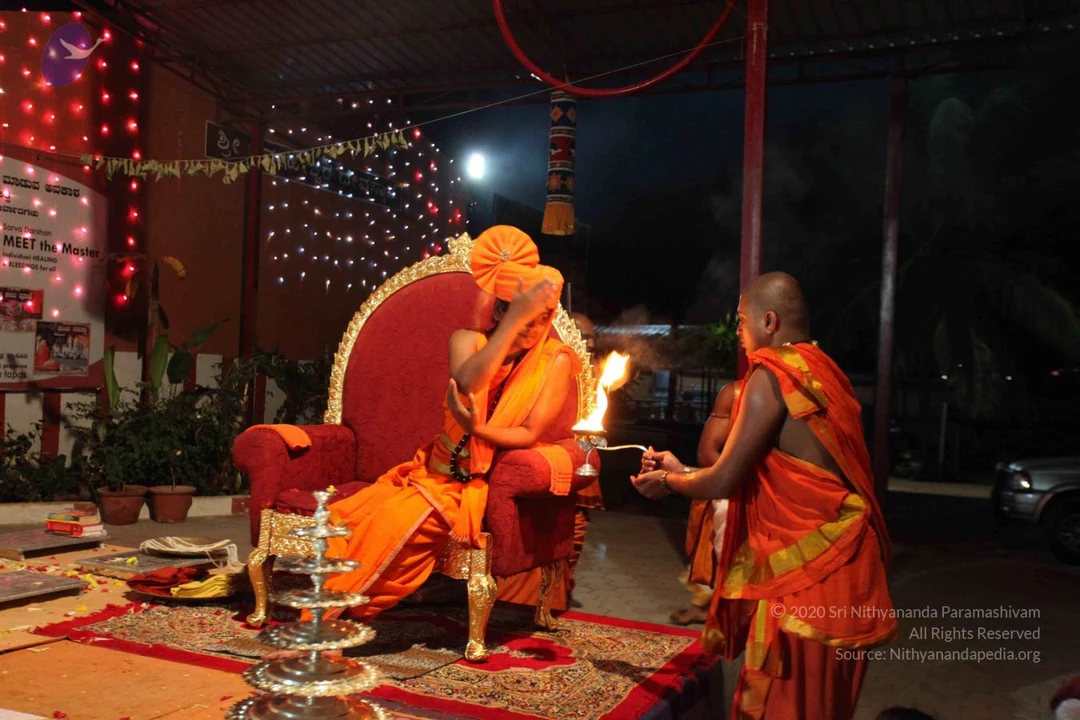
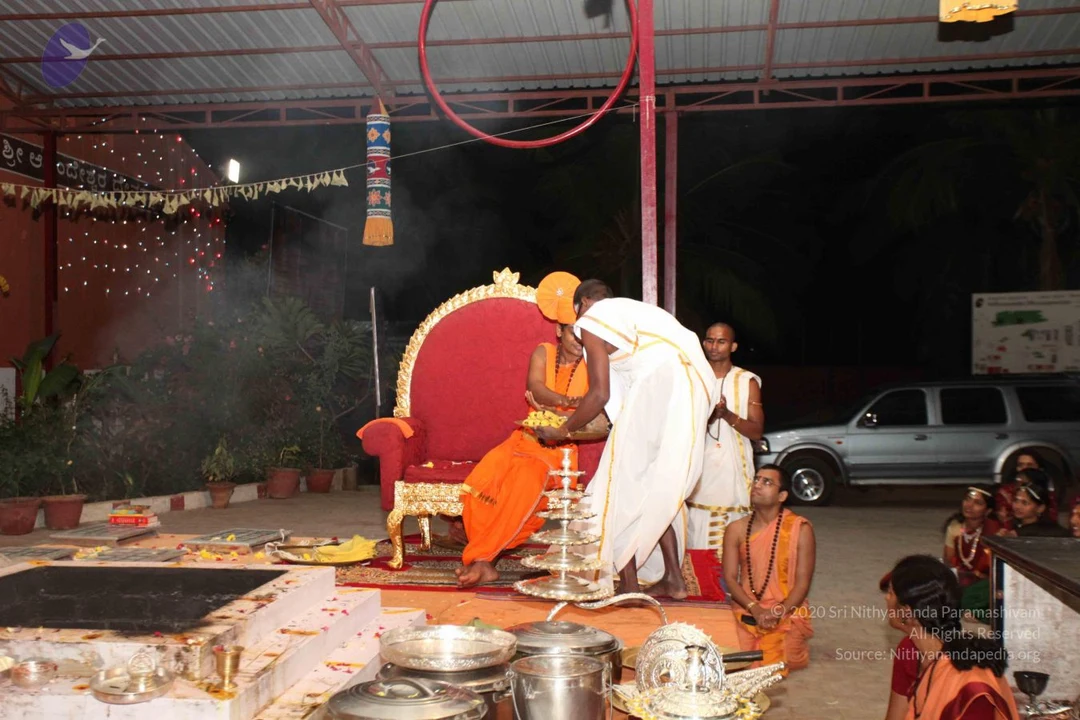
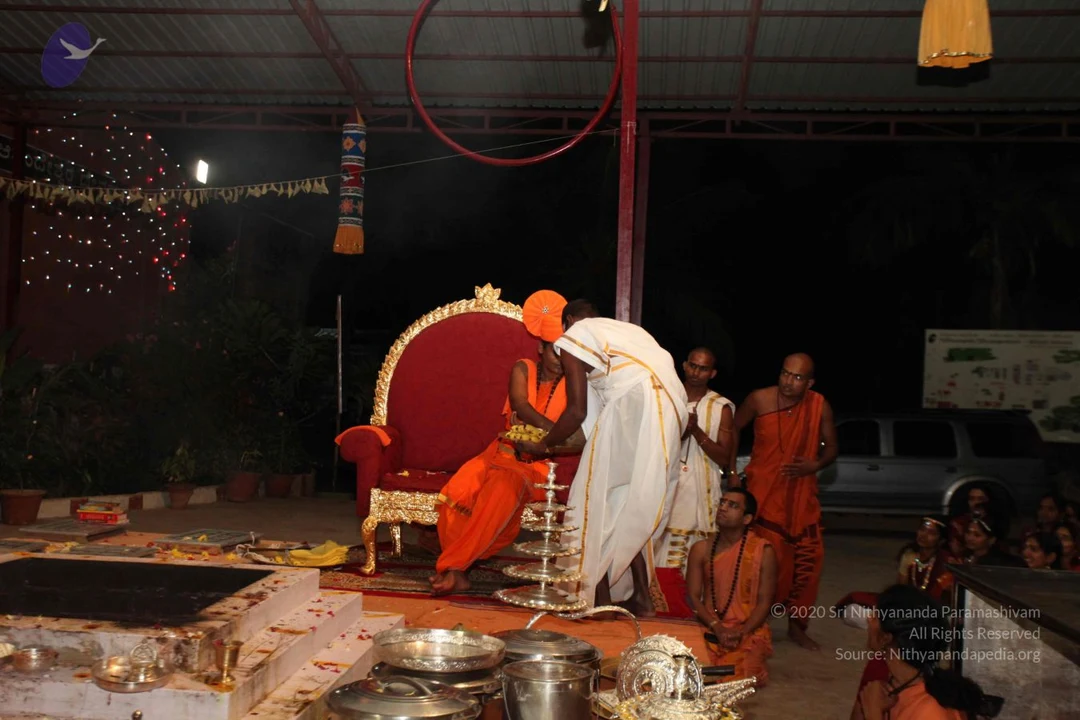
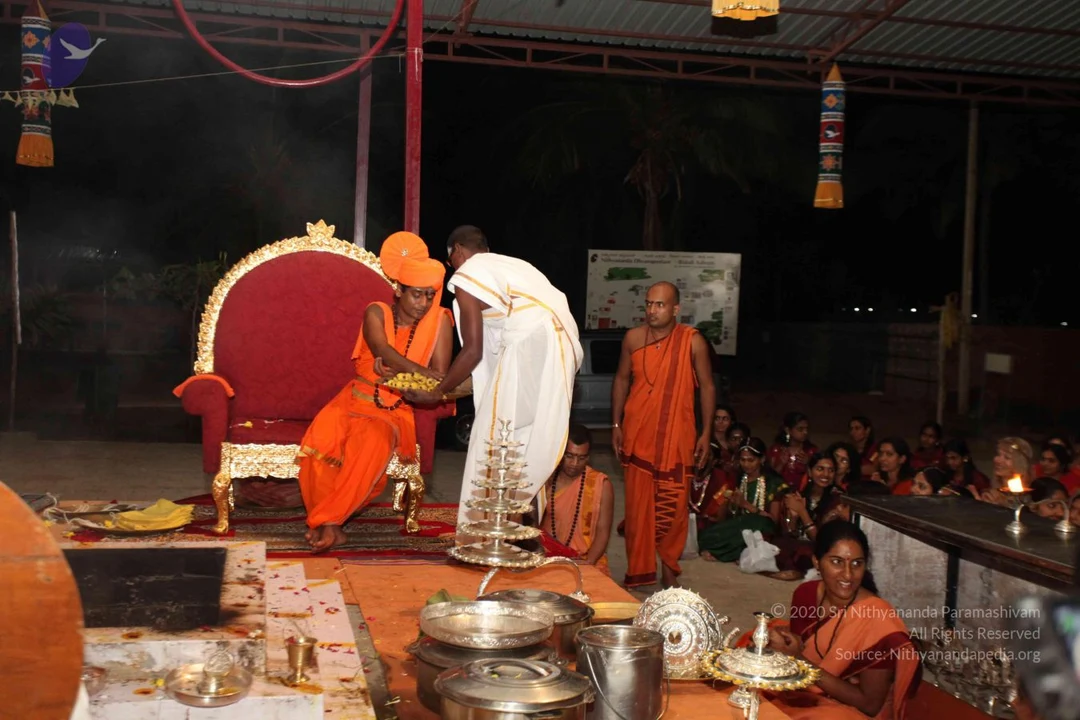
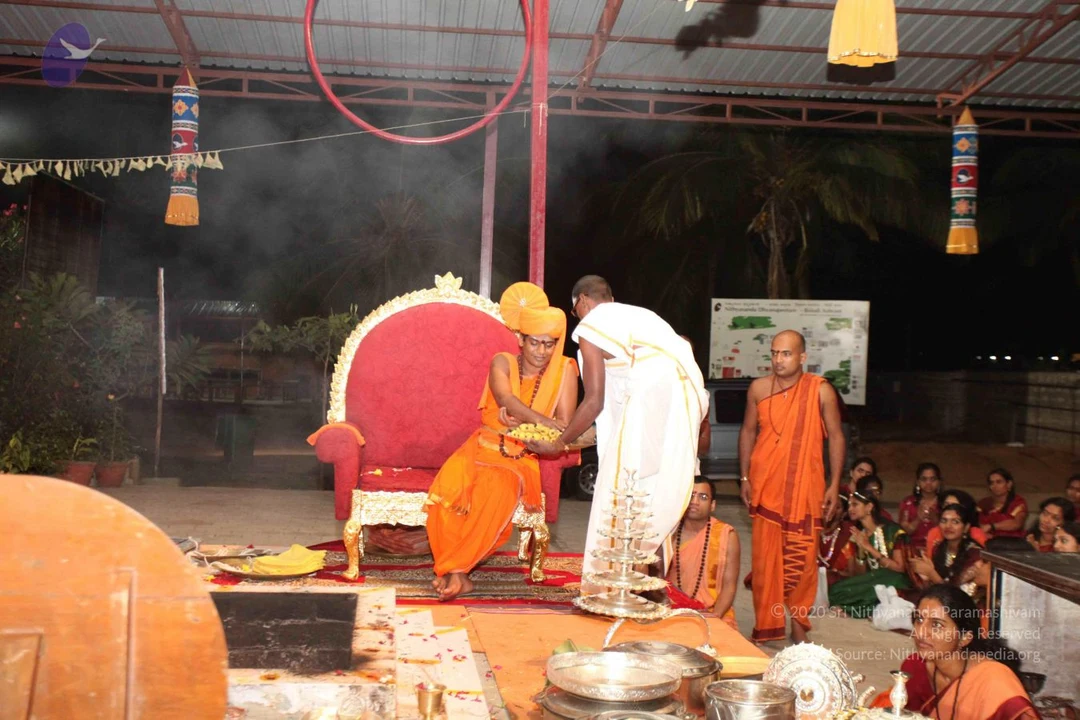
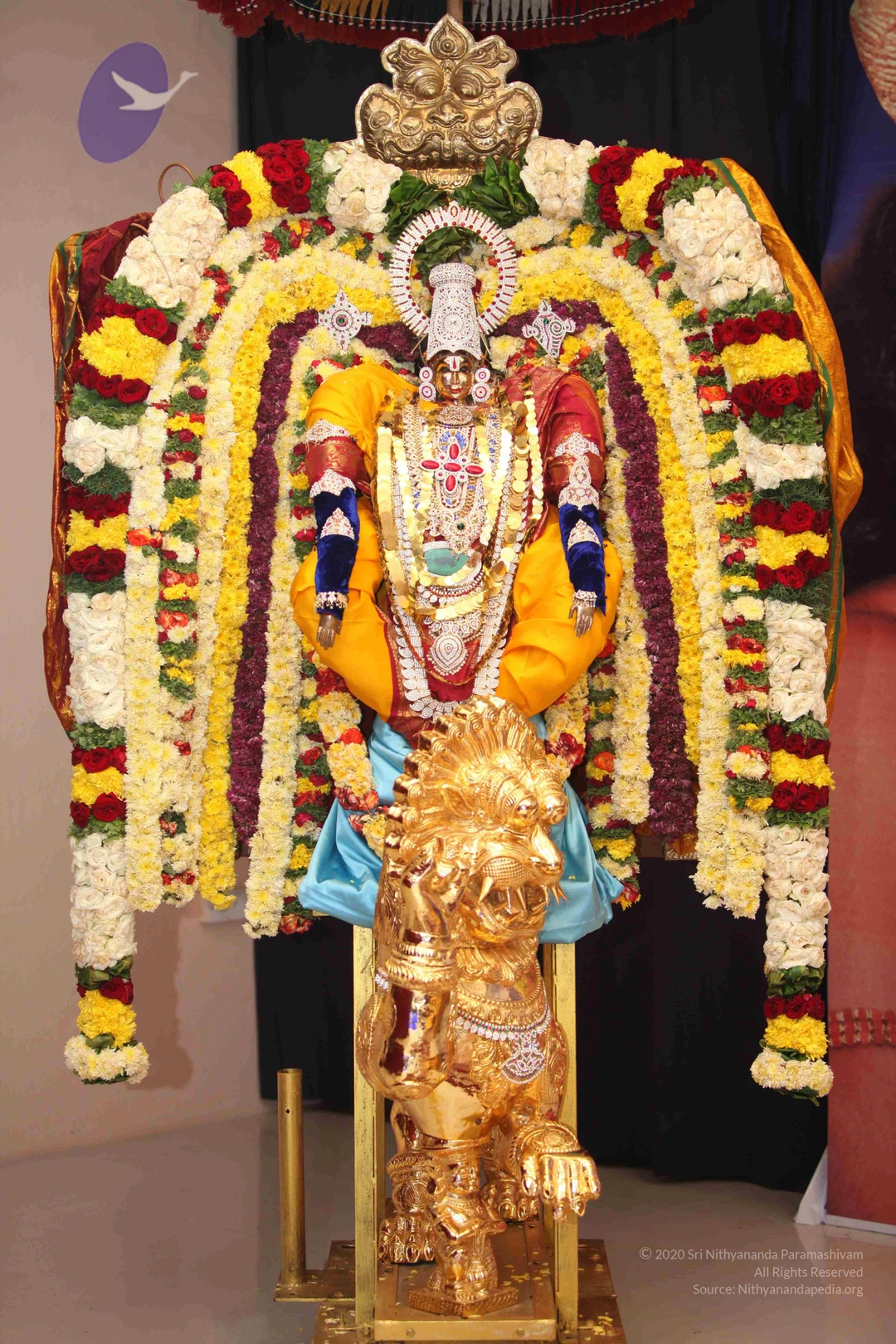
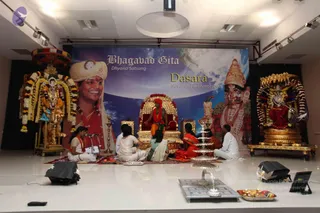
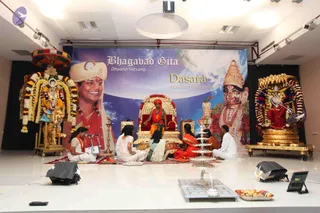
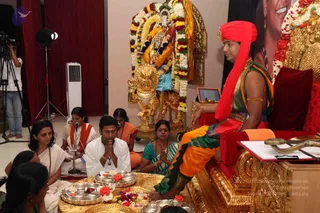
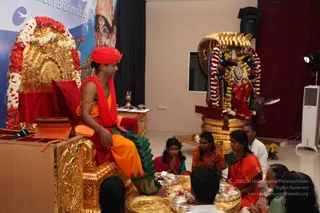
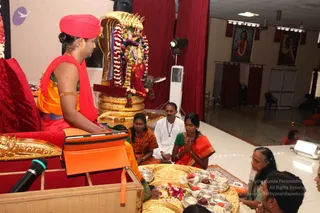
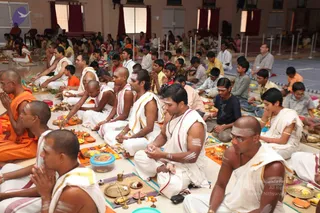
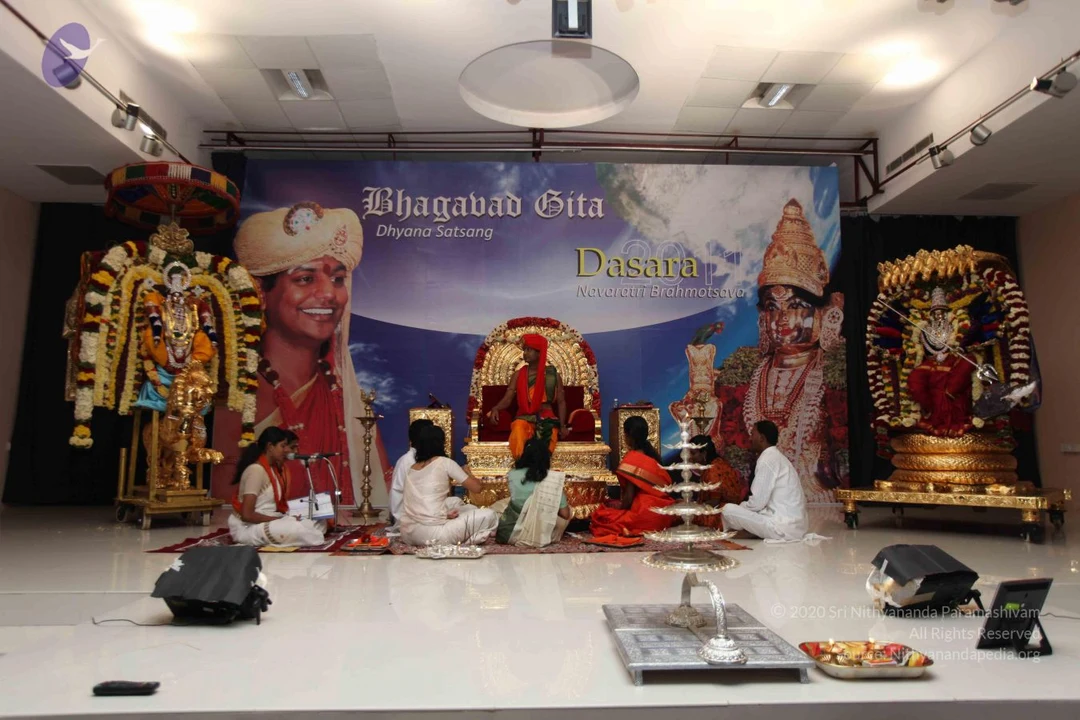
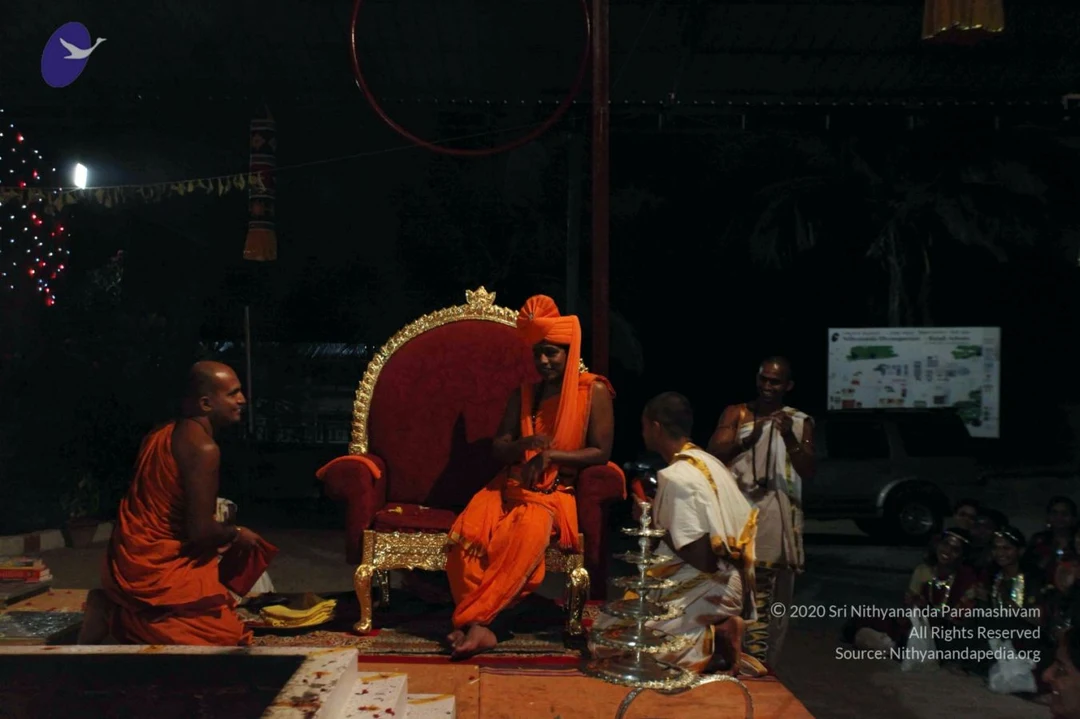
A stage set for a Bhagavad Gita Dhyana Satsang during Dasara Navaratri Brahmotsava. A seated figure in red and orange robes sits on an ornate gold throne with a red cushion at centre. Seated devotees in white and orange clothing sit on the floor before brass lamps and a tiered silver lamp stand. A large backdrop shows a smiling figure in a cream turban and red garment beside a goddess image. Flanking the stage are a gold palanquin-style deity display with floral garlands on the left and a gold throne with a goddess murti in red and gold on the right.A stage set for a Bhagavad Gita Dhyana Satsang during Dasara Navaratri Brahmotsava. A figure in an orange-red robe and red turban sits on a gold and red throne at centre, with a golden tiered ritual lamp stand in front. Seven people are seated on the floor: a musician in white at left with a harmonium-style instrument and microphones, several women in white, cream and orange saris, and a man in white at right. A large backdrop shows a smiling person in a cream turban and red shawl beside a figure in ornate crown, necklaces and red attire. Decorated deity murtis draped in marigold garlands stand at left and right on golden pedestals, with a silver tray of offerings and fruit in the foreground.A ceremonial puja scene in an ashram hall. A figure seated on a gilded throne with red cushions wears a bright red turban, green and orange clothing, and gold arm bands; the figure holds a red-bordered folder. Before them, a gold lion-shaped stand supports a deity murti draped in a blue cloth and heavy garlands of yellow, red and white flowers. In front, seated devotees with folded hands sit around brass thalis holding flowers, fruits, and small bowls, one person in white and another in orange. A cameraman with a tripod is at left, and a standing fan and light stand are visible. A photo backdrop shows a smiling face. Seven people are visible.Photo of a ceremonial satsang in an indoor hall. A man with a red turban and red and orange drape sits on an ornate gold throne decorated with red-and-white flower garlands, a red cushion behind him, and an orange tablet on a small table beside him. Several seated devotees on the floor in front of him hold brass plates with offerings, fruit and flowers; a woman in red and orange saris, a girl in a red top with hands folded, and a man in white stand nearby. Behind them a gold-and-red deity murti with a multi-hooded cobra canopy is garlanded with flowers and rudraksha-style beads. A banner reading Brahmotsava is visible at the left edge, and a standing fan sits on the right.A seated figure on a gold-and-red throne-like seat faces a large gold cobra-hooded deity murti garlanded with white and red flowers, with a golden kalasha-like pedestal below. He wears a red turban, saffron-orange and red garments, and a gold armlet. Before the deity, a woman in an orange sari and a woman in a green-bordered red sari sit with hands folded, and a man in white with a rudraksha mala sits beside them. Brass plates of offerings, fruit, flowers and sweets lie on a gold tray in front, a microphone stands on a wooden podium, and framed portraits hang on the wall behind. Several devotees sit in the background.A large hall of seated men and boys in a ritual gathering. In the foreground, men in white dhotis with gold-bordered shawls, bare chests and white-painted tripundra marks on their foreheads and arms sit on mats before brass plates, lamps and small offering dishes. Several have their hands folded in prayer or hold ritual items. On the left, a shaved-headed monk in saffron-orange robes sits with palms pressed together. Behind them, rows of seated children and young men in colourful shirts watch and sit quietly. Red curtains, windows and a metal railing line the back of the room.

BHAGAVAD-GITA-SATSANG

80 photosSource gallery
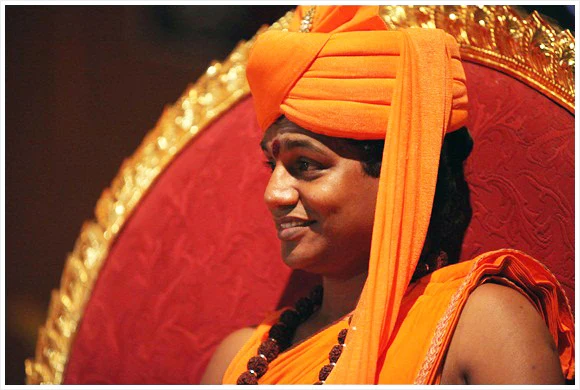
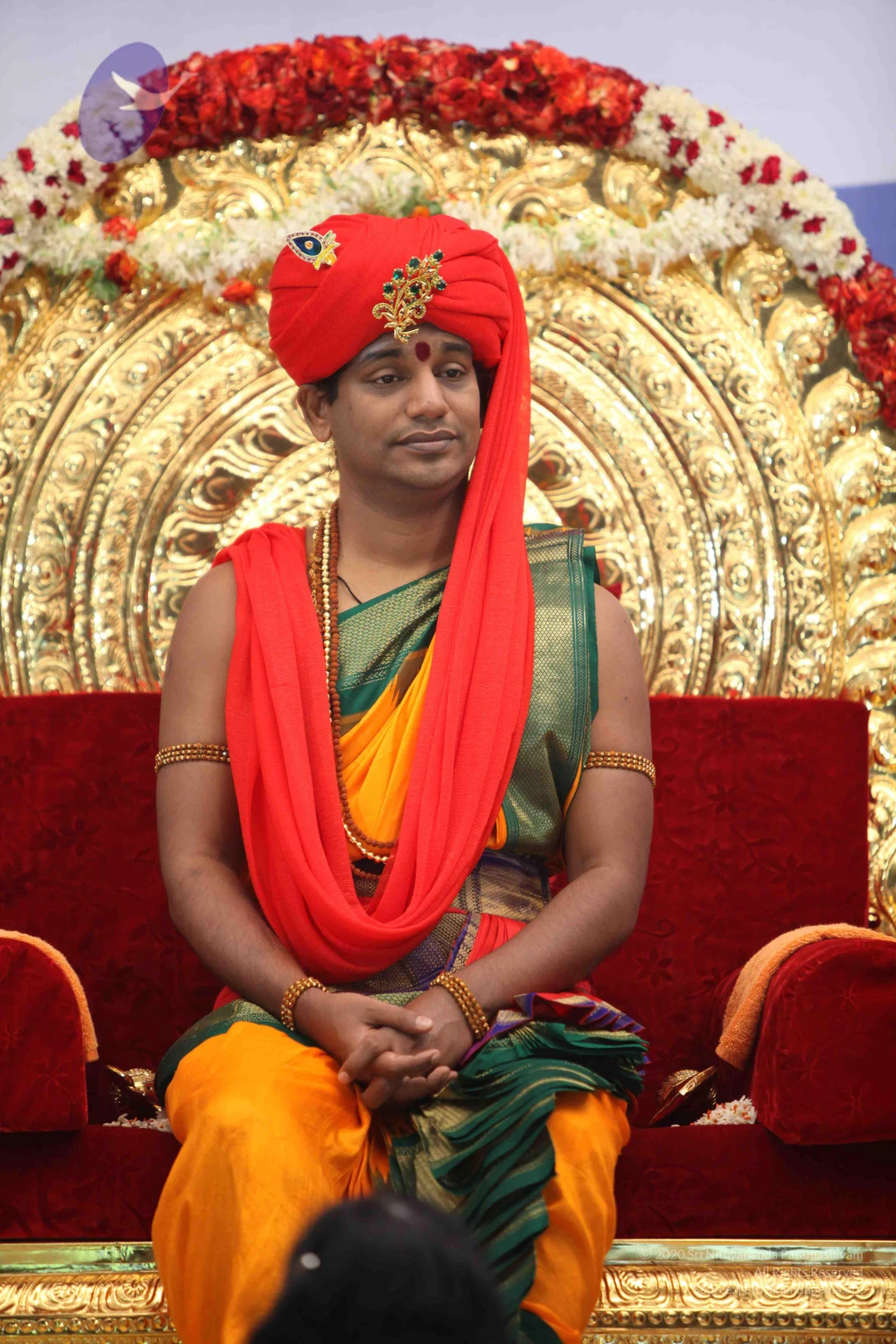
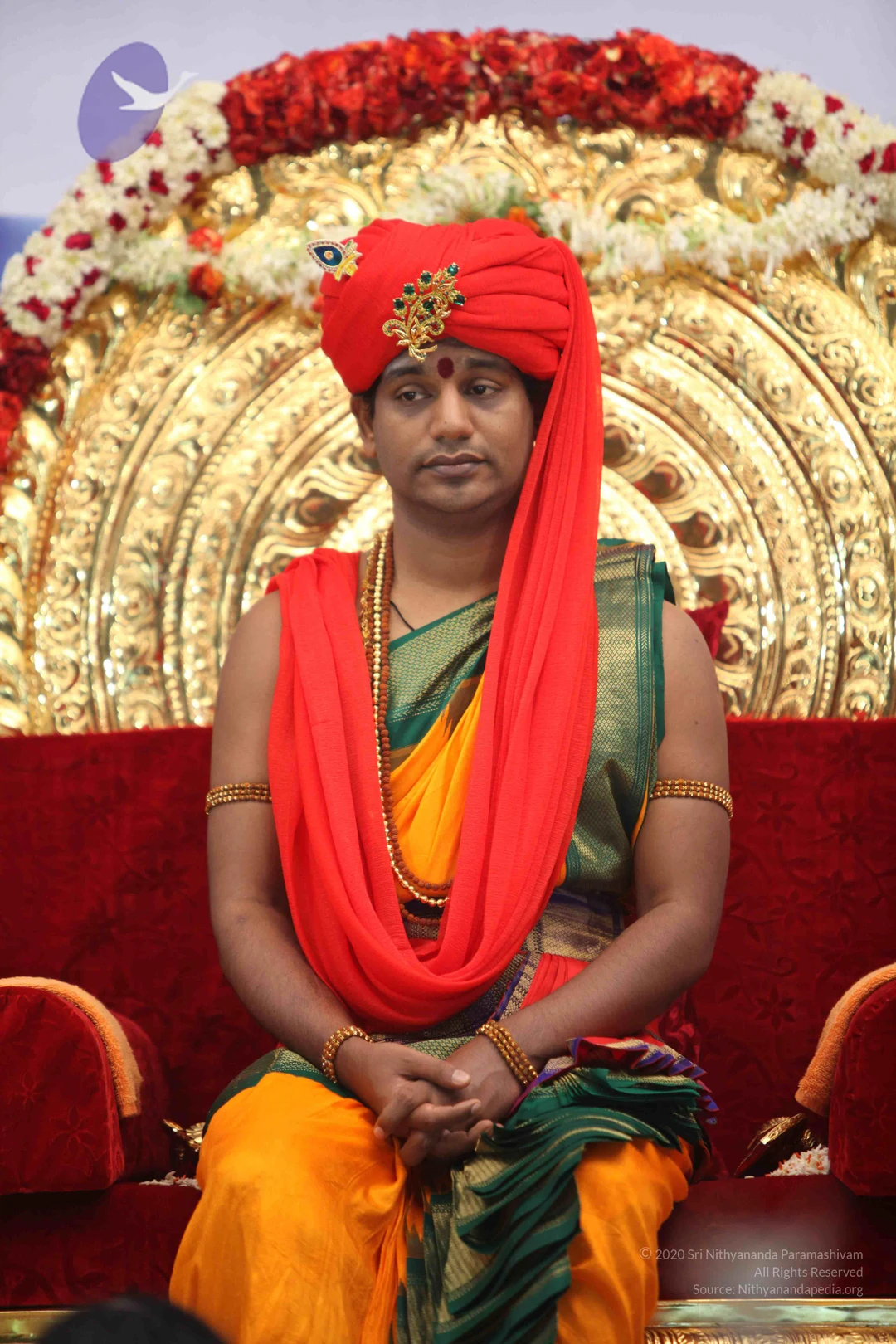
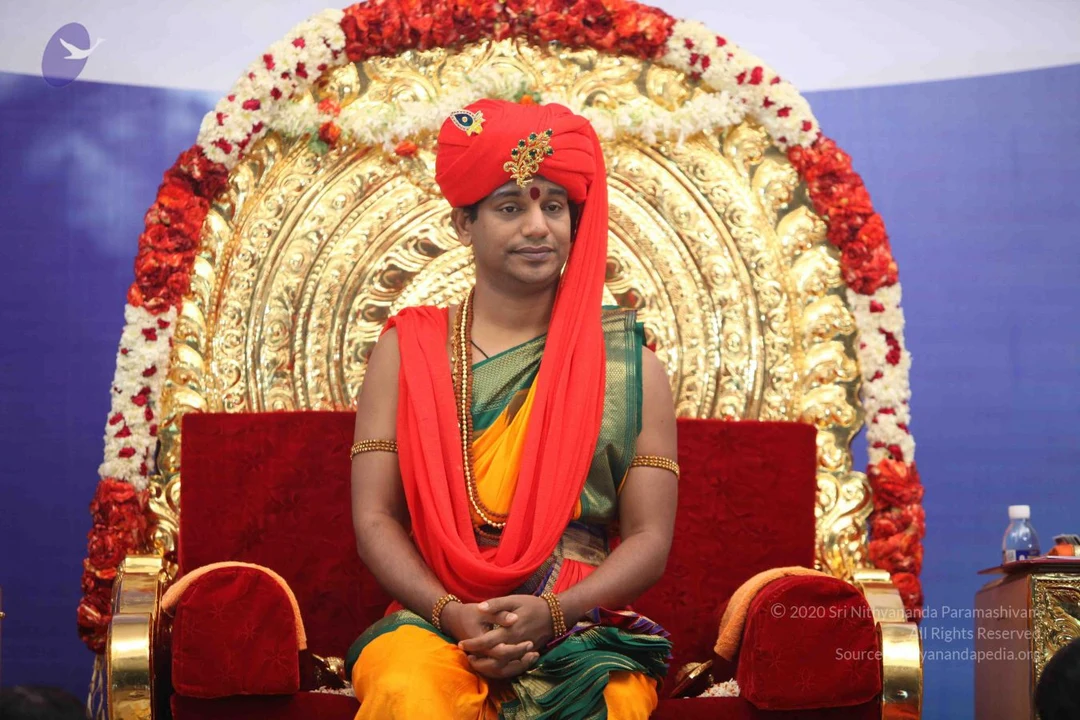
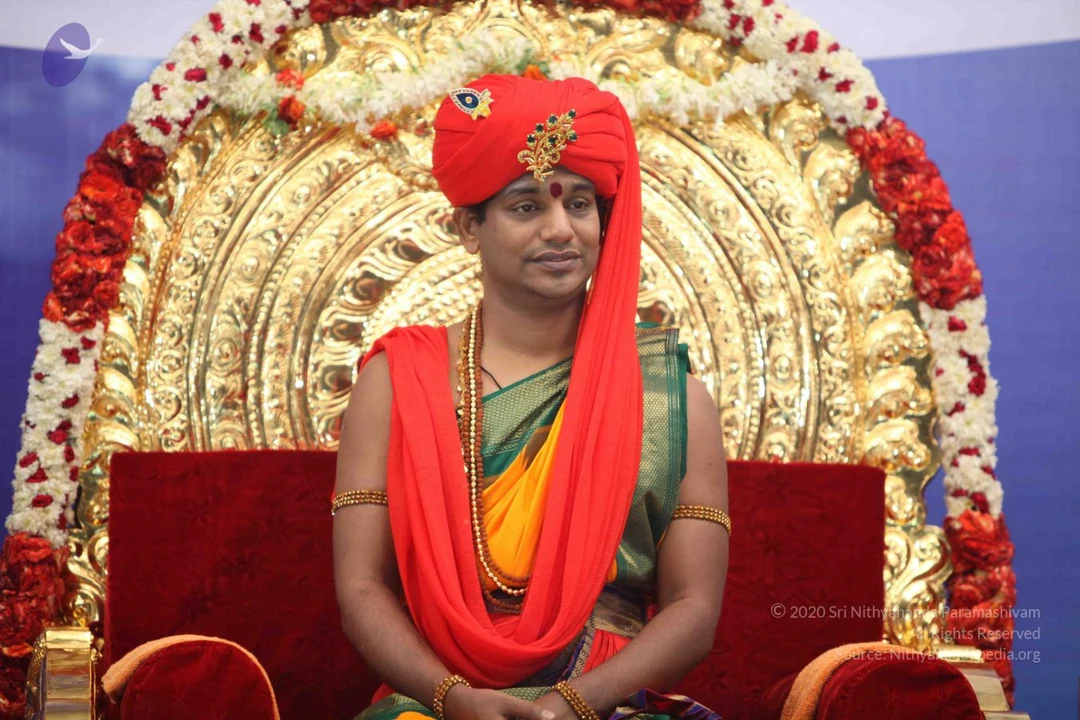
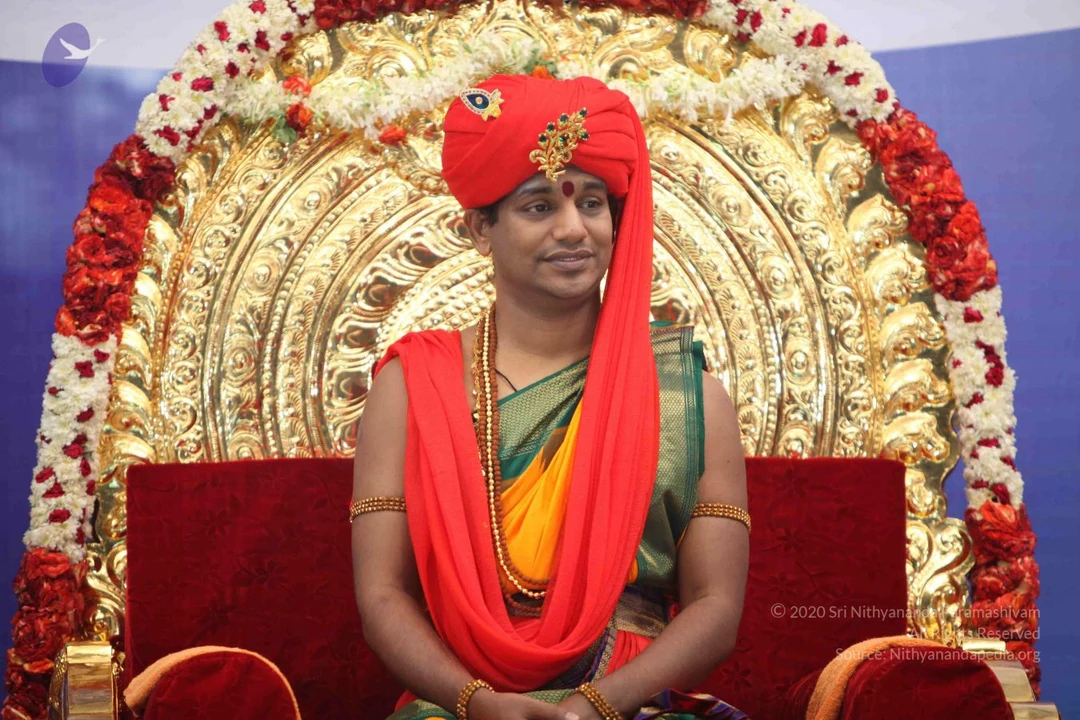
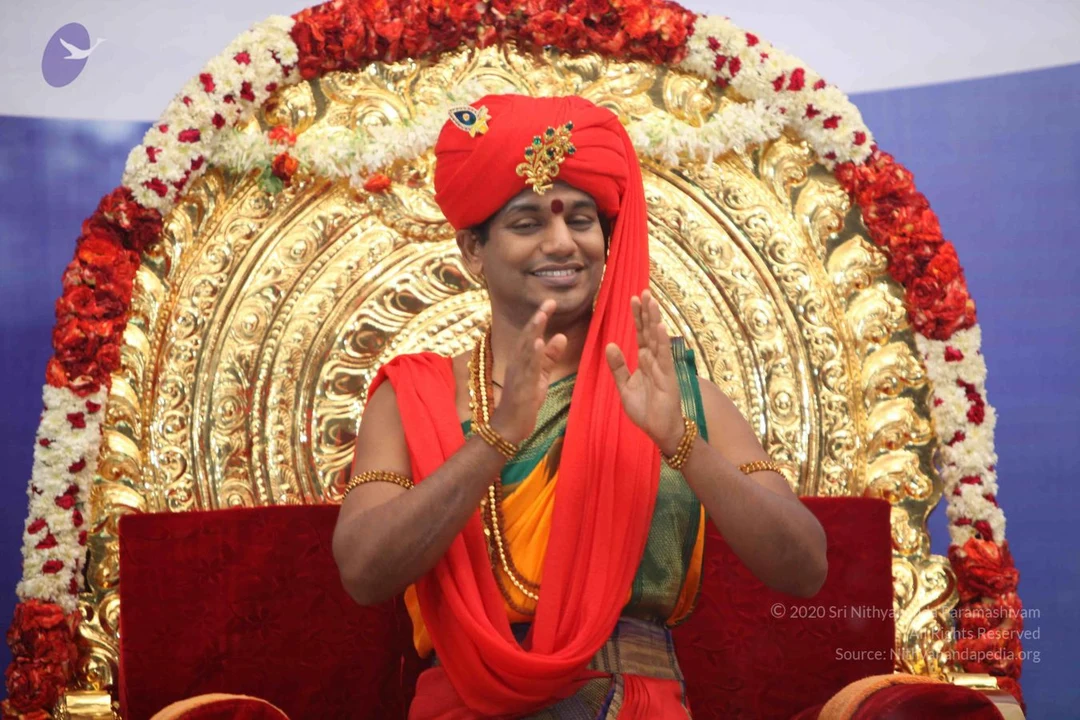
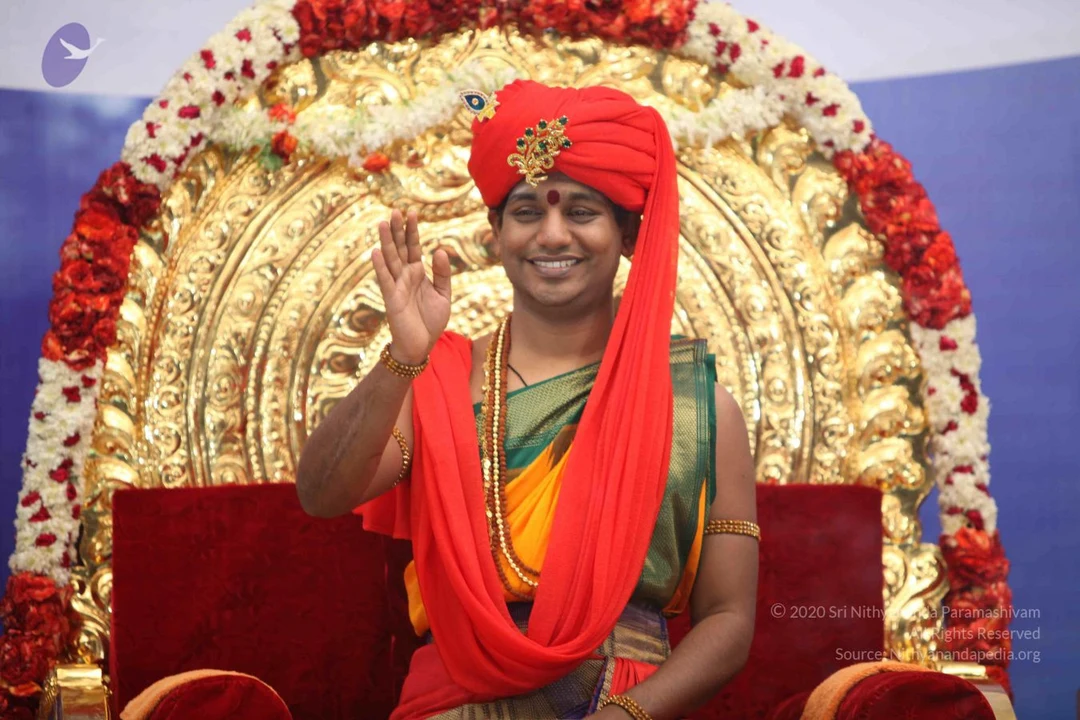
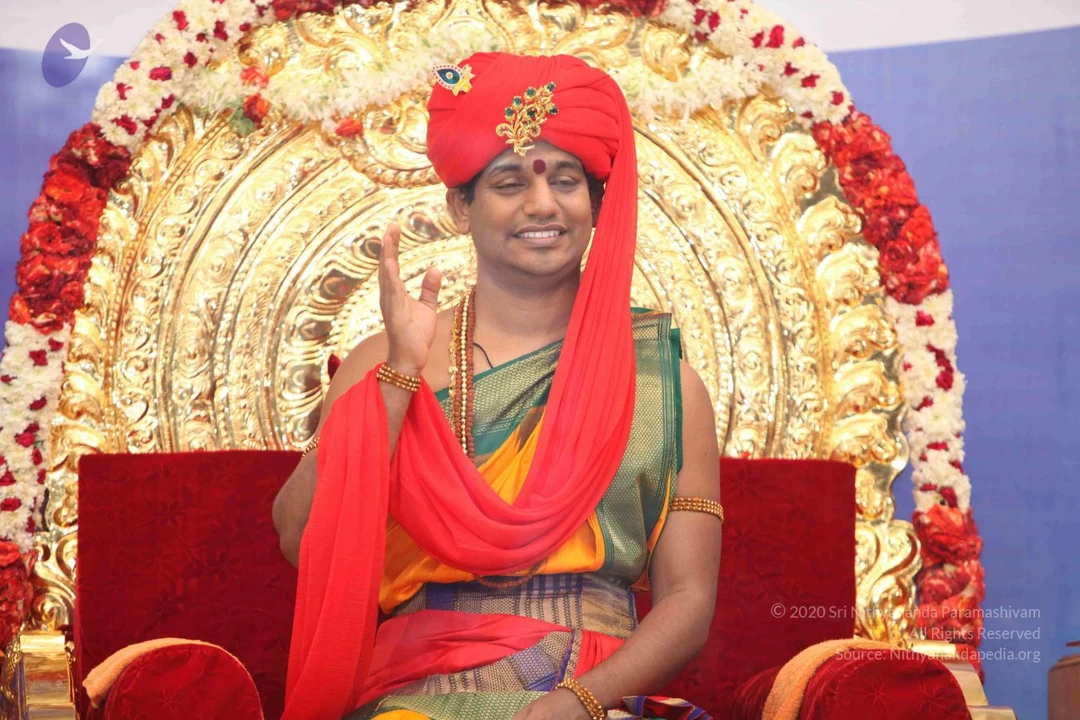
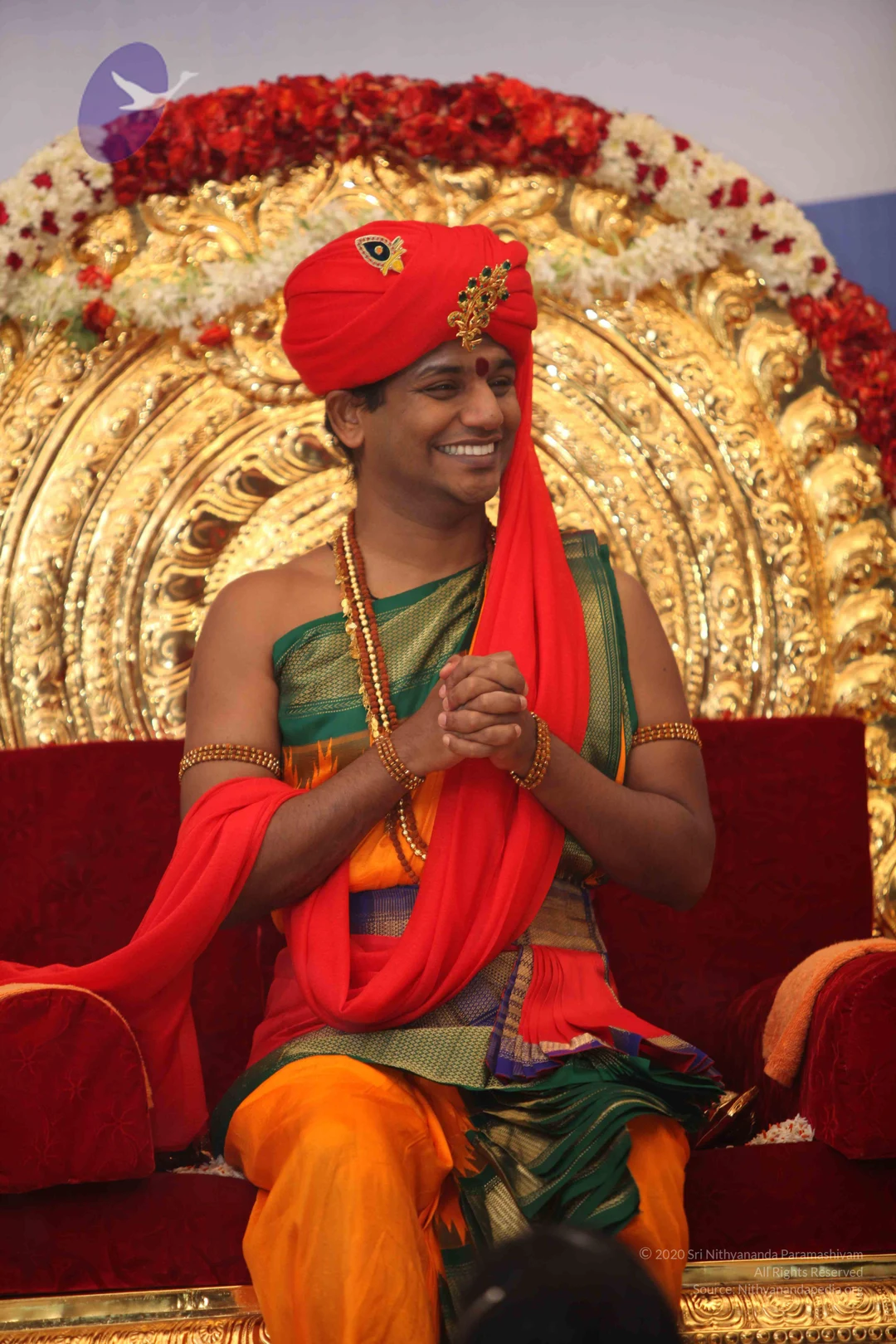
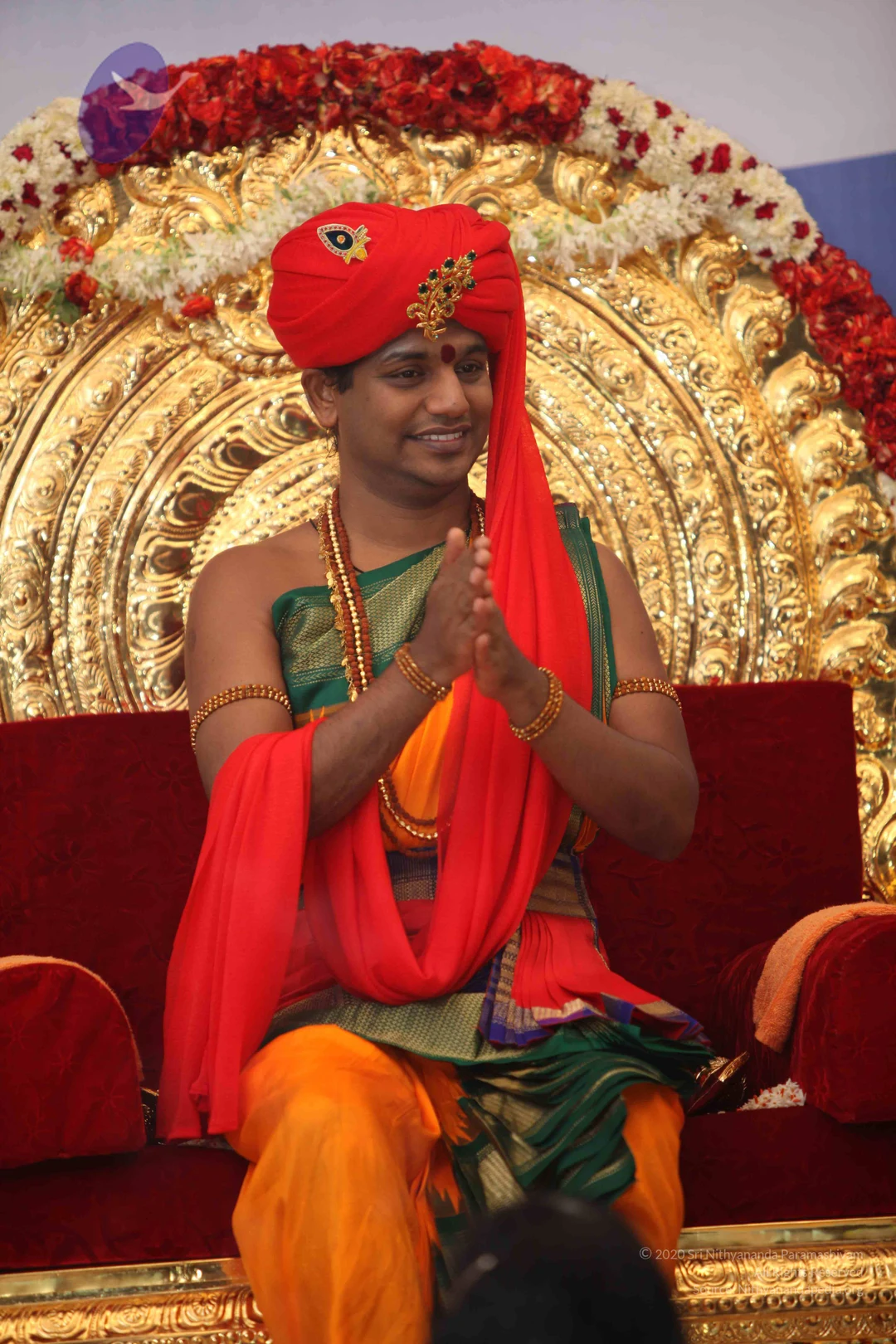
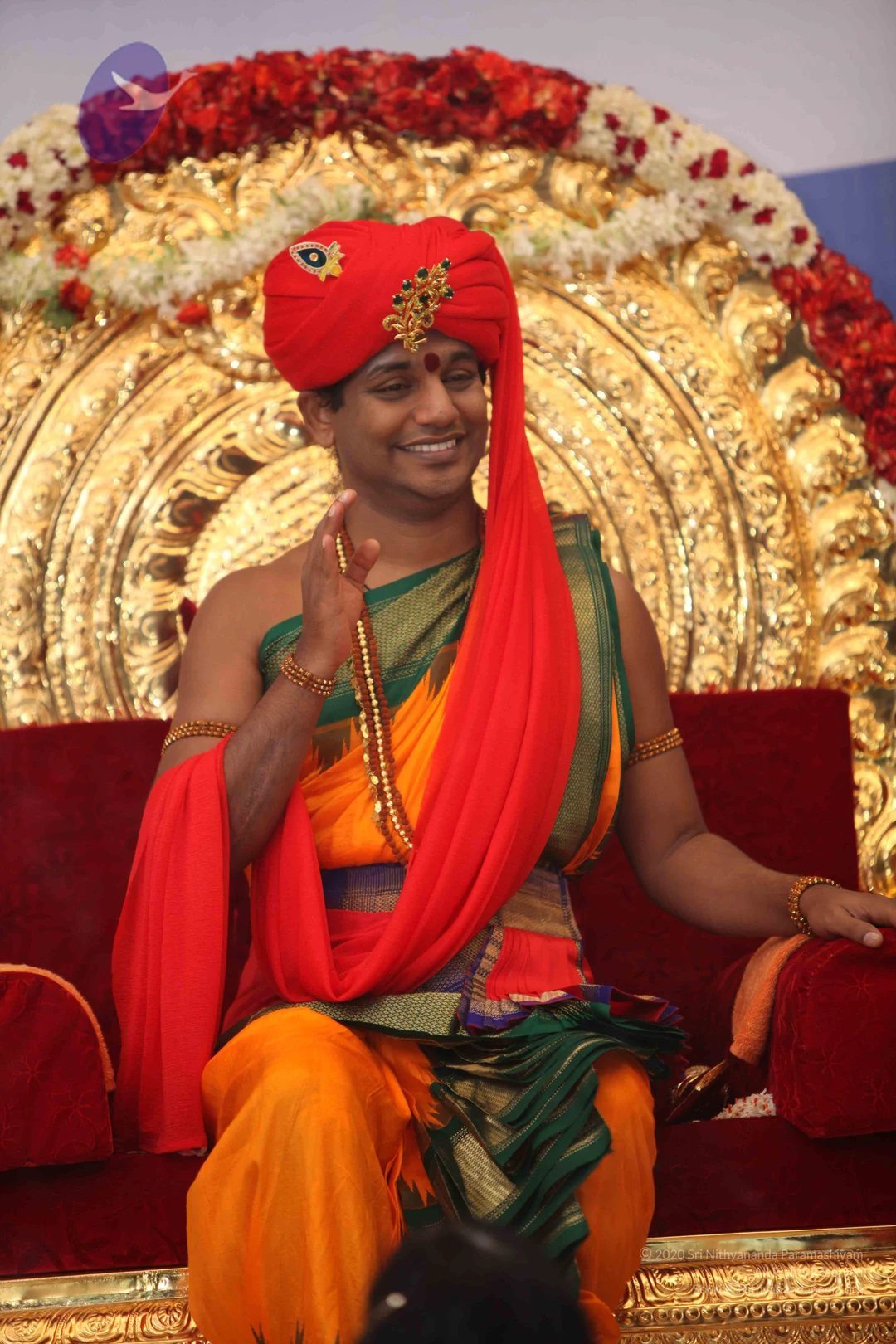
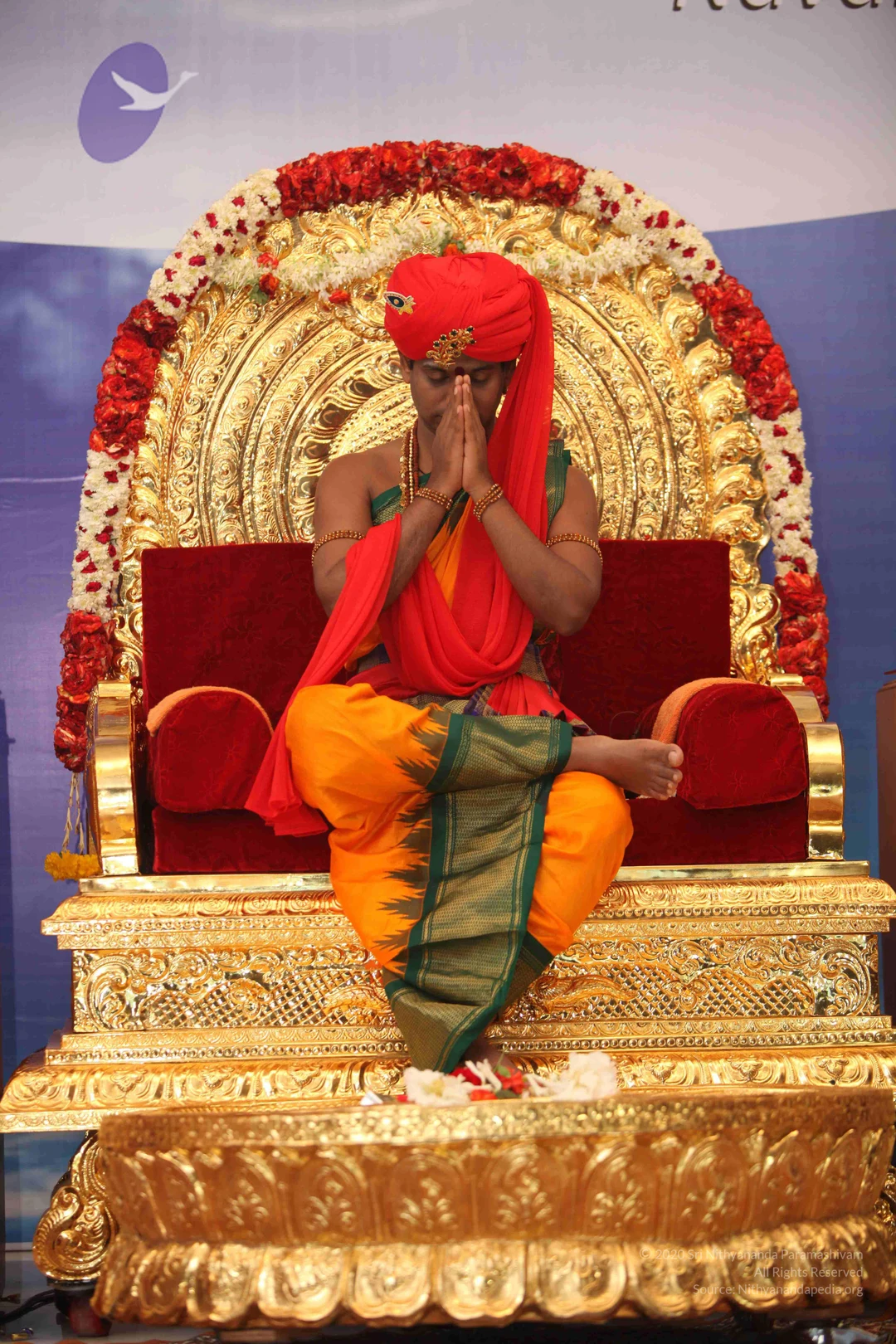
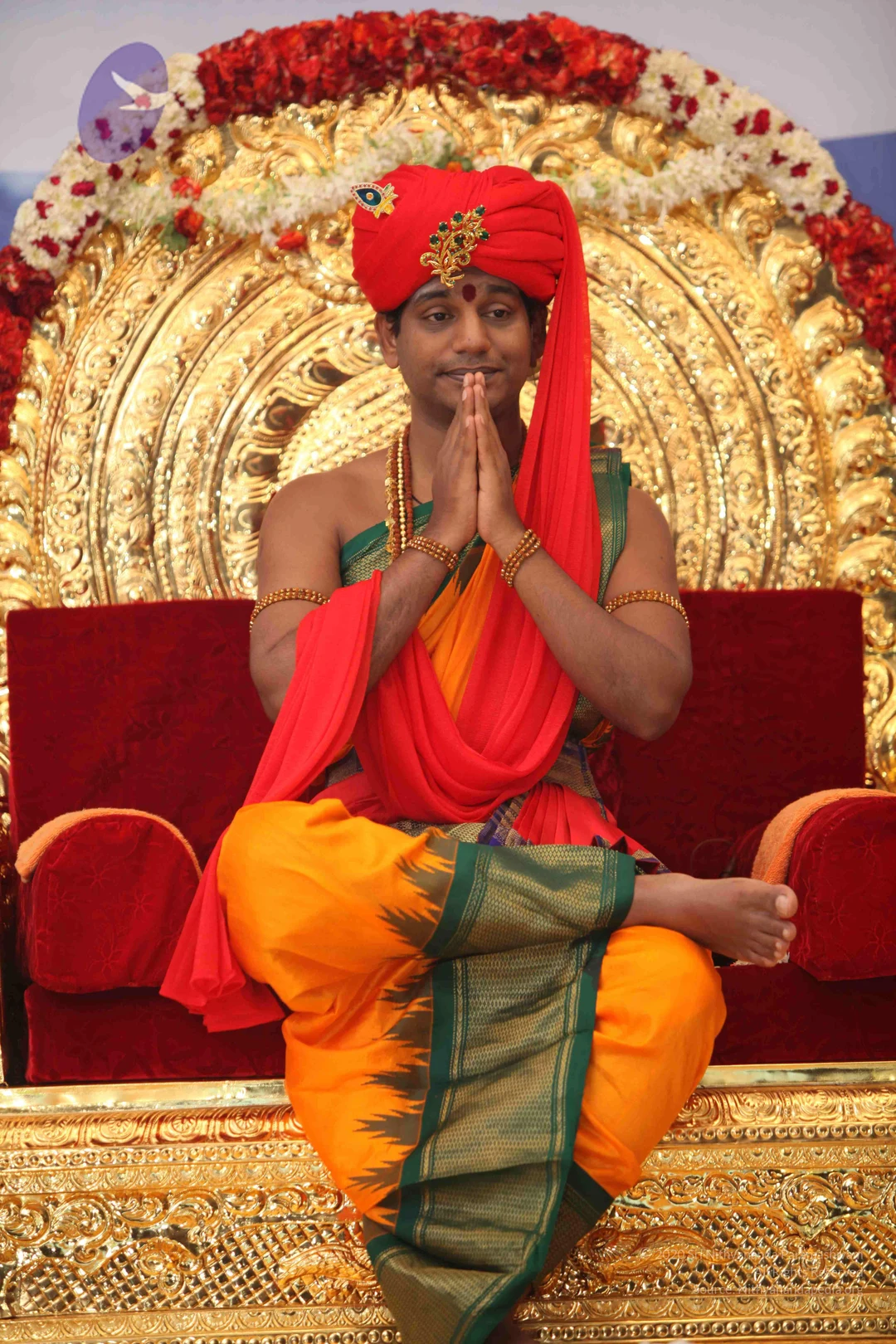
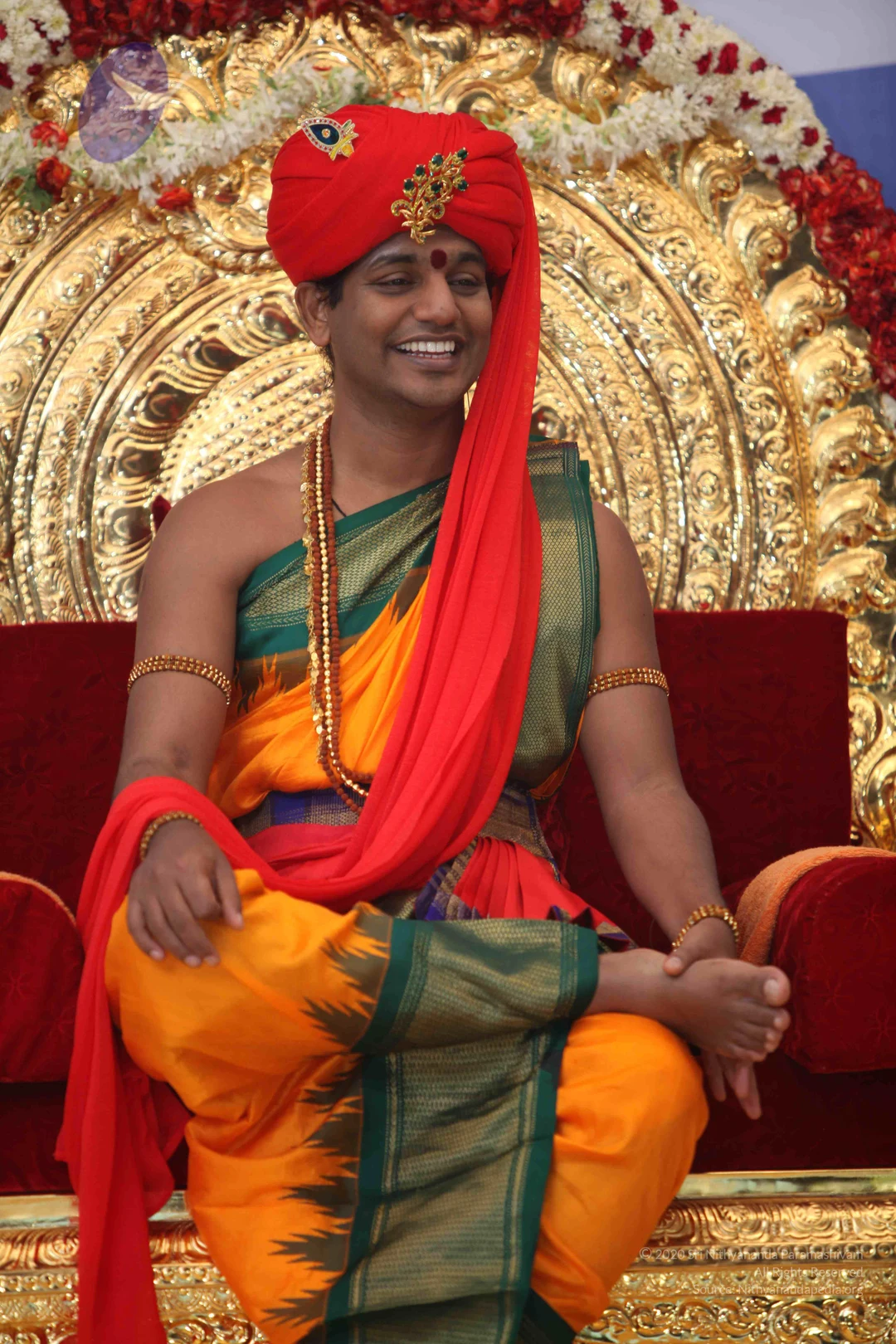
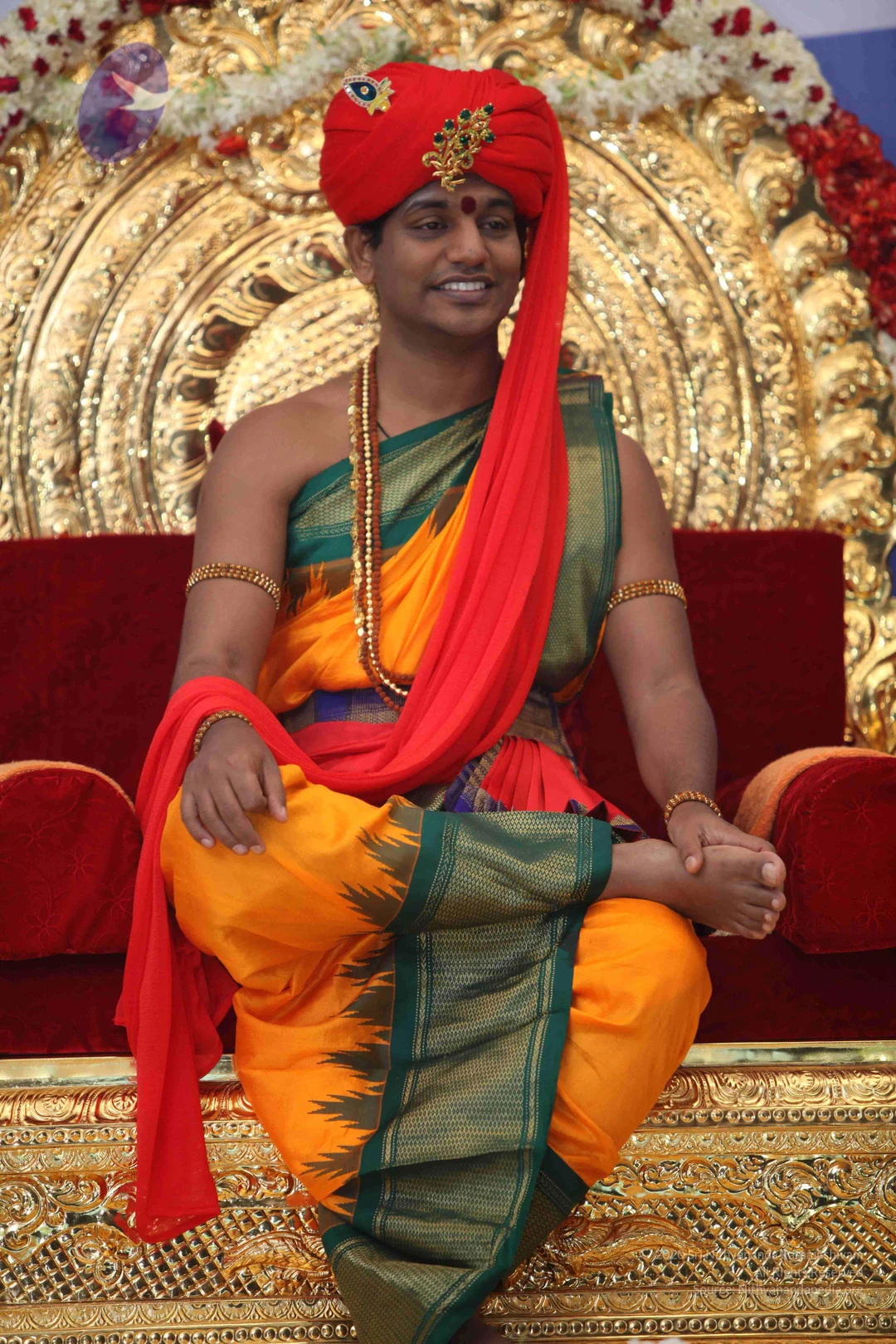
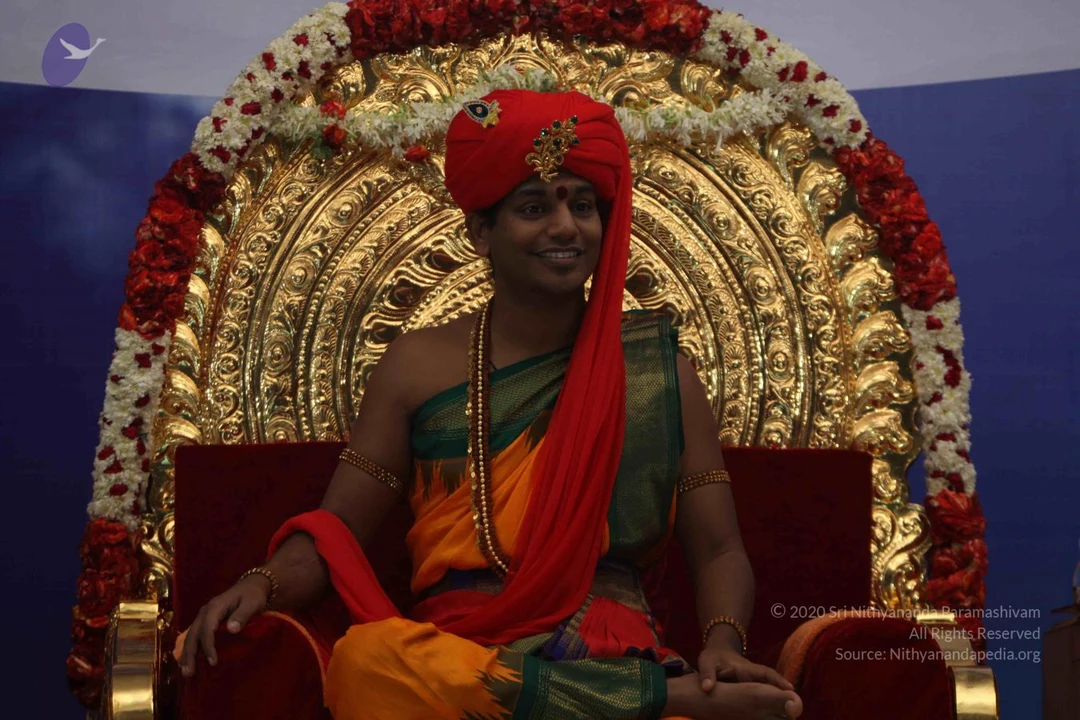
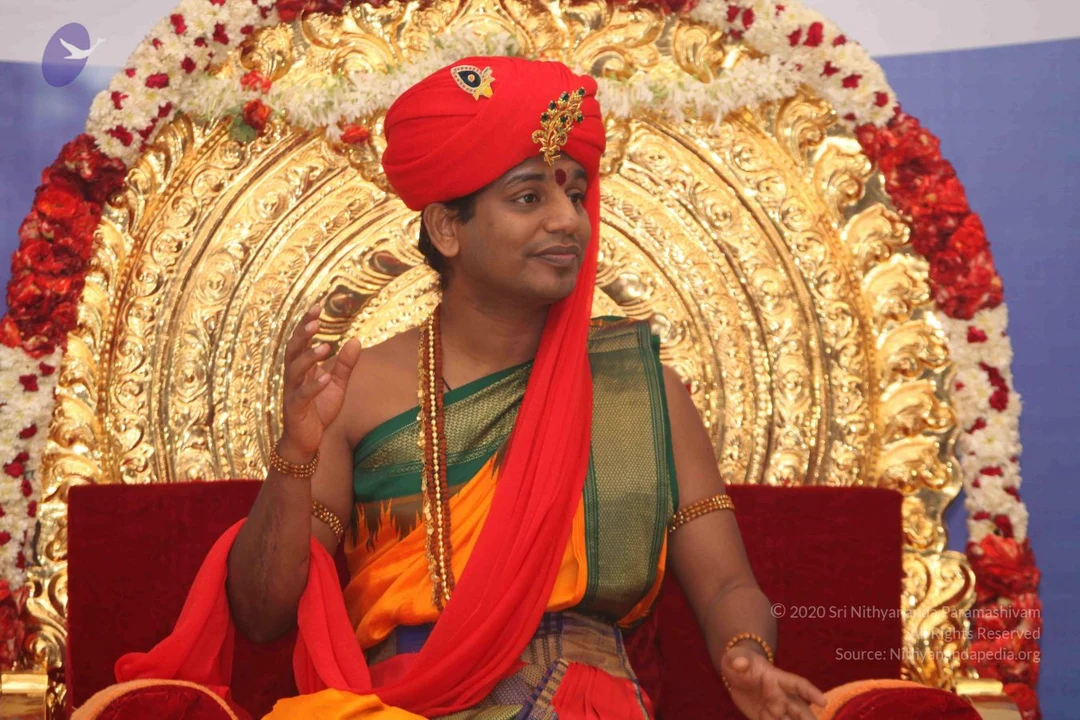
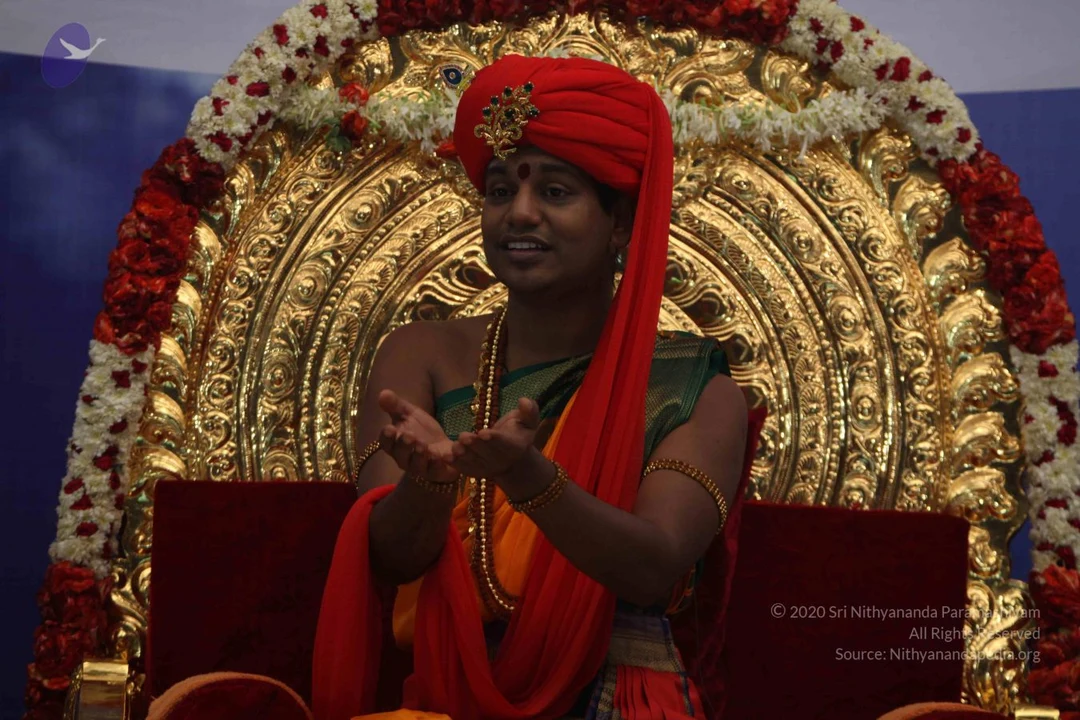
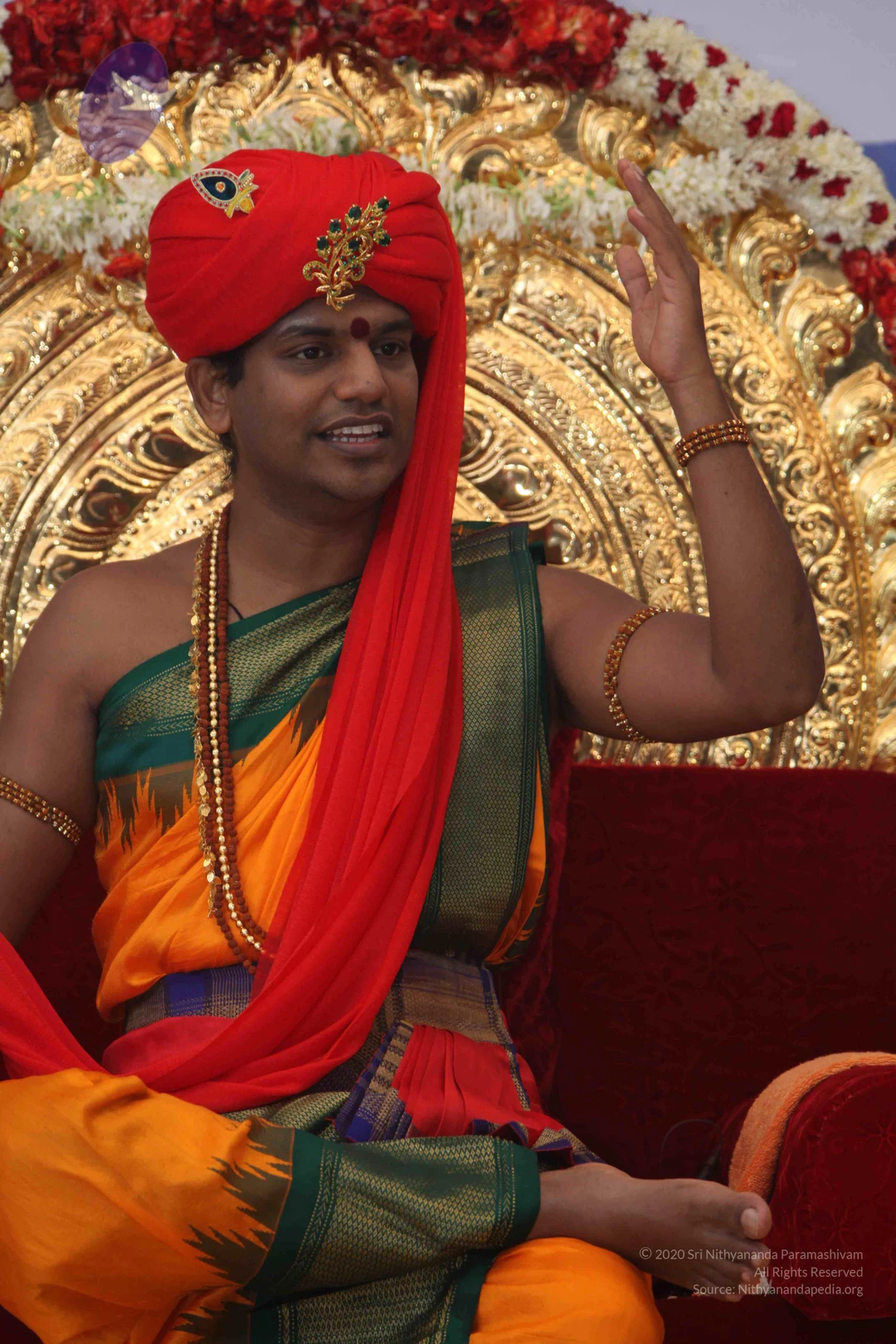
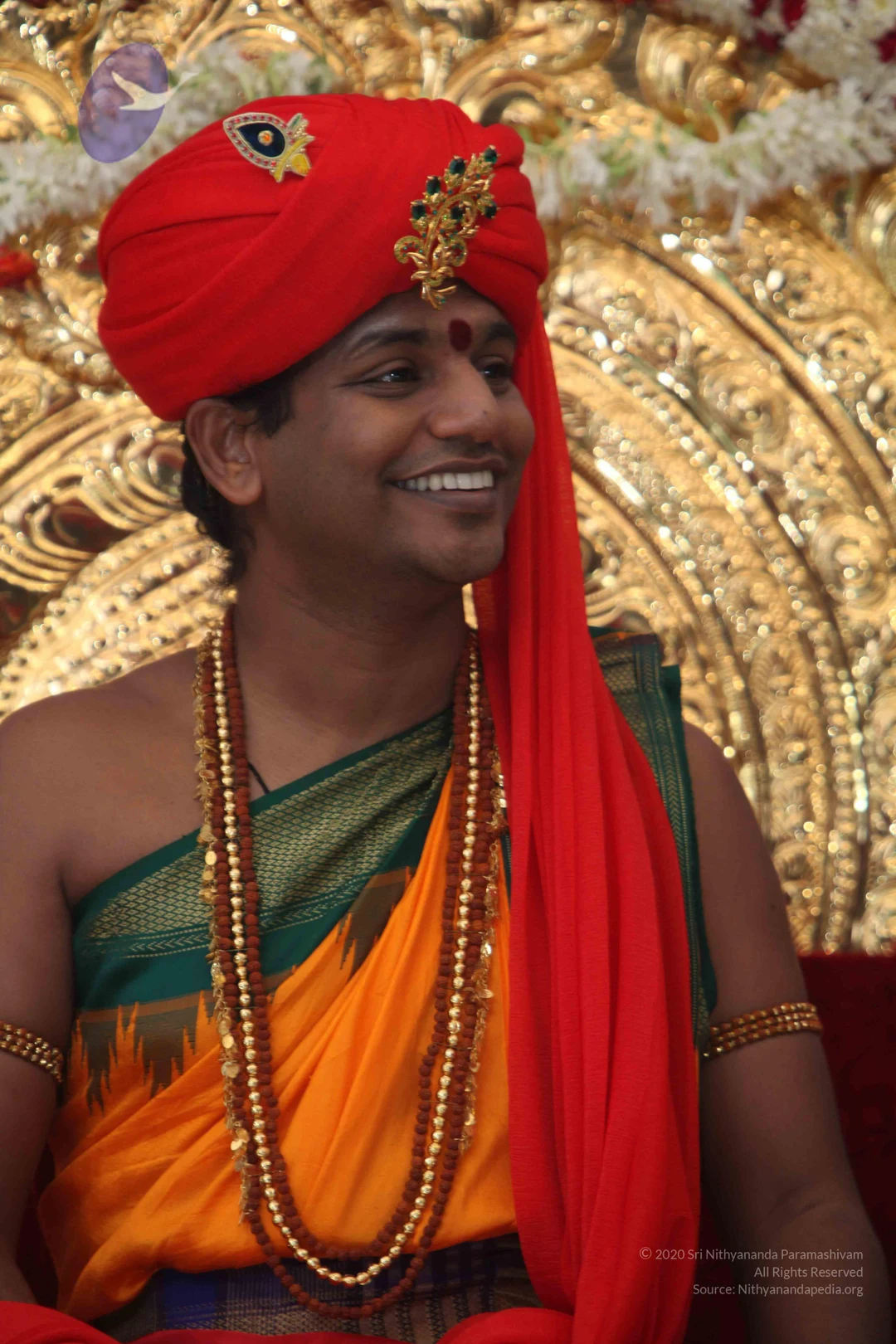
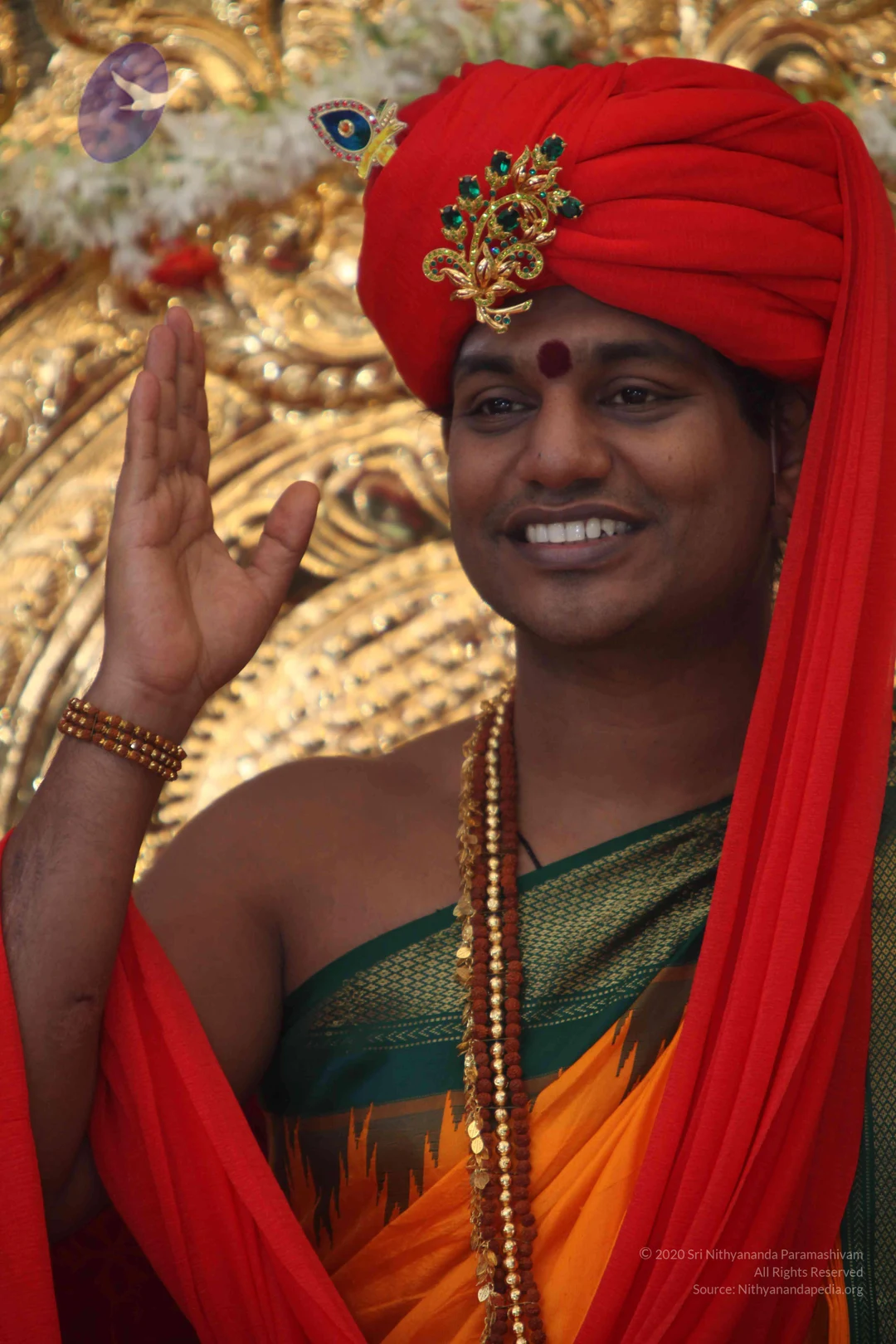
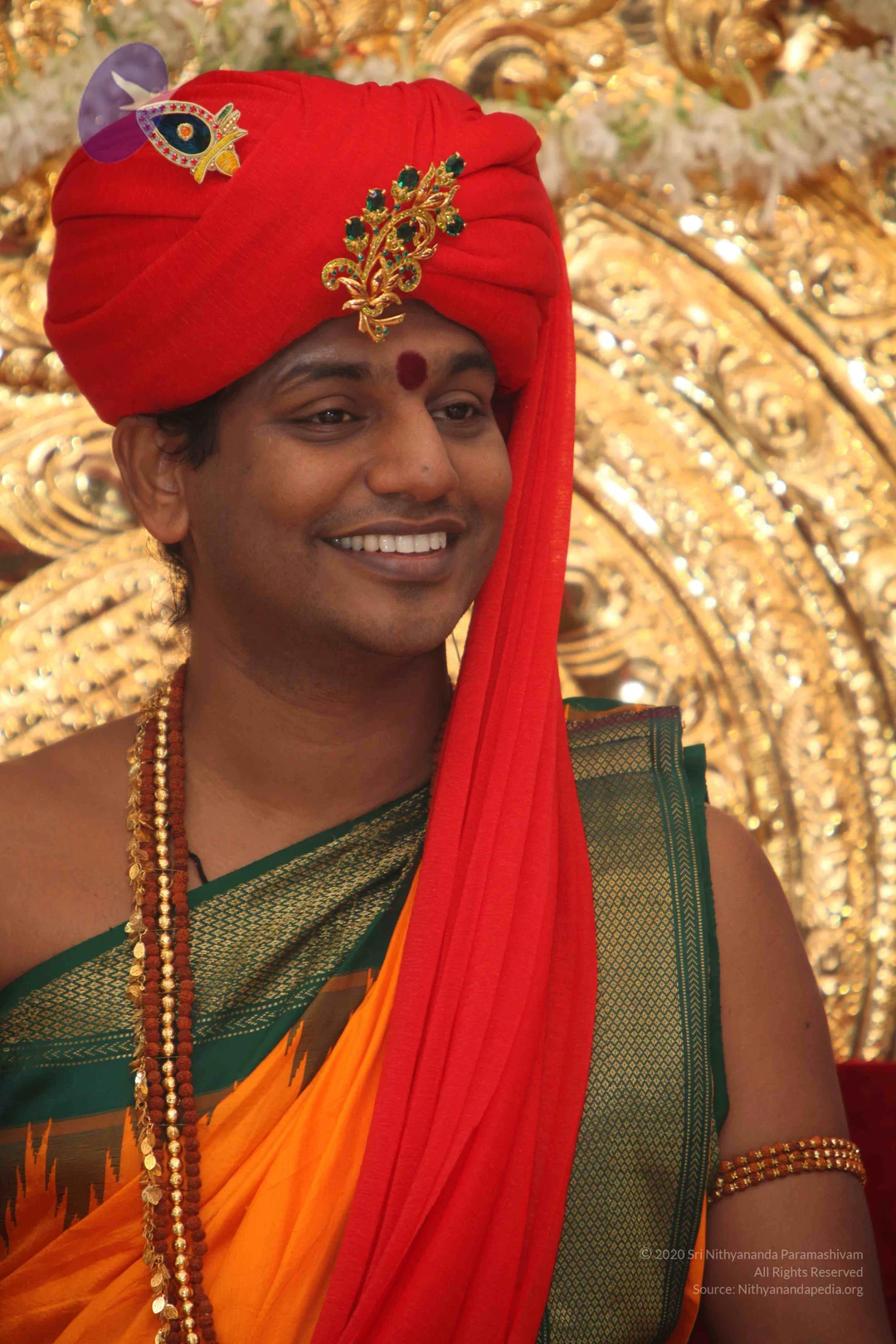
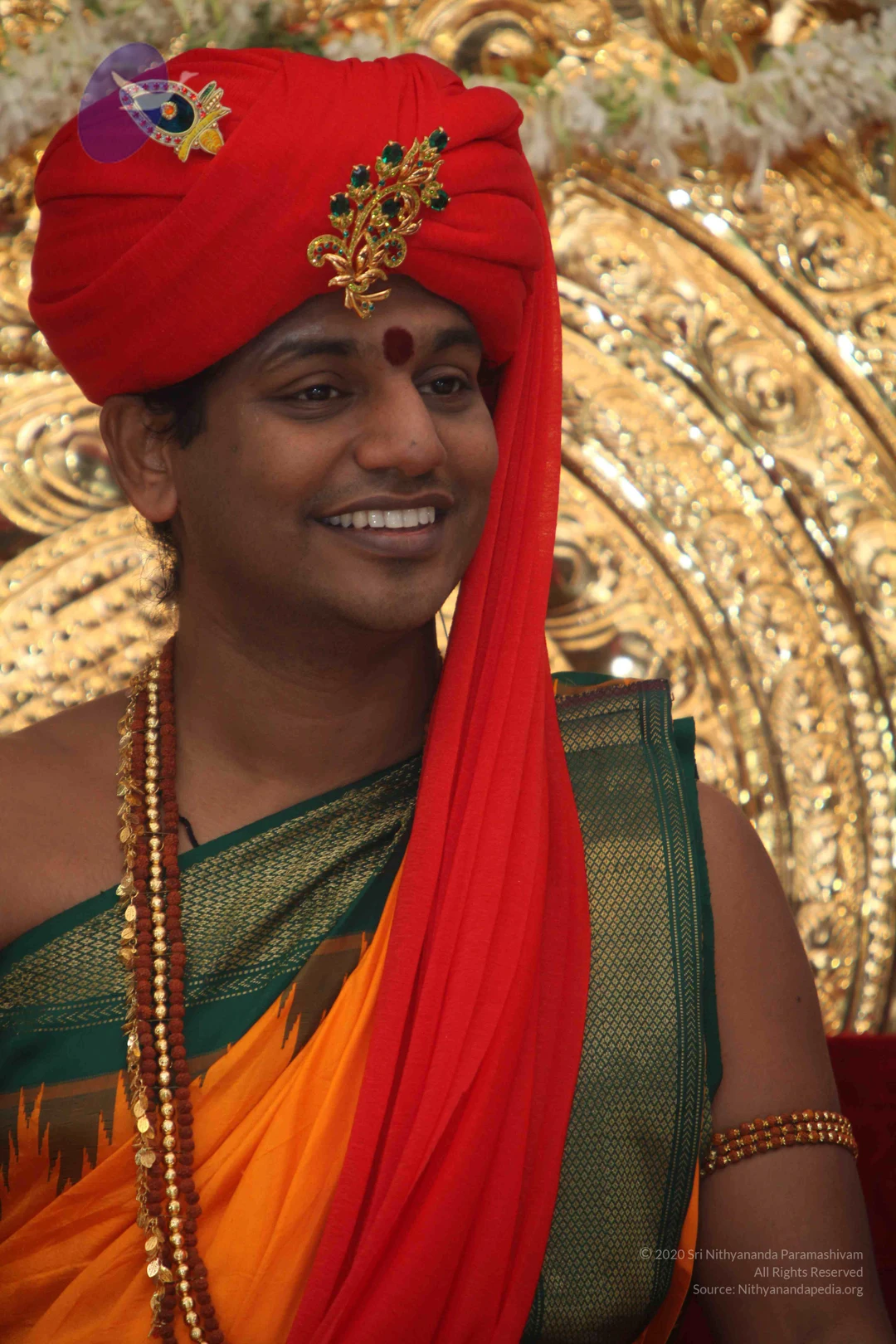
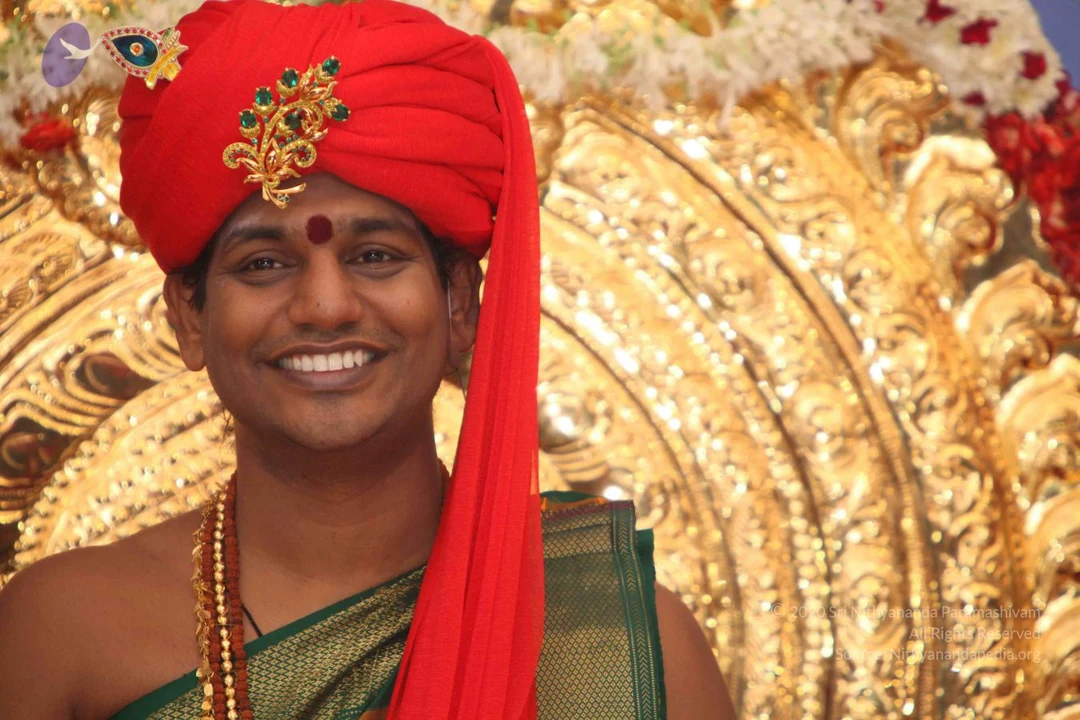
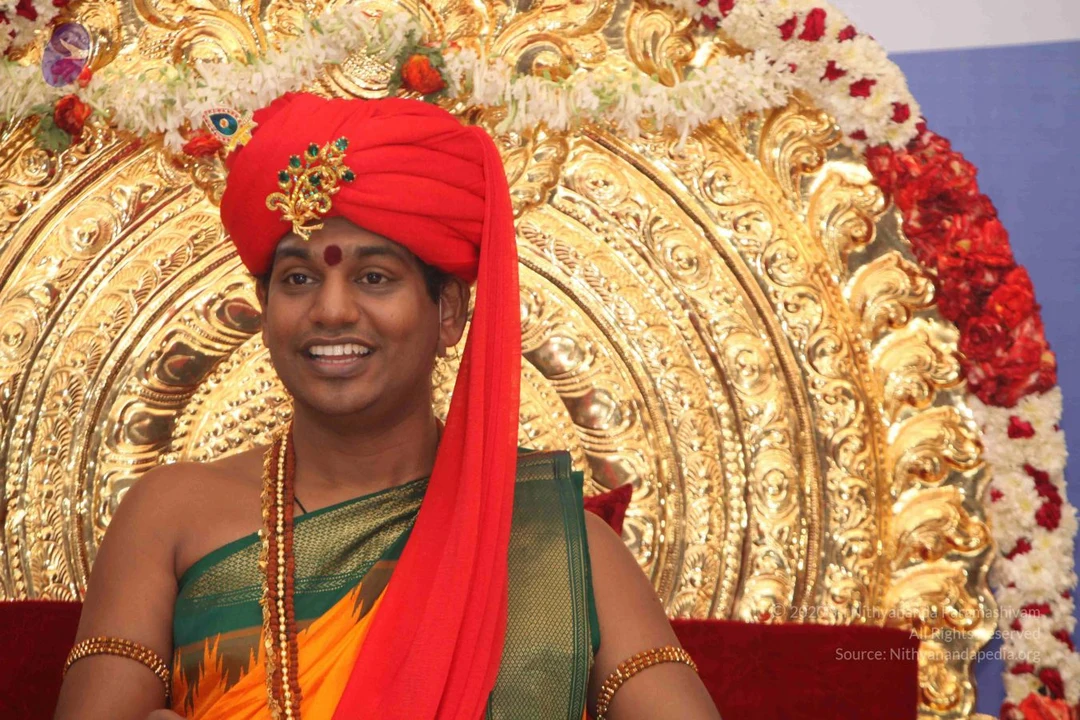
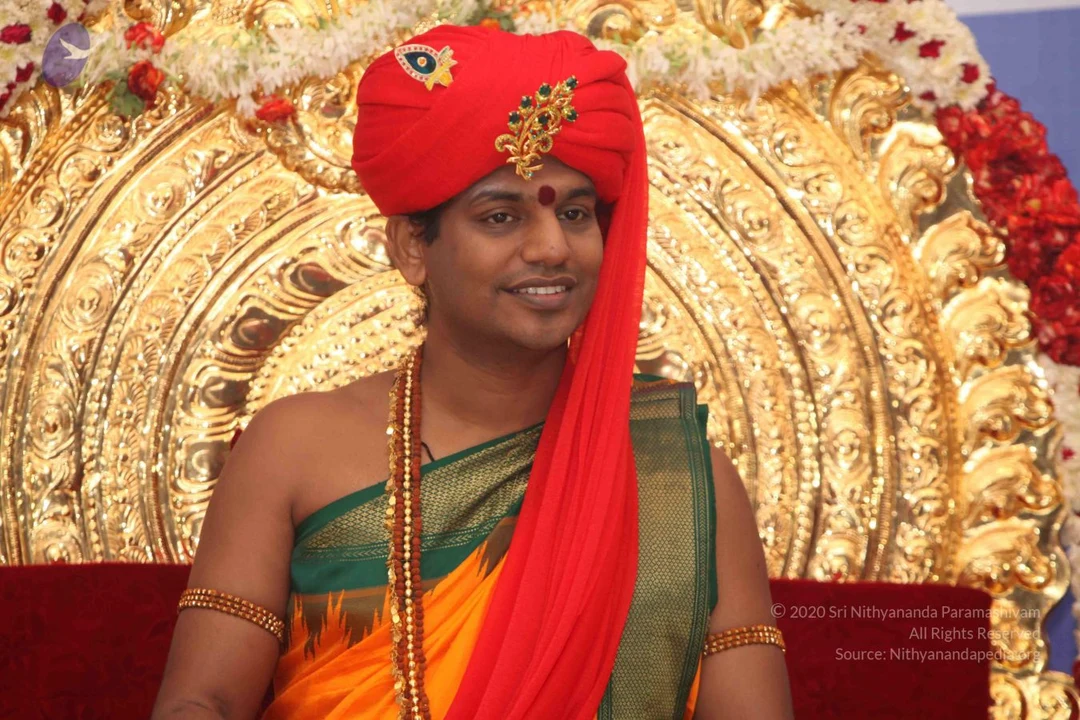
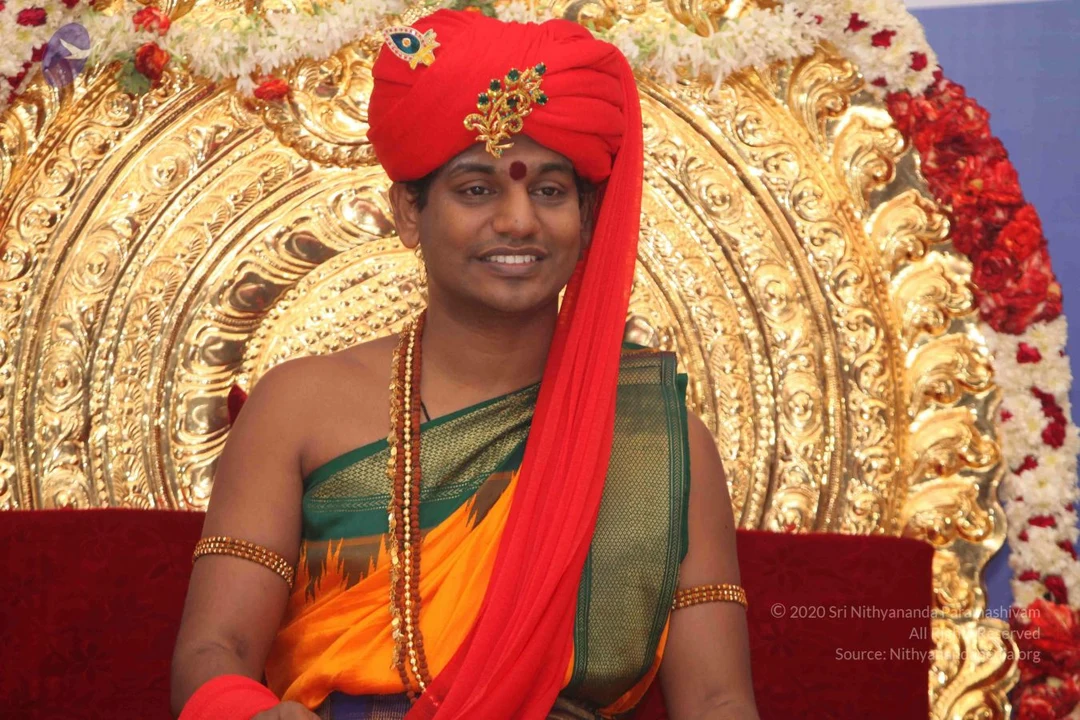
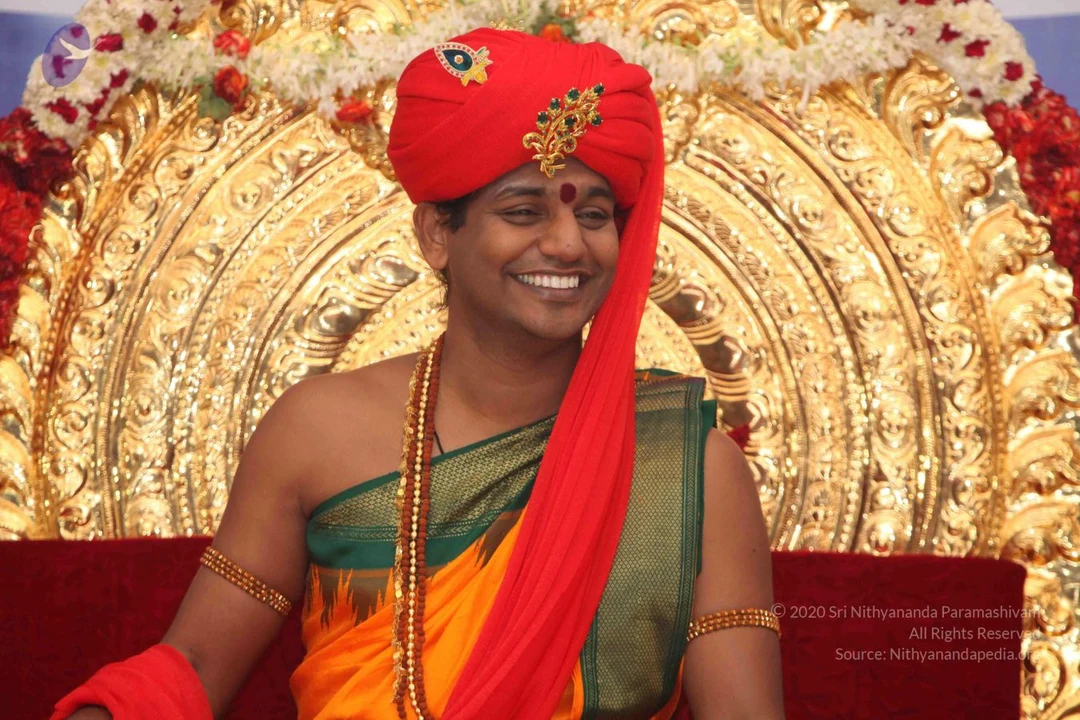
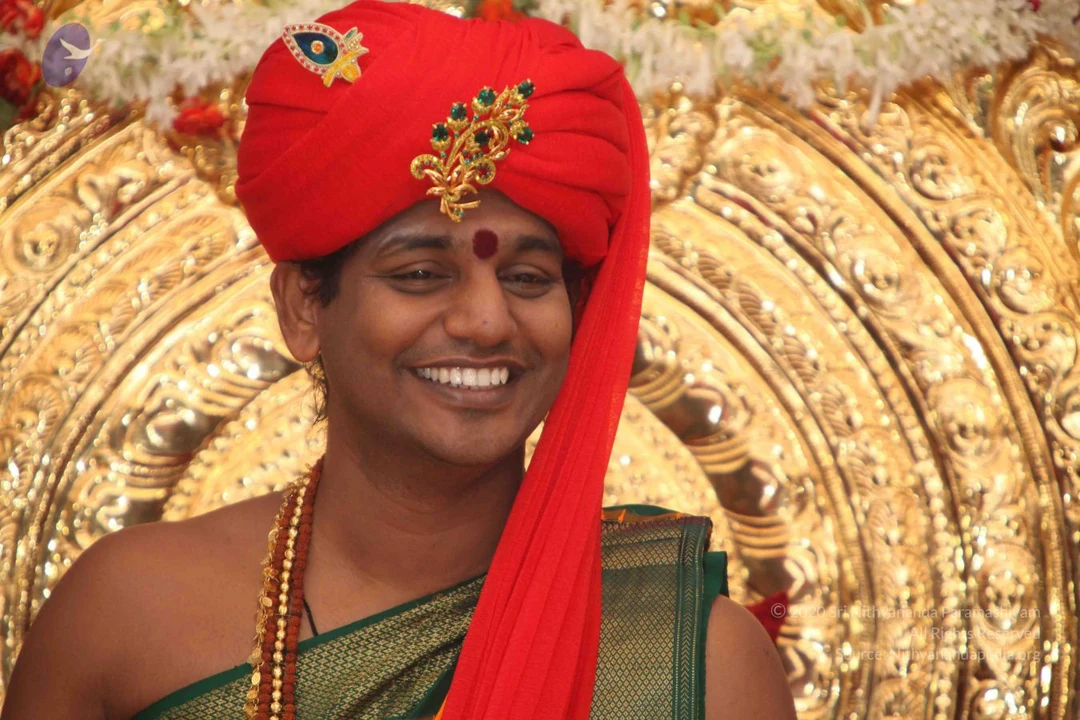
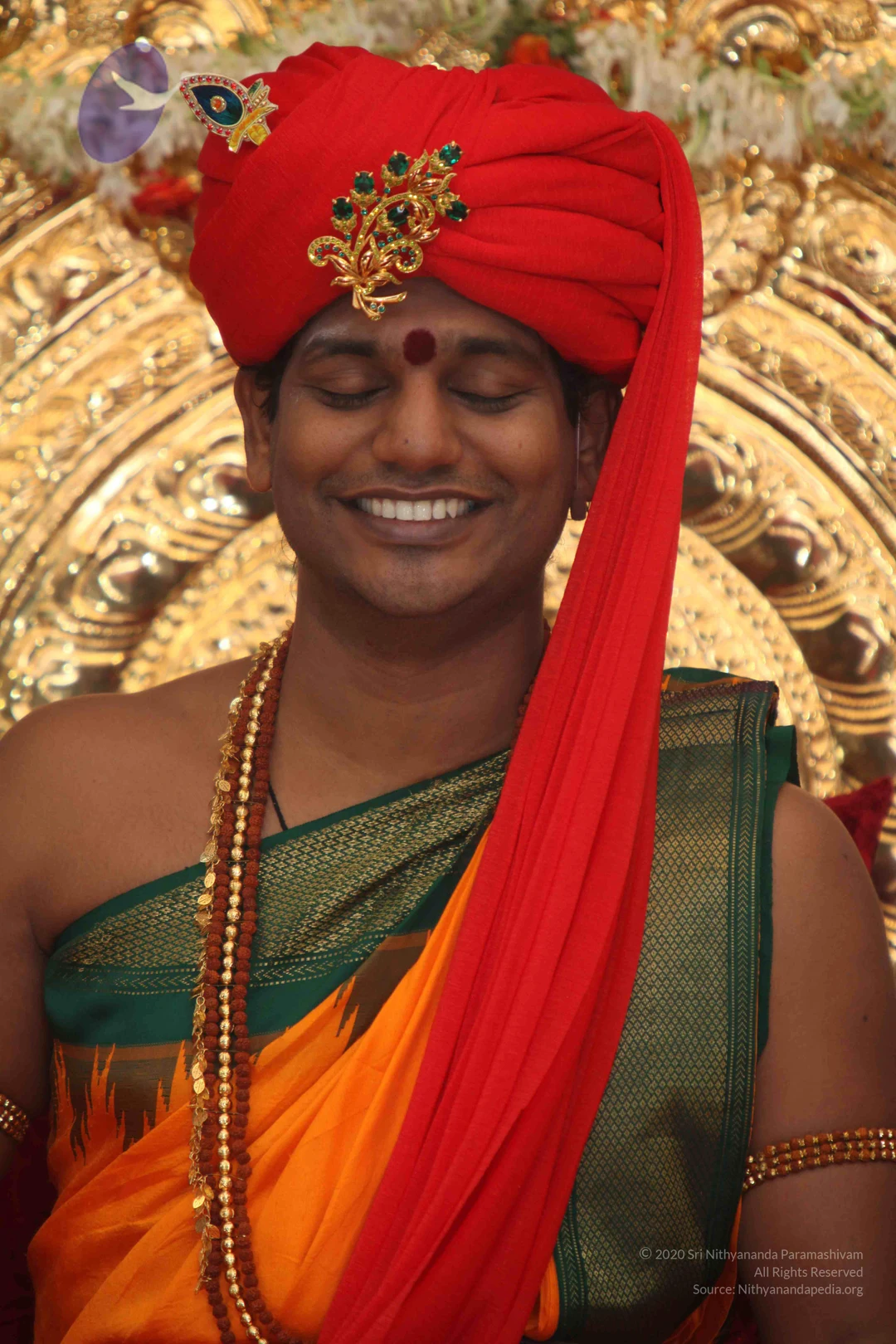
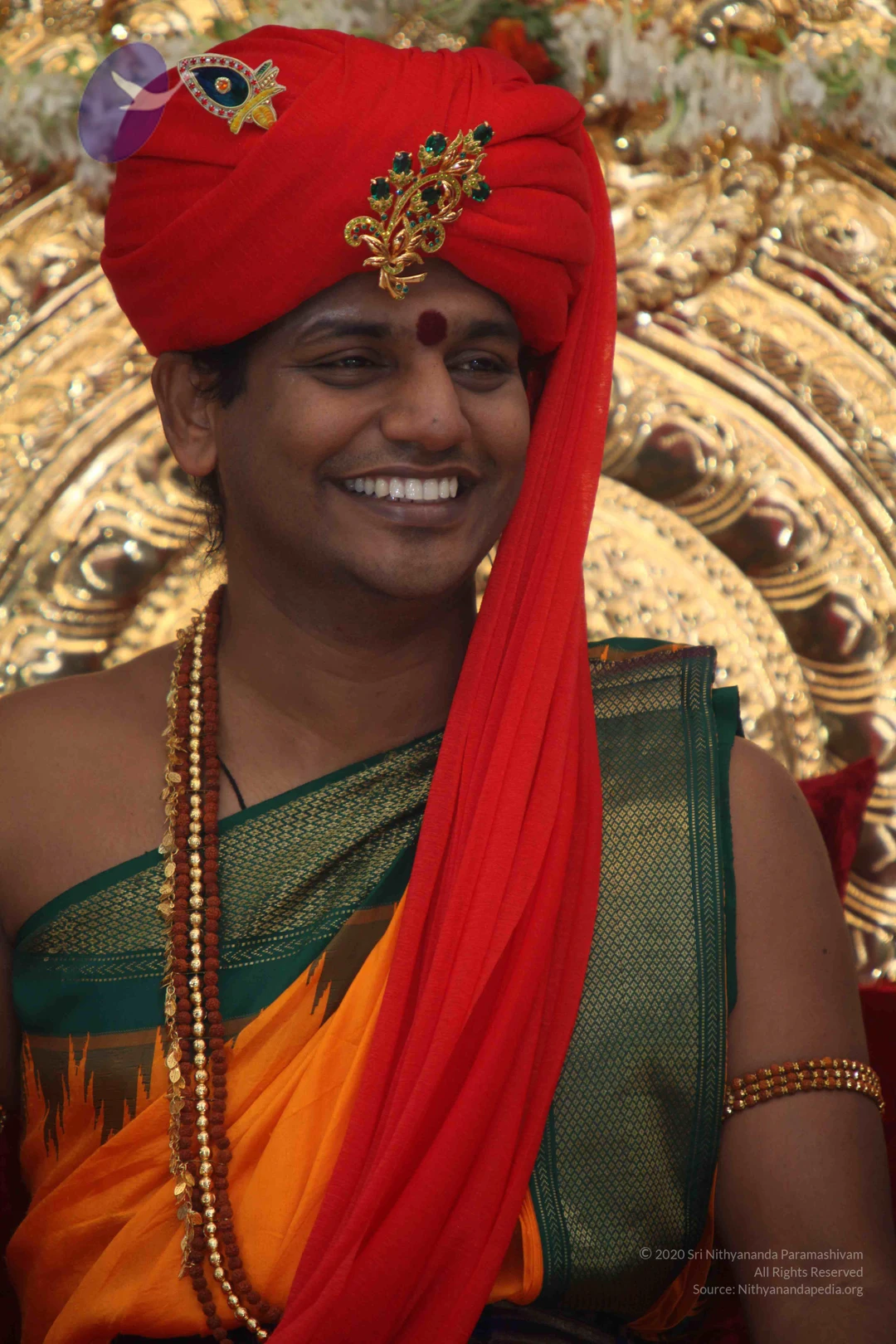
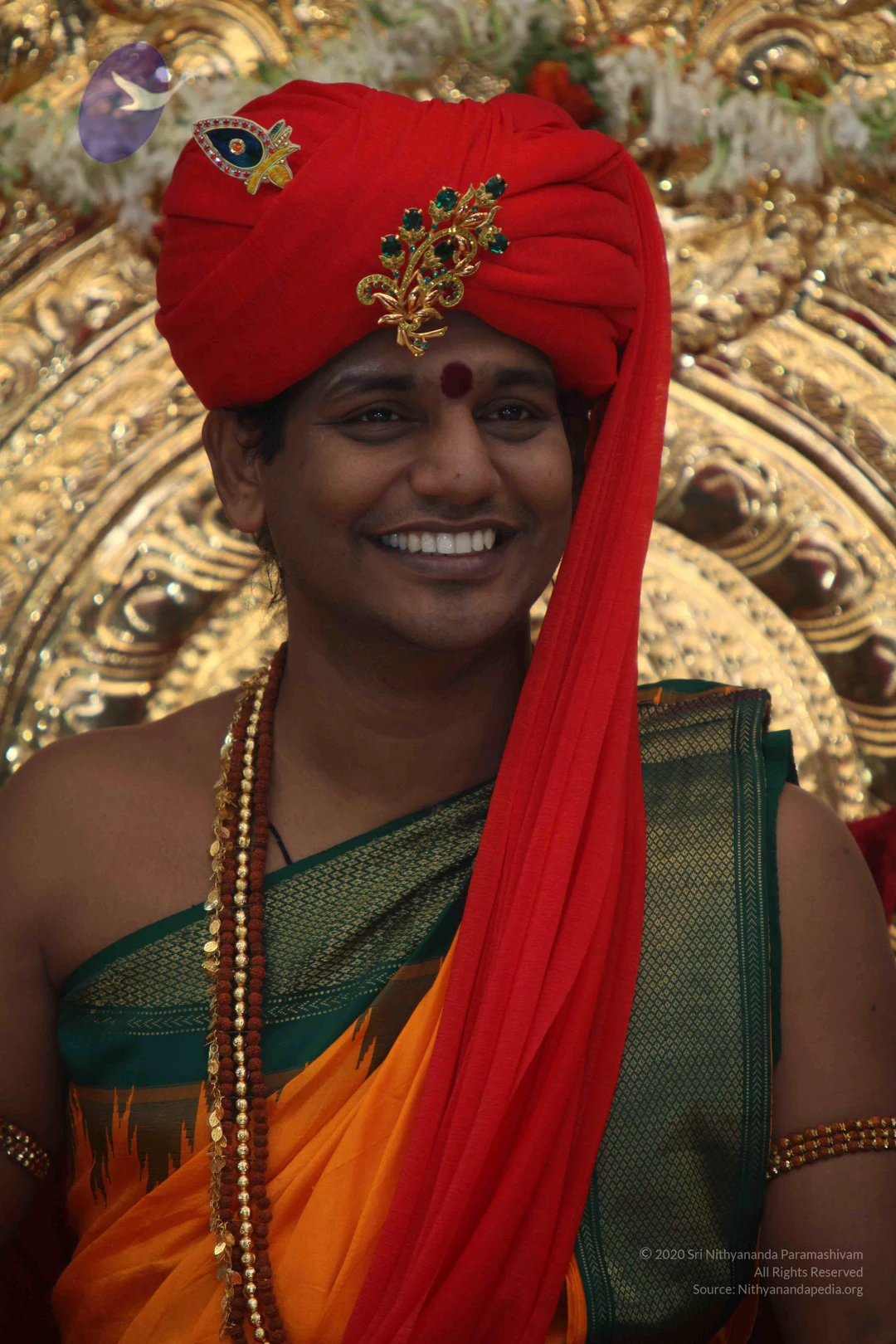
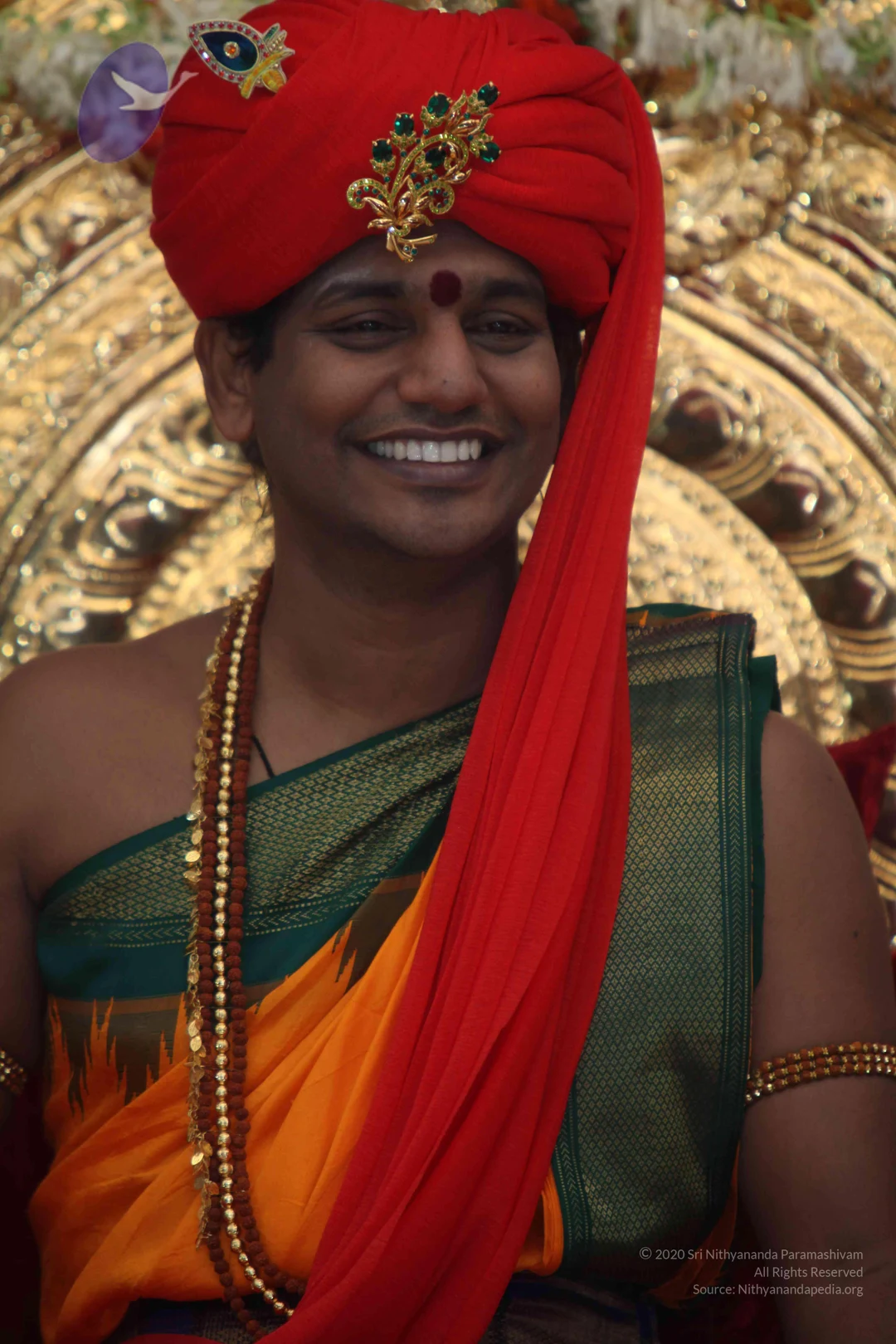
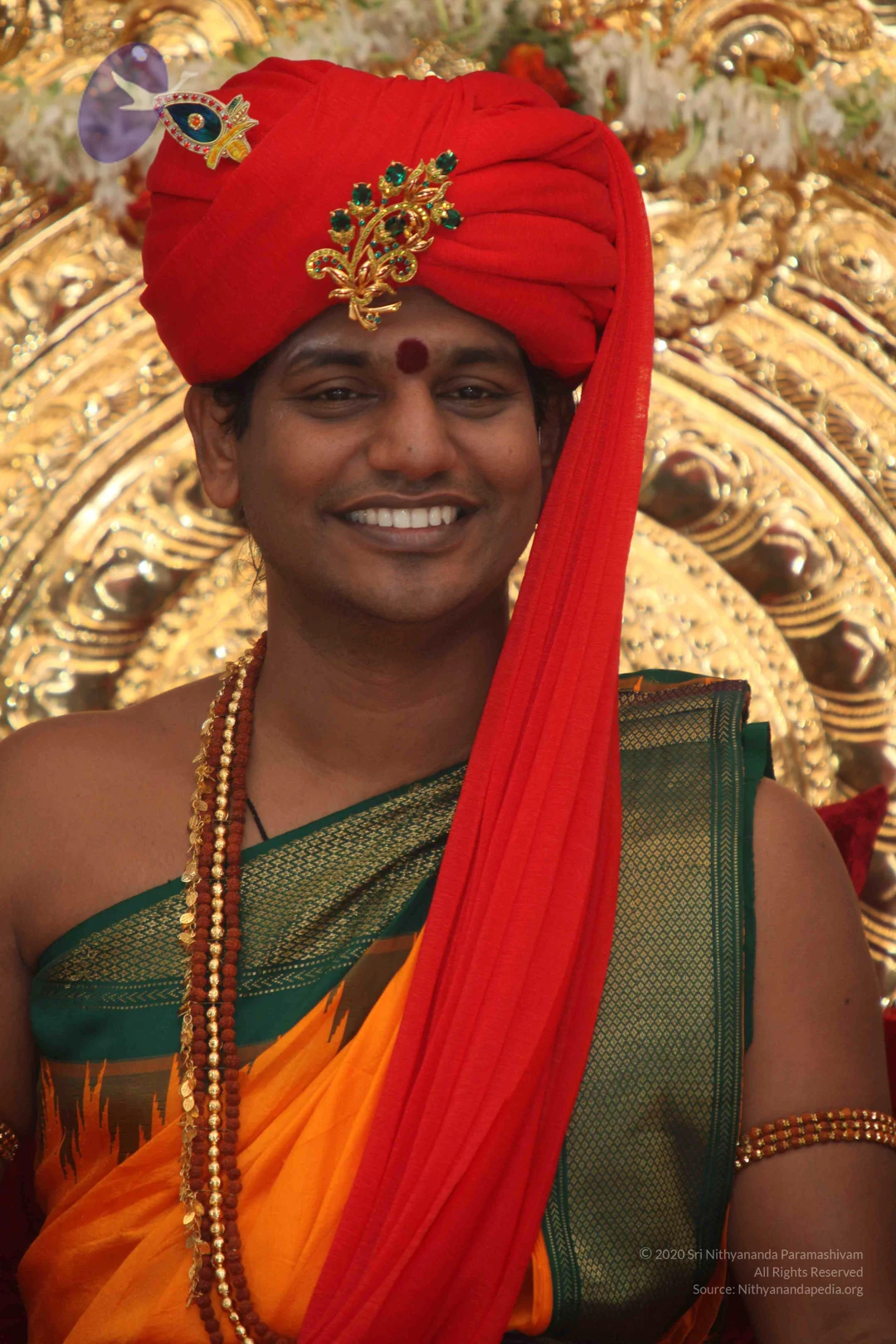
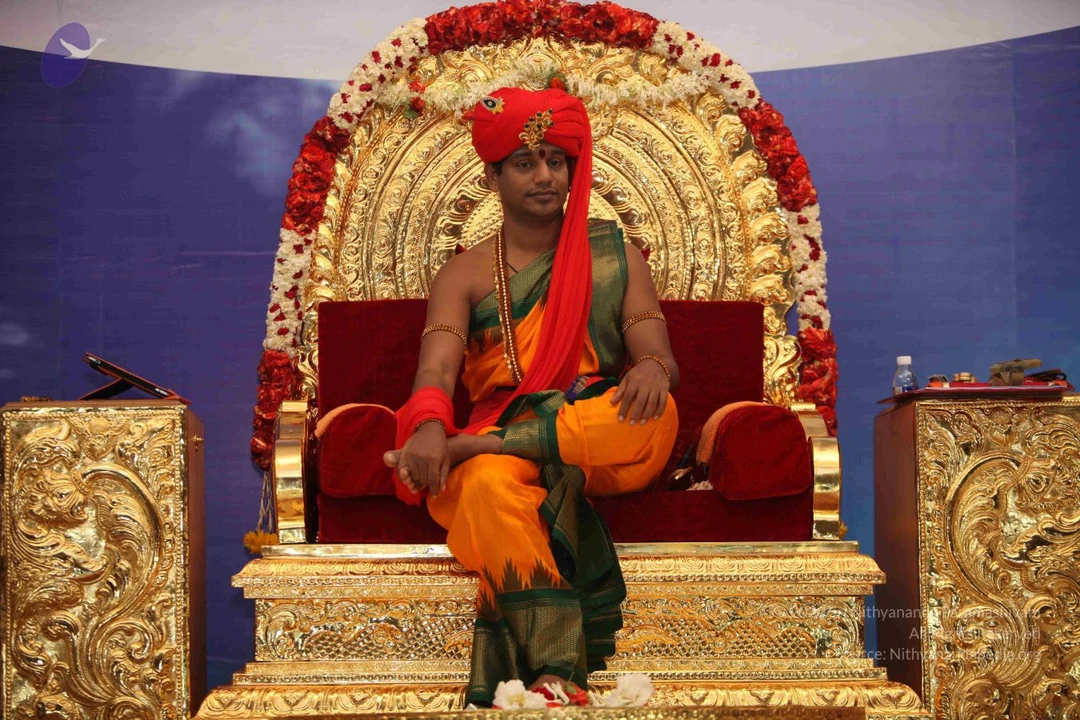
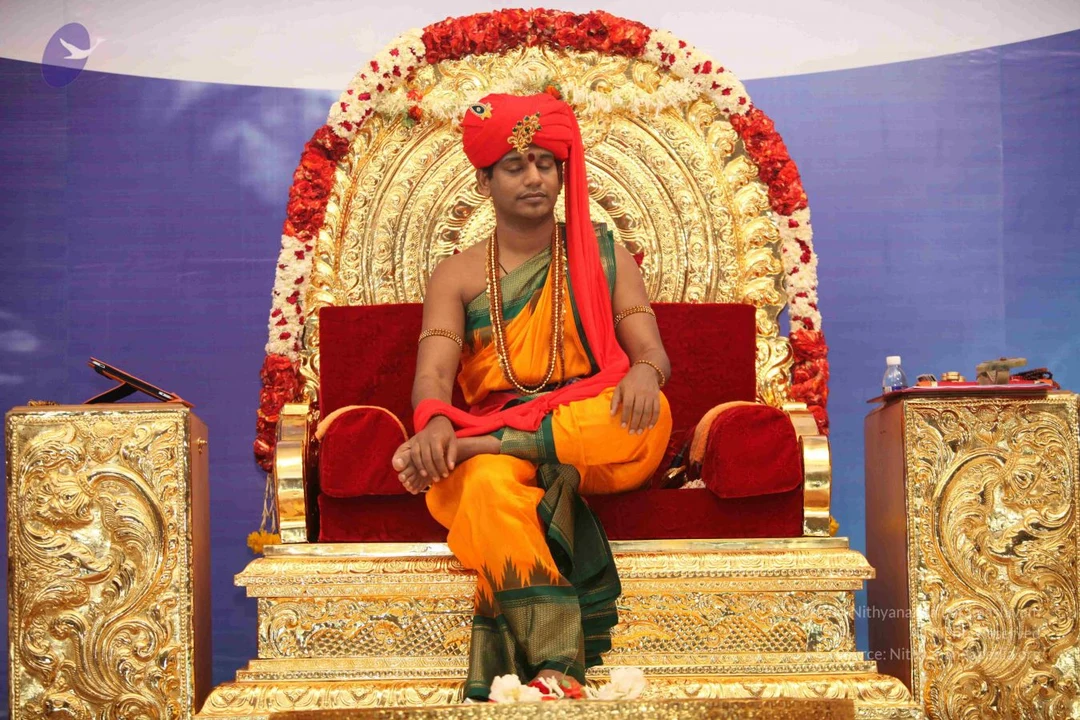
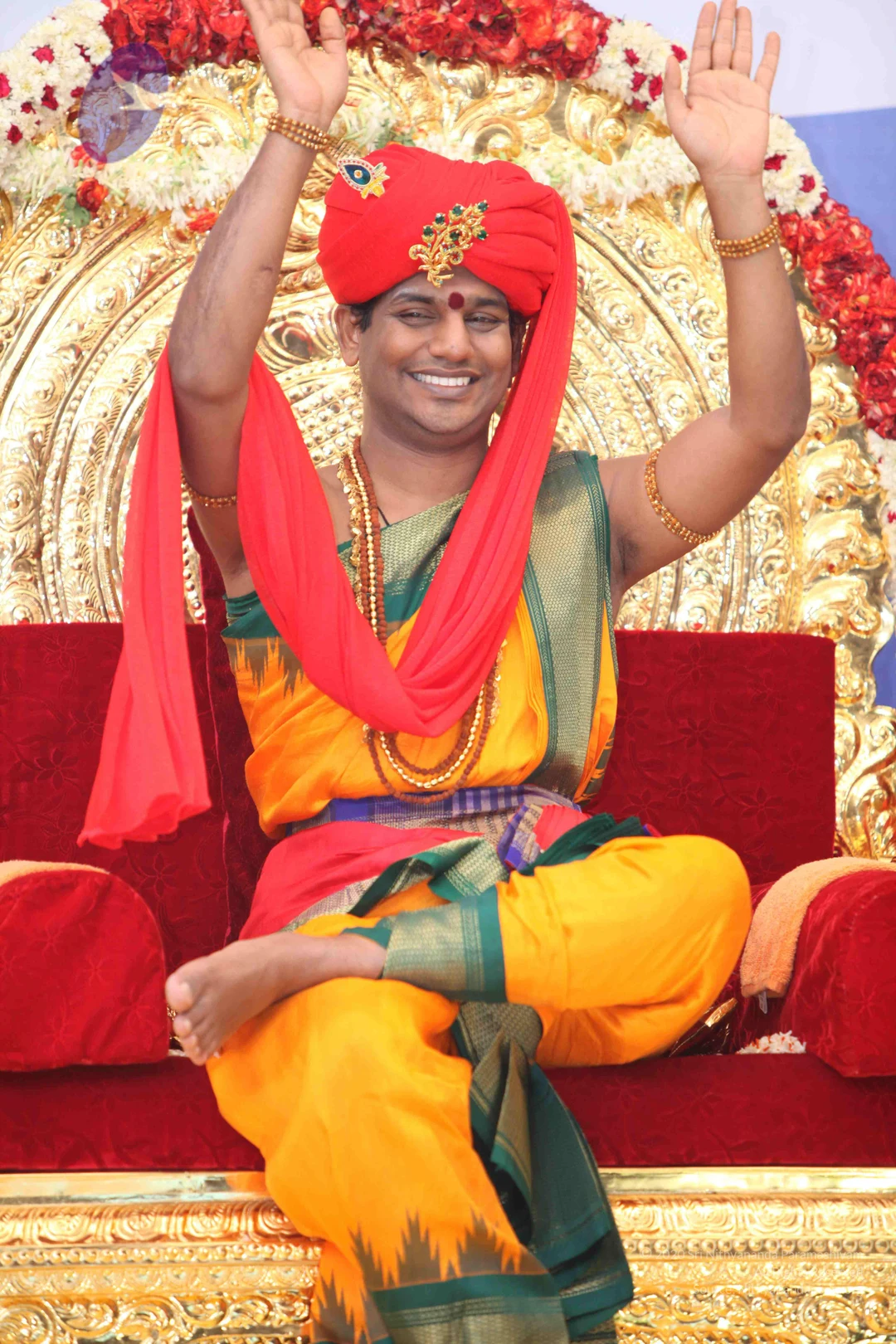
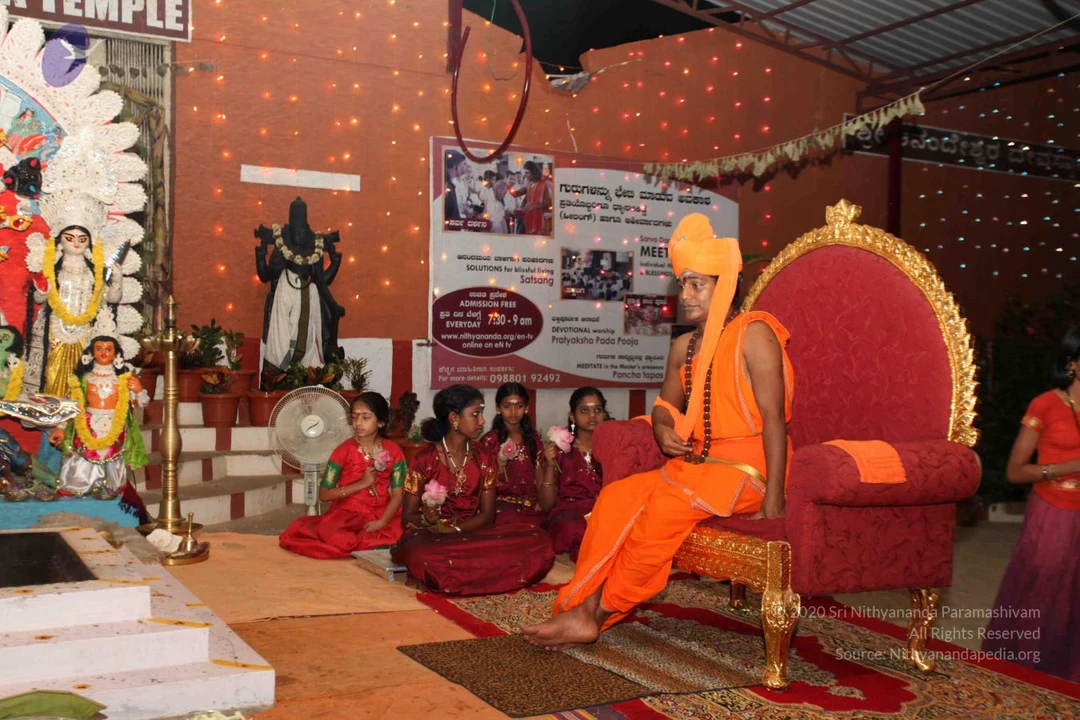
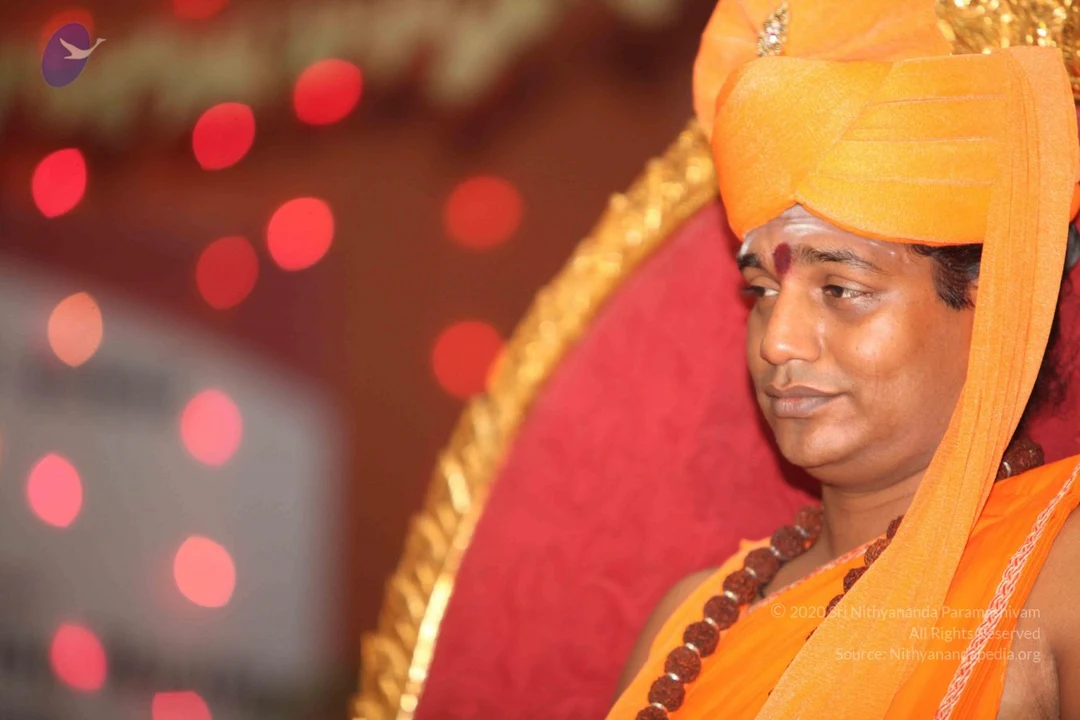
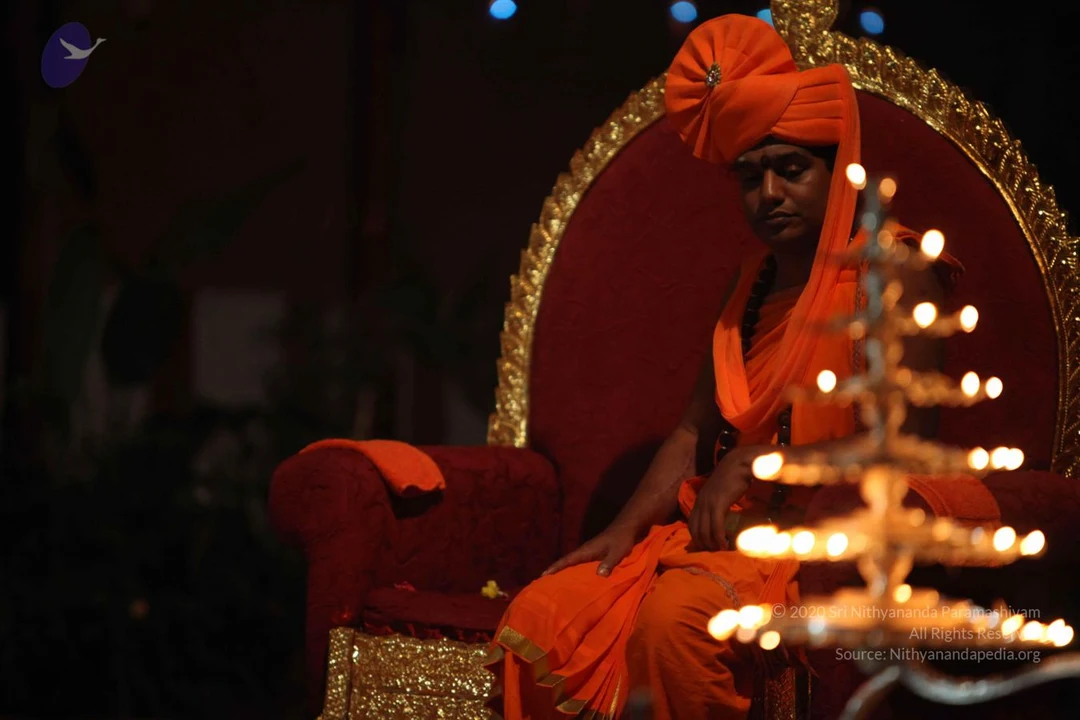
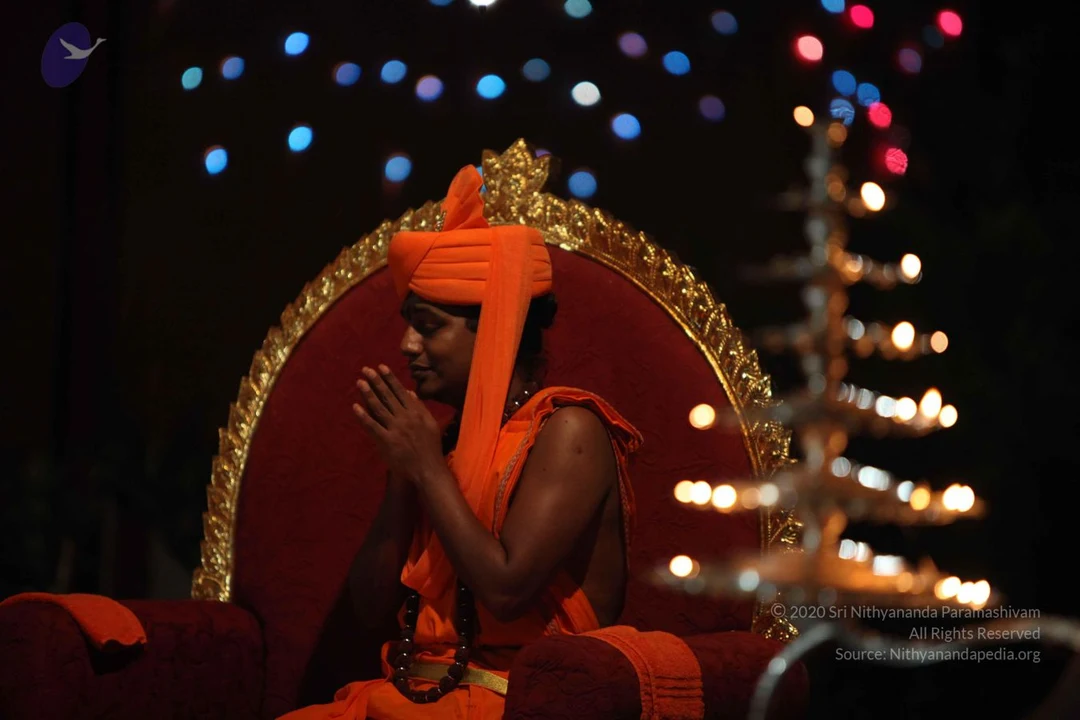
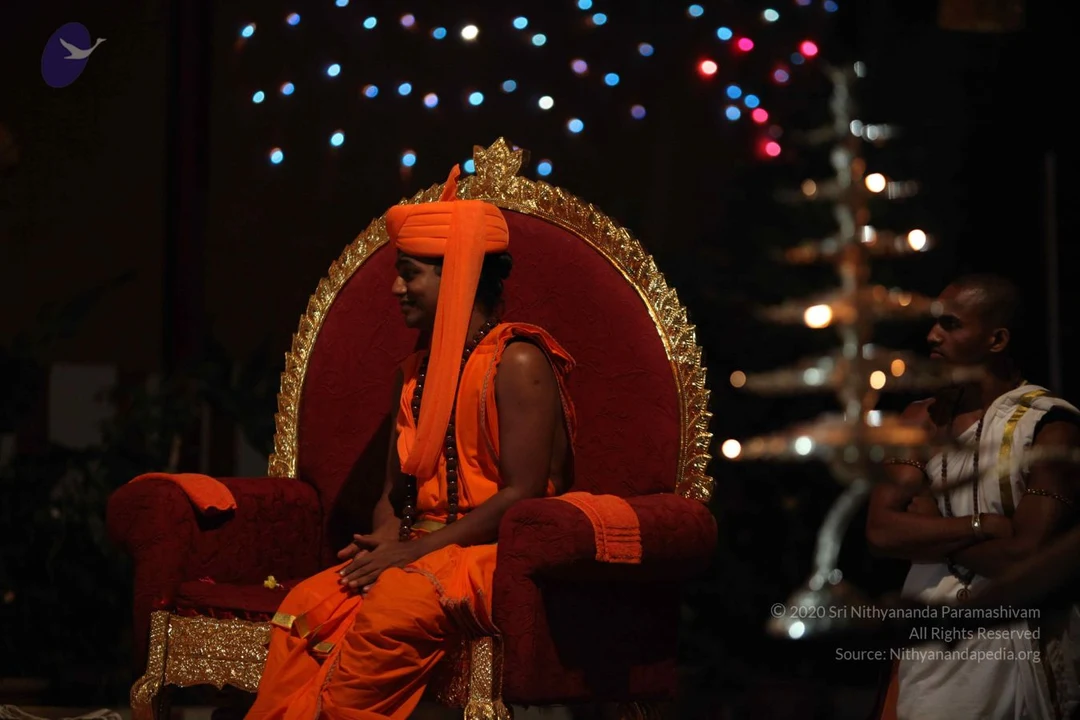
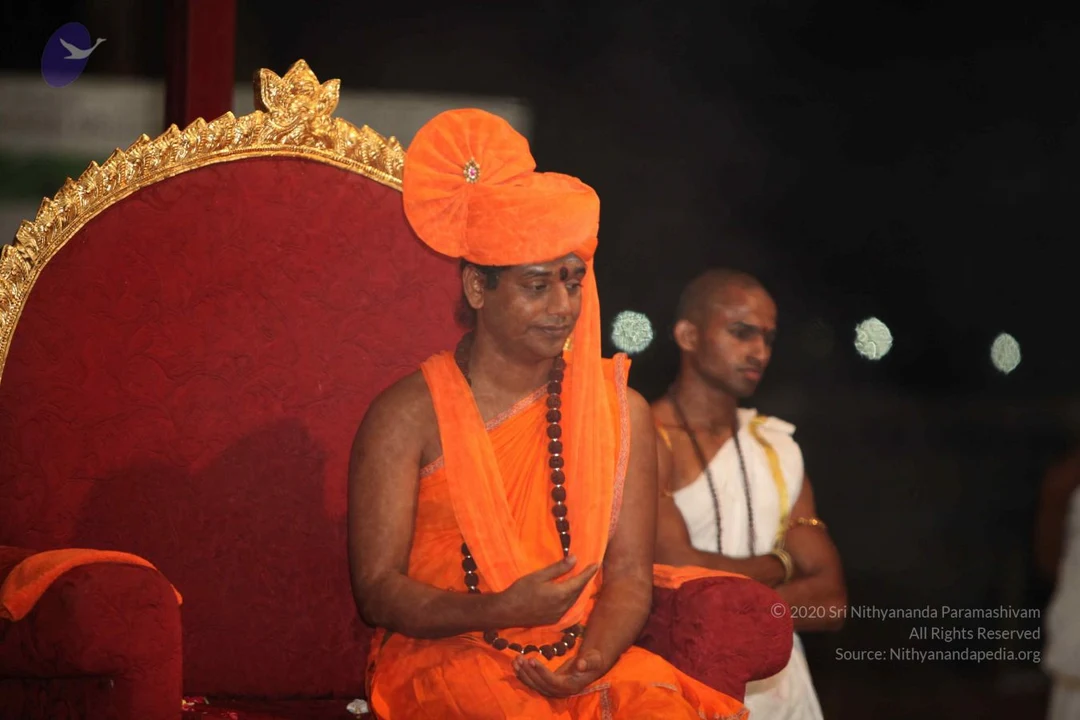
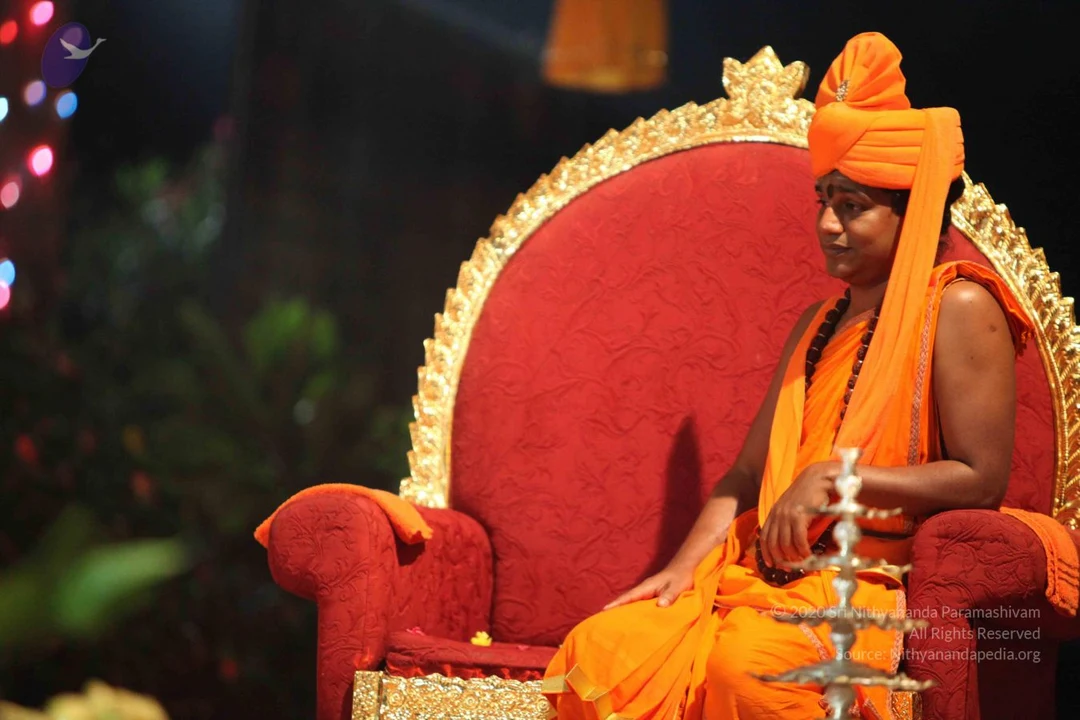
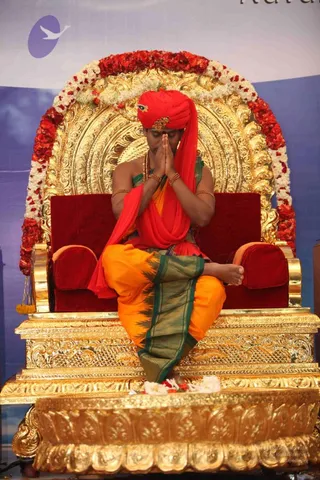
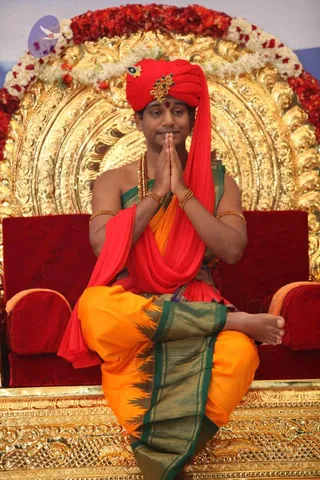
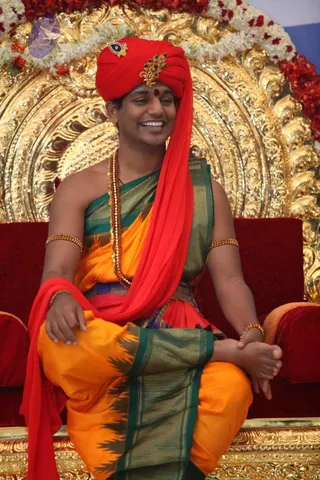
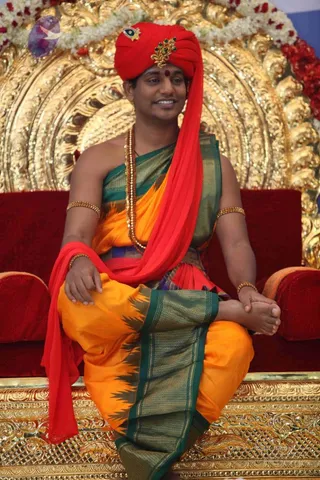
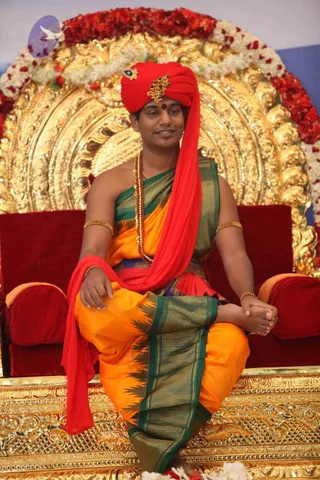
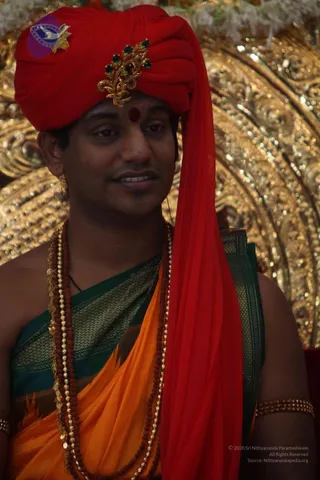
A man seated cross-legged on an ornate gold throne with red velvet cushions, palms pressed together in anjali namaskar with eyes closed. He wears a bright red turban with a gold ornament, a red shawl draped over bare shoulders, orange dhoti with a green and gold border, gold bangles, arm bands and a rudraksha-style necklace. Red and white flower garlands arc around the throne back, flowers rest at his feet, and a blue backdrop with a white bird logo is behind him.A man seated on an ornate gilded throne with red velvet cushions, decorated with a garland of red and white flowers across the top. He wears a red turban with a jeweled gold ornament and a red-and-orange shawl draped over orange and green silk dhoti-style garments. He has a red bindi on his forehead, gold armbands and bangles, and a gold bead necklace. His palms are pressed together in anjali mudra with a smile, and his feet are bare. Only one person is visible.A smiling man seated cross-legged on an ornate gold throne with red velvet cushions, decorated with red and white flower garlands above. He wears a bright red turban with a gold and green jewelled ornament and a red bindi, a red shawl draped over one shoulder, an orange dhoti with a green and gold border, a green and gold blouse, a multi-strand rudraksha and pearl necklace, and gold armlets.A seated man in a red turban with a jeweled ornament and a red dot on his forehead sits on an ornate gold throne with a red velvet backrest. He wears an orange and green silk dhoti-style garment, a red shawl draped over one shoulder, a pearl-and-bead necklace, and gold armlets. He is smiling, with one foot resting on the throne platform. A garland of red and white flowers decorates the top of the throne. Swamiji (probable) appears in this photograph, identified by the red turban, distinctive jeweled ornaments, ceremonial gold armlets and seated throne presentation. The photo shows a satsang setting.A seated man in a red turban with a gold brooch and red tilak on his forehead sits cross-legged on an ornate gold throne with red velvet cushions. He wears an orange and green silk garment with a gold-bordered dhoti, a red shawl draped over one shoulder, a rudraksha-style bead mala, and gold armlets. The throne is backed by a gold repoussé arch decorated with red and white flower garlands. Probable Swamiji is shown, based on the red turban, ceremonial gold ornaments, and rudraksha mala, seated in a throned honouring setting.Photograph of a man seated in front of an ornate gold-leaf backdrop with floral carved detailing. He wears a bright red turban with a gold and green jewelled brooch and a purple emblem, a red forehead dot, multiple strands of rudraksha beads and gold beads, a green and gold-bordered shawl draped over an orange garment, and gold bangles on his wrists.

SARVA-DARSHAN

7 photosSource gallery
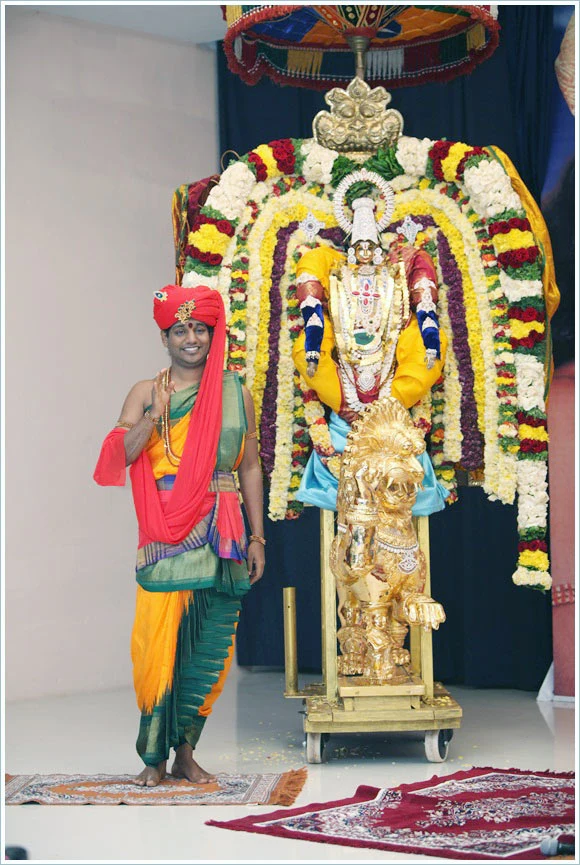
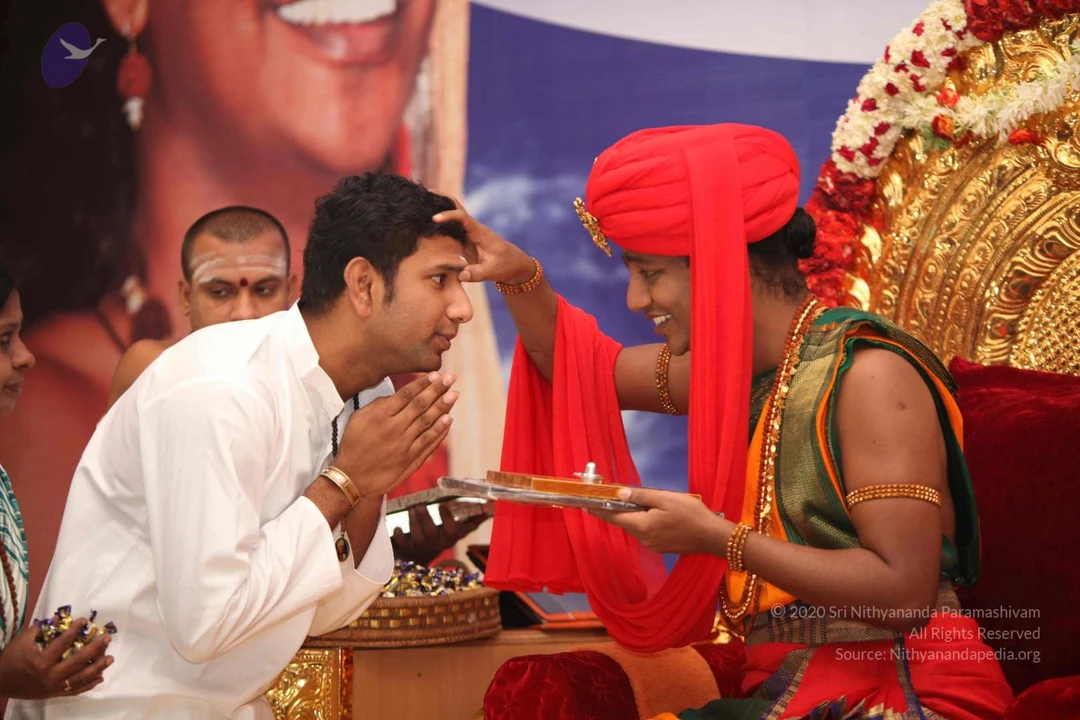
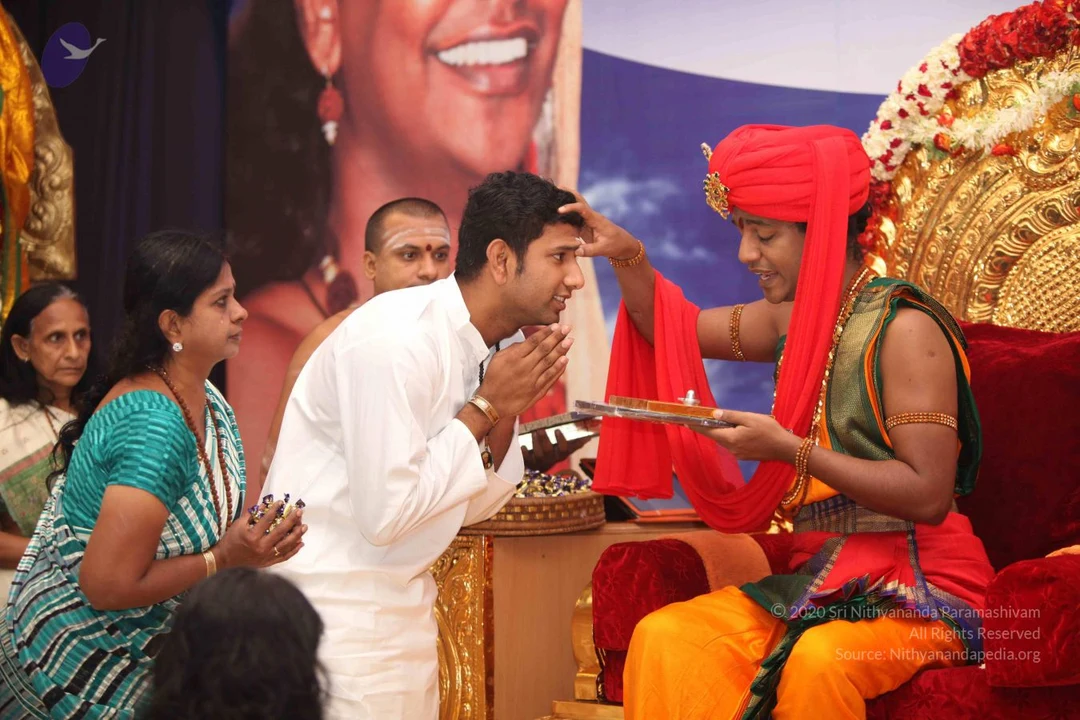
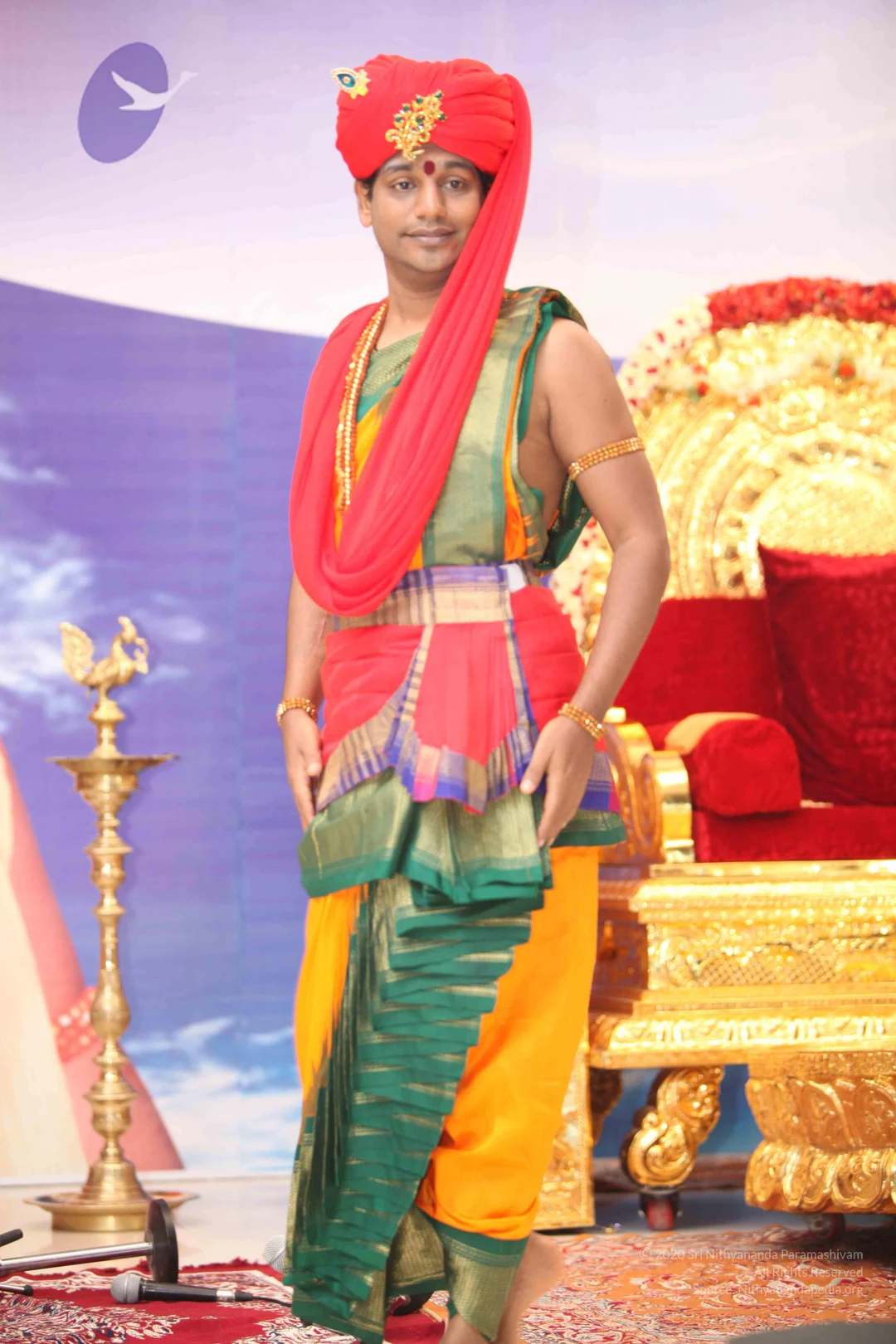
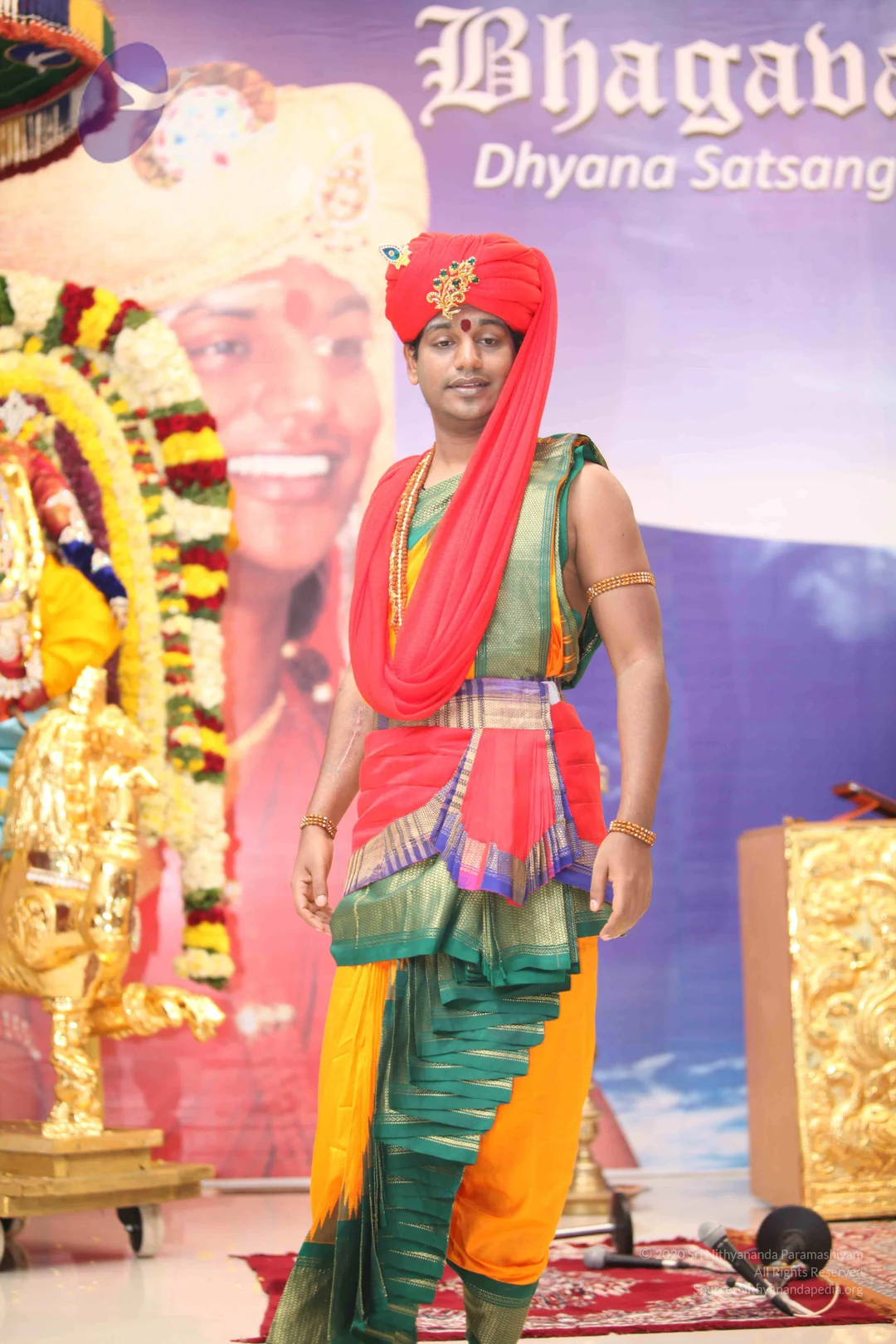
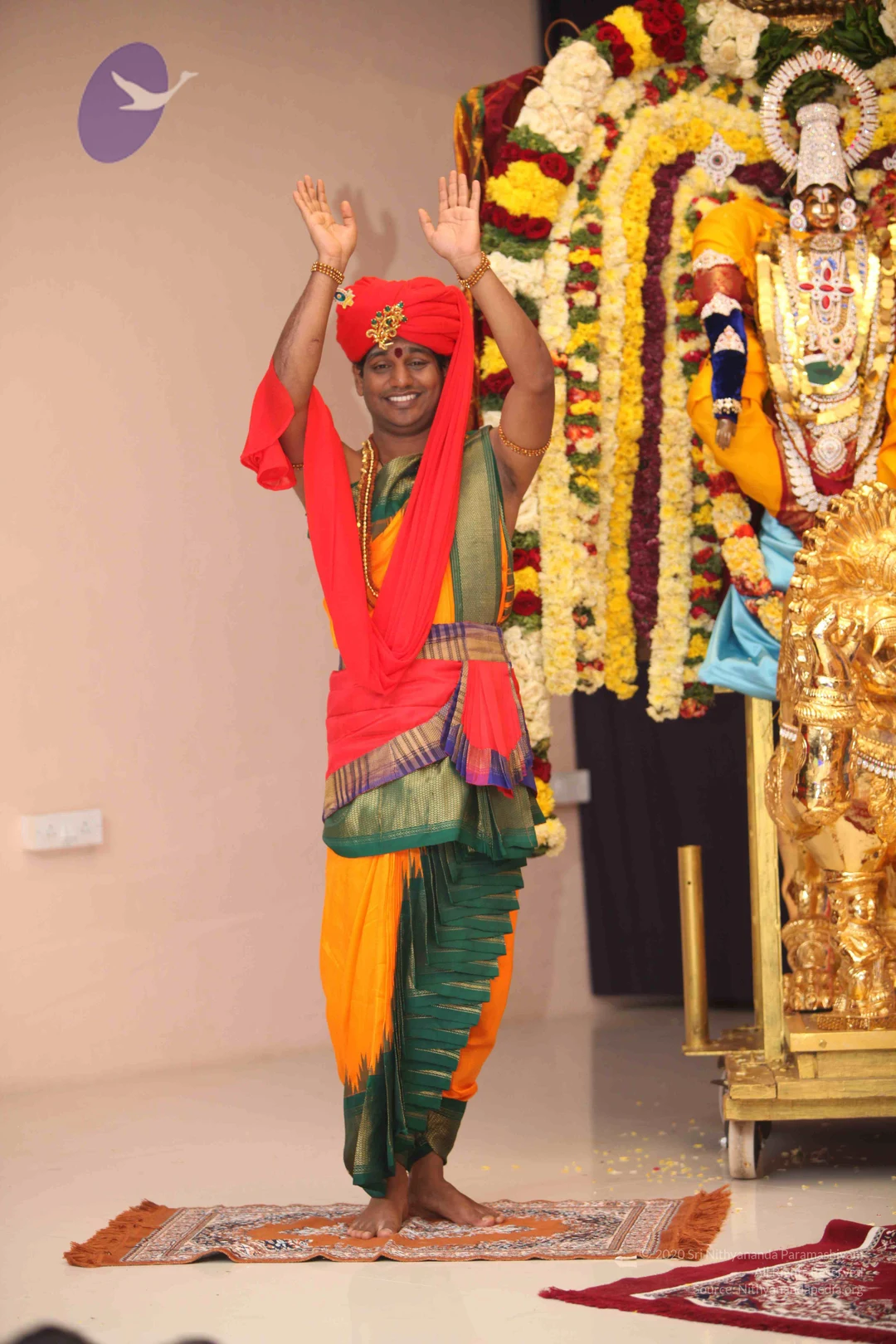
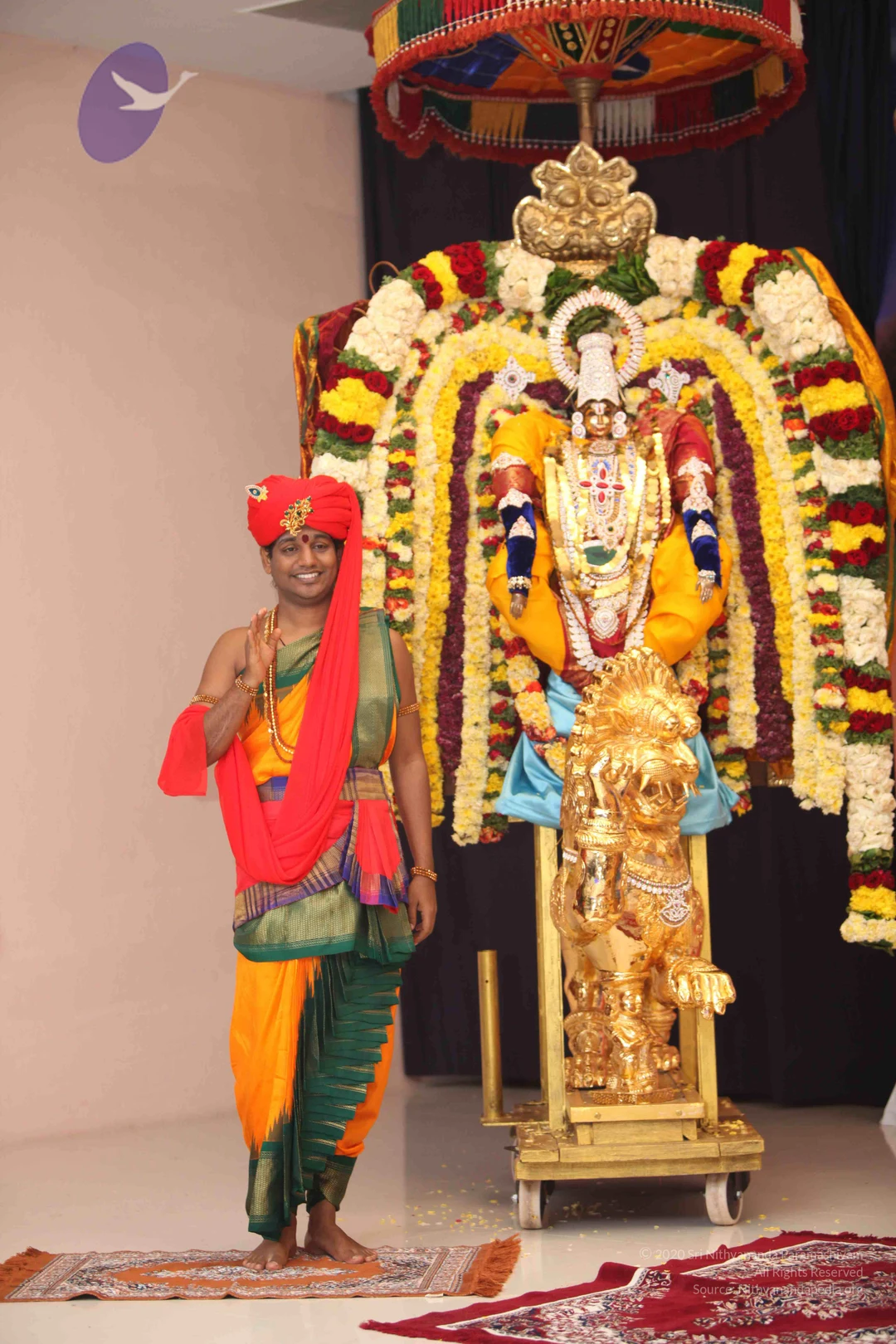
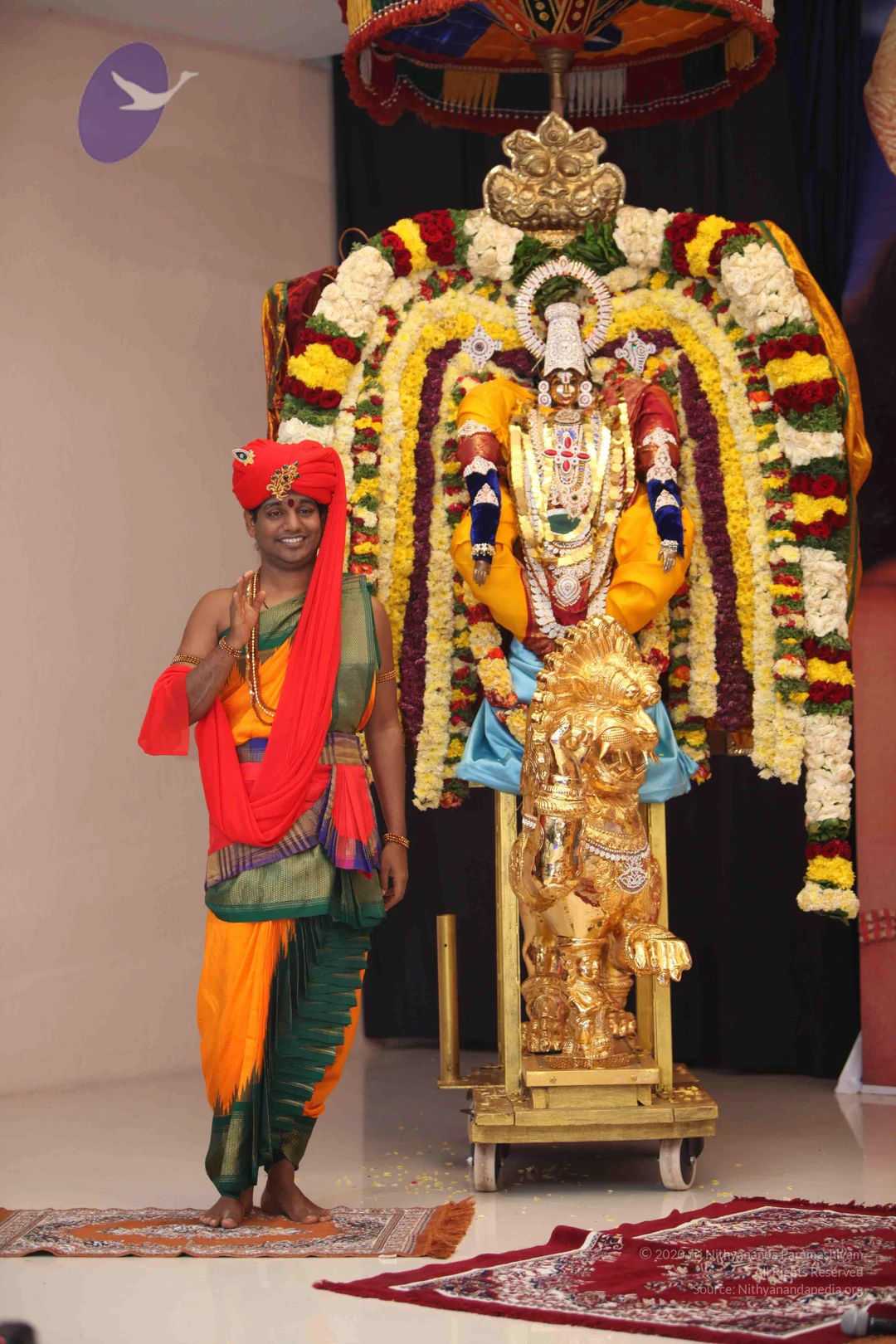
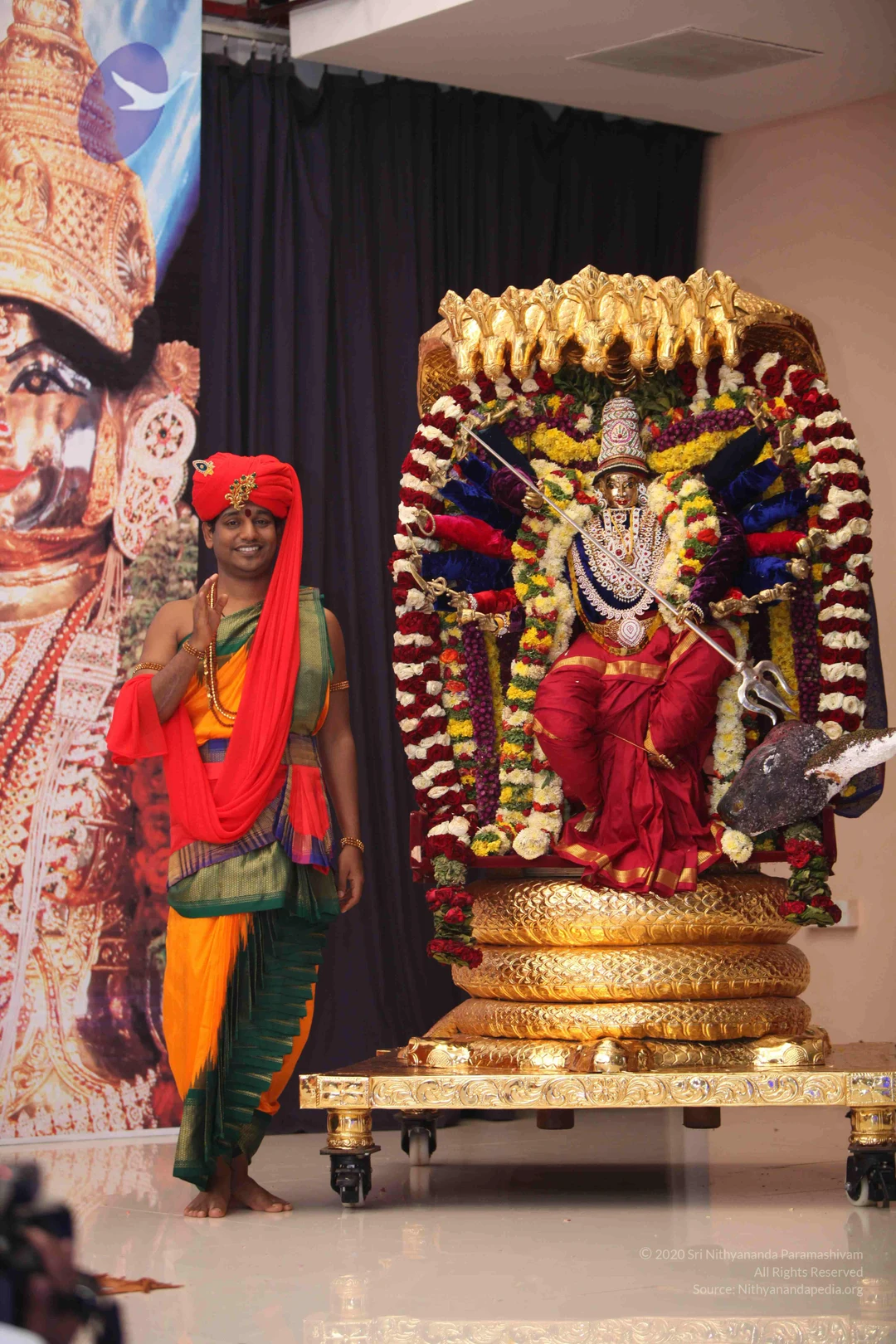
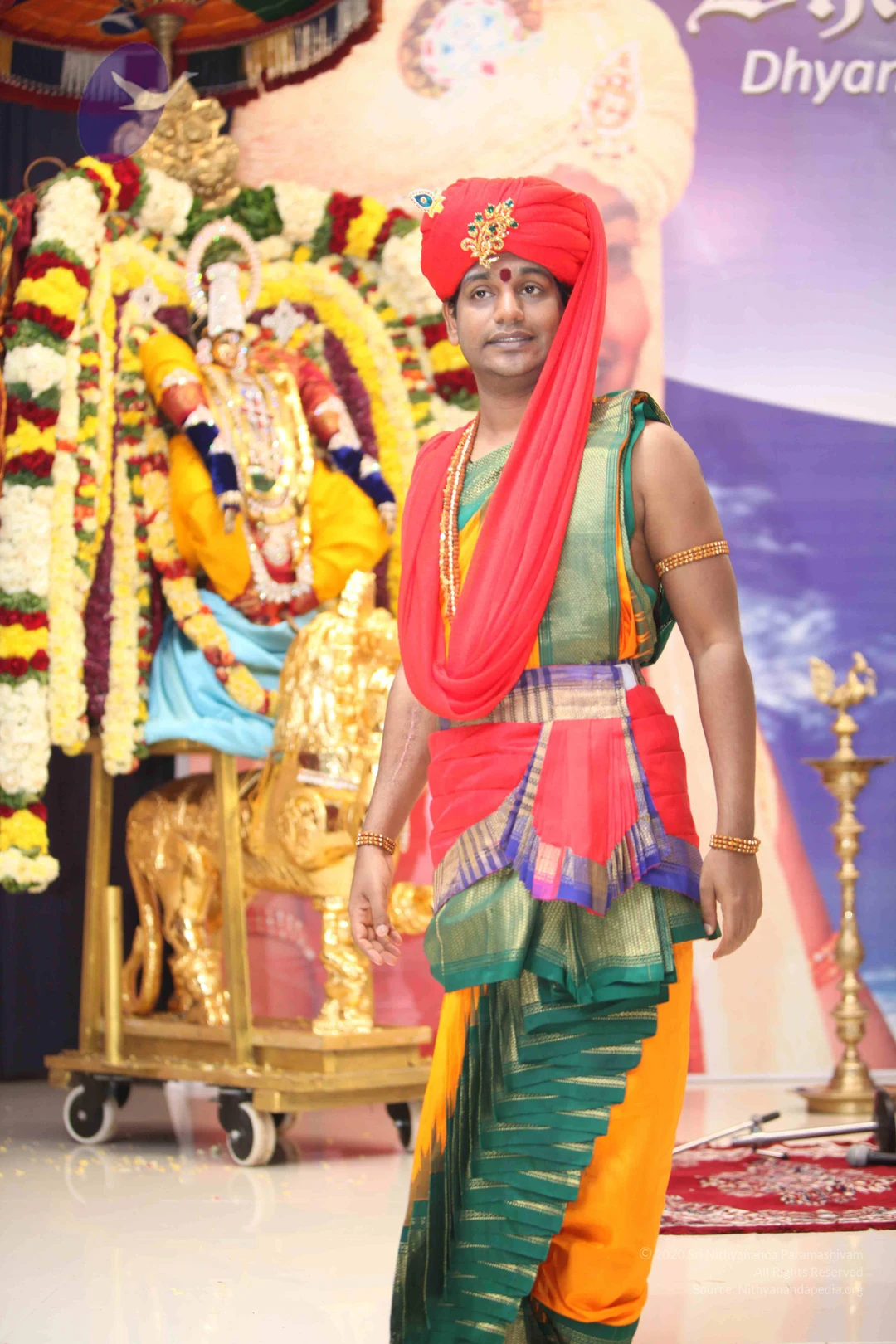
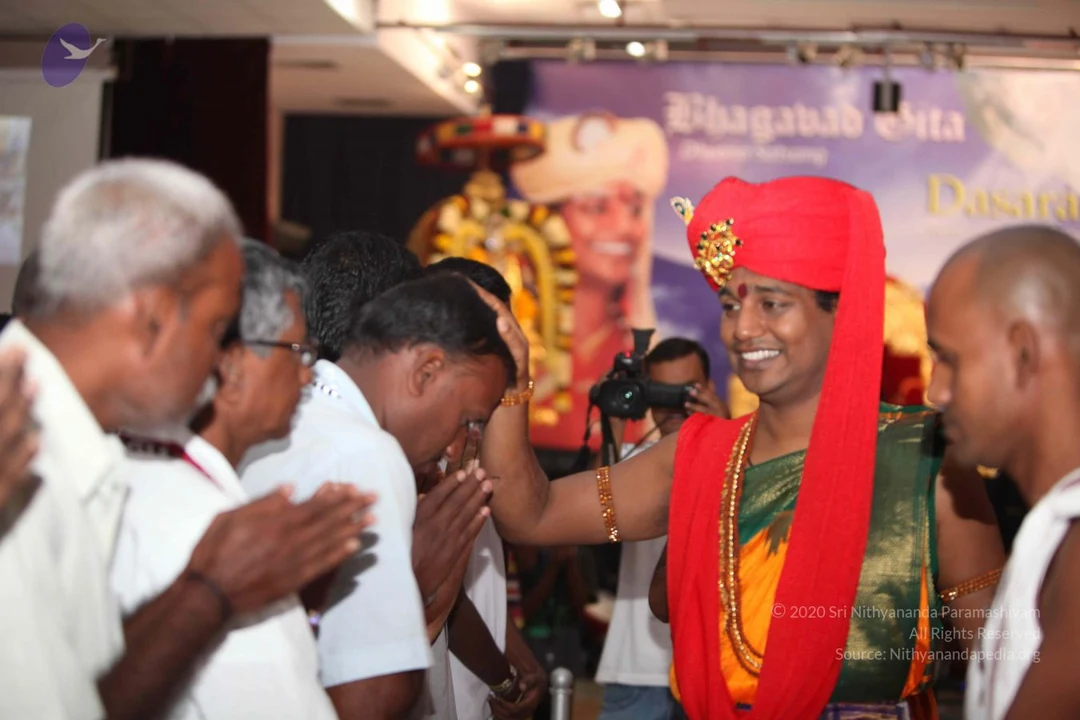
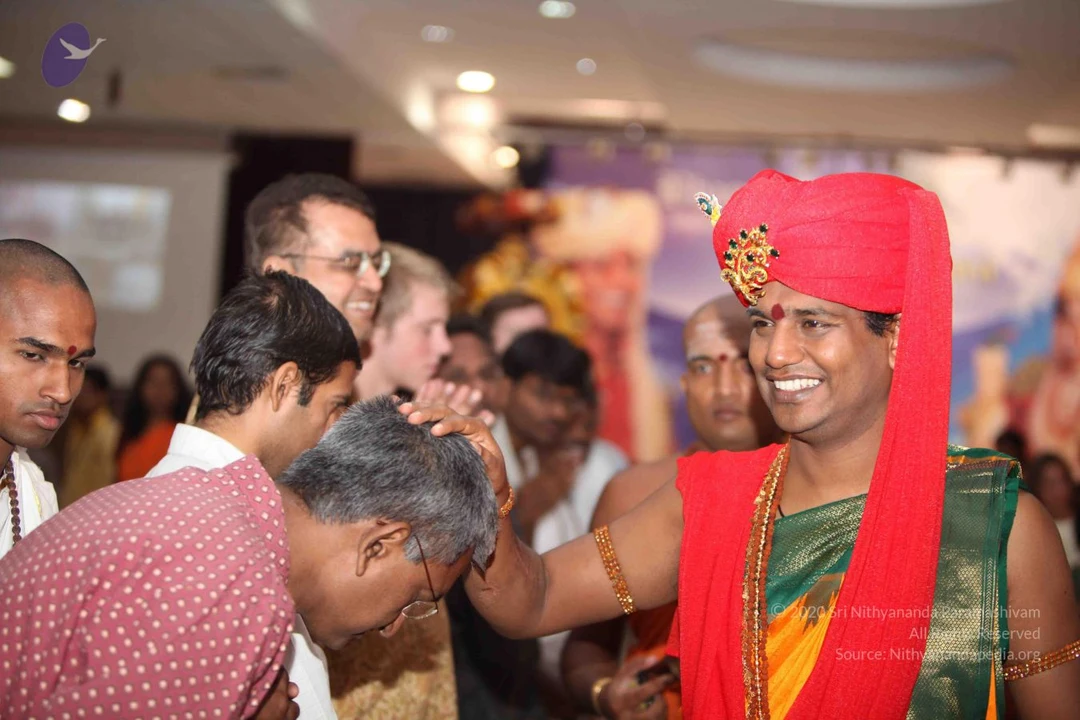
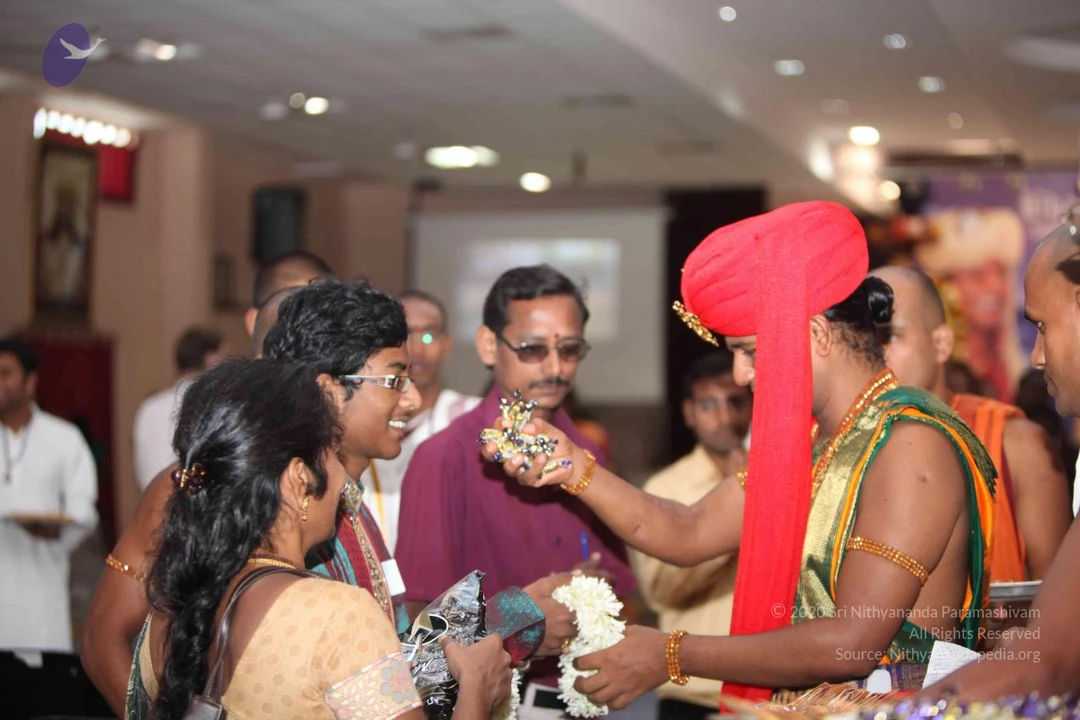
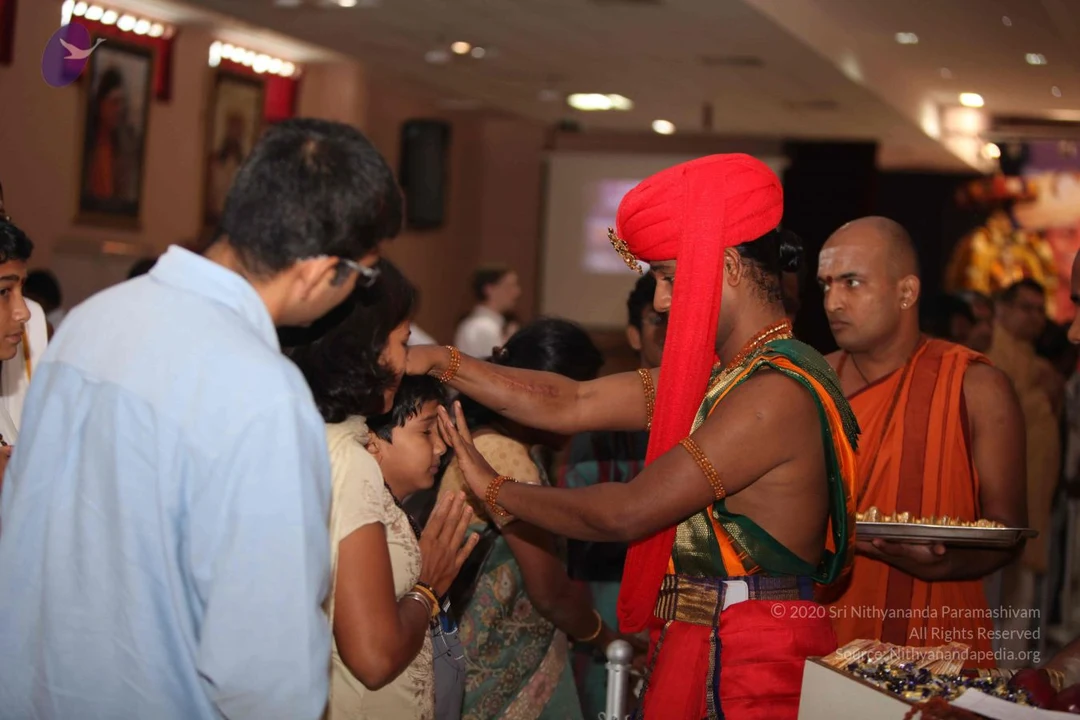
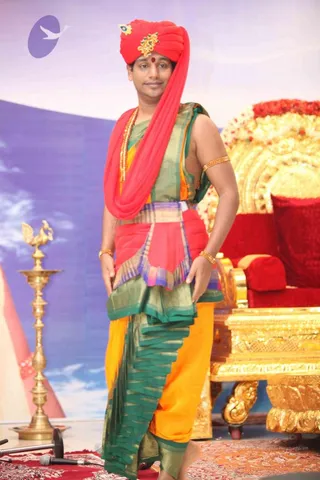
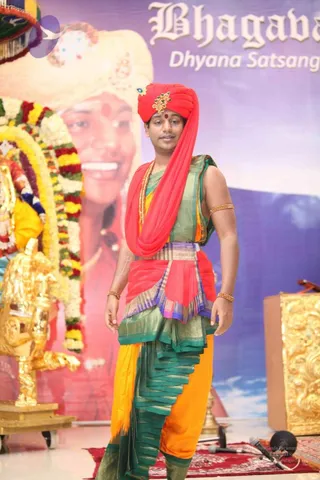
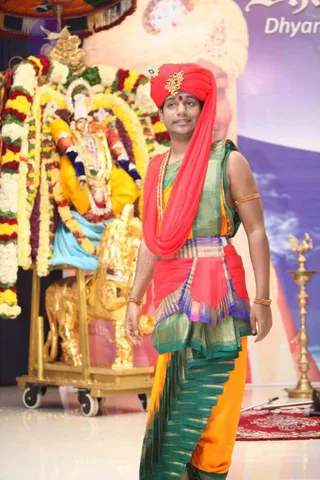
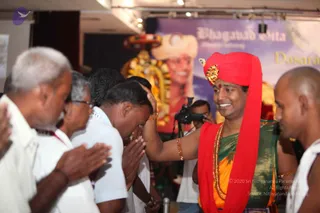
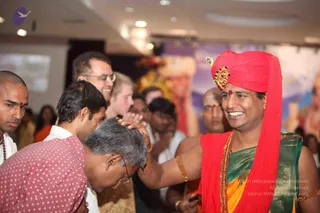
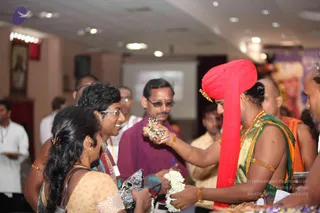
A photograph of one standing man in a stage setting. He wears a red turban with a gold and jewelled ornament and a red dupatta draped over one shoulder, a green and gold-bordered blouse, a red and blue-bordered waist sash, and a green and orange dhoti-style lower garment. He has a gold necklace and gold armlets and bangles, with a red bindi on his forehead. Behind him is an ornate gold and red velvet throne decorated with flower garlands. A brass oil lamp stands at left, and microphones sit on a red carpet at his feet. The backdrop shows a blue sky with clouds and a bird logo at top left.A young man stands on a stage in a red and gold turban with a jewelled ornament and a red tilak, wearing a green and gold brocade sleeveless garment, orange dhoti-style drapes, a red shawl draped over one shoulder, a gold armlet and beaded bangles, performing as a costumed character in a Bhagavad Gita themed programme. Behind him a large backdrop shows a smiling figure in a cream turban garlanded with flower garlands, beside a golden deity murti with a kalasha-like seat. A gold-trimmed lectern and microphones sit on a red carpet. Title text reads Bhagavad Dhyana Satsang on the backdrop.A standing man in a bright red turban with a gold ornament and a small red dot on his forehead walks across a glossy white stage. He wears a green and gold silk garment with a red drape over one shoulder, orange and green lower cloth, gold armlets and bangles, and a beaded necklace. Behind him a deity murti in yellow and blue cloth is decorated with white and red-yellow garlands and gold ornaments, seated on a golden lion-form throne with wheels. A tall brass oil lamp stands at right beside a banner with a blue sky and a portrait. Visible printed text on the banner reads Dhyanapeetham. The man's appearance is not sufficient to confirm the a person candidate.A photograph at an indoor event where a man in a bright red turban and red shawl, wearing a green and gold silk garment, gold necklaces and gold armbands, smiles as he places his hand on the head of a devotee bowing with palms joined. Several other men in white shirts and dhotis stand with hands folded in namaskar nearby, and a bald man in white stands at the right edge. A video camera on a tripod is visible behind them. In the background a banner reads Bhagavad Gita and Dasara beside a large garlanded image of a smiling man in an orange turban and a decorated deity murti-like backdrop. The scene appears to be a blessing or darshan moment.A photograph of an indoor event in a hotel-style hall with a blurred backdrop of colourful banners and portraits. A smiling man in a red turban with a gold ornament and red shawl over a green-and-gold garment, with a red tilak on his forehead and gold armlets, places his right hand on the head of a bowing man with grey hair and glasses, who wears a pink dotted shirt. Several other attendees stand behind, including a man in glasses and people with folded hands, some in white and orange clothing. The turbaned man has the distinctive ceremonial attire of a blessing giver, but his appearance is not sufficiently distinctive to confirm he is the swami.Indoor event in a hall with ceiling lights and a projection screen behind. A man in a red turban, gold armlets and beaded necklaces, wearing a green-and-orange draped cloth, holds up a small bunch of decorative flowers or ornaments with sparkly stones while a row of people stands before him. Nearby, a woman in a peach saree and a man in a maroon shirt with glasses watch; a man in an orange robe stands at right. A young man in glasses and a woman with a braid stand in the foreground, and a white-clad attendee holds papers at left. Printed portrait on wall and a framed picture visible.

AYUDHA-POOJA-IN-BIDADI-ADIKAILASA

15 photosSource gallery
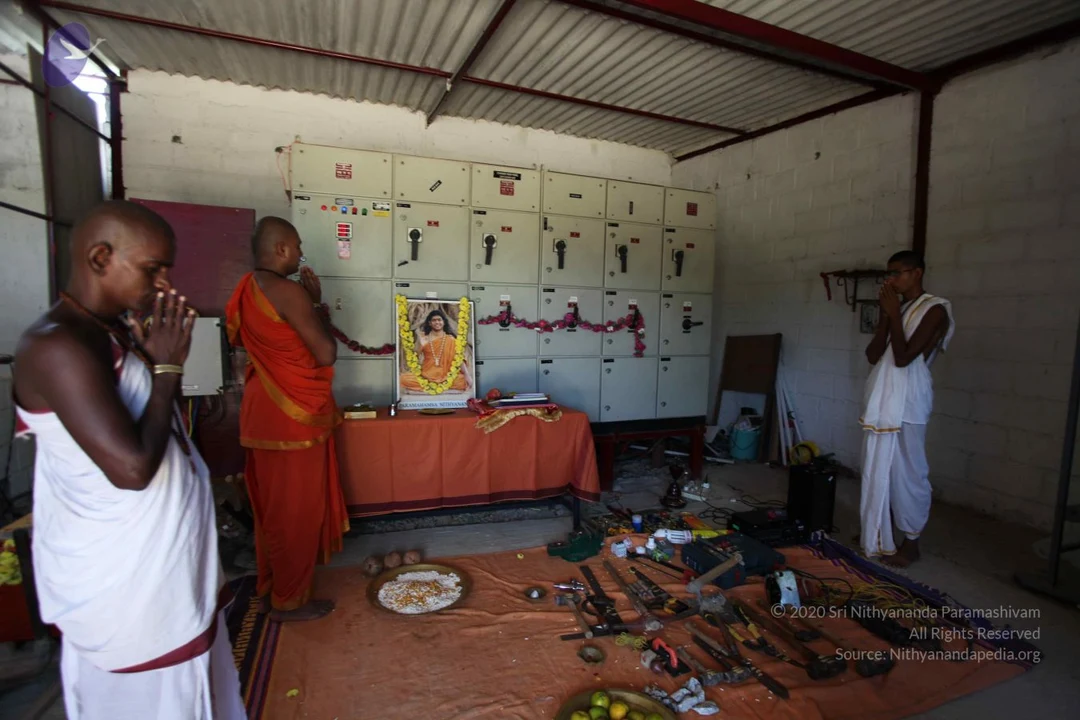
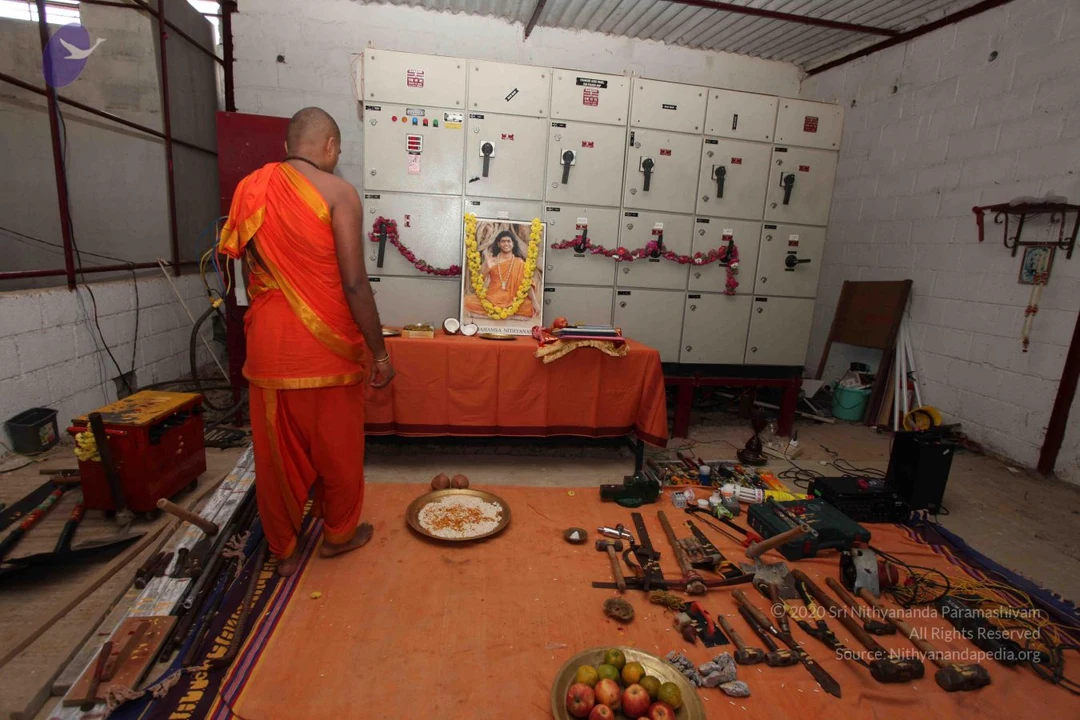
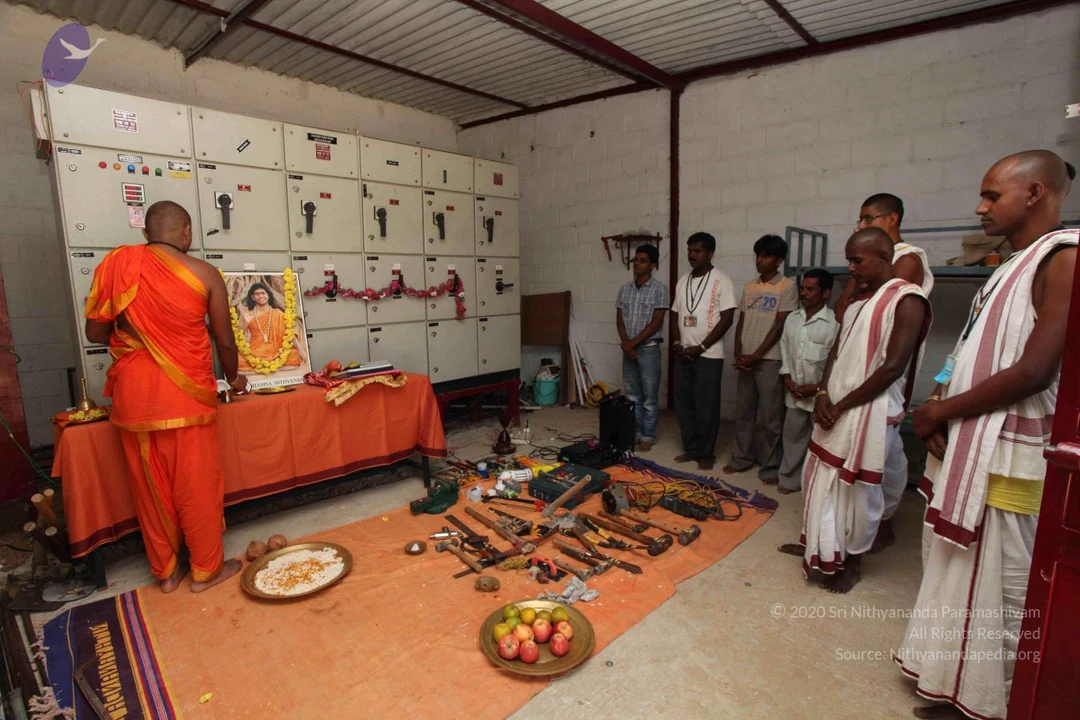
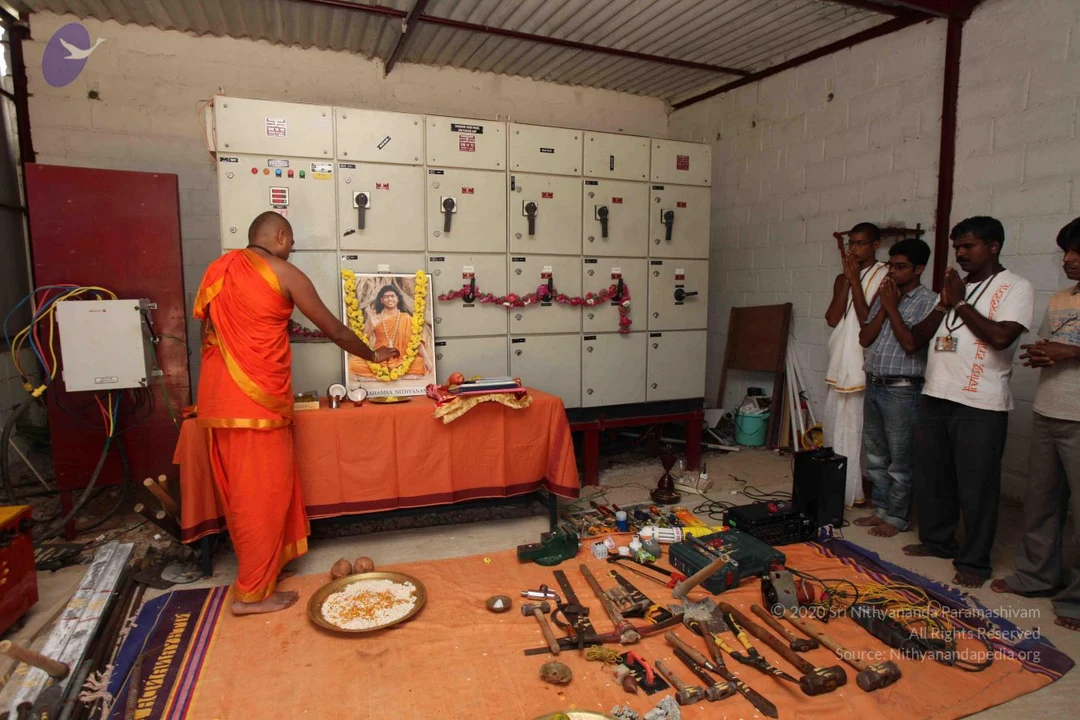
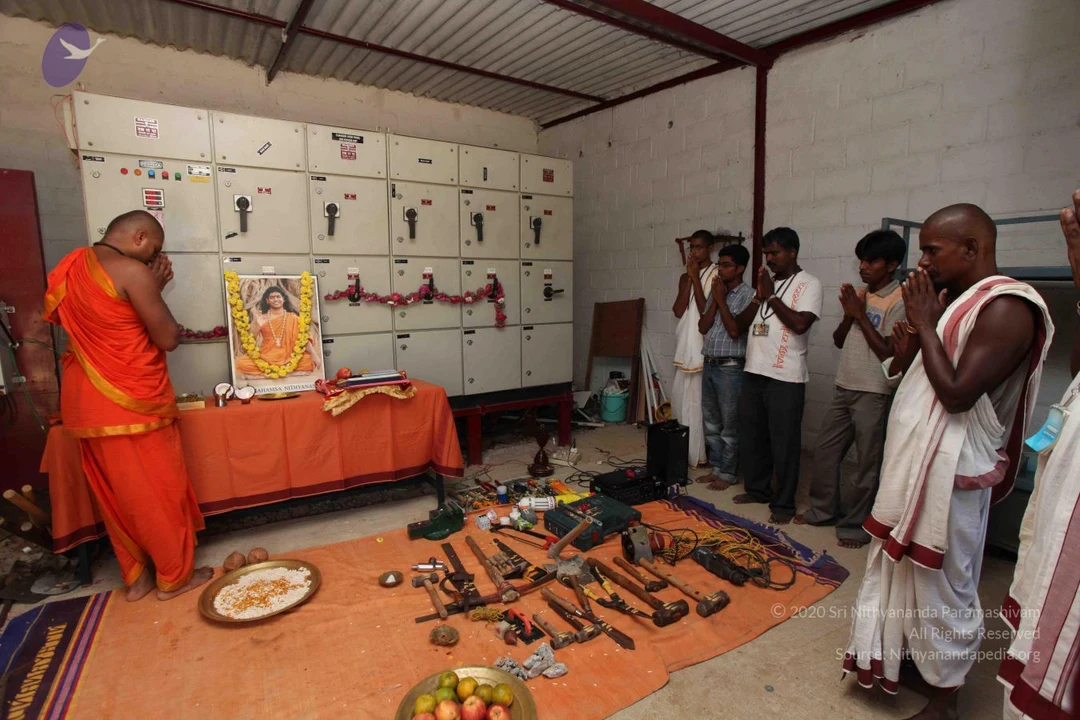
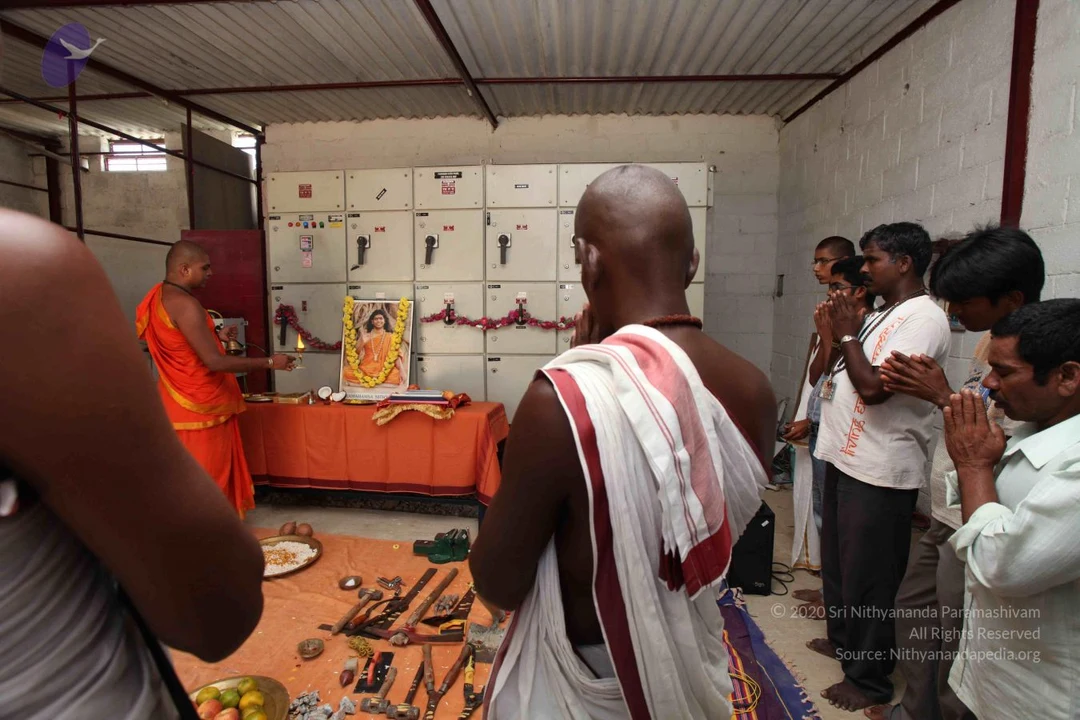
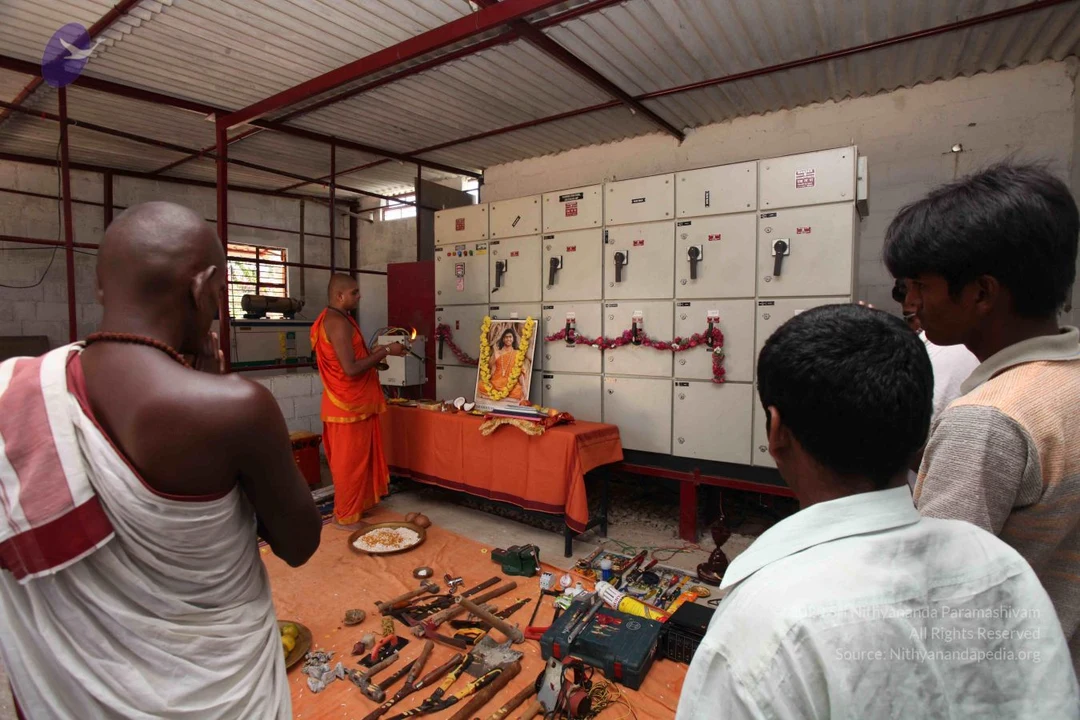
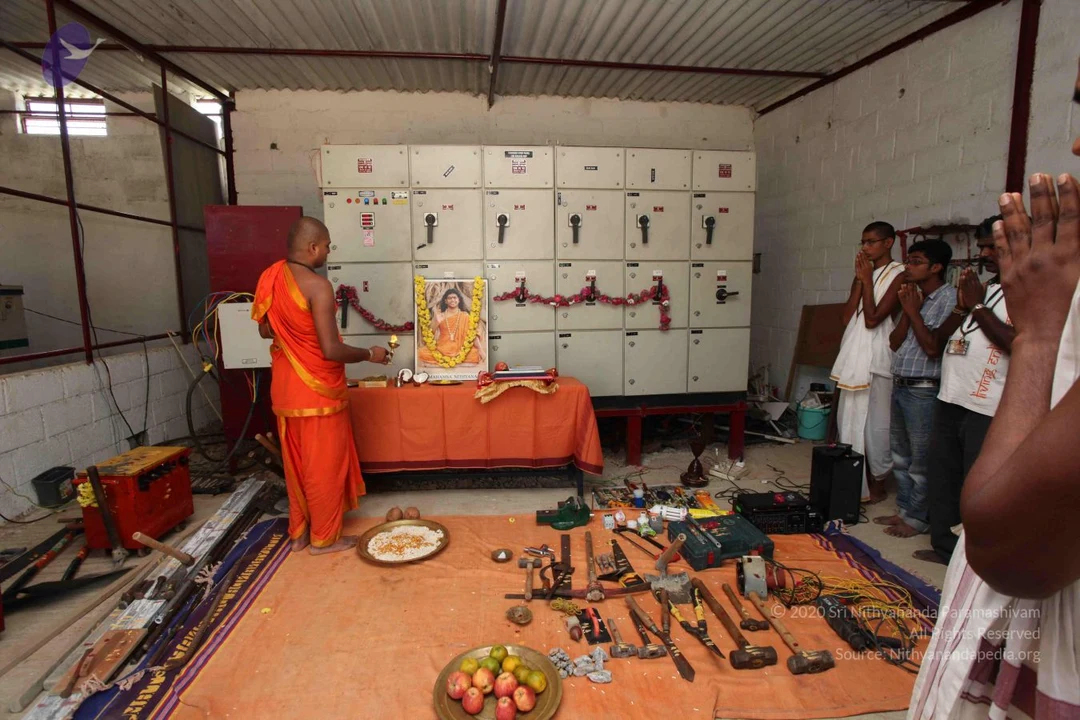
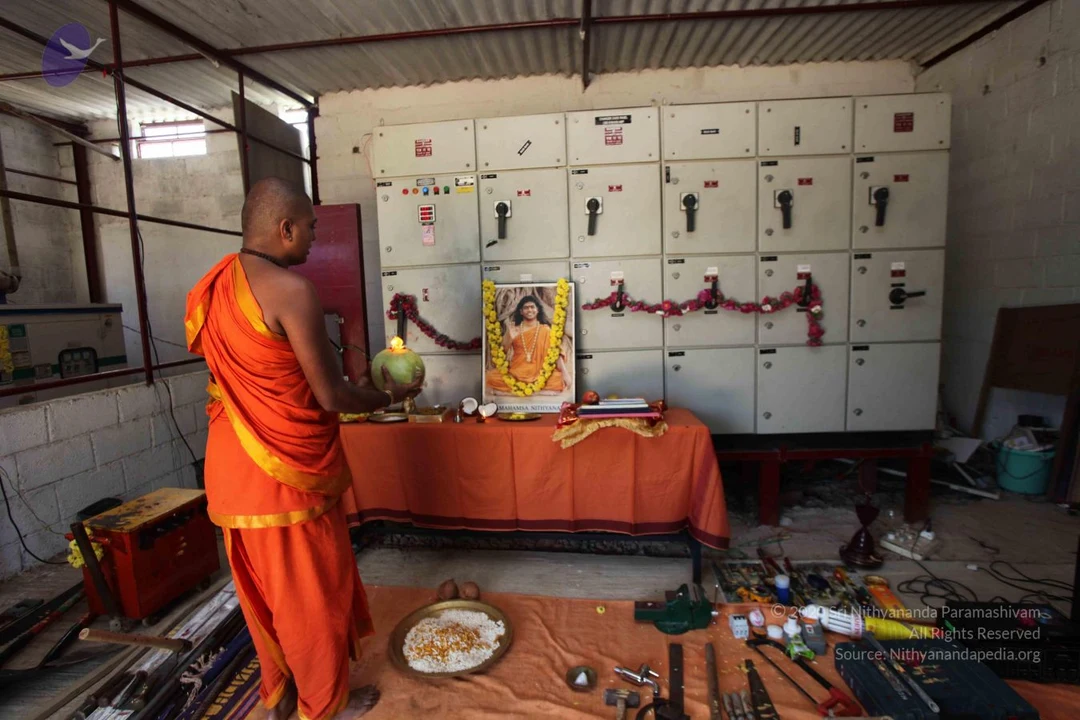
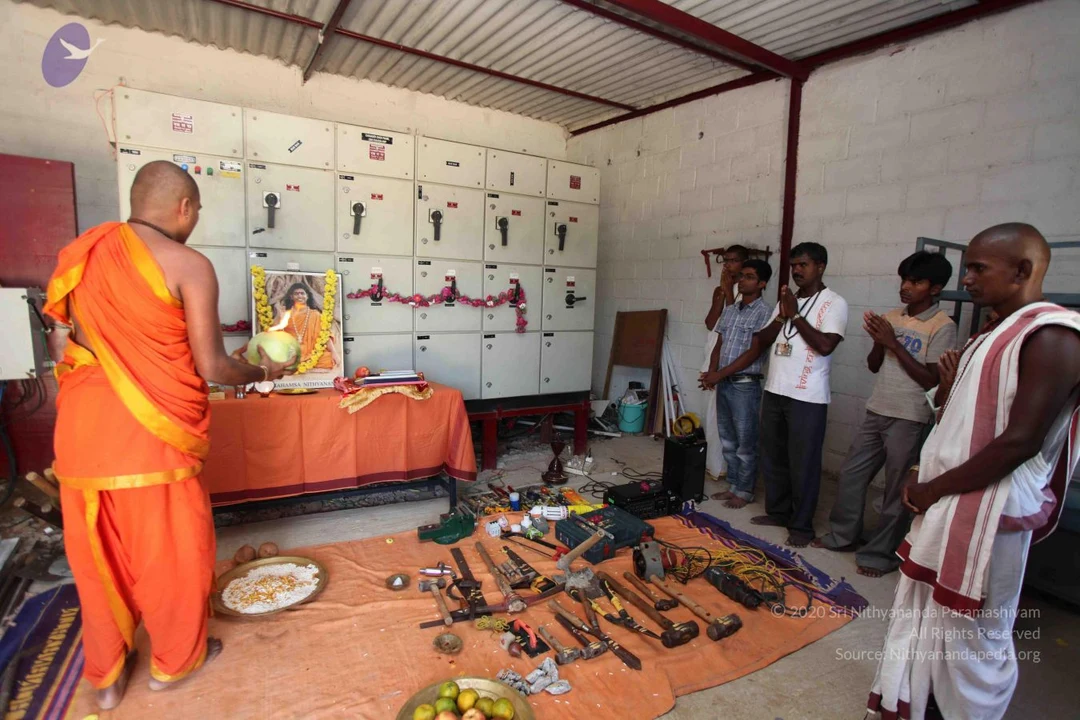
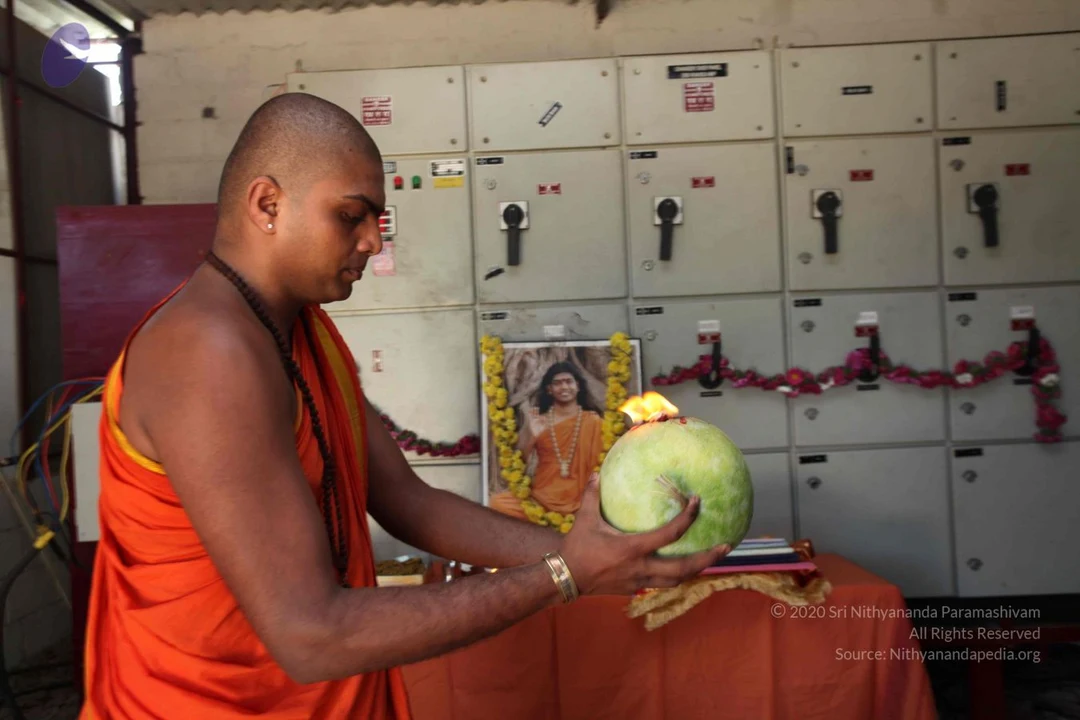
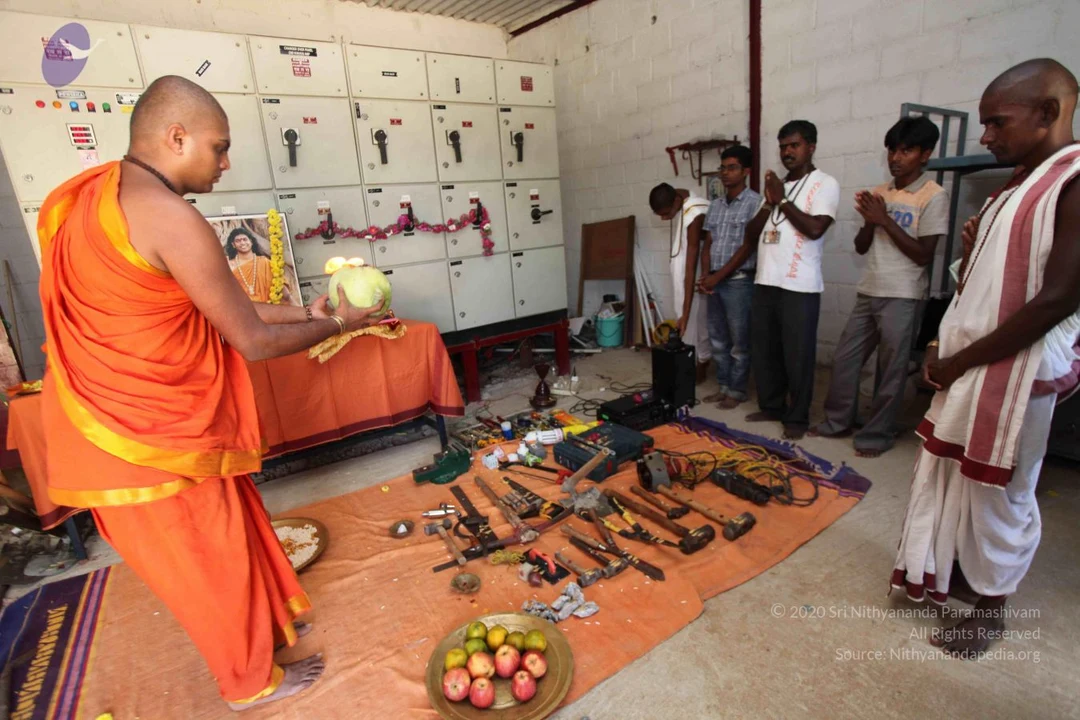
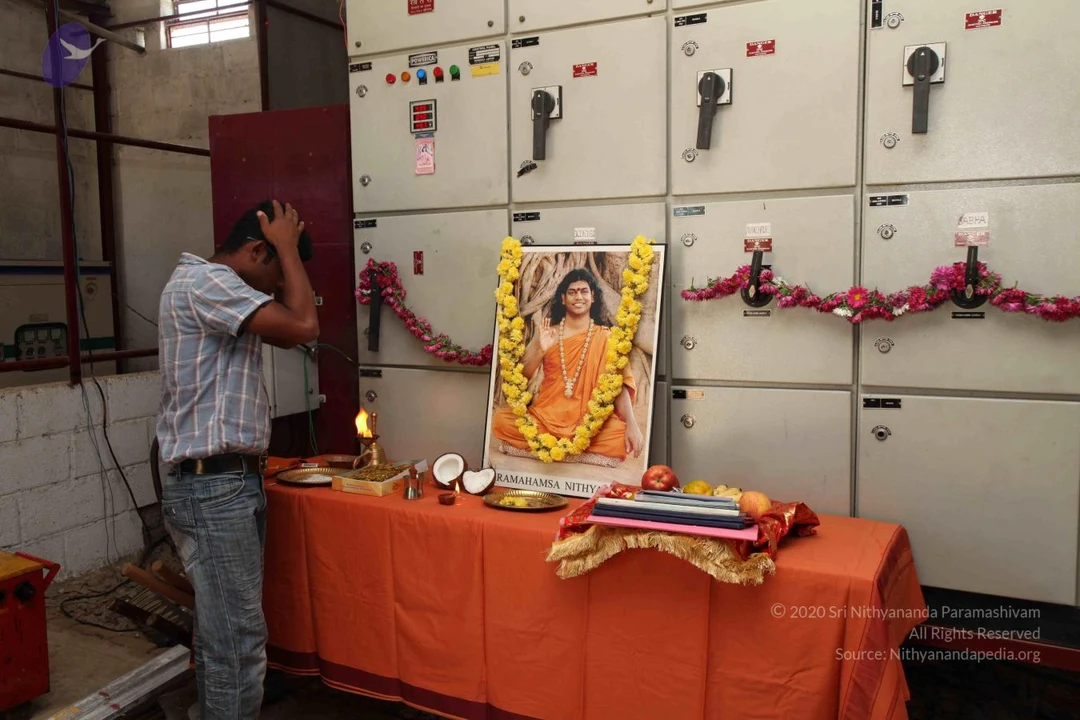
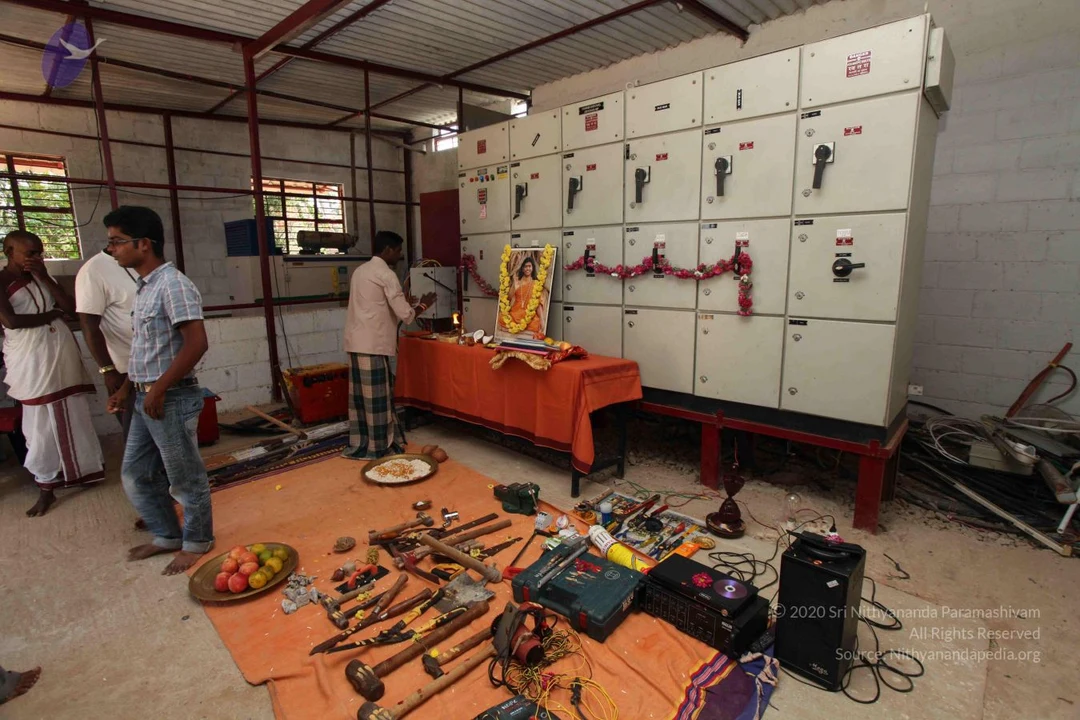
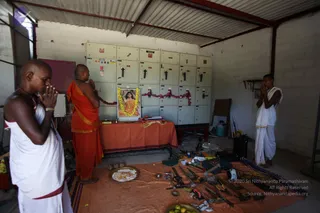
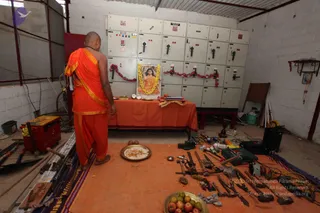
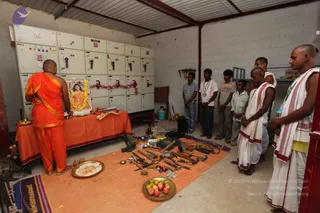
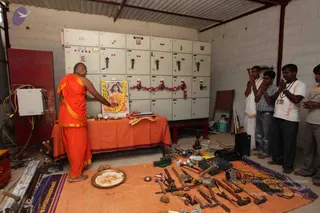
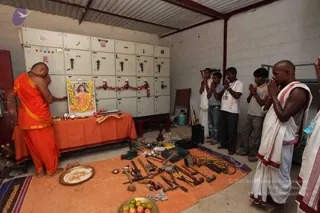
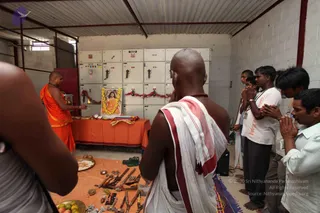
A photograph of a utility room with corrugated roof and grey metal lockers, where three men stand before a small shrine. A framed portrait labelled "Paramahamsa Nithyananda" with a yellow marigold garland sits on an orange cloth-draped table, with red flower garlands on the lockers. Two men on the left have hands pressed in anjali; one in orange robe with a rudraksha mala holds a small object near his face, and another in white dhoti and shawl stands on the right with hands folded. On the floor cloth lie offering trays with rice or grain, fruits, coconuts and a row of tools and implements, with a plate of bananas in front. The scene reads as a worship ritual. a person depiction appears only as the printed portrait.A photograph of a utility room with white wall-mounted electrical distribution cabinets and a red-framed doorway. A man in saffron-orange dhoti and shawl stands barefoot at left, facing a small altar draped in orange cloth. On the altar is a framed portrait of a saffron-clad figure with a garland of yellow marigolds, flanked by pink and red floral garlands strung along the cabinets, with brass plates and a coconut. On the orange-cloth floor in front are a plate of kumkum and turmeric, a platter of apples and fruit, and many tools laid out: machetes, sickles, hammers, and power tools. The man's face is turned away and no identity is claimed.A worship ceremony in a small whitewashed utility room with a row of grey electrical distribution cabinets along the back wall. A man in an orange-saffron dhoti and shawl stands at the left facing a covered orange table, with a framed portrait of a woman in orange garlanded with a yellow-orange flower garland, plus a brass lamp and offerings. On the orange cloth on the floor lie tools including hammers, pliers, wrenches and screwdrivers, with brass plates of turmeric powder, kumkum and red apples. Six men stand in a row on the right, some in white dhotis with red-bordered shawls and one in a light shirt, with hands folded in respect. The image is a photograph and the visible subject is a puja for tools and equipment. a person's candidacy is not established from appearance: the man in orange is shaved-headed and the page indicates his presence, but the cues are insufficient.Photograph inside a plain concrete workshop with a corrugated roof, where a shaved-headed sannyasi in orange robes stands at left, extending his hand toward a framed portrait draped with a marigold garland on a table covered in orange cloth. The portrait is labelled "Paramahamsa Nithyananda" and shows a saffron-clad figure. Behind the table is a bank of grey electrical switchgear panels with red-and-white garlands on them. On the floor, an orange cloth holds tools including hammers, pliers, spanners and a saw, with a brass plate of rice and turmeric and coconuts. Four men stand at right; two have their palms joined in prayer, one in a white shirt and one in a checked shirt, while a man in a white dhoti and another in a grey shirt stand alongside them.A photograph of a ritual worship in a plain brick room with corrugated metal roof and a wall of grey electrical panel cabinets. A shaved-headed man in saffron-orange robes stands at left with palms pressed together in prayer before a central table draped in orange cloth. On the table is a framed portrait of a saffron-clad figure with long hair, garlanded with yellow marigolds and red flowers, with a brass lamp and kumkum-filled plate nearby. On the floor in front are tools and hardware laid on an orange cloth, plus a plate of fruit and a plate of turmeric or kumkum. Five men stand at right in white dhotis, white and colored shirts, also with palms joined in prayer. The scene suggests a puja for workers and tools.A photograph of a small utility room with corrugated metal roof and electrical panel boxes on the back wall. A priest in saffron-orange robes stands at left before an orange-draped table holding a lit oil lamp, a tray of rice, coconuts, fruit and a framed portrait garlanded with yellow and orange flowers, a red-and-pink floral garland framing the portrait. Another priest with shaved head and white-and-red bordered dhoti stands with his back to the camera in the centre. On the floor, an orange cloth holds tools such as hammers and wrenches, alongside fruit and small offerings. Four or five devotees stand at right with palms pressed together in namaskar, wearing white t-shirts and light shirts. The portrait shows a figure in orange robes and a crown-like headdress.

SANDHYA-POOJA
239 photosSource gallery
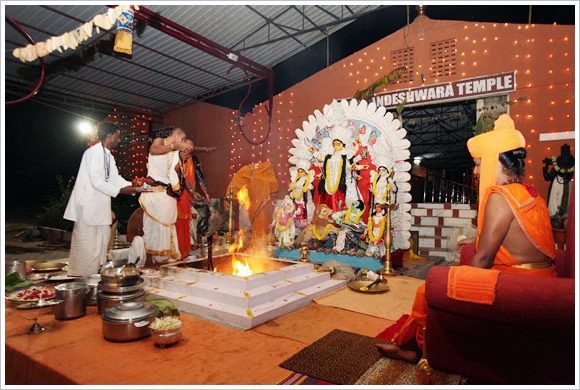
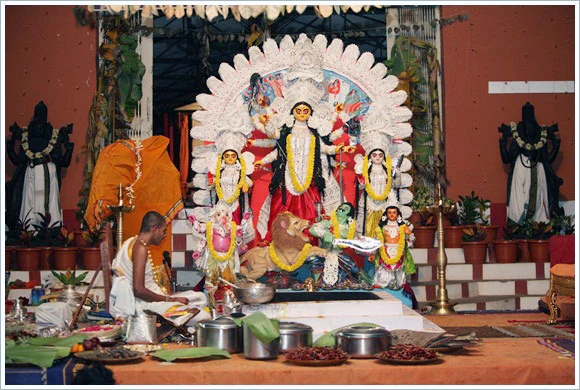
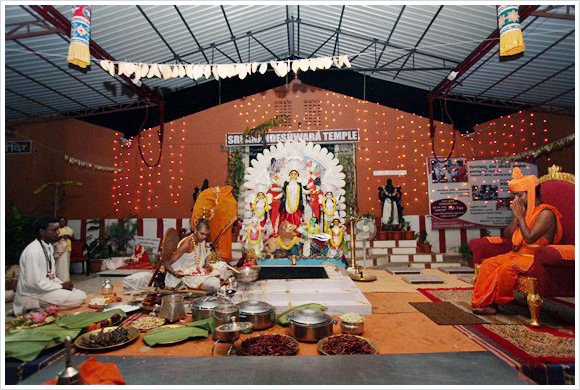
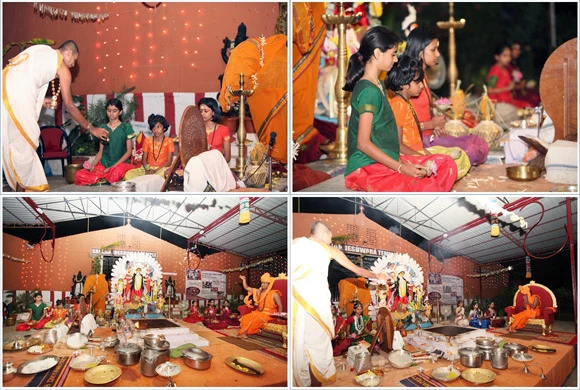
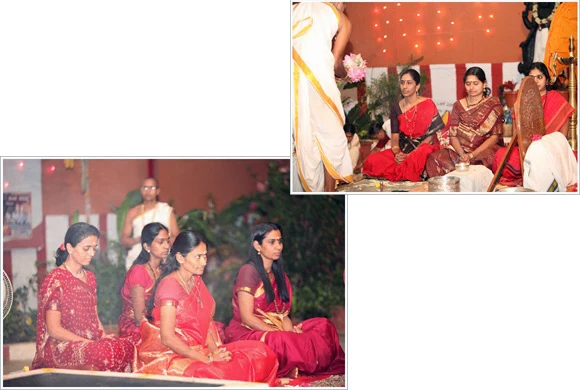
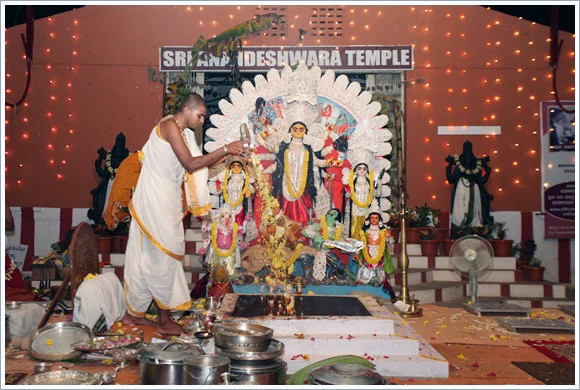
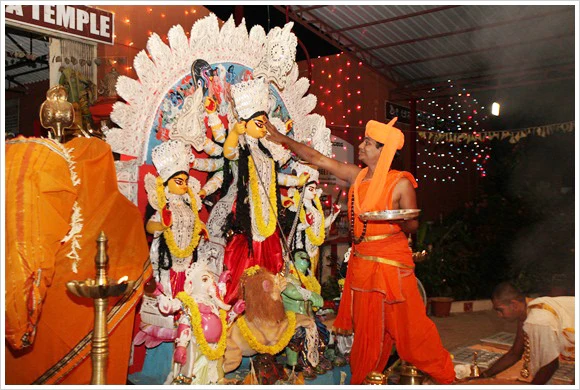
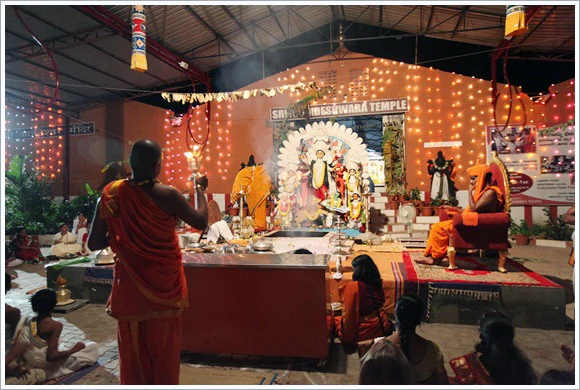
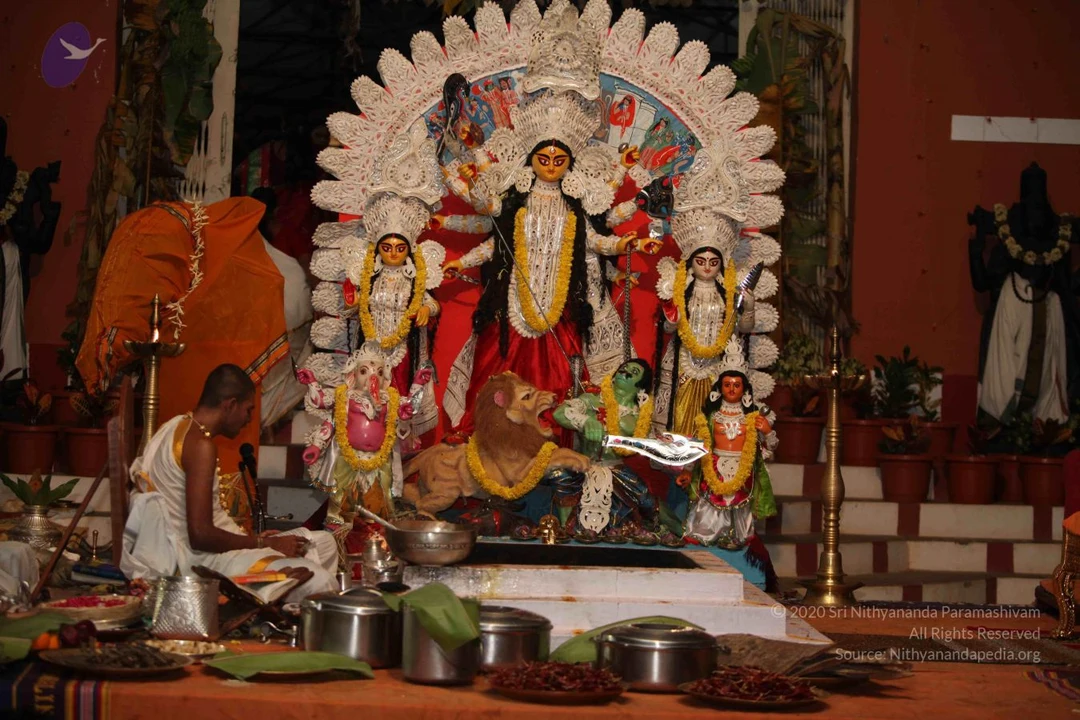
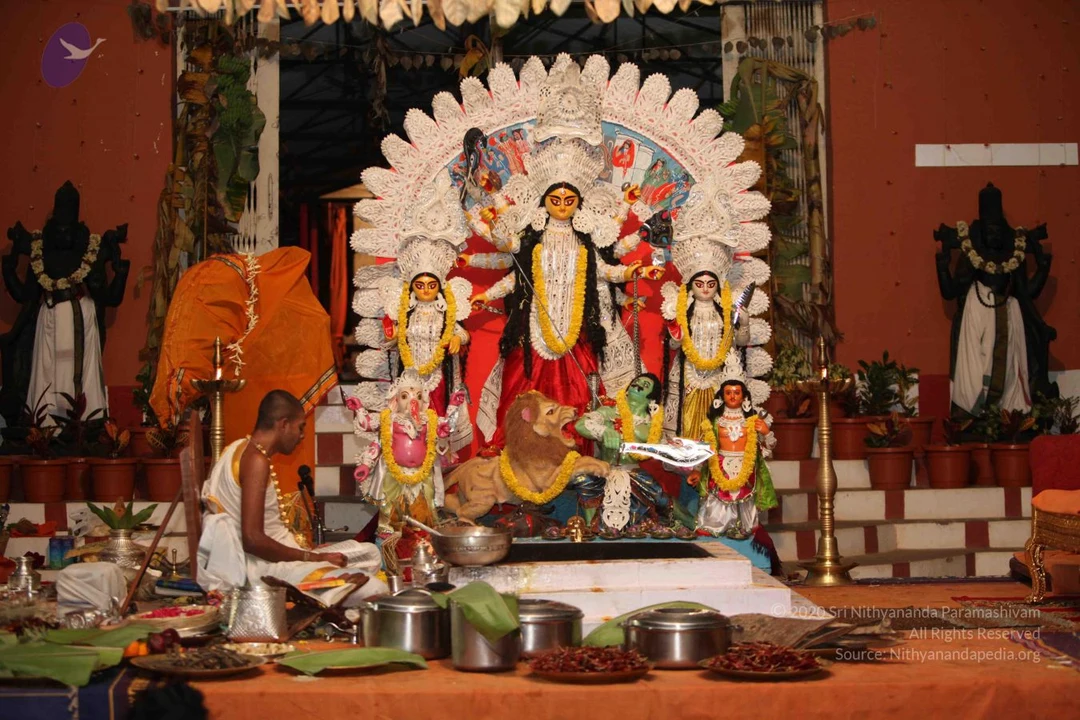
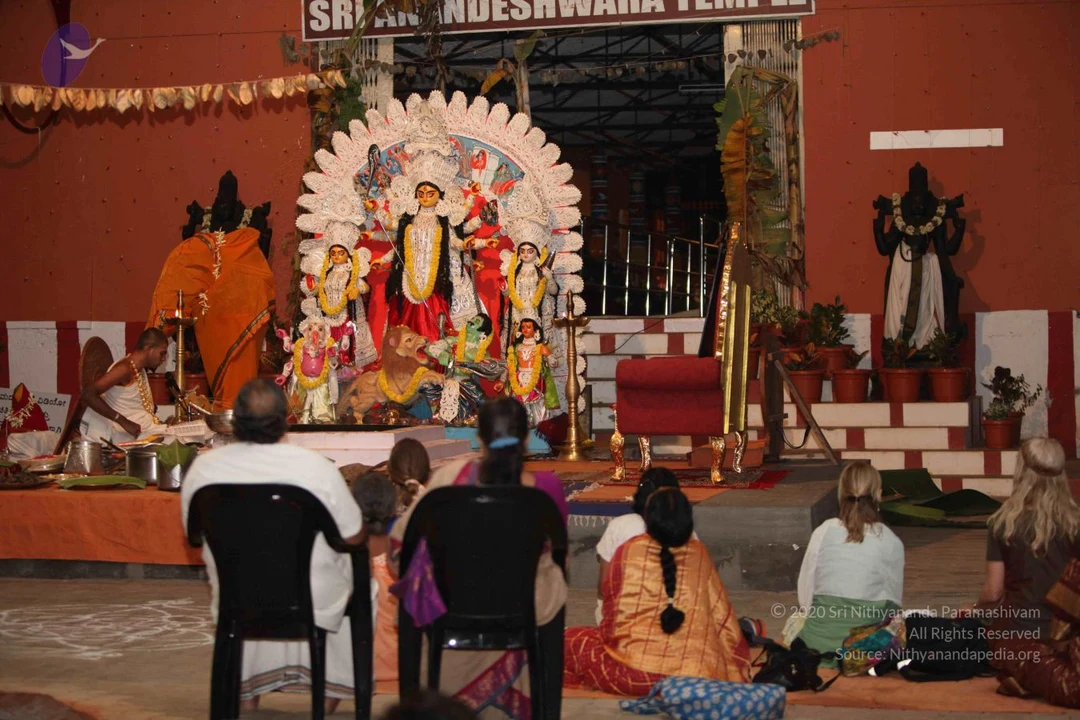
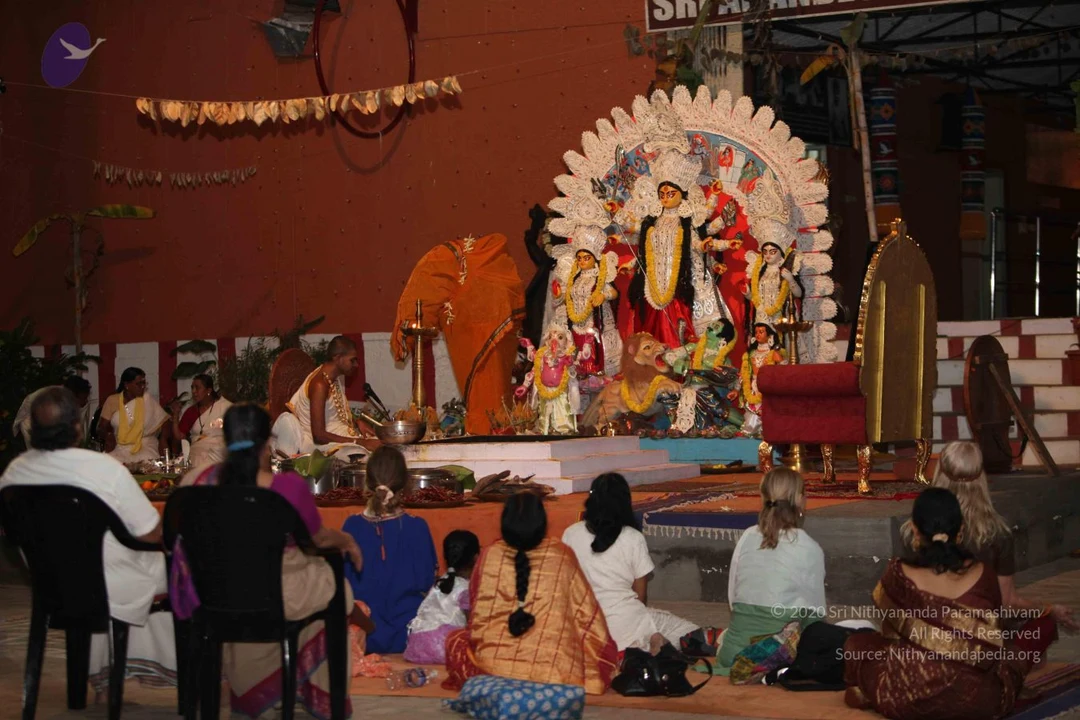
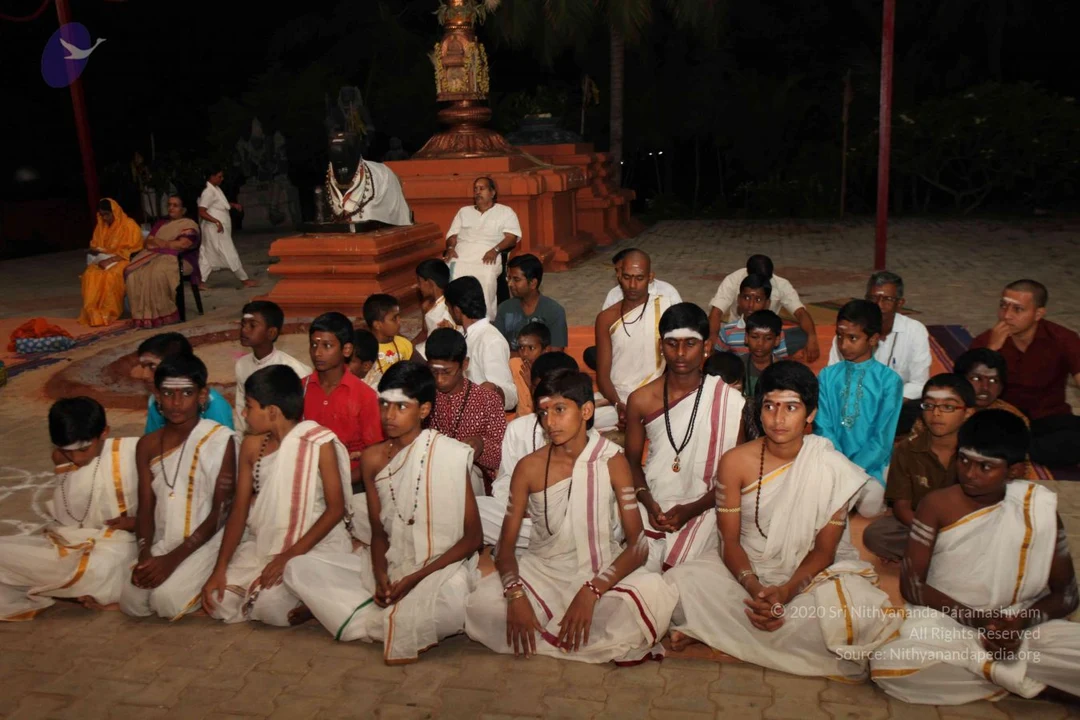
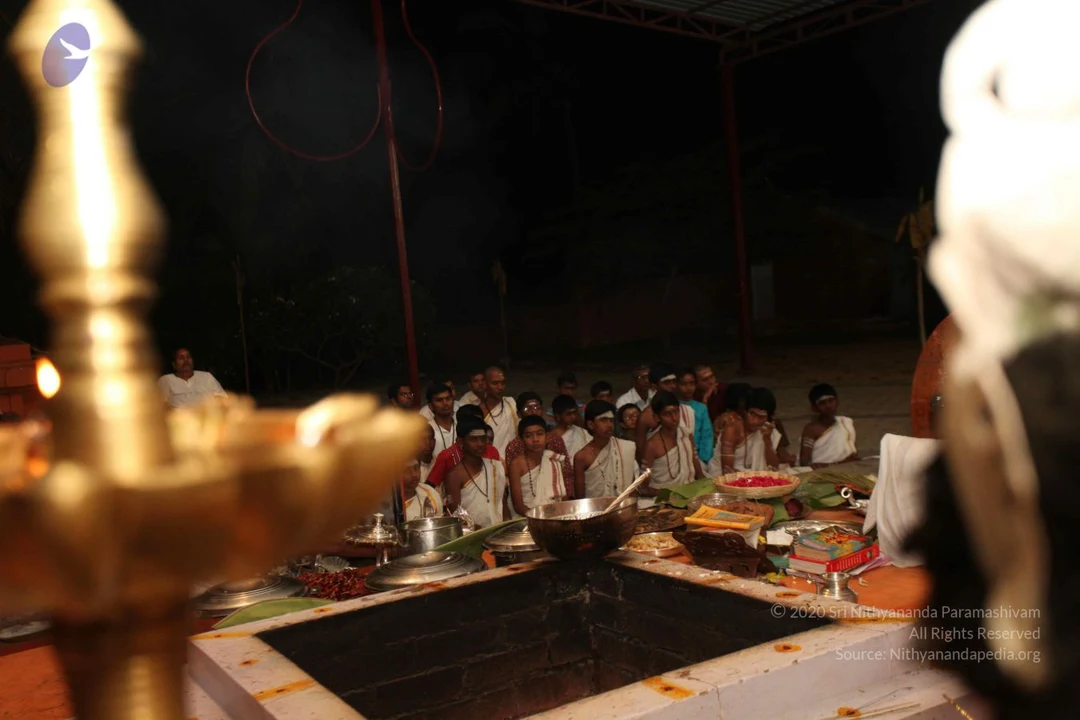
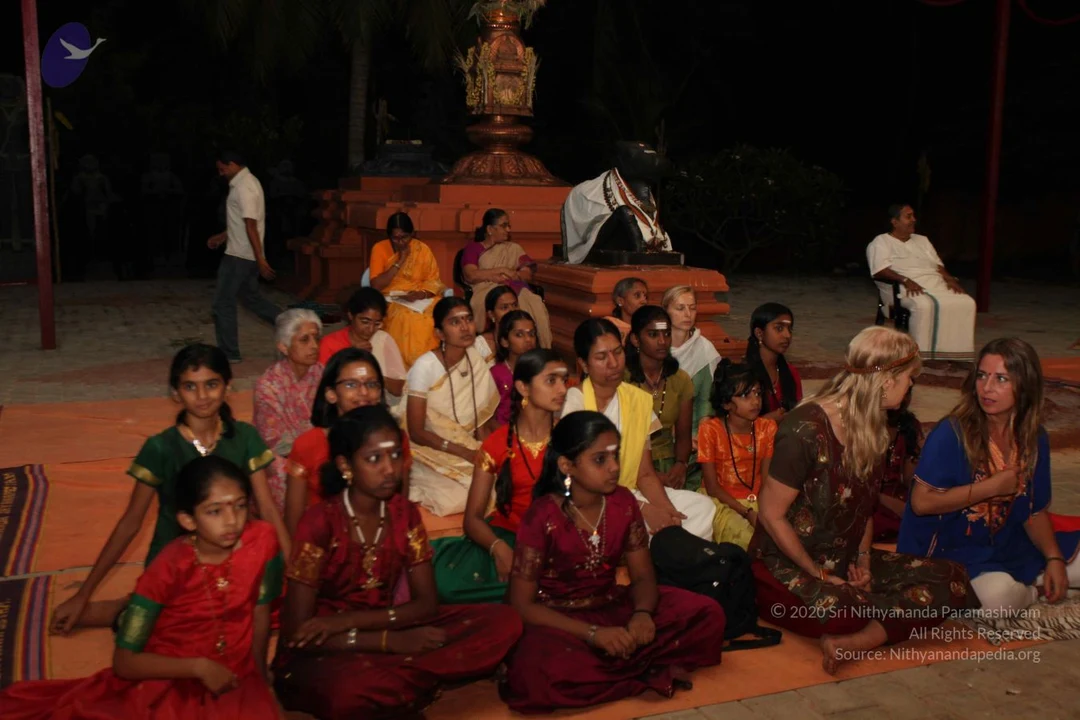
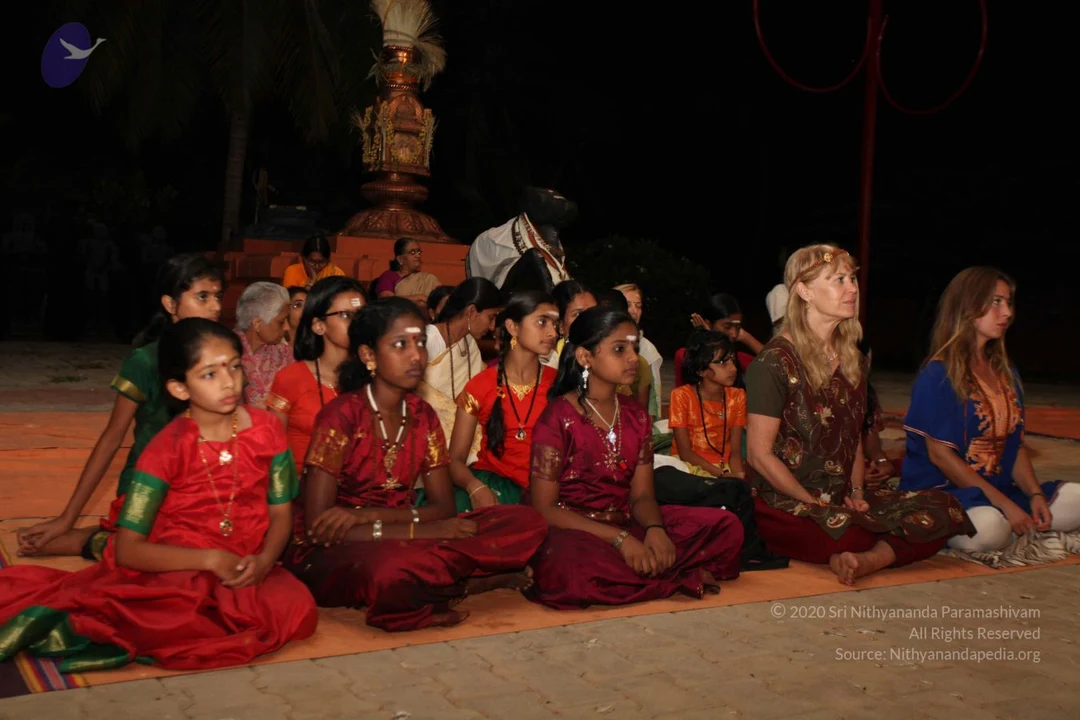
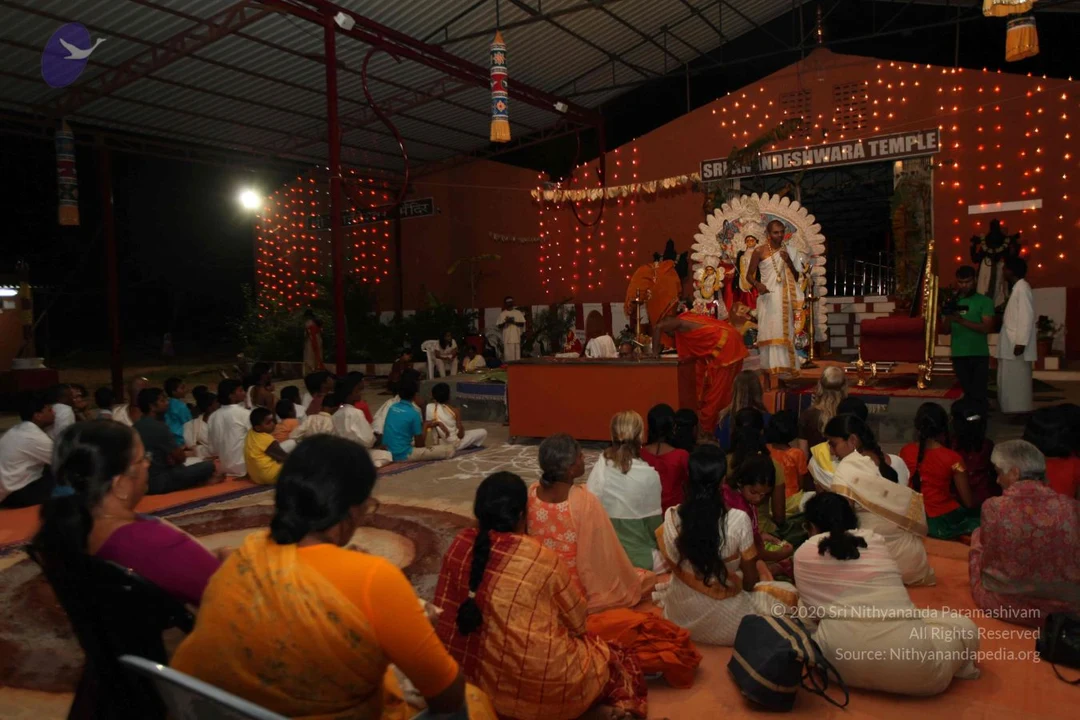
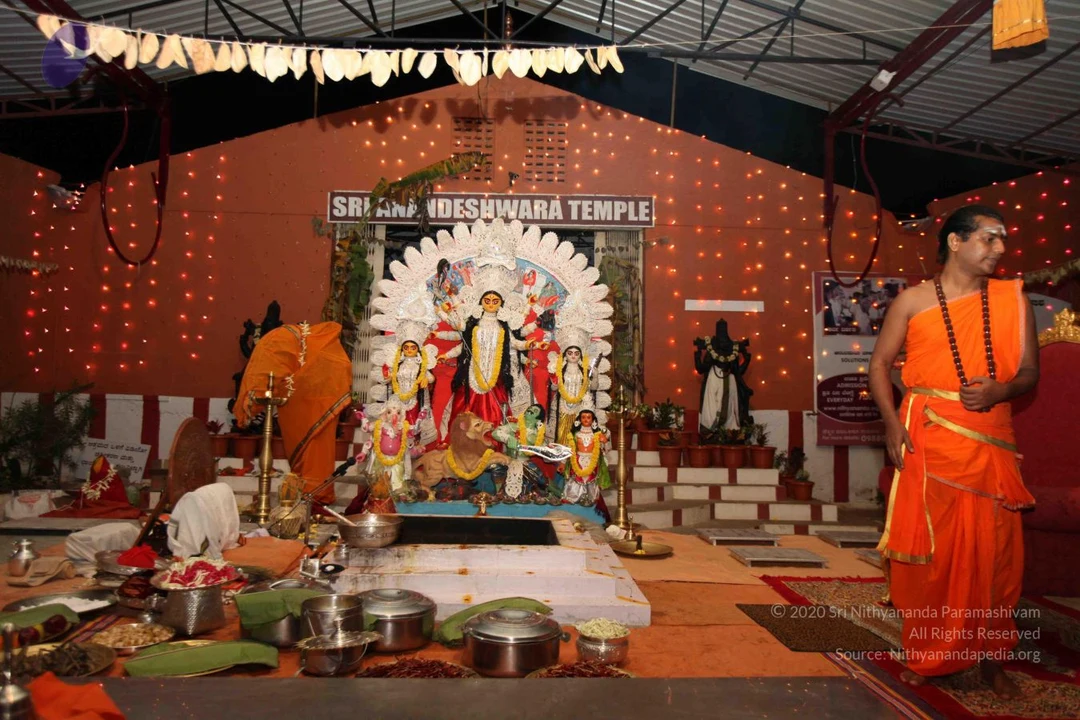
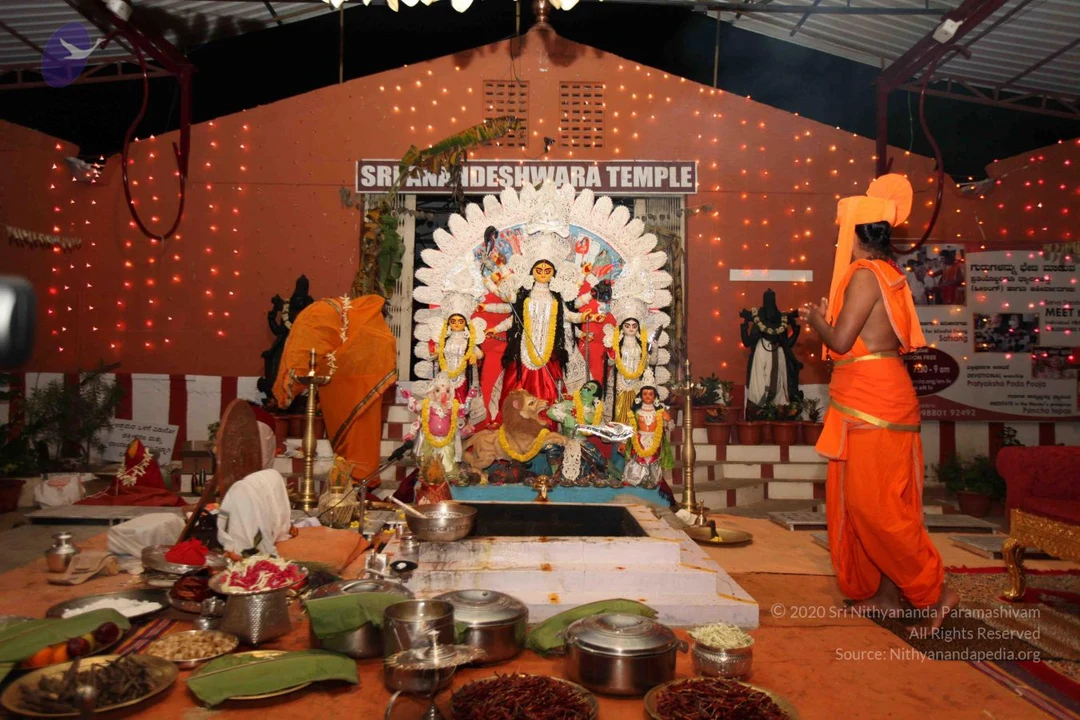
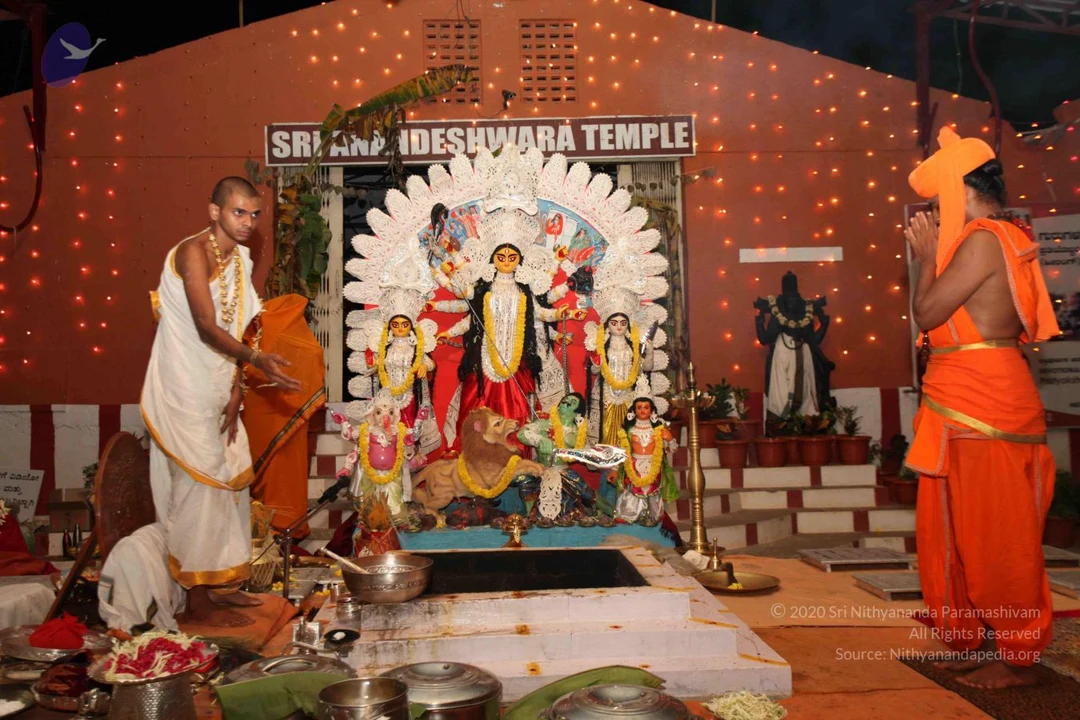
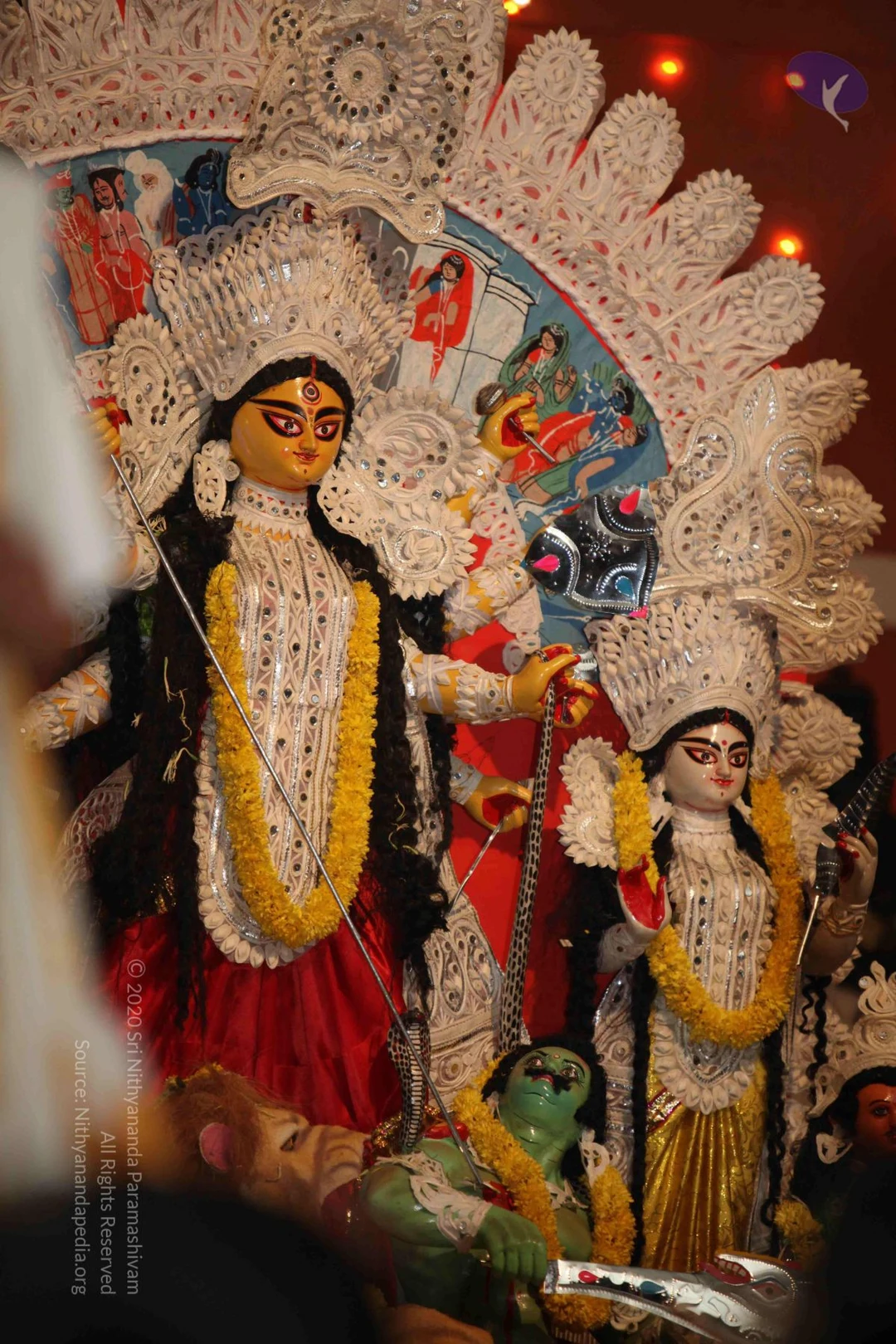
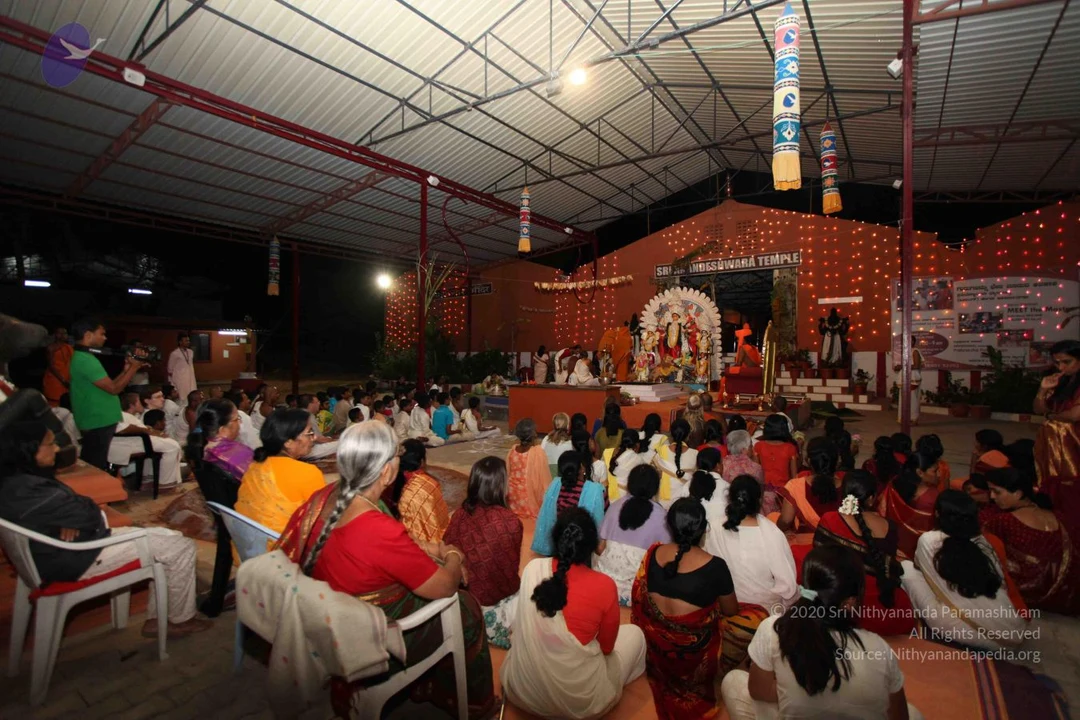
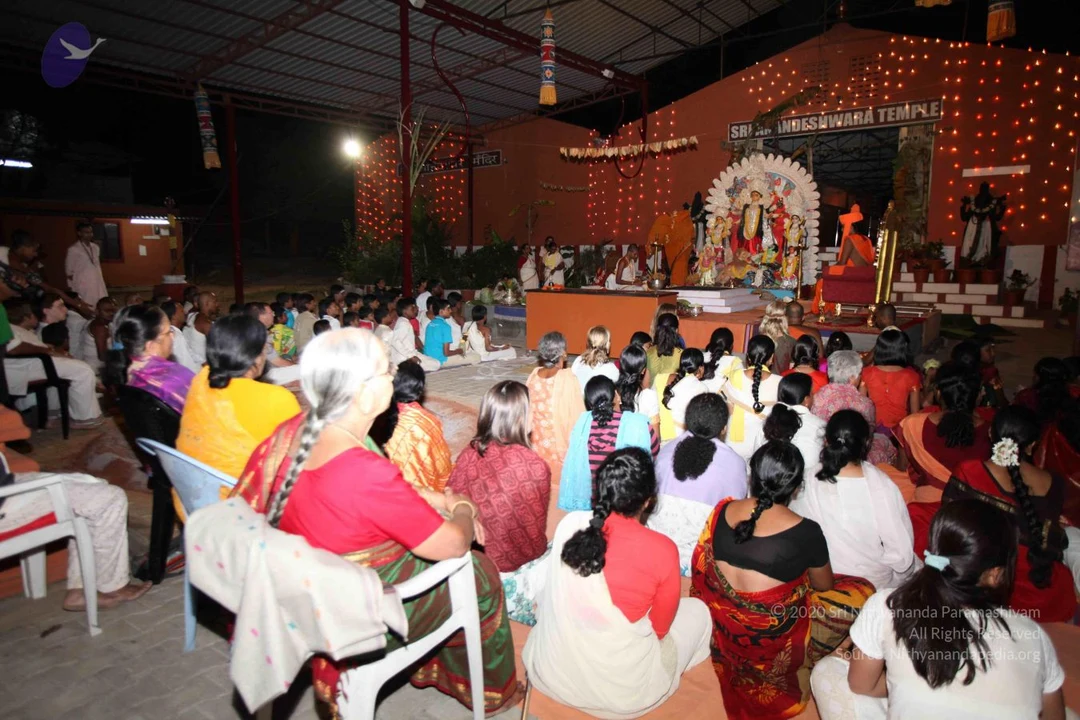
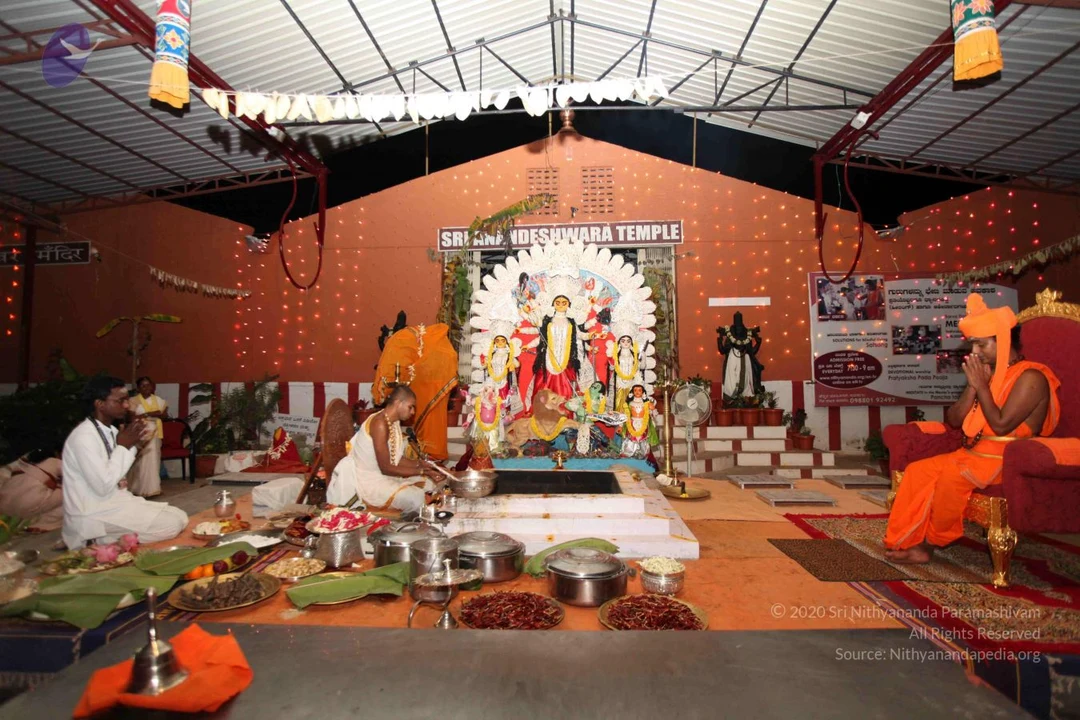
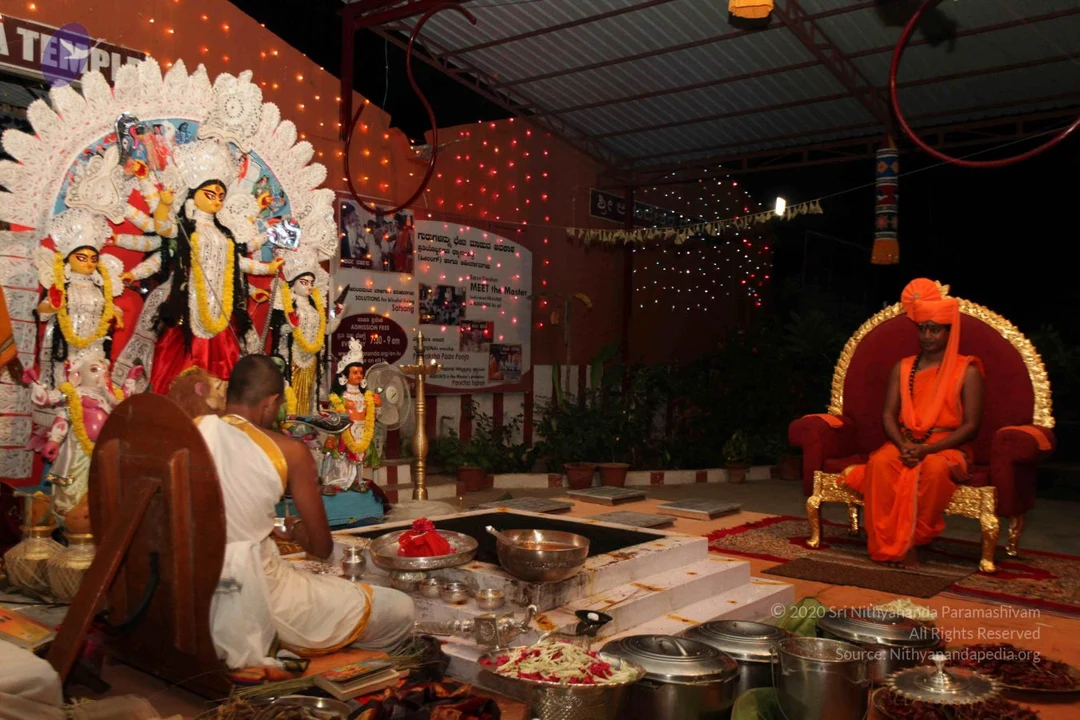
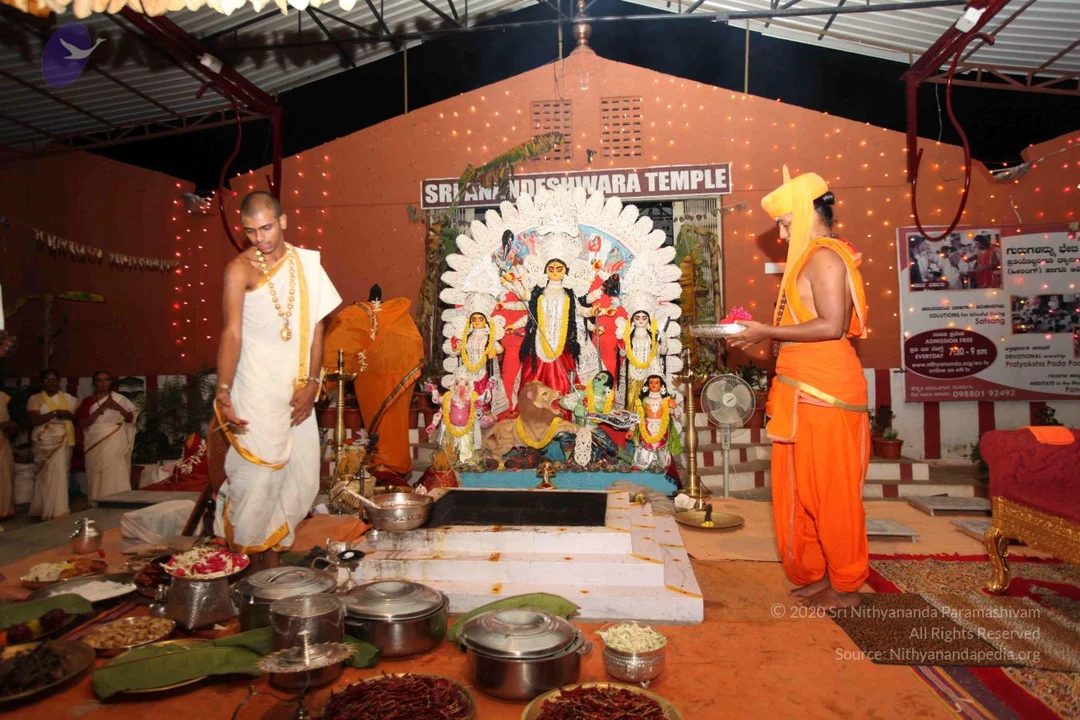
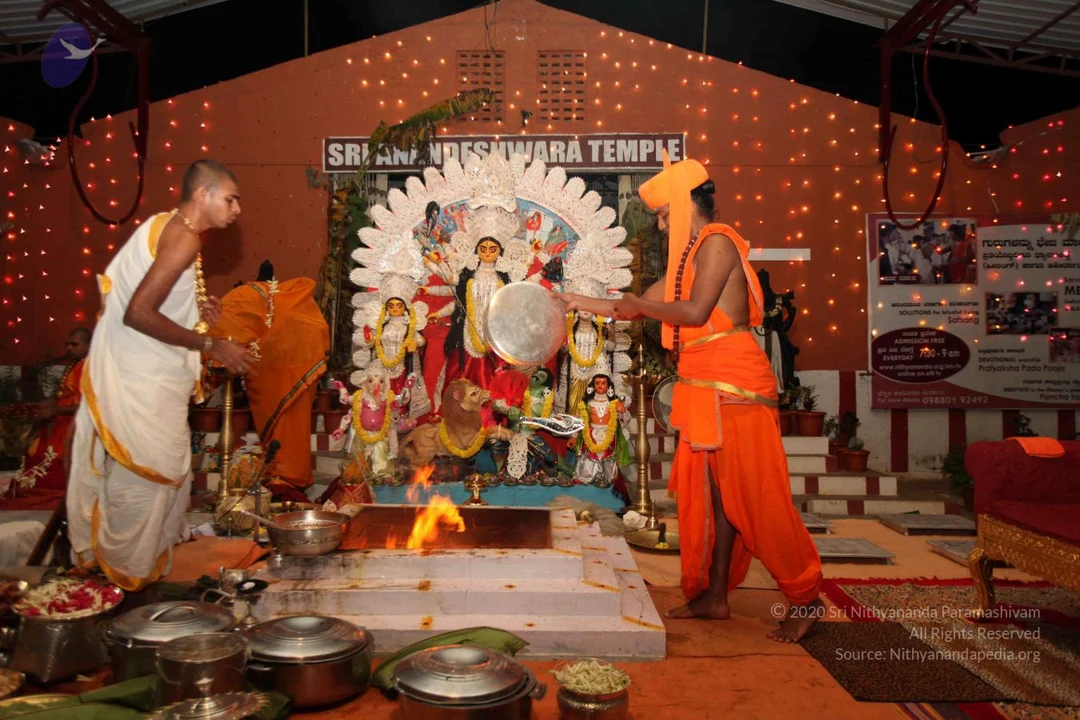
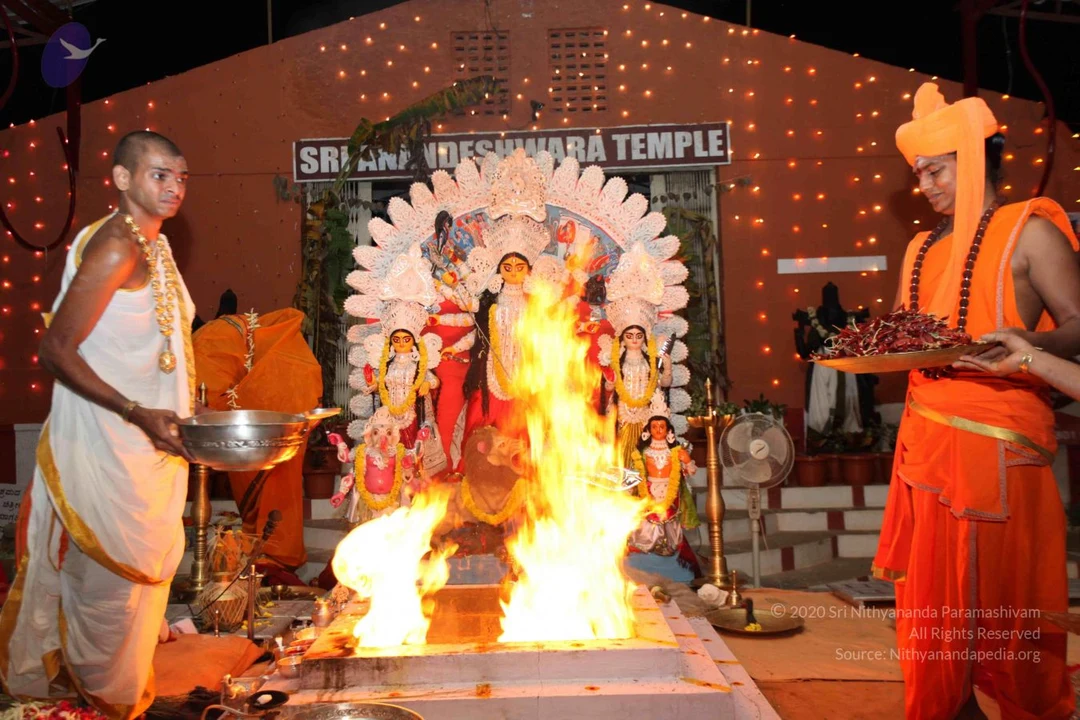
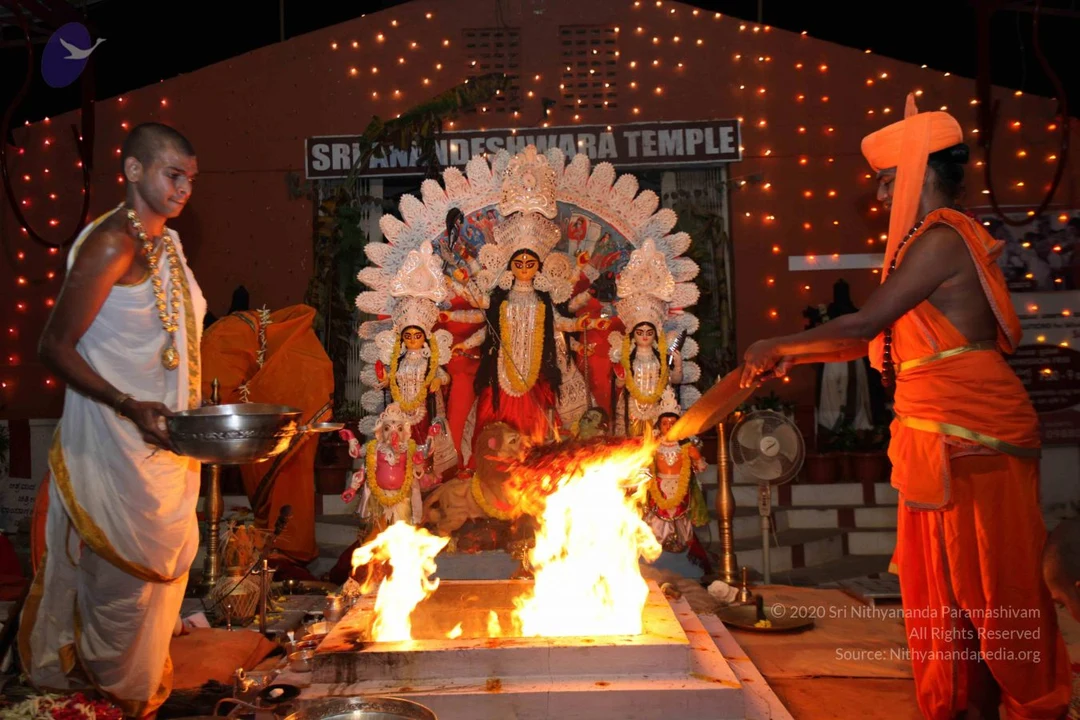
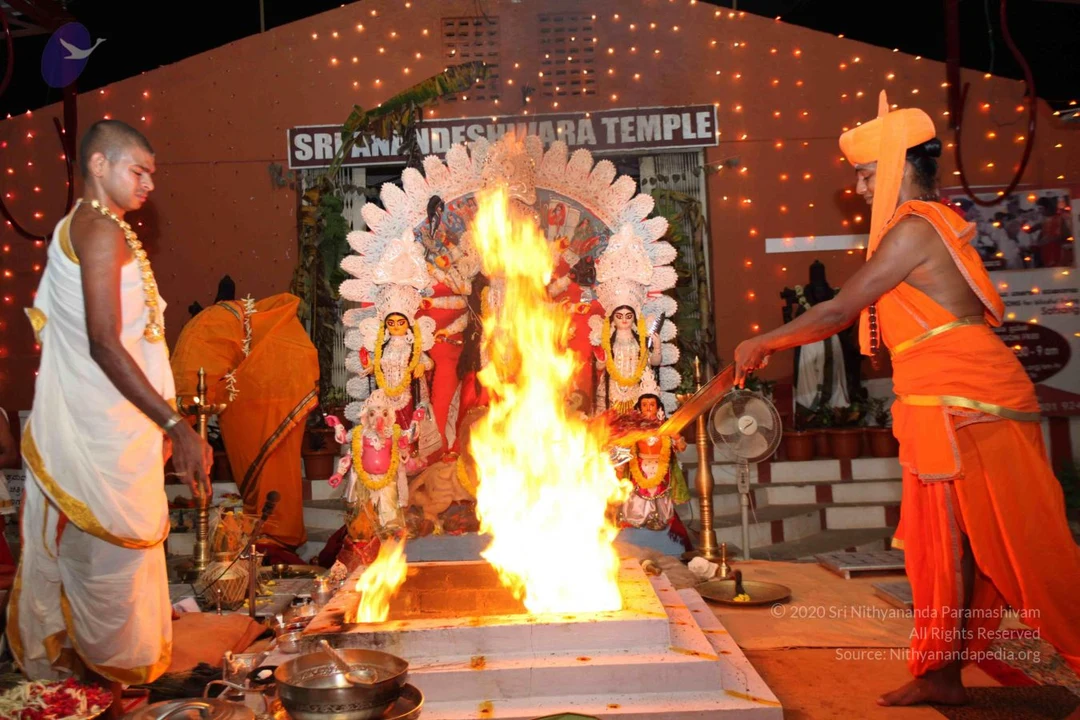
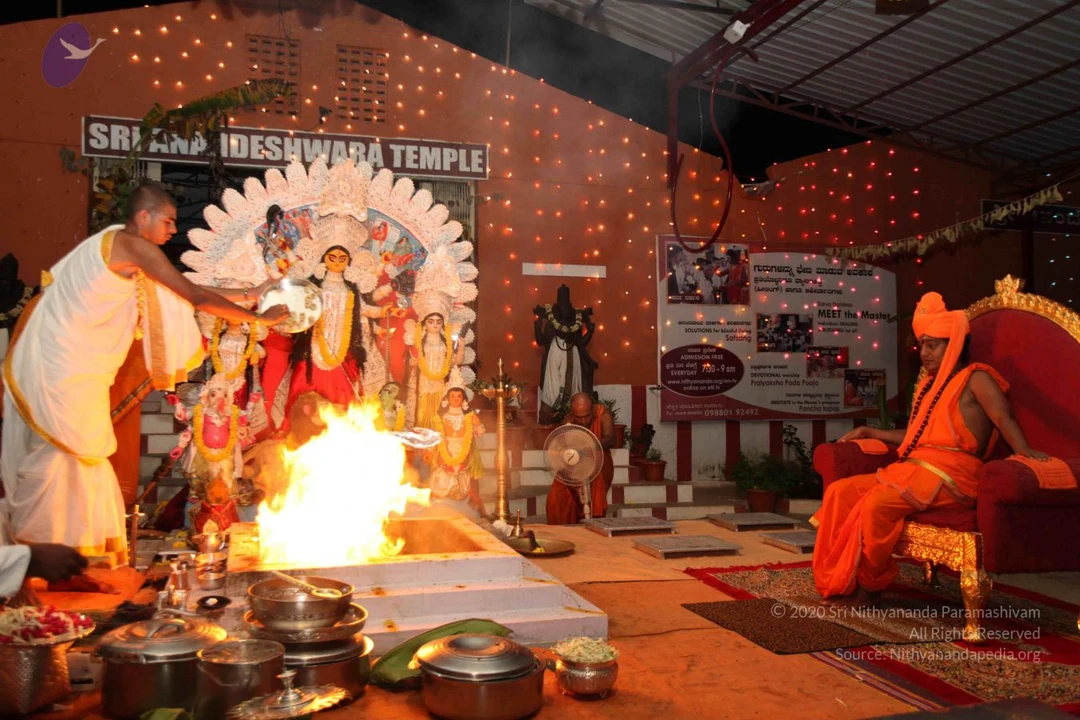
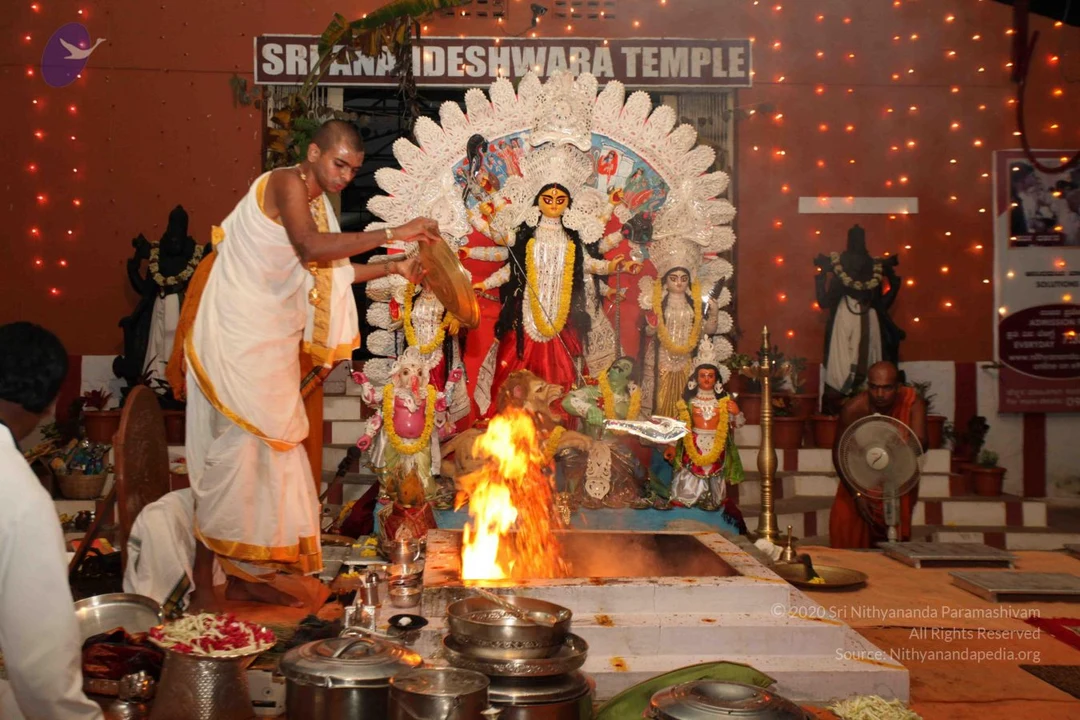
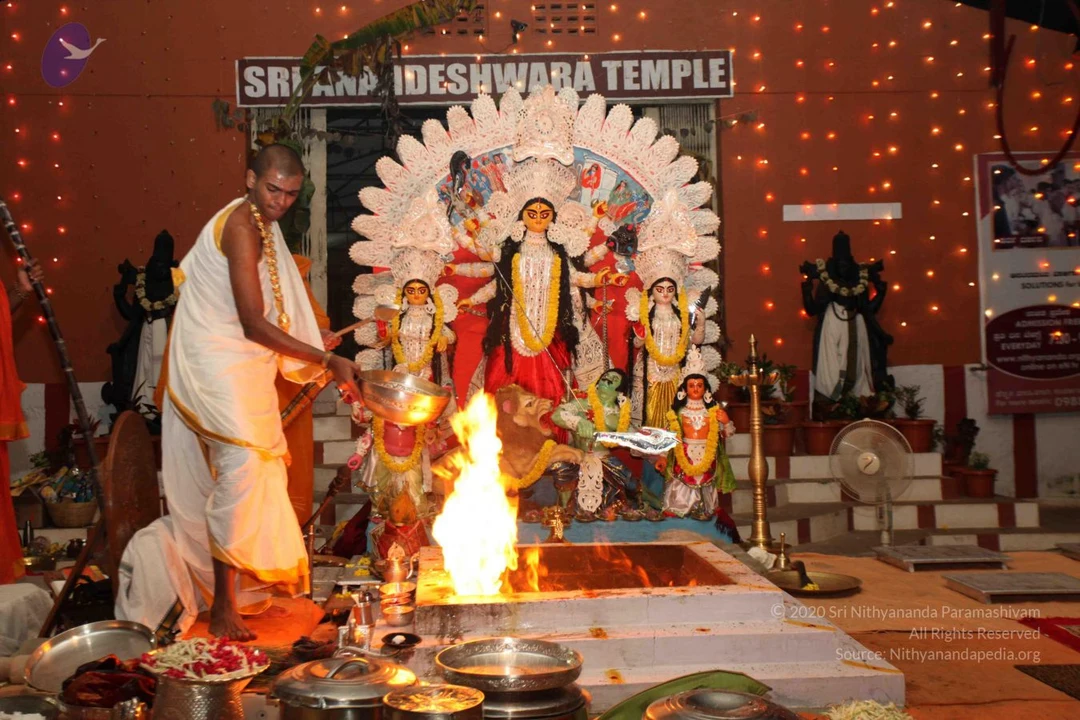
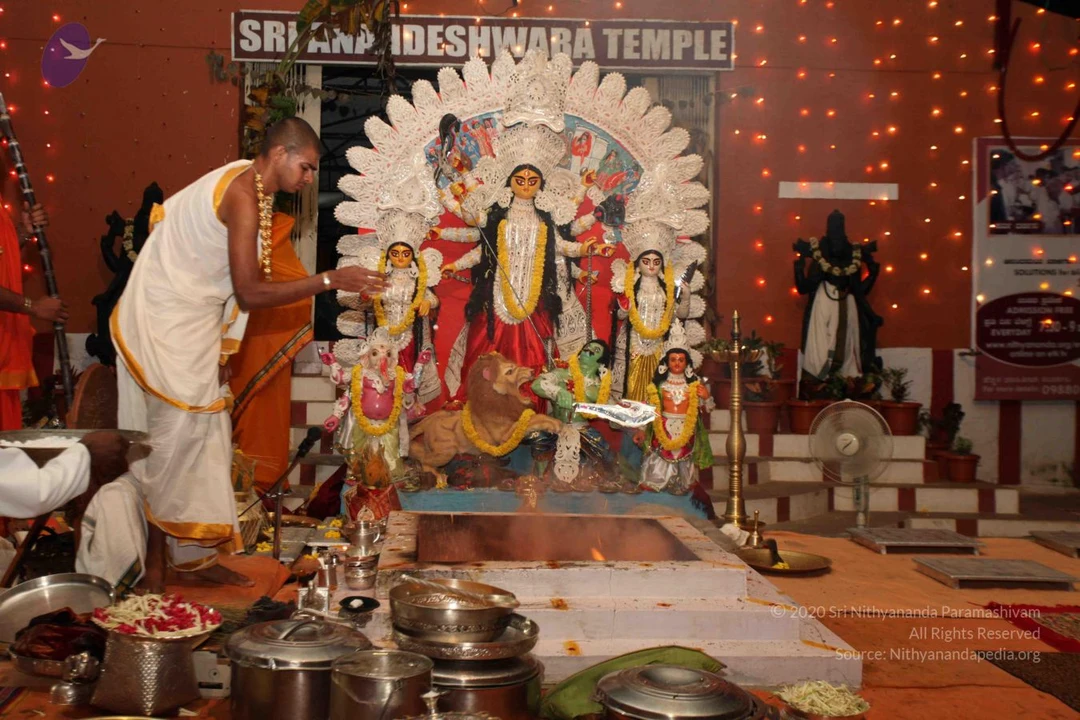
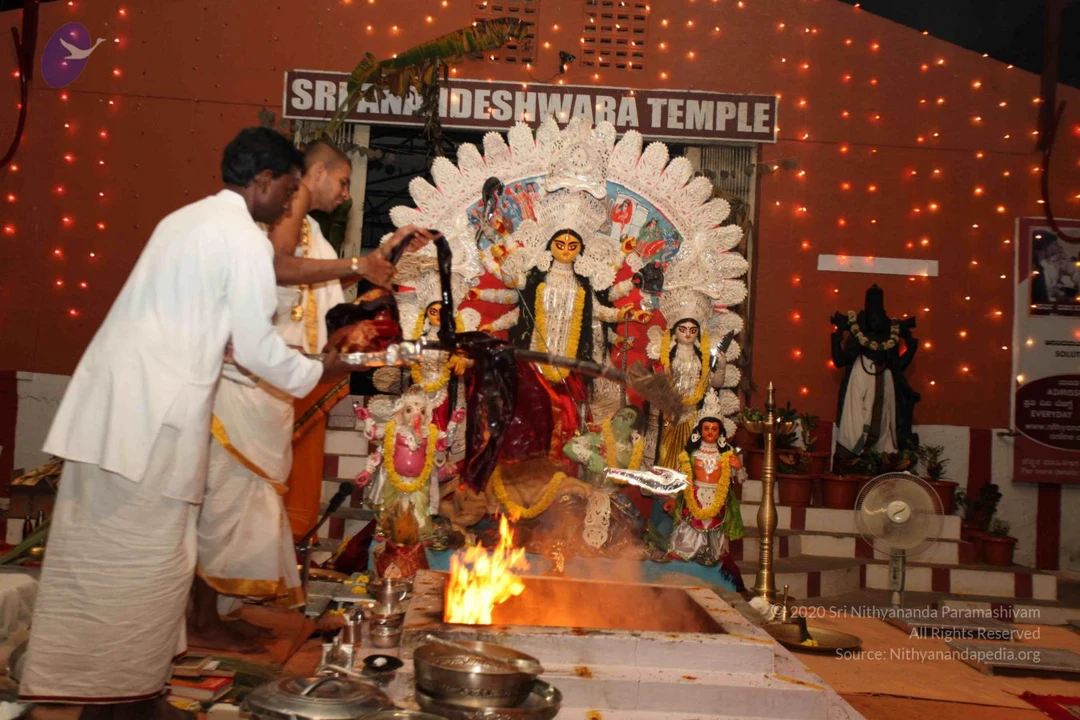
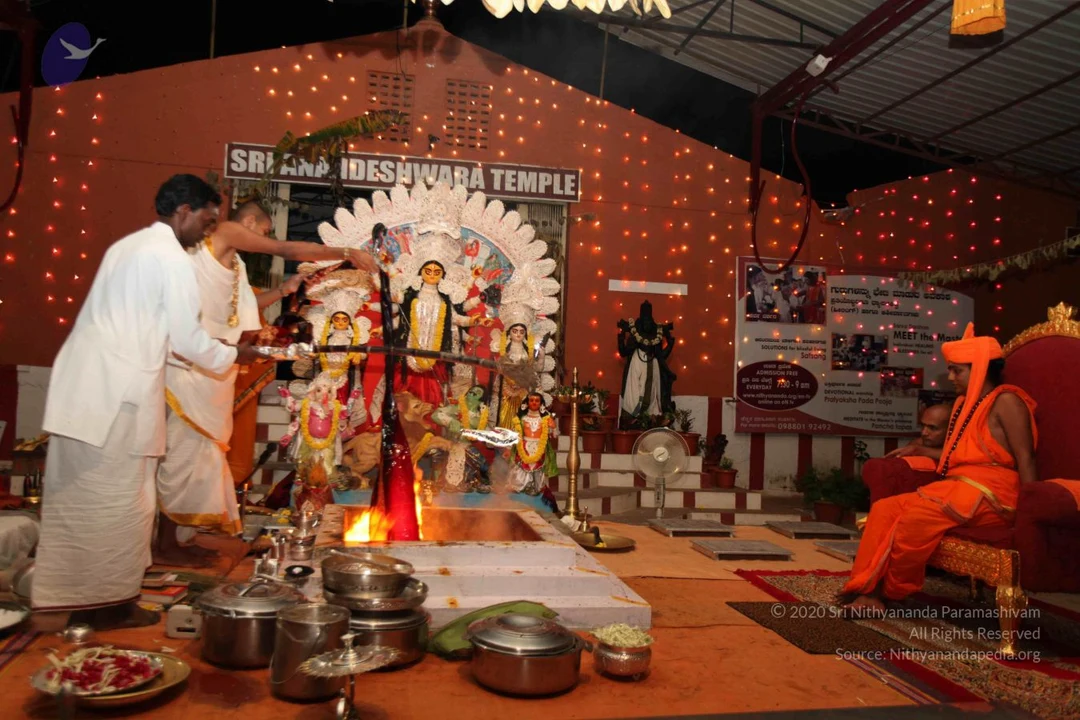
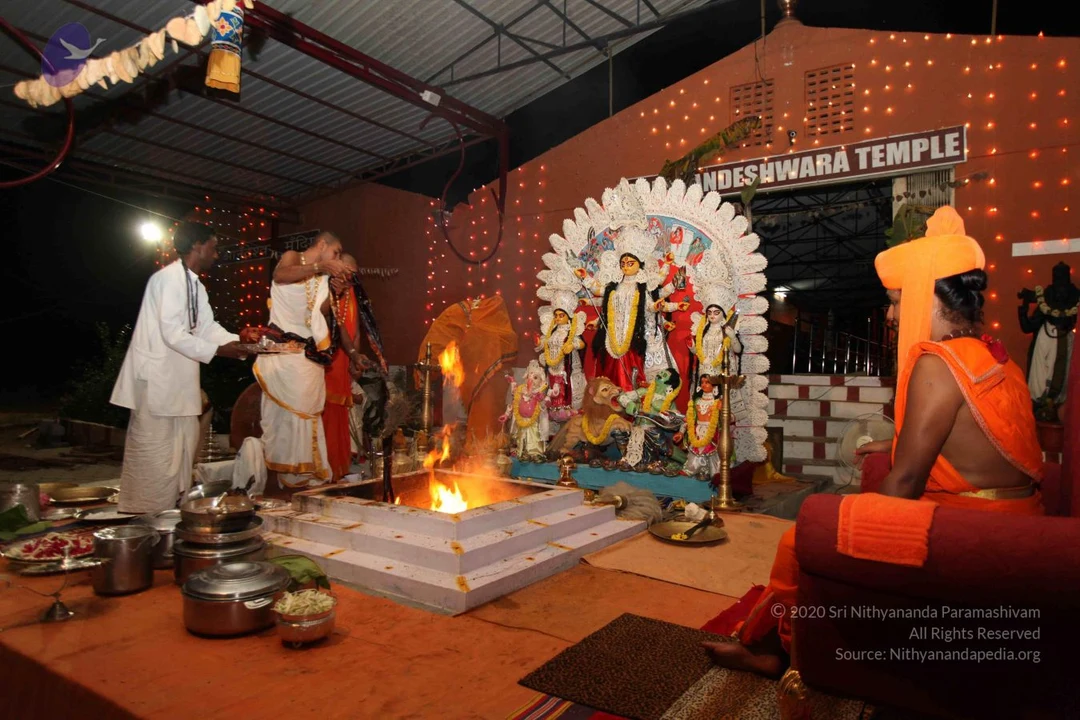
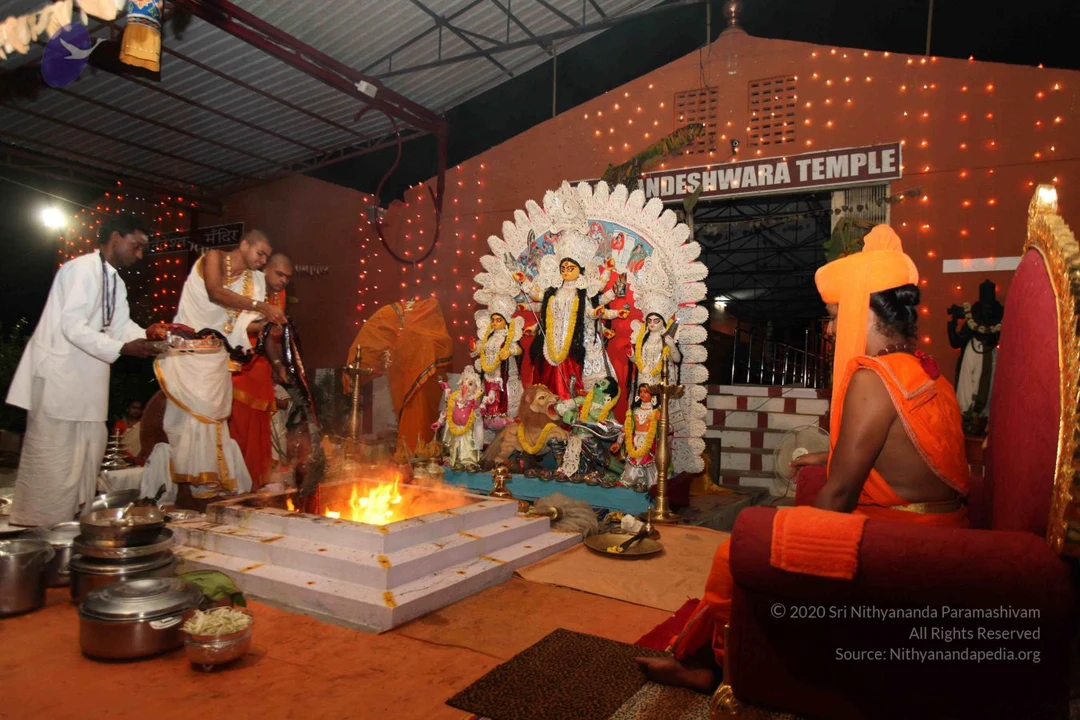
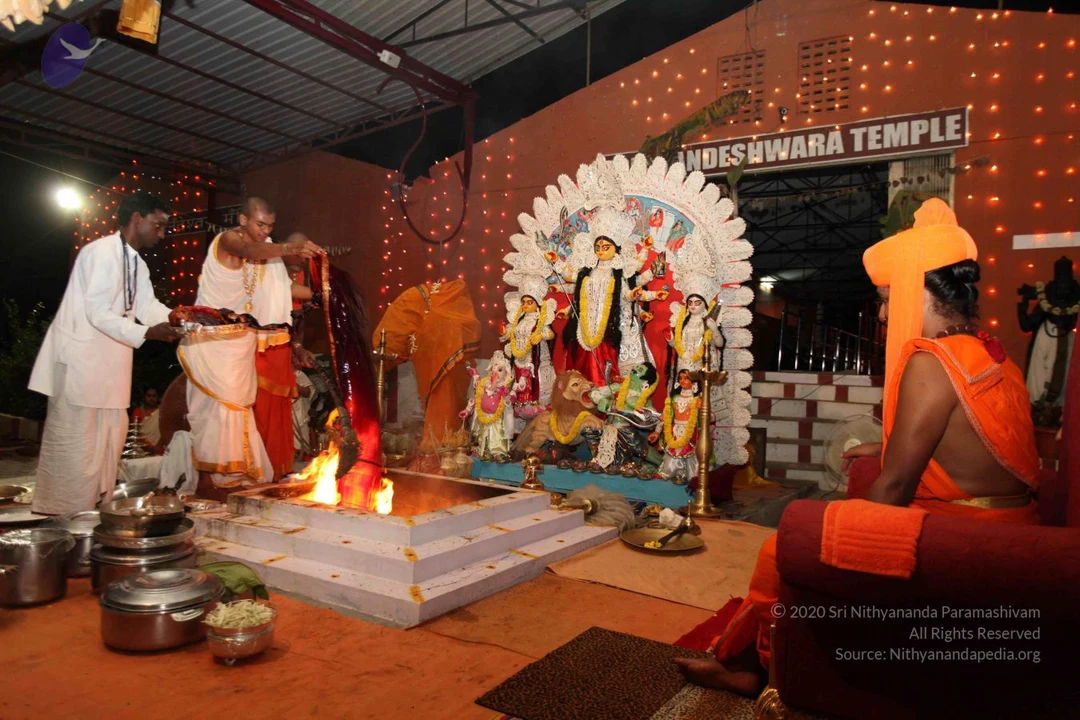
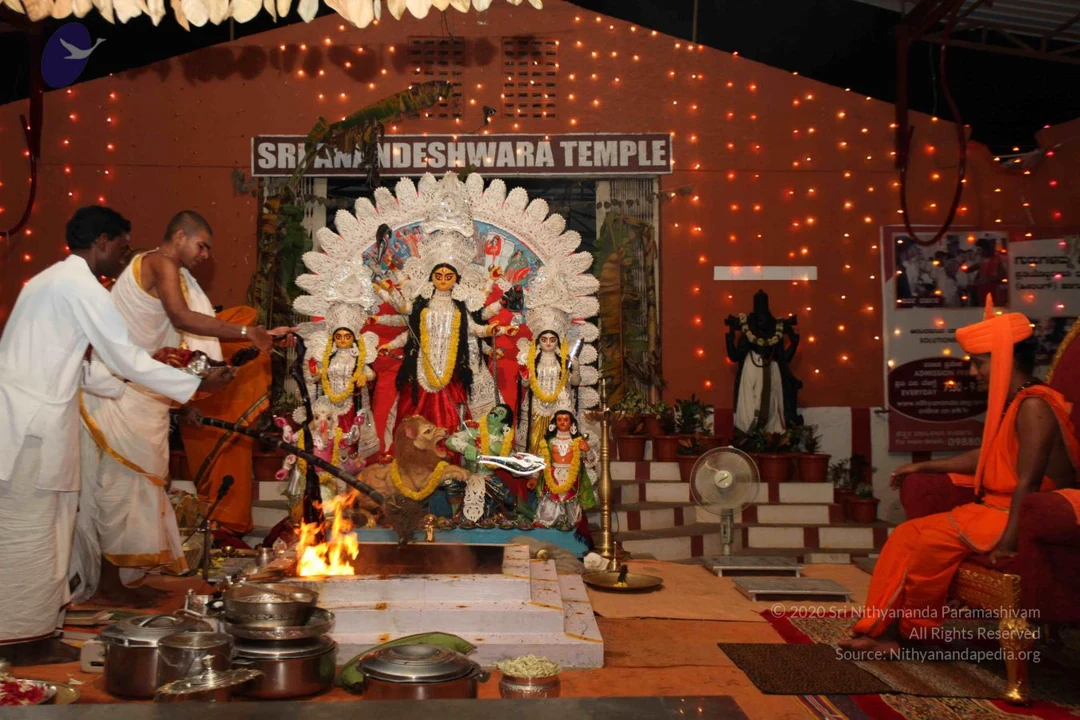
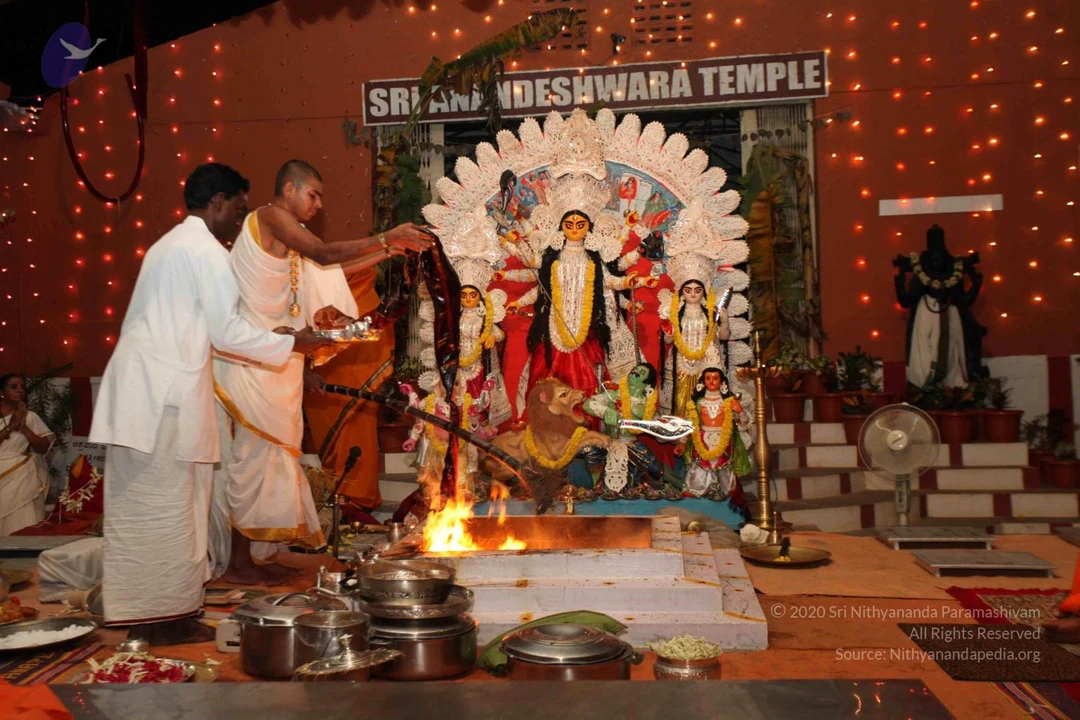
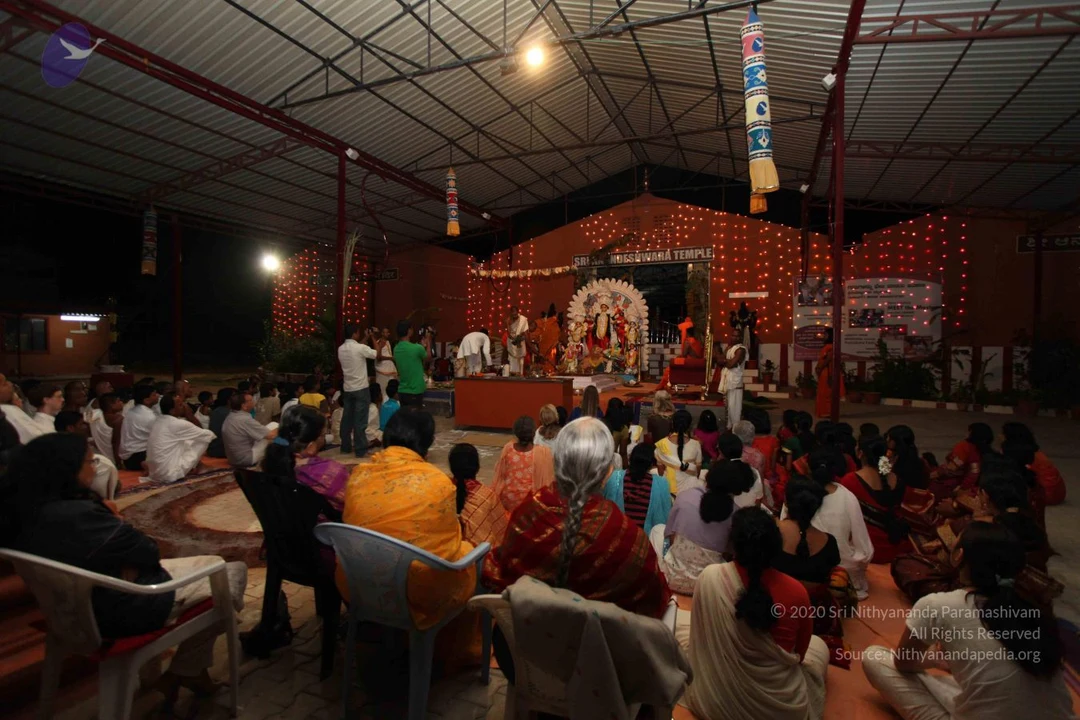
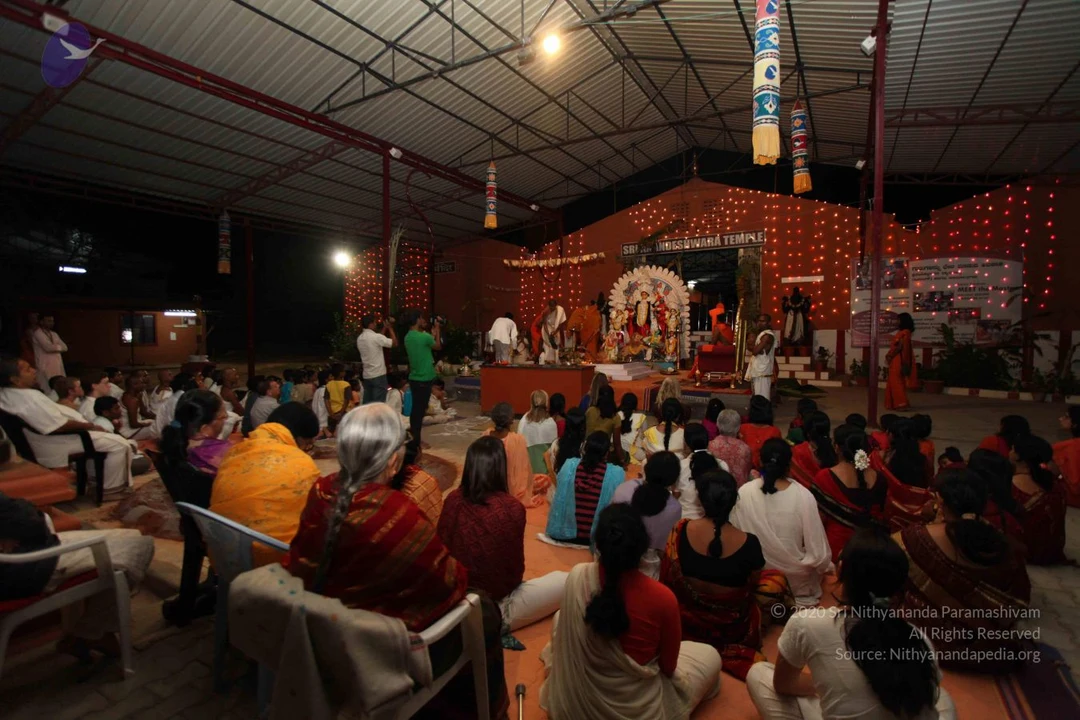
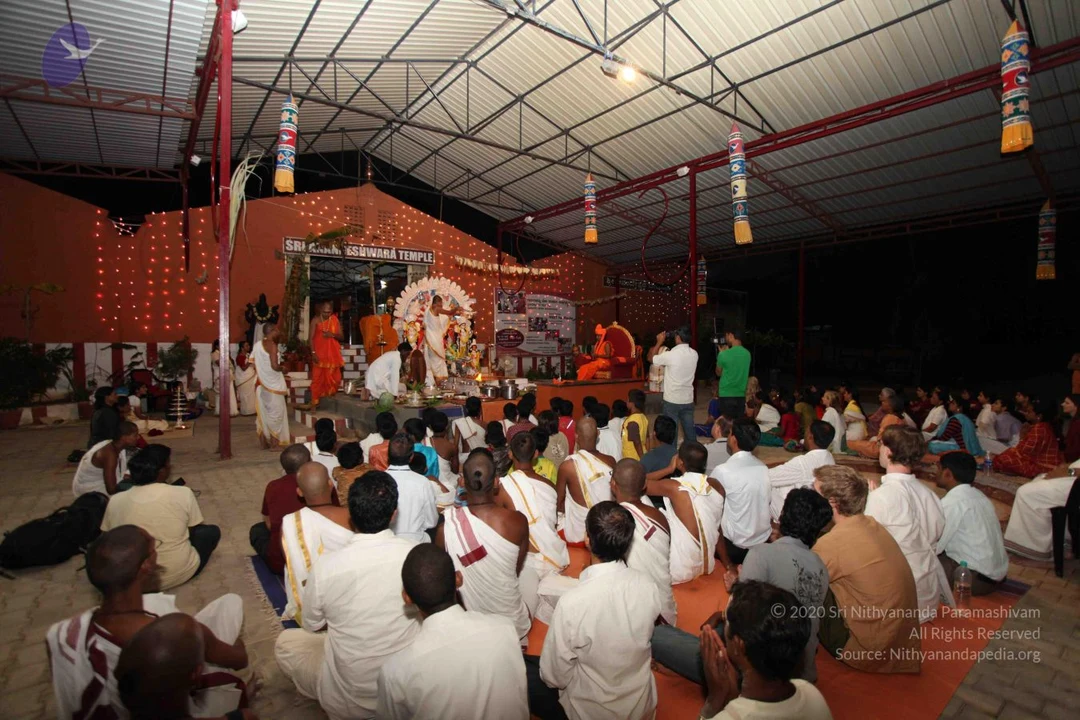
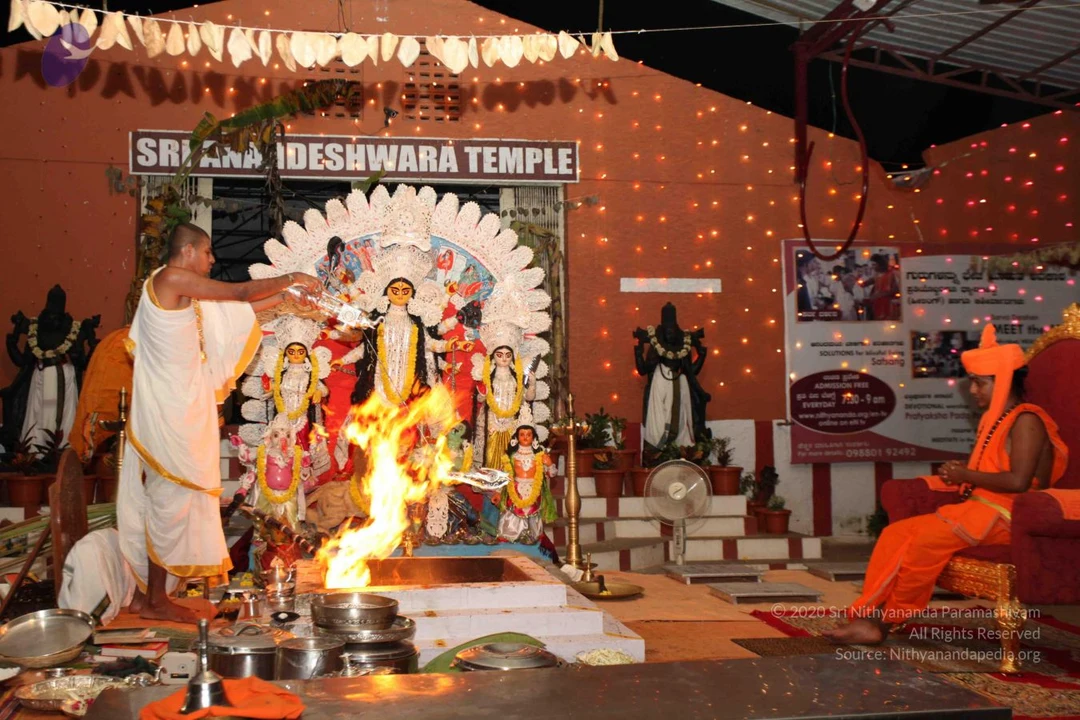
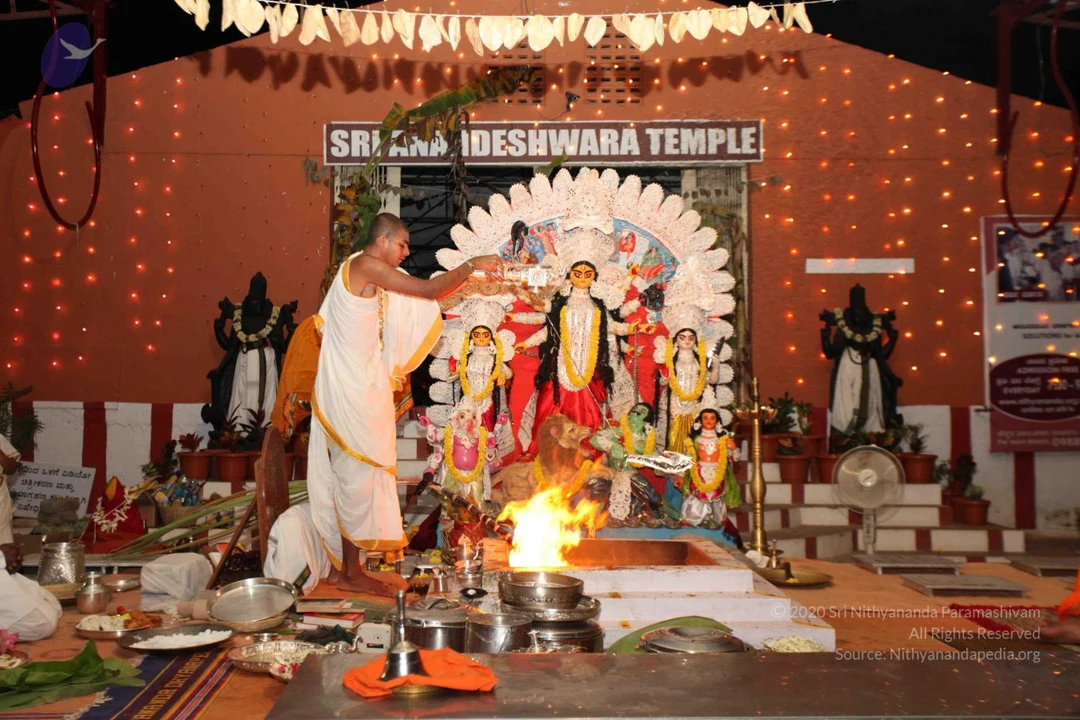
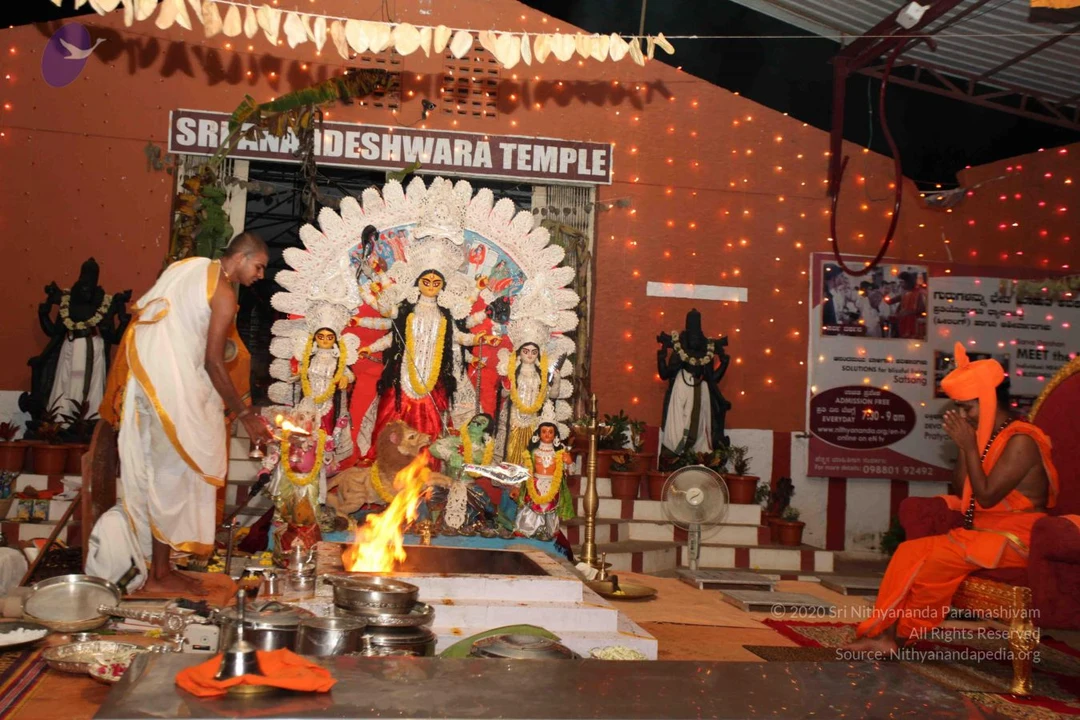
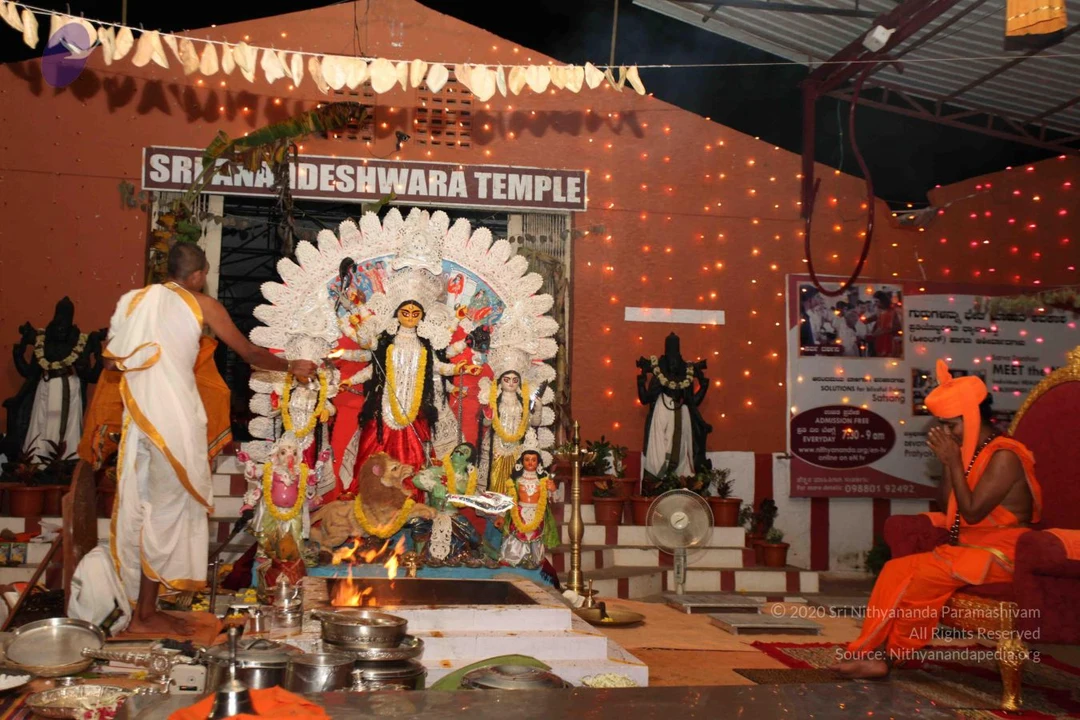
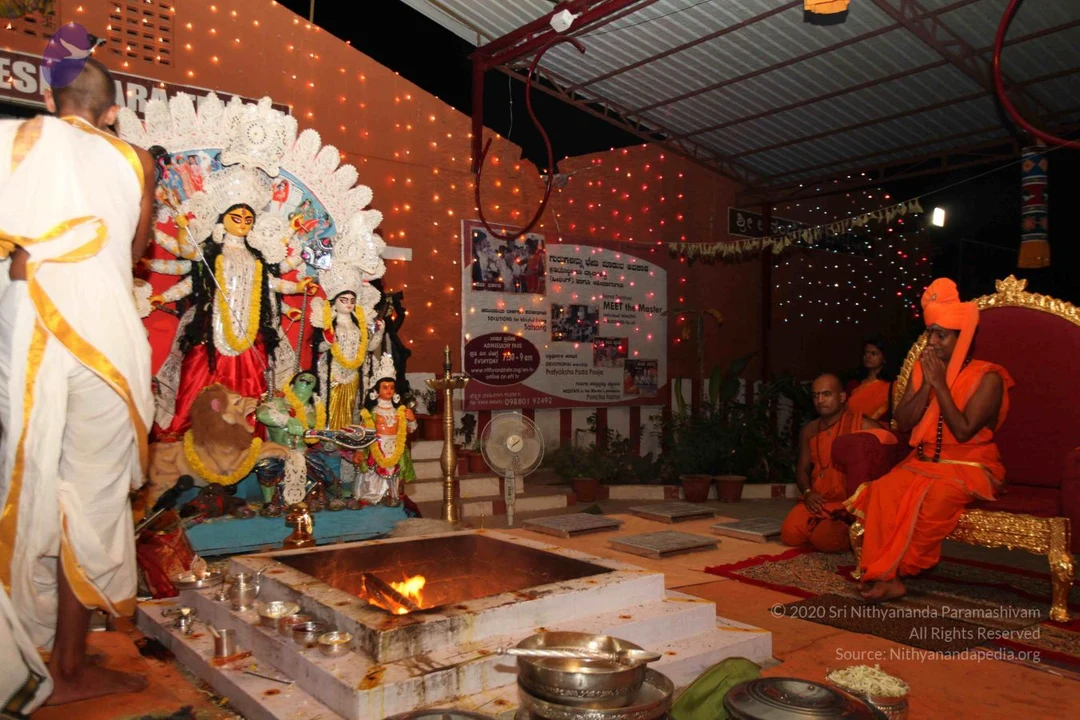
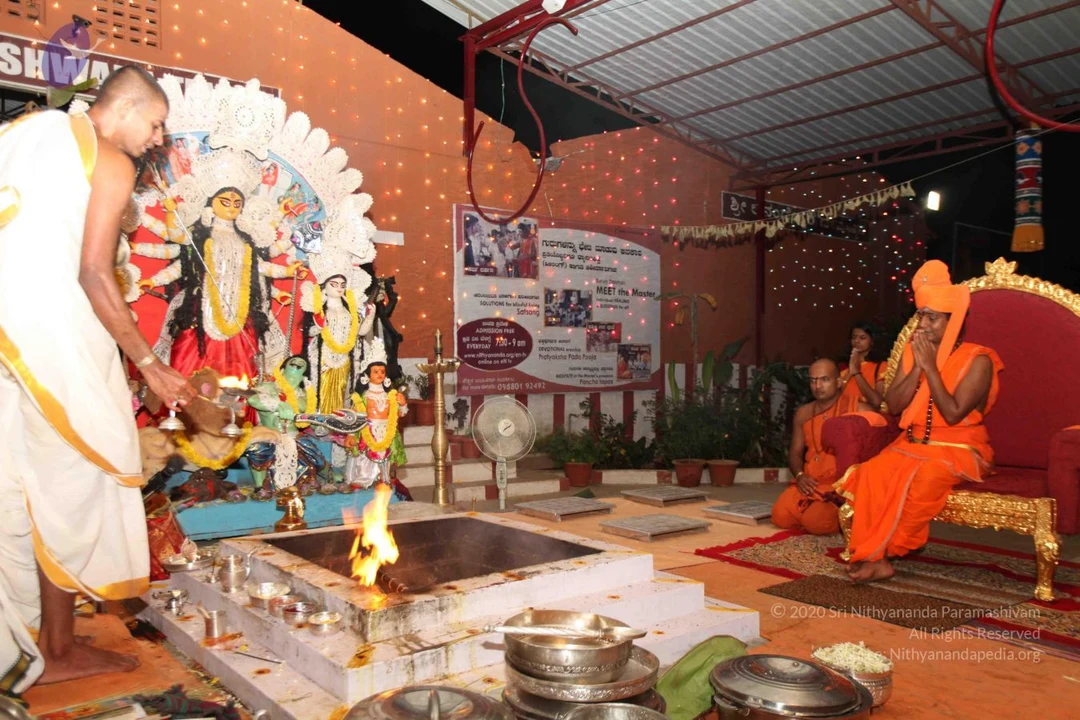
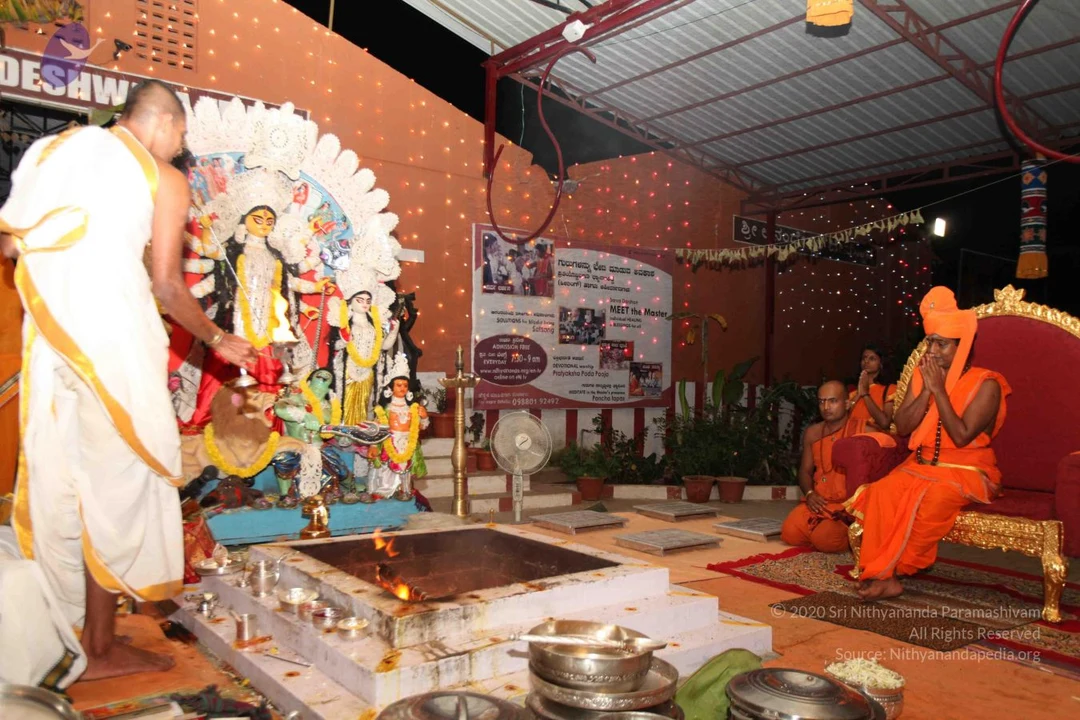
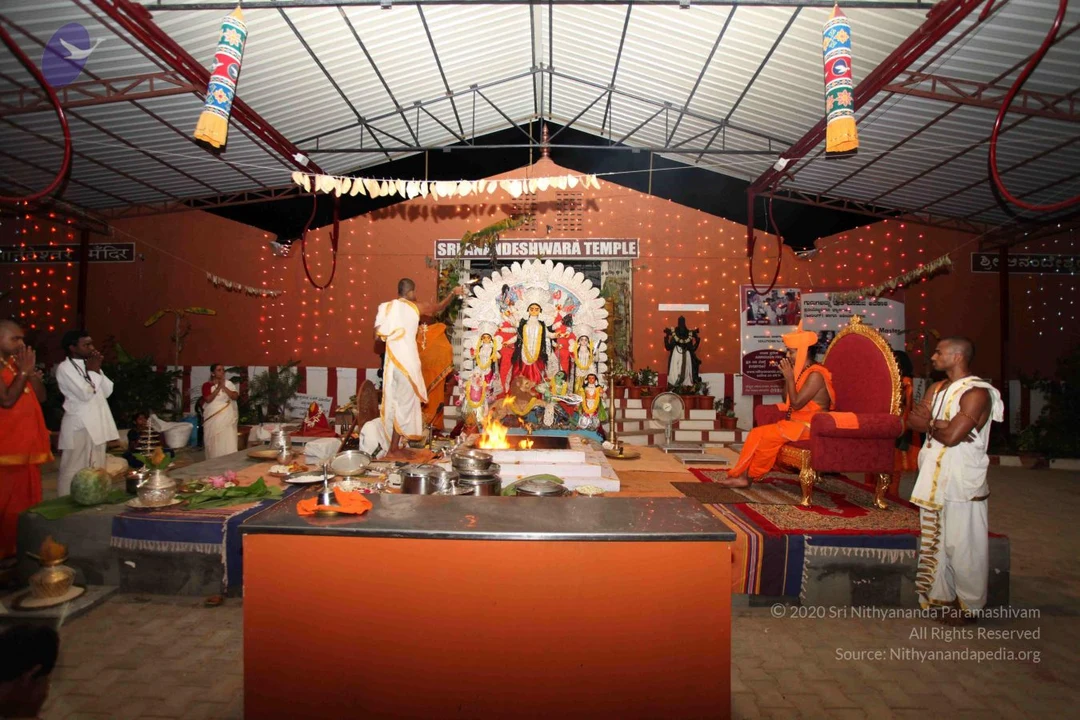
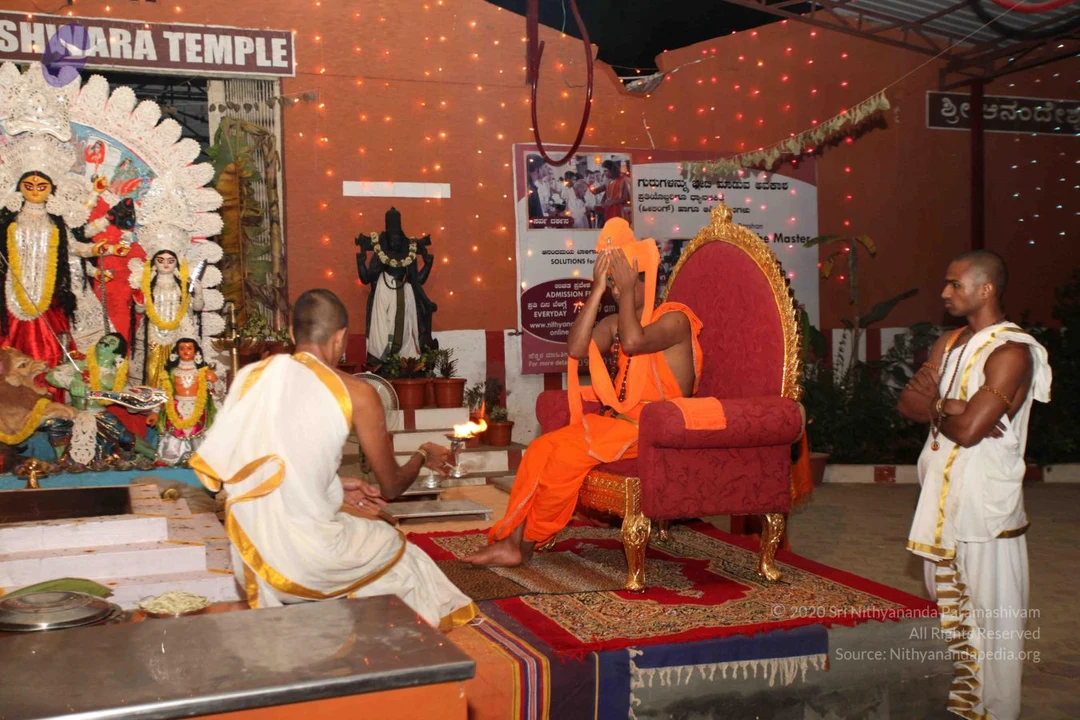
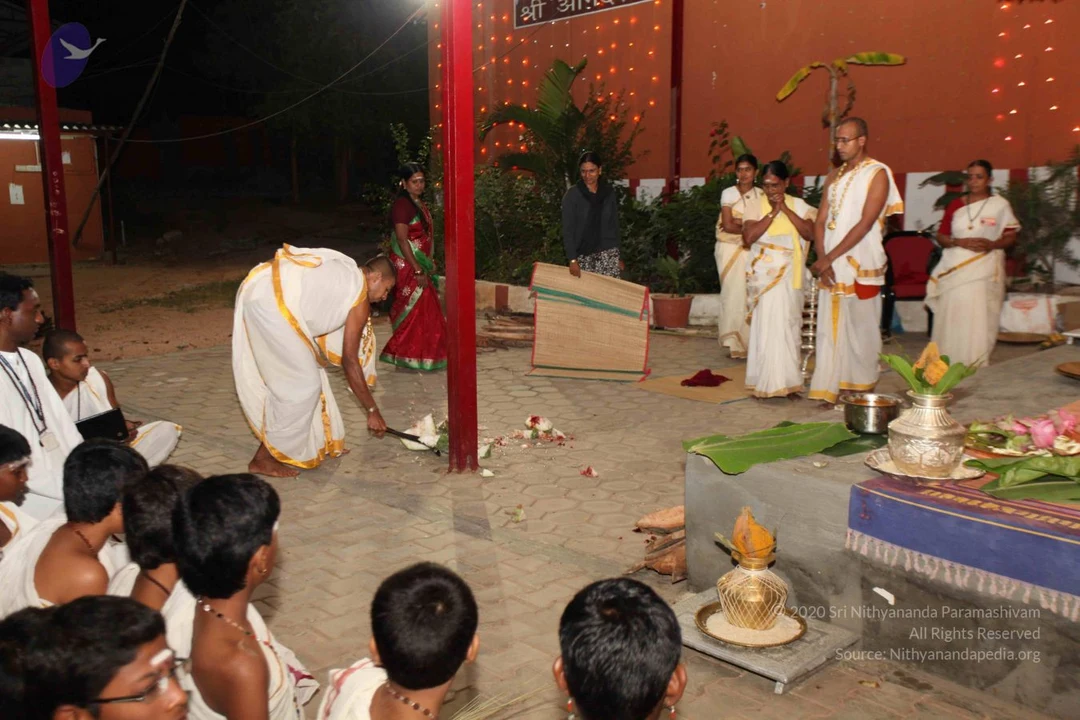
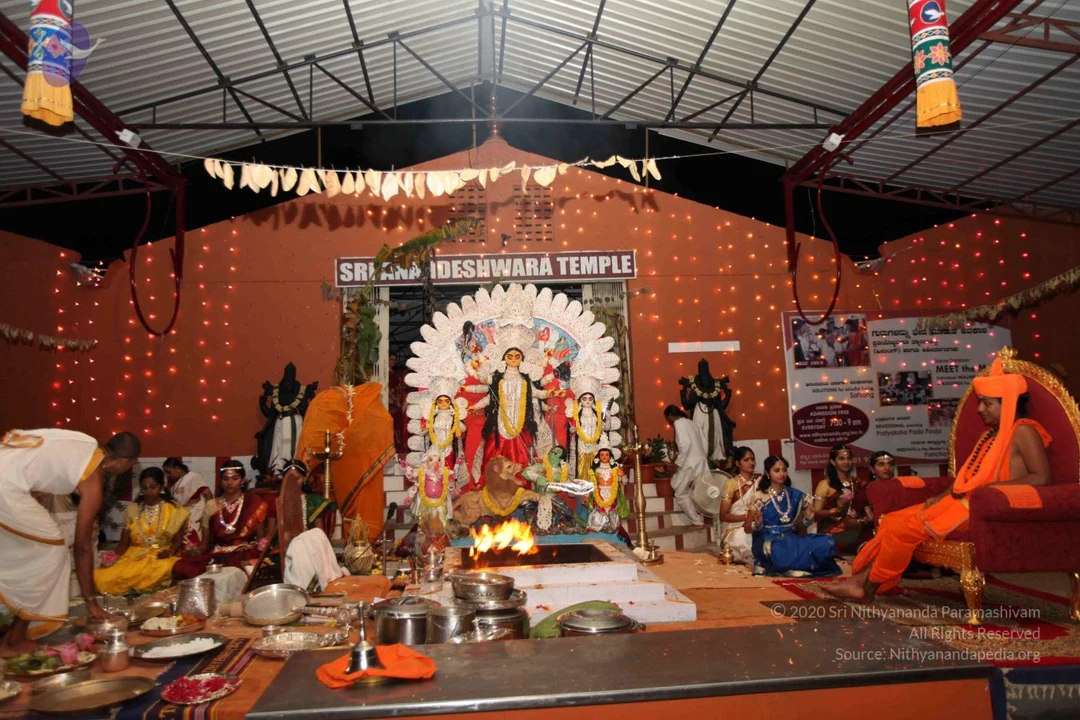
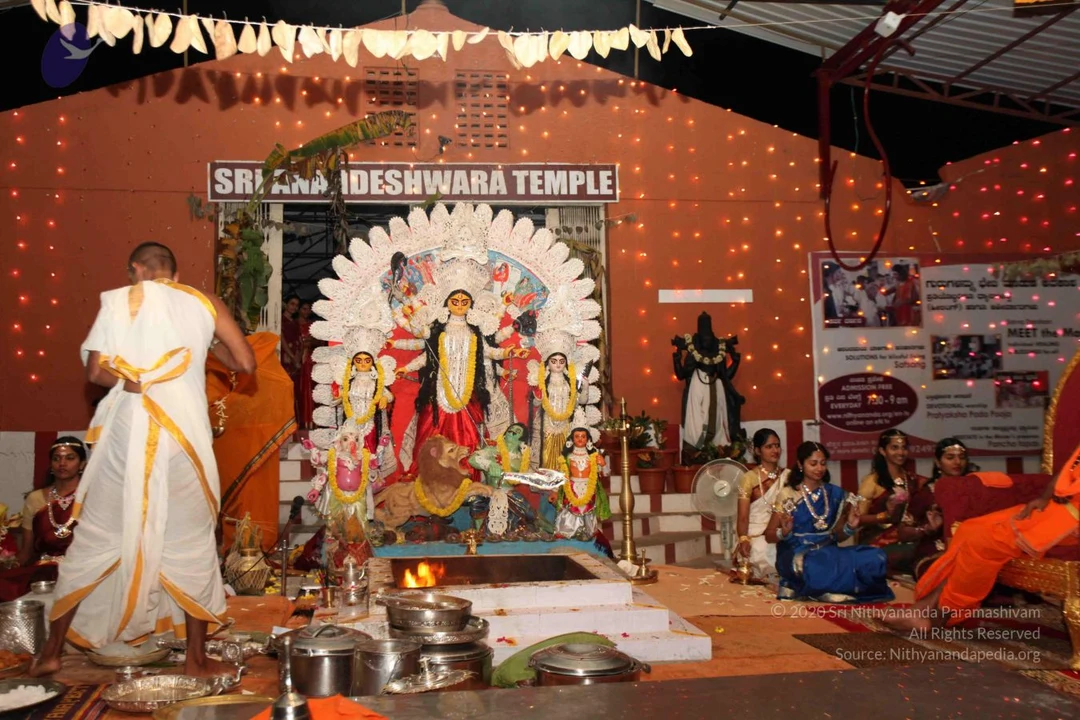
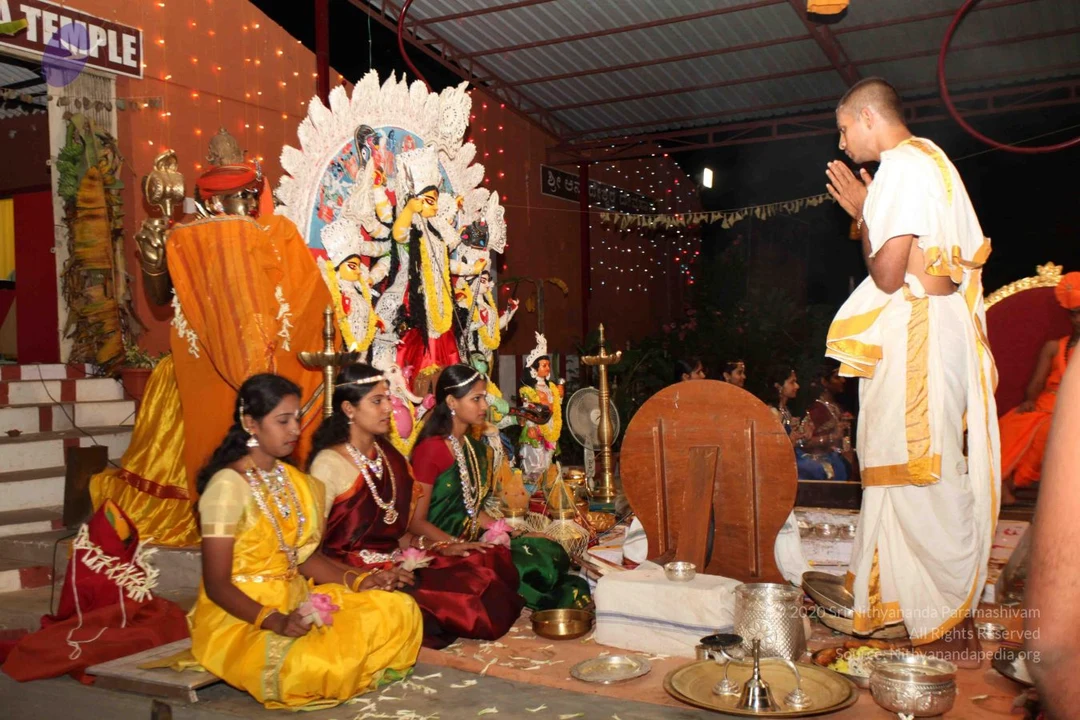
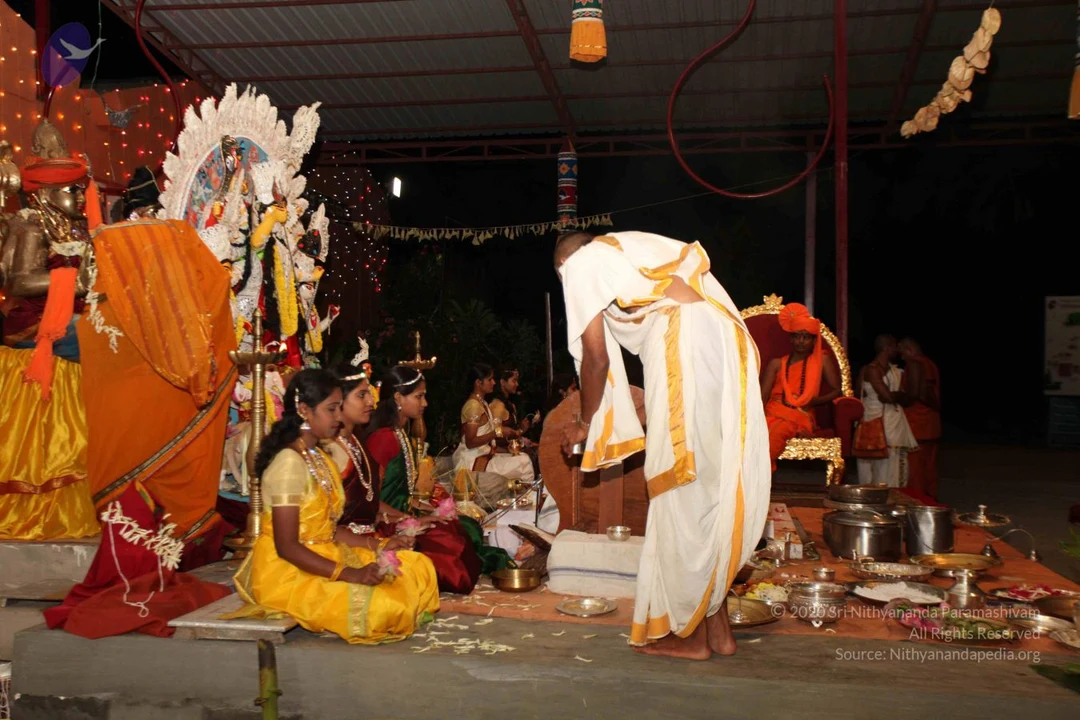
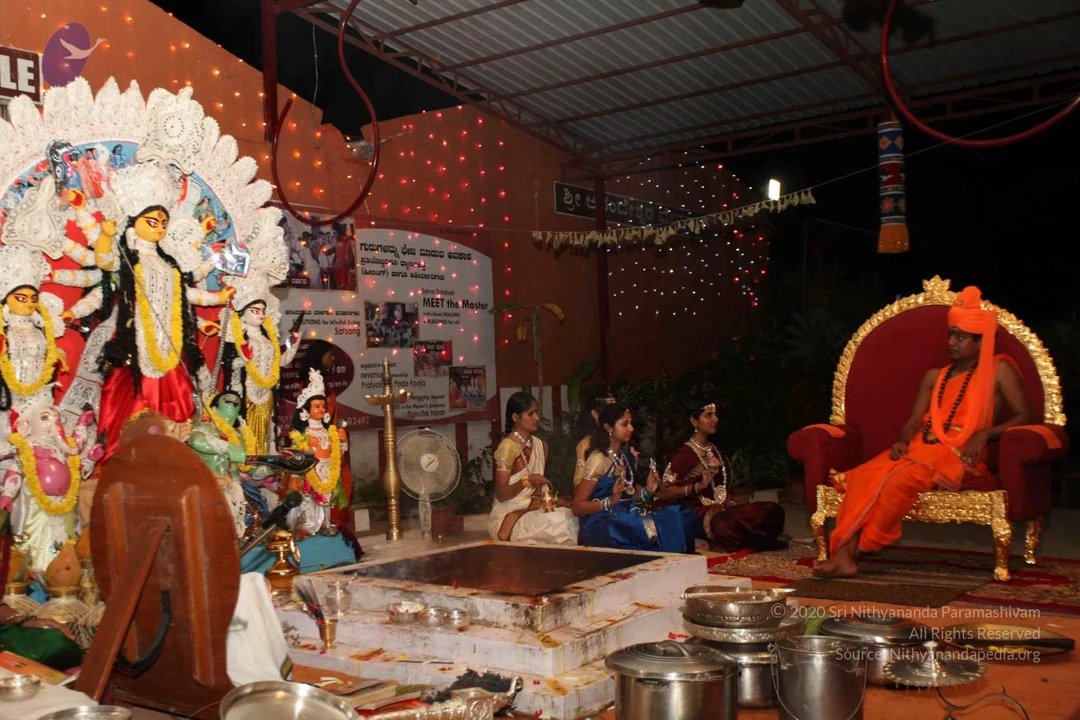
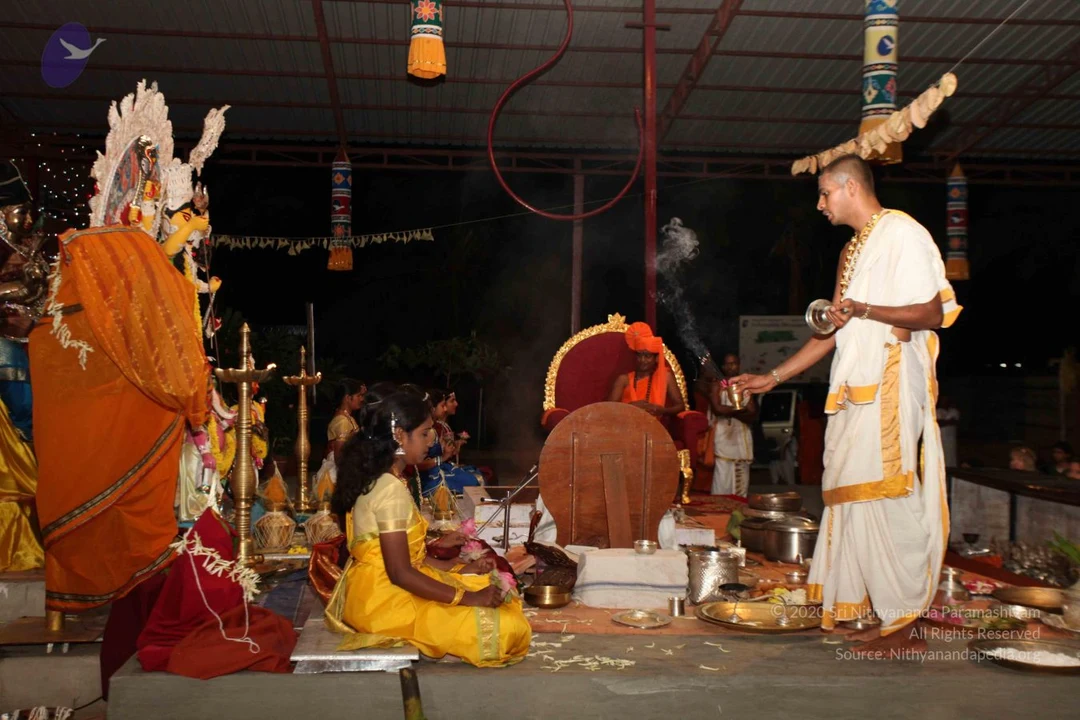
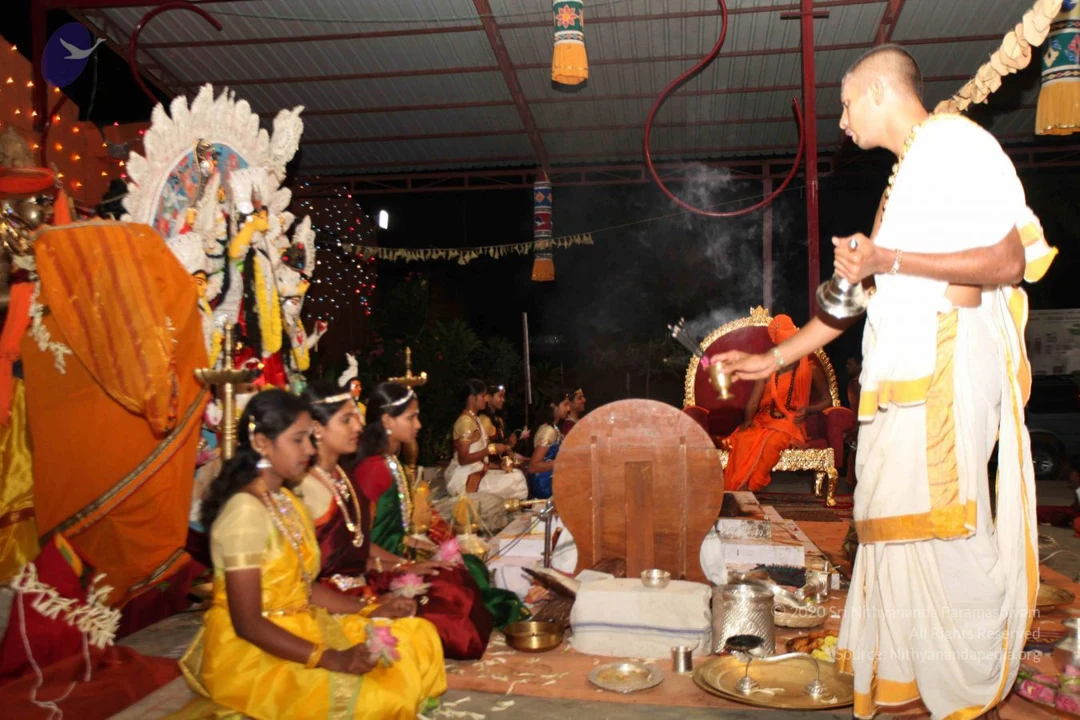
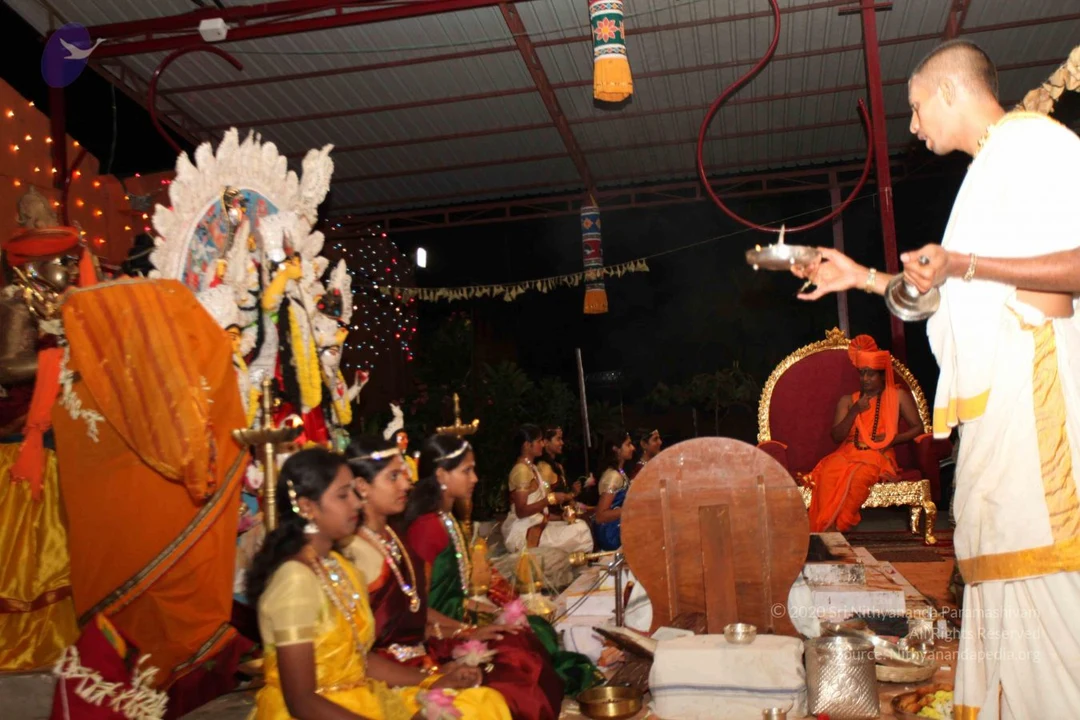
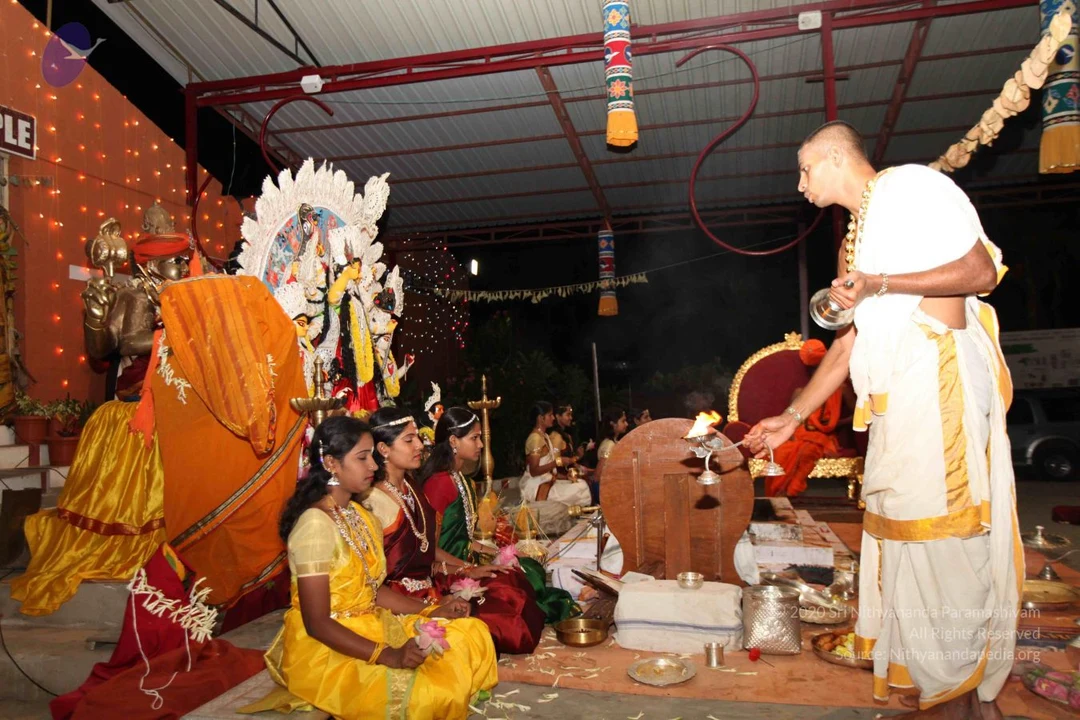
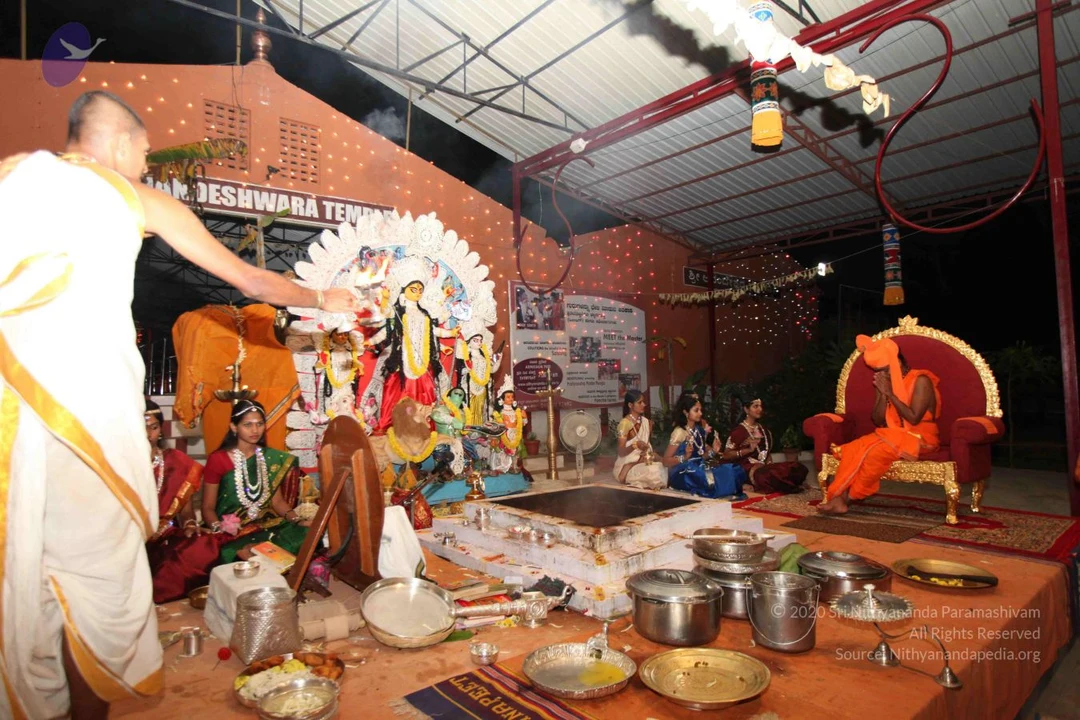
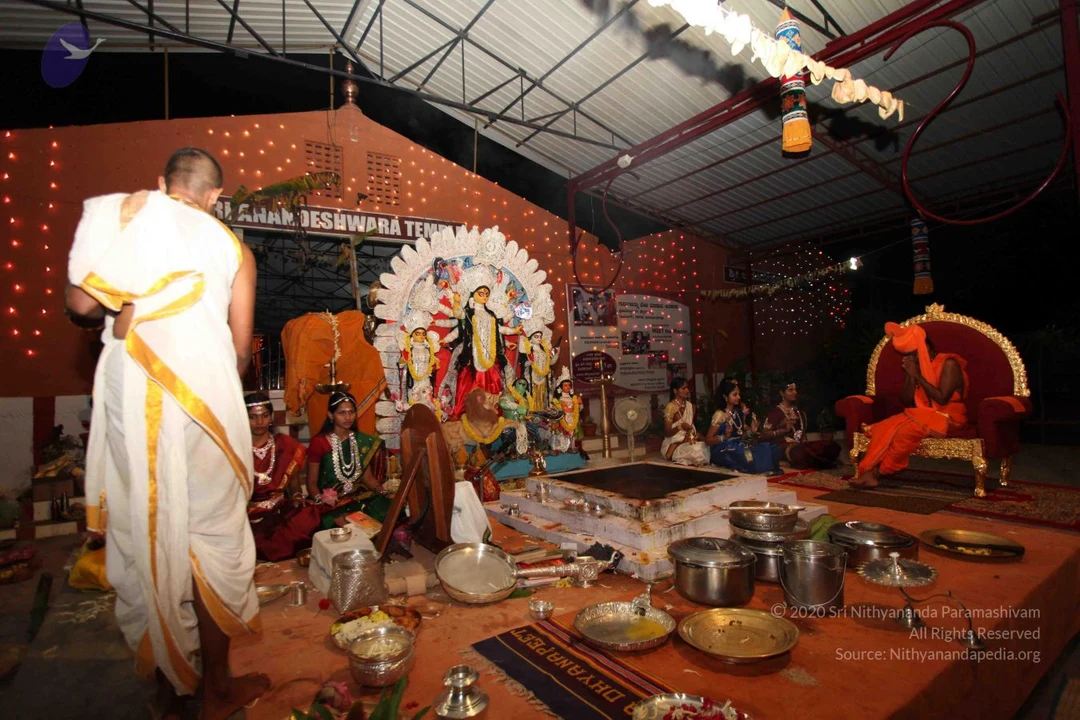
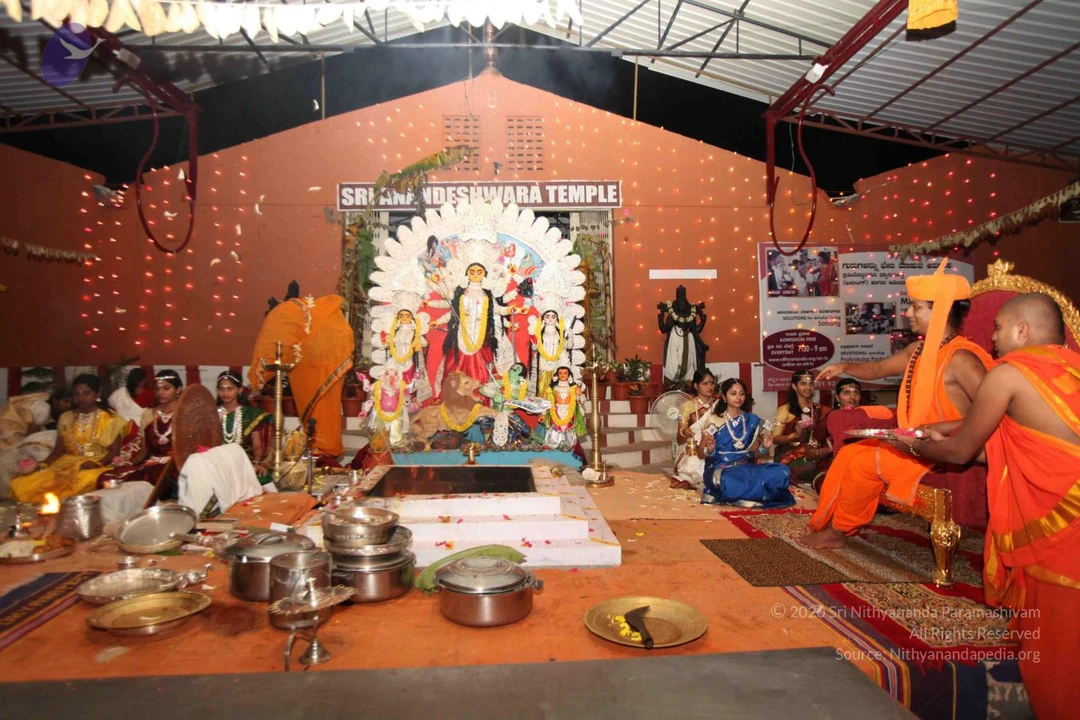
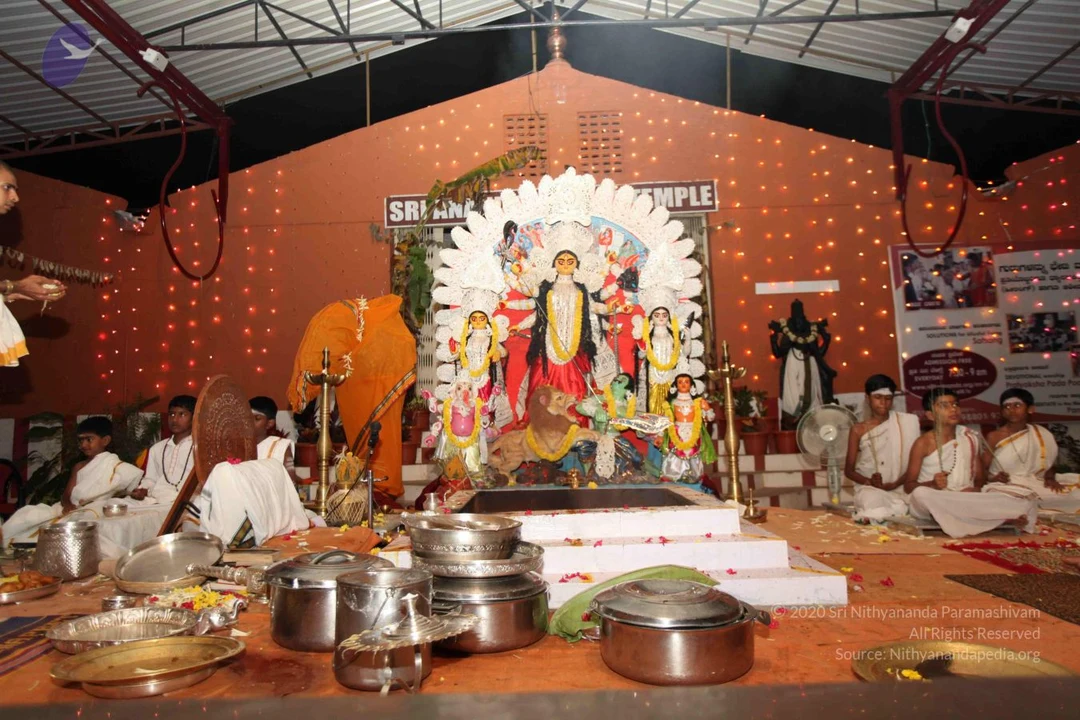
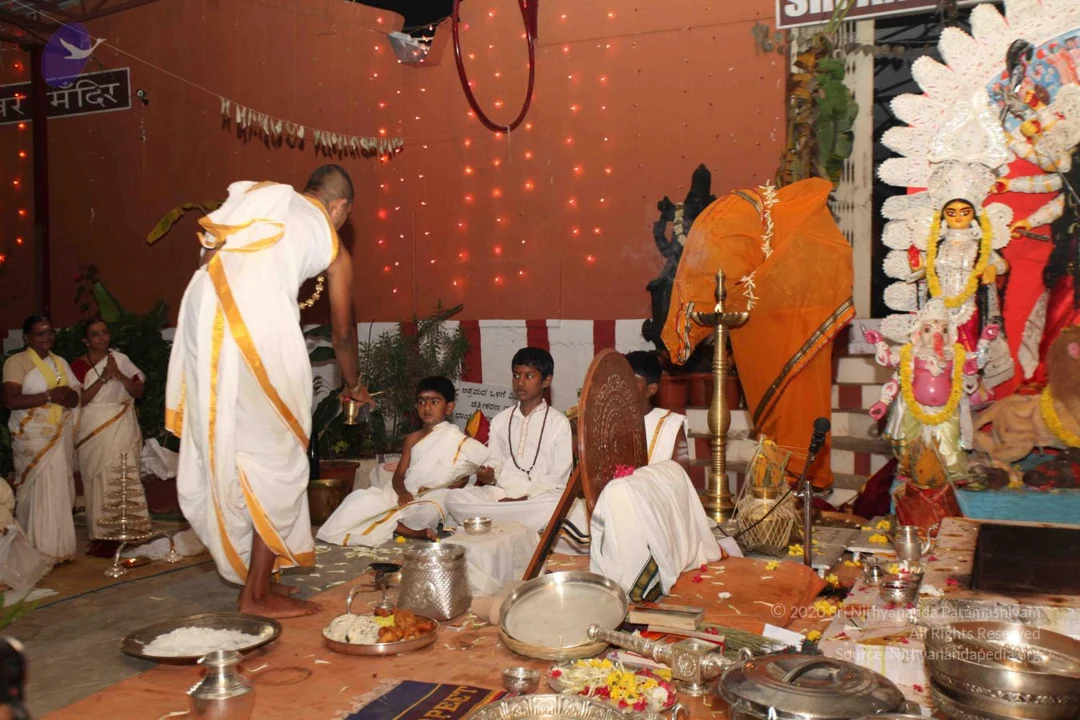
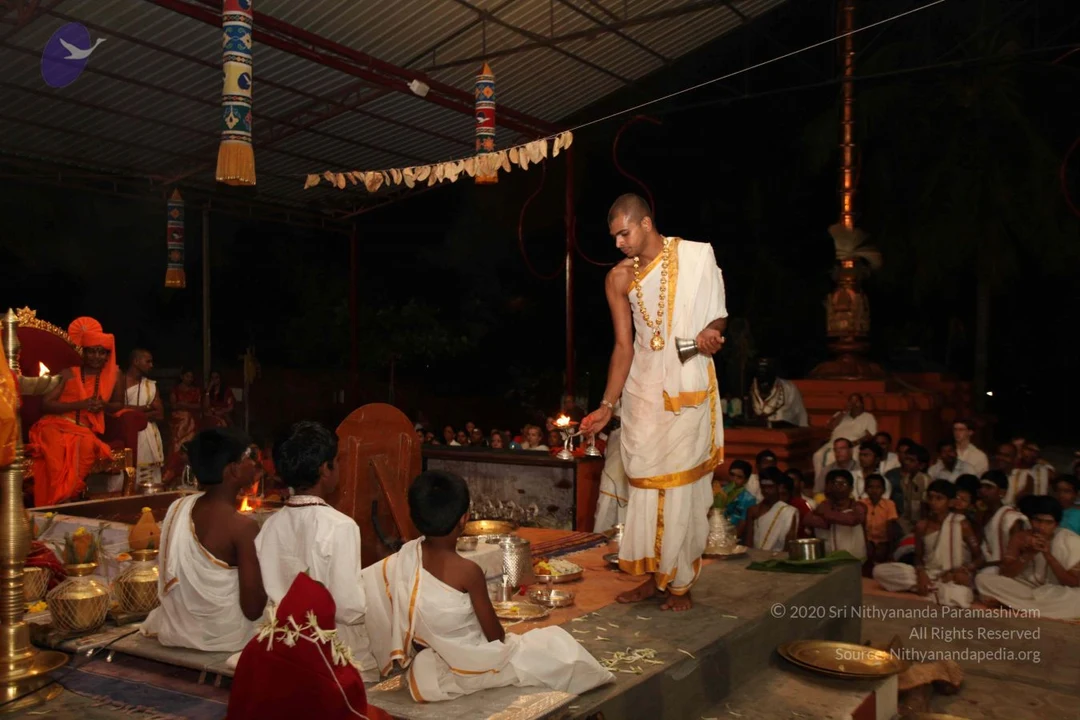
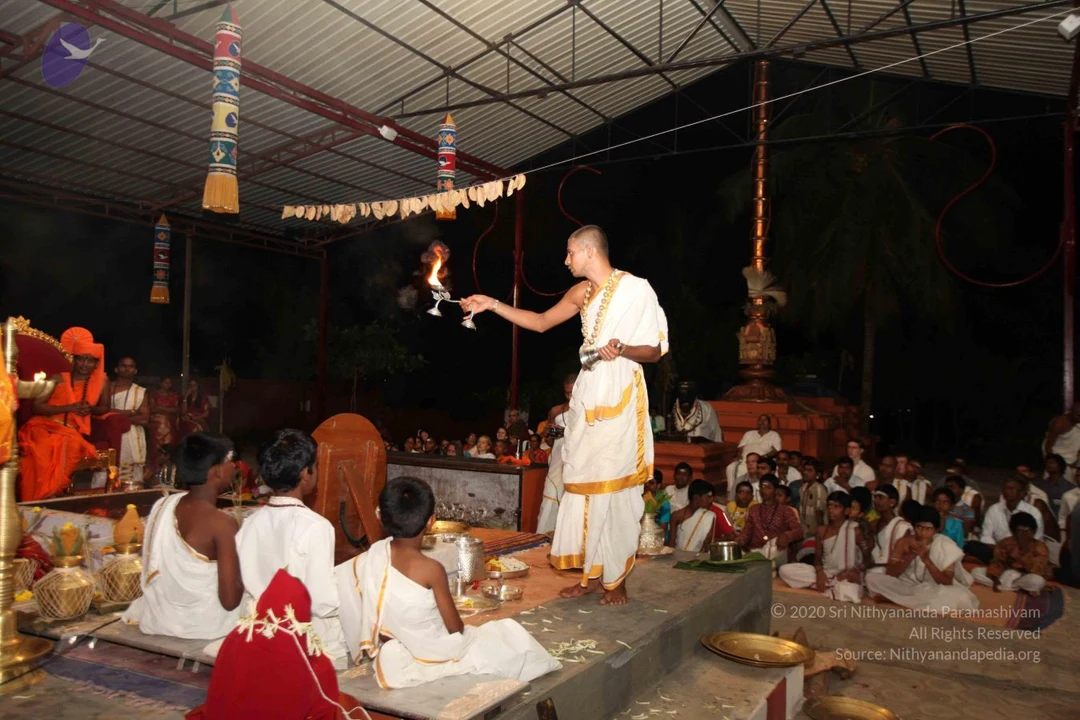
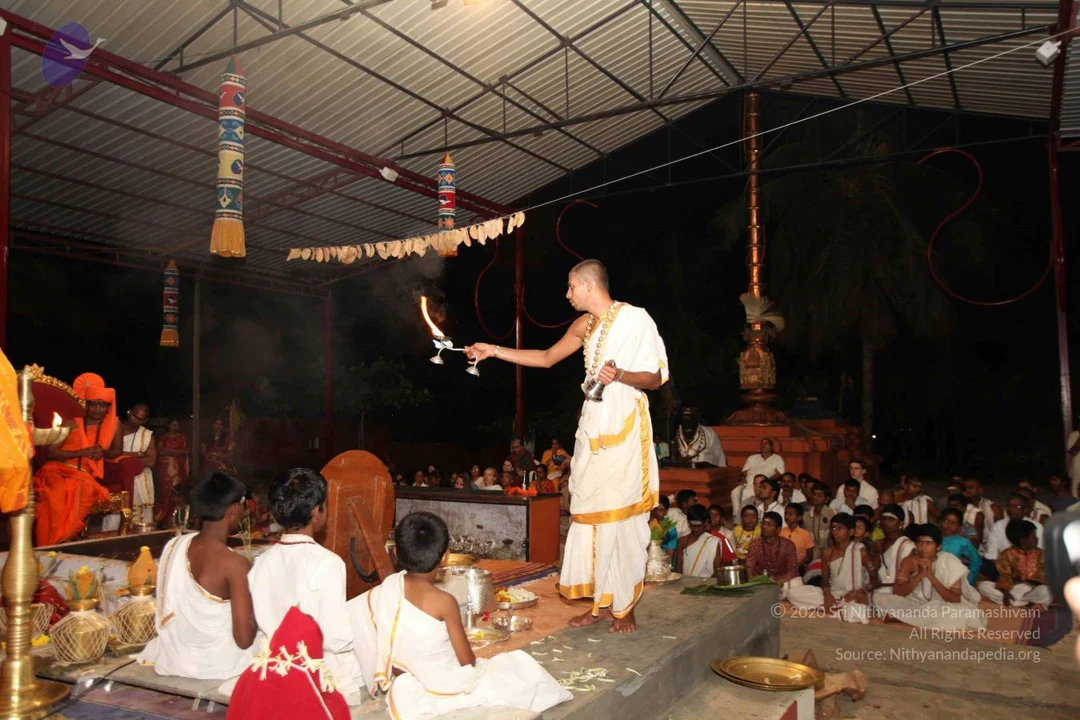
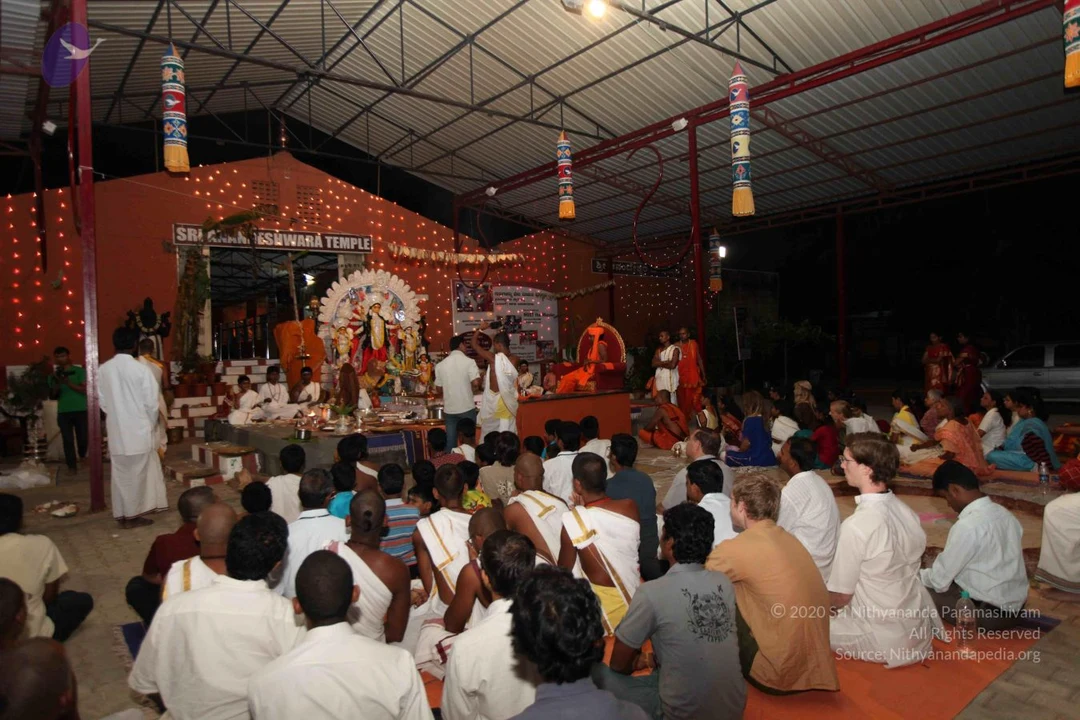
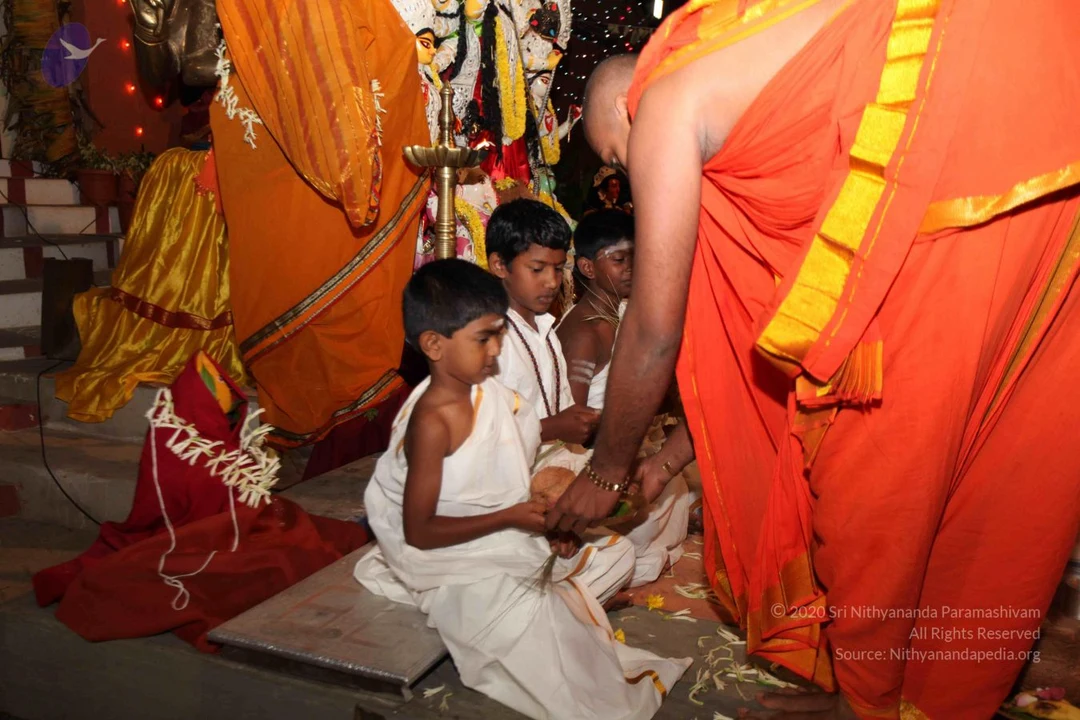
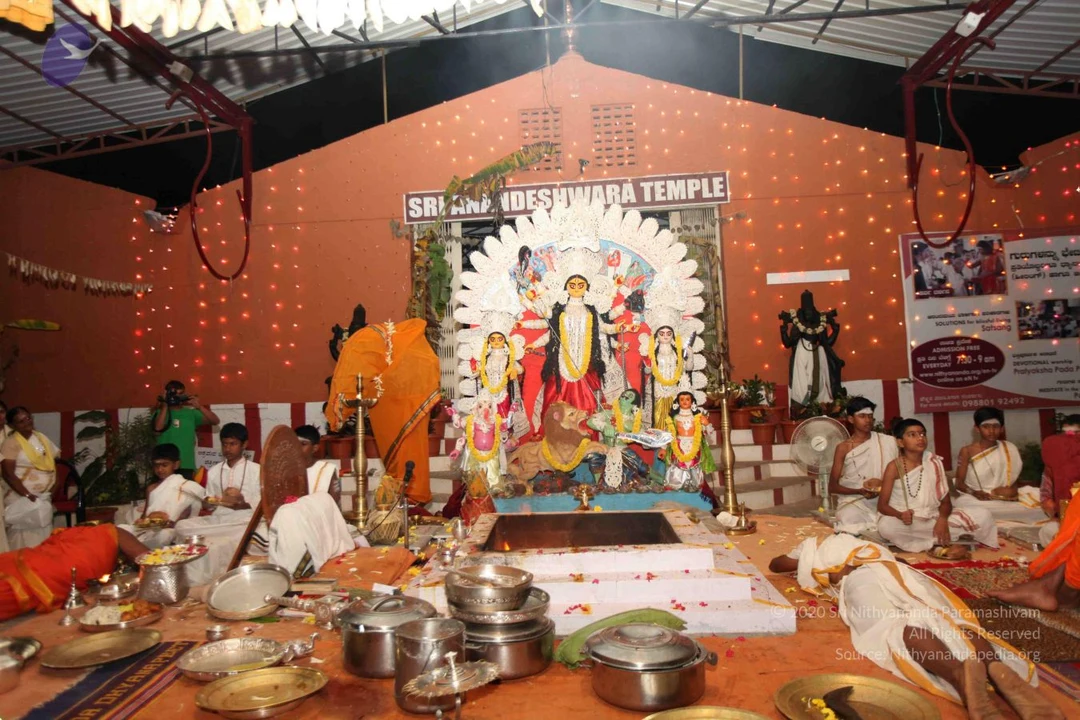
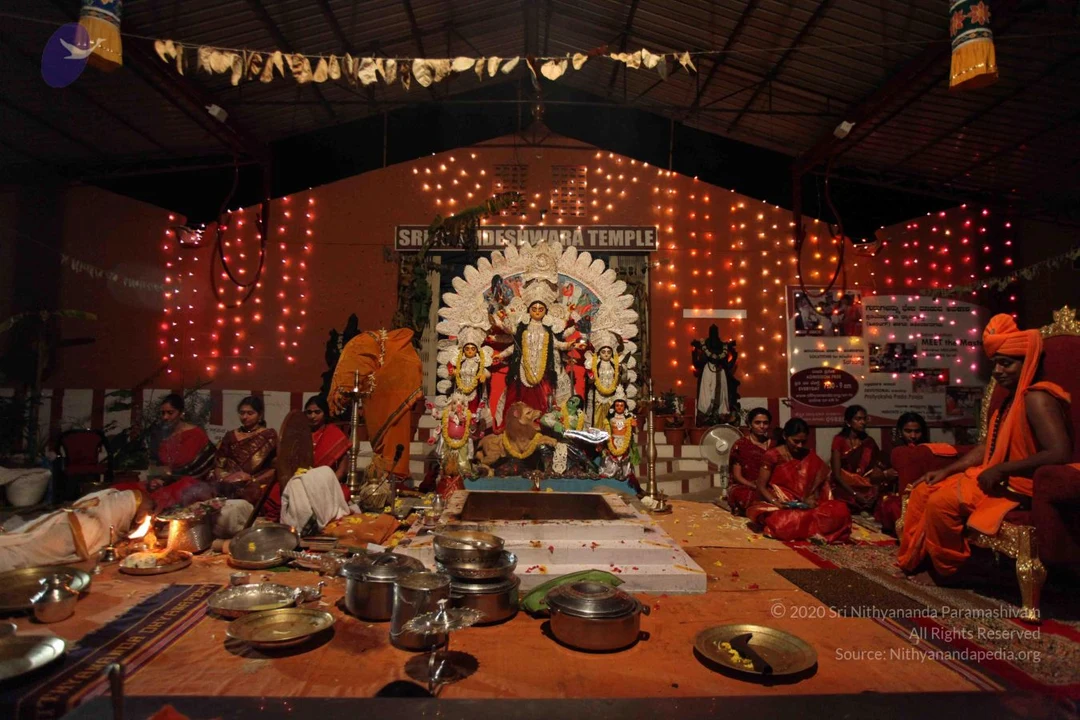
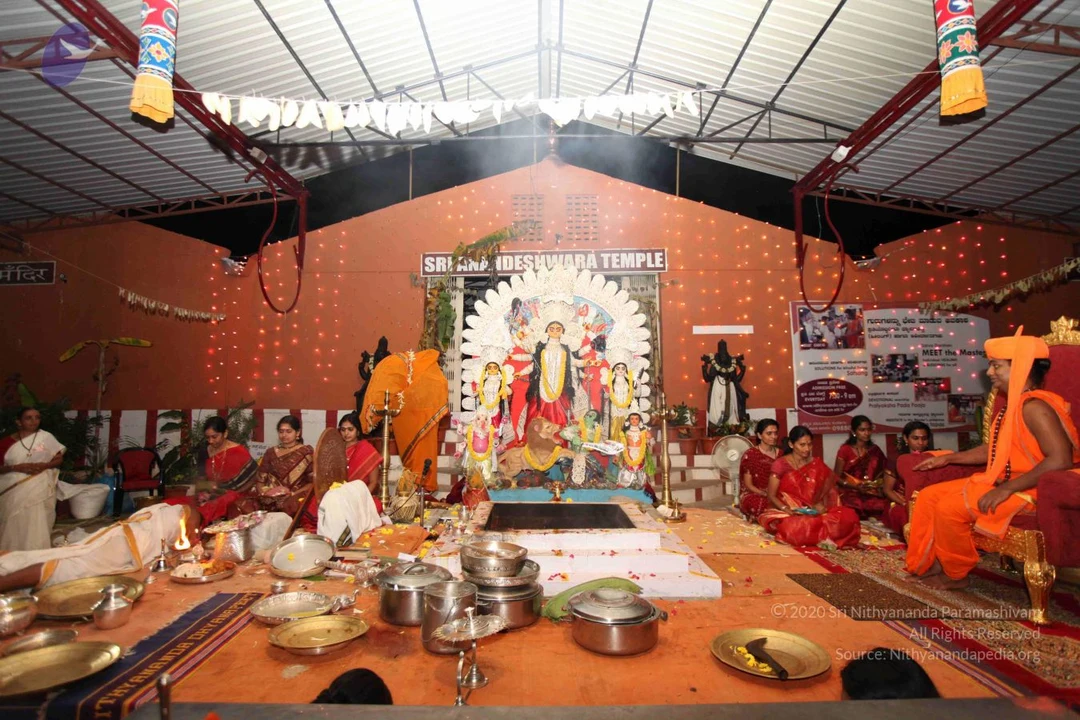
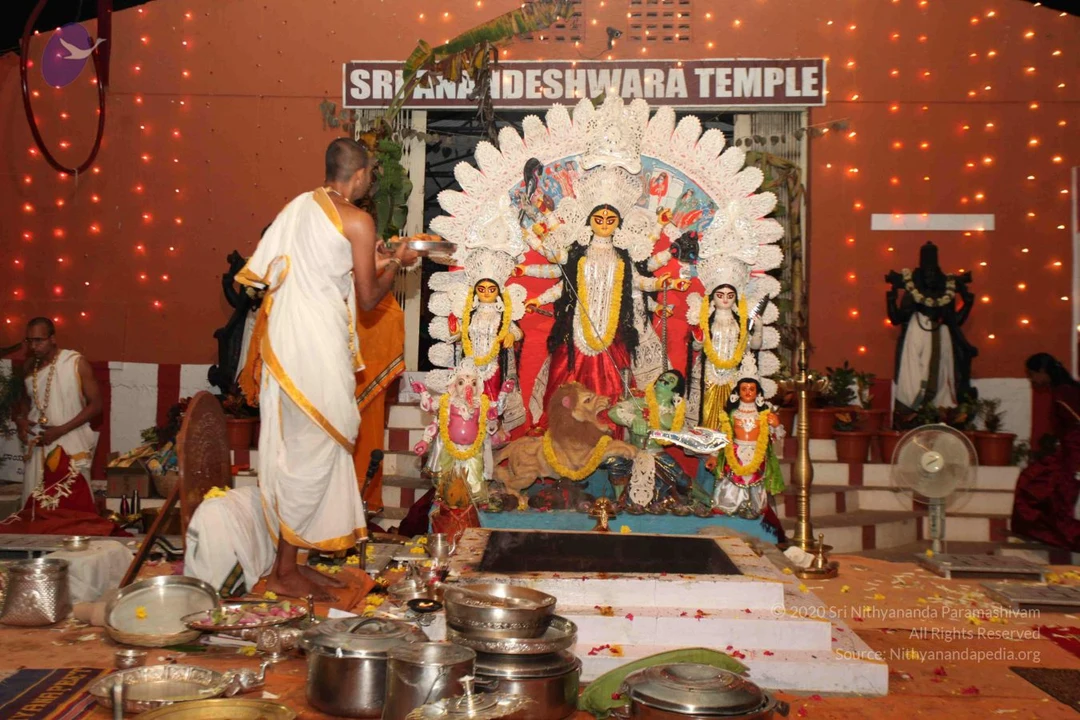
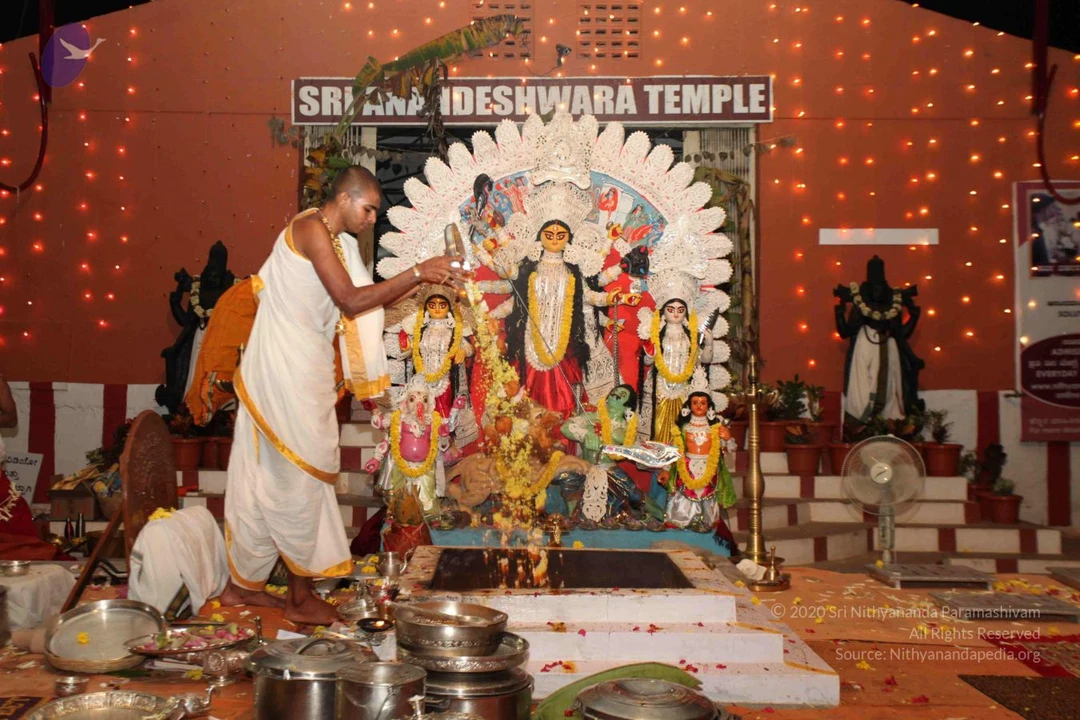
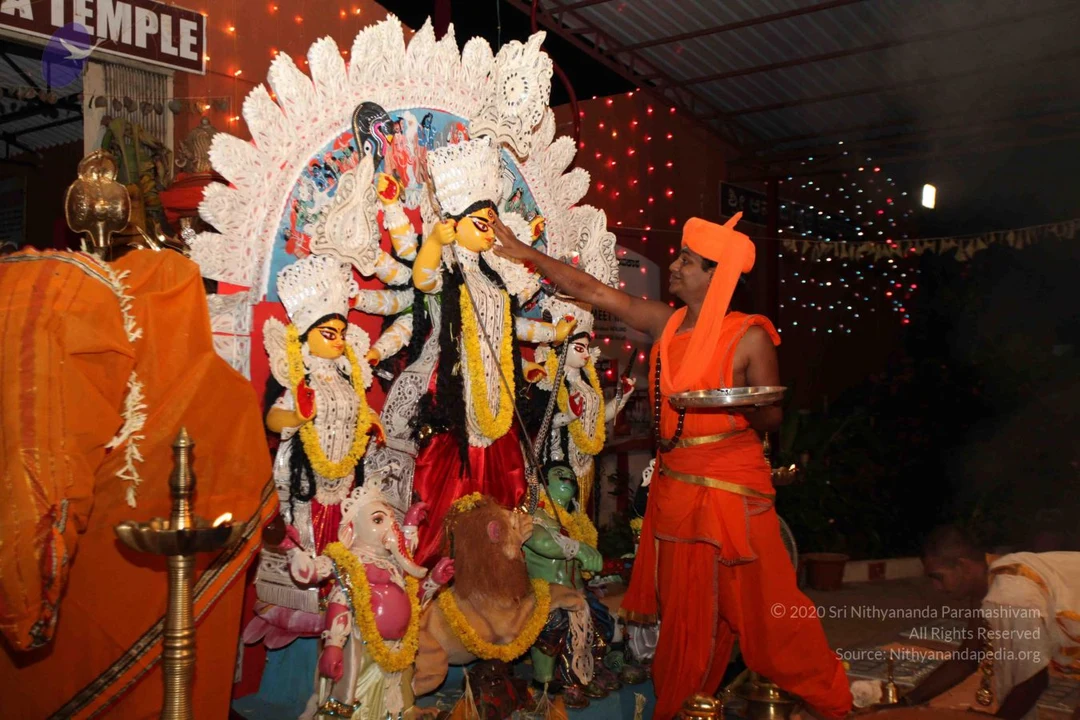
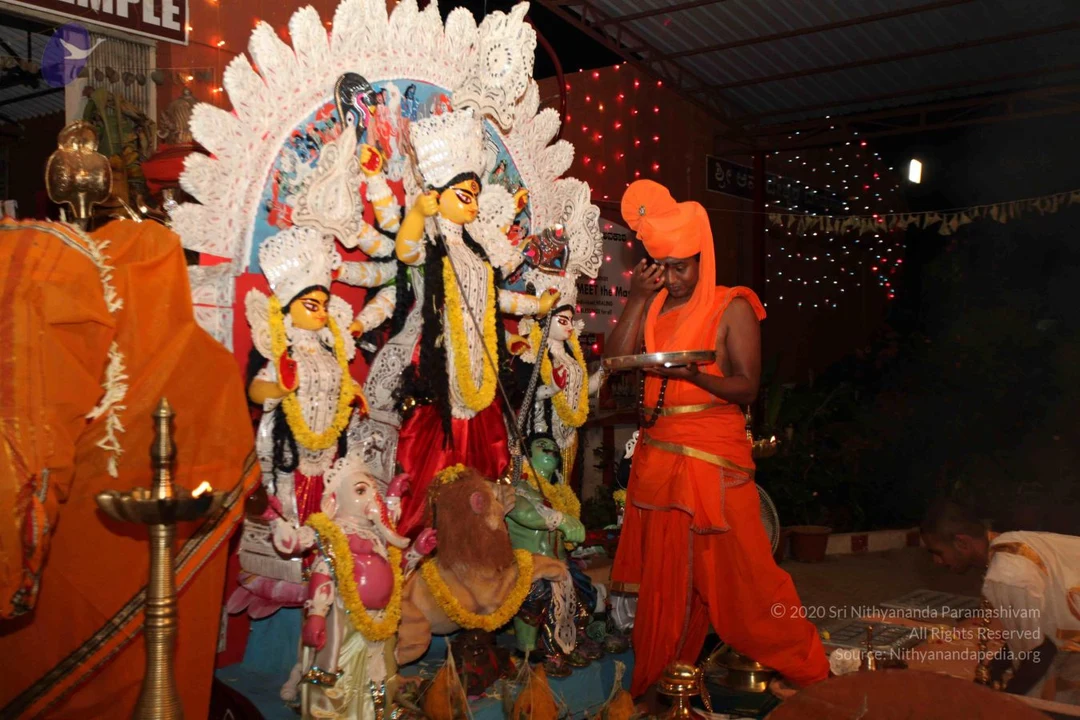
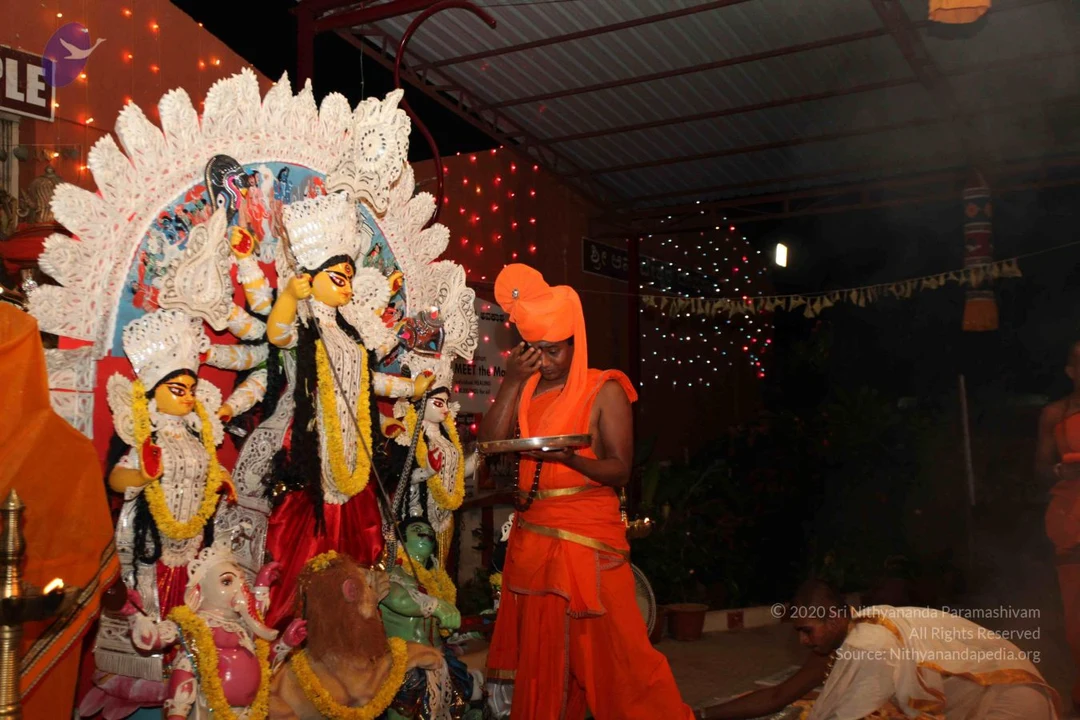
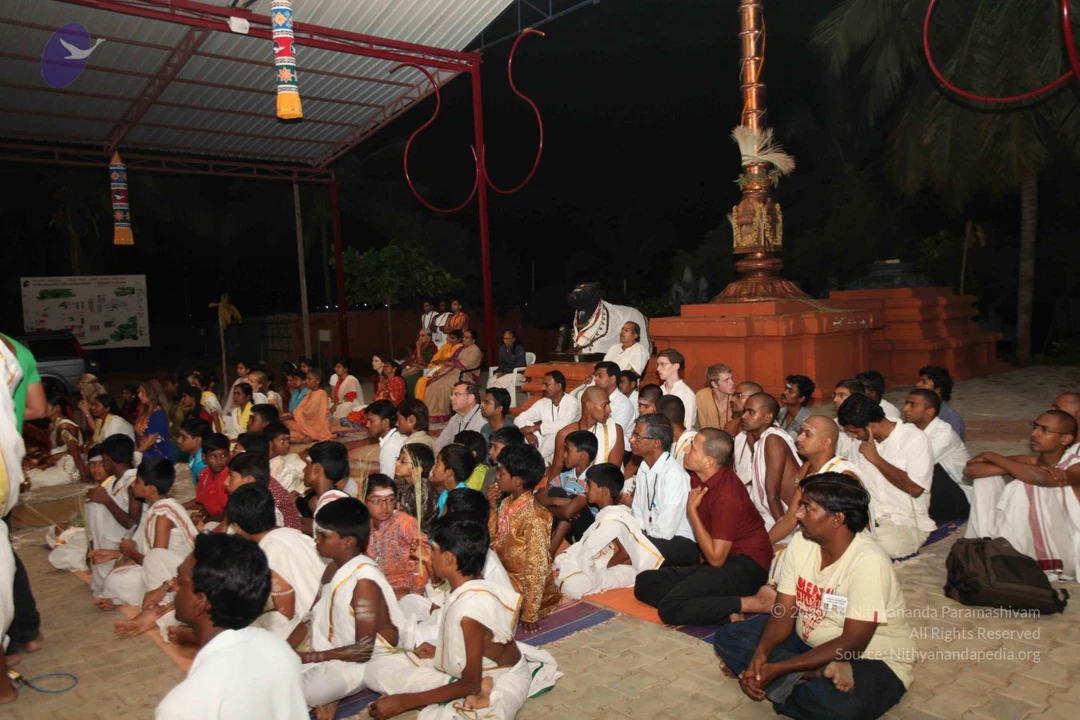
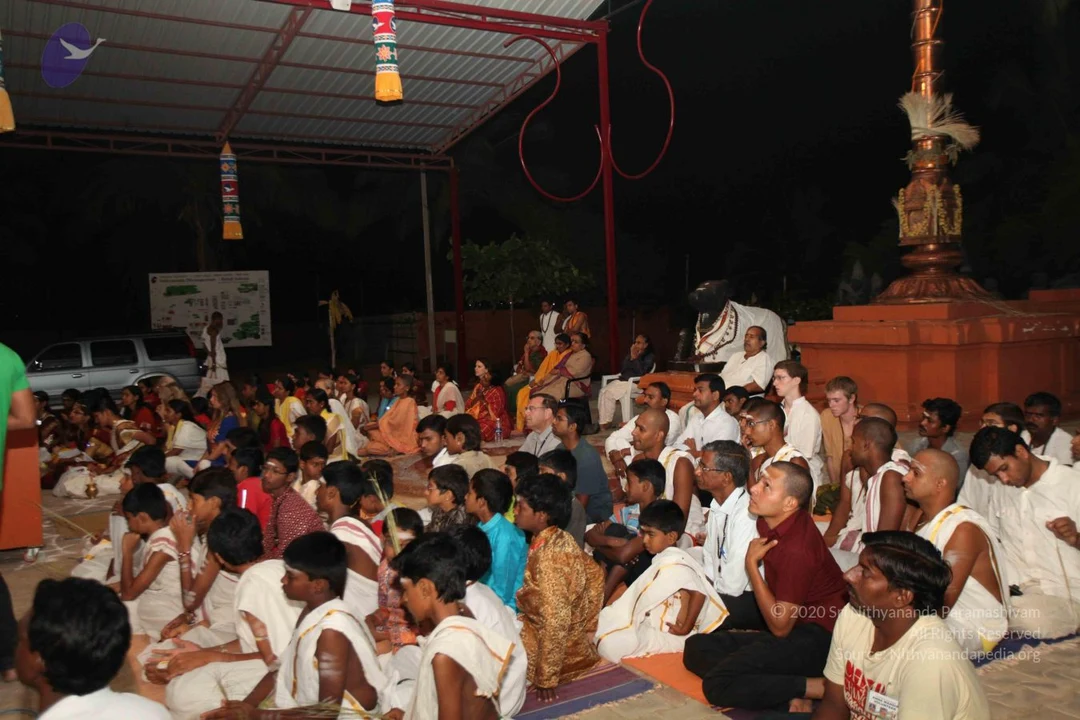
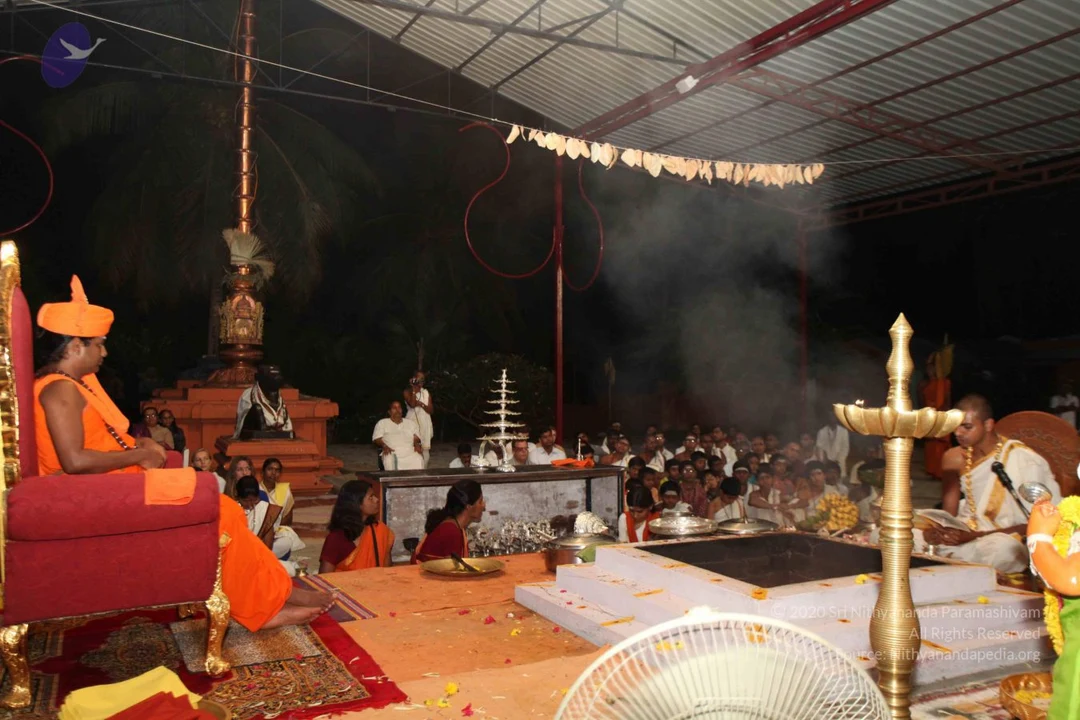
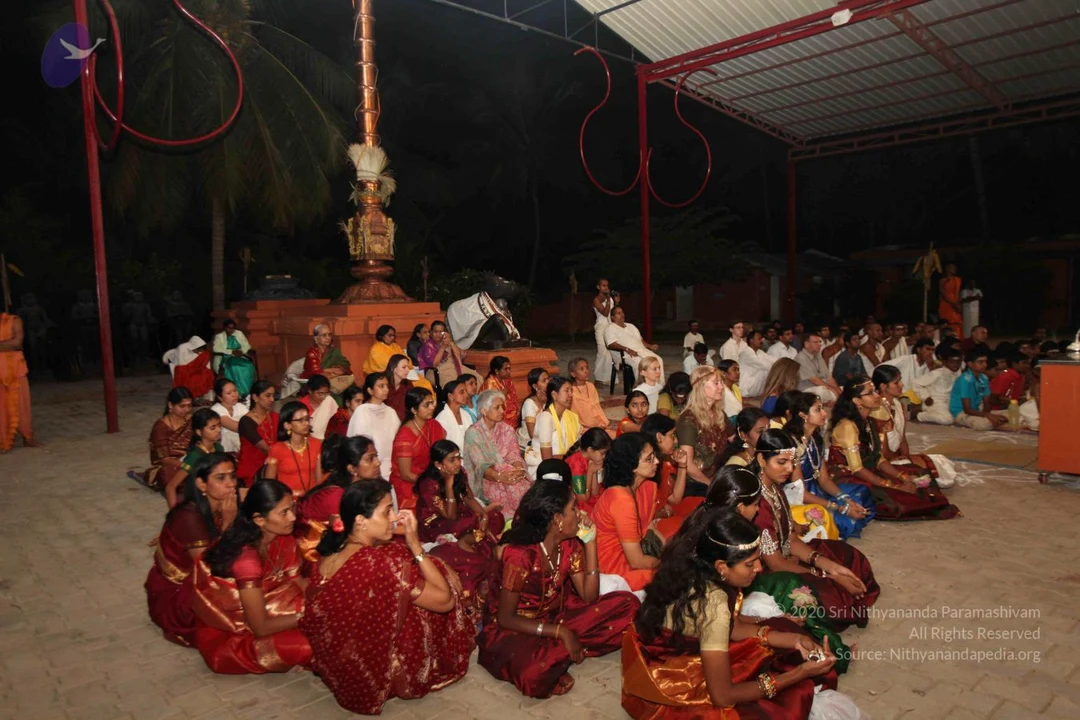
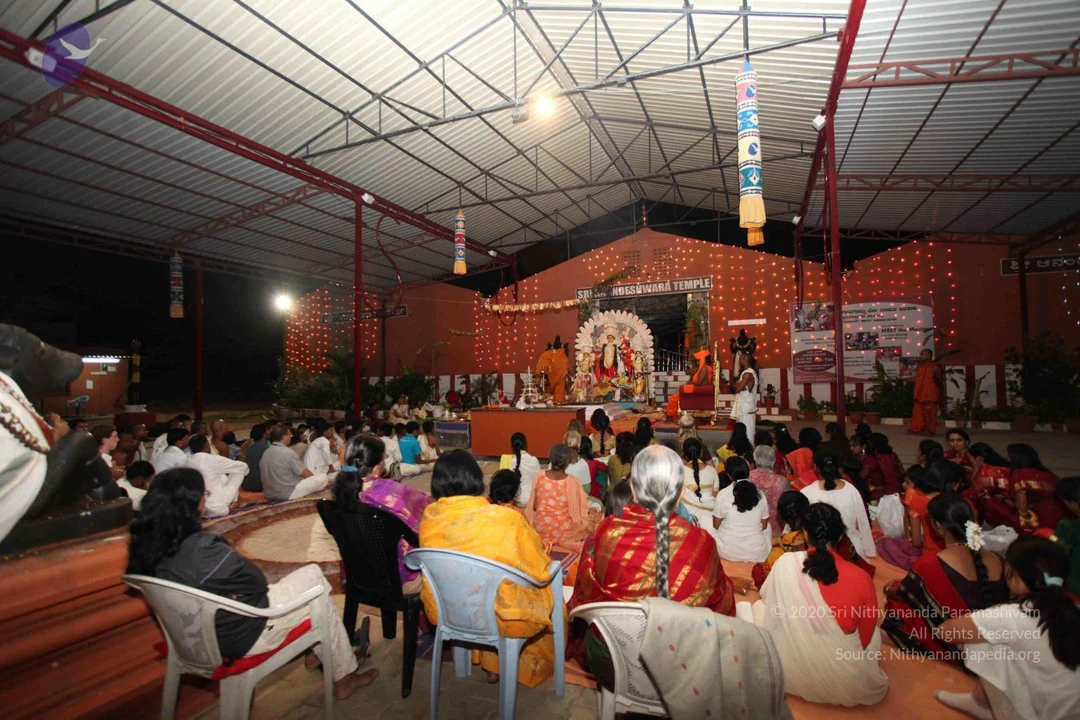
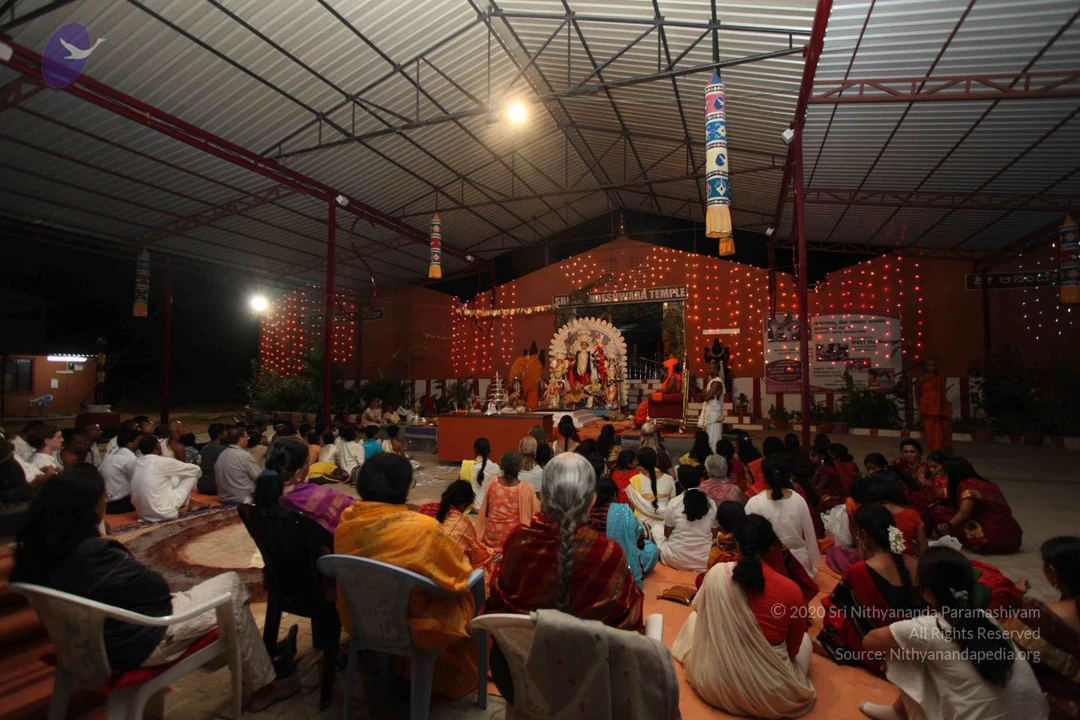
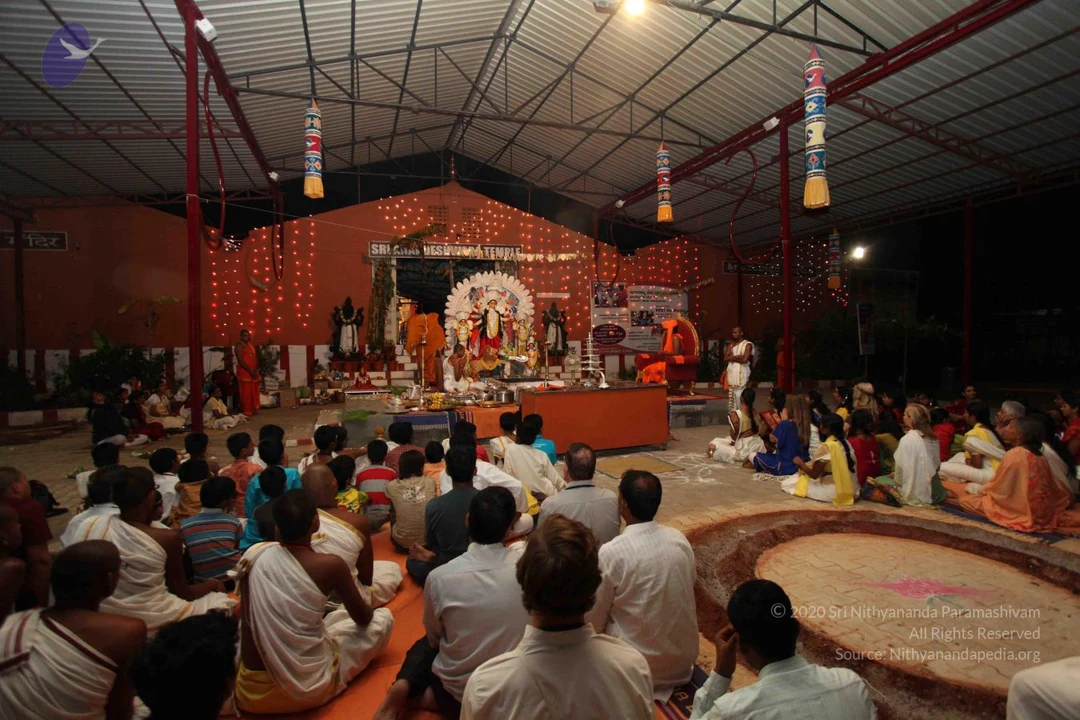
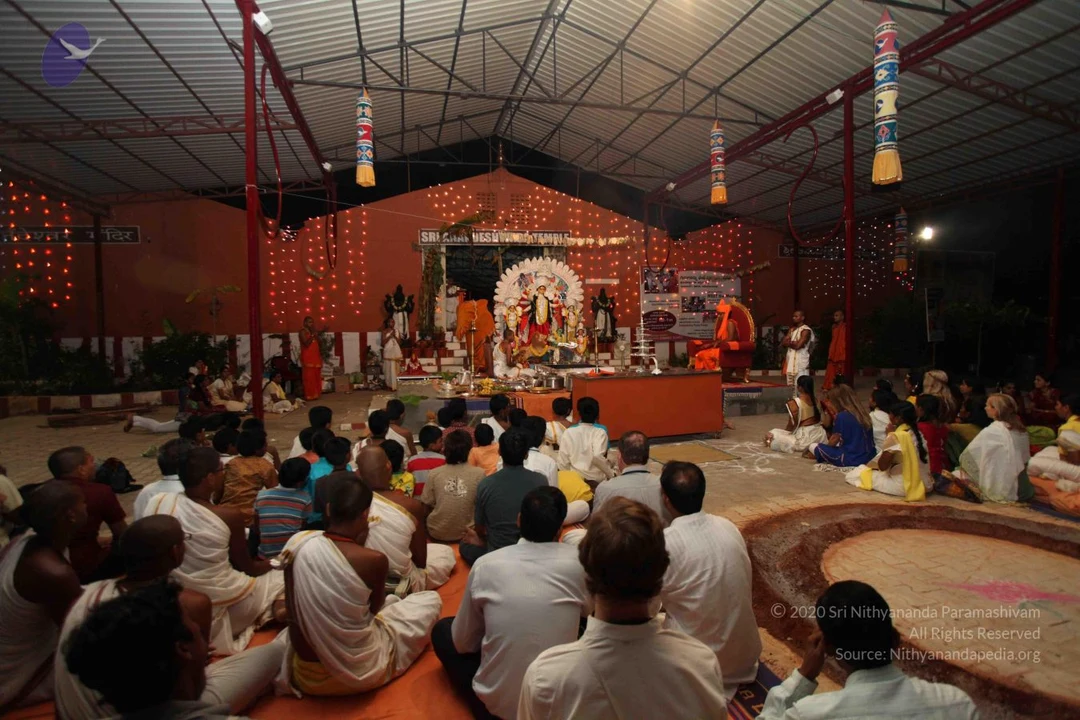
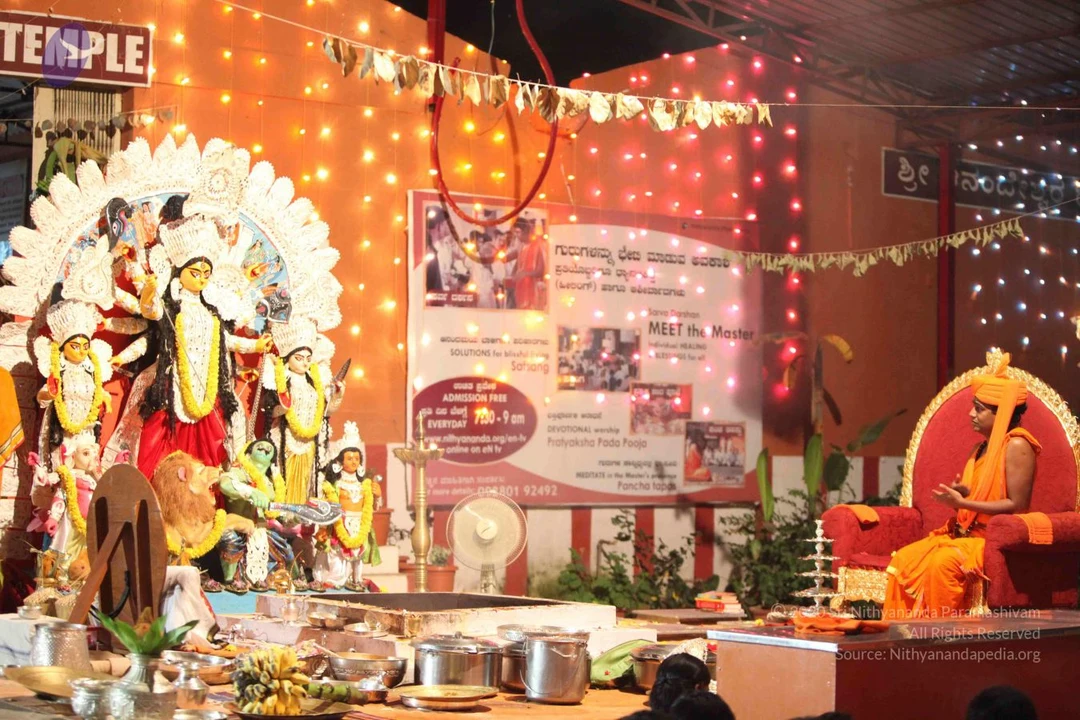
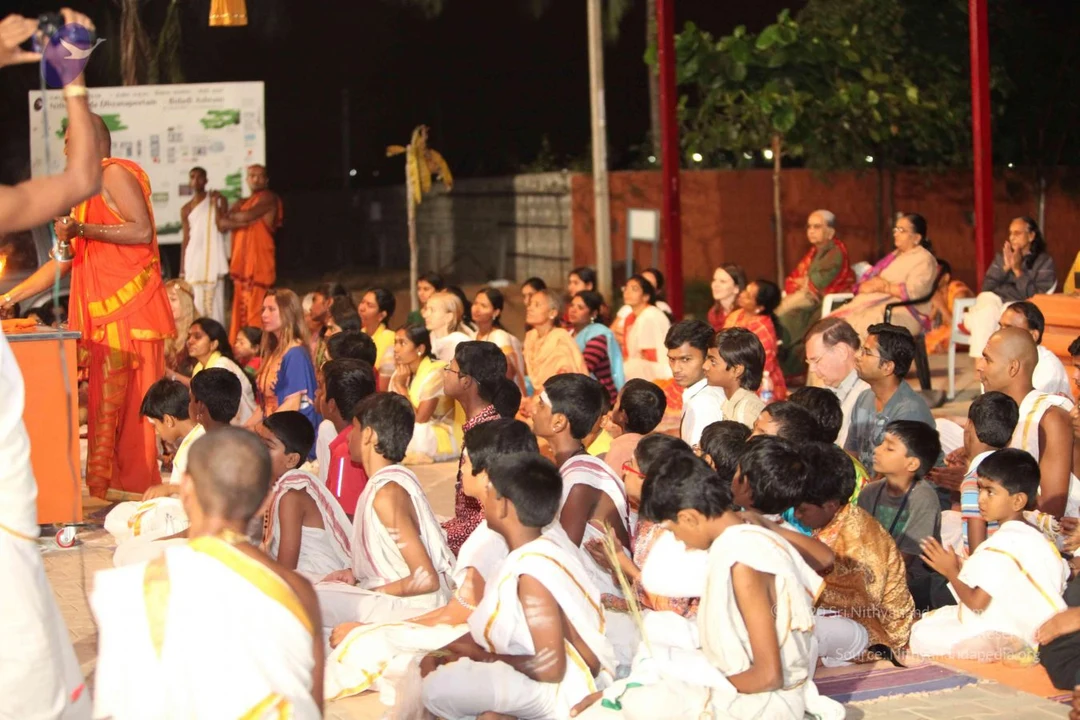
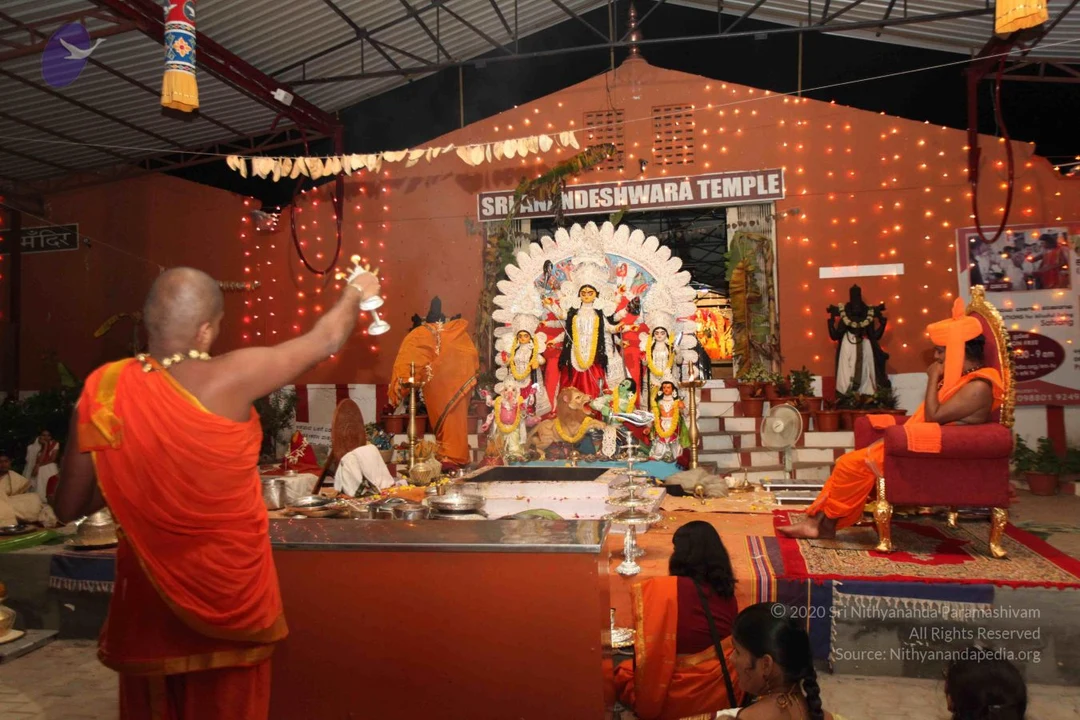
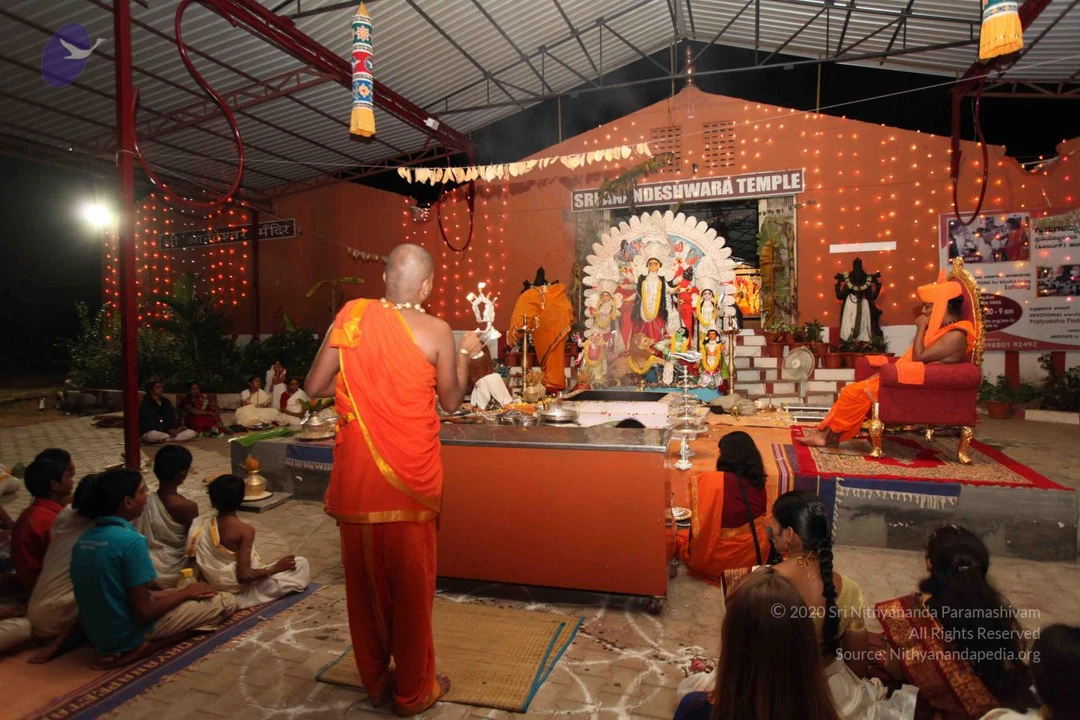
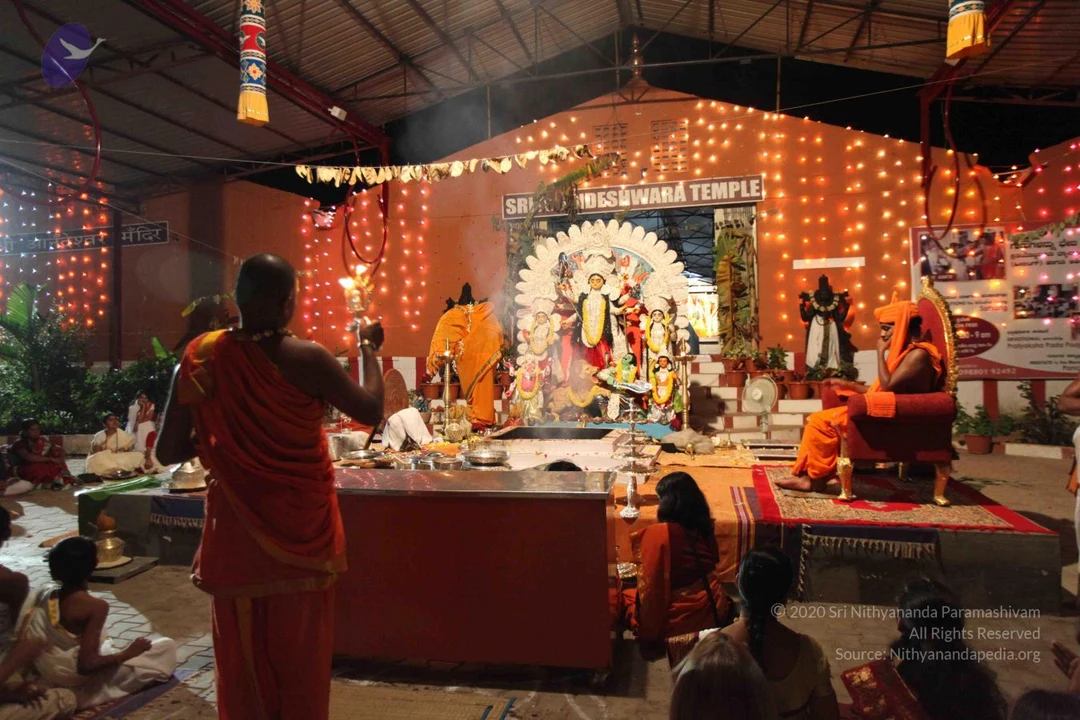
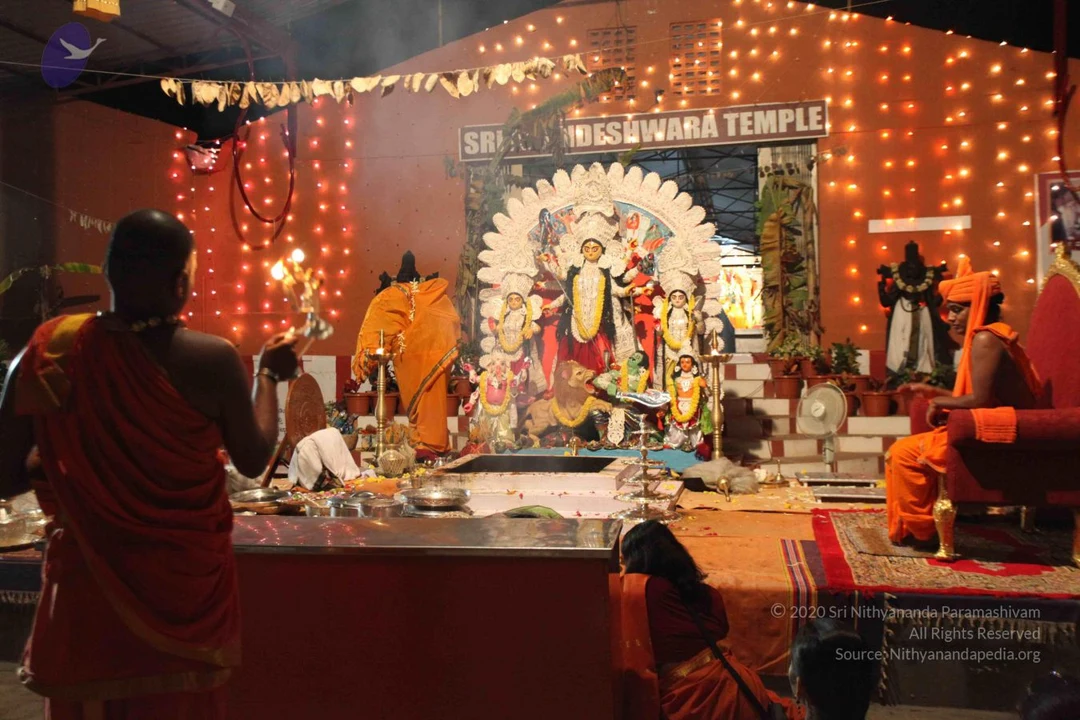
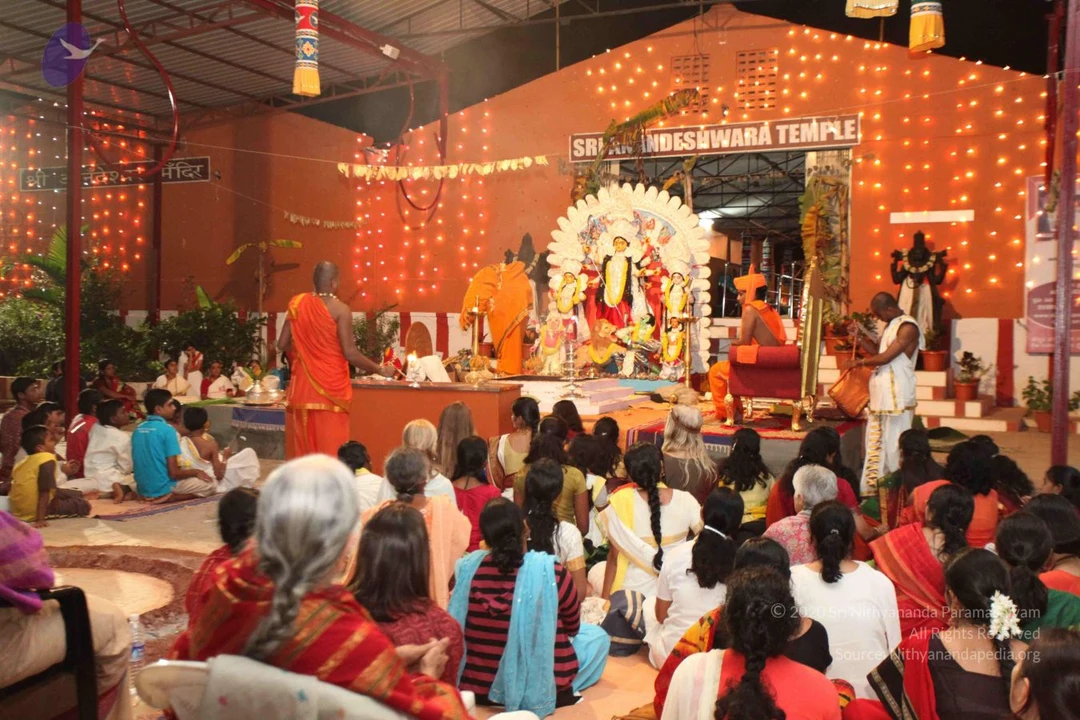
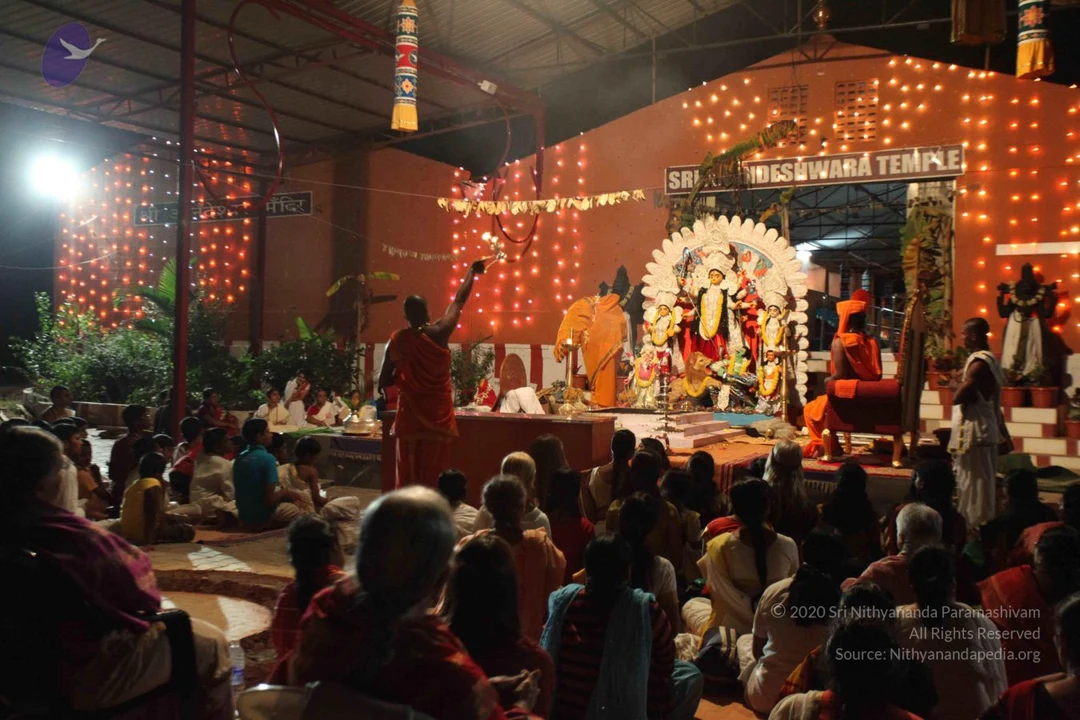
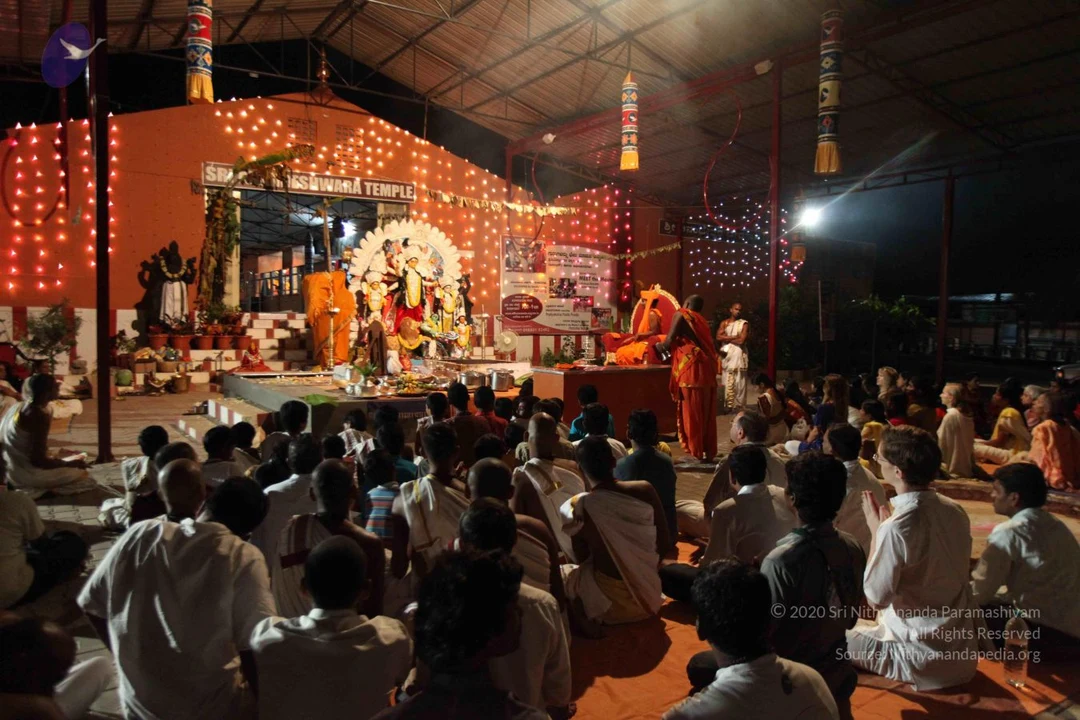
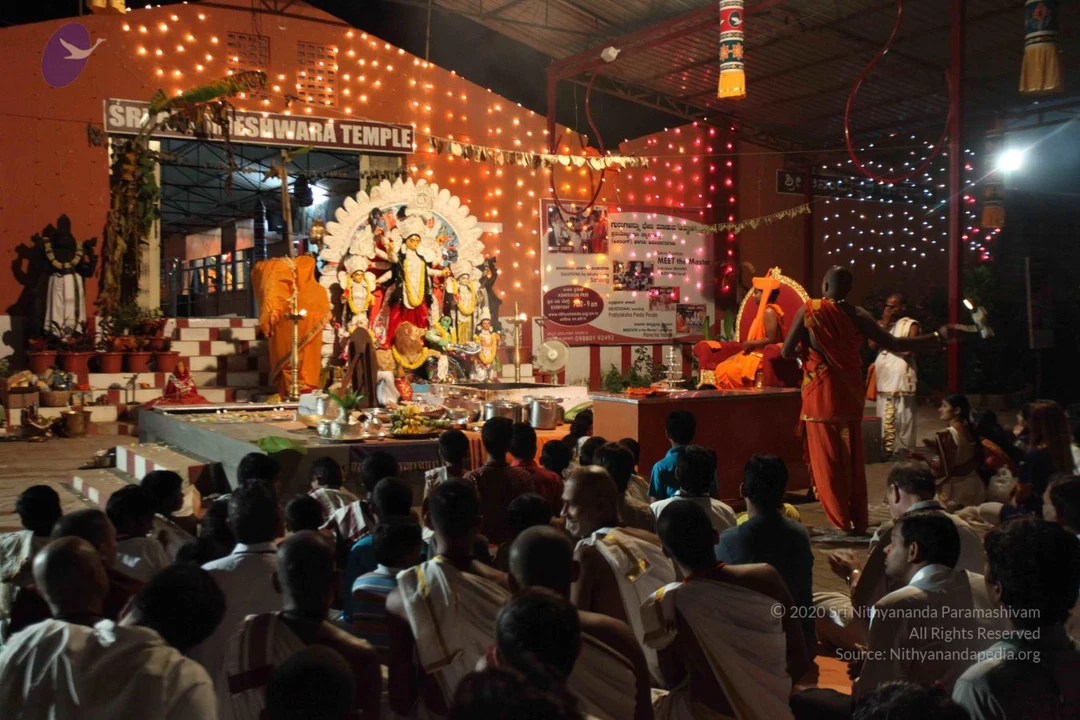
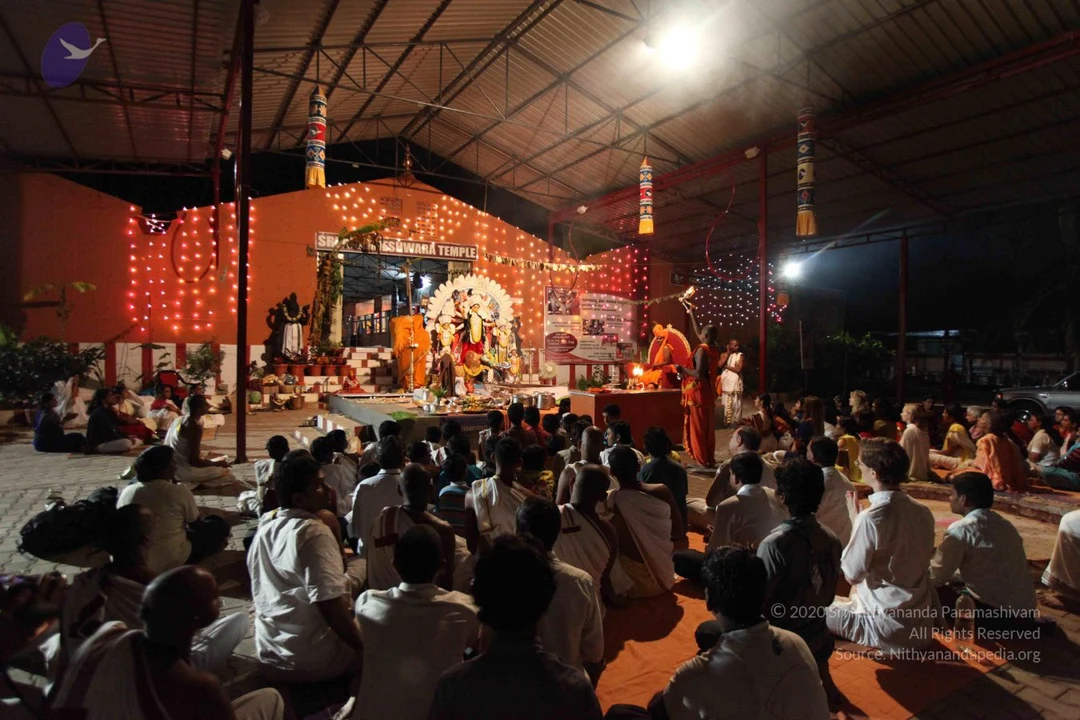
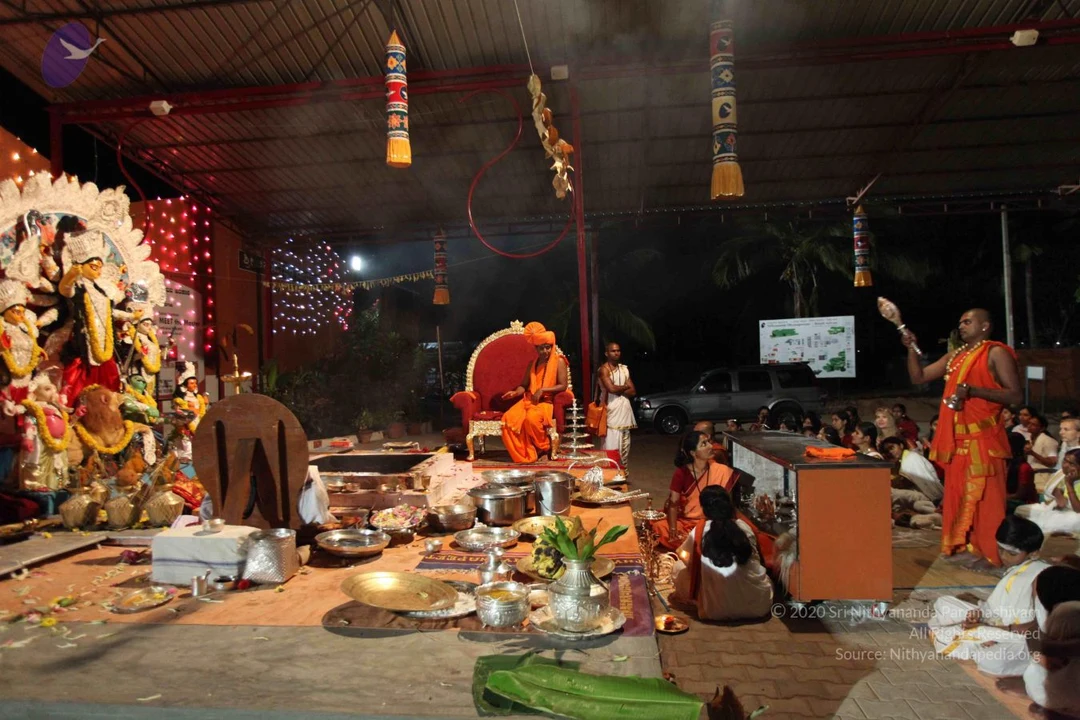
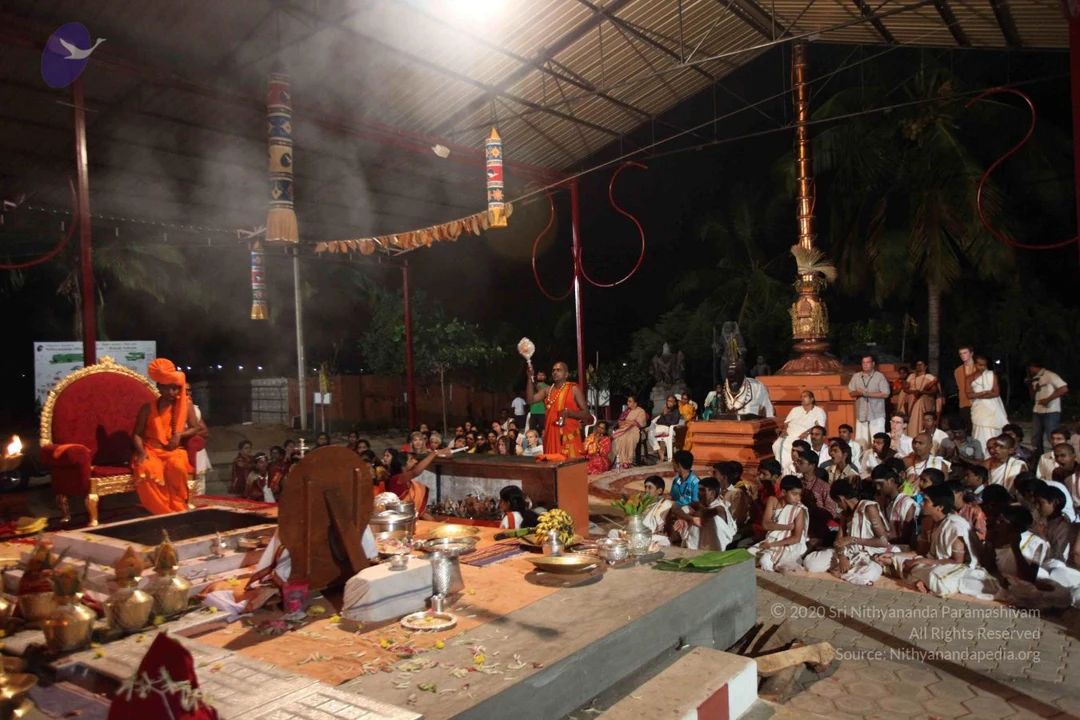
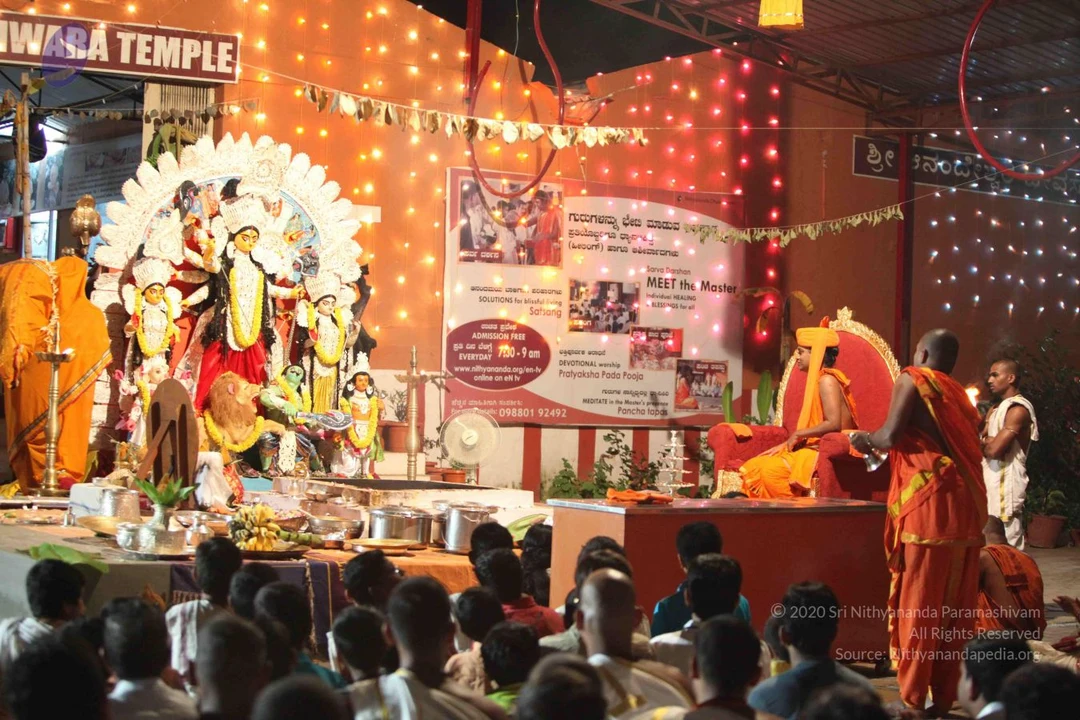
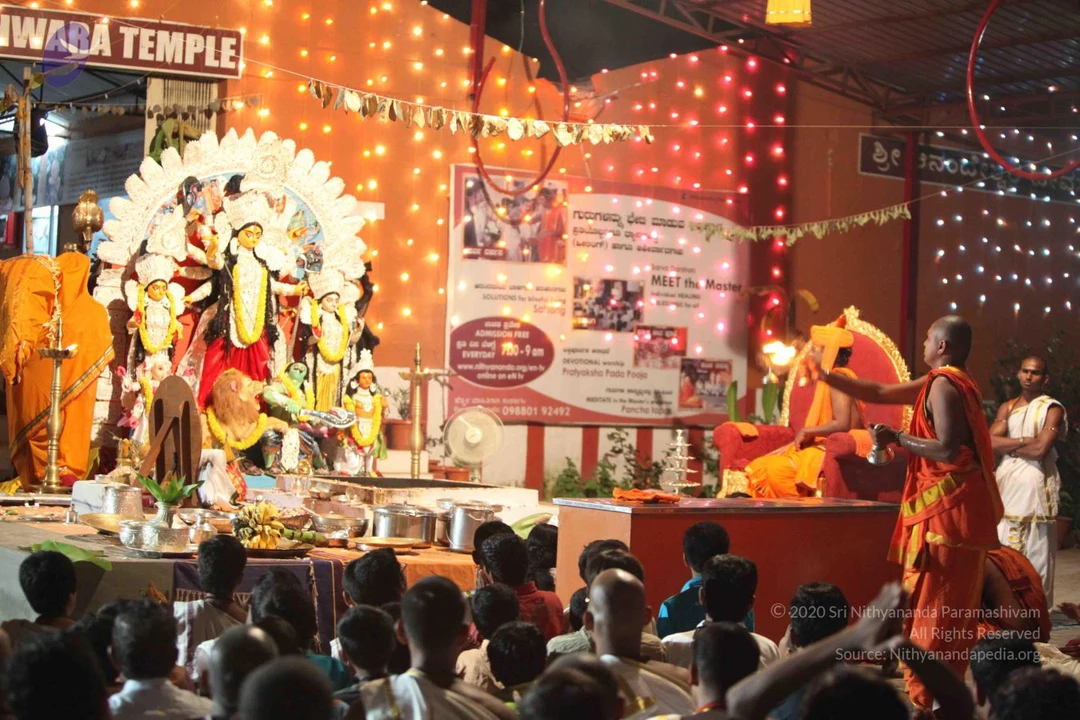
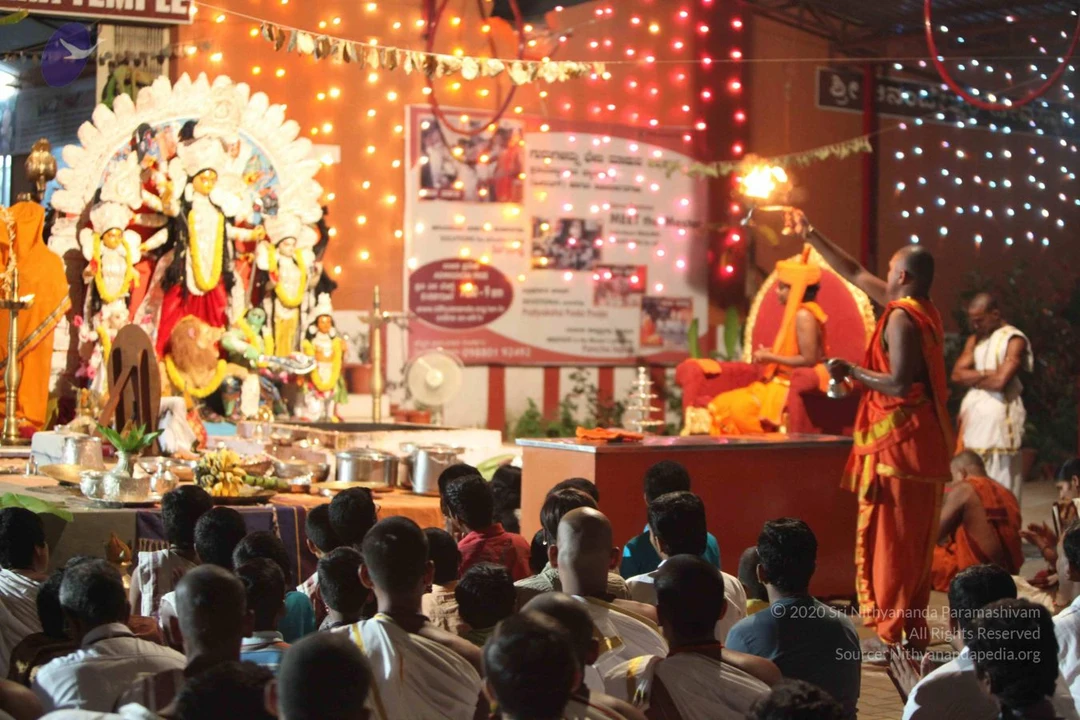
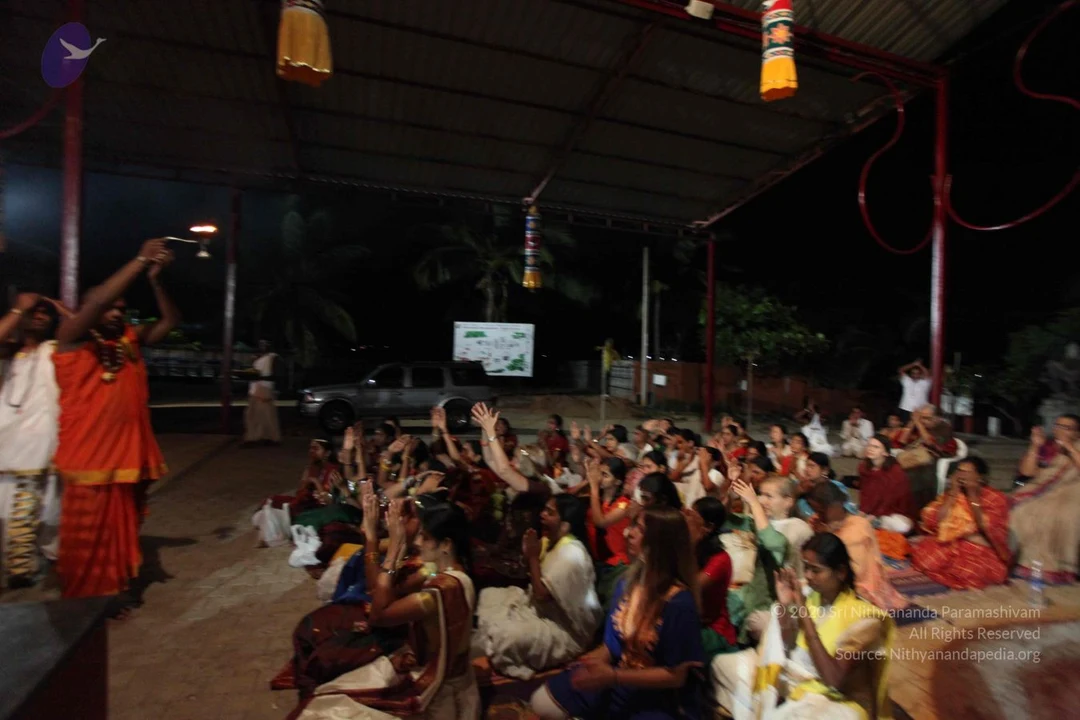
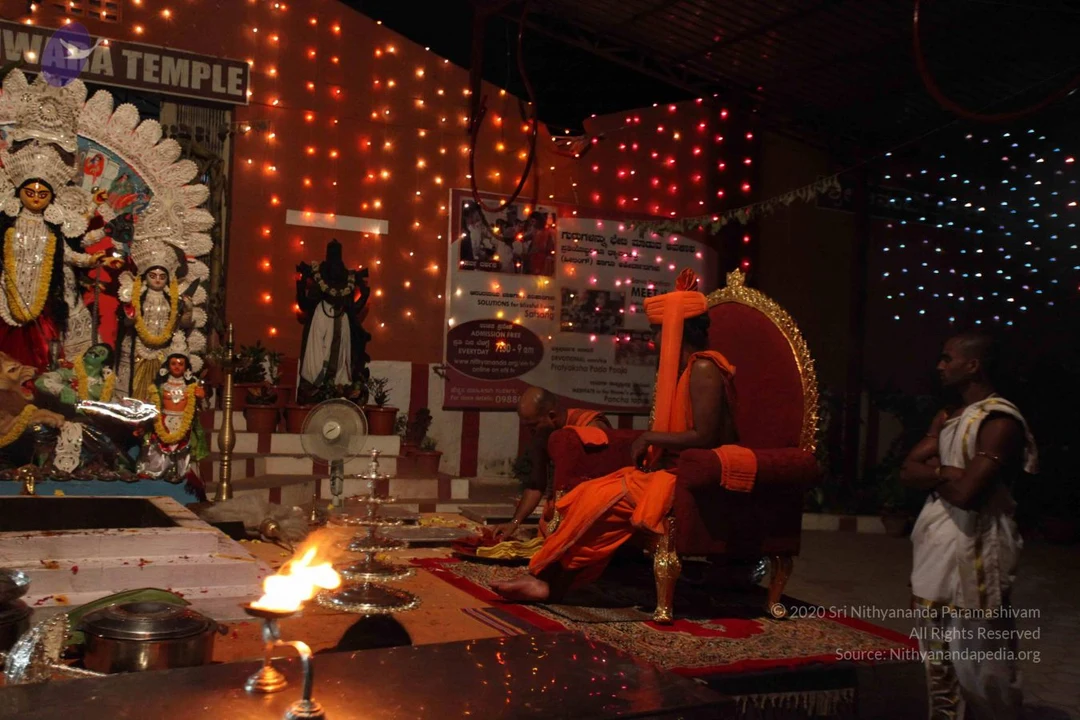
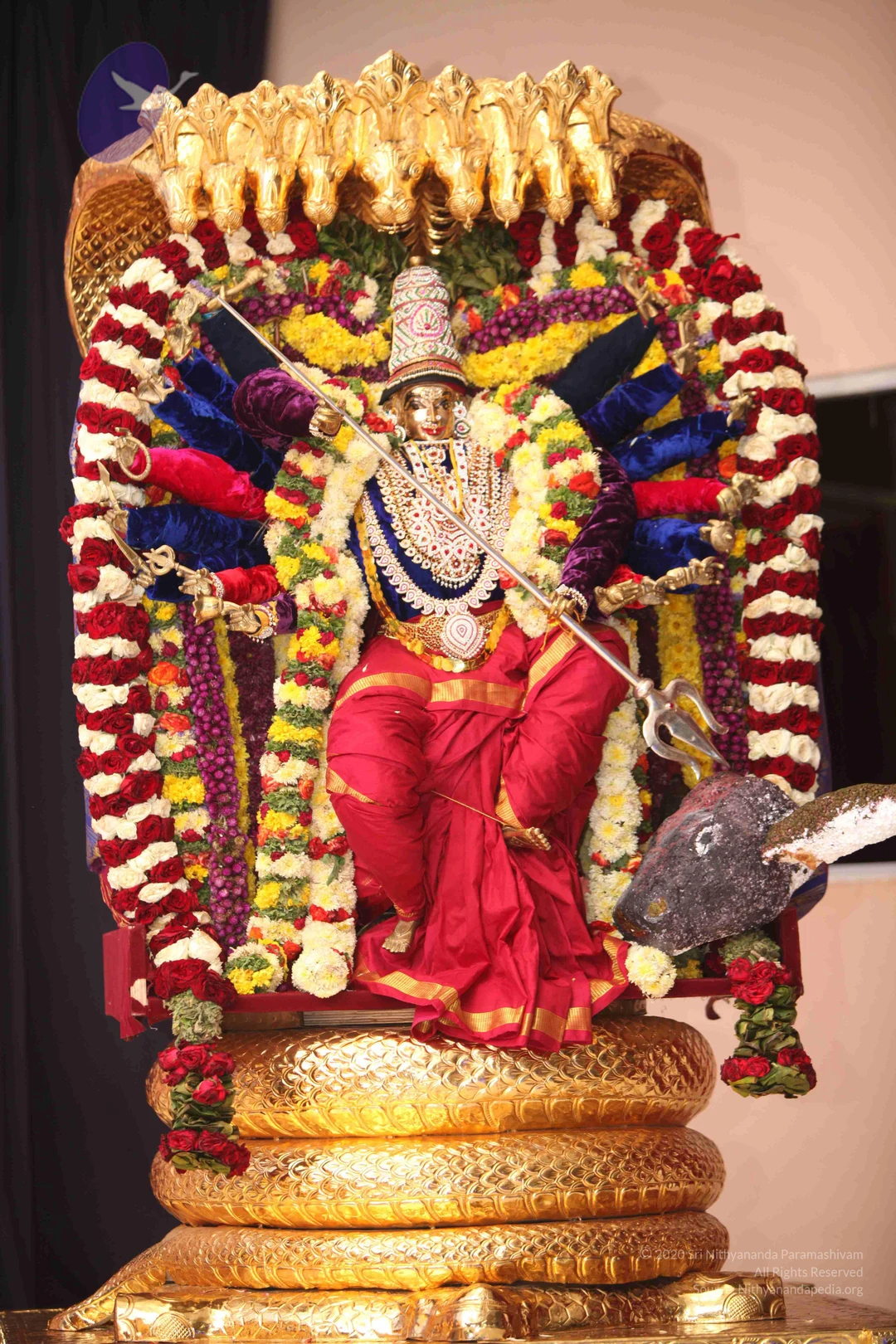
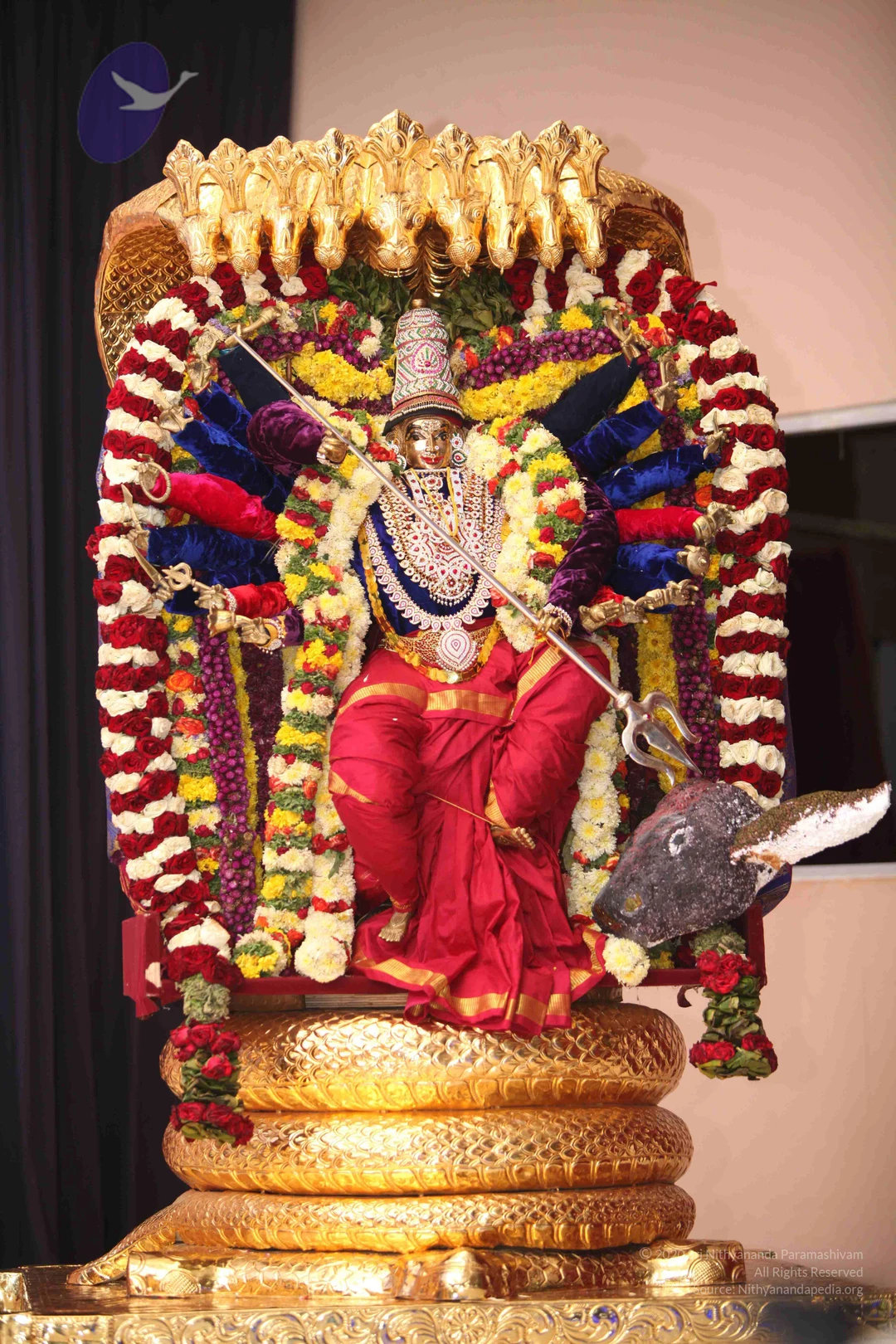
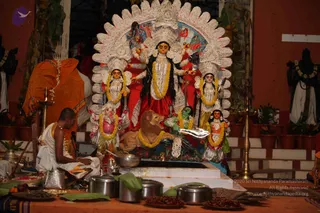
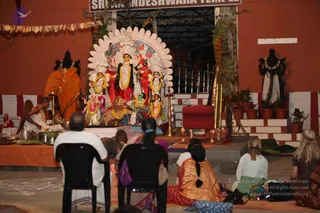
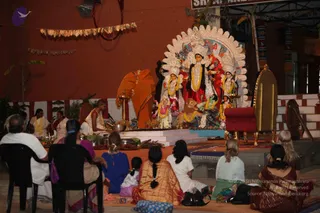
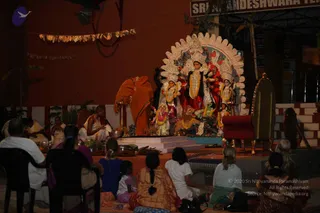
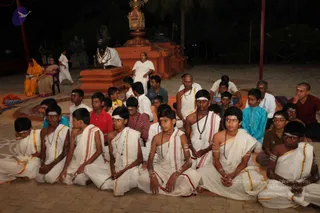
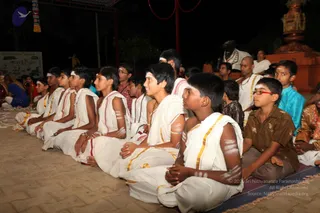
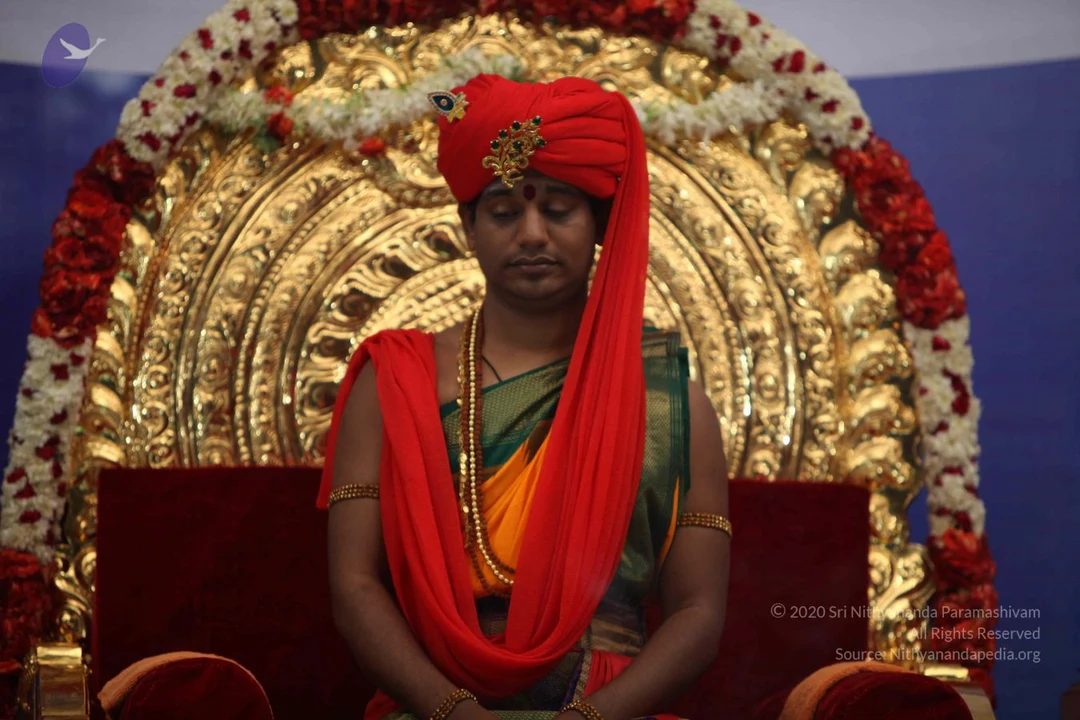
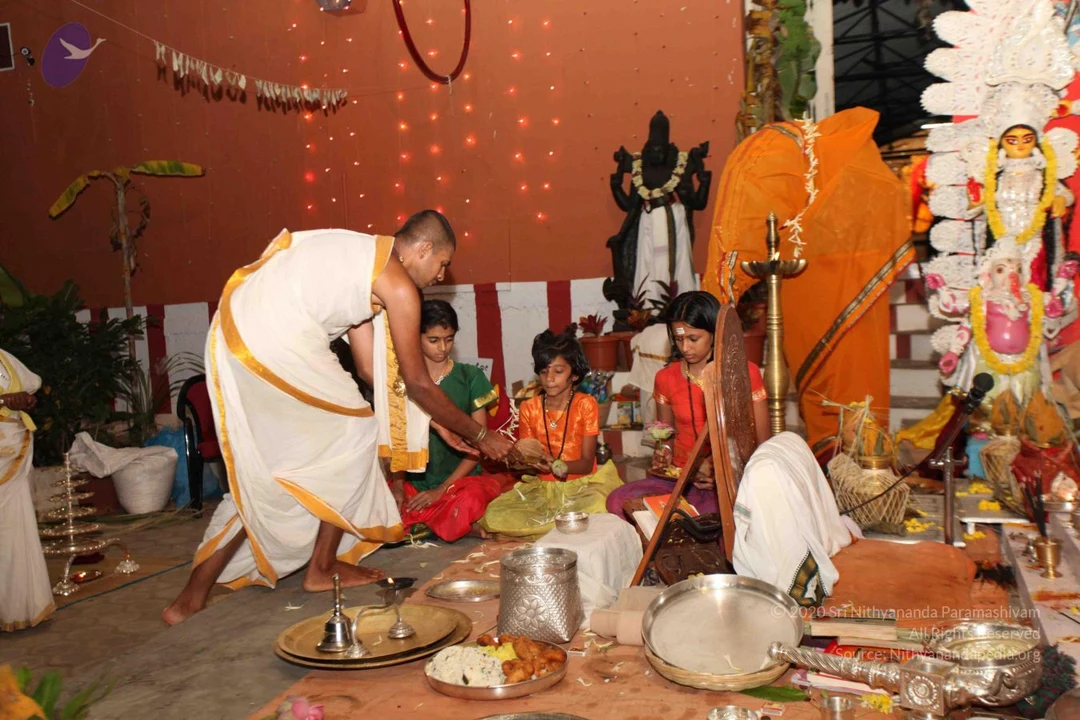
A seated priest in white dhoti and shawl with a shaved head performs puja before a large image of Durga, shown with multiple arms and a white crown and halo, riding a lion beside a green-skinned demon figure. Smaller deity murtis of Ganesha and goddesses stand on the platform, all garlanded with yellow marigolds. Brass oil lamps, steel vessels, banana leaves, red flowers and offerings are arranged on the floor in front, and orange cloth hangs at the left. Potted plants line the red walls. No a person candidate is visible in the scene.Evening puja at Sri Nandeshwara Temple shows a large Durga murti with ten arms, flanked by smaller deity figures and a lion mount, decorated with white and gold halo, garlands and red backdrop. A priest in white dhoti and an orange-clad seated figure sit at the left beside brass lamps, metal vessels and offerings on an orange cloth. Devotees sit on the floor in front, including a woman in an orange-and-pink sari, a woman in white with a long braid, and a woman with blonde hair in light clothing, facing the deities. Potted plants and banana leaves decorate the stage edges, and a red chair with brass fittings sits to the right. The page excerpt about the Bhagavad Gita is unrelated to the visible image. The scene shows devotees seated for worship with a visible puja.Evening puja before a large deity murti of Durga-style goddess with multiple arms, white and red decorated backdrop, seated on a lion, flanked by smaller figures and a white ornate arch. In front, a shaved-headed priest in white dhoti with gold necklace sits behind offerings, a brass lamp and kalasha, while a woman in white with gold garland assists. An orange cloth hangs nearby and an empty red and gold throne stands to the right. Several devotees sit on the floor and in chairs at the lower left and right, including people in white, blue, orange and pink saris, facing the altar. A red banner with white letters reads SRI NITHYANANDA at top; the scene is an abhishekam or puja setting.Night photograph of a temple stage where a large white-and-red decorated deity murti of a goddess with multiple arms stands in a halo-like arch, flanked by smaller figures and a lion mount, adorned with yellow marigold garlands. A priest in white with bare upper body and gold necklaces sits cross-legged before brass lamps, bowls and banana offerings, while an attendant in an orange cloth stands nearby. A small red-cushioned throne with gold trim is empty at the right. Several seated devotees in white, orange, blue and maroon clothing face the stage from the foreground, including a young girl. Hanging paper decorations and a sign reading Sri Chandeshwara Temple appear above. No one on the stage is clearly identifiable as a person from appearance.Night-time outdoor gathering on a paved courtyard. In the front row, many young boys sit cross-legged in white dhotis with coloured borders and white shawls, with white forehead tilaks and bands, some wearing rudraksha malas. Behind them, children and adults sit in mixed clothing including red, teal and white shirts. At the back, a bald man in a white shirt and a man in a maroon top sit. In the background, a standing man in white kurta and a woman in an orange sari sit on a raised orange platform near a bronze-coloured pillar and a large deity murti draped in a garland, with a figure in white beside it.Night-time photo of a row of young boys seated cross-legged on a paved floor, wearing white dhotis and white shoulder cloths with gold or coloured borders, with white sacred ash marks on their foreheads and arms. Behind them, adults in white and a man in a blue shirt sit or stand near an orange-brick shrine structure with a tall kalasha-like finial and a red ritual pillar. A seated figure in white with a shaved head is among the adults. Lamps and a small map board are visible at the left, and a hanging tassel decoration hangs from the top left.
Navaratri_Alankar

18 photosSource gallery
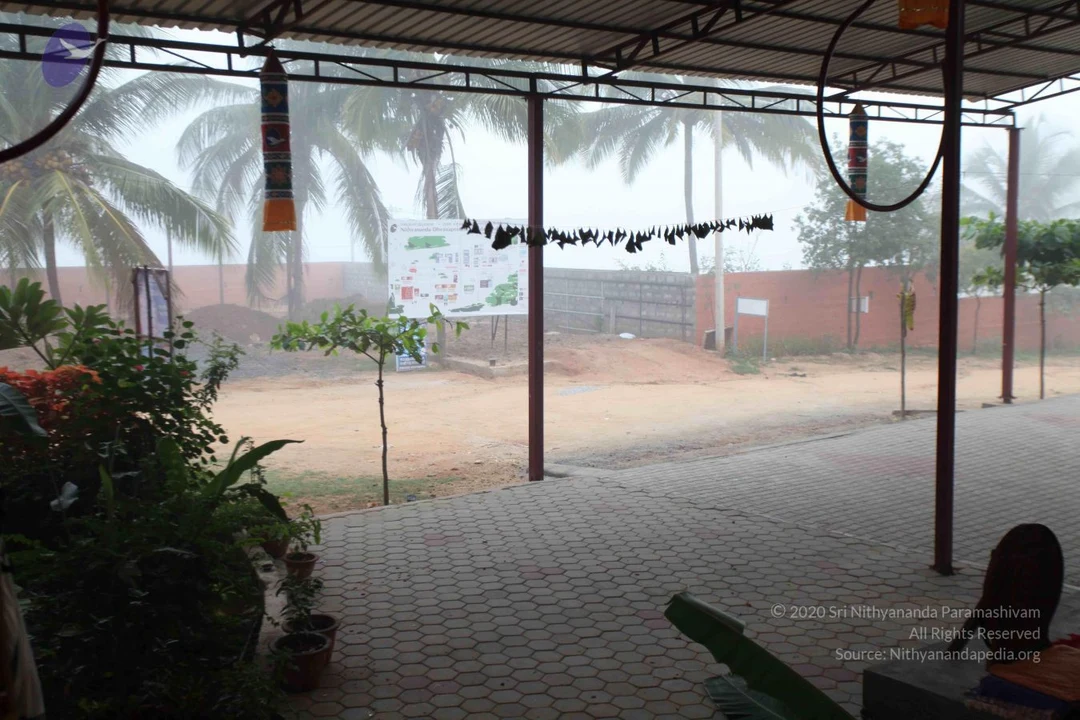
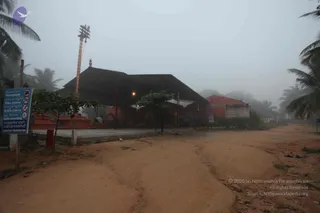
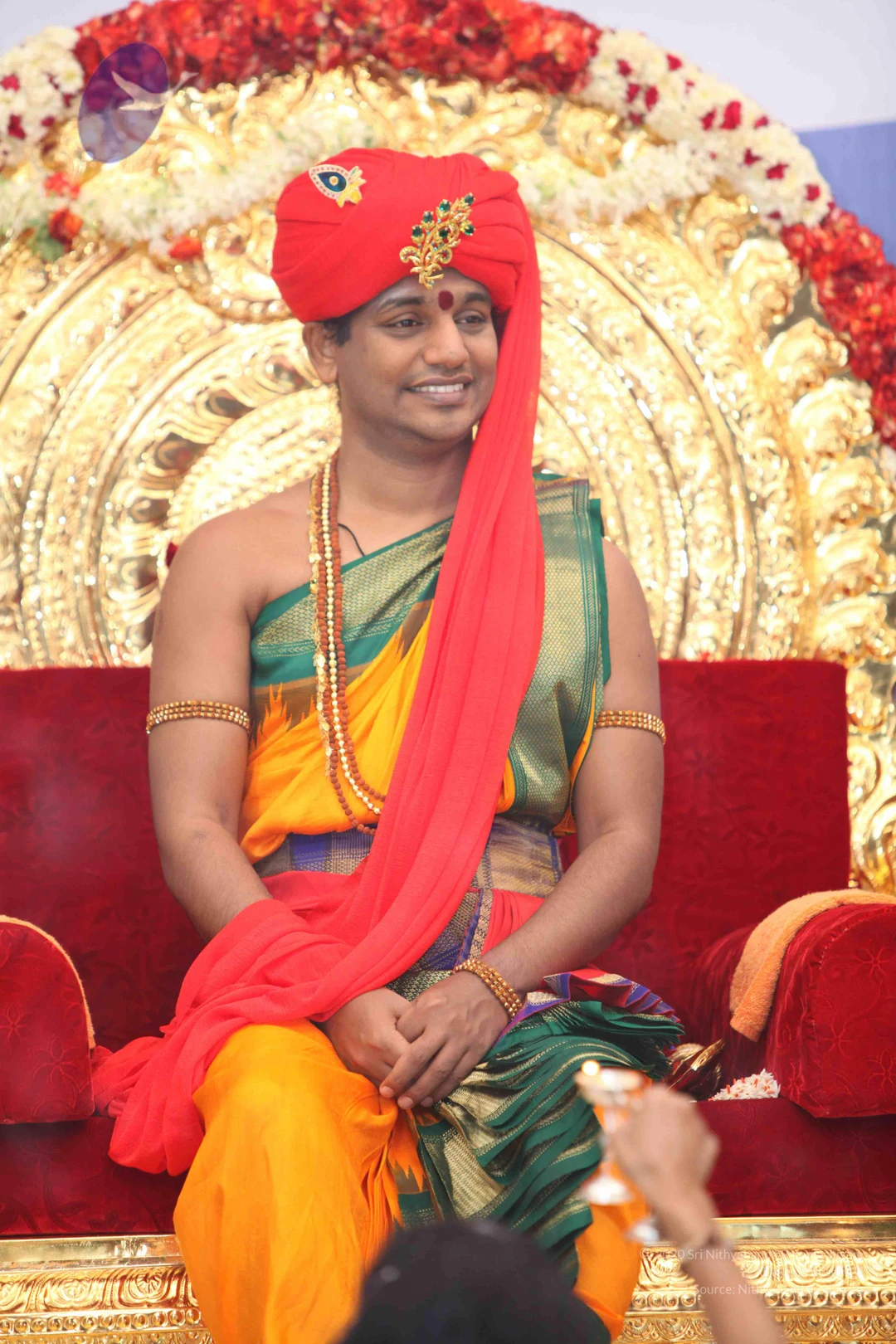
A misty early-morning view of a rural ashram compound with a dirt road in the foreground. A large dark corrugated-roof pavilion stands beside orange-painted buildings, with a tall orange pole and palm trees around it. A blue prohibition sign on the left lists photography, video camera, mobile camera and audio recording as strictly prohibited. No people are visible.A misty, early-morning photograph of an open dirt yard in front of a red-brick building with a sloping tiled roof. A covered walkway with a corrugated roof and red pillars runs along the left, with colourful tassel-like hanging decorations and strings of small red lights. A white signboard with dark printed text stands to the right, and a small blue-and-white poster is pinned on a stand near the greenery. Several pigeons are visible on the ground and one bird flies in the air. No people are visible.A photograph taken from a covered open-air pavilion with a red-brick paved floor, looking out onto a sandy cleared plot with mounds of earth. Tall coconut palms and a hazy grey sky fill the background, along with a red-brick boundary wall. A large white signboard on a stand shows a colourful map or site plan with green areas. Strings of dark leaves or garlands hang across the top, and two hanging decorative tassels in orange and maroon colours hang from the roof frame. Potted plants with red flowers sit at the left edge, and a dark wooden chair is visible at the lower right. No people are visible.A foggy outdoor scene under a metal-roofed covered walkway with red pillars. Beyond the open side, tall coconut palms and a red brick compound wall frame a sandy, dug-up plot. A white signboard with a colourful map and printed text stands on the ground, and a line of dark garlands hangs across the walkway. Hanging decorative tassels in red, yellow and blue colours dangle from the roof. Potted plants and red flowering shrubs line the paved tile floor in the foreground, and a banana leaf lies on a wooden bench at the right. No people are visible.A covered open-sided pavilion with a paved hexagonal-tile floor looks out onto a bare sandy plot enclosed by a terracotta boundary wall and tall coconut palms in misty, overcast weather. A large printed information board with a map and diagrams stands on posts in the middle of the plot. Hanging from the roof beams are orange and maroon tasselled banners, a strand of dark cloth scraps strung across the opening, and potted plants sit at the left edge. No people are visible in the scene.A foggy, hazy outdoor scene of a wide unpaved dirt-and-gravel ground with tire tracks running diagonally toward the misty background. On the left stands a single-storey red-brick building with a dark green roof and a small bench in front, beside a few young trees and shrubs. Further back, faint outlines of larger buildings and more trees are barely visible through the fog, and a small distant figure in dark clothing walks across the ground near the centre. On the right, a row of trees and a low grey boundary wall fade into the mist. The scene is quiet and empty, with no ritual, discourse or gathering visible.

NAVARATRI-ASHTAMI-DAY-CELEBRATIONS-IN-MALAYSIA-NITHYANANDA-DHYANAPEETAM
8 photosSource gallery
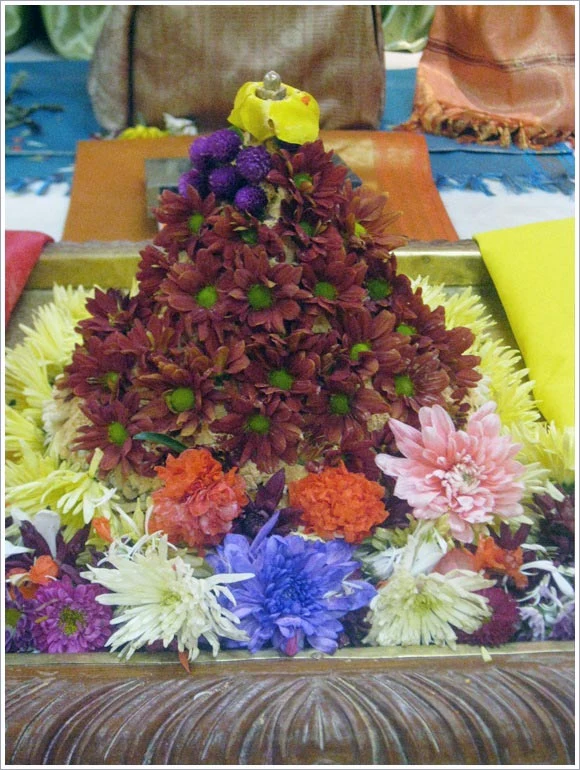
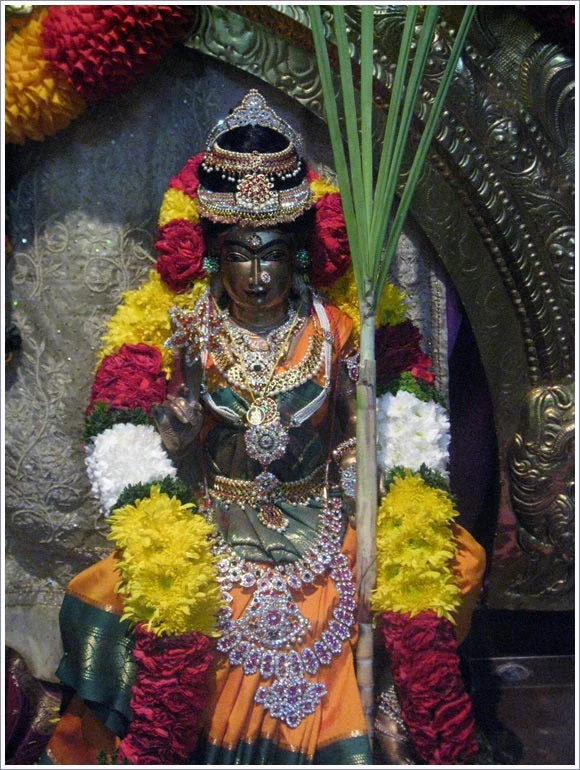
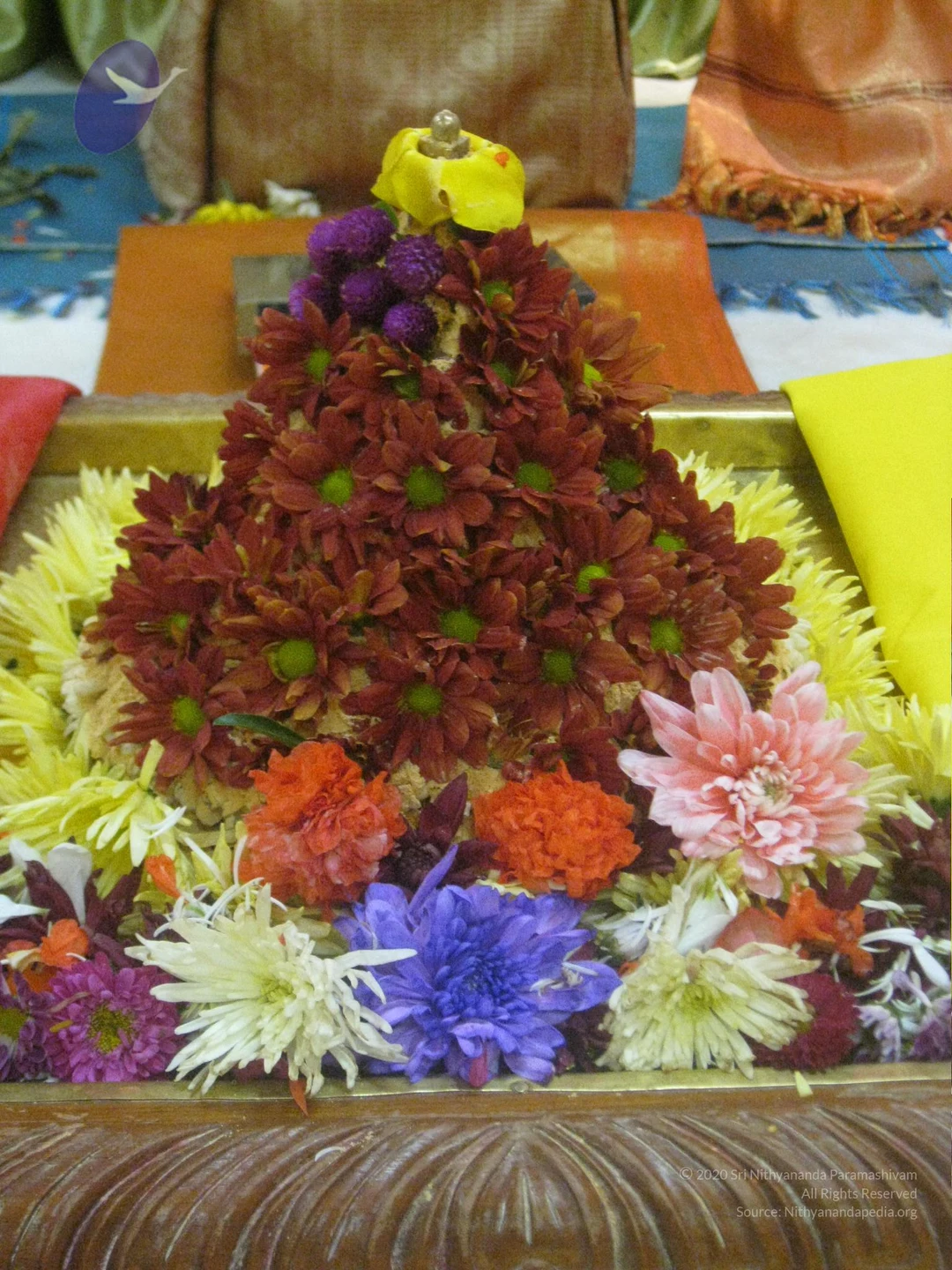
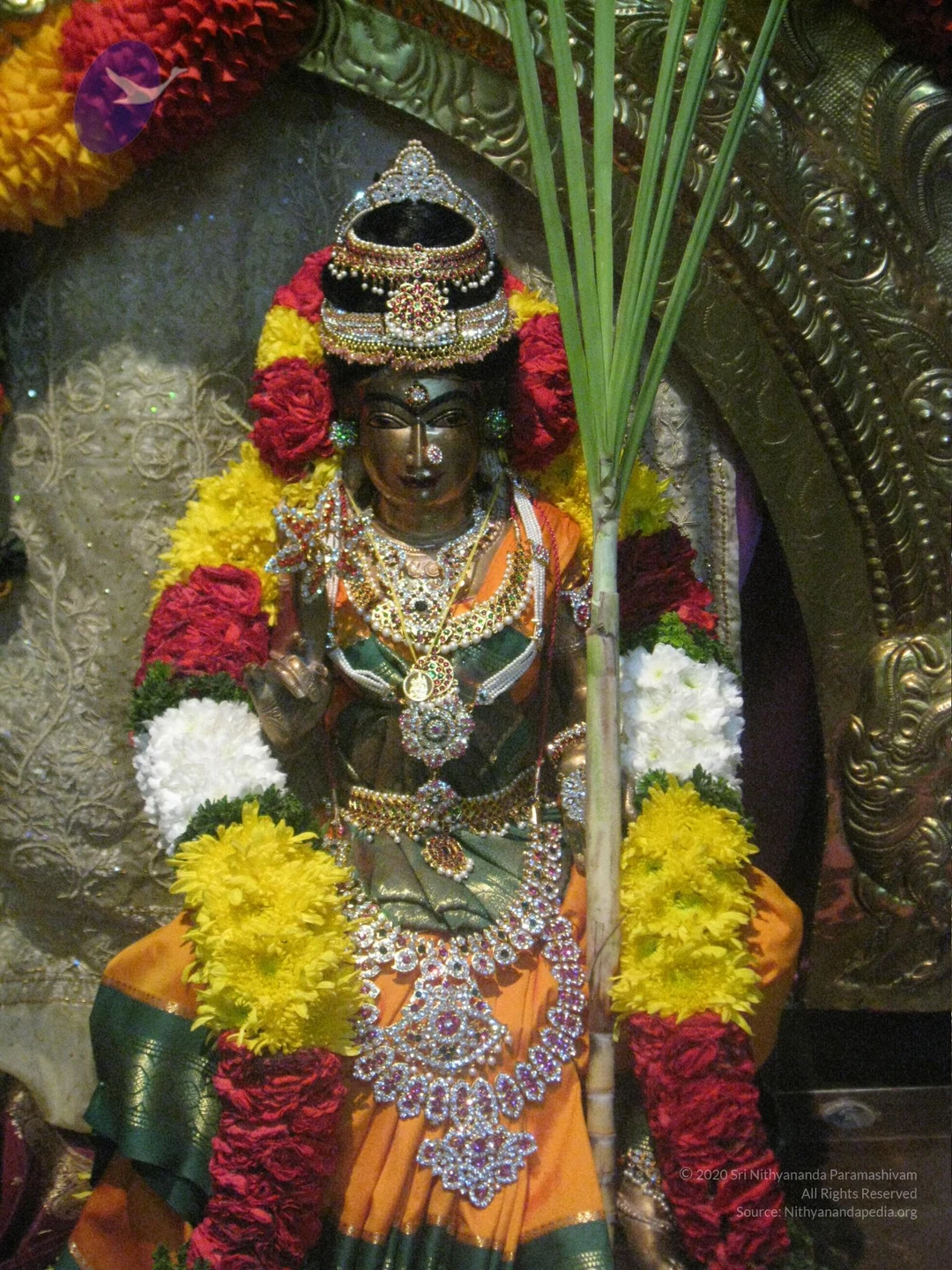
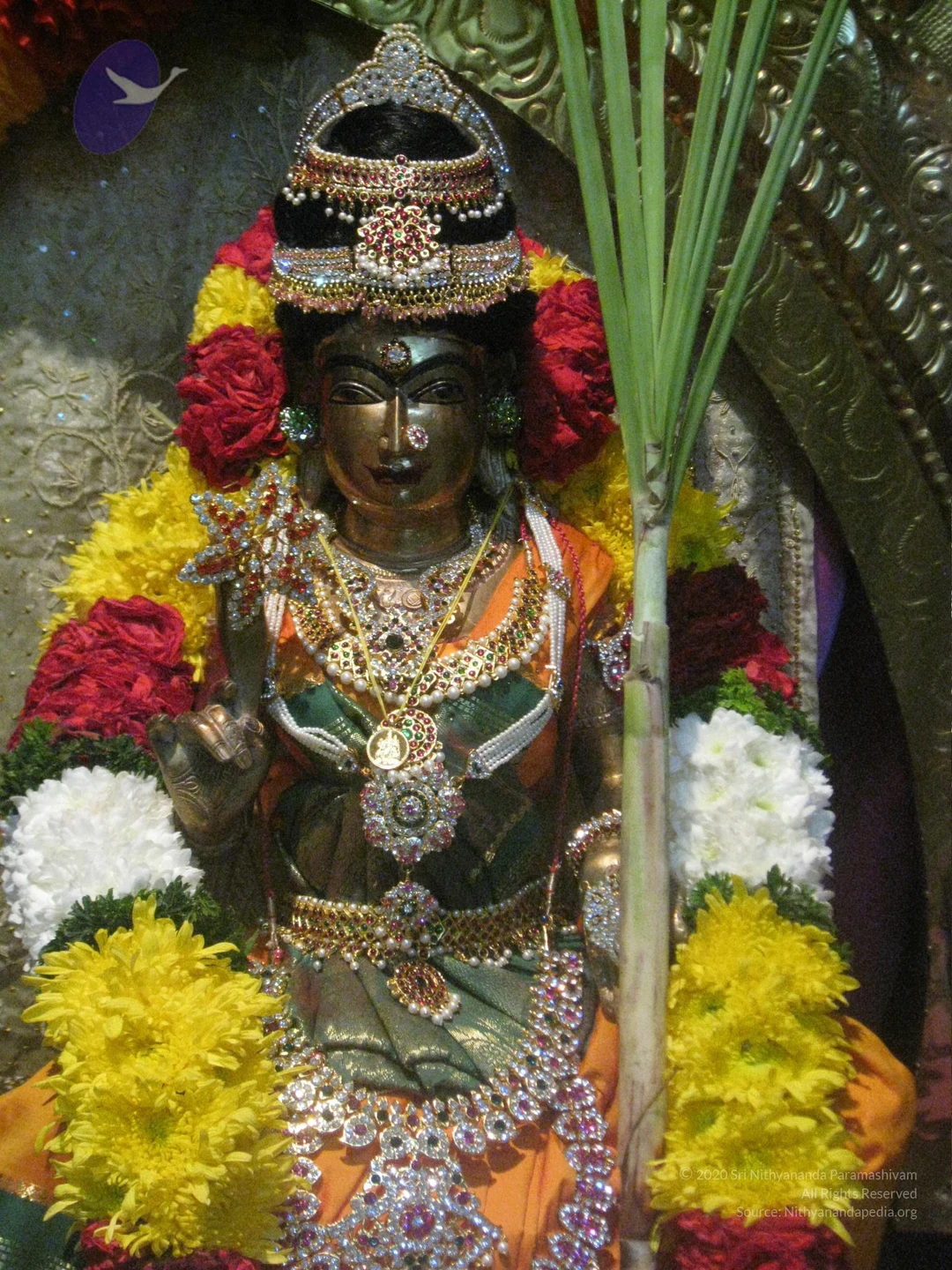
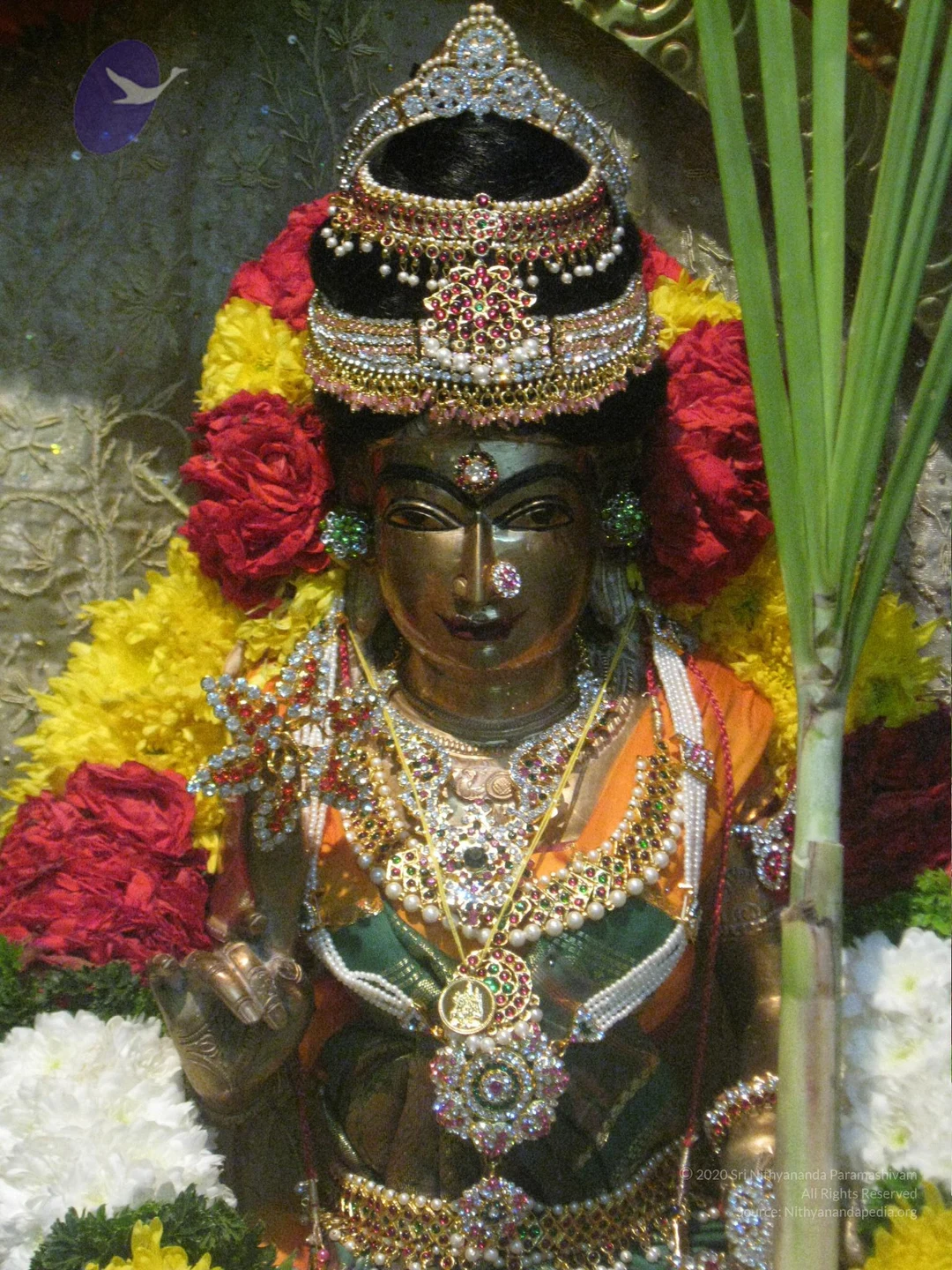
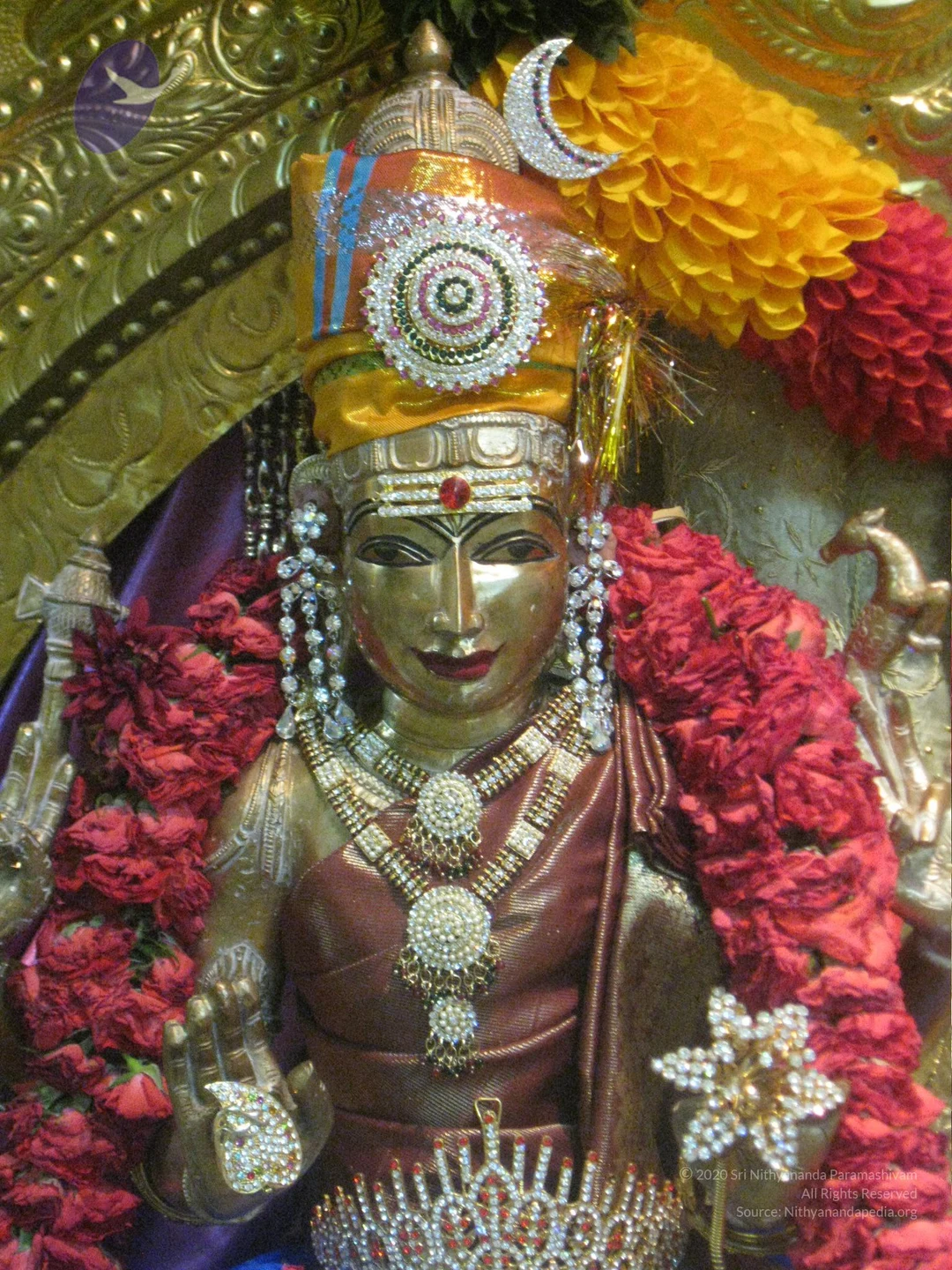
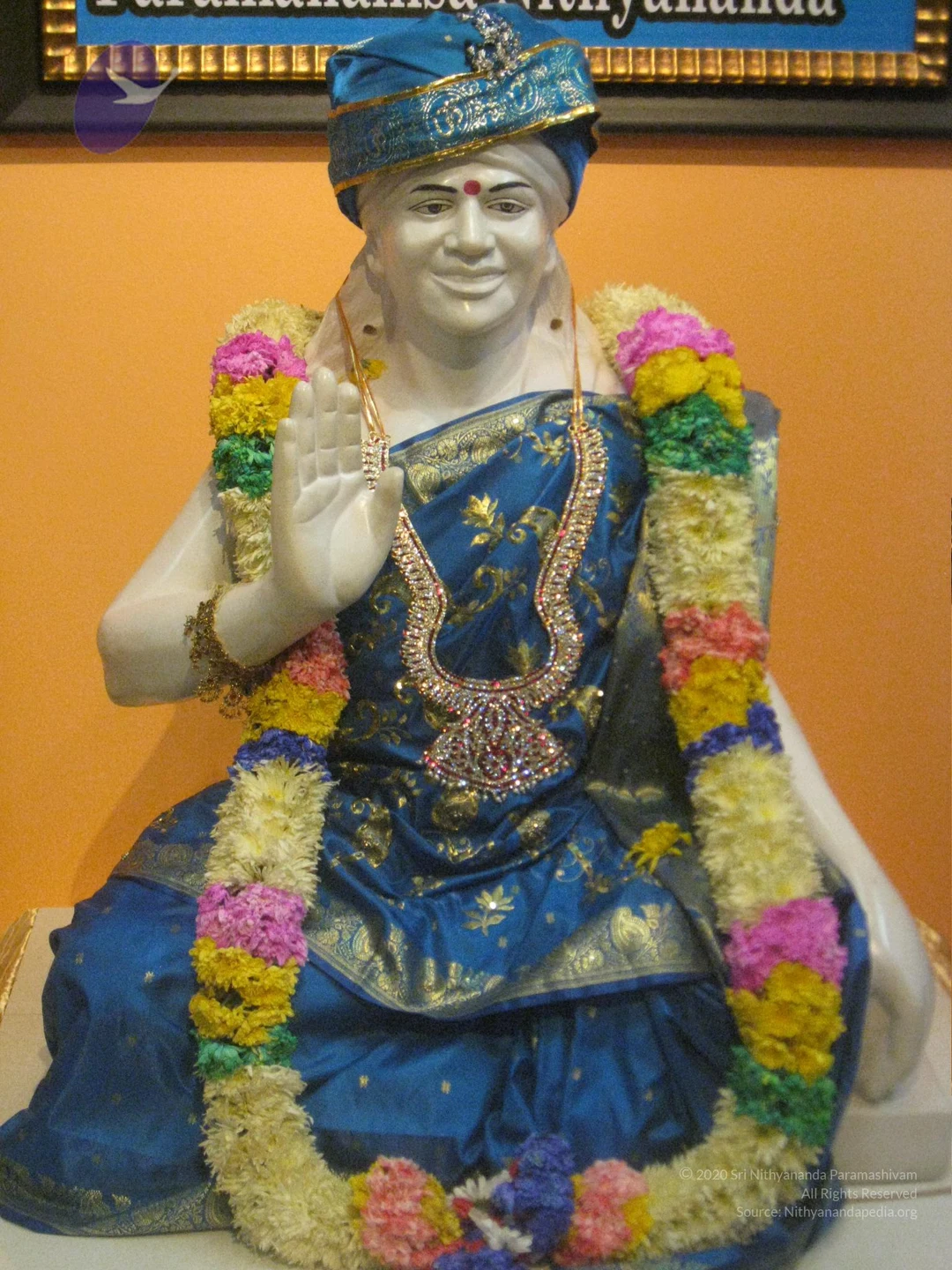
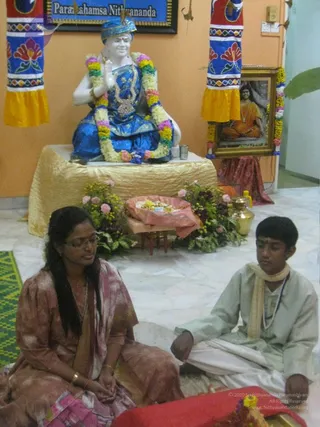
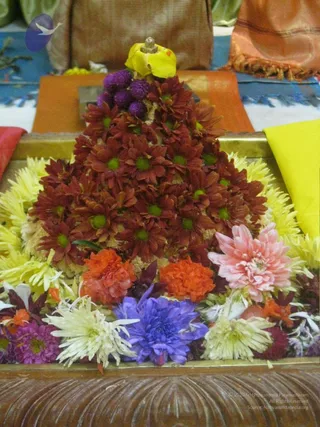
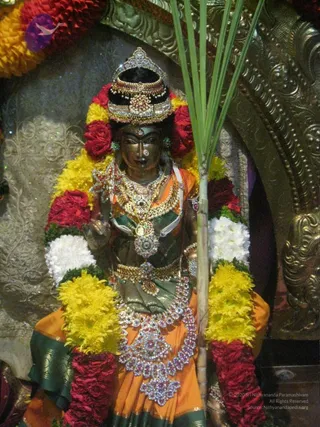
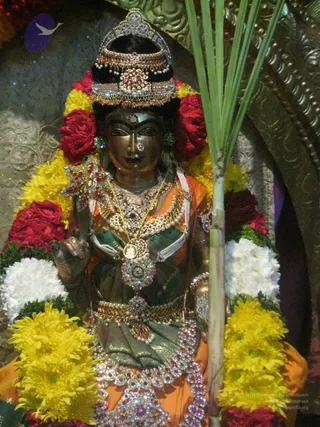
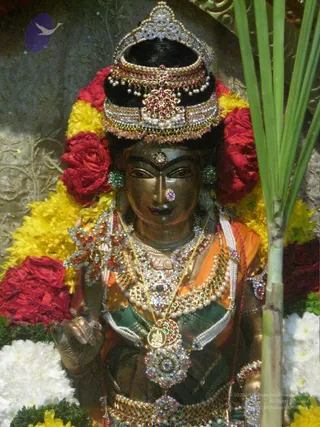
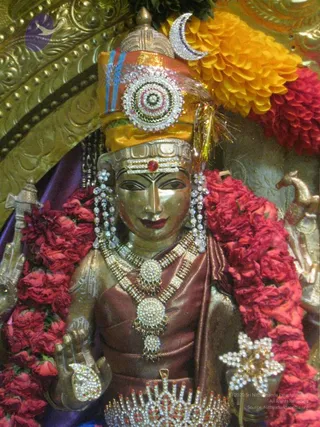
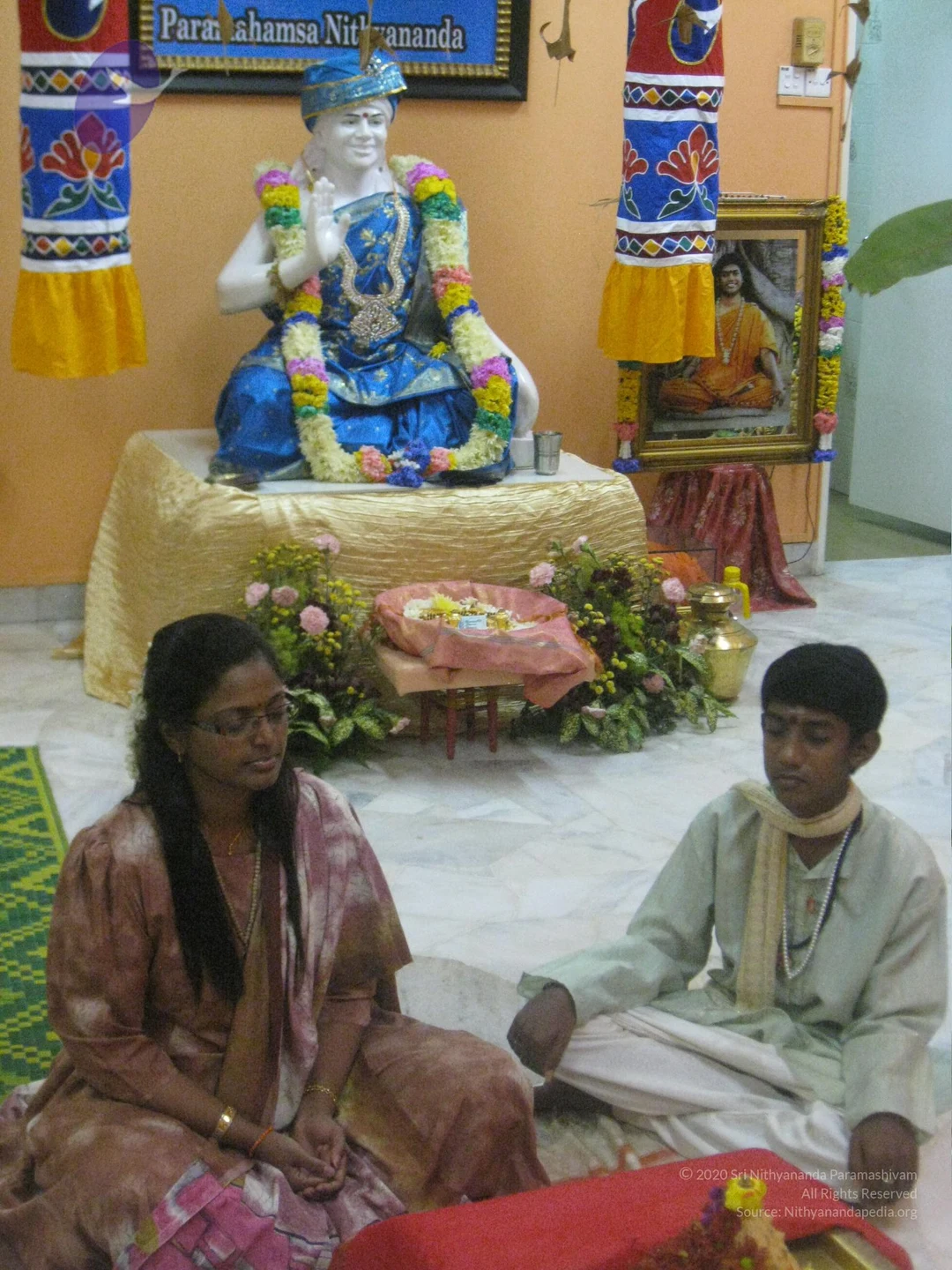
Indoor shrine room with a white marble statue seated on a gold-draped pedestal, dressed in a blue robe with a blue turban-style crown, garlanded with multicoloured flower necklaces, one hand raised in blessing. A framed portrait labelled "Paramahamsa Nithyananda" hangs on the wall above, and a framed photo of a figure in saffron sits to the right beside a garland-hung frame. Two people sit cross-legged on the marble floor in front: a woman in a pink-and-brown patterned sari with glasses, and a young man in a pale green kurta with a shawl and rudraksha-style beads, eyes closed in meditation. Floral arrangements, a brass kalasha-style pot, and a pink-draped offering tray with flowers surround the altar, and bright blue and yellow decorative hangings frame the wall.A photograph of a shivalinga-shaped mound heavily decorated with dark red chrysanthemums with green centres, purple globe amaranth flowers and a yellow flower at the apex, set on a brass tray surrounded by yellow, white, pink, orange and blue blossoms. Behind it lie orange and yellow cloths and a brown fabric on a table. No people are visible.A bronze-toned deity murti of a goddess stands in a decorated shrine, adorned with a jeweled crown, multiple jeweled necklaces, and a stone-studded waist belt. She wears an orange silk sari with a dark green border and is draped with red, yellow and white flower garlands. A tall green palm frond rises beside her. The background is an ornate gold-toned metal arch. No physical people are visible; the figure is a statue.A bronze deity murti is seated and adorned with a jeweled crown, multiple strands of gold and pearl necklaces, a green and orange sari, and a large kalasha-style pendant. Red roses, yellow chrysanthemums and white flowers form garlands around it, and a tall green palm frond rises beside the figure. The silver-patterned backdrop frames the murti in a shrine setting. No physical people are visible.Close photograph of a bronze-toned deity murti adorned with a jewelled crown and ornate gold necklaces set with red, green and white stones and pearls. The figure wears an orange garment and a green and gold waist cloth, with a red-and-yellow flower garland around the shoulders. A green palm frond stands to the right and a silver-embossed backdrop frames the scene. The face has a red bindi and a jewelled nose ring. The image is a statue, not a living person.A close photograph of a metallic deity murti, silver-toned with a serene face, adorned with a red-orange and gold headdress set with a crescent moon and a large jewelled circular ornament. The murti wears layered jewelled necklaces, a rust-brown silk garment, and crystal earrings, with a red bindi on the forehead. Large red and orange marigold and rose garlands drape around it, and ornate gold repoussé metalwork forms the backdrop with a small metal horse figure at right.

NAVARATRI-CELEBRATIONS-IN-TIRUVANNAMALAI-NITHYANANDA-DHYANAPEETAM
46 photosSource gallery
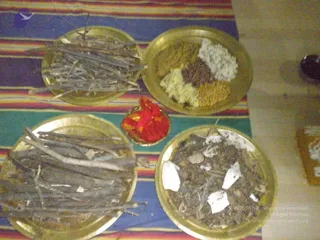
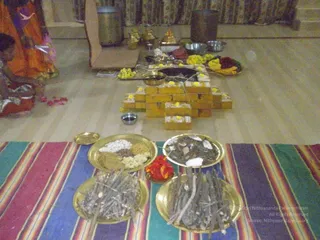
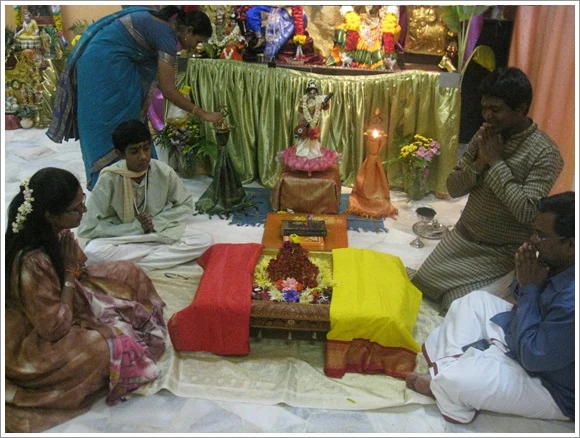
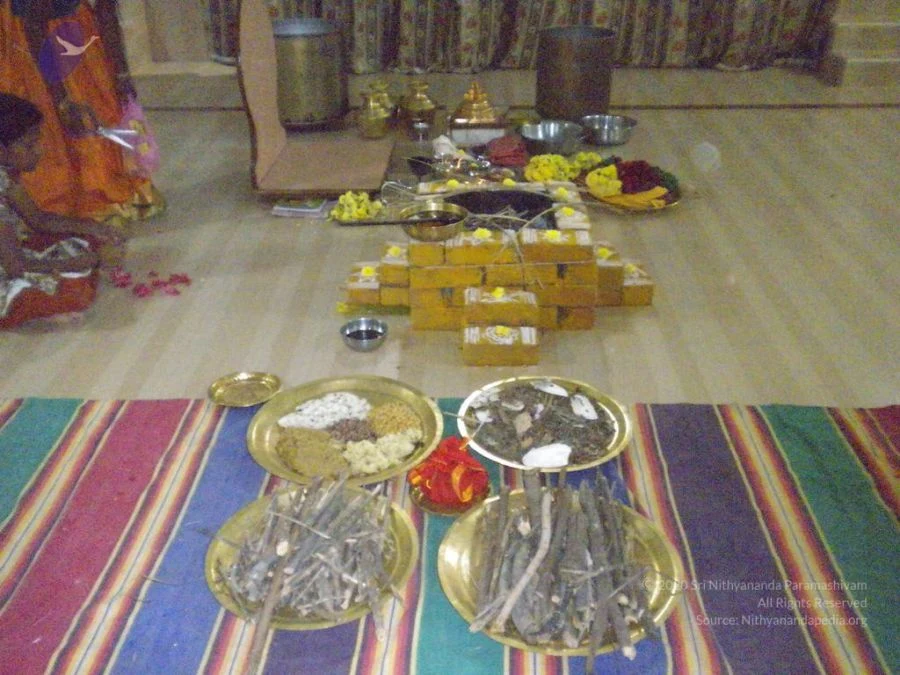
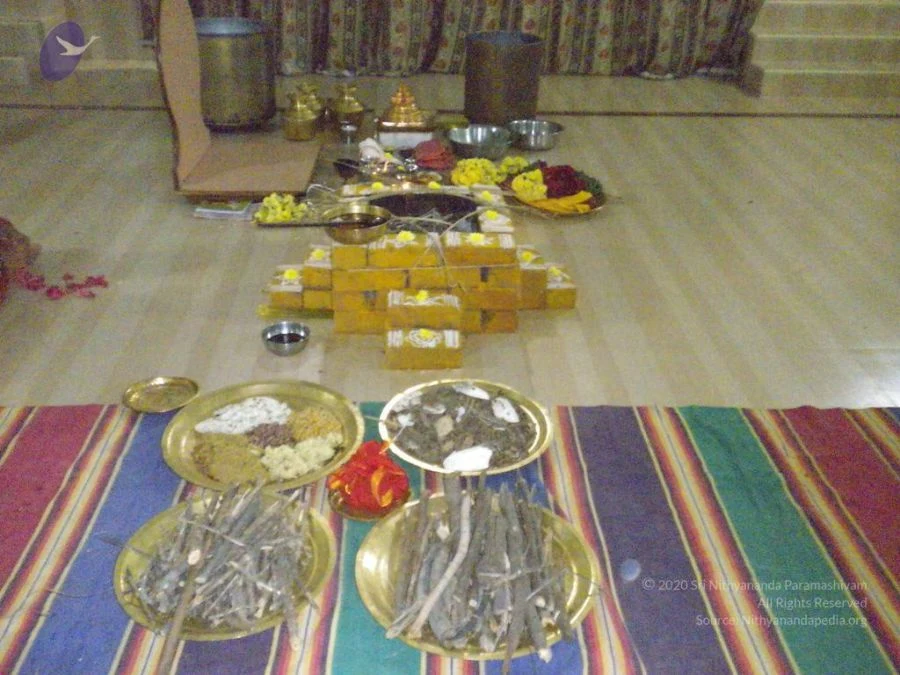
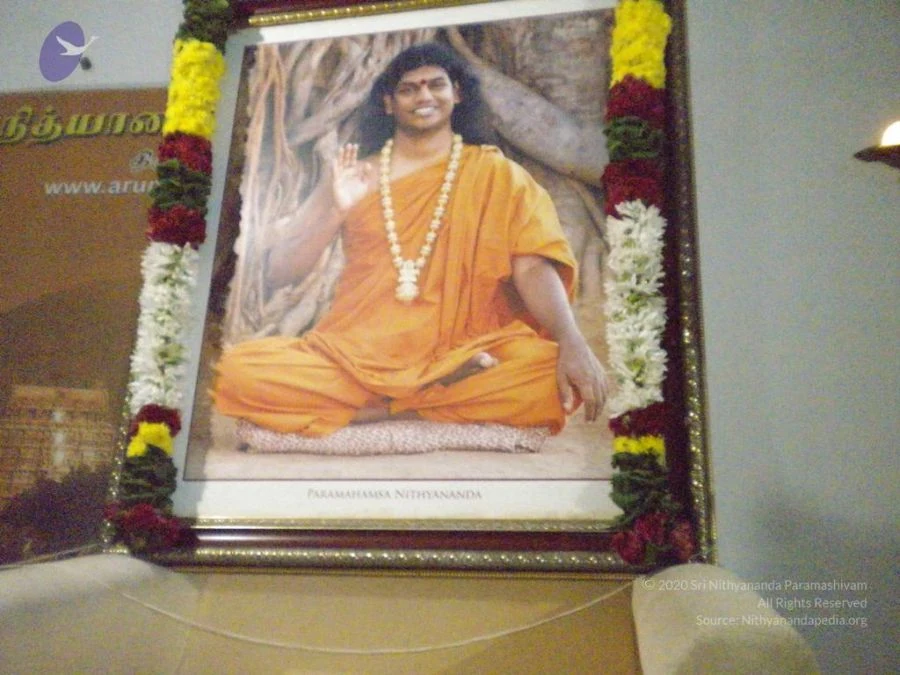
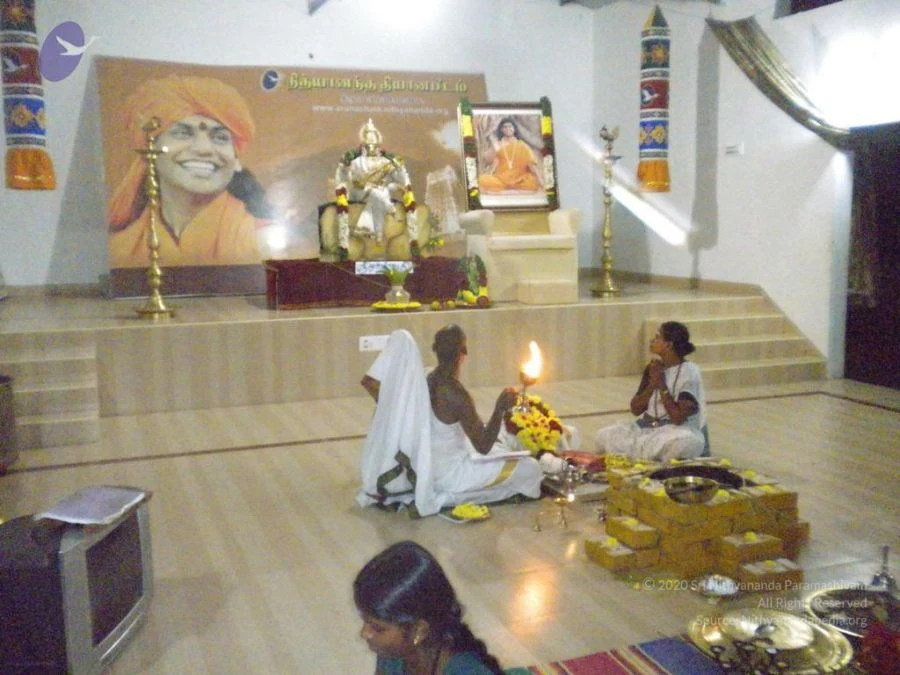
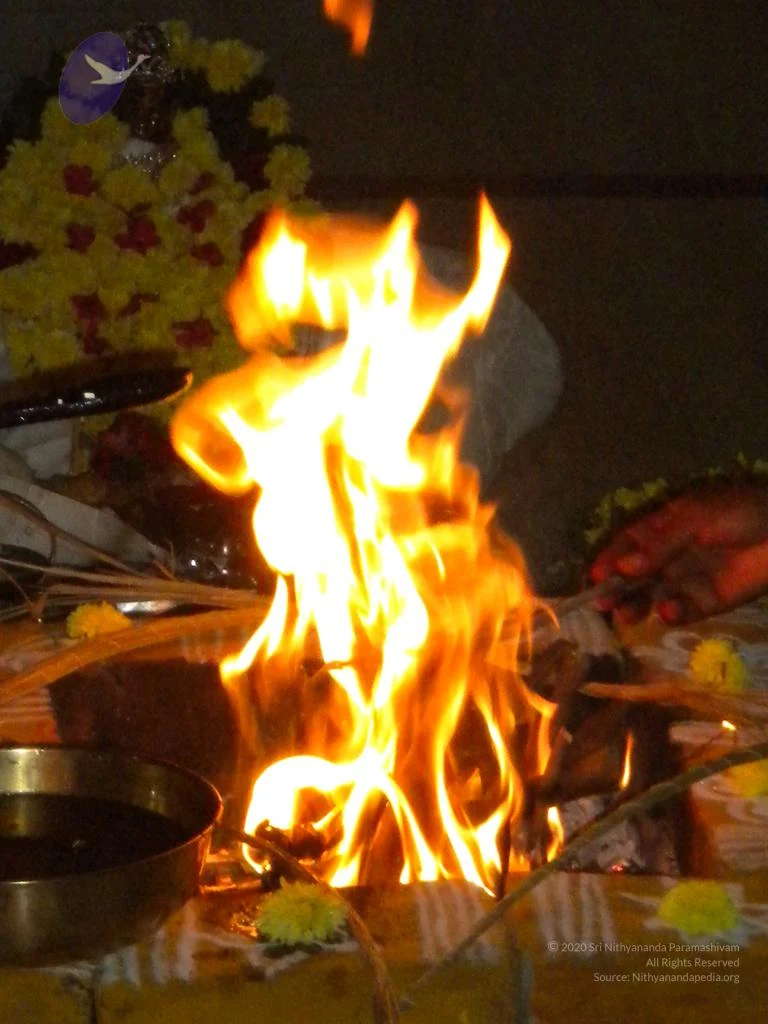
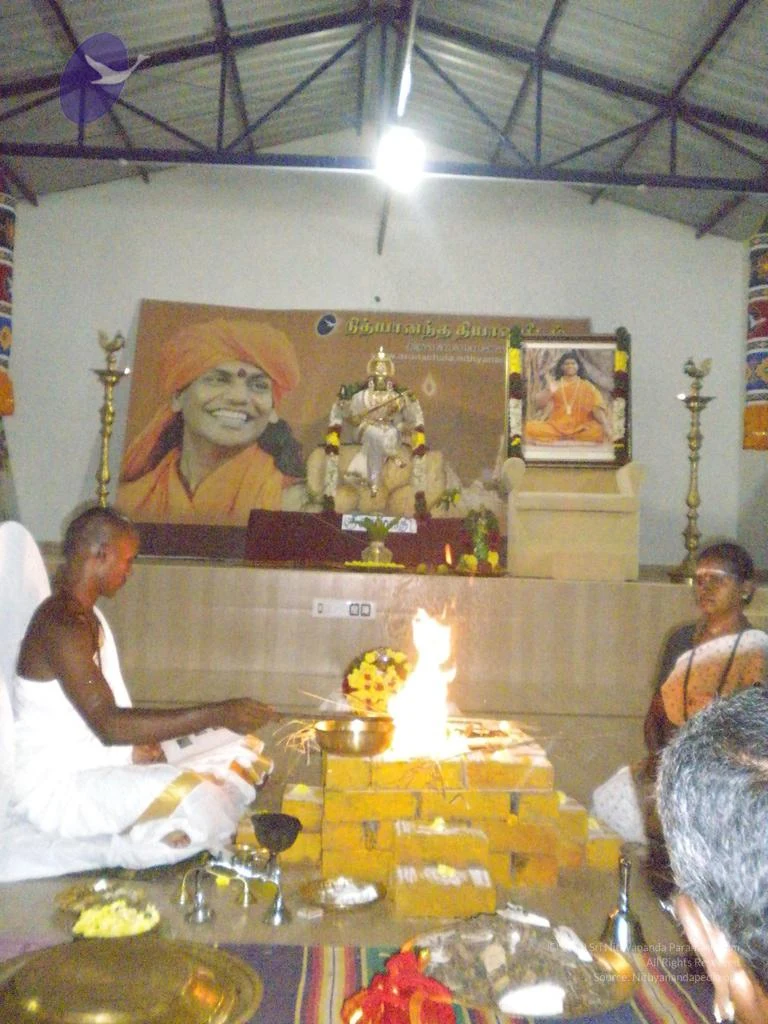
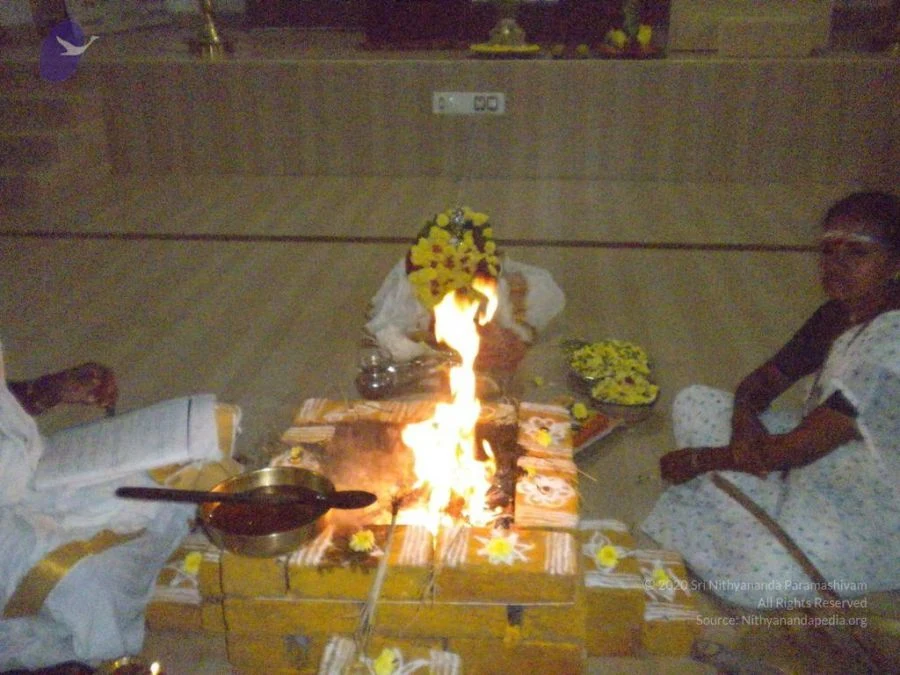
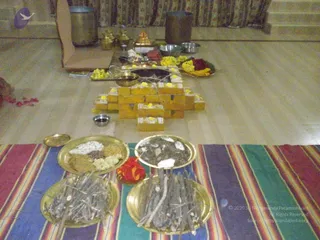
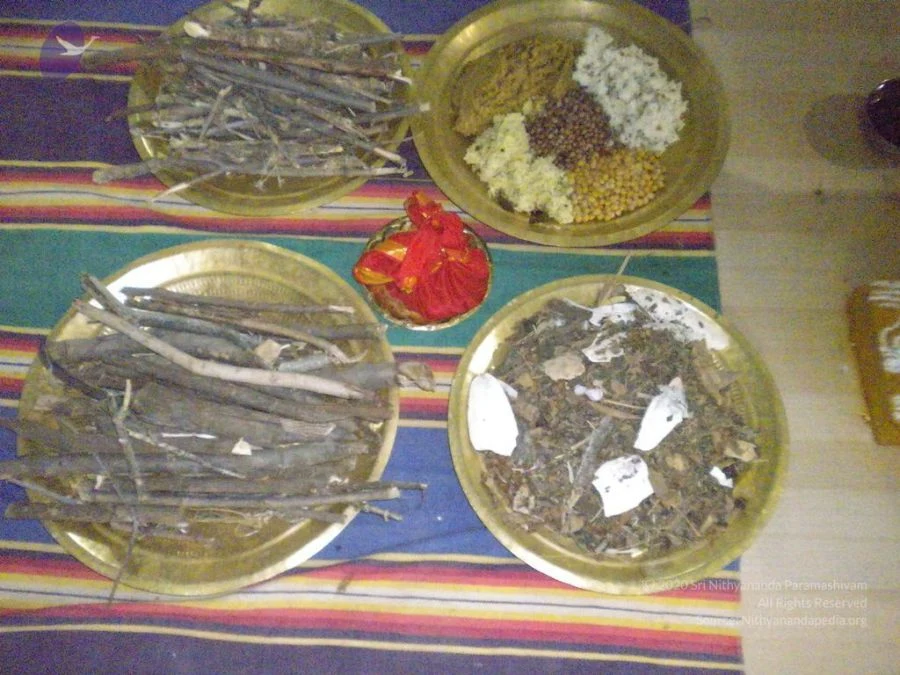
Overhead photo of ritual materials laid on a striped woven mat. Four brass plates hold sticks and twigs, a heap of dried leaves and crumpled paper scraps, a mound of grains and powders with mustard-like seeds, and a small brass dish of red cloth or petals at centre. No people are visible. This appears to be preparation for a homa or yagna fire ritual.Overhead photo of ritual offerings arranged on brass plates over a striped woven cloth in red, blue, green and yellow. Top left plate holds a heap of thin dry twigs. Top right plate has mounds of grains and powders in yellow, white, and brown. A small brass bowl in the centre holds red flower petals. Bottom left plate holds larger dry sticks and bark pieces. Bottom right plate holds ash-like powder with white fragments and bits of wood. No people are visible; the setting suggests a homa or yagna preparation with fuel sticks and offerings.Indoor ritual setup on a wooden floor for a homa. Brass plates in the foreground hold piles of dried sticks, grains and powders, red and yellow flowers, and a small red kumkum-like heap. A striped multicolour cloth lies beneath them. Behind, a stacked arrangement of yellow-wrapped packets is decorated with yellow flowers, and brass kalasha-style vessels, a brass lamp and metal bowls sit on the floor. At the upper left edge, a figure in orange cloth is partly visible. No people are fully in frame.A photograph of a homa or yagna setup laid out on the floor, with no people visible. Stacked yellow-wrapped bundles. Brass plates on a striped multicoloured mat hold piles of dried twigs and sticks, a heap of grains and powders, and white and grey items. A red cloth bundle sits between the plates. Behind the arrangement are brass vessels, a brass kalasha-style pot, a bowl of yellow and orange flowers, scattered red petals and a large metal container on a patterned curtain background.A framed photograph of a seated man in saffron-orange robes with a white flower garland, sitting cross-legged on a patterned cushion in front of a large tree trunk, one hand raised in blessing. The framed print is decorated with garlands of yellow, red and white flowers and leaves, displayed on a wall or table against a plain background. The caption printed on the frame reads Paramahamsa Nithyananda. The framed portrait is a depiction of a person, not a physical person in the scene, so no people are present in the room.Top-down photo of a homa fire pit built from yellow-ochre painted bricks decorated with white kolam-style floral and paisley motifs and yellow flower accents. Dry grass strands are tied around the structure. Inside the square pit are grey ash and charred wooden sticks arranged in a crossed pattern. A brass bowl with reddish-brown liquid and a dark wooden ladle rests at the right side of the pit. No people are visible.