Skip to content
Friday

30 September 2011

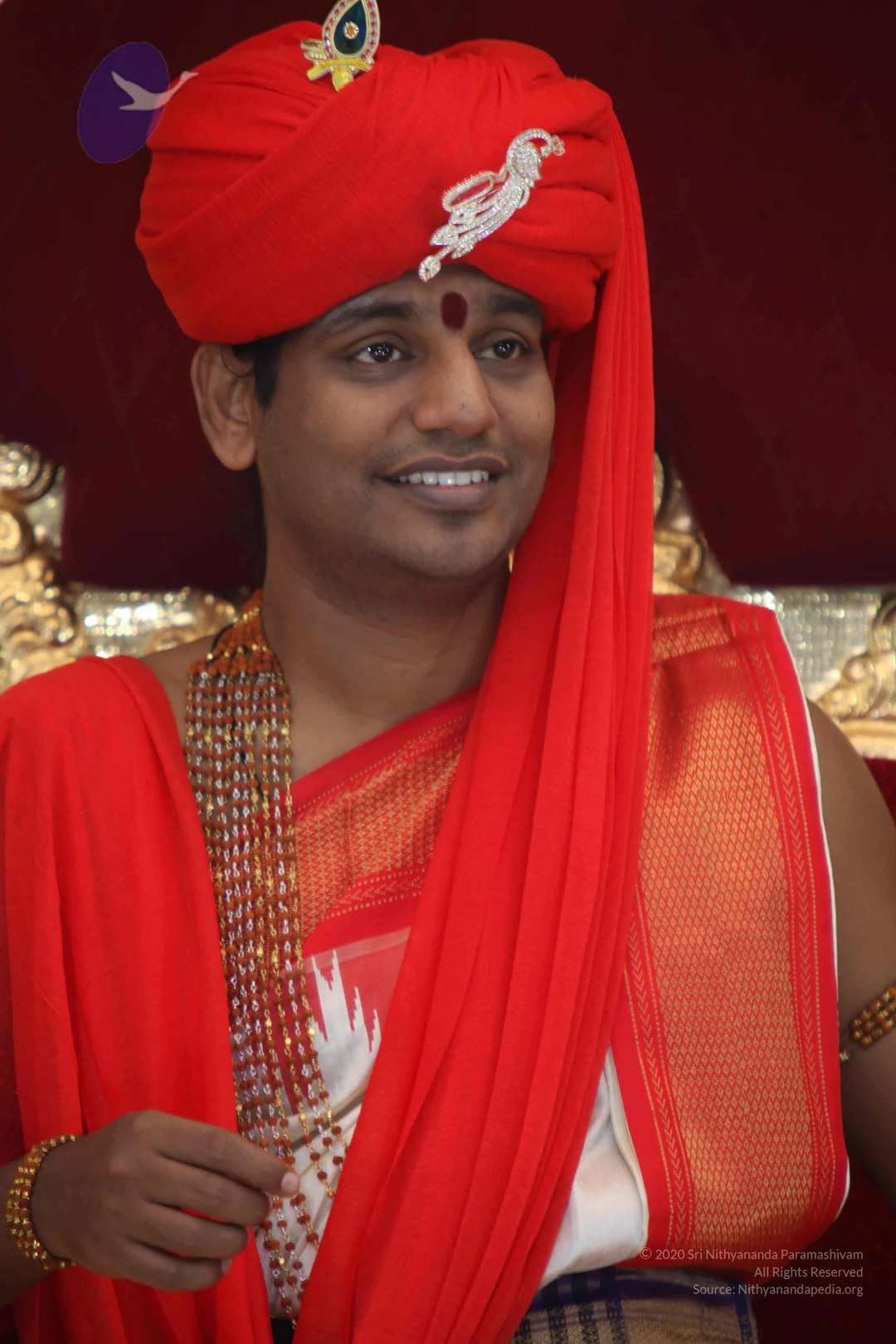
THE SUPREME PONTIFF OF HINDUISM HDH BHAGAVAN SRI NITHYANANDA PARAMASHIVAM

Dated photos
108
Source pages
1
Media
2
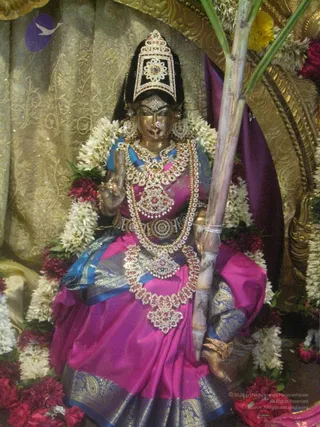
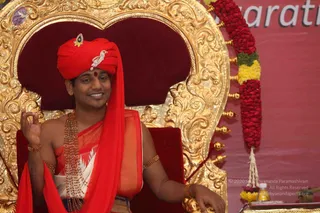
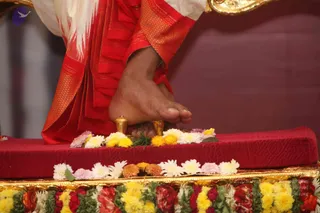
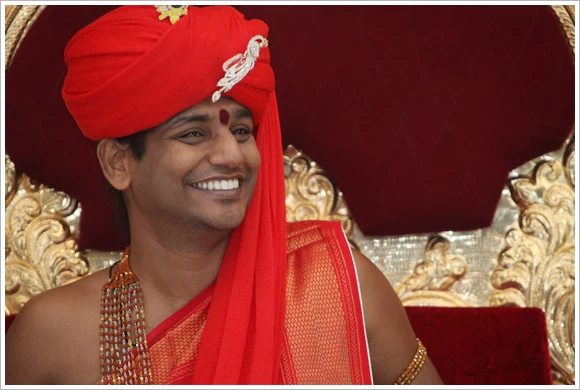
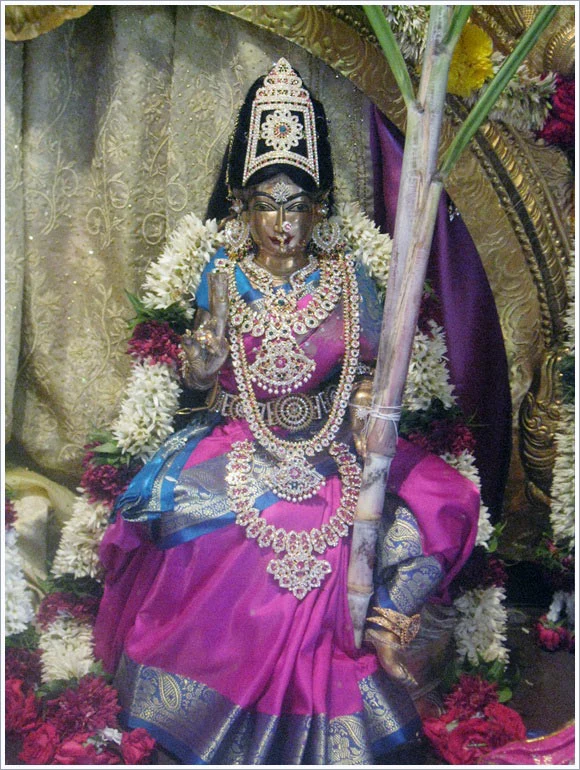
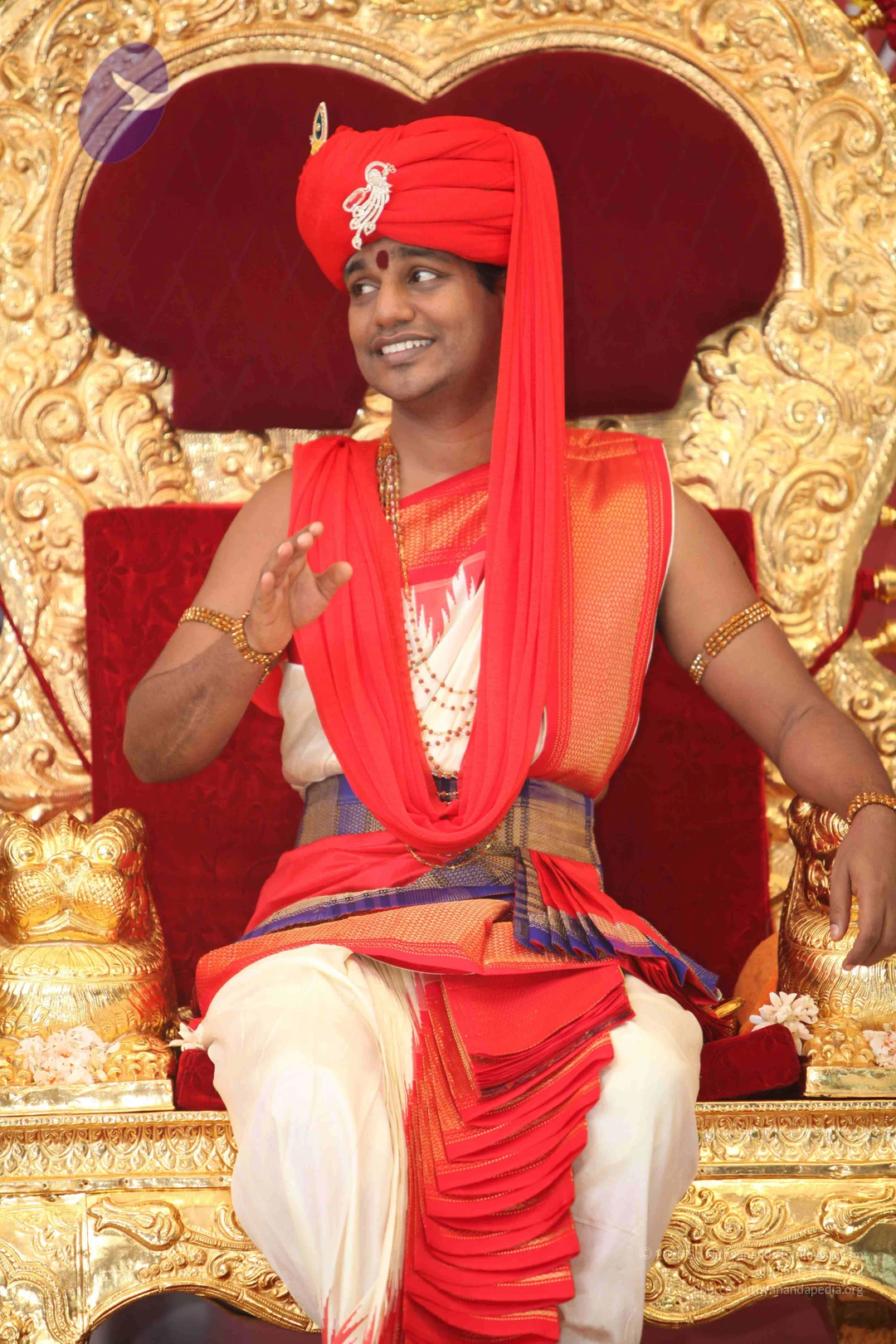
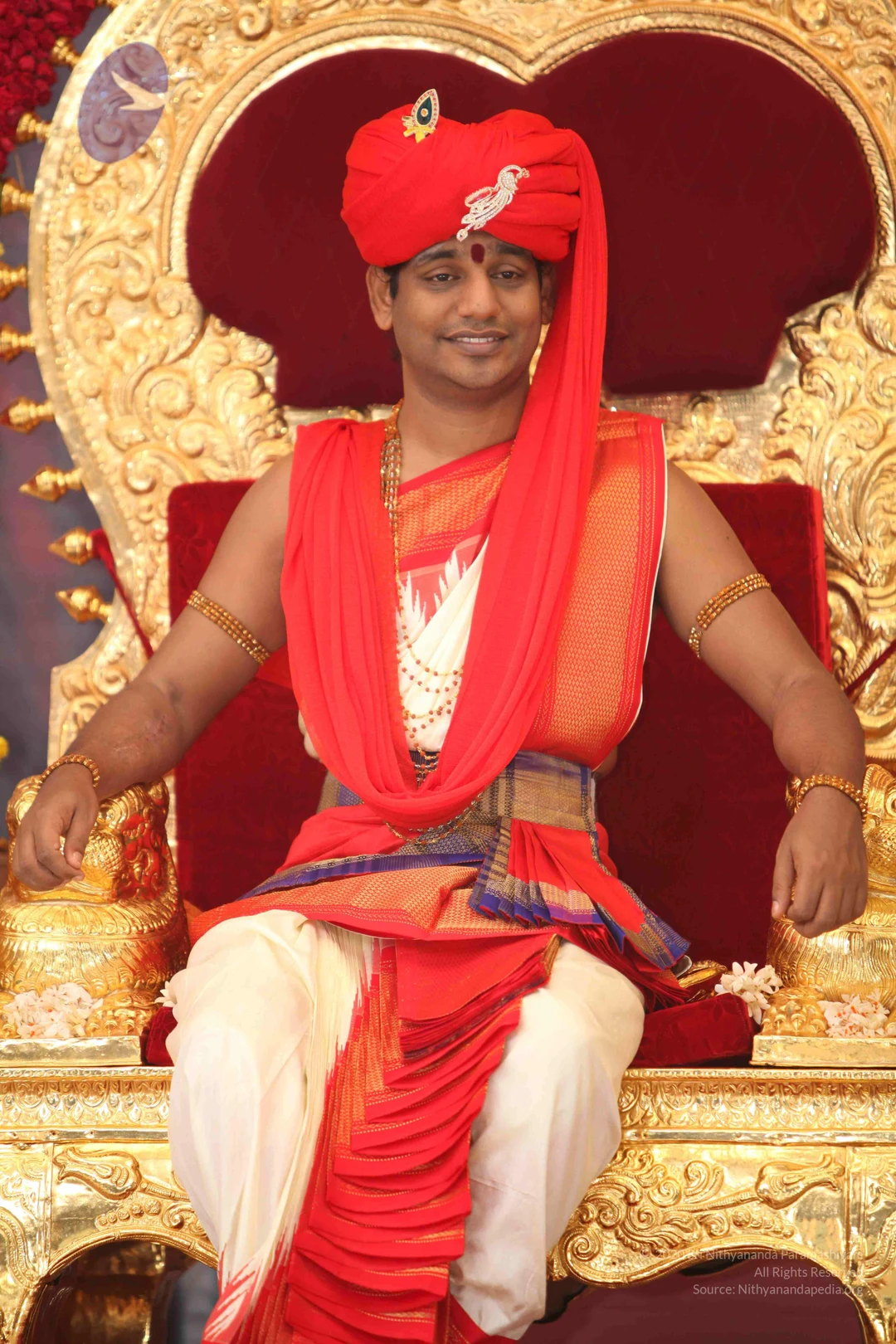
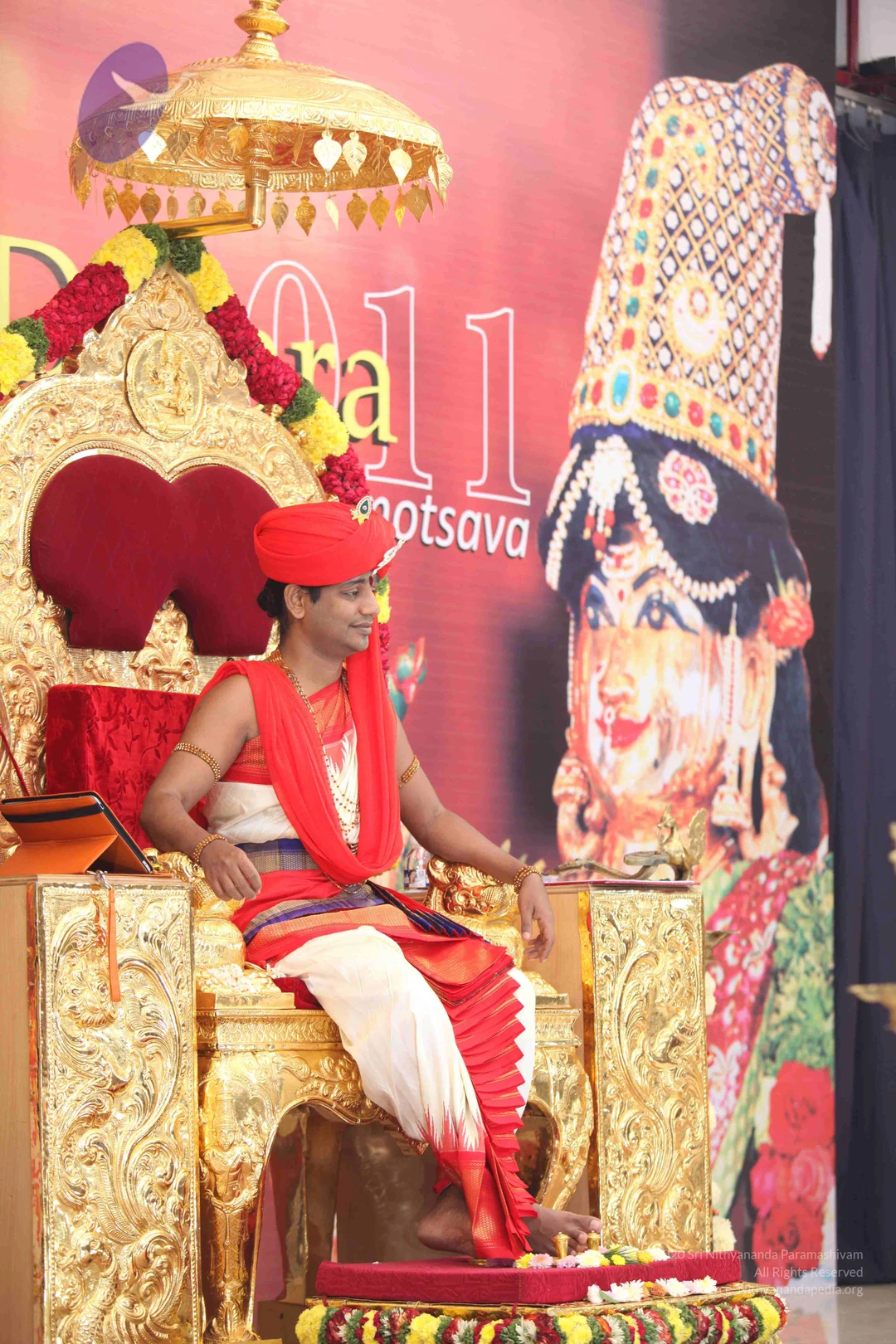
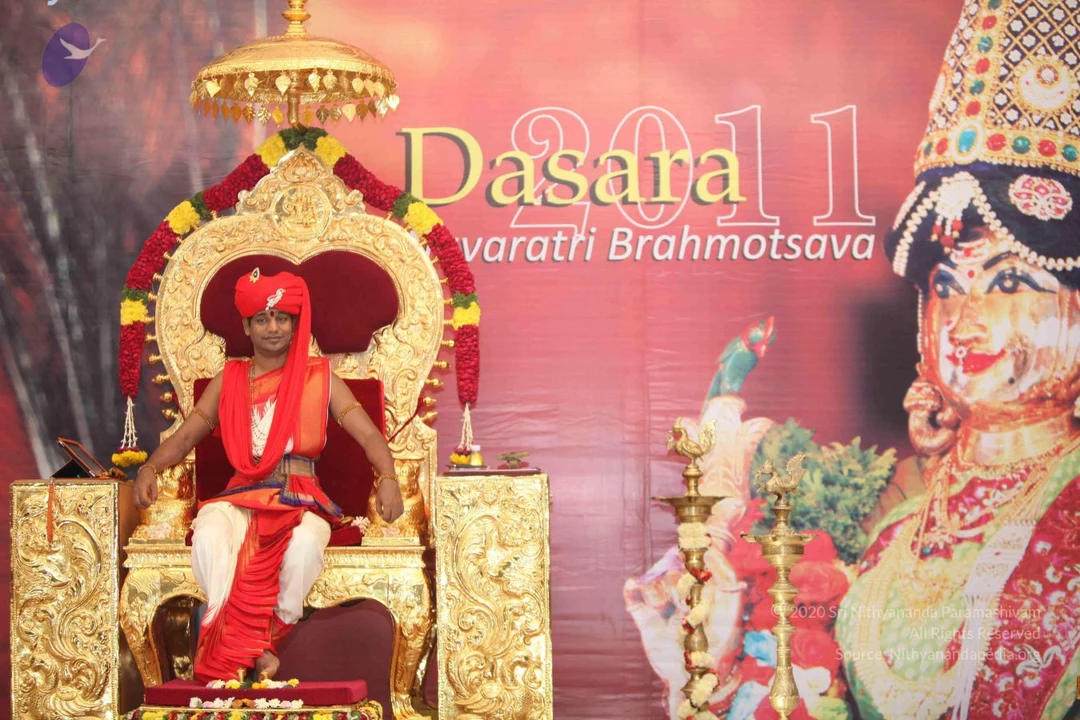
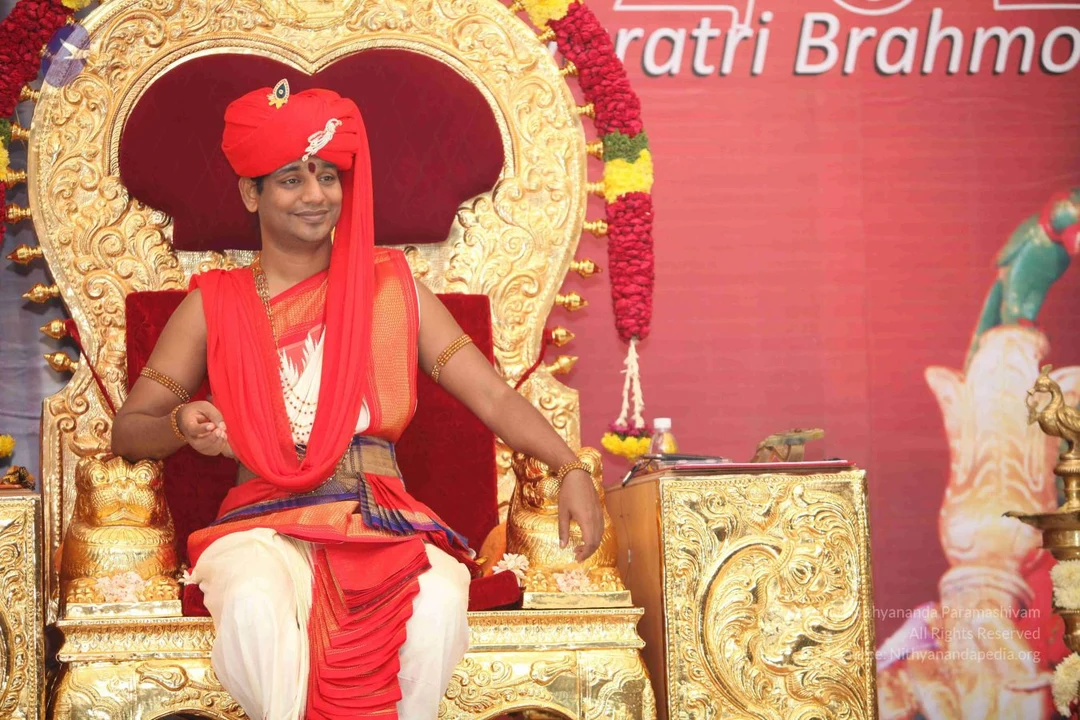
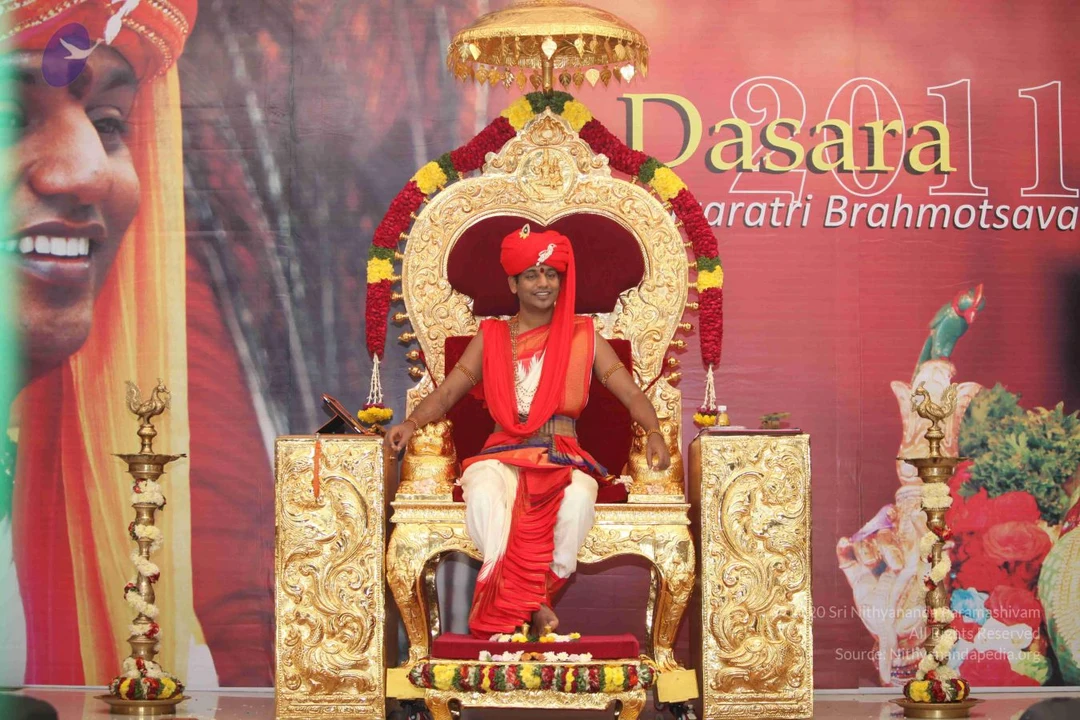
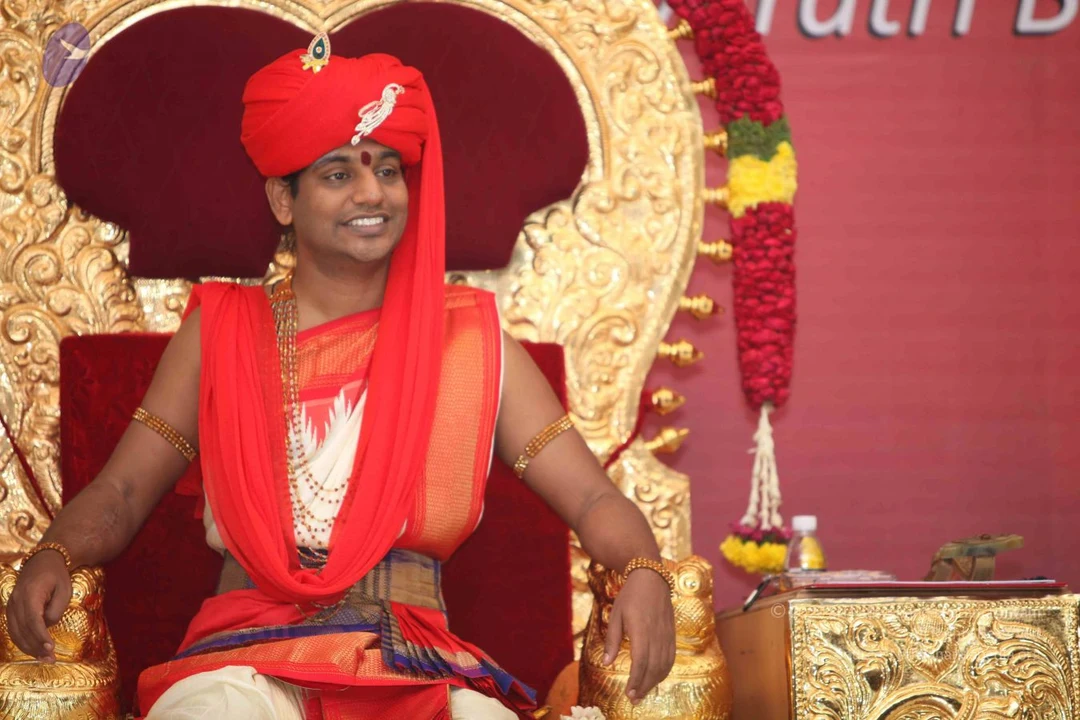
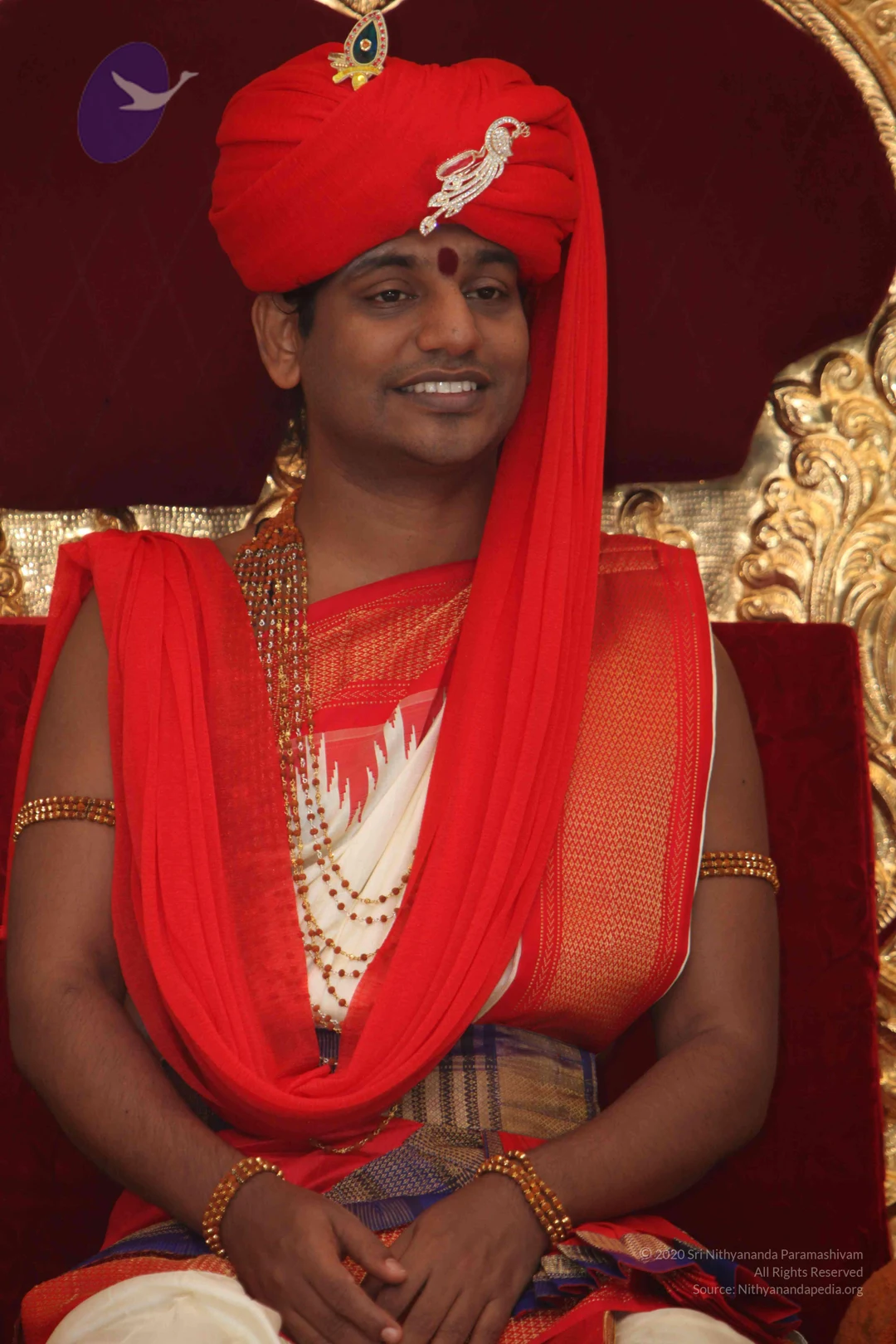
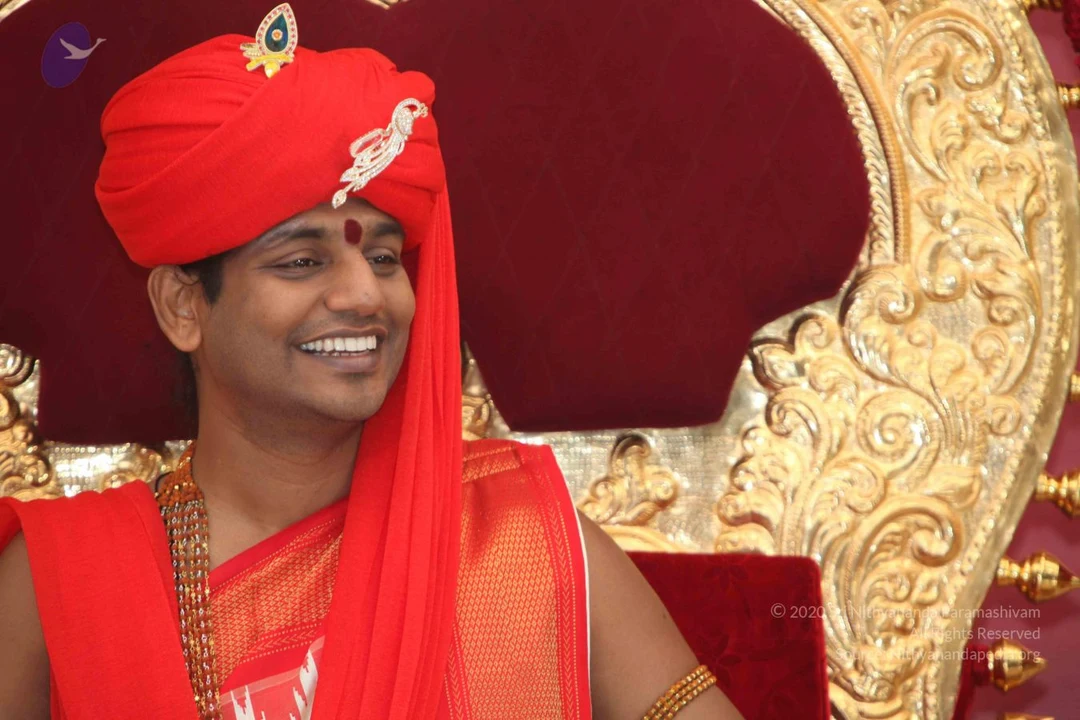
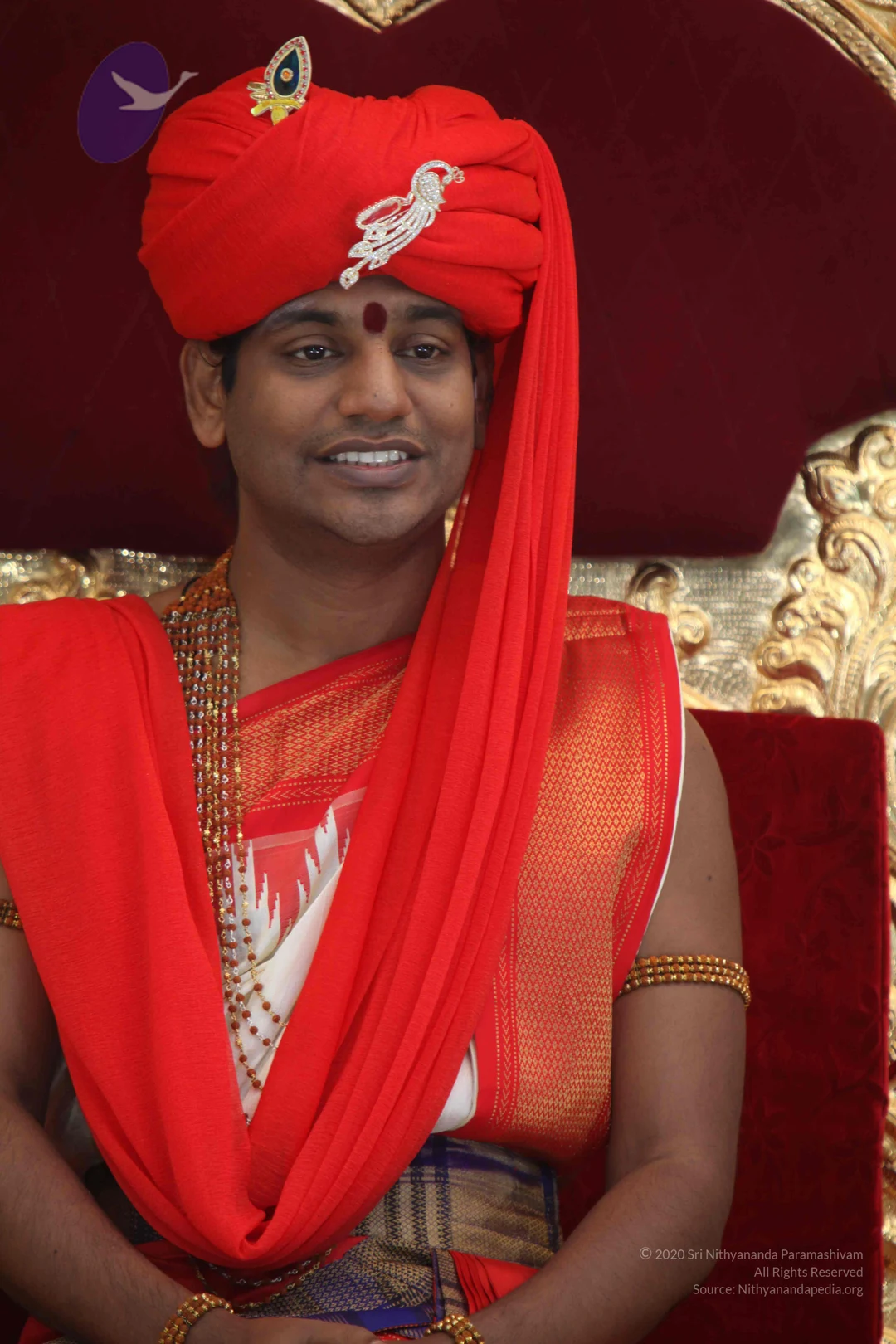
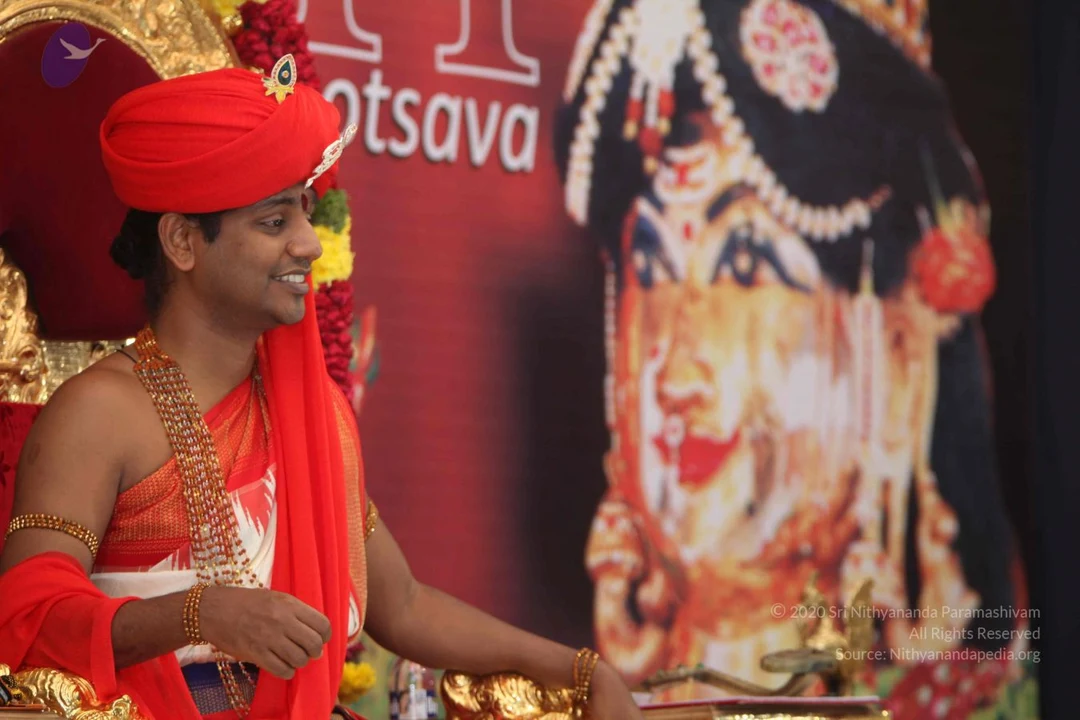
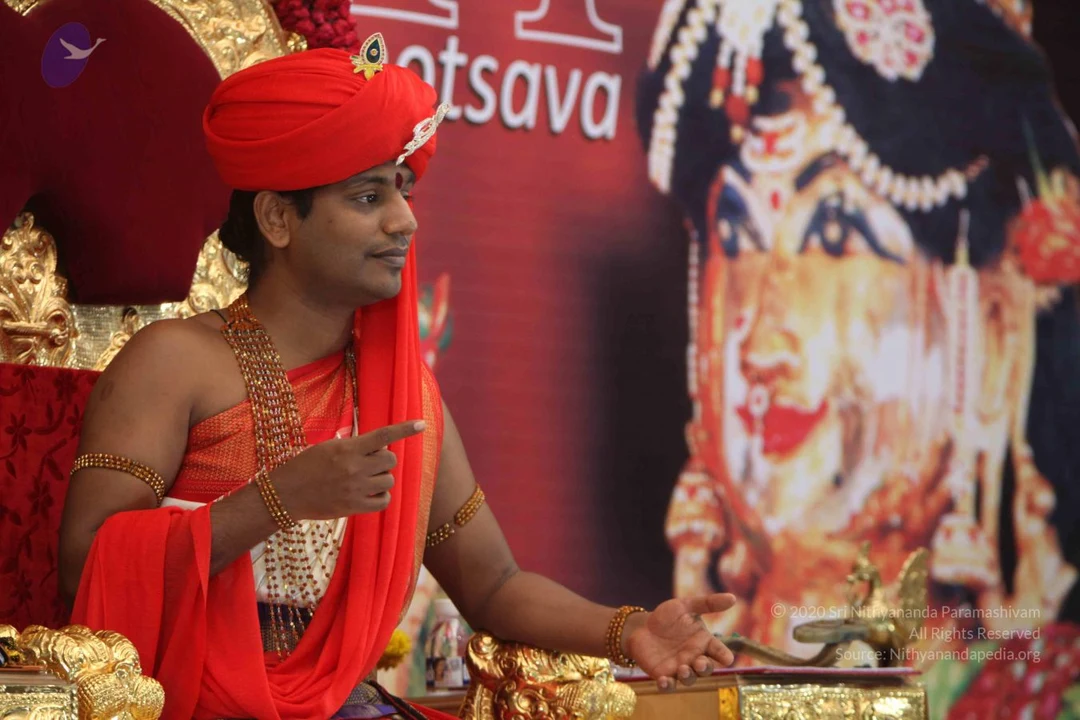
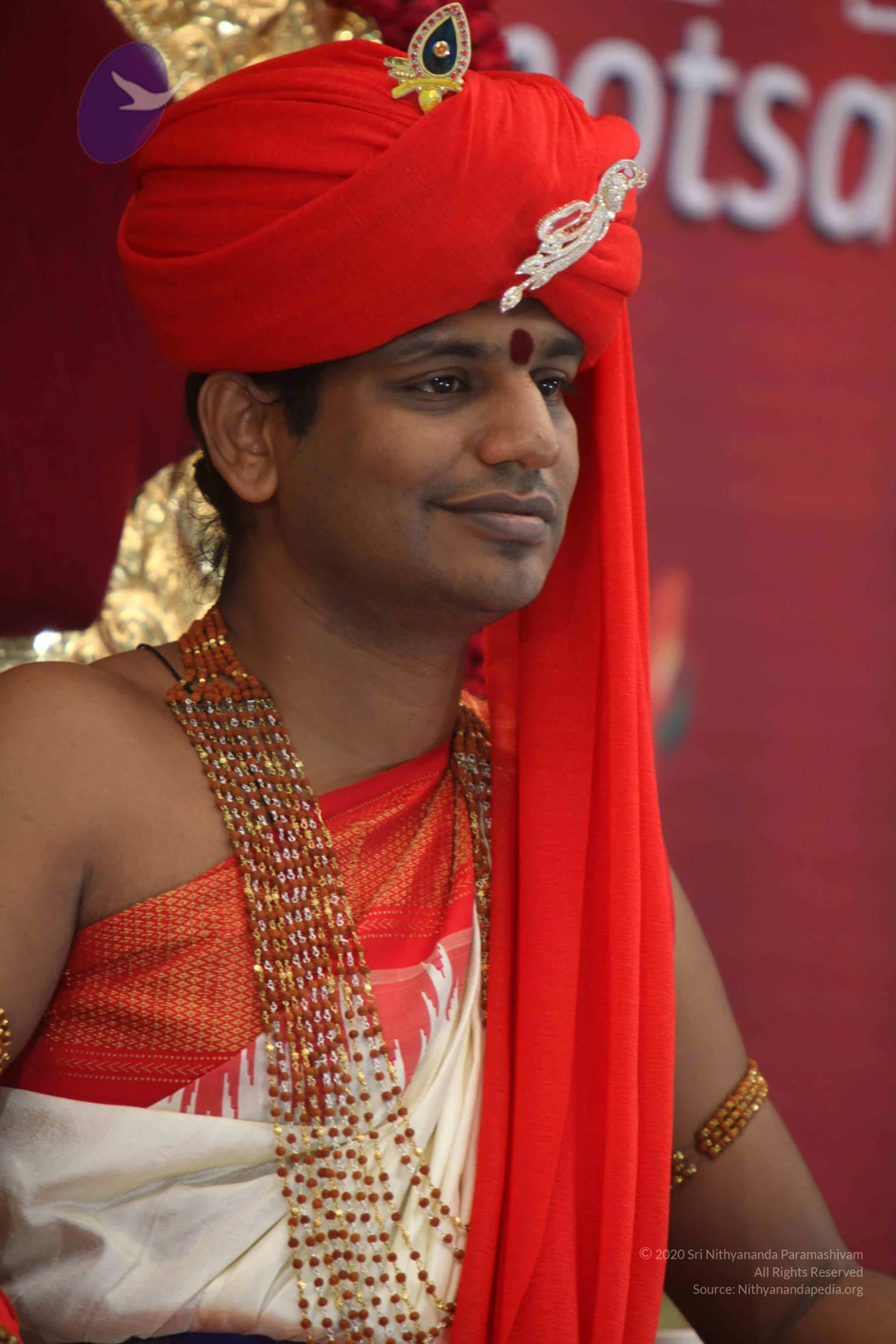
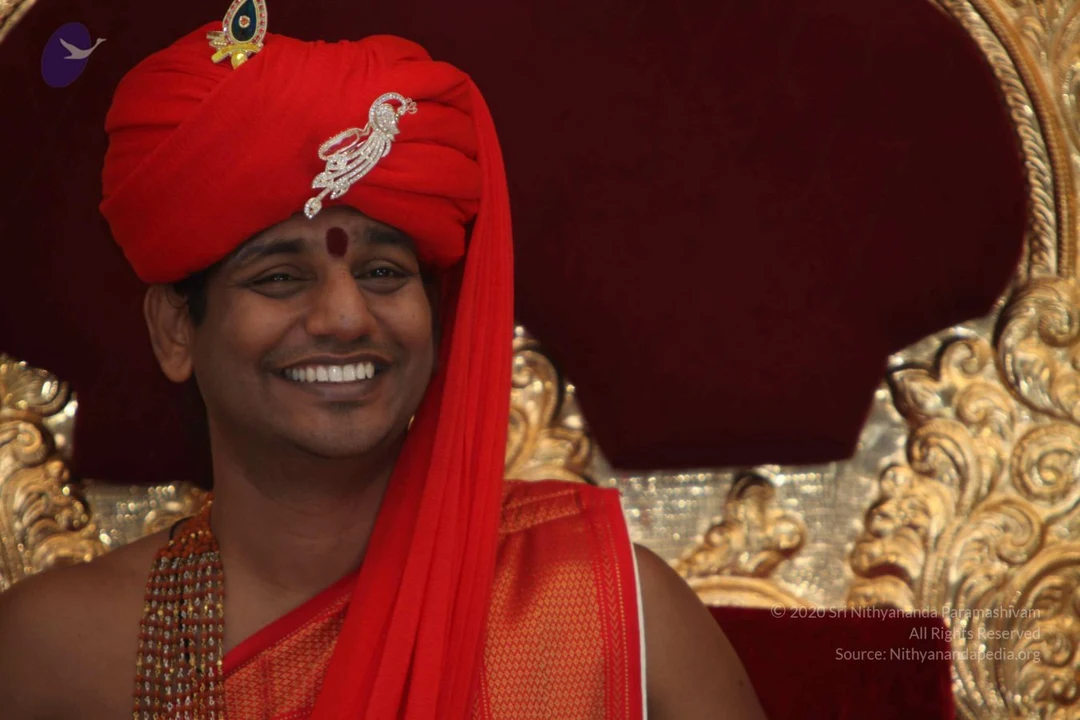
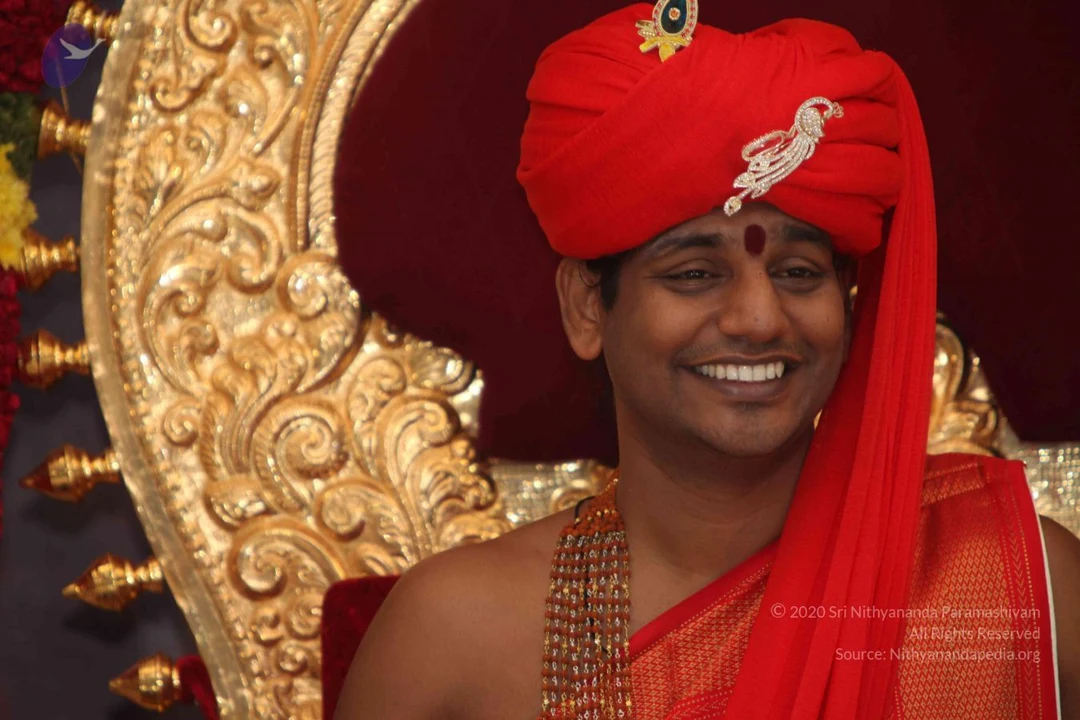
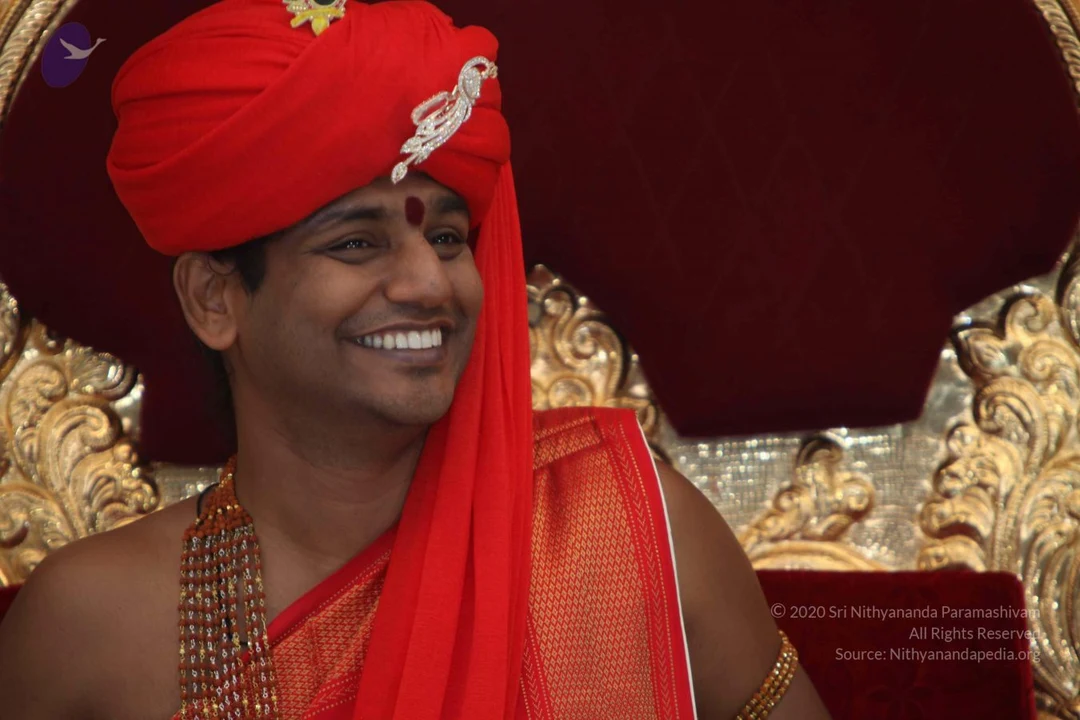
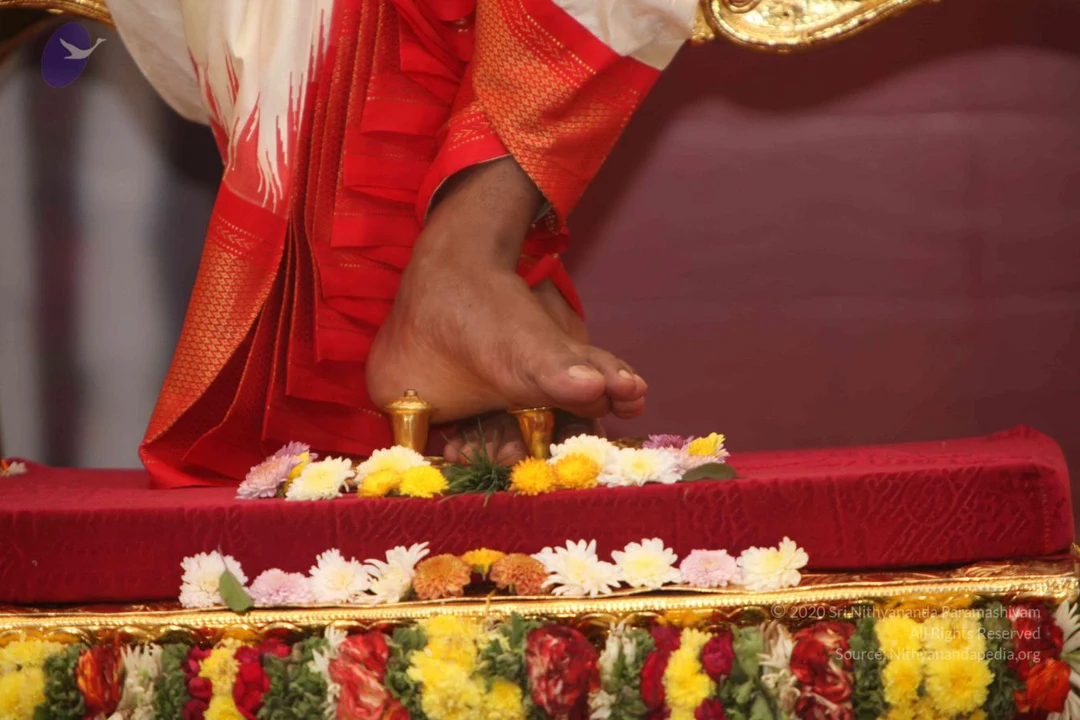
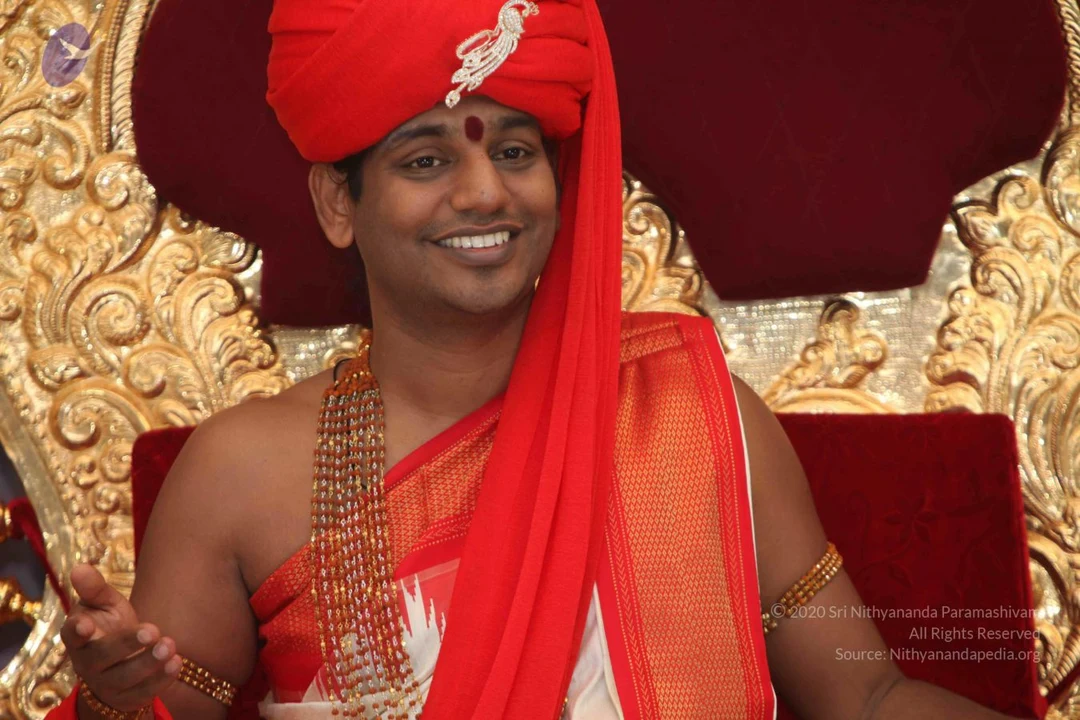
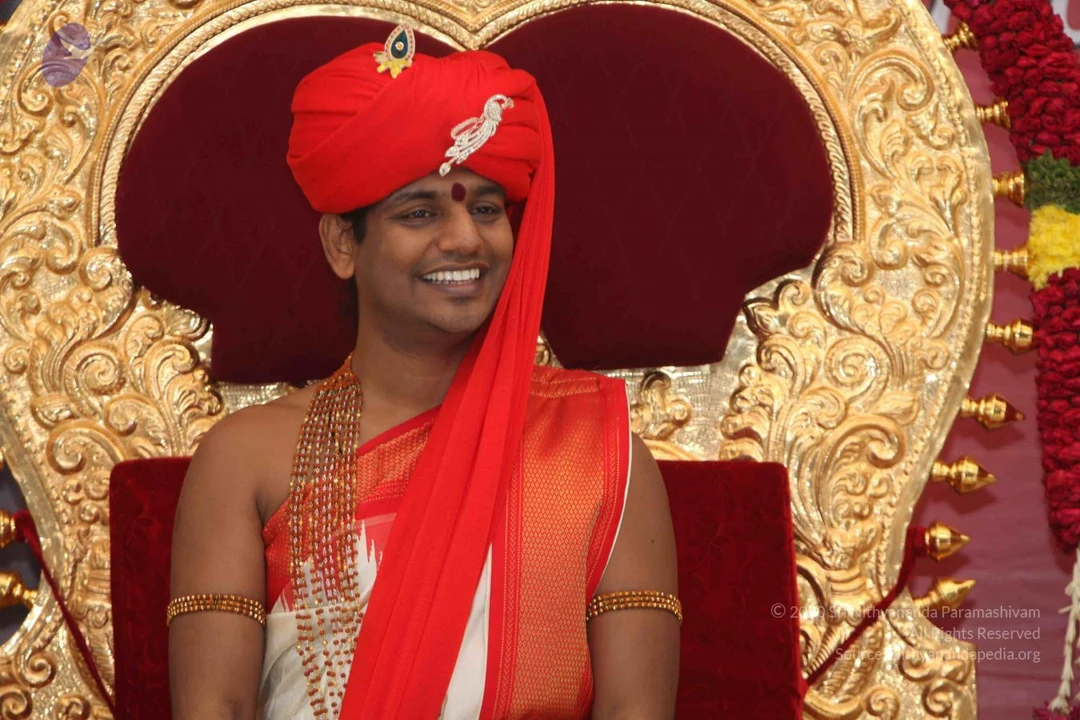
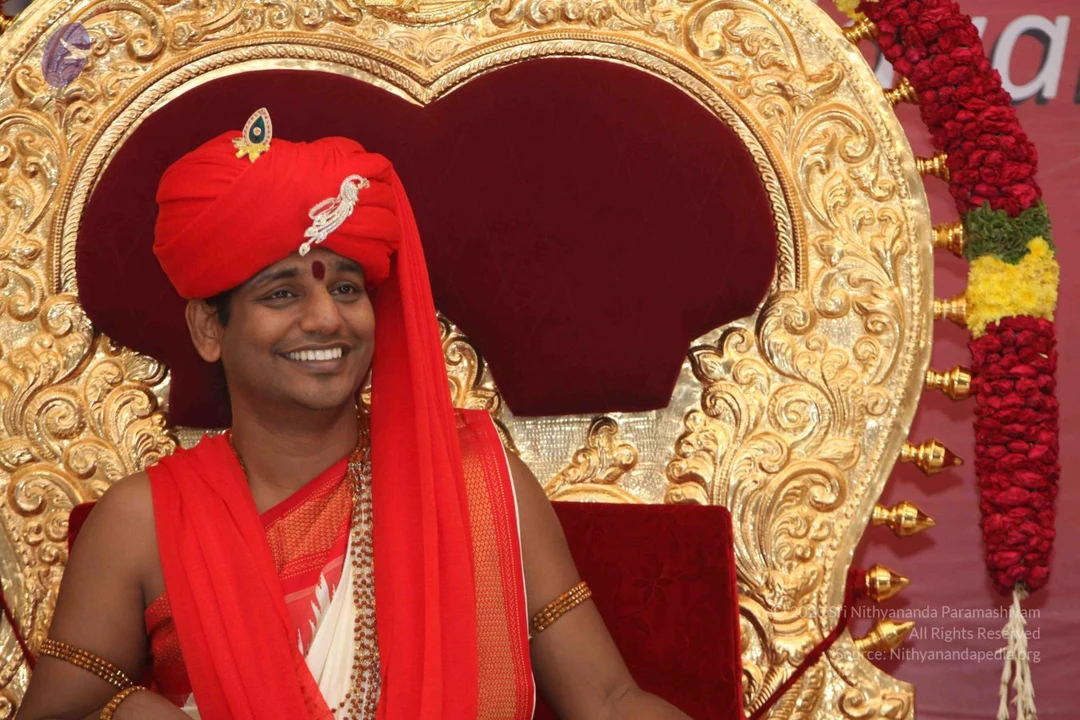
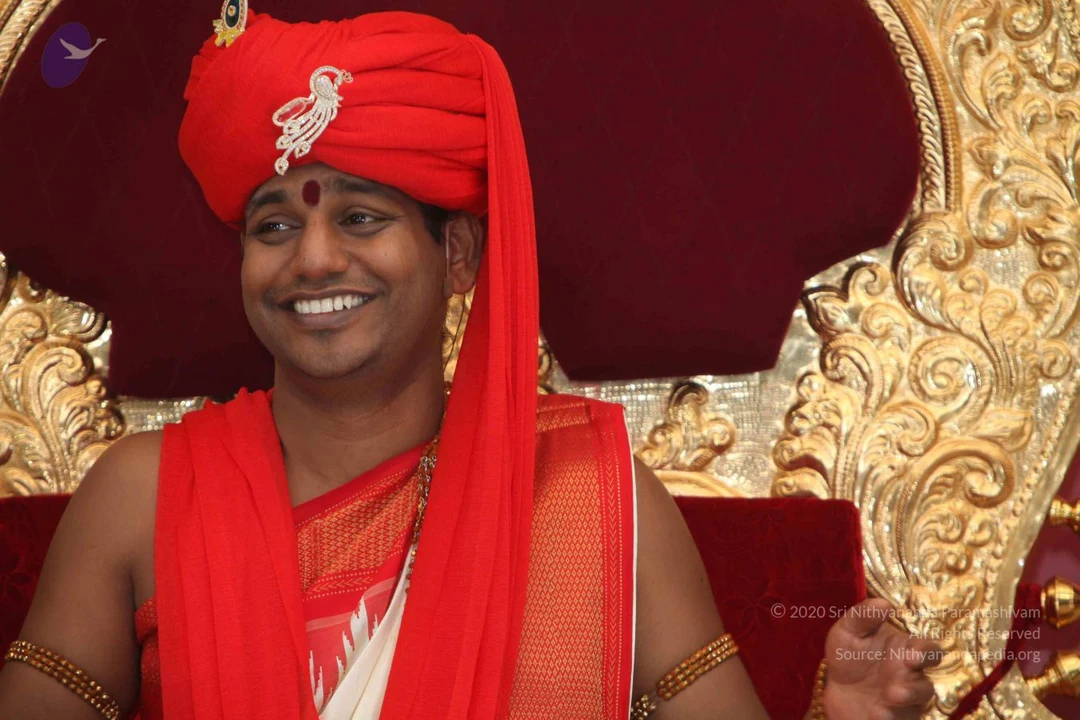
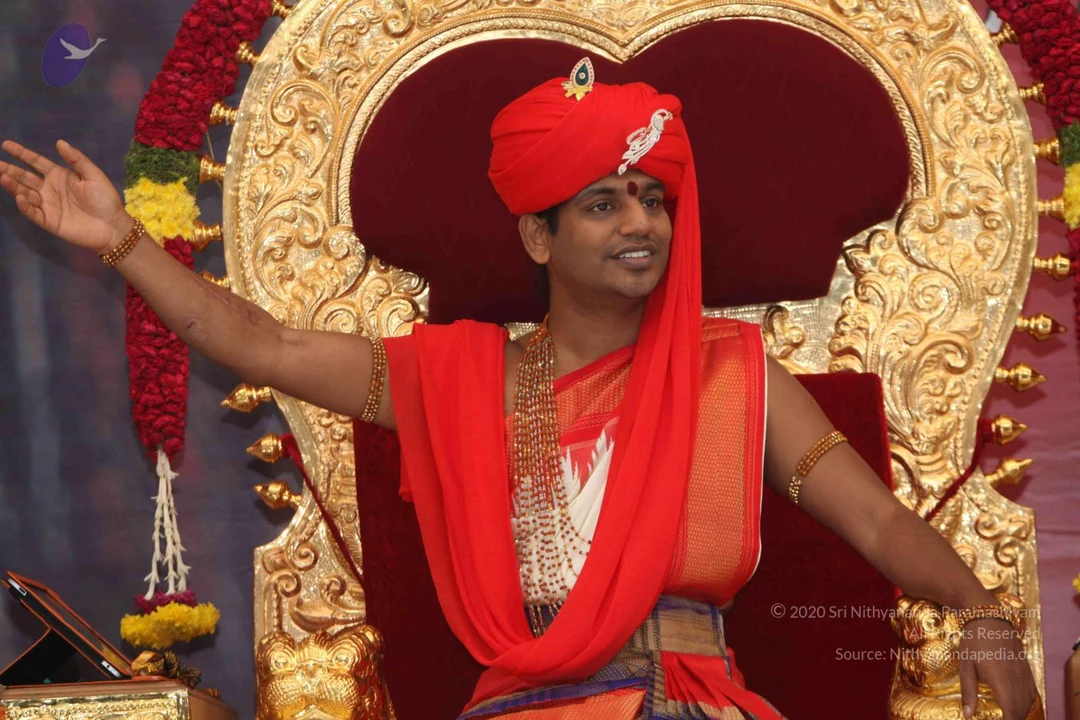
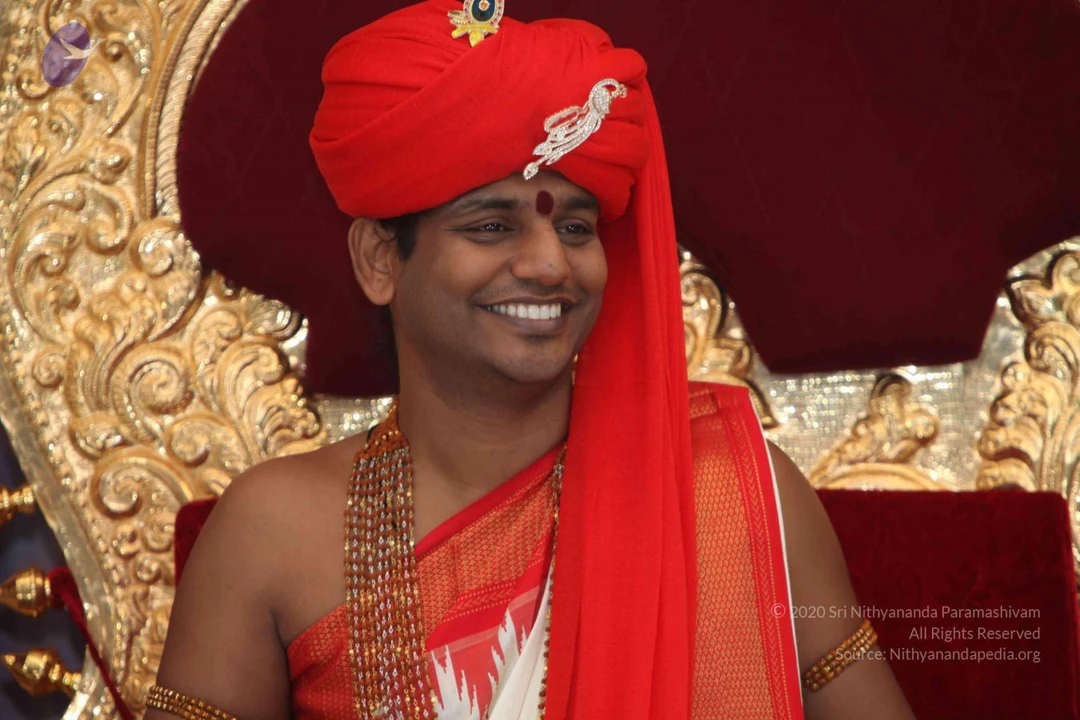
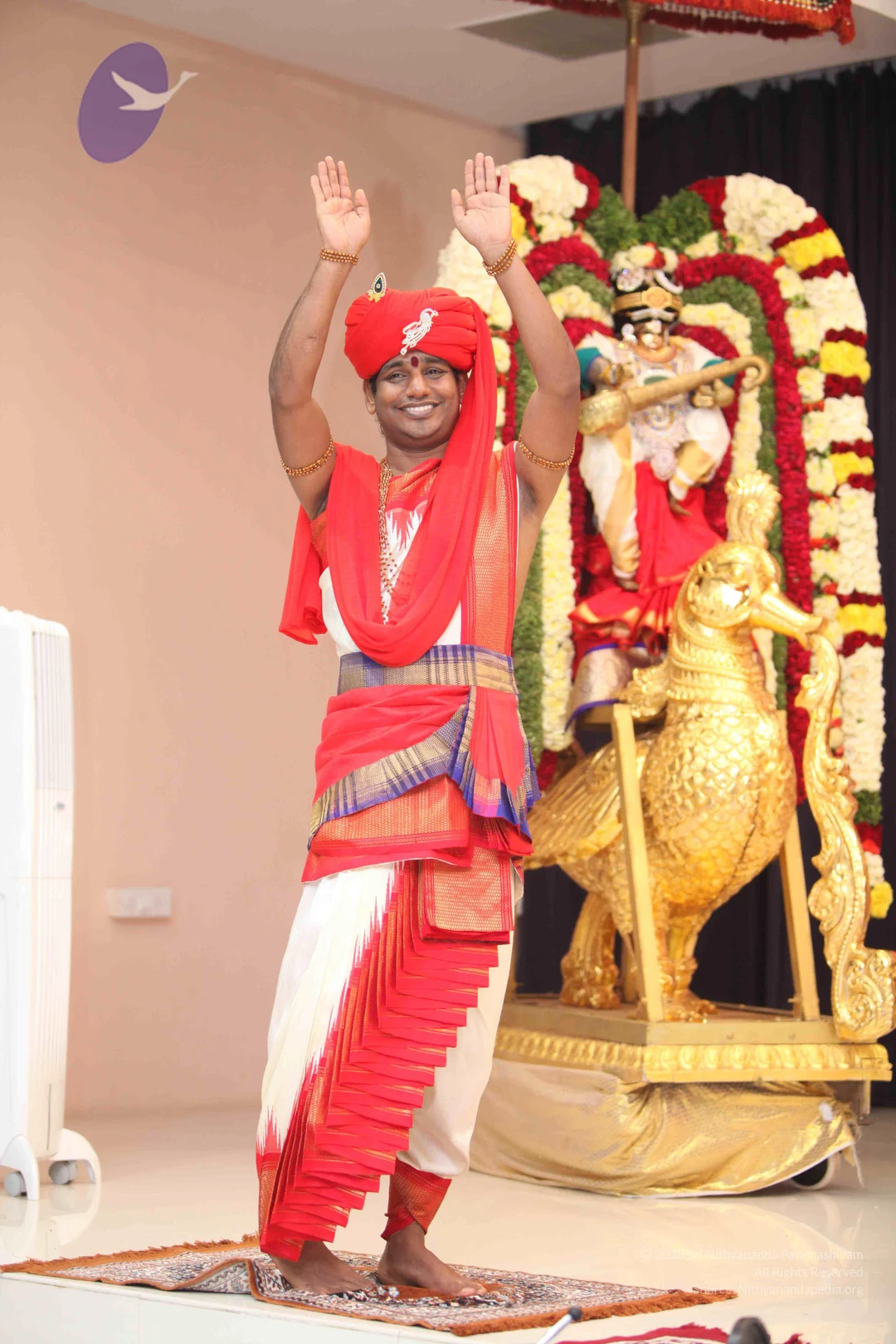
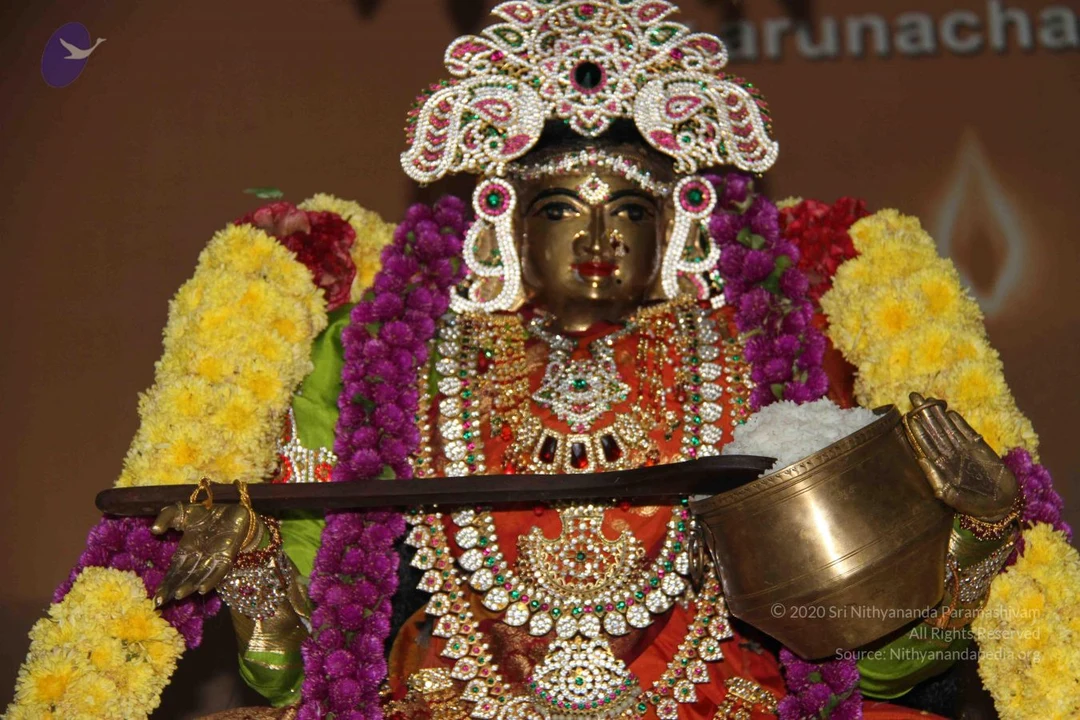
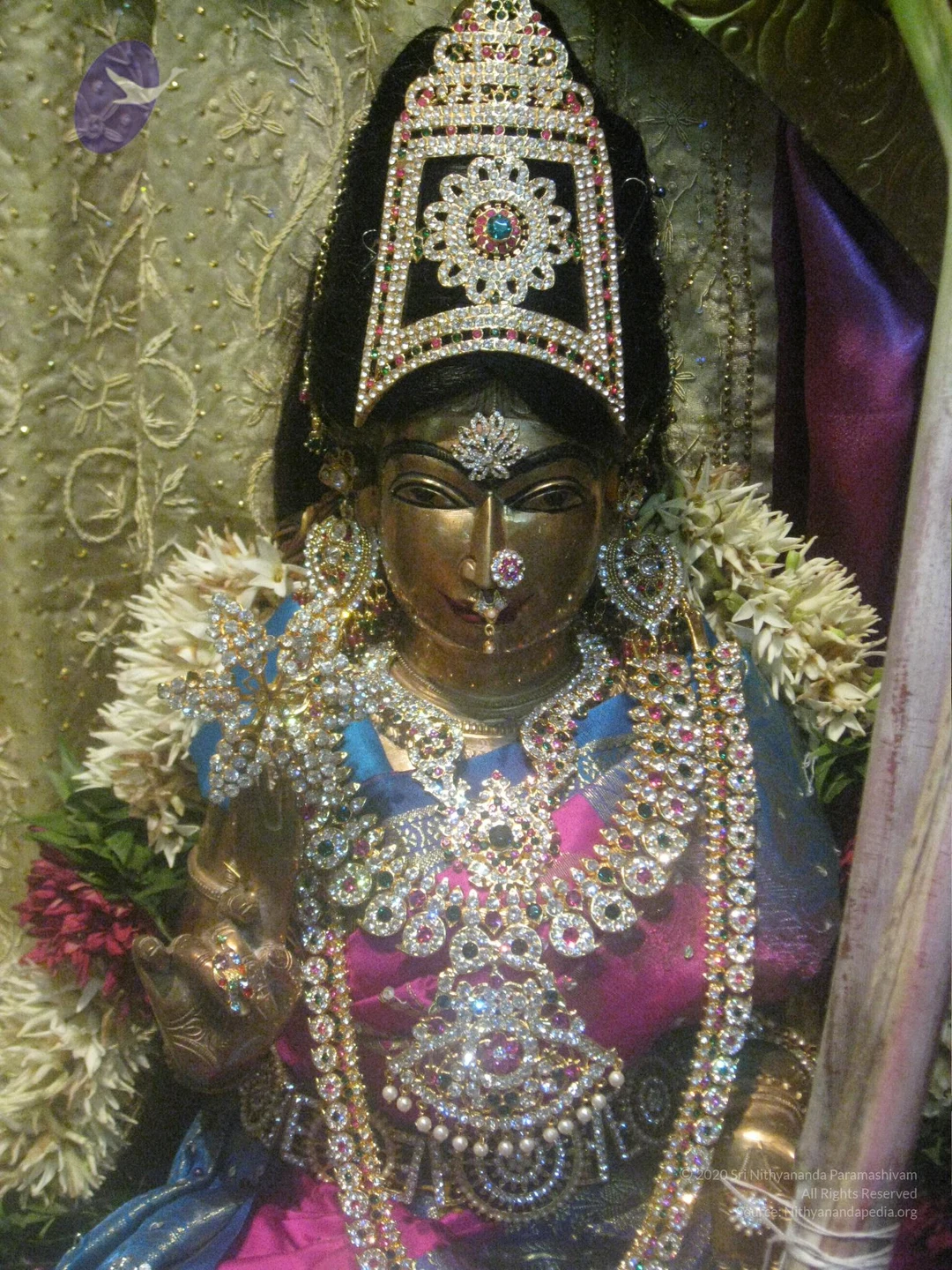
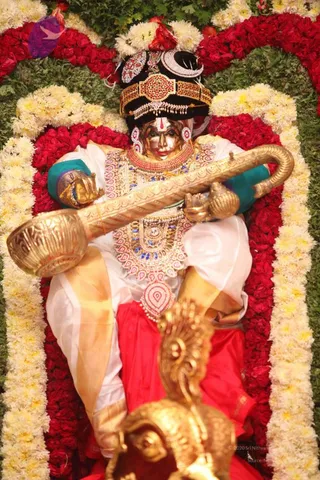
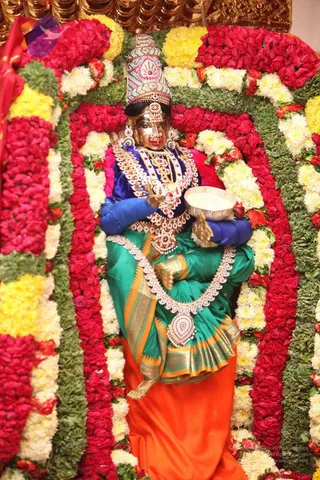
A golden-bodied deity murti seated on a decorated throne against a gold brocade backdrop, dressed in a magenta silk sari with blue and gold borders and a blue blouse. It wears an elaborate jewelled crown, layered gemstone necklaces, a jewelled waist belt and bangles, and holds a tall sugarcane stalk in one hand while the other hand is raised in a blessing gesture. Garlands of white jasmine and red flowers surround the figure, with marigolds visible at the top. No physical people are present and no a person candidate appears in the image.A smiling man sits on an ornate gilded throne with deep red cushioning, making a mudra with his raised right hand. He wears a red turban with a decorative brooch and red-and-gold shawl draped over his shoulders, a bare chest with a mala of beads and gold ornaments, and gold bangles on his wrists and upper arm. A red bindi marks his forehead. Behind him hangs a garland of red and yellow flowers on a red backdrop, and a small brass and glass offering stands at lower right. Swamiji (probable): appearance cues include the red turban, layered shawl and ornate beaded necklace, seated on a throne in ceremonial dress as a presiding teacher.Close-up photograph of a bare foot resting on a red cushioned seat, with the figure's legs wrapped in a red and cream garment with a patterned gold-edged border. Two small brass cups sit beneath the foot, surrounded by a low arrangement of white, yellow, orange and pink flower petals and a garland of marigolds and red roses along the golden base of the seat. The lower body is visible but no face is shown; the person is seated or standing on a dais.

September 30 2011

Original wiki page
Contents

Title:

THE SUPREME PONTIFF OF HINDUISM HDH BHAGAVAN SRI NITHYANANDA PARAMASHIVAM

Link to Video:

VideoAudio

Transcript:

Bhagavad Gita

Mystery of Grace

DATE: Day 37: Sep 30th 2011

Greatest gift to the humanity from the Vedic tradition is concept of soul. I can say science of soul, discovery of soul, description of soul, describing at least it is indescribable. Please understand even the description it is indescribable is a description because if you don’t give that description many fools would have started describing and started diverting the people.

One of the greatest contribution to the humanity from the Vedic tradition is concept of soul. I can say; unless you understand the science of soul, unless you understand what Krishna is trying to teach in this second chapter saankhya yoga, you can neither have life nor have peace in life. Krishna is an extraordinary Master who is putting the essence of this whole tradition, knowledge of soul.

This one concept…. actually this truth of about the ocean is like a….. truth about the soul is like a ocean. All your engram, all your suffering, all your conflicts, everything is like a small salt doll. It can just disappear in this ocean. Blessed are those who knows the technique of dissolving all components of them into the ocean of the knowledge. See you have many components. Some are your ambition. You are I can say….. all this put together only is you...your ambitions - what do you want to become, what do you want to do, immediate ambition, long term ambition, then your capacity. Please understand your capacity is unlimited - what you believe as your capacity.

If you just prepare your body, whole world is your house; you can live anywhere you want. It is just little bit of preparation. If you can handle the basic heat and cold, that’s it; whole world is your house now. People say I left my house in the young age itself. I tell you, No! I left my house to make the whole world as my house. Now… please understand, because I left my house in the young age and started travelling, somehow body and mind got accustomed. Anywhere if I stretch my leg I fall asleep. If I stretch my hand whatever falls in my hand I can eat; now the whole world has become my house my home. Expanding the capacity to lie; that is what I did….expanding my ability to live.

Tapas, your capacity, that is also part of you; what you believe as your capacity is part of you and what you believe as threats to you, your insecurities. I tell you, you don’t have any insecurity; you don’t have any threat but whatever you believe as your threat that is also part of you. All this put together is you. Please understand human bio memory, bio memory of human being can experience only two signal; one is love another one is fear, that’s all. All other signals are converted to this love and fear and experienced by you. Human bio memory is not capable of experiencing jealousy, it is not capable of experiencing ego, it is not capable of experiencing worry. If you de-code, if you go down, worry – jealousy- ego all this will get decoded, will get converted. Finally it will get boiled down to the binary of love-fear, love-fear, love-fear; that’s all.

Any program you may write everything finally boils down to the binary 0-1, 0-1, 0-1. Same way any emotion you can create finally everything boils down to fear-love, fear-love, fear-love, love-fear, love-fear, love-fear. Everything boils down to fear and love. You do not know any other experience existentially. All other experience, all other emotions are psychological but this love and fear is physiological. Your limited love, unlimited fear, all this are components of you. Blessed are those who can dissolve these components in the ocean of knowledge.

Sit and list all your components and tick one by one what all you can dissolve with this knowledge of soul; the science of soul. For example if you write 50 components of you, if you can dissolve even 10 or 20, you can easily call yourself as a seeker. If you can dissolve more than 60%, around 30, I will call you, I will surely give you the title you are living enlightenment. If you can dissolve above 40 even if there is 10 remaining I will really call you as radiating enlightenment because those 10 will not have power over you.

Understand when you cross the level of 40 components of you dissolving in the knowledge; what will be the remaining 10? Some temporary ambitions or the foolish vision or the mood swing; only these few will be left un-dissolved in the ocean of knowledge. I can tell you those few things un-dissolved; if it is only 10% or 20% you don’t even have to struggle to dissolve that. Just neglect it, carry on with your life with the confidence ‘ehhh I have dissolved more than 80% get out’. Simply by your confidence the other 20% will run away; dissolve. They will just disappear. They don’t want to live with you. Surely they won’t like to be with you.

This great knowledge ‘the soul is indescribable’, I can interpret this word ascaryavat pasyati kascit enam in three different ways. One; some tries to visualize whatever way they can but till the end they will never be able to visualize. Some tries to verbalize whatever way they can but till the end they can’t verbalize. Some wonder by reading and listening and meditating; but yet none know it at all…. so one way. There is other way you can understand...one more sacred secret. Some people see it with wonder when it lands in the human body, some people speak that as a wonder, some other people hear that wonder. Even if you hear, see, speak about it, no one can understand it at all. You can be awestruck but you can never struck the truth of His Being.

How much ever you describe the consciousness it is not possible to describe because the very spectrum is different. It’s like a frog which was born and brought up, lived throughout his life in the well in a remote village, is trying to describe the ocean. One day unfortunately as an accident ocean frog fell into the well.

The well frog invited the guest and asked you are from where.

Ocean frog said ‘I am from ocean’.

Well frog said ‘what do you mean by ocean is it a bigger place than mine’.

Ocean frog laughed and said ‘no, no it is a too big place’.

The well frog jumped from one corner of the well to other corner and said ‘ehh is your ocean bigger than this or what’.

Ocean frog could not control the laughter and said ‘yes, yes it is bigger please leave it. It is ok’.

That fellow jumped diagonally from one side to the other side and said ‘don’t tell a lie. Is it bigger than this?’

Ocean frog said ‘its ok you leave it. Don’t struggle much, it is bigger’.

Then the well frog started shouting, ‘You liar how dare you tell there is some more water other than my well in the world’.

That frog which was living in the well is called atheist. Frog in the well do not know the existence of eternity. Like well frog trying to fight with ocean frog, well frog can never understand, same way most of us can never understand which is beyond our logic.

Photos
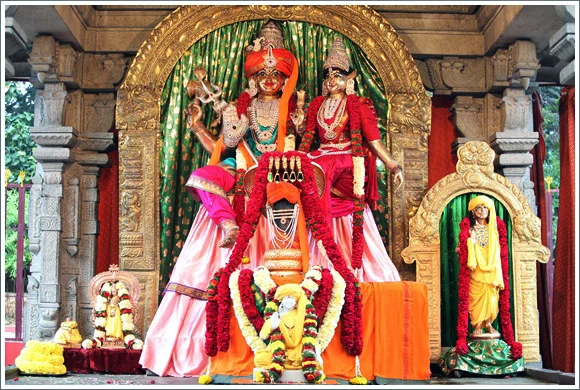
Photos Of The Day:

Temple
Bhagavad-Gita-Satsang
Tiru-Reaching

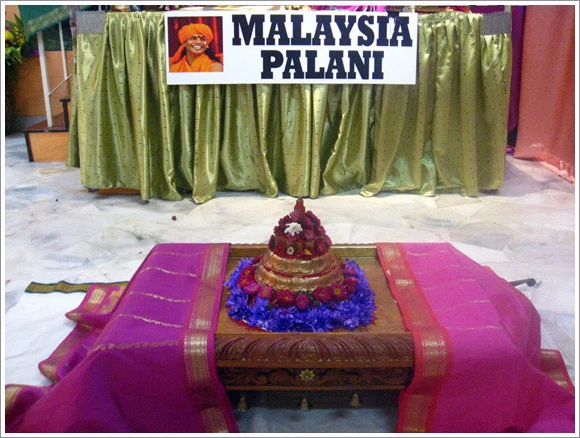
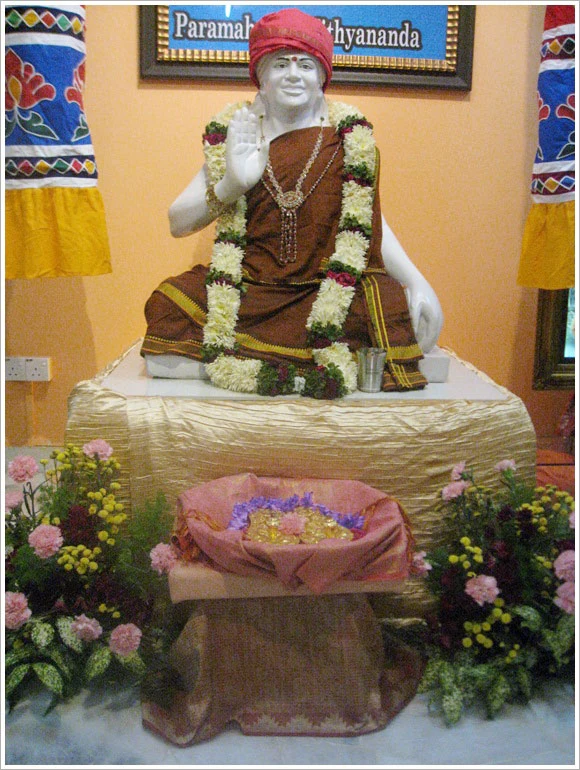
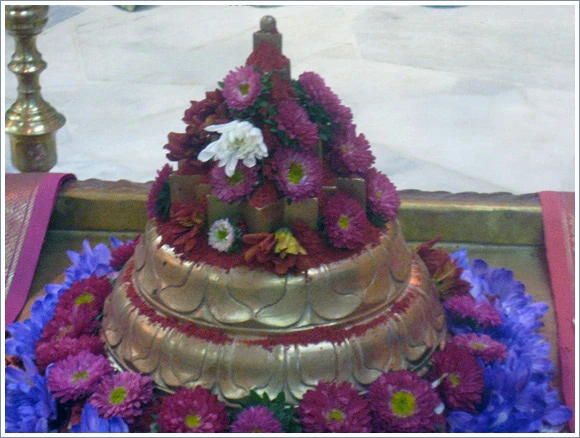
Navaratri-Day-3- Malaysia

Navaratri-Alankar

Photos from this day

View all 108 photos

Photos

19 photosSource gallery
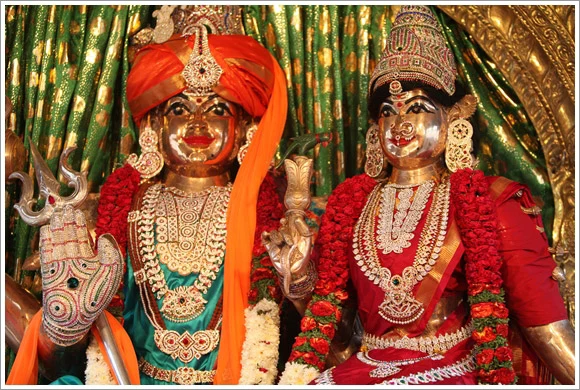
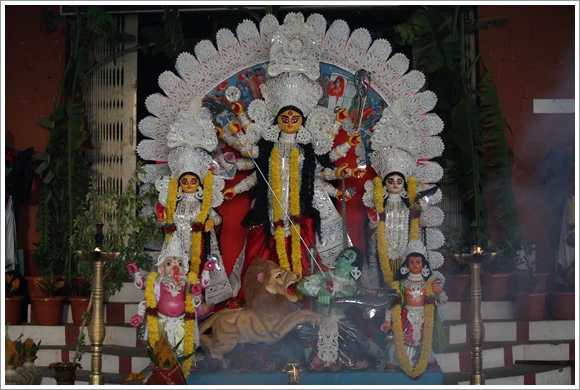
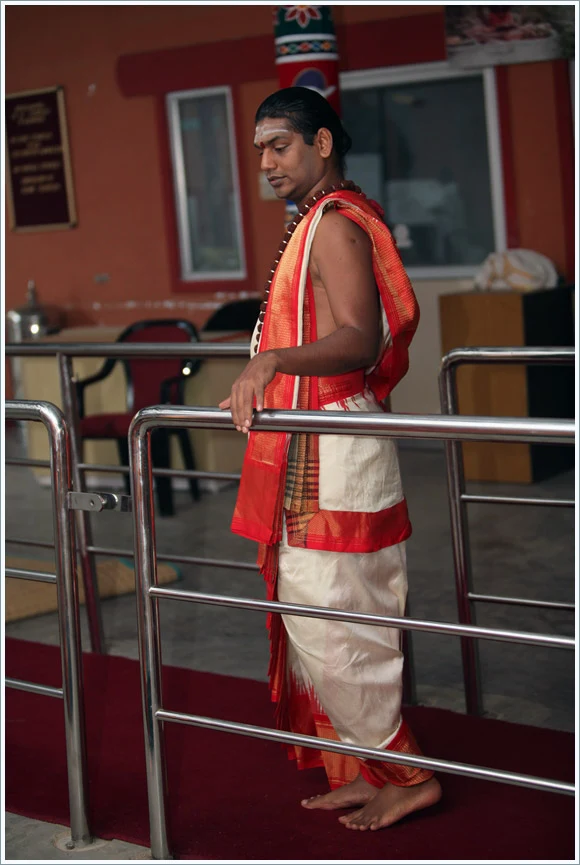
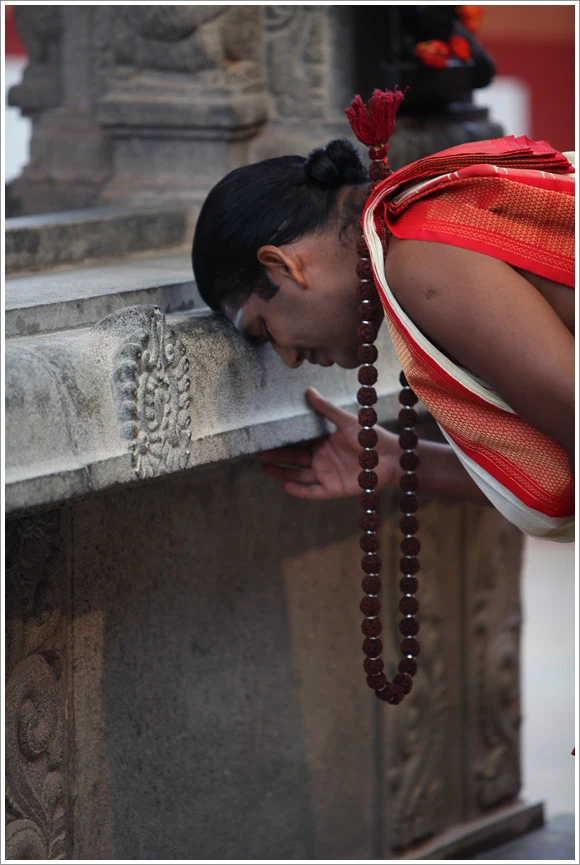
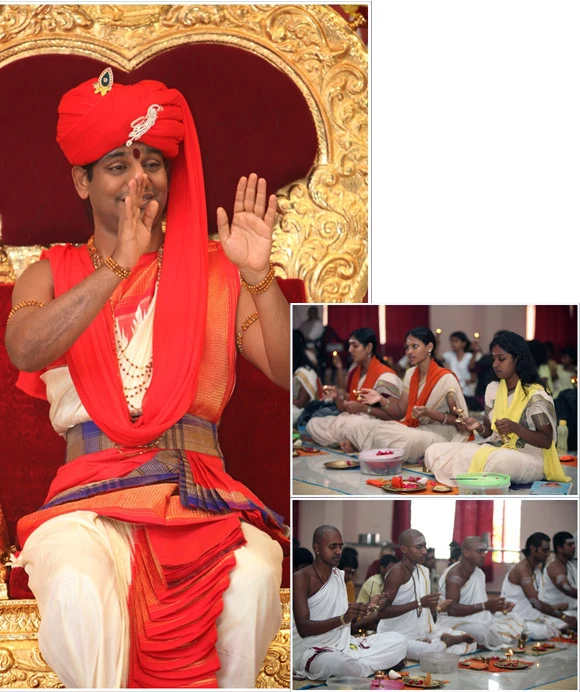
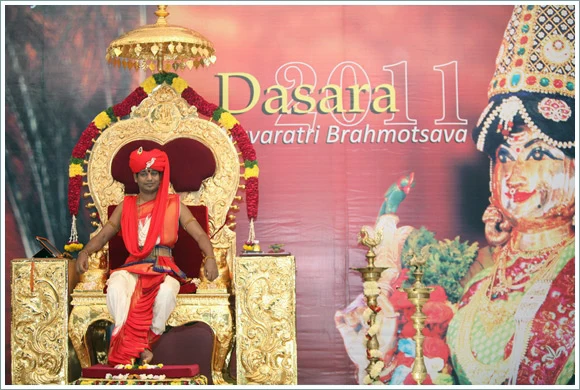
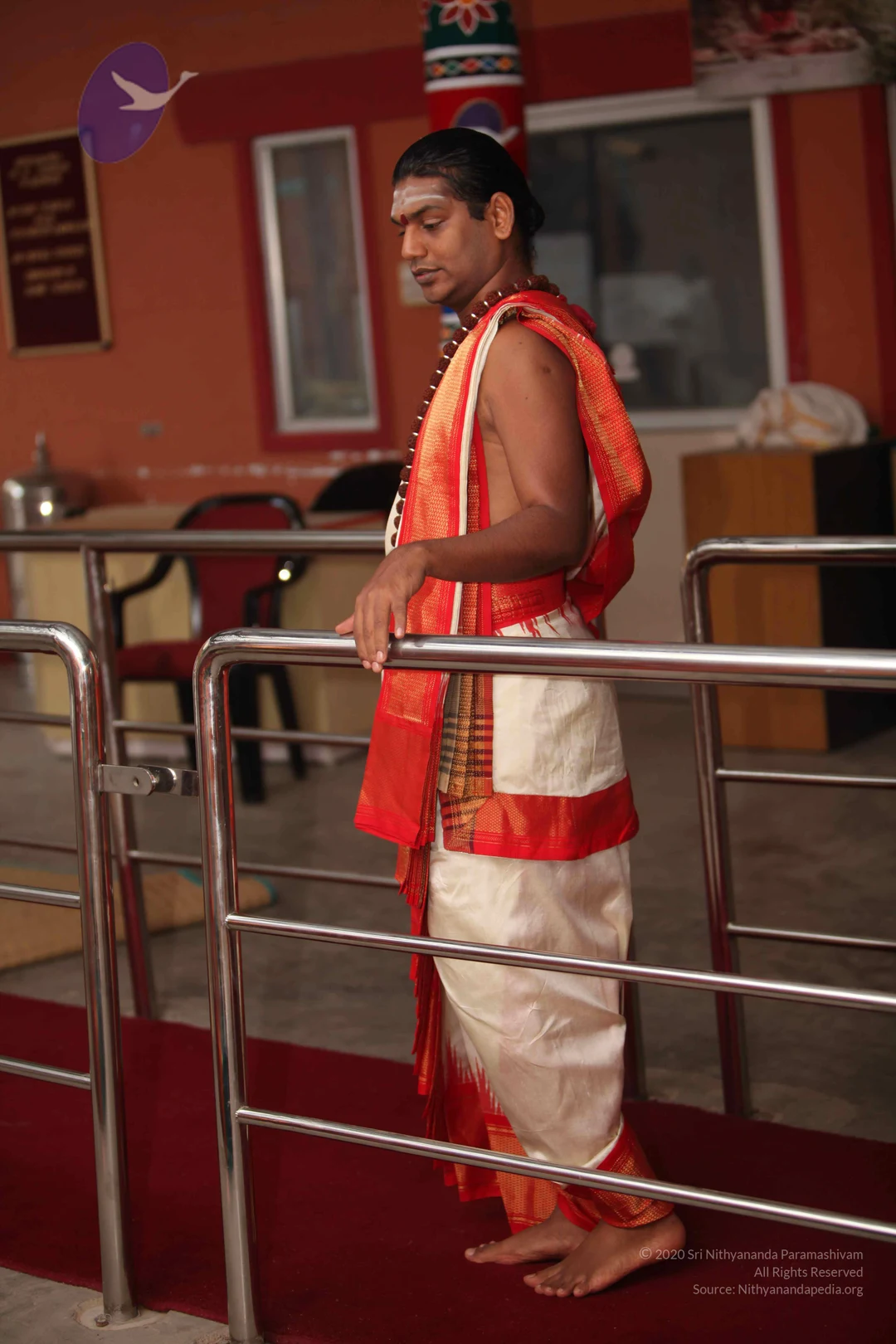
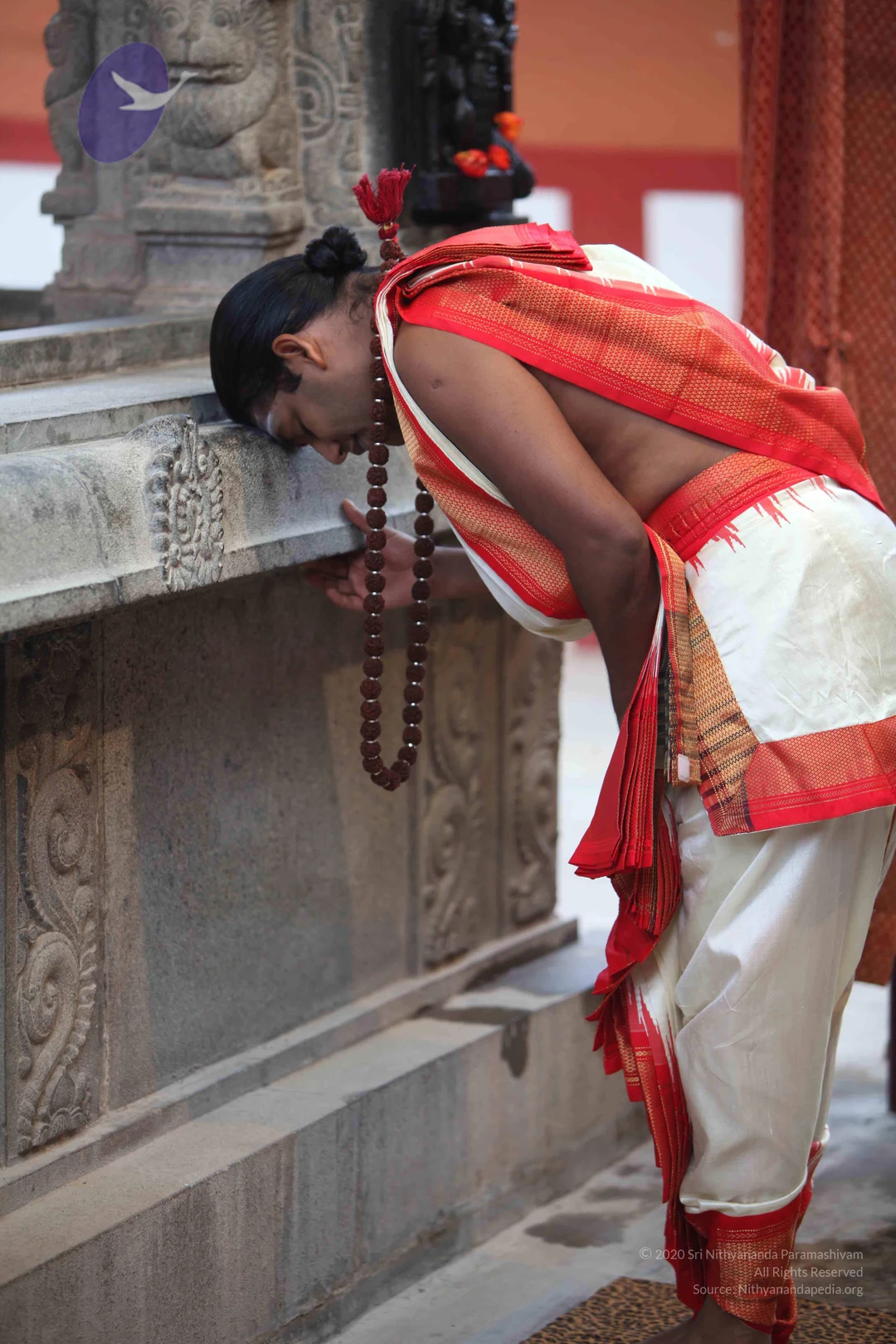
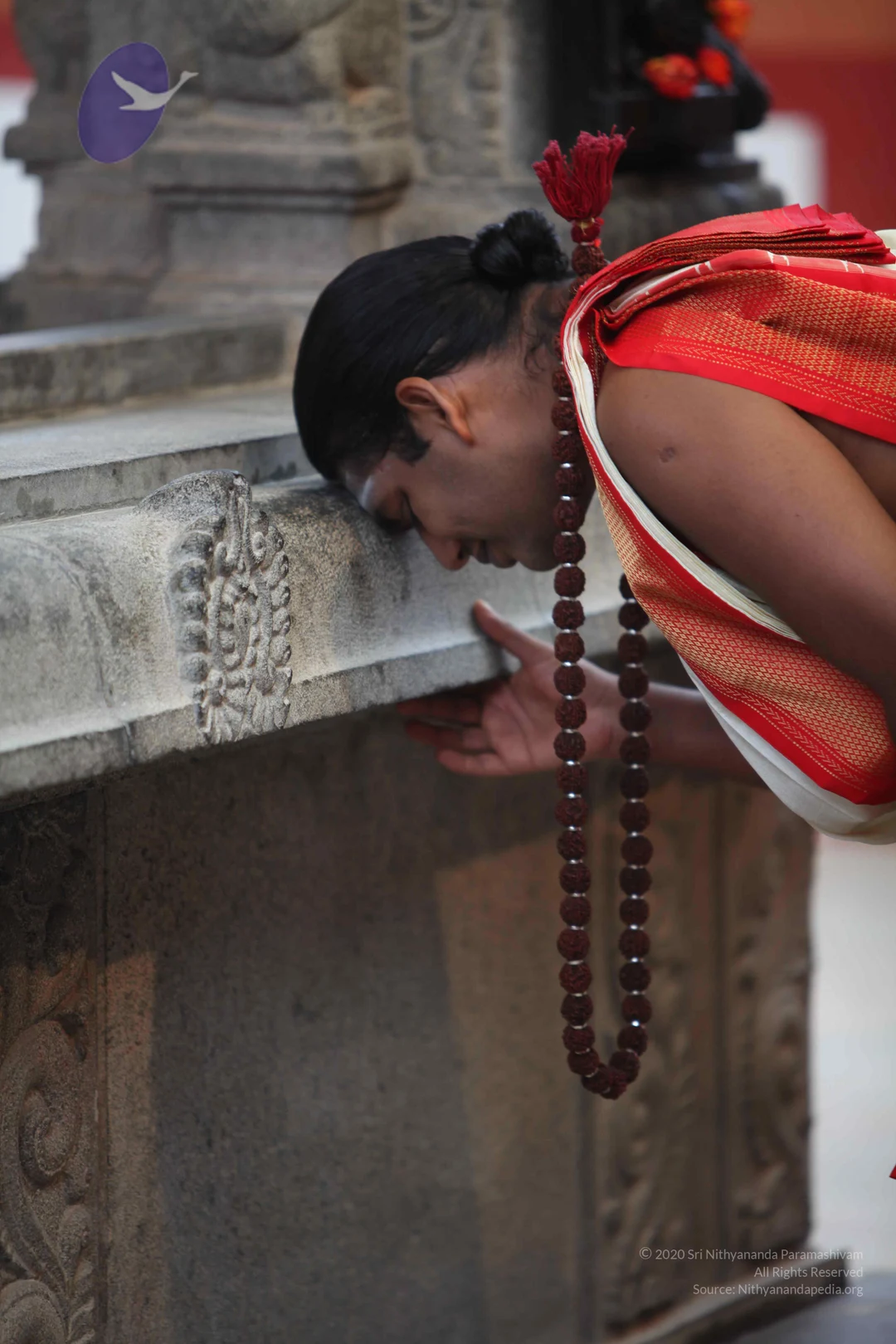
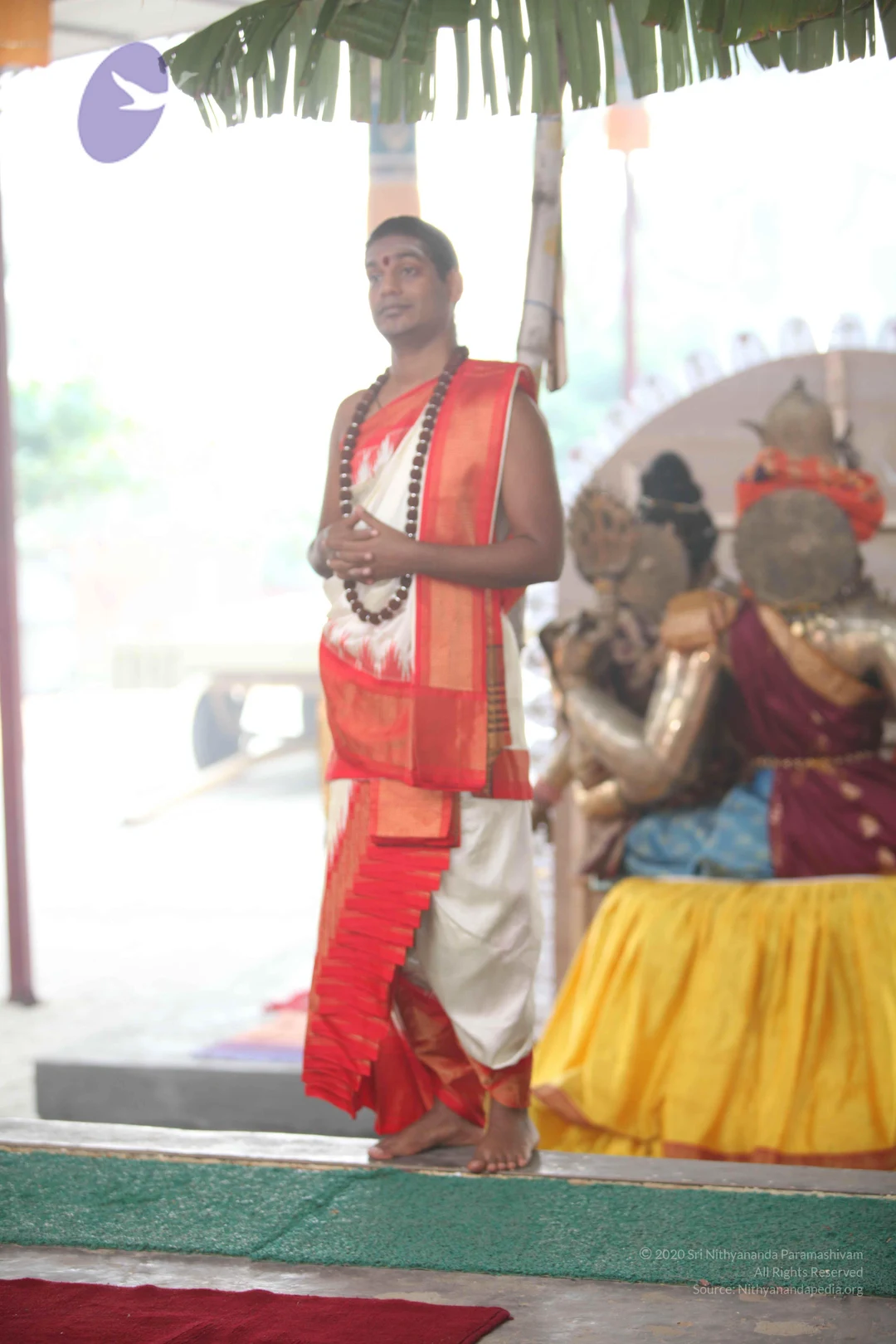
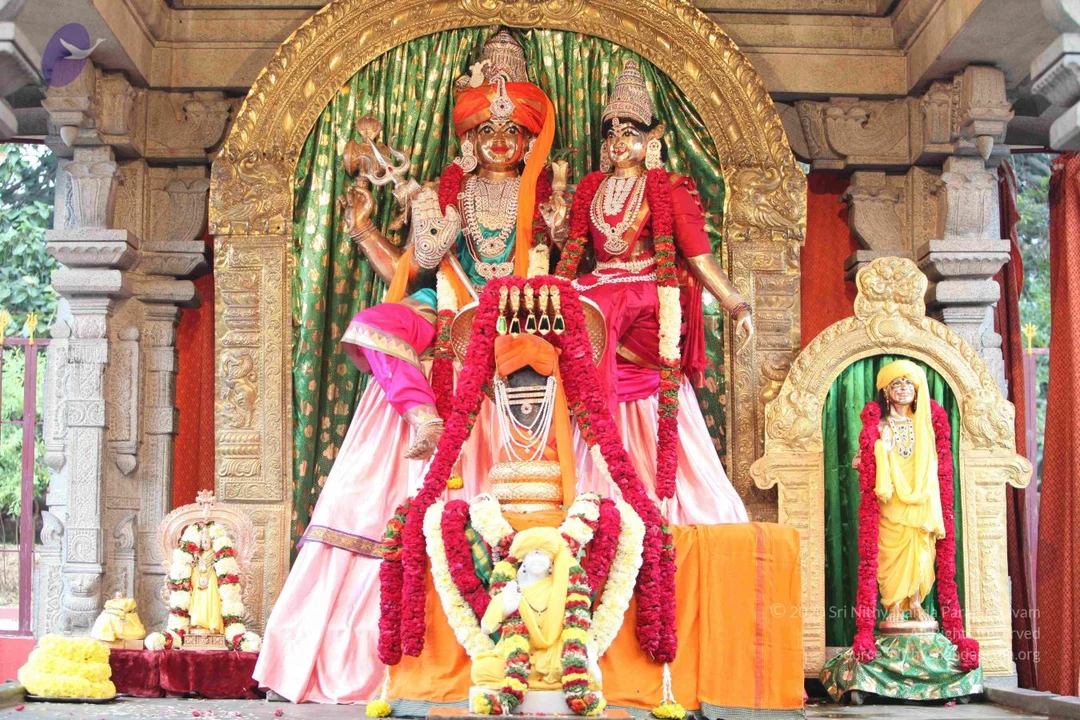
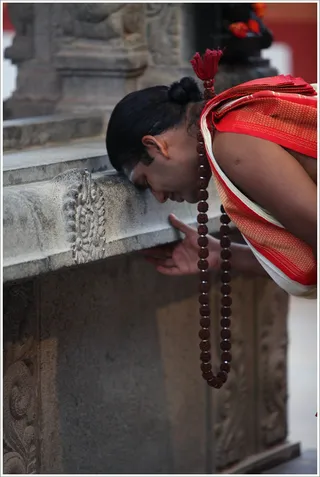
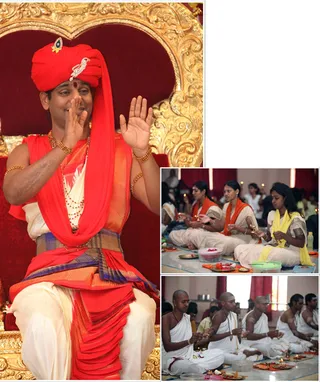
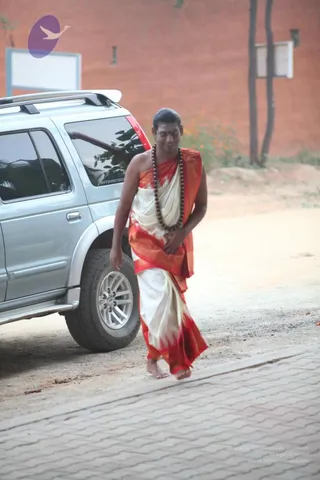
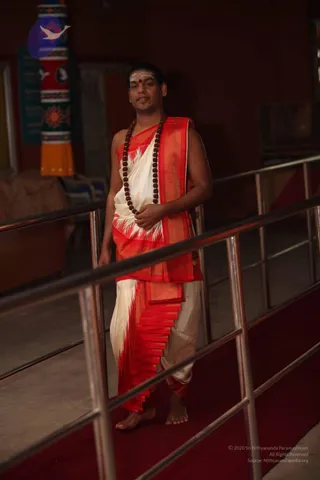
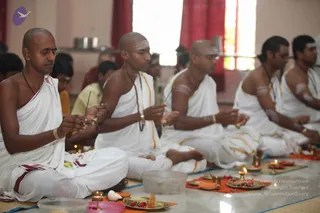
A photograph of a temple shrine with two large painted deity figures standing behind a central Shiva linga decorated with red and white flower garlands and a saffron cloth. The figure on the left has multiple arms and holds a trident, wearing a red-orange crown and pink and red garments. The figure on the right wears a red and pink sari-like dress with gold jewellery. A smaller figure in a yellow robe stands in an arched niche at right, and yellow marigold garlands lie at the base. Gold-toned arches, green drapery and pillars frame the shrine. Deity murti are visible; no people are present.A photograph of two gilded metal deity murtis standing side by side against a backdrop of green and gold draped cloth. The figure on the left wears an orange turban, a teal garment, layered gold necklaces and a trident-like staff in one hand. The figure on the right wears a red sari, a crown, red flower garlands and layered gold and white jewellery. Both wear large earrings and bindis, and fresh red flower garlands hang around their shoulders.A decorated shrine holding a large clay deity murti of Durga, the goddess with ten arms, standing on a lion mounted in front of her. She wears red and white garments and a crown with a large white scalloped halo behind her, and yellow marigold garlands hang across her figure. Flanking her are smaller murtis of Lakshmi and Saraswati, and a figure with an elephant head. Brass oil lamps stand on either side and potted plants surround the platform. No people are visible.A barefoot man stands in profile on a red carpet beside a steel railing inside an indoor hall with orange walls. He wears a white dhoti with a red and gold border and a matching red and gold shawl draped over his left shoulder, with a rudraksha mala around his neck. His head is shaved on the sides with a sandalwood tilak on his forehead, and his hand rests on the railing as he looks downward. Behind him are chairs, a wall plaque and a red panel. The setting appears to be a temple or ashram hall. Identity is not established by his appearance, so he is described by role only as a devotee in traditional South Indian ritual dress.A man bends forward and presses his forehead to a carved stone ledge of a temple structure, his hands resting on the stone. He wears a red and gold silk shawl over a white cloth and a long dark rudraksha mala with a red tassel hanging from his neck. Behind him are carved stone pillars and a glimpse of red flowers.A three-panel collage of photographs. The large left panel shows a man seated on an ornate gold throne against red upholstery, wearing a red turban with a jewelled brooch, a red and orange shawl over a saffron-orange garment, pearl and gold necklaces, and gold bangles, with his palms raised in greeting. The upper right panel shows several women seated on mats in saffron and yellow saris with small oil lamps and offering plates before them. The lower right panel shows shaved-headed men in white dhotis seated on the floor with oil lamps and brass plates of offerings, in a hall with red drapes.

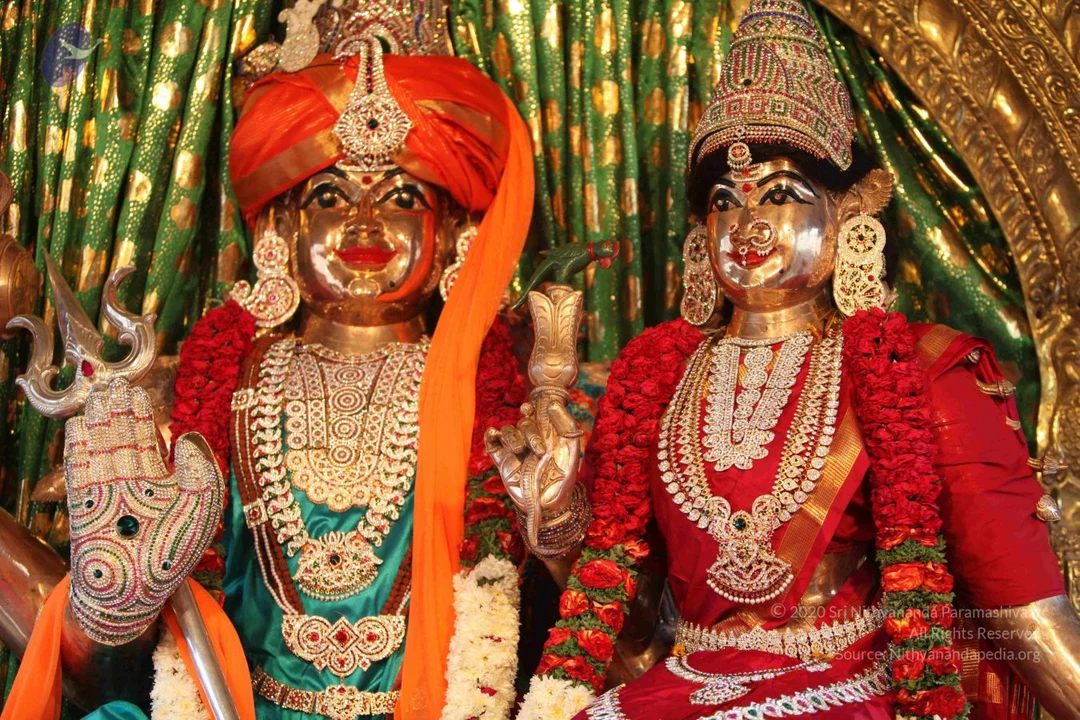
Temple

18 photosSource gallery
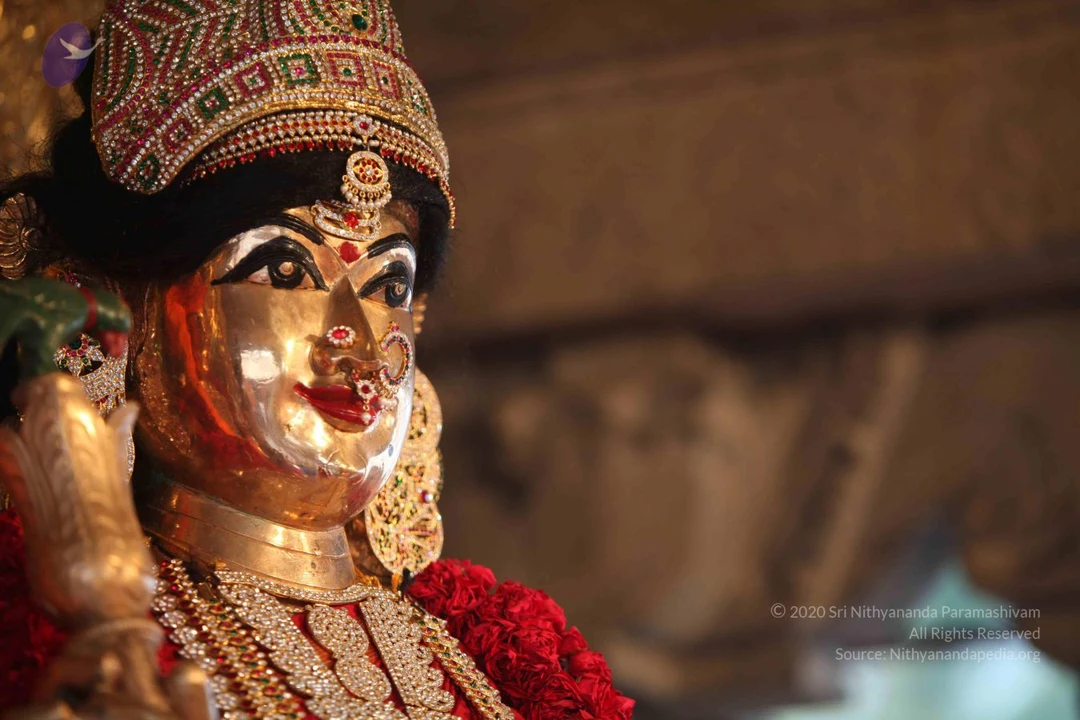
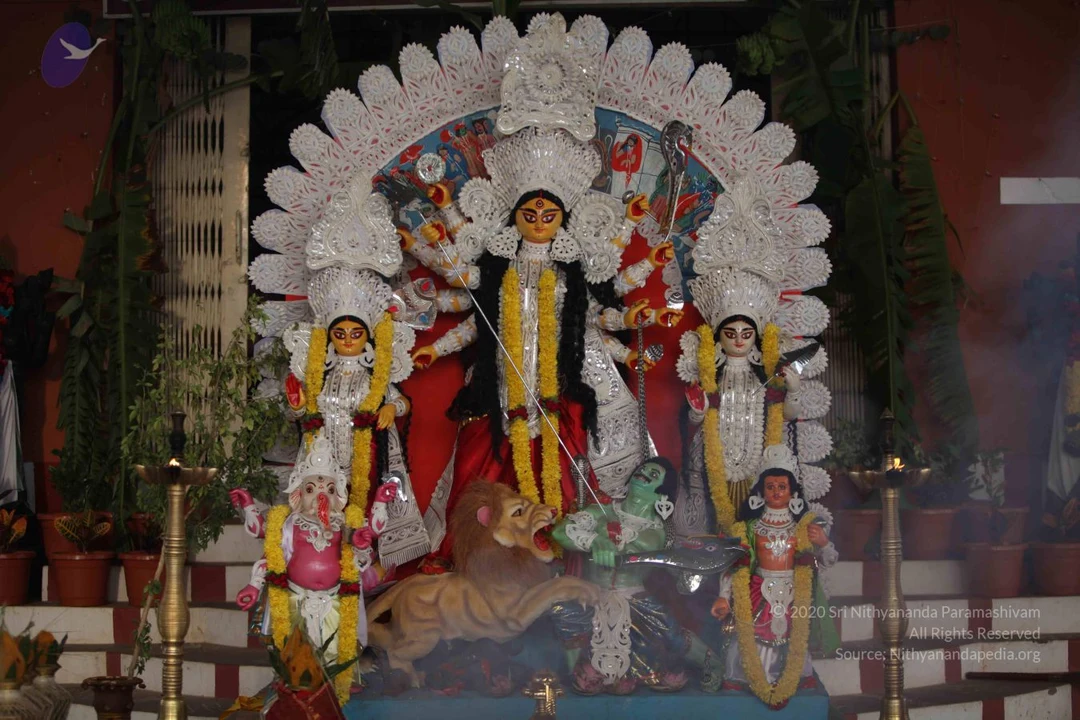
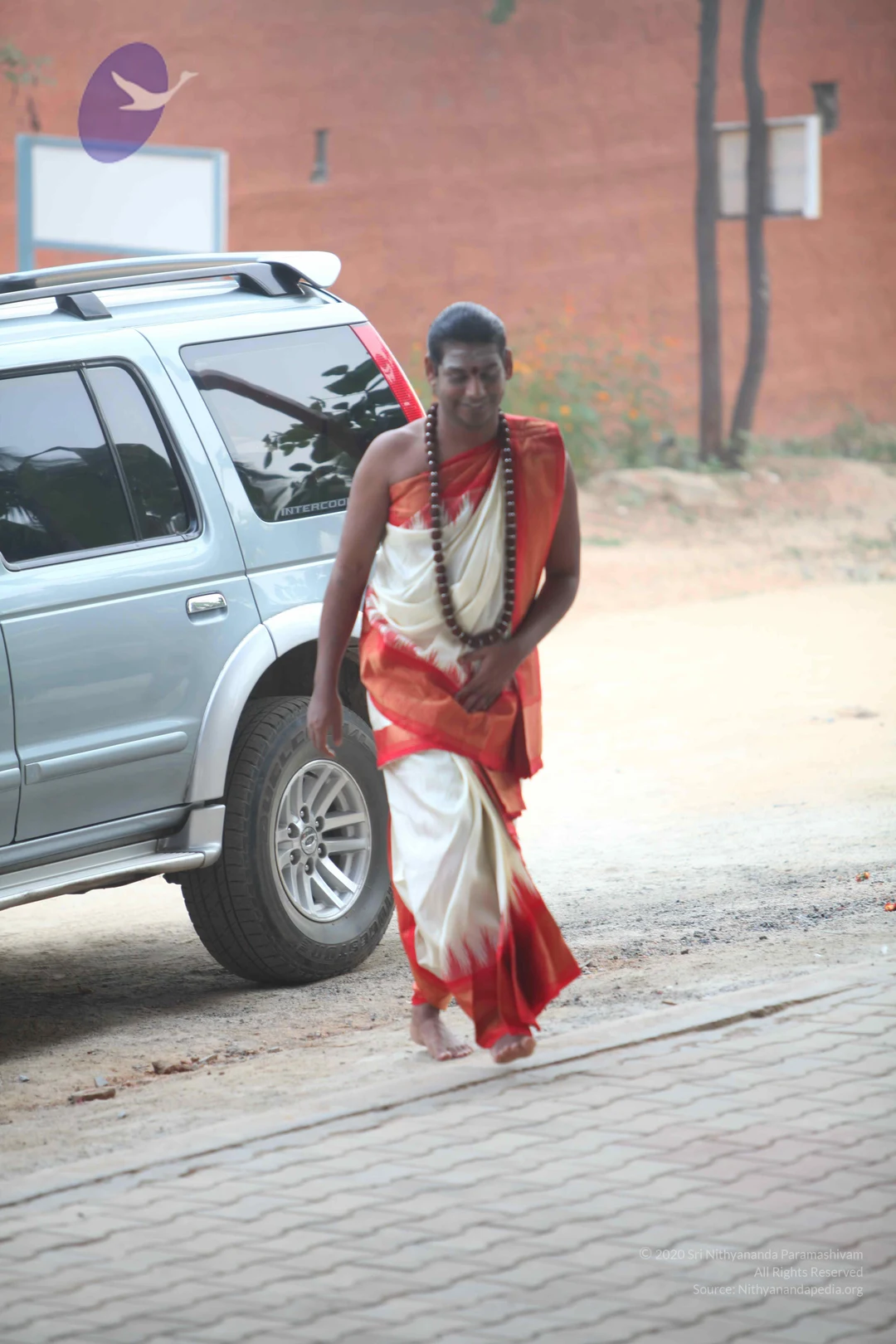
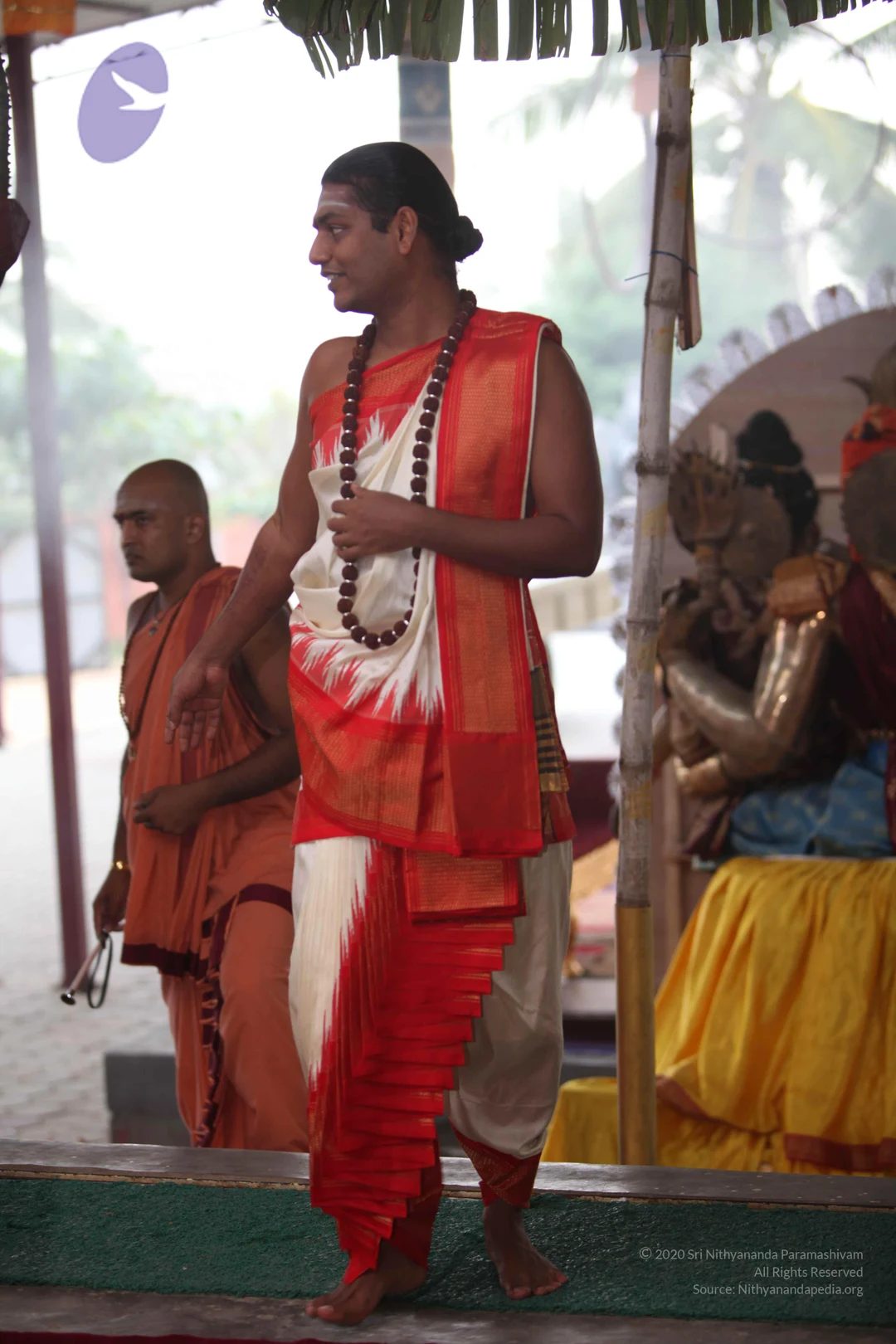
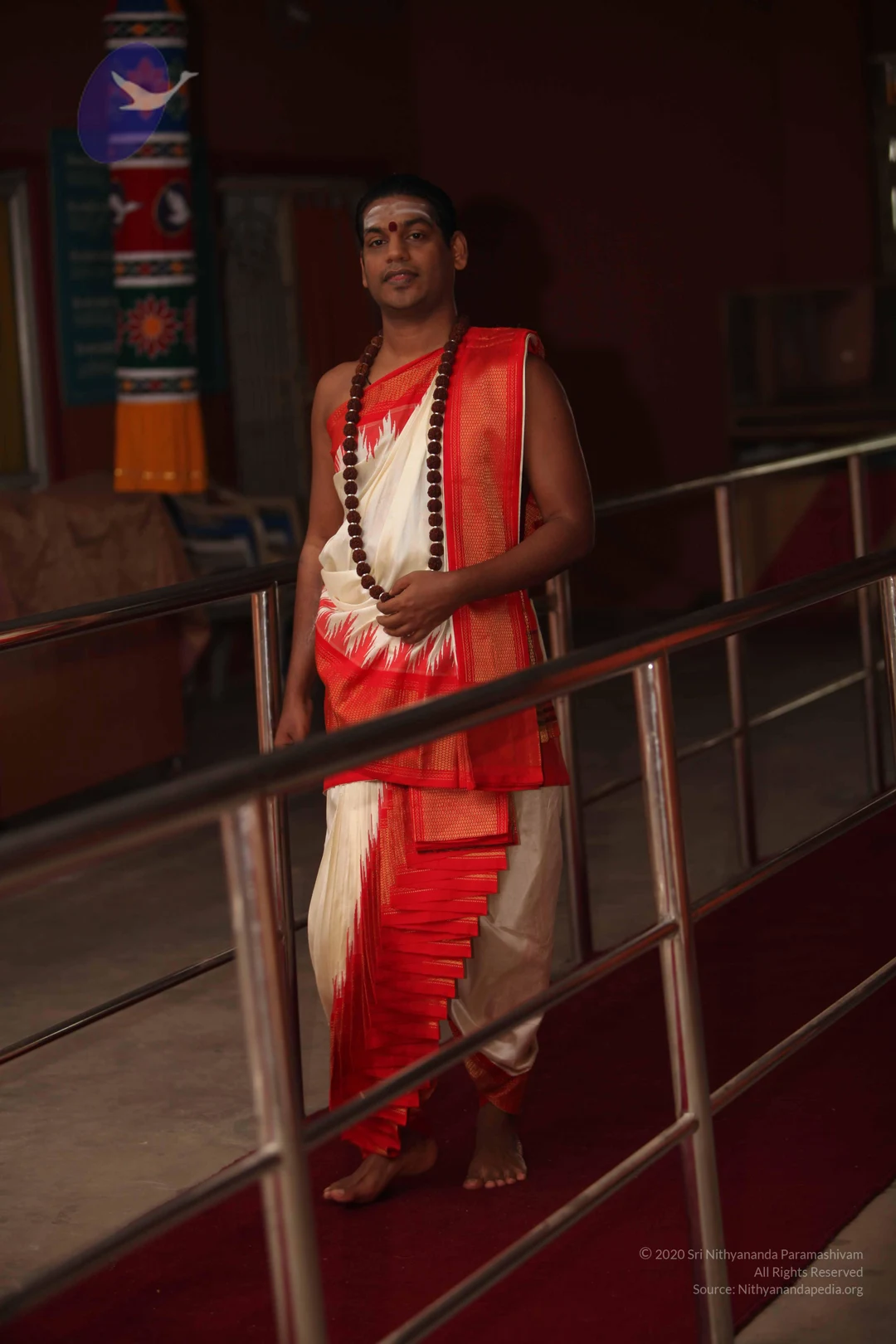
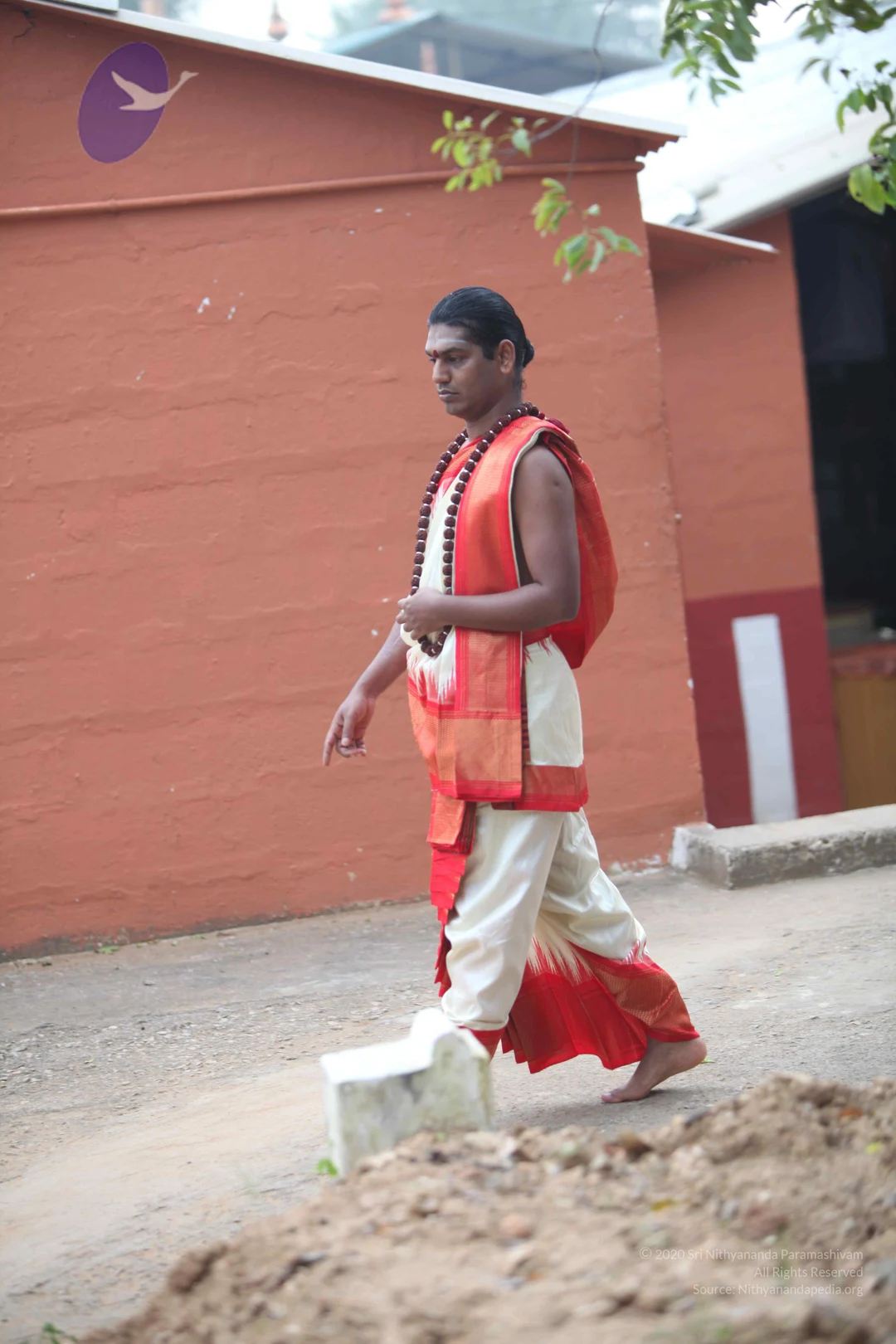
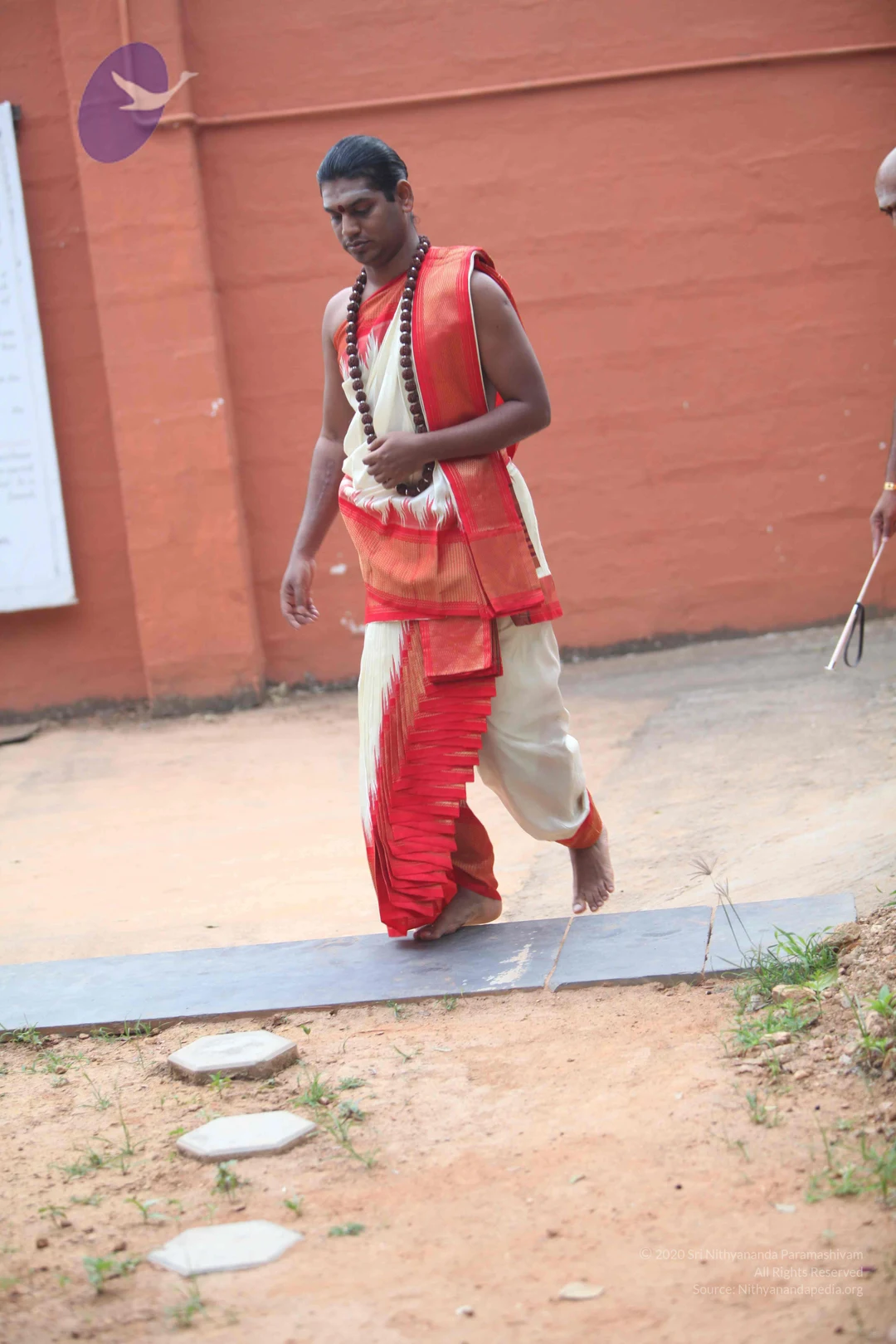
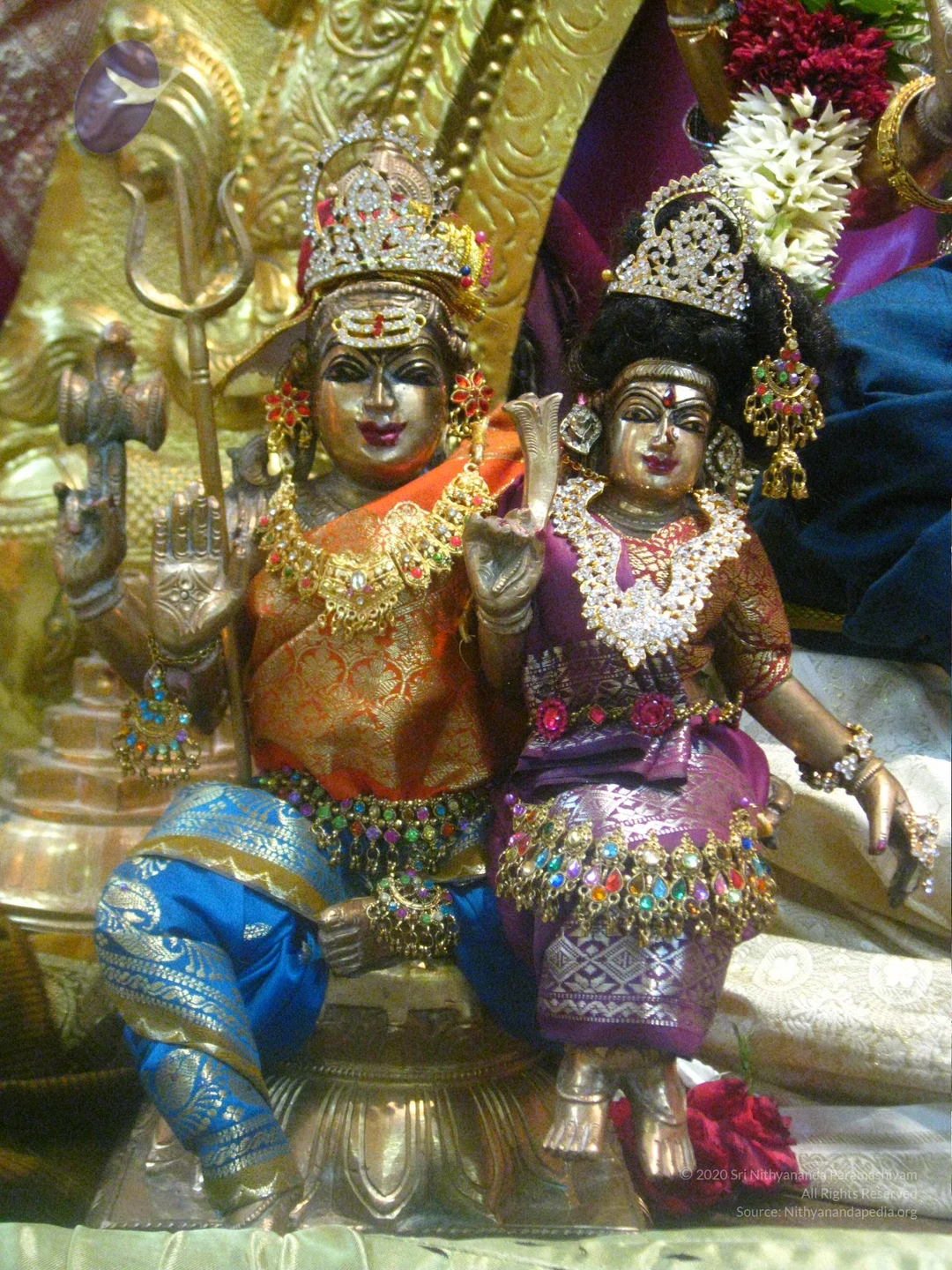
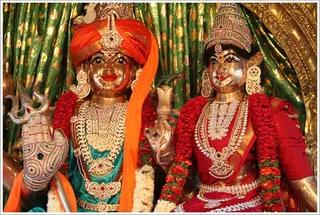
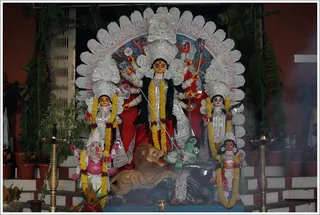
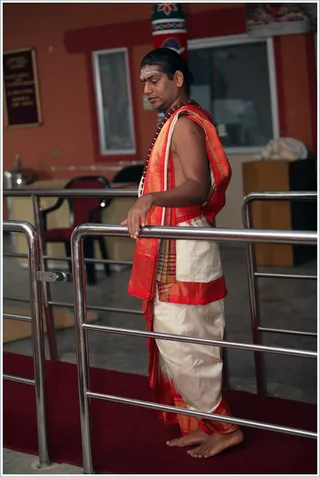
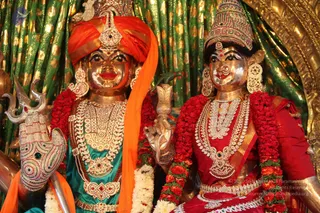
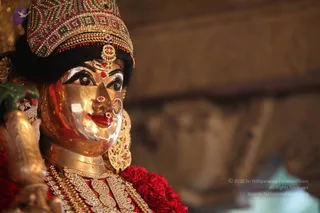
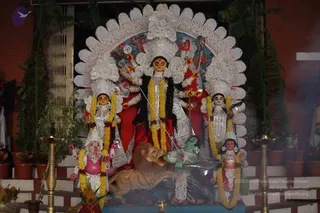
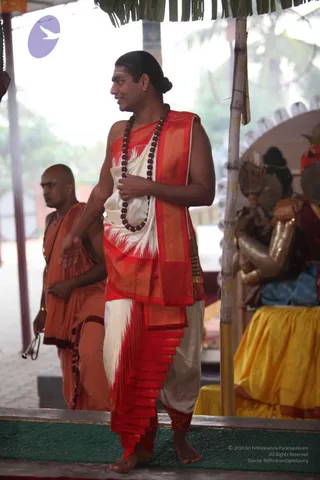
Two gilded metal deity murtis stand side by side against a green and gold brocade backdrop with an ornate gold arch. The figure on the left wears an orange turban, a teal garment, heavy gold necklaces and a trident in hand, with a garland of red flowers and white blossoms. The figure on the right wears a tall jeweled crown, a red silk sari, layered silver and gold necklaces and a red floral garland, holding a lotus-stem sceptre. The murtis are statues, not living people, and no physical people are visible.Close-up photograph of a gilded metal utsava murti, a deity figure with a polished golden face, arched eyebrows, red-painted lips and a jewelled nose ring. It wears an ornate jewelled crown set with red, green and white stones, and a heavy gold necklace with red-and-green stone inlay. A red garland of roses hangs across its chest and a gold arm or staff is visible at the left edge. The background is a blurred warm brown stone wall. No physical people are visible; the figure is a statue.A large clay murti of the goddess Durga, multi-armed and crowned, stands at the centre of a shrine decorated with white filigree crown and halo. She wears a red sari and a yellow marigold garland and is shown slaying a demon with a spear while a lion crouches before her. Flanking her are two smaller female figures in white and gold, also garlanded in yellow, and at the bottom corners a pink-faced figure and a standing male figure in orange-red dress. Brass oil lamps stand on the steps, potted plants surround the platform, and incense smoke drifts at the right edge. Statues only; no living people are visible.A photograph of a barefoot man in a white and red-bordered wrap cloth walking along a paved path beside a silver SUV with a roof rack, a brick wall and flowering shrubs behind. He wears a long wooden rudraksha mala over his bare chest and shoulder, and his head is shaved. The wrap cloth is white with red borders and ikat-style patterning, draped over one shoulder. The setting appears to be an ashram or campus driveway. The figure is a person by appearance cues: saffron-red and white ceremonial wrap and a rudraksha mala, though the face is not clearly distinctive enough to be certain.A man with hair tied in a bun stands on a raised green-edged platform beneath a leafy canopy. He wears a cream and red-bordered ikat-style garment draped over one shoulder with a gold-threaded orange-red shawl, and a long rudraksha mala around his neck. A second man in orange robes with a shaved head stands behind him holding a small object. To the right, a deity murti with a golden face and a yellow cloth-draped seat is visible. Two people are visible; the scene is a ritual or satsang setting.A standing man stands on a red-carpeted walkway behind a silver metal railing in a dim hall with a red wall and a painted decorative pillar. He wears a cream and red silk dhoti and matching upper wrap with red borders, a long rudraksha mala around his neck, and a red bindi with white tilak marks on his forehead. He stands barefoot with his right hand holding the mala. a person cues are the ceremonial rudraksha mala and red-bordered ritual silk, but the face and features are not visible enough to confirm identity, so a person is set to unsure.

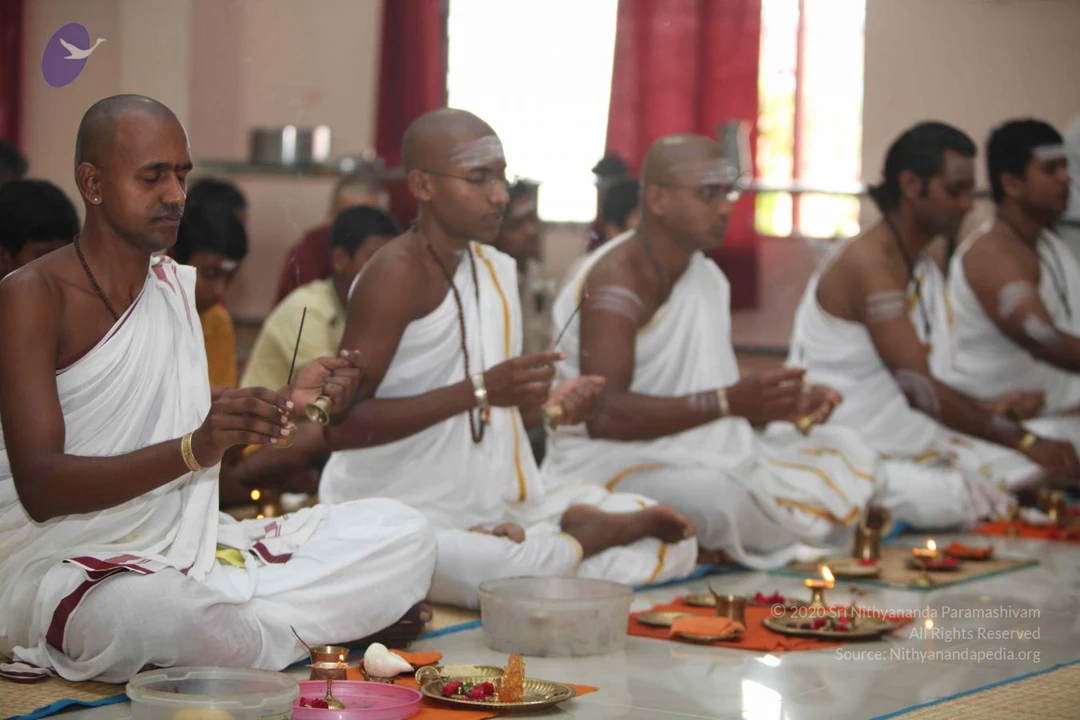
Bhagavad-Gita-Satsang
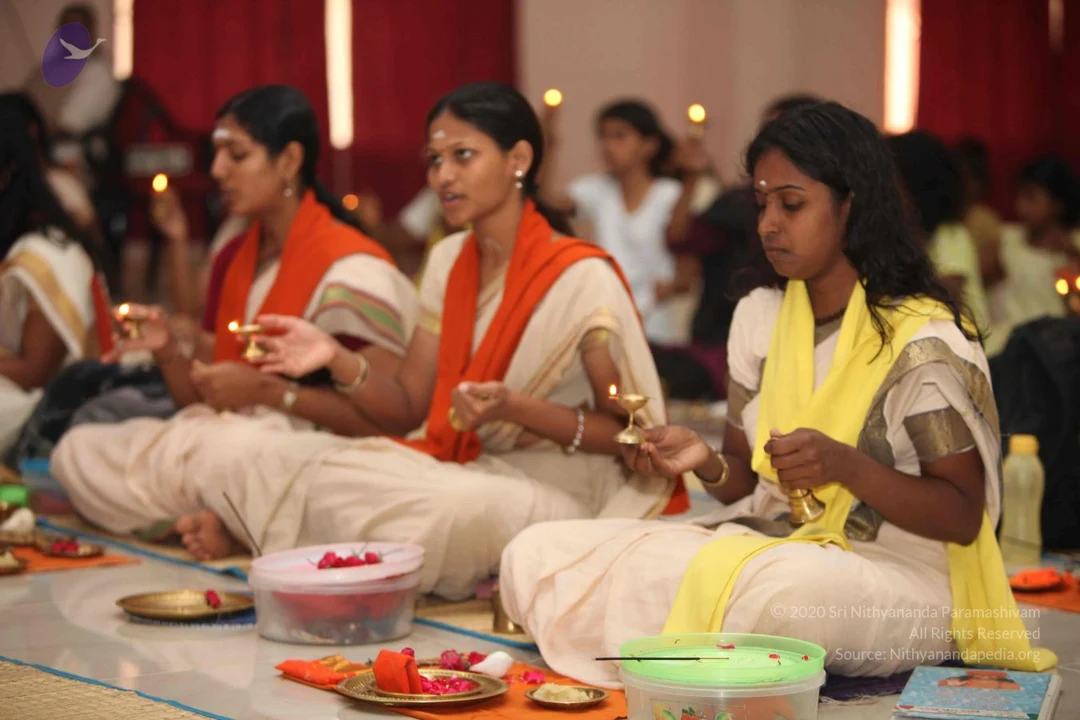
44 photosSource gallery
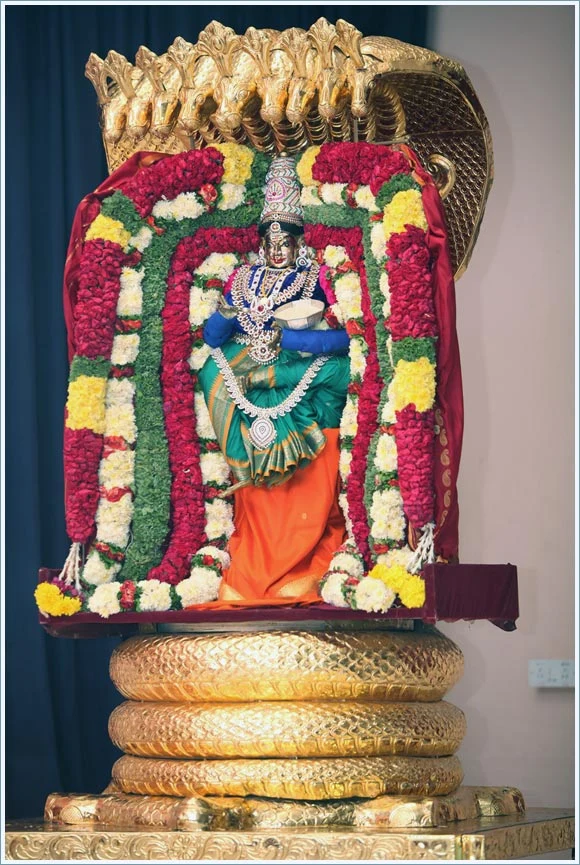
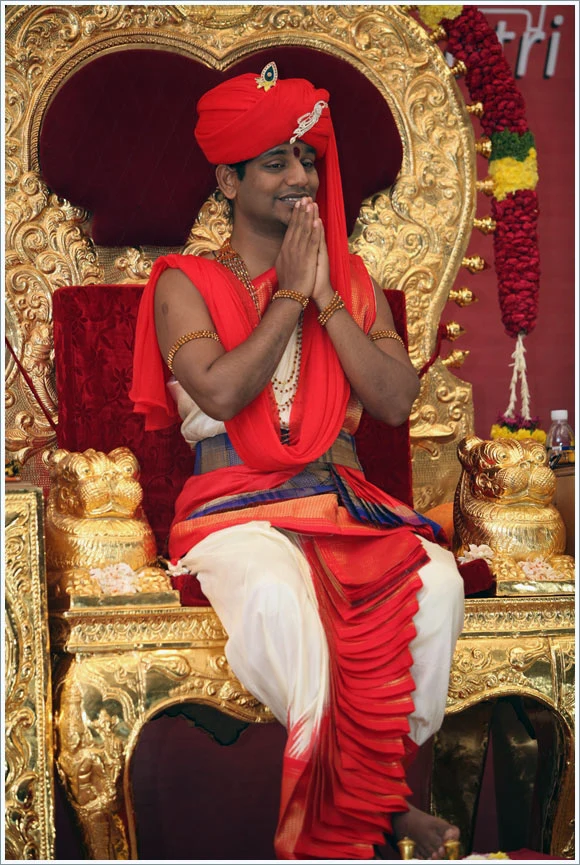
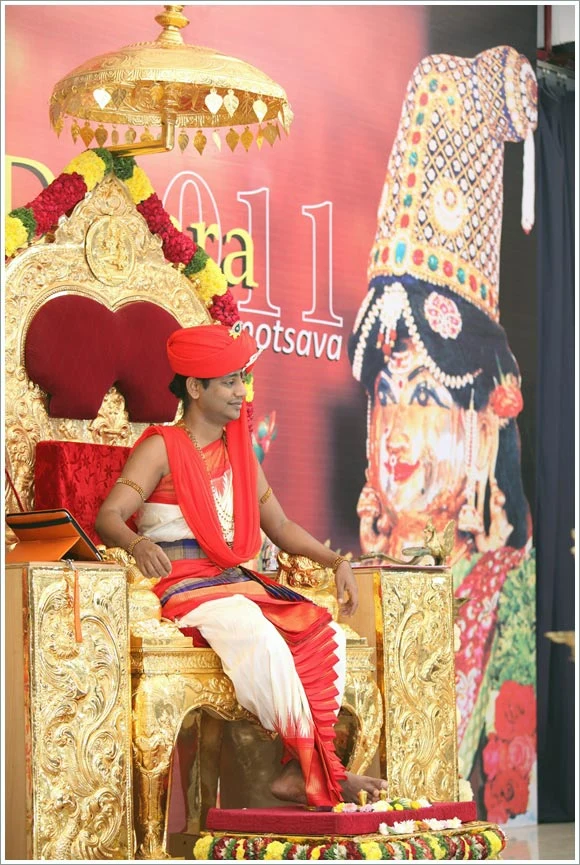
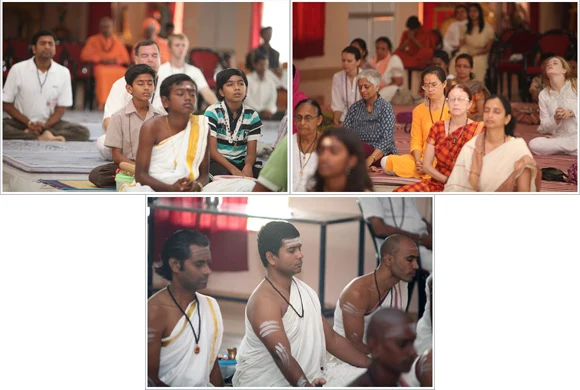
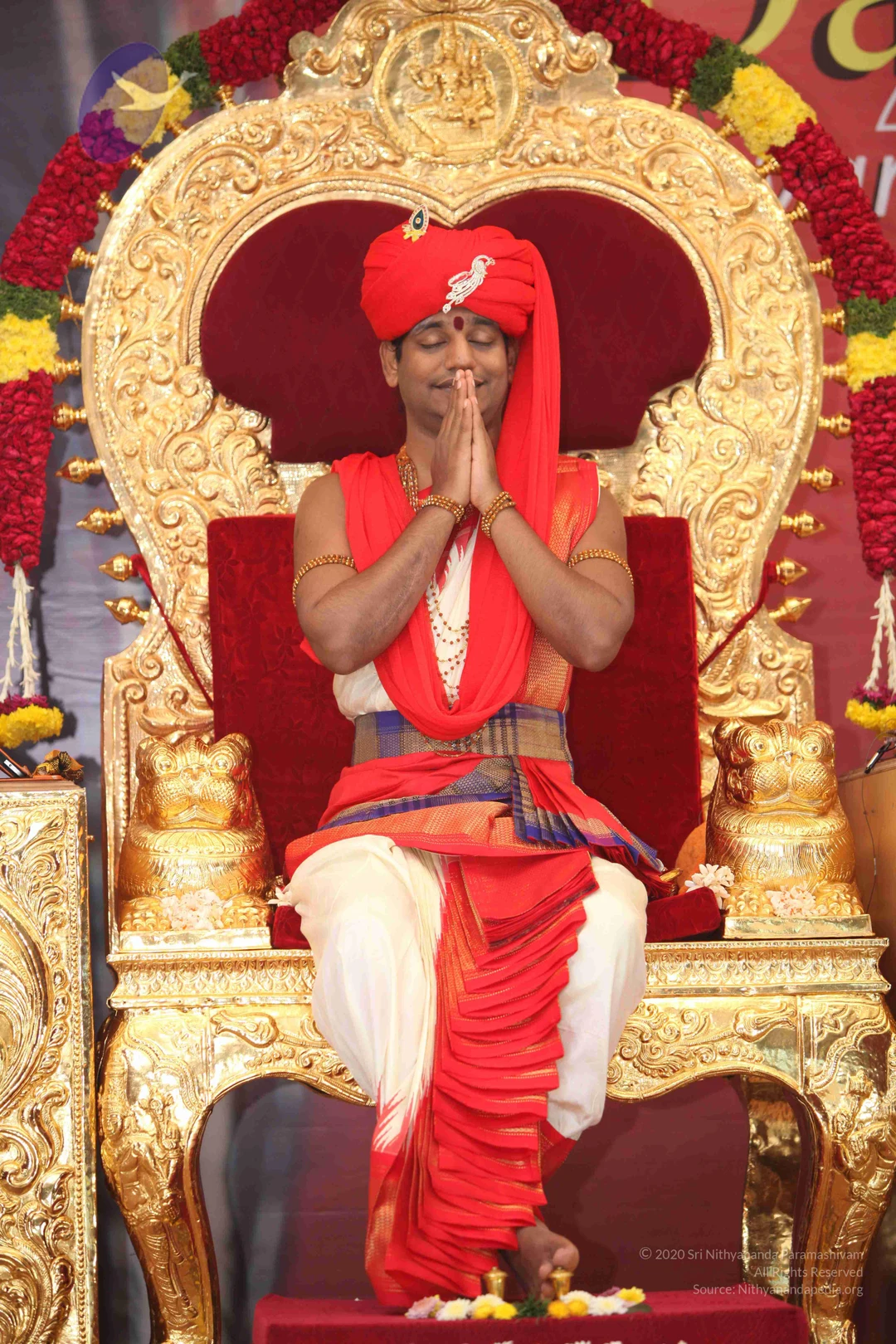
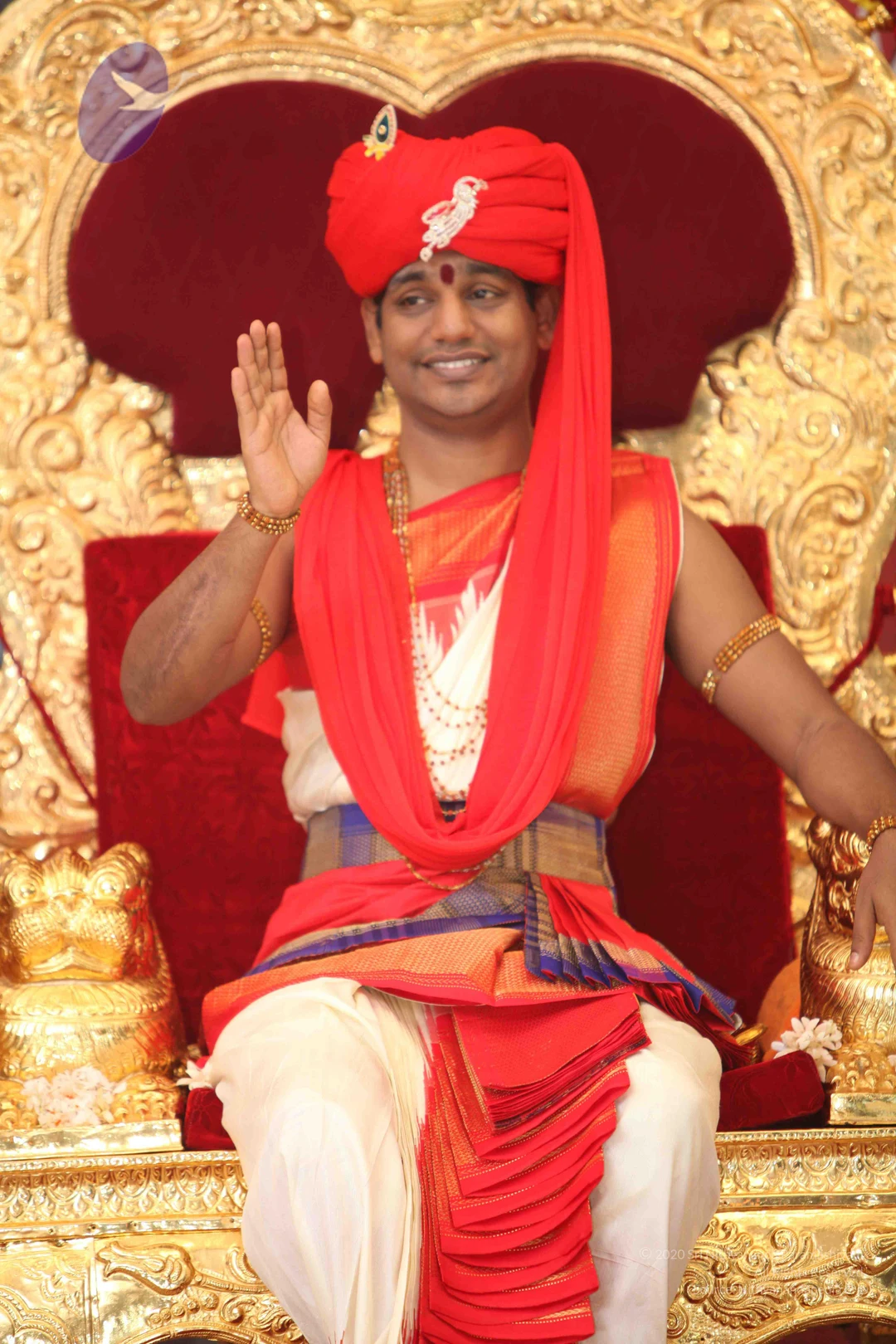
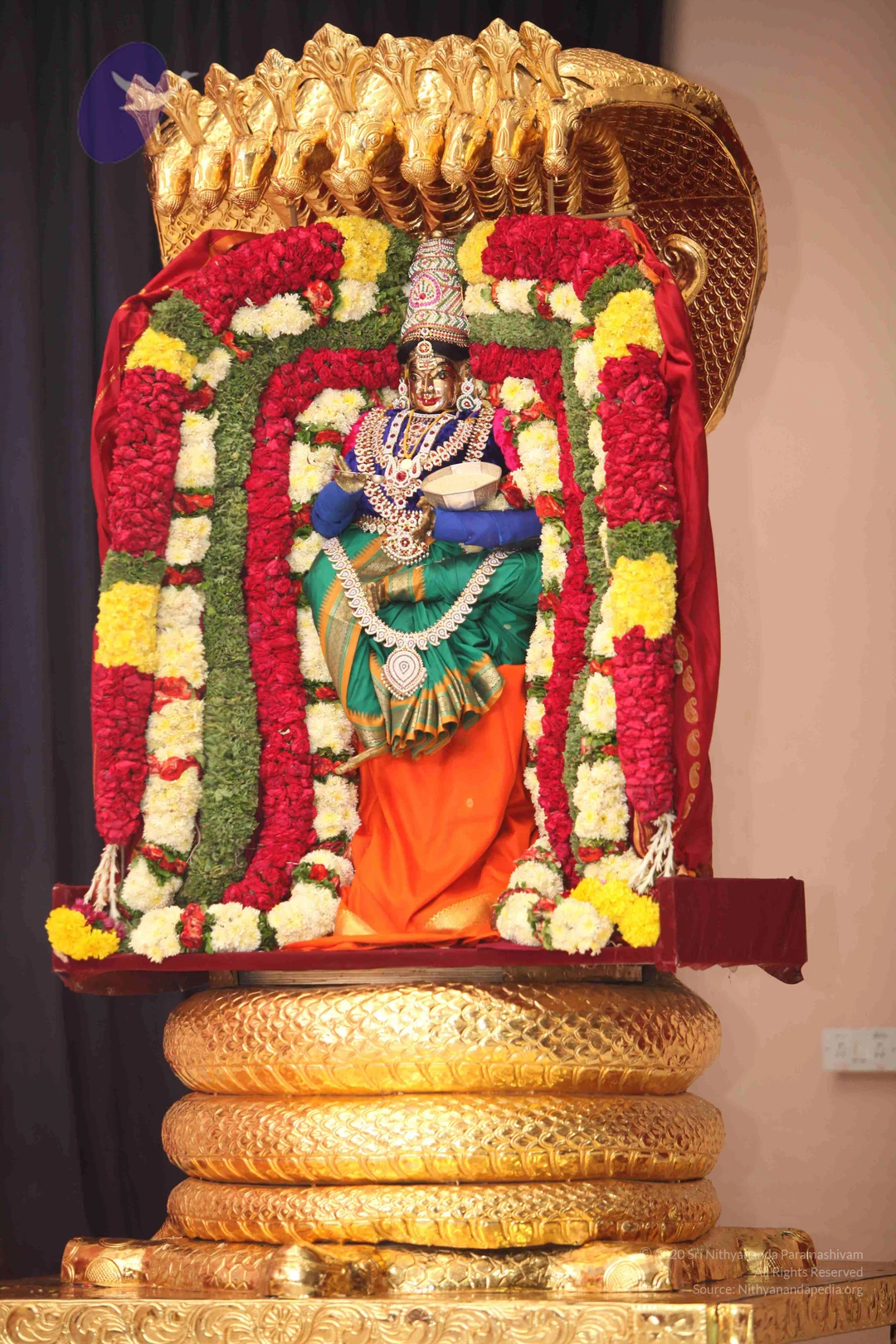
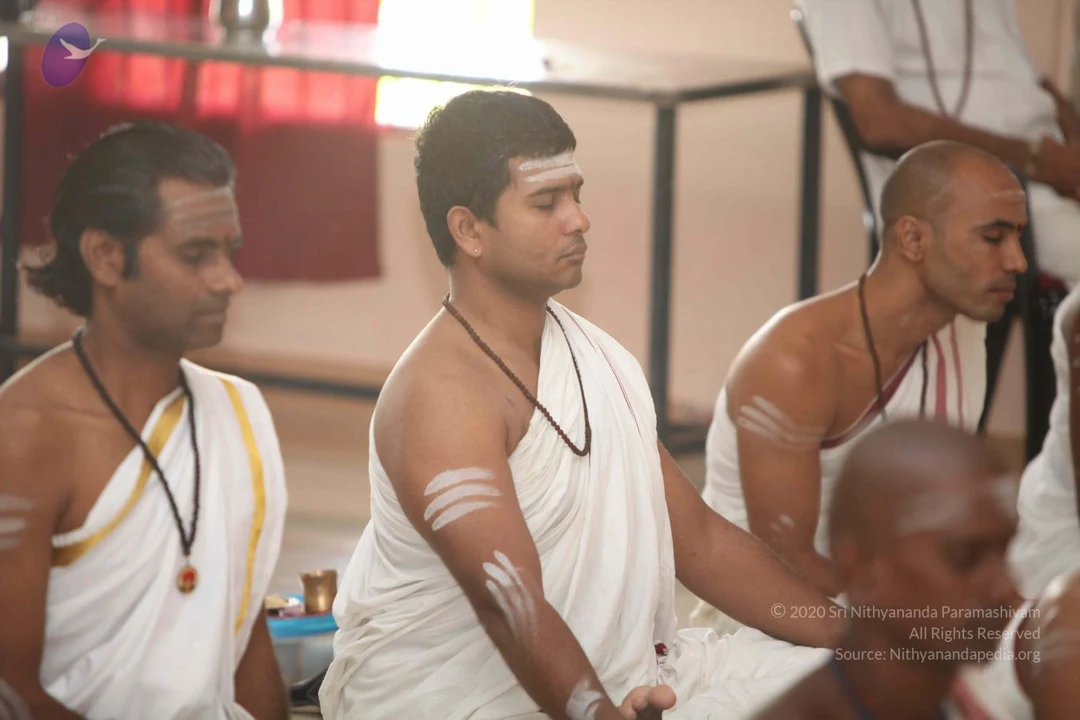
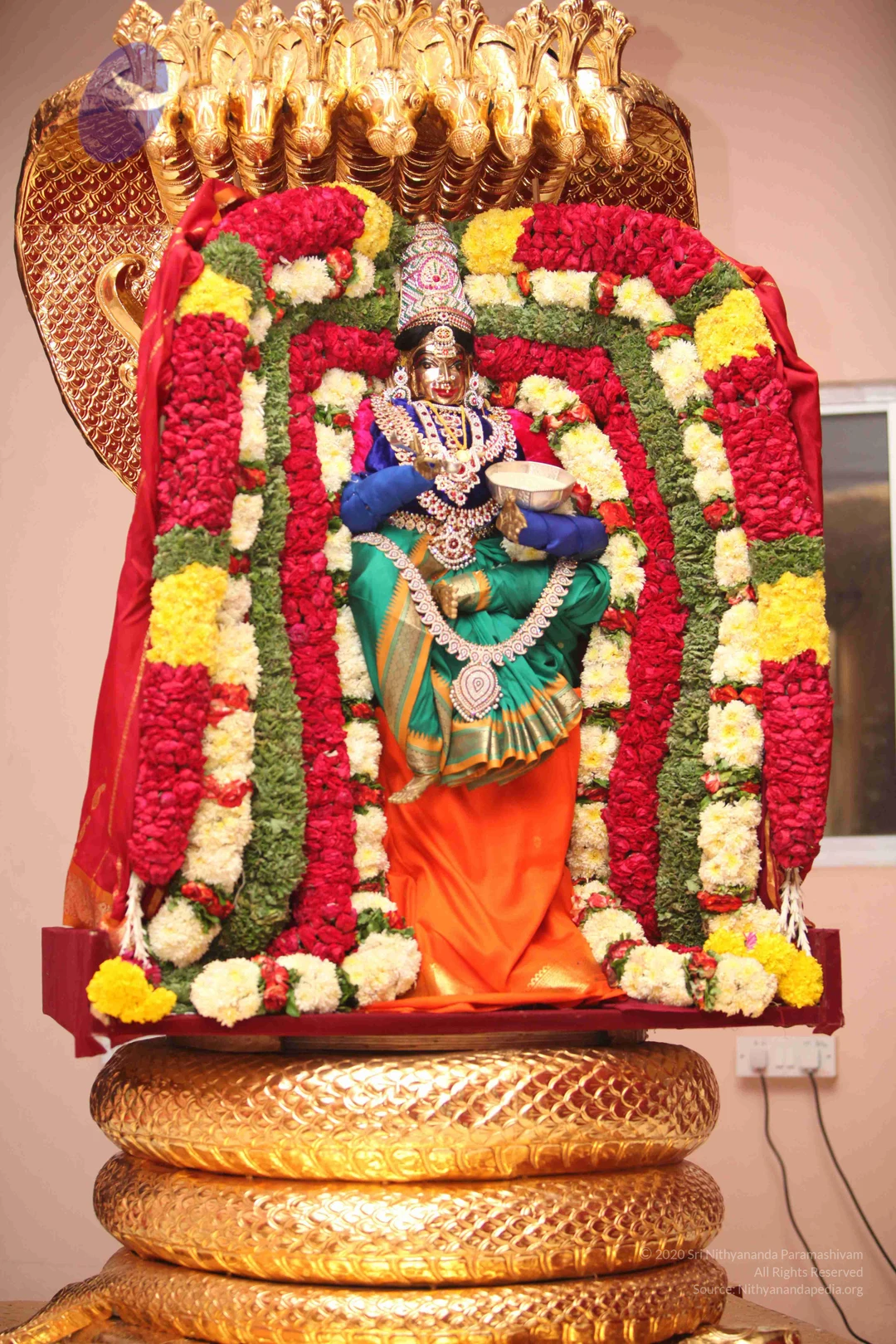
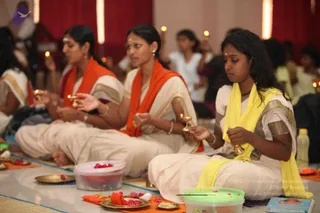
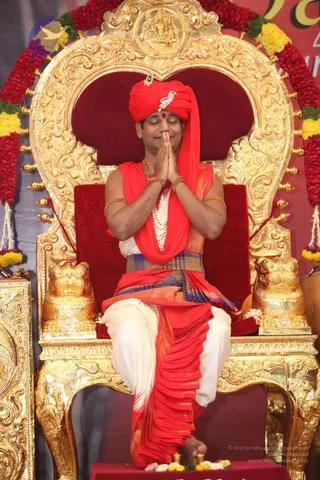
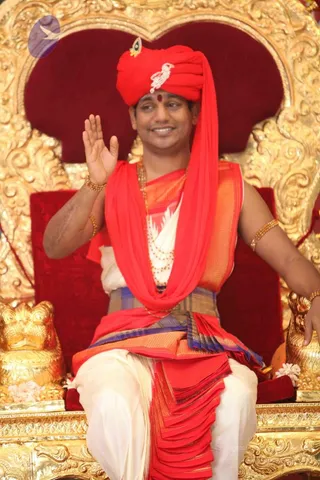
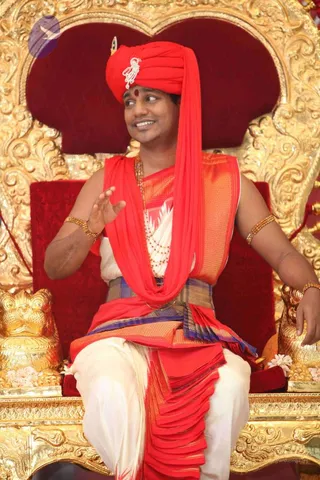
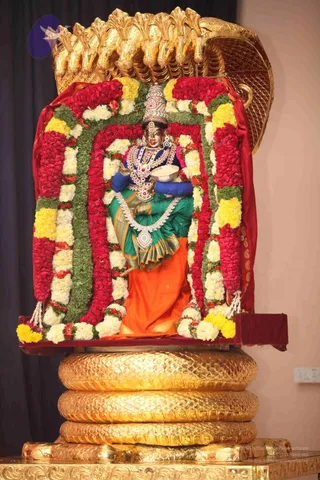
A photograph of a group of men seated cross-legged on a mat in a hall, performing a ritual with incense sticks and oil lamps. Several men in front wear plain white dhotis and shawls, with white sacred ash marks on their foreheads and arms, and rudraksha-style beads at their necks. They hold incense sticks and join their hands, eyes closed. Brass plates hold flowers, a coconut, kumkum and lit oil lamps on orange cloth in front of them. Red curtains hang at the windows behind. Several more people sit in the background, including one in yellow. a person is not clearly visible in the frame.A photograph of several women seated cross-legged on a mat in a bright hall with red curtains, holding small brass oil lamps with lit flames. The woman in front right wears a cream and gold-bordered sari with a yellow shawl and bangles; the others wear cream dresses with orange shawls and tilak marks on their foreheads. Brass plates with red flowers, a plastic container of petals, and a bottle of water sit on the floor in front of them, and more people, including children, sit behind them, some holding lamps. The scene suggests a lamp-lighting devotional gathering, but no speaker or a person is visible.A seated man with palms pressed together in namaste, eyes closed, on an ornate gold throne with a red velvet back and cushion, flanked by gold lion-shaped armrest sculptures. He wears a bright red turban with a jewelled brooch, a red shawl over white dhoti, a blue-and-gold striped waist sash, gold armlets and bangles, and a rudraksha-style bead necklace. Red and yellow flower garlands drape the throne's back, and a small flower arrangement rests at the base. Probable Swamiji by appearance cues: red turban, red shawl and ceremonial gold ornaments, seated in a position of honour.A man seated on an ornate gold throne with carved scrollwork and a red velvet backrest, smiling and raising his right hand in greeting. He wears a red turban with a jewelled brooch and a red and orange silk shawl draped over one shoulder, a white dhoti-style garment, a gold-bead necklace and rudraksha-style beads, and gold bangles on both arms. A red bindi marks his forehead. Stone lion-shaped armrests and white flowers appear beside the throne.A man seated on an ornate gilded throne with a red velvet back and carved golden lion-form armrests, smiling and gesturing with his raised right hand while speaking. He wears a bright red turban with a white jewelled brooch and a red sash over a white dhoti with red and orange borders, a rudraksha mala and gold bangles. A small red bindi is on his forehead and white flower garlands rest on the throne. One person is visible.A photograph of a female deity murti decorated with garlands, standing before a golden multi-headed serpent hood and coiled golden base. The figure wears a tall ornate crown, heavy gold and white jewellery, a blue blouse, a teal and orange saree and holds a small lamp and a white bowl. Red, white and yellow flower garlands frame the murti on a red-draped platform against a dark backdrop. No physical people are visible.
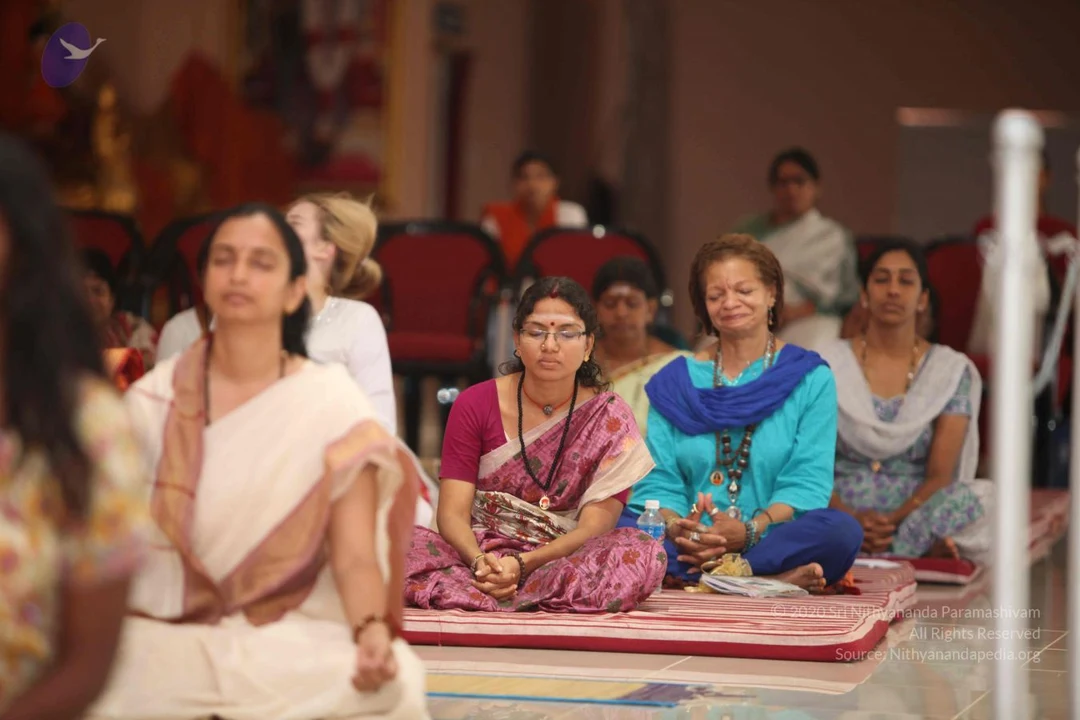
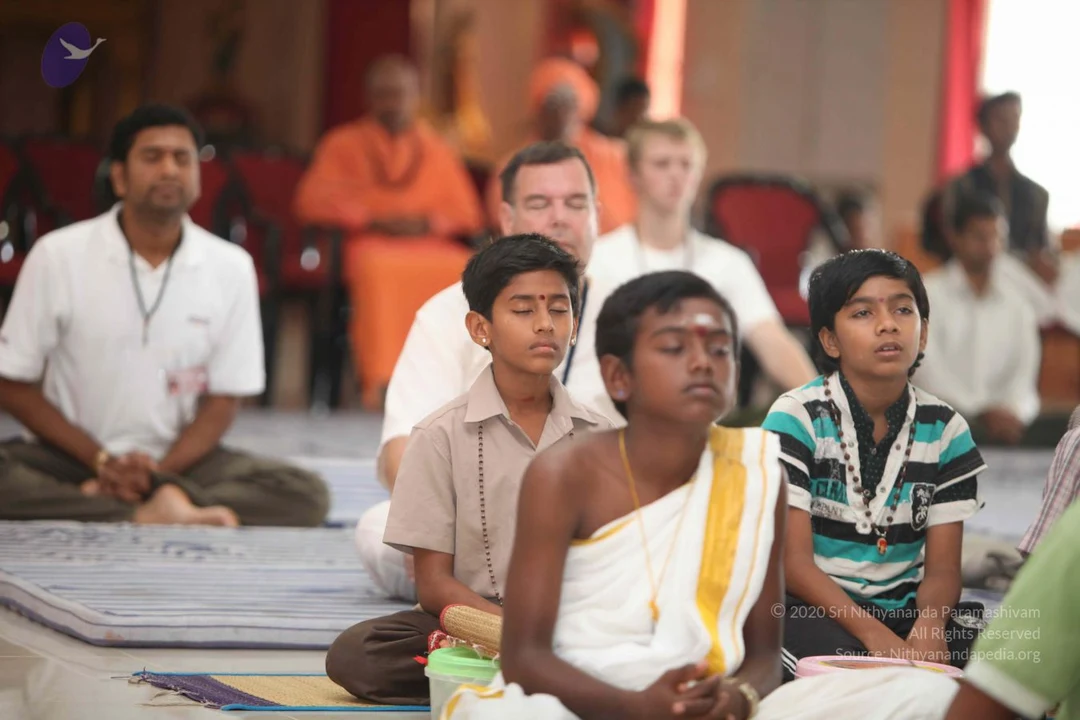
Tiru-Reaching
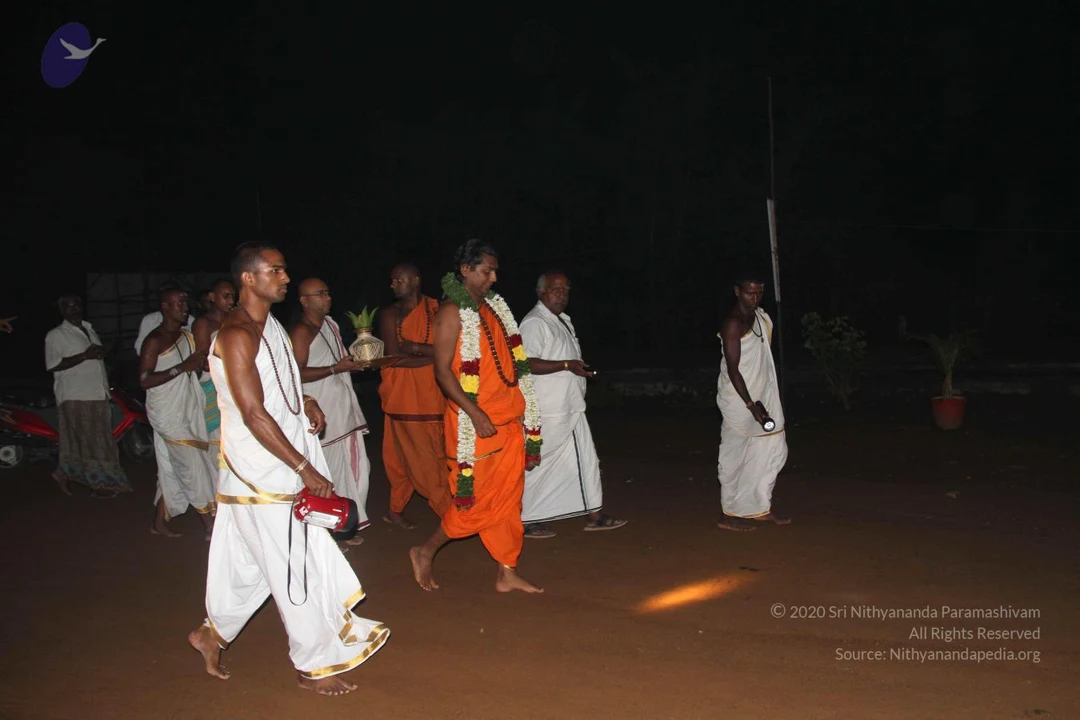
9 photosSource gallery
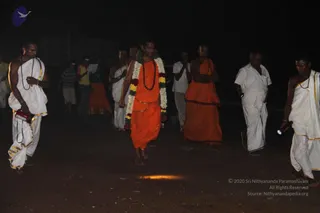
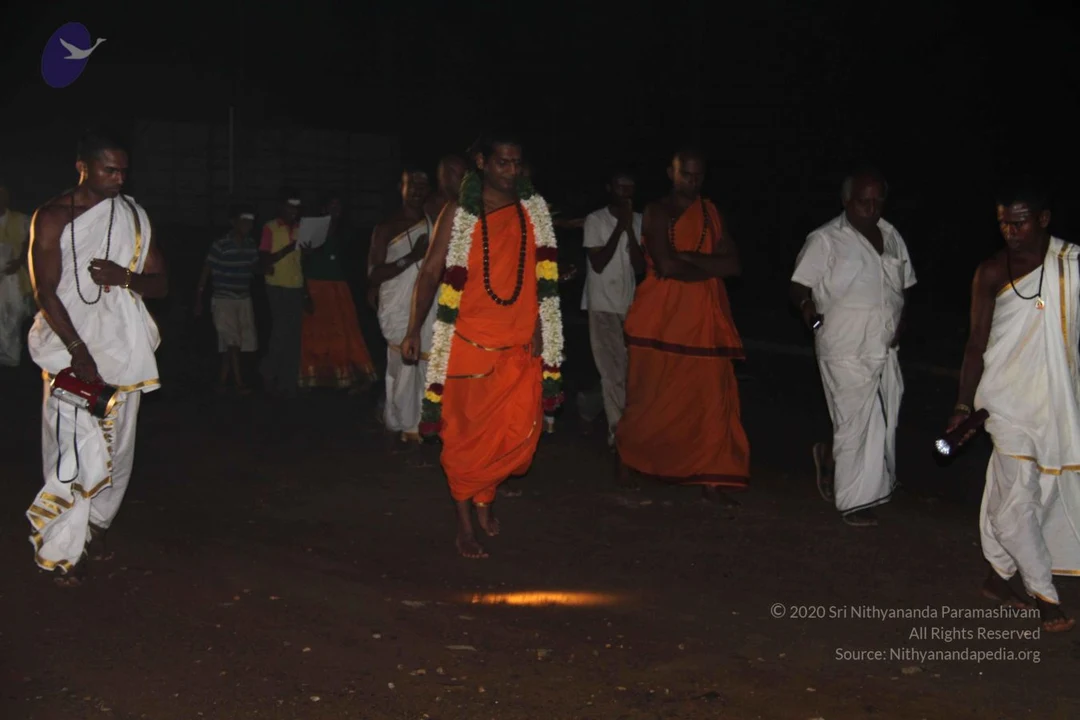
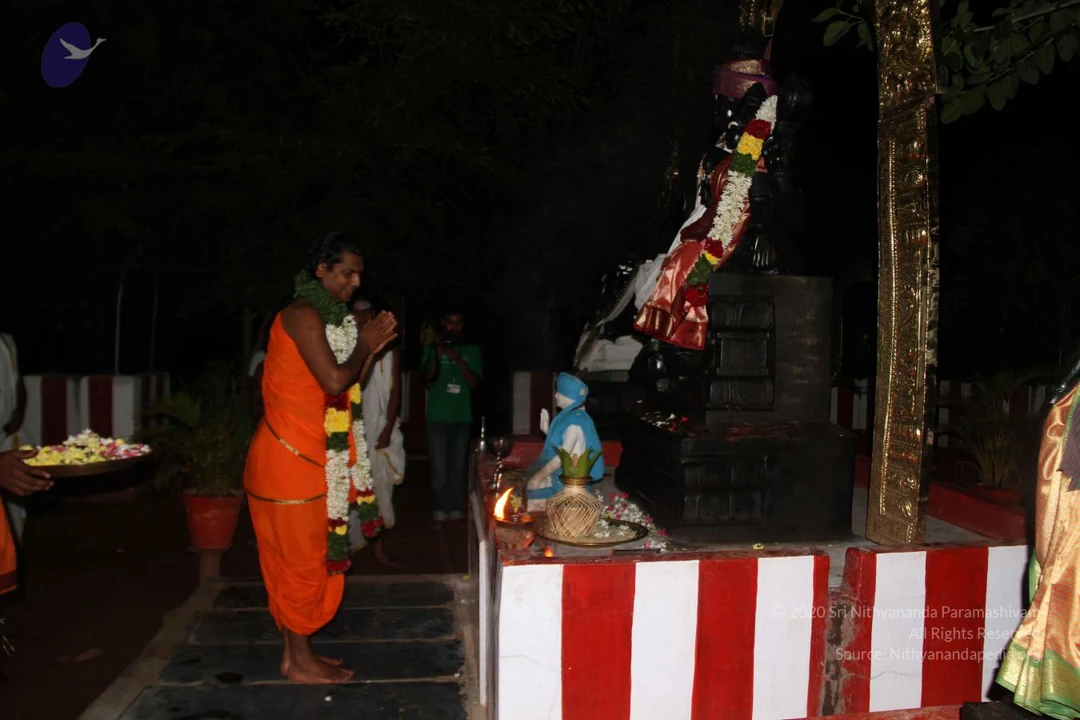
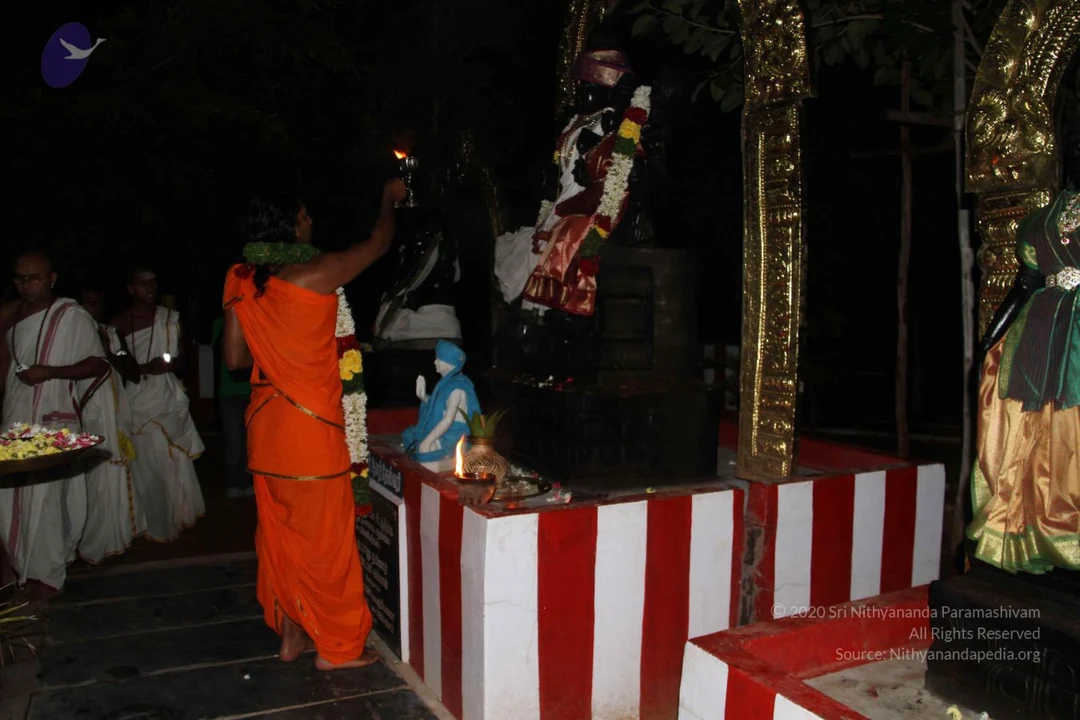
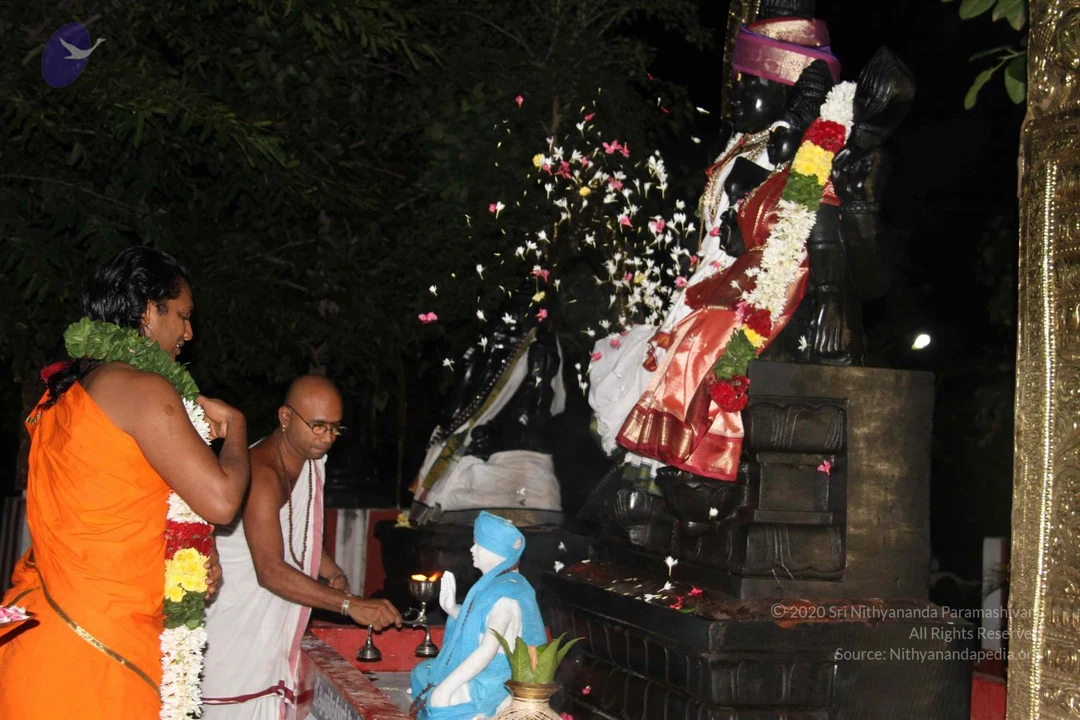
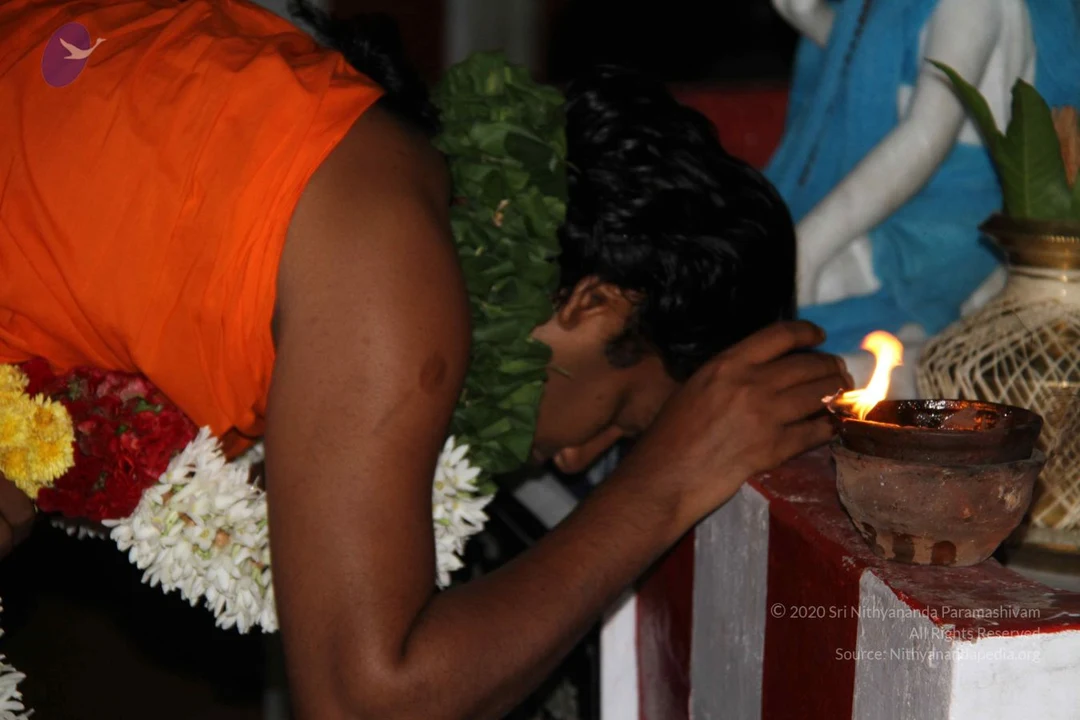
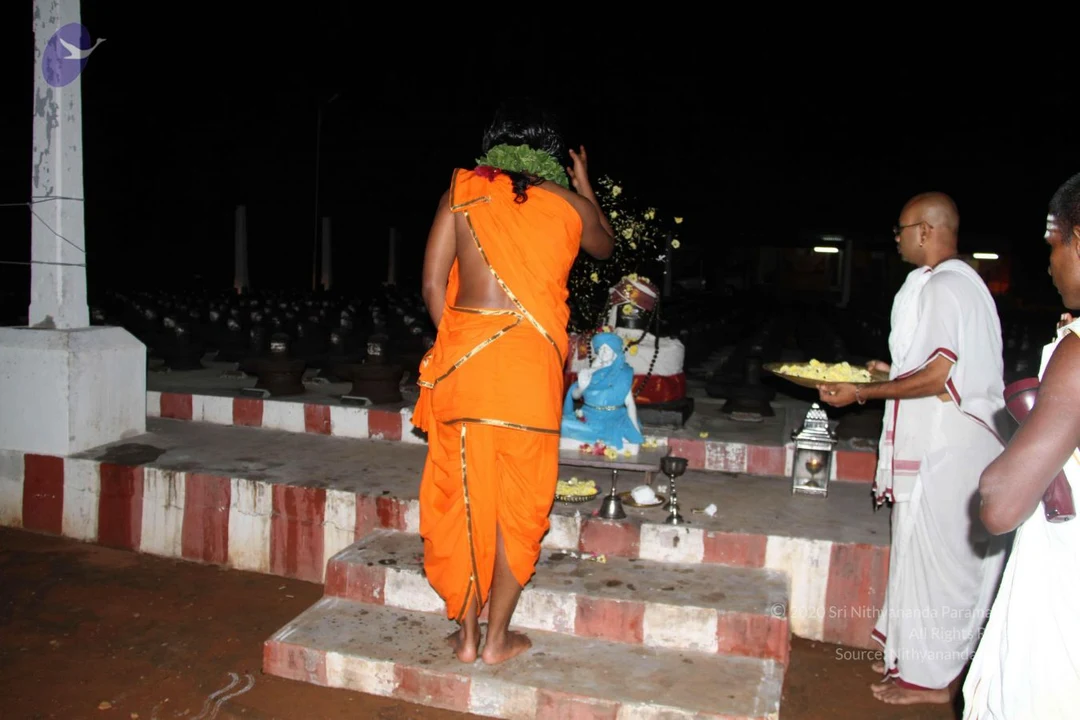
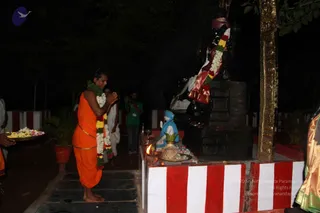
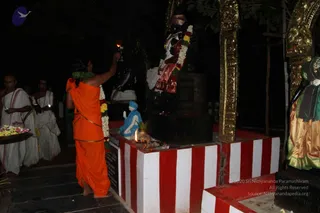
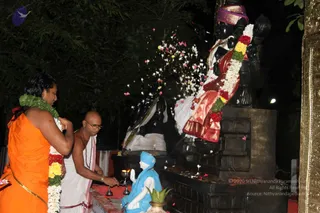
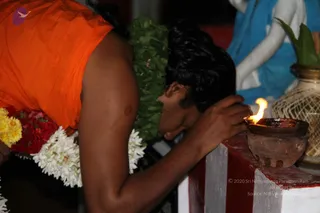
Night procession on a dirt path with a dark background. A bare-chested man in white dhoti with gold border leads at left, carrying a red bag. Central figure wears saffron cloth and a long garland of white and yellow flowers with a red-and-white strand, with rudraksha beads visible, walking barefoot. Behind him a man in saffron dhoti carries a brass kalasha pot with green leaves on top. Several other men in white dhotis and shawls walk in line, one holding a small torch. A red motorcycle and potted plant sit at the left and right edges. The central figure's saffron clothing and garland suggest a sannyasi-style presentation, but the appearance is not distinctive enough to confirm identity.A night-time photograph of a procession on a dirt road. At the centre a shaved-headed man in saffron-orange dhoti and shawl walks barefoot, wearing a rudraksha mala and a white and multicoloured flower garland. Men in white dhotis with gold borders walk around him, two of them holding torches. Other figures in saffron and white stand behind in the dark. The scene is lit only by the torches and a small glow on the ground.Night photo at an outdoor shrine. A man in an orange saffron dhoti and shawl, wearing a white and multicolored flower garland, stands barefoot with palms pressed together in anjali before a dark black deity murti draped with red and gold cloth and flower garlands. A small blue figure and oil lamp sit on the red and white striped plinth, with a brass plate of flowers at left. A man in a green shirt and another person in white stand behind; a woman in a gold-bordered sari is at the right edge.Night-time temple scene at a shrine with a dark linga-like deity murti draped in a red cloth and garlanded with white and yellow flowers. In the foreground a figure in an orange saffron dhoti and shawl, with a floral garland and long dark hair, faces the shrine holding a lit lamp aloft. Two men in white dhotis stand to the left, one holding a tray of flowers. A small blue-robed statue and an oil lamp sit on a red-and-white striped platform, and gold-patterned pillars frame the shrine. Offerings and a puja in progress.Night photograph of an outdoor shrine at a temple-like setting with dark trees behind. A black stone deity murti stands at right, draped in a red and gold cloth and garlanded with white, yellow and red flowers, with scattered white and pink petals falling around it. In the foreground a figure in an orange saffron robe with a green and white floral garland stands at left, while a shaved-headed priest in a white dhoti and white shawl with a rudraksha mala stands beside a small brass lamp and bell on a red-covered ledge. A small blue and white figurine sits on the ledge in front, and a brass oil lamp is lit. Two people are visible.A photograph of a young man in an orange sleeveless garment bowing forward with his head lowered and his right hand resting on a red-and-white pedestal beside a small clay oil lamp with a bright flame. He wears a green leaf garland and a white jasmine garland, with red and yellow flower strands at his waist. Behind him a white and blue deity murti is partly visible, and a potted green plant sits at the right edge. The scene suggests a devotional offering at a shrine. Only one person is visible.

Navaratri-Day-3- Malaysia

11 photosSource gallery
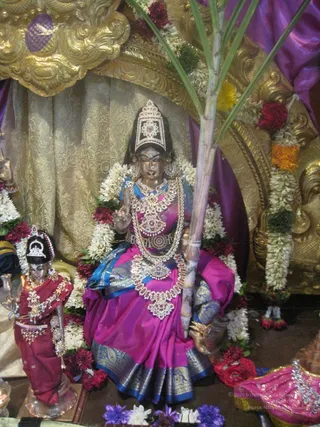
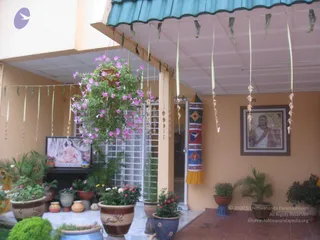
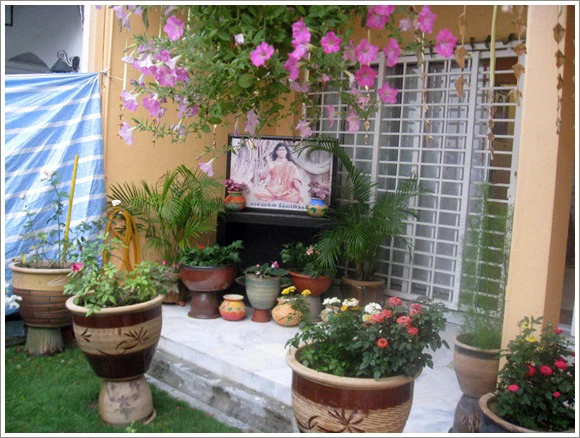
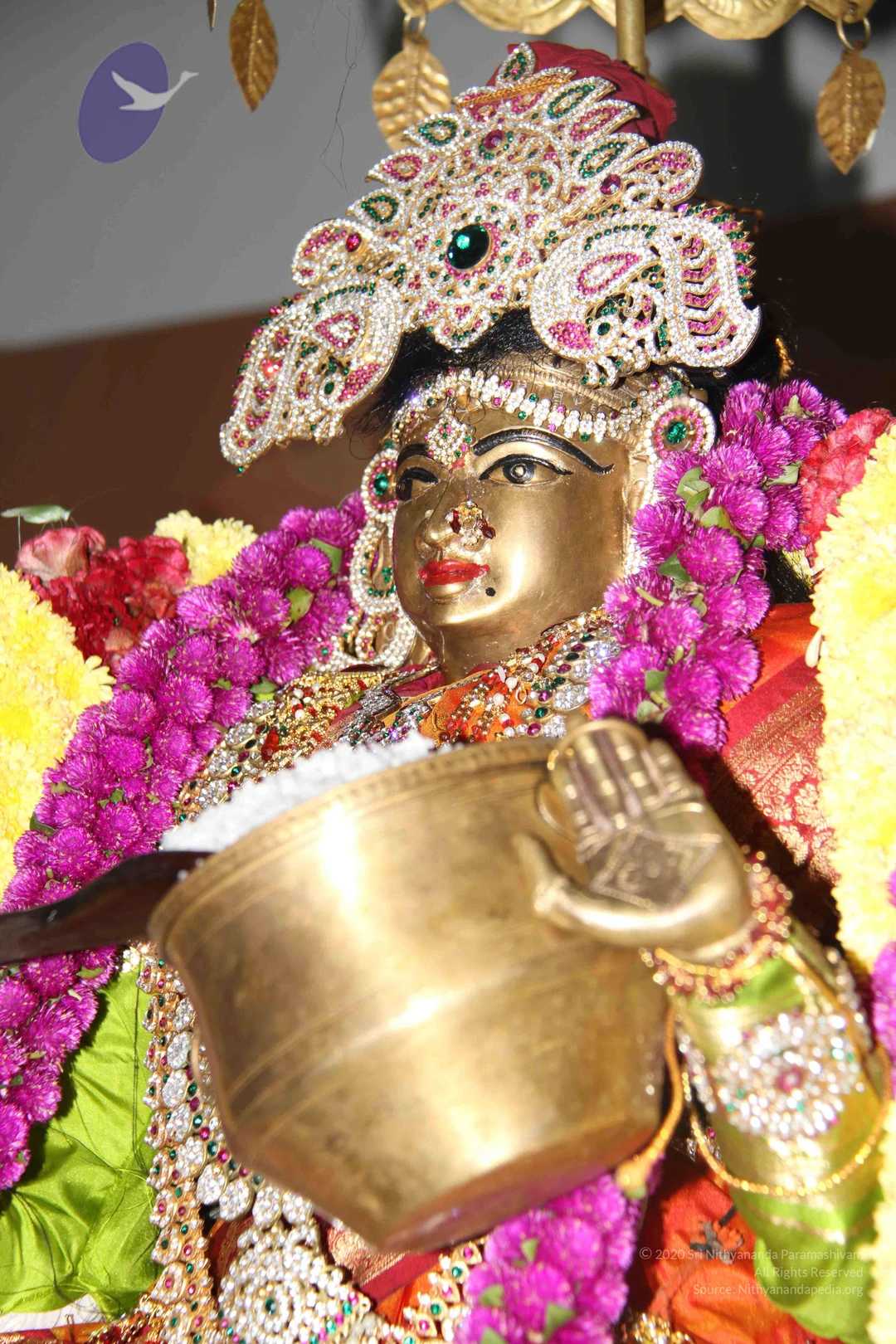
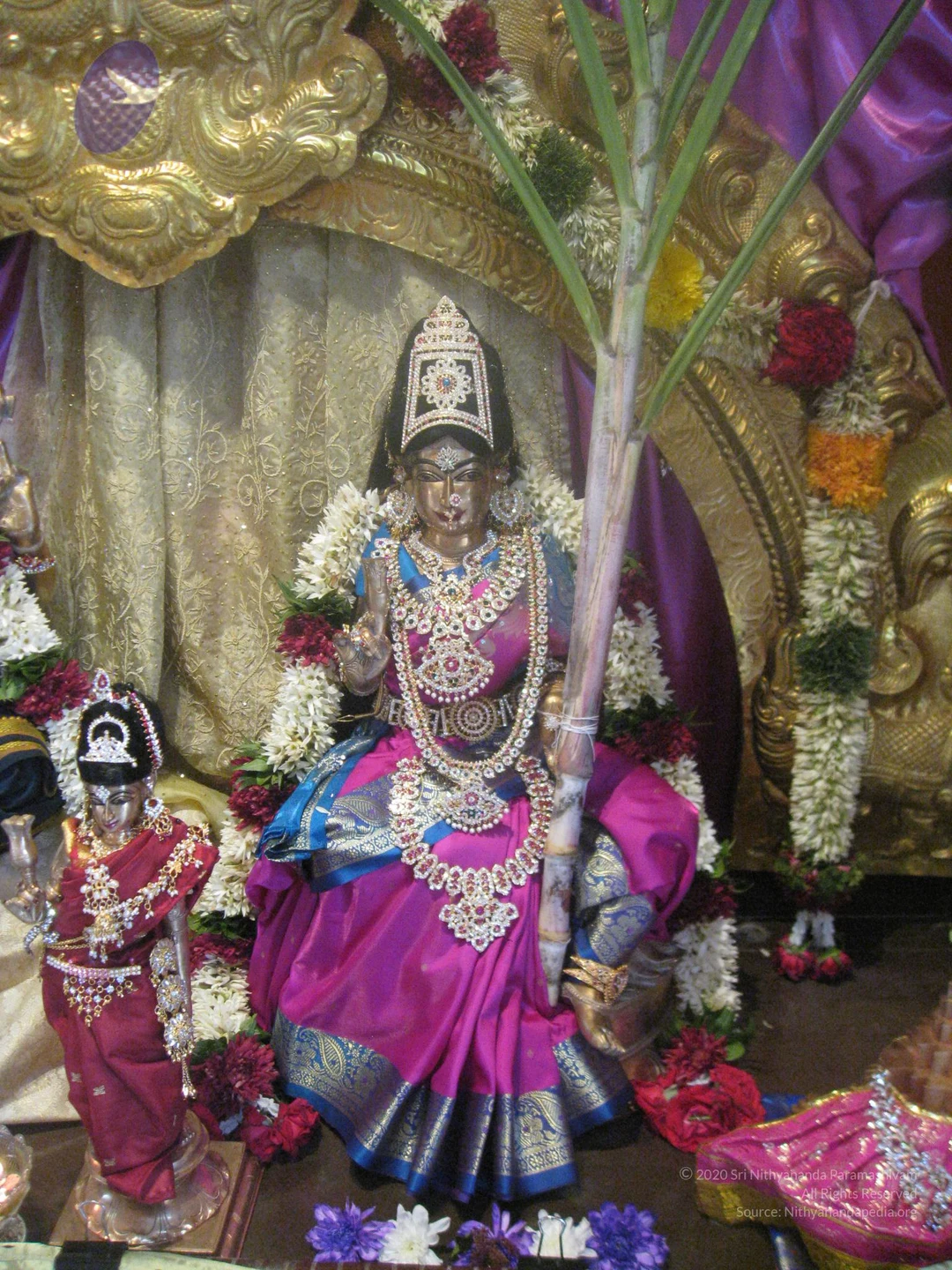
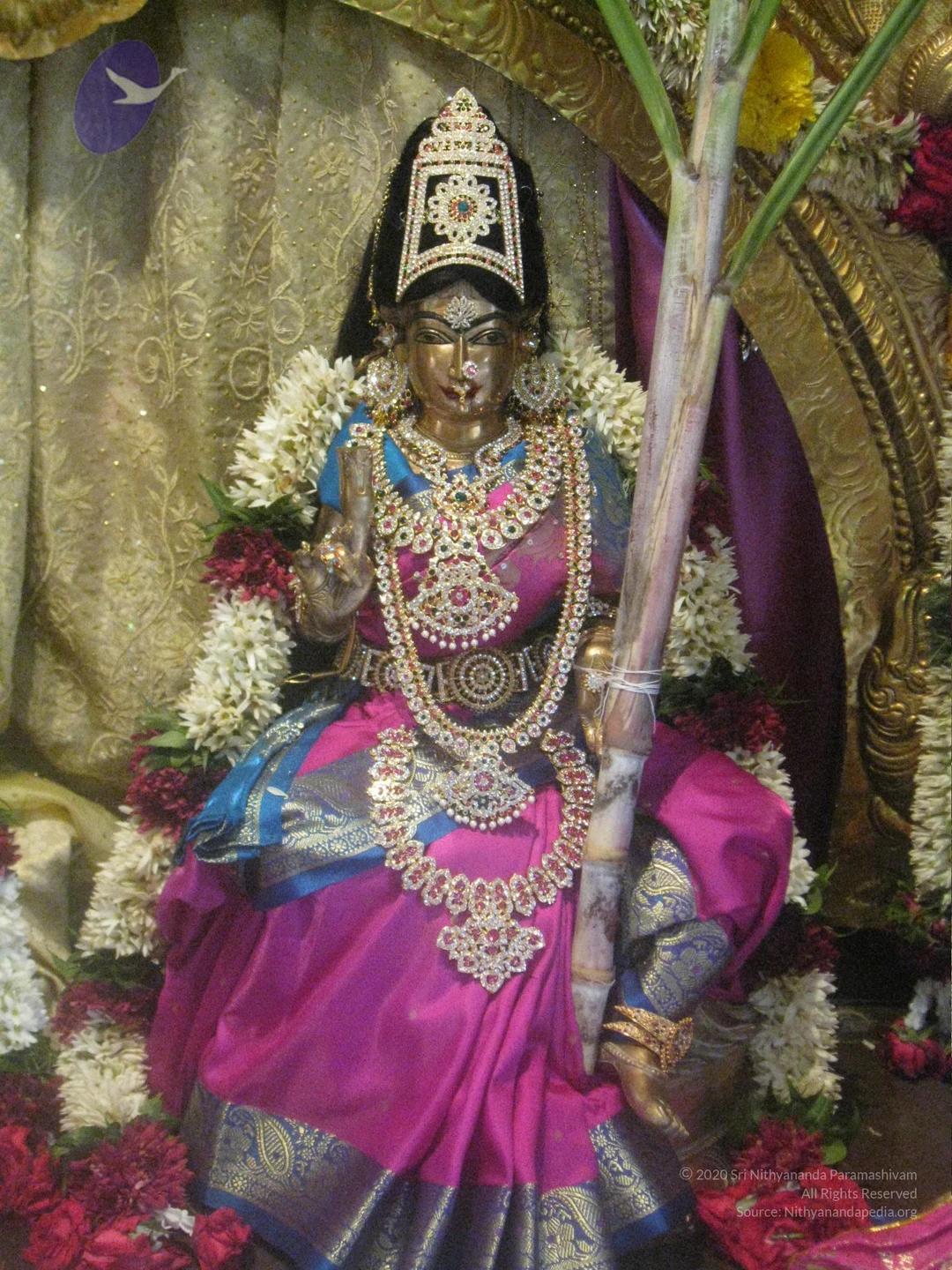
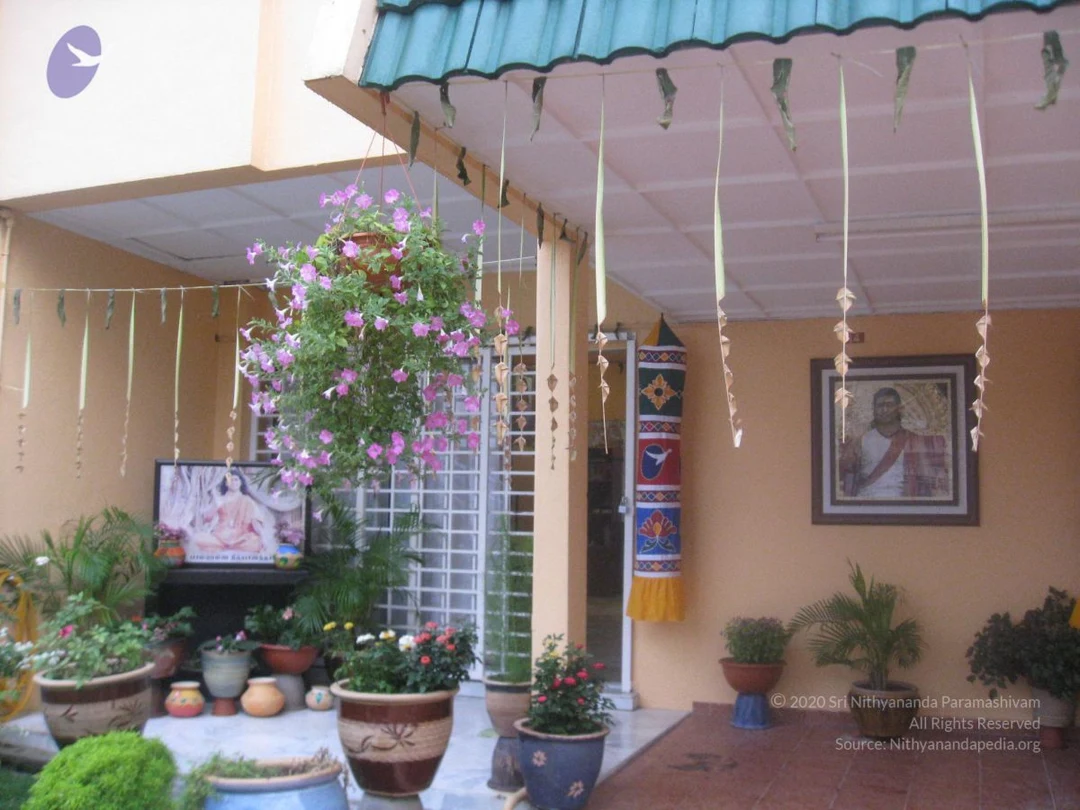
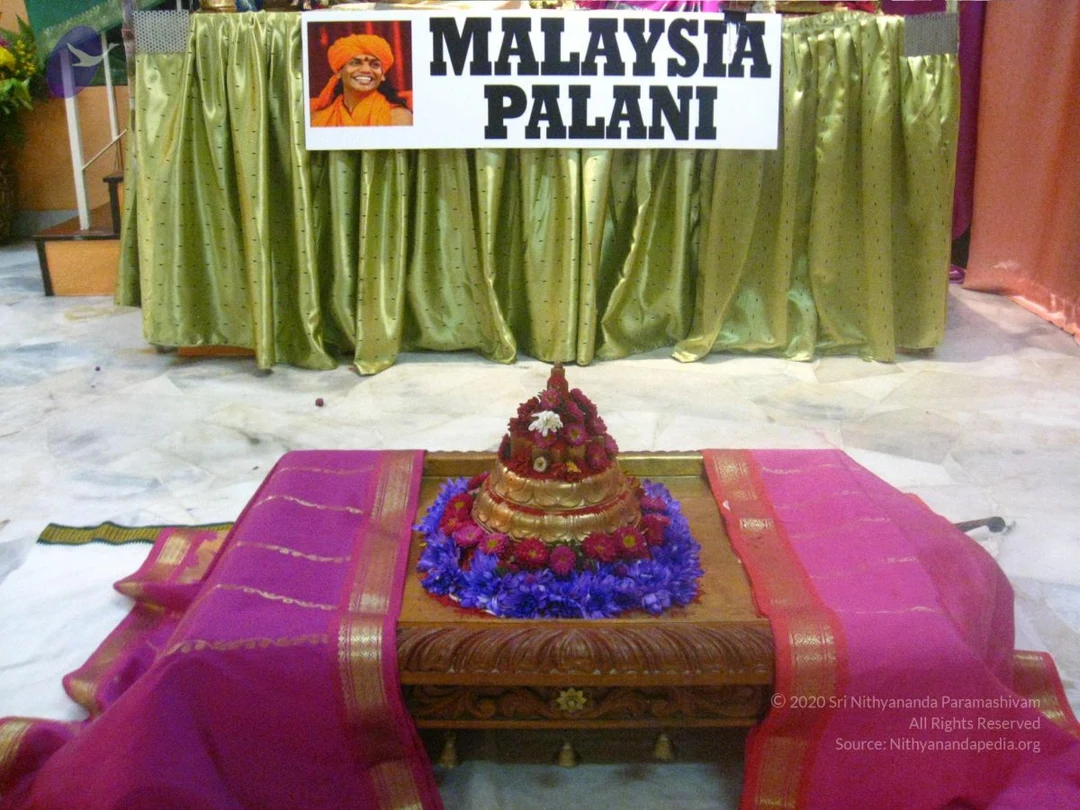
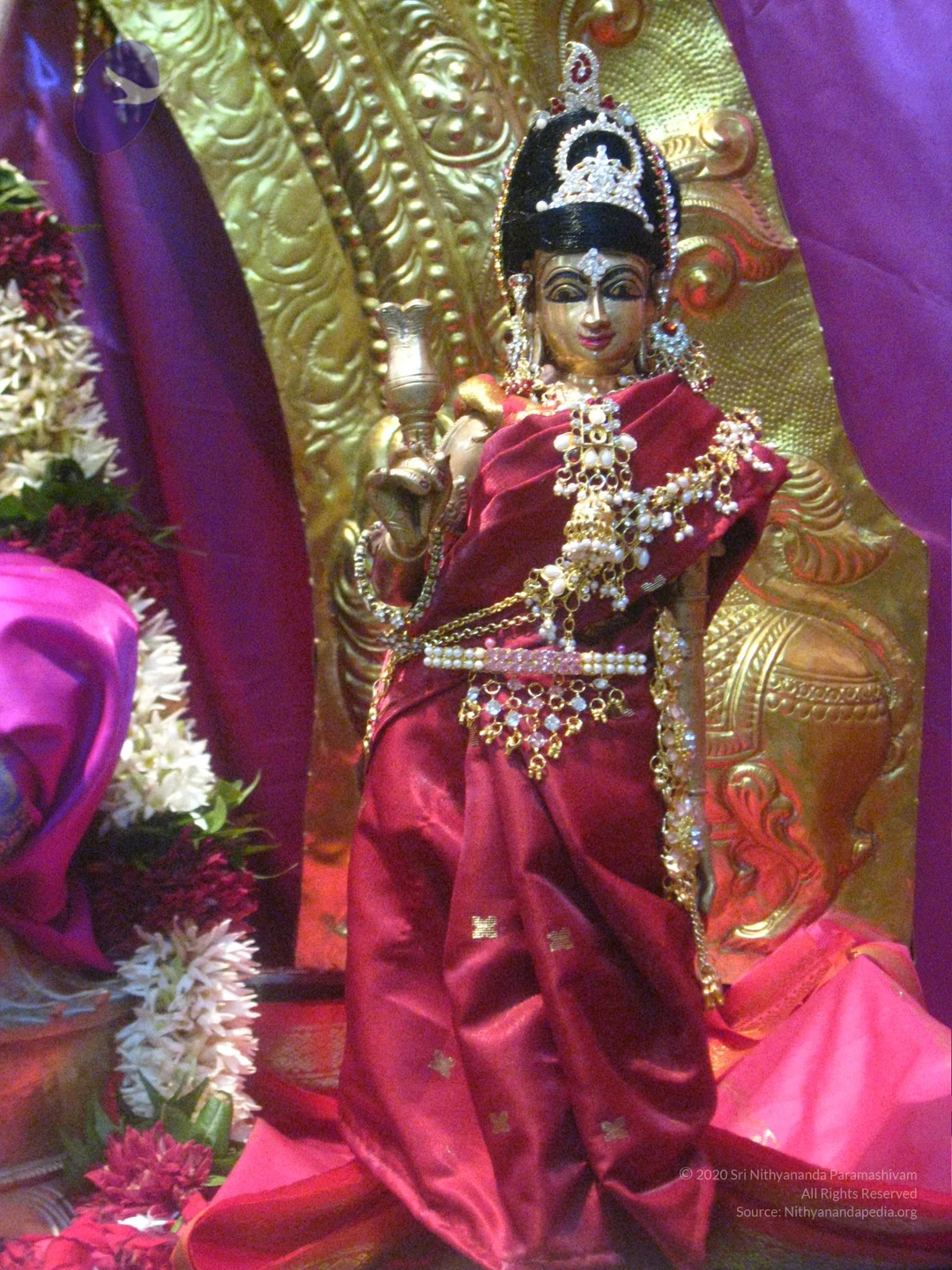
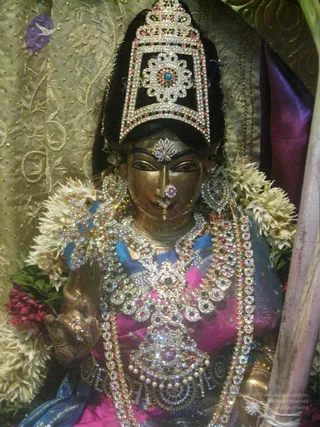
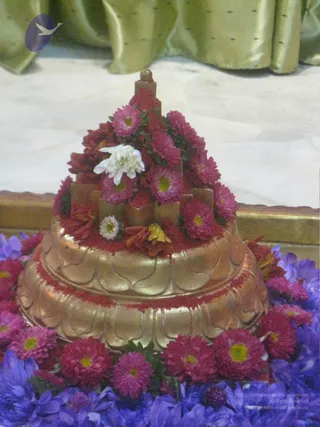
A seated deity murti. She holds a tall sugarcane stalk with green leaves in one hand and raises the other hand in a blessing gesture. White jasmine and red flower garlands surround the figure, and purple flowers lie at the base. A smaller standing murti in a red sari with gold jewellery stands to the left. Gold embossed backdrop and purple drapery frame the altar. No living people are visible.A golden-bodied deity murti seated on a decorated throne against a gold brocade backdrop, dressed in a magenta silk sari with blue and gold borders and a blue blouse. It wears an elaborate jewelled crown, layered gemstone necklaces, a jewelled waist belt and bangles, and holds a tall sugarcane stalk in one hand while the other hand is raised in a blessing gesture. Garlands of white jasmine and red flowers surround the figure, with marigolds visible at the top. No physical people are present and no a person candidate appears in the image.A covered front porch of a house with peach-coloured walls and a green corrugated roof. A hanging basket spills pink flowers from the centre, and dangling green leaf-and-ribbon strings hang from the eaves. A framed photograph of a bare-chested man with a red-and-white cloth draped over his shoulder hangs on the right wall, but the photo shows no readable name on it. A decorative red, blue and yellow textile panel hangs beside the doorway, and potted plants with flowers and palms sit along the floor. No people are visible.Close photograph of a potted plant with broad, glossy dark green oval leaves with pale yellow-green veins, growing from a terracotta pot filled with dark soil, set in a corner against a peach-coloured wall. A bright yellow-orange cloth hangs at the left edge. No people are visible. A purple and white bird logo appears at the top left.A metal deity murti of a female figure with a jewelled crown, dressed in a magenta and blue silk garment and heavily adorned with jewelled necklaces, earrings and a nose ring. She is decorated with white jasmine garlands and green leaves, and her right hand is raised in a blessing gesture holding a jewelled object. The background is embroidered gold fabric with a purple drape. The image is a photograph of a statue and no living people are visible.A photograph of a ceremonial brass or copper stand holding a tiered, lotus-petal-patterned base topped with a small stepped structure or kalasha-like form, decorated with pink and magenta chrysanthemums, a white flower, orange blooms and green leaves, dusted with red kumkum powder. Purple flowers fill the foreground and a gold-trimmed table surface with light green draped fabric sits behind. No people are visible. The arrangement suggests a flower-decorated ritual object or offering stand.

Navaratri-Alankar

7 photosSource gallery
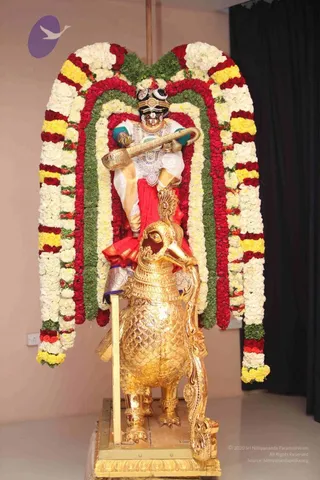
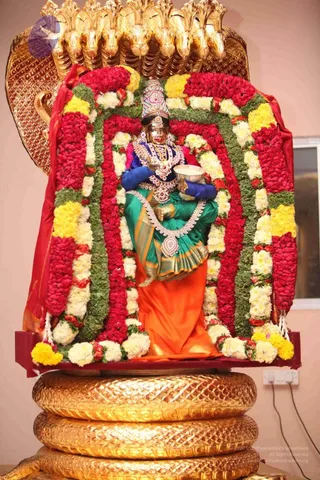
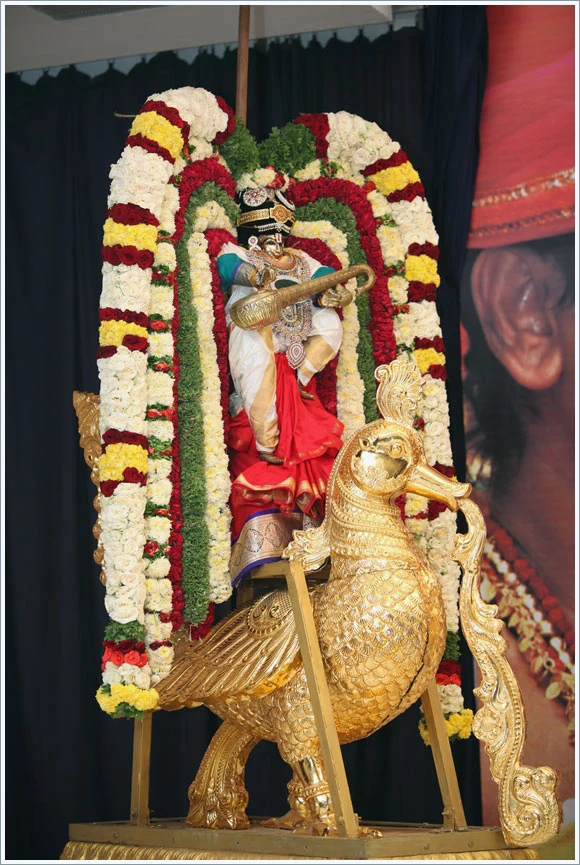
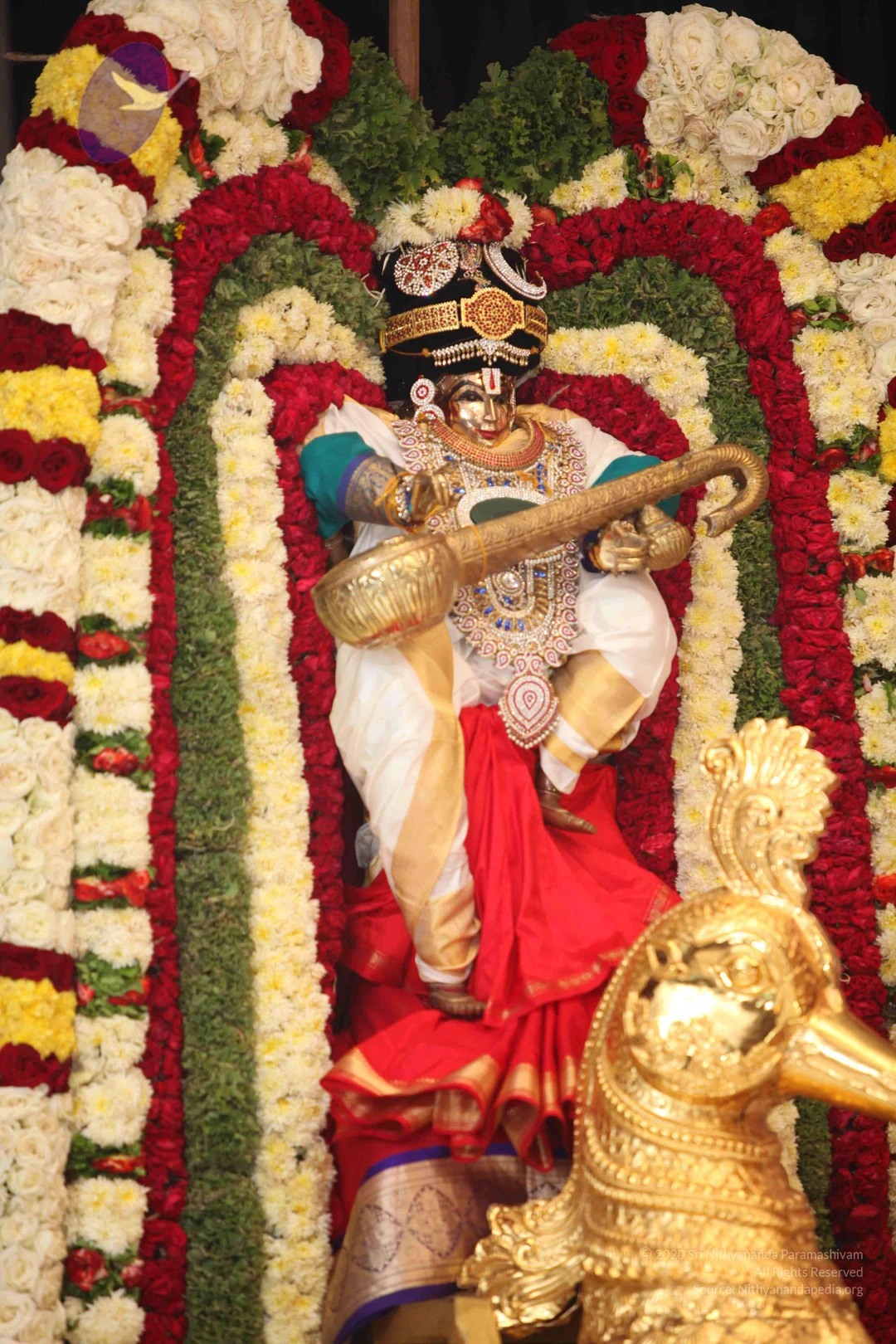
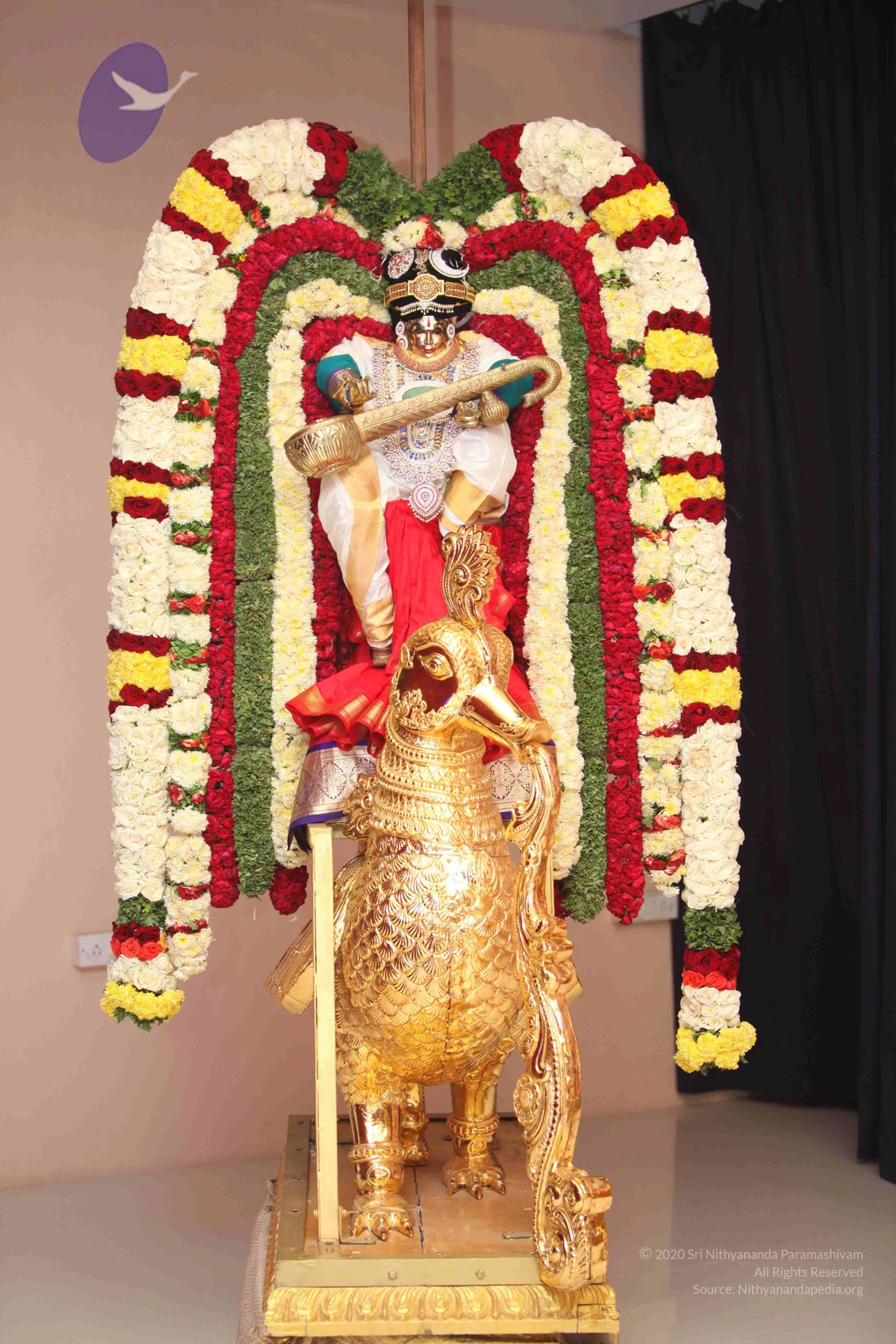
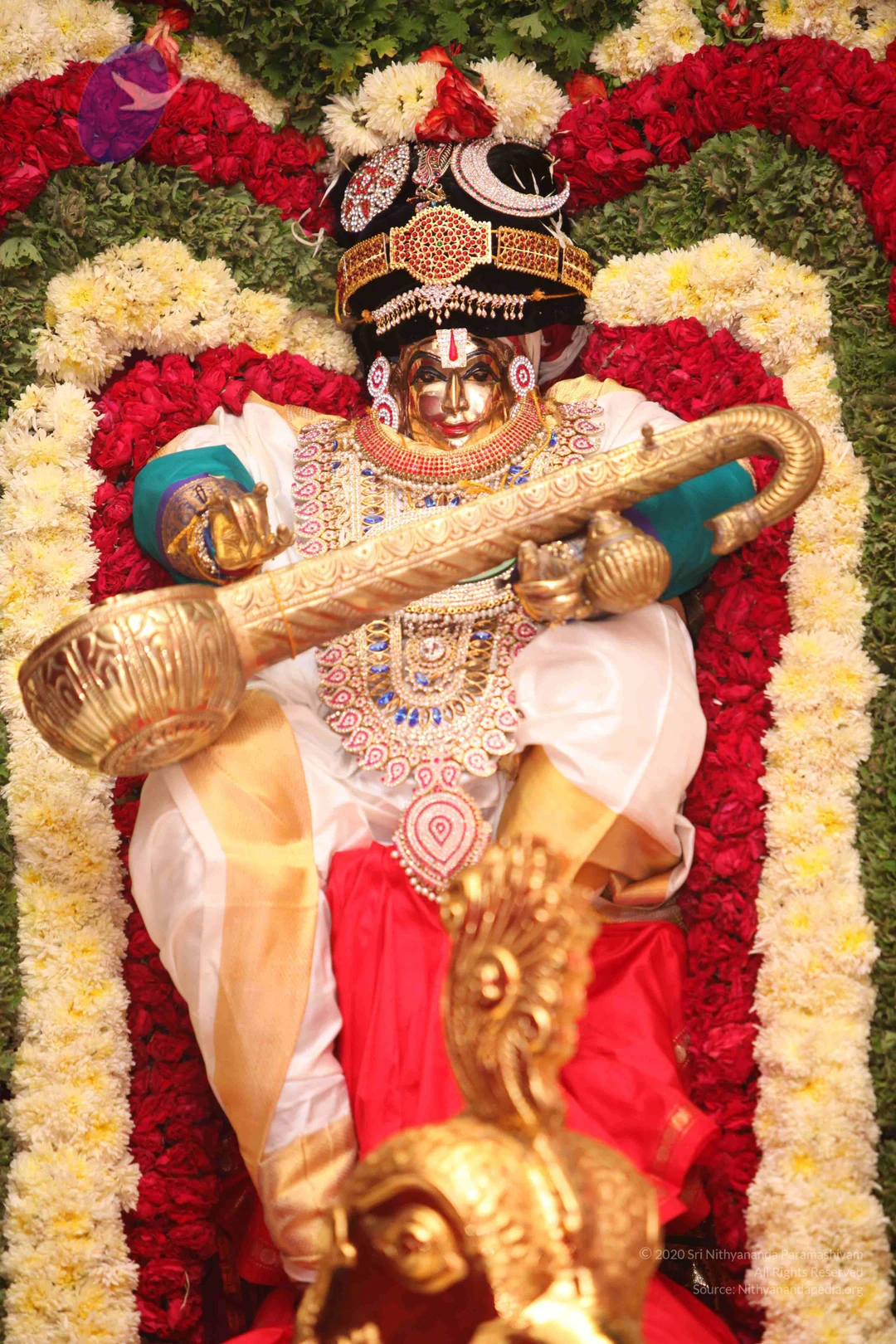
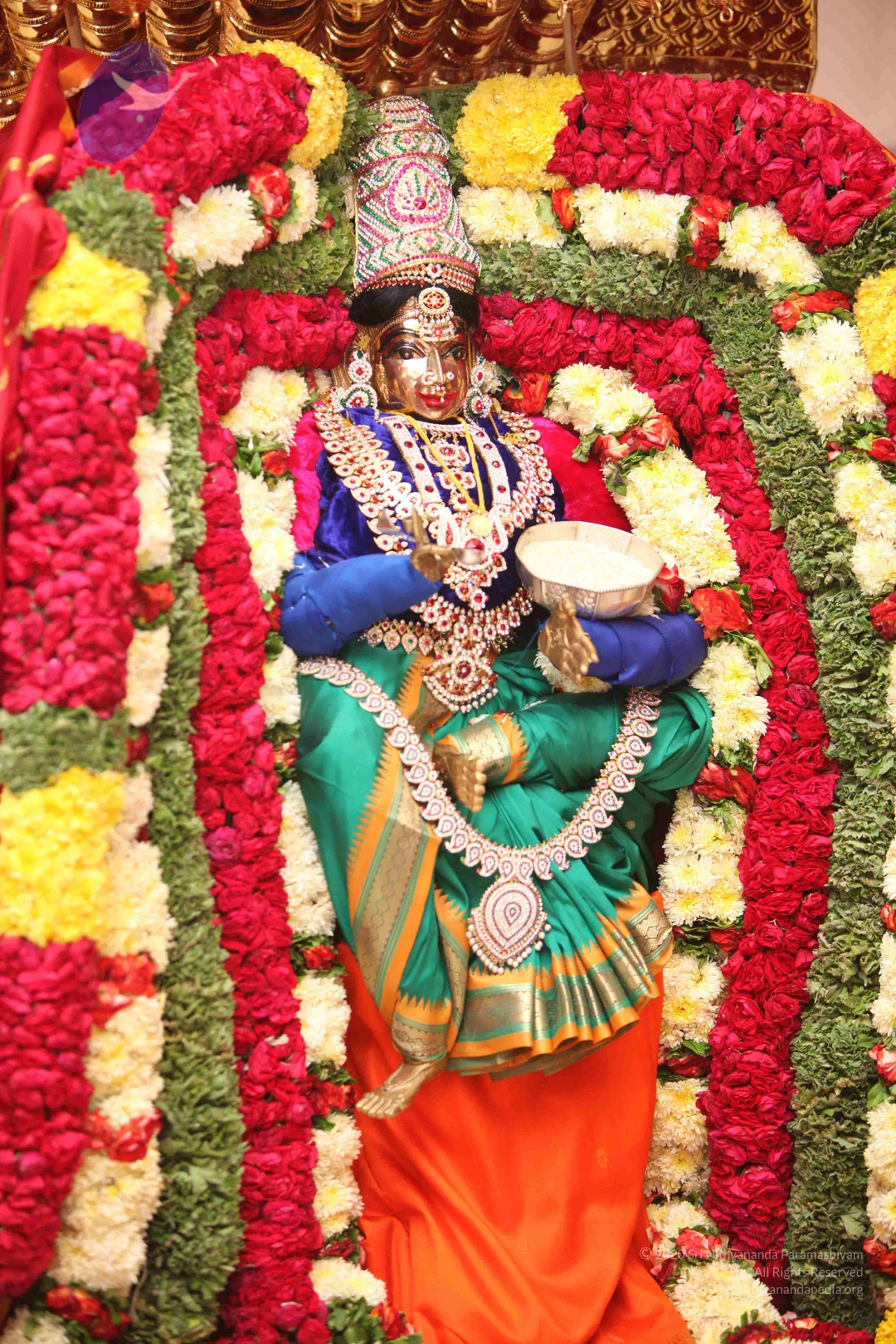
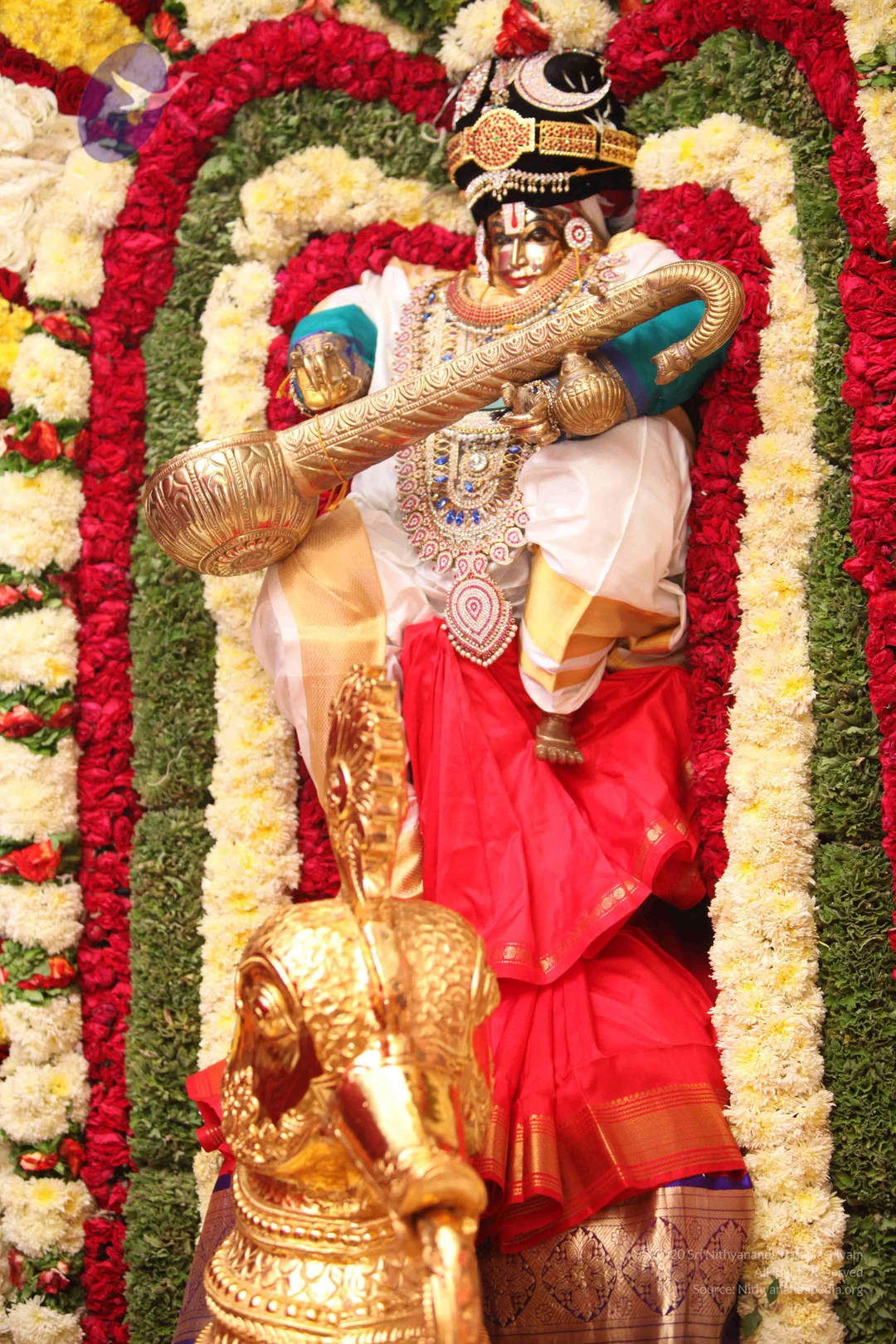
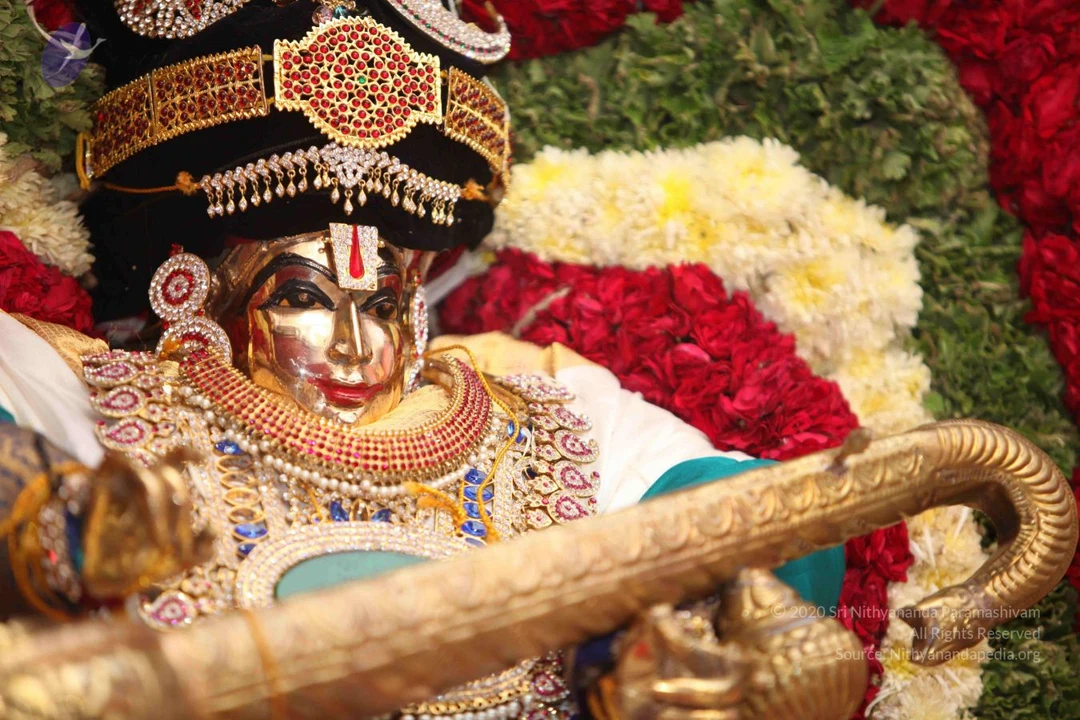
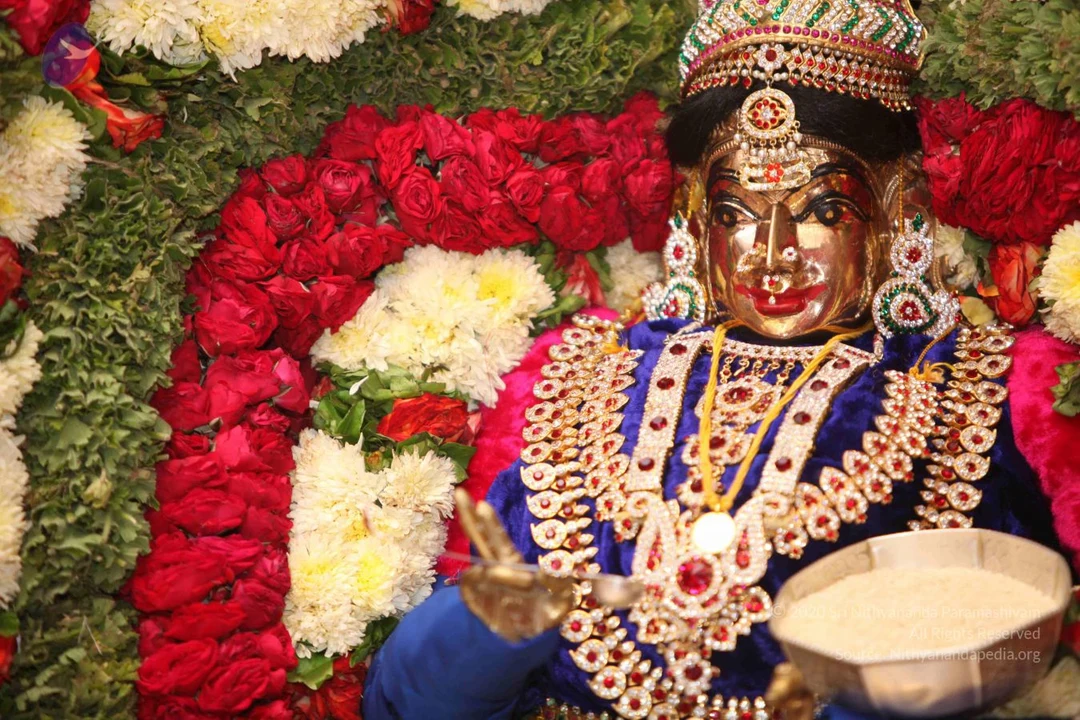
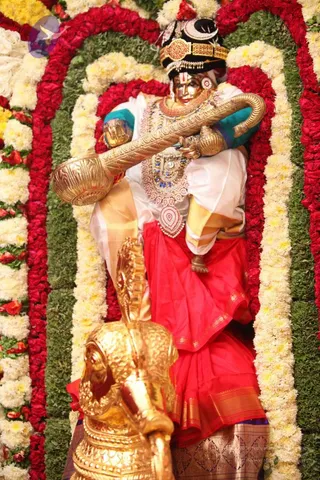
A photograph of a deity murti of Saraswati-style form seated on a golden swan vahana (hamsa) in front of an arched backdrop of white, red, yellow and green garlands. The figure wears a red and white sari with gold borders, a jewelled necklace, a crown-like headdress and gold armlets, and holds a golden veena across the body. The golden swan has ornate feather detailing and stands on a wooden base. Only the murti is present; no physical people are visible.A decorated deity murti stands on a golden coiled serpent base beneath a golden multi-headed cobra hood. The figure wears a tall ornate crown, a blue blouse, a green and gold sari with an orange lower cloth, and heavy silver-toned necklaces. It holds a silver bowl in one hand. The figure is framed by arches of red roses, green leaves, white jasmine and yellow marigold garlands on a red platform. No people are visible.A golden deity murti of Saraswati seated amid dense borders of red rose petals and white chrysanthemum garlands. The murti wears an ornate gold crown with red and white stones and a crescent, a red-stoned necklace, and a jewelled chest piece with pink and blue stones. It plays a long golden veena held across its body and wears white blouse and red and gold draped garments. A golden peacock-shaped element is in the lower foreground. No physical people are visible.A decorated deity murti of a goddess seated within a dense frame of red rose petal garlands, white and yellow marigold strings and green leaves. The figure wears an ornate jeweled crown, a blue velvet blouse, a teal and orange silk sari with gold border, and layered gold and red-stone necklaces. She holds a silver bowl of white rice or grain in one hand and raises the other hand in a gesture. No physical people are visible; the statue is the sole subject, set against gold draped backdrop.A decorated deity murti of a figure playing a long golden veena, framed by arches of red and white flowers and green foliage. The murti wears a black and gold crown with red stones, a white garment with a red skirt and gold border, layered red and gold necklaces, and a pink pendant with pearl and blue stone work. A golden peacock-headed or animal-form ornament stands in the foreground.Close view of a gilded deity murti. The face has golden skin, red lips, a red tilak and a red and white vertical mark on the forehead. It wears a red and gold choker, layered pearl and gemstone necklaces, and large jewelled earrings. Garlands of red roses and white and yellow marigolds surround it, and a gold ceremonial staff curves across the lower frame. Teal cloth shows at the bottom. No people are visible.