Skip to content
Wednesday

28 September 2016

Experience Sadashiva, Manifest Powers with Integrity

Dated photos
242
Source pages
1
Media
3
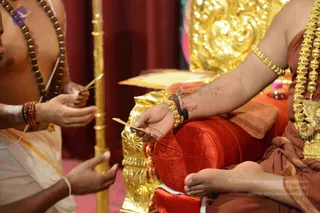
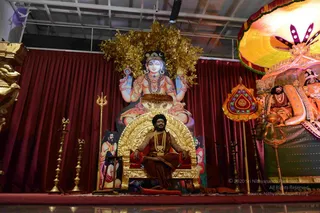
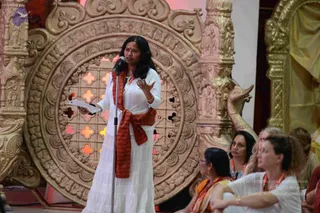
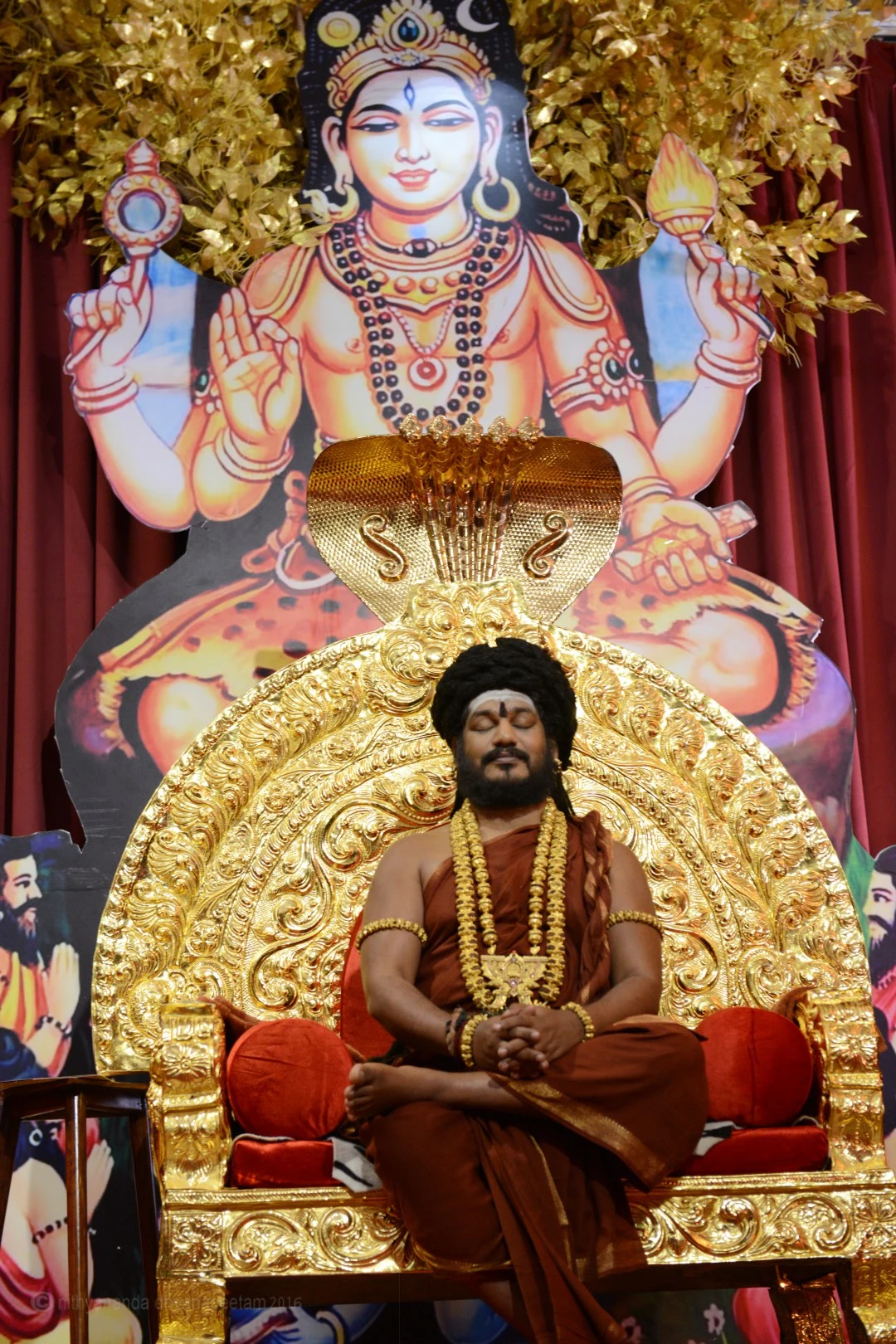
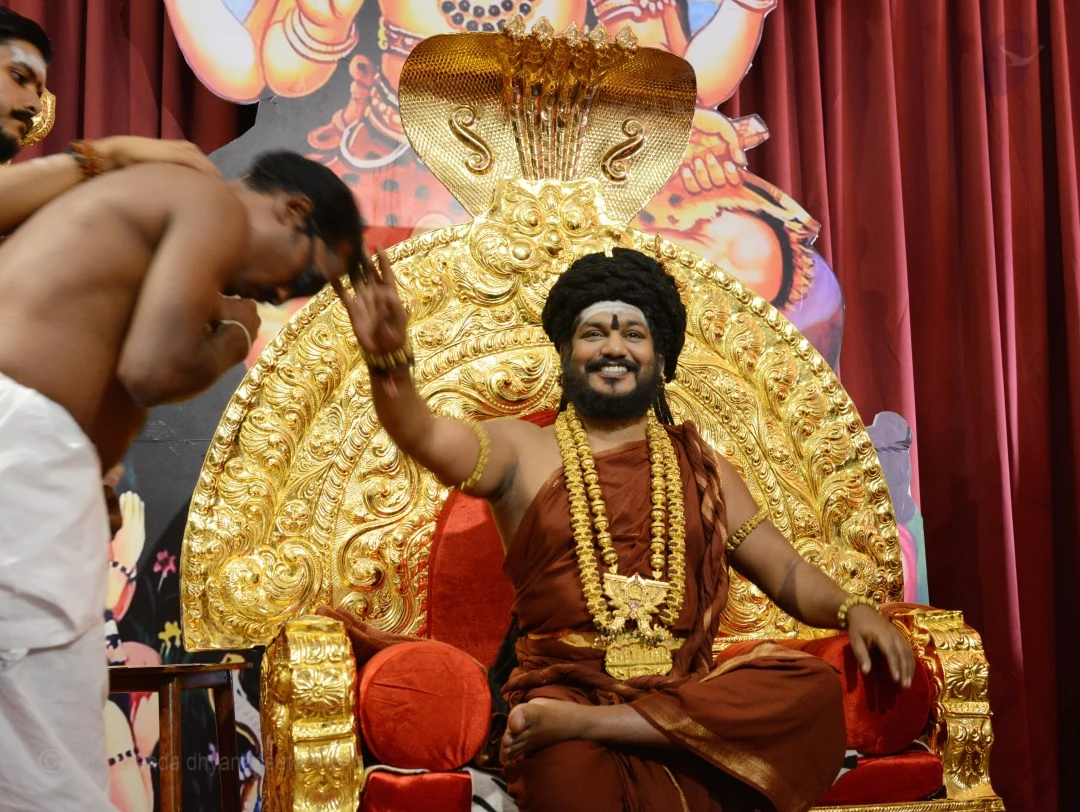
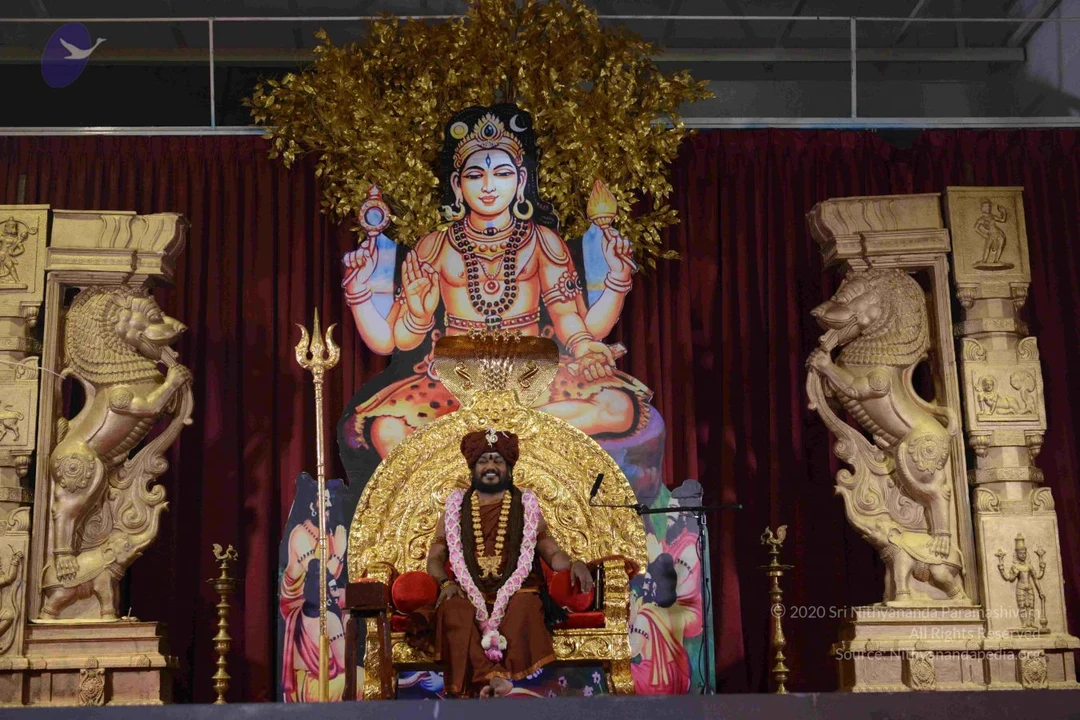
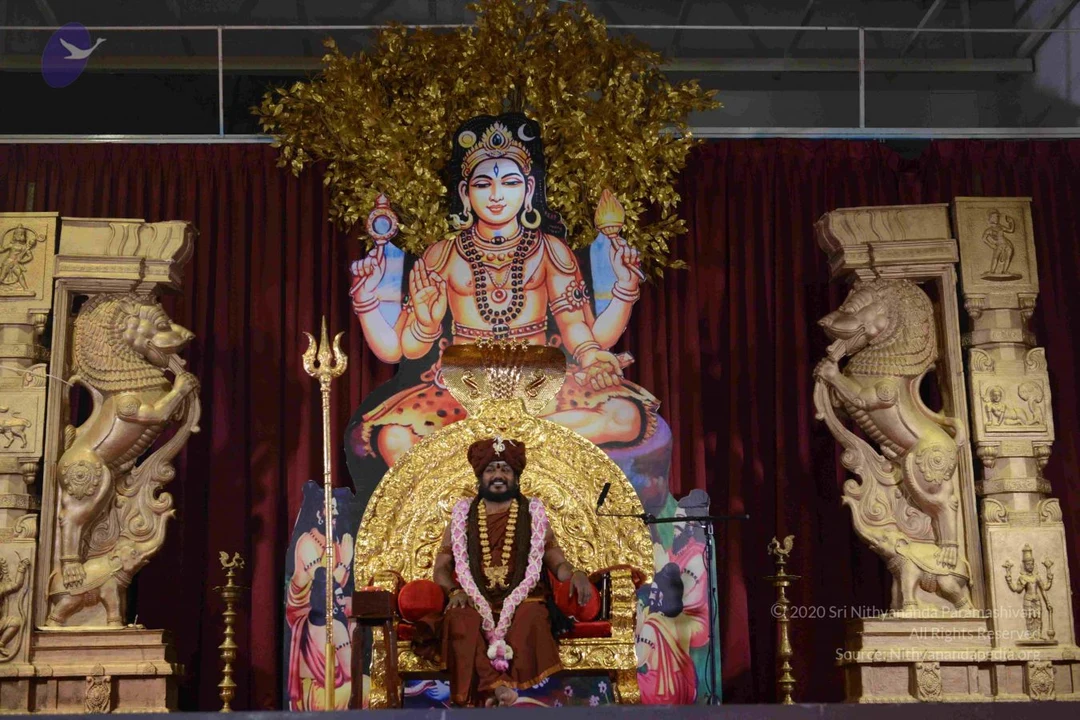
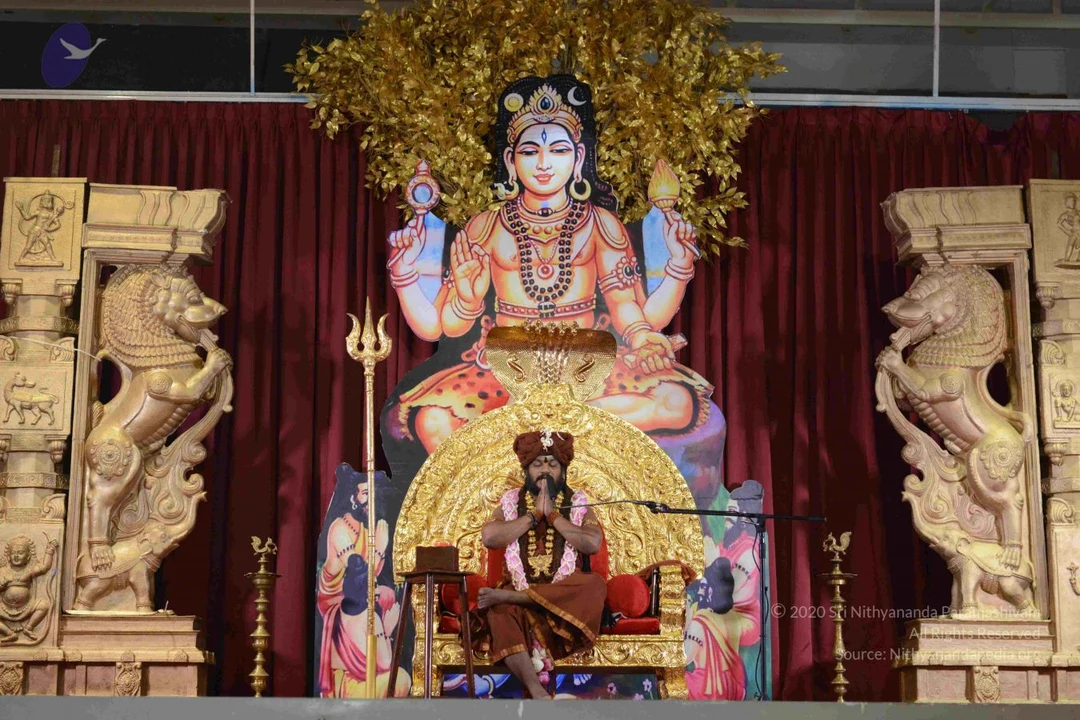
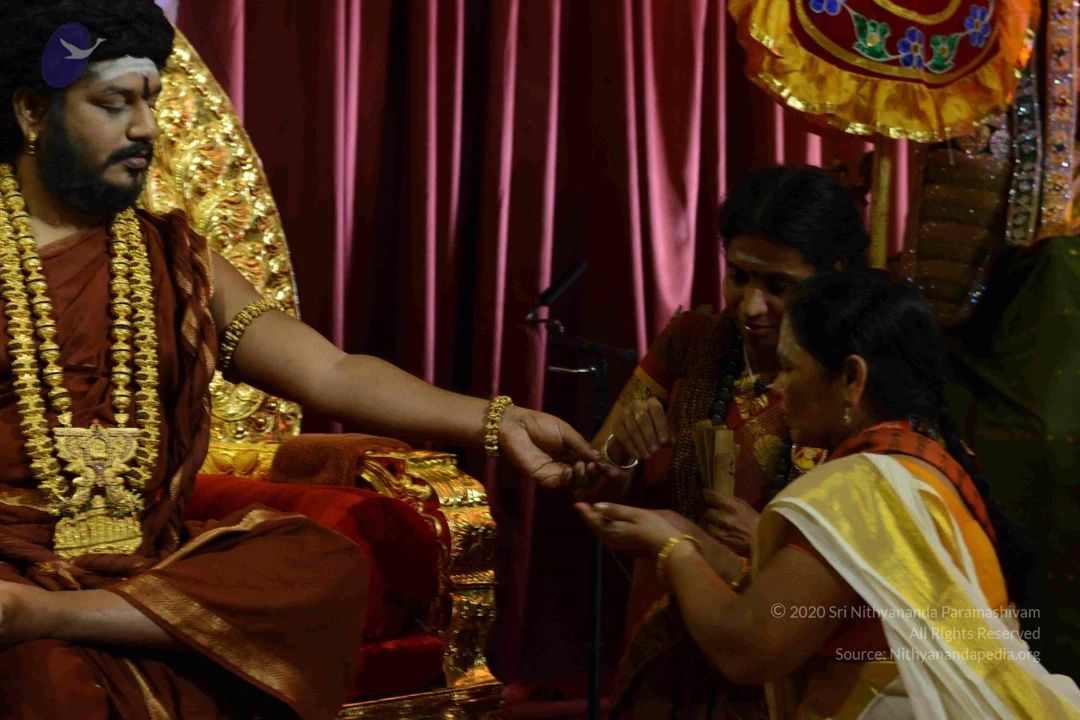
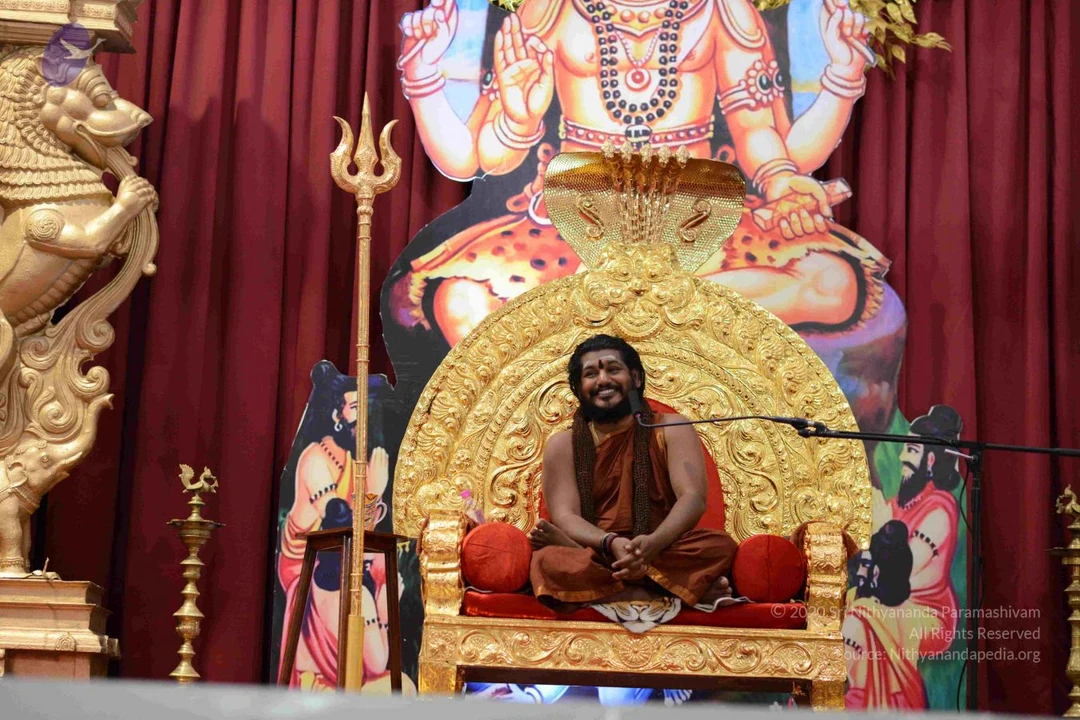
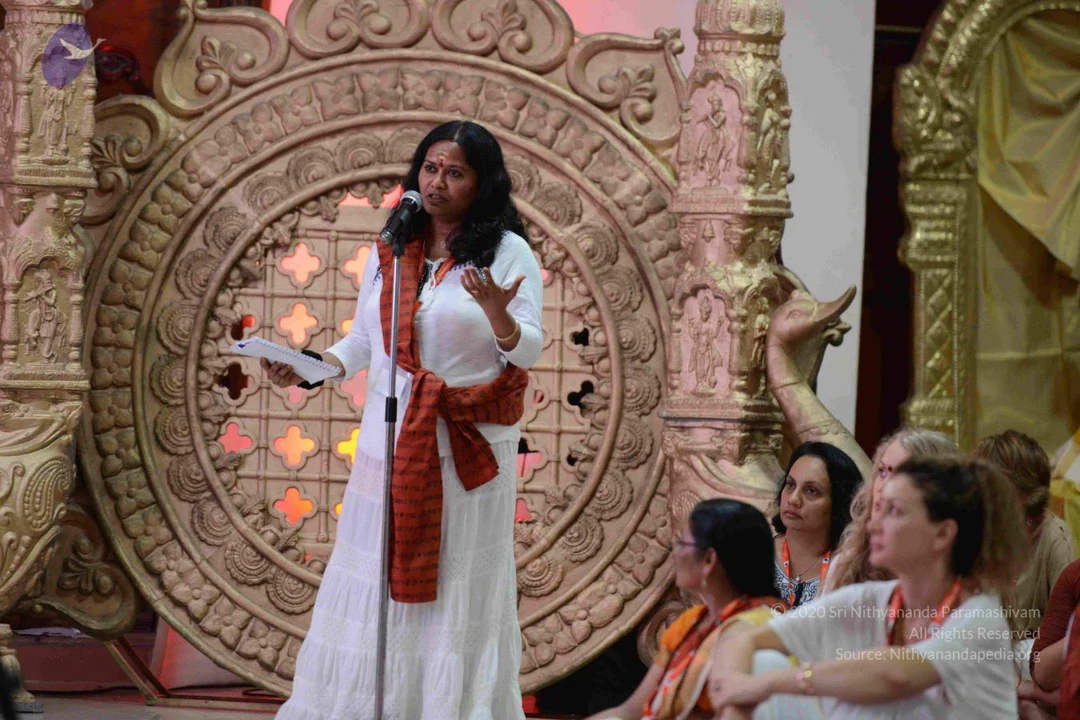
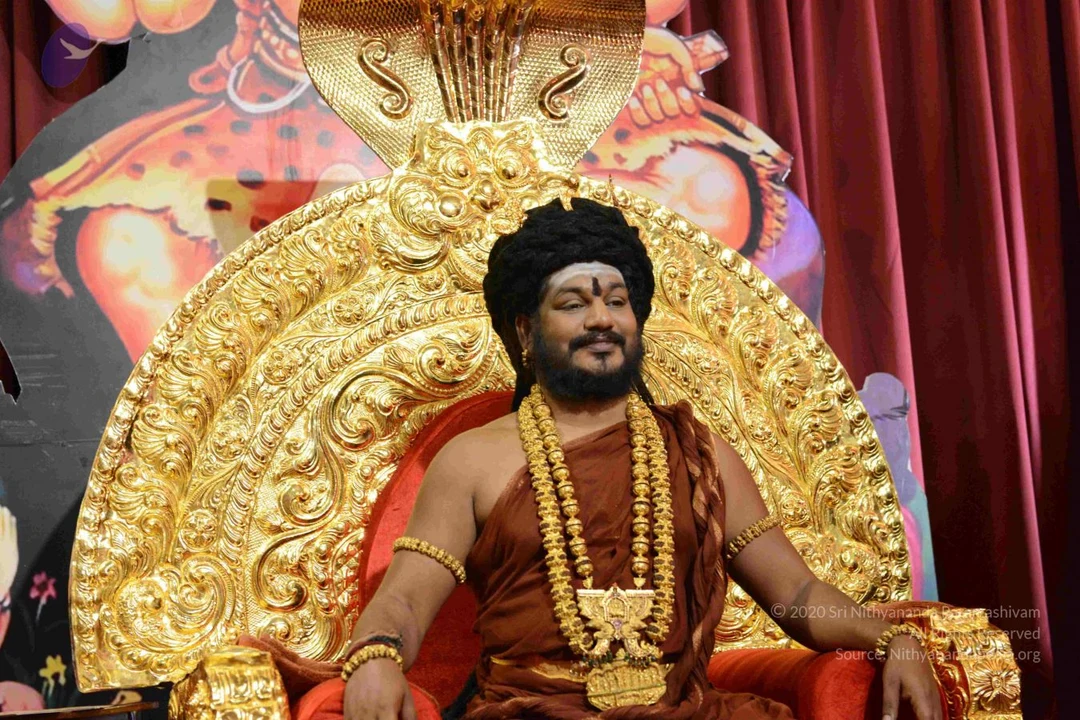
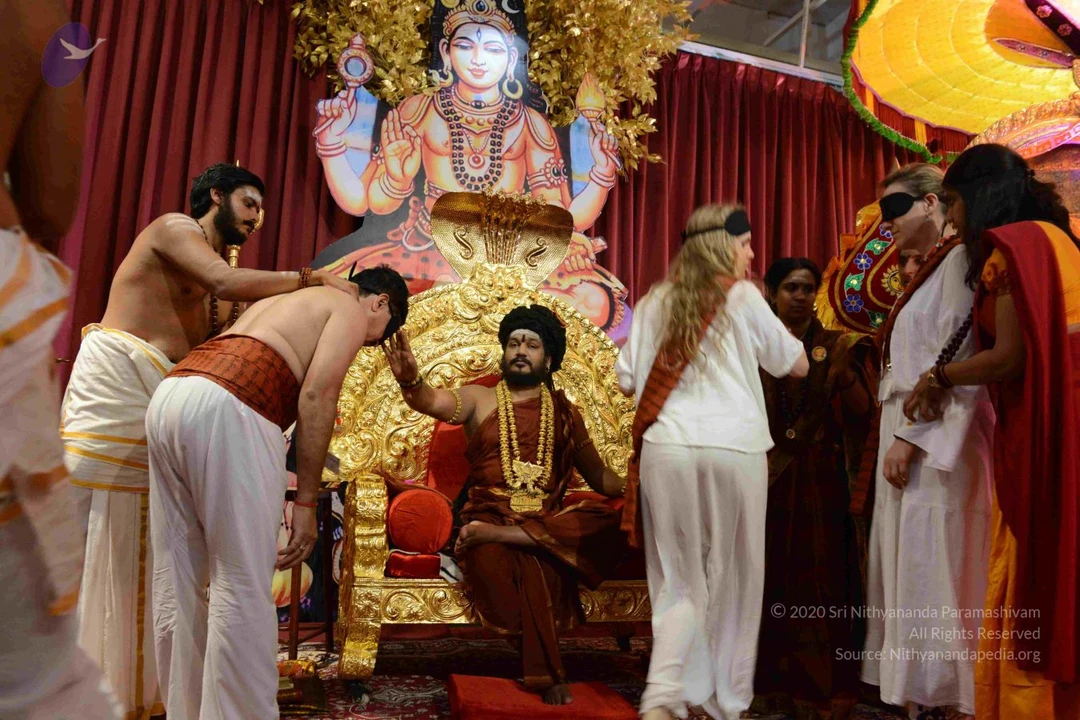
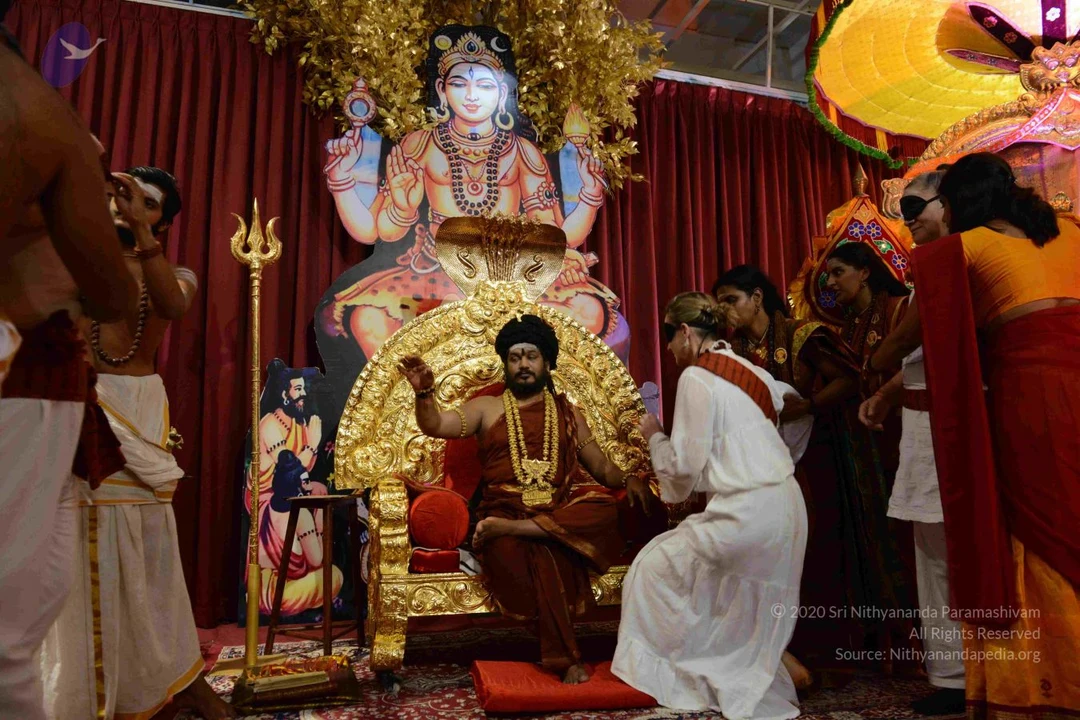
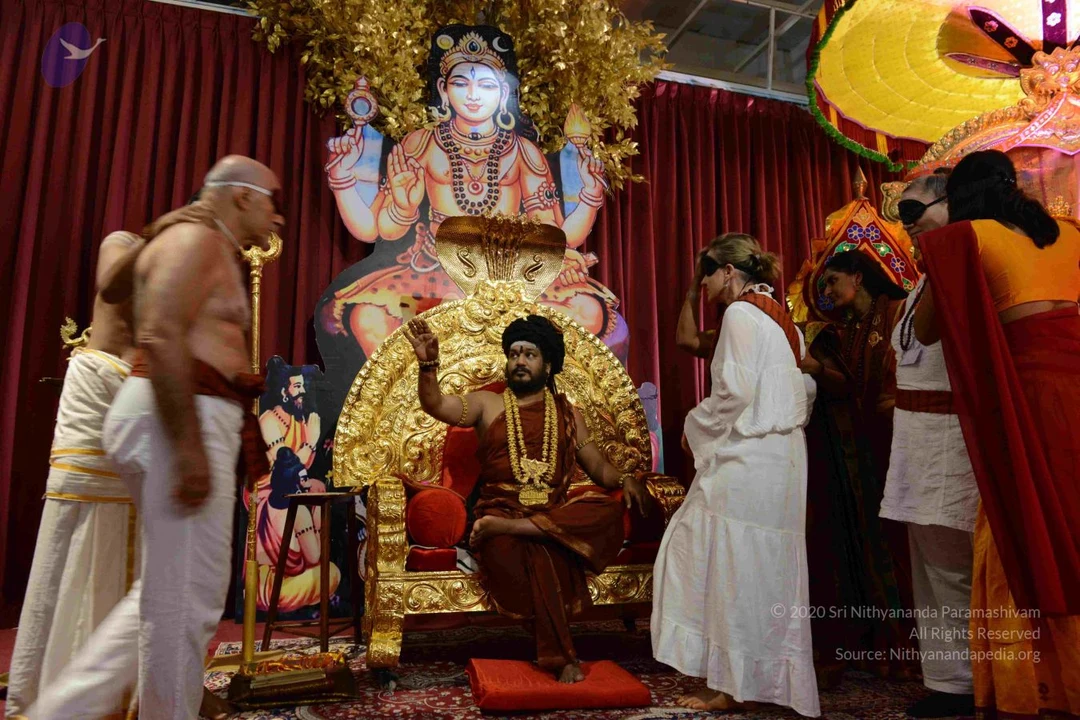
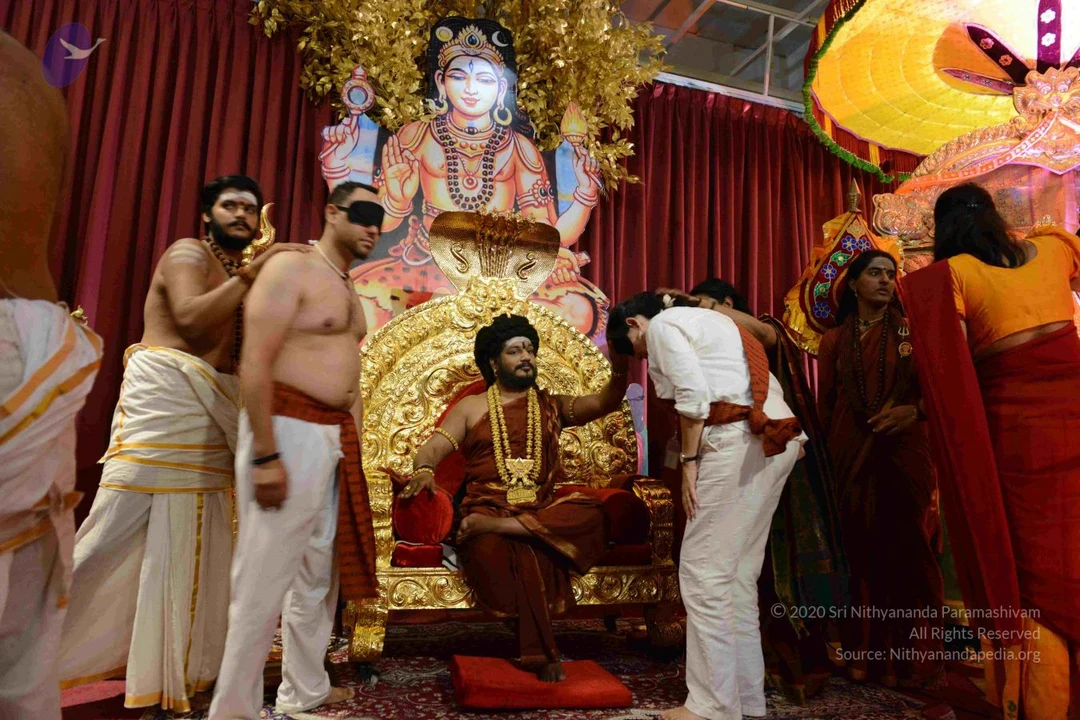
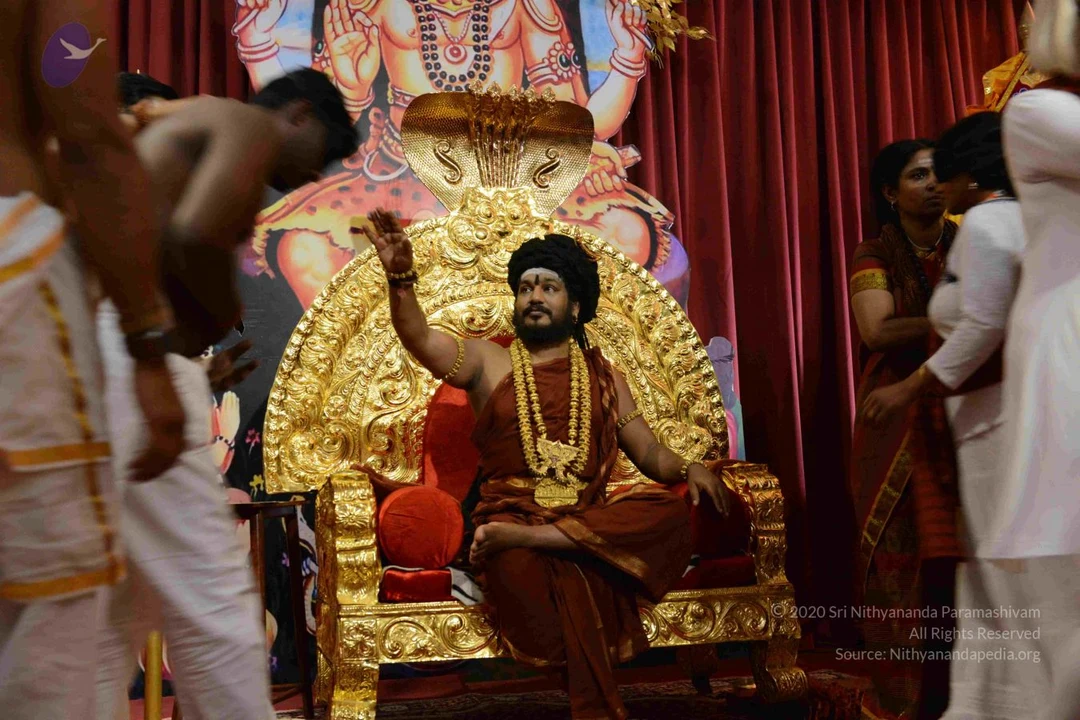
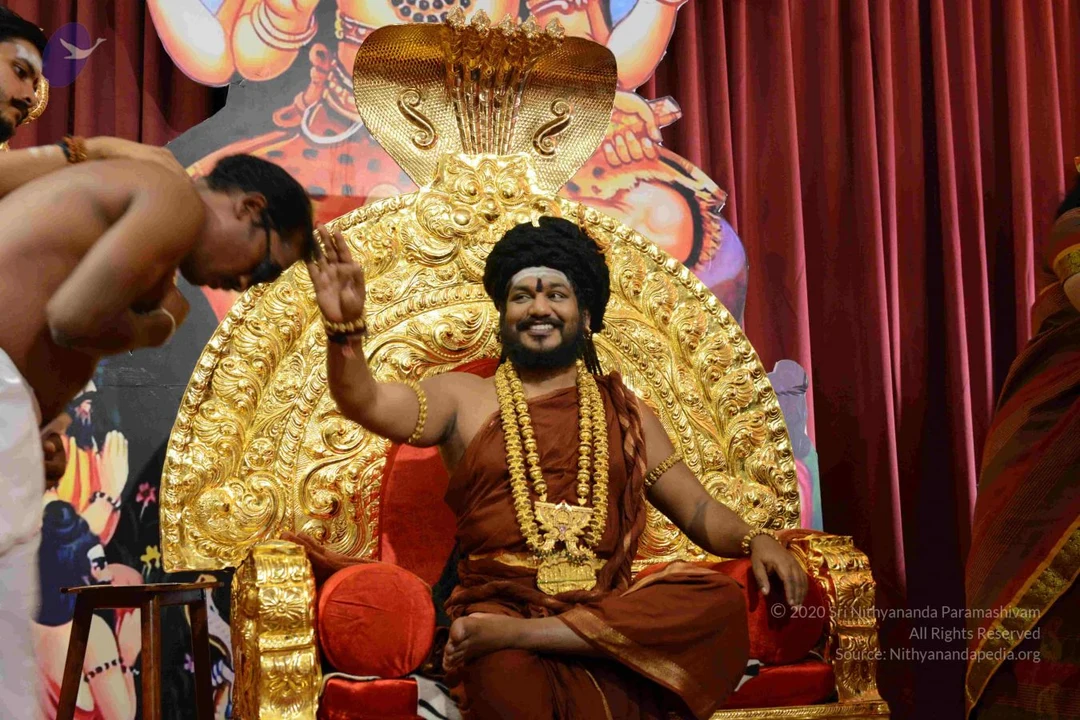
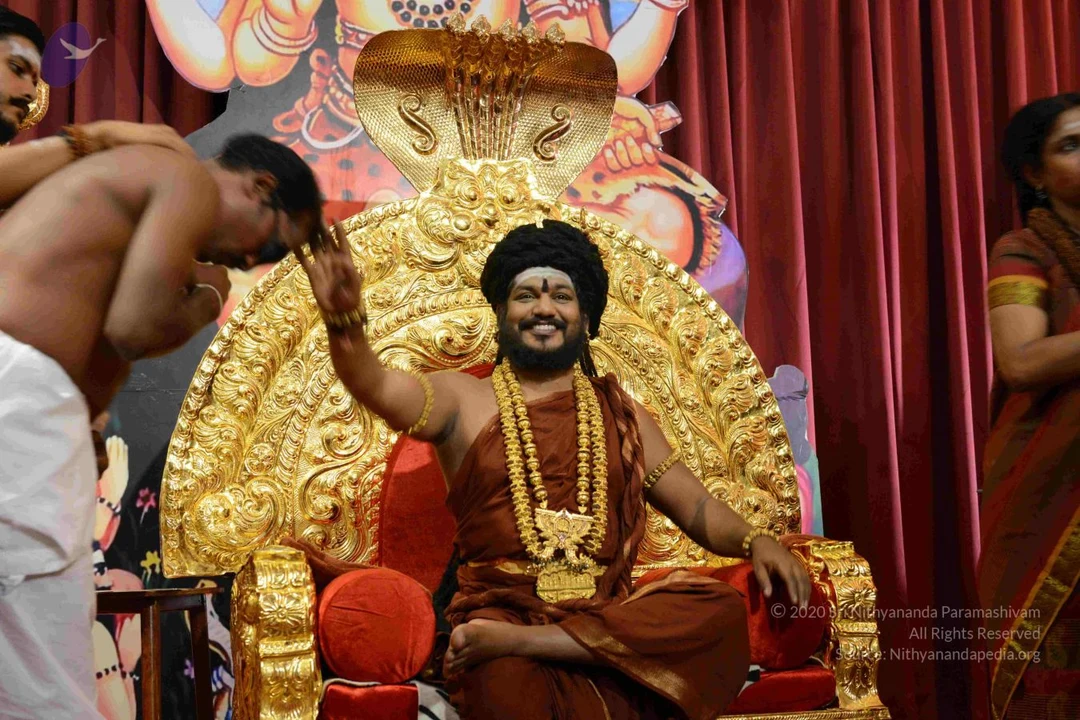
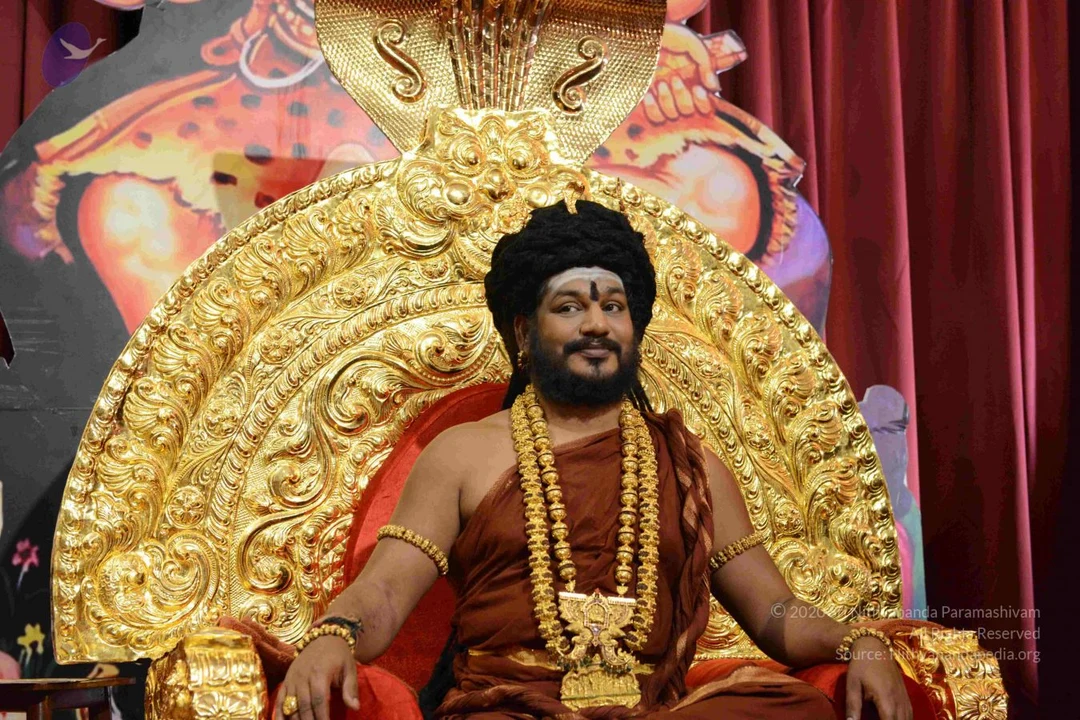
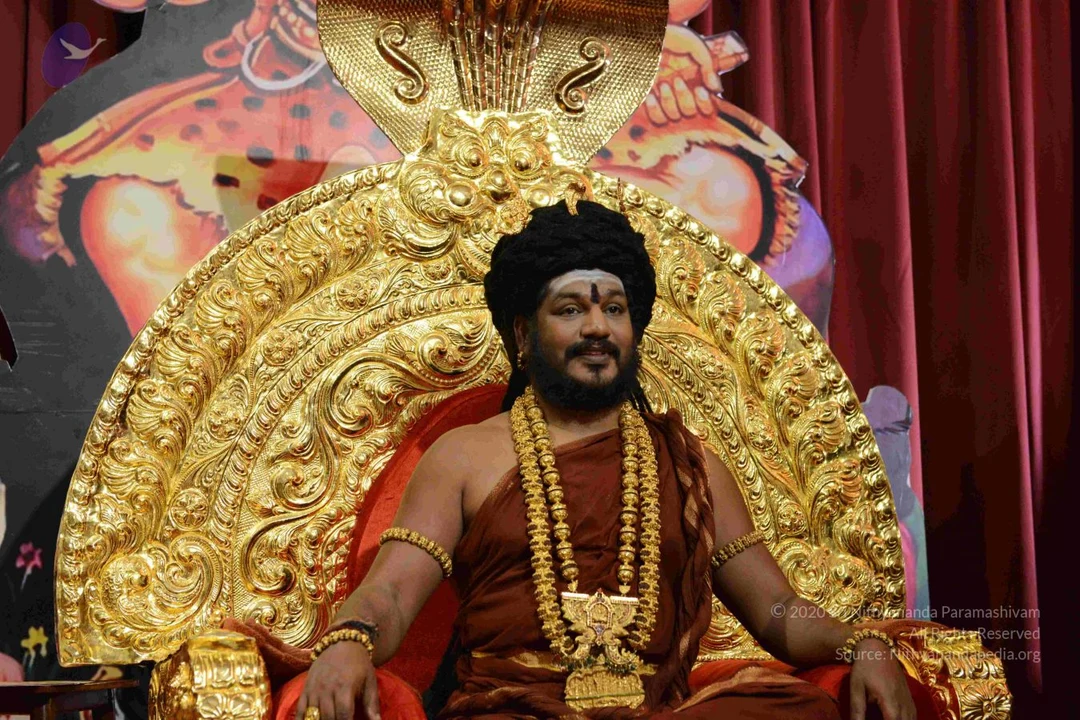
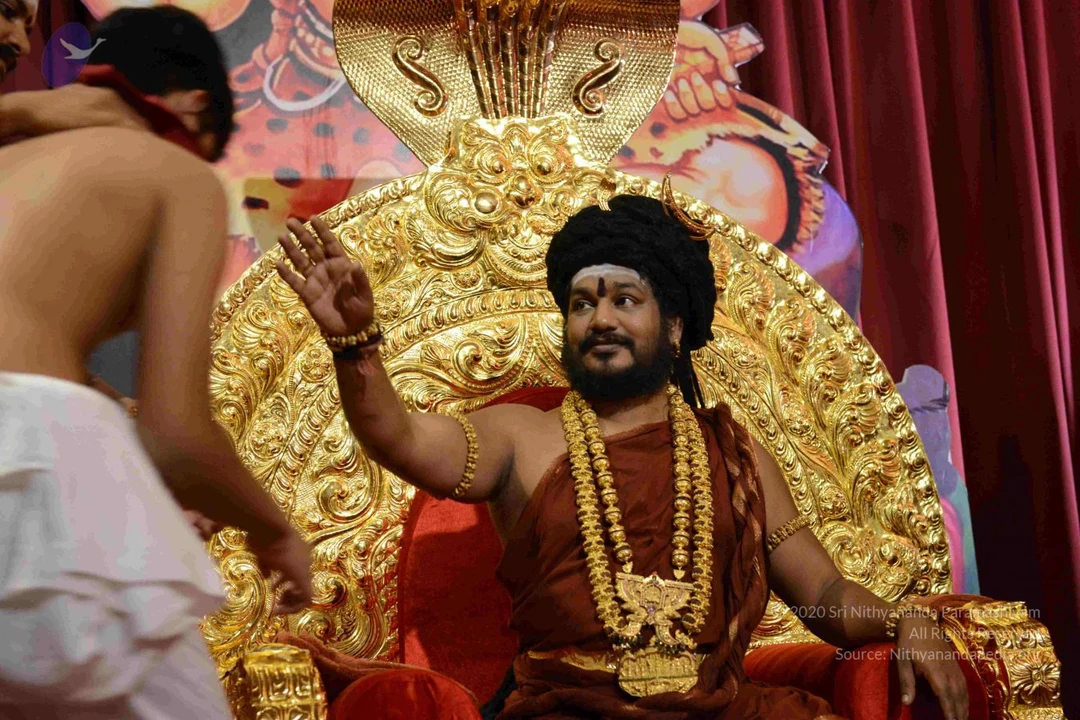
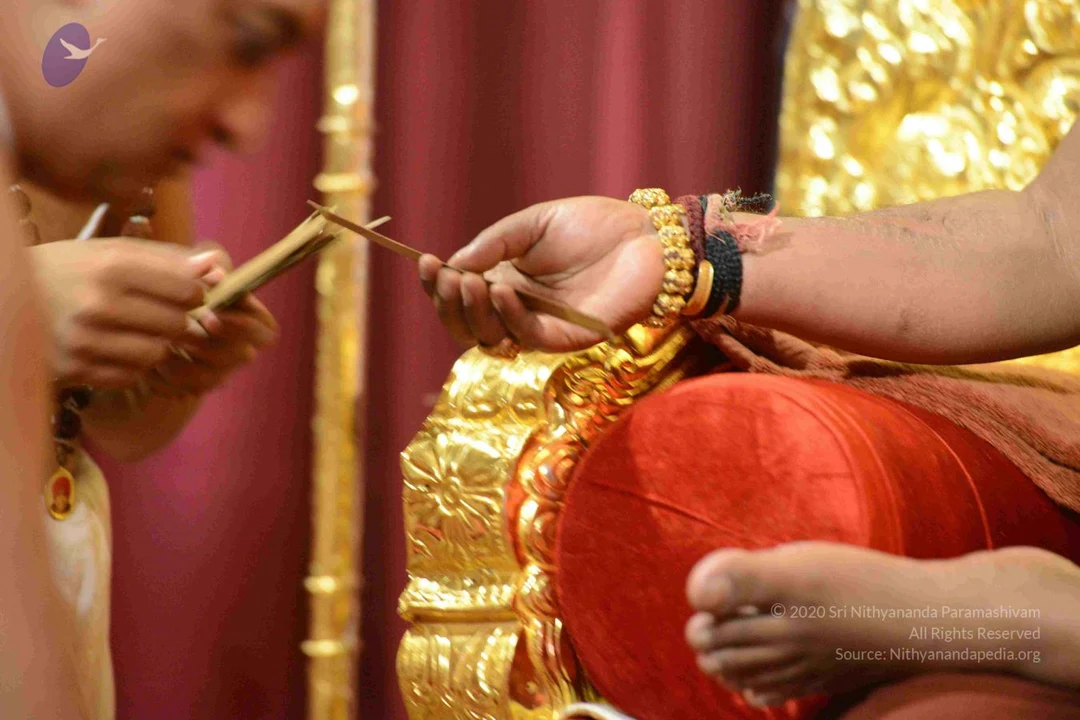
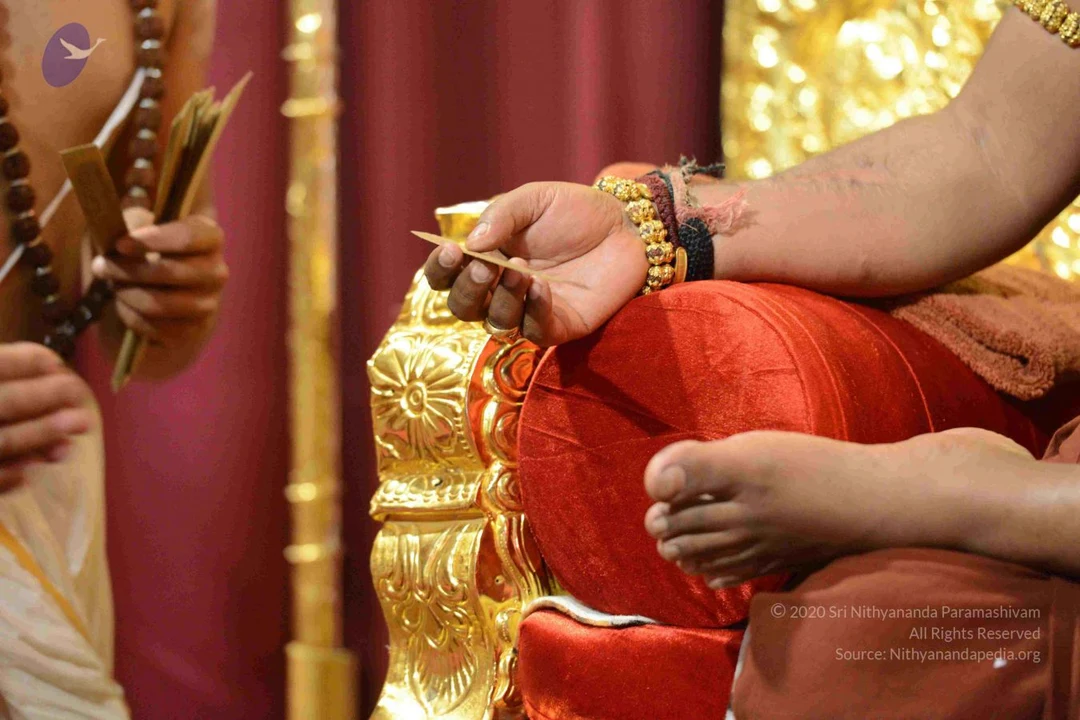
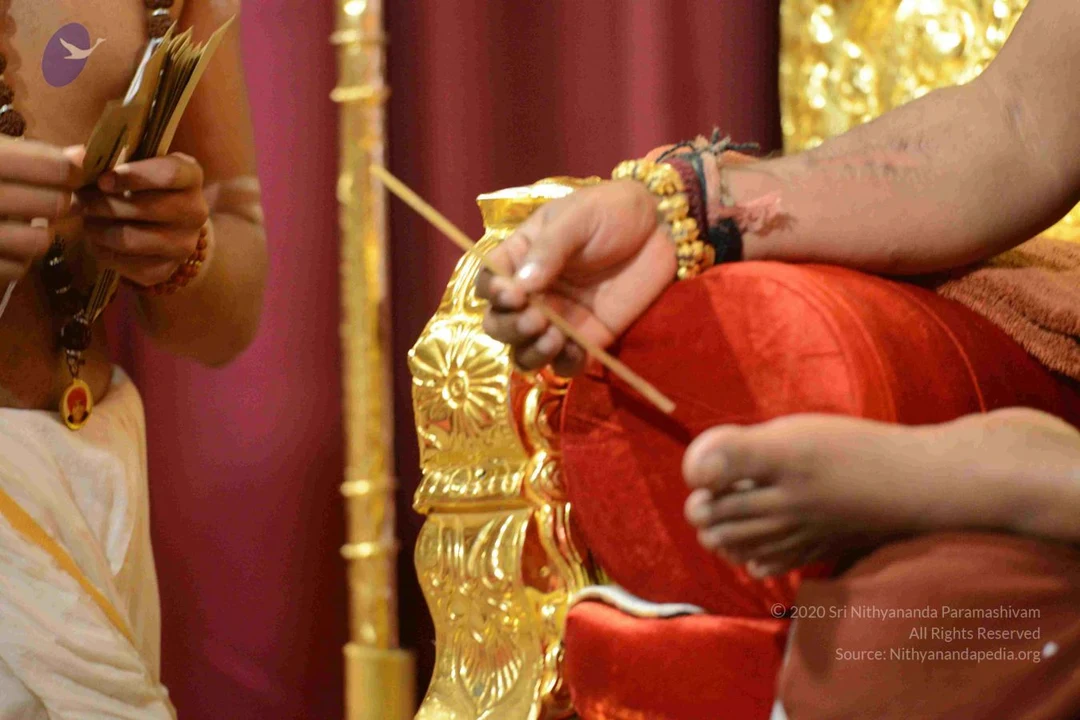
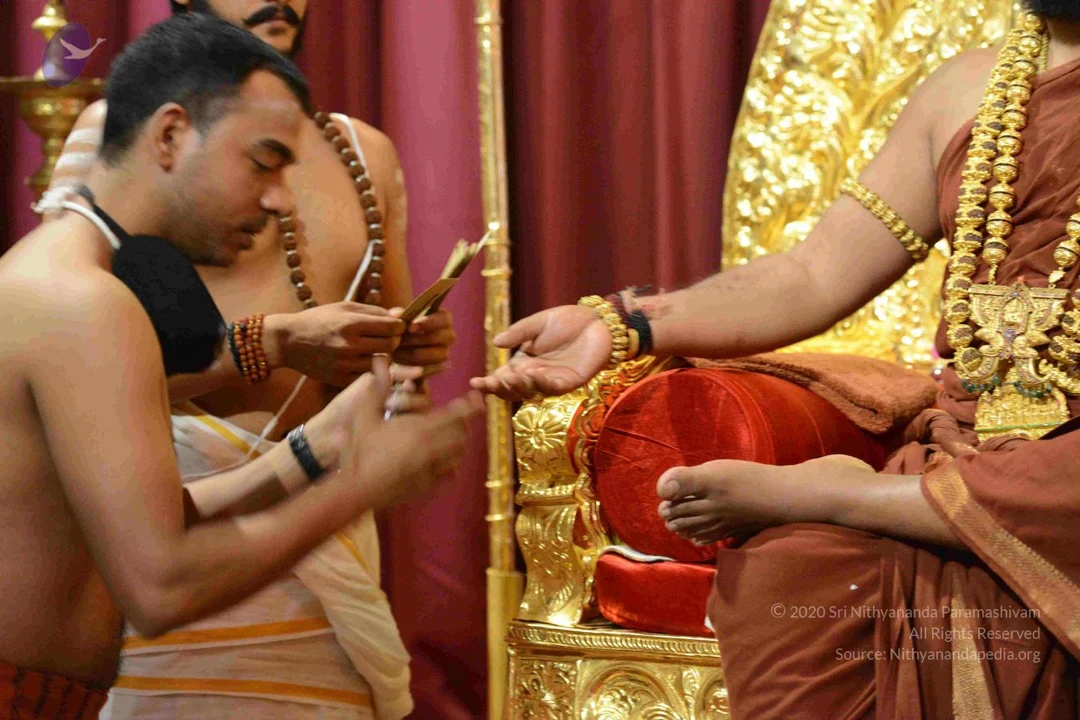
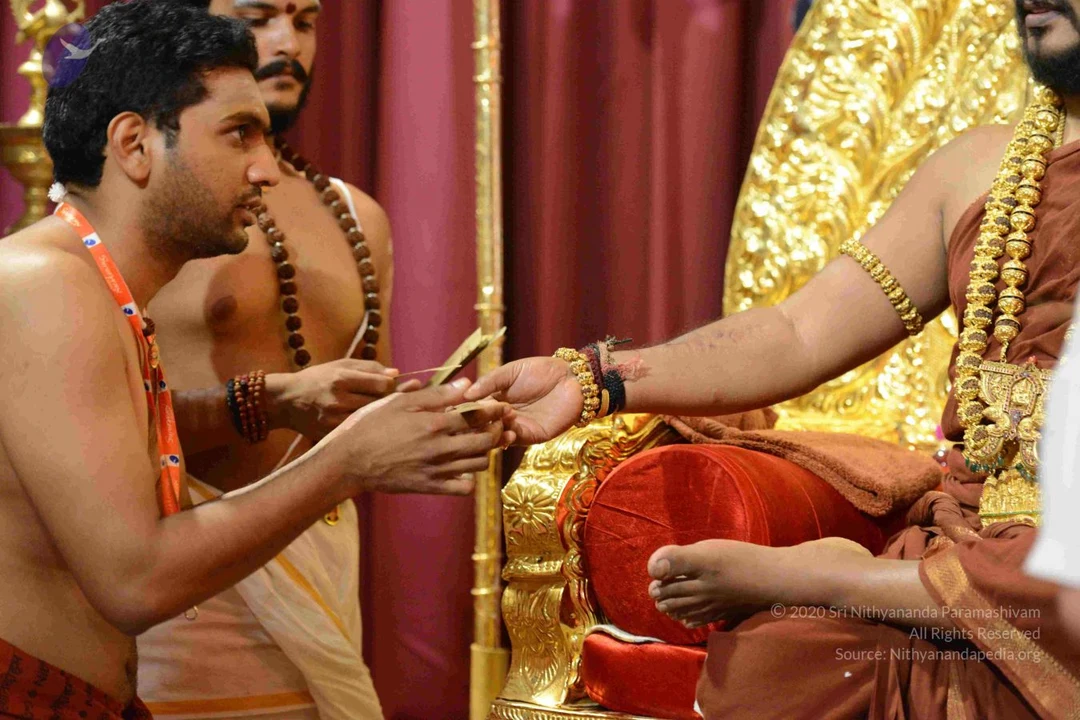
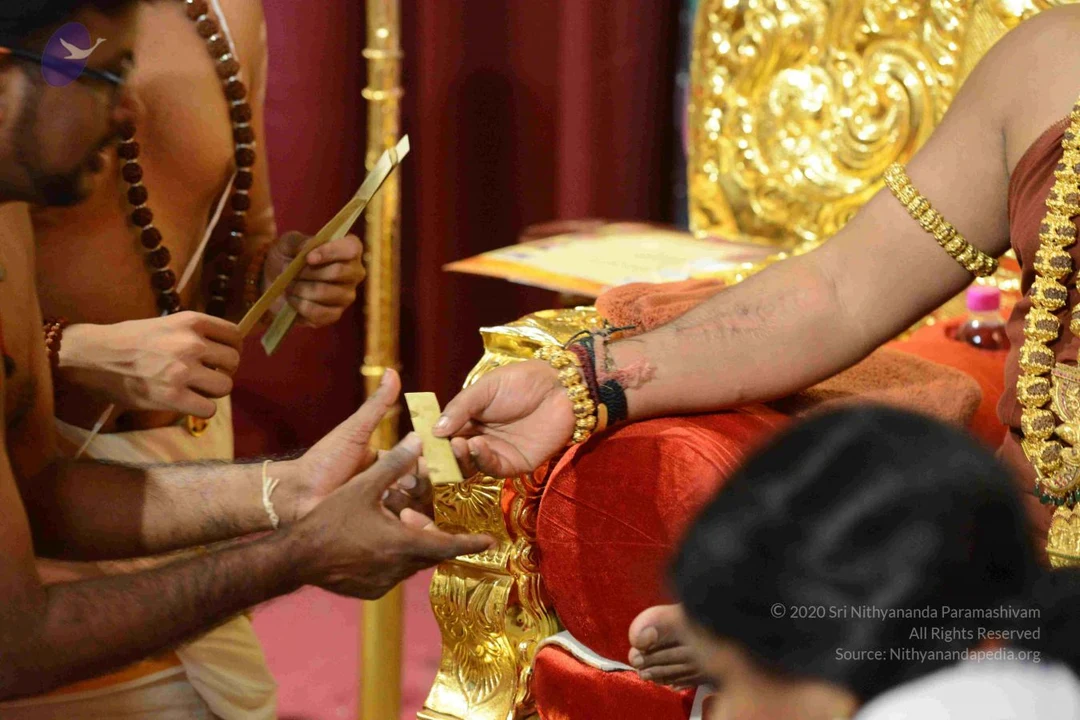
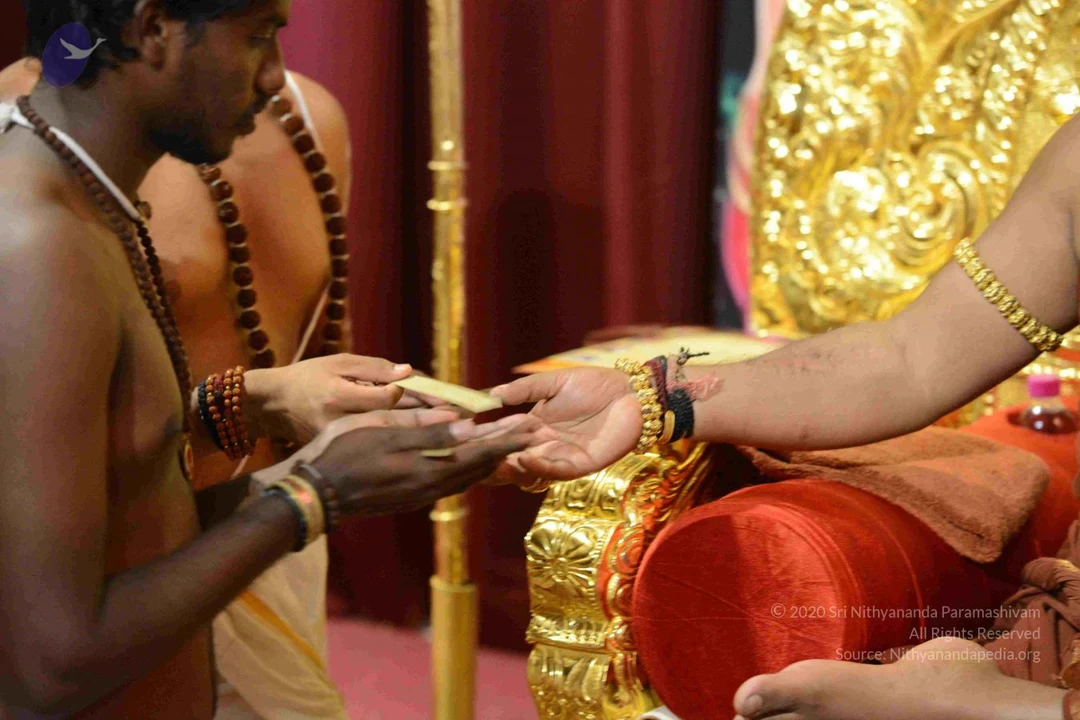
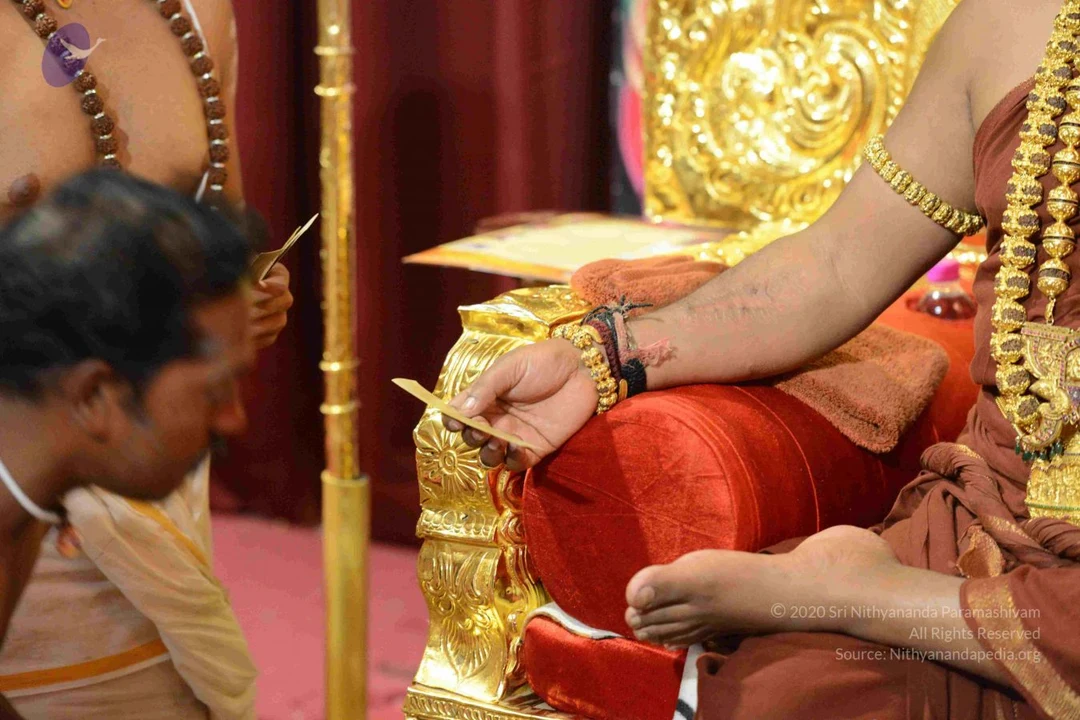
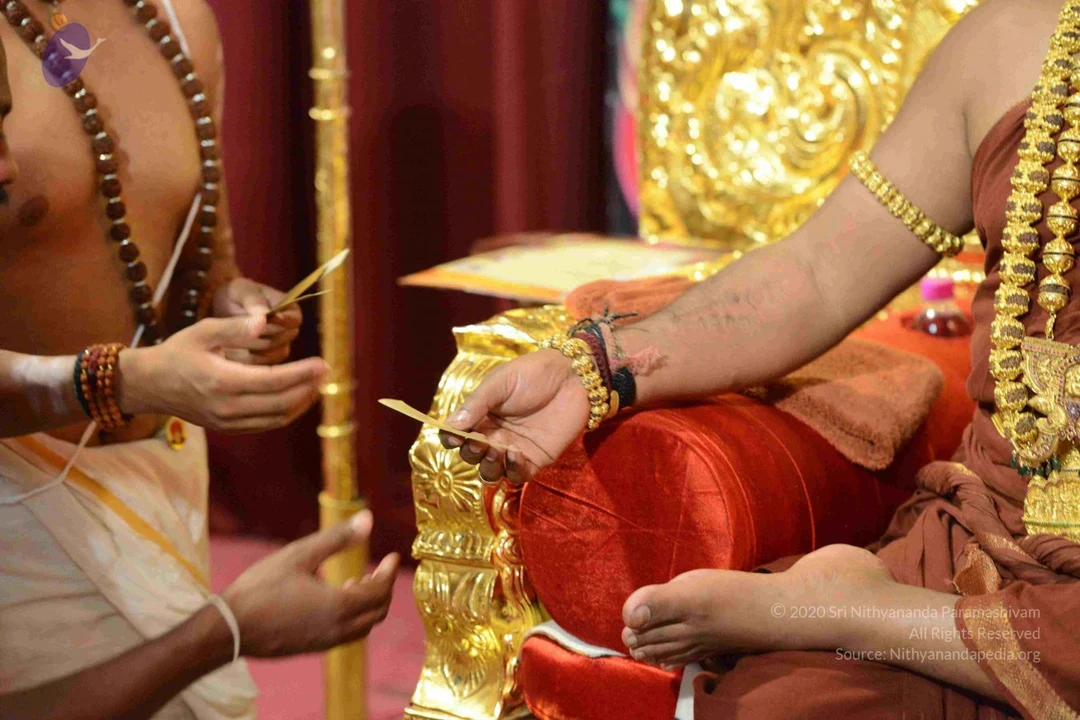
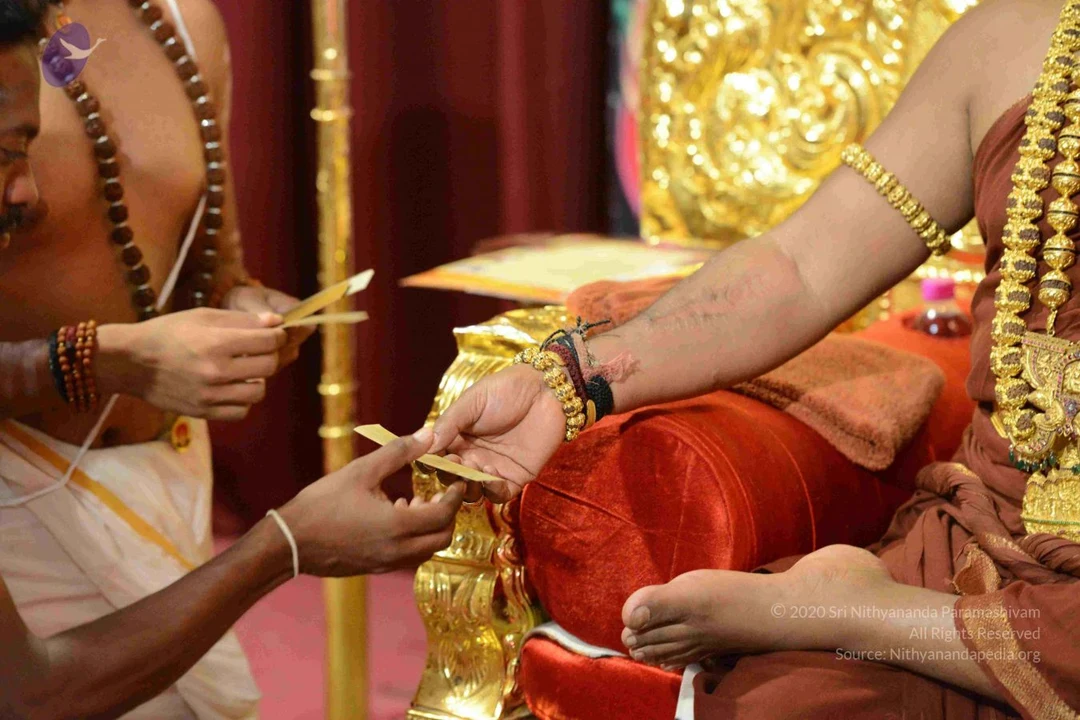
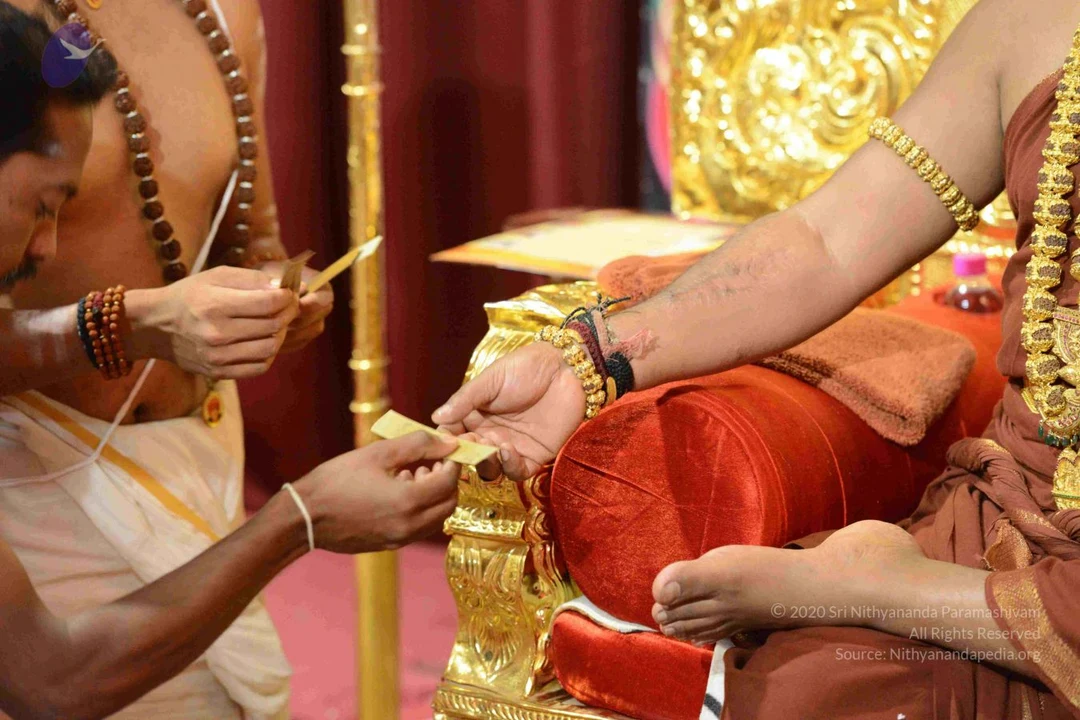
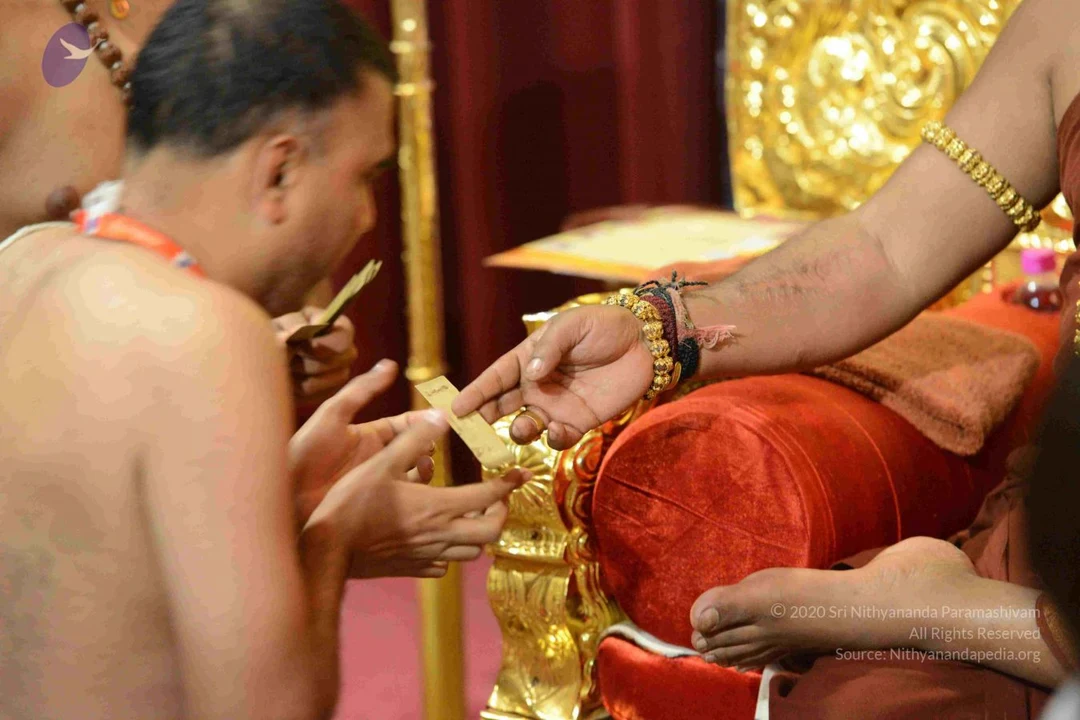
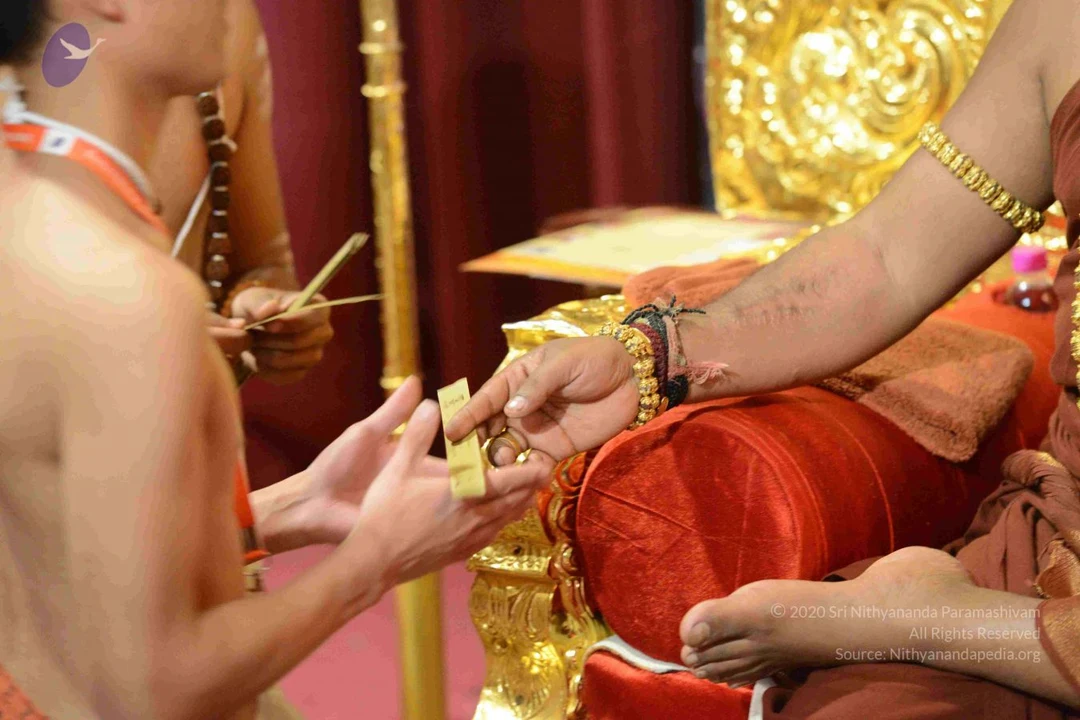
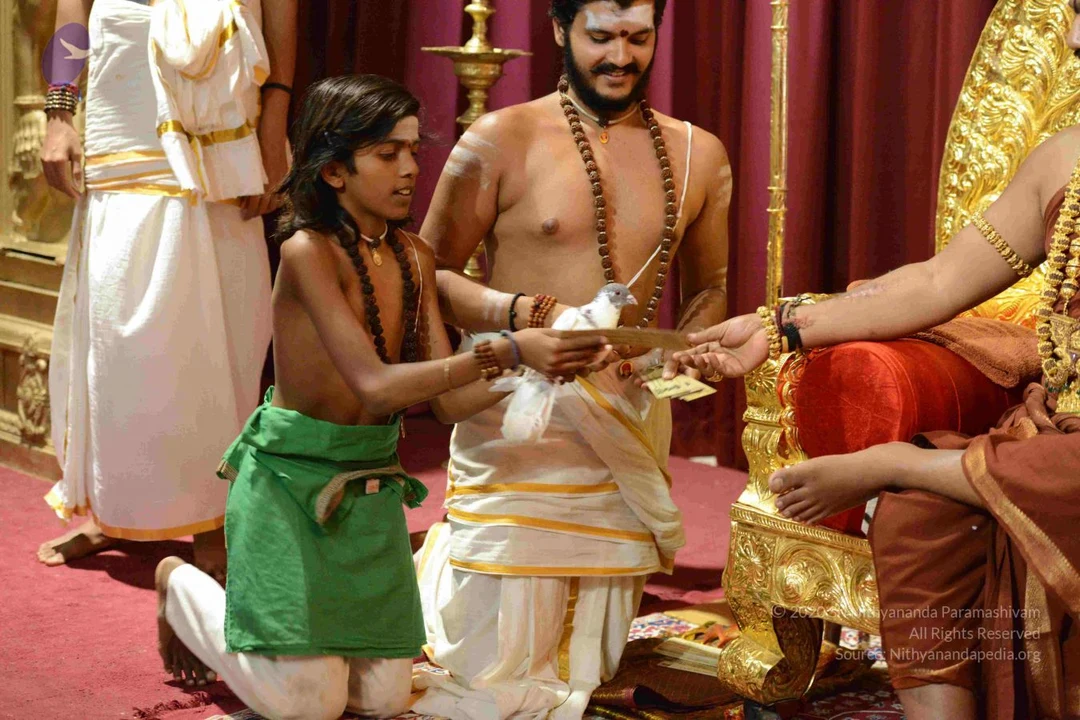
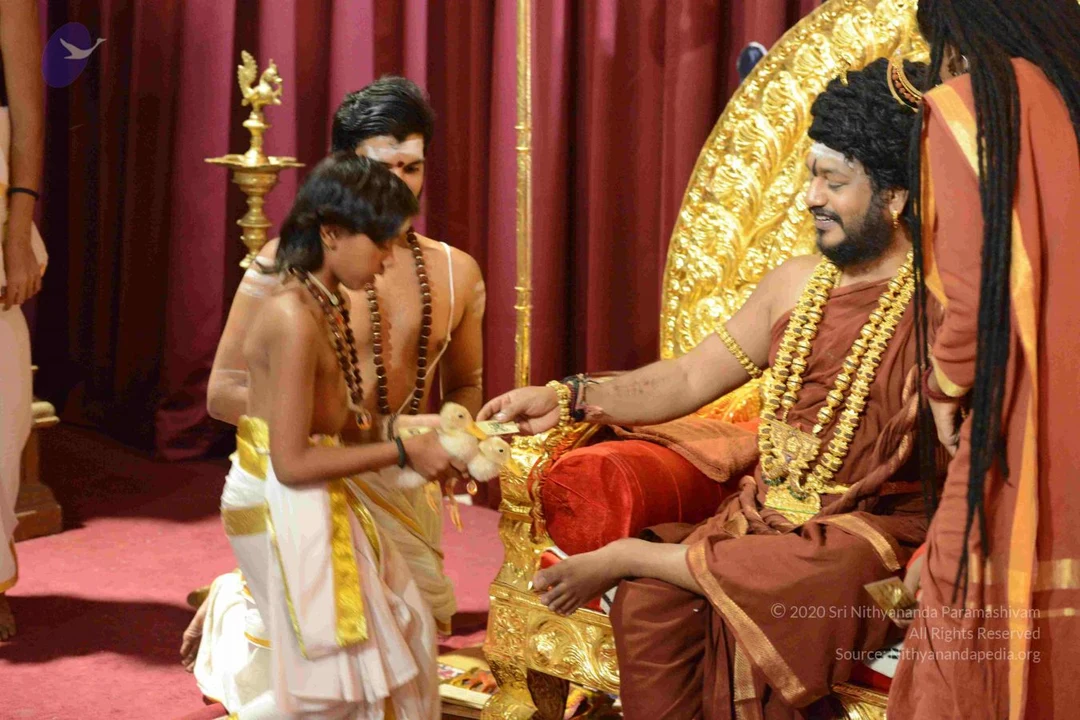
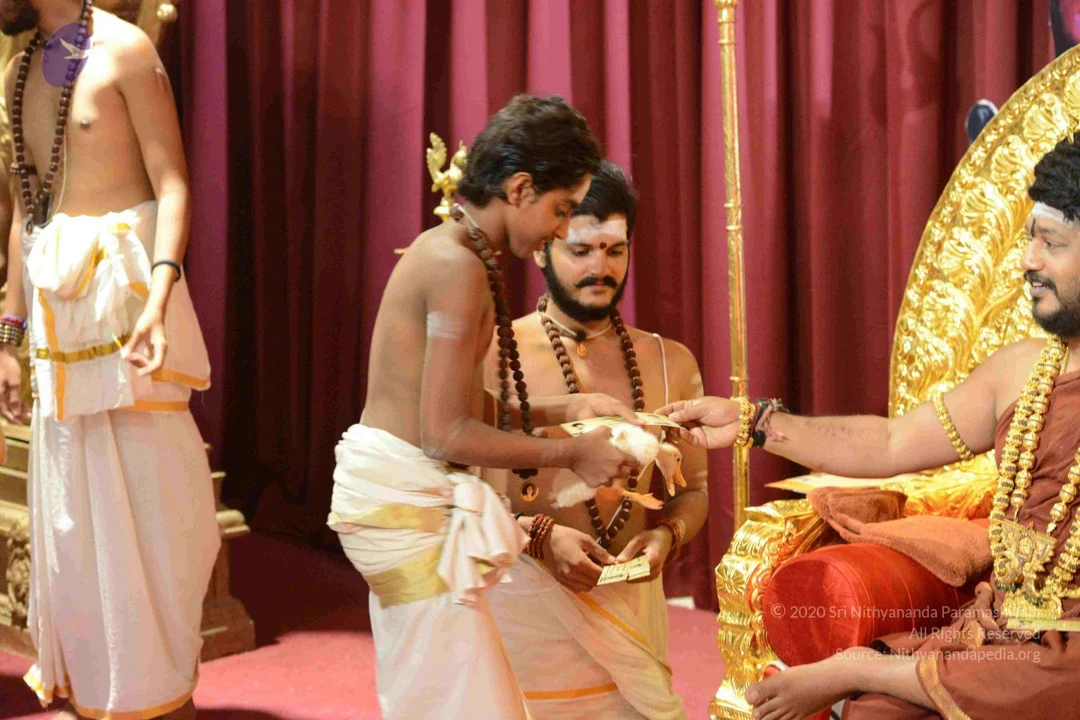
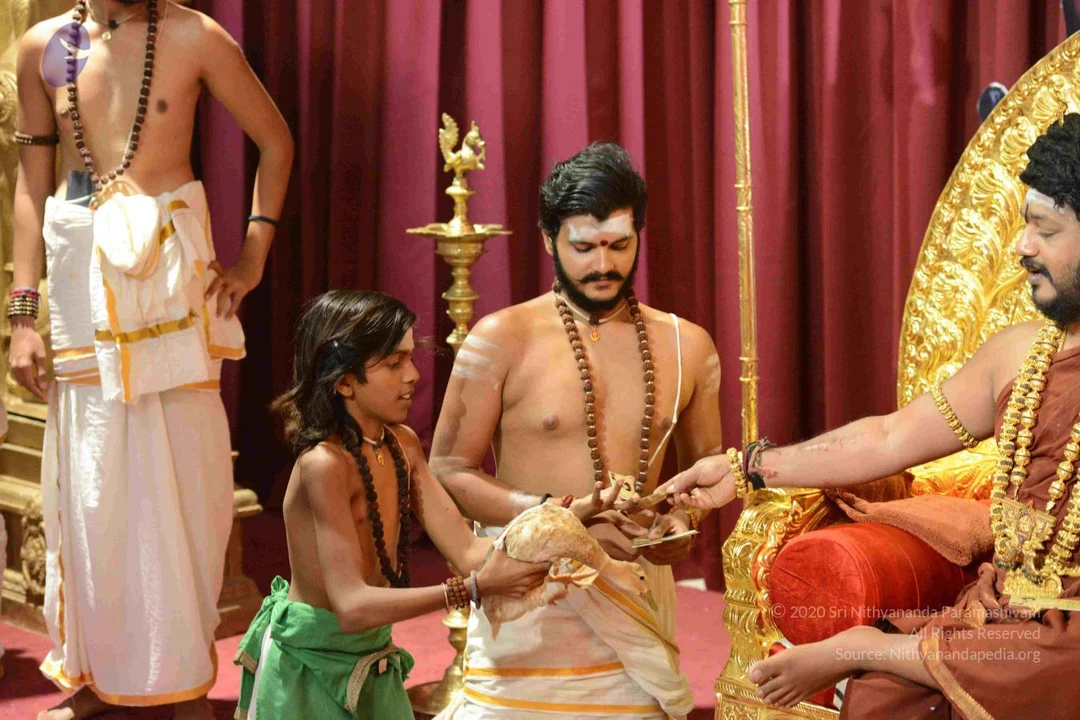
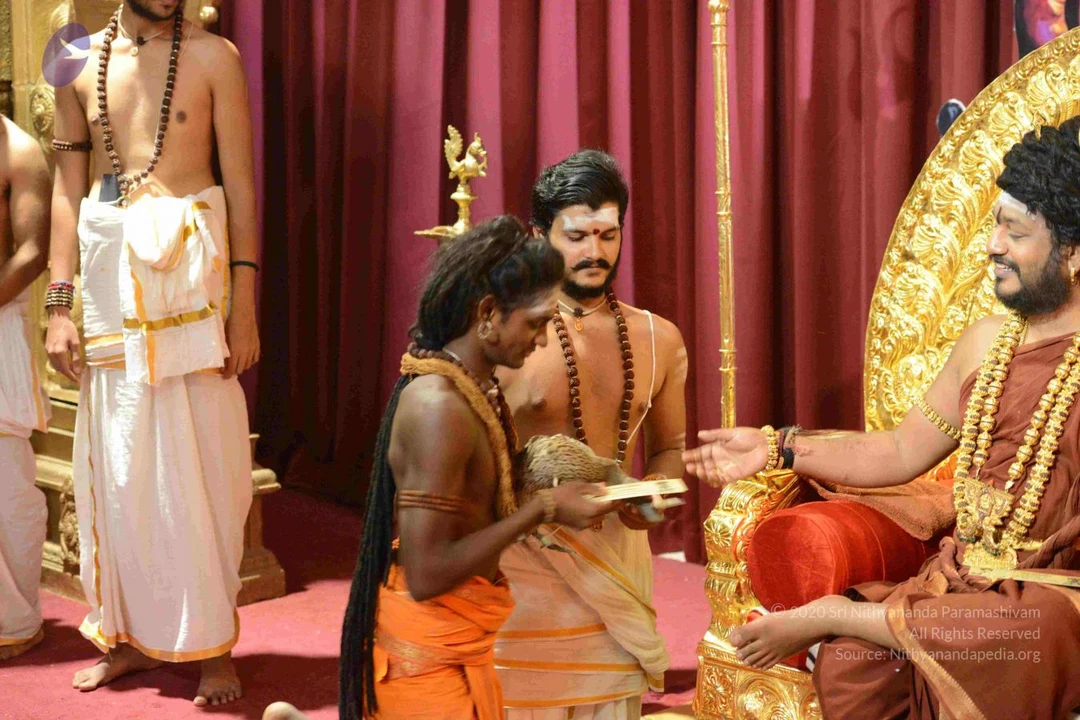
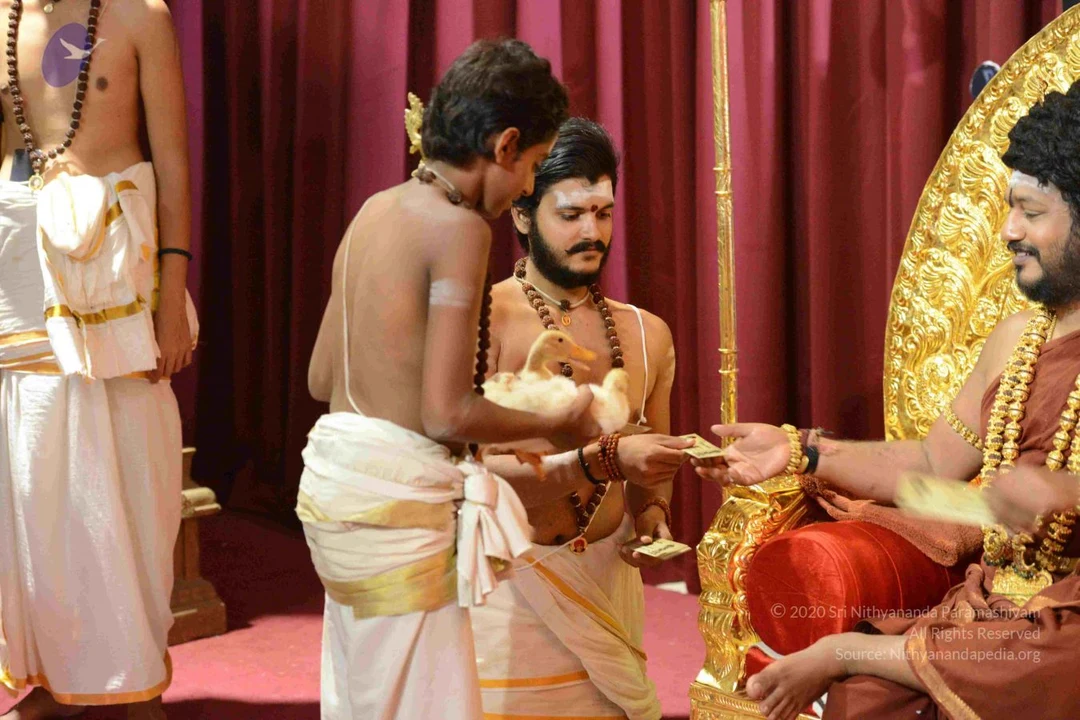
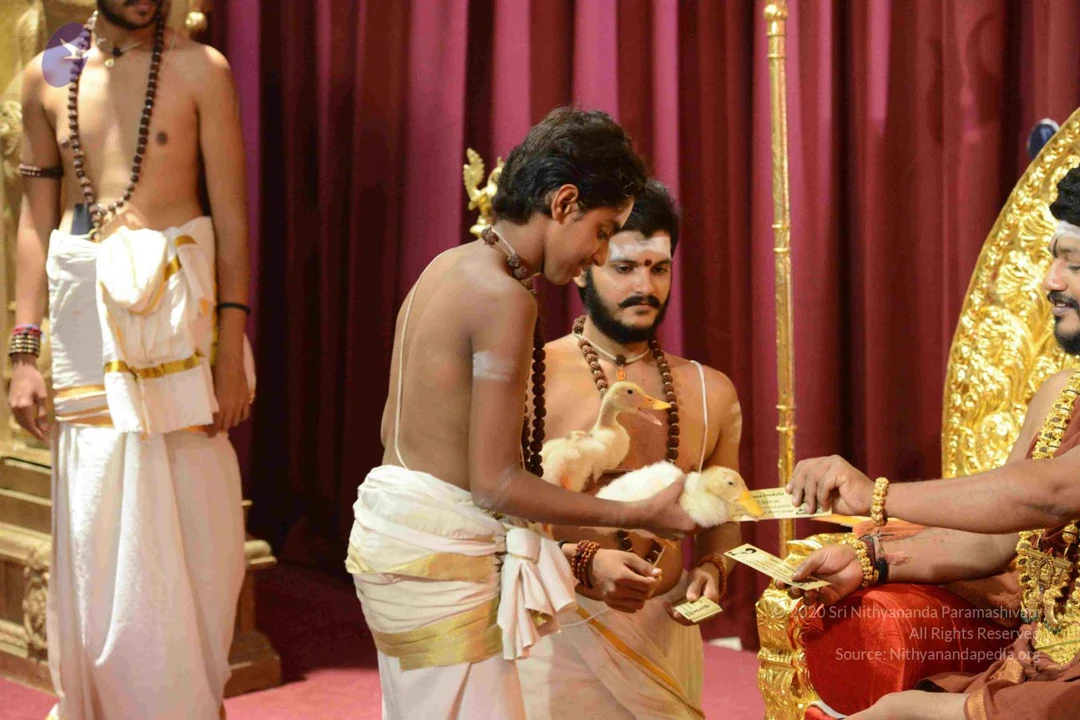
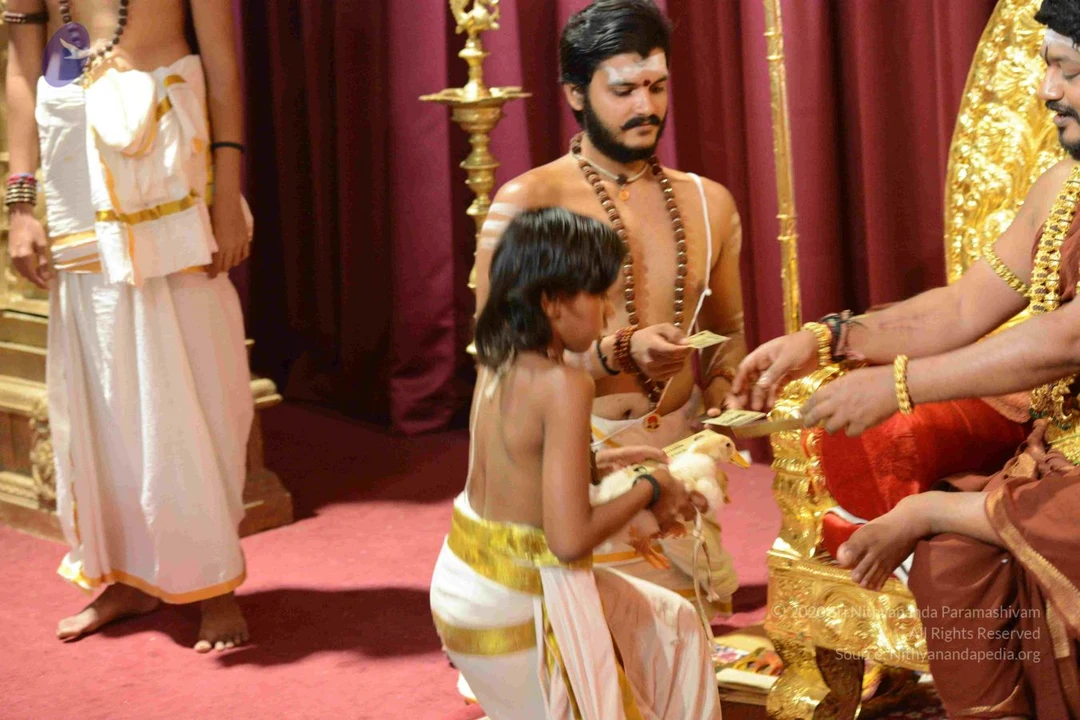
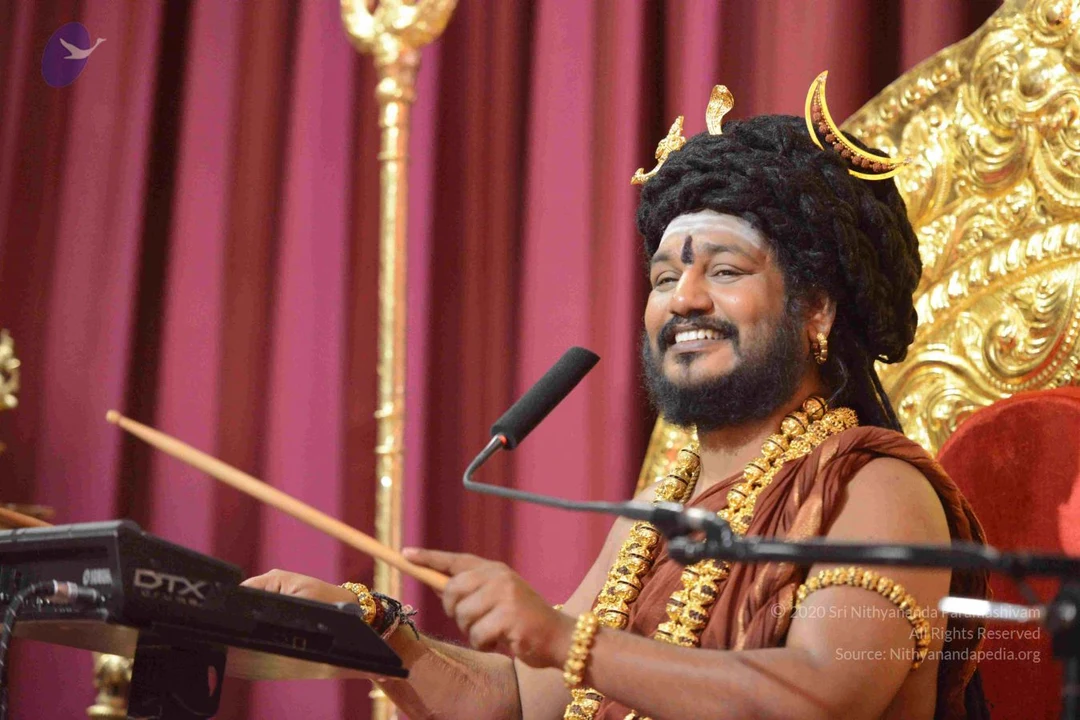
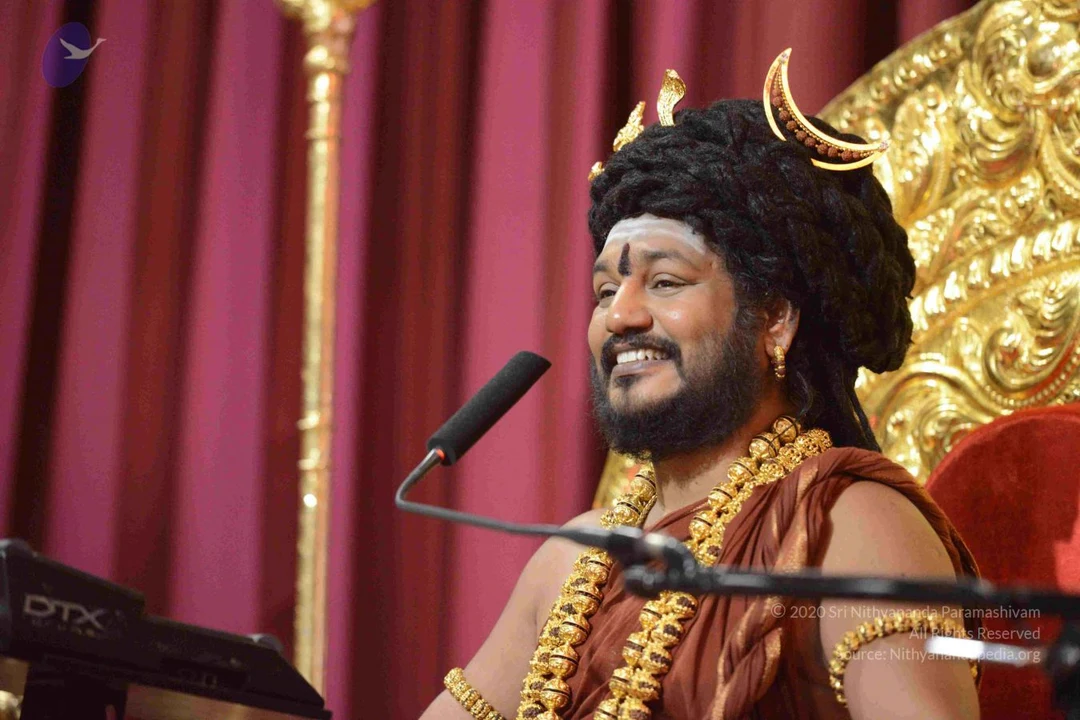
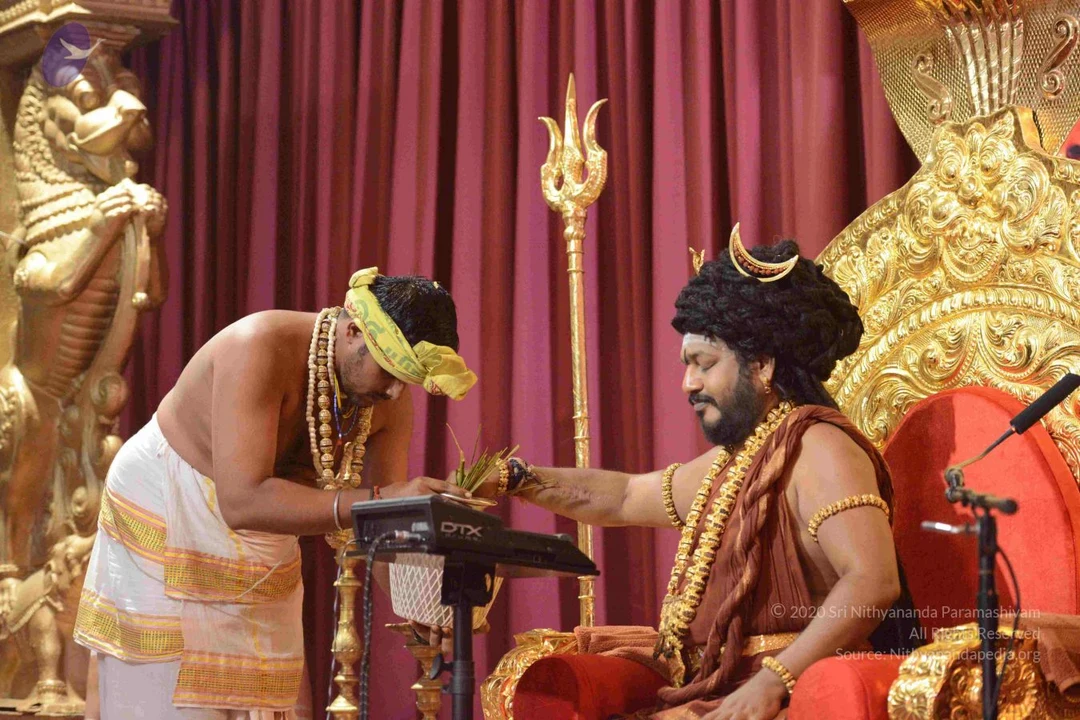
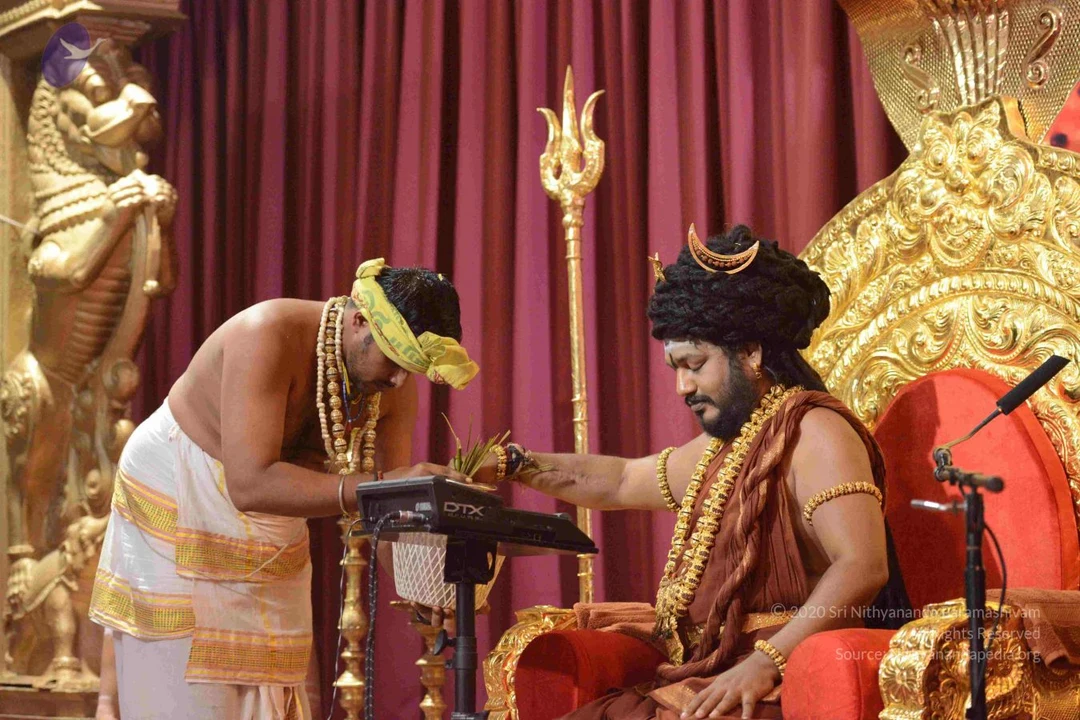
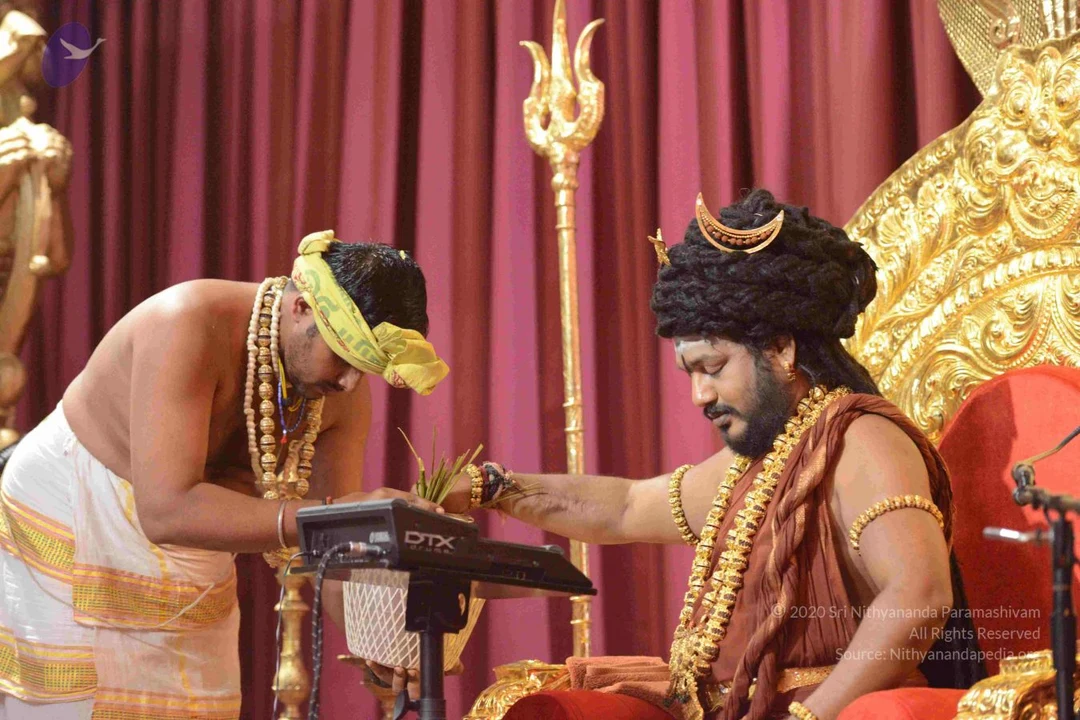
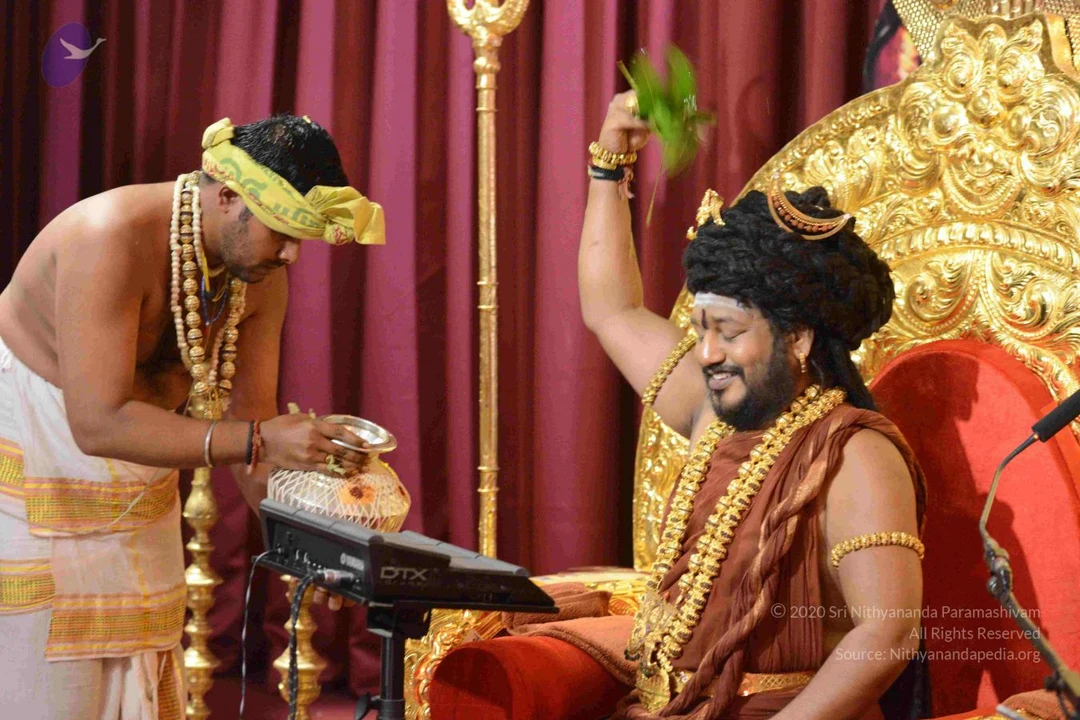
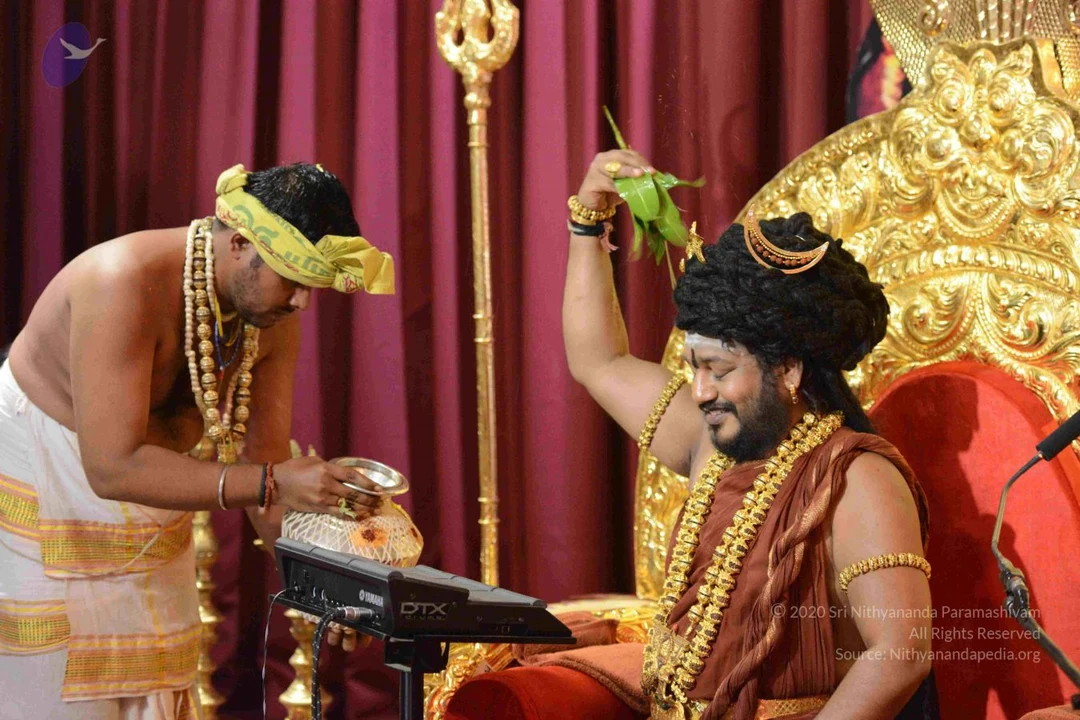
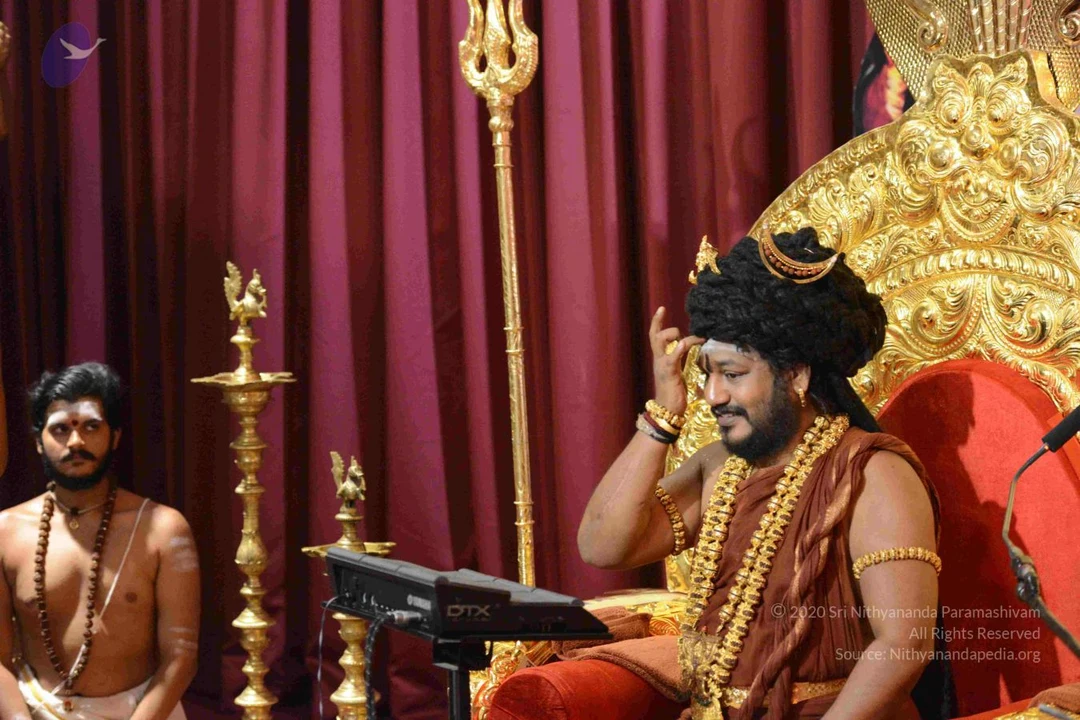
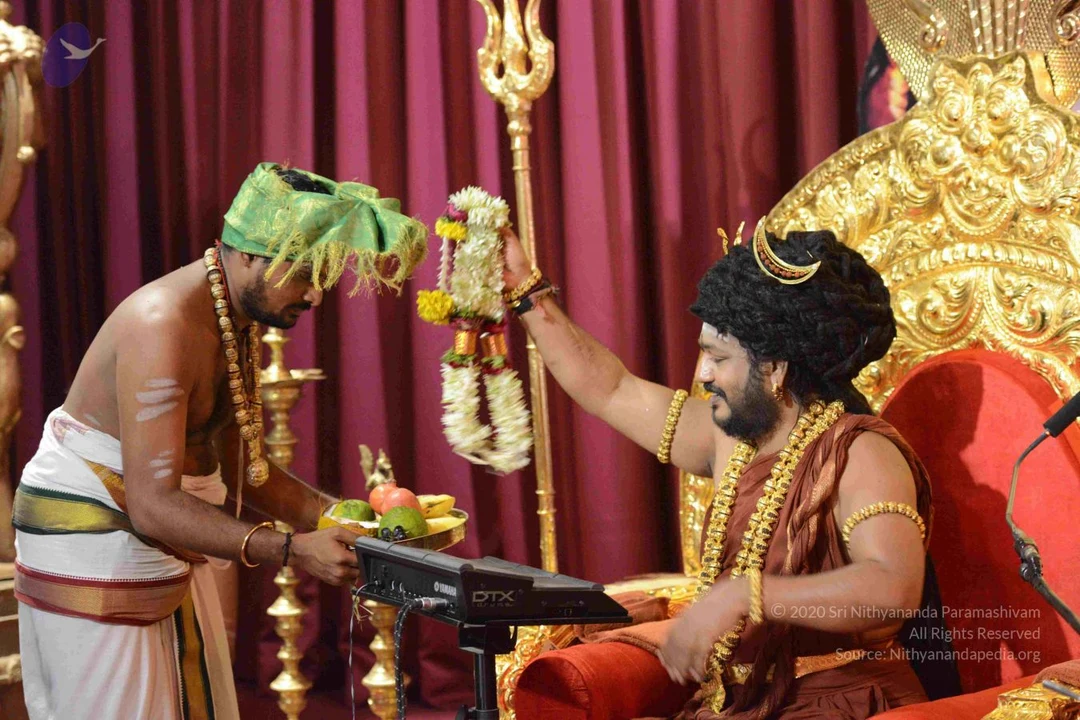
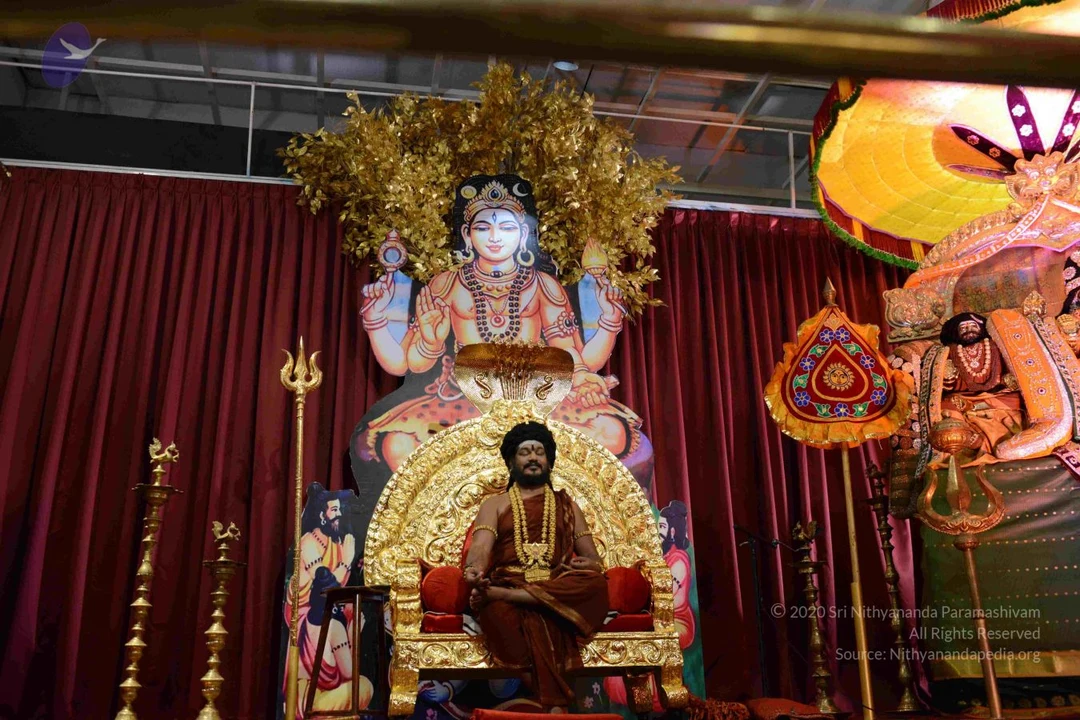
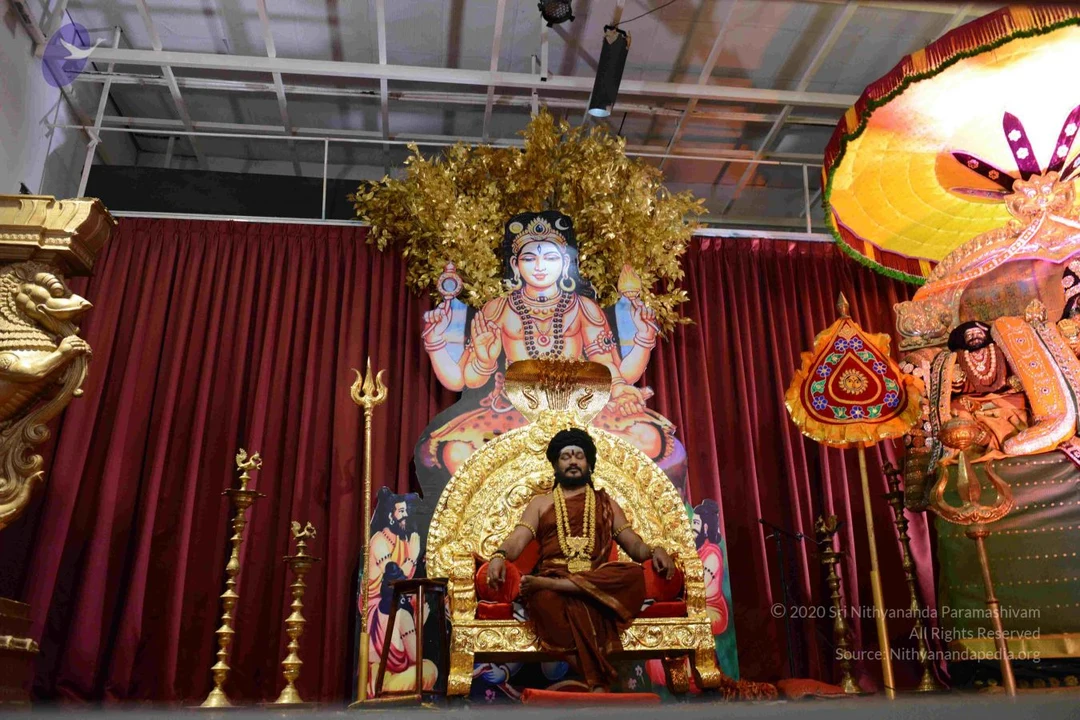
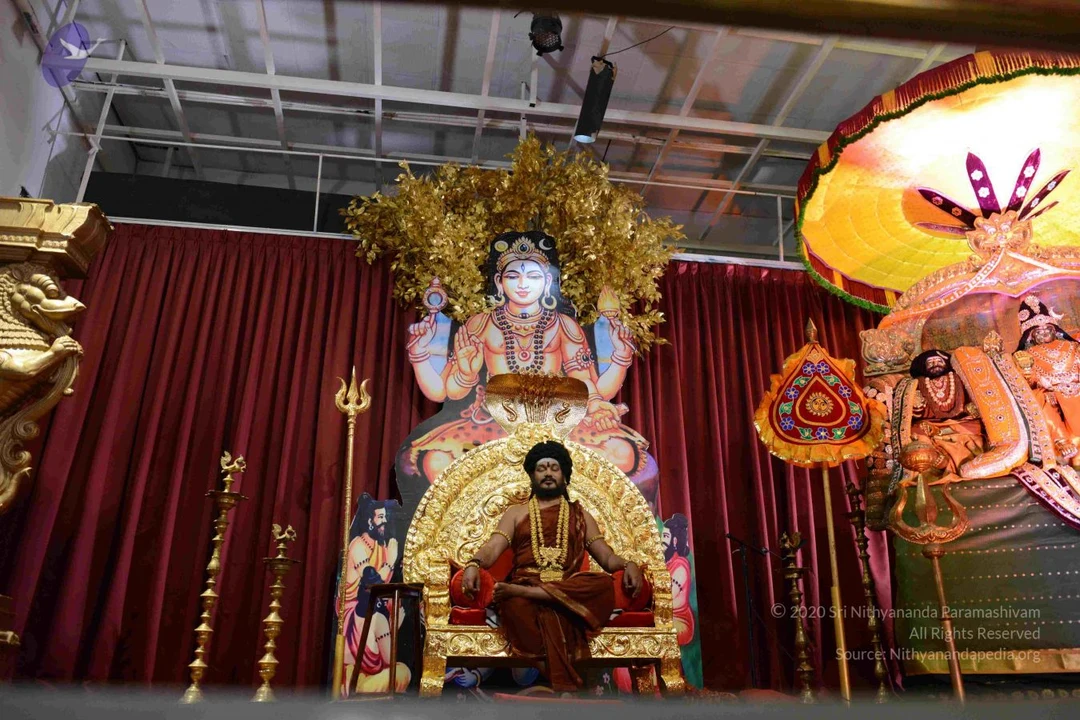
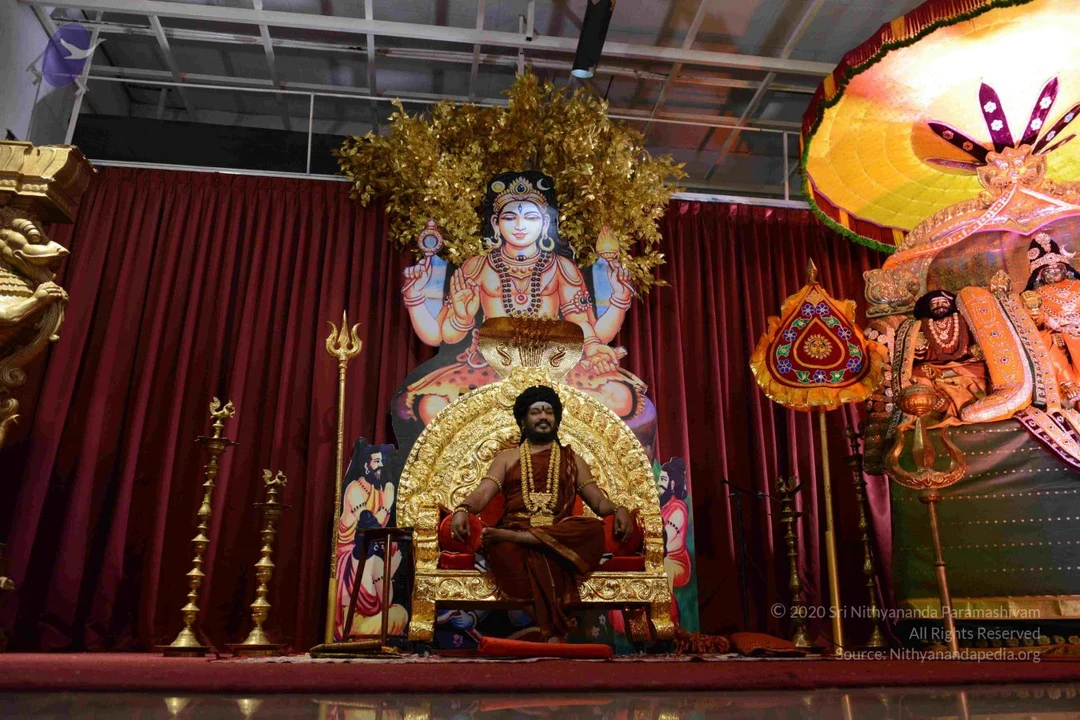
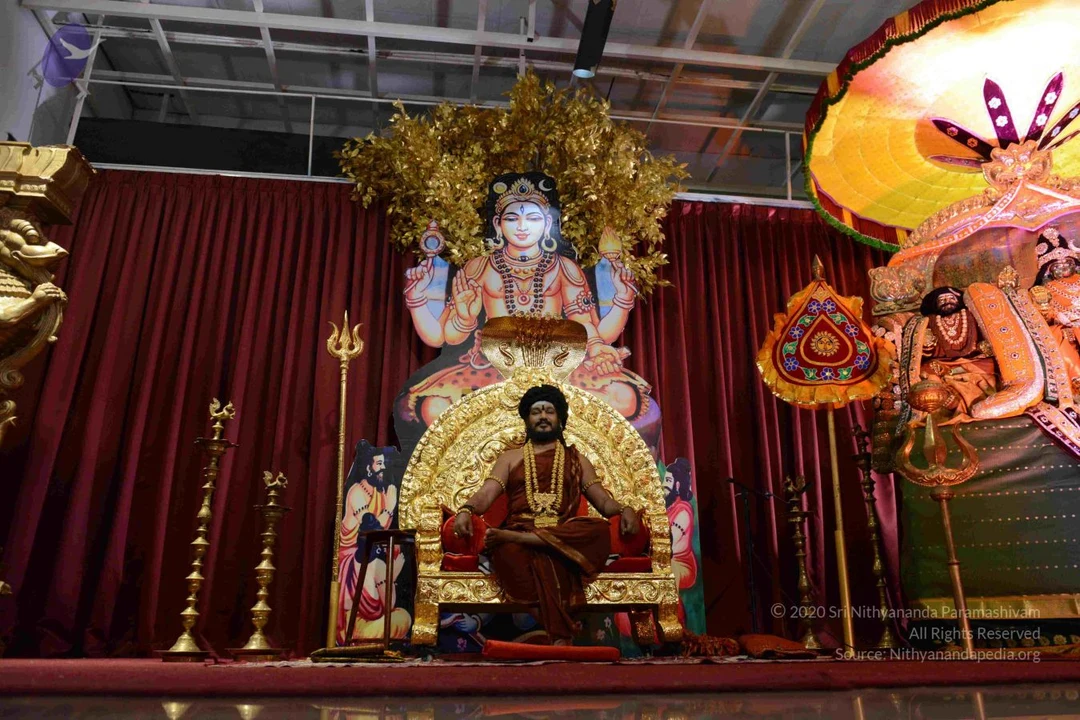
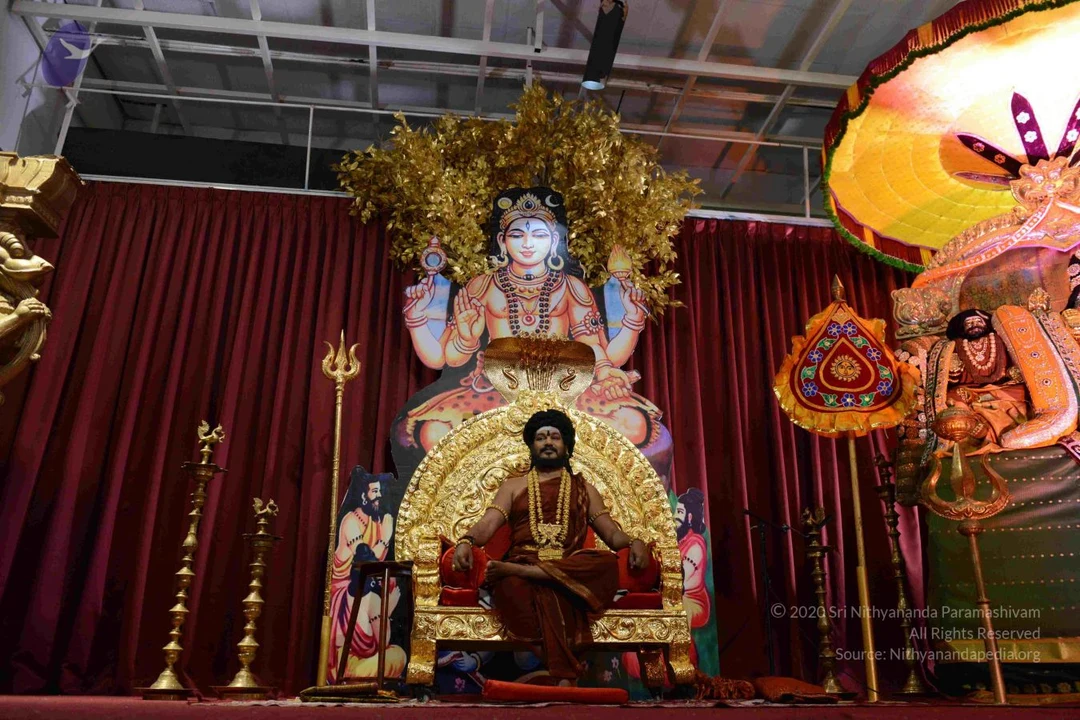
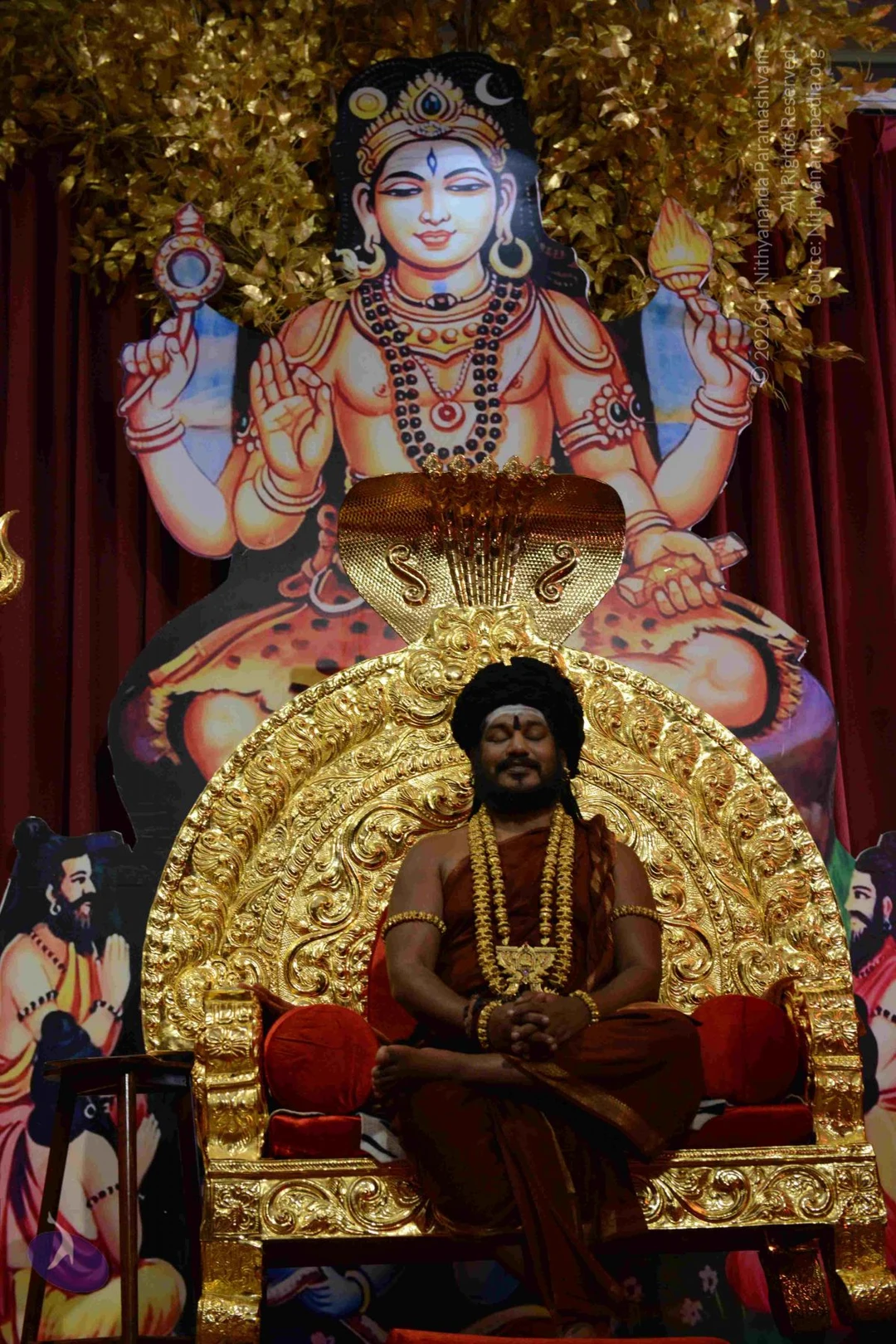
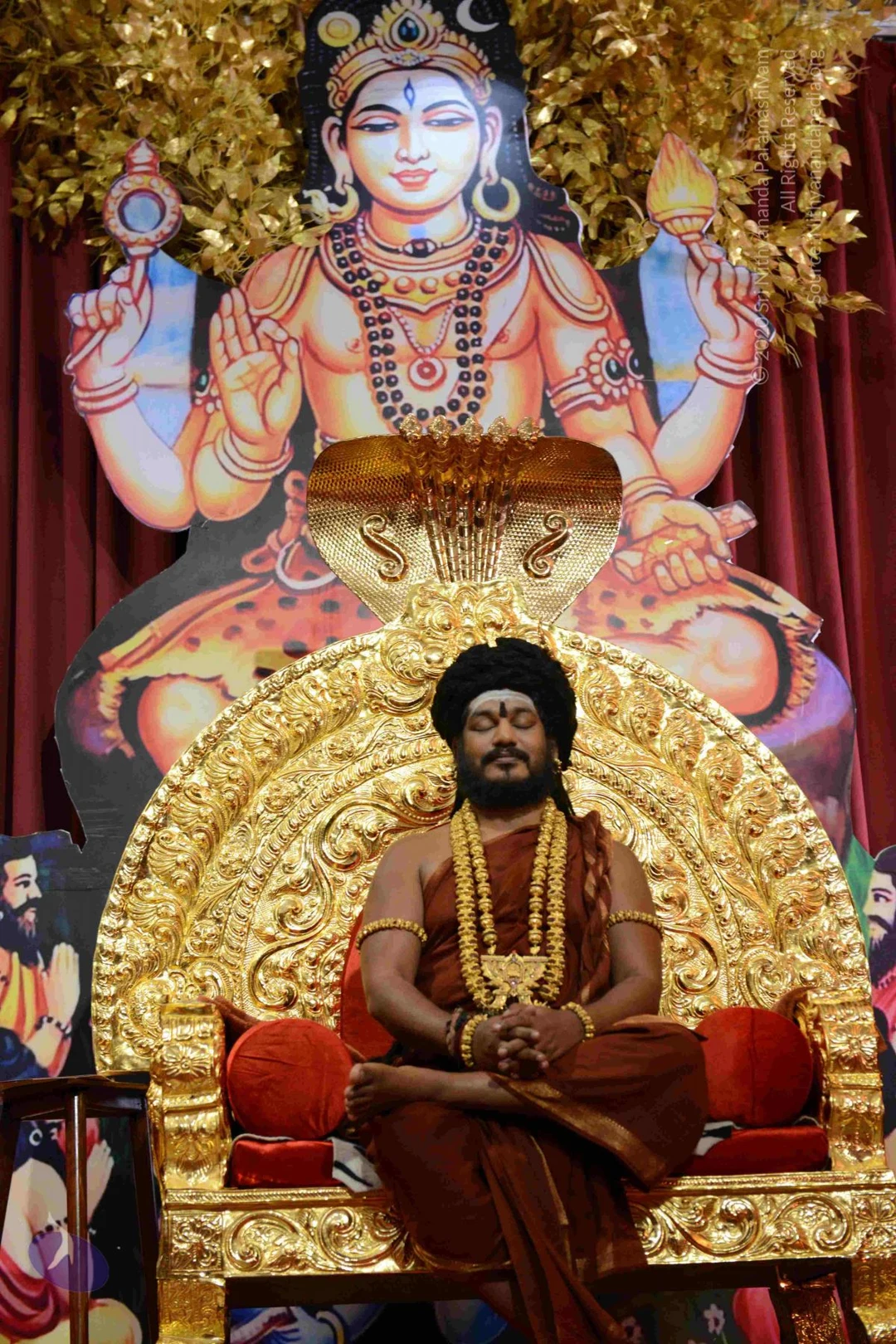
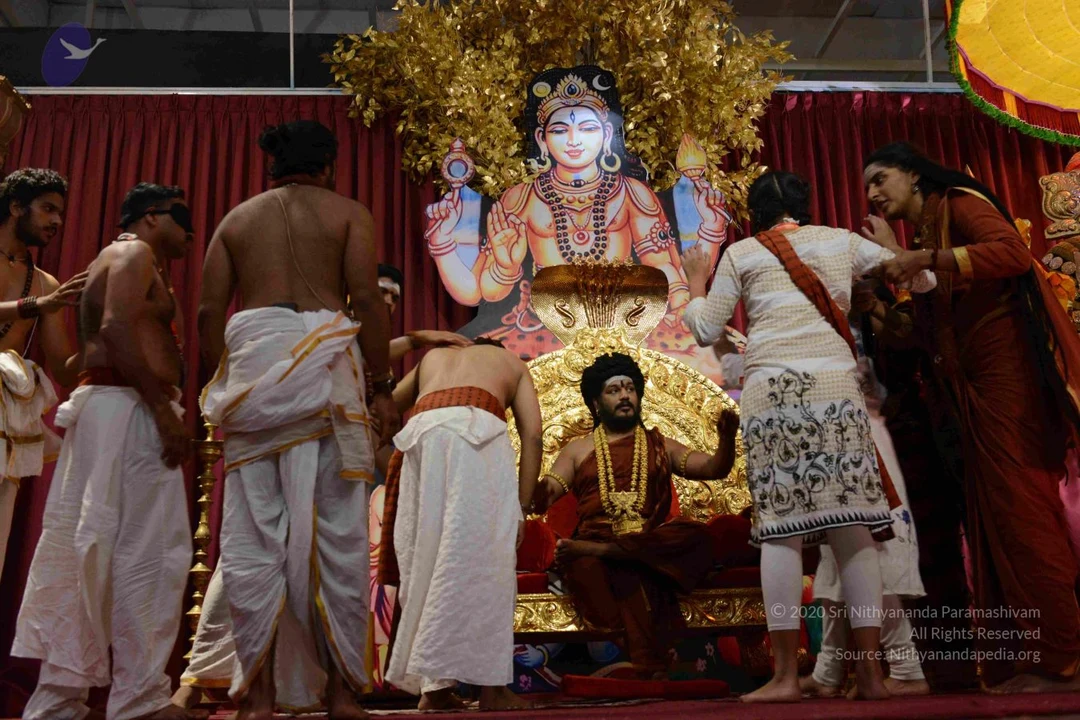
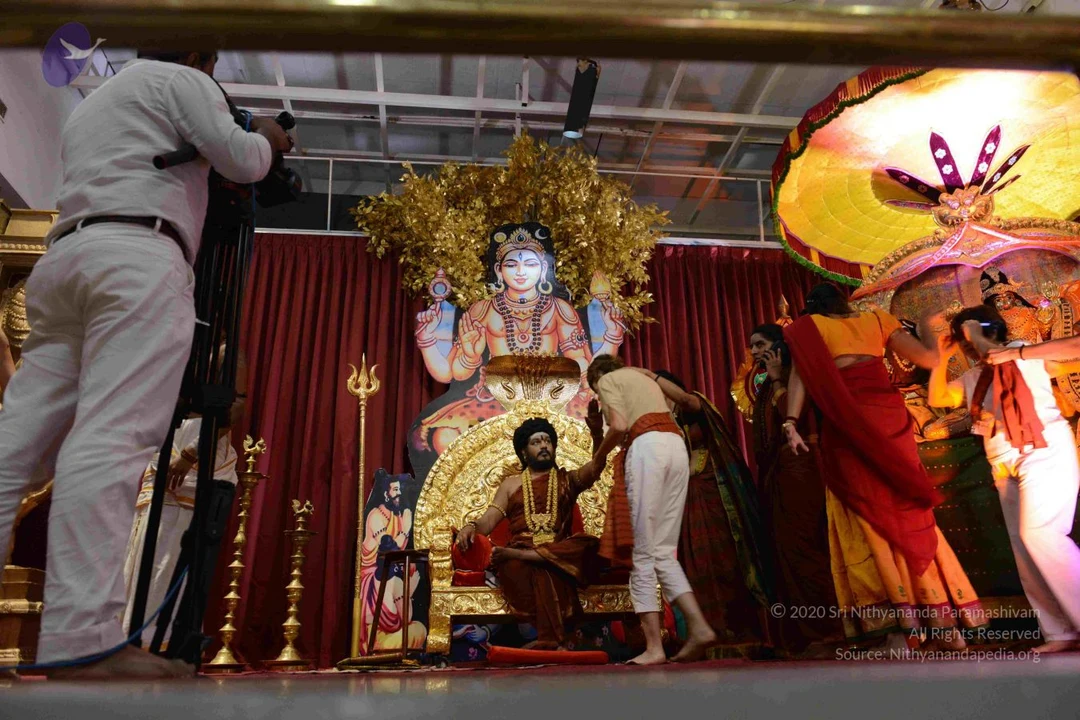
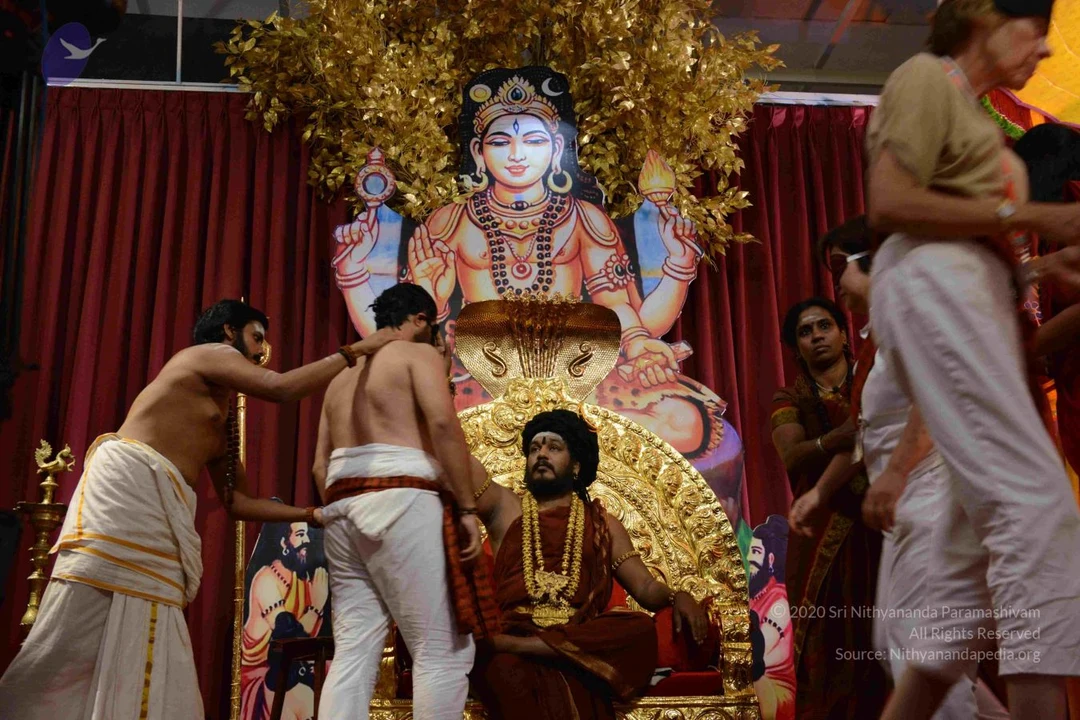
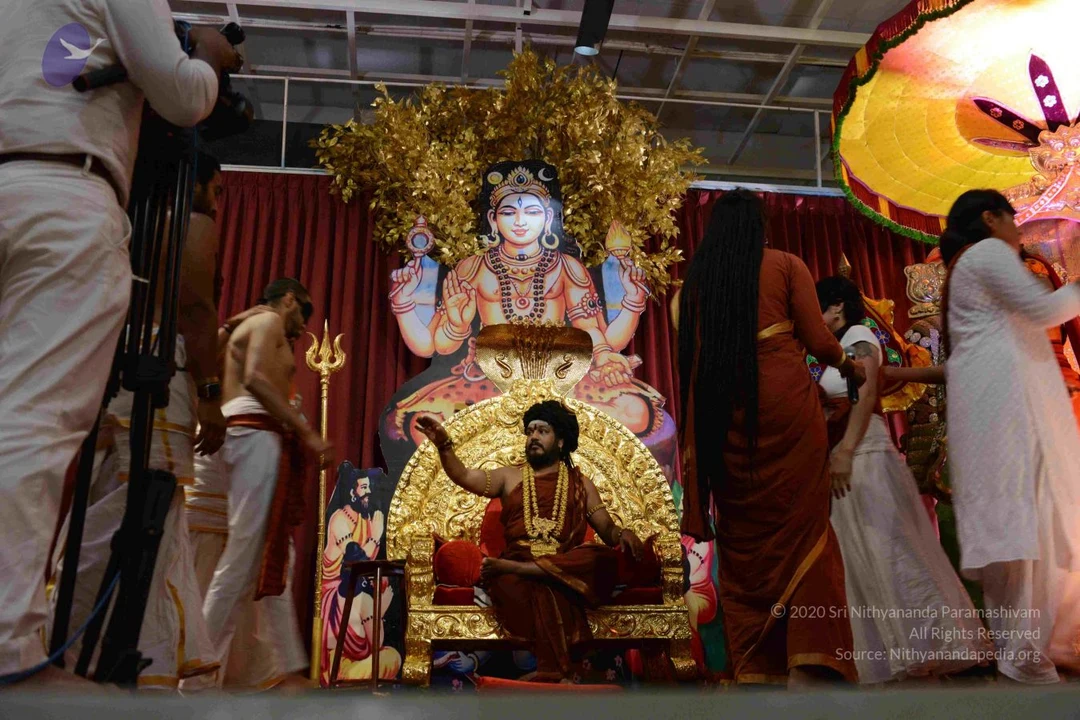
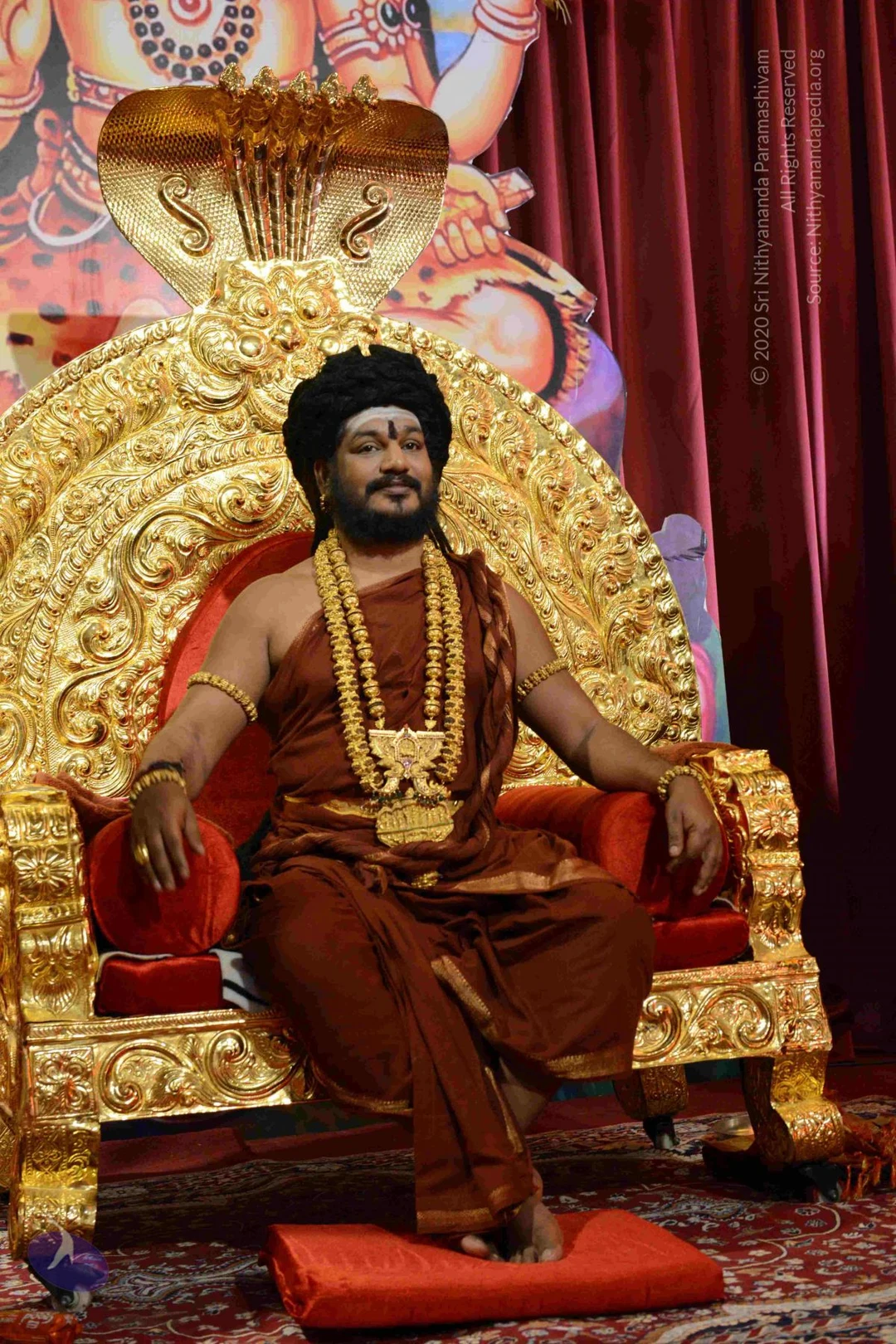
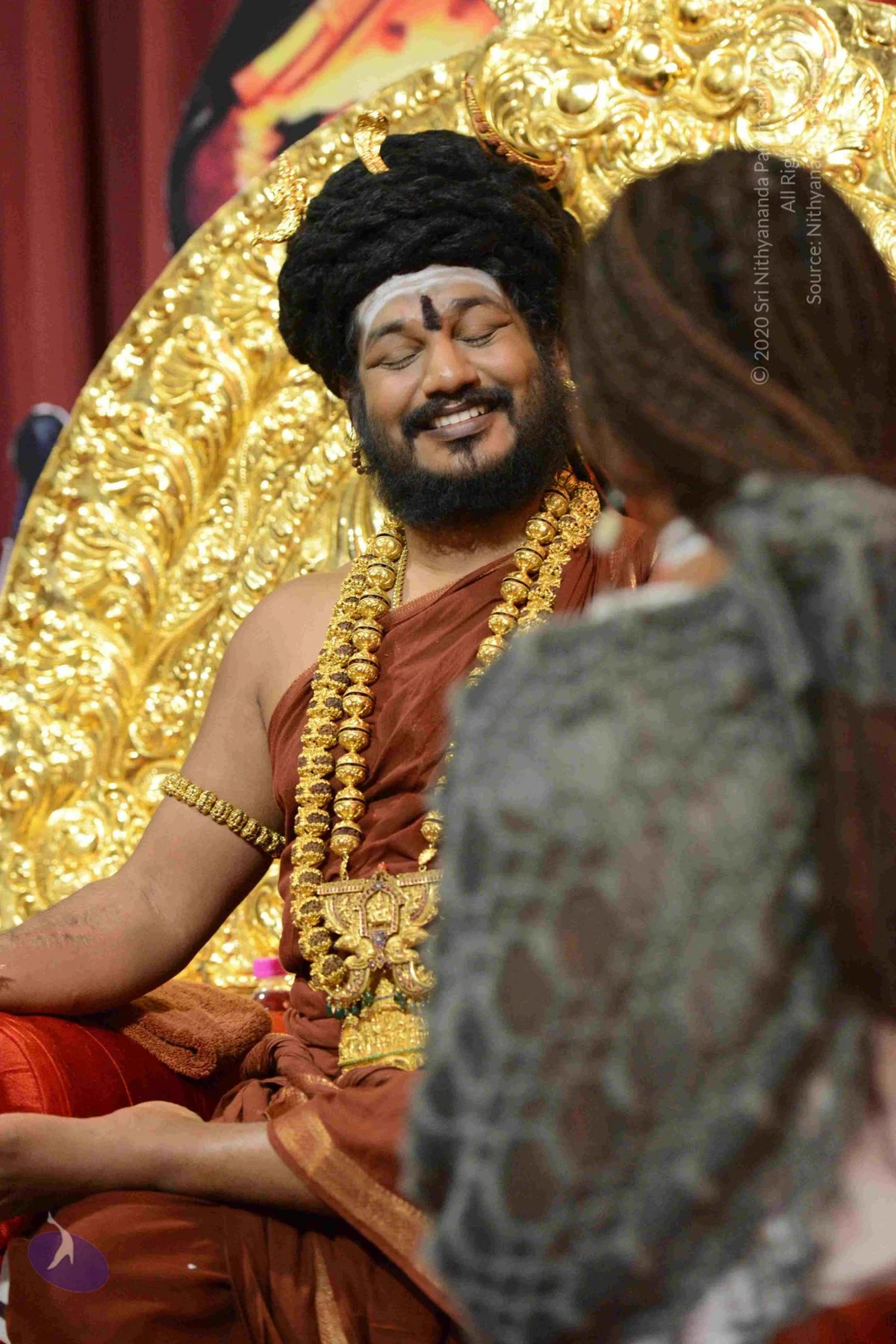
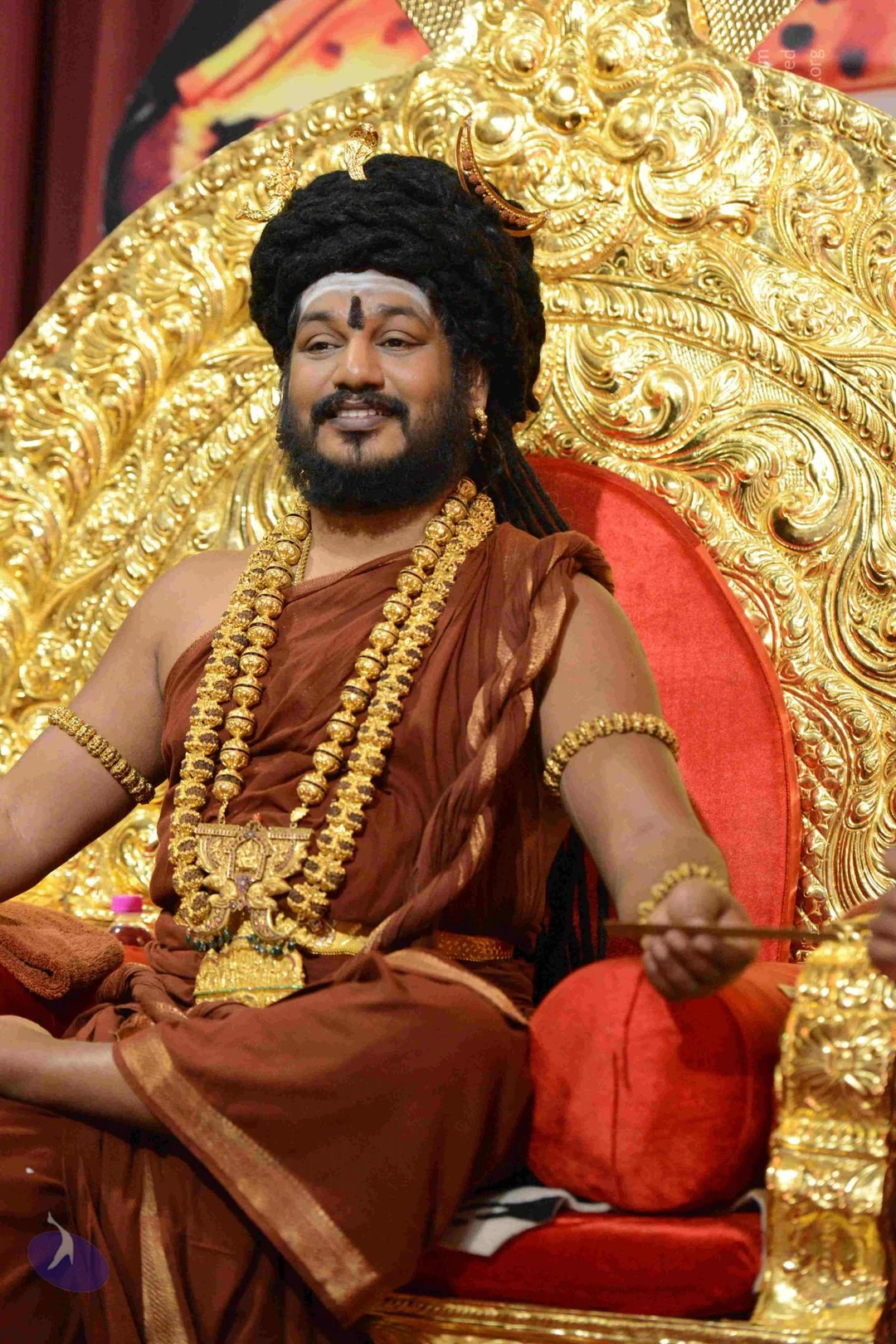
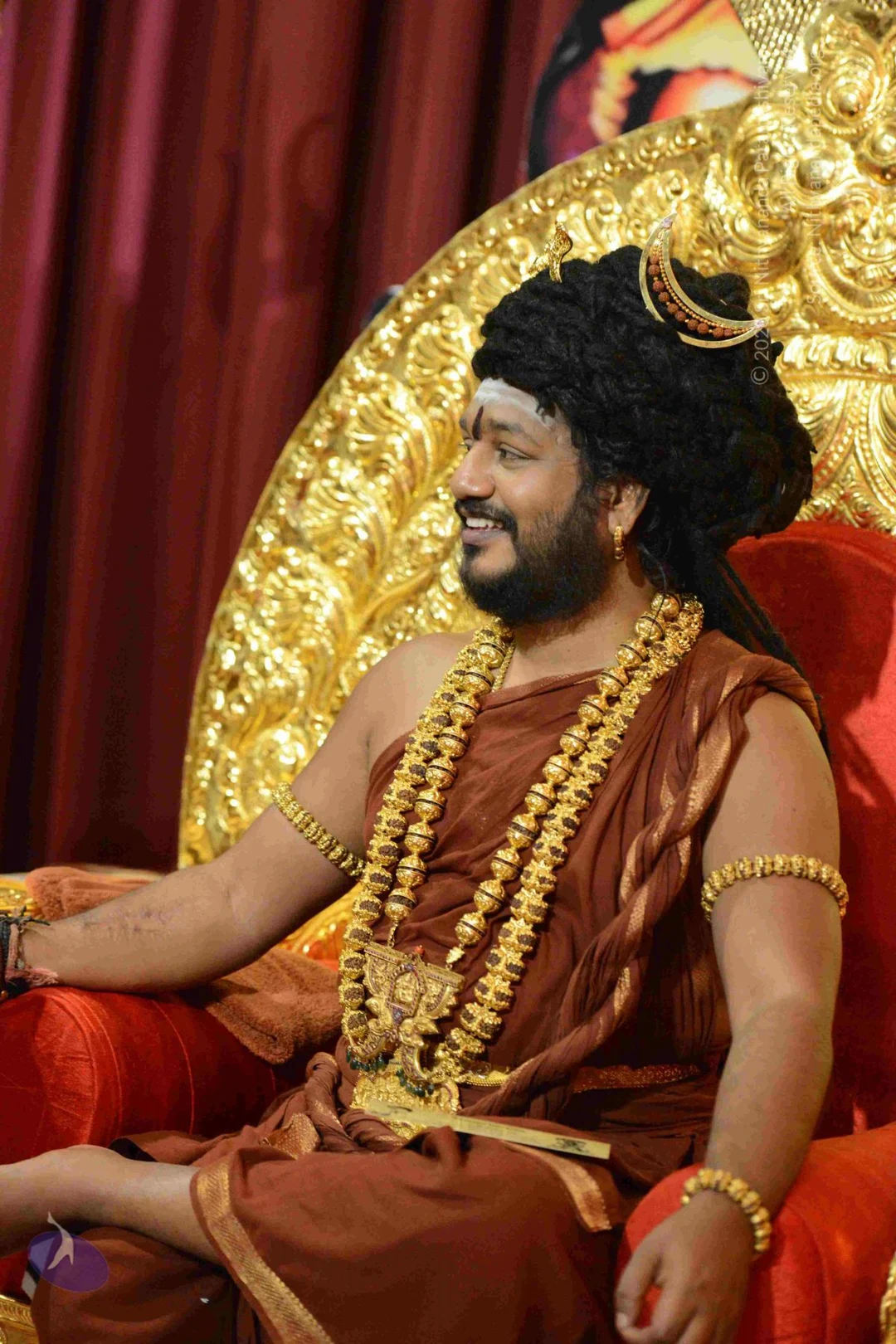
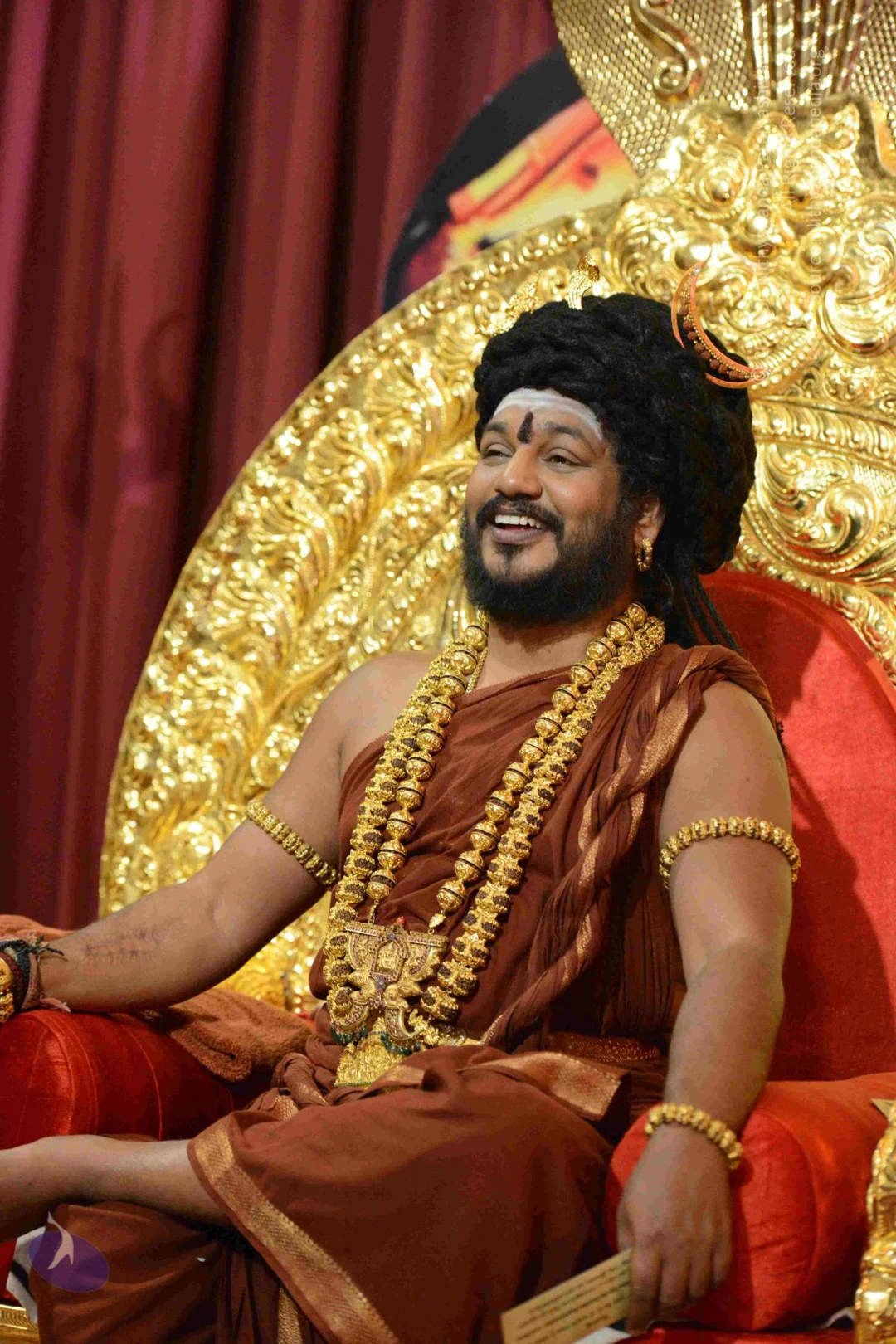
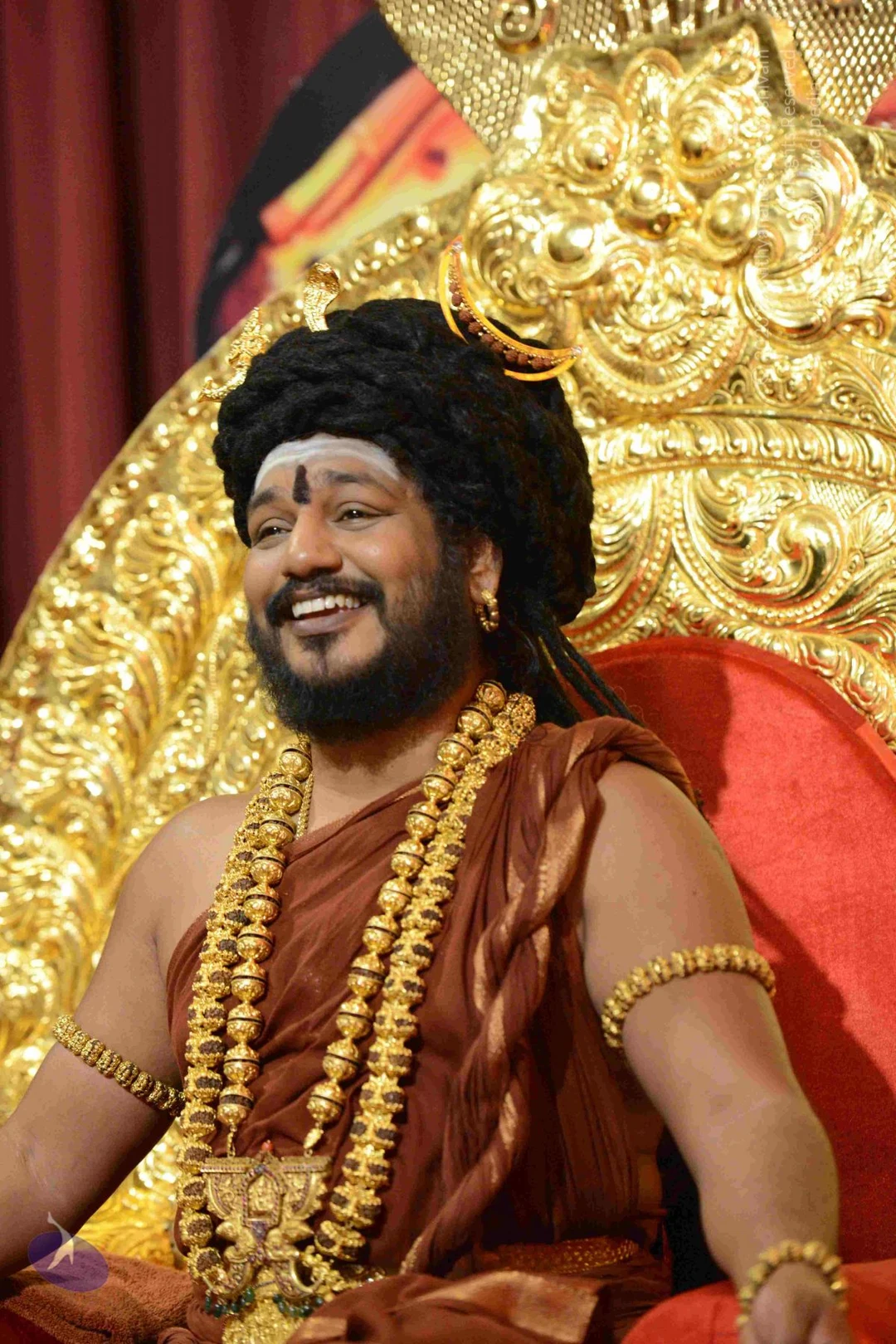
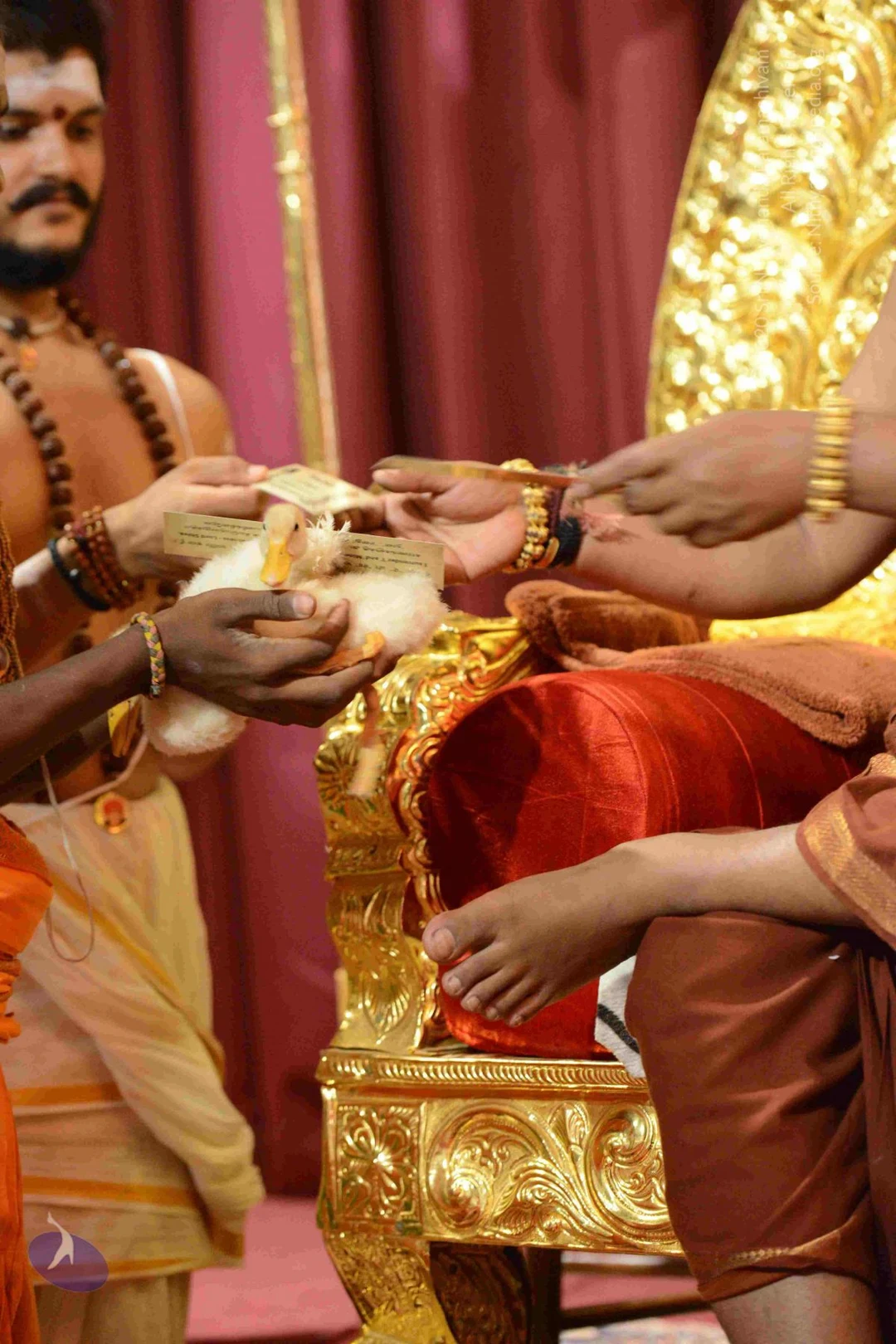
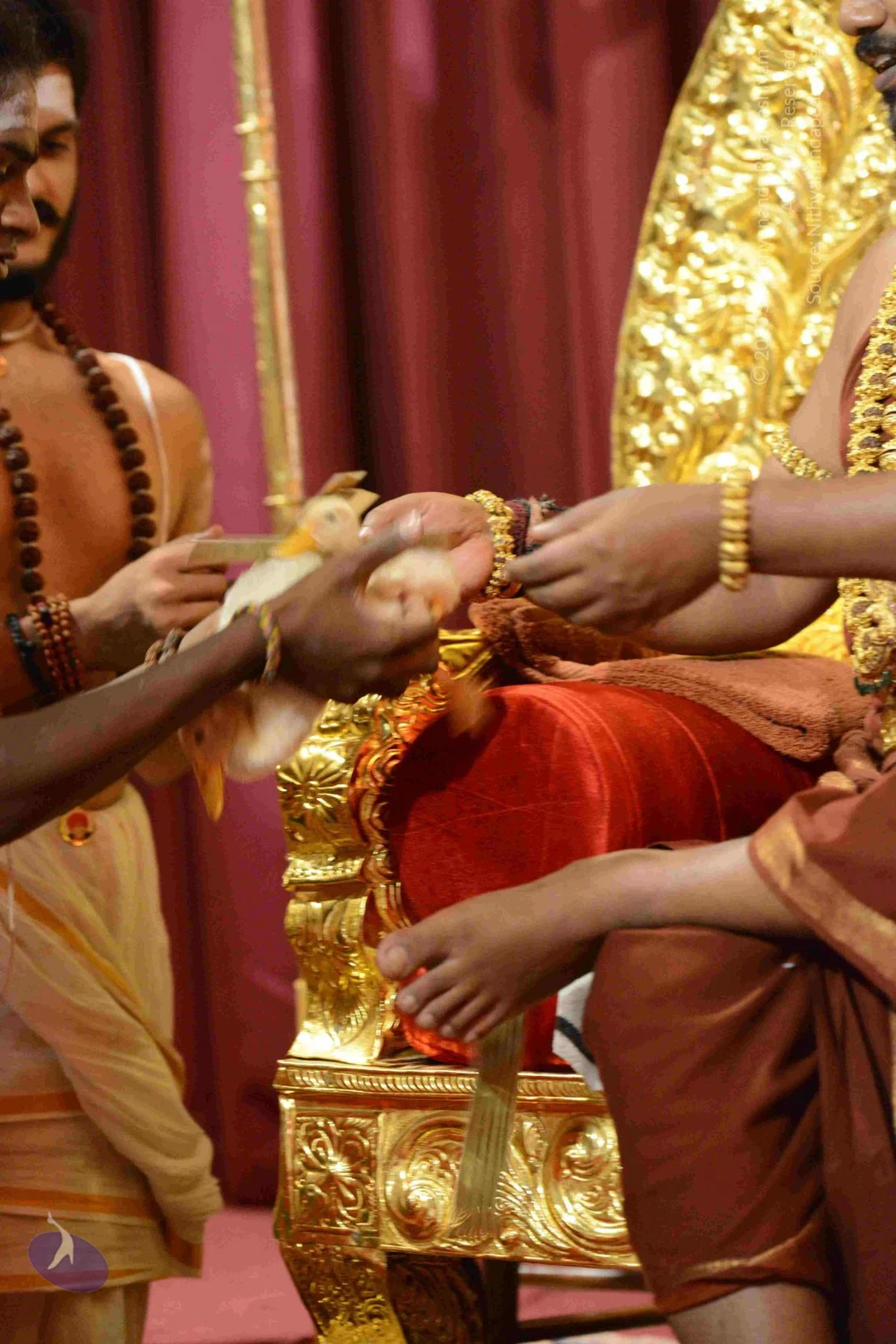
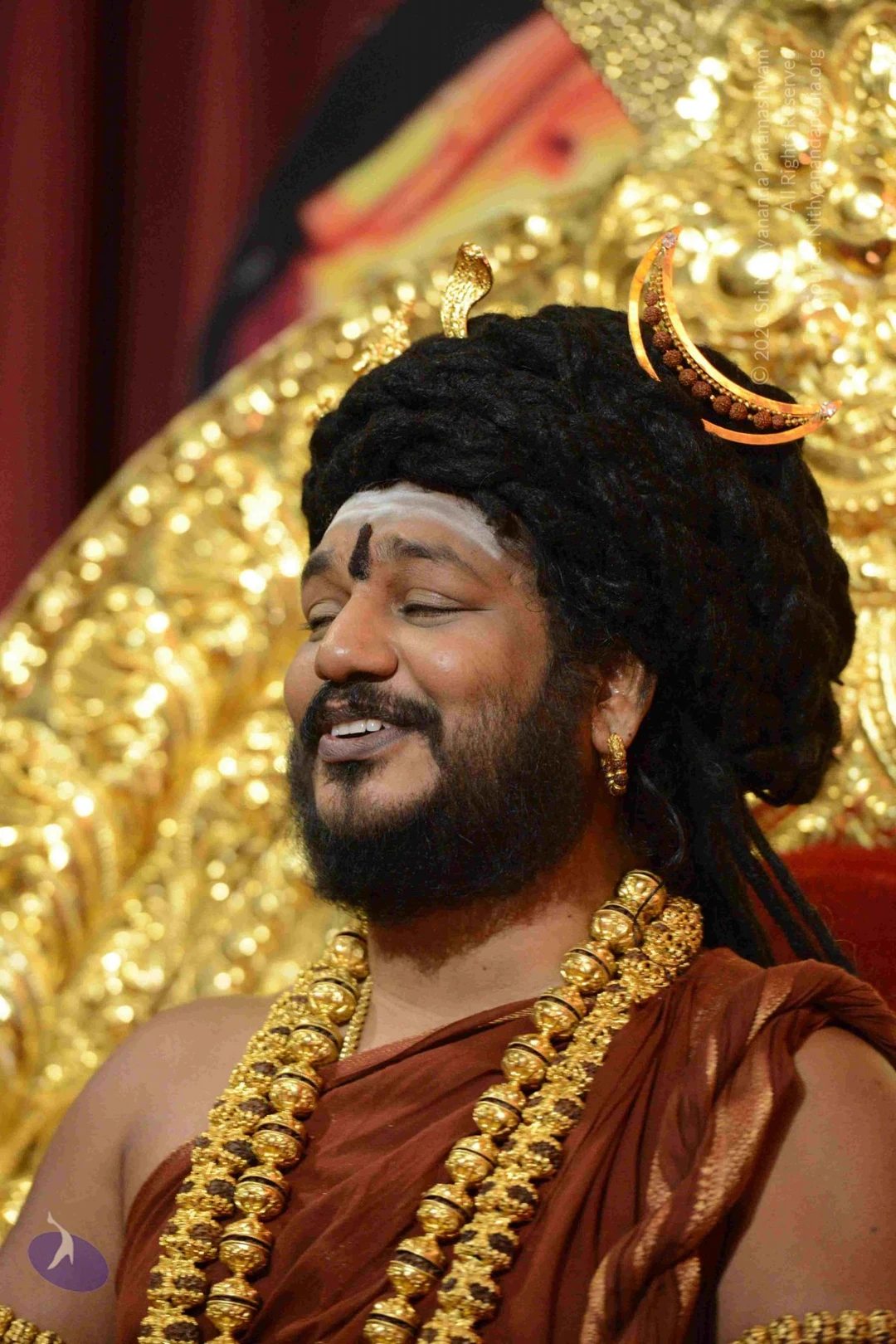
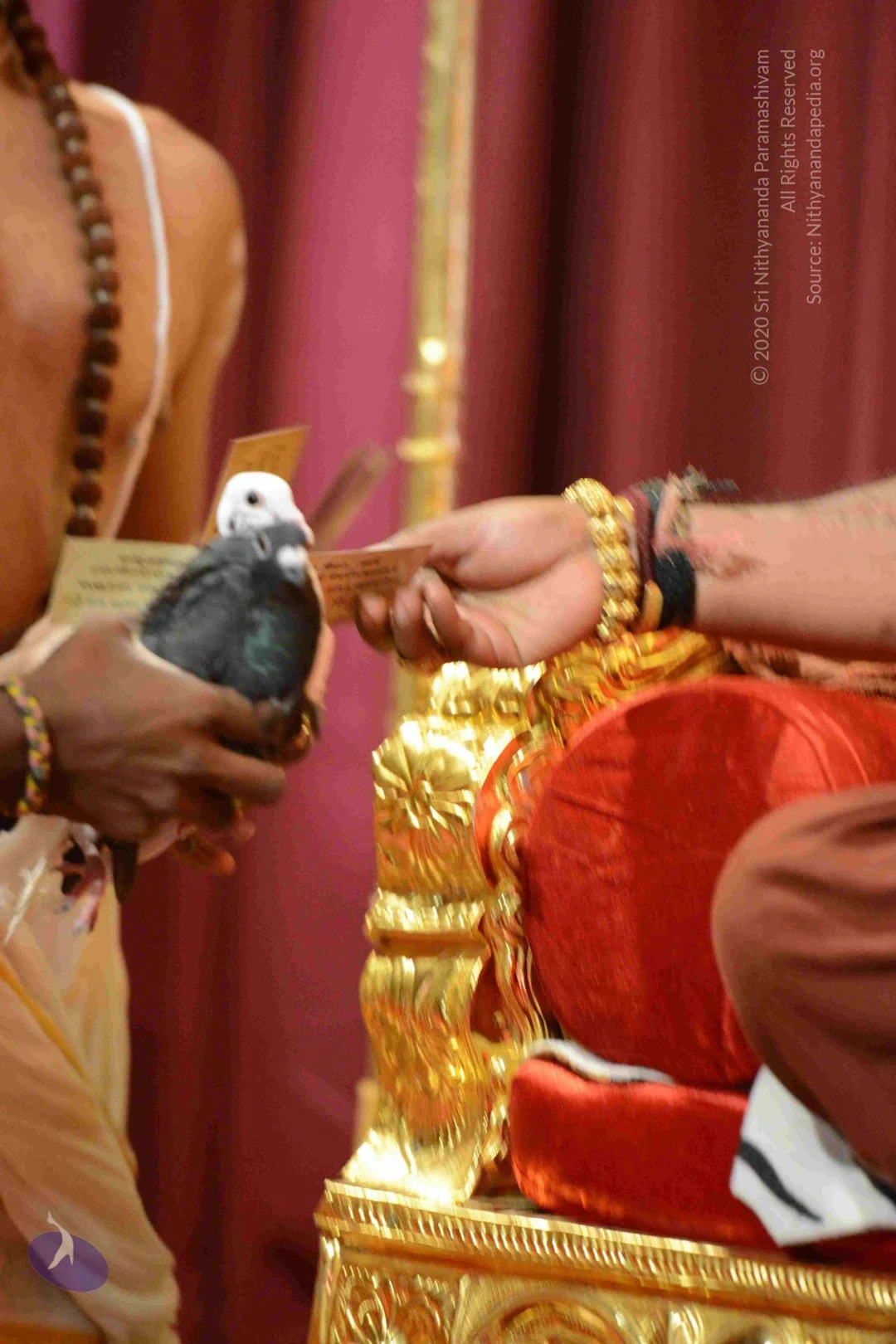
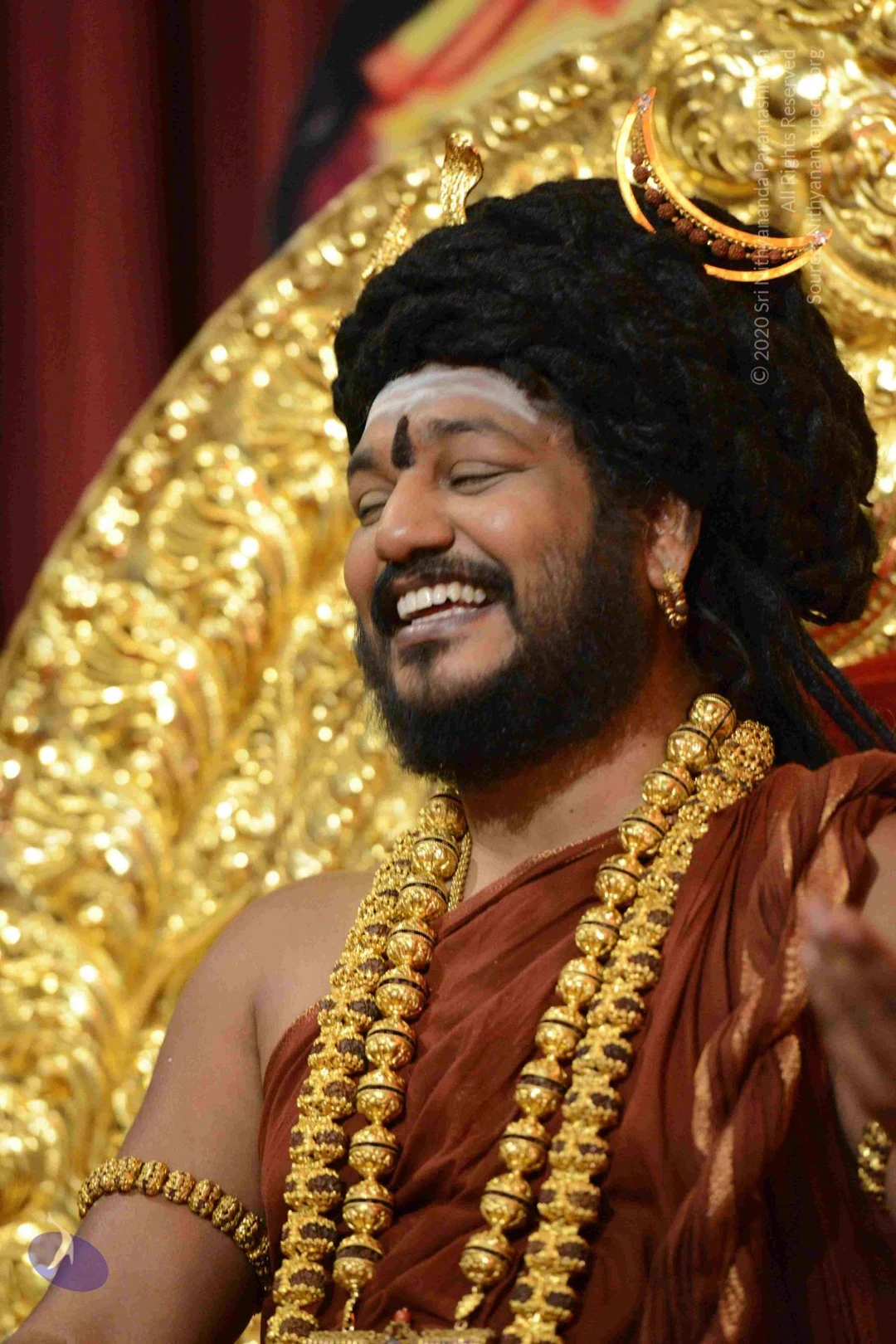
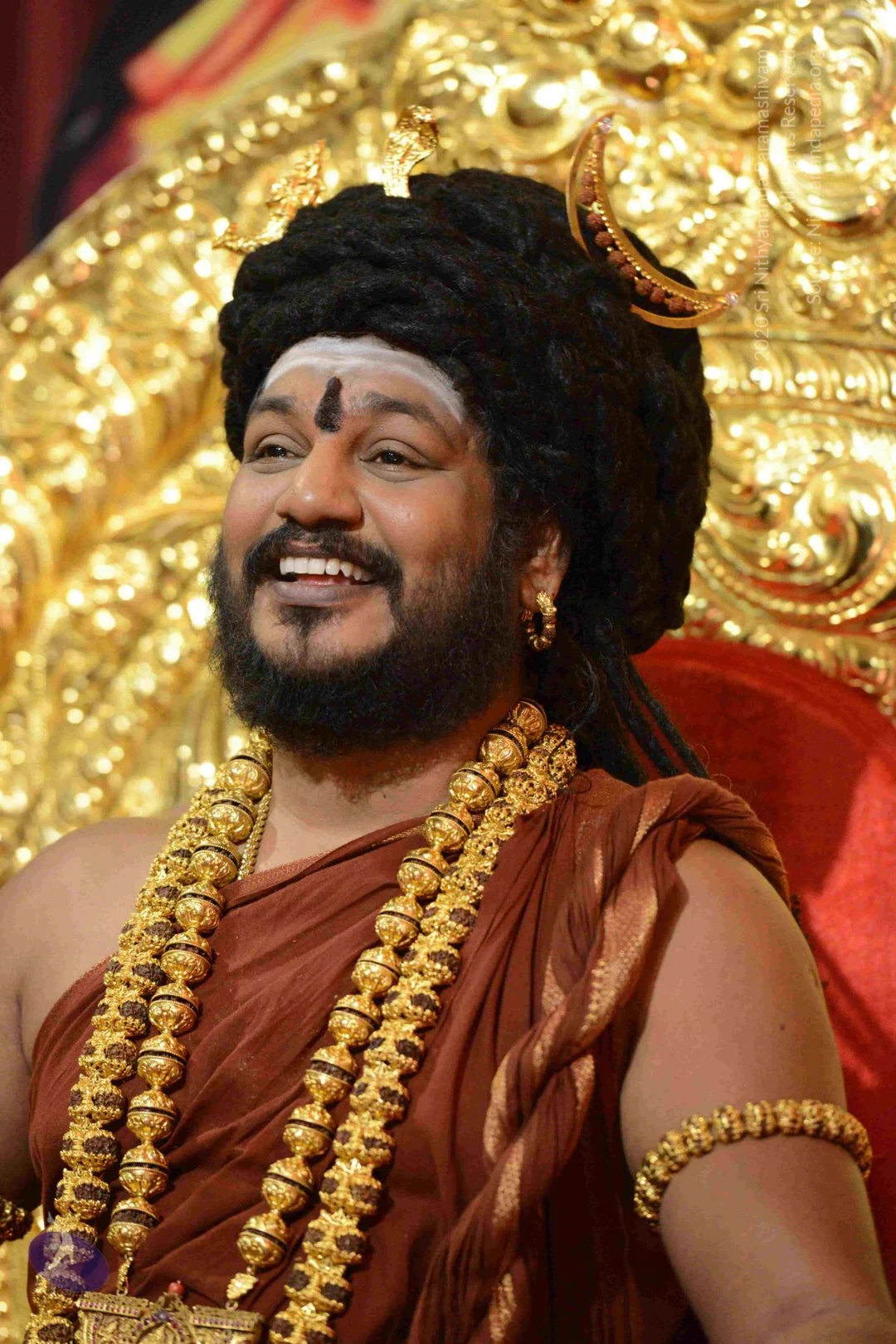
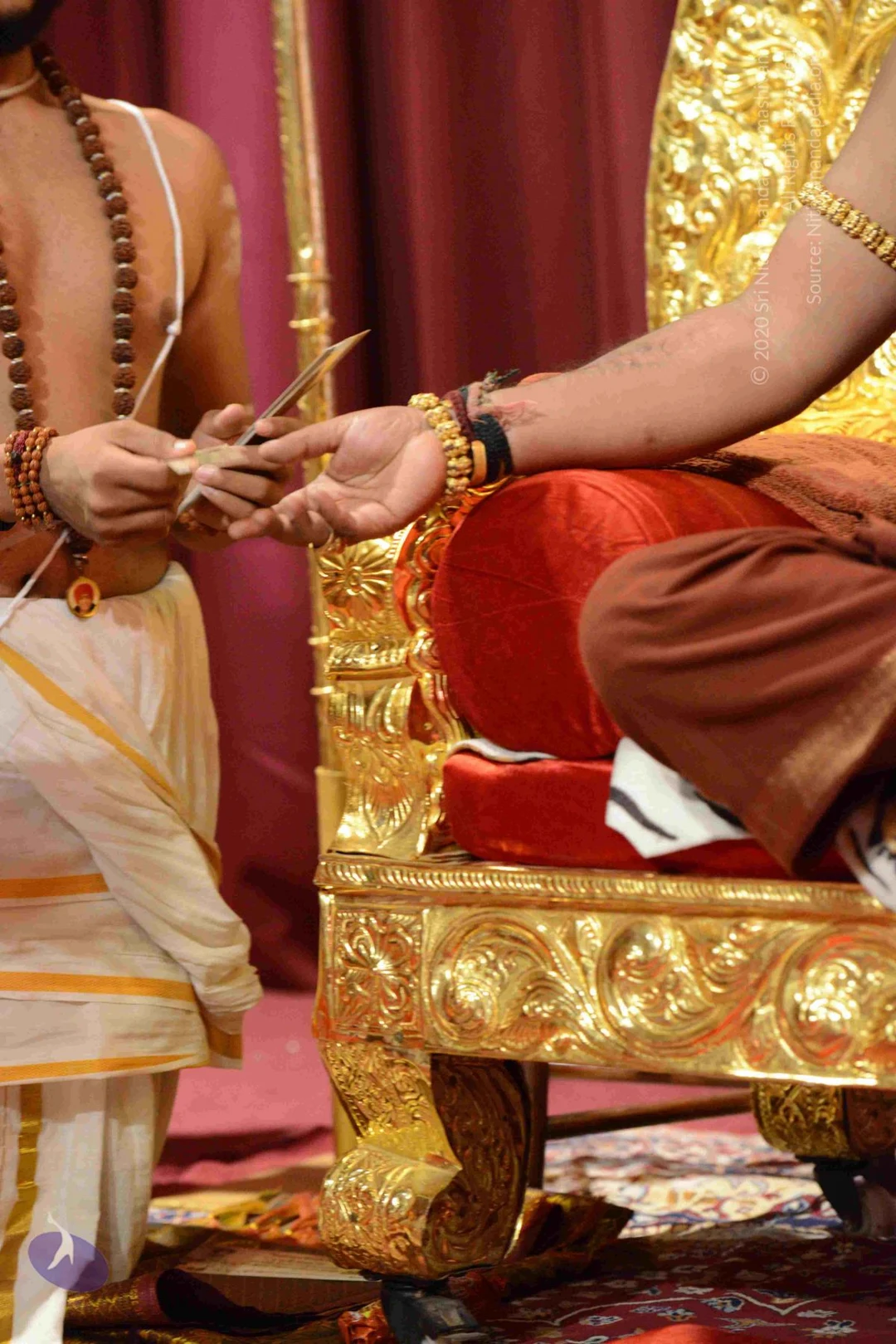
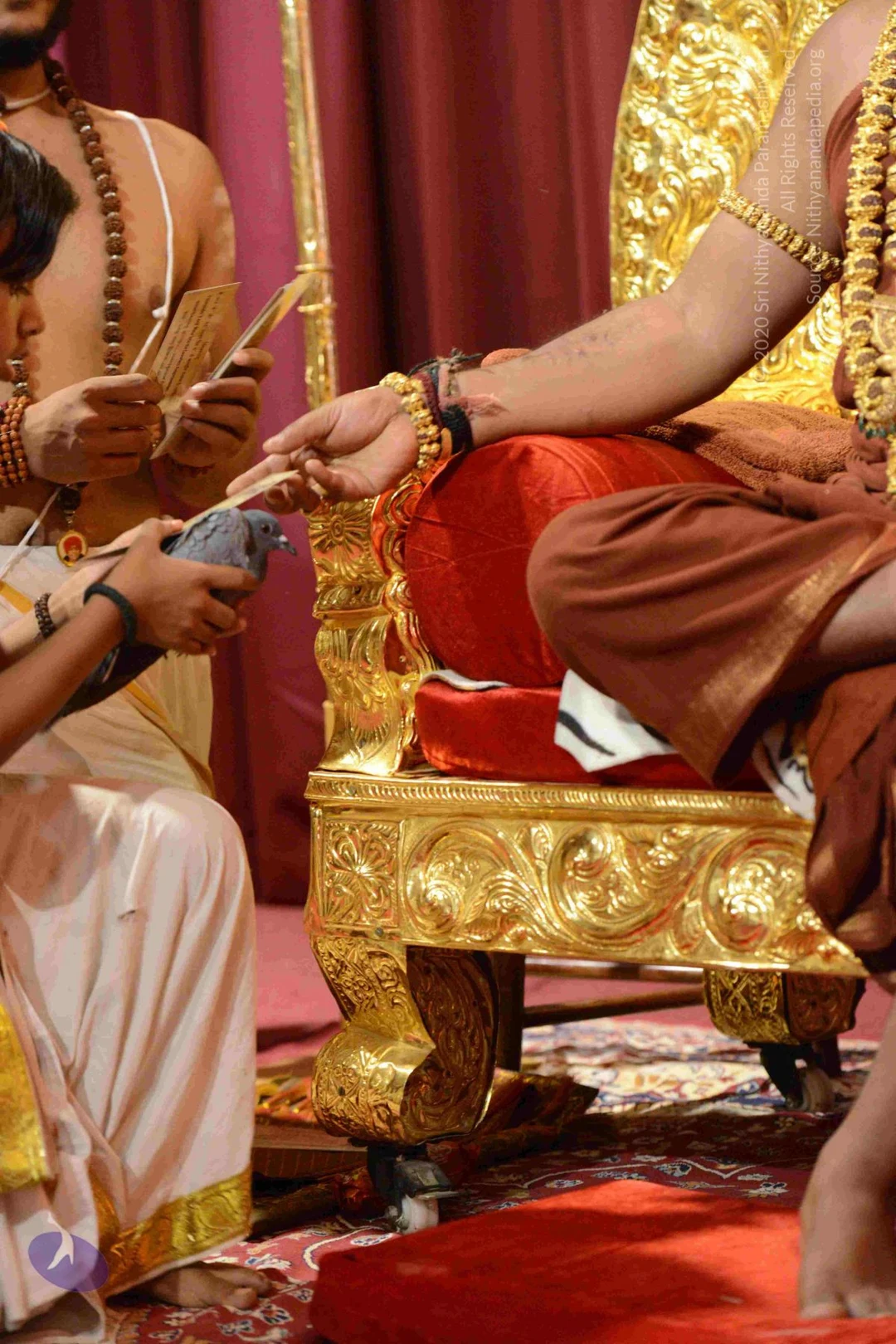
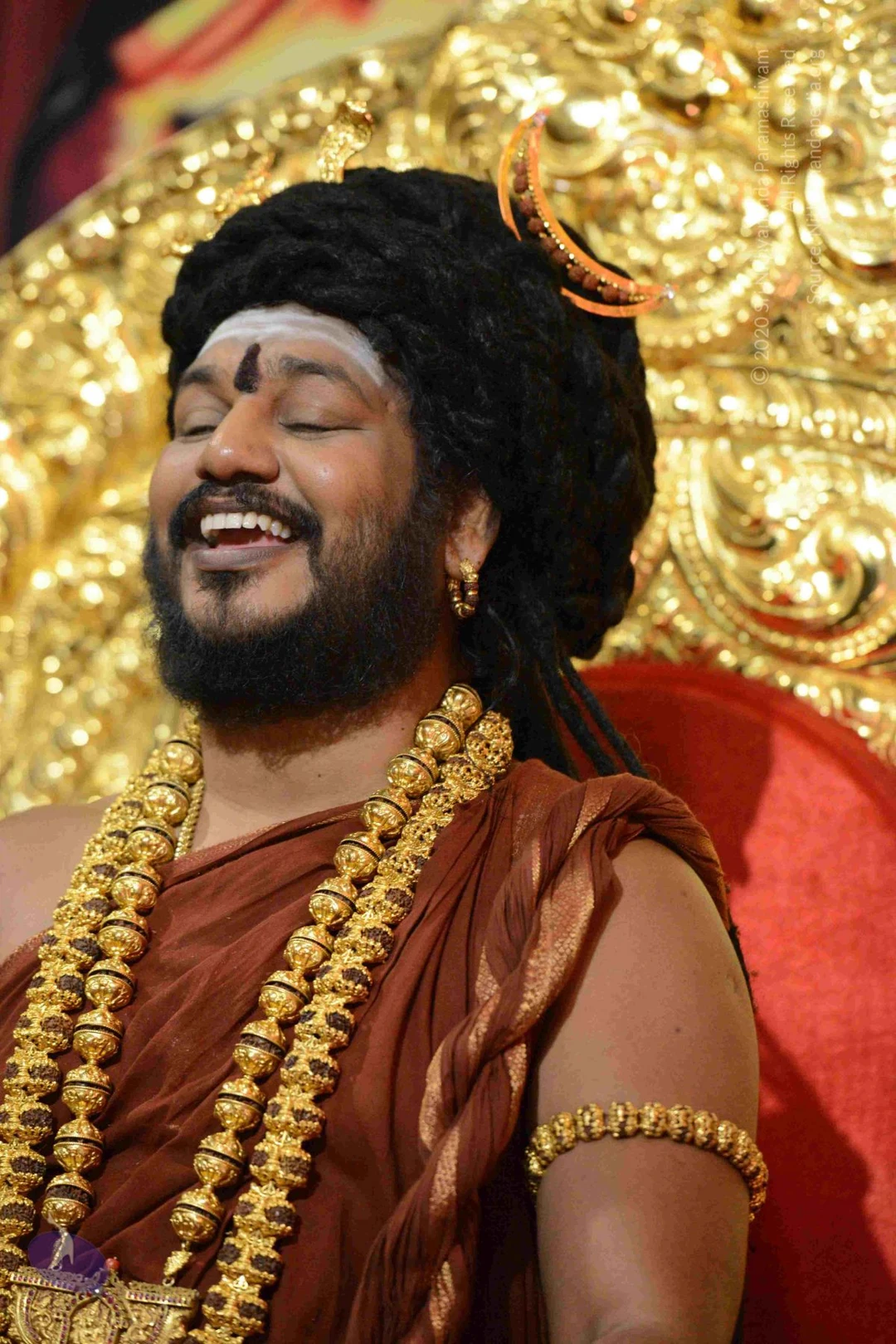
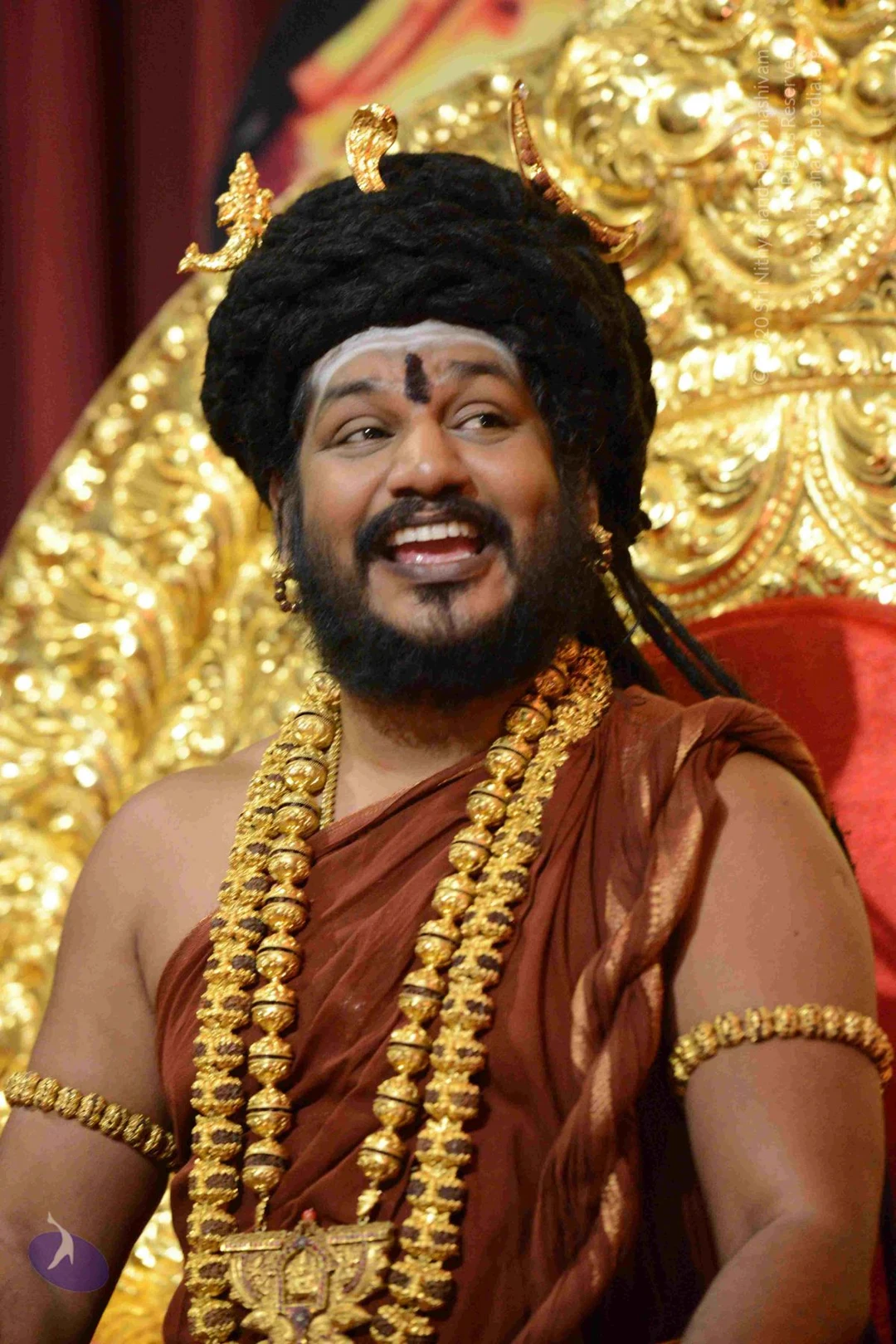
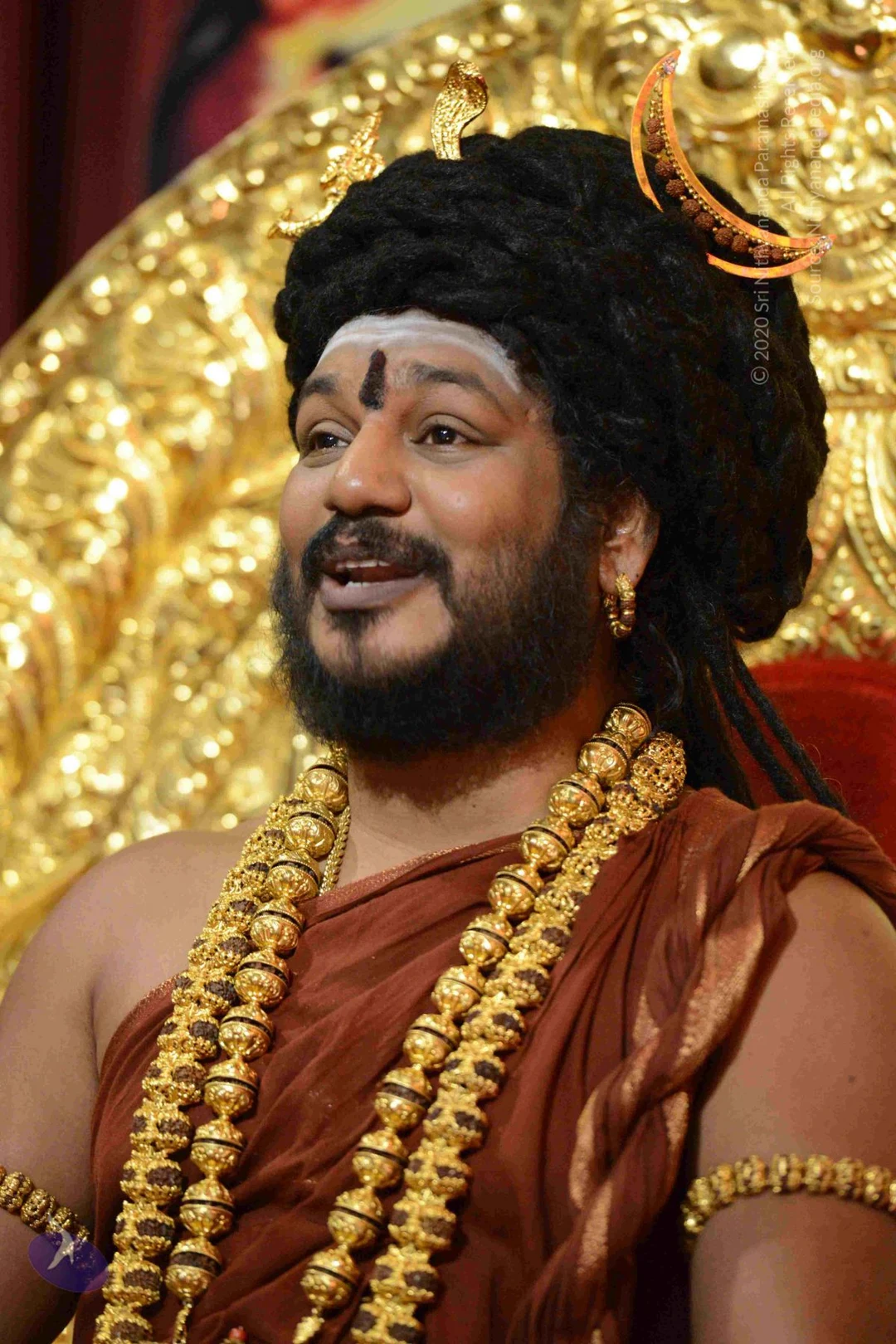
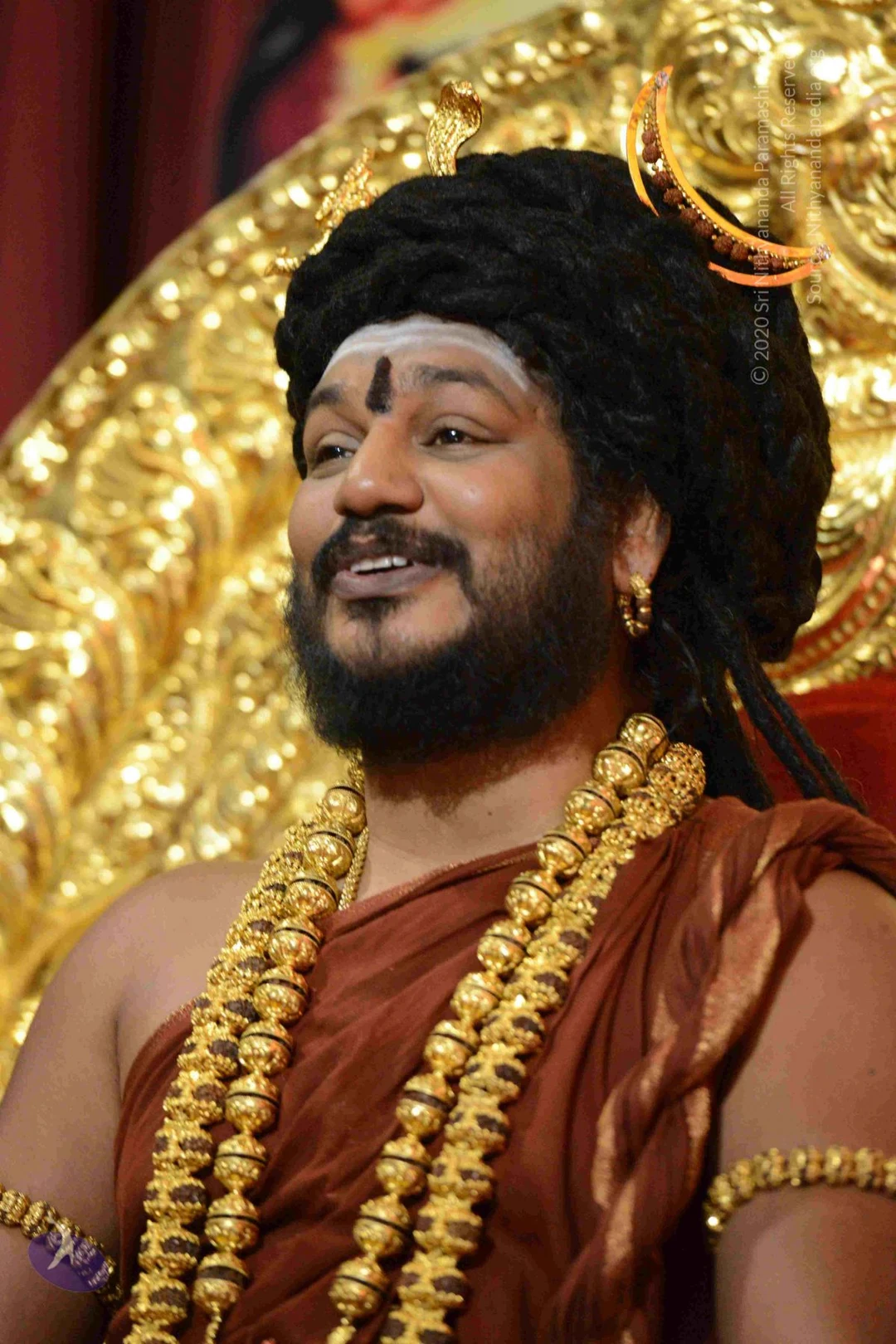
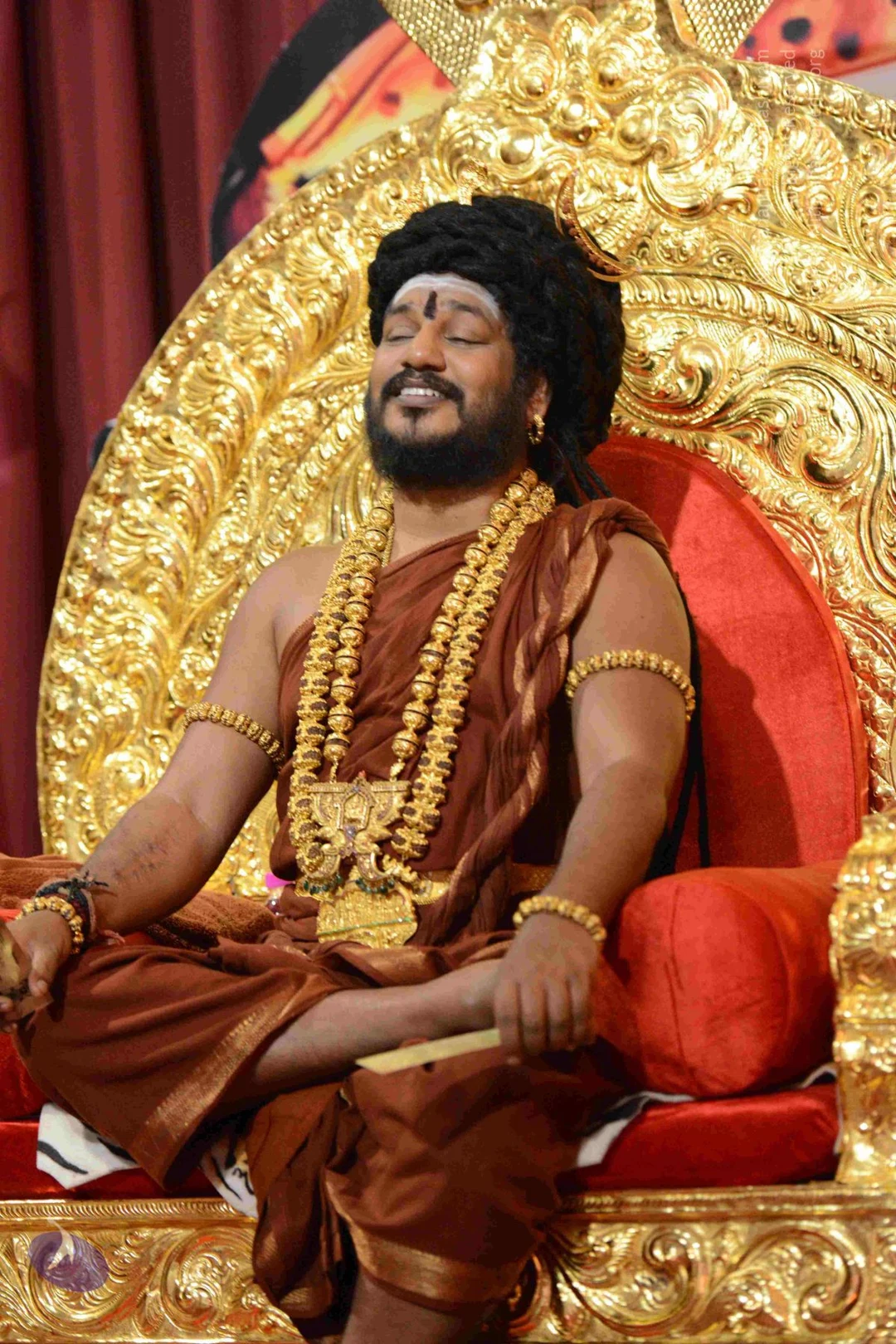
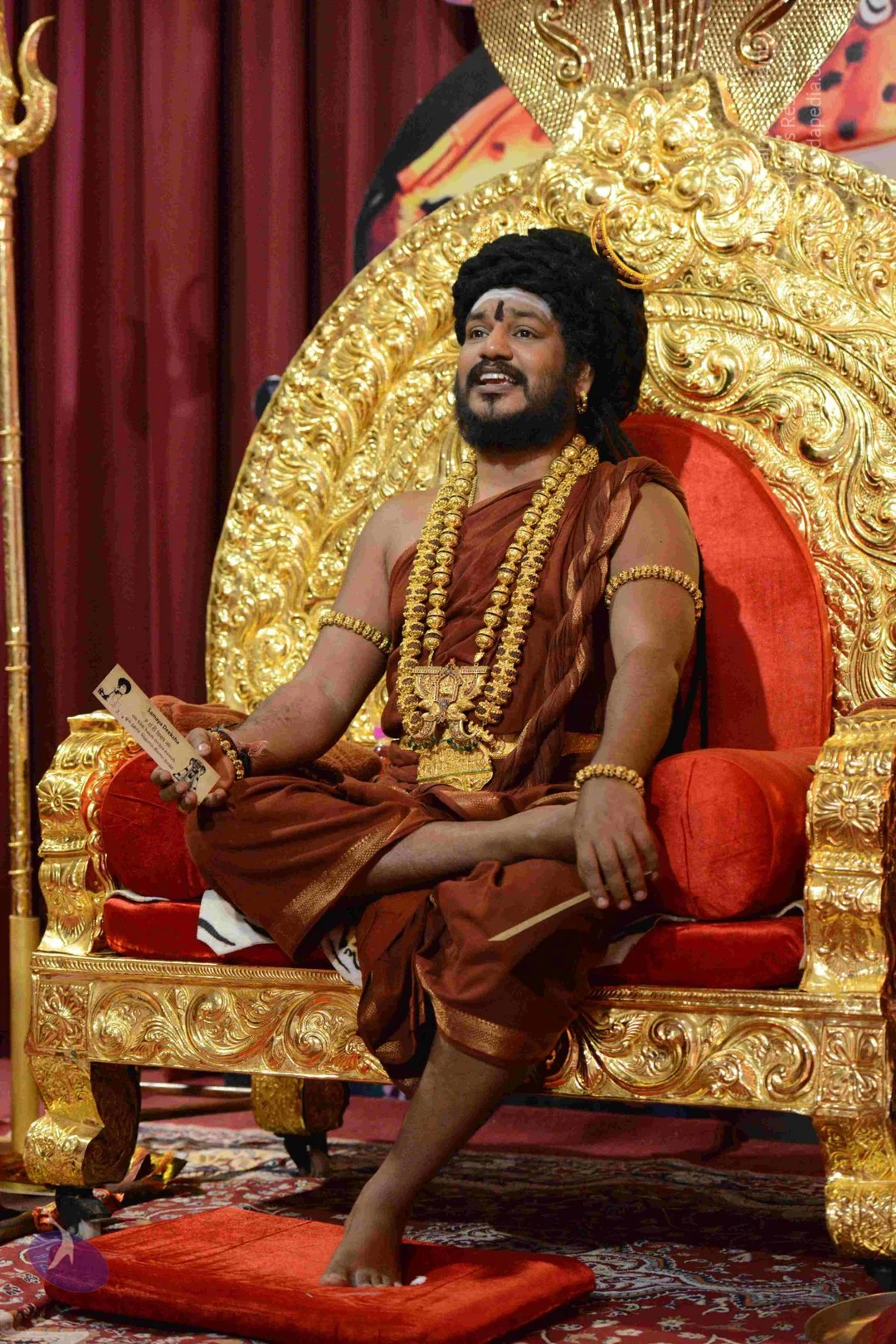
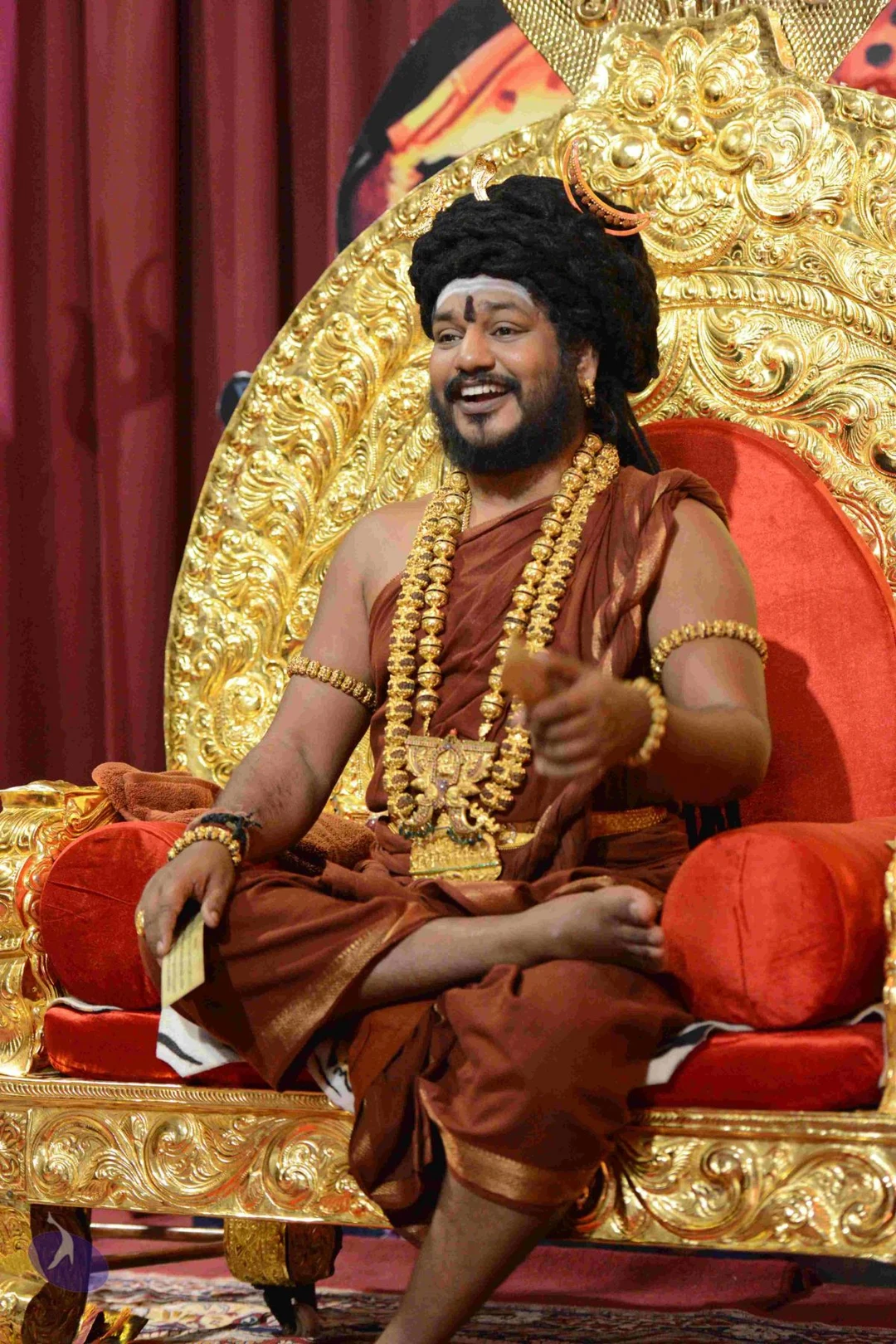
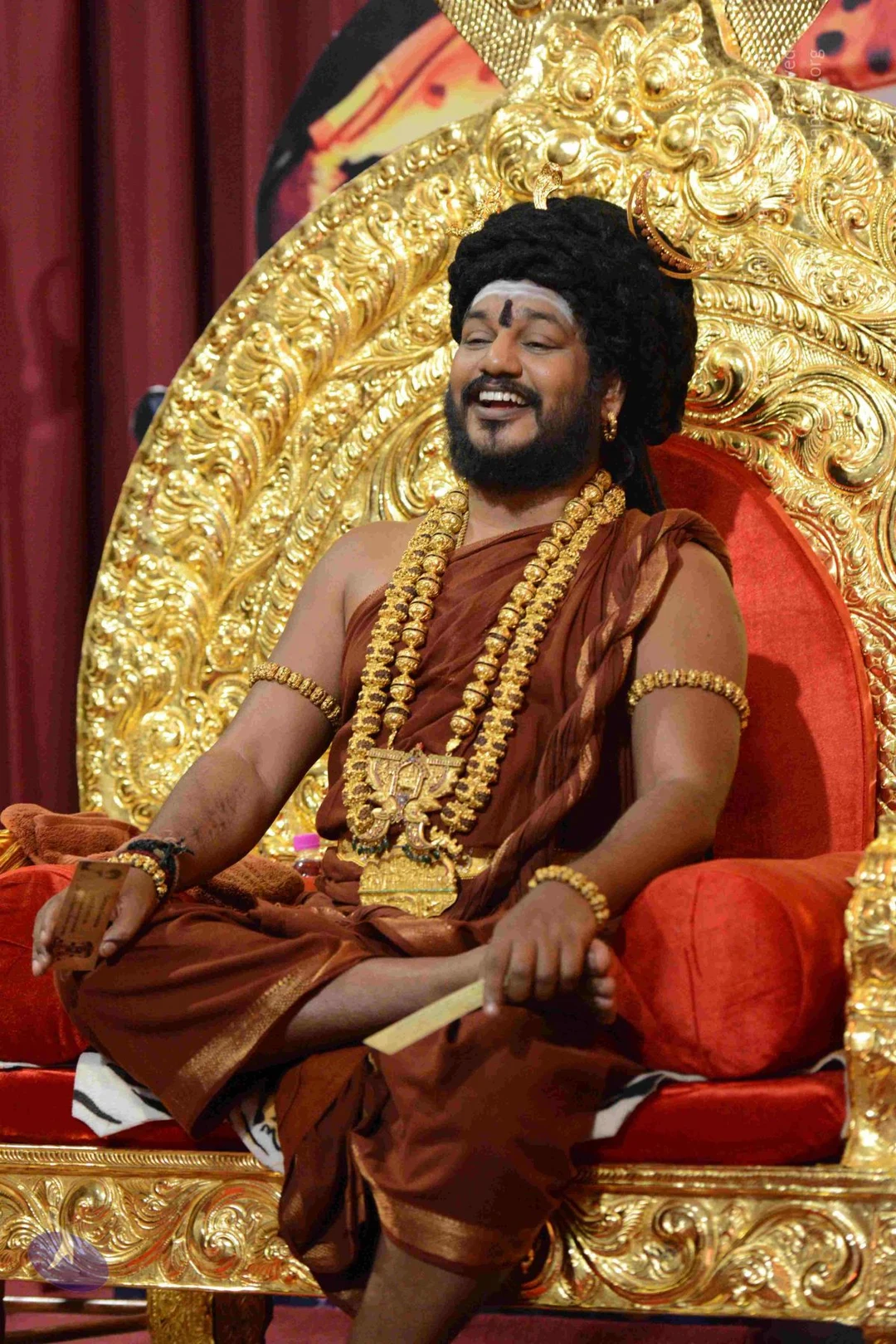
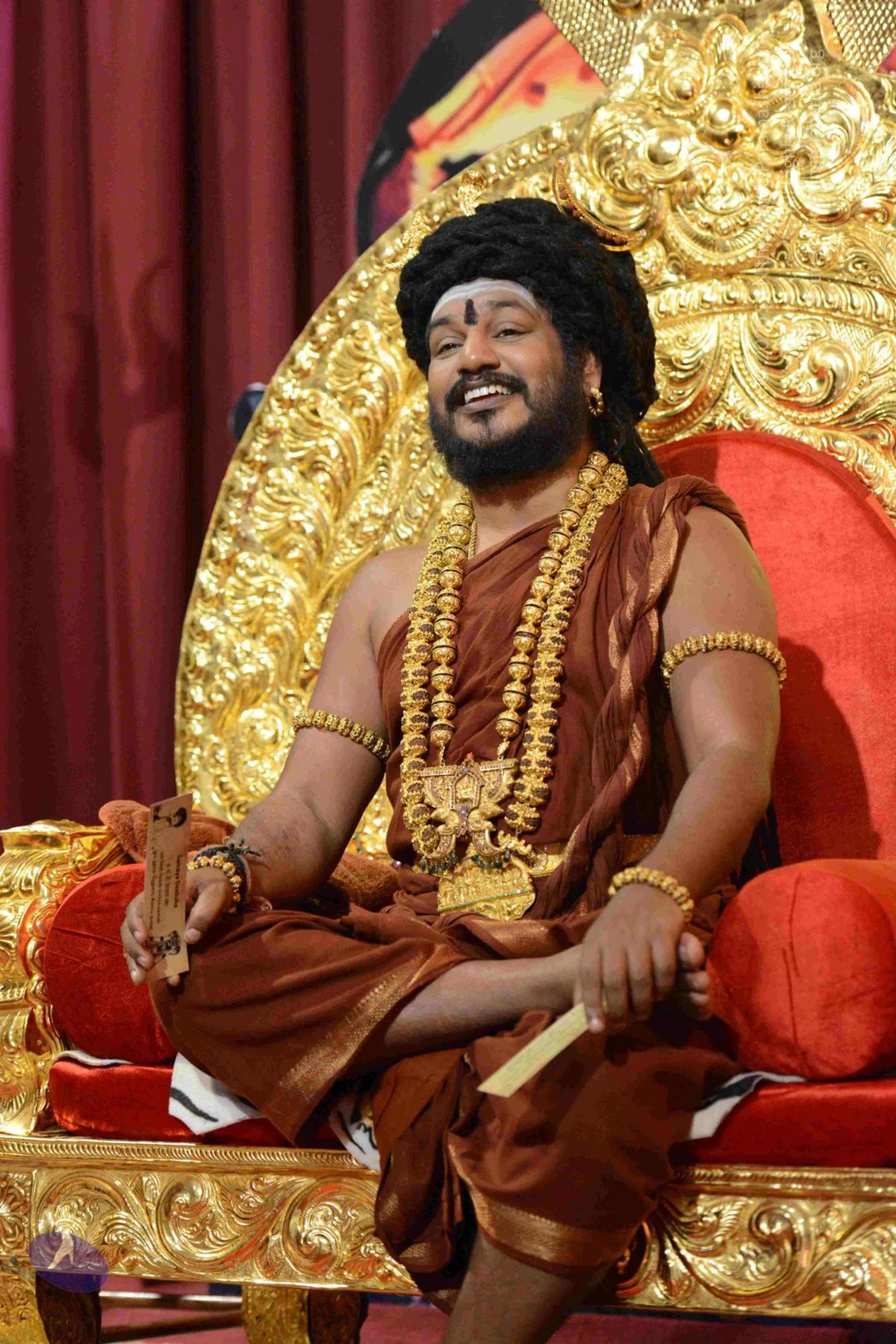
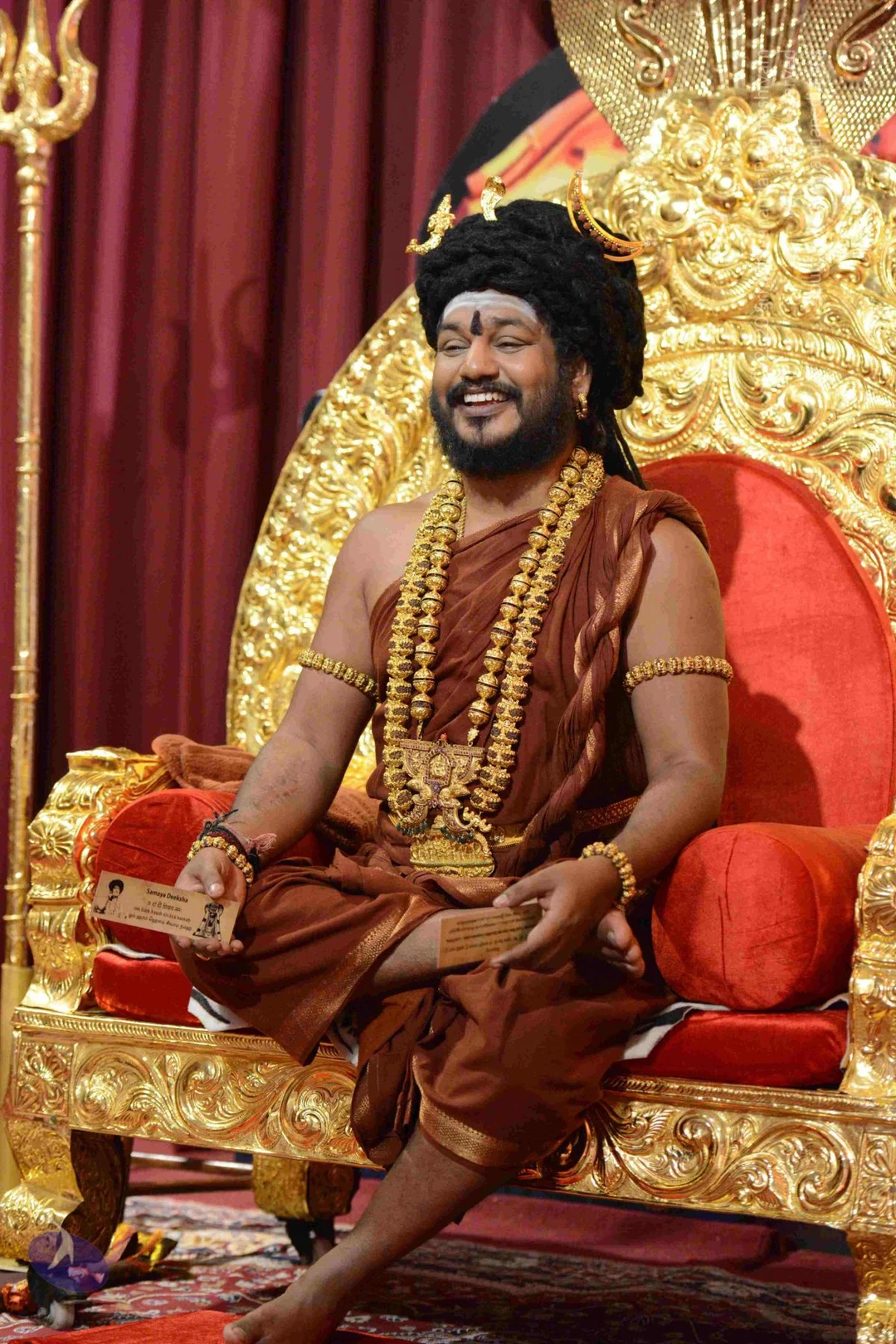
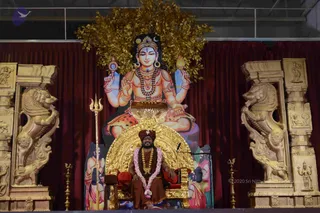
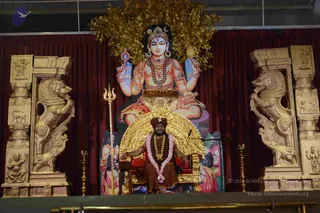
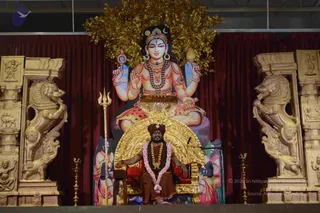
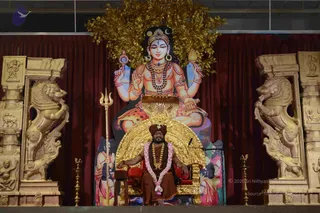
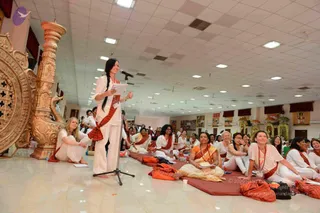
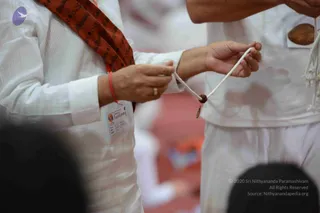
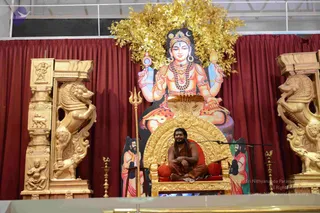
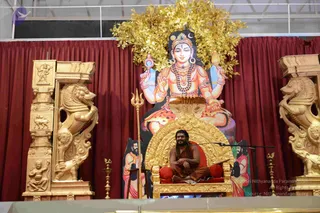
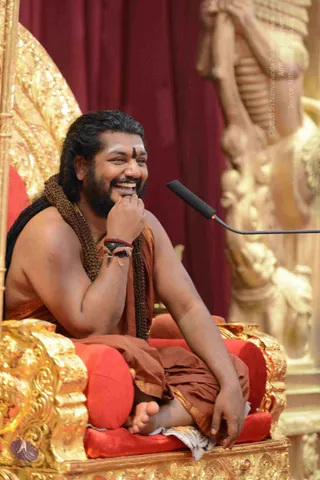
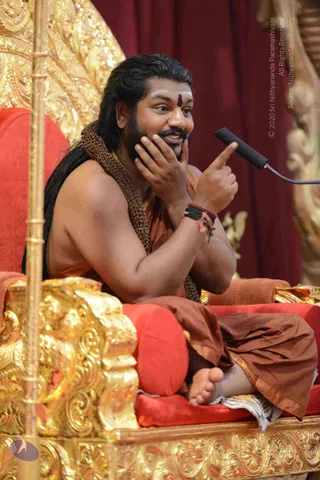
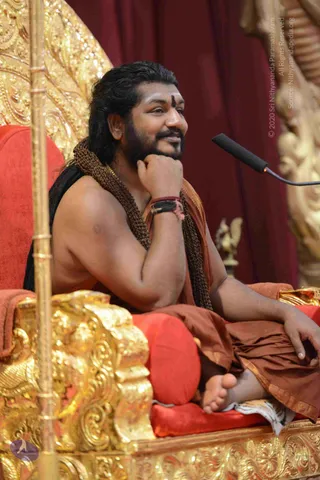
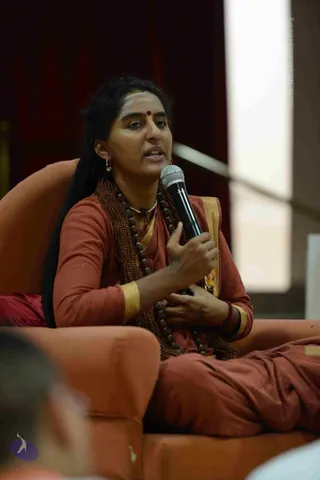
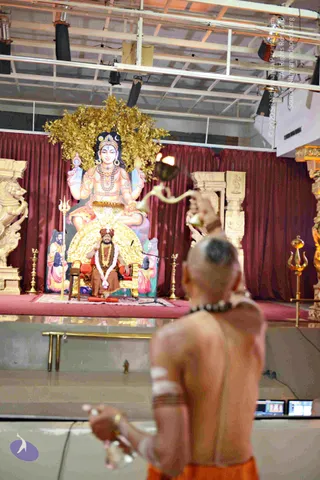
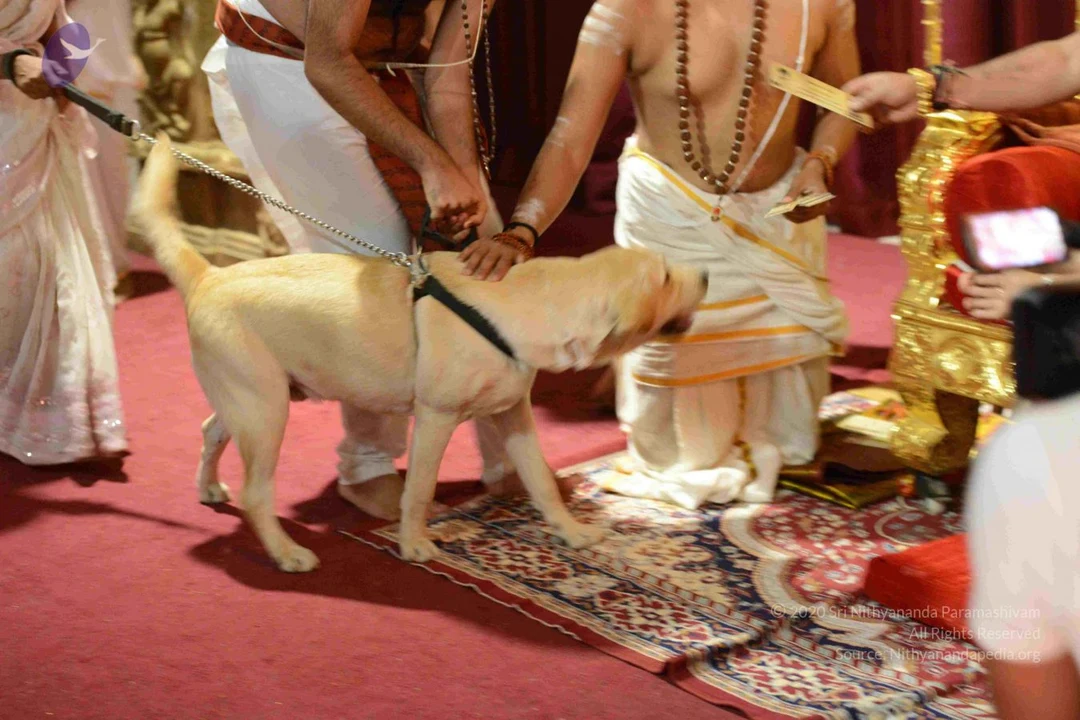
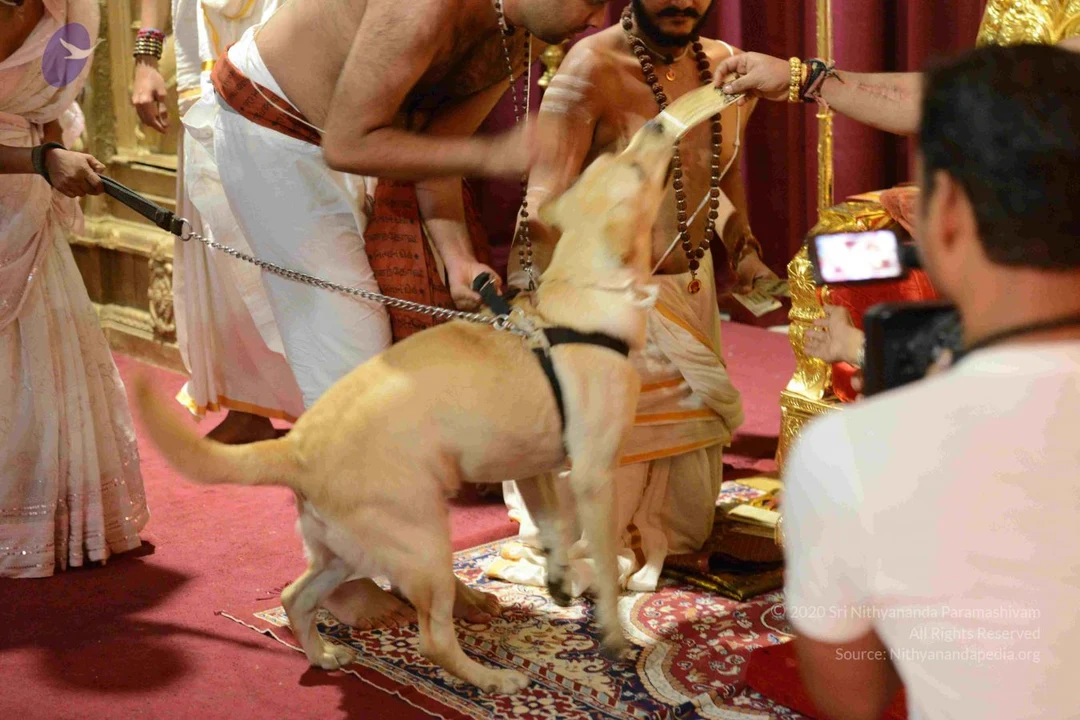
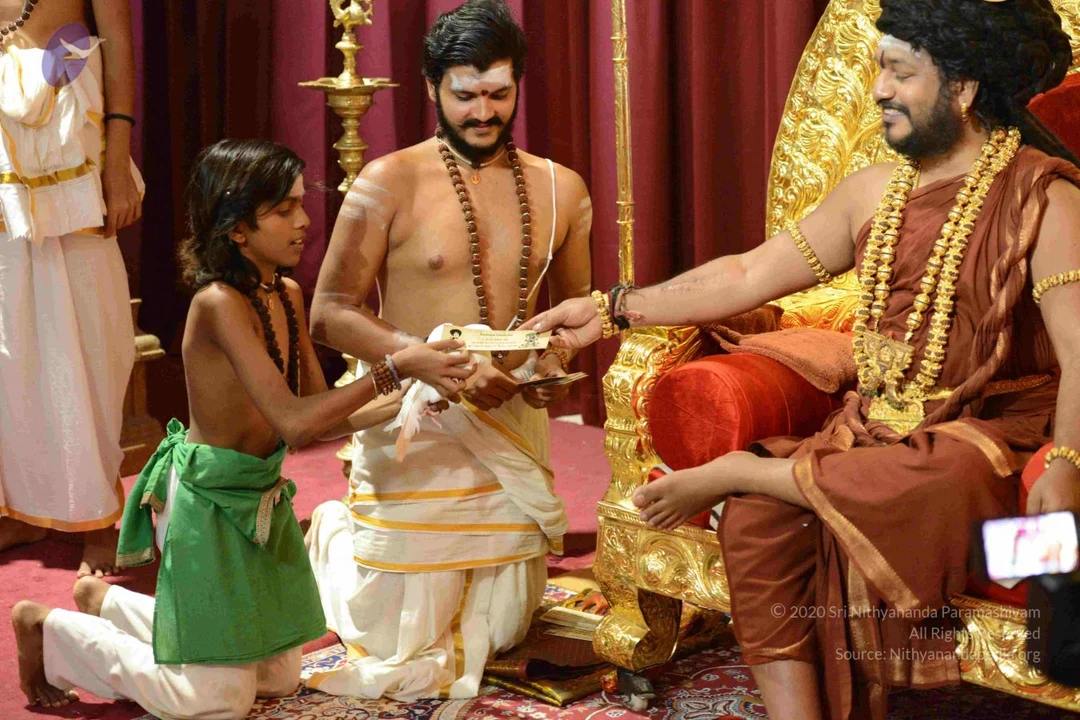
A photograph of a seated figure on a gold and red throne receiving a small slip or leaf from an attendant at left. The seated person wears rust-brown robes, a heavy gold necklace and gold armlets, with red and black wrist threads and beaded bracelets. The attendant at left, partly visible, is bare-chested with brown rudraksha beads on his chest and wears white dhoti with an orange border. Behind them are a gold ornate throne back, a red velvet cushion, a gold staff, and red drapery. A small red bottle sits on the cushion. The identity of the seated person is uncertain from appearance alone.A photograph of a seated man on a golden throne on a stage draped with deep red curtains. He wears a saffron-orange dhoti and shawl, a gold beaded necklace, and a dark head covering, with hands resting in his lap in a meditative pose. Behind him stands a large painted deity murti with four arms, a golden leafy halo, and a crown, flanked by a golden trident, a golden kalasha, brass oil lamps and a large painted figure in orange robes on the right. The stage has a red carpet and an ornate ceremonial setting. a person is seated in the centre on the peetha, the single visible person.A woman with long dark hair and a red bindi stands at a microphone on a stage, speaking and gesturing with one hand while holding a sheet of paper. She wears a white long-sleeved tiered dress with a rust-red shawl wrapped at her waist and draped over her shoulder. Behind her is an ornate golden and pink carved decorative panel with a lattice of pink lights and carved figures. Several seated women in the audience wear orange and white clothing and orange beaded necklaces, one in the foreground with a red scarf.

September 28 2016

Original wiki page
Contents

Title

Experience Sadashiva, Manifest Powers with Integrity

Description:

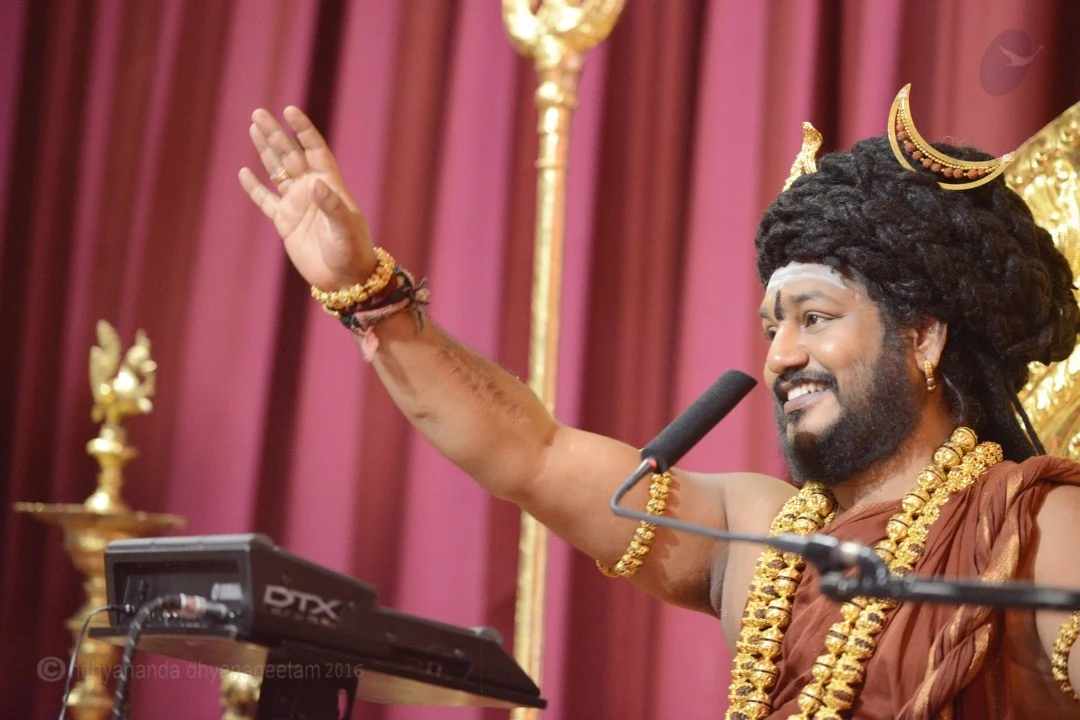
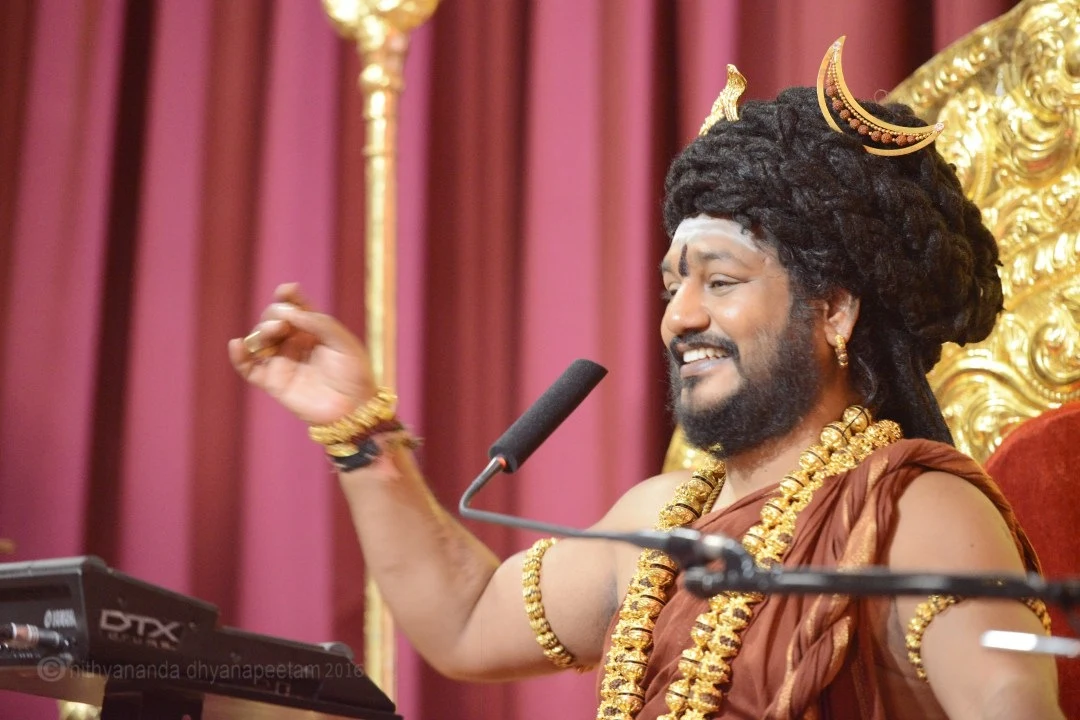
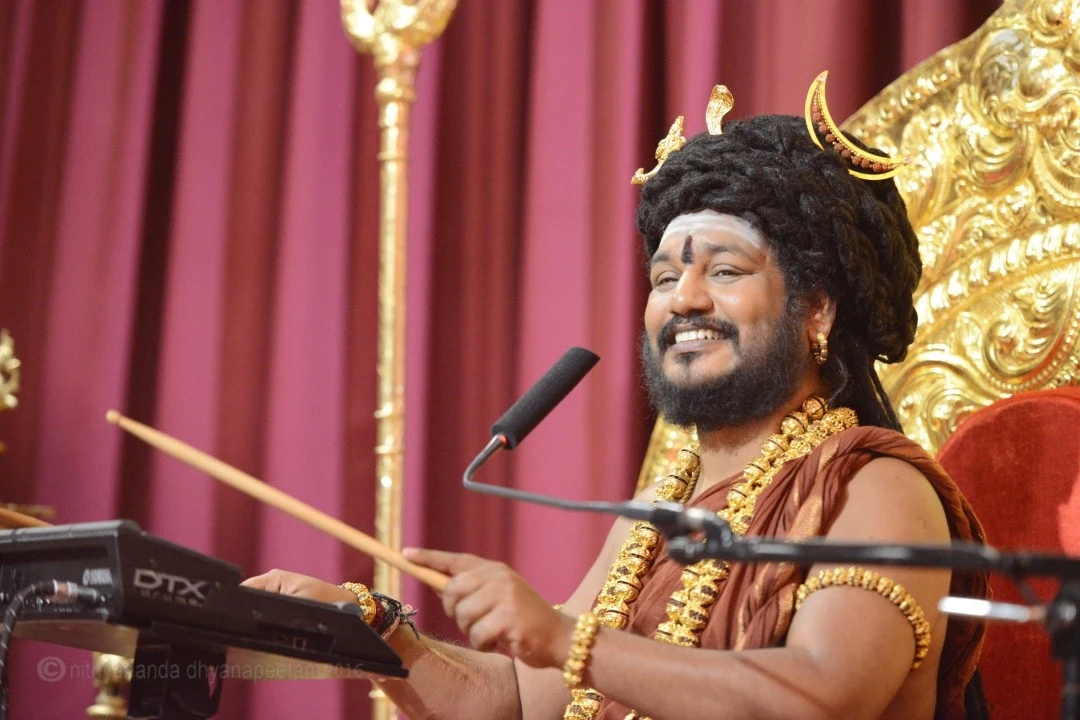
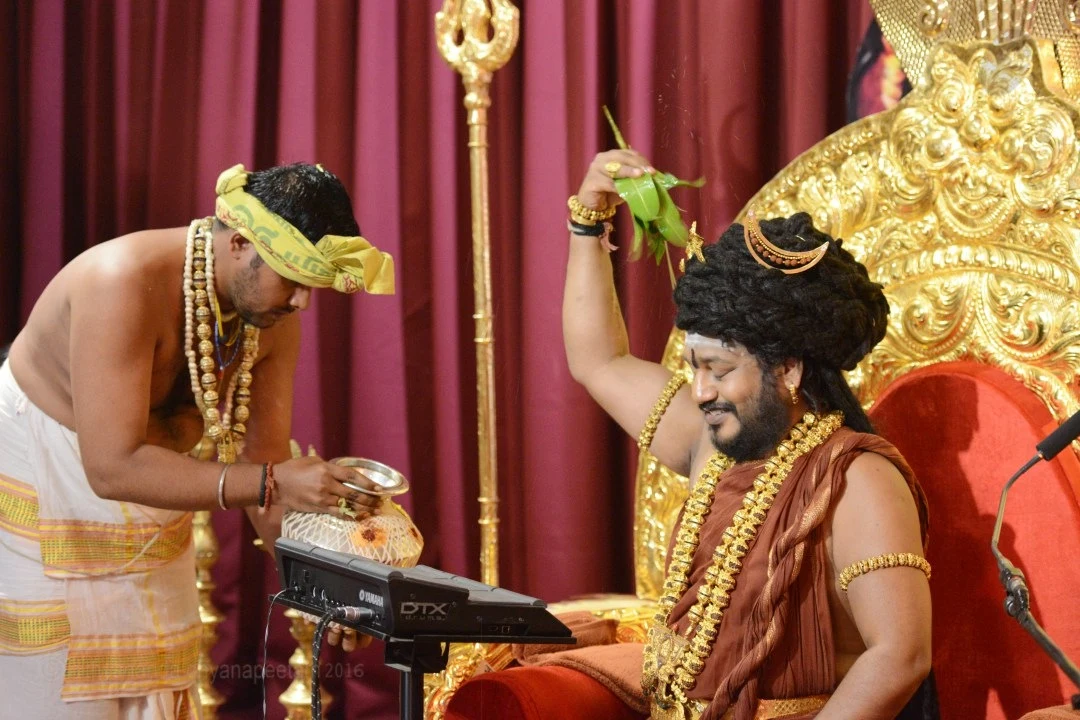
September 28th, 2016 – In today’s morning Satsang, His Holiness Paramahamsa Nithyananda reiterates how the Power of Integrity is one of the key components to experience Third Eye Awakening and manifest spiritual powers; we can create what we want, even shape our own bodies! His Holiness beautifully illustrates this Truth by sharing a story of one of the great Masters with whom he spent his childhood, Yogananda Puri.

Link to Video:

VideoAudio

Transcript

nithyānandeśvara samārambhām nithyānandeśvari madhyamām | asmat āchārya paryantām vande guru paramparām ||

I welcome all of you with My love and respects. I welcome all the Devotees, Disciples, Sarvajnapeetha Yajamans, Samajis, Satsanghis, Sri Mahants, Mahants, Kotharis, Thanedars, Inner Awakening Participants, Devotees, Disciples, Visitors, Viewers, everyone sitting with us, all over the world, through Nithyananda TV, Facebook Live, YouTube Live and Two Way Video Conferencing having Nayana Deeksha. (1:31)

I wanted to expand today on, one of the most important sacred truth, in Third Eye awakening and experiencing Sadāshivoham. Integrity. Not only in relation between you and things, outside you. Even internally the integrity, internally.. I’ll….I’ll tell you, one small incident. My Guru, Yogananda Puri, listen carefully. He never wanted Me to call himself as Guru, he told Me – never ever tell, “I am a Guru... I am your Guru. Later on, I only recognized you and supported you. That’s the reason, I….. It is my pride in your Mission, you are having me as a part.” That’s the exact word I remember. Once, one of his son and another one disciple, his disciple, he had many disciples who come to learn yoga from him. Both of them decided to hospitalize him, saying, “he that he was not feeling well, he is sick.” And, I was sitting away and seeing the whole drama. Little far, I was sitting, I still remember the scene. He just got up from the bed, he was lying, and got up from the bed, from the navel the way he hugged his own body, means the way he possessed his own body and said, “What I cannot do to my body, how can these doctors fellows can do to me?” Listen. It was such powerful statement. I literally got the click, at that moment. “Oh God, so many things, which cannot be express verbally landed in me.” Like a….My Consciousness is master of My body and it has the capacity to build the body as I want. (4:26)

It only built the body already, how can any other power, can be more powerful than My consciousness. And, I wanted to put this on record. He shocked the doctors making, 47 heart attacks in the ECG machine. When he was hooked to the ECG machine, playfully, he will stop the heart for 5-6 minutes. The ECG machine will be showing, flat graph and then he will start. He will start. One fortunate thing, still they have the records. I am trying to get the whole documentation. I only got the essence. Doctors are shocked actually, they said, “Nothing can be done, you are beyond medical science, please go back to home.” They sent him back to home. And then he came, again lied down in the home. Both the son and disciple, both, were trying to argue with him. “ If you are beyond, medical science, then why don’t you be healthy, why are you lying all the time.” Means lying in the bed, resting. He said, “I have decided, my mission has been done.” Actually, all my 3 Gurus, left the bodies within 3 months time. The moment they saw, I am ready. They don’t need to be supporting me anymore. Now it is time, I have to be on my own. I have leave Thiruvannamalai. All 3 of them left the body, within 3 months. They had a meeting, and they called me and said, “Don’t expect us to be in the body anymore.” And I really did not take them seriously, I thought may be they want to go for Parivrajaka Yatra, some temple tour or yatra, but within 3 months, tak, tak, tak, all 3 left the body. So when the son and disciple, both of them were asking, “Why are you then, lying in the bed all the time?” He told them directly, “Aye, I am not sick. I have decided to leave the body, so I resting. I am withdrawing from my prana. I releasing my prana.” You can neither hospitalize him, because if you hospitalize him, because if you hospitalize him he makes 47 heart attacks. He gives heart attacks to doctors. They have to check the ECG machine, 2-3 times, whether it is working or not. (7:27)

The way he got up and possessed his body. Still I remember, even if I remember that scene it gives Me the click, “Yes, Aye, My body, My Consciousness created it. My Consciousness is designing it. My Consciousness is maintaining it. Who else can do anything, better than what I can do to myself”. It became such a strong Integrity in Me. Listen to the word, I am uttering. It become such a strong Integrity in Me. Whenever I remember that, I know my body is in my control. My body is in my control. Two days before, I was telling one of my Balasant, “Aye, tell your body to grow tall.” Just when you sit, for the Akashic Records, the space you fall in, that’s actually, the pure Sadāshivoham space. Yesterday, I was hearing, many people who came to read, their Akashic Records, they say, “One, what the response and answer we got is amazing. Second, even going there and reading the Akashic Records, opened up our Ananda Gandha, and the whole space was different experience, altogether. (9:16)

So told….the kids were actually telling, “Swamiji, the moment we sit for the Akashic Readings, it becomes...suddenly we are disconnected and somebody else, some other power, is radiating through us and it is such a tremendous joy and bliss. I tell you. That’s the space of Sadāshivoham. I told the Balasants, “Hey when you are in that space, tell your body grow tall and chisel your body as you want. 6 pack, 8 pack, 18-inch biceps, whatever, whatever you want, tak, tak, tak, and just chisel. You can Photoshop your body, That’s all it takes. It’s possible. You will see I will manifest it through My Balasants and show you guys. Integrity even within the system. Integrity with your intra-organs. Integrity with your internal organ. Listen internal organ means intestine, liver, kidney, heart, lungs. Intra-organ means Third Eye, Vaak, Third ear…... No third ear. There is one fool tried to discover or invent. Intra organ means Third Eye, Vaak, all these are intra-organs. Internal organs means like liver, kidney, intestine, lungs, heart, all this. Integrity with your intra-organ and internal organ. I told my Balasants, you have to be highly integrated to the Akashic Records appearing, no fear, no greed. You can’t tell somebody, that get some money or get some things, because they are completely in the space of listening to you. No! Nothing you cannot ask anything, you cannot tell anything, because they are in space of listening with you no. (12:12)

You have to completely integrated to the Akashic Records. What is seen as golden letters, only that should be read out and if that Akashic Records appears as, do this, do that, don’t even have the fear to tell that person. Don’t worry. Don’t bother what that person will think. No! We don’t care about what you think. We care about only what Kalabhairava thinks. I told them be highly integrated, to Kalabhairava. No fear. No greed. You can neither ask something nor leave, omit some information, which is appearing in front of your eyes. I said you can’t even ask people to attend programs, unless it appears in the Akashic Records. It will actually appear in golden letter, shining golden letter in the dark background. Not black, dark. Black is 2 dimensional darkness. Darkness is three-dimensional black. In the darkness, that is what is KAALI. KAALI means in Sanskrit, darkness. The 11 dimensional darkness is Kaali. So whatever appears on KAALI, you just have to read out, in golden shiny color, the letters will appear. You just read out, you can neither add nor delete. No fear and no greed. High Integrity. Only then continue to receive, read out, out higher frequency records. Now actually, they are reading out your past, present, future, whatever questions you are asking. But the information available to them, scientist can come and use. I invite scientists to come and clarify your doubts, questions. People in field of medicine, can come and clarify, your doubts, questions. People in field of solving the crimes, can come and use this knowledge available to solve the crimes. Understand the mystery behind the crimes. Understand. It’s not joke. I am responsible for what I am talking. I am responsible, for what they are uttering. I know the authenticity of the power, manifesting through them and I know their Integrity. (15:40)

All this, what I am saying, you guys will see as a reality. People from various fields from all over world, coming and sitting and listening to Akashic Records, not only human beings, including Siddhas, Rishis, Ganas. Siddhas, Rishis, Gandharvas, just in the zoom camera, the question will appear, voice will be heard and the form will not be seen, by all of you. Of course, the kid who reads who read the Akashic Records, he will be able to see. You’ll see Siddhas, Munis, Rishis, Ganas, Kinnara, Kimpurada, Gandharva, Gandhara, all of them coming, to get their Akashic Records read out. Whenever I start in the beginning, it use to very small, it will look always very small. When I started My first class, 2 ½ people were attending. You may ask. “What is 2 1/2?” 3 were sitting and 1 was all the time sleeping. So, I calculate as 2 1/2. Understand. So now you are seeing, hardly dozen kids, or a little more than a dozen sitting and doing the Akashic Reading. Very soon there will be at least 1000 Balasants, sitting every morning reading Akashic Records of 2 lakh people all over the world. You will see this happening, because the Authenticity is going to spread very soon, left and right. And also one more thing, you can go and put the same question, with ten different Balasants, at ten different days or time, they will read out, exact verbatim, same answer. There will not be any confusion in the answer. That is the scale to measure, the authenticity of the records or their ability to read records. (18:13)

Because of the Integrity with intra-organ and internal organ, not only you manifest health, you can design your body as you want. You can manifest multiple powers and possibilities. I tell you. Even if you do little Completion, you can understand what I said, when Yogananda Puri got up and said – “My body, how can they do something which I cannot do it to this body by myself?” Contemplate on this. Contemplate on this. Then you will understand why Balasants are able to manifest so much of power. I tell you, it is all simple. You don’t need to build power station, you just need to be connected with a proper copper wire, that is called Integrity. That’s all. Power station is HERE, eternal atomic power station. You don’t need to….. You always felt all this Sadāshivoham, or spiritual enlightenment, everything was very difficult because you are planning for building a power station, which you don’t need. I did it already. You just need connection. Integrity is the connection.

tanga taga taale tamburaan silasai angam baduka jnana anjanam tadavi vappa seppal tanga padi jnana panne (20:33)

I’ll give you little detail, when I say, what do I mean by – Integrity to your internal organs and intra-organs. When I say Integrity to your internal organs, feel all the time you own them. You own them. So whenever there is a food taken which puts you in depression, low mood, do not eat that food again. When there is a action done by you, which disturbs that internal organs, don’t do that again. It may be as simple as smoking or as difficult as heroin. It can as simple as smoking, to as complicated as heroin, whatever, whatever. Anything which is putting you powerless space, don’t do that again. That is what is Integrity, to your internal organs. Same way when you utter a lie knowingly, or when you give a word knowingly that you are not going to fulfill. The harm you are going to cause for your Vaak. You can see it very clearly. Don’t do that again. Sit and finish completing all the past. No need to have a lifestyle, where you are hurting your Vaak and internal organs. No need. You don’t have to take up that kind of a profession. Knowingly, there are tons of professions, where you can do sweet things, make money, live your life happily, blissfully. Be out of the Matrix. There are 1000s of things you can do it, without harming your Vaak, harming your intra-organ, Ananda Gandha. (23:21)

Integrity to the internal organ and intra organs. For example; if you eat non-veg, you’ll feel dull, tired, heavy, then decide, I am going to complete with this pattern, “What is it, that pulls me to eat non-veg? Is that the food, the way it is presented or the tongue, the experience of the tongue, when I am chewing, what is it?” Find that pattern and Complete. In one Tantra, I think Mahanirvana, there is a very beauty explanation.

A Rishi asks Sadāshiva, “What is the root cause or a root pattern of the sexual desire?” He says, “Appreciation of symmetry, appreciation towards something symmetrical or beautiful is the root pattern, from where your idea of sex start.” If you complete with that pattern and be integrated to that, suddenly you will see, sex becomes irrelevant to you. You may think how?’ Start contemplating, digging deep. All your sexual interest, is nothing but appreciation of the beauty. Beauty is nothing but symmetry. It boils down, to just this one understanding. Of course, when I read, even I was hmmm…..waaah. When I did the postmortem, of few human minds, I saw, “Yes, he is right as usual.” He is right as usual is surrender. With whoever you feel this, “He is right, as usual,” again, that is surrender. If you feel that with your Guru, you have surrendered, to your Guru. If you feel that with Sadāshiva. You have surrendered to Sadashiva. Whenever you feel, “He is right as usual once more.” How many times, I may run away. I may move out. I may try to create all opposite arguments with my great twisted, perverted, logic….No, the very words should be uttered with enough of twist and perversion, so, you remembe not only linguistically, phonetically….. toowist dodo... pervert doddd….. logica….. When I did the postmortem, “He is right.” (26:54)

Integrity to the internal organs and intra organs also, not just with the commitments and happenings of the external space. Listen. Integrity with internal organs and internal organs also. For example; one day you know if you wake up in Brahma Muhurta, and go for yoga, whole day you feel so alive. Then do that, that is what is Integrity. You want somebody to come and beat you and pour cold water on you and drag you to the yoga hall. When you eat food from Sadāshiva’s kitchen, as per His Bhaga Shastra. All of you should know, even the pickle you are having here, is done as per His instruction. Science of pickle to science to Sadāshivoham. Everything from Him. From him. And few places, wherever we are not yet, … we are continuously, sincerely, working, with all our integrity to Sadāshiva, to align our self. Because our lifestyle has gone so much away from it, much is lost. So, those lost things, we need to revive. Those revivals also we are very highly committed and integrated to Sadāshiva, to revive letter and spirit of His words. When the Integrity, to internal organs and intra-organs, becomes a practice. Understand even if you start practicing, so such good will happen to you. So much good. (29:26)

Now the line, I read out, few minutes before, Tamil 4 line. It is just Akashic Records, about the Akashic Records, which kids are doing. (29:40 Tamil sentences) It means, in the gold sheet, making the form of the Sadāshiva and ripening your body with the Integrity to the internal organ and intra-organ and applying the Jnana-anjana, with that, whatever words they utter is not copper, it is gold. (30:41 Tamil words). Bring Integrity, even with your internal organ and intra-organ. When you use food with certain chemicals and you don’t feel comfortable, stop it. When you go for natural, organic and you feel happy about it, have it. That is what is all about Integrity. Own yourself, and be master of yourself. That is one of the most powerful Completion. Today all the IA participants whatever questions you have about this subject, Completion with internal-organ, intra organ, Completion with yourself. You put all the questions. I’ll answer and I will upload this video in YouTube all the Satsanghis can watch and enjoy. The first session, I’ll answer all your questions on this Completion, Integrity with yourself. Actually, if you have Completion you can be Integrated only if practice Integrity, only then Completion, will be useful. Whatever is not letting you be Integrated, Completing that is Completion. (32:47)

With this I bless you all, let you all radiate with Integrity, Authenticity, Responsibility, Enriching, Causing, Living Shuddhadvaita Shaivam, the Eternal Bliss - Nithyananda. Thank you. Be Blissful.

Photos From The Day:
Sakshi Pramana:

Sharing from NITHYANANDA YOGAM

Photos Of The Day:

NITHYA SATSANG

Photos Of The Day:

Homa

IA-participents

IA-shivadeeksha

Photos Of The Day:

IA

Shiva-Deeksha

01-NITHYA-SATSANG

Photos from this day

View all 242 photos

Photos From The Day:
9 photosSource gallery
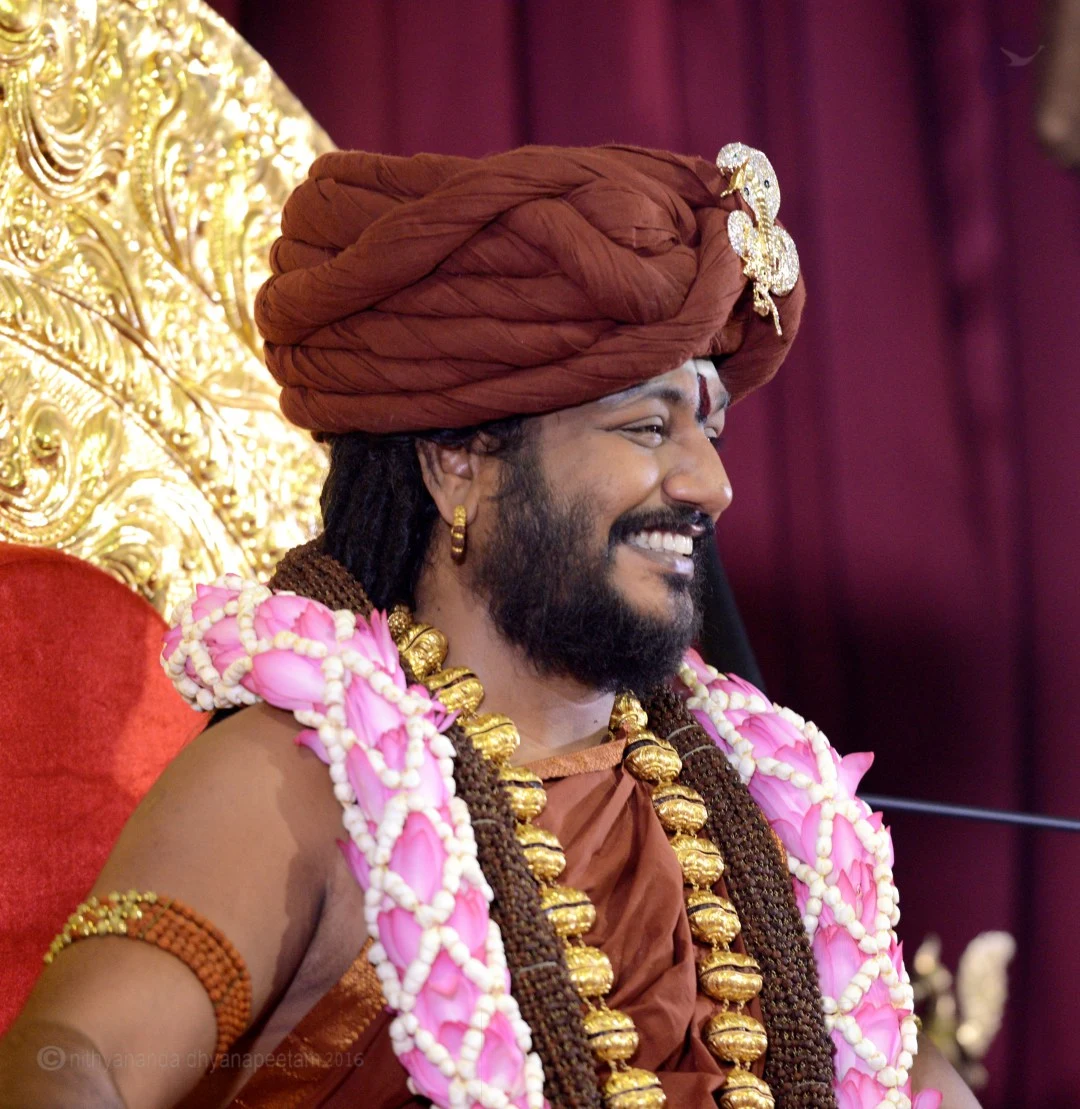
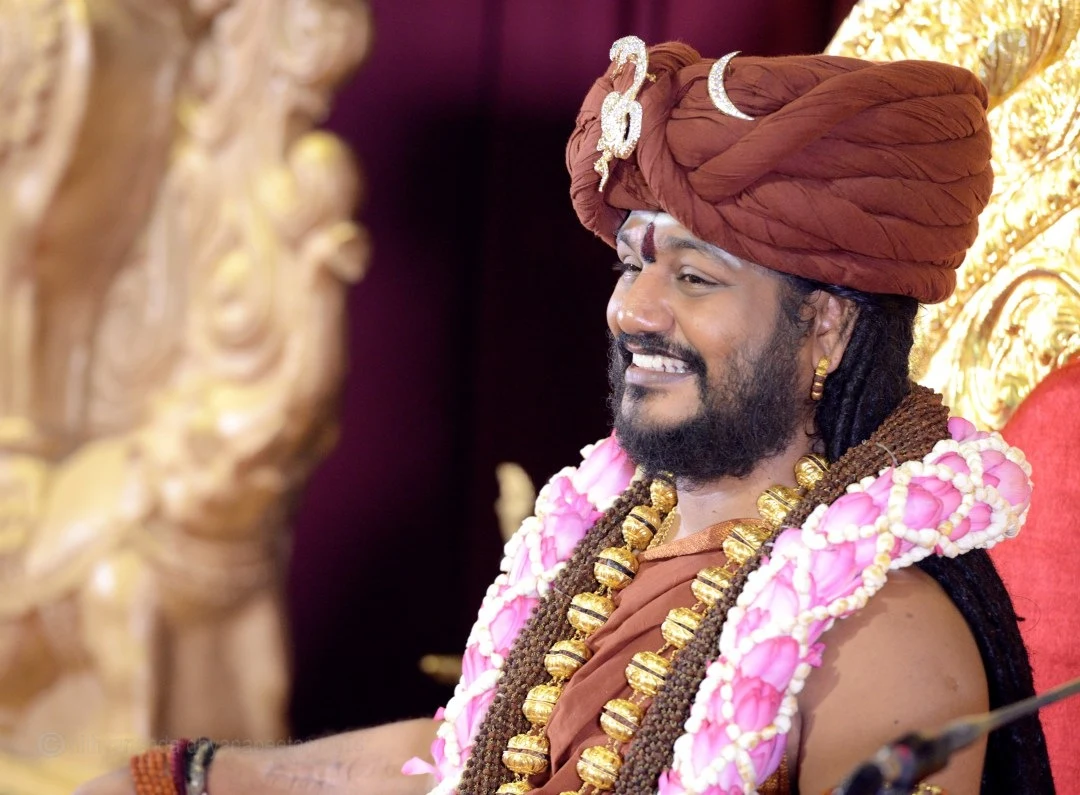
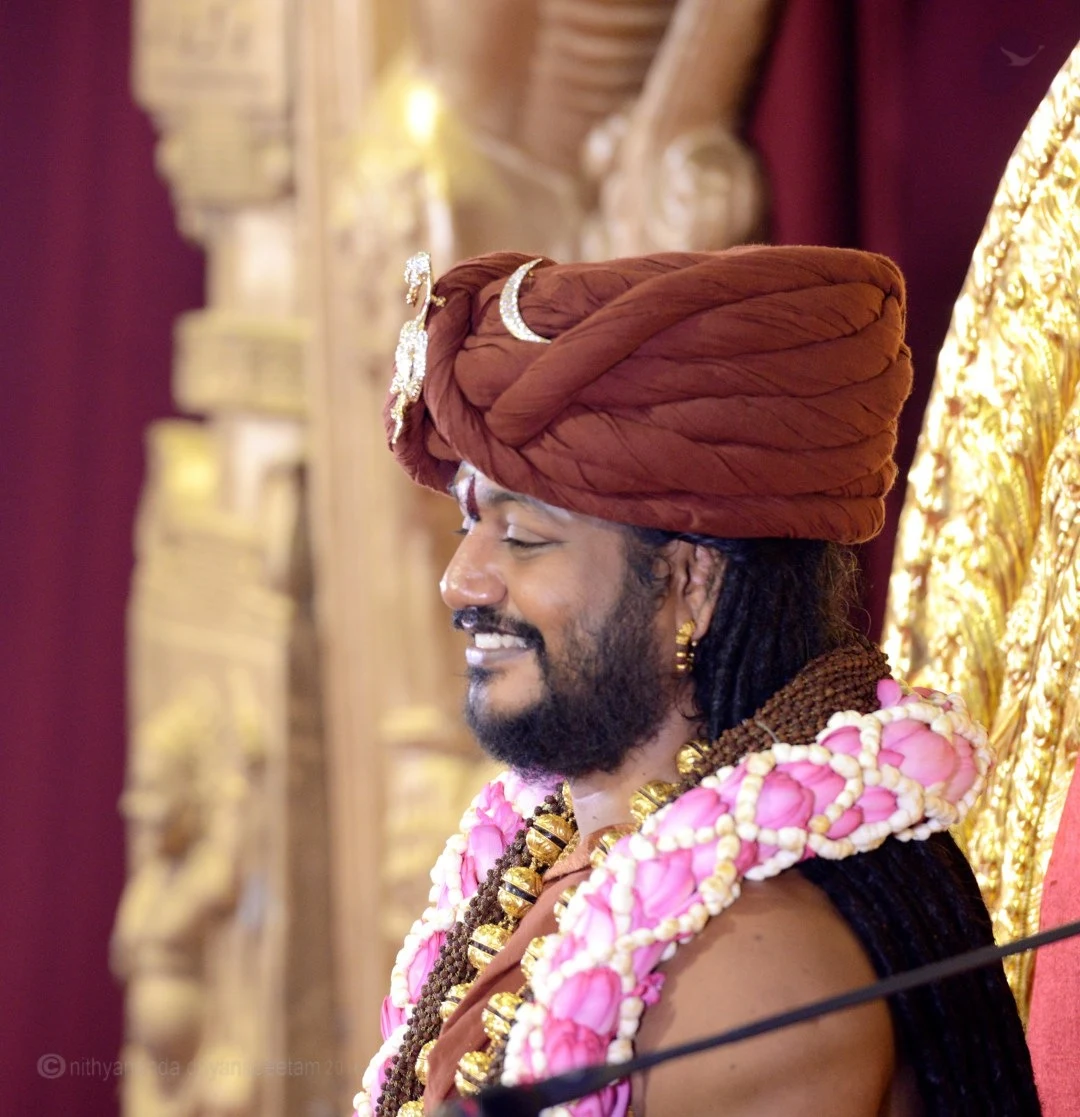
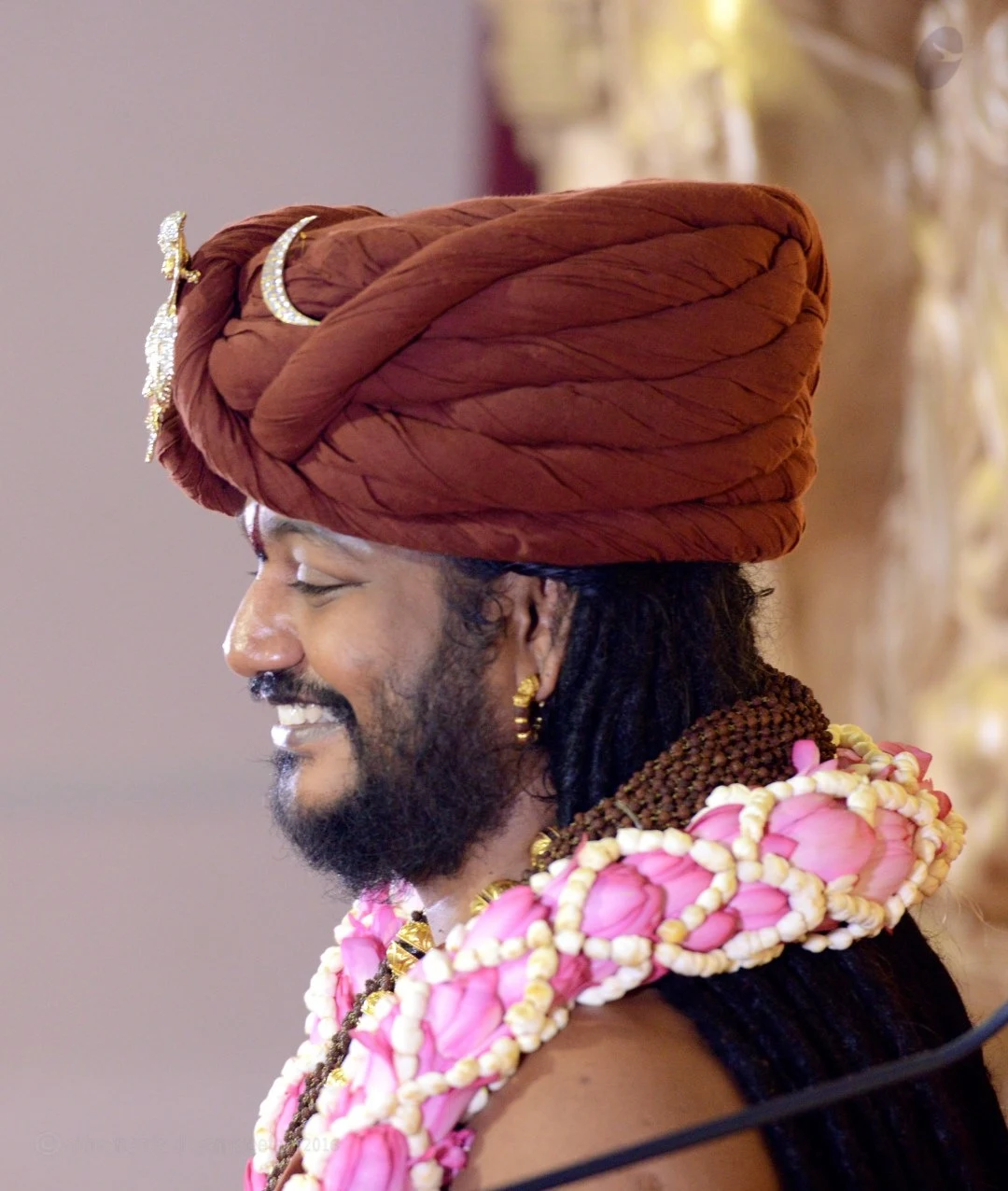
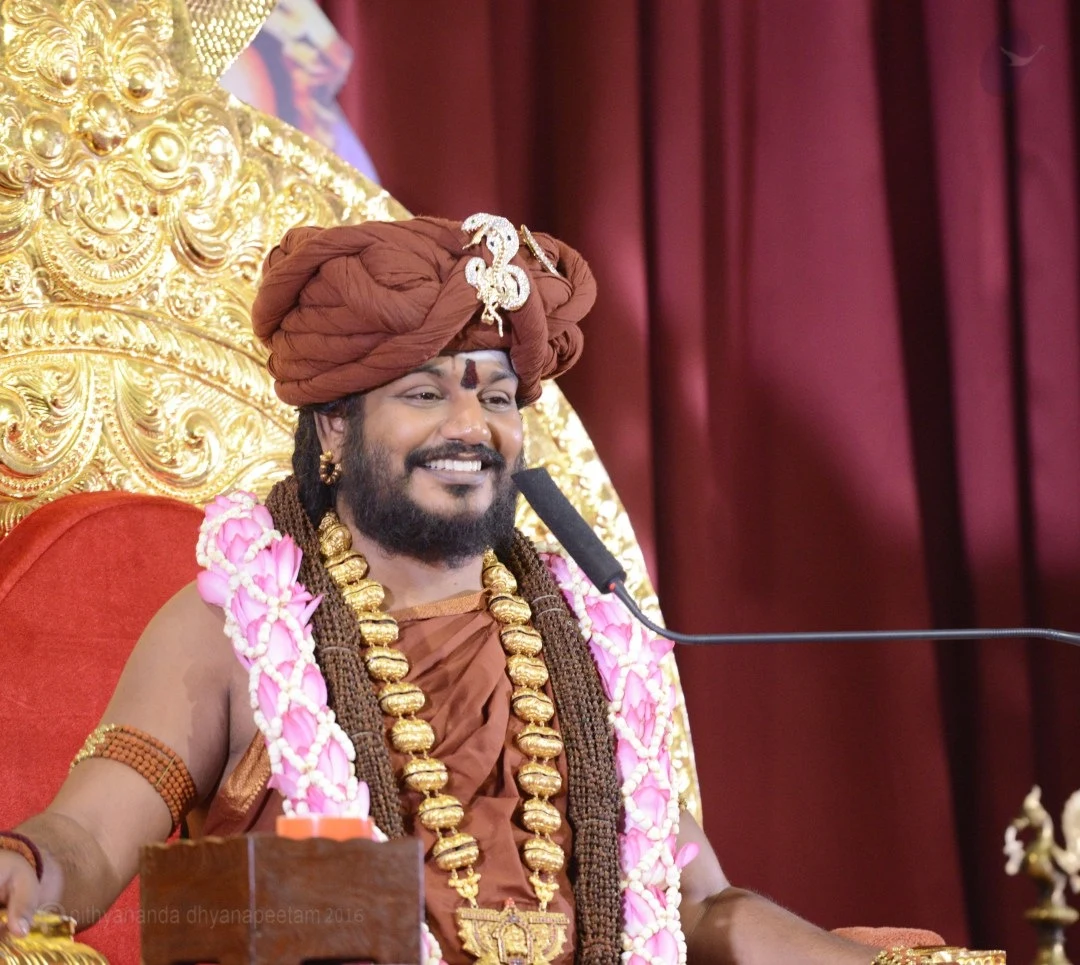
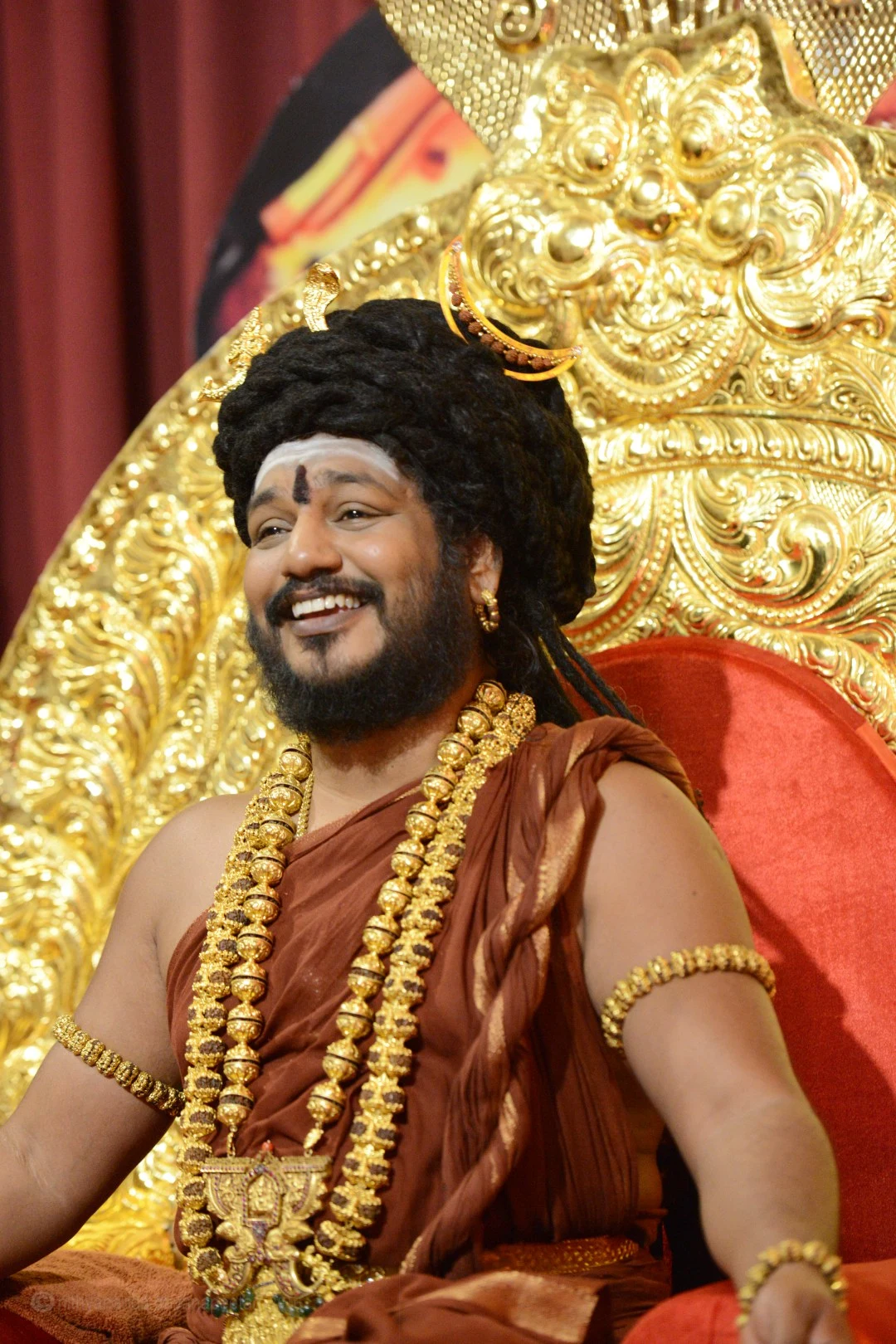
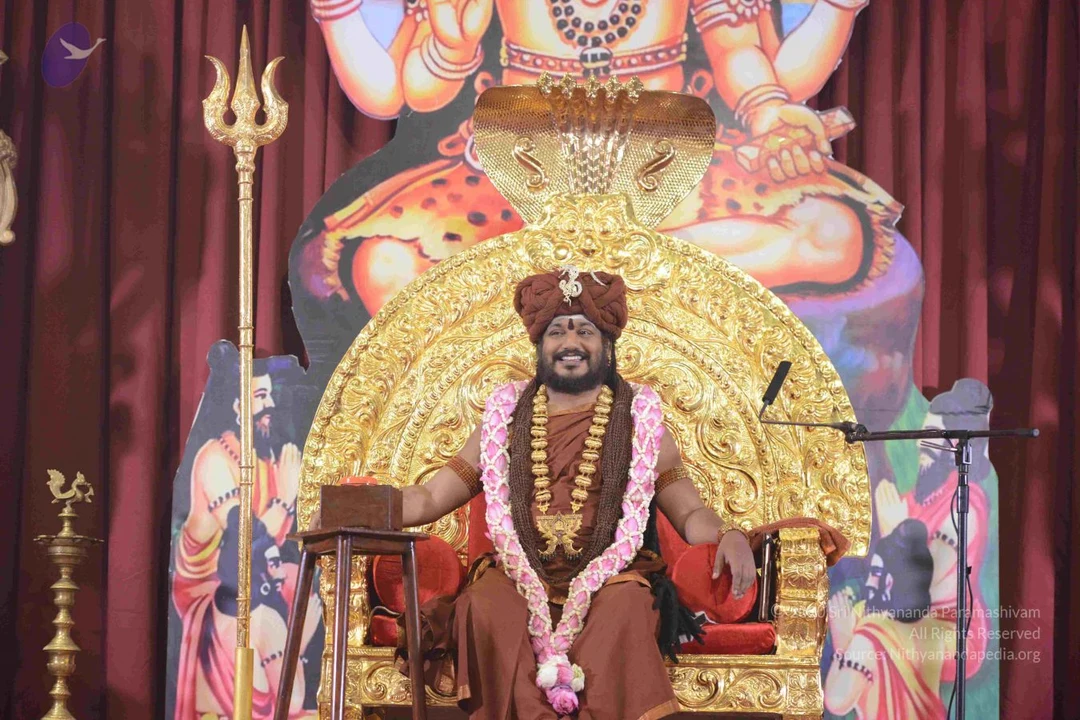
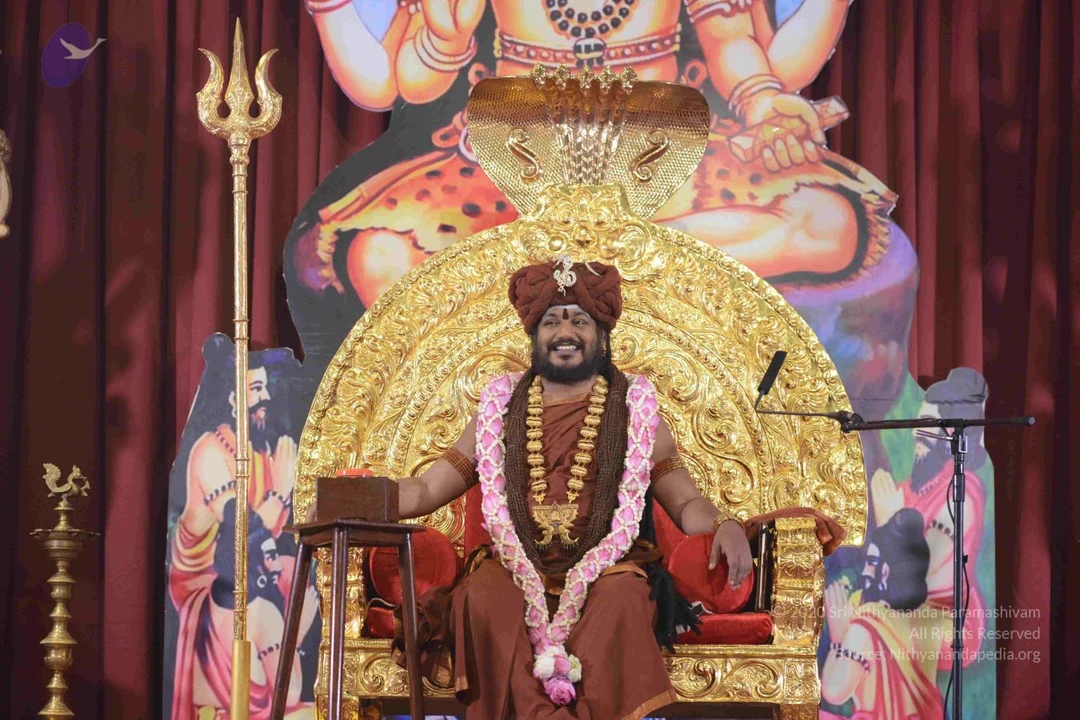
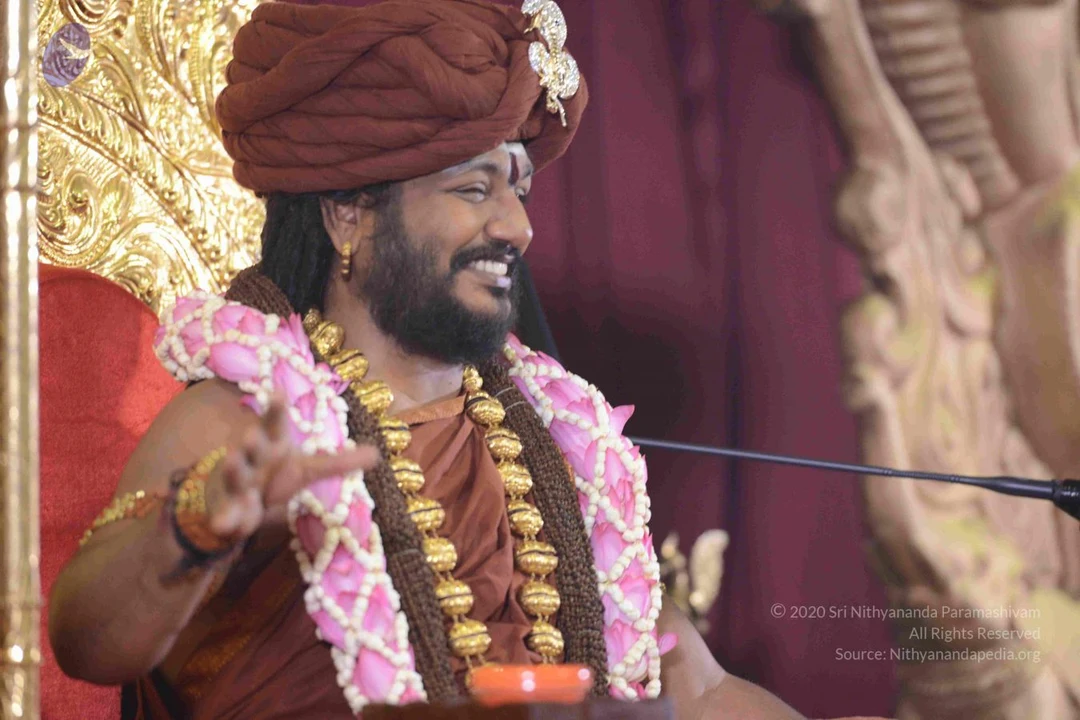
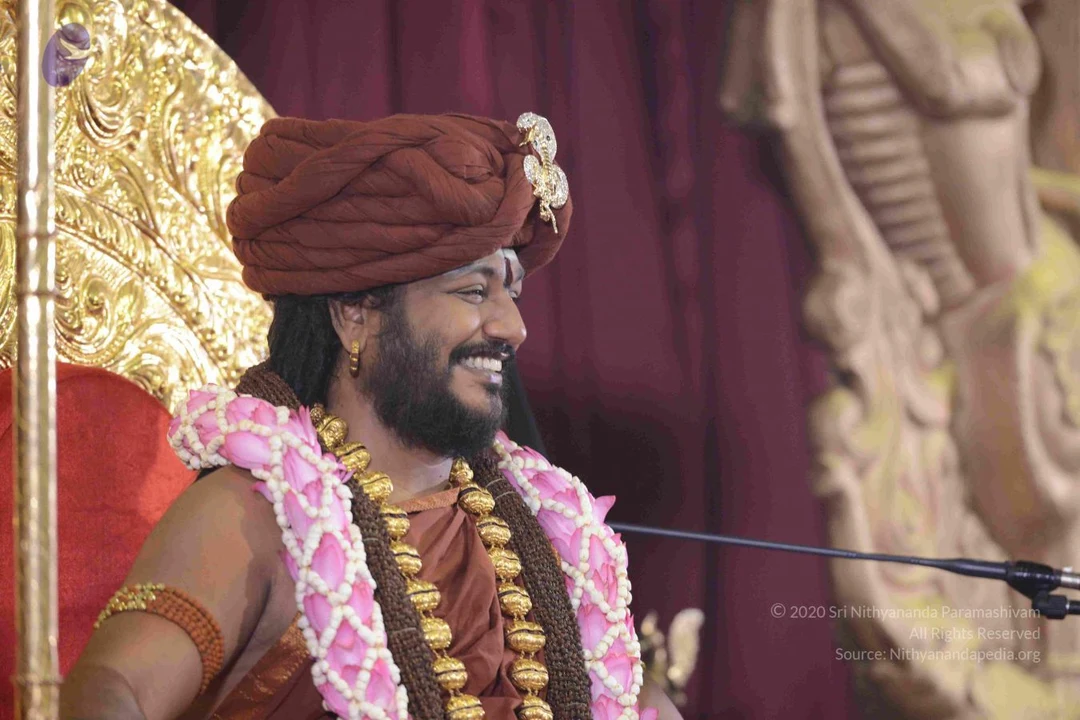
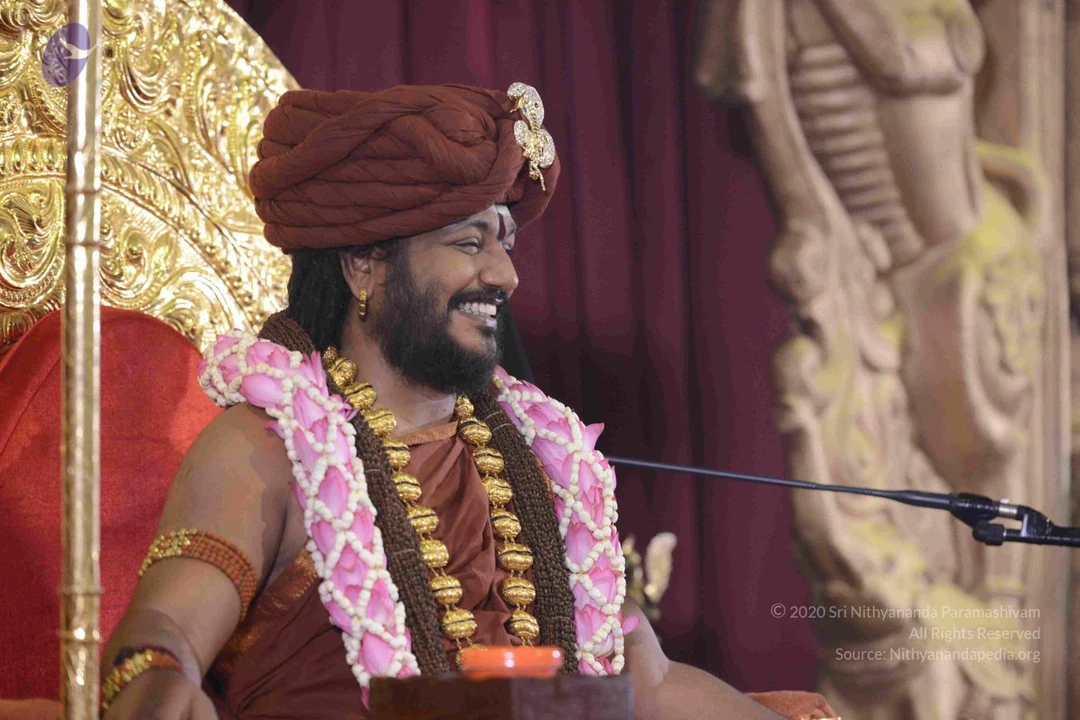
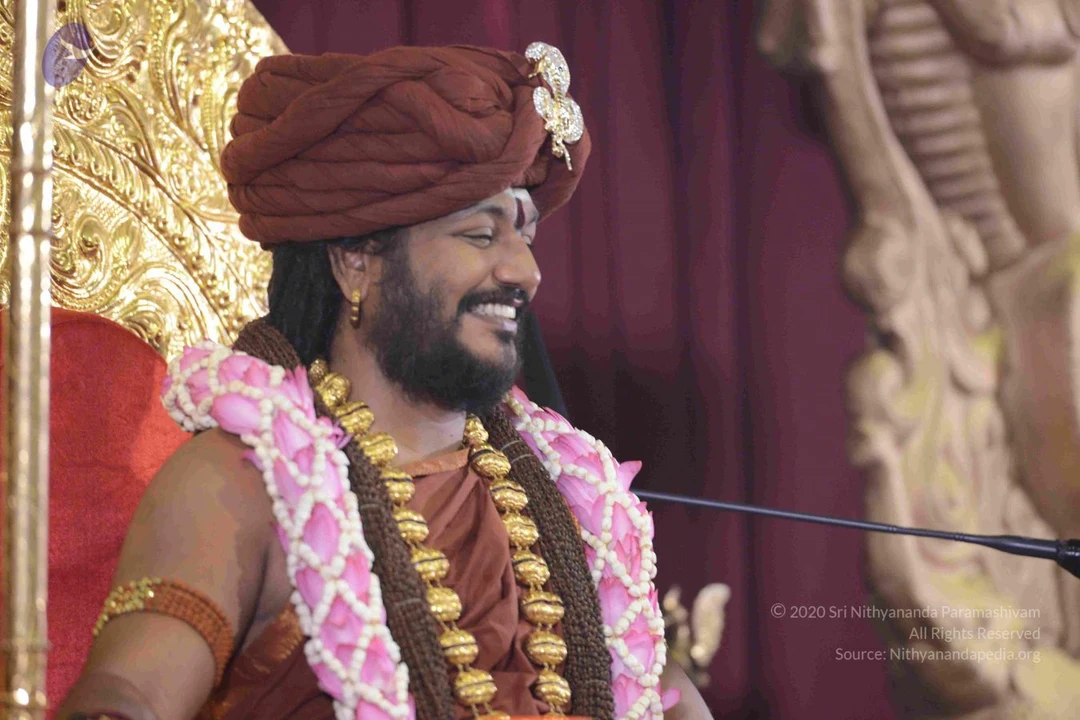
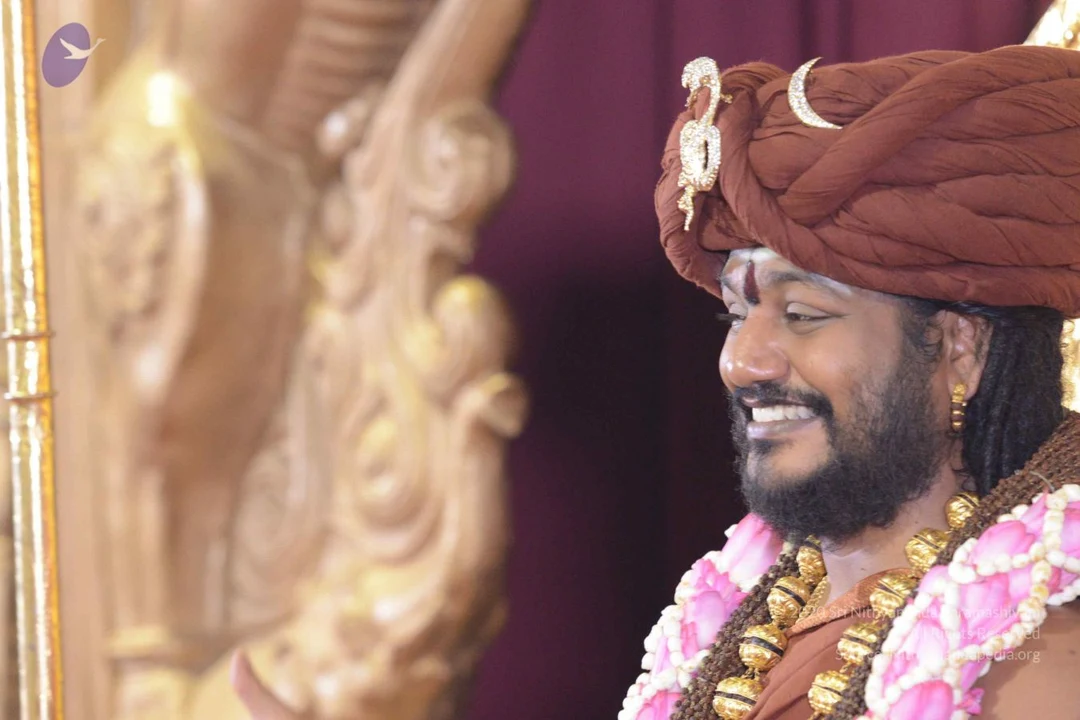
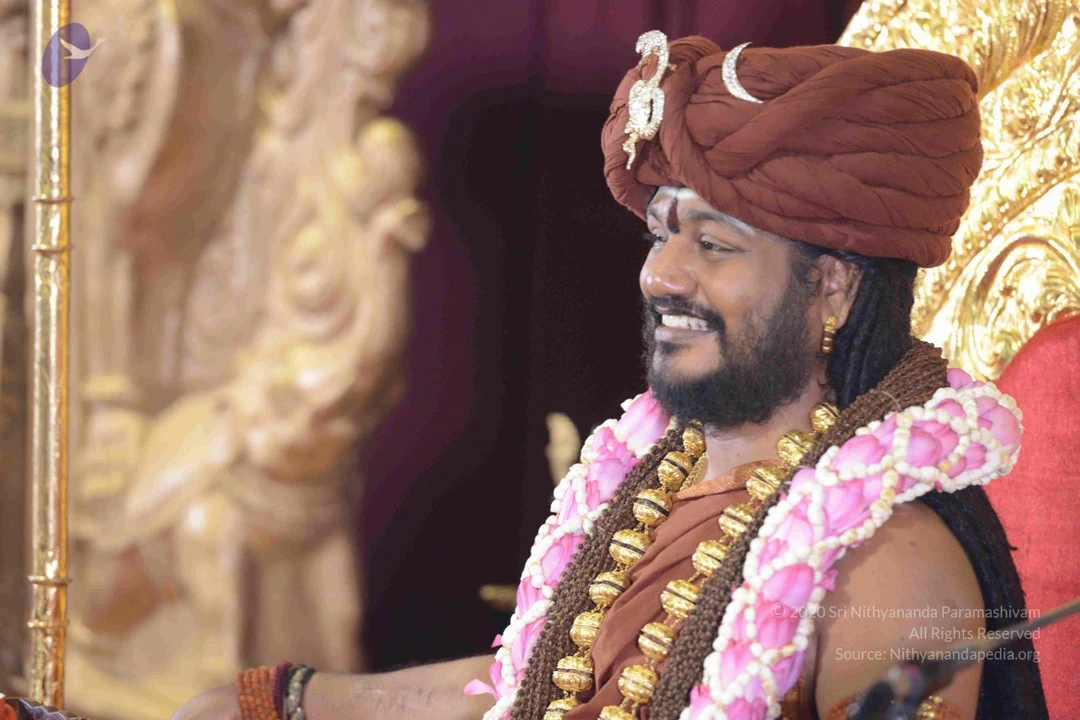
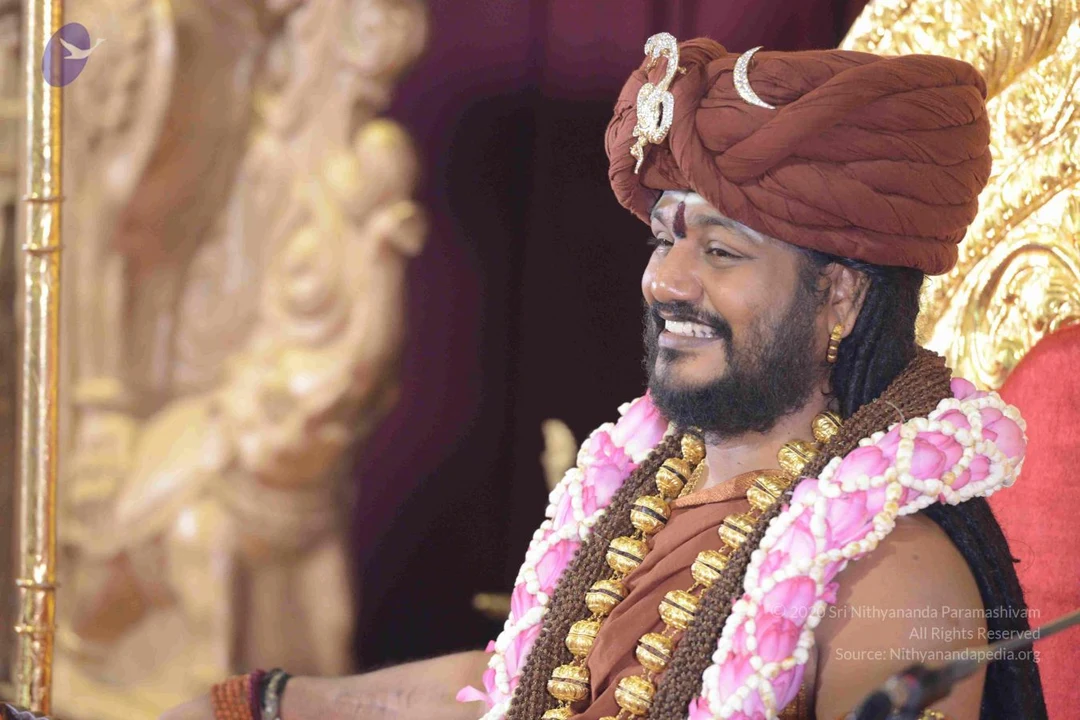
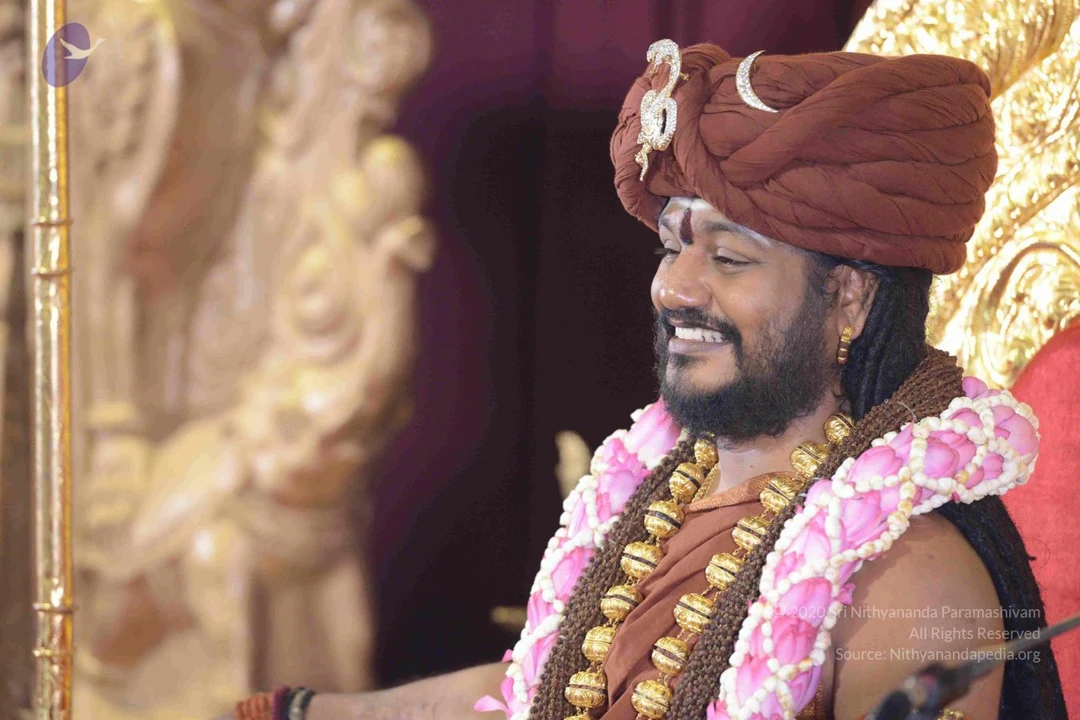
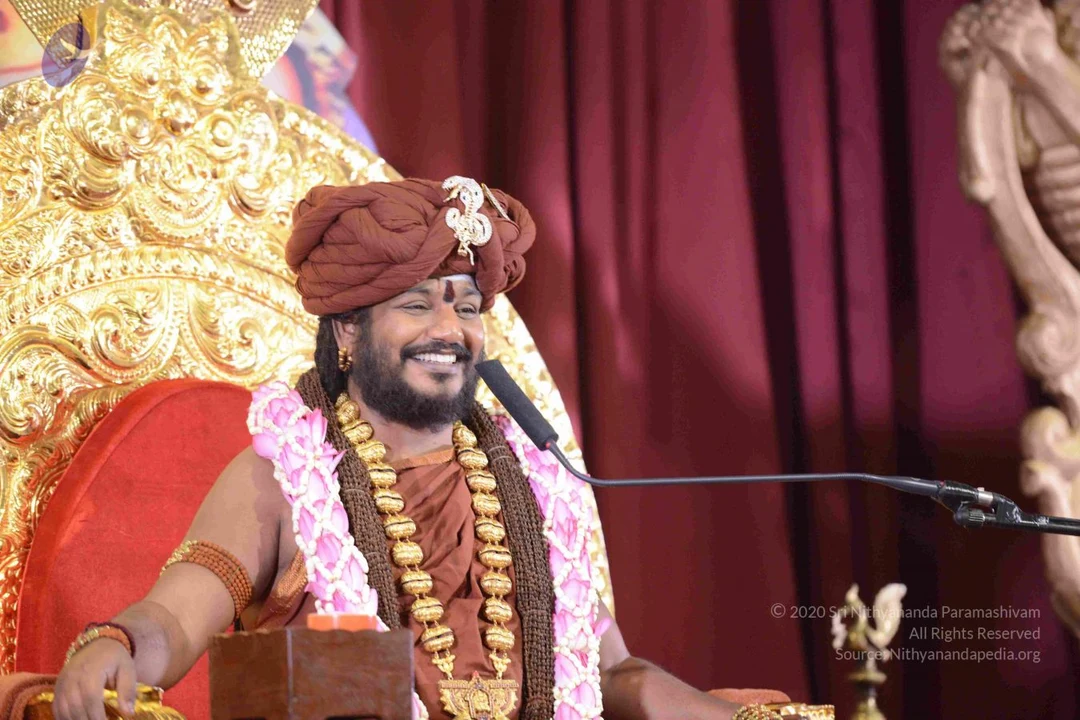
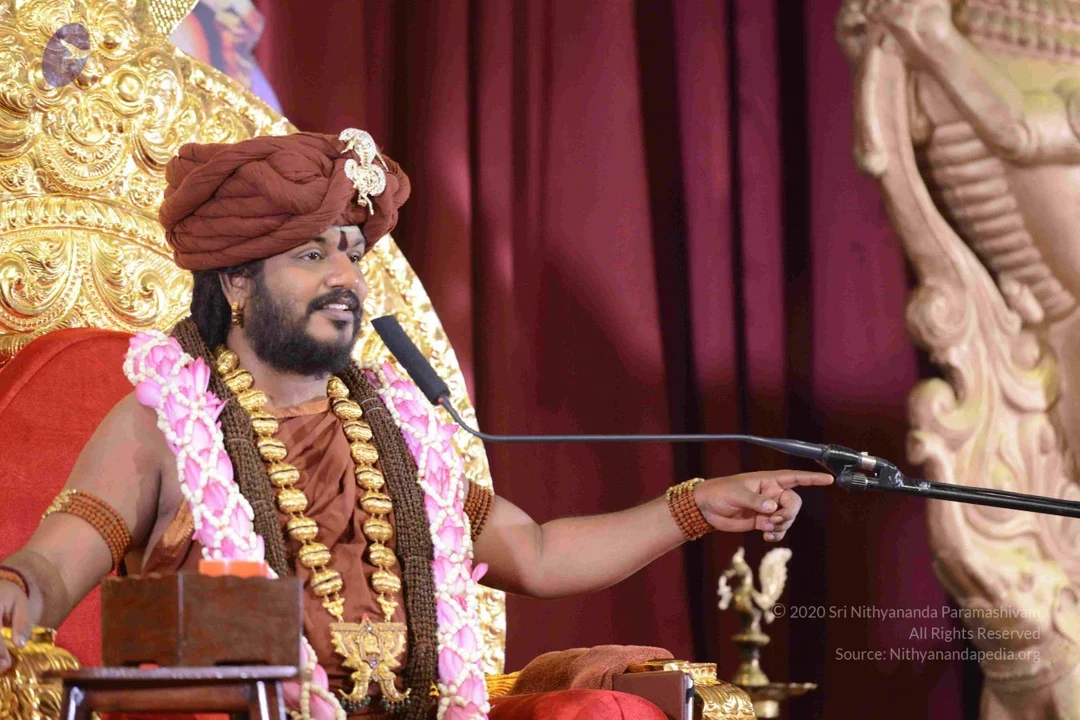
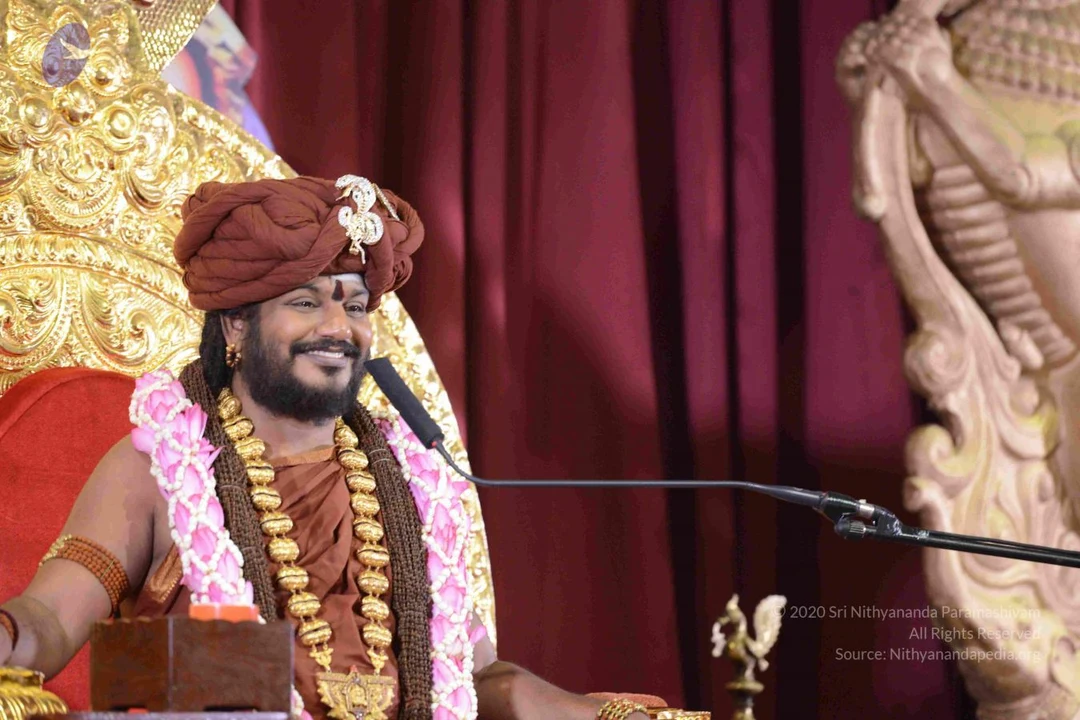
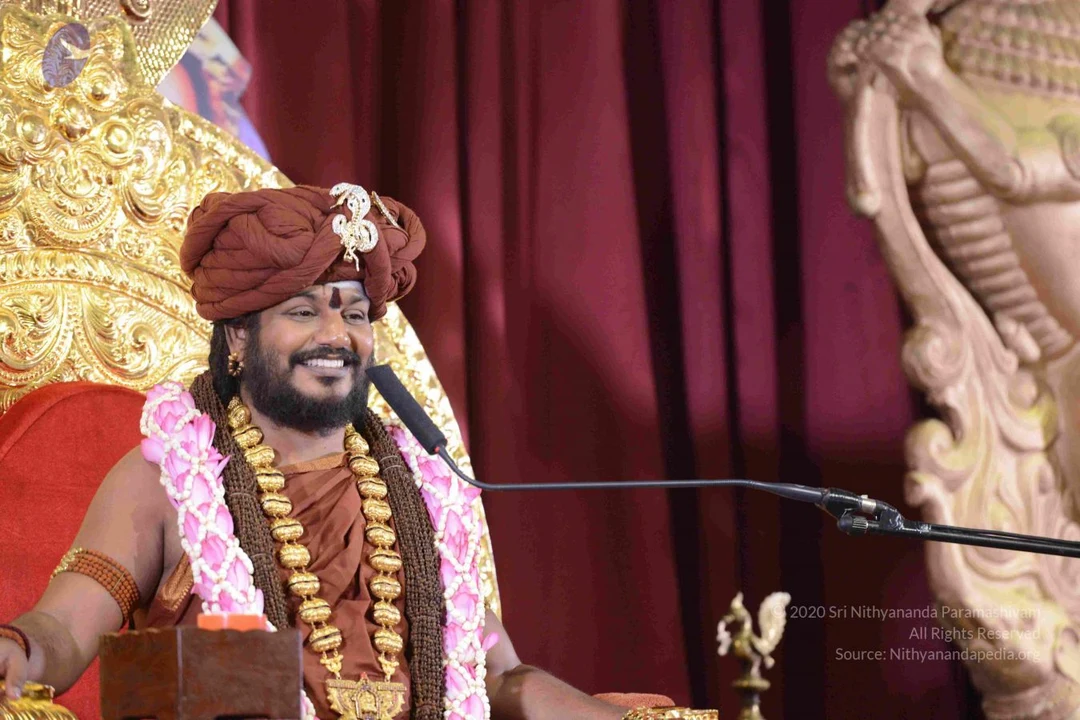
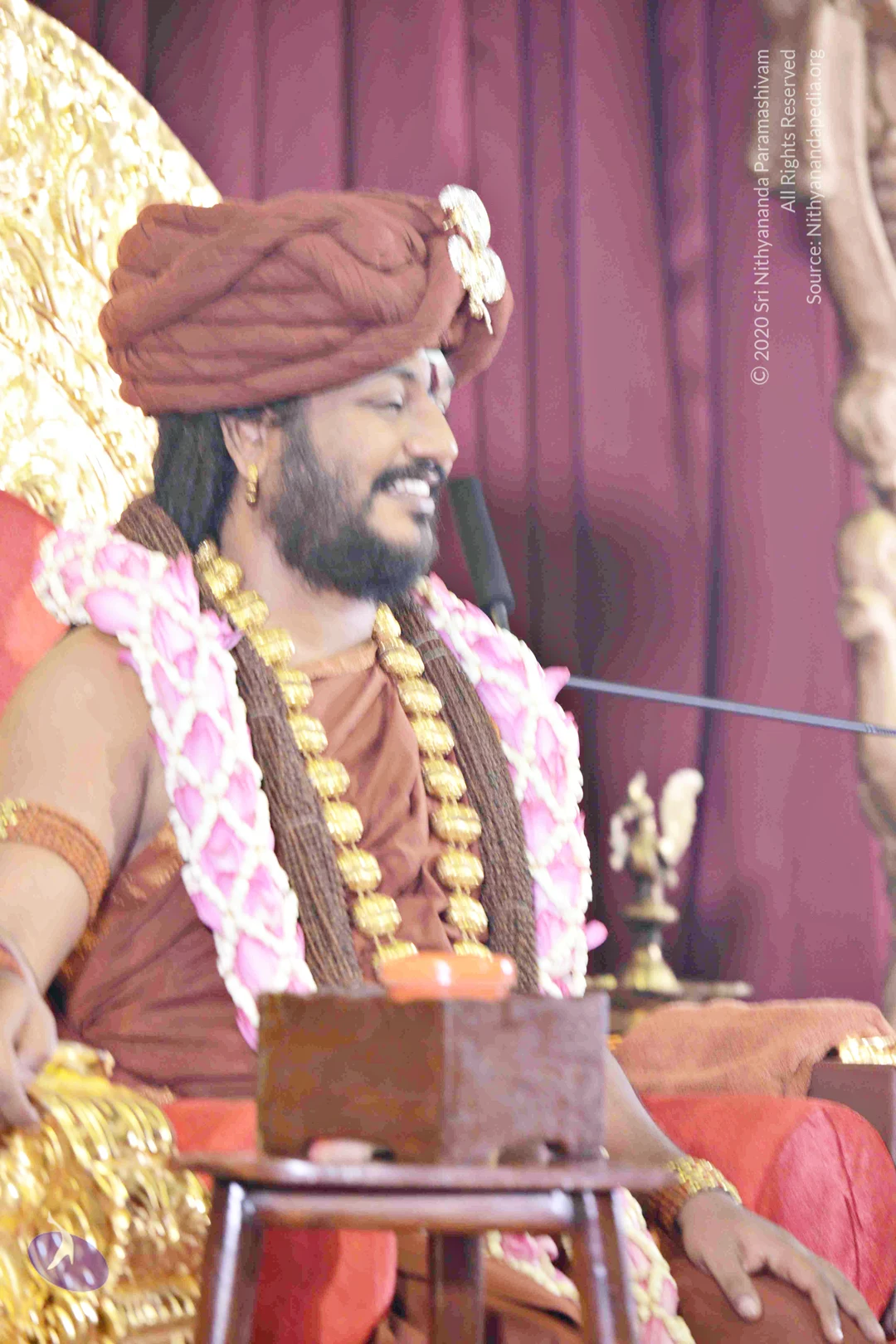
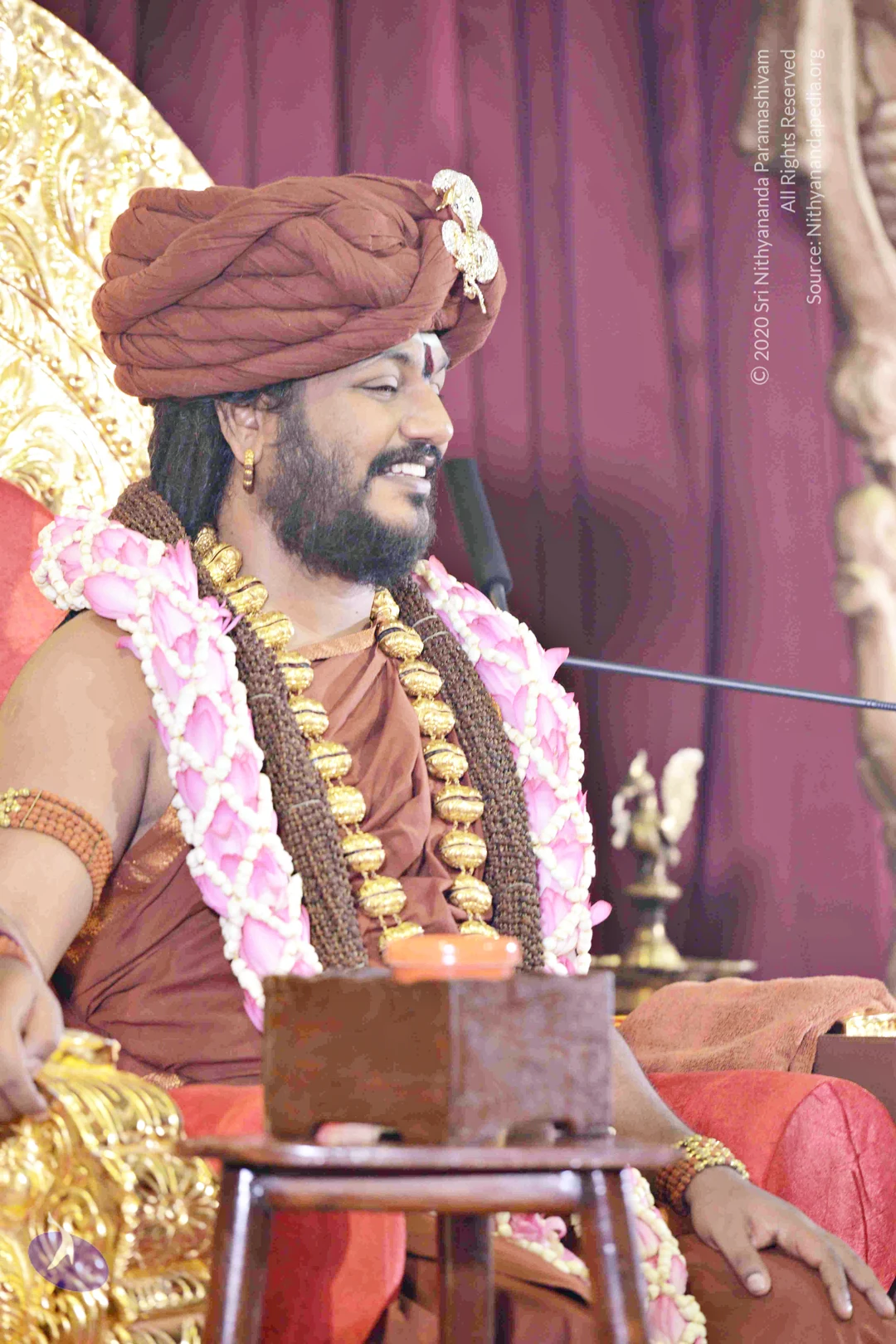
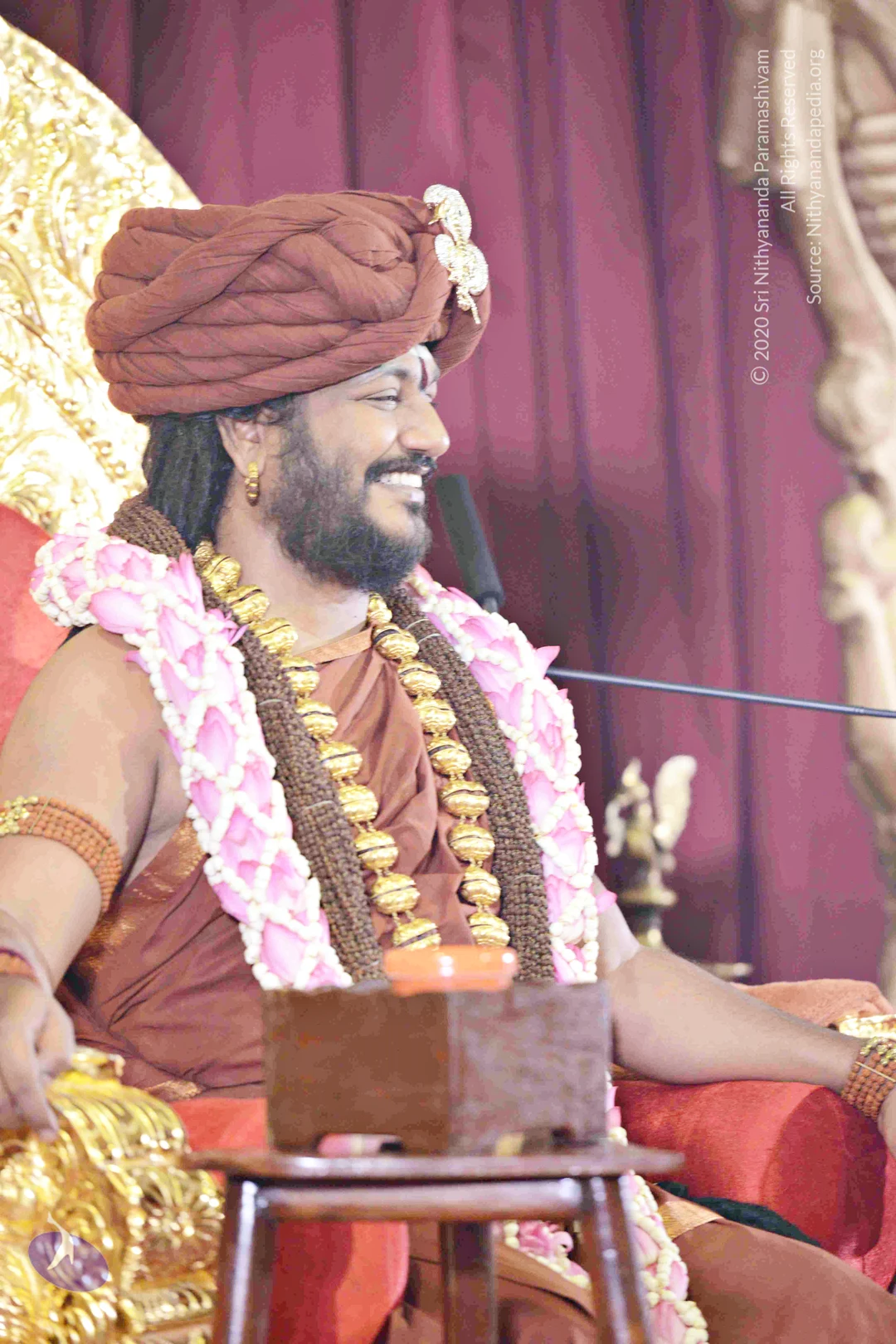
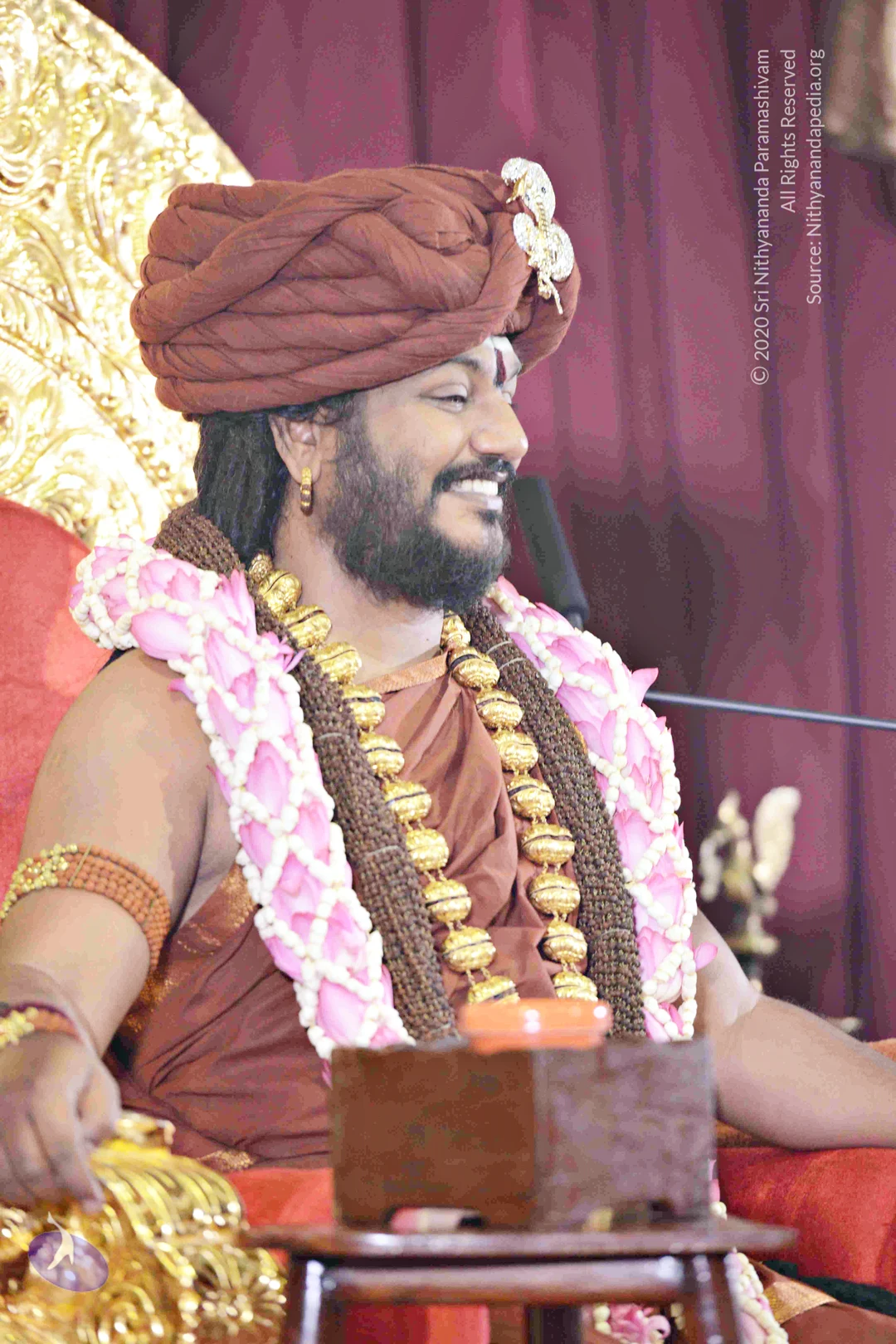
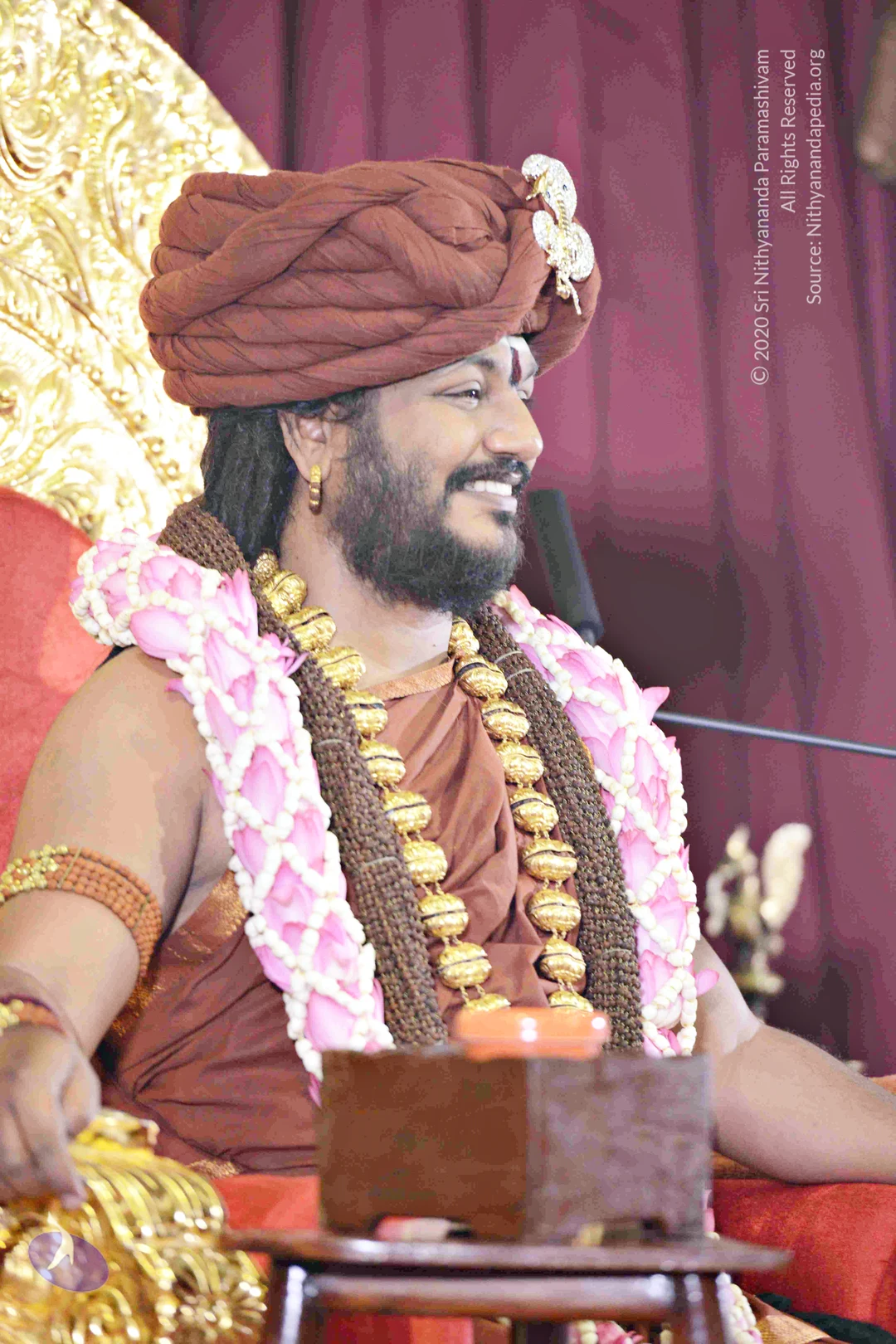
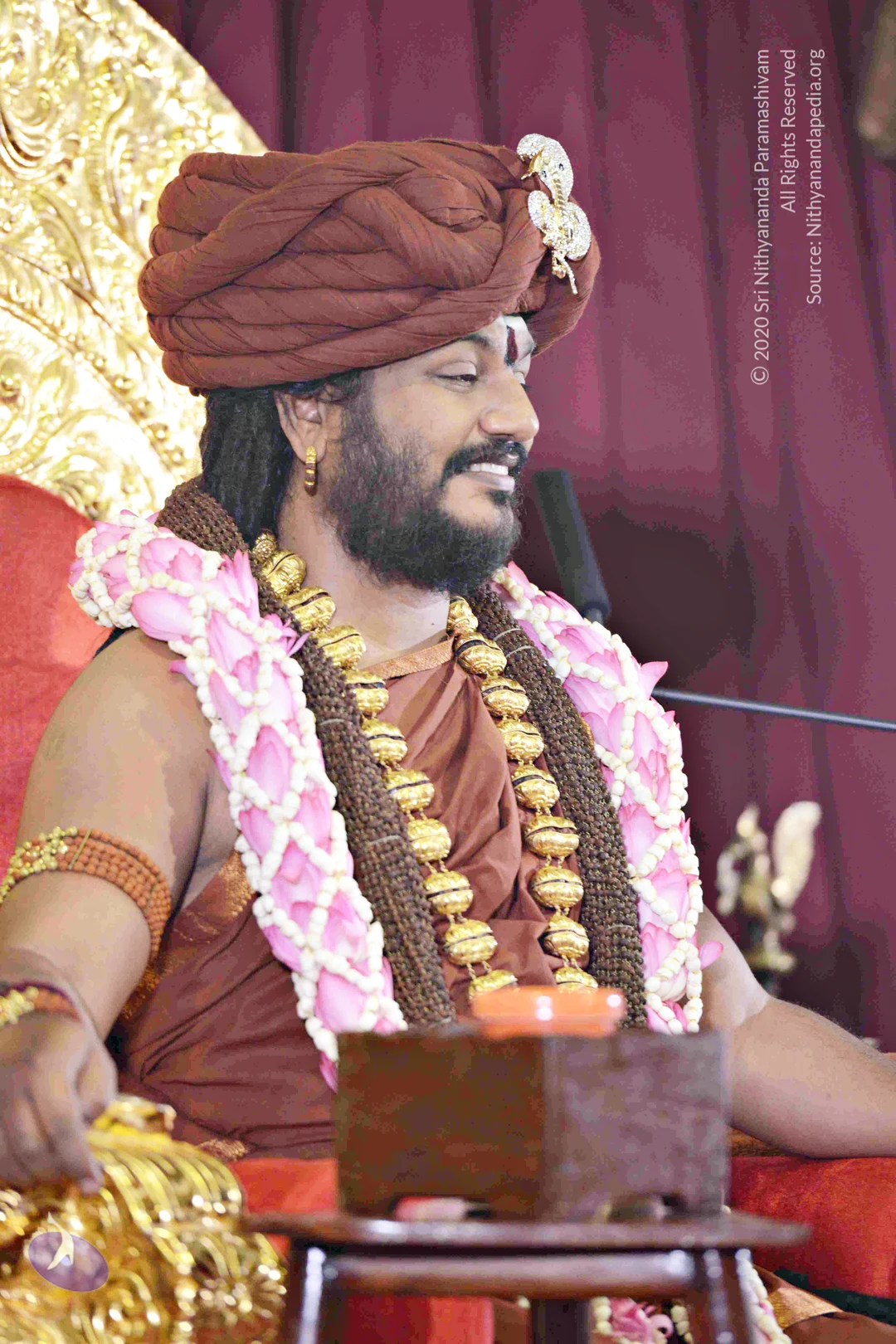
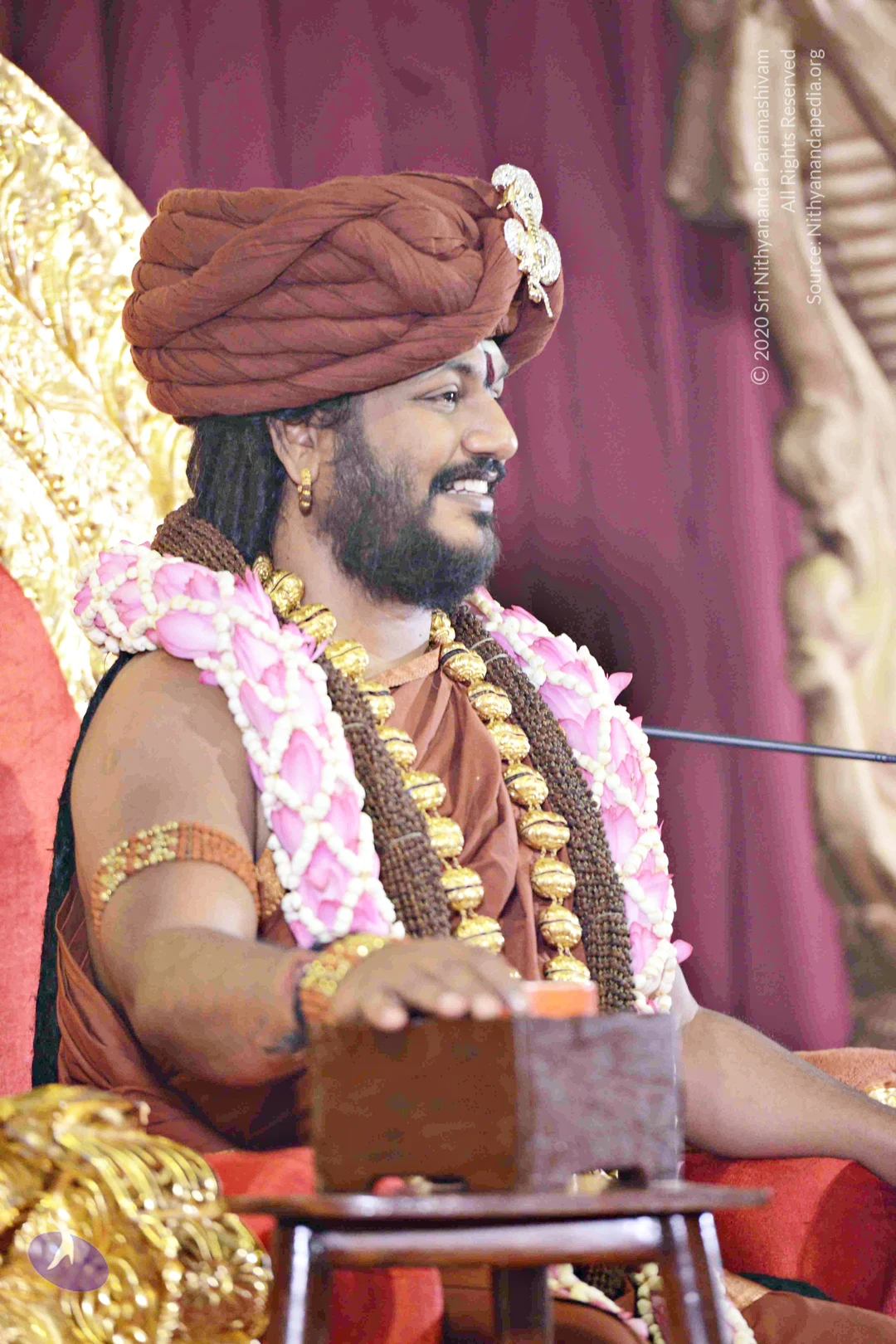
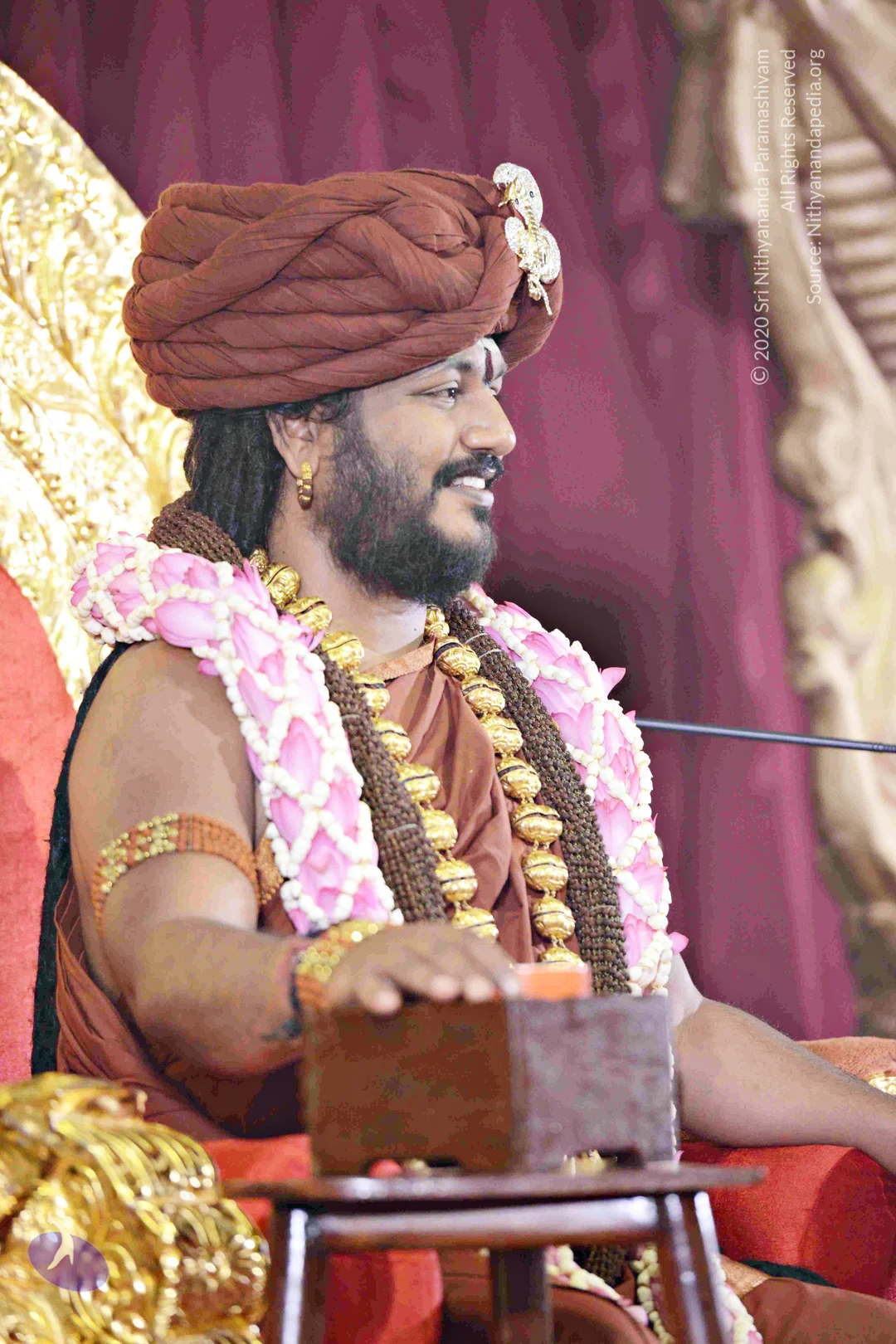
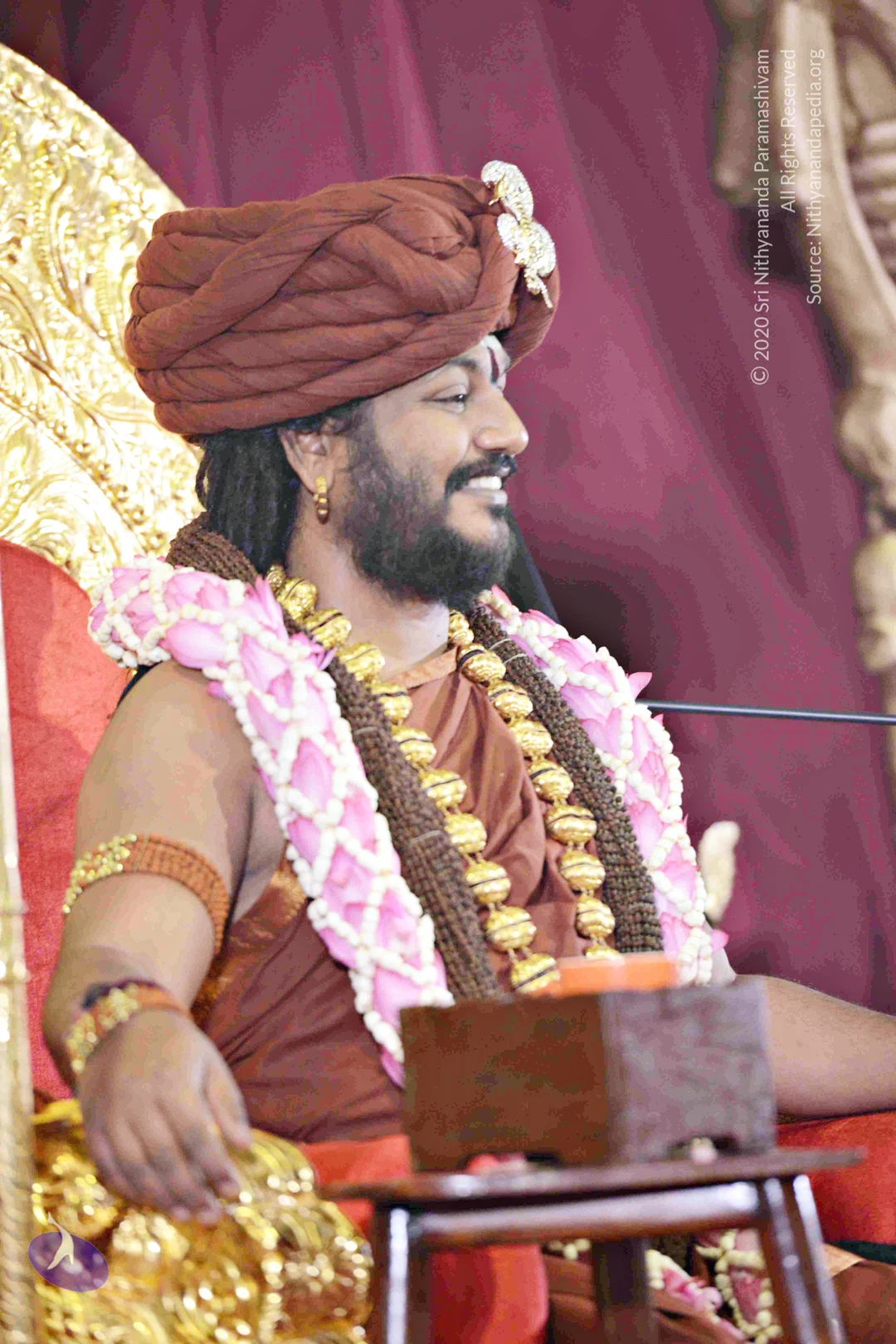
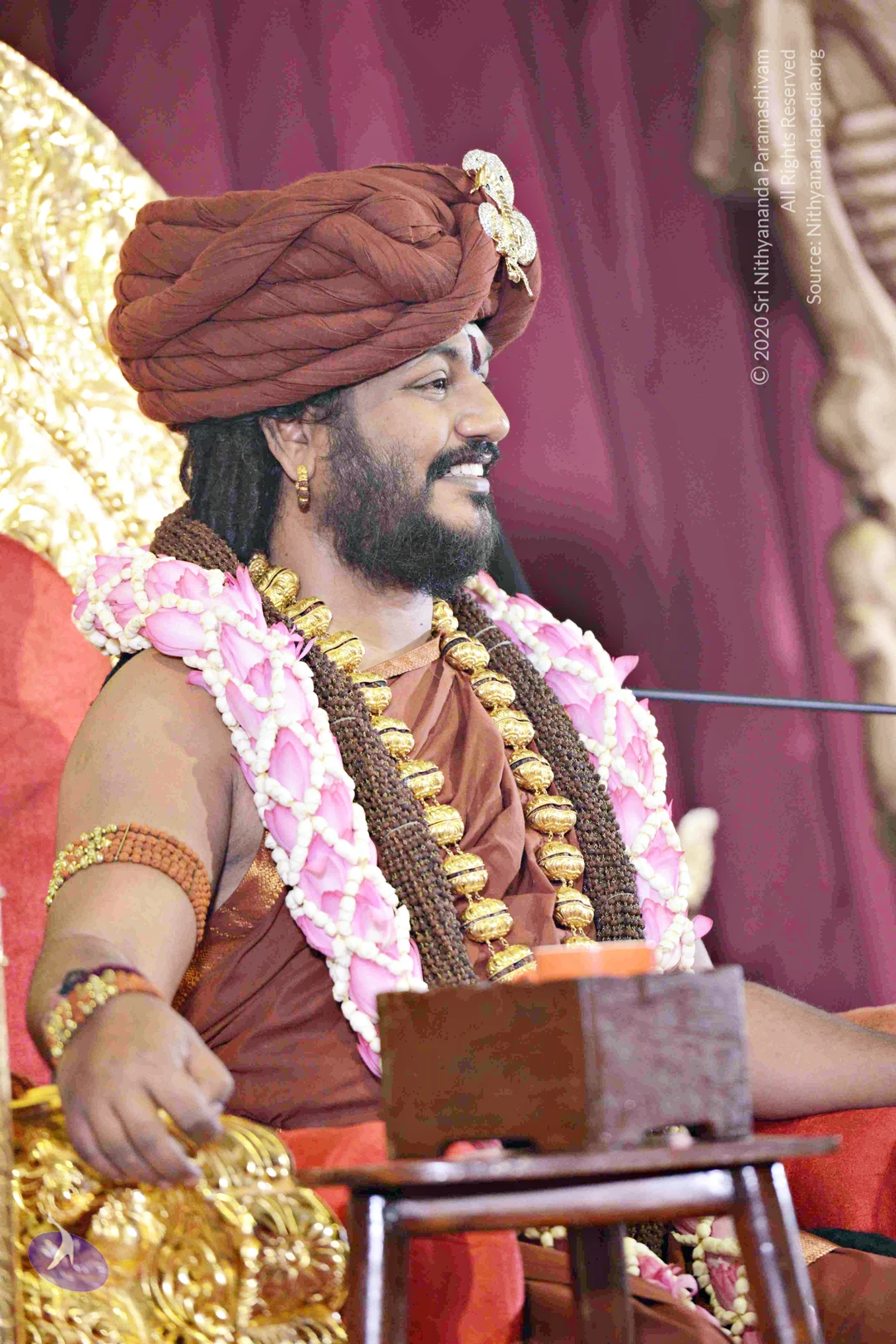
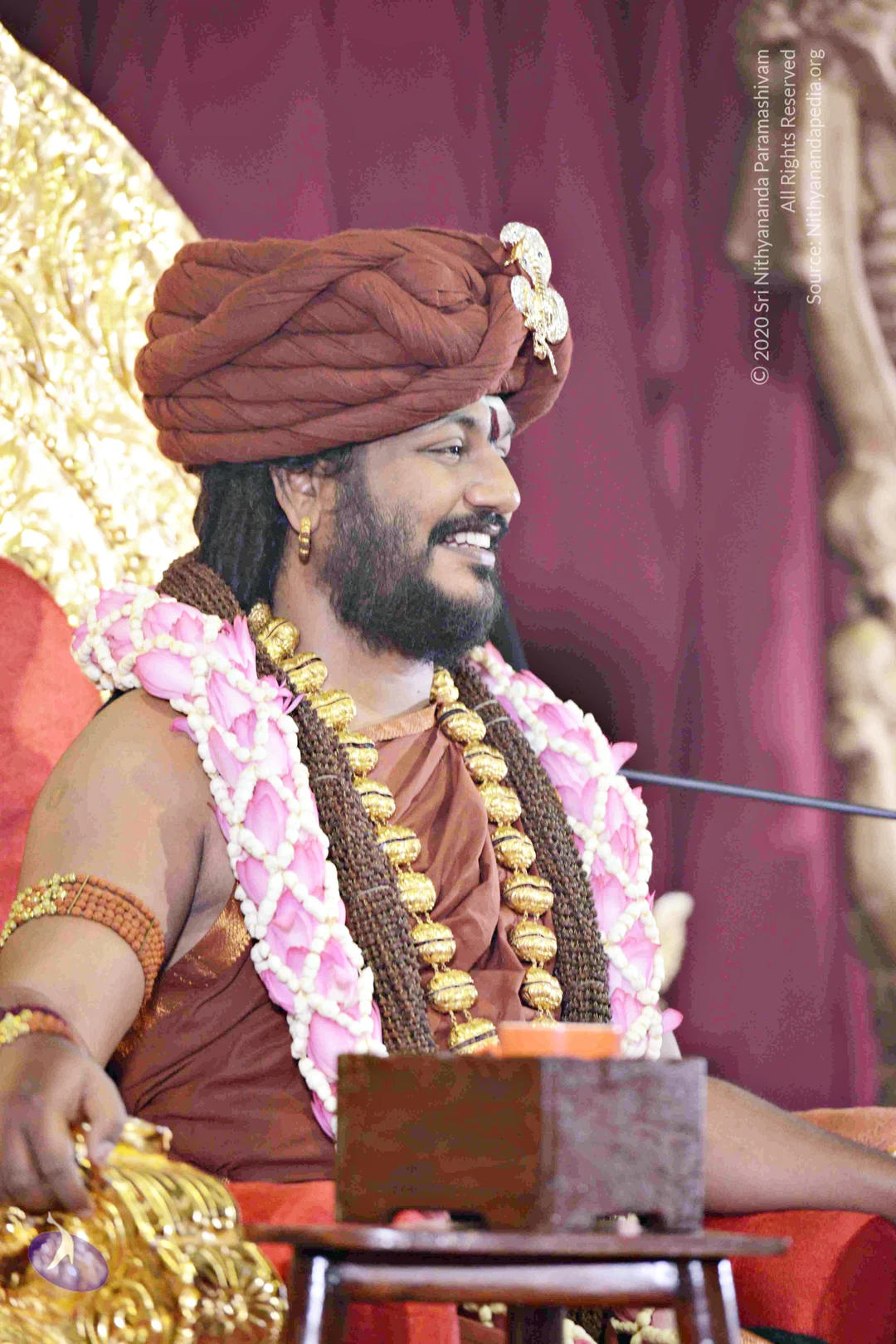
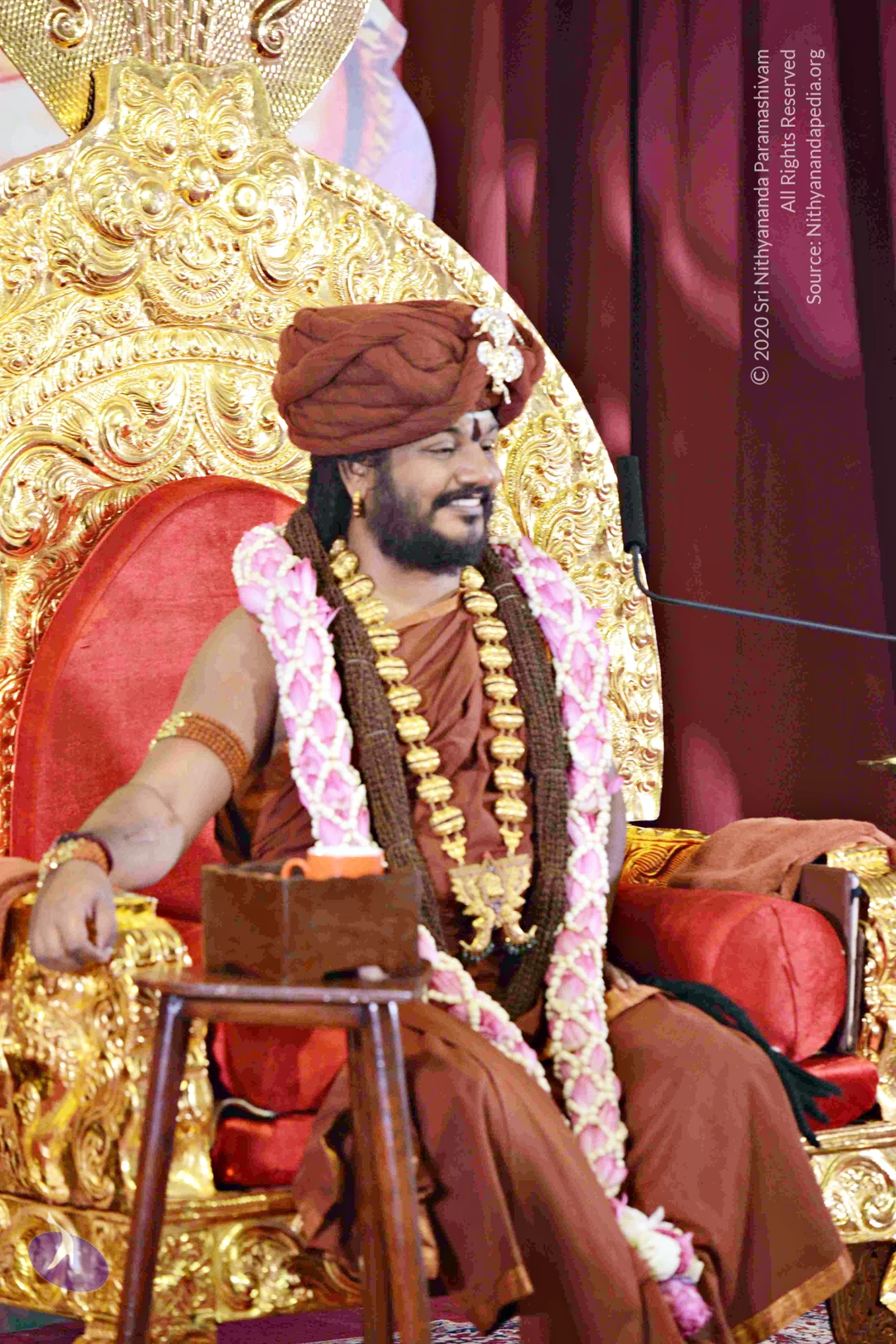
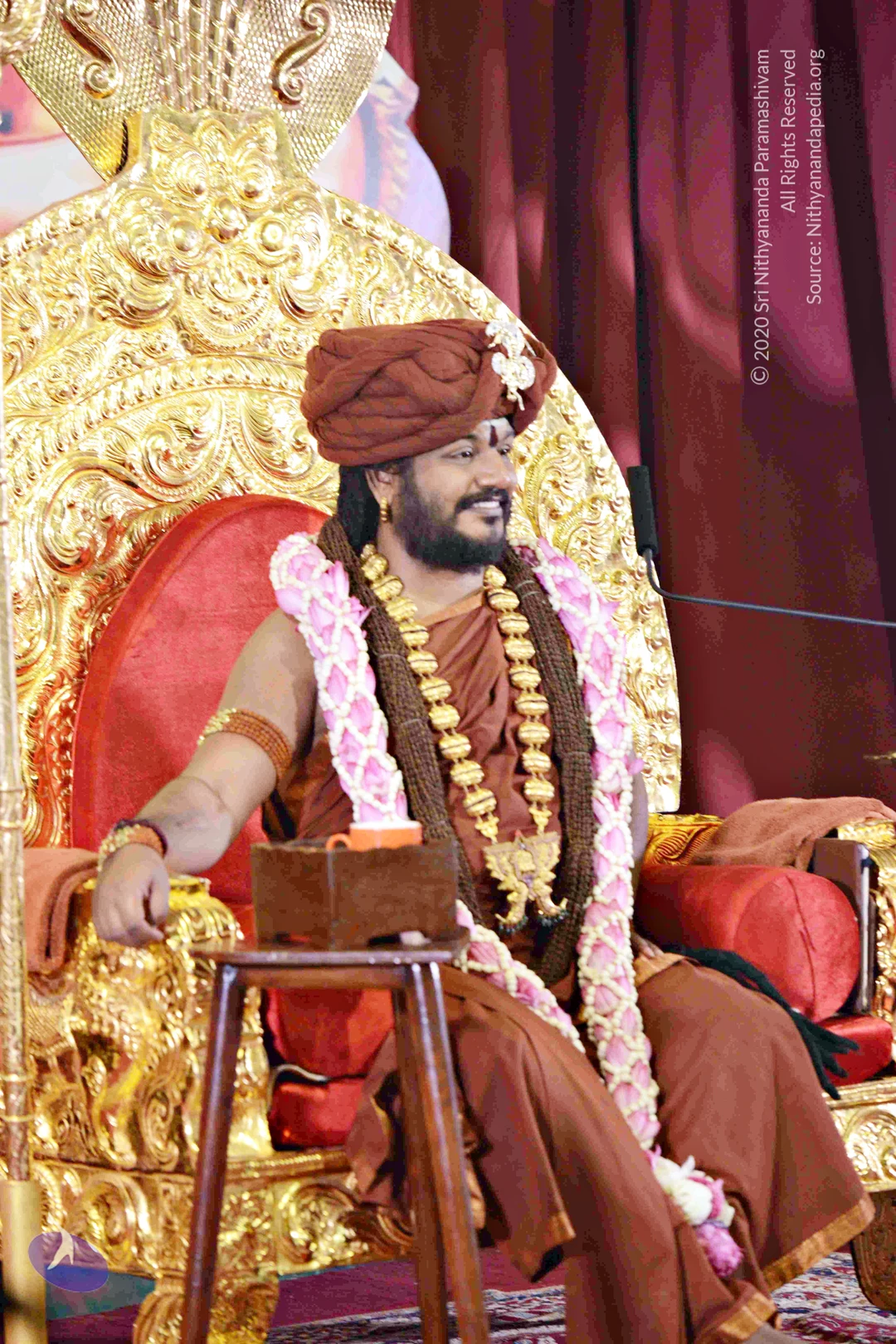
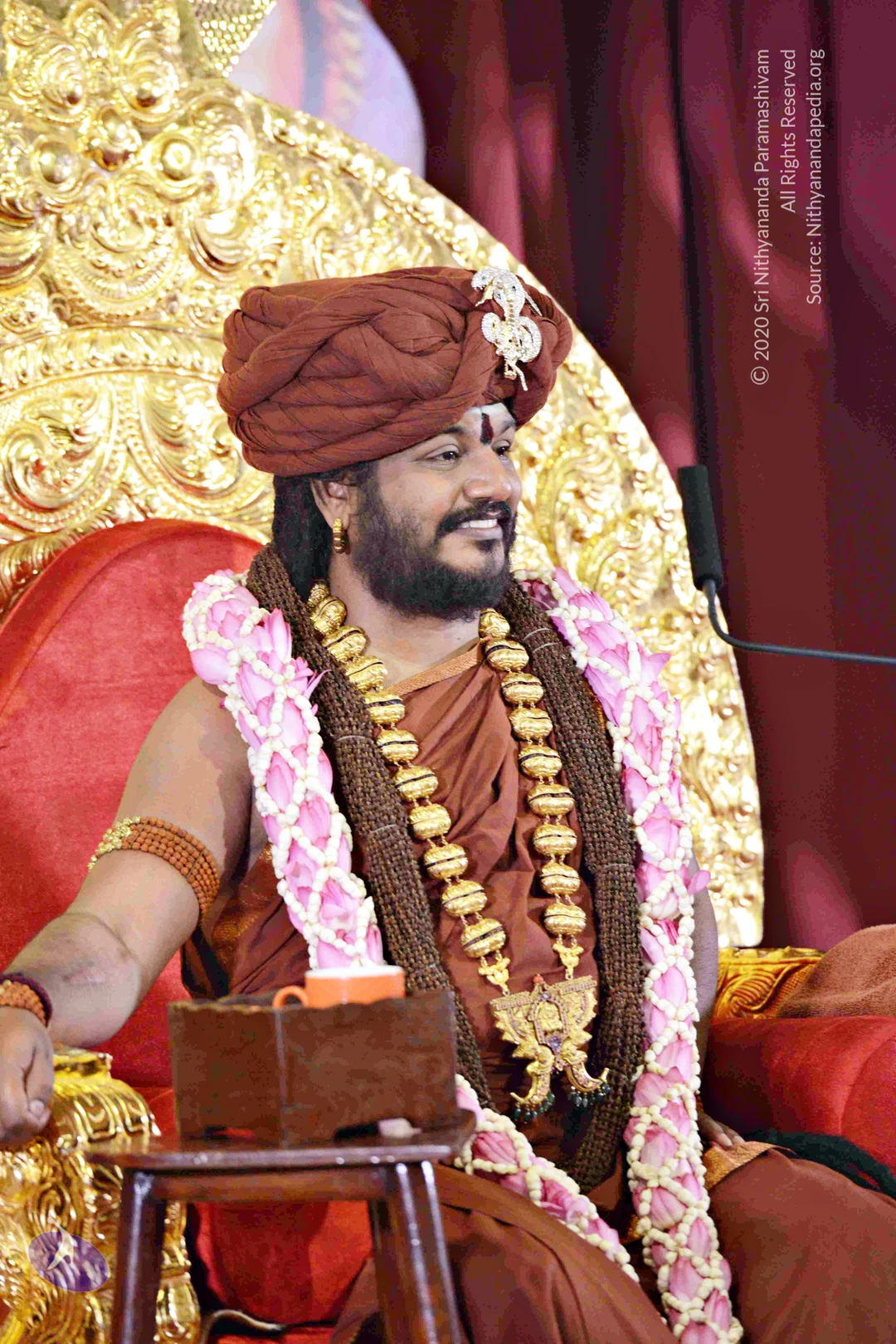
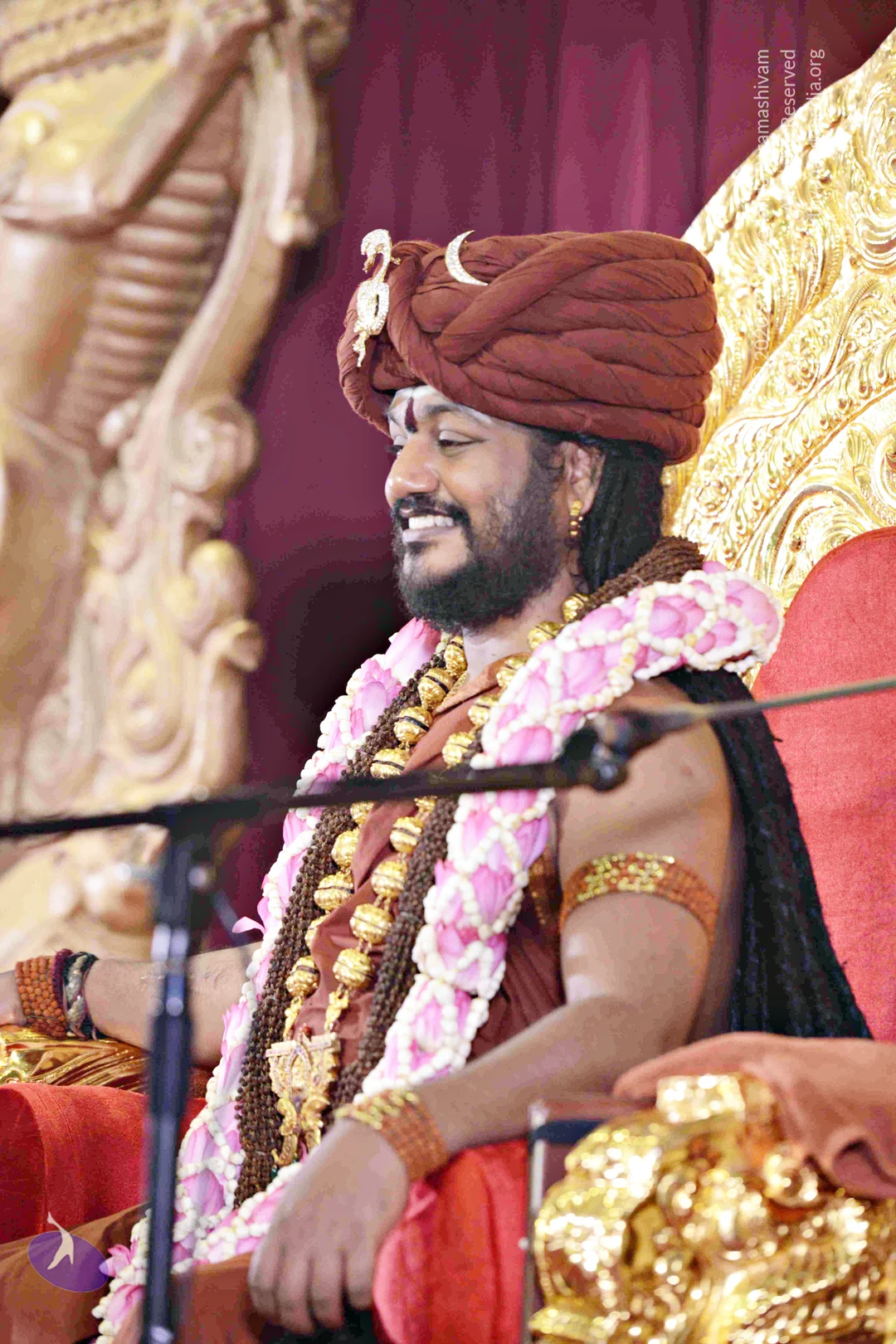
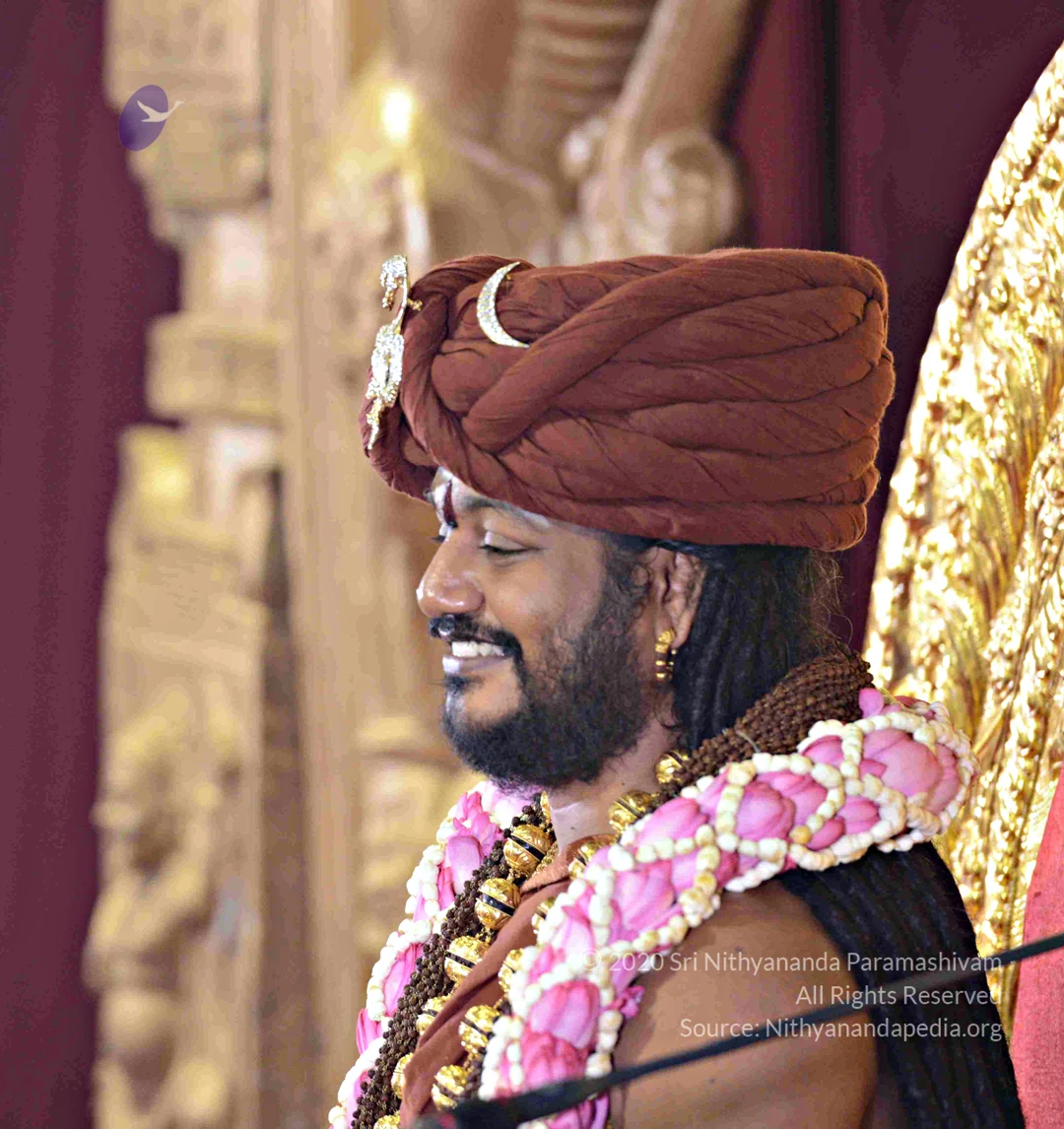
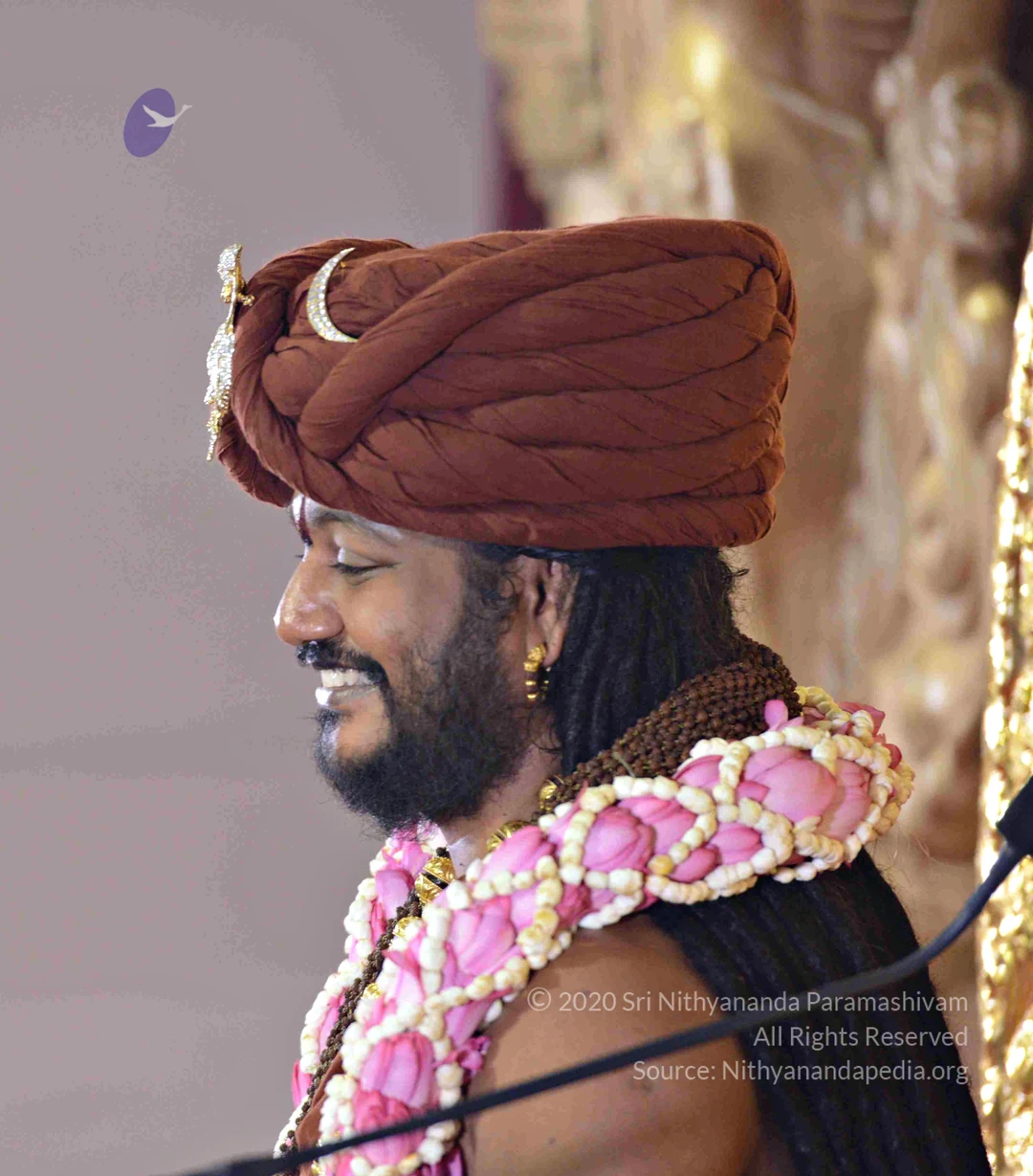
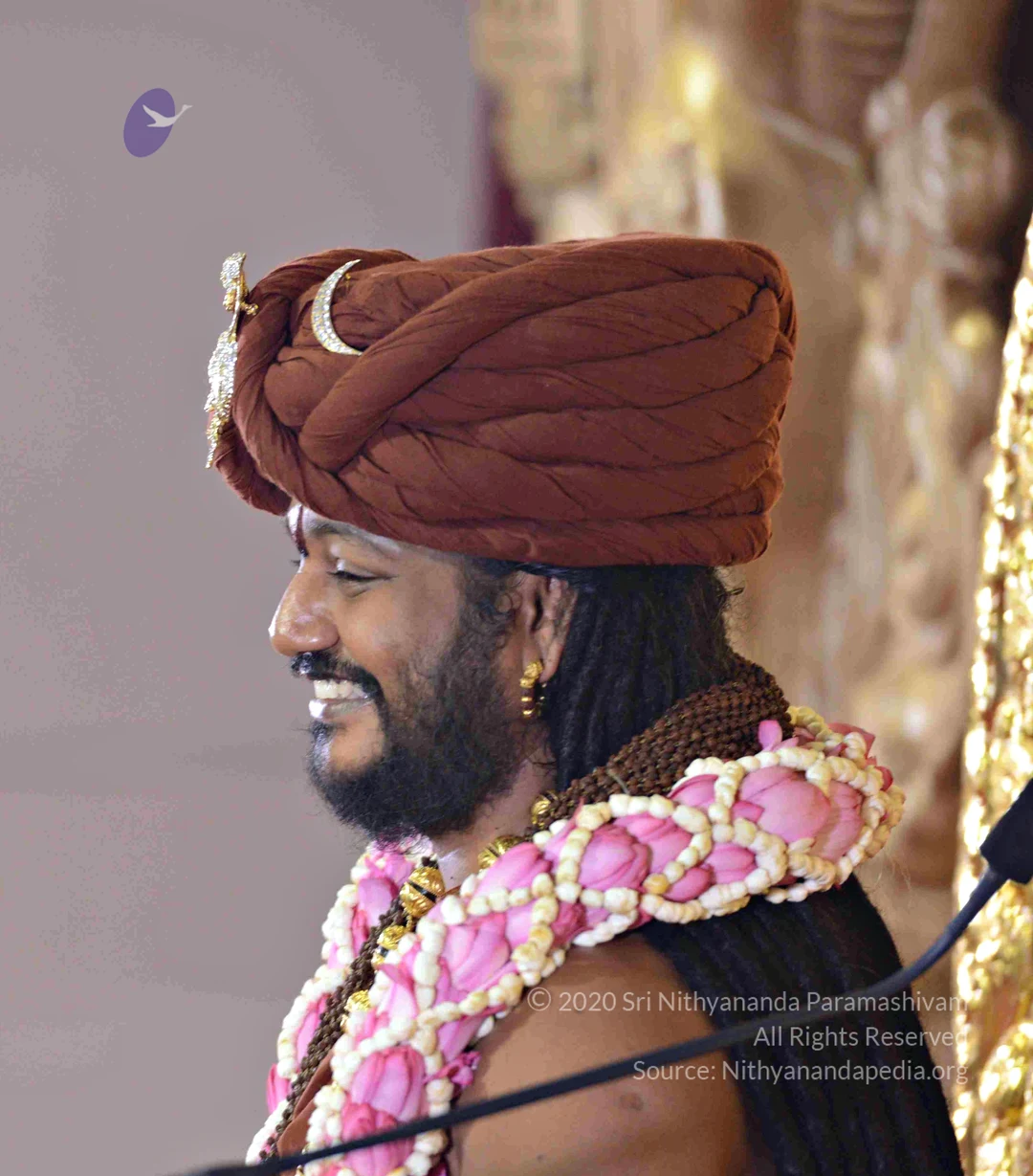
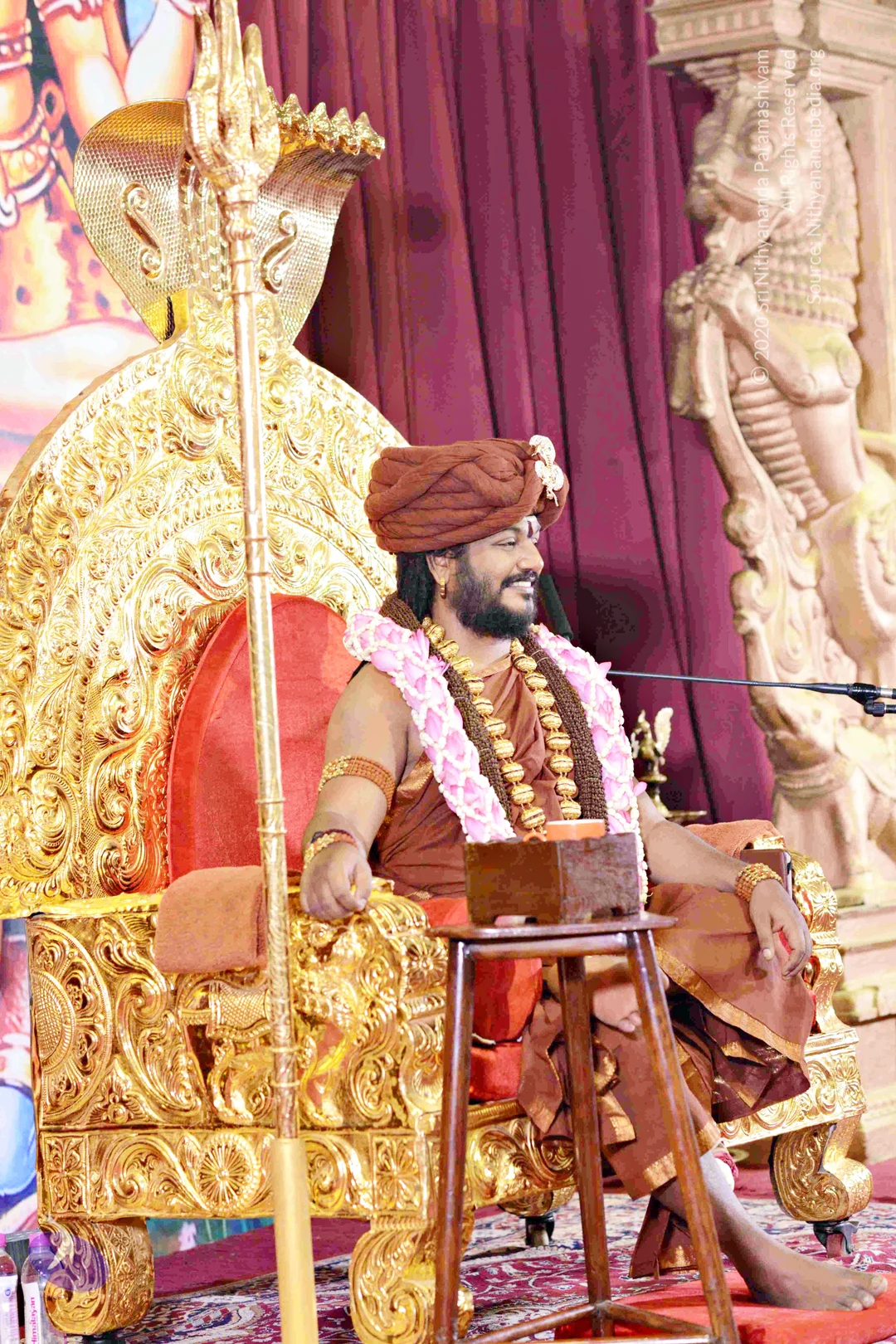
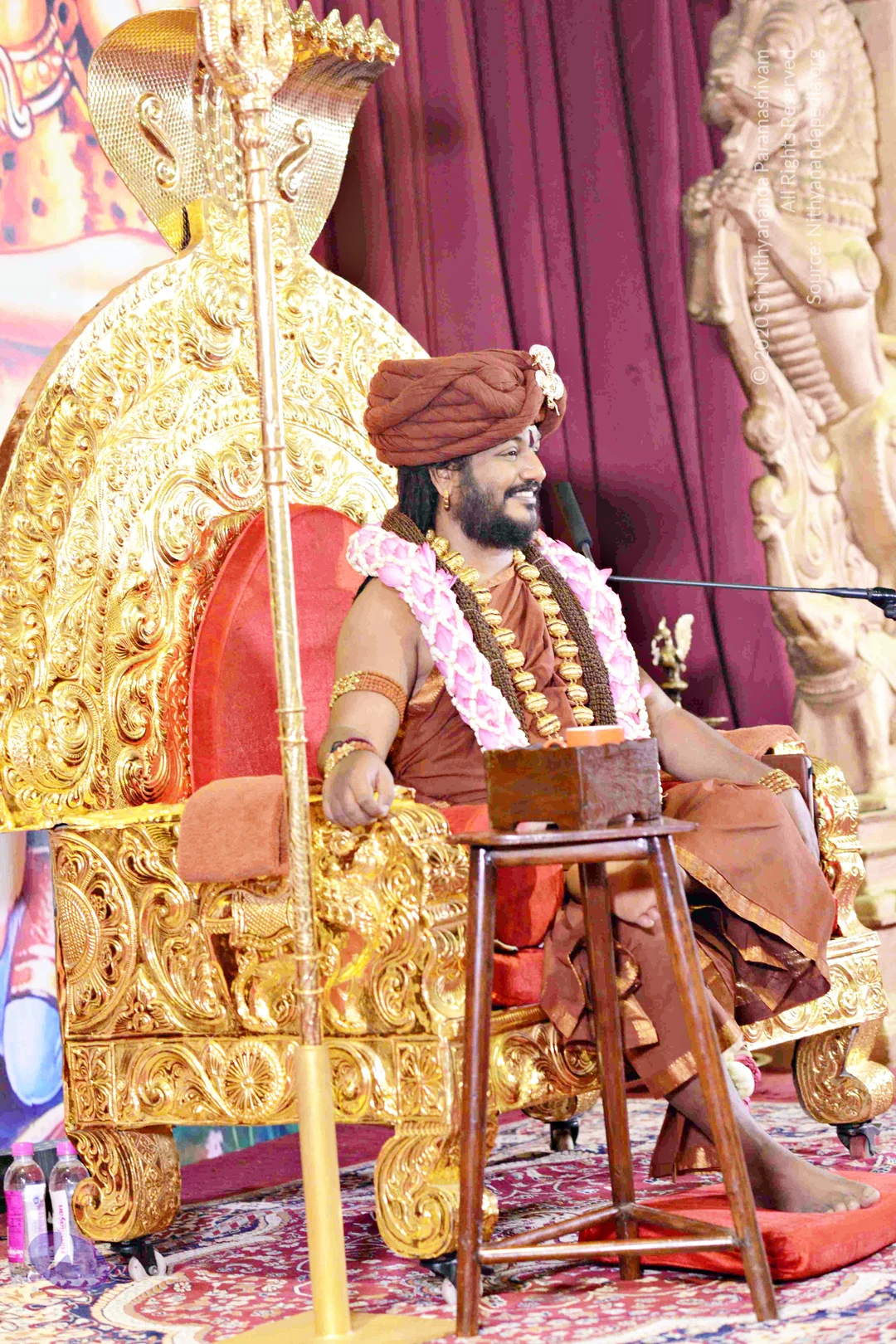
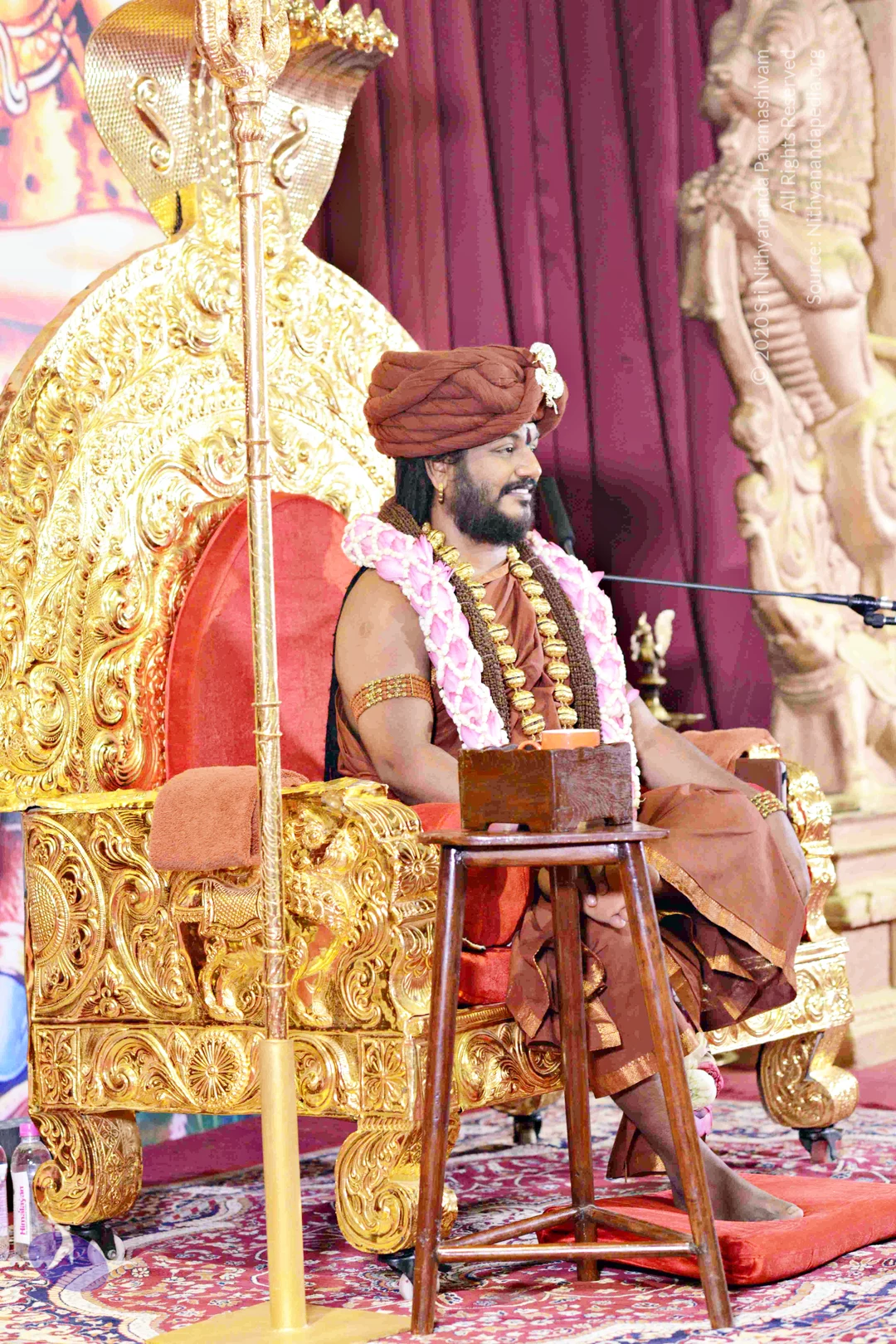
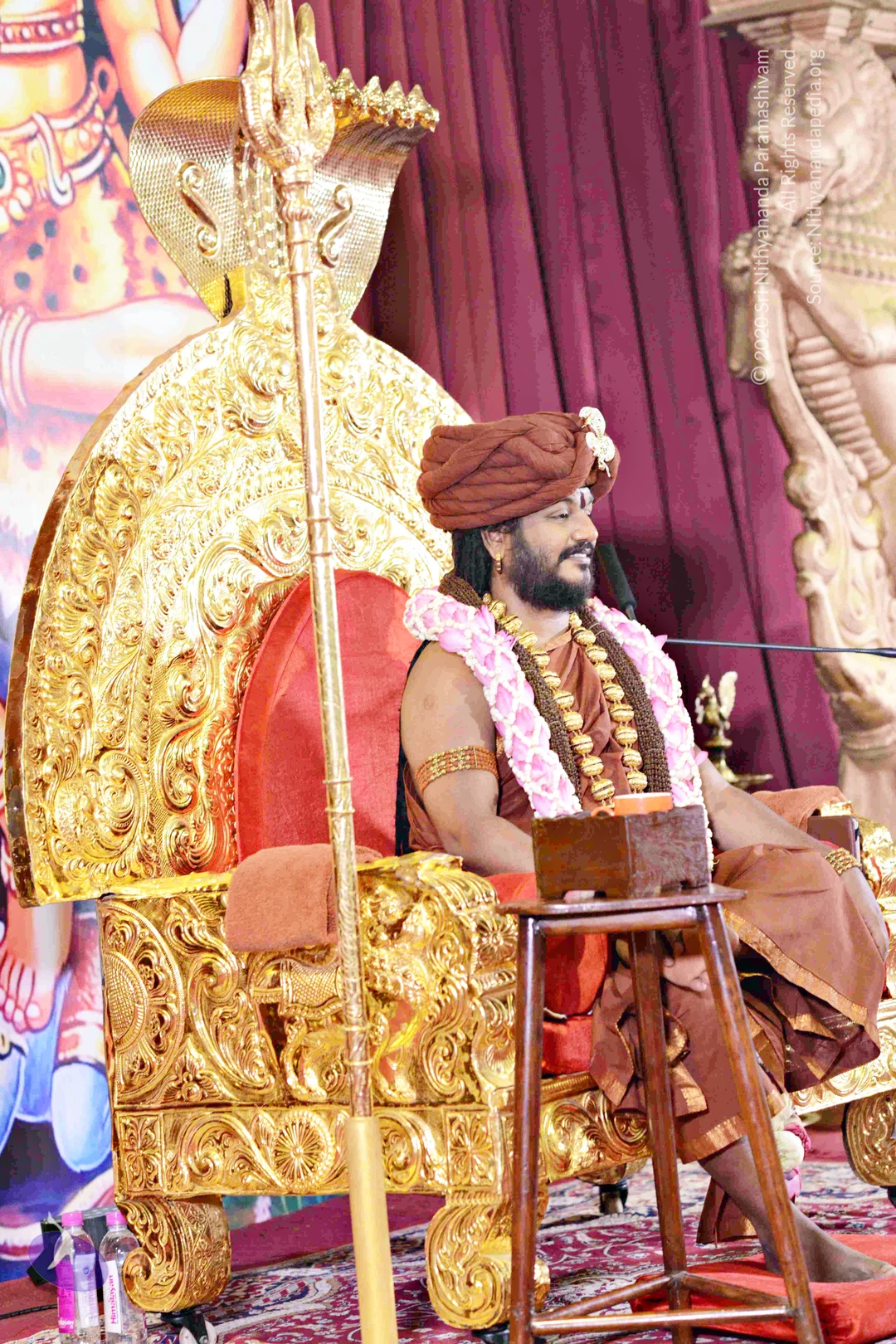
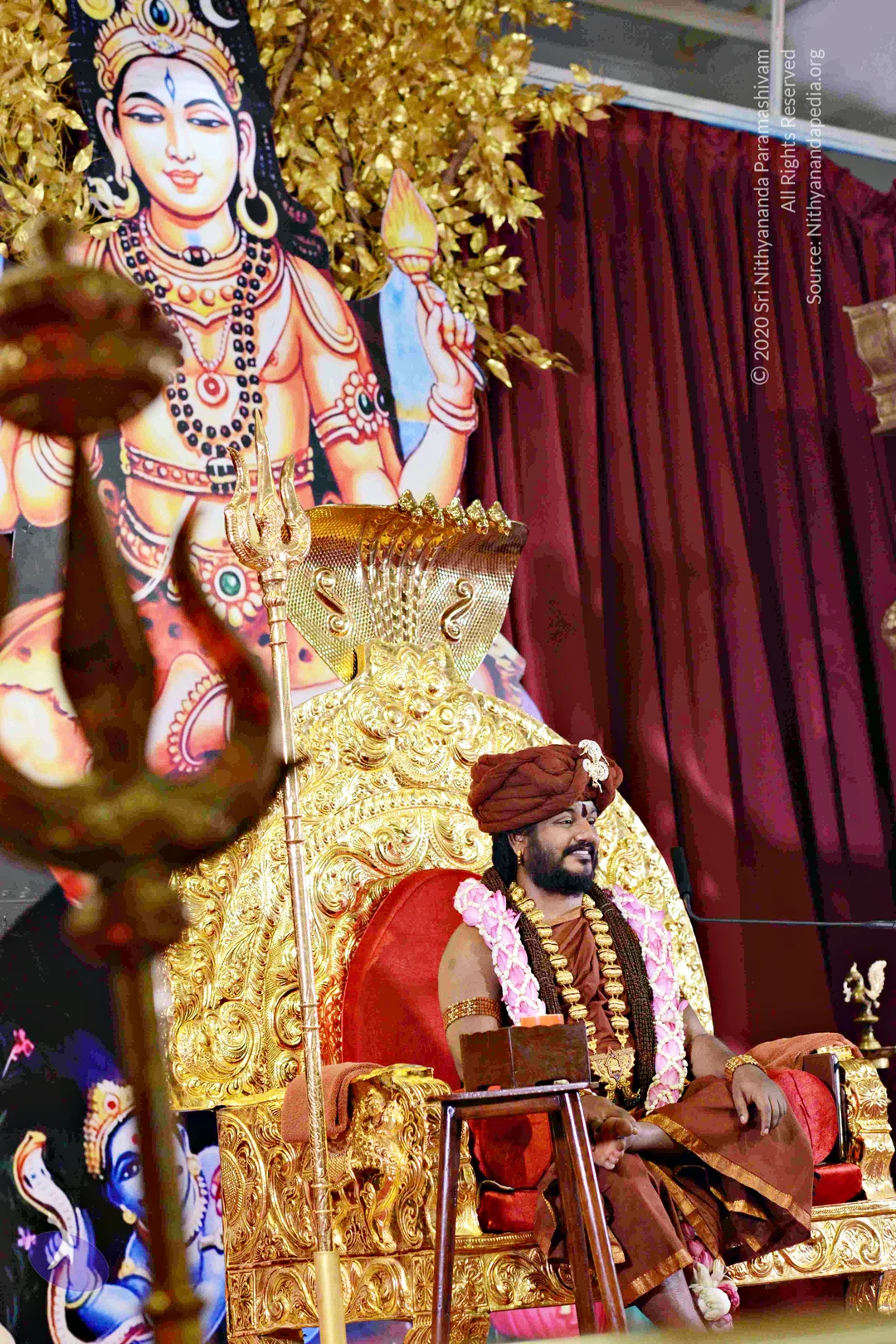
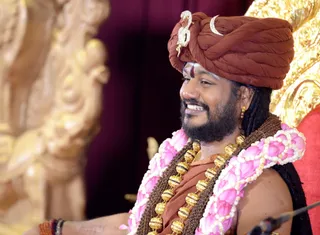
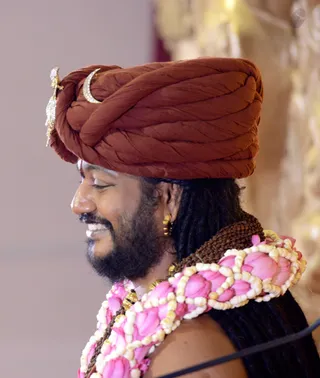
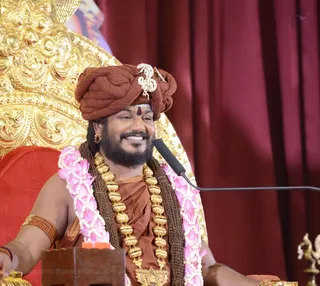
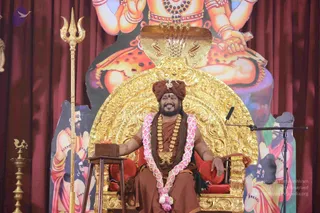
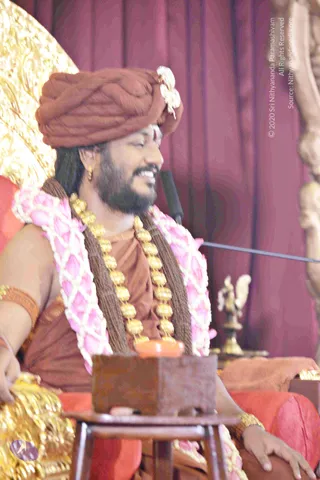
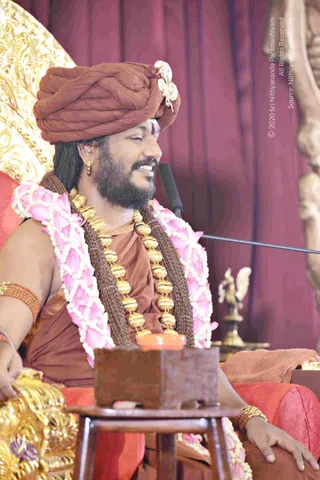
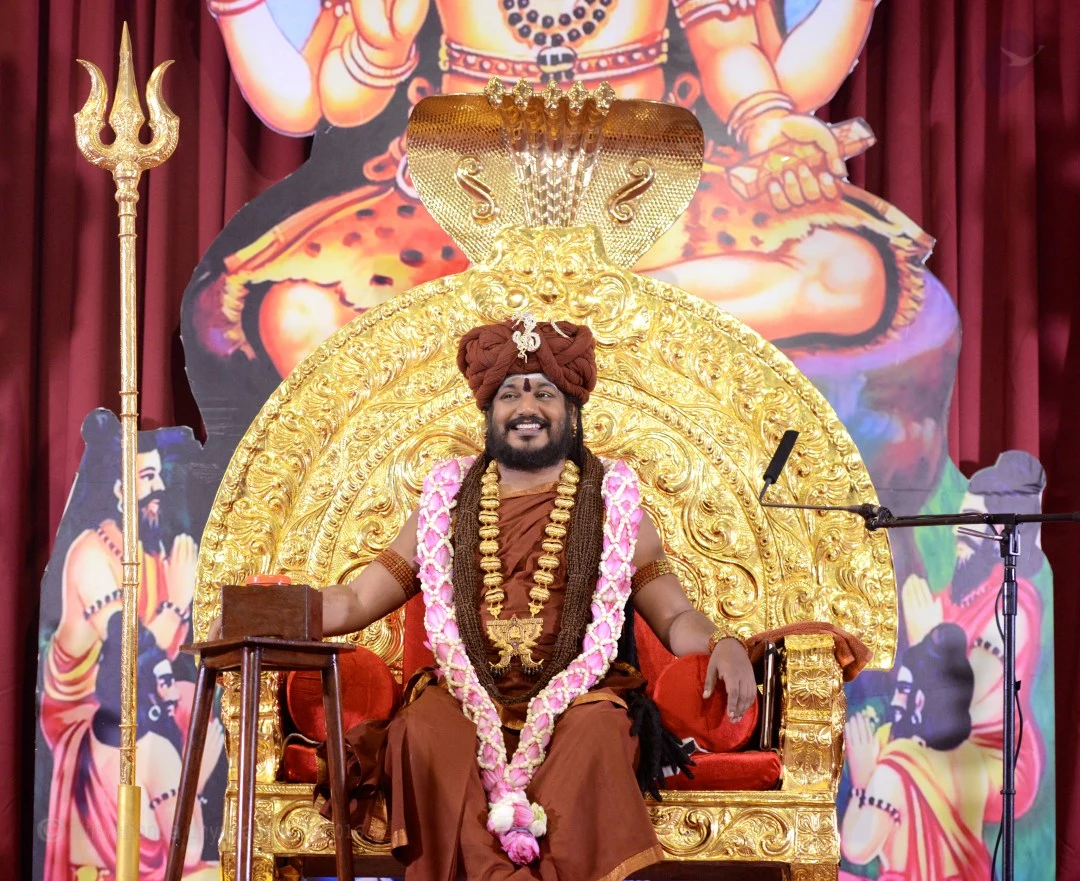
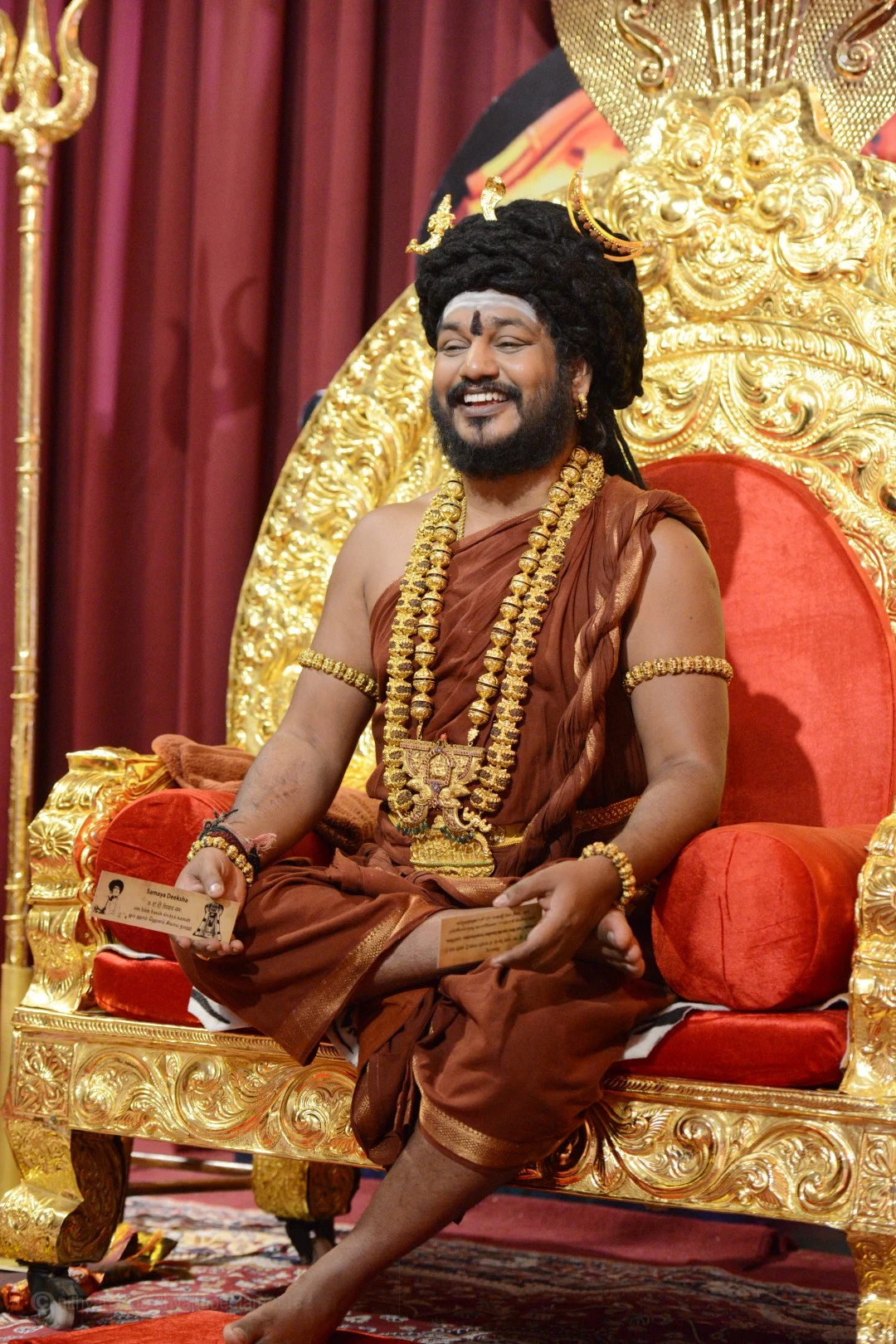
A seated bearded man in a rust-orange turban and rust-orange robes sits on an ornate gold throne with a cobra-hood canopy, smiling and resting his hand on a small wooden stand. He wears a long pink and white garland, gold chains and a rudraksha-style necklace of gold beads, with a long dark braid over his shoulder. A tall golden trident stands at left, a microphone on a stand at right, and a painted backdrop of a deity and saints in red and orange tones hangs behind him against red curtains. The scene is a satsang discourse setting.Close photograph of a smiling bearded man seated on a gold ornate throne against a deep magenta curtain. He wears a rust-brown turban with a gold ornament at the side, a rust-brown robe, a long brown beaded mala with large gold beads, and a pink lotus and white flower garland over both shoulders. Rudraksha bands are on his upper arm and a gold earring is in his ear. Probable Swamiji (in_person candidate by appearance cues: turban, rudraksha, gold ornate jewellery and garlands), seated as the central figure of the satsang setting.A smiling man in a rust-brown turban with a jeweled ornament and crescent pin sits on a gilded throne, wearing a brown-orange robe, a dark rudraksha mala with large gold beads, and a pink and white flower garland. A vertical maroon curtain and ornately carved gold woodwork frame the scene, with a microphone visible at lower right. Swamiji (probable): the appearance cues include the ceremonial turban, ornate gold beadwork, rudraksha mala and saffron-toned clothing, as the seated figure at a satsang. One physical person is visible.Side-profile portrait of a smiling man with long dark hair and a full beard, wearing a rust-brown turban with a crescent moon and jewelled pin at the front. He wears a pink lotus garland with white beads, a multi-strand rudraksha-style necklace with gold beads, and a gold earring; his bare shoulder shows. Behind him are gold-leaf carved temple panels and deep maroon drapery. Presentation cues (long hair, ornate turban, rudraksha and gold necklaces, lotus garland) are distinctive; the setting suggests a satsang stage. a person seated in front of the temple-style backdrop.Close side-profile photograph of a smiling bearded man wearing a rust-brown wrapped turban decorated with a gold and diamond-set crescent moon ornament at the front. Long dark hair falls from beneath the turban down his back, and he wears gold earrings and a brown rudraksha mala. Appearance cues (long hair, turban with crescent ornament, rudraksha mala, ceremonial gold jewellery) match the page's Swamiji reference, so this is a probable Swamiji in person.A man seated on an ornate gold throne in front of deep red drapery, speaking into a microphone on a stand at right. He wears a rust-brown turban with a jeweled ornament at the front, a red tilak mark on his forehead, a brown saffron-toned wrap, and long layered gold beaded necklaces with a rudraksha-style brown mala. A pink and white flower garland hangs over his shoulders, and a brown bracelet is on his left arm. His hand rests on a small wooden lectern in the foreground, and a brass lamp is visible at the lower right. Swamiji (probable) is seated as the speaker at a satsang, with the appearance cues of a turban, ornate gold ornaments, and a rudraksha mala.

NITHYA SATSANG
28 photosSource gallery
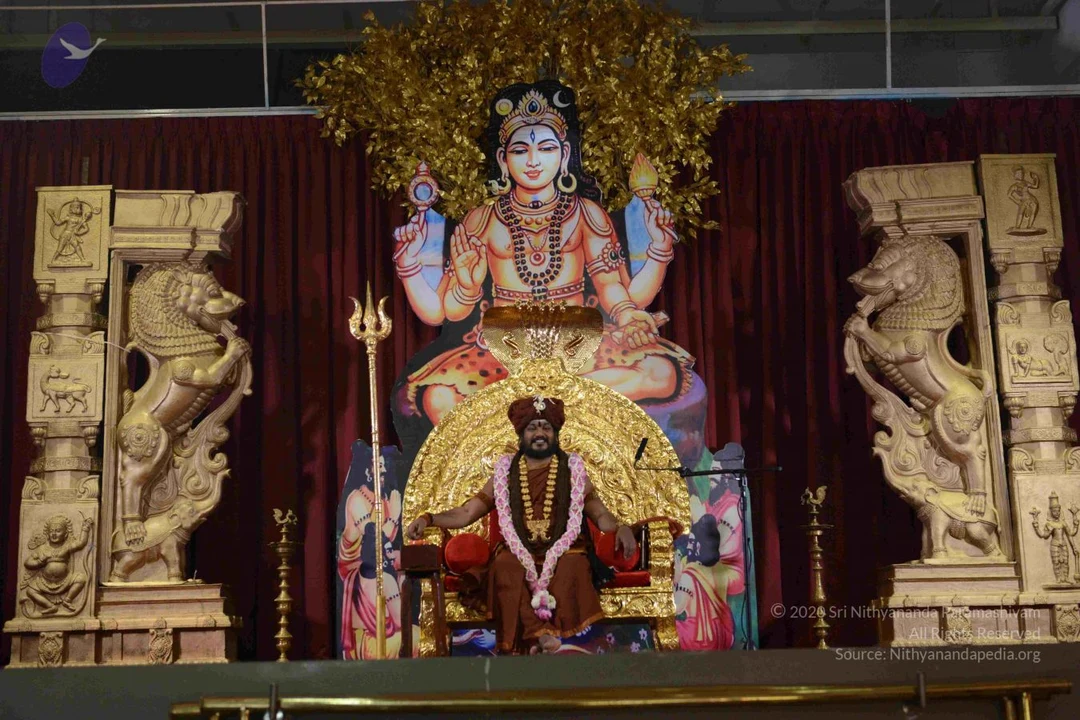
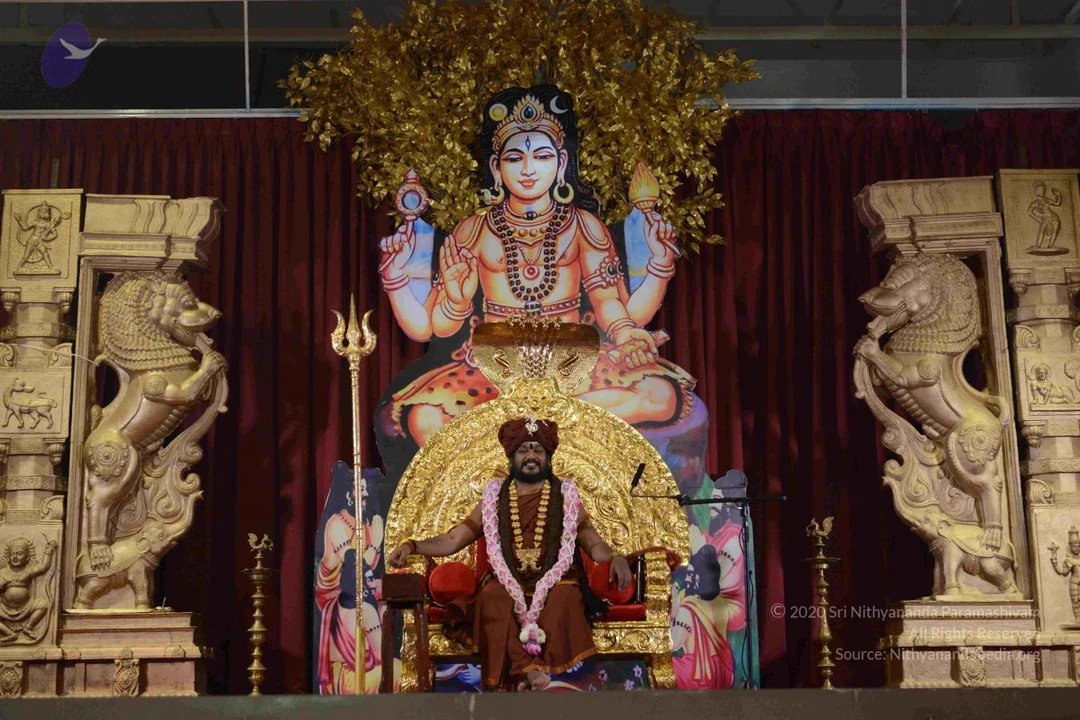
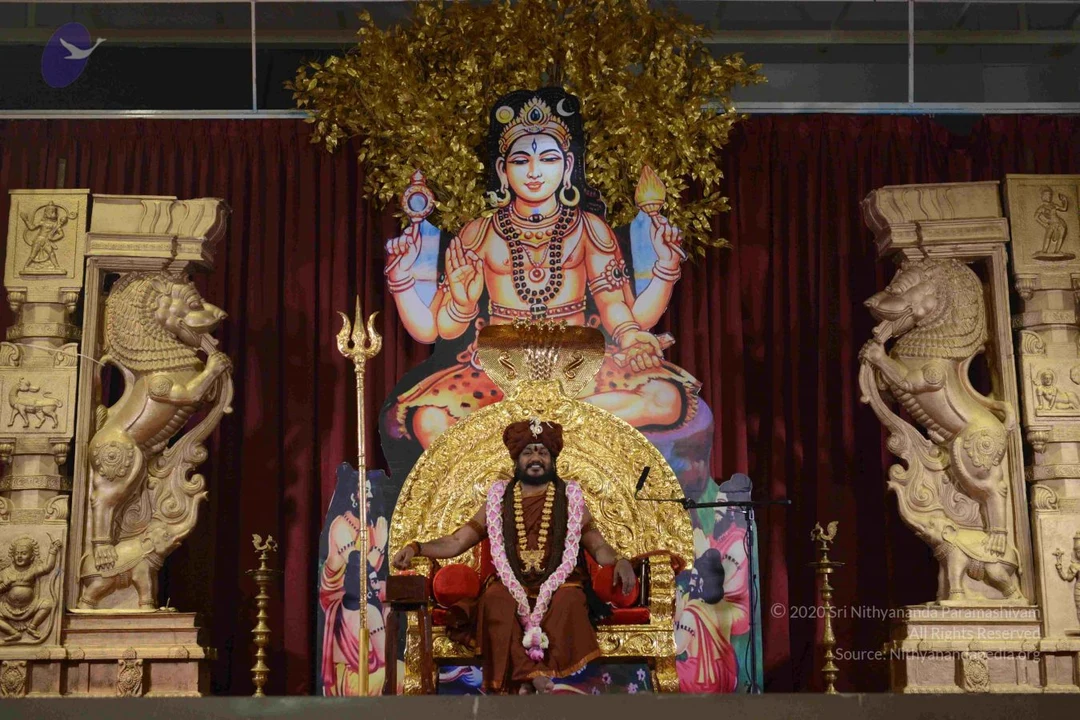
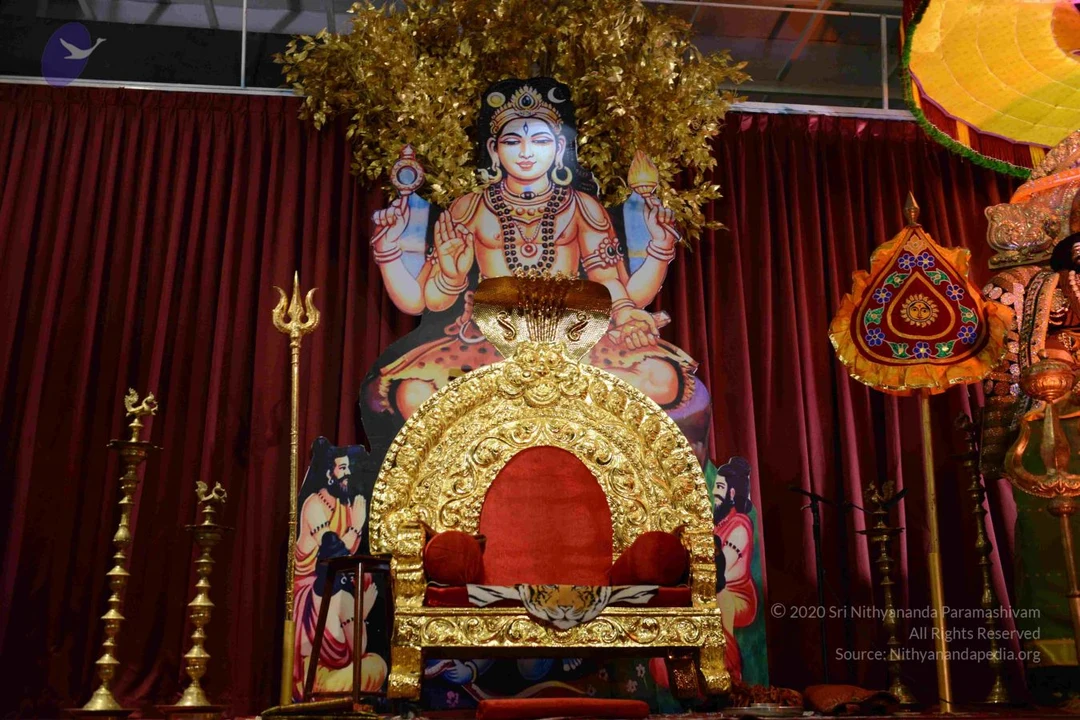
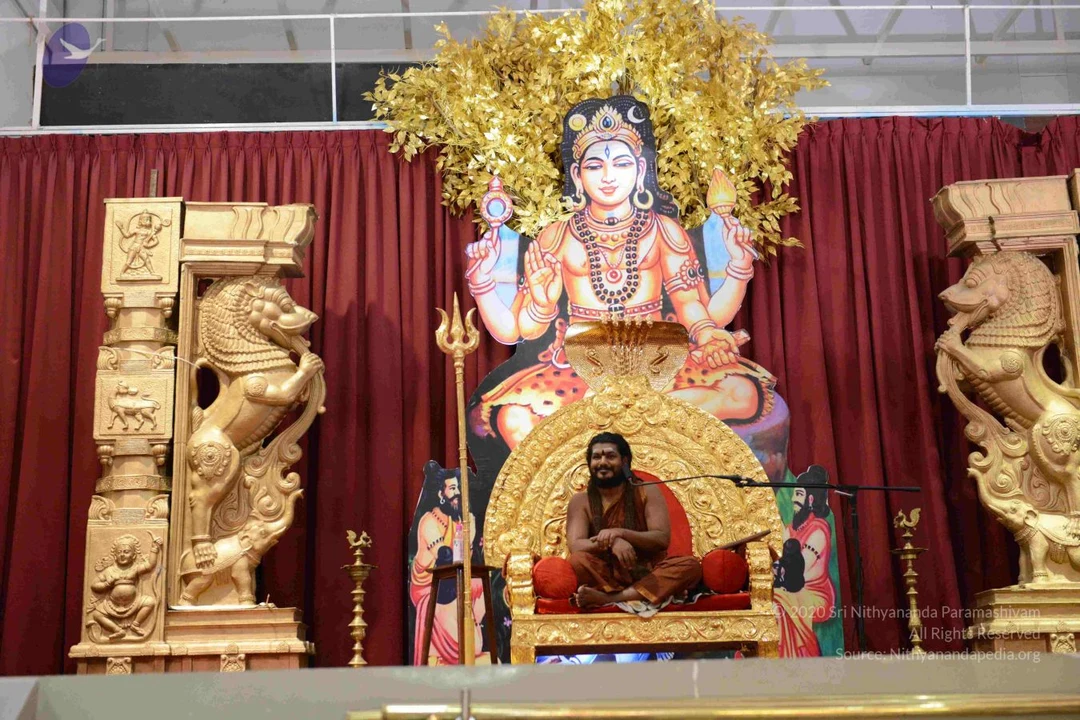
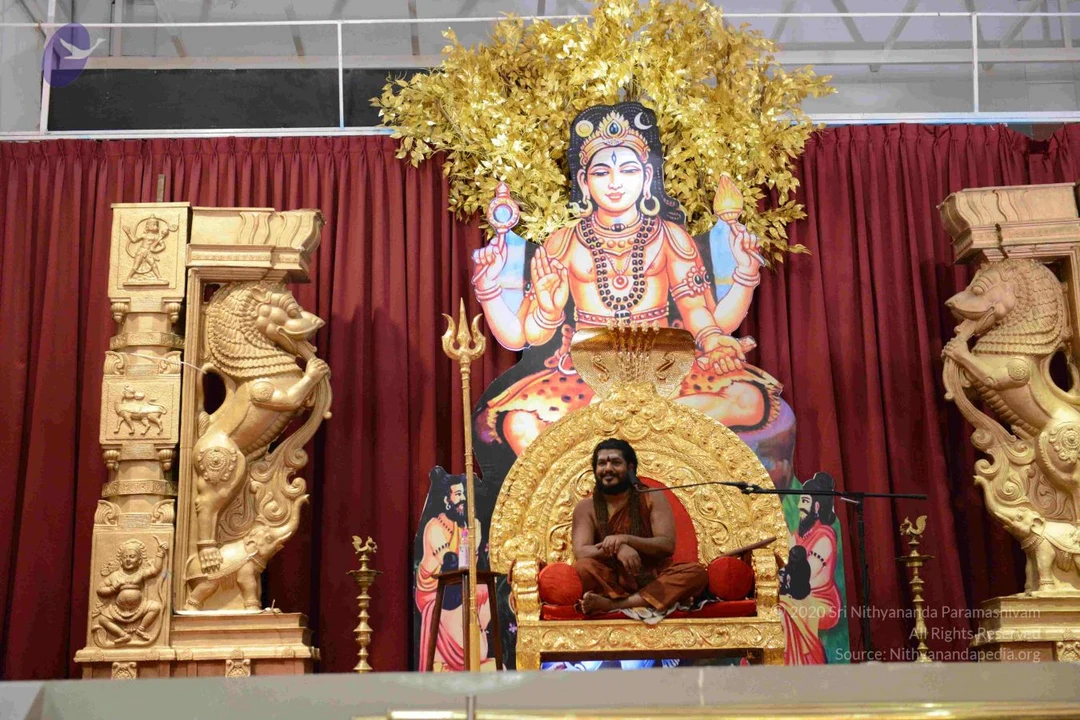
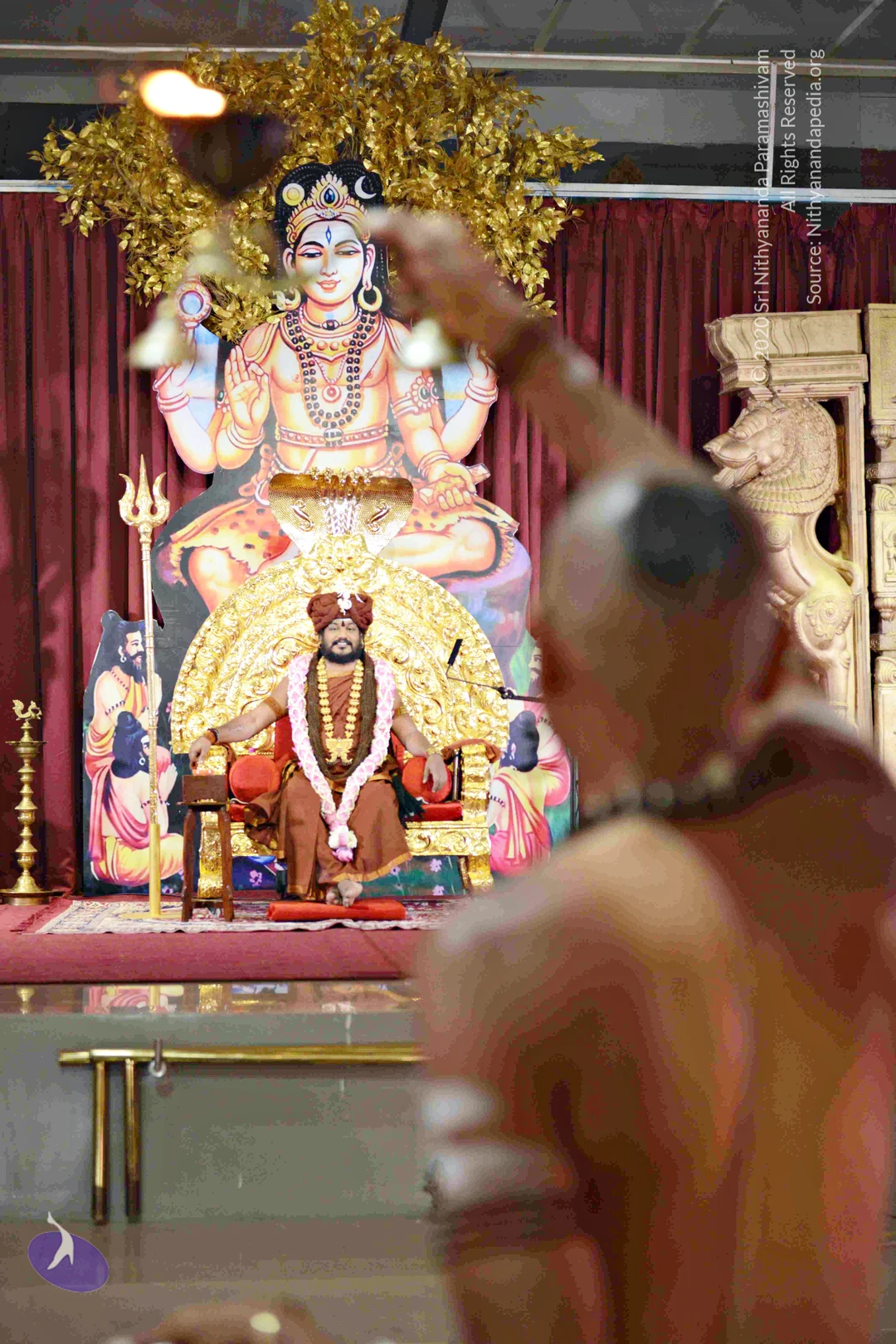
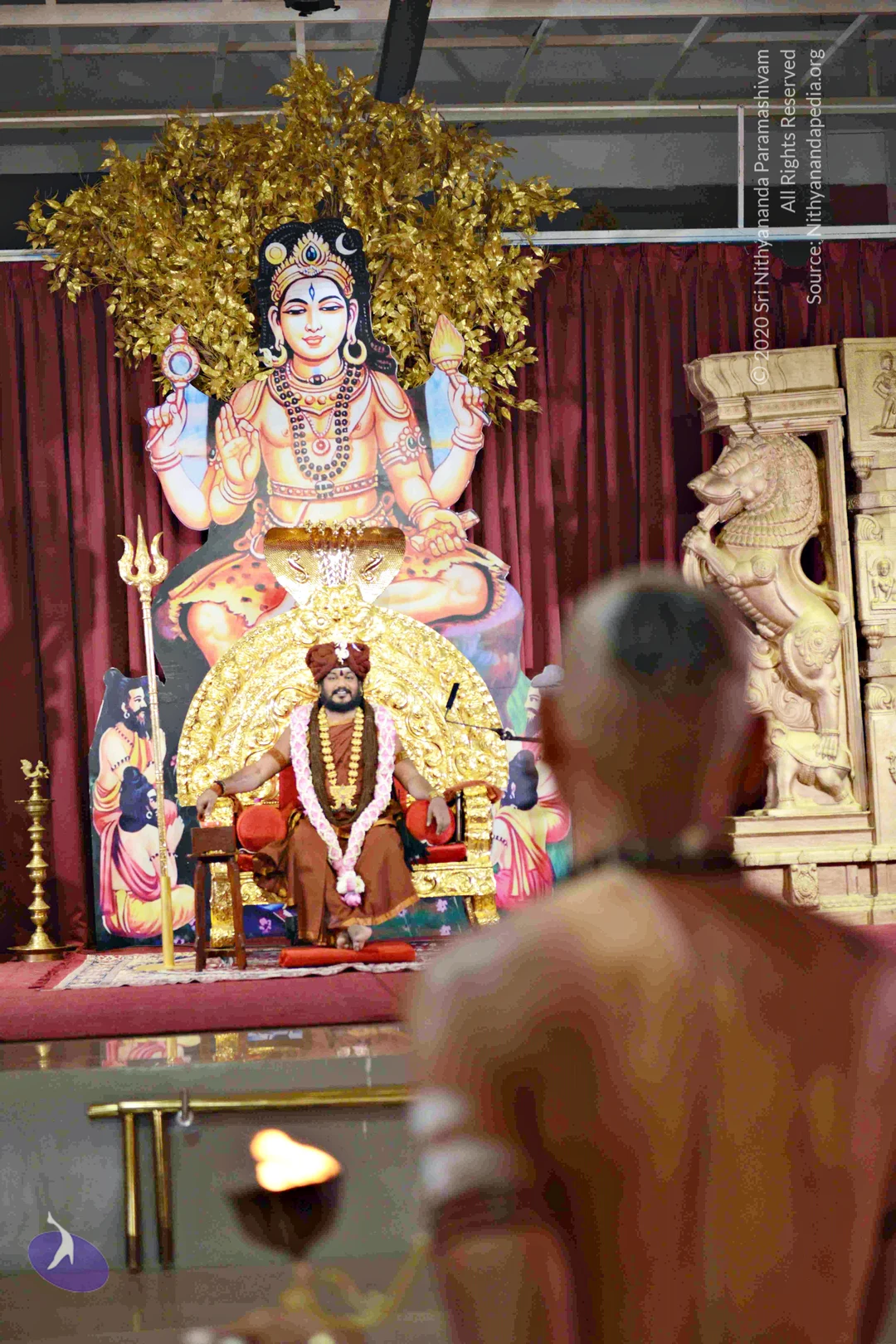
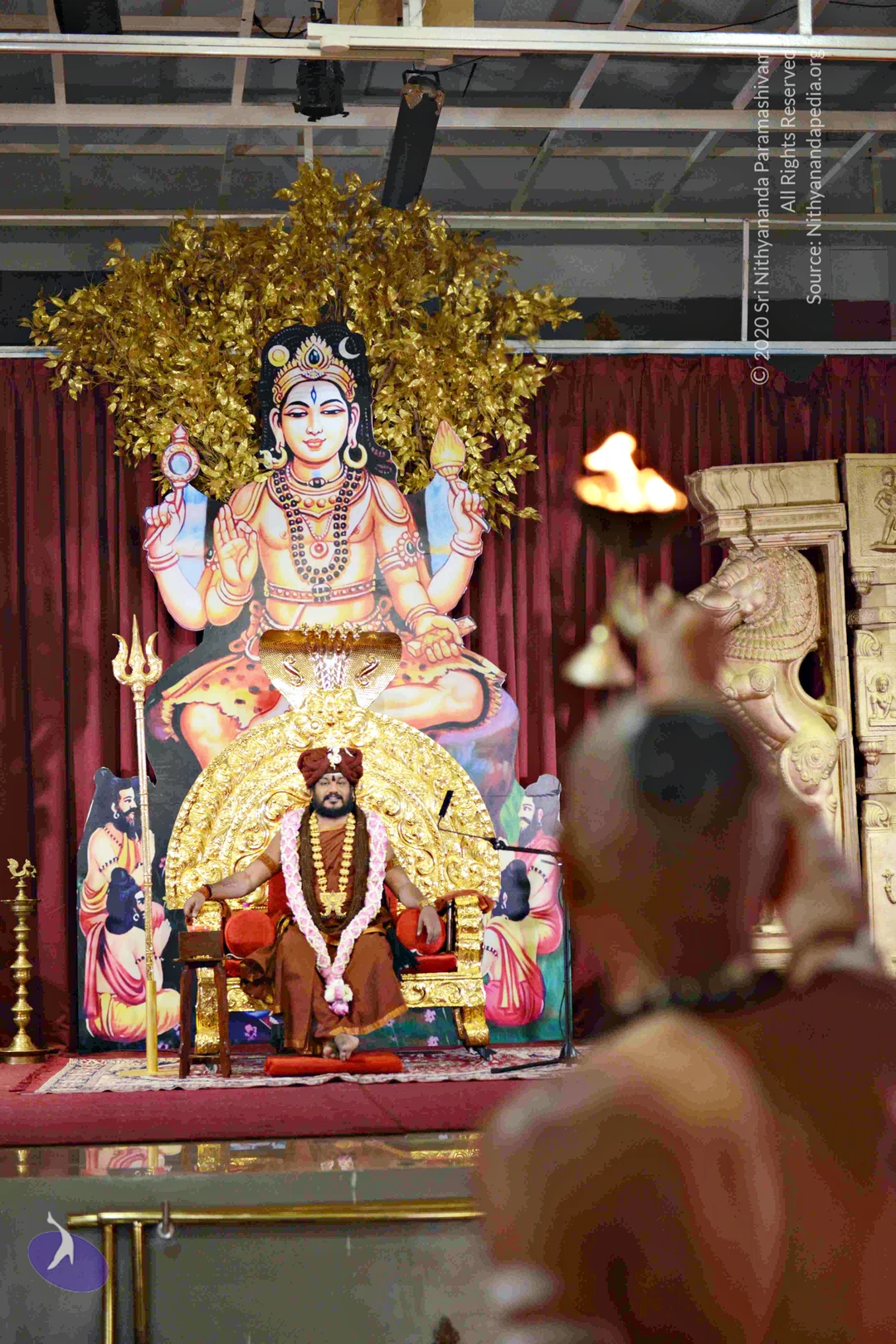
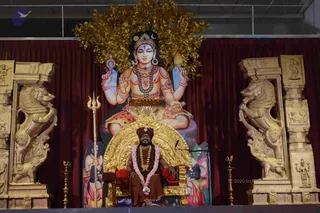
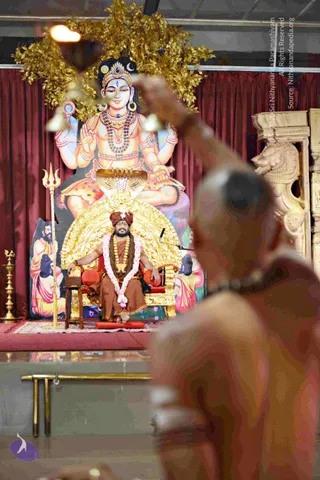
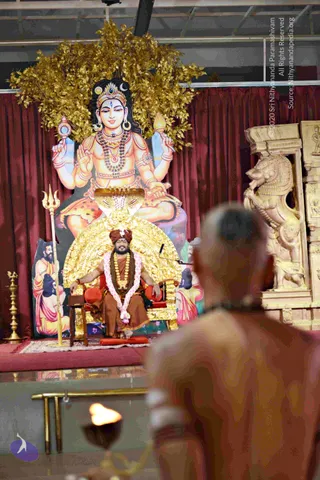
A seated man in a saffron-orange robe and matching turban sits on an ornate gilded throne on a stage. He wears a rudraksha mala and a pink-and-white flower garland, with a long orange sash across his shoulders. Behind him a large painted backdrop shows a four-armed deity murti with a crescent moon in the hair, holding a trident-like rod and a lamp, with golden leaves framing the figure. Flanking the stage are carved golden lion pillars, a tall golden trident stands at left, and oil lamps stand on brass stands. Dark red drapery hangs behind the stage.A seated man in a saffron-brown robe and turban sits on an ornate gold throne with red cushions on a stage. He wears a long rudraksha mala and a white and pink flower garland. Behind him is a large painted backdrop of a four-armed deity murti with a crescent moon and a golden leafy arch, holding a trident-like emblem, a flame and a sacred drum. Carved stone lion-figure pillars stand on each side, with a trident beside the throne and brass oil lamps at its base, and a red curtain behind. The seated man has distinctive long hair and ornate adornments, matching the appearance of a person with several cues, so this is a probable in-person presence.A photograph of a stage set with a seated figure on a golden throne in front of a large painted deity backdrop. The seated man wears an orange-brown robe, a saffron-coloured turban, a rudraksha mala and a white and pink flower garland. He holds his hands on the armrests. Behind him a painted four-armed deity with a crescent and a golden tree-like halo is shown, flanked by carved golden lion-like pillars and a golden trident standing to the left. Red velvet drapes form the background, with the overhead screen and a microphone stand in front of the throne.A seated bearded man in an orange-brown robe and orange turban sits on an ornate gold throne on a stage. He wears a rudraksha mala and a pink-and-white flower garland, and his hands rest on the armrests. Behind him is a large painted backdrop of a four-armed deity murti with a crescent moon and crown, holding a trident-like symbol, a flame and a drum, with gold leaf foliage above. Gold lion-form pillars flank the stage, a brass oil lamp stands at each side, and a silver-tipped trident leans to the left. Red velvet drapes frame the set. The scene appears to be a satsang or darshan setting; the seated figure is a probable Swamiji by his orange robe, rudraksha mala and turban, though the face is not clearly distinguishable at this size.A seated man in orange-brown robes, a saffron-and-maroon turban, a rudraksha mala and a pink-and-white flower garland sits on an ornate gold throne on a stage. Behind him a large painted deity murti shows a four-armed blue-skinned figure holding a trident-like emblem, a lamp and other objects, framed by golden leaves. A tall golden trident stands at the left of the throne, with ornate carved lion-shaped pillars flanking the stage and brass lamp stands at both sides. Red curtains form the backdrop. The man sits upright with hands resting on the armrests of the throne.A photograph of a bearded man seated on an ornate gold throne with a carved cobra-hood backrest before a red curtain. He wears a rust-brown turban with a small gold emblem, a brown robe, a gold necklace and a long rudraksha-style mala, and a pink and white flower garland drapes his shoulders. He rests one hand on a wooden lectern and smiles. Behind him is a large painted backdrop of a multi-armed deity with a trident and a painted sage. A brass oil lamp stands at left and a silver microphone stand at right. Swamiji (probable): the seated man has a turban, rudraksha mala and gold necklace on a throne, a compatible presentation.

Homa

11 photosSource gallery
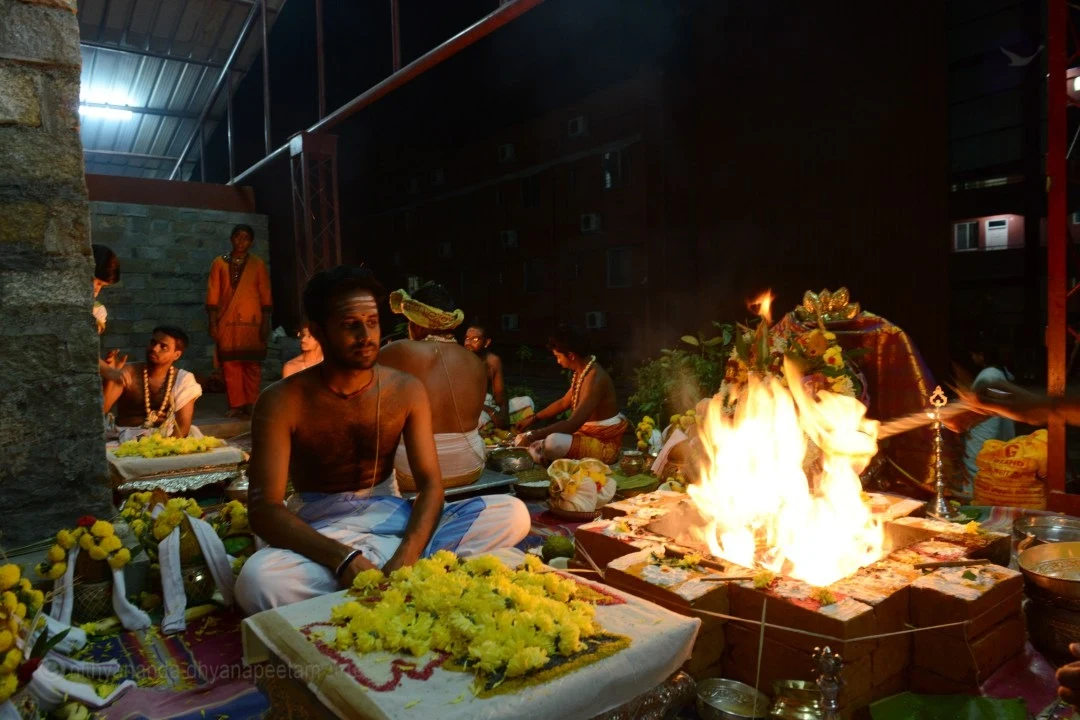
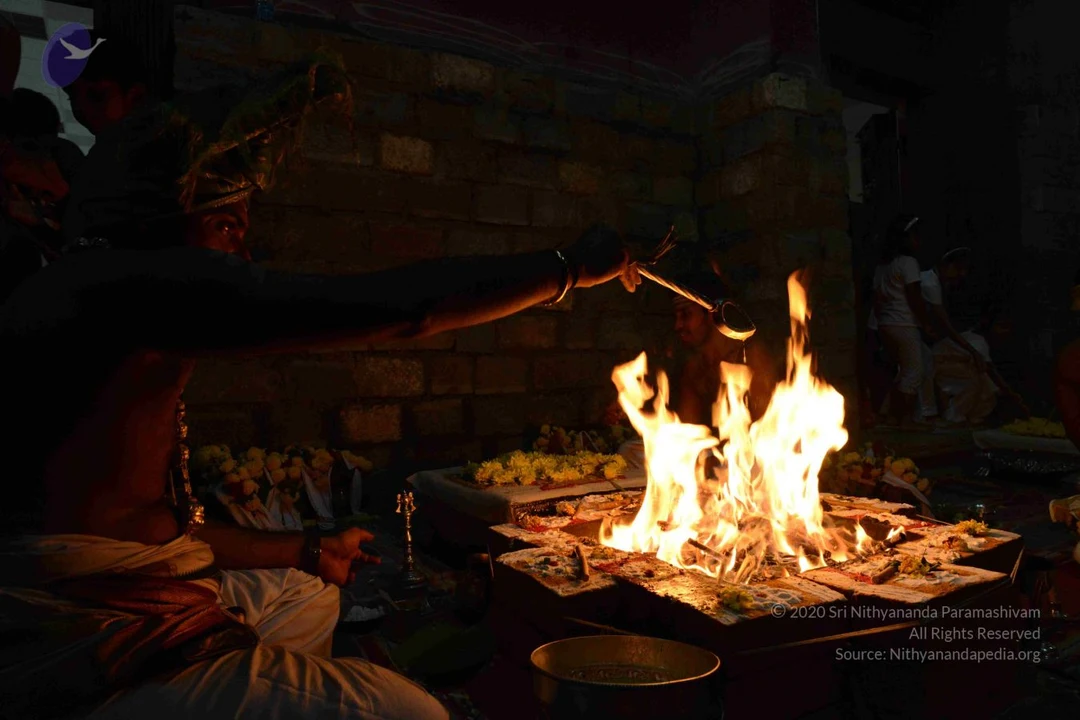
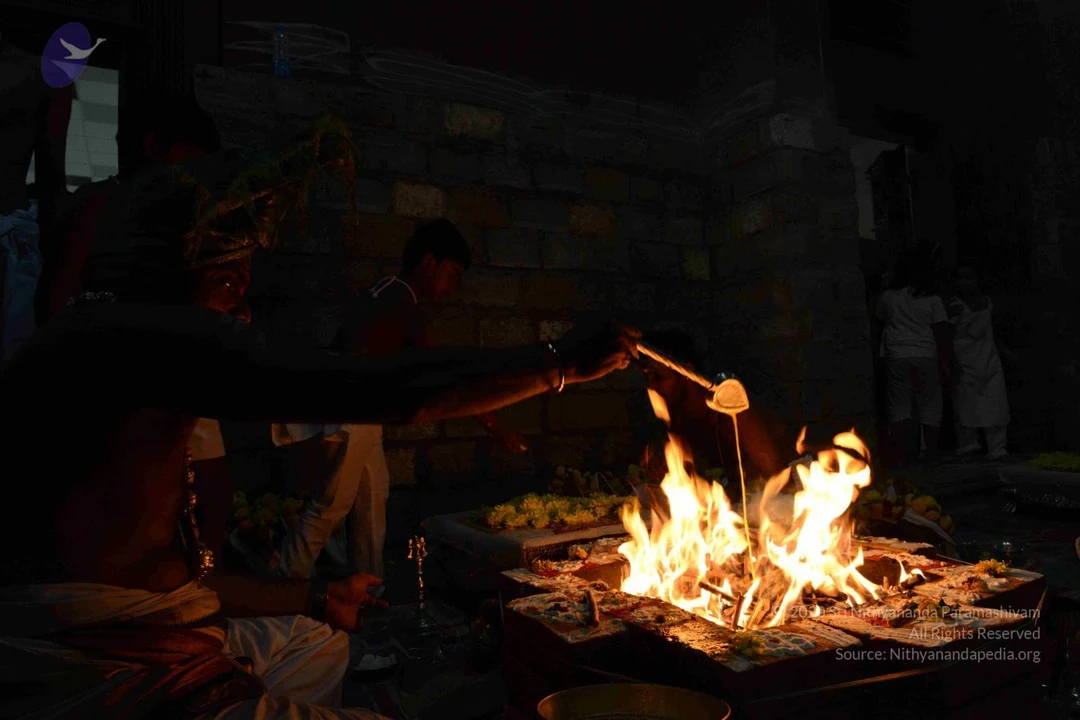
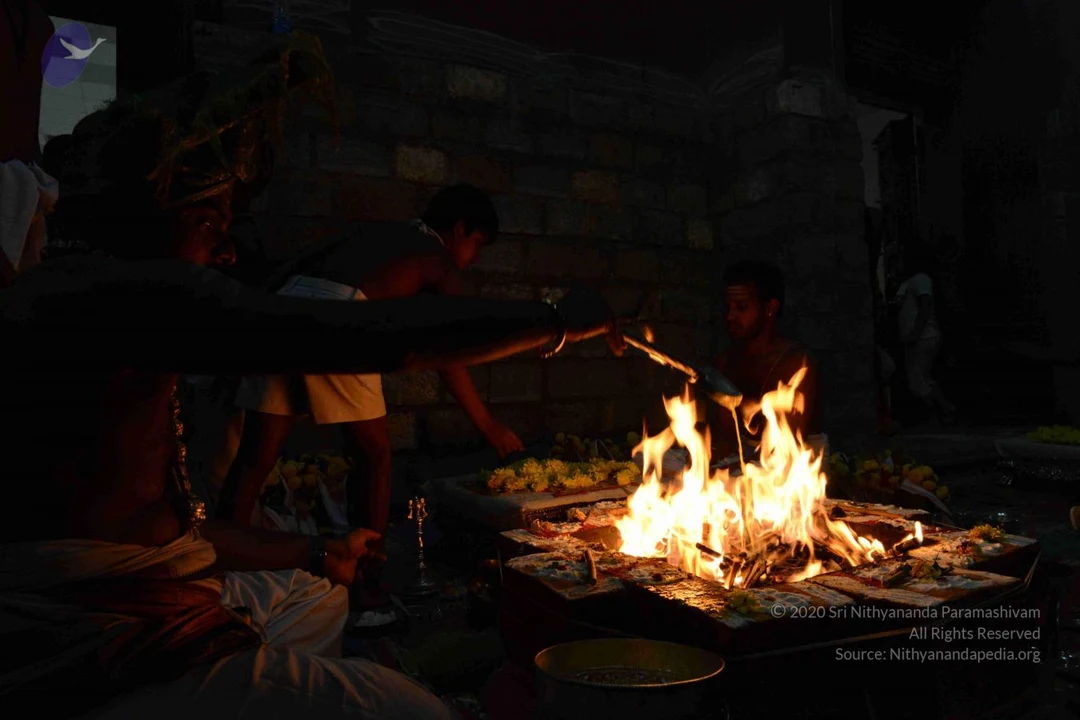
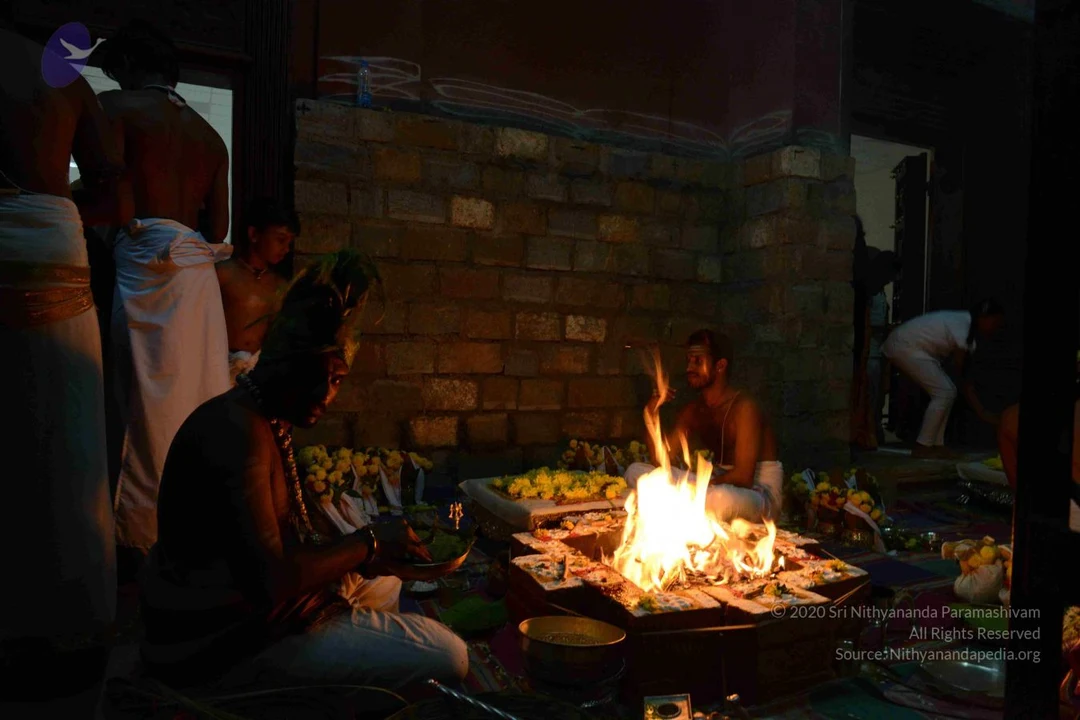
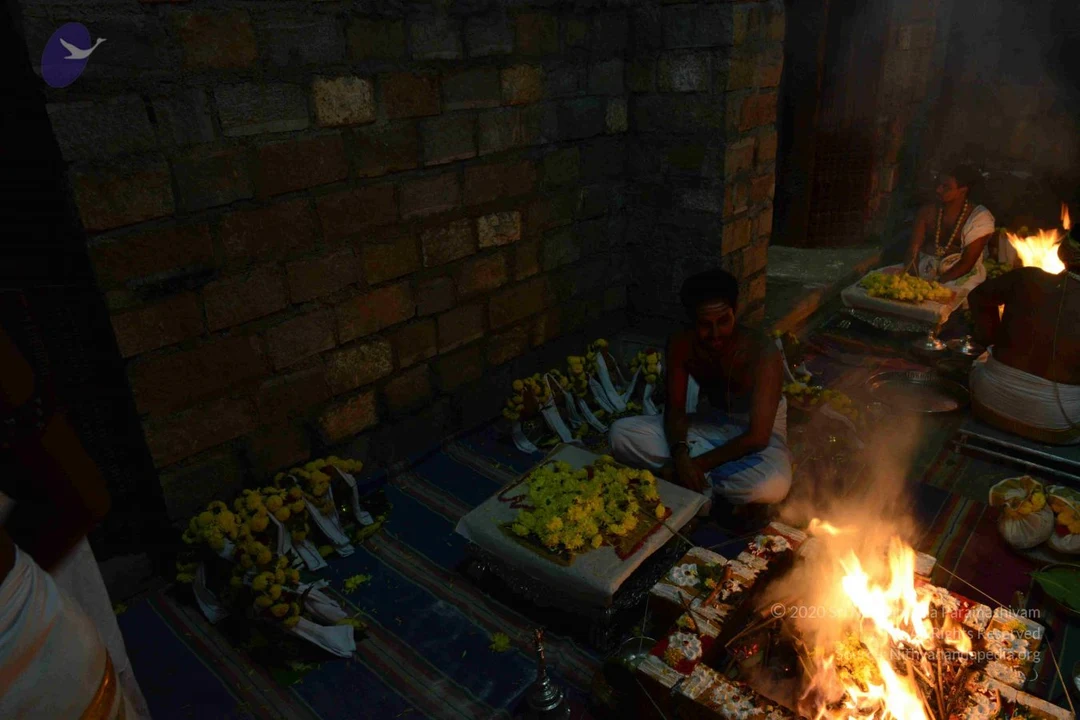
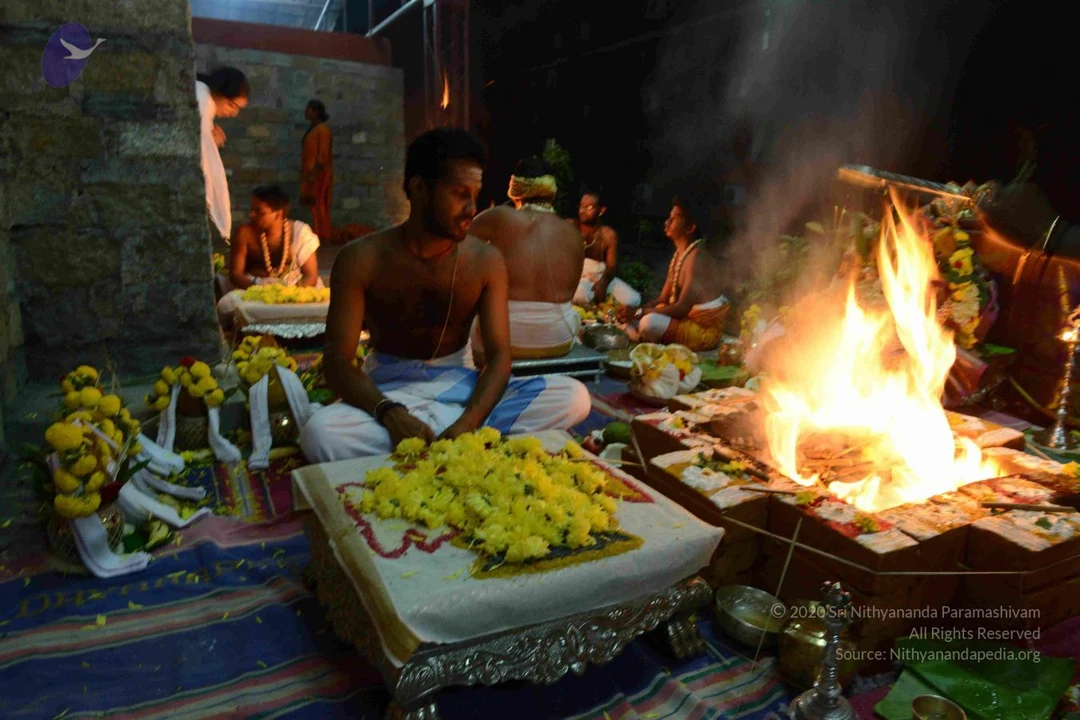
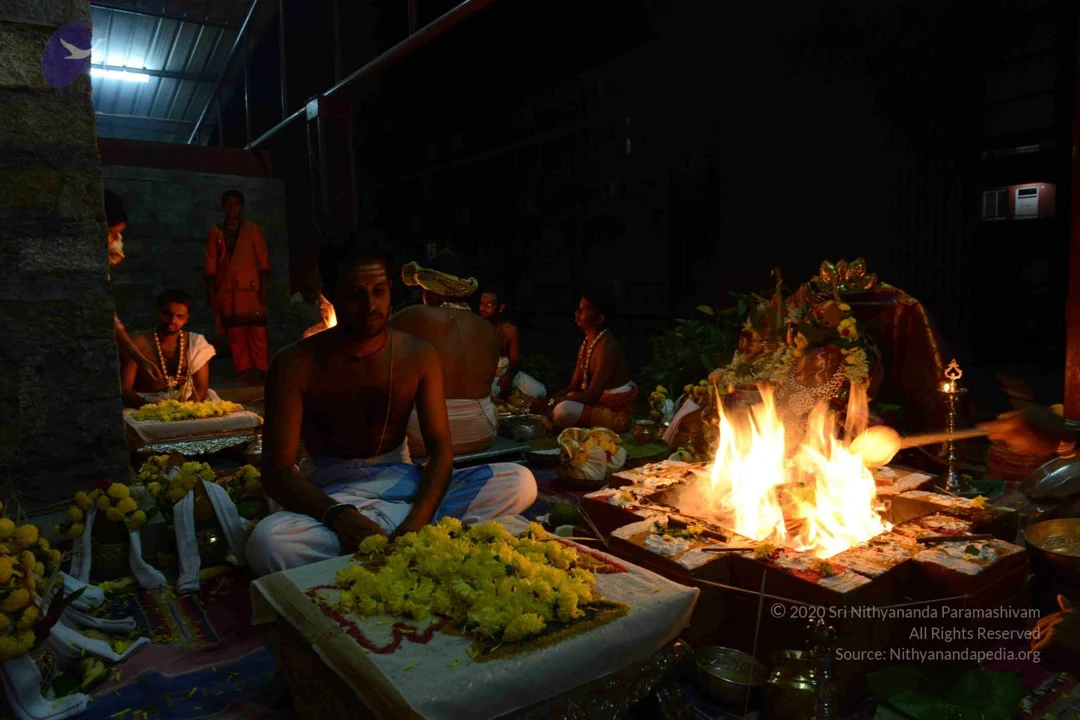
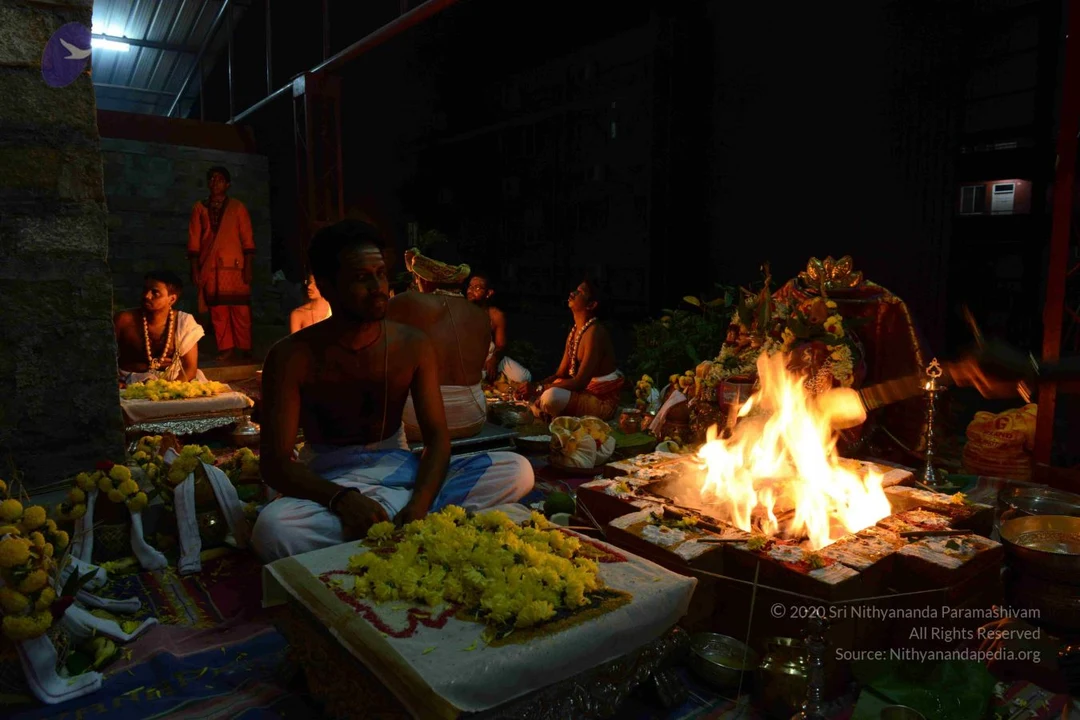
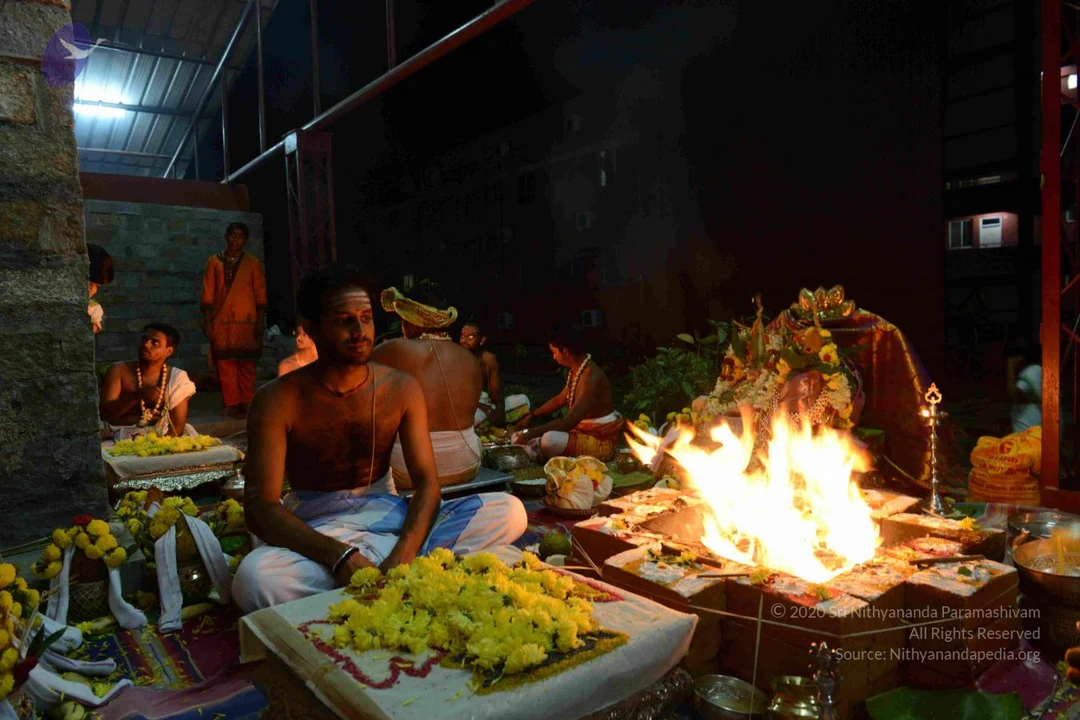
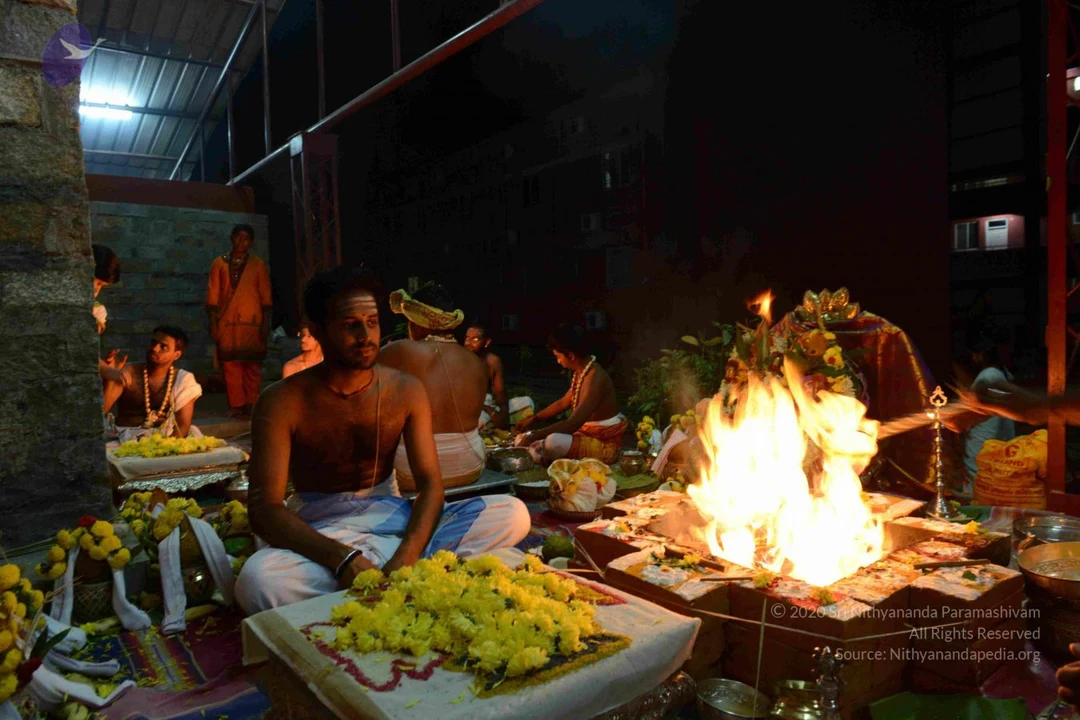
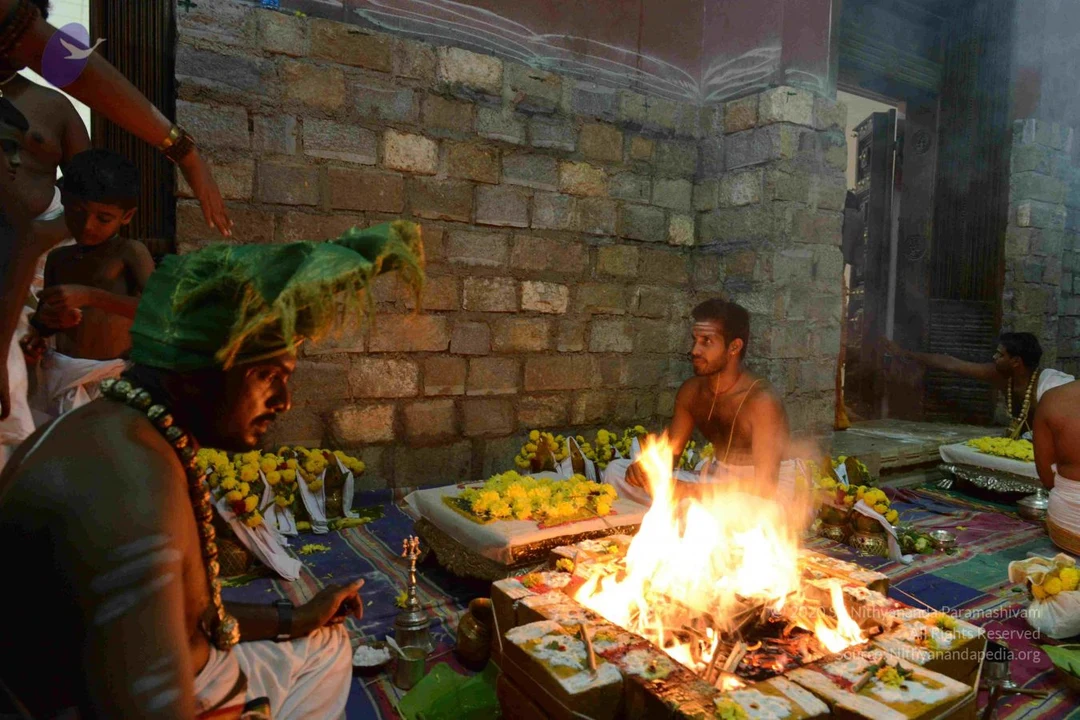
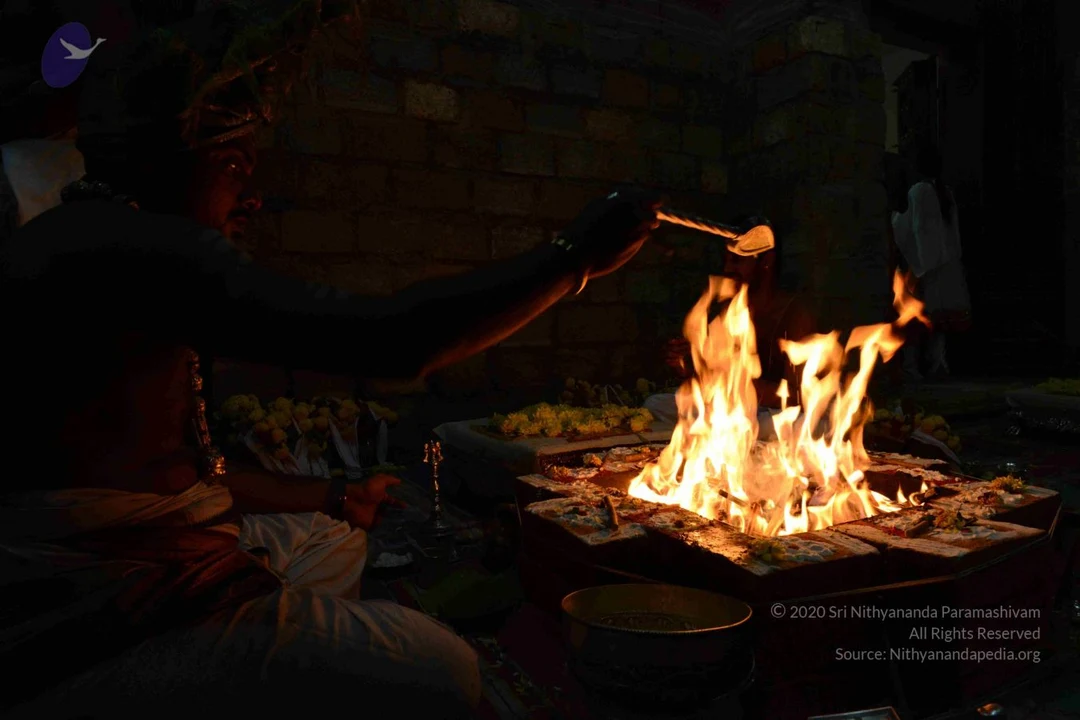
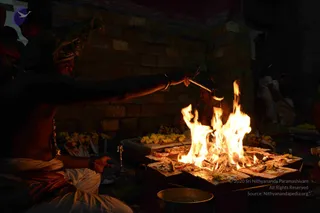
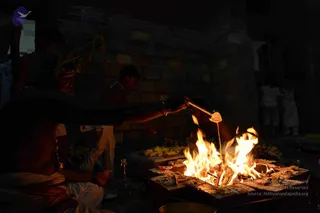
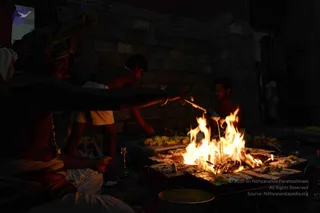
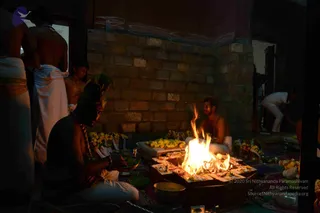
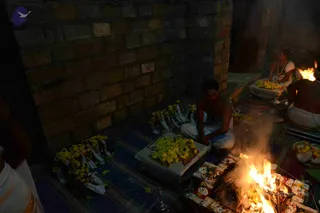
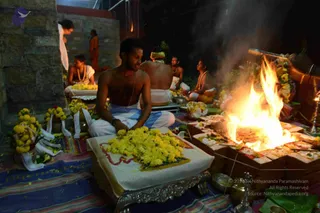
A night-time homa fire ceremony. A large fire blazes on a raised platform covered with patterned cloths, decorated with yellow and white flower garlands, and small brass lamps. A priest seated on the left, bare-chested in a white dhoti with a golden waist cord and wrist bands, extends his arm holding a ritual implement toward the flames. Behind the fire, another figure sits near the wall, and a few white-clad assistants move in the background. A metal bowl sits in the foreground. Red-lit brick walls form the backdrop.A dark, nighttime fire ritual in a stone-walled courtyard. A priest in white dhoti and a dark shawl, with a gold armlet and a wrapped head, extends a long ladle toward a blazing fire pit where offerings are burning on a square platform decorated with yellow flowers and fruit. A second man in white stands behind him. Brass lamps and a copper vessel sit nearby, and several more people in white stand in the background at right. This appears to be a homa or yagna fire offering.A night homa fire ritual in a dark courtyard beside a stone wall. A large fire blazes on a square altar covered with floral-decorated offering plates and marigold garlands. A priest in white dhoti and a yellow-and-brown headcloth, seated at left, extends his arm toward the fire. A bare-chested young assistant in white shorts leans over the altar, and another bare-chested man kneels to the right, holding a ladle or offering stick over the flames. A brass vessel sits in the foreground.A photograph of a night fire ritual in a dimly lit brick-walled hall. In the centre a large flame rises from a square homa fire pit with offering trays and marigold-type flowers arranged around it. A bare-chested man in white dhoti sits cross-legged beside the fire, holding a ladle-like implement. A seated priest in the foreground wears a white cloth, rudraksha-style beads, and a green-feathered headpiece, with a brass bowl before him. Standing figures in white dhotis and bare torsos stand at left, and another person in white bends near the right edge. The homa fire and offerings suggest a yagna.A dim brick-walled ritual chamber where a homa or yagna fire blazes in a pit at lower right. A shirtless man in white dhoti with a sacred thread sits cross-legged before the fire, with marigold and yellow flower garlands arranged on the floor and a flower-covered tray nearby. At upper right, another priest in a white dhoti and beaded necklace sits beside a flower-filled plate and a second fire glow. Offerings in cloth bundles lie at the edge of the frame, and a small brass vessel sits on the floor. Smoke fills the warm, shadowy space.A homa fire ritual at night in an outdoor temple courtyard. A large fire blazes on a brick fire pit on the right, with smoke rising. In the foreground a shirtless young priest with a sacred thread and white dhoti sits cross-legged behind a silver tray heaped with yellow marigold garlands. Behind him, several more priests in white dhotis, some wearing garlands and sacred threads, sit and assist in the ritual. Yellow flower garlands are arranged around the fire pit and on a silver stand. Brass vessels and a lamp sit on the ground, with a stone wall behind.

IA-participents
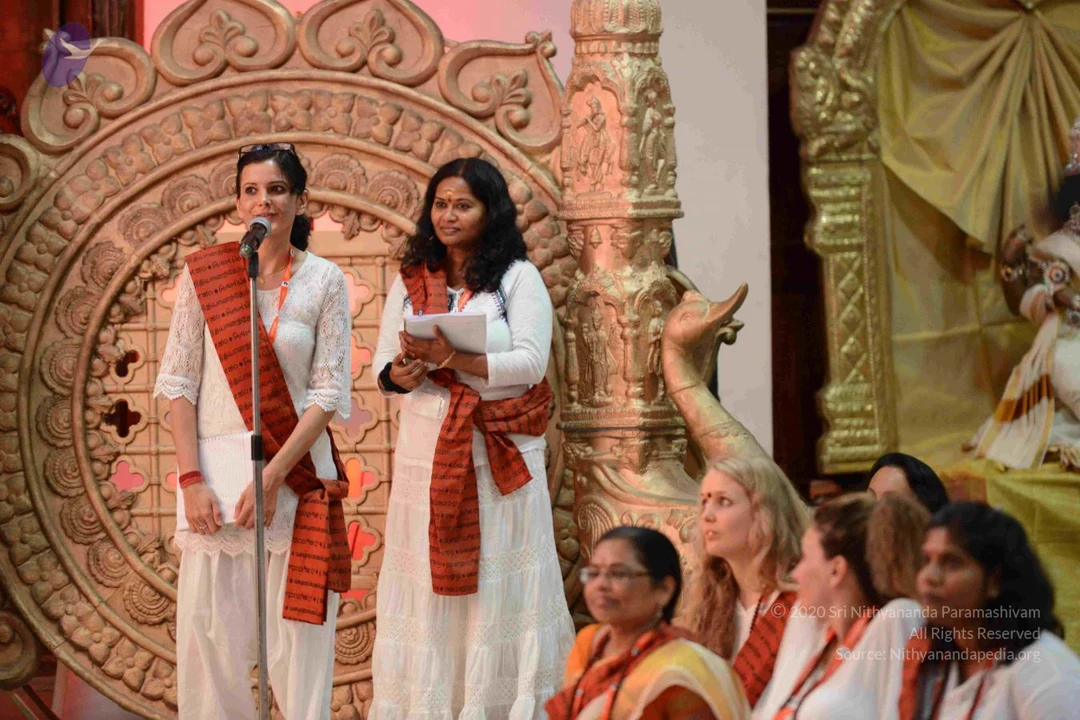
23 photosSource gallery
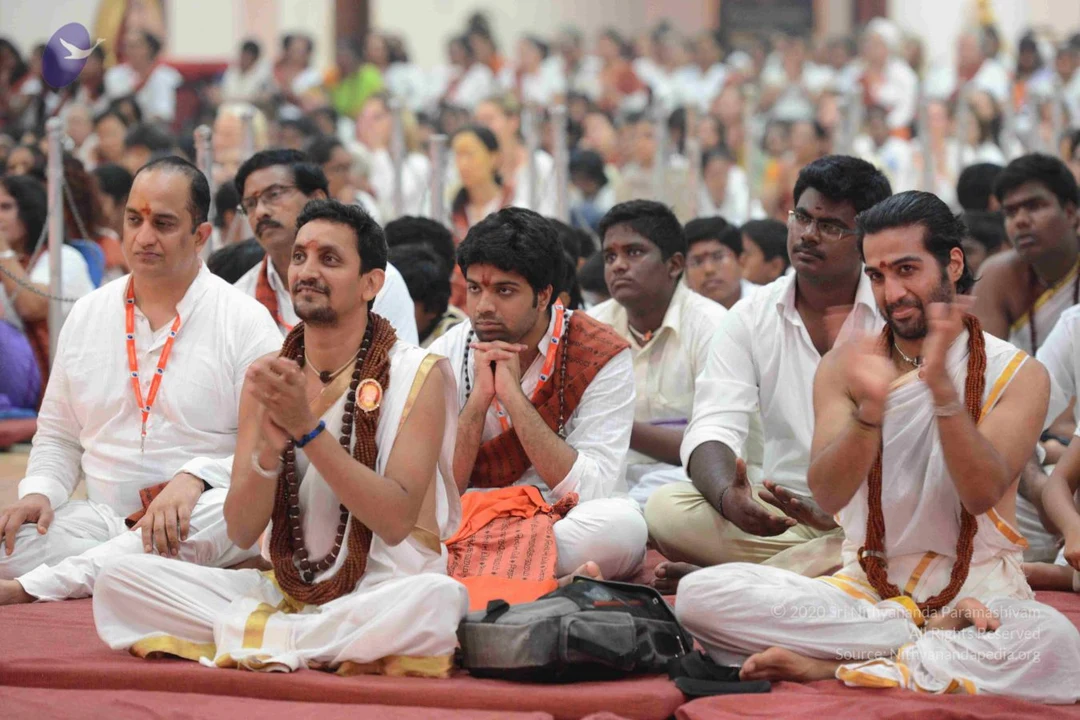
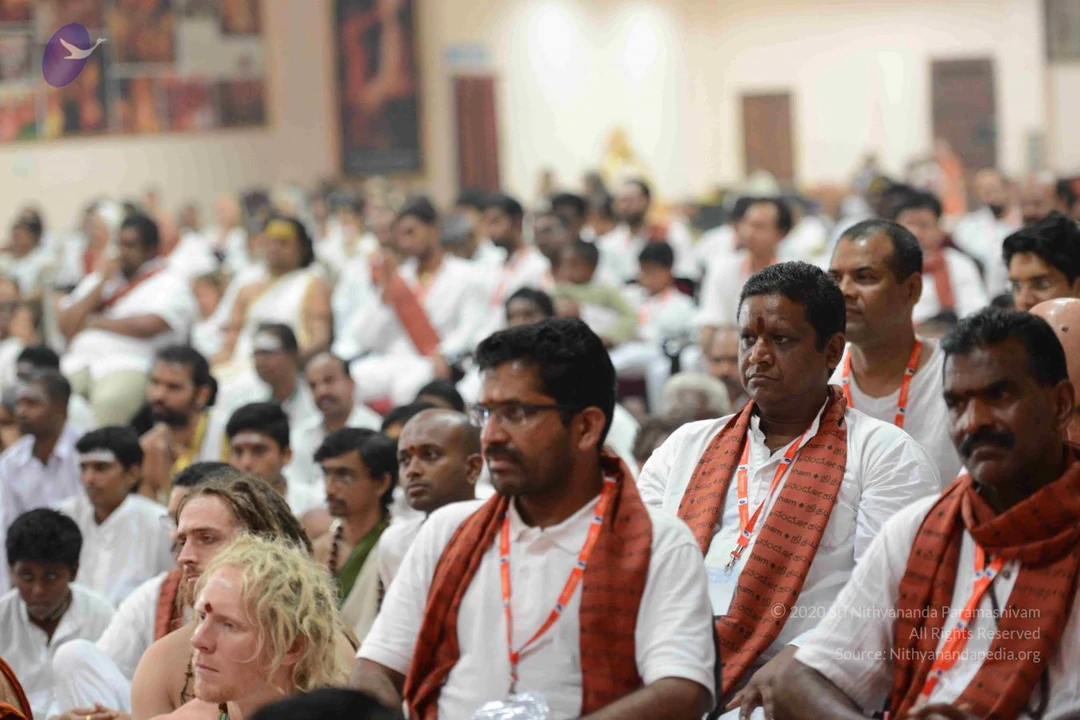
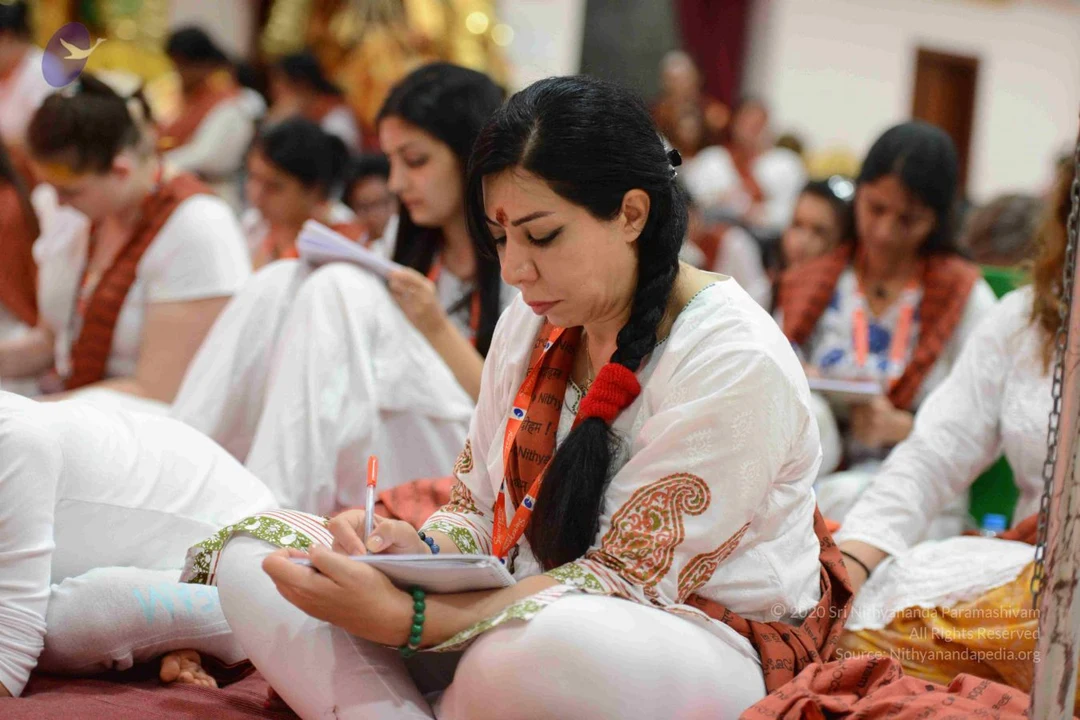
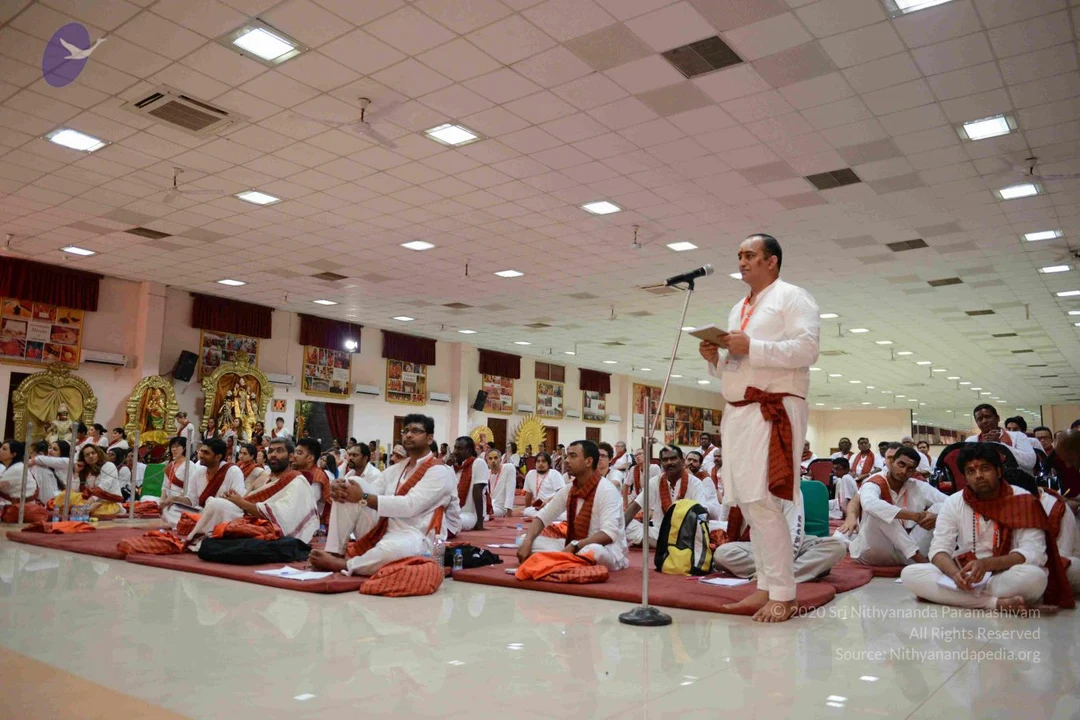
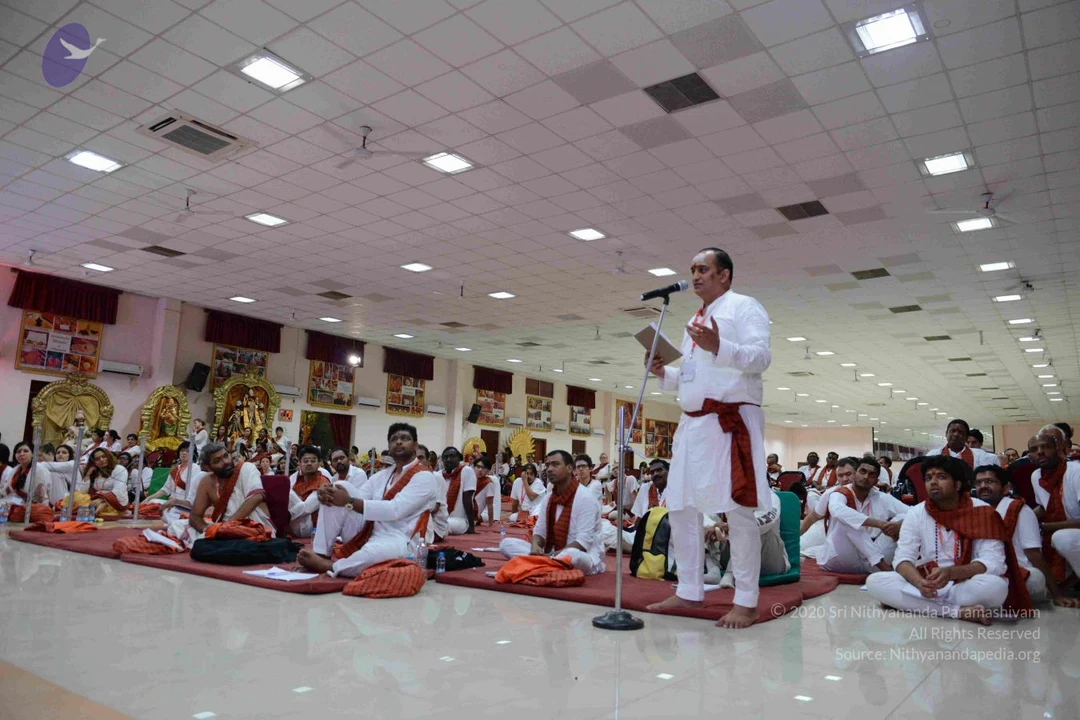
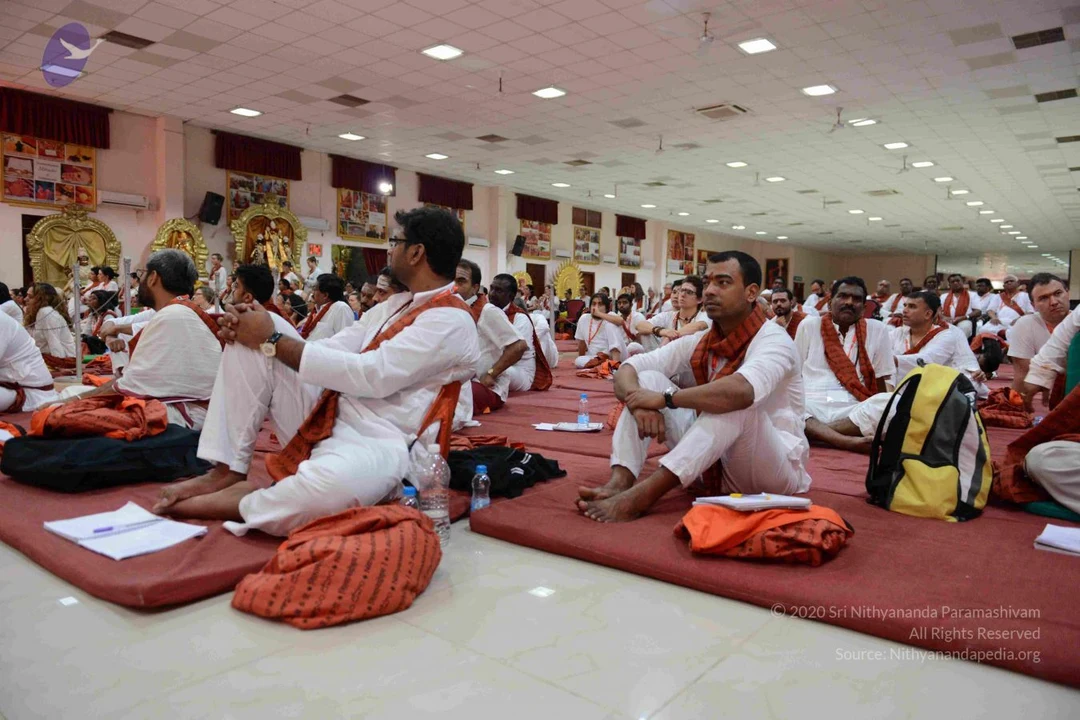
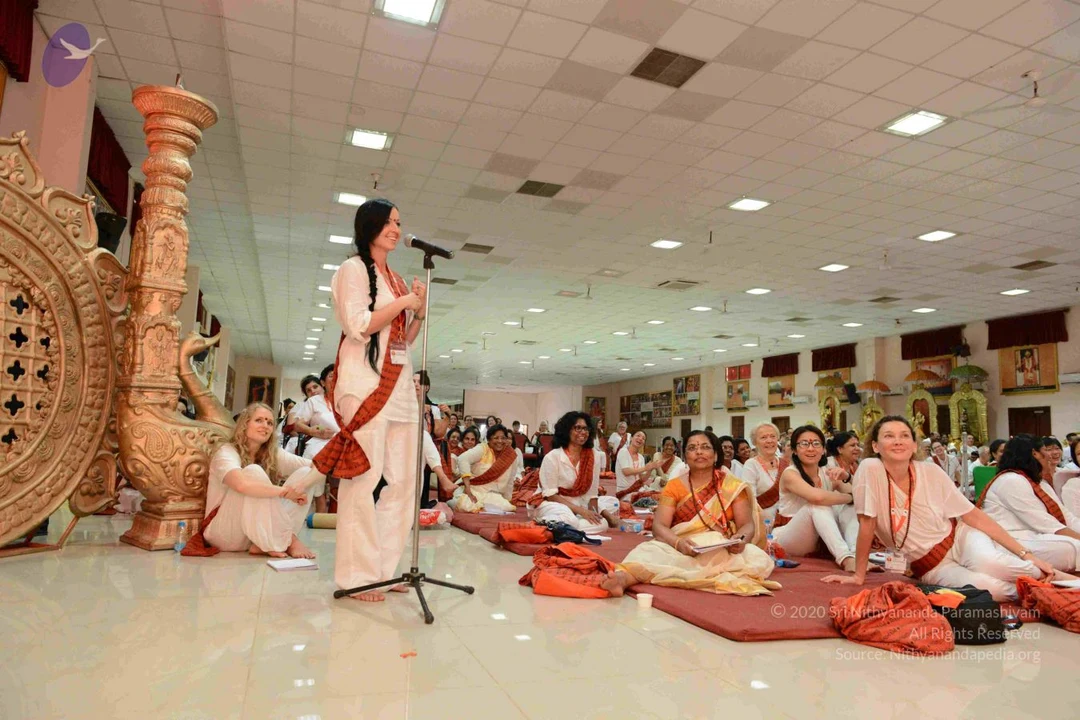
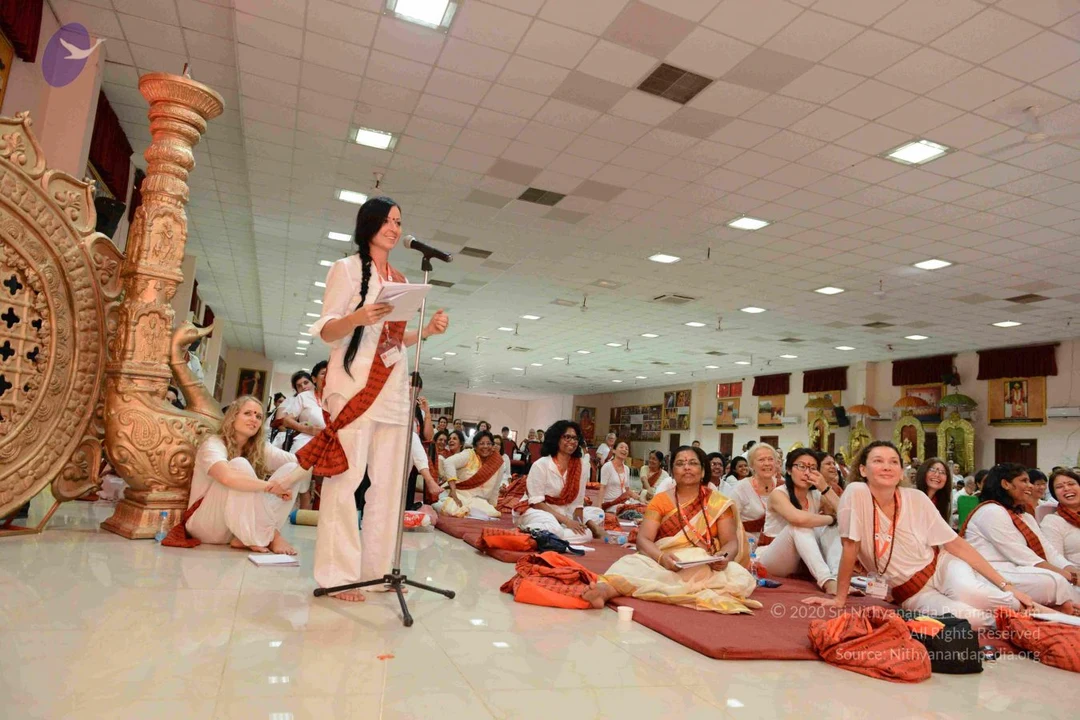
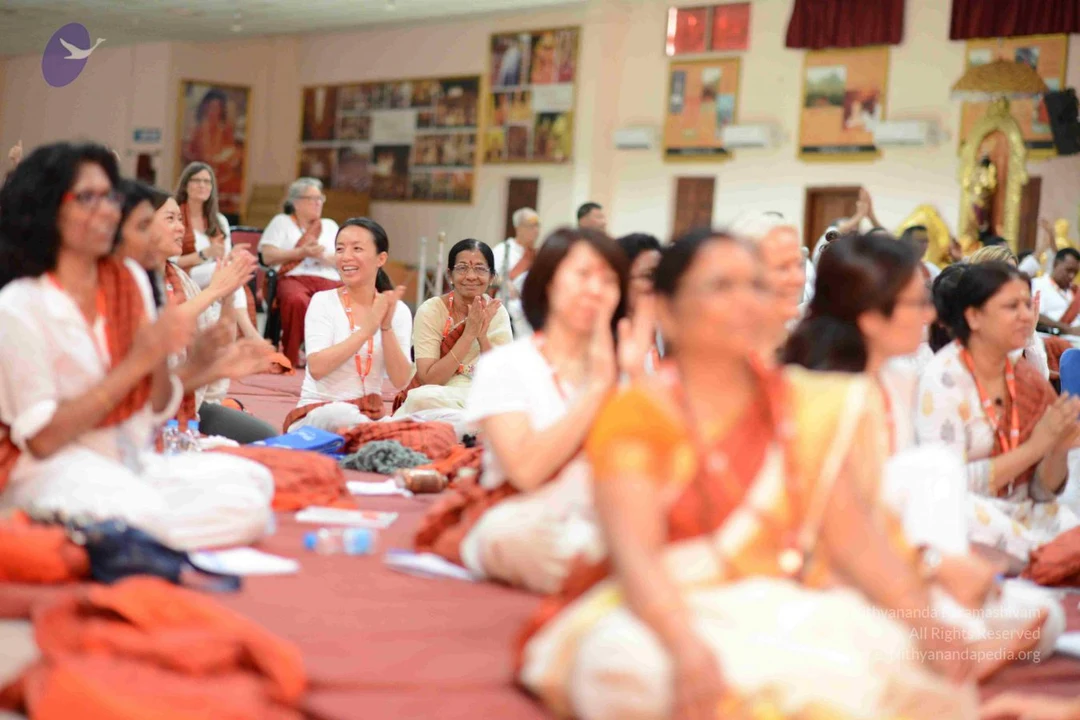
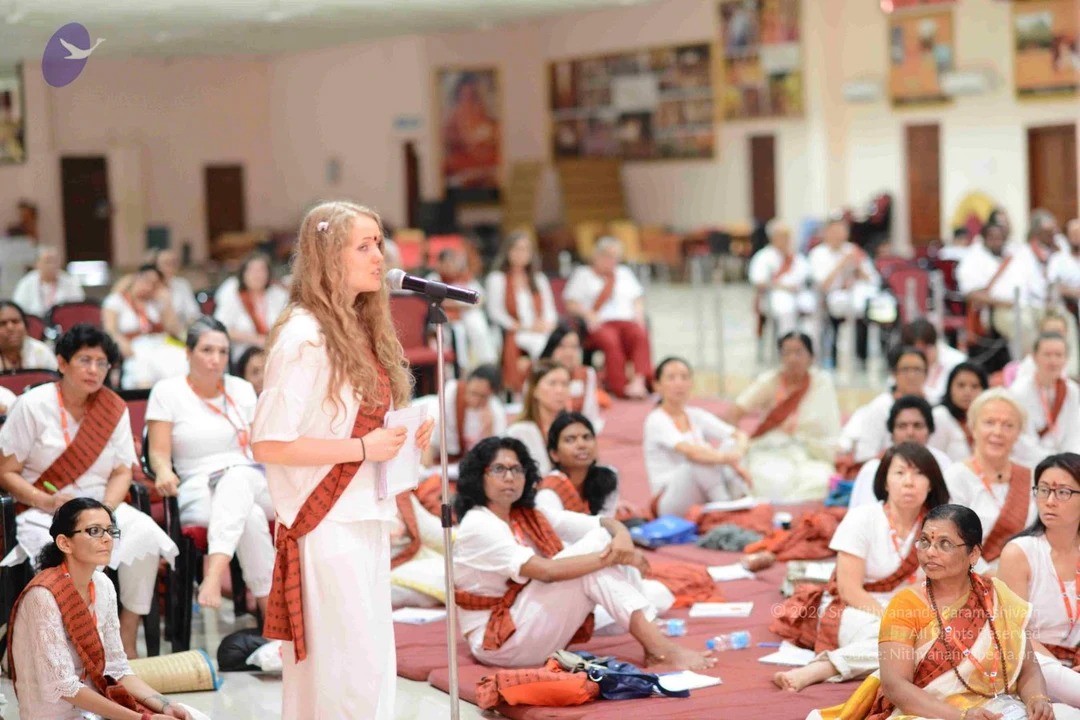
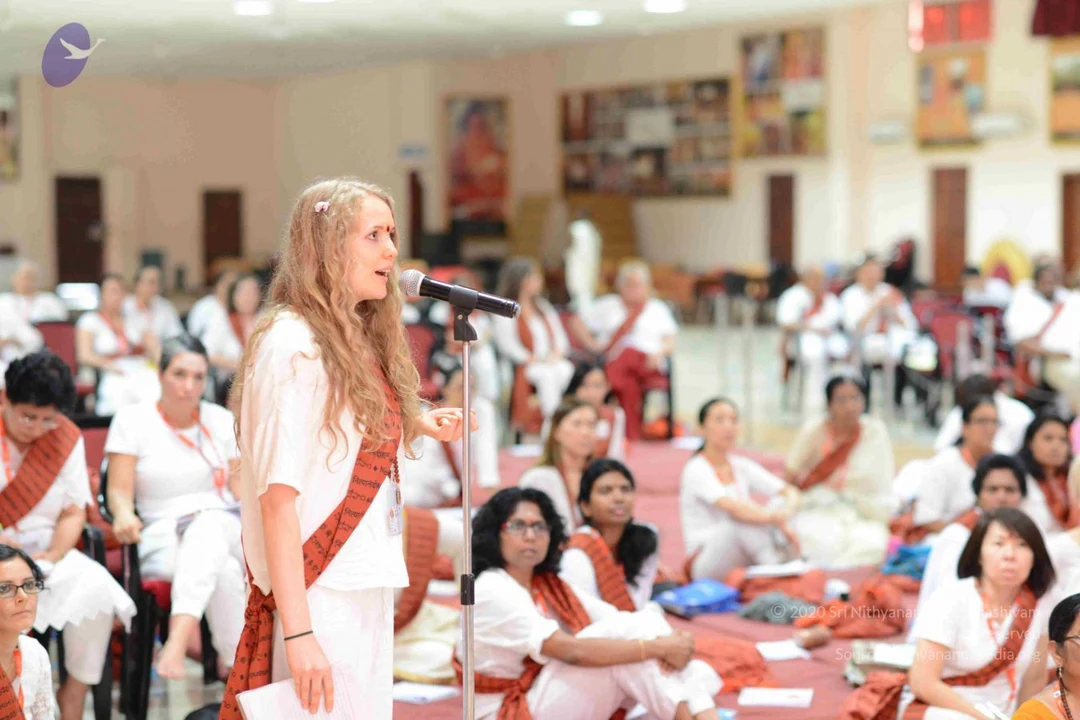
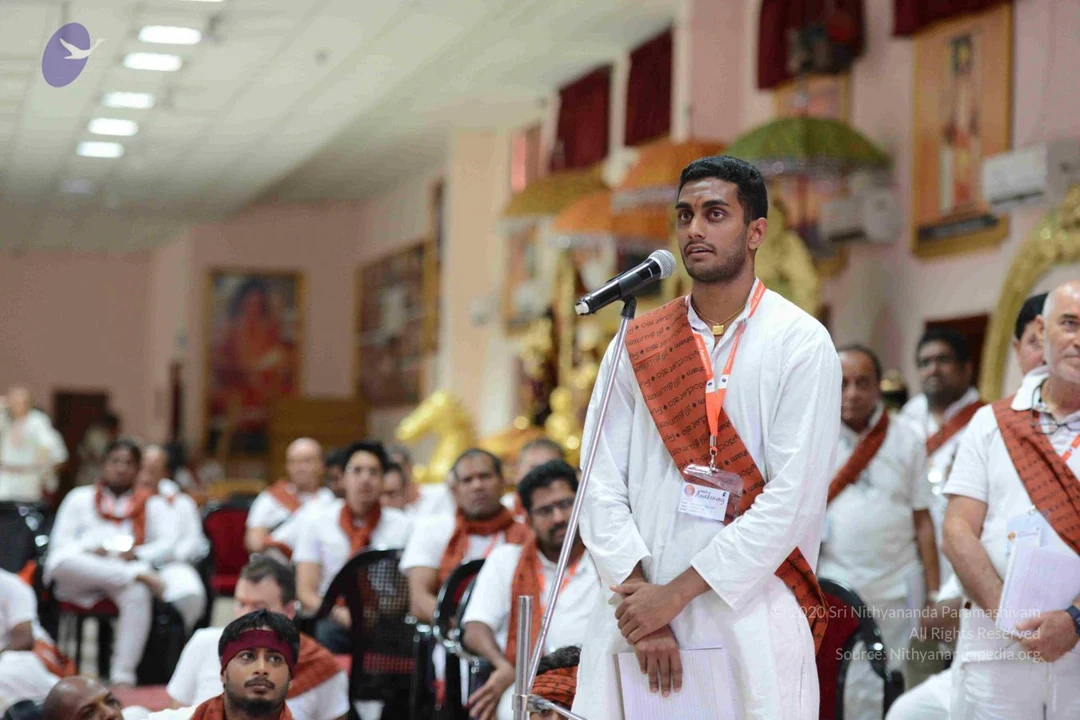
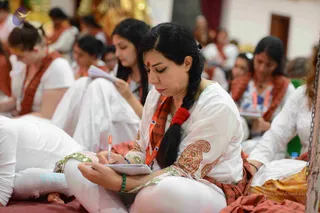
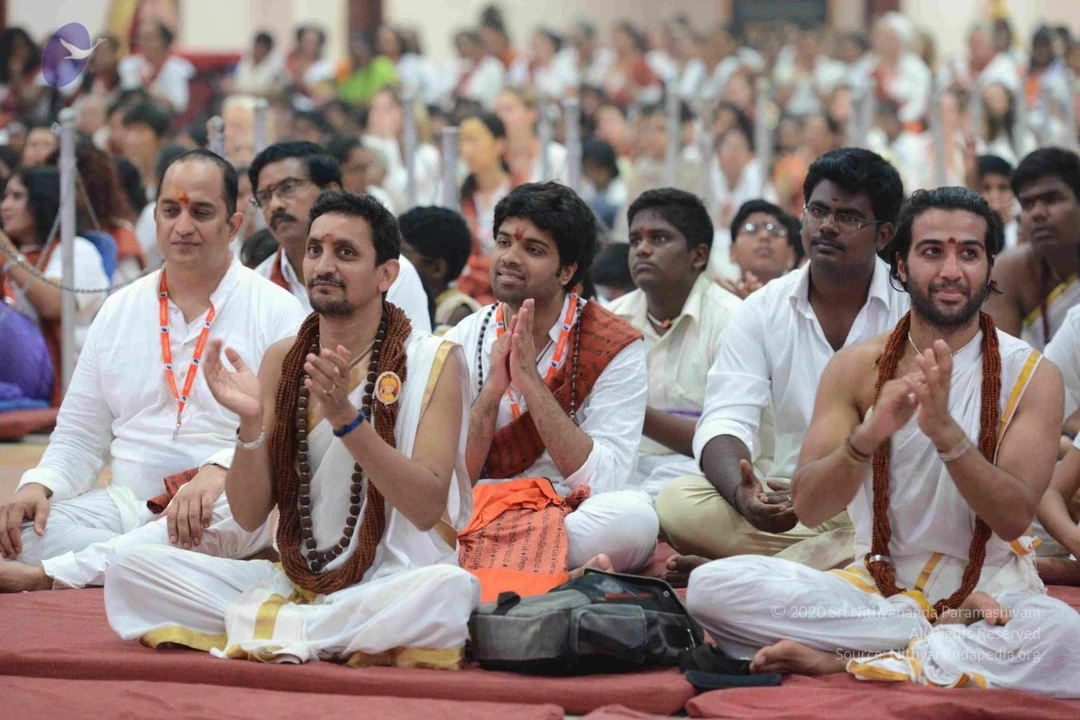
A woman with a long black braid, a red bindi and a red hair tie sits cross-legged on a floor and writes in a small notebook with an orange pen. She wears a white embroidered kurta with orange and green paisley motifs and an orange-red shawl with a lanyard around her neck. Behind her, several seated participants in white clothes and orange shawls also sit and write or listen, with a gold-toned altar and decorations in the blurred background.A large hall with a tiled ceiling and fluorescent lights holds a satsang gathering. Many people sit cross-legged on red mats, most in white kurta clothing with orange and red shawls or sashes. A man in white kurta and red-orange sash stands at a microphone stand on the right, holding papers and speaking to the seated audience. Behind the seated devotees are framed colourful pictures on the walls, a golden ornate deity shrine with an image, and a golden arch. Several seated devotees have orange cloth and bags on the floor. A circular purple logo appears in the top-left corner.A standing man in white kurta and white dhoti, with a red shawl draped over his shoulder, speaks into a microphone on a stand at the front of a large hall. Seated devotees in white clothes and red-orange shawls sit on red mats in rows across the floor, several with orange cloths and bags beside them. Framed devotional pictures and a gold-framed deity murti hang on the back wall, and ceiling lights and fans fill the room. The scene appears to be a satsang talk.A large hall during a satsang where many devotees sit cross-legged on red mats in white kurta-style clothes with orange-and-maroon shawls draped over their shoulders. In the foreground a man in white with an orange shawl sits with his hands clasped, next to a seated man with a wristwatch and notebook. Behind them rows of attendees fill the floor. Along the back wall are golden deity shrines and framed photographs, with ceiling lights and fans overhead. No single figure is clearly identifiable as the speaker from appearance alone.A photograph inside a large hall with cream tiled floor and bright ceiling lights. A woman with a long black braid stands at a microphone stand, wearing white clothes and a red-bordered orange-and-white shawl draped over her shoulders. Around her, many people sit on red mats, most in white outfits with red-bordered shawls, some in orange and yellow saris and orange beaded necklaces. A large carved wooden lamp stand and carved wooden panel stand at left, and framed pictures and decorative umbrellas line the walls. Roughly thirty to forty people are visible.A woman with a long dark braid stands at a microphone stand in a bright hall, wearing a white kurta-style outfit with a red-and-white striped shawl over her shoulder and holding papers in one hand. Around her, a large seated audience sits on red mats on the tiled floor, many dressed in white with red-orange shawls, and a woman in an orange-and-gold sari sits near the front. Carved wooden pillars and a decorative wooden panel frame the left side, and framed pictures and orange-draped wall displays line the back wall. This appears to be a satsang-style gathering; no a person candidate is visible in the frame.

IA-shivadeeksha
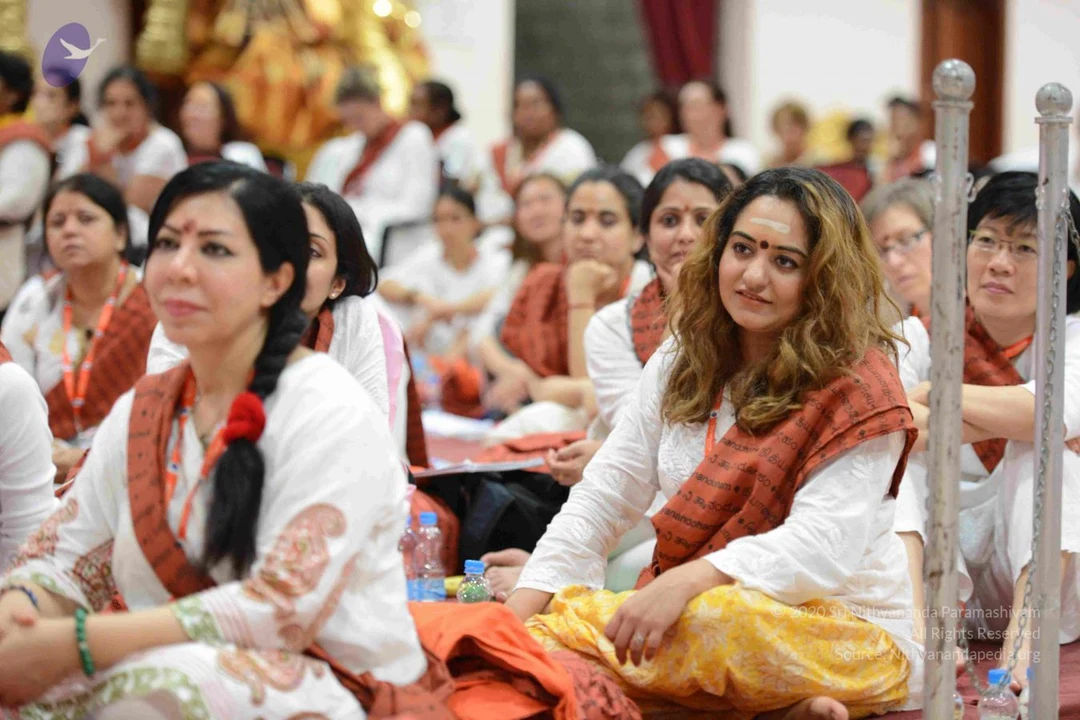
64 photosSource gallery
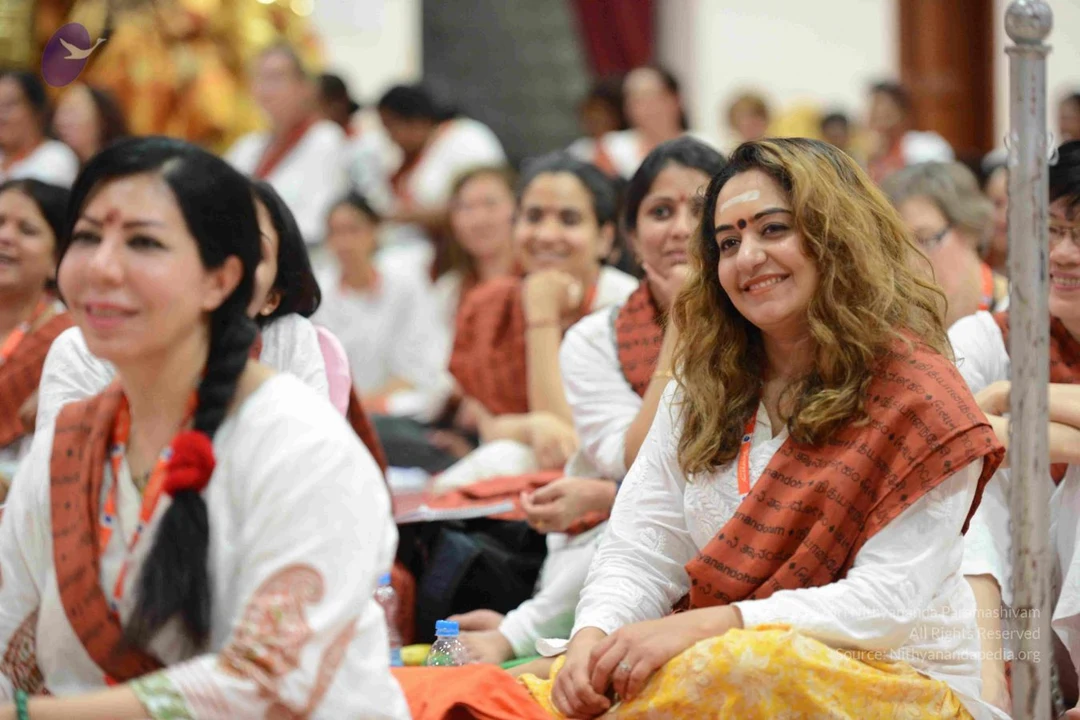
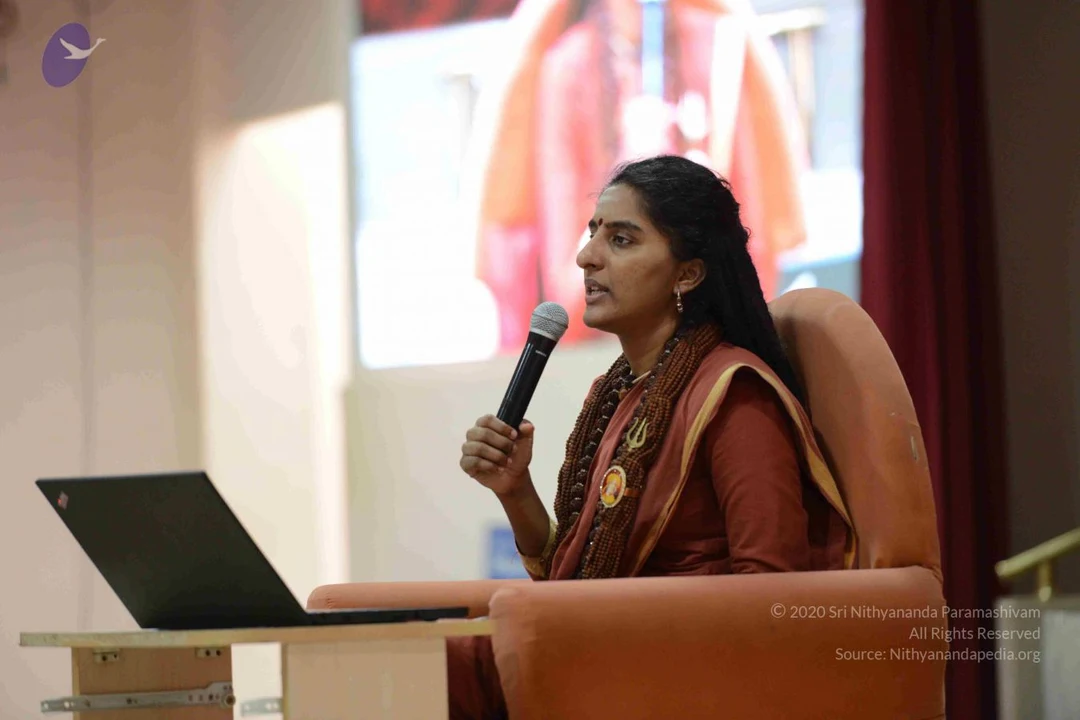
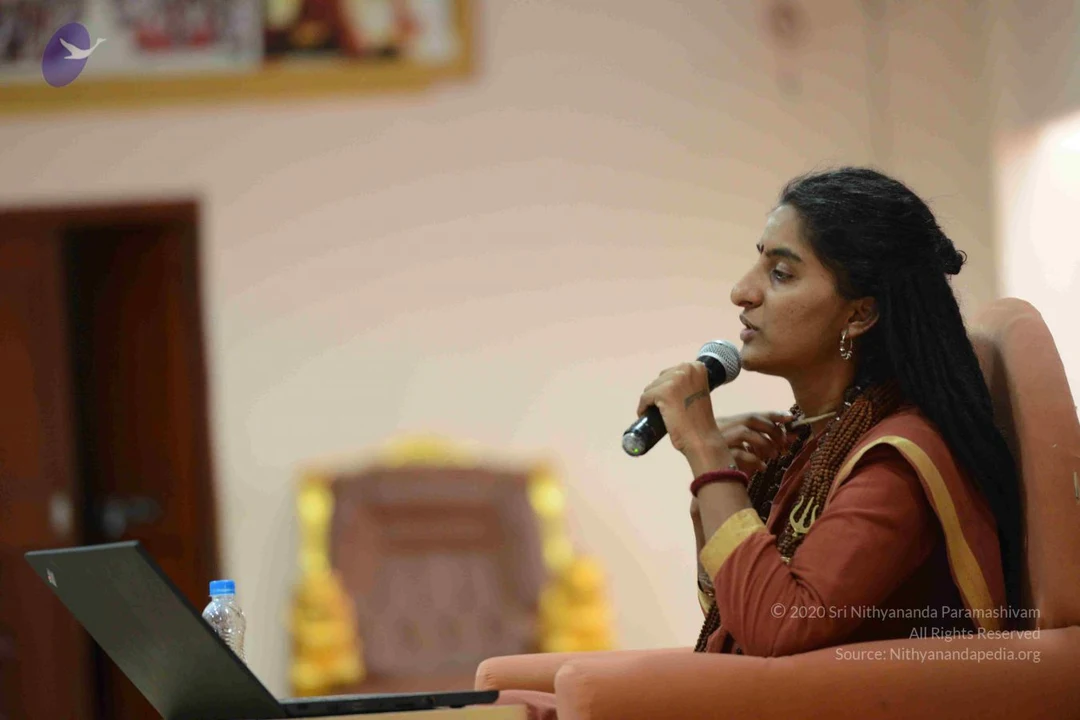
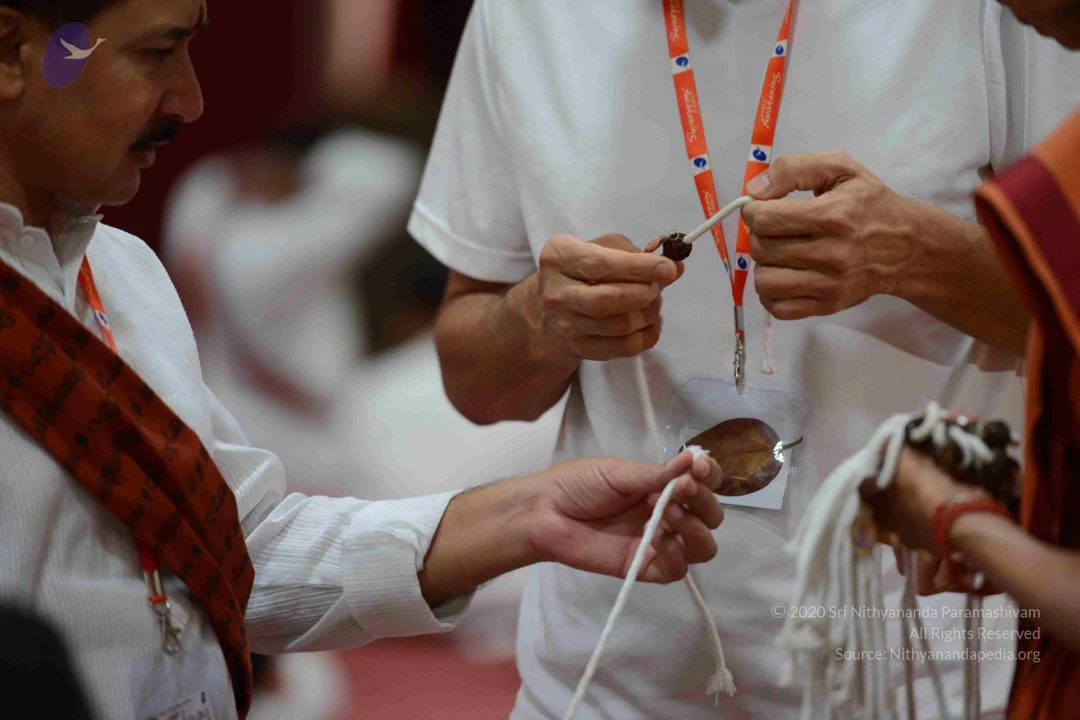
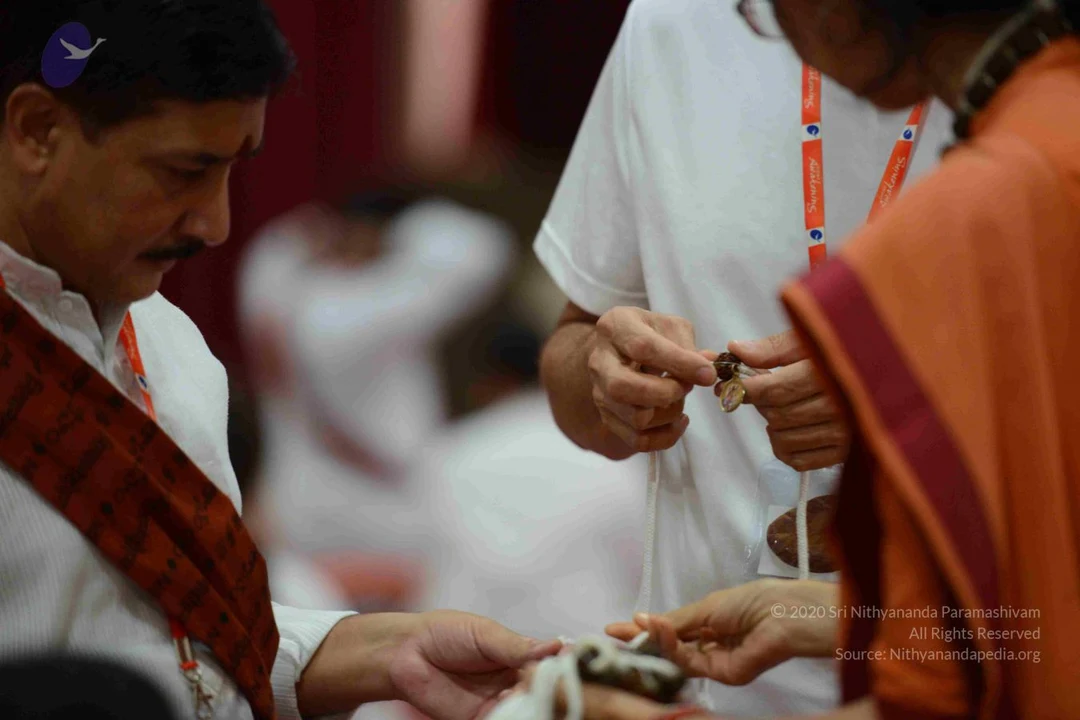
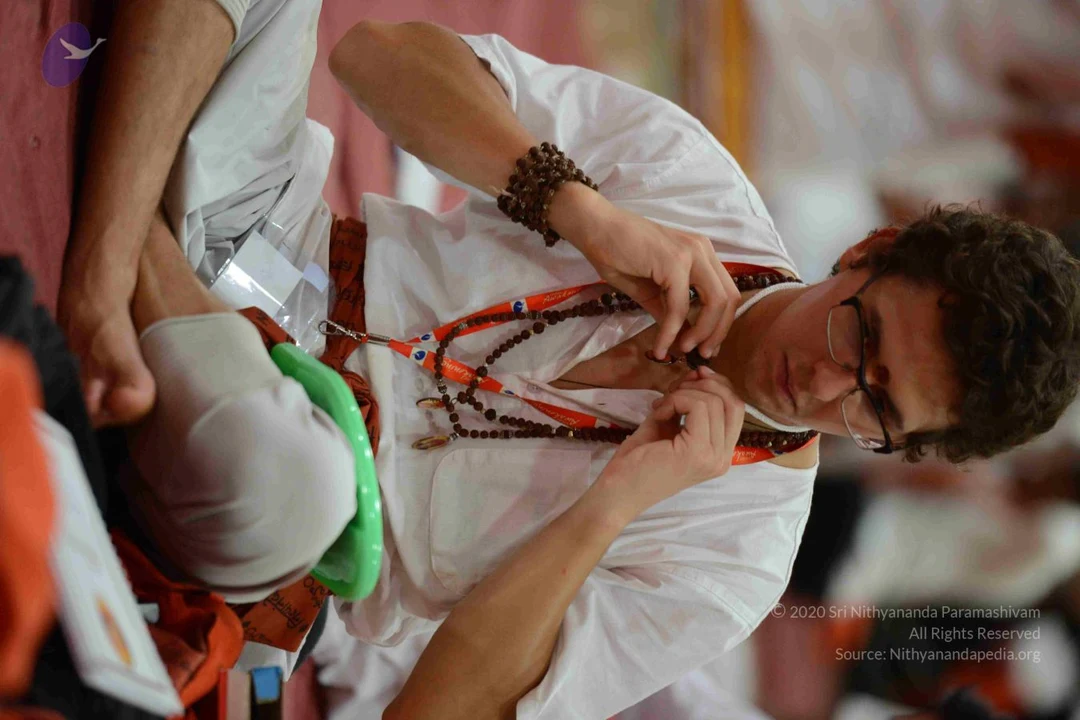
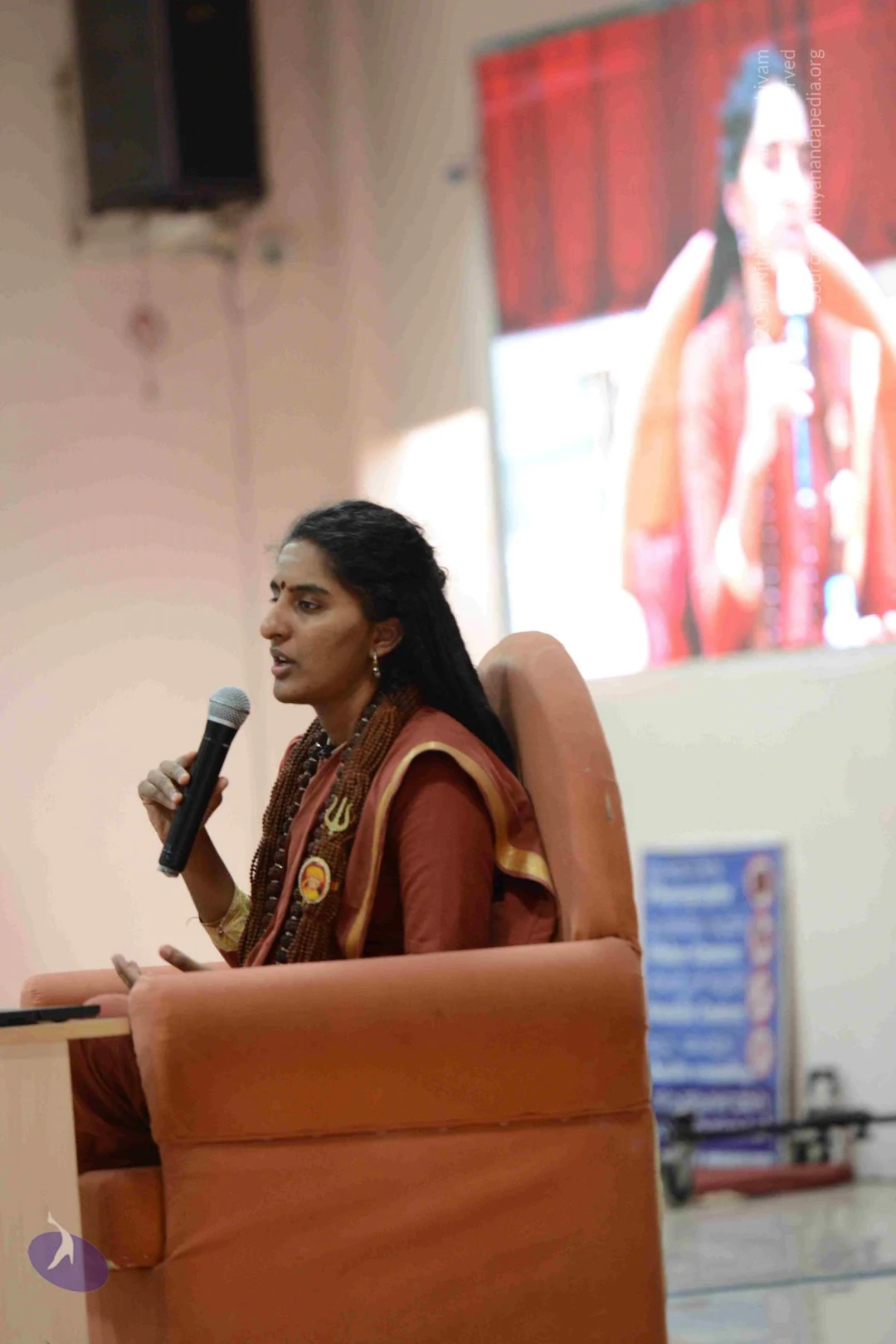
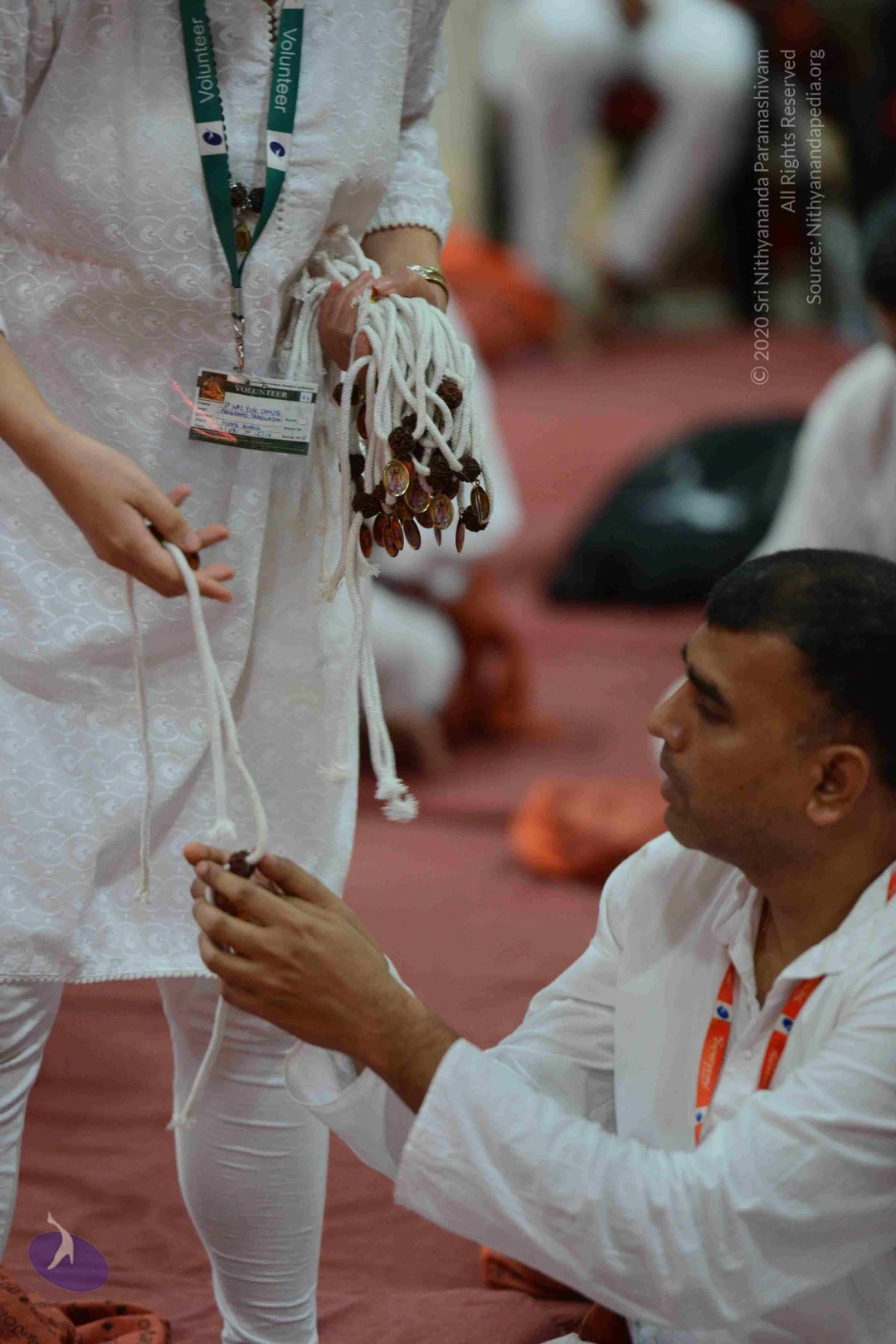
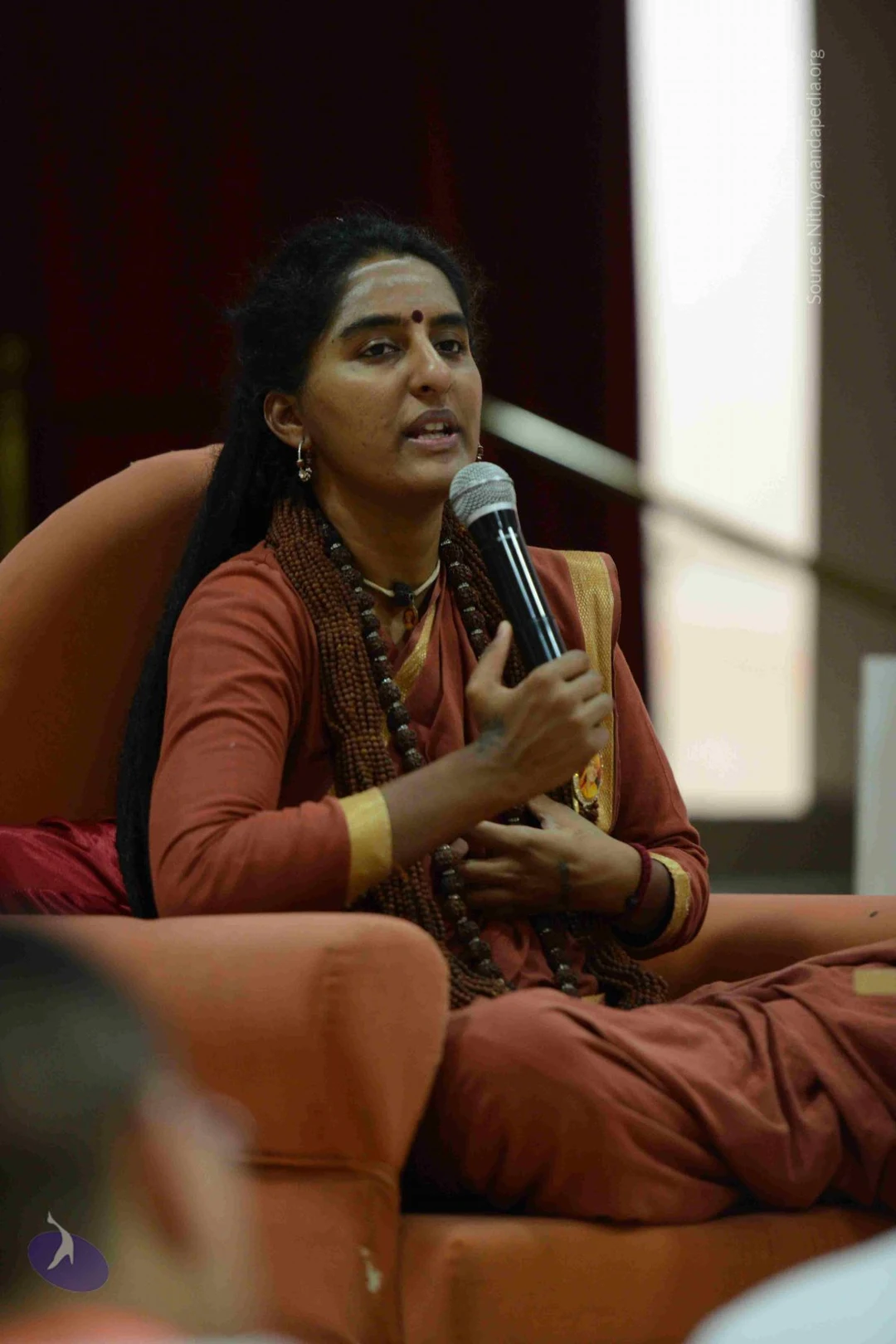
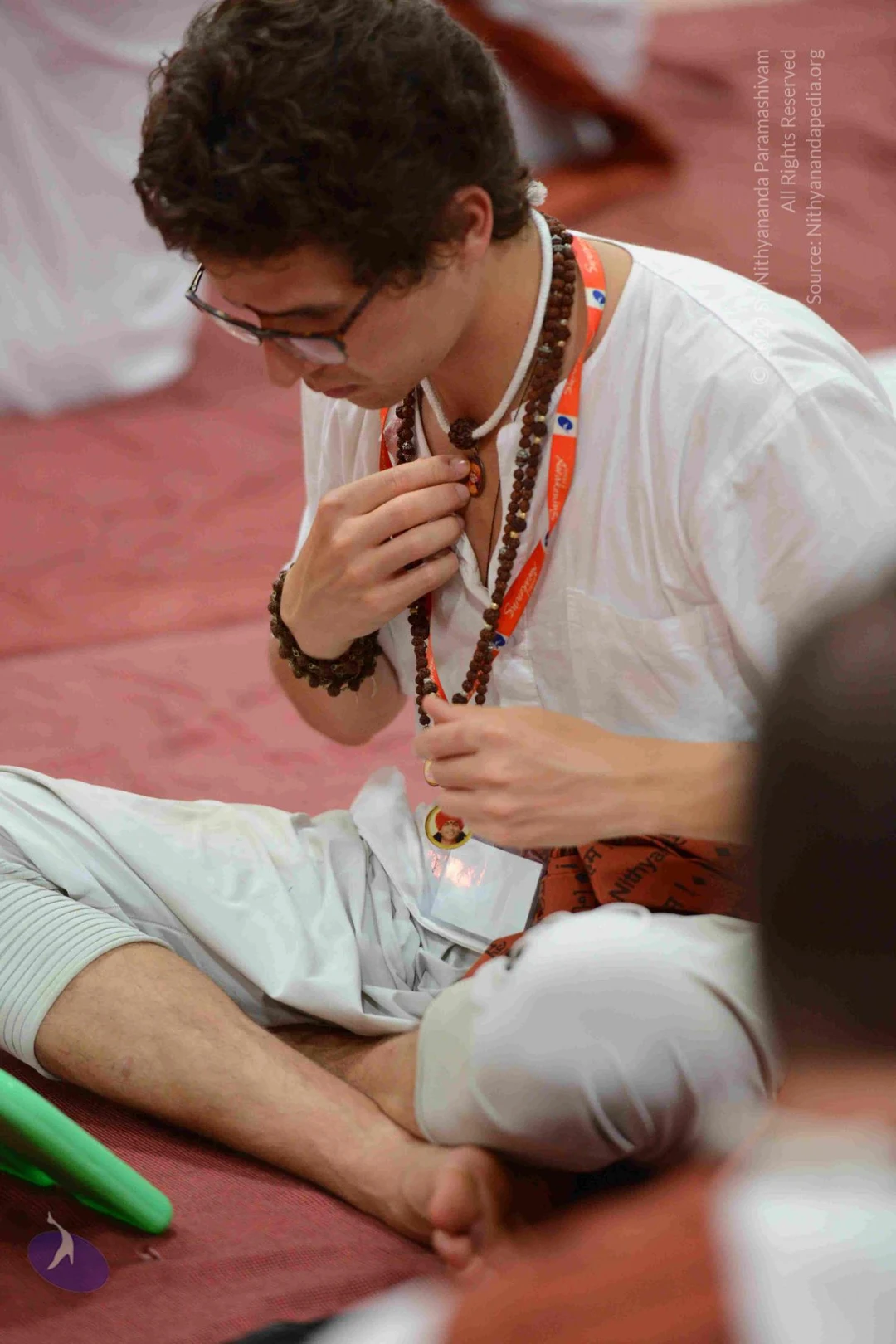
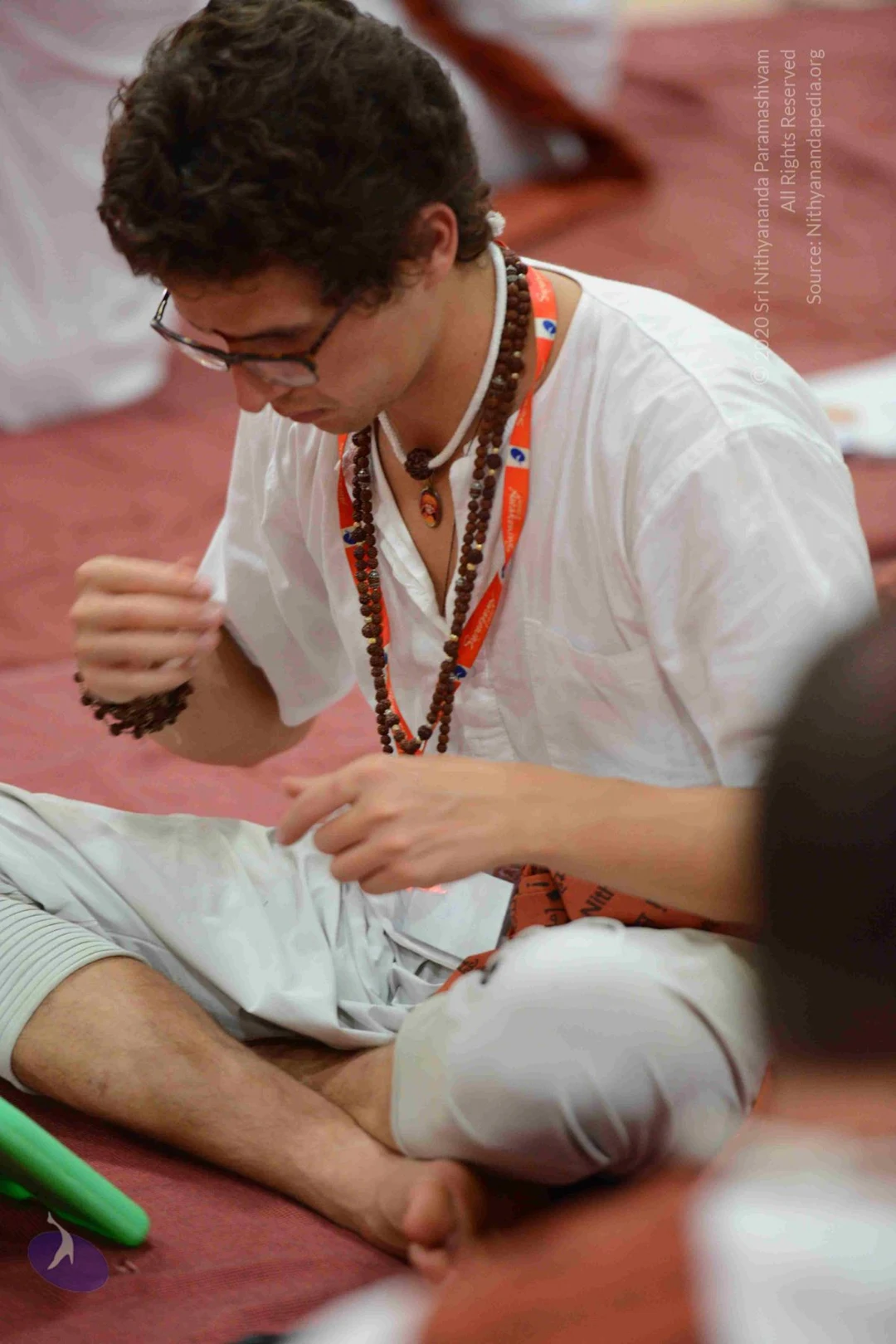
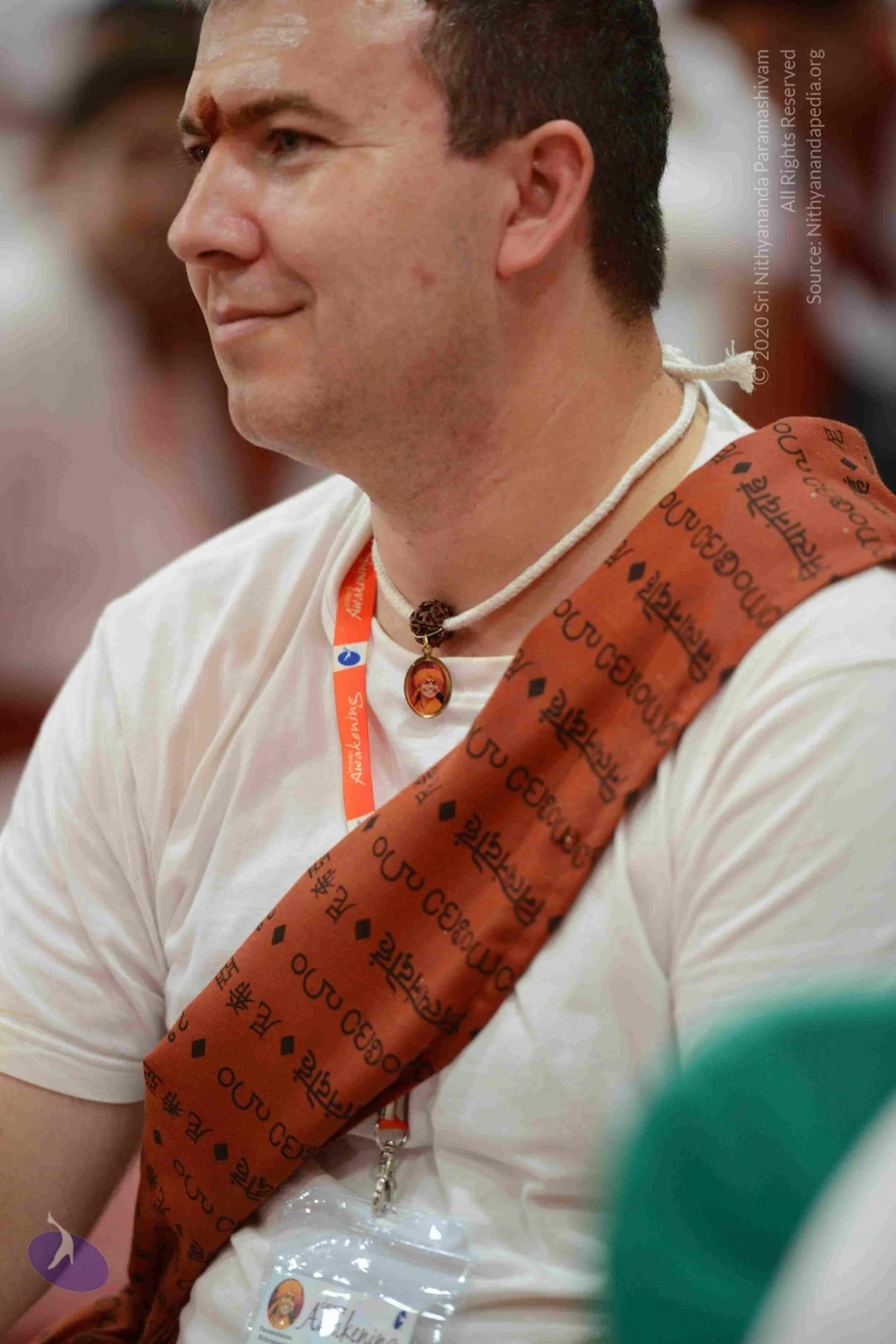
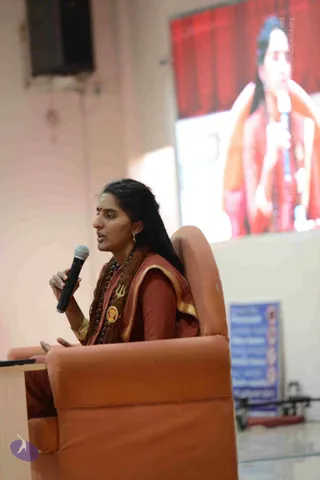
A seated satsang audience of women in white kurta-style clothing and saffron-orange shawls printed with script, sitting on a red floor covering with water bottles nearby. In the foreground a woman with a long black braid and red hair tie looks forward, and beside her a woman with wavy highlighted hair wears a white tilak on her forehead and a yellow patterned lower garment. Other attendees with glasses sit to the right, and a gold-decorated shrine or deity murti is partly visible in the background.A woman seated in a salmon-coloured armchair speaks into a handheld microphone during a talk. She wears a rust-red kurta with a gold-bordered shawl, a rudraksha mala with a trident pendant, drop earrings, and a red bangle. Her long dark hair is swept back. In front of her sits a closed laptop beside a small water bottle. Behind her, a gold-framed throne draped with yellow garlands is set against a cream wall, with framed photographs above. a person is not visibly present; the speaker's appearance does not meet the criteria for a candidate.A close photograph of hands threading a small brown rudraksha bead onto a white cotton cord. A man in a white shirt with a saffron-and-brown patterned shawl stands at left, his face partly visible. Centre, a man in a white t-shirt wears an orange lanyard with a blue logo and holds the cord and bead at chest height. At right, a person in orange robes and beaded bracelets holds a bundle of white-corded malas. A small plastic-sleeved badge and a brown leaf are visible on the white shirt. The background is blurred with white-clad figures.Close photo of hands working over a small object. On the left, a man in a white shirt with a rust-red and dark patterned shawl and an orange lanyard looks down. In the center, a person in a white t-shirt with an orange lanyard threads a cord. On the right, a figure in saffron-orange robes with a maroon border reaches in with a hand. Blurred white-clad people fill the background of a hall.A photograph rotated sideways, showing a young man with curly dark hair and clear-rimmed glasses wearing a white shirt and orange-and-white lanyard. He holds a rudraksha mala with both hands and adjusts it at his chest, and a dark beaded bracelet is on his wrist. Beside him a person in white holds a green cushion or bag, and orange and maroon cloth is visible in the background.A photograph of seated devotees at a satsang hall with a blurred yellow-and-cream interior behind them. In the foreground a young man with curly brown hair and glasses wears a white kurta, a rudraksha mala and beaded bracelets, with an orange lanyard, and rests one arm on his knee. Beside him a younger man with short black hair wears a white kurta and an orange-and-brown patterned shawl. Several other seated attendees in white and orange garments are blurred in the background. No identifiable a person figure is clearly visible; the figures shown are devotees in white and orange attire.

IA

6 photosSource gallery
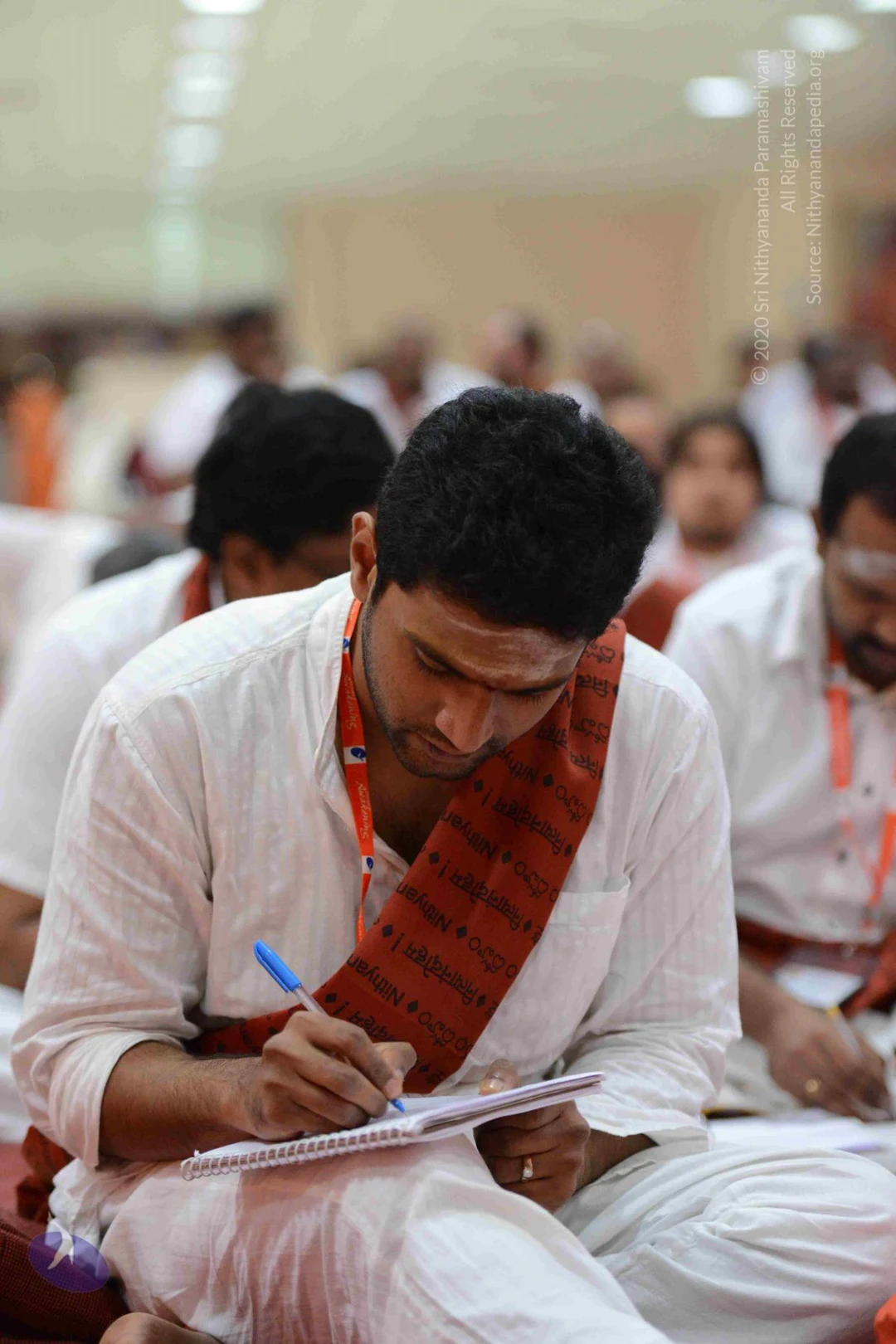
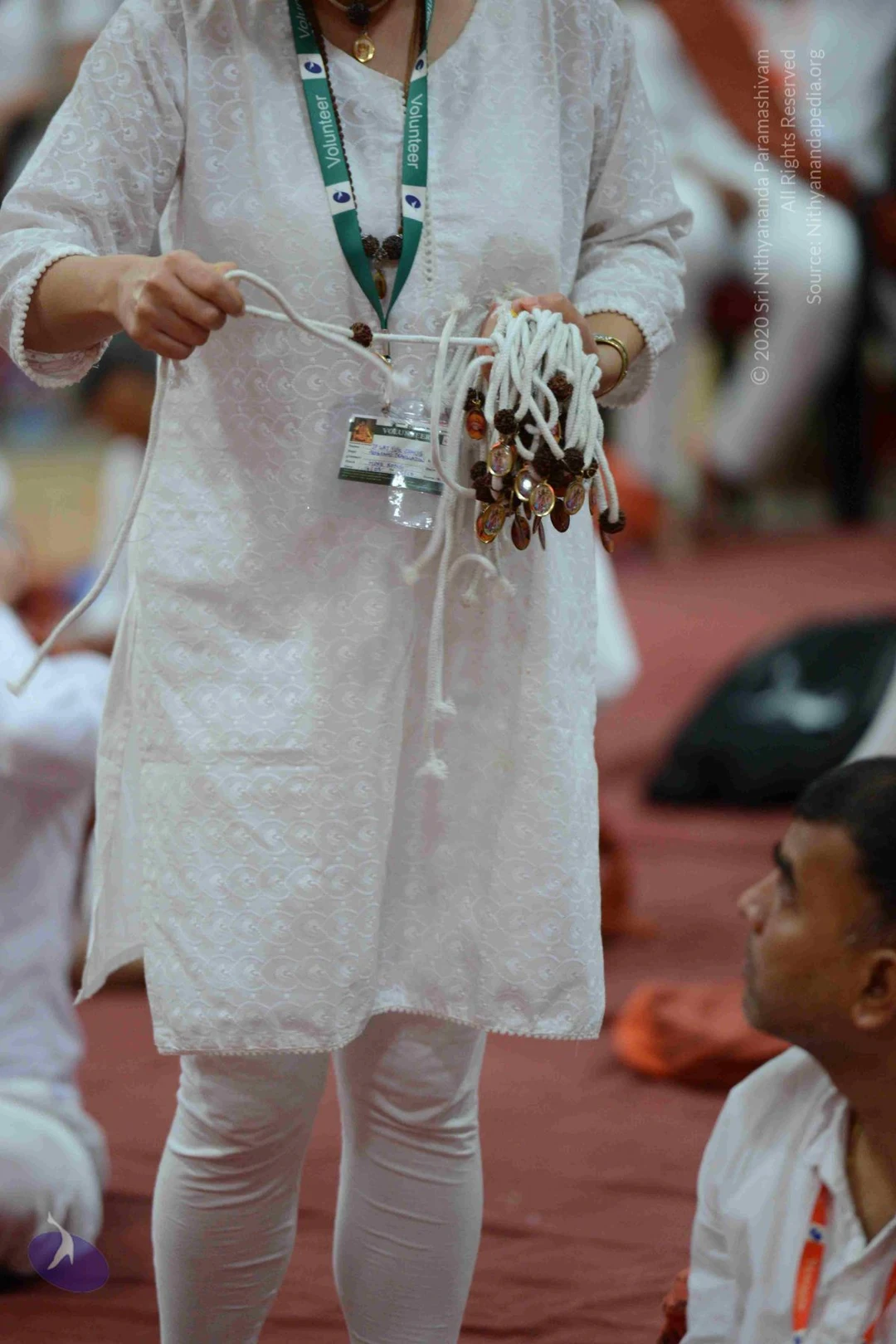
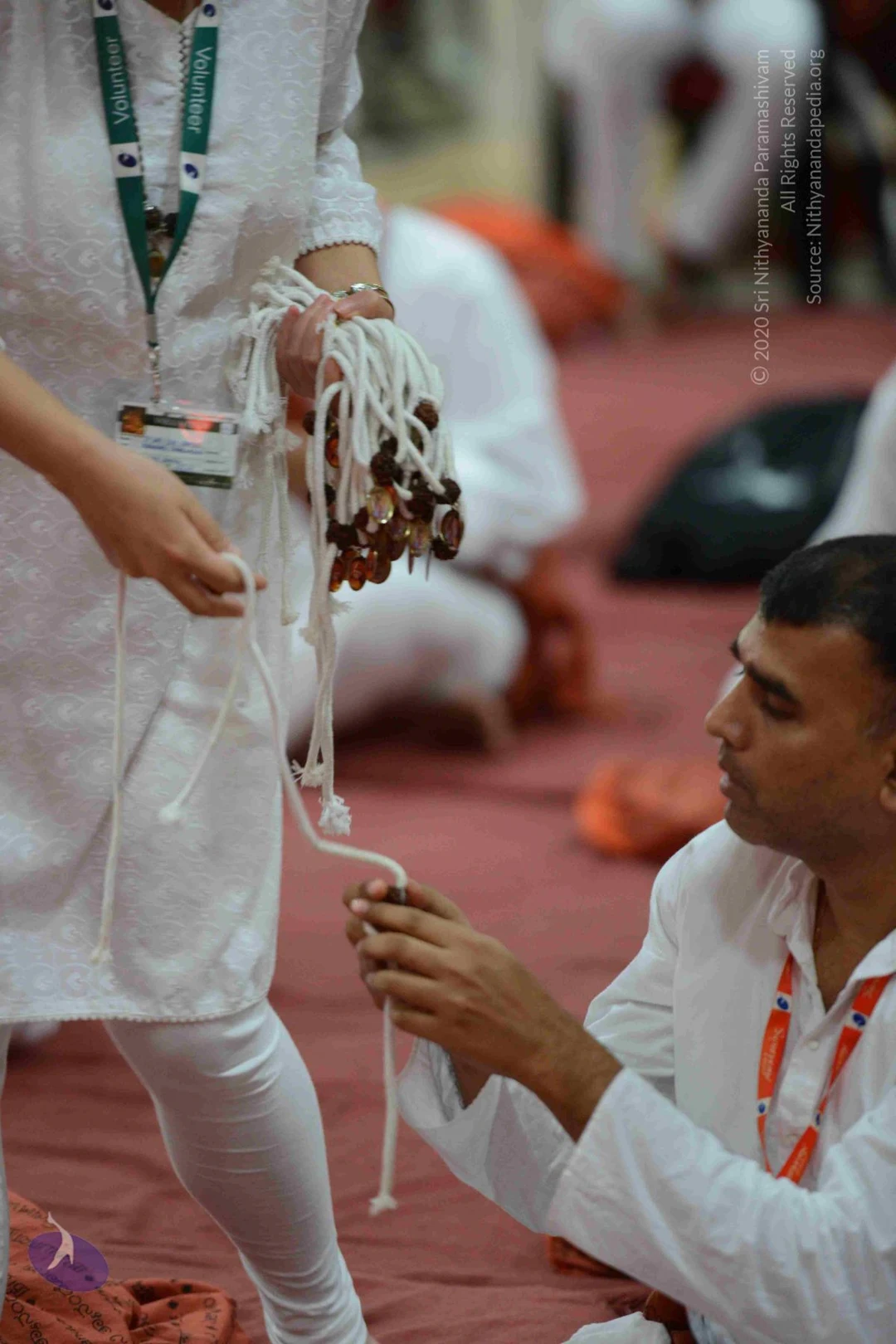
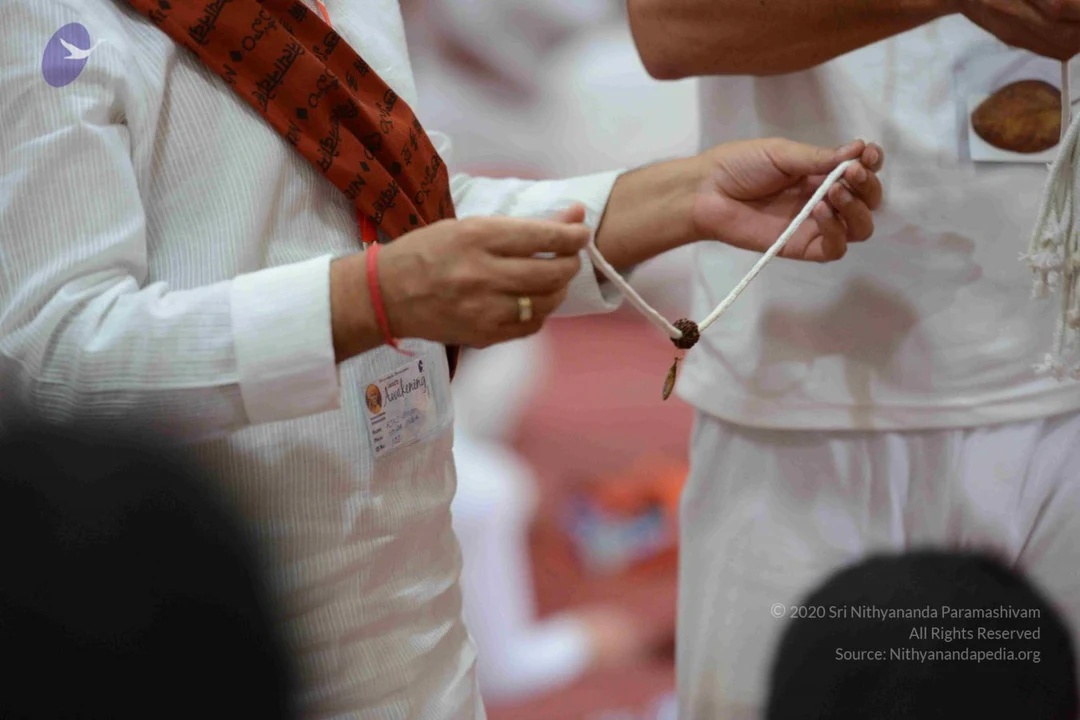
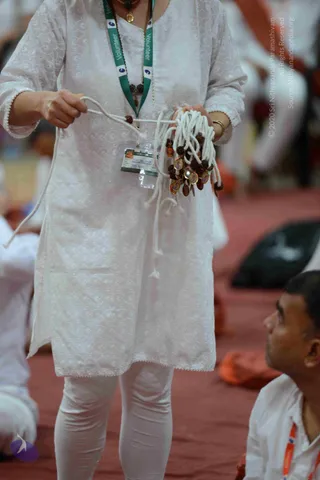
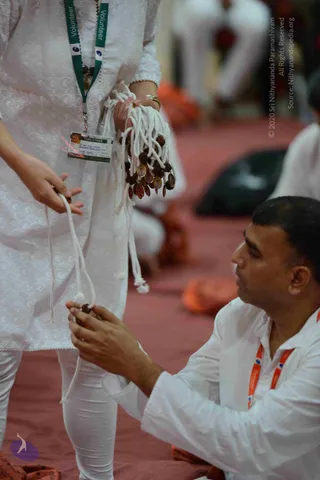
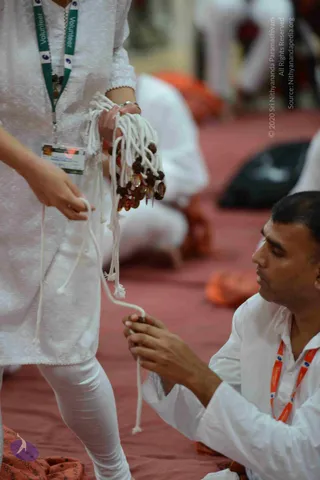
A young man in white kurta sits cross-legged in a large hall, writing in a spiral notebook with a blue ballpoint pen. He wears an orange-red shawl printed with black a person script and an orange lanyard around his neck, with a light tilak on his forehead. Behind him, many seated participants in white clothes and orange lanyards are blurred under bright ceiling lights.A woman seated in a large orange upholstered armchair speaks into a handheld microphone at a satsang-style gathering. She wears a rust-red garment with a gold-bordered shawl, a long rudraksha mala with a trident pendant and a round emblem medallion, a red bindi, and earrings; her long dark hair is loose. A projection screen behind her shows a man in orange robes holding a microphone and wearing a long rudraksha mala. A blue banner with white printed text hangs on the side wall.A volunteer in a white embroidered kurta and white leggings stands holding a bundle of white cords strung with rudraksha beads and small oval pendants. She wears a green lanyard reading Volunteer with a white ID badge and a rudraksha mala around her neck. A man seated on the floor at right in white clothing looks up toward her, with orange cloth nearby on a red-brown floor.A photograph of a volunteer in an all-white kurta with a green 'Volunteer' lanyard and ID badge, holding a bundle of white cords strung with rudraksha beads and small metal pendants. A man in white clothes with an orange lanyard kneels on a red carpet and threads a rudraksha mala onto a cord held by the volunteer. Blurred seated devotees in white and orange fill the background of this ashram setting.A photograph of a volunteer in white kurta and white leggings, wearing a green Volunteer lanyard with an ID badge, holding a bundle of white cords strung with rudraksha beads and amber-coloured beads. A seated man in a white shirt with an orange lanyard leans in and holds one cord, while blurred seated devotees in white and orange sit on a red mat in the background. No a person candidate is visible in the frame.Close photo of two people's hands passing a white cord strung with a dark rudraksha bead and small pendant. The man on the left wears white kurta clothing, an orange-red shawl printed with black text, a red wrist thread and a gold ring, plus an ID badge reading Awakening. The person on the right wears white clothes and a white-tasselled cord. Blurred dark heads appear in the foreground; a red floor and seated white-clad people are visible behind.

Shiva-Deeksha
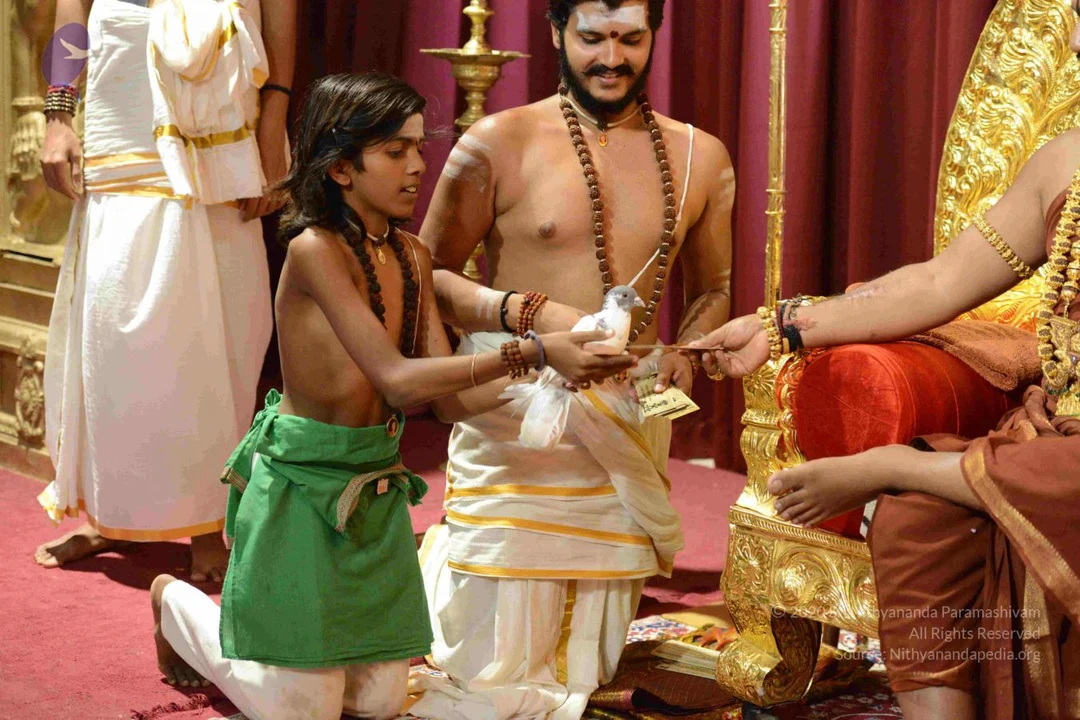
66 photosSource gallery
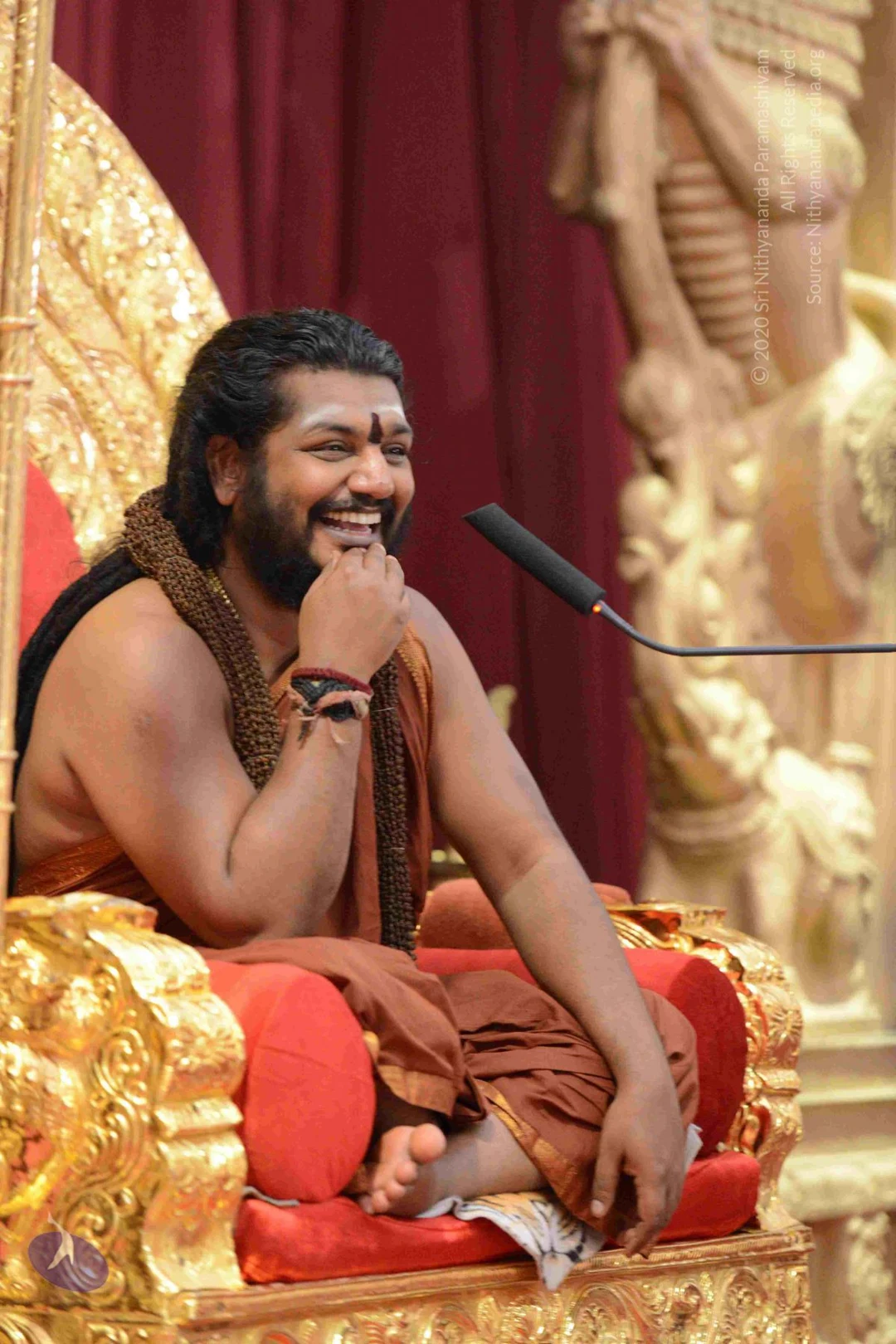
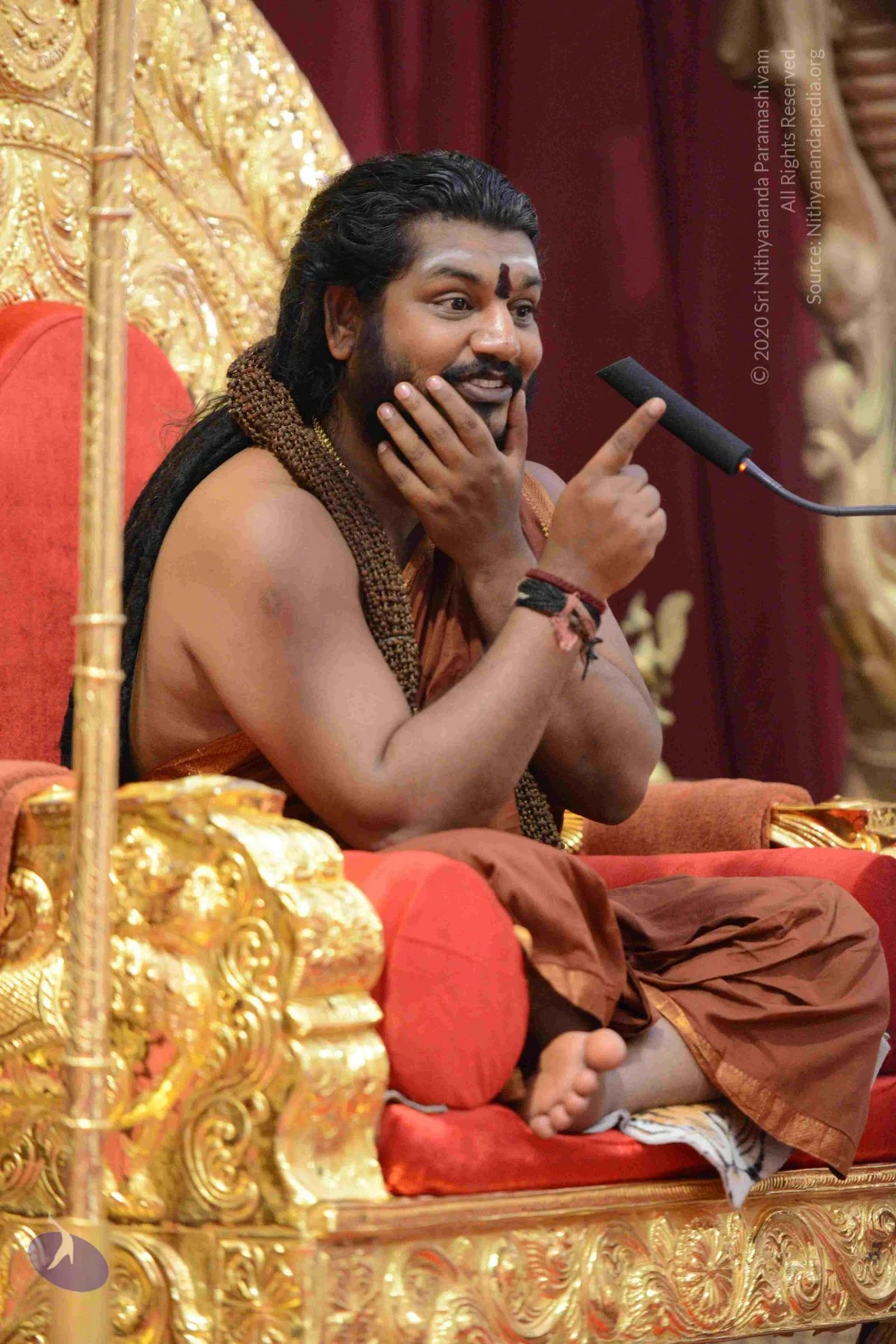
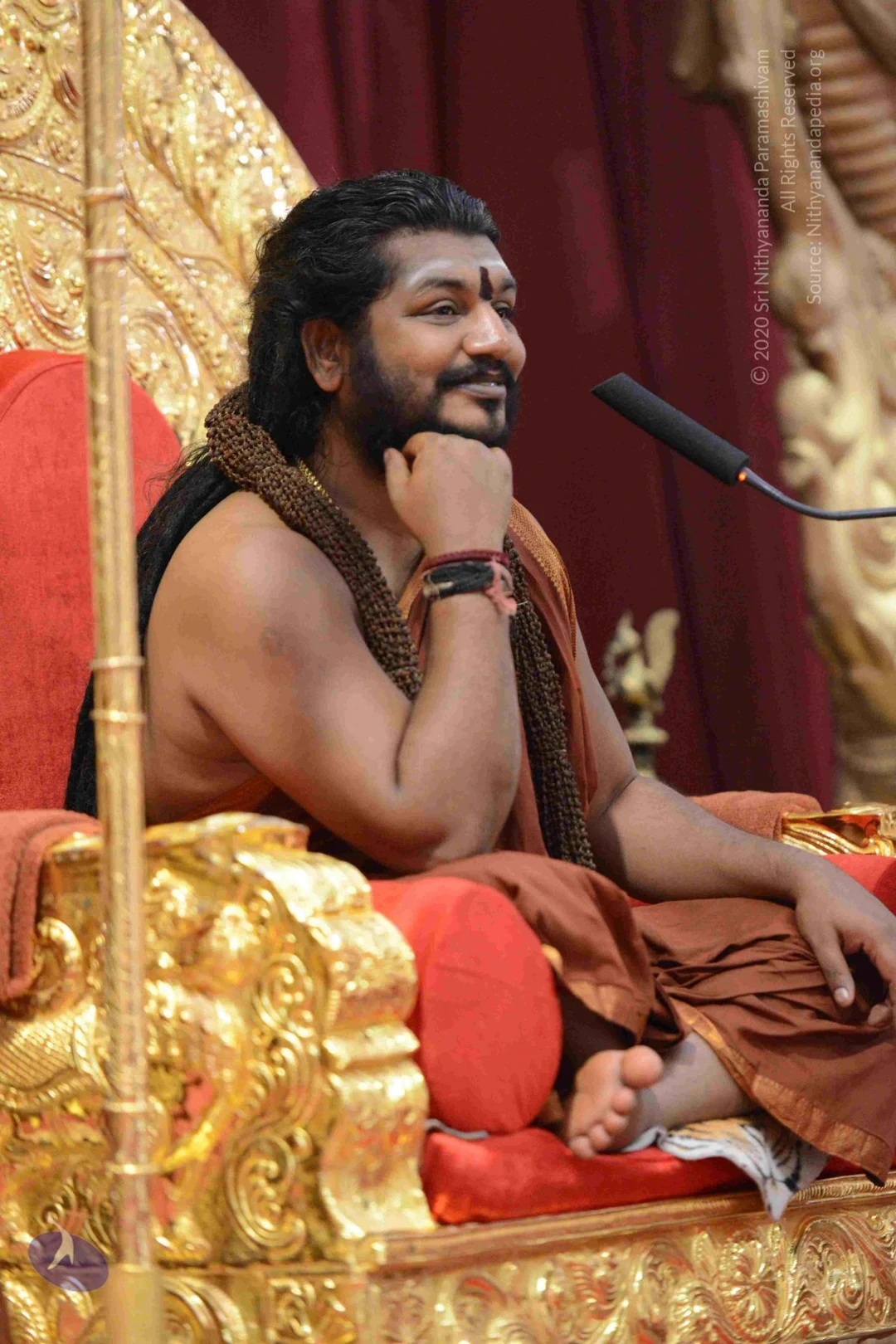
A bearded man in saffron-orange robes sits cross-legged on an ornate gold throne with red cushions, a microphone stand beside him. Behind him a large painted deity murti of a four-armed Shiva-like figure with a crescent moon and a golden leafy halo stands against a red curtain. Flanking the throne are carved golden lion pillars, a golden trident stands to the left, and brass lamps are on the platform. A depiction of an ascetic figure appears on a panel beside the throne. The man has long hair and a rudraksha-style necklace visible on his chest. Appearance-based candidate present; identity uncertain.A photograph of a satsang stage with a long-haired, bearded man seated cross-legged on an ornate gold throne with red cushions, wearing saffron/orange robes and a rudraksha mala. Behind him is a large painted backdrop of a four-armed deity with a crescent moon and crown, holding a flame and other objects, framed by gold foliage. Golden lion-shaped pillars flank the stage, a gold trident stands to the left, and red curtains hang behind.A photograph of a smiling man with long dark hair and a beard seated on an ornate gold throne with red cushions. He wears a rust-brown dhoti and a bare-shouldered wrap, a brown rudraksha-style mala hangs around his neck, and a red and black thread is tied on his wrist. A red tilak mark is on his forehead, and he rests his hand on his chin while laughing. A black microphone stand is at right, and a gilded carved figure with a red curtain stands behind him.A man with long dark hair and a short beard sits on an ornate gold-carved throne with red cushions, speaking into a microphone while gesturing with one hand near his face and pointing with the other. He is shirtless with a brown-orange cloth draped over his body and a thick brown rudraksha mala around his neck, wearing a red bead bracelet and a red tilak on his forehead. A red curtain and gold decorative carvings form the backdrop of a satsang discourse stage.A man with long swept-back dark hair and a beard sits cross-legged on an ornate gold throne with red cushions, resting his chin on one hand. He is bare-chested with a rust-orange wrap, wears a brown rudraksha mala draped over his shoulders and a red-and-black wristband, and has a vertical red mark on his forehead. A microphone stands at right against a deep red curtain, and a gilded carved pillar rises at left.A woman seated on an orange upholstered chair speaks into a handheld black microphone, holding it in her right hand while her left hand rests on her lap. She wears a rust-red garment with a gold-bordered shawl draped over her shoulders and a long mala of dark brown rudraksha-style beads around her neck. She has a red bindi and white markings on her forehead and small gold earrings. A dark red curtain stands behind her, and a blurred person's head is visible in the lower left foreground. Her posture and the microphone suggest a satsang or talk.
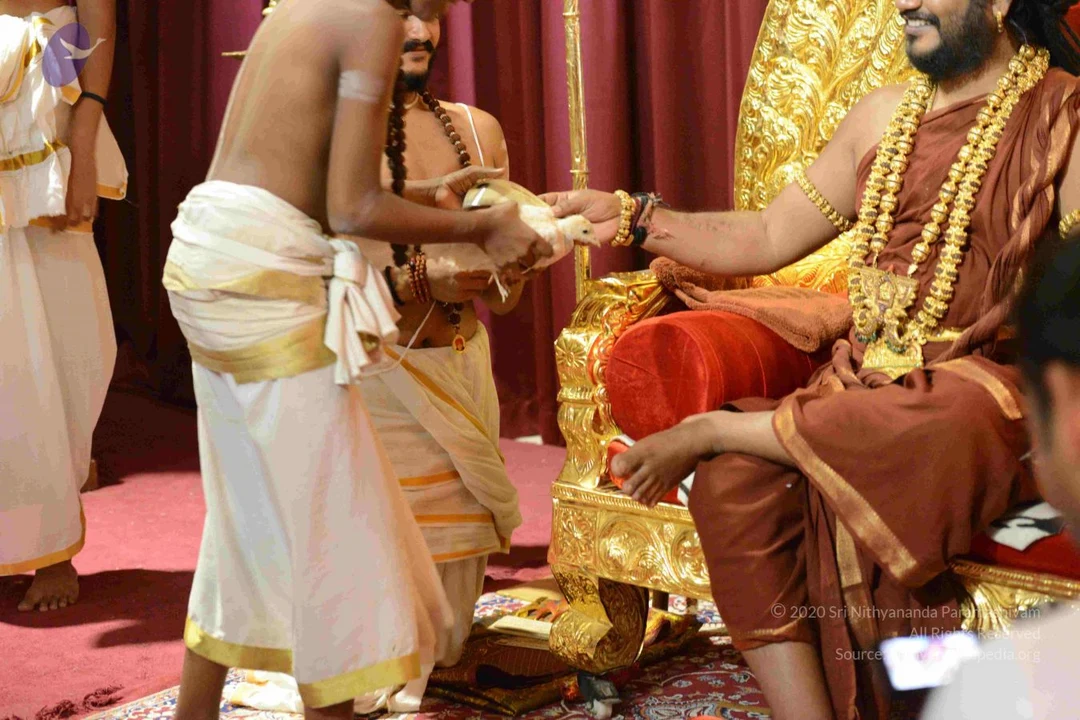
01-NITHYA-SATSANG

35 photosSource gallery
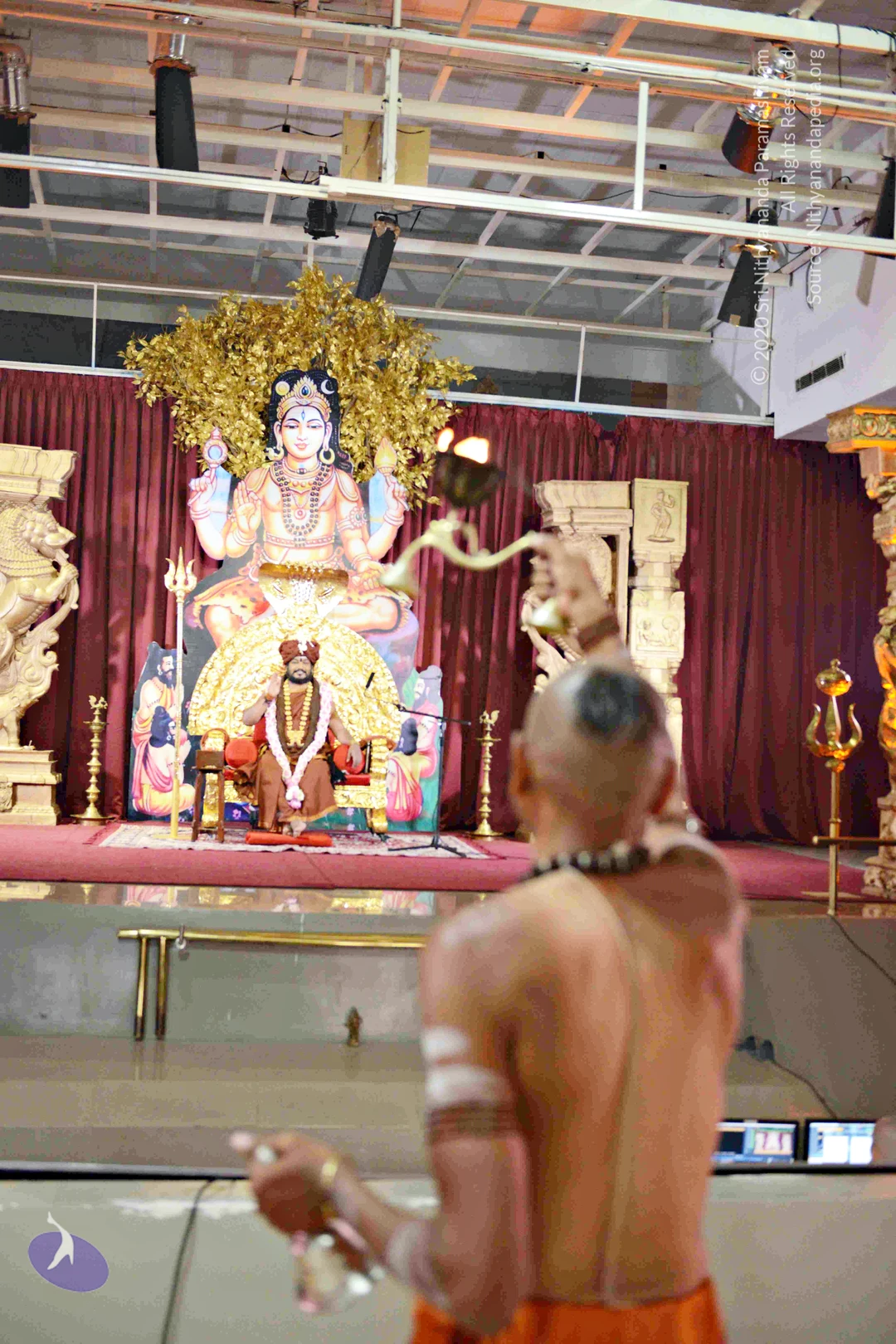
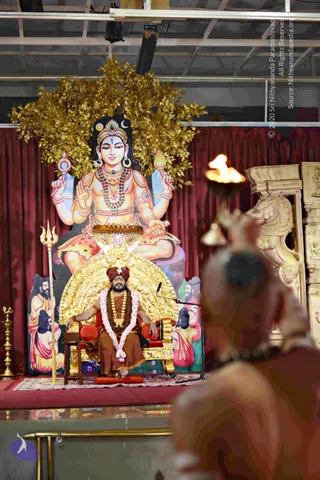
A photograph of an indoor stage with a large painted backdrop of a multi-armed deity seated on a golden throne, framed by golden foliage, maroon curtains and carved stone pillars with lion sculptures. A seated man in a saffron-brown robe, turban and a white flower garland sits on a gold-and-red throne in front of the backdrop, with brass lamps and a trident-topped stand nearby. In the foreground a bare-chested man with a shaved head and rudraksha beads, wearing an orange cloth, holds a brass vessel and waves a flame, appearing to perform an aarti. Ceiling trusses and speakers are visible above.A seated man in saffron-orange robes and an orange turban sits on an ornate gold throne with red cushions, wearing a rudraksha mala and a pink and white flower garland. Behind him is a large painted deity murti of multi-armed Shiva with crescent moon and trident-like motifs framed by gold leaf foliage, flanked by red drapes and a carved stone lion bracket. A brass oil lamp stands at left and a trident leans beside the throne. In the foreground, a blurred devotee in orange clothing raises a hand toward the seated figure. The seated man's identity is not established from appearance, so he is described by role only.Photograph of a satsang stage with a large painted image of a multi-armed deity with a crescent crown and rudraksha necklaces, framed by gilded foliage. A man in a rust-orange robe, red turban, and white-and-pink flower garland sits on an ornate gold throne with a cobra-hood canopy, his hands resting on the armrests. A brass lamp stands at left, a trident leans beside the throne, and red drapes and carved wooden lion figures frame the stage. In the foreground, a shaved-headed person in a bare-shouldered reddish robe faces the throne, with a flame visible in a fire pit at lower centre. The throne figure has distinctive ceremonial cues (ornate gold throne, flower garland, rudraksha mala) but his face and appearance are not clearly enough established to confirm identity, so he is treated as uncertain.A photograph of a seated figure on an ornate gold throne in front of a large painted backdrop of a four-armed deity with a crown, crescent moon and rudraksha garlands, framed by golden foliage. The seated figure wears a rust-brown turban, saffron-brown robes, a white and pink flower garland and a rudraksha mala, with bare feet on a red cushion. Standing trident-like staff, a brass lamp on the left, red curtains and a carved stone pillar on the right, and a lit oil flame or torch held near the top right. In the blurred foreground, the back of a person's head is visible. The figure's identity is uncertain from appearance, so no name is assigned.A bearded man in a rust-brown turban with a gold ornament sits on a gilded throne, smiling with eyes closed. He wears a brown robe, long rudraksha mala strands with gold beads, and pink-and-white flower garlands. A microphone stands nearby, and a small brass lamp and a wooden stand with an orange cushion are in front of him, against a maroon curtain. Swamiji (probable): the figure wears a turban, ornate gold beads and rudraksha malas, matching the page's Satsang context. The image is a photograph of a seated speaker during a discourse.A smiling bearded man seated on a golden throne in front of a maroon draped backdrop, wearing a rust-brown turban with a gold ornament, a brown-and-saffron robe, a long multi-strand rudraksha mala with gold beads, and a pink and white flower garland. A small wooden stand with a microphone stand and a brass lamp sits nearby. a person: the long dreadlocked hair, rudraksha mala, ornate gold and flower-garland adornment on a throne match the page's a person claim, though the face is not used for identification.