Skip to content
Tuesday

21 January 2014

HDH Bhagavan Sri Nithyananda Paramashivam advises us to carry possibility in our hearts to awaken life within us.

Dated photos
56
Source pages
1
Media
2
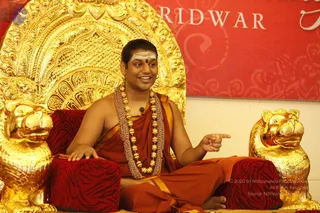
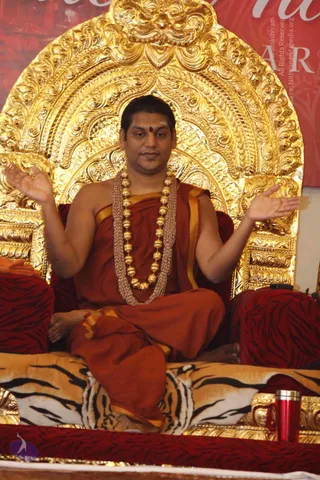
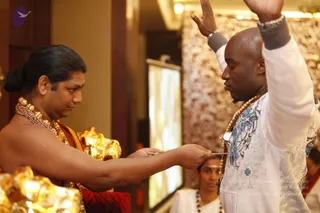
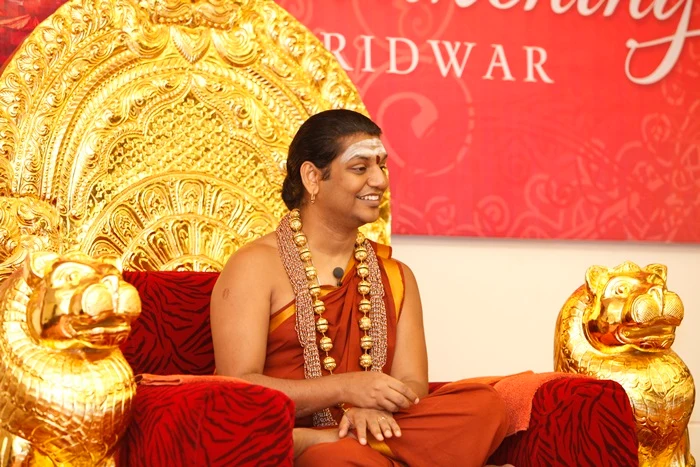
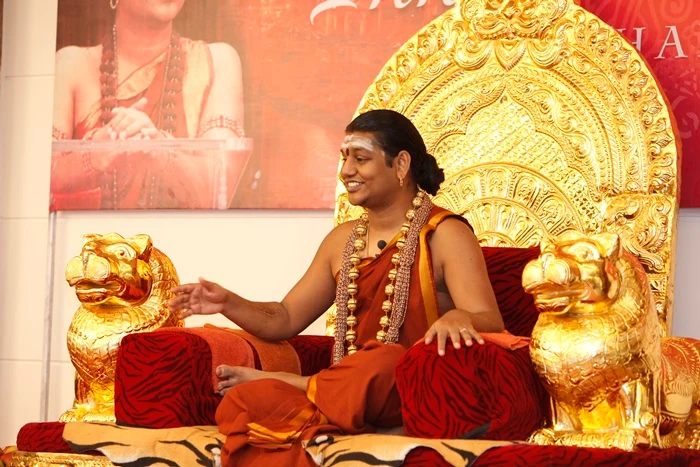
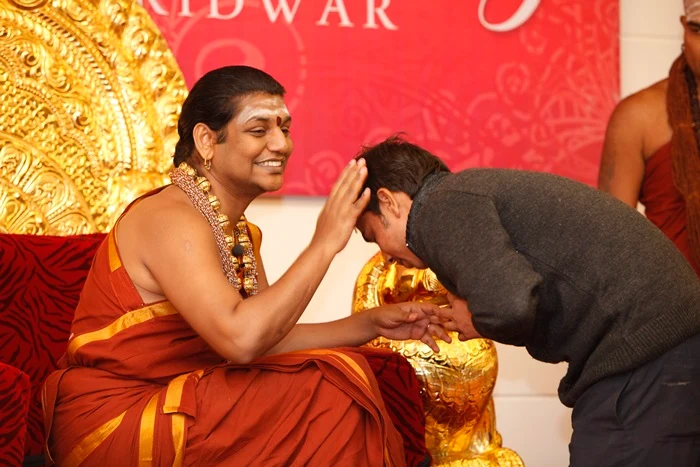
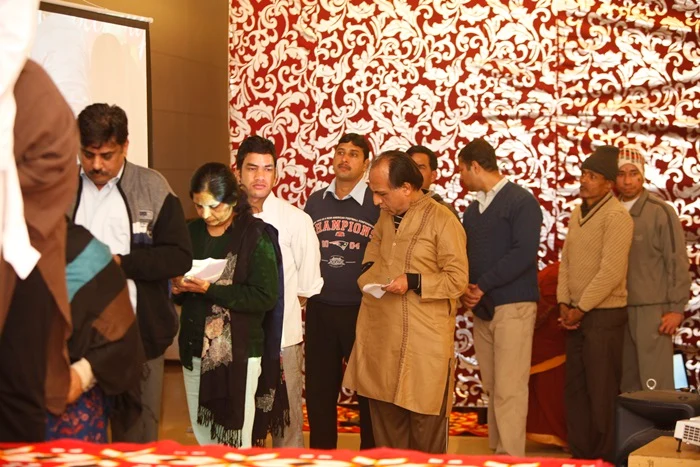
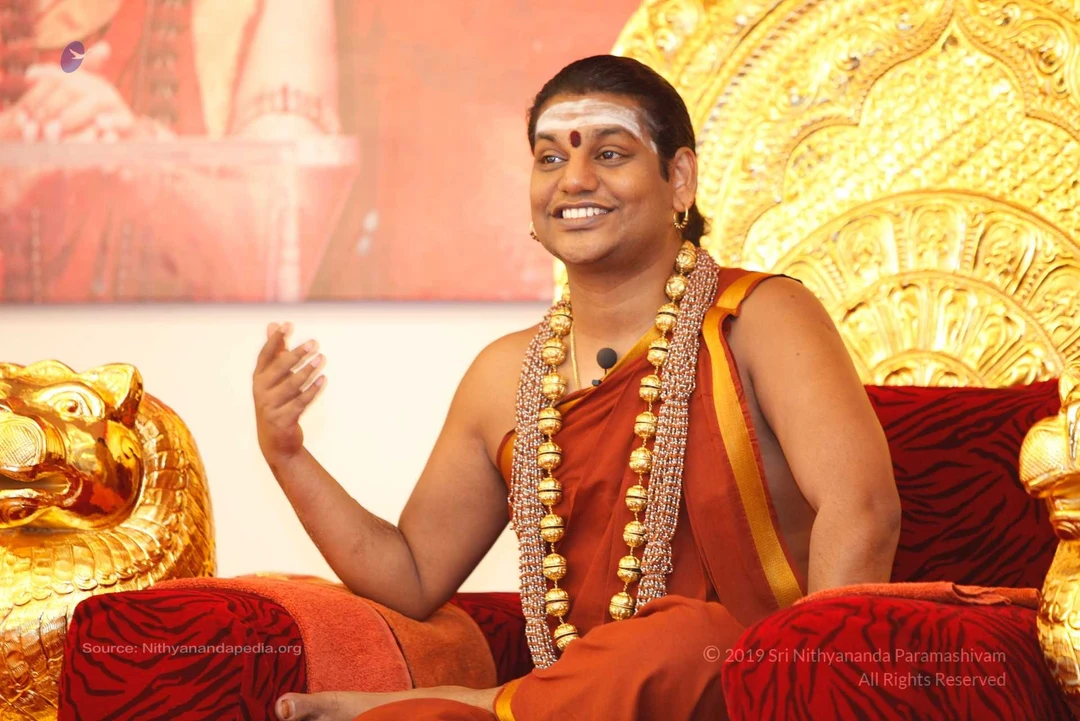
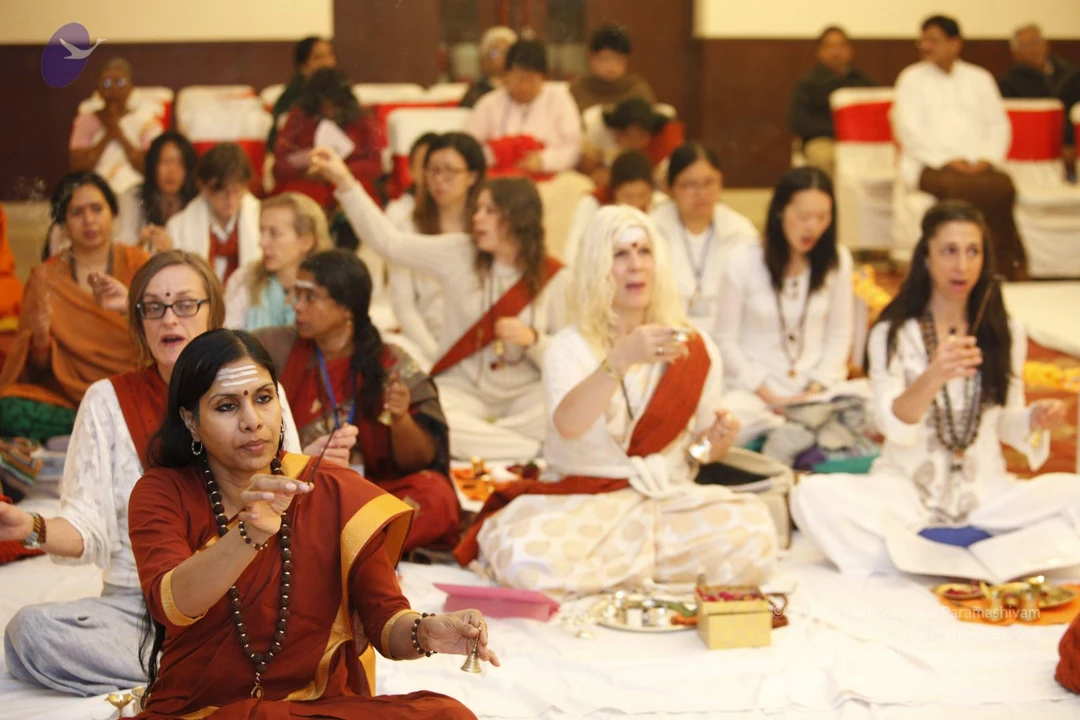
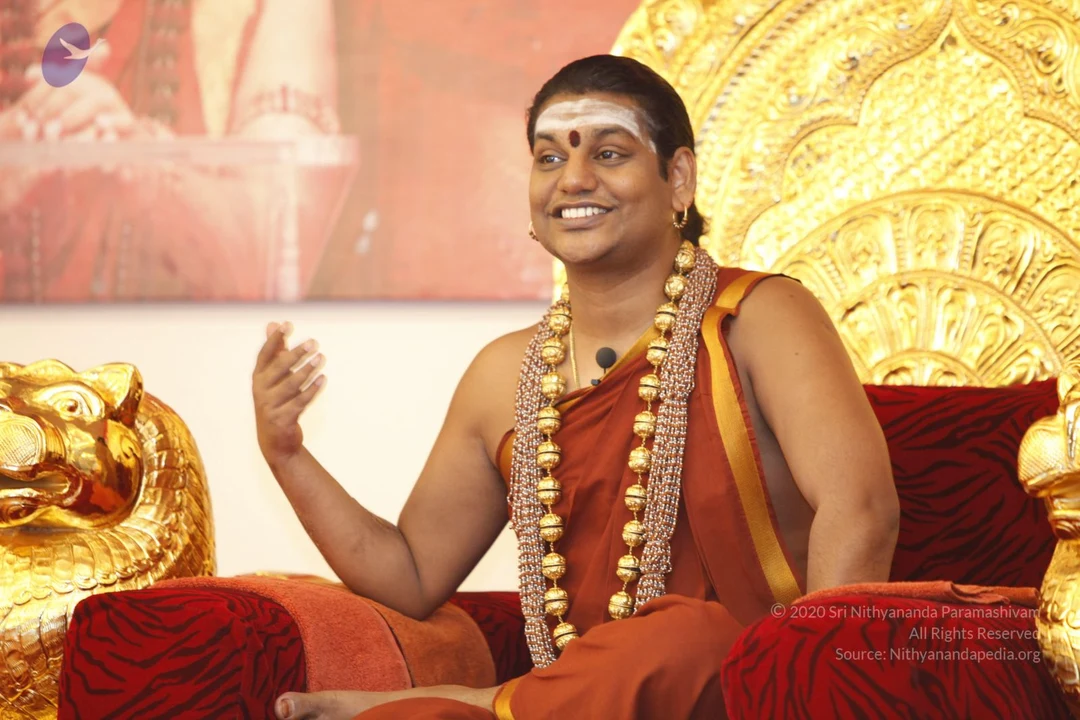
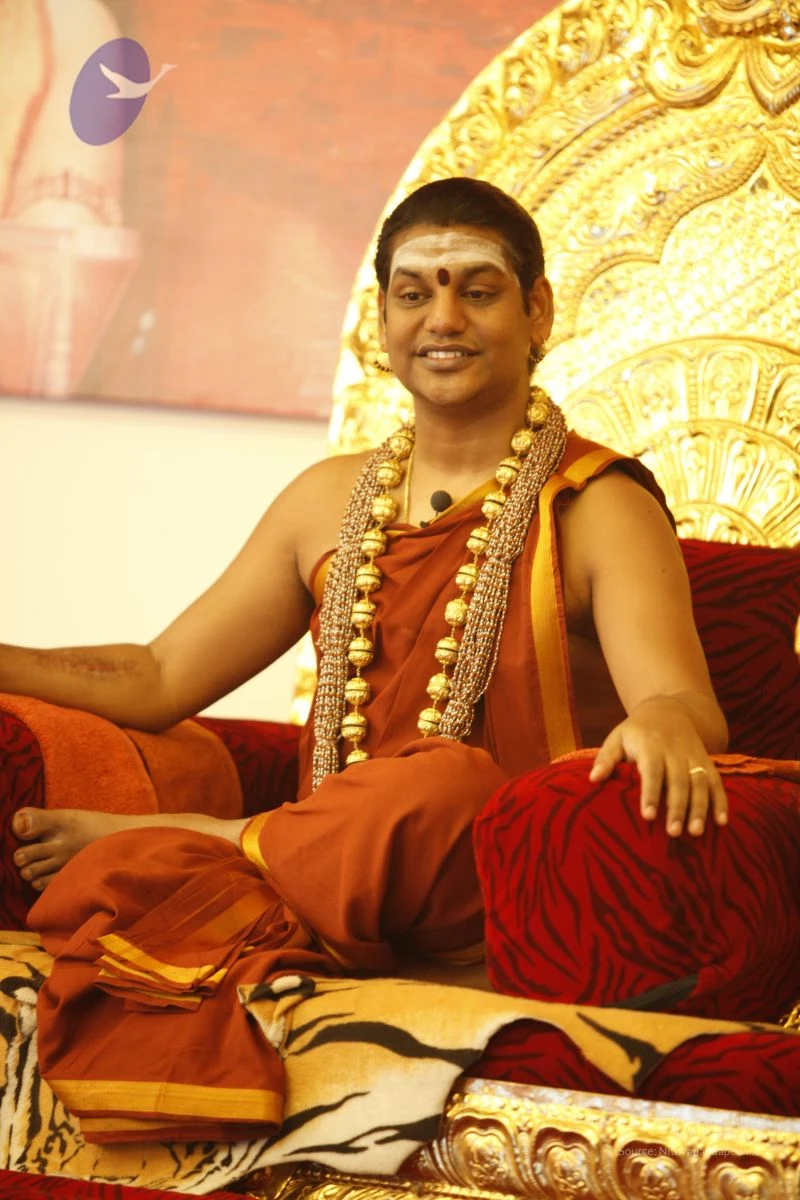
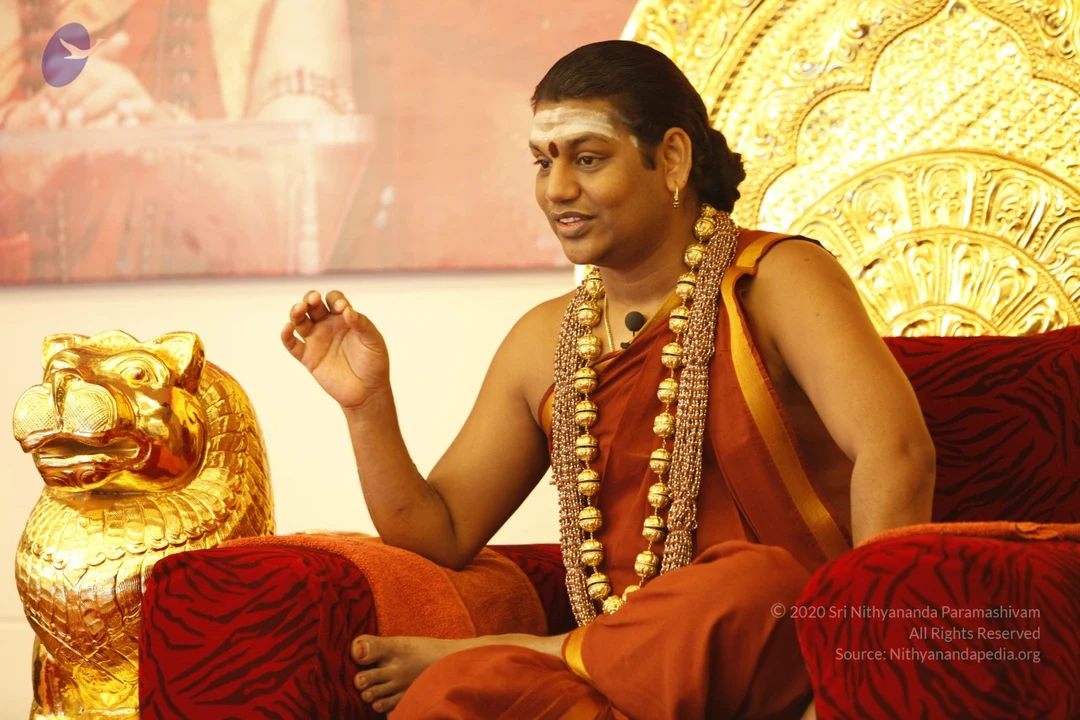
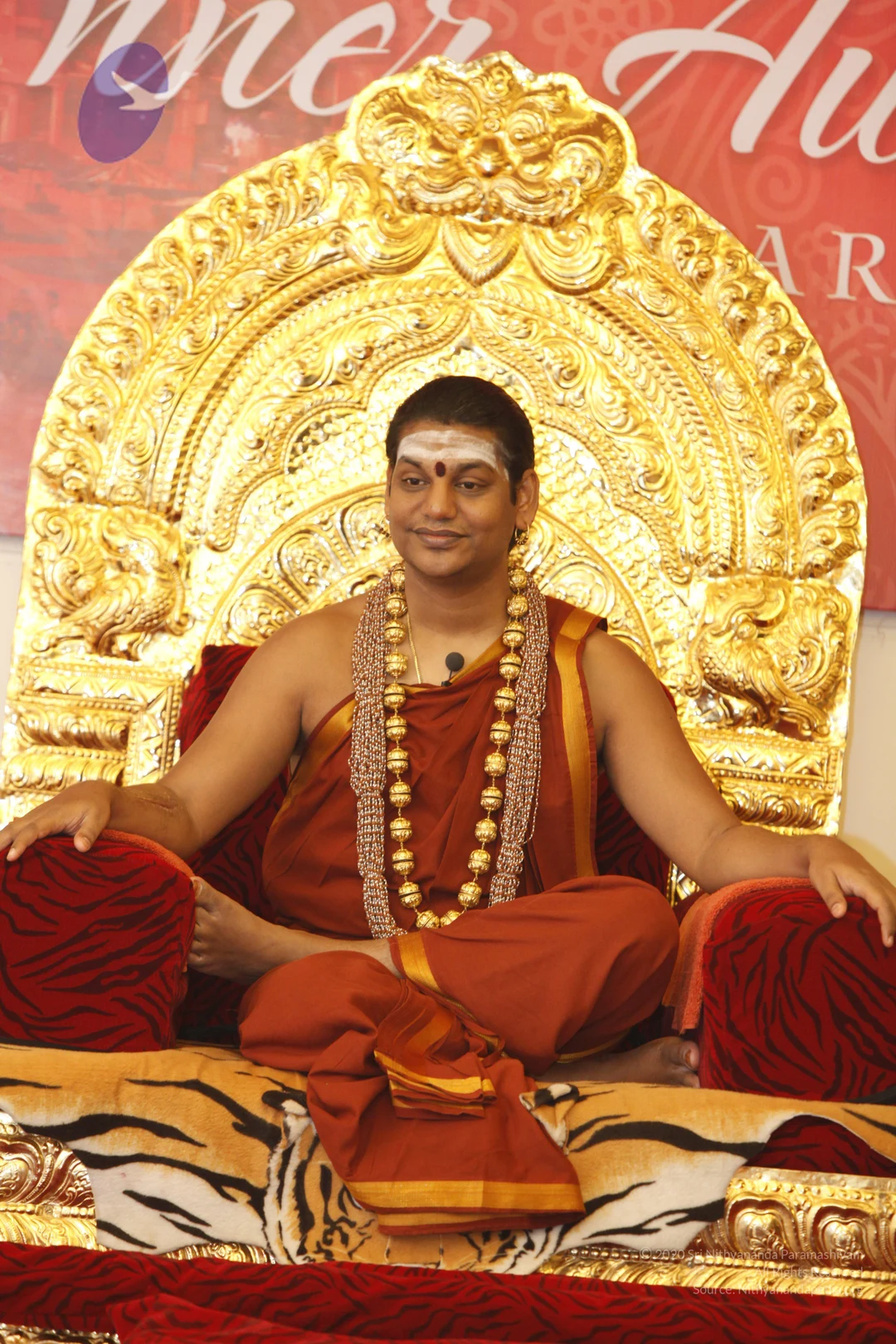
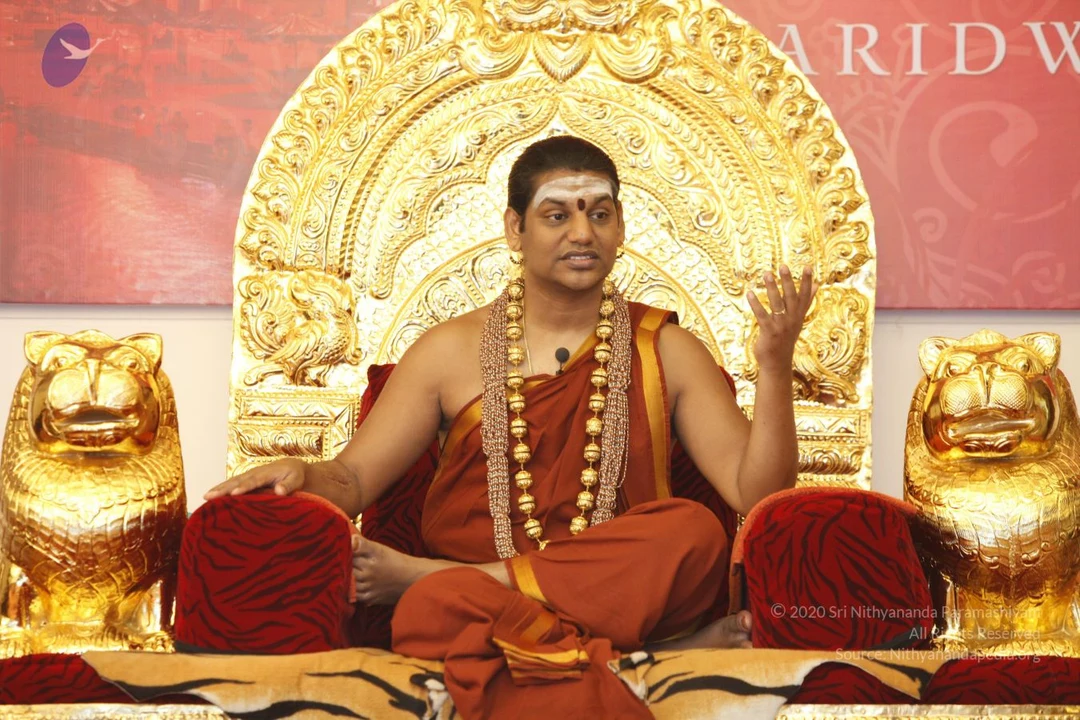
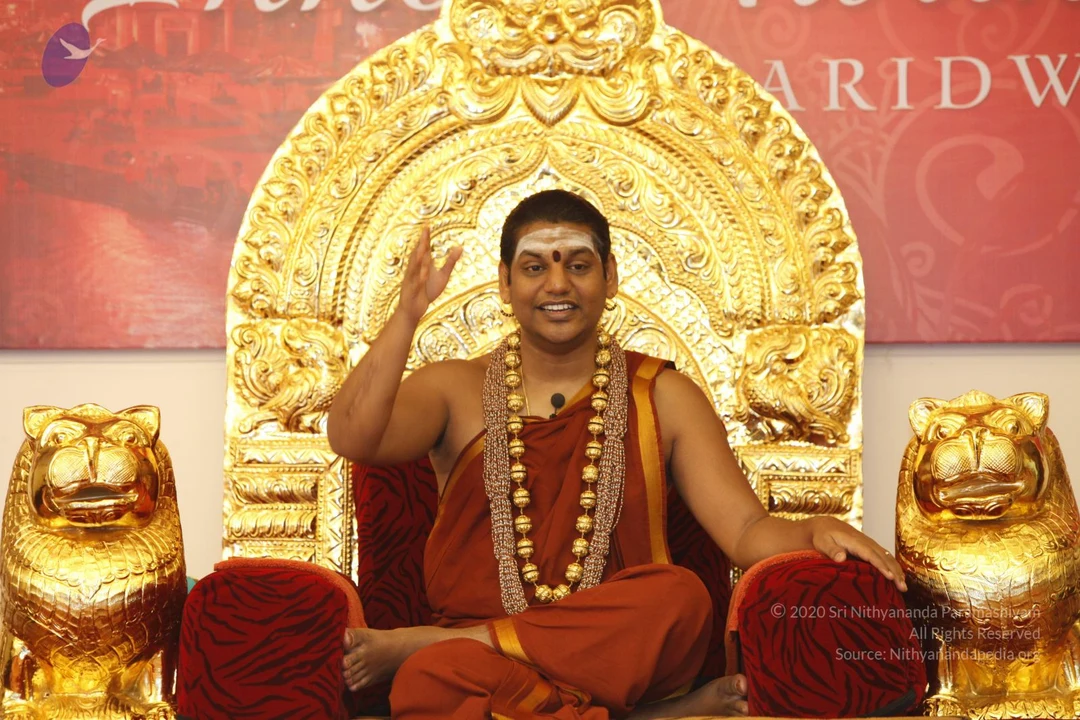
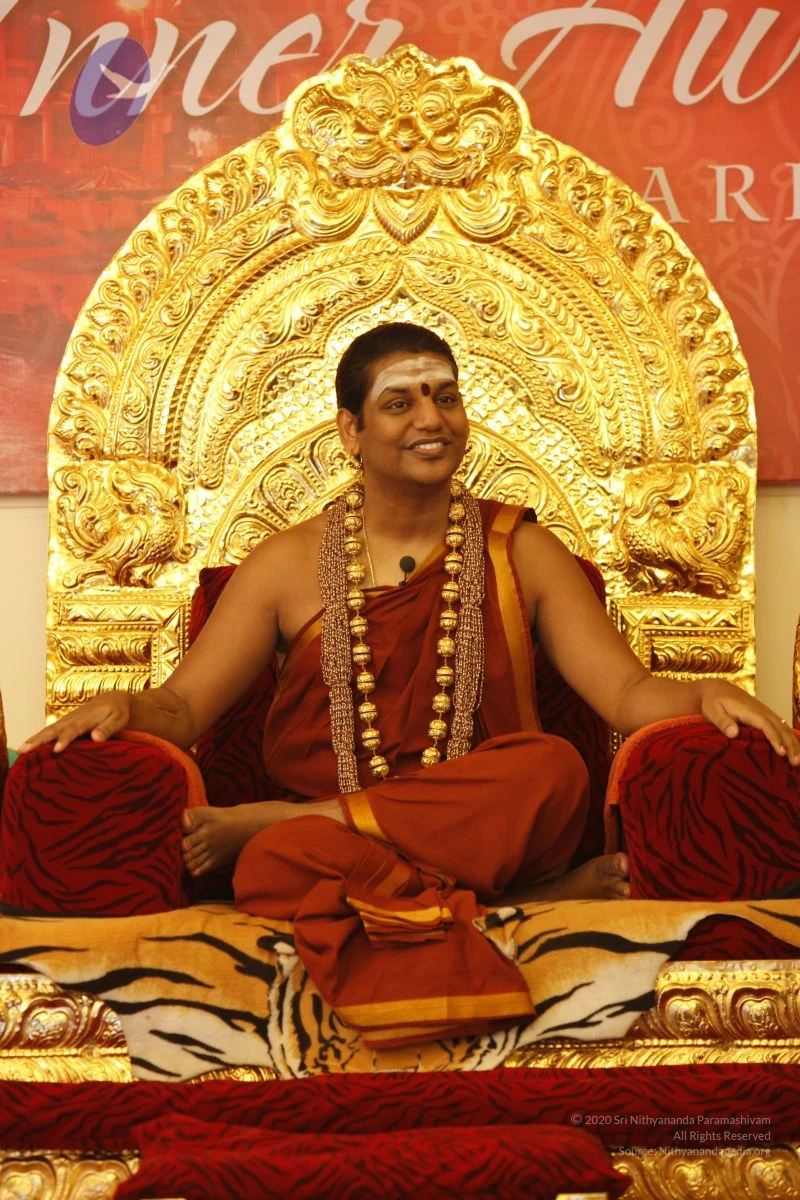
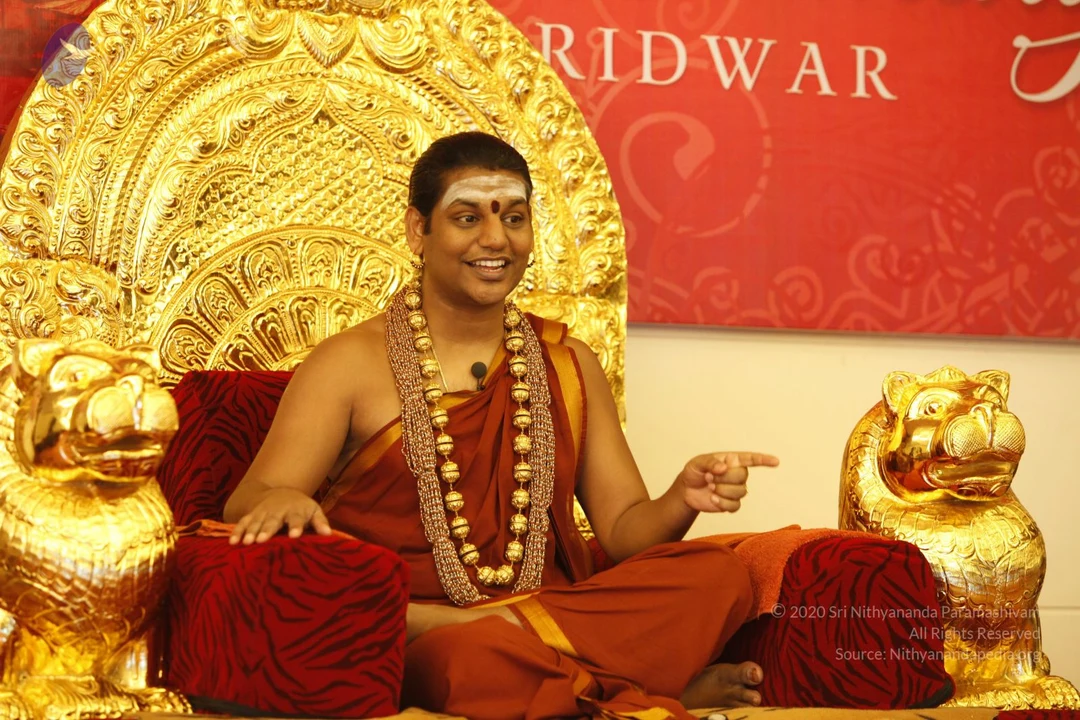
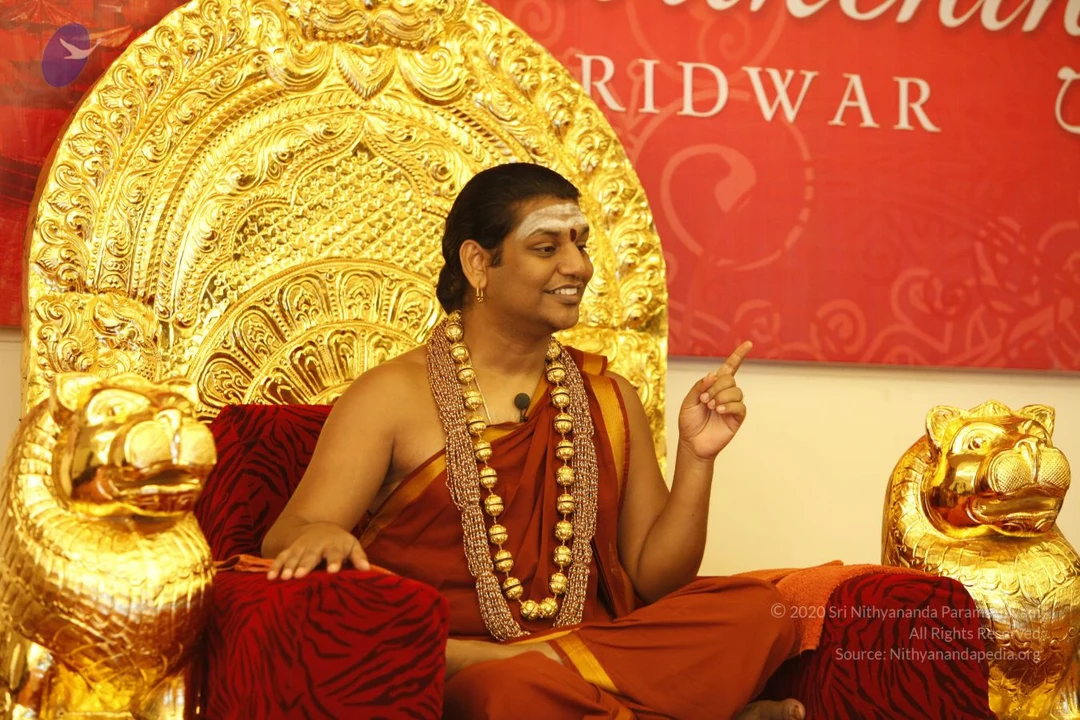
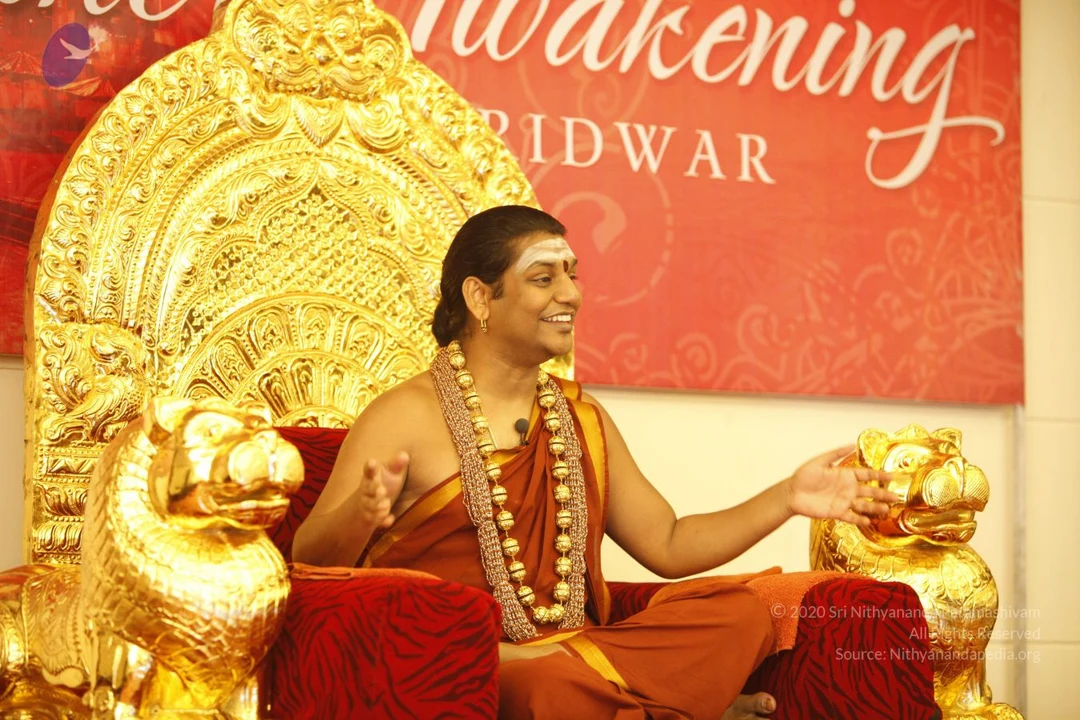
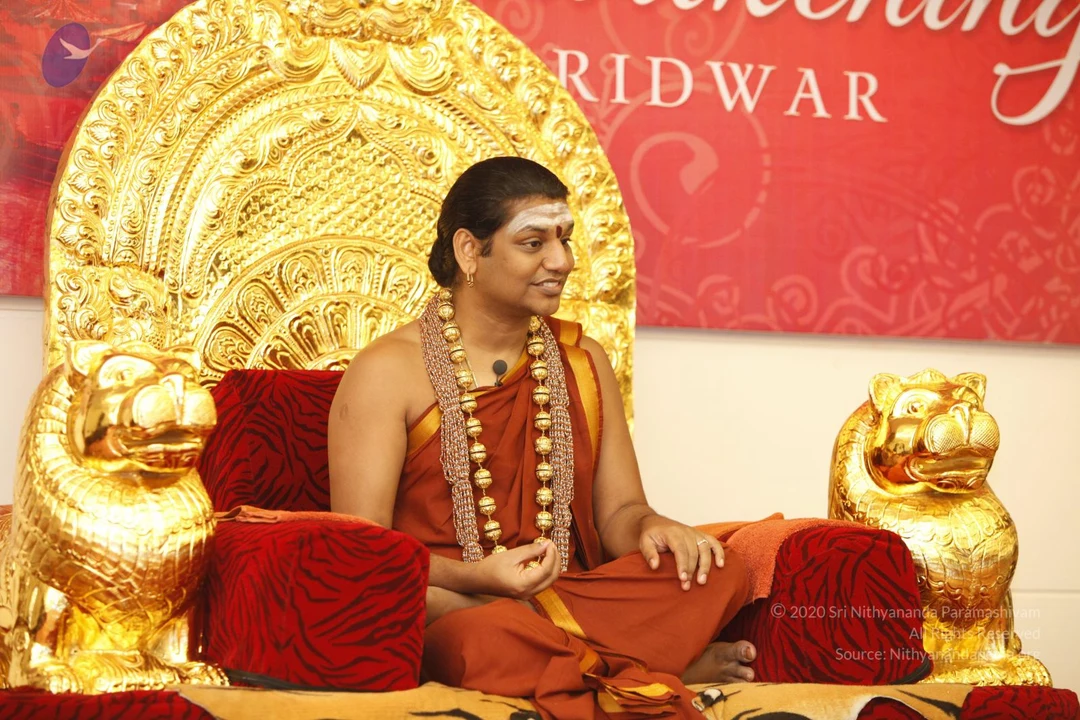
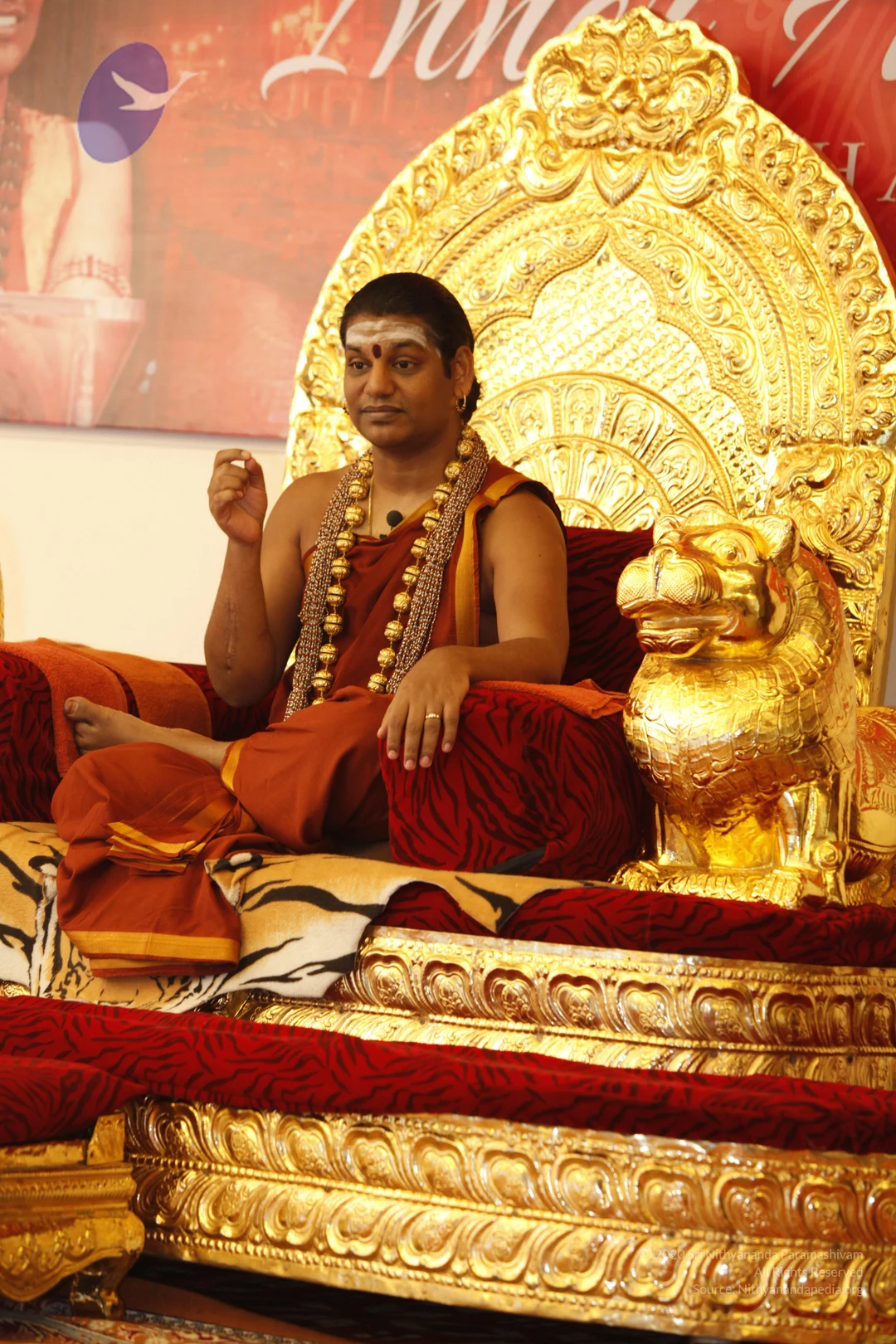
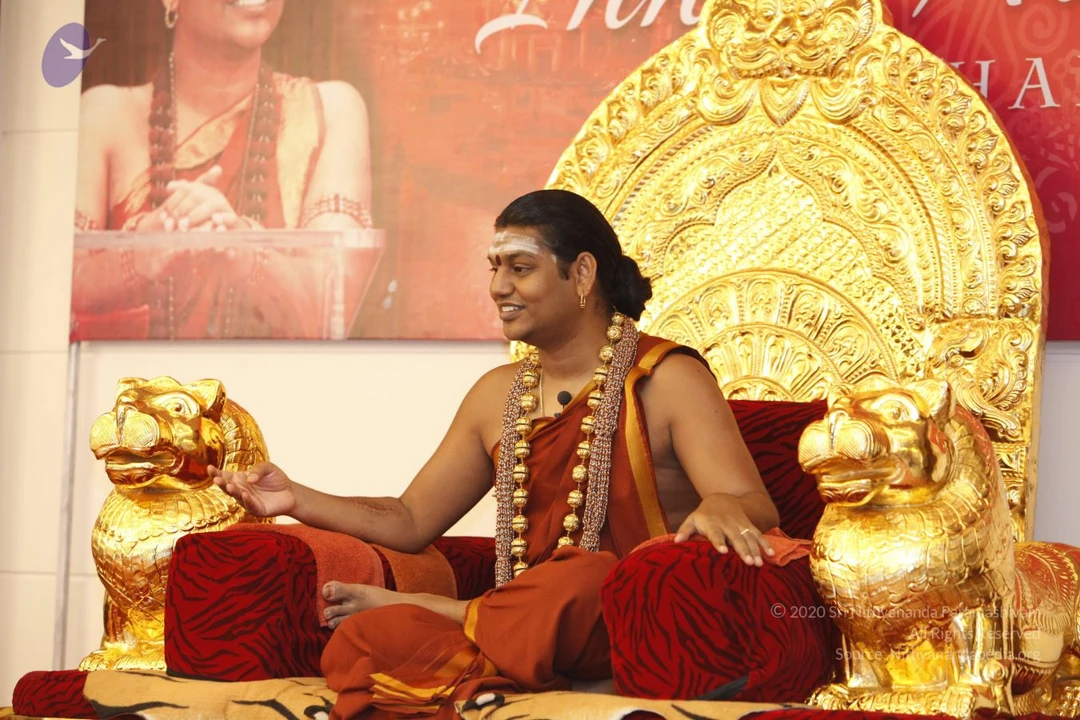
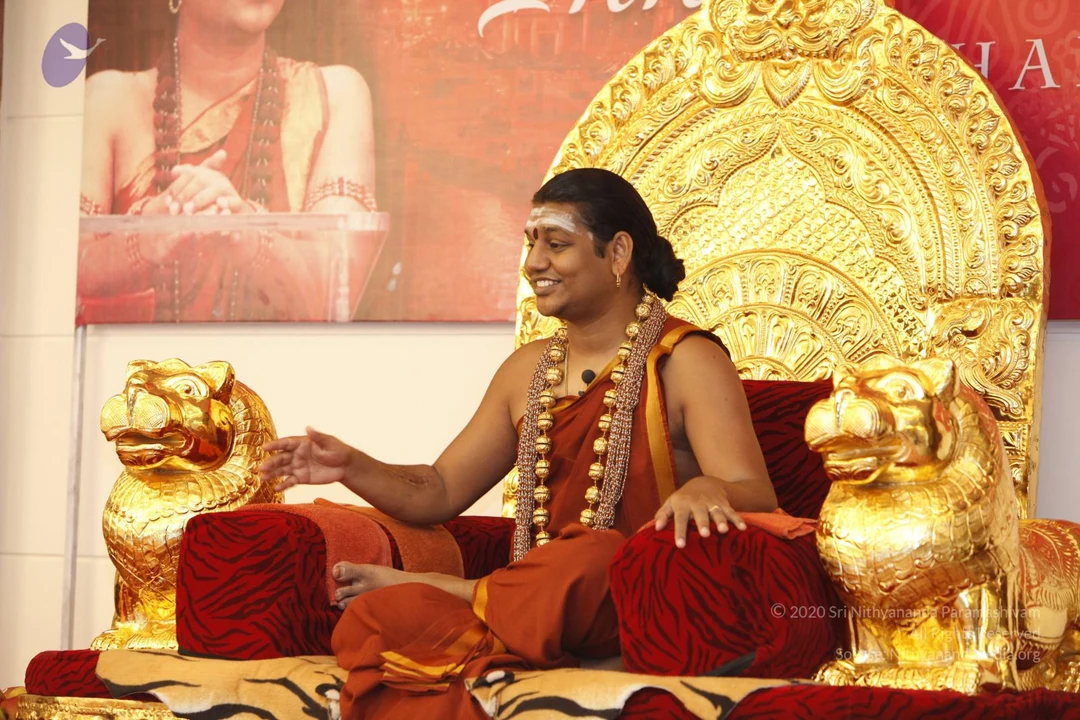
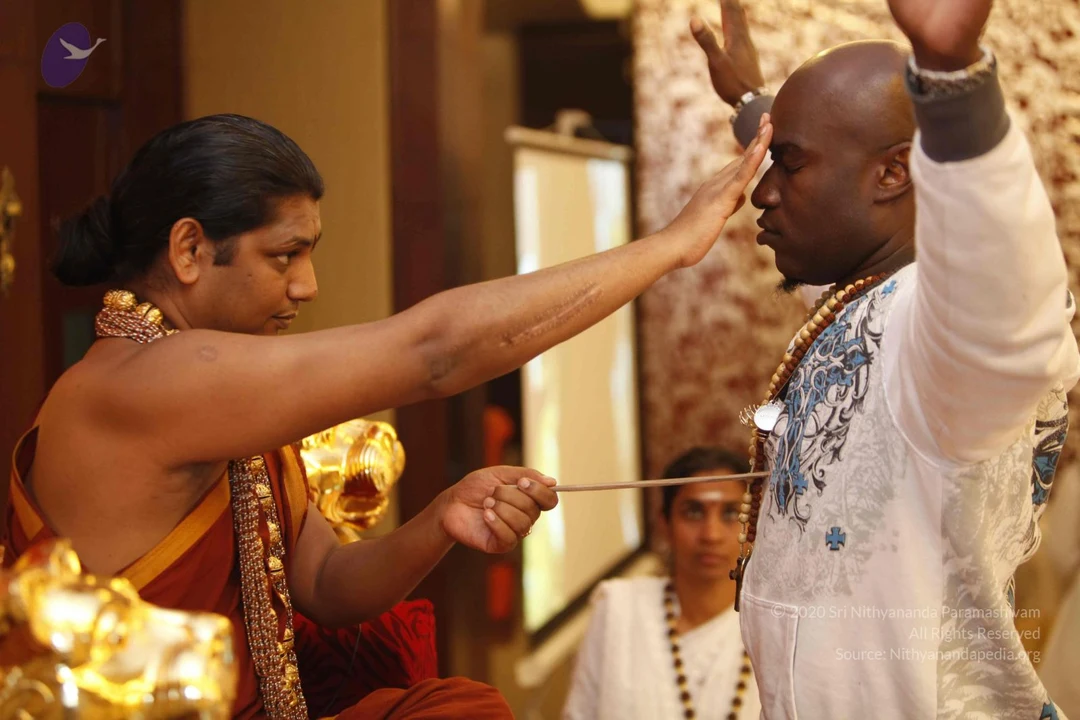
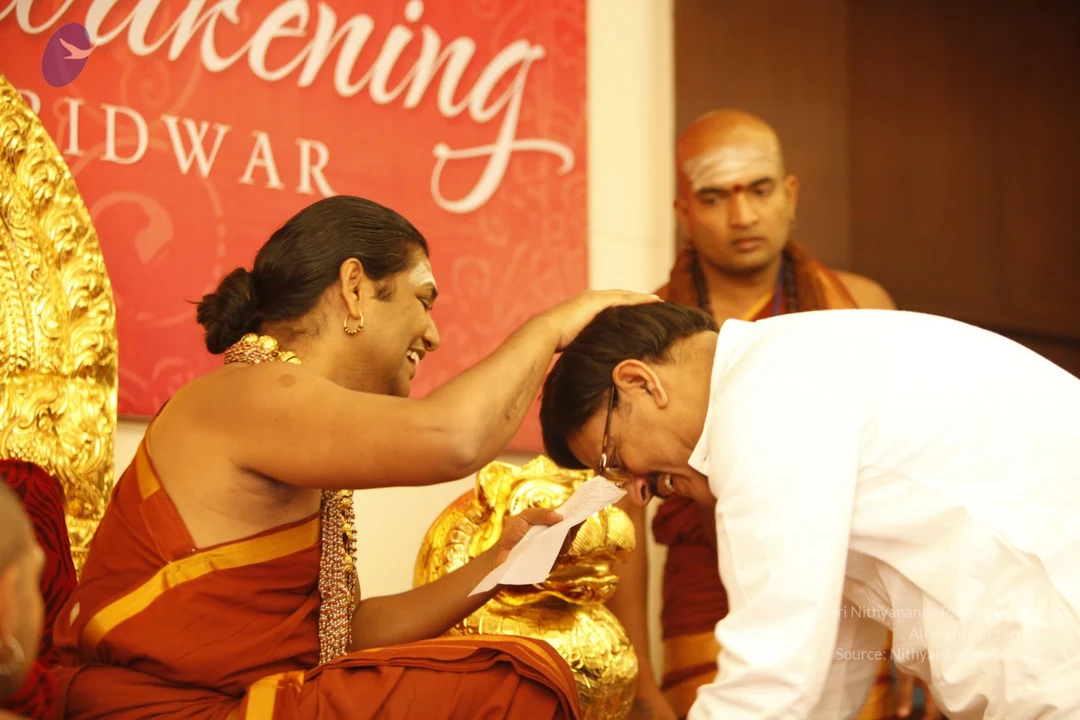
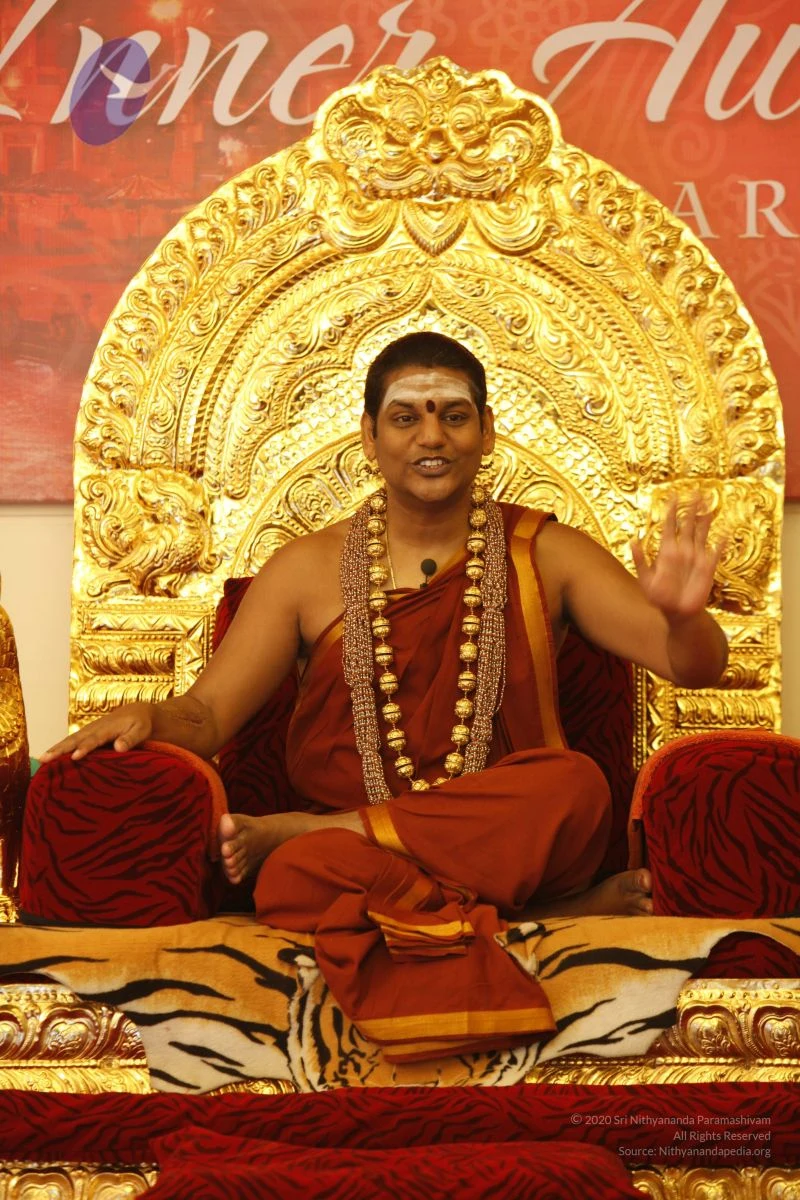
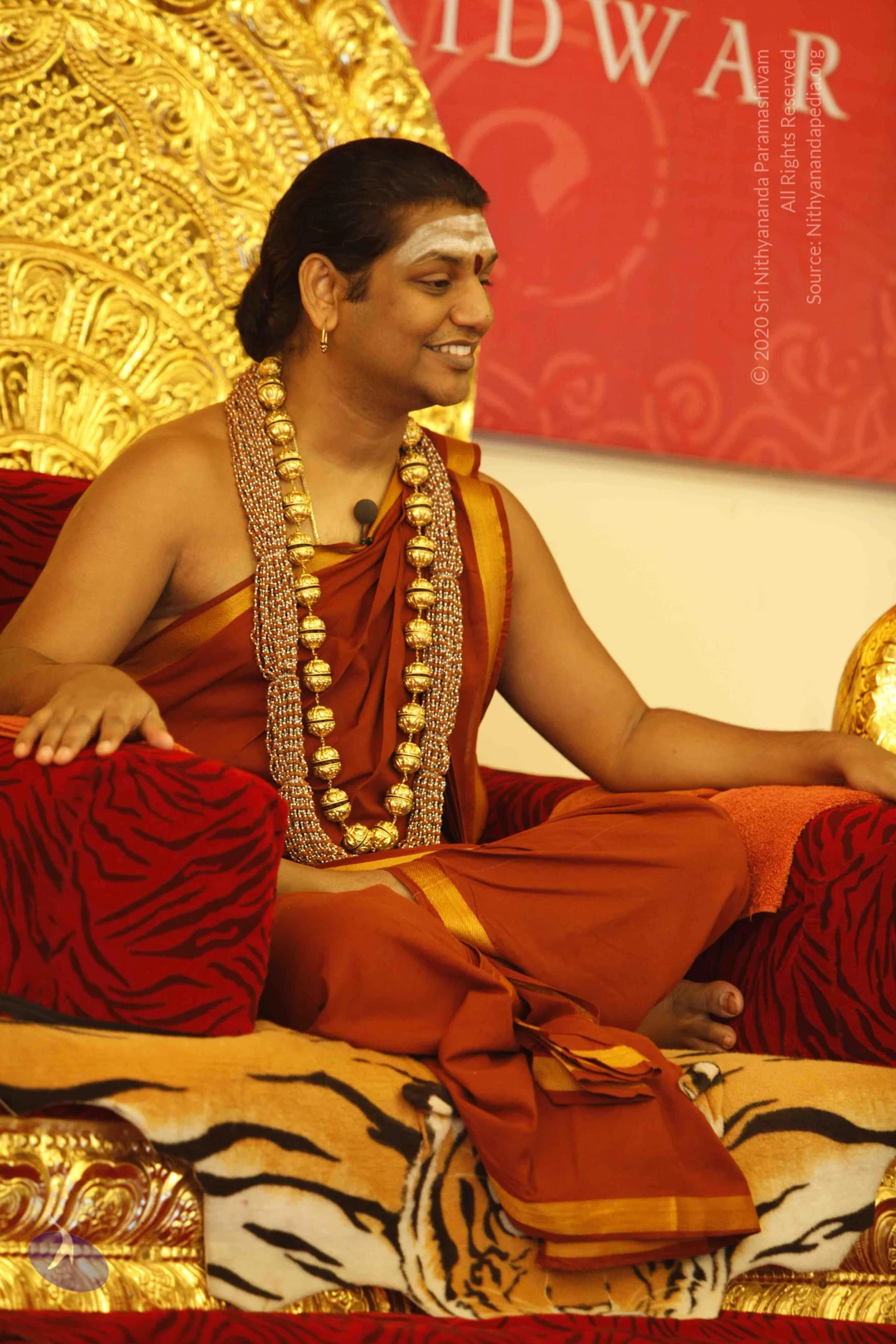
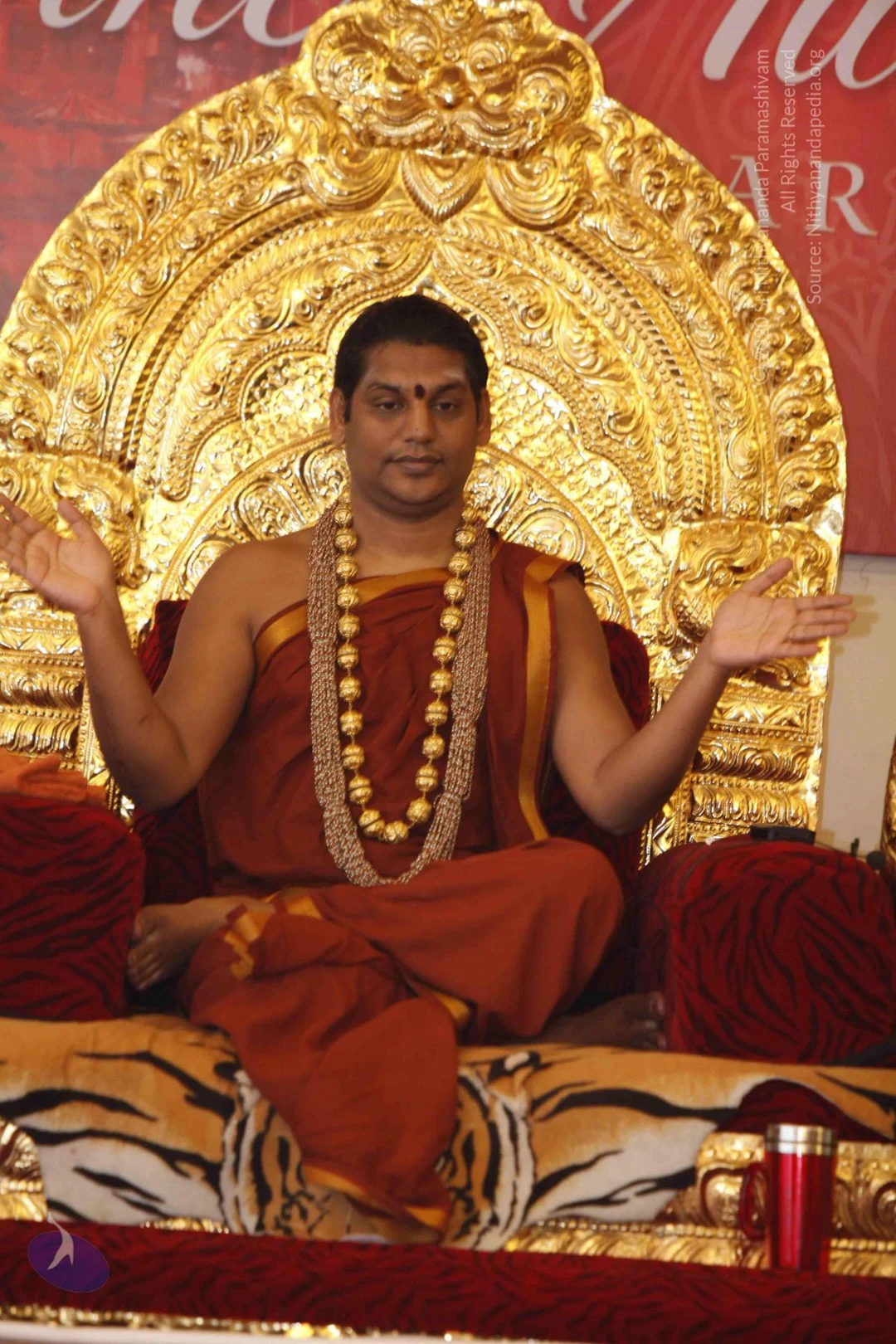
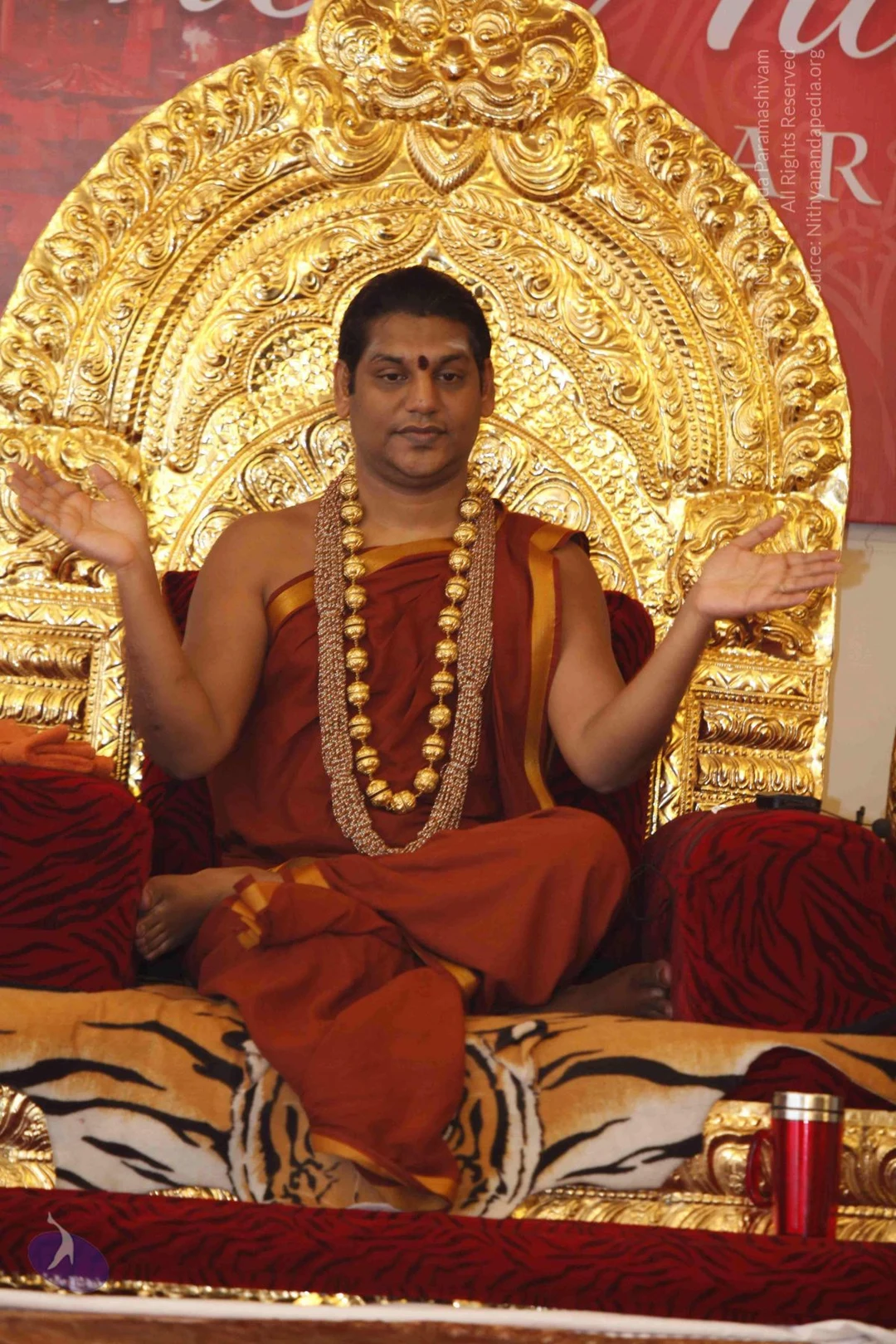
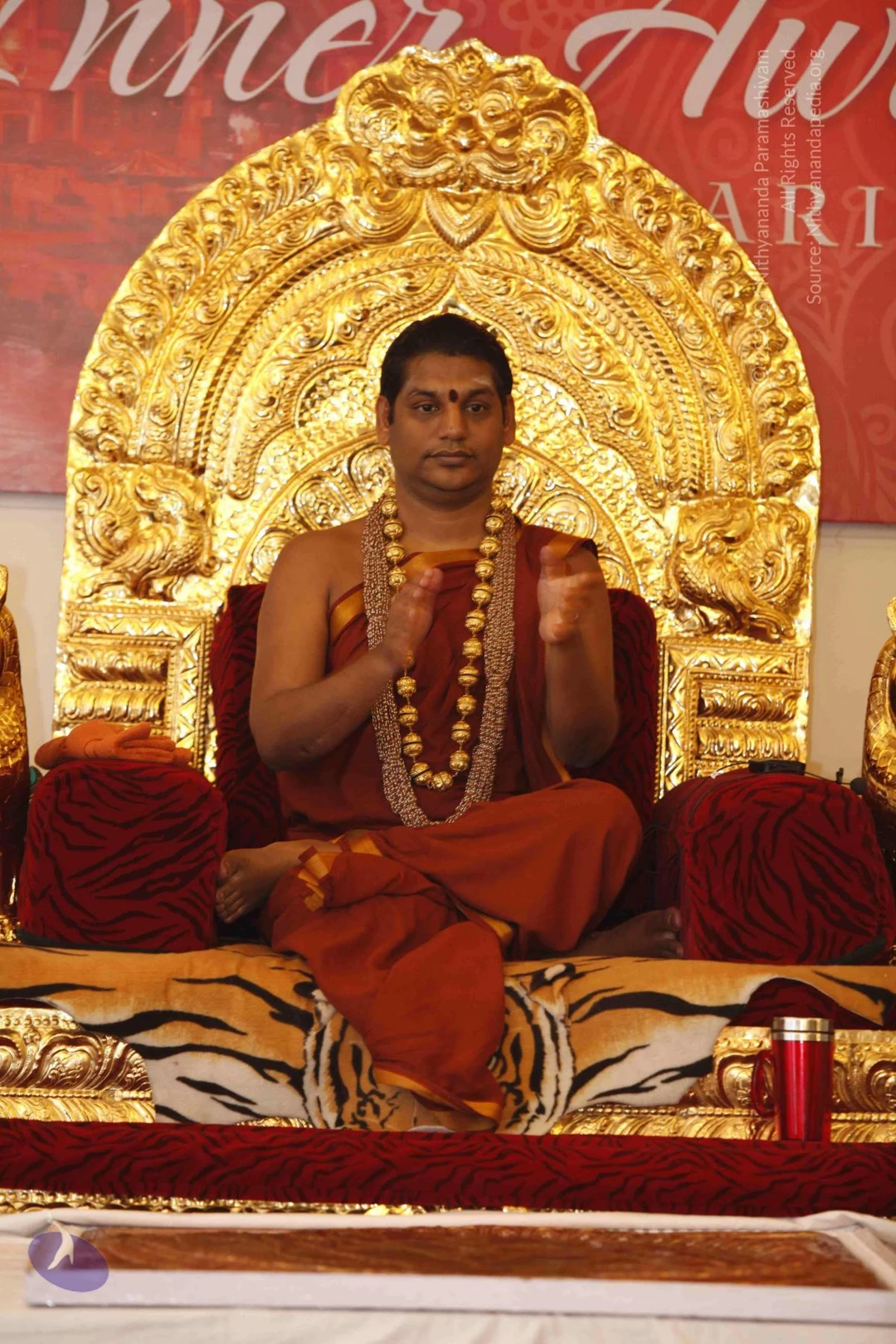
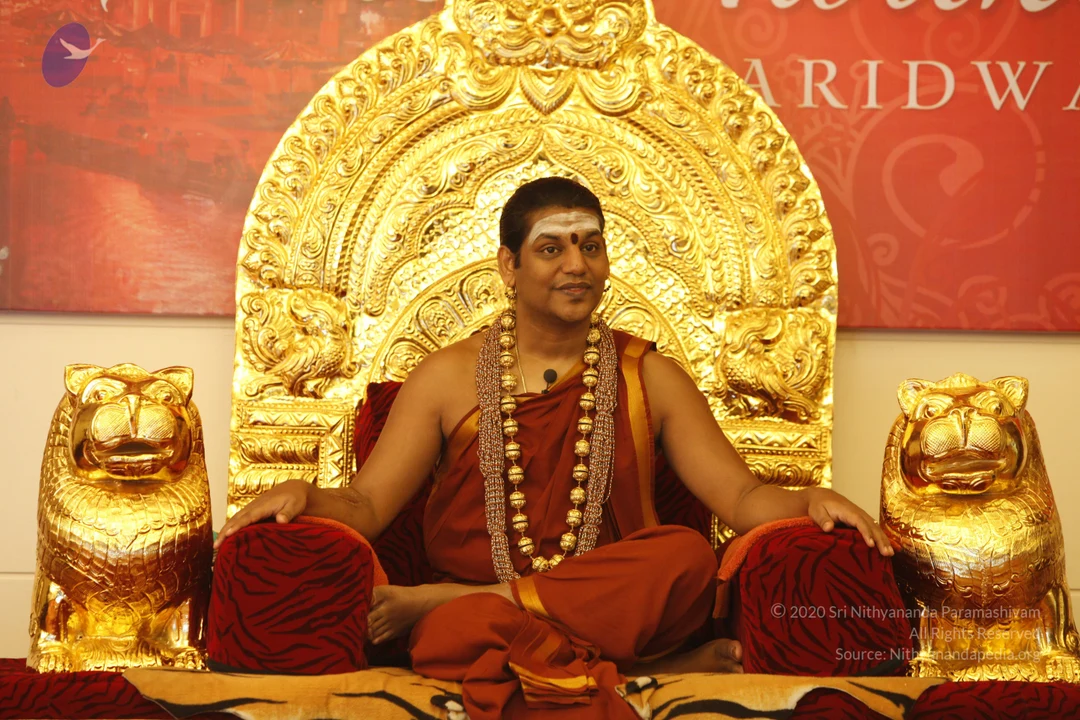
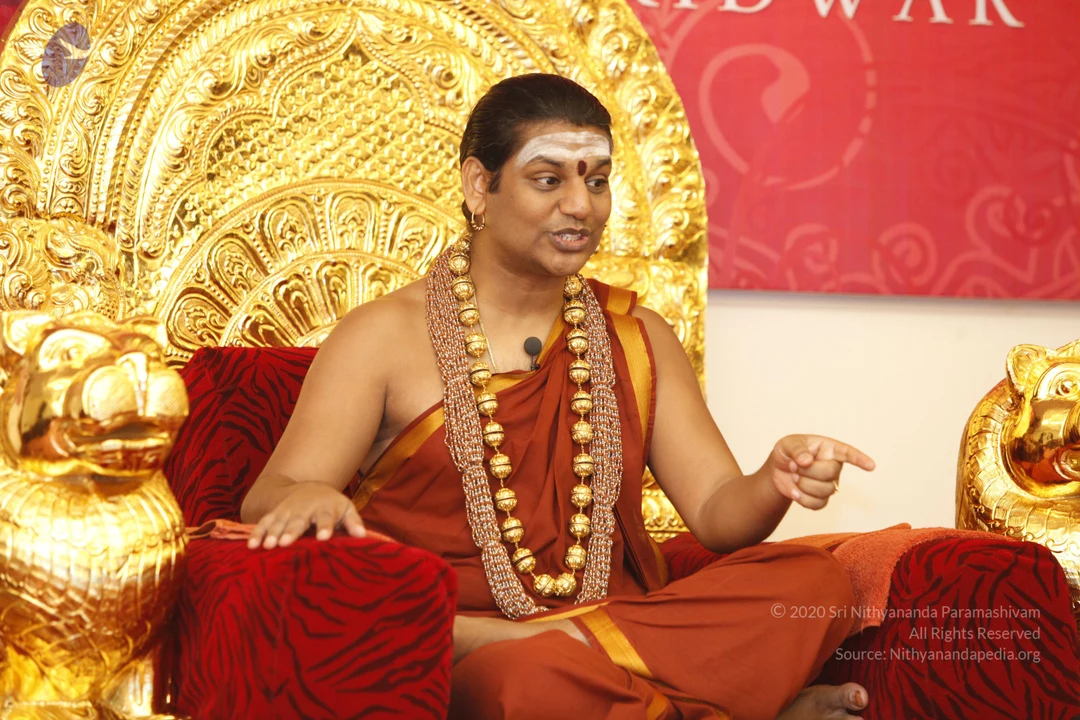
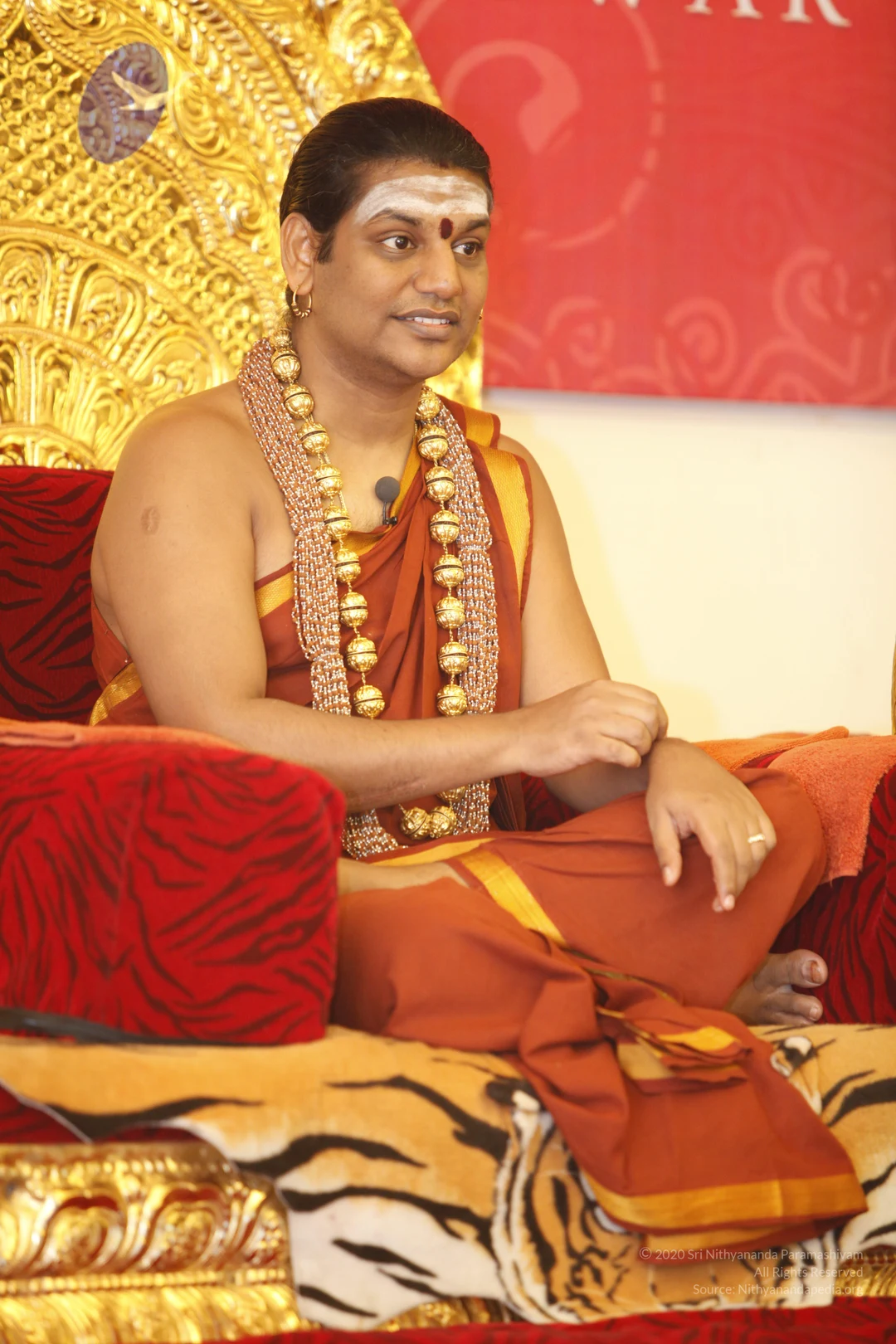
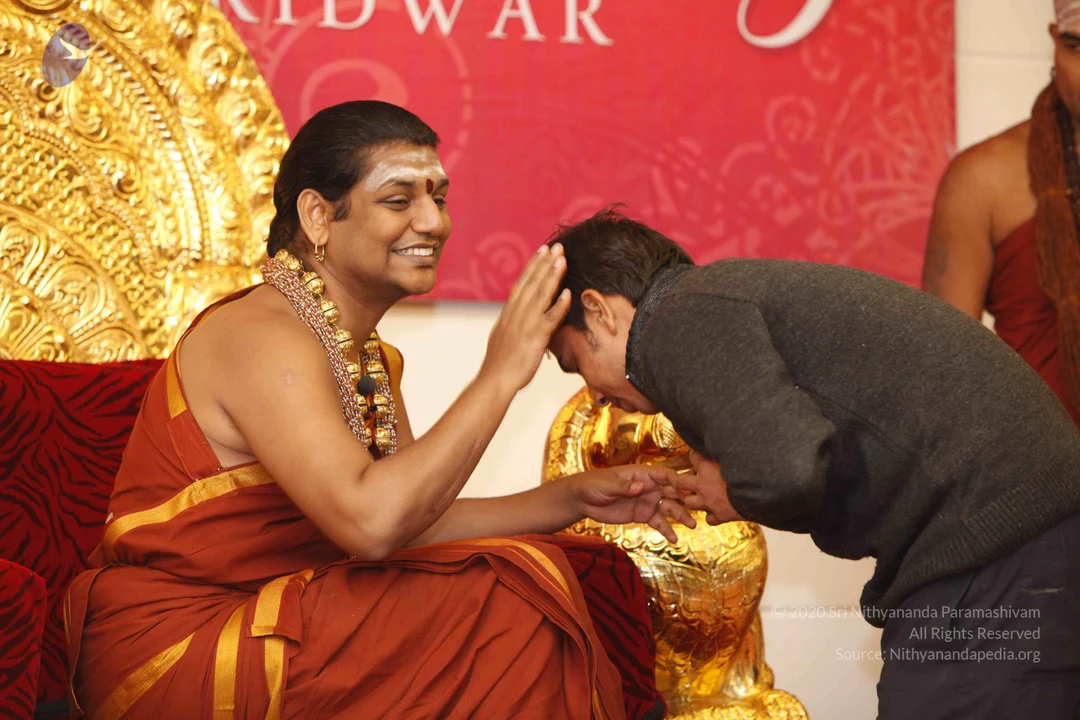
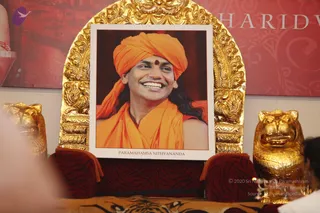
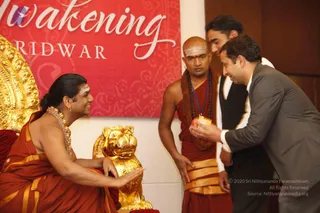
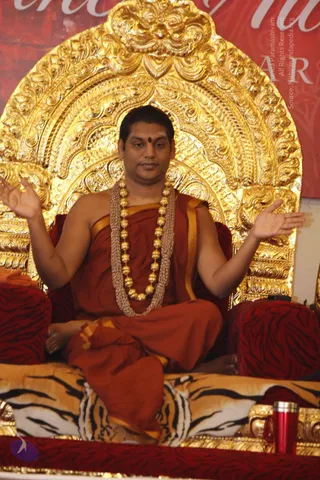
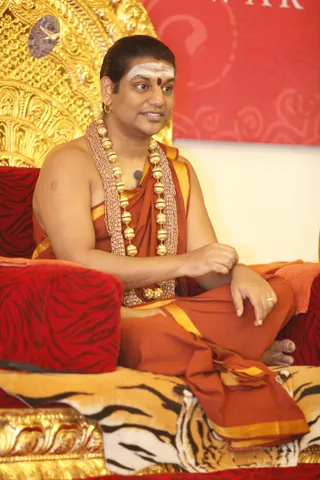
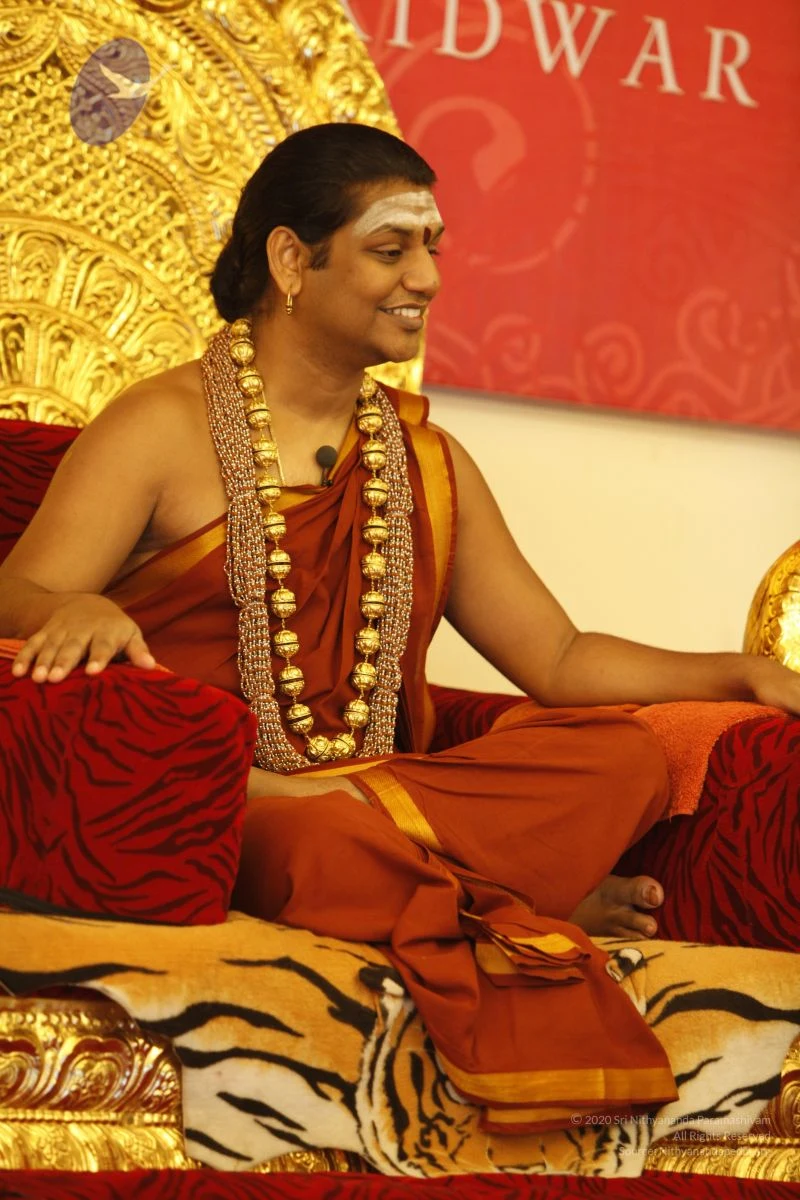
A man seated cross-legged on a red velvet cushion before an ornate gold throne with carved lion-head armrests. He wears a saffron-orange robe with gold borders, a heavy multi-strand necklace of gold beads and chains, and a small lapel microphone on his chest. His forehead bears white sandal paste lines with a red kumkum dot. He smiles and gestures with one hand toward the side while the other rests on his knee. Behind him a red backdrop with gold patterns bears the partial word RIDWAR. a person: a saffron-robed figure on a throne with a rudraksha-style gold bead mala and ceremonial gold necklaces, seated in a discourse setting.A seated man in orange-red saffron robes with gold-yellow borders sits on an ornate gold-leaf throne with a carved arched back. He wears a heavy multi-strand necklace of large gold beads and a red bindi on his forehead. His arms are raised with palms open in a teaching gesture. He sits on a tiger-striped cushion with red velvet pillows, and a red thermos mug sits at the lower right. Behind him is a red backdrop with partial white lettering.A photograph of a ceremonial moment indoors. On the left, a bare-chested man with hair tied back in a bun wears a red-and-saffron cloth and a layered gold and pearl-coloured garland, holding a small silver tray or implement and extending it toward the head of a bald man on the right. That man wears a white embroidered shirt with blue patterns, a wooden bead mala and a small cross pendant, and raises one arm. Behind them a woman in white with a pale mala stands, and a gold ceremonial vessel sits in the lower left. A large patterned wall panel and a lit display screen are in the background.

January 21 2014

Original wiki page
Contents

Title

HDH Bhagavan Sri Nithyananda Paramashivam advises us to carry possibility in our hearts to awaken life within us.

Description

Video and Audio - The Best Gift for our Children

In today’s morning Satsang, Paramahamsa Nithyananda advises us to carry possibility in our hearts to awaken life within us. The possibility we carry should be infectious, by our enthusiasm, spreading out to everyone around us. In this state, we are more active and useful to our family, neighbors, society, and humanity. Let us stay off the couch, away from the TV, and create excitement and joy in others!

VideoAudio

Transcript

[00:00:14]

nithyānandeśvara samārambhām nithyānandeśvari madhyamām | asmat āchārya paryantām vande guru paramparām ||

[00:00:38]

is samay hamare saath upasthith sabhi darshakon, bhakton ka mein prem aur ashirwad sahith swagath kartha hoon. aaj ke satsang mein, mein aap sabhi ka prem aur ashirwad ke saath swagath kartha hoon. sabhi bhakton shishyon sannyasiyon samajiyon ka swagath hai.

[00:01:03]

I welcome all the devotees, disciples, samajis, satsangis, sitting with us all over the world, this time through Nithyananda TV, Sadhna TV, Ishwar TV, Janasri TV, and through two-way video conferencing, having nayana deeksha in 29 cities in many countries around the world. The cities sitting with us via two-way video conferencing. Greensboro - North Carolina, Kuala Lumpur - Palani, Monterrey - Mexico, Charlotte - SriSailam, London - Kaashi, Nithyanagara - Bangalore, Xalapa Jalisco - Mexico, San Diego - La Jolla, Oklahoma - Somanatham, Seattle - Chidambaram, Houston - Kalahasti, San Jose - Madurai, Adhi Nithyananda Dhyanapeetham Avathi Palayam (2:09), Thiruvanmiyur - Chennai, Ohio - Ma Shivananda, Bengaluru - city centre, Nithyananda Nagaramu - Hyderabad, Los Angeles - Arunachalam, Ohio - Prayag, Toronto - Kaailasam, Indrani - New Jersey, Adi Nithyananda Dhyanapeetham Avati palayam, Guadeloupe - Prameshwaram, Houston - Kaalahasti, Singapore - Singapuram, San Antonio - Texas, Enriching Temple Bidadi, Molieres - France, Oman - Sivagangai, Scottsdale - Arizona, Hyderabad - Gupta Kashi, Thiruvanmiyur - Chennai.

[00:03:00]

I welcome all of you with My love and blessings. I specially welcome all the participants in Toronto - Kailaasam; all the devotees, viewers, visitors gathered in Toronto Kaailasam for special kalpataru darshan, unique kalpataru darshan.

[00:03:24]

Today again I wanted to expand on kalpataru. Listen, there is a big difference between every action you take with the idea of impossibility, and with the idea of possibility. Understand? For example, from Haridwar you are travelling to Delhi. You are going by walk. Every step you take, you put, with the idea, you are never going to reach Delhi, with all kinds of doubts, “who knows whether this is the right road? Who knows whether the tempo..whether the weather will be helping us? Who knows I will not get into some accident and die?” With all kinds of doubts. The more and more number of steps you put, more and more you will be tired, sick, depressed. If you walk in the same road, with the idea of possibility, more and more you will be excited. When you see every name board, “Wow, we are coming closer to Delhi, closer to Delhi.” And the ideas, what you’re going to achieve, enjoy, have in Delhi, that will inspire you and excite you more and more.

[00:05:16]

Please understand, don’t ever think like a so-called rationalist, irrational-rationalist. This irrational-rationalist always give an argument, “Eh, what is there? Whether I believe or don’t believe, the same number of steps only I have to take to reach Delhi.” Understand, number of steps may be same, but the effort will not be same. When you walk with the impossibility, number of steps may be same, but the effort will be more. If you walk with the possibility, number of steps may be same, but effort will be practically zero. The more and more action, the more and more excitement, is the definition of possibility. The more and more action, more and more excitement. The more and more action, more and more tiredness and boredom, is the definition of impossibility.

[00:06:38]

One of My disciple asked me, “Swamiji, what is this, everyday morning exactly You get up, run to take bath, do Your puja,” I am sincerely doing, even I am some..sometimes surprised. See, after the realization of My incarnation-hood, see, from the age of three I started puja. First I started with Ganapathi puja, with that Ganesha deity I got. Then, a few deities added. But from the age of three I remember, Me doing puja, unbroken, till the age of 22. And after 22 no puja. Just being in the samadhi, that’s all. Again, the day I took up the responsibility of Madurai Adheenam, from that day till now, unbroken, I am doing puja as a tradition. I’ll sit and invoke My own presence and offer 😃 It will be very cute if you see the puja. 😃 I’ll sit with so much of joy and I’ll feel exactly, almost like a, My own hand putting it on Myself. But it is such a joy. So one disciple asked Me, “What is this Swamiji? You do your puja and run to the satsang. Are you going to do this for your whole life forever?”

[00:08:44]

Please understand, the moment he asked, I know that idea of boredom and tiredness as a pattern in him. Immediately I told, “First thing, understand, not only My whole life, even after I leave the body I am going to be doing this.” I am going to be doing this forever, as a aksharadhama. Forever and ever, from My aksharadhama I’ll continuously be available. You will see, all over the world in all My samadhis, people will gather every morning and do Pada Puja and sit for satsang, Upanishad with Me. When I am in the body, when My body is moving and when My vocal cord is functioning, it is satsang, Nithya satsang. When that does not function, it is Nithya Upanishad, that’s all. It is going to be My action, whether I am in the body or after I leave the body. He could not understand, the disciple could not understand. I wanted to tell him and tell every one of you, if any action brings you tiredness and boredom, you already have a belief of impossibility. The subtle impossibility is already developed in you.

[00:10:33]

I tell you, beauty in the action is possibility. We all know how to beautify our body and skin. We need to know how to beautify our actions. When you are carrying possibility and acting, every action brings more and more joy and excitement. You will grow younger and younger. Your face will become more graceful, more younger, more beautiful. Very rarely I have seen people growing younger. One person without doubt I can say, Sathya Sai Baba. He grew younger and younger and younger. The more time passes, he was becoming more graceful and more younger. Without any controversy or doubt, I will tell, I will tell very clearly and boldly, one person I’ve seen in My life growing younger and younger and younger is Sathya Sai Baba. I have seen Yogi Ram Surat Kumar also. Not only the face and the being, even the.. the lifestyle, everything. Bhagavan Ram Surat Kumar, the more the number of years he become more like a child. He was growing younger.

[00:12:47]

I tell you, the same Haridwar to Delhi, if you walk with the idea of impossibility, SDHD, you will not even cross Roorkee. Before that itself in some Ganga canal you may fall and die. With SDHD, you will not even cross Roorkee. If you walk the same road with the idea of possibility, without SDHD, every step gives you excitement. By the time you reach Delhi, you have all the excitements, all the excitement of Delhi. And, you get excited to do more walking, more yatra. I tell you honestly, when I started My yatra, please understand, let it be on record, when I started My Parivrajaka Yatra, I never thought, or planned, I will walk length and breadth of India, I will spend so much time In My Parivrajaka Yatra. The first few days of Yatra, I carried with the idea of possibility, that’s all. The concept of possibility gave Me so much courage, so much joy. I never imagined I spent 9 full years. God!

[00:14:26]

You see, a person who is more awake, for him, one day is equivalent to the three day of a normal man. See, even for the Inner Awakening, all the IA graduates, understand, you guys did not go through 21-day programme. You have gone through 63-day programme in 21 days. Because the number of hours you were working, just see. Morning 4 o’clock you’ve got to get up. Am I right? Ah, sorry, 3. Because 4 you have to be in the yoga. 3 you have to get up and clean all the holes and.. and.. and 4 you have to be here. From 3, what time you go to bed? 9 or 10, sometime 11. In the normal everyday, regular day, average a man works 6 to 7 hours a day. Here come on, see how many hours? And that also, all the emotional rollercoasters, ups and downs. And so much of cleansing. So, 3 days action you go through in 1 day. Understand? External cleaning, internal cleaning, internal internal cleaning.

[00:16:04]

So, I was a this kind of a person, Too many hours means, many number of hours, waking hours. Too many number of waking hours was My lifestyle, from the beginning. So I never imagined 9 years, 9 means in My lifestyle 9 into 4, 36 years. Because for Me, there is no other thing. No waking... no dreaming and sleeping state. I never thought so many years I’ll spent in Parivrajaka Yatra.

[00:17:01]

Now I remember, when I am going around the Haridwar, I have not spent years in Haridwar, surely months only, at different different time, but months only, not years. But I feel like, as if I know the whole Haridwar, because I don’t keep quiet. I’ll be walking around everywhere, going to every temple, going to every ashram, going to every place. The active lifestyle, I tell you, because that possibility gave Me the excitement, only now when I look back, I am shocked, 9 years I spent in Parivrajaka - Means, going from place-to-place. Not being stable in one place. God.

[00:18:26]

Please understand, take this one lesson, intranalyze this one truth. It may be same number of steps, same distance, but the effort, result, everything will be different. if you carry possibility with you. I tell you, when you travel with possibility idea from Haridwar to Delhi, with the idea of possibility, even if you’ve walked the same number of steps, you will forget many time, you walked or you struggled so much. To tell you honestly, when I describe it looks like a struggle for all of you, My Parivrajaka yatra time. Otherwise, it was simply honey-sun. Honeymoon means you may start imagining your own stories, I don’t want to tell that word. It was just a joy, excitement. Vacation with nature, that is exact word I’ll use. Vacation with nature.

[00:19:58]

Travel in your life also, with the possibility in your heart. You will see, one: every step does not tires you, it adds to more and more excitement. See when you walk with impossibility, every step adds anxiety, not excitement. When you walk with possibility, every step adds excitement. And, when you reach the goal, you won’t even feel tired that you did so much; because when you were walking you did not feel tired. See, when you were walking, if you did not feel tired, after reaching you will not have the tiredness memory. But with the idea of impossibility, while you are walking it’ll be tired, you may not reach. By mistake if you reach, it will give you the idea of “Ohhh, so much difficulty.” I tell you, I don’t feel at all I have struggled to do anything in My life. That is why still I don’t care about all this opposition, abusal, illegal attacks. I am not at all bothered.

[00:21:40]

Actually these guys who are abusing, spreading lies, spreading rumours, they should have a small trailer of My inner space, heart 😃 They should get to, look into My inner space, they will really, they’ll really be, because they may be thinking, I am, I am giving too much importance to them in My inner space. When they look there, and they find that they are not even there, they will really be upset. Because they really expect that I should be afraid of them or I should be frightened about them, or I should have at least little concern. This is too much.

[00:22:44]

What to do? I tell you one thing, I tell all these guys who are abusing us, attacking us, illegally, immorally, adharmically, and lying about us, spreading rumours, I wanted to tell all you guys one thing, please understand, “do not fight with a man who don’t have vengeance.” Understand, this is a secret of life, I don’t have any vengeance, I don’t have any violence, My inner space is full of power. Don't fight with the guy who don’t have vengeance. You will fall and collapse, fail bitterly. See, only a person with vengeance will become tired, will become bored, will feel he’s doing mo… so much. A person without vengeance will never feel he’s doing too much. I neither feel I am doing too much nor I have any vengeance against anybody, or I have anger, no nothing.

[00:24:33]

Understand one of the very important lessons in the life. Do not fight with a guy who don’t have vengeance. You will lose the game. Always fight with the fellow who has a vengeance, you will always win the game. Please understand, the fellow with vengeance, even if he is a too big guy, you are a too small guy, you just go with the space of without vengeance, go with the completion, you will just win him.

[00:25:29]

I am still working and trying to get some of the Akashik records, how did the few akhada sadhus fail in the war? I want to study, because many of our akhada sadhus were established on Nididhyasana. Only after they were established on nidhidhyasana level, means the cognitive shift has happened, they have sent to war, they have been sent to war. How did they, a few wars they lost, how did they lose? I want to study. Maybe before, some emergency I think some of the people have been sent to war before the training. That might have been the reason for their loss. Otherwise I tell you, a violence-free man can never be conquered. It’s a law of life. Violence-free man can never be conquered. My victory declares not just My victory, victory of dharma. I am telling you, My victory over all these abusive elements, anti-spiritual elements, anti-social elements, anti-humanity elements, anti-national elements, proves, this one truth: a nonviolent person can never be conquered. You will always lose if you are fighting with a nonviolent person. Because he’s so powerful. I tell you, a nonviolent person will be so powerful inside. He will not have any wound inside. And he knows, very beautifully he will handle the whole situation, and he knows what to do. When you’re filled with violence you will not know what to do. You will enter foolishly into a small ashram and break, beat that Swami, and get into trouble!!

[00:28:13]

I tell you, that is why in tradition, always before war, warrior has to do tapas, he has to do tapas. Whether it is Arjuna or Bhima, first they have to do tapas, become nonviolent, powerful, only then any war. I tell you, carry this space of possibility, you will always win in all wars. No one can win you in any war. Because the space of possibility excites you more and more, inspires you more and more, brings rejoice in you.

[00:29:34]

You can see in My life. Really people thought, how can Swamiji do 21-day programme, continuously? First year we did one. Second year we did two. Third year we did four. Fourth year we did six, sorry, third year we did one, because of the abusal and attack, but fourth year we did six, 4, 4, and fifth year we did six, sixth year we did eight, and, 7th year we are doing 12. Yes, 2008 - one, 2009 - two, 2010 because of the attack and abusal - one, 2011 - four, 2012 - six, 2013 - eight, now 2014 - 12. It’s only just multiplying.

[00:31:06]

By next year I am training acharyas. I’ll do in one spot, acharyas will be going around and doing in different places. Understand, carry the space of possibility, every day action will only lead you to more and more excitement. Every Inner Awakening only excites Me, not tires Me. I am only excited to spend more time with people, to be with people. Every day kalpataru only excites Me, doesn’t tires Me. I tell you, in your life, carrying the space of possibility in your heart is kalpataru.

[00:32:50]

Photos
Tags

Paramahamsa Nithyananda, hearts, state, family, neighbors, society, humanity, couch, TV, create.

Photos Of The Day:

Morning-Satsang-and-Puja
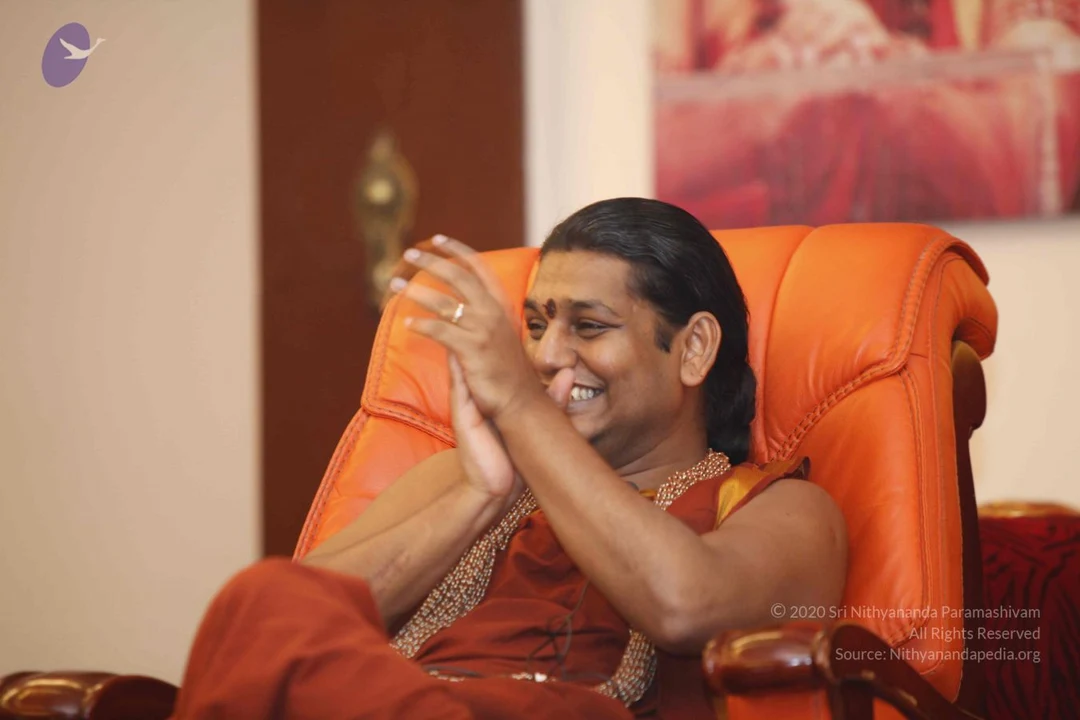
Darshan

Photos Of The Day:

Photos Of The Day:

Morning-Satsang-and-Puja
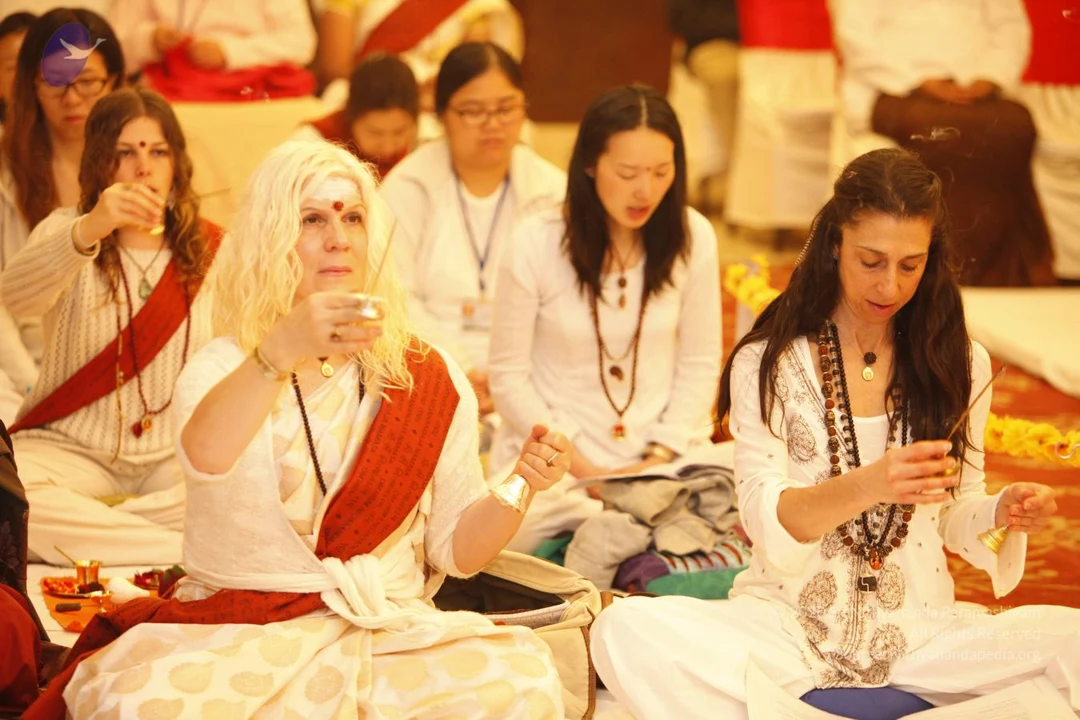
Darshan

01-Morning-Satsang-and-Puja

02-Darshan

Photos from this day

View all 56 photos

Morning-Satsang-and-Puja
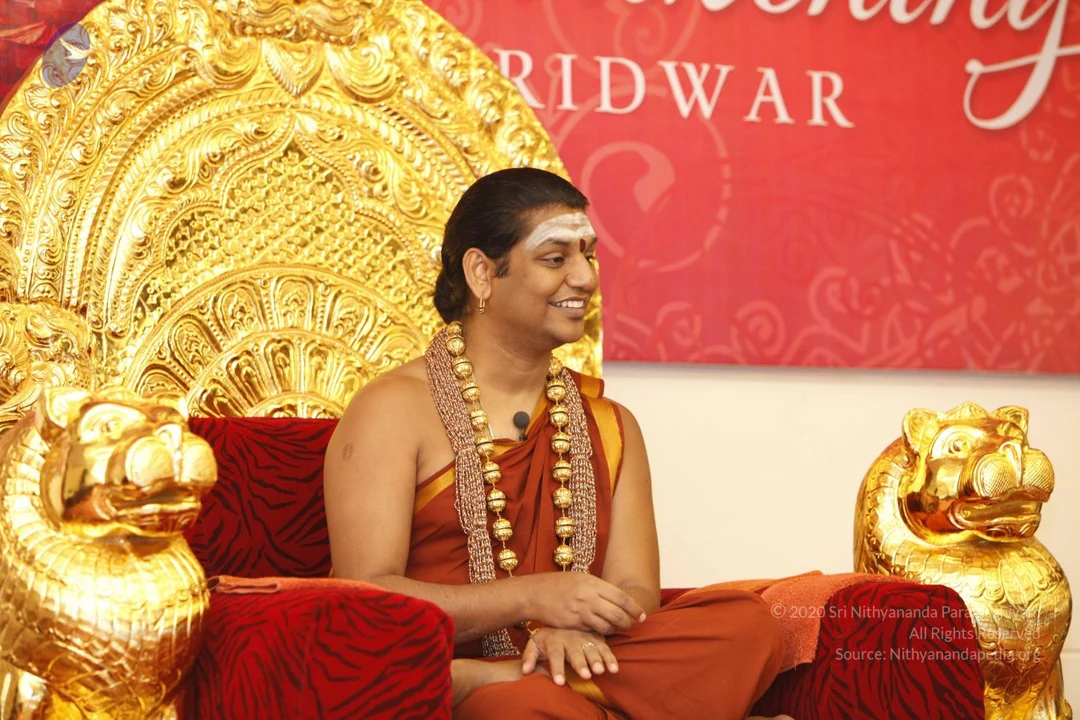
24 photosSource gallery
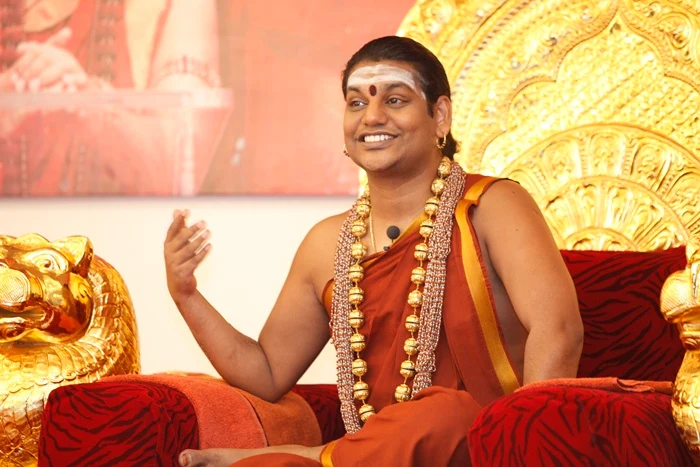
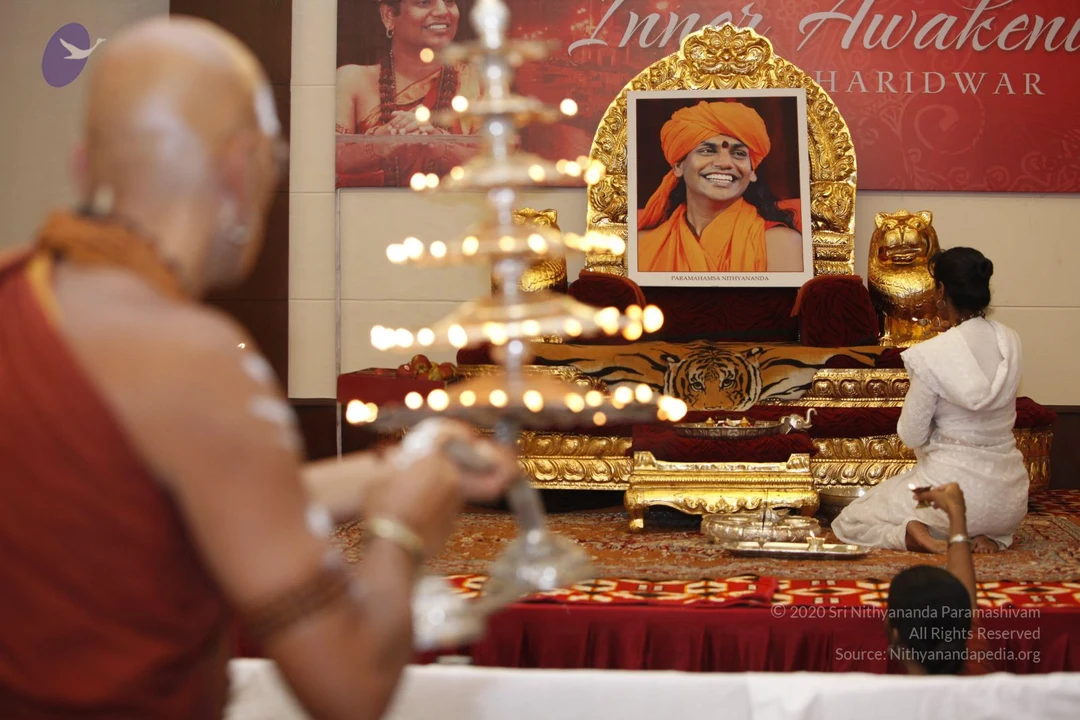
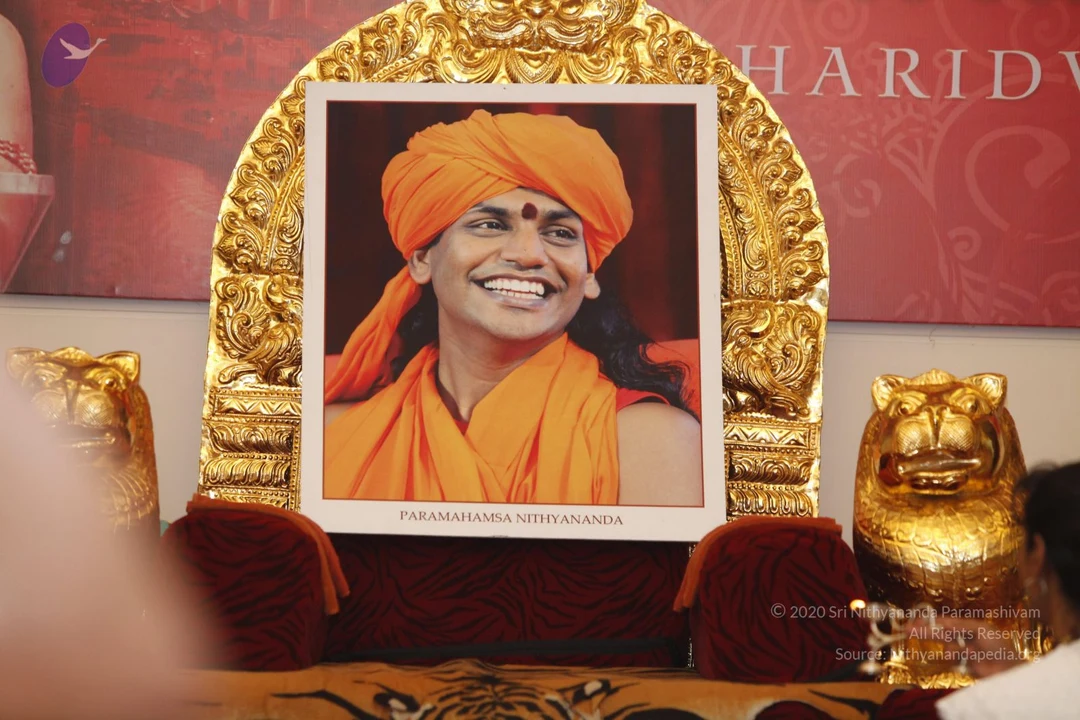
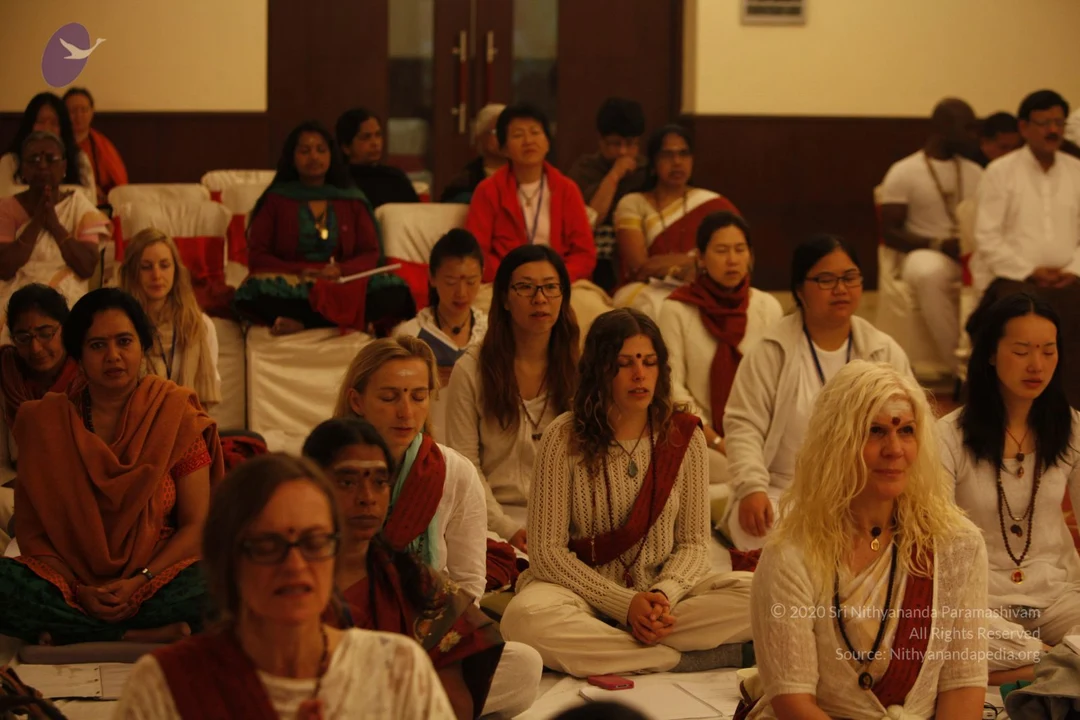
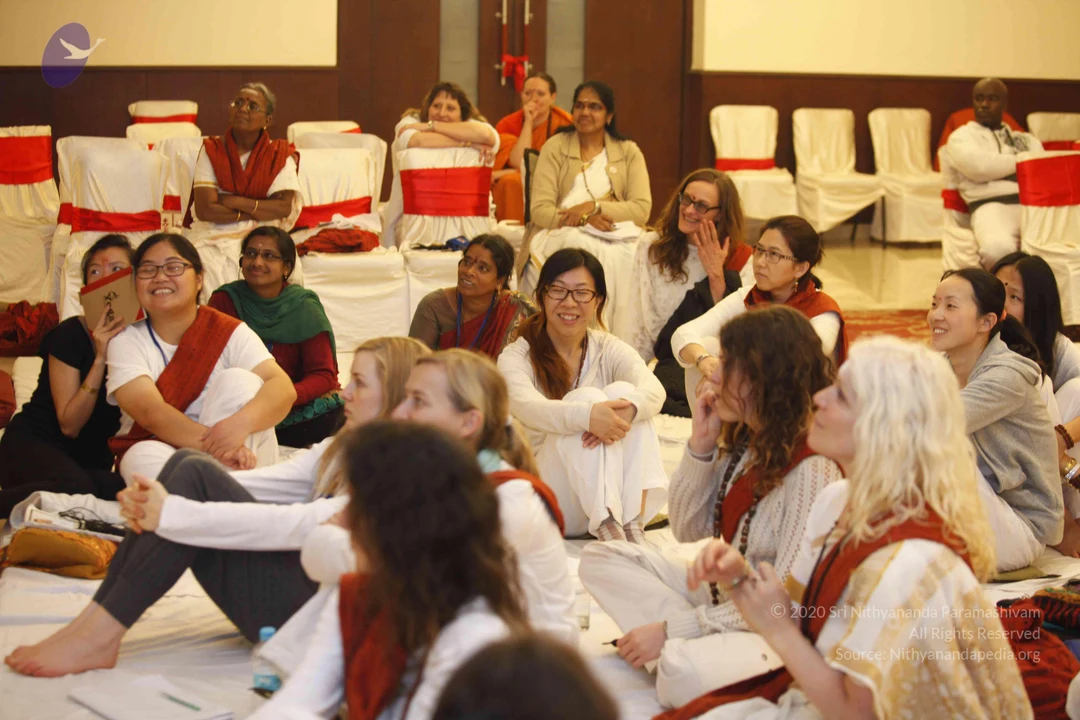
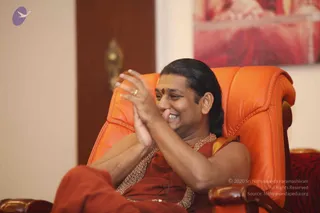
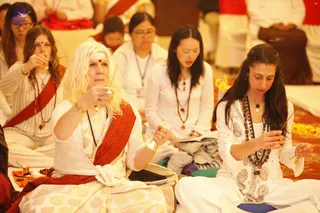
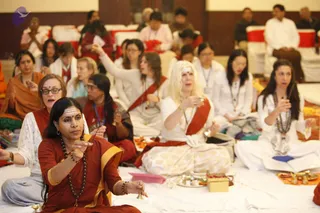
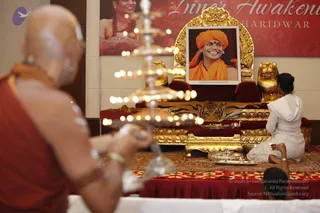
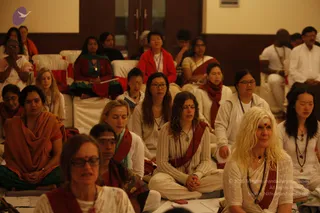
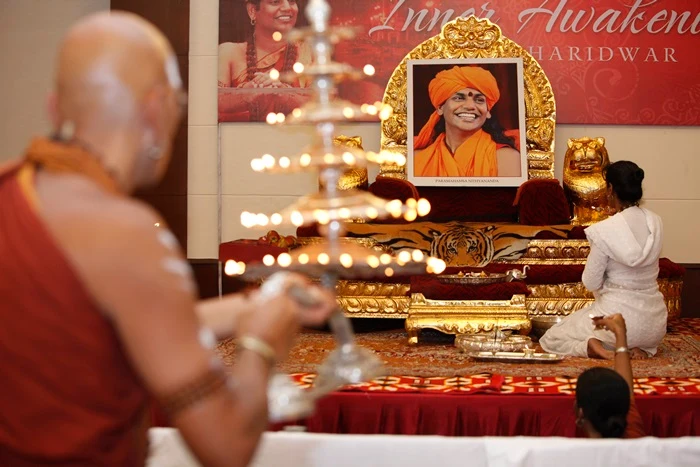
A man in a red-orange robe sits in a large orange leather armchair, smiling broadly with his hands pressed together and fingers raised near his face. He has long dark hair swept back, a small red bindi on his forehead, a ring on one finger, and a beaded rudraksha-style necklace over the robe. Behind him a red abstract painting hangs on a cream wall beside a dark wooden door with a brass handle. Probable Swamiji (probable) appears in a seated satsang setting, with the visible cues of long swept-back hair, ornate beaded necklace and saffron-orange clothing.A seated group of devotees in white clothing performs a ritual in a warmly lit hall with red-and-gold carpeting. In the foreground, a woman with long white hair, a white tilak on her forehead, a red sash and a white-and-gold dhoti-style wrap holds a small cup or bowl and a metal dish, with gold bangles on her wrist. Beside her, a woman with long dark hair wears a white embroidered kurta and a long rudraksha mala, holding a small bell and an incense stick. Behind them, other participants in white kurtas, lanyards, malas and red sashes sit with eyes lowered. Yellow flower petals lie on the carpet, and a small brass plate of offerings sits at the lower left.A seated group satsang or puja in a hall with white floor covers and red-cushioned chairs behind. In the foreground a woman in a red-orange sari with a gold border, a white vibhuti mark on her forehead and rudraksha malas, holds a small brass bell and gestures with her other hand. Beside her a woman in white with a red shawl and a white-haired woman in white with a red and gold shawl hold offering items and sit near brass plates, flowers and a small gift box. Behind them many devotees in white and red attire sit and chant or gesture, while others sit in chairs at the back.A photograph of a ritual arati in a hall with a golden throne backdrop. In the foreground, a shaved-headed priest in a red robe with white sacred markings holds a multi-tiered silver lamp of lit oil lamps. Behind him, a seated woman in white clothing with her hair pulled back faces a framed portrait on a gold and red throne. The portrait shows a smiling figure in an orange turban and orange robe, with a label reading Paramahamsa Nithyananda. The throne has a tiger-skin cloth and gold lion sculptures, and a brass offering tray sits in front. A banner behind reads Inner Awakening Haridwar. Oil lamps and a brass plate are on the carpeted floor. The portrait is a printed picture, not a physical person.A large framed portrait labelled "PARAMAHAMSA NITHYANANDA" sits on an ornate gold-framed throne-like stand with carved gold lion heads flanking it. The portrait shows a smiling man with long dark hair wearing a saffron-orange turban and orange robes with a red bindi. The stand has maroon tiger-striped cushions and an orange tiger-patterned cloth below. Behind it is a red backdrop with a printed word partly reading HARIDW. Blurred people are at the lower edges, and a candle or lamp is visible near the right. This is a photograph of a printed portrait, not a live person.A photograph of a seated audience at a satsang hall, with rows of devotees sitting on the floor and chairs in warm, dim light. In the foreground a woman with glasses sits in an orange-brown shawl, and a woman with an ash mark on her forehead wears a white top with a red shawl. Centre right, a woman in a cream knitted sweater and red shawl sits cross-legged with hands folded and a red bindi, next to a woman with long blonde hair in white clothes with a vibhuti mark and a rudraksha-style mala. Behind them, rows of women in white and red shawls and men in white shirts sit with eyes closed or hands in prayer. No a person is visible in this frame.

Darshan

19 photosSource gallery
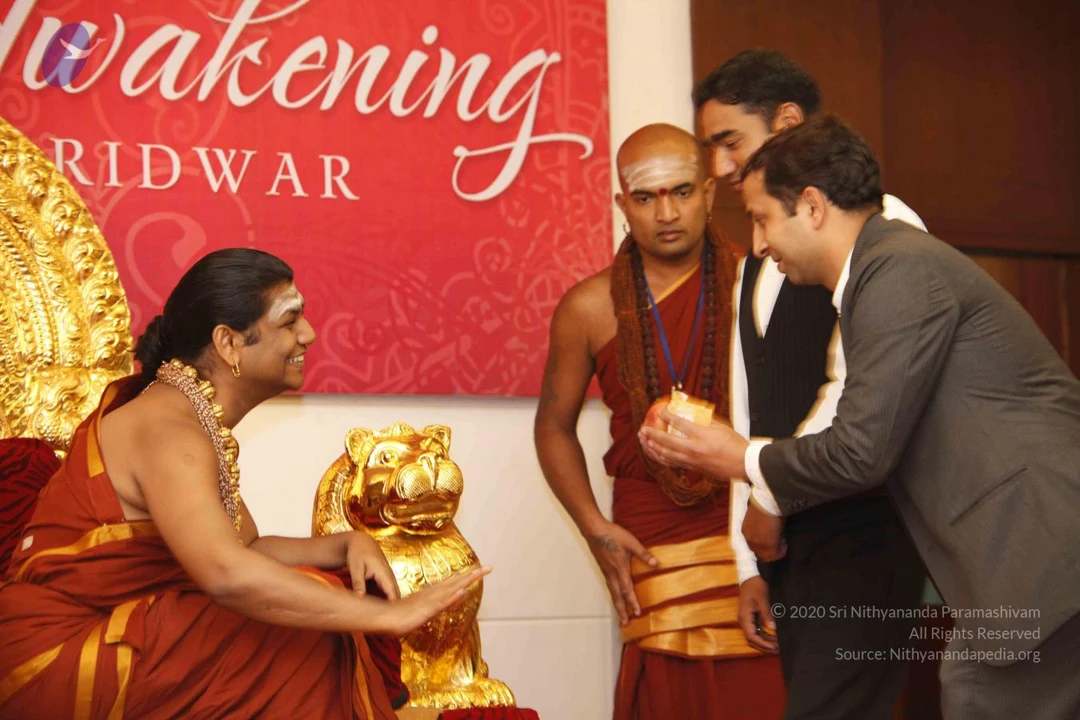
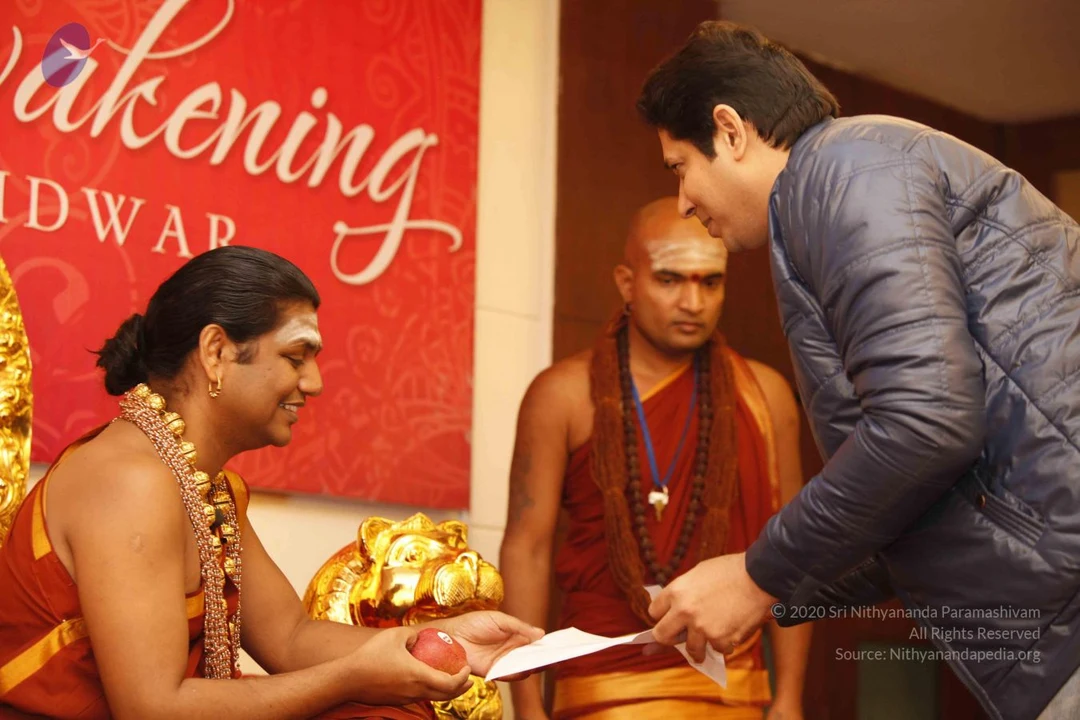
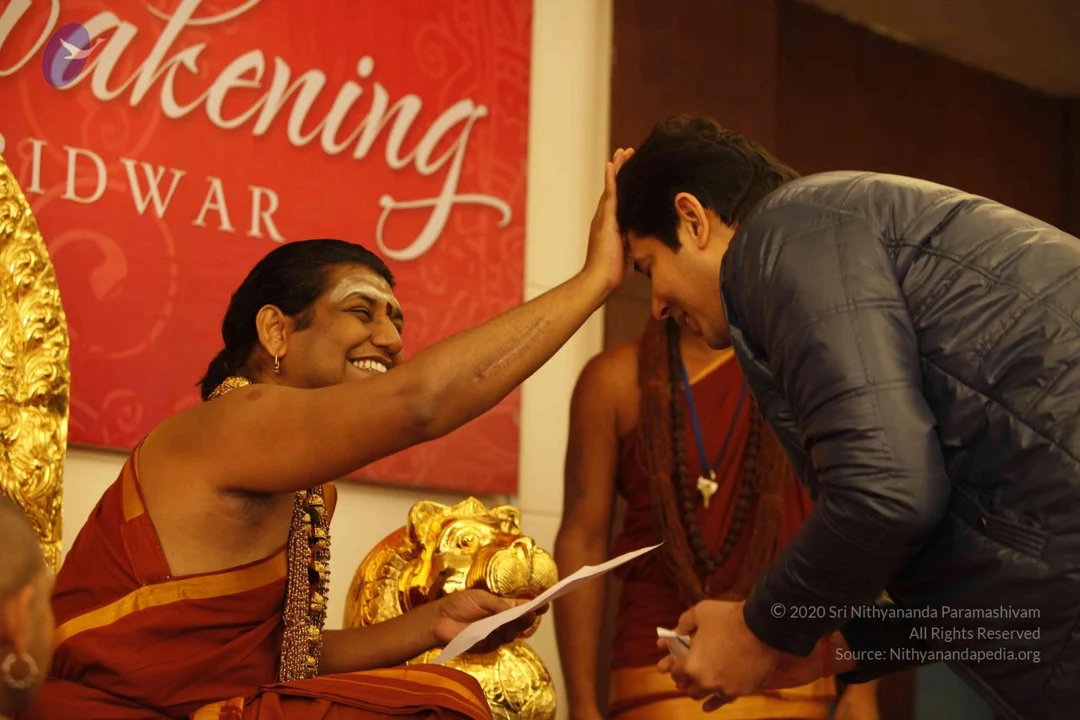
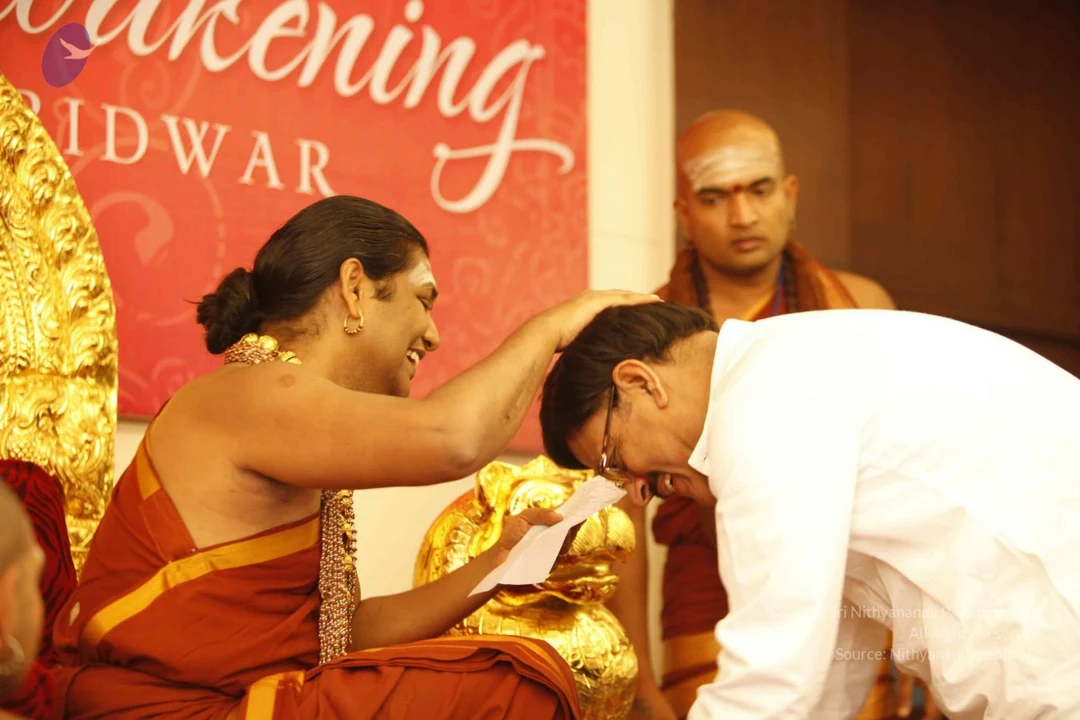
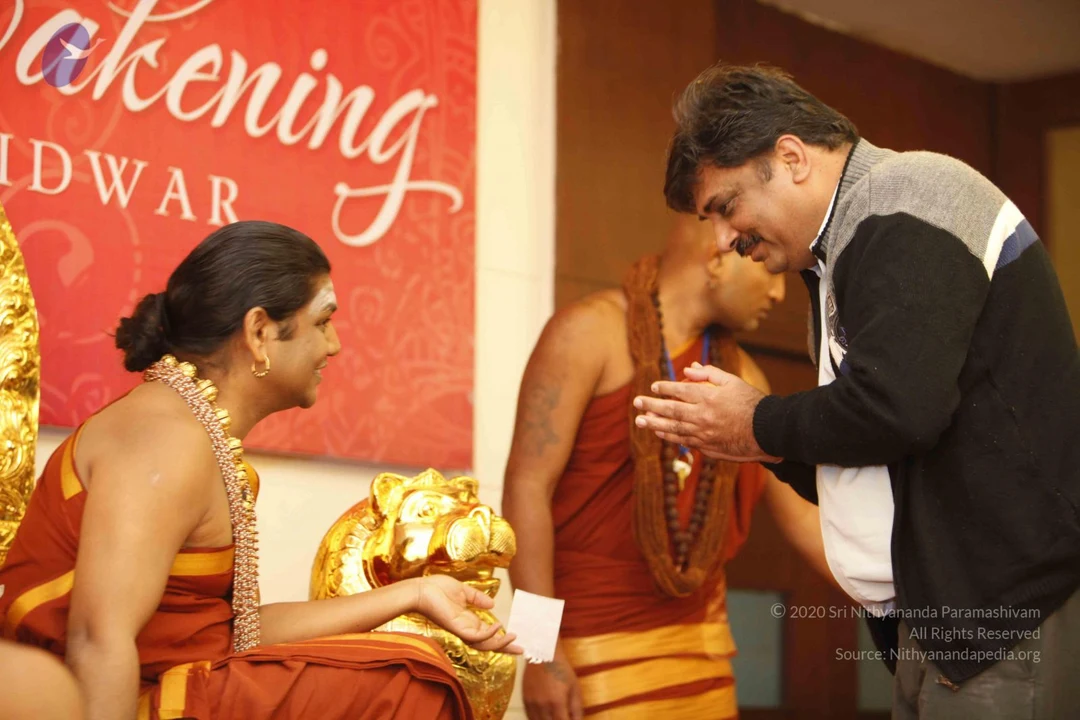
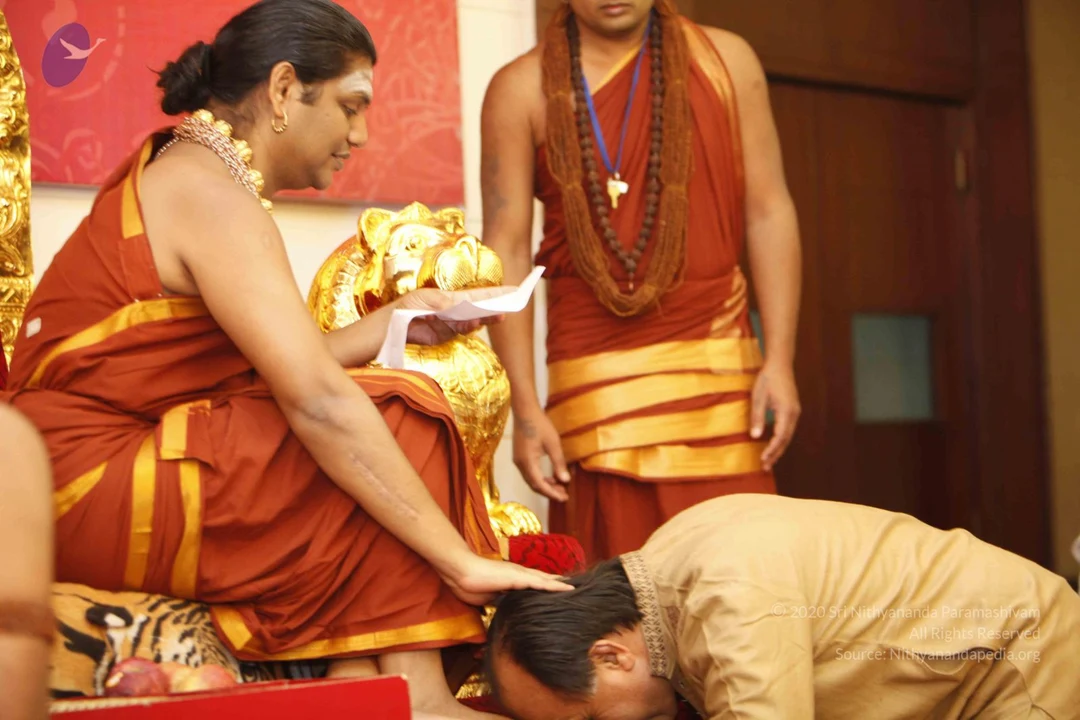
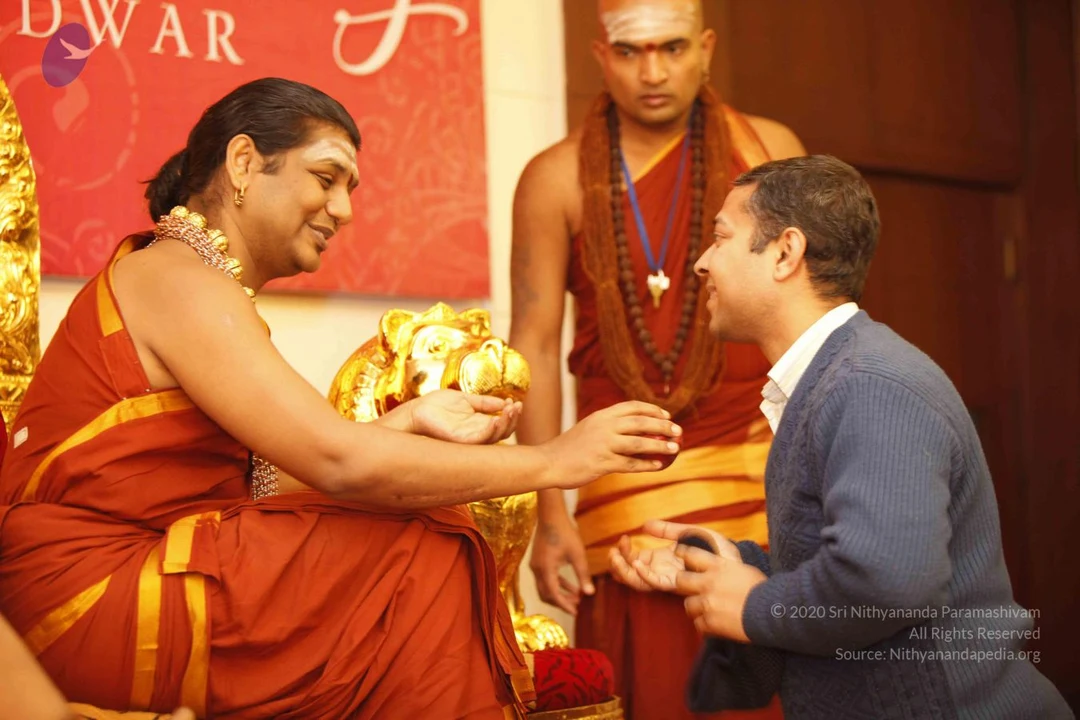
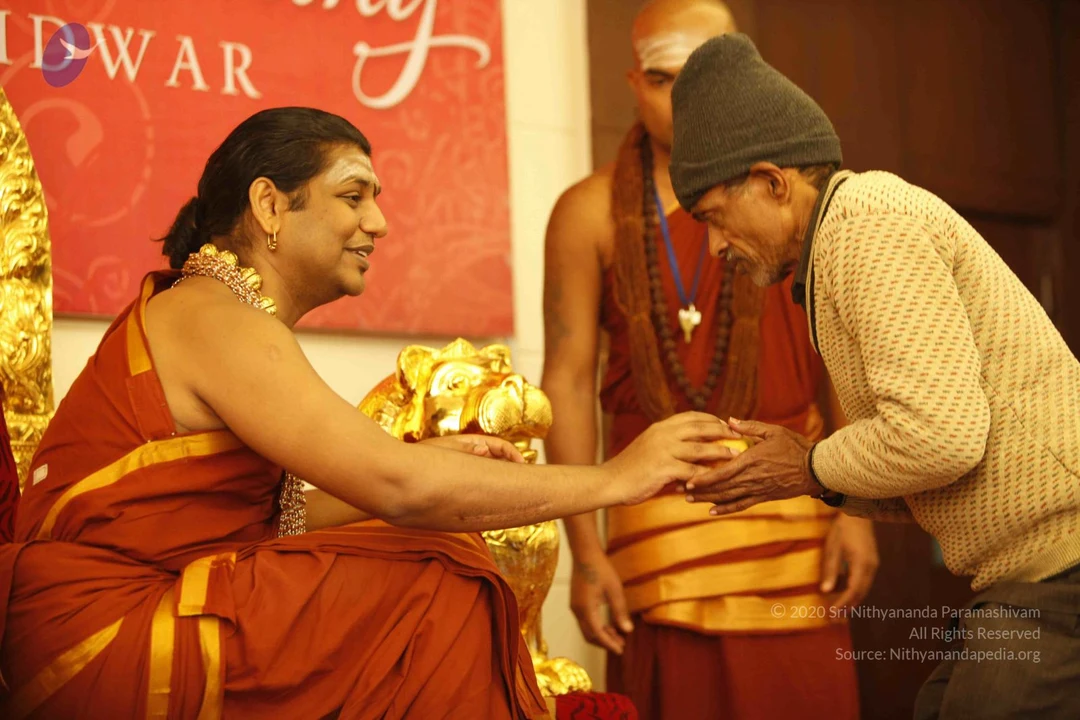
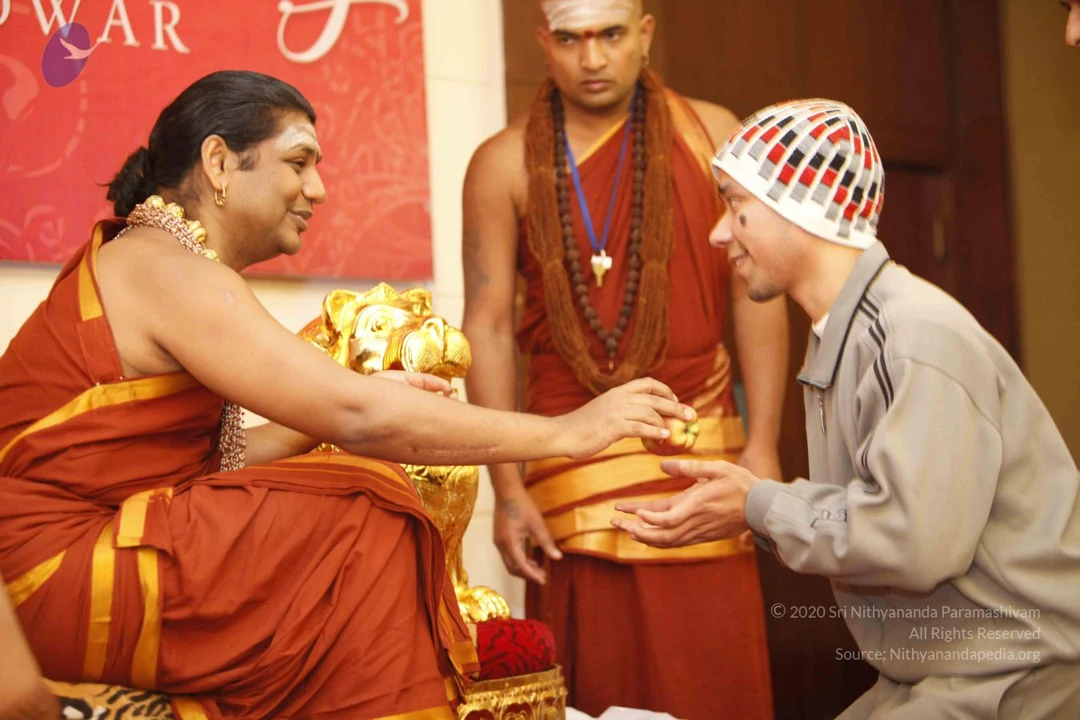
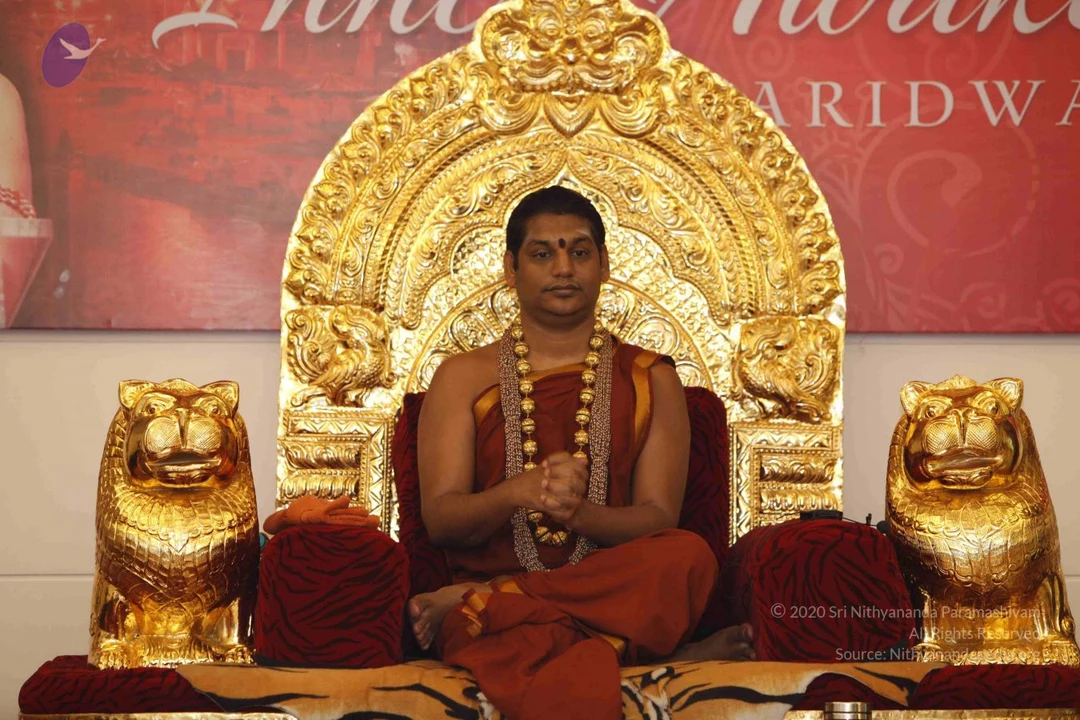
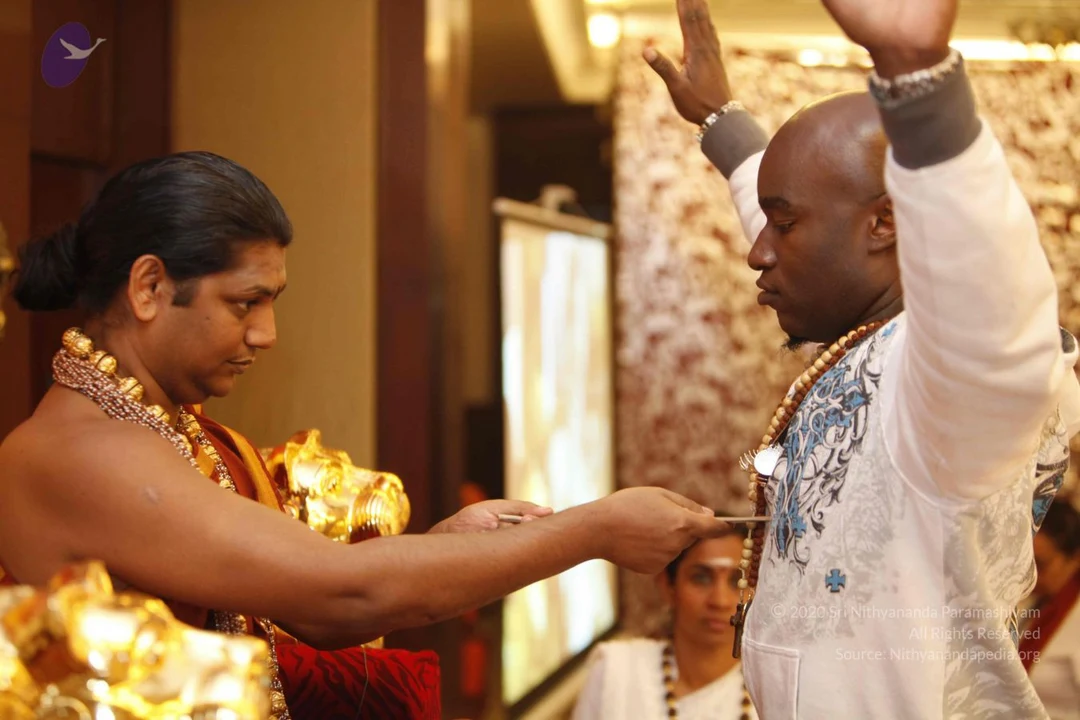
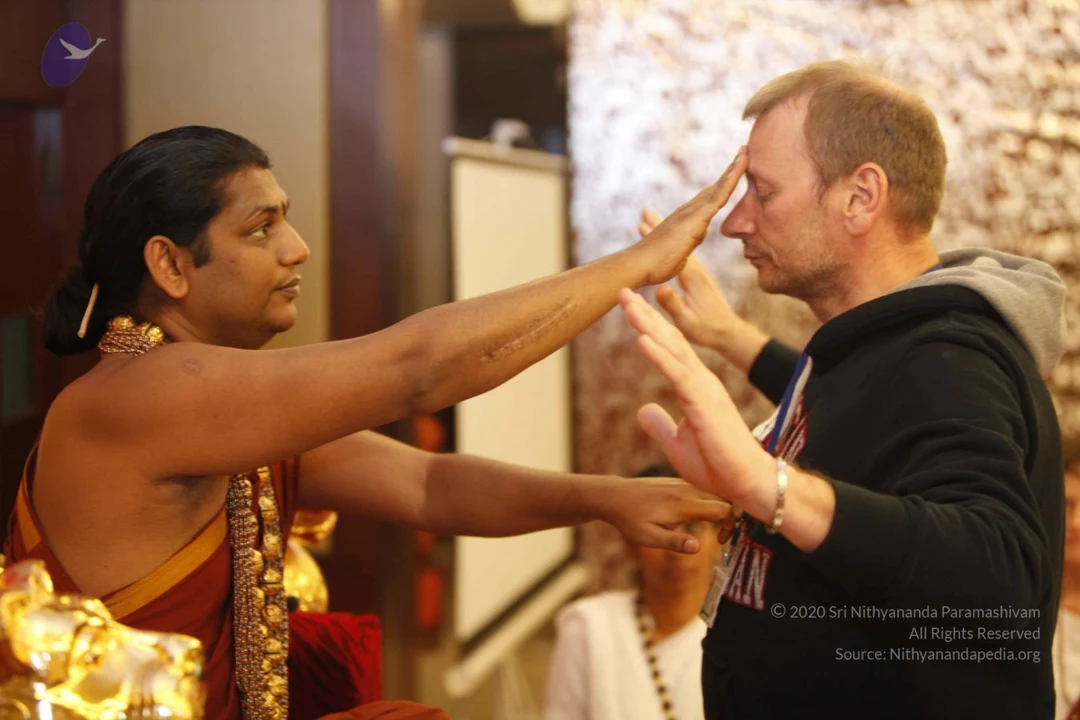
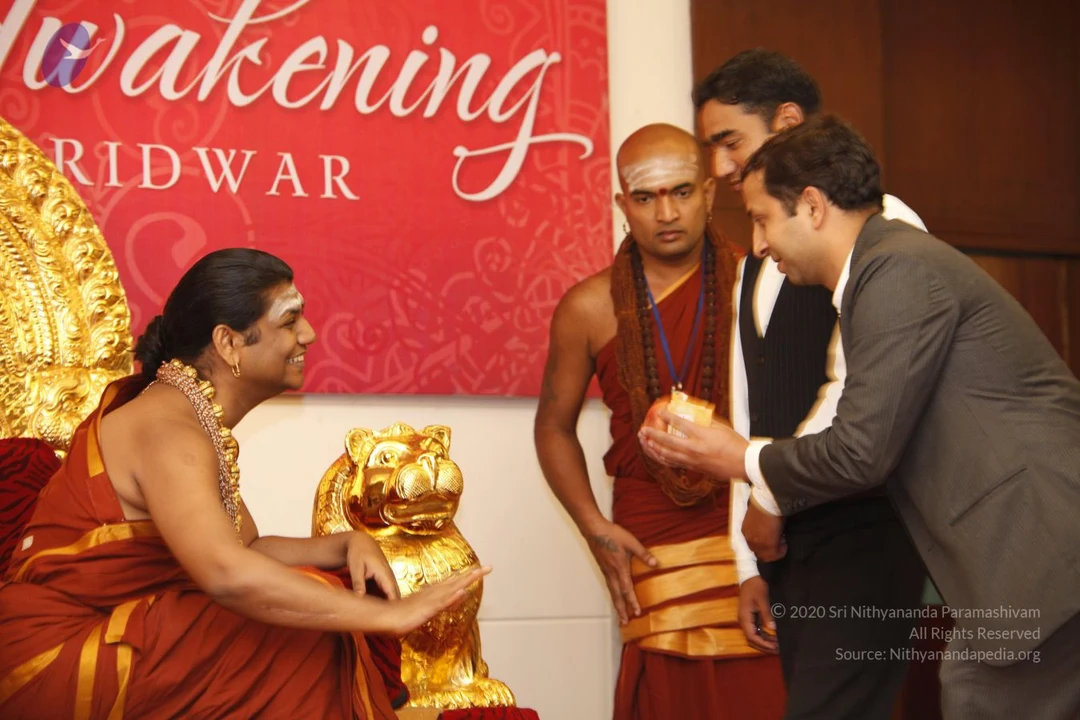
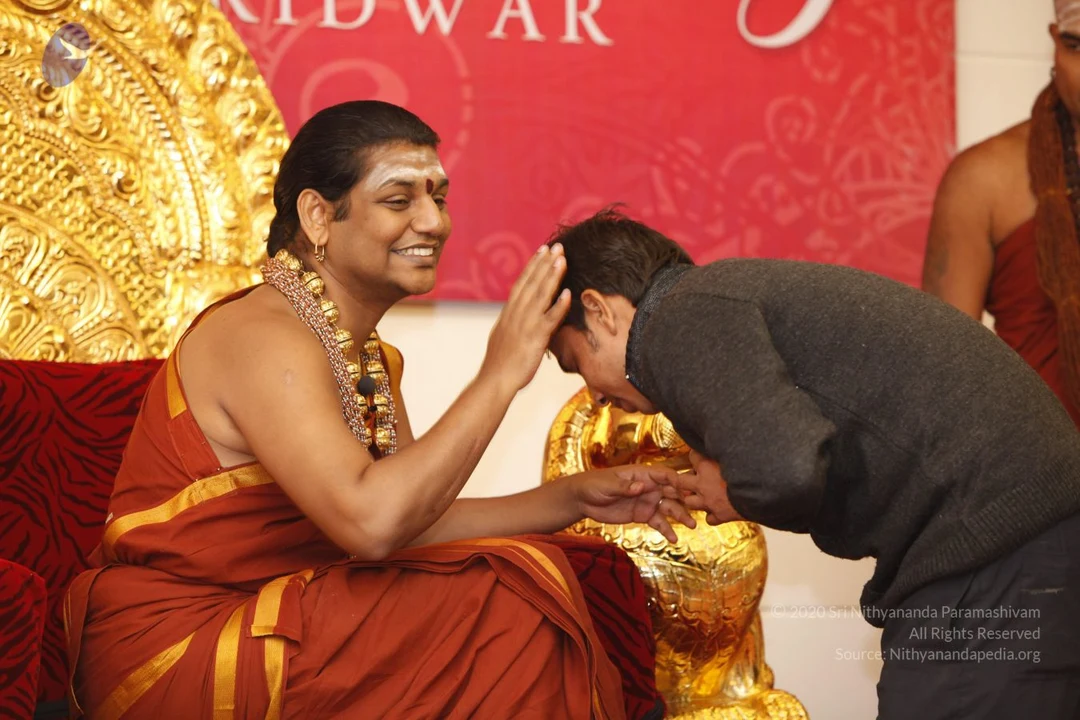
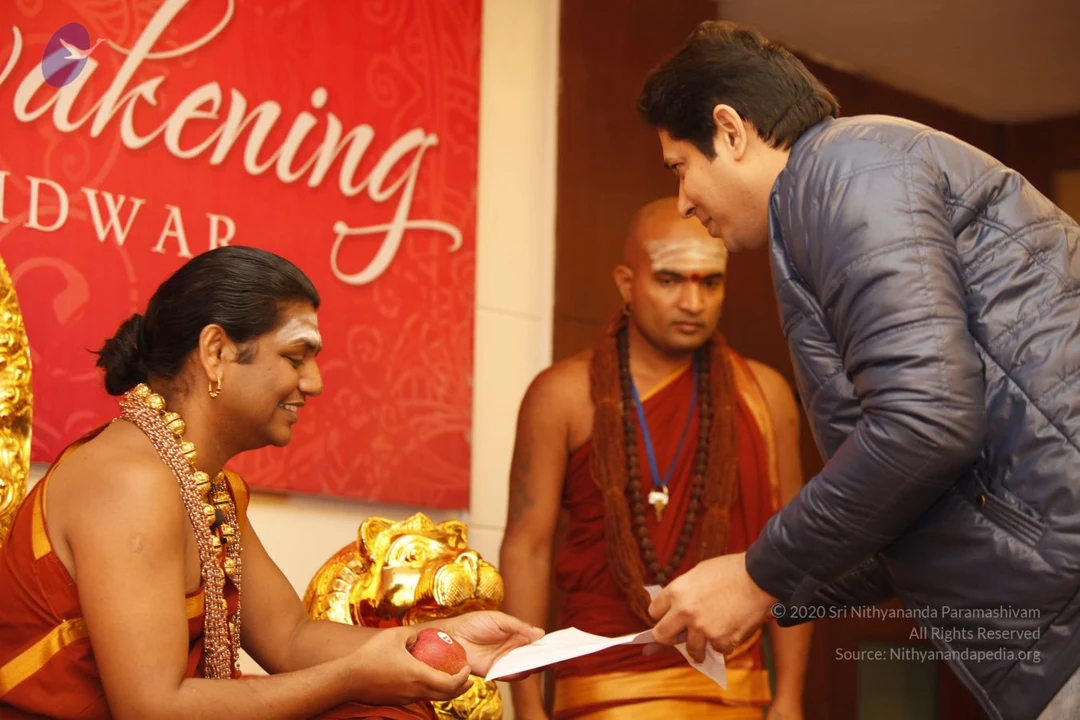
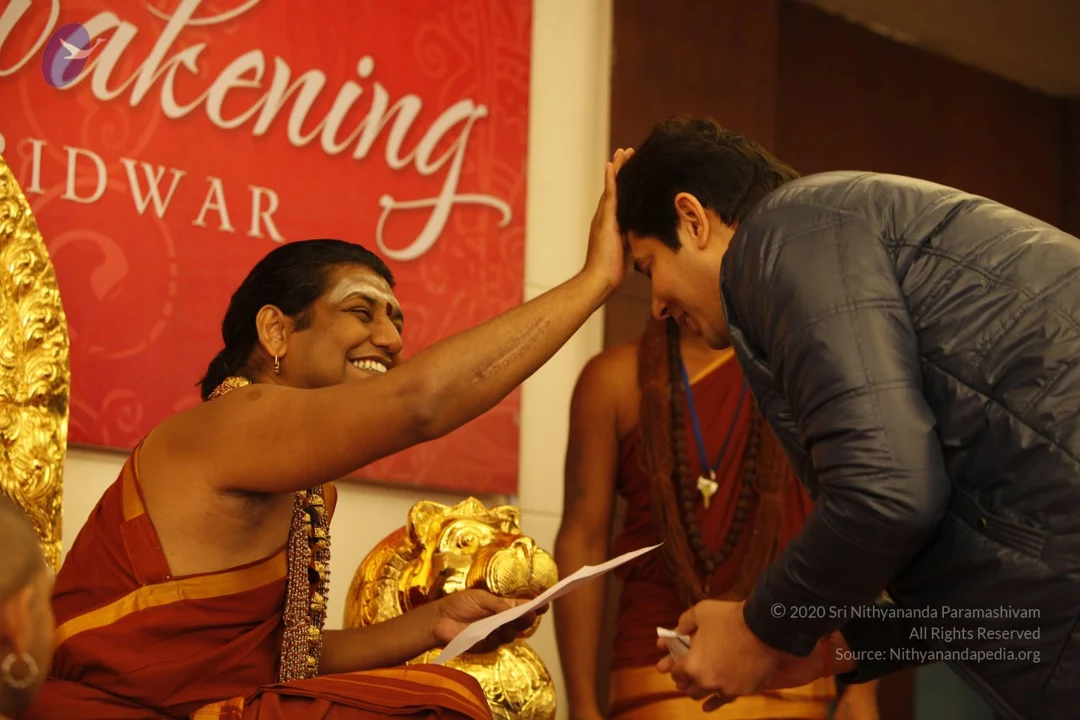
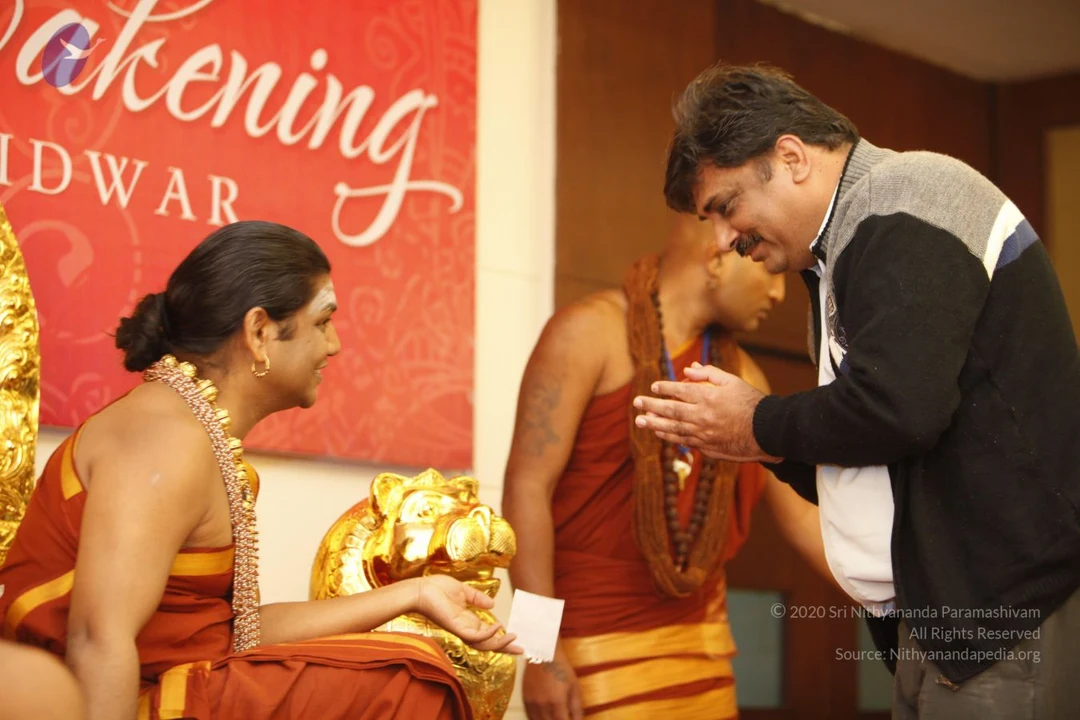
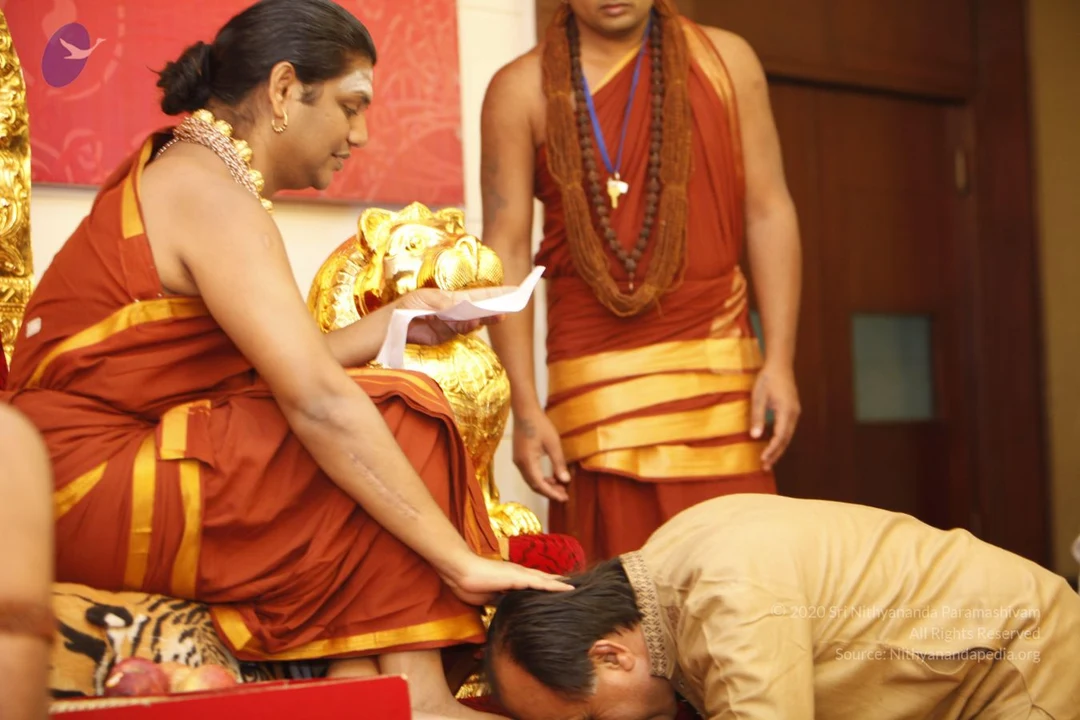
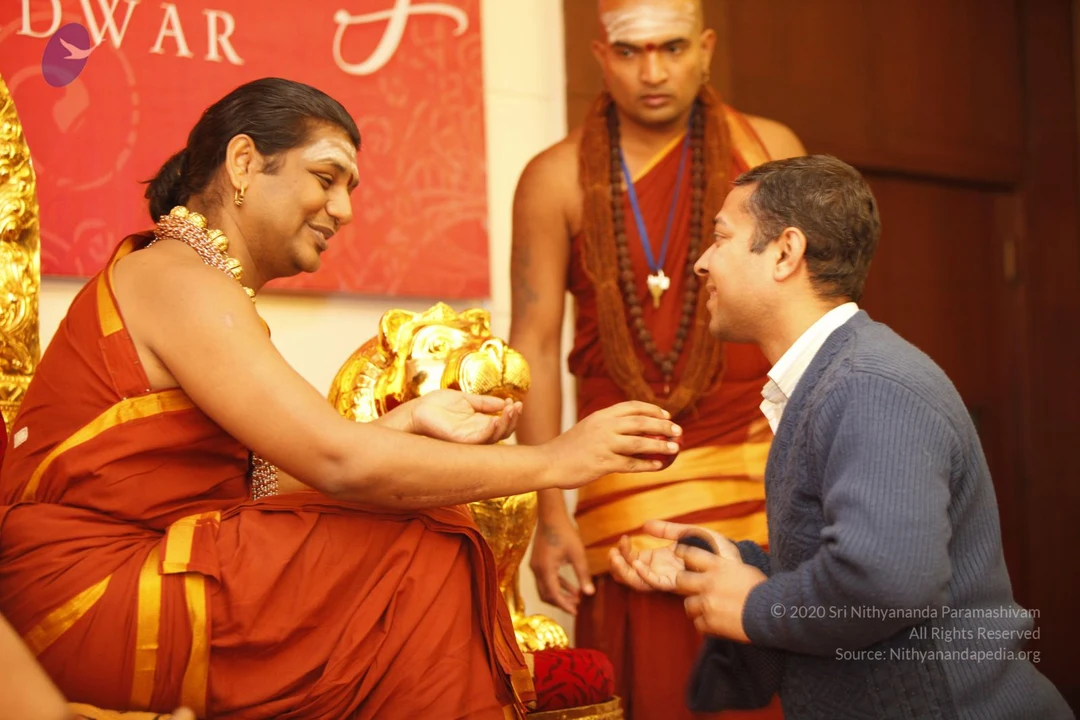
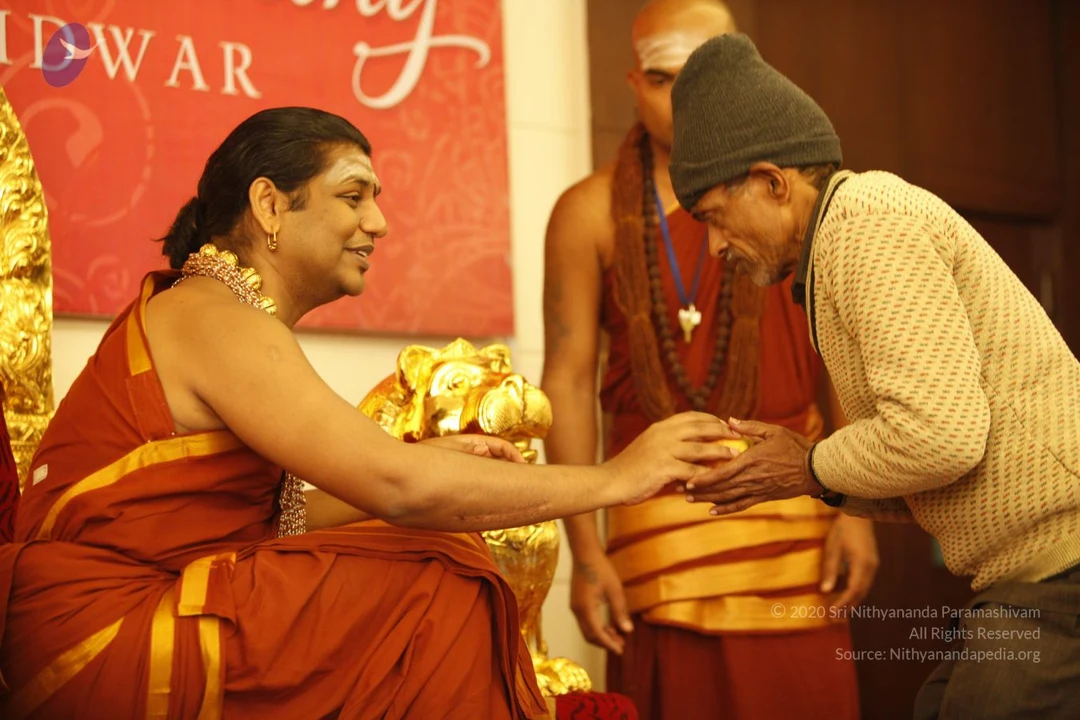
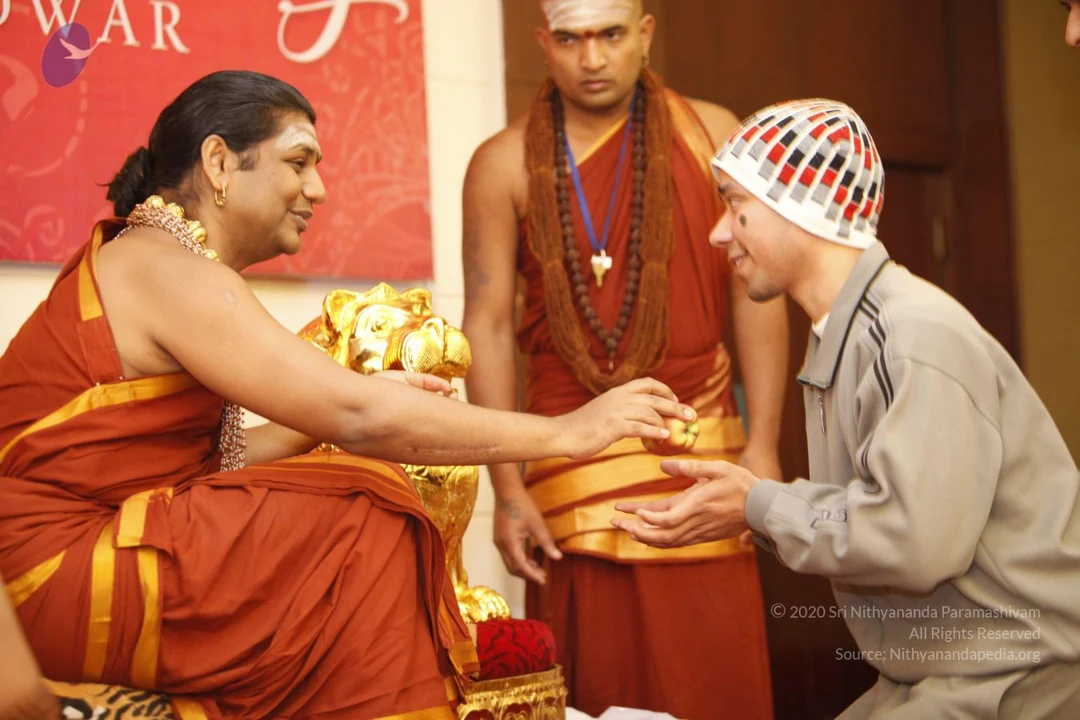
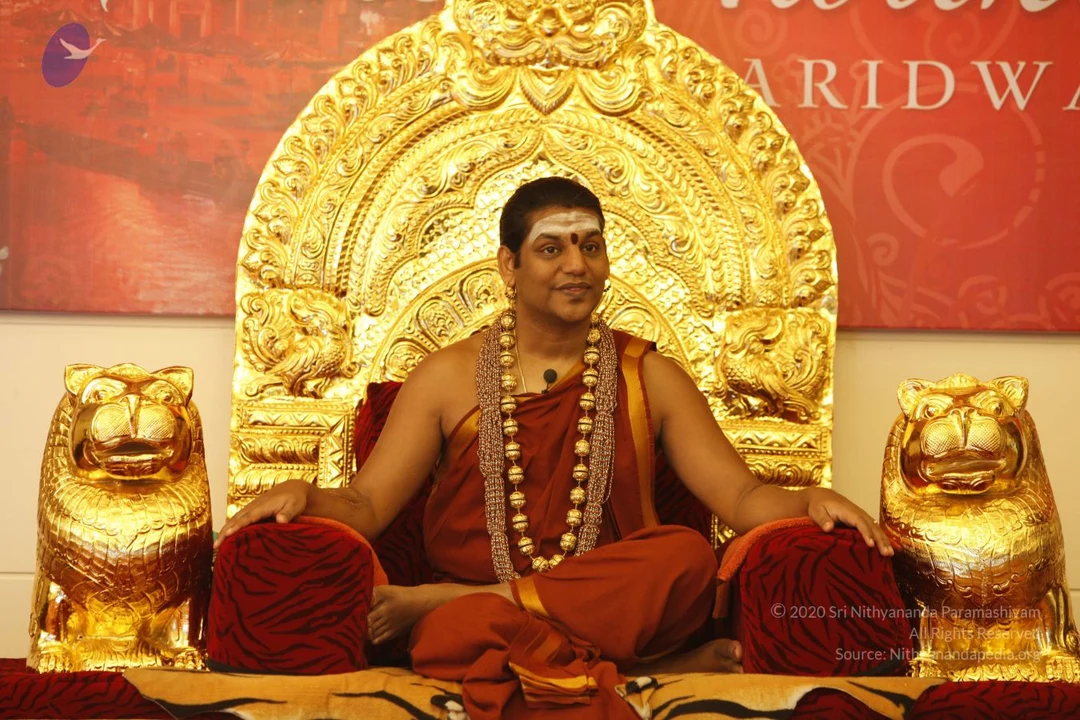
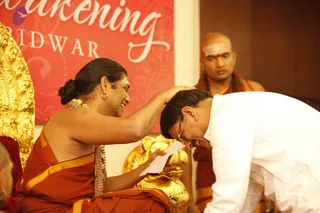
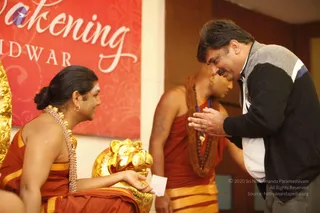
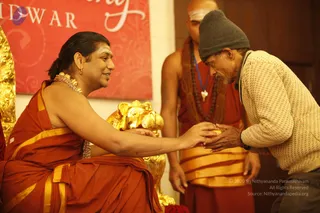
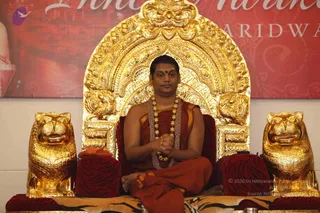
A photograph at an event with a red banner behind reading Awakening and Haridwar. A seated figure in orange robes with a pale forehead marking and long swept-back dark hair, wearing a gold necklace, sits on a gold throne with a gold lion figure beside him, smiling and gesturing toward visitors. A shaven-headed sannyasi in orange robes with a red tilak and rudraksha mala stands nearby. Two men in dark suits lean in, one offering a small object wrapped in gold cloth.A seated figure in saffron-orange robes with a gold-bordered cloth and a gold necklace sits on a gold throne before a red banner reading "akening" and "IDWAR". The seated person rests a hand on the head of a man in a white shirt and white trousers who bends forward, eyes closed, holding a small white card. Behind them a shaved-headed man in orange cloth with a rudraksha mala and white forehead markings watches. Gold ornamental chairs frame the scene. The seated figure has long swept-back hair and matching saffron/orange attire consistent with the page's account of a person, so the presentation cues are distinctive; the figure is a person in a blessing gesture.A photograph at an event with a red banner reading partly "akening" and "IDWAR". A man in a black and grey zip jacket over a white shirt bows forward with palms pressed together toward a seated figure. The seated figure wears an orange-red robe with a gold border, a pearl-and-gold necklace, a white forehead mark and a hair bun; a gold lion-shaped seat is beside them. Behind them stands a second robed figure in orange with a rudraksha mala and a gold-trimmed cloth, while the man in the jacket presents a folded white paper.A seated figure in saffron-orange robes with a gold-bordered cloth and an ornate gold and beaded necklace receives an older man in a grey knit cap and cream patterned sweater who bows forward and reaches out his hands. The seated figure extends a hand to him. Behind them stands a shaved-headed attendant in orange robes with a rudraksha mala and a white cross pendant. A golden lion-shaped seat or ornament and a red banner with gold lettering sit in the background, and the setting resembles an ashram hall.A seated man in saffron-orange robes sits on an ornate golden throne with an arched, carved back. He has a rudraksha-style bead necklace and a ceremonial gold necklace, with a red bindi on his forehead, and his hands are pressed together in front of his chest. Two golden lion sculptures flank the throne, and red-and-black striped cushions and a tiger-striped throne cover complete the setting. A red banner behind him reads partly as Nithyananda and Haridwar.A photograph of a ceremonial moment indoors. On the left, a bare-chested man with hair tied back in a bun wears a red-and-saffron cloth and a layered gold and pearl-coloured garland, holding a small silver tray or implement and extending it toward the head of a bald man on the right. That man wears a white embroidered shirt with blue patterns, a wooden bead mala and a small cross pendant, and raises one arm. Behind them a woman in white with a pale mala stands, and a gold ceremonial vessel sits in the lower left. A large patterned wall panel and a lit display screen are in the background.

Photos Of The Day:

29 photosSource gallery
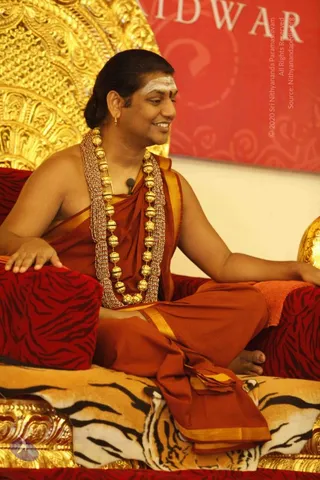
A seated group of devotees in white clothing performs a ritual in a warmly lit hall with red-and-gold carpeting. In the foreground, a woman with long white hair, a white tilak on her forehead, a red sash and a white-and-gold dhoti-style wrap holds a small cup or bowl and a metal dish, with gold bangles on her wrist. Beside her, a woman with long dark hair wears a white embroidered kurta and a long rudraksha mala, holding a small bell and an incense stick. Behind them, other participants in white kurtas, lanyards, malas and red sashes sit with eyes lowered. Yellow flower petals lie on the carpet, and a small brass plate of offerings sits at the lower left.A seated group satsang or puja in a hall with white floor covers and red-cushioned chairs behind. In the foreground a woman in a red-orange sari with a gold border, a white vibhuti mark on her forehead and rudraksha malas, holds a small brass bell and gestures with her other hand. Beside her a woman in white with a red shawl and a white-haired woman in white with a red and gold shawl hold offering items and sit near brass plates, flowers and a small gift box. Behind them many devotees in white and red attire sit and chant or gesture, while others sit in chairs at the back.A photograph of a ritual arati in a hall with a golden throne backdrop. In the foreground, a shaved-headed priest in a red robe with white sacred markings holds a multi-tiered silver lamp of lit oil lamps. Behind him, a seated woman in white clothing with her hair pulled back faces a framed portrait on a gold and red throne. The portrait shows a smiling figure in an orange turban and orange robe, with a label reading Paramahamsa Nithyananda. The throne has a tiger-skin cloth and gold lion sculptures, and a brass offering tray sits in front. A banner behind reads Inner Awakening Haridwar. Oil lamps and a brass plate are on the carpeted floor. The portrait is a printed picture, not a physical person.A large framed portrait labelled "PARAMAHAMSA NITHYANANDA" sits on an ornate gold-framed throne-like stand with carved gold lion heads flanking it. The portrait shows a smiling man with long dark hair wearing a saffron-orange turban and orange robes with a red bindi. The stand has maroon tiger-striped cushions and an orange tiger-patterned cloth below. Behind it is a red backdrop with a printed word partly reading HARIDW. Blurred people are at the lower edges, and a candle or lamp is visible near the right. This is a photograph of a printed portrait, not a live person.A photograph of a seated audience at a satsang hall, with rows of devotees sitting on the floor and chairs in warm, dim light. In the foreground a woman with glasses sits in an orange-brown shawl, and a woman with an ash mark on her forehead wears a white top with a red shawl. Centre right, a woman in a cream knitted sweater and red shawl sits cross-legged with hands folded and a red bindi, next to a woman with long blonde hair in white clothes with a vibhuti mark and a rudraksha-style mala. Behind them, rows of women in white and red shawls and men in white shirts sit with eyes closed or hands in prayer. No a person is visible in this frame.A man sits on a red and gold throne-like seat with carved golden lion-head armrests, speaking and gesturing with his right hand raised. He wears an orange-red robe with a gold border draped over one shoulder, a multi-strand rudraksha mala with large gold beads, gold earrings, and white and red tilak on his forehead. A small lapel microphone is clipped to his robe. Behind him is a golden ornate backdrop and a painted panel in red and orange. Swamiji (probable) is shown in a satsang setting, with long swept-back hair, ornate gold-and-rudraksha adornments and saffron-toned clothing as the qualifying cues.

Morning-Satsang-and-Puja
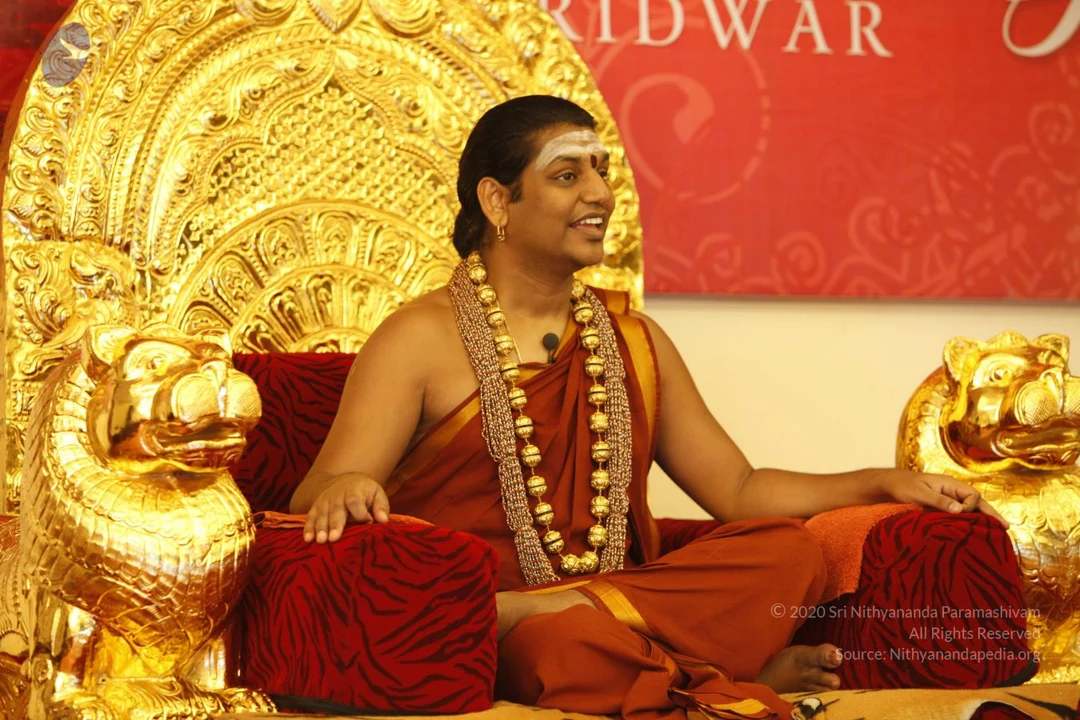
1 photoSource gallery
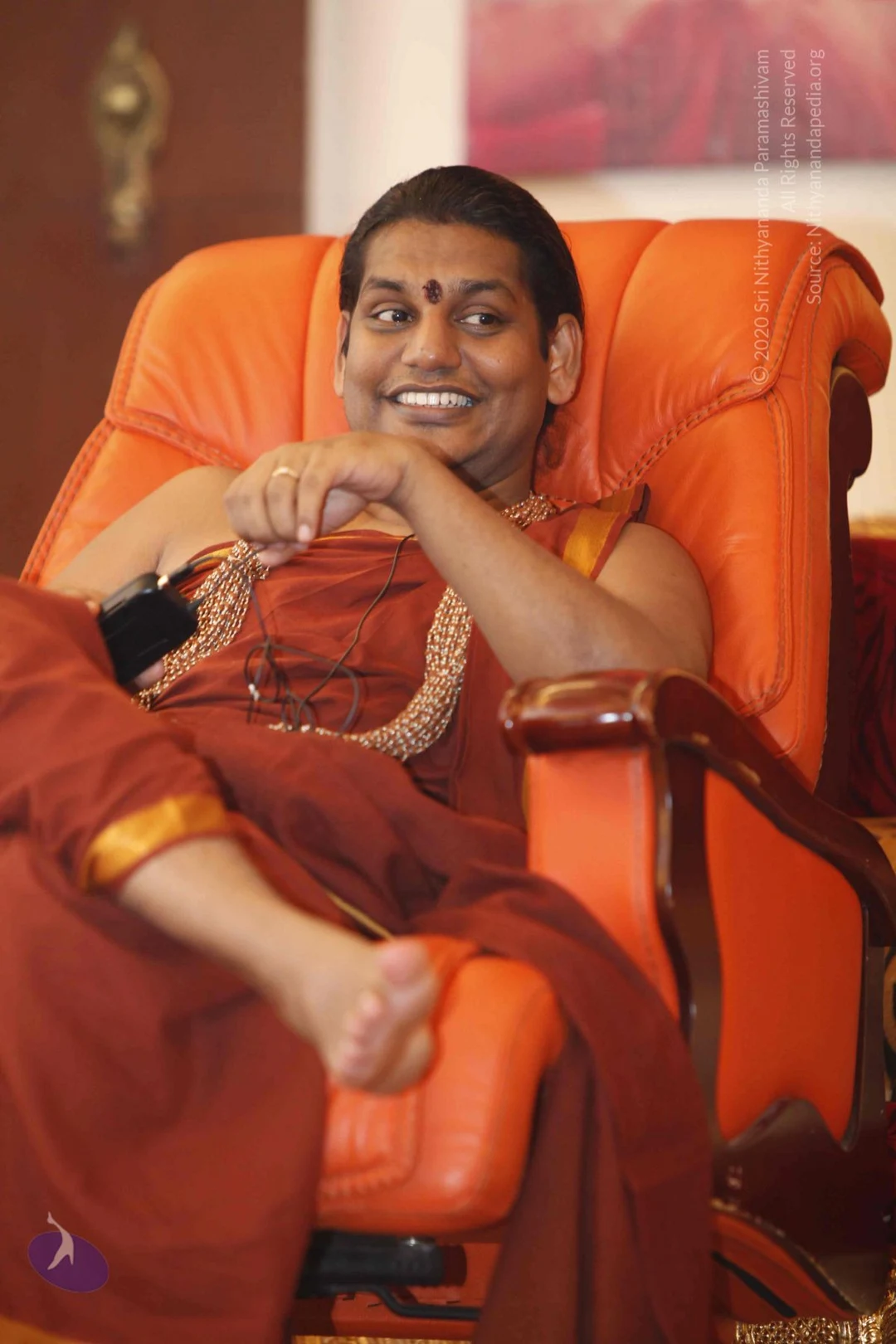
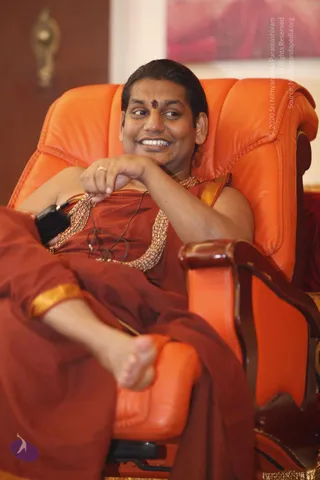
A smiling man reclines in a large orange leather armchair with a dark wooden armrest, one leg extended and bare foot resting on the arm. He wears a rust-red robe with gold border and a beaded gold-toned necklace, a red tilak mark on his forehead, and holds a black device with a cord. Swamiji (probable): the man has swept-back hair, saffron-toned ornate clothing and a gold beaded necklace, consistent with the page's Swamiji reference. Warm indoor room with a red painting in the background.

Darshan

4 photosSource gallery
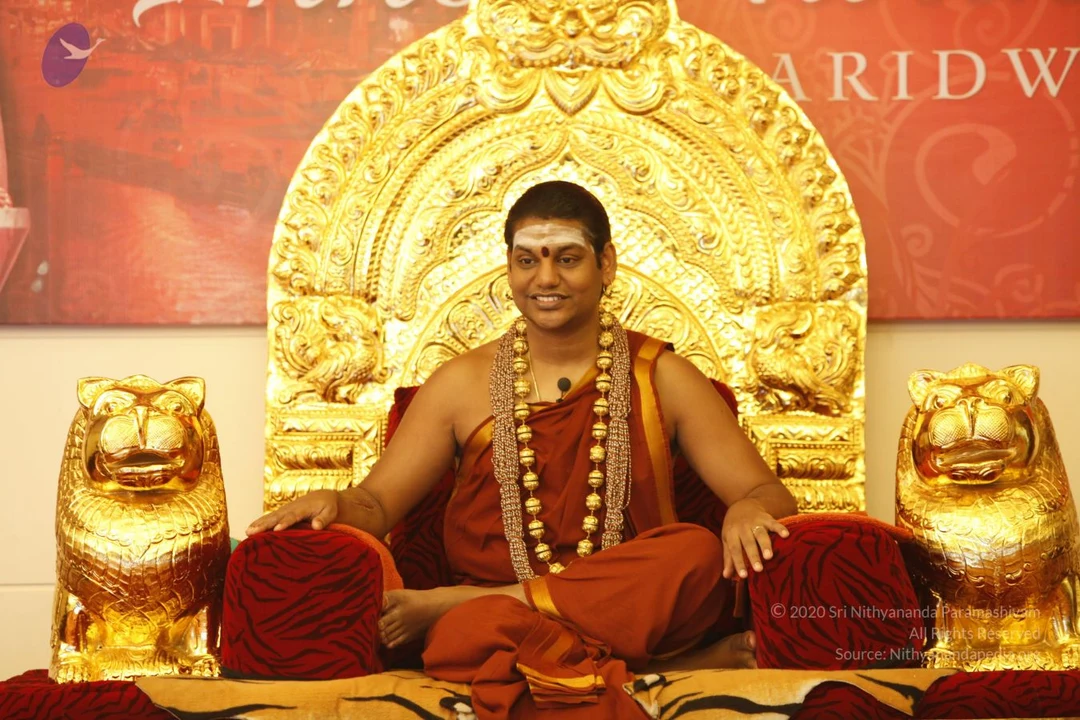
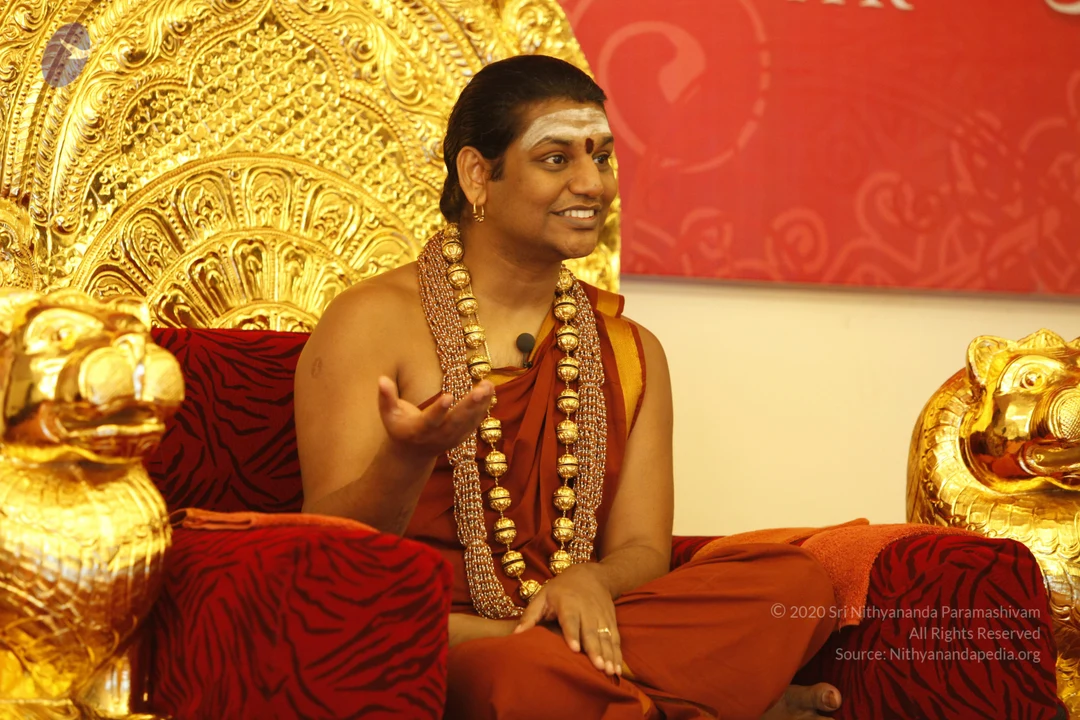
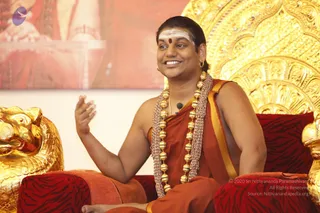
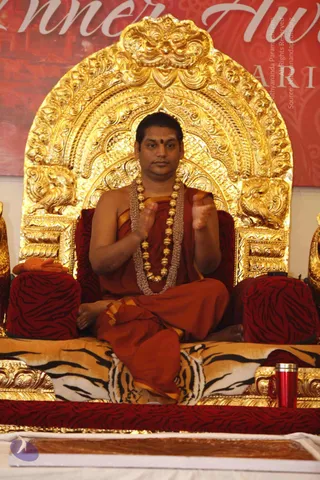
A seated man in saffron-orange robes sits on an ornate golden throne upholstered in red tiger-striped fabric with a tiger-skin cover. He wears a layered necklace of silver beads and large gold beads, a lapel microphone clipped to his robe, white vertical tilak on his forehead, and a red-orange bindi. His bare right arm rests on the throne's armrest while he smiles and looks to the side. A red banner behind him carries gold lettering, partly cut off, and one ornate gold sculpted armrest is visible at the right edge. Probable Swamiji seated on the throne, shown in appearance-based cues: long swept-back hair, saffron clothing and ornate gold-bead malas.A seated man in a rust-red and gold-bordered robe sits cross-legged on a tiger-striped cushion before an ornate gold-leaf throne with a red backdrop. He wears a heavy multi-strand gold bead necklace and a red bindi, with both hands raised palm-up in an expressive gesture while speaking. A red flask sits at the lower right. A candidate with a shaved-free dark hairstyle, ceremonial gold necklace and saffron-toned ochre robes is visible, matching distinctive ceremonial cues, so a person is shown in person.A seated man in orange-red saffron robes with gold-yellow borders sits on an ornate gold-leaf throne with a carved arched back. He wears a heavy multi-strand necklace of large gold beads and a red bindi on his forehead. His arms are raised with palms open in a teaching gesture. He sits on a tiger-striped cushion with red velvet pillows, and a red thermos mug sits at the lower right. Behind him is a red backdrop with partial white lettering.A seated man in an ornate golden throne with a carved gilded arch and lion-like figures, draped in a tiger-striped cloth. He wears rust-orange robes with gold-edged borders, a multi-strand silver and gold bead necklace, and a red bindi on his forehead. He sits cross-legged with hands raised in front of his chest, gesturing as he speaks. A red travel mug sits on the throne's side. Behind him a red banner reads partially in large script. A person whose appearance matches the page's a person reference, with rust-orange robes, a gold-bead necklace and throne seating, is seated in the centre; identity is uncertain from appearance alone. Other red-cushioned seating frames the scene.

01-Morning-Satsang-and-Puja
3 photosSource gallery
A photograph of a seated audience at an indoor satsang hall with white chairs bearing red sashes along the back. In the foreground, women sit cross-legged on white floor coverings, many in white clothes with red shawls draped over their shoulders; one woman in the centre wears white with rudraksha-style beads and smiles. Others sit in chairs in the background, including a woman in a green shawl and a woman in a gold-brown top. A bald man in white stands at the far right, and the speaker or stage is not visible. No a person candidate is clearly visible in the frame.A seated man in saffron-orange robes and a long gold-bead and rudraksha-style mala sits on an ornate gold throne upholstered in red tiger-stripe fabric, flanked by gold lion-head armrests. He has white and red forehead markings, wears earrings, and gestures with his right hand while speaking. A small clip microphone is on his chest. Behind him is a red banner with gold scrollwork and partial lettering.A man seated on a gold ornate throne with red and gold tiger-striped cushions, wearing saffron-orange draped clothing with gold border, a silver-and-gold rudraksha-style mala necklace, a small lapel microphone, and a white vertical tilaka with red dot on his forehead. His hands rest on his crossed leg as he looks to the side while speaking in a satsang setting. A red backdrop with decorative motifs and partial lettering stands behind him.

02-Darshan

2 photosSource gallery
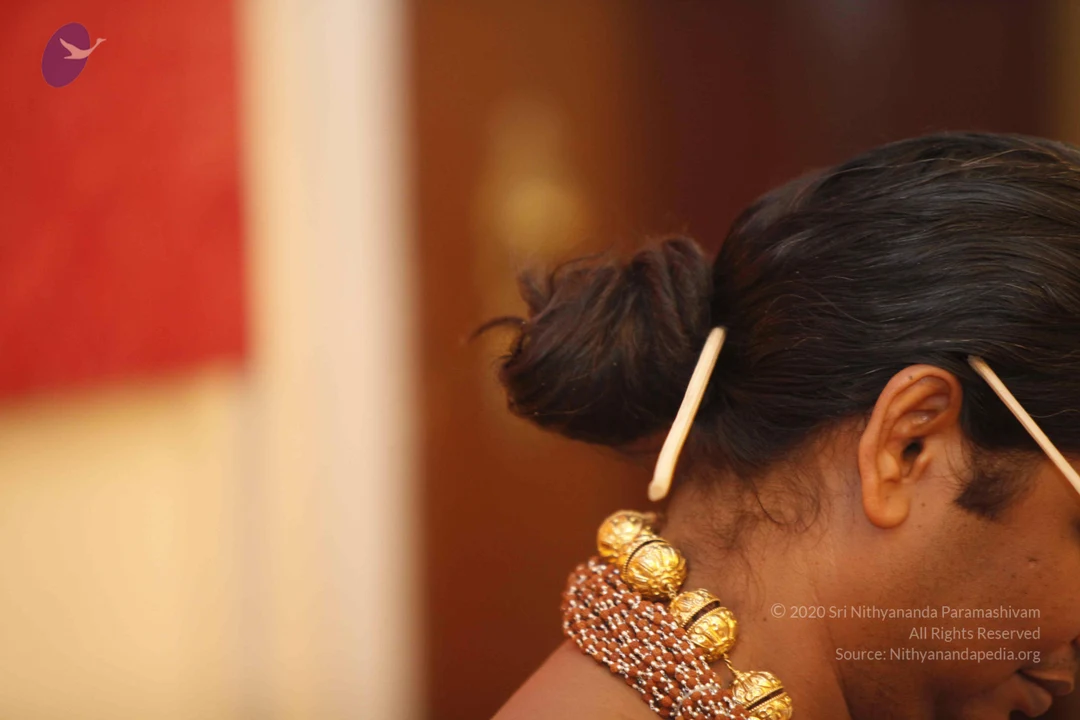
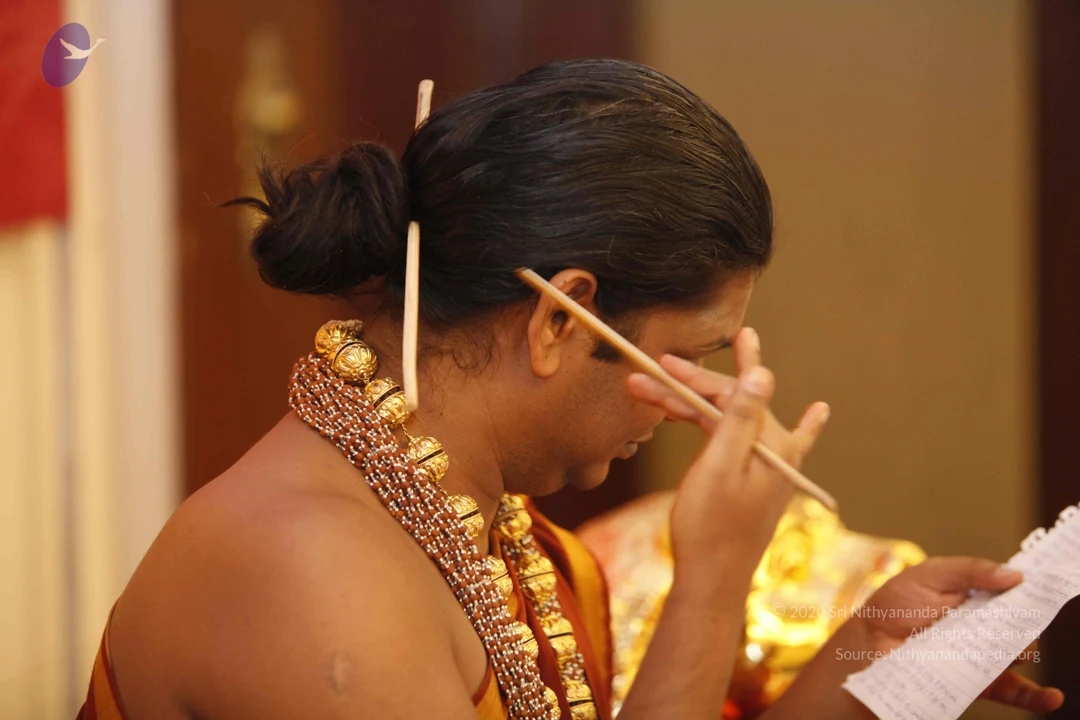
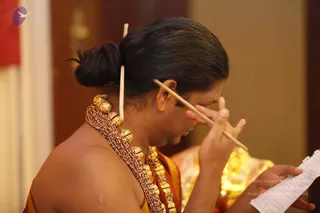
Close side view of a person with dark hair gathered in a low bun secured by two thin pale wooden hair sticks, with a gold-toned ornamental necklace of beaded rudraksha-style links and gold bead clasps resting on the bare upper back. The blurred background shows red and cream panels with warm wooden tones. Only one person is visible, cropped at the face, with a partial face profile at the lower right edge. The image appears to be an event photograph from a devotional gathering, but no ritual action or identity cues are clearly visible.A photograph in profile of a man with dark hair tied in a high bun secured by a thin wooden stick, wearing a gold-coloured and orange-toned garment and a heavy necklace of gold and beaded ornaments. He holds a thin wooden stick in one hand, touching it to his forehead, and holds a sheet of paper in the other hand. A golden textile is visible behind him in a warm, indoor setting. Appearance-based cues of long hair, ornate gold necklace and orange clothing are present, but identity is uncertain.