Skip to content
Monday

21 January 2013

The Supreme Pontiff of Hinduism (SPH), JagatGuru MahaSannidhanam (JGM) Bhagavan Sri Nithyananda Paramashivam

Dated photos
150
Source pages
1
Media
2
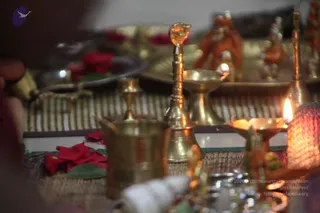
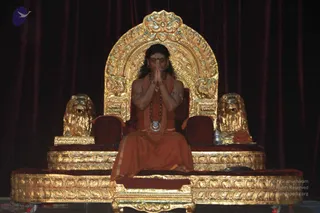
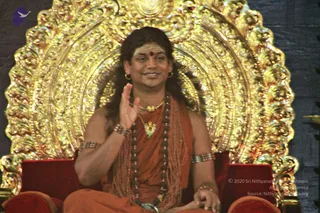
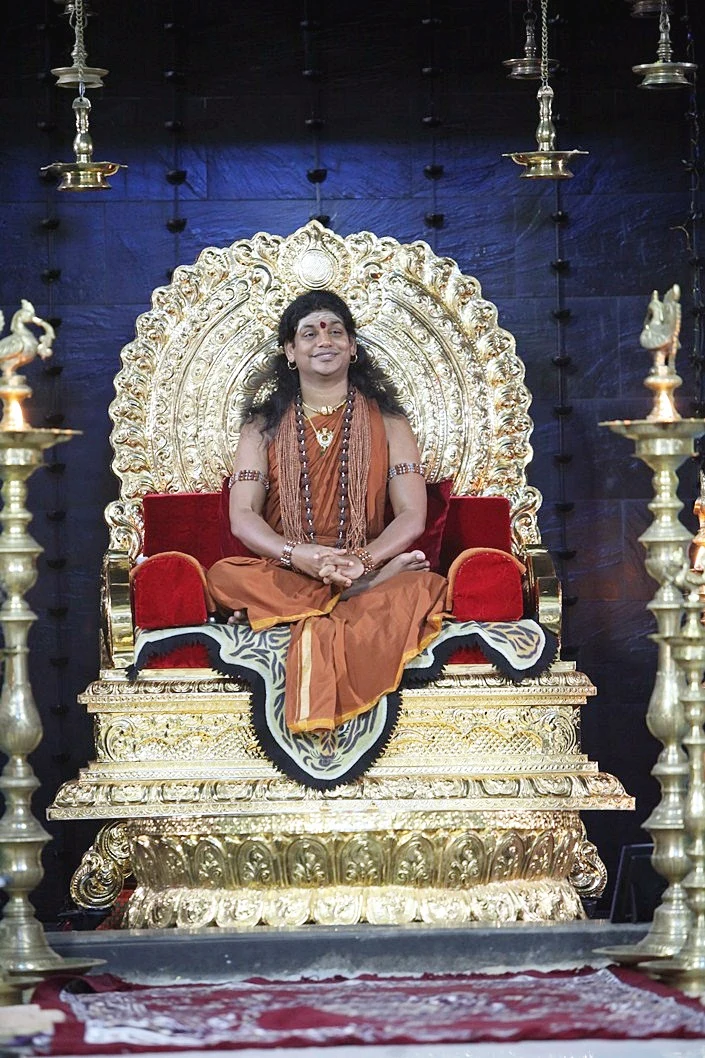
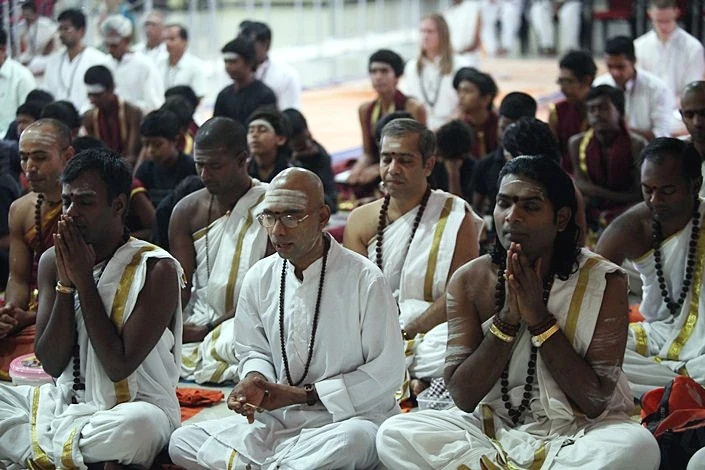
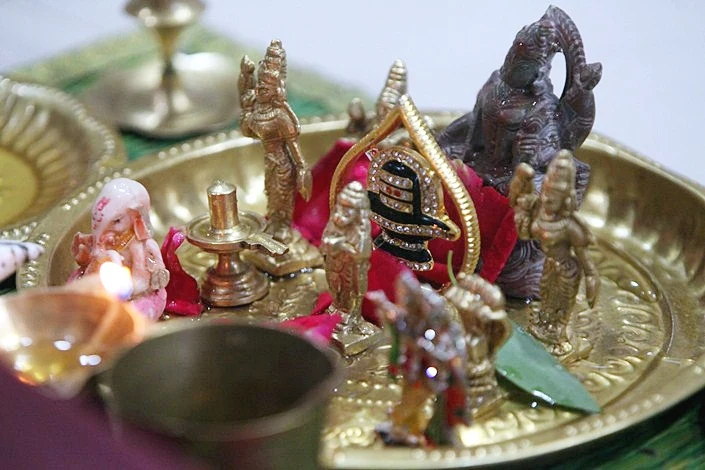
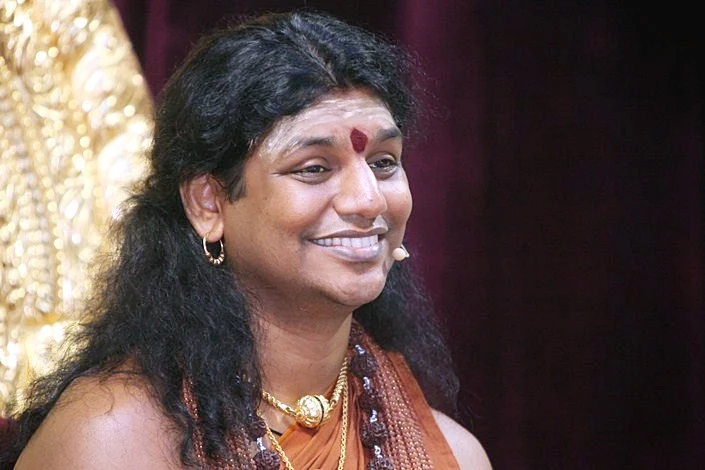
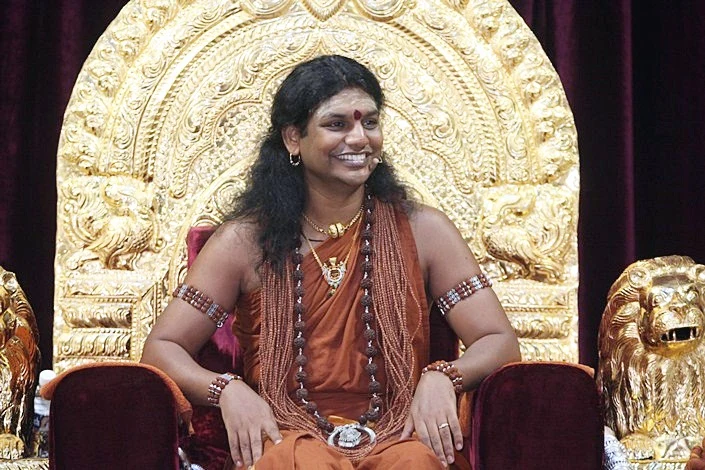
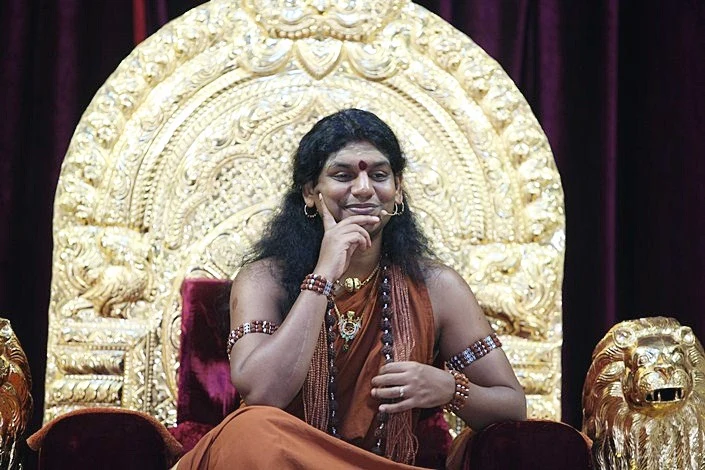
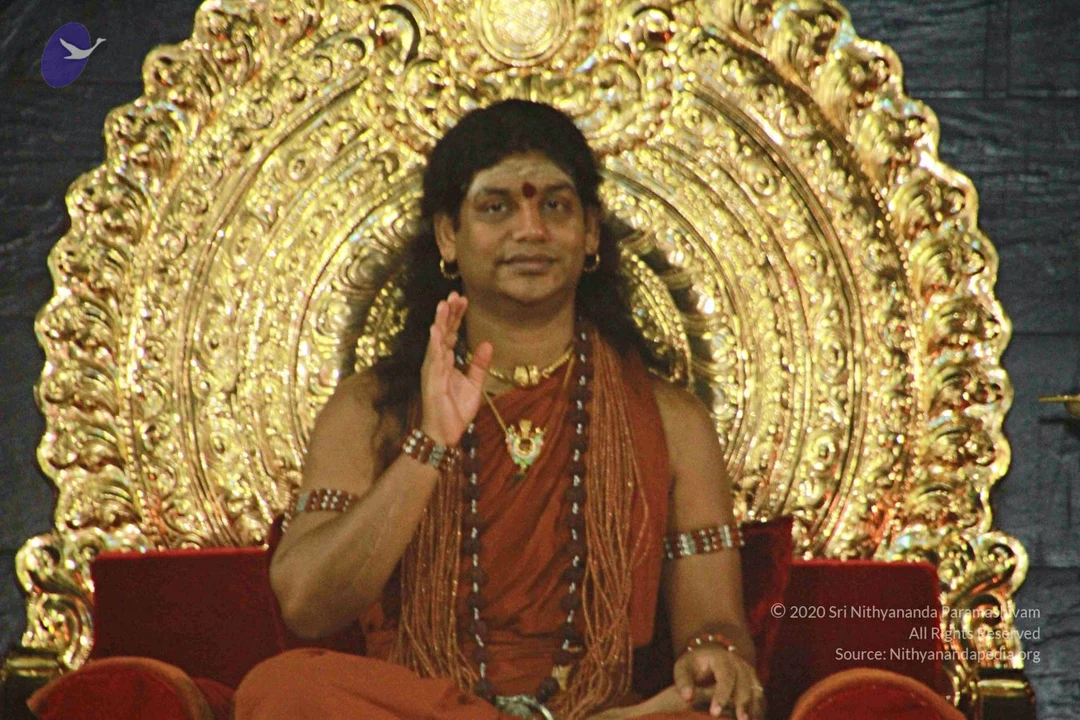
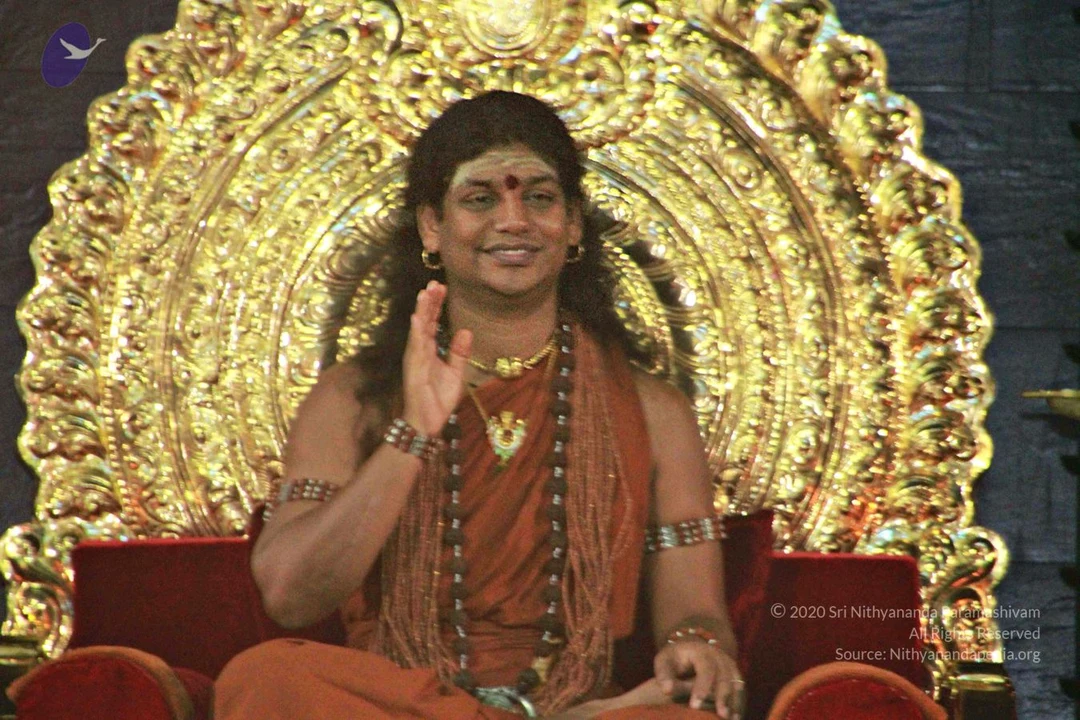
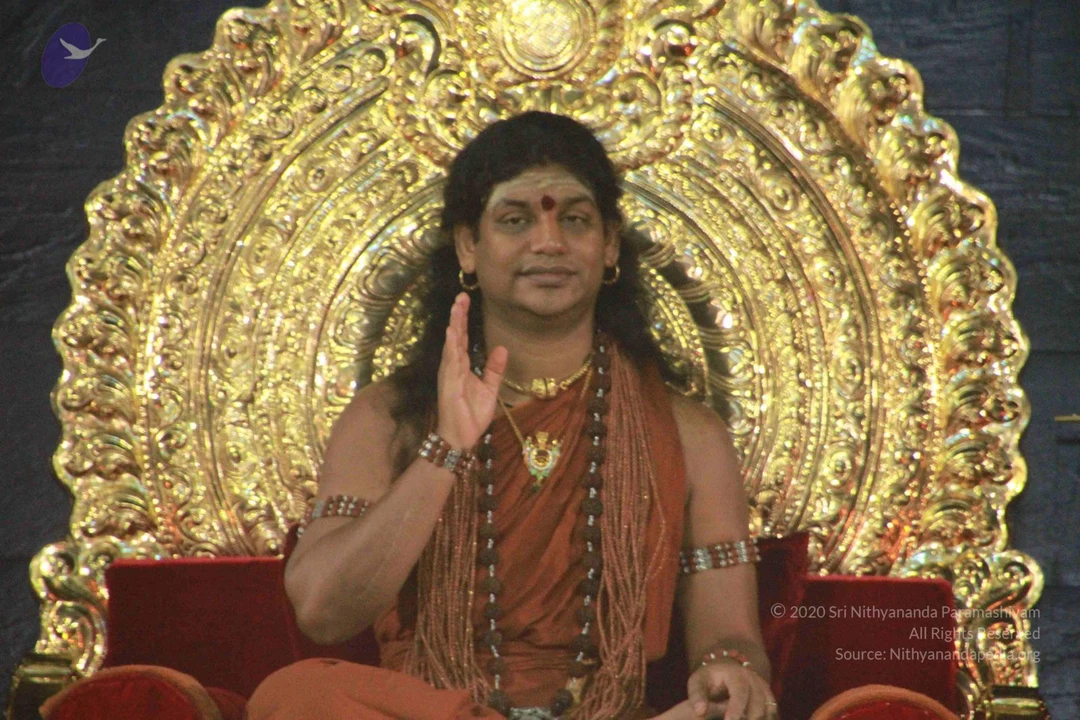
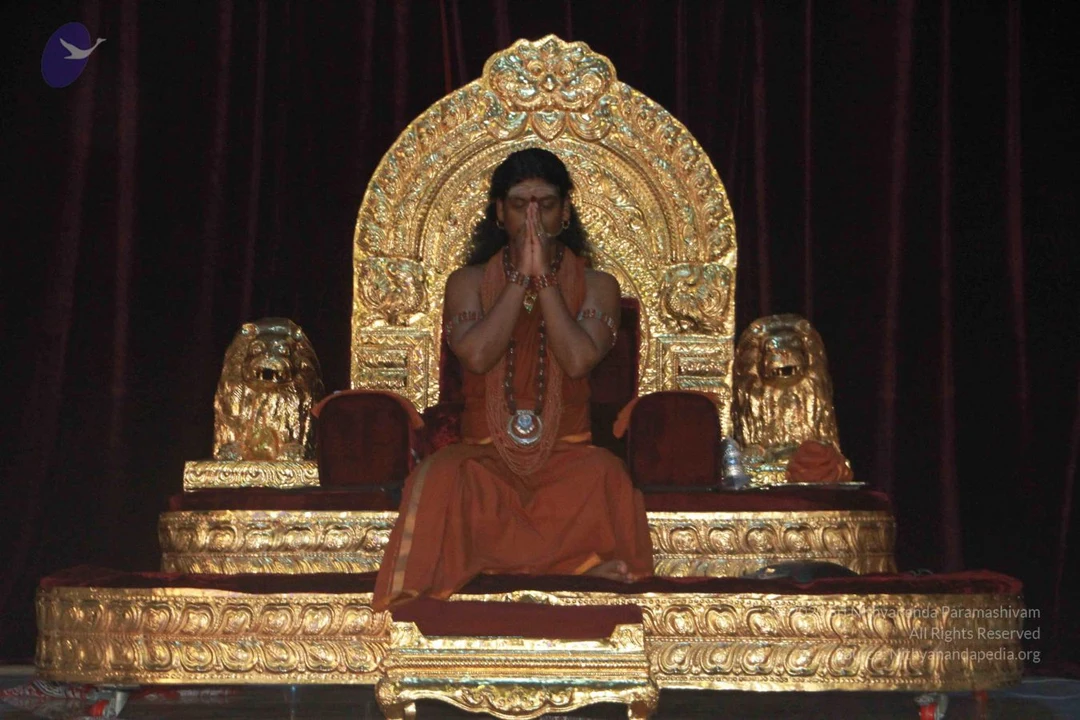
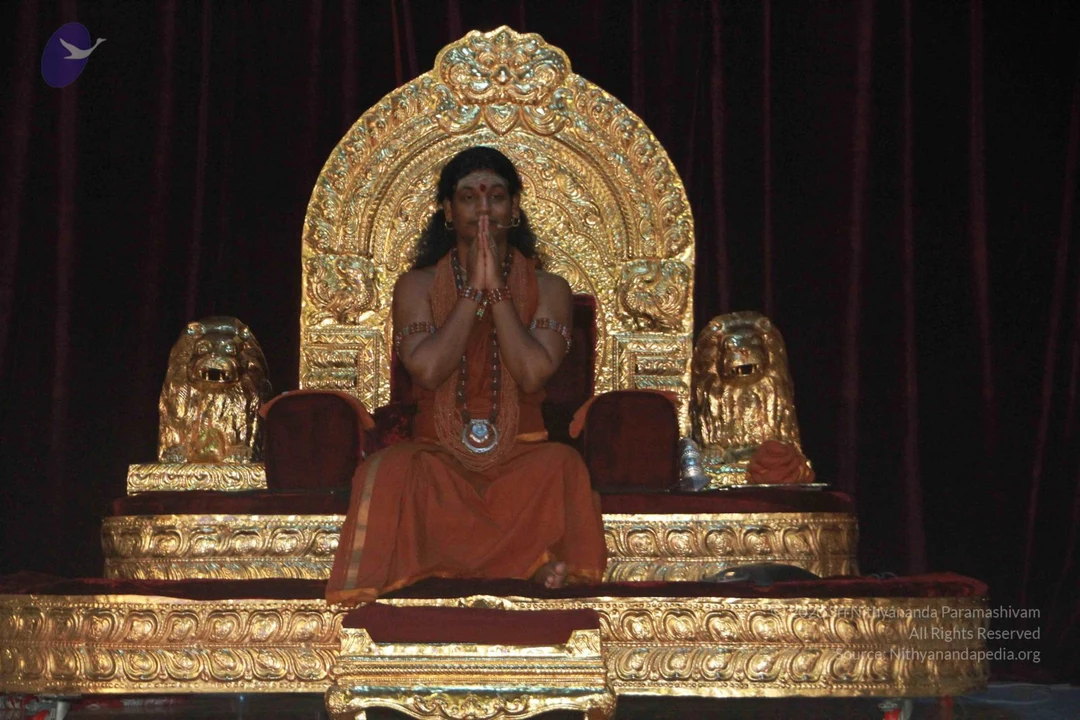
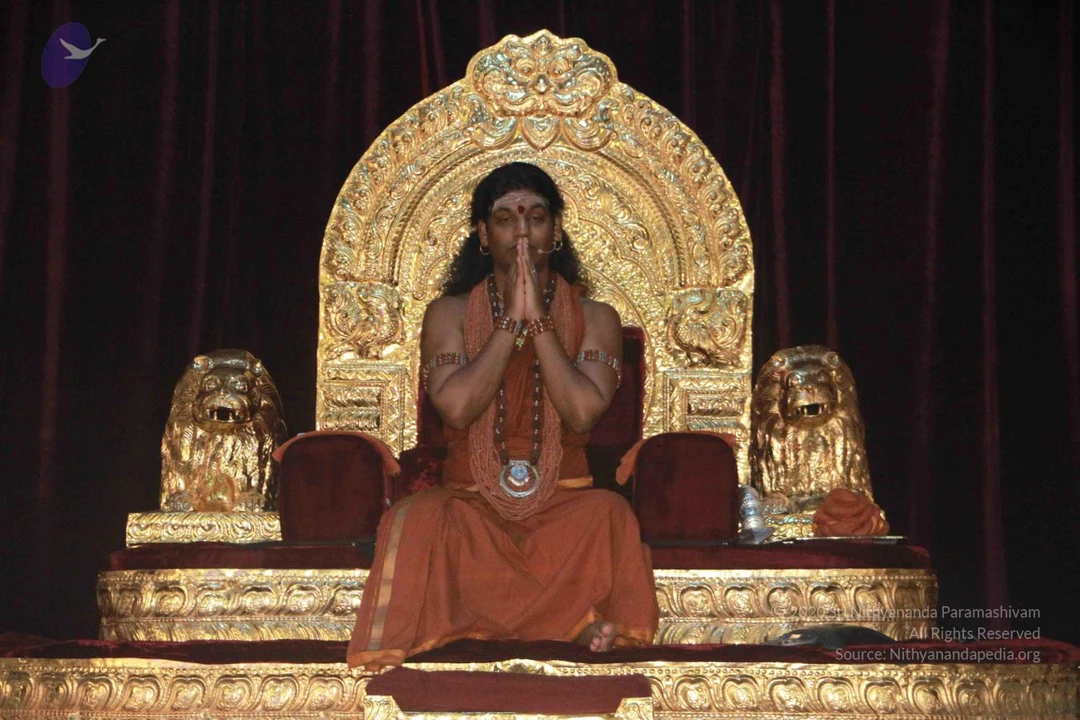
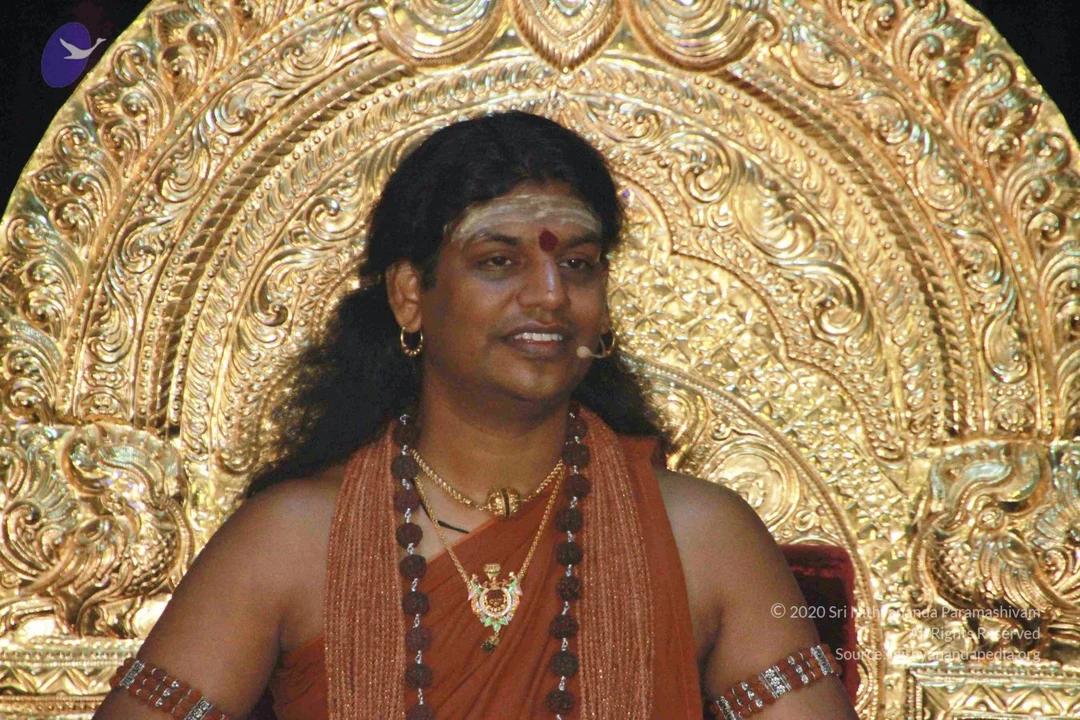
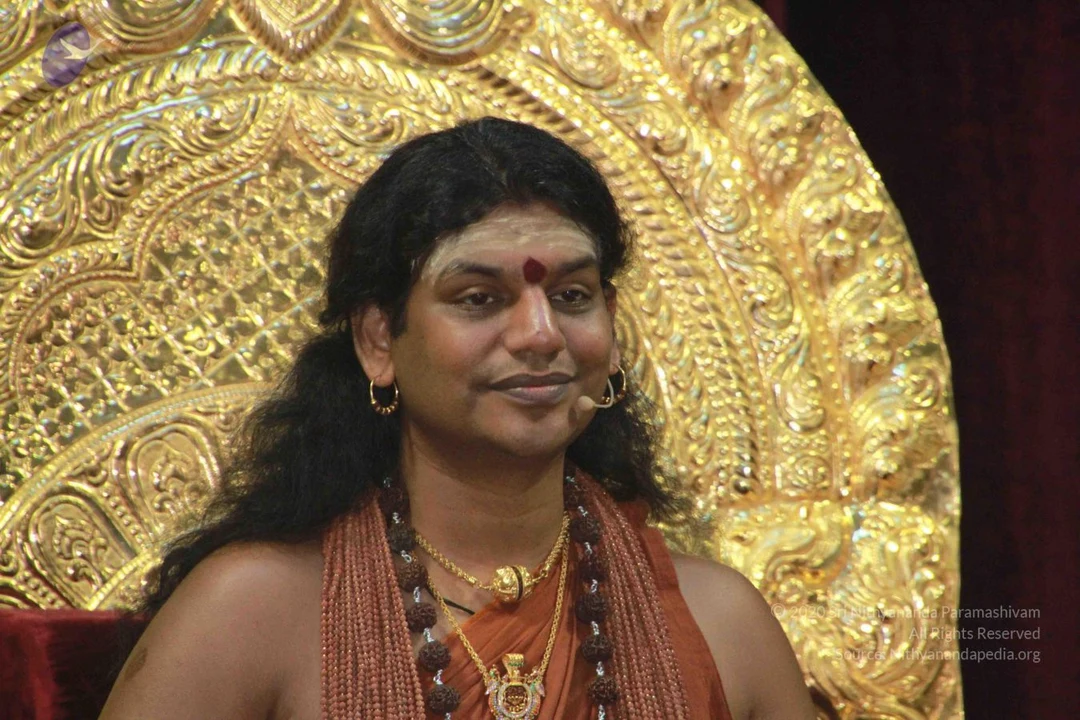
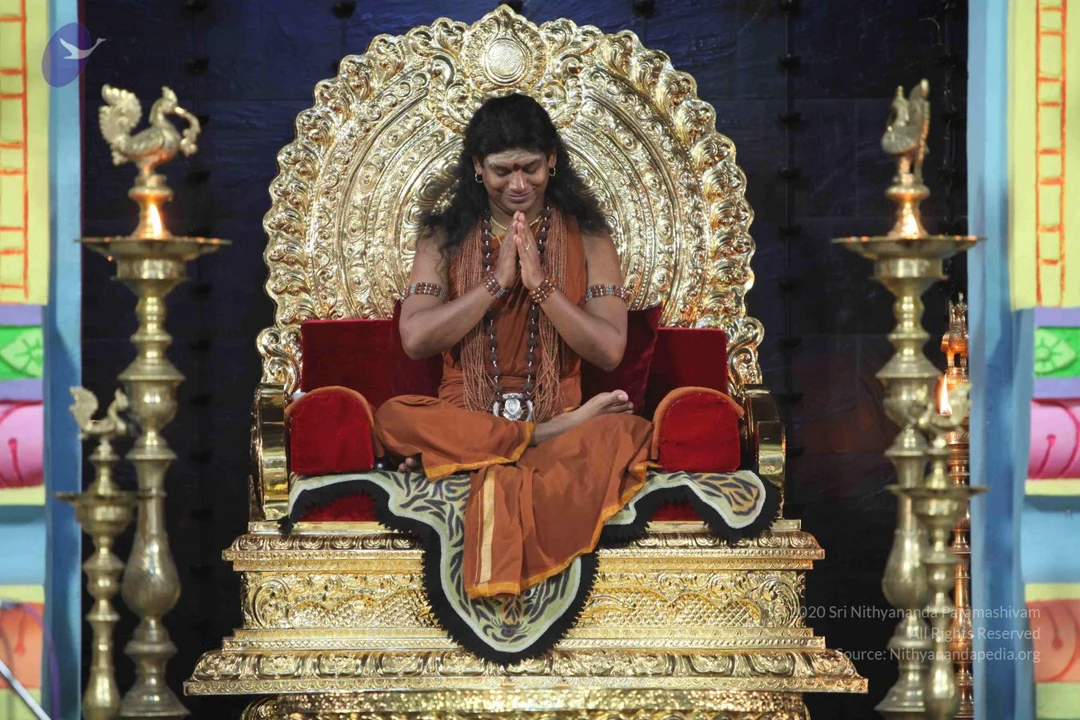
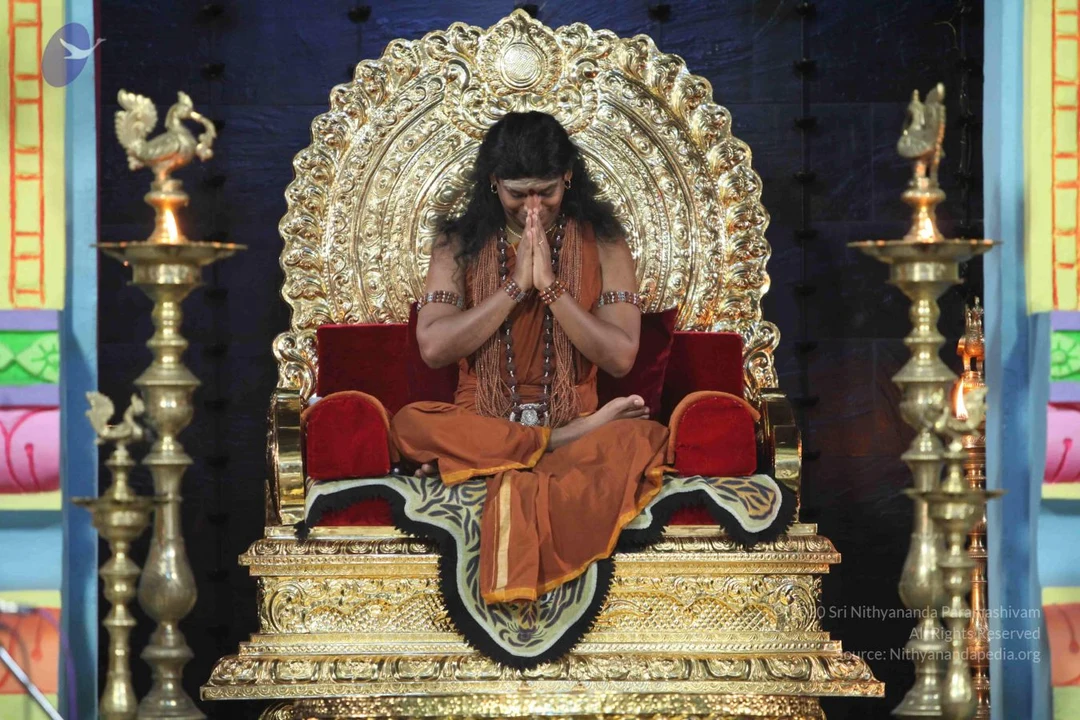
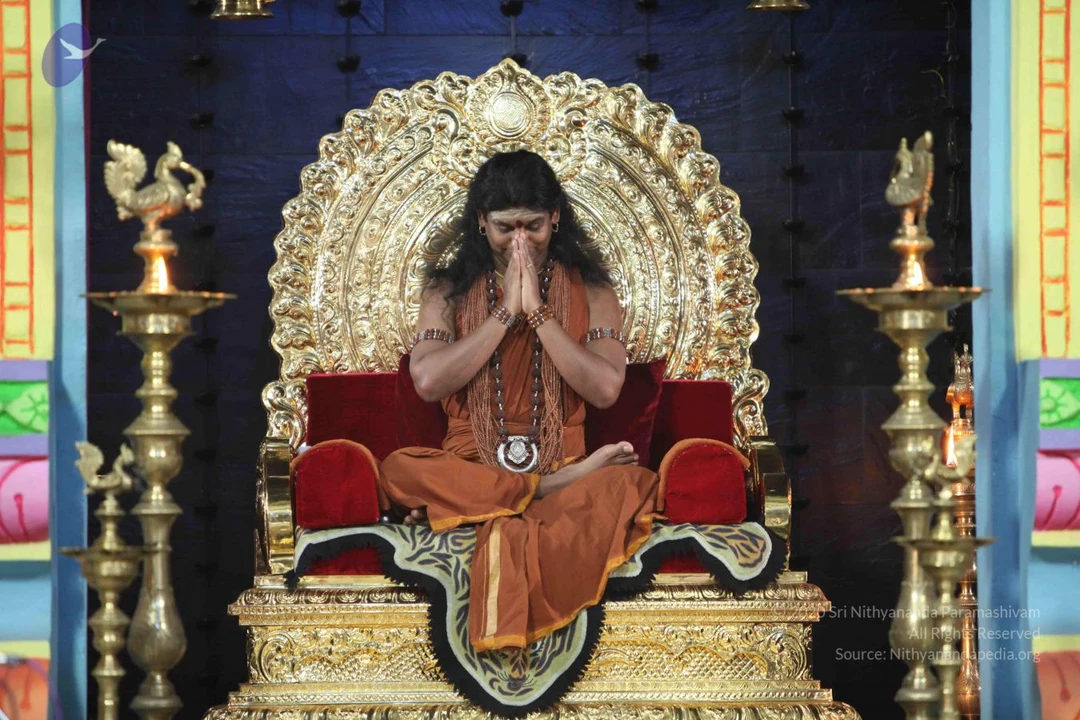
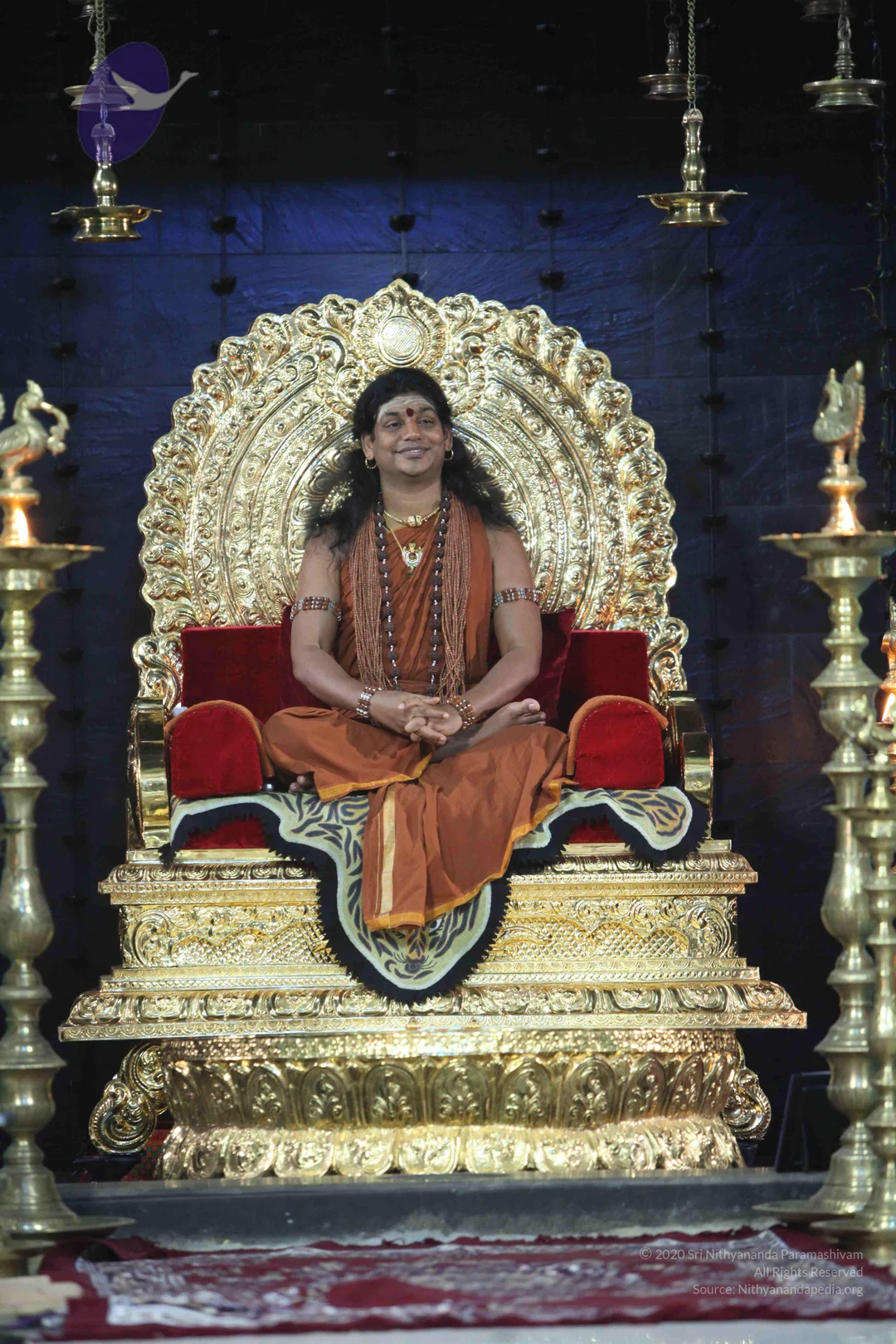
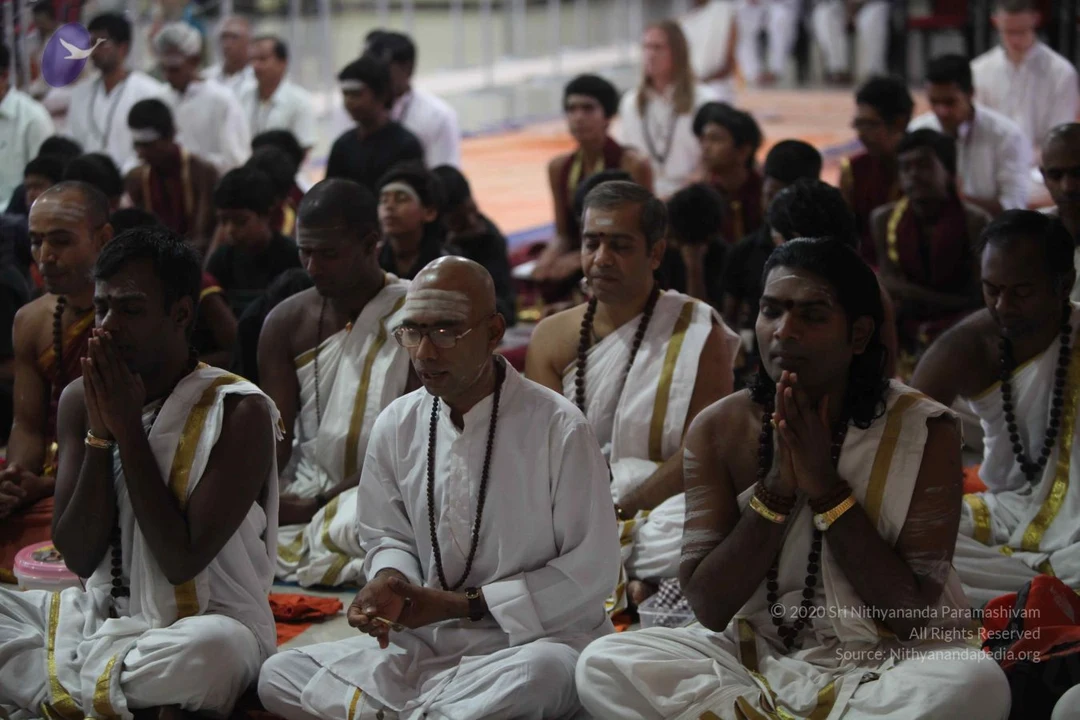
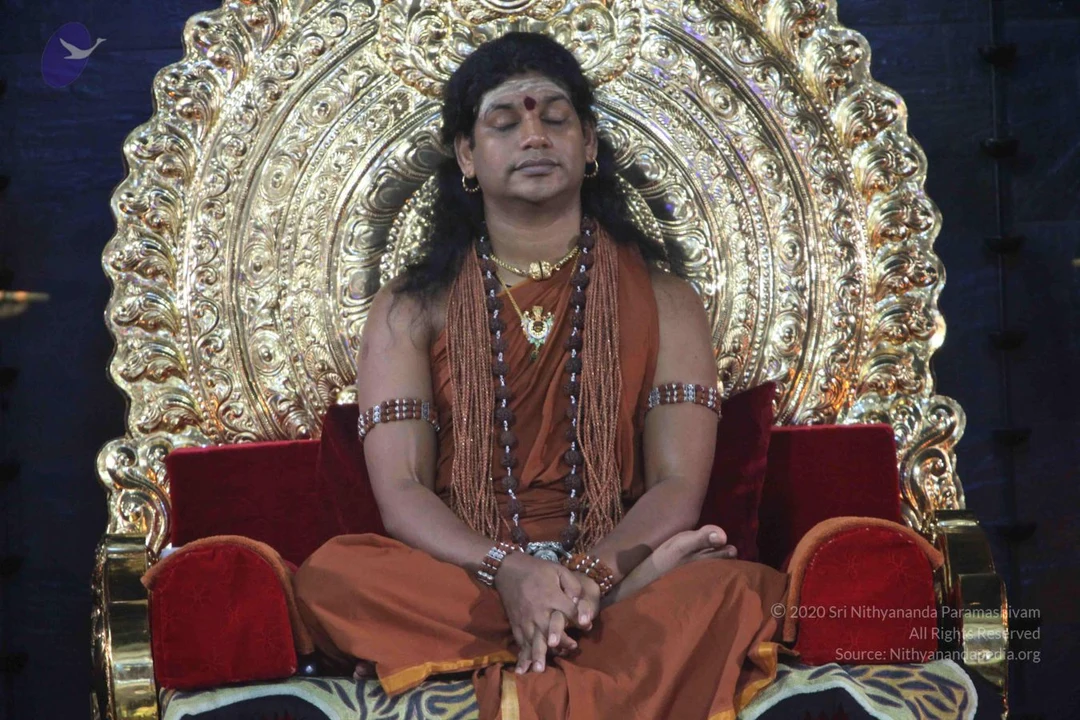
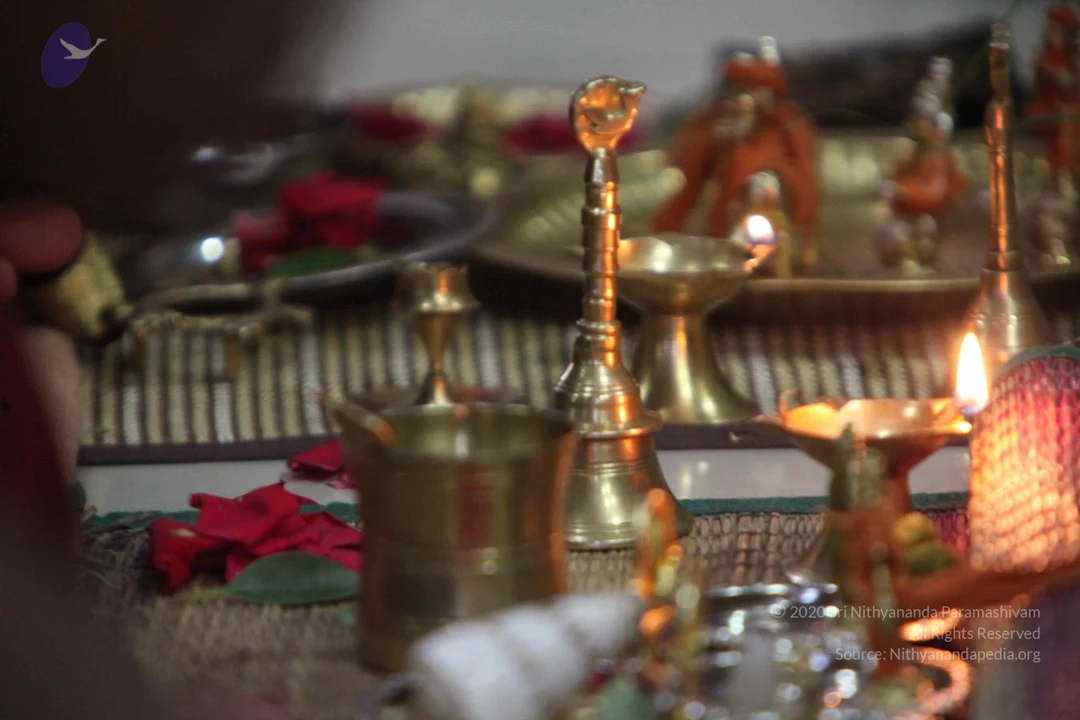
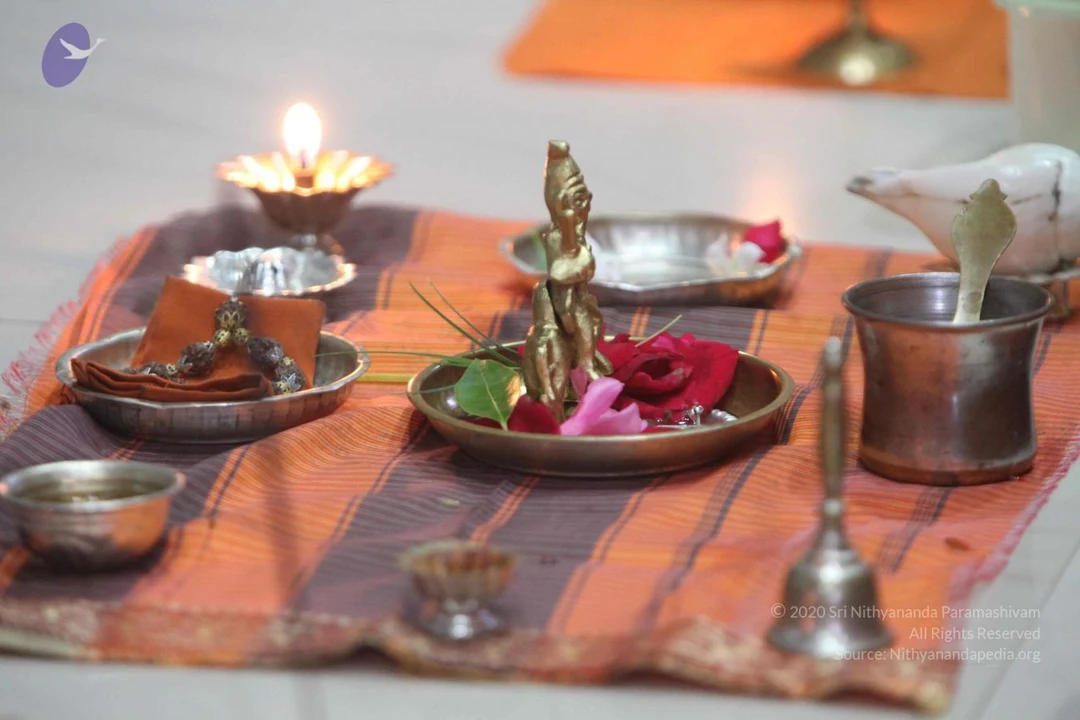
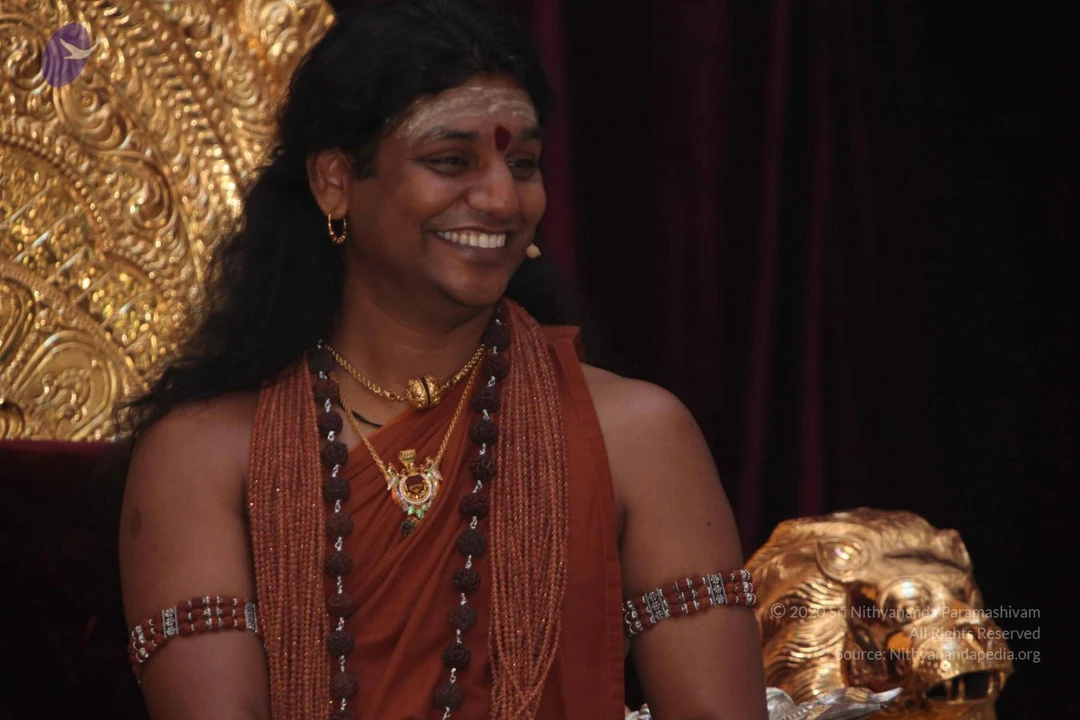
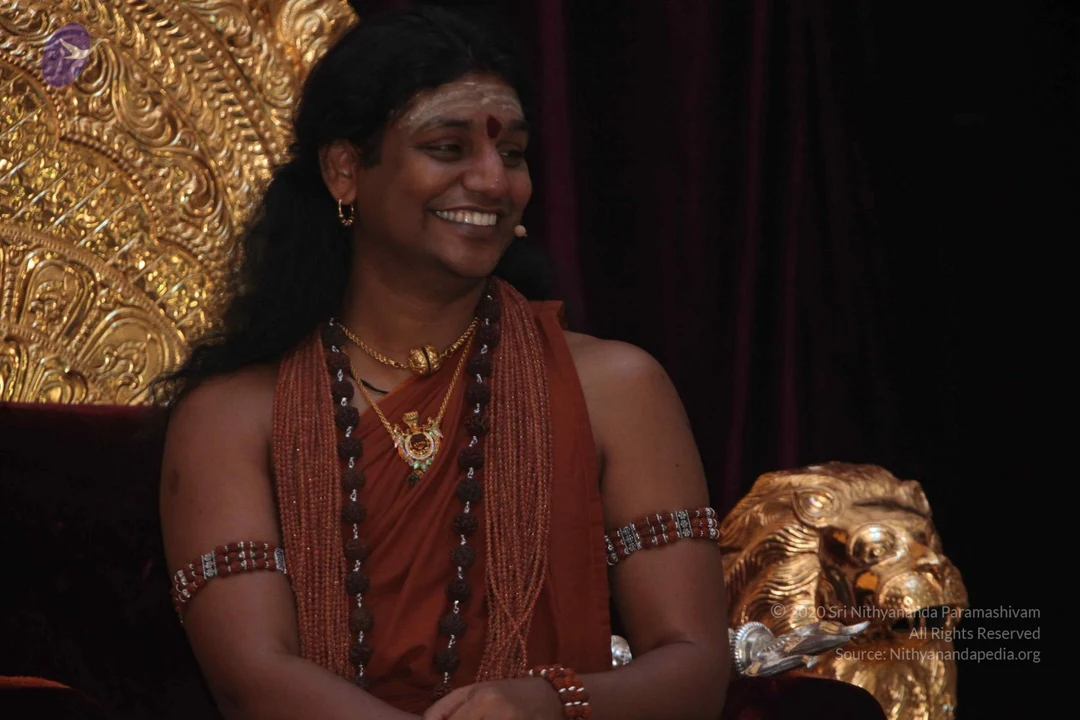
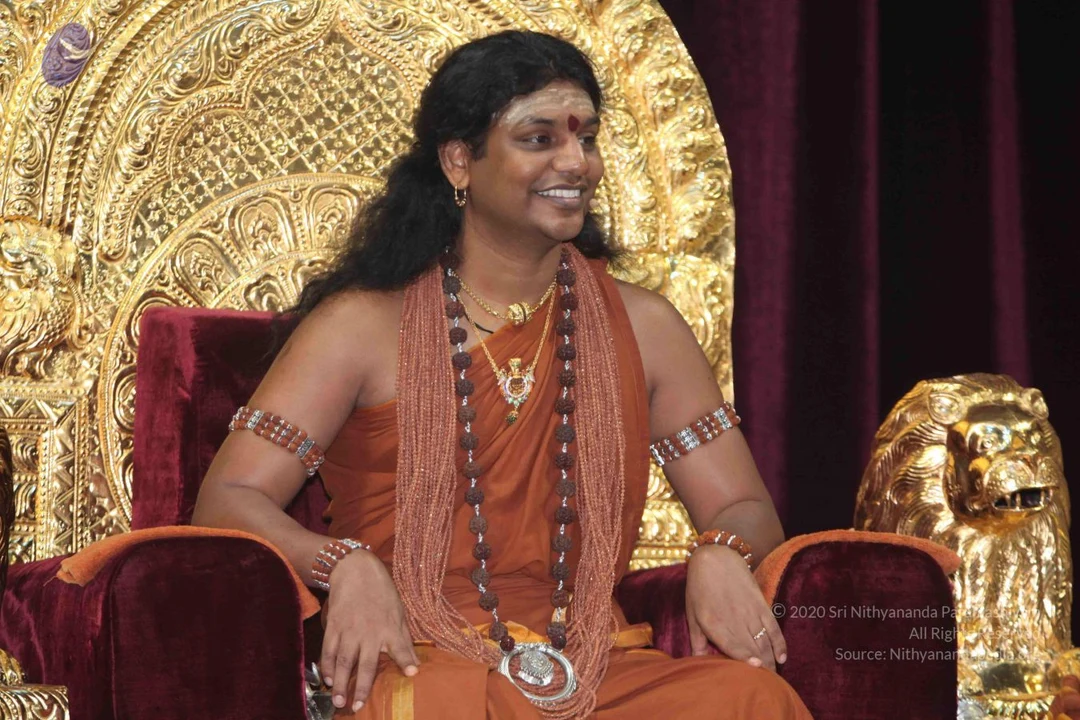
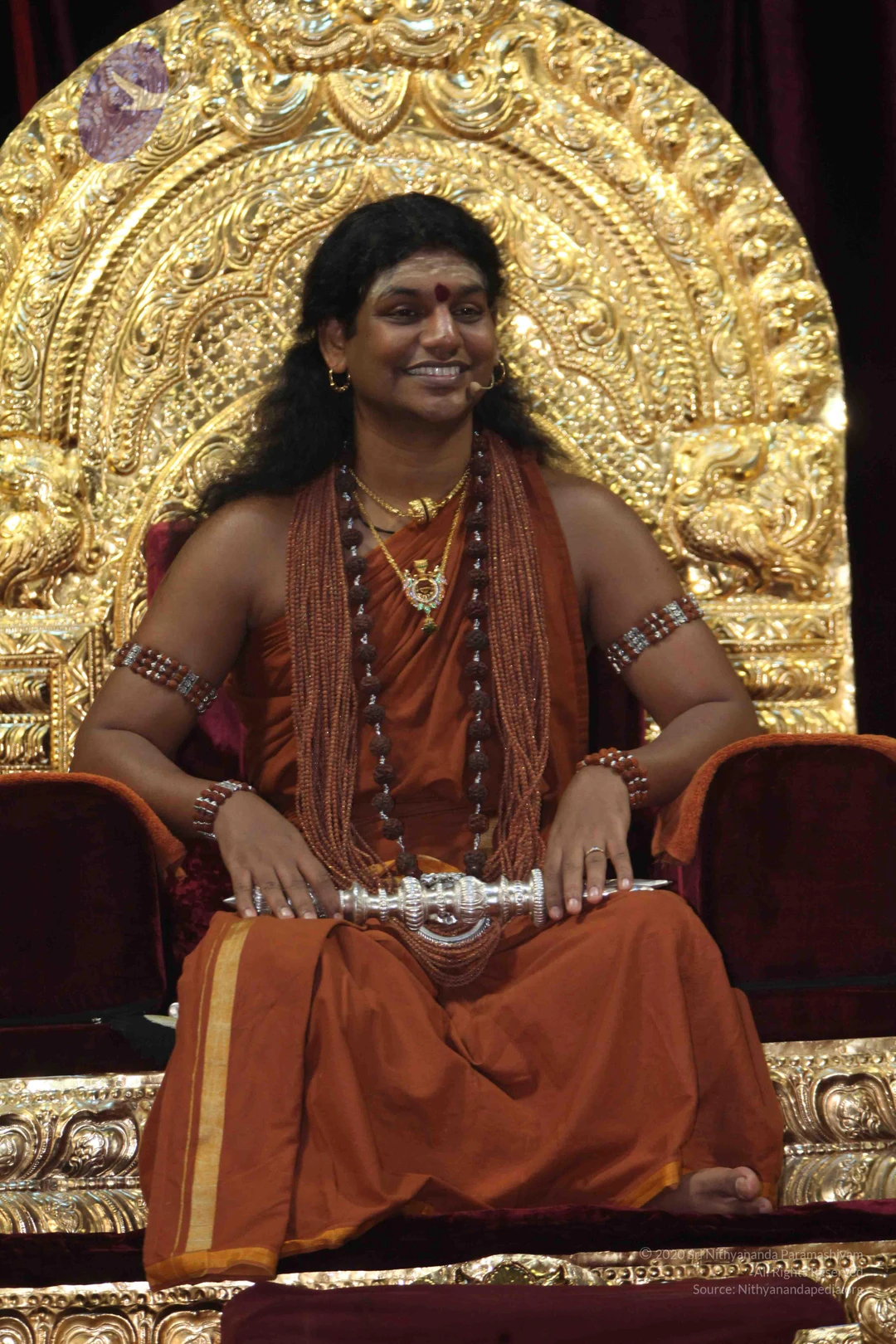
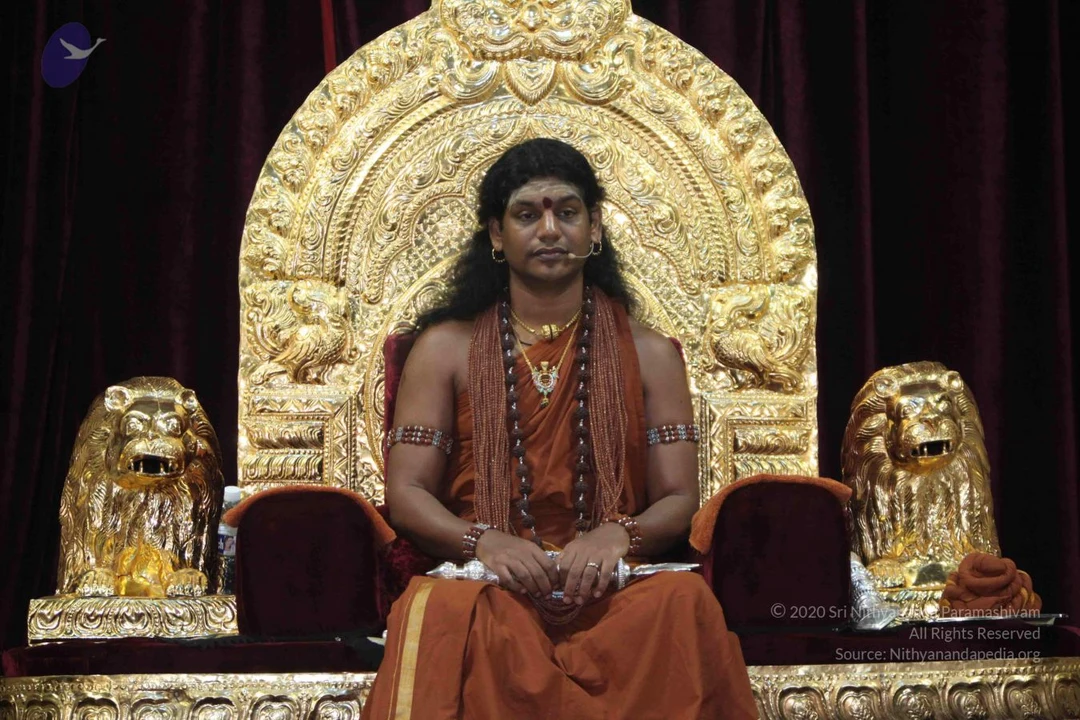
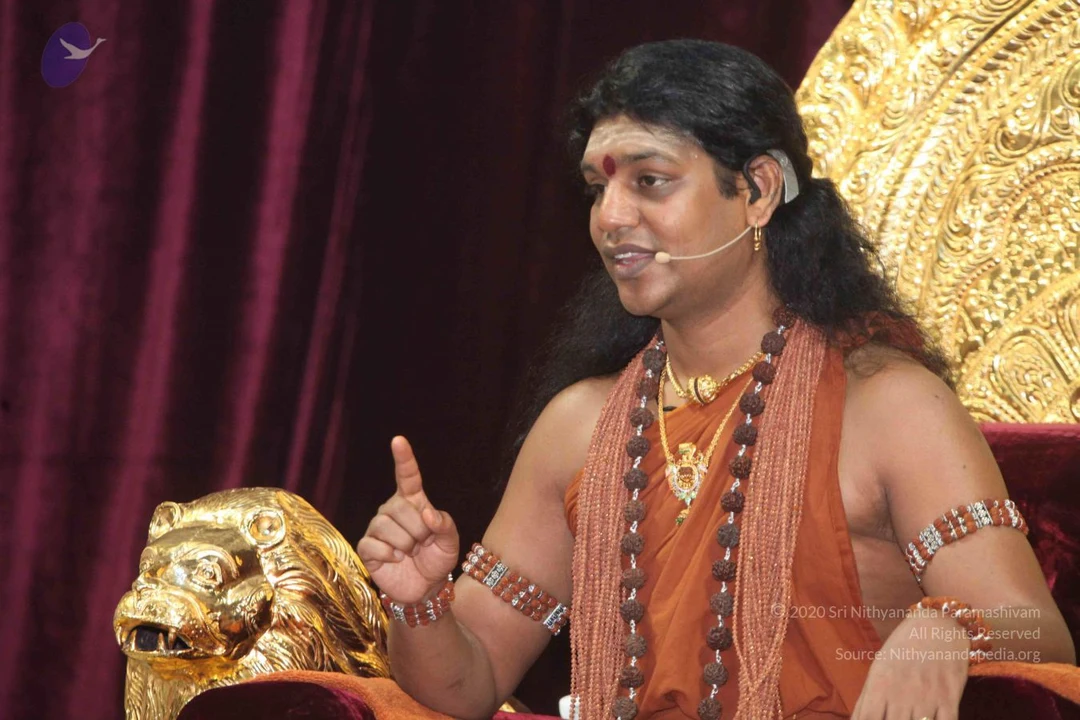
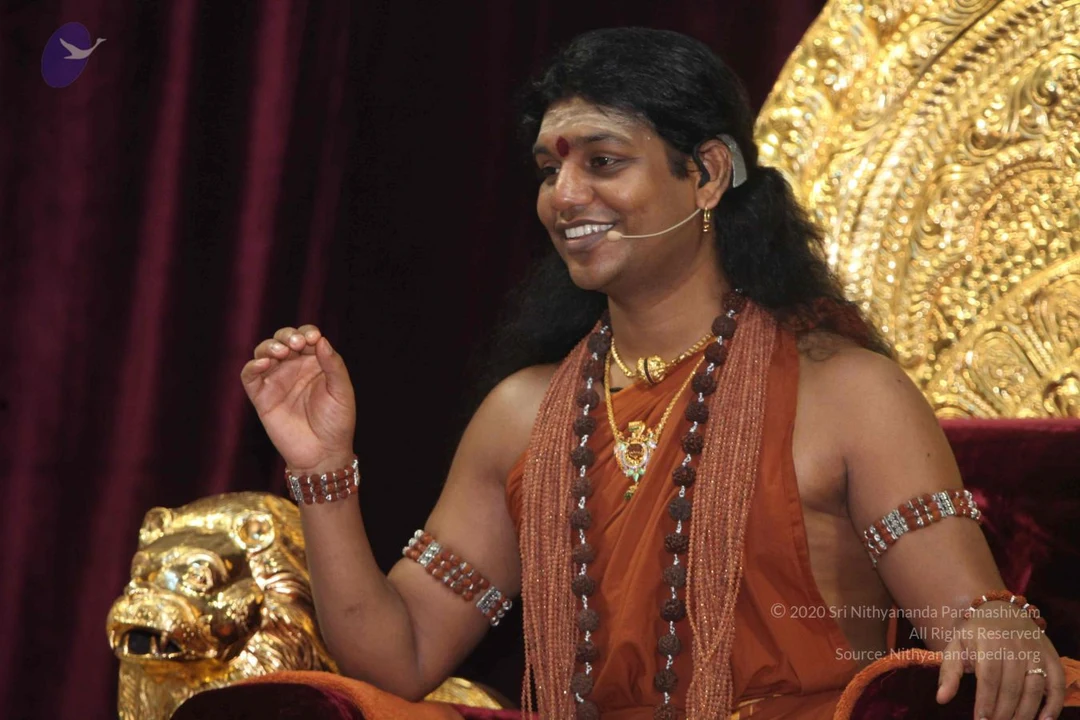
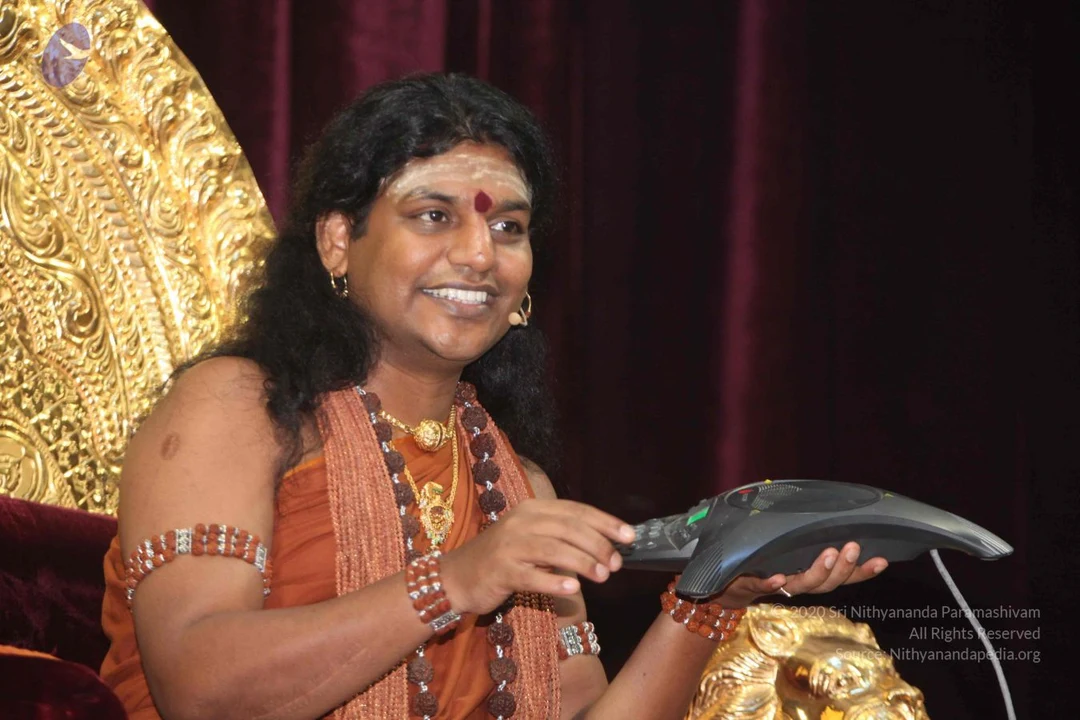
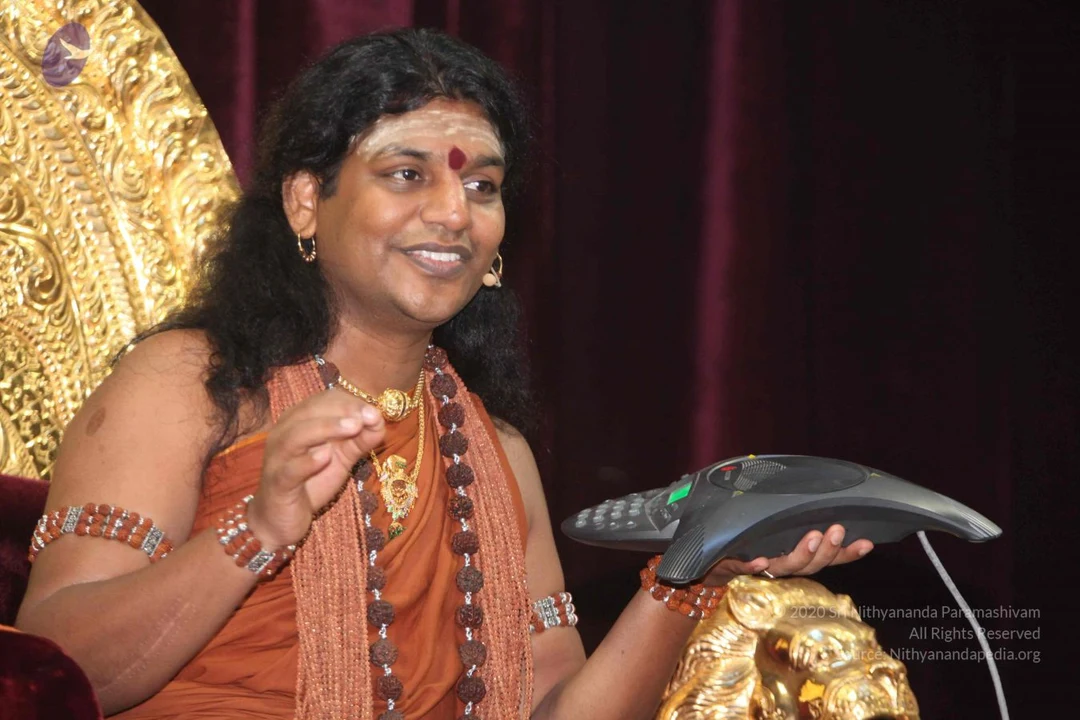
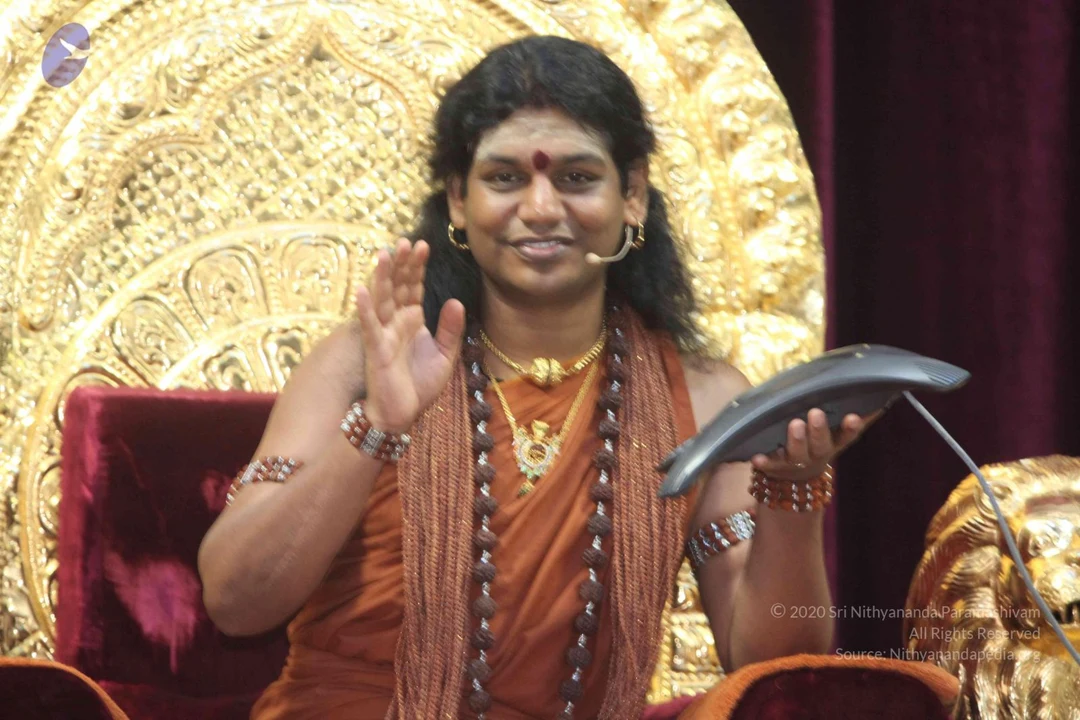
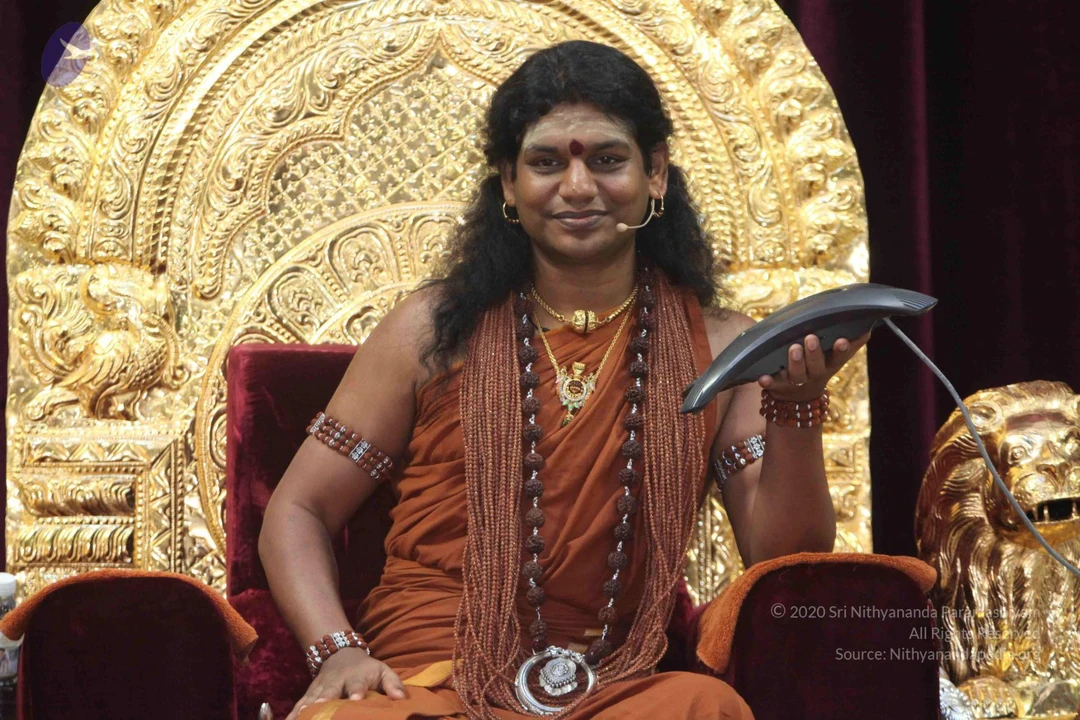
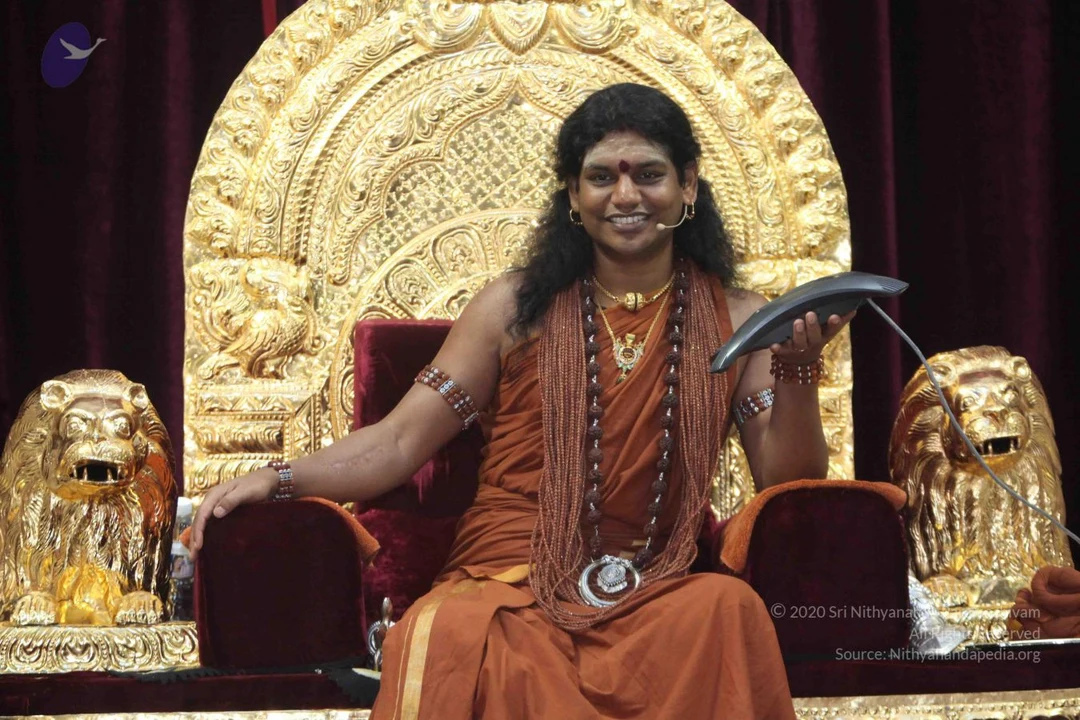
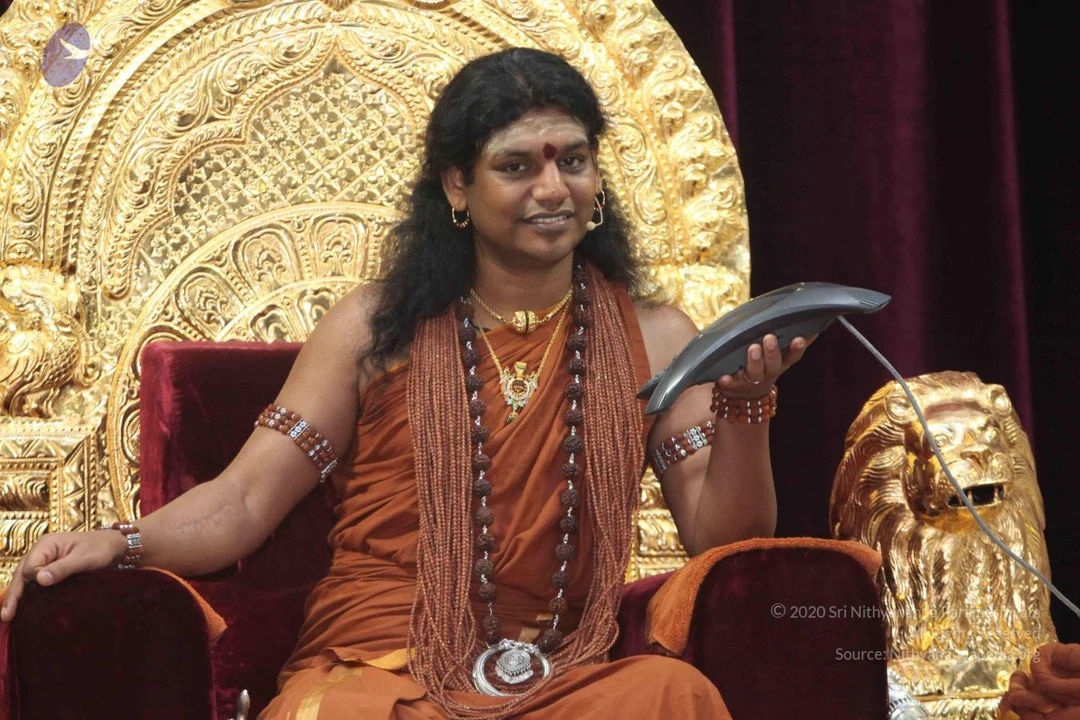
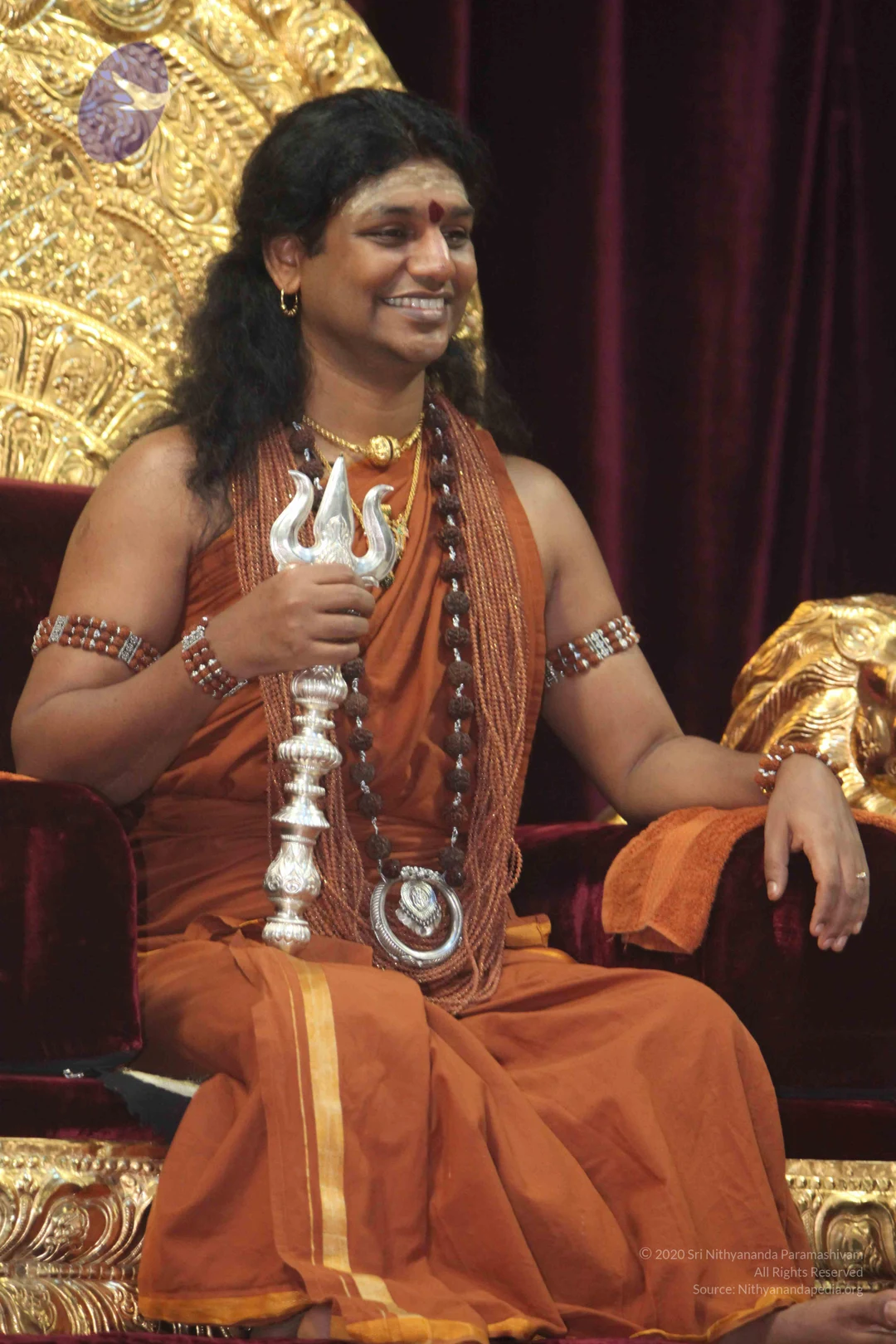
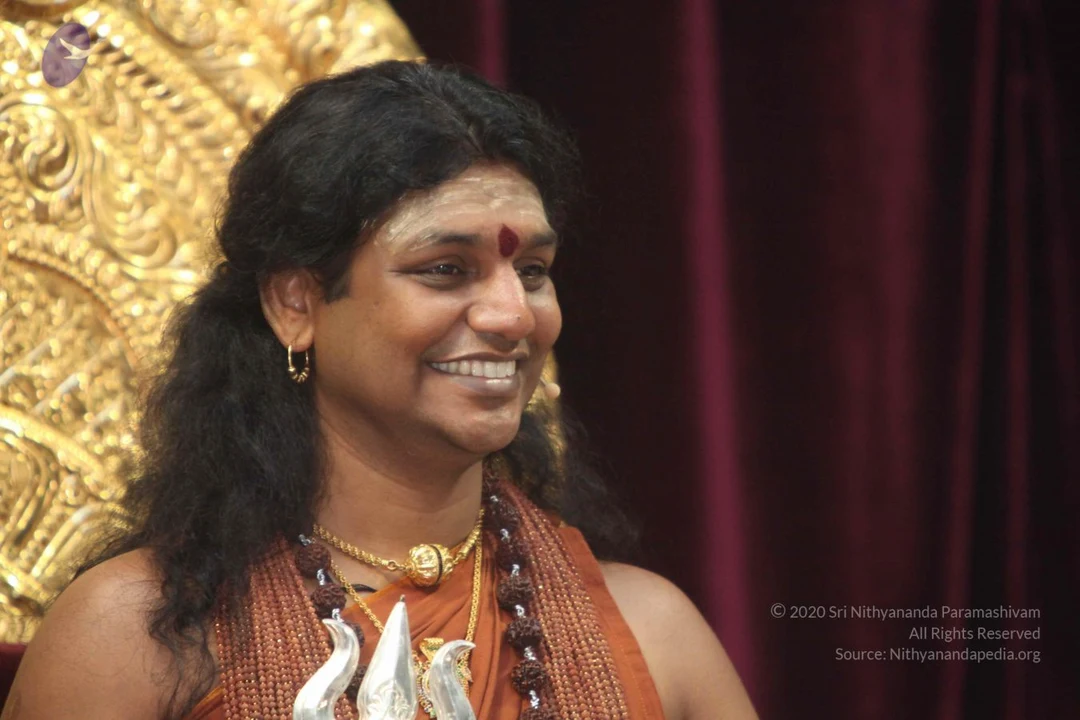
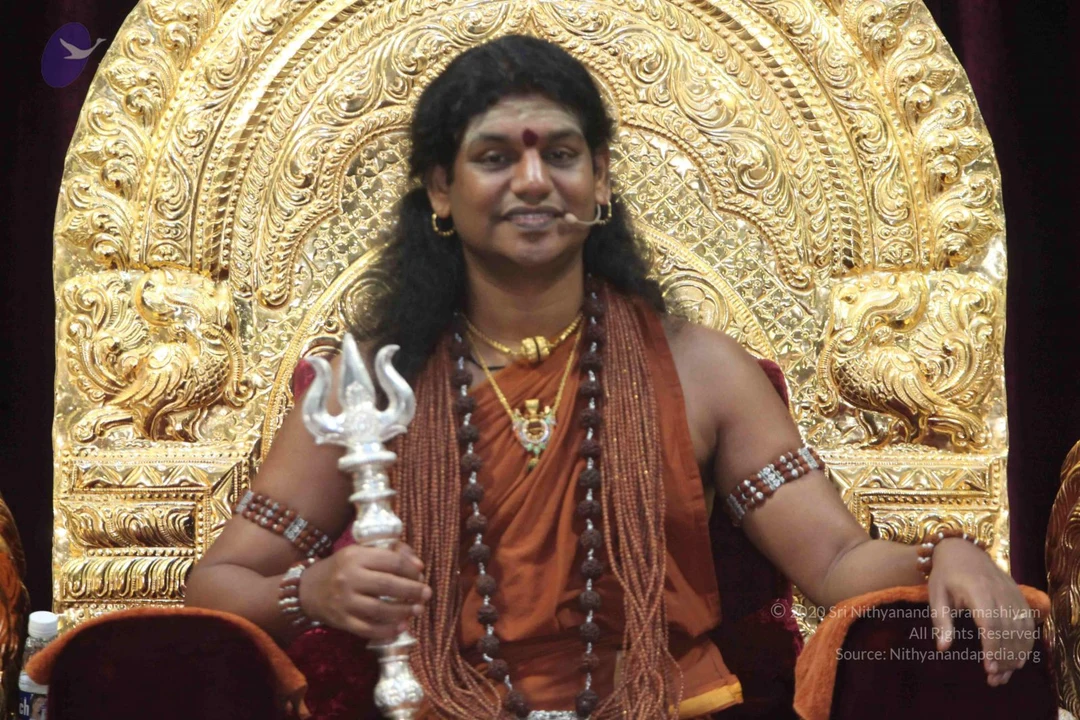
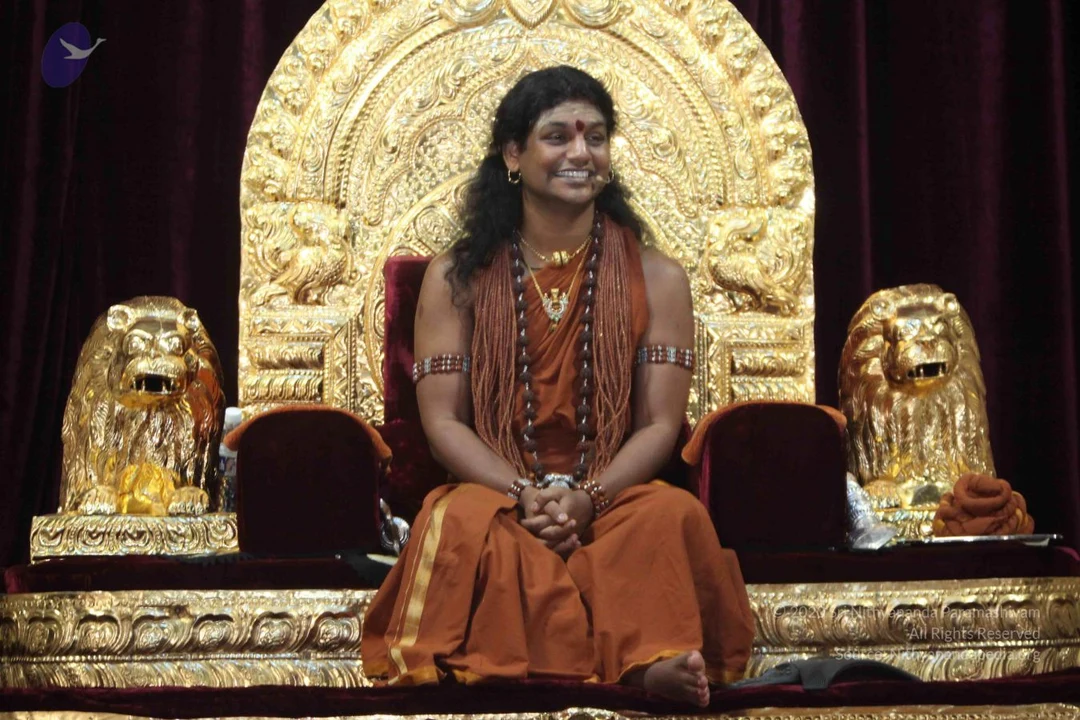
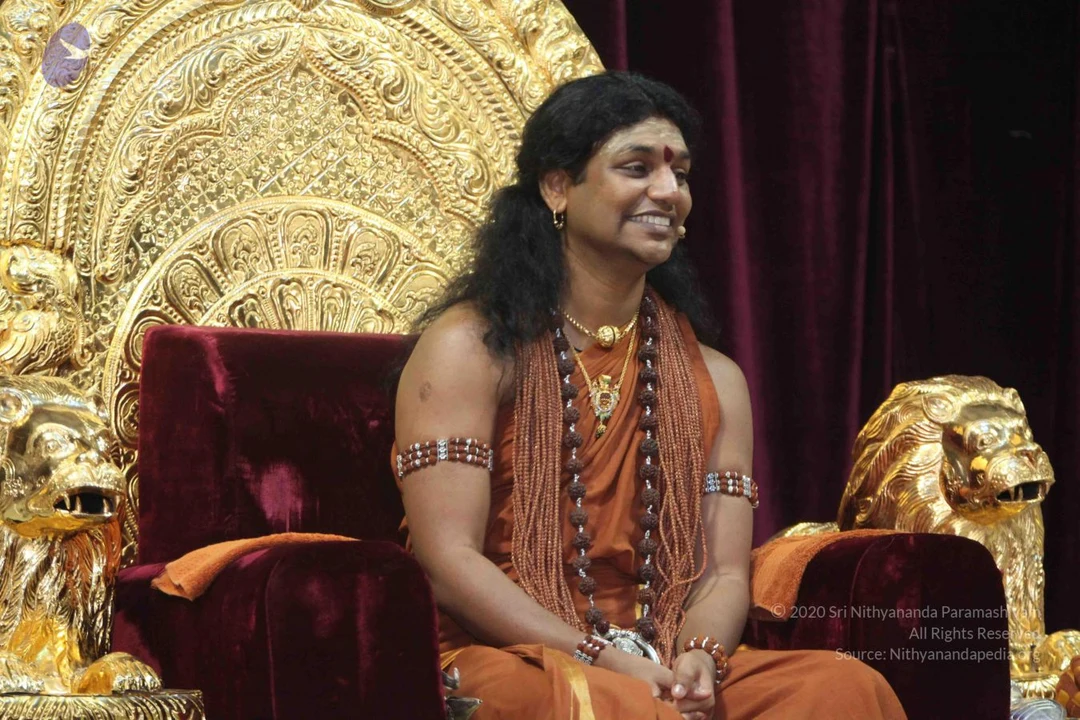
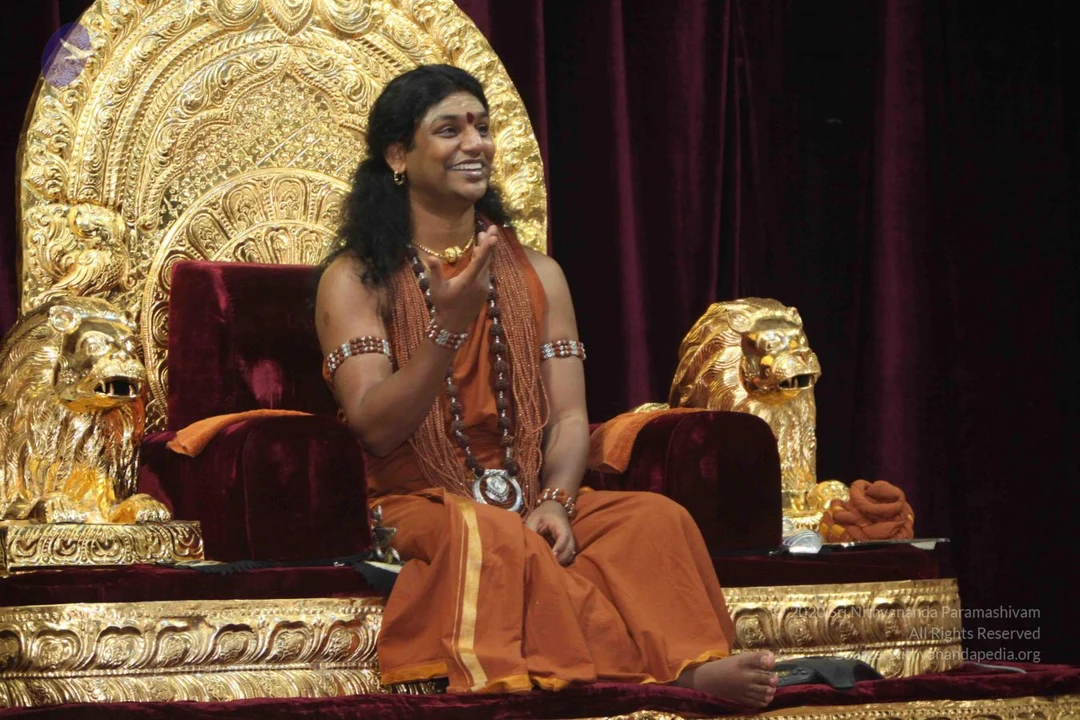
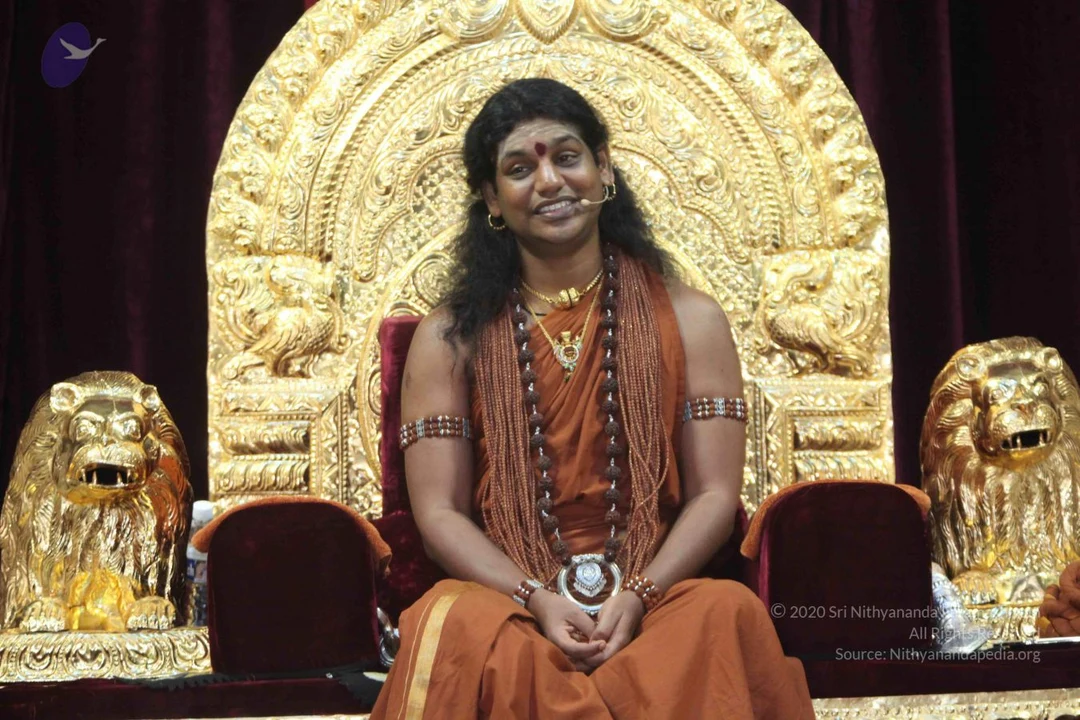
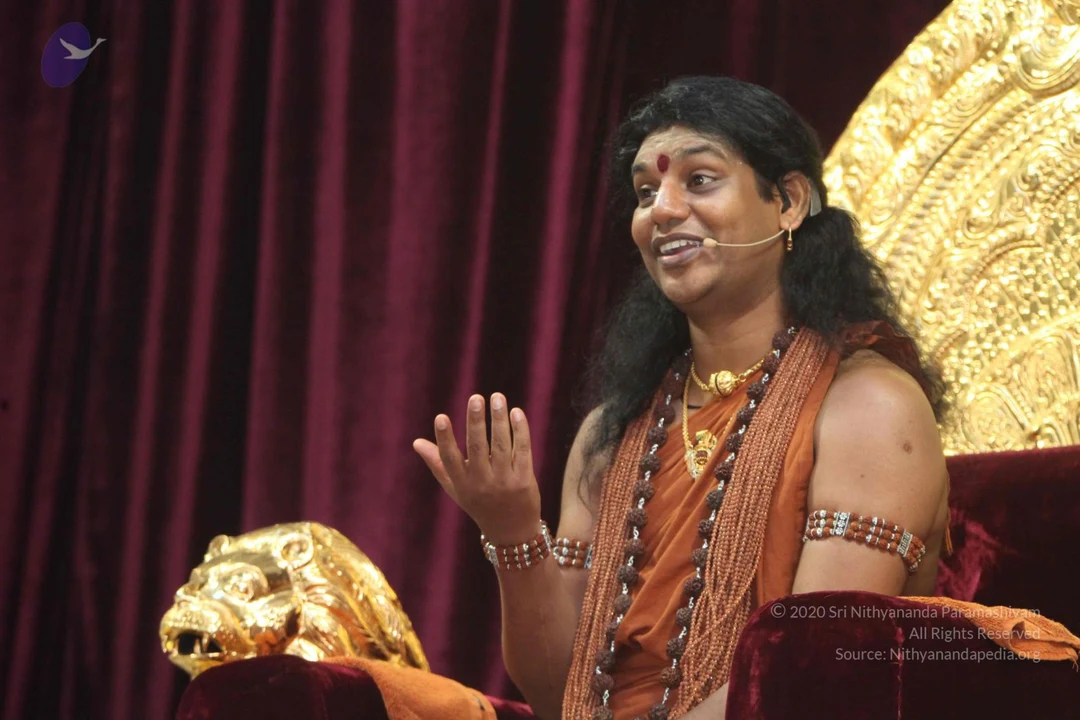
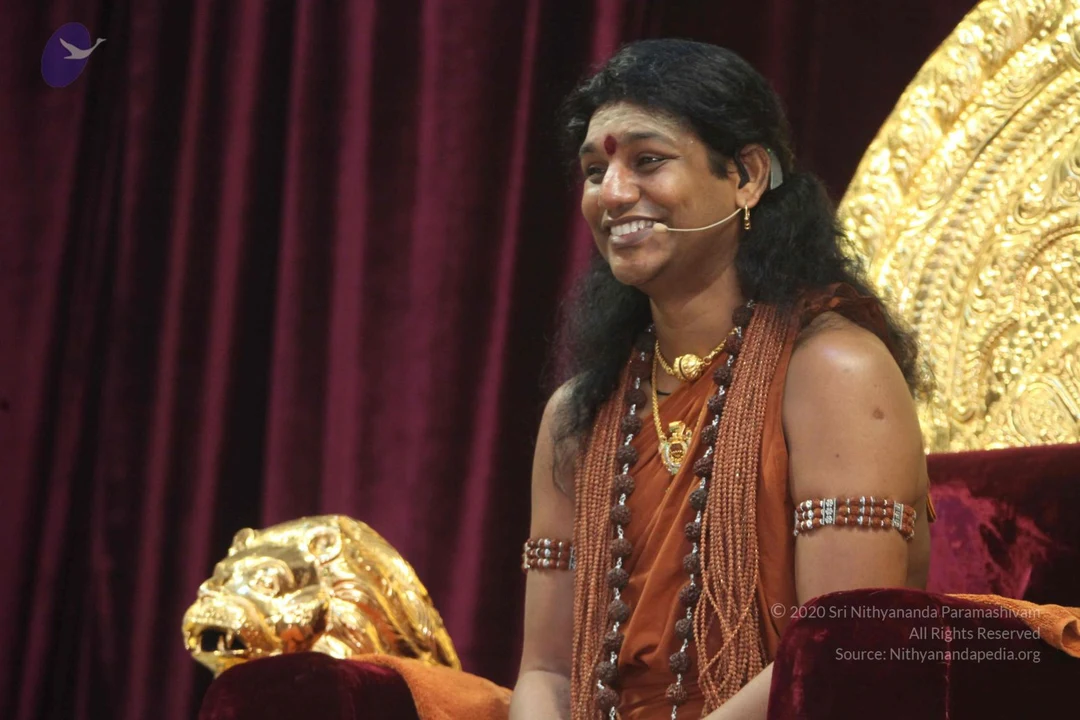
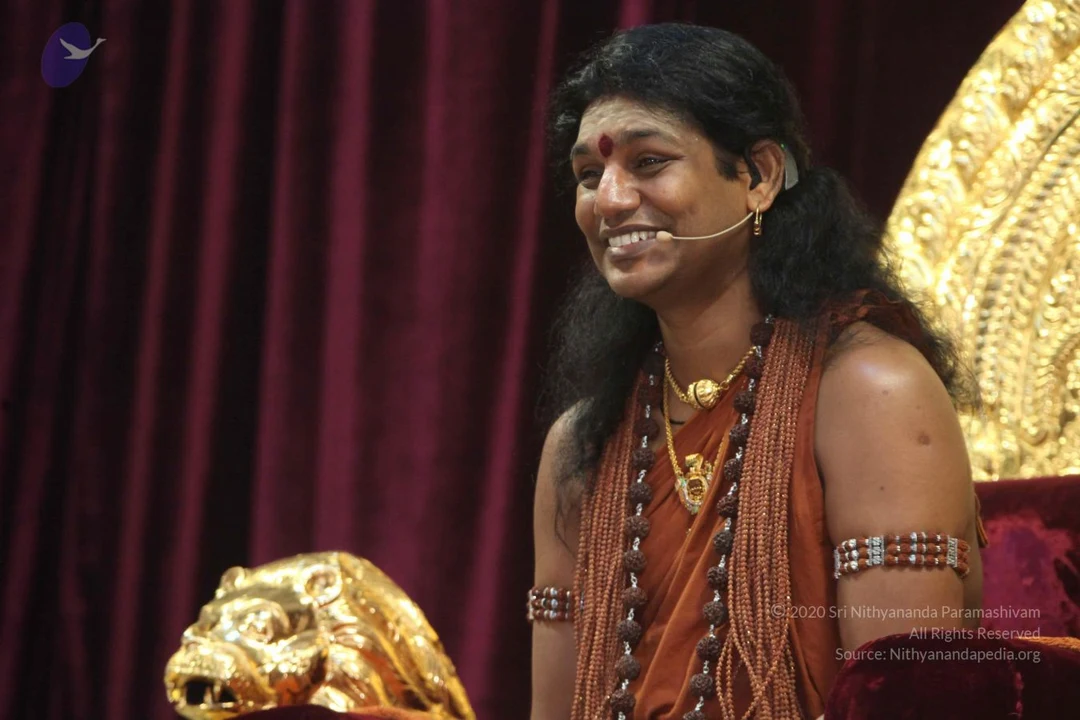
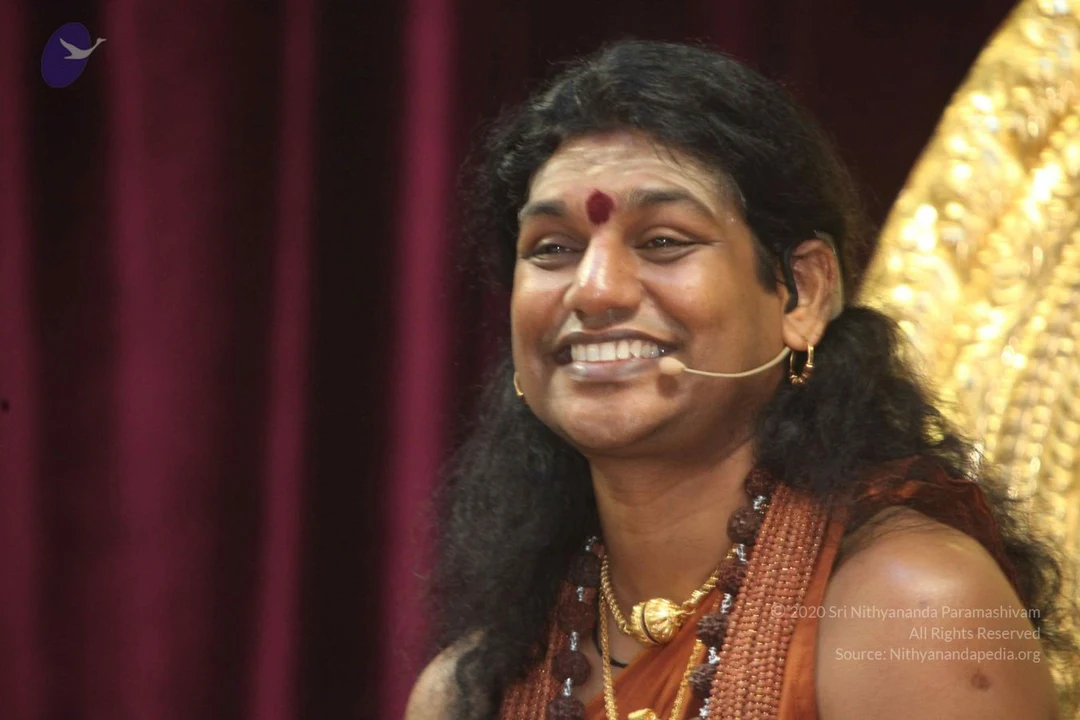
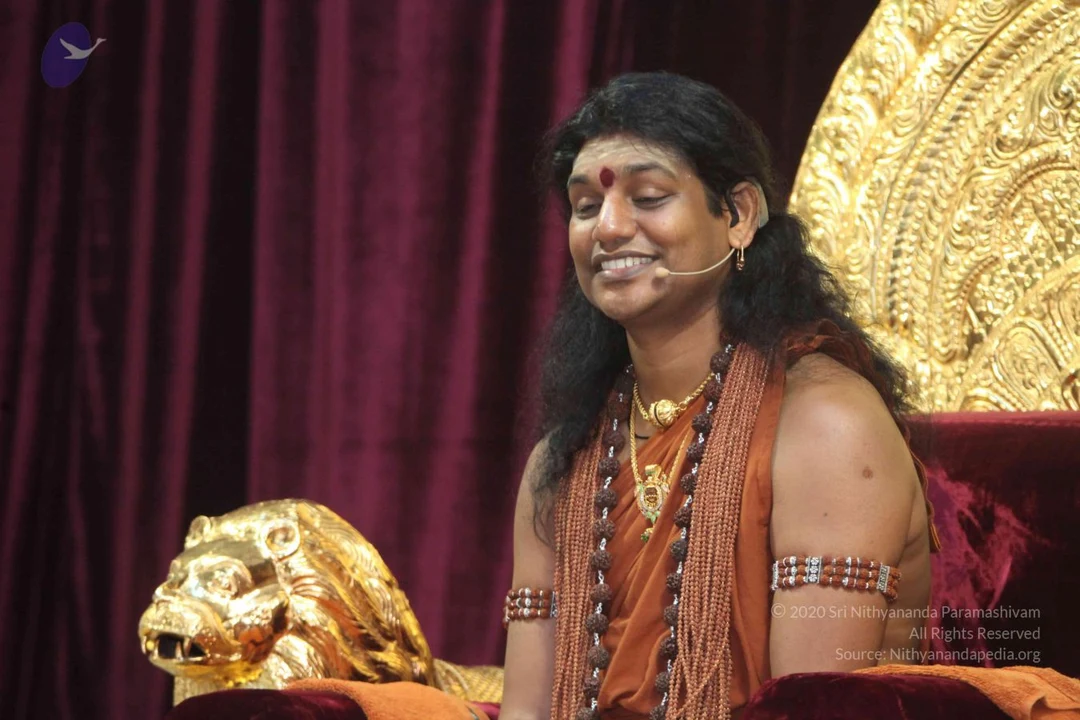
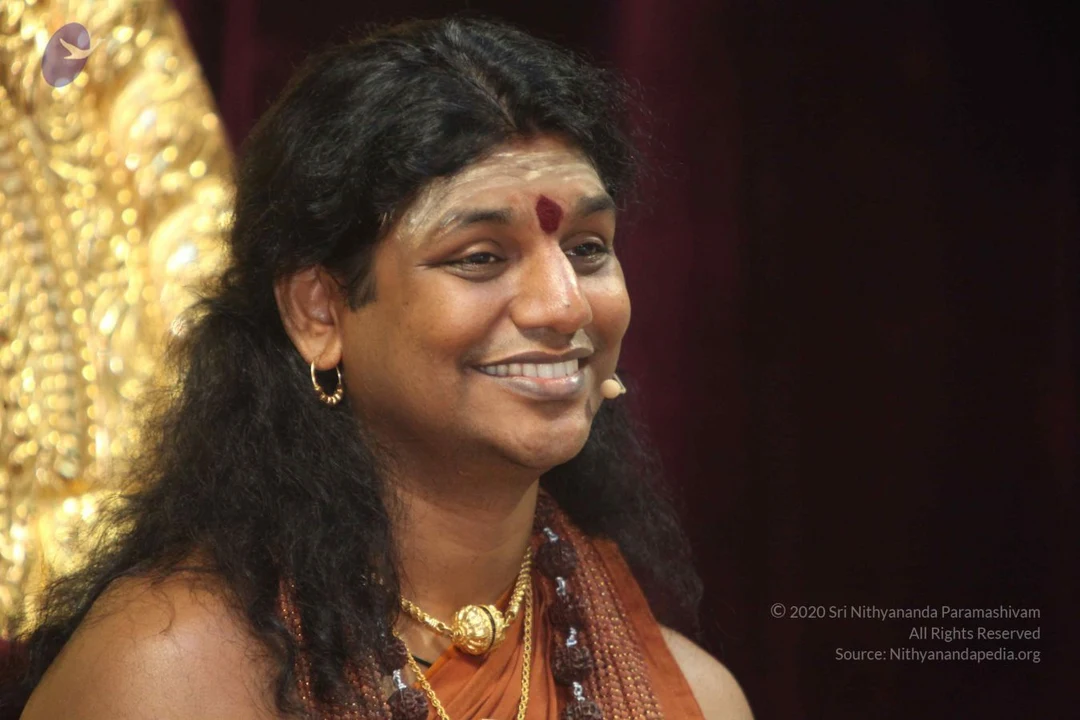
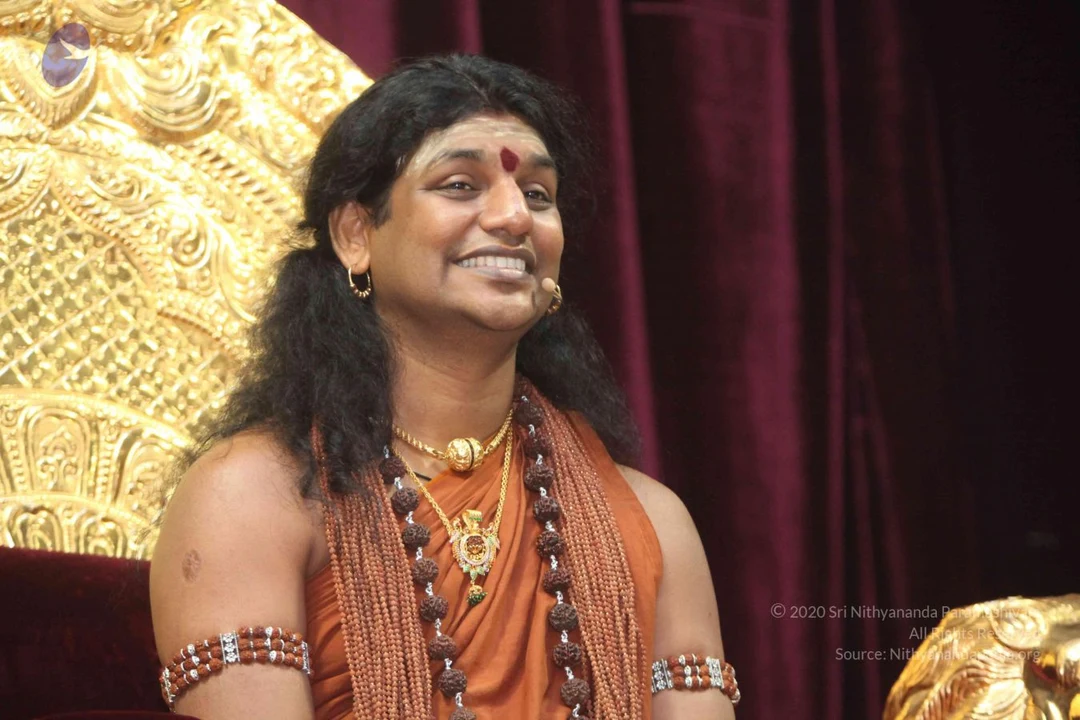
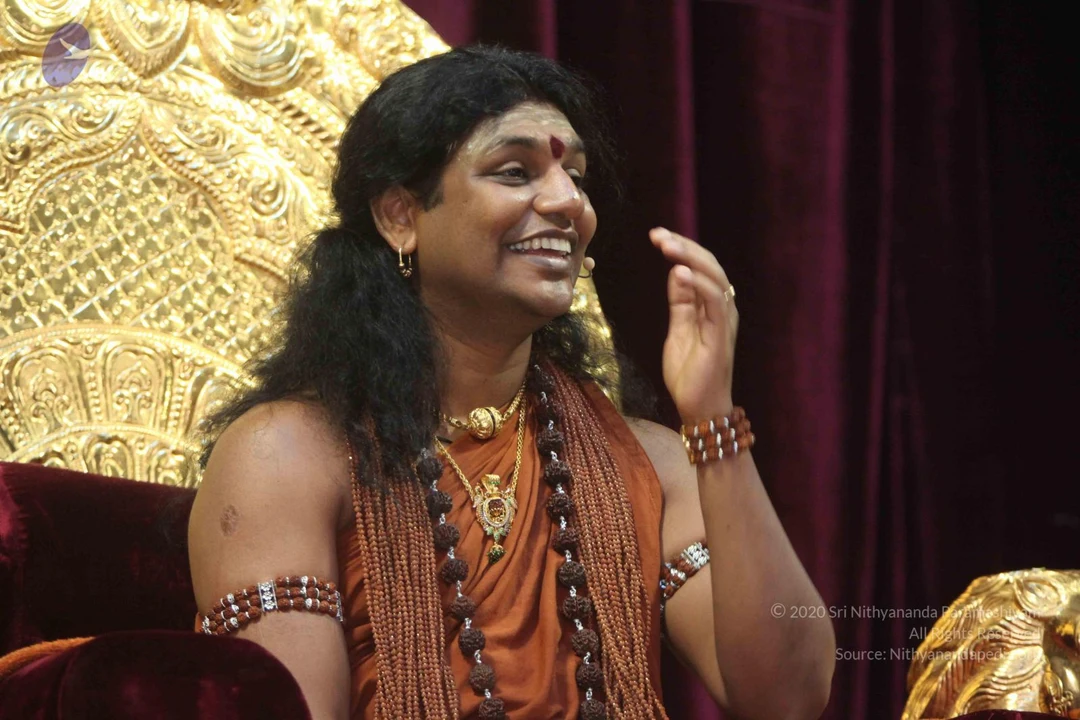
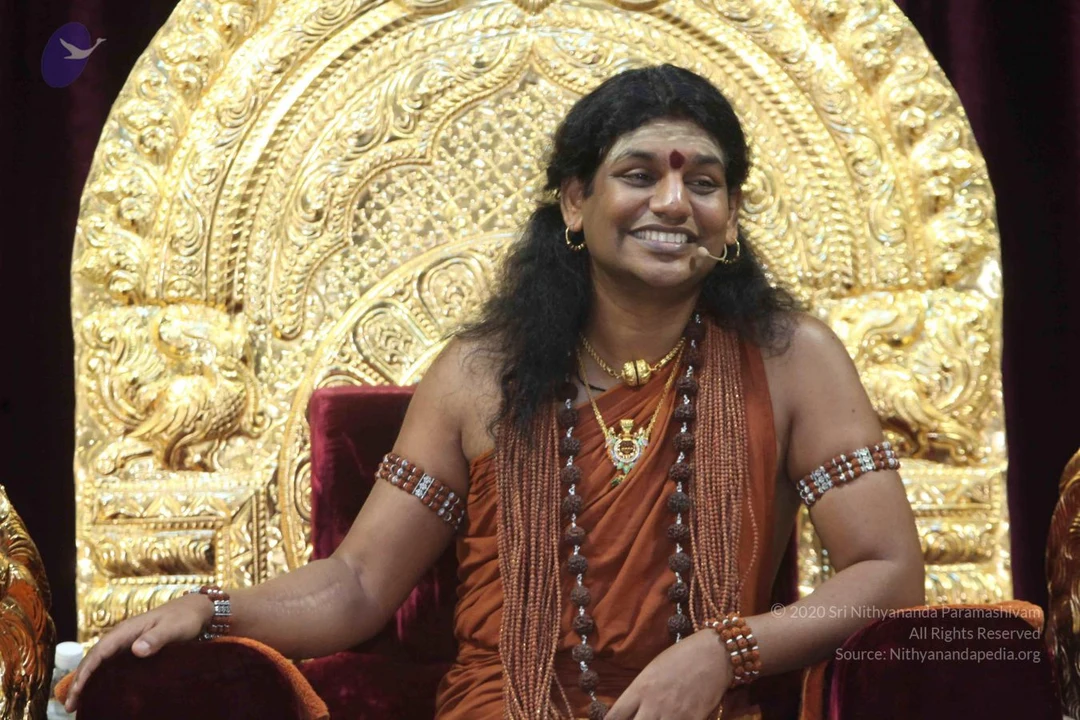
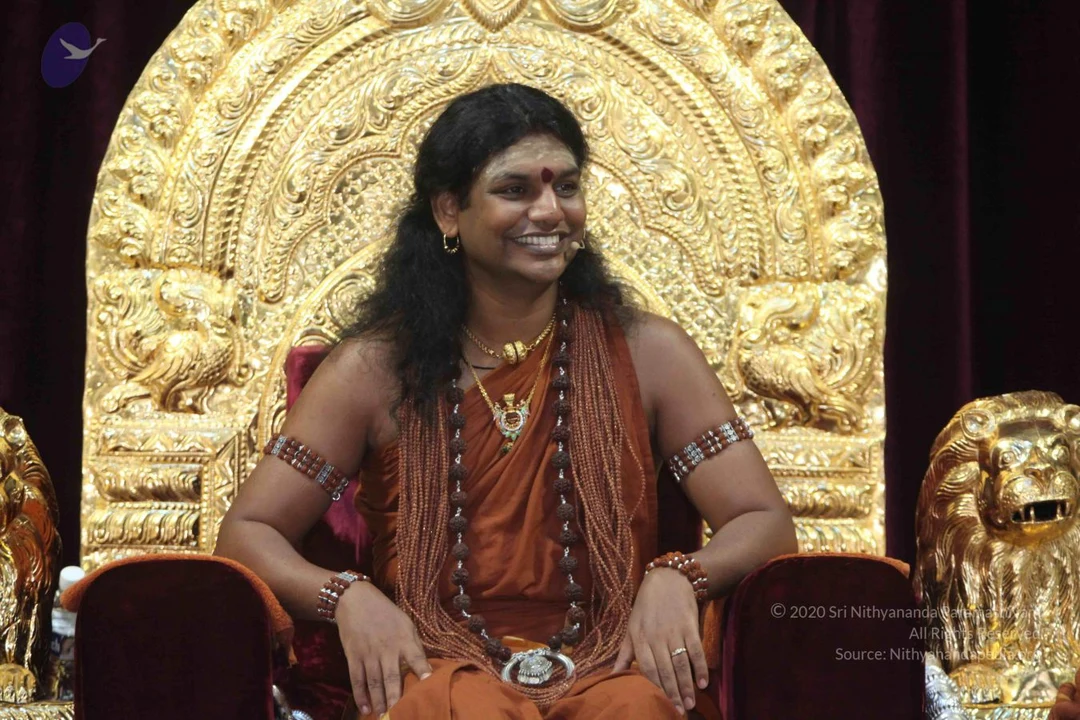
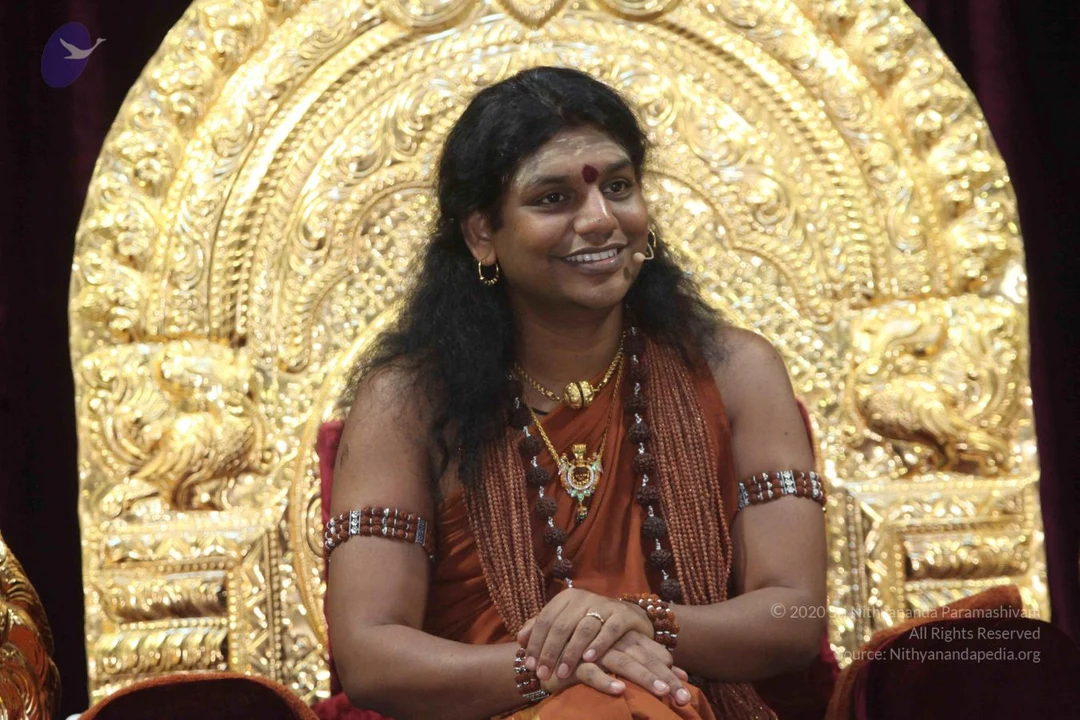
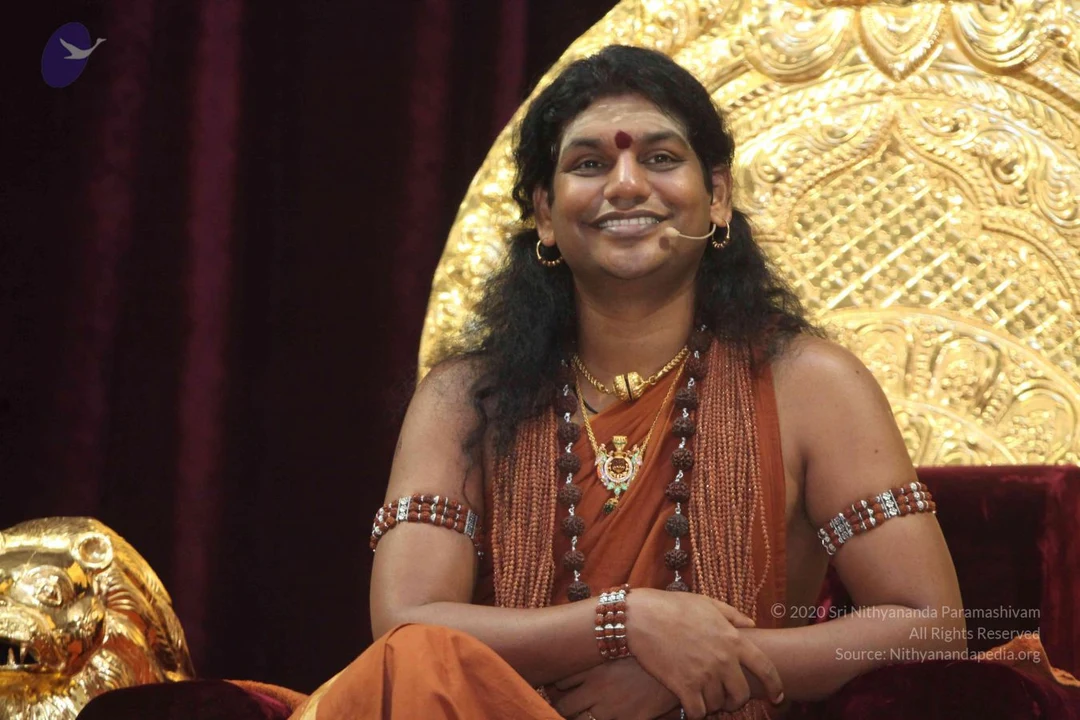
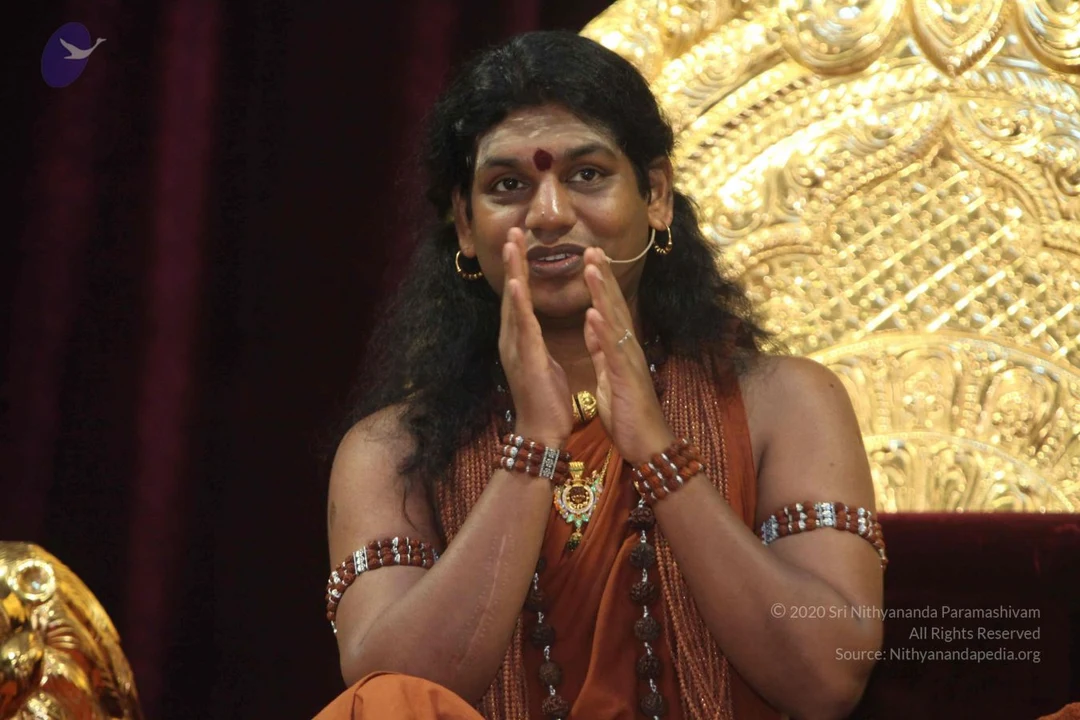
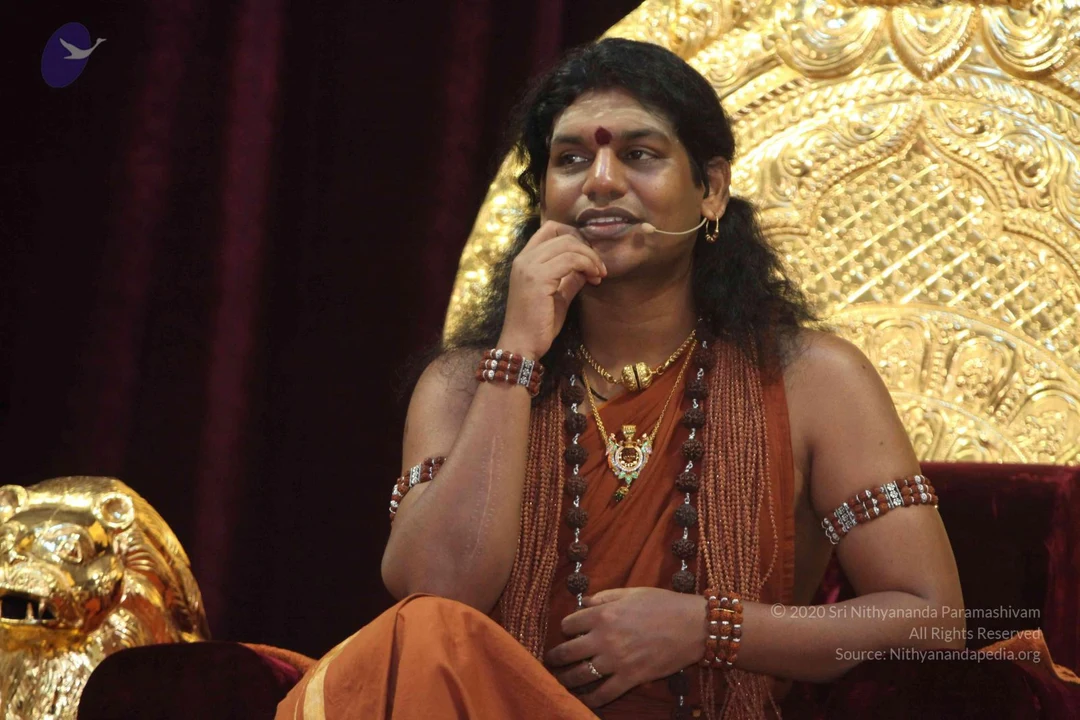
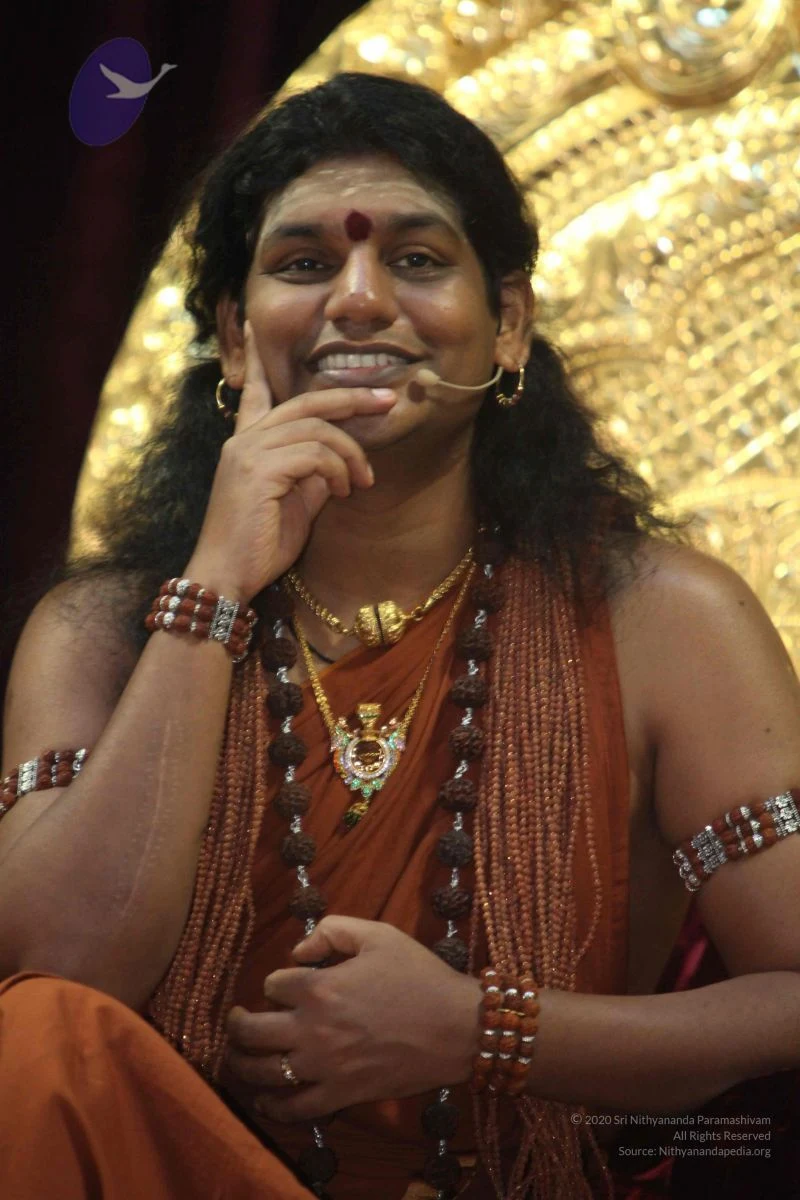
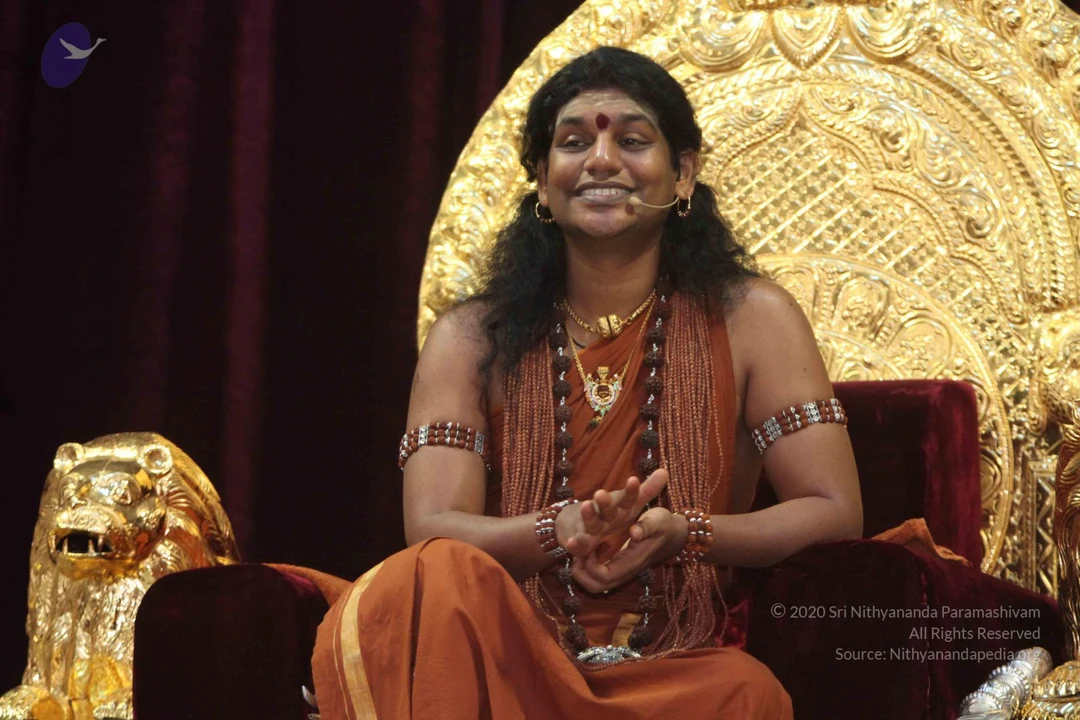
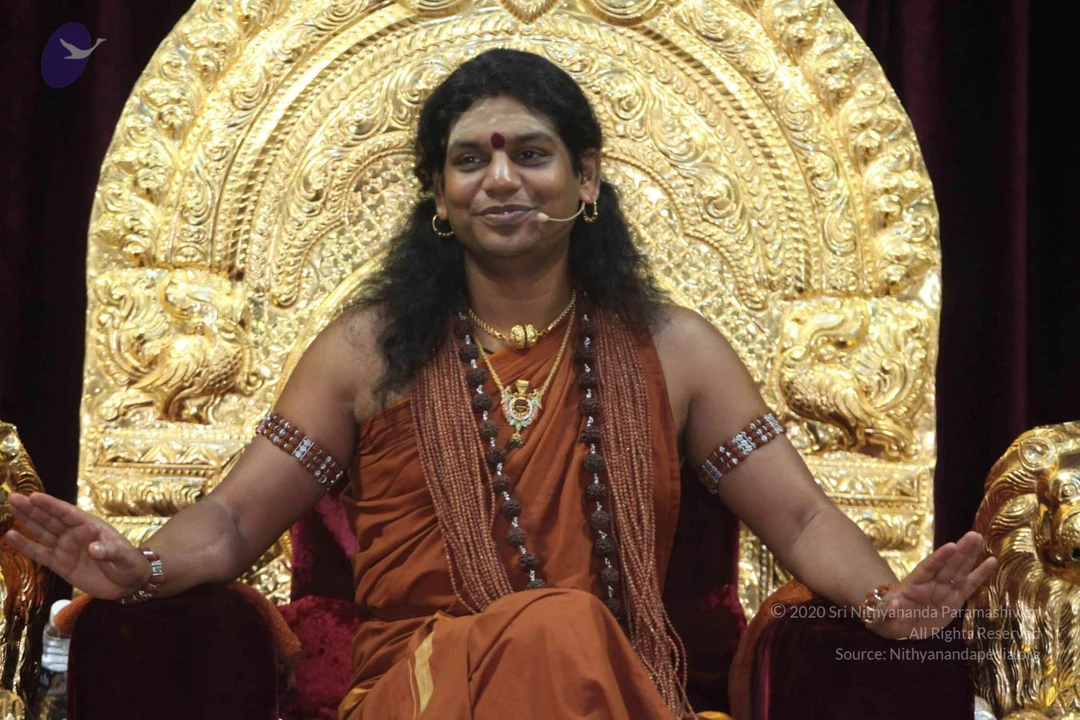
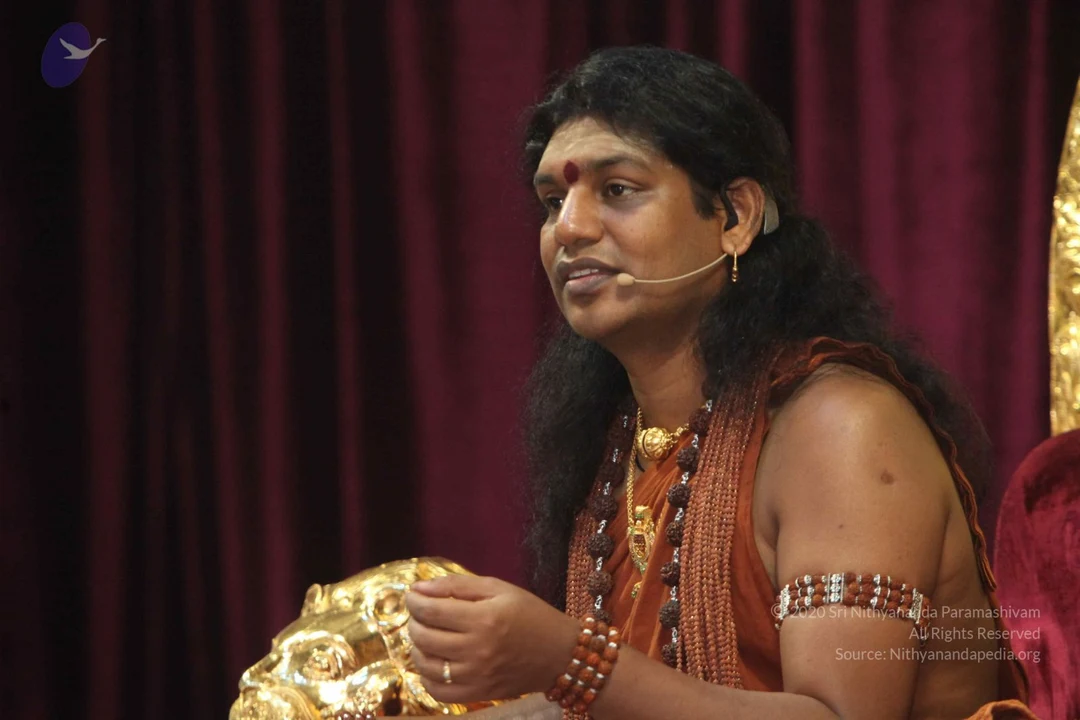
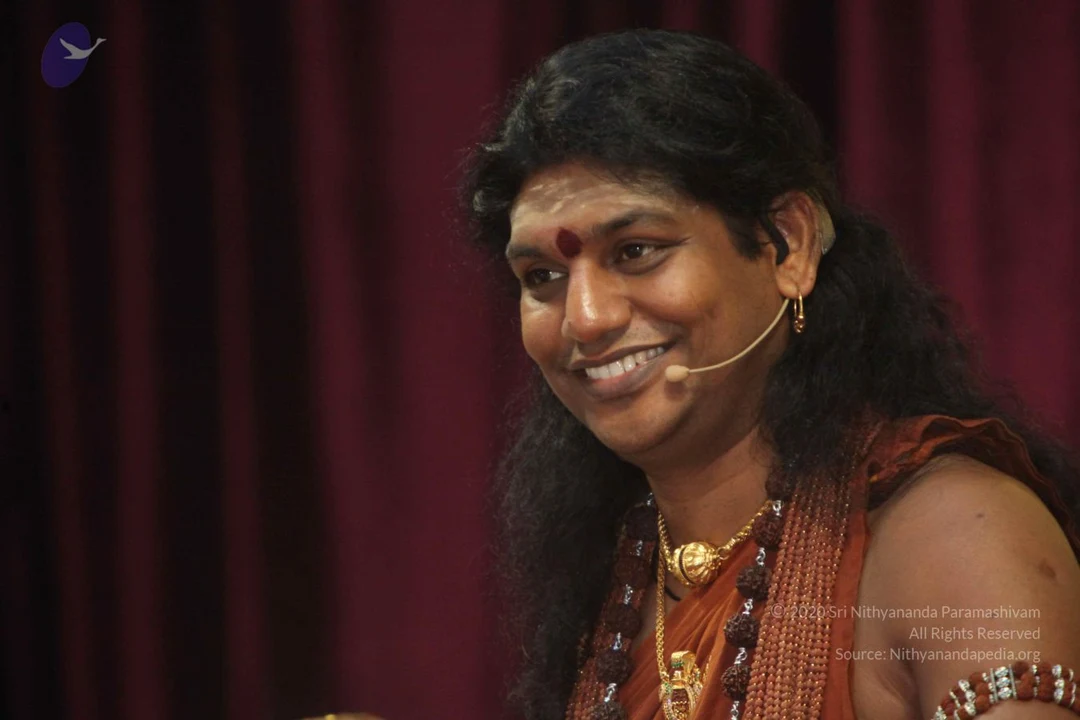
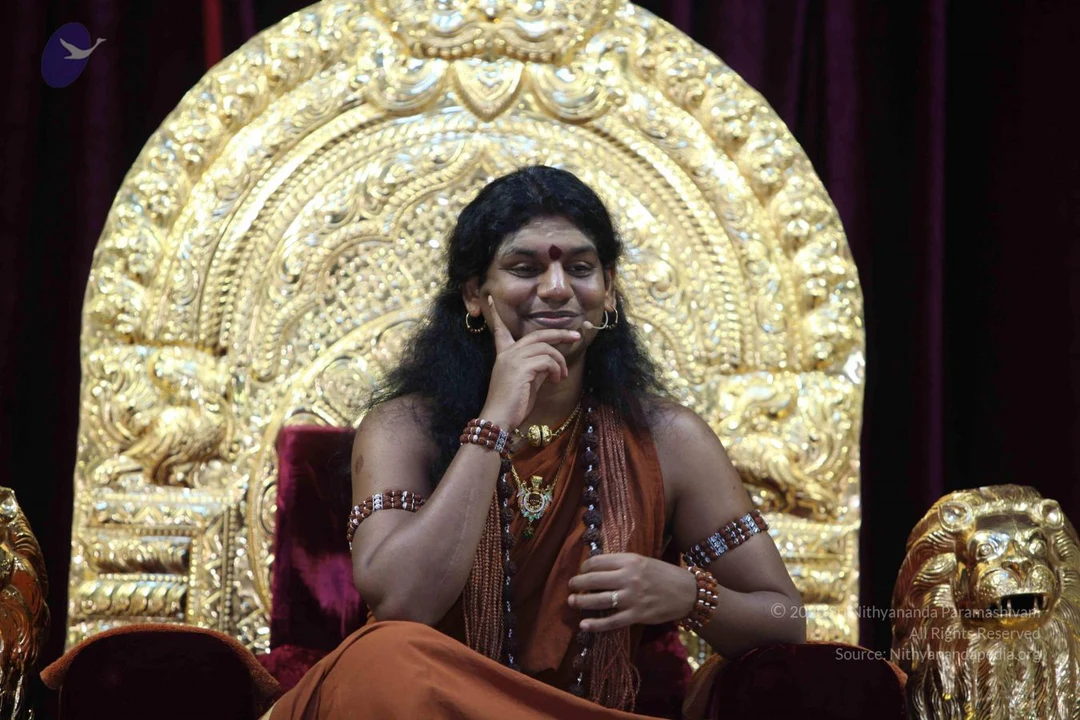
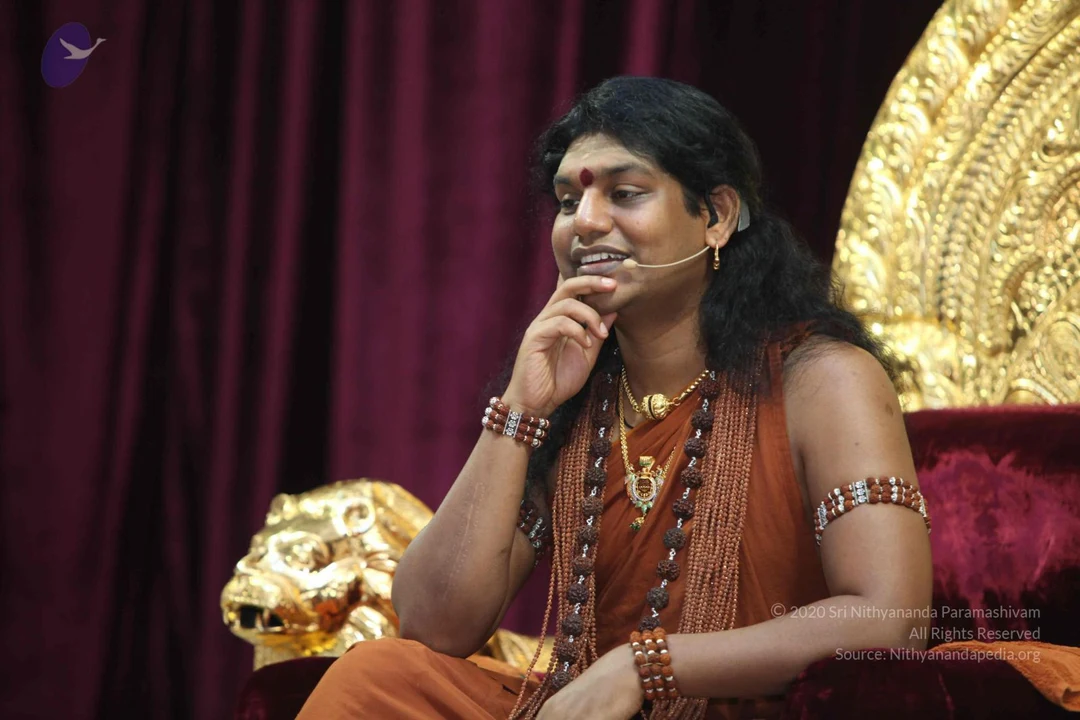
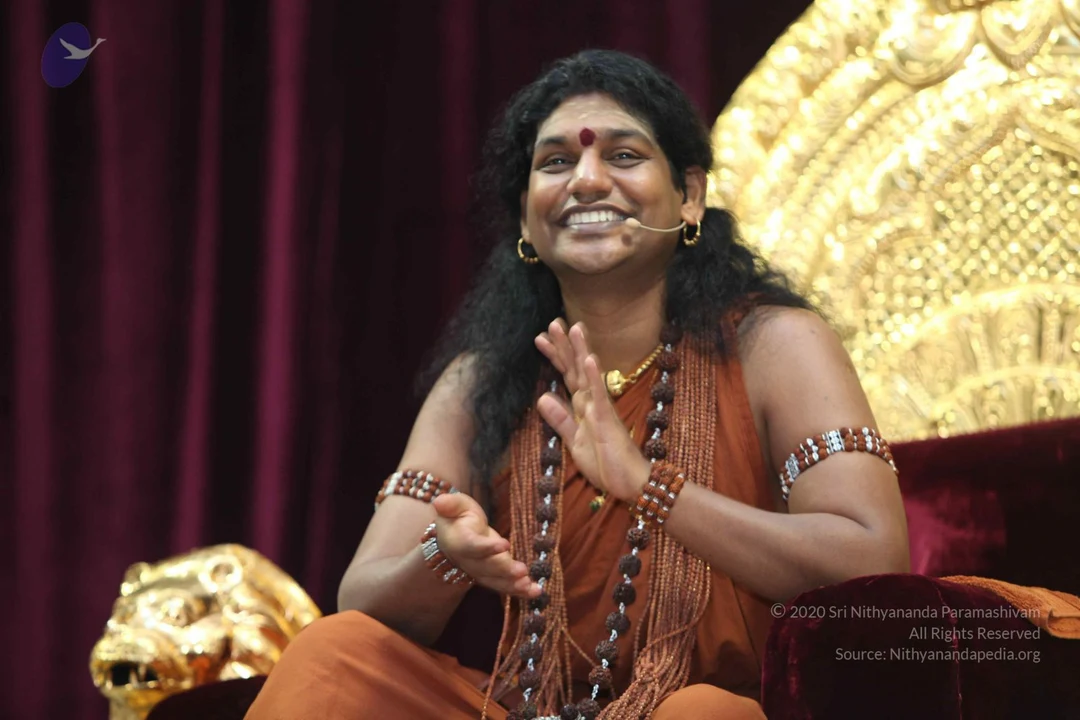
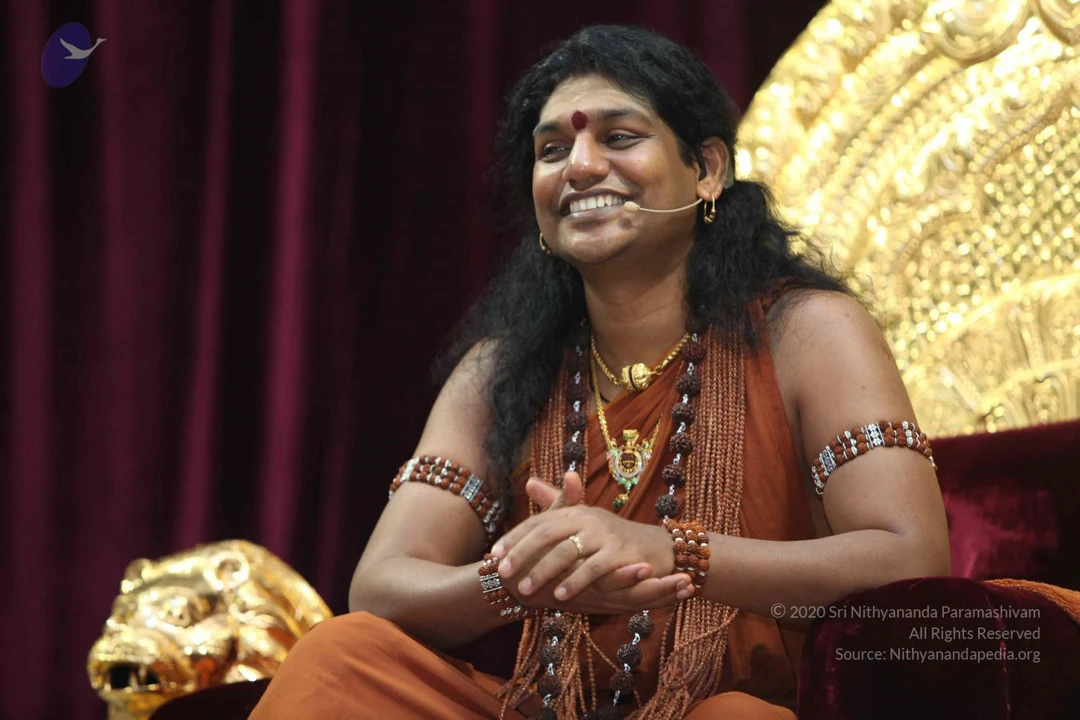
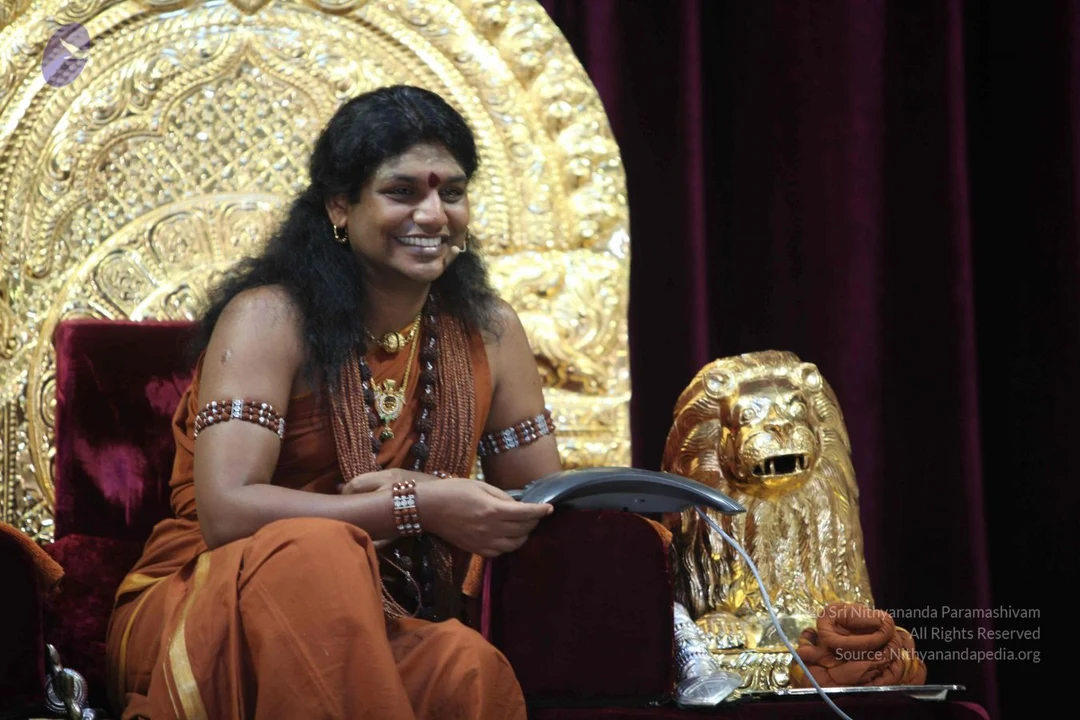
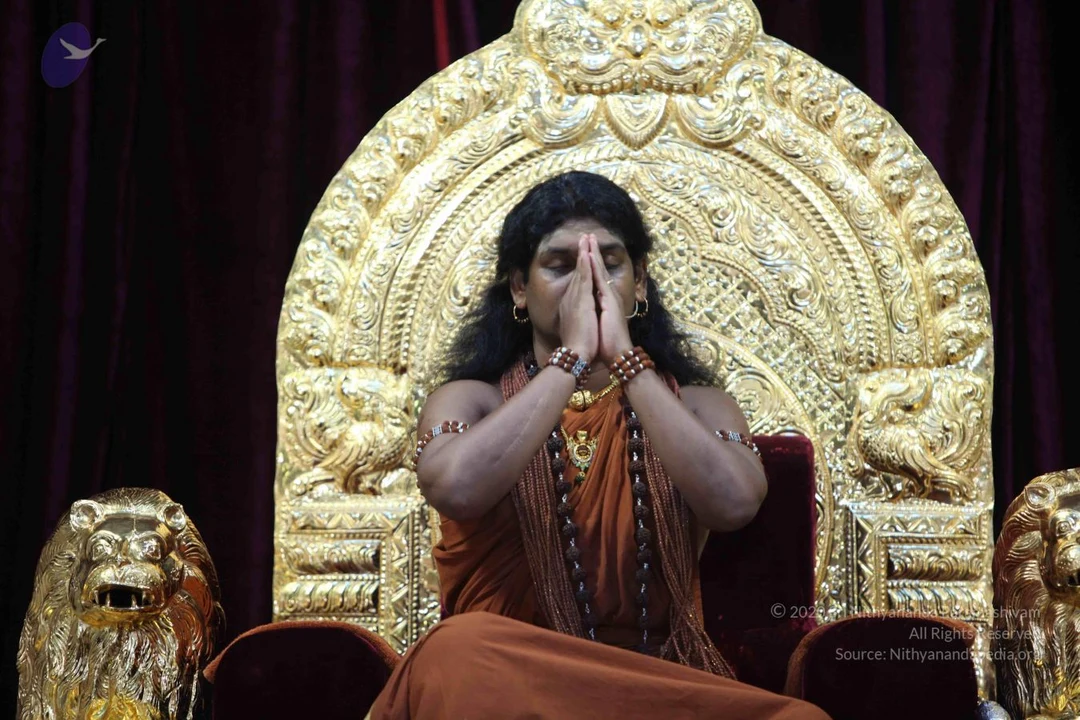
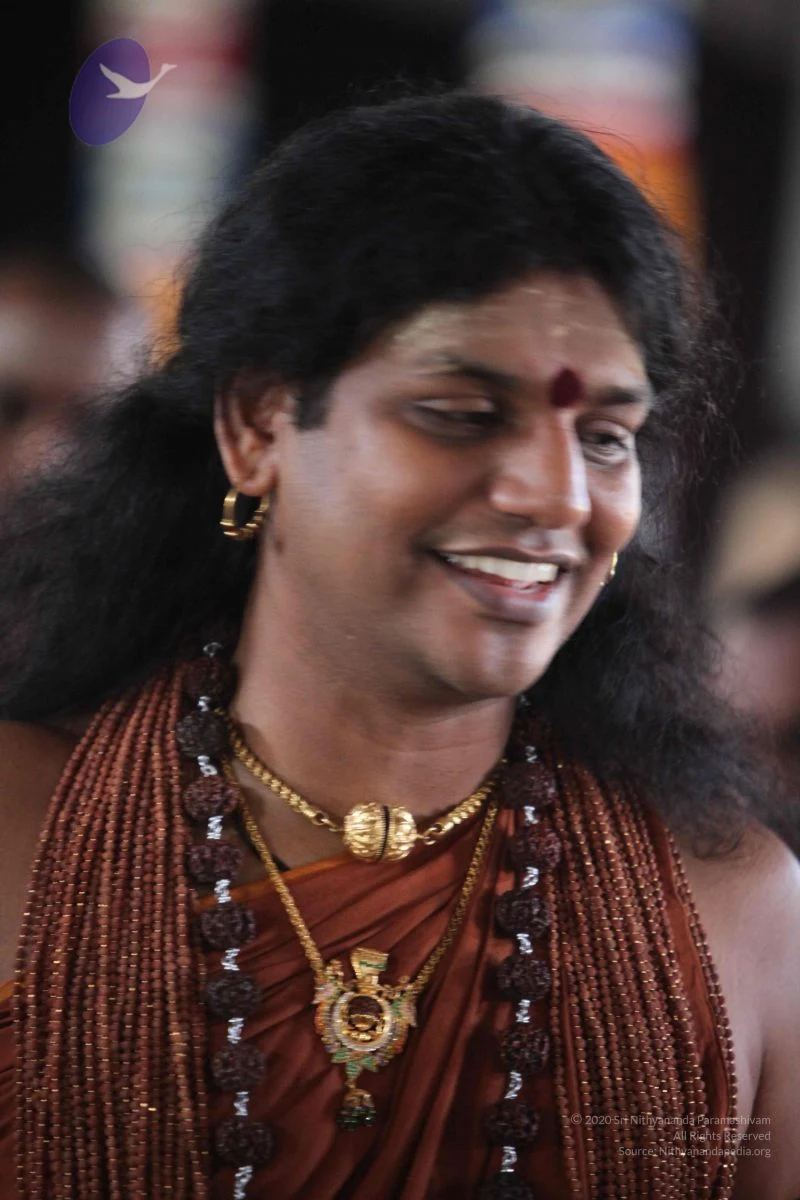
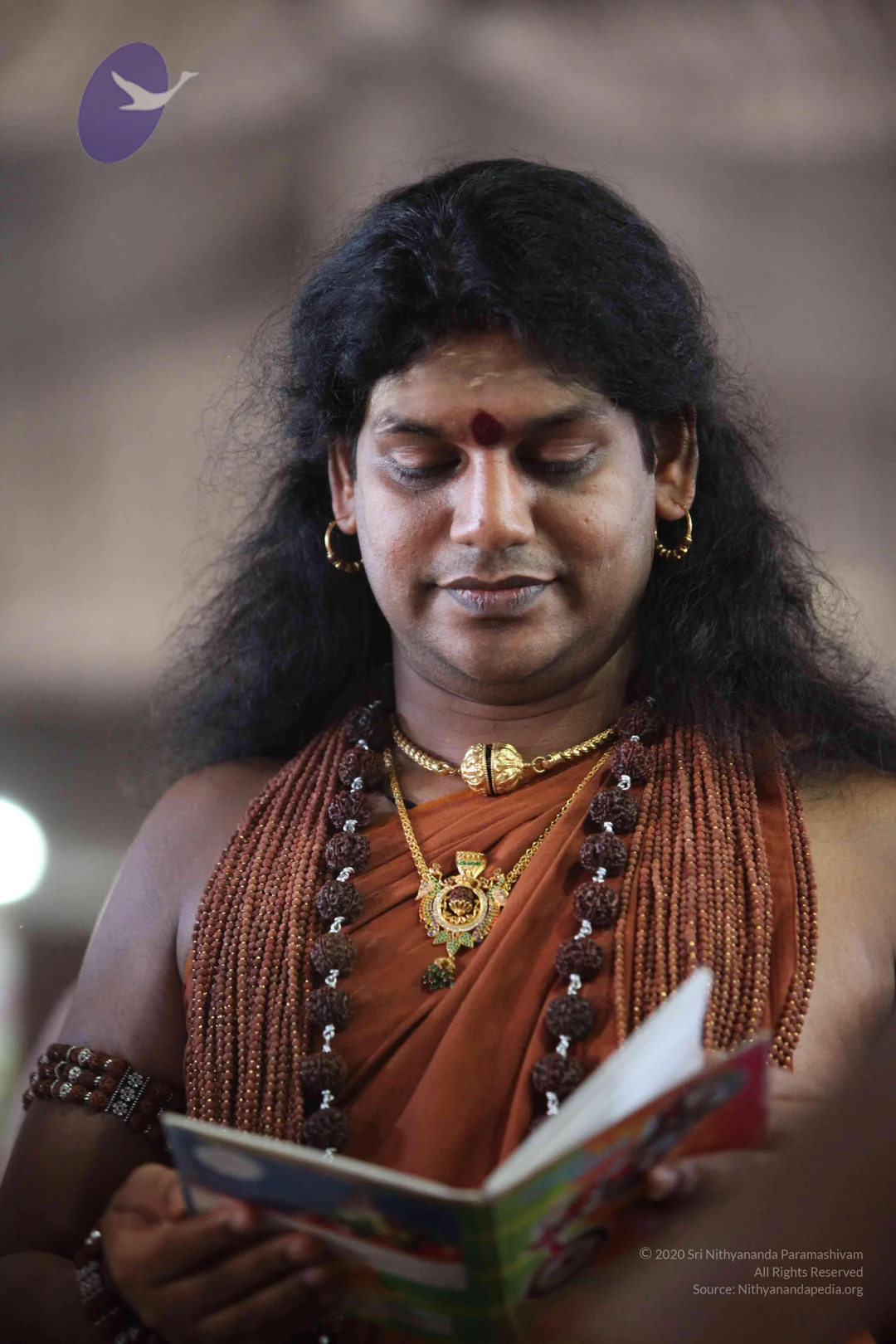
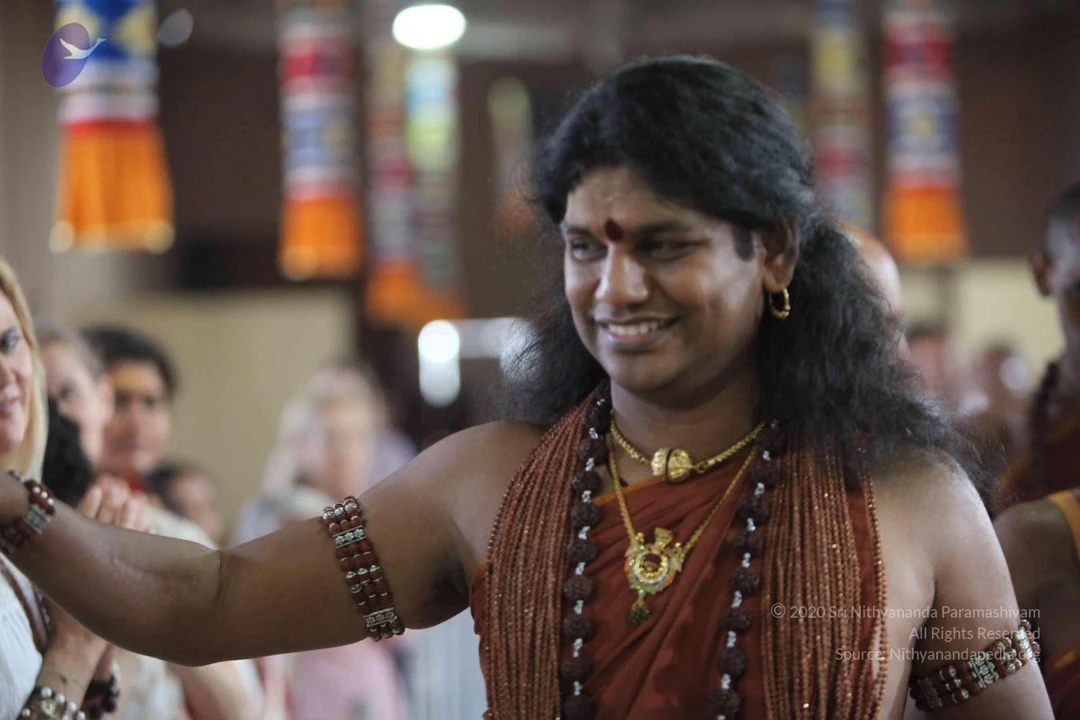
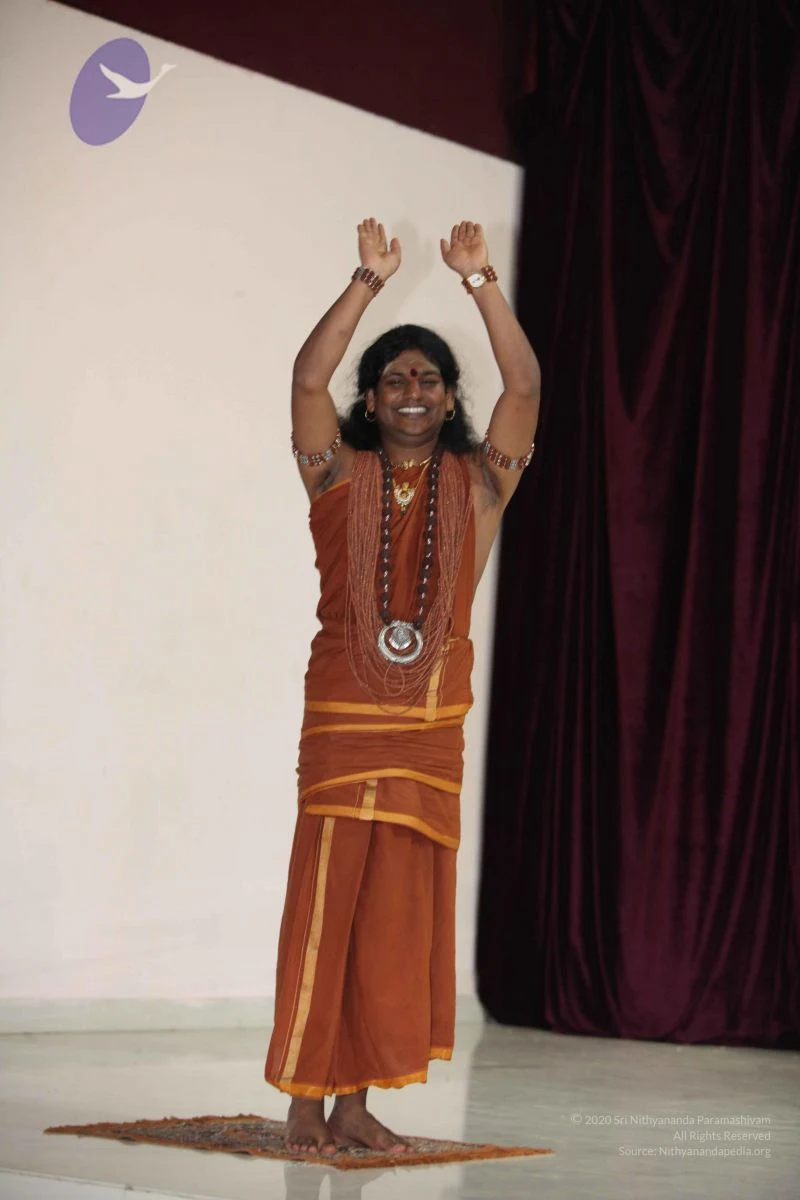
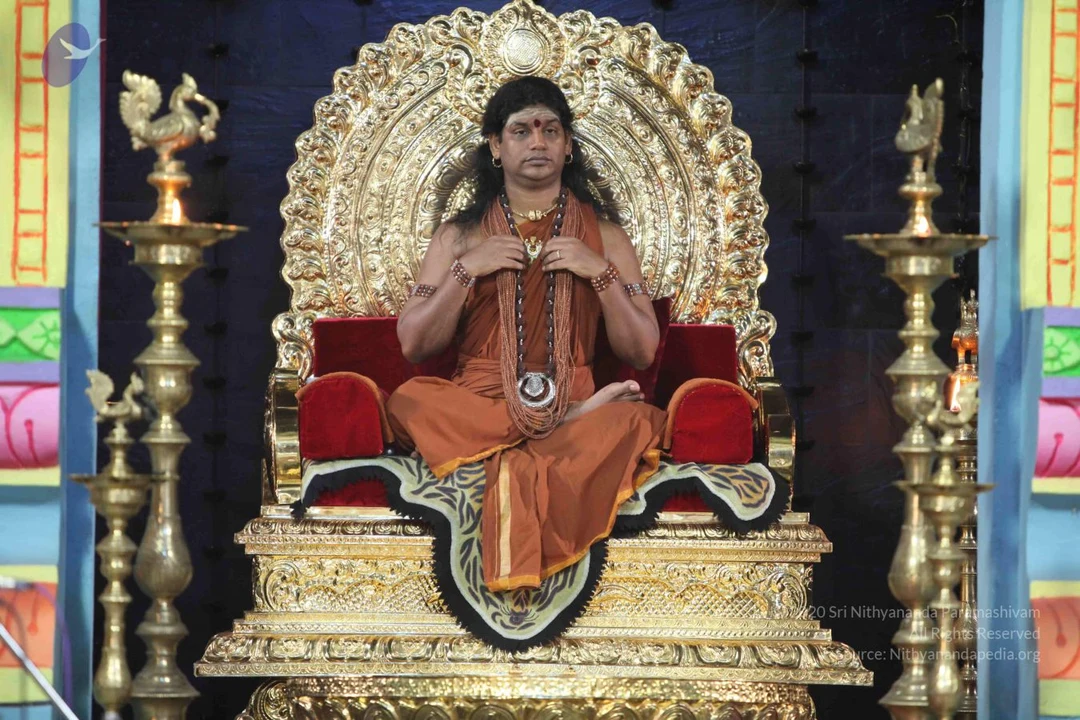
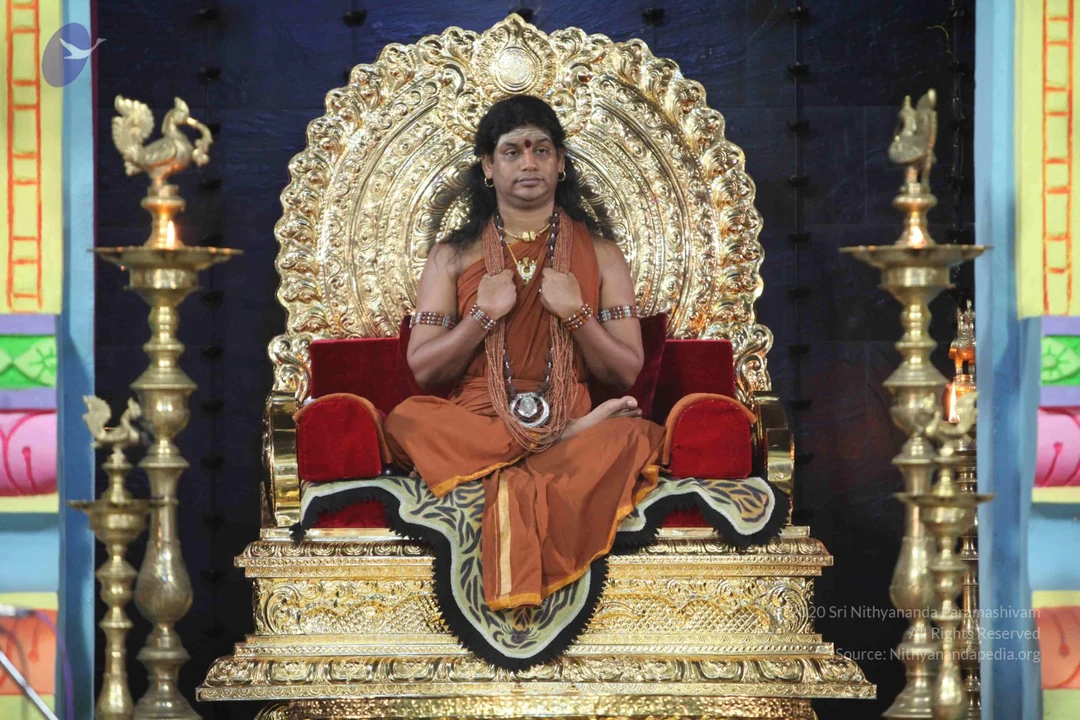
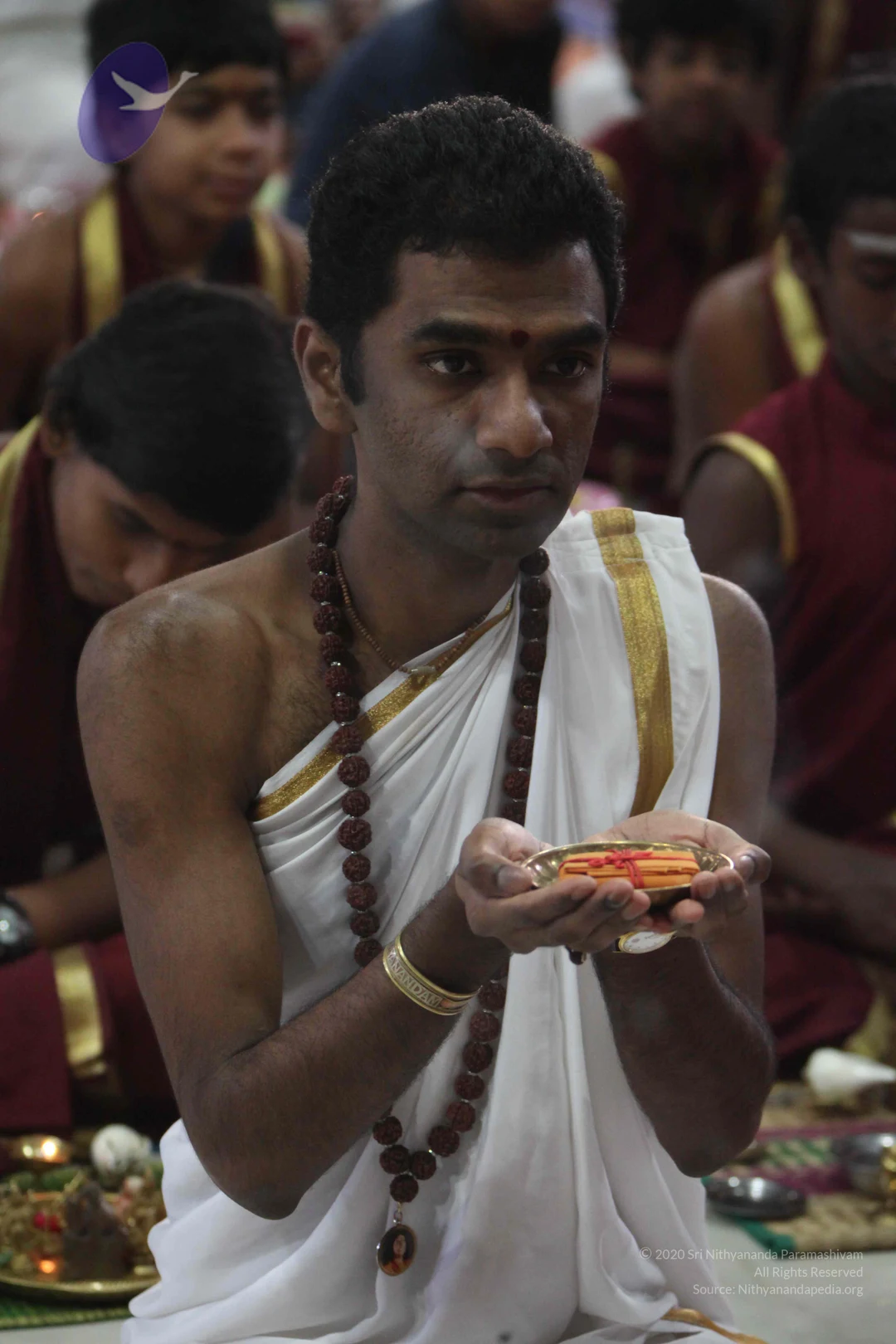
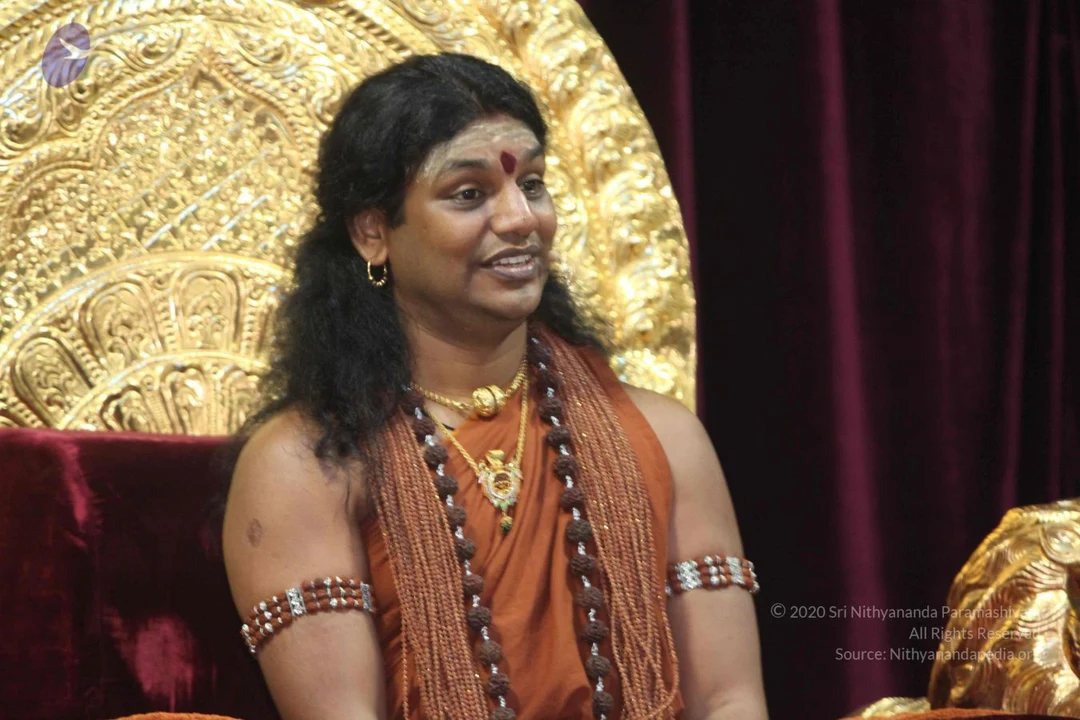
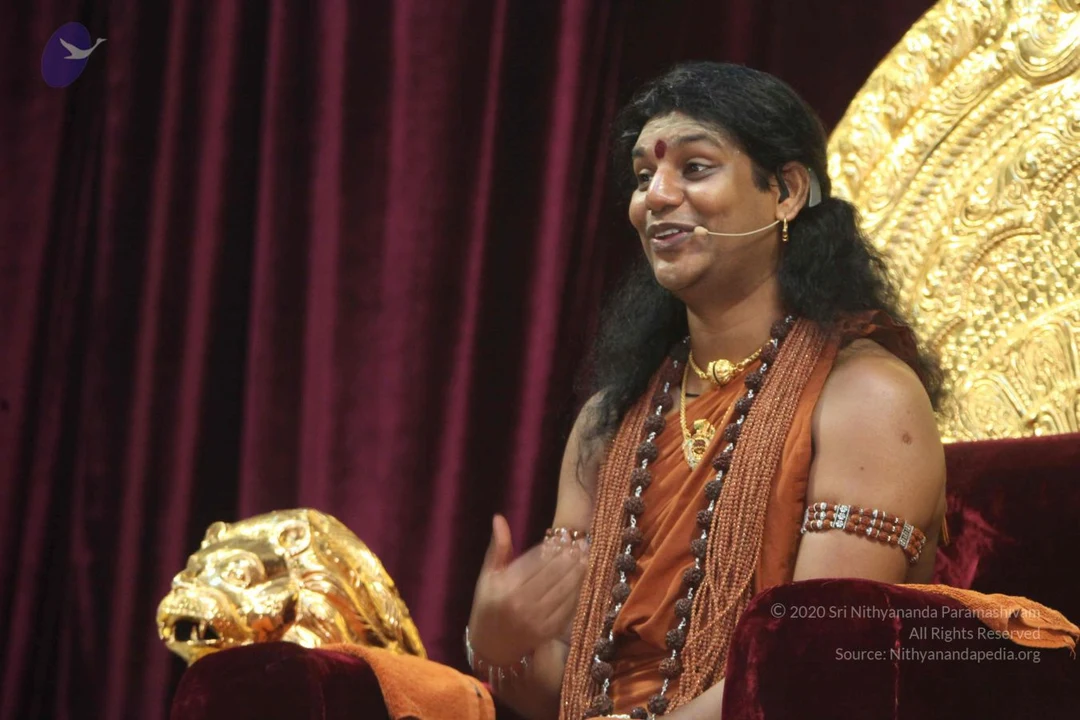
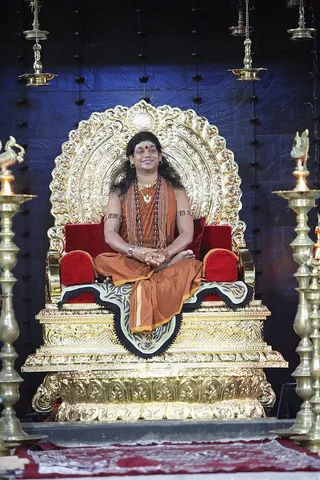
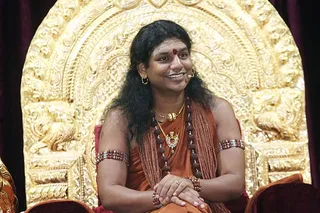
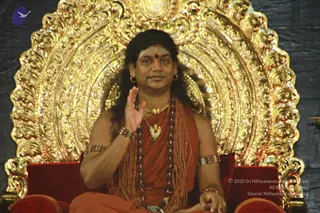
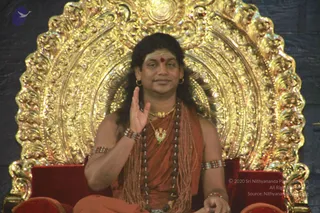
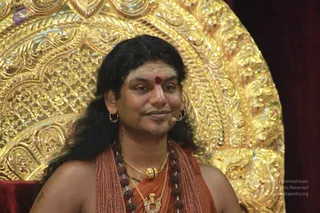
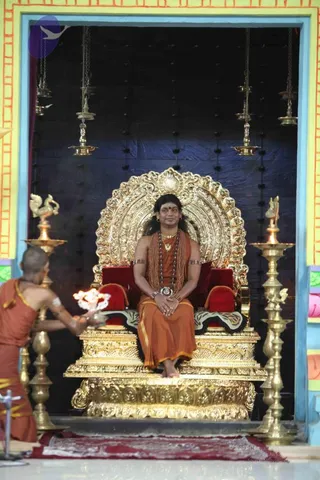
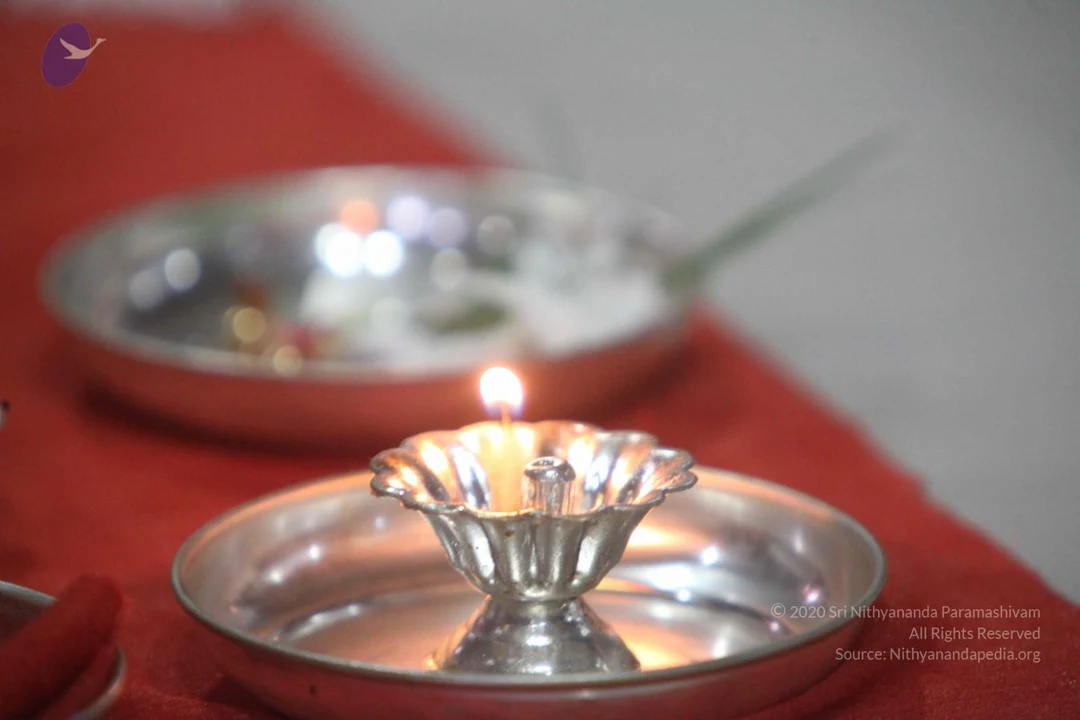
A close-up photograph of a ritual table set with brass puja vessels and oil lamps. A tall brass lamp stand with a flame at its top stands in the centre, beside a brass pot and a brass oil lamp with a lit wick. Red rose petals and green leaves are scattered across a woven mat. Blurred orange-robed figurines and a flame appear in the background, and a hand is visible at the left edge. No people are clearly in focus.A seated man in saffron-orange robes sits on an ornate gilded throne with a tall arched back carved with floral and scrollwork motifs and two golden lion figures on either side. He sits with palms pressed together in anjali mudra at chest level, wearing a rudraksha mala and a large ceremonial pendant on a necklace, with a tilak on his forehead. The throne rests on a gold-trimmed red-draped platform against a dark maroon curtain backdrop. The watermarked image text is omitted. Swamiji (probable): the seated figure has long swept-back hair, saffron clothing, a rudraksha mala and a ceremonial pendant, presented on a throne as the central speaker.A seated man in saffron-orange robes sits before an ornate golden throne with intricate repoussé carving, raising his right hand in a blessing gesture. He wears a long rudraksha mala, a ceremonial gold necklace, bangles on both wrists and a red bindi with vibhuti marks on his forehead, and he is smiling. A red cushioned seat is visible below. A dark wall forms the background.

January 21 2013

Original wiki page
Contents

Title

The Supreme Pontiff of Hinduism (SPH), JagatGuru MahaSannidhanam (JGM) Bhagavan Sri Nithyananda Paramashivam

Description

In today’s morning satsang, SPH follows the story of Nachiketa, the child who overcame the mystery of death, as related in the Katopanishad. Everyone can journey past the fear of death when they are living without attachment. When sensory pleasure is felt incompletely the body simply builds a tolerance, ultimately losing the ability to enjoy at all. Once the understanding is achieved that all pleasures are temporary, the longing for them vanishes and one is able to make a plan for death. Death, met with conscious awareness, can be used as a springboard to immortality.

Video and Audio - Understand Death to Start Living (Talks from the Kathopanishad)

VideoAudio

Transcript

(00:30)

sadāshiva samārambām jnana sambantharācharya madhyamām | asmadācharya paryanthām vande guru paramparām. ||

(00:56)

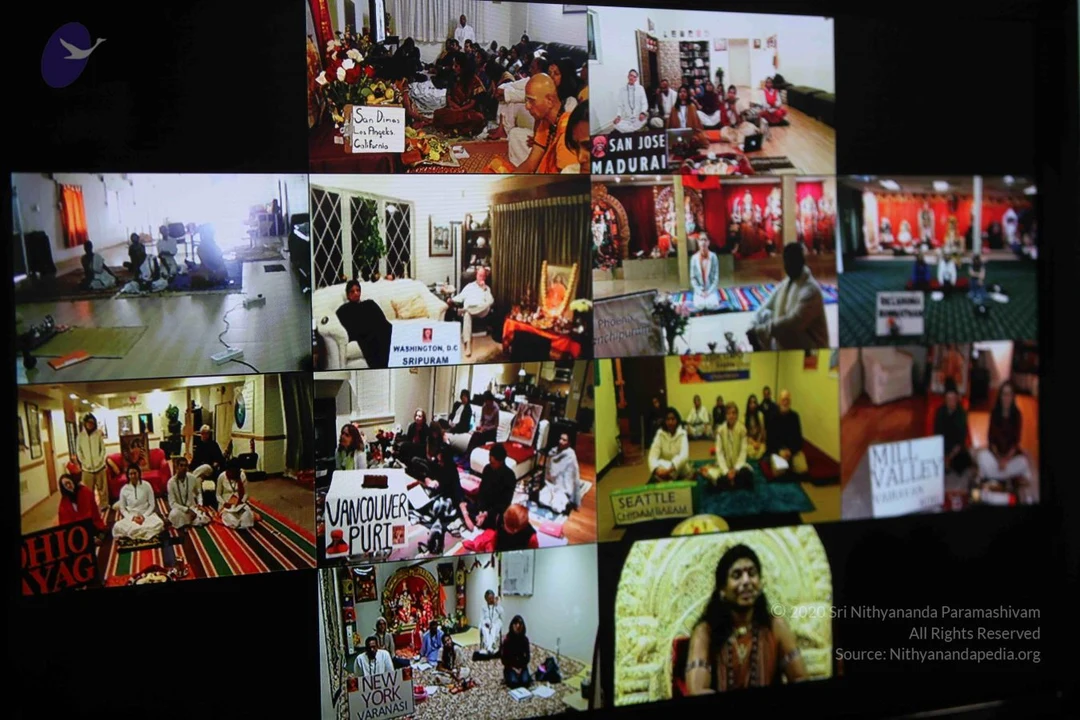
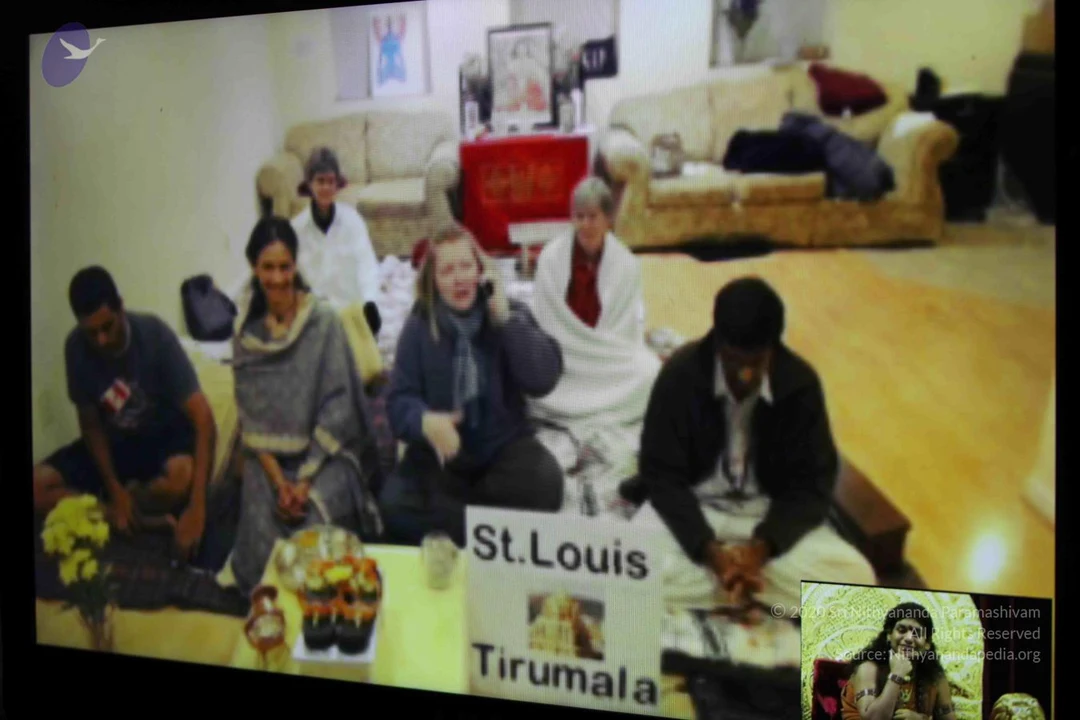
I welcome you all with My love and respects. I welcome all the devotees, disciples, Samajis, Satsangis sitting with us around the world at this moment 434 places through Nithyananda TV, 37 places two-way video conferencing having Nayana Deeksha in 222 cities in 27 countries as per the statistics. Cities sitting with us in two-way video conferencing having Nayana Deeksha; Bangalore Malleswaram, Bangalore Marathahalli, Vancouver-Puri, St Julien France, Guadalupe-Rameswaram, St Louis-Tirumala, Phoenix-Kanchipuram; What is that? San Raman? Bhaktananda and Prabananda are sitting; San Raman, am I right? hmmm... St Demas, Los Angeles, California; blessings. New York-Varanasi, Dakota Dunes, San Jose-Madurai, Phoenix-Kanchipuram, EdgeWater New Jersey, Washington DC-Shri Puram, Austin, Dubai, Charlotte-SriSailam, Louisville Kentucky, Thiruvannamali, Sarja Thrukovilur, Oman Sivagangai, Singapore Singapuram, London-Kashi, LA Pomona, Sydney Australia, San Diego-Thiru Alavai, Sri Puram Chennai, Hyderabad Sri, Hong Kong, Tallahassee Florida, Calgary-Amarnath, Bangalore-Nithyanada Vidyalaya, Nepal, Seatle-Chidambaram, North Hollywood California, Toronto Kailasam, Sydney Australia, Las Vegas, Ohio-Prayag, Priyanka-Malaysia. So I Welcome all of you with My love and blessings.

(03:16)

First thing I wanted to announce today’s special is I am so happy after a long time. Understand, Bliss never leaves Me. Bliss is there always. Now I am happy also. Bliss never leaves, when I look in, when I close My eyes it is there always overflowing. The happiness which comes out of the bliss is unending, that… that never leaves, that is there always but the happiness I see when people are happy is happening in Me so beautifully. Today Nirahara Samyama, third-level, fifth day and today is the “Brahmanyam Bahuputrataam’s” seventh day program.

(05:09)

Let’s enter into today’s Satsang. Nachiketa’s Kaṭhopaniṣad in the light of Authenticity. ये ये कामा दुर्लभा मर्त्यलोके सर्वान्कामांश्छन्दतः प्रार्थयस्व। इमा रामाः सरथाः सतूर्या न हीदृशा लम्भनीया मनुष्यैः। आभिर्मत्प्रत्ताभिः परिचारयस्व नचिकेतो मरणं माऽनुप्राक्शीः ॥ ye ye kāmā durlabhā martyaloke sarvānkāmāṁśchandataḥ prārthayasva | imā rāmāḥ sarathāḥ satūryā na hīdṛśā lambhanīyā manuṣyaiḥ | ābhirmatprattābhiḥ paricārayasva naciketo maraṇaṁ mā'nuprākśīḥ || “Whatsoever objects of desire are difficult to attain in the realm of… realm… realm of mortals, ask them all, as thou desirest; those lovely maidens with their chariots and musical instruments, such are not obtainable by mortals be served by these whom I give to you O Nachiketas, do not ask regarding Death”.

(06:20)

As I said yesterday, He says I will give you golden toilet, golden wash basin, golden tap. I can even convert the whole ship into gold but don’t ask Me how to anchor or take it to the bank. Go with the flow; and yesterday somebody sent a beautiful photograph in the picture in facebook, a ship falling in the falls. The moment I saw, I remembered, “Wow, clearly they visualized”. Even if you have all this, what I am saying, the thousands of lovely maidens, chariots, musical instruments, everything; what can be done? You know every passing day you are moving towards Death; and one more thing, you can do one more… one thing by forgetting you are flowing towards Death, floating towards Death, you can enjoy but any enjoyment which you are doing by forgetting the problems which you are having inside will be naturally unfulfilled, incomplete. There will be hangover inside.

(08:01)

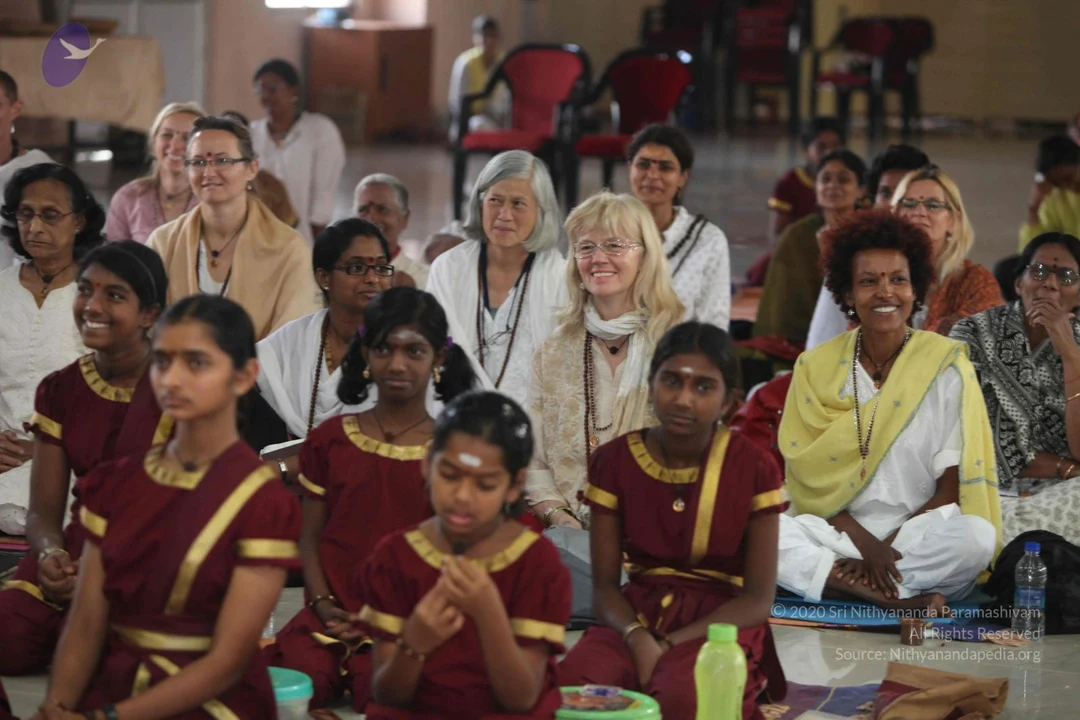
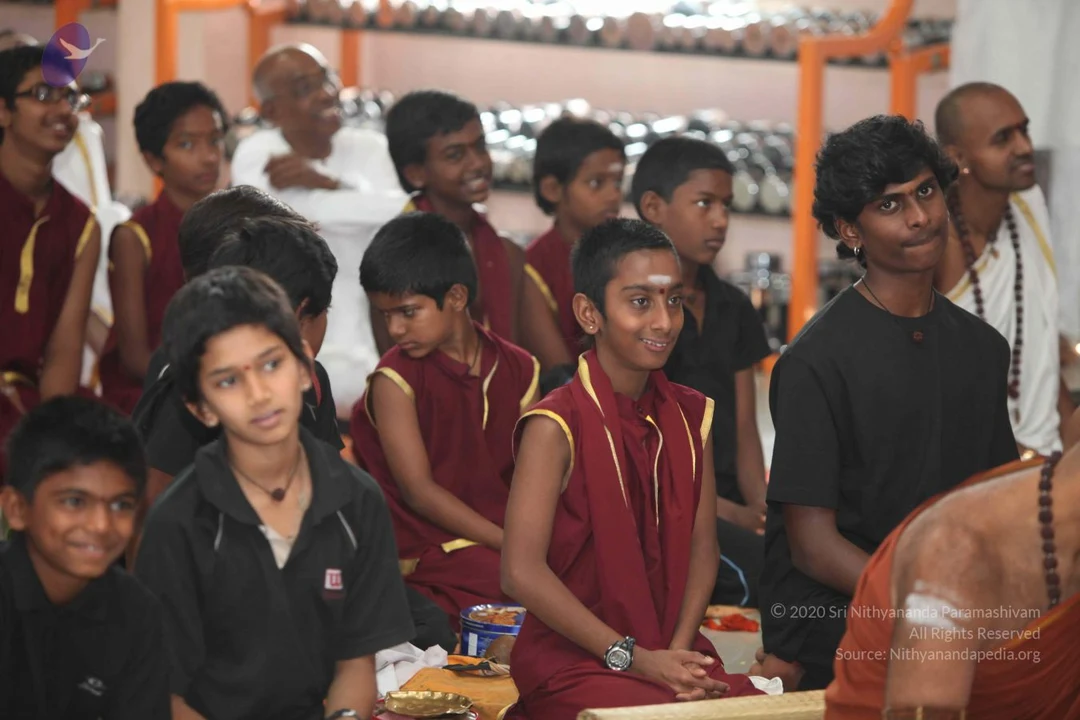
See, if you have... morning if you fought with your roommate and you are here. Swamiji: “Gurukul kids, back to Vajrasanam; intense listening. Okay?” How many of you feel you won’t be able to do without moving the body? Raise your hand. You can be authentic, integrated; raise your hand. No, Gurukul kids only. Gurukul kids, if you feel you can’t be without moving the hands; okay, no problem. All those kids send them back to room. You can go to Gurukul. No problem, those kids get up, move, move, move. We will train you for next few days how to sit freezing the body in the deep listening, then you can come after few Satsangs. After that few days, you can come and join the Satsang. So by being here, all you kids commit that you will sit straight and freeze the body. Am I right? Gurukul Kids: “Yes”. If you see your friend, your colleague, he is moving around continuously then we will send them to the Gurukul, for few days of practice.

(09:18)

When you don’t move the body, listening becomes part of your Bio-Memory, then you will become “Ekasandhagrahi”. Please understand, not moving the body is the first step for first-time repeaters. As I said, there are 3 category; first-time repeaters, second-time... two-time repeaters, third-time repeaters, fourth-time they are fools, they are not... there is no category for them. In Vedic tradition, if you listen once and repeat, it is called first-time repeater. If you listen two-times and repeat, it is called two-time repeater, “Dvisandhagrahi”. If you listen three-times and repeat, you are called “Trisandhagrahi”. So non... freezing the body is the first step. Put your hands in Samana Mudra means thumb on the high; it’s mainly for Gurukul kids and Gurukul kids, freeze the body, that is the first step for “Ekasandhagrahya”, first-time repeaters then slowly, slowly you will go to the next step of freezing the eyes without blinking. When you reach that state you become “Ekasandhagrahi”. See, when your eyes are frozen, every word I utter will be visually recorded in you. When I say visually, you will just see the spelling V-I-S-U-A-L-L-Y. It will become a vision and gets recorded in you, only then you become “Ekasandhagrahi”, first-time repeaters; okay.

(11:19)

If you have to enjoy forgetting something, will that be a complete enjoyment? For example, morning you fight with your roommate before coming to the Satsang still that is going on in your head. Will you be able to listen to the Satsang? Unless you complete, you finish that fighting with him; either by fighting or ending. You fight it out to the extreme and bring him to the terms, “Alright! This is your border. This is my border. You be there; I will be there”. I have seen in the stray dog... stray dogs in My Indian… in My village, once they come to the agreement, they will not cross the border but they will be standing there and urrr... urrr... rrr... rrr... rrr. They will not cross their borders. You stand there; I stand here. Appadiyae pechu, pechathaan irukkanum… urrr... urrr... It means they have come to settlement, they have come to terms, either you should do that. You come to terms, your boundary, my boundary; urrr... urrr... or complete it. Alright, for not only My inauthenticity I take responsibility for your inauthenticity also I take responsibility. Let Me support you to come out of your inauthenticity and have patience to not to give up on you. This is Completion.

(13:08)

Either you complete or settle, only then you can listen to the Satsang now, till then it is not possible. You may be sitting, you won’t be able to listen. You won’t be able to listen. You won’t be able to listen. Same way, I tell you, if somebody is doing their whole day routine in deep Completion, that itself is Enlightenment. I am able to follow My routine continuously because of the deep Completion. You understand if there is some worry going on, I can’t sit in the... during the Pada Puja and bless that guy. If something is going on in the head, I can’t sit in the Satsang and talk all these subtle truths. Do you know how much of Completion is required inside to give the words I uttered to her? Now it will become reality, now she will experience this one. To give the words... without Completion it is not possible.

(14:40)

So everyday routine itself should be with the Completion then if you don’t complete with the Death, how are you going to live? It is like, have a golden toilet, okay... but what can you do with that golden toilet? Finally you have to do only one, two na? Even if it is a golden toilet, can you say, “Oh it is golden toilet, I will better wear on my head Or I will eat in this”. No, even if it is golden toilet and golden swimming pool, gold ship; unless you complete with Death, you can’t start living. You can’t start living.

(15:38)

Next... Next verse is very beautiful verse: श्वोभावा मर्त्यस्य यदन्तकैतत्सर्वेन्द्रियाणां जरयन्ति तेजः। अपि सर्वं जीवितमल्पमेव तवैव वाहास्तव नृत्यगीते ॥ śvobhāvā martyasya yadantakaitatsarvendriyāṇāṁ jarayanti tejaḥ | api sarvaṁ jīvitamalpameva tavaiva vāhāstava nṛtyagīte || Nachiketa very beautifully says... I just bow down to Nachiketa’s Shraddha, Authenticity. What a personality! Hmmm… Please understand, it is not a joke for being a human being and somebody says they will give you whole universe and don’t ask Me the question about Death what will you think? Arey what am I going to do? About Death I can know later on. I will just ask him to give some 10,000 years of life and this whole world and then in the 10,000 years I will meditate and find out somebody or some... I will go to some Rishi and find out or I will meditate and do Tapas towards Yama itself and call him and have one more boon. First, let me take away all these things whatever he gives, we will have something na.

(16:59)

If we don’t anchor this is where we are heading. If this ship is made of gold with golden toilet, golden bathroom, golden restaurant, golden kitchen, golden plate, amazing Italian cruise experience. God! The Italian ship people do only two thing, eat, eat, eat, eat, eat, eat, eat, eat, eat, and you know what happens after that. Other than that nothing, nothing else. Even if you have this kind of a Italian cruise, what will happen? What will happen? This is where... hmmm... I think it is Niagara Falls falling... some falls, okay leave it.

(18:05)

So understand, Nachiketa is so sincere. I really can’t believe he is a small kid. Whether due to authenticity he was referred as a small kid because in My heart... please understand, I wanted to make it very clear I don’t believe Jnana Sambandhar lived only 16 years. I feel he lived 160 and one zero got lost in the references or history because he is a great Yogi, Nirahari. No way he could have lived in... he could have died in such young age. Niraharis live a very long life because their system does not need to take energy from external items. It receives energy directly from Sun, Moon and Cosmos. Always the Niraharis live such a long life. See, our Niraharis as on now only Neerahaaris. Understand, they have not yet become complete Niraharis but they are... they have done a big step. In... as I said in the Gita, there are four way of eating: “पचाम्यन्नं चतुर्विधम्” In that four, two has been stopped but other two are there still. So they are only called Neeraaharis. Neerahaaris mean liquid diet people. To move to the complete Nirahara they will have to do some more process and prepare the body and mind and all that, okay; but they have… that big achievement, very big achievement, very big step, okay; but Jnana Sambandhar is a complete Nirahari. Maybe once in a while for the sake of fulfilling the devotee’s desires Annyakara, whether he has eaten or not I don’t know but as a pattern he did not have food pattern that he himself has told Me directly but now I will see it… see the Akashic records and tell you, even like that casually anytime as he touched food or not that I will see to the… see the Akashic reading and tell... and “पचाम्यन्नं चतुर्विधम्”...

(20:42)

Nachiketa, Nachiketa is so beautifully standing up with his Authenticity. He says... let’s see what Nachiketa says, “O Death, these are fleeting; they weaken the vigour of all the senses in man even the longest life is short. Keep thou thy chariots, dance and music”. I think Nachiketa is little annoyed that is why he is telling the word, “You keep everything with you” like a child. He could have just said, “No, these are all useless. I don’t want”. I think he is little annoyed. He is telling Yama, “Don’t play this silly game. Don’t think I am a child”. It is like somebody coming to Me and showing one chikki, “If you give me energy Darshan, I will give you this chikki”. Arey I don’t want that chikki, I will give you energy Darshan; that is different, “But no, if you give me one energy Darshan I will give half. If you give me full, I will give you one”. If a child does that at least it looks very innocent, okay; but if Yama is doing that it’s… it is actually Nachiketa should be behaving like this and Yama should be behaving the other way but here is Yama is behaving like this and Nachiketa is behaving the other way. The power of Authenticity, just like our Gurukul kids and their students. Amazing!

(22:51)

He says, “You keep your chariots, dance and music!”. First word he says, “These are fleeting” means unstable, impermanent. They weaken the vigour of all the senses in man. It means more and more incompletions stores in you, more and more your senses become weak. If your whole thing is Complete, your whole senses will become alive. All these joys added to you by you forgetting the death leads to more and more incompletion. See it’s like a, you hide about that fear of death inside, under the carpet in your heart and go on try to drink, dance, joy, jump, do everything. So every action... during every action, sense enjoyment; you are only incomplete. So more and more incompletion weakens the senses. Listen, listen. When you put your fear of death and non-understanding of death under your carpet... under your carpet and hiding it with that incompletion you go on and on and on, adding more and more different joys, sense pleasures. It creates more and more incompletion with more incompletion. For example, first day just to avoid the fear and death fear, you drink little alcohol, that leads to incompletion. Next day, next day because of the incompletions, senses lose the vigour you have to take more alcohol only then you will feel high, then after few days because of the incompletion, senses lose more vigour, become weak, you have to take more alcohol to feel the high. This is the same way it happens whether it is tea or alcohol or coffee or cigarette or sex or food, any taste, even music. Music or touch or taste or sweet, every level, the... with the... without completing the fear of death and death, you go on enjoying. These are fleeting.

(26:33)

श्वोभावा मर्त्यस्य यदन्तकैतत्सर्वेन्द्रियाणां जरयन्ति तेजः। śvobhāvā martyasya yadantakaitatsarvendriyāṇāṁ jarayanti tejaḥ | Means when more and more sense objects are enjoyed with the unfulfillment, incompletion, senses become duller and duller and duller. Senses loses the vigor. So beautifully Nachiketa says when the senses lose their vigor, even the longest life is useless; short. अपि सर्वं जीवितं अल्पमेव अपि सर्वं जीवितं अल्पमेव अपि सर्वं जीवितं अल्पमेव api sarvaṁ jīvitam alpam eva api sarvaṁ jīvitam alpam eva api sarvaṁ jīvitam alpam eva So what he is telling, the jeevitam… whatever life may be, long but it is short. Alpam, if your senses are not... understand this Tatva; listen; that is why in Buddhist monasteries, the moment child becomes physically matured; usually in Buddhist monasteries, it happens around 18. The child is physically matured, immediately the child is sent to sit in the graveyard and stud... mediate, stabilize, anchor, understand about death, three months, 90 days. In our Ashram also, Ma Manisha you should... we should have a syllabus for all physically matured kids. Ah Ma Advait you should execute. They should go and stay in our Varanasi Ashram, three months. One semester they can study there, nothing wrong, hmmm... half of the time they will have to sit and gaze at the bodies being burnt; means whole night. Day-time they can sleep for few hours and few hours they can study. Our Ashram is nicely positioned, inside... sitting inside Ashram just through glass you can see the bodies being burnt continuously. I think they should because only when you understand about Death, and your cognitions about Death is clear... Yes, this is Manikarnika Ghat, this exact view from our Ashram. Please see the view. Continuously bodies will be getting burnt. Average per day minimum 300 bodies get burnt. Sometimes it goes up to 1000 per day, per day. It is not per week. Minimum 300 goes up to 1000. Can you imagine 1000 bodies burnt in one cremation ground? This is the world’s busiest crematorium, world’s busiest crematorium, cremation ground, hmmm… Okay.

(30:51)

Understand this, unless you anchor yourself with the clarity about Death, the more and more pleasures you dump on your senses due to incompletion of the experience, senses become dull. When the vigor of all the senses in man is lost by the incompletion of Death and constantly pleasures being put in that same incomplete mood… What is the incompletion of Death? Means not having clear idea of what Death is going to do to you? What should be your relationship with Death? And what Death means for you is incompletion with Death. You should know what are you going to do after Death? What Death is going to do to you when it comes? What Death is going to add or open, close or open, add or takeaway? Complete clarity; you should have visa and the ticket, everything to the Space where you are going to go after Death and everything very clear, crystal clear travel plan. When you do not have that, it is a incompletion with Death.

(33:05)

Better do this travel agent work for yourself the moment you become physically matured otherwise in course of time... see with that incompletion inside, your eating will become over eating that becomes a big pattern. Seeing becomes over seeing, hearing becomes over hearing. I wanted the world to know knowledge is getting into the world with the Completion of senses. When your senses are complete; Indriyas are complete, anything you do will become knowledge. Anything you listen will become knowledge; see will become knowledge, taste will become knowledge, it will become knowledge but when you are incomplete anything you do will weaken the vigour, “Jadayanthi Tejaha” means the... Teja means vigour, the vigour is lost. Your consciousness should have a romance with your senses not nagging with your senses and arguing. When you are complete, your consciousness will have romance with your senses or it will have nagging with your senses.

(35:24)

Next, Nachiketa says, “They weaken the vigour of all the senses in man”. I think Nachiketa also had a same visualization of what I said. It is like a ship floating in the river otherwise why should he use the word, “Fleeting”. These are fleeting; they weaken the vigour of all the senses in man. I think he also had the same visualization when this Yama was trying to play the game, silly game with him. If the child does, it is not silly; if Yama does, it is silly.

(36:14)

Yesterday one devotee from Pondicherry; she brought the Pongal Mani for Me. You see, in India everybody in the house will be given some money during the Pongal. So… so she literally treats Me like a son in the house; she keeps My photograph in the house. Whatever she buys for other kids including shirt, inner, jeans everything she will buy one set for Me and keep it in front of photograph. Whenever she comes to ashram whatever is gathered in front of My photograph she will bring it and give it Me. She lives literally with Me. So this Pongal, she gave 500 rupee for every child and gave 500 rupee for Me also and she brought that 500 rupee and yesterday she gave it to Me. I said, “Why?” She said, “I don’t know whether you will take it from my hand or not? This is the money I gave Pongal Kasu” means in the village they say that Pongal Kasu, means the kids get some money during the Pongal like their like a pocket money. “This is the packet money I gave you” So I said, I accepted with both My hands and I said, “I will use this money to buy My groceries for eating”. And actually I took it, took it to the quarters and gave it to these guys and told, “Aye use this directly to… for My food and for My expenses”. This is not silly. This is devotion. If a devotee does, it is innocence and it has its own beautiful feeling.

(38:05)

Suddenly Kalabhairava comes and says, “Please have 500 rupee, and don’t ask Me to give boons or Enlightenment”. Of course Kalabhairava will not do that but Yama tries to do that. He says... He tells Nachiketa, “You please have that golden toilet and golden bathroom but don’t ask for Enlightenment” feels very silly. I think Nachiketa is little upset that is why he says, “You keep everything with you”. Not only he says I don’t want, he says, “Keep thou thy chariots, dance and music”. तवैव वाहाः तव नृत्यगीते | tavaiva vāhās tava nṛtya-gīte. You keep it with you.

(39:17)

There is a beautiful verse by Bhartṛhari on Vairagya shatakam. He sings hundred verses on Vairagya, renunciation; one verse is there: भोगेरोगभयंकुलेिुतभयंिवेनपृालायं मानेदैभयंबलेिरपभुयंपेजरायाभयम।् शाे वािदभयं गणु े खलभयं काये कृ ताायं सववुभयाितंभिुवनणृांवरैायमवेाभयम॥् ३१॥ He says: In enjoyment, there is fear of disease; in social position, there is a fear of falling-off; in wealth, the fear of hostile government and in honor, the fear of humiliation; in power, the fear of foemen; in beauty, the fear of old age; in scriptural erudition, the fear of opponents; in virtue, the fear of traducers; in body, the fear of death. All things in the world pertaining to a man are attended with fear; renunciation alone stands for fearlessness. Wow! Just for this one verse I will keep a deity for Bhartṛhari. I have heard few verses but first time I am spending time on it. भोगेरोगभयंकुलेिुतभयंिवेनपृालायं मानेदैभयंबलेिरपभुयंपेजरायाभयम।् शाे वािदभयं गणु े खलभयं काये कृ ताायं सववुभयाितंभिुवनणृांवरैायमवेाभयम॥् ३१॥ God! What a clarity! So it is Completion that is fearlessness. I will translate here everything as incompletion. Completion is Vairagya. If there is a Completion in Bhoga, Roga Bhaya will not be there. If there is Completion in Kula, Chuti Bhaya will not be there. If there is Completion in everything, other fears will not be there. Bring in Completion. Completion is Vairagya. Completion is Vairagya; Vairagya Shatakam. What Nachiketa says, after saying you keep everything with you, you will see in further Satsangs.

(43:57)

Photos

Nithya Satsang
SOLO-Morning satsang
Photos Of The Day:

Temple Visit || Pada Puja || Satsang || Sarva Darshan
Photos Of The Day:

Tempie

Pada-puja

Satsang

Sarvadarshan

Photos from this day

View all 150 photos

Photos

7 photosSource gallery
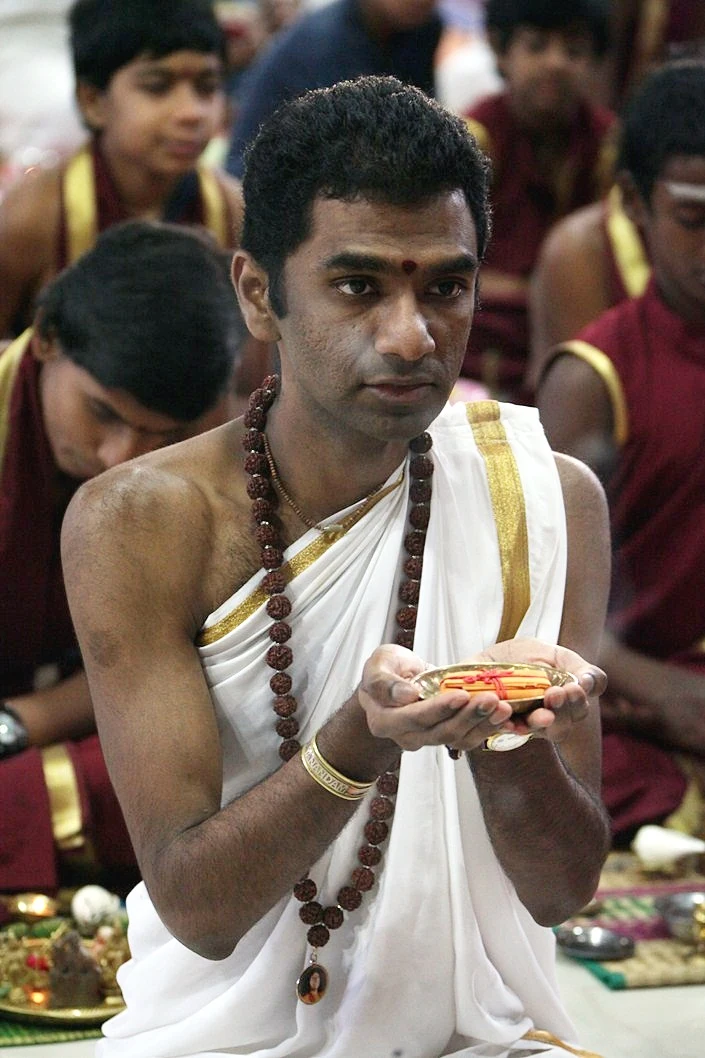
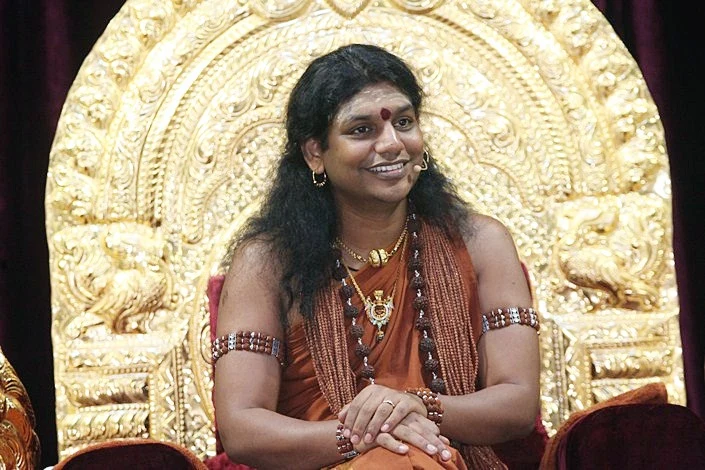
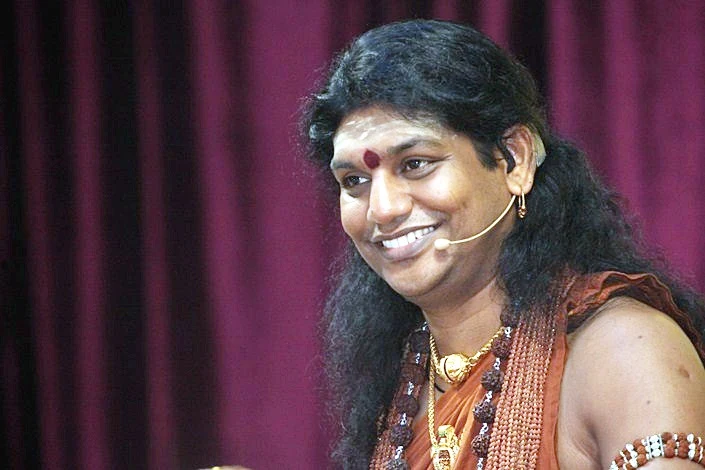
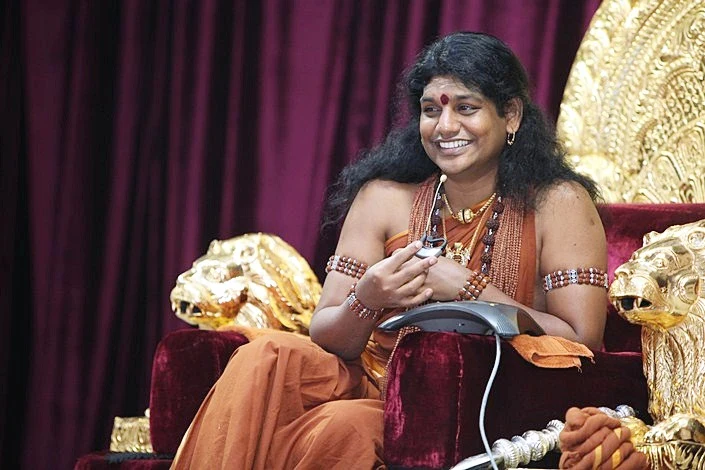
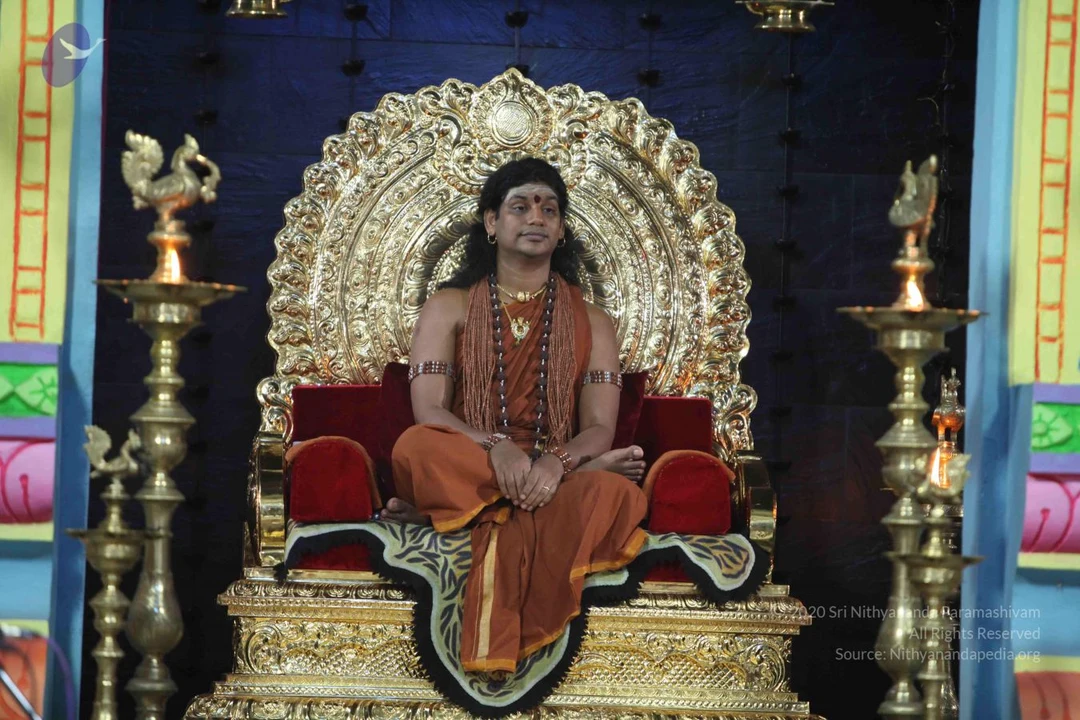
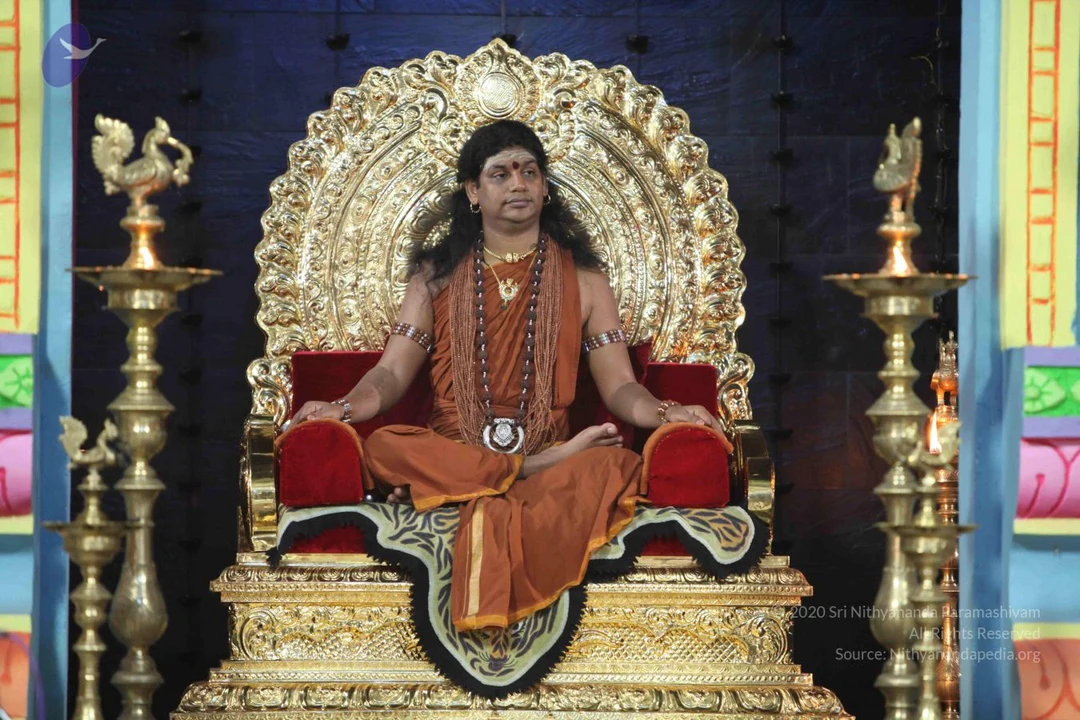
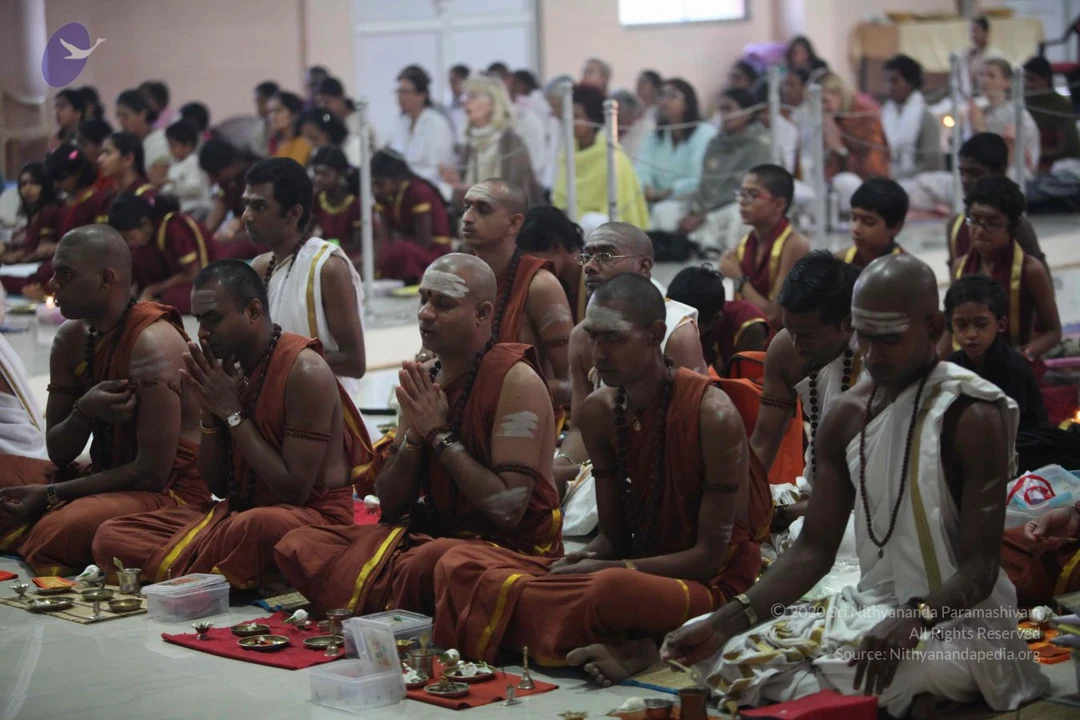
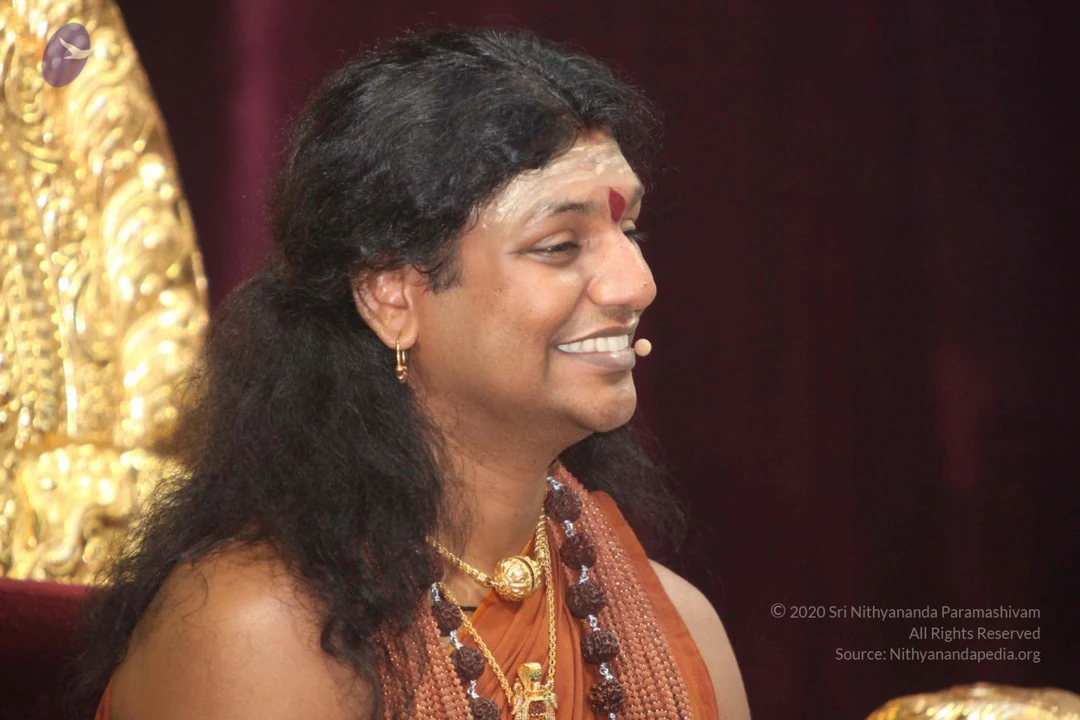
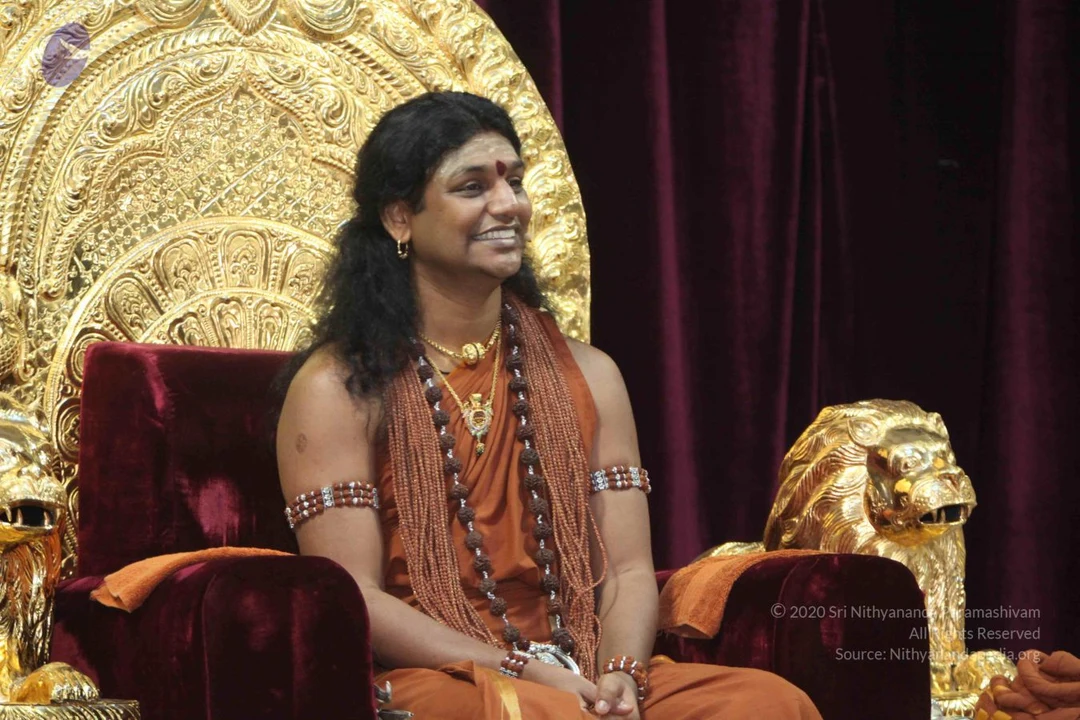
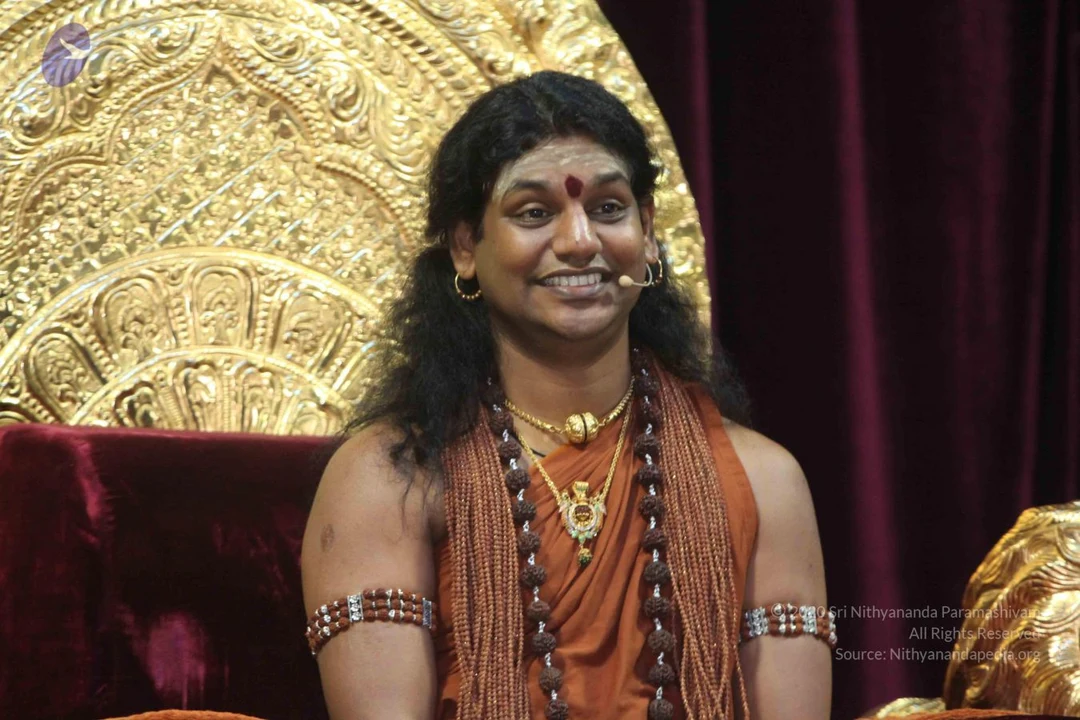
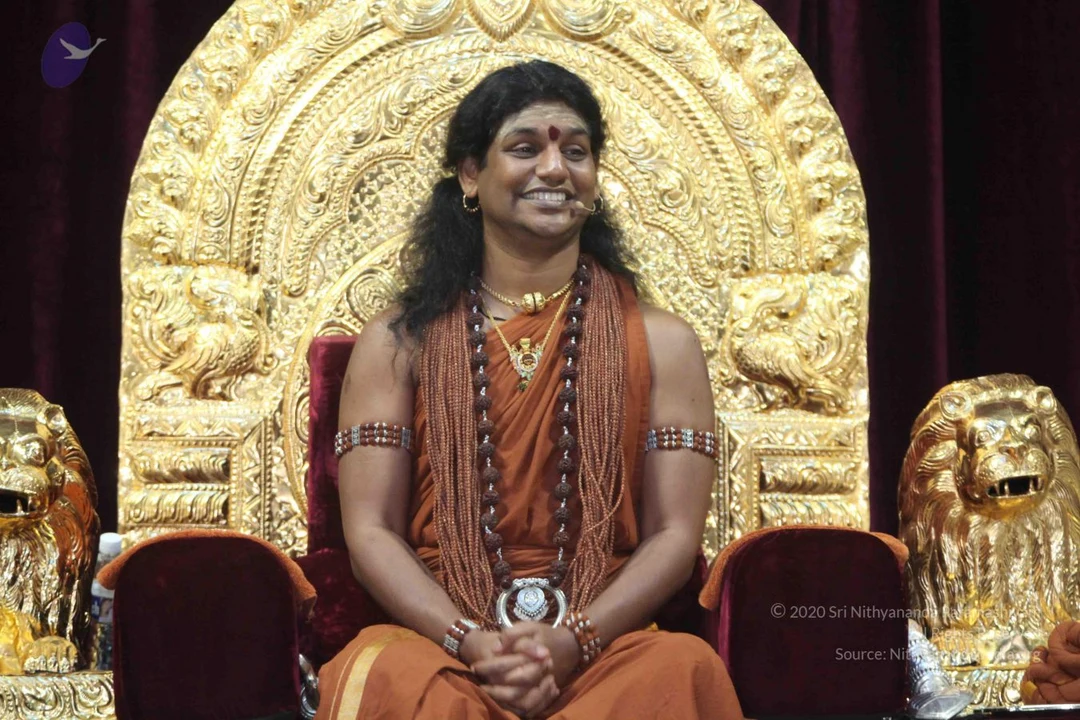
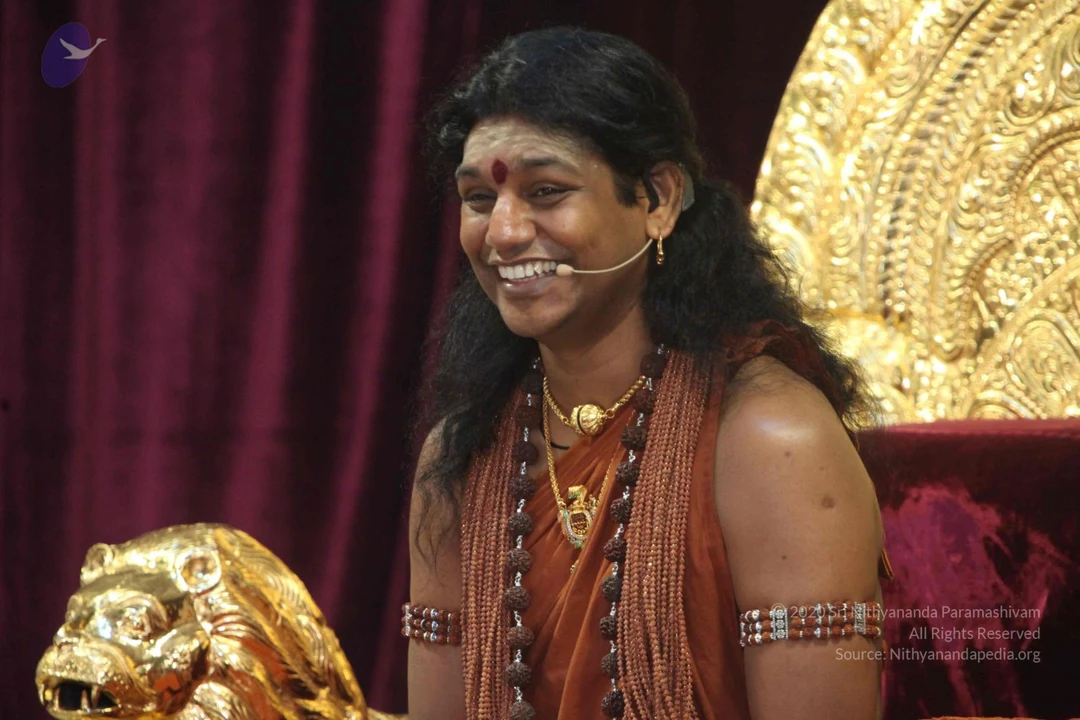
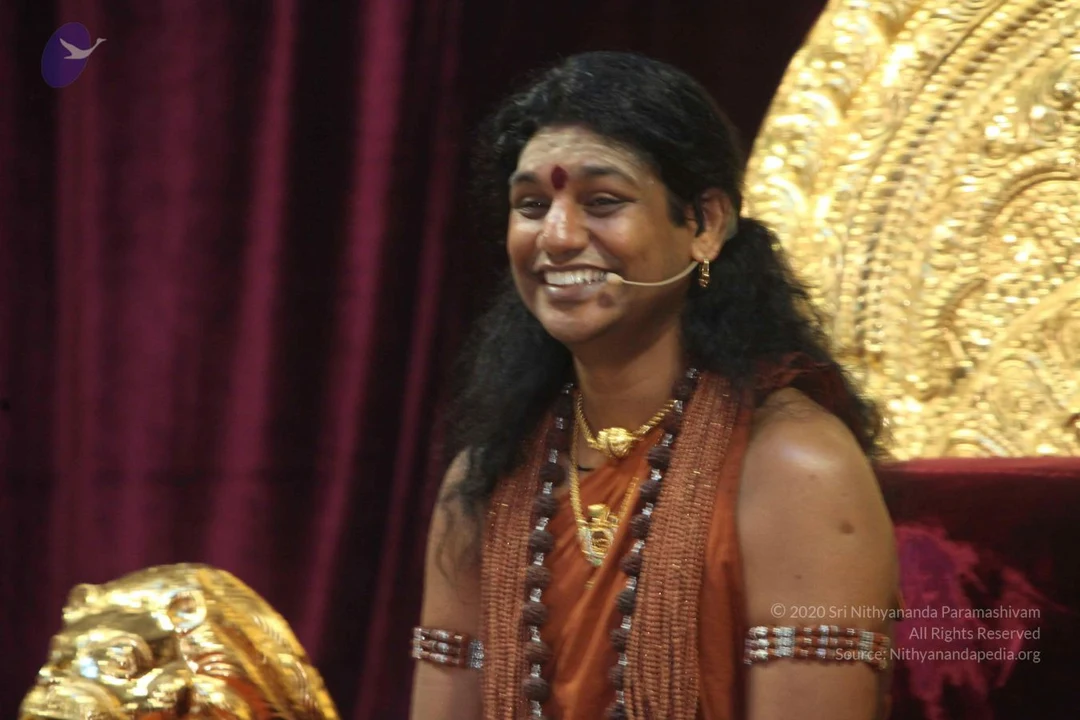
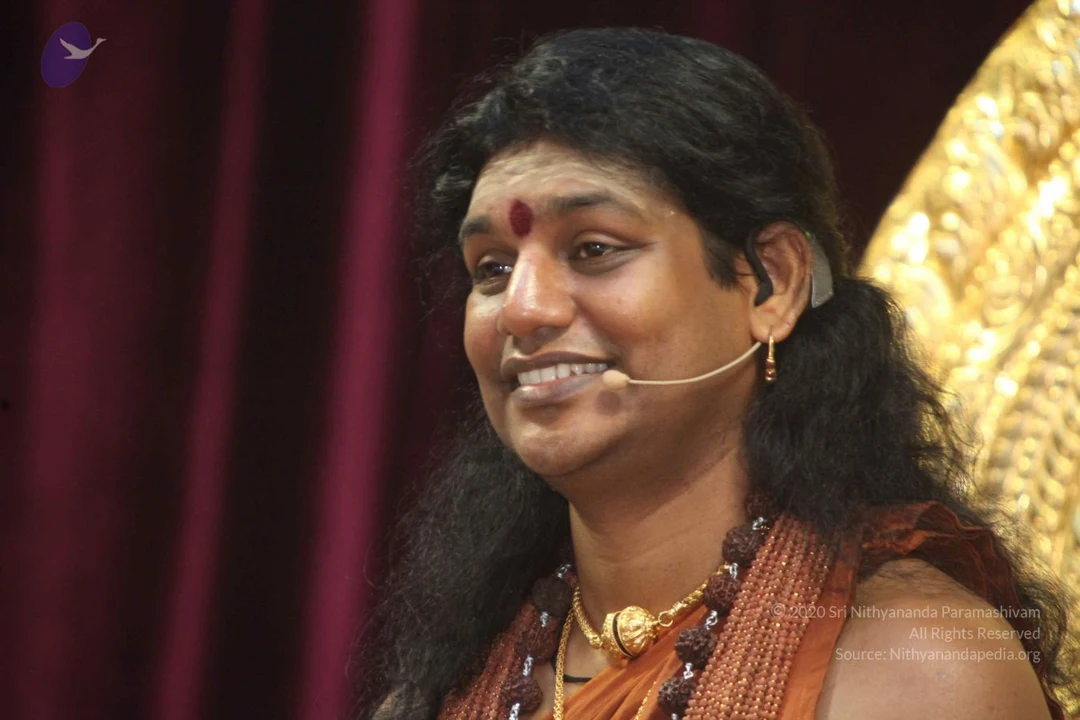
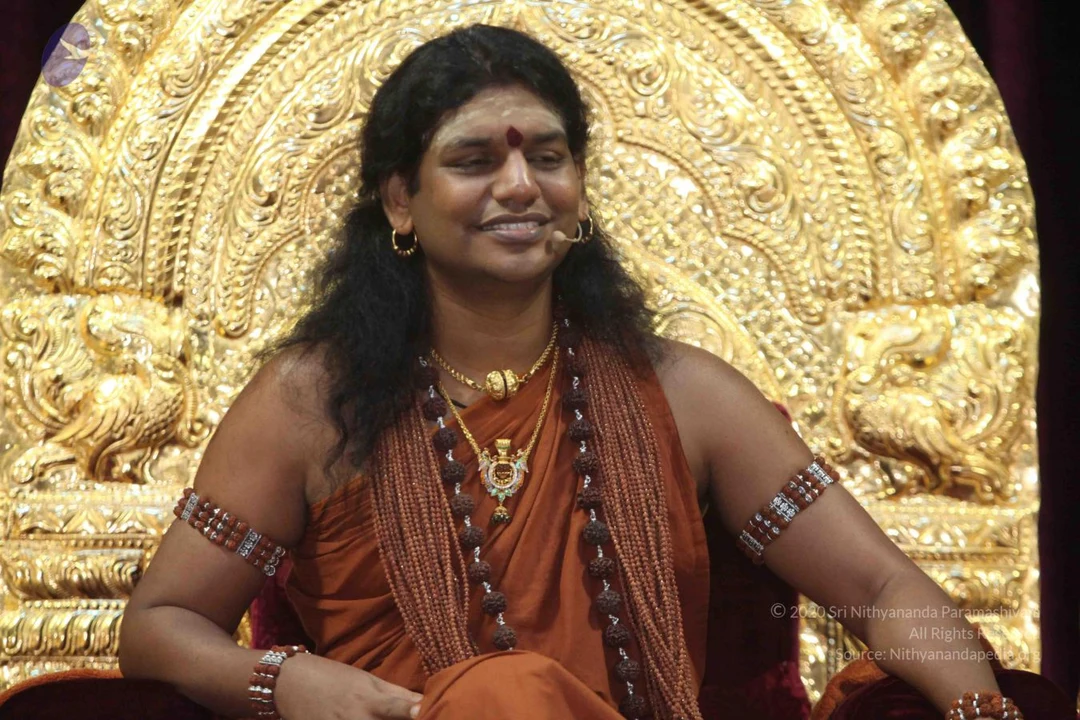
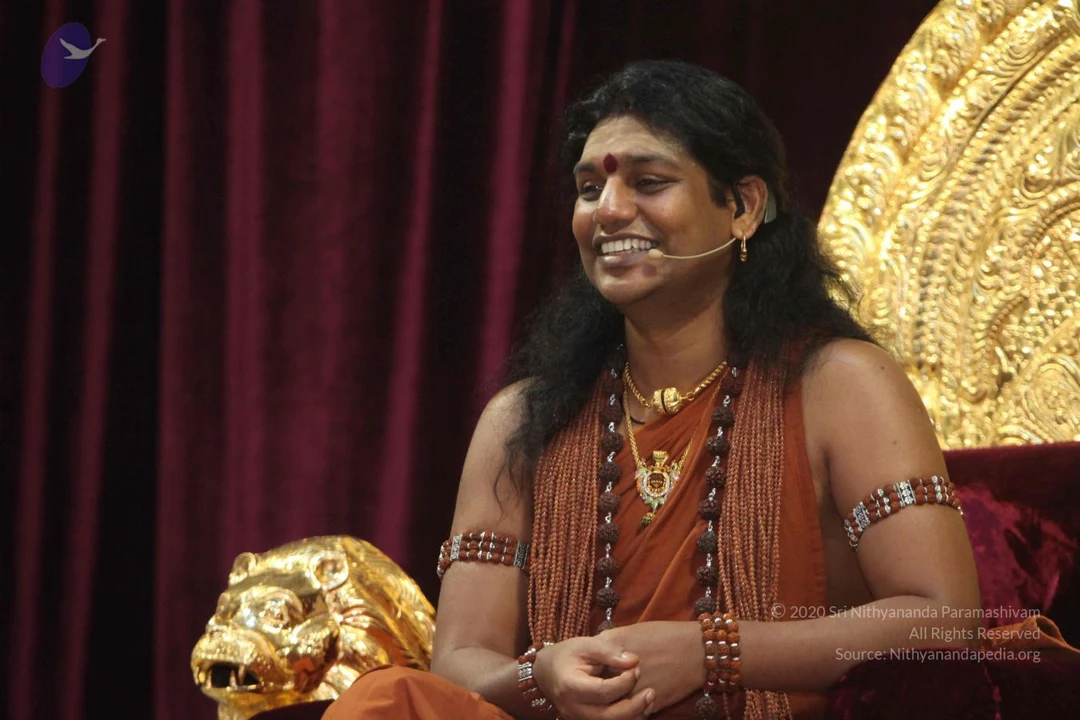
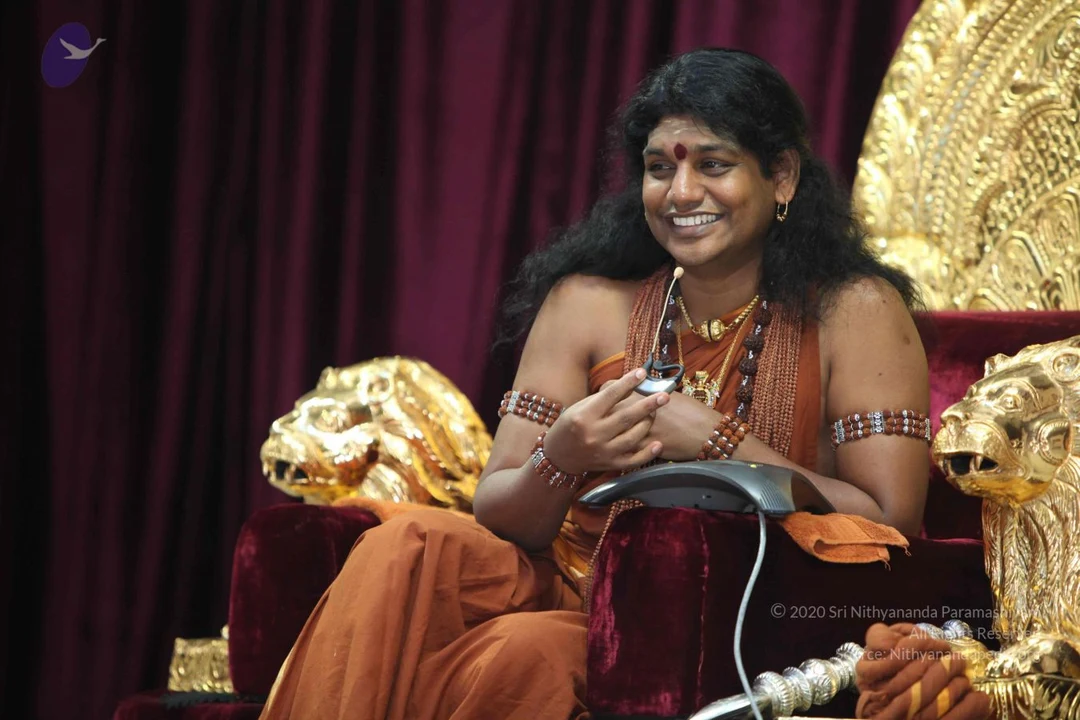
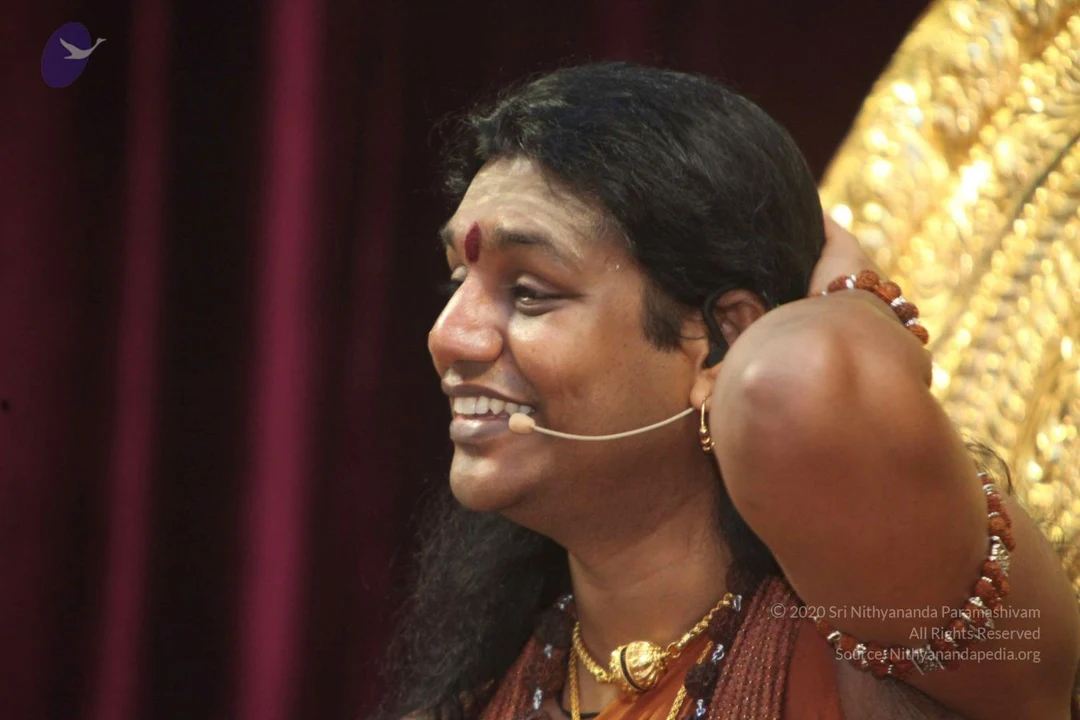
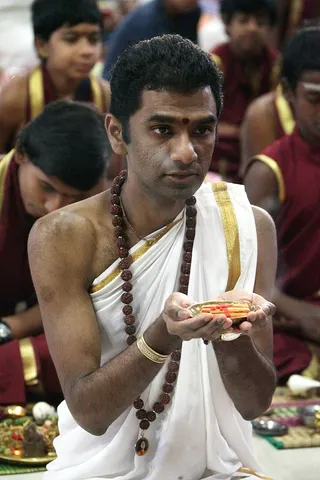
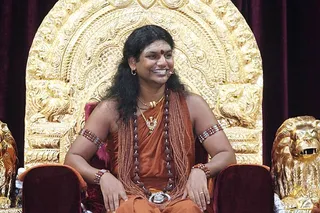
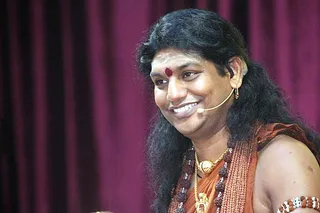
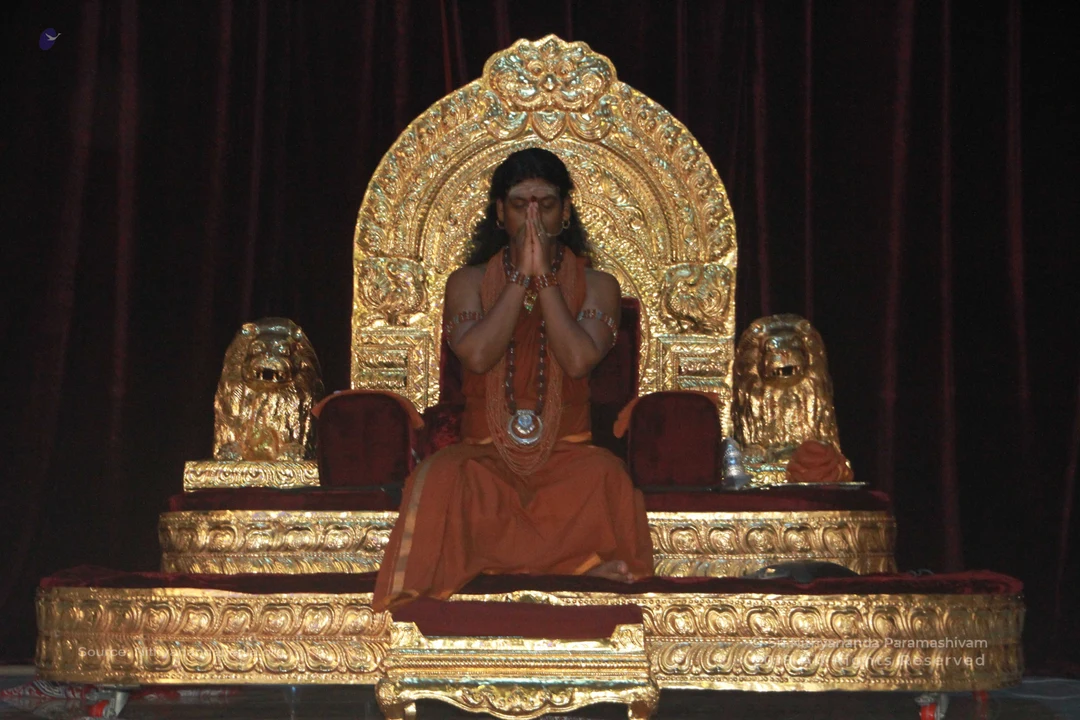
A seated man sits cross-legged on an ornate gold throne with a red velvet seat and armrests, his hands joined in his lap. He wears an orange-saffron dhoti and shawl, a multi-strand rudraksha mala, a gold necklace, gold earrings, arm bands and bangles, with a red bindi on his forehead. Long dark hair falls past his shoulders. Tall brass oil lamps stand on either side and a dark wall with hanging lamps forms the backdrop. This appears to be a throne-seat scene at a satsang; the candidate matches Swamiji (probable) by his saffron clothing, rudraksha mala, ceremonial gold necklace and long hair, and is physically present.A man with short dark hair and a red bindi sits in front of a group of seated boys in maroon and gold-bordered garments. He wears a white dhoti-style cloth with gold borders over bare shoulders, a long rudraksha mala, and a gold bracelet. He holds a small brass plate with orange and red items, possibly offerings, and a gold necklace is visible. Brass vessels and a small deity murti sit on the mat in the foreground. The scene appears to be a ritual gathering. Appearance alone does not clearly establish the identity of the central figure; he is described as a devotee or ritual participant and no identification is claimed.Close photo of a smiling man with long dark wavy hair and a red kumkum dot with white markings on his forehead. He wears a gold hoop earring, a small lapel microphone, a gold pendant and gold chain, and an orange-saffron shawl draped over bare shoulders. A large gold ornamental object is blurred at the left edge and a dark maroon curtain fills the background. Swamiji (probable): long swept-back hair, saffron shawl and ceremonial gold necklace, seated in a satsang setting.A smiling man with long dark hair and a red bindi sits on an ornate golden throne with carved lion figures, flanked by golden lion statues on both sides and dark red drapes behind. He wears an orange-saffron shawl over ornate clothing, a gold pendant necklace, a long rudraksha mala with a large ceremonial pendant, and jewelled armbands. His hands rest on the red cushioned armrests. Appearance-based label: a person, seated on the throne in the satsang setting described by the page.A smiling person with long dark swept-back hair sits in front of an ornate gold repoussé backdrop carved with lion-like figures. They wear an orange-saffron shawl and blouse, a red bindi, a gold necklace with a pendant, a long rudraksha mala, gold earrings, and beaded bangles on the upper arms and wrists. Their hands rest folded in the lap on a red velvet-covered seat.A smiling man with long dark hair, a red bindi on his forehead, a small clip-on headset microphone and a gold earring sits in front of a deep maroon curtain. He wears an orange-brown shawl draped over the shoulder and bare upper arm, with a gold pendant necklace, a dark rudraksha mala and beaded bracelets. Appearance-based label: a person, seen in person speaking to an audience during a satsang setting.

Photos

15 photosSource gallery
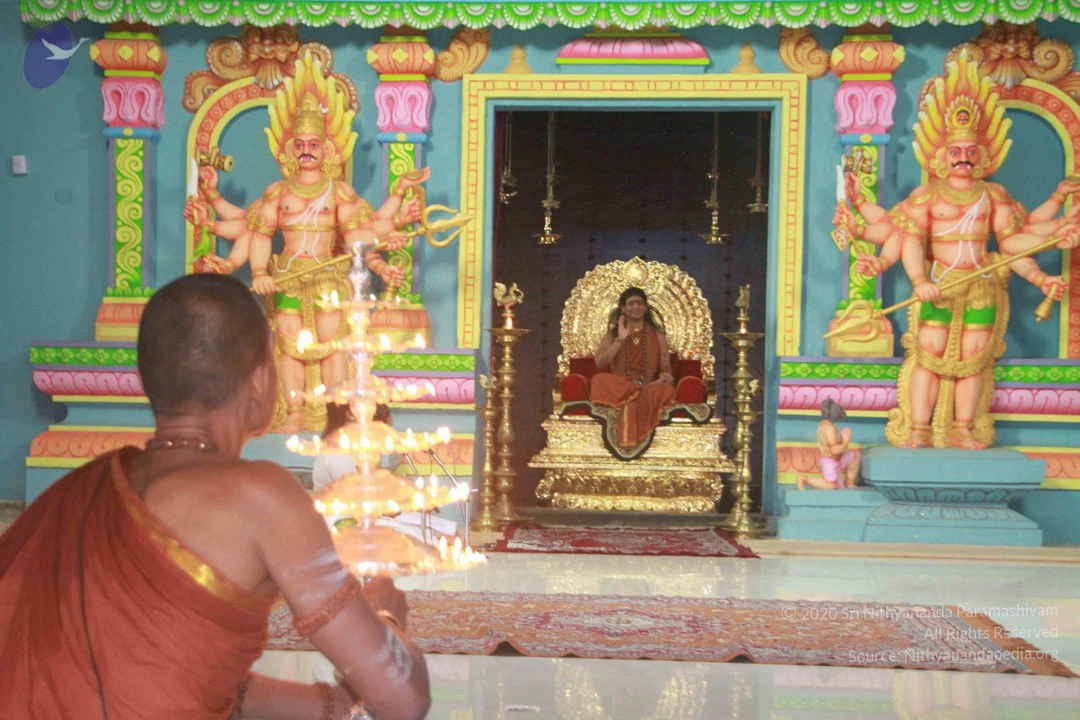
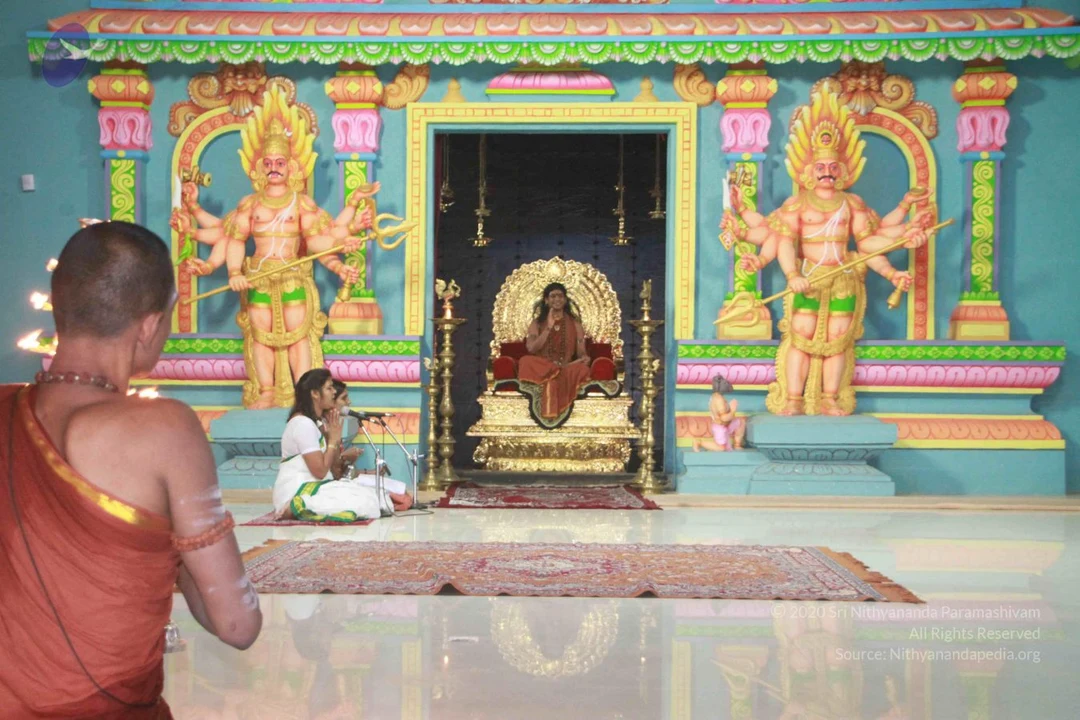
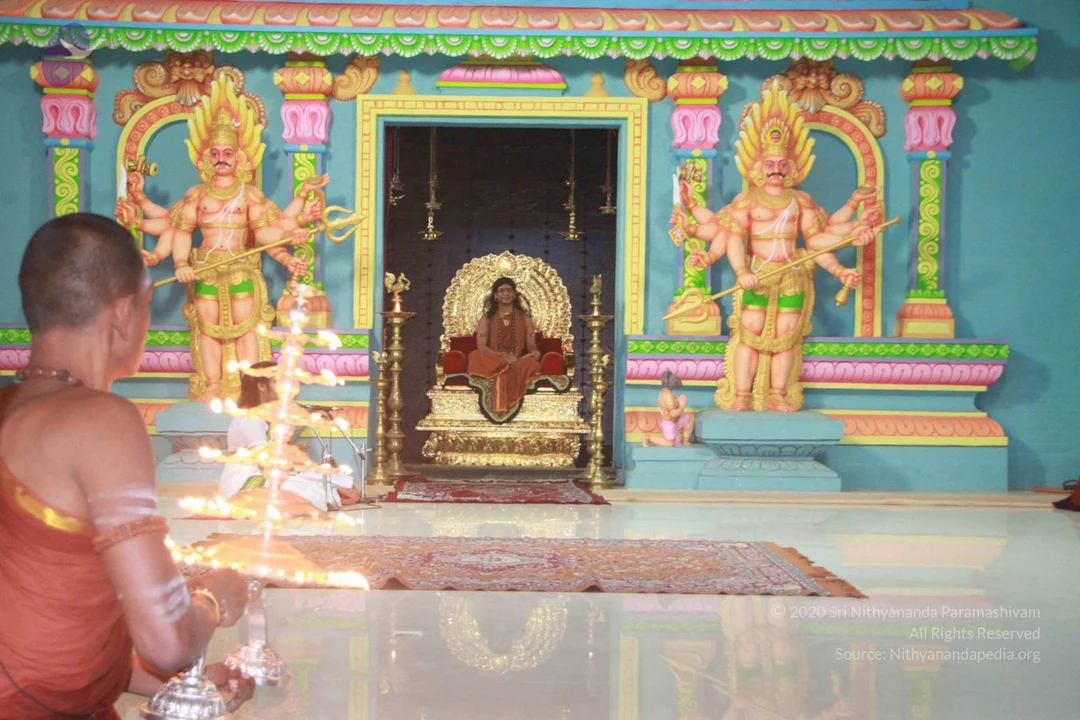
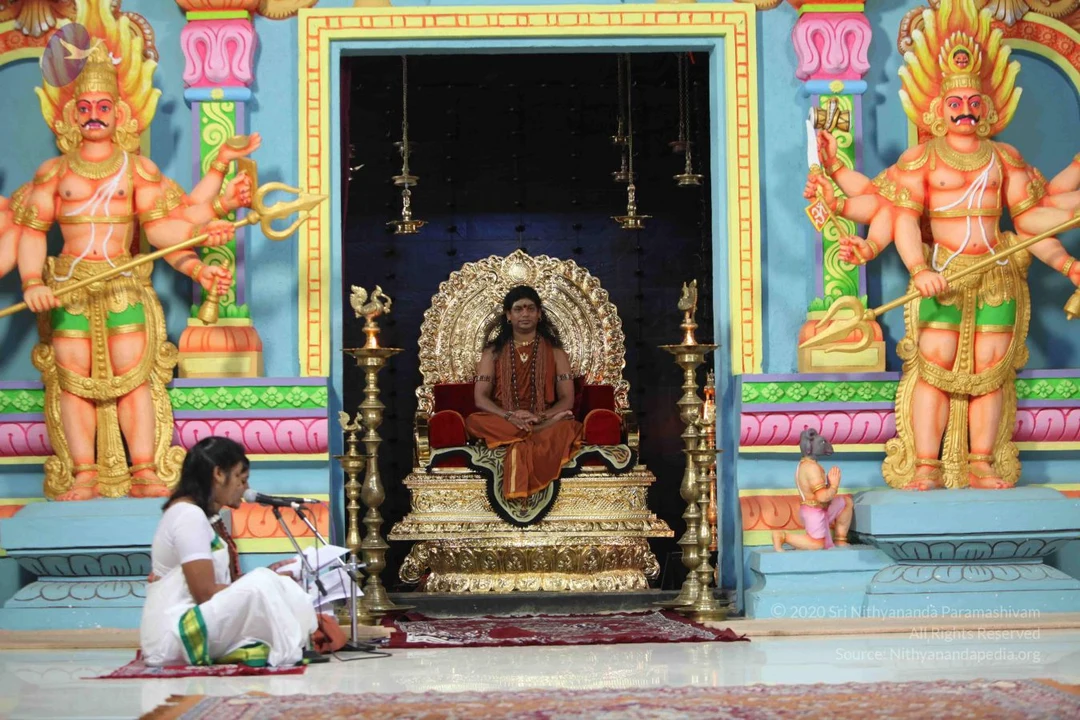
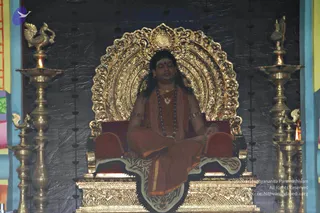
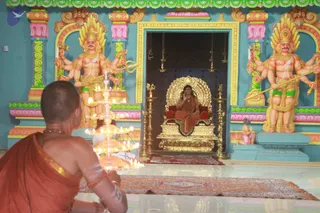
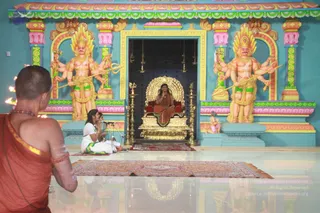
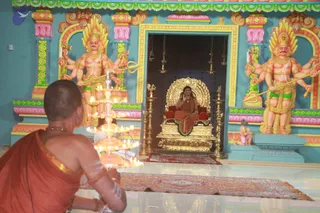
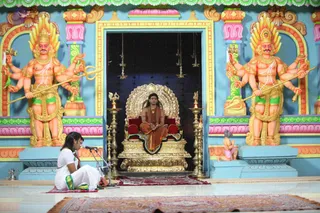
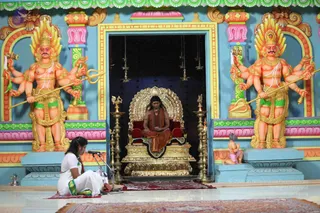
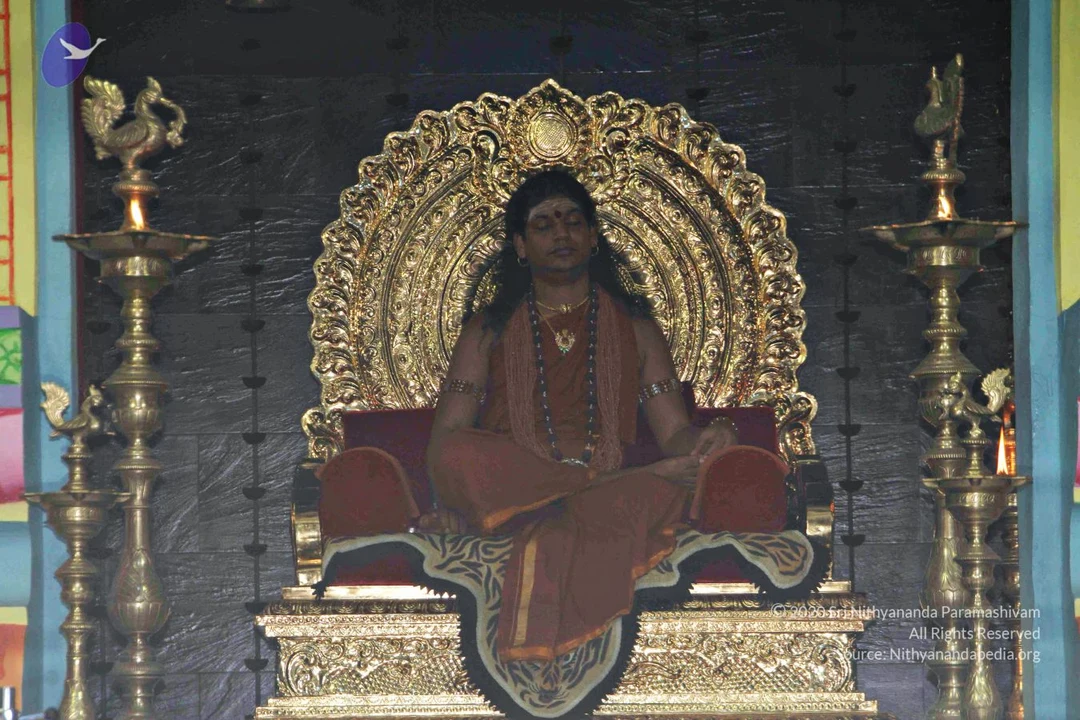
A man with long dark hair sits cross-legged with eyes closed on an ornate golden throne with a large arched backrest carved with floral scrollwork. He wears an orange-saffron dhoti and shawl, a rudraksha mala, a gold necklace, gold armlets, and a red tilak on his forehead. Brass oil lamps with lit flames flank the throne on both sides, and the dark wall behind shows a teal-and-yellow border. Printed copyright text runs along the lower right corner. This appears to be a satsang or meditation setting. Swamiji (probable) seated on the throne, identified by long swept-back hair, saffron clothing, rudraksha mala and gold ornaments.Temple interior with bright turquoise and pink walls framing a central doorway. Two large painted guardian statues with multiple arms holding tridents and clubs flank the entrance. Inside the doorway, a seated figure in a red and orange robe sits on an ornate gold throne with red cushions, one hand raised in blessing. In the foreground, a shaved-headed priest in an orange robe with a gold border faces the throne, holding a multi-tiered lit oil lamp (aarti) with burning flames. A red and gold carpet covers the floor.A seated man in saffron-orange robes sits on a red-cushioned throne backed by an ornate gilded arch with scrollwork. He wears long dark hair, a red bindi on his forehead, gold earrings, a gold necklace, a dark rudraksha mala, beaded bracelets and armbands, and a gold-and-red ornament at his chest. His right hand is raised in a blessing gesture while his left rests in his lap. Probable Swamiji by appearance: long swept-back hair, saffron clothing, a rudraksha mala and ceremonial gold ornaments, seated on a throne during a satsang.A seated man in saffron-orange robes sits before an ornate golden throne with intricate repoussé carving, raising his right hand in a blessing gesture. He wears a long rudraksha mala, a ceremonial gold necklace, bangles on both wrists and a red bindi with vibhuti marks on his forehead, and he is smiling. A red cushioned seat is visible below. A dark wall forms the background.A seated man in orange-saffron robes raises his right hand in blessing before an ornate gilded throne with a large repoussé halo-like back. He wears layered rudraksha malas, a gold necklace with a green-and-gold pendant, armlets and bangles, and a red bindi on his forehead. The red velvet seat cushion frames him against a dark blue wall. Appearance matches a probable Swamiji (probable) with long swept-back hair, saffron robes and rudraksha malas, seated and speaking in front of a golden throne.A photograph inside a temple hall with turquoise and pink painted walls. Two large painted guardian figures with multiple arms, holding tridents and staffs, flank a dark doorway. In the doorway, a figure in orange robes sits on a gold throne with red cushions and a golden back arch, with hanging brass lamps above. A seated woman in white with a microphone stands near the throne in a devotional posture. In the foreground, a man with a shaved head and orange robe sits with his back to the camera, facing the throne, with a sacred thread and white markings on his arm. A small seated deity murti sits to the right of the throne, and oil lamps burn near the foreground.

Temple Visit || Pada Puja || Satsang || Sarva Darshan
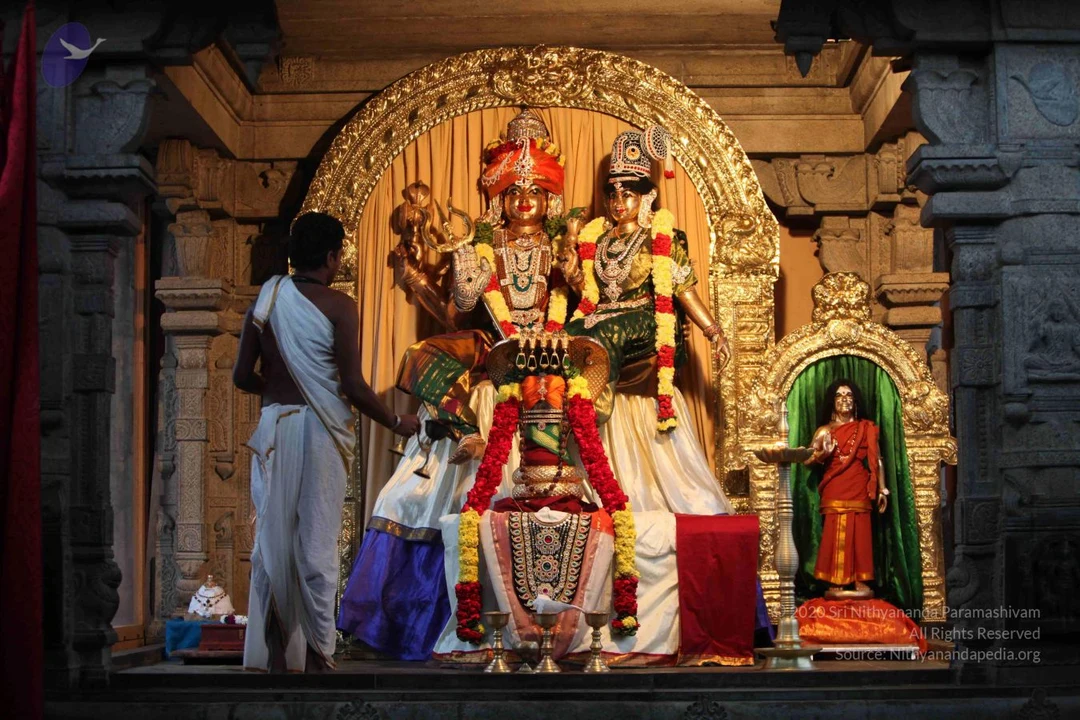
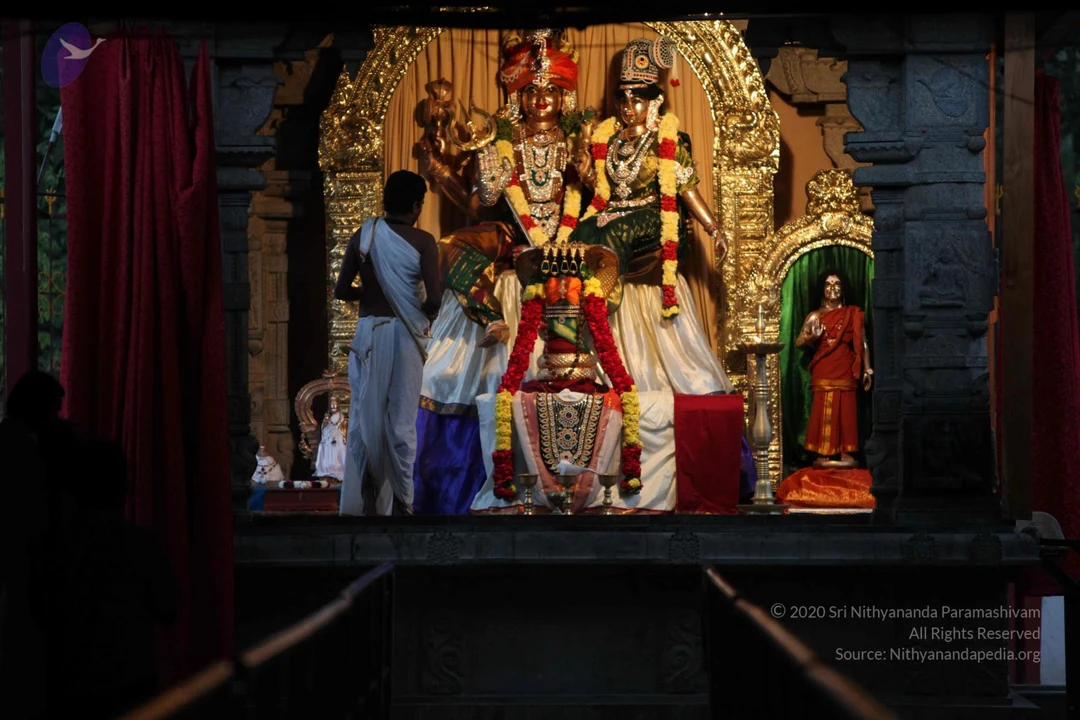
108 photosSource gallery
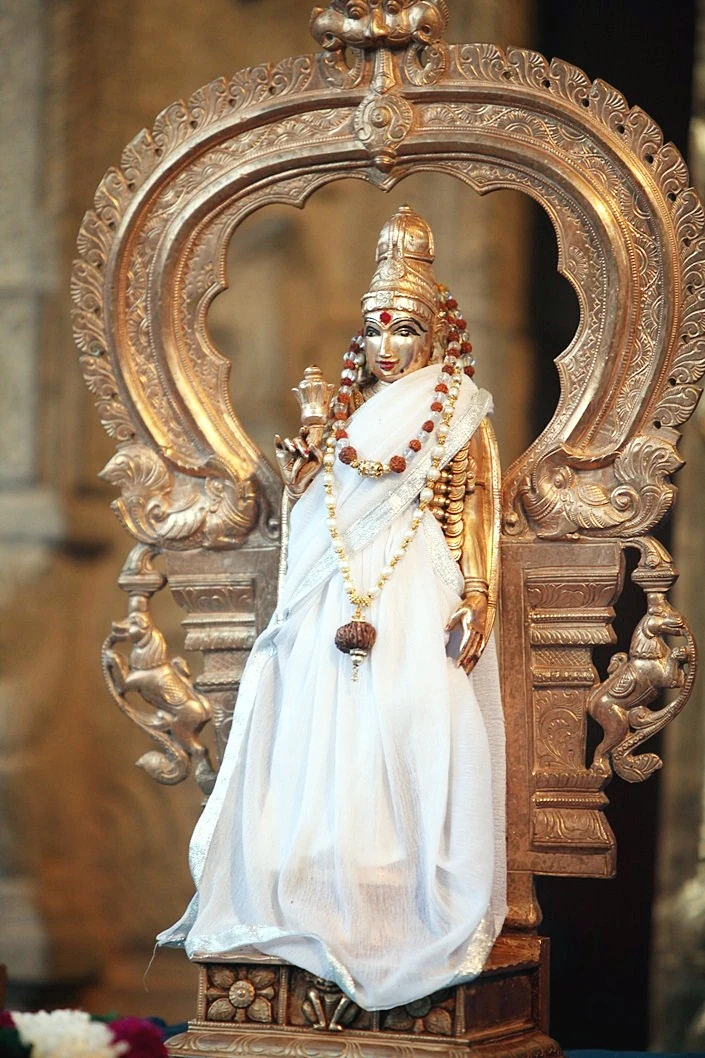
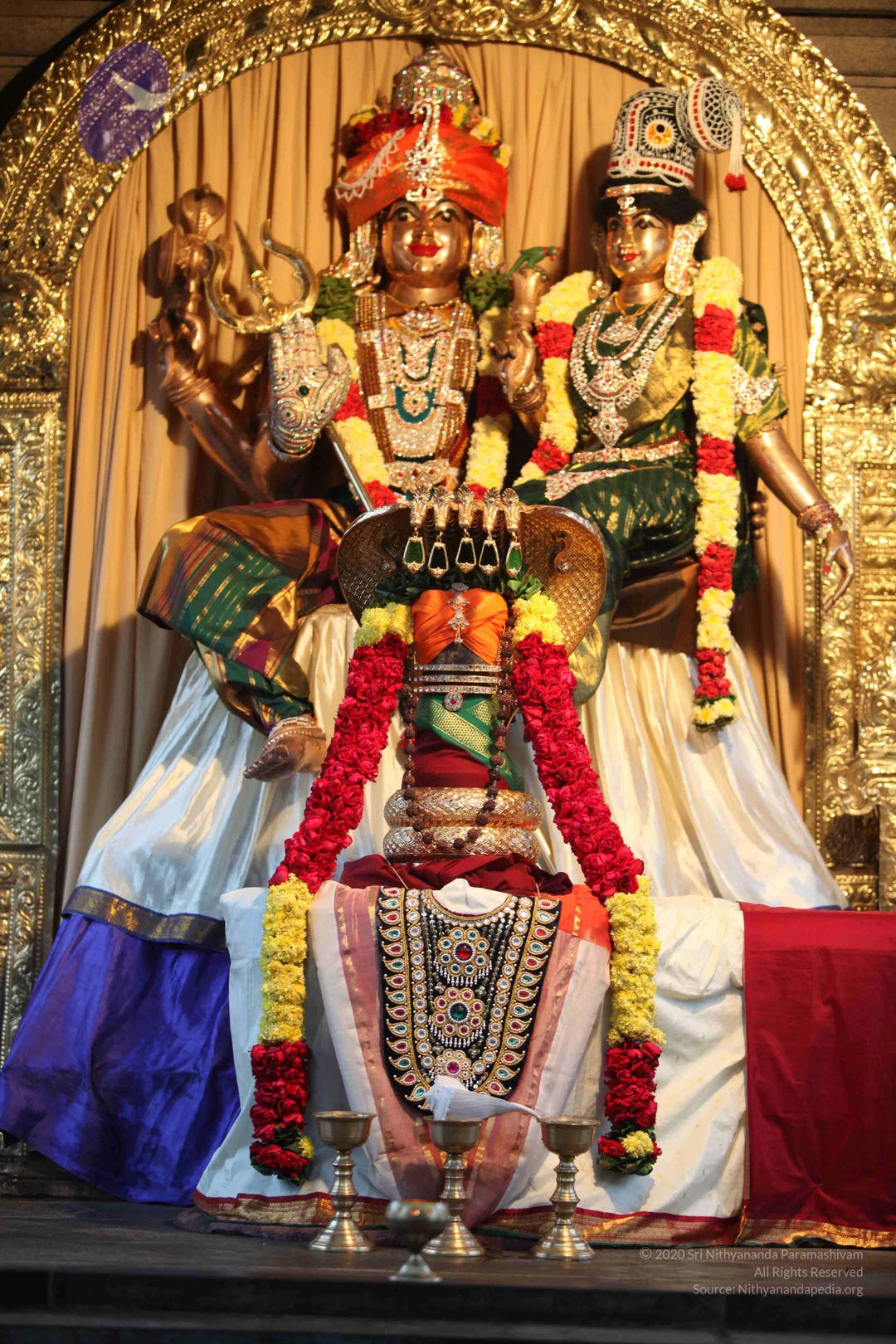
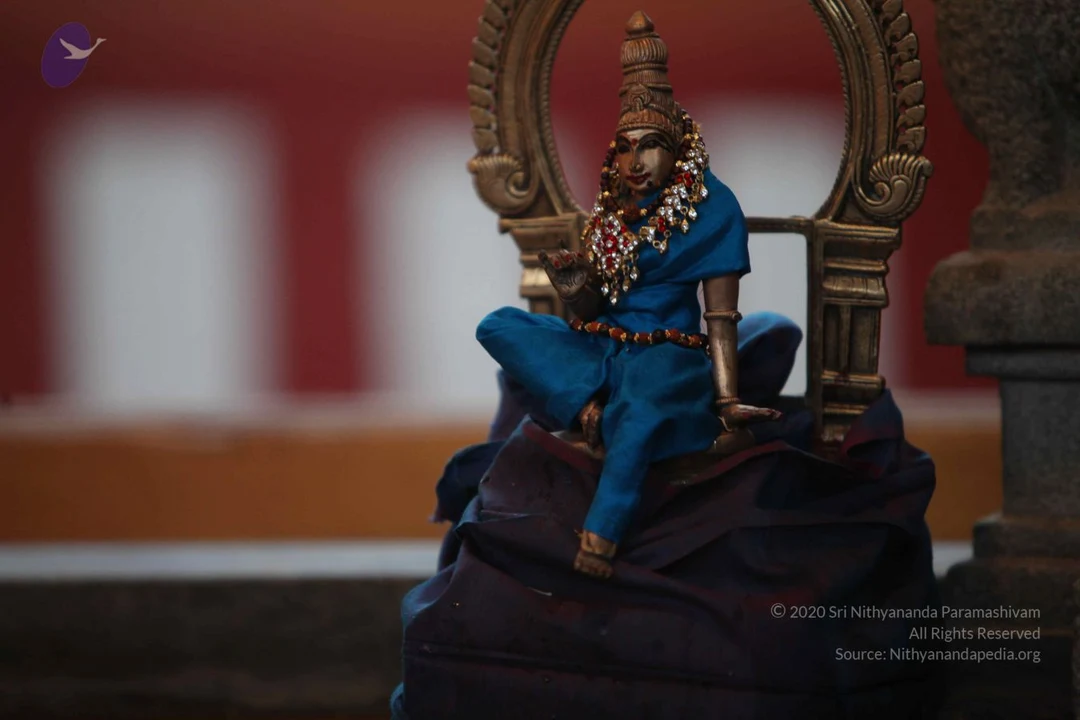
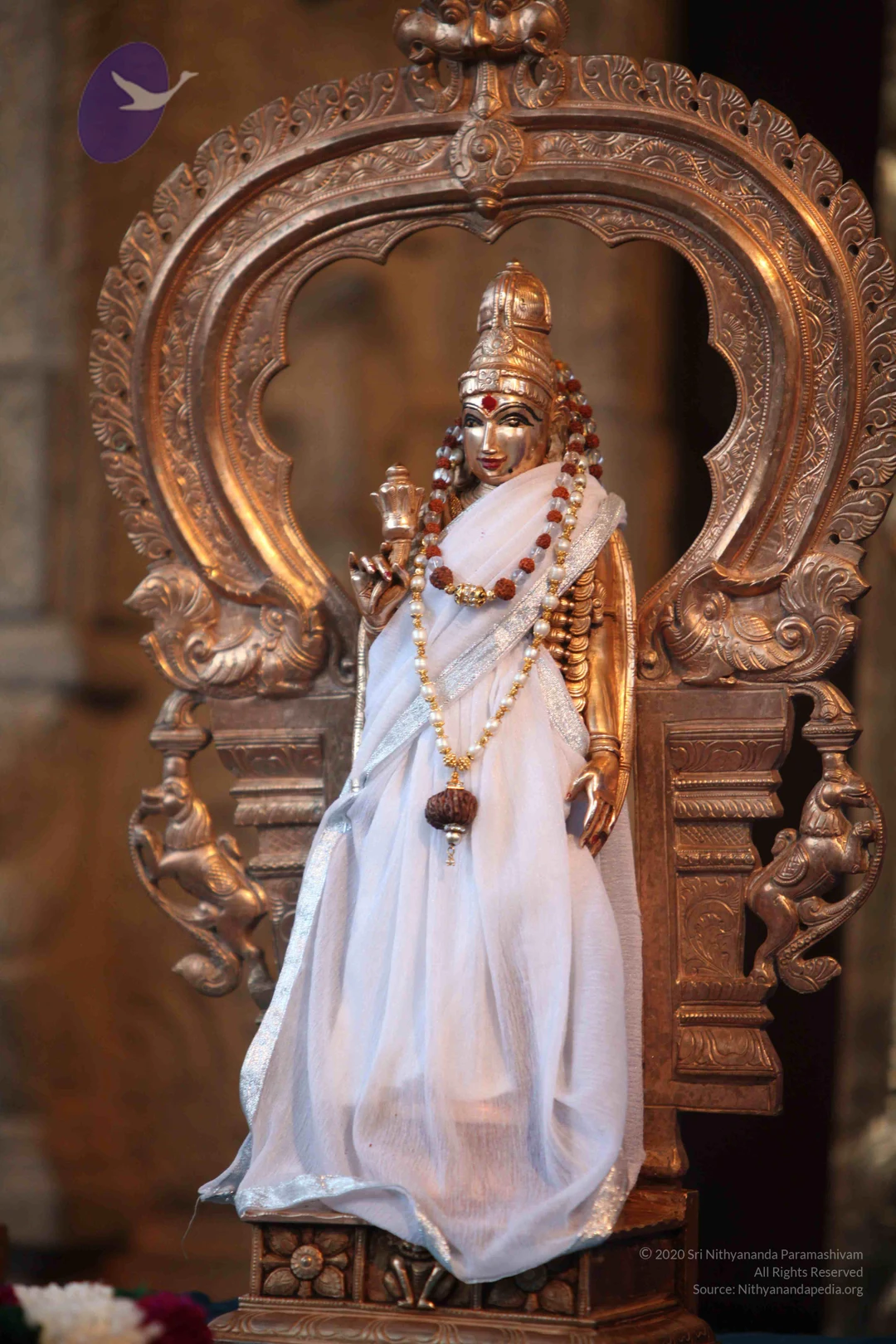
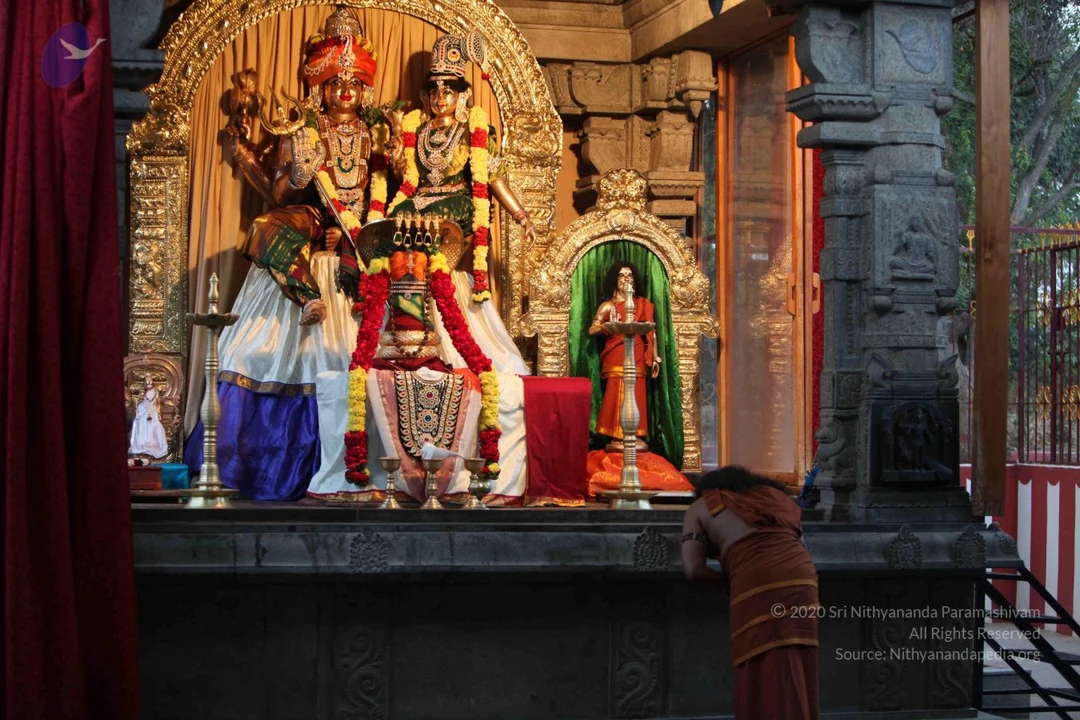
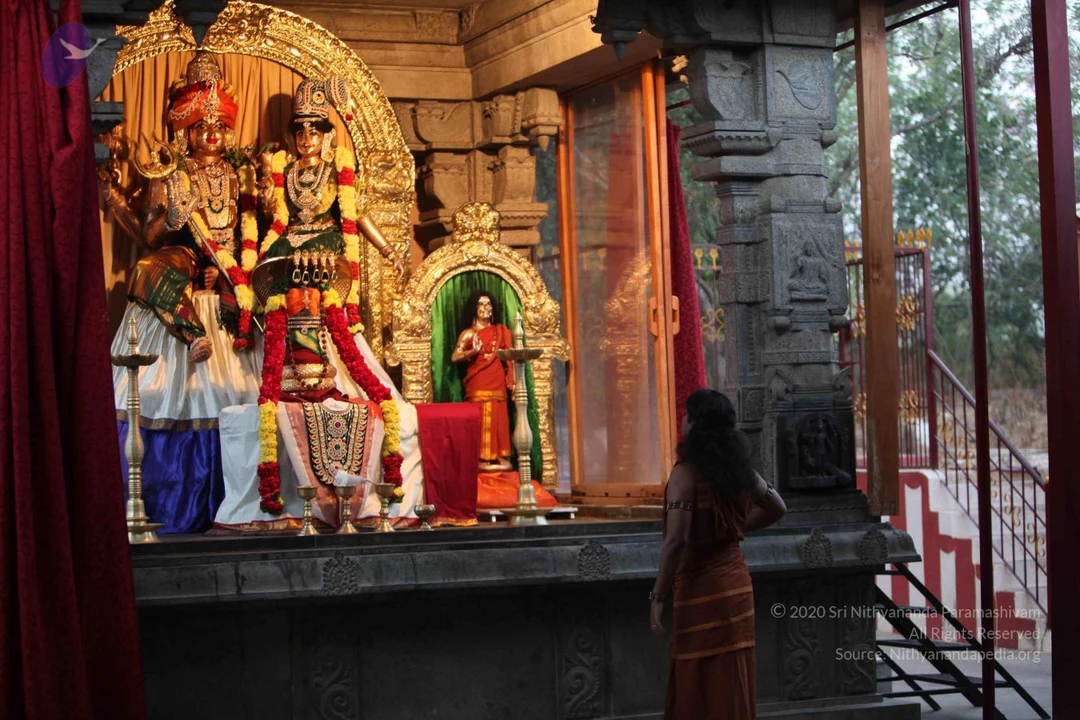
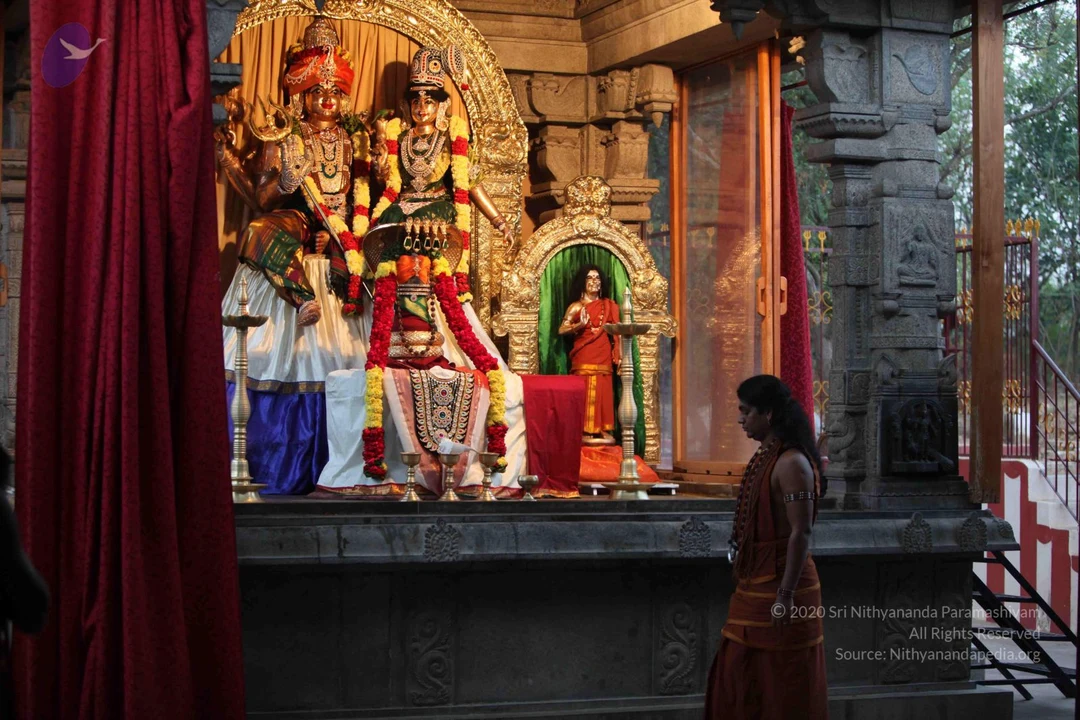
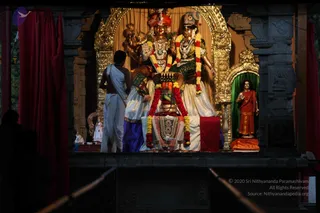
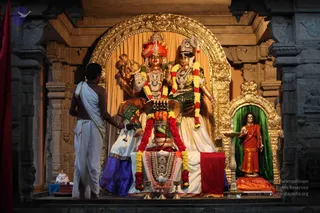
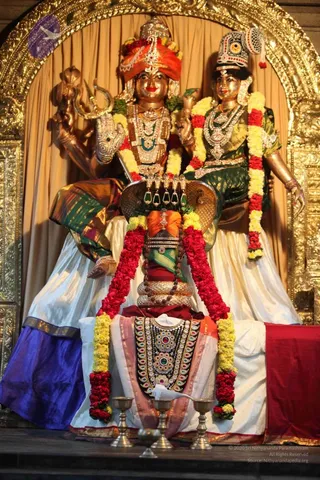
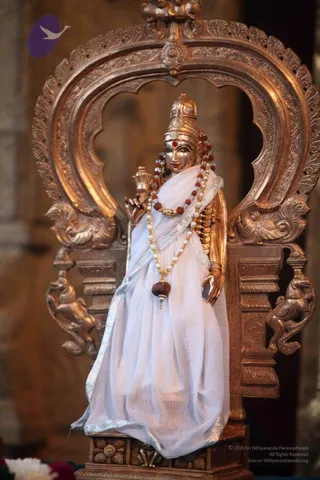
A temple sanctum with a gilded arch framing large deity murtis dressed in white and green silk with garlands of yellow and red flowers. A standing priest with bare upper body and white dhoti stands at left, facing the central altar holding a sacred object. A small golden figure in orange robe stands in a green niche at right, and a red curtain hangs at the left edge. Oil lamps and offerings sit on a stone platform before the murtis. No visible people in the audience area; the single priest is the only physical person.A temple shrine with a gilded arched niche holds two large deity murtis, a male figure with a red-and-gold turban holding a trident and a female figure with a tall ornate crown, both wearing layered gold and bead necklaces, garlands of yellow and red flowers, and saris in green and white. A priest in white dhoti and shawl, bare-chested with a sacred thread, stands at the left making an offering. Brass oil lamps and a lit lamp stand before the murtis, and a smaller statue in a green-curtained niche at right wears orange robes and holds a lamp. The scene reads as a puja or abhishekam at the shrine.A temple shrine with a golden arched niche framing two large painted deity murtis seated together, one in red and gold turban with a trident and crescent-like ornament, the other crowned with ornate jewellery; both wear garlands of red and yellow flowers and silver necklaces, and a decorated kalasha or ornamental vessel sits before them. To the right, a smaller standing statue in orange robes stands beside a green curtain, and a small figure sits at the far right. Red drapes hang on the left, stone pillars with carvings frame the shrine, and oil lamps stand on brass stands at the base. The scene is a temple sanctum with no physical people present.A photograph of a shrine in a gilded arch showing two golden deity murtis seated together: the male figure wears an orange turban, a jewelled crown-like headdress, a trident and a snake-hooded cobra overhead, while the female figure wears a green sari and ornate necklaces and holds a flower. Both are garlanded with red and yellow flowers. In front, a large linga-shaped form draped in a red and green cloth, with rudraksha beads and gold bangles, wears a jewelled necklace and is garlanded with red roses and yellow marigolds. Brass oil lamps stand on the platform, and no people are visible.A small metal murti seated cross-legged on a dark purple cloth draped over a stone base, in front of a gilt arched prabhavali-style backdrop with scroll ornaments. The figure wears a blue dhoti-like garment, a tall ornamented crown, a red and white jewelled necklace and a red beaded waist cord, with a red tilak on the forehead. One hand holds a small object at the chest. A blurred red and white wall forms the background. No physical people are present; the figure is a statue of a deity murti.A gilded metal statue of a deity murti stands within an ornately carved golden arch with floral scrollwork and rearing animal figures on the pedestals. The figure wears a white silk-like drape edged with silver border, a silver crown, a red kumkum mark on the forehead, and multiple rudraksha and pearl malas with a large rudraksha pendant. One hand holds a small silver ritual vessel while the other rests near the hip. Garlands of white flowers appear at the lower left corner. The setting suggests a temple or ashram shrine.

Temple Visit || Pada Puja || Satsang || Sarva Darshan
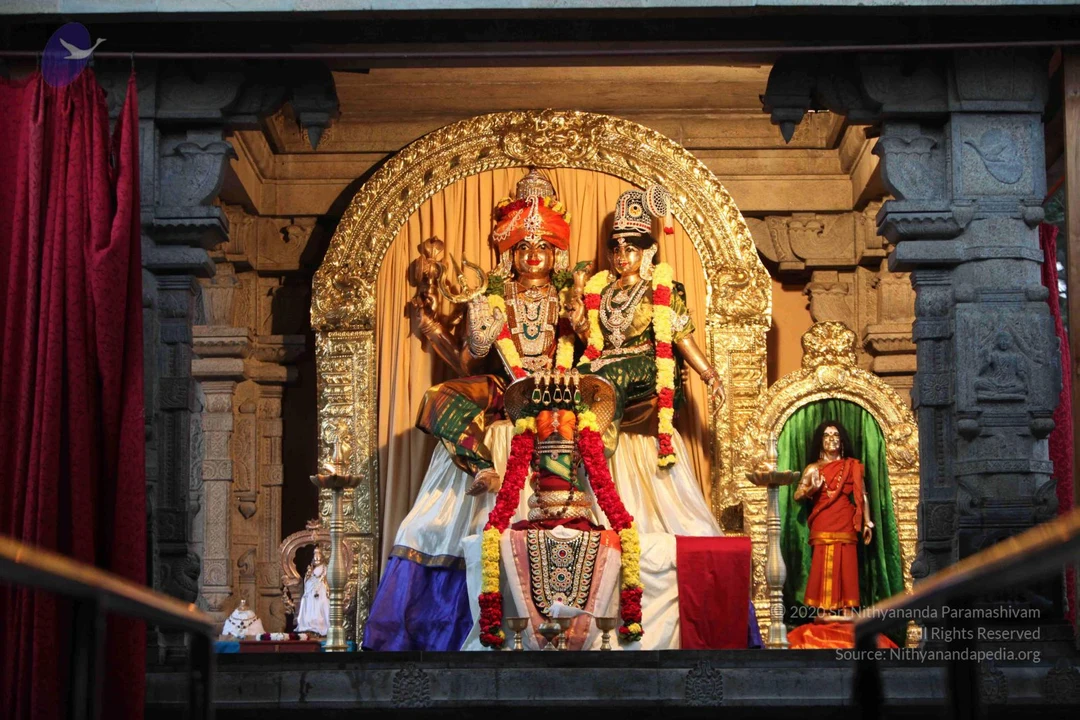
6 photosSource gallery
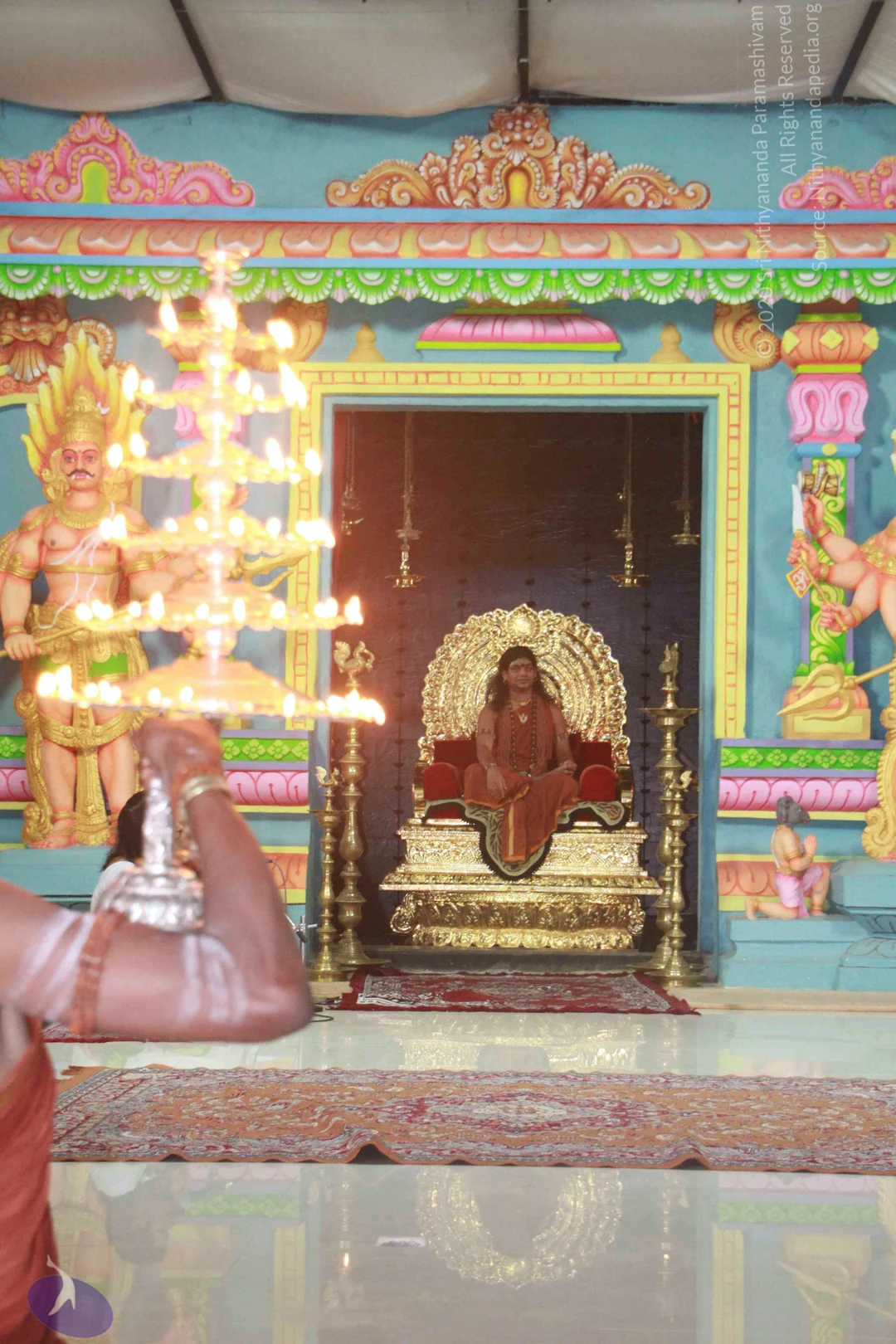
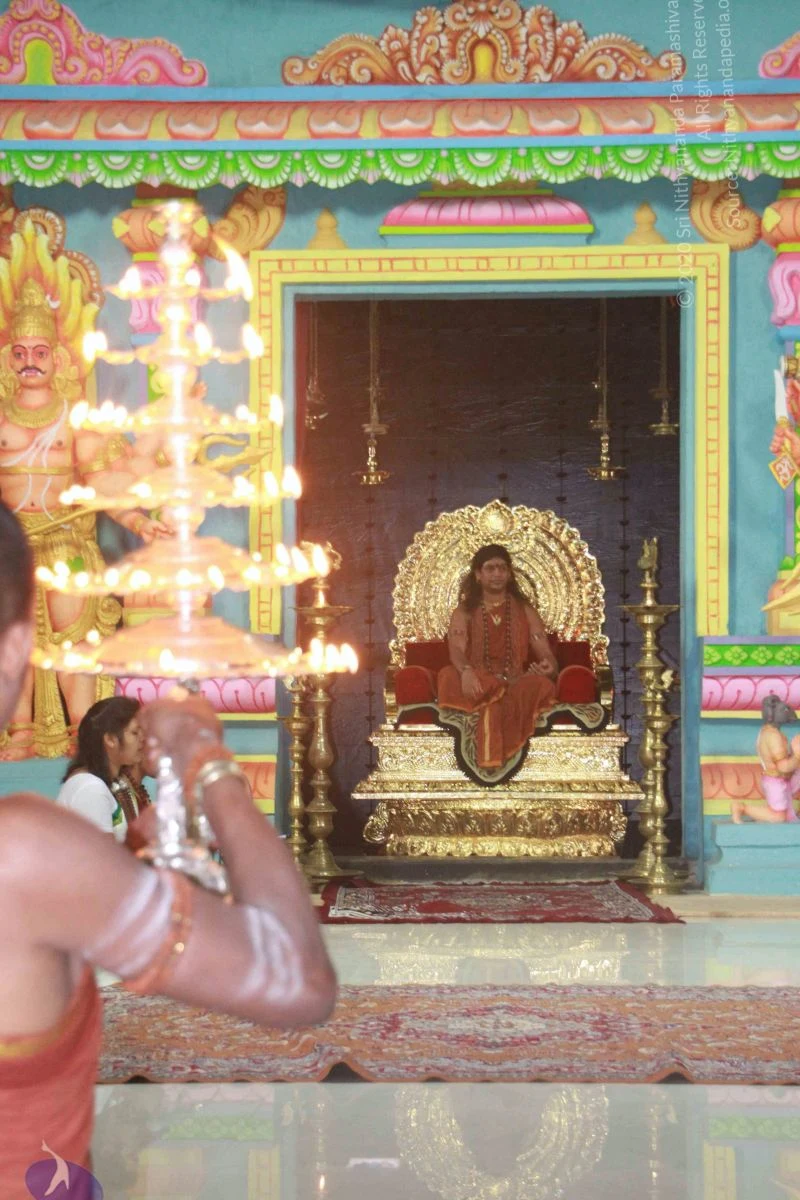
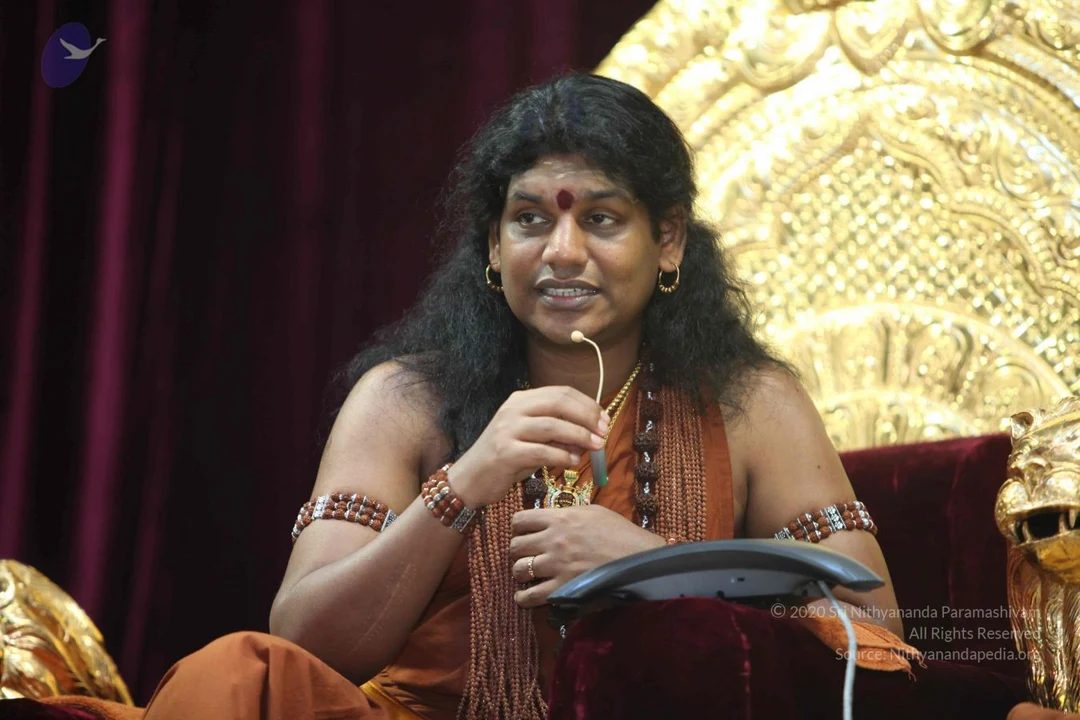
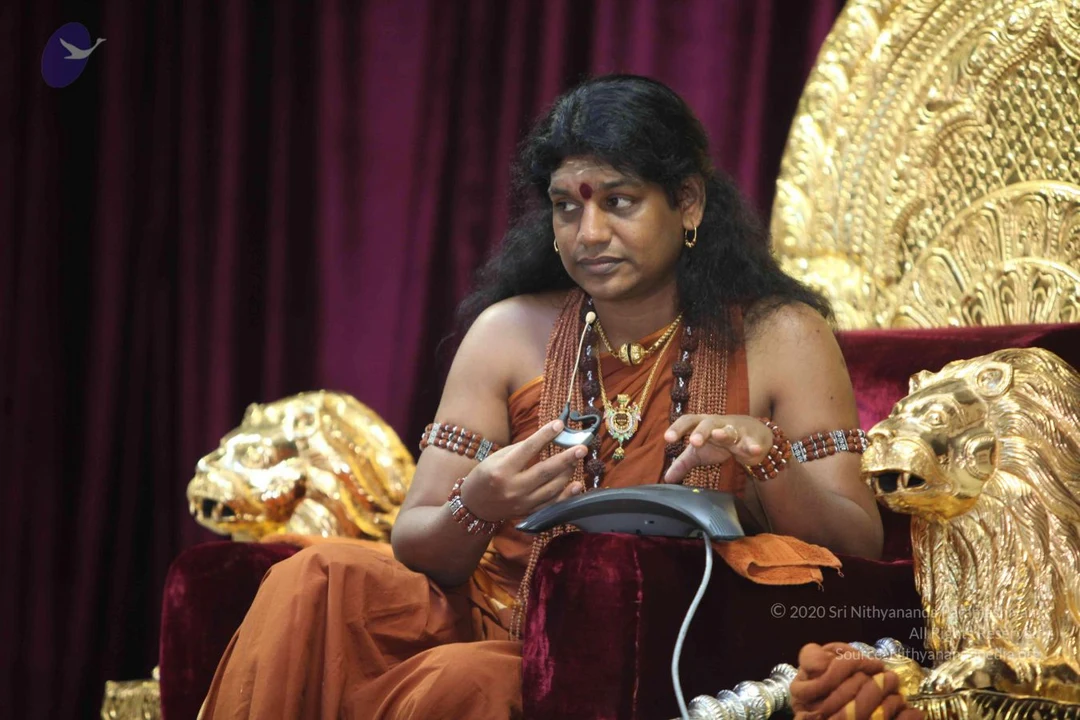
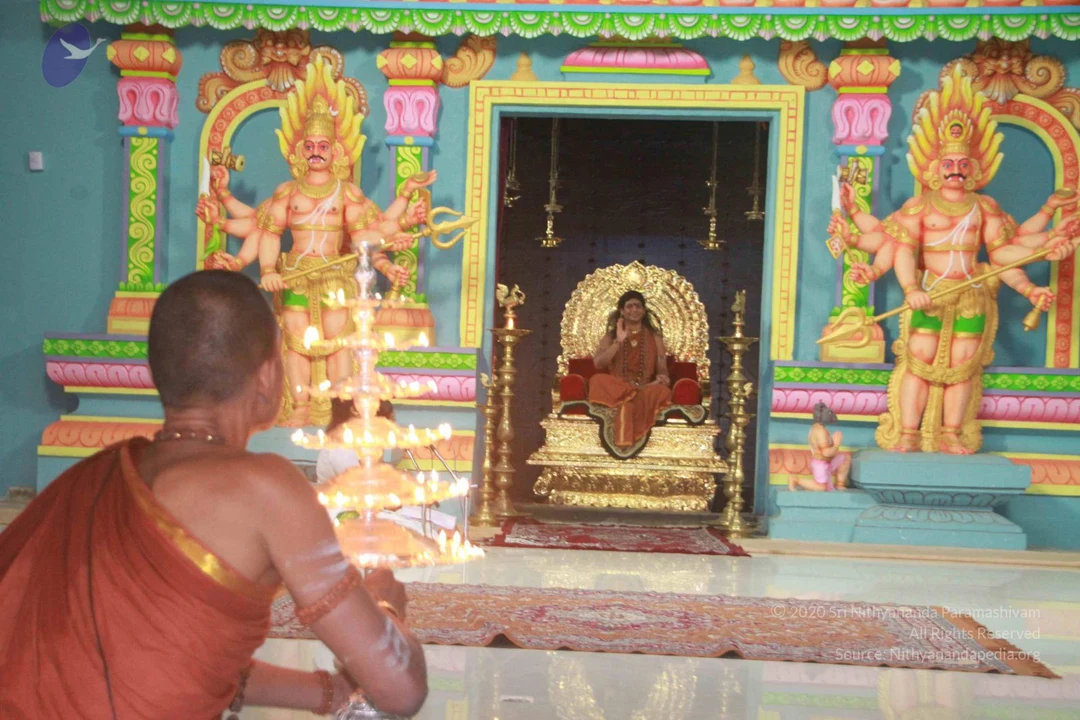
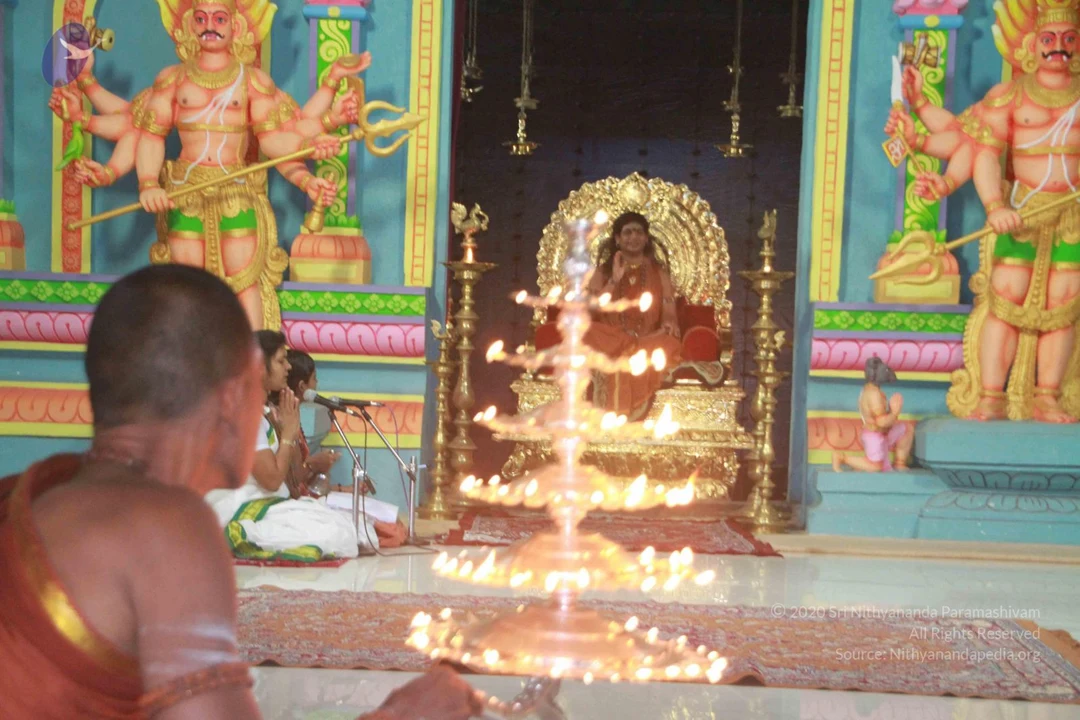
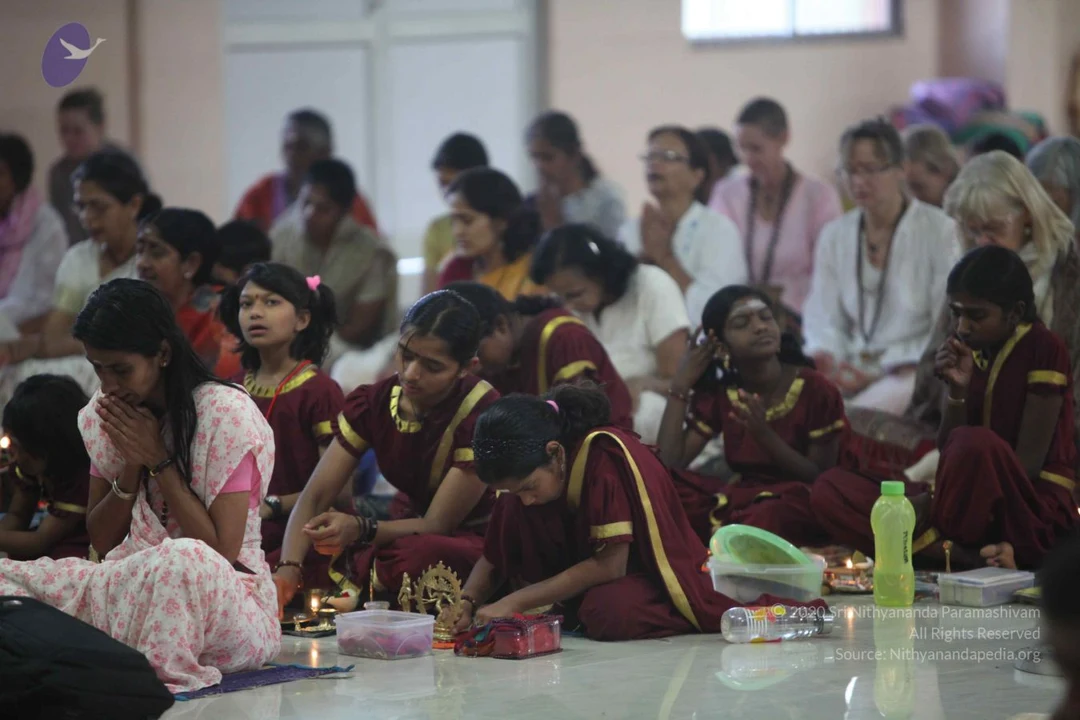
A priest in saffron robes with a shaved head and tilak stands at left, seen from behind, holding a multi-tiered brass lamp with several lit flames toward a shrine. Inside a doorway flanked by two tall painted guardian figures with multiple arms, trident-like staffs and orange-gold ornaments, a figure with long hair and an orange-red robe sits on an ornate gold throne with a red cushion, raising one hand in blessing. Brass lamps and pillars frame the doorway, and the floor is covered with a red patterned rug. The scene is a temple-style aarti before a seated figure. a person appears as the seated figure on the throne, with long hair, orange robe and a rudraksha-style necklace.Interior temple scene with a large multi-tiered brass oil lamp burning in the foreground, its flames rising in rows. A seated figure in orange-red robes sits on an ornate gold throne with a arched gold backdrop, between two painted guardian figures with multiple arms holding tridents and staffs. A bald man in orange clothing with a sacred thread sits at lower left facing the throne, and two women in white sit in prayer posture beside a microphone stand on a carpeted platform. Gold lamp stands flank the throne, and a small figure in pink sits near the right pillar.A seated man in orange-saffron robes raises his right hand in blessing before an ornate gilded throne with a large repoussé halo-like back. He wears layered rudraksha malas, a gold necklace with a green-and-gold pendant, armlets and bangles, and a red bindi on his forehead. The red velvet seat cushion frames him against a dark blue wall. Appearance matches a probable Swamiji (probable) with long swept-back hair, saffron robes and rudraksha malas, seated and speaking in front of a golden throne.A photograph inside a temple hall with turquoise and pink painted walls. Two large painted guardian figures with multiple arms, holding tridents and staffs, flank a dark doorway. In the doorway, a figure in orange robes sits on a gold throne with red cushions and a golden back arch, with hanging brass lamps above. A seated woman in white with a microphone stands near the throne in a devotional posture. In the foreground, a man with a shaved head and orange robe sits with his back to the camera, facing the throne, with a sacred thread and white markings on his arm. A small seated deity murti sits to the right of the throne, and oil lamps burn near the foreground.A photograph inside a temple-style hall with turquoise walls and pink and gold trim. Two painted guardian figures with multiple arms, crowns and tridents stand on either side of a doorway. Inside, a seated figure in orange robes sits on a gold throne with red cushions, with a red rug in front. In the foreground a man with a shaved head, orange garment and white marks on his arms holds a lit multi-wick oil lamp, which is the main ritual action. Another person in white sits on the floor near the throne. The scene suggests an aarti or puja before the throne.A man with long, swept-back dark hair sits in front of an ornate gold throne with embossed floral and scroll patterns. He wears a red-orange shawl, multiple strands of rudraksha beads, a gold ornate pendant necklace, gold hoop earrings and a red bindi on his forehead, with a small lapel microphone clipped near his face. His expression is calm and slightly smiling. The appearance cues (long hair, saffron-orange clothing, rudraksha malas and ceremonial gold necklaces) are consistent with the page's reference to Swamiji, so this is a probable identification. Probable Swamiji seated on a golden throne, wearing orange shawl and rudraksha mala with a gold pendant. A dark red curtain is behind the throne at the right edge.

Tempie

6 photosSource gallery
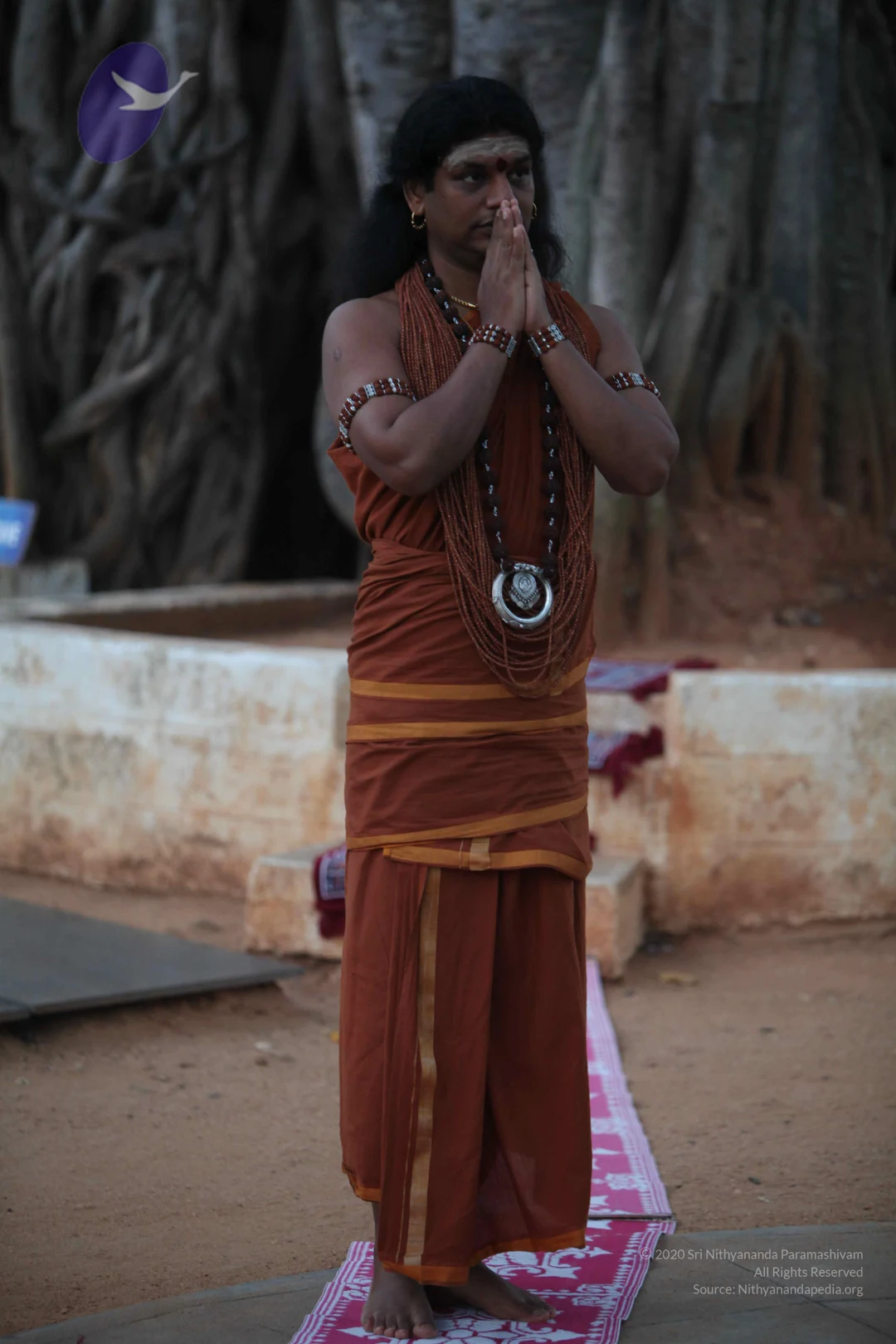
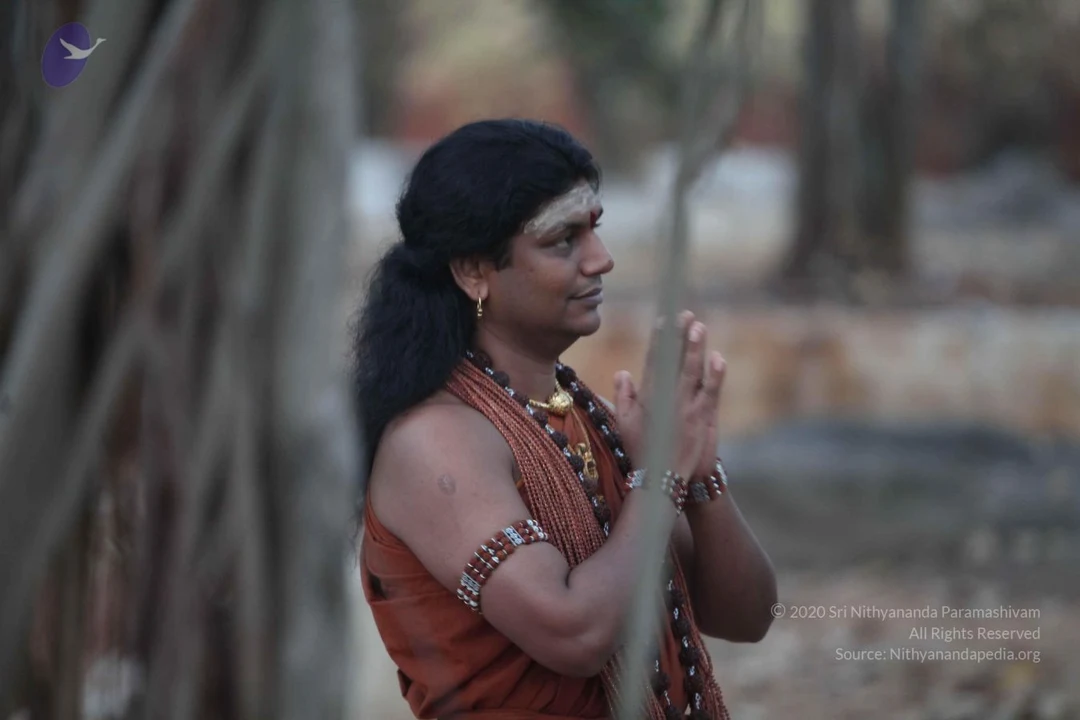
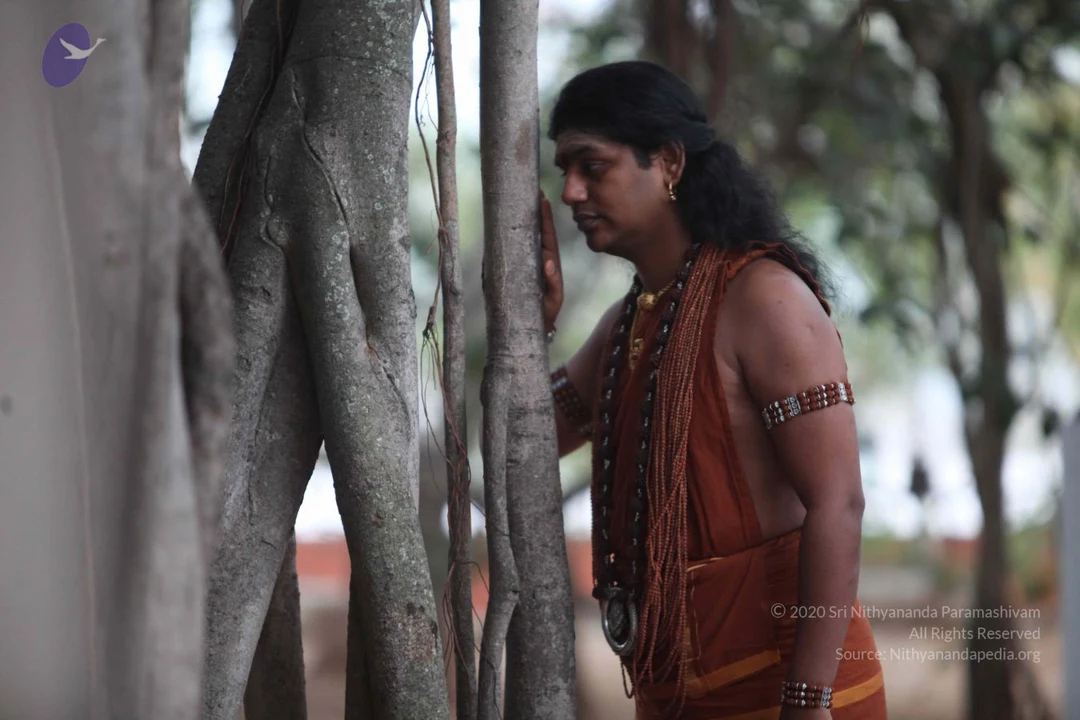
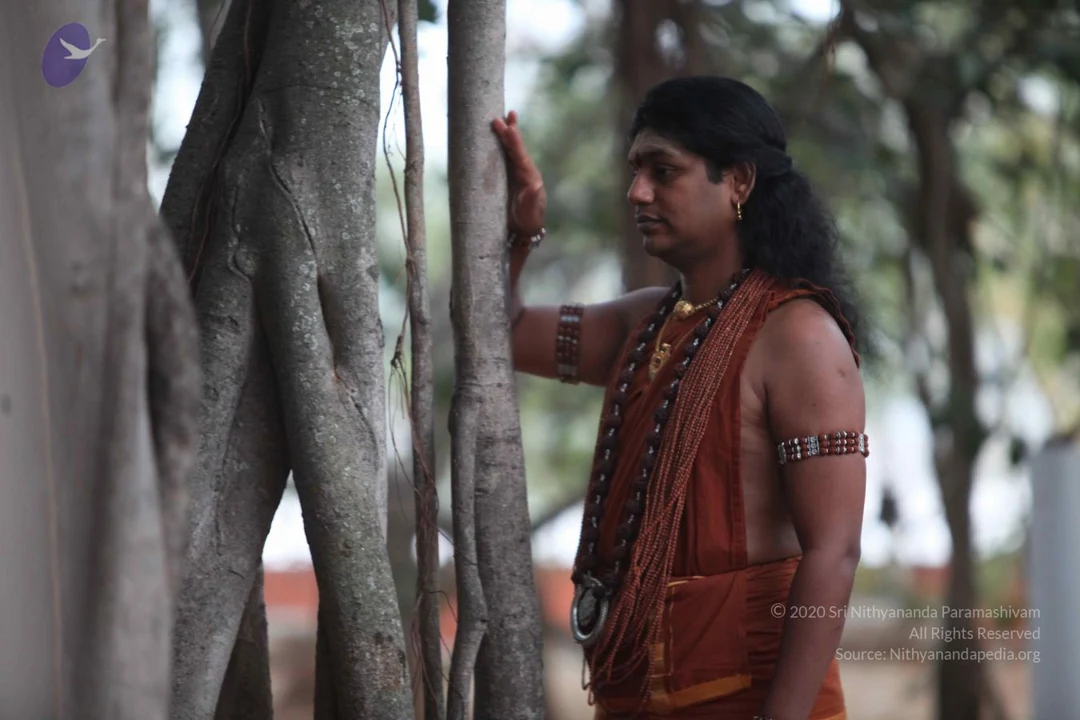
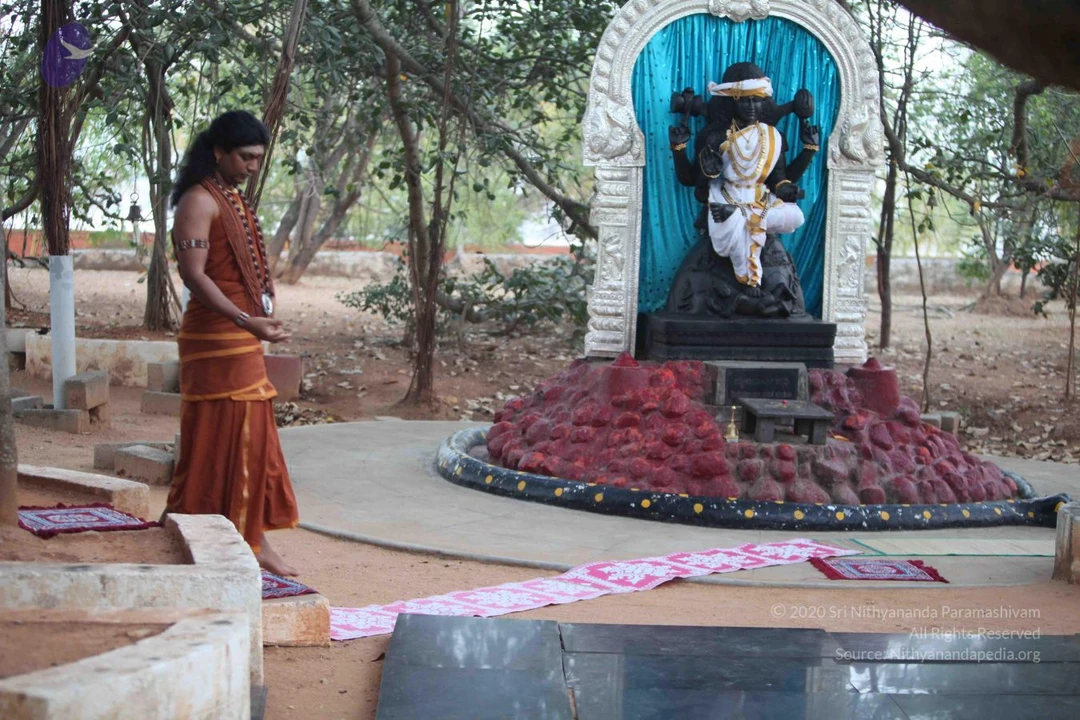
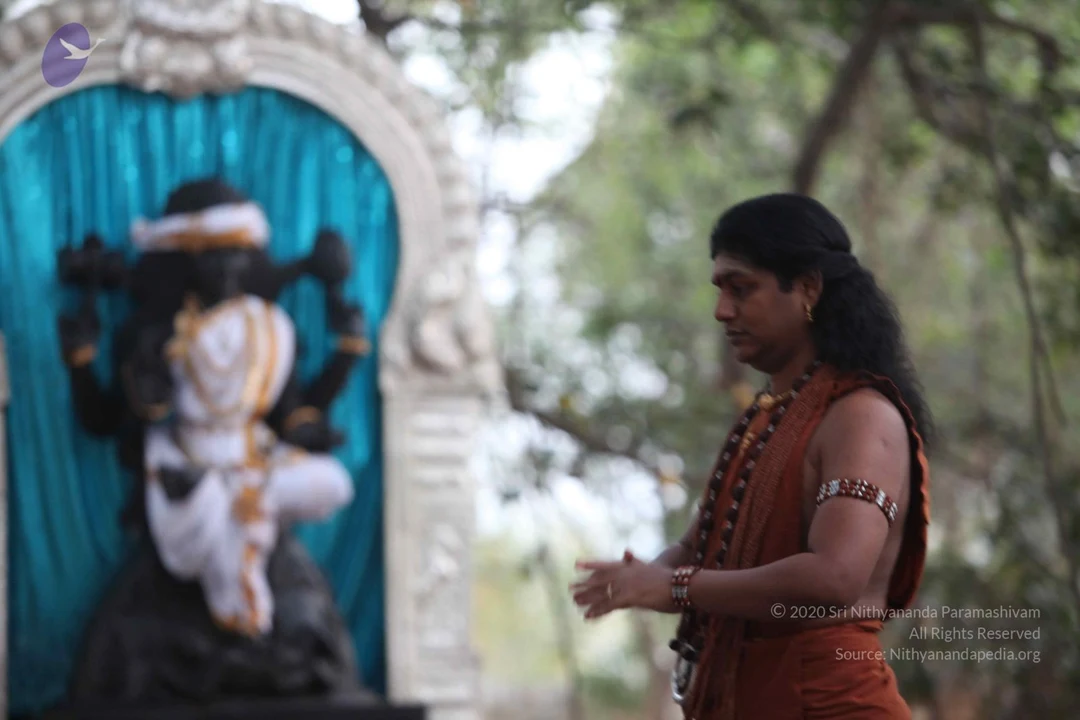
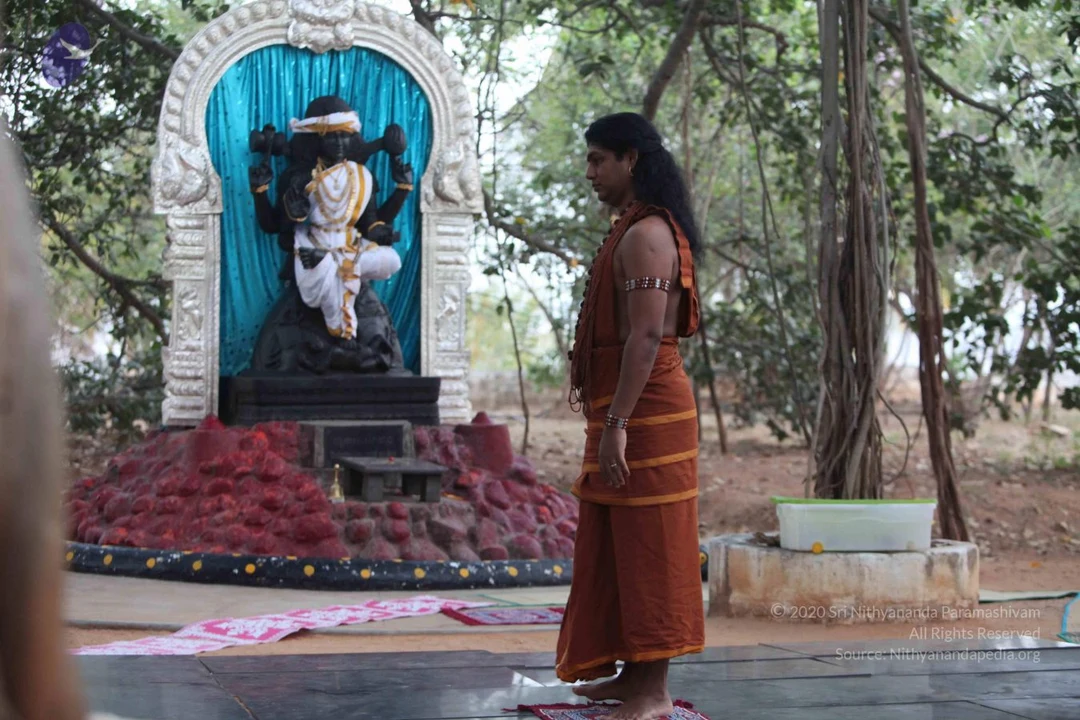
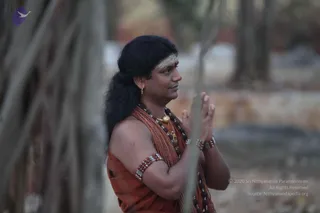
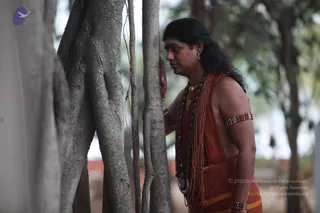
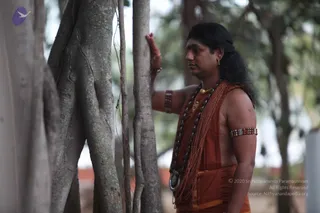
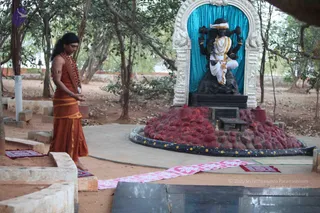
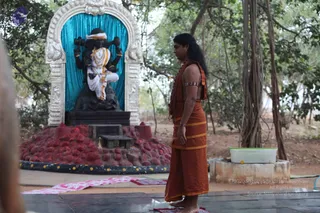
A photograph of a man in profile standing outdoors among tree trunks with blurred background. He has long, dark hair pulled back and wears a white tilak on his forehead with a red dot at the centre. He wears an orange-red shawl over bare shoulders, a rudraksha mala necklace, a gold pendant, a gold earring, and beaded armlets. He presses his palms together in anjali mudra, a gesture of greeting and reverence. Swamiji (probable) appears to be this person, based on the long hair, orange clothing and rudraksha malas, though the image lacks a clear name caption.A man in saffron-orange ochre robes stands in profile beside a cluster of tree trunks, one hand resting on a trunk. He wears long dark hair swept back, a rudraksha mala around his neck with a large dark pendant, layered beaded necklaces, a beaded armlet on his upper arm, and bead bracelets on his wrists. The blurred background shows green foliage and a red wall.A man in orange-saffron robes stands beside a large banyan tree, one hand resting on its thick trunk while he gazes to the side. He wears long dark hair swept back, a gold earring, layered rudraksha-style beaded necklaces, a gold pendant, beaded wristbands and a beaded armlet on his upper arm, with his upper body bare apart from a saffron shawl. The background shows blurred foliage and a reddish wall. Appearance-based label: Swamiji (probable), with the saffron clothing, long swept-back hair and rudraksha malas as cues.A person in an orange saffron-coloured wrap and matching lower garment stands barefoot at the edge of an outdoor shrine among trees. Their long dark hair is swept back, and they wear beaded necklaces and a rudraksha-style mala. Ahead stands a dark stone deity murti with multiple arms and a white cloth band, dressed in white and gold ornaments and set within a white arched niche with a blue backdrop. A heap of red-smeared offerings and a small stone platform lie in front, with red and white cloth runners on the ground.Outdoor photo of a man in saffron-orange dress standing in profile at right, hands held together in front of his body, long dark hair pulled back, rudraksha mala and beaded bracelets, bare upper arm with a beaded armlet. Behind him is a blurred stone-framed niche with a turquoise drape and a dark deity murti with white and gold garments and a headband, possibly Shiva-form, placed among trees. Swamiji (probable) appears in profile with long hair, saffron cloth, rudraksha mala and ceremonial beaded adornments, speaking or gesturing during teaching.Outdoor photo at an open-air shrine under trees. A dark stone deity murti with white and gold cloth and a white headband stands in a white arched niche with a blue backdrop, its base heaped with red kumkum-dusted stones. In front, a standing man in a saffron-orange dhoti and shawl with a silver armlet and bangle looks toward the shrine, barefoot on a dark tiled platform beside a red-and-white cloth. A white container and a small stone seat sit to the right. The scene suggests puja or darshan practice; the man is shown from behind-left with his hair swept back.
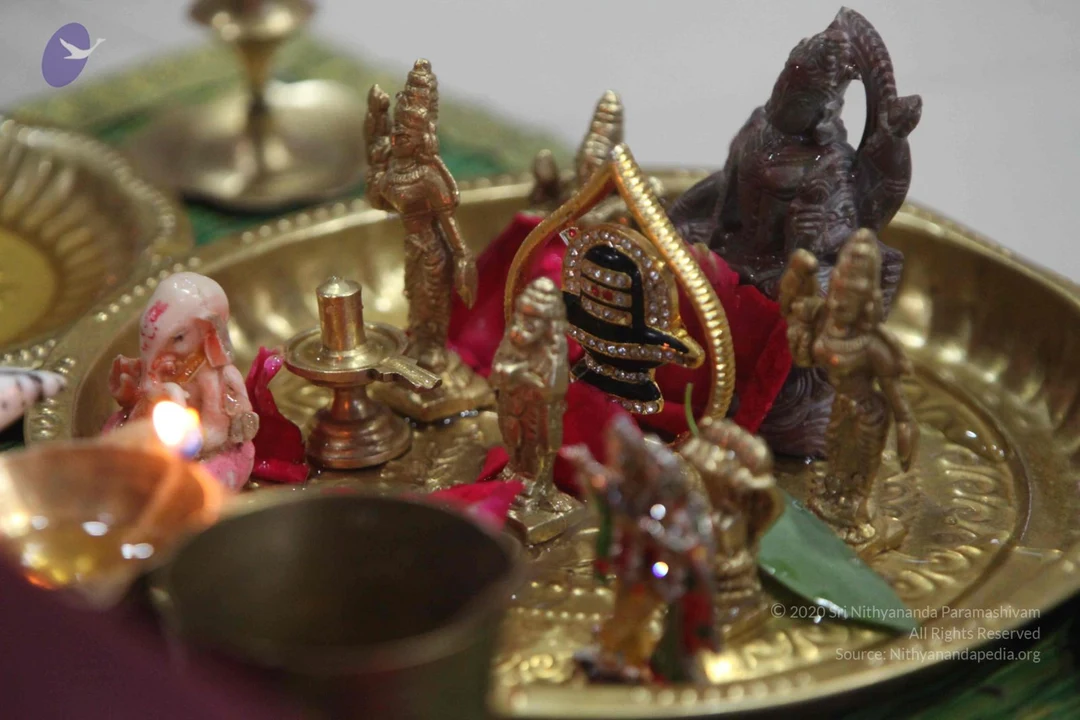
Pada-puja

25 photosSource gallery
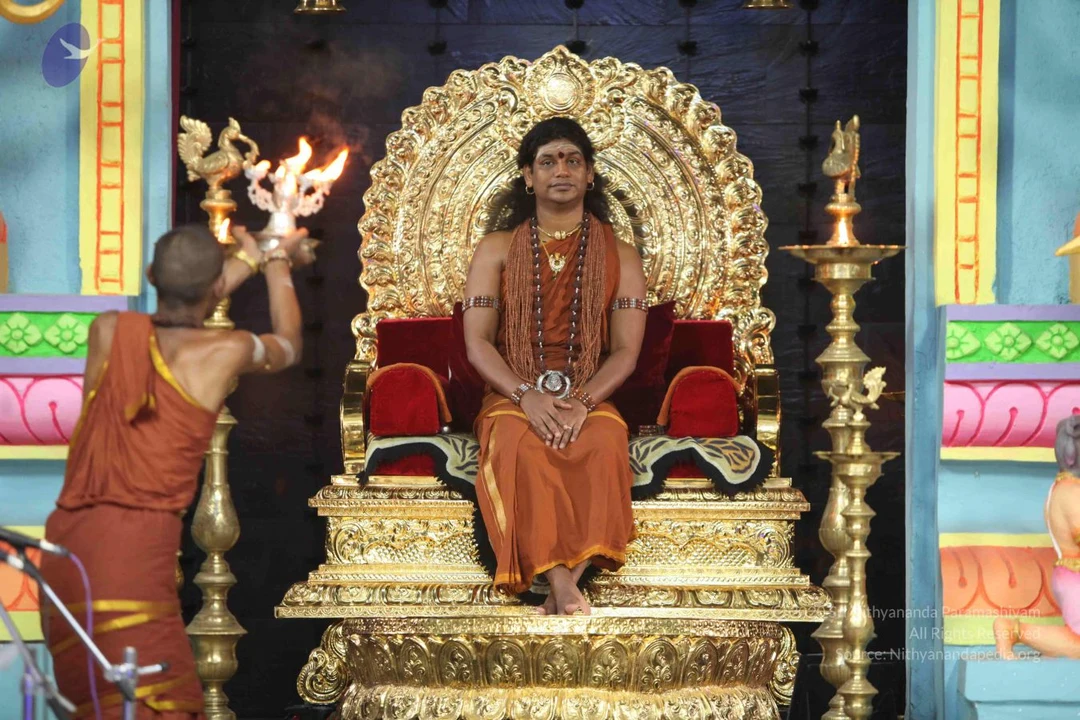
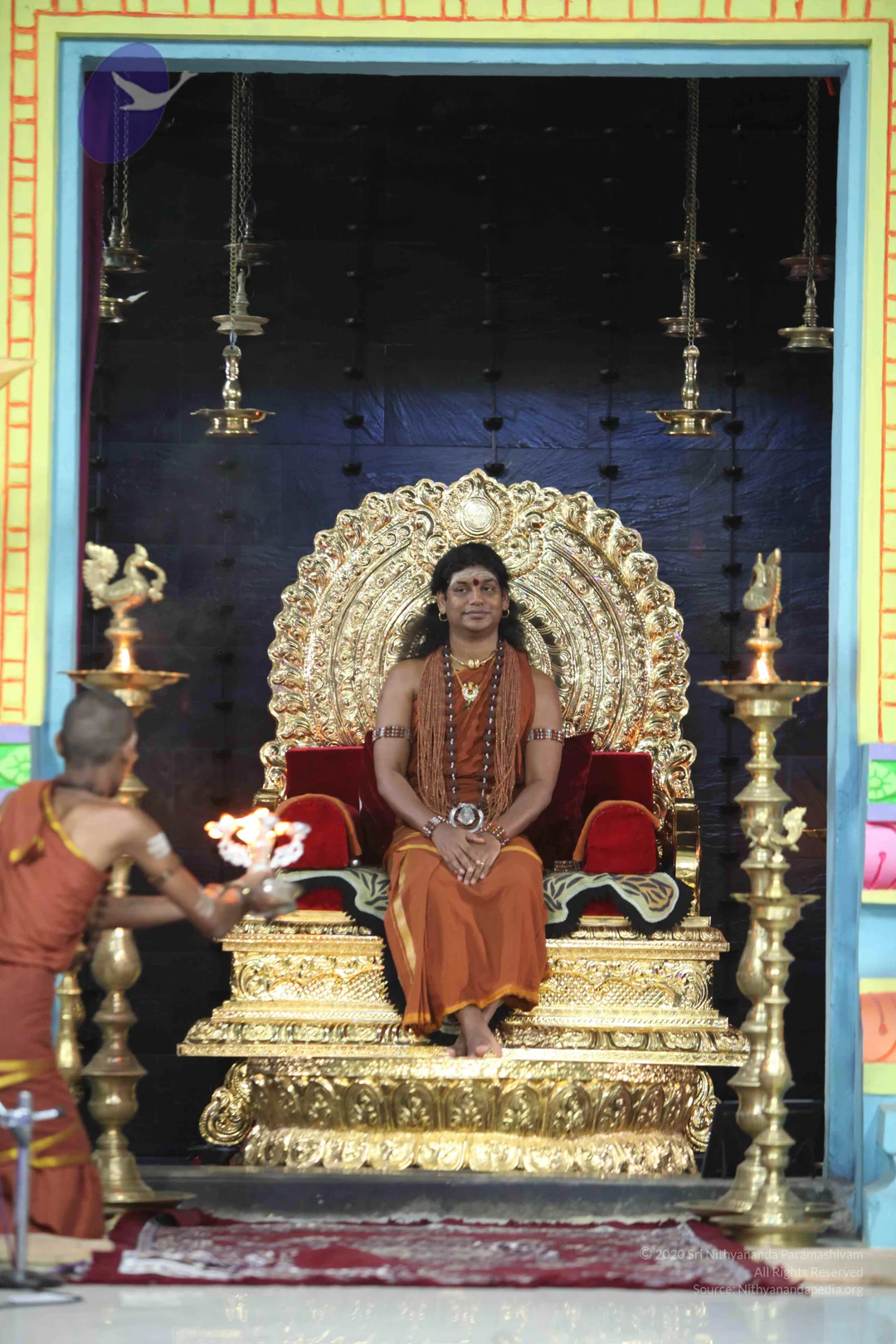
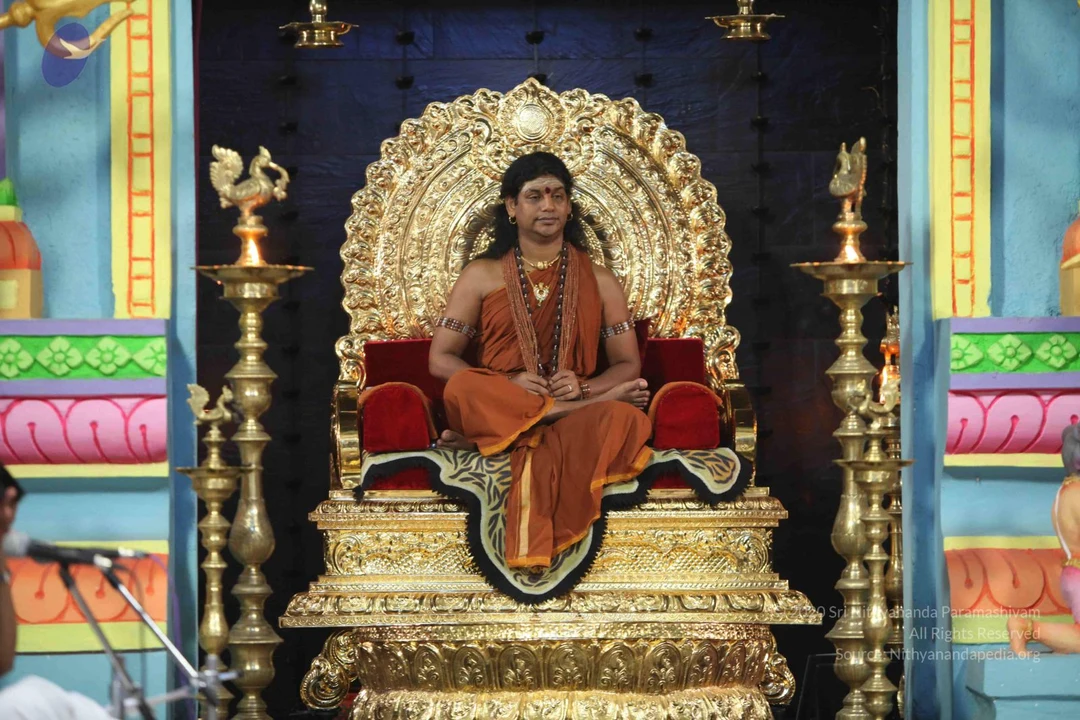
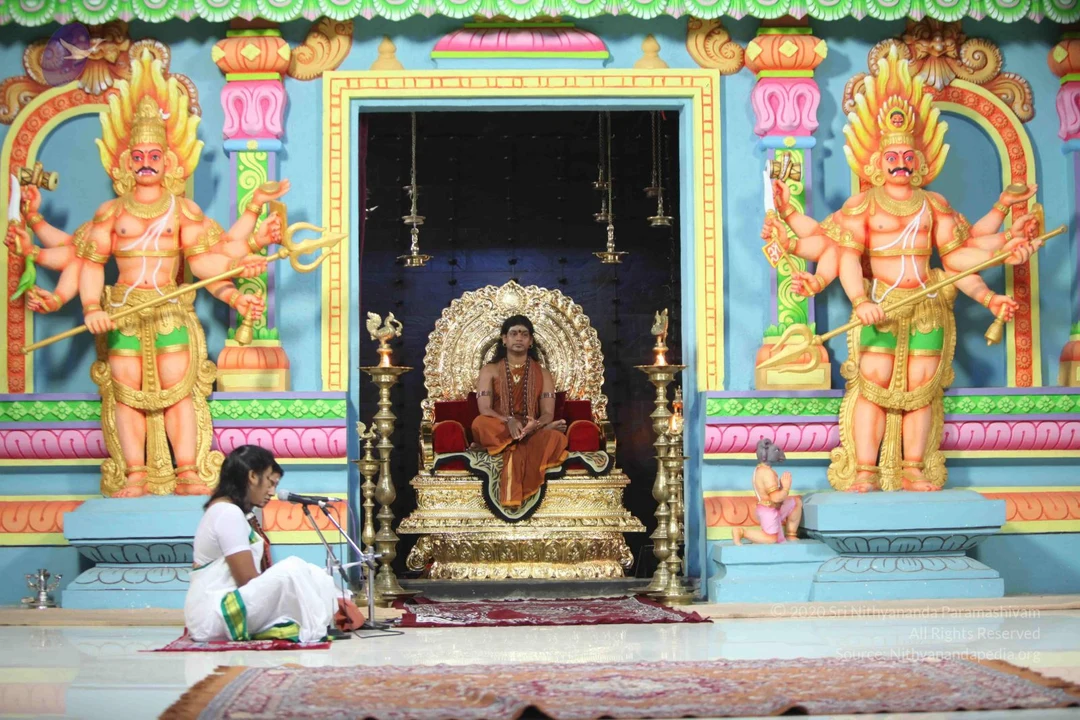
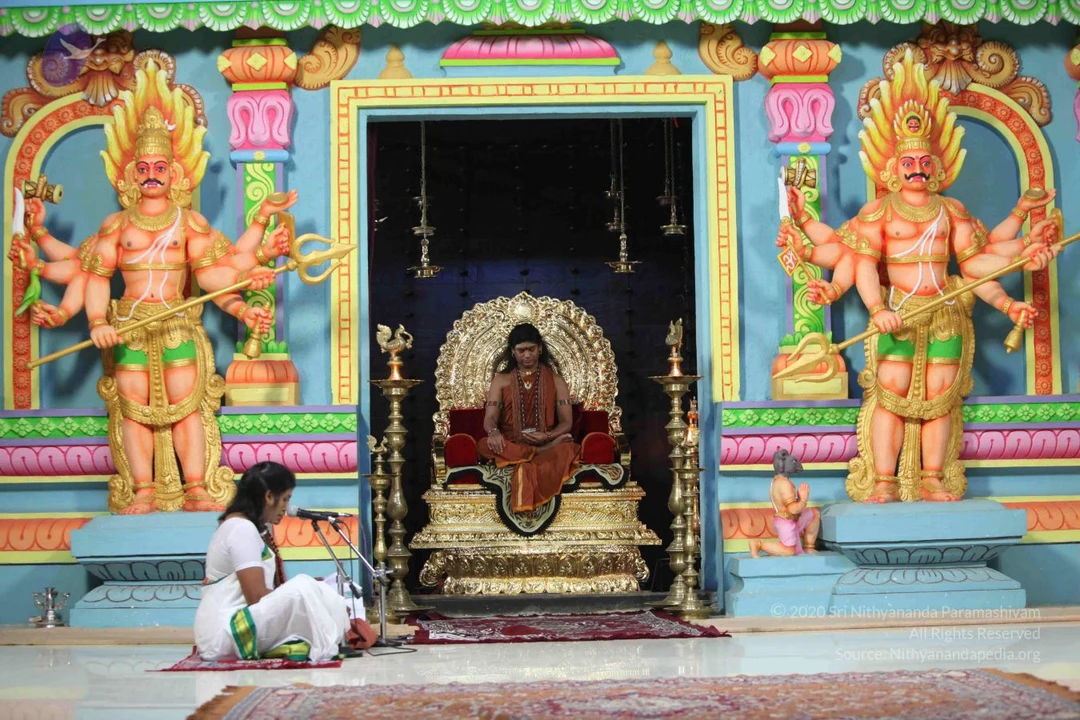
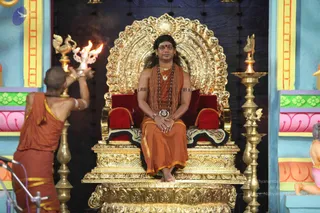
A photograph of a seated man on an ornate gilded throne with a large arched backrest and red velvet cushions, set against a blue and pink decorated backdrop. He wears an orange-saffron dhoti and shawl, a rudraksha mala and a gold necklace with a pendant, and has bracelets on his arms, with hands folded in his lap and bare feet. Beside him at left, a priest in orange clothing holds a lit lamp in a flame vessel aloft, and brass oil lamps stand on tall stands at the sides. A pictured statue figure appears at the right edge. a person is seated on the throne, identified by appearance cues of orange ceremonial dress and rudraksha mala.A seated man in an ornate gold throne with red velvet cushions sits centrally in a doorway-framed hall with hanging brass oil lamps. He wears an orange-saffron dhoti and shawl, a long rudraksha mala, a gold pendant and bangles, and a red-and-white tilak on his forehead; his long hair is swept back, and his hands rest folded in his lap. Swamiji (probable) is the central seated figure, distinguished by the saffron robes, rudraksha mala, gold necklace and long swept-back hair. To the left, a man in orange cloth kneels and holds a lit camphor or aarti flame toward him. Brass lamps with peacock-topped stands flank the throne, and a red mat lies on the floor.A seated man on an ornate gold throne with a red-cushioned seat and an elaborate gold back, wearing an orange-saffron dhoti and shawl, a rudraksha mala, a gold necklace, armlets and bangles, with a red bindi on his forehead and long swept-back hair. His hands rest folded in his lap, and his feet are bare on a patterned mat. Tall brass lamps with lit oil lamps flank the throne against a dark blue backdrop with decorated panels. Appearance-based probable Swamiji (probable) seated in a discourse setting, consistent with a satsang on the throne with long hair, saffron clothing, rudraksha and gold cues.A man in orange saffron robes sits cross-legged on an ornate gold throne with red cushioned armrests and a gold backrest with scrolling carving. He wears a rudraksha mala, a gold necklace, bangles on his arms and a red tilak on his forehead, with long hair swept back. Tall brass oil lamps flank the throne, and gold ornamental birds sit atop the lamp stands. Behind him are a dark curtain and painted panels in blue, yellow, green and pink with floral borders. A microphone stand is visible at the lower left. The appearance-based label is a person, seated on the peetha as the main speaker.A photograph of a seated man on an ornate golden throne with red cushions, set in a richly coloured hall with large painted guardian statues of multi-armed figures holding tridents and maces on either side. He wears an orange-saffron robe and a beaded necklace, with hands resting in his lap. In the foreground a woman in a white sari with green border sits on a red carpet before a microphone stand. Brass lamps flank the throne and a small pink figure sits at the base of the right statue. The walls are blue and pink with green and gold ornamentation.A photograph of a temple-style hall with a golden ornate throne in the centre, set in an opening between two painted guardian figures. A seated figure in saffron-orange robes, with long dark hair, rudraksha-style beads and a gold necklace, sits on the throne with hands folded, appearing to be a person (appearance-based label; the page links him to the event). Two large, multi-armed painted guardian figures stand on either side, one holding a trident and one holding a mace-like staff, with flaming crowns. Brass lamps stand beside the throne and hanging lamps are suspended above. In the foreground, a woman in a white sari with green border sits cross-legged on a rug before a microphone stand, facing the throne. A small painted figure sits on the right plinth.

Satsang

64 photosSource gallery
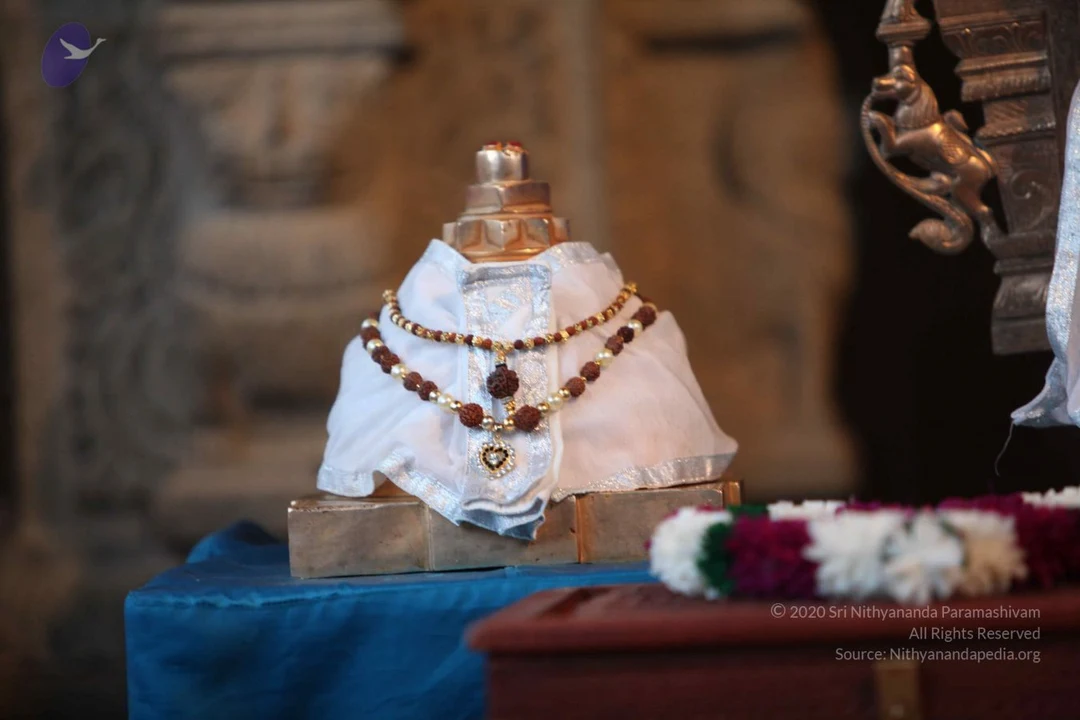
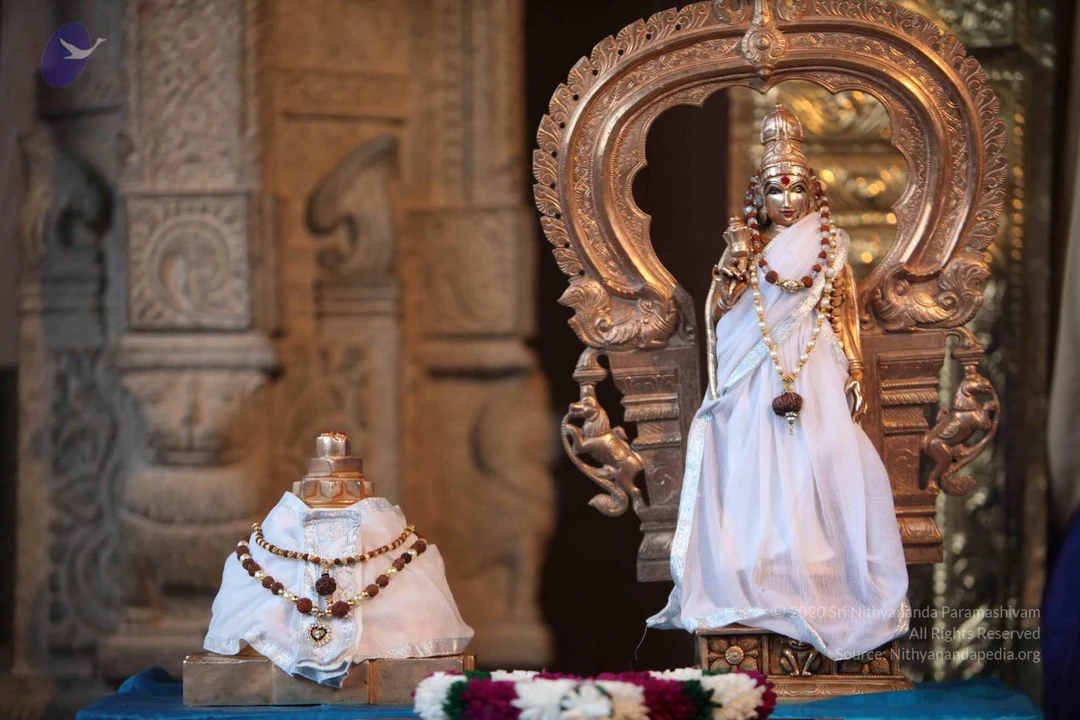
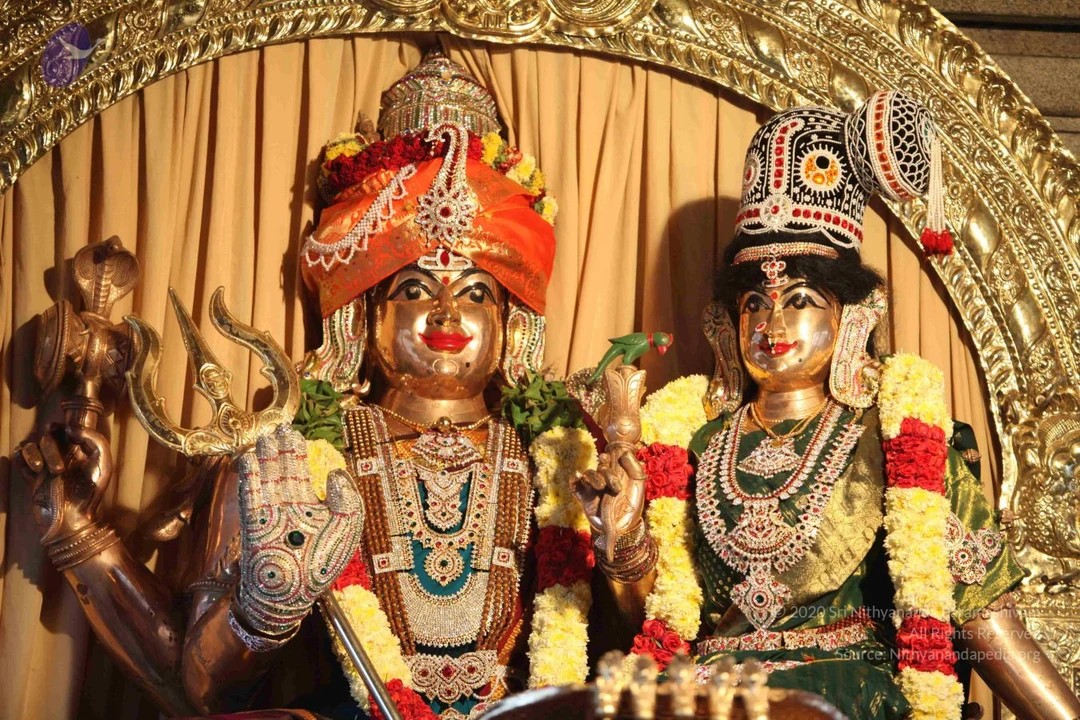
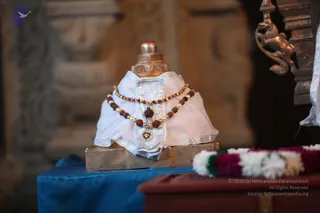
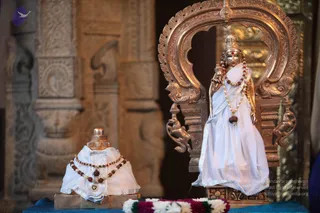
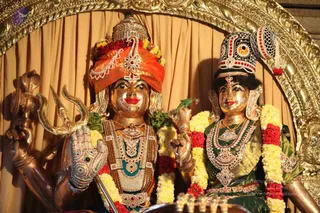
A temple shrine with a gilded arched niche holds two large deity murtis, a male figure with a red-and-gold turban holding a trident and a female figure with a tall ornate crown, both wearing layered gold and bead necklaces, garlands of yellow and red flowers, and saris in green and white. A priest in white dhoti and shawl, bare-chested with a sacred thread, stands at the left making an offering. Brass oil lamps and a lit lamp stand before the murtis, and a smaller statue in a green-curtained niche at right wears orange robes and holds a lamp. The scene reads as a puja or abhishekam at the shrine.A photograph of a shrine in a gilded arch showing two golden deity murtis seated together: the male figure wears an orange turban, a jewelled crown-like headdress, a trident and a snake-hooded cobra overhead, while the female figure wears a green sari and ornate necklaces and holds a flower. Both are garlanded with red and yellow flowers. In front, a large linga-shaped form draped in a red and green cloth, with rudraksha beads and gold bangles, wears a jewelled necklace and is garlanded with red roses and yellow marigolds. Brass oil lamps stand on the platform, and no people are visible.A gilded metal statue of a deity murti stands within an ornately carved golden arch with floral scrollwork and rearing animal figures on the pedestals. The figure wears a white silk-like drape edged with silver border, a silver crown, a red kumkum mark on the forehead, and multiple rudraksha and pearl malas with a large rudraksha pendant. One hand holds a small silver ritual vessel while the other rests near the hip. Garlands of white flowers appear at the lower left corner. The setting suggests a temple or ashram shrine.A close view of a conical silver-topped shivalinga draped in a white cloth with silver edging, wearing two strands of rudraksha beads and white pearls with a small heart-shaped gold pendant. It rests on a gold-toned pedestal over a blue cloth, with a garland of white and magenta flowers in the foreground and an ornate carved stone pillar with a lion figure at right. No people are visible.A golden metal deity murti stands in an ornate golden arched prabhavali behind a small shivalinga draped in white cloth. The standing figure wears a white sari with a silver border, a crown, pearl and rudraksha necklaces, and holds a ritual object in one hand. Carved stone pillars frame the background, and a garland of white and magenta flowers lies in front on a blue cloth. Carved lions decorate the golden arch. No people are visible.Two gilded deity murtis of Shiva and Parvati stand side by side in an ornate golden arch against draped gold curtains. The left figure wears an orange turban, rudraksha-style beaded necklaces, and holds a trident and a cobra-topped staff. The right figure wears a dark green silk sari with gold border, a black and red embellished crown, and red-and-yellow flower garlands. Both are heavily decorated with jewelled necklaces and garlands of marigold and red flowers. No physical people are visible.

Sarvadarshan
10 photosSource gallery
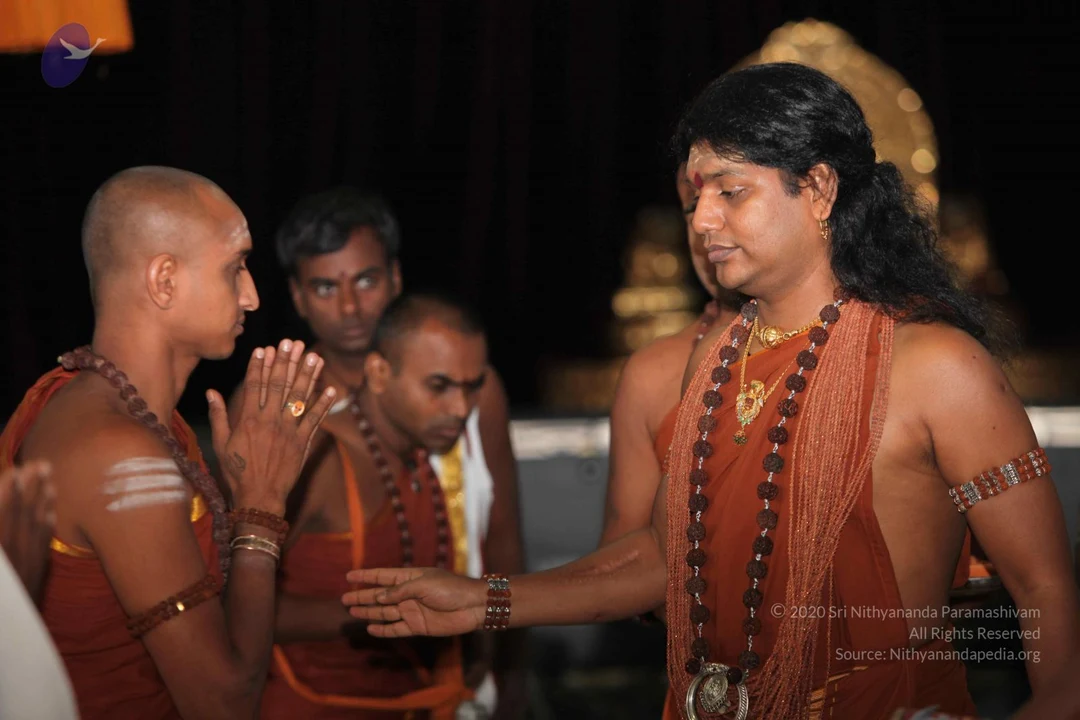
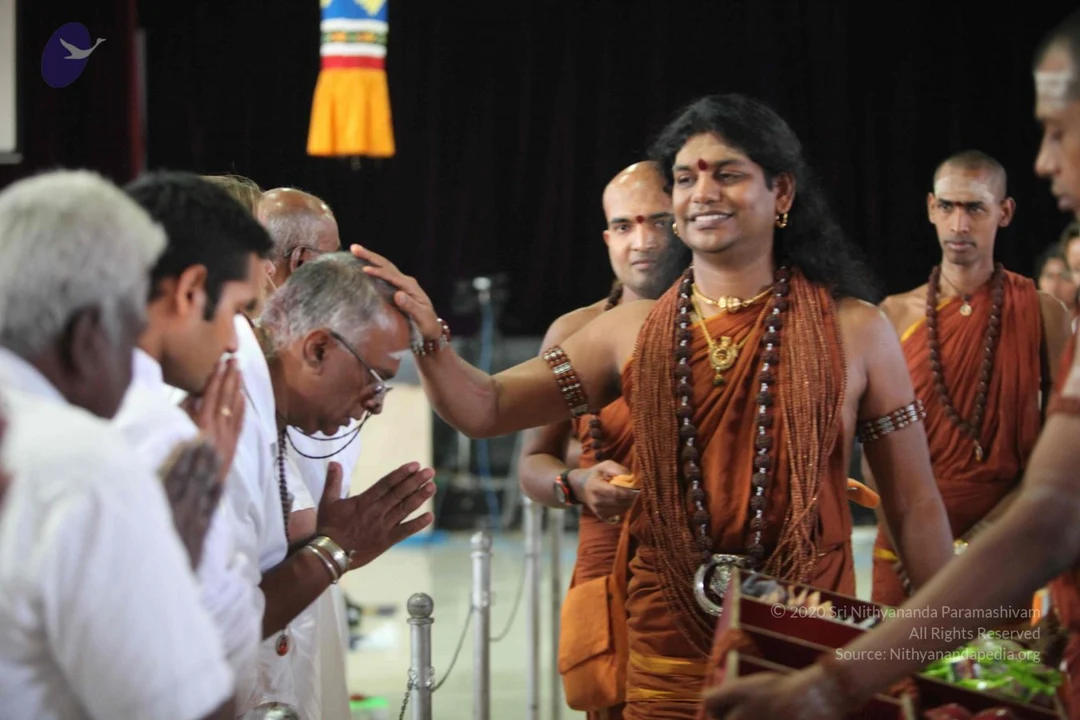
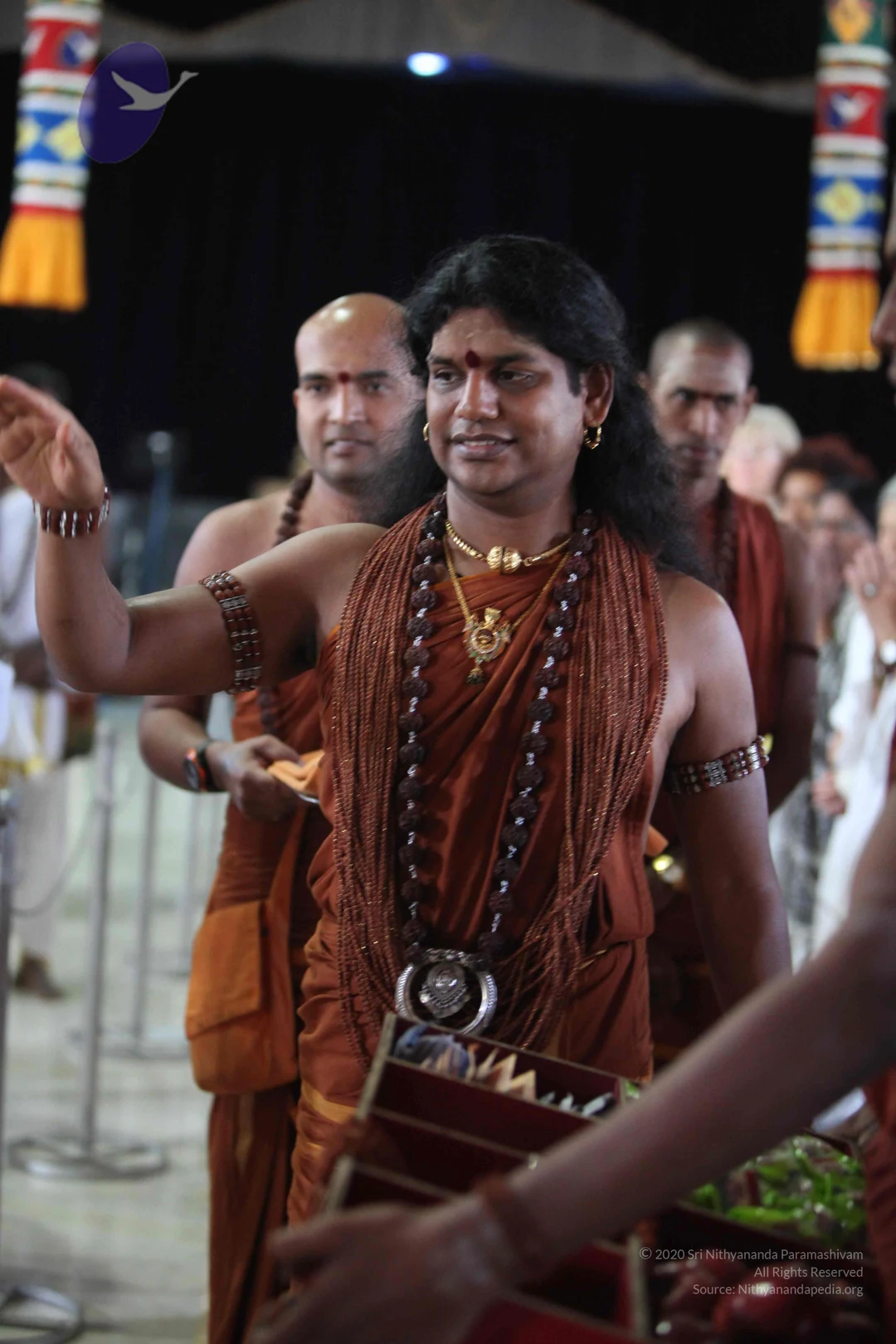
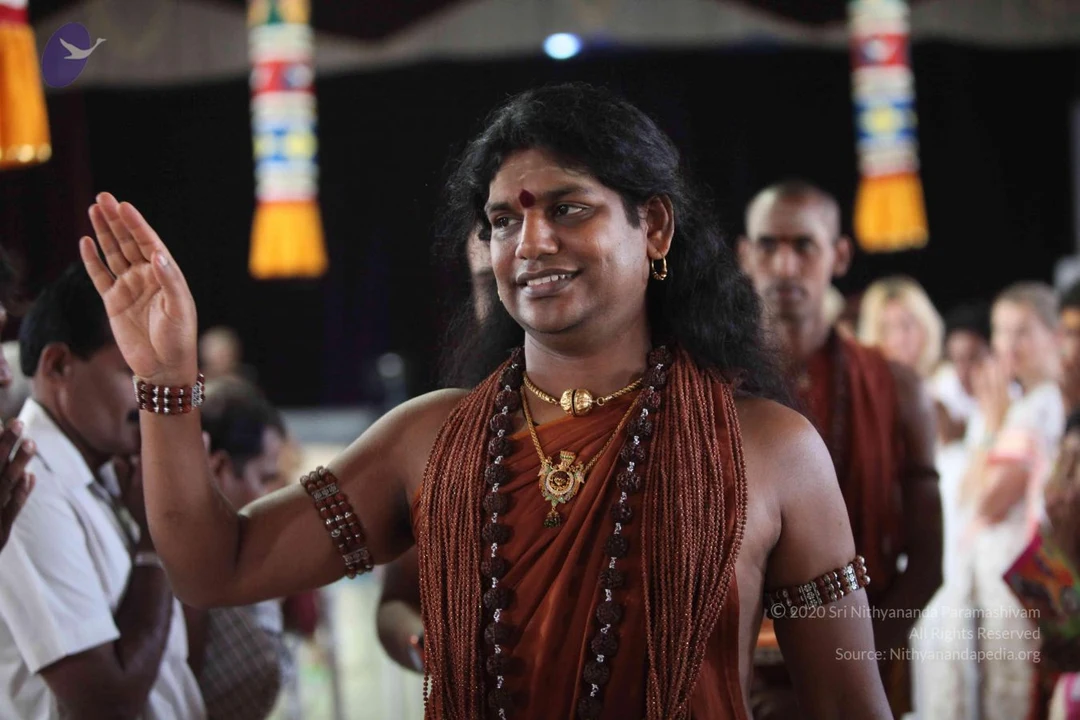
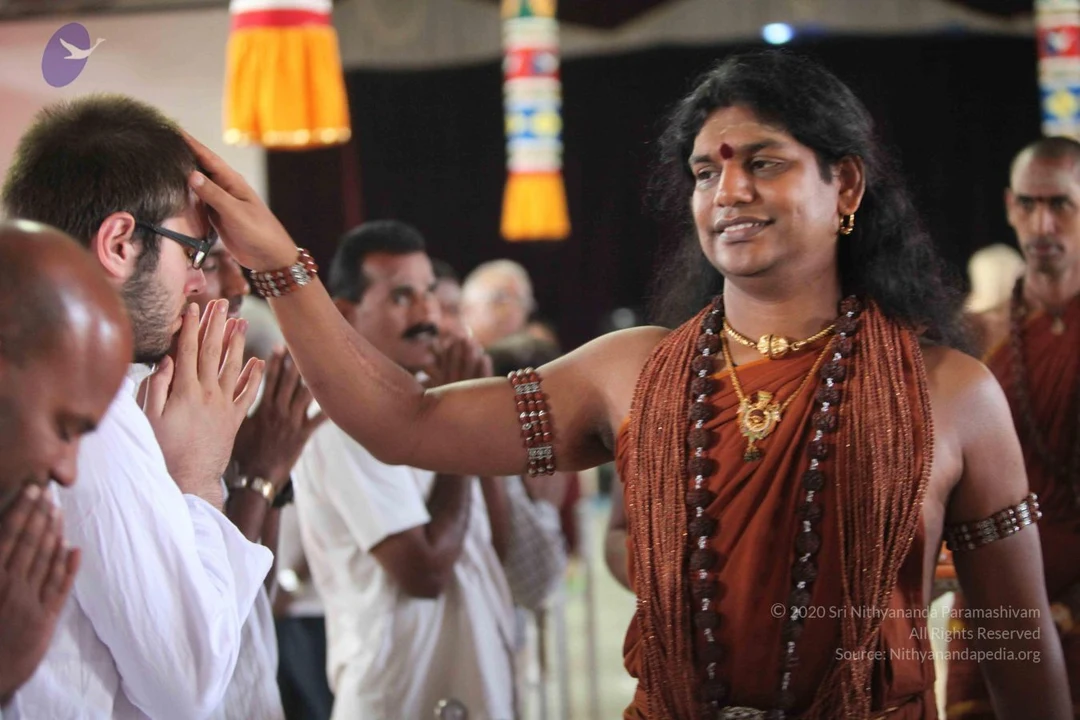
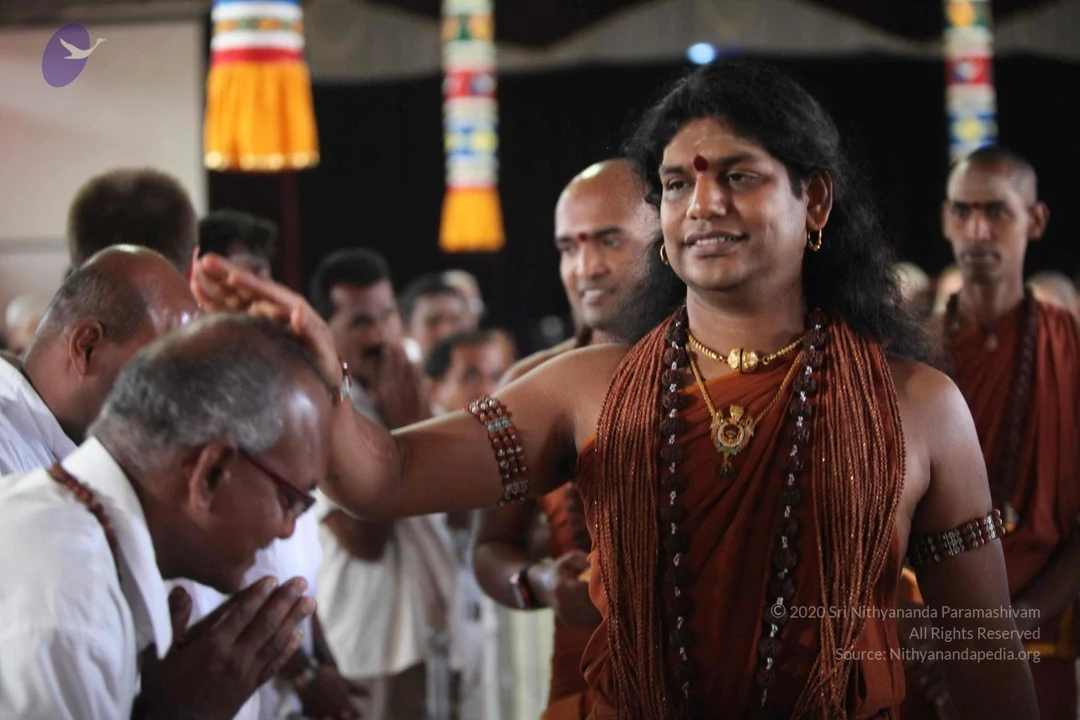
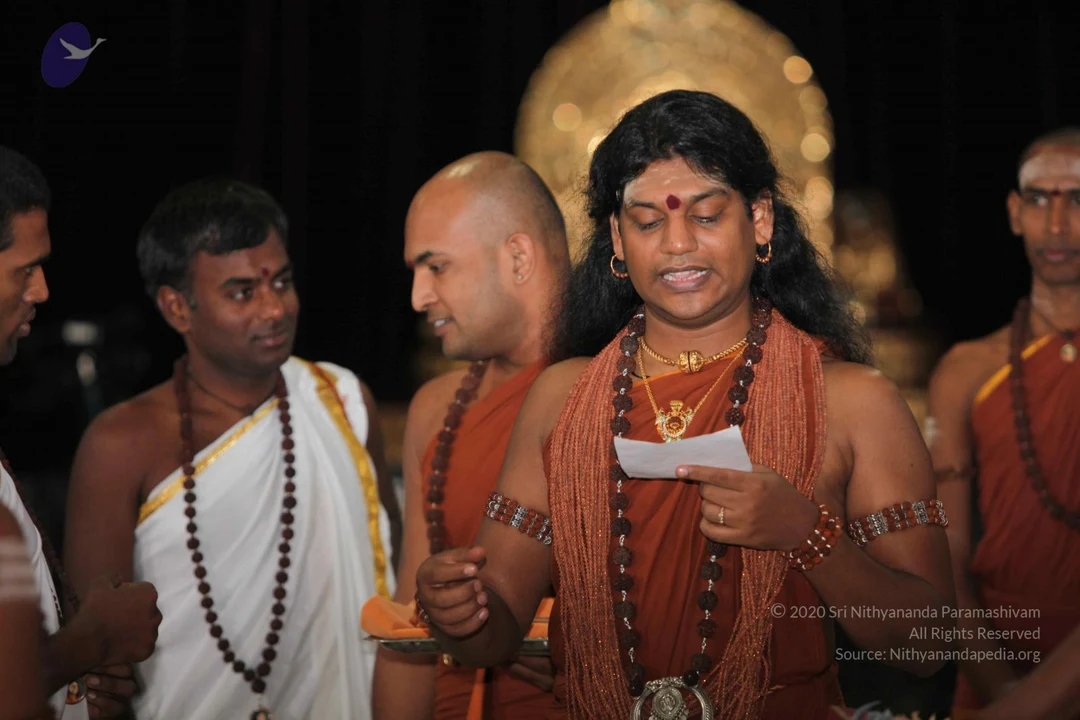
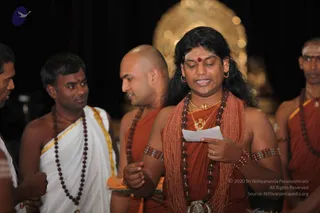
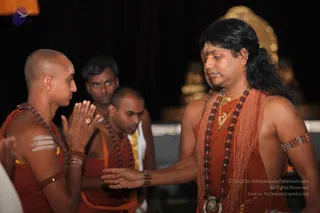
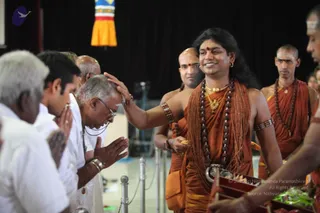
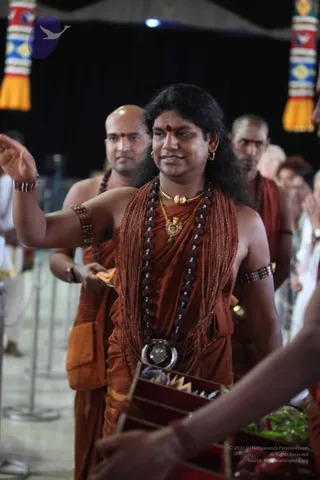
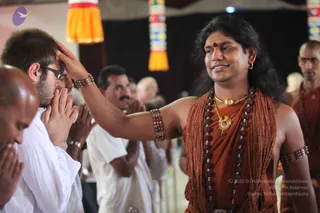
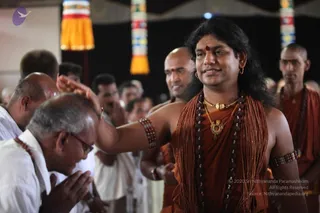
Photograph of a ceremony indoors with a dark background and a blurred gold halo-shaped object behind. A man with long swept-back black hair, a red bindi, gold earrings, multiple rudraksha malas, a gold ceremonial necklace and an orange-saffron shawl over an orange robe holds a small white paper and reads from it. Next to him a bald man in an orange robe with rudraksha malas holds an orange cloth or tray, and a man in a white dhoti with a gold border stands at left. Another man in an orange robe with rudraksha malas stands at far right with a tilak. The man with long hair and ornate adornments has appearance-based cues consistent with a person, shown in person reading aloud during a ritual gathering.A photo from a satsang setting with dark drapes and a gilded backdrop. On the right, a man with long swept-back black hair, a vermilion mark on his forehead, and a saffron-orange cloth draped over bare shoulders wears long strands of rudraksha malas and a ceremonial gold pendant; he extends his right hand toward the left with eyes lowered. Facing him on the left, a shaved-headed man in orange clothes with rudraksha beads and white horizontal marks on his upper arm stands with palms pressed together in namaste. Two or three other men in orange and rudraksha stand behind them, and the figure at the back right is partly visible.A photograph of a ceremonial blessing scene. A central figure with long swept-back dark hair, a red bindi, a gold necklace, and layered rudraksha malas over saffron/orange ochre robes places his right hand on the head of a bowed older man in white with glasses. Around him, a shaved-headed priest in orange robes and other men in white clothes with hands pressed in namaskar stand near metal barrier posts. A red wooden tray with green leaves and offerings sits at lower right, and a yellow and blue hanging decoration hangs in the background.A photograph of a long-haired man in orange-saffron robes with a long rudraksha mala and ornate gold necklace, a red bindi on his forehead, raising one hand in greeting while walking past a tray of offerings with a hand reaching in from the foreground. Behind him, two men in saffron sannyasi attire and a few onlookers in white stand near a black backdrop with colourful striped hanging tassels.A photograph of a devotional blessing at a gathering. A bare-shouldered figure in saffron-orange cloth with long dark hair and a red bindi places a raised palm on the forehead of a young man in glasses and white clothes, who has hands folded in namaste. The standing figure wears a gold pendant, a gold necklace, multi-strand rudraksha malas and beaded bracelets. Other devotees in white and saffron stand and sit nearby with hands joined, and yellow, orange and red decorative tassels hang in the background.A long-haired man in saffron-orange robes and multiple rudraksha malas stands at centre, with a red bindi on his forehead and gold ornaments at his neck and ears, his right hand raised in blessing over the bowed head of an older devotee in white shirt and dhoti who kneels with folded hands and glasses. Other devotees in white and saffron stand behind, with saffron-hued cloth banners with tassels hanging above.