Skip to content
Sunday

20 January 2013

Know Death for No - Death

Dated photos
349
Source pages
1
Media
11
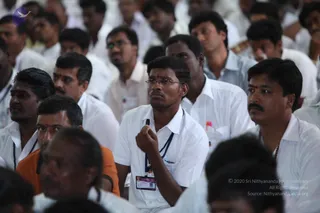
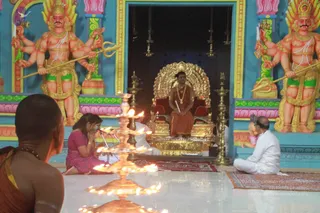
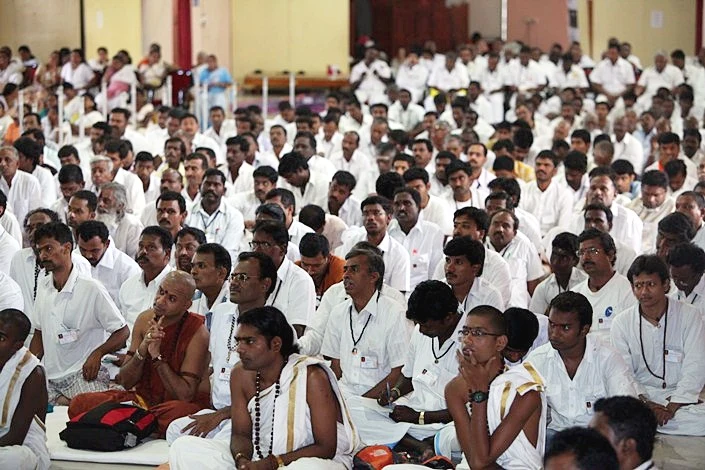
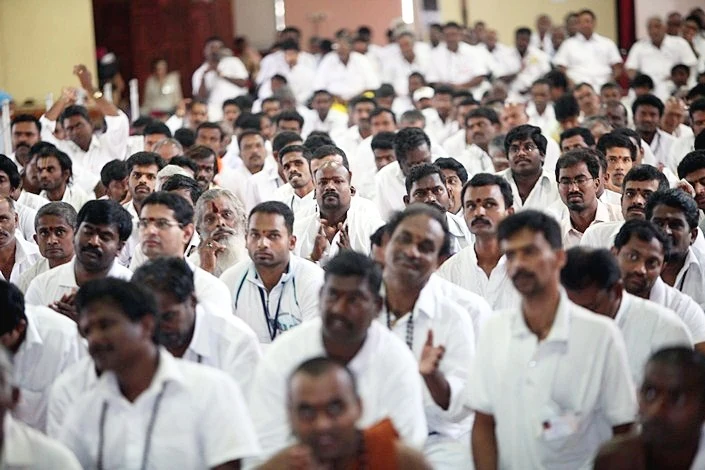
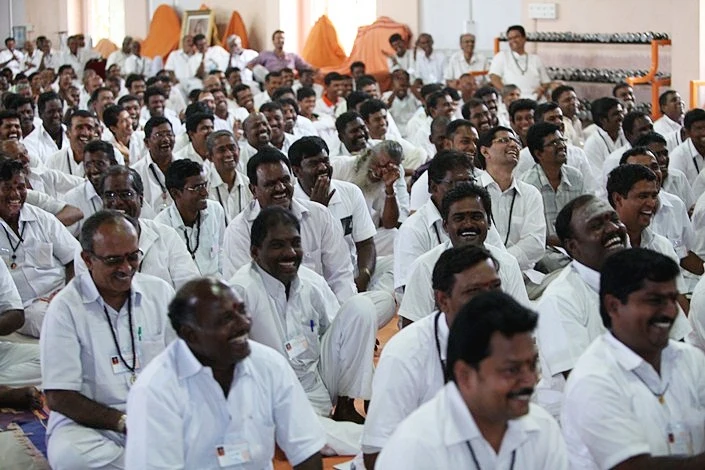
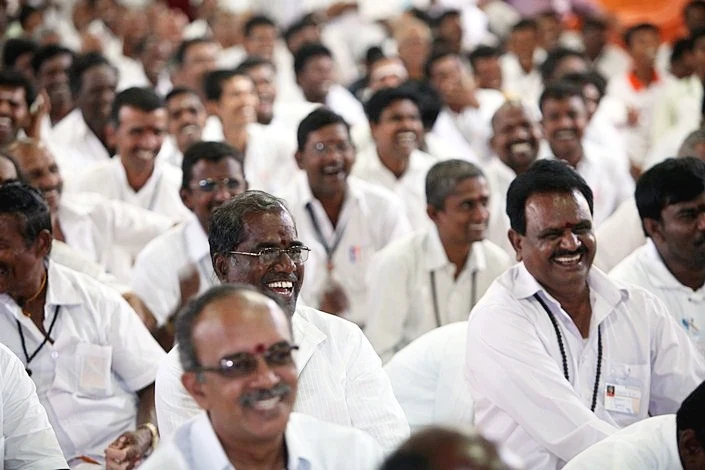
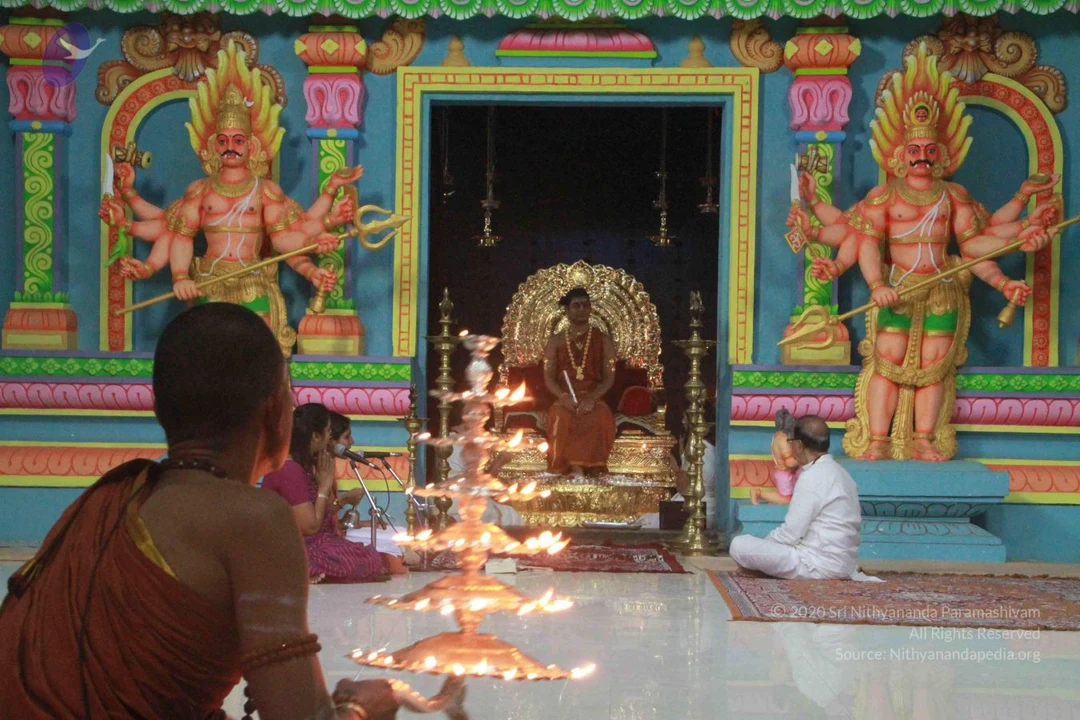
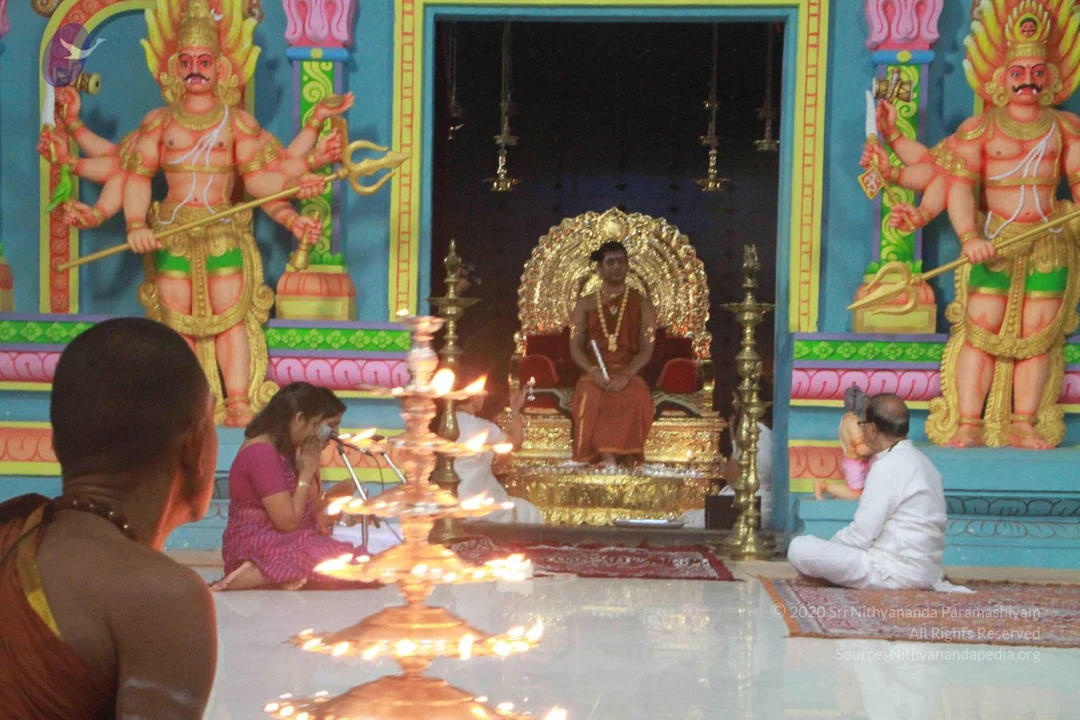
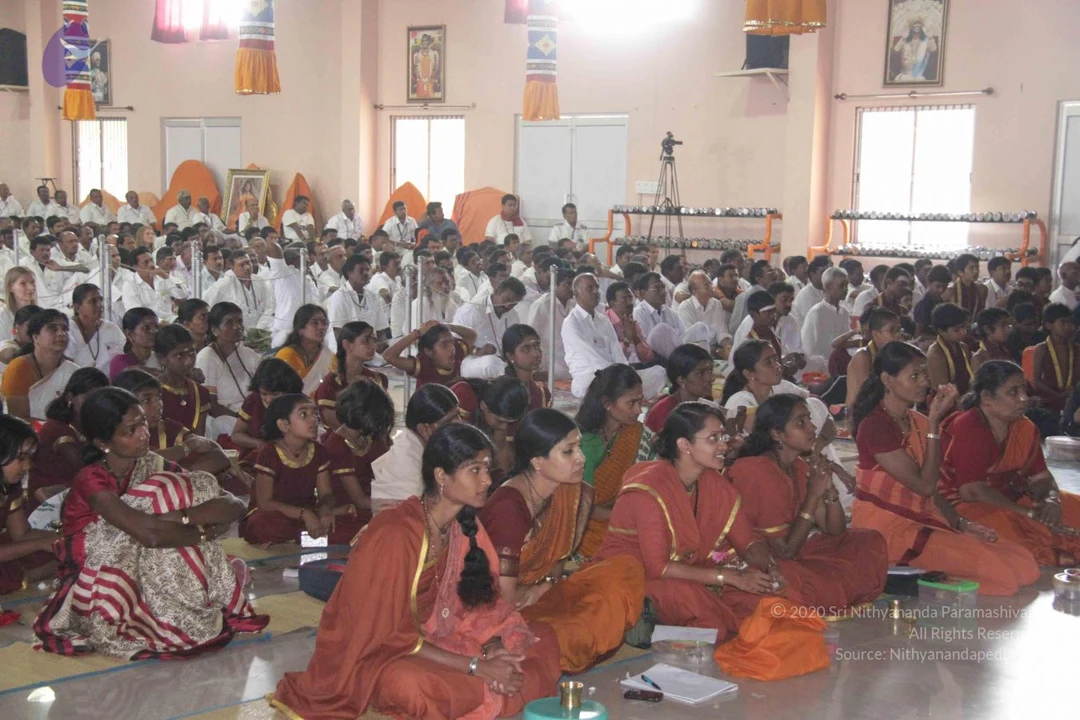
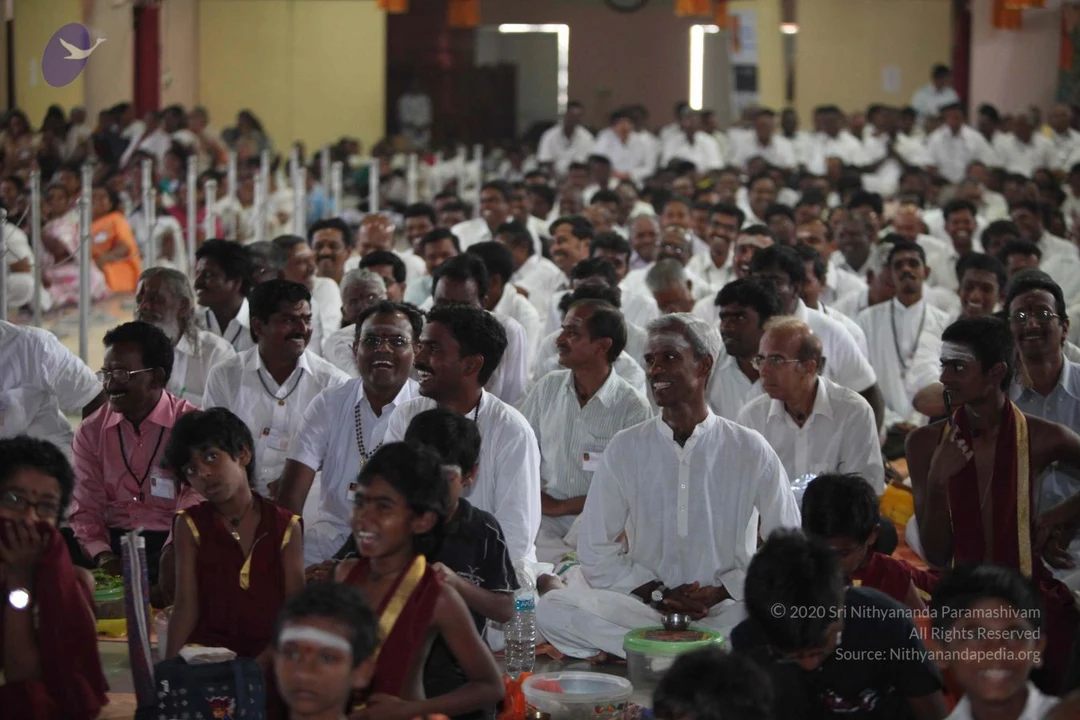
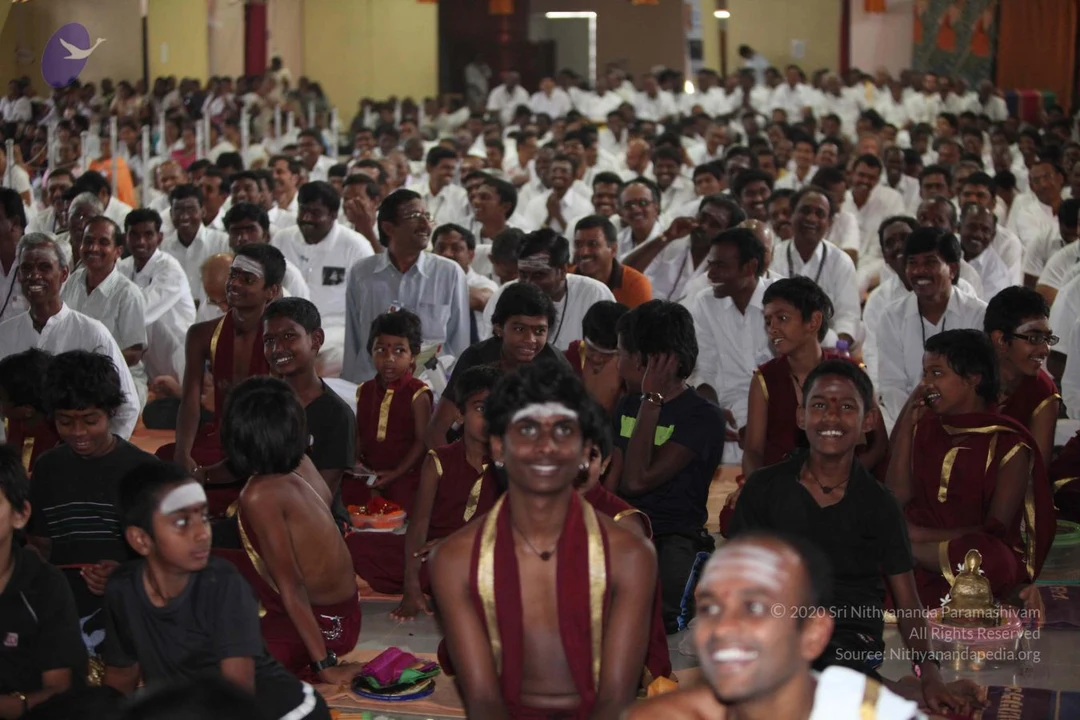
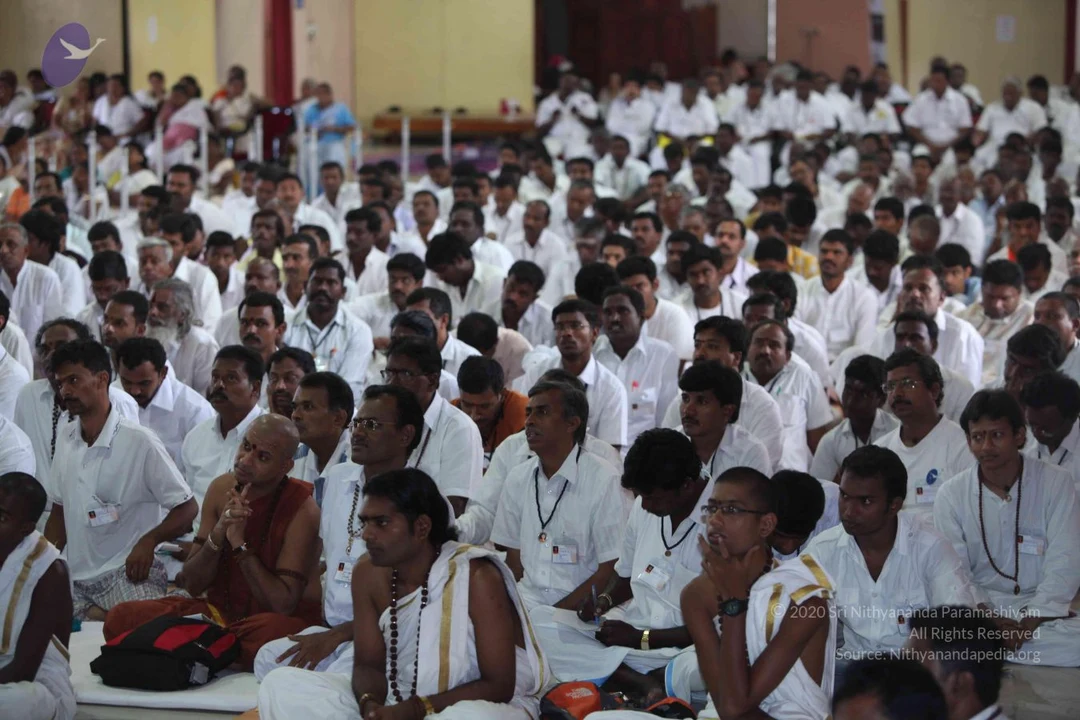
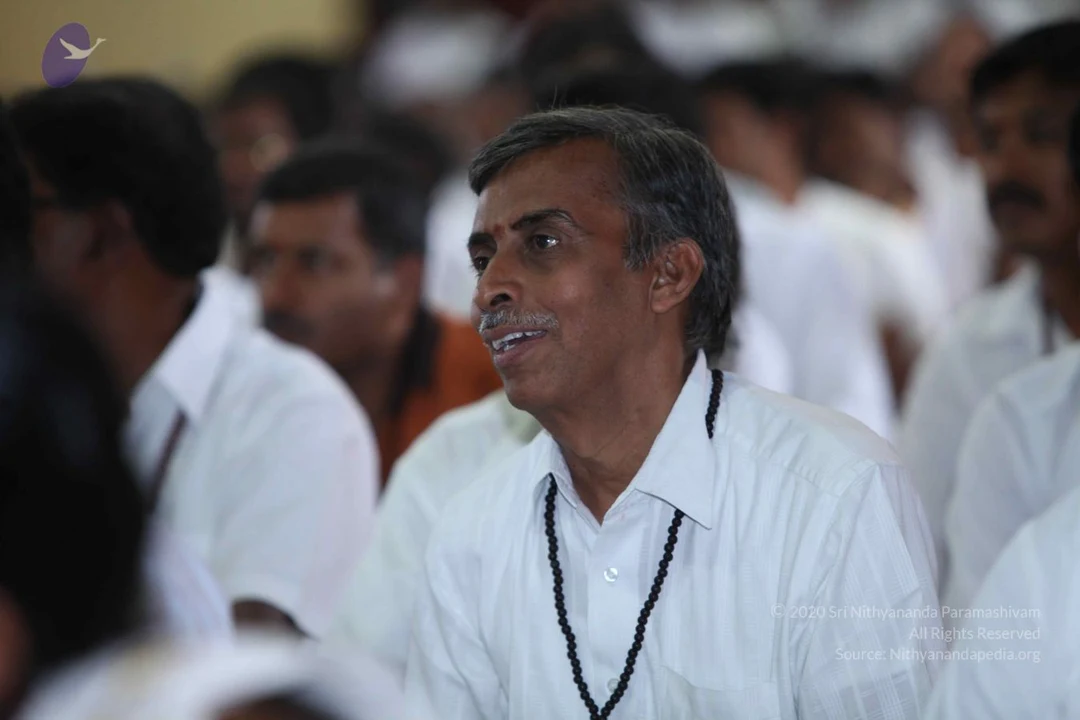
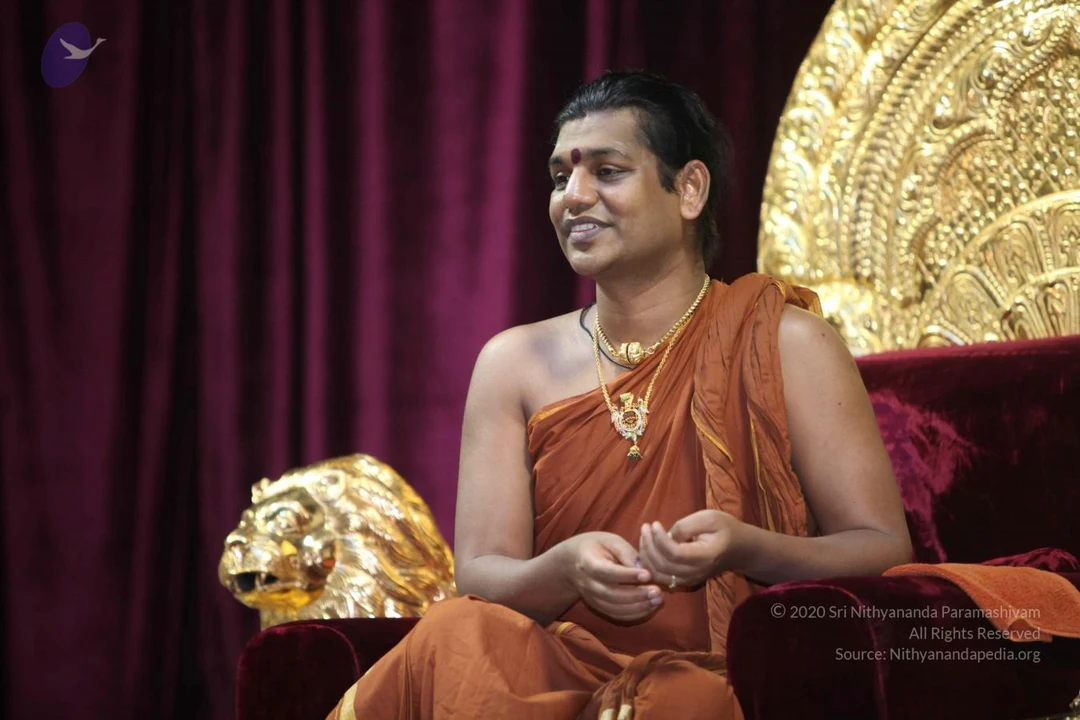
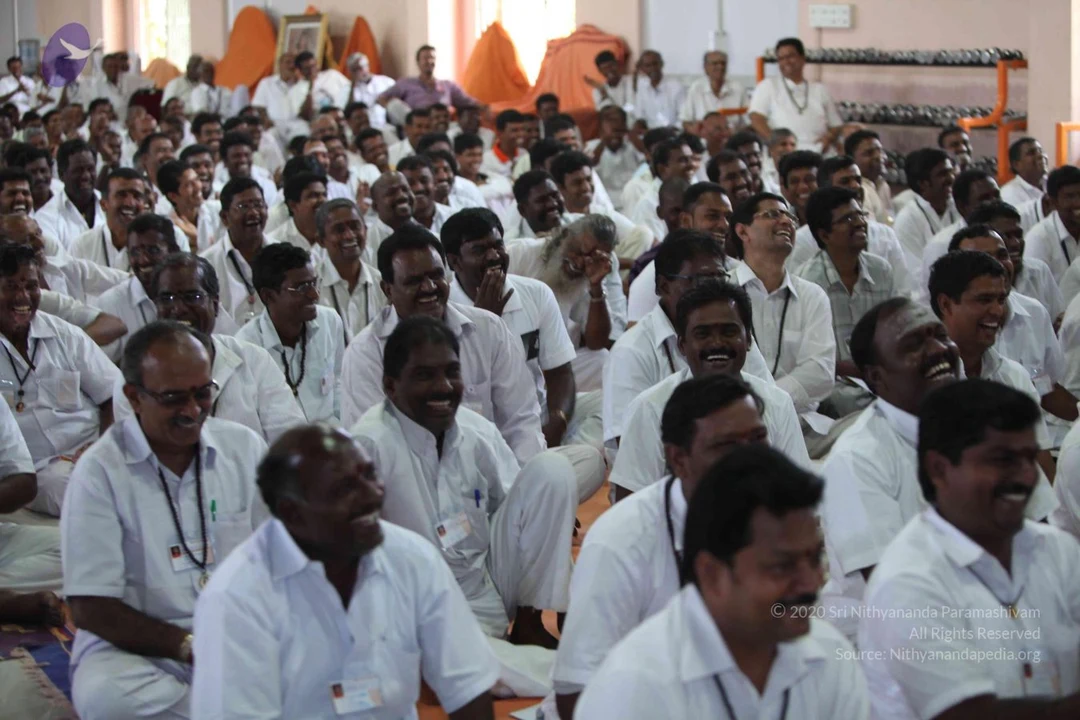
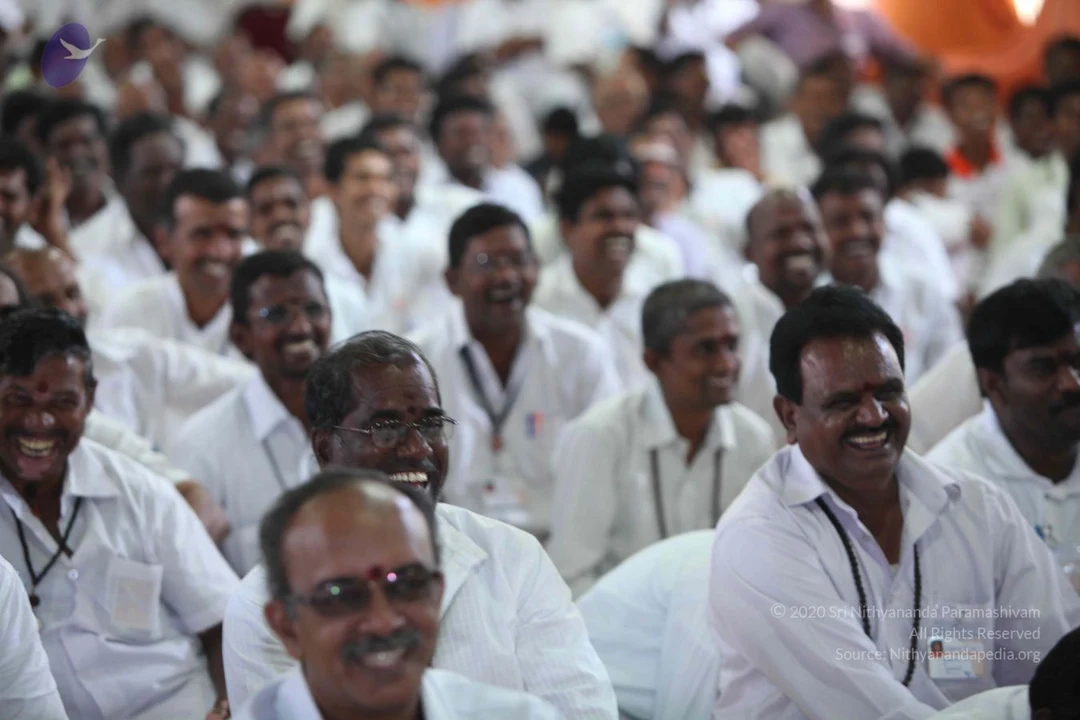
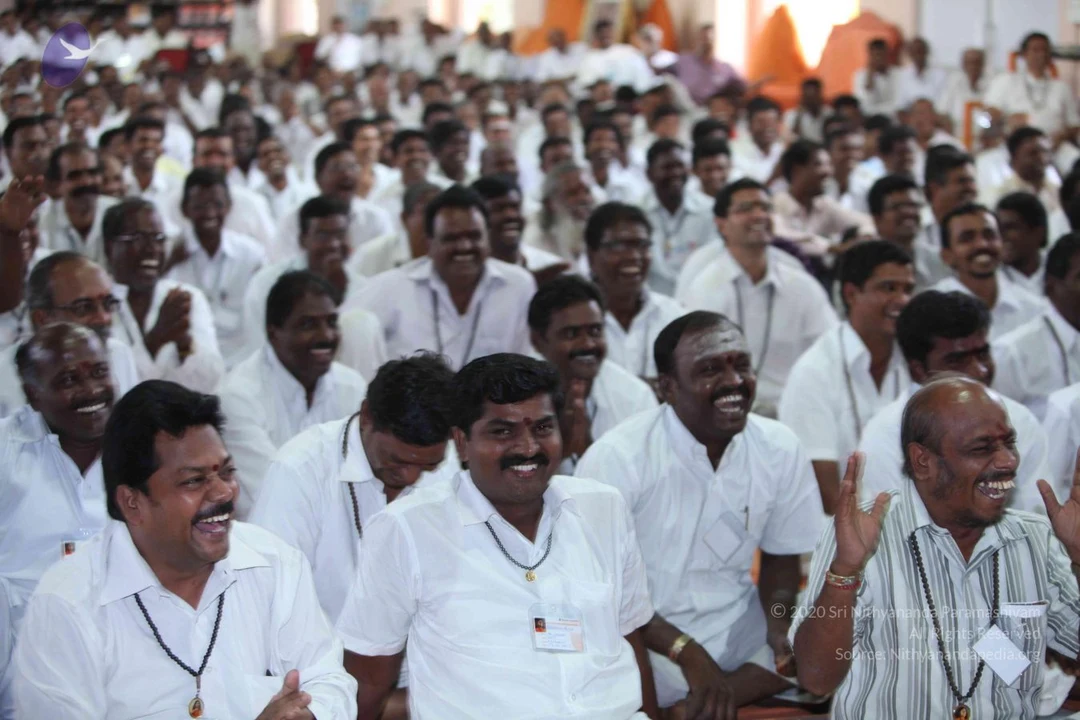
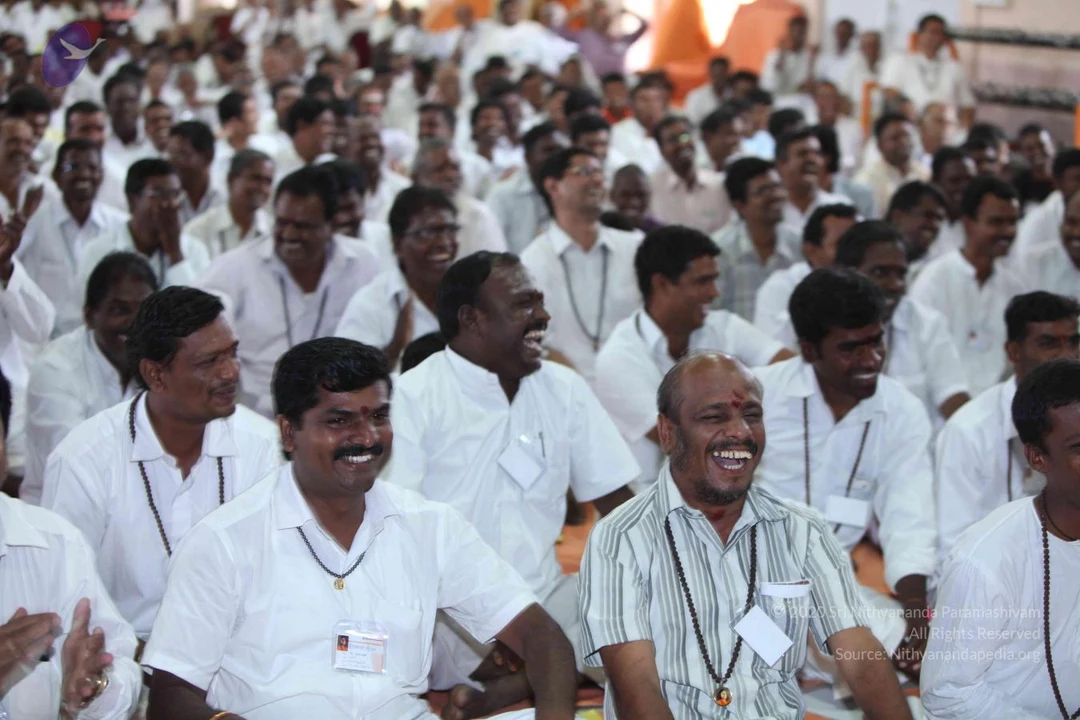
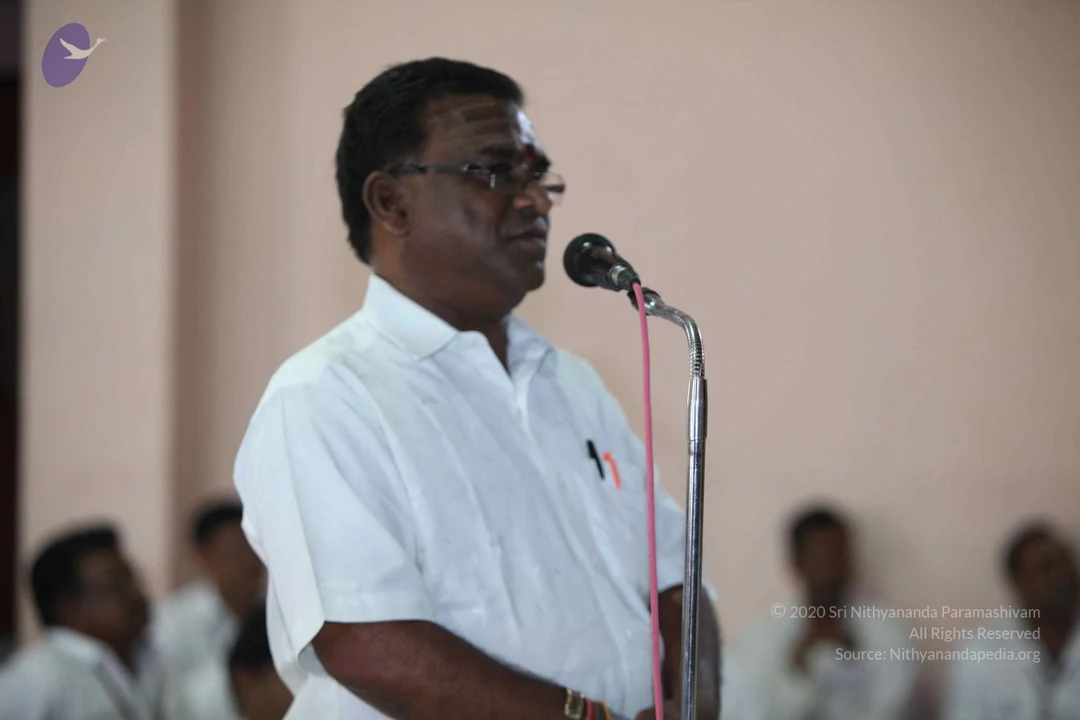
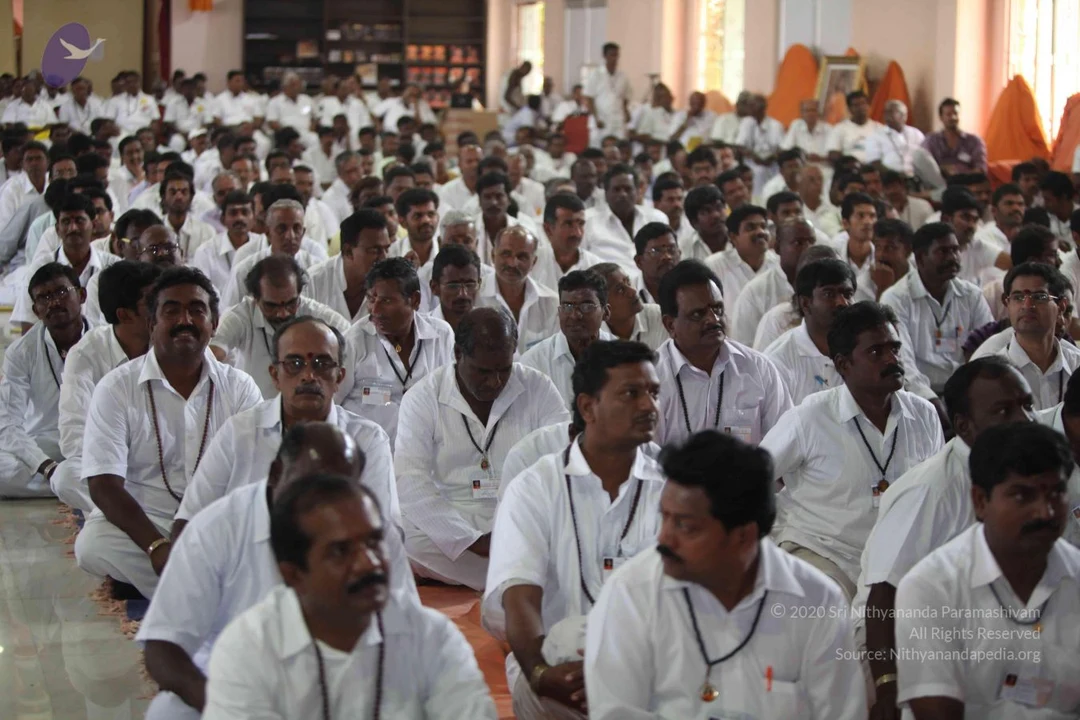
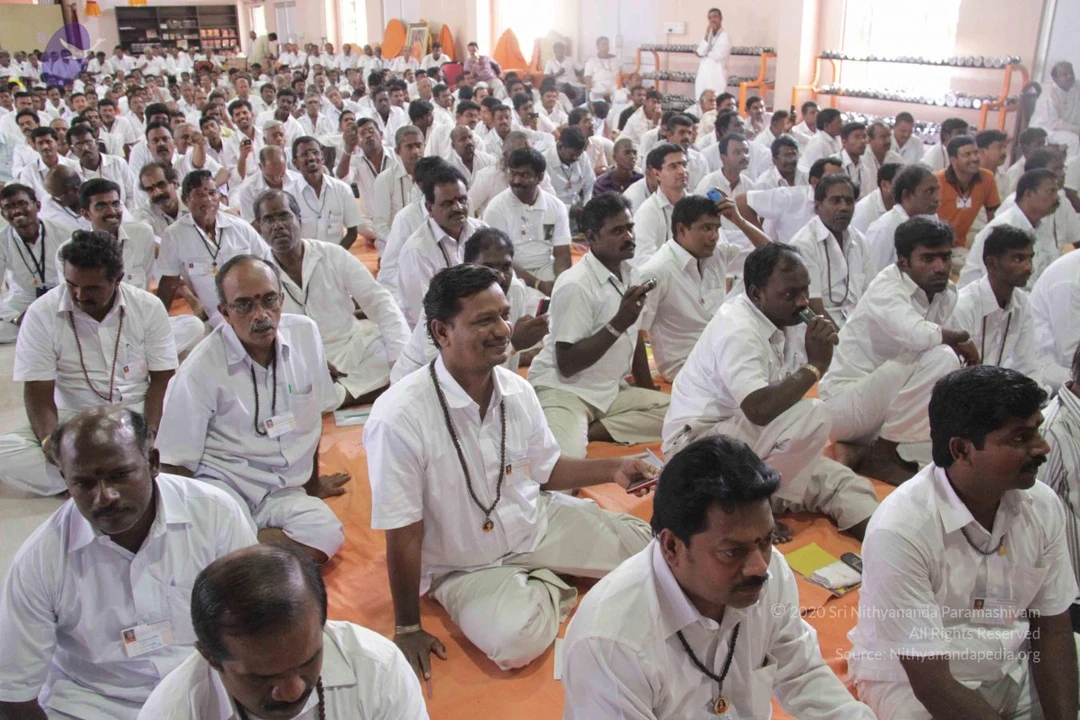
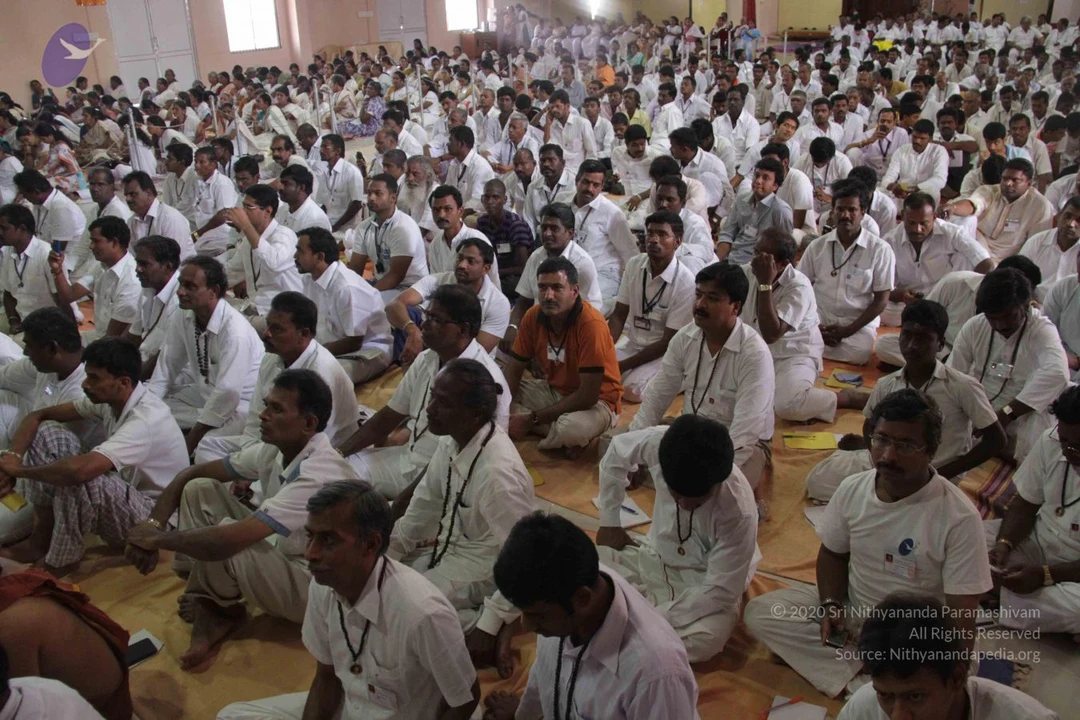
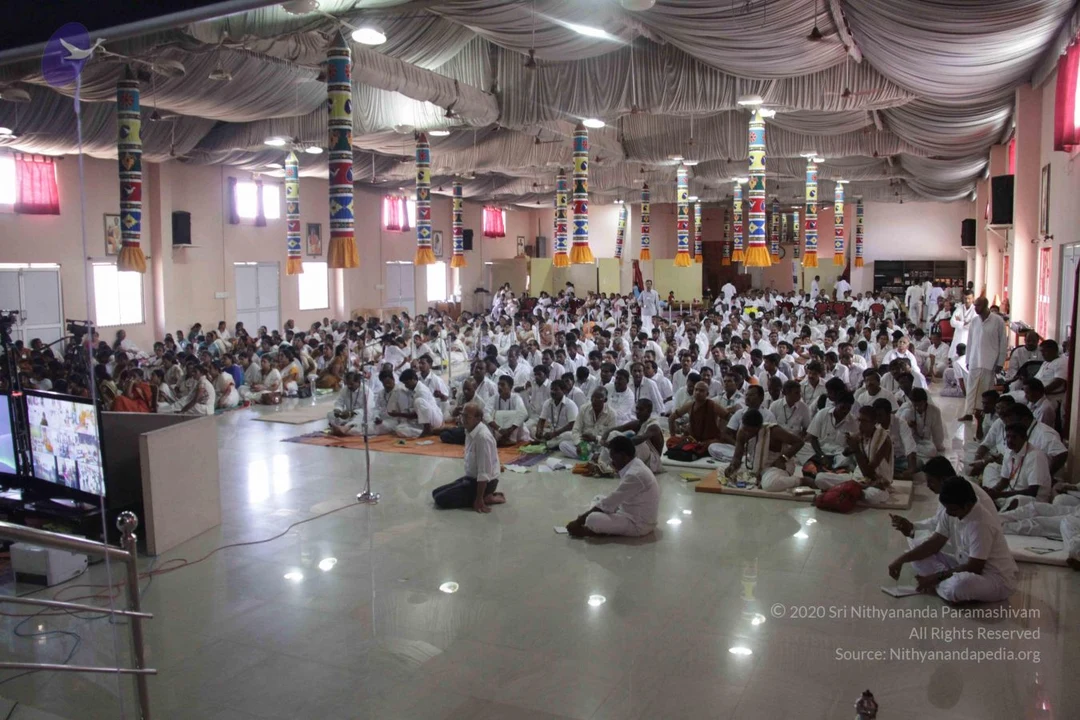
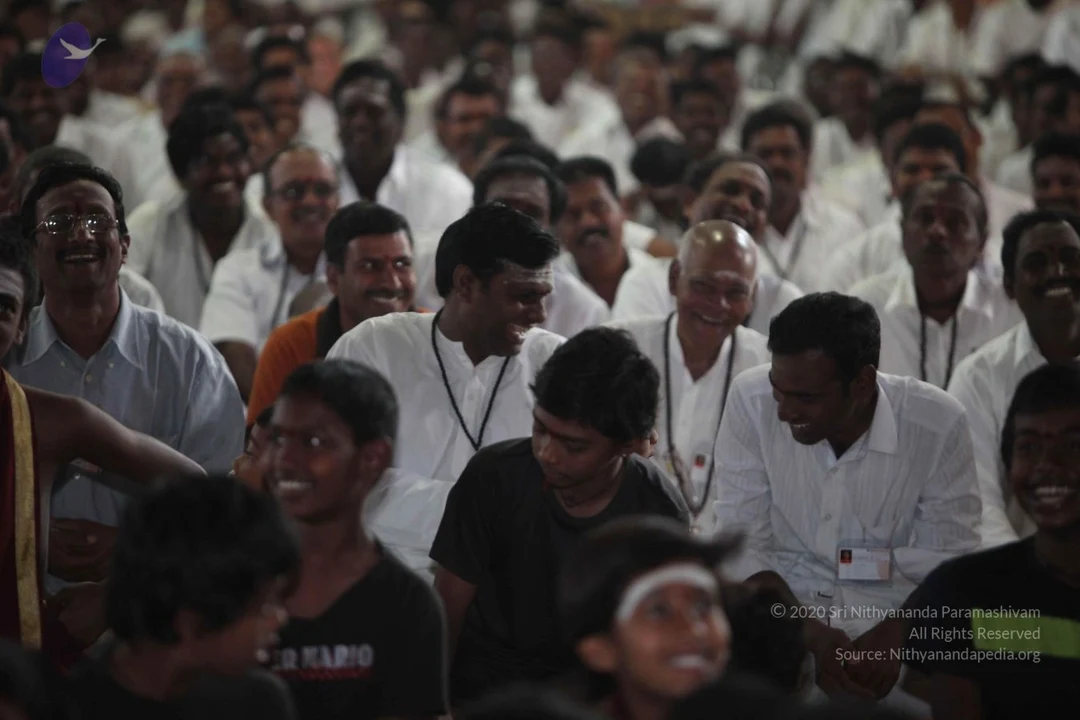
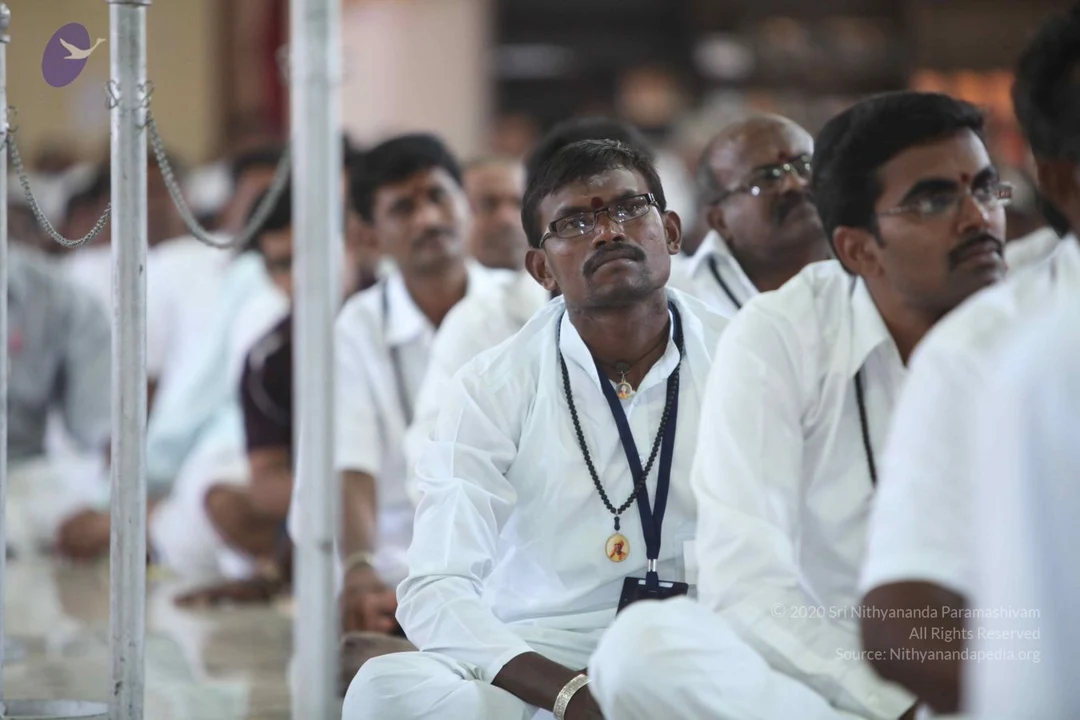
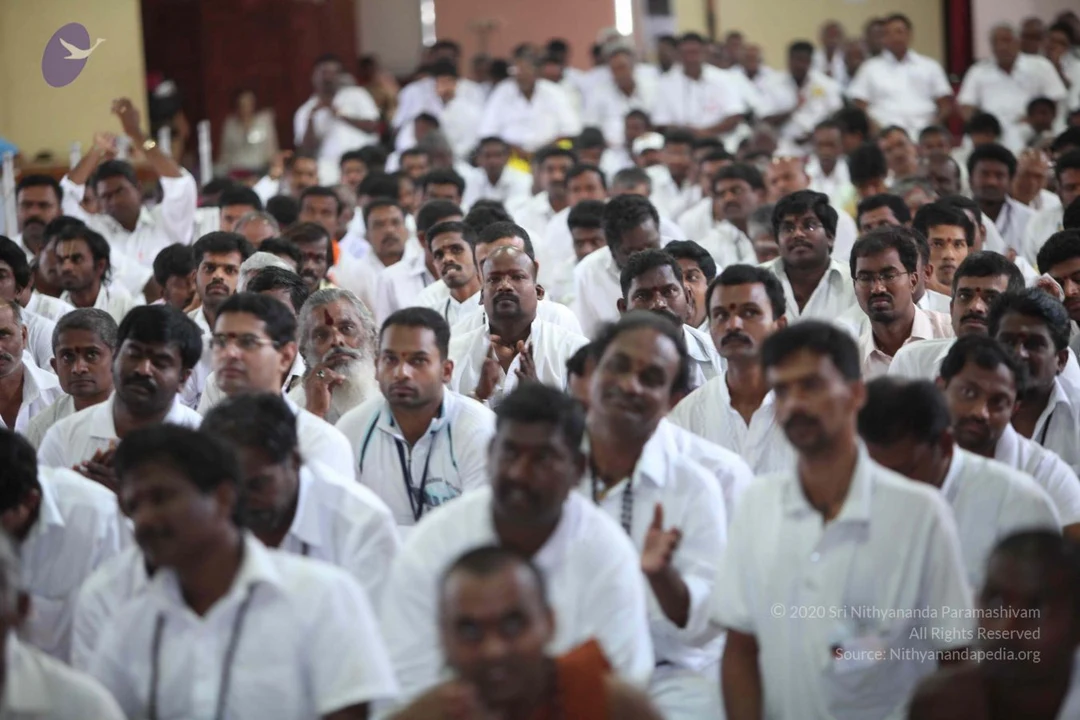
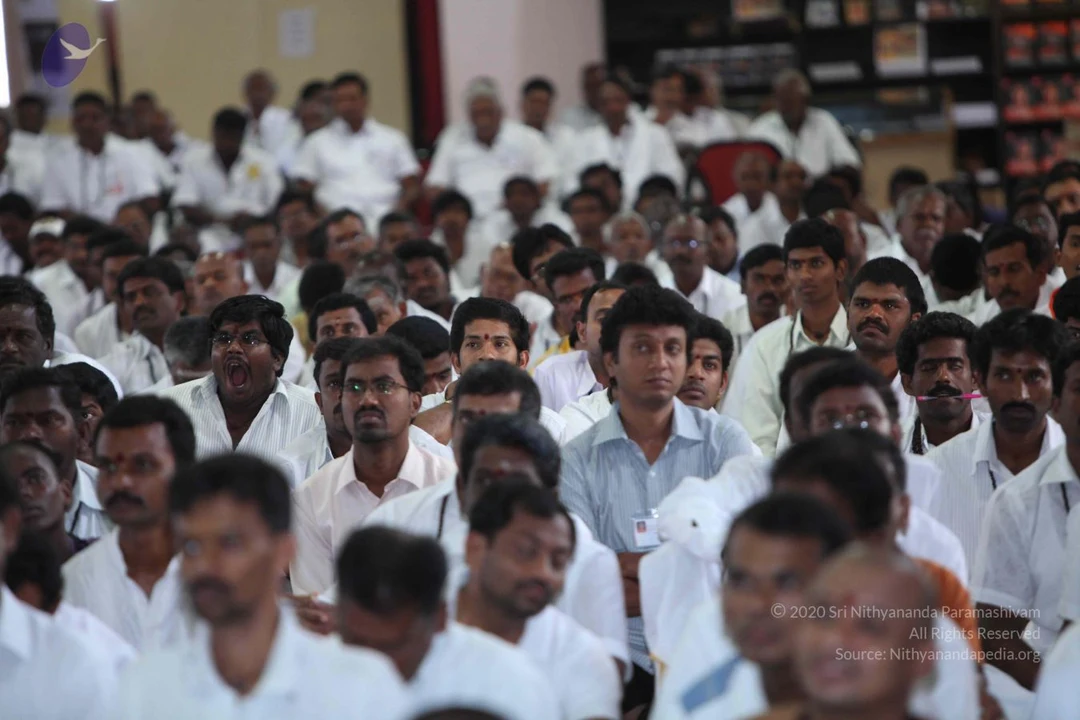
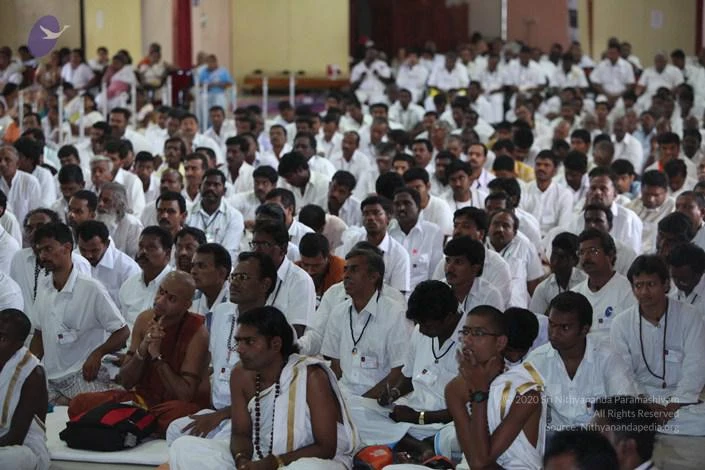
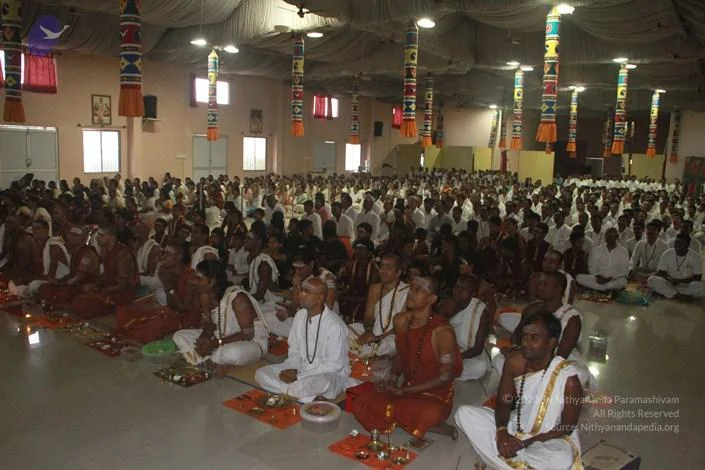
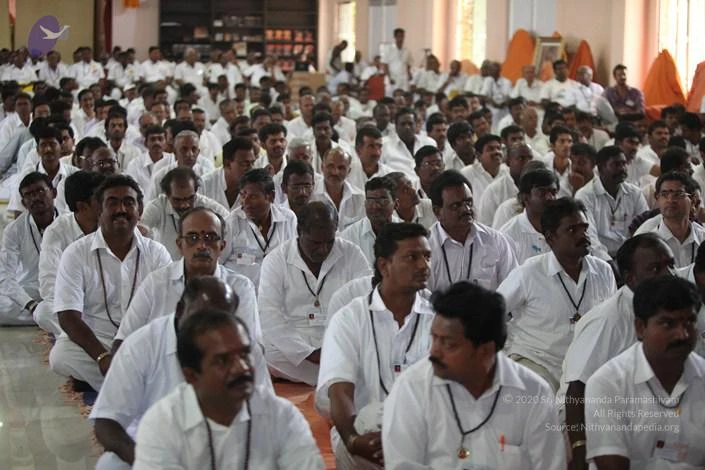
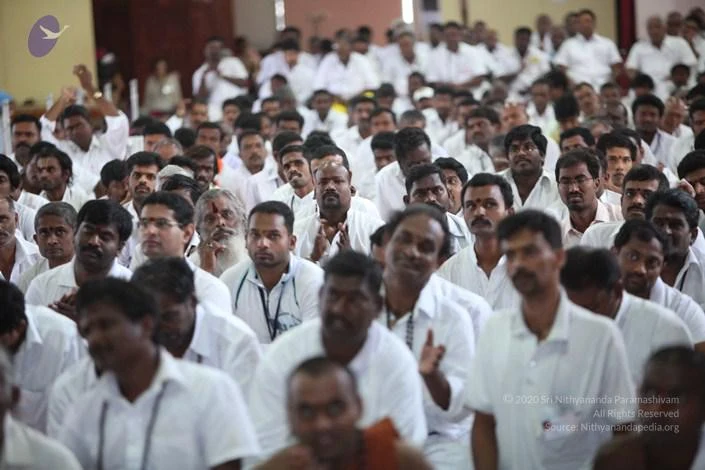
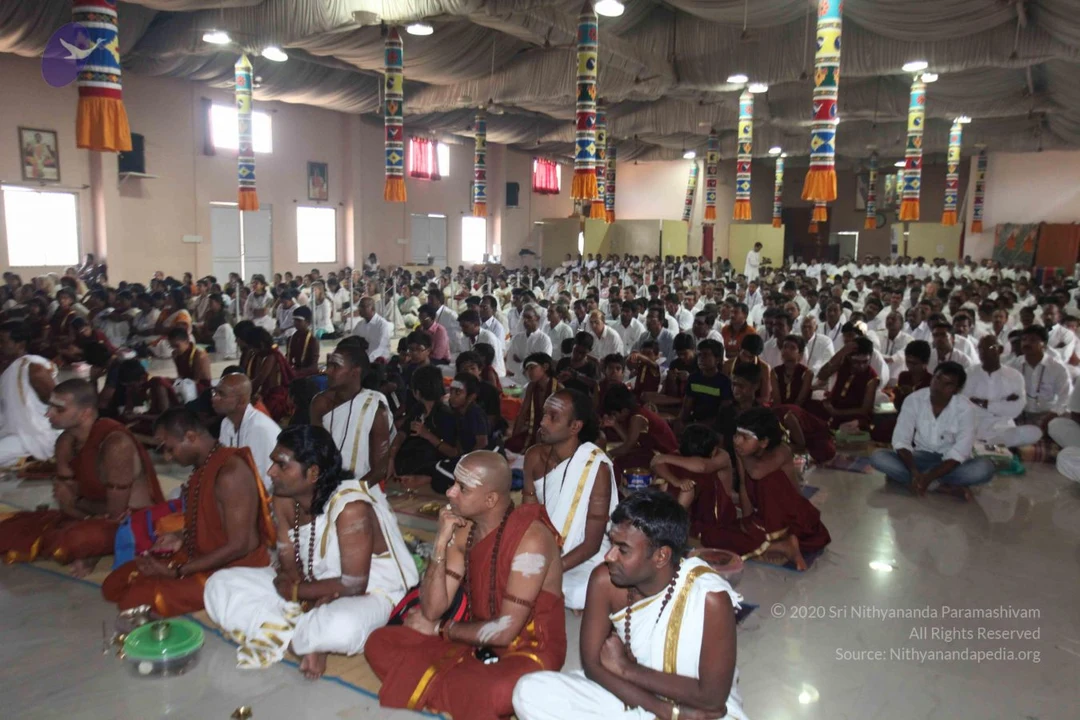
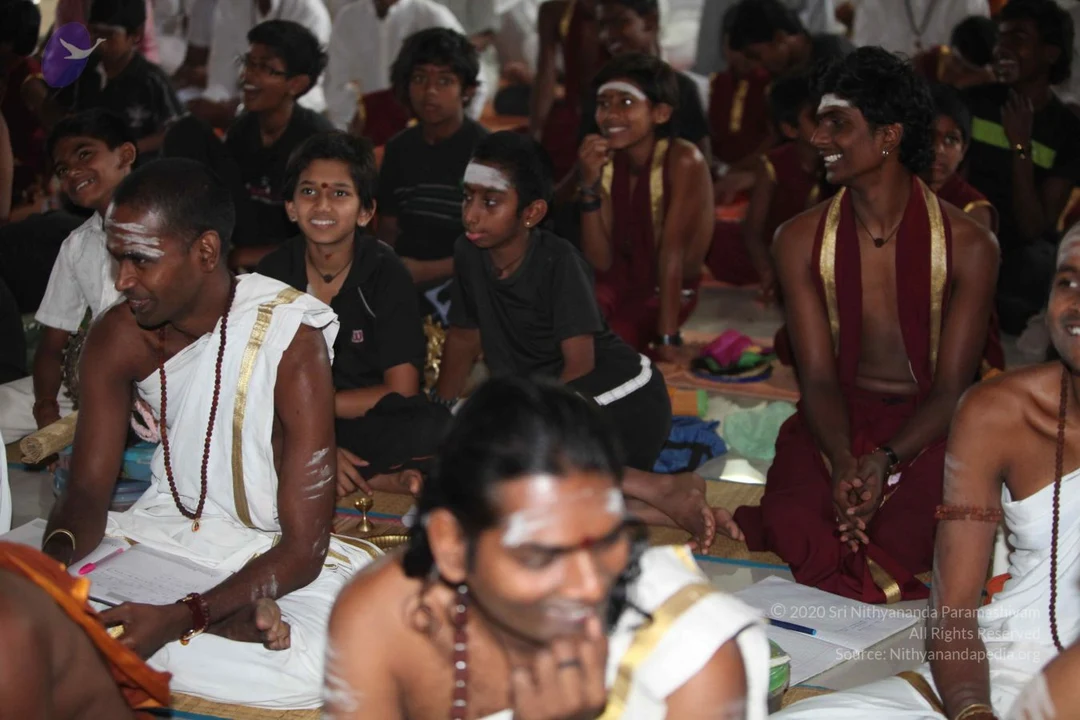
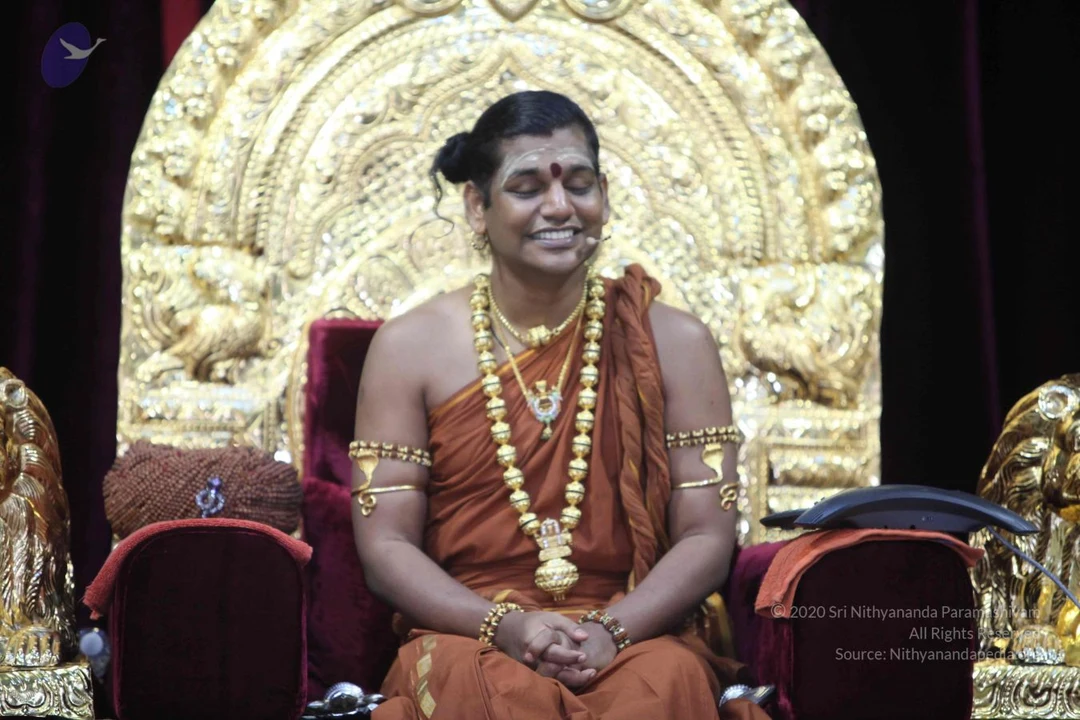
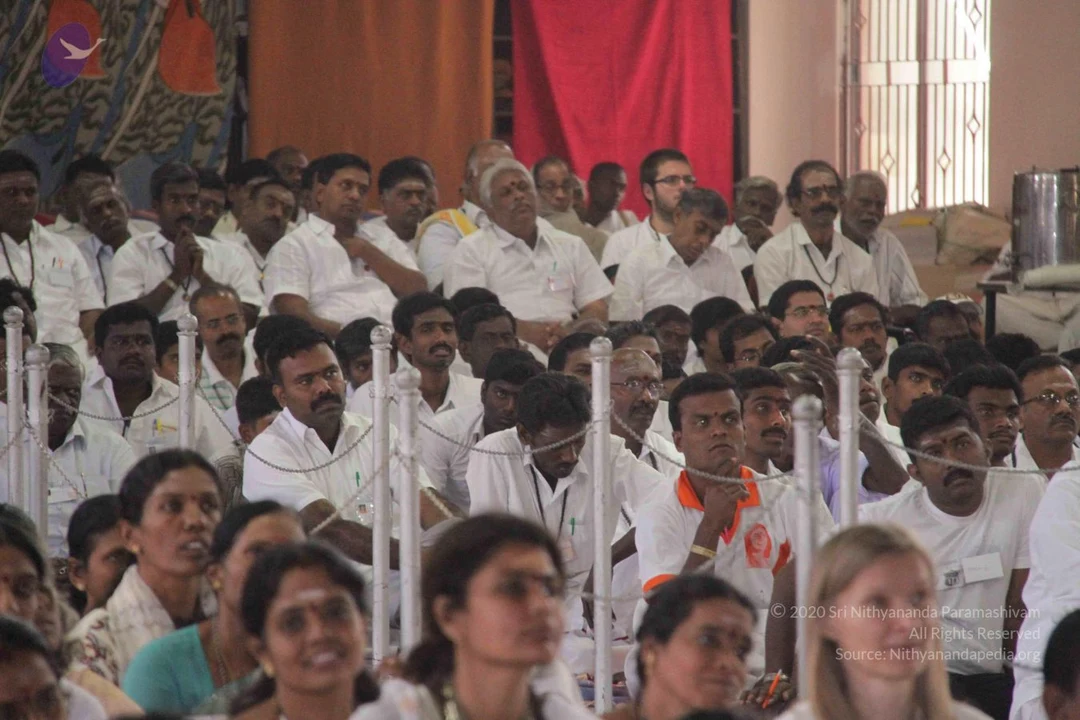
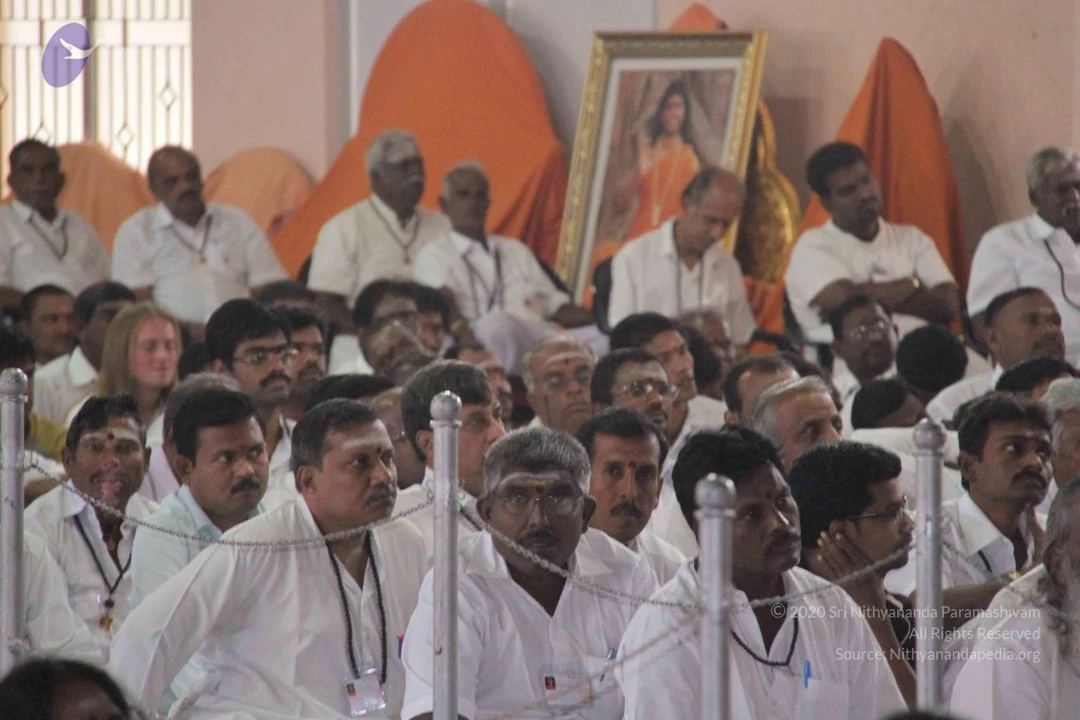
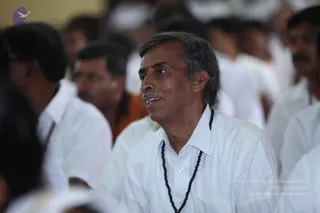
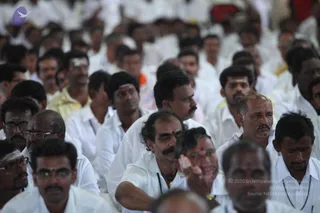
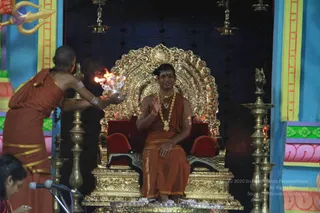
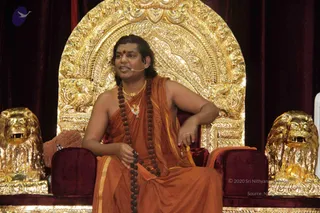
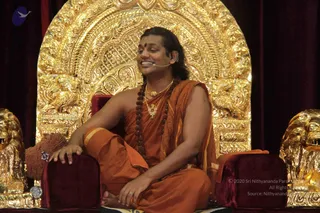
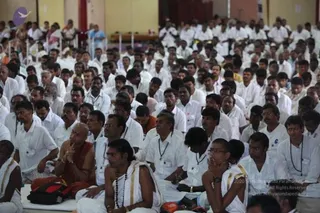
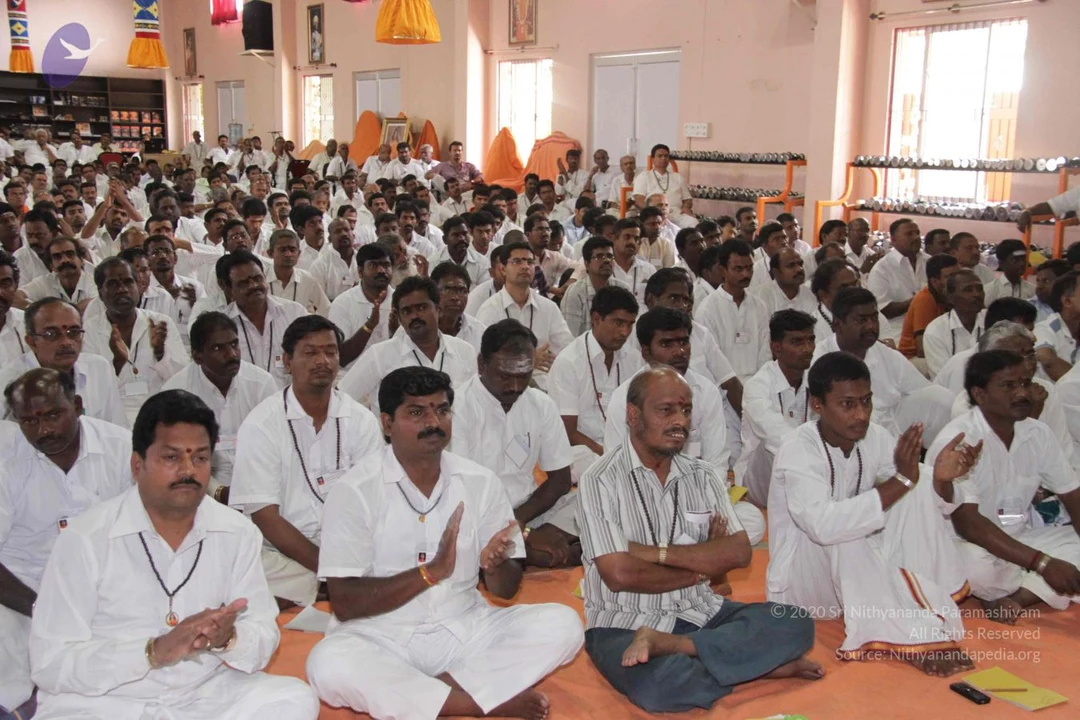
A dense audience of mostly men seated closely together in white shirts and trousers, viewed from the front in a large hall. In the centre, a man in a white shirt and dark-rimmed glasses sits with one hand raised near his chest, a dark beaded mala hanging over his shirt and an ID badge on a lanyard. To the right, another man in a white shirt with a thin red line on his forehead sits beside a man in a white shirt wearing a beaded necklace. At lower left, a man in an orange top is partly visible. The faces are attentive and the crowd fills the frame.A photograph inside a temple-style hall with turquoise and pink painted walls and two large painted guardian figures with tridents, one on each side. A central figure sits on an ornate gold throne with a red cushioned seat, wearing an orange-saffron robe, a beaded mala and a gold necklace, holding a small rod. In the foreground a brass multi-tier oil lamp with lit wicks is burning. At left, a woman in a magenta outfit sits on a red rug before a microphone, hands folded. At right, a seated man in white clothes sits on a rug. A bald figure in orange robes sits at the far left edge, seen from behind. Brass kuthu vilakku lamps stand on either side of the throne. The scene suggests a satsang or puja setting.

January 20 2013

Original wiki page
Contents

Title

Know Death for No - Death

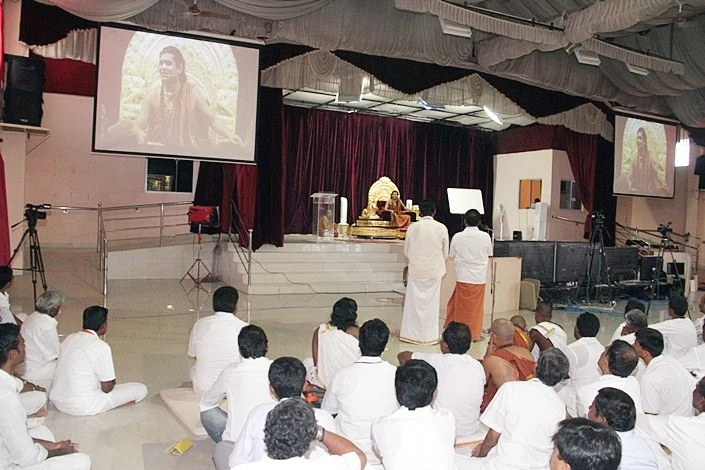
Morning Satsang - Pada Puja, Dial-the-avatar, Nirahara Samyama, Essence of IA

Description

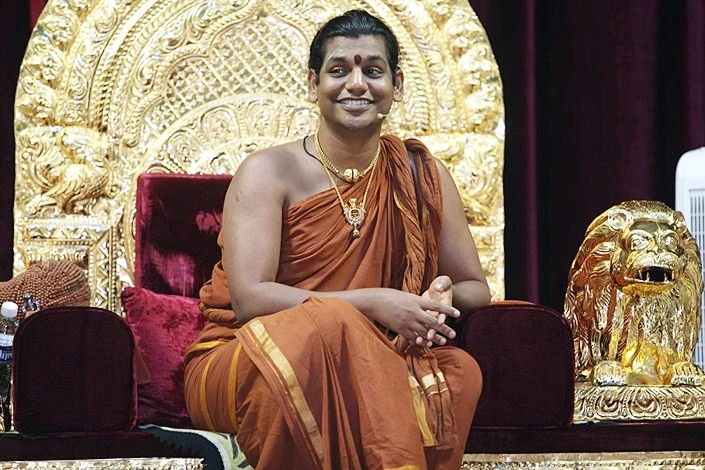
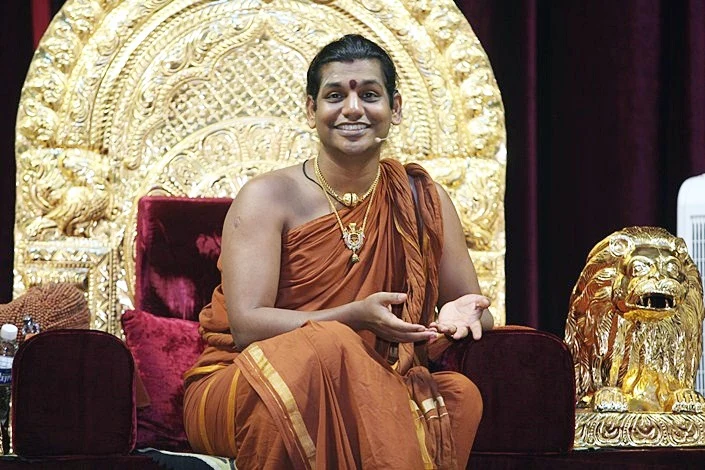
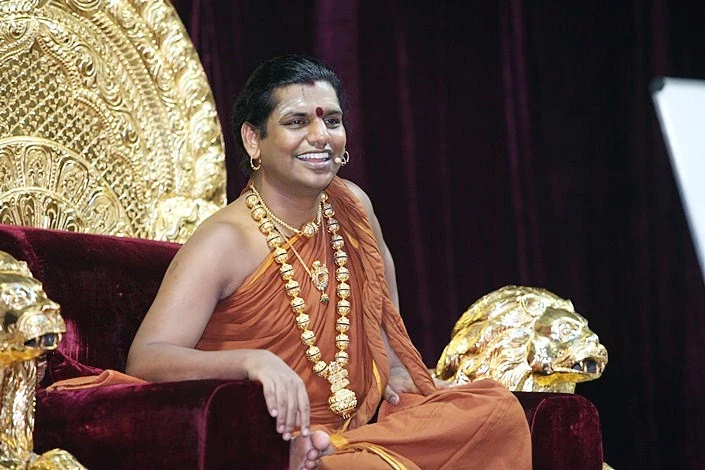
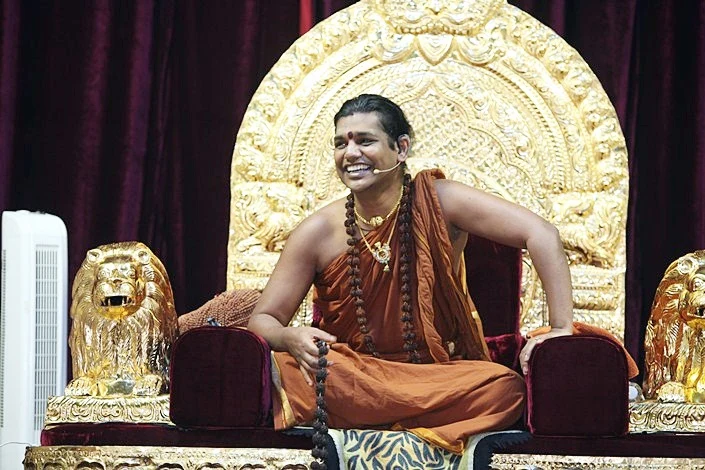
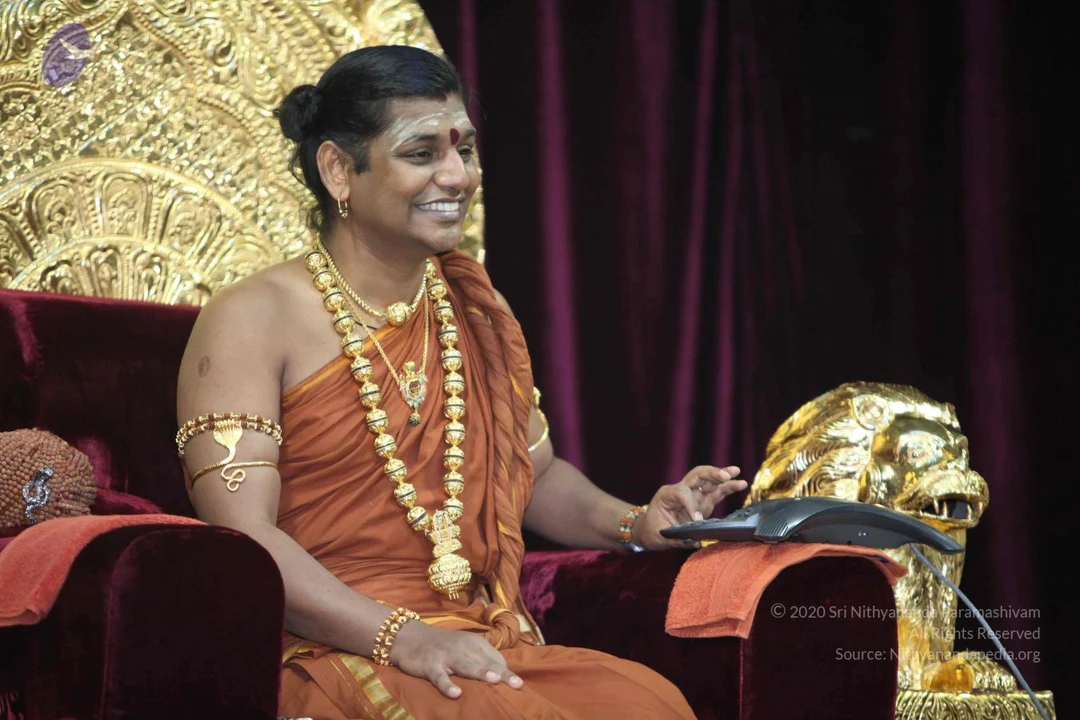
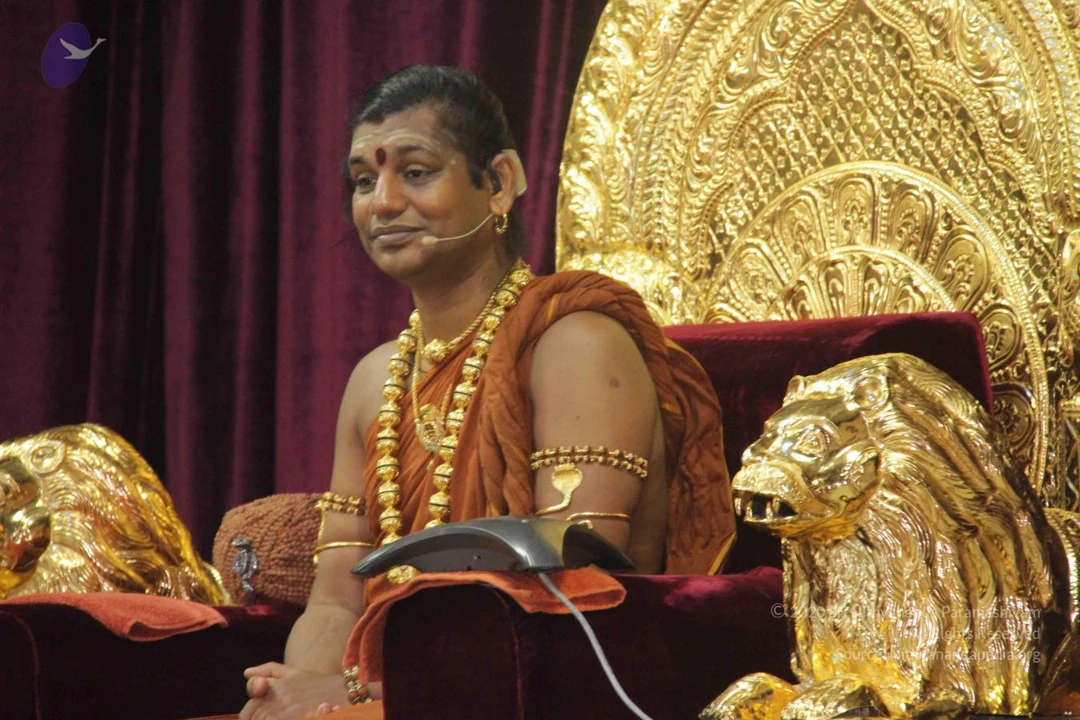
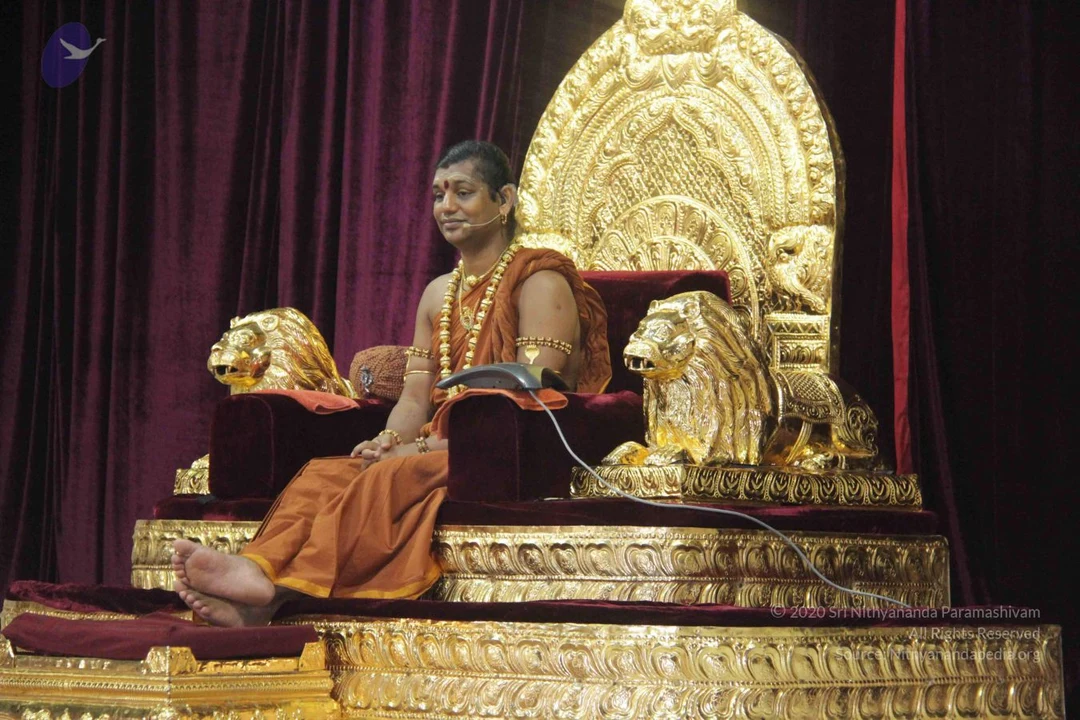
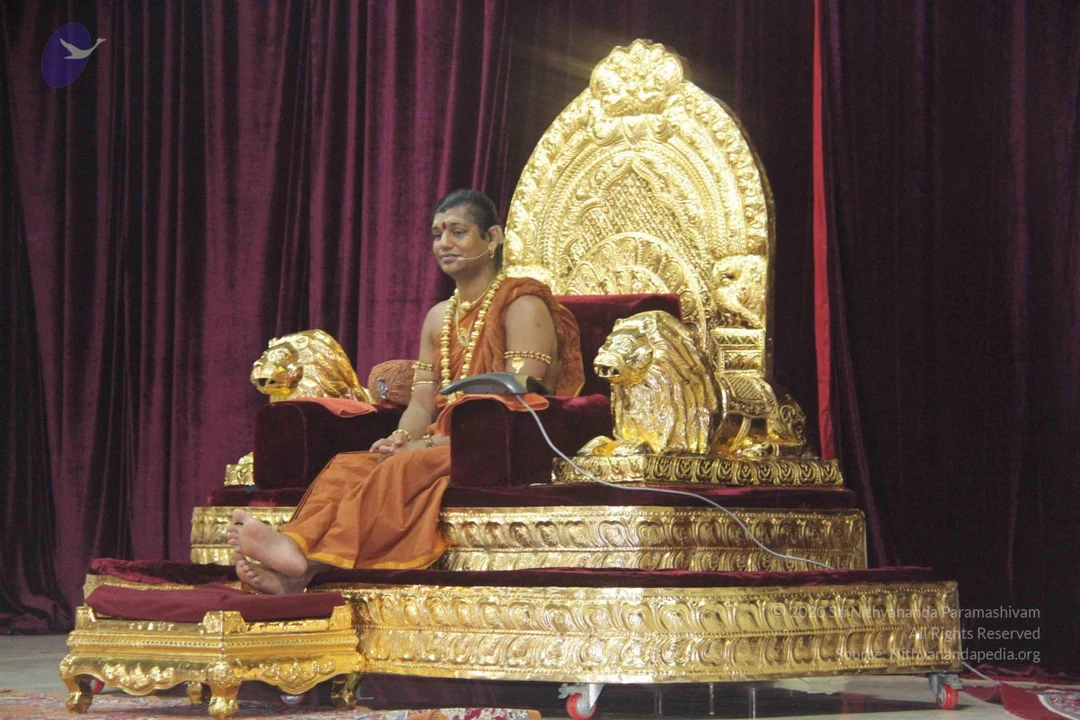
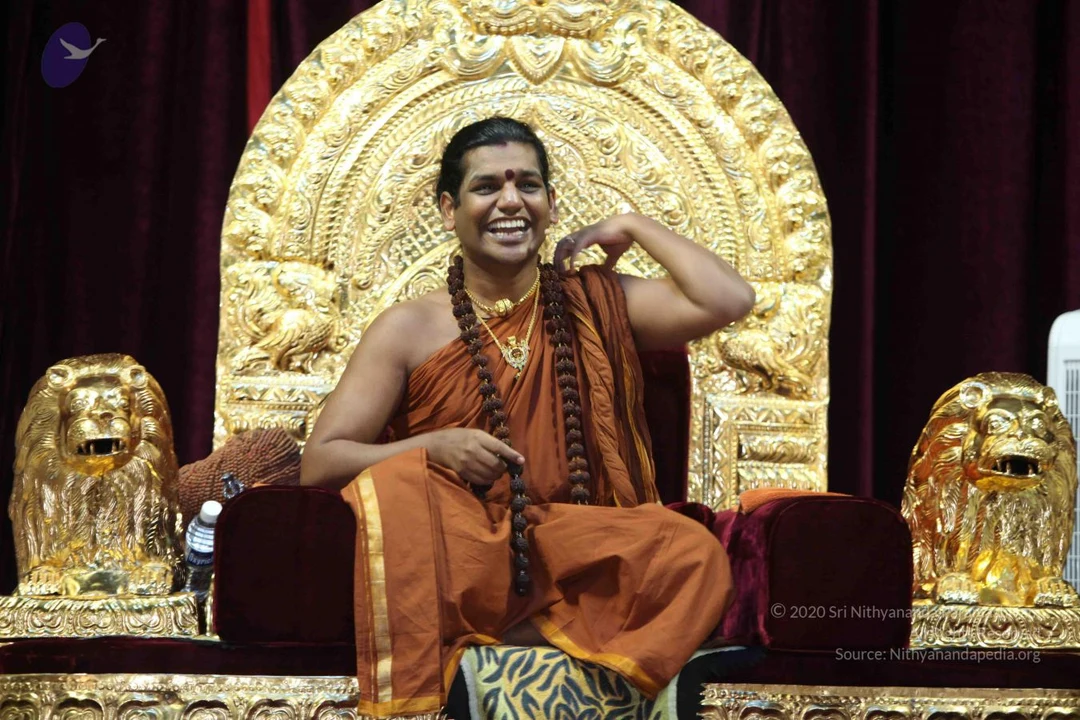
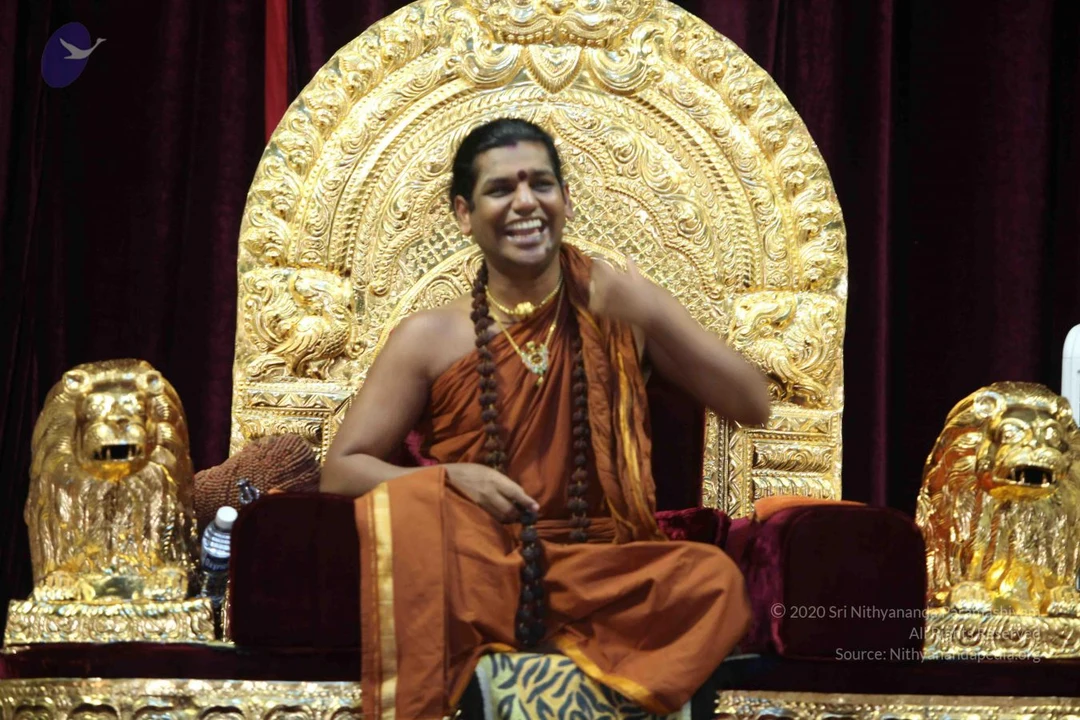
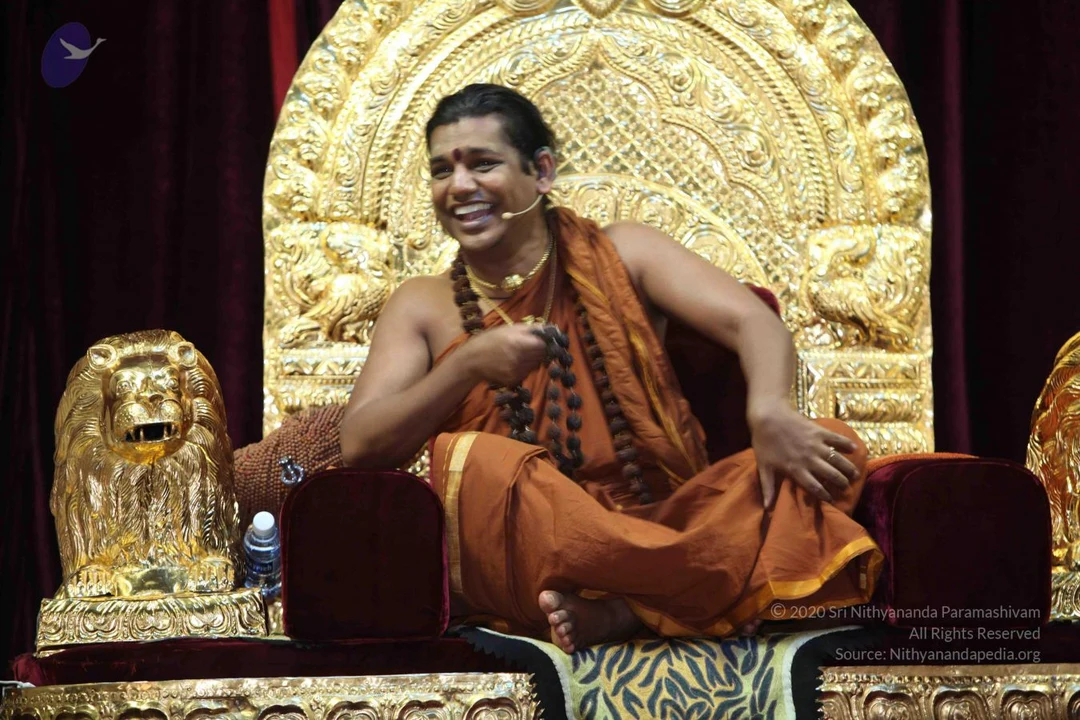
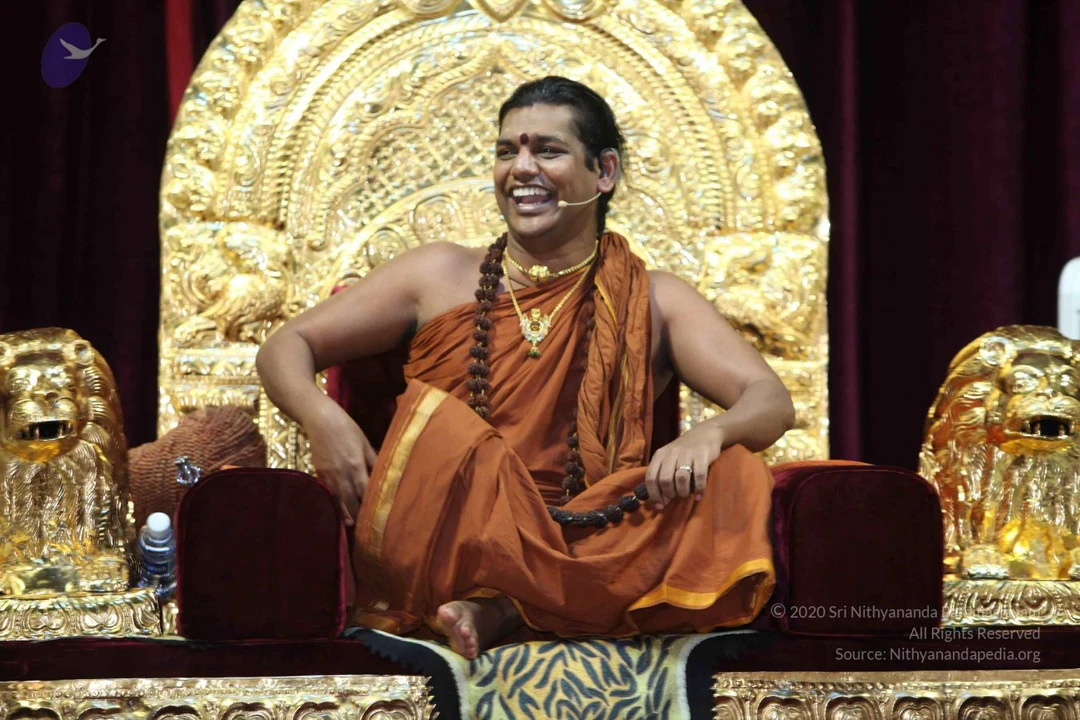
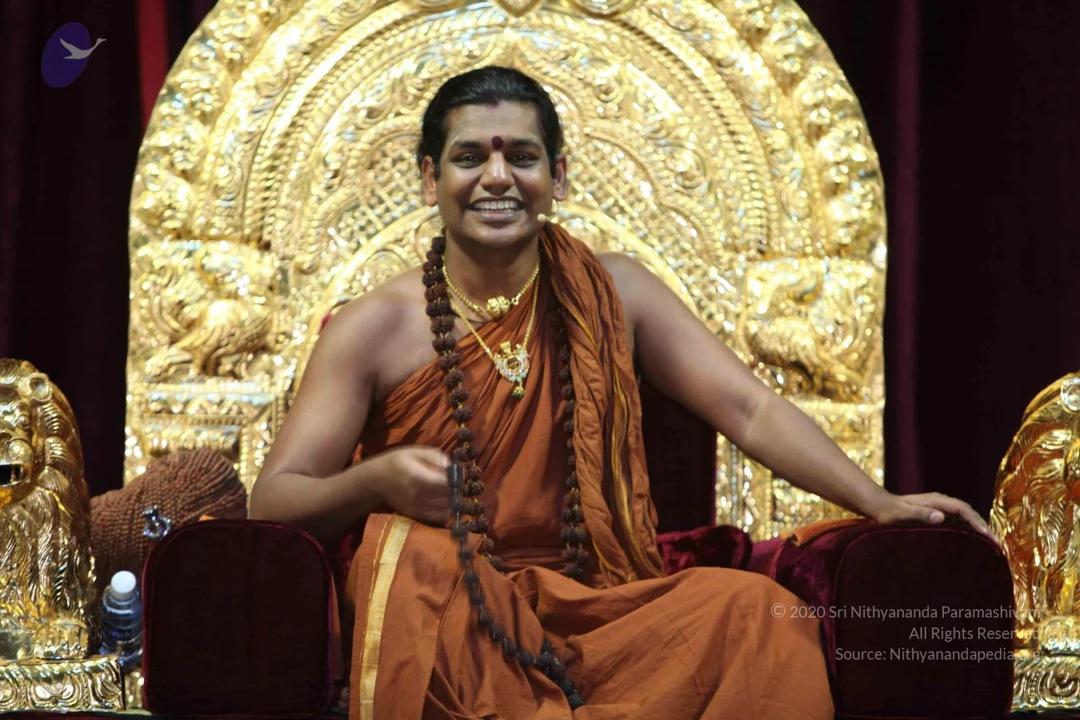
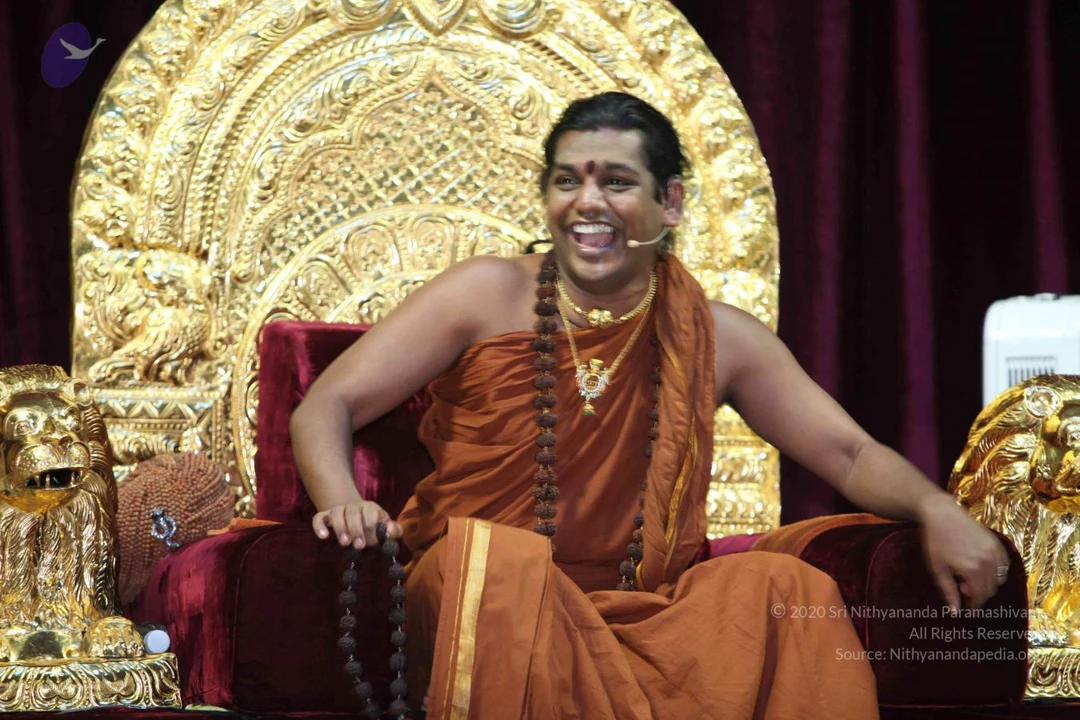
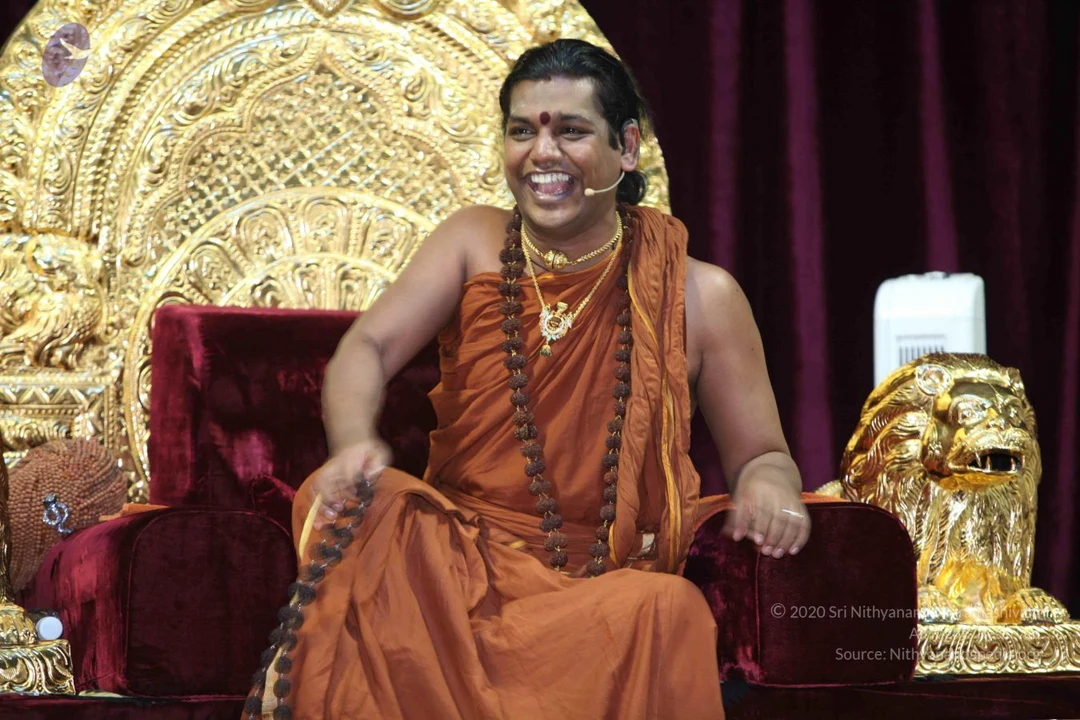
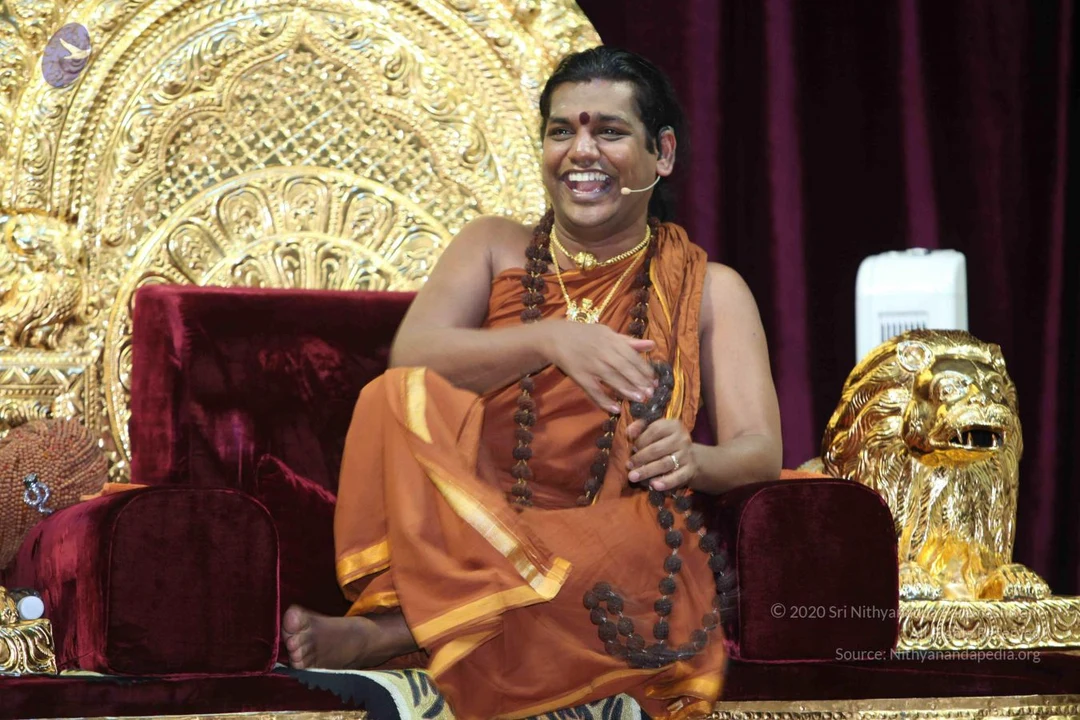
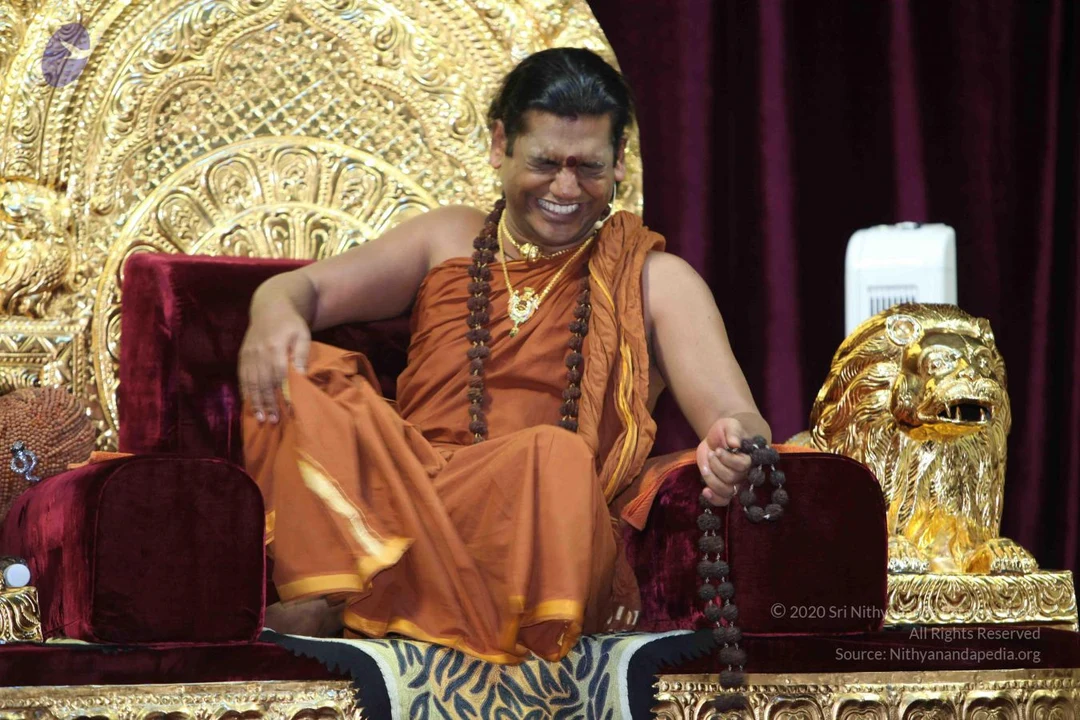
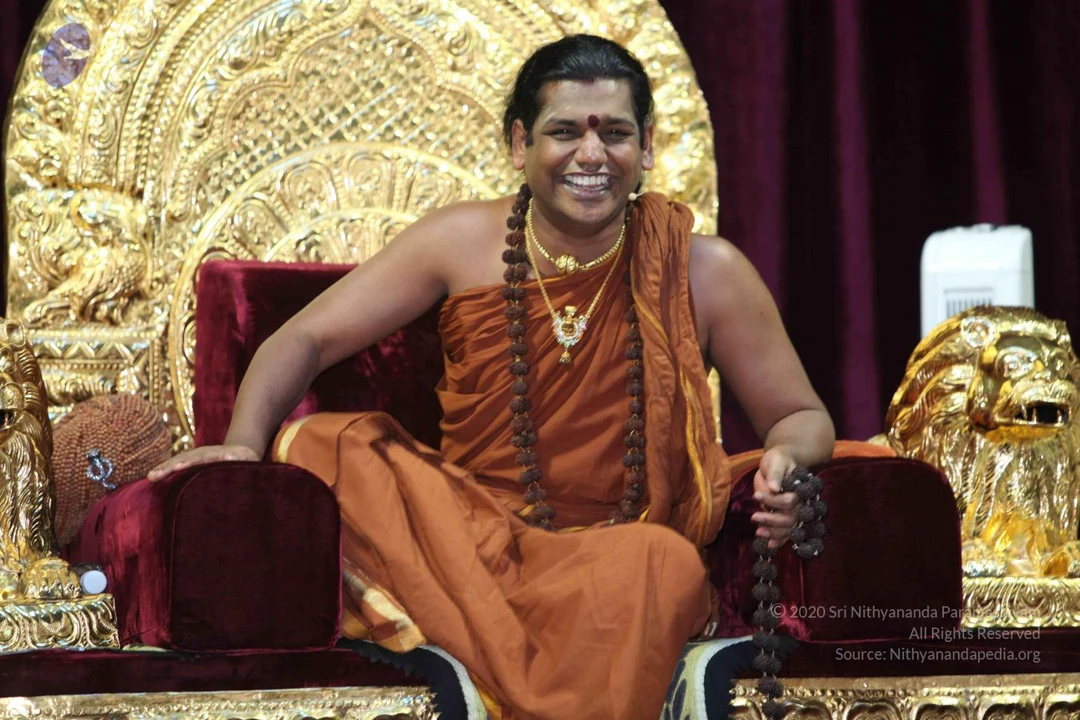
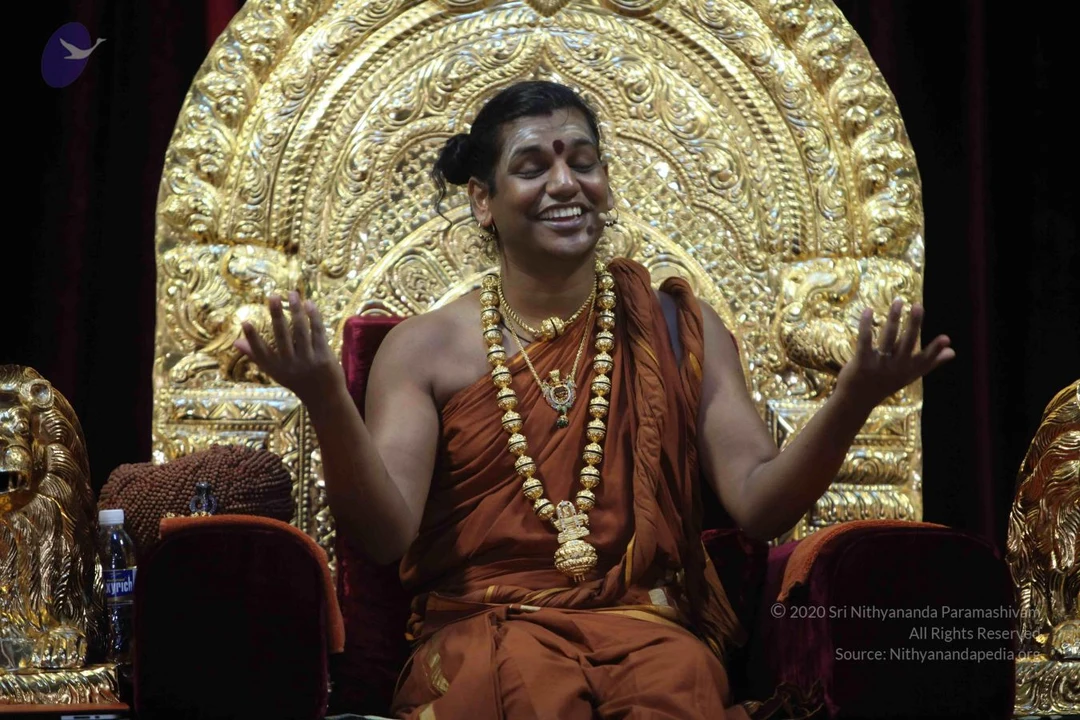
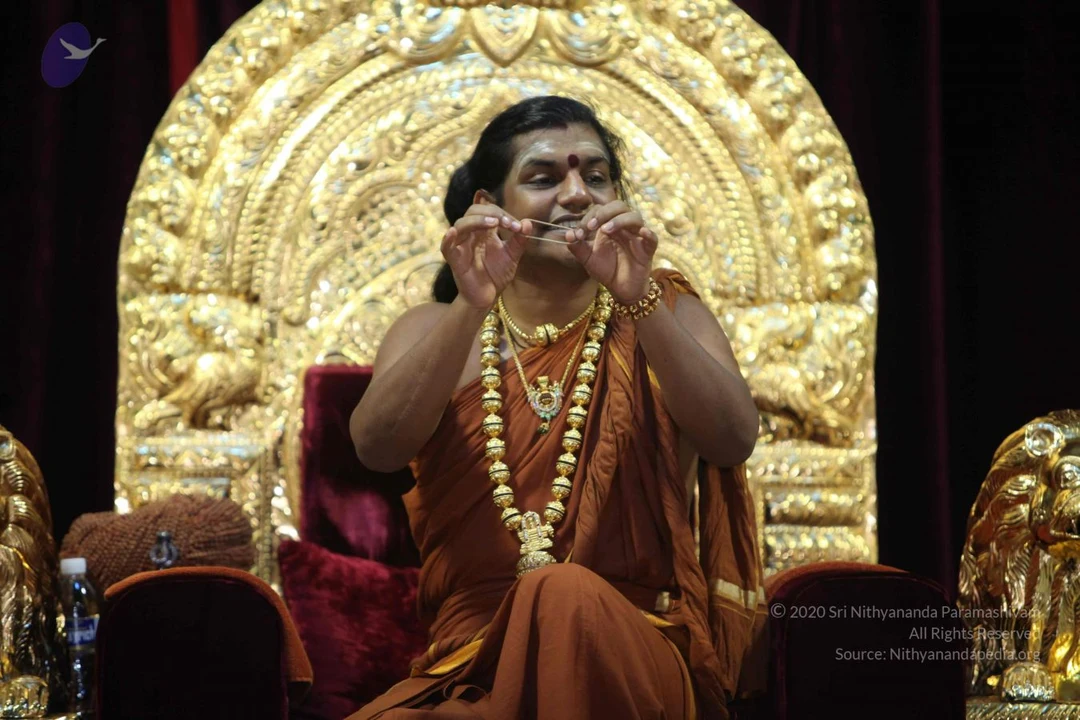
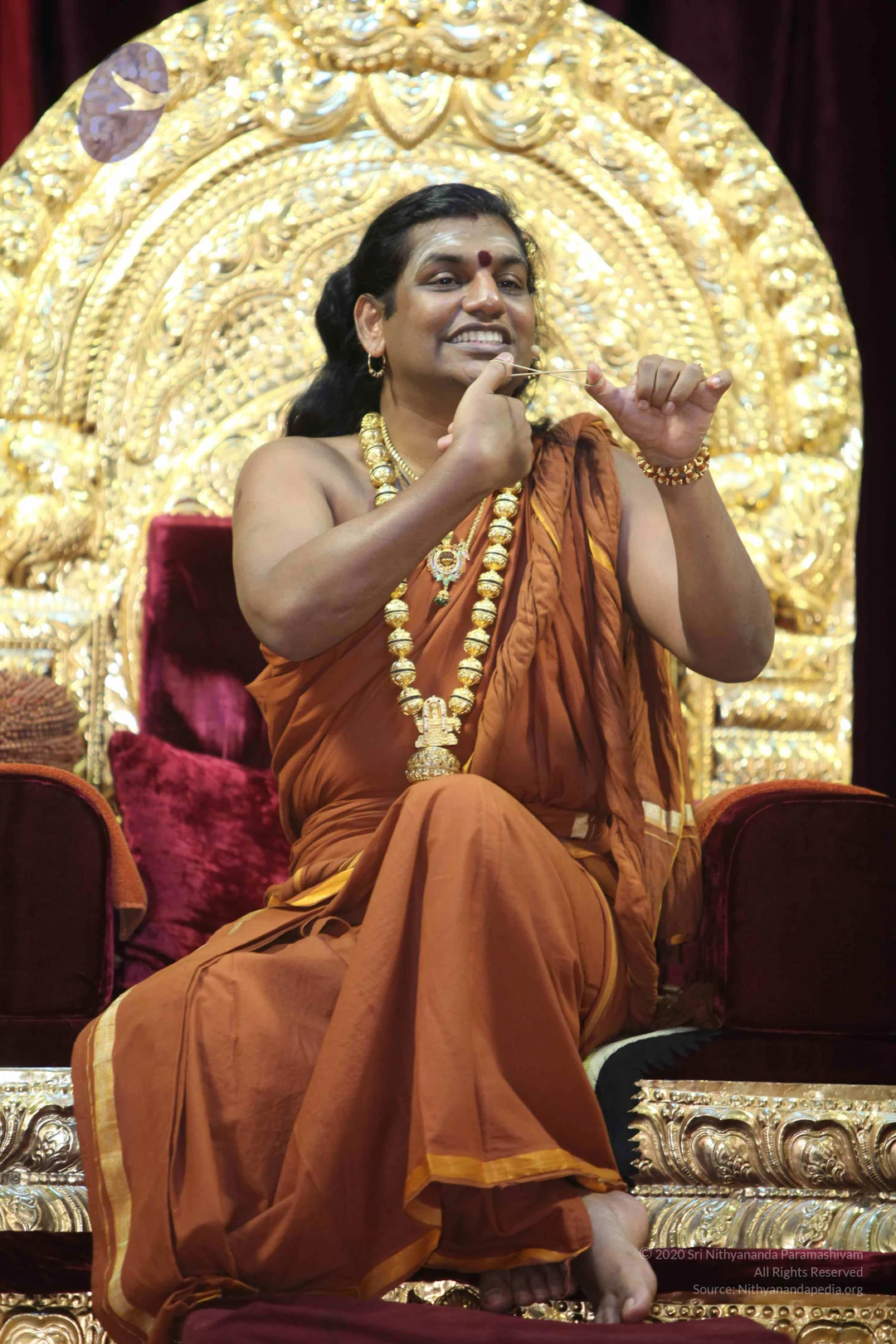
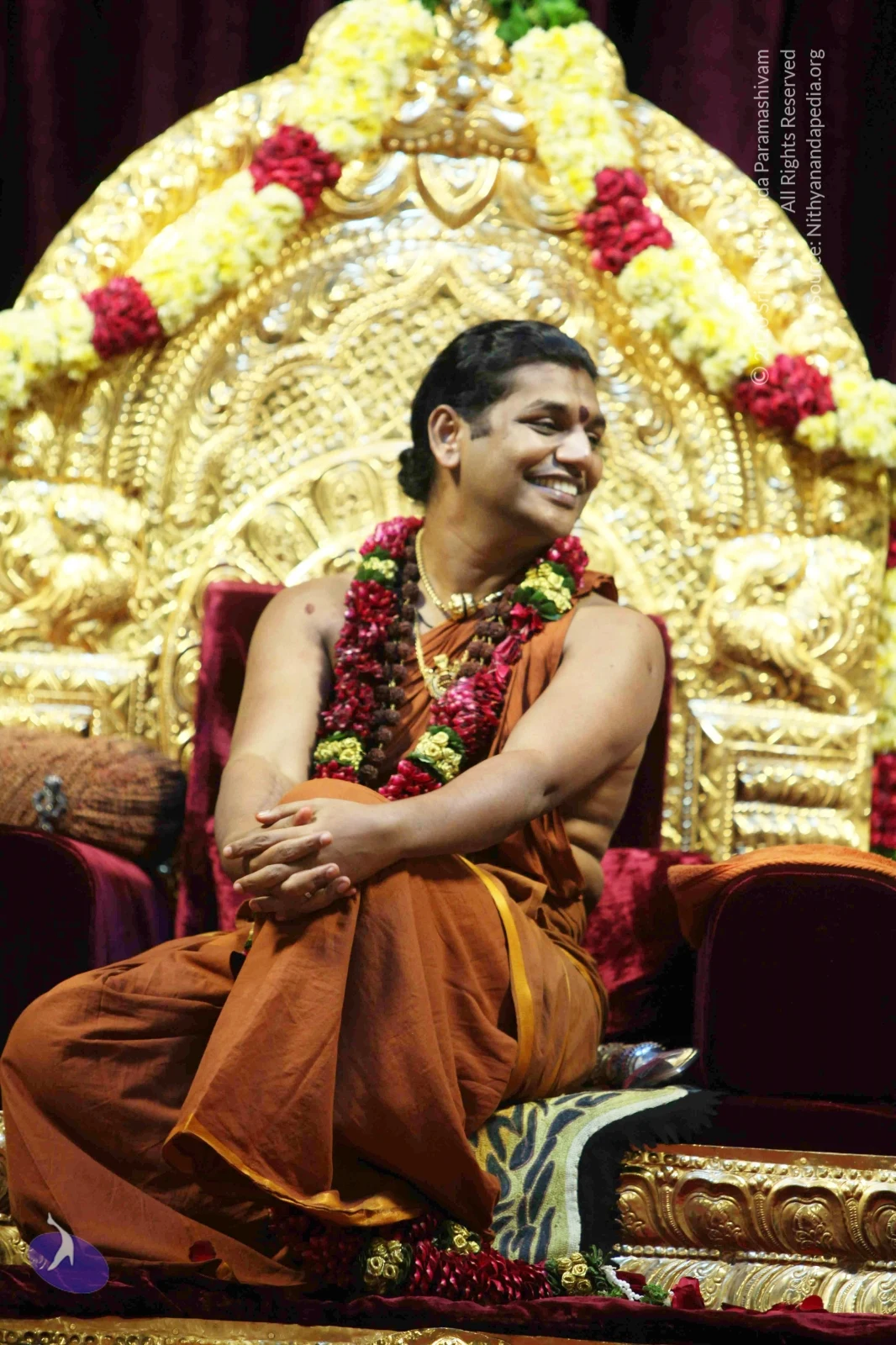
Date: Sun, 2013-01-20 10:00 Description in English: In today’s morning satsang, Paramahamsa Nithyananda reveals the deepest dimension of the 20th sloka of Katopanishad. In this sloka Yama, the God of Death, gives a boon to Nachiketa, a child who has willingly offered his life to save his father’s honor. Nachiketa asks to understand the mystery of death. Yama tries to distract him by offering wealth, fame and everlasting happiness instead, but Nachiketa stands firm. Nithyananda uses this as an illustration of sannyas, the way of enlightenment. When no distraction holds any interest for human beings, they have cleared their path to spiritual freedom.

Video and Audio - Epi-138 Janasri-20 Jan 2013 -Morning Satsang

VideoAudio

Video and Audio - Epi-139 Janasri-20 Jan 2013-Morning Satsang

VideoAudio

Title

Nirahara Samyama Meditation || Nithyananda Satsang || 20 Jan 2013

Description

Name Of The Convention : Nithya Satsang
Title : Nirahara Samyama Meditation
Date : 20 January 2013
Venue : Adi Kailasa, Bengaluru, Karnataka, India

In this video, the Supreme Pontiff of Hinduism HDH #Nithyananda takes the delegates who are observing Nirahara Samyama, which is the process by which we can understand how our body can awaken its own natural intelligence and create food out of natural resources, like the sun rays, and air. This video is a short meditation led by His Divine Holiness for those who are diligently doing Nirahara Samyama.

The Supreme Pontiff of Hinduism Jagatguru Mahasannidhanam His Divine Holiness Nithyananda Paramashivam (HDH) is the reviver of #KAILASA - the ancient enlightened civilization and the great cosmic borderless Hindu nation. Revered as the incarnation of Paramashiva - the primordial Hindu Divinity, HDH has a following of 2 billion Hindus worldwide with de facto spiritual embassies in over 150 countries. He has worked untiringly for over 26 years for the revival of Kailasa, for global peace and to give super conscious breakthrough to humanity. He has survived the worst persecution of multiple assassination attempts on person and on character by anti-Hindu elements. He is collecting, organising, preserving, time capsuling, decoding, spreading and reviving 20 Million source books of Hinduism and the 64 sacred arts & sciences like Ayurveda, music, dance, sculpting, astrology, vastu and much more. Close to 20,000 hours of HDH’s timeless talks have been recorded till date (Sep 2020), which are a treasure trove of powerful cognitions to solve individual and global problems of any kind.

Video and Audio - Nirahara Samyama Meditation || Nithyananda Satsang || 20 Jan 2013

VideoAudio

Transcript

(00:15)

We will move to the next segment of the morning satsang nirahara samyama. All the nirahara samyama participants please sit straight, close your eyes, cognize you have become, Bidadi Banyan tree; Bidadi kalpavriksha, experiencing life, strength, joy, with the deep roots, branches, leaves, fruits, hanging roots and energy. Namashivaya!

(01:05)

Meditation in progress.

(04:35)

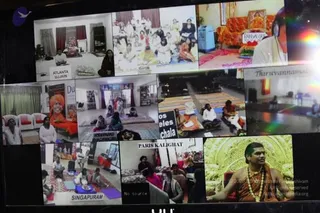
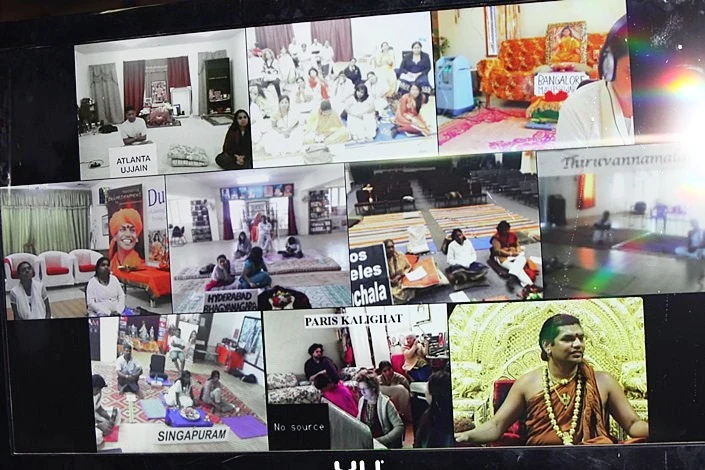
I bless you all who are sitting with us around the world in 556 places through Nithyananda TV, 45 places two way video conferencing having nayana deeksha in 265 cities in 34 countries around the world. Let you all achieve, experience, live, express. radiate, share, explode and enrich with eternal bliss Nithyananda. Thank you.

(05:04)

Title

Anchor Your Ship! || Part 1 || Nithyananda Satsang || 20 Jan 2013

Description

Name Of The Convention : Nithya Satsang
Session on: Anchor Your Ship!
Date : 20 January 2013
Venue : Adi Kailasa, Bengaluru, Karnataka, India

In this video, the Supreme Pontiff of Hinduism HDH #Nithyananda explains part of the Kathoupanishads, one of the primary Upanishads. In particular, this section is about an exchange between Lord Yama, the God of death, and Nachiketa, the young son of a sage, and tells us about authenticity and overcoming or realising the fear of death. His Divine Holiness explains that we have to understand the reality of death, and acknowledge it as a part of life.

The Supreme Pontiff of Hinduism Jagatguru Mahasannidhanam His Divine Holiness Nithyananda Paramashivam (HDH) is the reviver of #KAILASA - the ancient enlightened civilization and the great cosmic borderless Hindu nation. Revered as the incarnation of Paramashiva - the primordial Hindu Divinity, HDH has a following of 2 billion Hindus worldwide with de facto spiritual embassies in over 150 countries. He has worked untiringly for over 26 years for the revival of Kailasa, for global peace and to give super conscious breakthrough to humanity. He has survived the worst persecution of multiple assassination attempts on person and on character by anti-Hindu elements. He is collecting, organising, preserving, time capsuling, decoding, spreading and reviving 20 Million source books of Hinduism and the 64 sacred arts & sciences like Ayurveda, music, dance, sculpting, astrology, vastu and much more. Close to 20,000 hours of HDH’s timeless talks have been recorded till date (Sep 2020), which are a treasure trove of powerful cognitions to solve individual and global problems of any kind.

Video and Audio - Anchor Your Ship! || Part 1 || Nithyananda Satsang || 20 Jan 2013

VideoAudio

Transcript

[00:45] Sadāshiva samārambām jnana sambandāchārya madhyamām Asmadācharya paryanthām vande guru paramparām.

[01:15]

I welcome you all with My love and respects. I welcome all the devotees, disciples, samajis, satsangis sitting with us in 359 places through Nithyananda TV, 45 places two way conferencing, having Nayanadeeksha in 195 cities and 25 countries around the world. Cities sitting with us in two way video conferencing, having Nayanadeeksha, San Jose Madurai, Seattle Chidambaram, Oklahoma Somanatham, Toronto Kailasam, Vancouver Puri, Phoenix Kanchipuram, Ohio Prayag, Tiruvannamalai, Dakota Dunes, Los Angeles-Arunachalam, Dubai, Redondo Beach California, Oman-Sivagangai, Devon UK, Linken Kashi, Chennai-Alwarpet, Sripuram Chennai, Bengaluru Nithyananda Vidyalaya, Seramban center, Hongkong, Mattakalappu Ilangai, Melbourne - Australia, Sydney Australia, Australia two Center, Guadeloupe Rameshwaram - Chicago, EdgeWater - New Jersey, Louis Ville Kentucky, and Atlanta-Ujjaini, New Zealand Arunachalam, Bengaluru - Malleshwaram, St. Louis - Tirumala, Arex - Spain, St. Julien - France, Chicago and Chicago Loop is separate? This is Chicago? And New York Varanasi, Edge Water - New Jersey, St. Louis - Tirumala, Singapore-Singapuram and Netherlands and Sharjah Tirukovilur, yes.

[00:03:32]

All the villages around Tiruvannamalai, I am giving the name to big, big cities of the world. This is what is vedic tradition spreading all over the world. Sharjah Tirukovilur, blessings. Santiago Tiruvalavai, blessings. We will make 108 Meenakshi temple outside India with all that 108 names. I commit with Meenakshi, that I will make 108 temples for her outside India, with all that 108 names of Madurai. London Kashi, I can see London Kashi. I welcome all of you with My love and blessings.

[00:04:51]

Today Nirahara Samyama 3rd level 4th day and Brahmanyam Bahuputratam the ‘I am the favorite inheritor’. Please understand, I am translating now that word more precise, Brahmanyam Bahuputratam. I am the favorite inheritor. So all the facebook groups change the name. I am the favourite one looks too superficial, inheritor - Bahuputratam. I am the favorite inheritor. The Brahmanyam Bahuputratam program 6th day happening. So beautiful and the essence of Inner Awakening 2nd day, around 500 participants are participating from 4 States. Some are even from outside India. hmmm. Blessings to all the participants.

[00:06:30]

I can now see Houston Kalahasti, yes blessings. शतायुषः पुत्रपौत्रान्वृणीष्वा बहून्पशून्हस्तिहिरण्यमश्वान् । भूमेर्महदायतनं वृणीष्व स्वयं च जीव शरदो यावदिच्छसि ॥ २३ ॥ śatāyuṣaḥ putrapautrānvṛṇīṣvā bahūnpaśūnhastihiraṇyamaśvān | bhūmermahadāyatanaṃ vṛṇīṣva svayaṃ ca jīva śarado yāvadicchasi || 23 || With this sloka, I stopped yesterday, I will continue now on authenticity through the Kathopanishad. So beautiful शतायुषः पुत्रपौत्रान्वृणीष्वा बहून्पशून्हस्तिहिरण्यमश्वान् । भूमेर्महदायतनं वृणीष्व स्वयं च जीव शरदो यावदिच्छसि ॥ २३ ॥ śatāyuṣaḥ putrapautrānvṛṇīṣvā bahūnpaśūnhastihiraṇyamaśvān | bhūmermahadāyatanaṃ vṛṇīṣva svayaṃ ca jīva śarado yāvadicchasi || 23 || एतत्तुल्यं यदि मन्यसे वरं वृणीष्व वित्तं चिरजीविकां च । महाभूमौ नचिकेतस्त्वमेधि कामानां त्वा कामभाजं करोमि ॥ २४ ॥ etattulyaṃ yadi manyase varaṃ vṛṇīṣva vittaṃ cirajīvikāṃ ca | mahābhūmau naciketastvamedhi kāmānāṃ tvā kāmabhājaṃ karomi || 24 || एतत्तुल्यं यदि मन्यसे वरं वृणीष्व वित्तं चिरजीविकां च । महाभूमौ नचिकेतस्त्वमेधि कामानां त्वा कामभाजं करोमि ॥ २४ ॥ etattulyaṃ yadi manyase varaṃ vṛṇīṣva vittaṃ cirajīvikāṃ ca | mahābhūmau naciketastvamedhi kāmānāṃ tvā kāmabhājaṃ karomi || 24 || The translation of this verse: ‘If you thinkest of any other boon equal to this ask for wealth and long life. Be ruler over the wide earth oh Nachiketa I shall make you enjoyer of all desires.’

[00:08:33]

So I’ll continue. Yama is shaken. He offers everything else. He says: “Any other boon, ask. I will give you. I’ll make you enjoy everything - Wealth, long life, ruler of the world. I shall make you enjoy all desires, any desire you want.” Understand, we forget and tend to forget. Till you don’t understand the truth of death, even during all desire as a under current the fear is going to exist and because of that you are not going to enjoy it, you are going to just roll, roll, roll, roll on the fear and get into death.

[00:09:56]

It is like a, there is a huge river and you are going in the, by boat and that huge river goes and becomes a falls. The huge river is the death fear and falls is death. Whatever size boat you may be having, whatever pleasures you may be having in that boat; you may be having all variety food - cooked, uncooked, all the people whom you want, all the wealth you want, but understand, the boat itself flowing in the current of fear, death fear, very soon where it is going to just fall into death. Then what is the use of all the pleasures inside the boat?

[00:10:51]

Tell me, there’s a huge river, which is flowing and dropping as a falls and Yama says: “I will give you everything you want and a ship, have a ship and everything you want, but you are going to be in that river.” What is the use? You may be enjoying everything inside the boat but you are going along with the current. Just imagine, this is exactly the position we are in. First anchor the ship, with the truth of realization of fear of death and death. Stop the flow of the boat along with the current. That is the first priority.

[00:11:54]

Instead of that you are saying, “No, no, no, no, no, we can stop. Later on when we are about to fall into the falls.” No. No. That is not going to work. That is not the way it is going to work. [00:12:26] एतत्तुल्यं यदि मन्यसे वरं वृणीष्व वित्तं चिरजीविकां च । महाभूमौ नचिकेतस्त्वमेधि कामानां त्वा कामभाजं करोमि ॥ २४ ॥ etattulyaṃ yadi manyase varaṃ vṛṇīṣva vittaṃ cirajīvikāṃ ca | mahābhūmau naciketastvamedhi kāmānāṃ tvā kāmabhājaṃ karomi || 24 || Don’t be cheated by what all is available inside your ship. Remember, ship is floating, going along with the current of the river which is very soon or little late, going to make a big fall as a falls. If you are in that kind of a ship, will you be asking the boon? ‘Let me have a swimming pool in this ship. Let me have one beautiful restaurant in this ship. Let me have all the best jewels and the decorative materials in this ship?’ What will you ask if you are intelligent enough, ‘First let me anchor, stop flowing along with the current.’

[00:13:54]

Nachiketa is intelligent enough. Yama is trying to play silly game, that’s a right word I’ll use, silly game with nachiketa. Yama should know a person of Nachiketa's capability, Nachiketa's state, who can just come to his gate by the power of authenticity... He is playing. It is like somebody comes to Me and says: “Swami, Swami, I’ll give you 10 rupee and if you are not happy, I’ll give you 20 ruppee. If you are not happy, I’ll give you 22 rupee.” Please, please, please, do this, do that.” If you don’t give anything also, if you ask as a boon I will do, that is different. Trying to negotiate with your silliness. That’s what exactly I feel Yama is doing. He is trying to play. Even for negotiation, what he is offering is too silly. He is saying: “I’ll give you anything you want - Wealth, long life, ruler of the wide earth. Nachiketa, I shall make you enjoy all the desires” But what is the use? The ship is floating, flowing with the current. Sooner or later it is just going to fall into the falls. “No, no, no, I will elongate the length of the river.” You will come and fall after 200 years! 😃

[00:15:51]

Anchor it. Stop the flow! Stop flowing with the river. Till then, don’t be diverted. Don’t be swimming in the pool, in the ship. Don’t be sitting in the restaurant and eating. Don’t be enjoying all the jewels till you are ensured, you have anchored the ship, it is not going with the flow of the current. Anchoring the ship is knowledge of death. Know death before life. Know, know about the death. Then you will have no death. K-N-O-W death. N-O death. If you know death, no death.

[00:17:13]

एतत्तुल्यं यदि मन्यसे वरं वृणीष्व वित्तं चिरजीविकां च । महाभूमौ नचिकेतस्त्वमेधि कामानां त्वा कामभाजं करोमि ॥ २४ ॥ etattulyaṃ yadi manyase varaṃ vṛṇīṣva vittaṃ cirajīvikāṃ ca | mahābhūmau naciketastvamedhi kāmānāṃ tvā kāmabhājaṃ karomi || 24 || If you think, any other boon equal to this, ask for wealth and long life, be ruler over wide earth. Oh Nachiketa, I shall make you enjoyer of all desires. How it looks, you know, “Oh Nachiketa, I’ll paint your room in the cruise in nice color you like. I’ll put a beautiful bed. I’ll get you whatever you want. I’ll give you a Olympic size swimming pool inside the ship. I’ll give you a best cruise, best restaurant, best experience of the cruise. But you are flowing in the water, very soon you fall into the falls. 😃

[00:18:21]

“See, I’ll change all the tap into gold tap in your bathroom; everything I’ll change it into gold, including basin. I’ll give you jewels, wear everything, whole day. I will give you all best things.” Mh mh mh… Understand, this is the lesson you need to know. Whatever is diverting you, from the first priority of anchoring the ship is inauthenticity; all your inauthenticity asking you to postpone, divert.

[00:19:56]

Title

Anchor Your Ship || Part 2 || Nithyananda Satsang 20 Jan 2013

Description:

Name Of The Convention : Nithya Satsang
Session on: Anchor Your Ship
Date : 20 January 2013
Venue : Adi Kailasa, Bengaluru, Karnataka, India

In this video, the Supreme Pontiff of Hinduism HDH #Nithyananda continues the discourse on the Kathoupanishads, and elaborates on the dangers of being stuck with material pleasures. His Divine Holiness explains that we must not postpone our alignment to authenticity, and that anchoring our ship must be our number one priority!

The Supreme Pontiff of Hinduism Jagatguru Mahasannidhanam His Divine Holiness Nithyananda Paramashivam (HDH) is the reviver of #KAILASA - the ancient enlightened civilization and the great cosmic borderless Hindu nation. Revered as the incarnation of Paramashiva - the primordial Hindu Divinity, HDH has a following of 2 billion Hindus worldwide with de facto spiritual embassies in over 150 countries. He has worked untiringly for over 26 years for the revival of Kailasa, for global peace and to give super conscious breakthrough to humanity. He has survived the worst persecution of multiple assassination attempts on person and on character by anti-Hindu elements. He is collecting, organising, preserving, time capsuling, decoding, spreading and reviving 20 Million source books of Hinduism and the 64 sacred arts & sciences like Ayurveda, music, dance, sculpting, astrology, vastu and much more. Close to 20,000 hours of HDH’s timeless talks have been recorded till date (Sep 2020), which are a treasure trove of powerful cognitions to solve individual and global problems of any kind.

Video and Audio - Anchor Your Ship || Part 2 || Nithyananda Satsang 20 Jan 2013

VideoAudio

Transcript

[00:00:16]

एतत्तुल्यं यदि मन्यसे वरं वृणीष्व वित्तं चिरजीविकां च । महाभूमौ नचिकेतस्त्वमेधि कामानां त्वा कामभाजं करोमि ॥ २४ ॥ etattulyaṃ yadi manyase varaṃ vṛṇīṣva vittaṃ cirajīvikāṃ ca | mahābhūmau naciketastvamedhi kāmānāṃ tvā kāmabhājaṃ karomi || 24 ||

[00:00:37]

Ramakrishna says very beautifully: “If a young princess is offered to you with the whole kingdom as a dowry, even then you don’t even want to look at the face of the princess and consider even the size of the kingdom, you can be given sannyas.” Not before that.

[00:01:10]

When the sannyas is about to be given, if suddenly a young princess with the whole kingdom as a dowry is given to you and not that you will look at her face and the size of the kingdom and then say ‘yes’ or ‘no’. If you don’t even look up to look at her face or look at the size of the kingdom and say ‘NO’ then you can be given sannyas. That is what exactly here Yama is offering. And one more thing, when you complete the completion and travel towards enlightenment, the capability of pleasure will drastically increase in your mind. There’s a possibility you can just be stuck with the pleasures. This is the danger. This is the danger.

[00:02:21]

एतत्तुल्यं यदि मन्यसे वरं वृणीष्व वित्तं चिरजीविकां च । महाभूमौ नचिकेतस्त्वमेधि कामानां त्वा कामभाजं करोमि ॥ २४ ॥ etattulyaṃ yadi manyase varaṃ vṛṇīṣva vittaṃ cirajīvikāṃ ca | mahābhūmau naciketastvamedhi kāmānāṃ tvā kāmabhājaṃ karomi || 24 || एतत्तुल्यं यदि मन्यसे वरं वृणीष्व वित्तं चिरजीविकां च । महाभूमौ नचिकेतस्त्वमेधि कामानां त्वा कामभाजं करोमि ॥ २४ ॥ etattulyaṃ yadi manyase varaṃ vṛṇīṣva vittaṃ cirajīvikāṃ ca | mahābhūmau naciketastvamedhi kāmānāṃ tvā kāmabhājaṃ karomi || 24 || I just wanted to chant this verse again and again. Because it shows, it is almost like a silly joke Yama makes. Let’s see what the next verse says.

[00:03:22]

ये ये कामा दुर्लभा मर्त्यलोके सर्वान्कामाँश्छन्दतः प्रार्थयस्व । इमा रामाः सरथाः सतूर्या नहीदृशा लम्भनीया मनुष्यैः । आभिर्मत्प्रत्ताभिः परिचारयस्व नचिकेतो मरणं मानुप्राक्शीः ॥ २५ ॥ ye ye kāmā durlabhā martyaloke sarvānkāmām̐śchandataḥ prārthayasva | imā rāmāḥ sarathāḥ satūryā nahīdṛśā lambhanīyā manuṣyaiḥ | ābhirmatprattābhiḥ paricārayasva naciketo maraṇaṃ mānuprākśīḥ || 25 ||

[00:03:45]

‘Whatsoever objects of desire are difficult to obtain in the realm of mortals, ask them all, as thou desirous. Though lovely maidens with their chariots and musical instruments, such are not obtained by mortals, be served by these whom I give to you. Oh Nachiketas, do not ask regarding death.’ It means, “I’ll give you bigger ship, bigger ship, bigger ship and you ask best things of world in that; you have a beautiful theatre in that ship, beautiful swimming pool in that ship, sauna, steam, and whatever you want. I’ll give you a helipad. But you can’t go out. I’ll build a separate palace for you inside the ship. I’ll give you chariots, inside the ship you can drive around. I’ll give you all musical instruments, inside the ship you can be playing. But don’t ask me to anchor the ship.

[00:05:09]

Whatsoever objects of desire are difficult to obtain in the realm of mars...mortals, ask them all, as thou dearest, desirest. Those lovely maidens with their chariots and musical instruments, such are, such as are not obtained by mortals, be served by these whom I give to you. Oh Nachiketha, do not ask regarding death.

[00:05:38]

How many of you will accept all the special things inside the ship, instead of anchoring the ship? No you may sha..shake the head now but you’re doing it in your life. If you’re postponing aligning yourself to authenticity, you’re doing this. You say: “I’ll just enjoy this and tomorrow I’ll anchor. Today, bonda, tomorrow anchor.” Just today I’ll miss yoga and Pada Puja and do that tomorrow...”

[00:06:22]

“It’s okay” is moving your ship along with the flow. When you say, “it is not okay,” that is the anchor. If you’re saying it’s okay, the ship is moving in the current. See, whether your life is running with “it’s okay” or “it is not okay.” “It’s okay,” is the most dangerous pattern can make even God into human being. “It is not okay,” will make even man into God. Oh humanity, understand, don’t put anchoring as the second priority than the pleasures available inside the ship. All pleasures are inside the ship which is floating in the current of death-fear, which is going to fall as a falls of death.

[00:07:57]

It’s like you’re floating in the Kaveri in high speed, it is going to fall in, in Hogenakkal as a falls and you’re too busy enjoying the things which are in the boat. Did not bother to anchor or get into one bank and save yourself. Knowledge of death is anchoring, enlightenment is getting down into the bank.

[00:08:36]

Nachiketha has been told by Yama, “Do not ask regarding death, anything else is okay. Do not ask regarding death, anything else is okay.”

[00:09:01]

ये ये कामा दुर्लभा मर्त्यलोके सर्वान्कामाँश्छन्दतः प्रार्थयस्व । इमा रामाः सरथाः सतूर्या नहीदृशा लम्भनीया मनुष्यैः । आभिर्मत्प्रत्ताभिः परिचारयस्व नचिकेतो मरणं मानुप्राक्शीः ॥ २५ ॥ ye ye kāmā durlabhā martyaloke sarvānkāmām̐śchandataḥ prārthayasva | imā rāmāḥ sarathāḥ satūryā nahīdṛśā lambhanīyā manuṣyaiḥ | ābhirmatprattābhiḥ paricārayasva naciketo maraṇaṃ mānuprākśīḥ || 25 ||

[00:09:37]

Every time your inauthenticity comes up, don’t be a past record of “it’s okay”. Instead be a possibility of “it is not okay”. Then you become more and more authentic. Authenticity stabilizes your being. Authenticity is the only thing which can cross and not disturb your being towards enlightenment.

[00:10:29]

ये ये कामा दुर्लभा मर्त्यलोके सर्वान्कामाँश्छन्दतः प्रार्थयस्व । इमा रामाः सरथाः सतूर्या नहीदृशा लम्भनीया मनुष्यैः । आभिर्मत्प्रत्ताभिः परिचारयस्व नचिकेतो मरणं मानुप्राक्शीः ॥ २५ ॥ ye ye kāmā durlabhā martyaloke sarvānkāmām̐śchandataḥ prārthayasva | imā rāmāḥ sarathāḥ satūryā nahīdṛśā lambhanīyā manuṣyaiḥ | ābhirmatprattābhiḥ paricārayasva naciketo maraṇaṃ mānuprākśīḥ || 25 ||

[00:10:42]

How he’s describing visually, you see, “lovely maidens with the chariots and musical instruments, such as are not obtainable by mortals, be served by these whom I give it to you”. Means what? “All over your ship, I’ll make it into gold and pal, pearls, amazing servants, great bed - lie down, then I’ll push you into the falls. 😃 Take bath, swimming in the, swim in the swimming pool, we’ll apply the sandal paste and all the scent-perfume on you. Eat pizza, lie down, have a beautiful blanket, have the maiden served. Then we’ll push the ship into 😃 the falls. Don’t you understand, you will have a golden toilet in the ship. But don’t ask about how to anchor”. “It’s okay,” is flowing with the current. “It is not okay,” is anchoring to protect yourself. So the today Mahavakya you need to learn is, “it is not okay!” Gurukul kids, repeat. “It is not okay!” Not words, you have to learn body language also. It is not okay! Let this become your biomemory, from today's Satsang. Okay? Gurukul kids: “okay.” What Upanishad continues, we’ll continue in next satsangs.

[00:13:12]

Title

பரா பக்தியை உணர்த்தும் தியான நுட்பம் || நித்ய சத்சங்கம் || 20 ஜனவரி 2013

Video - பரா பக்தியை உணர்த்தும் தியான நுட்பம் || நித்ய சத்சங்கம் || 20 ஜனவரி 2013

Photos
Tags

Paramahamsa Nithyananda, dimension, Katopanishad, Yama, God, death, father, life, child, mystery, wealth, happiness, enlightenment, human being, spiritual freedom

Photos Of The Day:
TEMPLE
PADA-POOJA

NITHYA-SATSANG

DIAL-THE-AVATAR

ESSENCE-OF-INNER-AWAKENING-IN- TAMIL

SARVA-DARSHAN

ESSENCE-OF-INNER-AWAKENING-IN-TAMIL-SESSION-2

DARSHAN

Photos Of The Day:

TEMPLE
PADA-POOJA
NITHYA-SATSANG

DIAL-THE-AVATAR

ESSENCE-OF-INNER-AWAKENING-IN- TAMIL

SARVA-DARSHAN

ESSENCE-OF-INNER-AWAKENING-IN-TAMIL-SESSION-2

DARSHAN

Photos Of The Day:

Essence of IA in Tamil

Darshan

Card1

Essence of IA in Tamil Session 2

converted

Card 3

Card2

Card 4

1-Bidadi-Temple-and-Sacred-Banyan-Tree

2-Satsang

3-Sarva-Darshan

4-Essence-of-IA-in-Tamil

5-Darshan

1-Temple

2-Satsang

3-Dial-the-Avatar

4-Sarva-Darshan

5-Essence-Of-IA-In-Tamil

6-Darshan

Photos from this day

View all 349 photos

Photos

22 photosSource gallery
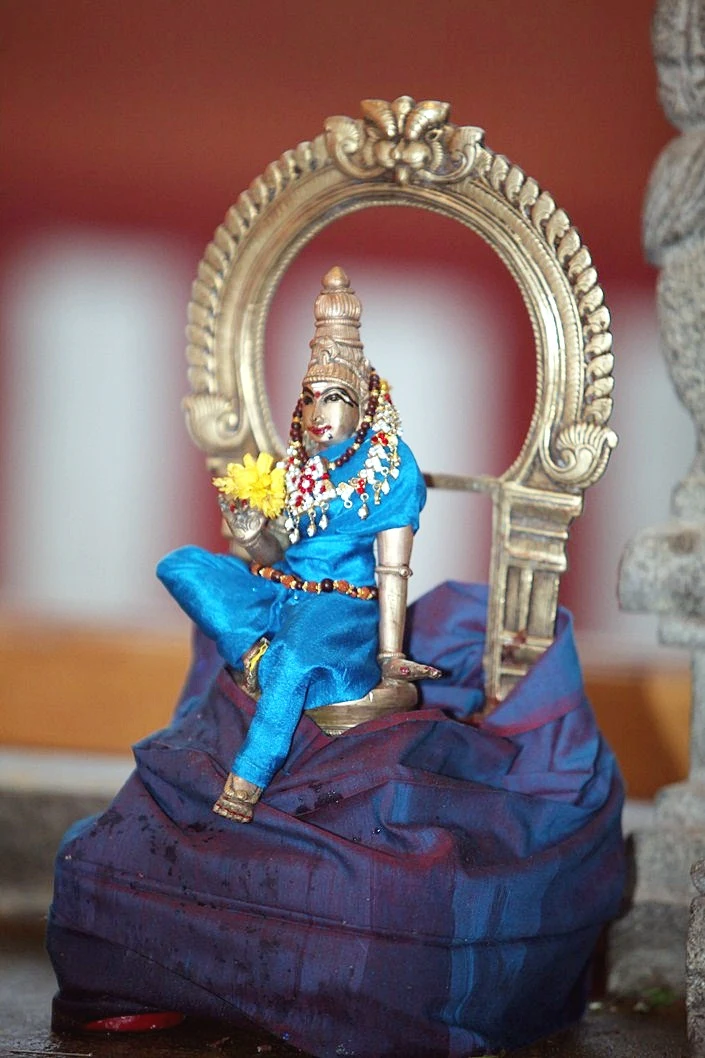
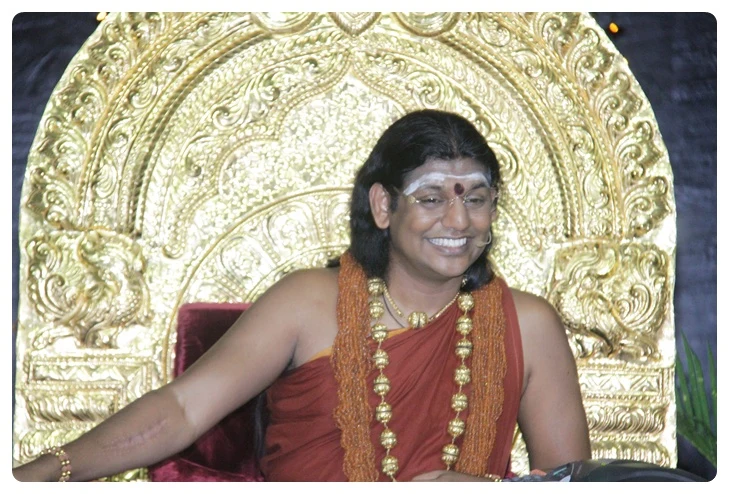
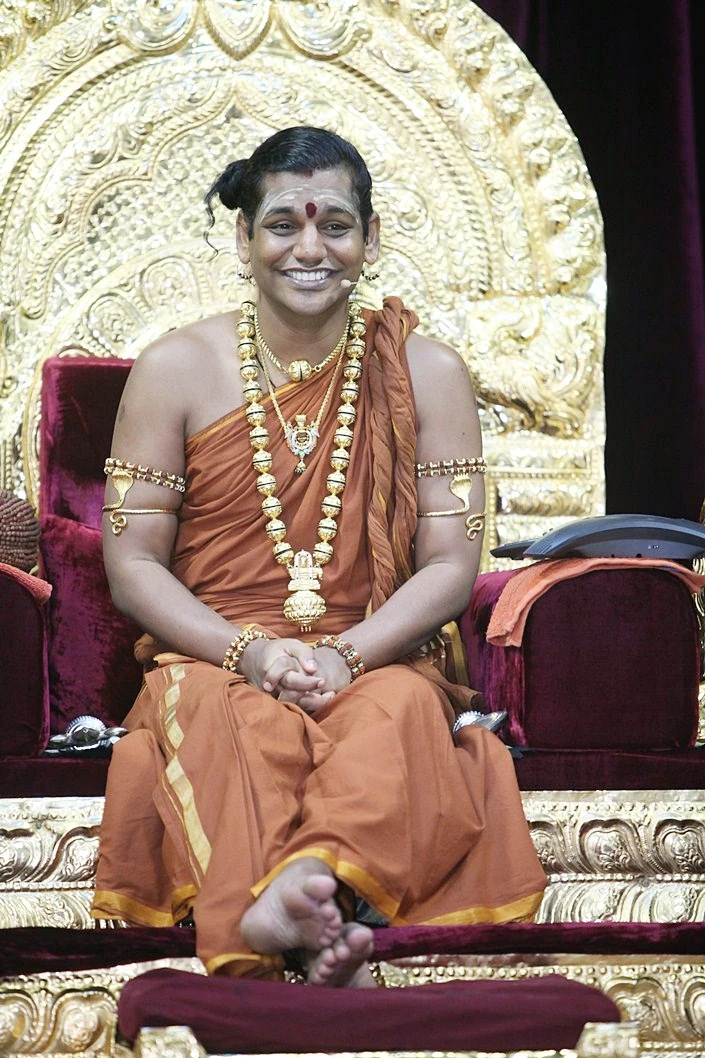
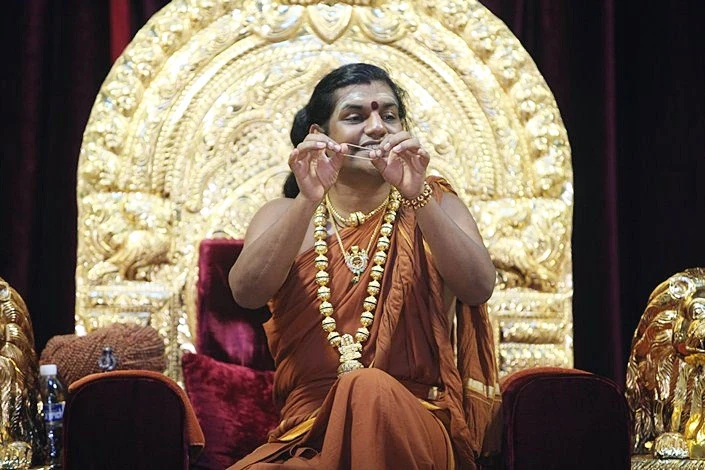
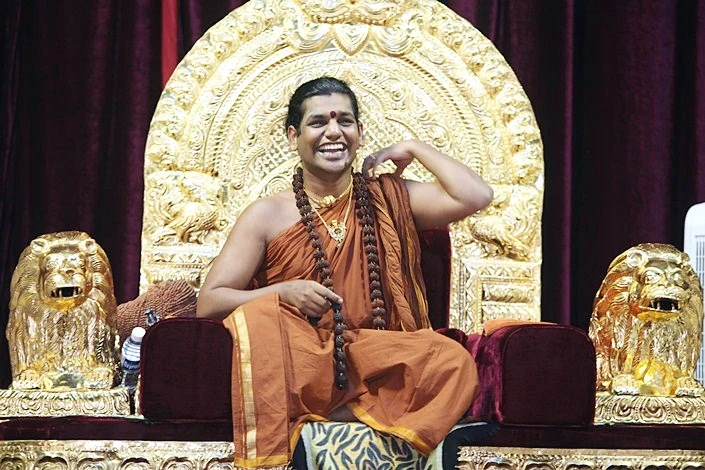
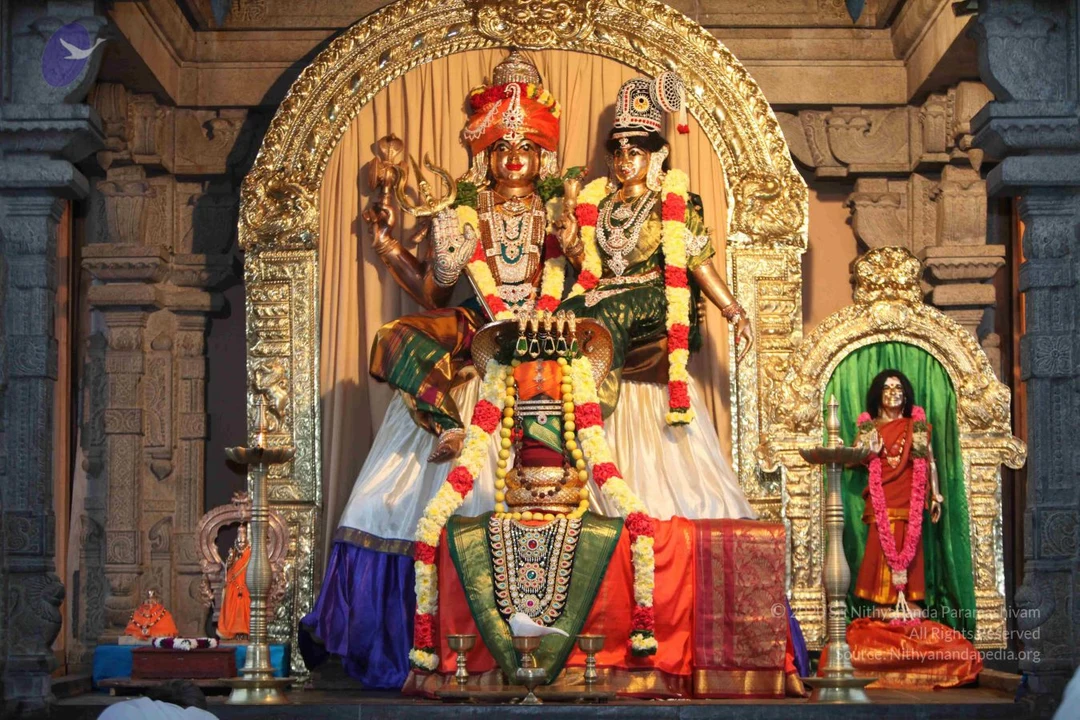
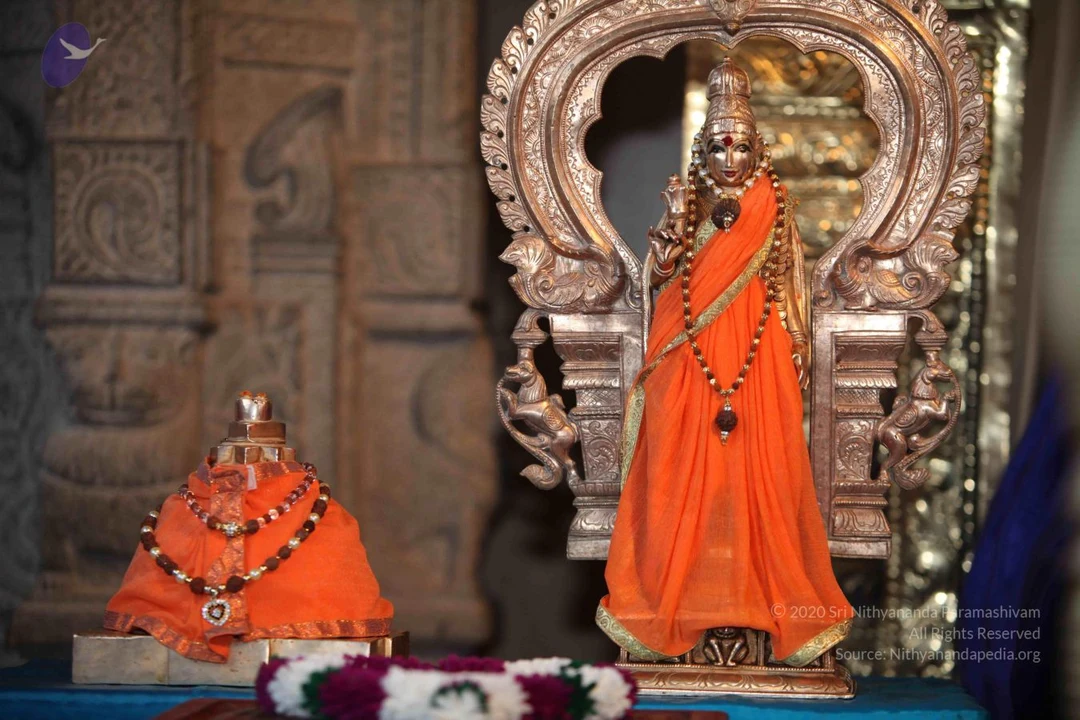
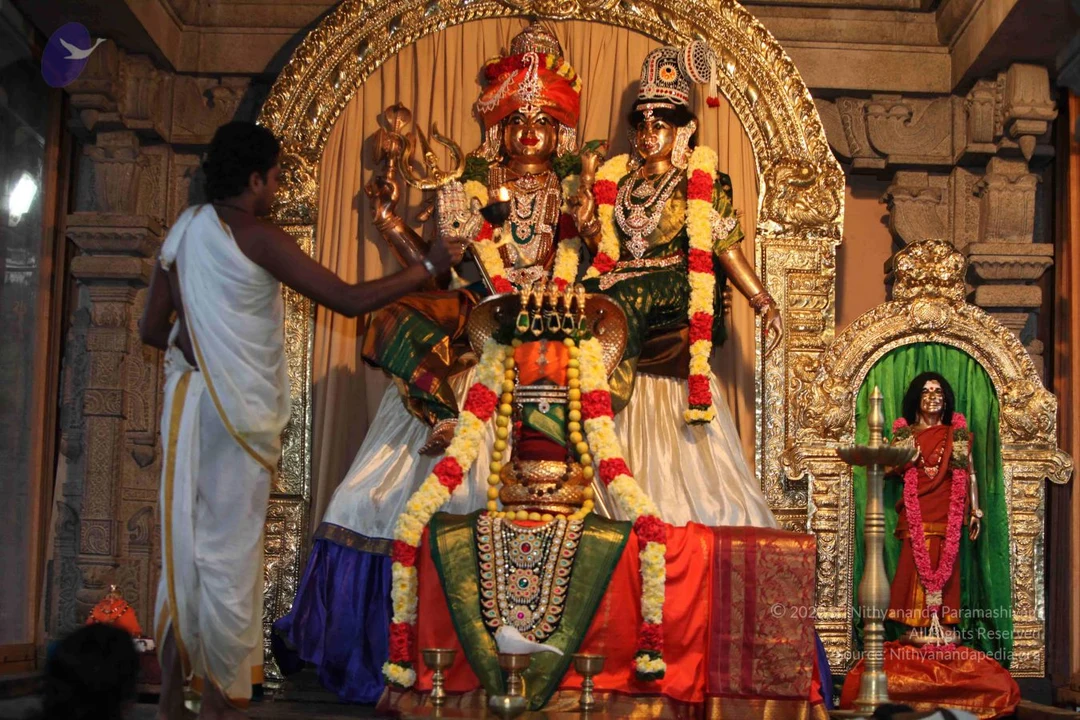
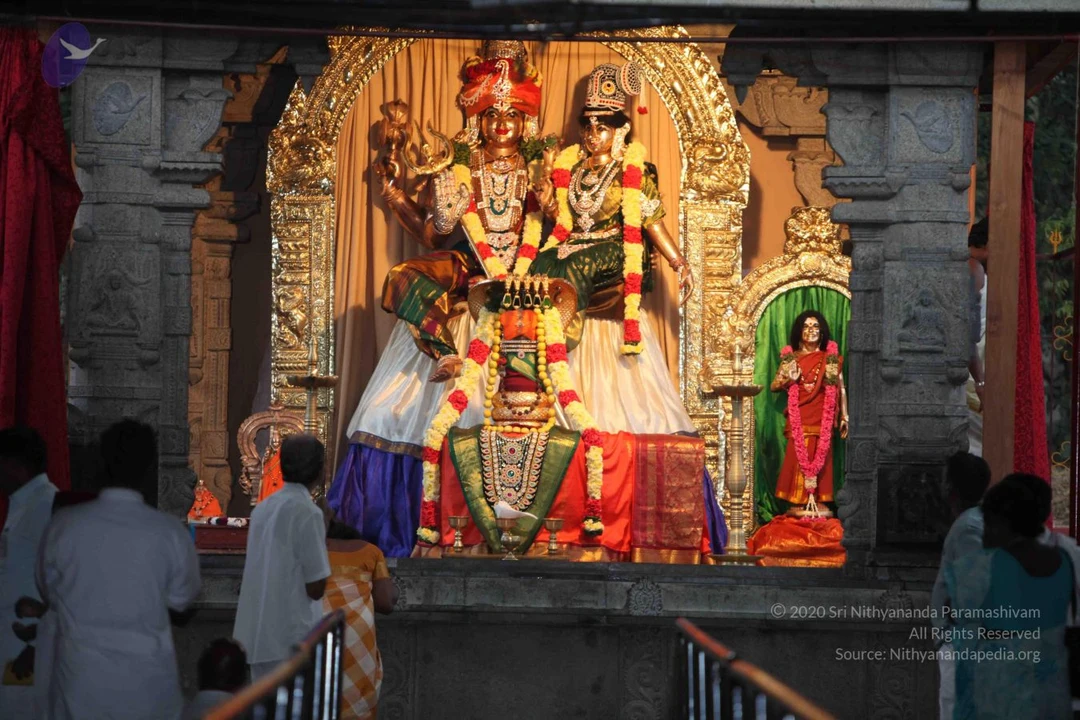
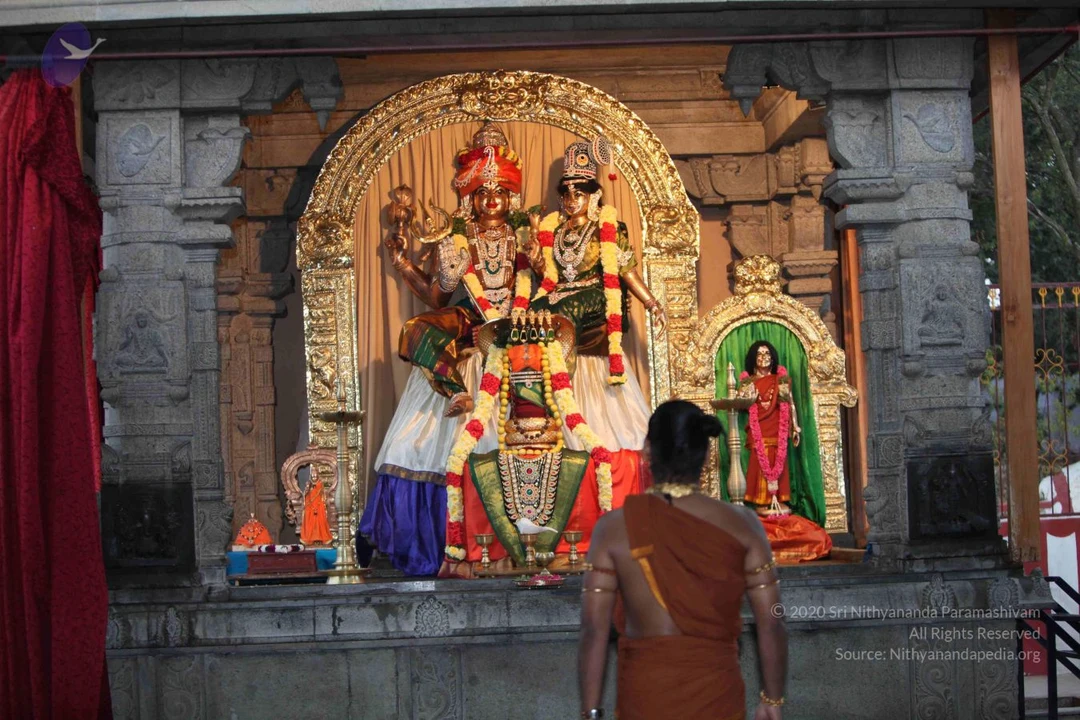
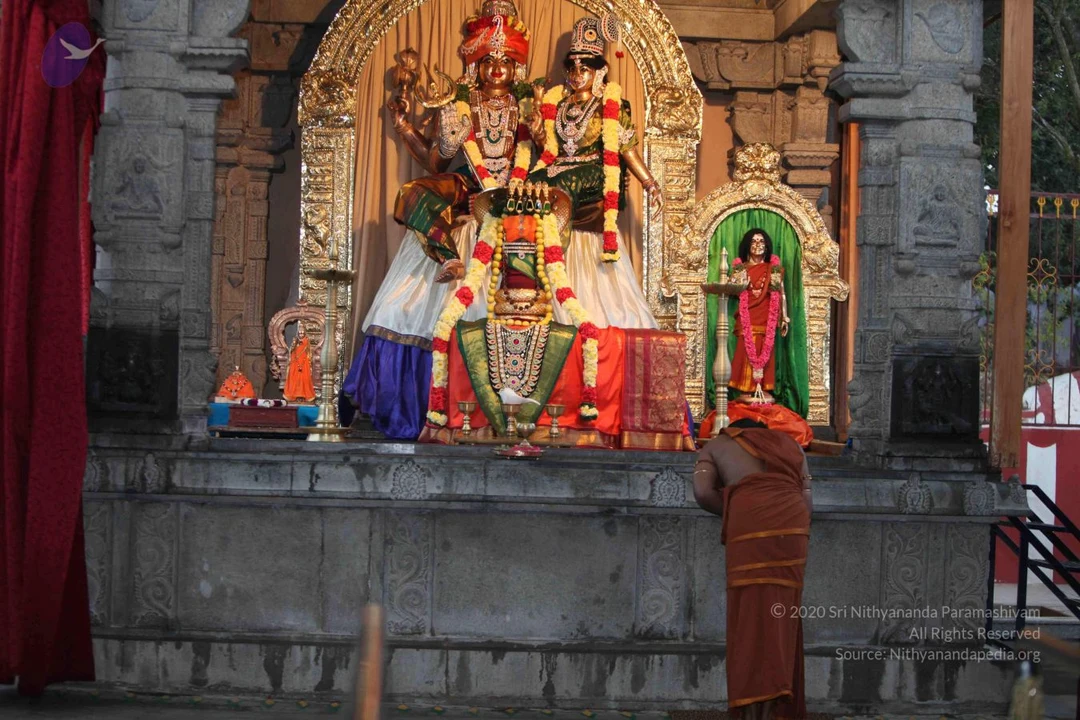
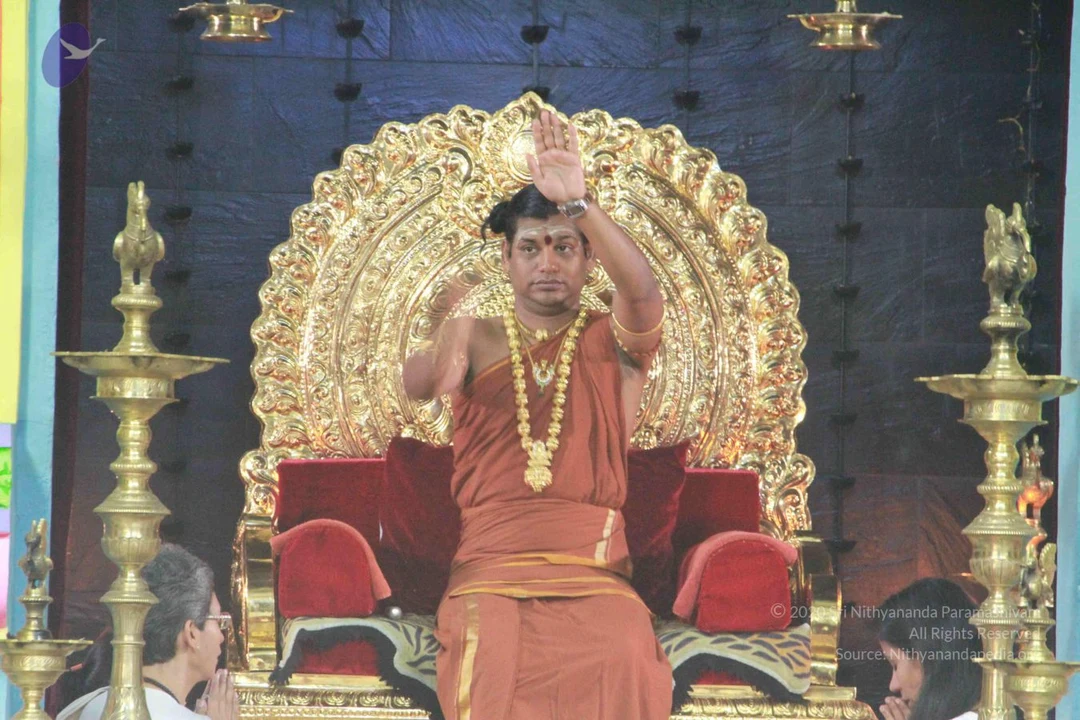
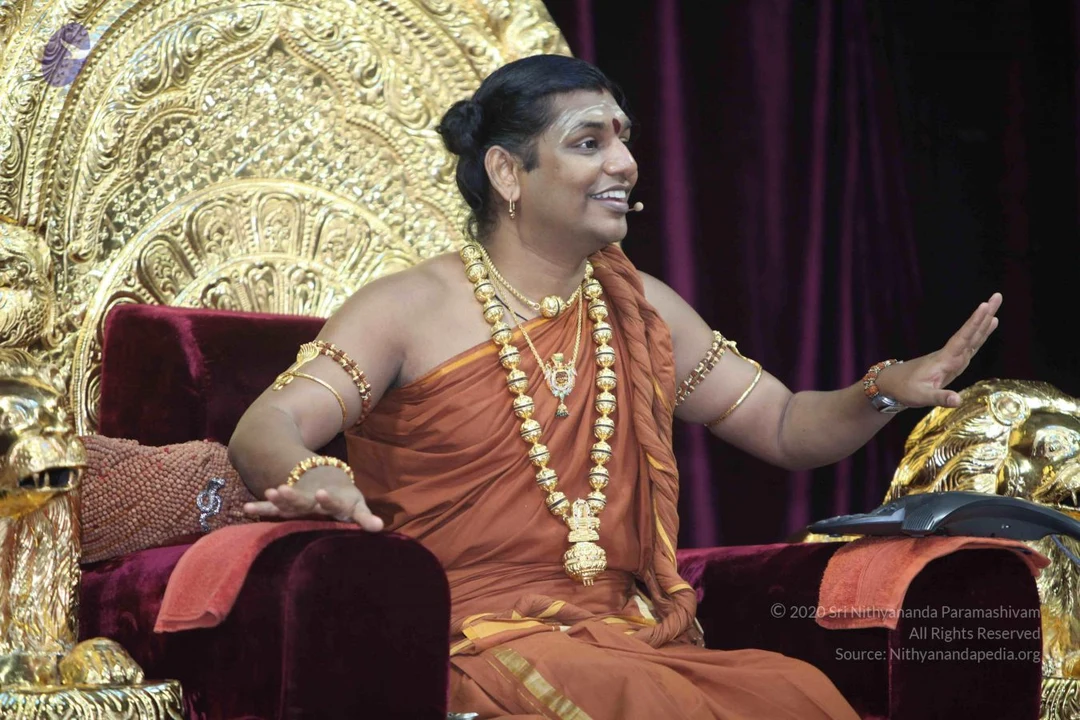
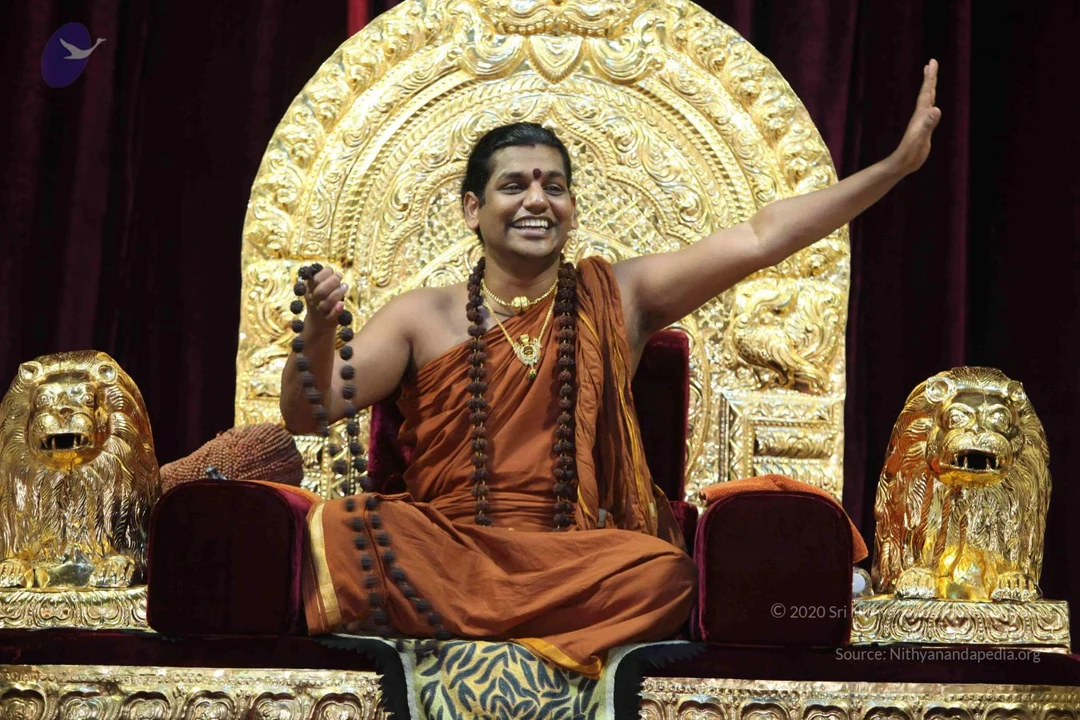
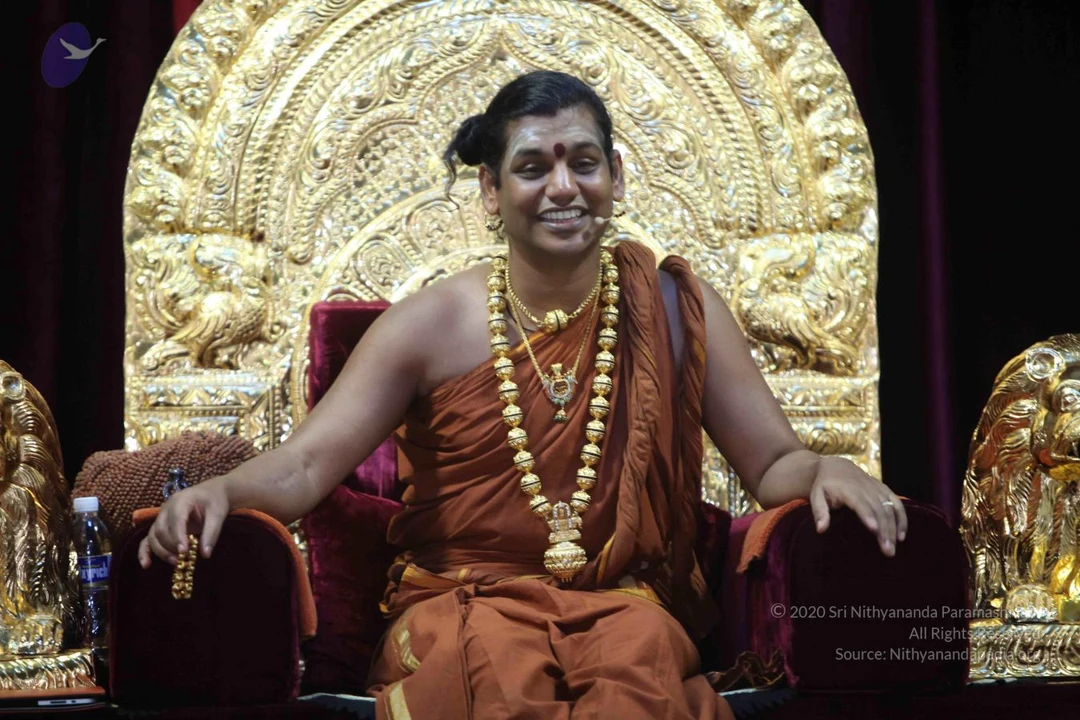
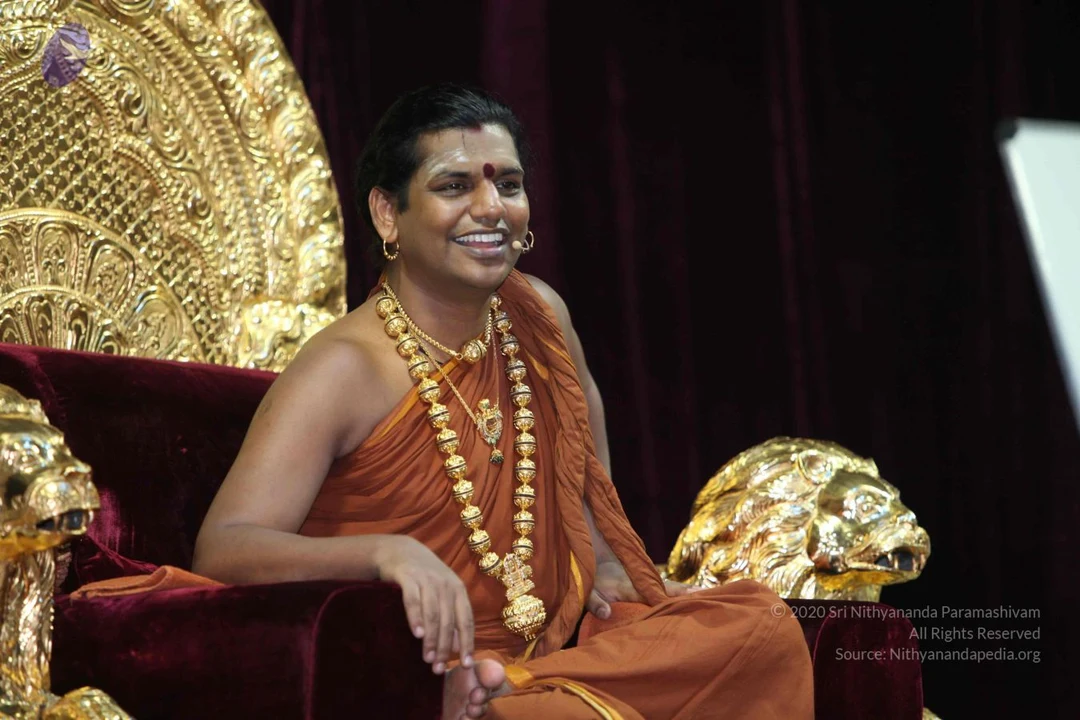
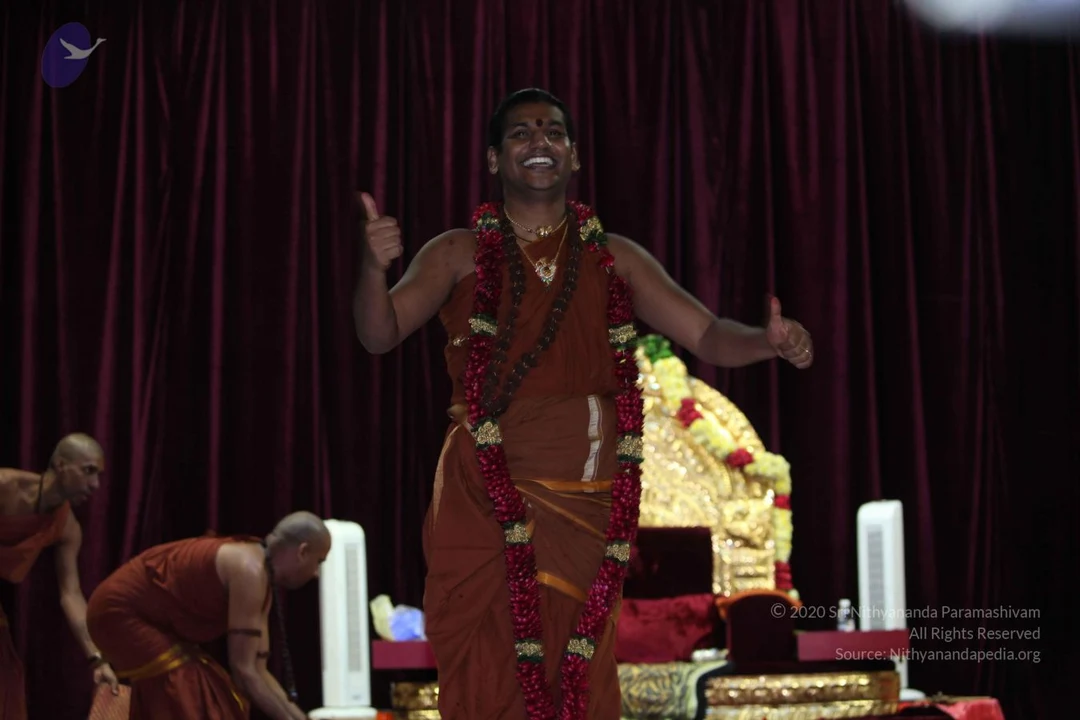
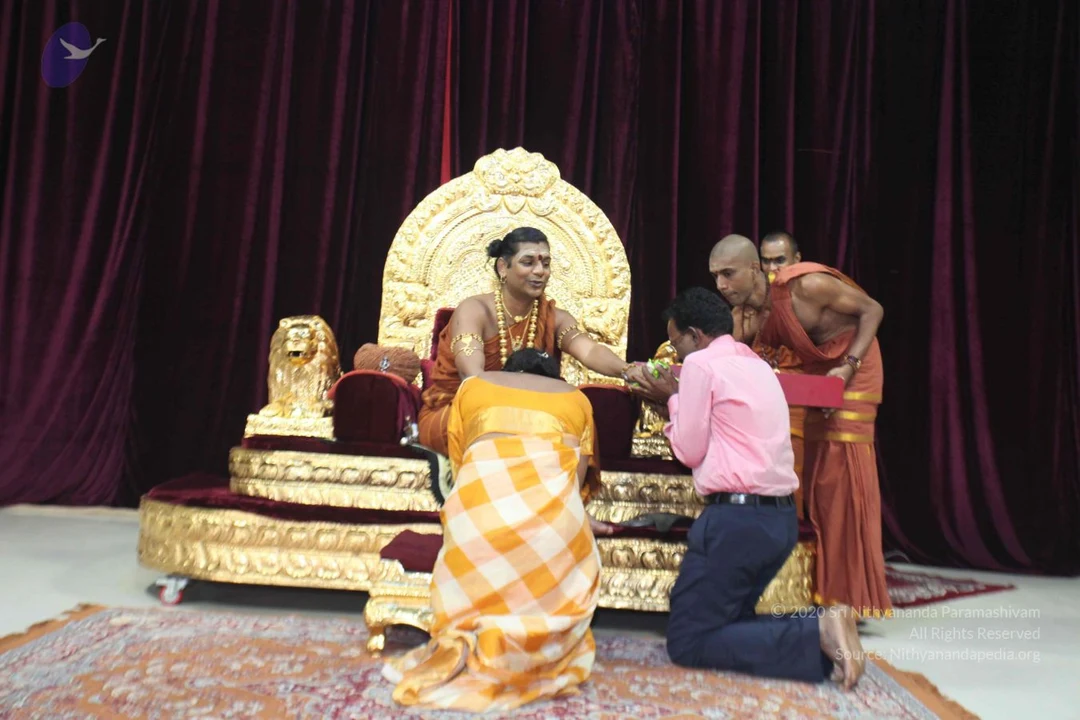
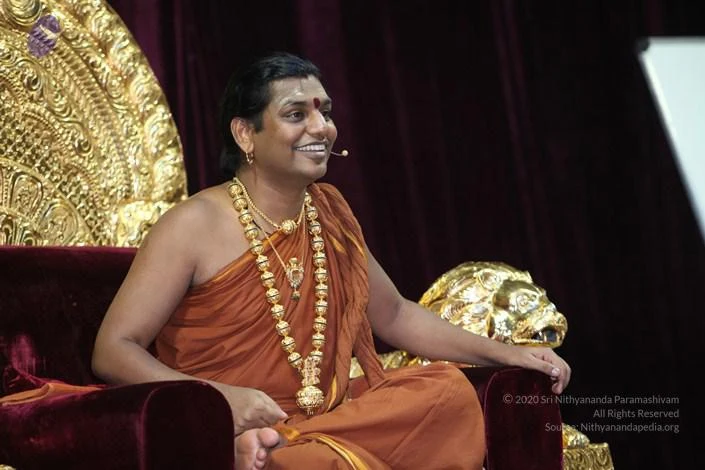
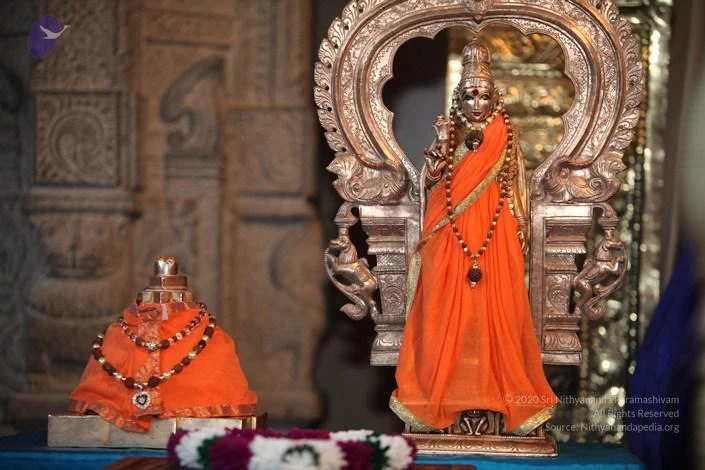
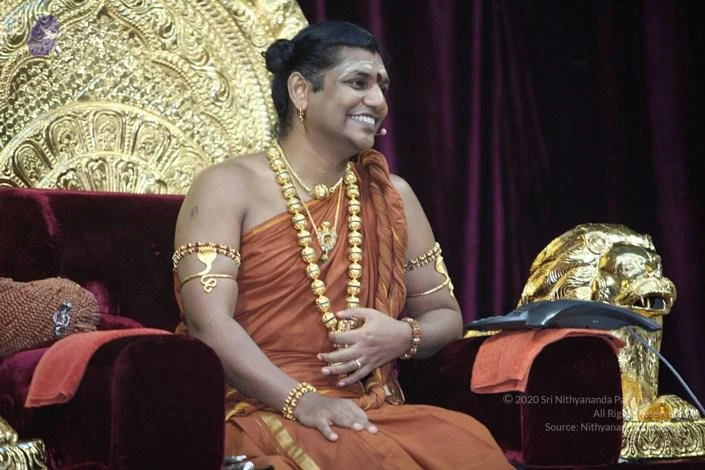
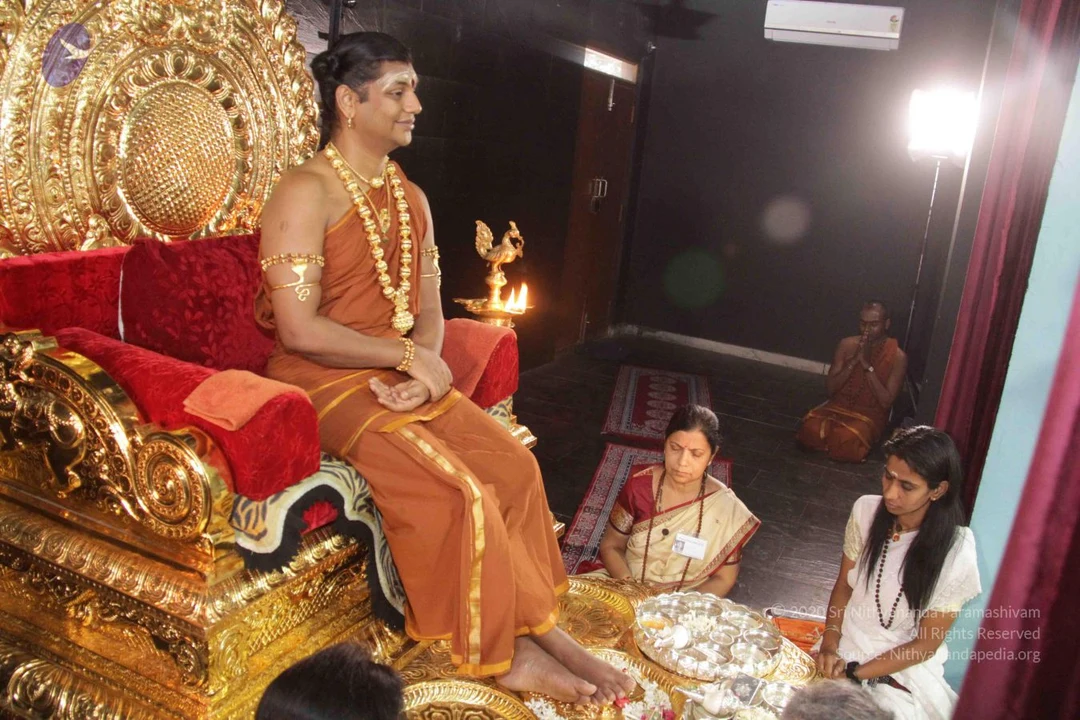
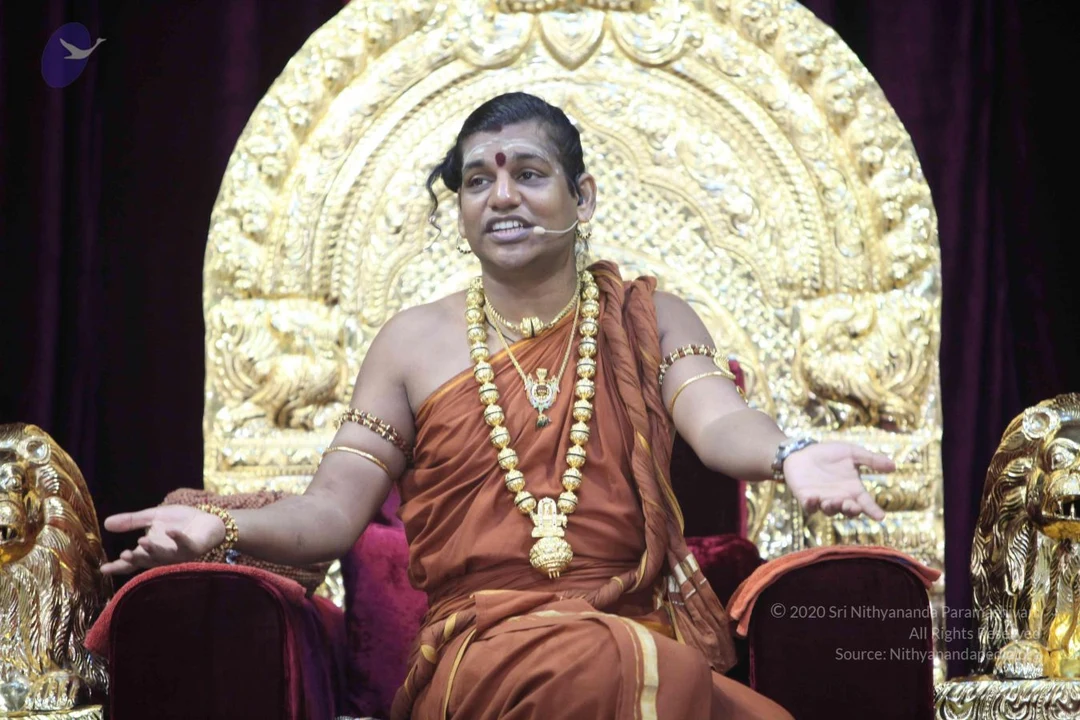
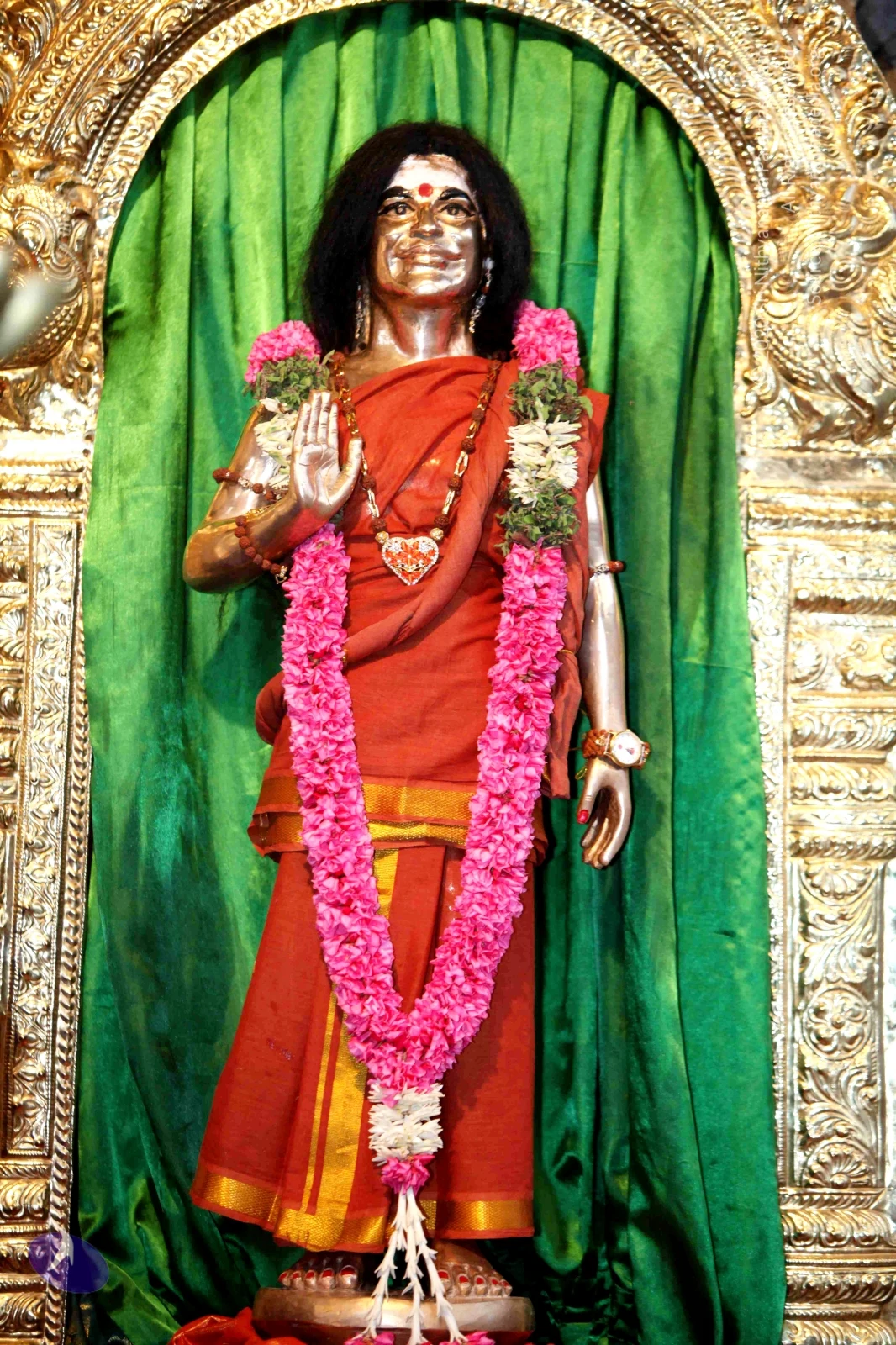
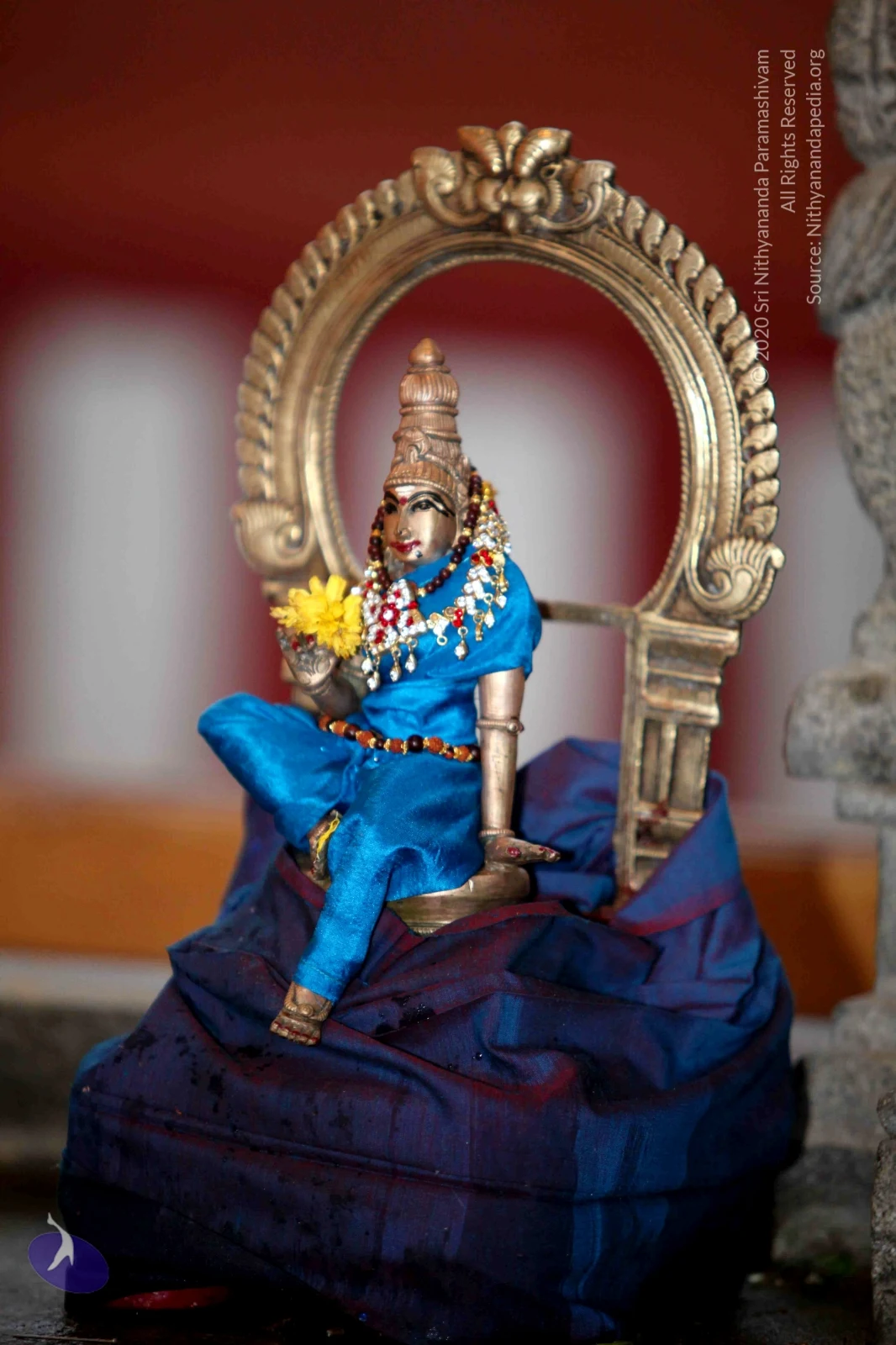
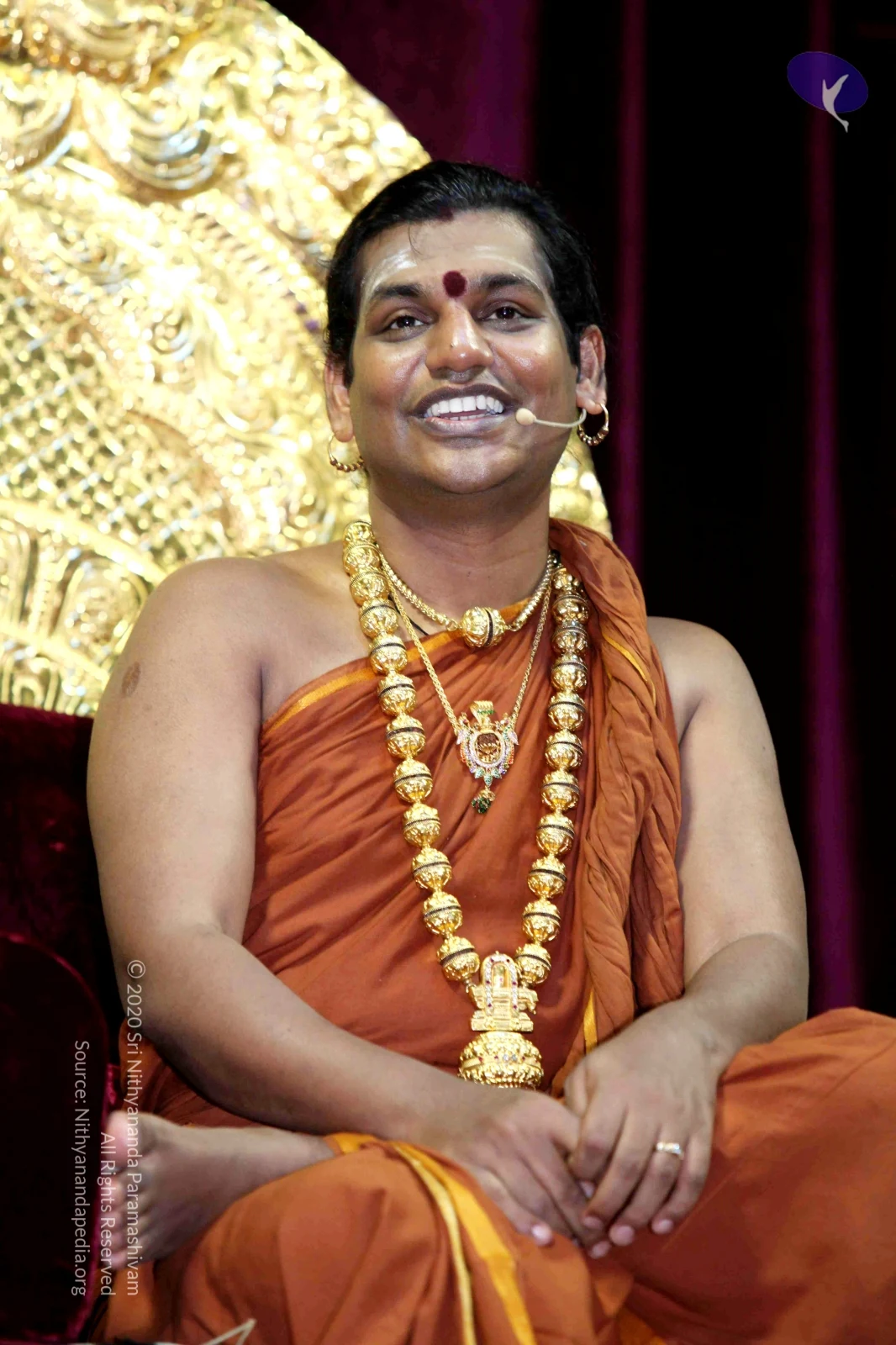
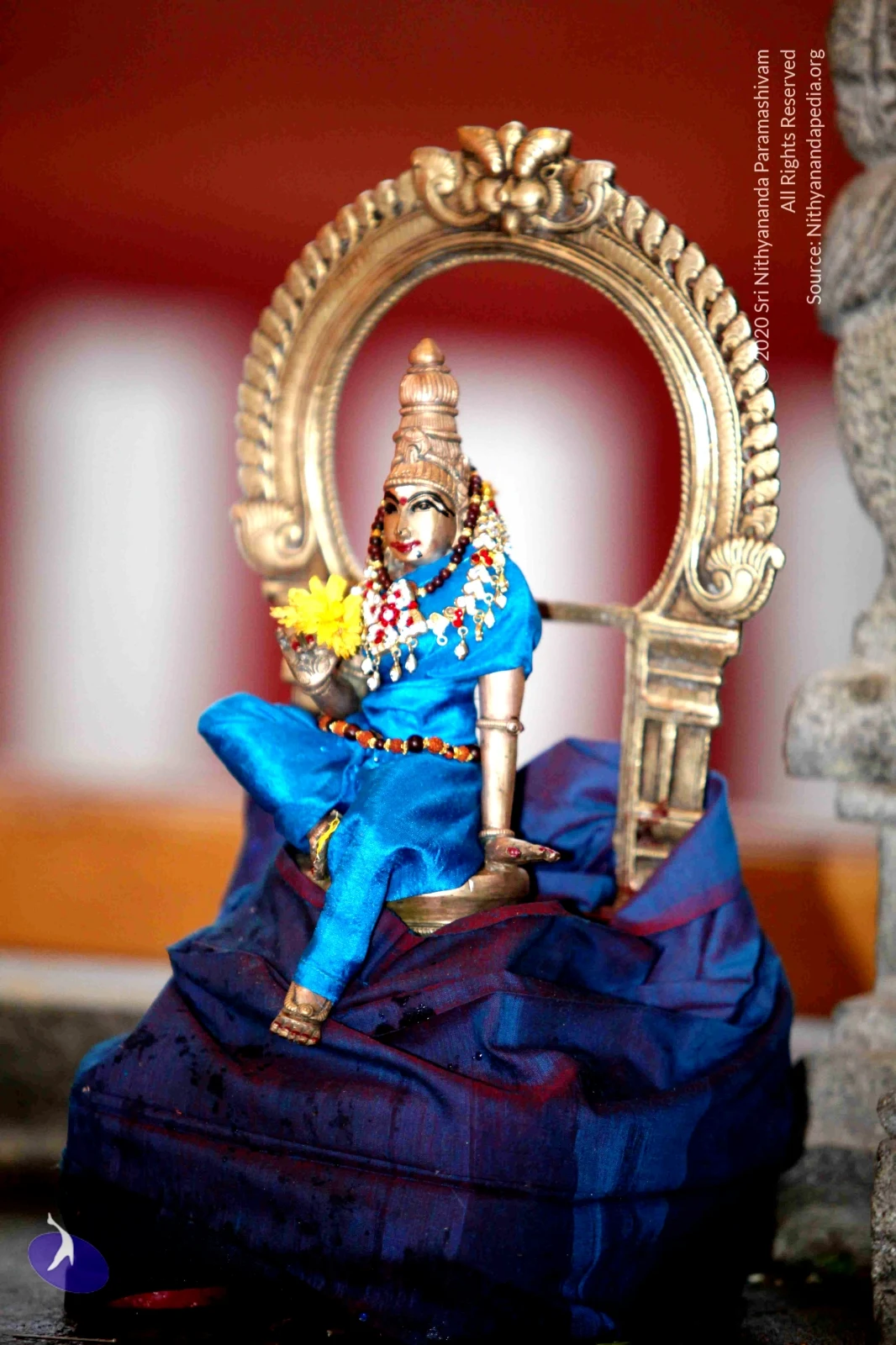
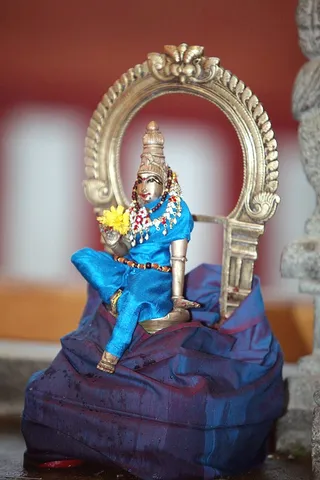
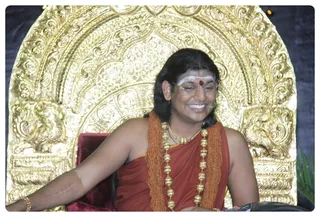
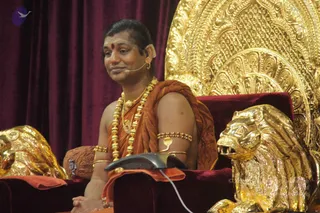
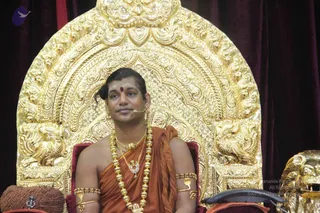
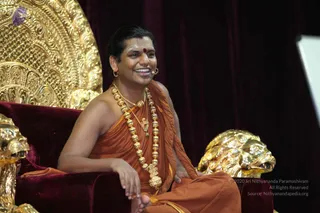
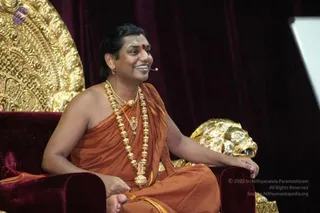
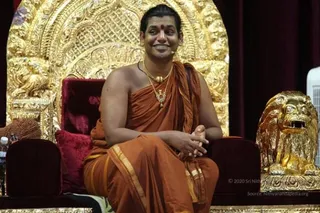
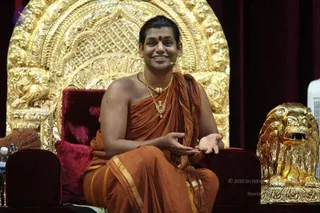
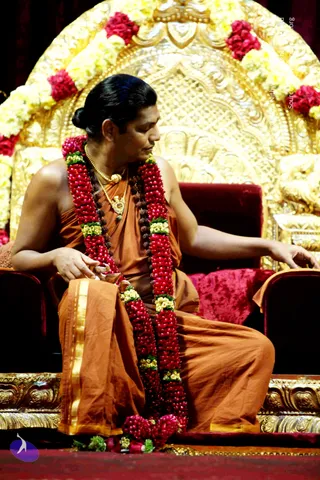
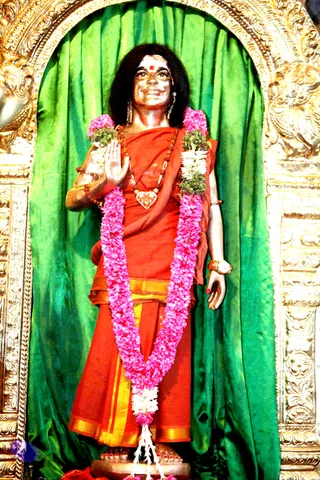
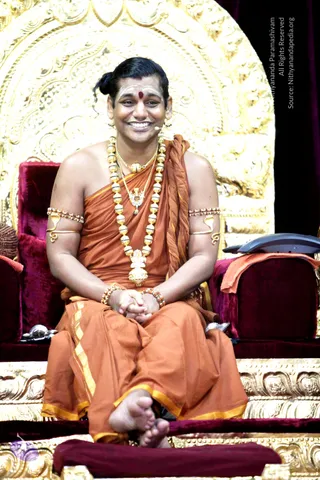
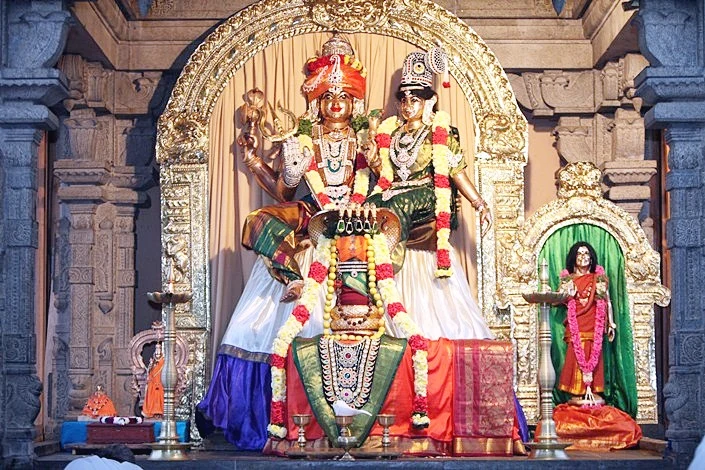
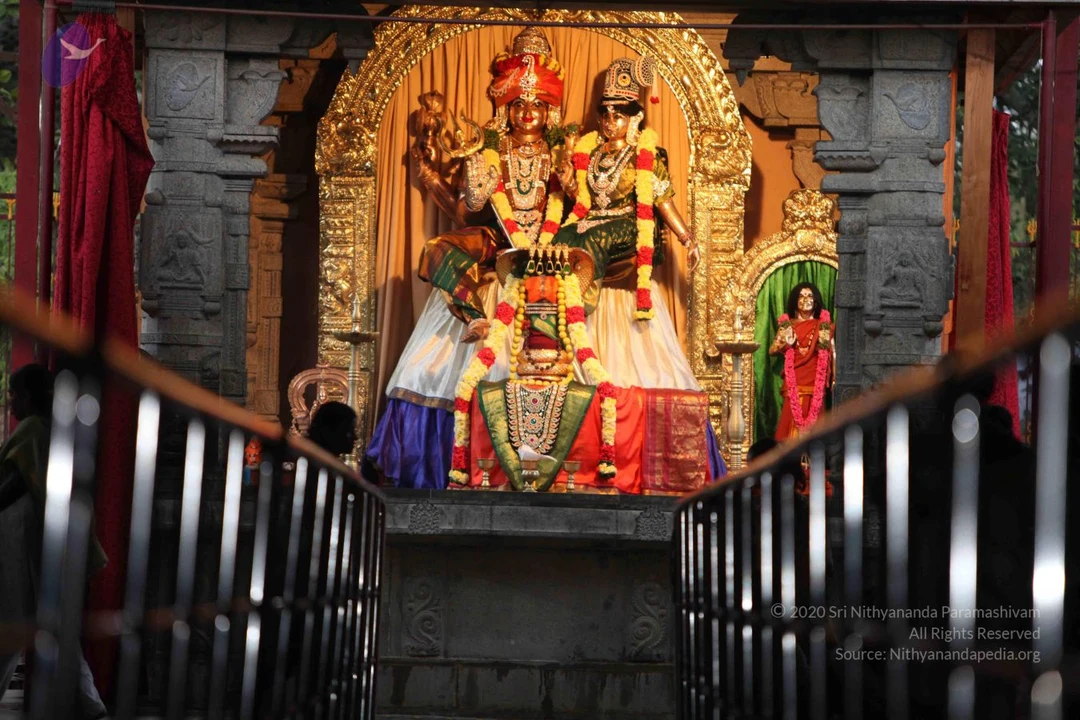
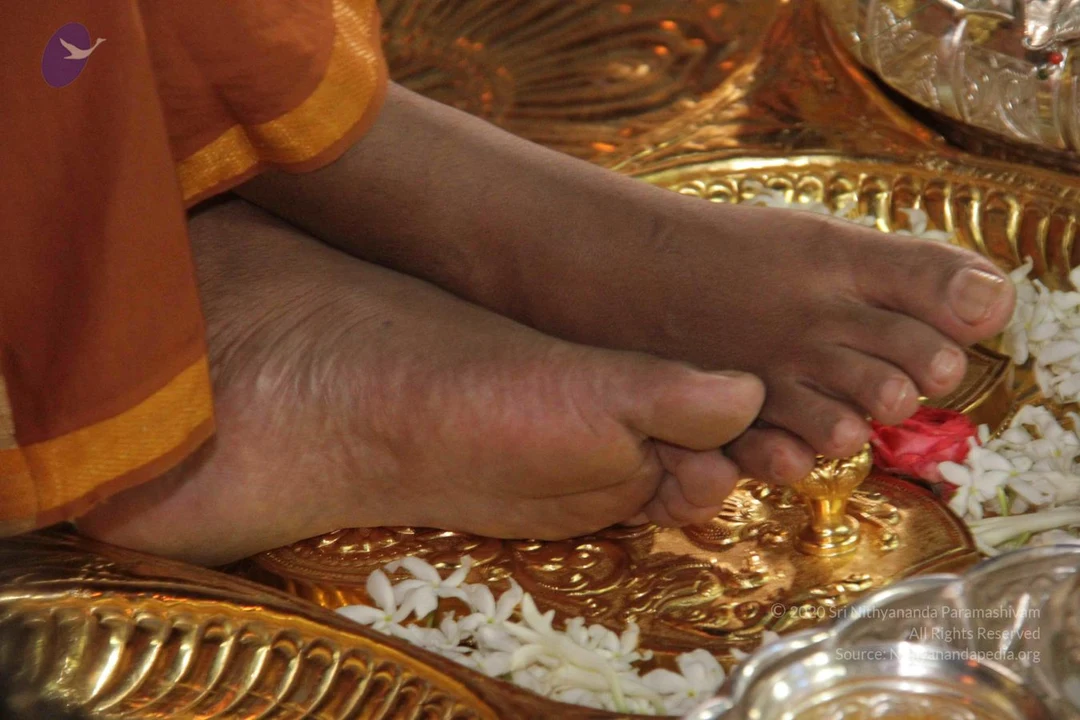
A photograph of a temple shrine with a large deity murti pair, a male figure with a red-and-orange turban and a female figure in a green and gold sari, both adorned with thick garlands of red and white flowers and gold necklaces, seated beneath a gilded arch with stone pillars. Brass oil lamps stand on either side and a smaller seated figure in orange with a flower garland sits in a green-curtained niche to the right. No physical people are visible in the scene apart from the statues, so the count is zero.A small gilt metal deity murti seated within an ornate golden arched prabhavali halo on a draped purple-blue silk cloth. The figure wears a blue silk garment, a tall crown, a red-and-white flower garland with beaded strands, and holds a yellow flower in one hand. A red-orange bead necklace hangs at the chest. A blurred red background and a carved stone pillar appear at the edges. No physical people are visible.A photograph of a ceremonial shrine setup. On the right stands a figure. The figure is set within an ornate silver-toned arched frame flanked by carved makara-like supports. On the left sits a mound-shaped object draped in orange cloth with a matching rudraksha mala and a golden peak, placed on a silver base. Fresh white and magenta flower garlands lie on a blue cloth in the foreground, with carved stone walls behind. No physical people are visible.Close-up photograph of a pair of bare feet resting on a polished gold tray during a padapuja ritual. The feet belong to a person wearing an orange-and-gold bordered garment. White jasmine flowers and a red flower lie scattered on the golden plate, and a small gold cup-like vessel sits beside the feet. Silver bowls are visible at the lower right. Only the feet and lower garment are visible, so no face or full figure is shown.A close photograph of an ornate silver ritual tray with repoussé floral engraving. Several small silver bowls hold honey-coloured liquid, a bowl of white jasmine-like flowers sits at centre, and a silver figurine of a tortoise or turtle rests on the tray. A small silver-covered rectangular box with a flower engraving is at the top right. Frangipani-like white flowers lie among the bowls, and red flowers and gold ceremonial objects appear at the top left, with a person's fingers partly visible at the upper left edge. The setting suggests a temple puja offering arrangement.A smiling man sits in a red upholstered chair in front of an ornate gold-painted arched backdrop with carved scrollwork. He wears an orange-red shawl over bare shoulders, a rudraksha mala with gold beads, a gold necklace, and a white-painted forehead with a red dot. Swamiji (probable): long dark hair, saffron-red shawl, rudraksha mala and ceremonial gold necklace, seated on the throne as a satsang speaker. A green plant is visible at the right edge. Photo of a satsang setting at Adi Kailasa.

TEMPLE

22 photosSource gallery
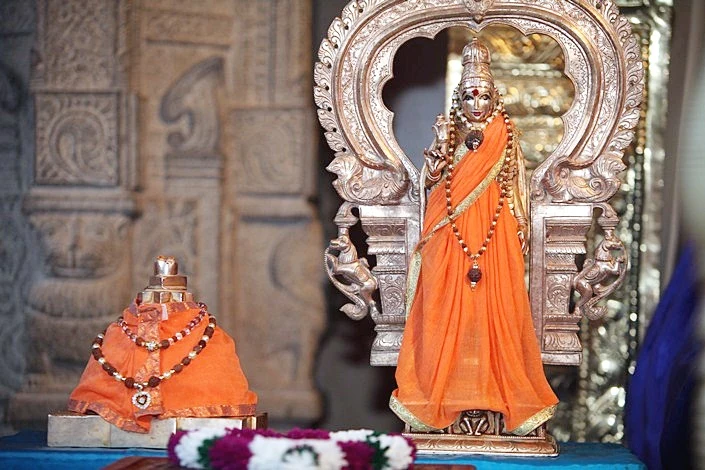
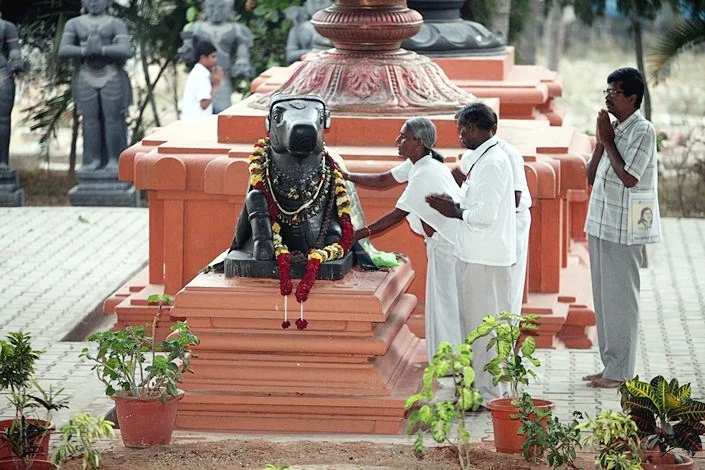
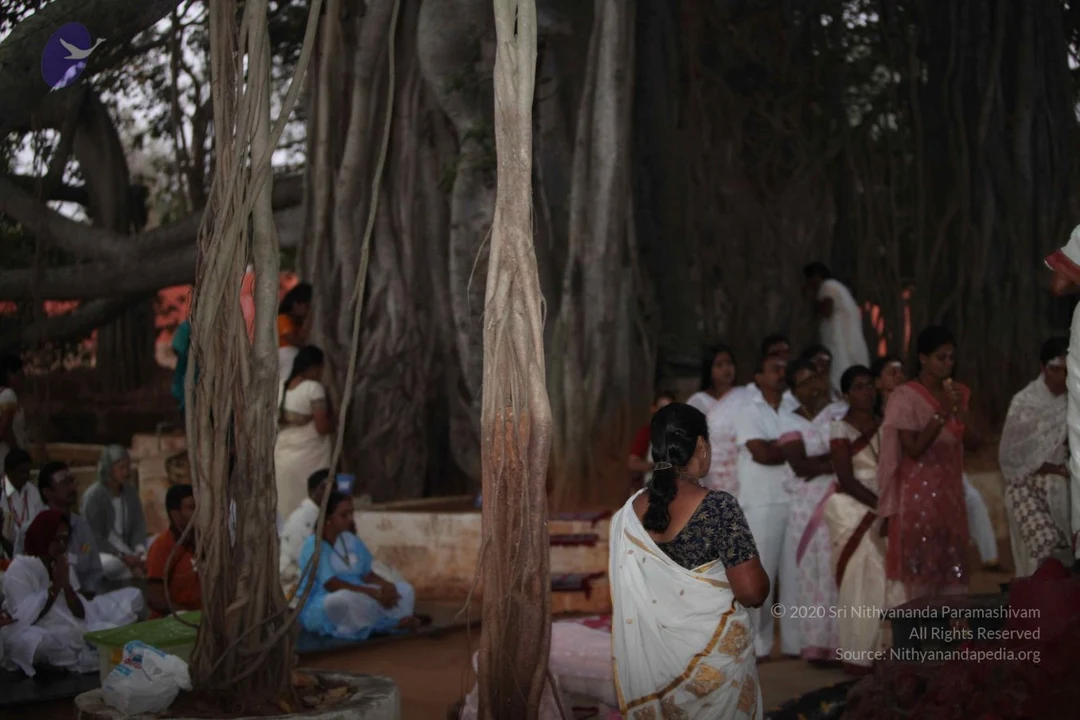
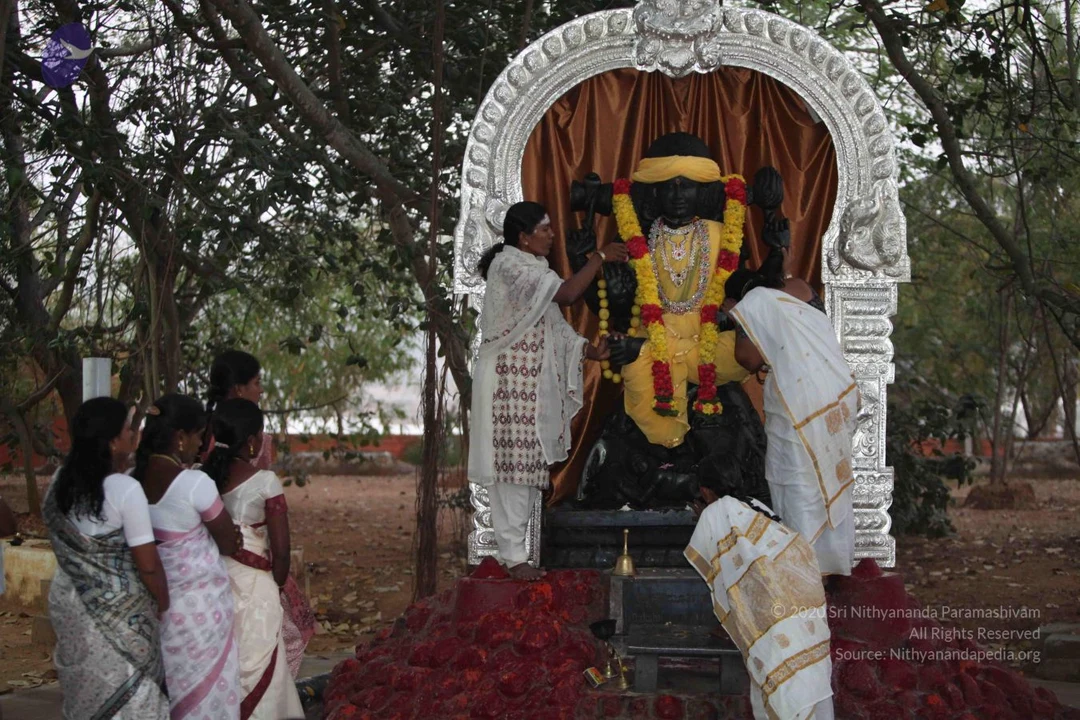
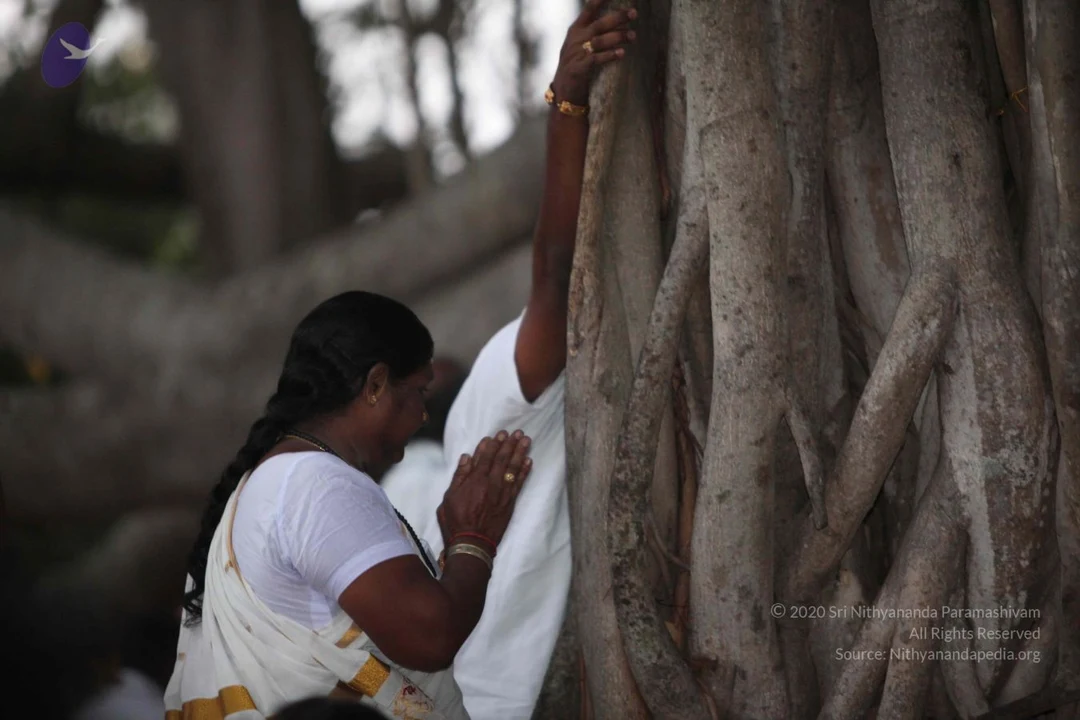
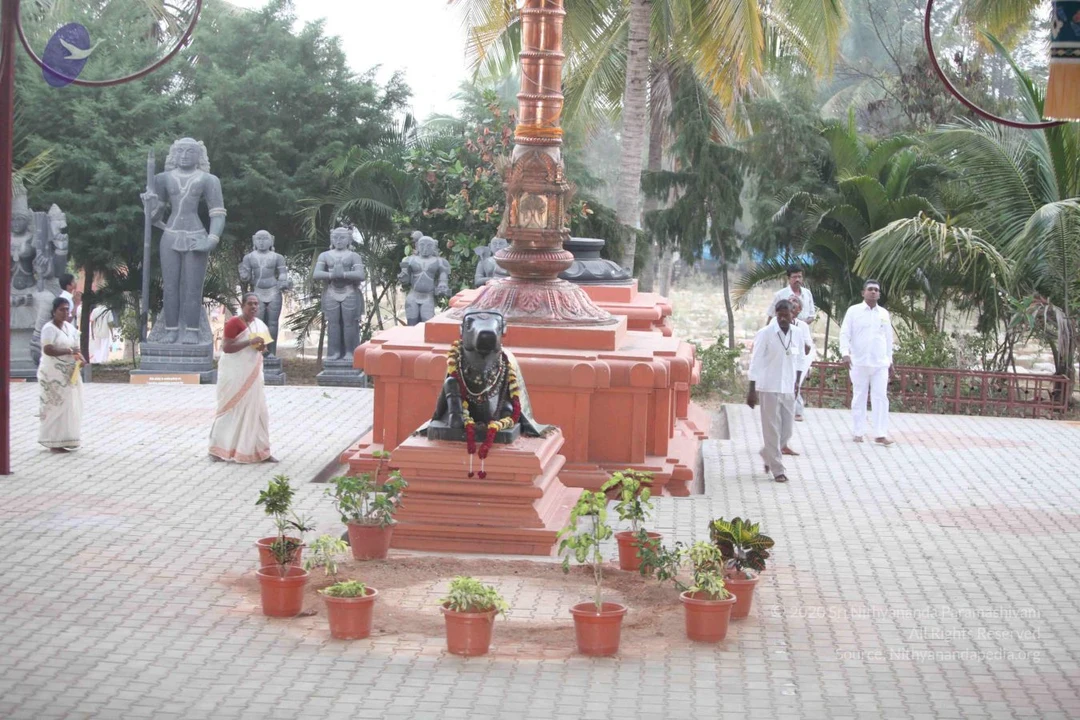
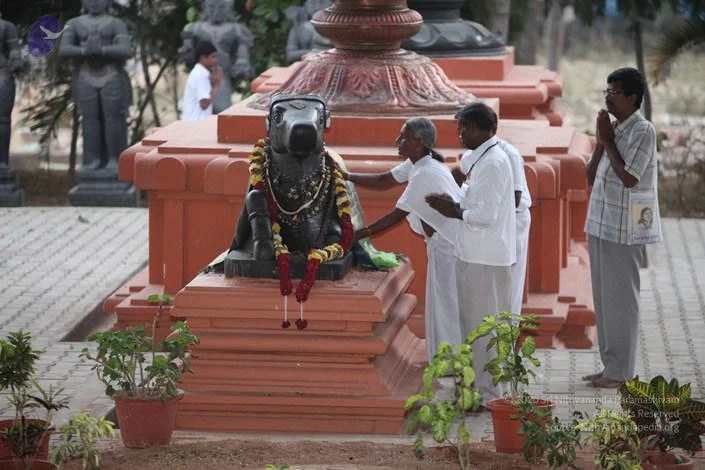
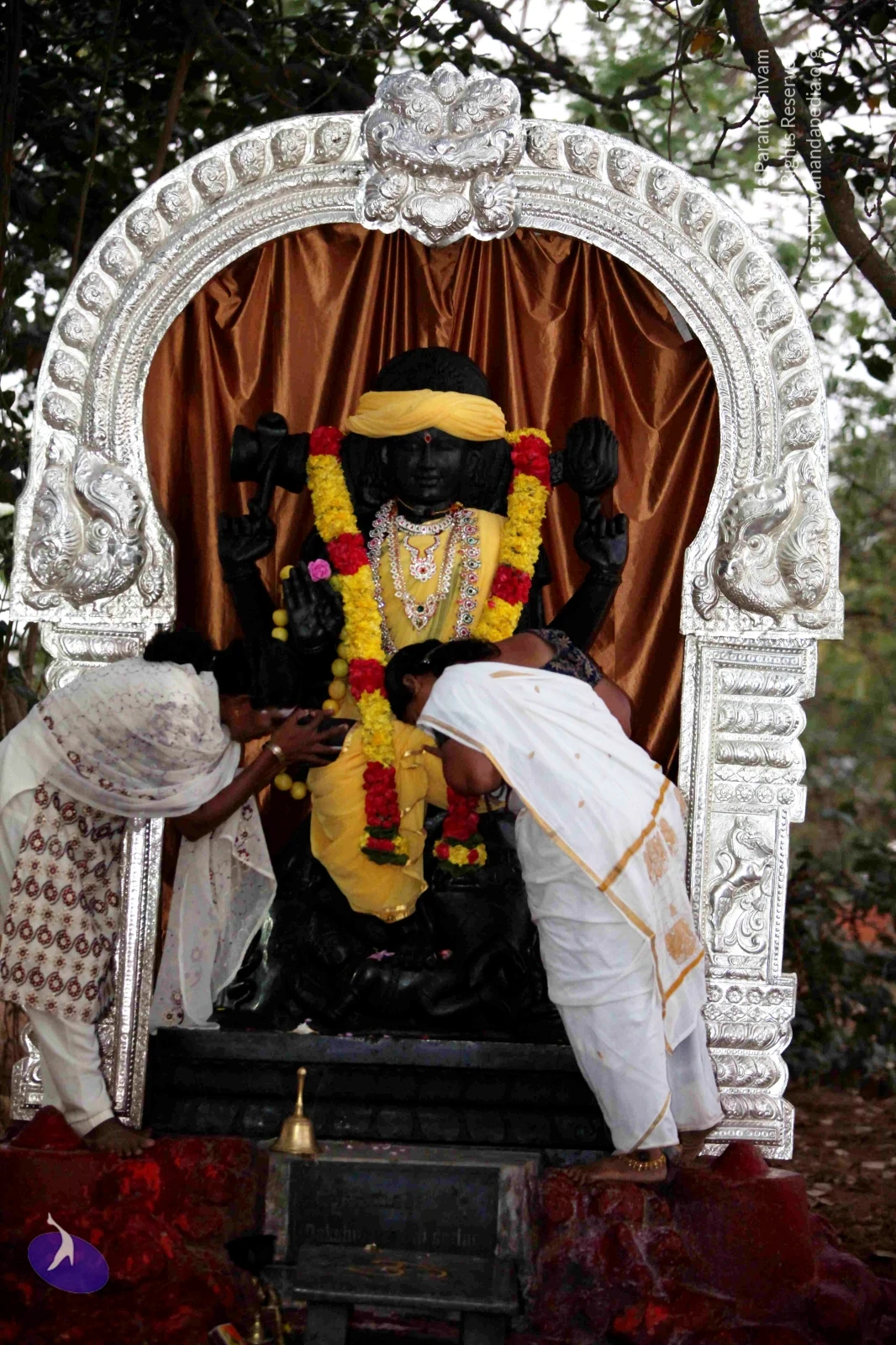
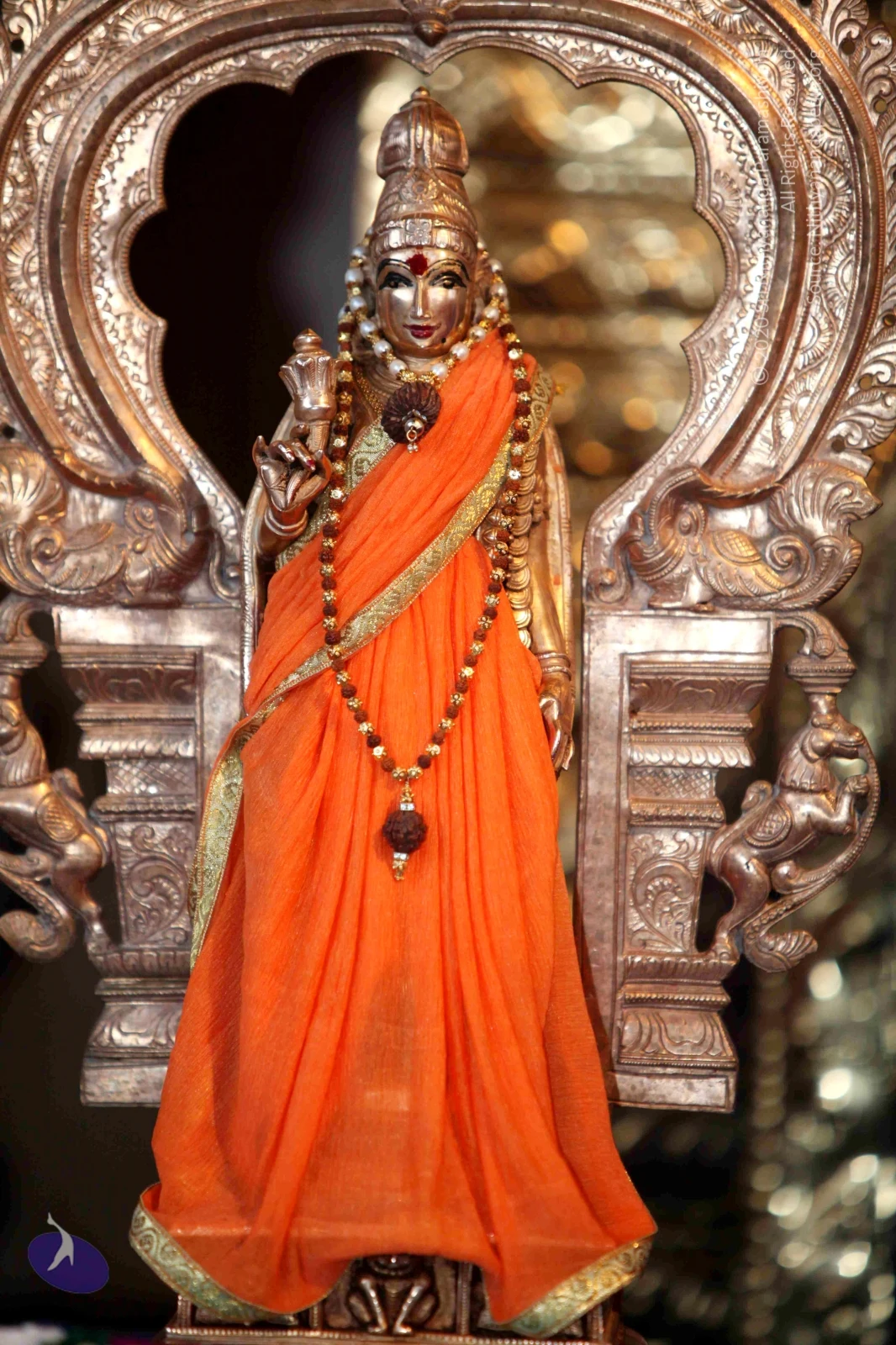
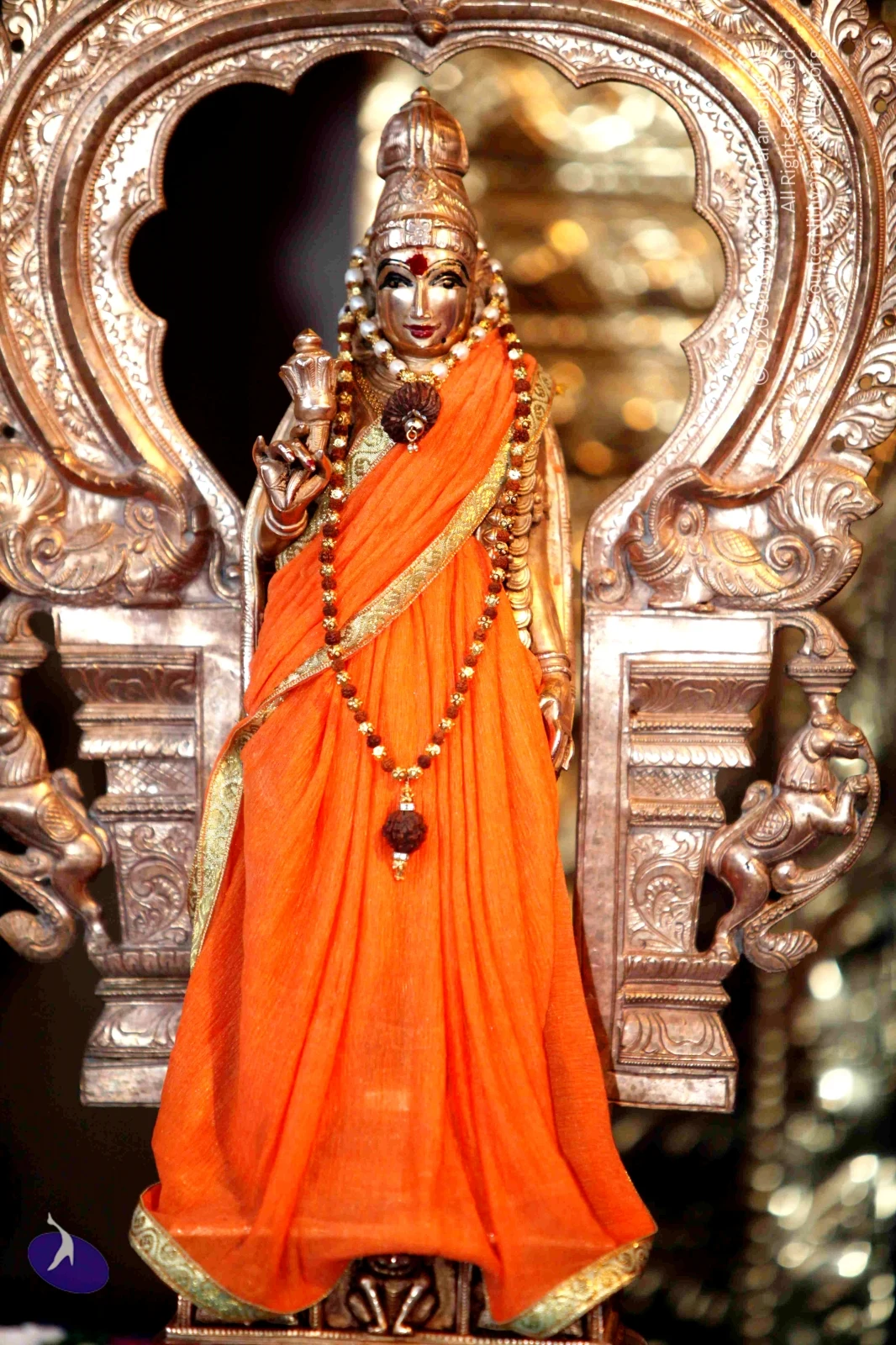
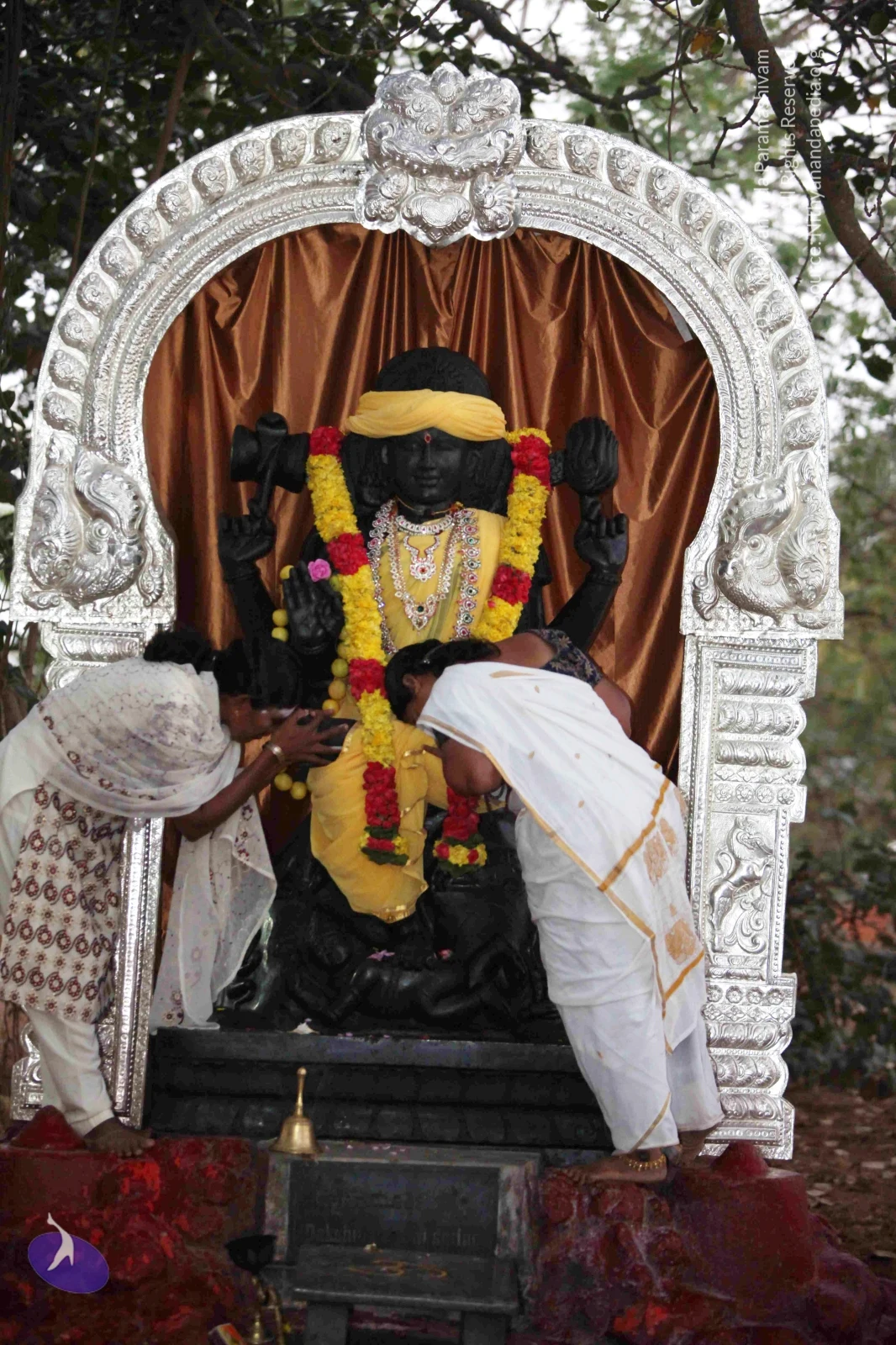
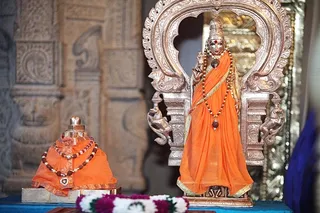
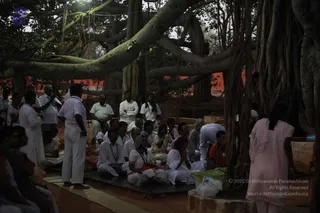
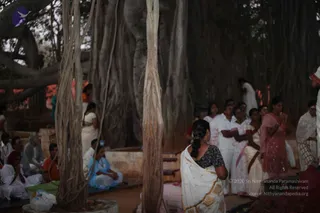
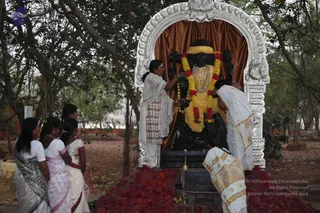
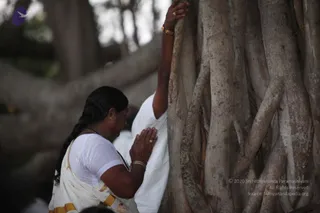
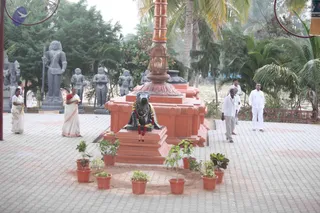
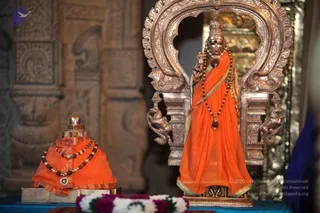
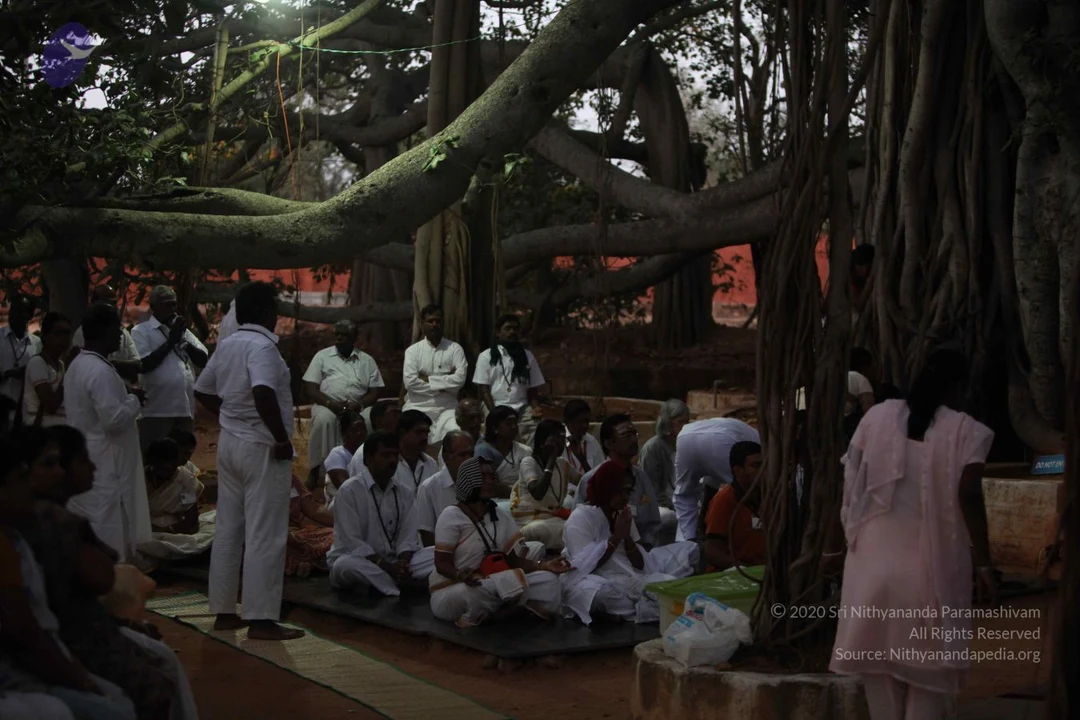
Outdoor satsang gathering beneath a large banyan tree with sprawling aerial roots and thick branches. Devotees in white ritual clothes sit on mats and a dark cloth on reddish earth, some with hands folded in prayer. A standing man in white shirt and trousers on the left and a woman in pink robes on the right appear to attend the gathering, and a person in orange clothing sits at the right edge. A green plastic bag and water bottles rest near the seated group. Dusk light filters through the foliage.A photograph of devotees gathered outdoors beneath a large banyan tree with hanging aerial roots. In the foreground a woman with hair in a braid, wearing a white sari with gold border and a dark blouse, stands with her back to the camera. Behind her and around the tree, several people in white and pastel clothing sit and stand, some with hands folded in prayer. A woman in a pink sari stands at right with hands together. Stone platforms and a dusky evening light surround the scene.Outdoor puja at a black stone deity murti set within an ornate silver arch, draped in an orange cloth and adorned with red and yellow marigold garlands and layered necklaces. A woman in a white shawl with red-patterned border stands at the statue, hands raised to its face. Beside her, a man in white dhoti with gold border offers at the base, where red flower petals are heaped on the ground with brass lamps and a small bell. Several women in white and pink saris watch from the left under shady trees.A woman in a white blouse and cream sari with a gold border stands with palms pressed together in prayer, her long dark plait falling over her shoulder. She wears bangles and a red-thread wrist band. She leans toward a large banyan tree whose thick, twisted aerial roots fill the right side of the frame. Another person in white clothing stands behind her with one arm raised, touching the trunk. The background is softly blurred with more trees and out-of-focus figures.A photograph of an outdoor temple courtyard with a paved grey brick floor and palm trees. At the centre is a red-orange stepped base supporting a tall ornate pillar and a dark stone Nandi bull with a red and white garland around its neck, flanked by potted plants. Behind are grey stone deity statues on pedestals. On the left, a woman in a white sari with a red border stands with folded hands, beside another woman in a white sari. On the right, men in white shirts and trousers walk and stand near the base, one in a light grey outfit. No one is wearing identifiable a person cues in the scene.A photograph of a metal statue standing in a silver-toned arched niche with carved scrollwork and lion-like figures at its base. The standing figure wears an orange saffron cloth draped over the body with a gold border, a tall crown-like headdress, and a long rudraksha mala with a large bead pendant. A smaller seated figure or pedestal to the left is also draped in orange cloth with a beaded mala and a heart-shaped pendant, set beside a stone-carved temple wall. Below, a garland of purple and white flowers rests on a blue cloth. No physical people are visible; these are statues and sacred murti depictions.

PADA-POOJA
20 photosSource gallery
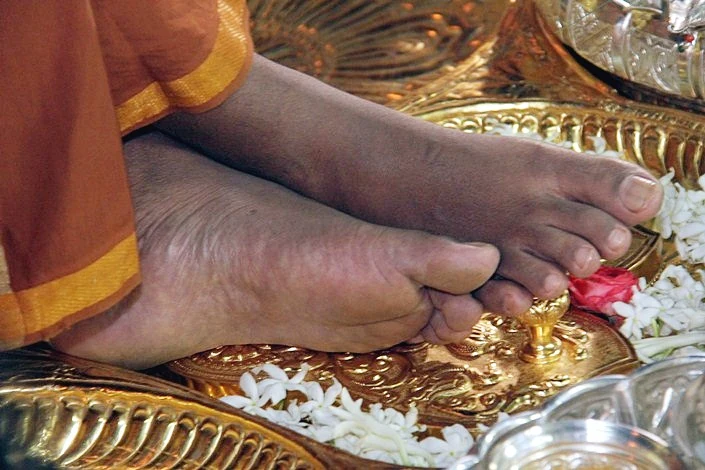
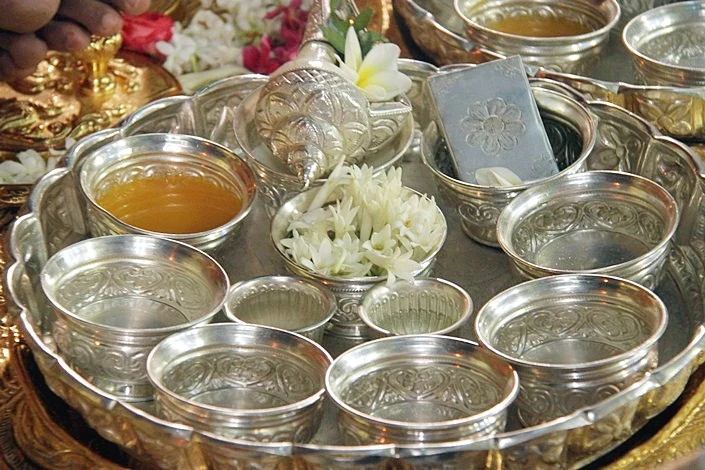
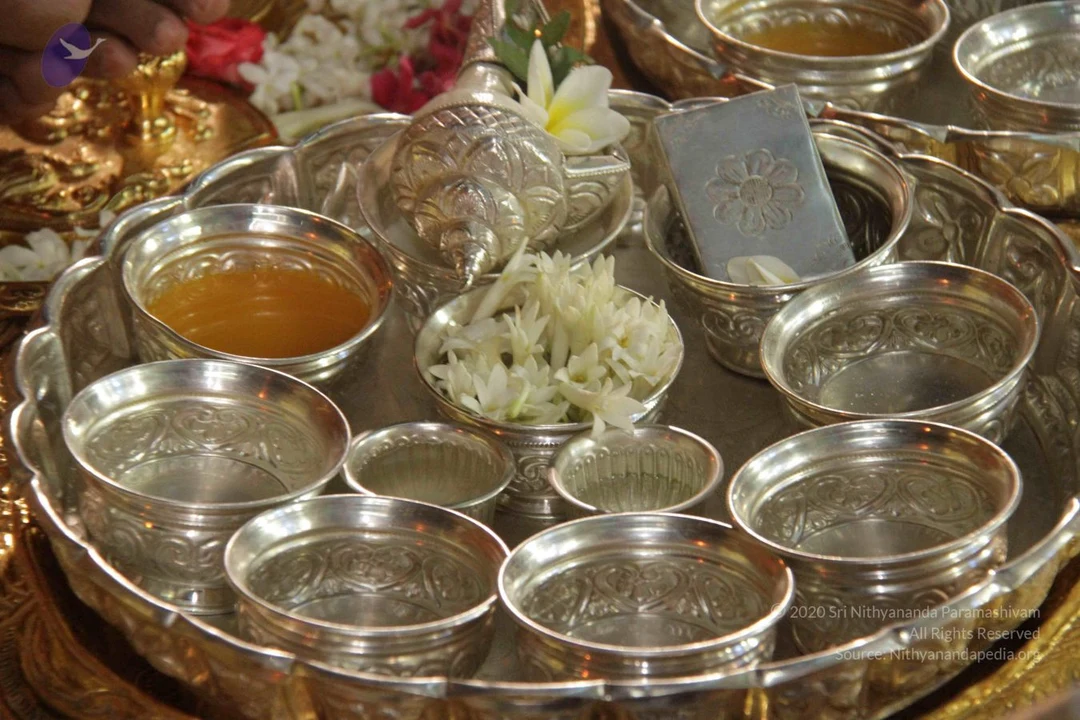
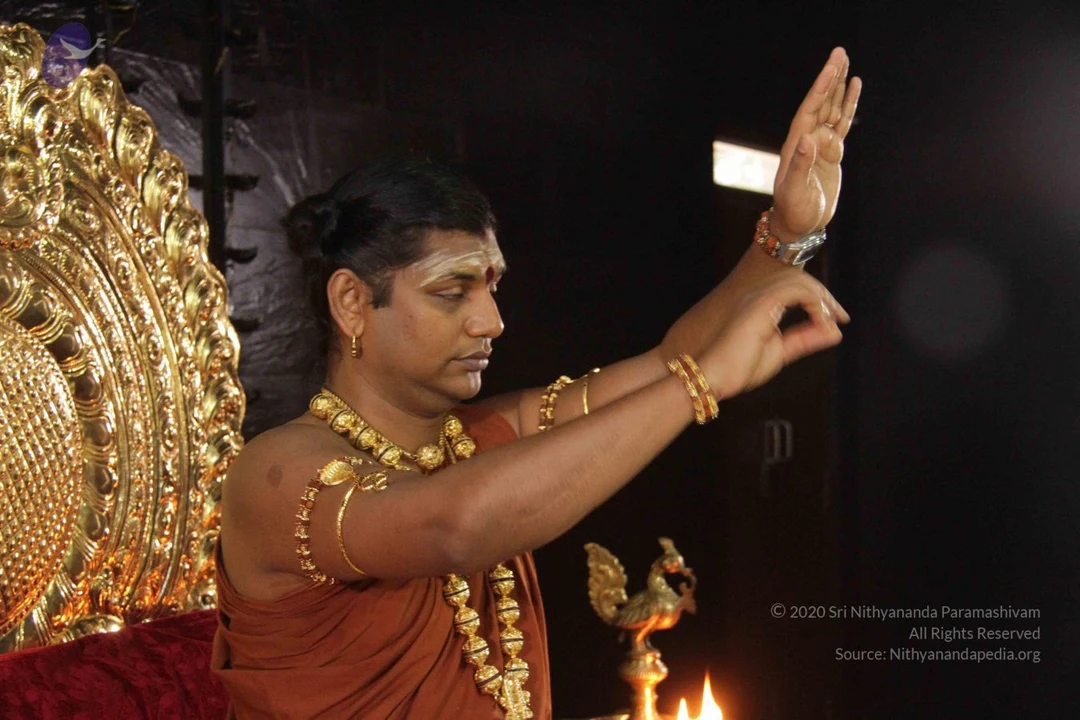
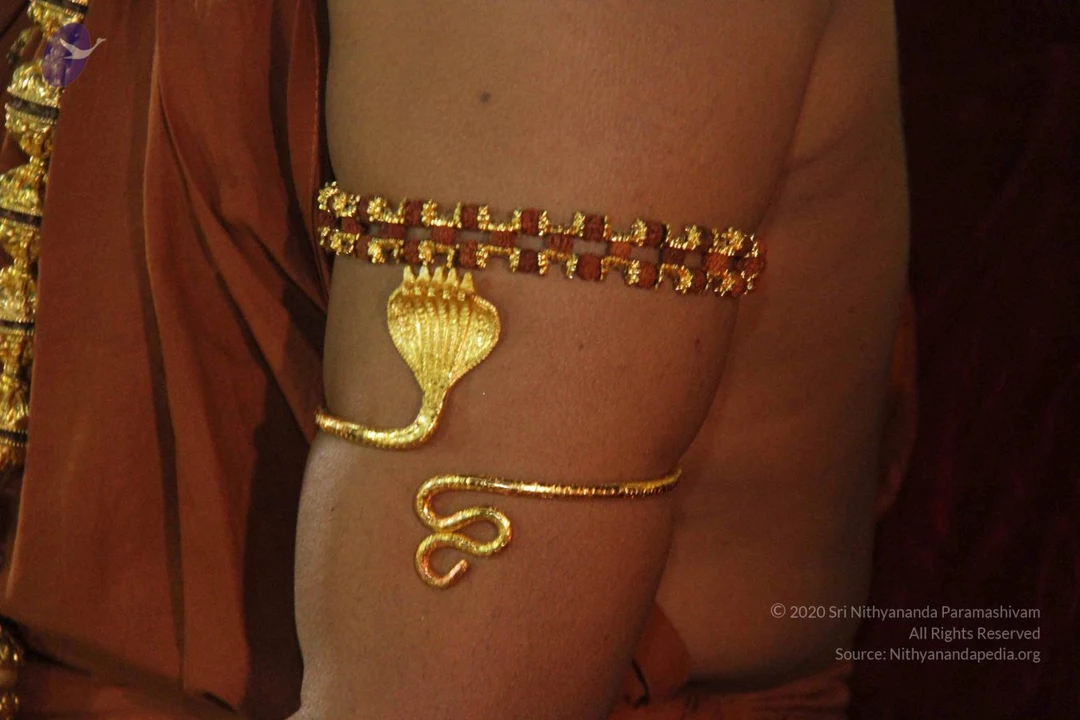
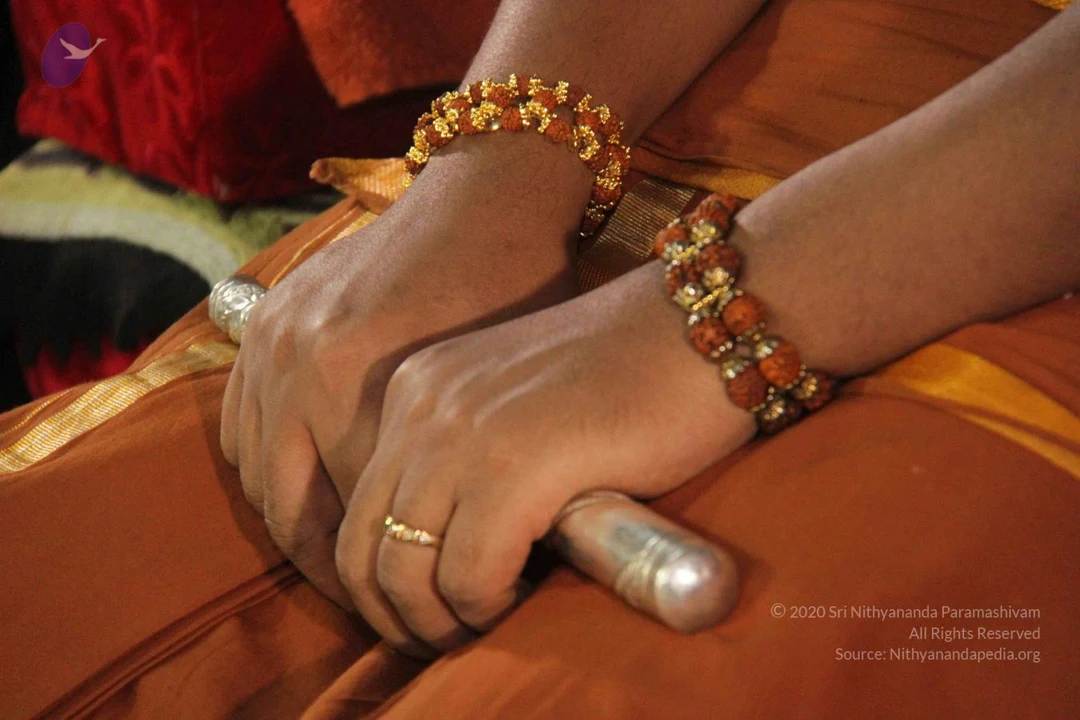
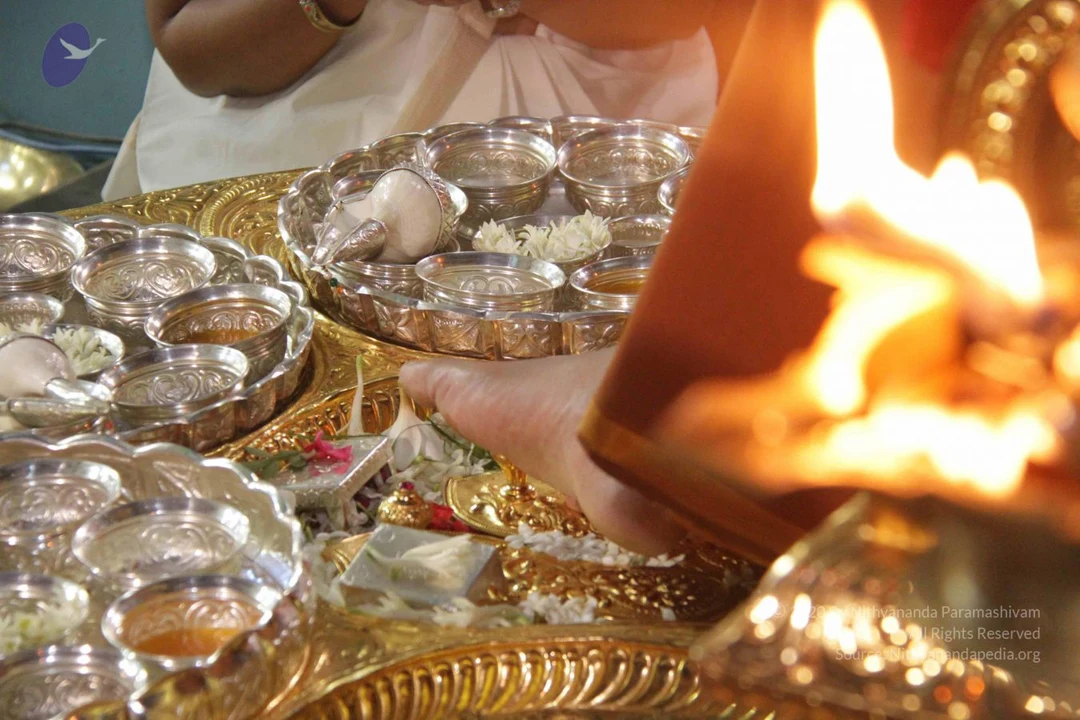
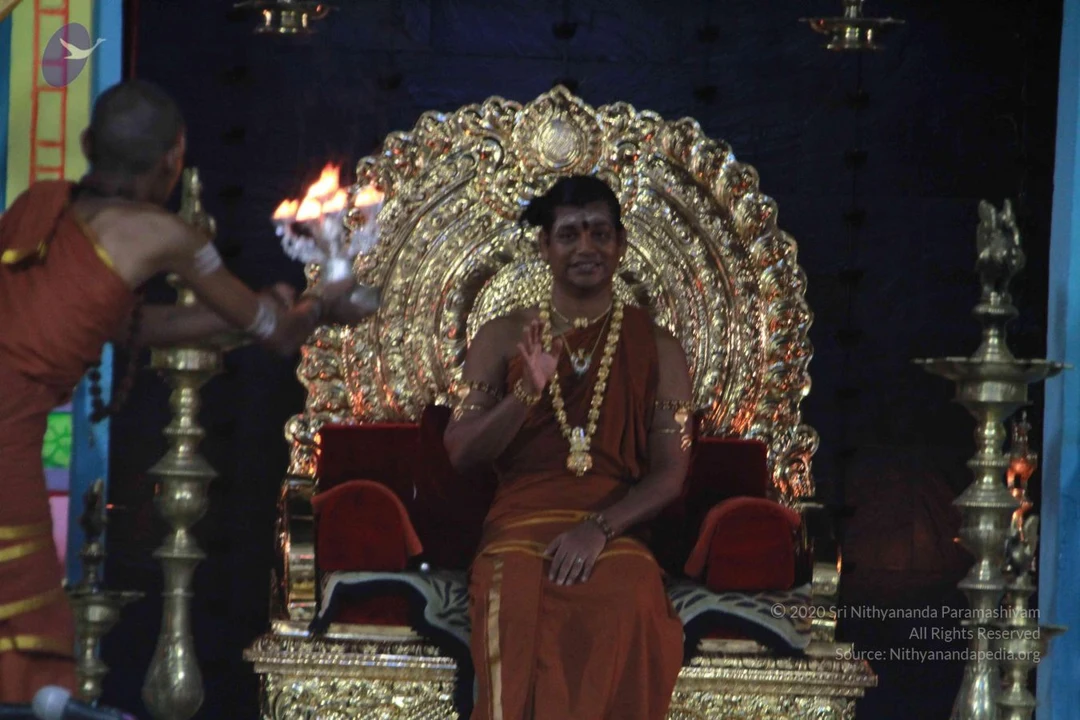
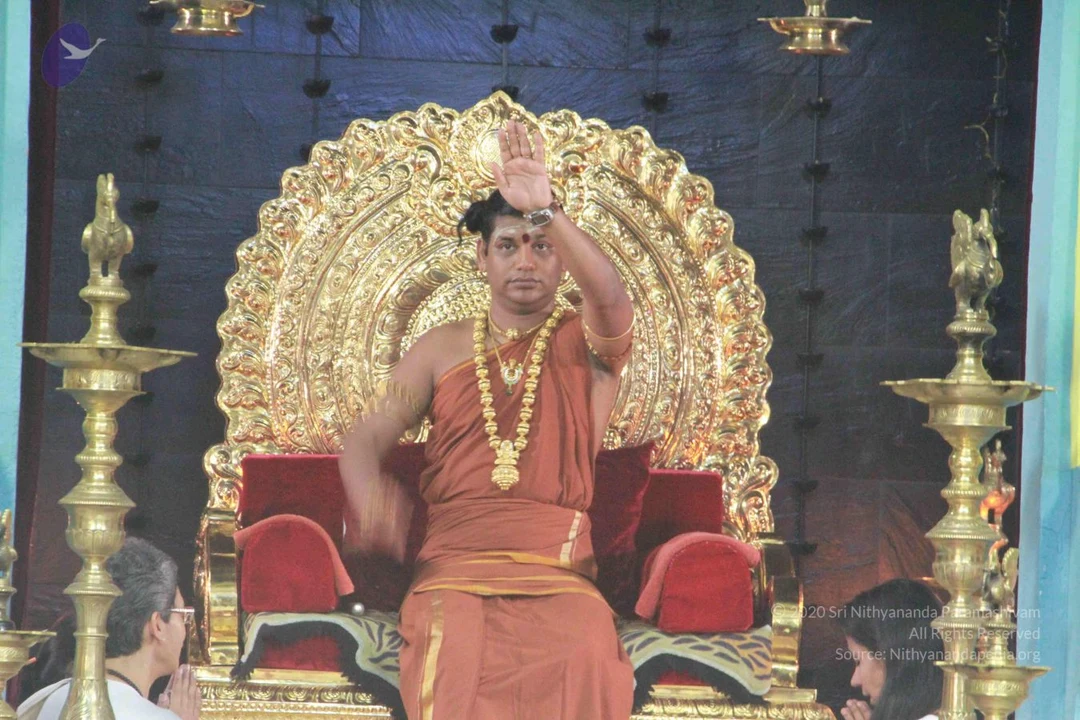
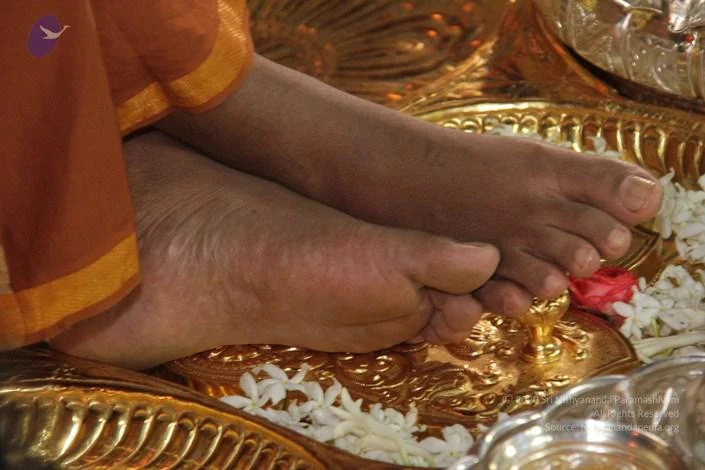
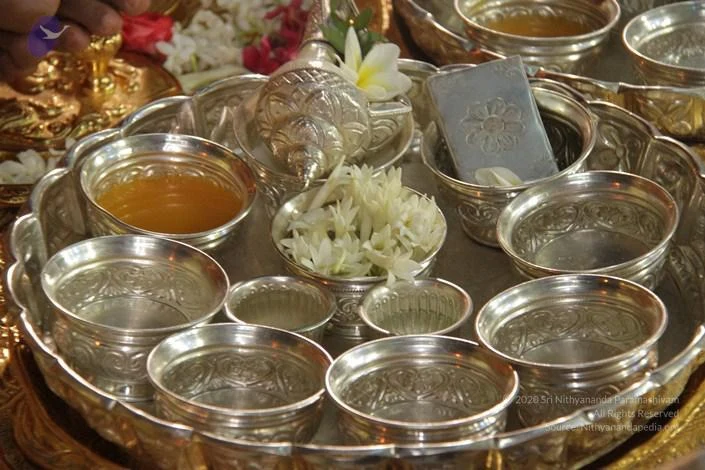
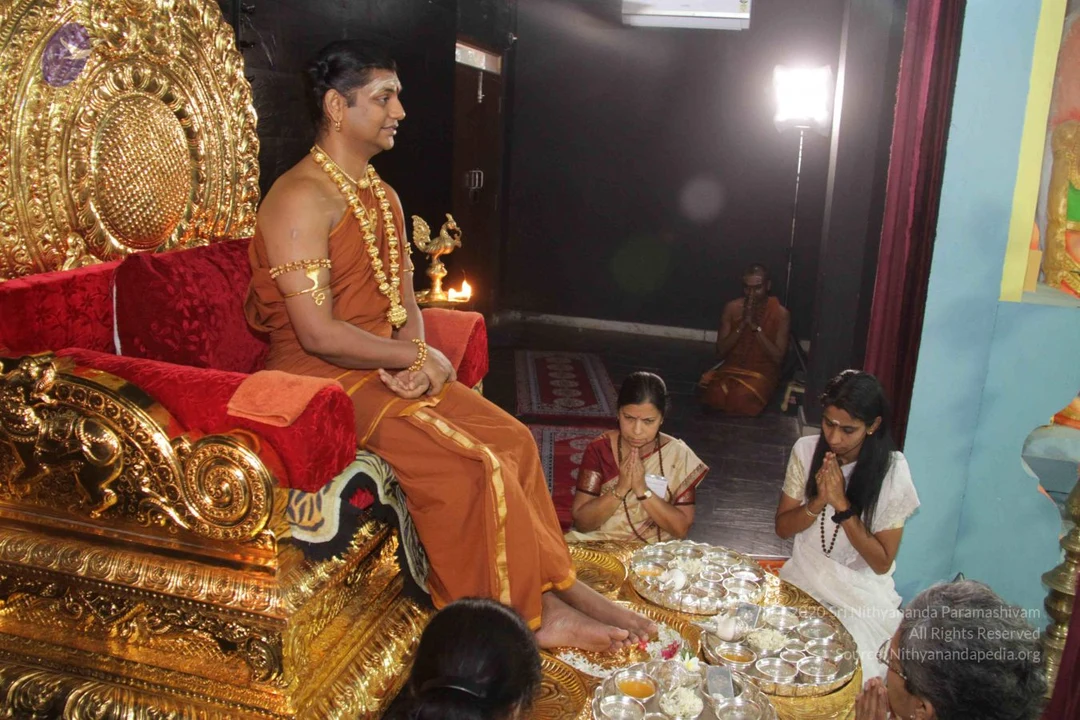
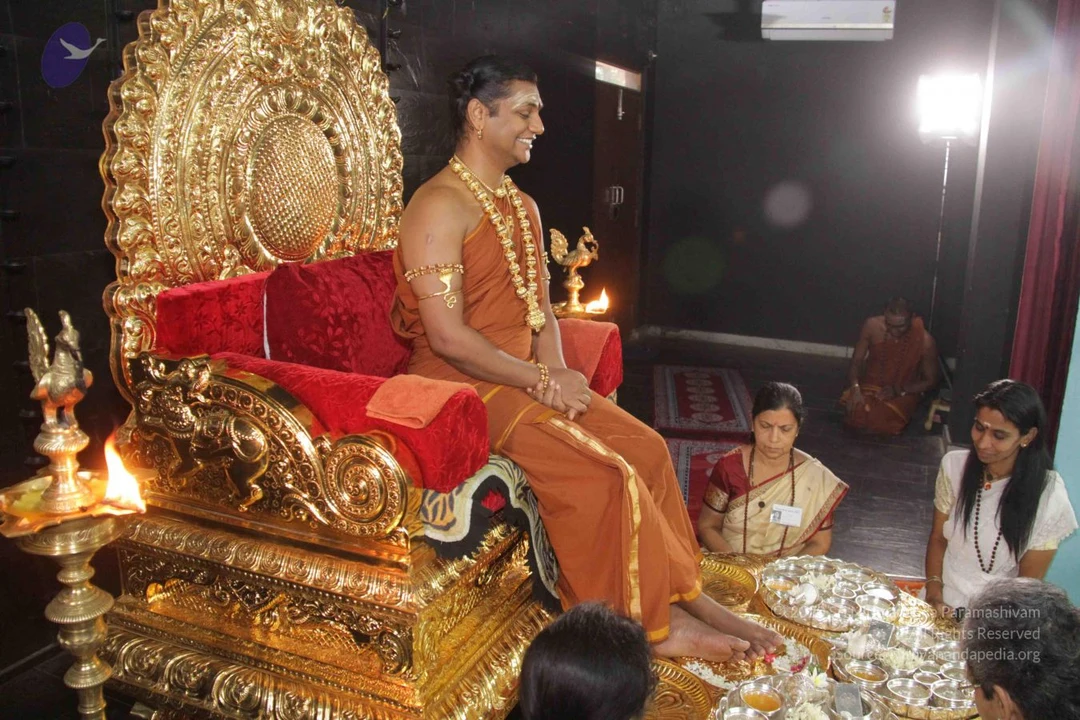
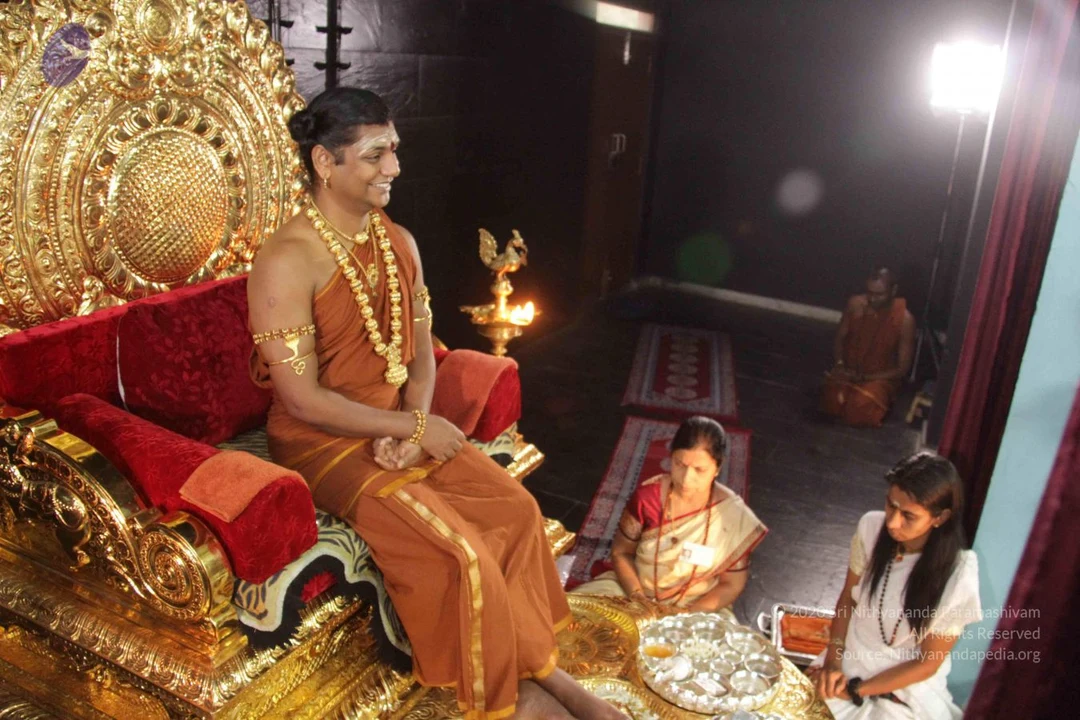
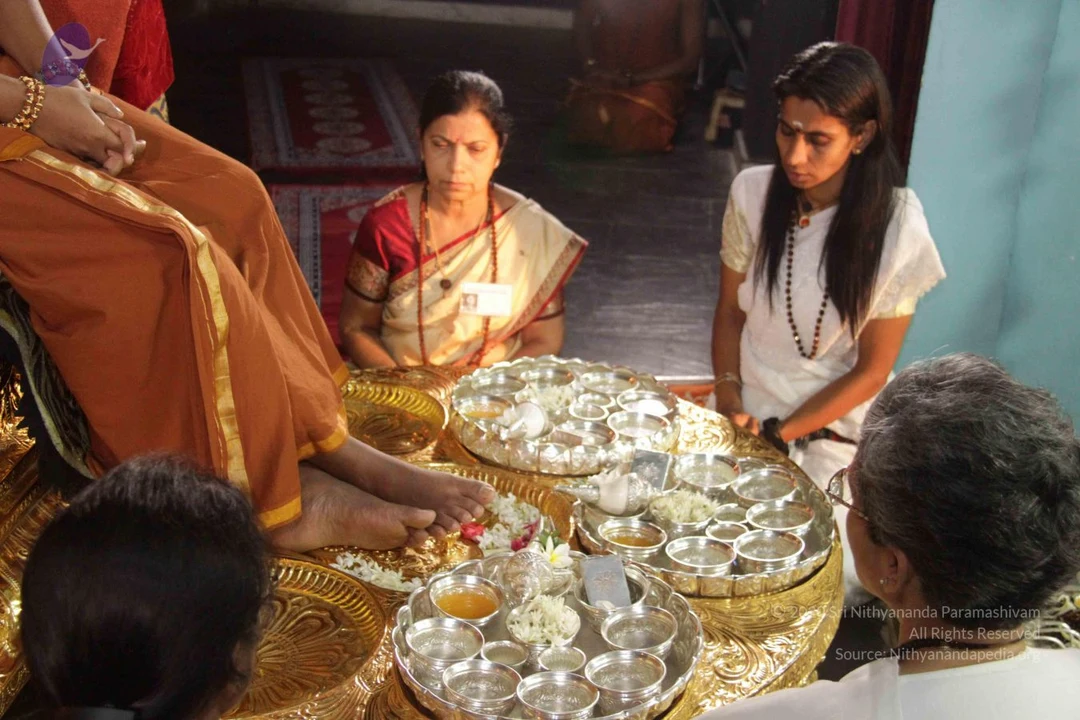
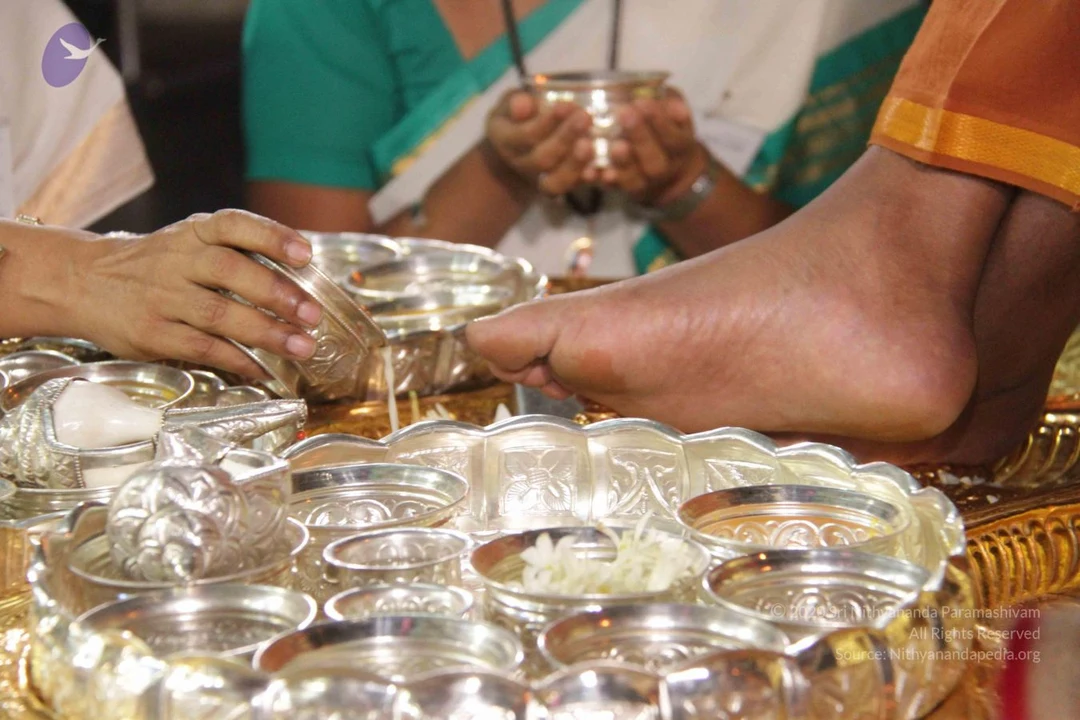
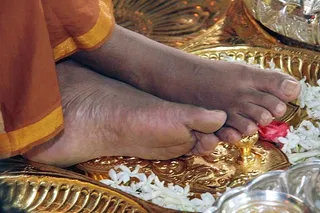
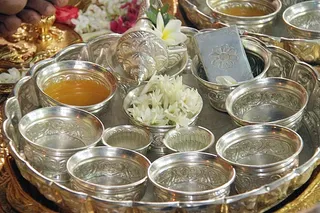
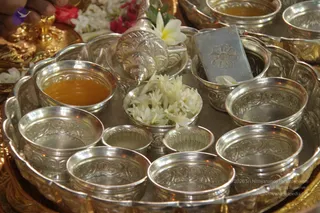
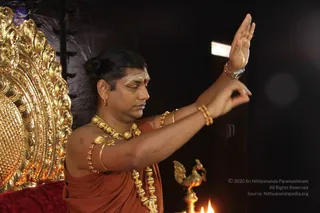
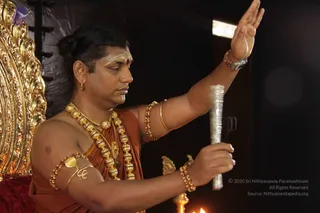
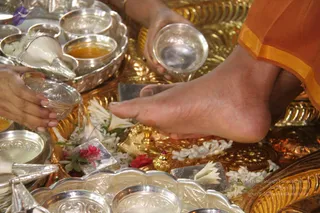
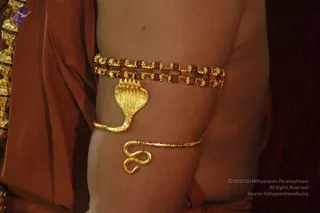
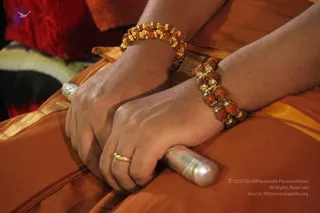
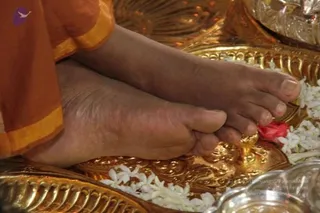
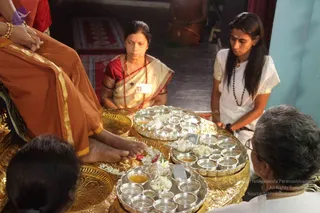
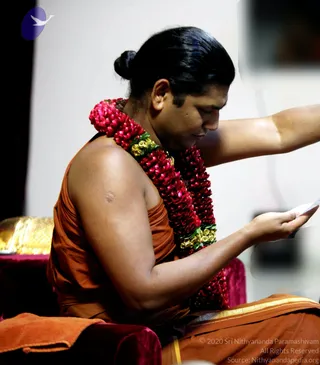
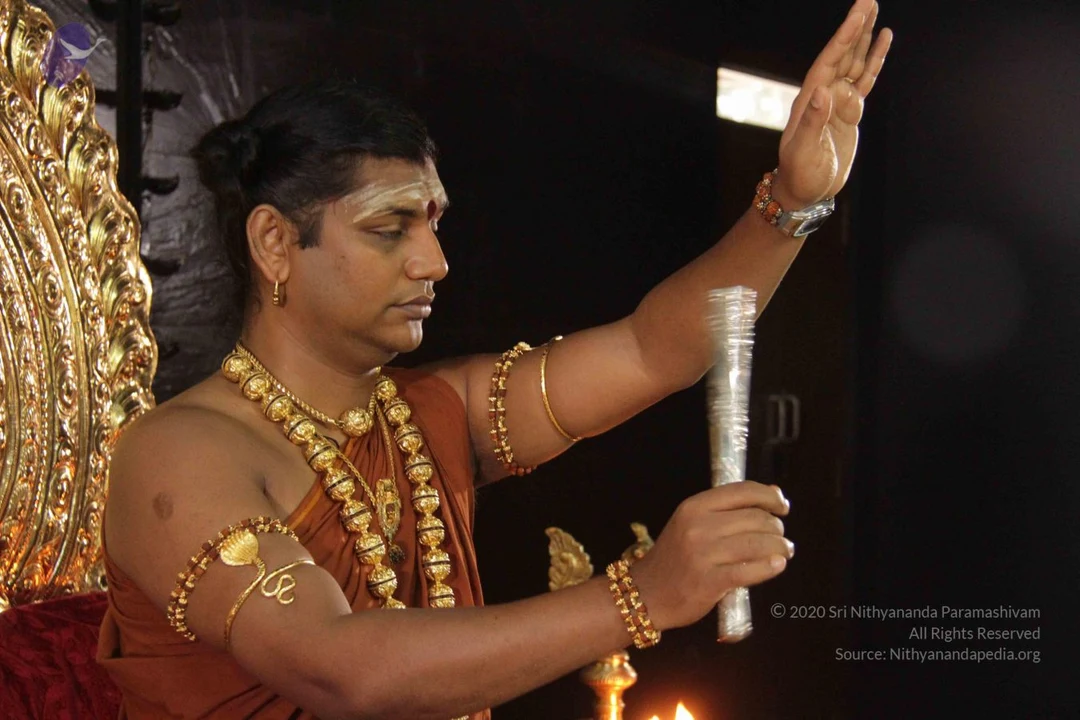
Close-up photograph of a large ornately embossed silver ritual tray holding several small silver bowls, one containing golden liquid and others empty, along with a silver conch-shaped vessel and a small silver box with a floral emblem. Loose white jasmine-like flowers sit in a central bowl and a white frangipani bloom rests near the conch. Gold-toned items and red flowers are visible at the upper left edge. No people are visible; the scene looks like puja items prepared for an offering.A man in profile performs a hand mudra beside an ornate gold-carved throne back, with an oil lamp and a gold peacock-shaped lamp stand at lower right against a dark background. He wears a saffron-orange shawl over the shoulder, a heavy gold multi-strand necklace with rudraksha-style beads, gold armlets and bangles, and a white-and-red tilak on the forehead. His hair is tied back in a bun. He is an appearance-based a person seated in a ritual setting, with his right palm raised and fingers in a mudra near his face. Only the one person is physically present.A photograph of a bare-chested man in an orange-saffron cloth draped over the body, wearing heavy gold beaded necklaces, gold armlets and bangles, and a wristwatch. He stands beside an ornate gold throne-back at left, raising one hand in a blessing gesture while holding a clear cylindrical object in the other. His hair is pulled back, and he has white and red marks on the forehead. In the lower right, a lit oil lamp flame is visible against a dark background. Swamiji (probable): the figure shows long swept-back hair, saffron clothing, ornate gold necklaces and a gold throne, consistent with Paramahamsa Nithyananda performing a ritual gesture during a satsang.Close-up photo of a padapuja ritual. A bare foot in an orange-saffron garment rests on a gold tray scattered with white jasmine flowers and red blossoms. A hand in the upper left holds a silver bowl of liquid, and another hand at top holds a small silver cup. Silver bowls and a silver spoon filled with milk, yellow liquid and water surround the foot on the tray. Gold ornamental tray edges and a small brass lamp are visible. The person whose foot is shown is only partially visible, so the figure cannot be identified from this image.Close view of a person's upper arm wearing a gold cobra-head armlet with a coiled gold snake band, layered over a rudraksha bead band with gold spacer beads. The person wears a rust-orange saffron cloth draped over the shoulder with gold embroidered trim at the left edge. Only the arm and clothing are visible, with no face shown.Close-up photograph of a person's hands resting on an orange-saffron cloth with gold border, one hand holding a polished silver cylindrical object. The wrists wear multiple rudraksha bead bracelets with gold-toned spacers, and a thin gold ring is on one finger. Red and green textured fabric appears blurred at the upper left. Only the arms and hands are visible, with no face shown.

NITHYA-SATSANG

36 photosSource gallery
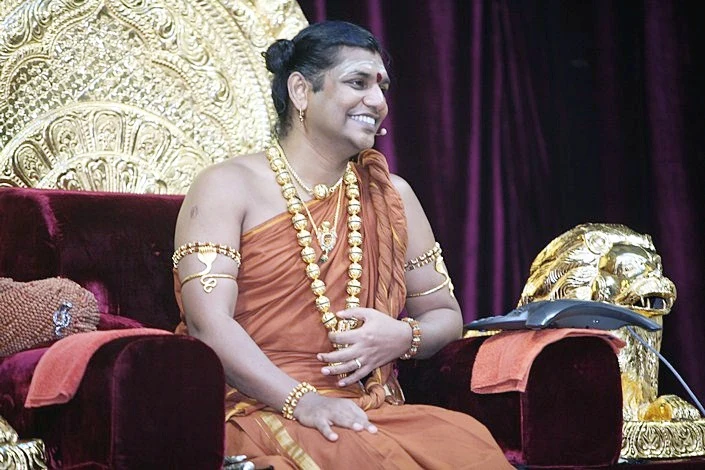
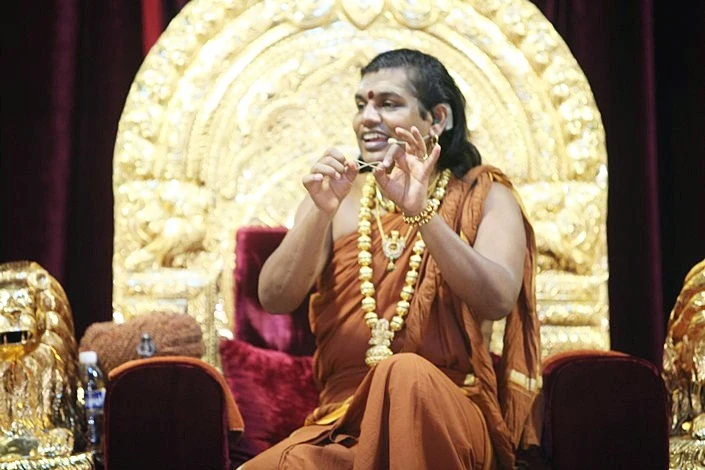
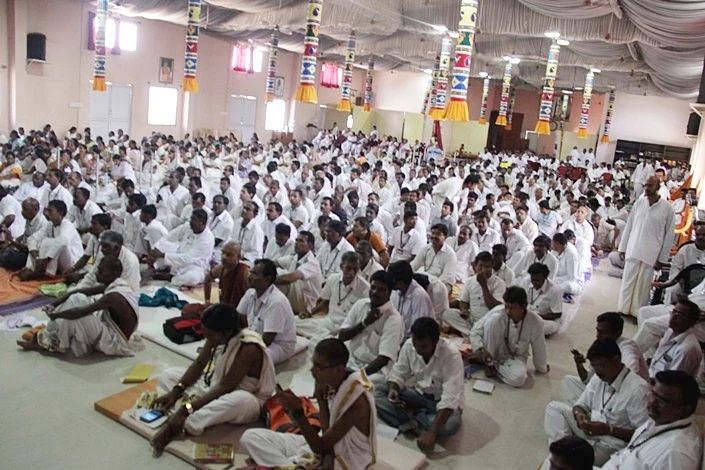
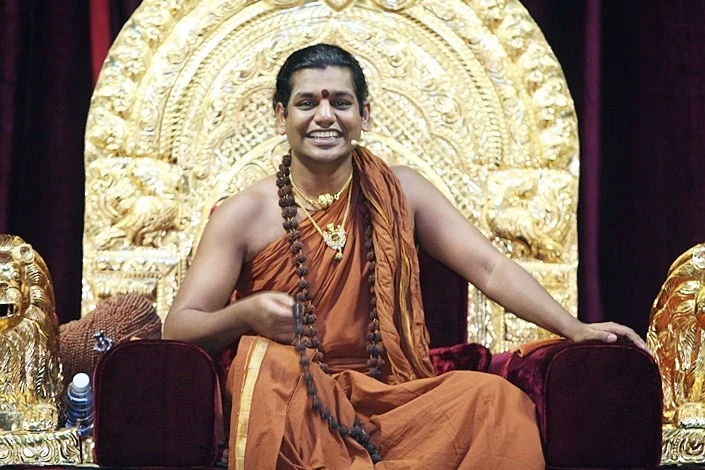
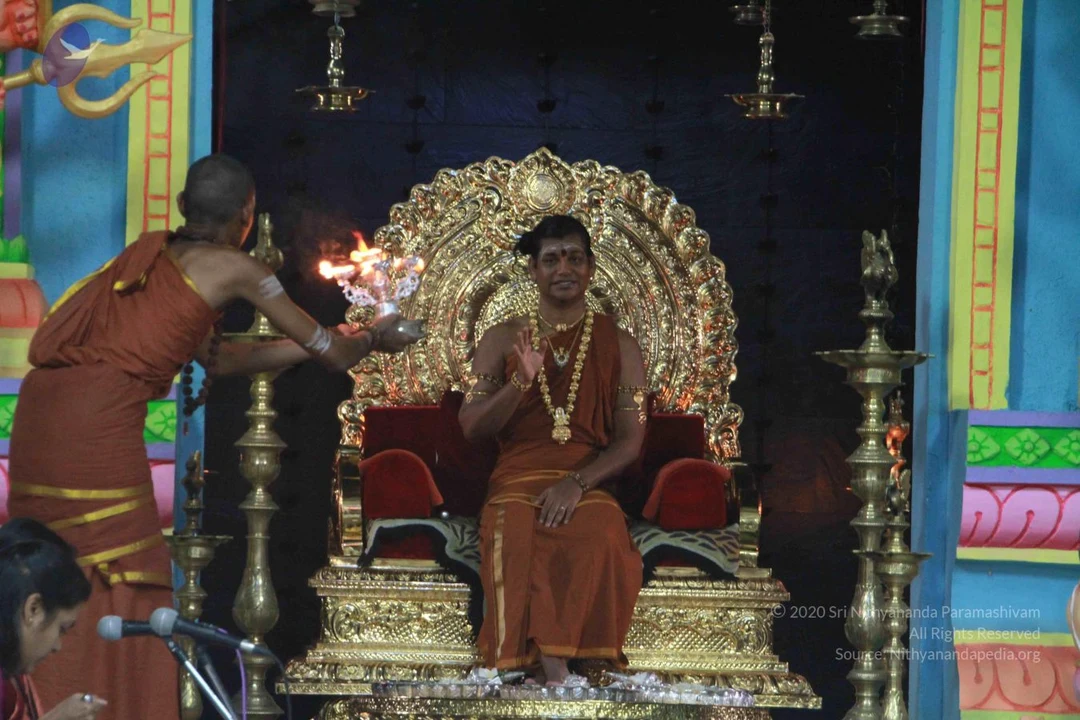
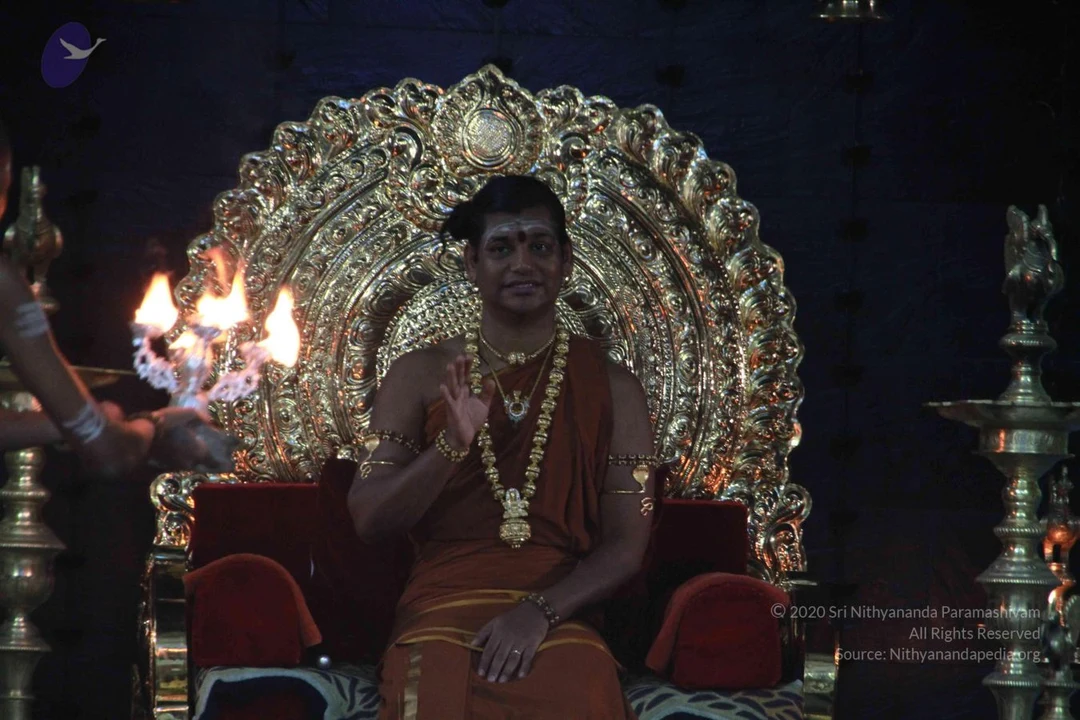
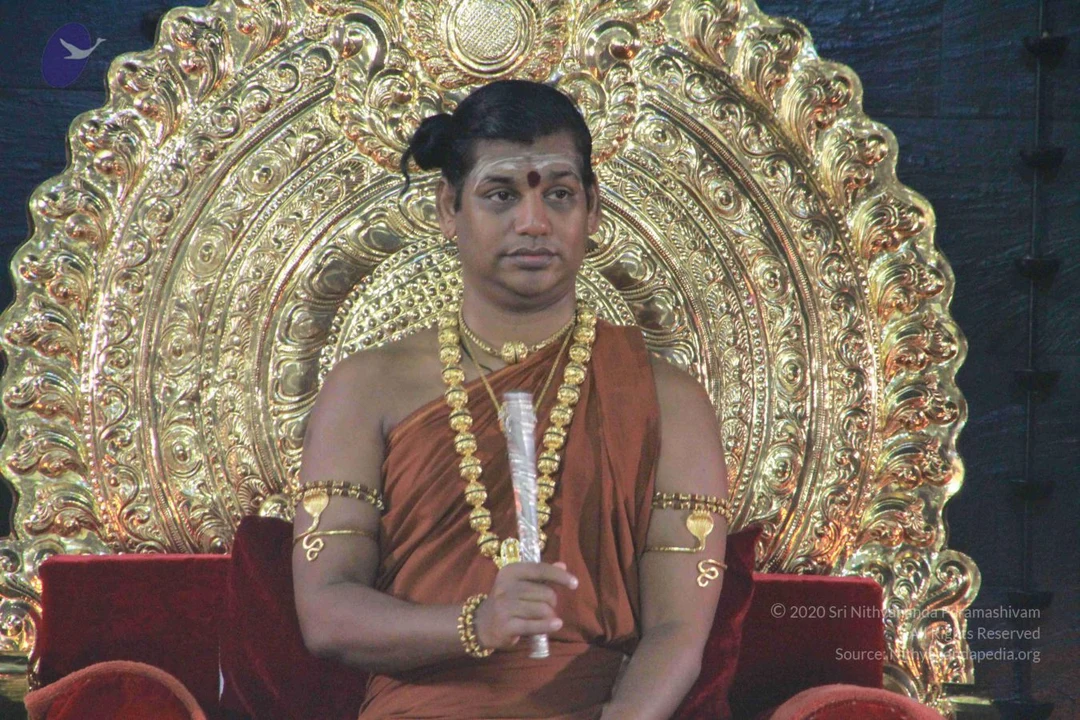
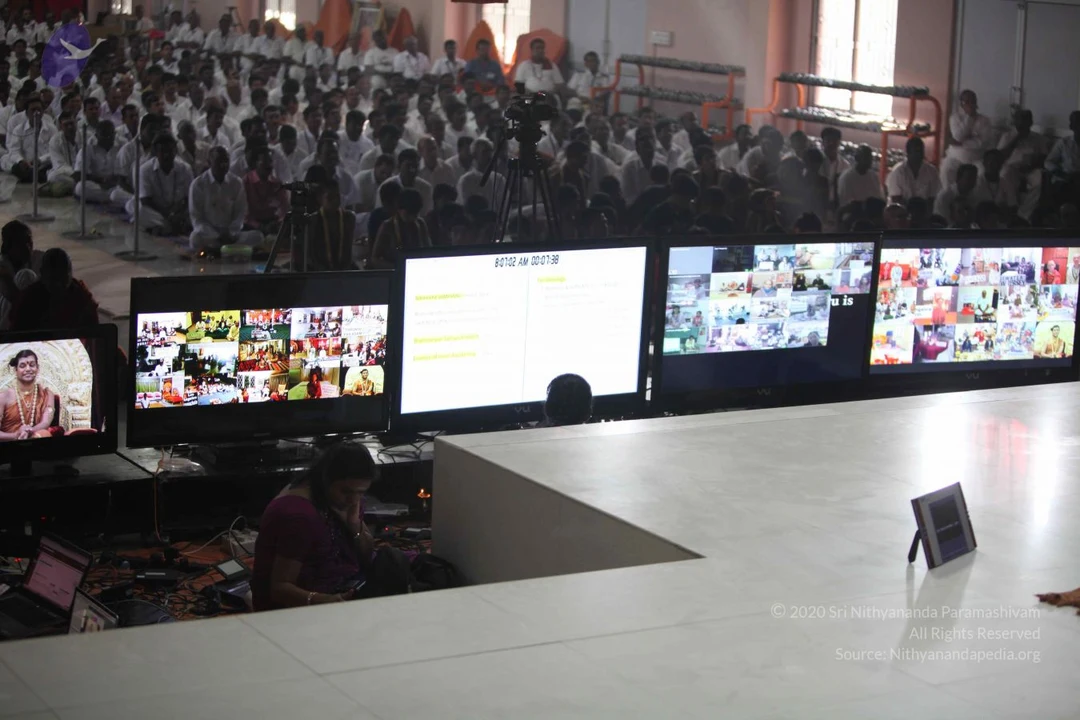
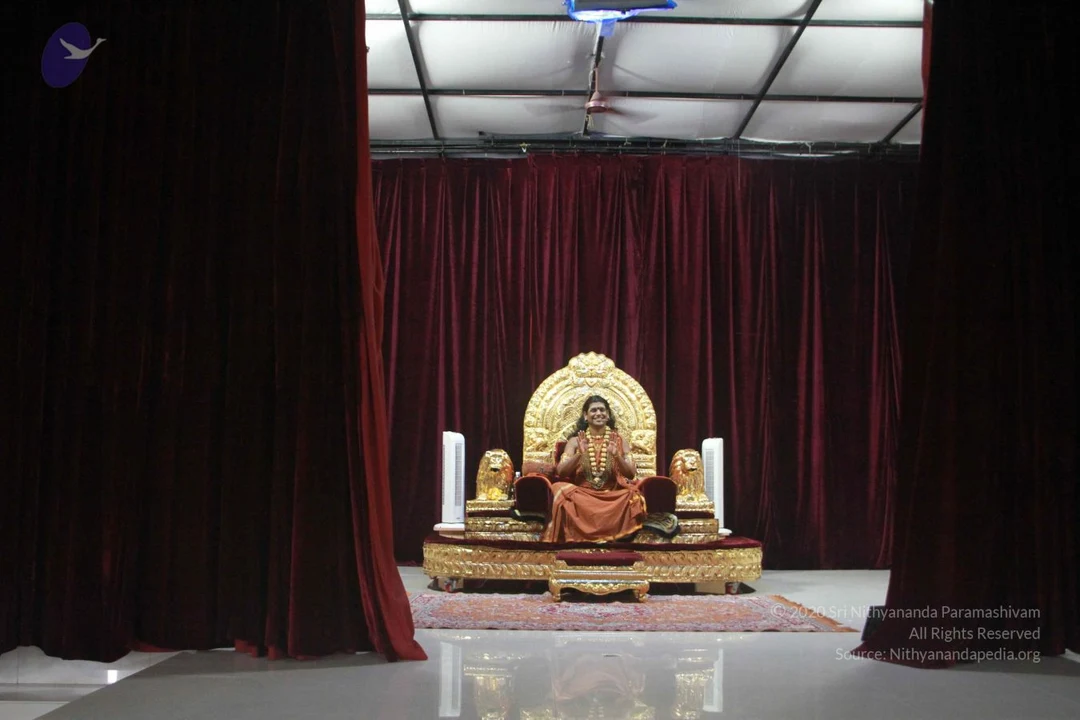
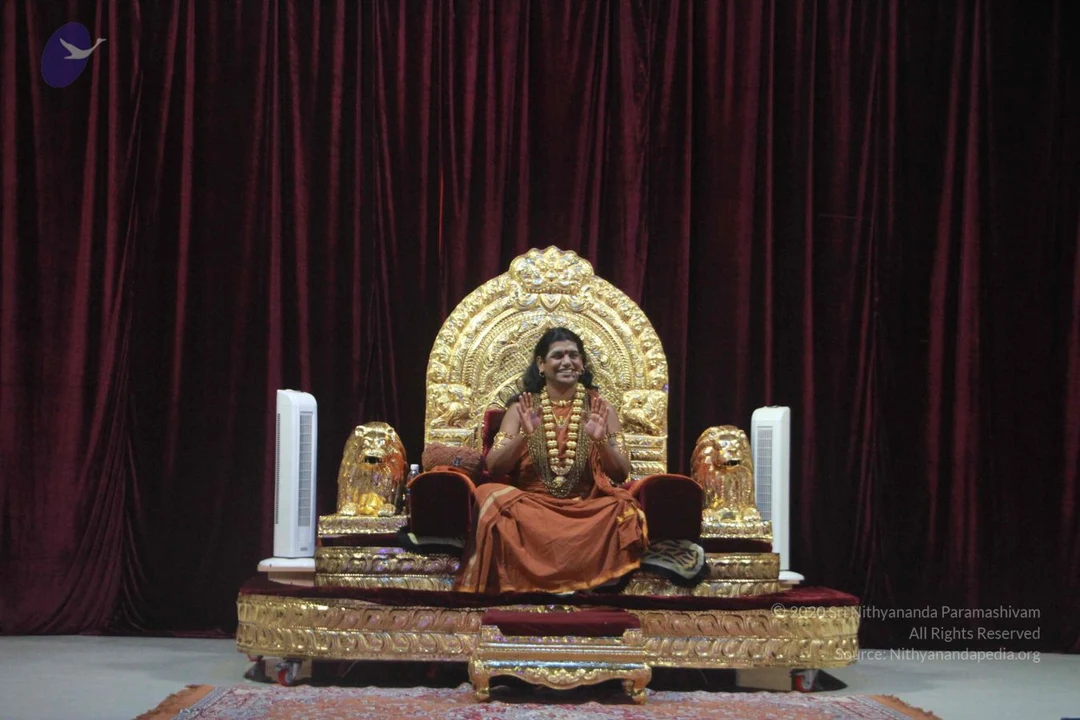
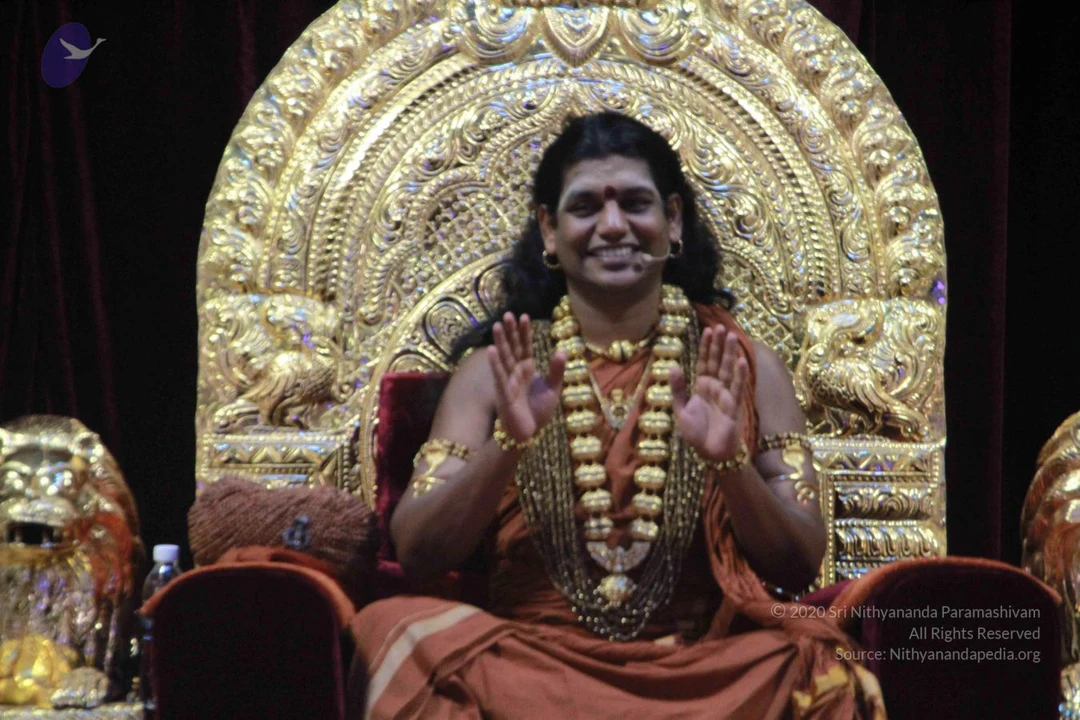
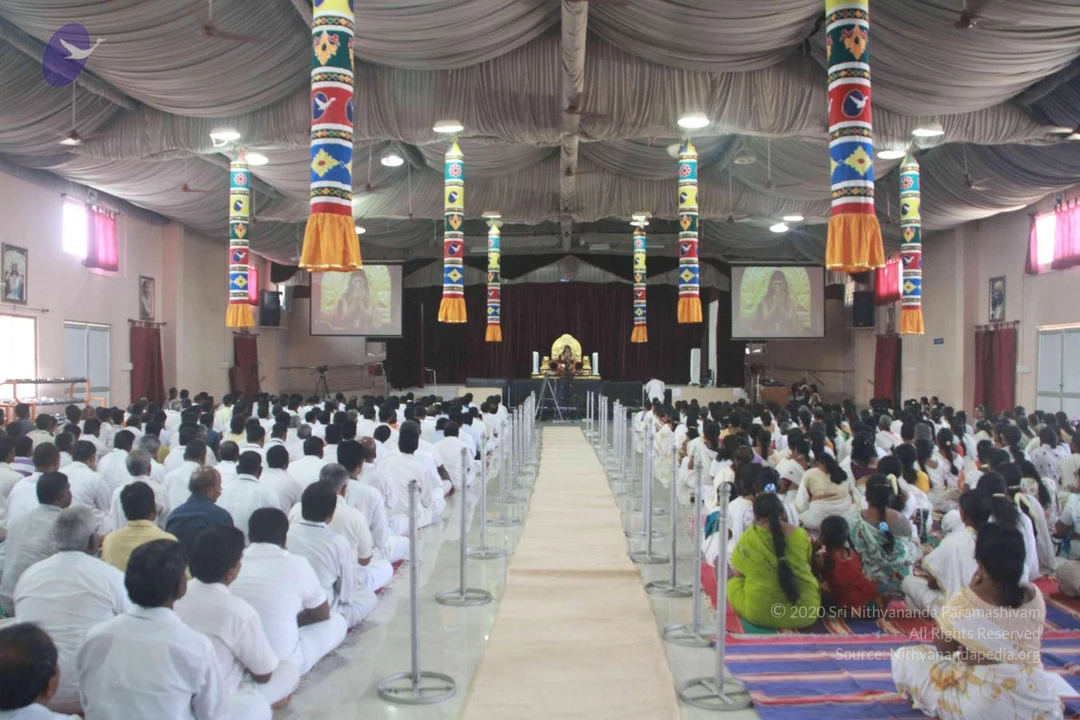
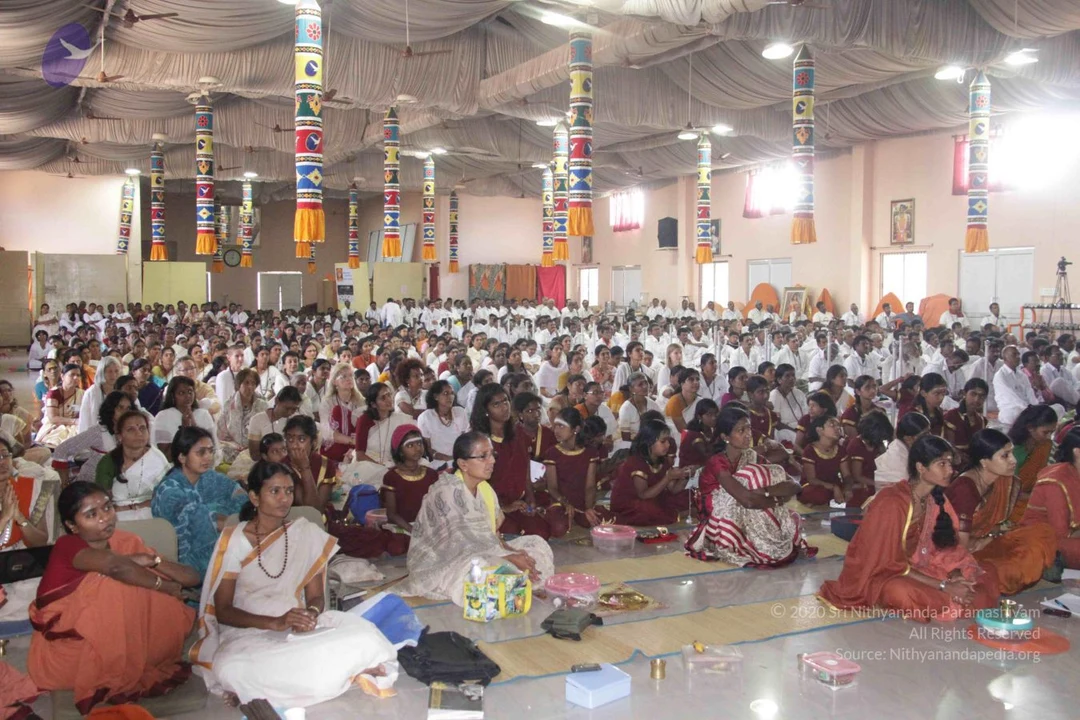
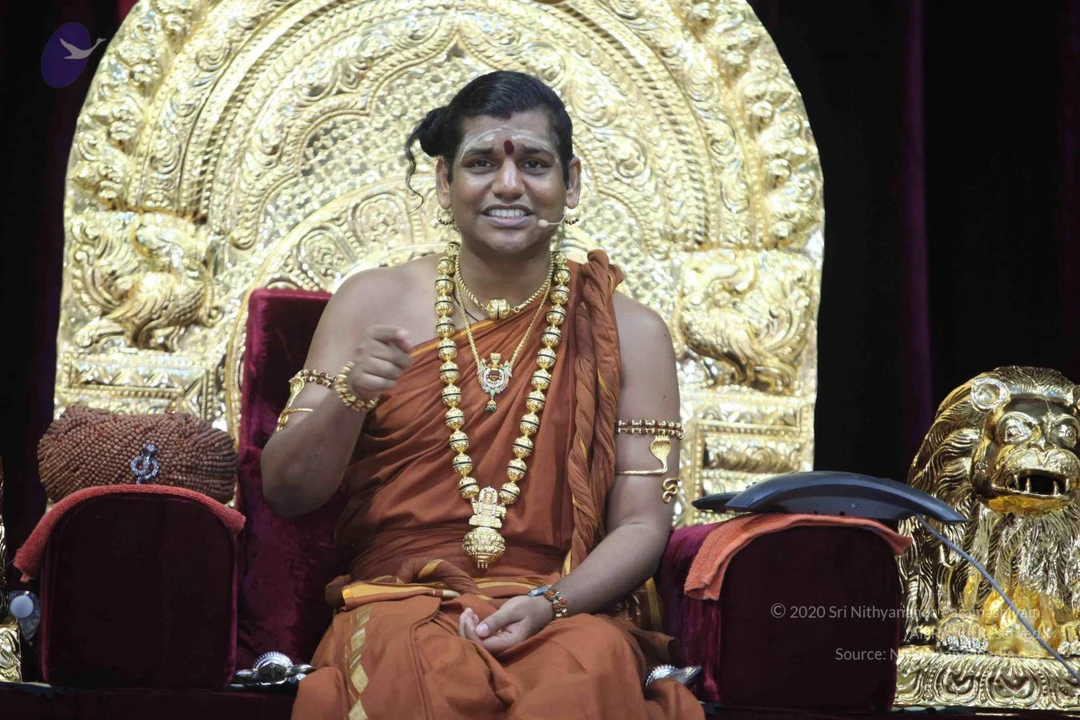
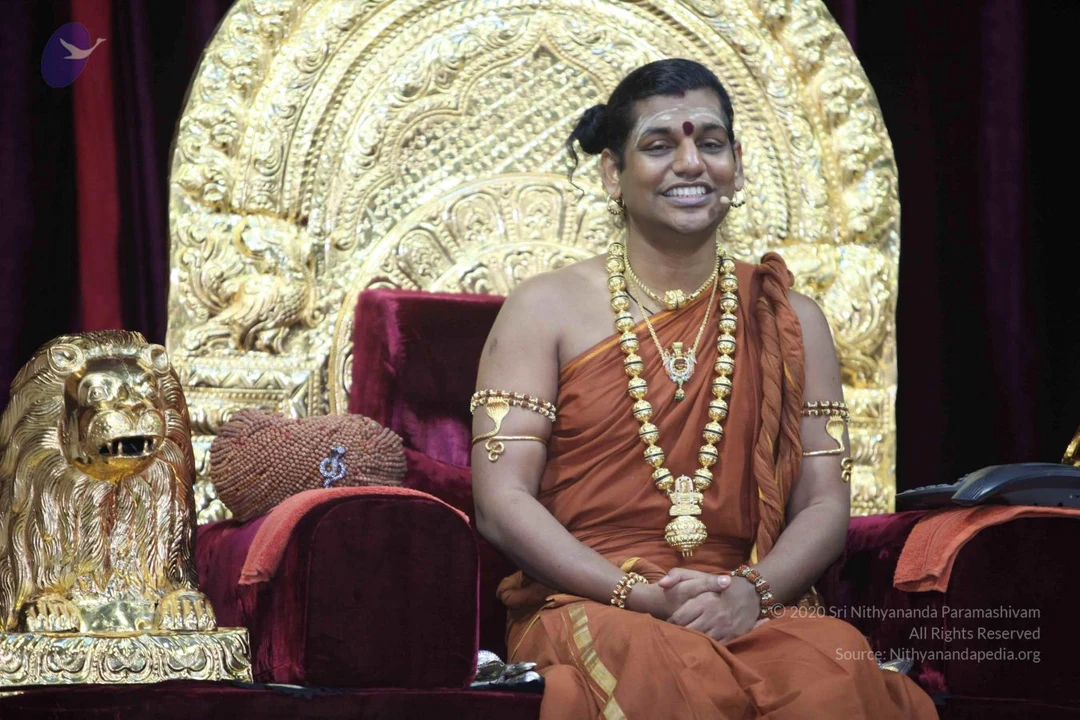
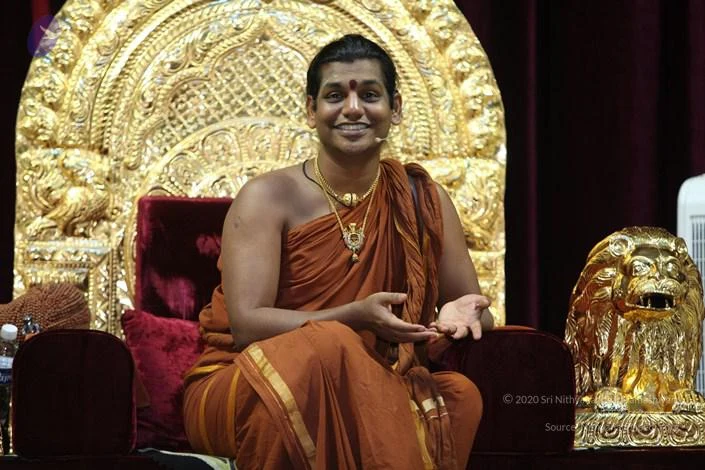
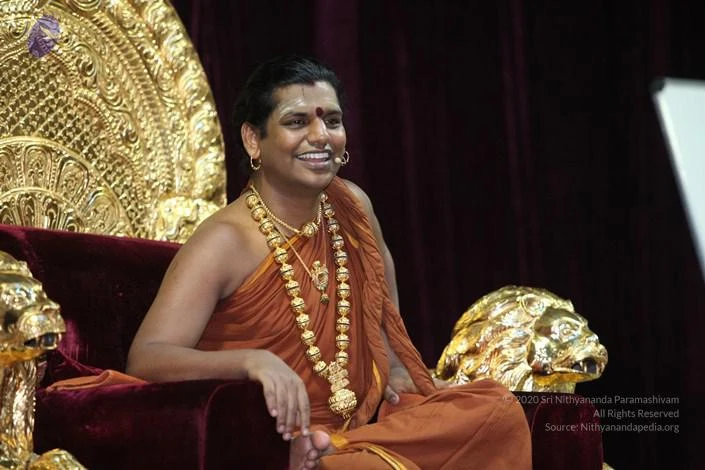
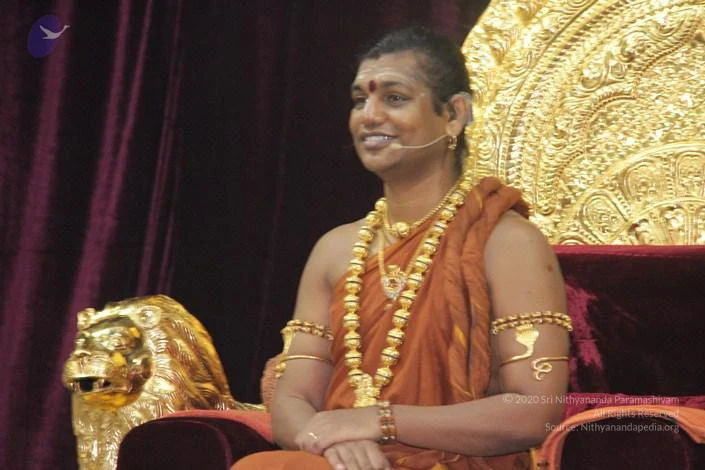
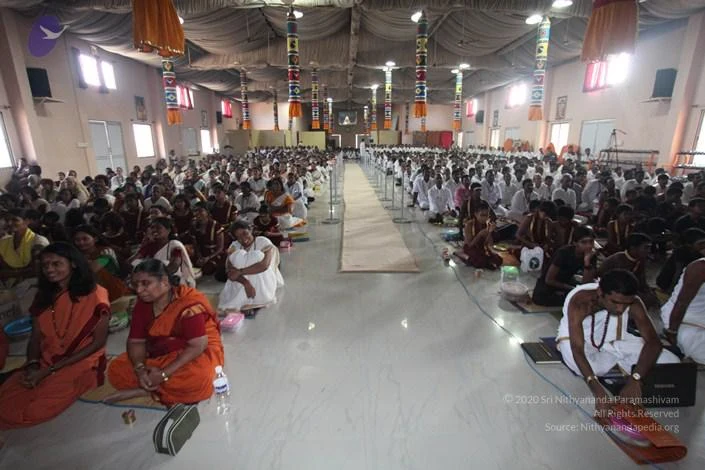
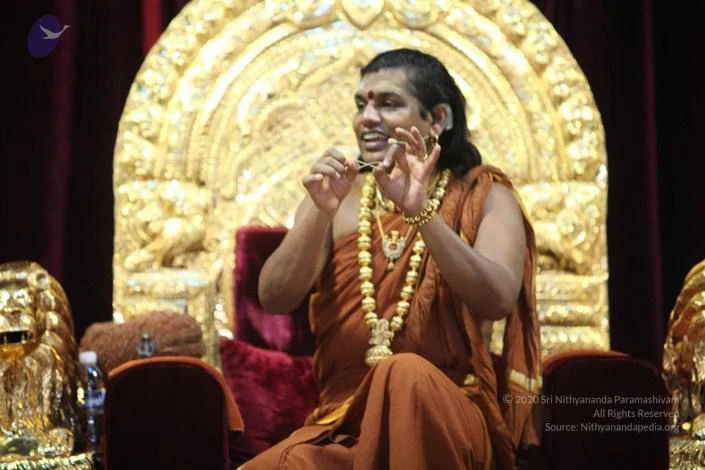
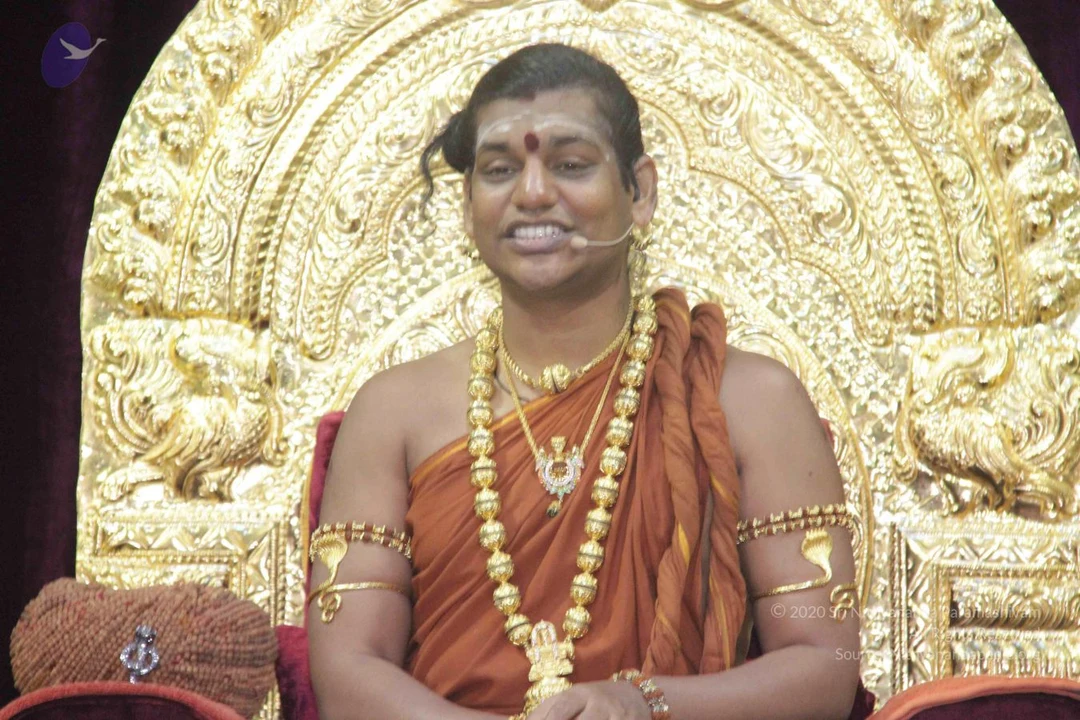
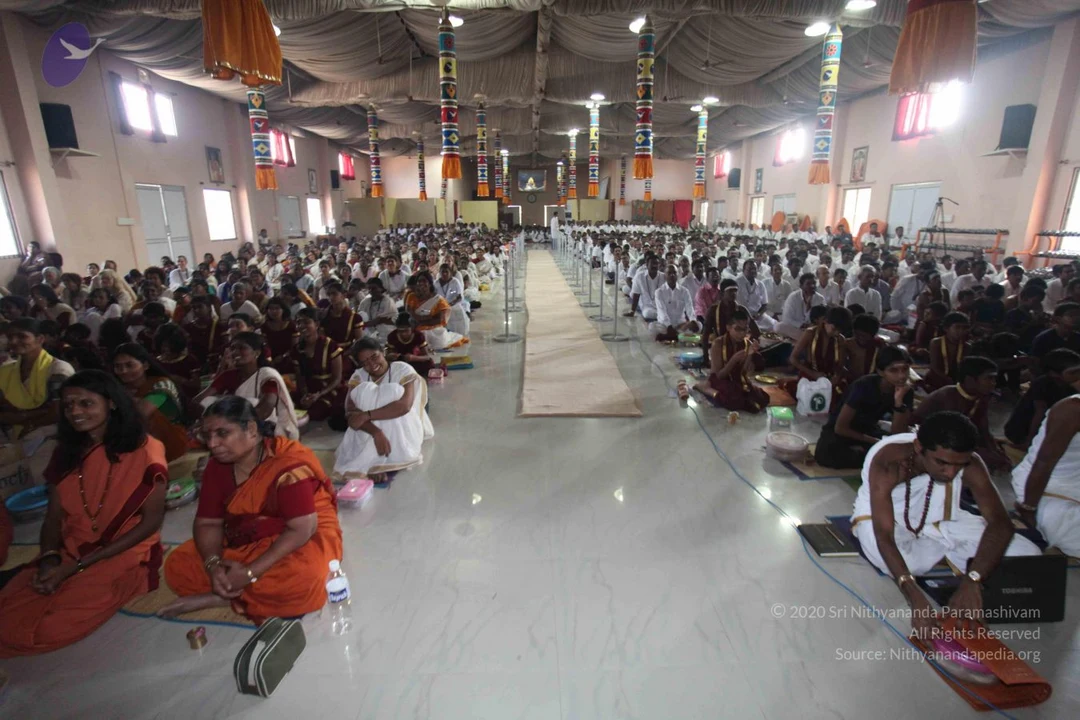
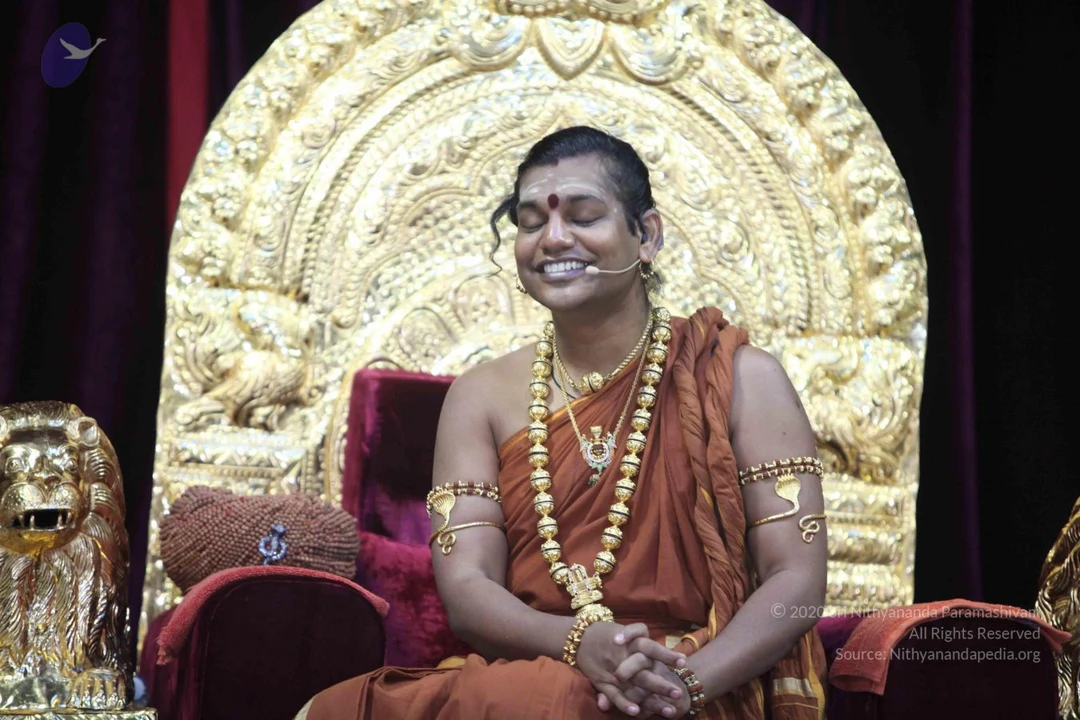
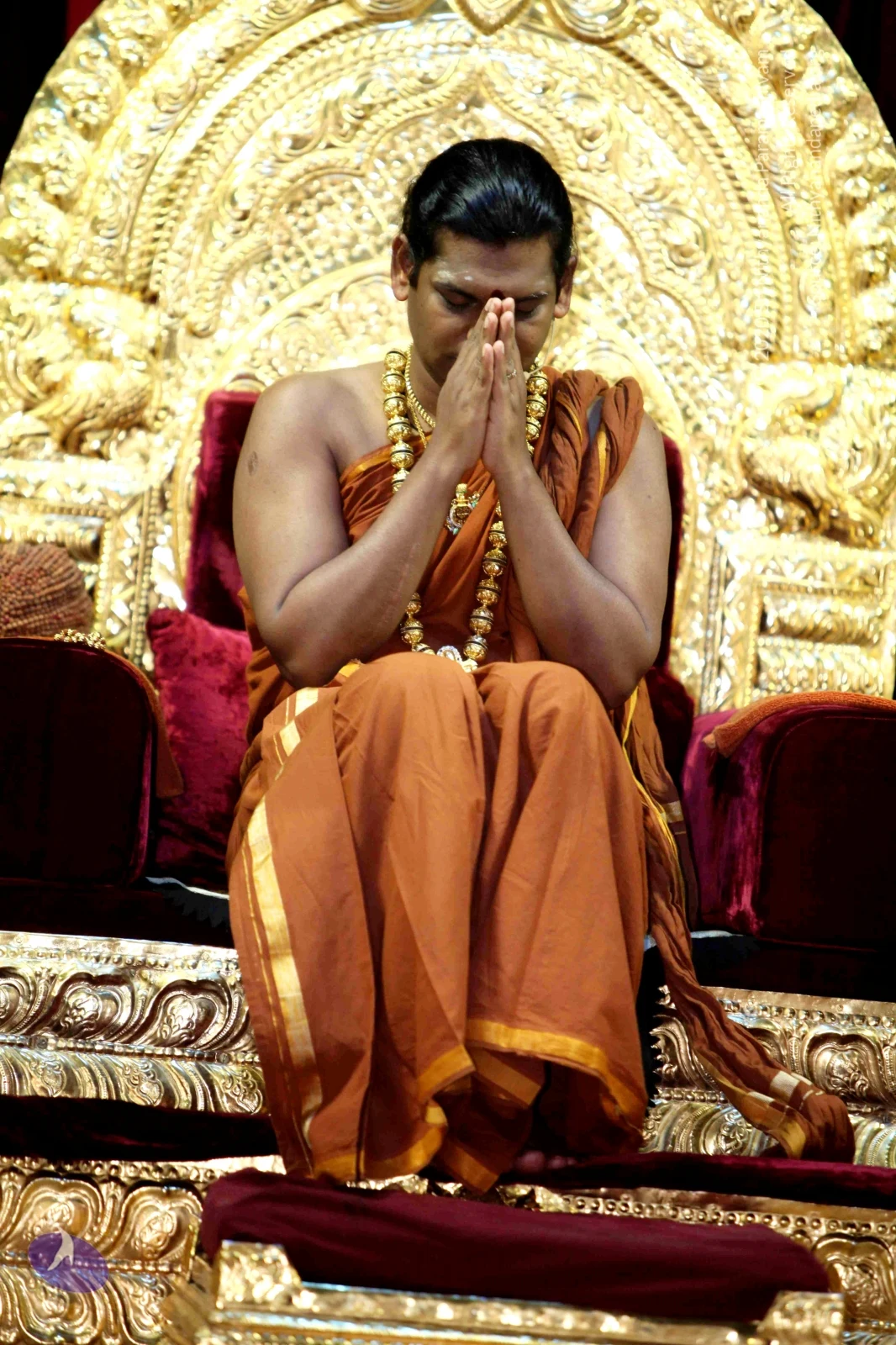
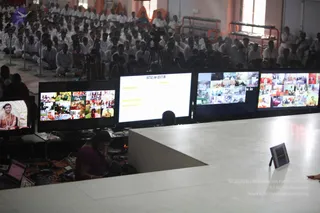
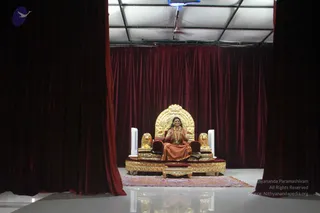
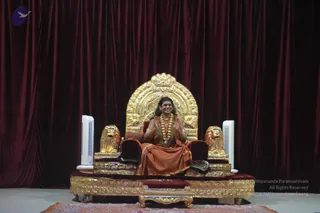
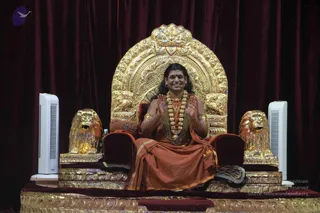
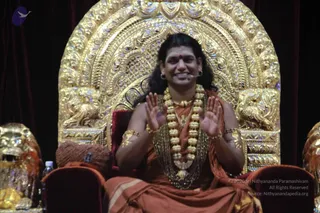
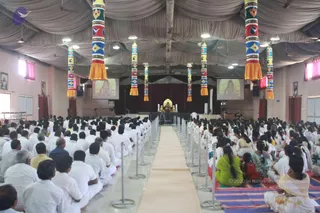
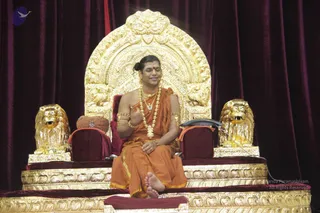
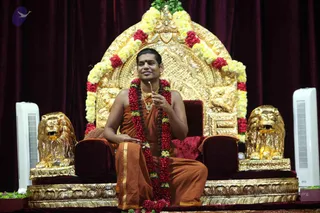
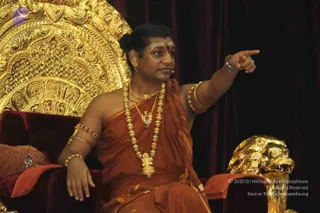
A photograph of a large satsang hall seen from an elevated angle, with a crowd of white-clad devotees seated on the floor facing forward. Several monitors in the foreground display multi-panel video grids of other gatherings and a slide with text, and a small screen on the left shows a figure in a saffron-toned garment with beads. A woman in a maroon sari sits at a laptop in the lower left, and a camera on a tripod is set up among the seated audience. Orange-accented pillars and a grid of shelving frame the back of the hall.A seated figure in an orange-red saffron robe and multiple beaded necklaces sits on an ornate gold throne with lion-shaped armrests and a gold arched backrest, centred on a raised stage. Dark red velvet curtains frame the stage, a patterned rug lies on the floor, and white tower fans stand beside the throne. The figure's hands are joined in front of the chest. Swamiji (probable): the seated person wears saffron clothing and rudraksha-style beads, with long hair visible, and the throne is ceremonial. A ceiling fan hangs above, and the mirrored floor reflects the throne.A seated figure sits on an ornate gilded throne with a tall arched back and two golden lion sculptures flanking the seat, set against deep burgundy velvet drapes on a stage. The person wears an orange-red robe and a long multi-strand gold necklace with rudraksha beads, and raises both palms together in a greeting gesture. Two white floor fans stand on either side of the dais, and a patterned red carpet covers the stage floor. A small purple bird logo appears in the upper left corner, and a copyright notice is printed on the lower right. Swamiji (probable): the seated figure wears orange robes, rudraksha beads and a gold necklace on a ceremonial throne, with long hair swept back.A seated figure on an ornate gilded throne with a large arched backrest and two golden lion sculptures flanking the armrests, set on a tiered gold-and-red platform before deep maroon velvet drapes. The figure wears an orange-saffron robe draped over the shoulders, a long multi-strand gold and bead necklace, gold armlets and a red bindi, and holds both palms raised in greeting while smiling. Two white tower fans stand at the sides of the stage. Swamiji (probable): the seated figure has long swept-back hair, saffron ceremonial clothing, a ceremonial gold necklace and rudraksha-style beads, and sits enthroned on a gilded lion throne.A photograph of a seated figure on an ornate golden throne with a large arched gilded back and carved lion-form armrests, against dark red drapery. The figure wears an orange-saffron wrap, a heavy gold-toned multi-strand necklace of beads with a central pendant, gold armbands, dark hair worn long, a red bindi, and a small microphone at the ear. Hands are raised with palms facing outward in a gesturing blessing or teaching pose while smiling. Only one physical person is visible. Identity is an appearance-based candidate: a person, seated in the honoured position of a satsang discourse, with long swept hair, saffron clothing, rudraksha-style beads and gold adornments as qualifying cues. A partially visible gilded lion statue appears at the left edge.Wide view of a large satsang hall with a white draped ceiling and tall striped pillars hung with orange tassels. Rows of seated devotees in white clothing fill the floor on both sides of a central aisle lined with silver stanchions, with women in green, pink and multicoloured saris at right. On the distant stage, a seated figure in orange and gold sits beside a golden throne-like seat before a dark red curtain, with two large screens showing a close-up of a person on either side. Oil lamps and a peetha-style arrangement stand at the front.

DIAL-THE-AVATAR

10 photosSource gallery
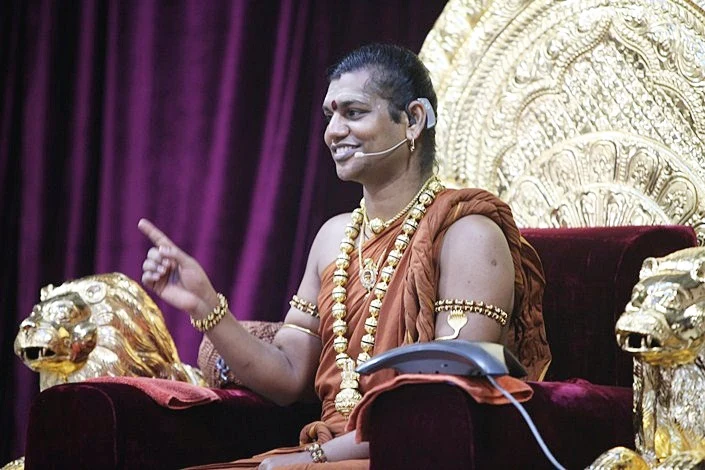
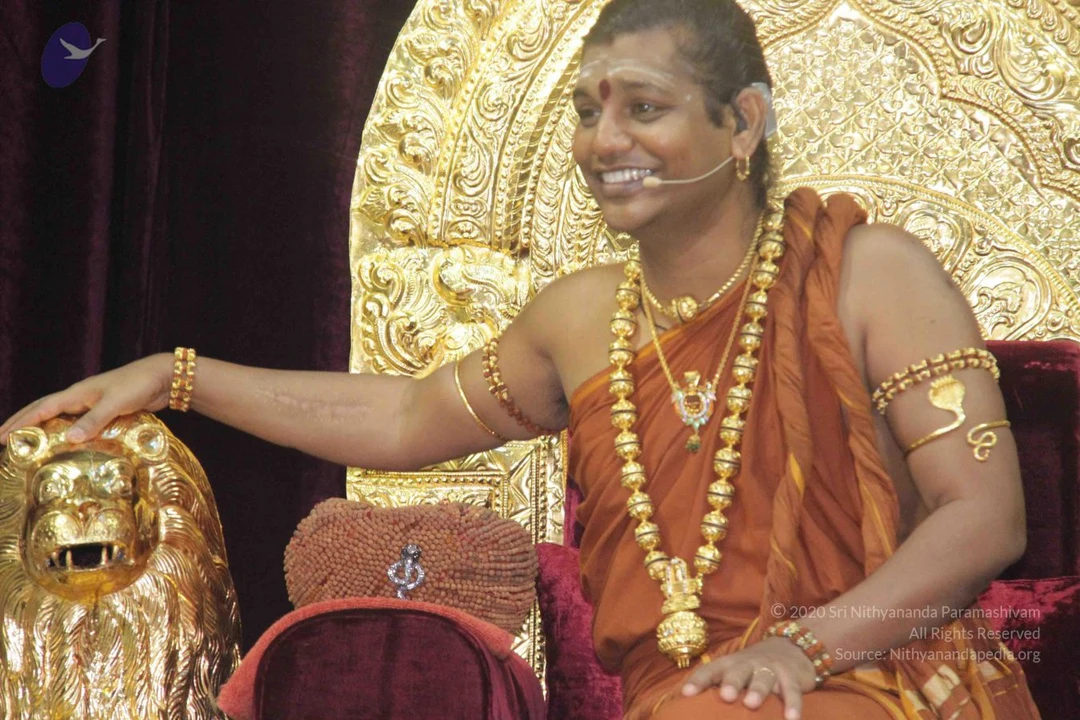
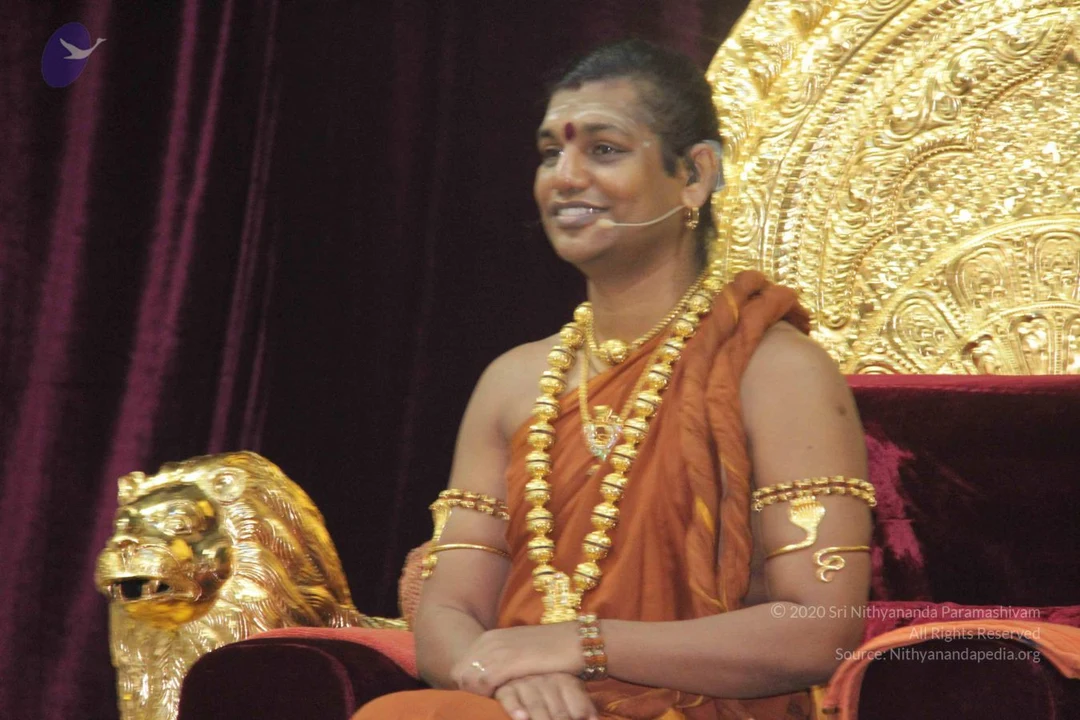
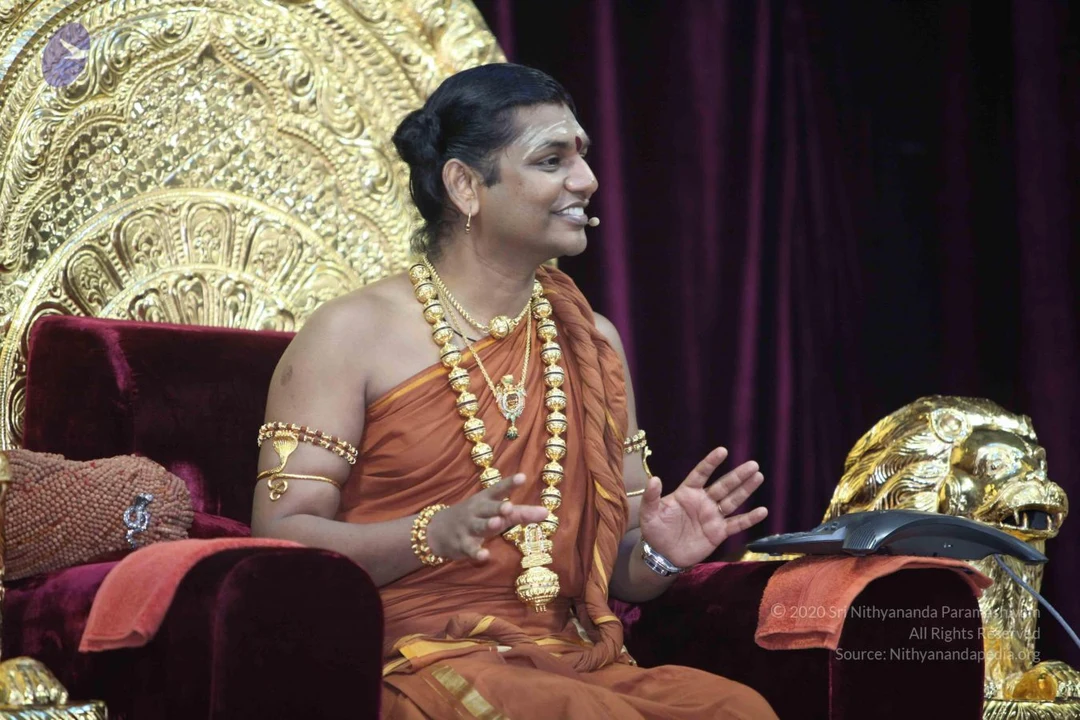
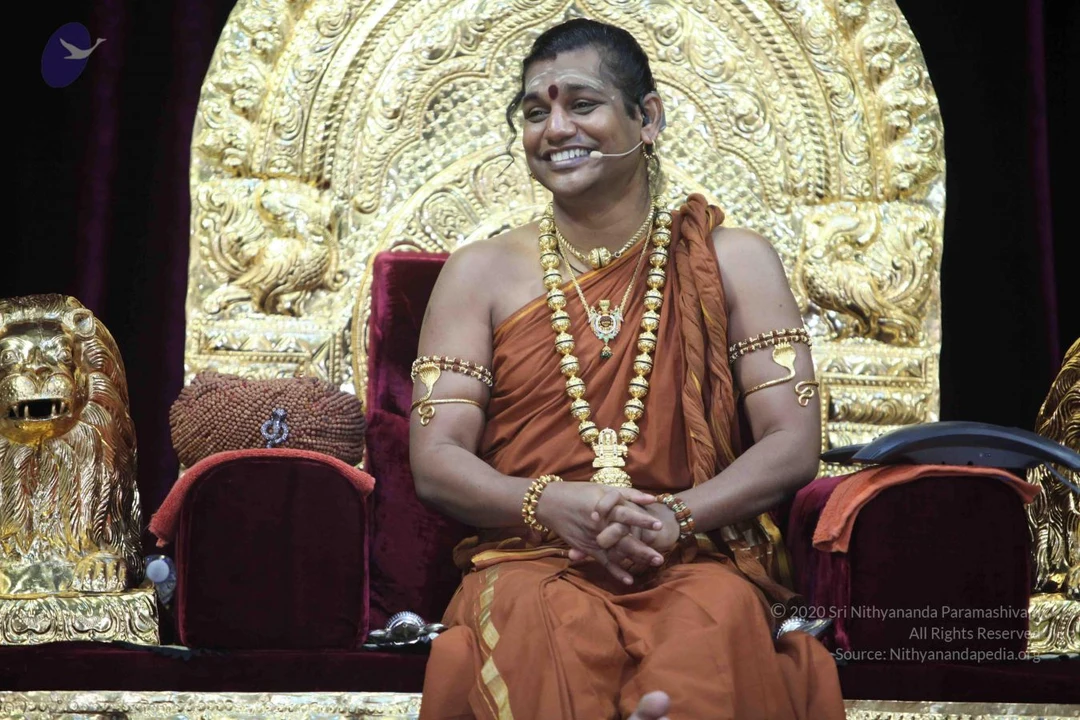
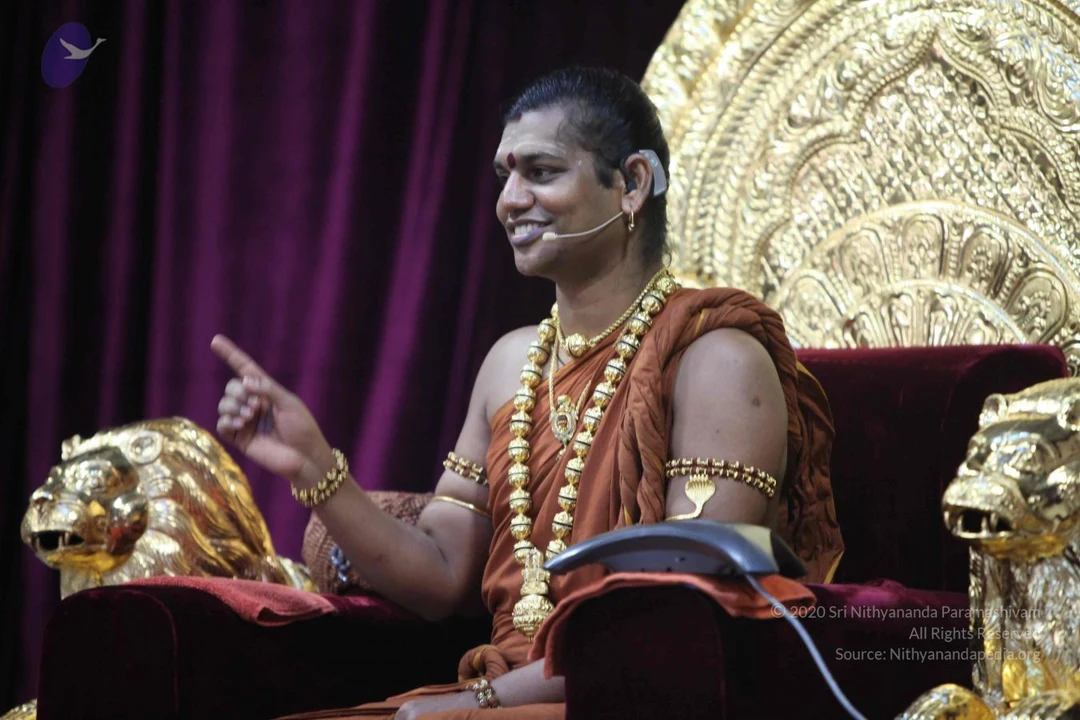
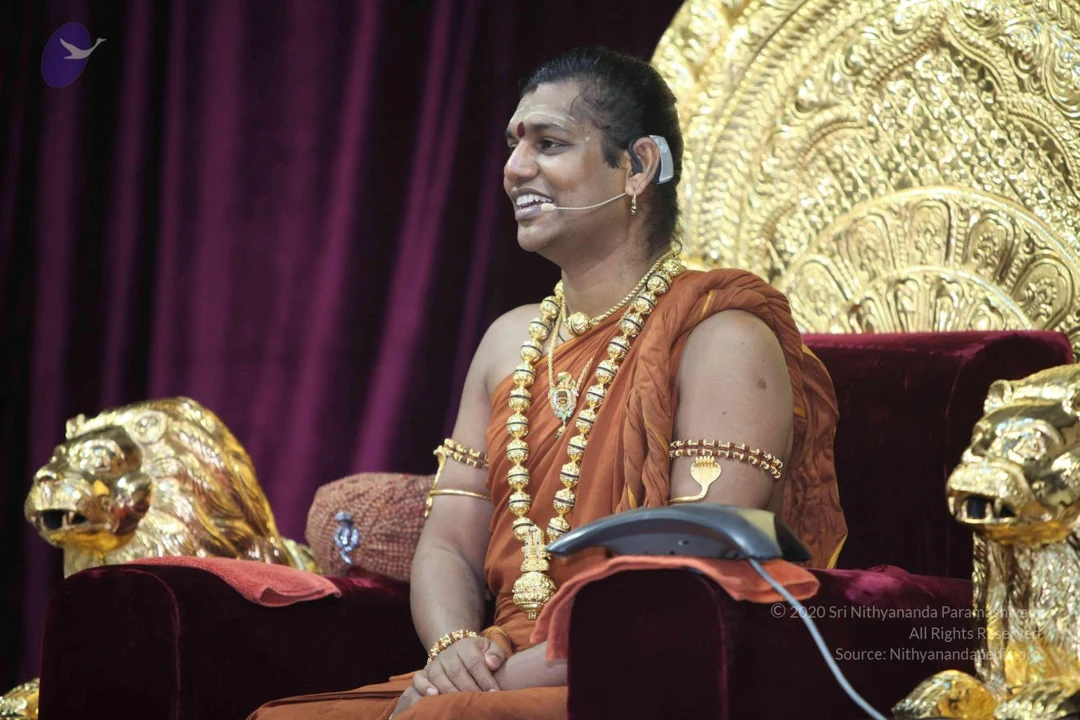
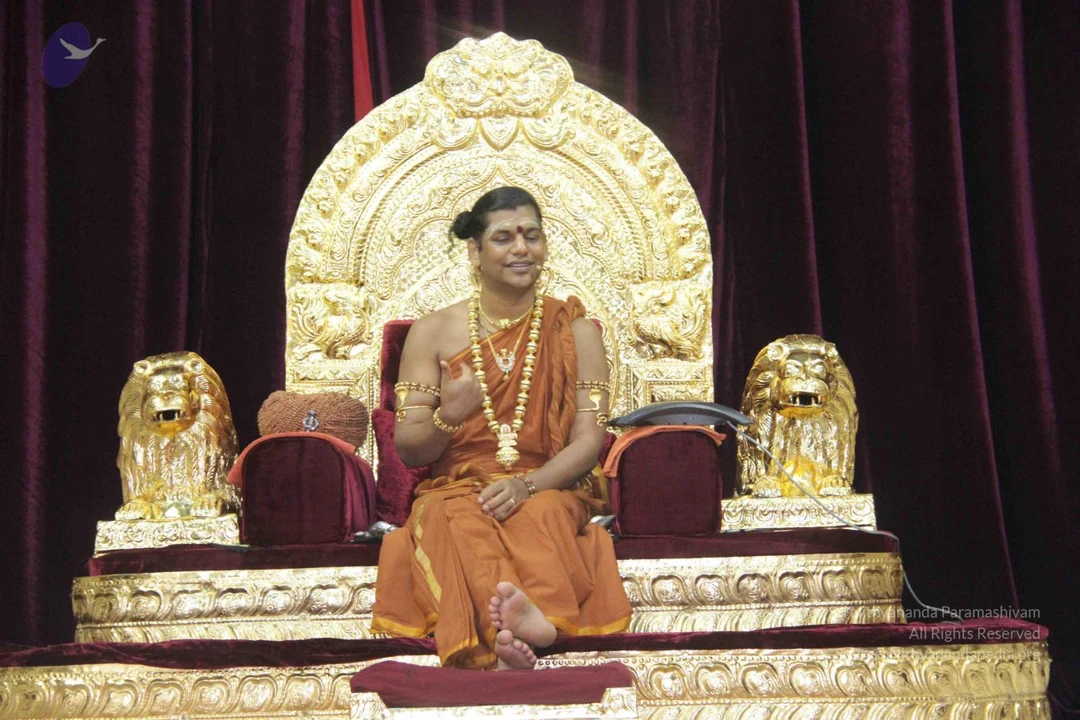
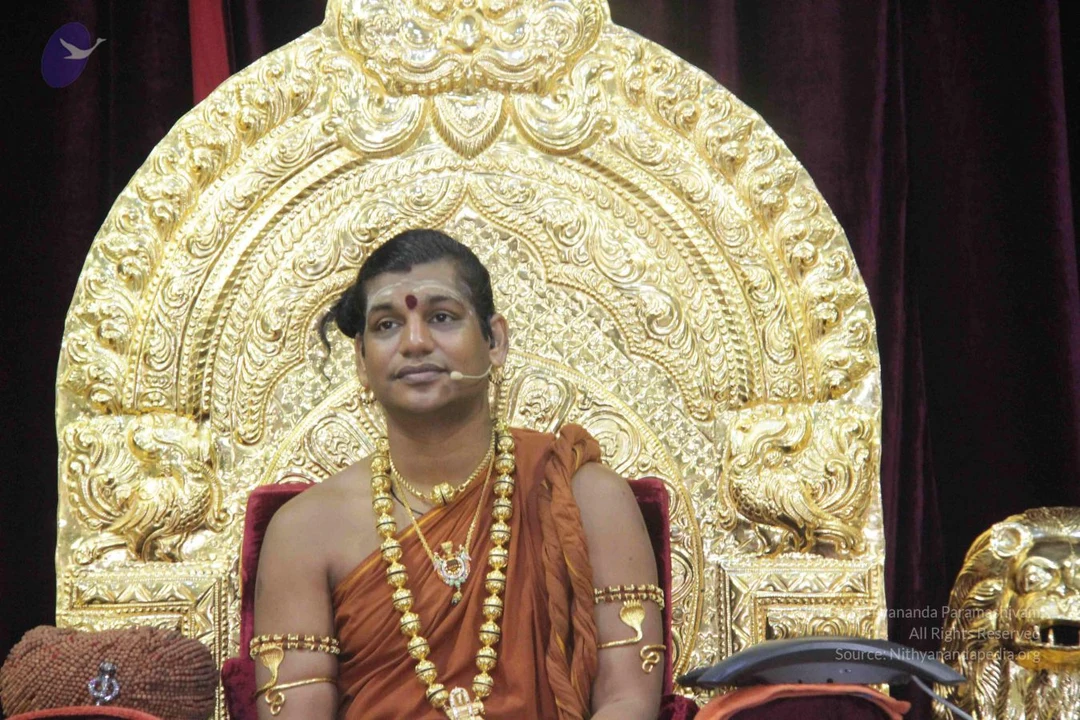
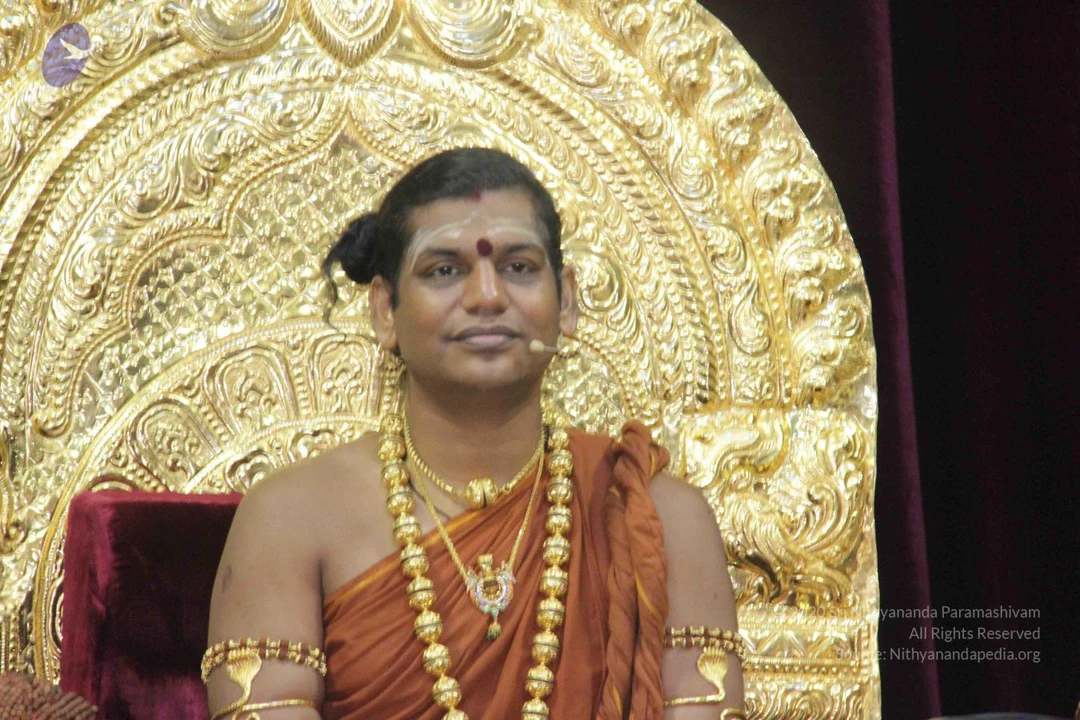
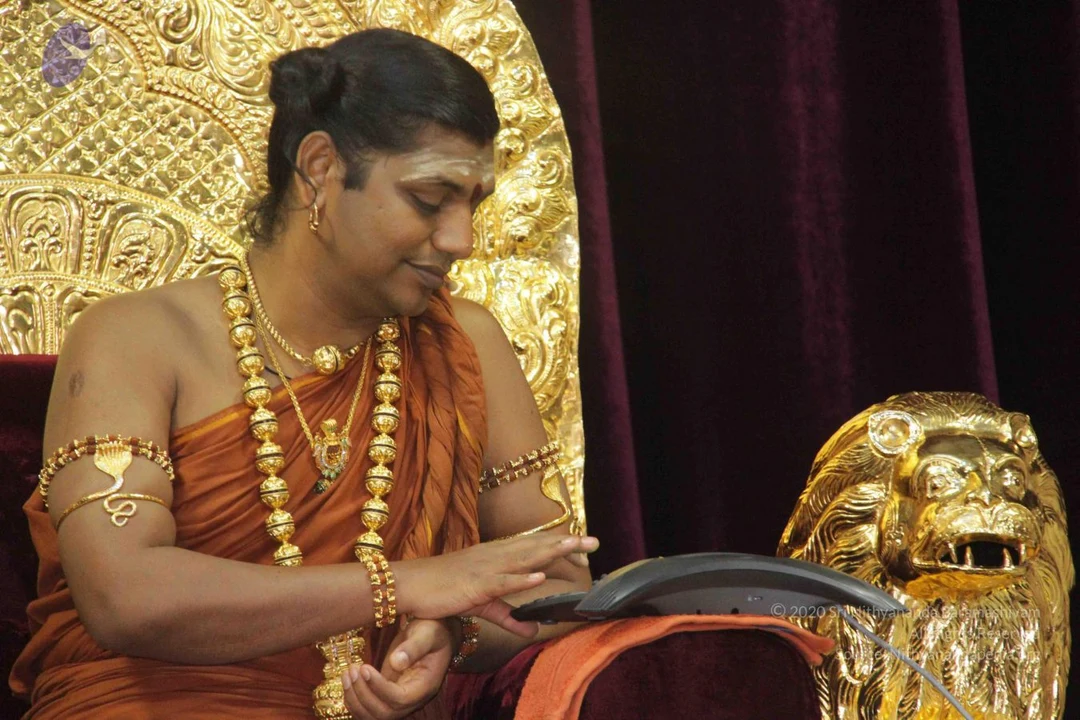
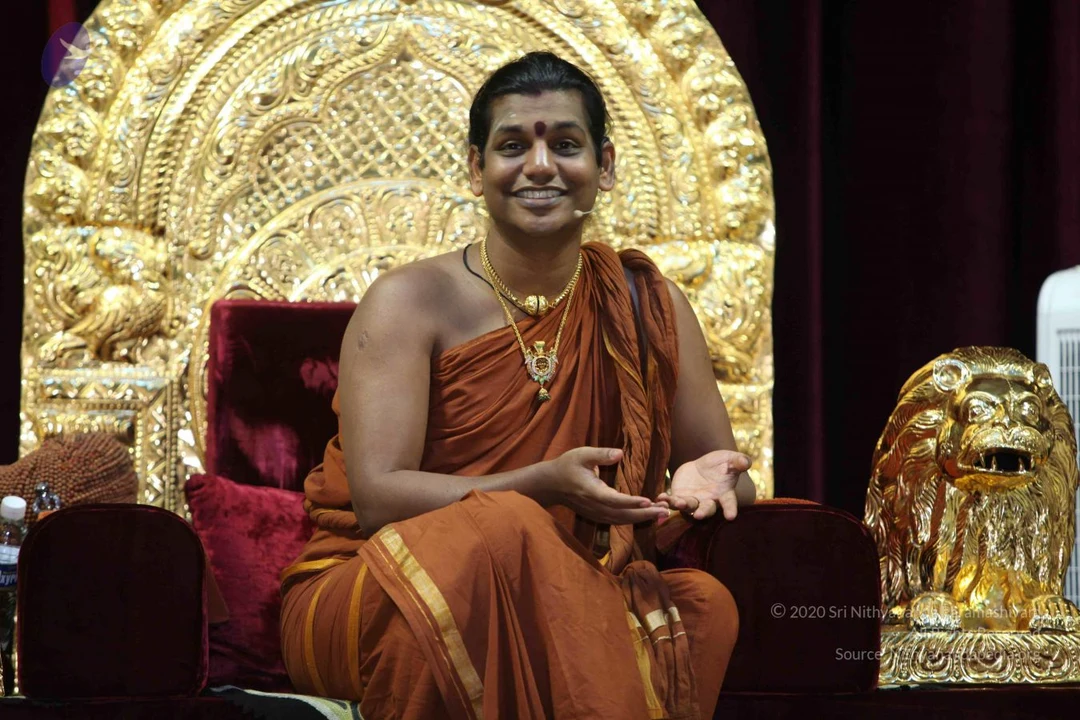
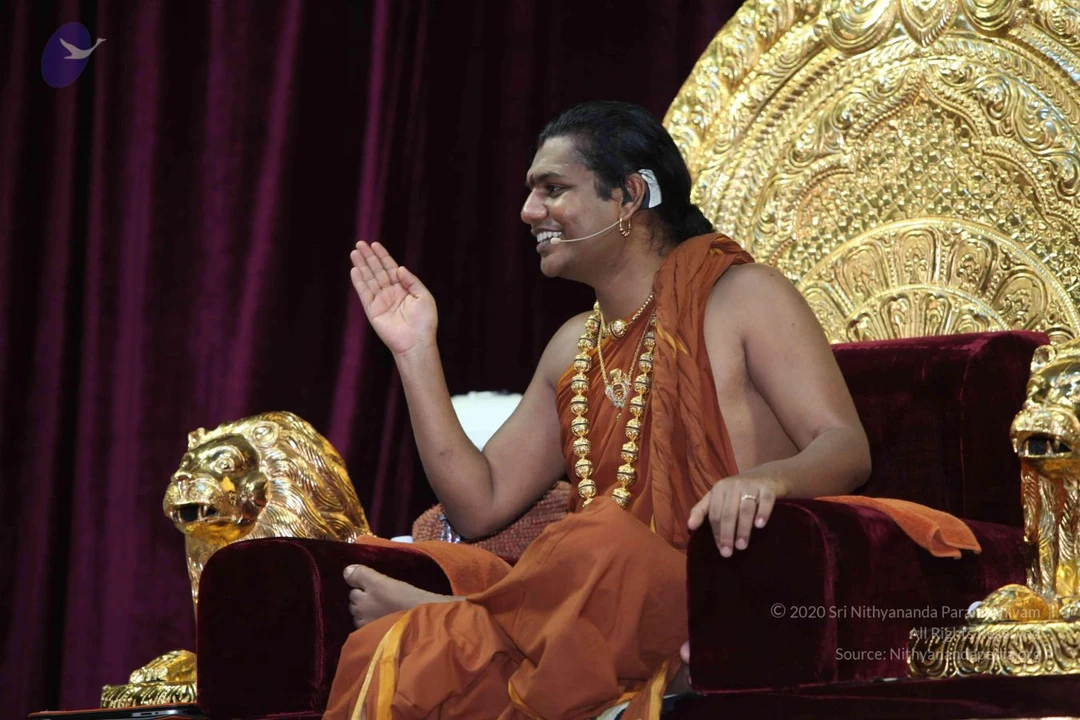
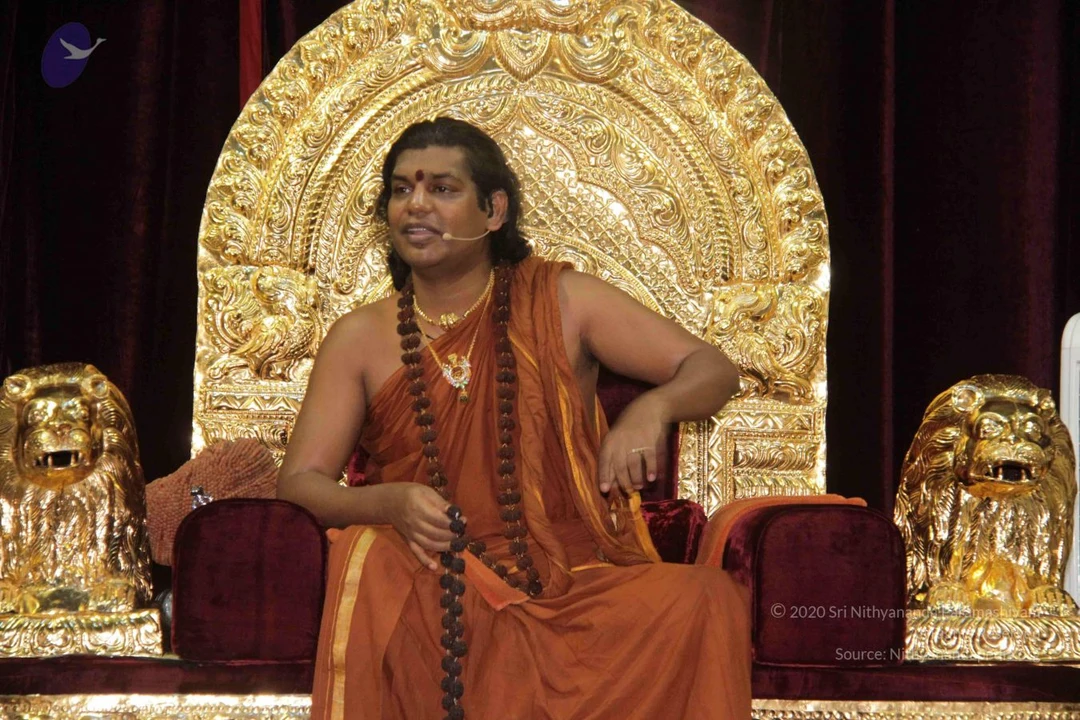
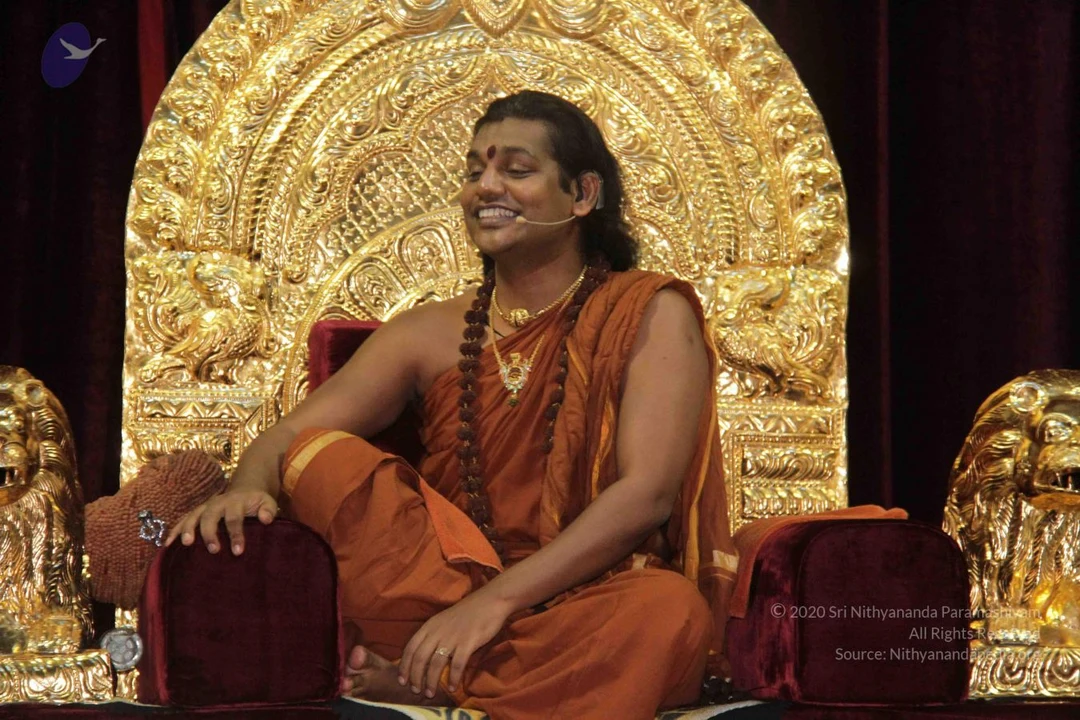
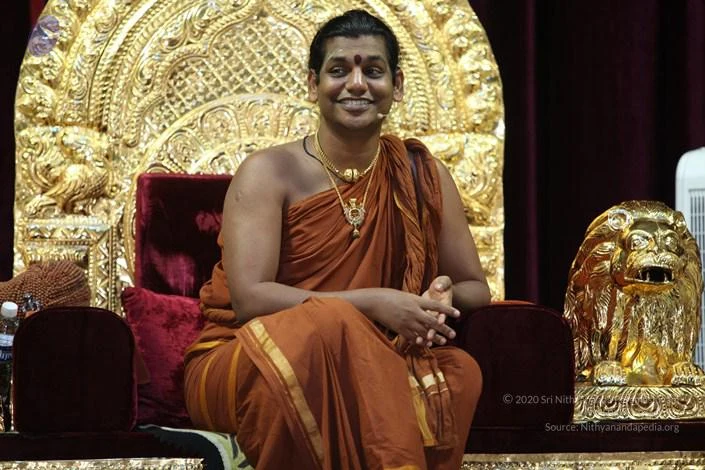
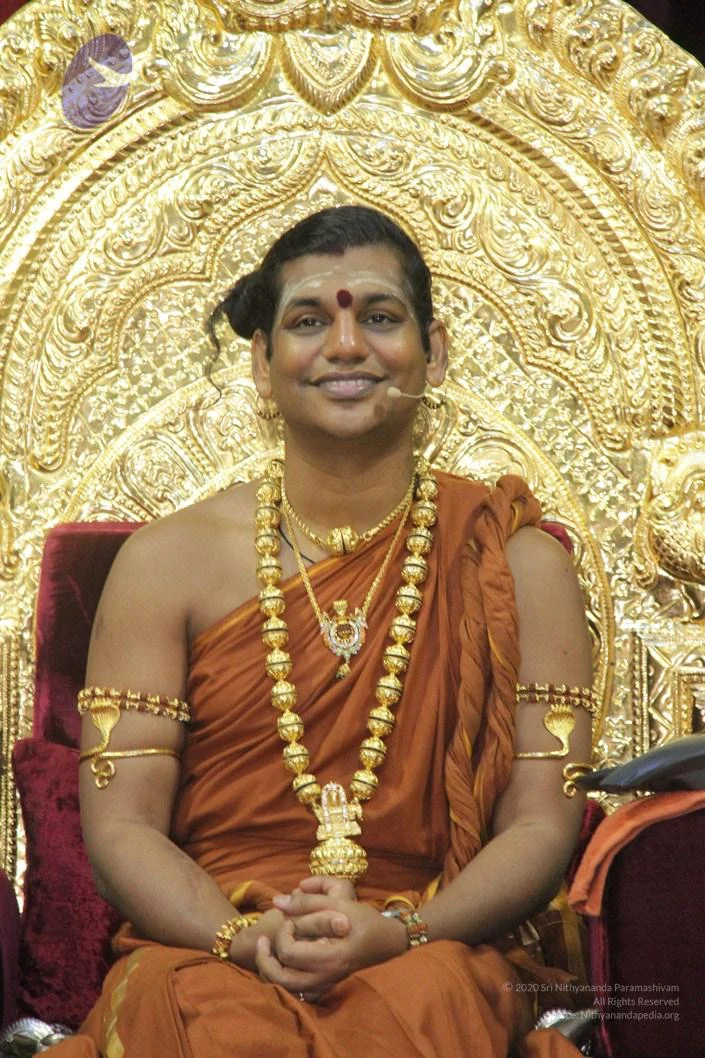
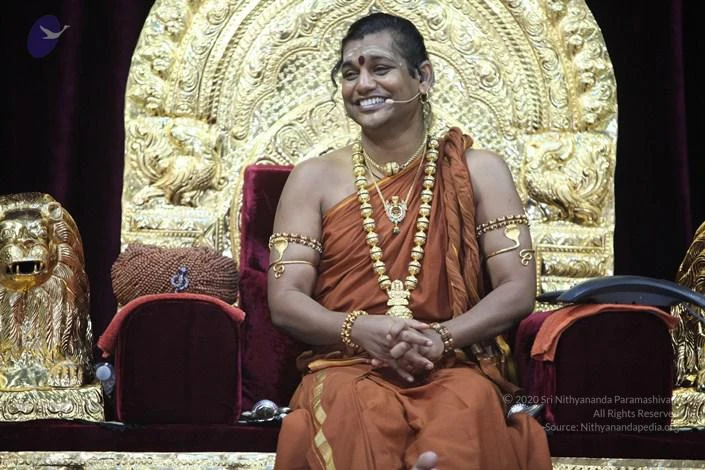
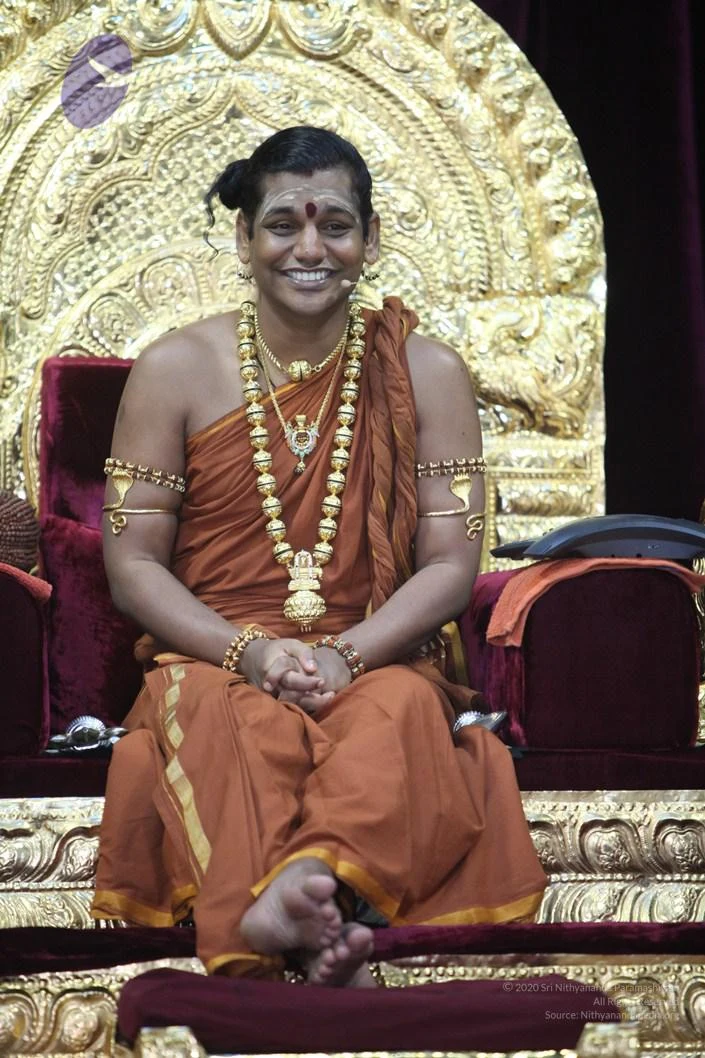
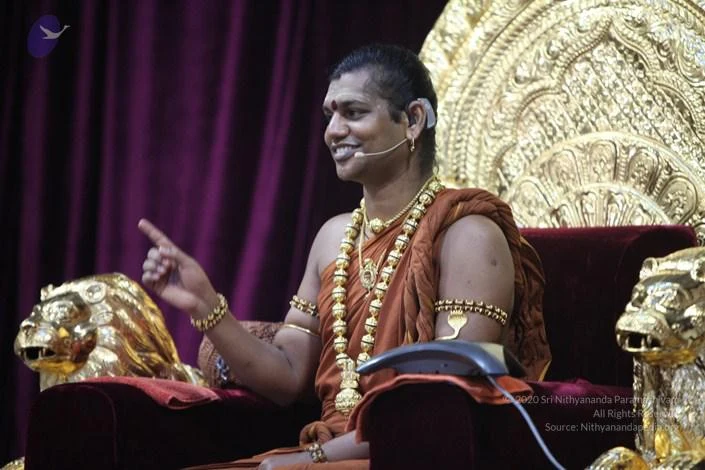
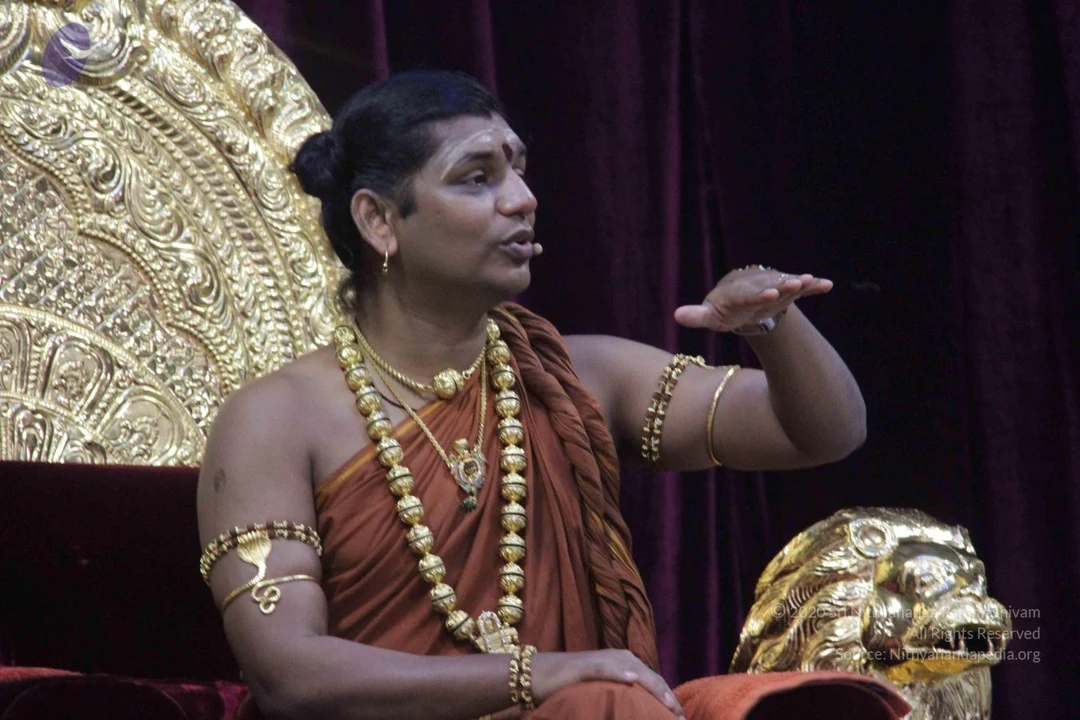
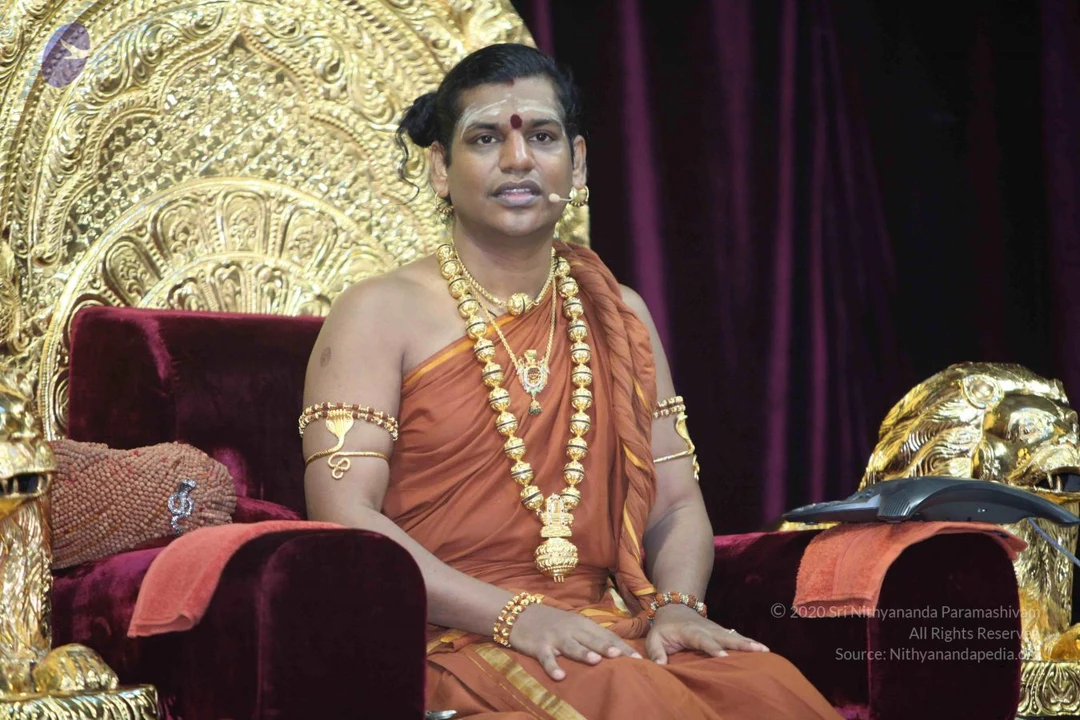
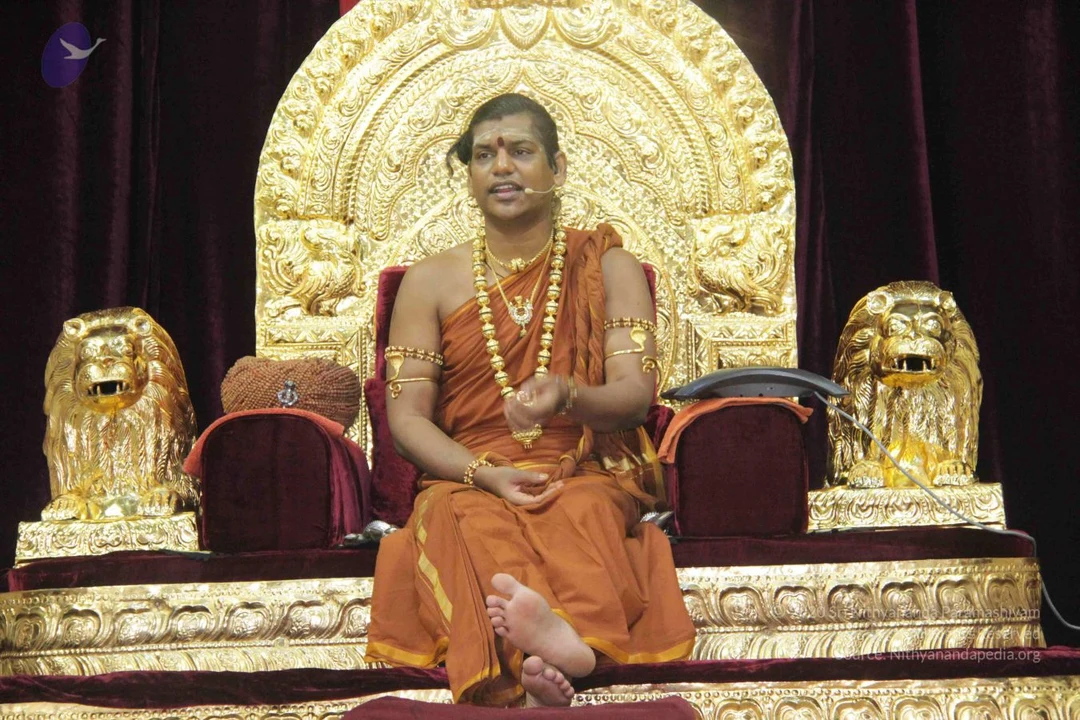
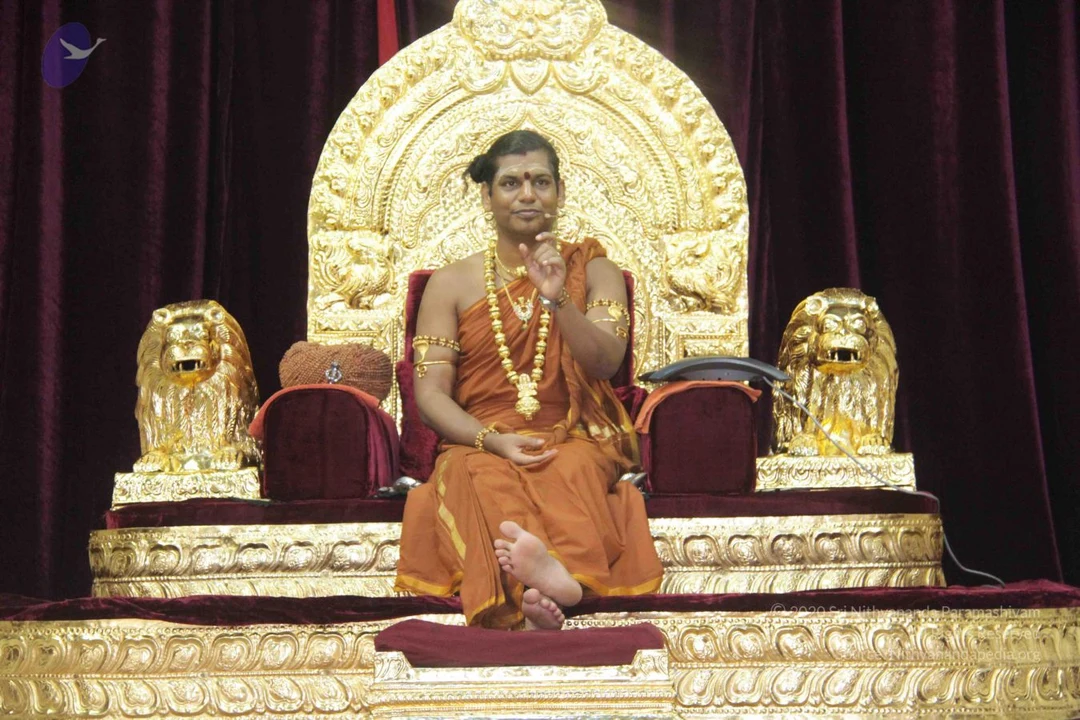
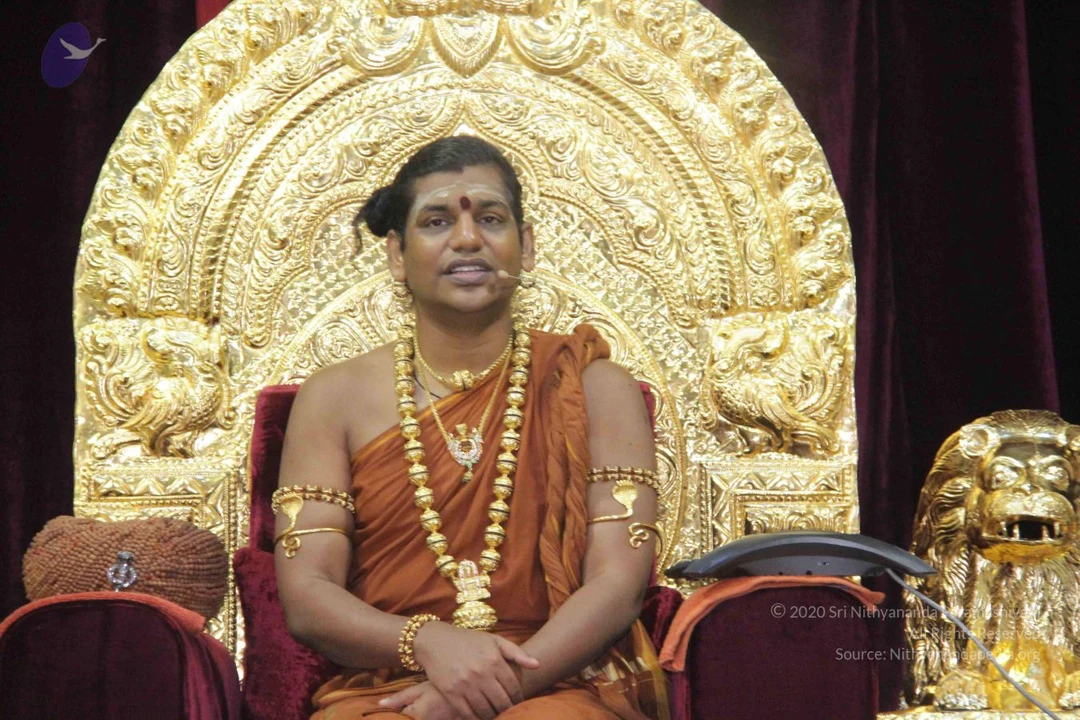
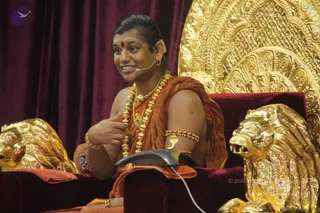
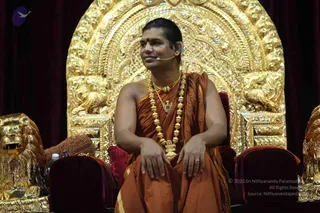
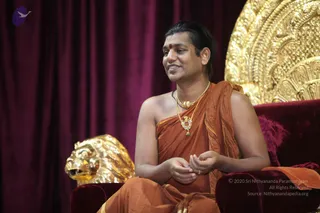
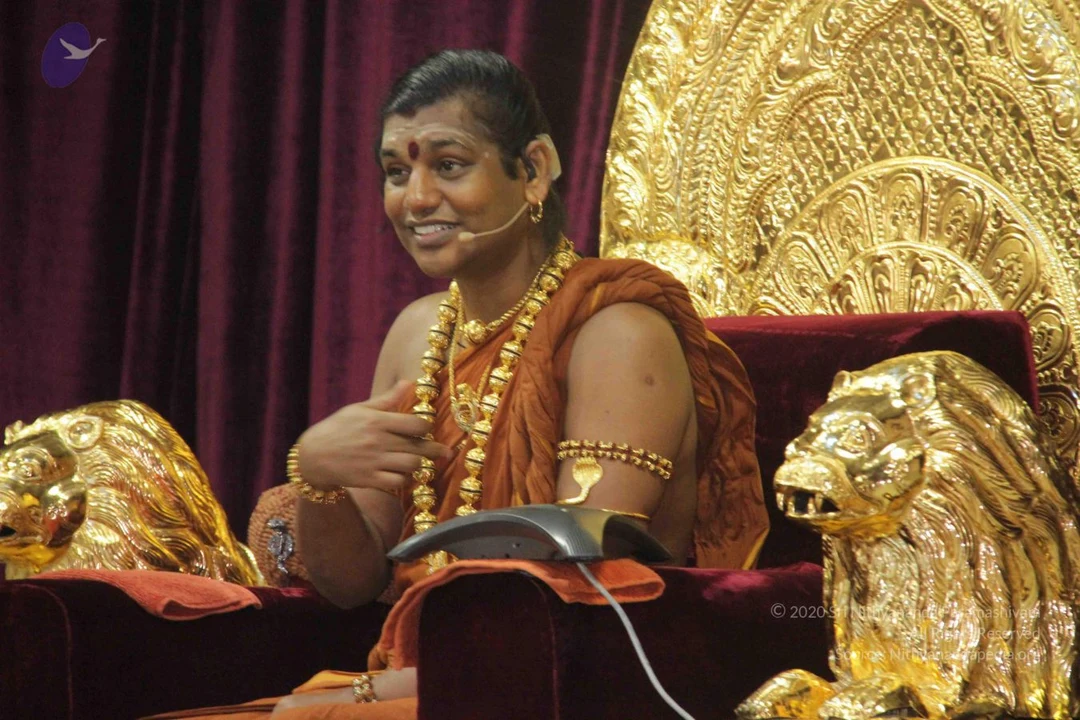
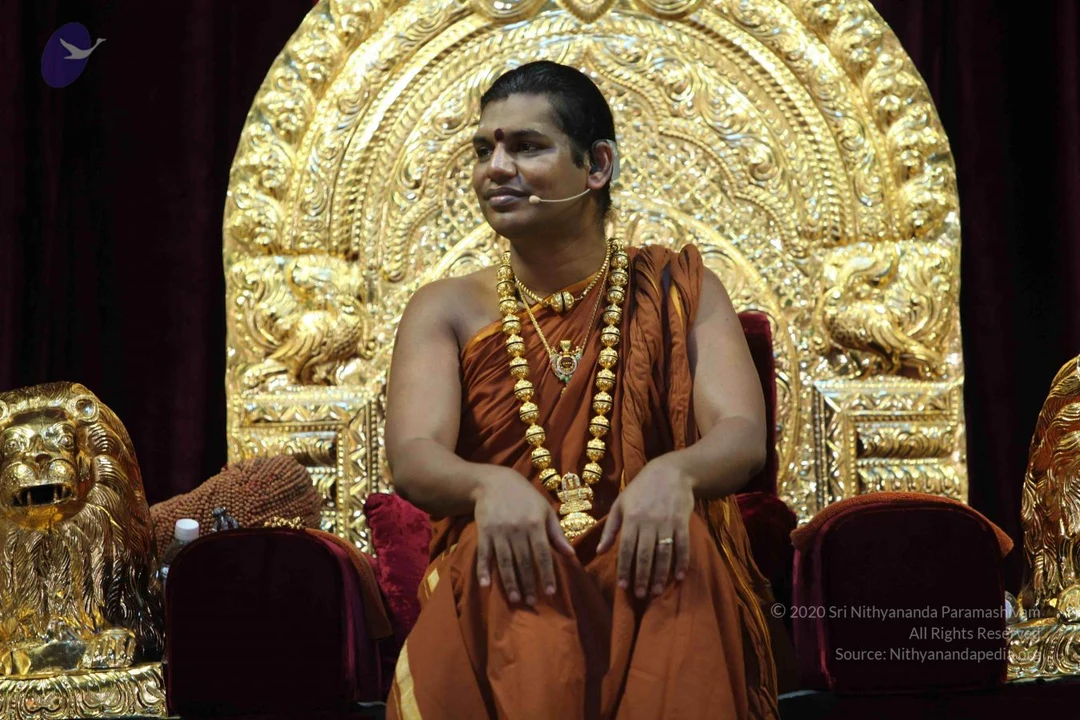
A man seated on an ornate golden throne with a red velvet cushion, flanked by gilded lion sculptures, speaking into a headset microphone and gesturing with his right hand. He wears an orange-saffron shawl draped over his shoulders, a rudraksha-style bead necklace with a gold pendant, a gold bangle on the upper arm, and a red bindi with a white forehead mark. The background is deep burgundy drapery. Swamiji (probable): long swept-back hair, saffron clothing, ornate gold adornments and a seated throne position give the appearance of the Nithyananda Paramashivam candidate.A seated man in saffron-orange robes sits on an ornate golden throne with a red velvet seat, flanked by golden lion sculptures. He wears a red bindi, a headset microphone, multiple gold necklaces with bead strands, gold armbands and bangles, and a small rudraksha-style bead mala. He sits with hands folded and looks to the side with a slight smile. Maroon velvet drapery hangs behind him. a person is shown as the figure in saffron robes seated on the throne, with the throne, lion sculptures and gold necklaces serving as the distinguishing cues. A small purple logo appears in the upper left corner and a copyright photo credit runs along the lower right edge.A seated man in an orange-saffron dhoti and shawl sits on an ornate gold throne carved with lions, set on a red velvet-draped stage. He wears a long beaded necklace, bracelets, a red bindi and a small earpiece microphone, and his bare feet rest on a red cushion. Swamiji (probable): long dark hair and ornate ceremonial gold necklace, seated on a golden throne in saffron clothing. A microphone cable runs across the stage.A seated man in saffron-orange robes sits on an ornate gold throne with carved lion figures and a tall gold back panel, against deep maroon velvet drapes. He wears a gold-bead necklace and multiple bangles, with a small red bindi on his forehead, and a headset microphone is visible at his face. A wired microphone rests on the armrest. The throne sits on a gold-carved dais with a red velvet cushion, and a small footstool is in front.A seated man in orange-saffron robes sits on an ornate gold throne with a large carved arch, flanked by two golden lion sculptures, in front of deep red velvet curtains. He wears a gold beaded necklace, gold bangles and a gold armband, with a dark topknot and a red bindi, and his bare feet rest on a red cushion. He gestures with one hand while speaking, with a microphone visible at the right. Appearance-based: a person, seated on the throne in orange robes, gold necklace and topknot.A man seated on a red cushioned chair before an ornate gold-leaf arched throne carved with lions and floral scrollwork, against dark maroon drapes. He wears an orange-saffron shawl over his bare shoulders, a long beaded gold-toned mala, a pendant necklace, gold armlets and a red bindi with a white forehead marking, and a small clip-on microphone is attached near his ear. He sits with a calm expression, and a gold-and-red cushion and a dark cloth are visible at the lower edge. Appearance-based label: Swamiji (probable), with long swept-back hair, saffron shawl, rudraksha-style beaded mala and ceremonial gold ornaments, seated on a throne-like seat.

ESSENCE-OF-INNER-AWAKENING-IN- TAMIL

42 photosSource gallery
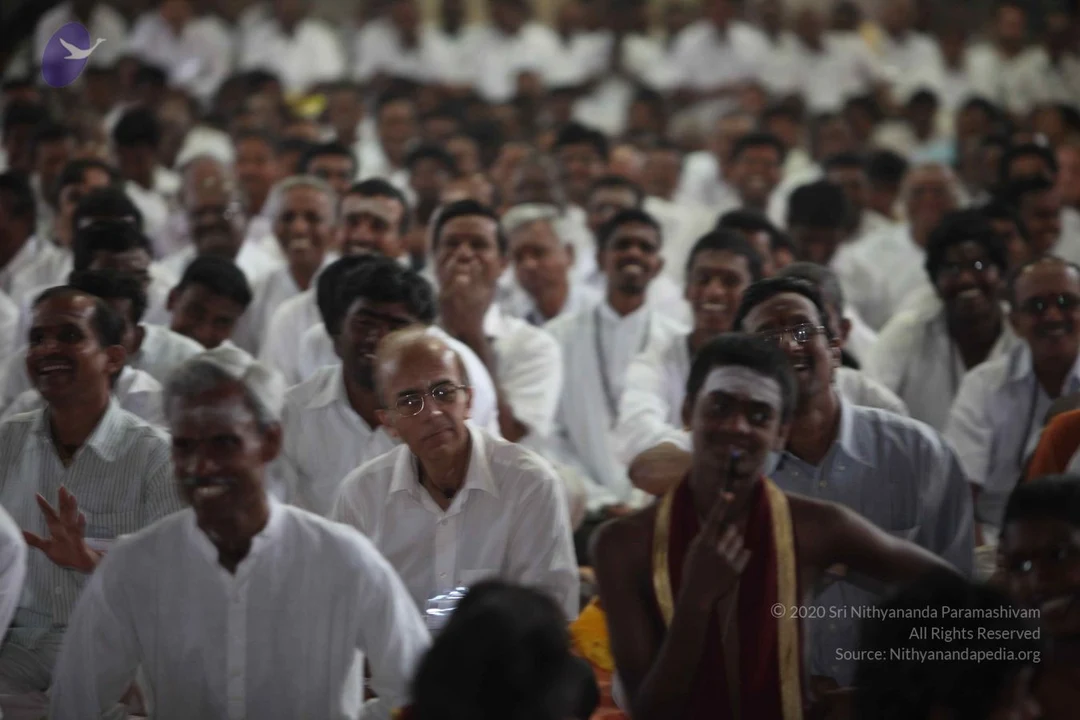
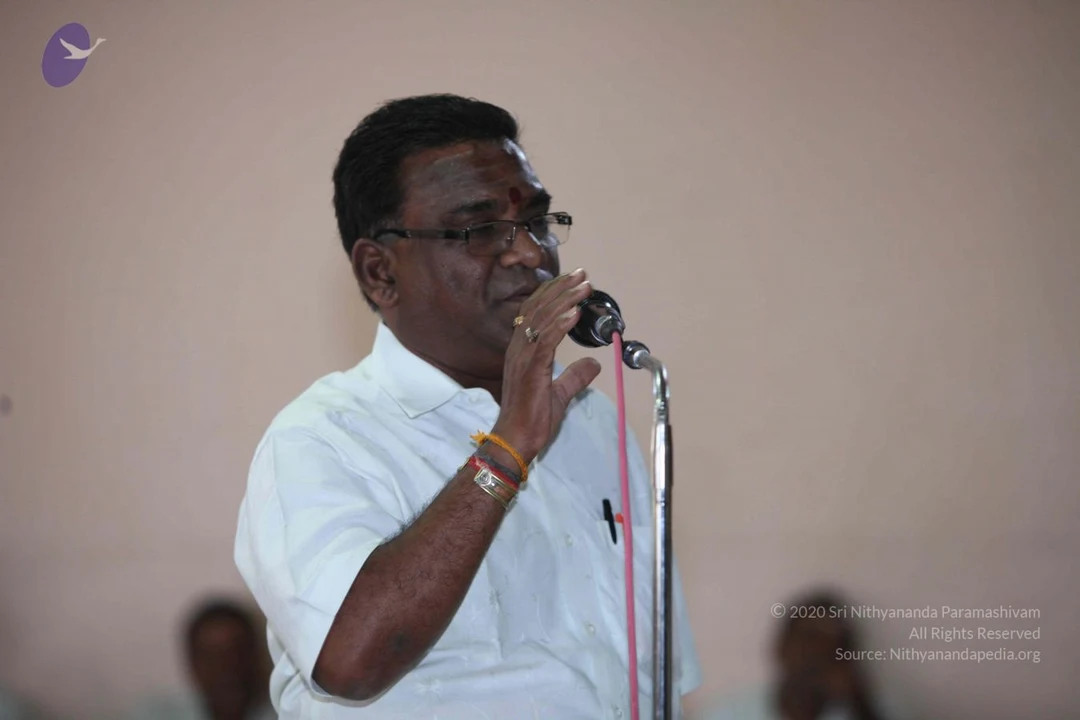
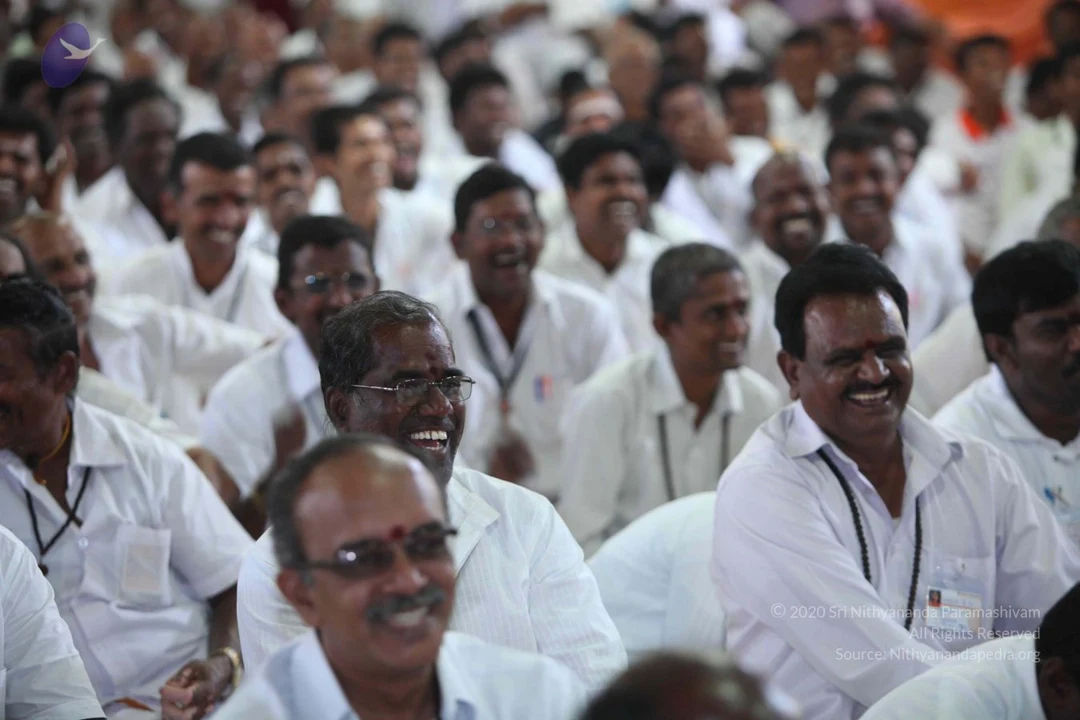
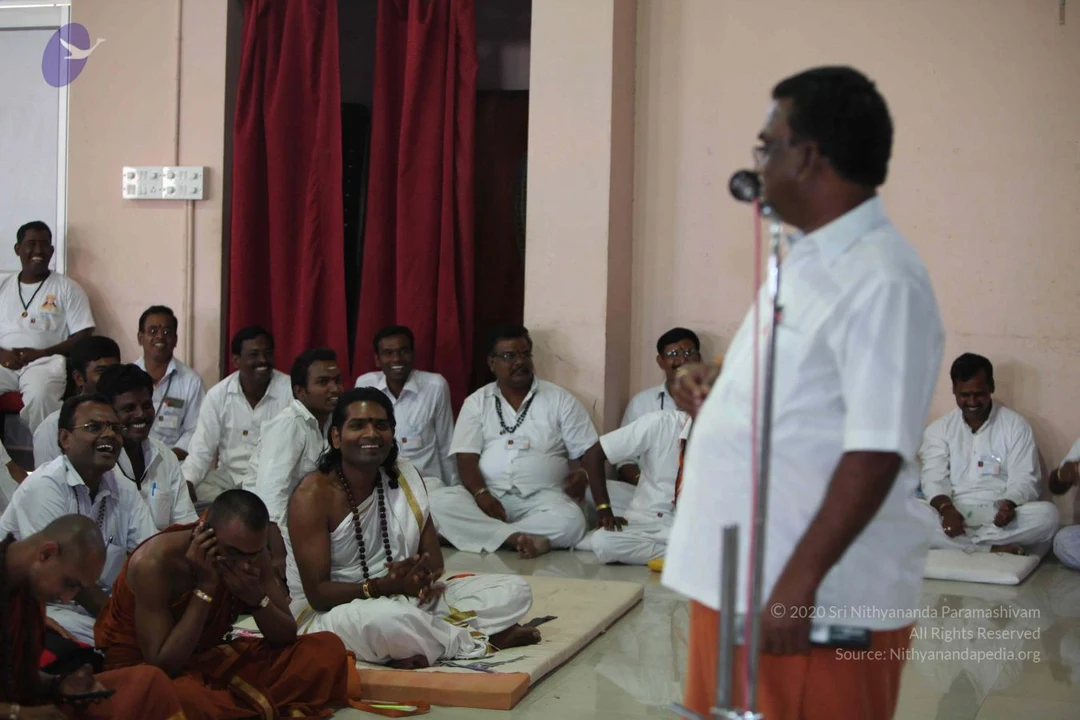
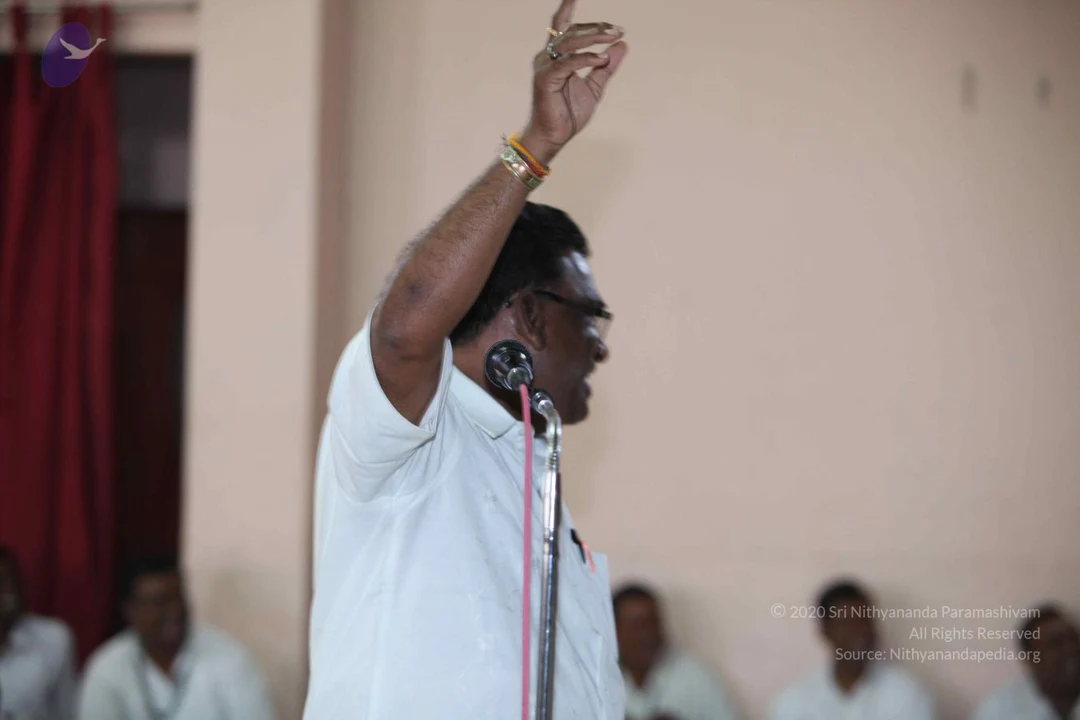
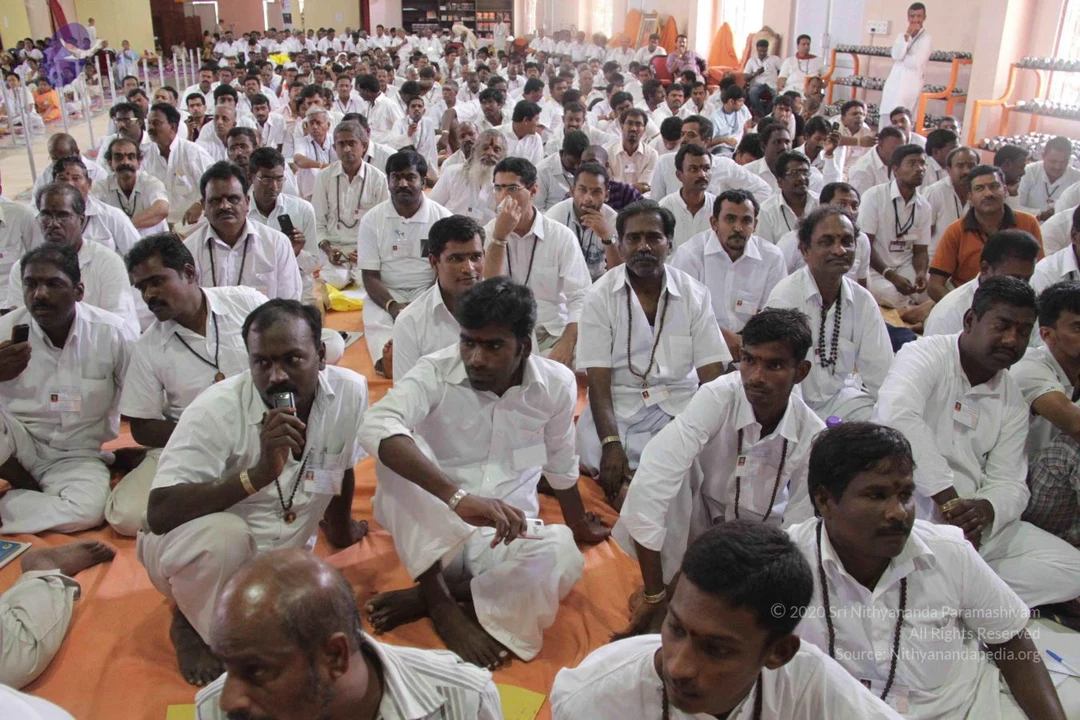
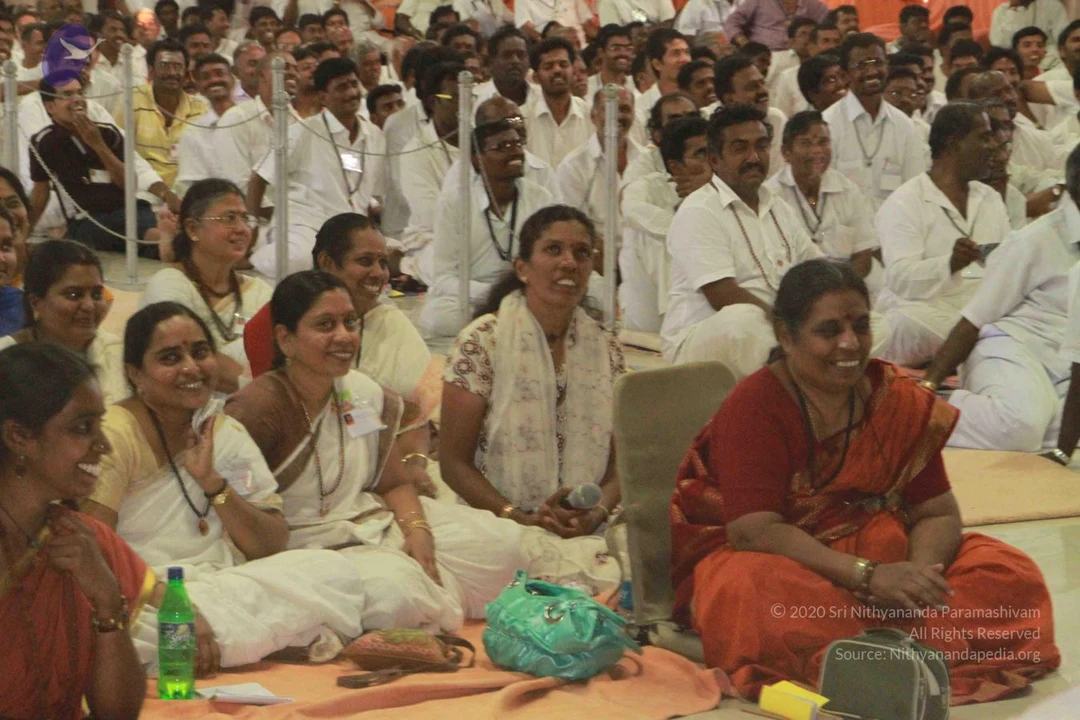
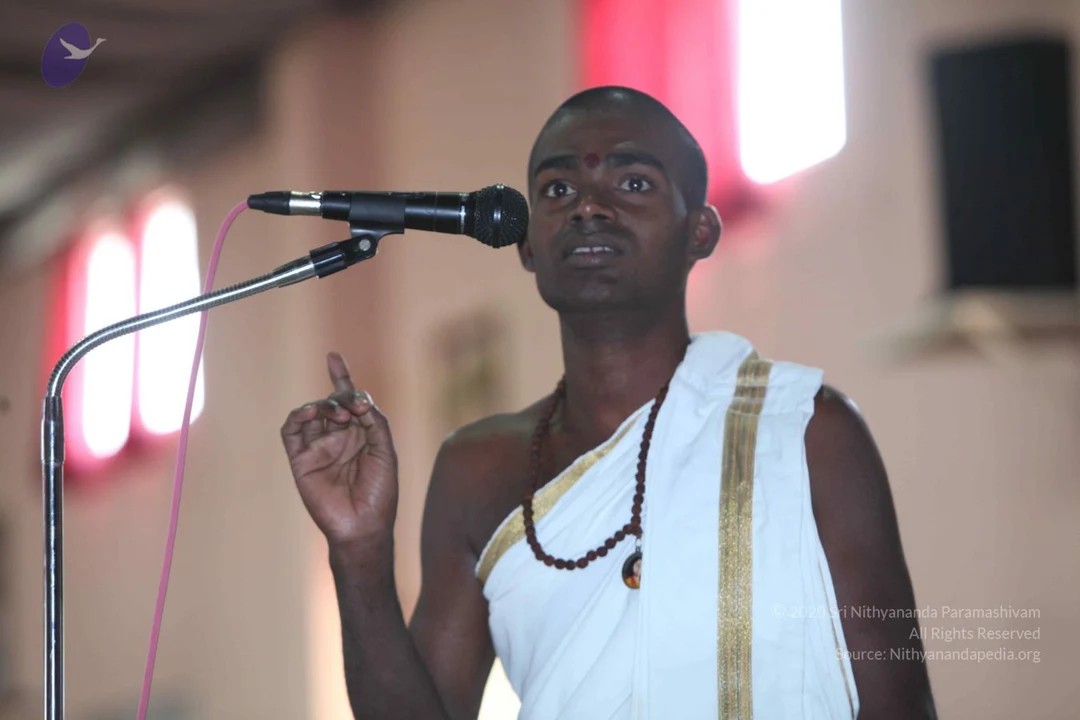
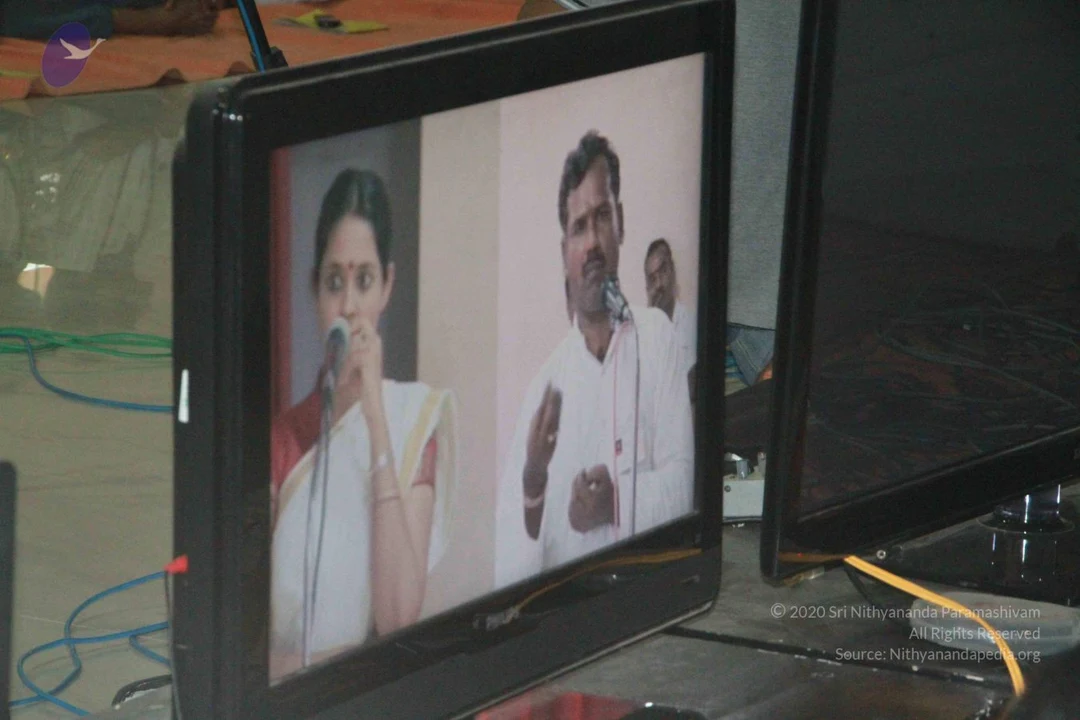
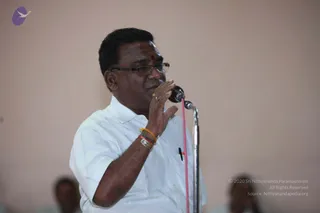
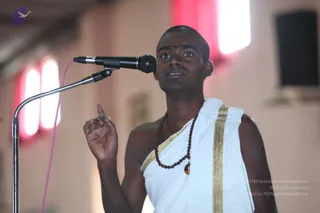
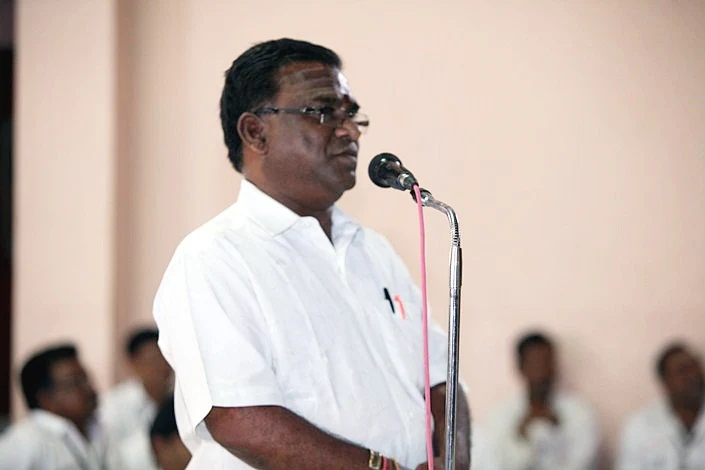
A man seated on an ornate golden throne with carved lion figures and a gold arched backdrop, on a stage with dark red velvet drapes. He wears an orange-saffron cloth draped over one shoulder and a long, multi-strand gold bead necklace with a gold pendant, plus a small red bindi on his forehead and a headset microphone. His hands rest on his lap as he looks to the side. a person: the saffron clothing, gold malas and ceremonial throne match the page's identification, but the face is not used for identification. A golden lion sculpture sits at the left edge and a red cushion rests on the armrest.A dense audience of mostly men seated closely together in white shirts and trousers, viewed from the front in a large hall. In the centre, a man in a white shirt and dark-rimmed glasses sits with one hand raised near his chest, a dark beaded mala hanging over his shirt and an ID badge on a lanyard. To the right, another man in a white shirt with a thin red line on his forehead sits beside a man in a white shirt wearing a beaded necklace. At lower left, a man in an orange top is partly visible. The faces are attentive and the crowd fills the frame.Photograph of a seated audience at a satsang gathering, mostly men in white shirts. The central man with greying hair, a moustache and a dark beaded mala necklace is speaking, wearing a white short-sleeved shirt. Blurred figures in white and one in orange clothing surround him. The setting appears to be a hall with a crowd facing forward.A seated man in saffron-orange robes sits on a red velvet throne with a gilded lion armrest and an ornate gold backrest behind him. He wears a red bindi, a gold necklace with a pendant, and a wrap draped over one shoulder, with hands gently gesturing as he smiles while speaking. Red velvet drapes form the background.A large seated congregation of men in white shirts and white dhotis fills the frame at a satsang, most looking forward with attentive expressions. Many wear tilak marks and some have vibhuti or kumkum on their foreheads; several wear rudraksha malas and one man in the foreground wears a red bindi. Heads and shoulders are densely packed, with a few men in yellow or patterned shirts among the white. No individual is identifiable as the teacher from the visible scene. Nearly all people are devotees seated on the floor of the hall.A man in a white short-sleeved shirt stands at a silver microphone on a stand, speaking with his right hand raised near his face. He wears glasses, a red tilak mark on his forehead, a gold ring and a wristwatch, with orange and red threads tied on his wrist. A pink cable runs down beside the mic stand. Two blurred heads of seated listeners are visible at the lower edge against a plain beige wall.

SARVA-DARSHAN

6 photosSource gallery
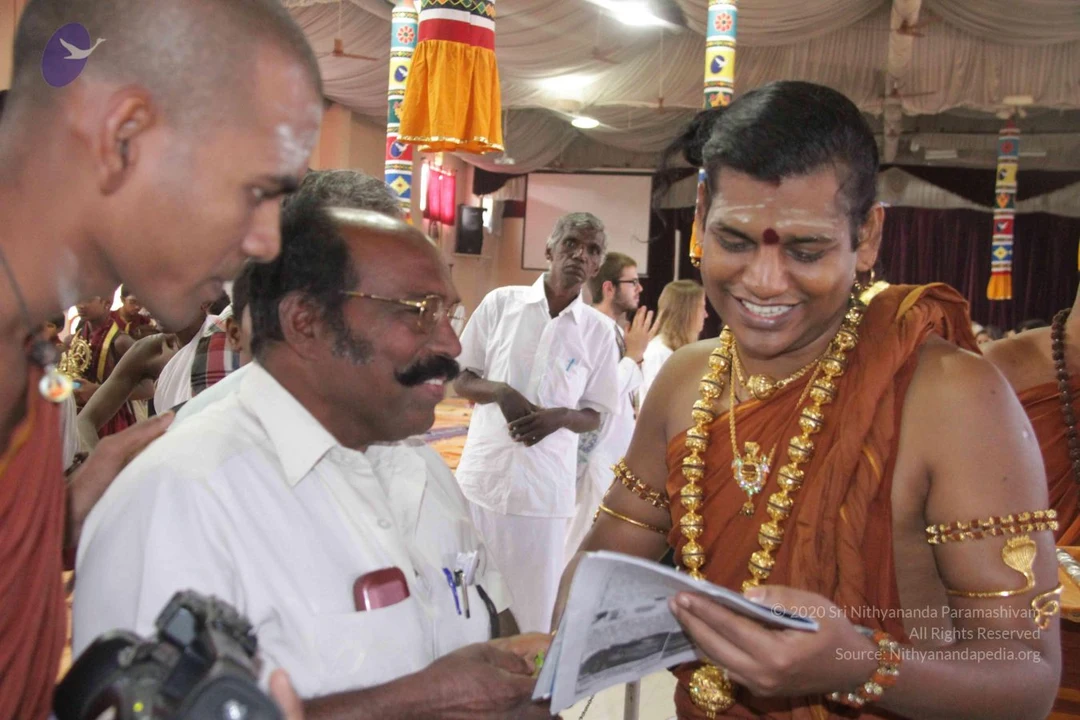
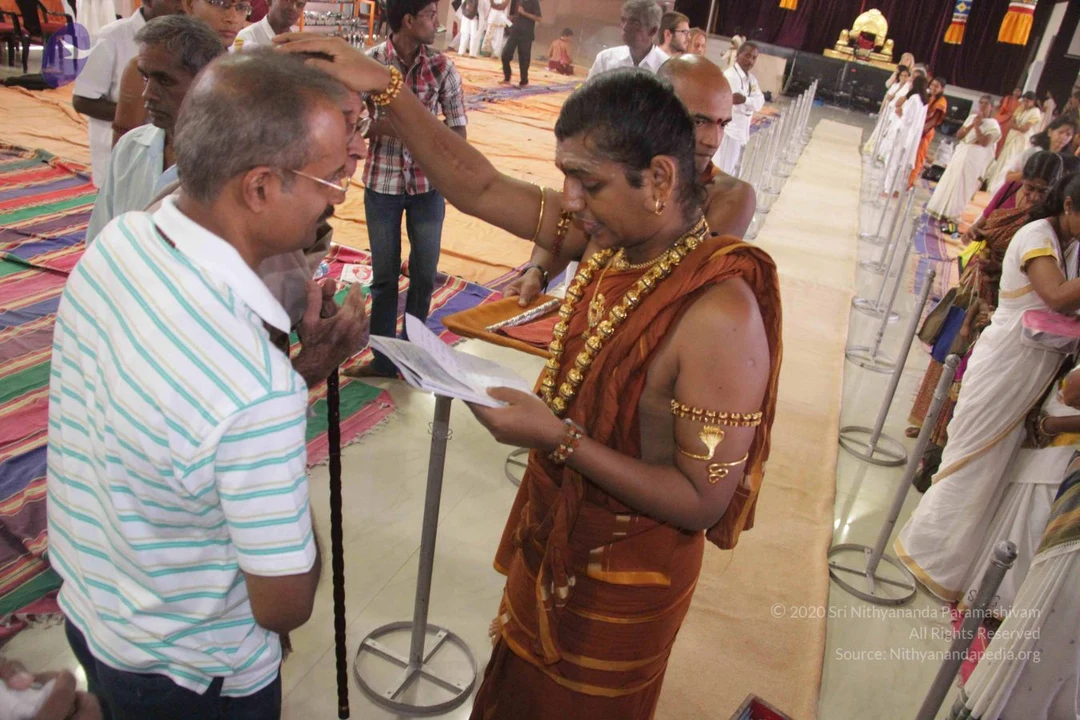
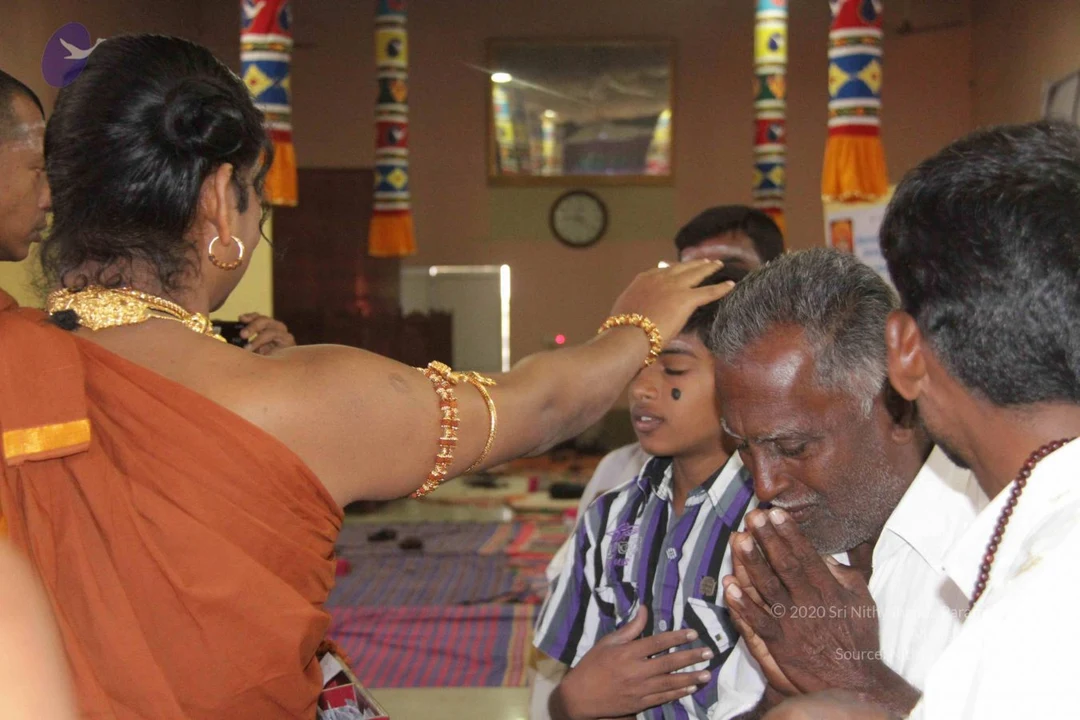
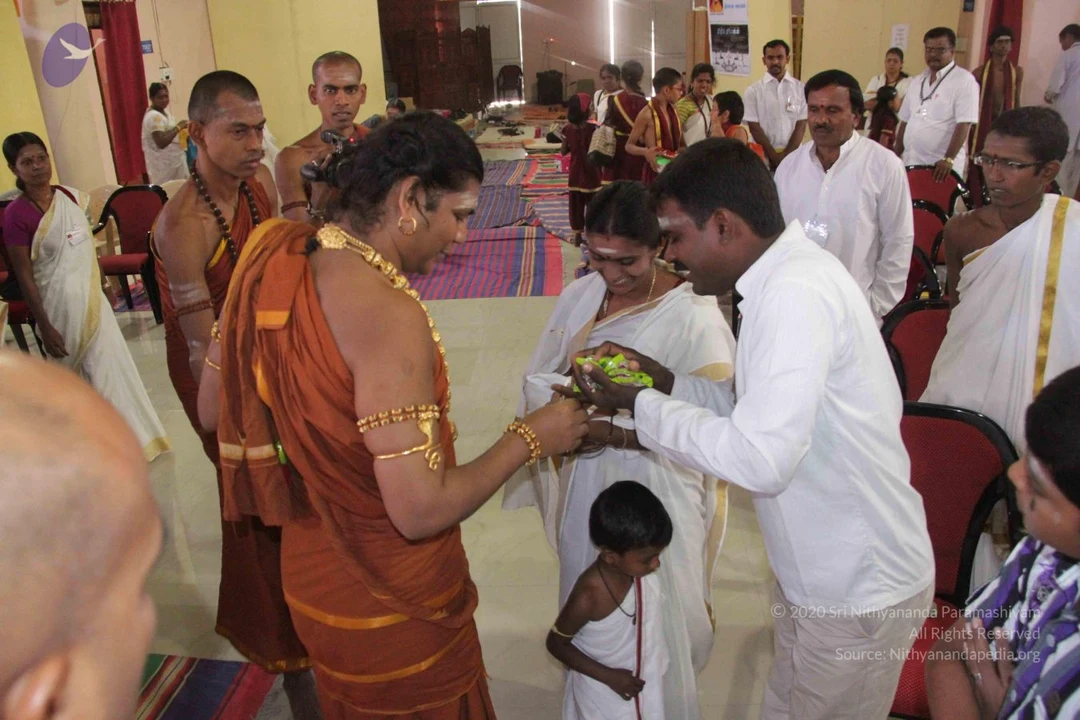
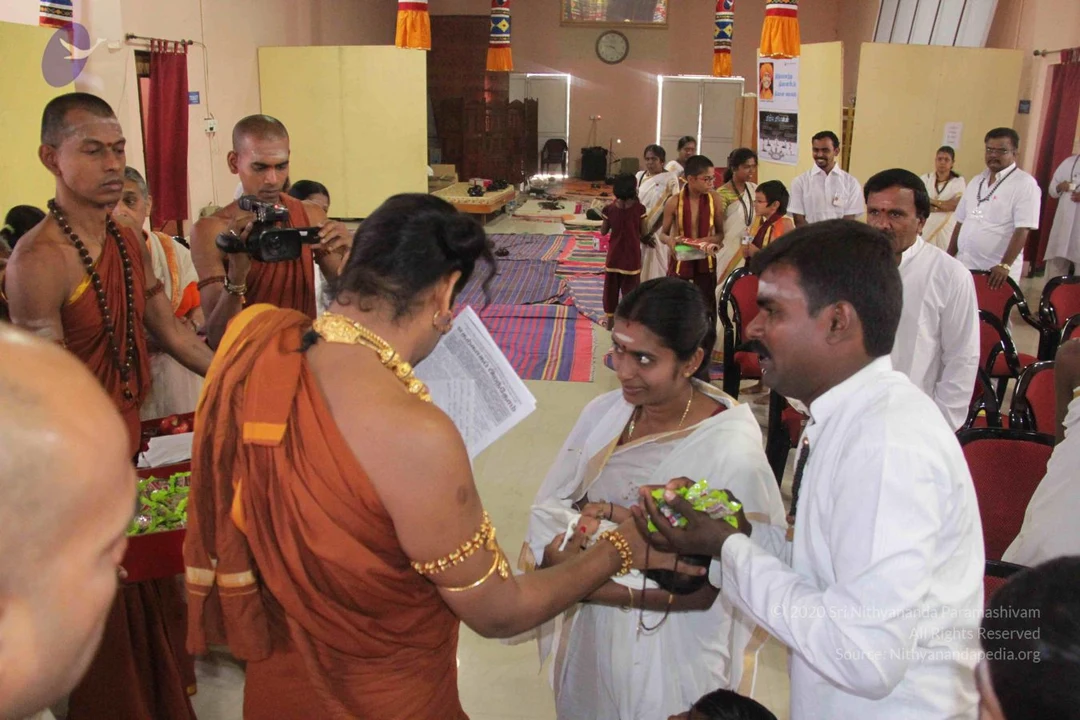
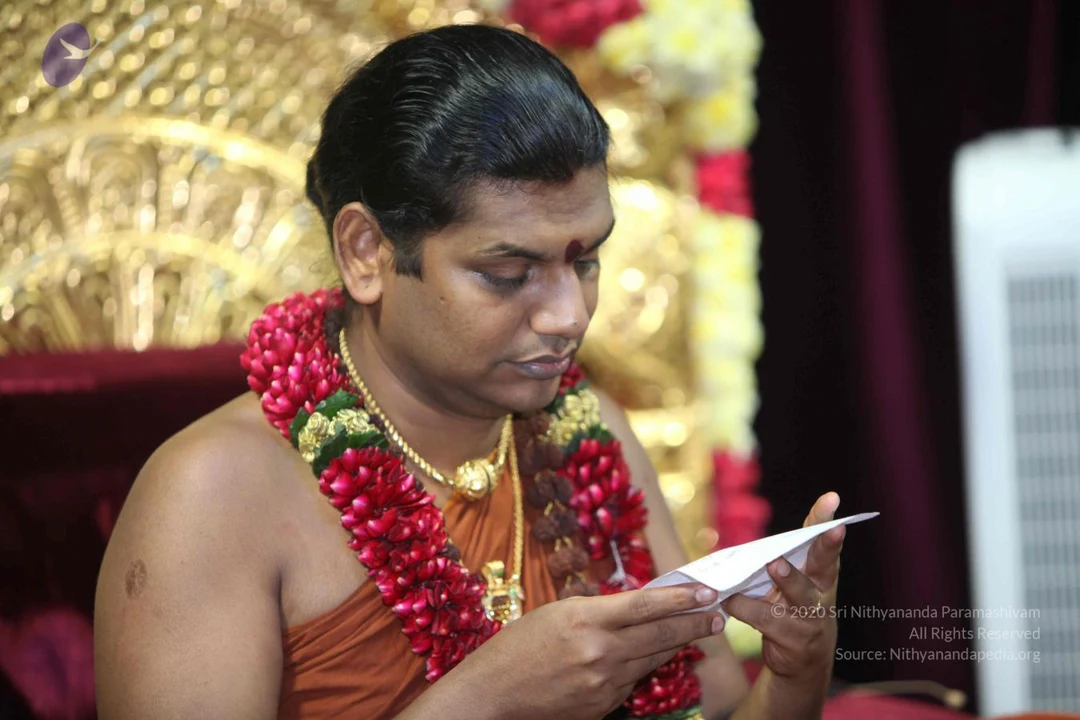
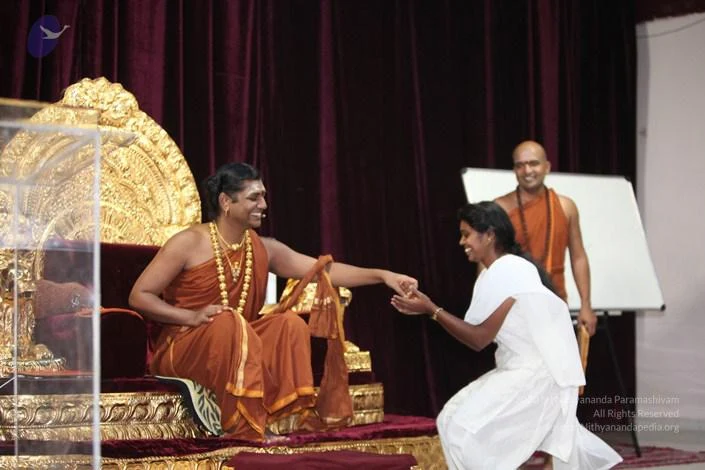
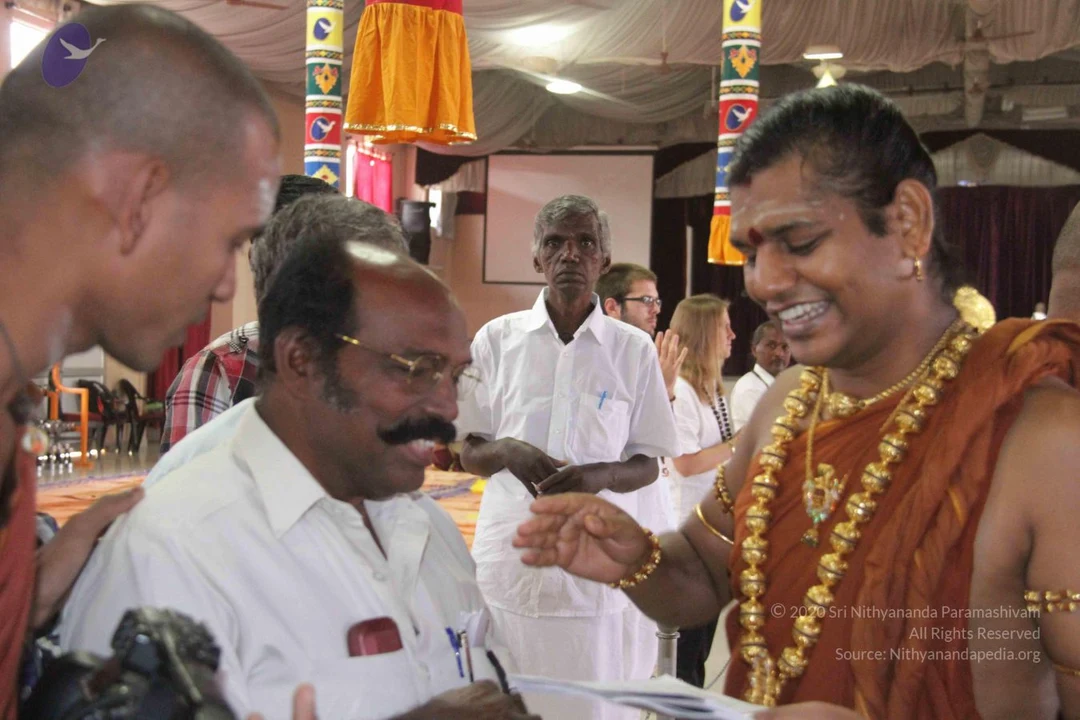
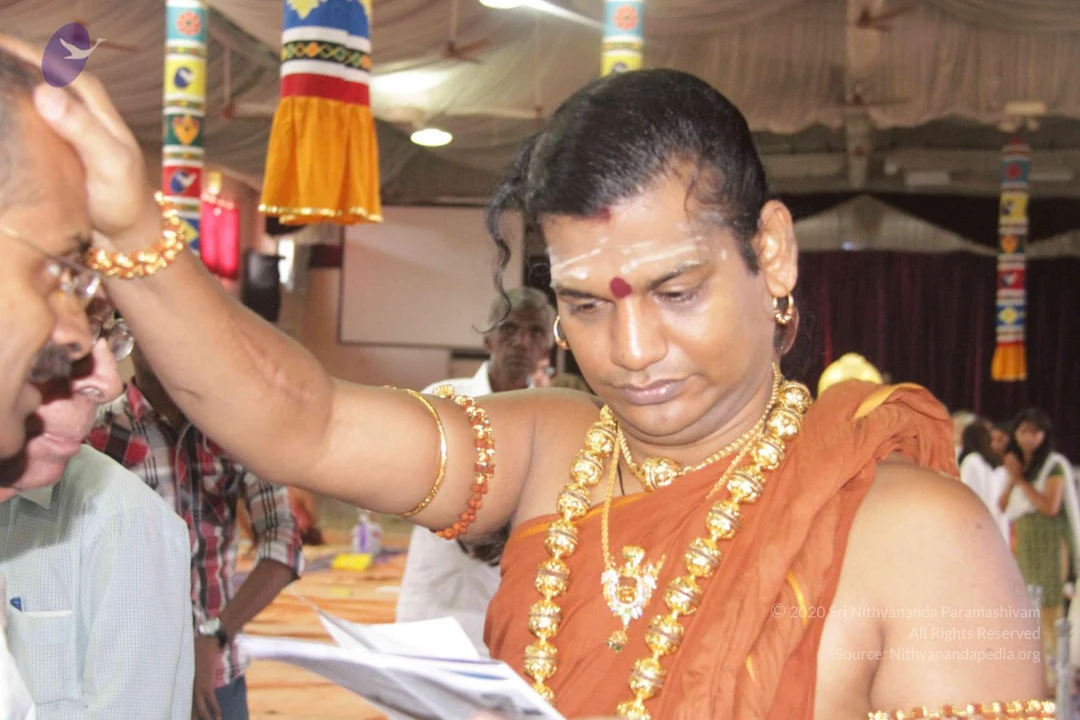
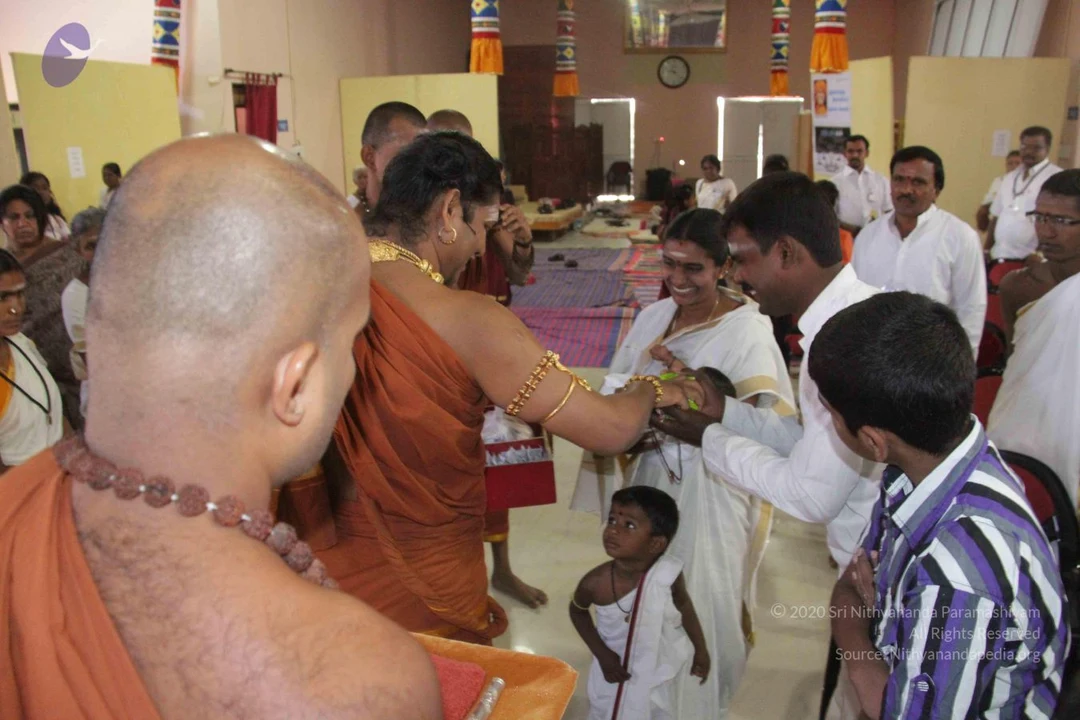
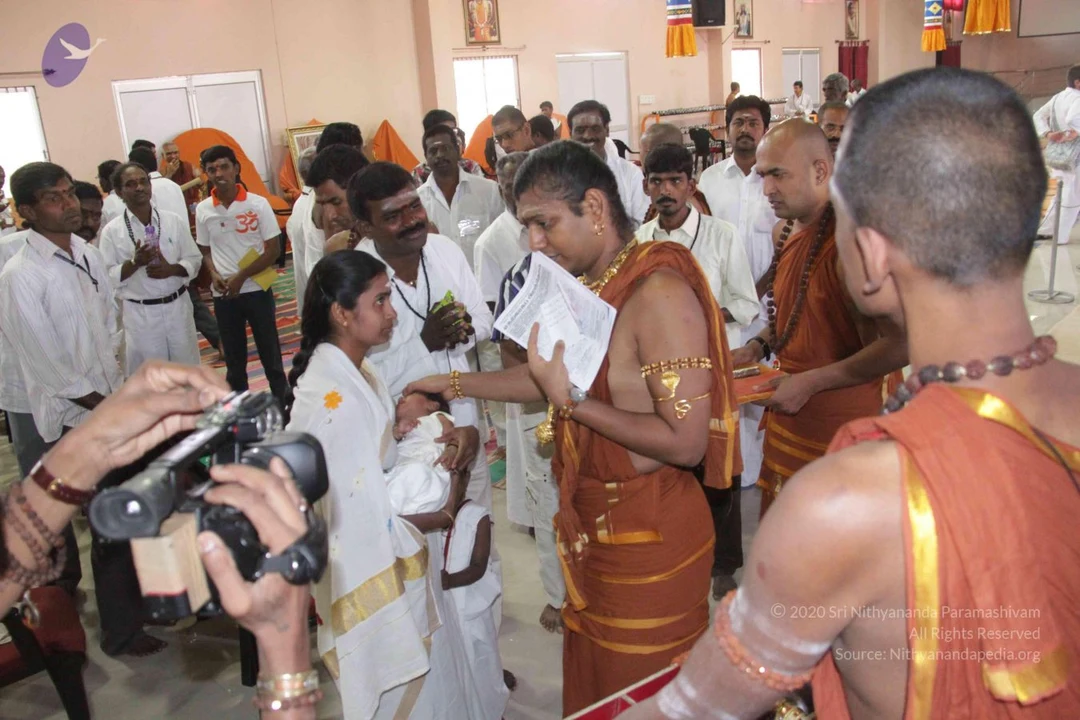
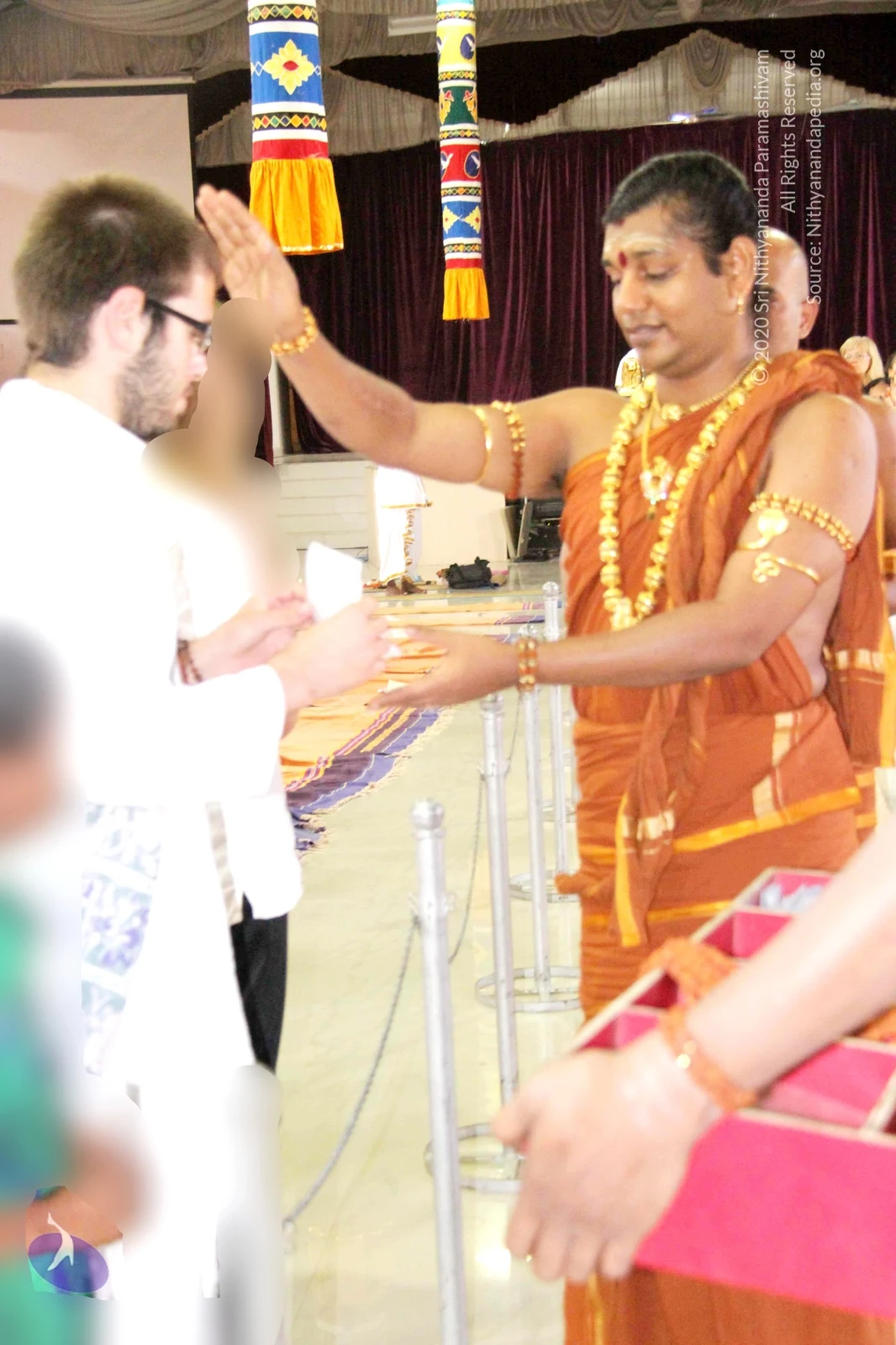
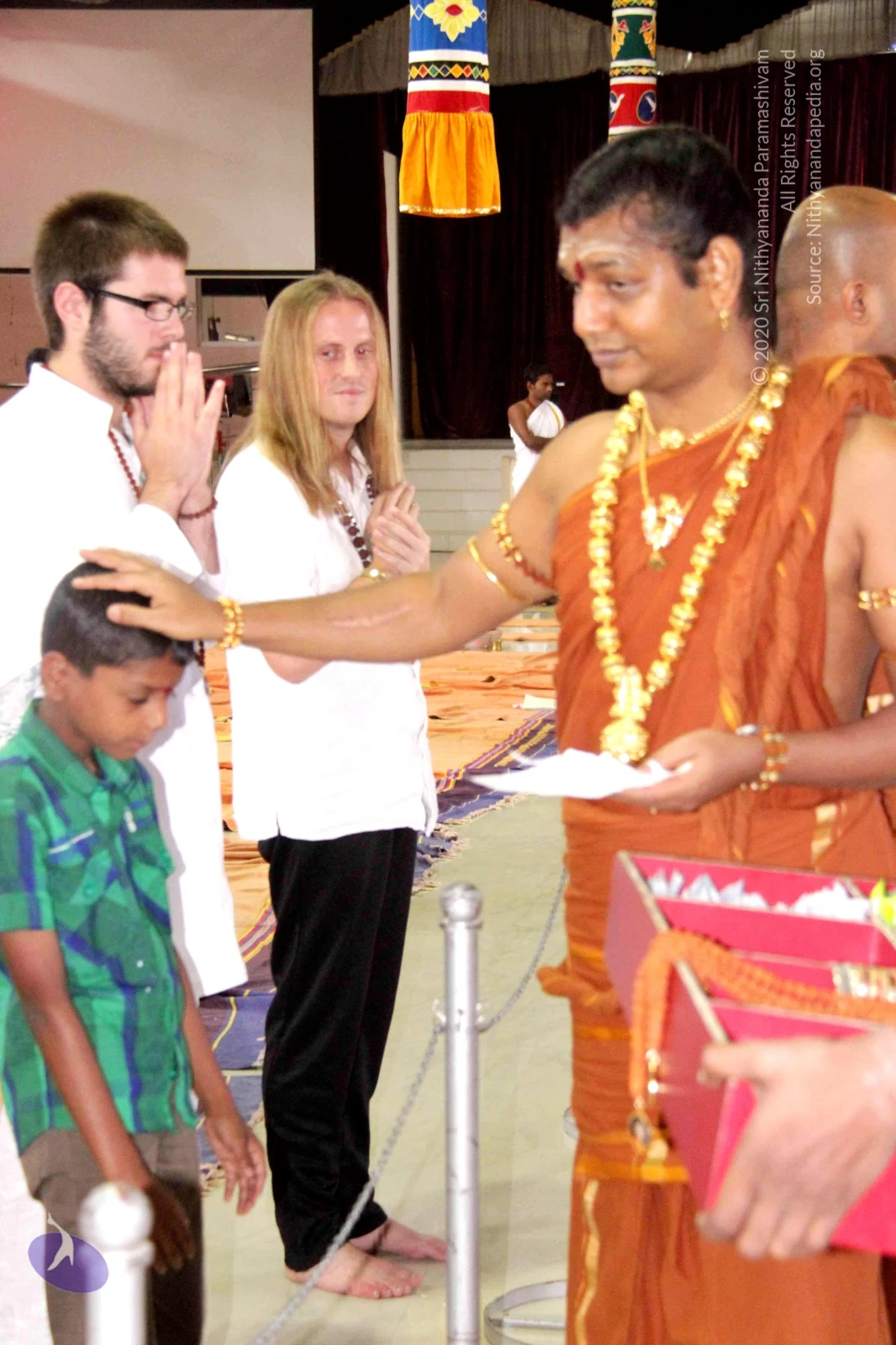
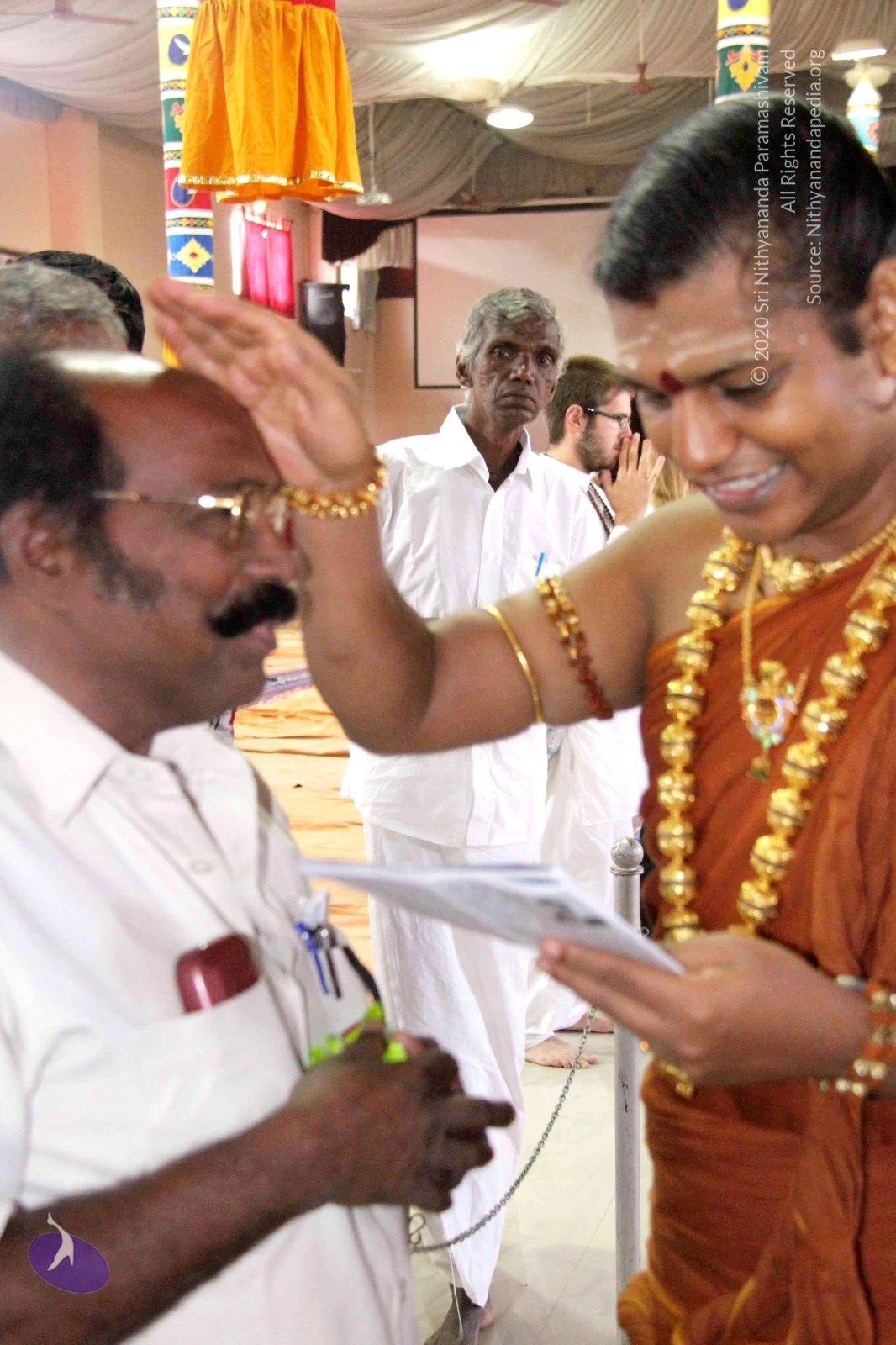
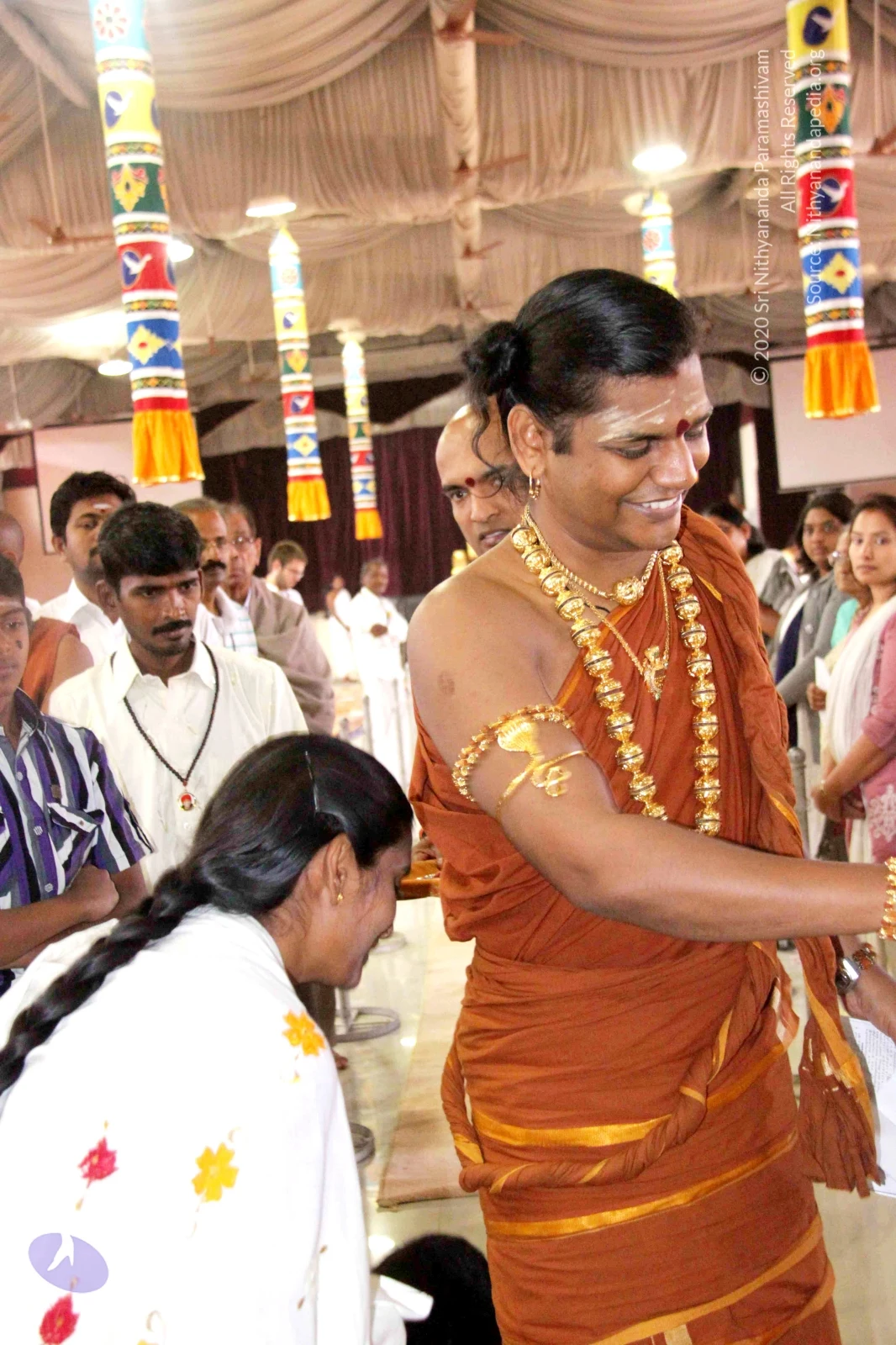
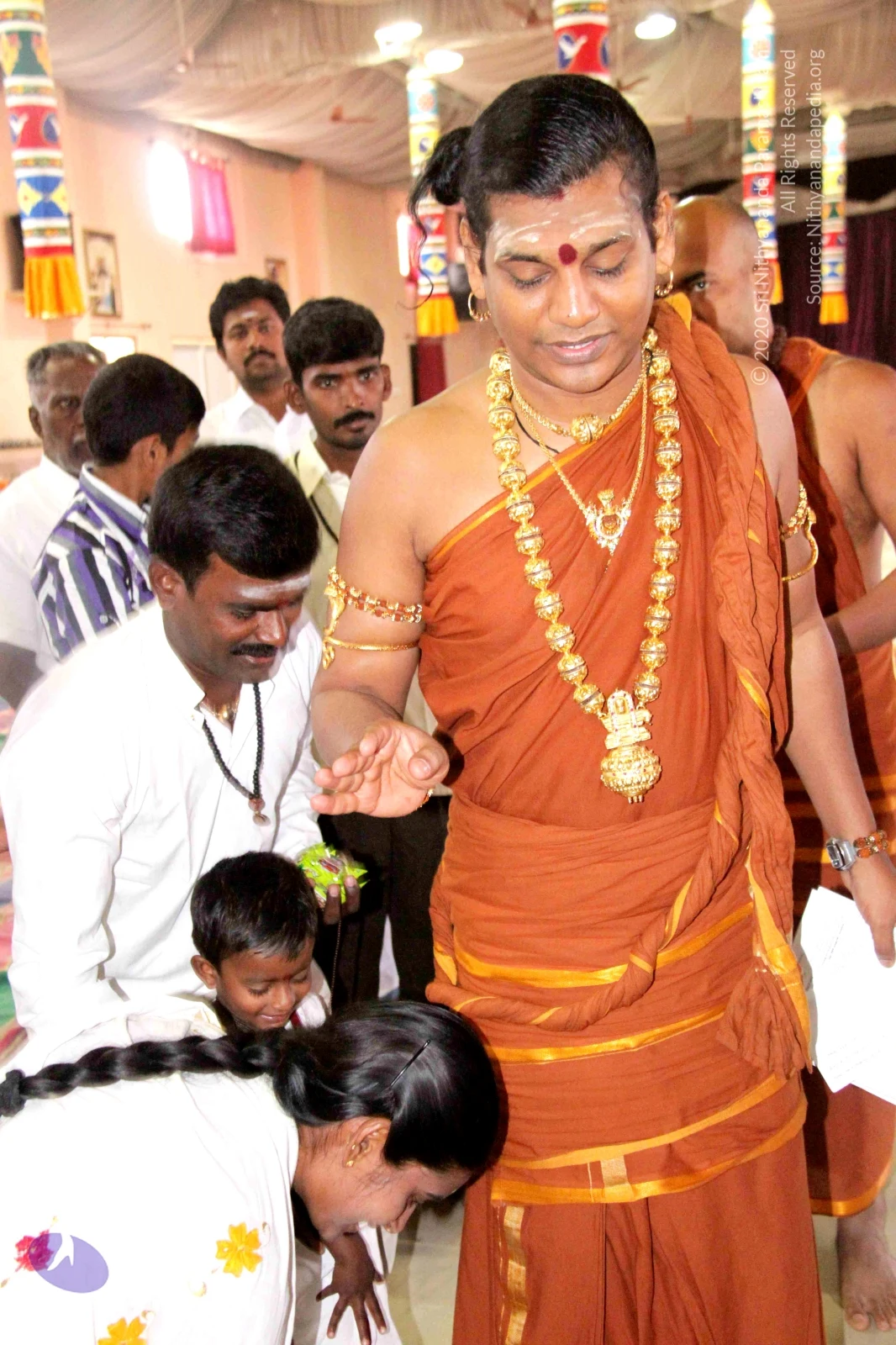
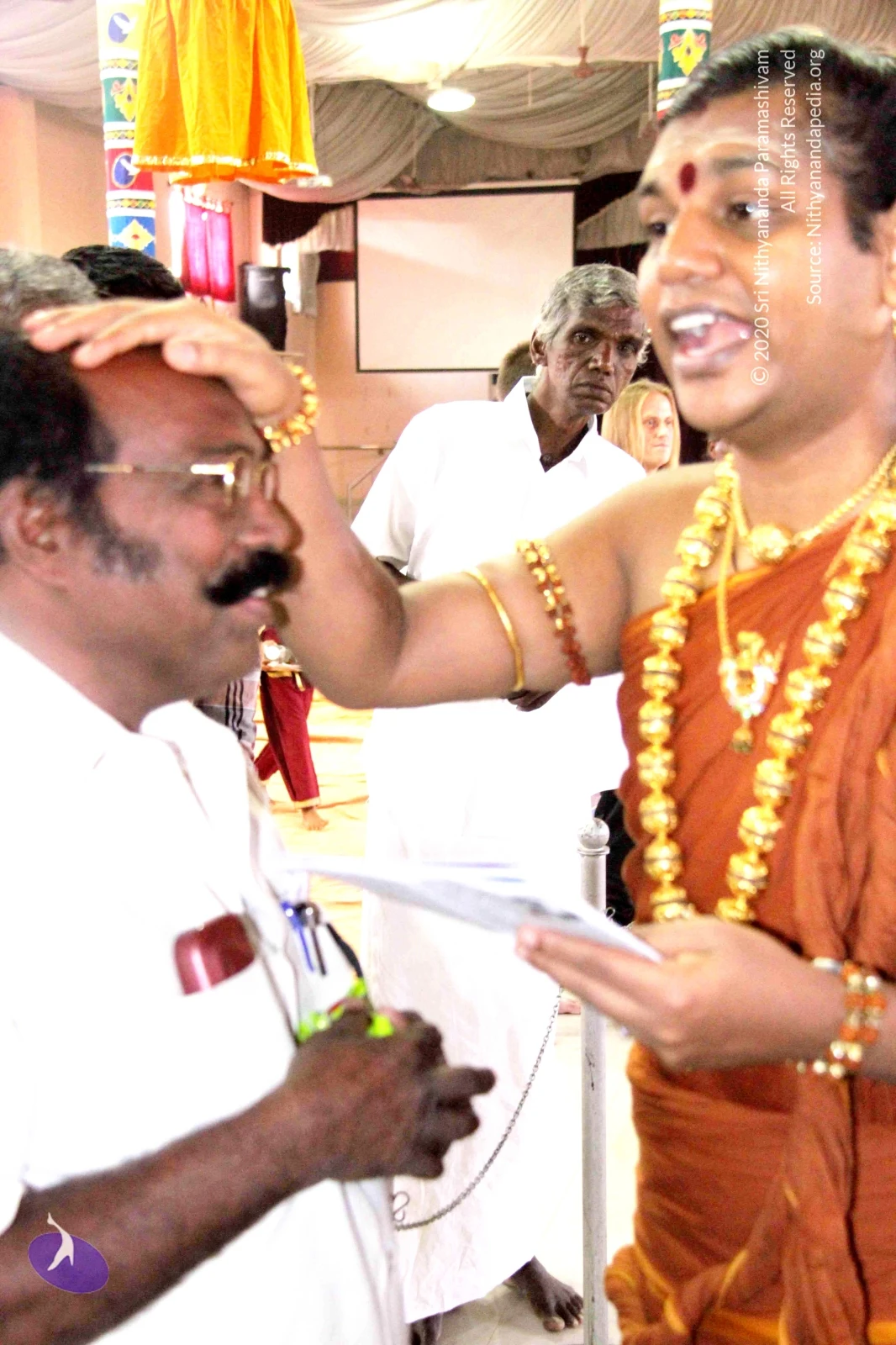
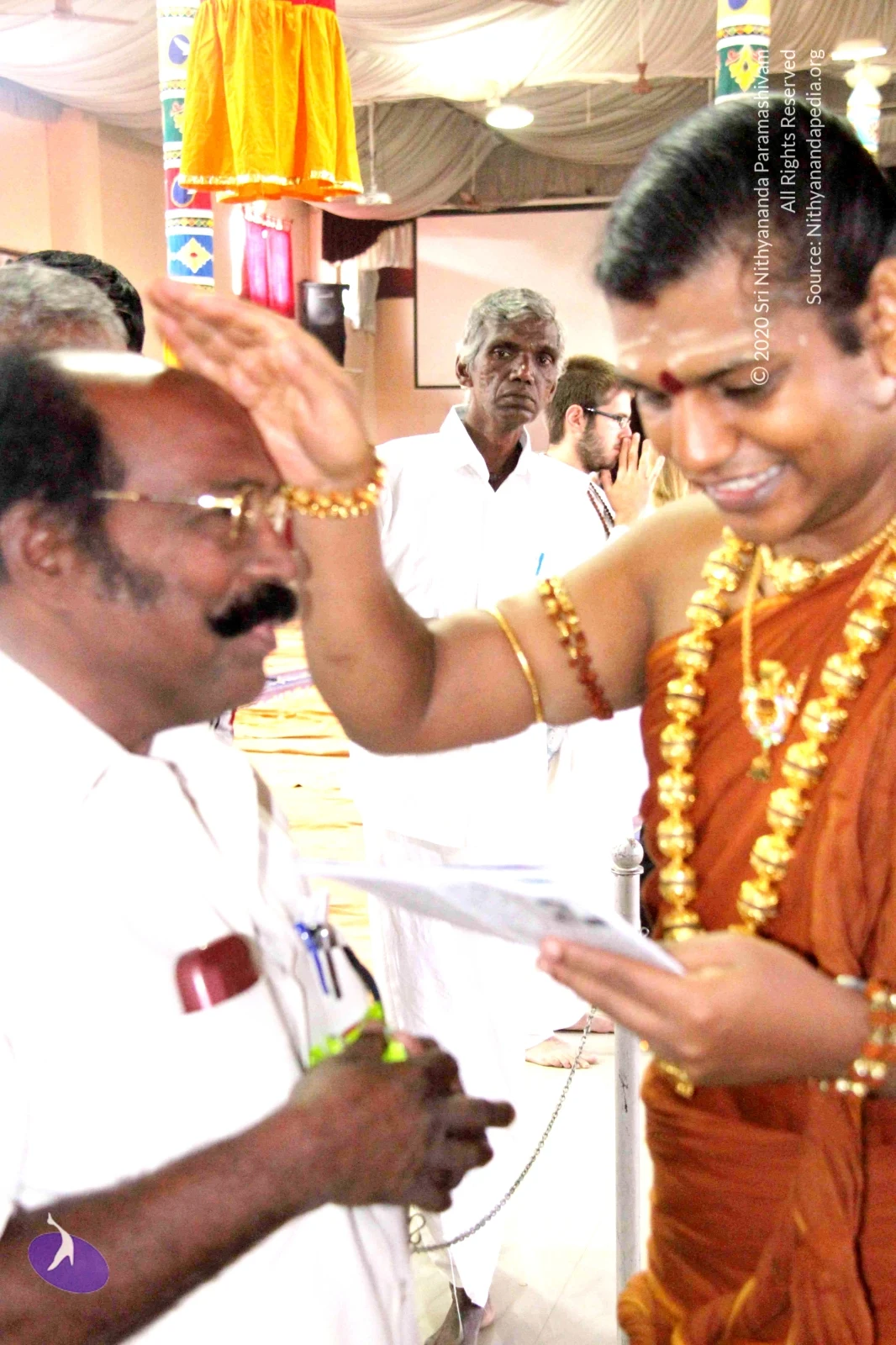
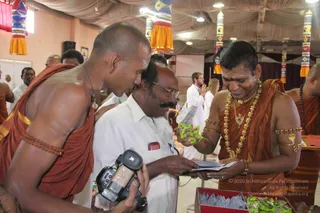
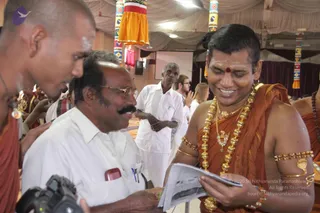
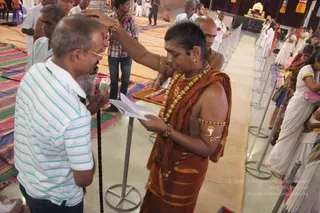
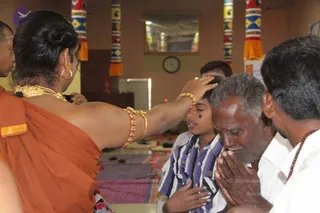
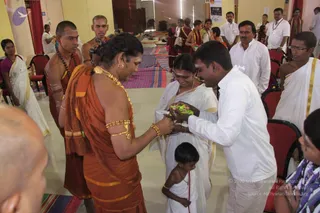
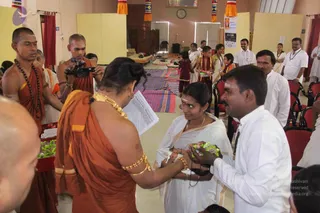
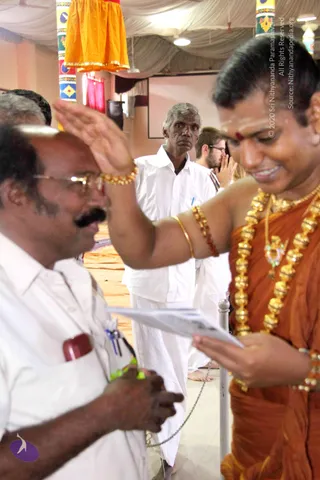
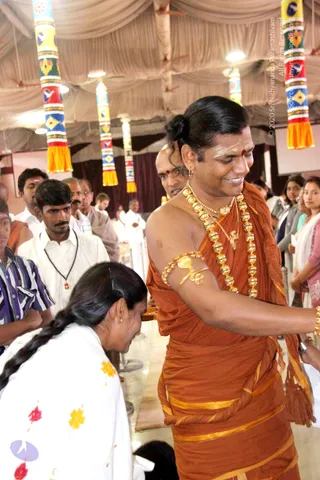
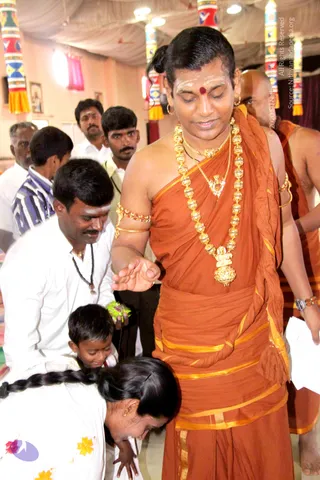
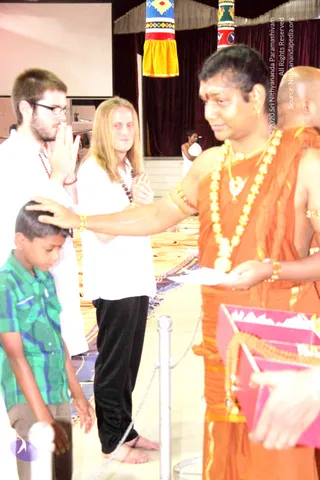
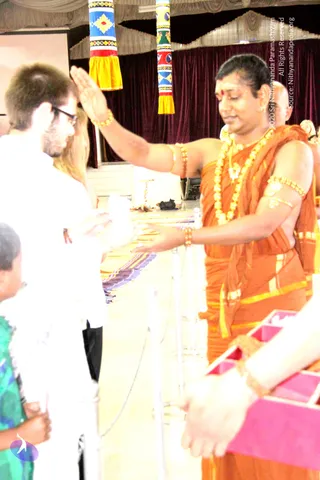
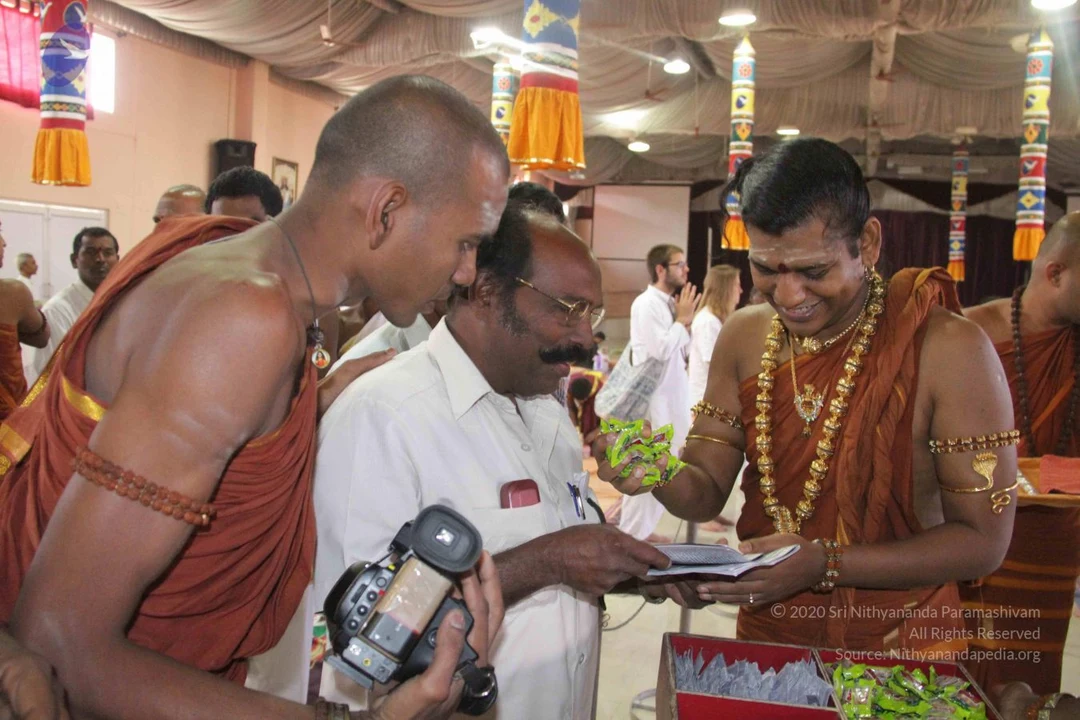
A photograph inside a decorated hall with draped fabric ceiling and hanging colourful banners. A bald man in saffron-orange robes and a white sacred mark on his forehead, holding a small camera, leans in on the left. In the centre, a man in a white shirt with glasses and a moustache holds an open booklet while a man in orange robes with a rudraksha bracelet and a heavy gold necklace and armlets stands at right, holding green-wrapped sweets from a red box with a folded paper inside. Another man in white and people in the background watch the exchange.A photograph inside a decorated hall with a white fabric ceiling and colourful striped pillars. A smiling man in an orange-saffron shawl and layered gold necklaces, with a red bindi and white tilak, reads a printed sheet held in his hands. Beside him an older man in glasses, a white shirt and a pen in his pocket leans in to look at the page. A shaven-headed young monk in orange stands at the left edge, and white-clad devotees stand in the background. A camera lens is visible at the lower left.A photograph of a satsang hall where a shaved-headed priest in an orange-saffron dhoti and shawl, with a gold-bead necklace and gold armlet, stands at a wooden lectern reading from a paper while touching the head of a man in a striped white polo shirt holding a walking cane. Several other people in white and orange clothing stand or sit along a central white carpet and striped mats, and a golden throne-like seat is visible at the far back. Another person in a striped shirt stands behind the lectern. a person cue is not clearly present: the central figure has a shaved head and no long hair, crown or rudraksha mala, so the identity is uncertain.A photograph inside a plain room with a wall clock and colourful striped decorative hangings. A woman with a hair bun, gold necklace, gold bangles and hoop earrings, wearing an orange saffron-coloured garment, reaches out to place her hand on the head of a young boy in a purple-and-white striped shirt with a dark dot on his forehead. An older man with grey hair and white clothes kneels with palms pressed together, eyes closed. A man in a white shirt with a rudraksha mala kneels at right, and a bald person with a forehead mark is partly visible at left. Mats are laid on the floor behind them. The woman appears to be a sannyasi or devotee giving a blessing; no a person candidate is clearly recognizable from appearance.Indoor satsang hall with red-cushioned chairs and striped mats on the floor. A central figure with long swept-back dark hair, a gold necklace, gold armlets and a saffron-orange garment with gold border, with a rudraksha mala, stands with his hands near a woman in white sari with gold border and red-marked forehead, who holds a small tray of green-tinted items. A man in white shirt and trousers stands beside her, also reaching toward the tray. A small child in white stands below. Behind them, a shaved-headed monk in orange cloth with rudraksha beads and other men in white dhotis and shirts watch; a cameraman is visible at left. a person: the central figure has long swept-back hair, gold ornaments and saffron clothing, consistent with the page's claim. Scene looks like a darshan or puja interaction.A photograph inside a hall with yellow partitions and colourful striped rugs spread on the floor. In the foreground a woman in an orange-and-gold sari with gold bangles and a gold necklace reads from a printed sheet while a woman in a white sari with a red mark on her forehead stands before her, receiving something from her hands. Beside them a man in a white shirt holds a packet of green sweets. On the left two shaved-headed men in orange-saffron robes and rudraksha malas stand, one holding a camera. Several people in white clothes stand around the room, a child in red and another in orange are visible, and a banner with text hangs on the pillar.

ESSENCE-OF-INNER-AWAKENING-IN-TAMIL-SESSION-2

7 photosSource gallery
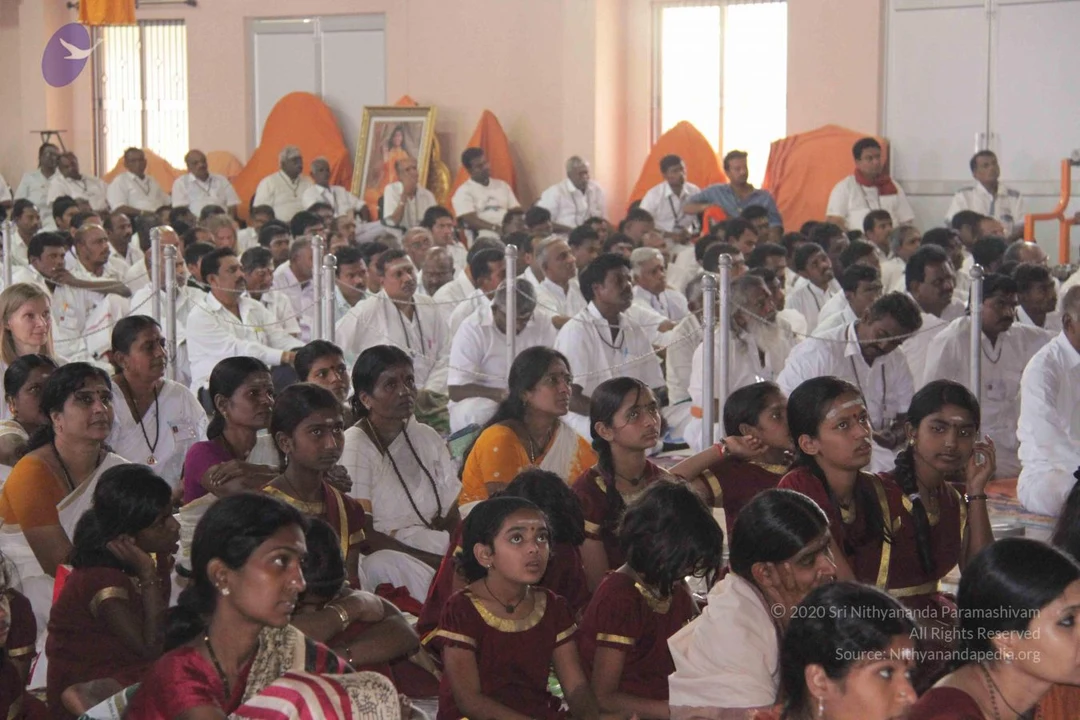
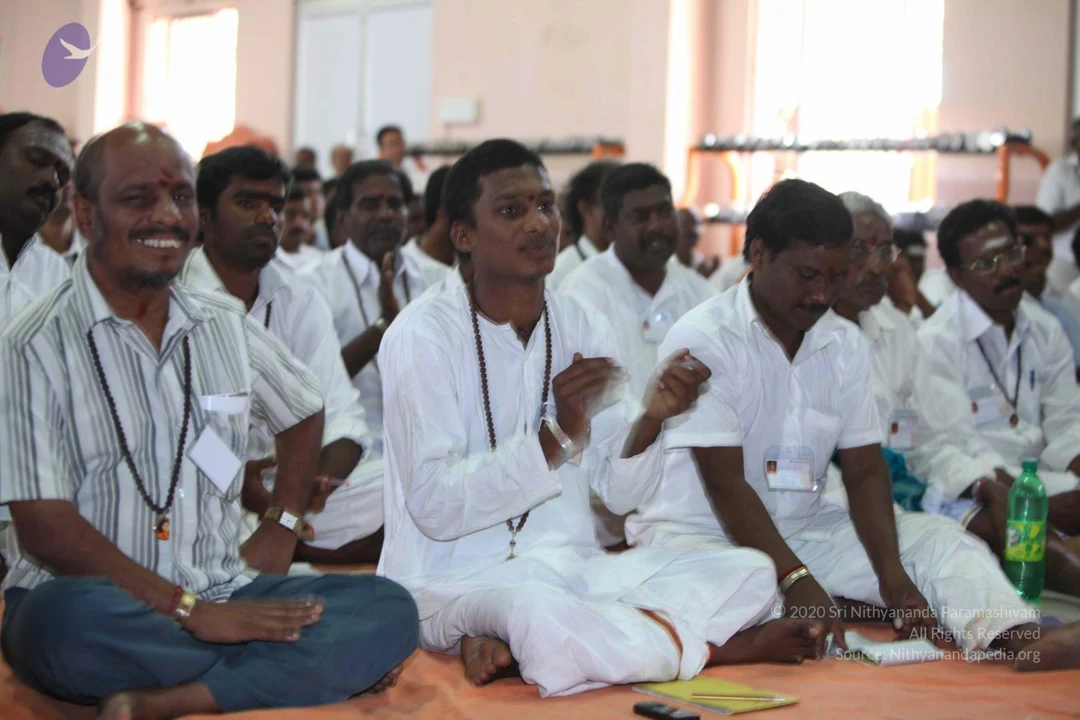
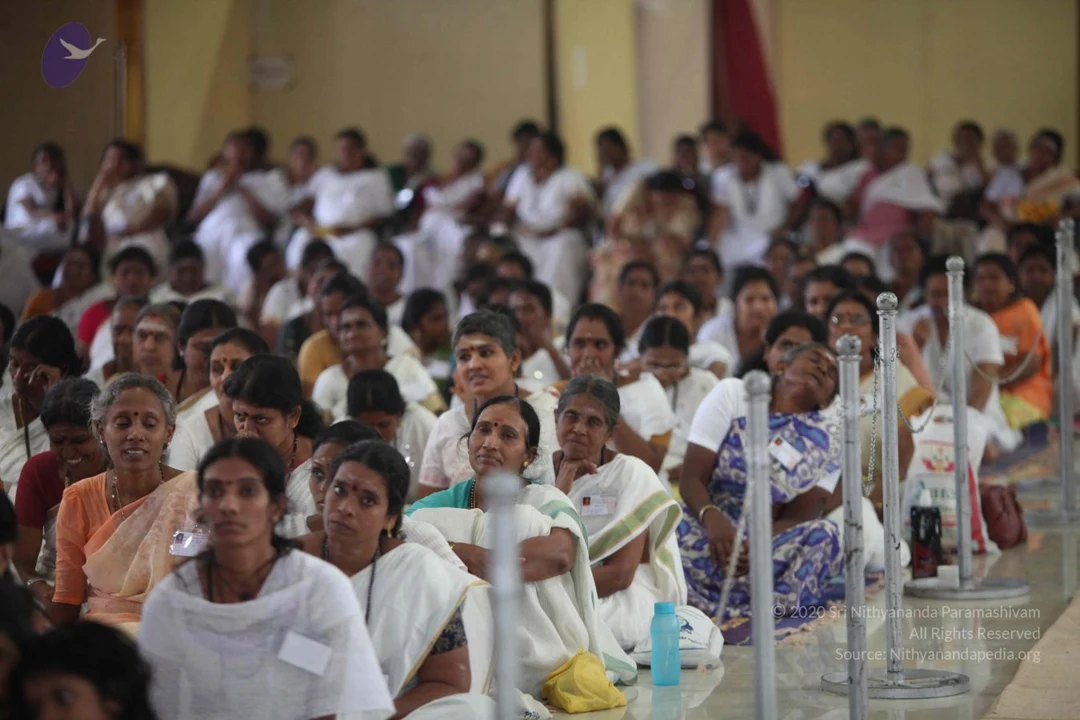
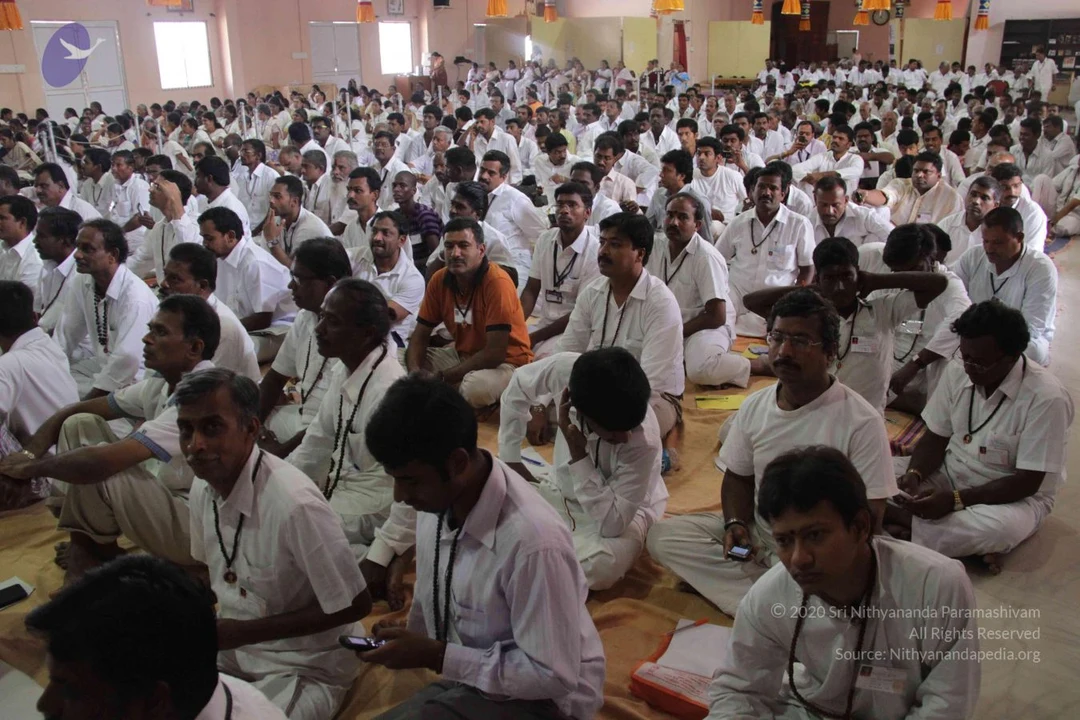
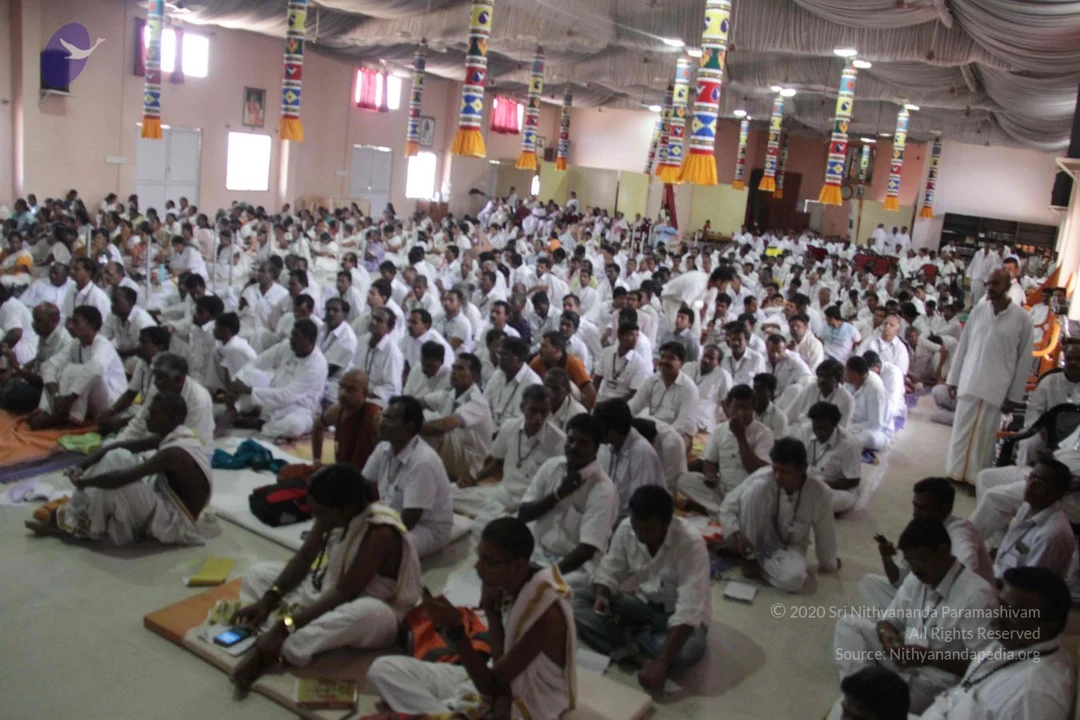
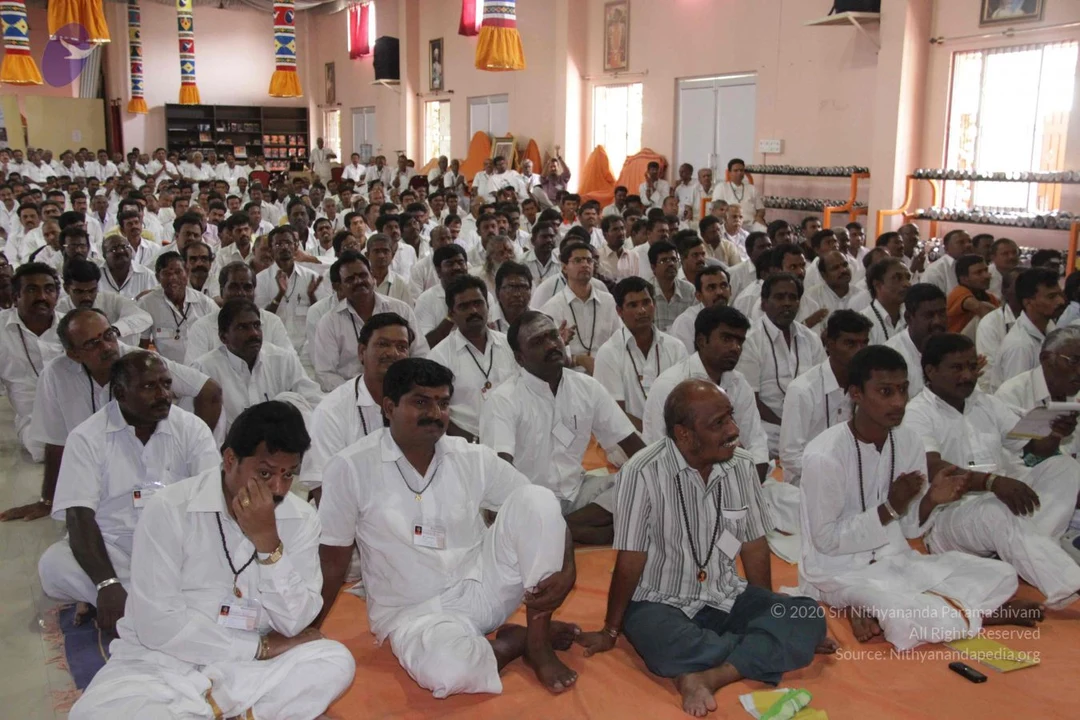
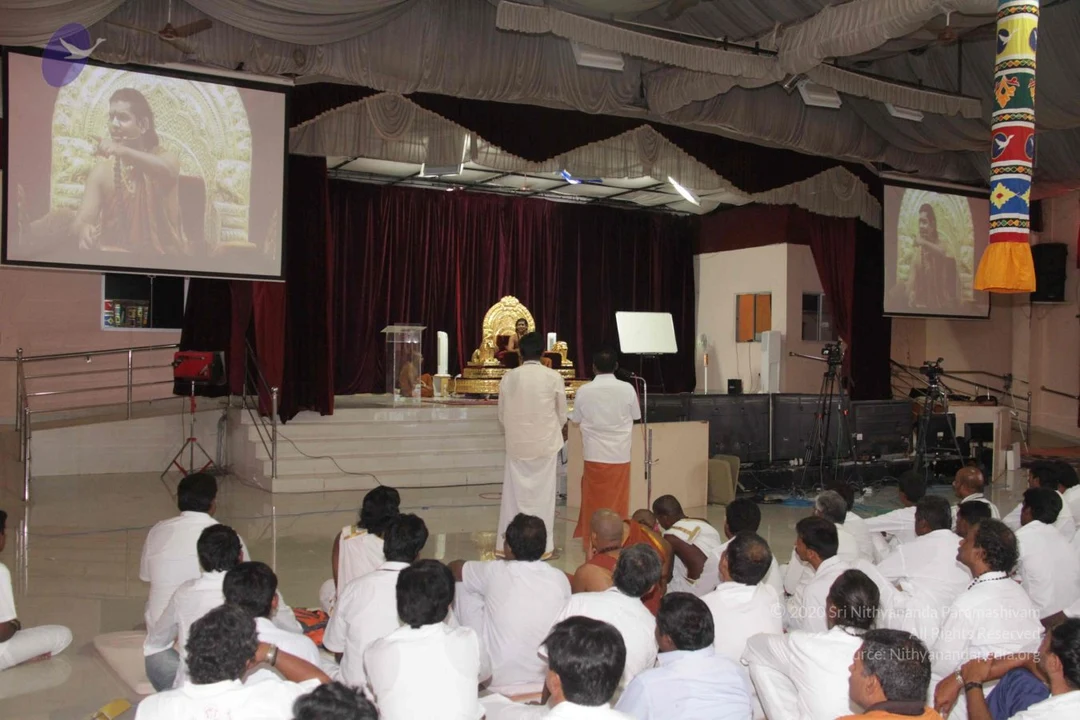
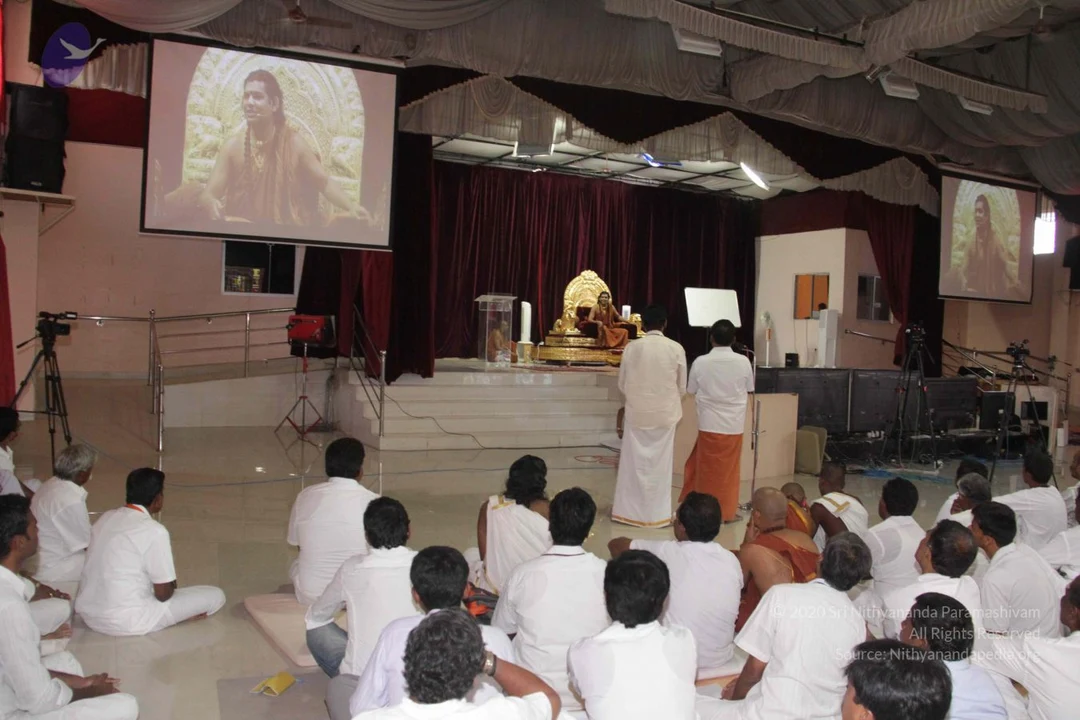
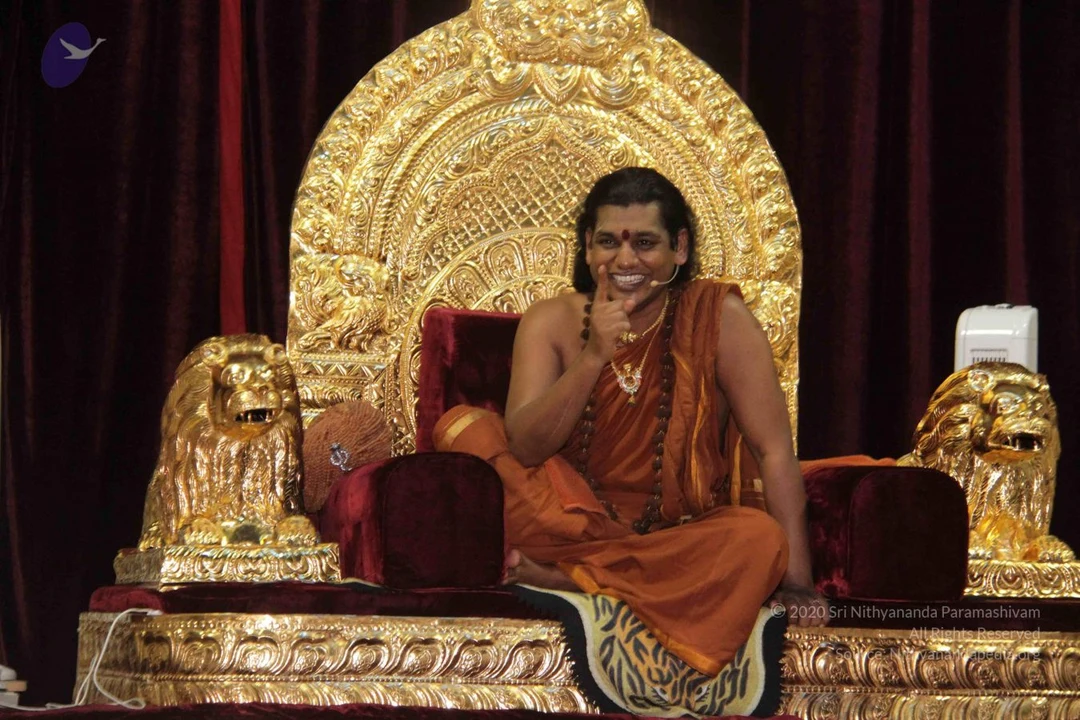
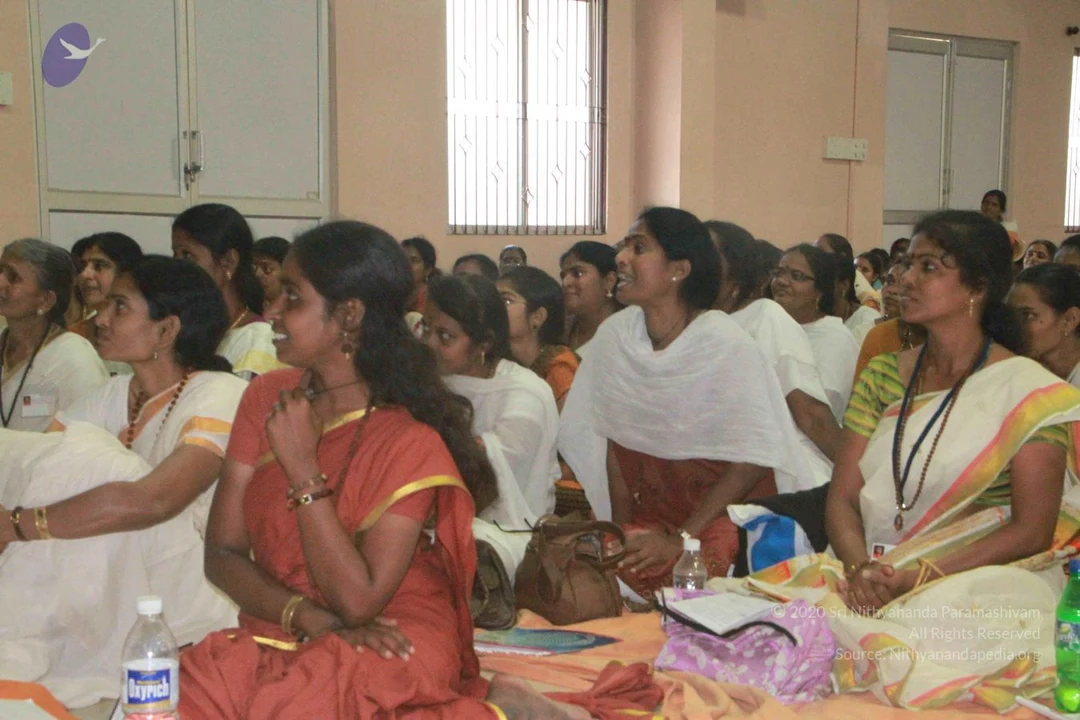
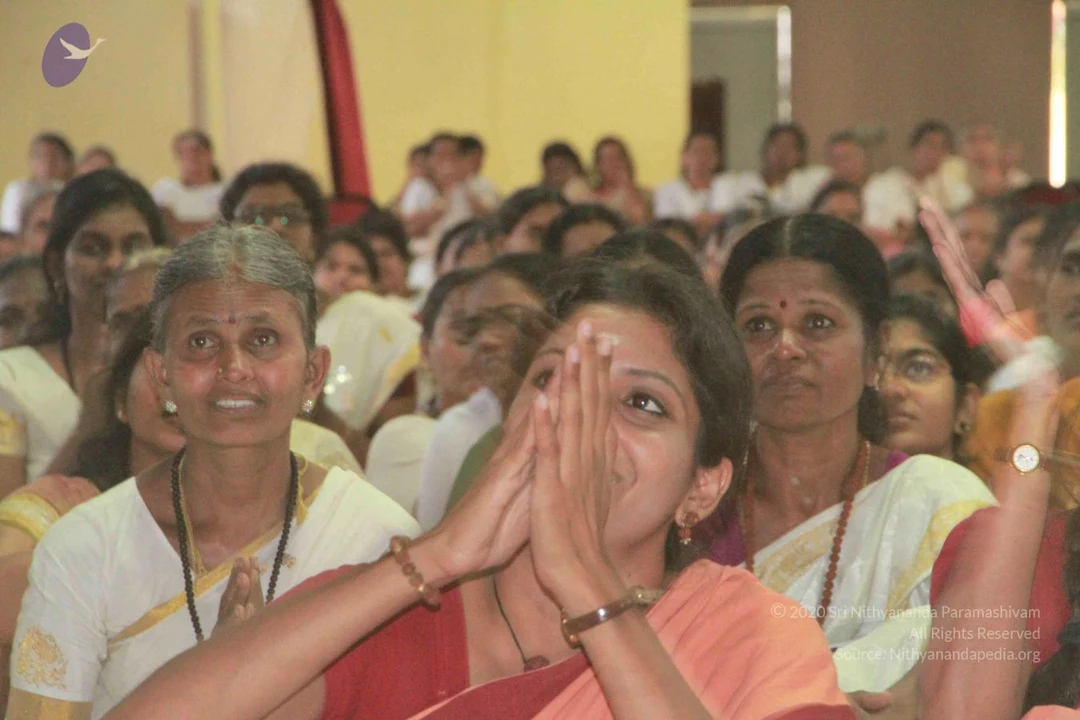
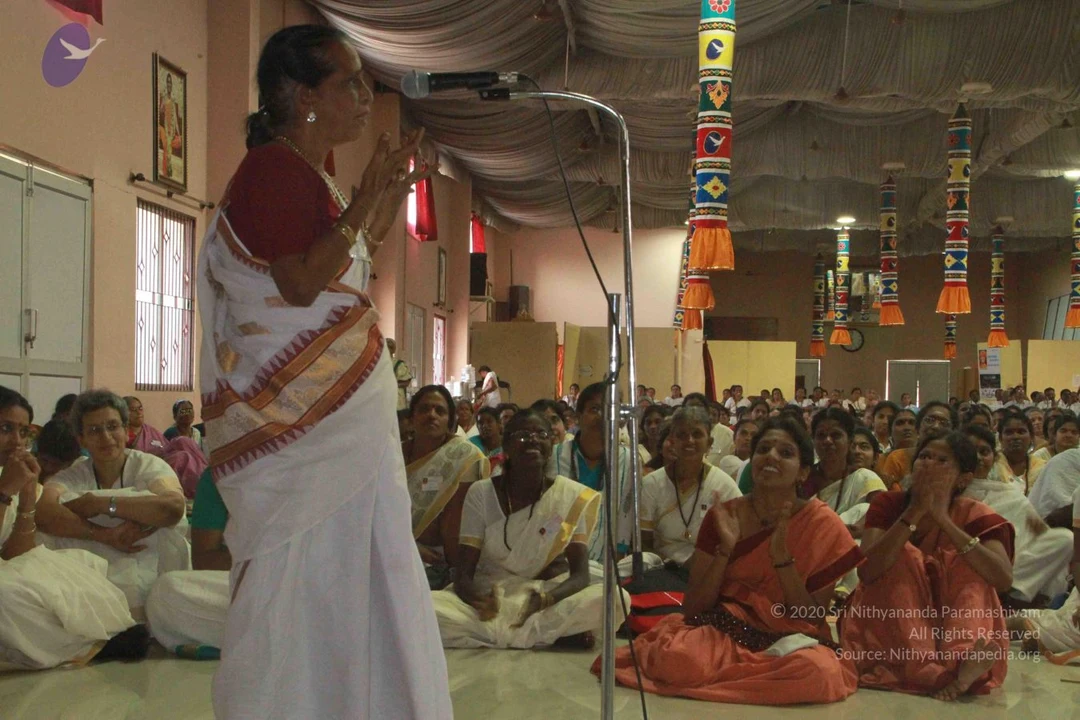
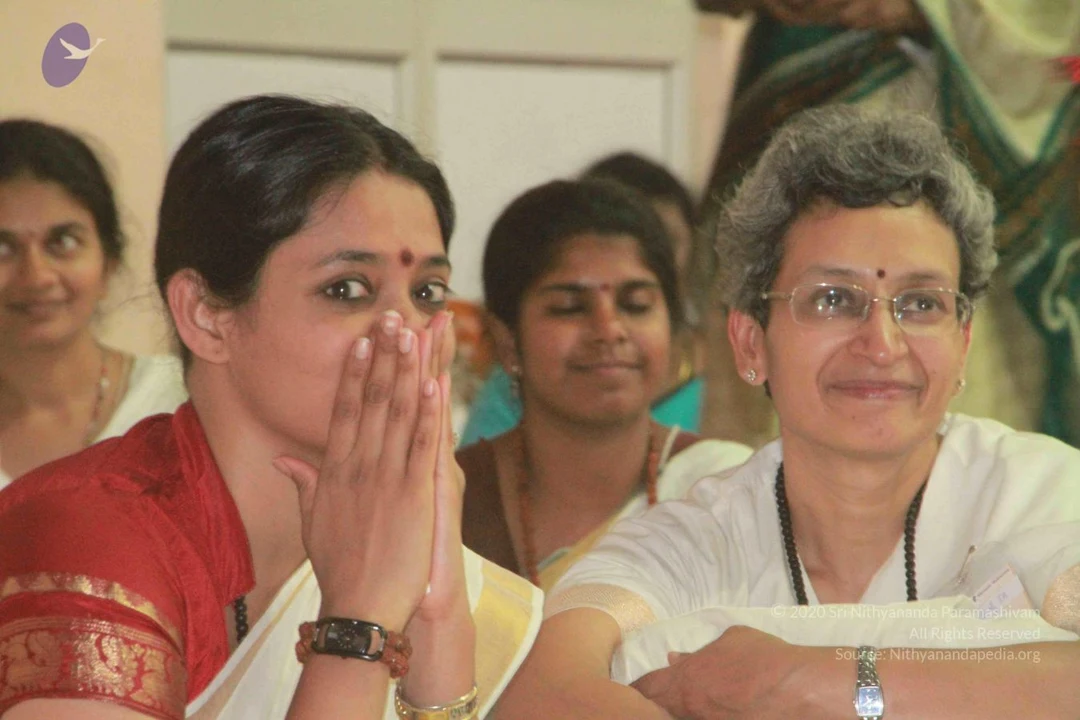
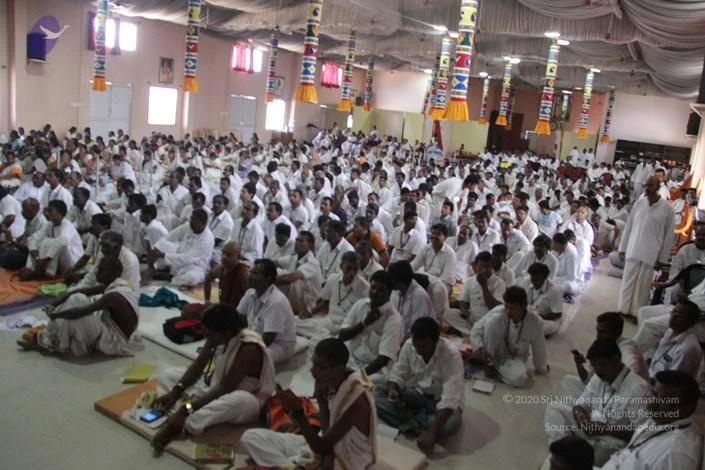
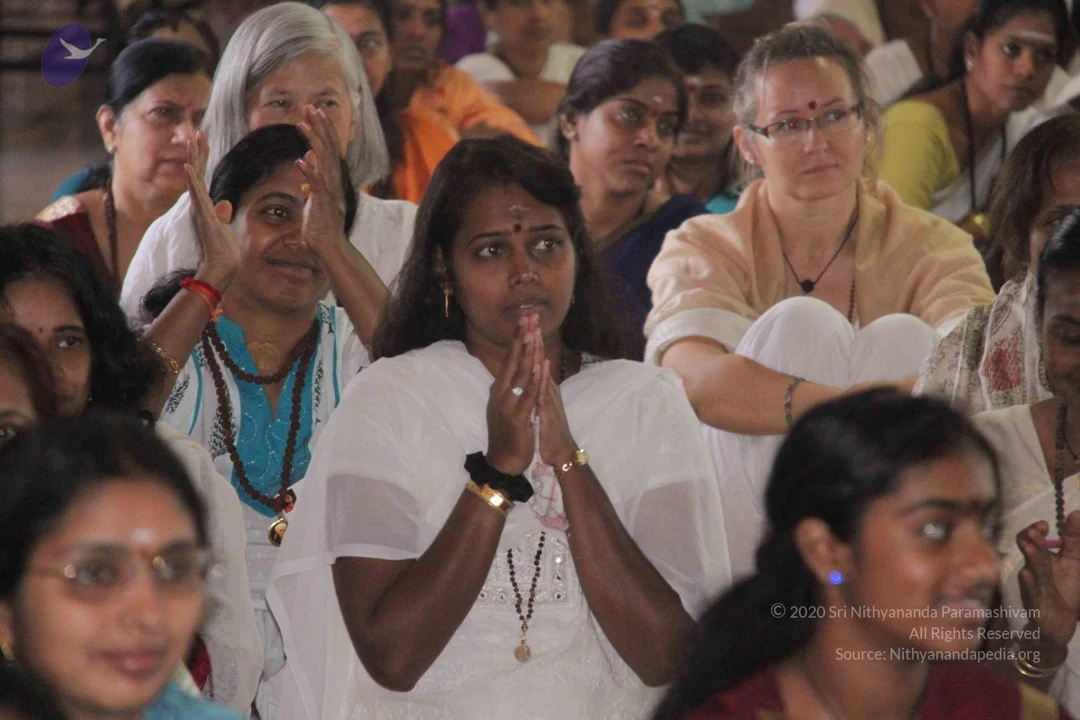
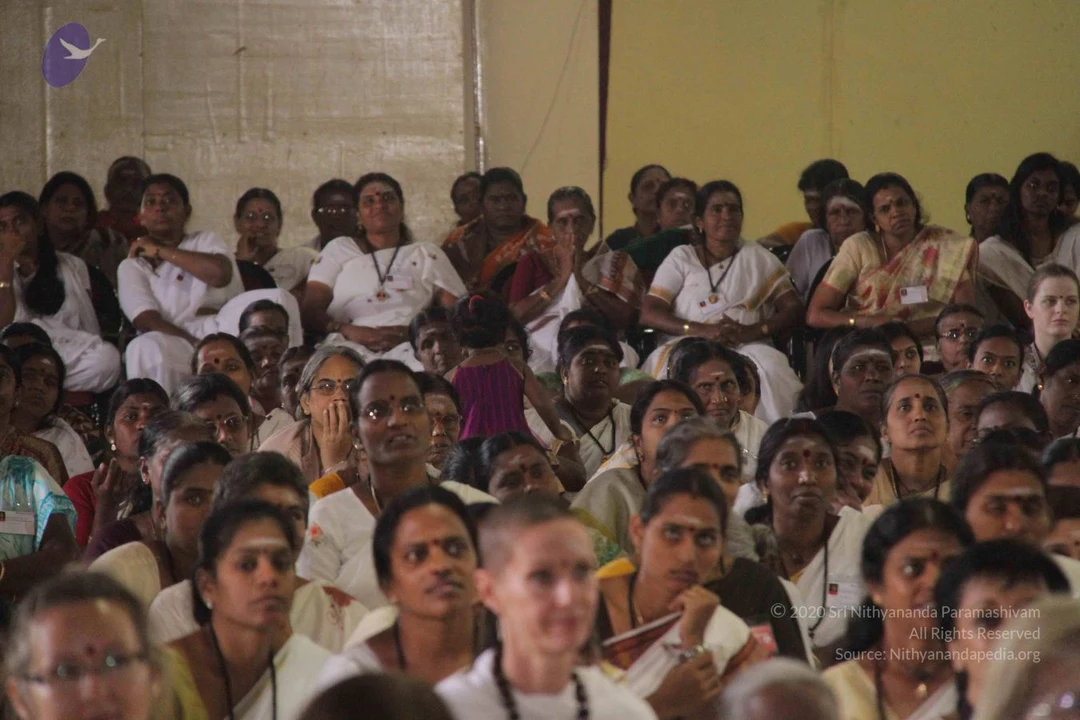
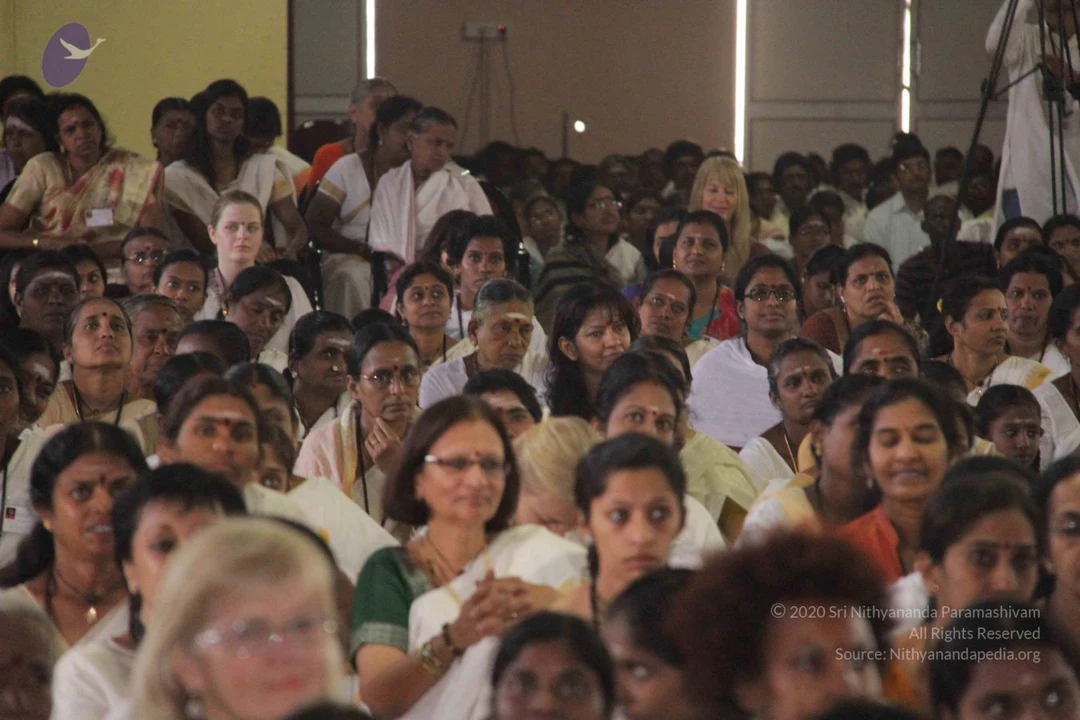
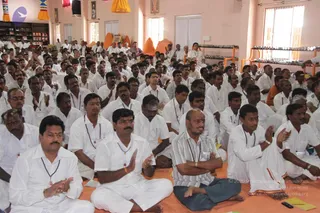
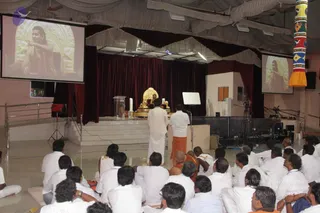
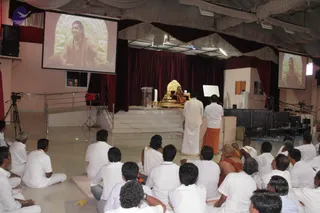
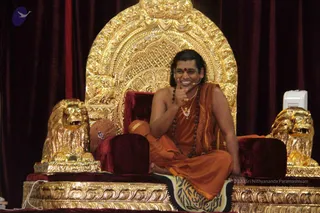
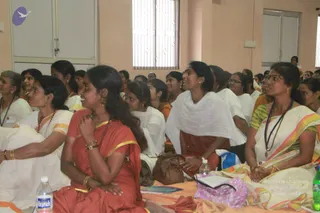
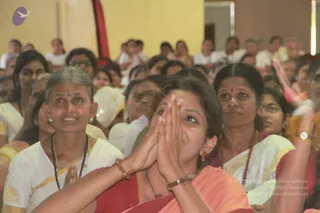
A large indoor satsang hall with a peach-coloured wall and tall windows. Many men sit cross-legged on an orange mat, most dressed in white shirts and white dhotis, with rudraksha malas around their necks. Several clap with their palms together, while one man in a striped shirt and dark lunghi sits with arms crossed. Orange cushions and shelves of brass-toned items line the back of the hall, and banners hang from the ceiling. The crowd fills most of the frame, and the scene reads as a devotional gathering or satsang.A hall with a large audience seated on the floor in white clothes facing a raised stage. On the stage, a figure sits on a golden ornate throne with a dark red curtain behind. Two standing men in white shirts and white dhotis stand near the stage steps. Two large screens on either side show a close-up of a figure with long hair and saffron clothing. A colourful decorated pillar hangs at the right edge, and a draped white canopy covers the ceiling. A satsang setting with a video projection of the speaker.A satsang hall with a seated audience in white clothes sitting on the floor facing a raised stage. On the stage, a figure sits on an ornate gold throne in front of dark red drapes, with a small lectern and lit candles beside it. Two projection screens on the walls show a close-up of a long-haired figure in saffron clothing. A man in a white shirt and white dhoti stands near the stage, and a shaven-headed man in saffron robes sits in the front rows among the devotees. Cameras on tripods and audio equipment are set up at the sides. The ceiling is draped with pale fabric.A photograph of a seated man on an ornate golden throne with lion-head armrests and red velvet cushions, set against deep burgundy drapes. He wears orange-saffron robes draped over one shoulder, multiple rudraksha malas, a gold necklace, and a red bindi on his forehead, with a small microphone at his cheek. He rests one hand on his chin and smiles broadly. A tiger-striped cloth covers the seat edge.A photograph of a seated audience of women in a plain room with peach walls, white-framed windows and a white cabinet at left. The women sit on an orange cloth, many wearing white or cream saris and white blouses, with some in red or orange saris with gold borders. One woman in the foreground wears a red sari with a gold border, a red-and-gold bangle set and a beaded necklace, and looks forward with her hand near her chin. Beside her, a woman in a white sari with a gold border wears a dark rudraksha-style mala and holds a notebook. Water bottles sit on the floor and a pink bag rests in front. No a person figure is visible among the people.A seated crowd at a satsang hall with yellow walls and a red banner behind them. In the foreground a young woman in an orange-and-red sari presses her palms together in anjali mudra and looks upward, while an older woman in a white sari with gold border and rudraksha mala holds her hands together beside her. Another woman in a white sari with red bindi and rudraksha mala sits to the right, and devotees fill the rows behind, many in white. No identifiable a person figure is visible in the frame.

DARSHAN

25 photosSource gallery
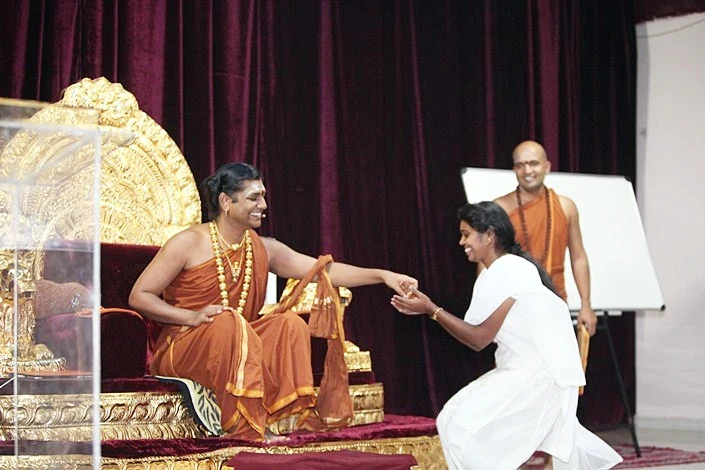
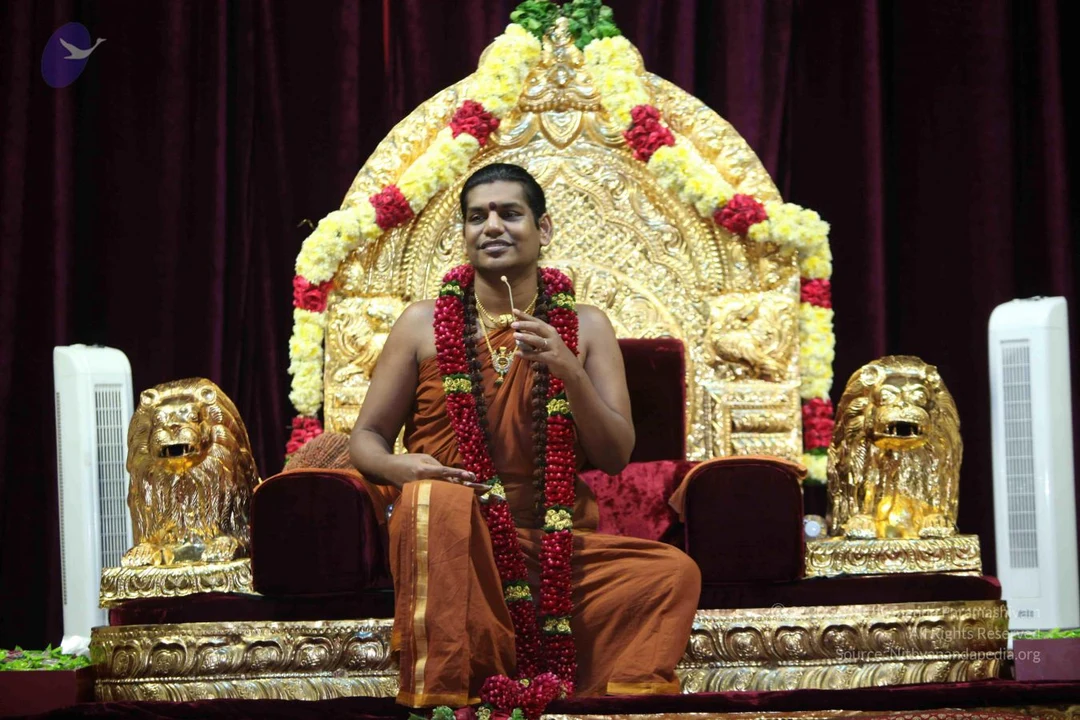
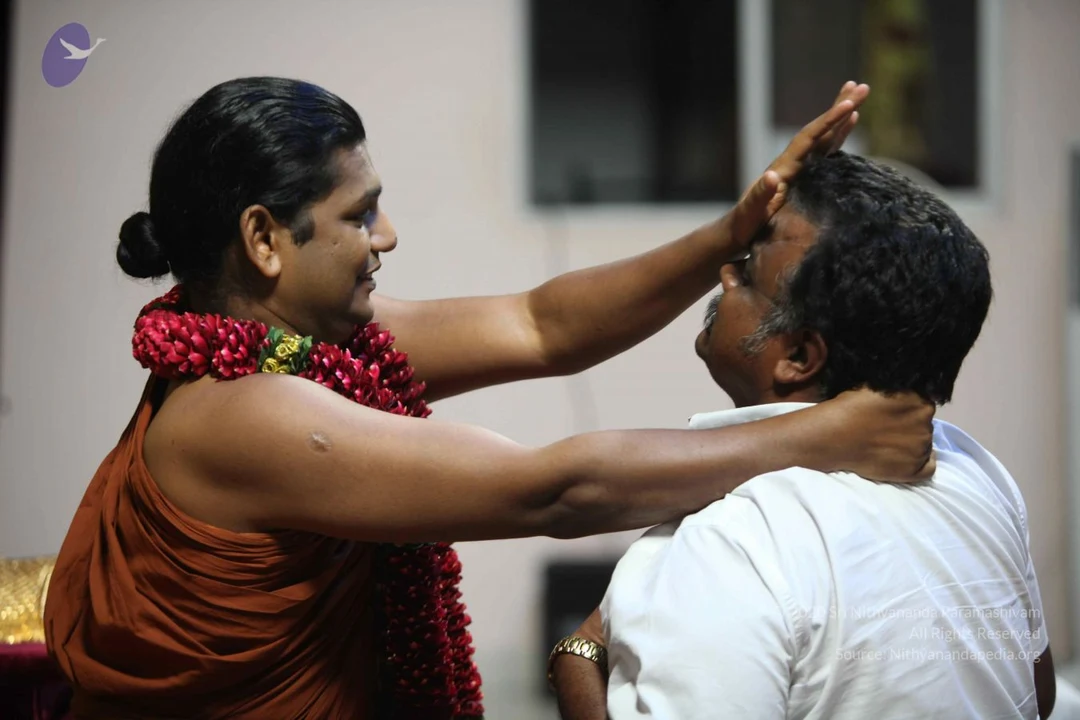
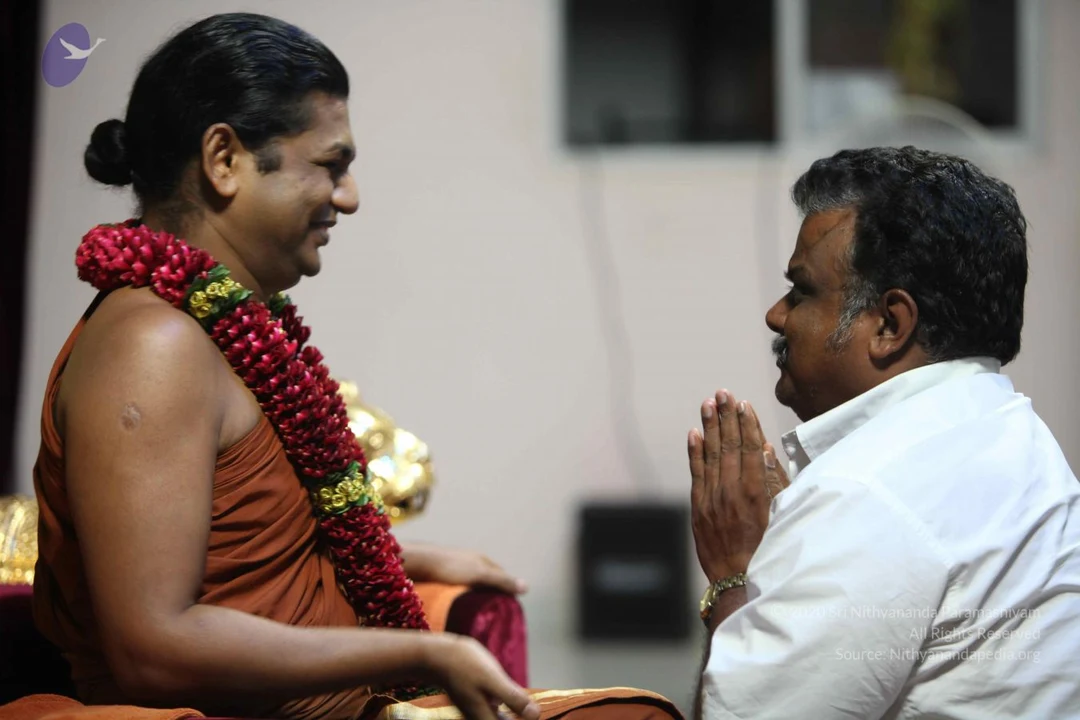
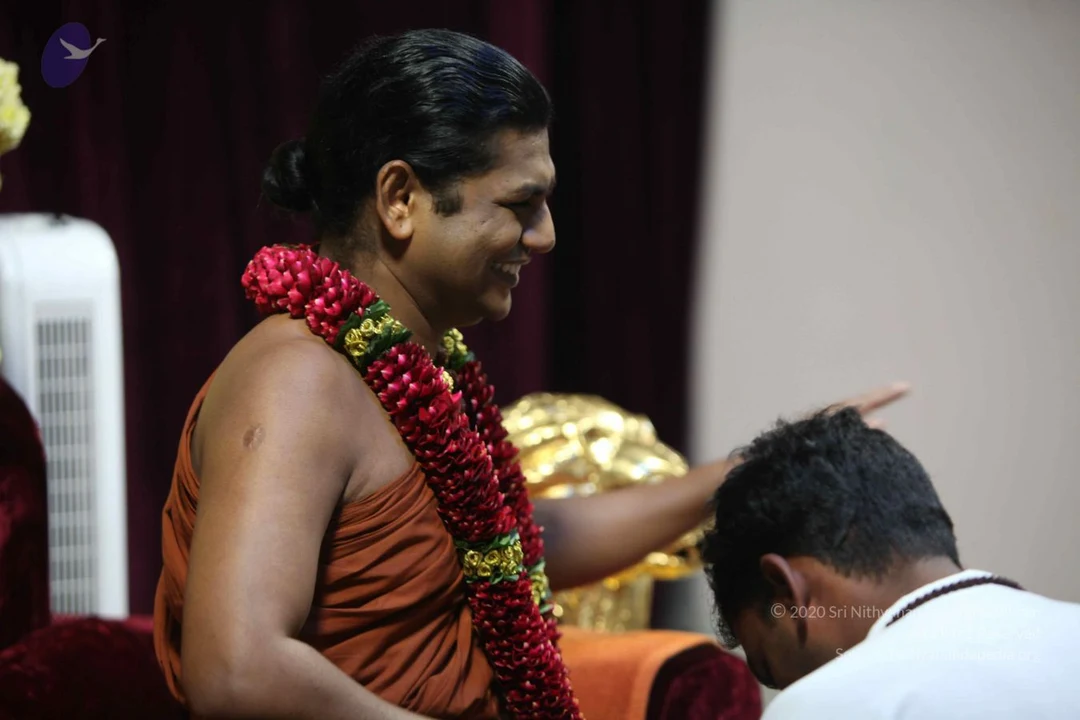
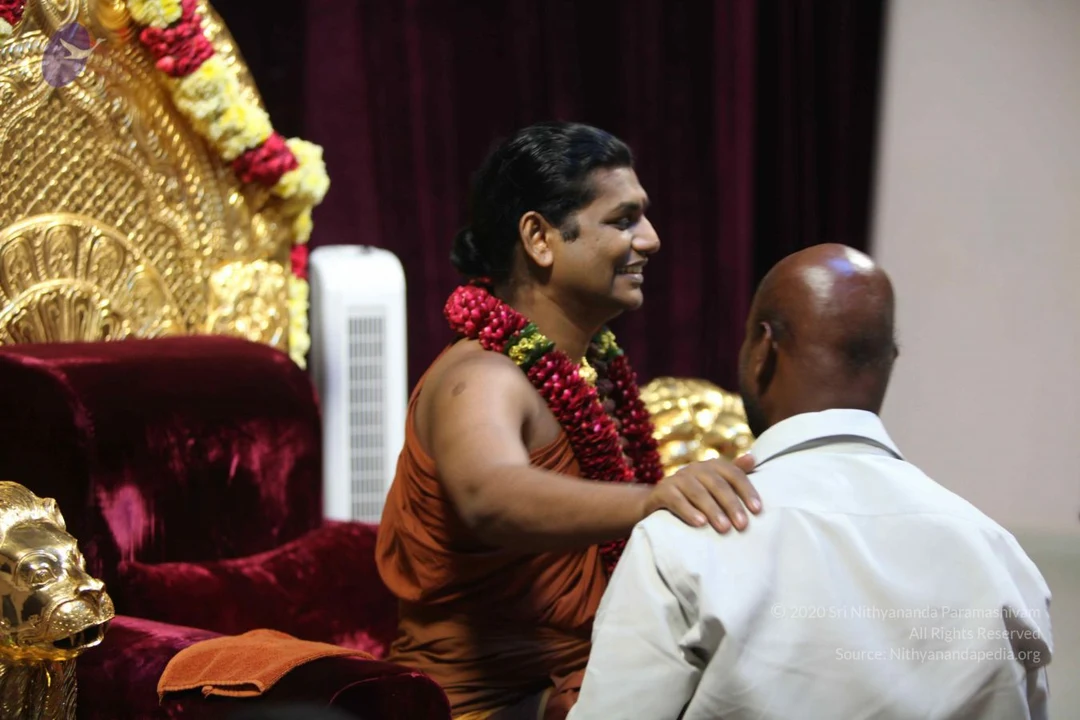
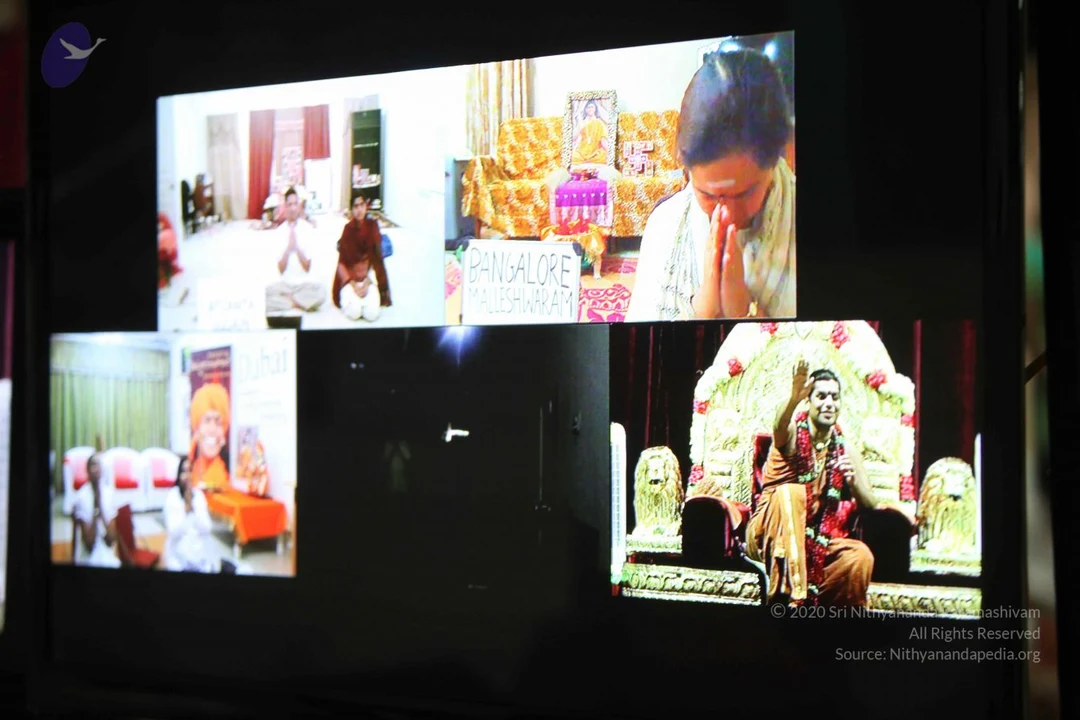
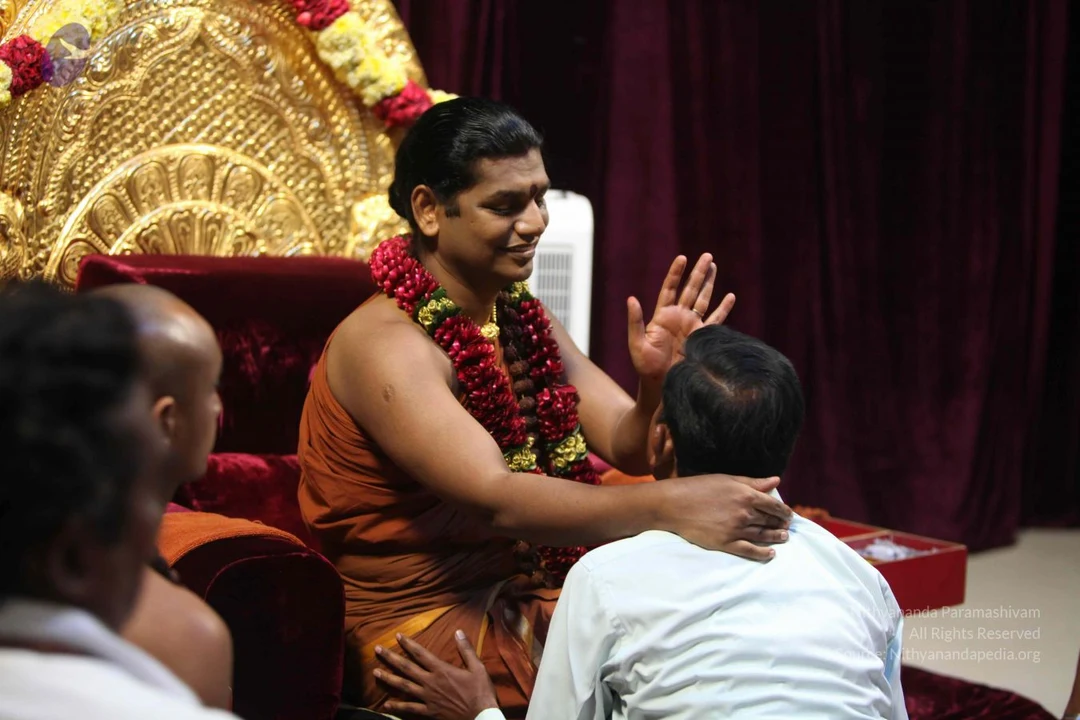
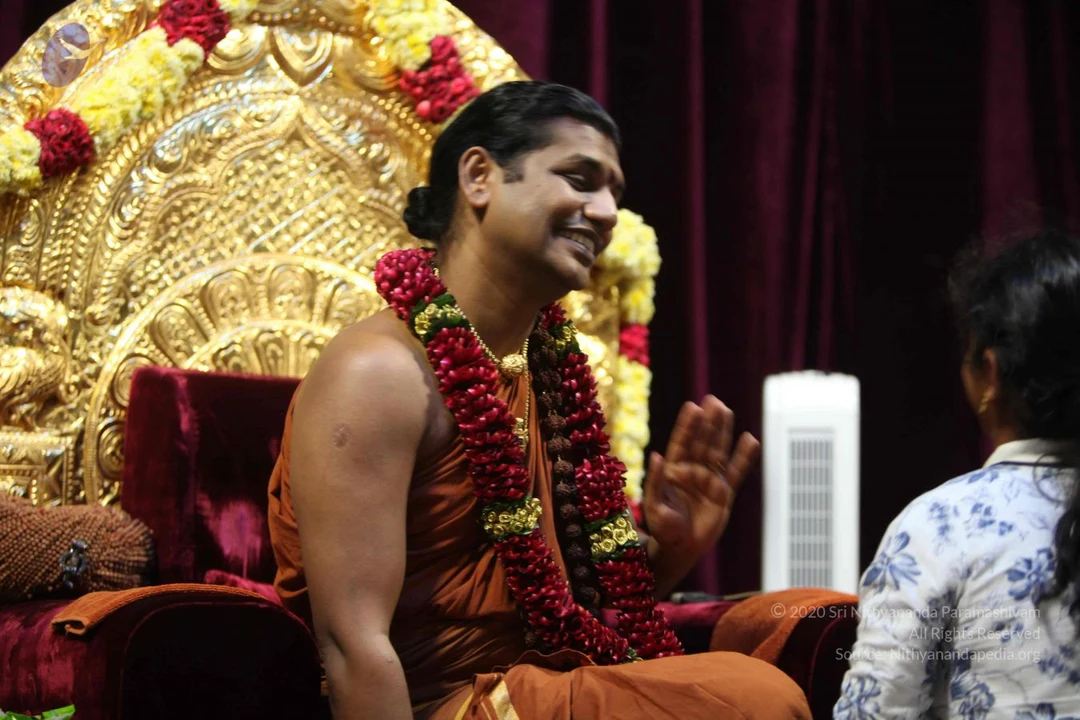
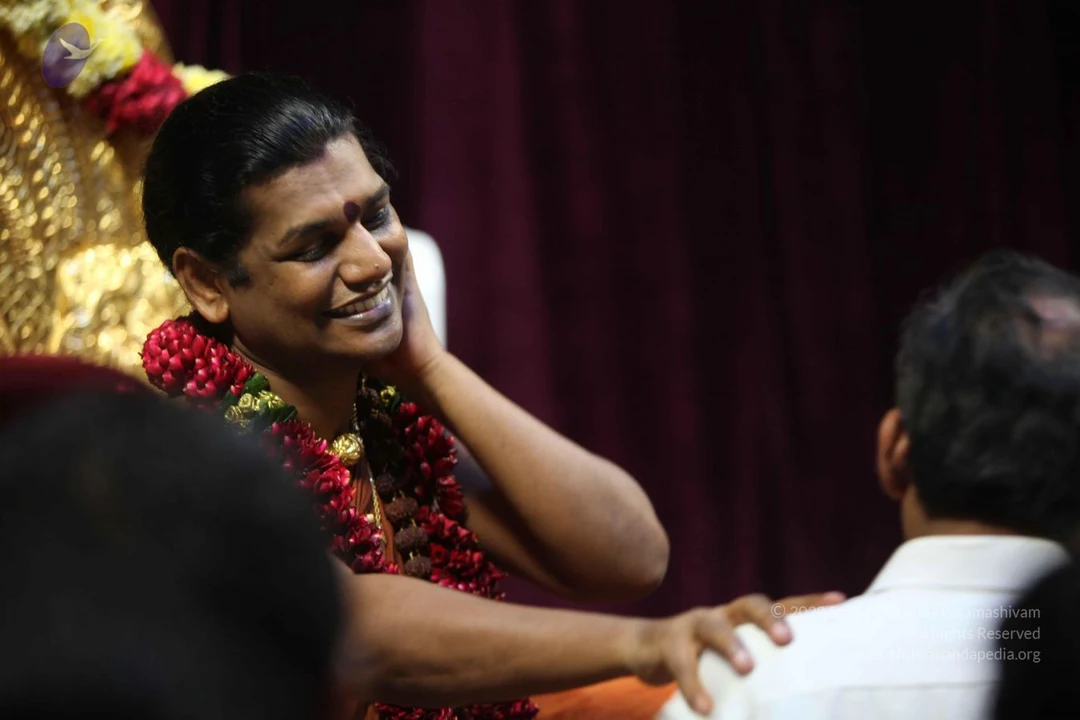
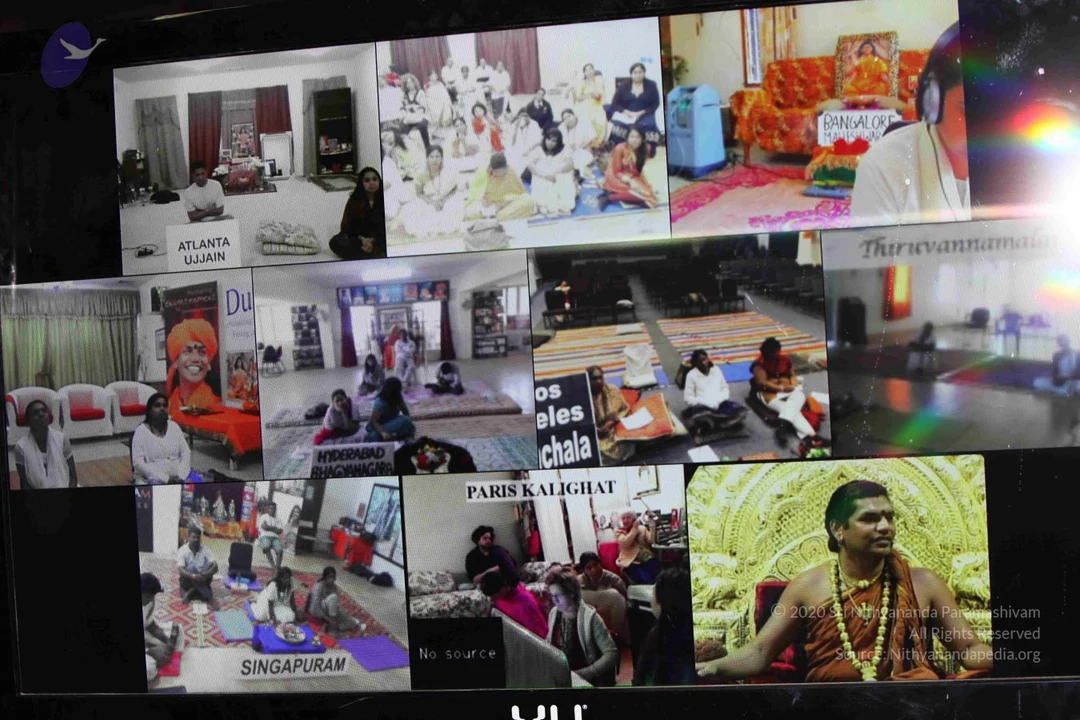
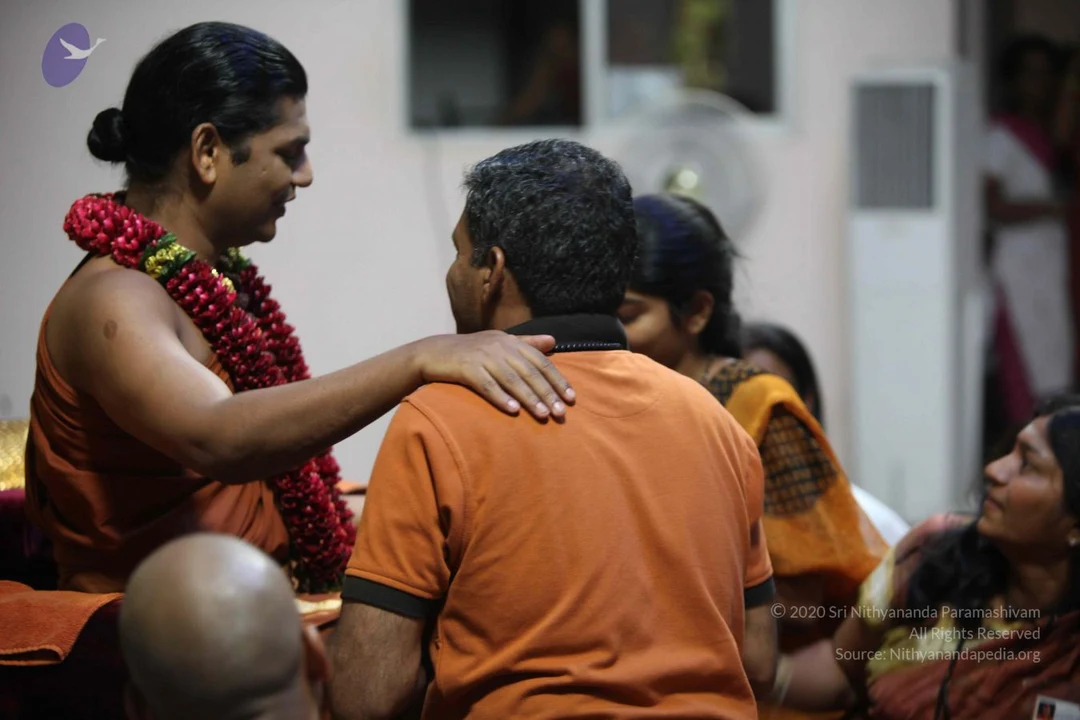
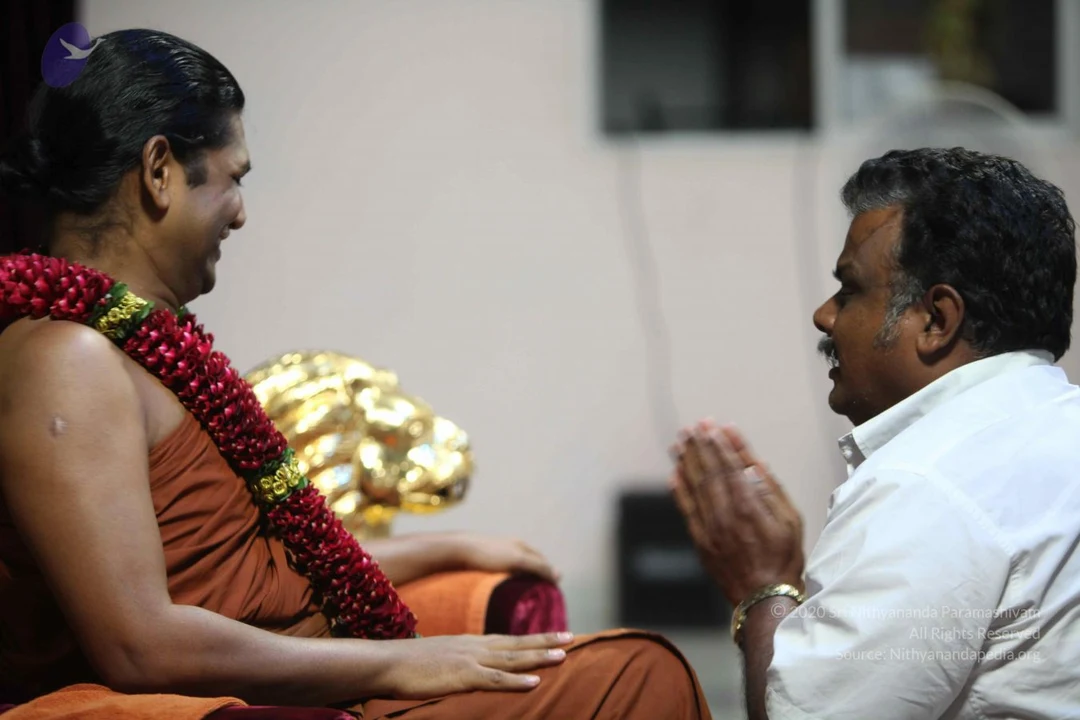
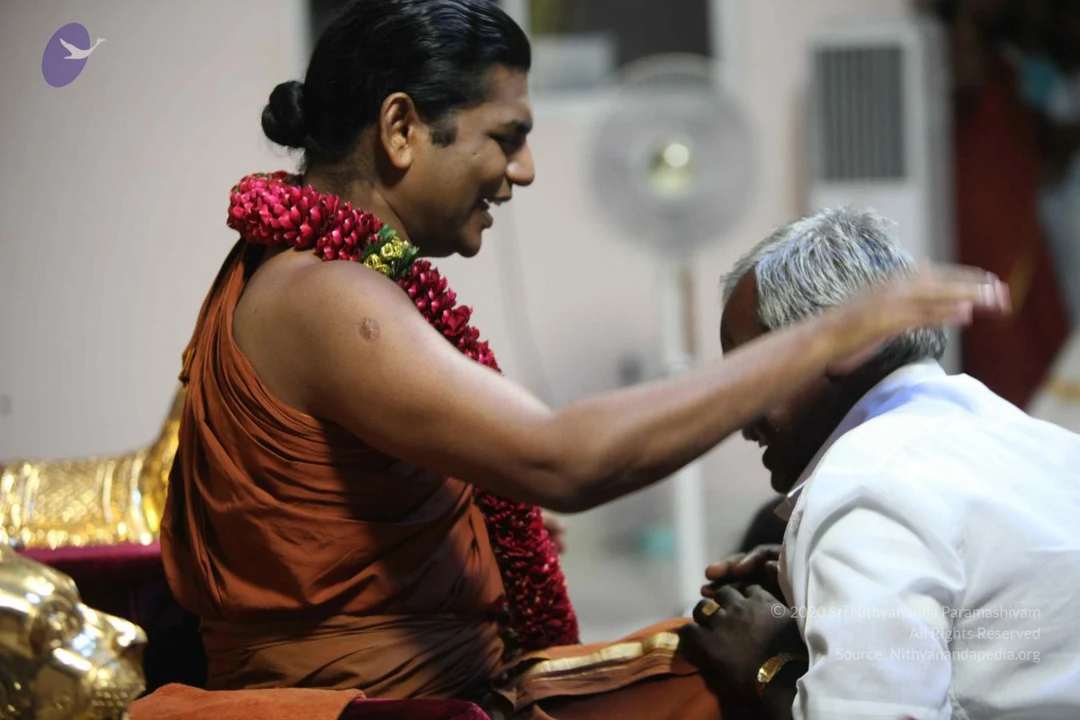
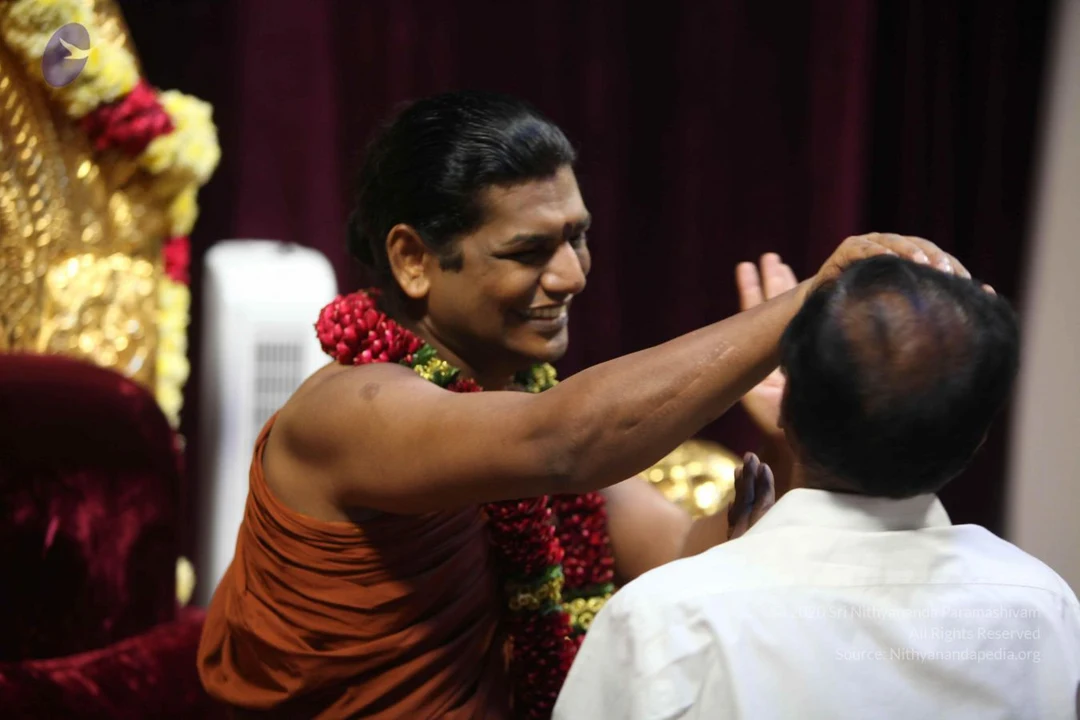
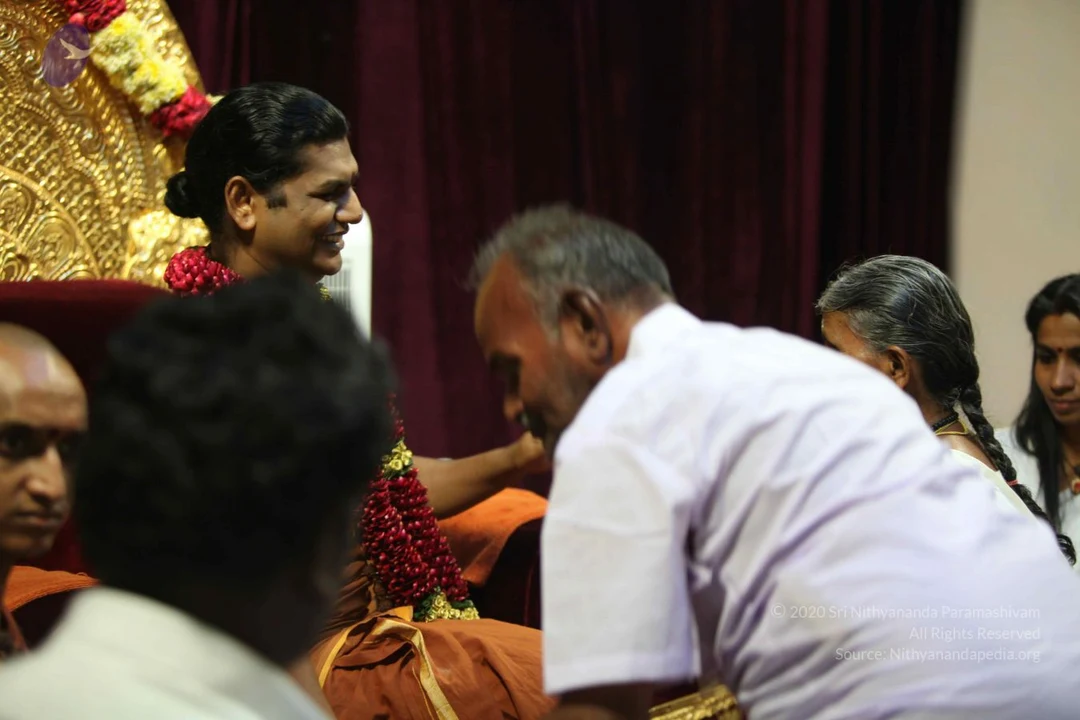
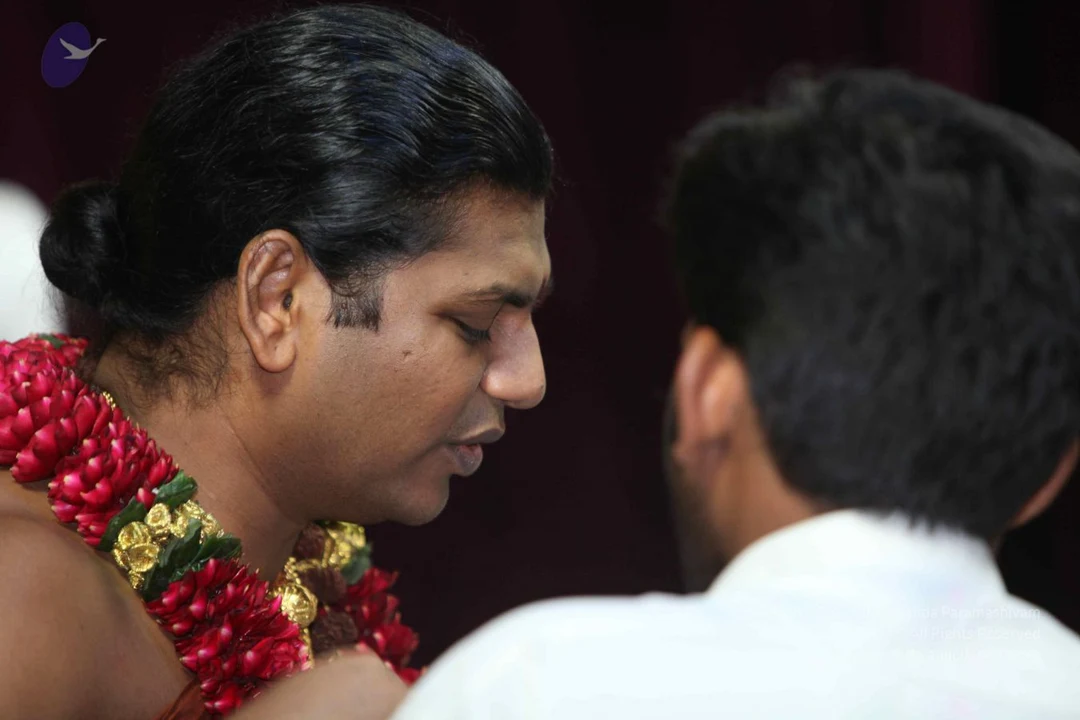
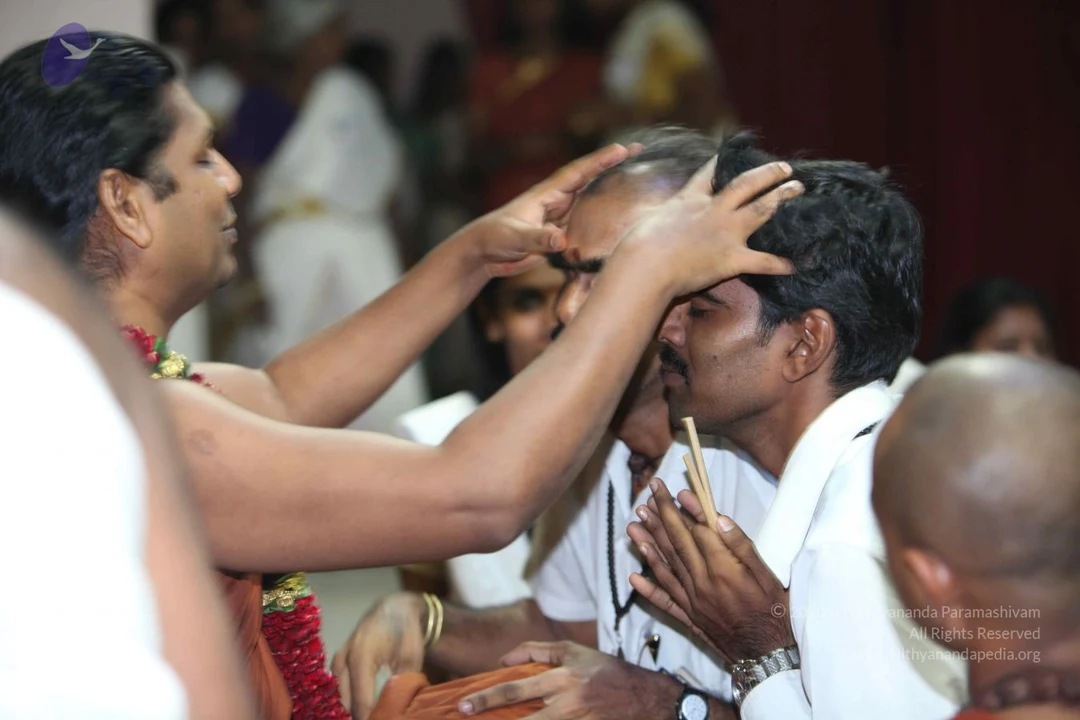
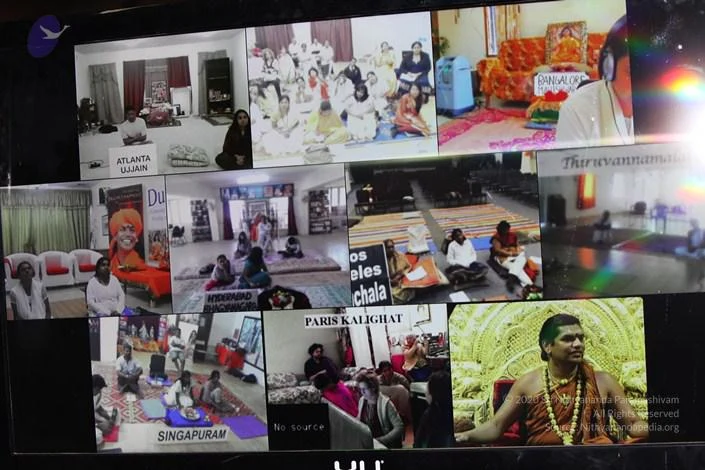
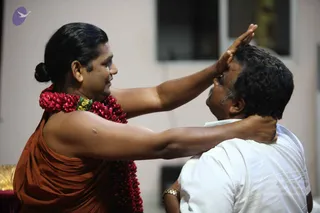
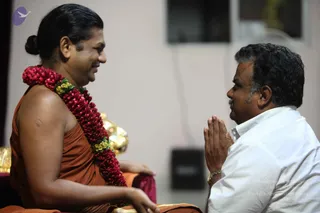
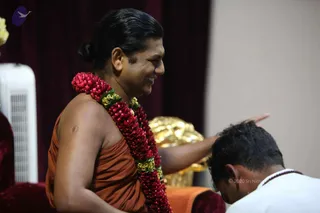
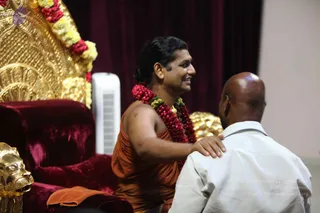
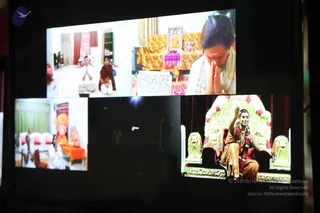
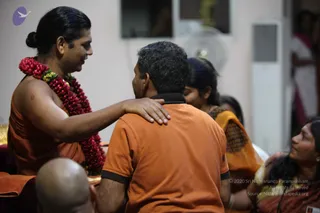
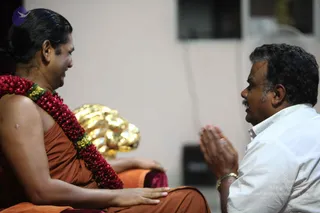
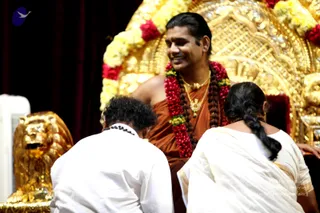
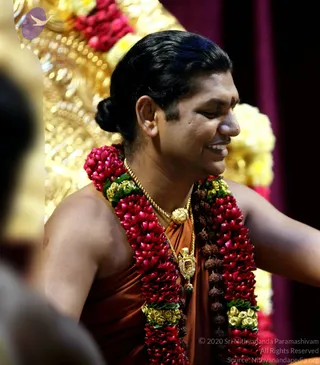
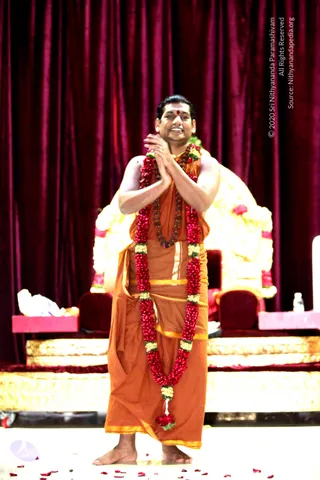
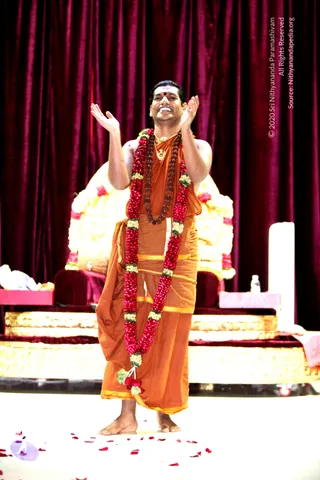
A man with short dark hair and a red bindi sits on an ornate gold throne with carved backrest, flanked by two golden lion sculptures on plinths. He wears an orange-saffron dhoti and shawl, a long red and yellow-green beaded garland with a red mala, and a gold necklace. He holds a small white object near his chest in one hand while the other rests on his knee. Behind the throne is a garland of white, yellow and red flowers and a deep maroon curtain. Two white tower fans stand at the sides of the stage. Visible, the man is the a person, seated as the presenter of a satsang on the stage.A photograph of two men in close physical contact in an indoor room with pale walls and dark windows. The man on the left wears a draped orange-brown robe, a red flower garland with a yellow element, and has his hair tied in a bun; he places one hand on the forehead of the second man and his other hand on the back of his neck. The man on the right, seen from behind and slightly tilted, wears a white shirt and a gold wristwatch and bows his head to receive the blessing. The gesture resembles an aashirvaad blessing touch. a person cues: orange robe, flower garland, hair in a bun, and the honoured-devotee posture, though the identification rests on appearance only.A photograph of two men in close conversation indoors. On the left, a man with hair tied in a bun, wearing a saffron-orange cloth draped over one shoulder and a large red and yellow flower garland around his neck, sits on a gold-and-red seat and smiles. On the right, a man with short greying hair and a moustache, wearing a white shirt and a gold wristwatch, sits facing him with palms pressed together in a namaste gesture. The background is a plain pale wall with a window and a dark speaker. The seated figure shows distinctive garland and saffron cues, but the appearance is uncertain, so the role is given as a seated man receiving namaste.Photograph of a seated man in a rust-orange wrap with a large red and gold flower garland draped over his shoulders, smiling as he turns his head. His long dark hair is swept back into a bun. His right hand is raised toward the head of a second man in a white shirt with a rudraksha-style mala, who leans forward with his head bowed. Behind them are a deep maroon curtain, a golden kalasha-like object and a white cabinet. The seated man has long swept-back hair, a saffron-orange wrap and a garland, which are cues consistent with the page's Swamiji reference, so he is described as Swamiji (probable) receiving a blessing from a devotee in a satsang setting. Visible people: 2.A seated man in an orange-brown saffron-toned robe, wearing a red and yellow flower garland, smiles while resting his hand on the shoulder of a bald man in a white shirt who is kneeling or bowing before him. The seated man sits on a red velvet throne with an ornate gold backrest and a gold lion-head armrest at lower left. A folded orange cloth lies on the chair. Background shows maroon drapery and a white wall. The seated man is a Swamiji (probable) based on the saffron robe, flower garland and throne, with his long dark hair swept back, and is in person.A photograph of a dark screen or video wall showing a multi-panel collage of live video feeds. Top left, two people in white sit with hands folded in a room with a poster-covered wall. Top right, a close-up of a woman with folded hands and white shawl, with a cardboard sign reading "BANGALORE MALLESHWARAM" and a framed deity picture behind her. Bottom left, a seated figure in white beside a poster of a smiling person in orange robes labelled "Dubai". Bottom right, a man in orange-brown robes and a red flower garland sits on an ornate golden throne flanked by carved lion figures, raising one hand in blessing. The collage shows remote satsang participants and a teacher on a throne.

TEMPLE

22 photosSource gallery
Outdoor satsang gathering beneath a large banyan tree with sprawling aerial roots and thick branches. Devotees in white ritual clothes sit on mats and a dark cloth on reddish earth, some with hands folded in prayer. A standing man in white shirt and trousers on the left and a woman in pink robes on the right appear to attend the gathering, and a person in orange clothing sits at the right edge. A green plastic bag and water bottles rest near the seated group. Dusk light filters through the foliage.A photograph of devotees gathered outdoors beneath a large banyan tree with hanging aerial roots. In the foreground a woman with hair in a braid, wearing a white sari with gold border and a dark blouse, stands with her back to the camera. Behind her and around the tree, several people in white and pastel clothing sit and stand, some with hands folded in prayer. A woman in a pink sari stands at right with hands together. Stone platforms and a dusky evening light surround the scene.Outdoor puja at a black stone deity murti set within an ornate silver arch, draped in an orange cloth and adorned with red and yellow marigold garlands and layered necklaces. A woman in a white shawl with red-patterned border stands at the statue, hands raised to its face. Beside her, a man in white dhoti with gold border offers at the base, where red flower petals are heaped on the ground with brass lamps and a small bell. Several women in white and pink saris watch from the left under shady trees.A woman in a white blouse and cream sari with a gold border stands with palms pressed together in prayer, her long dark plait falling over her shoulder. She wears bangles and a red-thread wrist band. She leans toward a large banyan tree whose thick, twisted aerial roots fill the right side of the frame. Another person in white clothing stands behind her with one arm raised, touching the trunk. The background is softly blurred with more trees and out-of-focus figures.A photograph of an outdoor temple courtyard with a paved grey brick floor and palm trees. At the centre is a red-orange stepped base supporting a tall ornate pillar and a dark stone Nandi bull with a red and white garland around its neck, flanked by potted plants. Behind are grey stone deity statues on pedestals. On the left, a woman in a white sari with a red border stands with folded hands, beside another woman in a white sari. On the right, men in white shirts and trousers walk and stand near the base, one in a light grey outfit. No one is wearing identifiable a person cues in the scene.A photograph of a metal statue standing in a silver-toned arched niche with carved scrollwork and lion-like figures at its base. The standing figure wears an orange saffron cloth draped over the body with a gold border, a tall crown-like headdress, and a long rudraksha mala with a large bead pendant. A smaller seated figure or pedestal to the left is also draped in orange cloth with a beaded mala and a heart-shaped pendant, set beside a stone-carved temple wall. Below, a garland of purple and white flowers rests on a blue cloth. No physical people are visible; these are statues and sacred murti depictions.

PADA-POOJA
20 photosSource gallery
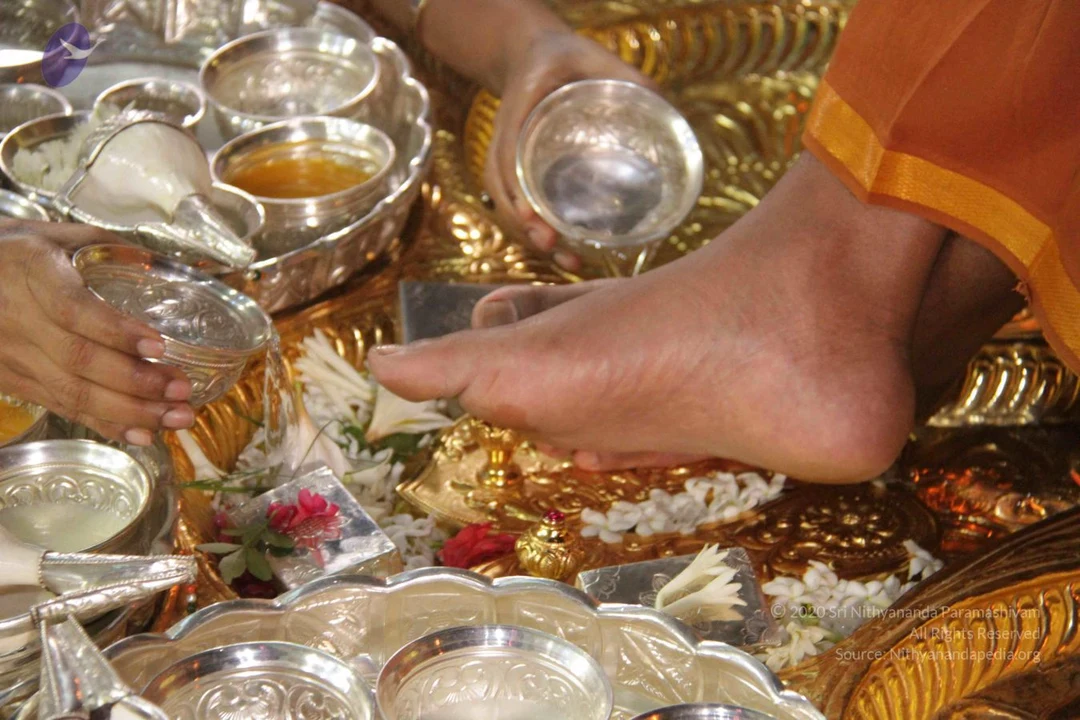
Close-up photograph of a large ornately embossed silver ritual tray holding several small silver bowls, one containing golden liquid and others empty, along with a silver conch-shaped vessel and a small silver box with a floral emblem. Loose white jasmine-like flowers sit in a central bowl and a white frangipani bloom rests near the conch. Gold-toned items and red flowers are visible at the upper left edge. No people are visible; the scene looks like puja items prepared for an offering.A man in profile performs a hand mudra beside an ornate gold-carved throne back, with an oil lamp and a gold peacock-shaped lamp stand at lower right against a dark background. He wears a saffron-orange shawl over the shoulder, a heavy gold multi-strand necklace with rudraksha-style beads, gold armlets and bangles, and a white-and-red tilak on the forehead. His hair is tied back in a bun. He is an appearance-based a person seated in a ritual setting, with his right palm raised and fingers in a mudra near his face. Only the one person is physically present.A photograph of a bare-chested man in an orange-saffron cloth draped over the body, wearing heavy gold beaded necklaces, gold armlets and bangles, and a wristwatch. He stands beside an ornate gold throne-back at left, raising one hand in a blessing gesture while holding a clear cylindrical object in the other. His hair is pulled back, and he has white and red marks on the forehead. In the lower right, a lit oil lamp flame is visible against a dark background. Swamiji (probable): the figure shows long swept-back hair, saffron clothing, ornate gold necklaces and a gold throne, consistent with Paramahamsa Nithyananda performing a ritual gesture during a satsang.Close-up photo of a padapuja ritual. A bare foot in an orange-saffron garment rests on a gold tray scattered with white jasmine flowers and red blossoms. A hand in the upper left holds a silver bowl of liquid, and another hand at top holds a small silver cup. Silver bowls and a silver spoon filled with milk, yellow liquid and water surround the foot on the tray. Gold ornamental tray edges and a small brass lamp are visible. The person whose foot is shown is only partially visible, so the figure cannot be identified from this image.Close view of a person's upper arm wearing a gold cobra-head armlet with a coiled gold snake band, layered over a rudraksha bead band with gold spacer beads. The person wears a rust-orange saffron cloth draped over the shoulder with gold embroidered trim at the left edge. Only the arm and clothing are visible, with no face shown.Close-up photograph of a person's hands resting on an orange-saffron cloth with gold border, one hand holding a polished silver cylindrical object. The wrists wear multiple rudraksha bead bracelets with gold-toned spacers, and a thin gold ring is on one finger. Red and green textured fabric appears blurred at the upper left. Only the arms and hands are visible, with no face shown.

NITHYA-SATSANG
37 photosSource gallery
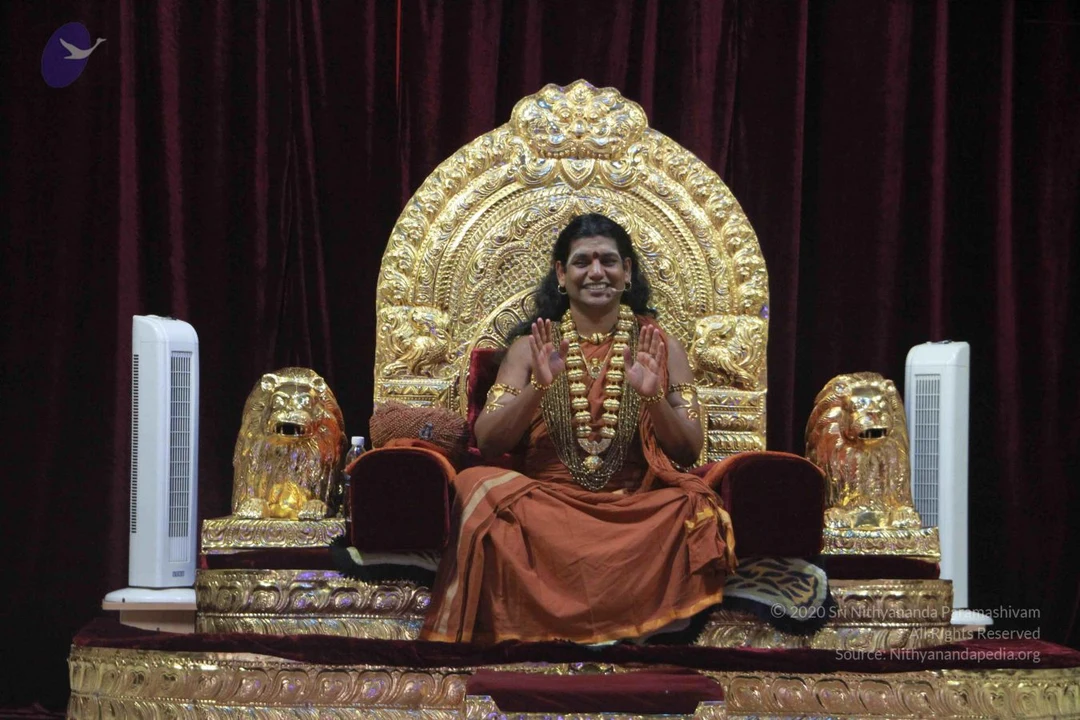
A photograph of a large satsang hall seen from an elevated angle, with a crowd of white-clad devotees seated on the floor facing forward. Several monitors in the foreground display multi-panel video grids of other gatherings and a slide with text, and a small screen on the left shows a figure in a saffron-toned garment with beads. A woman in a maroon sari sits at a laptop in the lower left, and a camera on a tripod is set up among the seated audience. Orange-accented pillars and a grid of shelving frame the back of the hall.A seated figure in an orange-red saffron robe and multiple beaded necklaces sits on an ornate gold throne with lion-shaped armrests and a gold arched backrest, centred on a raised stage. Dark red velvet curtains frame the stage, a patterned rug lies on the floor, and white tower fans stand beside the throne. The figure's hands are joined in front of the chest. Swamiji (probable): the seated person wears saffron clothing and rudraksha-style beads, with long hair visible, and the throne is ceremonial. A ceiling fan hangs above, and the mirrored floor reflects the throne.A seated figure sits on an ornate gilded throne with a tall arched back and two golden lion sculptures flanking the seat, set against deep burgundy velvet drapes on a stage. The person wears an orange-red robe and a long multi-strand gold necklace with rudraksha beads, and raises both palms together in a greeting gesture. Two white floor fans stand on either side of the dais, and a patterned red carpet covers the stage floor. A small purple bird logo appears in the upper left corner, and a copyright notice is printed on the lower right. Swamiji (probable): the seated figure wears orange robes, rudraksha beads and a gold necklace on a ceremonial throne, with long hair swept back.A seated figure on an ornate gilded throne with a large arched backrest and two golden lion sculptures flanking the armrests, set on a tiered gold-and-red platform before deep maroon velvet drapes. The figure wears an orange-saffron robe draped over the shoulders, a long multi-strand gold and bead necklace, gold armlets and a red bindi, and holds both palms raised in greeting while smiling. Two white tower fans stand at the sides of the stage. Swamiji (probable): the seated figure has long swept-back hair, saffron ceremonial clothing, a ceremonial gold necklace and rudraksha-style beads, and sits enthroned on a gilded lion throne.A photograph of a seated figure on an ornate golden throne with a large arched gilded back and carved lion-form armrests, against dark red drapery. The figure wears an orange-saffron wrap, a heavy gold-toned multi-strand necklace of beads with a central pendant, gold armbands, dark hair worn long, a red bindi, and a small microphone at the ear. Hands are raised with palms facing outward in a gesturing blessing or teaching pose while smiling. Only one physical person is visible. Identity is an appearance-based candidate: a person, seated in the honoured position of a satsang discourse, with long swept hair, saffron clothing, rudraksha-style beads and gold adornments as qualifying cues. A partially visible gilded lion statue appears at the left edge.Wide view of a large satsang hall with a white draped ceiling and tall striped pillars hung with orange tassels. Rows of seated devotees in white clothing fill the floor on both sides of a central aisle lined with silver stanchions, with women in green, pink and multicoloured saris at right. On the distant stage, a seated figure in orange and gold sits beside a golden throne-like seat before a dark red curtain, with two large screens showing a close-up of a person on either side. Oil lamps and a peetha-style arrangement stand at the front.

DIAL-THE-AVATAR
10 photosSource gallery
A man seated on an ornate golden throne with a red velvet cushion, flanked by gilded lion sculptures, speaking into a headset microphone and gesturing with his right hand. He wears an orange-saffron shawl draped over his shoulders, a rudraksha-style bead necklace with a gold pendant, a gold bangle on the upper arm, and a red bindi with a white forehead mark. The background is deep burgundy drapery. Swamiji (probable): long swept-back hair, saffron clothing, ornate gold adornments and a seated throne position give the appearance of the Nithyananda Paramashivam candidate.A seated man in saffron-orange robes sits on an ornate golden throne with a red velvet seat, flanked by golden lion sculptures. He wears a red bindi, a headset microphone, multiple gold necklaces with bead strands, gold armbands and bangles, and a small rudraksha-style bead mala. He sits with hands folded and looks to the side with a slight smile. Maroon velvet drapery hangs behind him. a person is shown as the figure in saffron robes seated on the throne, with the throne, lion sculptures and gold necklaces serving as the distinguishing cues. A small purple logo appears in the upper left corner and a copyright photo credit runs along the lower right edge.A seated man in an orange-saffron dhoti and shawl sits on an ornate gold throne carved with lions, set on a red velvet-draped stage. He wears a long beaded necklace, bracelets, a red bindi and a small earpiece microphone, and his bare feet rest on a red cushion. Swamiji (probable): long dark hair and ornate ceremonial gold necklace, seated on a golden throne in saffron clothing. A microphone cable runs across the stage.A seated man in saffron-orange robes sits on an ornate gold throne with carved lion figures and a tall gold back panel, against deep maroon velvet drapes. He wears a gold-bead necklace and multiple bangles, with a small red bindi on his forehead, and a headset microphone is visible at his face. A wired microphone rests on the armrest. The throne sits on a gold-carved dais with a red velvet cushion, and a small footstool is in front.A seated man in orange-saffron robes sits on an ornate gold throne with a large carved arch, flanked by two golden lion sculptures, in front of deep red velvet curtains. He wears a gold beaded necklace, gold bangles and a gold armband, with a dark topknot and a red bindi, and his bare feet rest on a red cushion. He gestures with one hand while speaking, with a microphone visible at the right. Appearance-based: a person, seated on the throne in orange robes, gold necklace and topknot.A man seated on a red cushioned chair before an ornate gold-leaf arched throne carved with lions and floral scrollwork, against dark maroon drapes. He wears an orange-saffron shawl over his bare shoulders, a long beaded gold-toned mala, a pendant necklace, gold armlets and a red bindi with a white forehead marking, and a small clip-on microphone is attached near his ear. He sits with a calm expression, and a gold-and-red cushion and a dark cloth are visible at the lower edge. Appearance-based label: Swamiji (probable), with long swept-back hair, saffron shawl, rudraksha-style beaded mala and ceremonial gold ornaments, seated on a throne-like seat.

ESSENCE-OF-INNER-AWAKENING-IN- TAMIL
42 photosSource gallery
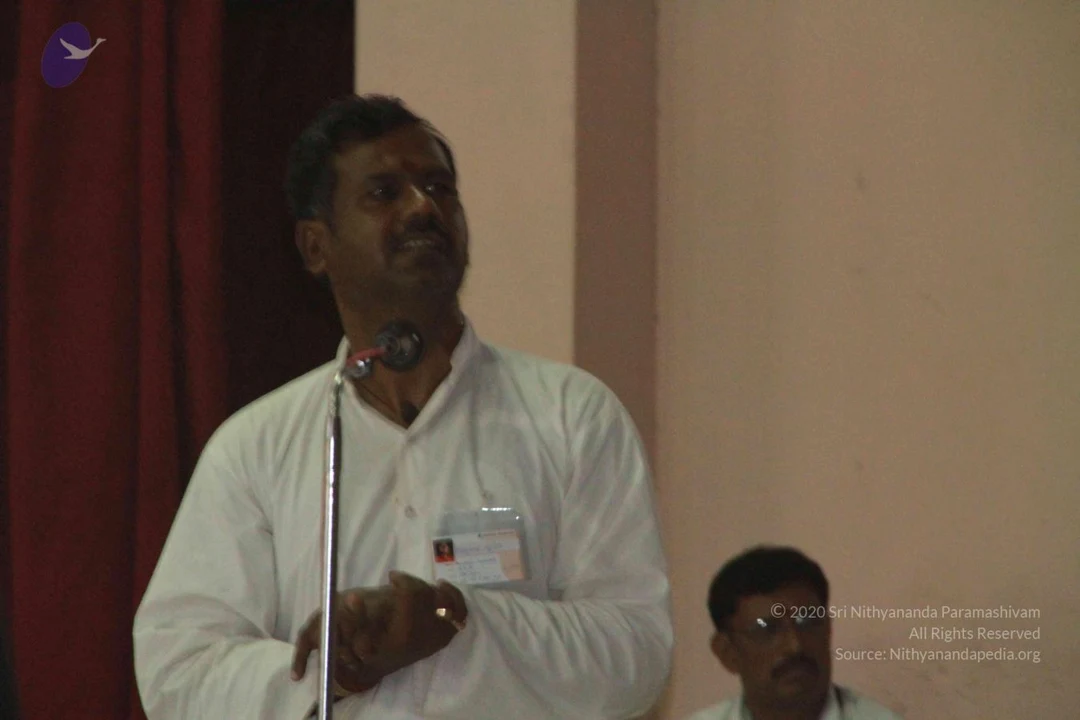
A man seated on an ornate golden throne with carved lion figures and a gold arched backdrop, on a stage with dark red velvet drapes. He wears an orange-saffron cloth draped over one shoulder and a long, multi-strand gold bead necklace with a gold pendant, plus a small red bindi on his forehead and a headset microphone. His hands rest on his lap as he looks to the side. a person: the saffron clothing, gold malas and ceremonial throne match the page's identification, but the face is not used for identification. A golden lion sculpture sits at the left edge and a red cushion rests on the armrest.A dense audience of mostly men seated closely together in white shirts and trousers, viewed from the front in a large hall. In the centre, a man in a white shirt and dark-rimmed glasses sits with one hand raised near his chest, a dark beaded mala hanging over his shirt and an ID badge on a lanyard. To the right, another man in a white shirt with a thin red line on his forehead sits beside a man in a white shirt wearing a beaded necklace. At lower left, a man in an orange top is partly visible. The faces are attentive and the crowd fills the frame.Photograph of a seated audience at a satsang gathering, mostly men in white shirts. The central man with greying hair, a moustache and a dark beaded mala necklace is speaking, wearing a white short-sleeved shirt. Blurred figures in white and one in orange clothing surround him. The setting appears to be a hall with a crowd facing forward.A seated man in saffron-orange robes sits on a red velvet throne with a gilded lion armrest and an ornate gold backrest behind him. He wears a red bindi, a gold necklace with a pendant, and a wrap draped over one shoulder, with hands gently gesturing as he smiles while speaking. Red velvet drapes form the background.A large seated congregation of men in white shirts and white dhotis fills the frame at a satsang, most looking forward with attentive expressions. Many wear tilak marks and some have vibhuti or kumkum on their foreheads; several wear rudraksha malas and one man in the foreground wears a red bindi. Heads and shoulders are densely packed, with a few men in yellow or patterned shirts among the white. No individual is identifiable as the teacher from the visible scene. Nearly all people are devotees seated on the floor of the hall.A man in a white short-sleeved shirt stands at a silver microphone on a stand, speaking with his right hand raised near his face. He wears glasses, a red tilak mark on his forehead, a gold ring and a wristwatch, with orange and red threads tied on his wrist. A pink cable runs down beside the mic stand. Two blurred heads of seated listeners are visible at the lower edge against a plain beige wall.

SARVA-DARSHAN
6 photosSource gallery
A photograph inside a decorated hall with draped fabric ceiling and hanging colourful banners. A bald man in saffron-orange robes and a white sacred mark on his forehead, holding a small camera, leans in on the left. In the centre, a man in a white shirt with glasses and a moustache holds an open booklet while a man in orange robes with a rudraksha bracelet and a heavy gold necklace and armlets stands at right, holding green-wrapped sweets from a red box with a folded paper inside. Another man in white and people in the background watch the exchange.A photograph inside a decorated hall with a white fabric ceiling and colourful striped pillars. A smiling man in an orange-saffron shawl and layered gold necklaces, with a red bindi and white tilak, reads a printed sheet held in his hands. Beside him an older man in glasses, a white shirt and a pen in his pocket leans in to look at the page. A shaven-headed young monk in orange stands at the left edge, and white-clad devotees stand in the background. A camera lens is visible at the lower left.A photograph of a satsang hall where a shaved-headed priest in an orange-saffron dhoti and shawl, with a gold-bead necklace and gold armlet, stands at a wooden lectern reading from a paper while touching the head of a man in a striped white polo shirt holding a walking cane. Several other people in white and orange clothing stand or sit along a central white carpet and striped mats, and a golden throne-like seat is visible at the far back. Another person in a striped shirt stands behind the lectern. a person cue is not clearly present: the central figure has a shaved head and no long hair, crown or rudraksha mala, so the identity is uncertain.A photograph inside a plain room with a wall clock and colourful striped decorative hangings. A woman with a hair bun, gold necklace, gold bangles and hoop earrings, wearing an orange saffron-coloured garment, reaches out to place her hand on the head of a young boy in a purple-and-white striped shirt with a dark dot on his forehead. An older man with grey hair and white clothes kneels with palms pressed together, eyes closed. A man in a white shirt with a rudraksha mala kneels at right, and a bald person with a forehead mark is partly visible at left. Mats are laid on the floor behind them. The woman appears to be a sannyasi or devotee giving a blessing; no a person candidate is clearly recognizable from appearance.Indoor satsang hall with red-cushioned chairs and striped mats on the floor. A central figure with long swept-back dark hair, a gold necklace, gold armlets and a saffron-orange garment with gold border, with a rudraksha mala, stands with his hands near a woman in white sari with gold border and red-marked forehead, who holds a small tray of green-tinted items. A man in white shirt and trousers stands beside her, also reaching toward the tray. A small child in white stands below. Behind them, a shaved-headed monk in orange cloth with rudraksha beads and other men in white dhotis and shirts watch; a cameraman is visible at left. a person: the central figure has long swept-back hair, gold ornaments and saffron clothing, consistent with the page's claim. Scene looks like a darshan or puja interaction.A photograph inside a hall with yellow partitions and colourful striped rugs spread on the floor. In the foreground a woman in an orange-and-gold sari with gold bangles and a gold necklace reads from a printed sheet while a woman in a white sari with a red mark on her forehead stands before her, receiving something from her hands. Beside them a man in a white shirt holds a packet of green sweets. On the left two shaved-headed men in orange-saffron robes and rudraksha malas stand, one holding a camera. Several people in white clothes stand around the room, a child in red and another in orange are visible, and a banner with text hangs on the pillar.

ESSENCE-OF-INNER-AWAKENING-IN-TAMIL-SESSION-2
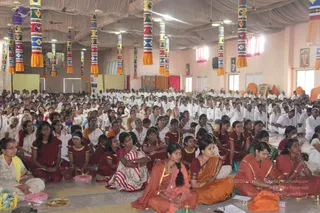
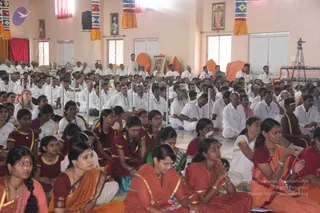
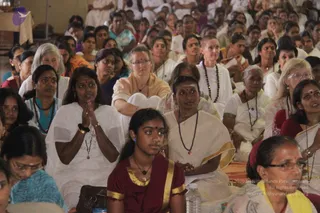
7 photosSource gallery
A large indoor satsang hall with a peach-coloured wall and tall windows. Many men sit cross-legged on an orange mat, most dressed in white shirts and white dhotis, with rudraksha malas around their necks. Several clap with their palms together, while one man in a striped shirt and dark lunghi sits with arms crossed. Orange cushions and shelves of brass-toned items line the back of the hall, and banners hang from the ceiling. The crowd fills most of the frame, and the scene reads as a devotional gathering or satsang.A hall with a large audience seated on the floor in white clothes facing a raised stage. On the stage, a figure sits on a golden ornate throne with a dark red curtain behind. Two standing men in white shirts and white dhotis stand near the stage steps. Two large screens on either side show a close-up of a figure with long hair and saffron clothing. A colourful decorated pillar hangs at the right edge, and a draped white canopy covers the ceiling. A satsang setting with a video projection of the speaker.A satsang hall with a seated audience in white clothes sitting on the floor facing a raised stage. On the stage, a figure sits on an ornate gold throne in front of dark red drapes, with a small lectern and lit candles beside it. Two projection screens on the walls show a close-up of a long-haired figure in saffron clothing. A man in a white shirt and white dhoti stands near the stage, and a shaven-headed man in saffron robes sits in the front rows among the devotees. Cameras on tripods and audio equipment are set up at the sides. The ceiling is draped with pale fabric.A photograph of a seated man on an ornate golden throne with lion-head armrests and red velvet cushions, set against deep burgundy drapes. He wears orange-saffron robes draped over one shoulder, multiple rudraksha malas, a gold necklace, and a red bindi on his forehead, with a small microphone at his cheek. He rests one hand on his chin and smiles broadly. A tiger-striped cloth covers the seat edge.A photograph of a seated audience of women in a plain room with peach walls, white-framed windows and a white cabinet at left. The women sit on an orange cloth, many wearing white or cream saris and white blouses, with some in red or orange saris with gold borders. One woman in the foreground wears a red sari with a gold border, a red-and-gold bangle set and a beaded necklace, and looks forward with her hand near her chin. Beside her, a woman in a white sari with a gold border wears a dark rudraksha-style mala and holds a notebook. Water bottles sit on the floor and a pink bag rests in front. No a person figure is visible among the people.A seated crowd at a satsang hall with yellow walls and a red banner behind them. In the foreground a young woman in an orange-and-red sari presses her palms together in anjali mudra and looks upward, while an older woman in a white sari with gold border and rudraksha mala holds her hands together beside her. Another woman in a white sari with red bindi and rudraksha mala sits to the right, and devotees fill the rows behind, many in white. No identifiable a person figure is visible in the frame.

DARSHAN
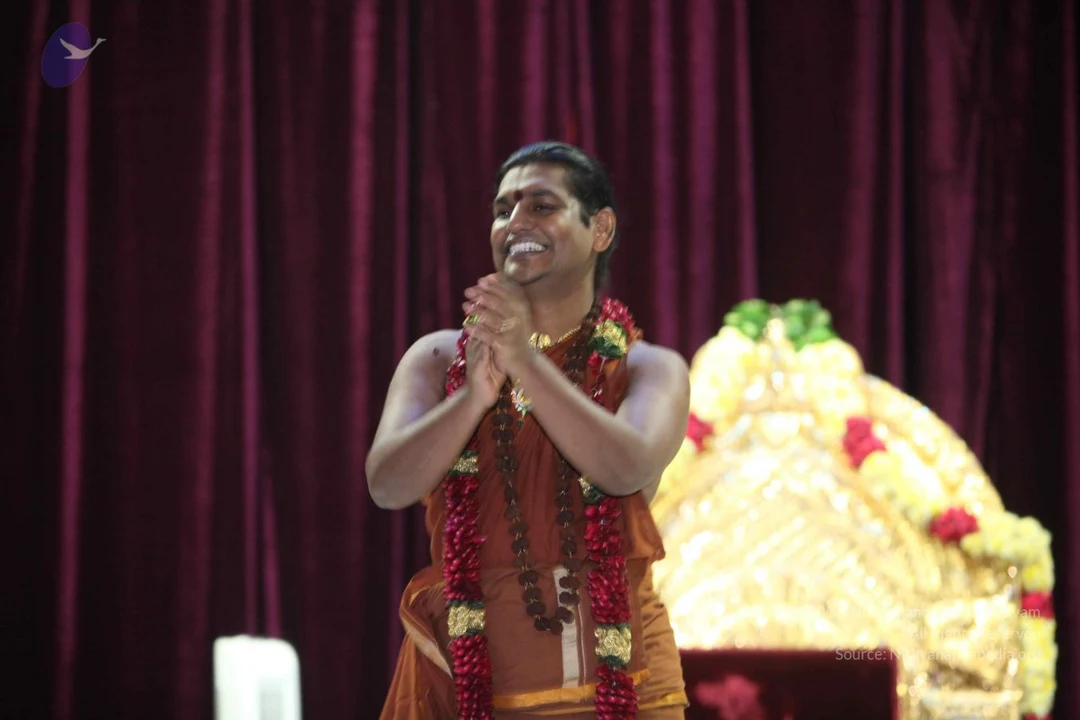
25 photosSource gallery
A man with short dark hair and a red bindi sits on an ornate gold throne with carved backrest, flanked by two golden lion sculptures on plinths. He wears an orange-saffron dhoti and shawl, a long red and yellow-green beaded garland with a red mala, and a gold necklace. He holds a small white object near his chest in one hand while the other rests on his knee. Behind the throne is a garland of white, yellow and red flowers and a deep maroon curtain. Two white tower fans stand at the sides of the stage. Visible, the man is the a person, seated as the presenter of a satsang on the stage.A photograph of two men in close physical contact in an indoor room with pale walls and dark windows. The man on the left wears a draped orange-brown robe, a red flower garland with a yellow element, and has his hair tied in a bun; he places one hand on the forehead of the second man and his other hand on the back of his neck. The man on the right, seen from behind and slightly tilted, wears a white shirt and a gold wristwatch and bows his head to receive the blessing. The gesture resembles an aashirvaad blessing touch. a person cues: orange robe, flower garland, hair in a bun, and the honoured-devotee posture, though the identification rests on appearance only.A photograph of two men in close conversation indoors. On the left, a man with hair tied in a bun, wearing a saffron-orange cloth draped over one shoulder and a large red and yellow flower garland around his neck, sits on a gold-and-red seat and smiles. On the right, a man with short greying hair and a moustache, wearing a white shirt and a gold wristwatch, sits facing him with palms pressed together in a namaste gesture. The background is a plain pale wall with a window and a dark speaker. The seated figure shows distinctive garland and saffron cues, but the appearance is uncertain, so the role is given as a seated man receiving namaste.Photograph of a seated man in a rust-orange wrap with a large red and gold flower garland draped over his shoulders, smiling as he turns his head. His long dark hair is swept back into a bun. His right hand is raised toward the head of a second man in a white shirt with a rudraksha-style mala, who leans forward with his head bowed. Behind them are a deep maroon curtain, a golden kalasha-like object and a white cabinet. The seated man has long swept-back hair, a saffron-orange wrap and a garland, which are cues consistent with the page's Swamiji reference, so he is described as Swamiji (probable) receiving a blessing from a devotee in a satsang setting. Visible people: 2.A seated man in an orange-brown saffron-toned robe, wearing a red and yellow flower garland, smiles while resting his hand on the shoulder of a bald man in a white shirt who is kneeling or bowing before him. The seated man sits on a red velvet throne with an ornate gold backrest and a gold lion-head armrest at lower left. A folded orange cloth lies on the chair. Background shows maroon drapery and a white wall. The seated man is a Swamiji (probable) based on the saffron robe, flower garland and throne, with his long dark hair swept back, and is in person.A photograph of a dark screen or video wall showing a multi-panel collage of live video feeds. Top left, two people in white sit with hands folded in a room with a poster-covered wall. Top right, a close-up of a woman with folded hands and white shawl, with a cardboard sign reading "BANGALORE MALLESHWARAM" and a framed deity picture behind her. Bottom left, a seated figure in white beside a poster of a smiling person in orange robes labelled "Dubai". Bottom right, a man in orange-brown robes and a red flower garland sits on an ornate golden throne flanked by carved lion figures, raising one hand in blessing. The collage shows remote satsang participants and a teacher on a throne.

Essence of IA in Tamil

19 photosSource gallery
A man seated on an ornate golden throne with carved lion figures and a gold arched backdrop, on a stage with dark red velvet drapes. He wears an orange-saffron cloth draped over one shoulder and a long, multi-strand gold bead necklace with a gold pendant, plus a small red bindi on his forehead and a headset microphone. His hands rest on his lap as he looks to the side. a person: the saffron clothing, gold malas and ceremonial throne match the page's identification, but the face is not used for identification. A golden lion sculpture sits at the left edge and a red cushion rests on the armrest.A dense audience of mostly men seated closely together in white shirts and trousers, viewed from the front in a large hall. In the centre, a man in a white shirt and dark-rimmed glasses sits with one hand raised near his chest, a dark beaded mala hanging over his shirt and an ID badge on a lanyard. To the right, another man in a white shirt with a thin red line on his forehead sits beside a man in a white shirt wearing a beaded necklace. At lower left, a man in an orange top is partly visible. The faces are attentive and the crowd fills the frame.Photograph of a seated audience at a satsang gathering, mostly men in white shirts. The central man with greying hair, a moustache and a dark beaded mala necklace is speaking, wearing a white short-sleeved shirt. Blurred figures in white and one in orange clothing surround him. The setting appears to be a hall with a crowd facing forward.A large seated congregation of men in white shirts and white dhotis fills the frame at a satsang, most looking forward with attentive expressions. Many wear tilak marks and some have vibhuti or kumkum on their foreheads; several wear rudraksha malas and one man in the foreground wears a red bindi. Heads and shoulders are densely packed, with a few men in yellow or patterned shirts among the white. No individual is identifiable as the teacher from the visible scene. Nearly all people are devotees seated on the floor of the hall.A smiling man in saffron/orange draped robes sits on an ornate gold-and-crimson throne with carved golden lion-head armrests and a gilded backrest. He wears a red bindi, gold-toned ear studs, a heavy gold bead necklace with a gold pendant, and a small gold-framed pendant on a chain. Behind him hang deep maroon velvet drapes. Appearance-based candidate: a person, seated on the throne as a speaker at a satsang, with distinctive saffron robes, rudraksha-style gold beads, and ceremonial gold adornments.A shaved-headed man in white ritual cloth with a gold-bordered shawl draped over one shoulder speaks into a microphone on a stand, index finger raised. He wears a red tilak on his forehead and a rudraksha mala with a small pendant. The background is a pale hall with red-lit windows and a dark speaker at right. The speaker's identity is not established by appearance alone, so he is described by role as a speaker at a satsang.

Darshan

32 photosSource gallery
A man with short dark hair and a red bindi sits on an ornate gold throne with carved backrest, flanked by two golden lion sculptures on plinths. He wears an orange-saffron dhoti and shawl, a long red and yellow-green beaded garland with a red mala, and a gold necklace. He holds a small white object near his chest in one hand while the other rests on his knee. Behind the throne is a garland of white, yellow and red flowers and a deep maroon curtain. Two white tower fans stand at the sides of the stage. Visible, the man is the a person, seated as the presenter of a satsang on the stage.A photograph of a satsang gathering. A man with hair tied in a bun and a thick red and green flower garland, wearing an orange robe, sits at left with his right hand resting on the shoulder of a seated man in an orange polo shirt whose back is turned to the camera. A woman in a yellow and dark patterned sari sits behind them, and another woman with dark hair in a bun sits at right. A shaved-headed person in the lower left foreground and partly visible people in the background complete the scene. The man in the orange robe fits the a person appearance cues of long hair in a bun, saffron clothing and a garland, though his face is not used for identification. Plain white walls, a window and an air conditioner are visible behind.A photograph of two men in close physical contact in an indoor room with pale walls and dark windows. The man on the left wears a draped orange-brown robe, a red flower garland with a yellow element, and has his hair tied in a bun; he places one hand on the forehead of the second man and his other hand on the back of his neck. The man on the right, seen from behind and slightly tilted, wears a white shirt and a gold wristwatch and bows his head to receive the blessing. The gesture resembles an aashirvaad blessing touch. a person cues: orange robe, flower garland, hair in a bun, and the honoured-devotee posture, though the identification rests on appearance only.A photograph of two men in close conversation indoors. On the left, a man with hair tied in a bun, wearing a saffron-orange cloth draped over one shoulder and a large red and yellow flower garland around his neck, sits on a gold-and-red seat and smiles. On the right, a man with short greying hair and a moustache, wearing a white shirt and a gold wristwatch, sits facing him with palms pressed together in a namaste gesture. The background is a plain pale wall with a window and a dark speaker. The seated figure shows distinctive garland and saffron cues, but the appearance is uncertain, so the role is given as a seated man receiving namaste.A photograph of two men seated facing each other in profile. On the left, a man with swept-back dark hair wears an orange-brown wrap over his shoulder and a long red-and-white flower garland with green and gold accents; he sits on a cushioned seat with a gold-coloured object behind him. On the right, a man with short grey-streaked hair and a moustache wears a white collared shirt and a gold bracelet, his palms pressed together in namaste as he speaks. The background is a plain pale wall with a window. Visible cues on the seated man (orange wrap, garland, swept hair) are consistent with the page's reference, so the seated figure is a person. Two physical people are present.Photograph of a seated man in a rust-orange wrap with a large red and gold flower garland draped over his shoulders, smiling as he turns his head. His long dark hair is swept back into a bun. His right hand is raised toward the head of a second man in a white shirt with a rudraksha-style mala, who leans forward with his head bowed. Behind them are a deep maroon curtain, a golden kalasha-like object and a white cabinet. The seated man has long swept-back hair, a saffron-orange wrap and a garland, which are cues consistent with the page's Swamiji reference, so he is described as Swamiji (probable) receiving a blessing from a devotee in a satsang setting. Visible people: 2.

Card1

16 photosSource gallery
A seated figure in an orange-red saffron robe and multiple beaded necklaces sits on an ornate gold throne with lion-shaped armrests and a gold arched backrest, centred on a raised stage. Dark red velvet curtains frame the stage, a patterned rug lies on the floor, and white tower fans stand beside the throne. The figure's hands are joined in front of the chest. Swamiji (probable): the seated person wears saffron clothing and rudraksha-style beads, with long hair visible, and the throne is ceremonial. A ceiling fan hangs above, and the mirrored floor reflects the throne.A seated figure sits on an ornate gilded throne with a tall arched back and two golden lion sculptures flanking the seat, set against deep burgundy velvet drapes on a stage. The person wears an orange-red robe and a long multi-strand gold necklace with rudraksha beads, and raises both palms together in a greeting gesture. Two white floor fans stand on either side of the dais, and a patterned red carpet covers the stage floor. A small purple bird logo appears in the upper left corner, and a copyright notice is printed on the lower right. Swamiji (probable): the seated figure wears orange robes, rudraksha beads and a gold necklace on a ceremonial throne, with long hair swept back.A seated figure on an ornate gilded throne with a large arched backrest and two golden lion sculptures flanking the armrests, set on a tiered gold-and-red platform before deep maroon velvet drapes. The figure wears an orange-saffron robe draped over the shoulders, a long multi-strand gold and bead necklace, gold armlets and a red bindi, and holds both palms raised in greeting while smiling. Two white tower fans stand at the sides of the stage. Swamiji (probable): the seated figure has long swept-back hair, saffron ceremonial clothing, a ceremonial gold necklace and rudraksha-style beads, and sits enthroned on a gilded lion throne.A photograph of a seated figure on an ornate golden throne with a large arched gilded back and carved lion-form armrests, against dark red drapery. The figure wears an orange-saffron wrap, a heavy gold-toned multi-strand necklace of beads with a central pendant, gold armbands, dark hair worn long, a red bindi, and a small microphone at the ear. Hands are raised with palms facing outward in a gesturing blessing or teaching pose while smiling. Only one physical person is visible. Identity is an appearance-based candidate: a person, seated in the honoured position of a satsang discourse, with long swept hair, saffron clothing, rudraksha-style beads and gold adornments as qualifying cues. A partially visible gilded lion statue appears at the left edge.Wide view of a large satsang hall with a white draped ceiling and tall striped pillars hung with orange tassels. Rows of seated devotees in white clothing fill the floor on both sides of a central aisle lined with silver stanchions, with women in green, pink and multicoloured saris at right. On the distant stage, a seated figure in orange and gold sits beside a golden throne-like seat before a dark red curtain, with two large screens showing a close-up of a person on either side. Oil lamps and a peetha-style arrangement stand at the front.A seated figure on an ornate gold throne with a high arched back and red velvet cushions, dressed in an orange-saffron dhoti and shawl, wearing a long gold necklace and multiple gold bangles, with a dark tilak on the forehead and hair tied up. The figure raises one hand in a gesture of blessing. A shaved-headed priest in an orange cloth stands at left holding a lit brass aarti lamp toward the throne, and a seated woman with a microphone is at the lower left edge. Gold-finished brass lamp stands flank the throne against a dark backdrop and bright blue, red and yellow painted panels. The setting suggests a satsang or aarti on a dais.

Essence of IA in Tamil Session 2
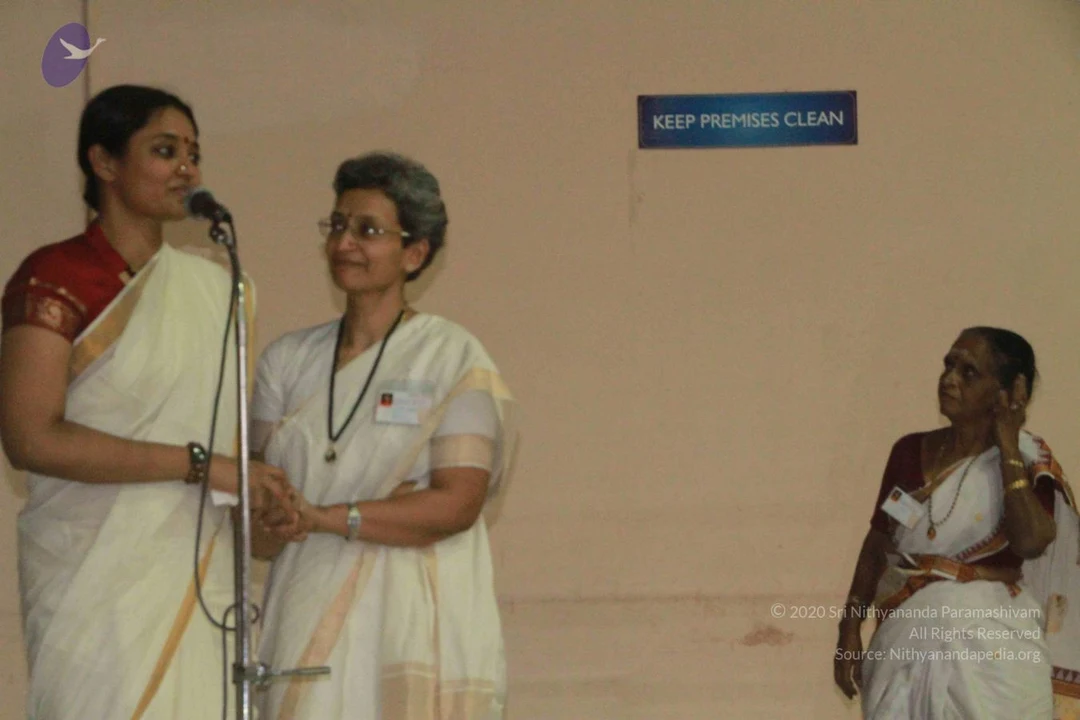
47 photosSource gallery
A large indoor satsang hall with a peach-coloured wall and tall windows. Many men sit cross-legged on an orange mat, most dressed in white shirts and white dhotis, with rudraksha malas around their necks. Several clap with their palms together, while one man in a striped shirt and dark lunghi sits with arms crossed. Orange cushions and shelves of brass-toned items line the back of the hall, and banners hang from the ceiling. The crowd fills most of the frame, and the scene reads as a devotional gathering or satsang.A hall with a large audience seated on the floor in white clothes facing a raised stage. On the stage, a figure sits on a golden ornate throne with a dark red curtain behind. Two standing men in white shirts and white dhotis stand near the stage steps. Two large screens on either side show a close-up of a figure with long hair and saffron clothing. A colourful decorated pillar hangs at the right edge, and a draped white canopy covers the ceiling. A satsang setting with a video projection of the speaker.A satsang hall with a seated audience in white clothes sitting on the floor facing a raised stage. On the stage, a figure sits on an ornate gold throne in front of dark red drapes, with a small lectern and lit candles beside it. Two projection screens on the walls show a close-up of a long-haired figure in saffron clothing. A man in a white shirt and white dhoti stands near the stage, and a shaven-headed man in saffron robes sits in the front rows among the devotees. Cameras on tripods and audio equipment are set up at the sides. The ceiling is draped with pale fabric.A man in saffron-orange robes sits on an ornate gold throne with carved arches and two gold lion figures flanking it, against deep red velvet drapery. He wears a red bindi, a gold necklace with a pendant, and multiple dark rudraksha mala beads, and holds a mala in one hand while speaking into a headset microphone.A photograph of a smiling man seated on an ornate gilded throne with carved lion figures on the armrests and a golden arched backrest. He wears saffron-orange robes draped over one shoulder, a rudraksha mala, a gold necklace with a pendant, and a red tilak on his forehead, with a head microphone. Swamiji (probable) is shown in this seated satsang setting, identified by saffron robes, rudraksha mala, gold ornaments and long swept-back hair. Red velvet cushions and red curtains frame the stage.A photograph of a seated man on an ornate golden throne with lion-head armrests and red velvet cushions, set against deep burgundy drapes. He wears orange-saffron robes draped over one shoulder, multiple rudraksha malas, a gold necklace, and a red bindi on his forehead, with a small microphone at his cheek. He rests one hand on his chin and smiles broadly. A tiger-striped cloth covers the seat edge.

converted
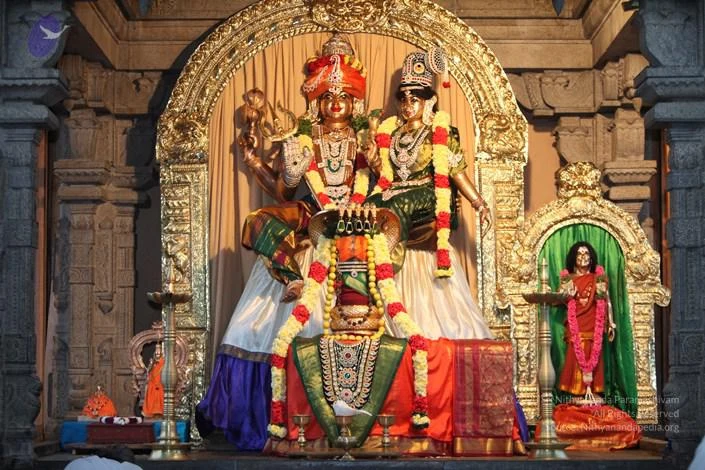
20 photosSource gallery

Card 3

12 photosSource gallery
A seated man in saffron-orange robes with a gold-toned necklace and gold armlet sits on an ornate gold throne with red cushions, a small golden rooster figure nearby. Before him, kneeling women with hands folded in namaskar receive a pada puja, with silver and brass plates of flowers, fruit and offerings arranged on a patterned cloth. A seated man in saffron robes with hands joined sits in the background beside a small oil lamp. A devotee's head is visible in the lower foreground. The a person candidate is the figure on the throne, identified by saffron robes, gold necklace and armlet, and the throne setting, with the pada puja as the ritual.A photograph of a seated man on an ornate gilded throne with red velvet cushions, wearing saffron-orange garments with a gold border, a thick gold necklace, gold armbands and a sacred thread-like cloth draped over one shoulder, smiling and with white and tilak markings on his forehead. A brass oil lamp with a lit flame stands at left, a gilded bird figure sits near the throne, and a small brass lamp burns beside the seat. In front of him, women sit on the floor before a tray of brass plates holding flowers, petals and small offering cups, as part of a puja. A second person in saffron sits on a mat in the background. A bright studio light stands at right and a wall-mounted air conditioner is at top.A photograph inside a small room with dark walls and a bright wall lamp. A man with long swept-back hair, a white tilak, gold necklaces, a rudraksha mala and gold armbands sits on an ornate gold throne with red velvet cushions, wearing an orange shawl and dhoti with gold borders. He is a person by appearance cues. A woman in a red and cream sari with a mala sits on a floor mat before a silver plate of offerings and a lit brass oil lamp with a rooster figure. A woman in white with a mala kneels and tends the tray. A man in orange clothing sits with hands folded in the background. Several people sit at the lower edge. Padapuja-style offering in progress.A photograph of a seated man on an ornate gold throne with red cushions, wearing an orange-saffron dhoti and shawl with gold borders, a gold necklace and mala, gold armbands and bangles, and a tilak on his forehead; his hair is tied up. Beside the throne a brass oil lamp with a bird-shaped stand burns. Two women sit on red mats in the foreground: one in a cream sari with red border tending a silver thali of offerings, and one in a white sari wearing a rudraksha mala. A third person in orange sits in the background.Close-up photograph of a large ornately embossed silver ritual tray holding several small silver bowls, one containing golden liquid and others empty, along with a silver conch-shaped vessel and a small silver box with a floral emblem. Loose white jasmine-like flowers sit in a central bowl and a white frangipani bloom rests near the conch. Gold-toned items and red flowers are visible at the upper left edge. No people are visible; the scene looks like puja items prepared for an offering.A padapuja ritual in progress. A seated figure in an orange-and-gold garment has bare feet resting on a large gold tray, which is surrounded by white flower petals and a red flower. Around the tray stand silver bowls and dishes holding white flowers, a bowl of honey-coloured liquid, and small silver vessels. A woman in a red-and-cream sari with a rudraksha mala sits kneeling and attentively watches. A younger woman in a white outfit with a mala and a forehead mark stands with hands folded, and an older woman with grey hair and glasses sits at the bottom right corner. The visible person in orange has only the feet and lower garment shown, so the face is not visible.

Card2

57 photosSource gallery
Outdoor satsang gathering beneath a large banyan tree with sprawling aerial roots and thick branches. Devotees in white ritual clothes sit on mats and a dark cloth on reddish earth, some with hands folded in prayer. A standing man in white shirt and trousers on the left and a woman in pink robes on the right appear to attend the gathering, and a person in orange clothing sits at the right edge. A green plastic bag and water bottles rest near the seated group. Dusk light filters through the foliage.A photograph of devotees gathered outdoors beneath a large banyan tree with hanging aerial roots. In the foreground a woman with hair in a braid, wearing a white sari with gold border and a dark blouse, stands with her back to the camera. Behind her and around the tree, several people in white and pastel clothing sit and stand, some with hands folded in prayer. A woman in a pink sari stands at right with hands together. Stone platforms and a dusky evening light surround the scene.Outdoor puja at a black stone deity murti set within an ornate silver arch, draped in an orange cloth and adorned with red and yellow marigold garlands and layered necklaces. A woman in a white shawl with red-patterned border stands at the statue, hands raised to its face. Beside her, a man in white dhoti with gold border offers at the base, where red flower petals are heaped on the ground with brass lamps and a small bell. Several women in white and pink saris watch from the left under shady trees.A woman in a white blouse and cream sari with a gold border stands with palms pressed together in prayer, her long dark plait falling over her shoulder. She wears bangles and a red-thread wrist band. She leans toward a large banyan tree whose thick, twisted aerial roots fill the right side of the frame. Another person in white clothing stands behind her with one arm raised, touching the trunk. The background is softly blurred with more trees and out-of-focus figures.A photograph of an outdoor temple courtyard with a paved grey brick floor and palm trees. At the centre is a red-orange stepped base supporting a tall ornate pillar and a dark stone Nandi bull with a red and white garland around its neck, flanked by potted plants. Behind are grey stone deity statues on pedestals. On the left, a woman in a white sari with a red border stands with folded hands, beside another woman in a white sari. On the right, men in white shirts and trousers walk and stand near the base, one in a light grey outfit. No one is wearing identifiable a person cues in the scene.A photograph of a metal statue standing in a silver-toned arched niche with carved scrollwork and lion-like figures at its base. The standing figure wears an orange saffron cloth draped over the body with a gold border, a tall crown-like headdress, and a long rudraksha mala with a large bead pendant. A smaller seated figure or pedestal to the left is also draped in orange cloth with a beaded mala and a heart-shaped pendant, set beside a stone-carved temple wall. Below, a garland of purple and white flowers rests on a blue cloth. No physical people are visible; these are statues and sacred murti depictions.

Card 4

32 photosSource gallery
A large seated congregation fills a bright hall at a satsang. Most attendees wear white dhotis and shirts, while many women wear maroon and red salwar-style outfits with gold trim and some wear orange saris. Several young girls in maroon dresses with gold borders sit in front, and a few have vertical tilaks on their foreheads. Metal stanchions divide the rows. Behind them, several orange cushions or bolsters and a framed portrait of a woman on a small easel stand against the back wall. The audience looks attentively toward the front of the hall.A large indoor satsang hall with a fabric-draped ceiling and tall cylindrical pillars wrapped in colourful striped and patterned panels with yellow-orange tassels. Hundreds of seated devotees fill the floor, most dressed in white, with many women in orange, red and maroon saris and salwar kameez, and some wearing white saris. Devotees sit on mats in rows facing a stage at the far end, where orange cushions and a small framed portrait are visible. Some devotees hold small items and brass plates and containers are placed on the mats before them. A camera on a tripod is visible at the right edge.Photograph of a large seated congregation in a bright hall with pink walls, orange and gold cloth hangings, and framed portraits on the walls. Women in red, orange and maroon saris with gold borders sit cross-legged on the floor in the foreground, some with hands clasped or in prayer, and a man in white sits near the front. Behind them rows of men in white shirts and dhotis sit with ritual brass vessels and a tripod-mounted camera visible. The attendees are seated in attentive devotion during a satsang gathering. No individual candidate for a person is clearly identifiable among the visible people.A large indoor hall filled with a seated congregation on the floor, the crowd dressed mostly in white, orange, red and maroon saris and dhotis. Many women in front wear orange and red saris with gold borders, and several girls in maroon uniforms sit with folded hands. Long hanging cloth pillars in red, blue, yellow and white decorate the ceiling, and framed pictures hang on the pale walls near a stage. Small brass lamps and offering trays sit on the floor at the front. No figure at the front is clearly identifiable as a person, so the candidate status is unsure.A large indoor satsang hall with cream walls and high windows, filled with a seated congregation of well over one hundred people. Most wear white ritual clothing, while women in the foreground wear orange and red saris with gold borders, some with flower garlands and gold bangles. Orange and red bolsters and cushions line the front area, and framed portraits hang on the walls, including a painted deity image near the top. A standing figure in white stands near the centre of the room. Patterned banners in red, blue and yellow hang from the ceiling, and a video camera on a tripod sits at the right edge.A photograph of a large seated congregation at a satsang, filling the frame from front to back. Many devotees wear white or cream clothing, with rudraksha malas around their necks and some with vibhuti or tilak on their foreheads. In the foreground a woman in a white dress with gold border presses her palms together in anjali, and beside her a young girl in a maroon top with gold trim sits attentively. Further right an older woman in white with glasses and a rudraksha mala looks on, and a bottle of water sits on the floor at the lower edge. The setting appears to be an indoor hall with a brass lamp visible at the upper left. No a person candidate is visible in this frame.

1-Bidadi-Temple-and-Sacred-Banyan-Tree
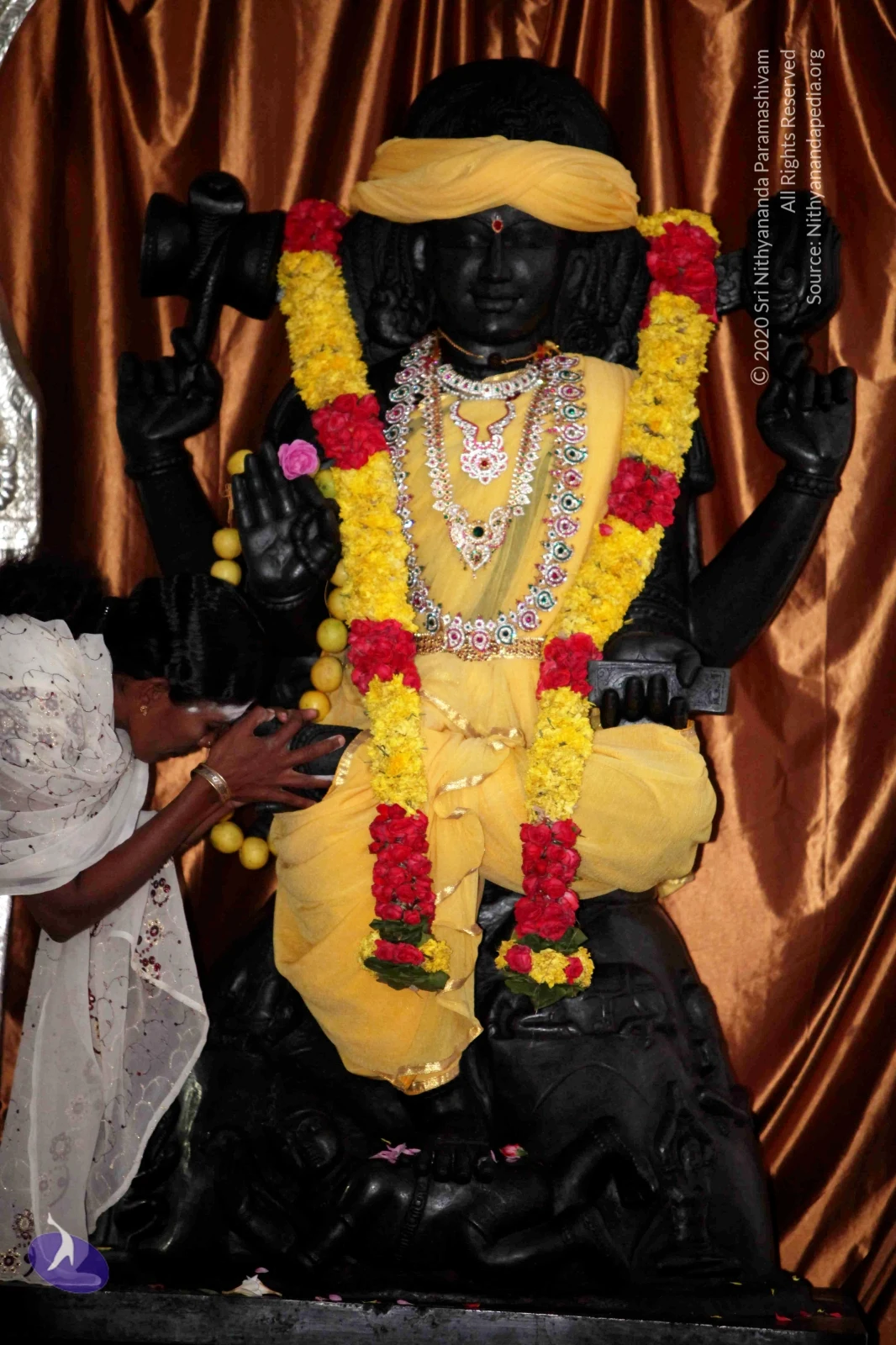
16 photosSource gallery
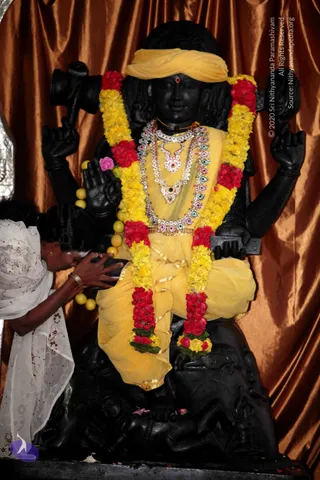
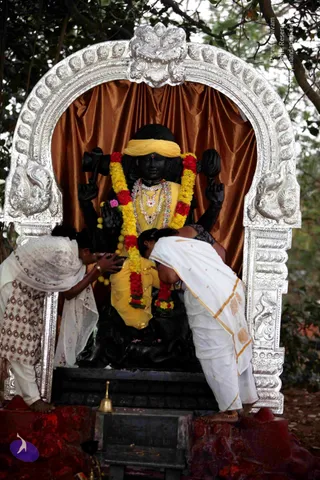
A woman in a white dupatta with embroidered border kneels and touches the feet of a black stone deity murti at a temple shrine. The murti wears a yellow silk dhoti with gold border, a yellow head cloth, layered jewelled necklaces with red and green stones, and is garlanded with yellow marigolds and red roses. Its multiple arms hold ritual objects, and a single pink rose and scattered petals lie on the base. A bronze-brown satin drape forms the backdrop, and a yellow bead garland hangs at the side. The murti is a statue, not a physical person, so no candidate is present.Outdoor photo of a black stone deity murti set in an ornate silver arch against a brown satin backdrop, draped in a yellow cloth with a yellow head covering, layered silver and jewelled necklaces, and red-and-yellow marigold garlands. Two devotees bend forward in front of the shrine: a child in a white patterned kurta and white shawl, and an adult in a white dhoti with gold border and white upper cloth, both touching or kissing the base of the murti. A brass bell sits on a stone plinth below with a small inscribed plaque; trees frame the scene.Close-up photograph of a black stone murti of a deity, wearing a yellow cloth wrapped over its head like a turban and a yellow draped garment across the chest. Heavy gold and jewelled necklaces set with red, green and white stones, and a red bindi mark on the forehead, adorn the figure. Garlands of yellow marigolds and red roses frame the murti on both sides. The carved stone face is smooth and serene. No physical people are clearly visible, apart from a partial hand at the bottom edge.A dark stone murti of a deity seated in a bright yellow dhoti-style garment and yellow turban, wearing layered gold and multicoloured jewelled necklaces with a red bindi on the forehead. Thick garlands of yellow marigolds and red roses drape over the shoulders and lap. One hand holds an object, another hand raised in a blessing gesture. A copper-coloured satin curtain and ornate silver border frame the figure. The stone is weathered and carved, with a relief panel of animals and figures at the base. No physical people are visible.A life-size golden statue of a figure with long dark hair, a red bindi and an orange-red wrap and dhoti with gold border stands in a niche framed by ornate gold carving against a green silk backdrop. The statue has its right hand raised in blessing and wears rudraksha beads, a heart-shaped pendant, a wristwatch and a long pink and white flower garland. The image shows a statue depiction, not a physical person.A small brass or bronze utsava-style murti of a seated deity sits on a folded blue-and-purple silk cloth before a golden arched prabhavali frame. The figure wears a blue silk garment, a multi-strand beaded necklace with red and white stones, a rudraksha-style bead waist cord, and a tall conical crown. It holds a yellow flower in one hand. The background is a warm red wall with a blurred stone pillar at the right edge. No living people are visible.

2-Satsang

8 photosSource gallery
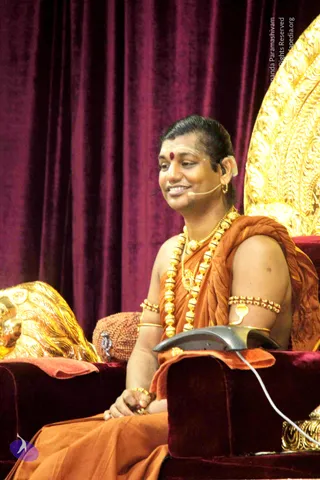
A smiling man with hair tied in a bun sits on an ornate gold-and-velvet throne with a maroon curtain behind him. He wears an orange-brown draped robe with gold-bordered cloth, a heavy gold bead necklace with a pendant, a gold chain, gold armlets and beaded bracelets, and a small red bindi with white vibhuti marks. A small microphone is clipped near his face.A seated man on an ornate gold throne with a carved arched backrest and red velvet cushions, with a gold lion sculpture at his left. He wears an orange-saffron draped garment with a gold border, a long multi-strand gold bead necklace, a gold pendant, gold armlets and bangles, and a red bindi with white forehead marks. He rests one arm on the lion and the other hand on his knee, smiling, with a small headset microphone on his cheek. Swamiji (probable): long swept-back hair, saffron clothing and ornate gold necklaces on a throne, consistent with the page's satsang context. Red-patterned carpet and a red curtain form the backdrop.A seated man in saffron-orange robes sits on a plush maroon velvet throne with gold lion-shaped armrest carving and an ornate gold backrest behind him. He wears long layered gold bead necklaces, gold armbands, a gold bracelet and a headset microphone, with a red bindi and a swept-back hairstyle. His hands rest in his lap, and a deep red velvet curtain hangs behind. a person appears in person in this photograph; the throne, gold ornaments and saffron robes are the visible cues. A partially visible wire and small gold ornament sit near the armrest.A smiling man sits on a red velvet throne in front of an ornate gold-embossed backdrop. He wears an orange-saffron shawl over his shoulders and a long gold bead garland with a gold pendant, plus a gold chain with a crystal emblem, gold armlets and beaded bracelets. He has a red bindi and white vertical tilak, hair in a topknot, and a small headset microphone, with his hands clasped in his lap. a person: the saffron shawl, long gold bead mala and ceremonial gold jewellery match his presentation in satsang, and he is seated on a throne.A seated man in saffron-orange robes with a gold-bordered dhoti and draped shawl speaks while gesturing with his right hand, seated on an ornate gold-and-crimson throne against a deep magenta velvet backdrop. He wears a heavy gold necklace of beaded and bead-like pendants, gold armlets, beaded bracelets, a red bindi and white forehead markings, and his hair is tied up. A golden lion-head armrest and a microphone sit beside him. Appearance-based a person cues: saffron robes, ornate gold ornaments, and a throne setting, presented as a speaker at a satsang.A smiling man seated on a red velvet throne with ornate gold carved backrest, wearing an orange-saffron unstitched robe draped over one shoulder with gold-edged border, a long gold beaded necklace with a central gold pendant, a gold rudraksha-style mala, gold armlets, and a red bindi with white tilak on the forehead. Hair is tied in a bun, and a small microphone is clipped near his face. Hands are clasped in his lap and bare feet rest on a red cushioned footstool. Presentation cues match the a person candidate: saffron robe, ornate gold jewellery, rudraksha-style mala and throne seating, though appearance is not fully conclusive for an identification. Setting is a stage or satsang dais.

3-Sarva-Darshan

6 photosSource gallery
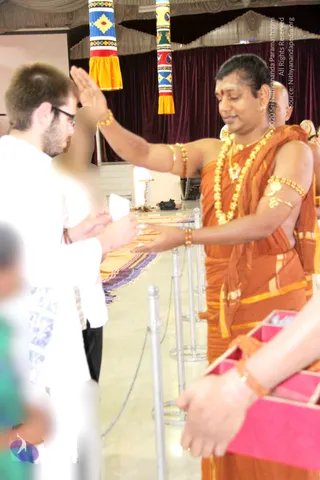
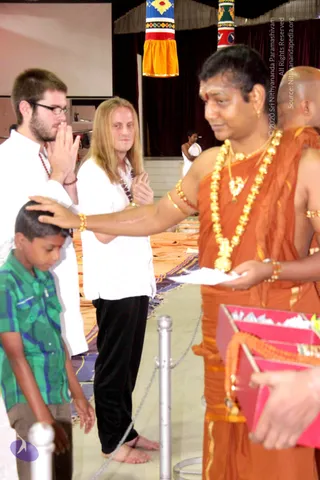
Photograph of a satsang hall where a man in an orange saffron dhoti and shawl, with gold necklaces, gold armlets, a rudraksha-style gold chain and a vertical white tilak with red bindi, raises one hand in blessing toward a bespectacled man in white clothes who holds a folded white paper. Behind them, a row of silver stanchions, colourful striped tassel banners hang from the ceiling, and a maroon curtain forms the backdrop. Another person in orange stands at the right, and a pink-lined tray of items is in the foreground.A photograph of a ritual blessing in a hall with a dark red curtain and hanging colourful cloth banners. A man in a saffron-orange robe with heavy gold necklaces and bangles reaches out to rest his hand on the head of a young boy in a green striped shirt, who bows his head. The saffron-robed man, with a red tilak mark on his forehead, holds a folded white paper in one hand and a pink box with papers in the foreground. Behind the boy, a bearded man in white clothes and glasses stands with palms pressed together, and a long-haired man in a white kurta with a rudraksha mala and black trousers also holds his hands in anjali. A shaved-headed man in orange stands further right, and another person in white is visible in the background. Four people are visible in the foreground, with a few more in the background.A photograph inside a hall with a white and yellow canopy and painted pillars. In the foreground, a smiling man in an orange saffron robe wears heavy gold necklaces, a gold bangle, and a red-and-white forehead mark, holding a folded paper while raising his right hand toward a seated man in white shirt with glasses and a moustache, who holds a green-and-gold item. Behind them, an older man in white clothes stands watching, and a bearded man in white holds his hands together in namaste. A cream-coloured bathroom-style pillar and a hanging orange cloth decorate the background. The saffron-robed man has distinctive ceremonial gold necklaces and orange robes, but appearance alone is not enough to confirm identity, so the candidate is unsure.A photograph inside a decorated tent hall with draped fabric ceiling and colourful striped hanging pillars. A smiling man with hair tied up, white sandalwood marks and a red bindi, wears an orange-saffron dhoti and shawl with heavy gold bead necklaces and gold armlets; he is the a person, with cues of ornate gold jewellery and saffron clothing. He stands at the front as a woman in a white sari with red and yellow floral embroidery bends forward to touch his feet in a padapuja-style gesture. Behind them stand devotees in white and striped shirts, one wearing a rudraksha mala, and a bald man in white. Attendees watch from the sides.A photograph inside a decorated hall with a white cloth ceiling and colourful striped pillars. A standing man in an orange-saffron dhoti and shawl wears a heavy gold multi-bead necklace, gold armlets, a rudraksha-style chain and a red bindi with white tilak; he extends his right hand toward a kneeling woman in a white blouse with a long braid who bows low. A small child in a white shirt and a seated man in white with a black bead mala watch nearby, and several onlookers in white and striped shirts stand in the background. The orange-robed standing figure has distinctive ornate gold adornments and long swept-back hair, so he is a person in person, presiding over a blessing of devotees.A photograph of a man with long swept-back dark hair, a small red bindi and white vertical tilak, wearing an orange-saffron shawl draped over his shoulders and a heavy gold beaded necklace with a gold pendant and gold earring. He holds a stack of white papers in both hands. Beside him, a shaved-headed man in orange cloth with a red forehead dot and orange beaded bracelets looks toward him. Behind them is a colourful painted background with a yellow and red patterned pillar.

4-Essence-of-IA-in-Tamil

2 photosSource gallery
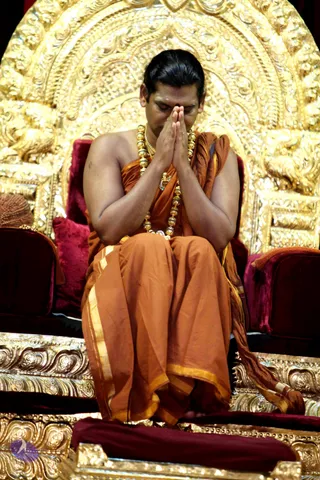
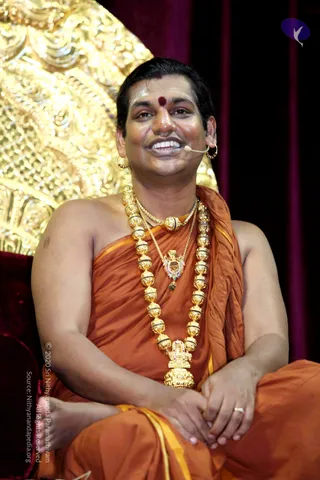
A man seated on an ornate gold throne with carved gold backrest and red velvet cushions, hands pressed together in anjali mudra with eyes closed. He wears an orange-saffron dhoti and shawl with gold borders, a heavy gold multi-strand necklace and a red tilak on the forehead, with bare shoulders and arms. a person is cued by the saffron clothing, ornate gold necklace and throne; this appears to be a satsang setting seated in meditative prayer.A smiling man with short dark hair and a red bindi sits in front of an ornate gold-embossed backdrop with deep magenta curtains. He wears an orange-saffron dhoti and shawl with gold trim, several strands of large gold beaded necklaces, a gold chain with a pendant, gold hoop earrings, a ring on his finger, and a clip-on headset microphone. His hands rest folded in his lap. Appearance-based label: a person, seated as a speaker at a satsang, with orange robes and layered gold beaded mala and chain cues.

5-Darshan

9 photosSource gallery
A seated man in saffron-orange robes sits on an ornate golden throne with an elaborately carved silver-gold backrest decorated with white and red flower garlands. He wears long red and yellow floral garlands, a rudraksha mala, and a gold necklace with a pendant, and his dark hair is pulled back in a bun. He rests one hand on the armrest of a red velvet chair and holds a small object in the other, looking downward. Swamiji (probable): the appearance cues of long swept-back hair, saffron clothing, rudraksha mala and ceremonial gold necklace fit the page's presentation, seated on a throne as the honoured teacher at a satsang.A seated man in an orange-saffron robe with a large red and green flower garland around his neck, hair tied in a bun at the back of his head, reads a sheet of paper held in his right hand while his other arm extends toward the right edge of the frame. A gold-embroidered cloth and a red velvet cushion sit to the left. Appearance-based candidate with compatible presentation: a person, seated in a satsang setting, wearing a saffron robe, a rudraksha element near the neck and a floral garland. Photographed in profile against a plain white wall.A photograph of a seated man in saffron-orange robes on an ornate gold throne, smiling, wearing a long red and yellow flower garland, a rudraksha mala and gold chain necklaces. Two devotees in white sit in front of him, one bowing with a black beaded mala around his neck, the other with a long braid wearing a white sari with a border. A golden lion figure sits at the lower left. The man in saffron is a probable Swamiji by appearance cues: long swept-back hair, saffron clothing, rudraksha mala and ceremonial gold necklaces. The setting appears to be a satsang stage with a golden throne decorated with yellow and red flowers.A smiling man in a rust-orange robe sits with his head turned slightly downward, wearing thick red and pink flower garlands with gold rose accents draped over his shoulders. He has a gold chain with a large gold pendant at the neck, a long rudraksha mala hanging from the garland, and a red bindi on his forehead. His dark hair is swept back into a bun. Behind him is a gold-embroidered backdrop with yellow and red flowers and a deep magenta curtain. A blurred figure sits at the left edge. a person, seated in a garlanded ceremony.A smiling man with short, swept-back dark hair and a red bindi sits on a red velvet throne with an ornate gold backrest decorated with flowers. He wears a thick garland of red and pink flowers with green leaves, a gold chain necklace, and an orange-brown cloth draped over bare shoulders. A distinctive garland, gold necklace and orange wrap are visible, but the hair and presentation do not establish a person identification, so the identity is uncertain. His right hand is raised in a gesture toward the viewer.Close photograph of a man with swept-back dark hair and a red bindi, wearing an orange-saffron garment, a rudraksha mala, a gold ornamental necklace and a thick red and white flower garland. He looks down at a white paper he holds in his hands while a hand reaches in from the right. Behind him is a blurred arrangement of white and red flowers and a dark red curtain.

1-Temple

5 photosSource gallery
A man in orange ochre garments walks barefoot along a sandy path lined with a blue-edged mat, past a large banyan tree. He wears a long gold necklace of beads, a pendant, gold armlets and bracelets, and has a white tilak with a red dot on his forehead, with his hair tied up. He looks downward and holds a gold-coloured object at his chest. Behind him, a dark stone shrine with a yellow-clad deity figure garlanded with red flowers and a red-painted stone mound. Appearance-based label: a person, shown in person in ochre robes with gold adornments and rudraksha-style gold necklaces; the page indicates an event with a person present.A standing man in saffron-orange robes performs a namaskar with palms pressed together at his chest, eyes lowered. He wears gold ornate armlets, a multi-strand gold necklace with a large pendant, a rudraksha-style neck mala, a red bindi and white tilak on the forehead, and a hair knot. He stands barefoot on a pink and white patterned mat in an open courtyard with a large banyan tree and a low cream wall behind him. Another red-cushioned seat is visible.A man walks barefoot along a pale concrete path in front of a red brick wall. He wears an orange-saffron dhoti and upper cloth with gold-edged borders, a heavy gold bead necklace with a pendant, gold armlets and beaded bracelets. His hair is tied up in a knot, and he has a white-and-red forehead mark. Eyes are lowered. A second person in matching orange cloth is partially visible at the right edge. Ritual procession or ashram walk setting. The page-flag cue of saffron clothing with gold necklace and armlets is present, so this may be a person, walking in person; identity is uncertain.A photograph of a person walking along a covered walkway lined with polished steel railings and a red carpet runway. The figure wears an orange-saffron draped garment with golden borders, a heavy gold necklace with a pendant, gold armlets and bangles, and a red tilak mark on the forehead. White statues stand in the blurred background beyond green trees.A life-size statue of a long-haired figure stands in an ornate gilded arch set against a green silk curtain. The statue wears an orange-red robe with gold borders, a red bindi, a heart-shaped pendant on a beaded mala, and rudraksha beads on its wrists. It is garlanded with pink and white flower strands and green leaves, and its right hand is raised in a blessing gesture. The statue is a depiction, not a physically present person, and no crowd is visible.

3-Dial-the-Avatar

4 photosSource gallery
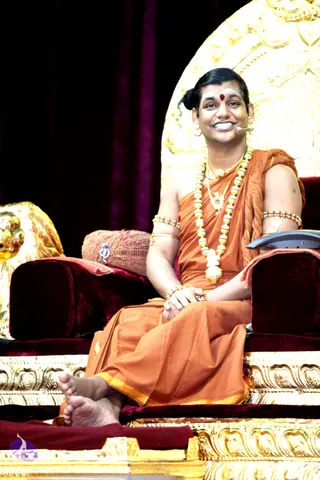
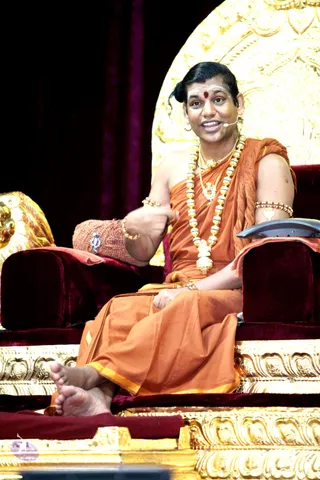
A smiling person in an orange-saffron robe sits cross-legged on an ornate golden throne with red velvet cushions and a golden lion carving at the left edge. He wears a long multi-strand gold bead necklace, gold armlets and bangles, a red bindi and a small headset microphone. A bare-footed figure with swept-back dark hair and gold earrings rests the hands on the lap. The background is dark maroon drapery. Appearance-based candidate: a person, seated on a throne with ceremonial gold necklaces and saffron clothing.A seated man on an ornate gold-and-crimson throne speaks into a headset microphone during a satsang. He wears saffron-orange robes draped over one shoulder, a heavy multi-strand gold bead necklace with a gold pendant, gold bangles and an armlet, and a red bindi on his forehead; his long dark hair is swept back. A large gilded halo-like backdrop and a golden lion-form armrest surround him, and his bare feet rest on the platform.A smiling man with hair tied up in a topknot sits on a red velvet throne with gold-embossed backrest and armrests. He wears an orange-saffron dhoti and shawl with gold borders, a bare upper body, a gold-and-bead necklace with a gold pendant, gold cobra-shaped armlets, rudraksha bracelets, a red bindi and white vibhuti lines on the forehead, and a small microphone on his face. His hands rest clasped in his lap and his bare feet rest on a red cushioned footstool. a person is seated in front of an ornate gold throne backdrop.A man in saffron-orange robes sits on an ornate gold throne with a carved golden backrest, beside a gold lion sculpture on a red velvet seat. He wears a gold multi-strand bead necklace with a gold pendant, gold bangles on both arms, and a rudraksha-style bracelet, with a white tilak and red bindi on his forehead. He extends his right arm and points off to the side while speaking, against a dark red curtain. Swamiji (probable): the saffron robe, swept-back hair, gold ceremonial necklaces and throne setting give cues consistent with the page's Swamiji claim, but the face is not used for identification. The page excerpt describes a morning satsang, yet the visible scene shows only the seated speaker, so no further event is stated.

4-Sarva-Darshan

4 photosSource gallery
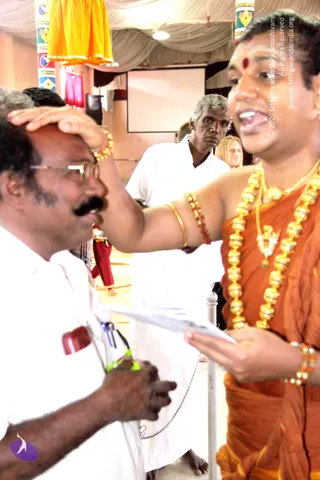
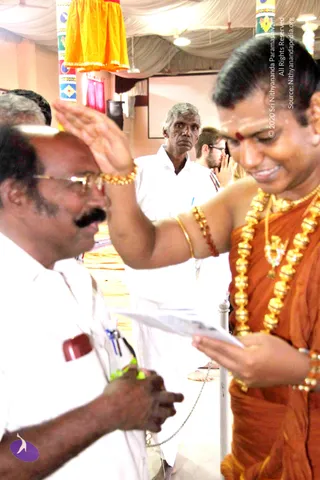
Photograph inside a hall with white draped ceiling and yellow fabric hangings. A man in orange-saffron robe with heavy gold necklaces, gold armlets and a red-orange bindi, speaking and holding a sheet of paper, places his hand on the head of a bespectacled, moustached man in a white shirt who stands in front of him. Behind them, a bare-chested man in white dhoti watches, and a woman with light hair appears further back near a projector screen. The orange-robed figure has long swept-back hair and distinctive adornments, matching the page's a person reference, so this is a probable in-person appearance. Visible people: about four.A photograph inside a hall with a white canopy and painted pillars. A smiling man in an orange-saffron robe and layered gold necklaces, with a red bindi and white forehead markings, holds a sheet of paper and raises his right hand toward the head of a seated man in white shirt and gold-rimmed glasses who is smiling and holding a small object. Another man in white stands behind them, and a figure in a pale shirt stands further back with hands together. A yellow cloth hangs from the ceiling.A photograph of an indoor event hall with a stage backdrop of maroon drapes and colourful hanging decorations. A man in an orange-saffron robe with a gold-bead garland and a gold pendant stands at right, his hand placed on the head of a boy in a green striped shirt and grey shorts who bows his head. The robed man holds a folded white paper in one hand, and a pink box with gold trim is visible at right. Beside the boy, a bearded man in white with glasses has his palms joined, and a long-haired man in white kurta and black trousers with a rudraksha mala stands with hands folded. A figure in white is visible in the background. The robed man has a tilak on his forehead. Appearance-based: the robed figure with long gold garlands and saffron robe matches the a person cues, placed in the person's role as the one blessing the boy.A photograph of a ceremonial blessing in a hall with maroon drapes and hanging yellow, red and blue striped fabric banners. A man in an orange-saffron robe with a gold-bordered dhoti, a gold necklace and a rudraksha-style mala, with a red tilak on his forehead, raises his hand over the head of a bespectacled man in a white shirt. A woman with long light hair stands behind him, and a shaved-headed person in white is partly visible behind the saffron-robed figure. A pink-lined tray is held in the foreground. The saffron-robed figure has long swept-back hair and distinctive gold adornments, a person cue, but identity is uncertain. Visible people: about four.

5-Essence-Of-IA-In-Tamil

2 photosSource gallery
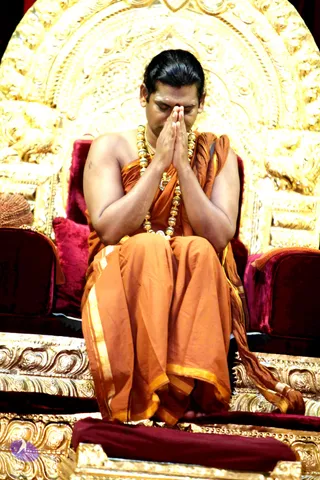
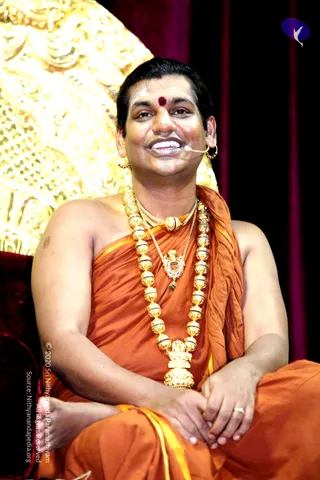
A seated man with hands pressed together in anjali mudra, eyes closed, on an ornate gold throne with red velvet cushions and an elaborately carved golden backdrop. He wears an orange-saffron dhoti and shawl with gold borders, a gold bead and ceremonial gold necklace, and a red bindi with tilak on his forehead. a person: the saffron and gold ceremonial attire, ornate gold necklaces and sannyasi-style presentation on a throne are consistent with the page's claim, though the hair is short and the cues are not conclusive. Setting appears to be a satsang or darshan stage.A smiling man sits on a red cushioned seat in front of an ornate gold-embossed backdrop, wearing a small headset microphone. He wears an orange-saffron cloth draped over his body with an orange-gold border, a heavy gold bead mala with a gold pendant, and a gold chain with a small ornament, plus gold hoop earrings and a red bindi on his forehead. He is seated cross-legged with his hands resting together on his lap. A faint dark-red curtain and a small blue logo appear in the corner. Overlay text on the image reads a copyright notice and source credit. The appearance is consistent with the page's reference to a person, a probable identification based on orange robes, gold malas and ornaments, but the image alone is not conclusive.

6-Darshan

7 photosSource gallery
A barefoot man in a saffron-orange dhoti and matching shawl stands on a stage with his palms pressed together in namaste, smiling. A long red flower garland with yellow accents hangs to his knees, and a rudraksha mala rests on his chest. Behind him are deep red velvet drapes and a white-and-gold flower-decorated throne, with rose petals scattered on the floor. A bottle of water sits on a side table. a person is shown in saffron robes, garlanded and greeting the audience, consistent with a satsang setting.A photograph of a single man standing barefoot on a white stage, smiling with both palms raised at shoulder height. He wears an orange saffron dhoti and shawl, a long double strand of red flower garland with green and gold accents, a rudraksha mala, and a gold pendant necklace, with a red vertical mark on his forehead. Rose petals are scattered on the floor. Behind him stands a gold-and-cream decorated throne with a red velvet backdrop curtain, a water bottle on a side table. Probable Swamiji by appearance cues: long swept-back hair, saffron clothing, rudraksha mala and gold necklace, seated-throne setting behind him.A smiling man stands before a deep red draped backdrop, his palms pressed together at his chest in a gesture of greeting. He wears a rust-orange shawl over the shoulder and a matching orange-brown dhoti with a gold border. Thick garlands of red flowers with gold-toned accents hang across his chest, and he wears a rudraksha mala of brown beads and a gold pendant necklace. A red bindi marks his forehead. The scene appears to be a satsang or stage event, with white flowers visible at the edge of the frame. Appearance cues of a saffron-toned robe, rudraksha mala and ceremonial gold necklace are consistent with a person, so the figure is marked as.A smiling man stands centrally against a deep red draped curtain, arms spread wide. He wears an orange-red ochre sannyasi garment draped over one shoulder, bare-chested beneath, with a red bindi on the forehead. Long strands of pink and red flower garlands with gold-coloured leaf accents hang over his shoulders, along with dark rudraksha mala beads and a gold chain with a gold pendant. The scene appears to be a satsang or stage event, with a blurred floral arrangement at the right edge.A smiling man with a red bindi and swept-back dark hair stands barefoot on a white stage, mid-step with hands pressed together at chest level. He wears a rust-orange dhoti with gold borders, a bare upper body with a sacred thread, a rudraksha mala and a long garland of red flowers with green and white accents. Scattered red rose petals lie on the floor. Behind him a throne piled with white flowers and red blossoms stands before deep magenta velvet drapes. Scene: satsang stage, devotional greeting.A barefoot man in an orange-saffron dhoti and a bare-chested orange wrap stands on a white stage with petals scattered at his feet, palms pressed together at chest level in greeting with a smile. He wears a long red and yellow flower garland, a rudraksha mala and a gold chain. Behind him is a red velvet curtain and an ornate cushioned throne decorated with white flowers and red blooms. The white stage, velvet drapes and flower-decked throne make the scene a ceremonial welcome rather than a ritual puja.