Skip to content
Saturday

4 January 2014

We should never associate with self-doubt, self-hatred, or self-denial.

Dated photos
131
Source pages
1
Media
2
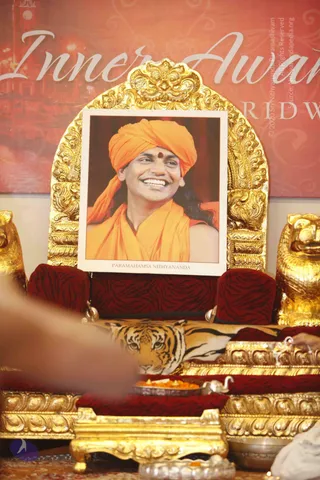
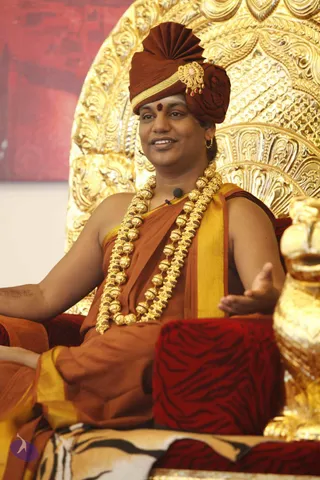
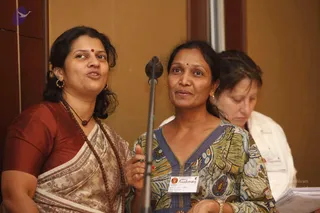
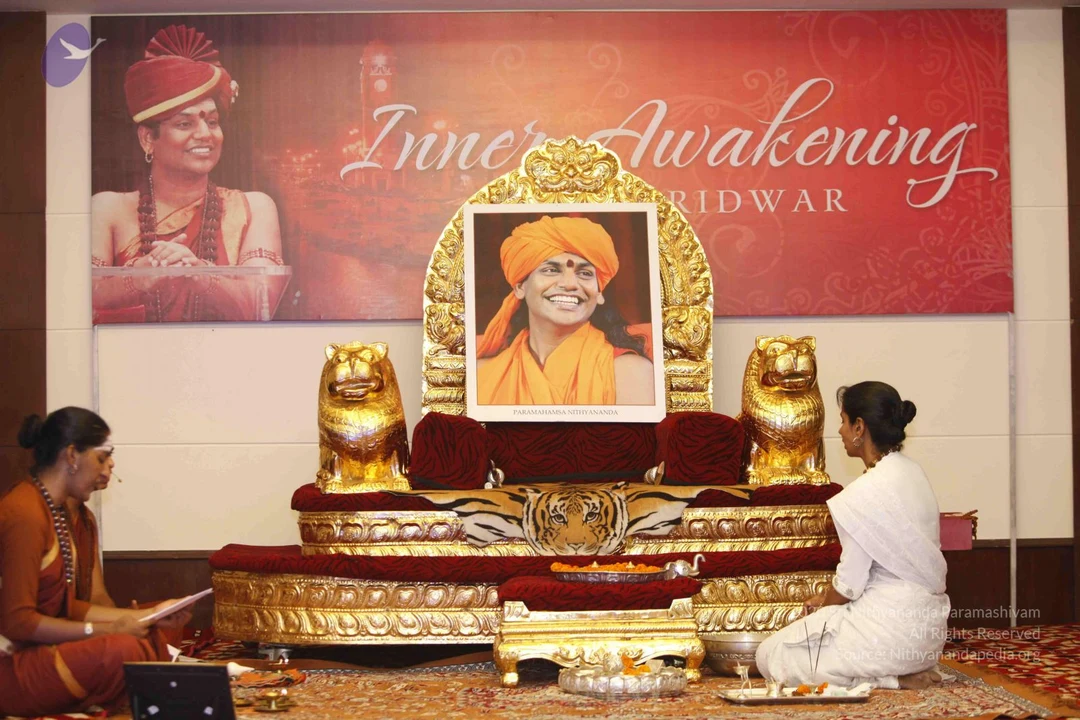
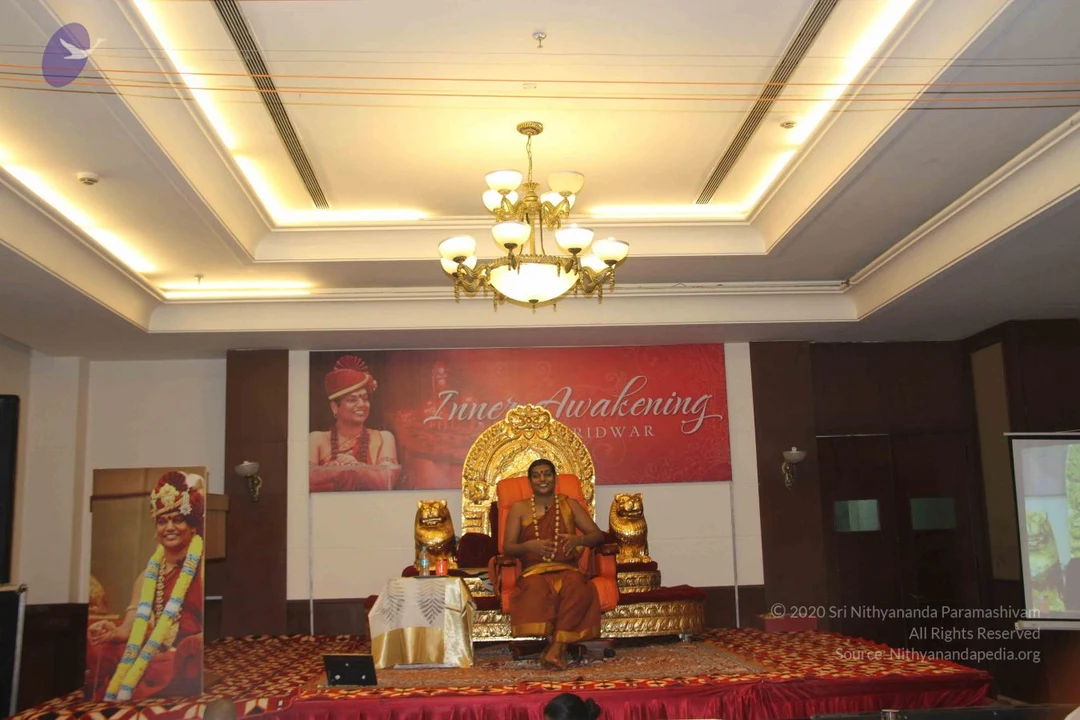
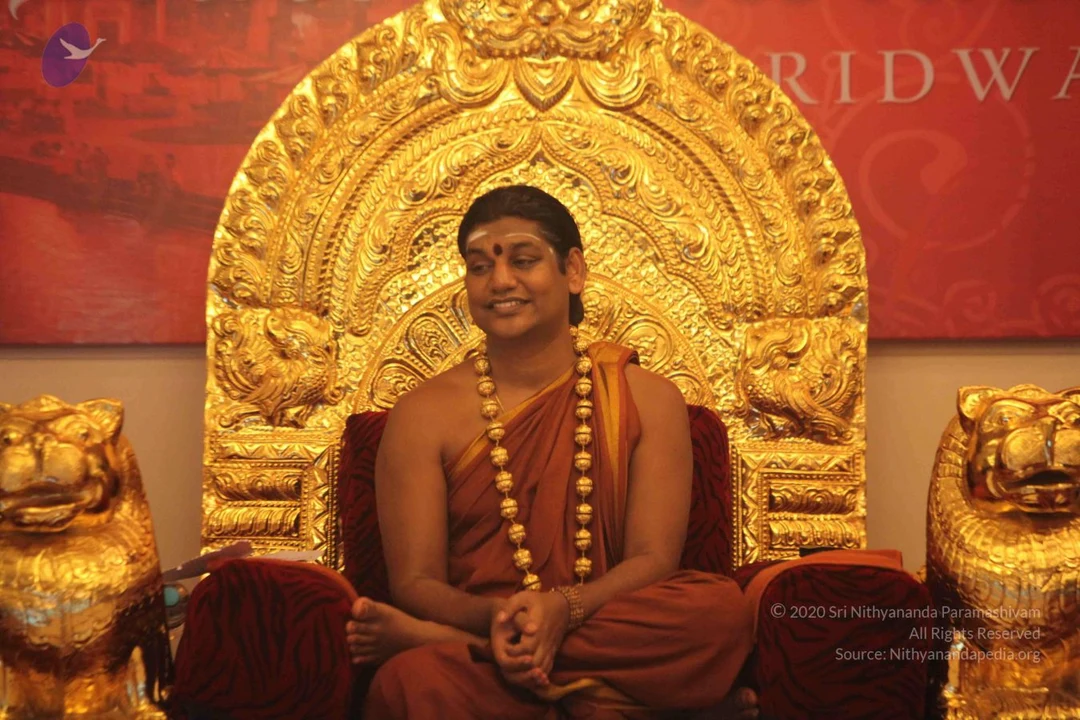
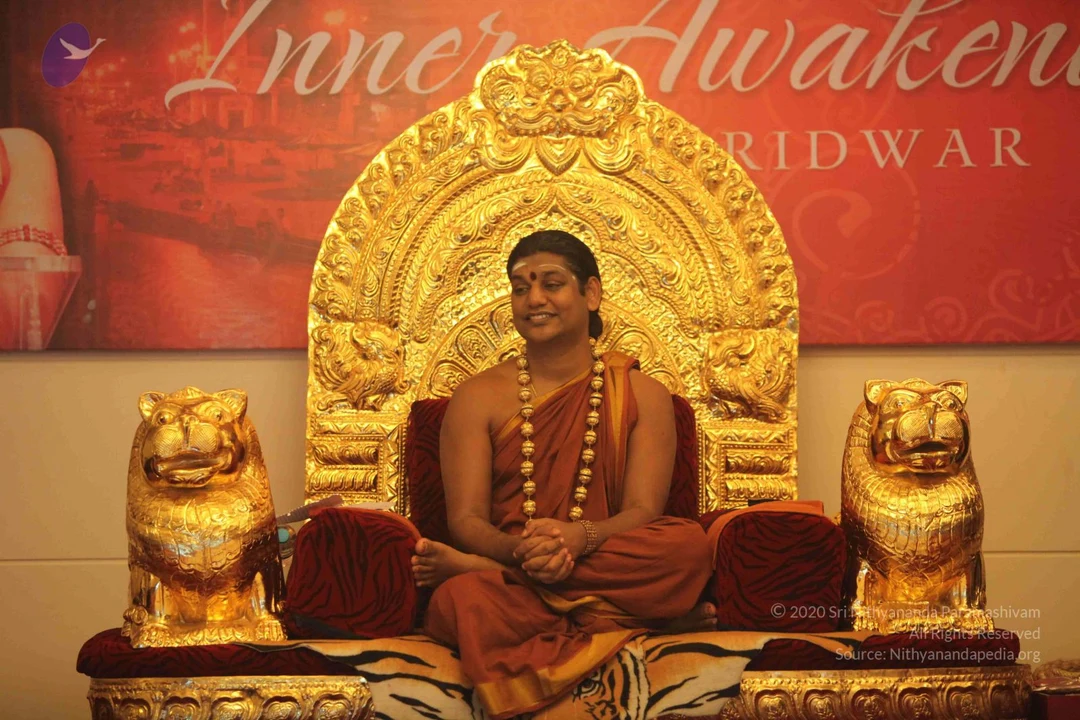
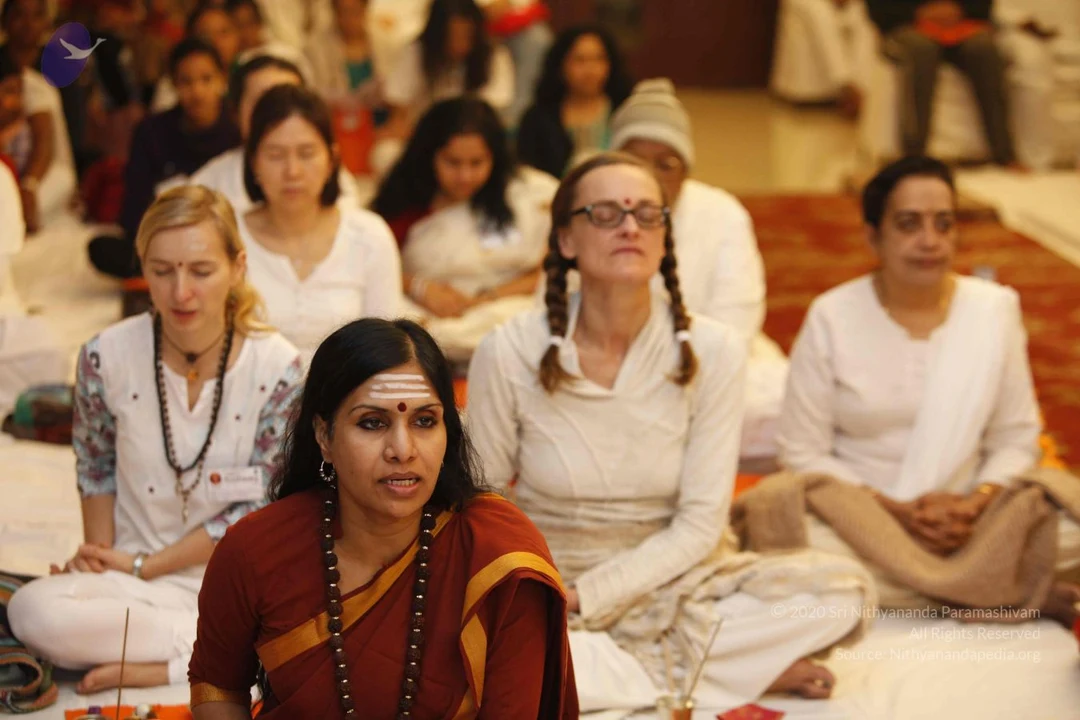
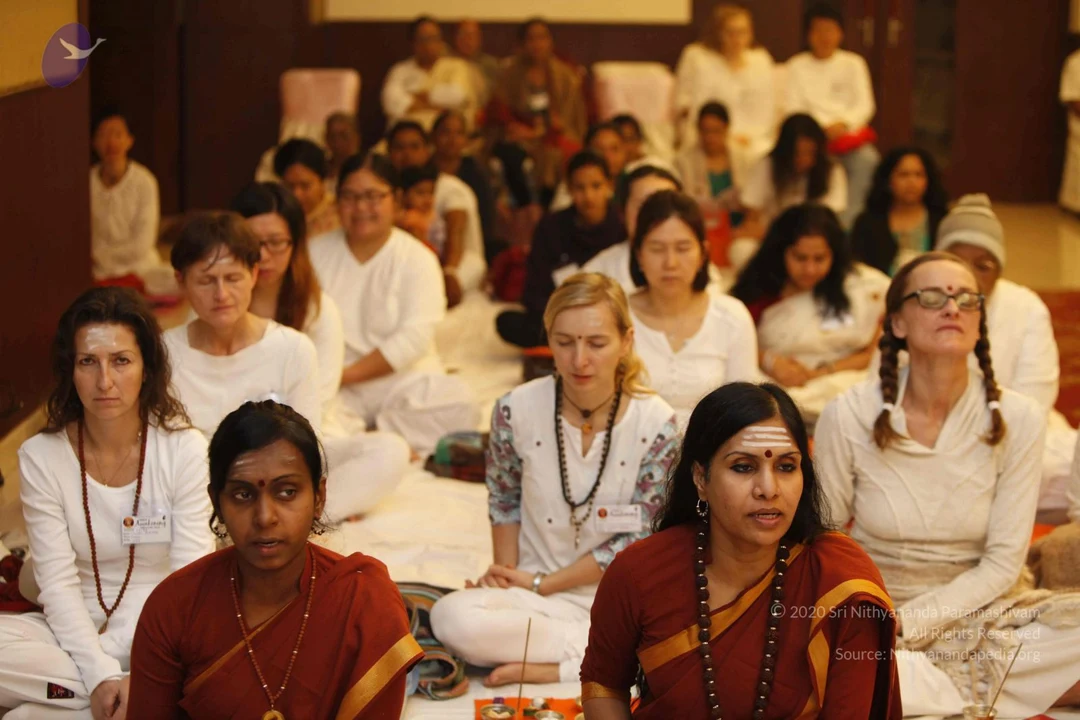
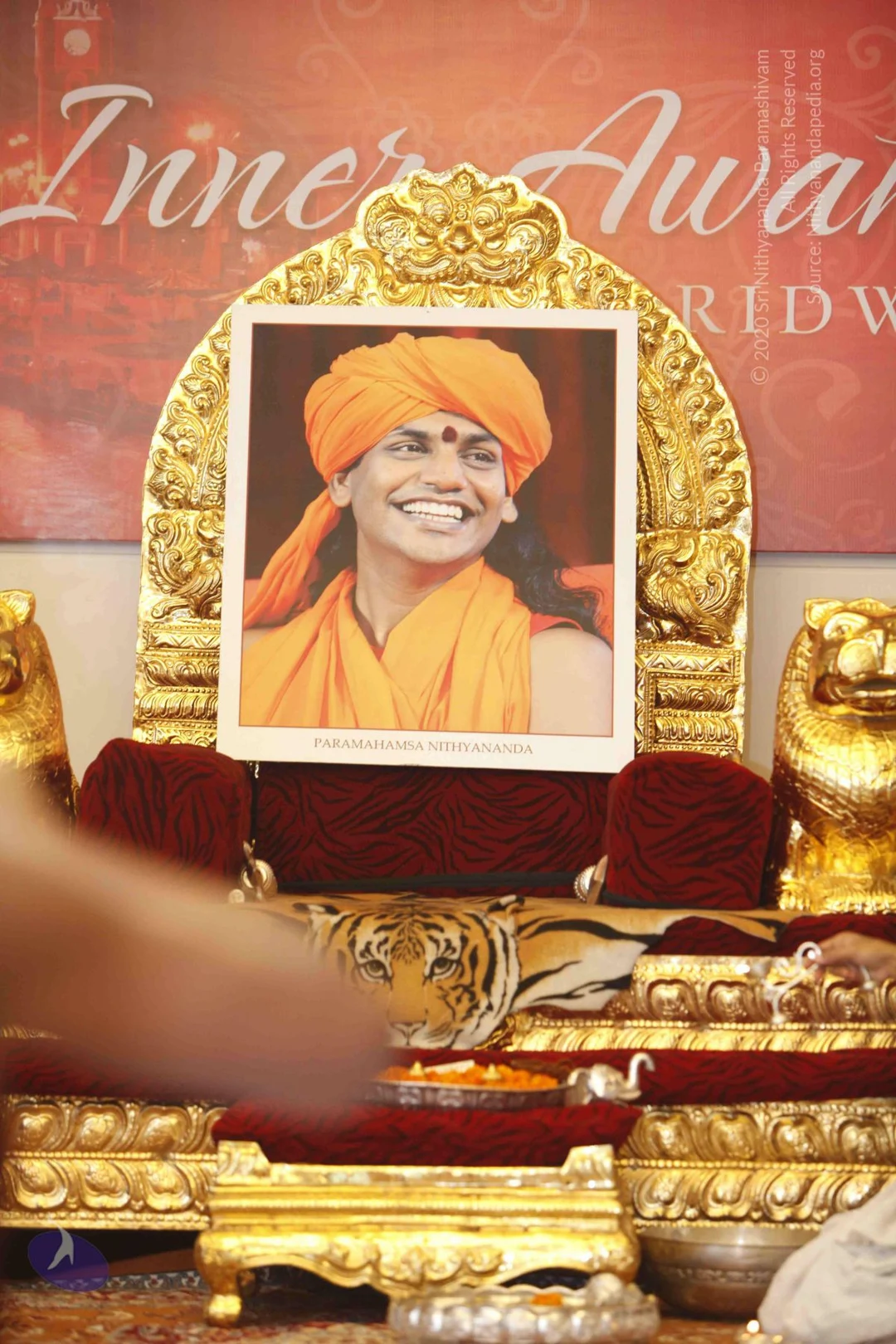
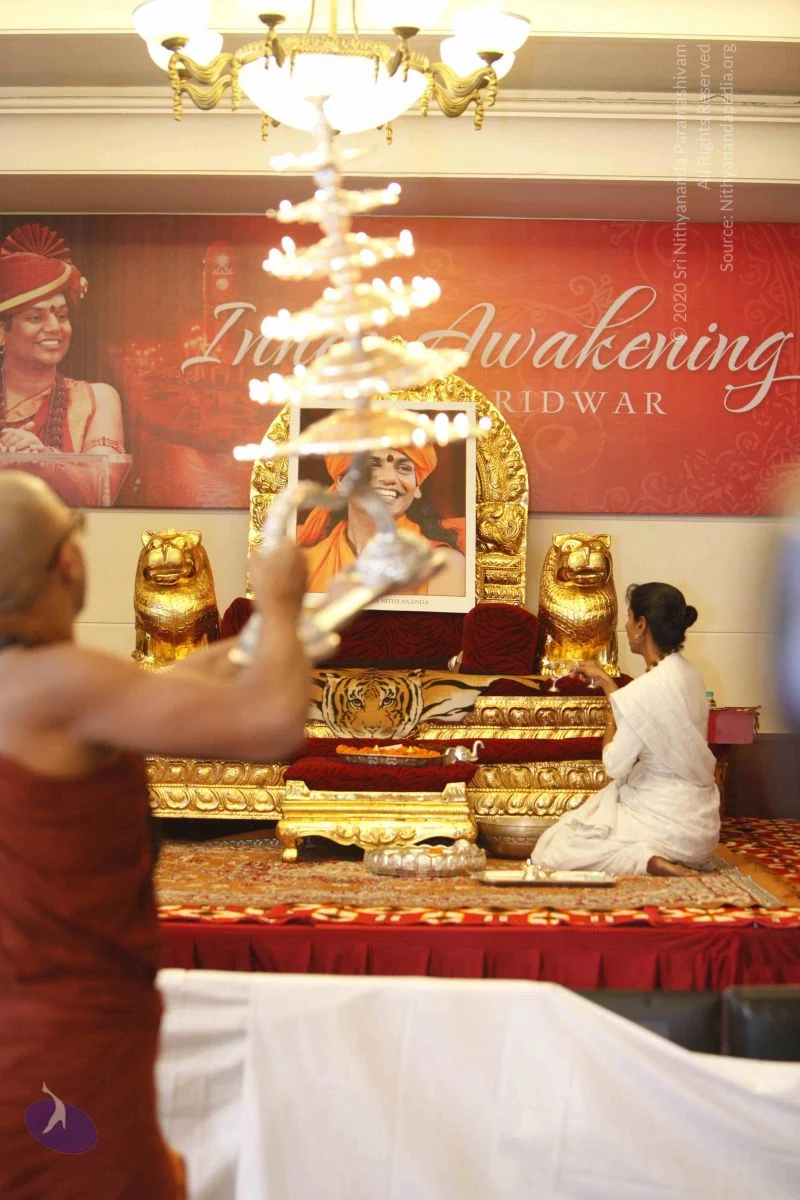
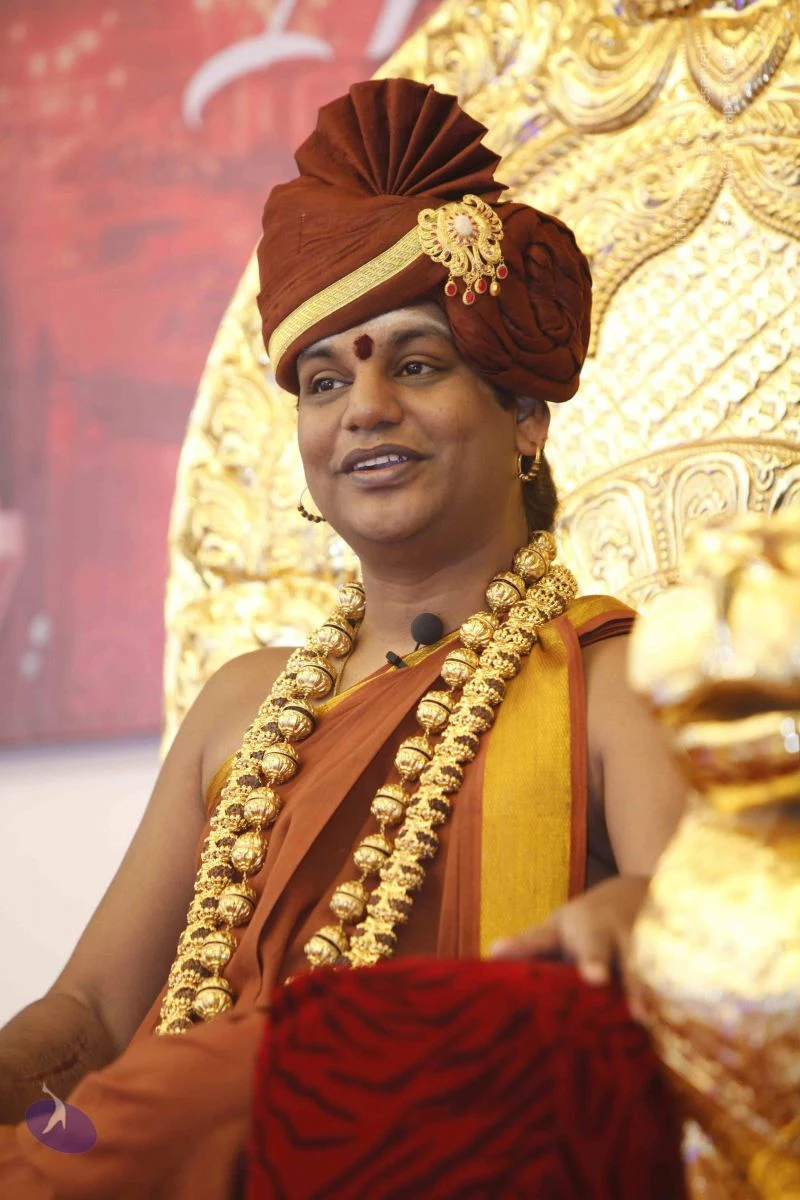
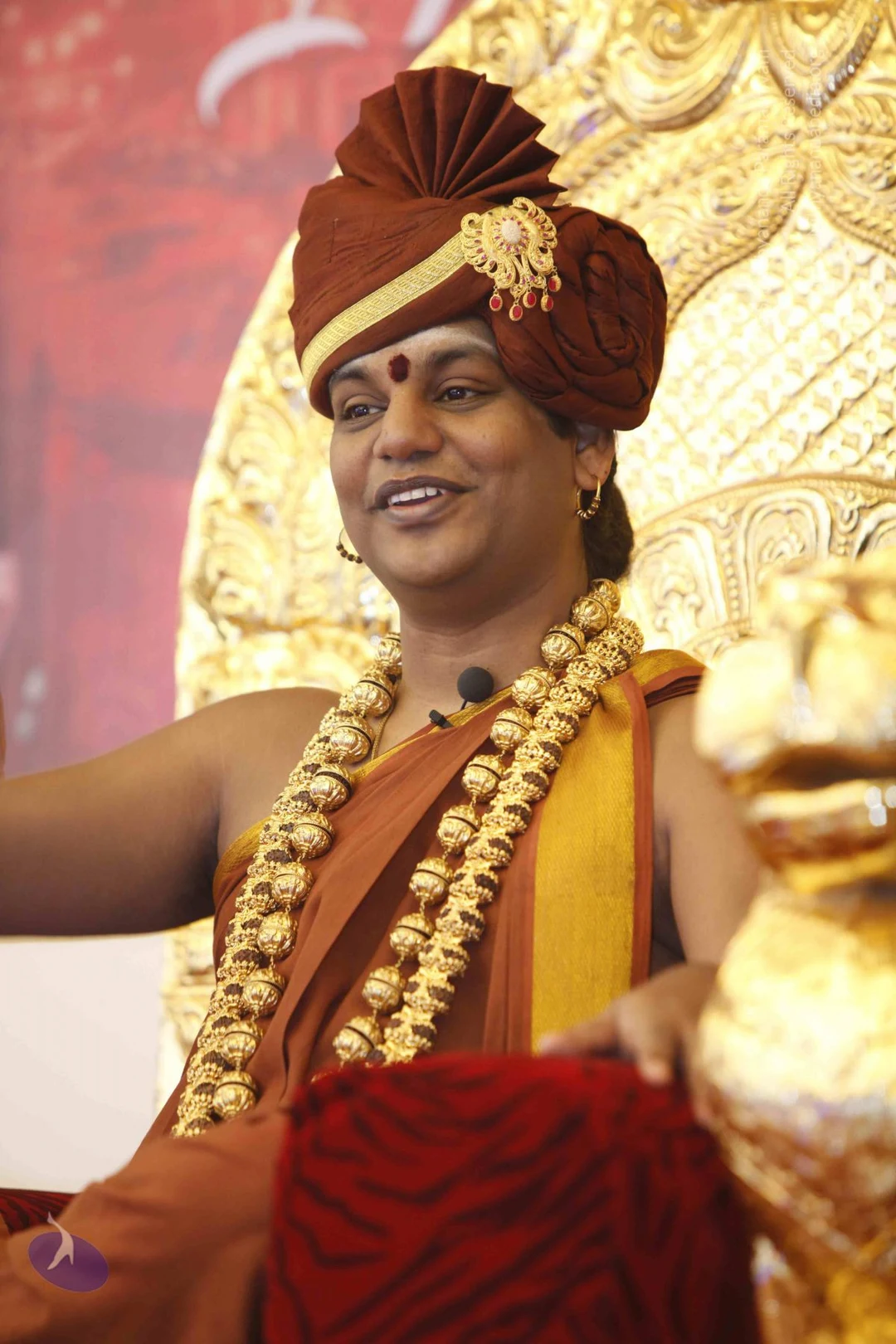
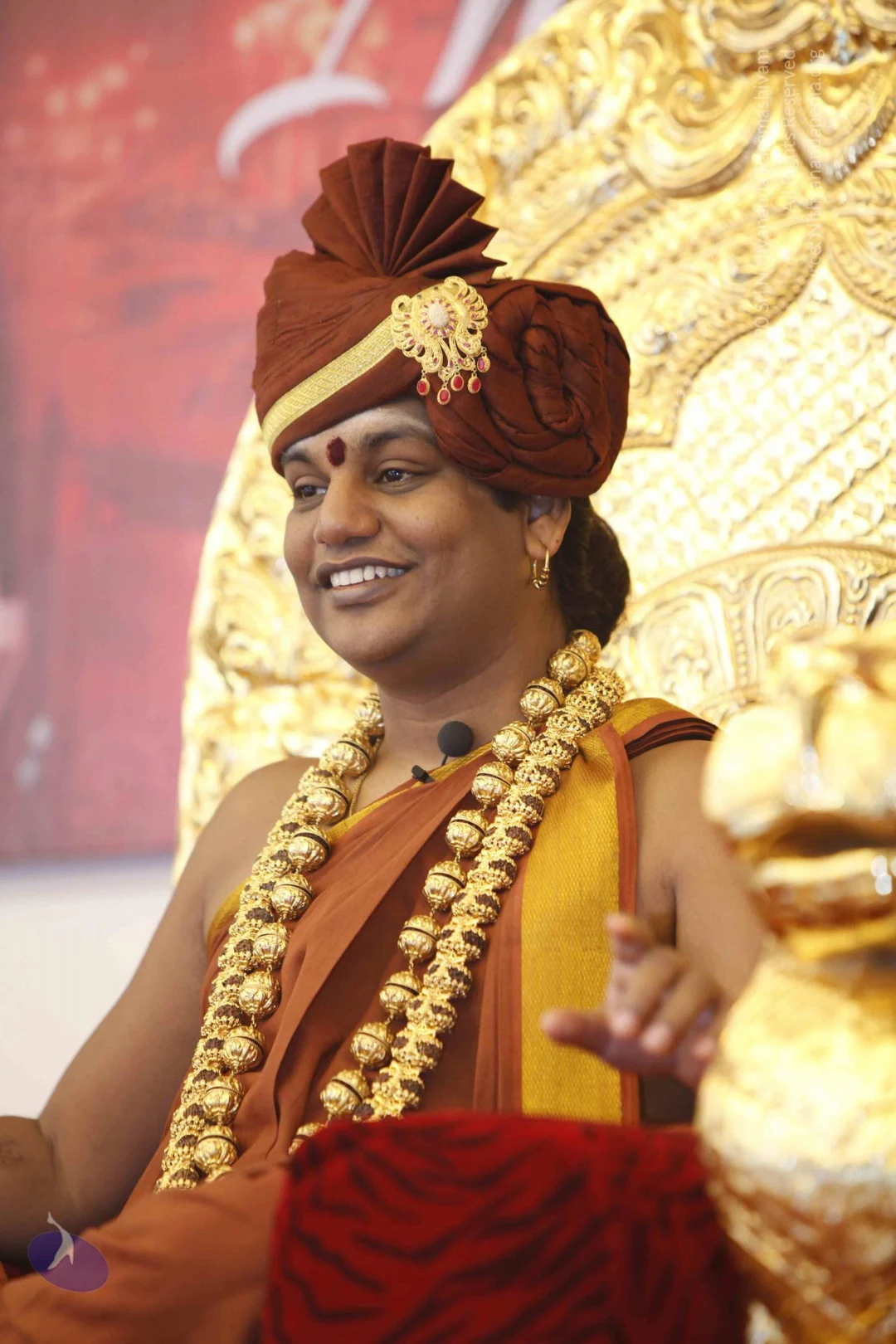
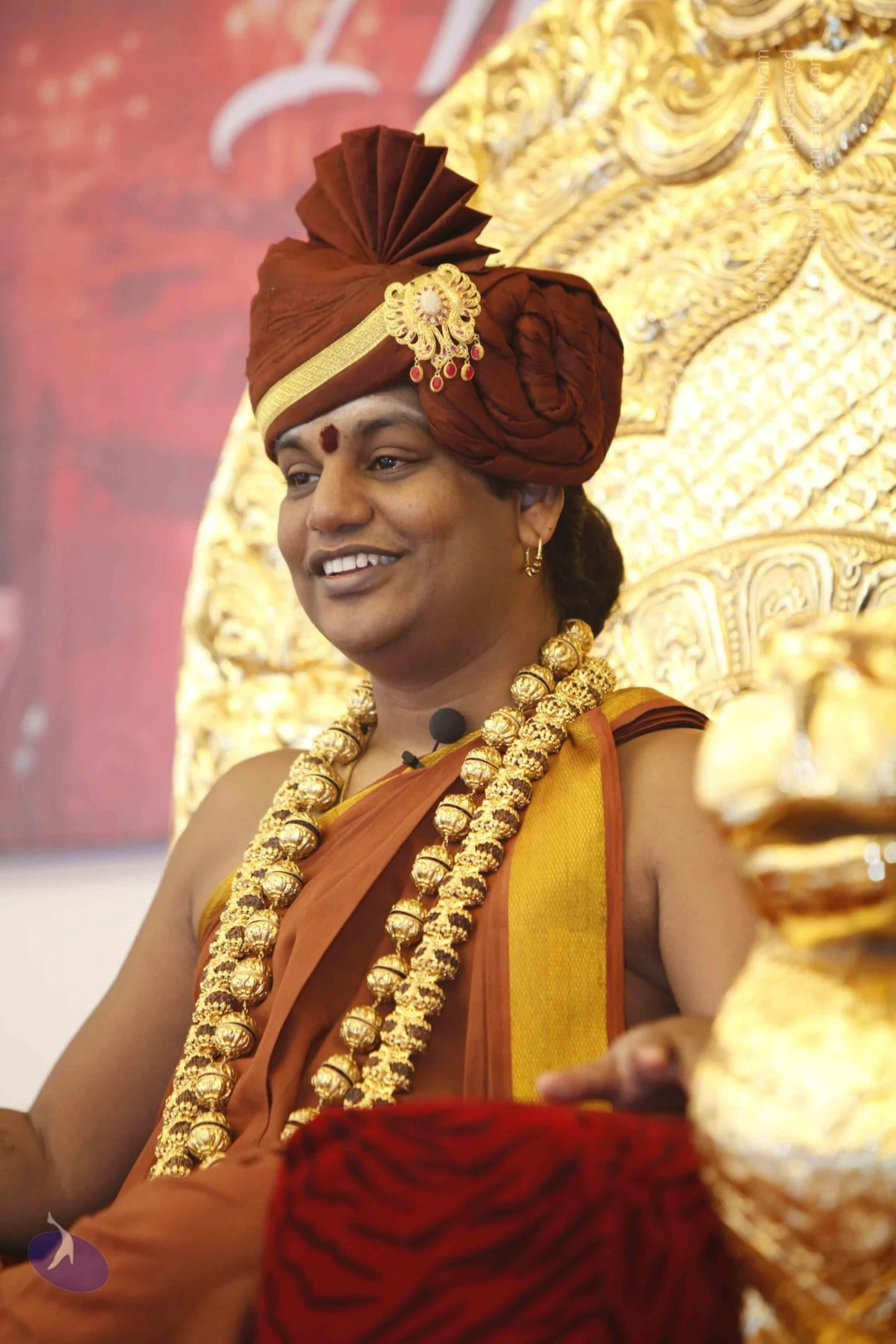
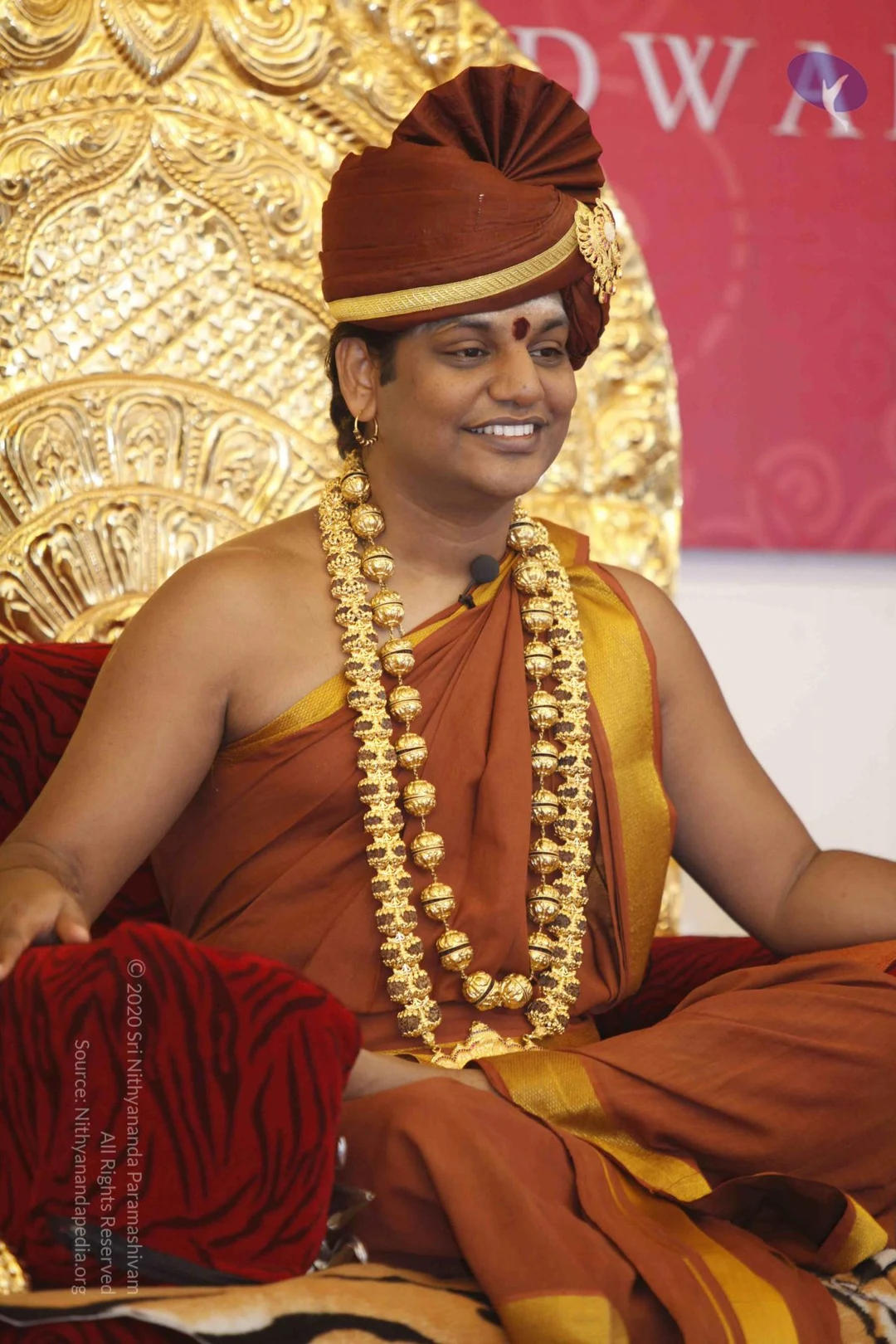
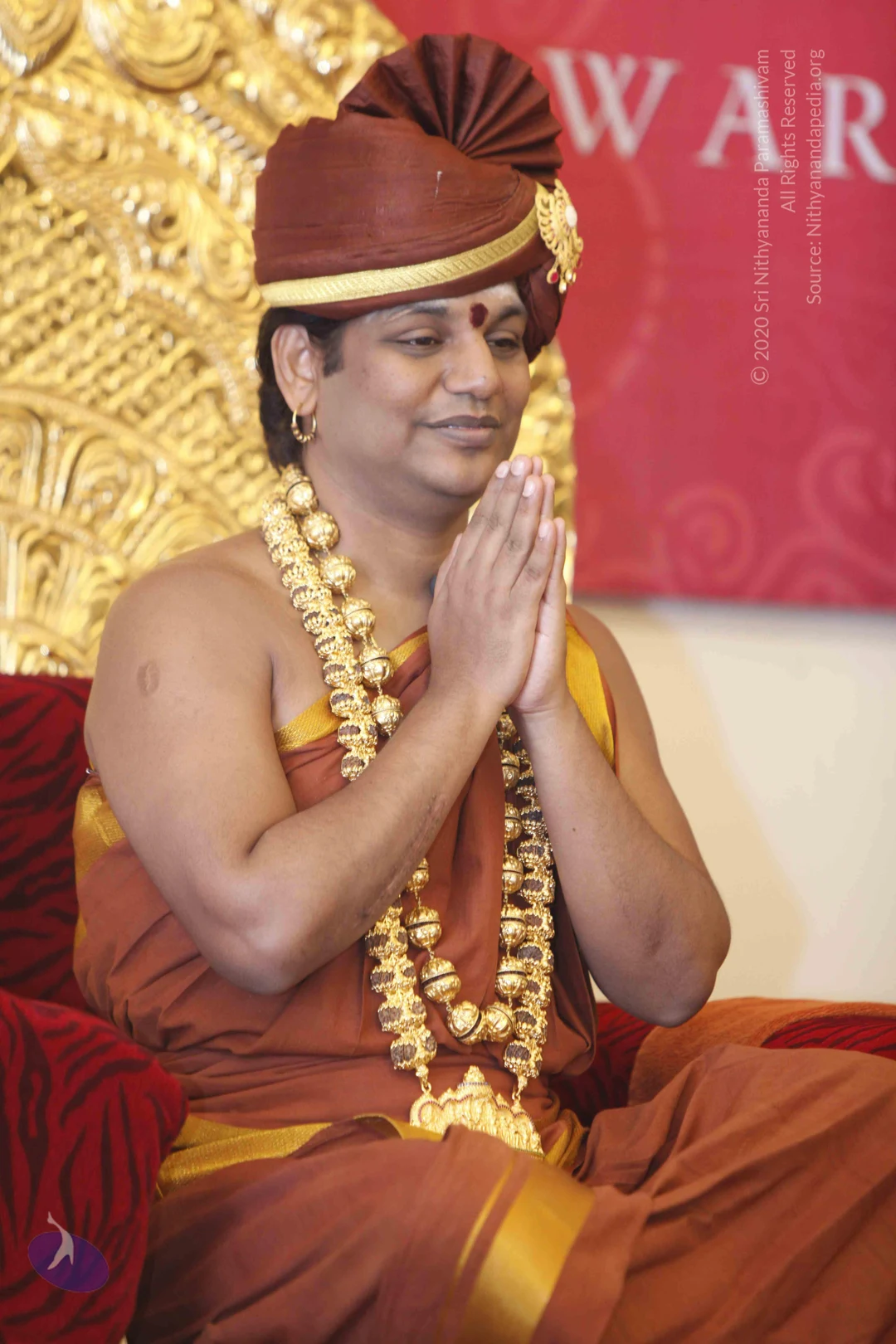
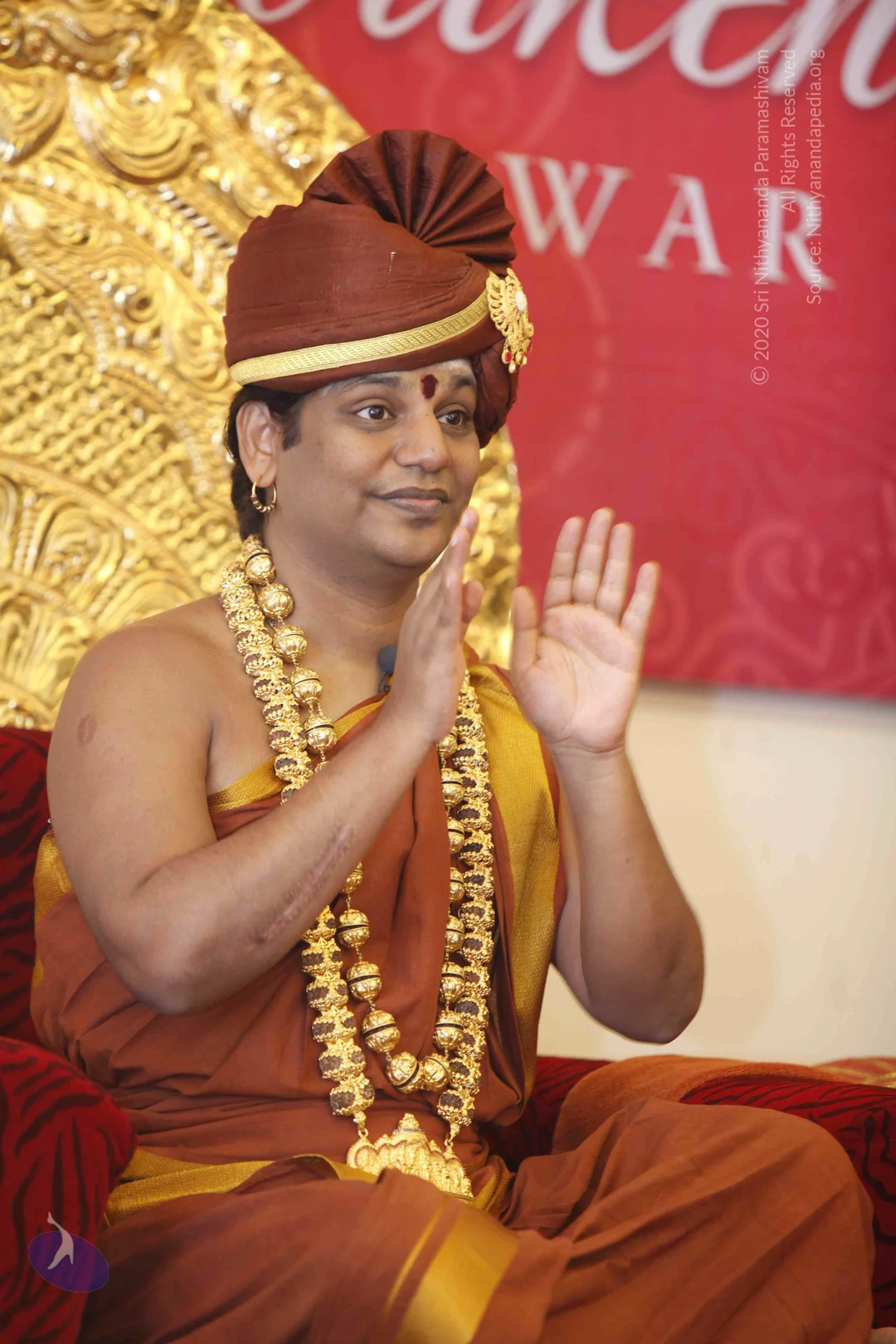
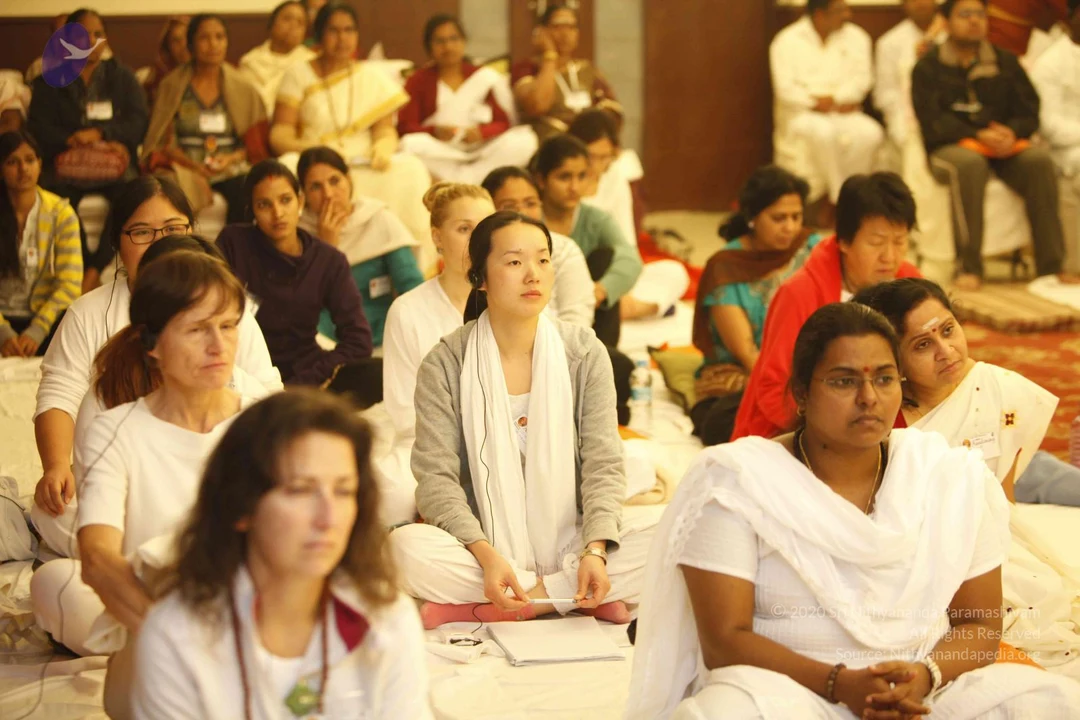
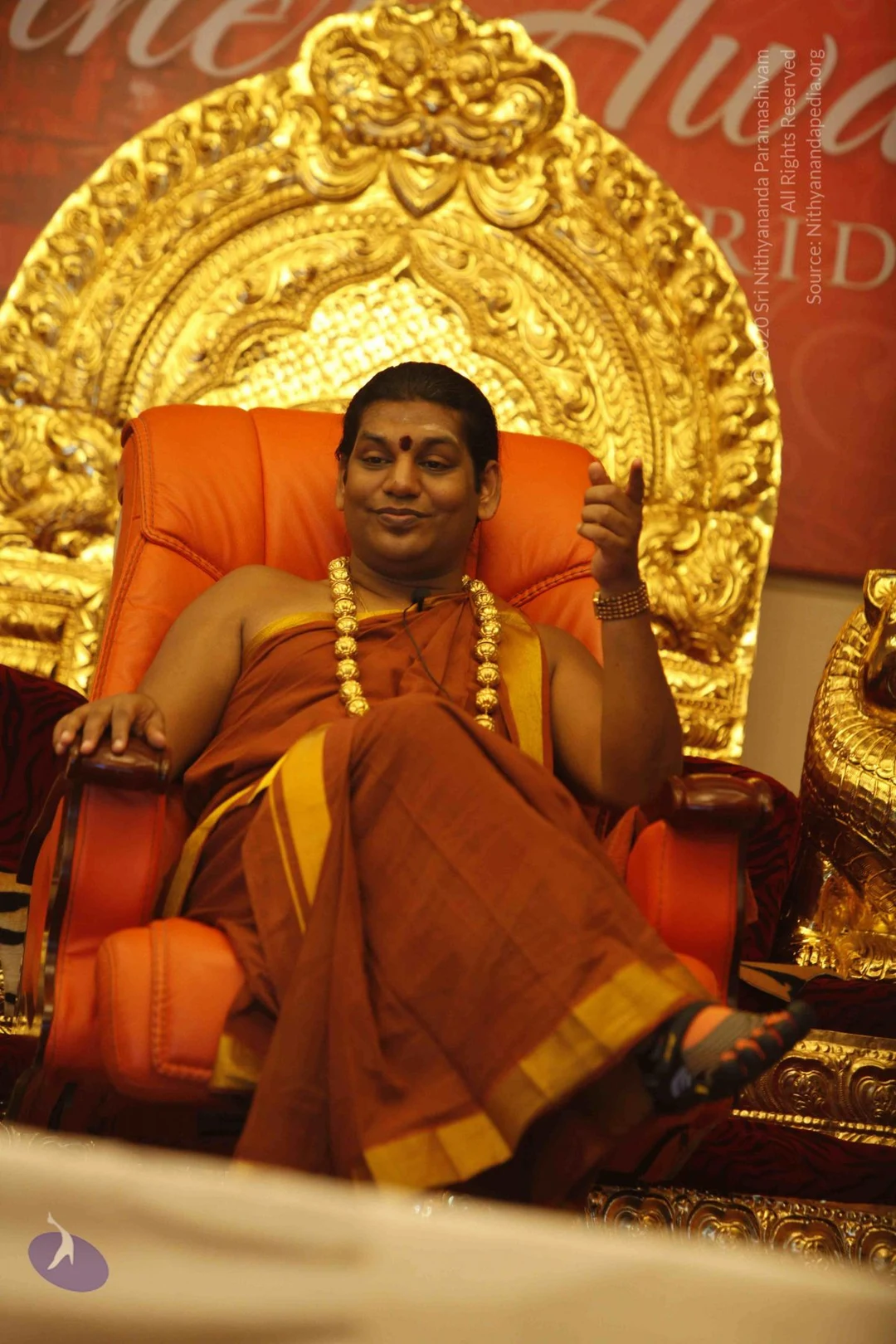
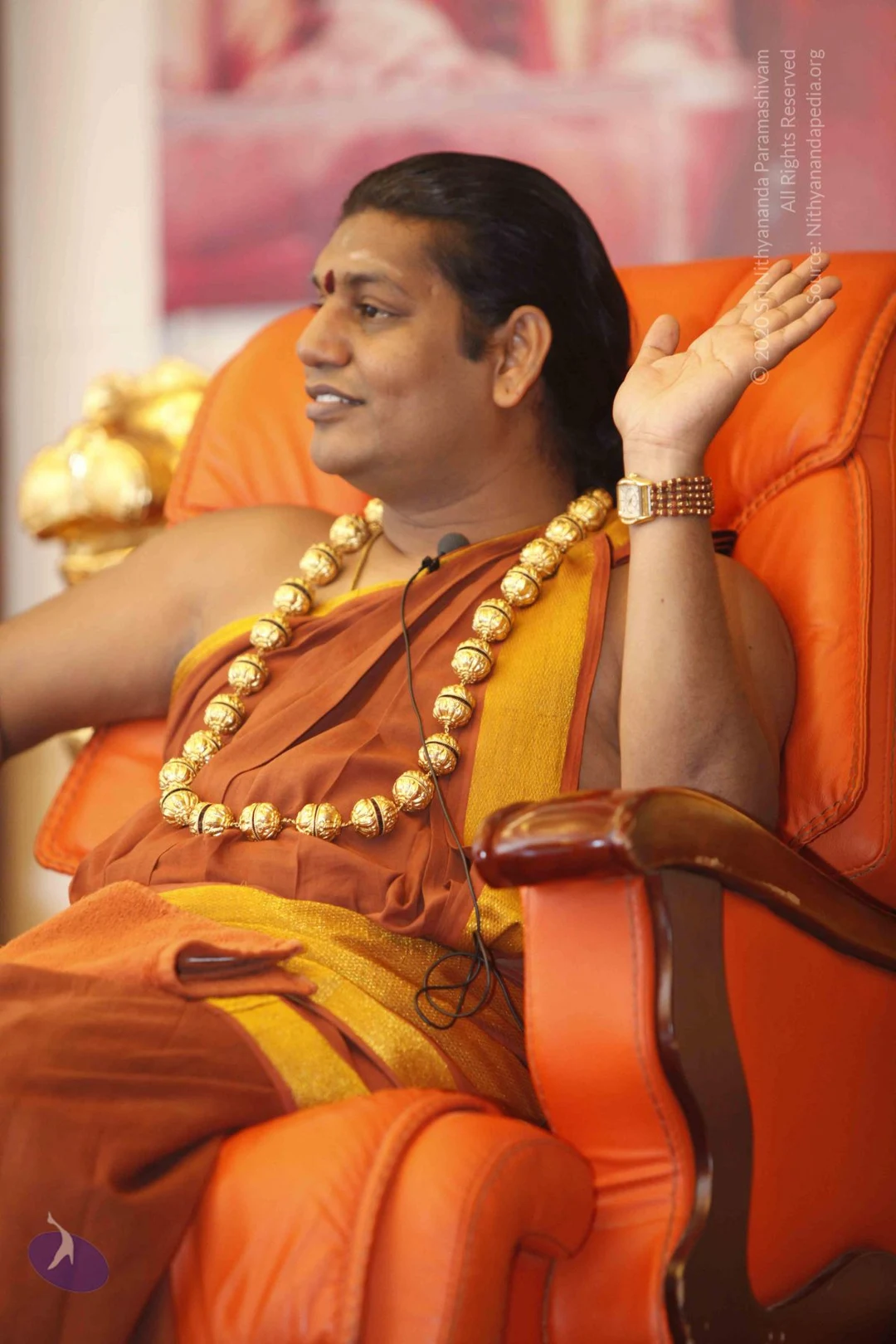
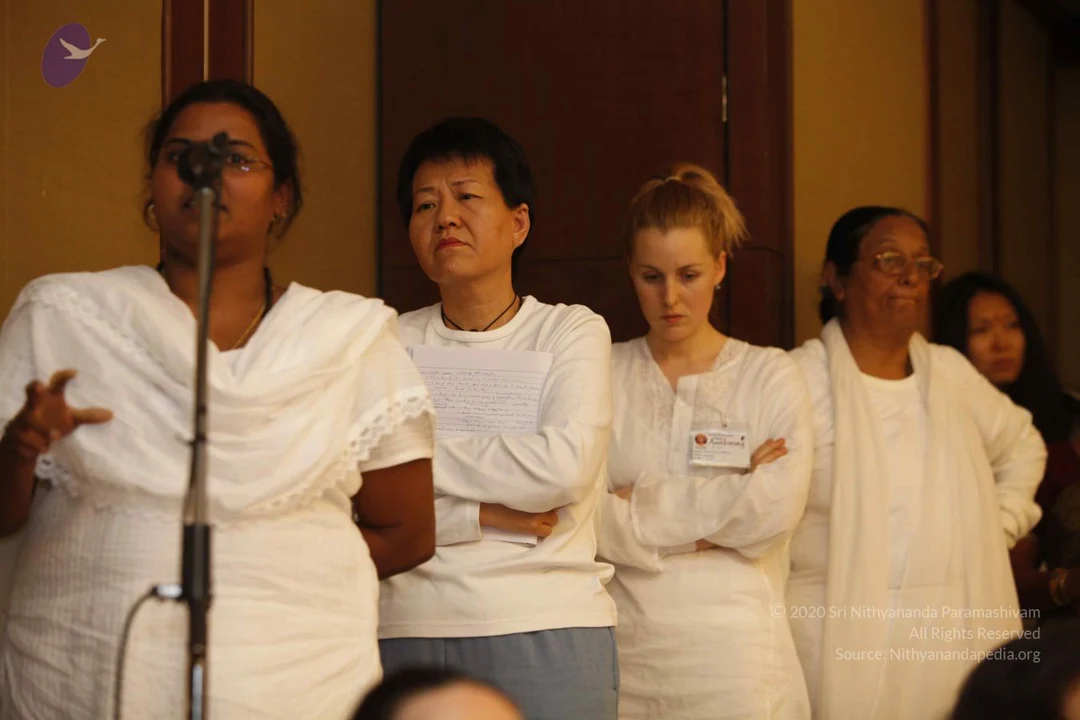
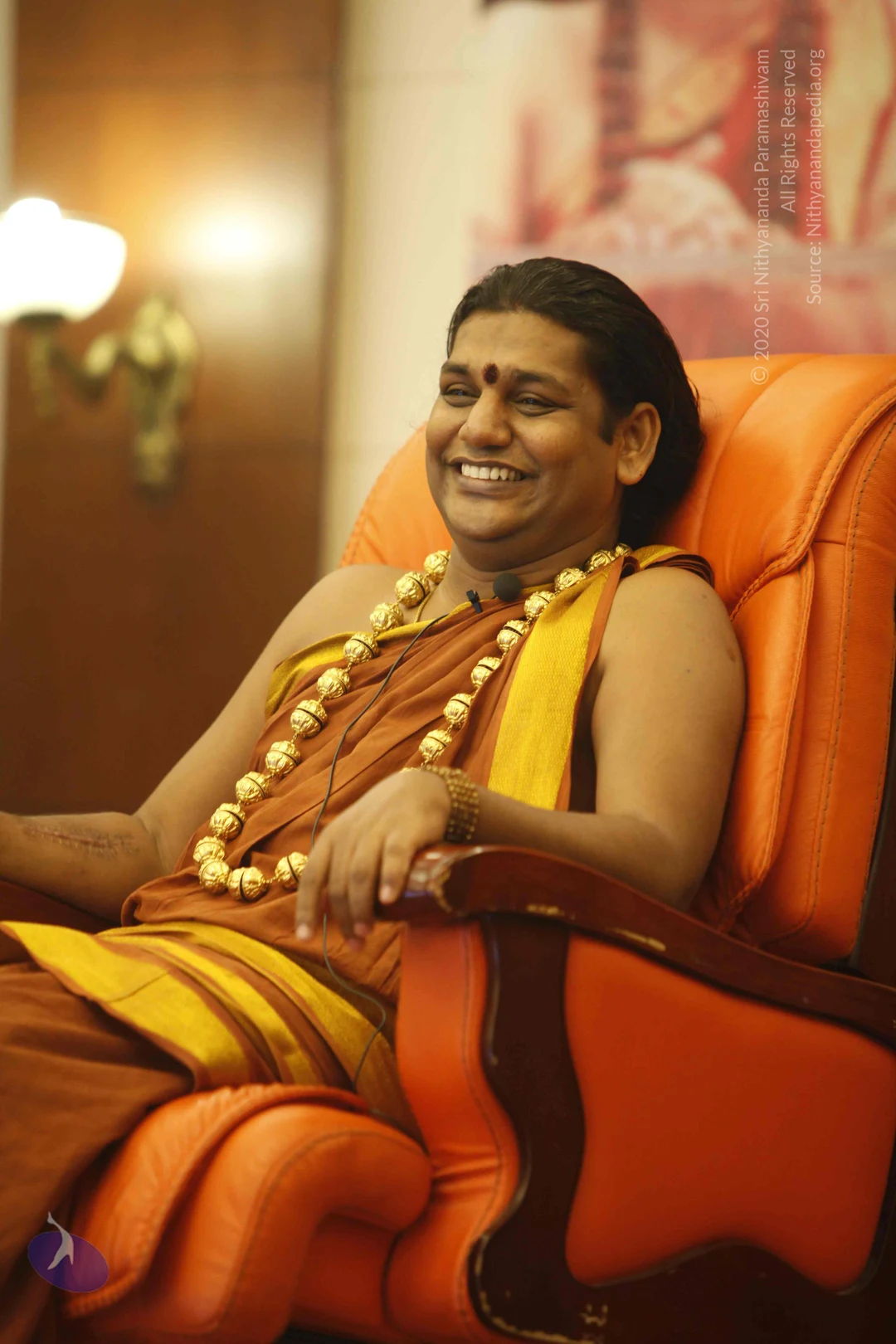
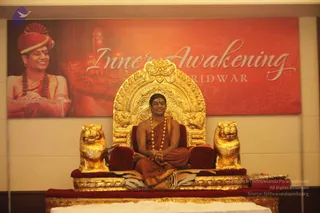
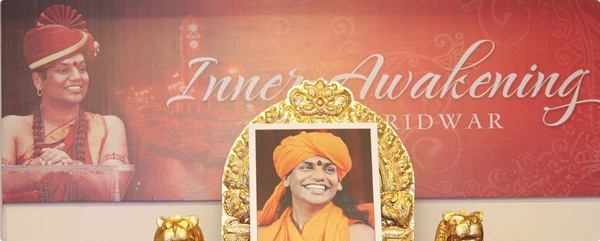
A large gilded throne with carved lion-head armrests and red velvet cushions, draped in a tiger-skin rug, stands before a red banner reading Inner Awakening. A framed portrait labelled "PARAMAHAMSA NITHYANANDA" sits on the throne back, showing a smiling man in an orange turban and orange shawl with a red bindi. Near the base are silver offering bowls holding orange sweets and a gilded ritual stand. Blurred hands at the lower edges belong to unseen attendants. No living person is clearly visible in the scene.A seated man in a maroon-red turban with a gold brooch and red stone ornament, wearing an orange-brown robe with yellow border and heavy gold bead necklaces, sits on an ornate gold throne with a red and black tiger-striped cushion and a golden lion armrest. He has a red bindi and a small lapel microphone, gesturing with one hand while speaking in a bright room with a red painting behind.A photograph of two women standing before a microphone stand in an indoor hall with tan wall panels and wood trim. The woman on the left wears a rust-red blouse with a patterned beige sari, a rudraksha mala, a small red bindi, and hoop earrings, and she is speaking. The woman beside her wears a blue, green and yellow patterned kurta with a red bindi and a name badge reading Sangha Aware or similar, and she is looking off to the side. A third woman in a white top is partly visible at the right edge, looking down at papers.

January 04 2014

Original wiki page
Contents

Title

We should never associate with self-doubt, self-hatred, or self-denial.

Description

In today's (4th January, 2014) morning Satsang, Paramahamsa Nithyananda explains the importance of knowing who we are and additionally, knowing the people with whom we associate. Our fate is decided by this group of people, our Sangha -- we must be careful of our choices! We should never associate with self-doubt, self-hatred, or self-denial. Just one wrong association can crush and destroy all the good qualities we carry!

Video and Audio - Beware of Wrong Company!

VideoAudio

Transcript

(0:15)

Nithyānandeśvara samārambhām nithyānandeśvari madhyamām Asmat ācārya paryantām vande guruparamparām

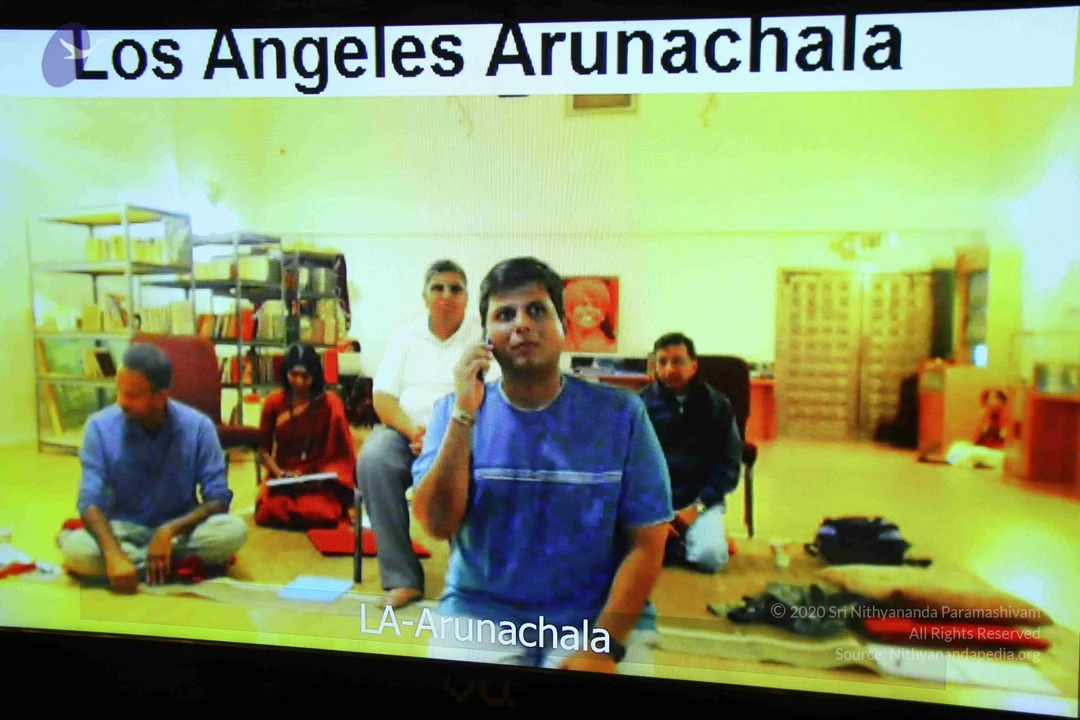
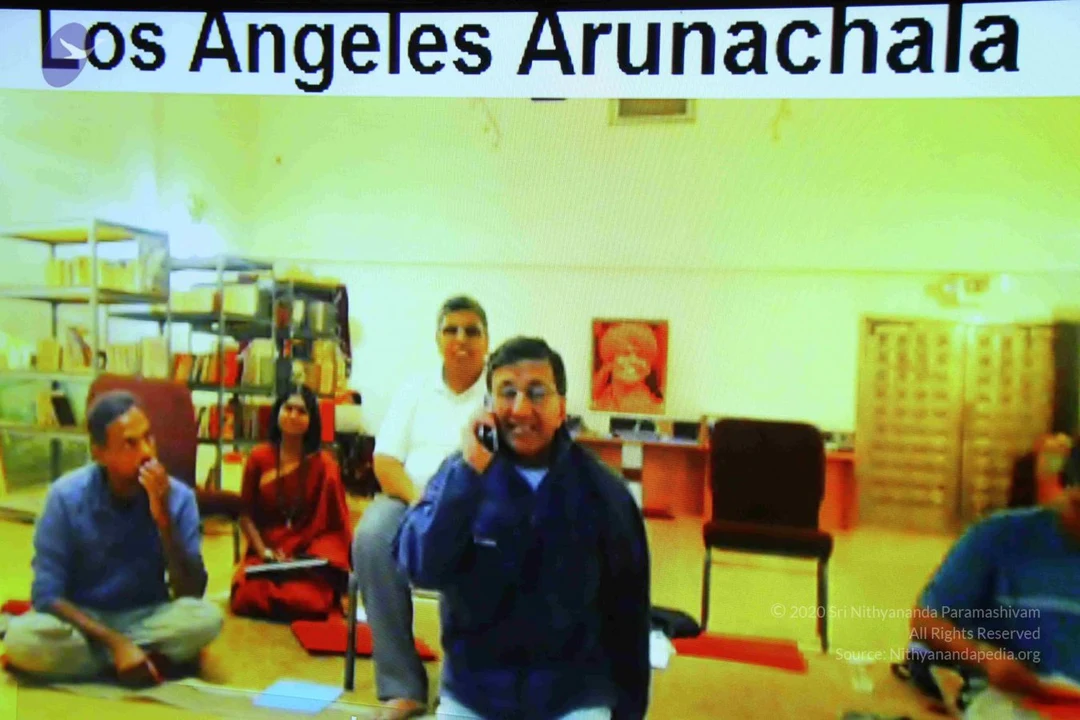
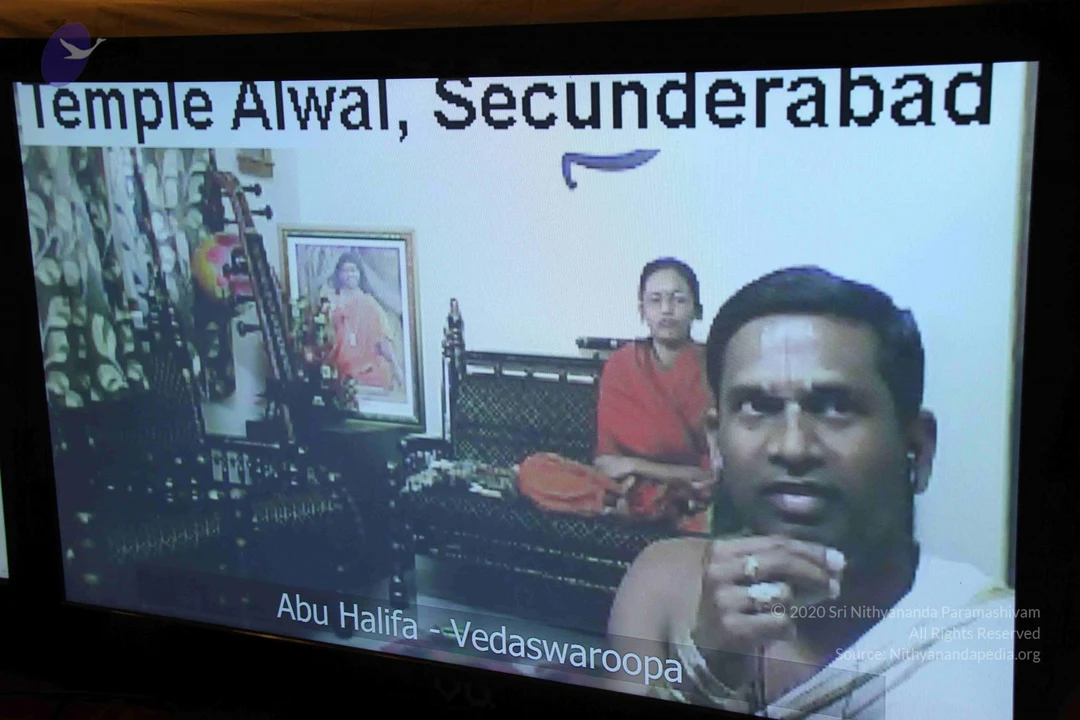
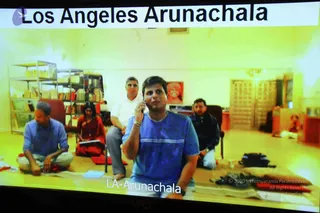
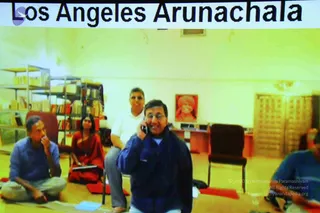
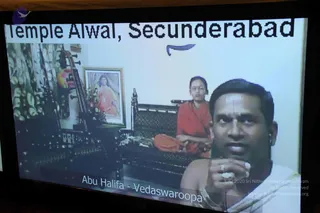
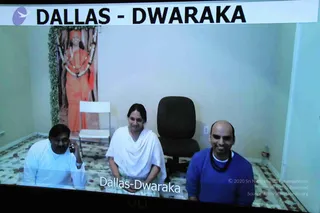
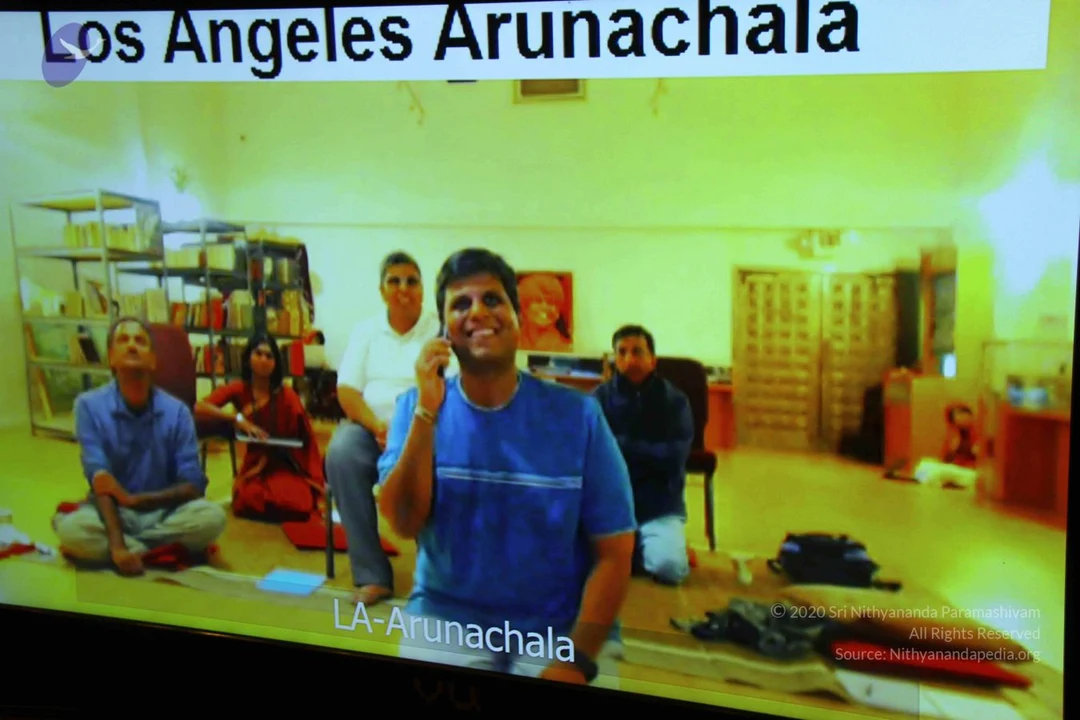
I welcome all the devotees, disciples, samajis, satsangis sitting with us all over the world at this time through Nithyananda-TV, Lotus-TV, Sadhna-TV, Eshwar-TV, Janashree-TV, and through two-way video-conferencing having Nayana Deeksha in thirty-four cities in many countries around the world. Cities sitting with us in two-way video-conferencing having Nayana Deeksha: Hyderabad-Gupta Kashi, San Jose-Madurai, Temple Ayyaval-Secunderabad, Houston-Kalahasti, Los Angeles-Arunachalam, Guadeloupe-Rameshwaram, Nithyananda Nagaram-Hyderabad, Nithyananda Nagara-Bangalore, Winnipeg-Canada, St. Louis-Tirumala, Dubai-Vaidyanatham, Singapore-Singapuram, Scottsdale-Arizona, Seattle-Chidambaram, Dallas-Dwaraka, San Jose-Madurai, Houston-Kalahasti, Los Angeles-Arunachalam, Guadeloupe-Rameshwaram, Jorpati-Nepal, Enriching Temple-Bidadi, Toronto Downtown, Phillip Island-Australia, Turkey-Istanbul, Oman-Sivagangai, Kuala Lumpur-Palani, Dubai-Vaidyanathan, Ohio-Prayag, Temple Ayyaval-Secunderabad. I welcome all of you with My love and blessings.

(02:17)

Today, I will expand on causing Enlightenment, Mahabharata characters, and Kalpataru, because all these three are very closely connected. Please understand. The first thing, Karna is the embodiment of charity. I can say, he had all the best qualities, in a way little more than Arjuna. Just only one mistake: association with self-denial, Duryodhana; that’s all. Bhishma, embodiment of Dharma, righteousness. I can say righteousness is one aspect of Dharma. Giving, giving is another one aspect of Dharma. That is why, in Sanskrit, for giving, for righteousness, for all these great qualities, the same word 'Dharma' is used. And Acharya Drona, amazing knowledge and ability to teach but all this will be of no use if it joins with self-denial, Duryodhana. Dhritarashtra is the embodiment of Self-Doubt. Shakuni, embodiment of Self-Hatred. Duryodhana, embodiment of Self-Denial. If Bhishma, Dhrona, Karna, all of them have moved out of Duryodhana, what an amazing heroes they are. Even Pancha Pandavas are nothing in front of these characters.

(04:40)

So, it is very important for you to know: not only who you are, with whom you associate – your sangha – also need to be right. Whether you join satsangha or dussangha, your sangha also decides your fate. You can’t say, "No, no, no, no, wherever I am I will protect myself." No, you are not that powerful, you are not that intelligent, you are not that capable. Even Bhishma thought he will protect himself and protect the Hastinapura, he will save Hastinapura kingdom, he will save Duryodhana. Dhrona never thought he will not be able to save Duryodhana. Dhrona really would have thought he will save Hastinapura. Bhishma would never have imagined in his life he has to throw arrows at Krishna whom he worshipped every day, his own Ishta Devata, he has to throw arrows at him! The tradition says, Krishna has to come to Chennai, Triplicane, Thiruvallikeni, and rest, get treated for all his Bhishma Banam- the wounds created in his body and face by the Bhishma's arrows. No one else's arrows were able to touch Krishna, but Bhishma Banas created wounds on Krishna’s body. Still the Parthasarathi in Triplicane, the deity carries the wounds all over the face and the body. Every year, even now, that season after that Kurukshetra War, that 40 days, he is given an herbal, ayurvedic herbal bath, ayurvedic oils are applied on the deity, and no one is allowed to have darshan; he is left to rest and recoup. Bhishma would never have imagined he will be forced to throw arrows at his own Ishta Devata.

(07:29)

Understand. Never ever associate yourself with Duryodhana's - the dussangha. Even the characters like Bhishma, the embodiment of righteousness, what an Integrity and Authenticity. Sure, the power of his Integrity would have saved him. No one was able to kill him. Even Arjuna is not able to kill him. But his whole Integrity is made useless. He was not dead, he was not killed, but he was made useless, just lying on the arrow-bed in the Kurukshetra. So, understand, Bhishma, embodiment of Integrity - Karna, embodiment of charity. What a giving style! One of our Sanyasi was coming in the flight. The air-hostess, male guy, he saw her watch and said that the watch is very pretty. The watch - she was wearing was with Rudraksha. Then immediately, she took it and gave it away. See, as a Sannyasi, the moment you like something I have to give it away. The air-hostess he was little shocked! He could not understand. He said "No, no, no, no!" She said, "It’s OK please have it." I was so happy when I saw that scene. Even the Sannyas has to be practiced continuously. I am very clear, I don’t own anything, but whatever is there belongs to the Sangha. If anything is mine and anybody asks, it is theirs!

(09:38)

Karna, his charity, the amazing quality of charity he had. Every one of us should meditate on Karna to imbibe that quality of charity. Unimaginable quality of charity. Warfield, about to die, even at that moment, when Krishna comes and asks him for all the punyas he has done, Karna doesn’t care, doesn’t bother. He knows if he gives away all the punyas, immediately he will be dead but he gave away. That is why, Vyasa when he writes, for nobody else he uses the word 'moksha'. When Drona was killed, he says, “Dhrona vadha.” For everyone, he uses only the word vadha, vadha, vadha . For Karna, Vyasa uses the word “Karna Moksha”. Karna was not killed, he was liberated because his good actions were the only thing which were stopping him getting Enlightened! He had all the best qualities. And whatever small, bad actions in Karna were there, he had suffered enough for it. Only his good actions were stopping him getting Enlightened. Krishna goes and takes away all the fruits of the good actions and liberates him. Such a character! See, it's like a just through charity he became Enlightened, he had liberation. But, even he is useless when he was living because of his association with self-denial. Even the Karna, useless when he was living in the body because of his association with Self-Denial. Understand. Whatever good qualities you may have, do not allow the sangha, dussangha, association of self-doubt, self-hatred, self-denial.

(12:16)

Yudhisthira is embodiment of Integrity. Bhima is embodiment of Authenticity. Arjuna is embodiment of Responsibility. Sahadeva is embodiment of Enriching. Even when enemy, opposite guy, Duryodhana, comes to Sahadeva, he blesses him, saying, "You start the war on this day; you will be successful!" That kind of Enriching. Enriching even enemy. Nakula is embodiment of causing. He went on being a catalyst for everyone to realize their reality. He was such an amazing support for Yudhishtira, Arjuna, Bhima and for Sahadeva, everyone. He was just behind the scene, always being a support. All these five won the game of life only by the grace of Guru, Krishna. They listened to Krishna. It is their satsangha. Otherwise, I tell you, so many times Pandavas would have been killed, so many times they would have been dead! It is their association with the Guru, the satsangha.

(13:46)

I tell you, whoever you become, never miss association with Guru. Even if you become the Badshah of Delhi, you need the feet of the Guru. Whatever you have become. In Tamil there is a proverb: Whatever you may become - in Tamil they say that, “Delhikku Badshah aanaalum, appanukku pillai aaga iru”! Means be a son to your father. Because, the satsangha protects you! I tell you, at least one hundred times Pandavas would have been killed if not for Krishna. With the whole kingdom and the infrastructure, Duryodhana was not able to live! Bhishma, Dhrona, Karna, were not able to live because of their wrong association. But being in the forest without anything, Pandavas survived, finally won the game of life, got everything back just because of one association – Krishna. I tell you, the whole Mahabharata teaches the lesson of satsangha, right association.

(15:22)

Satsangha behaves as a Kalpataru - whatever you want, you get it! Dussangha takes away everything you have. The wrong association takes away whatever you have from your life. That is the lesson you have to learn from Mahabharata. See both side. Just the right association, Pandavas have got everything they want. Satsangha is Kalpataru. One wrong association – Duryodhana is actually the result of Shakuni. Self-denial is the result of self-hatred. It is very surprising, Shakuni is not a womanizer. Because he hates himself so much, he can never love anybody. All these three – neither Dhritarashtra, nor Shakuni, or Duryodhana – all three of them are not womanizers. But I am not saying womanizers are right or something - don’t mistake. No, they hate themselves so much they can’t love anybody. They can’t even have romantic relationships in their life. I am not saying all the people who have romantic relationships do not have self-hatred or self-denial. Sometimes even to escape from the self-hatred and self-denia - it becomes a perversion, people become womanizers. That is different. Self-hatred, self-denial and self-doubt - whatever maybe the good qualities you have, embodiment of good quality you maybe - just this one wrong association can destroy everything.

(17:28)

Essence of whole Bhagavad Gita is: the Master awakening responsibility. That is why you see the whole Bhagavad Gita talks only about responsibility, responsibility, responsibility - karmanye vadhikaraste ma phaleshu kadachana. Krishna awakening Arjuna, Guru awakening the responsibility in beings. Listen, each character in Mahabharata, please understand, it can never ever be imagination. Each one of them lived! The whole essence: the relationship you build in your life, the sangha you chose in your life, that protects you. No one one can harm you if you have the right sangha. No one can save you if you have the wrong sangha. No one is able to save even Bhishma, Drona. Drona would not have never thought his own chastened disciple would raise the bow against him! To whom he taught how to hold the bow, with so much of love and care, to whom he has taught how to hold the bow. To protect whom he took away the thumb of Ekalavya. To defend whom he put Karna down, he would never thought that Arjuna will stand against him, he has to fight with that Arjuna! That is why, I tell you, you can never write a better thriller than Mahabharata. Story with so many twists, so many layers, than Mahabharata.

(19:48)

After reading Mahabharata, all other stories, epics looks pygmy. The tsunami of human emotions, the navarasa in each character’s life. Drona would never have imagined the disciples whom he groomed spending his whole life will stand against him! All the astras, shastras he taught will come on him! Understand. You may be a great acharya, unless you complete with the self-denial your whole knowledge is useless. You may be a great teacher, unless you complete with your self-denial, it is useless; you will be lost in the war of life. Drona’s 'putra pasha', his putra pasha killed him. Drona never became powerless in front of any pattern, but his deep attachment for Ashwatthama. That is why, Krishna plays a game to make Drona powerless, He sends the message, "Ashwatthama is killed." Immediately Drona becomes powerless. You may be a great acharya, but if you become powerless in front of putra pasha - the putra soha; you lose the war of life. Then, now it is easy - once Drona became powerless, all the patterns take over him; he is gone, dead, destroyed!

(21:49)

I will give the essence in Hindi. The essence of today’s satsang is: satsanga, if you have satsang, no one can destroy you, however powerful they may be. If you are in the dussangha - wrong company, no one can save you, however powerful you may think you are. Satsangha protects you. With satsangha, no one can destroy you. With dussangha, no one can protect you. Listen! Satsangha gives you whatever you want, even if you have lost everything. See Yudhisthira! He even did not even have himself! He lost even himself and went to forest. But, just the satsanga, Krishna’s company, he got everything back. All the triloka came under him. See Duryodhana. He inherited everything, did not have any enemies, had all the best people thinking for him, supporting him, fighting for him. But, just the dussangha, Shakuni.. And Krishna are exactly 360 degree opposite characters. The celebration of life is Krishna, self-Hatred is Shakuni; exact opposite. The Shakuni’s sangha destroyed Duryodhana. Krishna’s sangha saved Yudhisthira and gave everything to him. So, whom you choose as a important company in your life matters. Even psychologically with whom you feel connected matters. Whom you think about, remember, celebrate matters.

(24:26)

I tell you, all the satsangis who are sitting in the satsang every day, I tell you, satsang matters. Satsangha is Kalpataru! Whatever Yudhisthira wants, he got it just by the association with Krishna. Whatever Duryodhana had, he lost it just by association of Shakuni. Shakuni – self-hatred – always comes with a sister – self-destruction – Gandhari. How for reason she destroyed herself. She might have developed a beautiful logic for tying the ribbon around her eyes, but self-destruction. So, self-hatred always comes with a sister: self-destruction. Then this brother and sister enters your family, your family is gone! Without Shakuni, surely Duryodhana would have transformed himself. Dhritarashtra would not have allowed Duryodana to be destroyed so badly, to that extent; it is Shakuni and Shakuni’s power over Dhritarashtra. The self-destruction shows as if it is dedicated to you. Even if it is dedicated to you, destruction is destruction.

(25:58)

Continue on the various characters of the Mahabharata. The Mahabharata Yuddha is our life where constantly self-hatred tries to cheat Integrity, Authenticity, Responsibility and Enriching. Self-hatred always tries to tell you, "Integrity will not work, Authenticity will not work, Responsibility will not work, Enriching will not work, you are going to get cheated, you are a fool!" See, Yudhisthira looks like a fool throughout Mahabharata! No one will believe Yudhisthira is going to win the game till the end - he looks like a fool! Especially when he is controlling Bhima and Arjuna many times. Bhima and Arjuna would have finished the whole Kauravas when they had the dice game itself. After the game, if Yudhisthira keeps quiet, kept quiet, Bhima and Arjuna would have finished the whole Kingdom and coronated Yudhisthira on the spot, especially when they touched Draupadi. Draupadi is Enlightenment. That is why Enlightenment comes with all these five are part of enlightenment. Draupadi’s pati. Self-hatred and self-denial and self-hatred and self-denial always abuse Enlightenment.

(27:44)

Enlightenment is the sister of incarnation, Krishna! When Shakuni comes in your life, he brings Gandhari – self-destruction. When Krishna comes in your life, he brings Draupadi, Enlightenment. With who you associate, you get his sister. Giving the daughter from your family to the guy is a way of showing respect in those days. When you want to honor somebody, you give a daughter from your family, showing that 'you are worthy of my respect'. Each character, whatever maybe the struggle, Enlightenment never left Integrity, Authenticity, Responsibility and Enriching, it was with them throughout. Draupadi was with Pandavas throughout, raised them back to the right level. Understand. Yudhisthira – Integrity – when you start, Integrity never looks like he is going to win the war, but you will see, finally, Yudhisthira only was coronated!

(29:18)

I tell you, even if you have thousands of doubts about Integrity and Authenticity stand with it. Guru’s grace will always be with you. Krishna’s grace also was with Pandavas because of their quality. Otherwise Krishna was in no way biased. It was the quality they had. So, I tell you carry the Integrity, Authenticity, Responsibility and Enriching; you will always have Guru’s grace on you; Guru will be on your side. Integrity is born from Kaala, Yama Dharma, Yudhisthira. Yudhisthira is son of Yama Dharma. Yama will never misses time. That is why Yudhisthira is embodiment of Integrity. Who is the most integrated being in the Planet Earth, in the Cosmos? Yama Dharma! Most powerful, authentic being is Vayu. Bhima is the son of Vayu. Naturally, Indra is the most responsible person in the whole universe. He is head of all gods. Arjuna is the son of Responsibility. Nakula and Sahadeva, the Ashwini Kumaras, the most enriching beings, the greatest doctors – doctor profession is the most enriching profession – the greatest healers, both are sons of greatest enrichers! Kunti is the embodiment of tapas. Her whole life, if you see, she is embodiment of tapas. Continue to expand on the Mahabharata and Causing Enlightenment.

(31:29)

Let you all achieve, experience, live, express, radiate, share and explode in eternal bliss, Nithyananda.

(31:44)

Photos

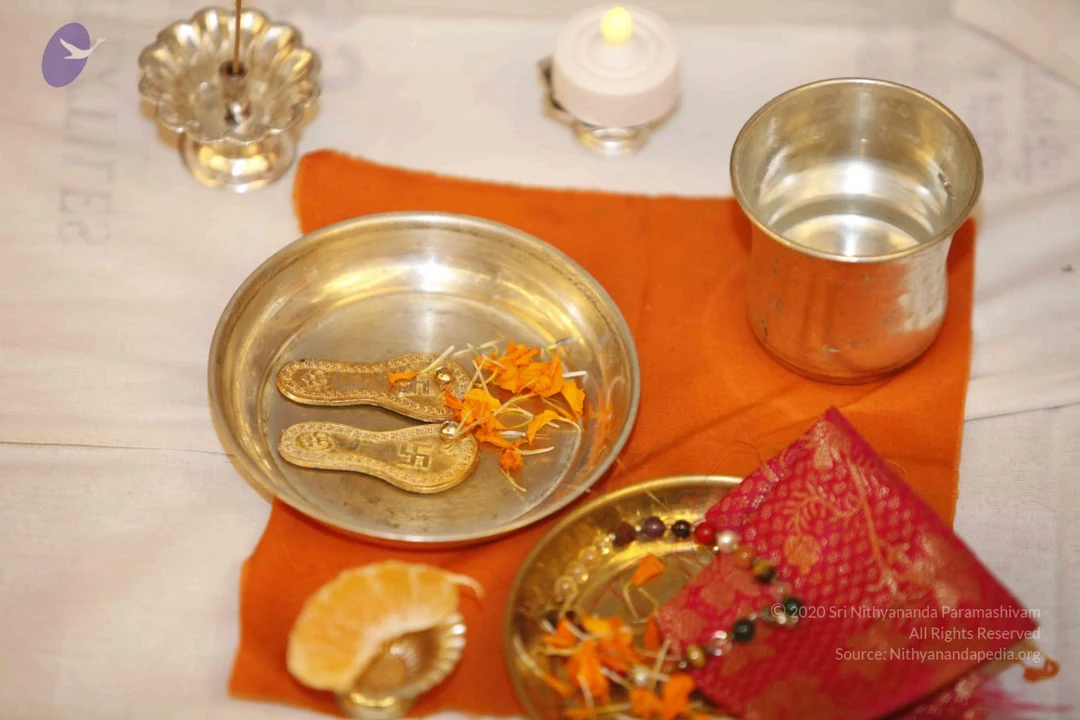
Padukapuja
Padukapuja in Progress

Inner Awakening Day 3 and Satsang
utsava murthy

Photos Of The Day:

Satsang

IA-Haridwar

Darshan

Photos Of The Day:

Photos from this day

View all 131 photos

Inner Awakening Day 3 and Satsang
5 photosSource gallery
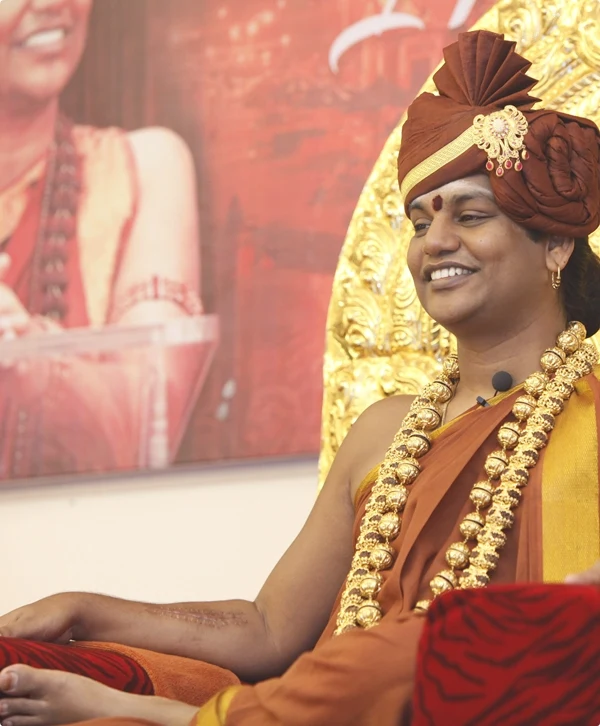
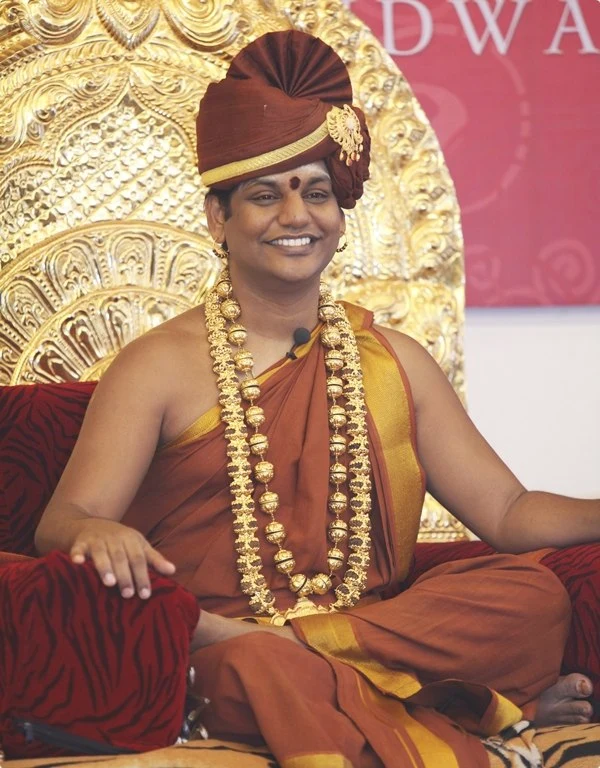
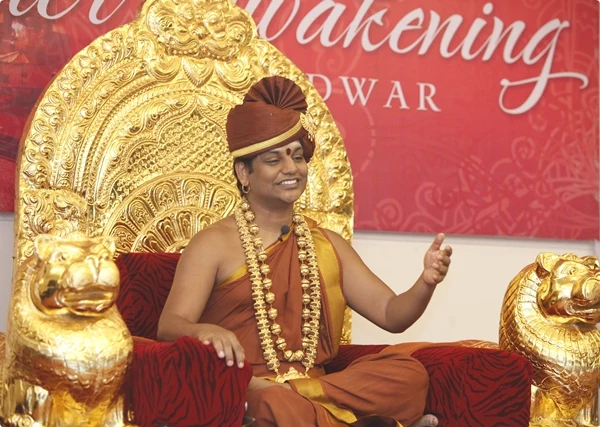
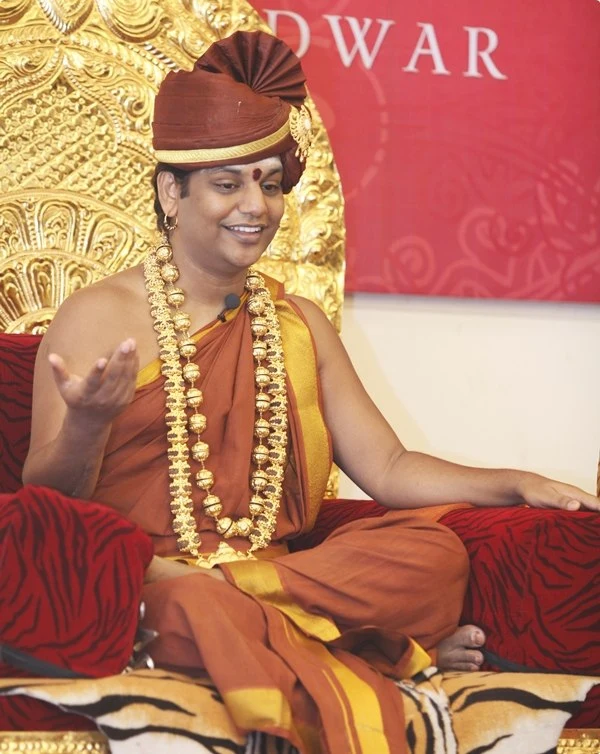
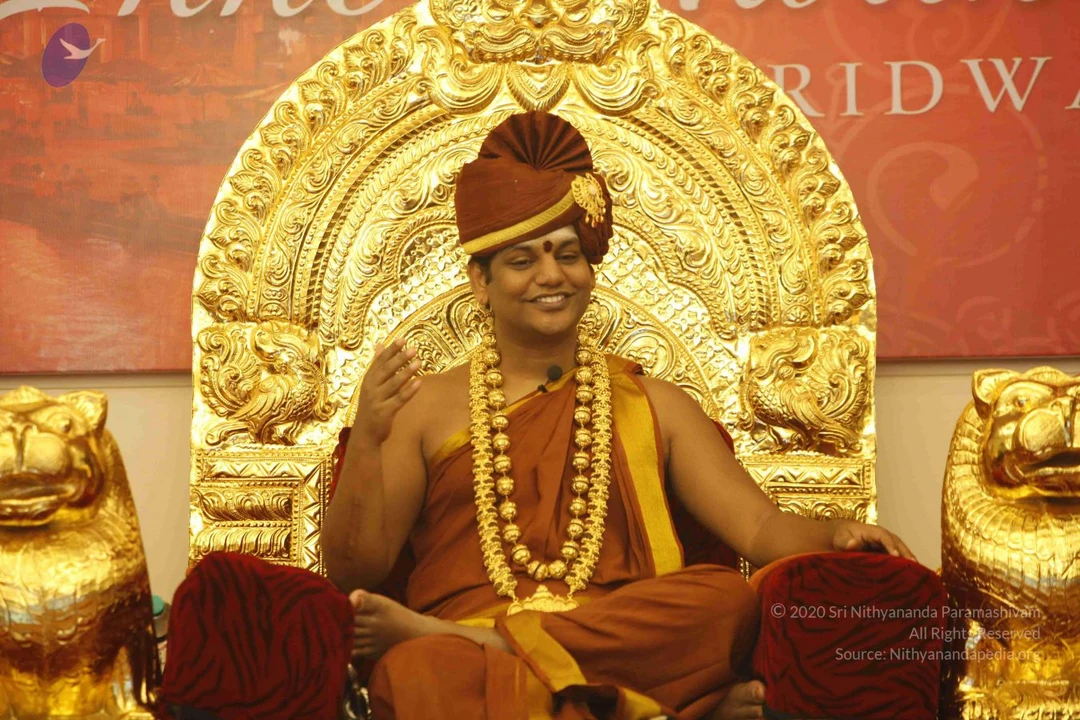
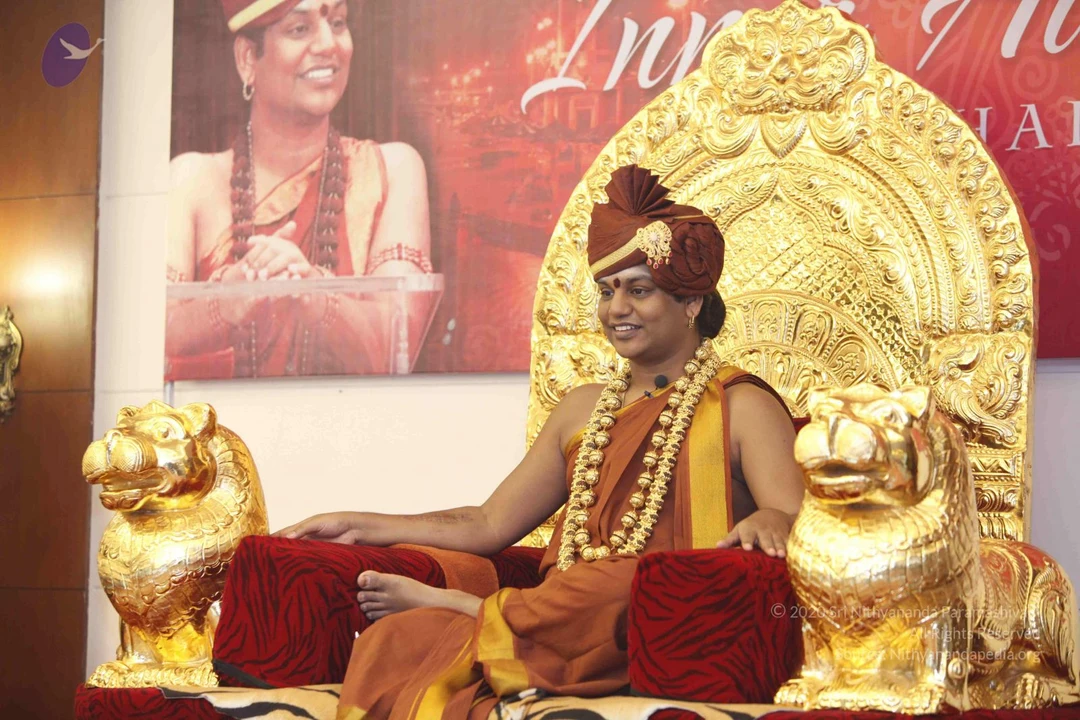
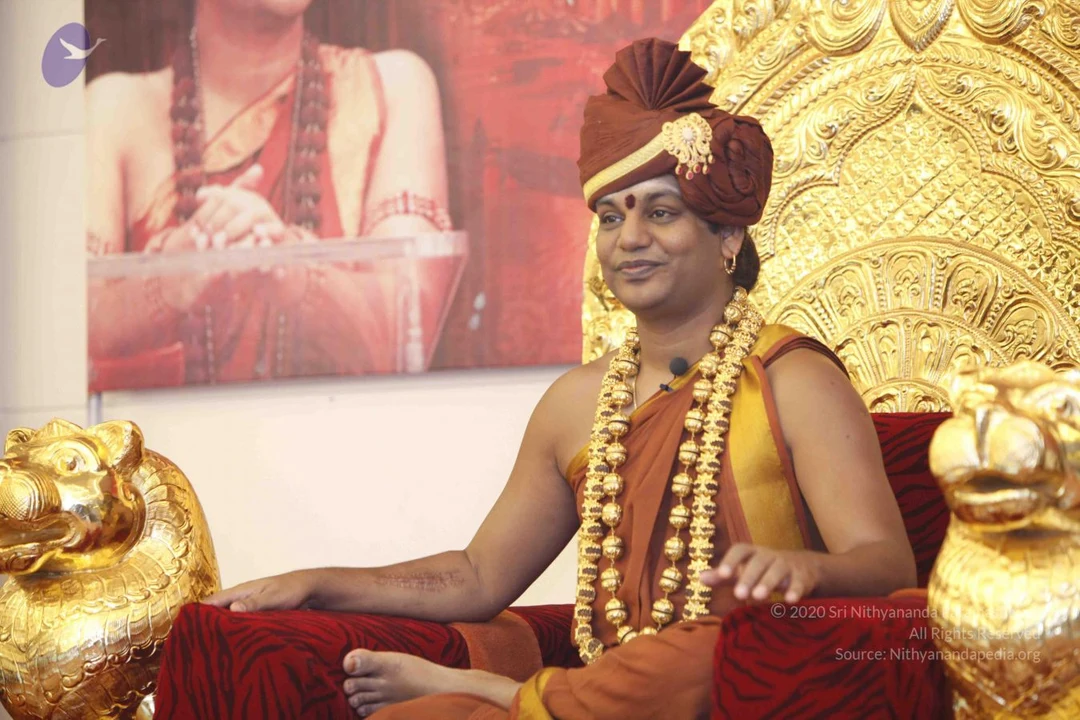
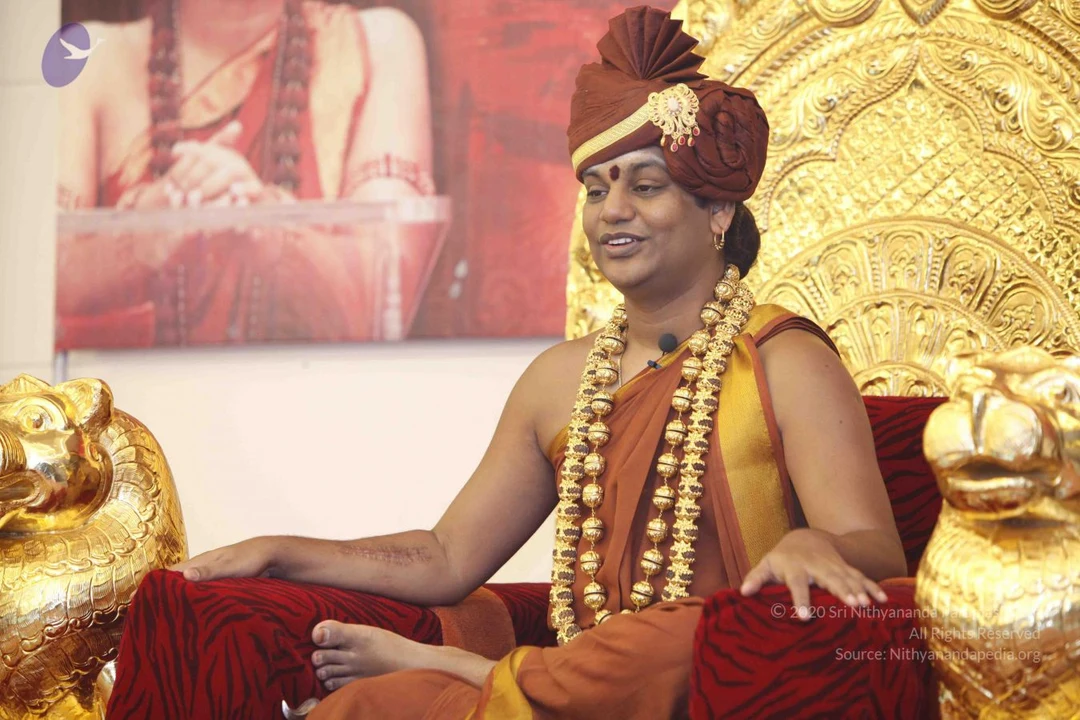
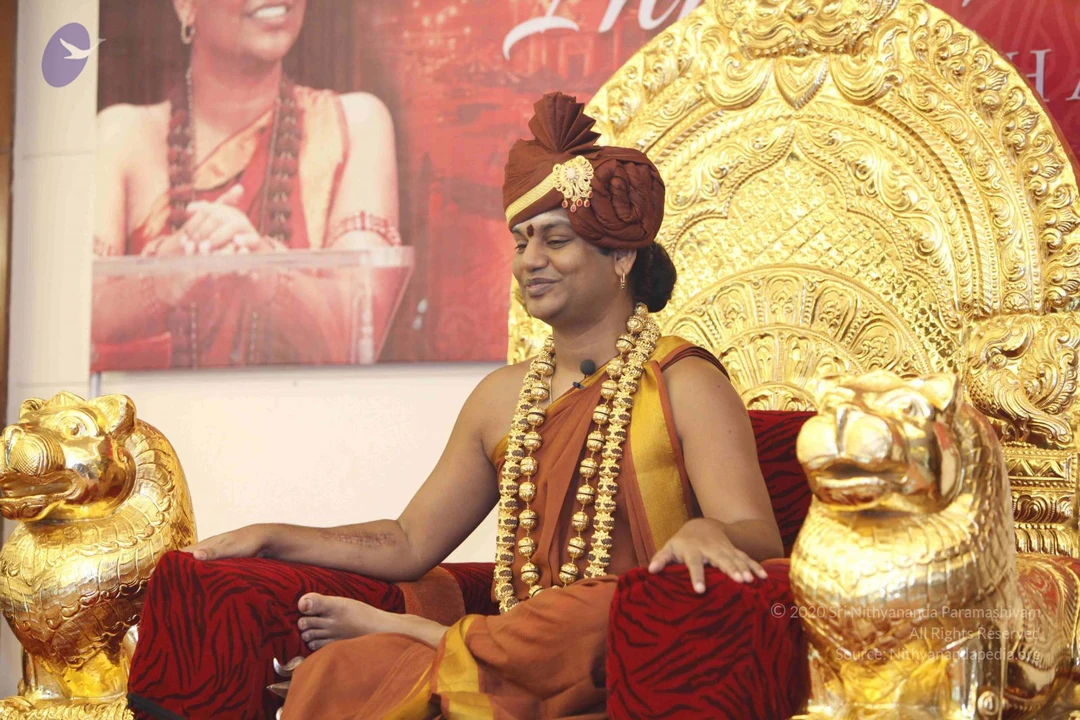
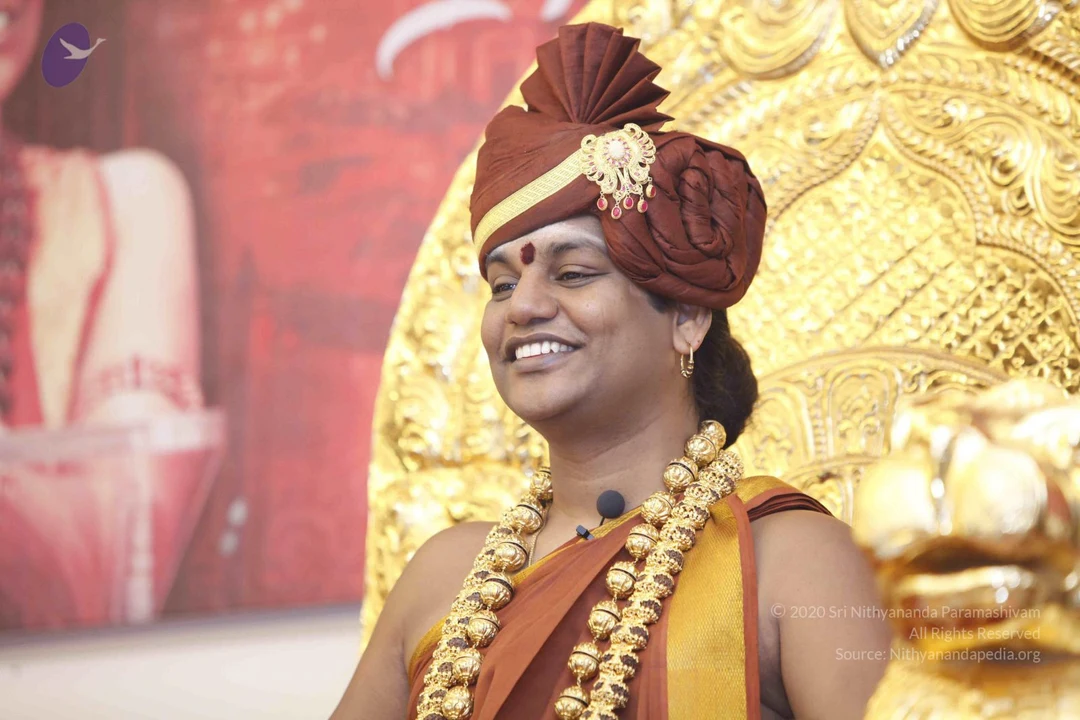
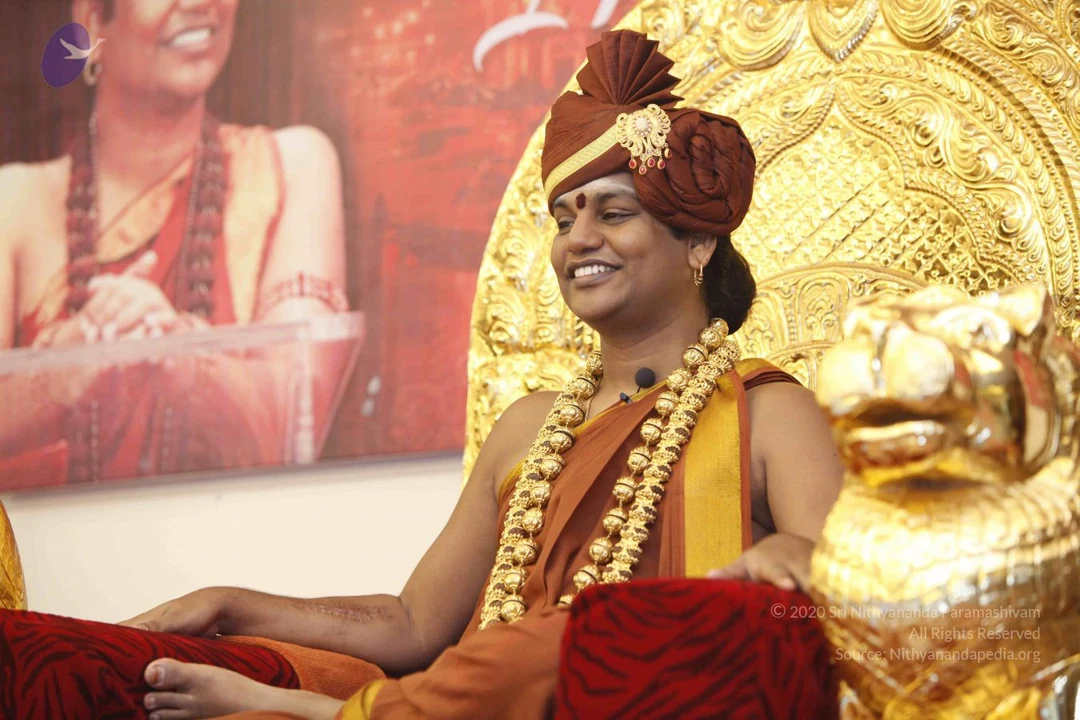
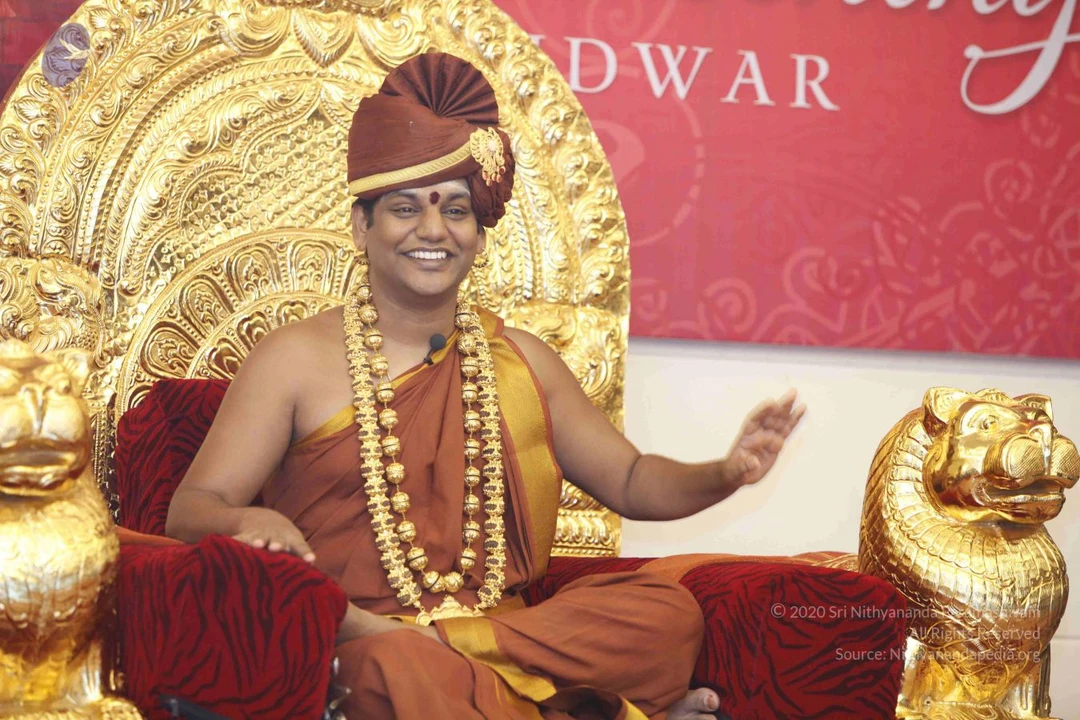
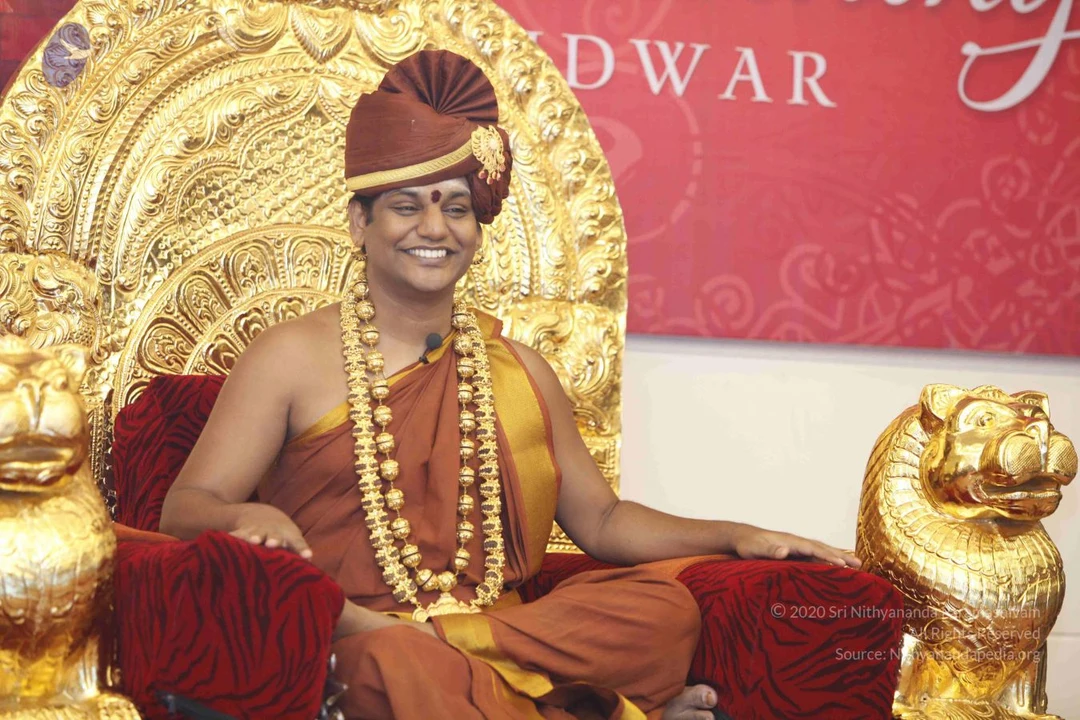
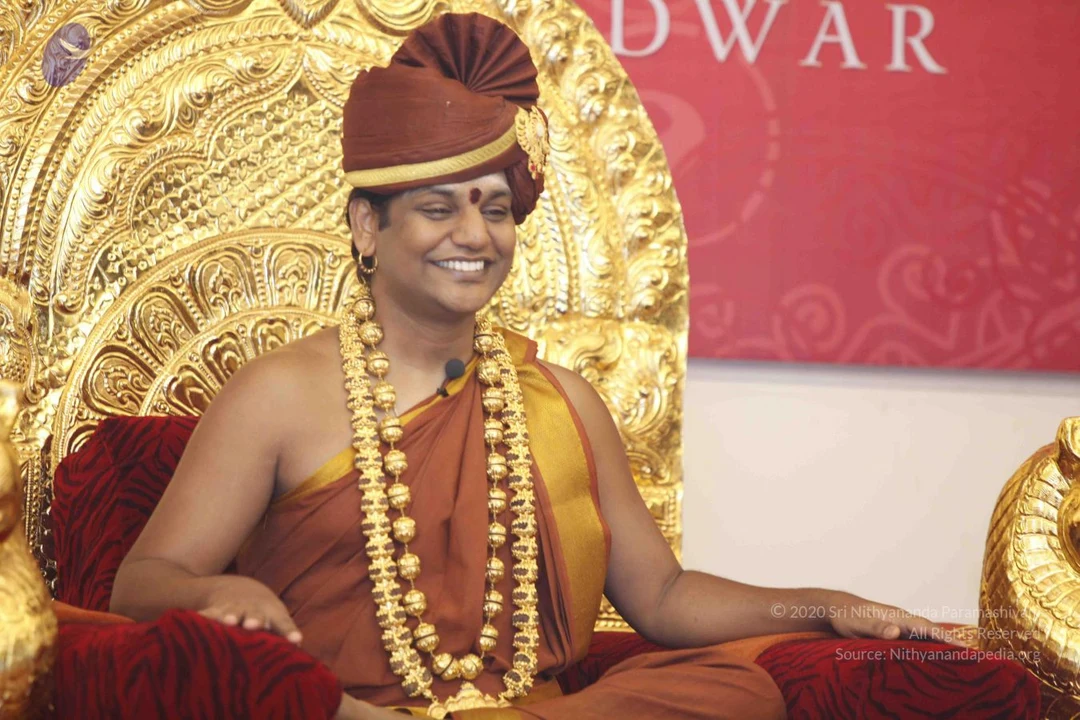
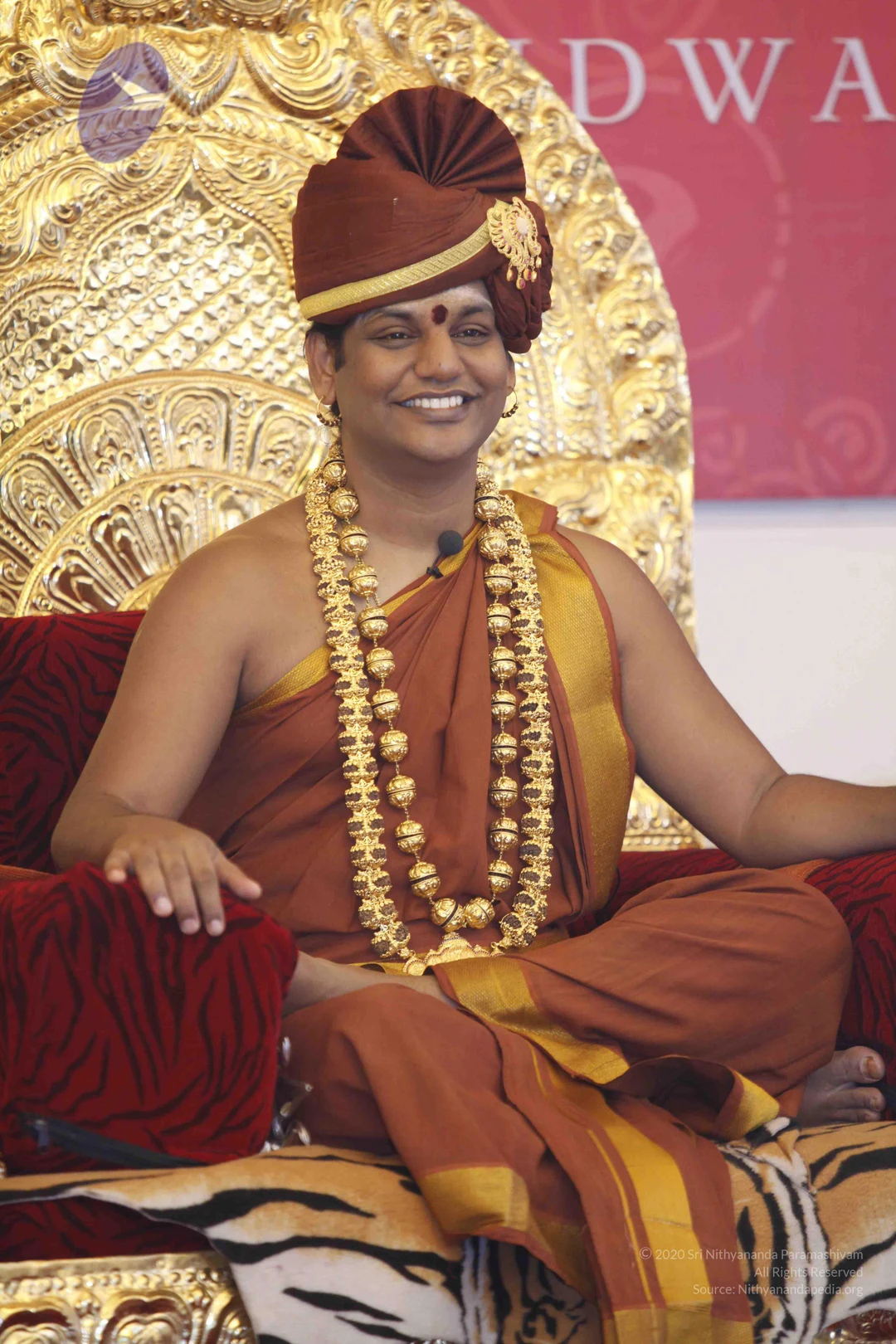
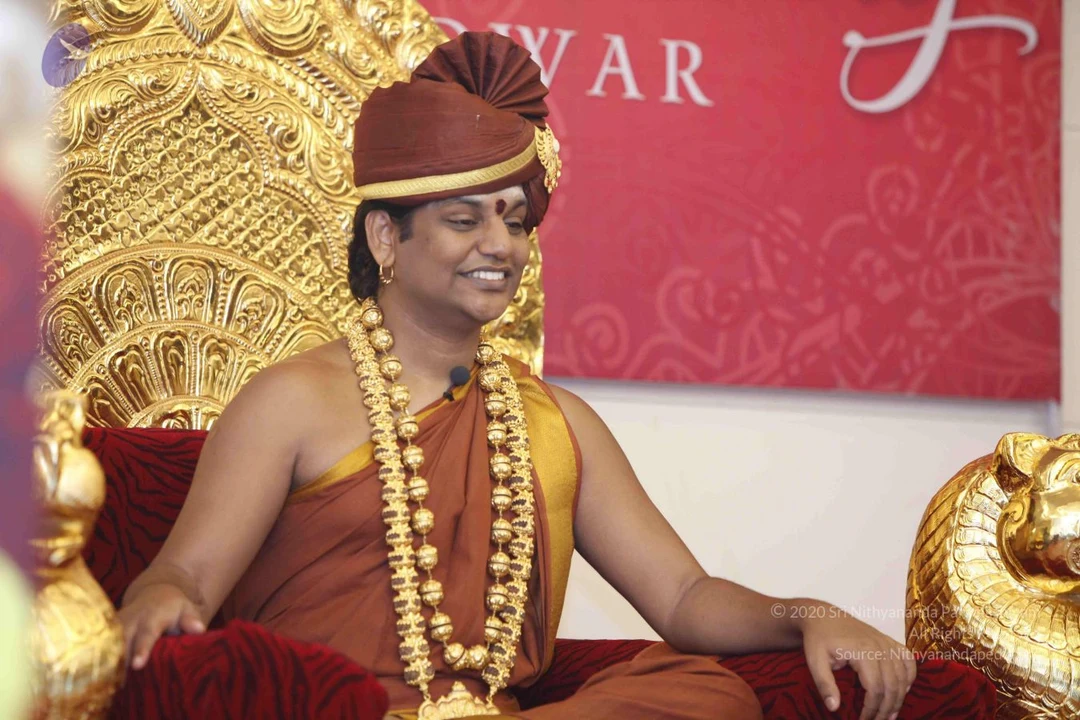
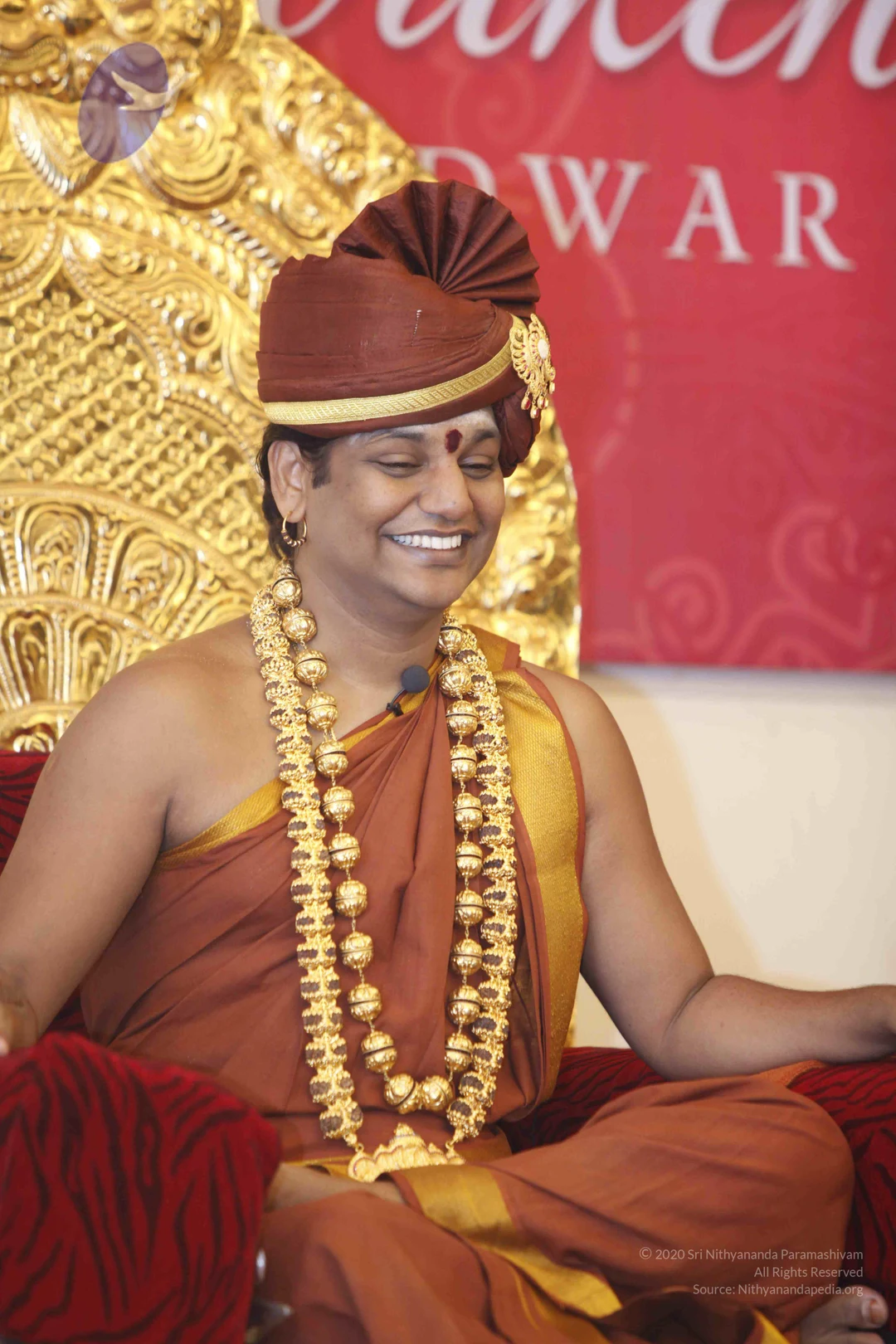
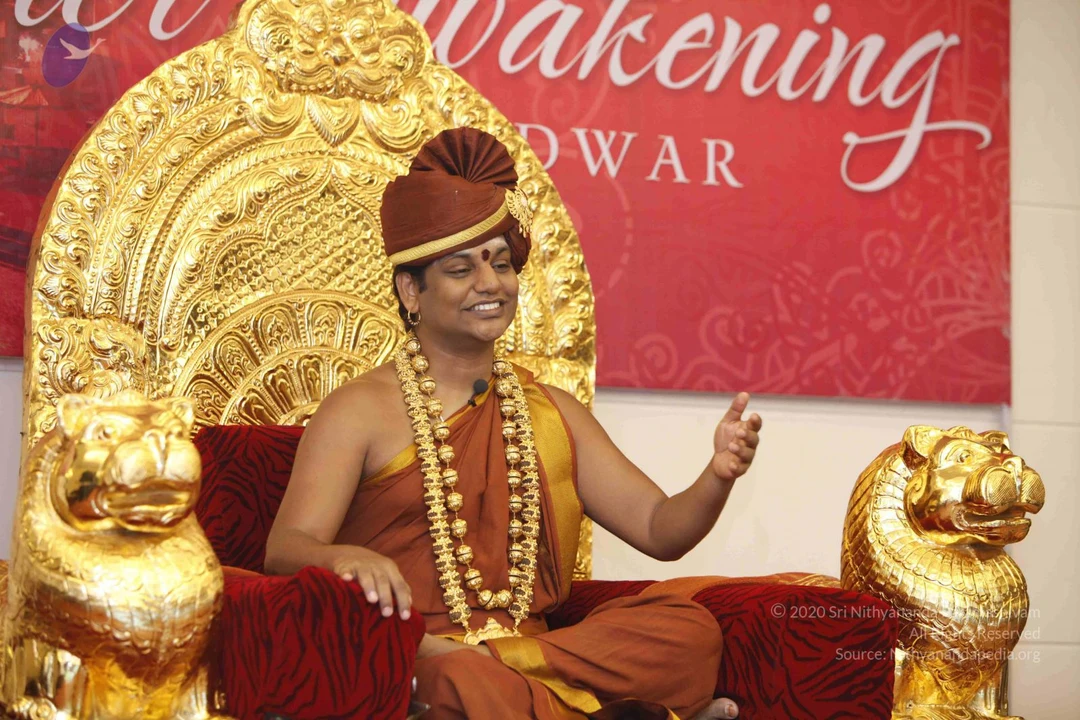
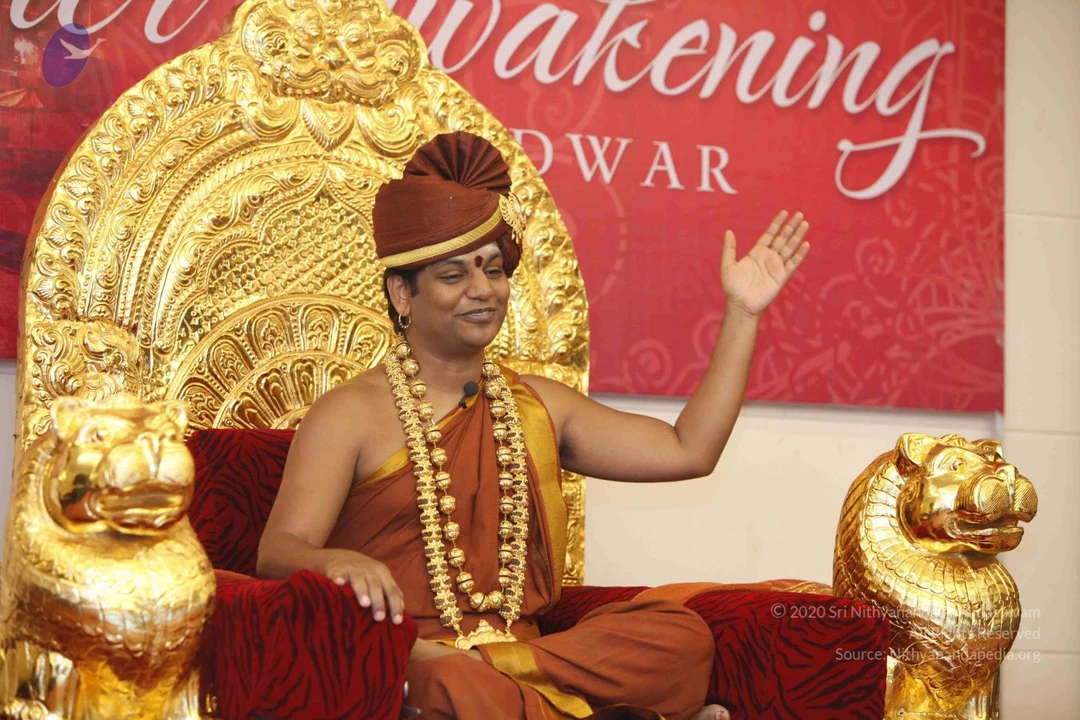
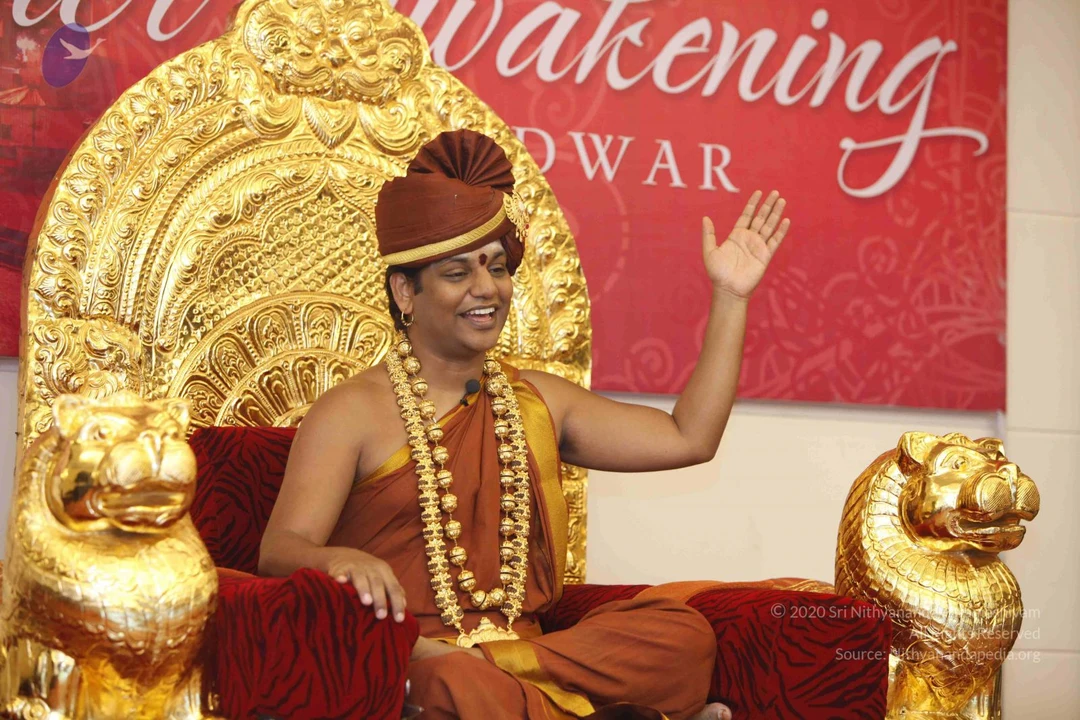
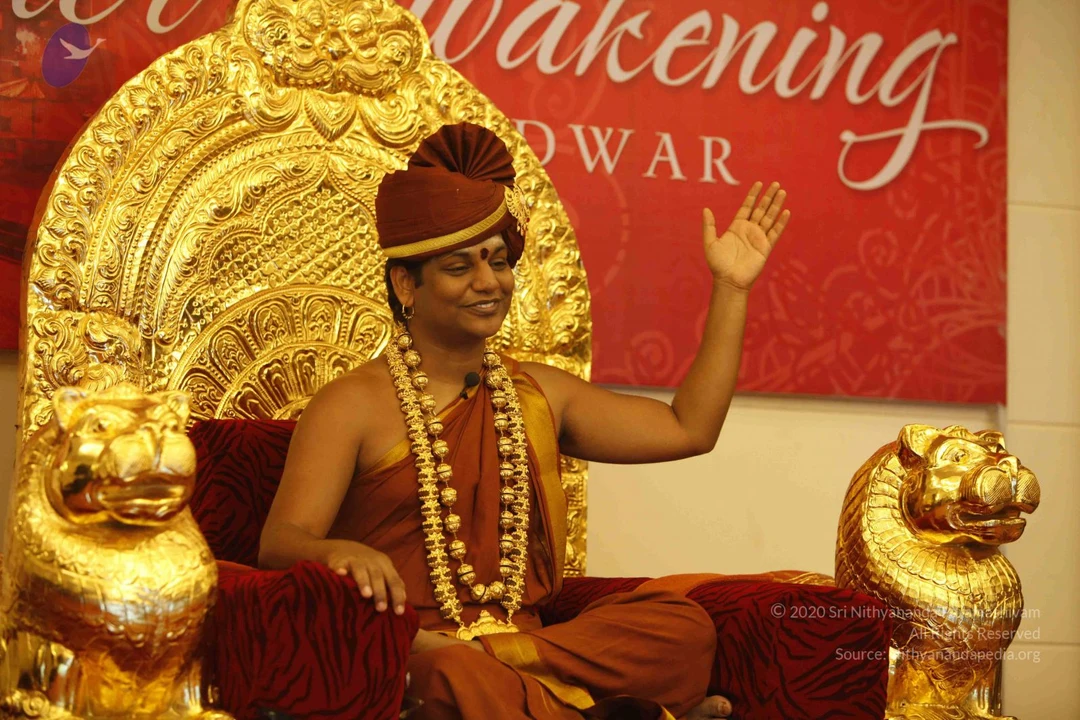
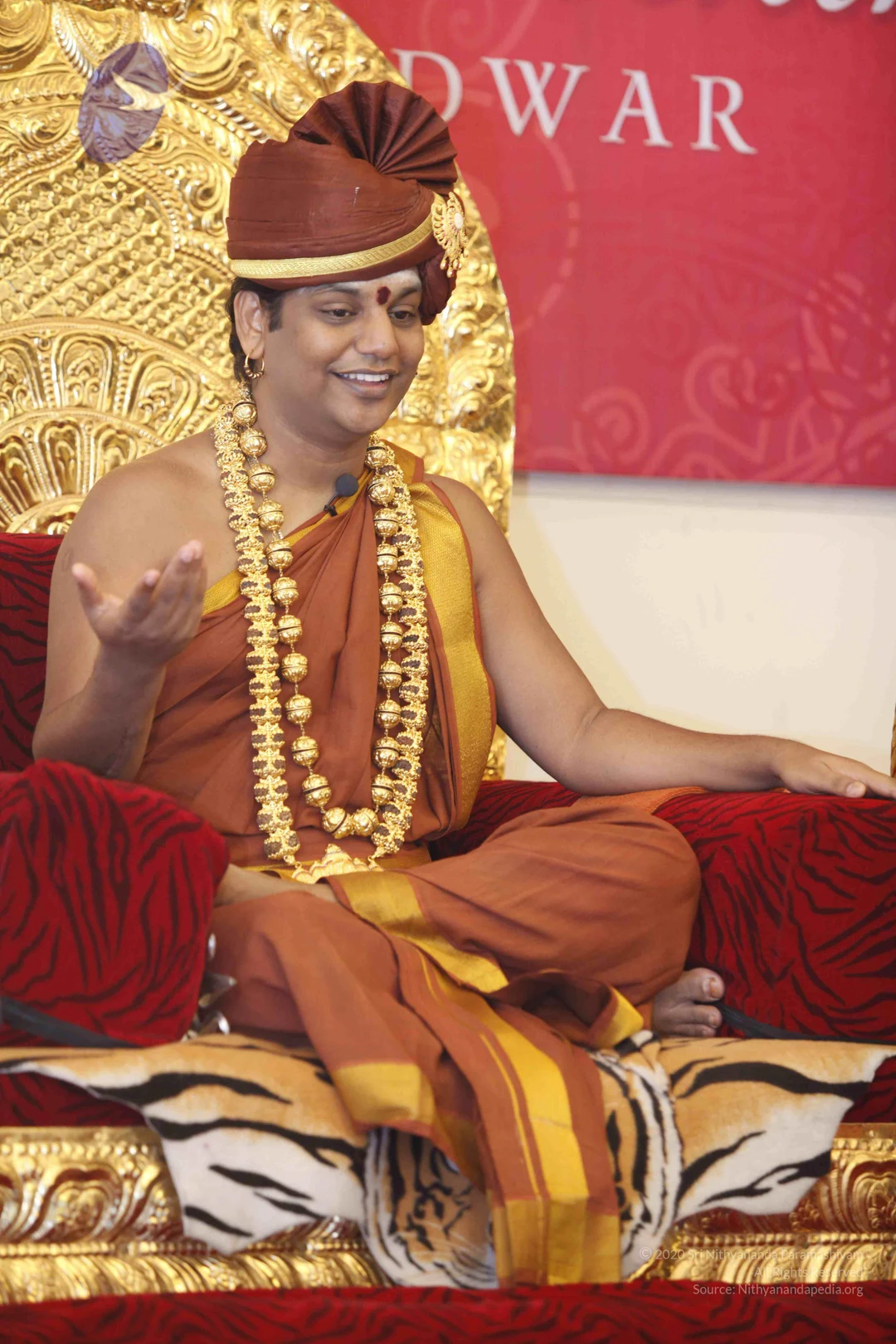
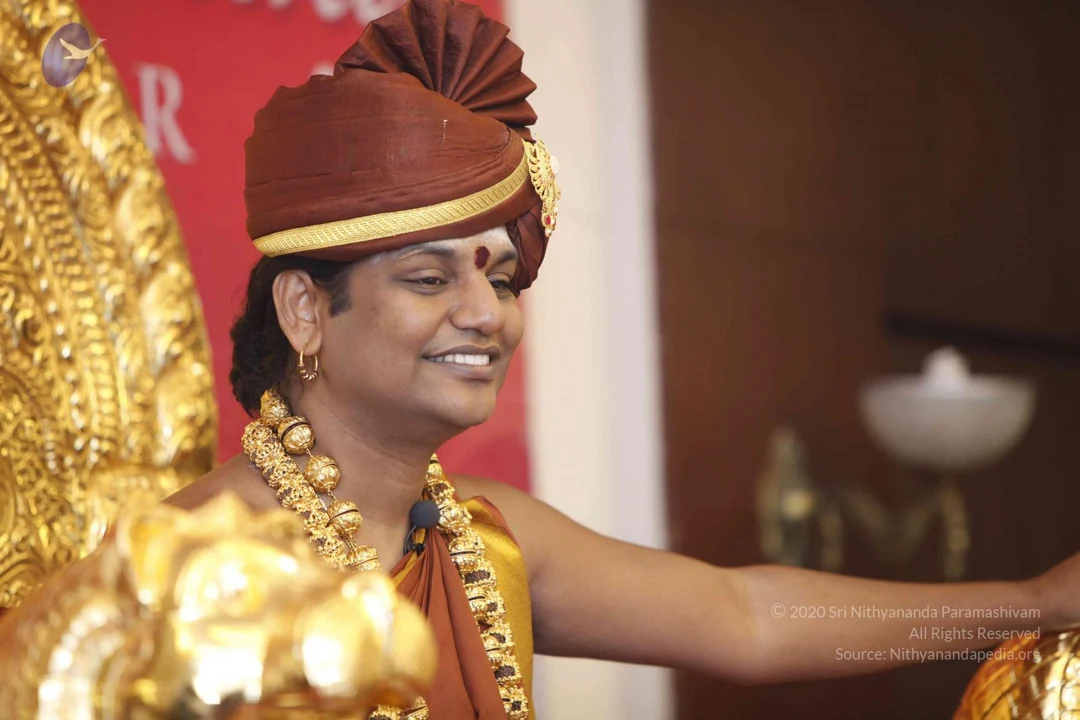
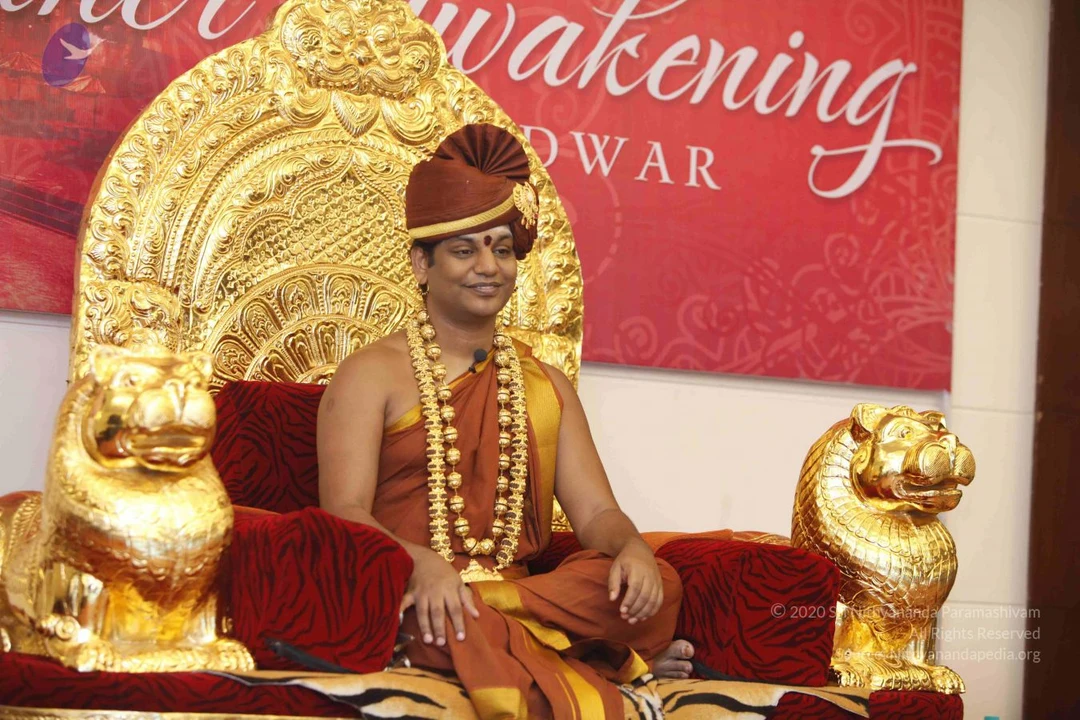
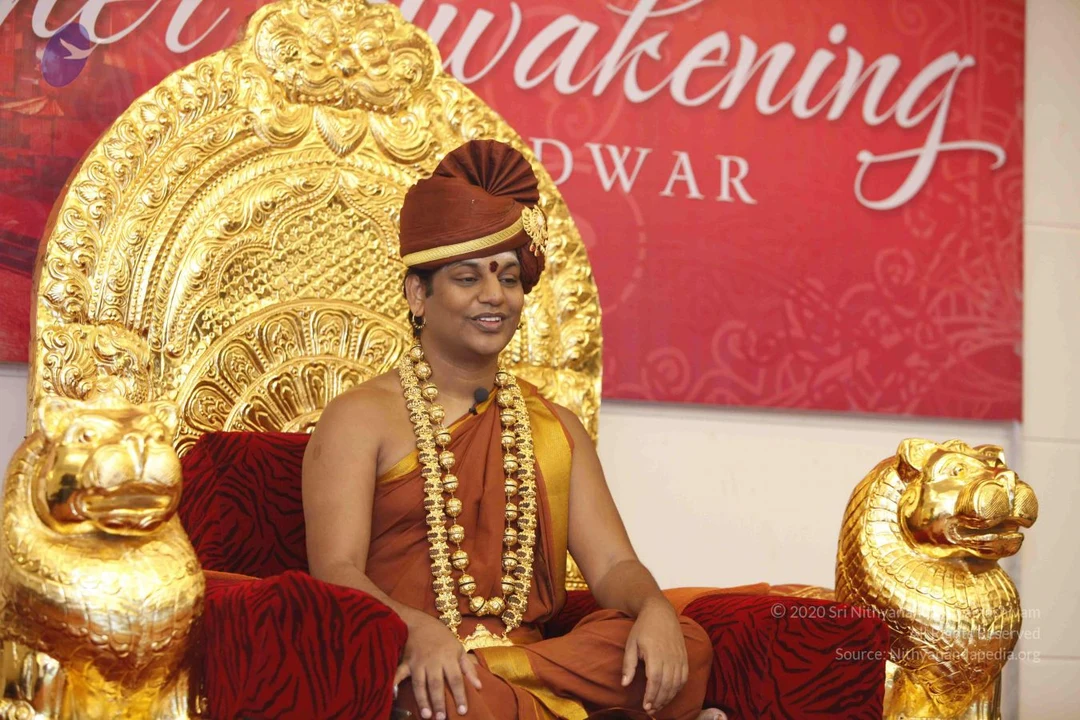
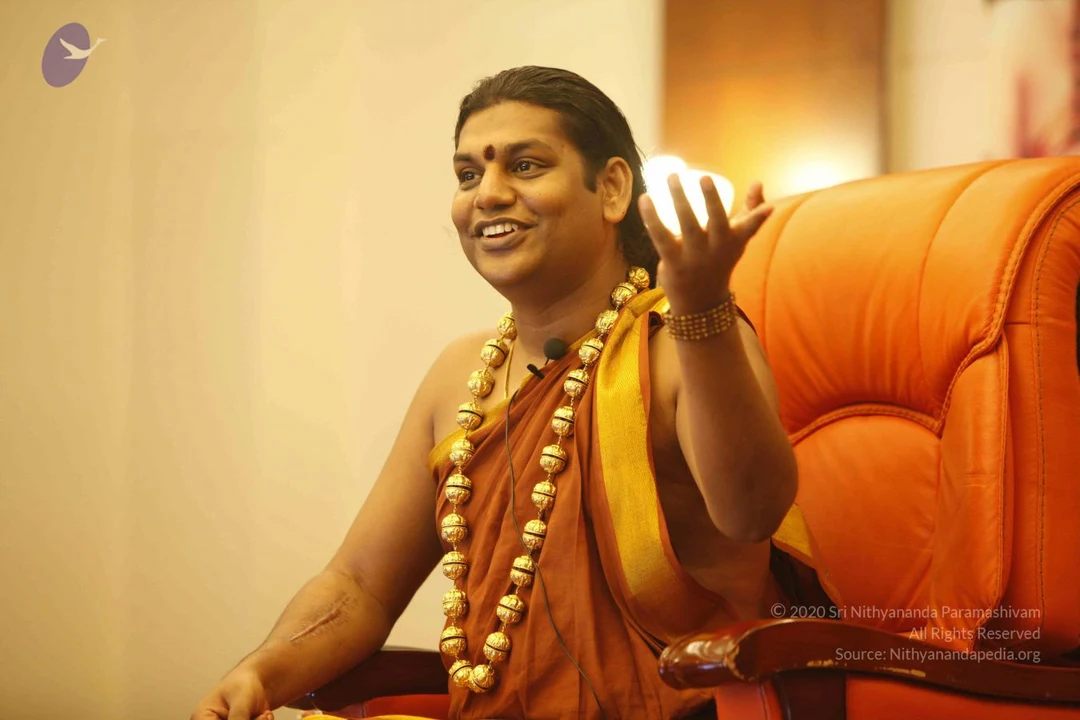
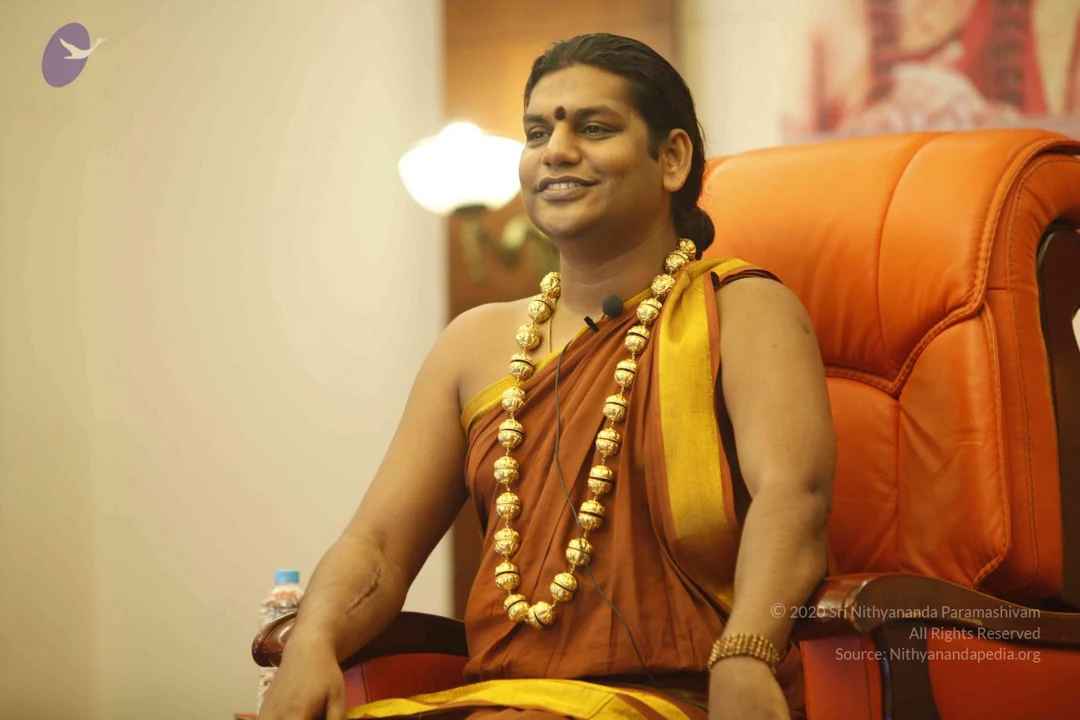
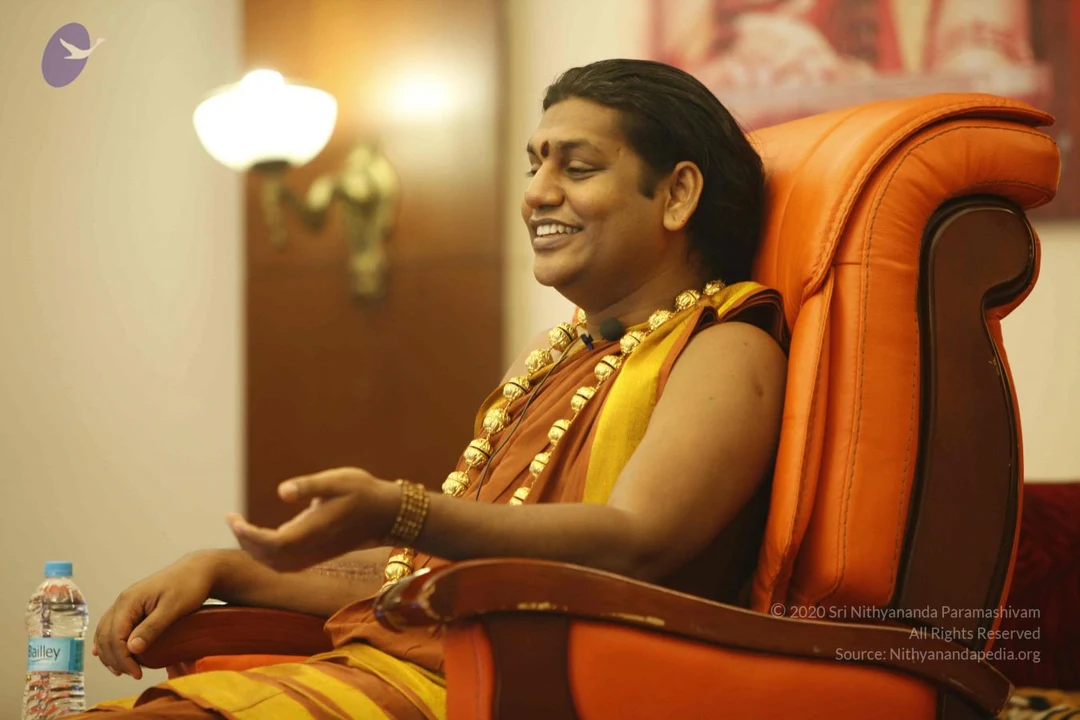
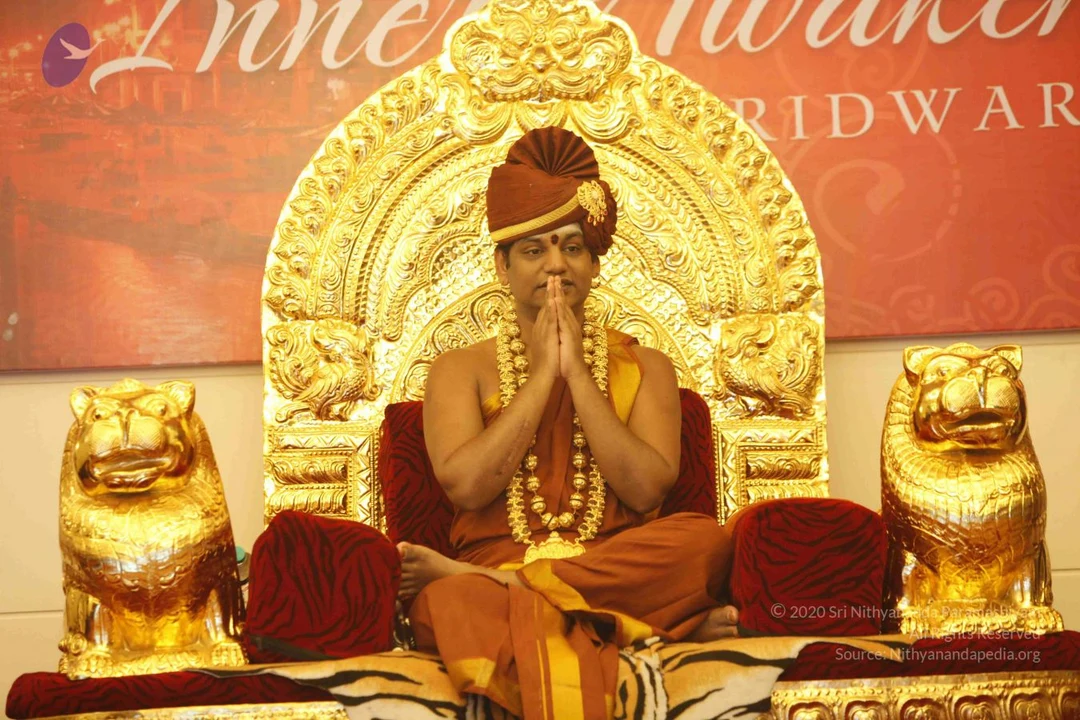
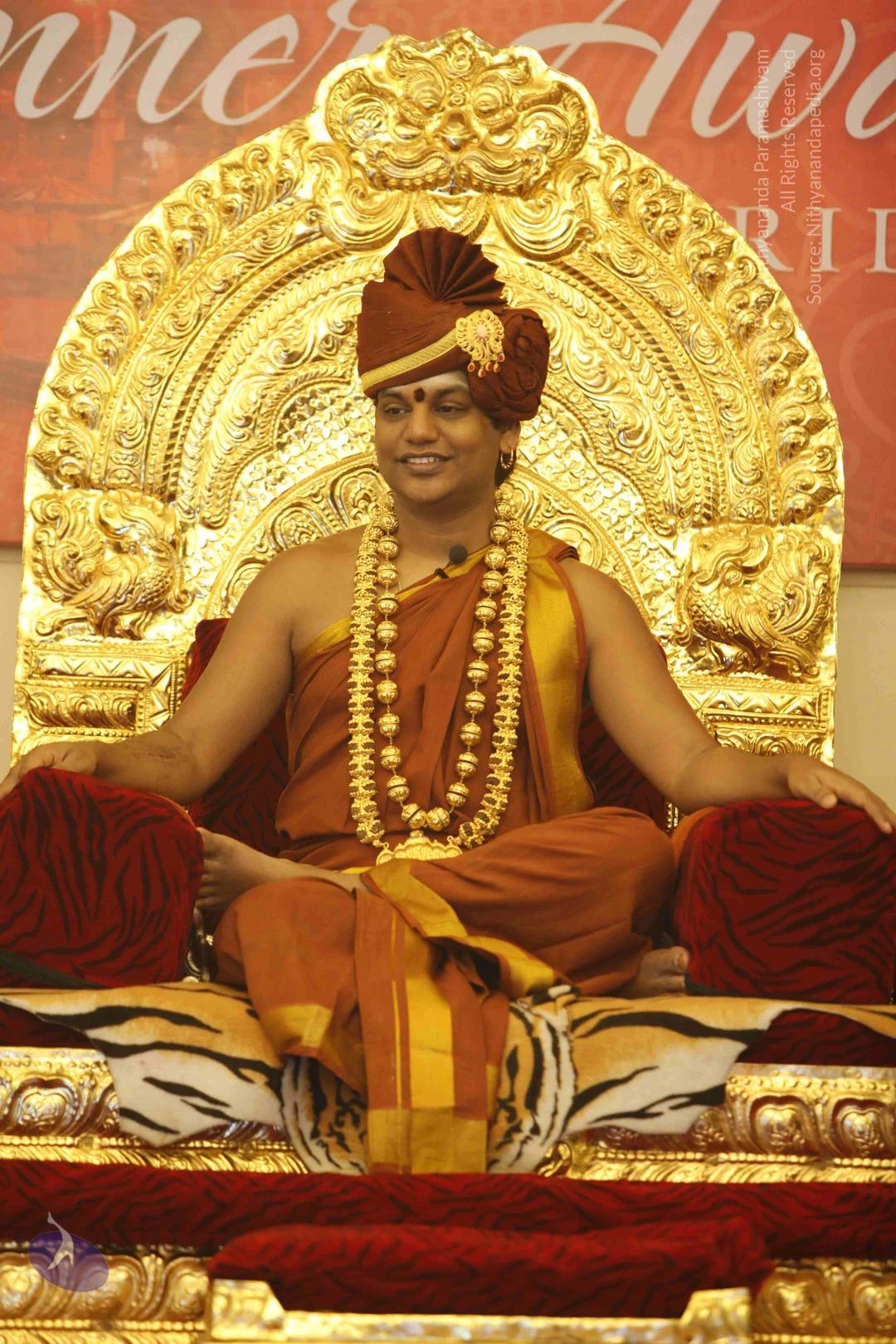
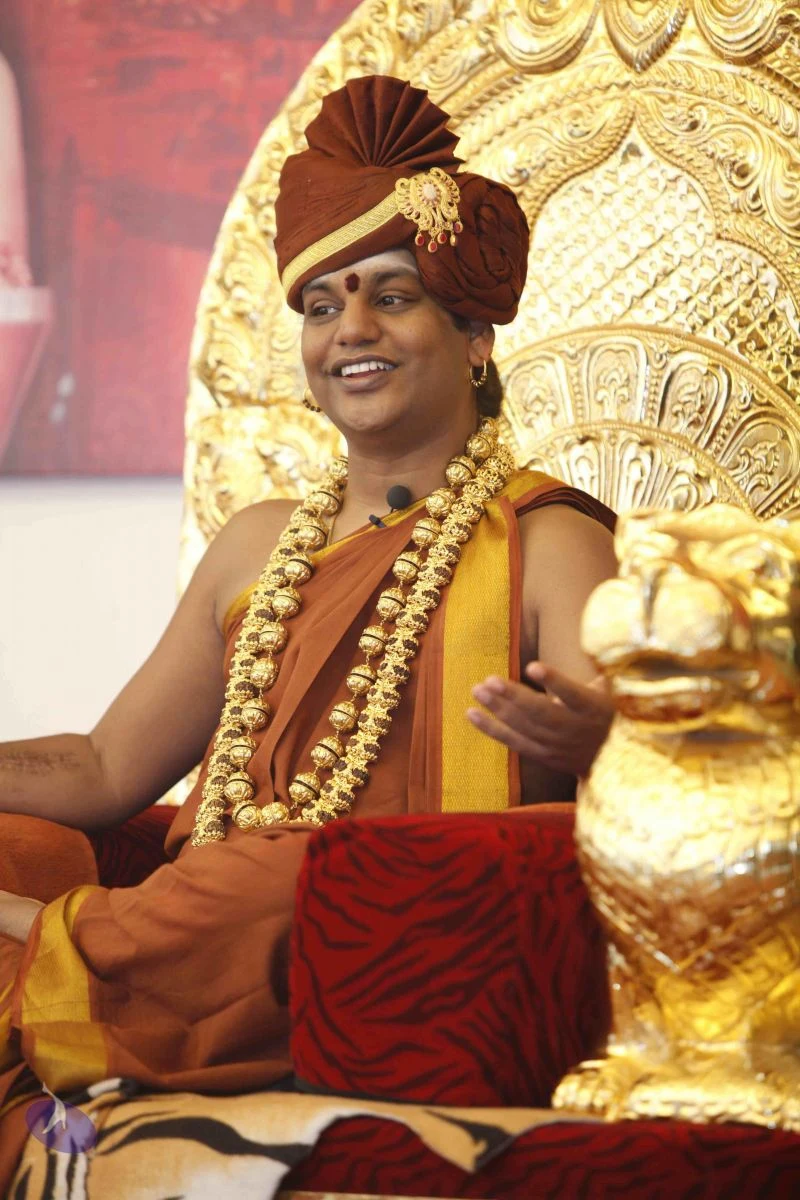
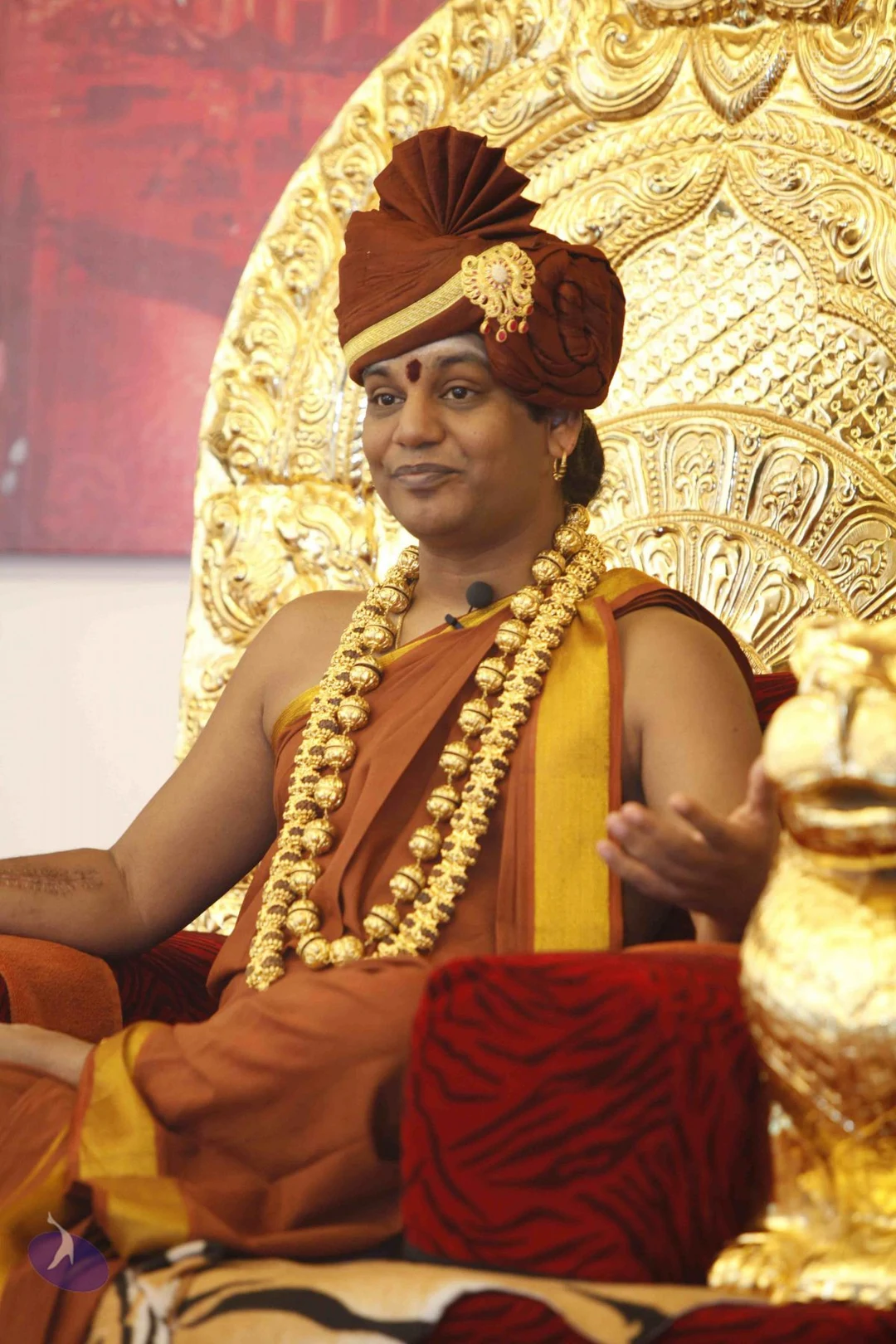
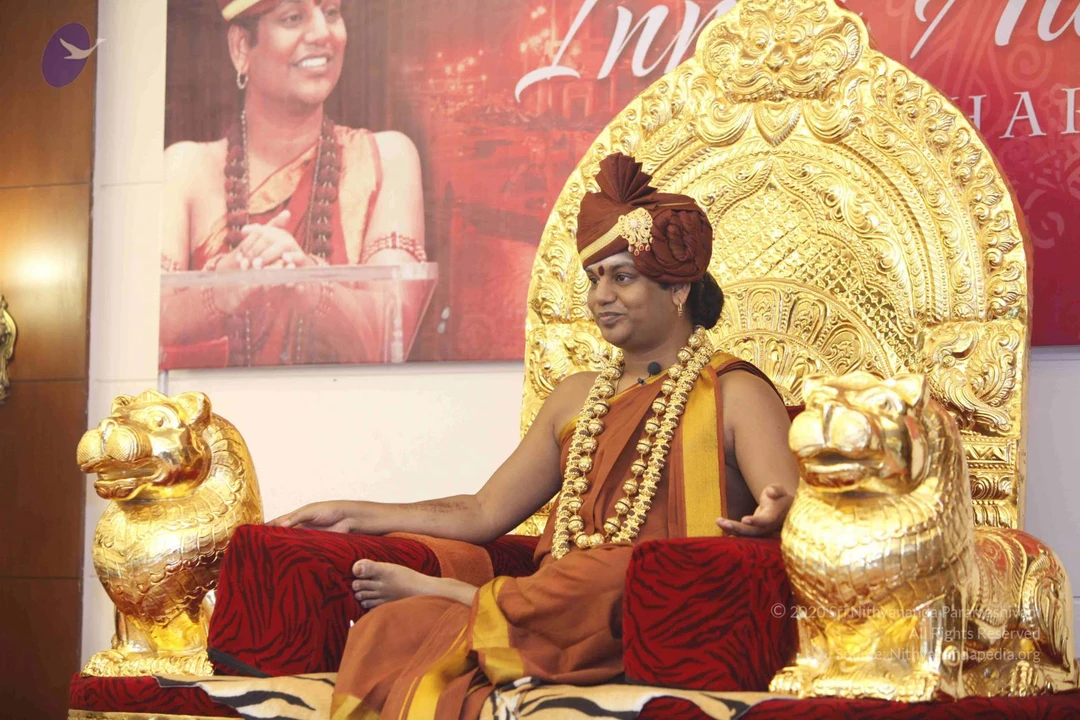
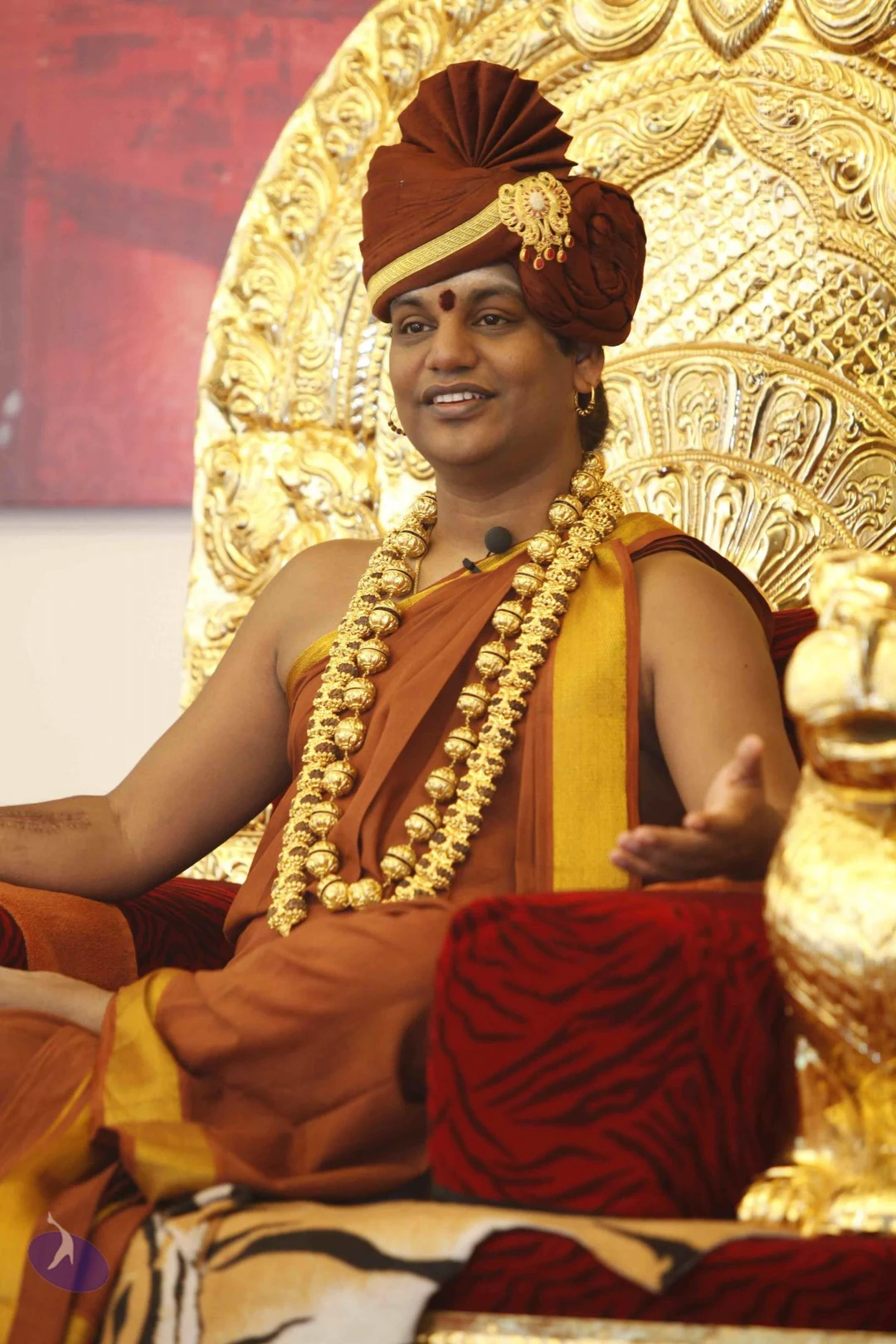
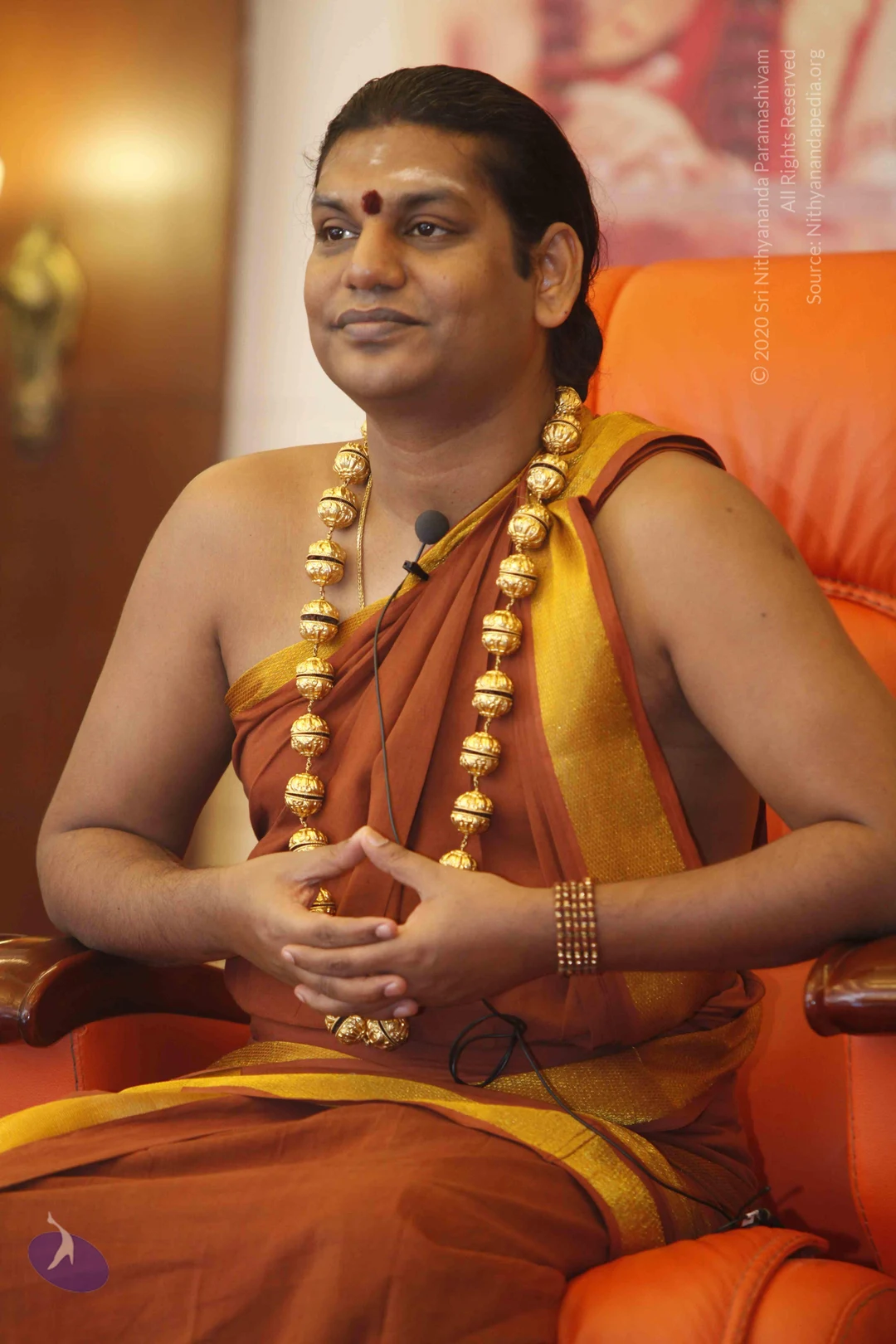
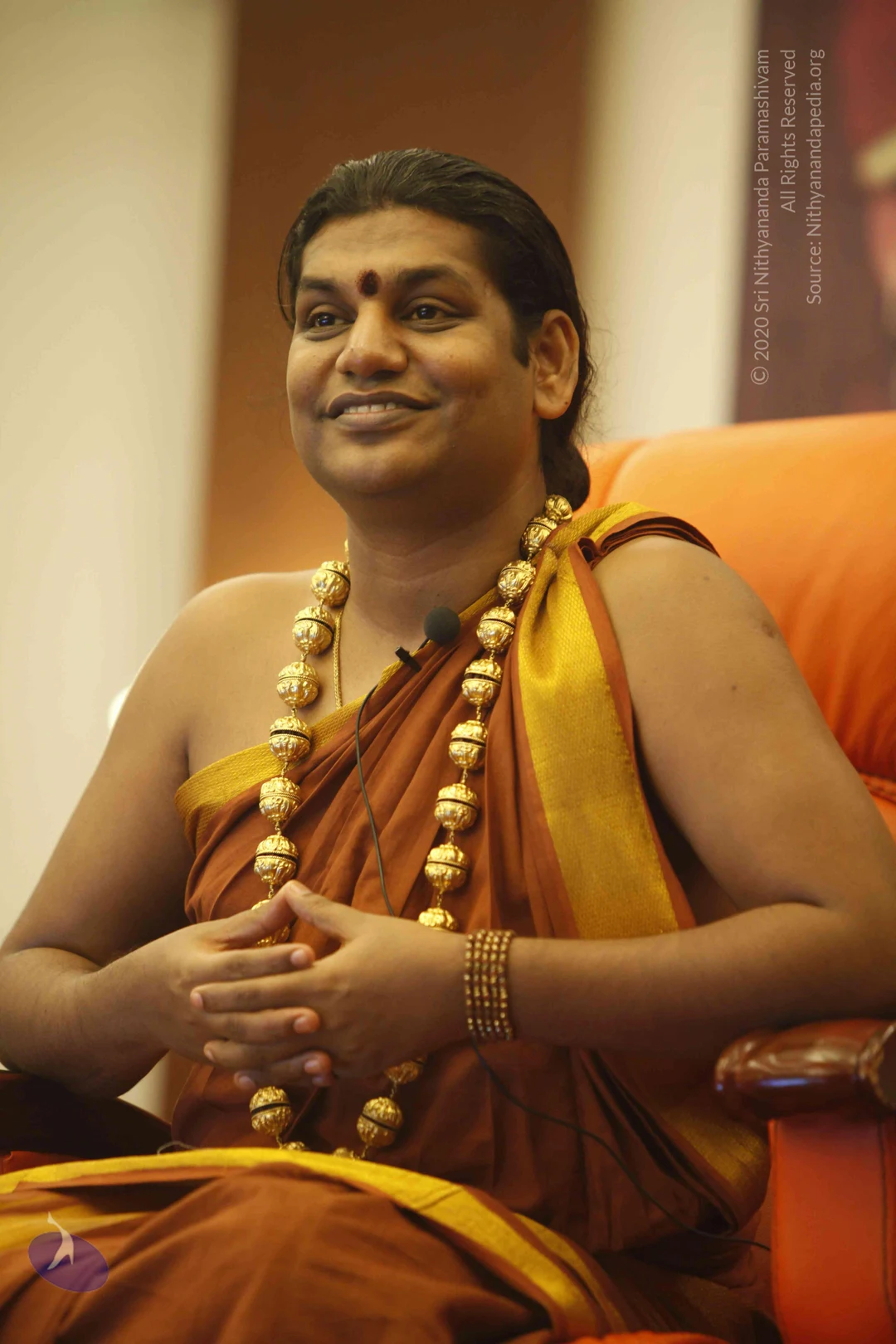
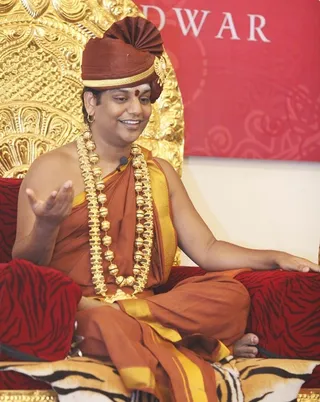
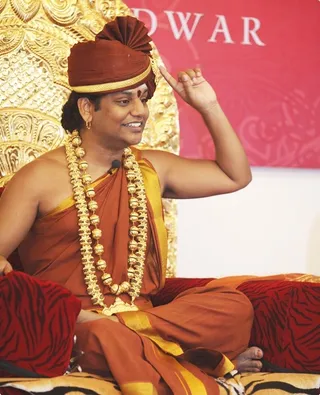
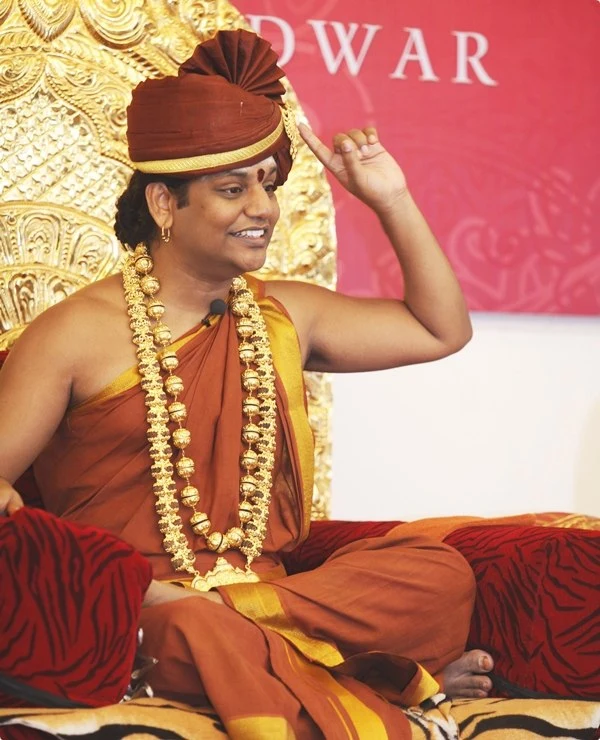
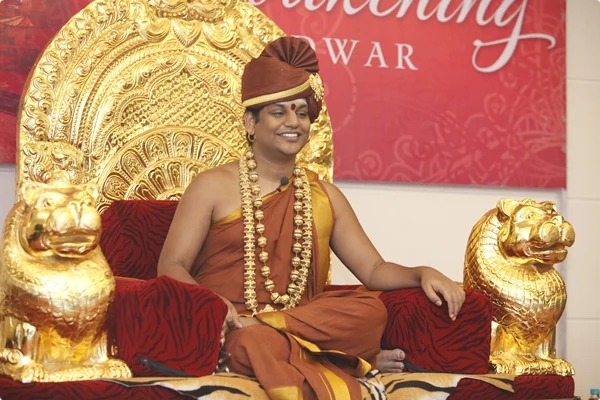
A seated man in a maroon and gold turban with a jeweled brooch smiles while sitting on a golden throne-like chair. He wears a dark red-orange saffron robe with a gold border and a heavy necklace of gold beads, plus a small red bindi and a microphone clipped to his robe. Behind him is a large red portrait of a smiling woman in a saffron garment holding a rudraksha mala. Appearance cues match a probable Swamiji: swept turban, saffron clothing, ceremonial gold necklace and rudraksha-style adornment. He is seated at a satsang with his legs crossed and bare feet visible.A smiling man sits cross-legged on a red and gold-patterned cushion in front of an ornate gold throne carved with floral and scroll motifs. He wears a maroon turban with a gold brooch, a red bindi, and a saffron-orange garment with gold border, along with multiple strands of heavy gold beads and a small clip-on microphone at his chest. A red banner with partial white lettering stands behind him. The appearance is consistent with the page's Swamiji reference, with cues of ornate gold ceremonial jewellery and a turban, so this is a probable identification from appearance, present in person.A seated man in saffron-orange robes and an orange turban sits on an ornate gold throne with lion-head armrests and red velvet cushions. He wears a long gold-bead necklace and a dark rudraksha-style mala, and raises one hand in a gesturing motion while smiling. Behind him a red banner with gold cursive lettering and floral patterns frames the stage. The scene resembles a satsang or discourse. Swamiji (probable): the seated man has a swept-back hairstyle under the orange turban, a gold ceremonial necklace and saffron robes, consistent with the page's description of a morning satsang. He is the only person visible.A seated man in a maroon-red turban with a gold ornament and a red-brown saffron-toned dhoti and shawl with gold border, wearing long ornate gold bead necklaces, sits on a red and black tiger-striped cushion before an ornate gold throne with embossed floral carving. He smiles and gestures with his right hand raised, while his left hand rests on the armrest. A red tilak mark is on his forehead. Behind him is a red banner with partial white lettering reading DWAR. One person is visible.A seated man in orange-saffron robes sits on a golden ornate throne with red and tiger-striped cushions, gesturing with his raised right hand near his head. He wears a dark maroon turban, a red bindi, gold earrings and long multi-strand gold beaded necklaces with a gold pendant. A small clip microphone is on his collar. Behind him is a red backdrop with white lettering reading 'DWAR' and a decorative pattern.

utsava murthy

3 photosSource gallery
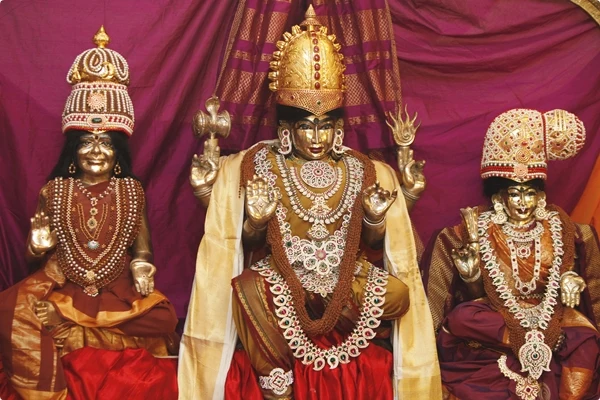
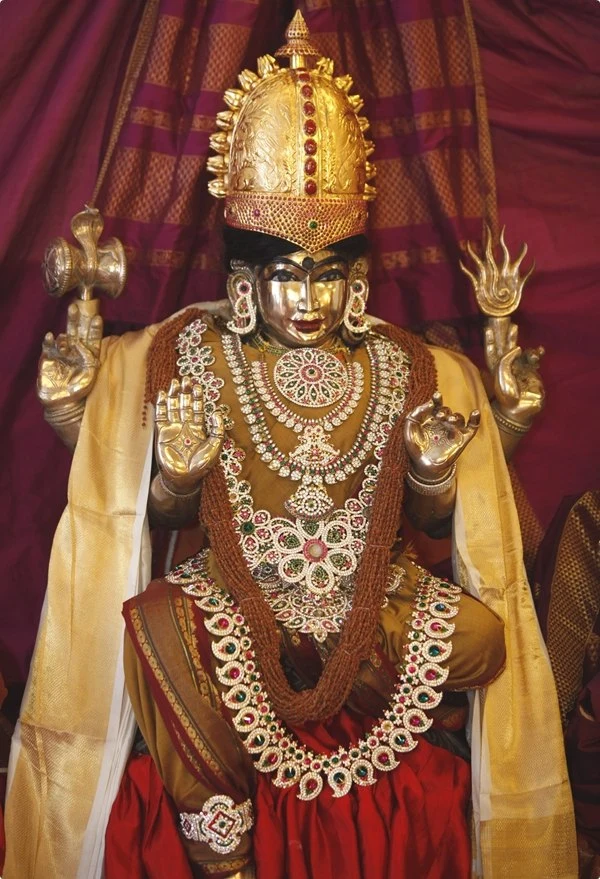
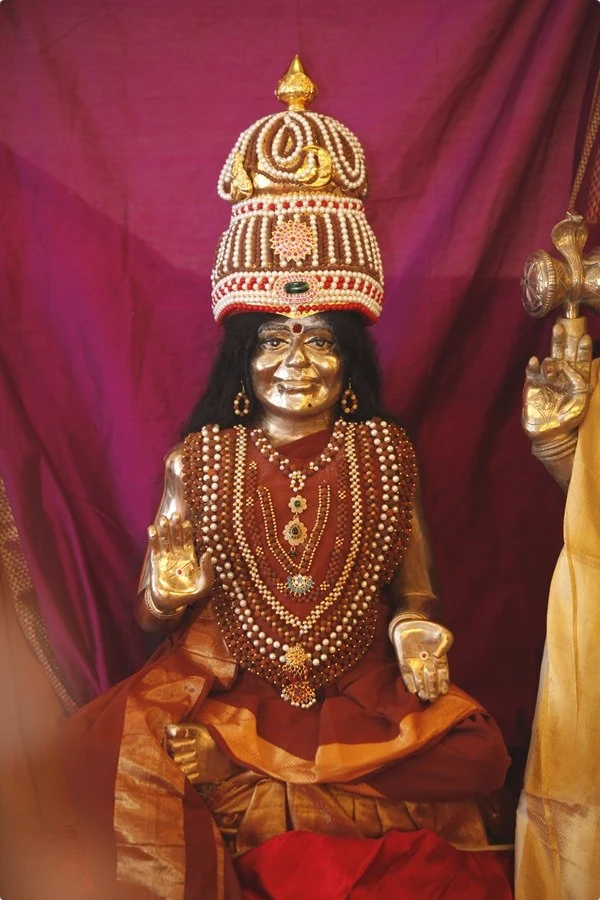
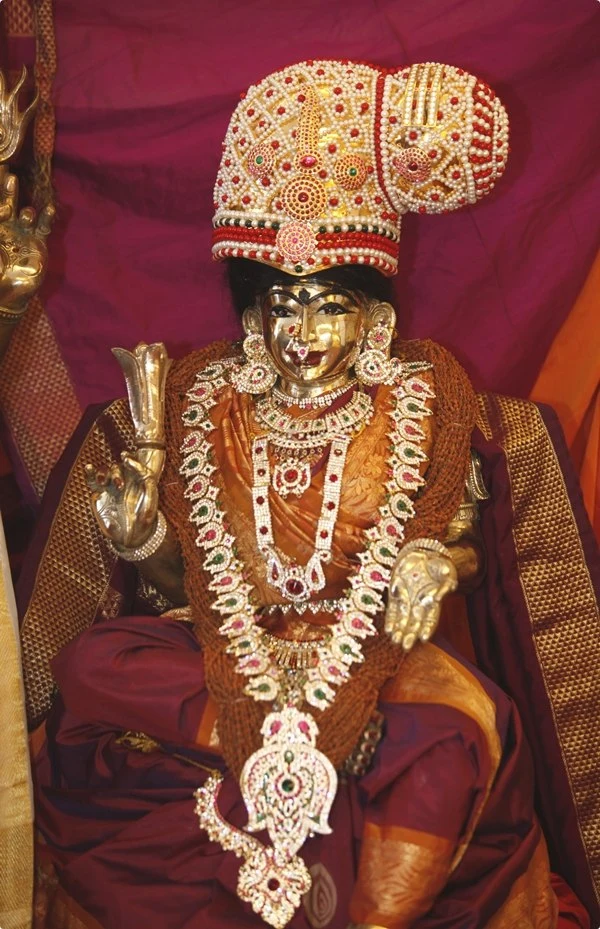
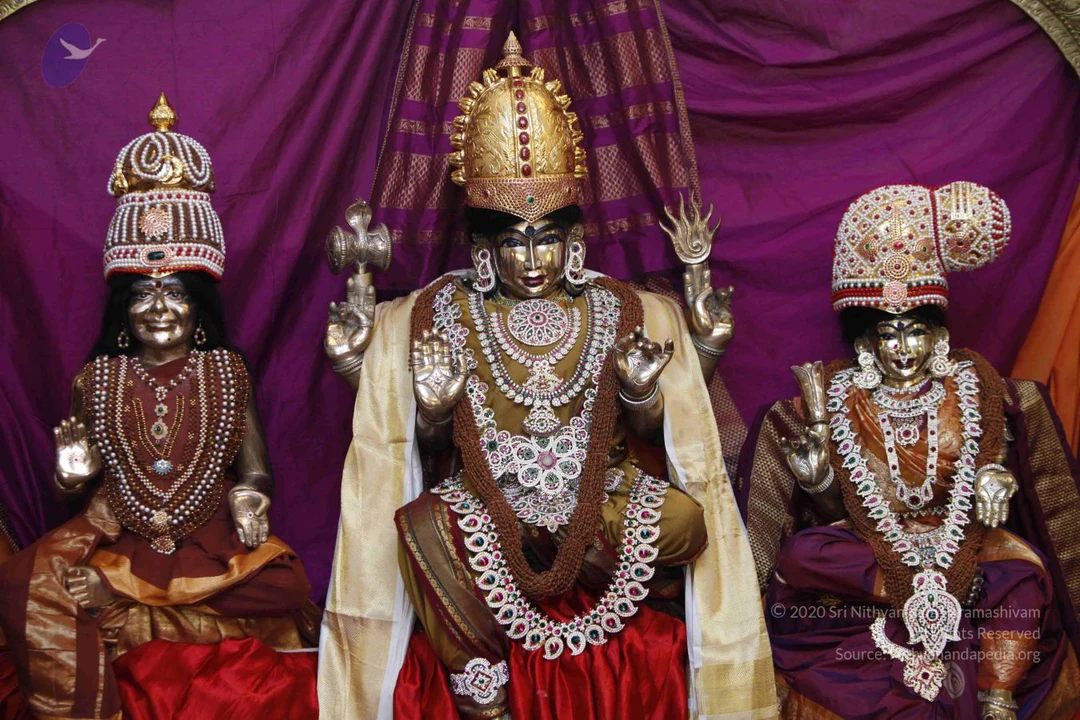
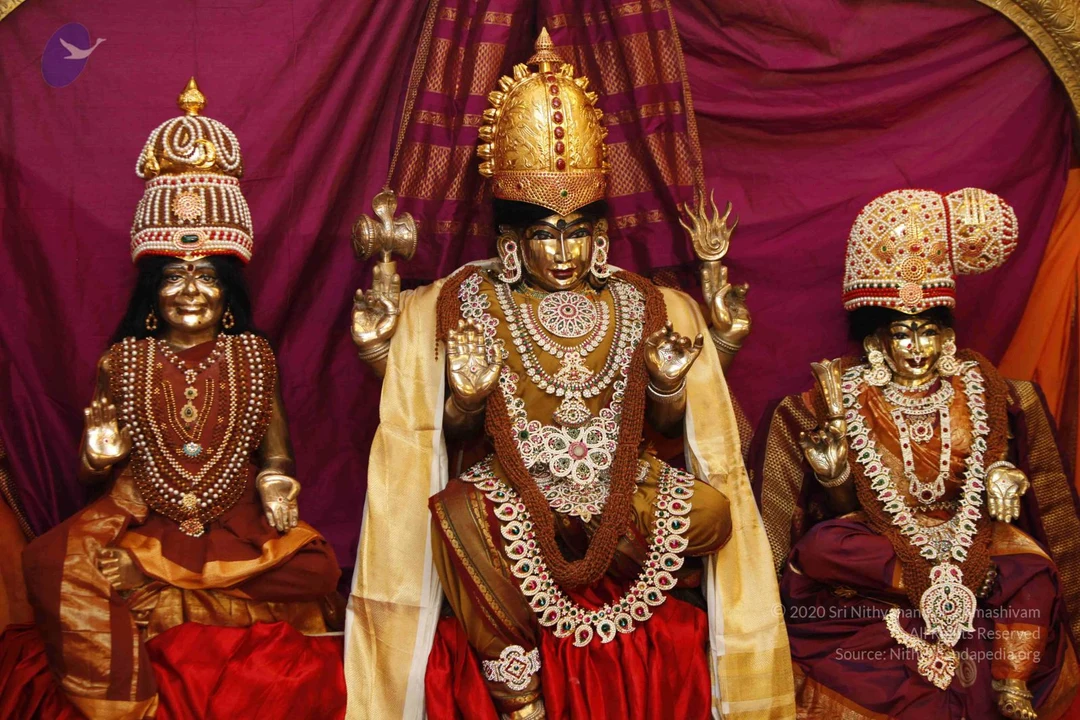
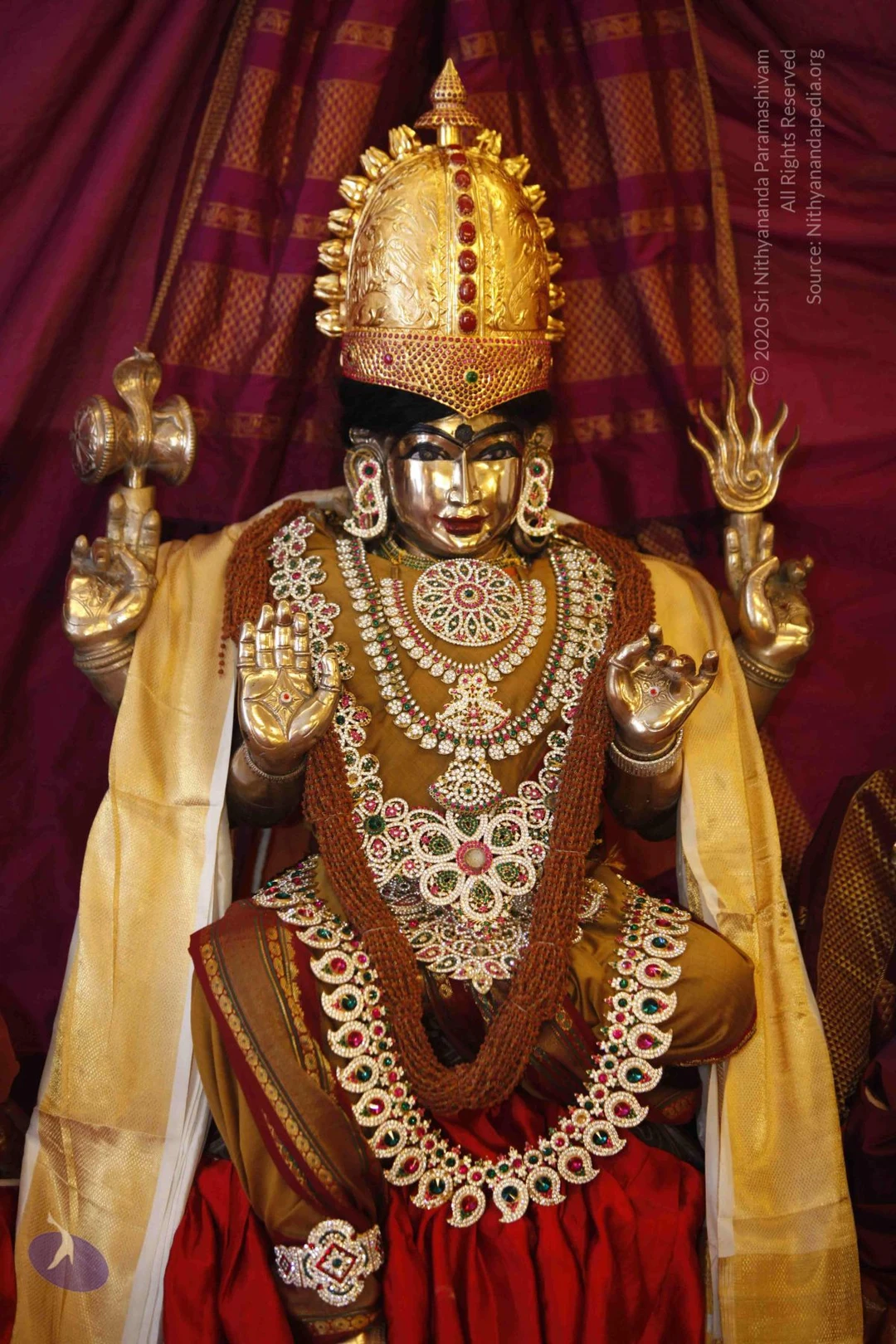
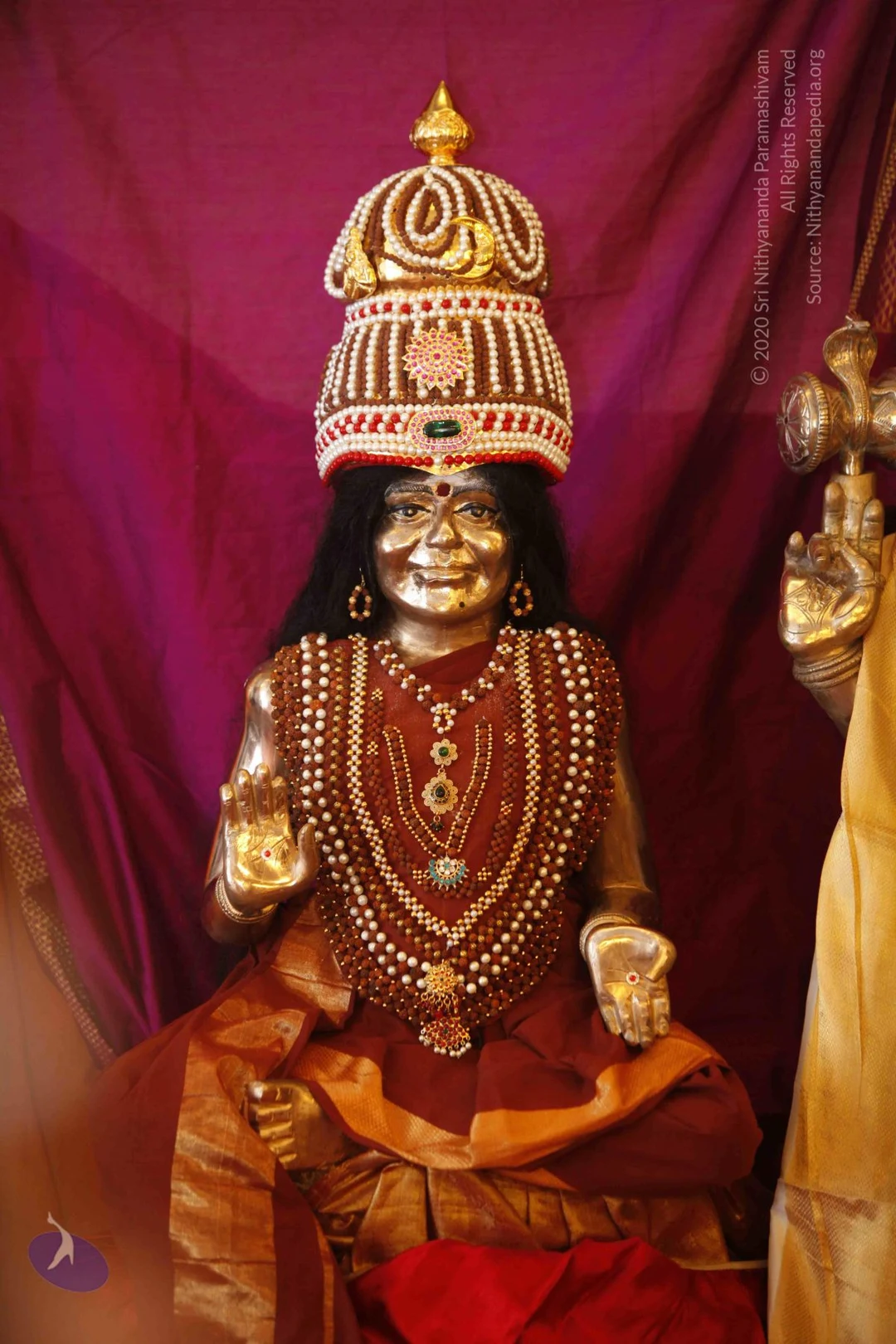
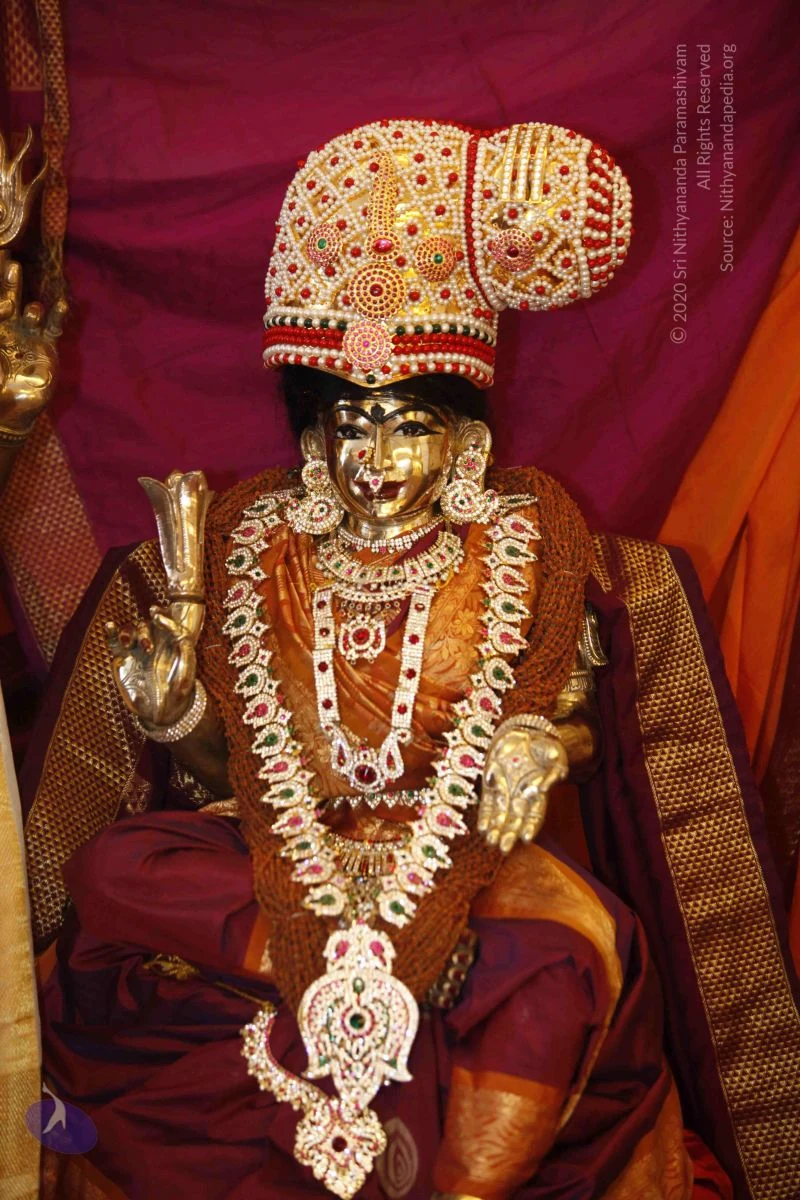
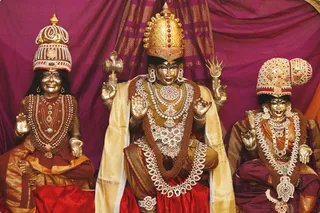
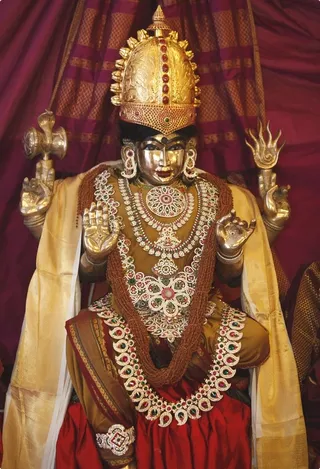
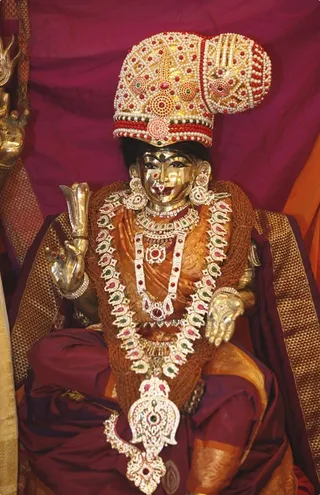
Three golden murti statues of deities are seated on a maroon draped backdrop, decorated with layered jewelled necklaces, garlands and ornate crowns. The central figure wears a tall gold crown, cream shawl and red-gold skirt, holding raised hands with ritual objects. Flanking figures wear decorated red and pink crowns, red-brown saris, and beaded necklaces. No physical people are visible.A gilded metal murti of a four-armed deity stands against a maroon and gold draped backdrop. It wears a tall golden crown set with red stones, a gold-and-white silk shawl draped over the arms, layered jeweled necklaces with green and red stones, a rudraksha-style bead mala across the chest, a red skirt and a golden dhoti. The upper hands hold a mace-like staff and a trident, while the lower hands are in blessing and gesture poses. The idol is decorated with jewelry in a temple-style display.A gilded metal deity murti seated on a dark maroon cloth backdrop, wearing an elaborate jewelled crown of white pearls, red and green stones and gold rosettes. It is draped in a brown-orange silk garment with a gold-bordered maroon shawl, layered gold necklaces, a long garland of pink, green and white gems and red stones, and drop earrings. The right hand is raised in a blessing gesture and the left rests on the lap. Brass lamp stands are visible at the left edge. This is a statue, not a living person.

Satsang

31 photosSource gallery
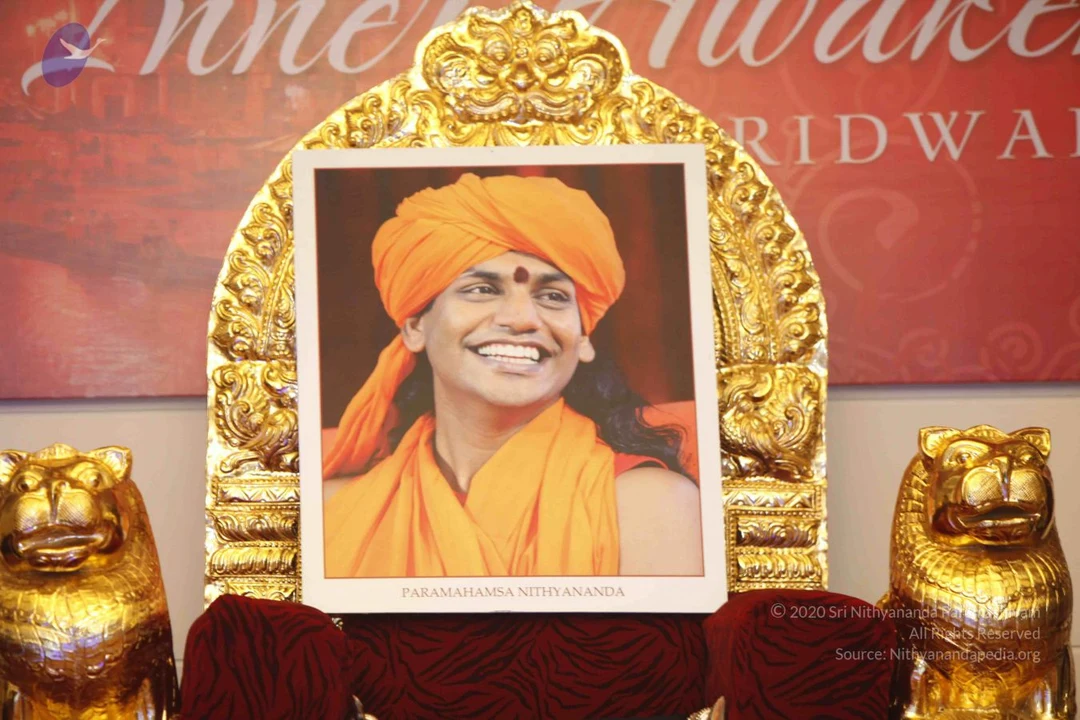
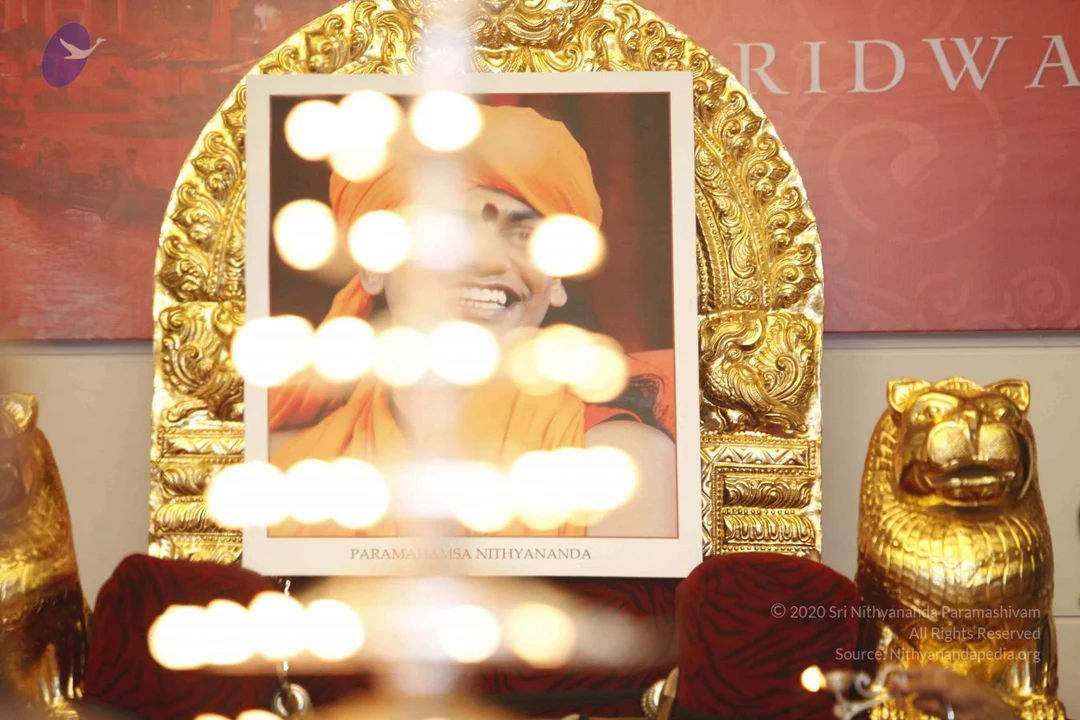
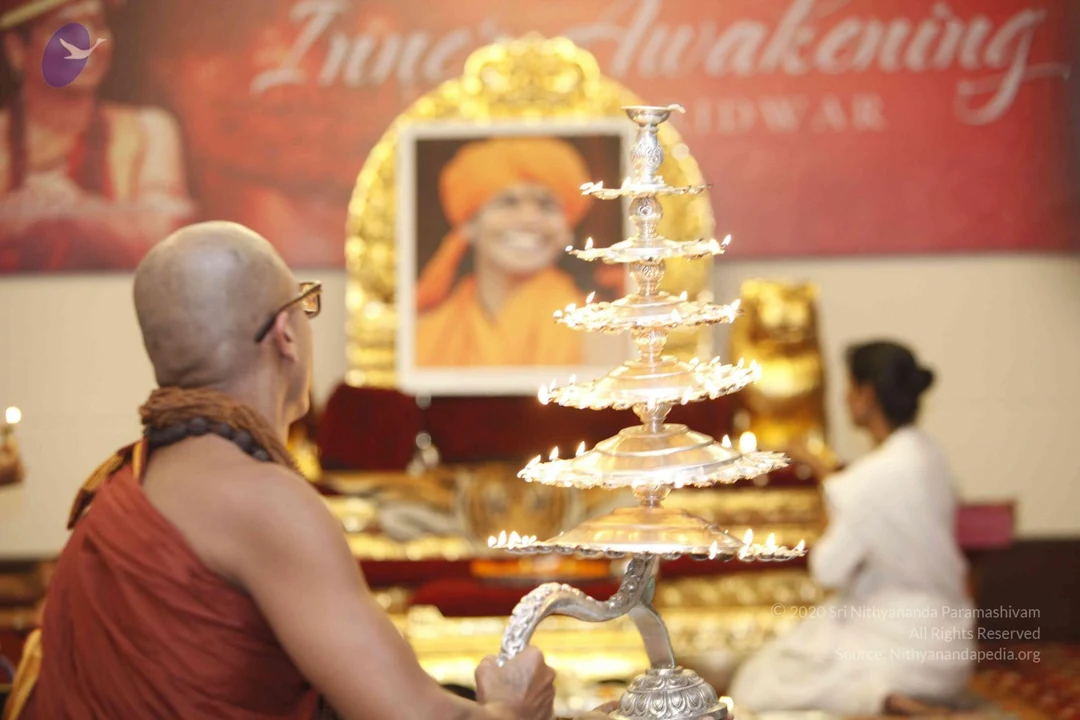
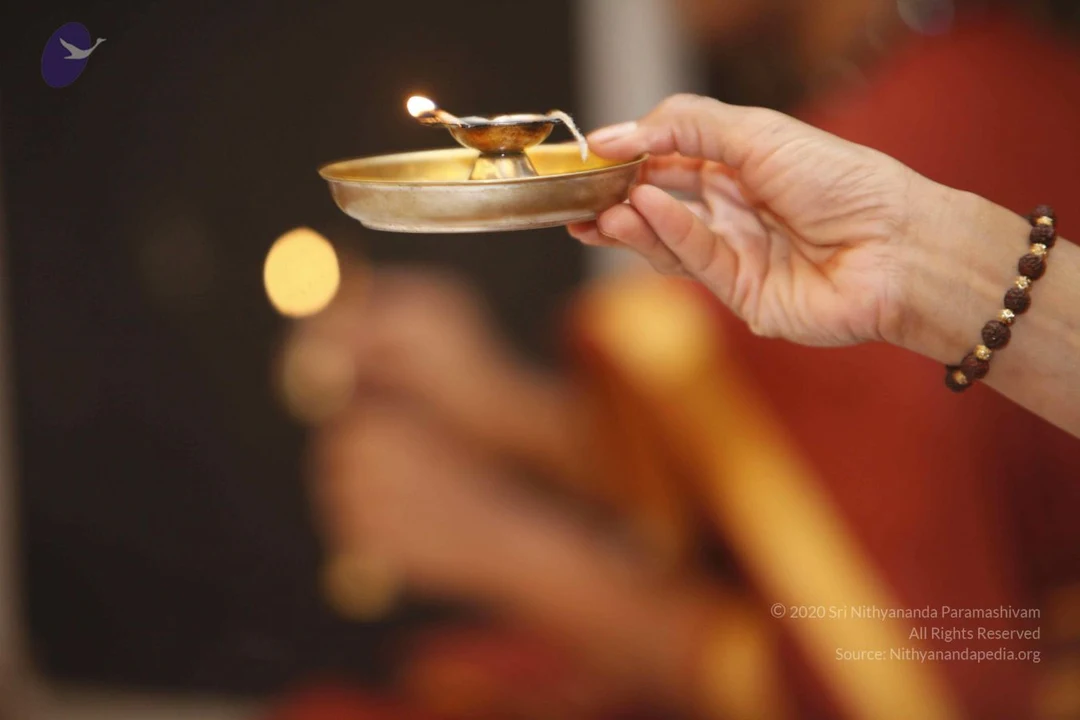
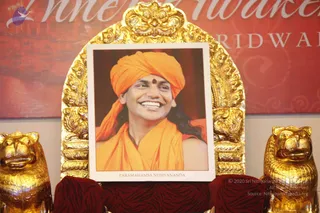
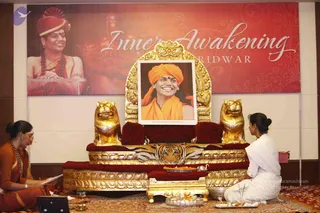
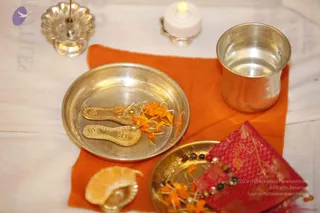
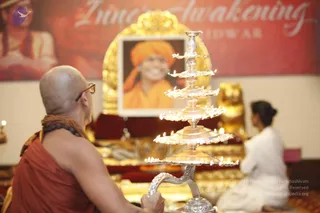
A framed printed portrait of a smiling man in orange saffron turban and orange shawl with a red bindi, captioned "PARAMAHAMSA NITHYANANDA" on the frame's bottom edge. The portrait sits in an ornate gold arched frame on a red and maroon throne-like seat flanked by two gold lion figures, in front of a red banner with large white script reading "Awaken" and "RIDWAR". No physical people are present; the portrait is a depiction. Appearance cues (long dark hair, orange turban and shawl, red bindi) are consistent with a probable Swamiji depiction.Indoor event setting with a large red banner reading "Inner Awakening HARIDWAR" showing a smiling person in a red turban and red robe, with a city skyline behind. Centre stage is an ornate gold throne with carved lion-head armrests and a tiger-skin cushion on a red velvet seat, backed by a framed portrait labelled "PARAMAHAMSA NITHYANANDA" of a smiling man in an orange turban and saffron robe. On the throne's ledge sit offerings including a bowl with orange flowers and a small brass lamp. Two women sit on the floor at either side: one on the left in orange-brown sari with beads and a notepad, one on the right in white sari with hair in a bun, seated before the throne with a small puja tray. Floor covered with red patterned carpet.Close overhead photo of a ritual setup on an orange cloth over a white cloth. A polished metal plate holds a pair of small brass padukas (sandals) with a swastika motif, scattered with orange marigold petals. Beside it stands a plain metal cup of water. A small brass lamp with a wick and a white electric tealight sit at the top, and a brass tray with orange petals, rudraksha-style beads and a red and gold brocade cloth sits at the lower right. A partly peeled orange segment lies nearby. No people are visible.A close-up photograph of a single incense stick with a glowing red-tipped end rising from the bottom centre of the frame, a thin wisp of smoke curling upward against a soft, blurred cream background. In the out-of-focus left foreground, a warm red-orange shape. No people are clearly visible. The image conveys a quiet, devotional mood of incense offering.A framed printed portrait labelled "PARAMAHAMSA NITHYANANDA" sits centred in an ornate gold arched frame on a red-draped altar. The portrait shows a smiling man in orange robes and an orange head wrap with a red bindi. Two gold lion sculptures flank the frame, and blurred oil lamp flames in the foreground. A red banner behind reads partly "RIDWA". No physical people are visible; the portrait is a printed depiction.A photograph of an indoor shrine room with a large tiered silver aarti lamp in the foreground, its multiple rows of small oil lamps burning brightly. A shaved-headed man in an orange-red robe and dark-rimmed glasses, with a rudraksha mala around his neck, sits in profile holding the lamp. Behind him a framed portrait of a smiling figure in a saffron-orange turban and robe sits on a gold ornate backdrop above a red cushioned seat. On the right a person in white clothing sits and also holds a lamp. A red banner above reads Inner Awakening and the word Haridwar.

IA-Haridwar
20 photosSource gallery
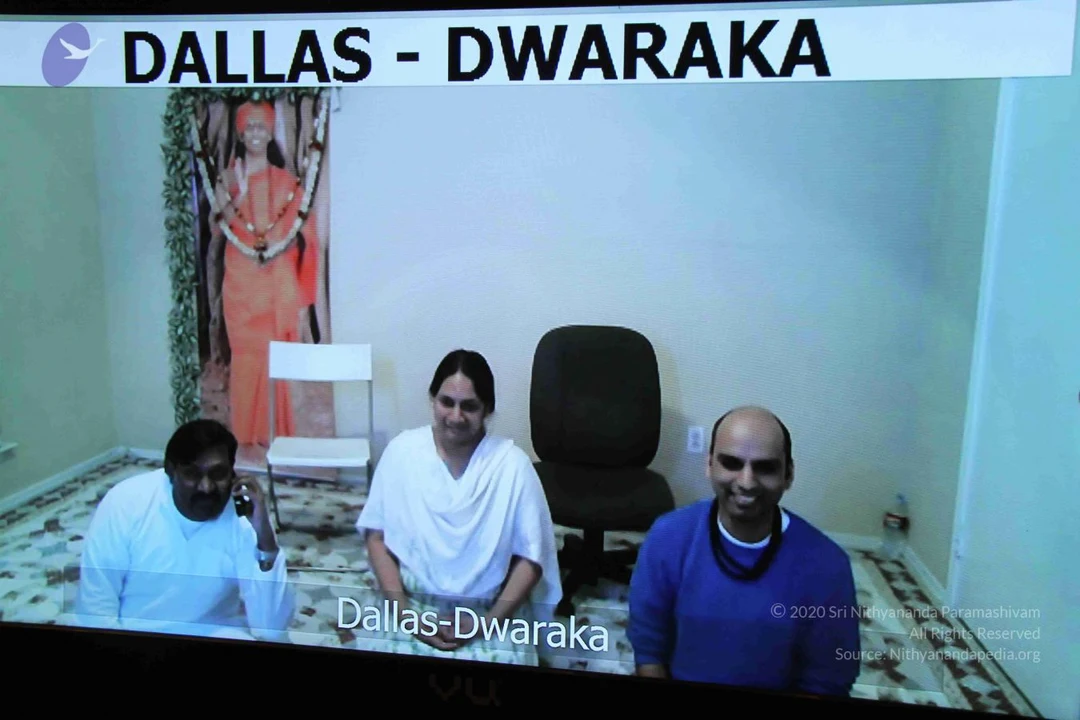
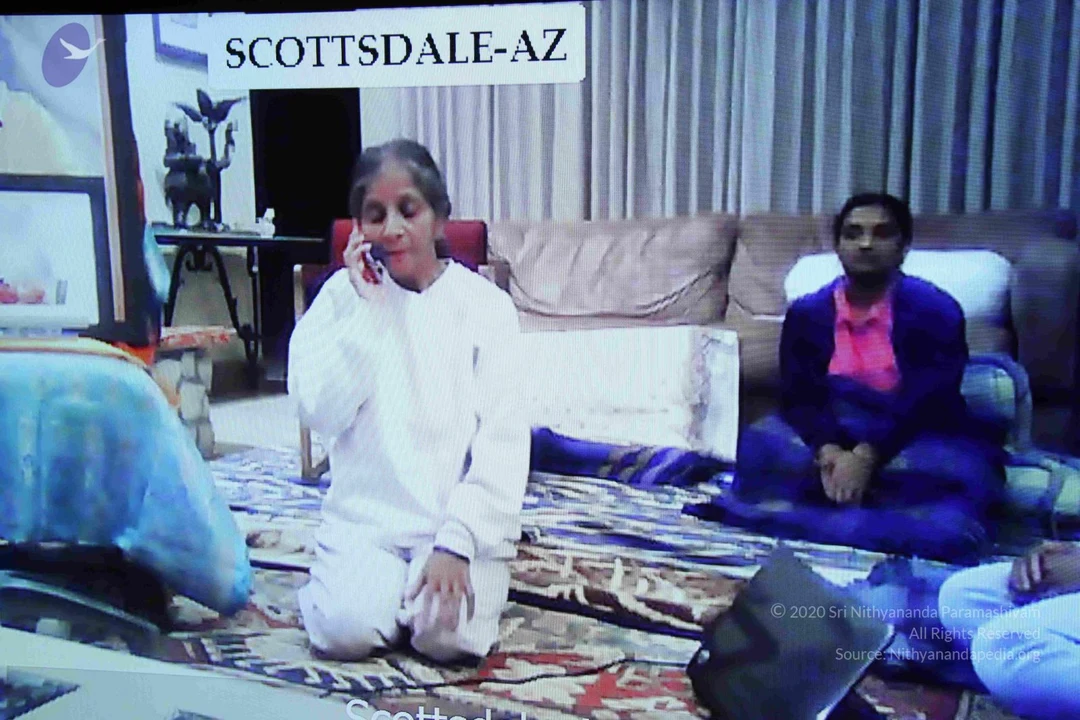
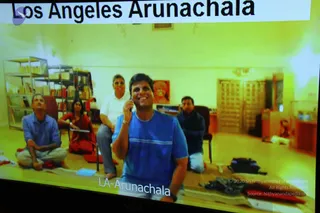
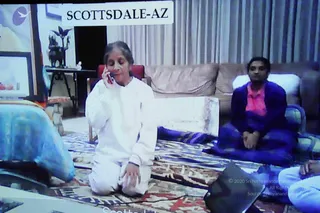
A photograph of a television screen showing a two-way video link to a group in Los Angeles-Arunachala. A banner across the top reads 'Los Angeles Arunachala' and a caption at the bottom reads 'LA-Arunachala'. Five people sit on the floor and on chairs in a room with bookshelves, a framed picture and cabinets. A smiling man in a blue t-shirt holds a mobile phone to his ear in the foreground. Behind him a man in a light blue shirt sits cross-legged, a woman in a red outfit sits on a chair, a man in white sits on a chair, and another man in dark clothing sits on the floor. Bags and folded items lie on the floor in front. Nobody visible is identified as a person.A photograph of a video screen showing a two-way video-conference feed from a room labelled as Los Angeles Arunachala. A man in a blue crew-neck t-shirt holding a mobile phone to his ear sits in the foreground, with a caption reading LA-Arunachala below him. Behind him, a man in a white shirt and a woman in a red sari sit near bookshelves, and another man in a dark jacket sits on a red chair. Ceremonial cloths and bags lie on the floor. No a person candidate is visible.A photograph of a projection screen showing a live two-way video link labelled "Los Angeles Arunachala" in white block letters across the top. On the screen, a man in a dark navy jacket stands centre, holding a mobile phone to his ear and smiling. Behind him, a man in a white shirt and grey trousers stands, and a woman in a red sari sits on a red mat holding papers. A seated man in a blue shirt sits at left beside bookshelves, and a partly visible man sits at far right. A framed red portrait hangs on the wall behind them. Printed on the screen, a " and "", which are not reproduced here. The setting is a room with a yellow-tinted wall and wooden cabinetsA large screen shows a video-conference feed from Temple Alwal, Secunderabad, with the caption "Abu Halifa - Vedaswaroopa". On the right, a close-up of a man with a white vertical tilak on his forehead, a white shawl over his bare shoulder and a ring on his finger, gesturing with his hand. Behind him, a woman in an orange-red sari sits on a dark carved wooden bench. The room has a framed portrait of a woman in orange-red sari, flowers and a dark wooden cabinet with brass items. A caption overlay reads "Temple Alwal, Secunderabad" at the top.A photograph of a large screen showing a two-way video link titled "DALLAS - DWARAKA" in black capitals on a white banner. Three men sit on folding chairs and a black office chair in a plain room with pale walls and a patterned tiled floor. On the left, a man in a white shirt and white dhoti holds a phone to his ear. In the centre, a man with long dark hair wears a white shawl and white dhoti. On the right, a bald smiling man wears a blue sweater and a dark beaded necklace. Behind them is a framed photo of a saffron-robed sannyasi with a garland of flowers and a red headband, framed by green leaves. A caption reads "Dallas-Dwaraka" at the bottom.A photograph of a television or video-conference screen showing a remote satsang feed. A label at the top reads "SCOTTSDALE-AZ". An older woman in a white outfit kneels on a patterned rug holding a mobile phone to her ear, while a man in a blue jacket and pink shirt sits cross-legged on a cushion beside her. Behind them are a beige sofa, grey curtains, a brass figurine and framed pictures. Lower right, another person in light blue sits partly visible. The image shows a live two-way video link from a home setting rather than the main satsang hall.

Darshan
35 photosSource gallery
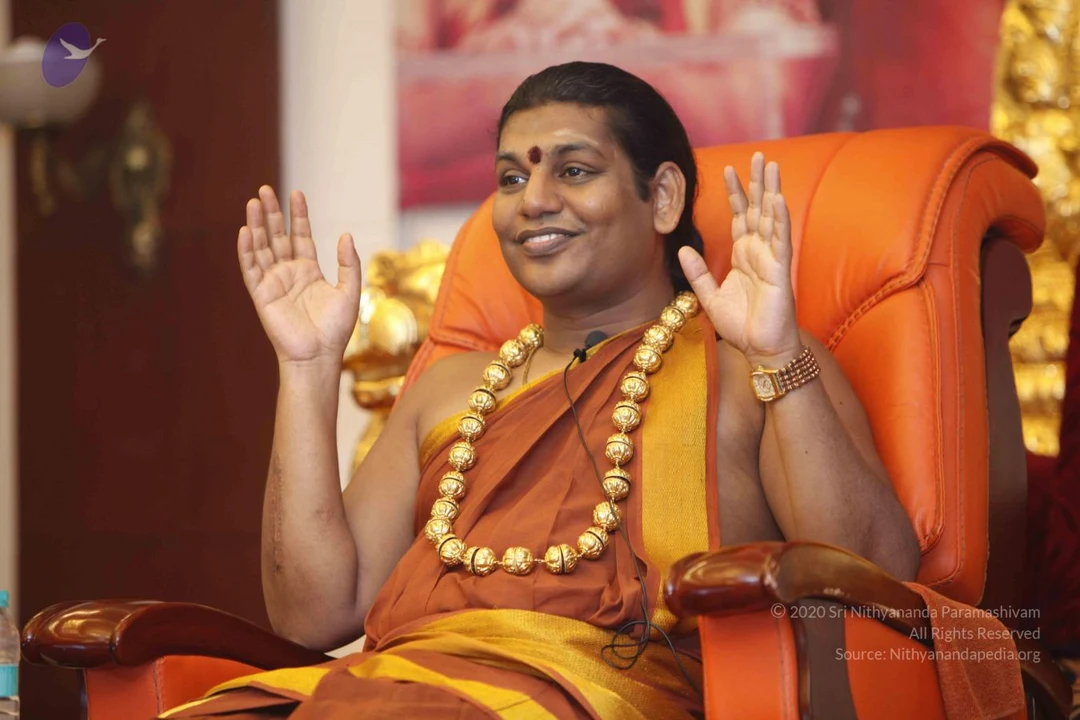
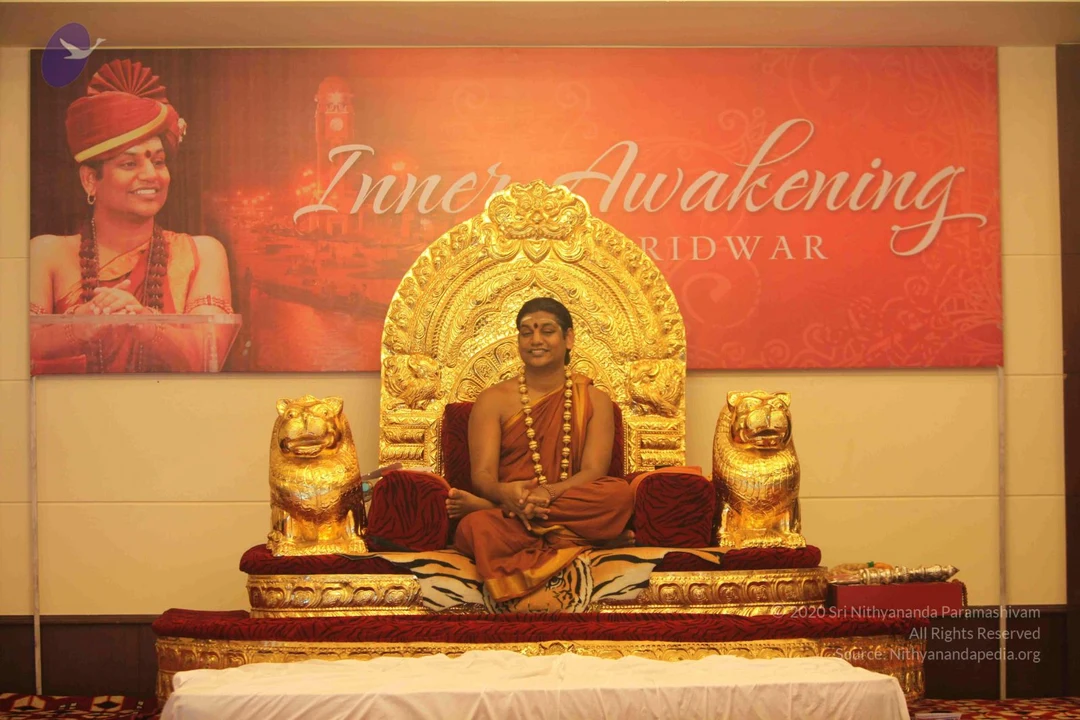
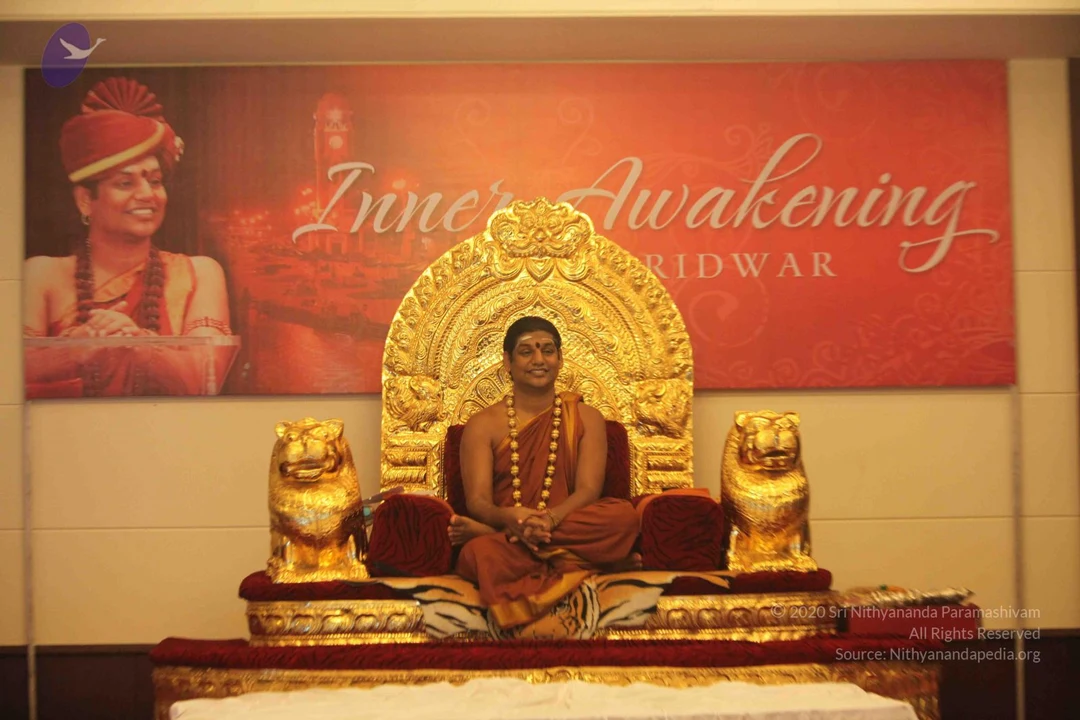
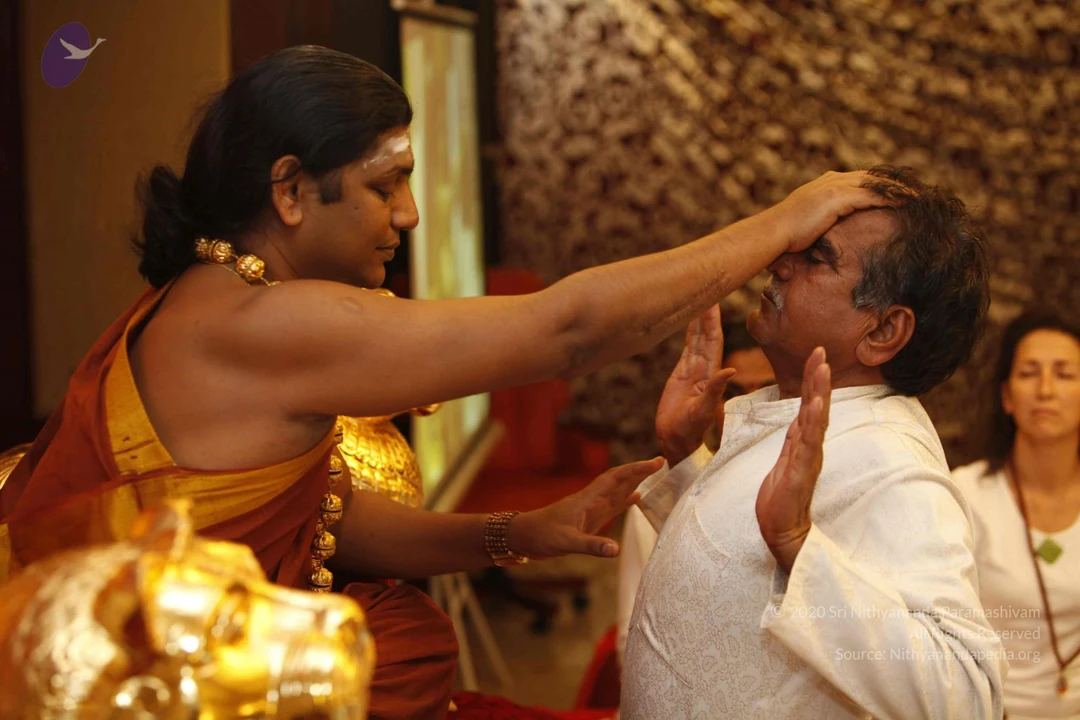
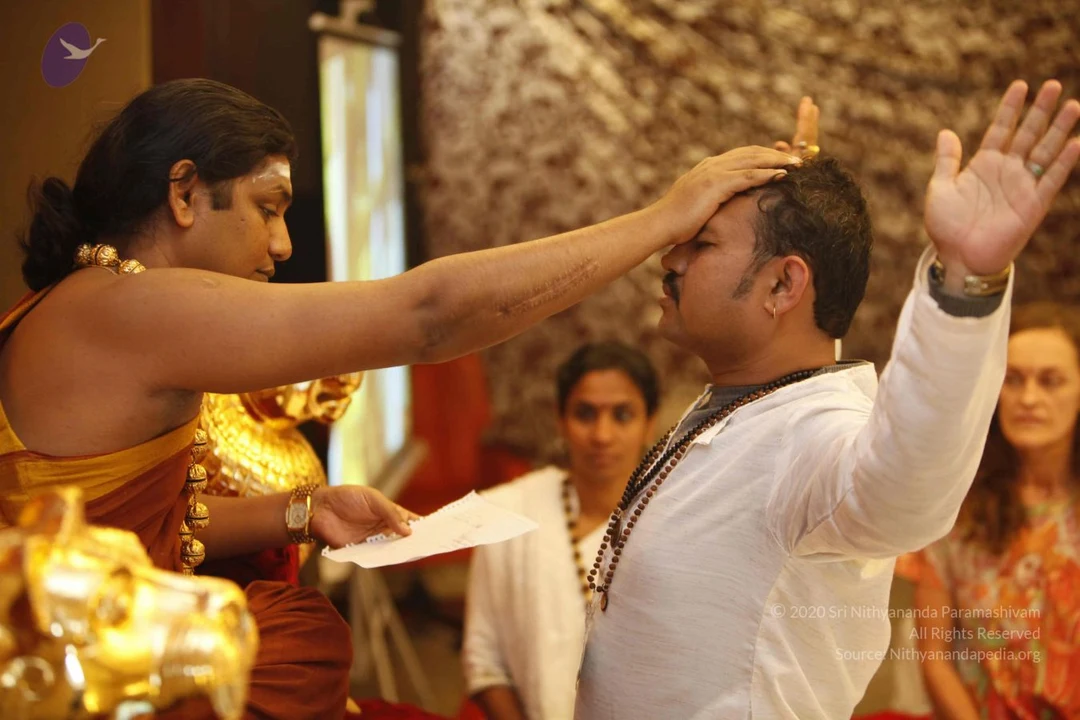
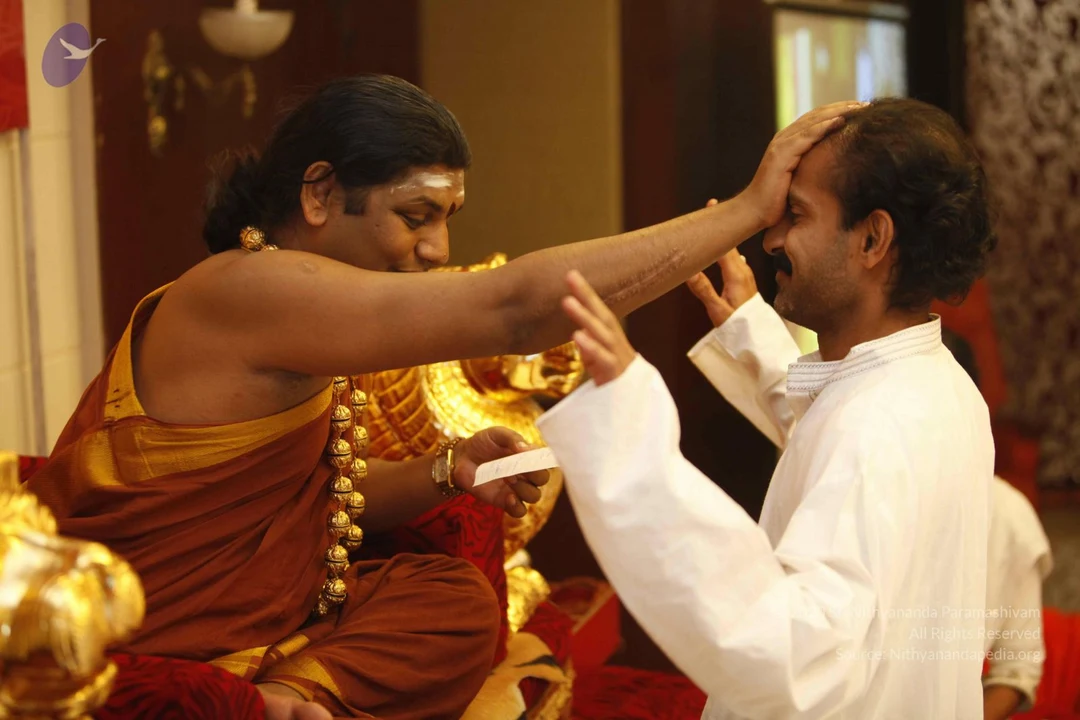
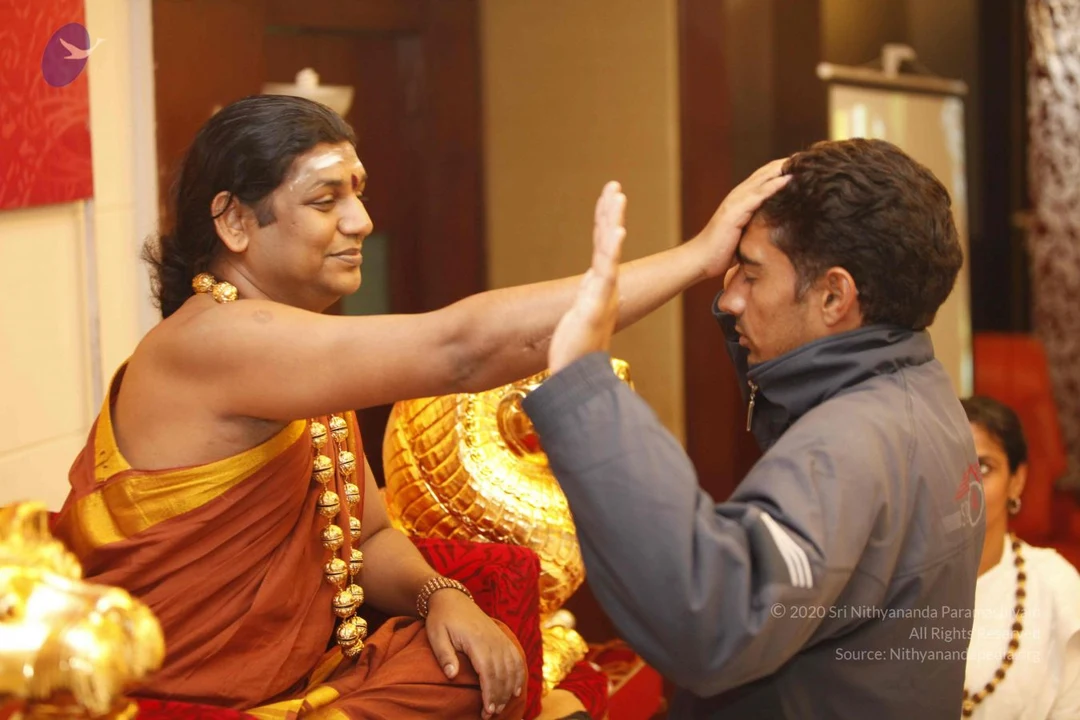
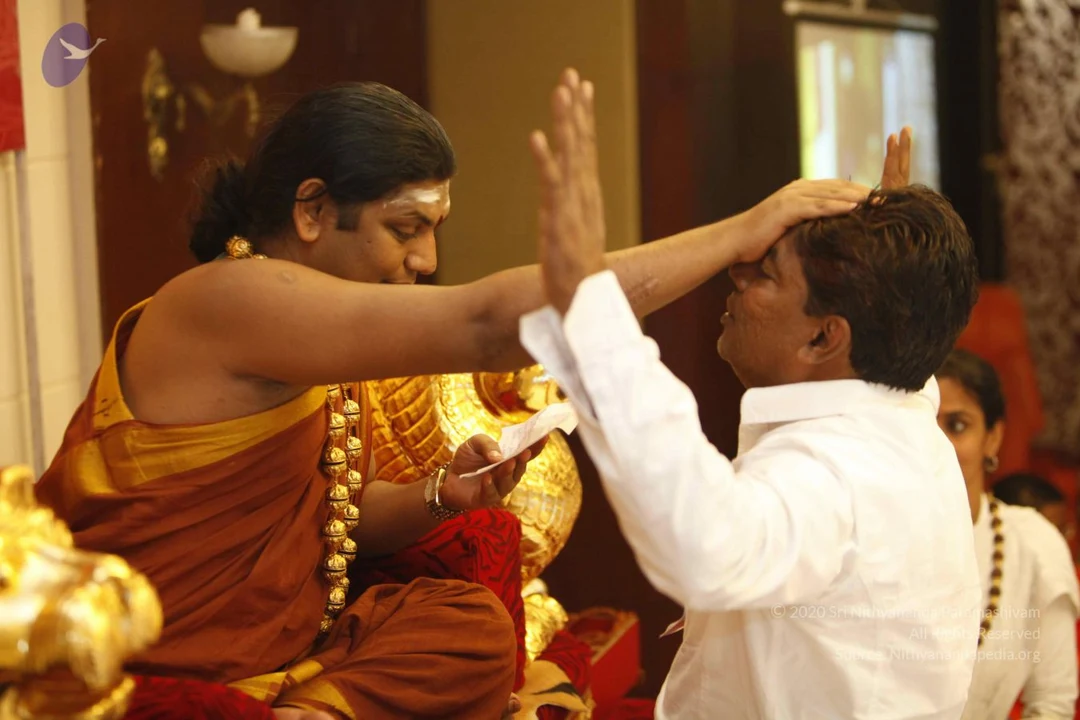
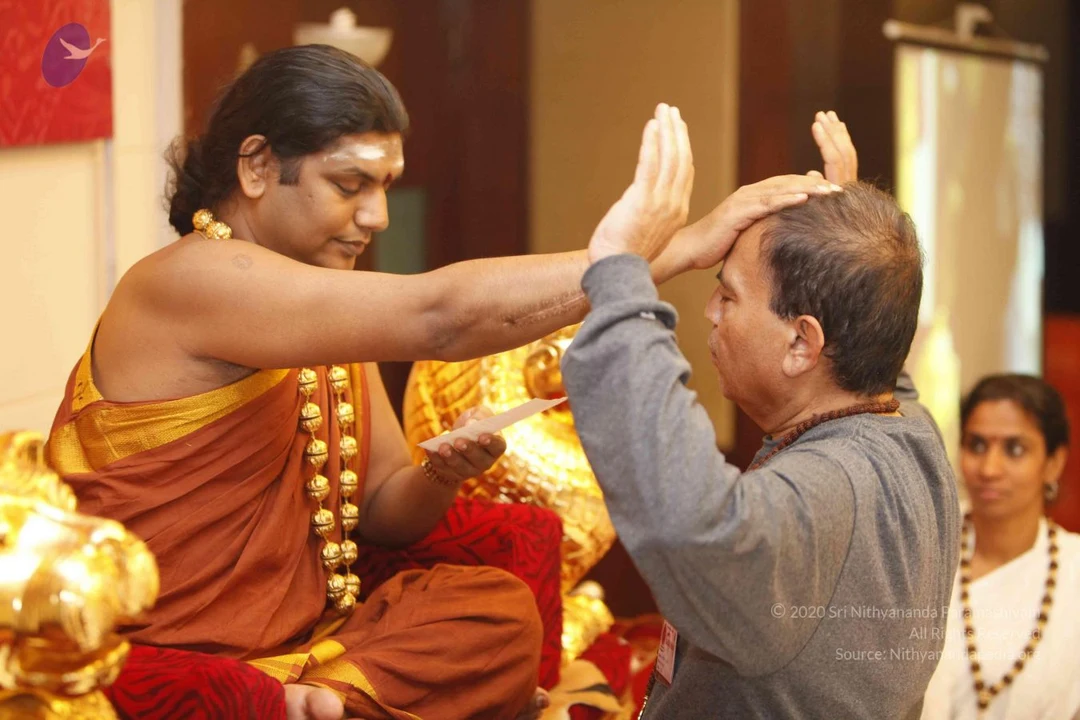
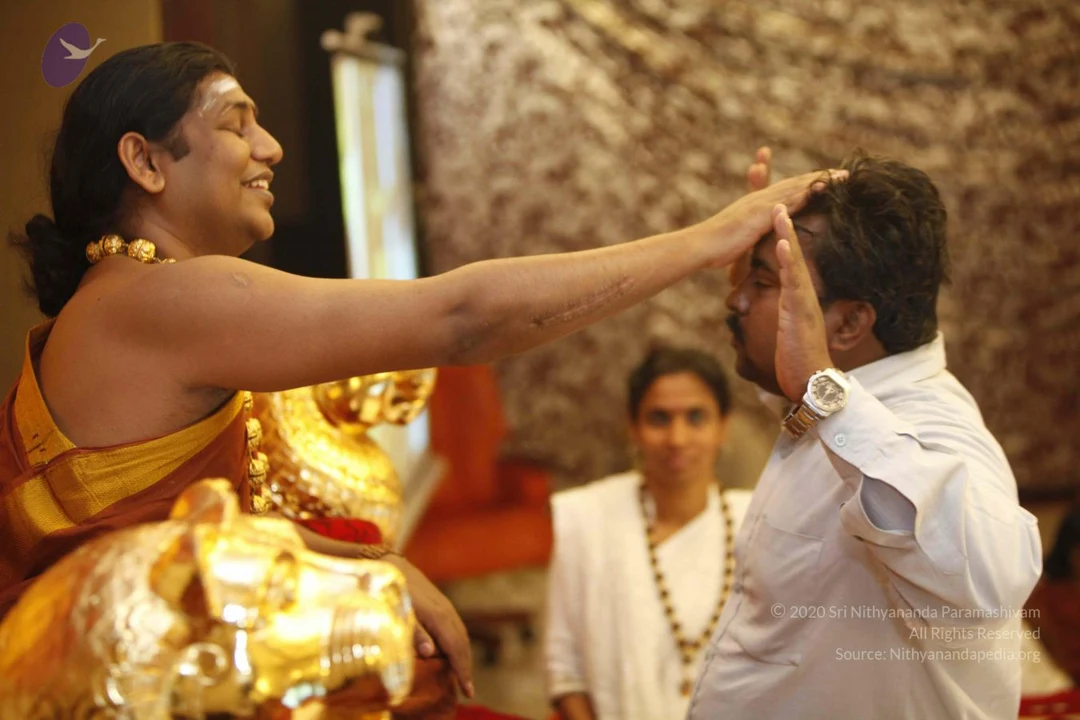
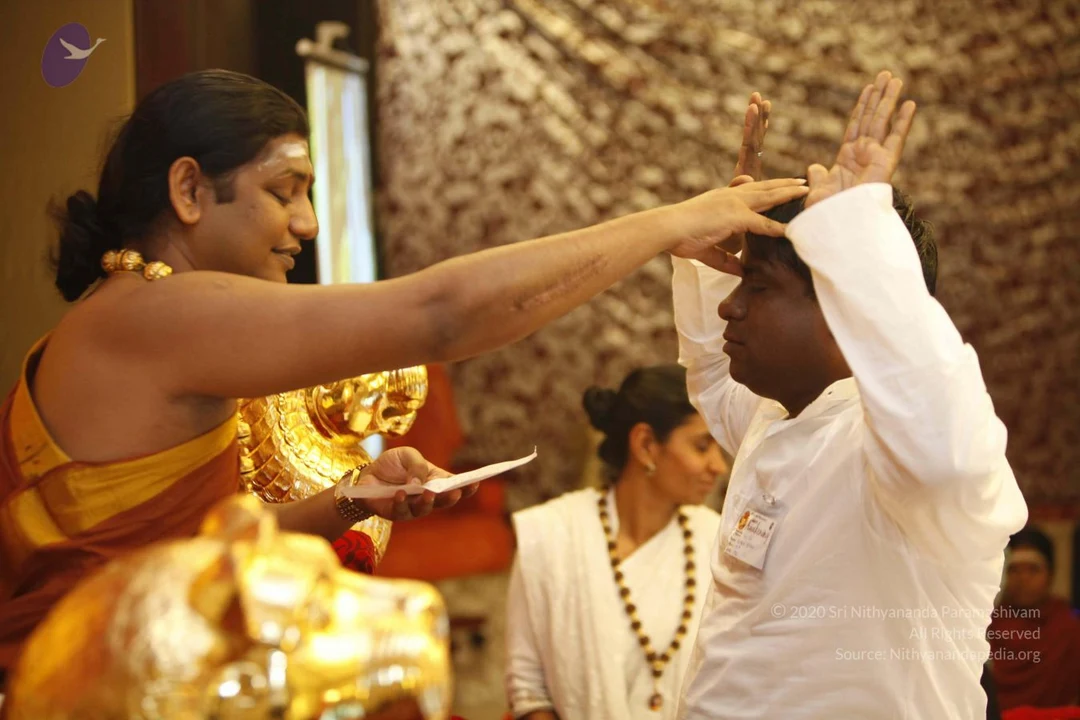
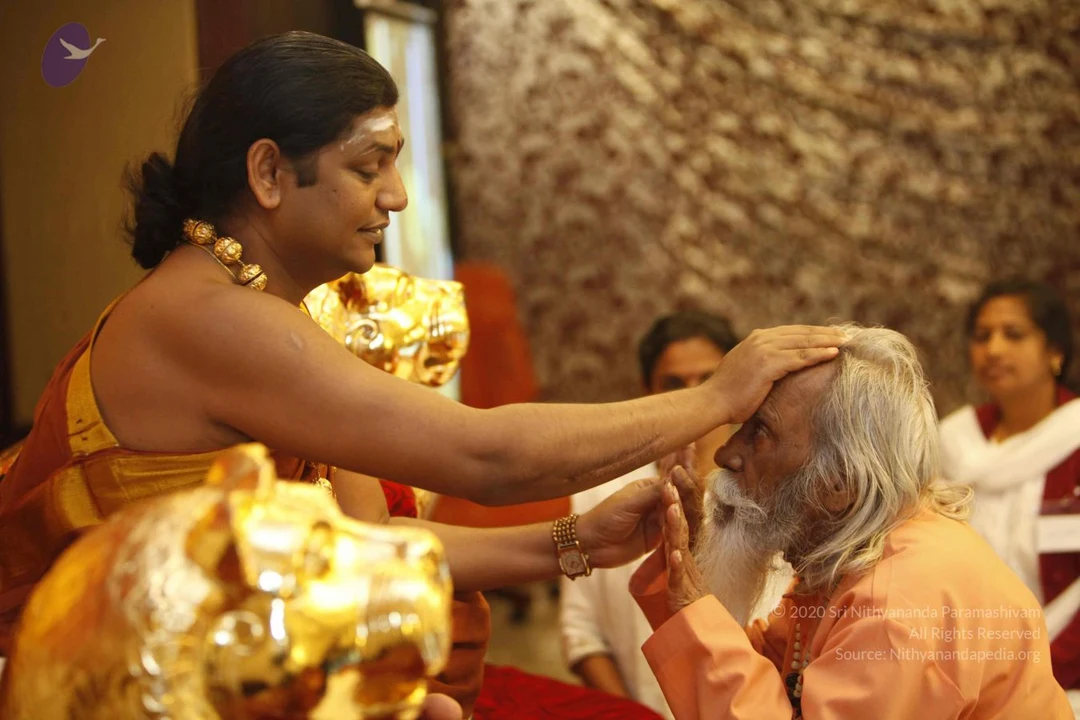
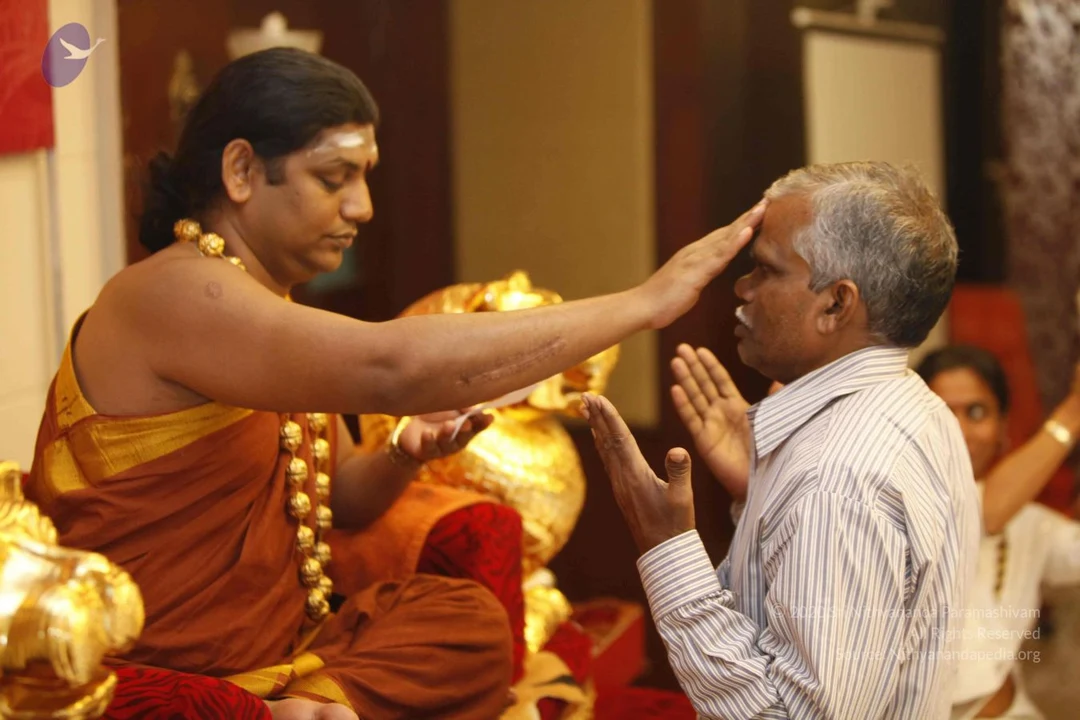
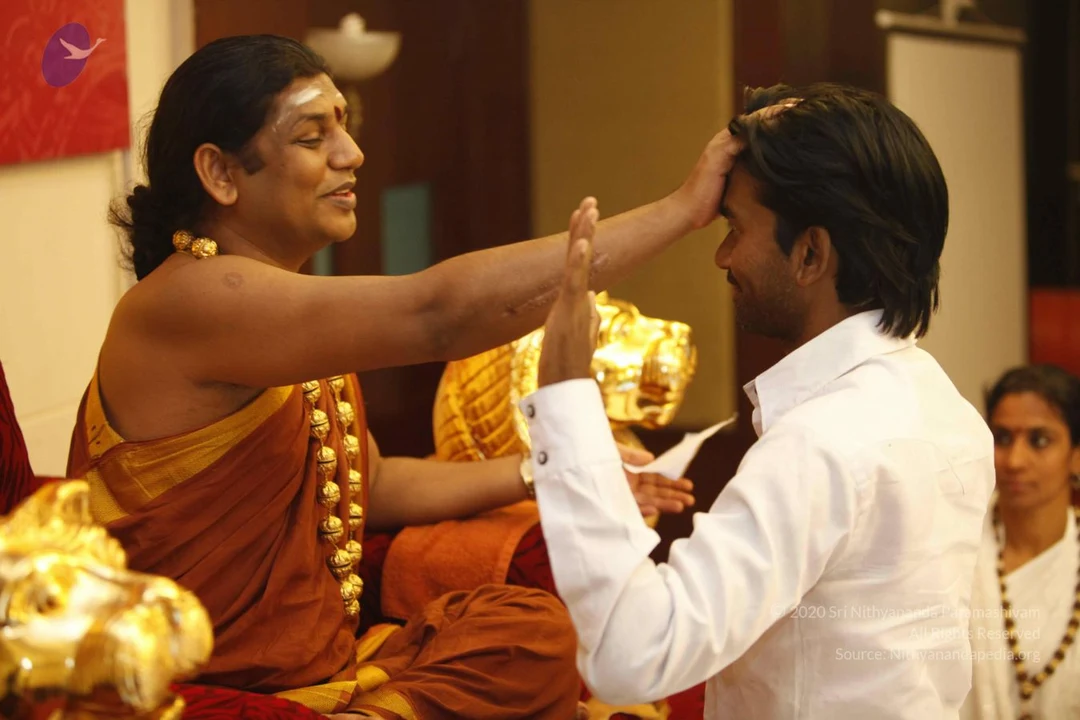
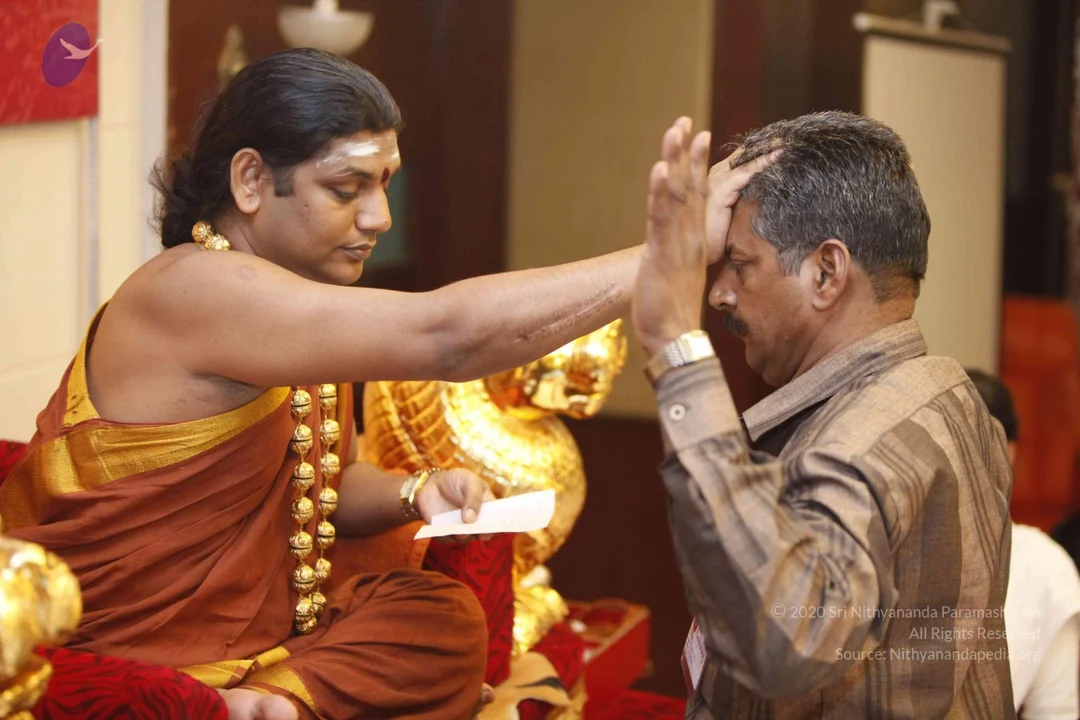
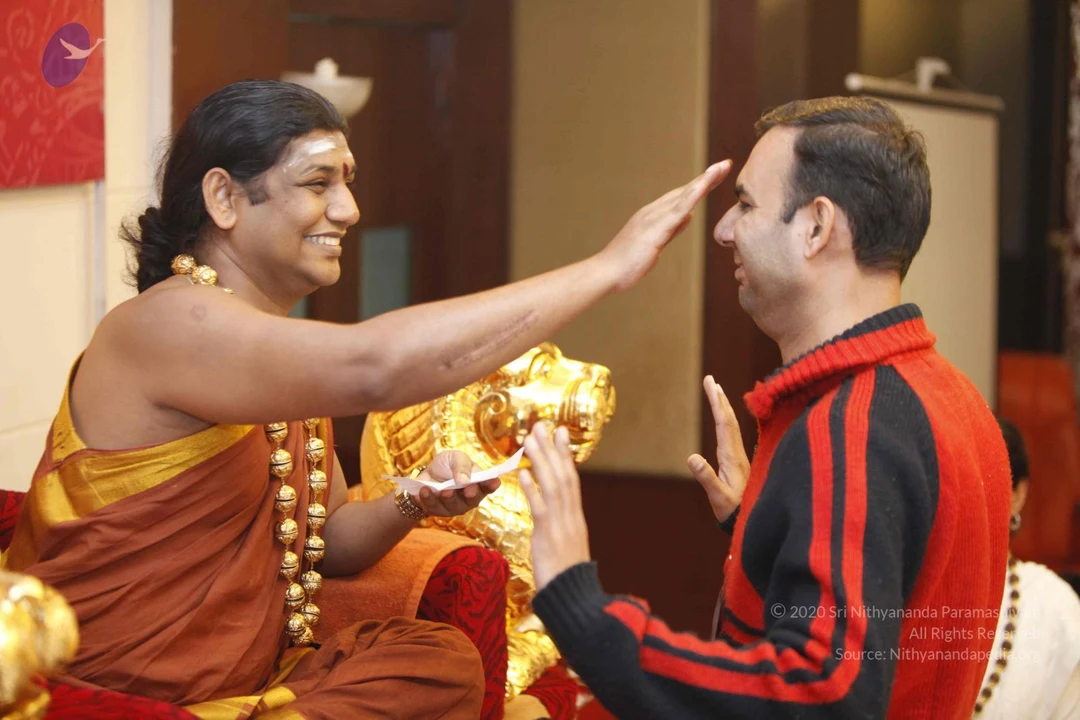
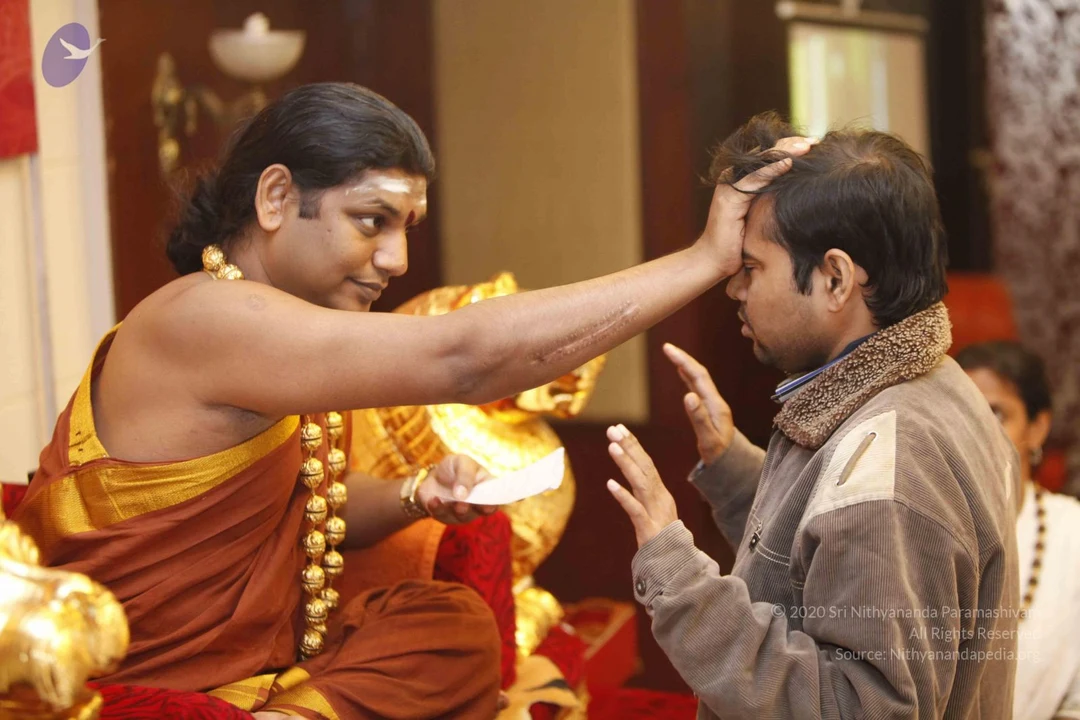
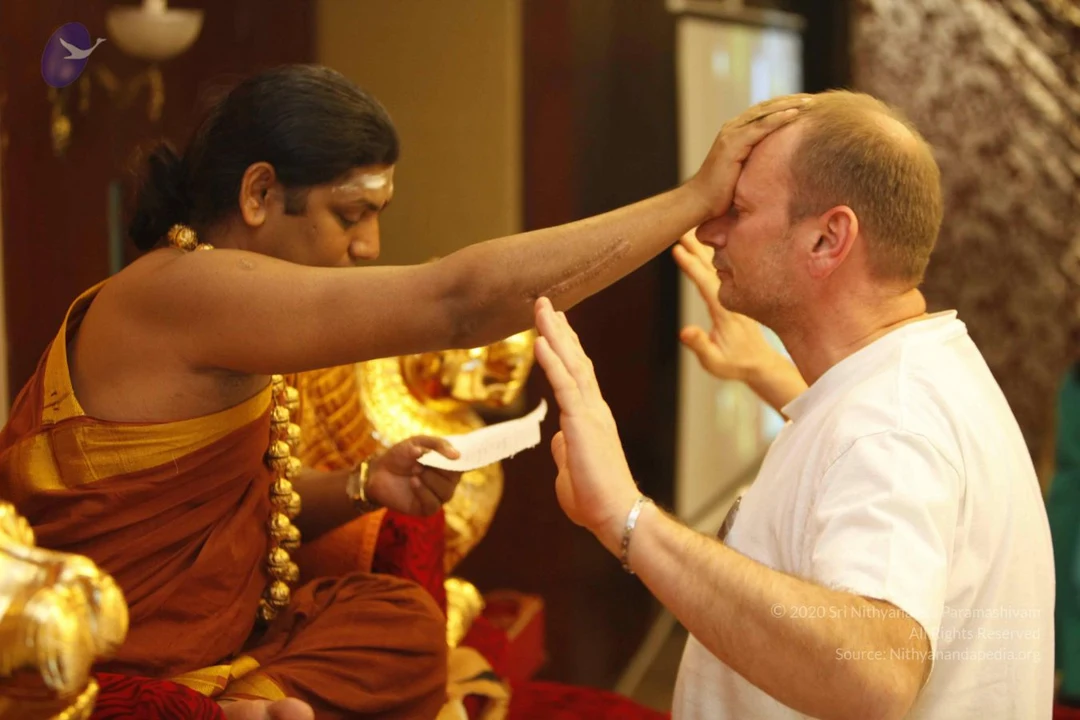
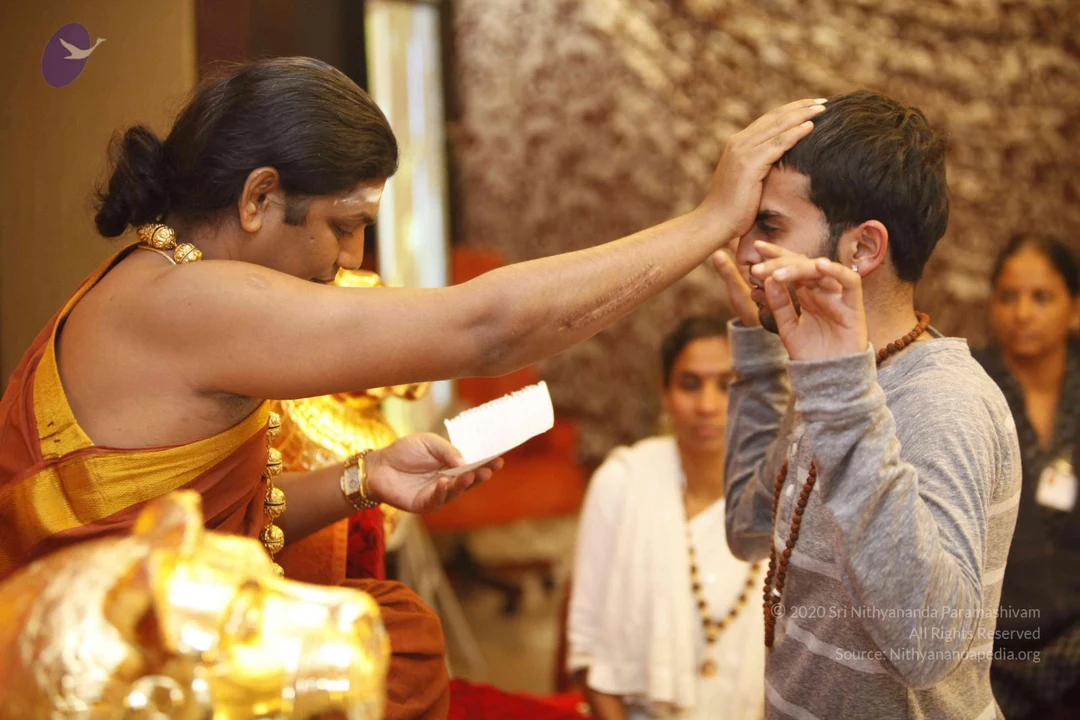
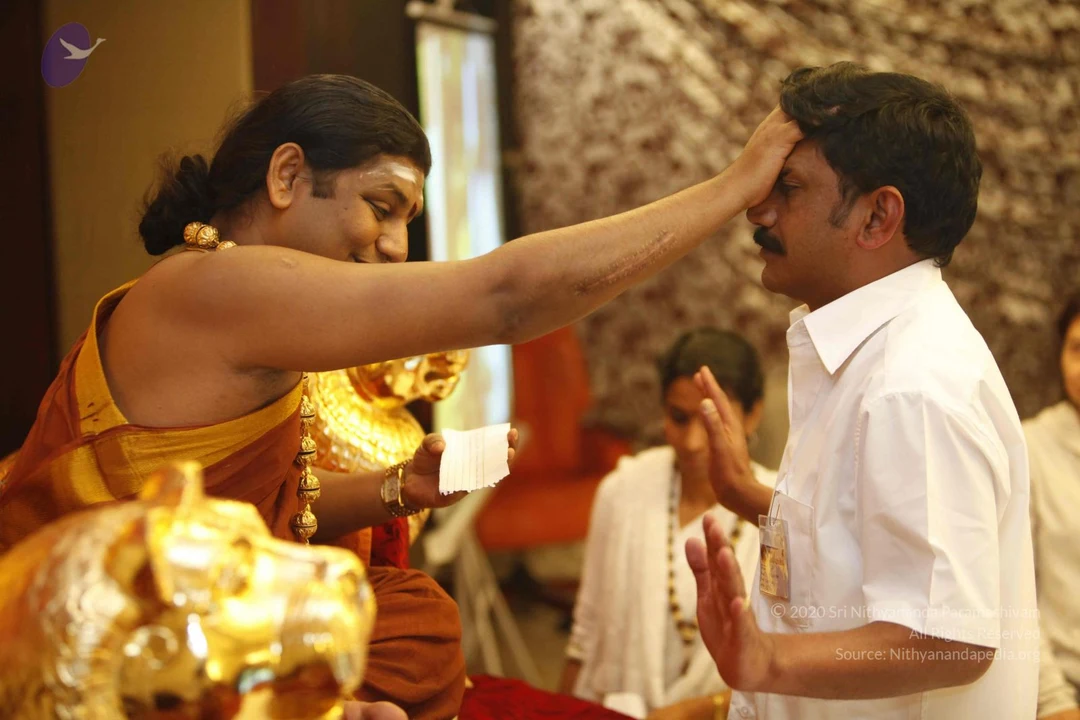
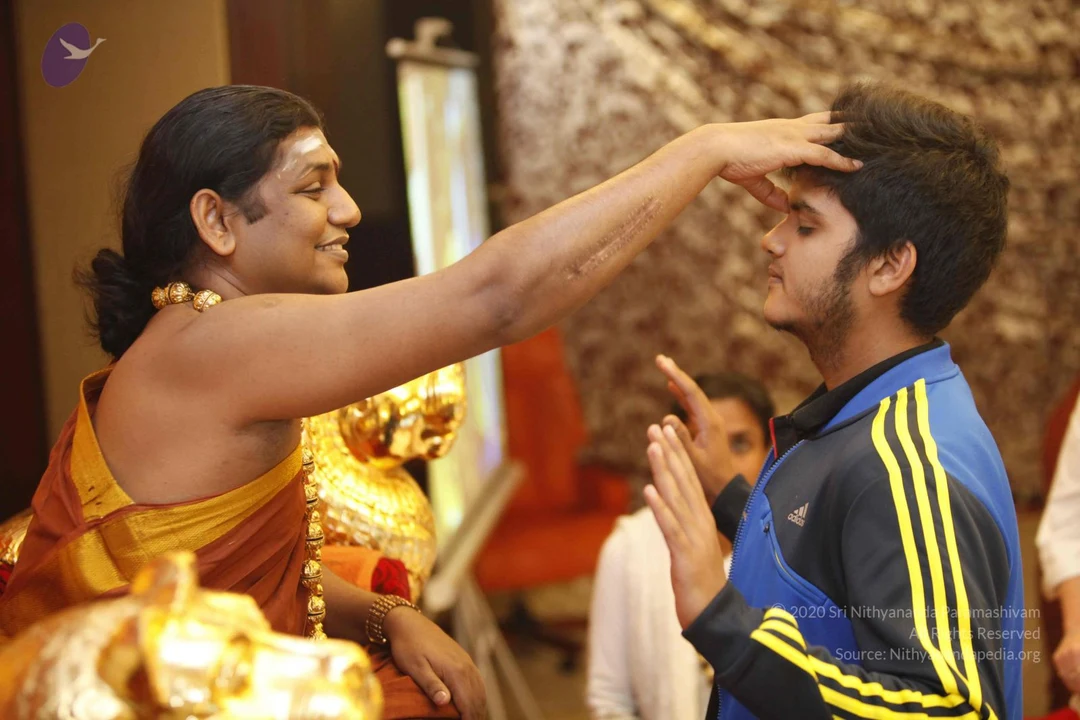
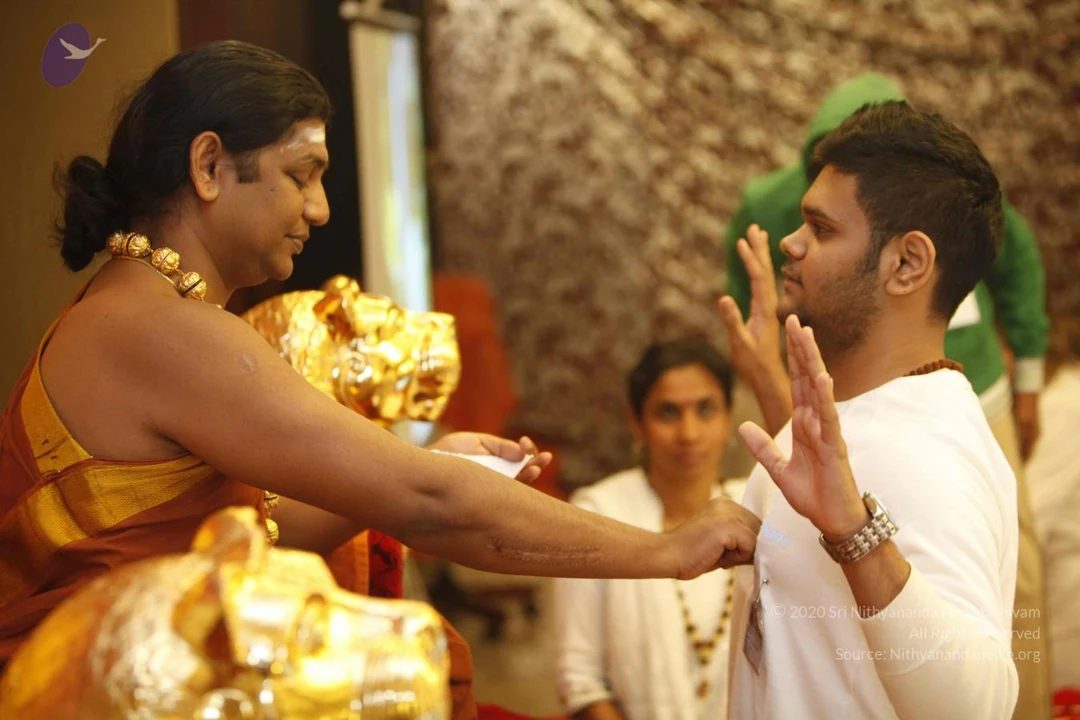
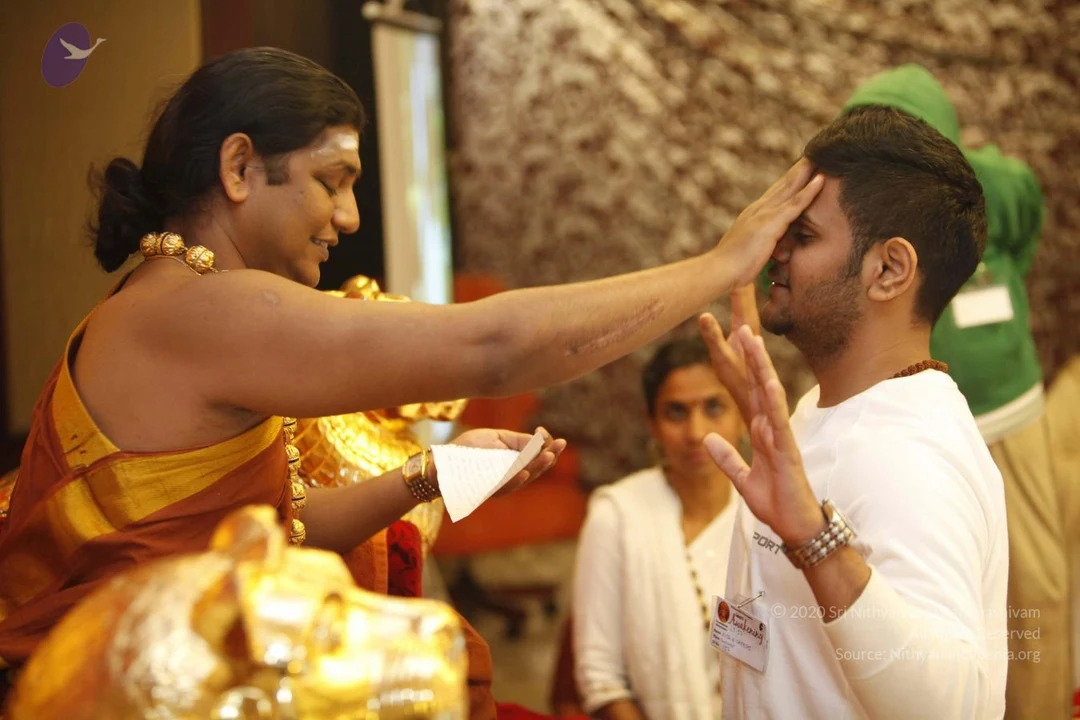
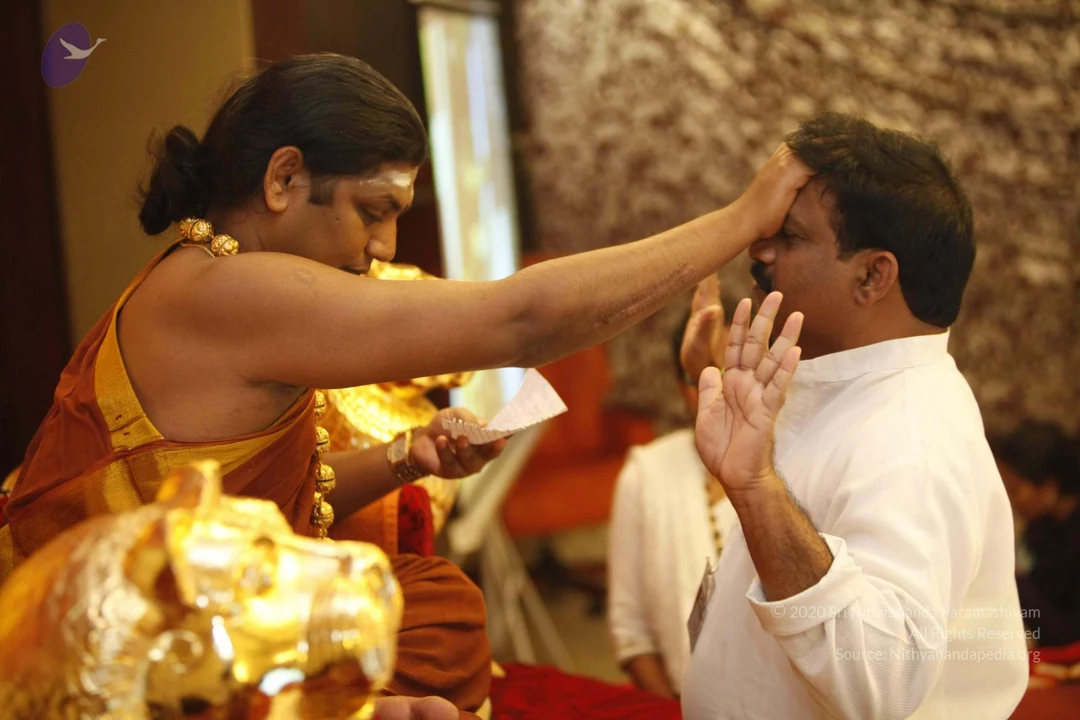
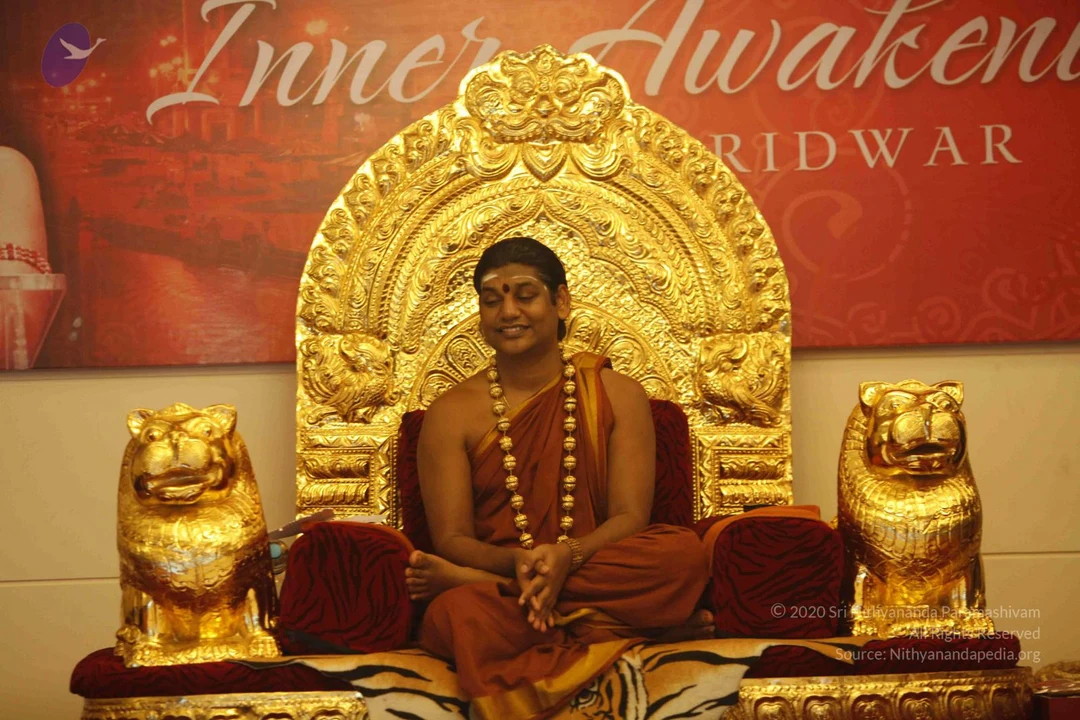
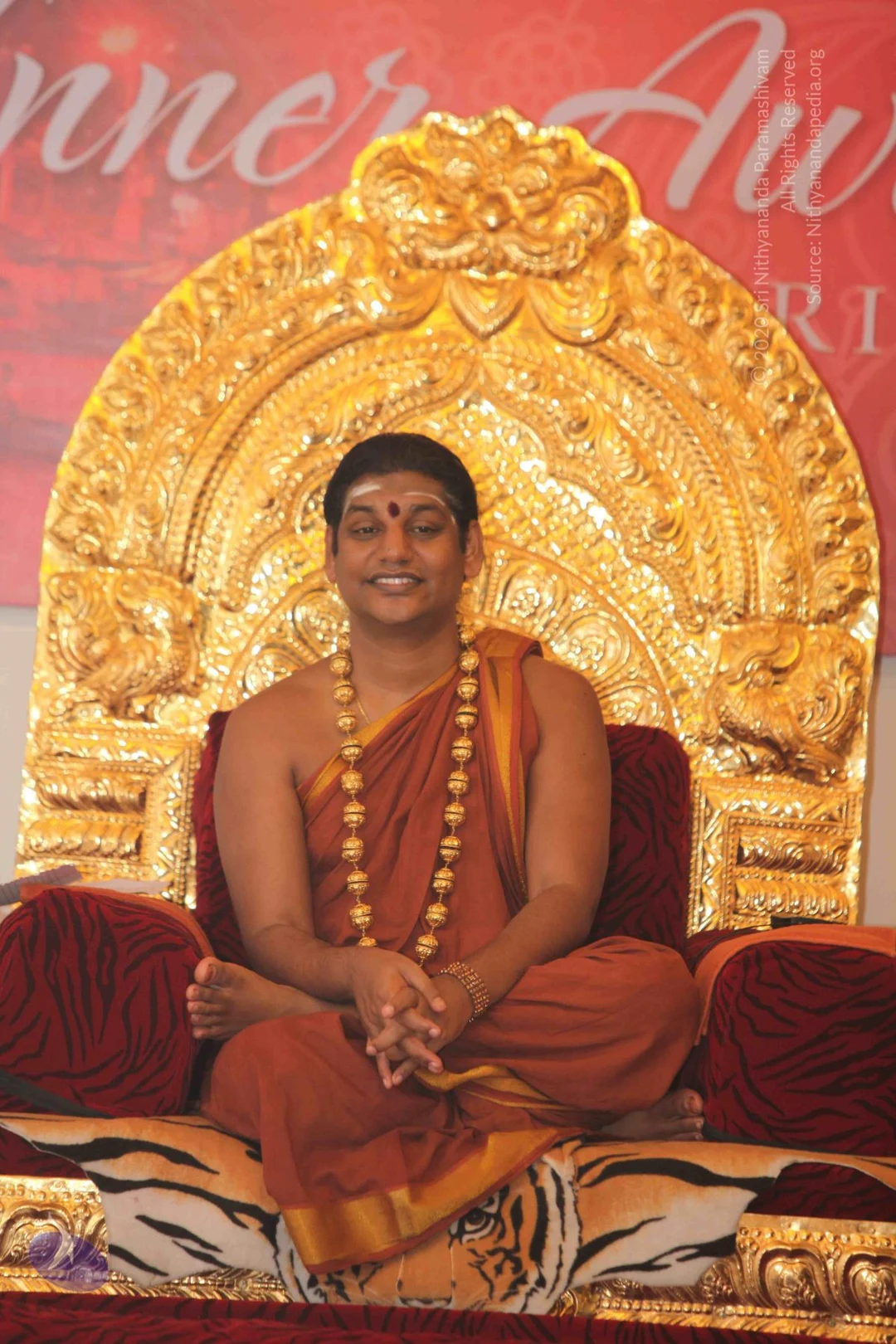
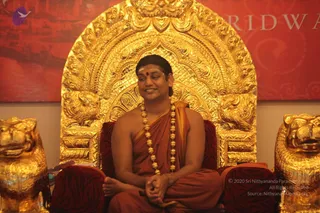
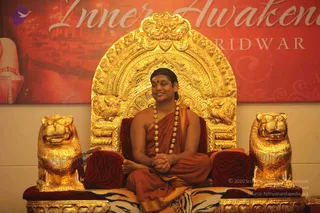
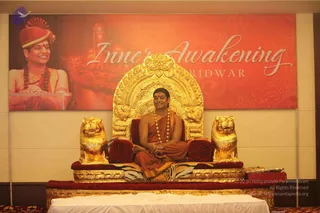
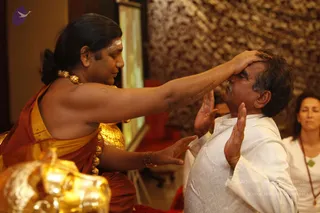
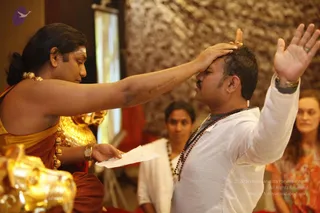
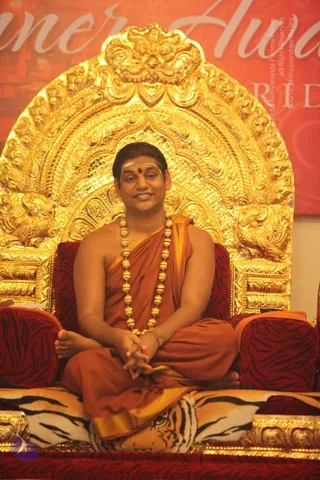
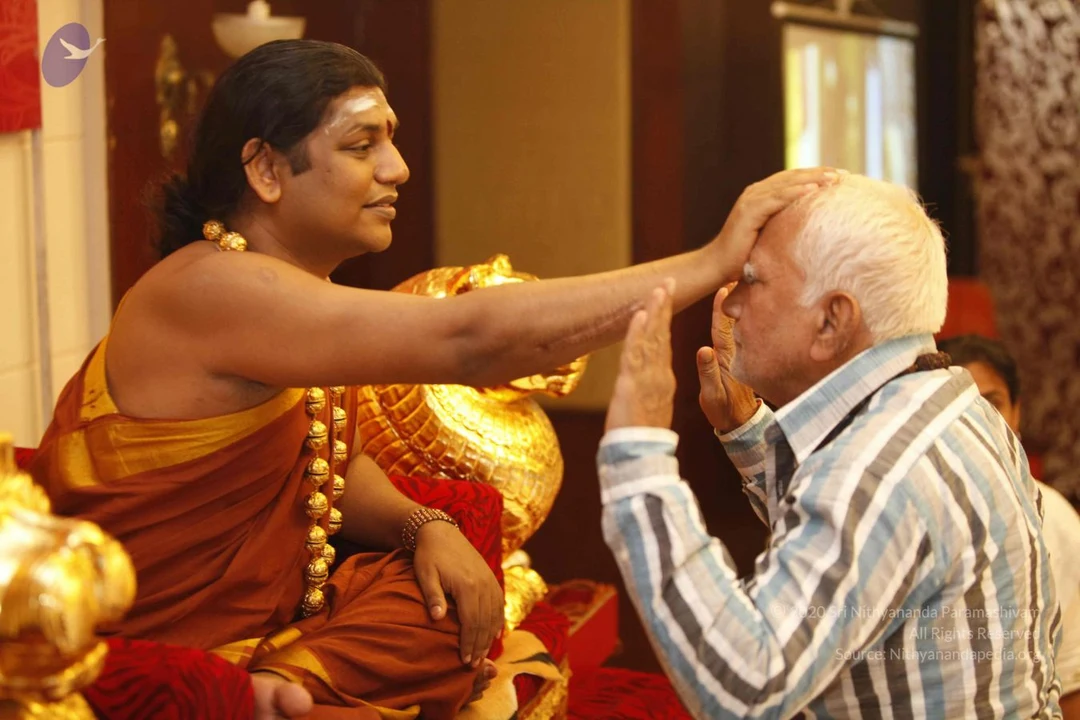
A seated man in saffron-orange robes sits on an ornate golden throne with carved arched backrest and two golden lion-head armrests, with red velvet cushions. He wears a long rudraksha mala with large beads, a gold bracelet, and a red bindi with white tilak on his forehead, hands clasped in his lap and smiling. A red backdrop with partial lettering 'RIDWA' and a faint purple logo sits behind him.A seated man in saffron-orange robes sits cross-legged on an ornate golden throne with a tall arched back carved with floral and mythical motifs. Two golden lion figures flank the seat, and the throne is draped with red cushions and a tiger-striped cloth. He wears a long beaded gold necklace, a red bindi, and has his hands folded in his lap. Behind him a red banner shows a riverside city scene with the words Inner Awakening and Haridwar.A seated figure in an orange-saffron robe and a long beaded rudraksha mala sits cross-legged on an ornate golden throne with a carved arched back and two golden lion-head armrests, draped in a red velvet cushion and a striped tiger-skin style cloth. Behind the throne a large red-orange banner shows a smiling figure in a red turban and red-orange clothing holding a rudraksha mala, beside a clock tower and riverside city lights. A white draped table sits in the foreground of a plain room with cream wall panels. The banner reads Inner Awakening and Haridwar. The seated figure's appearance matches several cues (long beaded mala, saffron robe, ornate gold throne) but identity is uncertain from the image alone.A seated man in saffron-orange robes and a long beaded rudraksha mala sits cross-legged on an ornate golden throne with carved arch and two golden lion heads, draped in red cushions and a striped tiger-skin cloth on the platform. His hands rest together in his lap and he smiles. Behind him a large red banner shows a smiling woman in a red turban and saffron garment with a rudraksha mala, beside a city skyline at dusk, with the printed heading "Inner Awakening" and the word "HARIDWAR". The setting is a bright room with white walls. The seated man is a candidate a person based on the saffron robes and rudraksha mala, though his appearance is only moderately distinctive.A photograph of a diksha-style blessing in a warmly lit hall. A man with a swept-back dark ponytail, a white tilak on his forehead, gold-bead necklaces and an orange-red garment with gold border places his right palm on the forehead of an older man with grey hair and moustache. The older man wears a white kurta and raises both hands, palms out, in reception. A woman in white with a green pendant sits with eyes closed at right. Gold ornaments and a gold object sit in the foreground against a textured gold wall. Probable Swamiji's cues include the swept-back hair, gold necklaces and saffron-orange garment, and he is the one giving the blessing.A photograph of a Nayana Deeksha-style blessing. A bare-chested man with long swept-back hair, a gold necklace of ornate bead ornaments, rudraksha-style beads and a saffron-orange dhoti-style wrap stands at left, pressing his palm to the forehead of a man in a white kurta with a rudraksha mala and a moustache, whose arms are raised. The blessed man's other palm is open upward. Behind them a seated woman in a white top and another in a patterned orange top watch. A small paper slip is held in the officiant's hand, and a gold deity murti or ornament sits at lower left. The officiant is probable Swamiji, with long hair, a saffron wrap, gold neck ornaments and a sandal-marked forehead.

Photos Of The Day:
36 photosSource gallery
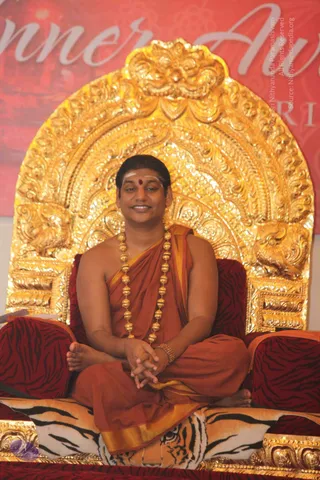
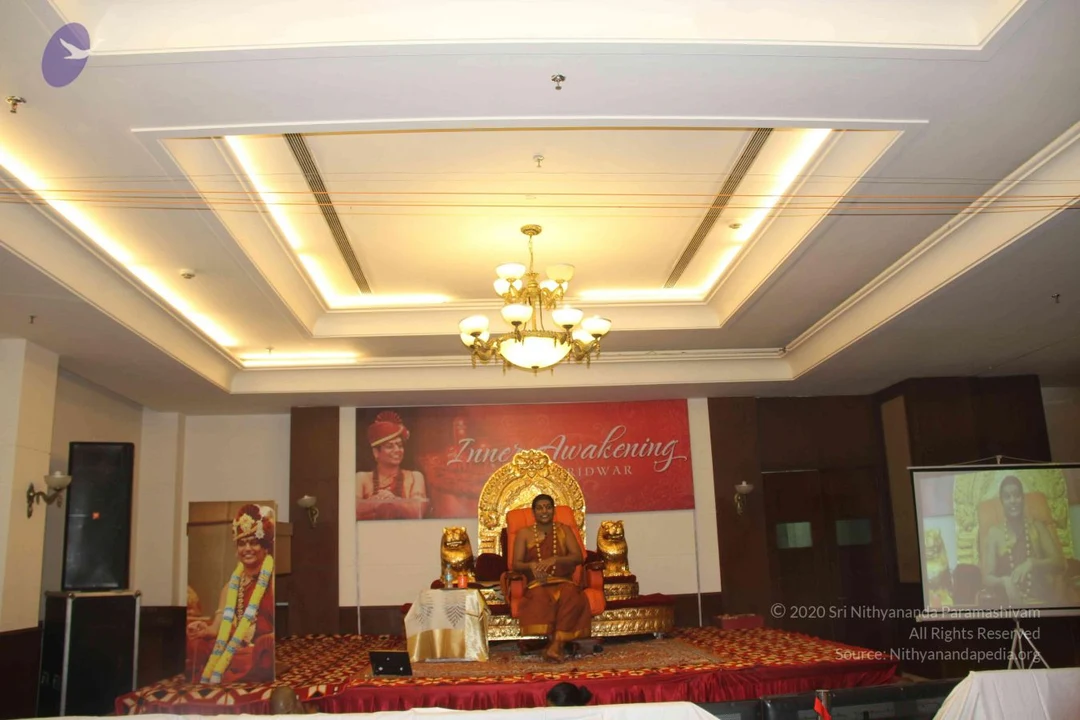
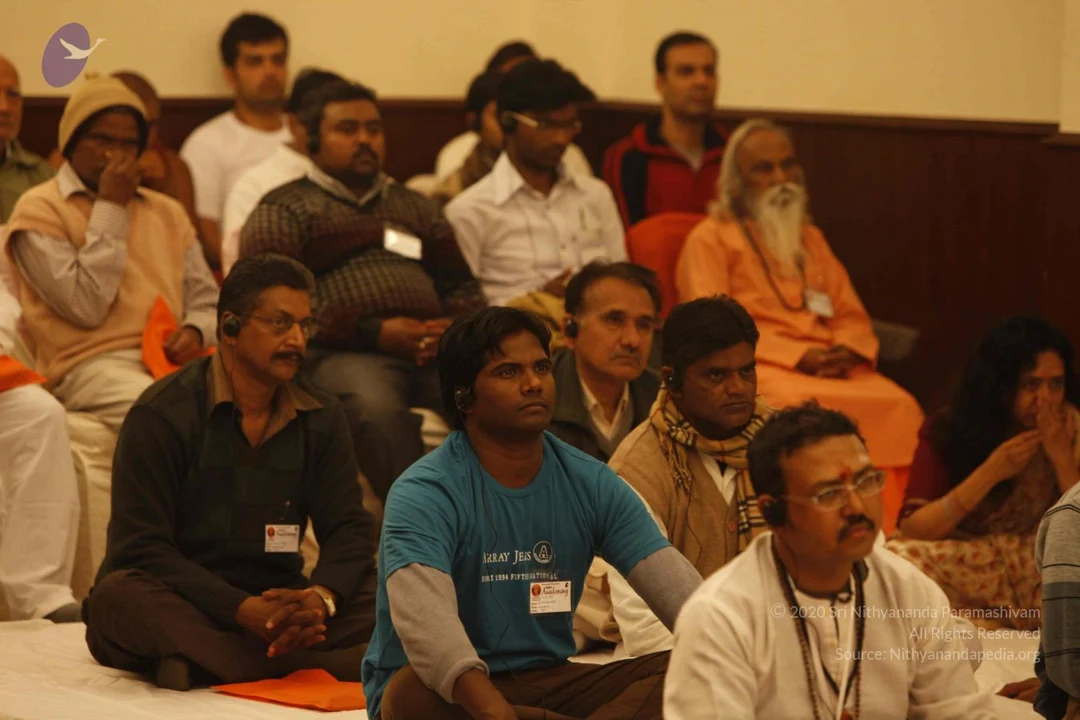
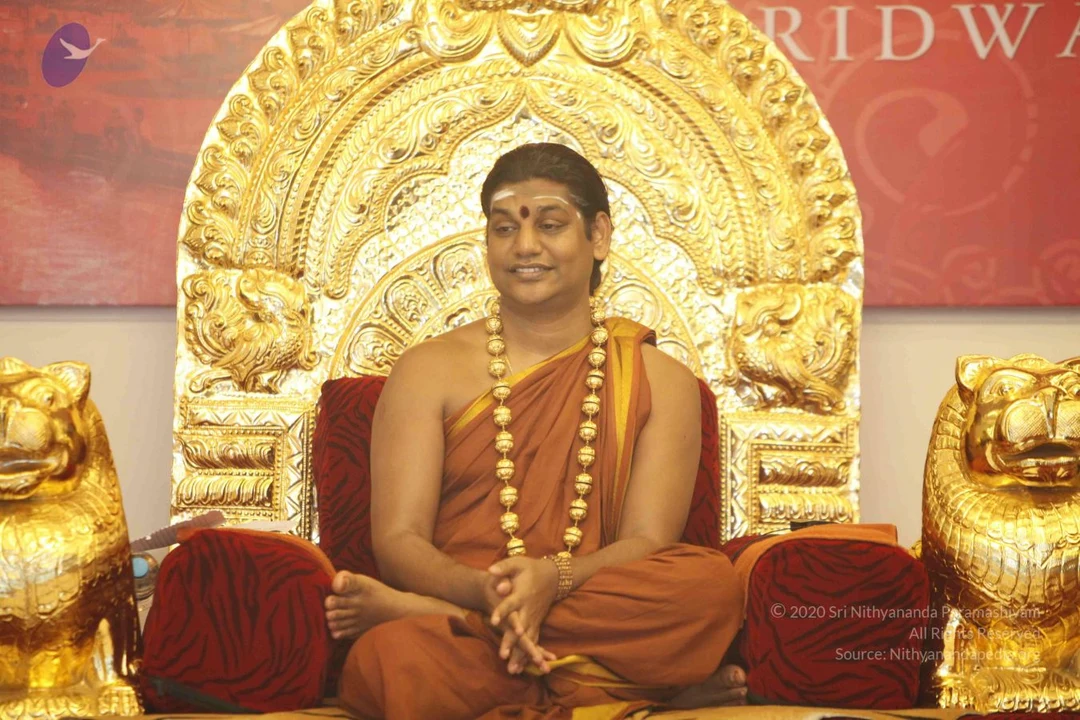
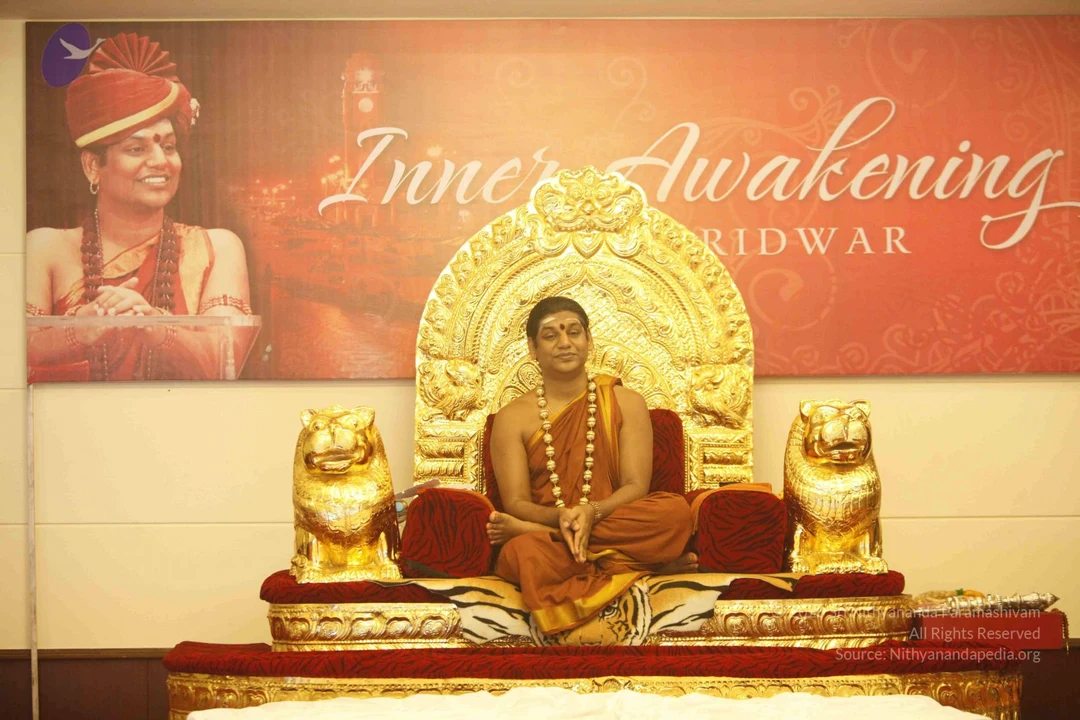
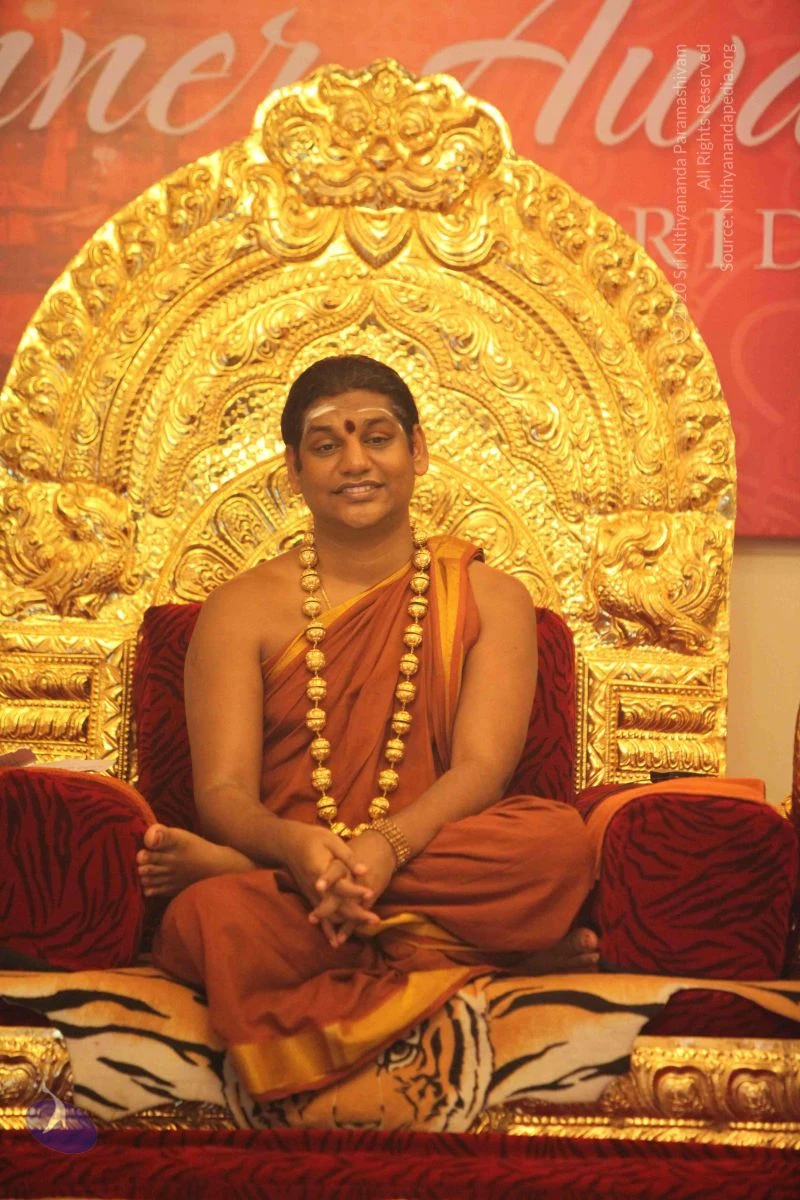
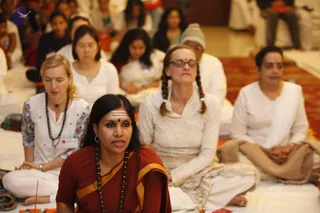
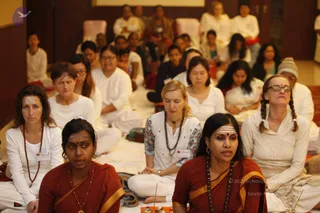
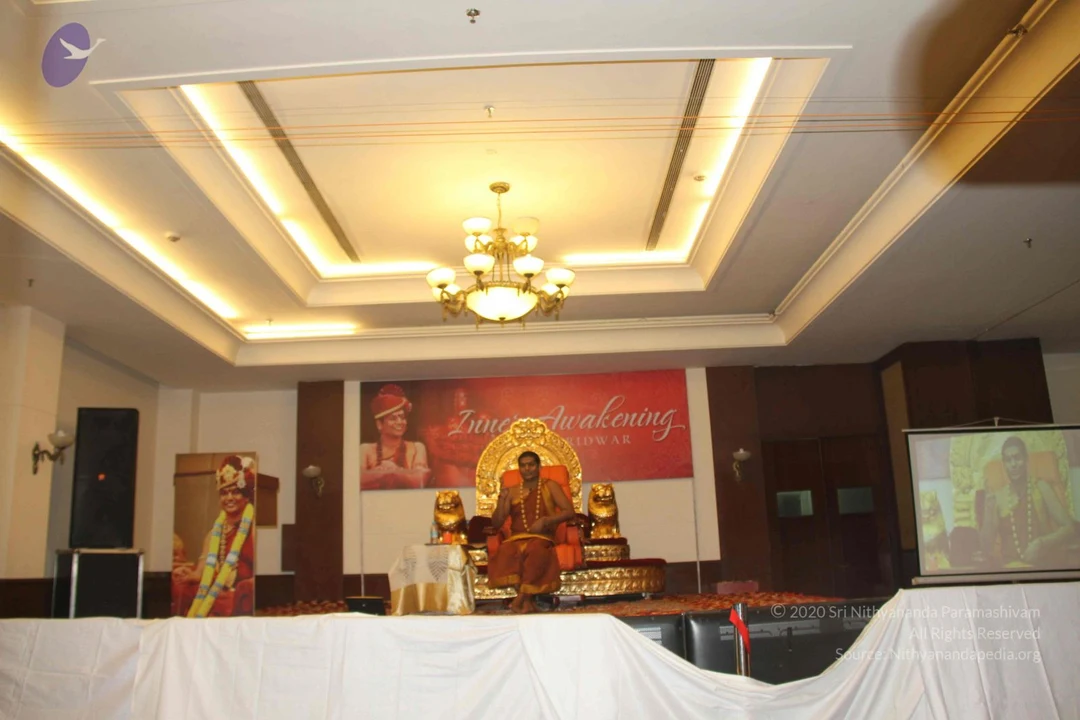
A seated figure in orange-saffron robes and rudraksha beads sits on an ornate gold-and-red throne on a stage in a hotel-style hall. Two golden lion figures flank the throne. Above the stage a red banner reads Inner Awakening Haridwar, with a portrait of a smiling person in orange robes. A chandelier hangs from a coffered ceiling, and a projection screen on the right shows a similar seated figure. A tall standing banner on the left shows a figure in orange with a garland. The stage is draped in white cloth.A man sits cross-legged on an ornate gold throne with a carved arched back, draped over red and black tiger-striped cushions and a tiger-print cloth. He wears a saffron-orange robe with gold border, a long necklace of gold beads, a gold bracelet, and has a white vertical tilak with red bindi on his forehead. His hands are clasped in his lap and he smiles. Behind him a red banner reads partial script. The photo is watermarked with copyright text, which is not transcribed.A seated man sits on an ornate golden throne with carved arched backrest and tiger-striped red cushions, a tiger-print cloth draped over the seat. He wears an orange-saffron robe with a gold border, a long necklace of large golden beads, a bangle, and a white tilak with a red bindi on his forehead, and his hands are clasped in his lap. Behind him a red banner bears large white script. The person is a person by appearance cues: saffron robe, ornate gold necklace and throne setting, so the a person field is set to in_person.A seated group of devotees in a satsang hall, most dressed in white, sitting on white floor coverings with eyes closed in meditation. In the foreground a woman in a deep red sari with a gold border and a dark bead mala around her neck speaks, her forehead marked with white vibhuti lines and a red kumkum dot. Behind her women in white garments sit with hands in their laps, and a woman with long braids in white wears glasses. Incense sticks stand in the lower left corner, and the back of the room holds more seated attendees, some in lighter clothing.A seated satsang gathering in a hall with dark wooden wall panels. In the foreground, two women in maroon and gold-bordered saris with rudraksha malas sit before small brass plates and incense sticks; the woman on the right has a horizontal white and red tilak on her forehead. Behind them, rows of women and children in white clothing sit on white cushions, many with eyes closed in meditation or listening. A woman at left wears a white outfit, red-brown mala and white forehead marking; another in the centre wears a white top with a dark mala and name badge. Several others in white and pastel clothing fill the back rows.Close-up photo of a person's two hands held together in a cupped gesture, palms up, with orange and white small objects visible in the cupped palms. The wrists wear a cream-coloured, lightly textured garment with a frayed edge. The background is a soft-focus indoor setting in muted beige and blue tones. No face is visible.

January 04 2014

1 photoView all
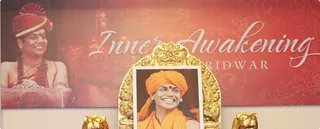
A banner photograph with a red and gold backdrop reading "Inner Awakening" and "HARIDWAR". On the left, a large printed image shows a smiling figure in a red and gold turban and red garment with a rudraksha mala, seated behind a low desk. In the centre, a gold ornate frame holds a portrait of a smiling figure in an orange turban and orange robe; flanking the frame are two small gold lion-like figurines. No physical people are present in the scene.