Skip to content
Saturday

27 July 2013

Understanding is Beyond Logic - Nithyananda

Dated photos
126
Source pages
1
Media
2
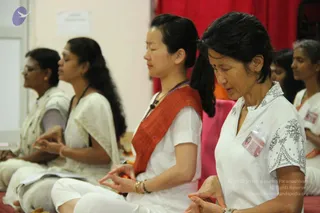
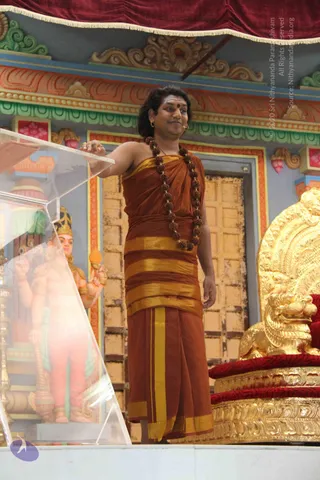
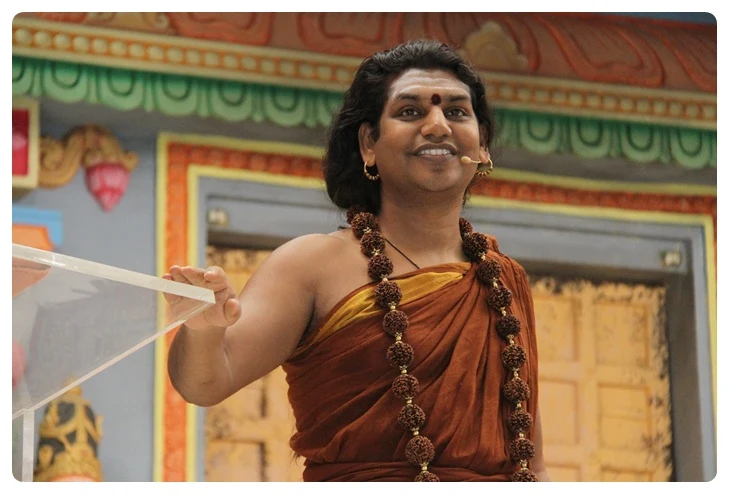
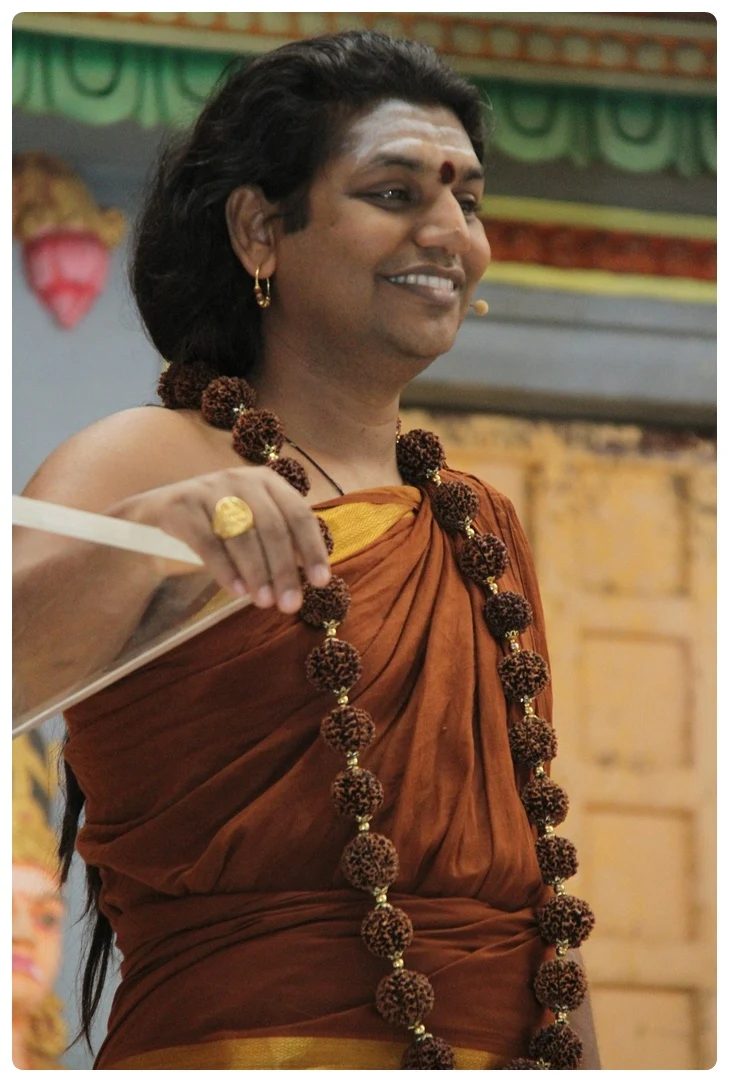
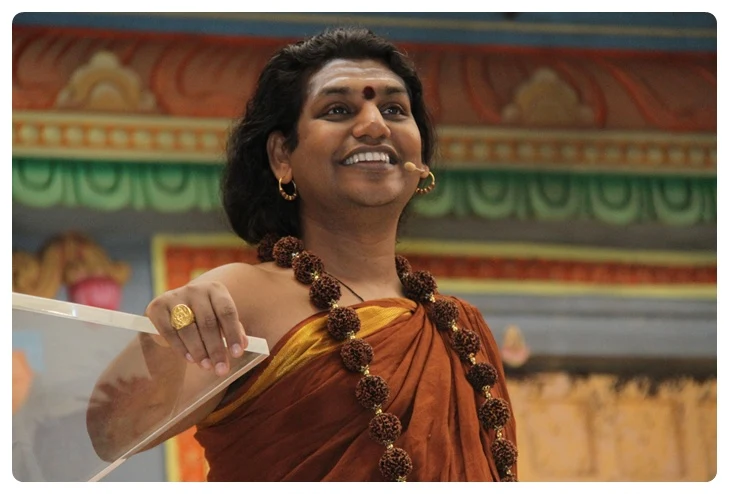
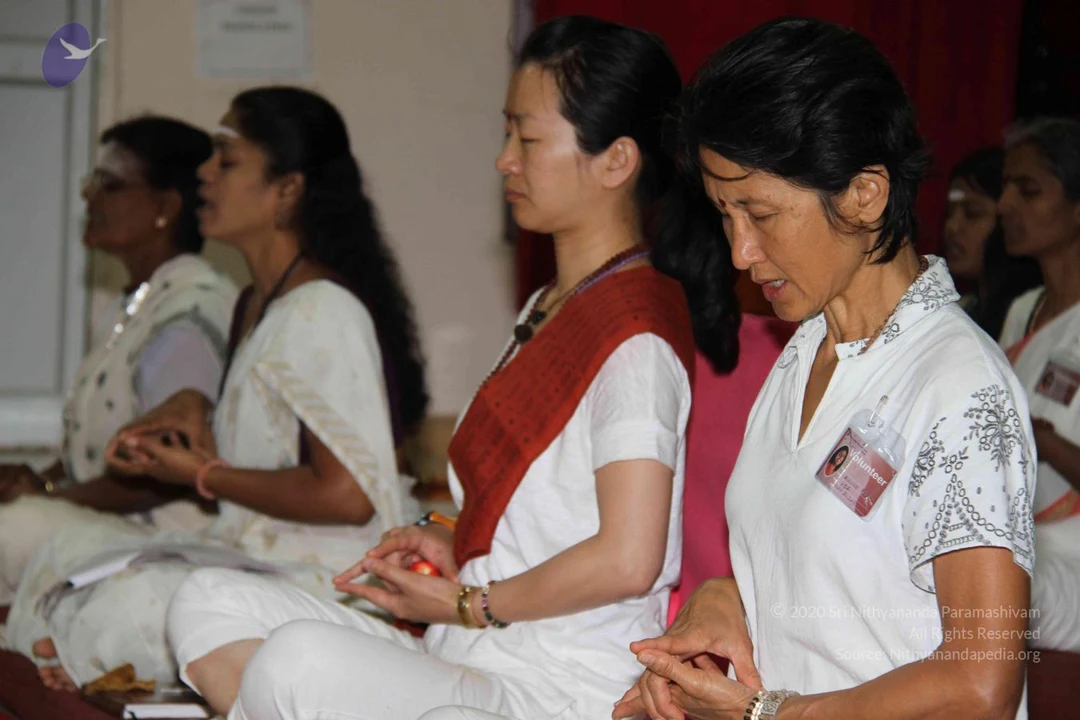
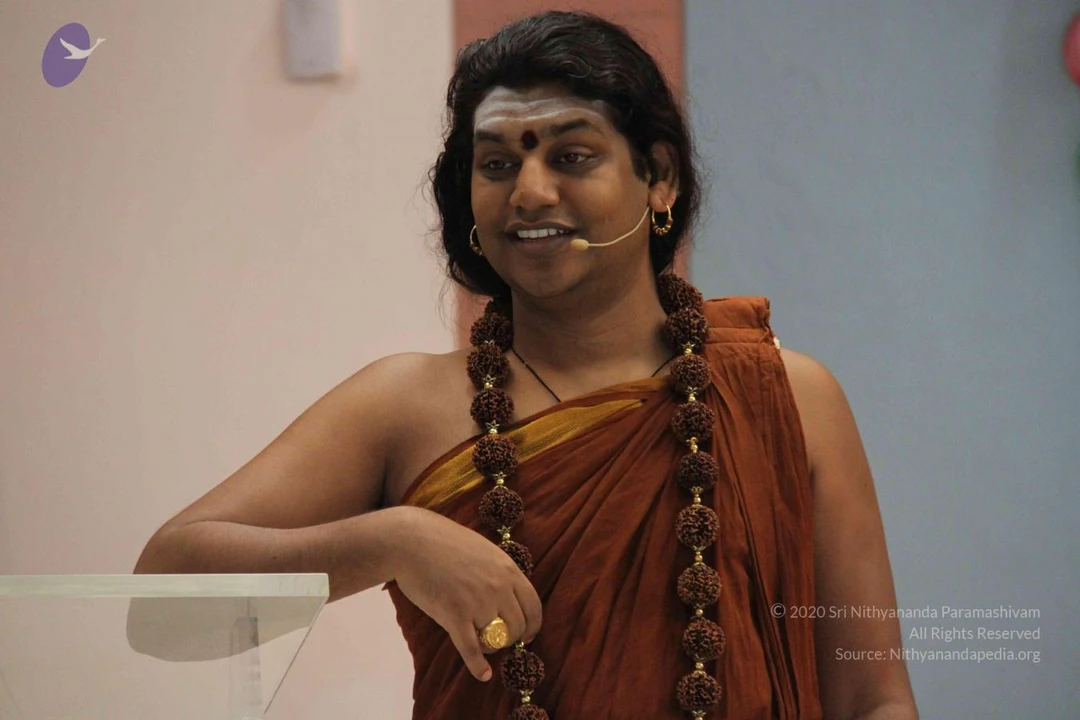
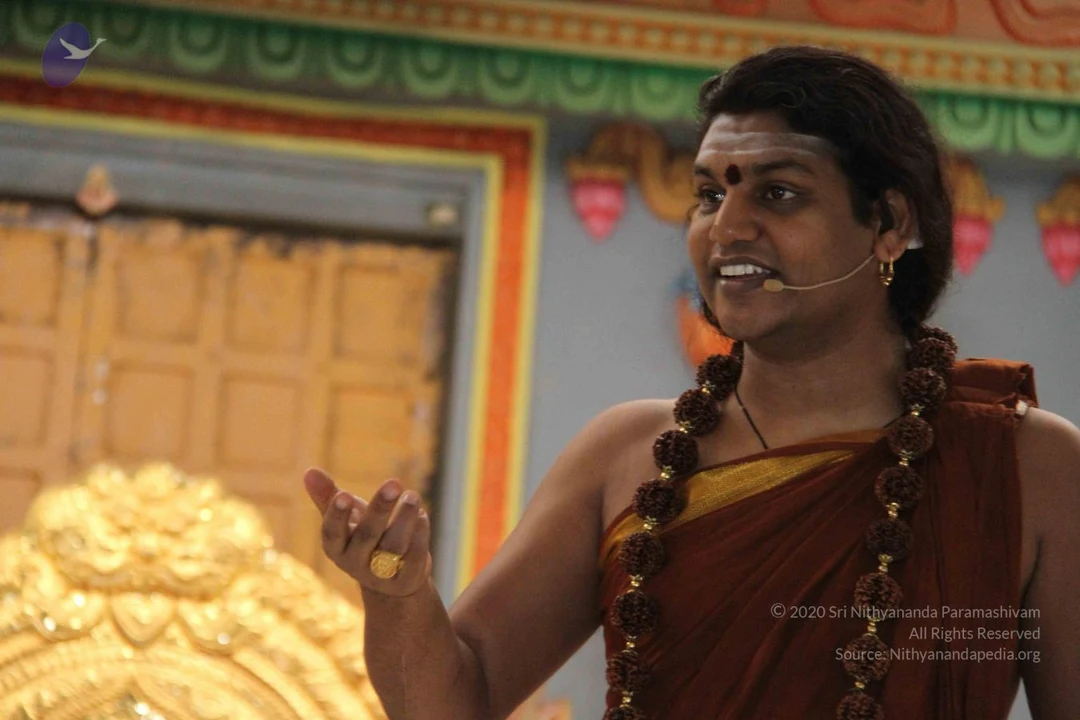
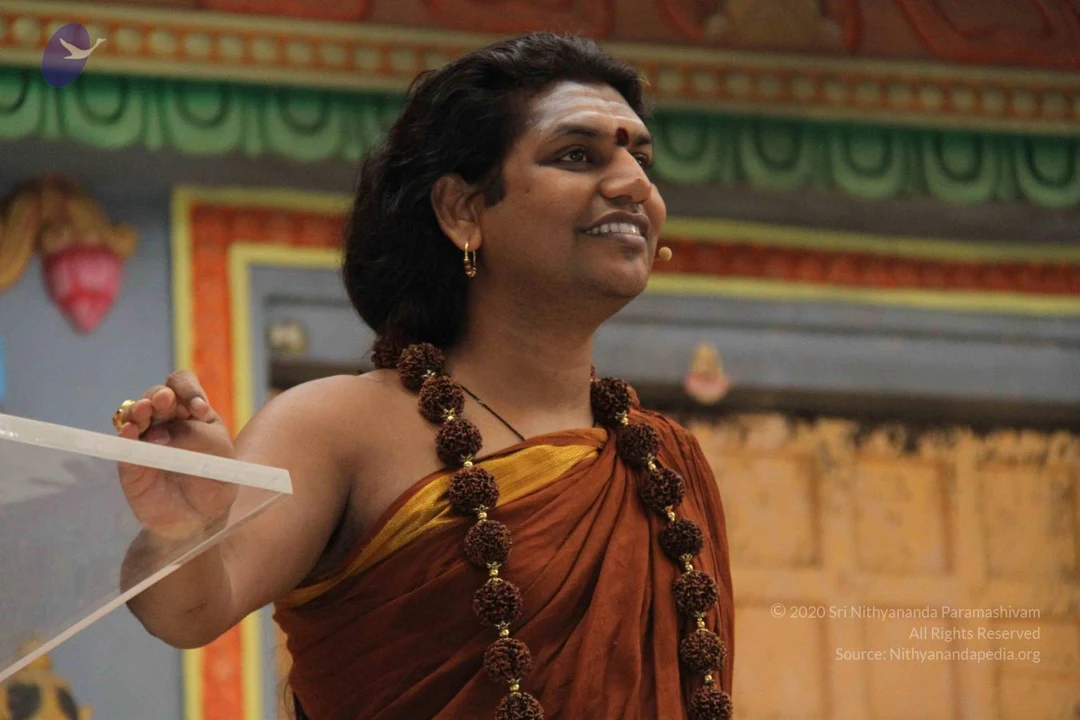
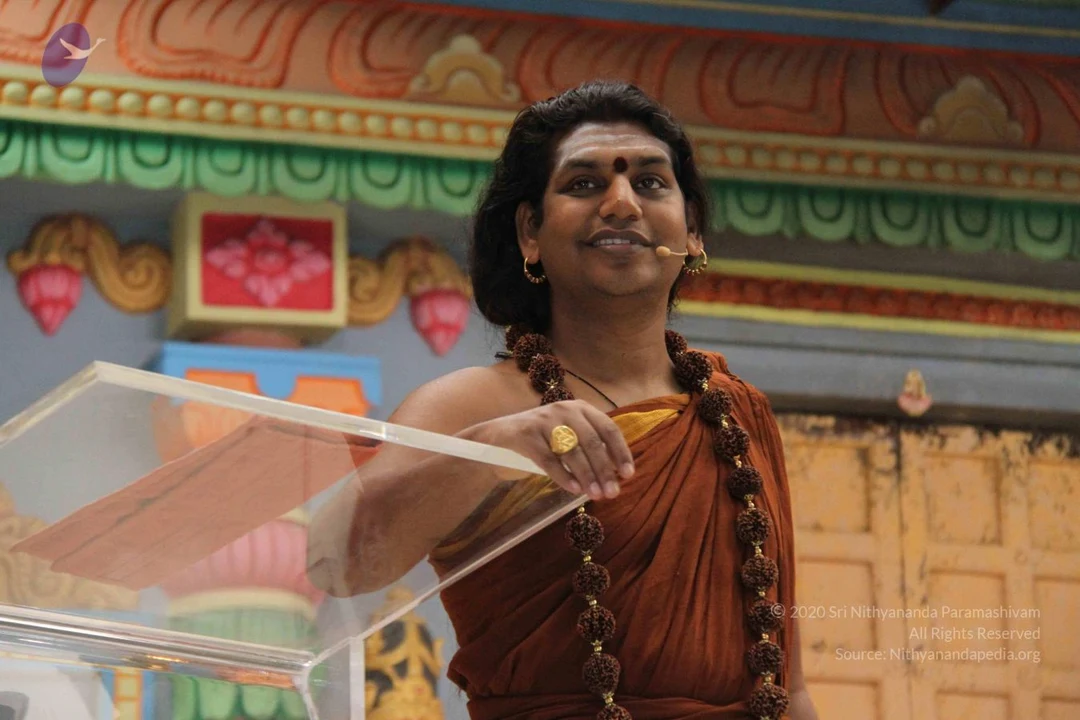
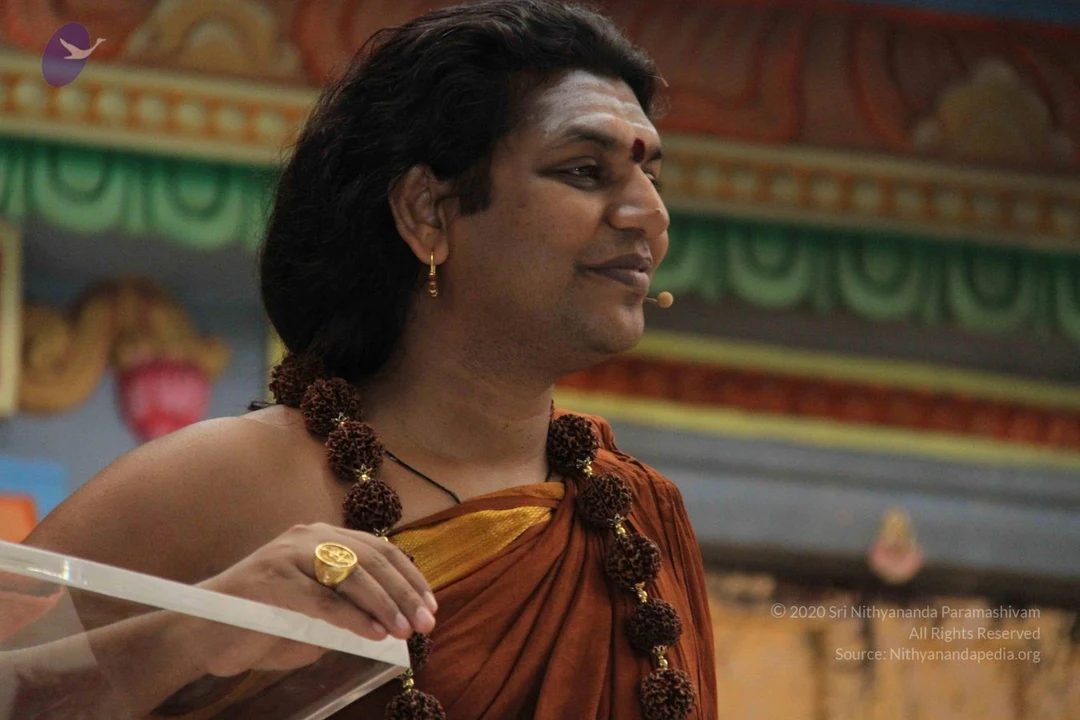
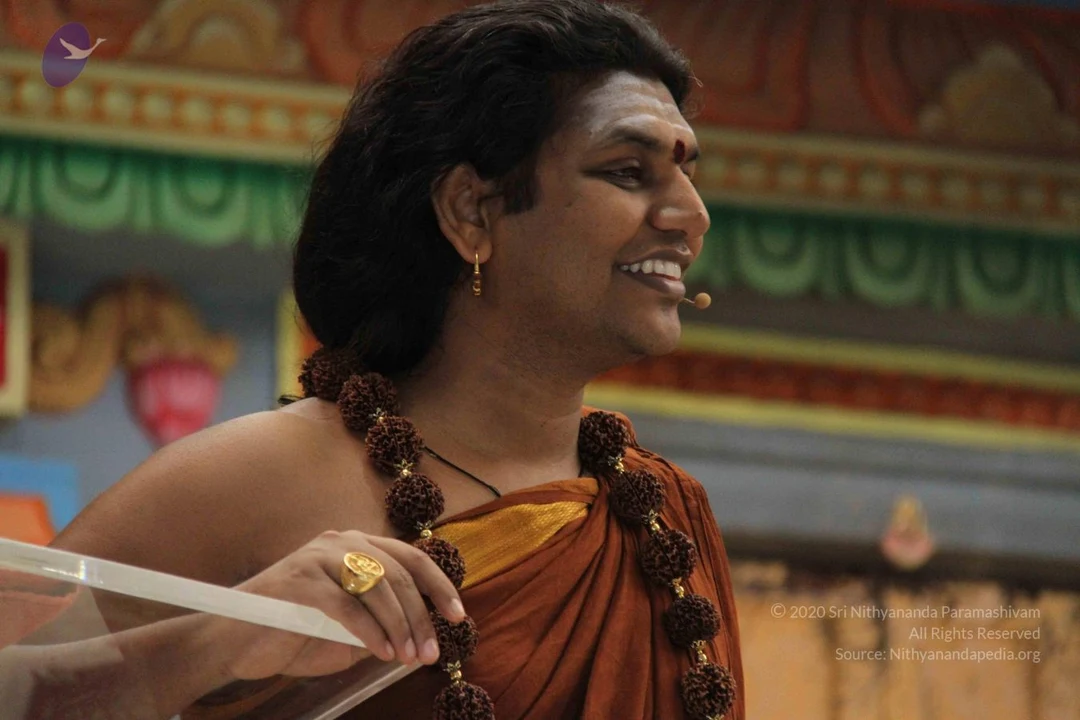
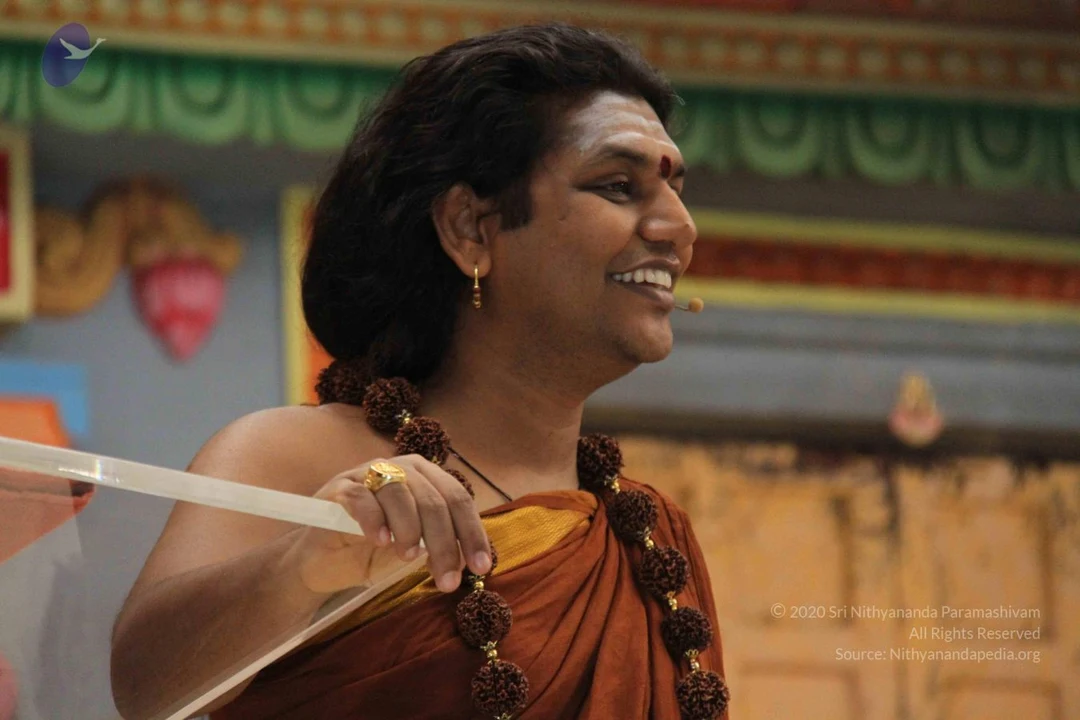
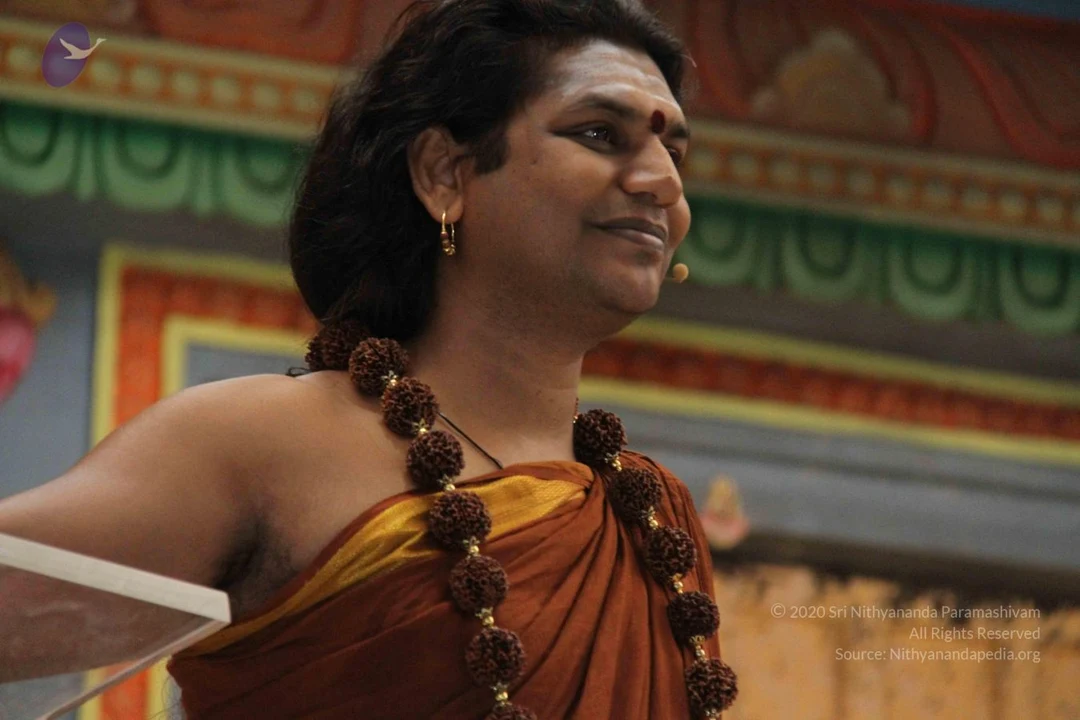
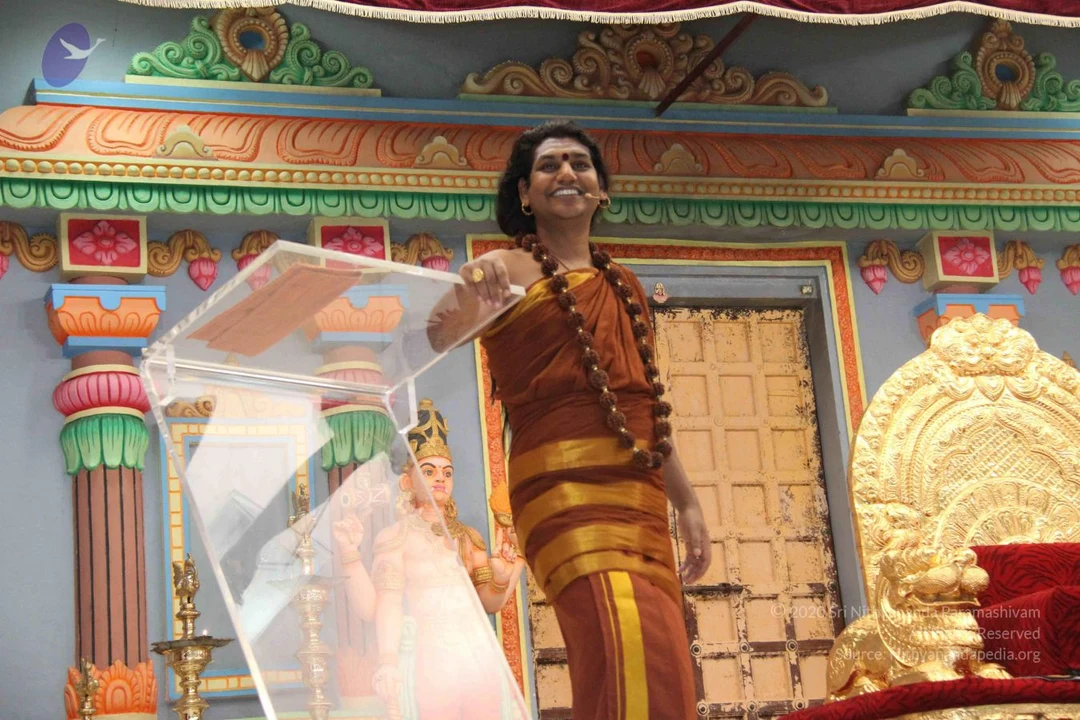
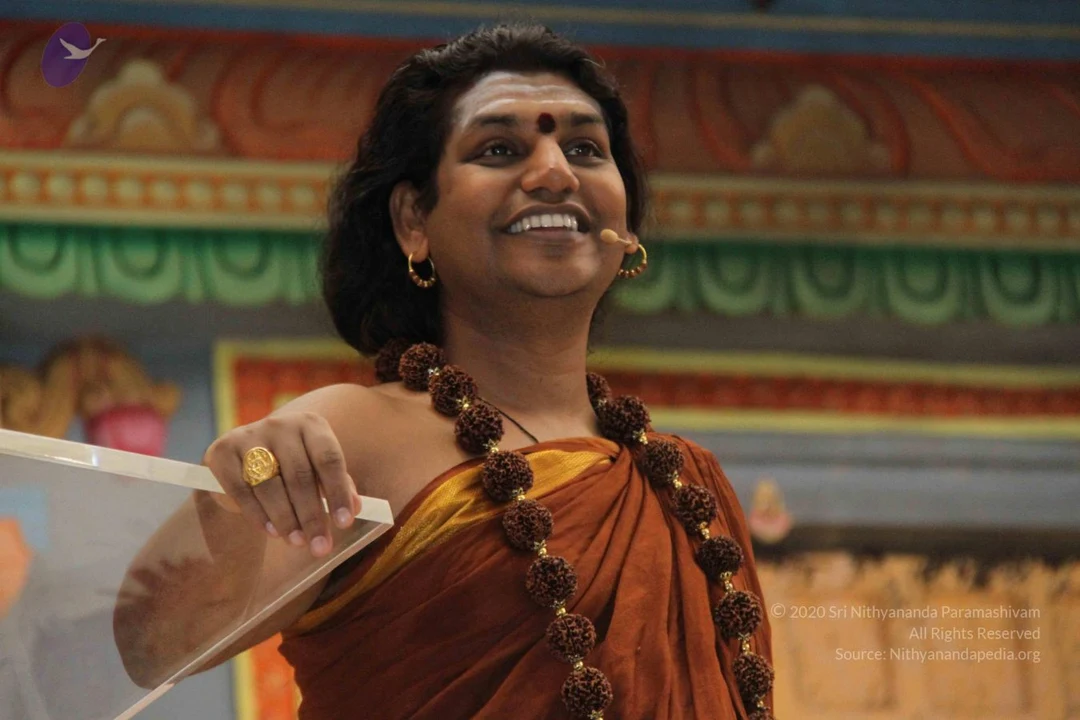
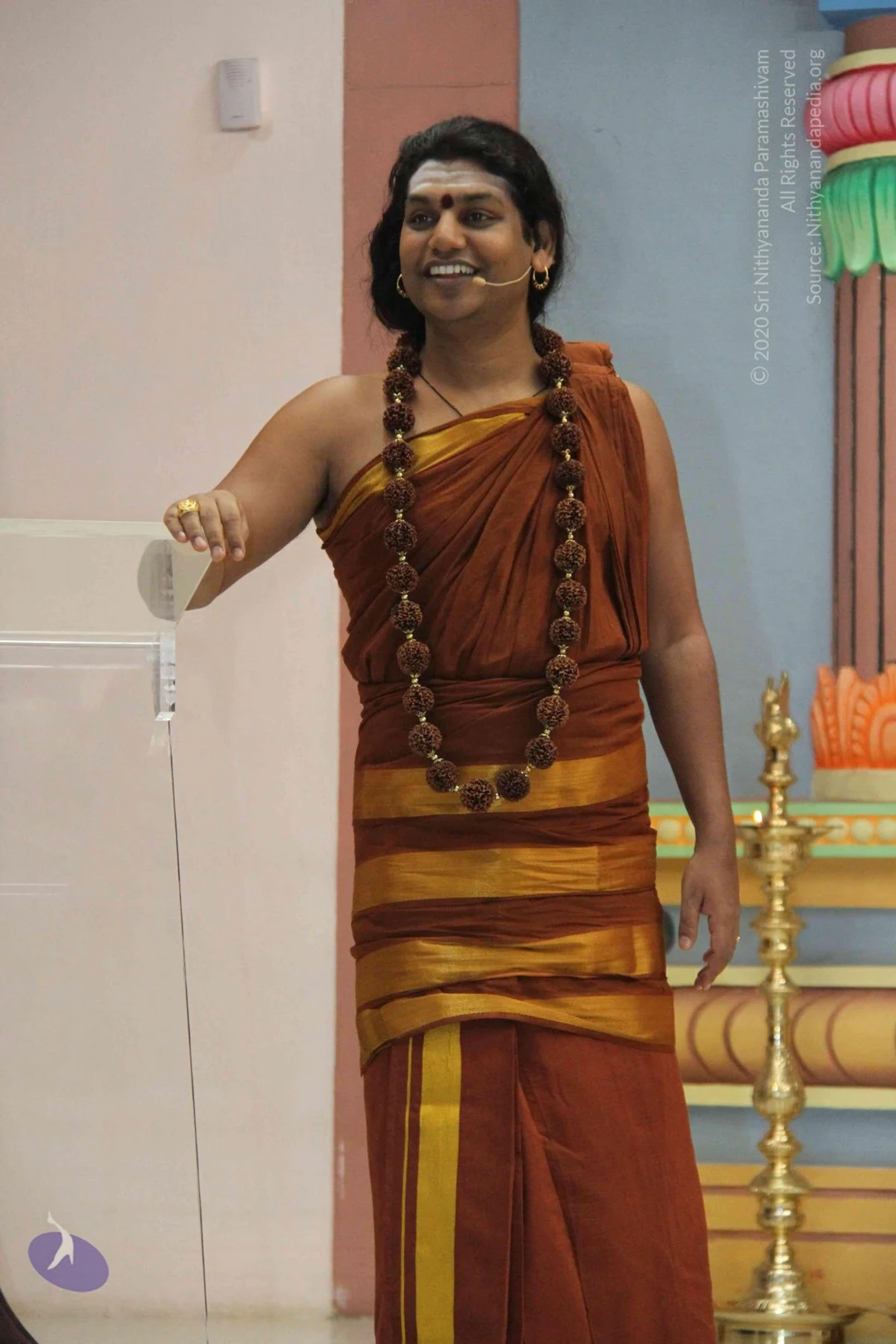
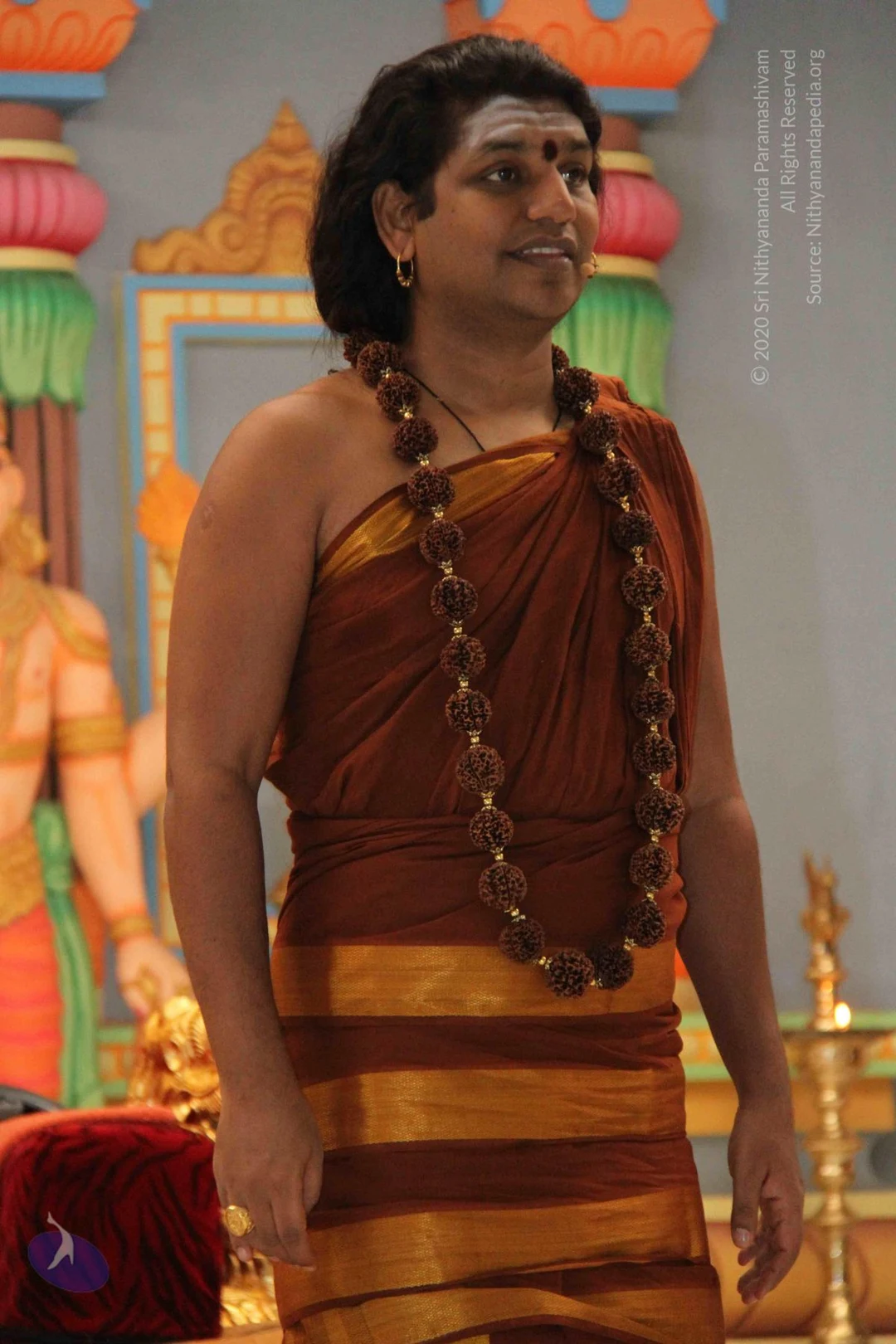
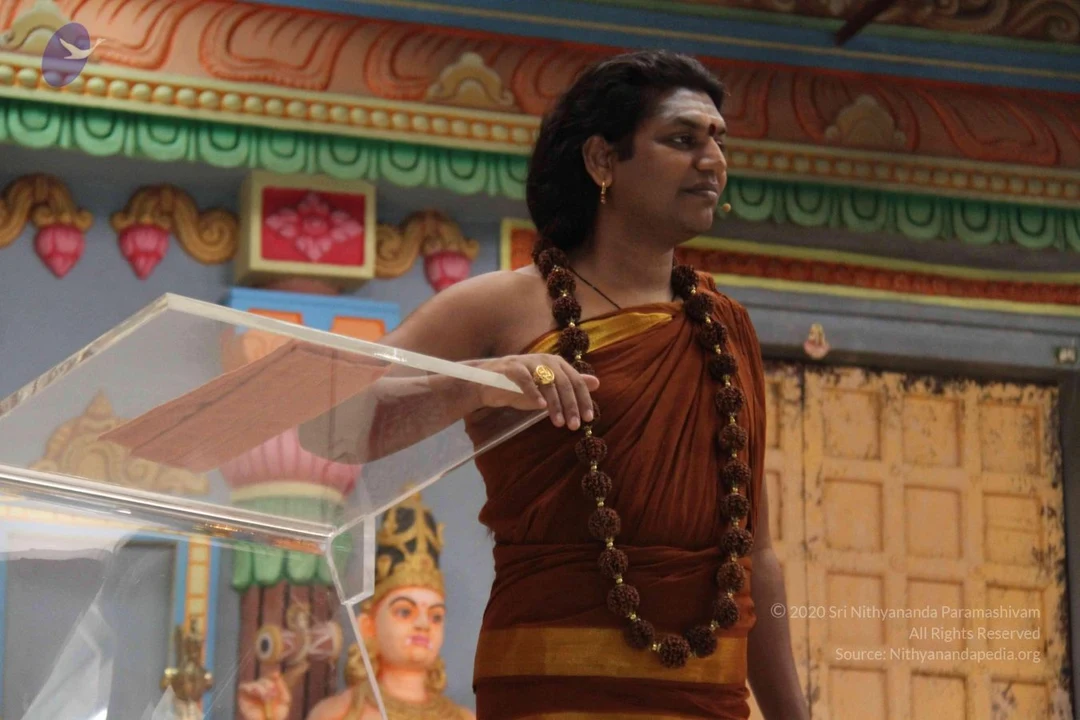
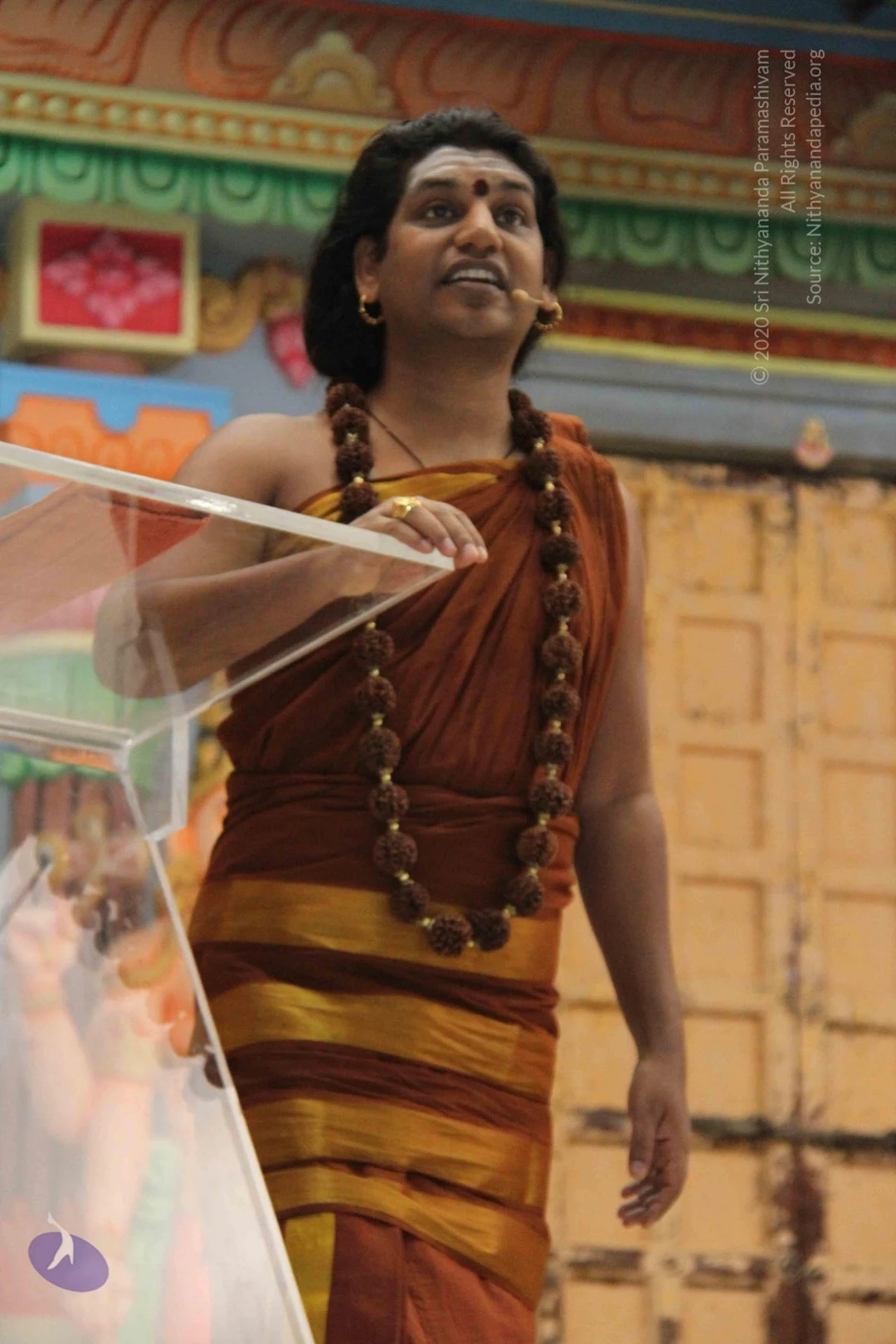
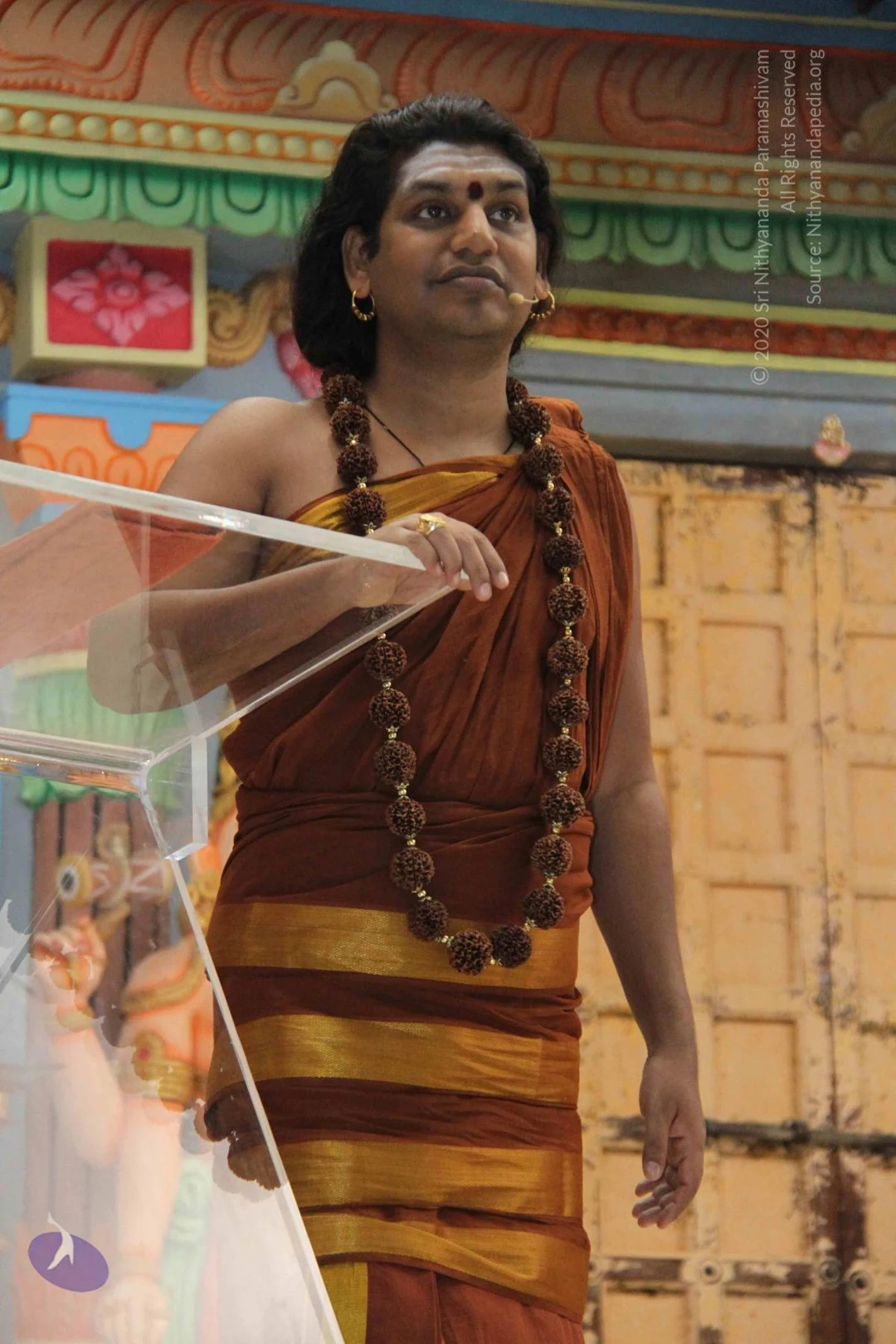
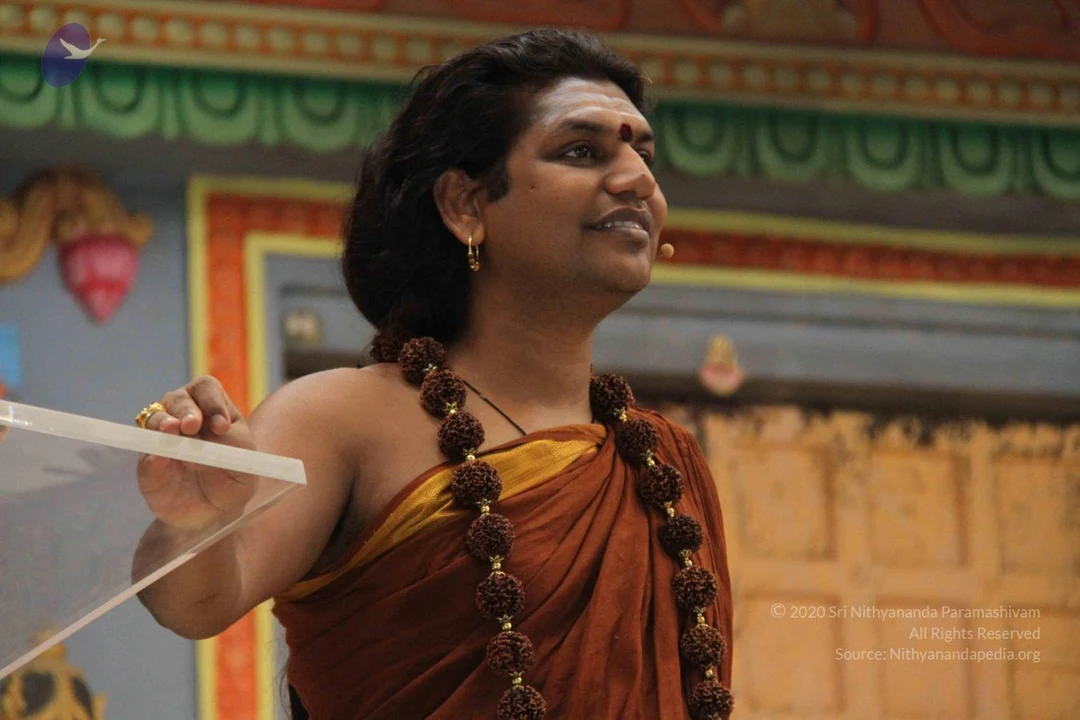
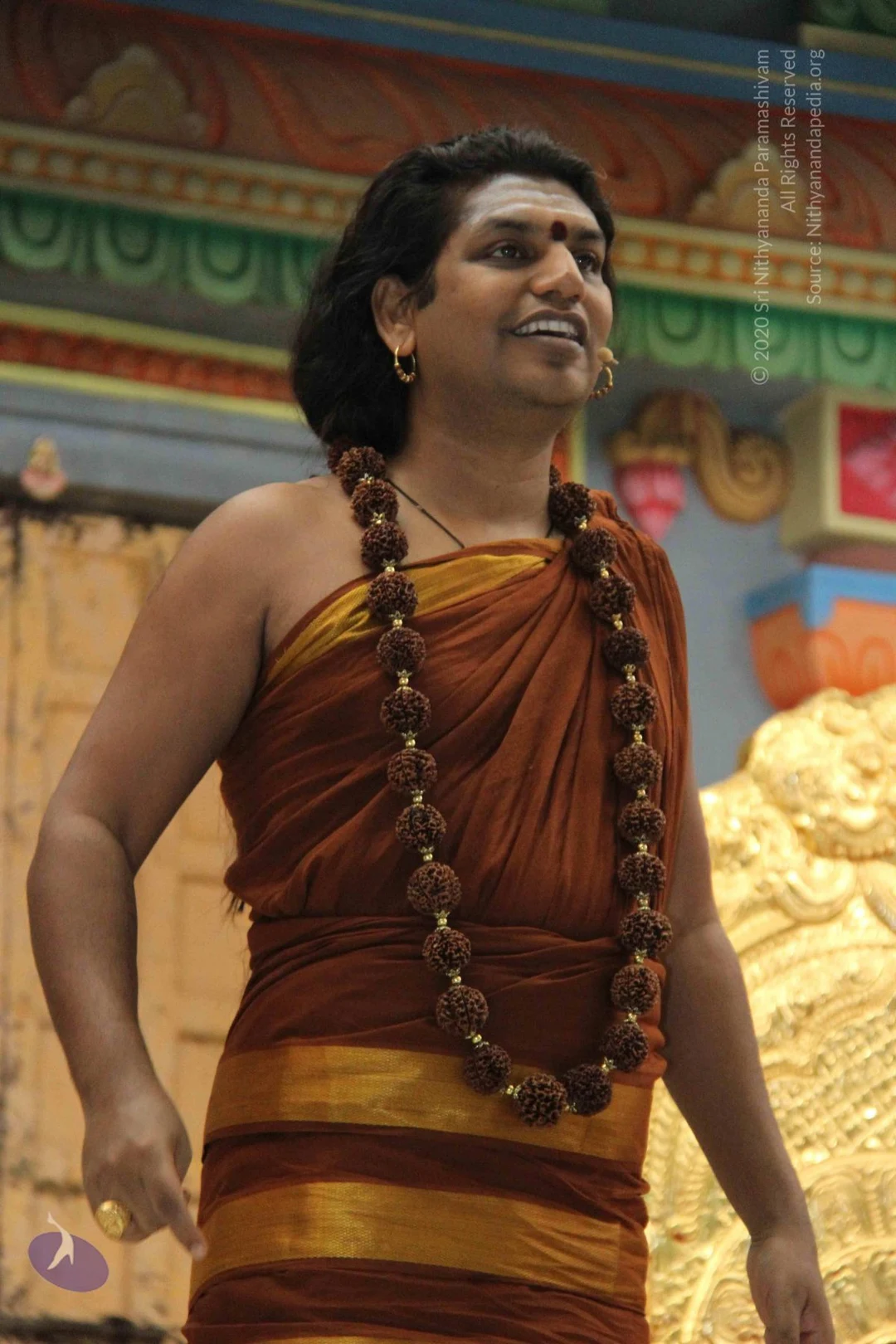
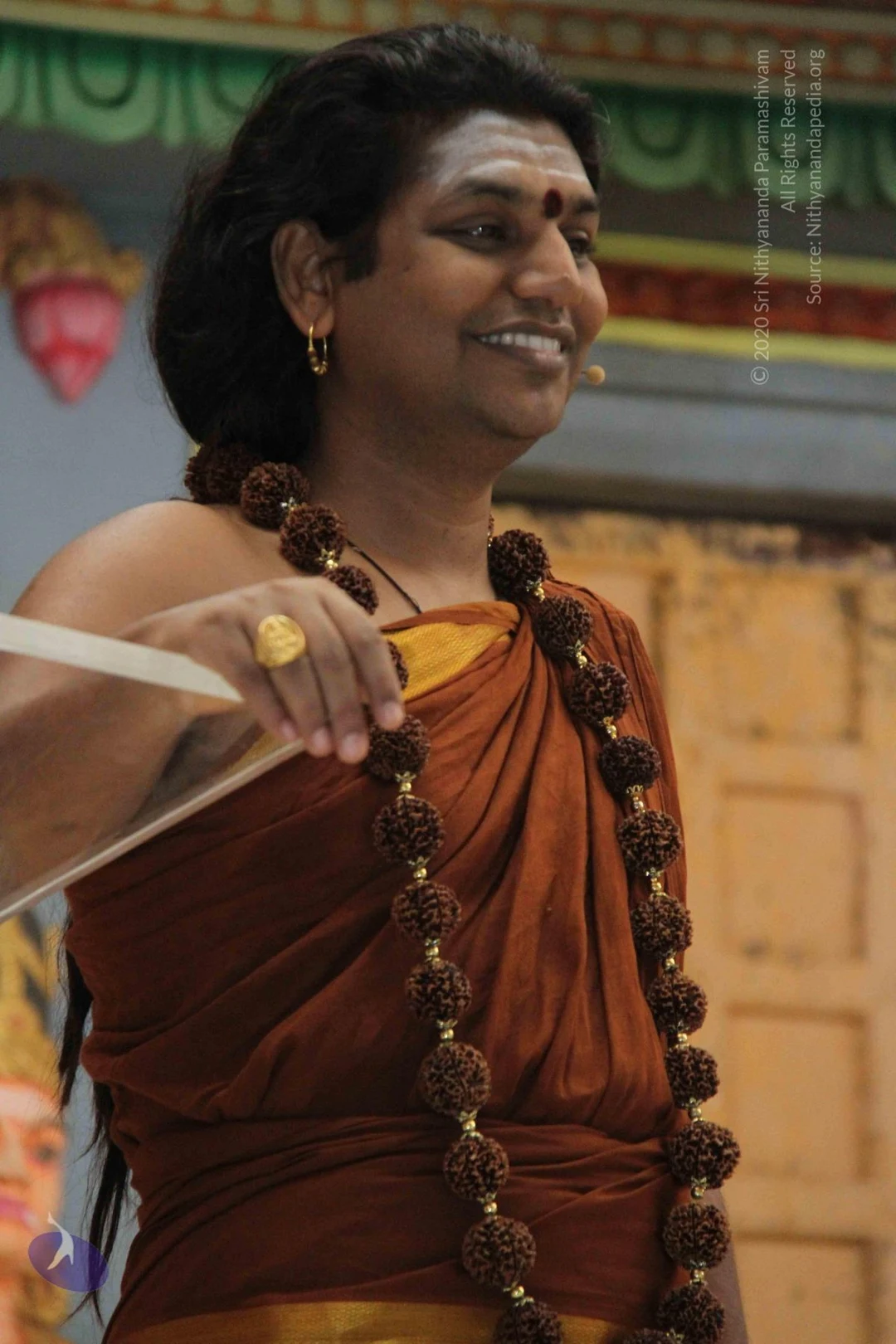
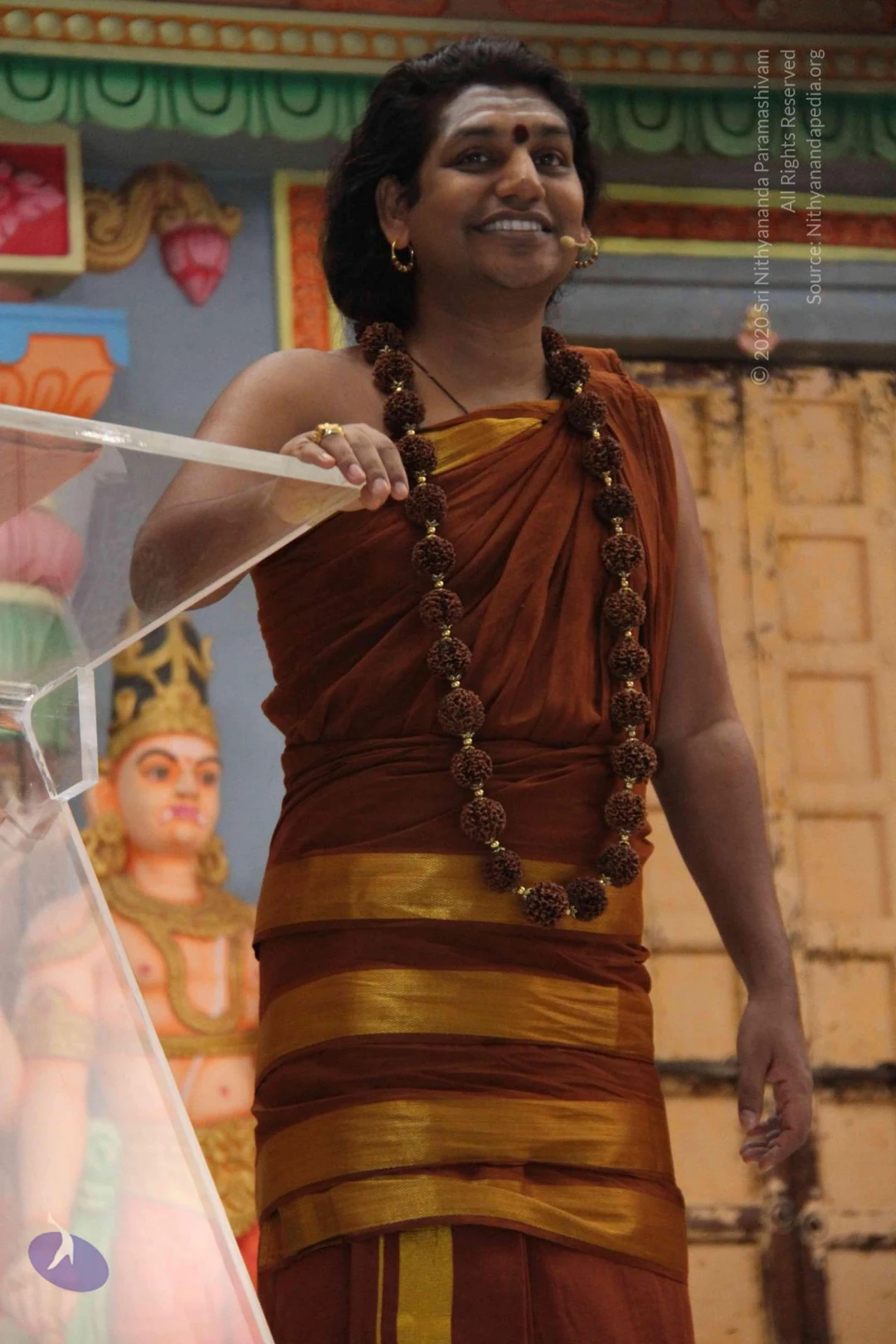
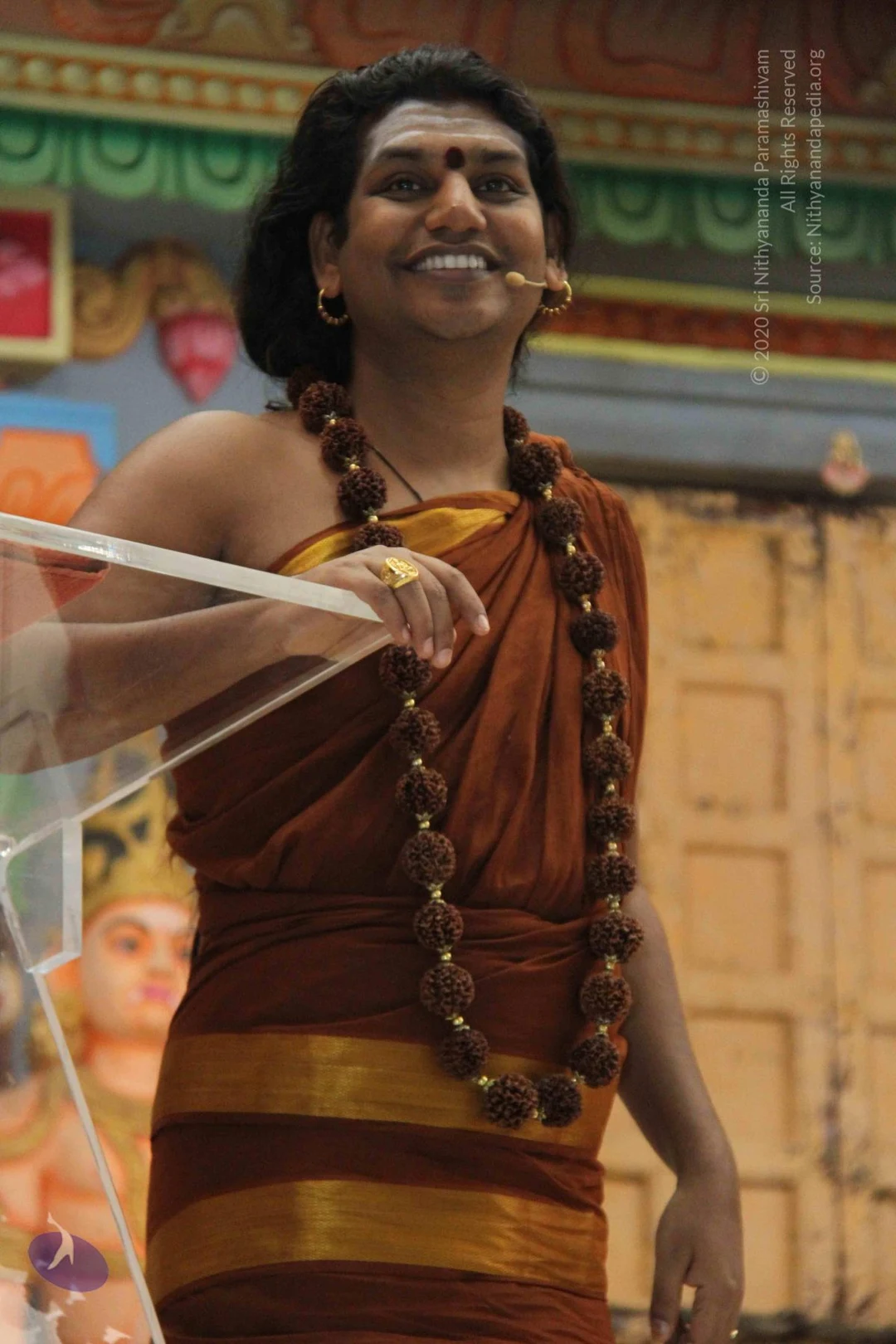
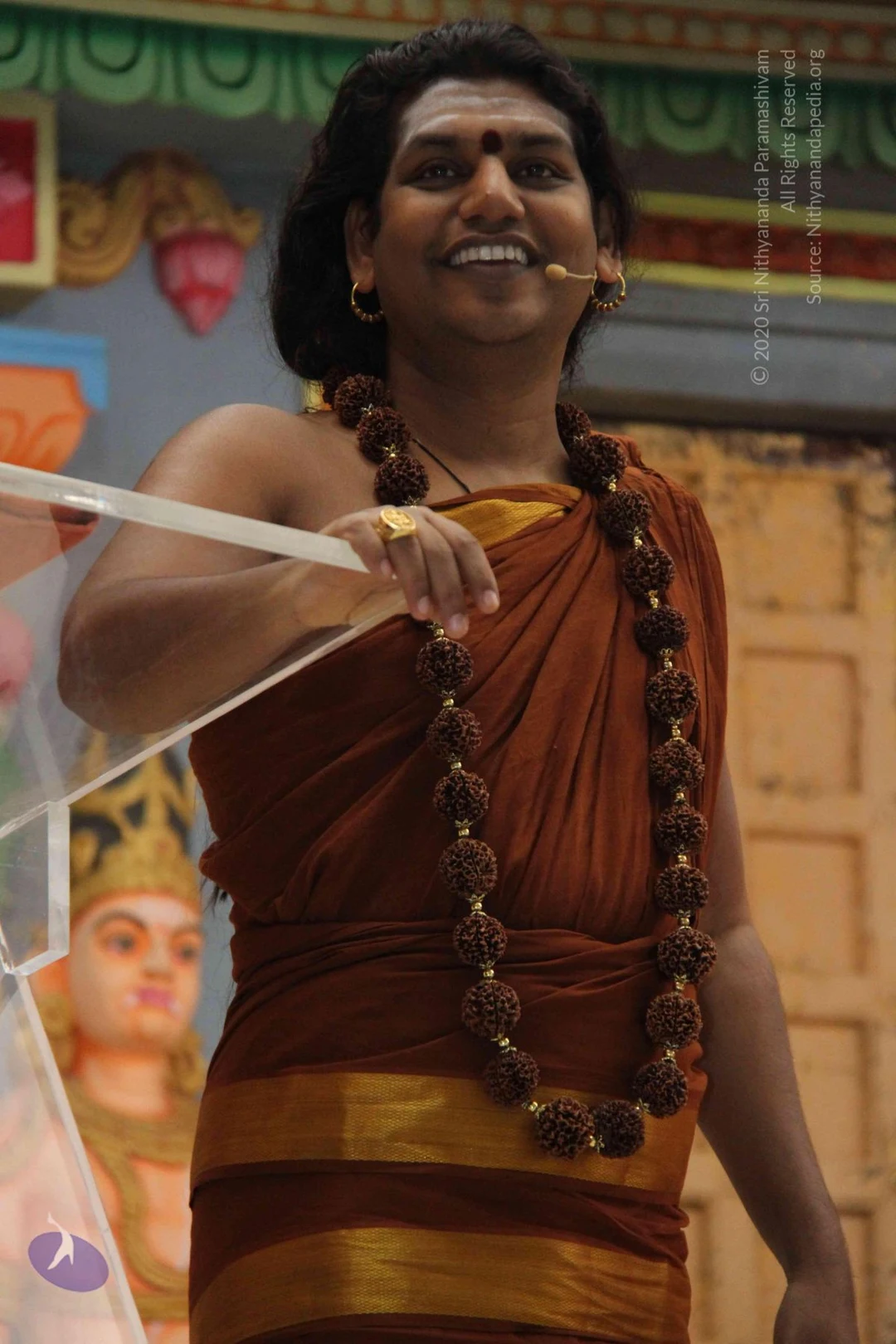
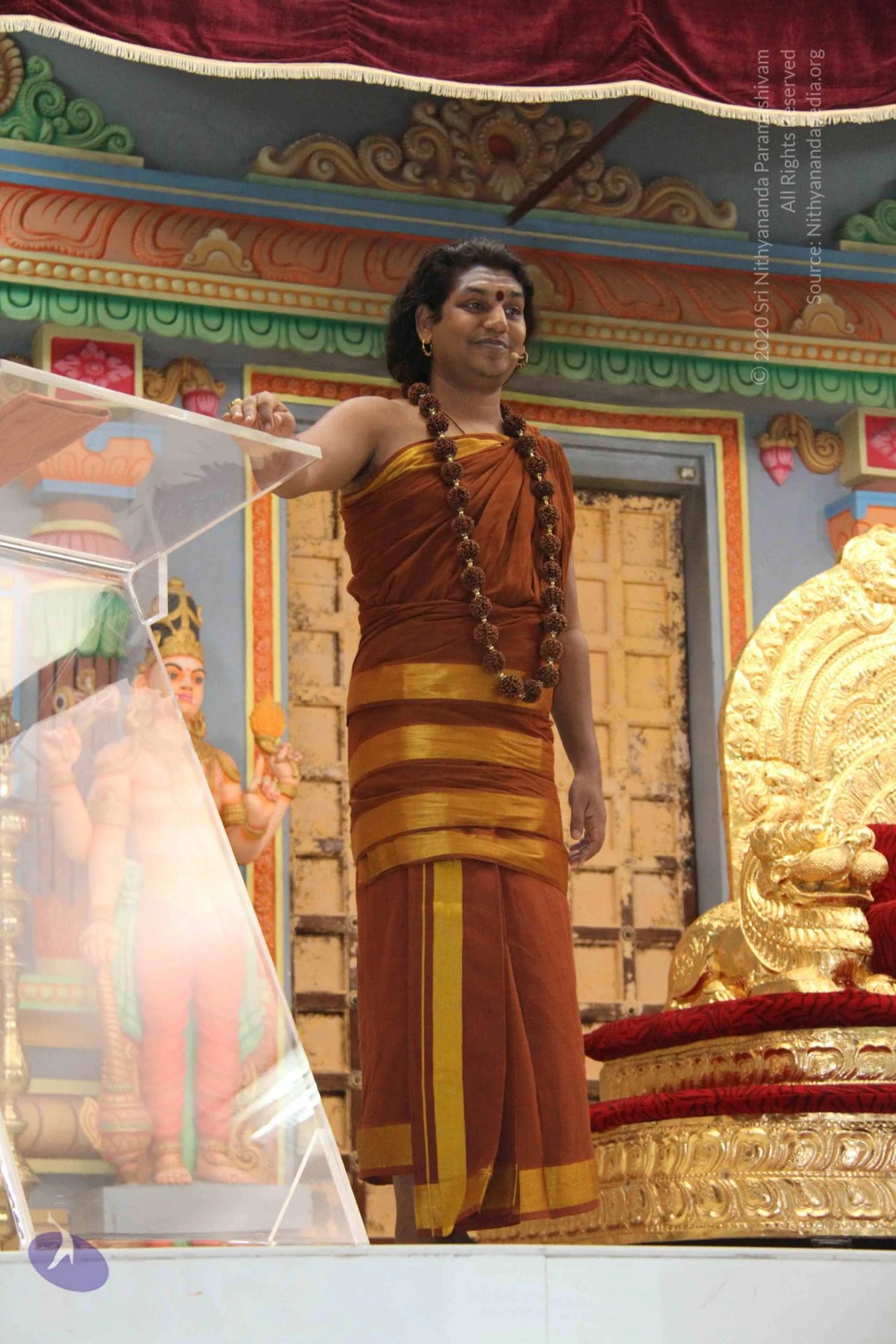
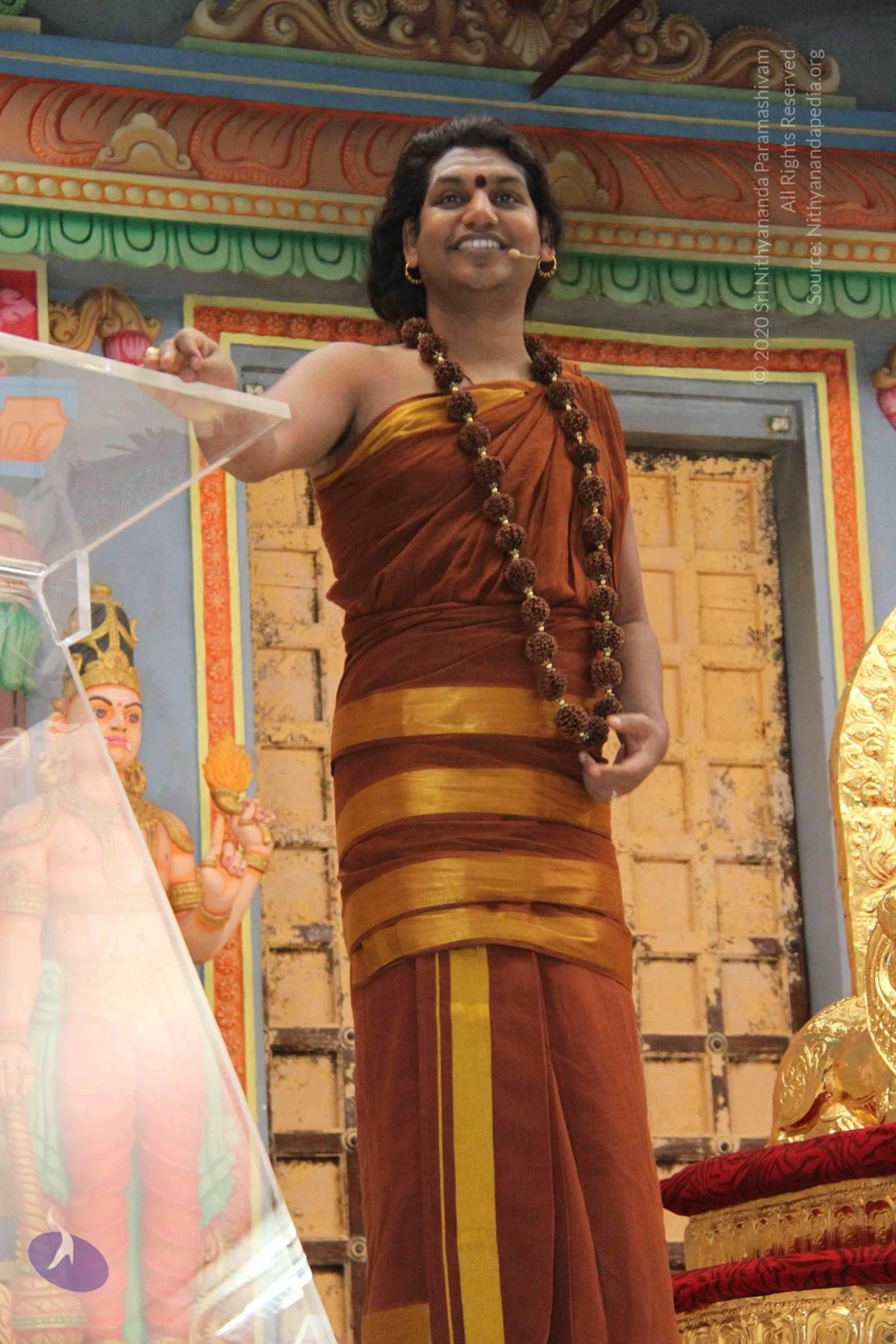
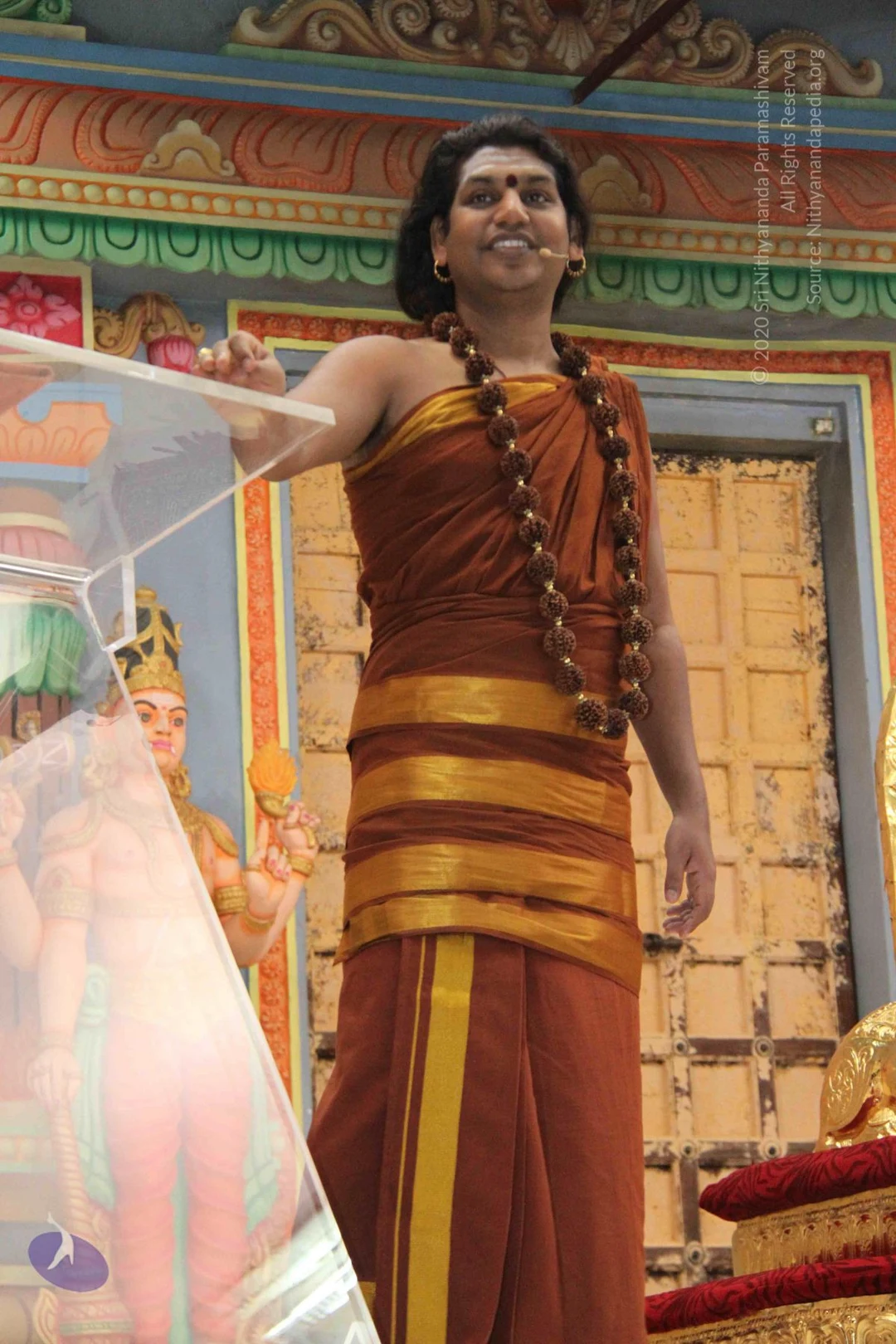
Close photo of a black incense stick with a white-tipped end, burning and releasing a thin curling trail of grey-white smoke against a blurred muted grey-brown background. At the far left edge, a sliver of red, gold and white fabric is partly visible, with a blurred yellow shape nearby. No people are visible in the frame.Several women sit cross-legged in meditation in a hall, eyes closed, in a satsang-style setting. The woman in the foreground wears a white collared top with grey embroidered patterns and a lanyard badge reading Volunteer. Her hands rest in a mudra near her knees. Beside her, a woman in a white top wears a rust-orange shawl and a beaded necklace, hands in mudra. Further left, two women in white saris sit upright with their hands folded in their laps. Red curtains and a pink cushion are visible in the background.A man stands on a raised stage beside a clear acrylic lectern, gesturing with his right hand toward it. He wears rust-brown cloth with broad gold borders draped over one shoulder and wrapped at the waist, and a long mala of brown rudraksha beads hangs across his chest; he has a red bindi and small gold earrings. Behind him are painted temple-style panels in orange, green and blue, a wooden door, and a painted deity statue with a gold crown. To the right stands a large ornate gold throne with a red cushion. a person: the rudraksha mala, ornate saffron-brown dress with gold borders and presentation beside a lectern match the cues for the page's subject, so this is a presumed in-person appearance, not a confirmed identification.

July 27 2013

Original wiki page
Contents

Title:

Understanding is Beyond Logic - Nithyananda

Description:

In today’s morning Satsang, Paramahamsa Nithyananda expresses that Hinduism is an evolutionary, completion-based religion that has already developed the science that will set standard for what philosophies will useful for the future of society. He cautions us to beware of philosophies that lack inspiration, telling us that there is only one answer, one instruction, and in their generalizations, the truth is lost. In our lives, we can measure a philosophy by how it is cognized in our inner space; how does it introduce us to ourselves? Is it capable of leading us to completion? God and the Cosmos are not immediately available to us. But we are immediately available to ourselves with the ability to raise ourselves to the Ultimate through completion.

Link to Video:

VideoAudio

Transcript:

I welcome you all with my love and respects.

Today, I will expand on “SPONTANEOUS COMPLETION, COMPLETION THROUGH CREATION – SRISHTI POORNATHWA”. In Sanskrit, I will name this as “Srishti Poornathwa”.

Yesterday night I was going through Sankhya, some of the Sankhya works. Don’t ask how I was going through! I was shocked the whole Sankhya does not speak about God, because completion itself was given the place of God! Methodology to reach Godliness was given the place of God!

Please Understand, Sankhya does not have the system of God, because the method;ogy to reach god is given the place of god. It is Sankhya formed the basis for Buddhism. In Buddhism also, there is no God. The methodology to reach God is made as God. Methodology to reach God is made as God! Please listen! It is a kind of a lifestyle. It is a lifestyle. Methodology to reach God is made as God.

There are only two religions in the world. One sees God as something outside and gives you the methodology to reach God. Another one tradition, the methodology to reach God itself is made as God.

There are only two types of religions in the Planet Earth: Where the methodology is worshipped as God, or separate God is worshipped. Whether Buddha is important, or Dhamma is important.

And, I tell you, in the beginning, the methodology to reach God should be worshiped as God. But in the end, you will know, the experience is far beyond, unimaginable! It can’t even be compared with the methodology. You cannot compare the menu-card with the food. Menu-card may have photograph of the food you are going to be served, but menu-card can’t be compared with the food! But menu-card is required for you to get the right food. It is a strange relationship. But unfortunately, human mind goes on behaving with violence. ‘Tell me one thing!’ Not having patience to study the whole thing! For the mass, you also have to generalize. When you generalize, always the truth is lost.

One barber asks Mulla Nasruddin, ‘How did you lose your hair?’

Mulla replies, ‘Worry!’

The barber asks, ‘What did you worry about?’

Mulla Nasruddin says, ‘About losing my hair….!’

Your worrying makes you lose your hair. And, in turn, you are worrying about losing the hair! It is a vicious circle! See, Same way, you are forced to generalize, because the human mind is filled with violence. People are forced to generalize, because human mind is filled with violence, and people ask, ‘Tell me one thing!’ People who ask for instructions are most violent people. Why do they ask for instructions? So that they can miss the spirit, and carry on with the letter!

Listen! If you want to live the spirit, you will not ask for exact instructions. When you ask for exact instructions, you are working around how to miss the spirit.

I could see the whole compassion of Kapila. I know for sure, he was the first man who started thinking. Till then, thinking was not part of the humanity. The first human-being who started thinking was Kapila.

Listen! You need to come to the space of listening. Please come to the space of listening so that you internalize this great truth.

The religions which makes separate God have some advantage and disadvantage. Religions which make the path towards Godliness and God as religion have some advantage and disadvantage. Both of them have some advantage and disadvantage. What exactly I want to do is, I want you to understand that the mental setup of asking anyone final instructions is a violence and so drop and learn to understand the whole. Path towards God need to be treated as God at a certain level, and the experience of God is totally different from the path. You need to understand this, at one level. You can neither say this is important or that is important. Asking or expecting or thinking only one can be important is violence. Come out of that mental setup. I have seen, whenever my sannyasis are asking, ‘Give one instruction. We will follow.’, I know, they are caught in violence. Only violence asks for instruction without inspiration. A violent person cannot be inspired. He can only be instructed.

If any religion gives you a manual, be very clear, that religion is born from violence, will continue to flourish in violence. In the Bhagavad Gita, Nowhere you will see instructions. Rarely, one or two lines! But the whole seven-hundred verses are all about inspiring and giving intelligence. Nowhere will you see instructions. You see, the very funny thing! Arjuna was supposed to fight, but he is being taught to meditate! Dhyana Yoga, one full chapter is there! And he is being taught Sankhya! And he is being taught the great different aspects of Sanyaasa, Sannyasa Yoga! Karma Sanyaasa Yoga! Jnanakarma Sanyaasa Yoga! Very funny, you see, Arjuna says in the beginning of the Bhagavad Gita, ‘Leave me, I am going and becoming a sannyasi.’ But Bhagawan says, ‘No!’ He catches him. He is asking him to fight! When Arjuna is asking, ‘Why should I? How can I?’, when he is asking all these questions, Bhagawan is telling him about sanyaas, how to become a sannyasi! See the whole thing, I tell youThis is the beauty of Hinduism! No single instruction! Because of the mental setup, asking for single instruction is violence. Only a violent mind believes only one thing can be top, only one thing can be ultimate. only one instruction can be ultimate instruction.

Why? Because you feels only you should be alive or the other fellow should be alive! The mentality of fighting, violence, always excludes, excludes, excludes! One, one, one, only one! No! No! That is not even required! The root of the problem should be solved. The root of the problem is- asking for only one as ultimate is nothing but the mentality of the fighter. In a fight who is the winner? Only top. In survival instinct, who is the winner? Only one. In the survival instinct, no question of co-existing. But anything which talks about one, only one, only one is out of survival instinct.

Fortunately even the Advaita philosophy never talks about one, it only says ‘no duality’

Advaita! It does not say ‘Ekatva’. Understand the difference, it only says Advaita- no duality, But it does not say Ekatva- single. ‘One, Only one should be’- the concept, the idea itself is from violence. The root pattern of asking for one instruction, One in the top is the root pattern of violence.

Undestand, Bhagavan is not against Arjuna’s sanyaas, He says- Go to snys out of Completion. Bhagavan is only trying to do one thing, out of Completion, take any decision. Out of Completion, take any decision.

HINDI

Kapila does not talk elaborately about God, but talks about the methodology to reach God. He feels what is the use of telling how the idli will taste and how it will look. How the dosa will taste and how it will look. Just serve them. Kapila is a real spiritual activist.

HINDI

I wanted you to understand, asking for single instructions itself is from the violence. And if the single instruction is given, again thats violence. Encouraging your violence. Not instruction, only inspiration should be given. I tell you, the first quality you should see before you up any philosophy is, in that philosophy, ask , what is the introduction given about you to you.

Second, was it single answer based philosophy or an inspiration based philosophy. Inspiration based philosophies will never be a single answer based philosophy. Where you will be given lot of understanding. Please understand, these two are very important.

The world is actually going to sit very soon, all the top religious leaders, spiritual leaders, theologians, philosophers, not for sitting and reconciling. Please understand, the age of reconciliation is over. With Vivekananda, the era of reconciliation is over. I am telling you, all the world leaders, thinkers are going to sit to find out which is the philosophy which should be actually followed, which is the philosophy which is going to make future of the planet – very intelligent, bright, rich, blissful. Beyond the amount of money we have invested in the infrastructure of those philosophies and religions and the teachings.

Listen! Now, the Planet Earth is functioning in such a way, all infrastructure established for a particular ideology or philosophy or religion, based on that infrastructure and their capability to shout loud decides which philosophy will be followed by human-beings. But, I tell you, all the theology schools should adopt the policy of universities, how the universities Go on in search of truth. All the infrastructure and money invested in universities is not for promoting one idea; it is for constantly finding the truth, in search of truth. All theology, all centers of all religions should adopt the principle of universities. Soon the world is going to get together, gather together to sit, to find out which is the philosophy most adoptable for the future of humanity without vested interest. I tell you, the future world religious congregations are not for reconciliation, for recognition of Vedic tradition. It is not for reconciliation. And, I tell you, reconciliation is the old idea. I am not against co-existence. I am all for co-existence; but not out of powerlessness, not out of powerlessness!

Krishna does not want Arjuna to become a sannyasi out of powerlessness. Shivering, shaking. And Arjuna says “Oh Lord, leave me, I will go and become Sanyasi. I will beg and eat”. No! I tell you, this fellow would not have become sannyasi. He would have gone and asked for food in a royal way. ‘Hey, give me food!’ If somebody doesn’t give, he would have picked his bow and arrow to shoot the person for his food. Because became sannyasi out of powerlessness, not out of understanding or completion.

All religious leaders are going to gather. The world religious congregations are going to happen not for reconciliation any more, but for recognition. Come on! Teach the world, and the world religious leaders, the scale to find, What should be the scale with which we should measure which philosophy we should be followed, which philosophy we should be lived, which philosophy we should be practiced. Let us discuss about the scale. I invite anyone. Come on, let us discuss about the scale. Let us put a scale first. Not the fantastical, poetical description given about God or the World. Because all those things are unreachable to you. Fantastic descriptions, poetical descriptions about how God is, and how God’s place looks, who is housekeeping in-charge, who is accommodation in-charge, how to get your accommodation there. Anybody can sing all these fantasies. It takes only a few hundred rupees of alcohol. If you pour the petrol, vehicle will move. If you pour alcohol, all poetries will come out! These fantastical theories and poetries of delusion and illusion is nothing but smoke which comes from the exhaust pipe after your pour petrol in car. Same way, after you pour alcohol the gas that comes out of you is this fantasy theories.

Listen! We should develop very clear scale. Understand, let us develop a very clear scale with which we will measure whether some of these philosophies should be followed or not. Which philosophy should be followed. The first scale is “What introduction is given to you about you” by any philosophy. That is the first step. What is the introduction given about you to you, because, I tell you, all philosophies finally end in a vague, vague end. Philosophies does not have climax. Philosophies don’t have climax. By the time your logic becomes tired, that is only the climax. So, don’t think, ‘I will verify whether this philosophy is right or not by the end of the philosophy. By the end, you will be tired, your mind will be tired, you will be tired. Philosophies are successful when you are tired. No! It can never become, That cannot be the scale to verify whether to practice that philosophy or not. Whether to practice a philosophy or not, the scale should be the first line, “What is the introduction you are given about you”, how that philosophy cognizes you. At that point you should make the decision whether to go in or not. Because, the cognition about the world, cognition about God, cognition about Nature, even the cognitions about the past, everything is just nothing but the junk expressed out of analogies and comparisons. You cannot destroy your life on somebody’s capability to give analogies and comparisons. No! Wake up! Don’t waste your life! Don’t be powerless in front of philosophers. They are the most dangerous people! They will exploit you! If you are powerless in front of your enemy, is he going to leave you alone? Is he going to be showing any grace for you? Is he going to be compassionate towards you? No!

Philosophers are more dangerous people than your enemies. Philosophers are the enemies of the world, enemies of the humanity. Their perverted mental thought, they are trying to establish in more number of human-beings. If more number of people are mad, madness is no more mad! If more number of people are mad, madness is no more madness! Infecting people with certain kind of madness is spreading a philosophy. Infecting people with a certain kind of madness is spreading philosophies. No! The first scale should be , how you are cognized by the philosophy. That should be the scale to analyze whether you should follow that philosophy or not. If the philosophy starts with the right cognition, then it will naturally lead you to completion.

See, see the brilliance of Krishna. The moment he opens his mouth, the first thing that comes out of him is Sankhya Yoga. Not Advaita, Sankhya Yoga. I can be sure, Krishna was filled, Krishna was filled with Kapila. Krishna is the greatest follower of Sankhya Yoga, Mahanirvani Peetha. Because, please understand, when you are in a crisis, the first few words you utter is the words with which you are solving your problem. When somebody asking you for advice, what will come up first? The words which you are using to enrich you only will come out to enrich others. So, Krishna himself is not Bhakti Yogi. Bhakti Yoga comes only from his archives. From his table, only Sankhya Yoga comes. The books you have in the archives you may be master of it; but the books you have on the table has mastered you! Understand, The books you have in the archives you may be master of it; but the books you have on the table has mastered you! That is why they are occupying your table. They are master for you. The moment Krishna opens the mouth…..and, I can be sure, Krishna would have been more shocked than Arjuna, because Krishna would never have seen this dimension of Arjuna – shivering, shaking! Krishna would have never have seen that. When Krishna was slapped with shock by Arjuna. That’s the right description I will give. Krishna wakes up. The first thing that comes out of him is Sankhya. Sankhya. In Sankhya, you are recognized as a soul. The idea taught about you to you is, you cannot be cut by weapons, you cannot be burnt by fire, you cannot be made wet by water, you cannot be blown away by air, nothing can do nothing to you, nothing can be done to you by anything! Understand, an amazing introduction you are given about you! The moment Bhagawan opens the mouth:

Nainam Chindhanthi Shasthraani, Nainam Dahathi Paavakaha |

Na Chainam Kledayanthapo, Na Shoshayati Marutaha ||

You can’t be touched by anything. Bhagawan starts with Sankhya. Then he goes on explaining Sanyasa, Bhakthi yoga, Karma Yoga, Jnana Yoga, Raja vidya Raja Guhya yoga, Ksetra Ksetragna Vibhaga yoga, he goes on, different yogas. Jnaana vignaana Yoga, Shraddhaatraya vibhaga Yoga, Moksha Upadesha Yoga These all come later. But the moment he opens his mouth, he talks Sankhya. Krishna is one of the greatest follower of Kapila. That is why even when he describes his glory…..

For example, when you brag about yourself, you will brag only about yourself as the star of your times. See naturally the star of your life only you will remember, ‘See, I am like that. I am much more than that!’ So, even when Bhagawan introduces himself – of course, he is not bragging about himself – when he is introducing about himself, he says, ‘Siddhanaam Kapilo Munihi’; ‘Among the great beings, complete beings,’ – “Siddha” means complete – Among the complete beings, ‘I am Kapila.’ Means, in Krishna’s time, Kapila was the star of the spiritual world. That is why he remembers Kapila.

HINDI

Understand, you are the only thing available Immediately to you. God is not immediately available to you. Universe is not immediately available to you. You are the most immediately available to you. What idea is given to you about you by any philosophy will reveal the purpose of its existence. Did it come out of completion? Is it staying in completion? Is it leading people in completion? Is it leading people to completion? The introduction you are given about you is very important. Some philosophies teach you , you are the sinner. Some philosophies teach that you are the slave, you are supposed to be a follower. Even in Hindu religion, some philosophies started getting evolved by the influence of different religions and philosophies. Very late, may be in the last few thousand years. They also started developing the concept of “I am your slave, O, Lord!”. No! I am very clear they are not part of Hinduism. They are not the original thought trend of the Rishis, our founding fathers. Our founding fathers, the Rishis’ original thought trend is out of completion.

Krishna beautifully says:

अश्वत्थ: सर्ववृक्षाणां देवर्षीणां च नारद: ।

गन्धर्वाणां चित्ररथ: सिद्धानां कपिलो मुनि: ।।

Ashwathaha Sarva Vrukshanaam

Devarishinaam cha Naradaha |

Gandharvanaam Chitraratha

Siddhanaam Kapila Muni ||

“Of all the trees, I am the sacred banyan tree. Of divine sages, I am Narada. Of Gandharvas I am Chitraratha. Of perfect complete beings, I am Kapila!”

Understand, how a philosophy introduces you to you should be the scale whether to follow that philosophy or not. O, humanity! I commit with you, I will sincerely take my time and work, make all religious leaders, philosophers, theologians, I won’t give up on them! I will make them understand the right scale with which we should measure and decide what should be the future philosophy, which philosophy should be for the future of humanity, which philosophy should be practiced for the better future of humanity, which is the best philosophy which will make the future of humanity best. Hindu religious leaders should spend their energy and time making this scale, making this scale. Hindu religious leaders should know, they should put their energy, intelligence and time to make the world recognize Hinduism. Make the world recognize, make the world understand, and I tell you, the Western world is open. All university based countries will recognize what I am saying. The countries based on theology may not recognize, but the countries based on universities will recognize what I am saying. If a country is guided by theology school or the country is guided by university, Find out! All the countries guided by universities will accept what I am saying.

The greatness of Hinduism is, the first thinking man, Kapila, experienced completion. So, its a religion based on completion, not any revolution; Its is completion-based religion, not complication. It is not a revolution-based religion; it is evolution-based religion. The world need to know, we need to develop a scale, just like western countries developed a scale for money. They developed a scale – Dollar, Euro, and have developed a scaling mechanism, certifying mechanism for diamond, country, for everything.

I tell you, developing a scale for the strength of religion. Developing a scale for the strength religion, scaling and measuring of and philosophies is the work of Hindu saints. It is our work! We will develop a scale, a standard measurement for What should be the philosophy, what should be the scale to measure, which philosophy should be followed, which theology should be lived, which principle should be lifestyle. They set the standard in many places. But the field of inner world, we have worked a lot; we have dedicated our whole life. I tell you, the field of philosophy, We should set a standard. We should set a standard. We should set a scale through which philosophy should be measured to find out whether it is useful for society or not.

HINDI

And, I tell you, I commit with humanity, OH! humanity, I will dedicate my life and I will be successful! I will make it! I will make it! I will make it! I will make it!

The essence of today’s satsangh:

Have more understanding. Don’t ask for single instruction. Live completion.

Let you all Achieve, Experience, Live, Express, radiate, Share and explode in Eternal Bliss, Nithyananda!

Photos From The Day:
Tags:

Paramahamsa Nithyananda, Hinduism, evolutionary, religion, philosophies, society, inspiration, lives, philosophy, inner space, God, Cosmos, Ultimate, completion.

Photos Of The Day:

Nithya-Puja
Nithya-Satsang

Sarva-Darshan

Photos Of The Day:

Nithya-Puja
Nithya-Satsang

Sarva-Darshan

Final-Blessing

Photos from this day

View all 126 photos

Photos From The Day:

15 photosSource gallery
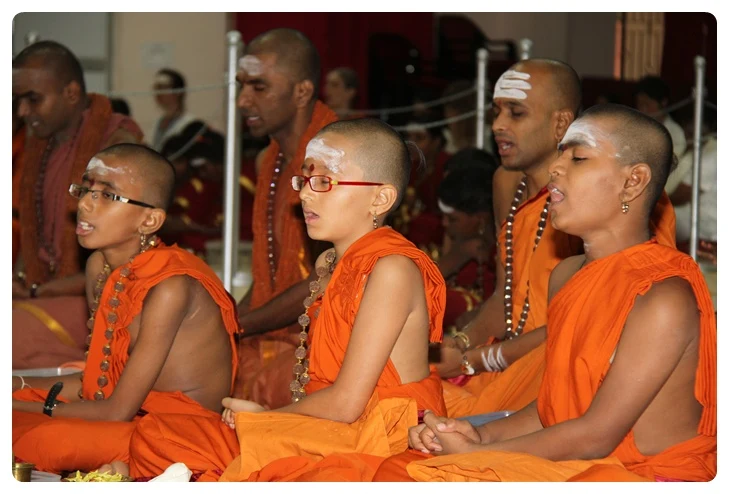
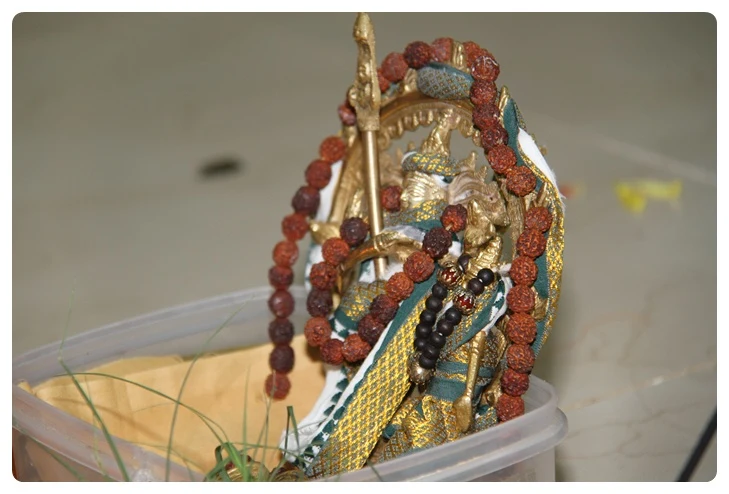
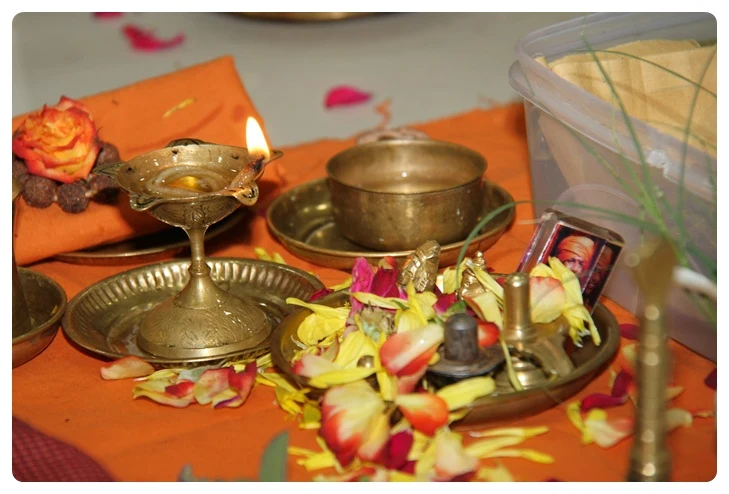
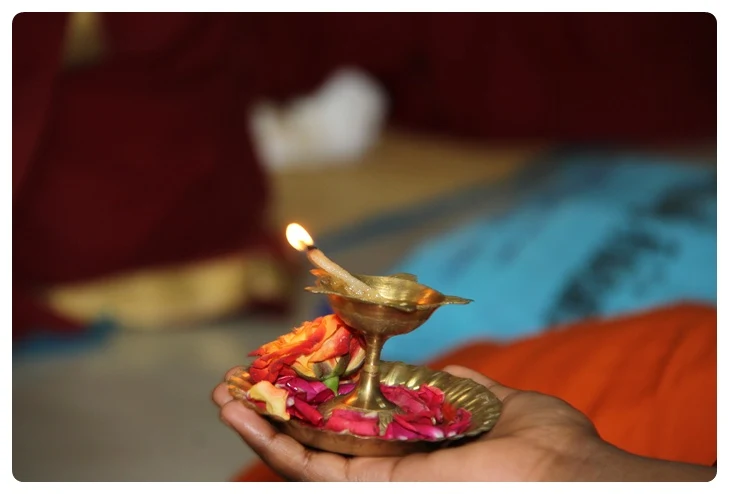
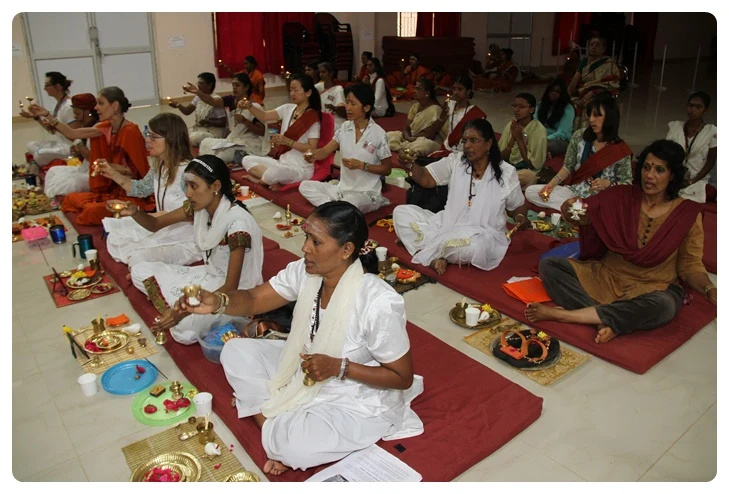
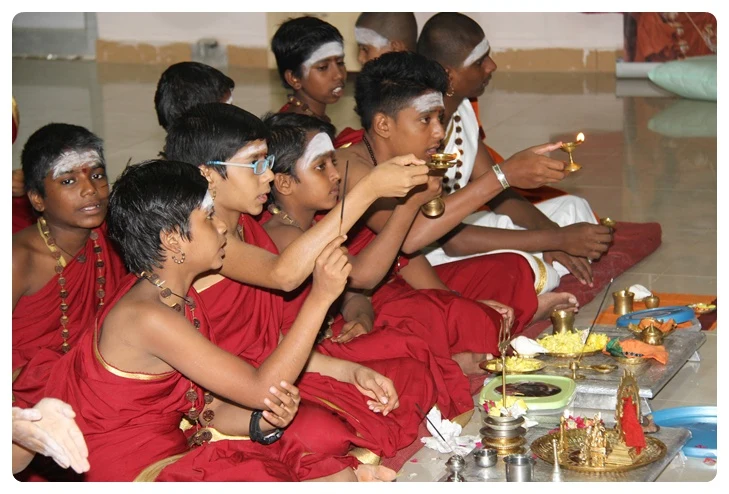
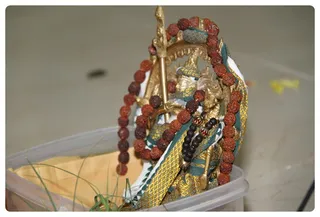
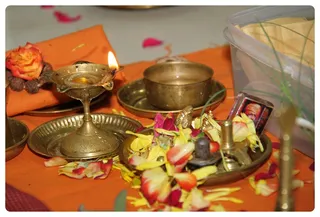
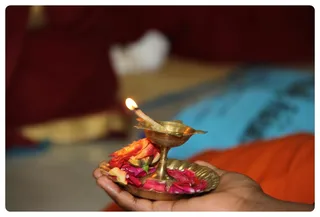
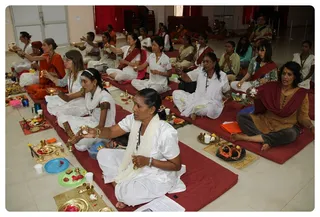
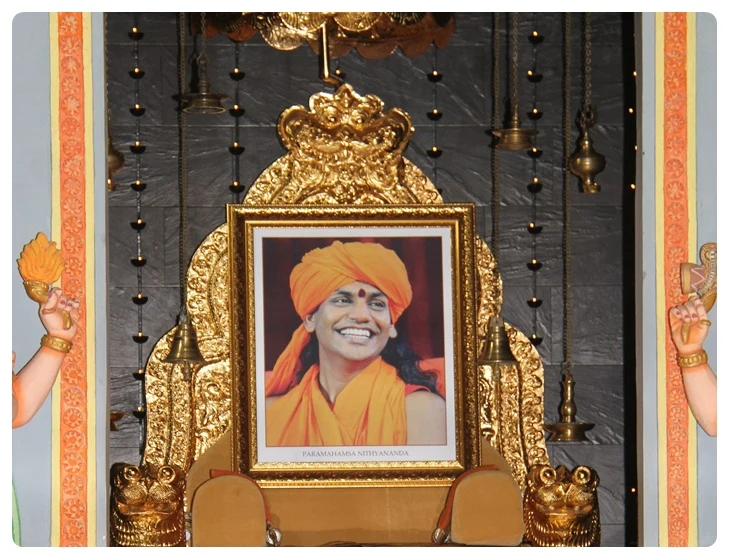
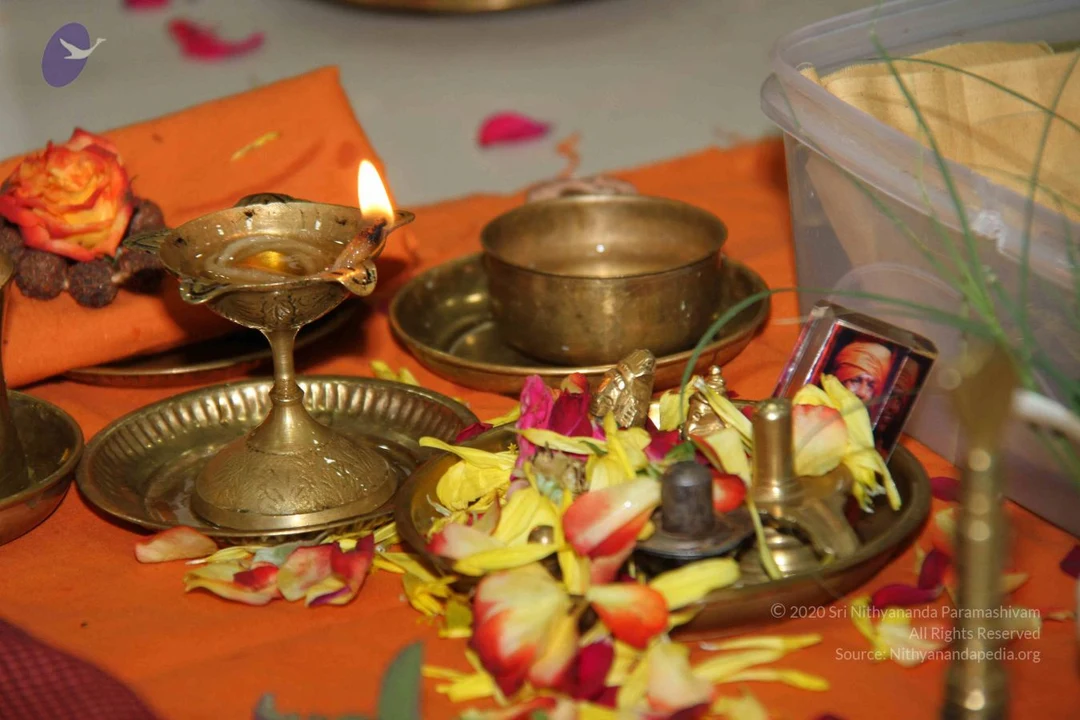
A framed portrait of a smiling man in an orange turban and orange shawl, bare-shouldered with a red forehead mark, is displayed on an ornate gold throne-like seat flanked by golden lion heads. The framed portrait's caption reads PARAMAHAMSA NITHYANANDA. Hanging brass oil lamps and strings of dark beads hang above and around the throne, and painted orange and cream pillars with carved deity arms holding objects frame both sides. No physical people are present; the only person shown is the printed portrait.Several shaved-headed young sannyasi-trainees sit cross-legged in a row, wearing saffron-orange robes and rudraksha malas, with white vibhuti lines on their foreheads. Two wear eyeglasses and some have beaded necklaces; they appear to be chanting with eyes partly closed. Behind them, older men in orange and white ritual dress sit in a hall with red draped walls and a metal barrier rope. The setting suggests a satsang or group chanting session.A close photograph of a small gilded deity murti partly sunk in a clear plastic tub with grass blades in front. The figure, seated on a horse-like mount, holds a tall golden staff with a spear-shaped top and is draped in a green and gold brocade cloth. Multiple strands of brown rudraksha beads and black beads with red accents wrap the figure and its arch-shaped backdrop. The background is a blurred pale floor. No physical people are visible.Close-up photograph of a puja arrangement on an orange cloth. A lit brass oil lamp with a flame sits on a brass tray at left. Behind it stands a brass bowl and a small brass vessel. Scattered orange, yellow and red flower petals cover the tray, with a small black shivalinga-shaped stone and a brass lingam-style object in the centre. At the right, a small framed photograph of a man in orange clothing with a head covering sits among the petals. A clear plastic container holds folded cloth at top right, and a red rose with a rudraksha-style bead garland lies at upper left. No people are visible.Close-up photograph of a hand held out palm-up, holding a brass plate with a brass oil lamp (diya) whose flame is lit. The plate is scattered with pink, red and orange flower petals. The background is softly blurred, showing red and orange cloth and a blue cloth with dark marks. No people beyond the hand are visible.A photograph of a seated group of women performing a puja in a hall with a red-and-white tiled floor. In the foreground, a woman in white clothes and a white shawl holds a small brass lamp and a bell-like object. Beside her, another woman in white with a white shawl holds a brass lamp, and a woman in white with a white shawl is seated on a red mat. Around them are brass plates with offerings, flowers, fruit, sweets and small cups, plus a second mat with a plate of marigold petals. Behind them, many other women sit in white, orange and red saris and shawls, several with rudraksha-style beads, holding lamps or palms together. Some wear sindoor or bindi. A few women at the back wear saffron and orange robes.

Nithya-Puja
34 photosSource gallery
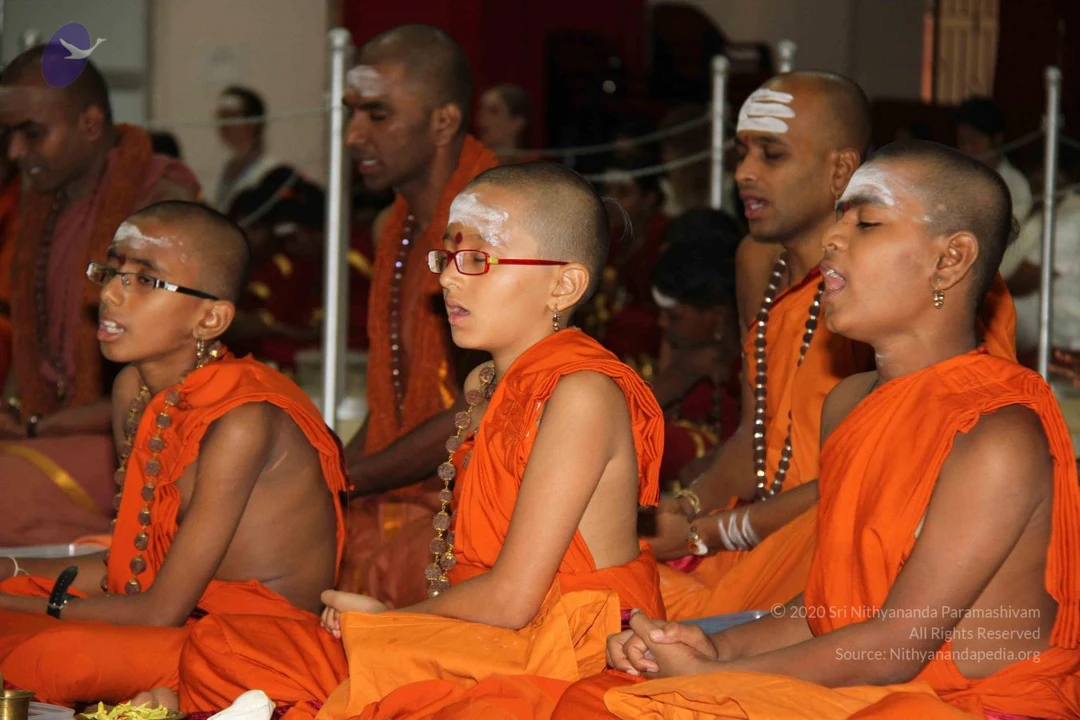
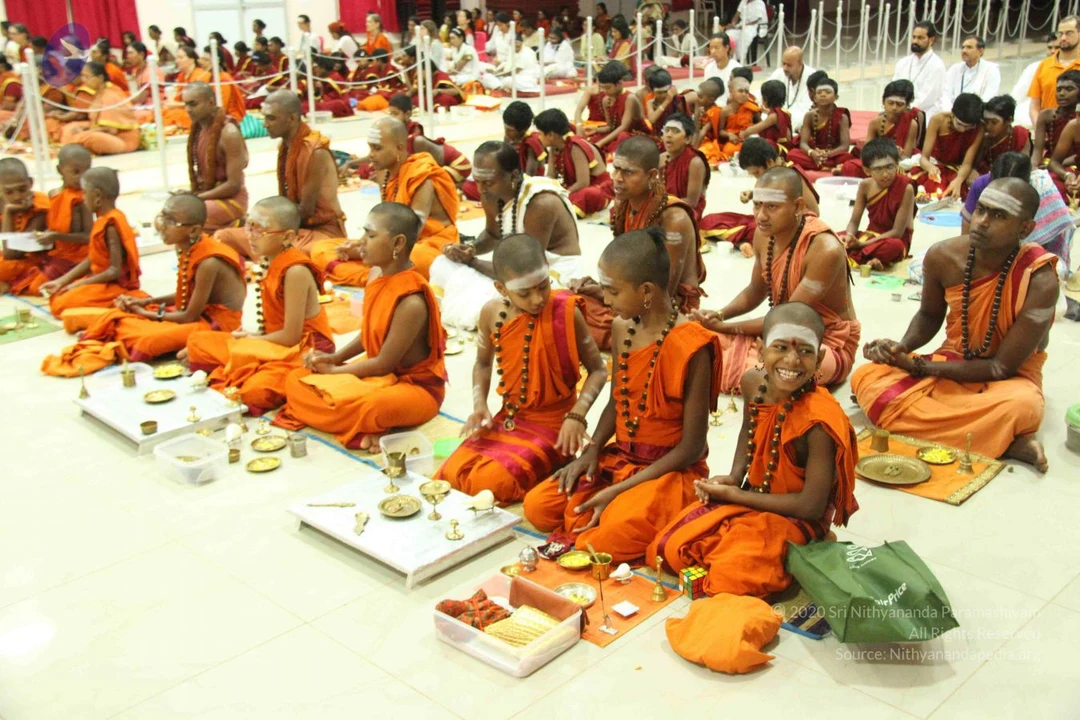
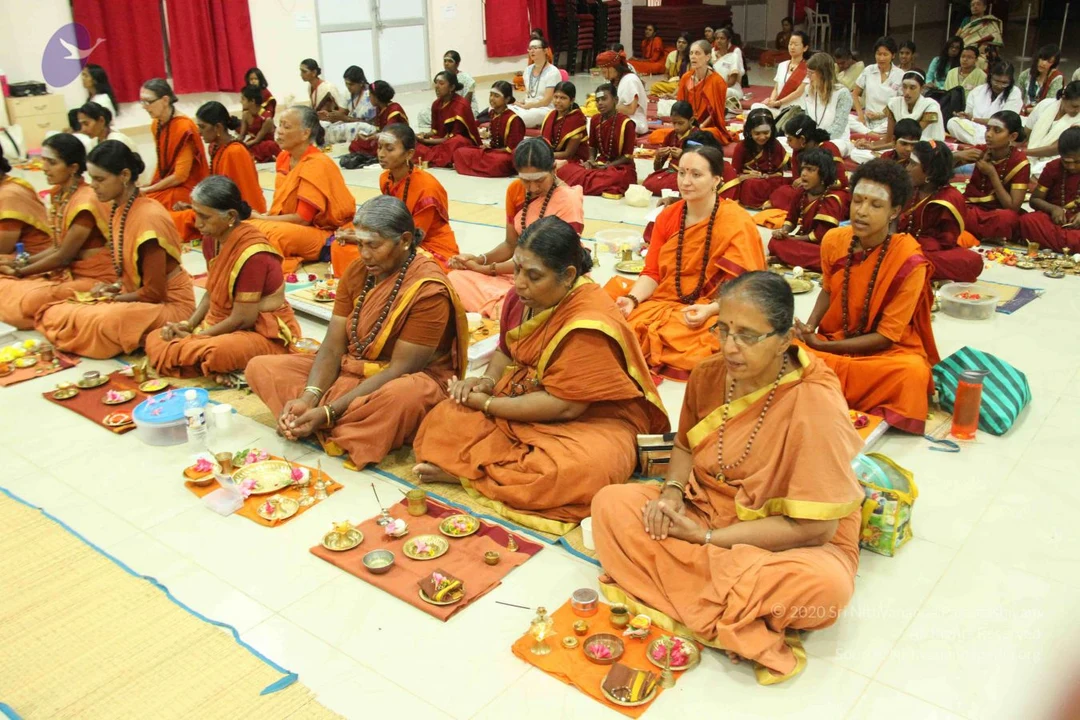
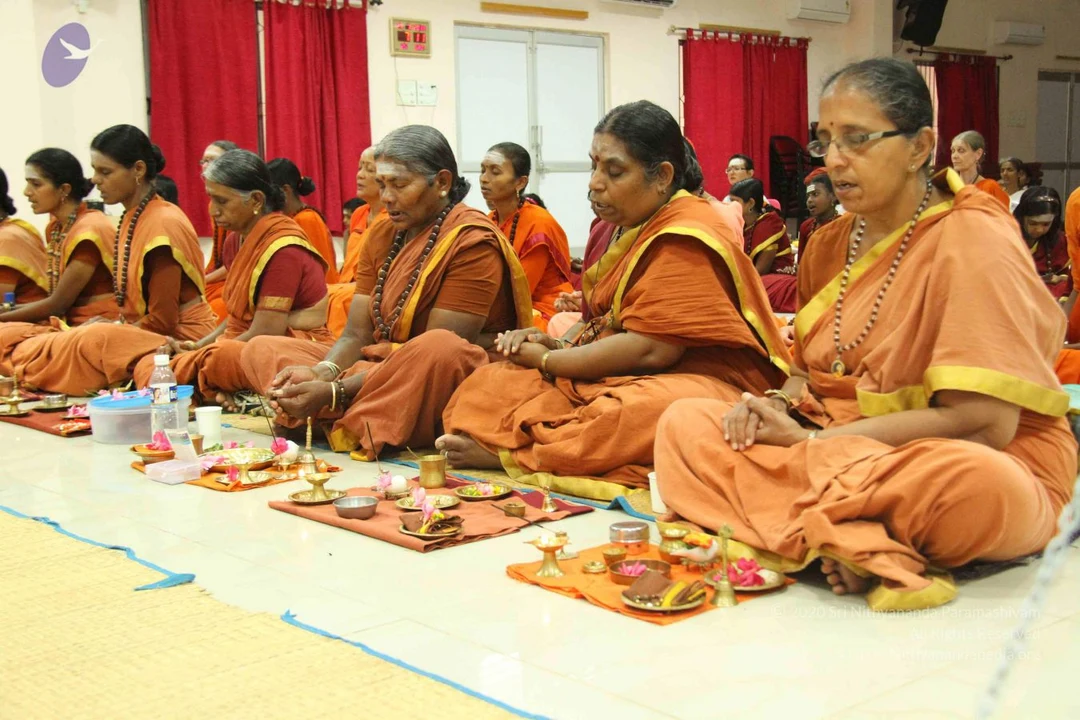
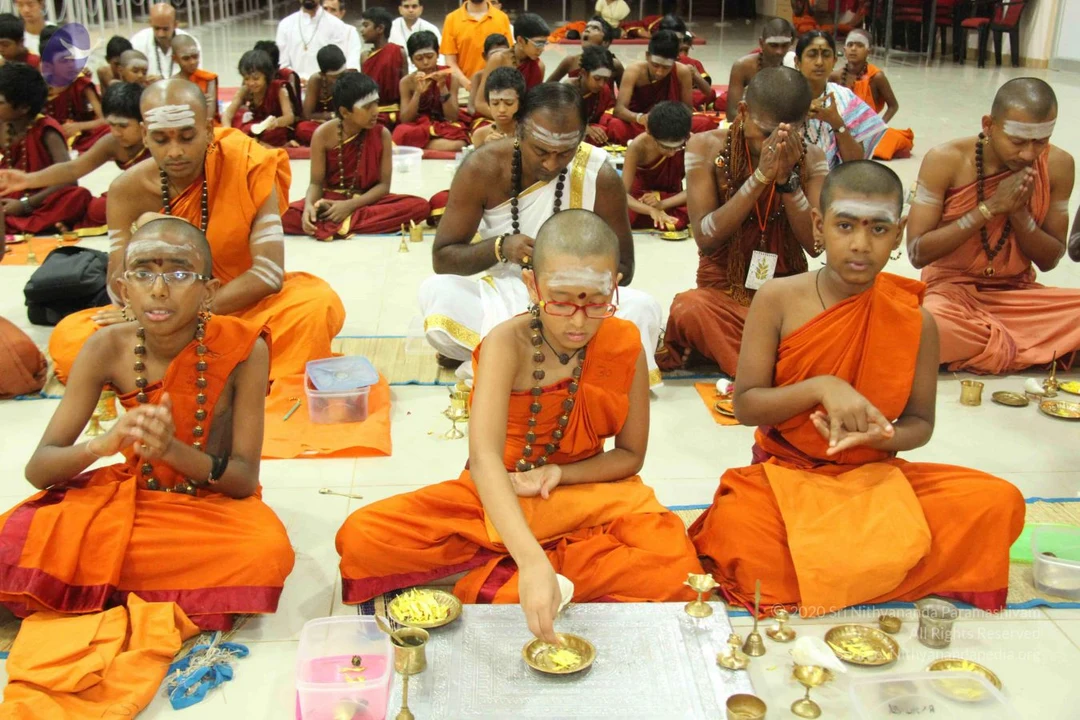
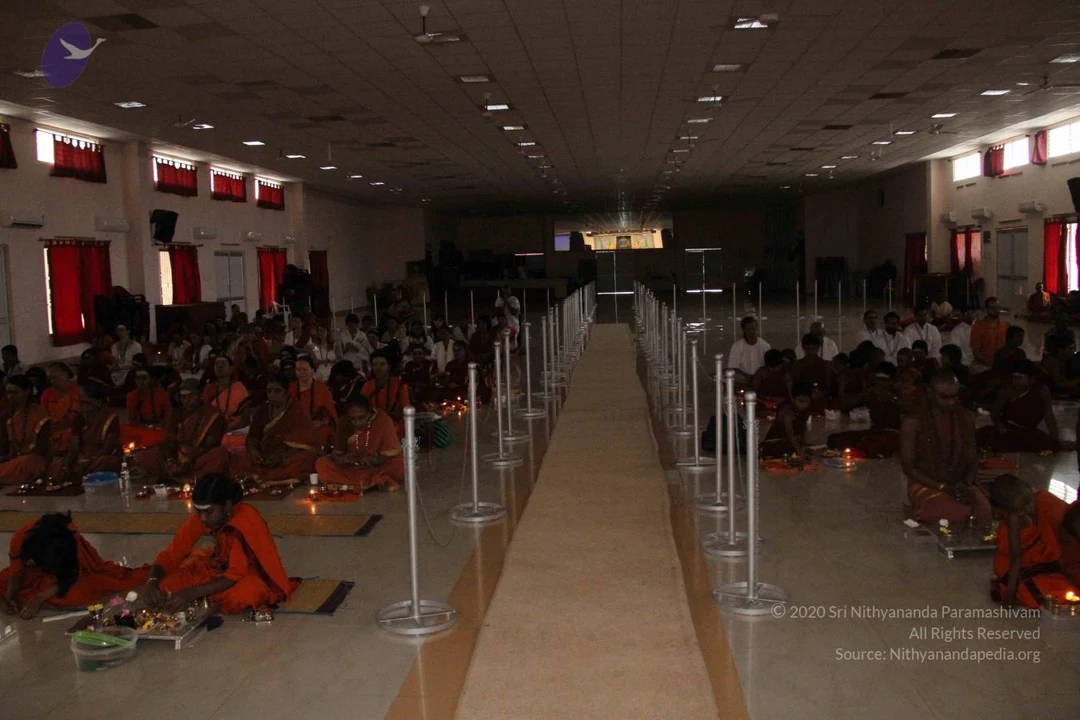
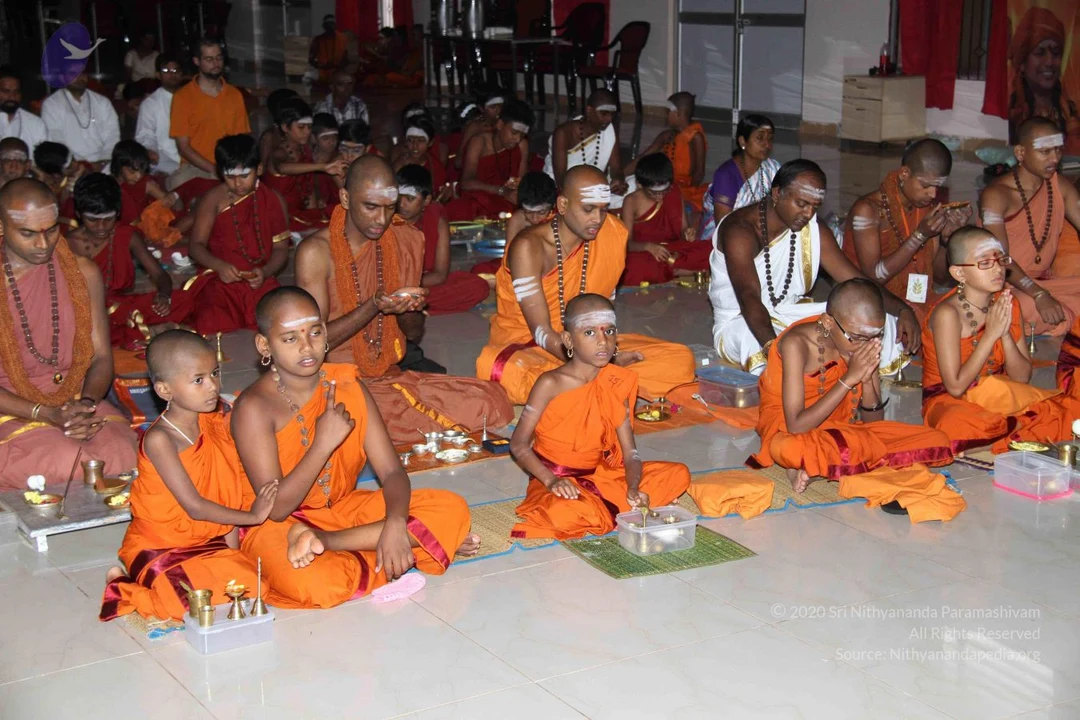
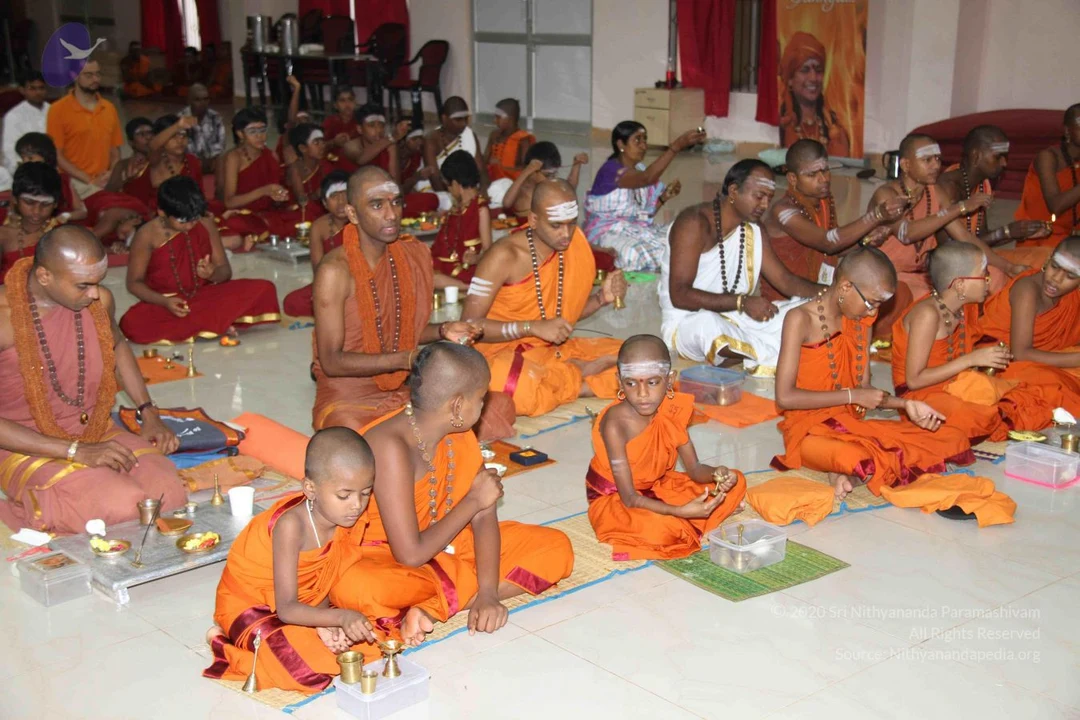
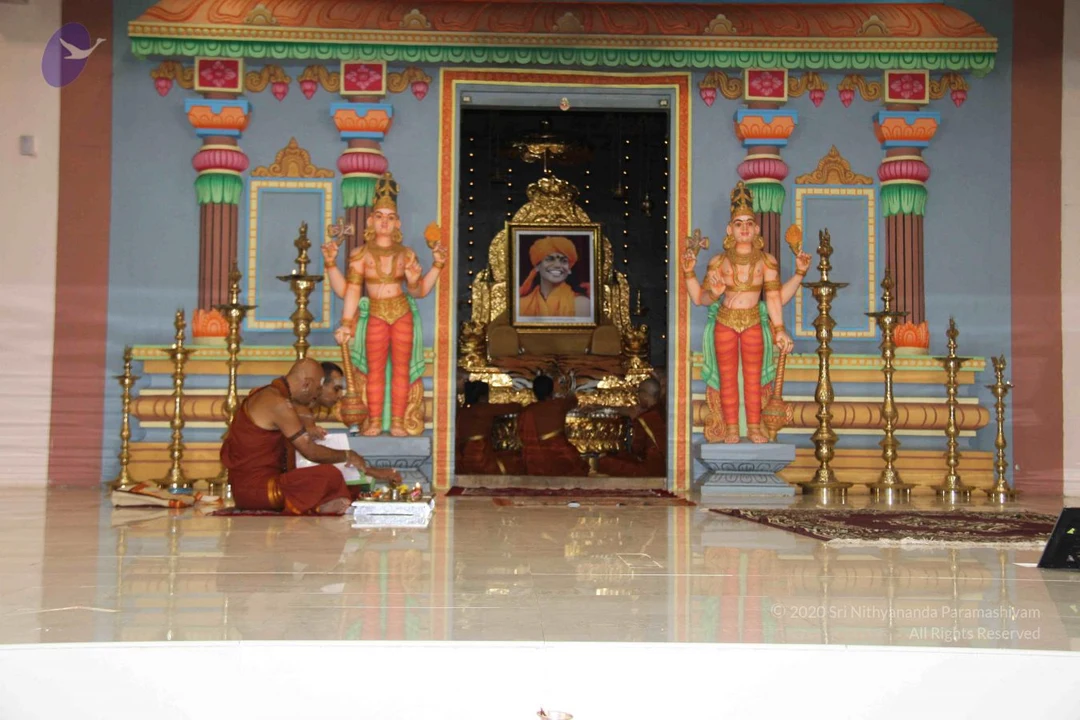
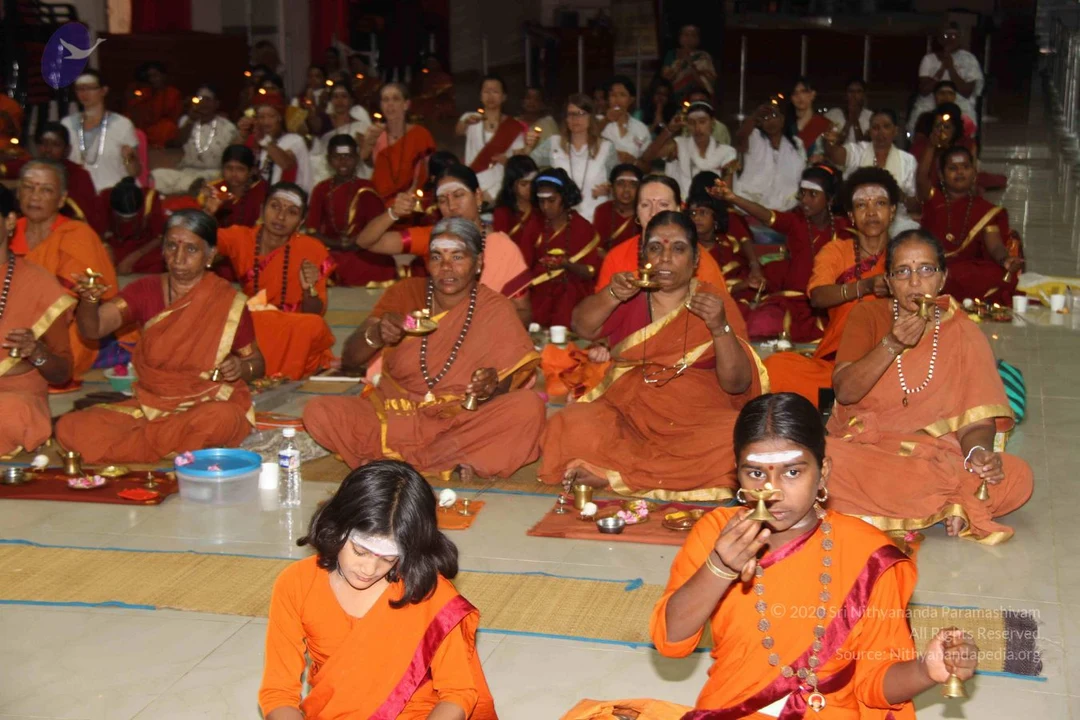
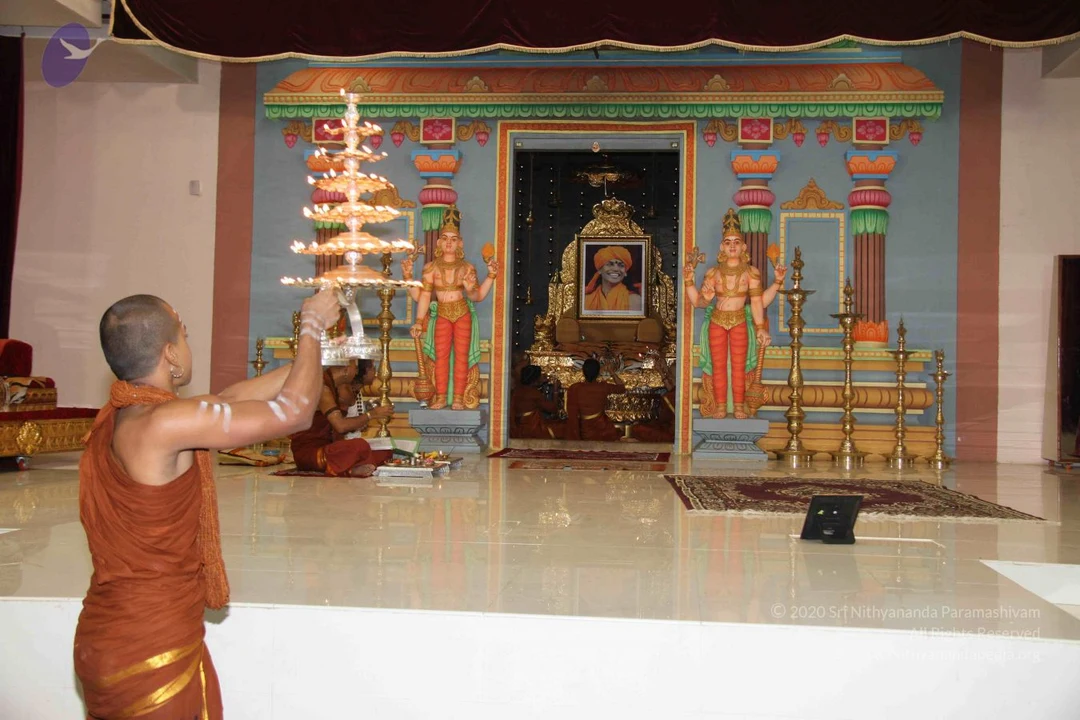
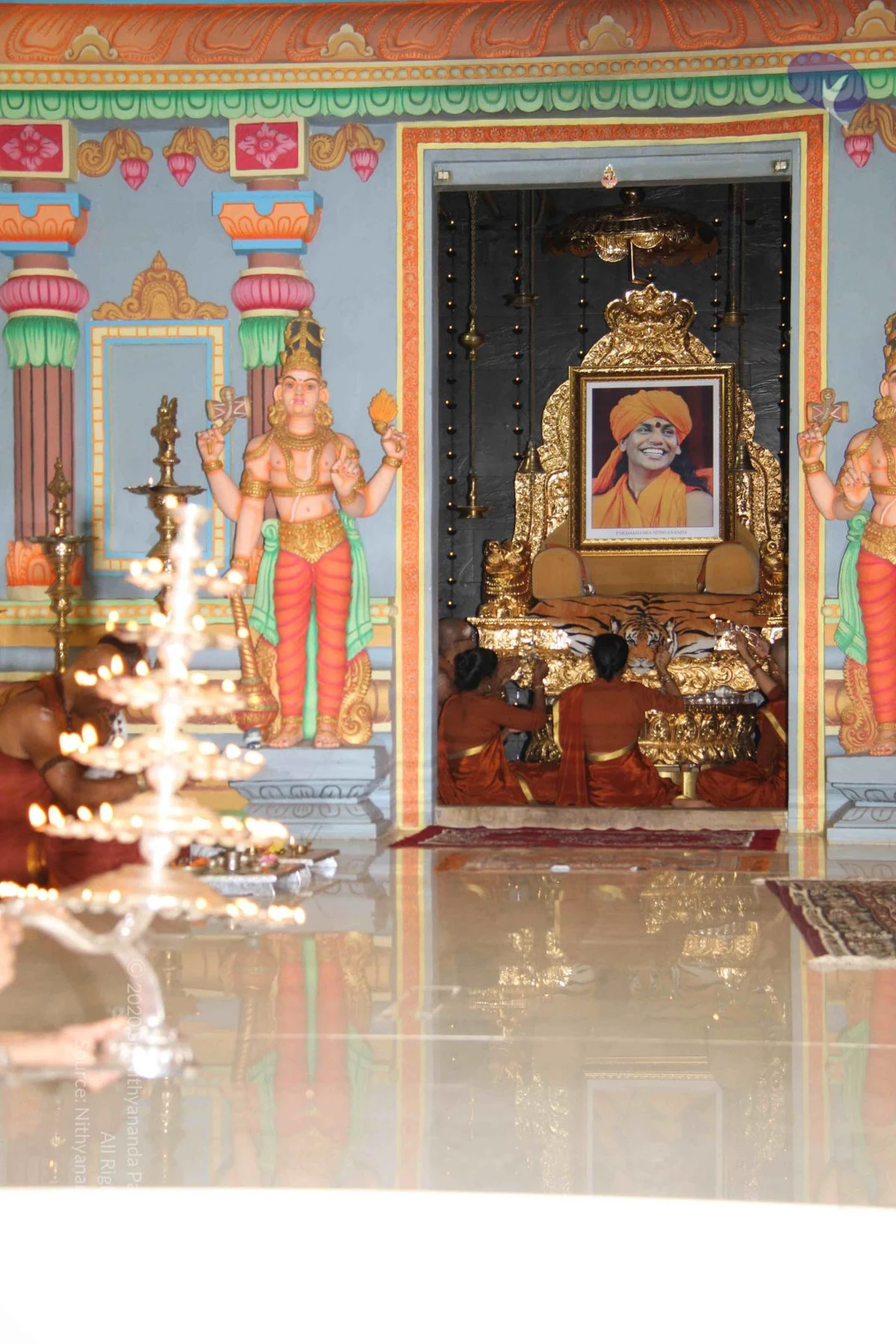
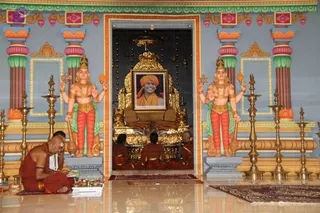
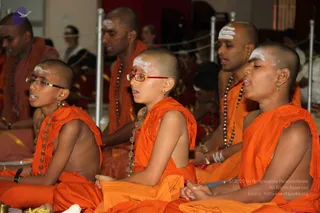
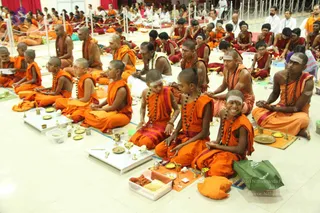
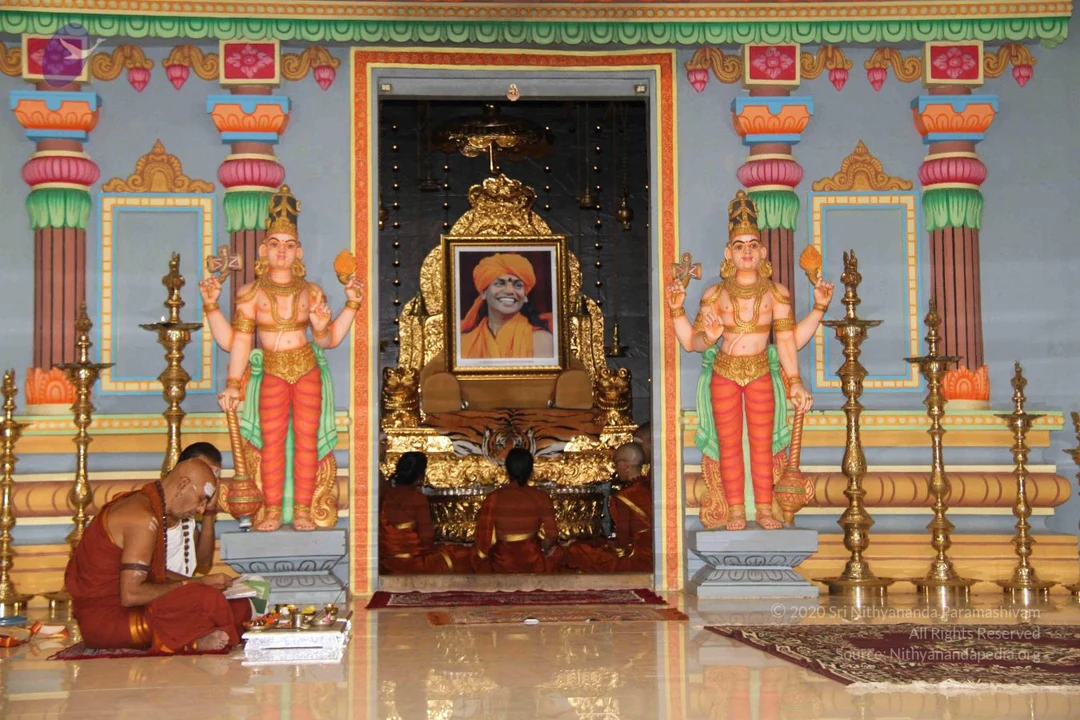
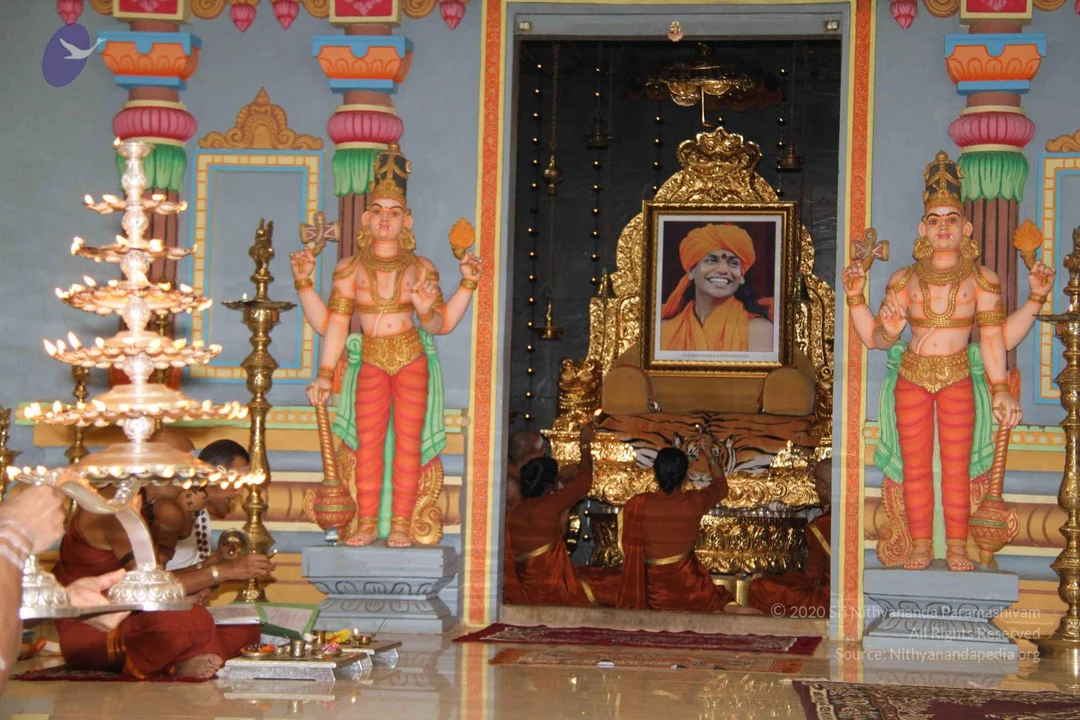
Interior of a colourful temple shrine with blue-grey walls decorated with orange and green pillars. Two large painted standing deity murti flank the entrance, each with four arms holding a club and other objects and wearing gold ornaments and green sashes. In the centre, an ornate gold throne with a tiger-skin seat holds a framed portrait of a smiling man in orange robes and an orange turban, labelled as a portrait of the teacher. Three people in orange robes sit before the throne, and in the foreground a bald man in orange cloth sits on the floor reading from a book beside a silver tray. Brass oil lamps stand along the walls and floor.A photograph of several shaven-headed young men and boys seated cross-legged in saffron-orange robes, chanting with eyes closed. Their foreheads bear white sacred ash markings, and rudraksha mala beads hang around their necks. A boy in the foreground wears red-framed glasses and a red bindi, another wears dark-framed glasses, and a fourth sits at right with hands folded in his lap. Behind them, other robed participants sit in an ashram hall with white railings and red walls. Brass vessels and offerings are visible at the lower edge. No clearly identifiable a person candidate is present among the visible people.Two young shaved-headed boys in saffron-orange robes sit in a satsang gathering, wearing rudraksha malas. The boy on the left wears clear glasses and the boy on the right wears red-framed glasses, with white vibhuti marks and a red kumkum dot on his forehead. Behind them, older monastic-style figures with long reddish hair and maroon and orange garments sit in meditative posture among other attendees. Blurred pillars and crowd fill the background.A large group of shaved-headed young sannyasis and monks in saffron-orange robes sit cross-legged on a white tiled floor during a ritual gathering. Many wear rudraksha malas and white sacred ash marks on their foreheads. In the foreground, brass plates, small lamps, bowls and a white ritual platform are arranged, with a plastic container of offerings. Behind them, seated devotees in white clothes and saffron wraps fill the hall, and a rope barrier and red drapes frame the space. A green shopping bag sits on the right.A large hall with white tiled floor where many people sit cross-legged in rows performing a group ritual. Most wear saffron-orange saris or robes with gold borders, rudraksha malas and vibhuti or bindi marks; some women wear maroon-and-orange clothing. Brass and steel plates with flowers, small bowls, lamps and fruit sit on orange mats in front of them. Many participants have eyes closed or hands folded in prayer. A few women in white appear at the back. No clearly identifiable a person figure is visible.A row of women in orange and saffron saris with gold borders sit cross-legged on a white tiled floor during a ritual puja. Several wear rudraksha malas. In the foreground, brass lamps, small brass bowls, pink flower petals and offering plates are arranged on orange and red cloths, and one woman holds a small brass item with her hands joined. Behind them, more seated devotees in orange fill a hall with red curtains and white walls, and a thin woven mat lies on the left. Several people in the background wear white or red clothing.

Nithya-Satsang

21 photosSource gallery
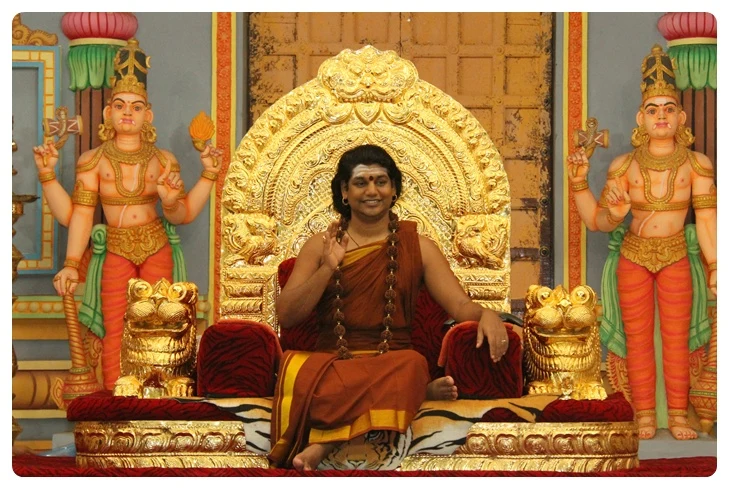
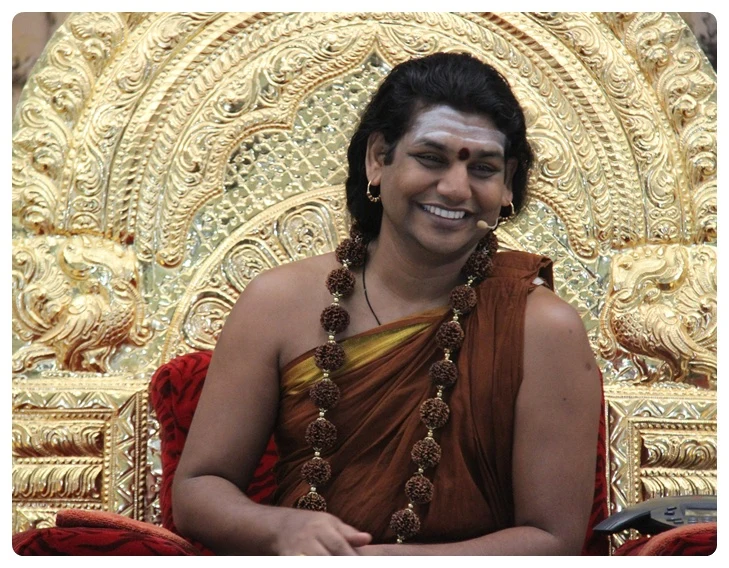
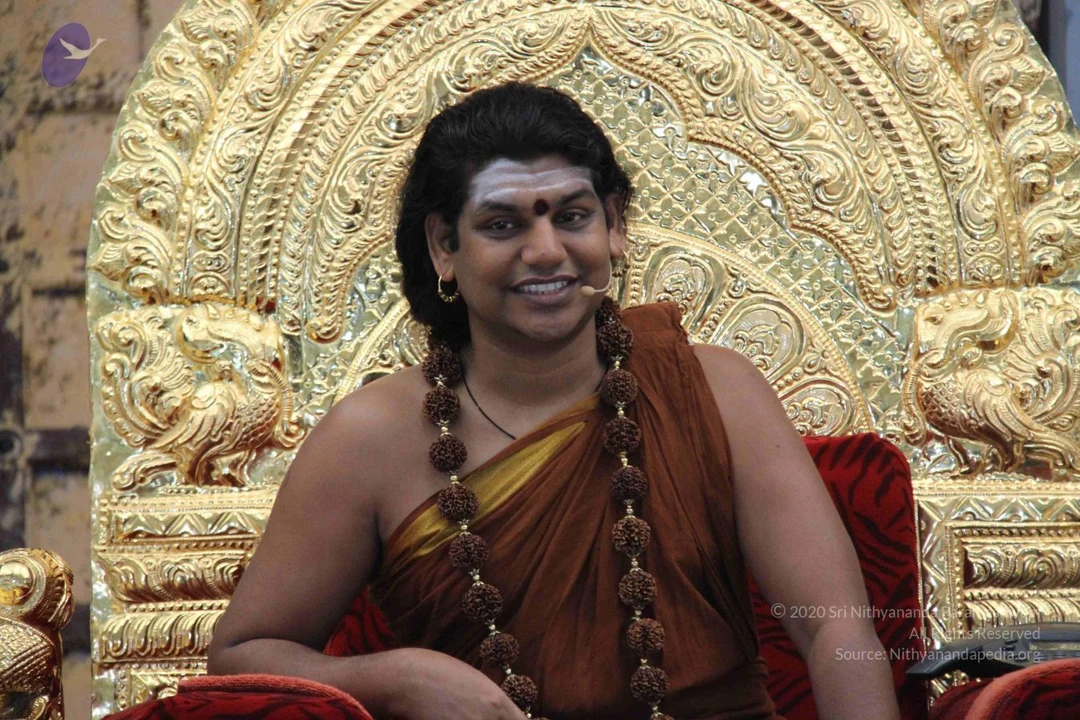
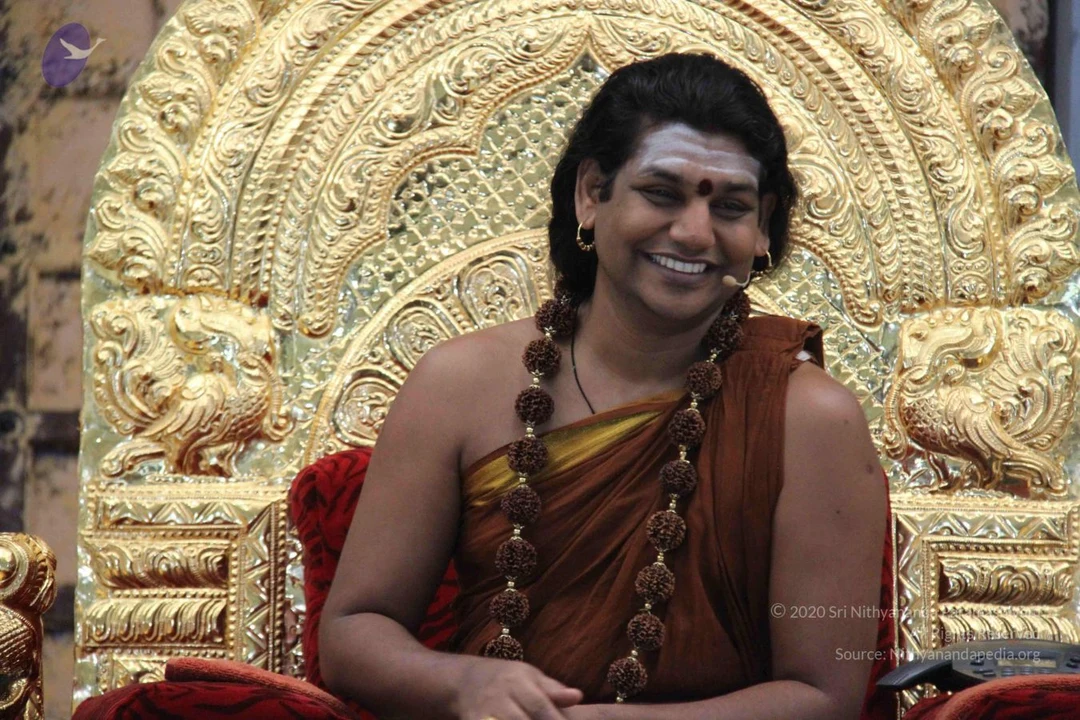
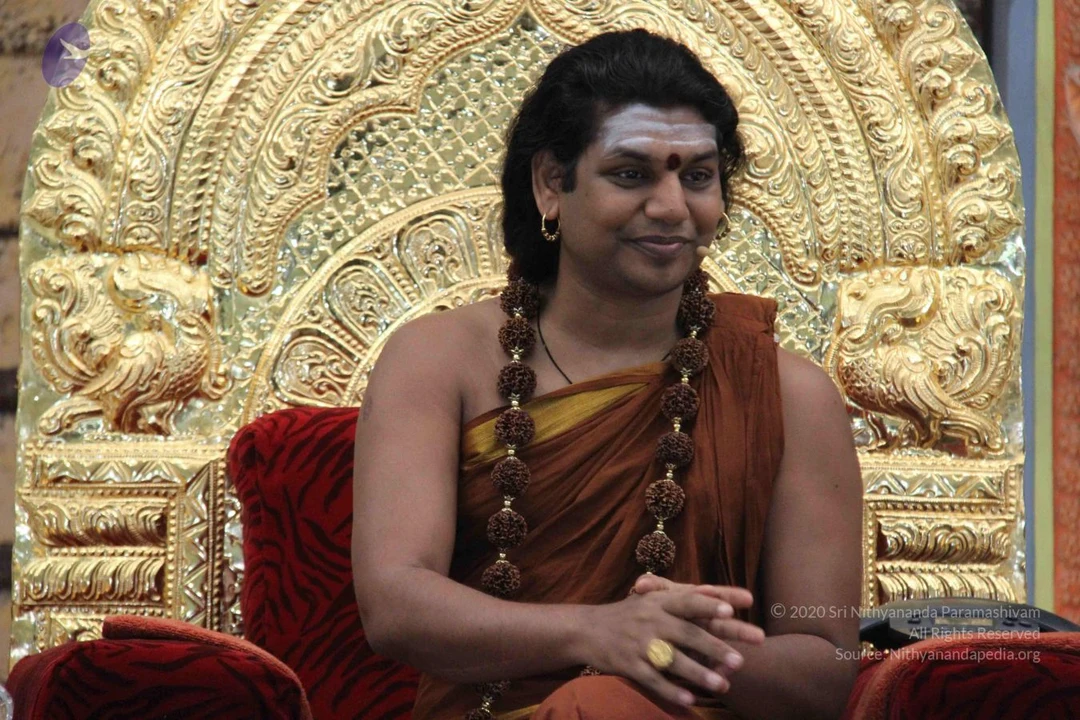
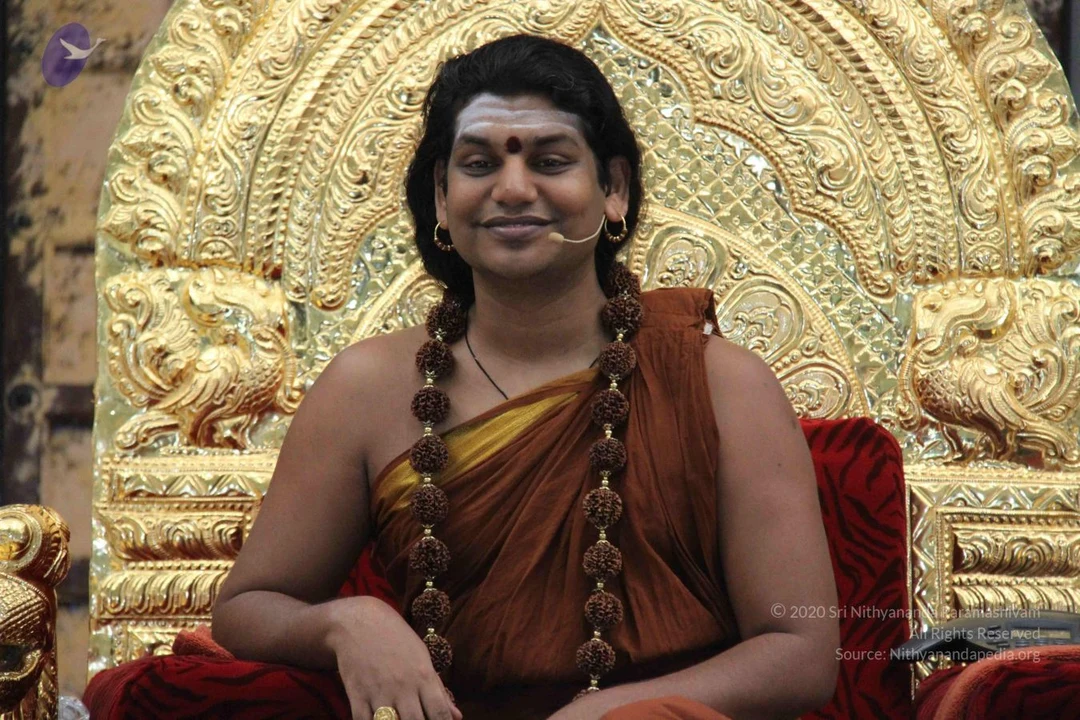
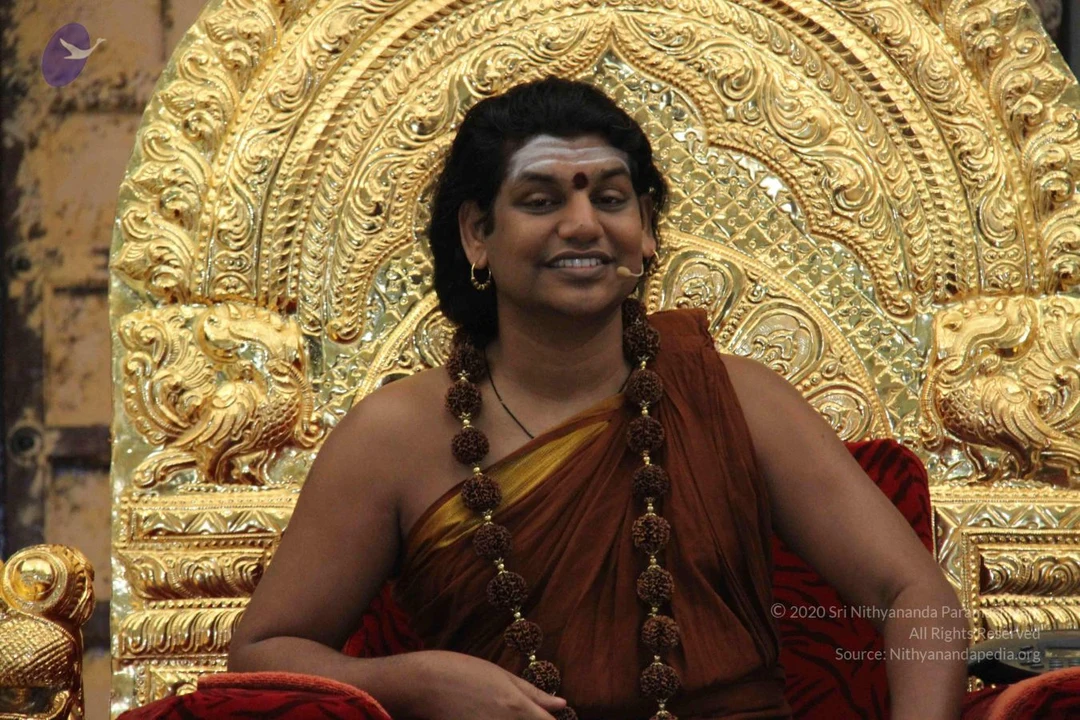
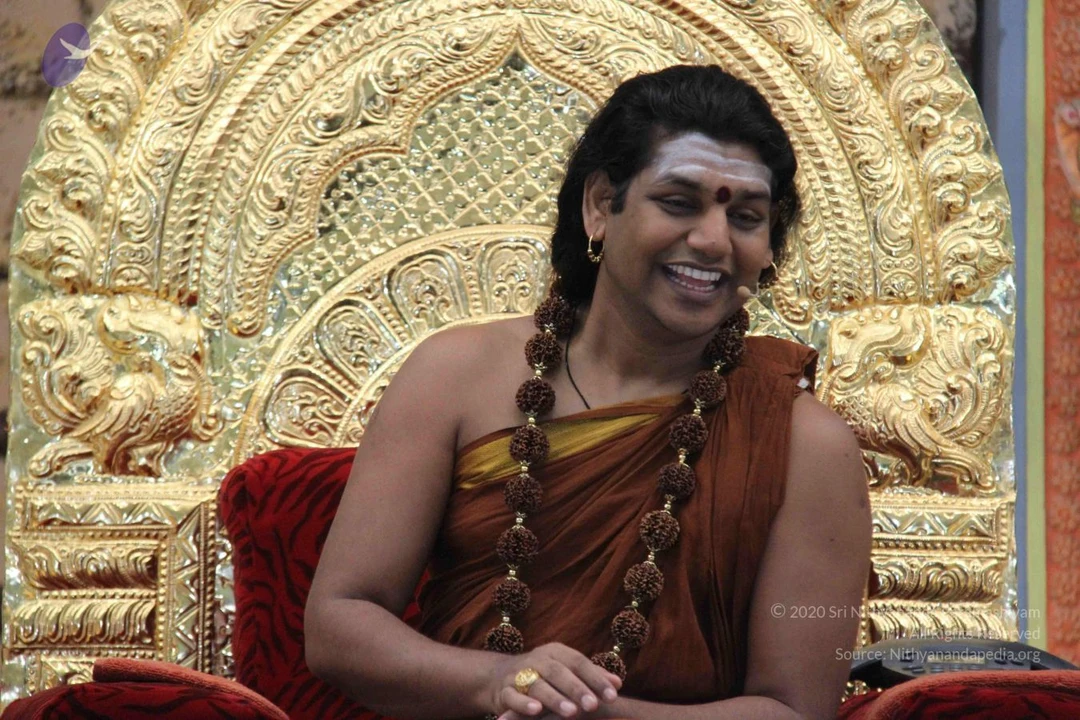
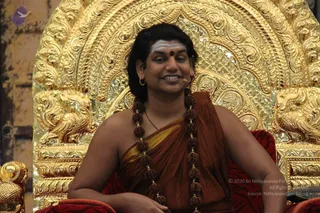
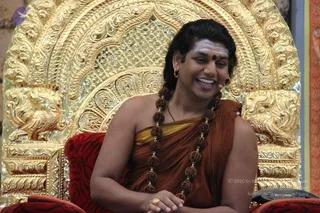
A smiling man with swept-back dark hair sits on an ornate gold throne carved with lion-like figures and floral scrollwork, against a red-patterned cushion. He wears an orange-brown saffron wrap over bare shoulders, a long multi-strand rudraksha mala reaching his waist, gold hoop earrings, and a red bindi with white forehead markings. His right hand is raised in a gesture while he speaks. This is a photo of a person presumed to be a person, seated in a satsang setting.A seated man in a saffron-brown robe and long rudraksha mala sits on an ornate gold throne with lion-head armrests, draped in a tiger-striped cushion, speaking with one hand raised in a teaching gesture. Behind him stand two painted, multi-armed deity murti figures in orange dhoti and gold jewellery, holding ceremonial objects. Brass oil lamps flank the throne and a red-cushioned dais surrounds it. A partly visible person is at the far left edge. The visible people count is two.A seated man in an ornate golden throne with elaborate carved scrollwork and lion-like figures. He wears a saffron-orange draped robe over his bare shoulder with a yellow inner fold, a long necklace of large dark rudraksha beads reaching to his lap, and a small gold hoop earring. He has a white horizontal forehead mark with a red dot and smiles while speaking, with a small microphone visible near his face. Red patterned cushions line the throne.A man seated on a red and gold upholstered chair before an ornate gilded throne backdrop with carved lion figures and floral scrollwork. He wears an orange-brown saffron-toned wrap over bare shoulders, a long necklace of brown rudraksha beads, gold hoop earrings, a white tripundra line and a red dot on his forehead. He is smiling and appears to be speaking, with a small clip microphone visible near his ear. Swamiji (probable) is the candidate for this seated speaker, based on the rudraksha mala, saffron-toned wrap, ornate throne and distinctive hairstyle with long swept-back hair, though the appearance is not fully certain. A satsang discourse setting.A man sits on an ornate gold throne with carved scrollwork and lion-like motifs, upholstered in red and striped cushions. He wears a rust-orange wrap over bare shoulders, with a gold-edged yellow band, a long rudraksha mala of brown beads hanging to his waist, a small gold earring and a red bindi with white forehead markings. He speaks into a small headset microphone with his right hand resting near his lap. Probable Swamiji by appearance cues: long swept-back hair, orange wrap and rudraksha mala seated on a throne.A man seated on an ornate gold-embossed throne with carved lion-like finials and red-and-black tiger-striped cushions, smiling. He wears an orange-brown and gold-bordered shawl draped over one shoulder, a long mala of large brown rudraksha beads, gold hoop earrings, a tilak with a red bindi and white forehead markings, and a small lapel microphone. Swamiji (probable): a long-haired figure in ceremonial orange clothing, rudraksha mala and gold adornments seated on a throne, consistent with a satsang setting. One person is visible.

Sarva-Darshan

12 photosSource gallery
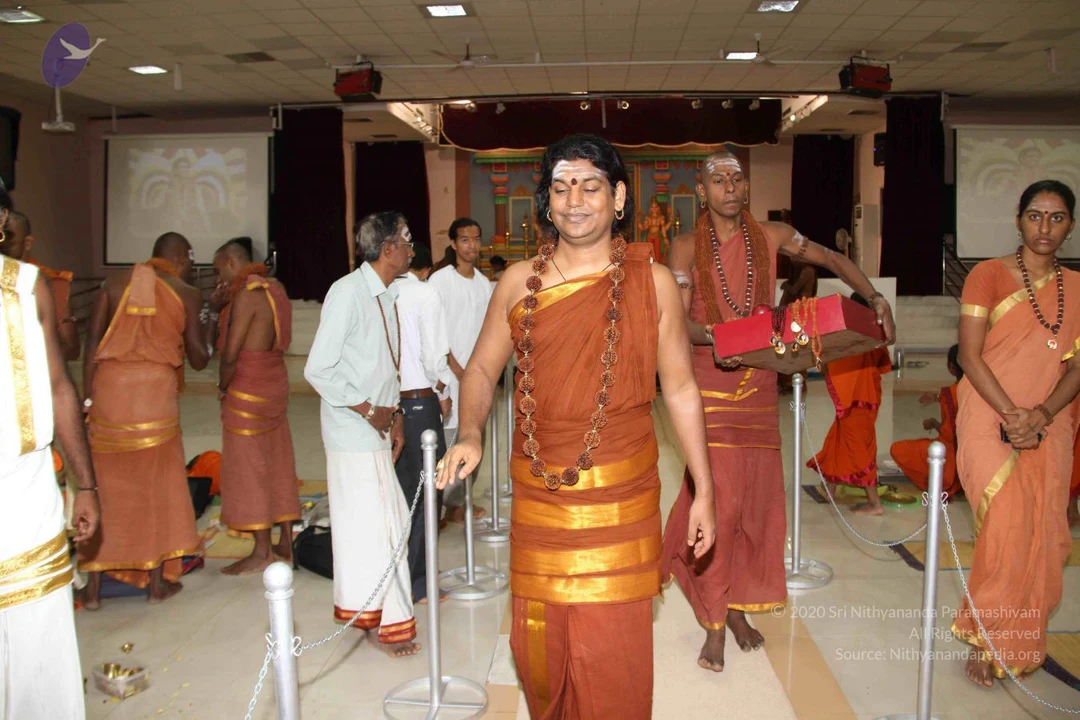
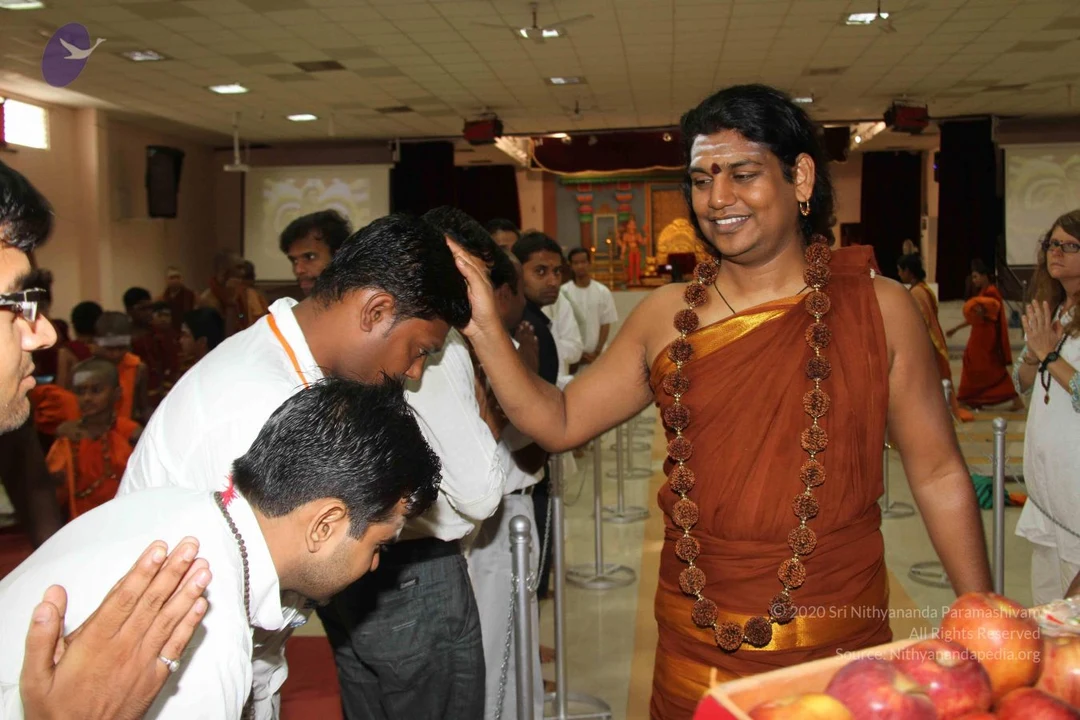
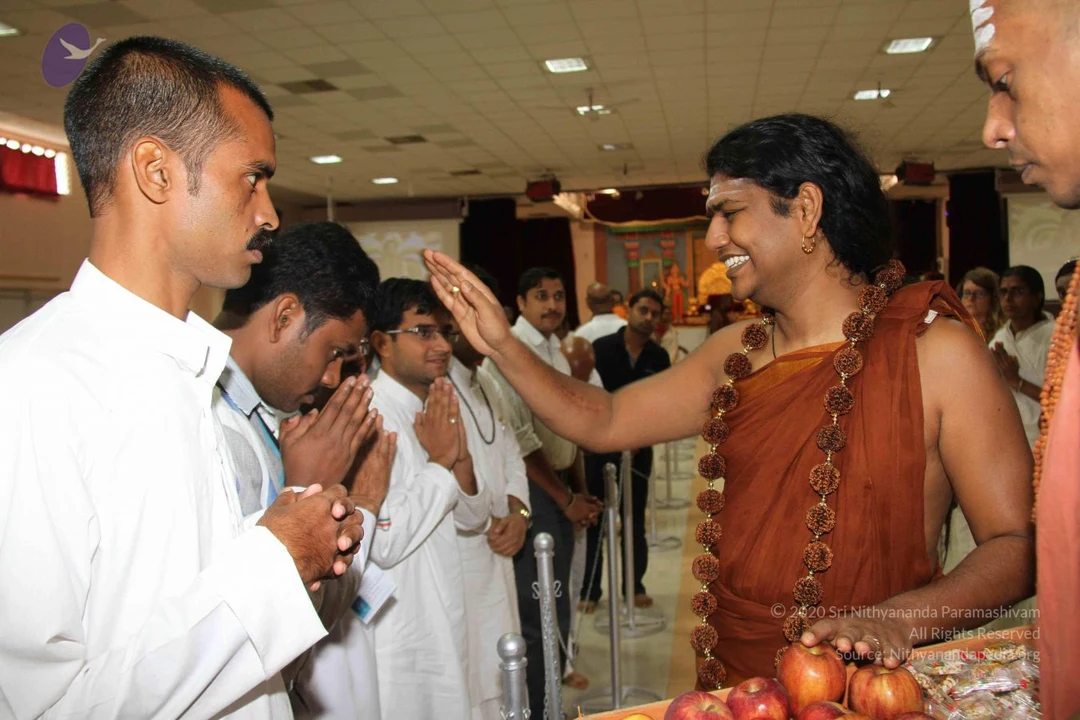
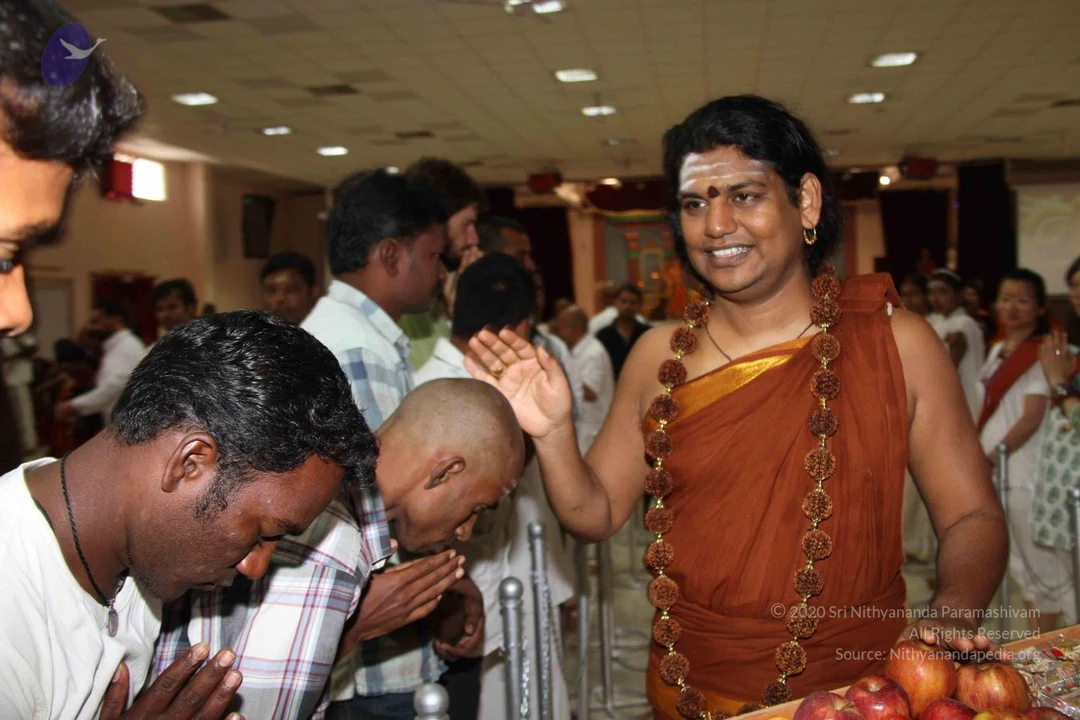
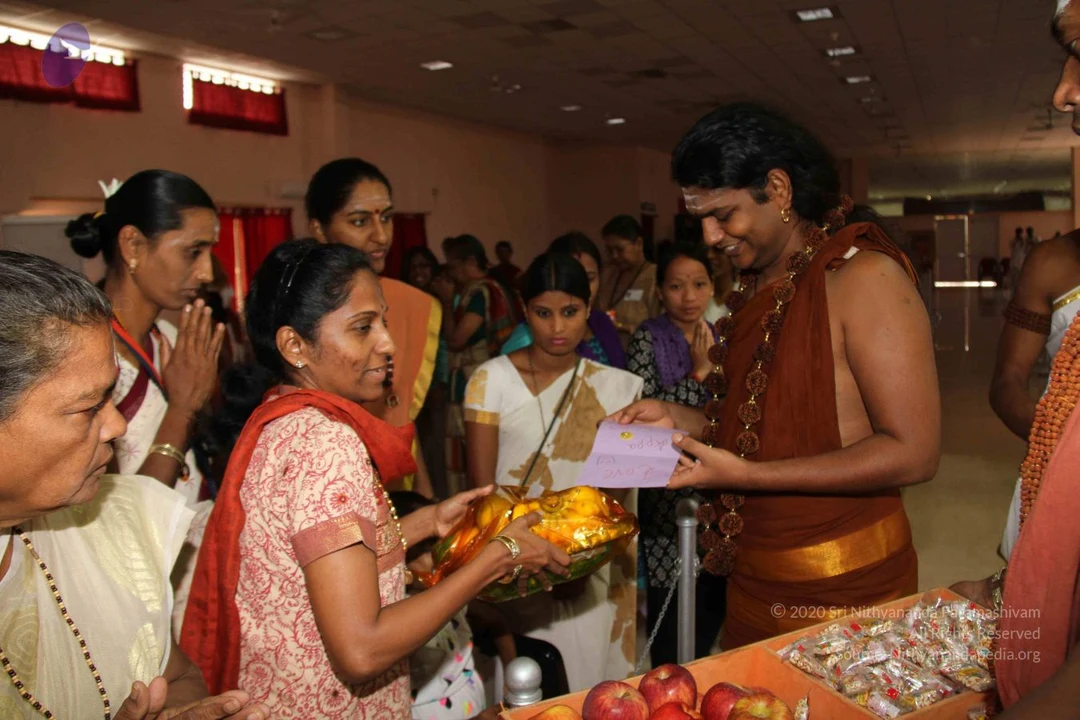
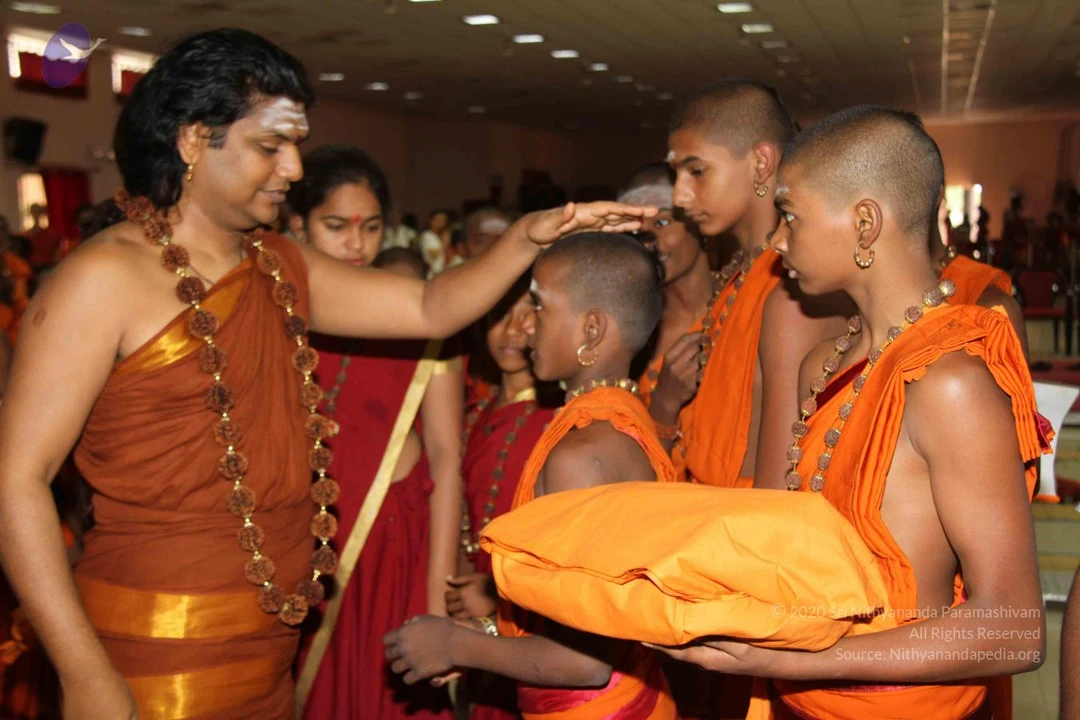
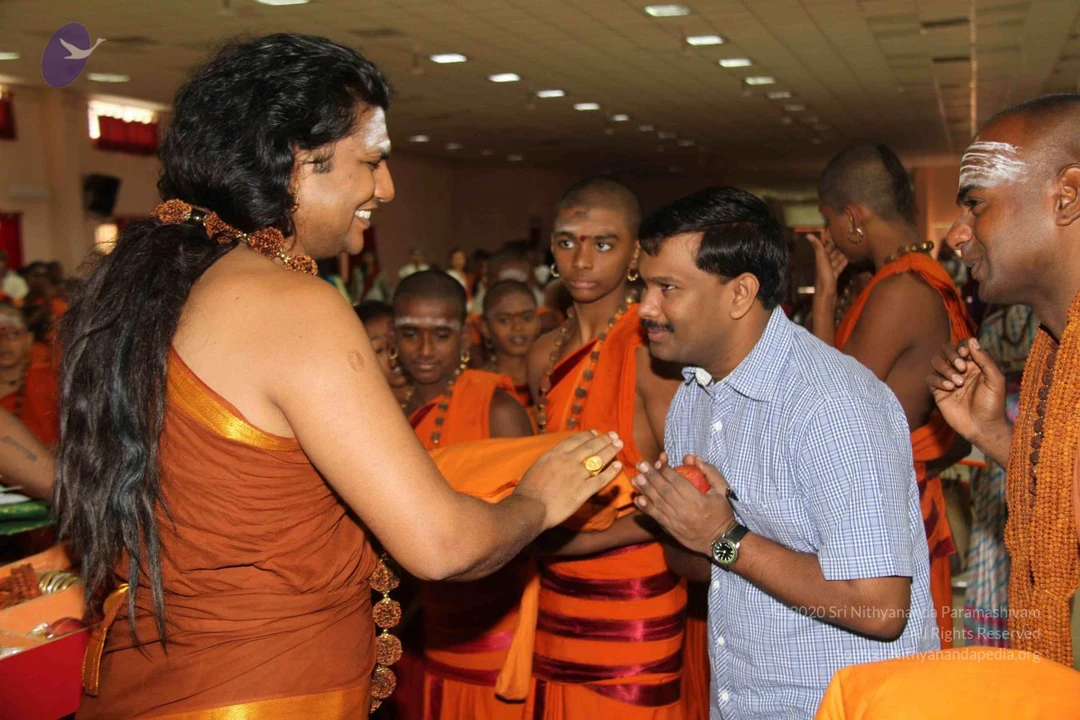
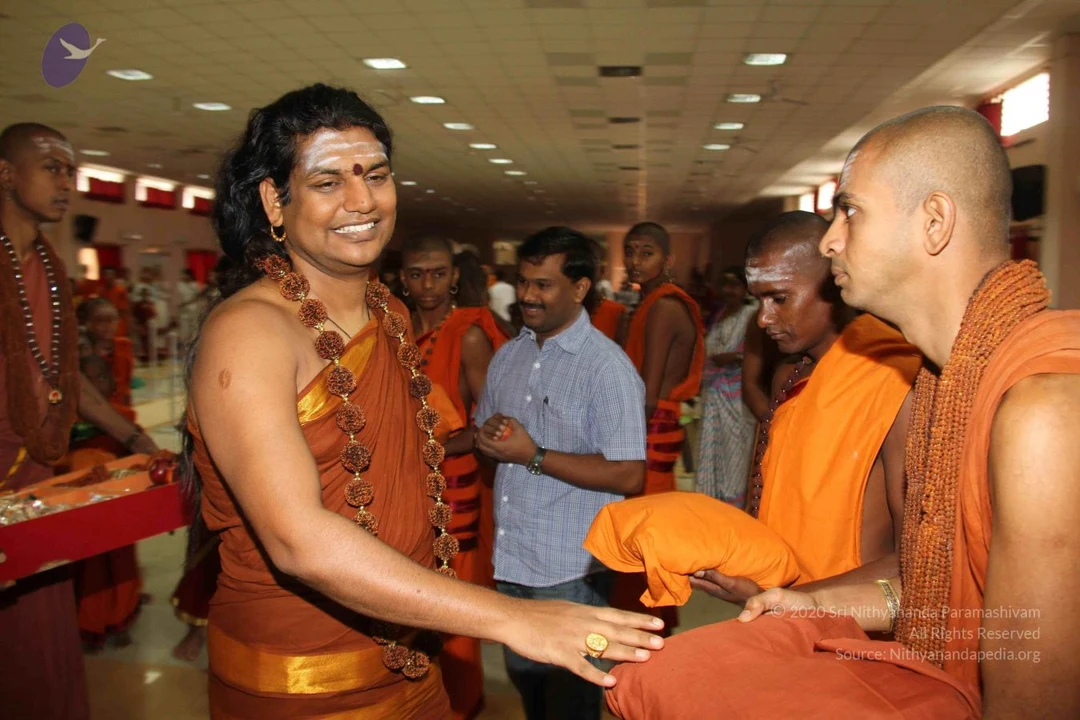
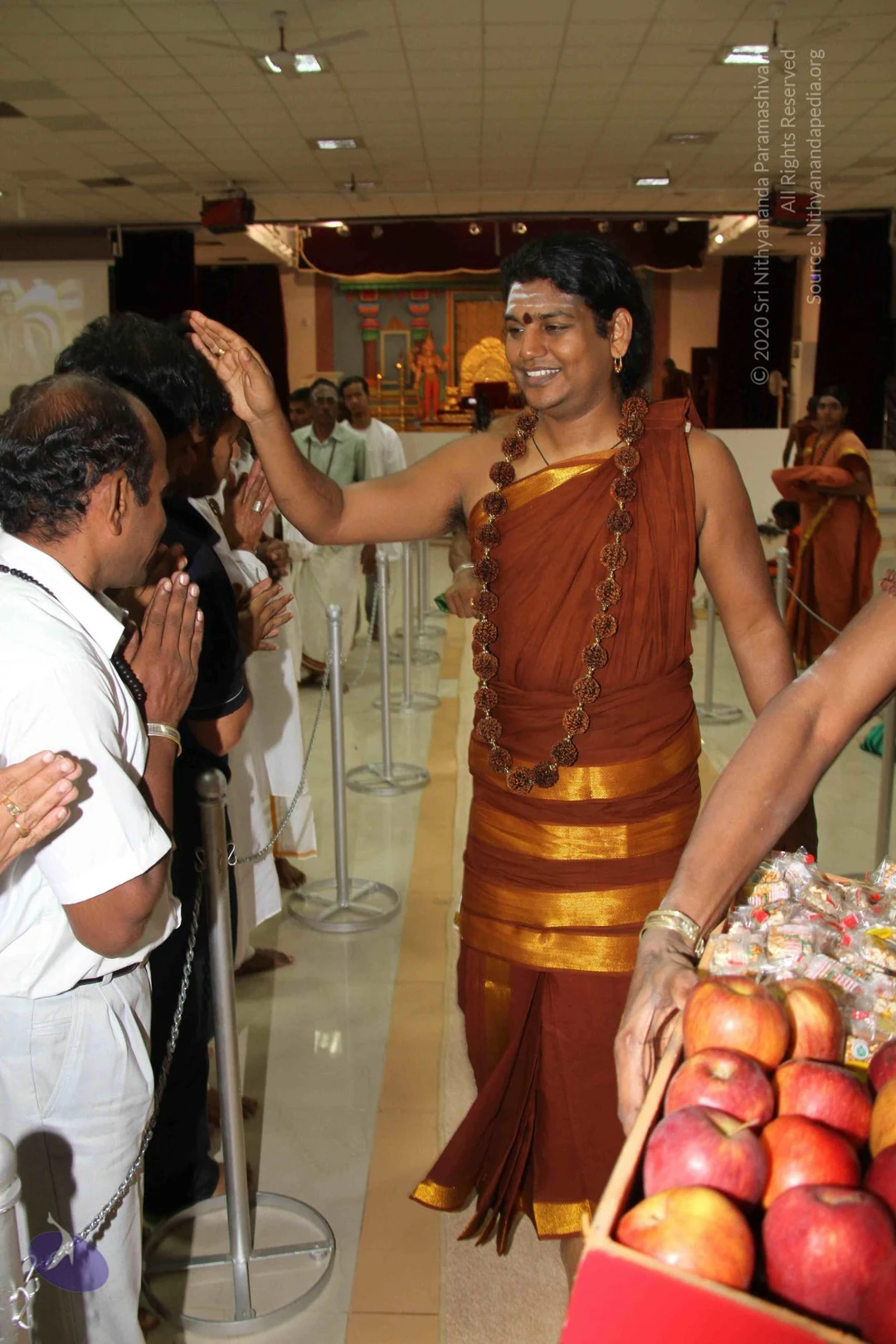
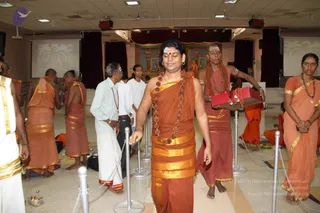
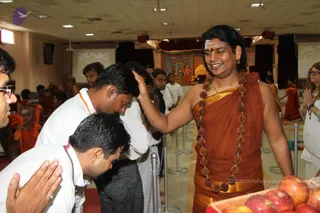
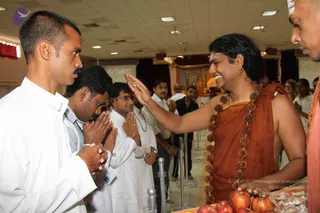
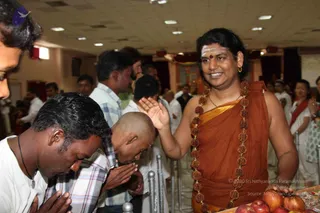
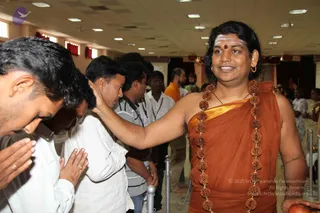
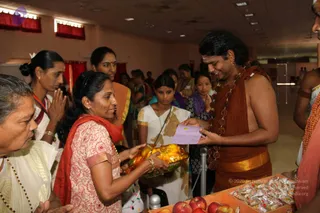
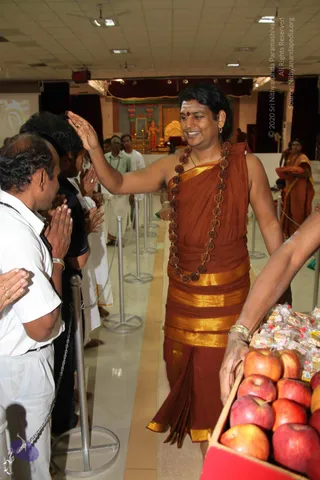
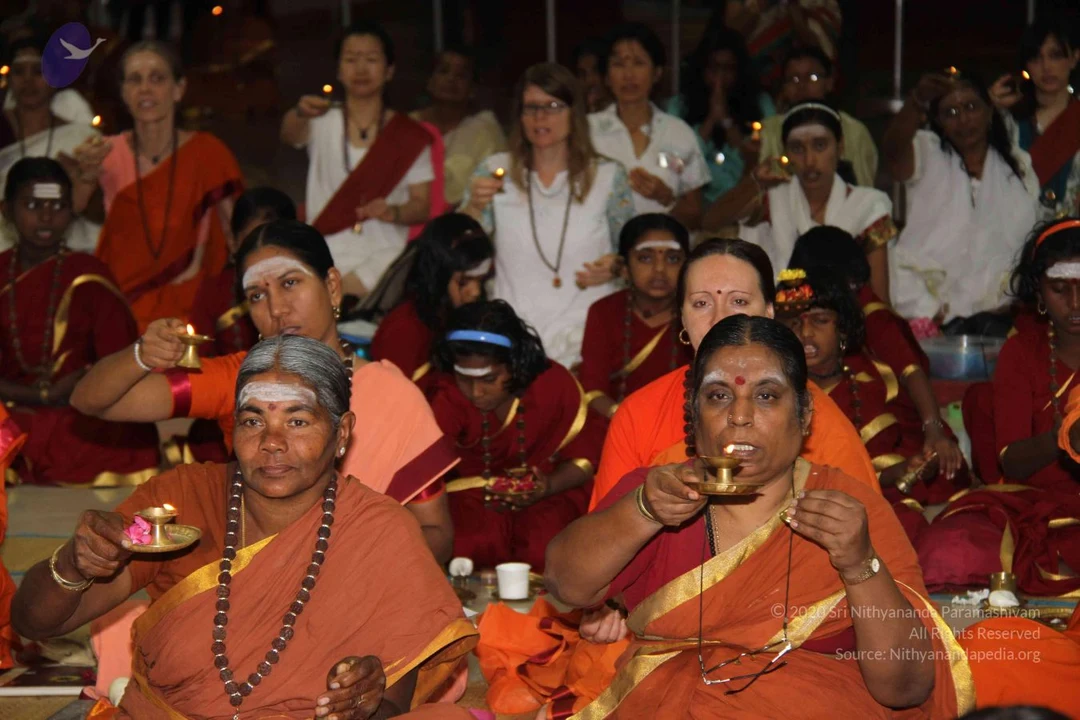
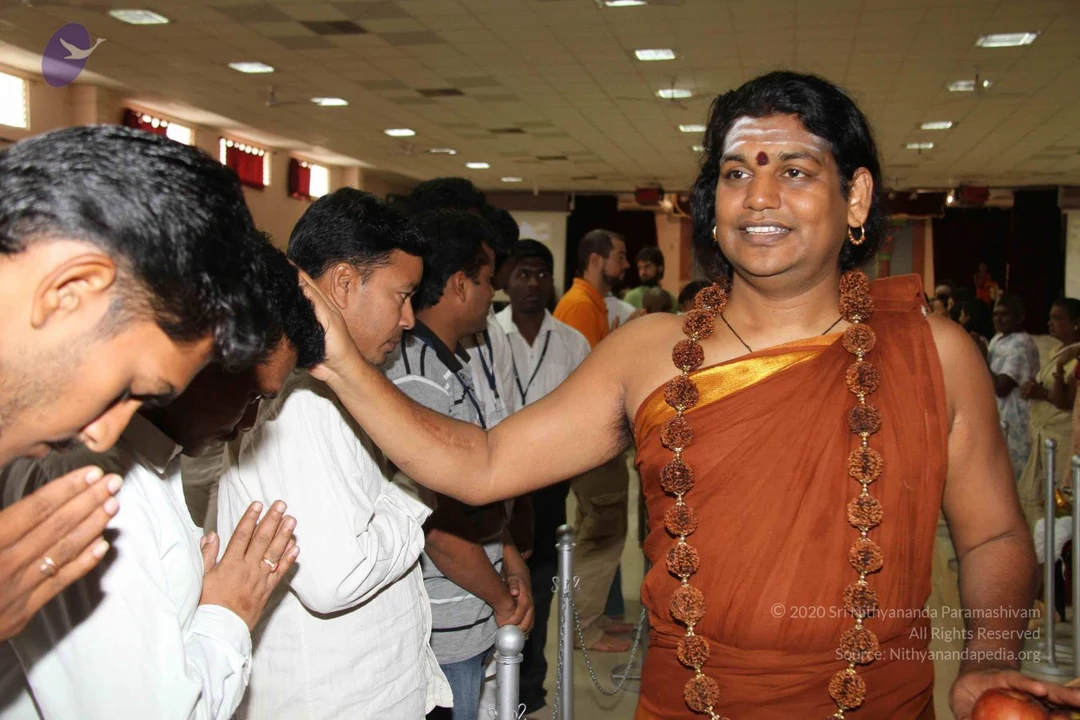
A photograph inside a hall with a stage backdrop, screens, and a line of metal stanchions with chains. In the centre, a man in an orange-saffron dhoti and shawl, with a long rudraksha mala and a gold-trimmed cloth at his waist, walks forward smiling with long swept-back dark hair and a gold necklace. Behind him, a shaven-headed attendant in saffron carries a red box with gold trim, and several other people in saffron and white ritual dress stand or walk through the room, including a woman in an orange sari on the right. Swamiji (probable) is the central figure, identified by long swept-back hair, ceremonial gold necklace, rudraksha mala and saffron dress. Brass items are visible on the floor.A standing man in an orange-saffron dhoti and shawl with a long rudraksha mala and gold necklace smiles while placing his hand on the head of a bowing man in a white shirt. The bowing devotee has a rudraksha mala and bends forward with palms together. a person is the standing figure, shown in a Satsang hall with a deity murti shrine in the background, and red-orange robed sannyasis, white-clad devotees and a tray of apples in the foreground. Several other people sit or stand behind, and a woman on the right holds her hands in anjali. Ceiling fans, projector screens and a decorated altar complete the setting.A photograph of an indoor hall with a suspended ceiling and a stage backdrop featuring a decorated deity murti. A smiling man in an orange-saffron ochre robe, with a long rudraksha mala draped across his chest and a tilak on his forehead, extends his hand in blessing toward a line of men in white clothing who stand with palms pressed together in namaskar. Red apples and packaged sweets sit on a table in front of him. Several other attendees in white and dark clothing stand behind the line, and women in white saris are visible at the right edge. A man with a bare-chested orange garment and rudraksha mala appears partially at right. The man in the saffron robe is described by the page as Swamiji, and his appearance (long swept-back hair, saffron clothing, rudraksha mala and ornate gold earrings) matches that candidate, so this is a probable identification.Indoor satsang hall with a crowd of devotees. A man with a shaved head and a man in a white shirt bow with palms pressed together in namaste. On the right, a figure in a saffron-orange dhoti and shawl, wearing a long rudraksha mala and gold necklace, with a sandalwood tilak on the forehead and raised palm in blessing, stands behind a table of red apples and offerings. Background shows more people in white and draped curtains.A man in an orange-saffron shawl over one shoulder, wearing a long rudraksha mala with a ceremonial gold chain, a white vibhuti line and a red bindi on his forehead, smiles as he stands in a hall. Beside him, a man in a white shirt has his hand on another devotee's head in blessing, while several men in white shirts and casual clothes stand behind a metal barrier with hands joined in namaskar. Ceiling lights, red curtains and a crowd of onlookers fill the background.A indoor hall with pink walls and red curtains where a bare-chested man in a saffron-orange dhoti and shawl, wearing a long rudraksha mala with a gold-toned ceremonial necklace and a forehead tilak, receives a gift from a woman in a red-and-pink patterned blouse and red shawl who holds a golden-wrapped parcel. He holds a small pink slip of paper. Other women in white saris, a woman in a green-and-orange sari and a woman in a purple shawl stand nearby with hands pressed in anjali, while a table in front holds apples and small packets of sweets. a person is the central figure in the saffron dhoti and rudraksha mala, receiving offerings from devotees.

Nithya-Puja
7 photosSource gallery
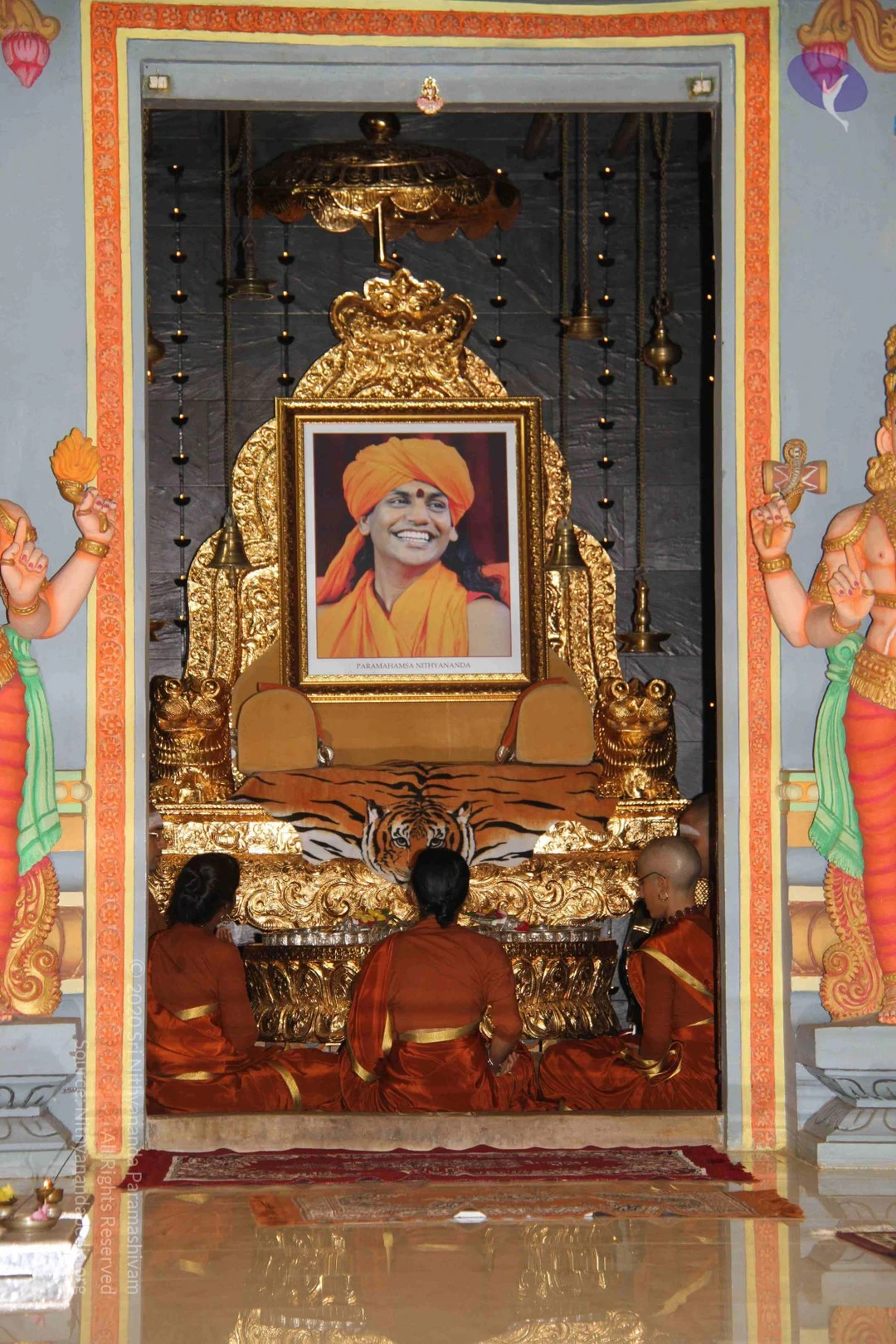
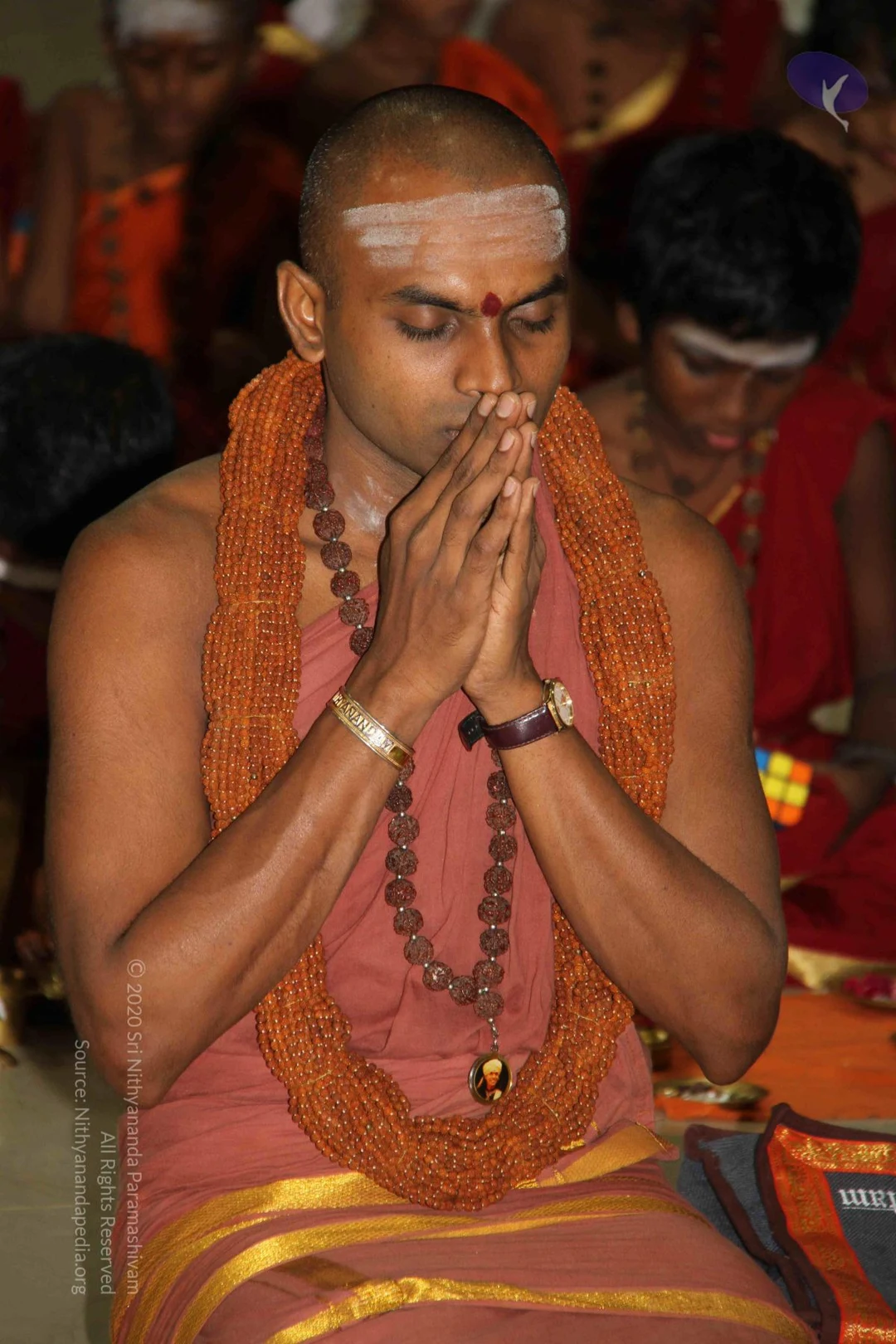
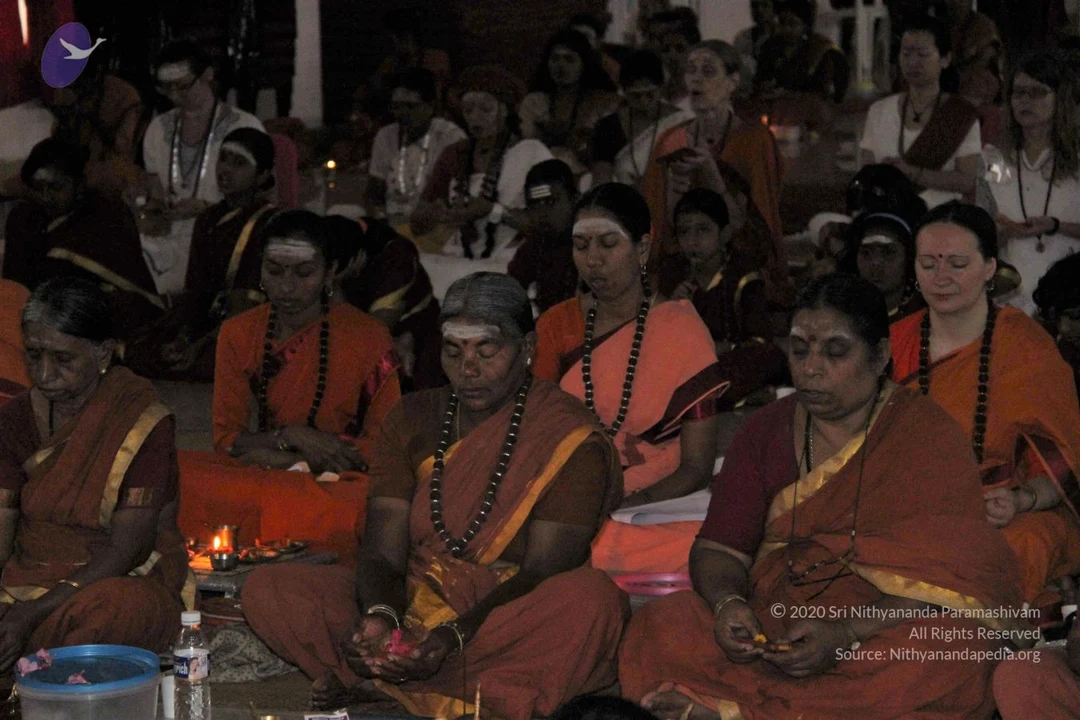
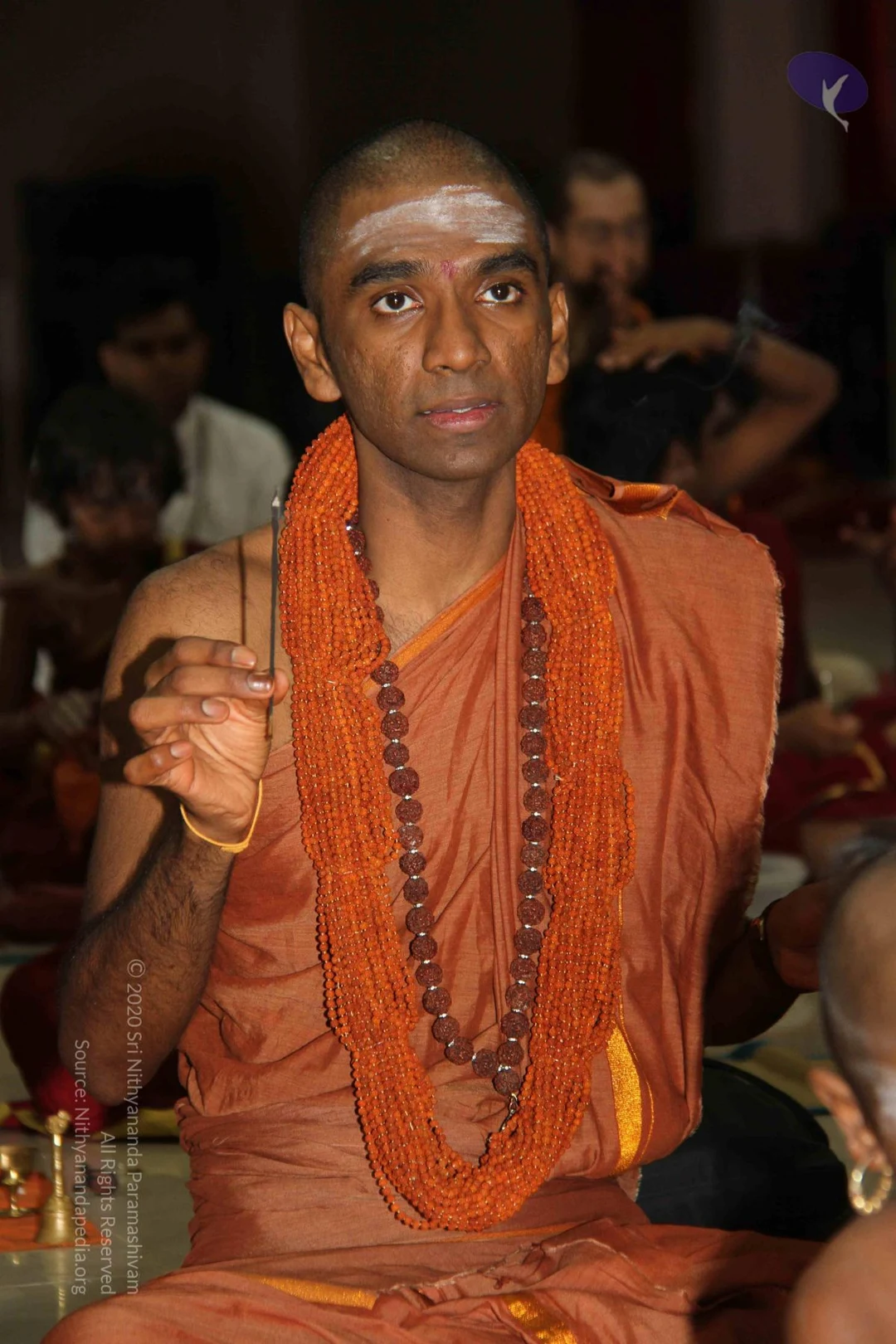
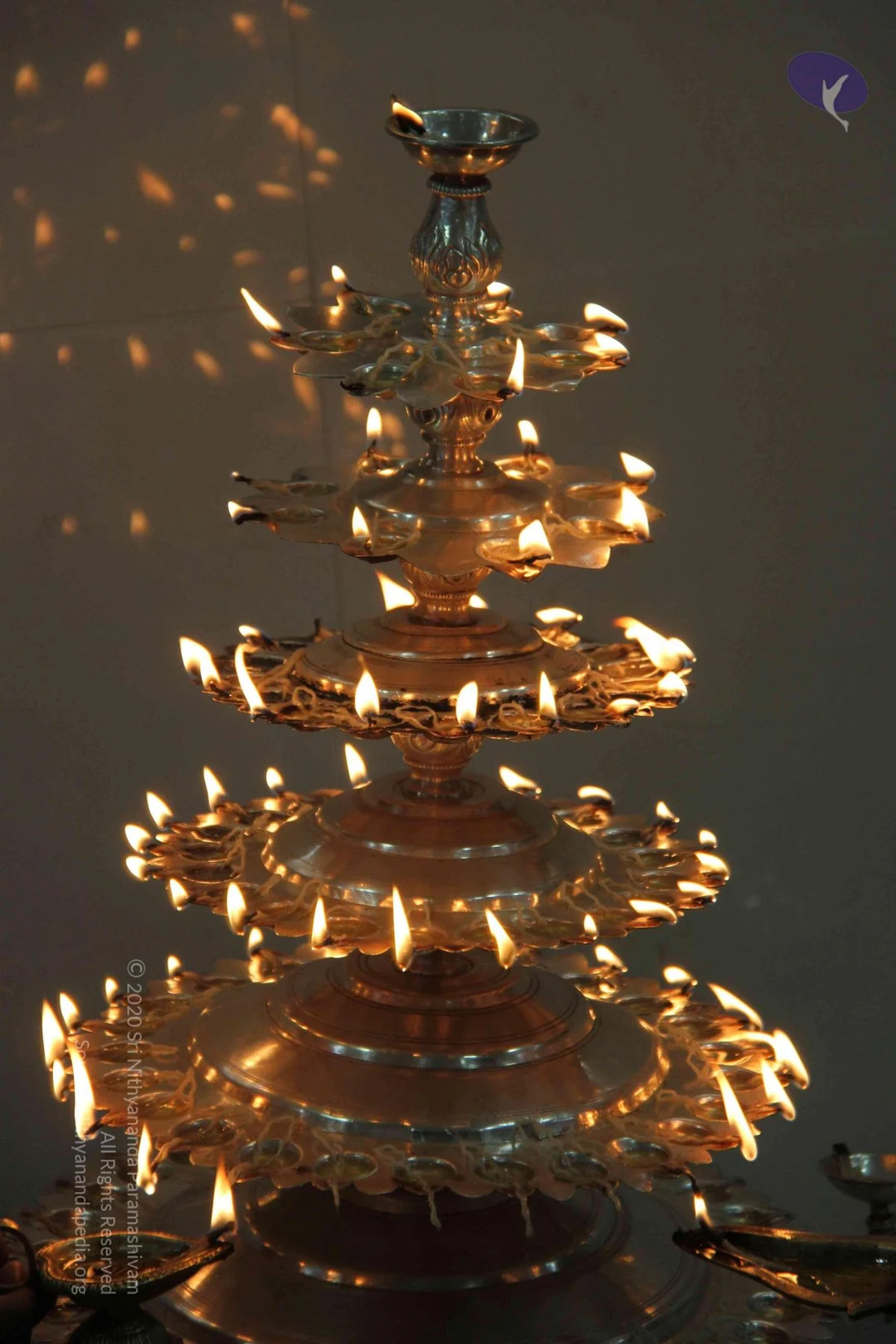
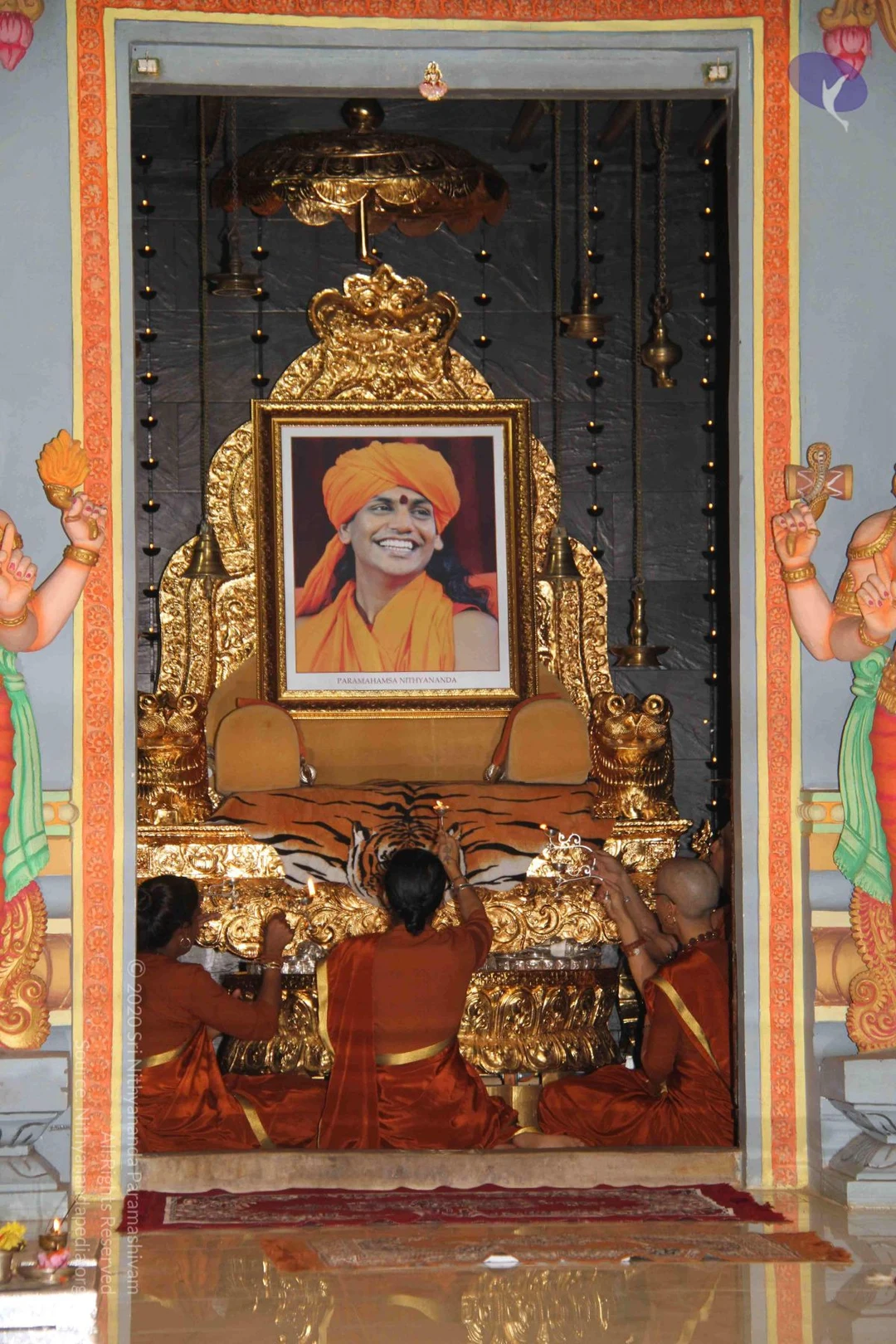
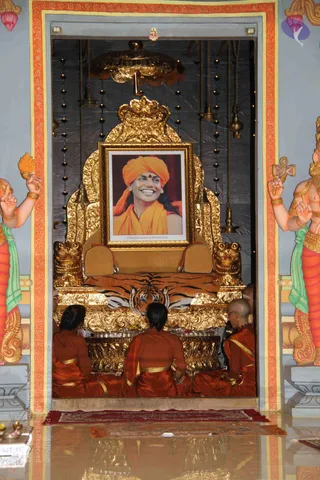
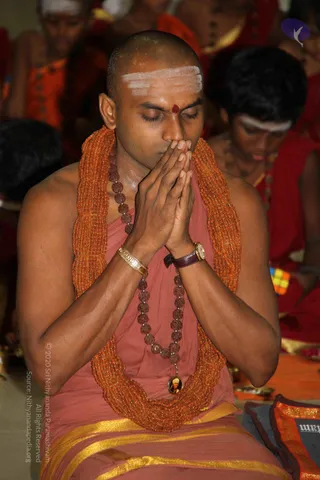
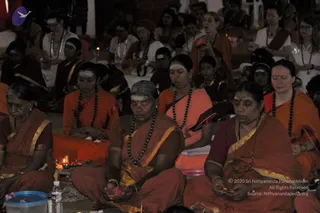
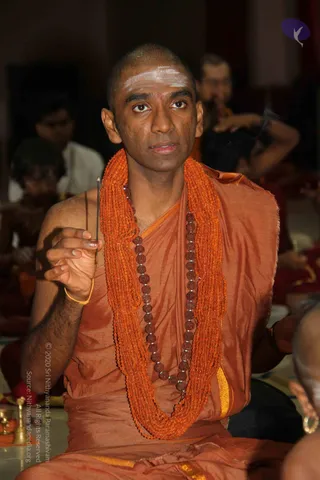
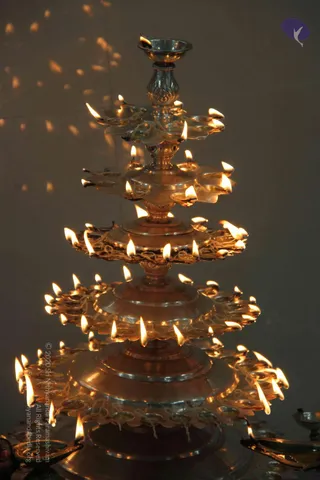
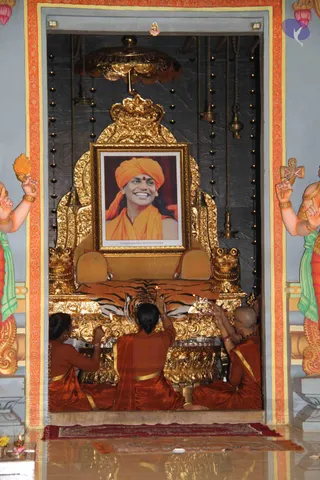
Interior view of a temple shrine with a large framed portrait labelled "PARAMAHAMSA NITHYANANDA" set on an ornate gold throne with lion-head armrests and a tiger-striped cloth draped across the seat. The portrait shows a smiling man in an orange turban and orange robes with a red tilak. Three women in orange-red saris kneel in front of the throne on a glossy floor, offering worship; the central woman has her hair in a bun and the figure at right has a shaved head. Golden canopy, hanging bells and dark-bead strings frame the shrine, and painted deity figures with multiple arms stand on either side holding ritual objects.A shaved-headed man sits with eyes closed and palms pressed together in anjali mudra before his chest. He wears a rose-pink unstitched cloth with gold borders, multiple strands of orange-brown beaded necklaces, a dark rudraksha mala with a small framed portrait pendant, a gold bangle and a wristwatch. A white horizontal tilak and a red bindi mark his forehead. Behind him, several people in red and orange garments with white forehead markings sit in devotional posture, and a plate with offerings is visible at lower right. a person status is uncertain: the appearance is consistent with a probable candidate, but the cues are not distinctive enough to confirm.A seated group of women in saffron and orange saris with gold borders sits on the floor in a dim hall, many with rudraksha malas and white or ash forehead markings. In the foreground an older woman with grey hair holds small pink flowers in her cupped hands, and another in the front row has a bowl of flowers and a lit oil lamp before her. Behind them more devotees sit in rows, some in white clothing, and a plastic water bottle and blue container sit at the lower left. Lamp light and warm candles illuminate the scene.Photo of a shaved-headed man seated in an ashram setting, wearing an orange-brown silk wrap and layered orange beaded malas with a dark rudraksha mala at the chest. He has white horizontal tilak on the forehead and a red dot between the brows, and holds a lit incense stick upright in his right hand. Behind him, blurred figures sit on the floor, and a brass vessel sits at lower left. Appearance-based cues are limited to the orange robe and rudraksha malas, which are not distinctive enough to identify a specific individual, so the a person field is unsure.A tiered brass lamp stand, a multi-level deepam with many small oil lamps flaming on each stepped tray, glowing warmly against a dim grey background with scattered light spots on the wall. No people are visible; the lamps are the sole subject. Smaller lamps sit at the lower corners of the frame.Photo of a shrine inside a temple with a gilded golden throne draped with an orange and black tiger-striped cloth. A framed portrait labelled "PARAMAHAMSA NITHYANANDA" sits on the throne back, showing a smiling man in an orange turban and orange shawl with a red bindi. Three people in orange-red robes kneel at the base of the throne, one lifting a small lamp and others adjusting items on the altar. Painted multi-armed deity figures in green and red flank the doorway, and oil lamps and bead strands hang from the ceiling above a golden umbrella canopy.

Nithya-Satsang
29 photosSource gallery
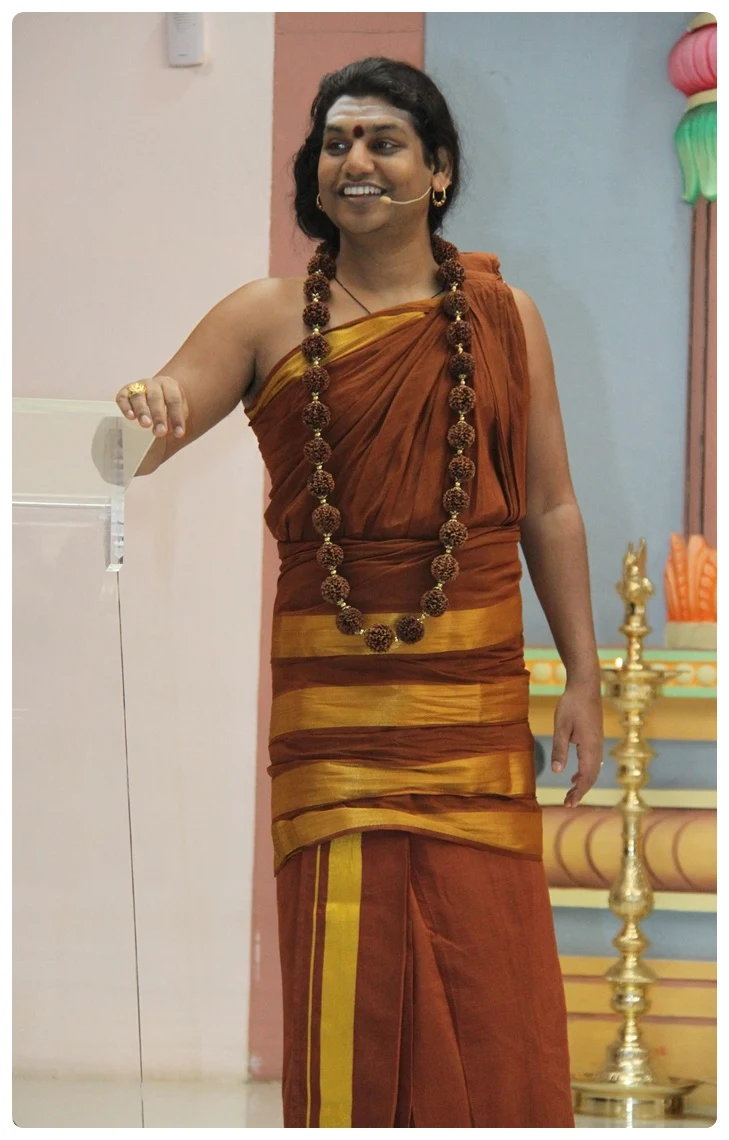
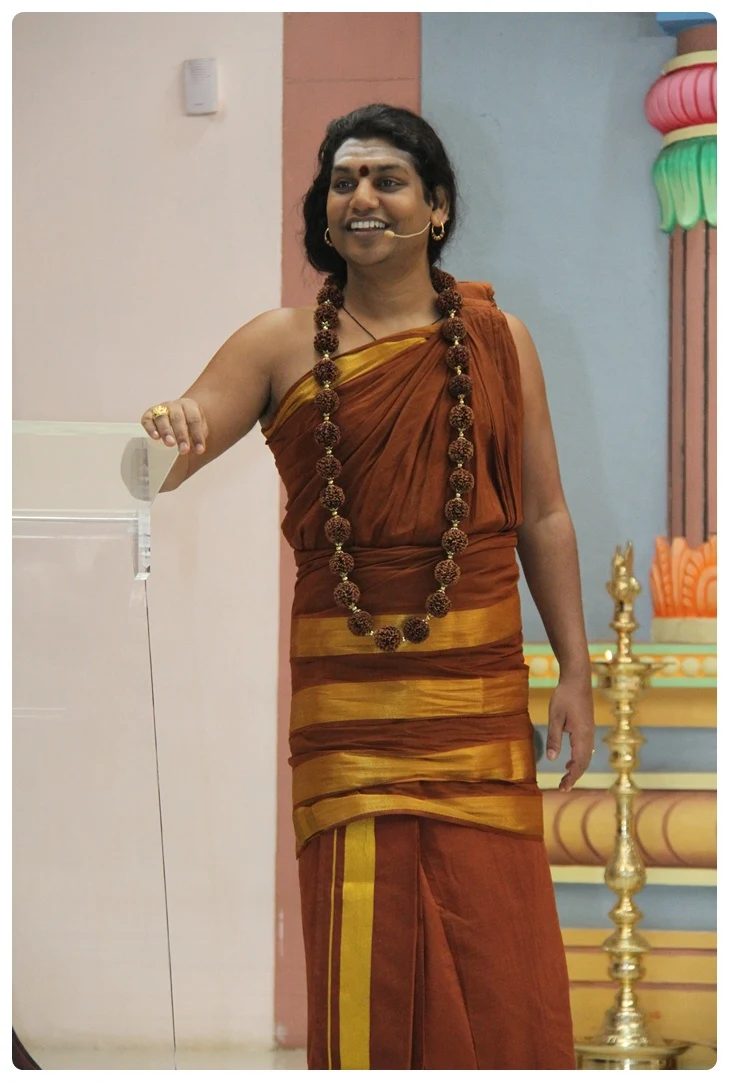
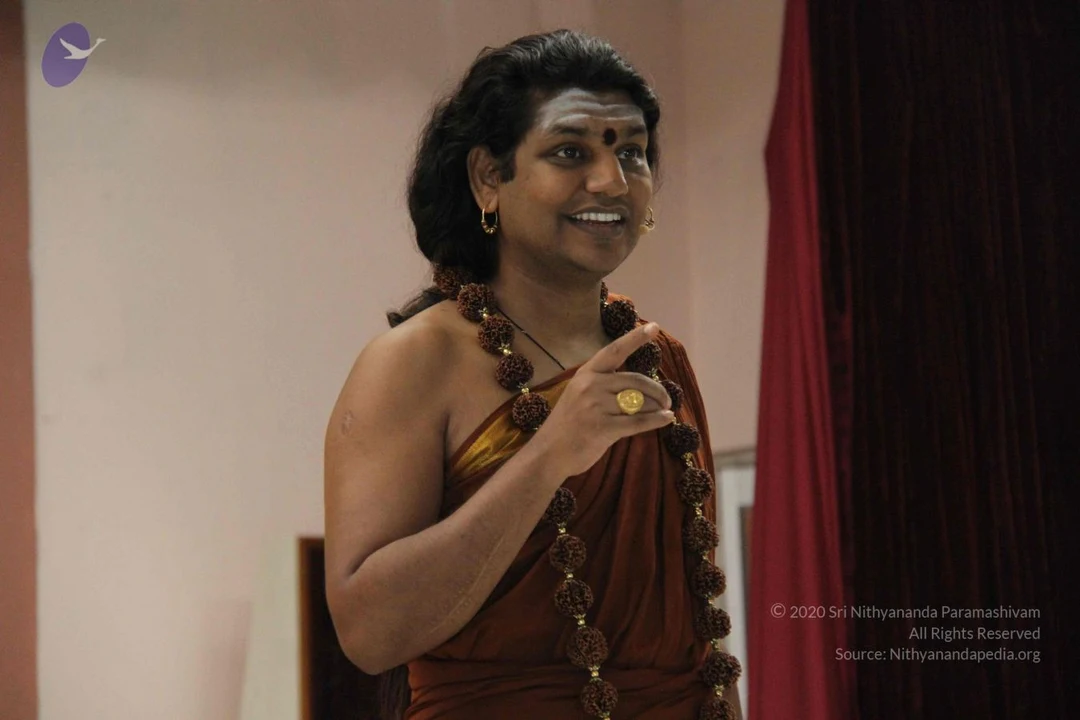
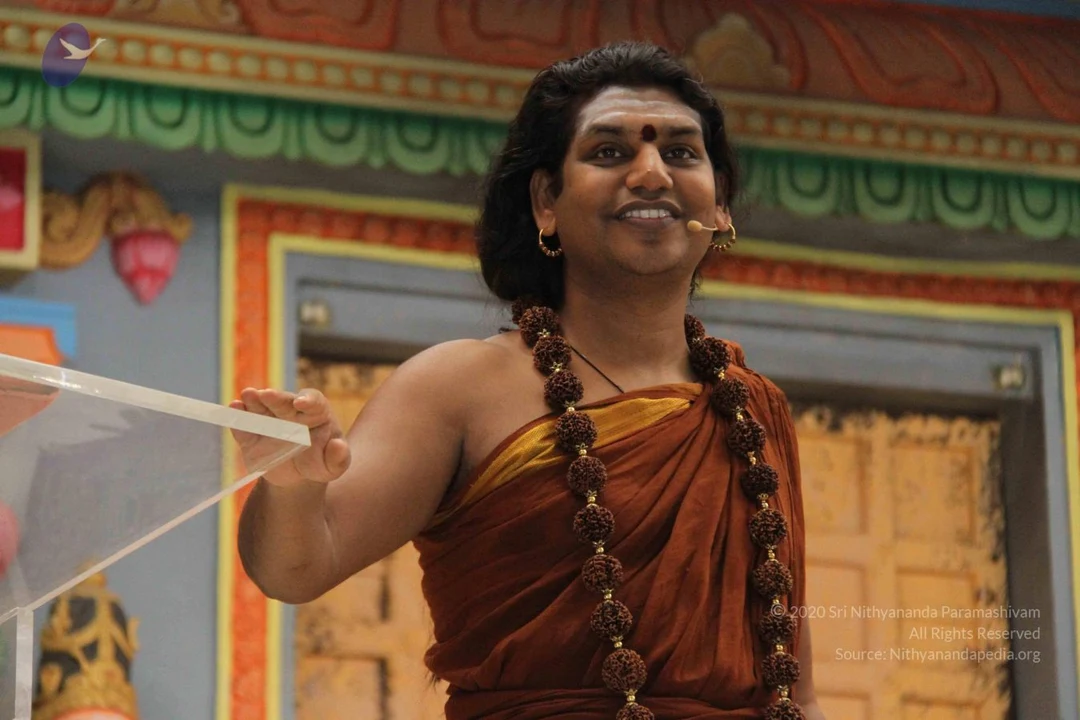
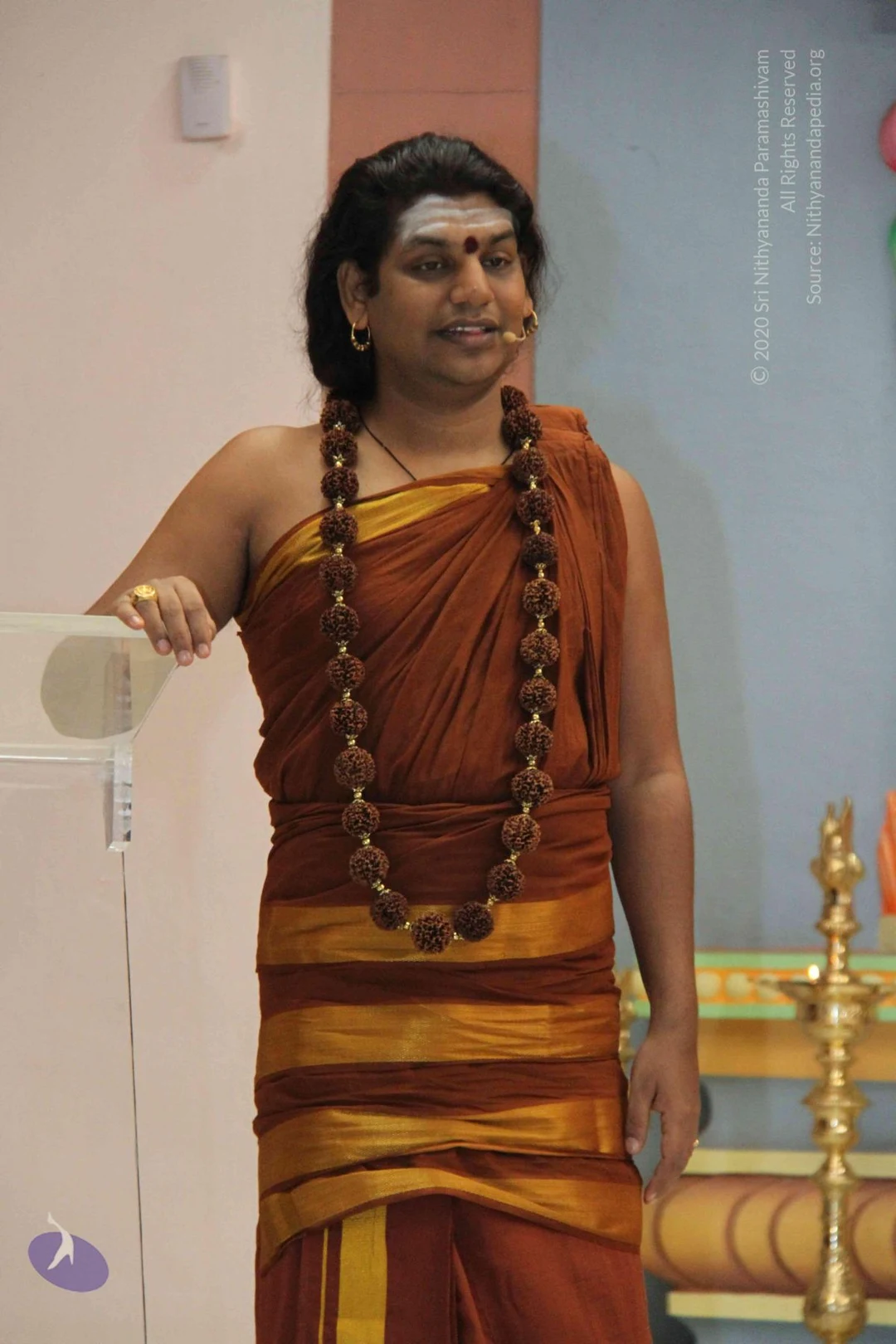
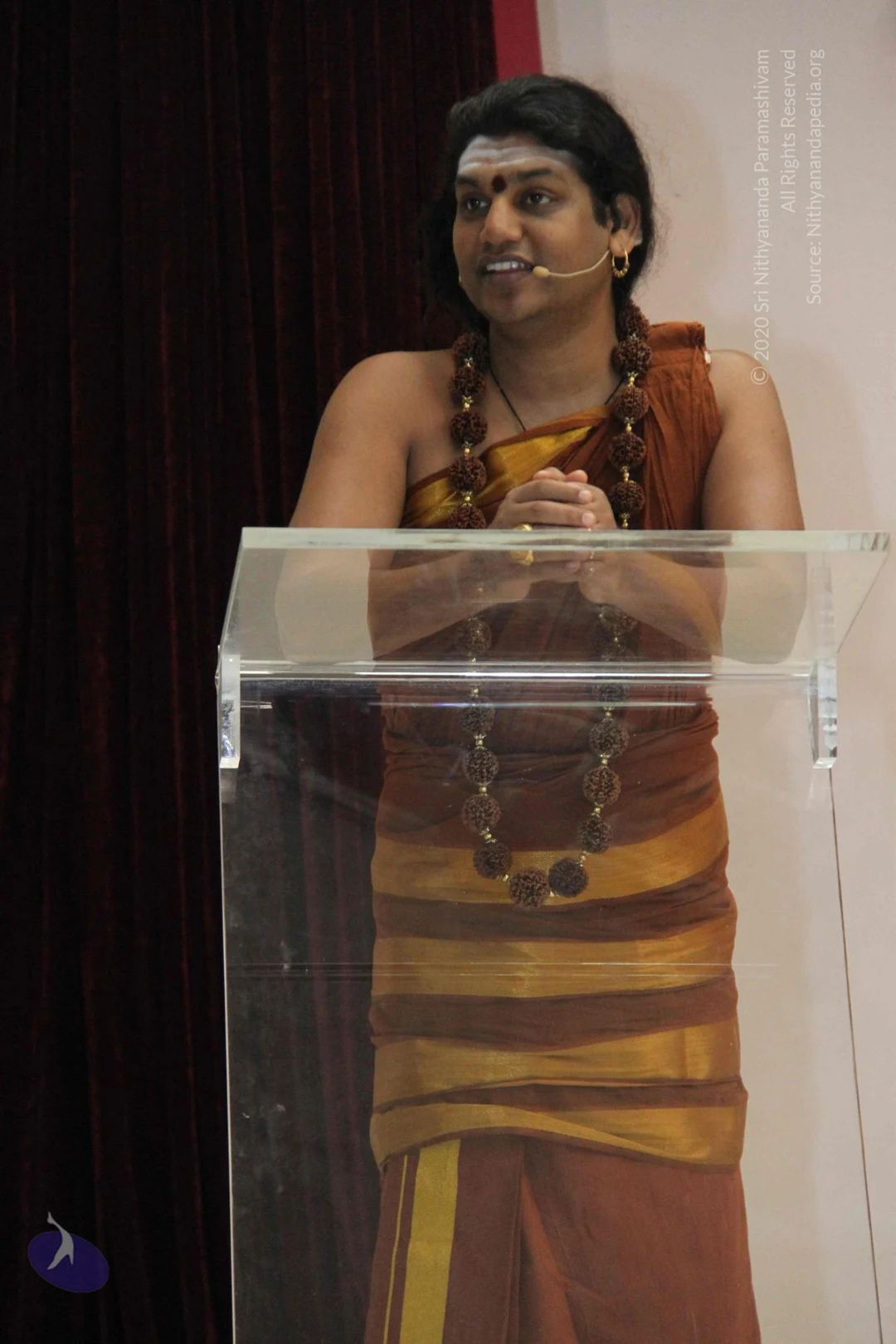
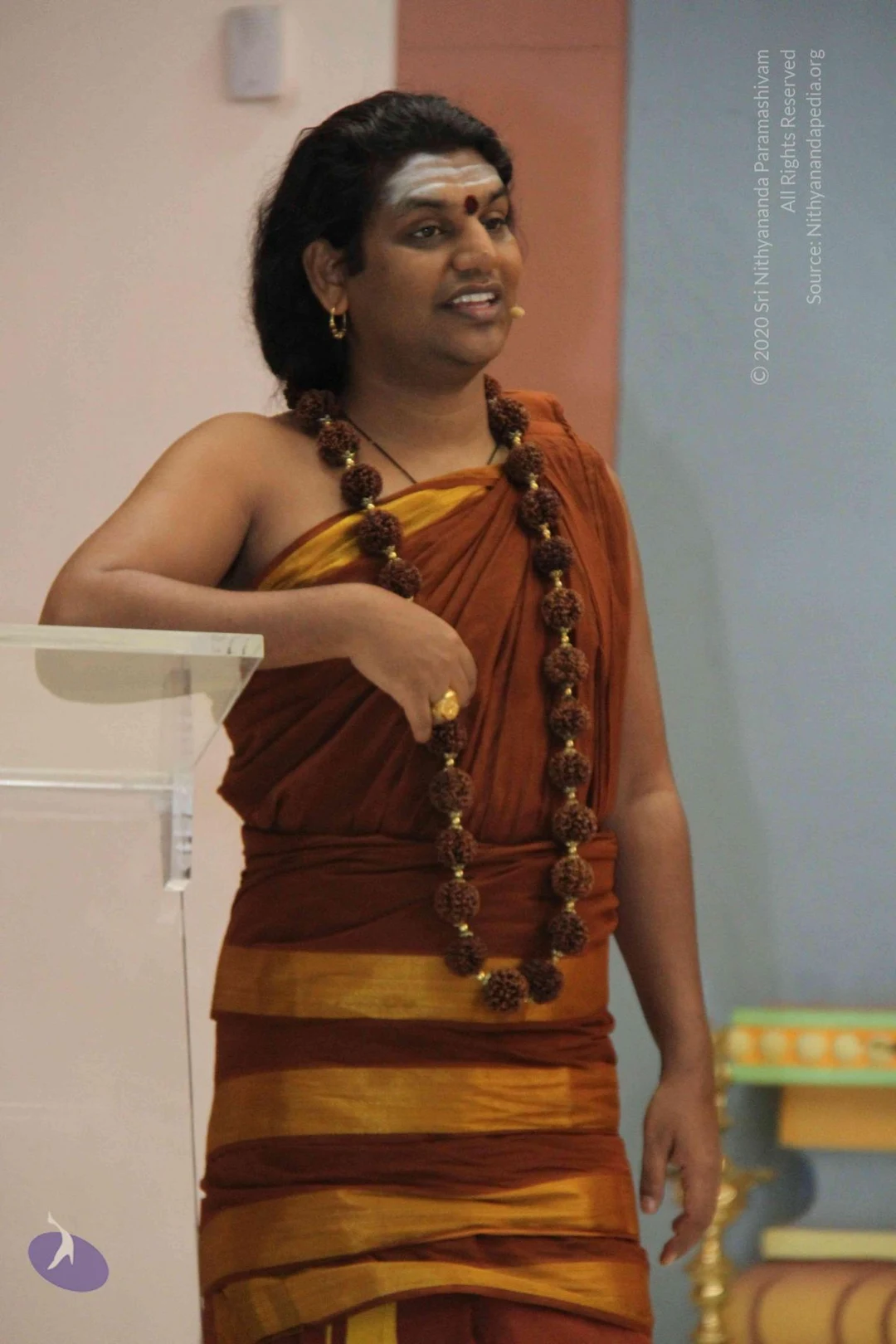
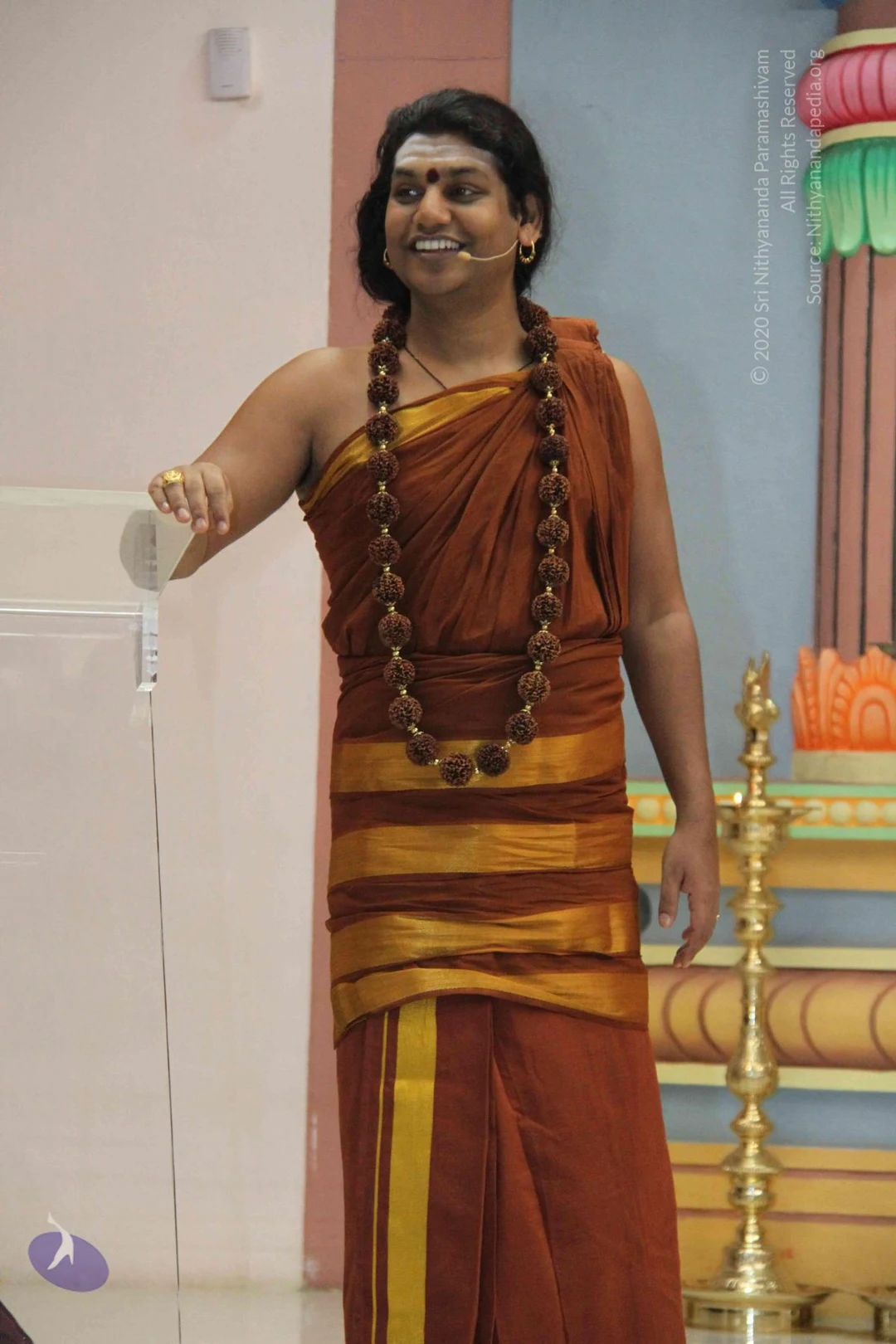
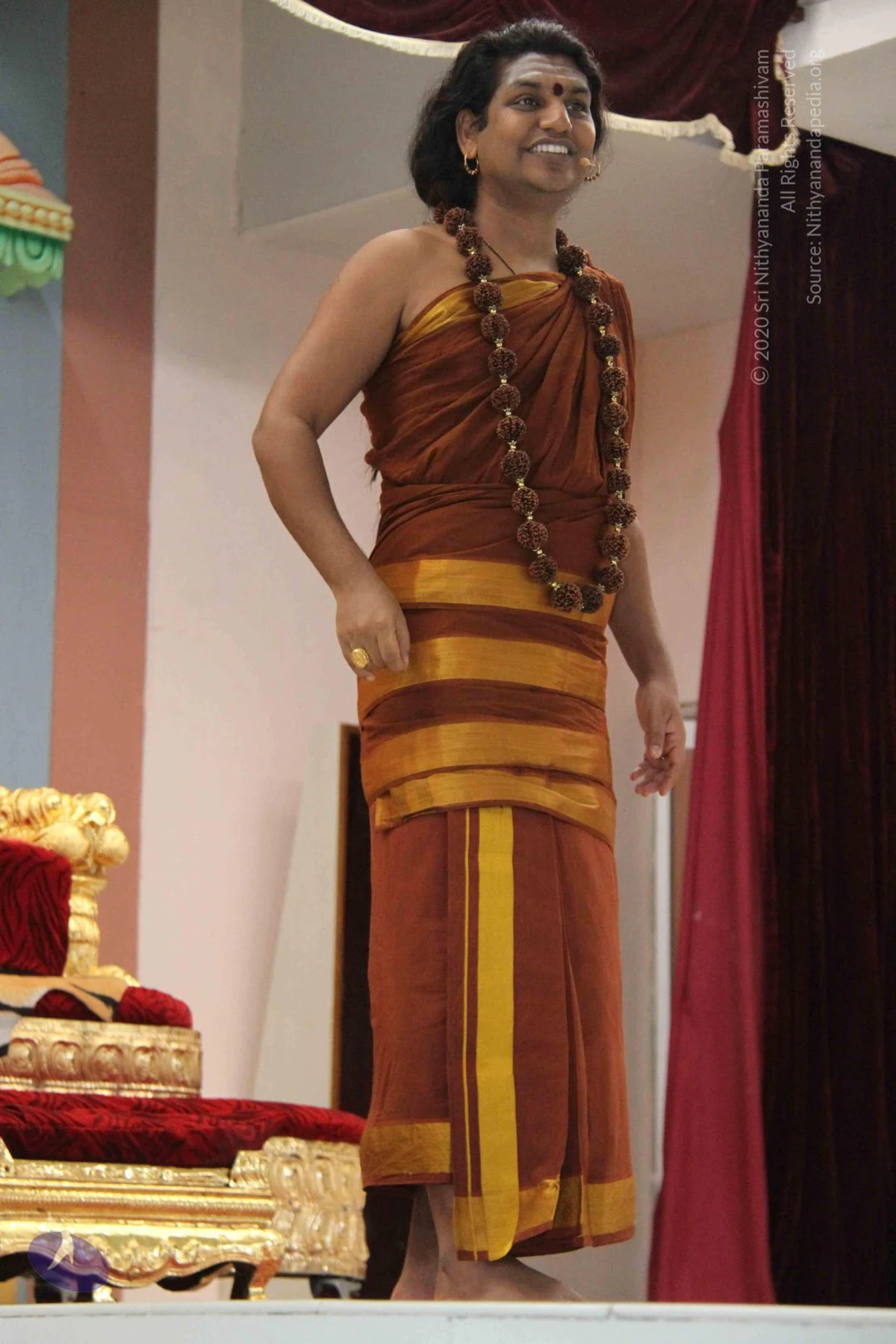
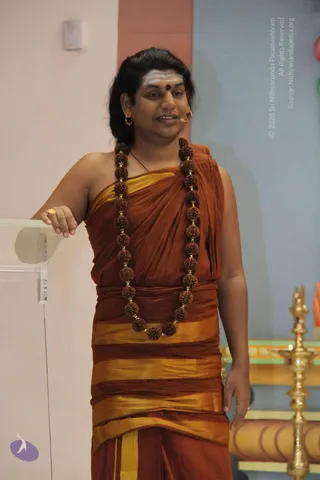
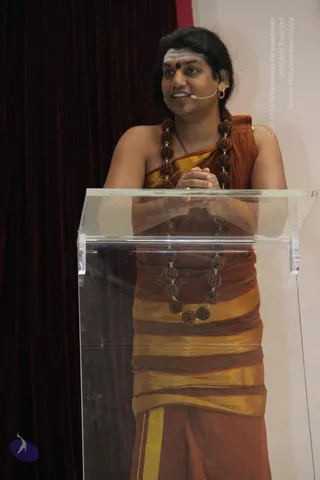
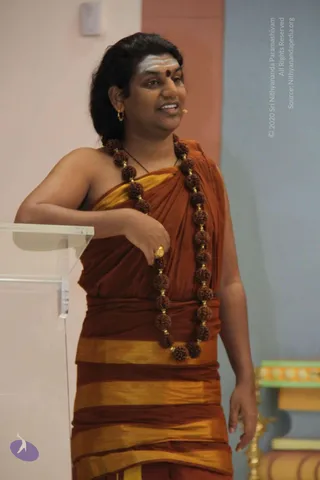
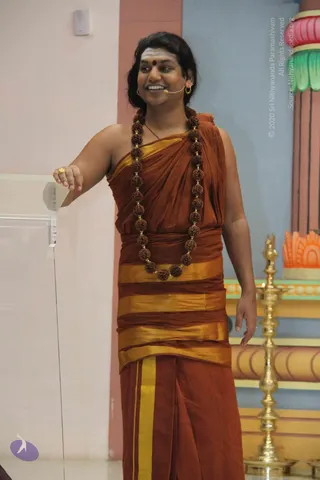
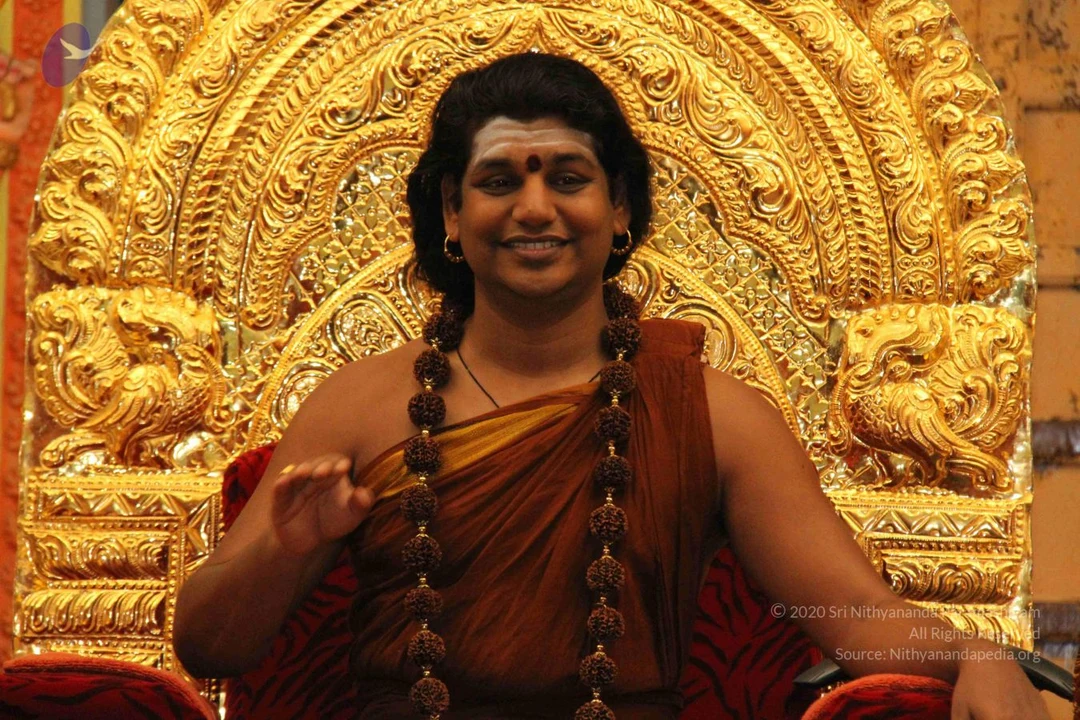
A seated man in a rust-brown robe with a golden edge sits on an ornate gold throne with embossed lion and floral carvings and red cushions. He wears a long necklace of large rudraksha beads, small gold earrings, a white ash marking across the forehead with a red dot, and a small headset microphone. He smiles, hands resting in his lap, while speaking at a satsang setting.A smiling man sits on an ornate gold throne with a carved gilded backrest and a red patterned cushion, seated at a satsang. He wears an orange-brown ochre cloth draped over his left shoulder with a yellow-gold edge, and a long necklace of brown rudraksha beads with gold spacers. He has a white tripundra forehead marking and a red bindi, plus gold earrings and a gold ring, and his hands rest together in his lap. A small microphone is clipped near his mouth. The page indicates this is a Swamiji event, and the appearance cues (long swept-back hair, rudraksha mala, ochre cloth, gilded throne) support a probable Swamiji identification in the seated speaker role. Behind him is a bright orange drape.A man stands at a clear acrylic lectern in a saffron-orange draped robe with gold-bordered wrap, wearing a long rudraksha mala and gold rings and earrings. He has long swept-back dark hair, white sacred marks on the forehead and a red bindi, and a headset microphone. Behind him on the right is a tall polished brass oil lamp with a lit flame. Swamiji (probable): the saffron clothing, long hair and rudraksha mala match the page's identification, though appearance alone is not conclusive; he is shown speaking to an audience at a satsang-style talk.A man in saffron and gold-bordered orange cloth stands behind a clear acrylic lectern on a stage, hands clasped, speaking into a headset microphone. He wears long dark hair, a white vertical tilak with a red dot, gold hoop earring and multiple rudraksha mala necklaces. Dark red velvet drapes stand behind him. Appearance-based candidate: a person, giving a satsang discourse with his bare shoulder and orange shawl visible.A man stands beside a clear acrylic lectern, speaking into a headset microphone during a talk. He wears rust-orange draped clothing with gold-bordered bands at the waist and shoulder, a long rudraksha mala of brown beads hanging to his waist, and a gold ring on his right hand. He has a white tilak with a red dot on his forehead and gold hoop earrings, and his long dark hair is swept back. Behind him are pale pink and blue walls and a gold-toned stand with an orange and green cloth. Swamiji (probable): long swept-back hair, saffron-orange draped clothing, rudraksha mala and gold ornaments, speaking at a lectern in a satsang setting.A smiling man stands beside a clear acrylic lectern in a temple-style hall, gesturing with his left hand resting on the lectern. He wears a rust-brown dhoti-style garment with broad gold borders wrapped across the torso, a long rudraksha mala with gold spacer beads, gold hoop earrings, a gold ring, a red bindi and a small headset microphone. Behind him, a tall brass oil lamp stands beside a painted wall with pink, green and orange decorative panels. Swamiji (probable) is visibly present: long swept-back hair, saffron-brown ceremonial clothing with gold trim and a rudraksha mala, speaking as a teacher at a satsang.

Sarva-Darshan
5 photosSource gallery
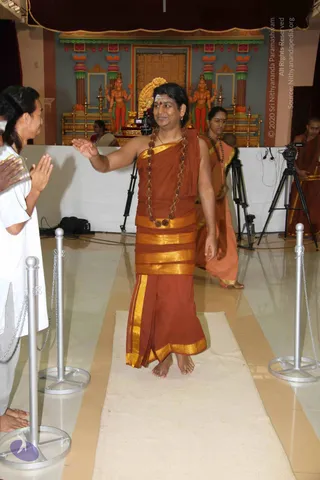
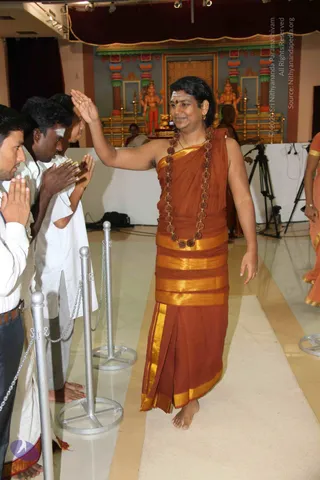
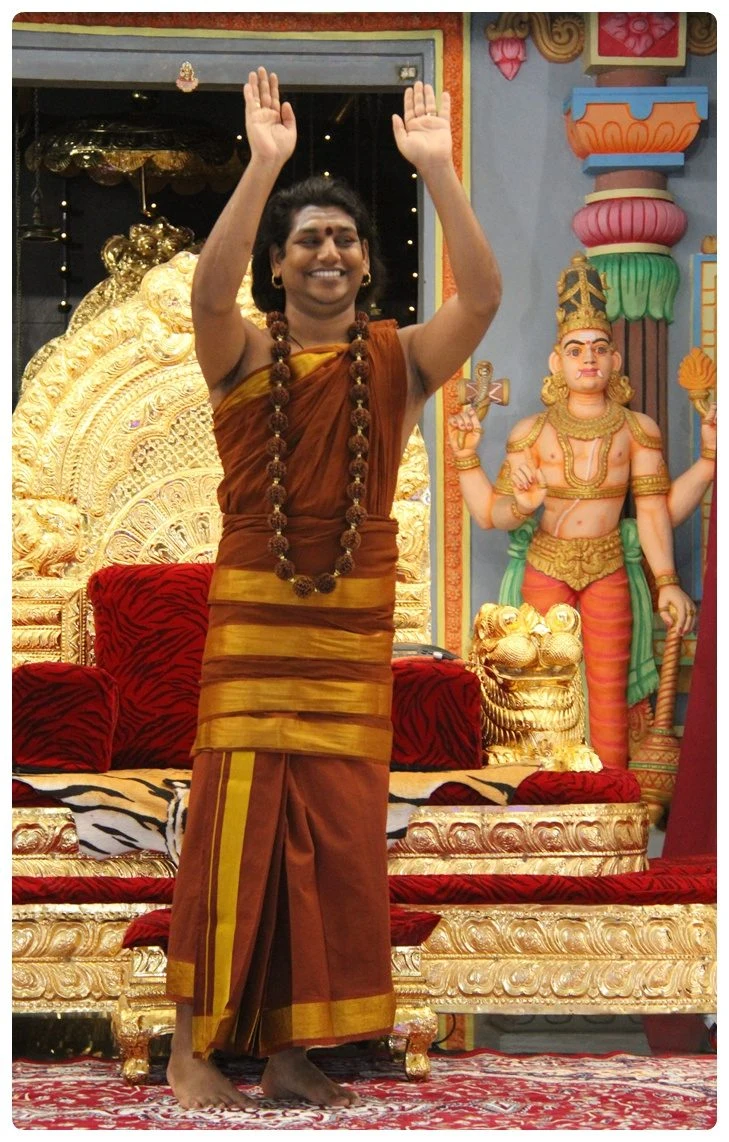
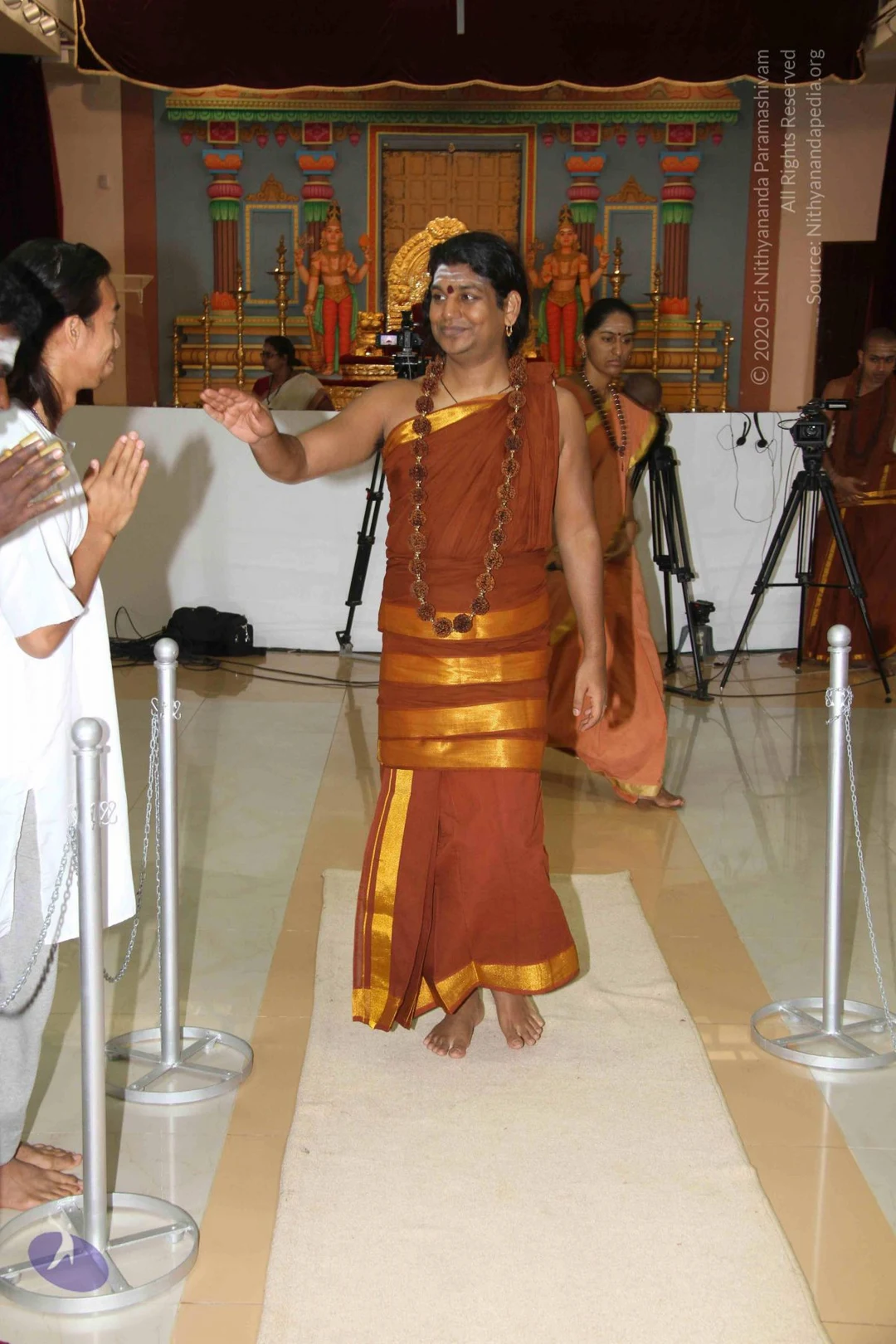
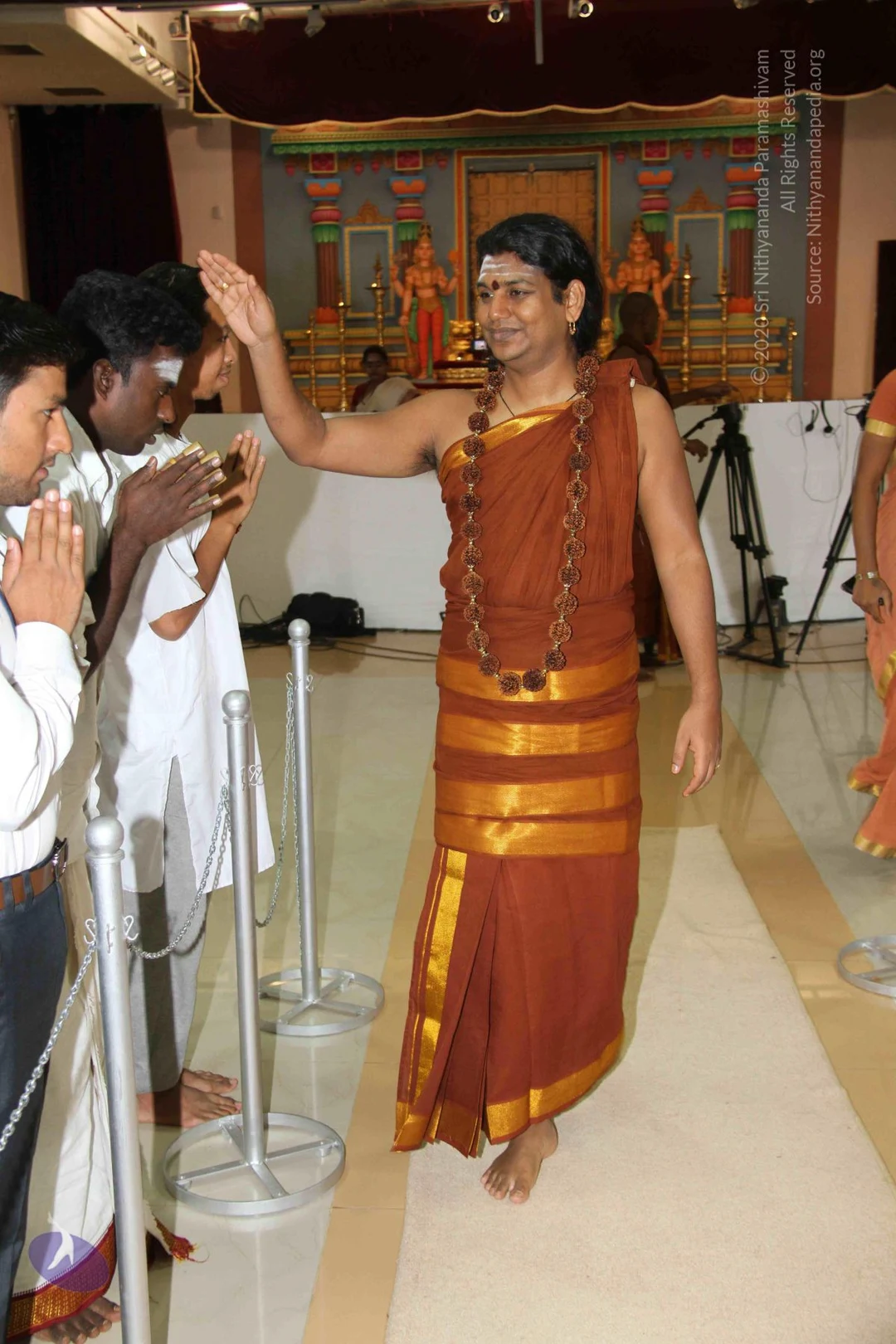
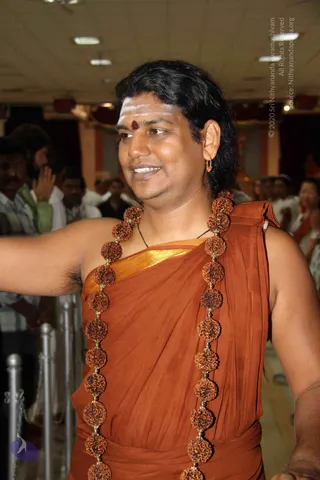
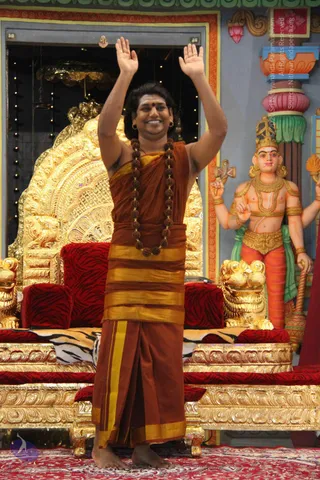
A man in a rust-orange dhoti and shawl with broad gold borders walks barefoot down a cream carpet runway in a temple-style hall. He wears a long rudraksha mala with ceremonial gold ornaments, a red tilak on his forehead, and extends his right hand toward a person in white at left who is folding their palms in greeting. Behind him, a woman in orange with a red bindi and a rudraksha mala follows. In the background, a painted backdrop shows two deity murtis with raised arms flanking a golden doorway, with brass lamps and kalasha-style pillars, and video tripods and cameras are visible on the right. Silver stanchions with chains line the carpet. a person appears in person, matching the page's stated presence, with the orange clothing and rudraksha mala as cues.A man in a rust-orange dhoti and shawl with wide gold borders walks barefoot along a cream carpet runner, raising his right hand in a blessing gesture. He wears a long mala of rudraksha beads and a red tilak on his forehead. To the left, several men in white shirts and white dhotis stand behind silver stanchions with chains, hands joined in namaste and one with a white tilak. Behind him stands a decorated temple-style backdrop with painted pillars, gold-framed deity murtis and brass lamps. A film camera on a tripod and a person in orange appear at the right edge. a person: the walking figure in orange with rudraksha mala and red bindi matches the appearance-based cues.A man in a reddish-brown dhoti-style garment with broad gold borders, wearing a long rudraksha mala and a vertical tilak on his forehead with a red dot, walks down a central aisle smiling and raising one hand in greeting. Devotees in white on the left stand with palms pressed together in namaskar behind a metal stanchion barrier. On the right, a person holds a box of red apples and packaged sweets. In the background, a stage holds a colourful deity murti and a gold-framed altar in a hall with ceiling fans and lights. Swamiji (probable): the man has long swept-back hair, a rudraksha mala and saffron-toned ornate clothing, so he is a probable in-person candidate.A smiling man with long dark hair swept back stands in an indoor hall, wearing an orange-brown shawl draped over the shoulder with a gold border and a long multi-strand rudraksha mala with gold spacers hanging to the waist. He has white vertical tilak lines on the forehead and a red bindi, and a small gold earring. He gestures to the left with one arm. Behind him, several people in light clothing stand near a metal railing under ceiling lights. Appearance-based label: Swamiji (probable), based on the distinctive long hair, orange shawl and rudraksha mala cues.A barefoot man in a rust-brown dhoti and shawl with broad gold borders stands on a red patterned carpet with both palms raised in greeting, smiling broadly. He wears a long rudraksha mala and a small red tilak on his forehead. Behind him is an ornate gold-covered throne with red tiger-striped cushions and gold lion heads. To the right stands a painted deity murti with a crown and four arms, holding a trident-like staff and other objects, in orange and red tones. The setting appears to be a temple-style stage.

Final-Blessing

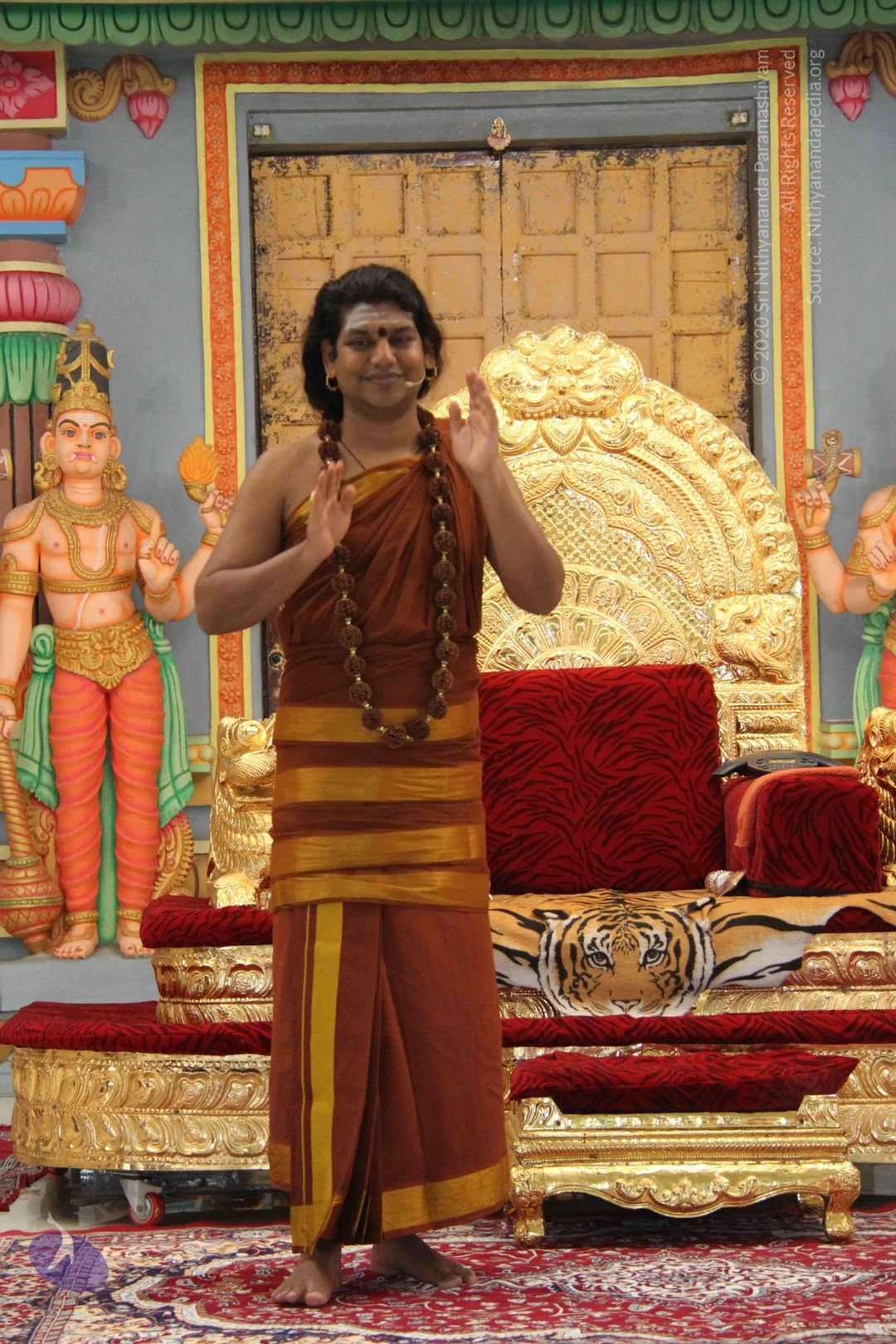
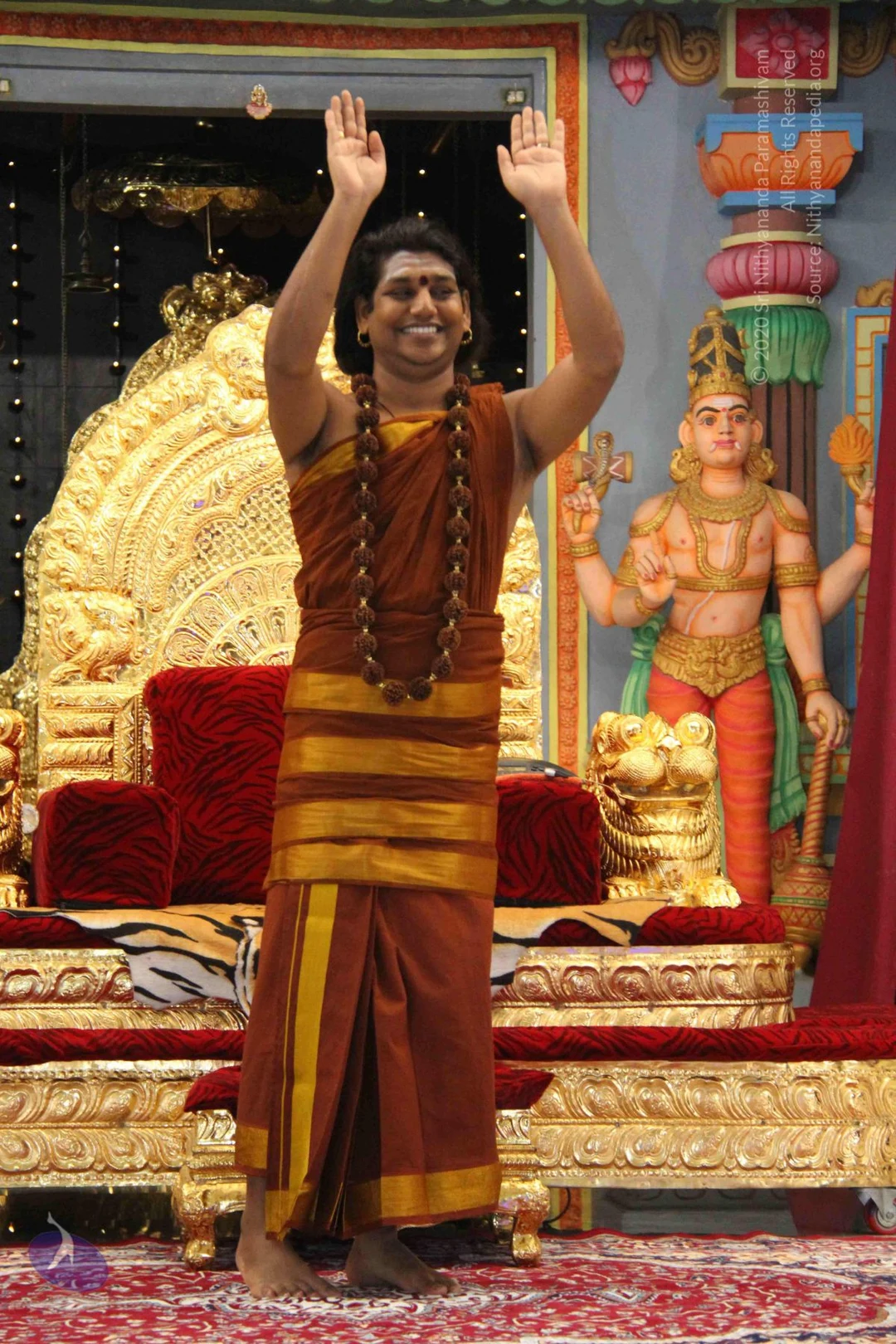
3 photosSource gallery
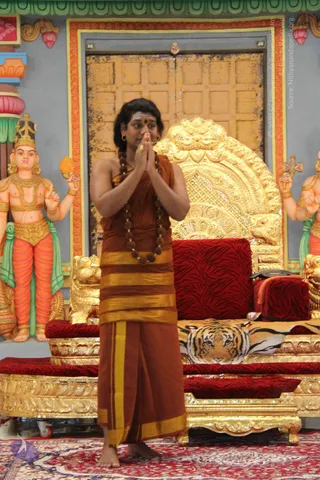
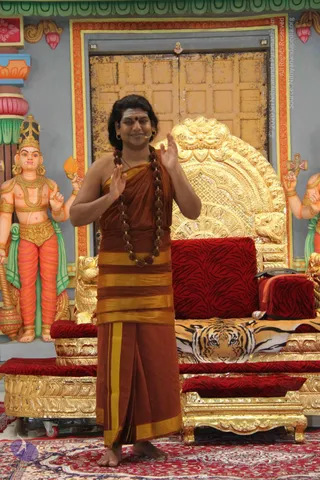
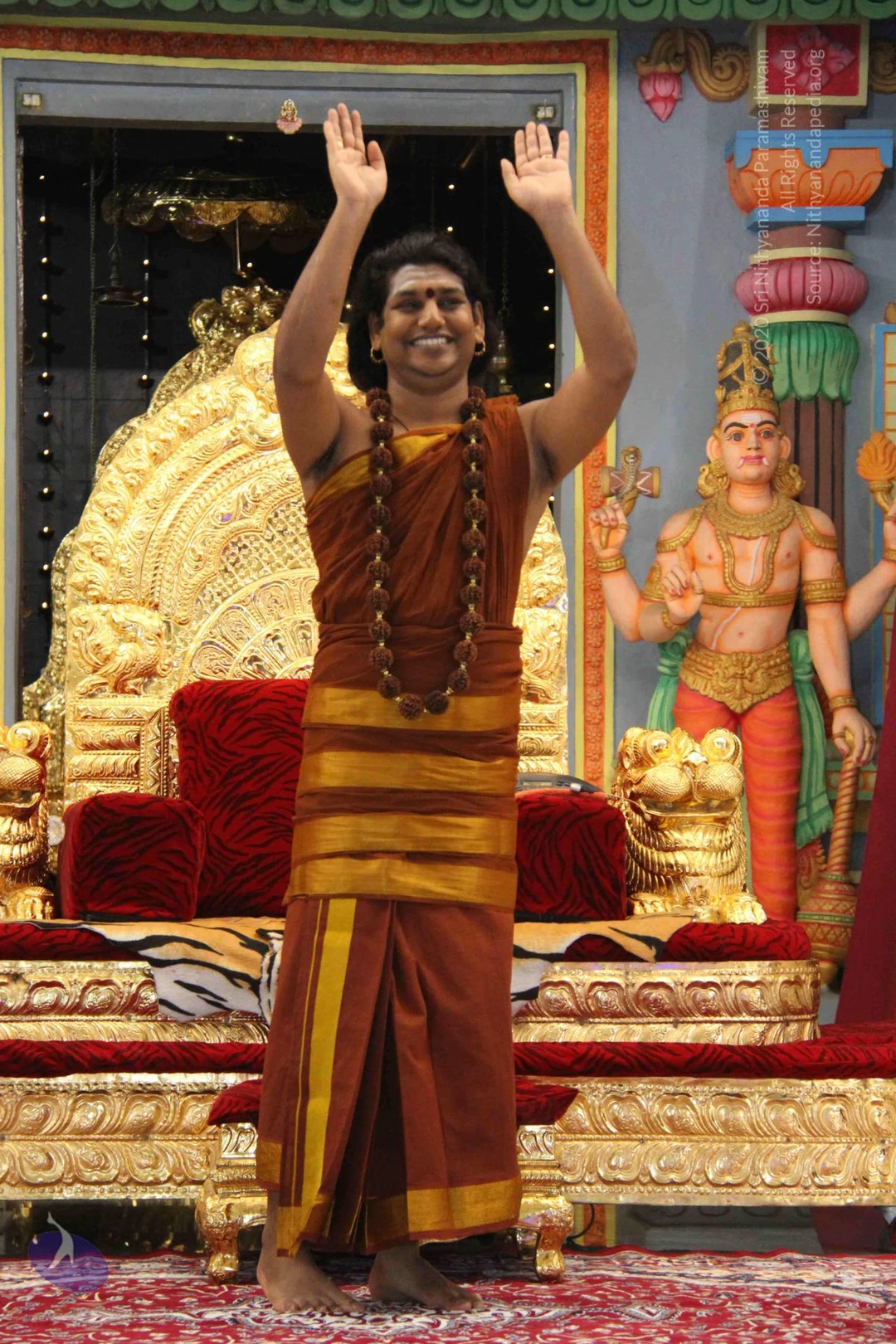
A man stands barefoot on a red patterned rug in front of an ornate golden throne with red tiger-striped cushions and a tiger-skin draped over the seat. He wears a rust-orange shawl with gold borders wrapped over the shoulders and an orange dhoti with gold border, a rudraksha mala around the neck and a red bindi, and presses his palms together in greeting. Behind him are a large golden-panelled door and painted deity statues with crowns, one holding a flaming lamp, flanking the scene.A man stands barefoot on a red patterned rug in front of an ornate gold throne with red velvet cushions and a tiger-skin cover, in a temple-like hall. He wears a rust-brown unstitched garment with broad gold borders, a gold-bordered wrap over one shoulder, and a long rudraksha mala with a short gold chain. He has a red tilak on his forehead, small gold earrings, and a small headset microphone, and he raises both palms in an expressive teaching gesture. Flanking him are painted deity statues: a figure on the left with orange skin, a tall gold crown and gold jewellery, holding a flame, and a multi-armed figure on the right. Behind him are yellow wooden doors with carved panels. Appearance-based probable Swamiji cues are long swept-back hair, rudraksha mala and ceremonial dress, and he is seated-speaker position giving a satsang. Visible: one person.A smiling man stands barefoot on a red patterned carpet with both arms raised in an open-palmed gesture of greeting. He wears a rust-orange upper cloth wrapped over the shoulder with a gold-bordered band at the waist, a matching rust-orange dhoti with a gold border, and a long rudraksha mala with bead strands around the neck. A red tilak marks his forehead. Behind him stands a golden ornate throne with red and black tiger-striped cushions, and to the right a painted deity murti with four arms, a crown and gold ornaments holds a mace. Plain white statue-like figures are not present; the setting is a temple-style hall. The man has long, swept-back hair and a distinctive ceremonial appearance with rudraksha mala and saffron clothing, consistent with the page's account of Swamiji at this satsang. Swamiji (probable) is shown in person, arms raised, in front of the throne.