Skip to content
Thursday

11 October 2012

Akashic Readings on renunciation - part 1

Dated photos
290
Source pages
1
Media
6
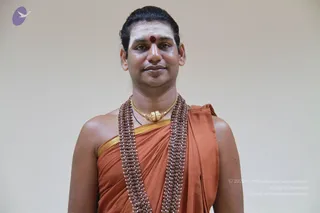
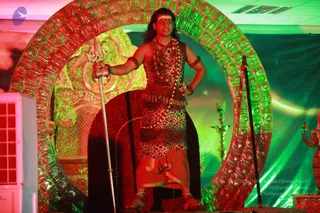
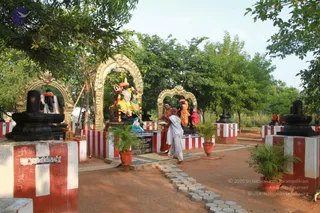
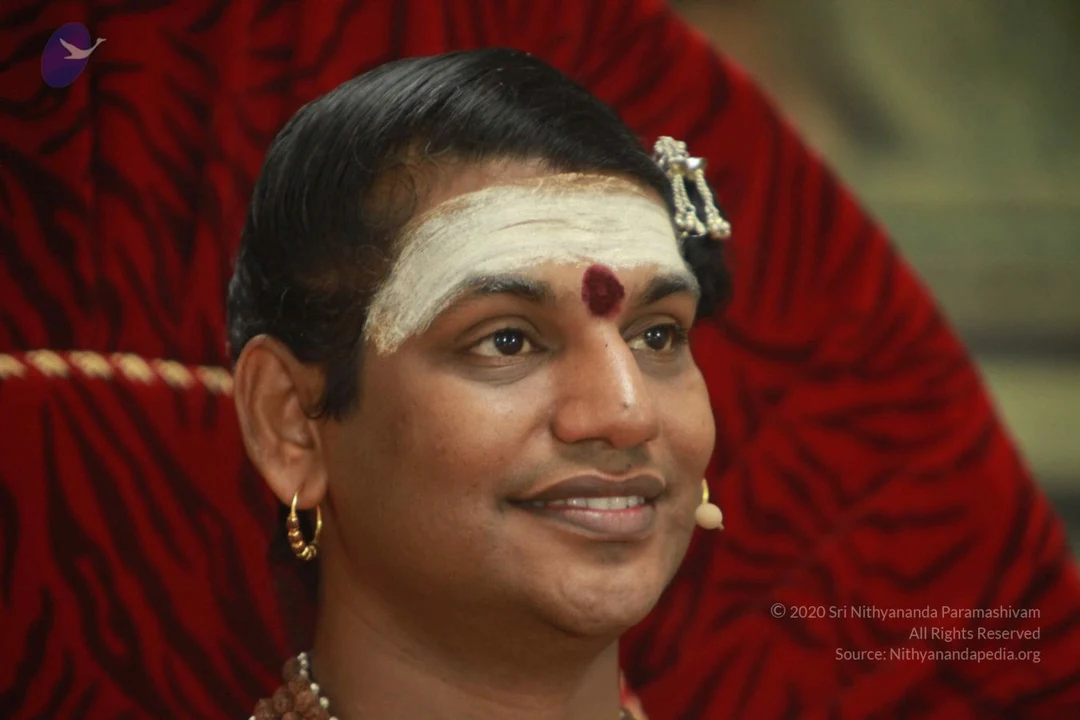
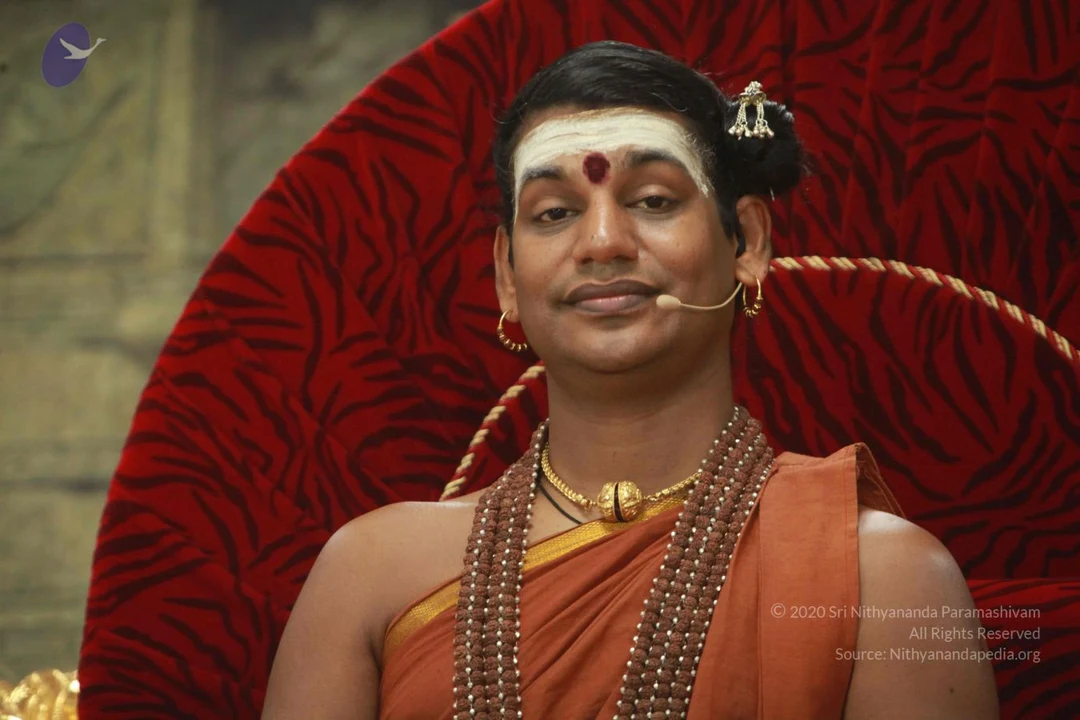
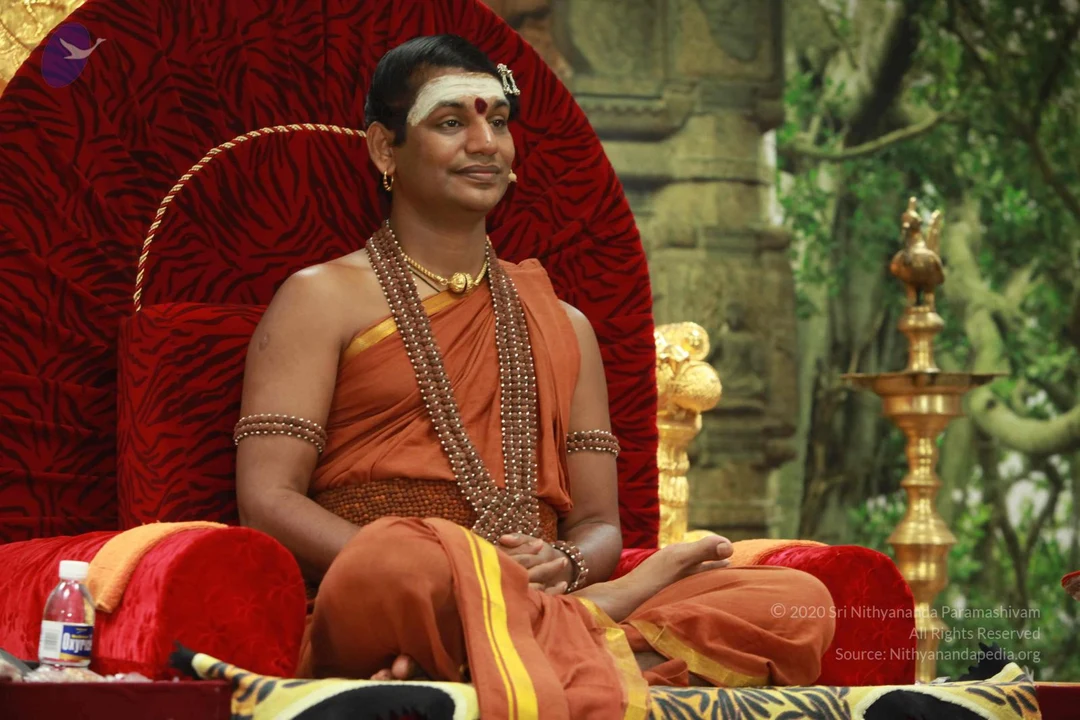
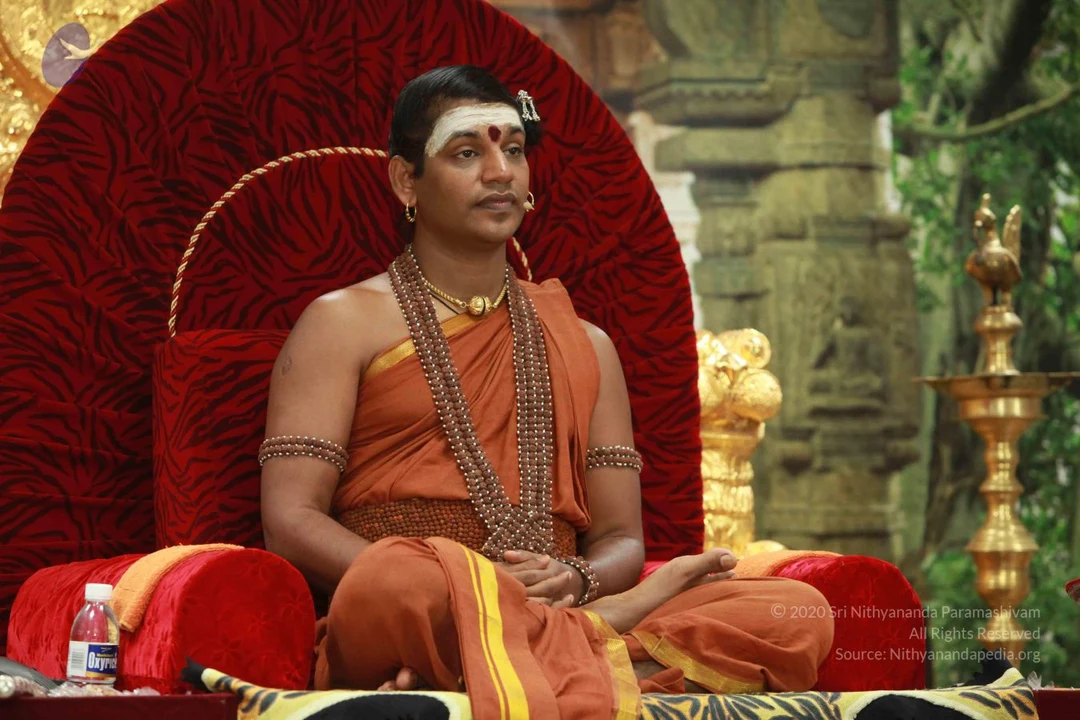
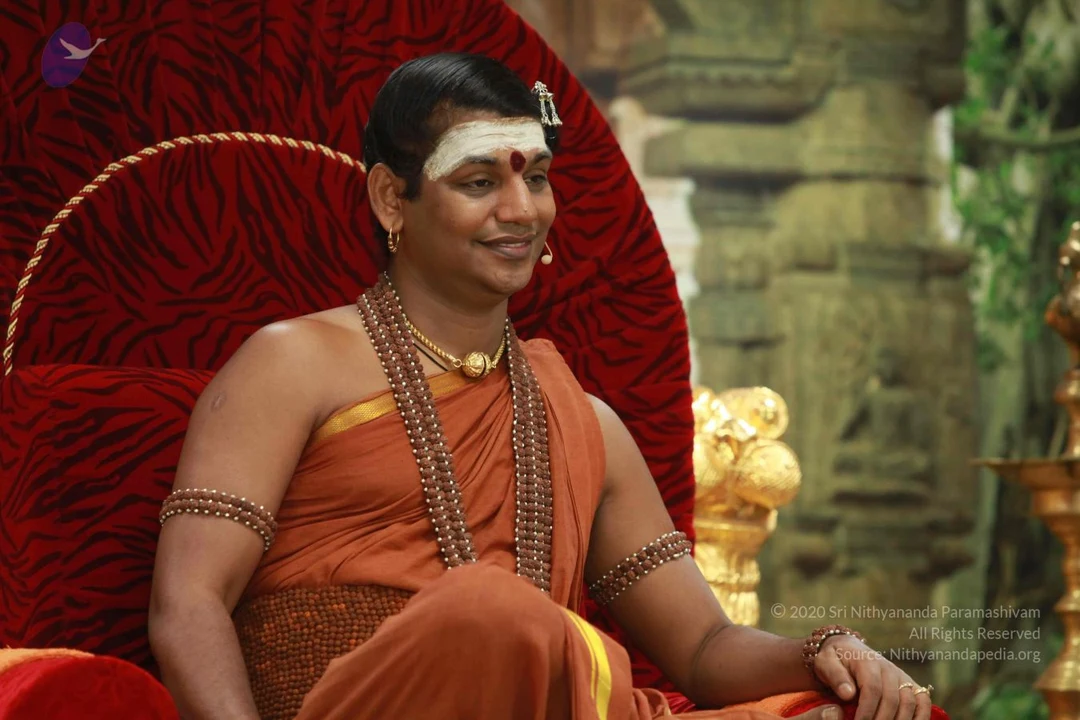
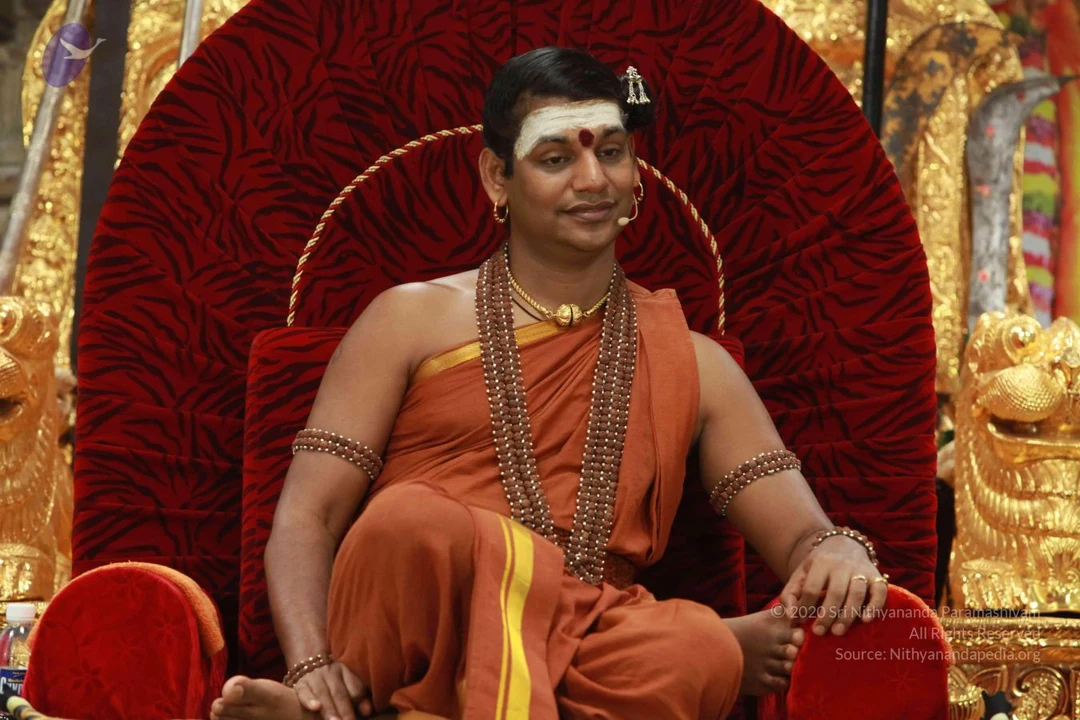
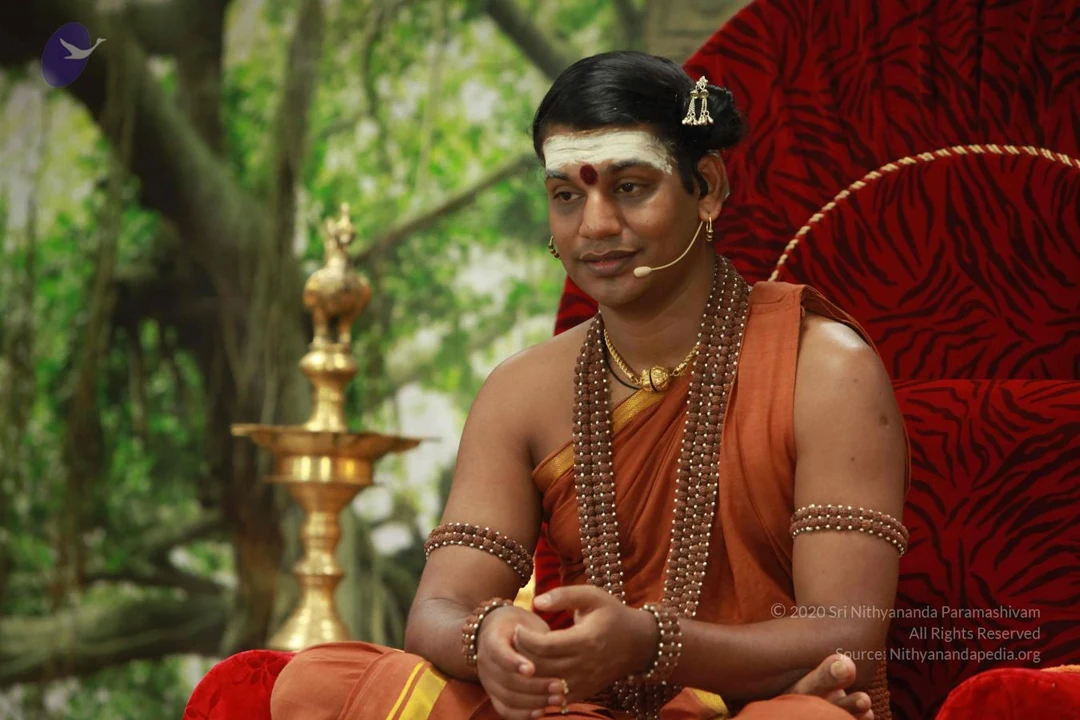
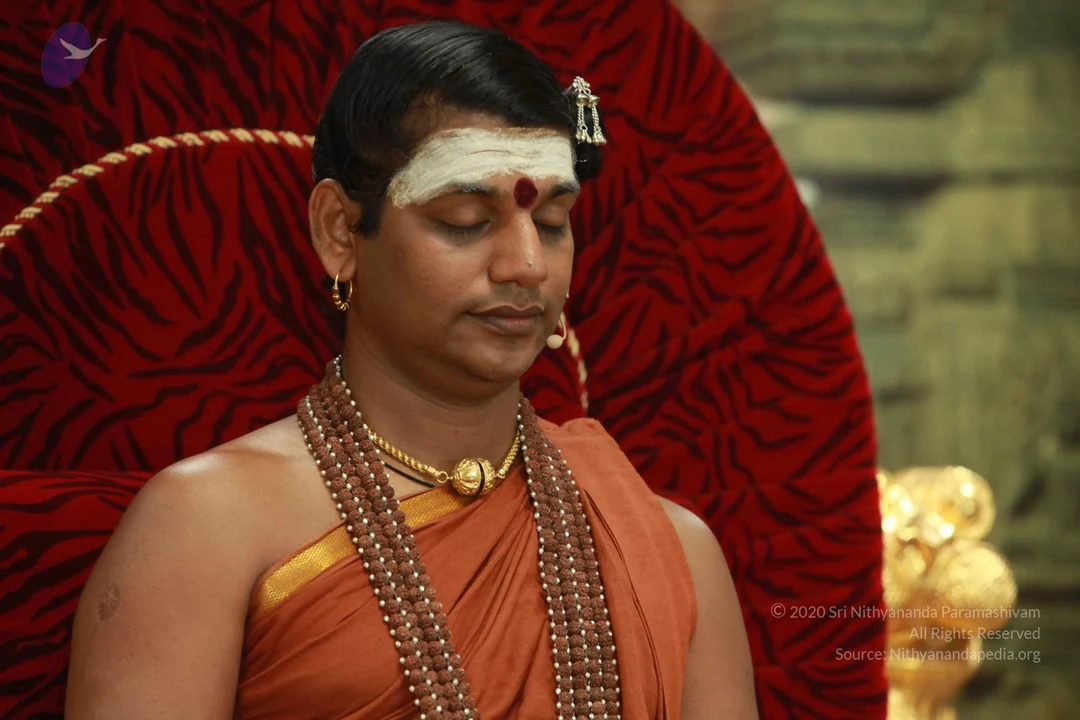
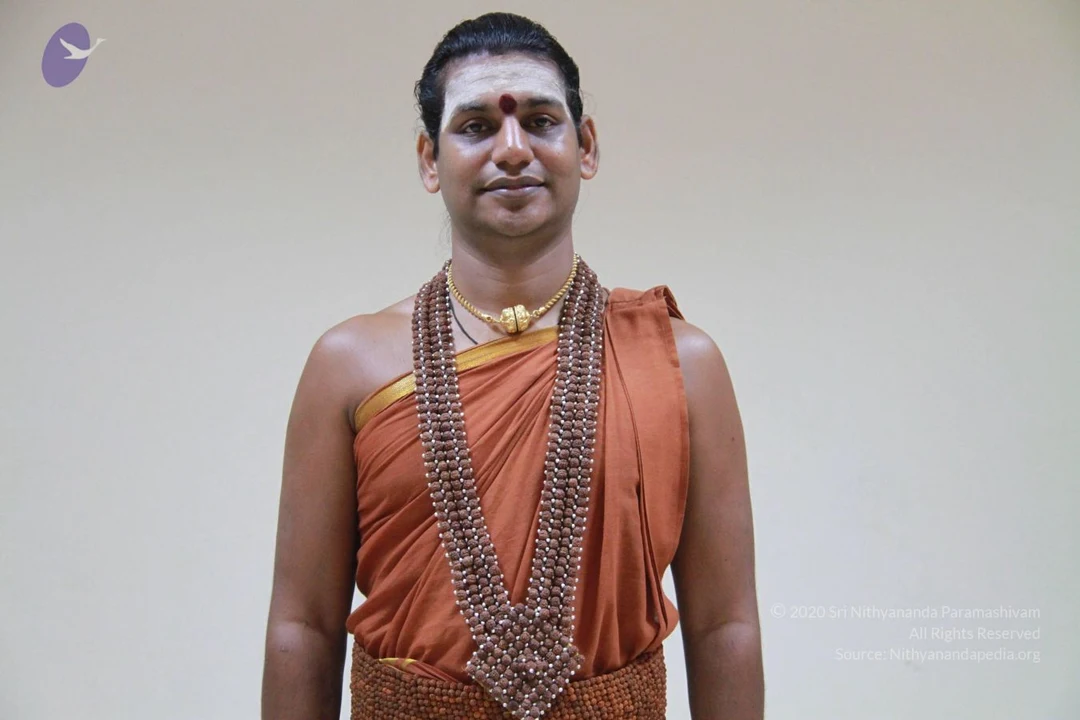
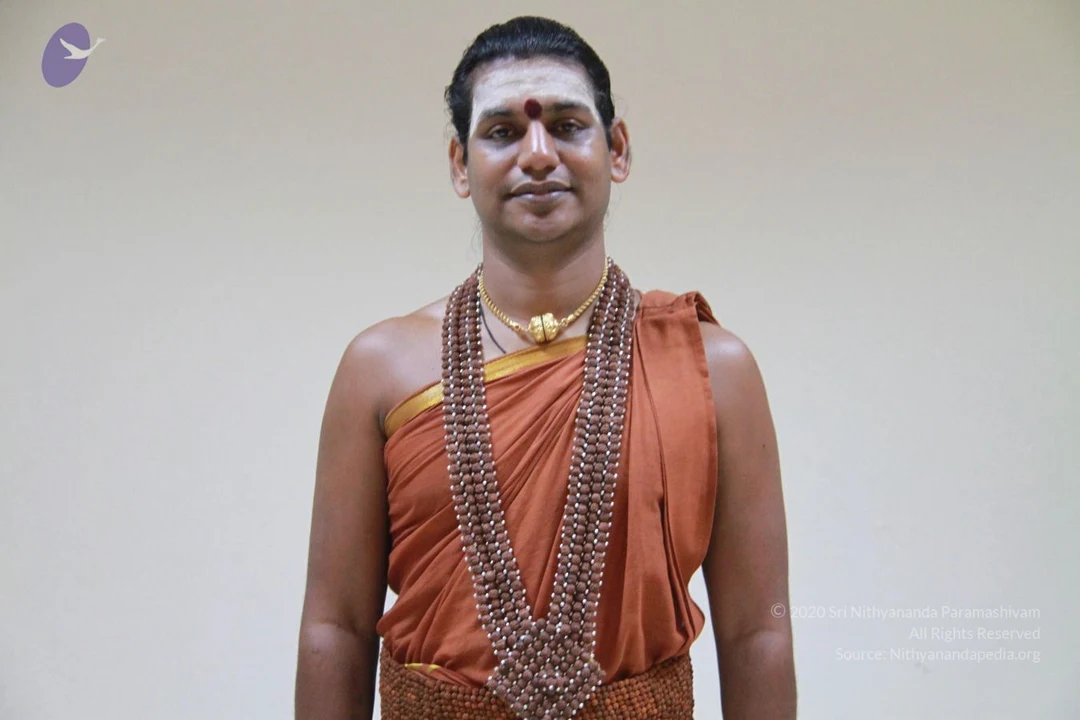
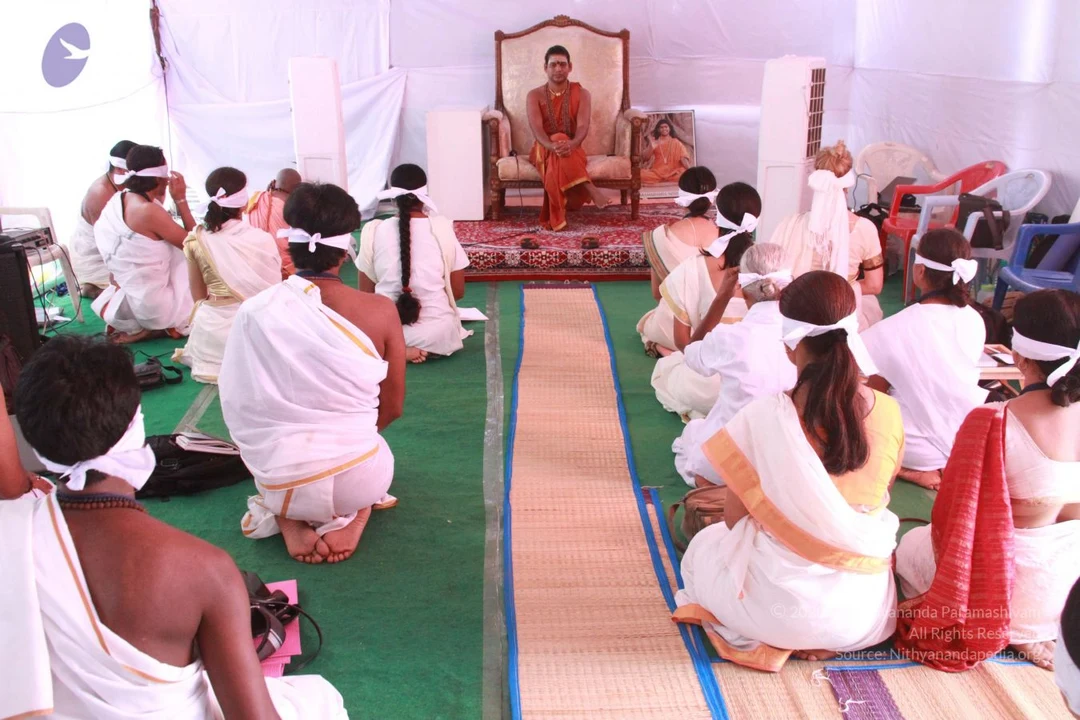
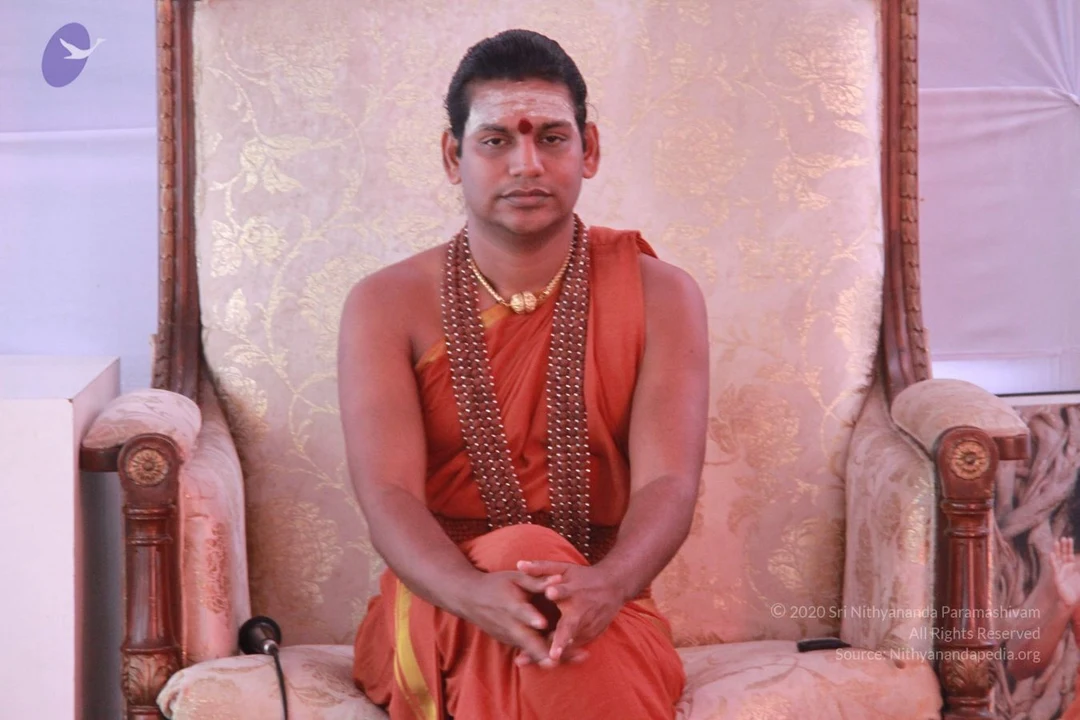
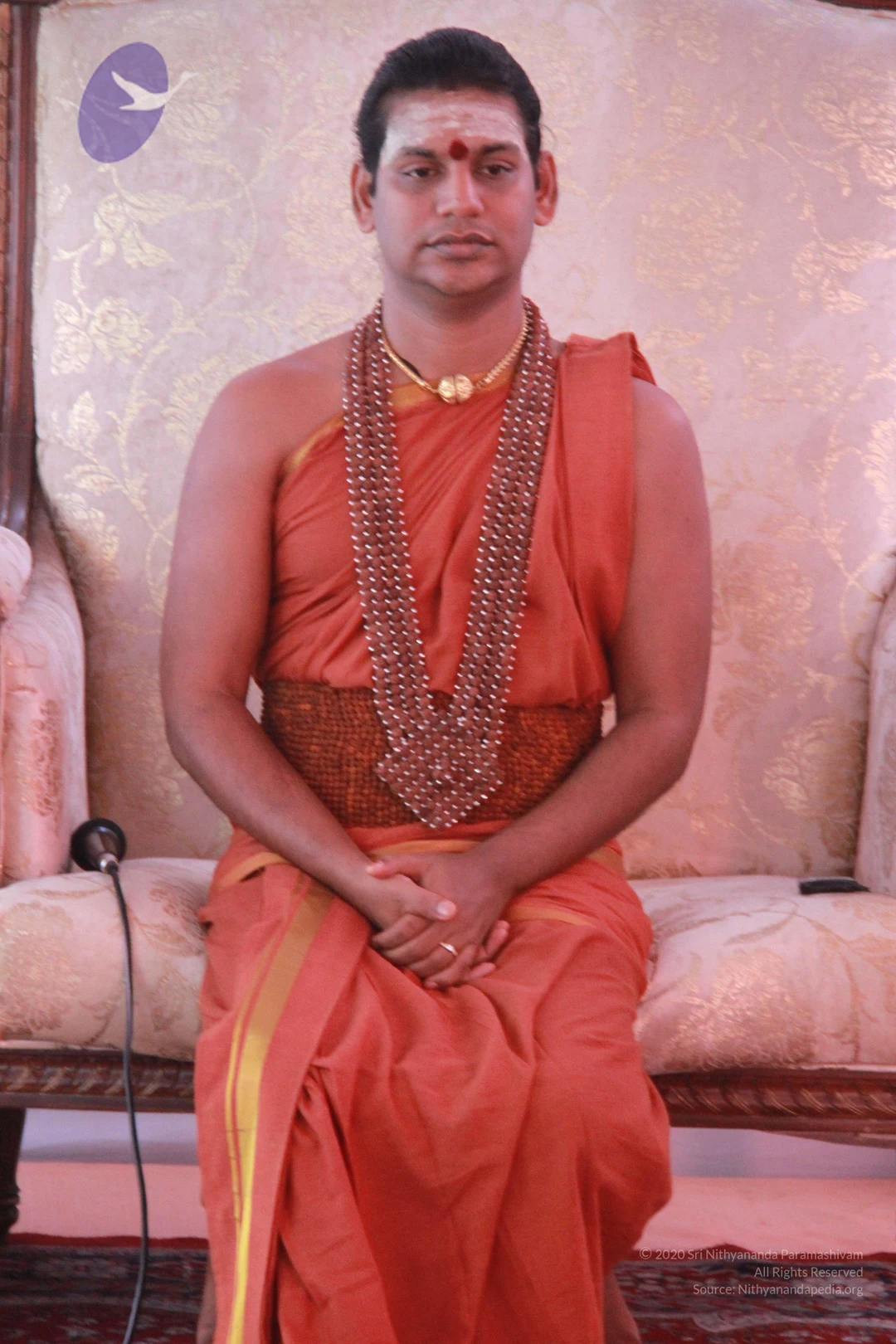
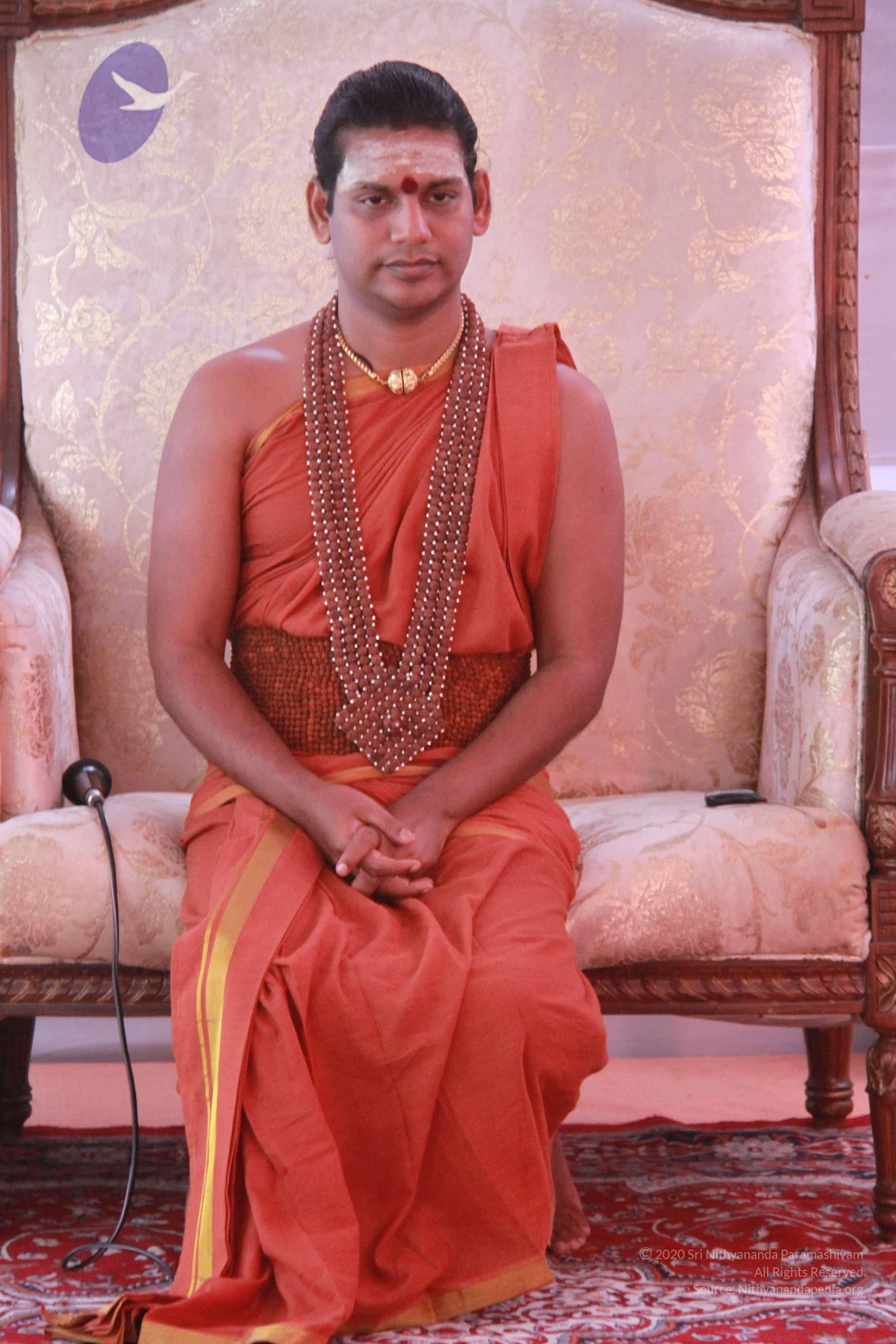
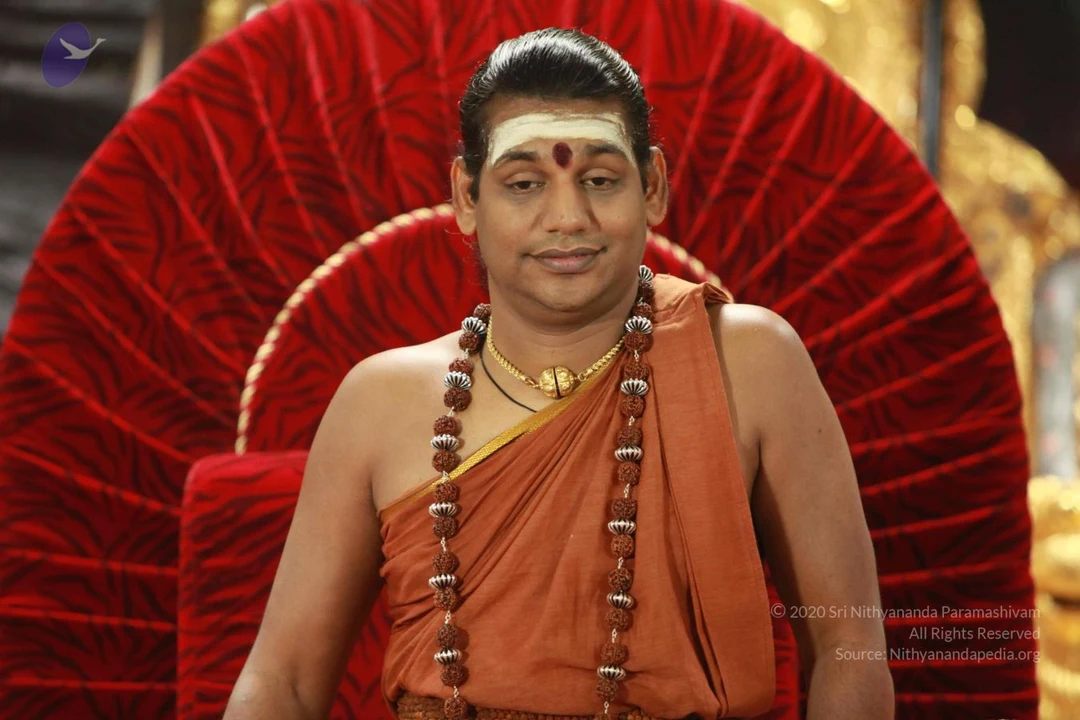
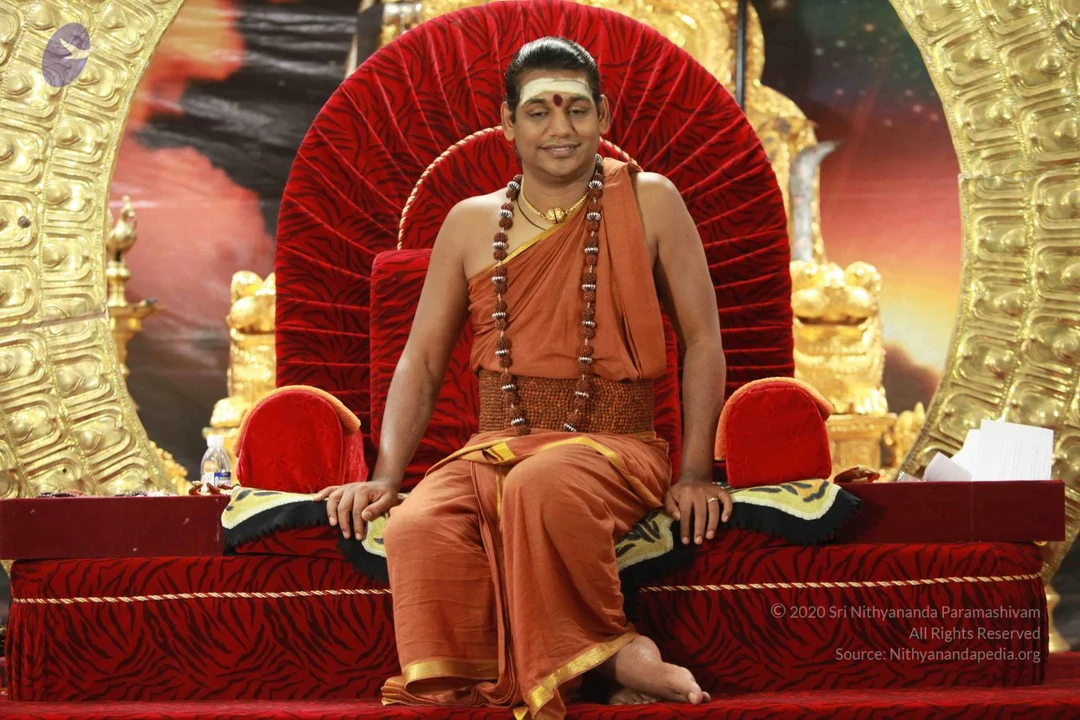
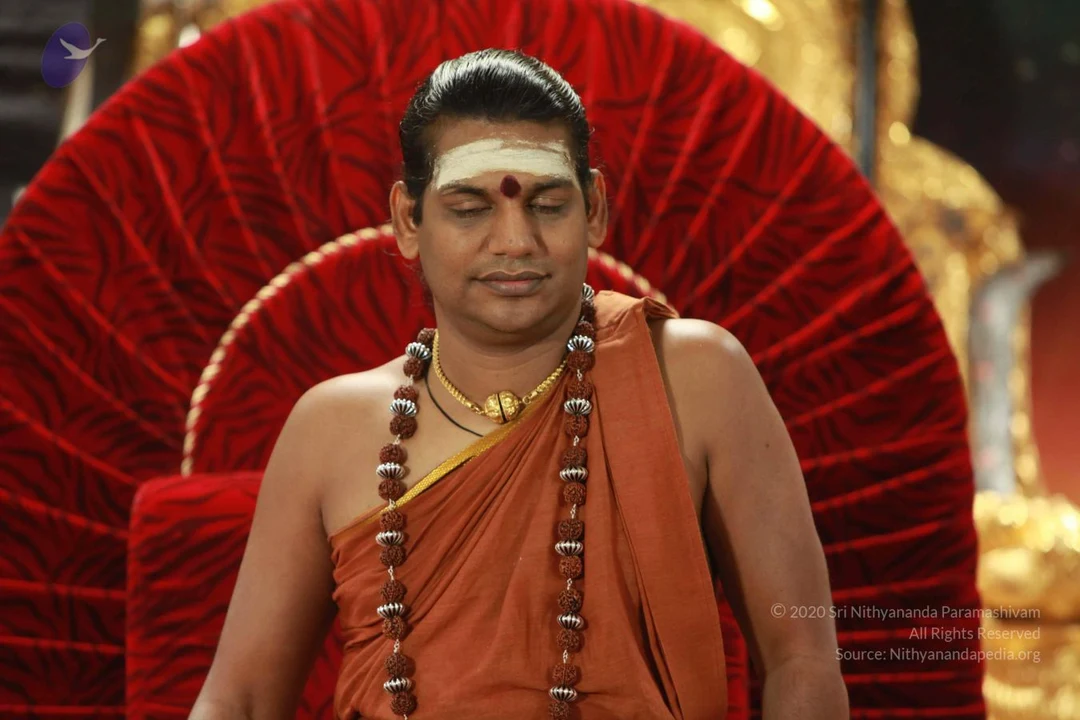
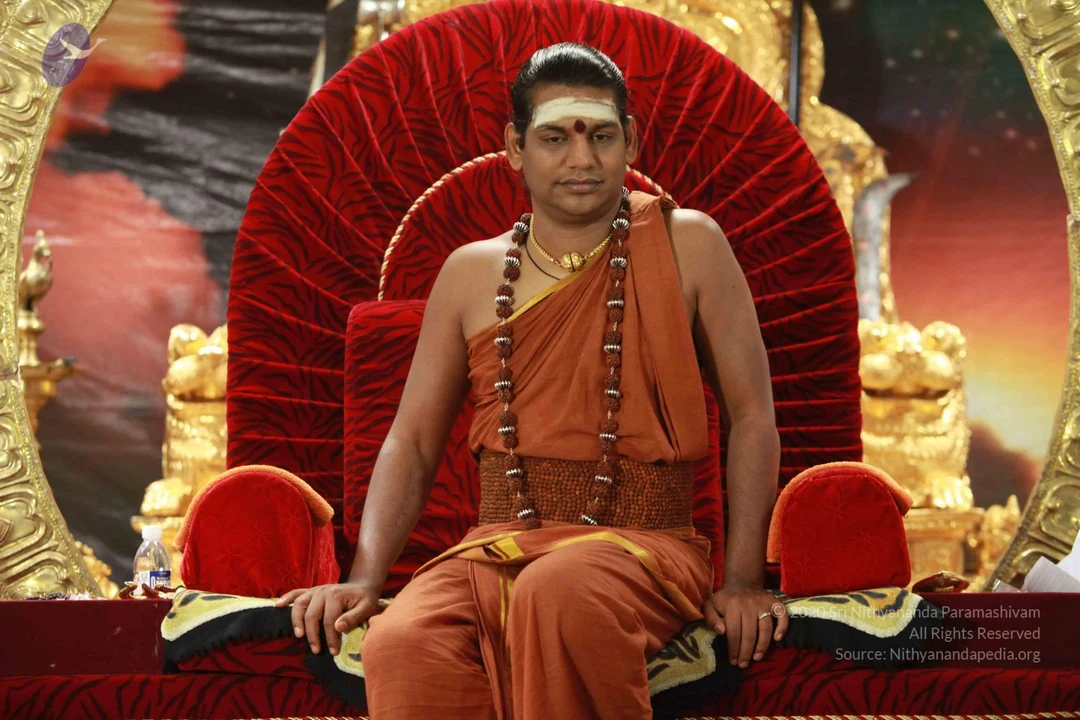
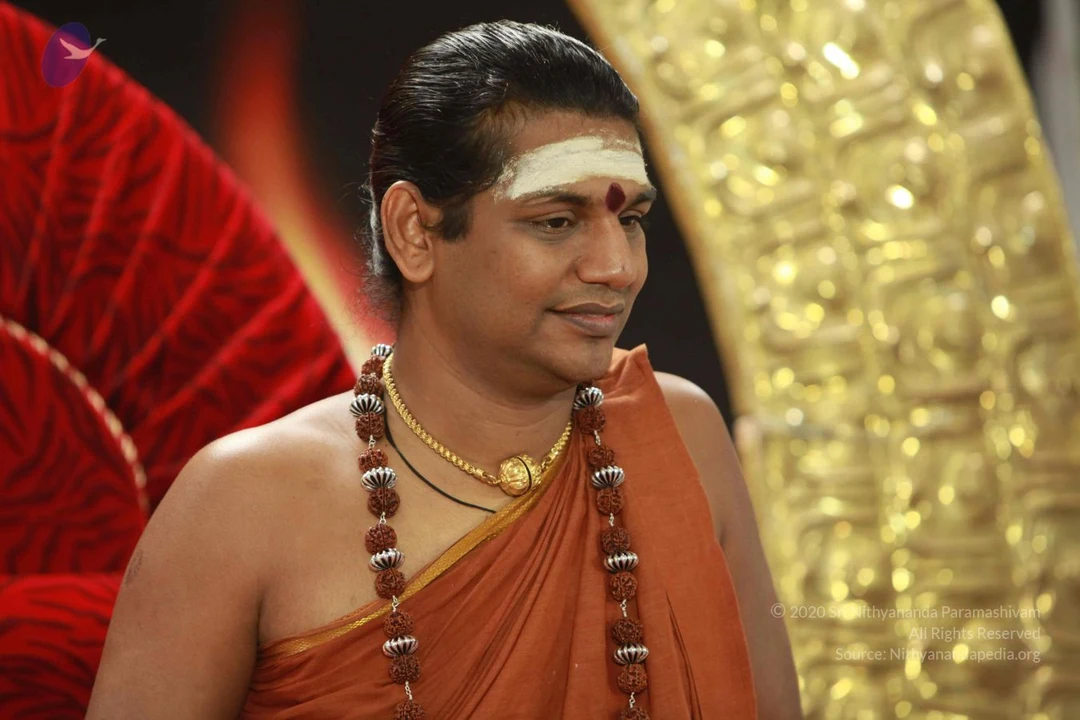
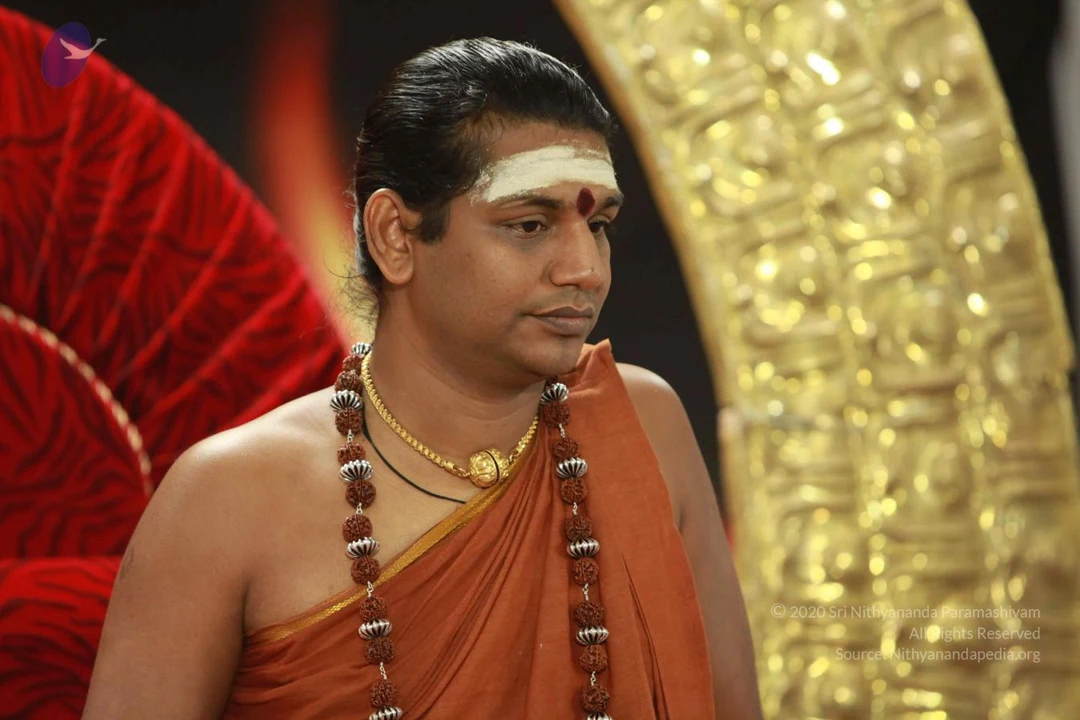
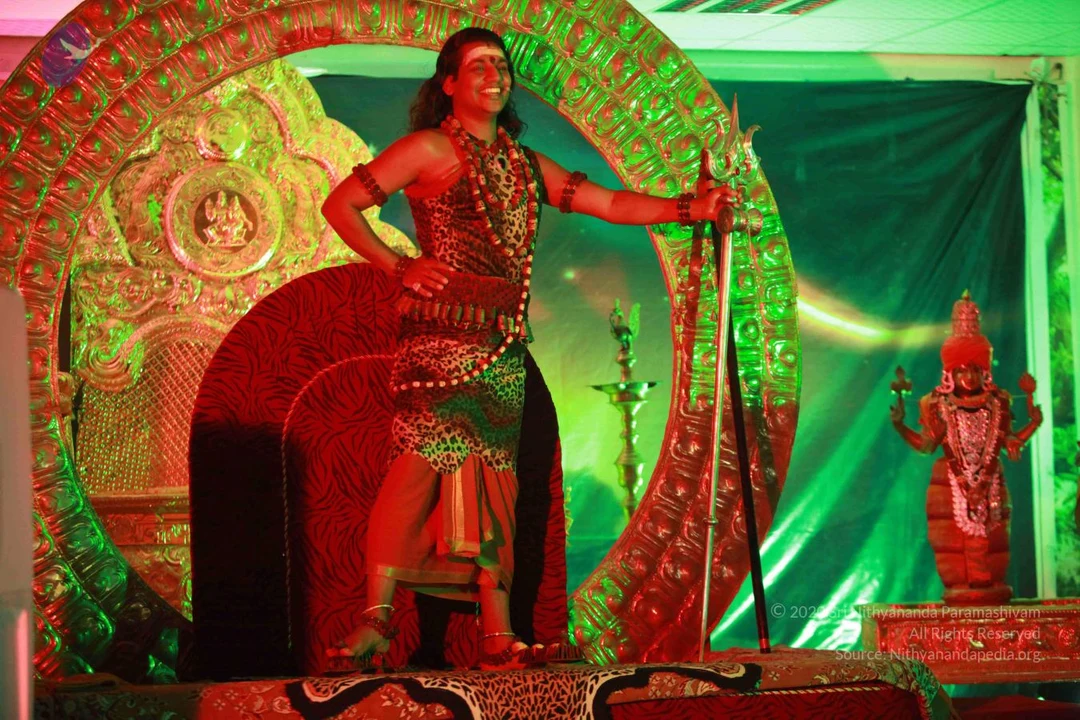
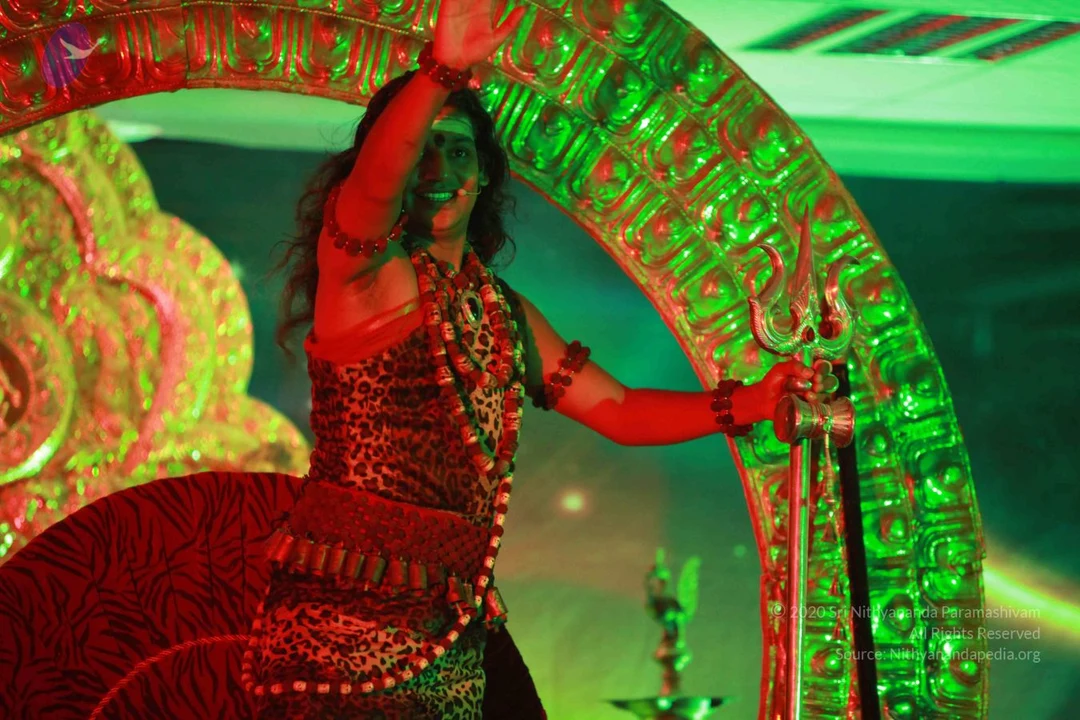
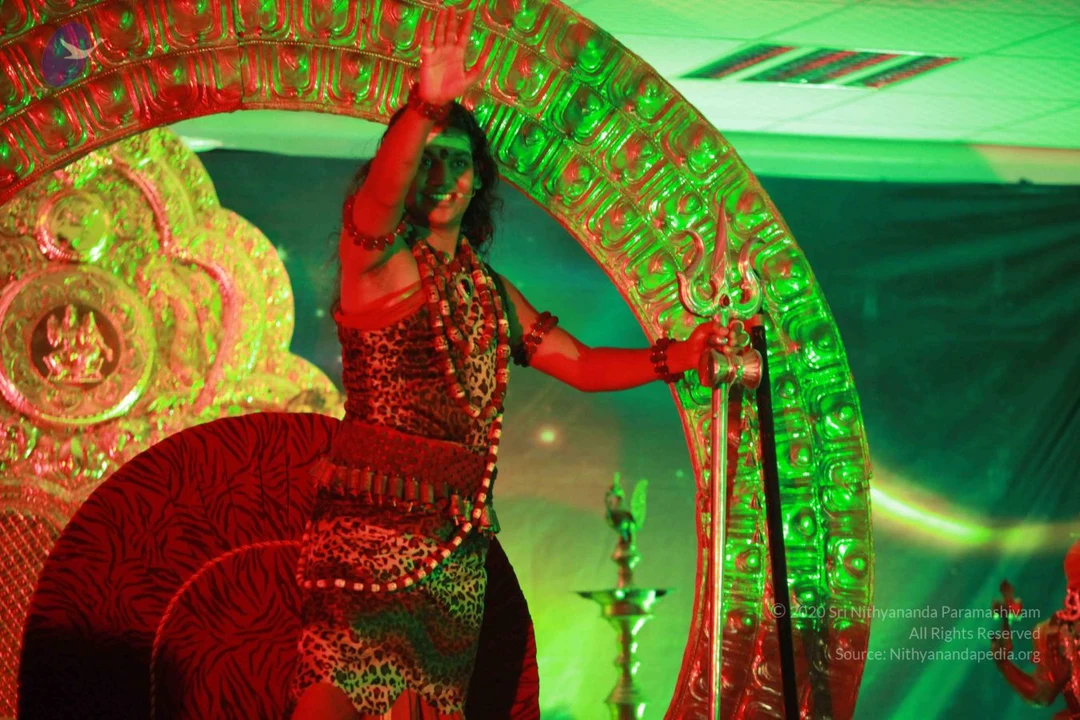
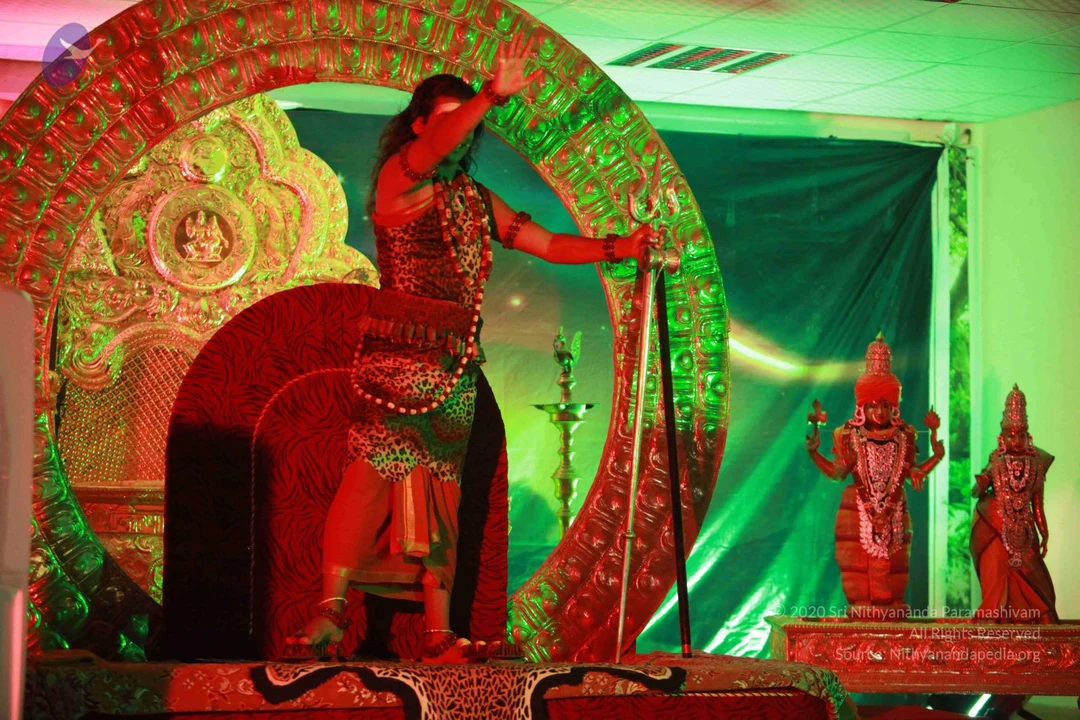
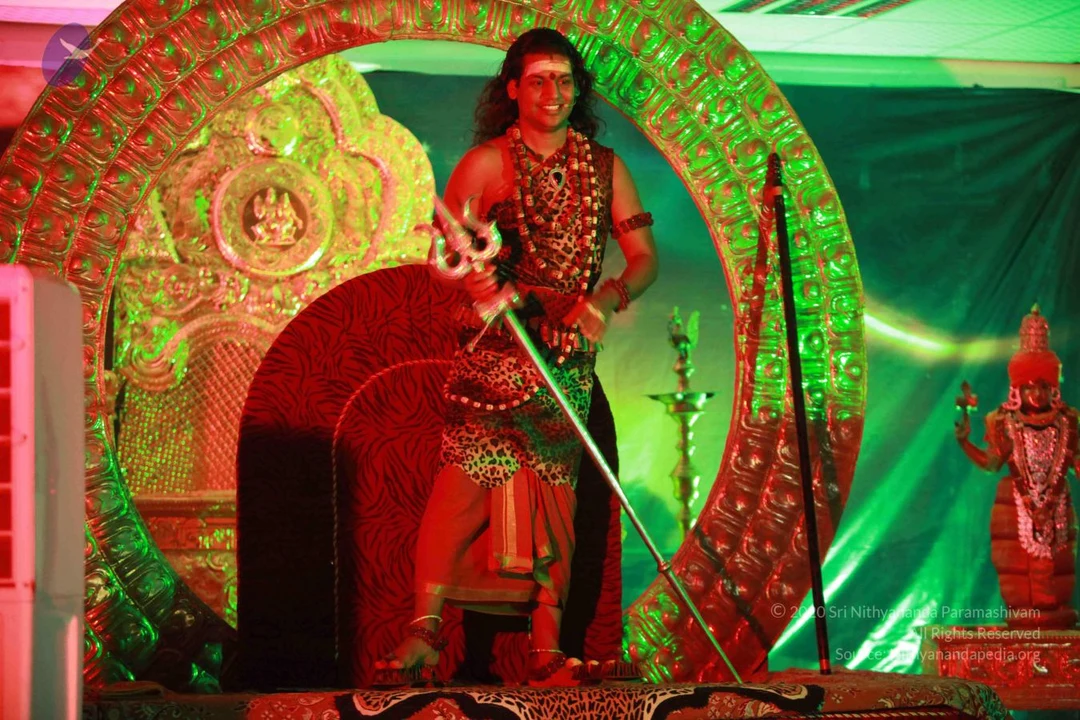
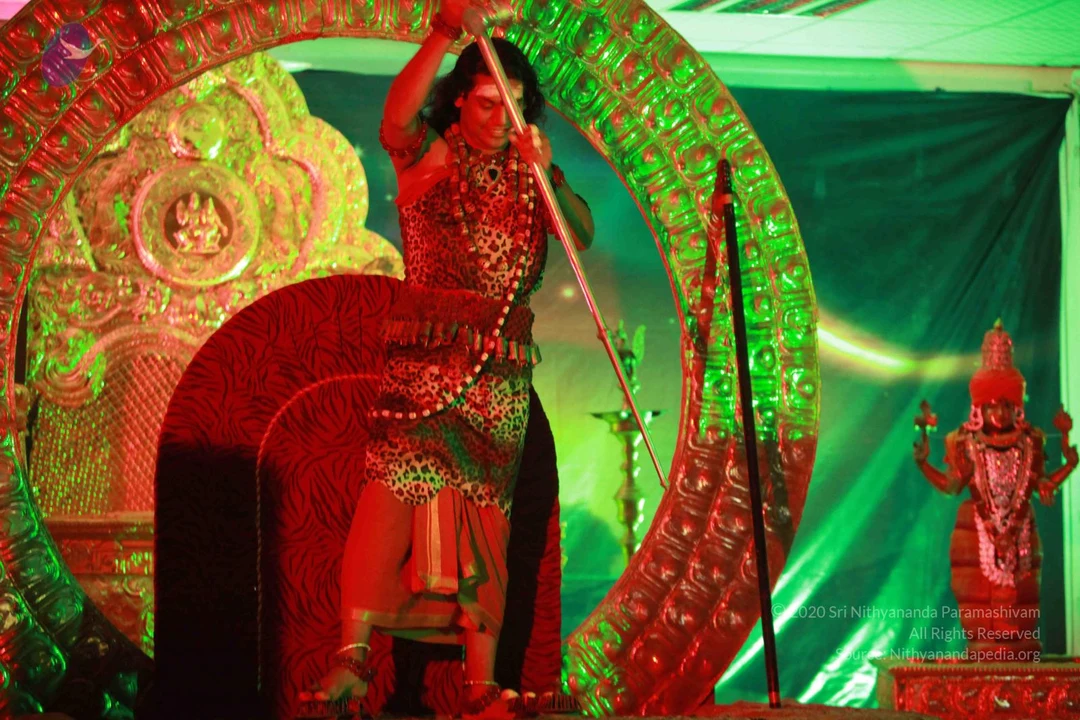
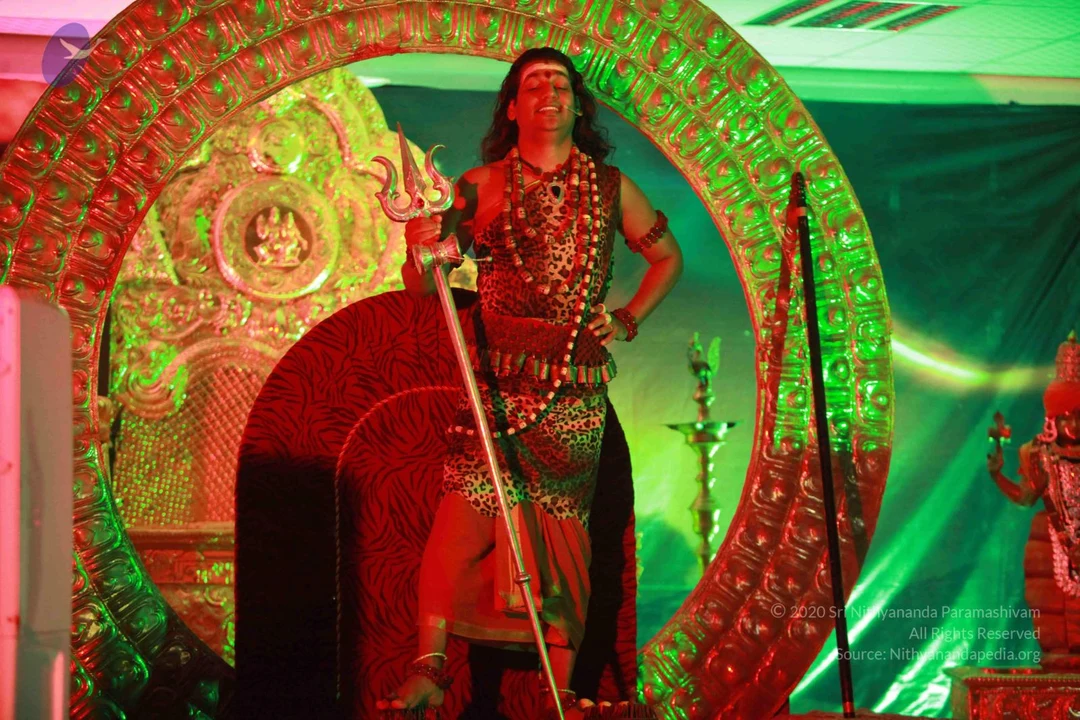
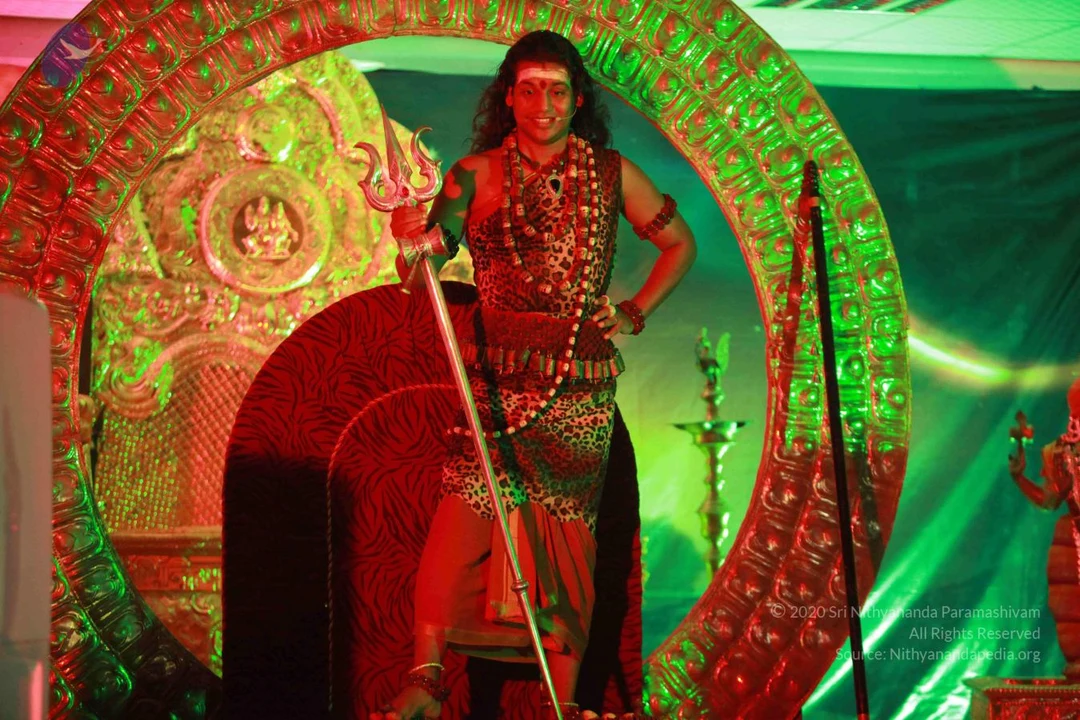
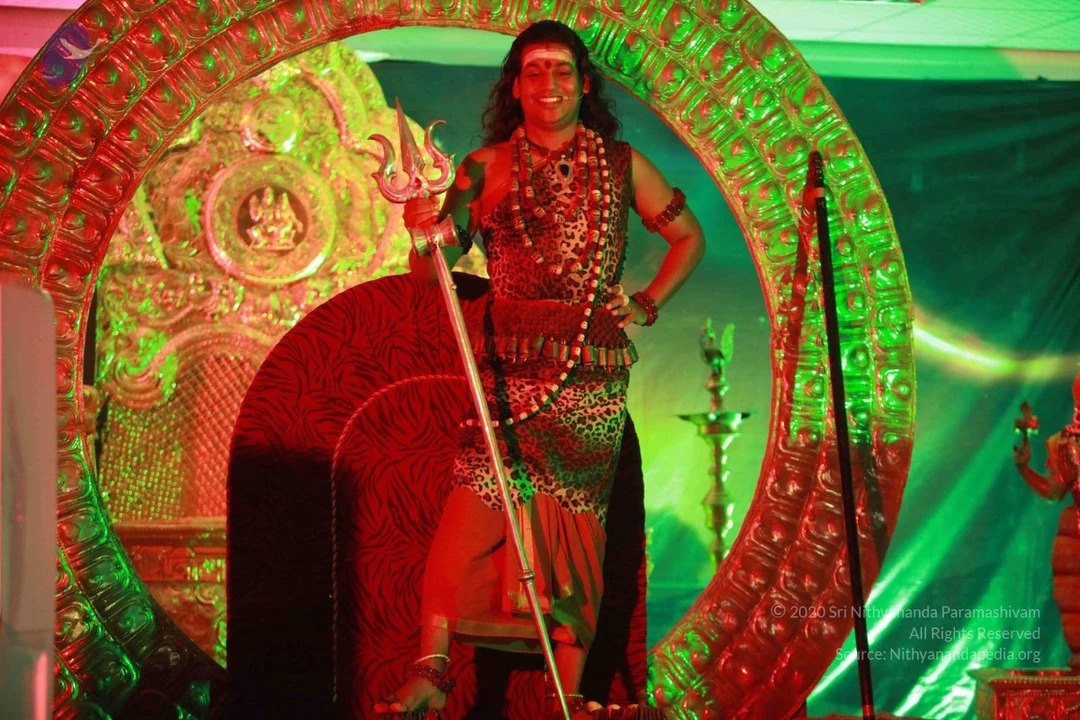
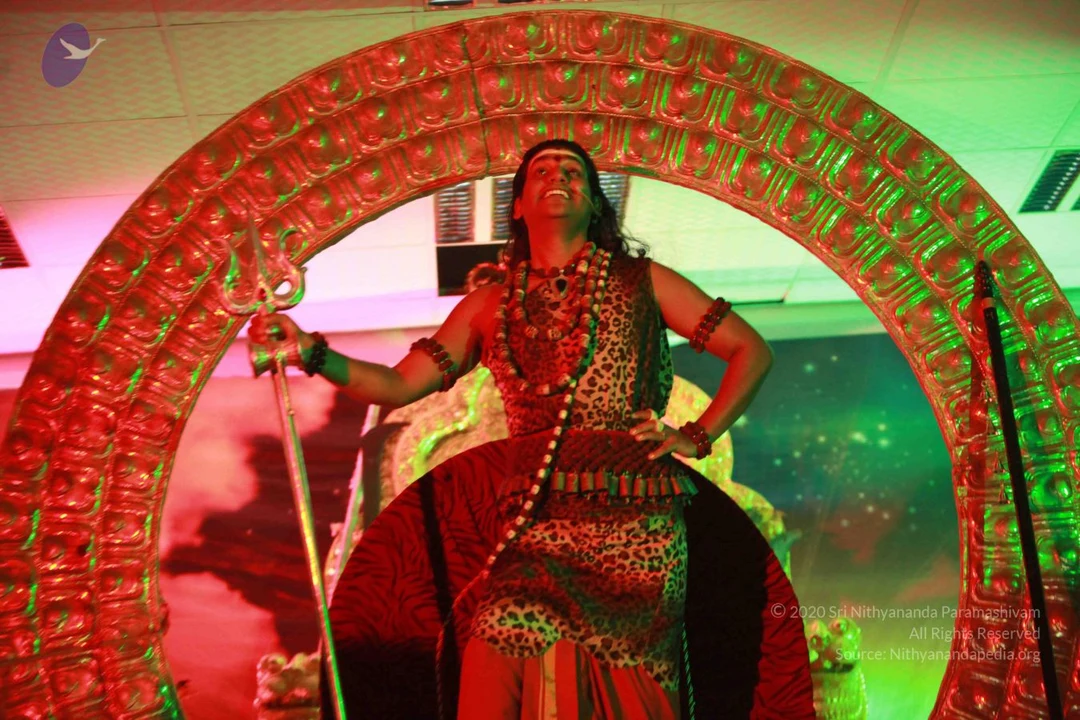
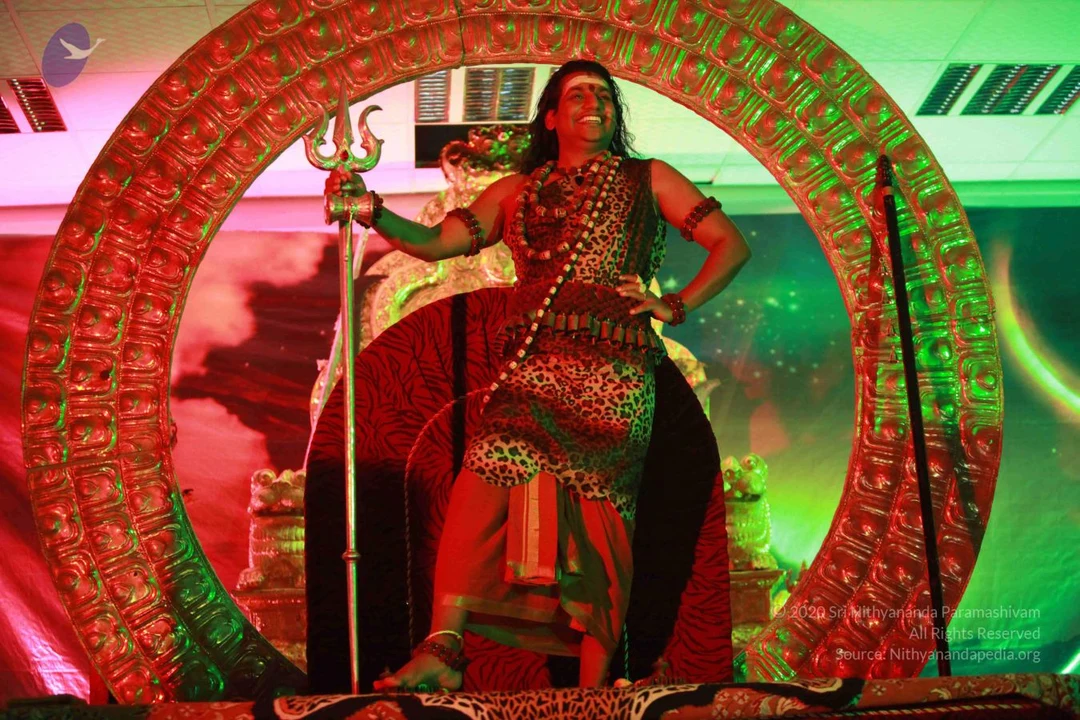
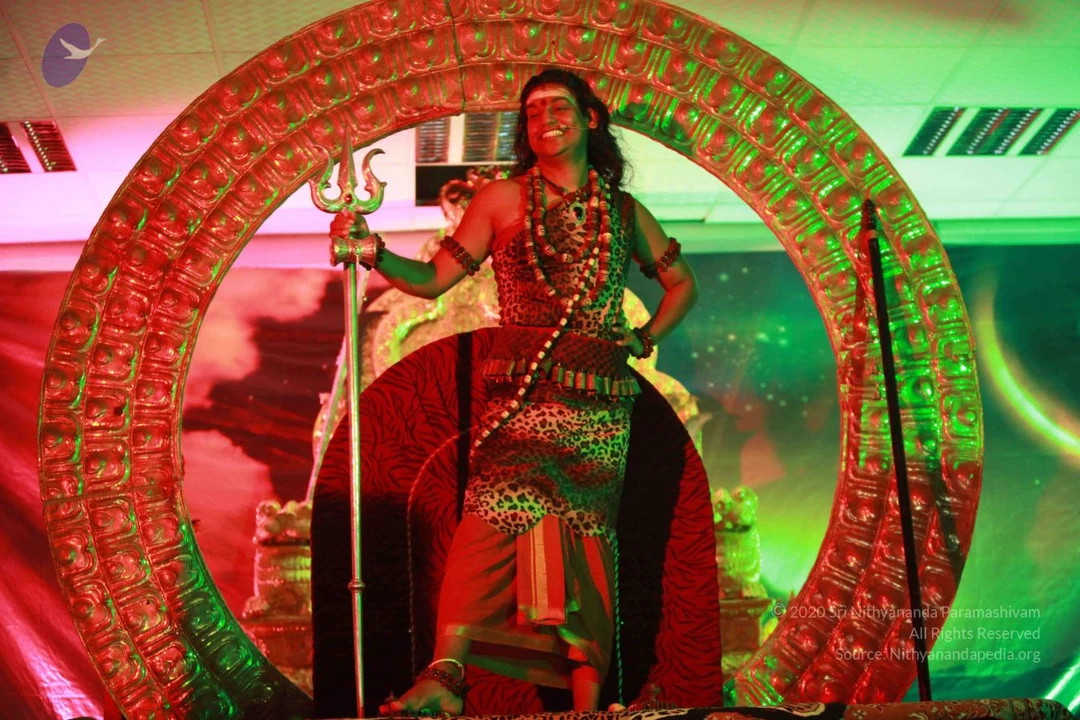
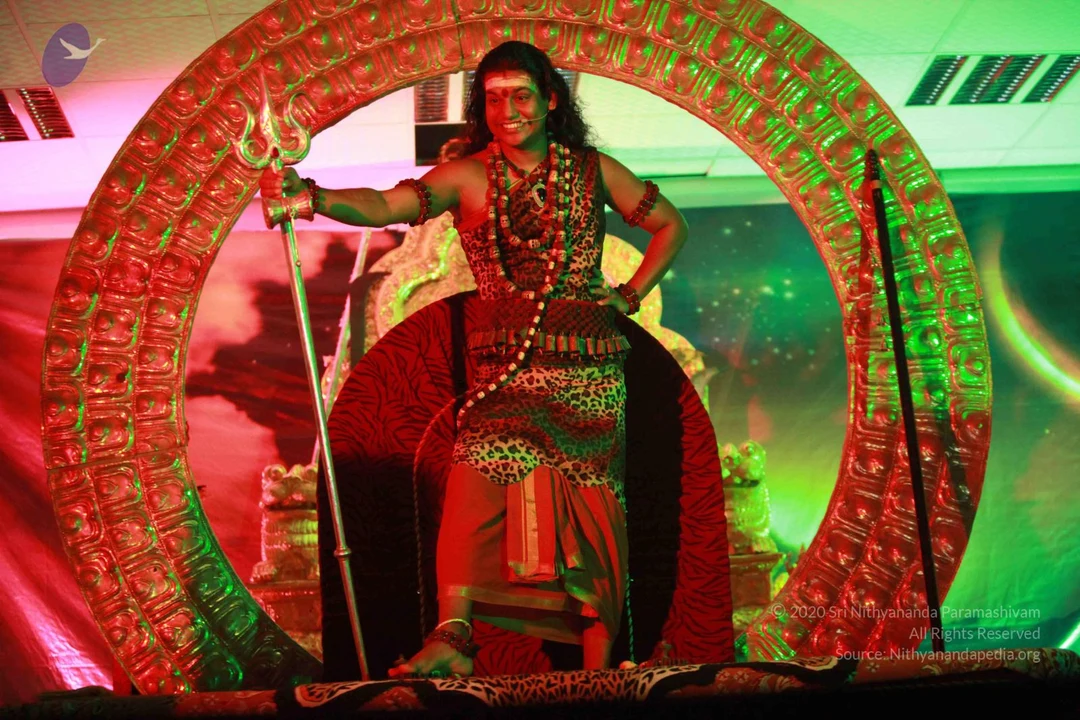
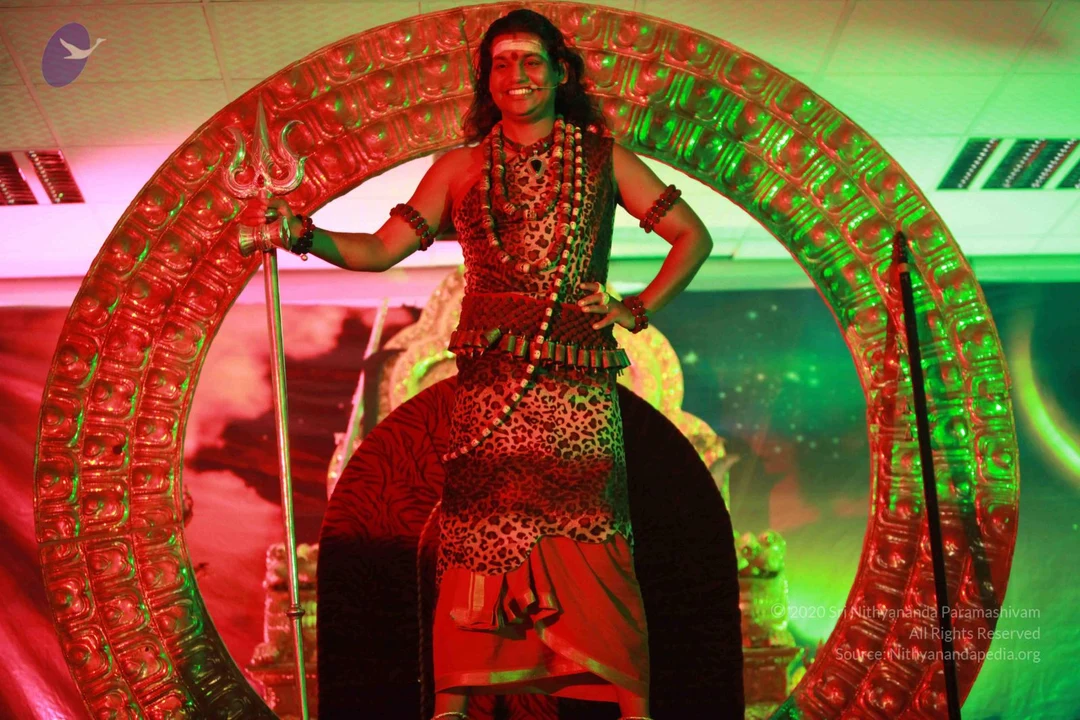
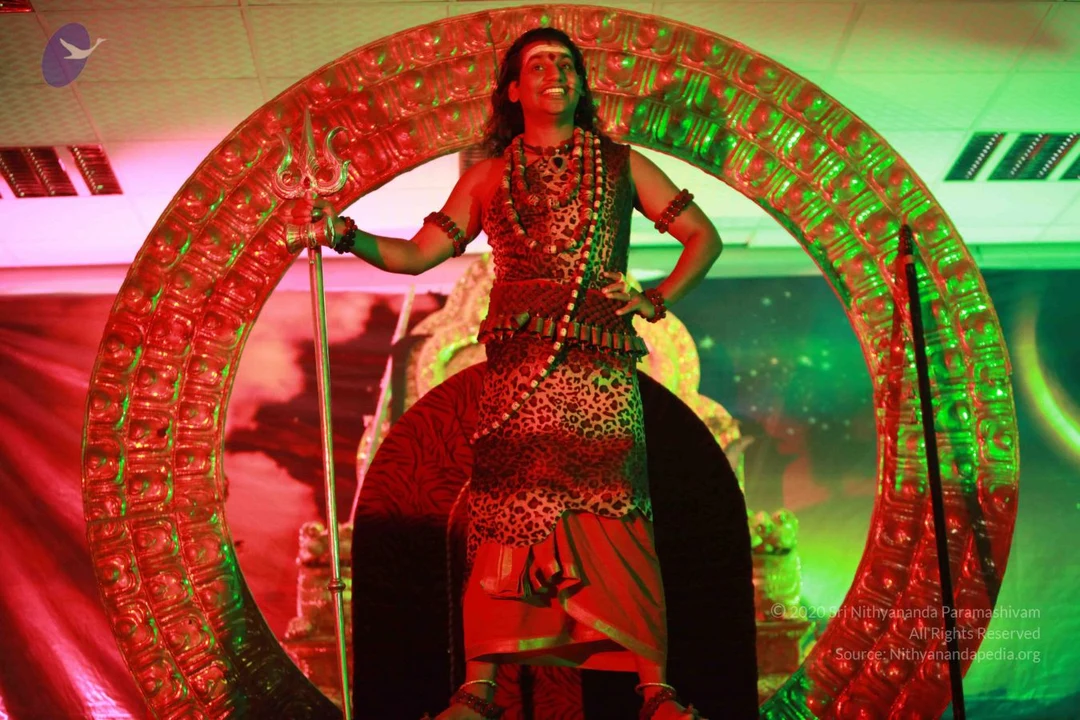
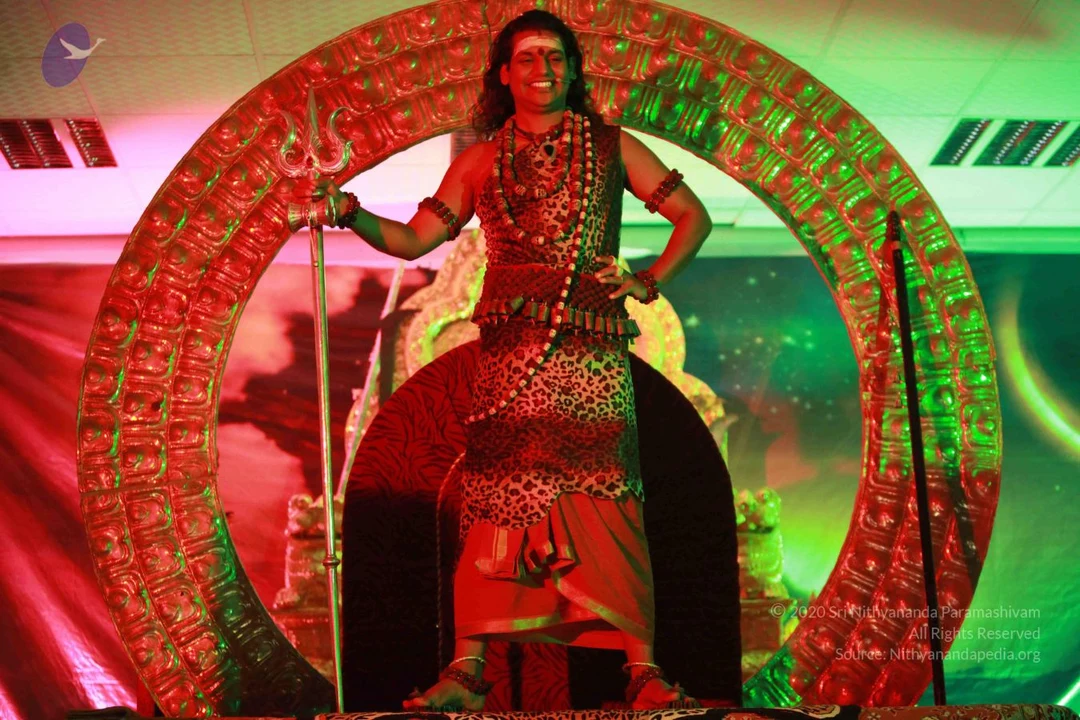
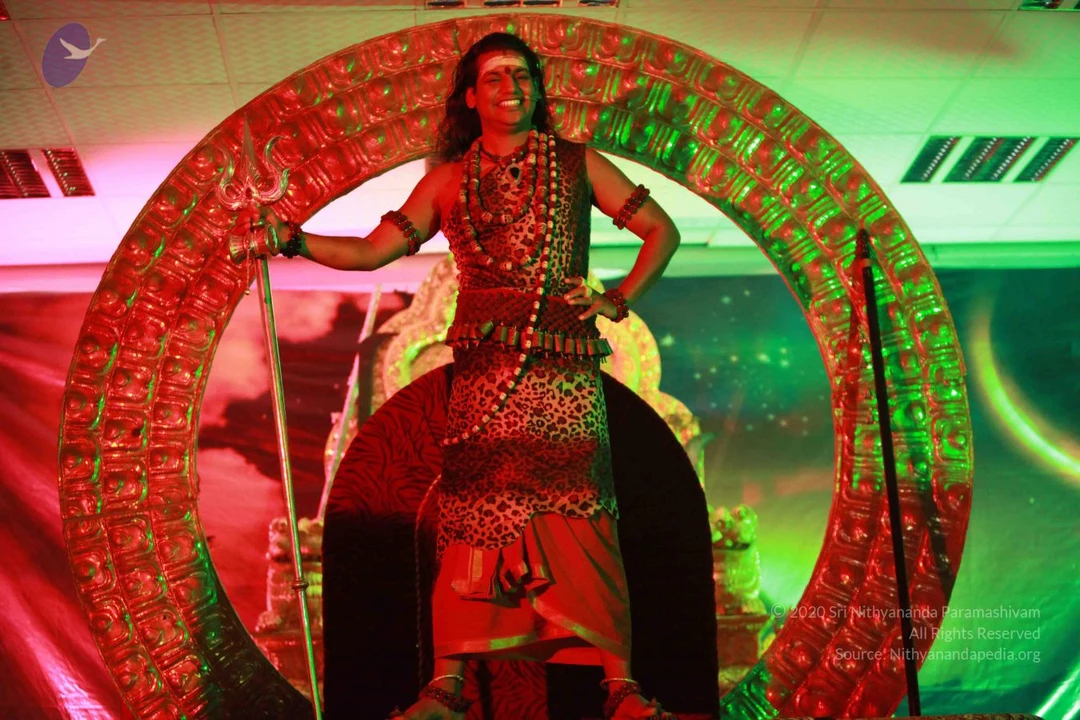
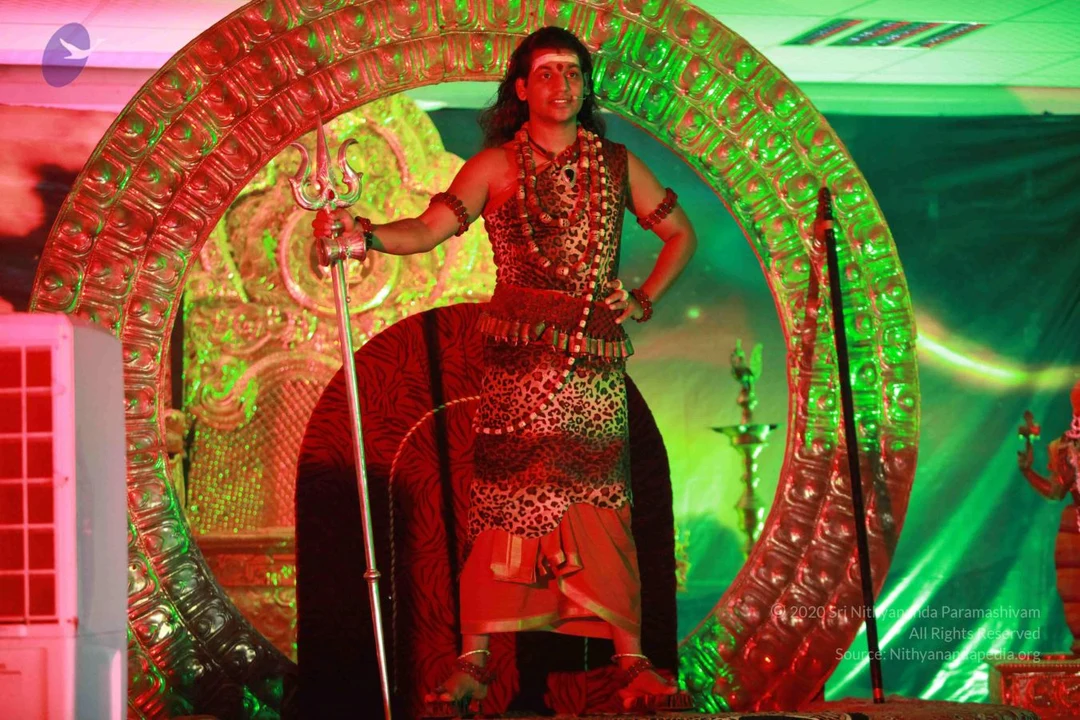
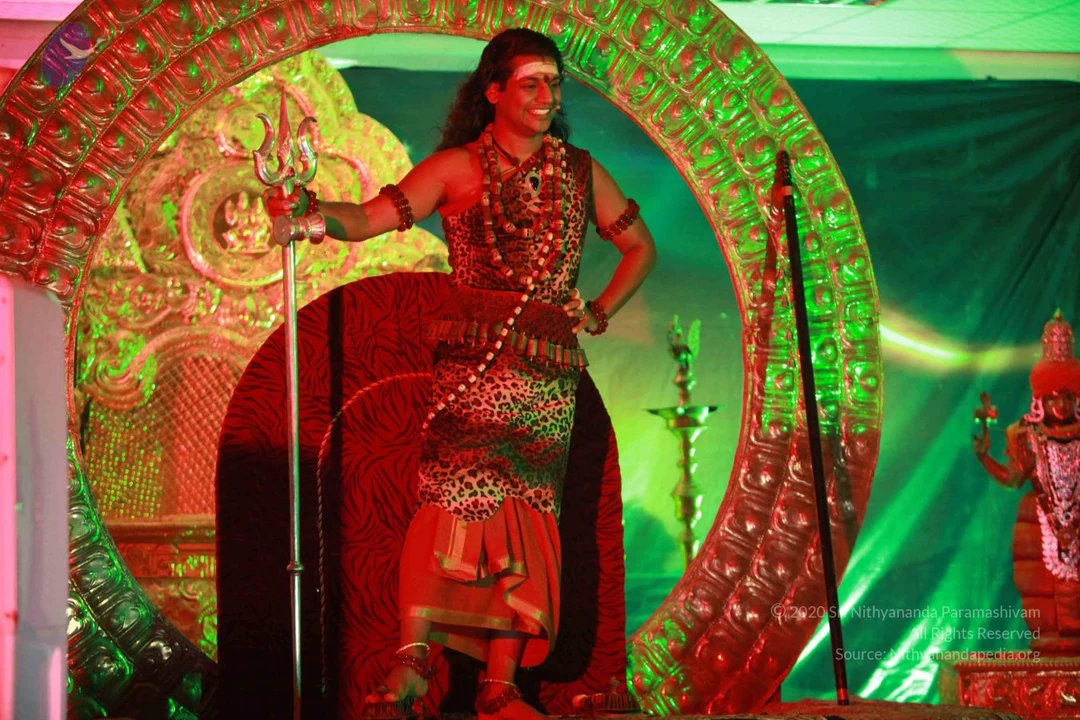
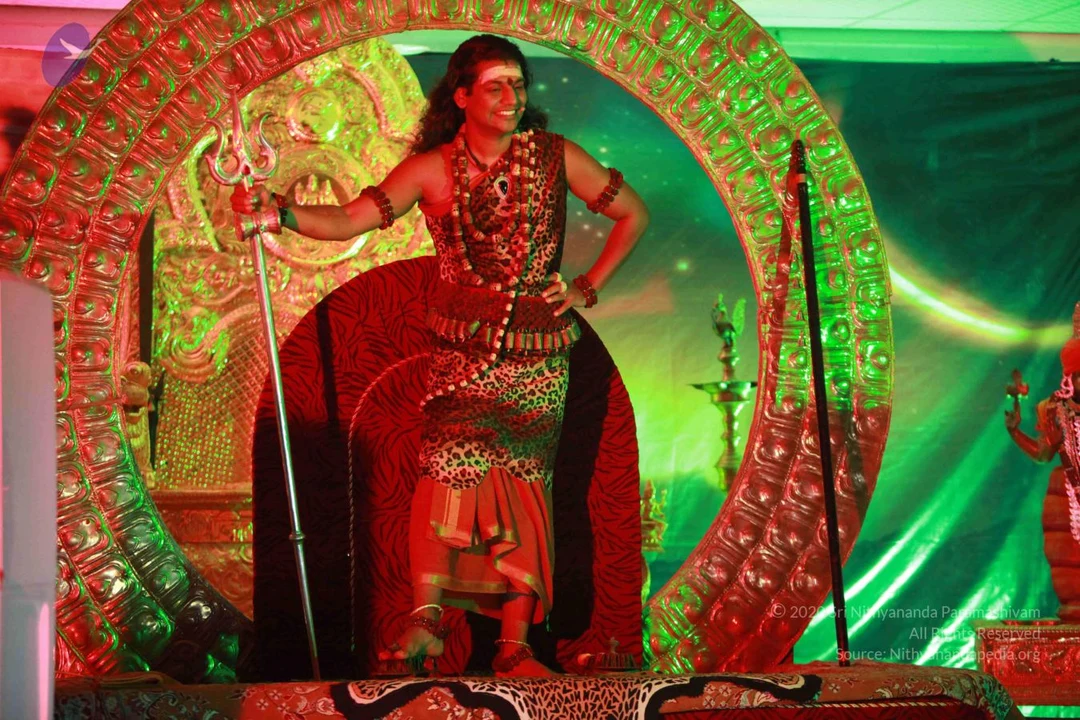
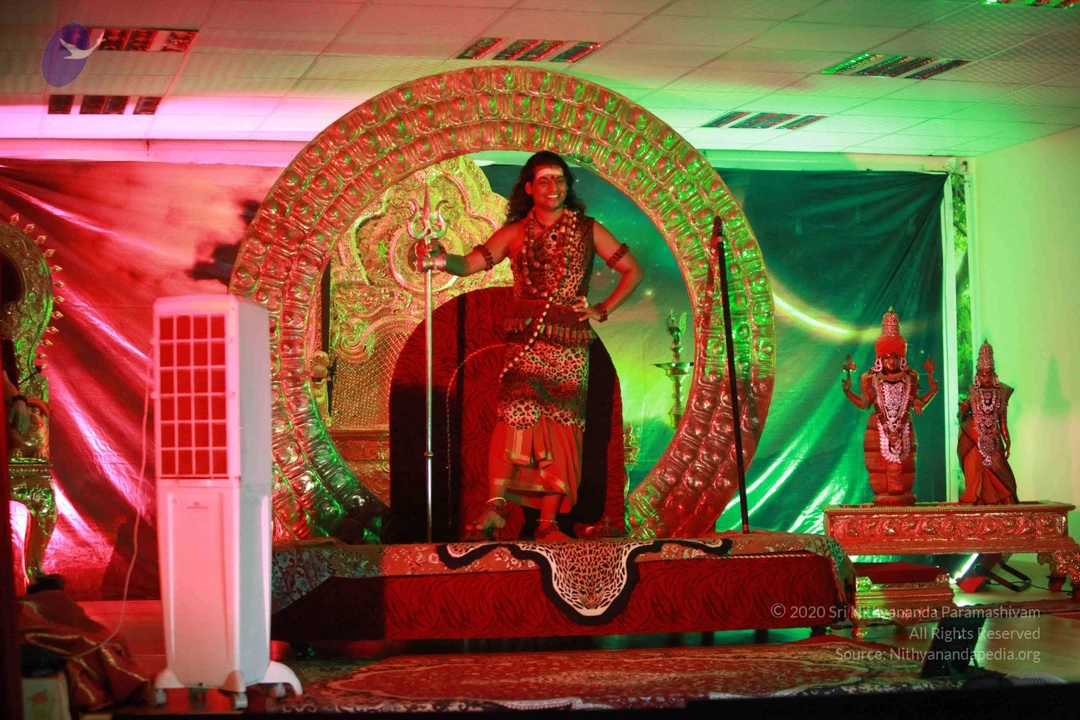
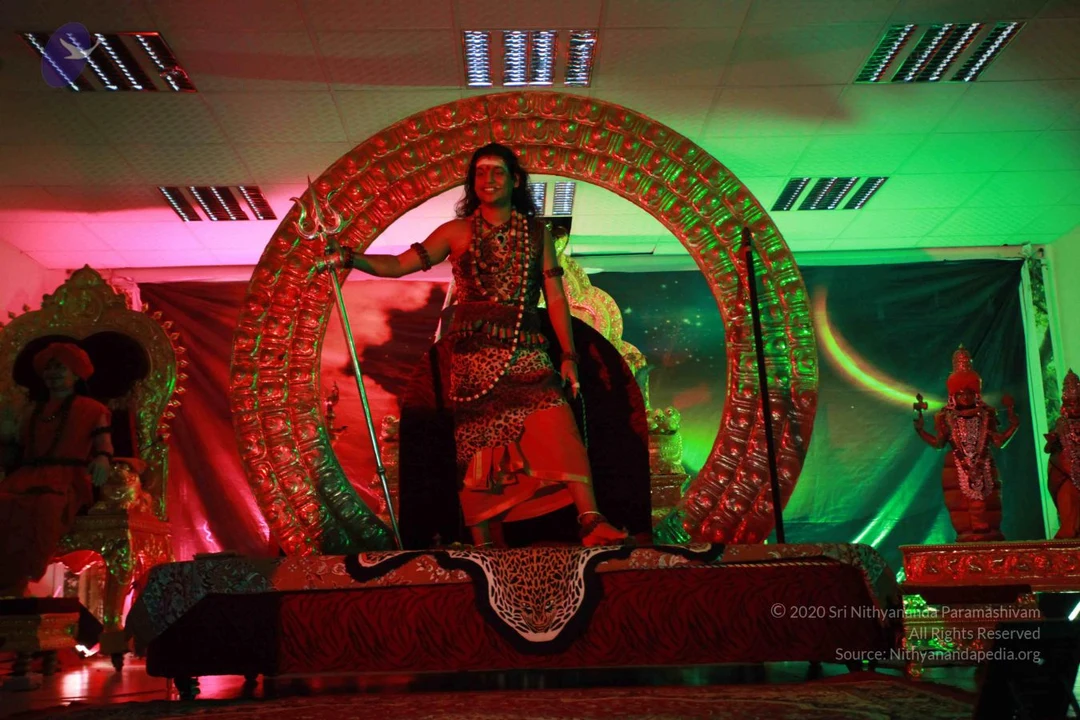
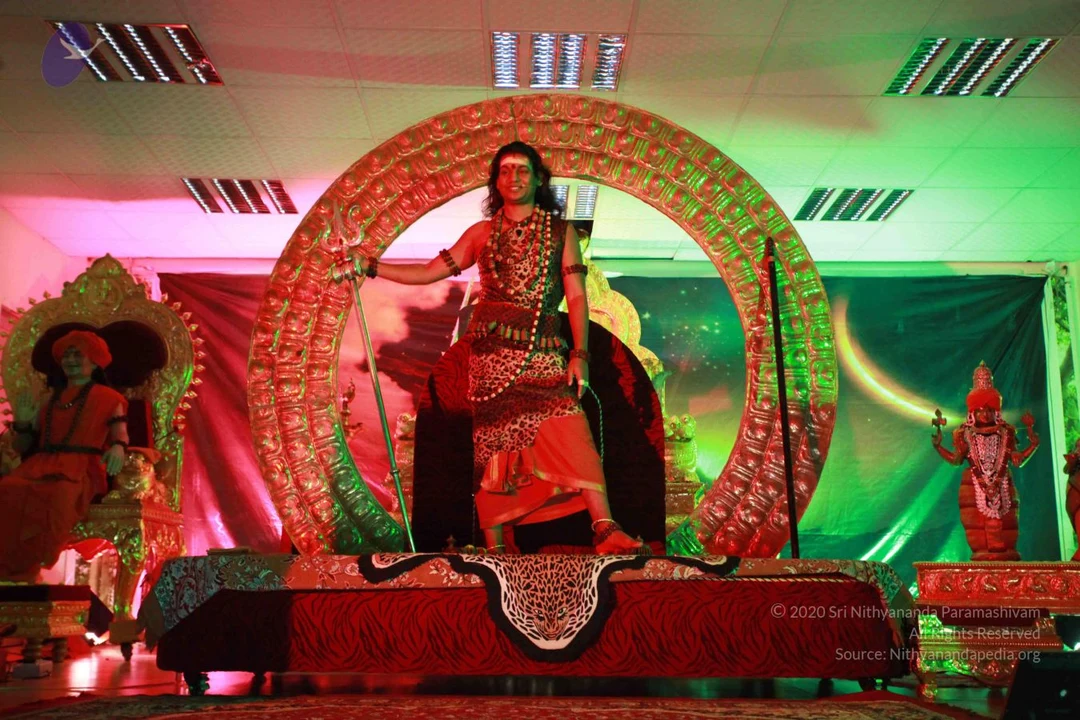
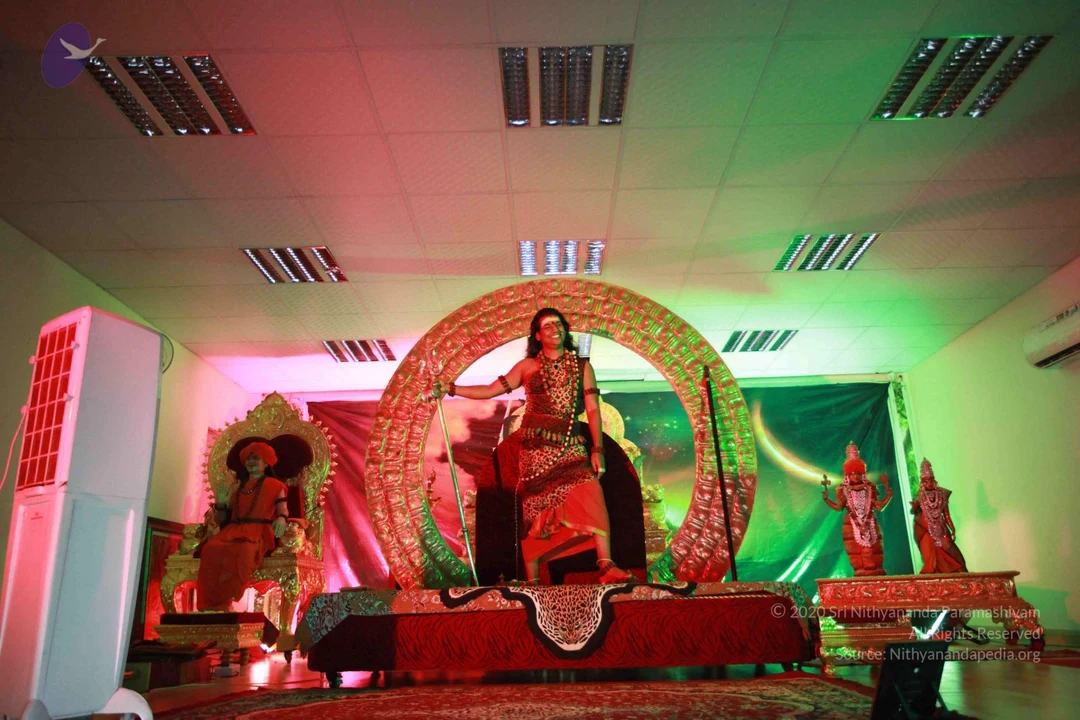
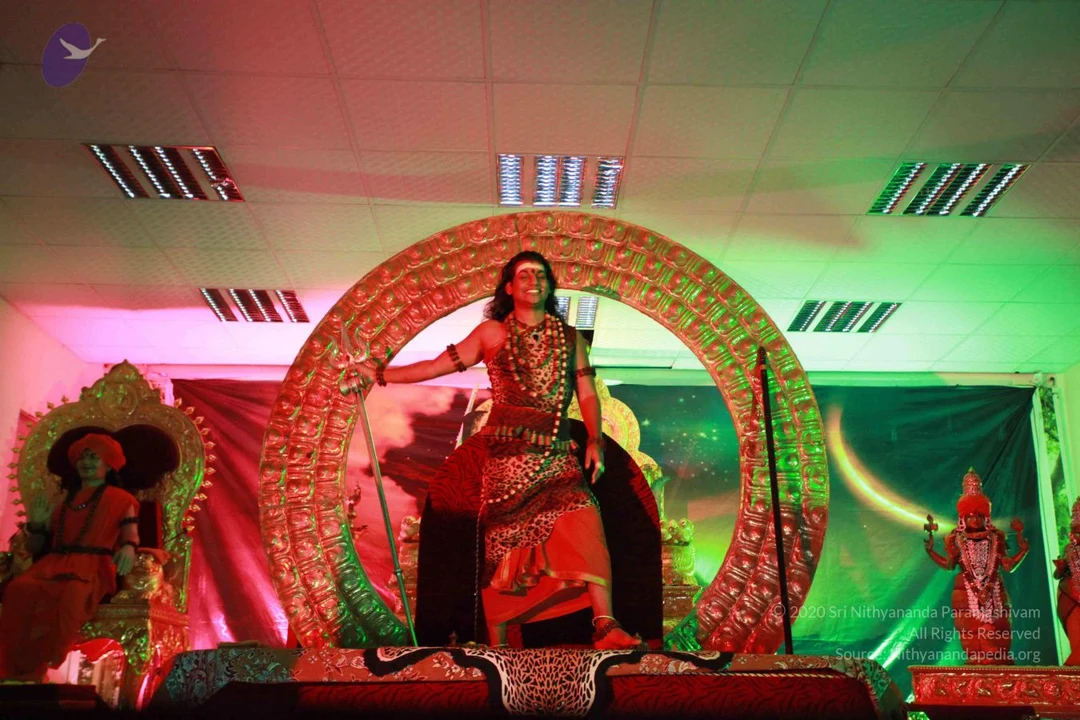
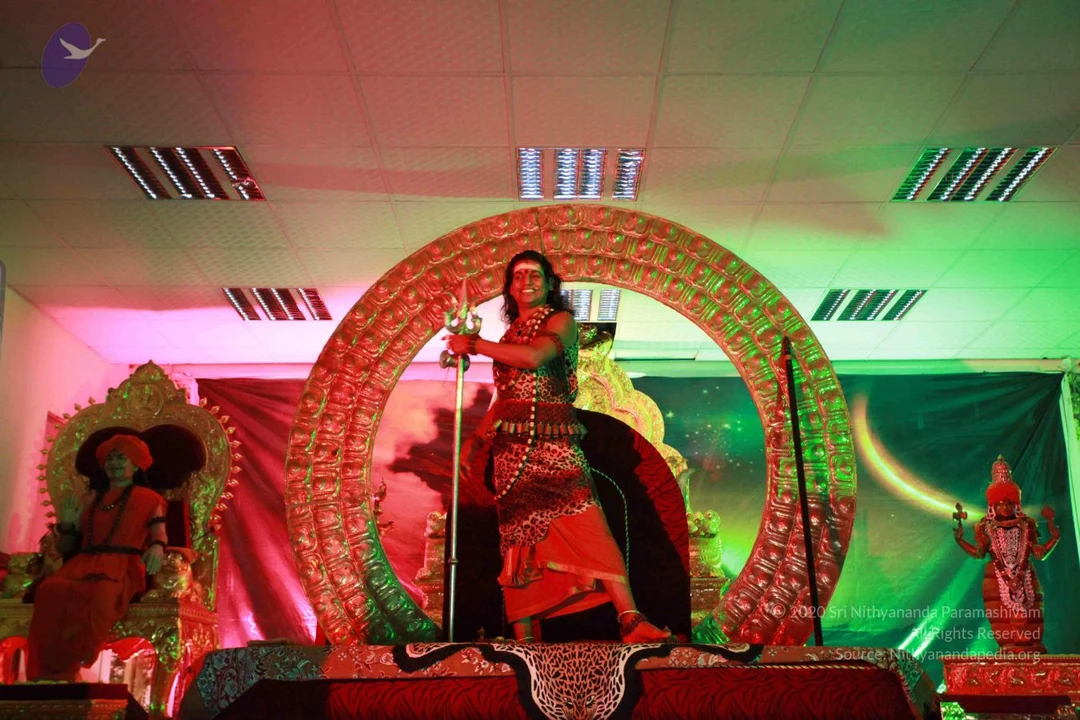
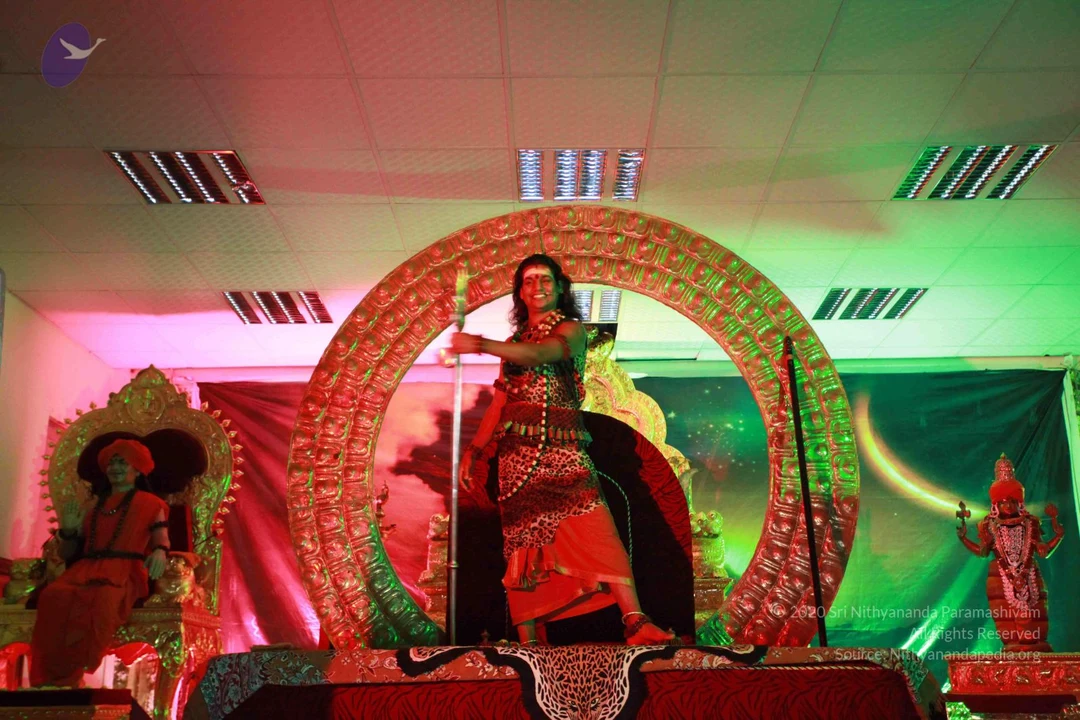
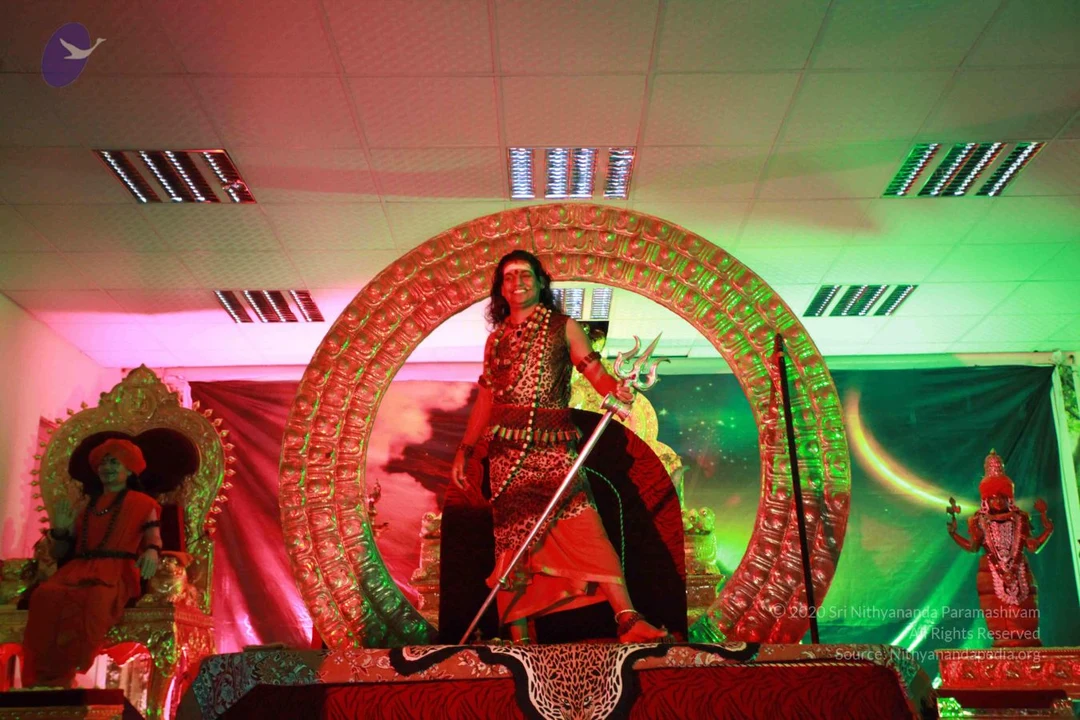
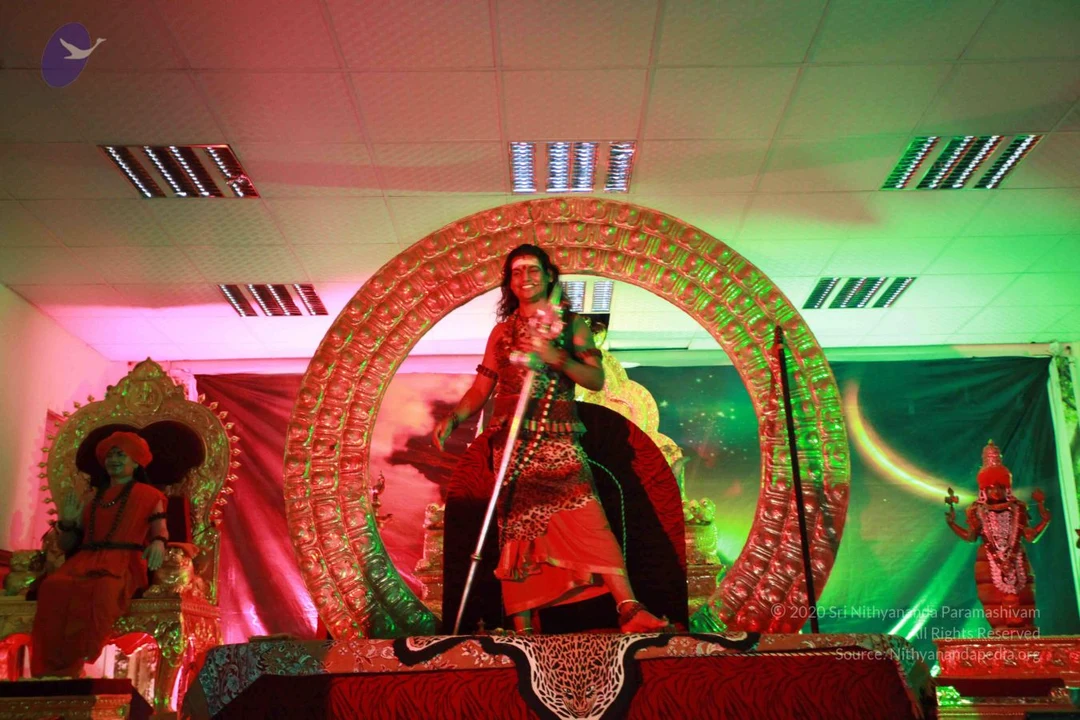
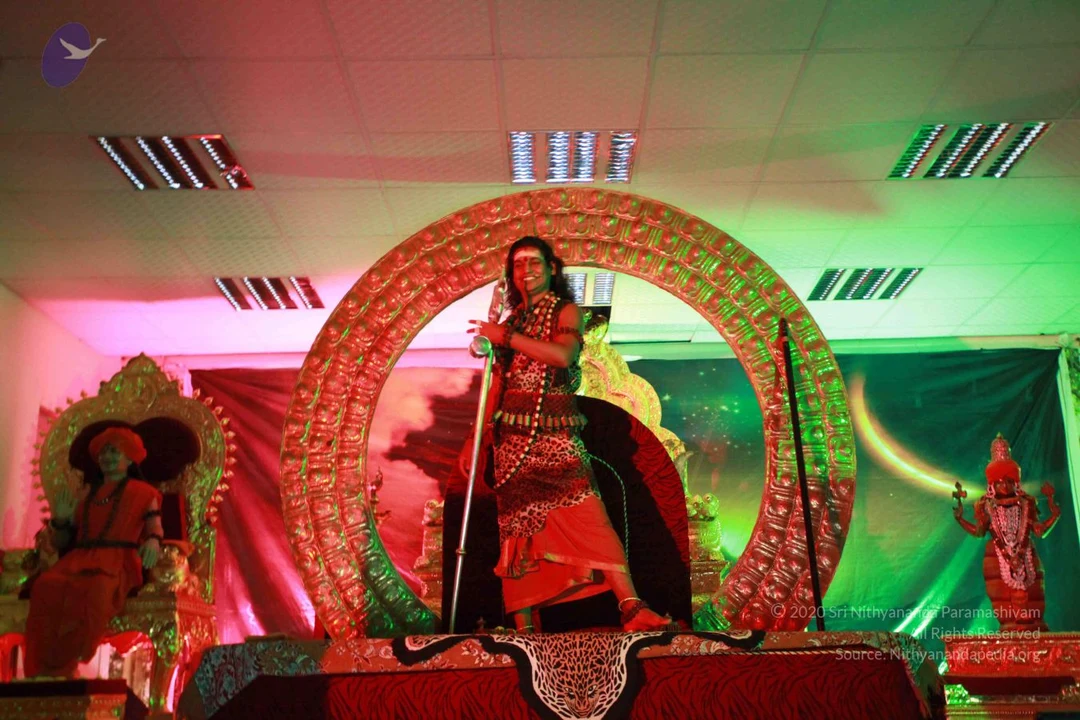
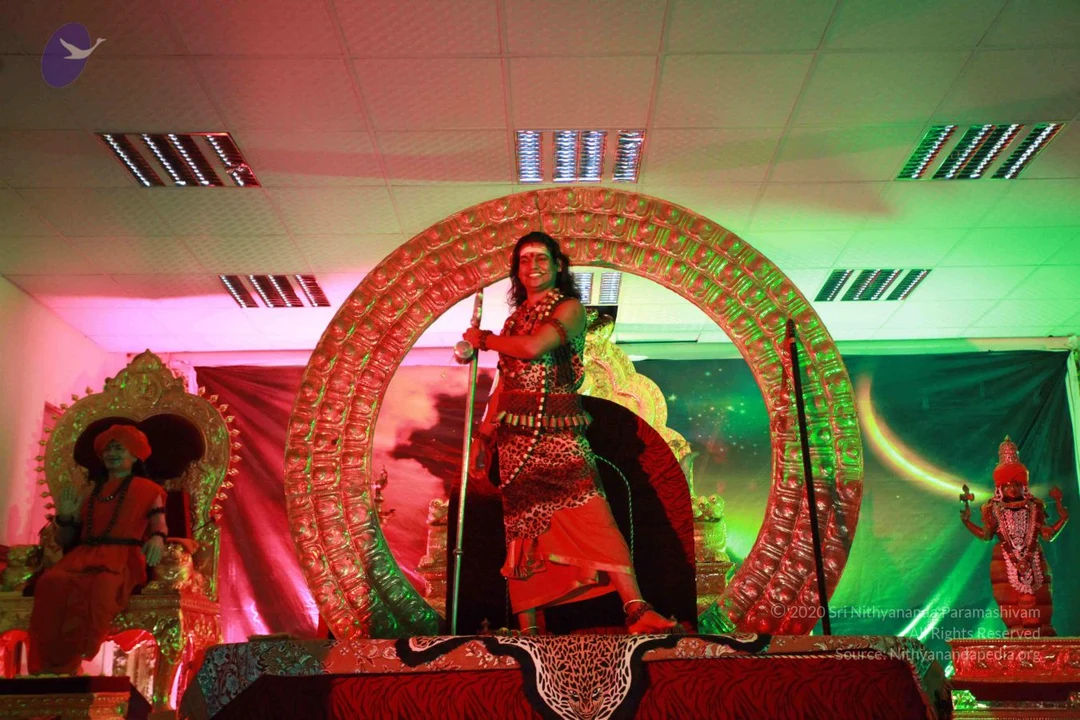
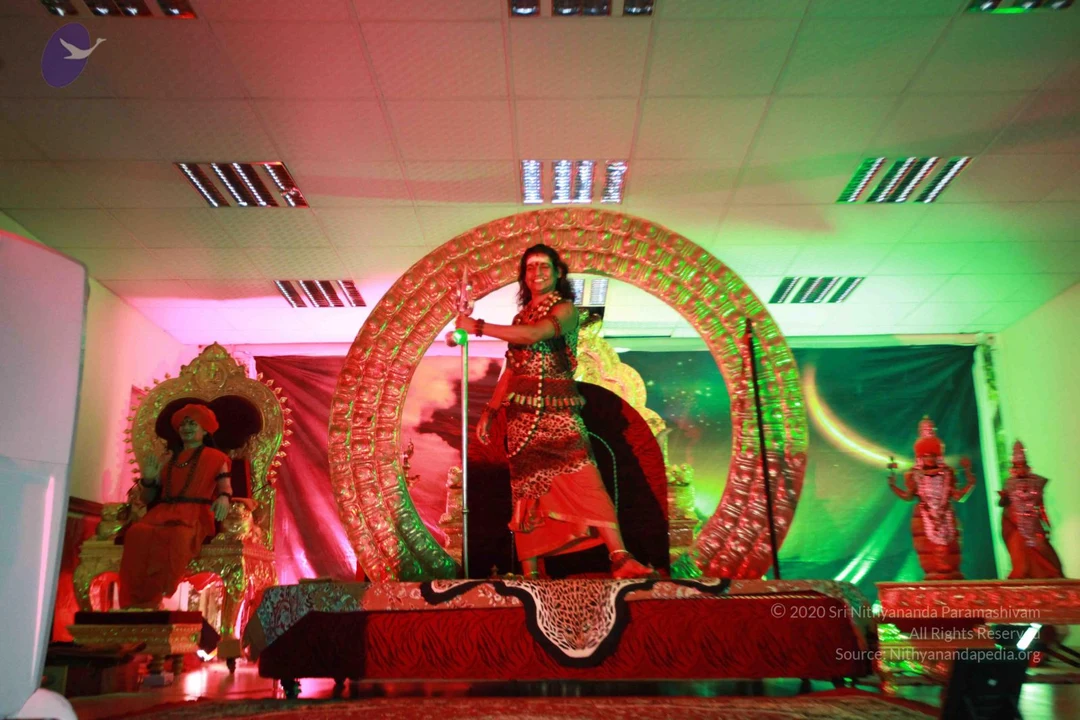
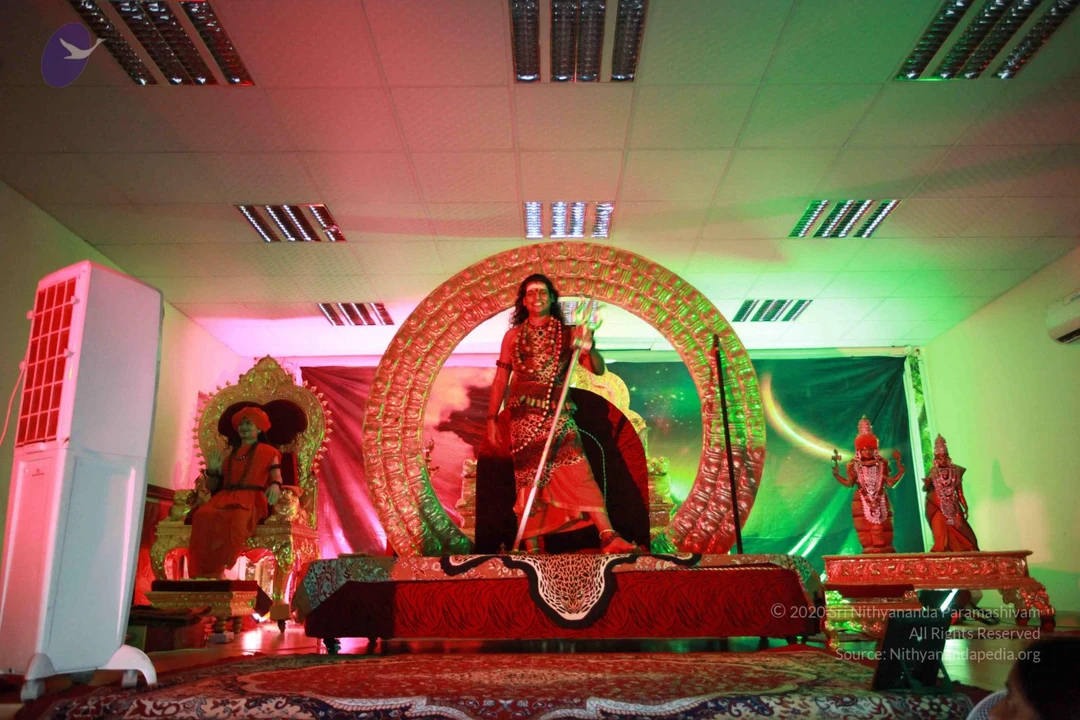
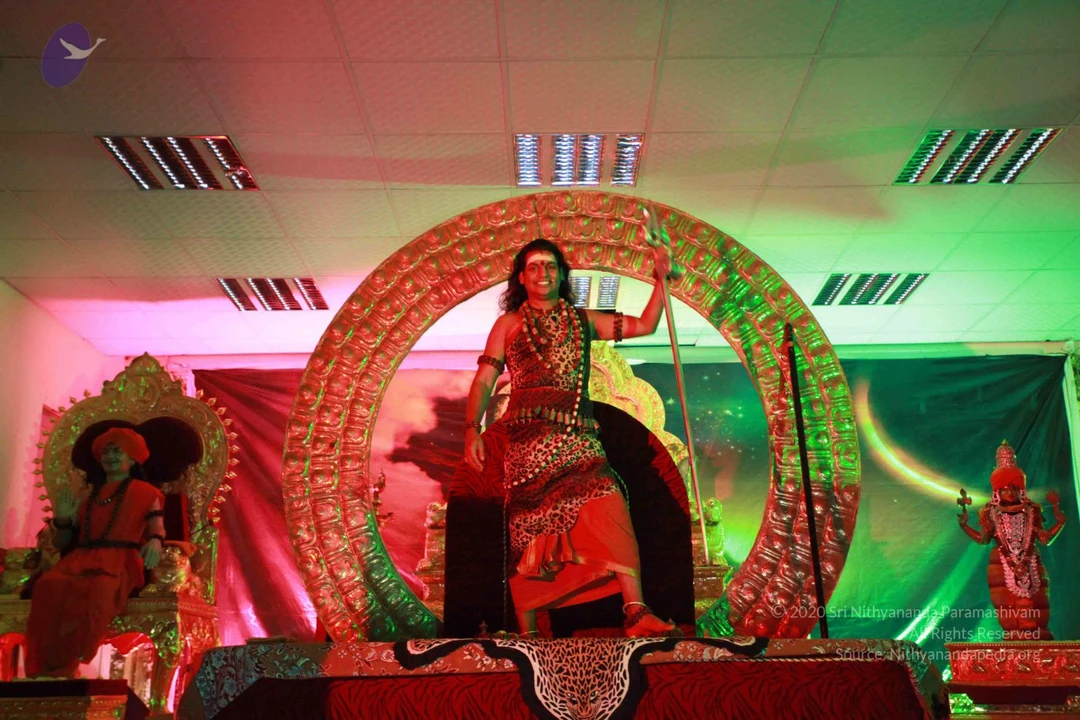
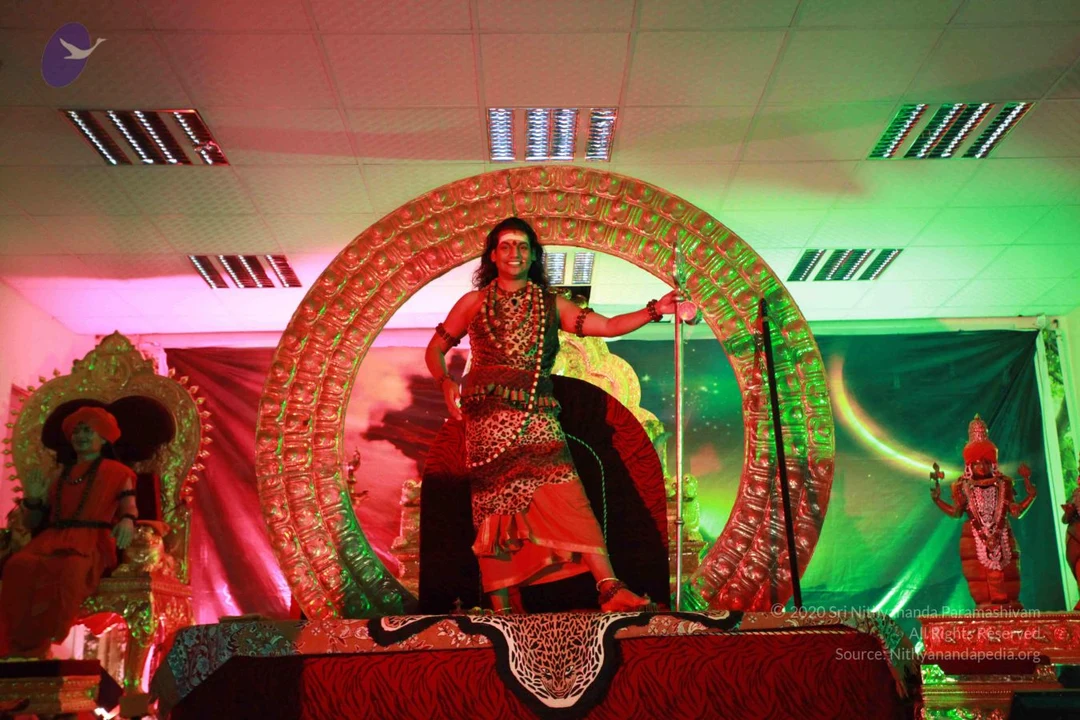
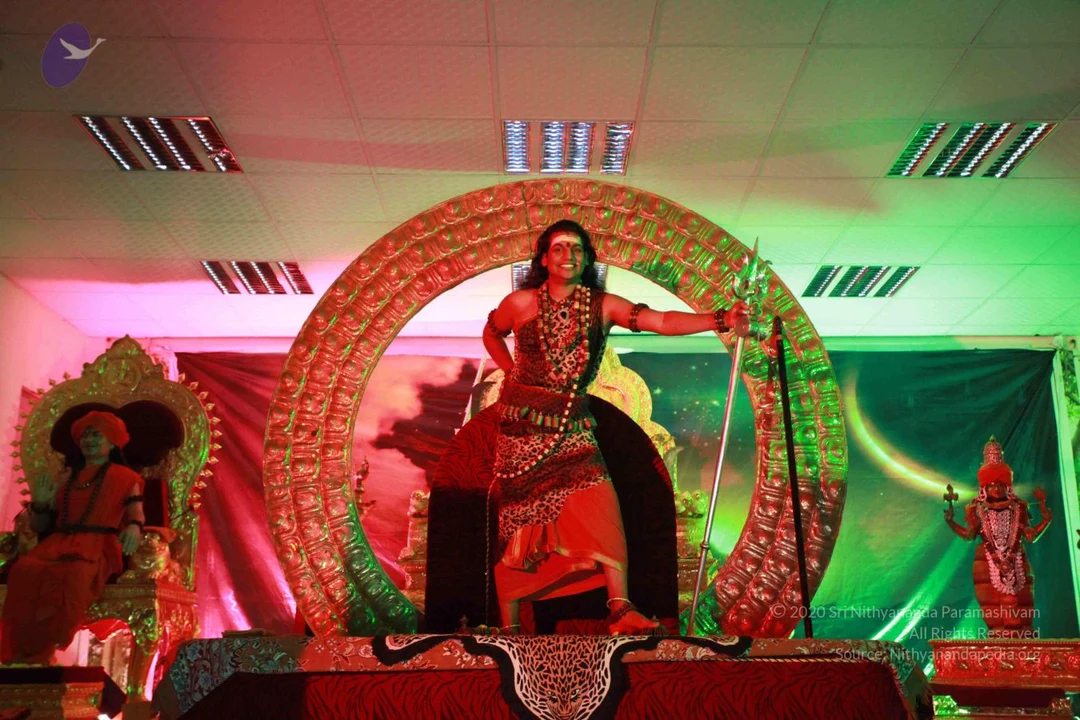
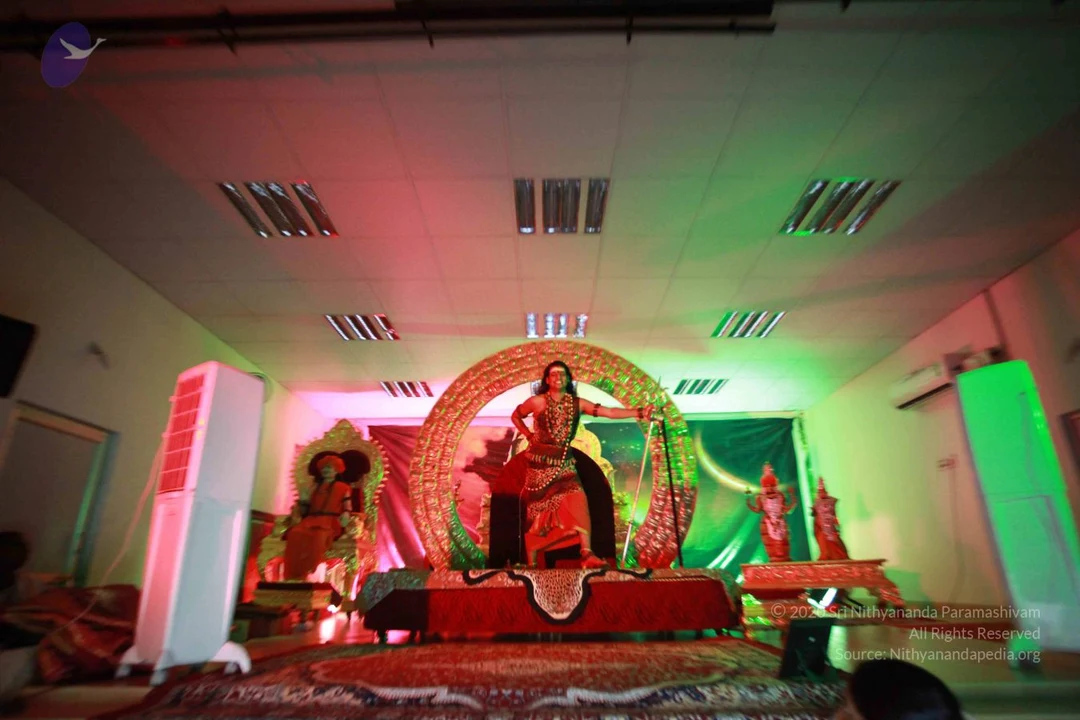
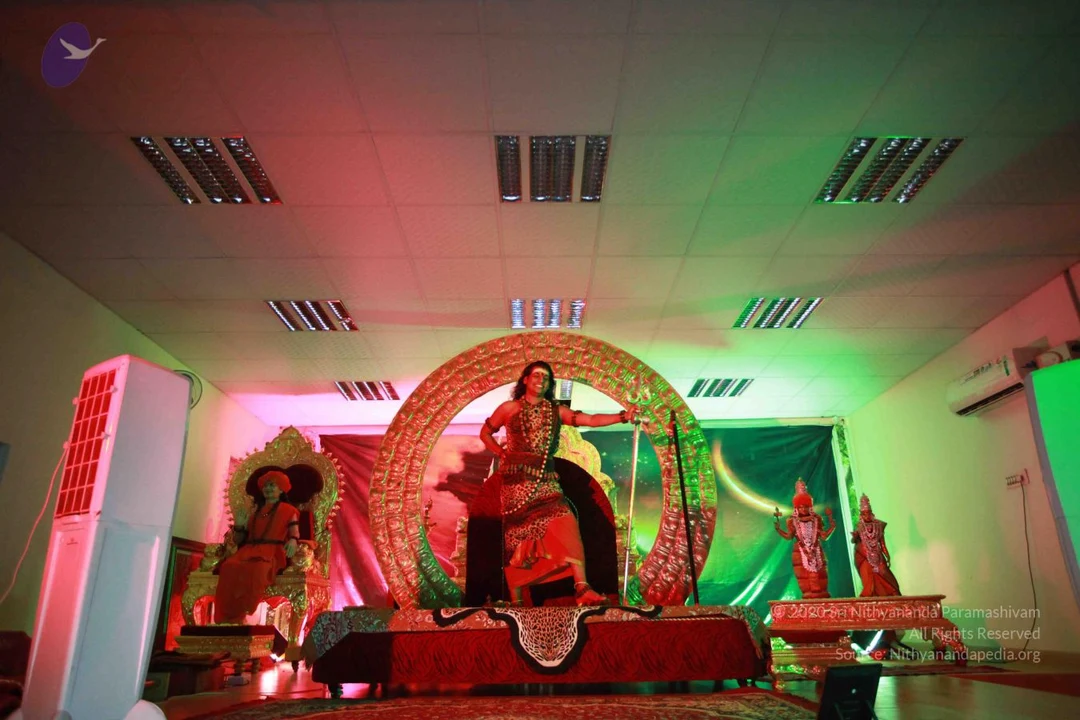
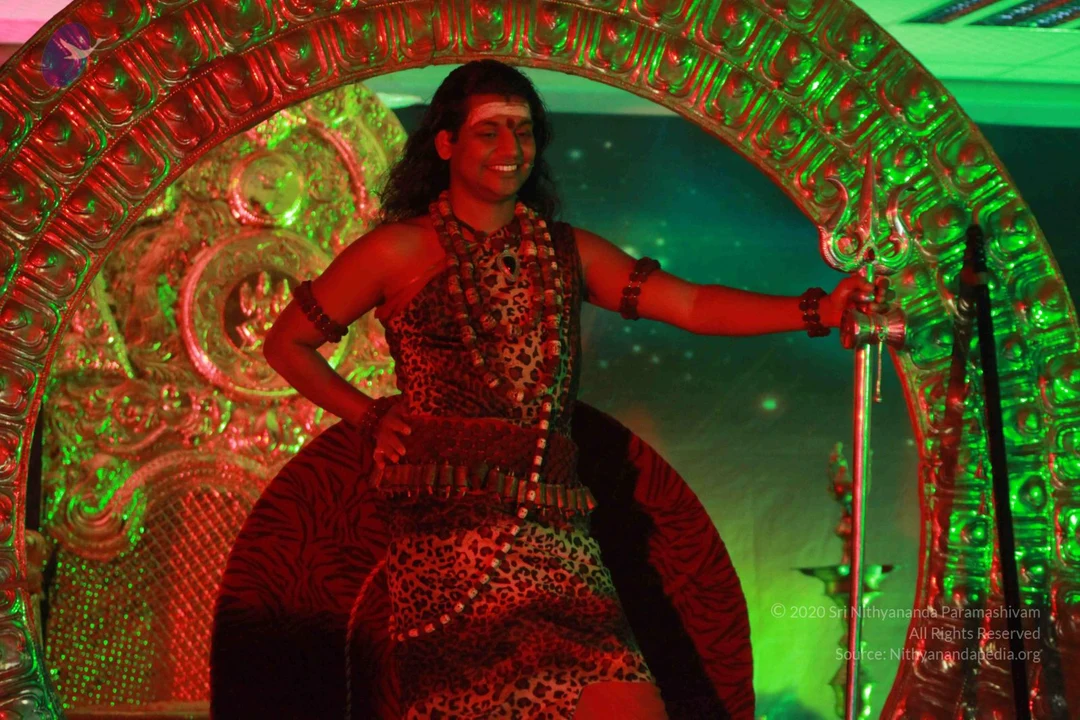
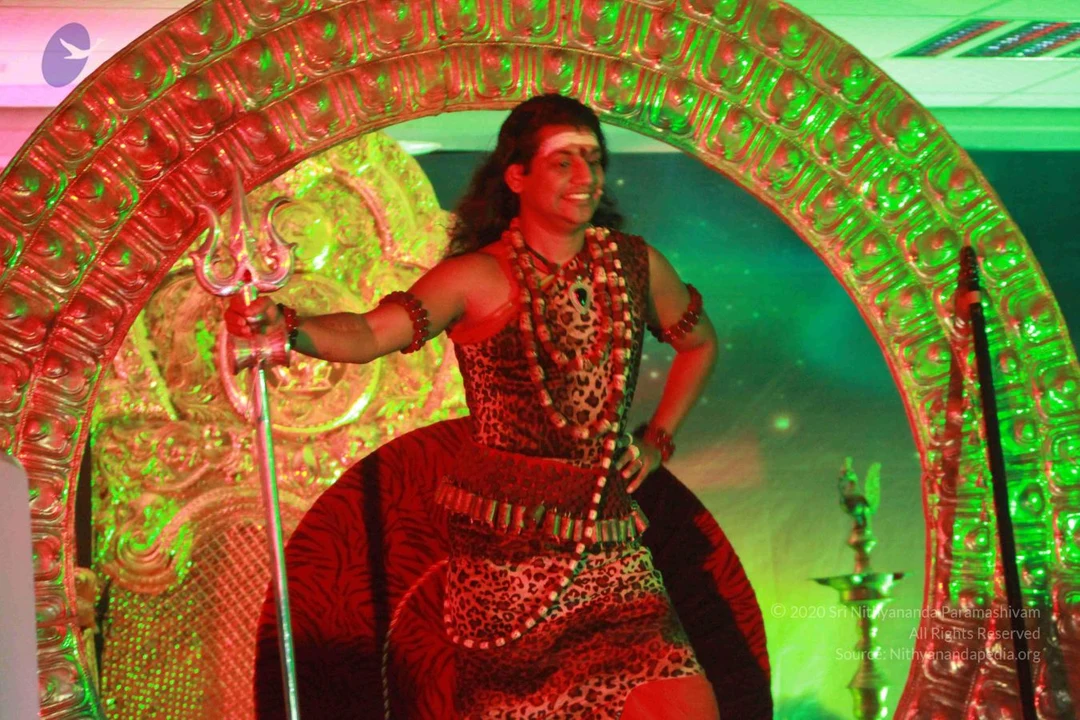
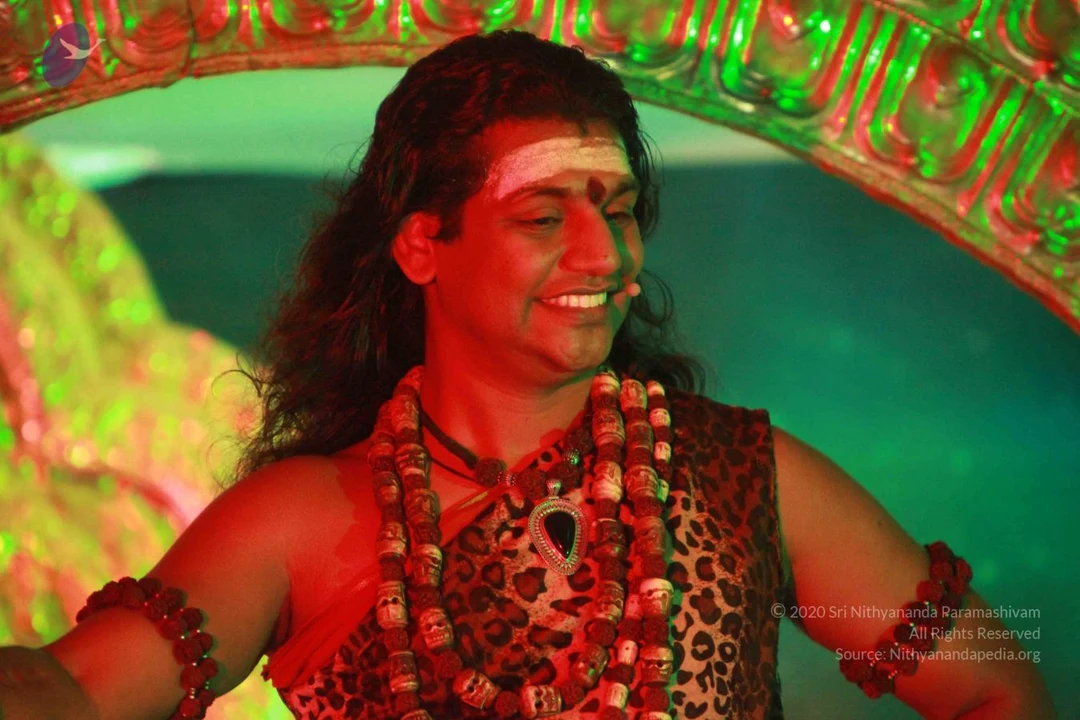
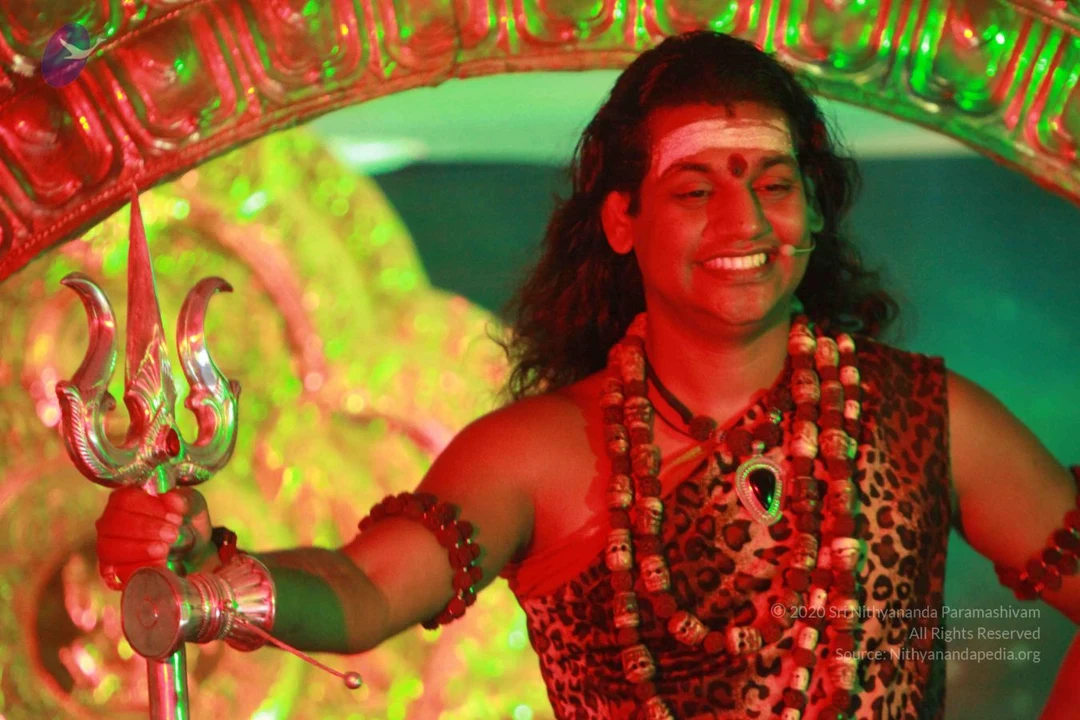
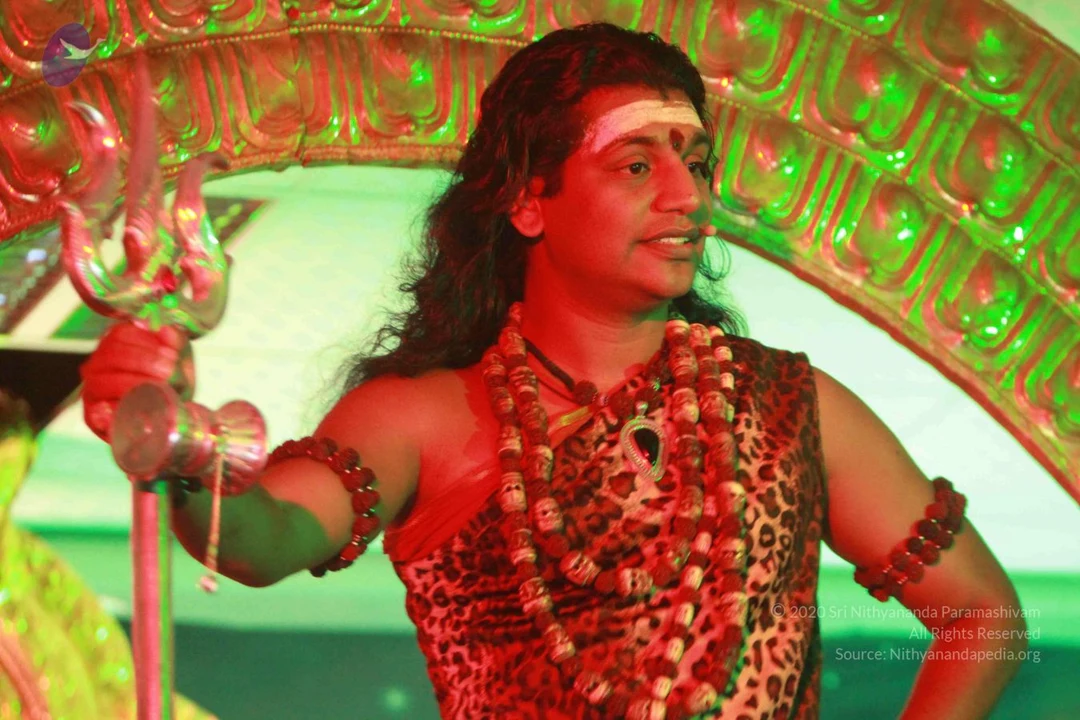
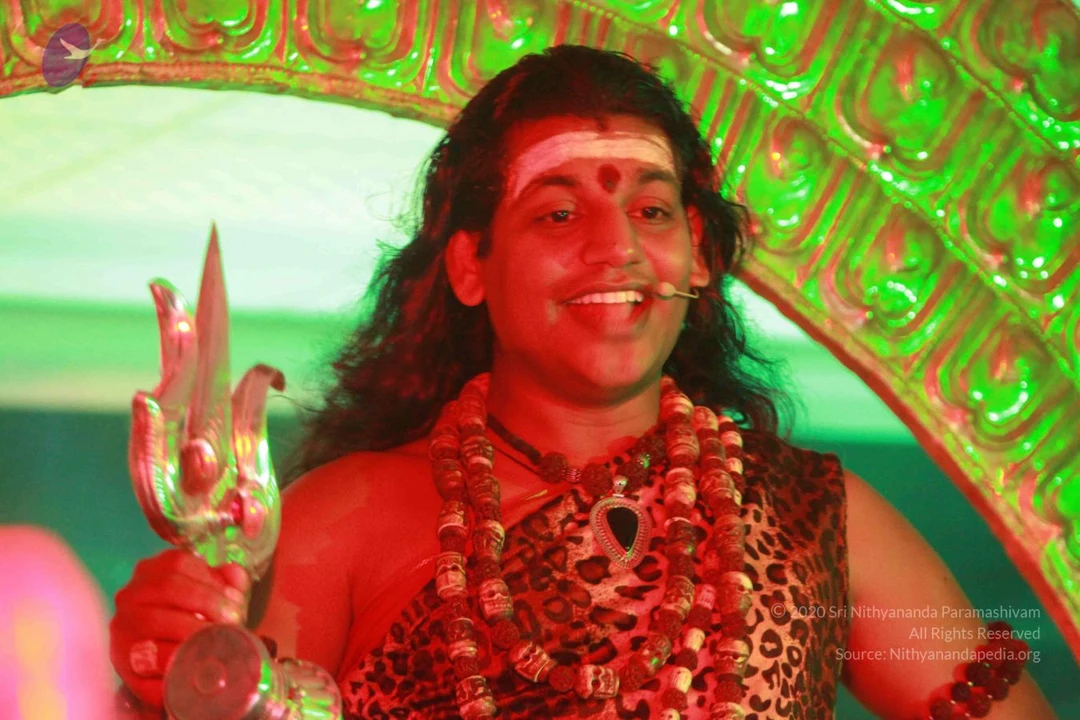
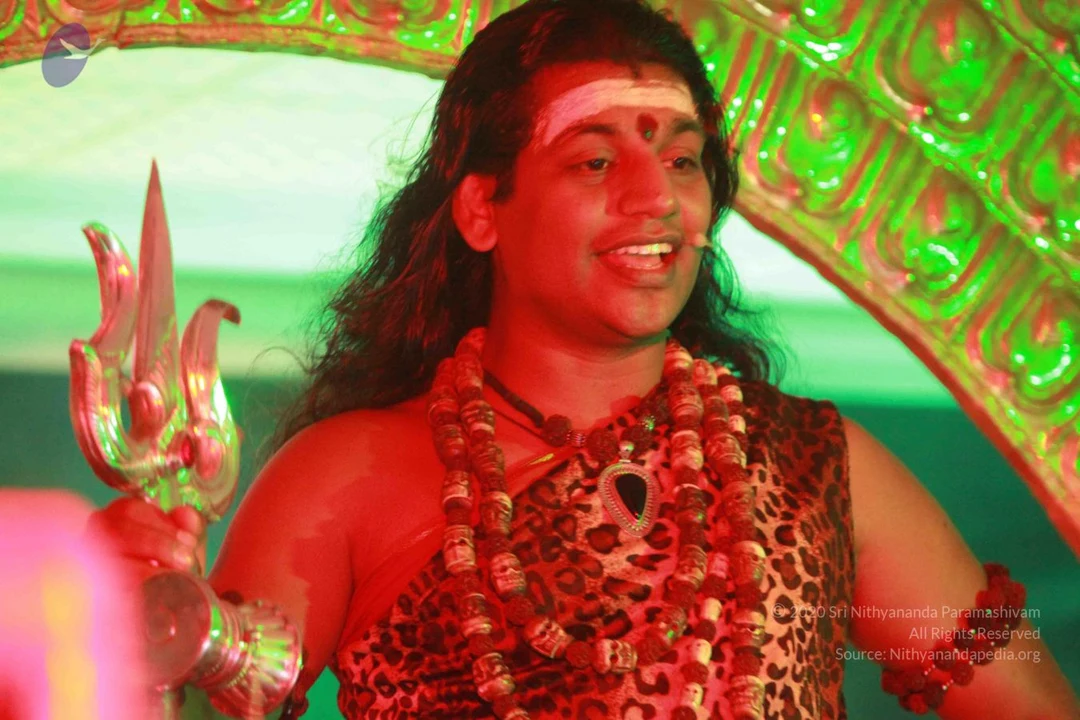
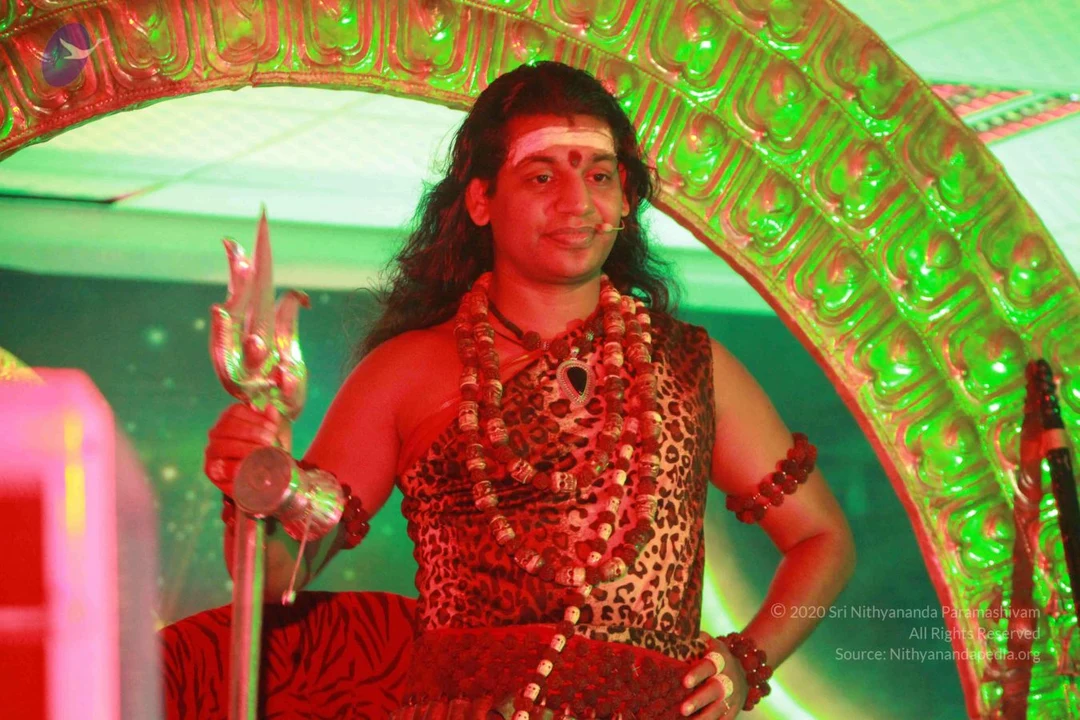
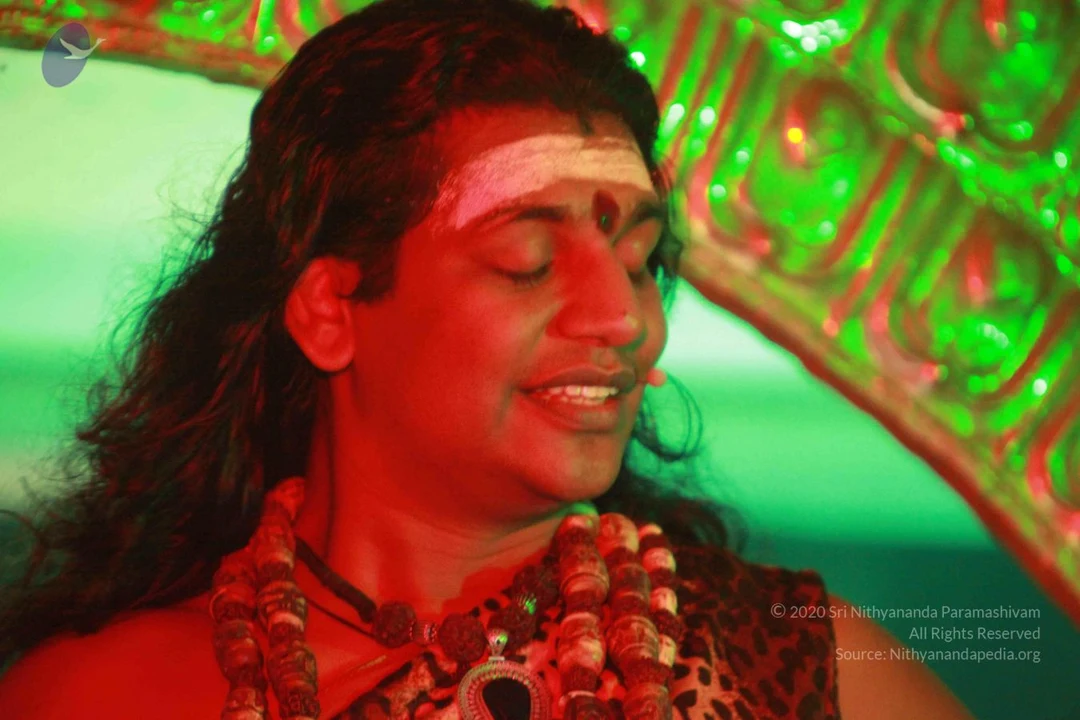
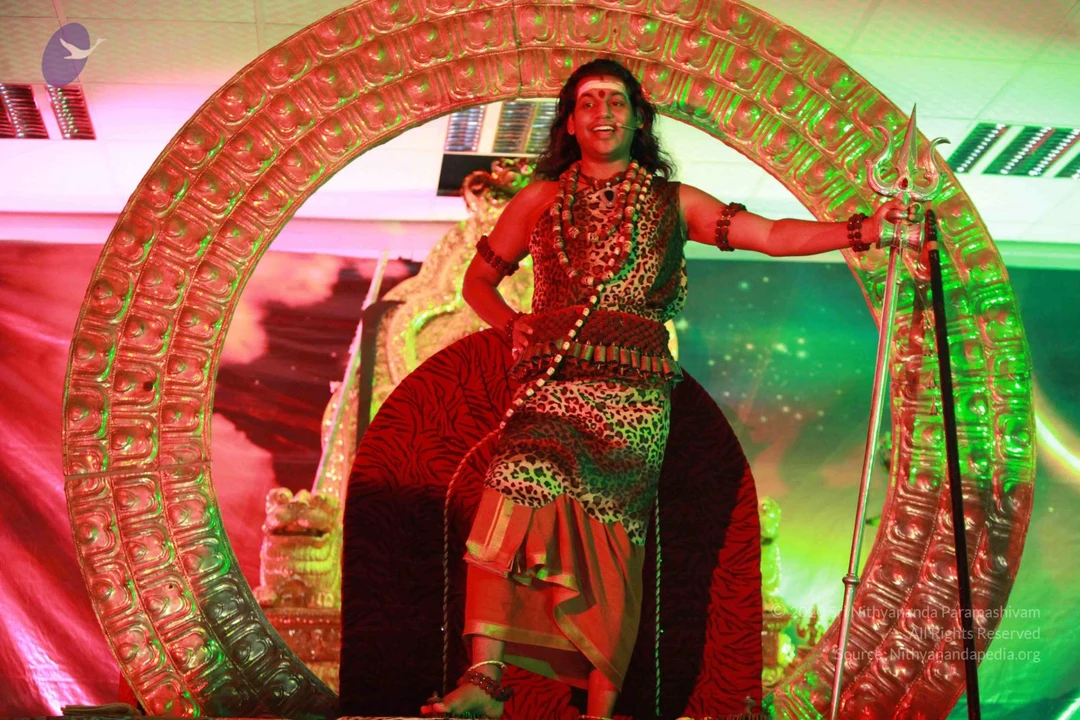
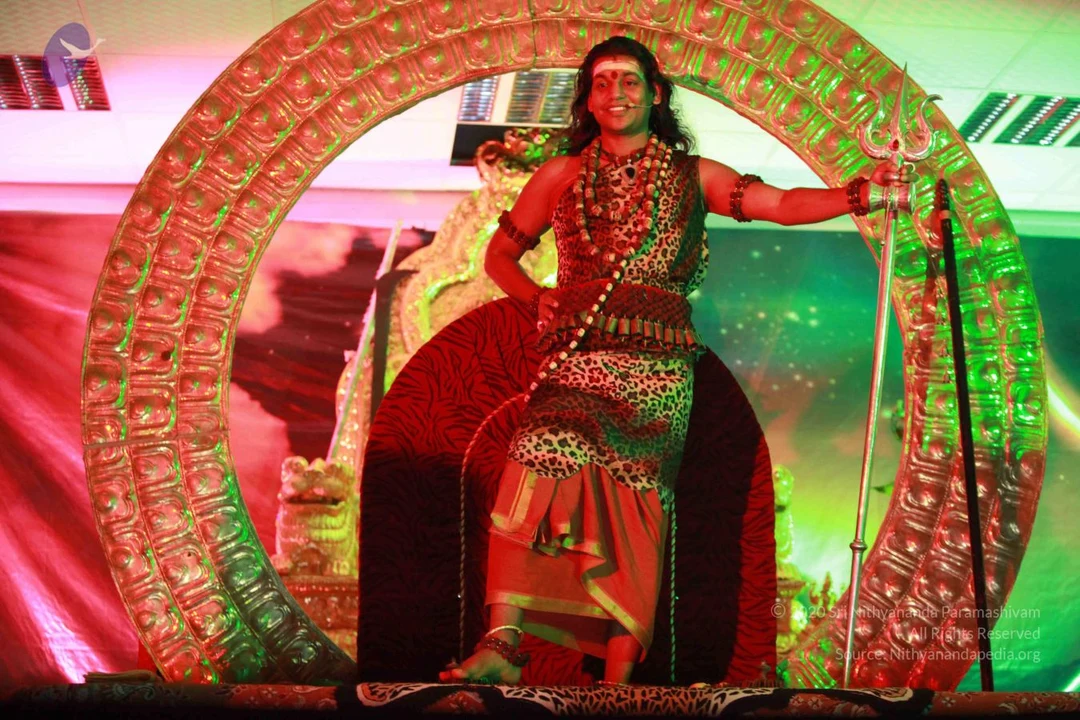
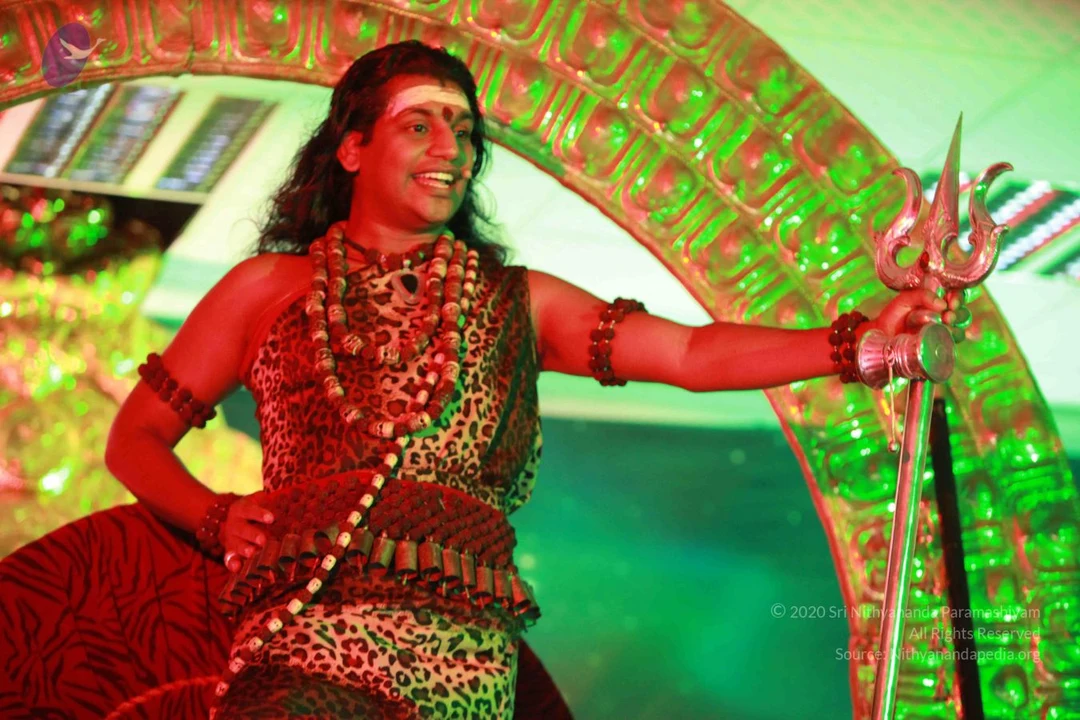
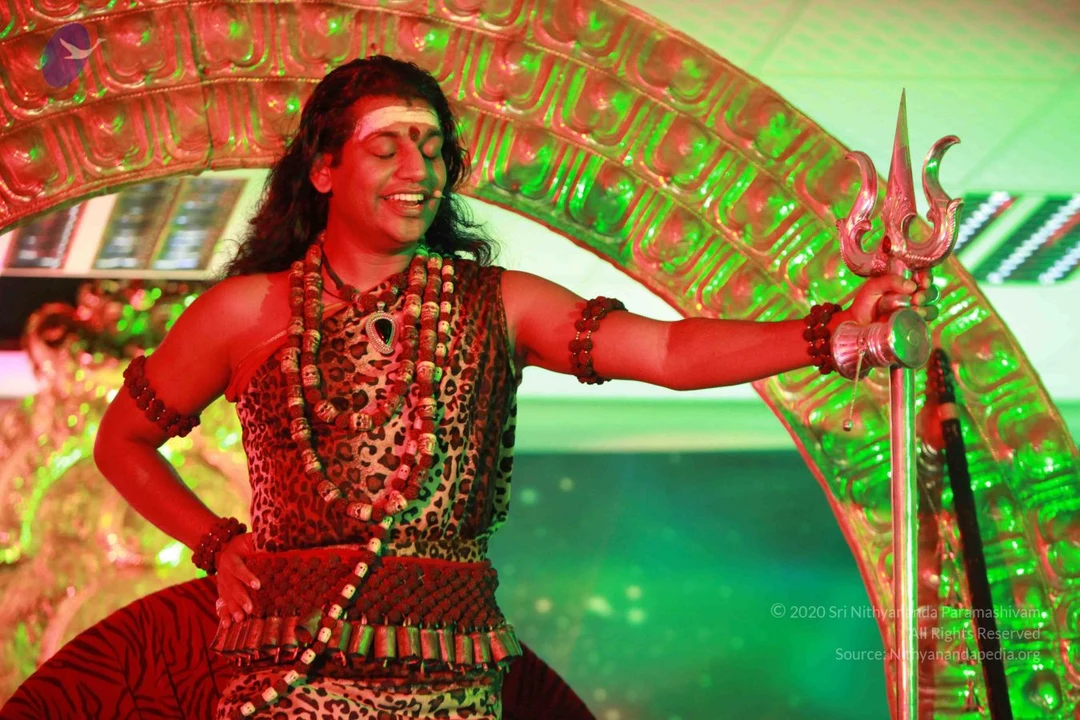
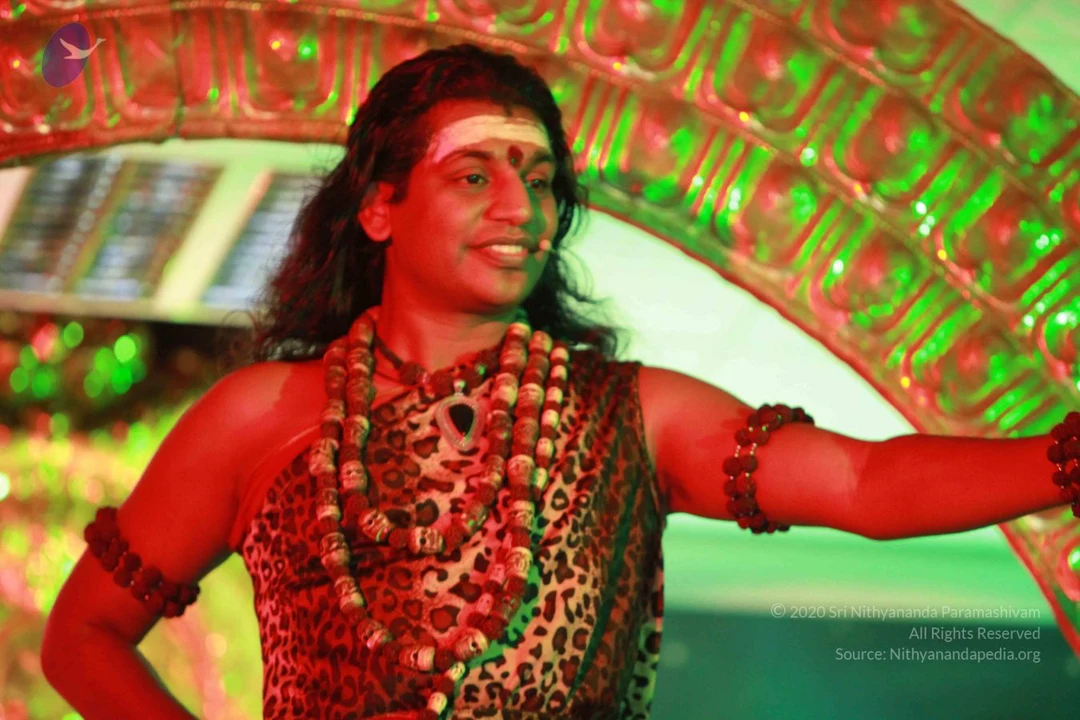
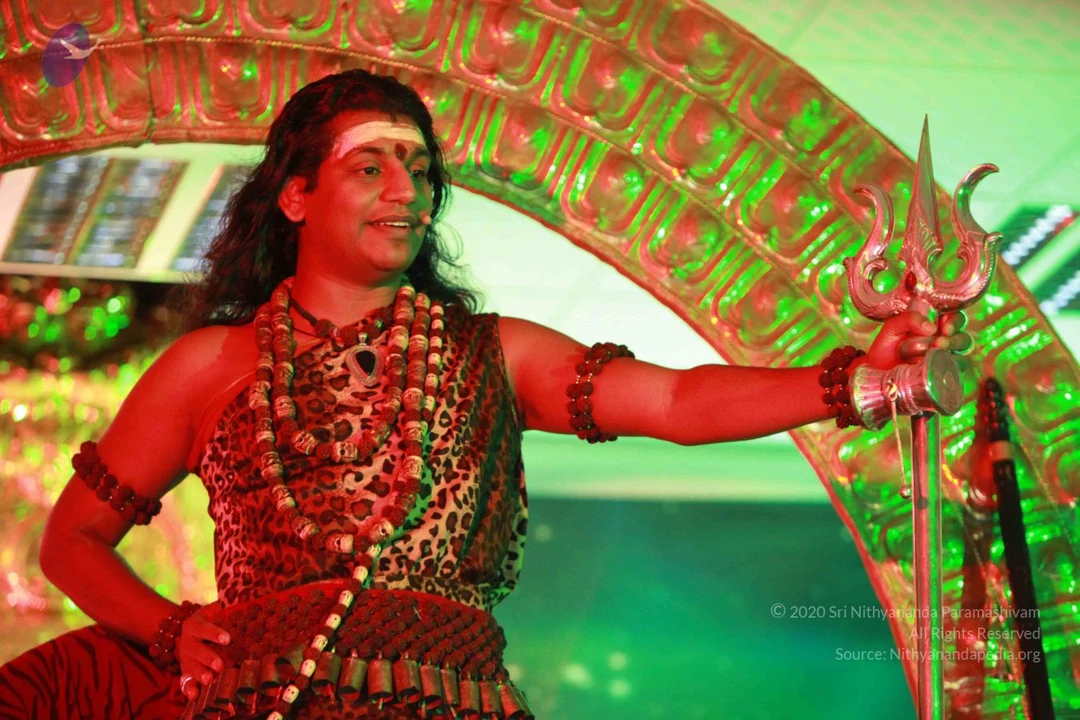
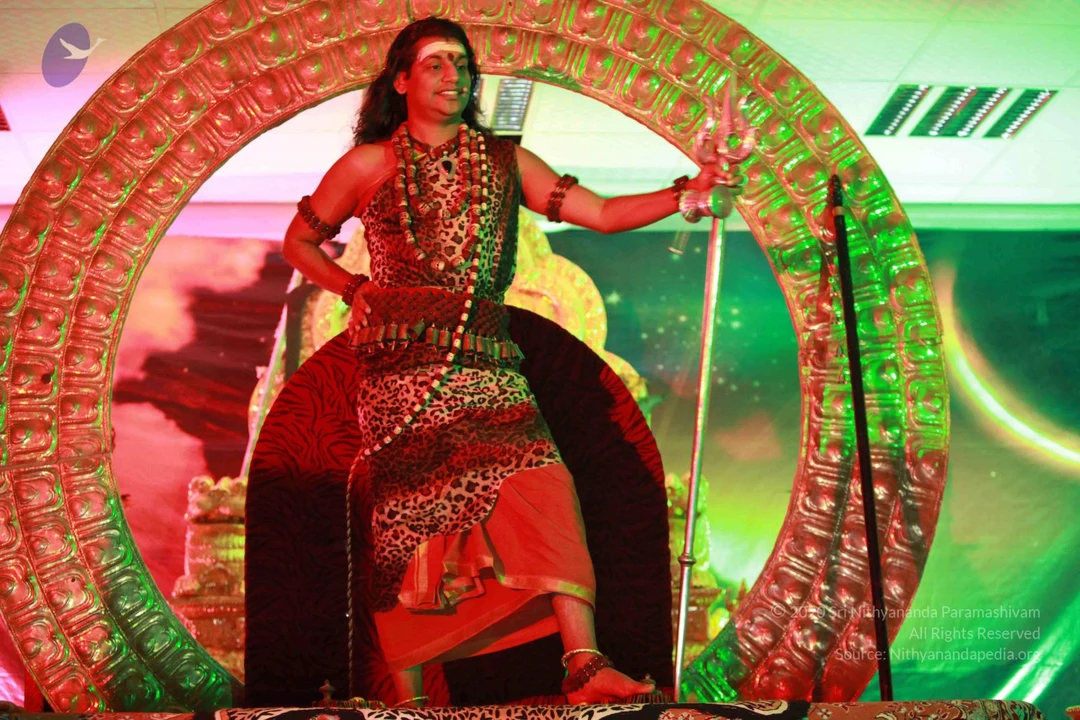
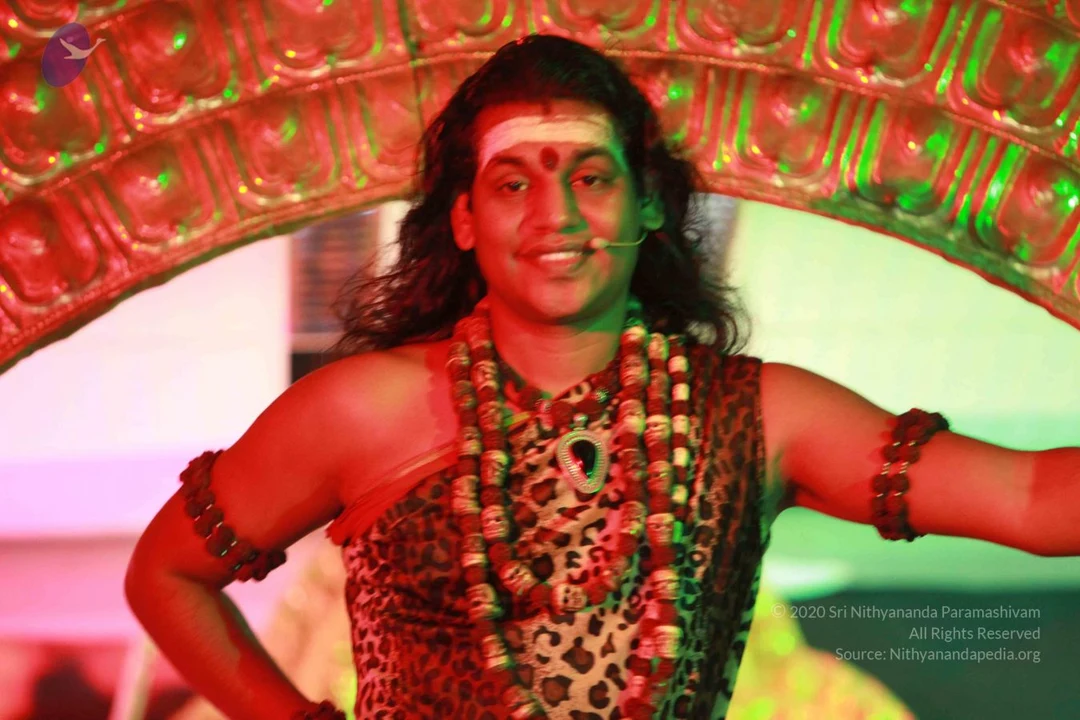
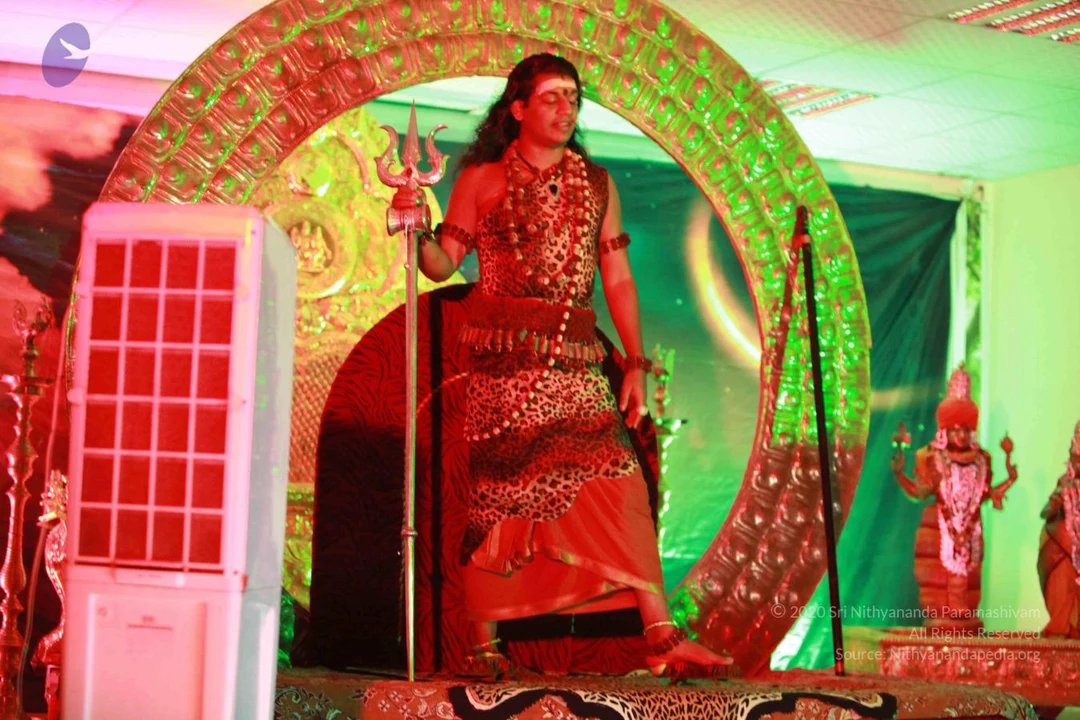
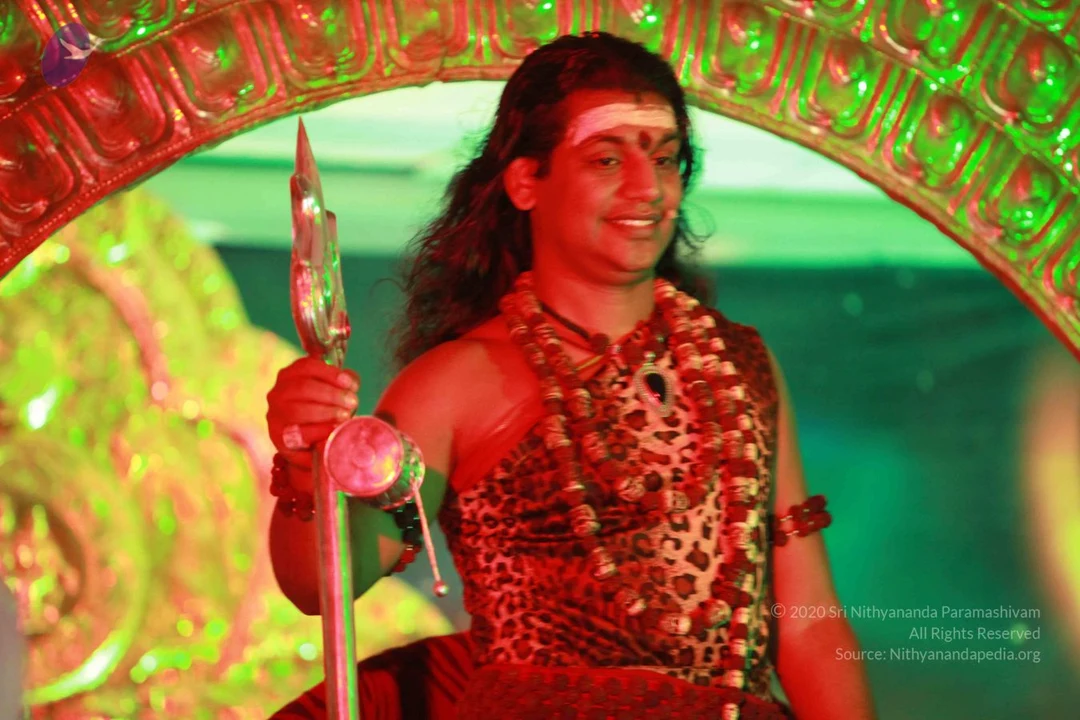
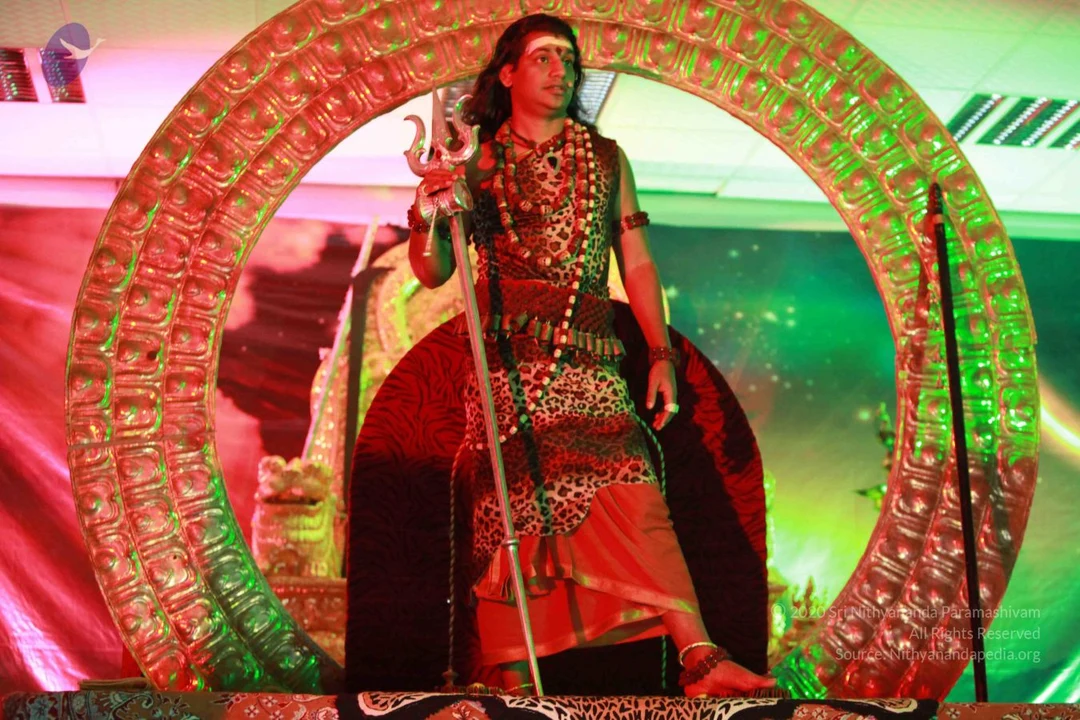
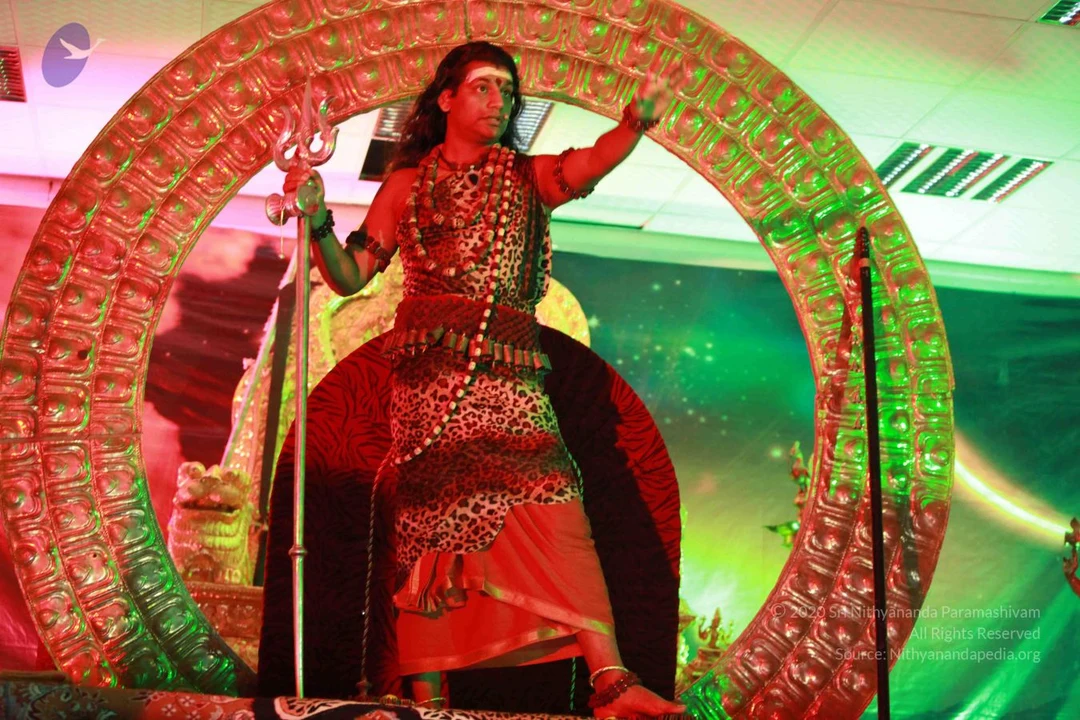
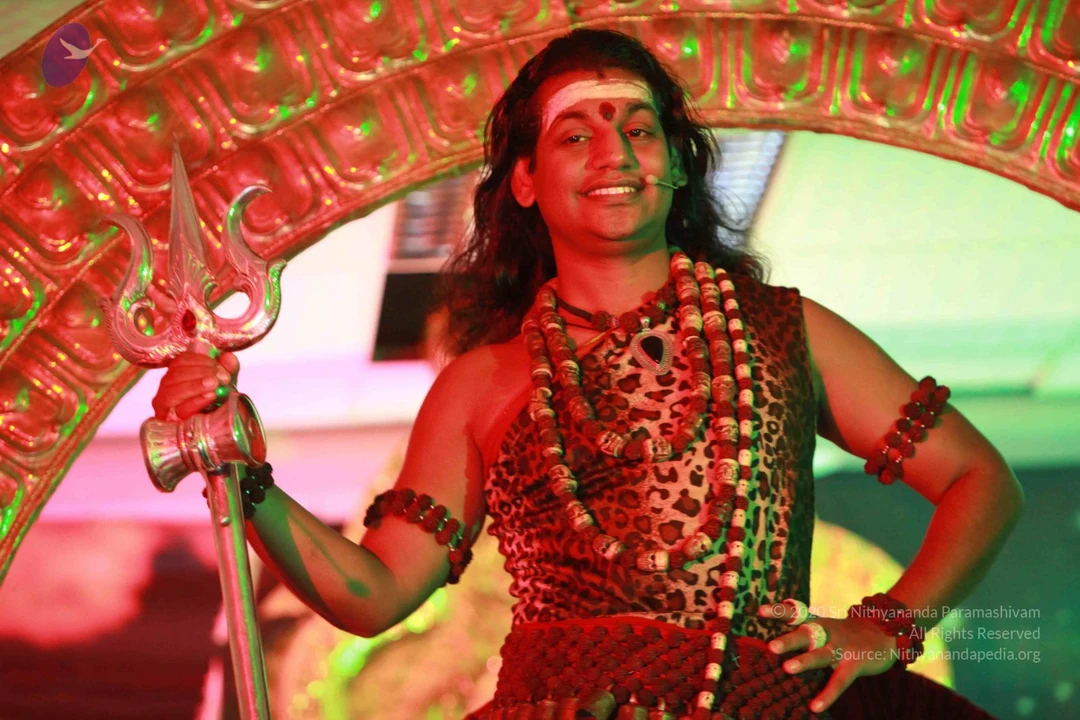
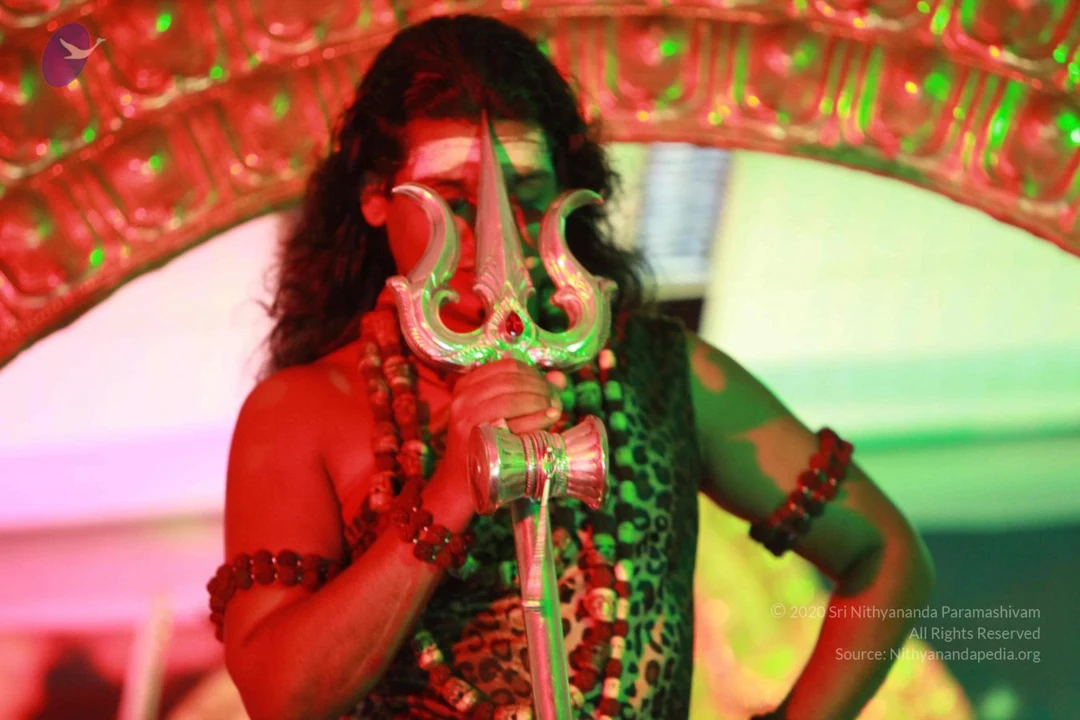
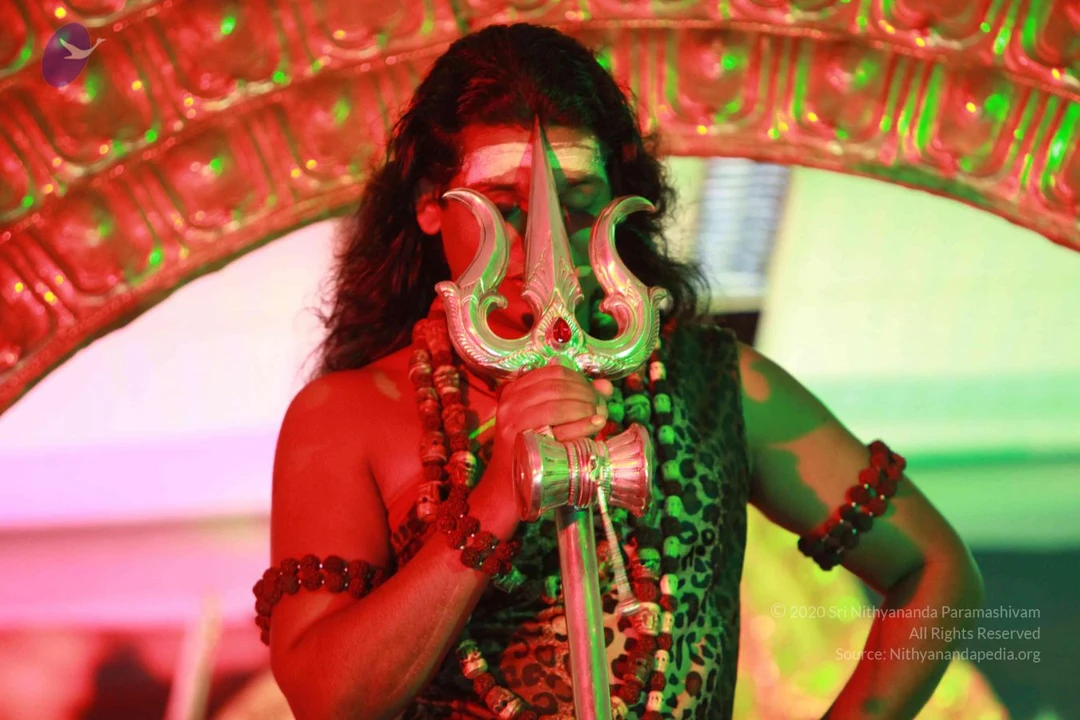
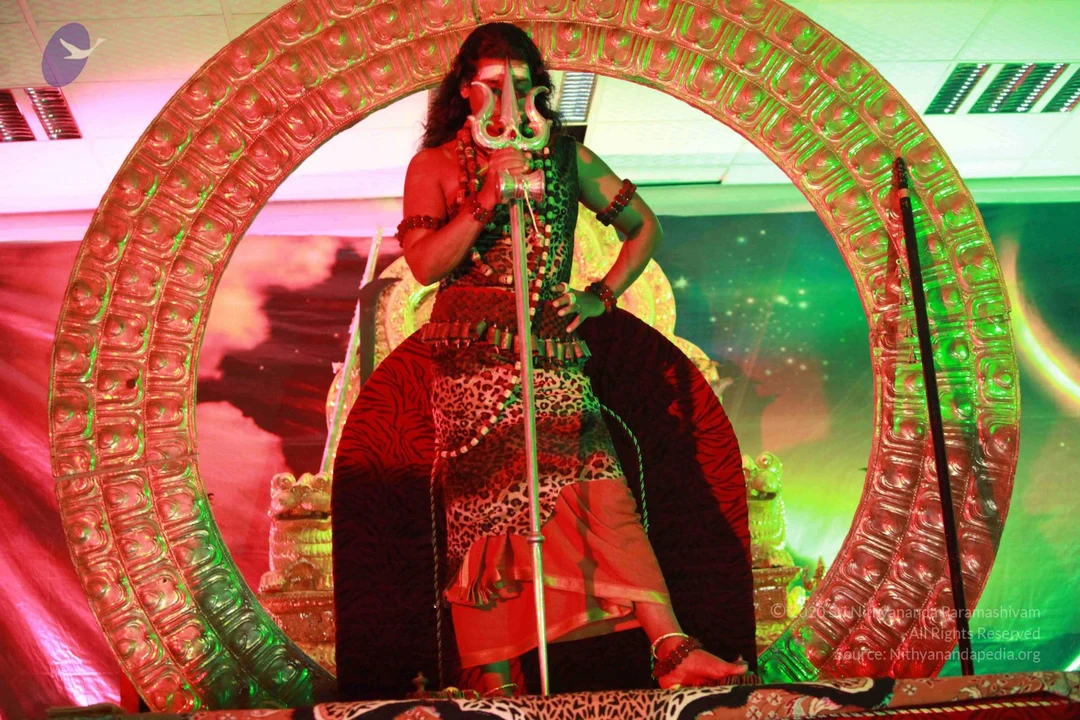
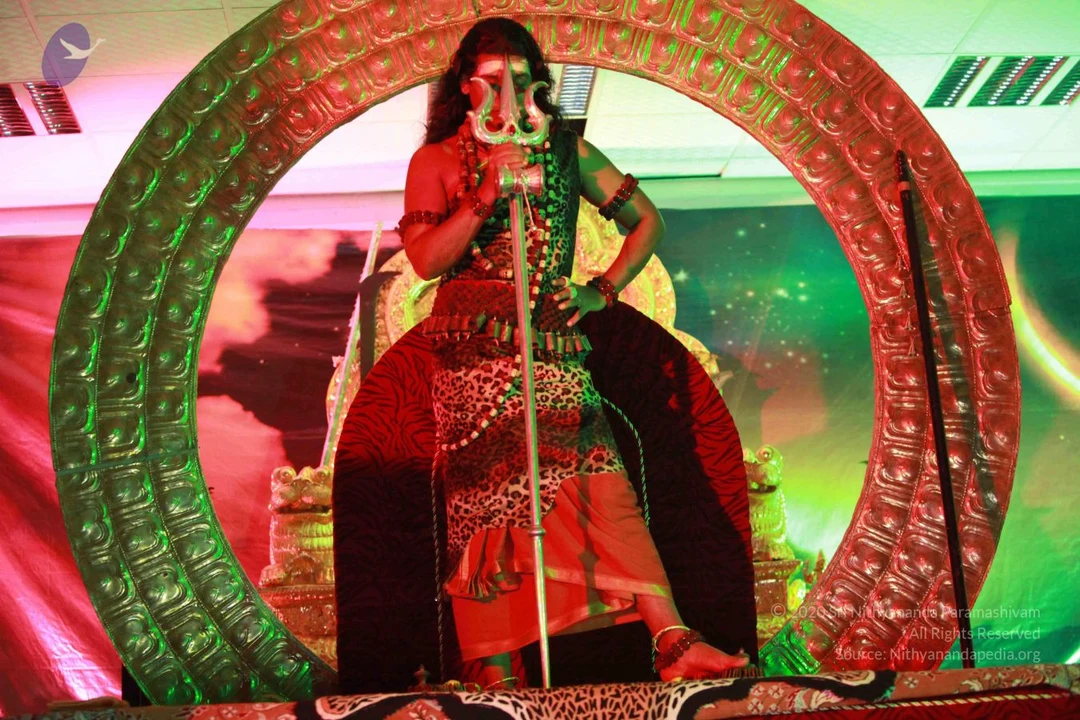
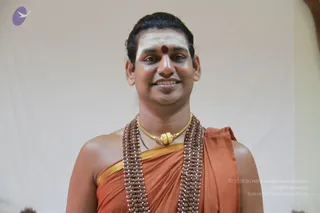
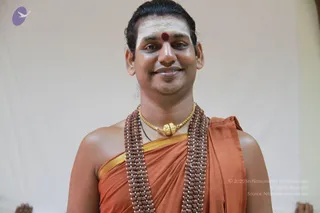
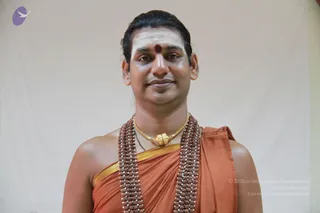
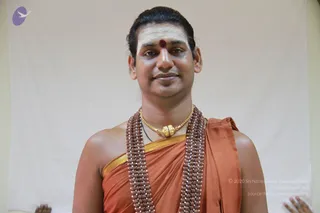
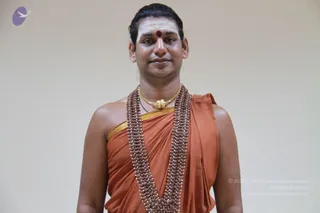
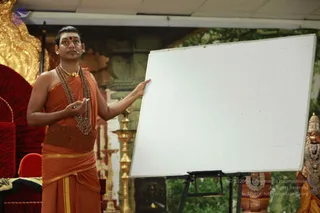
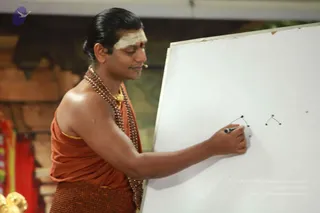
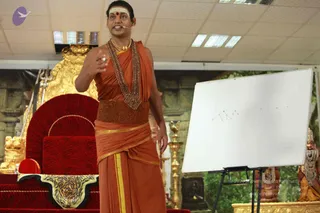
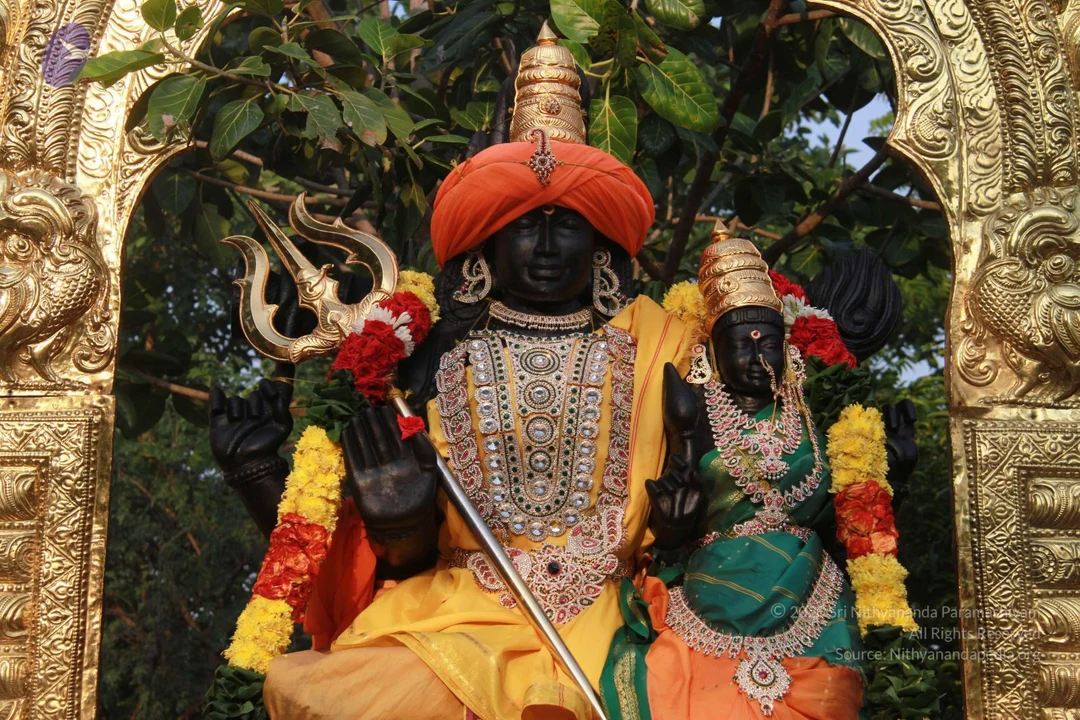
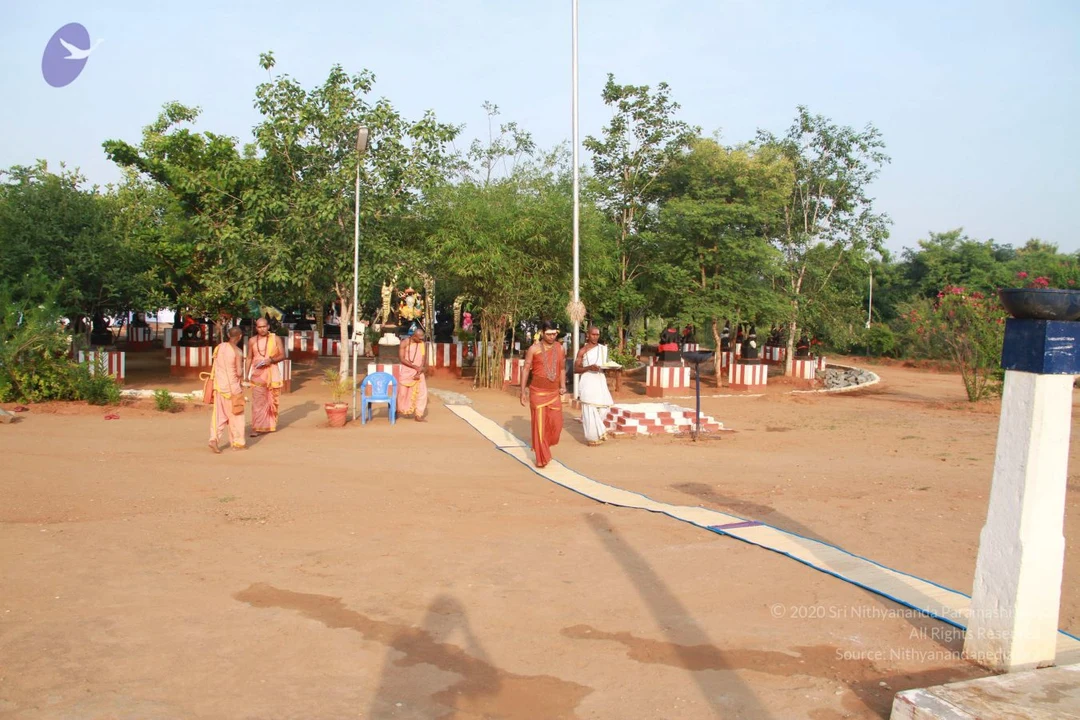
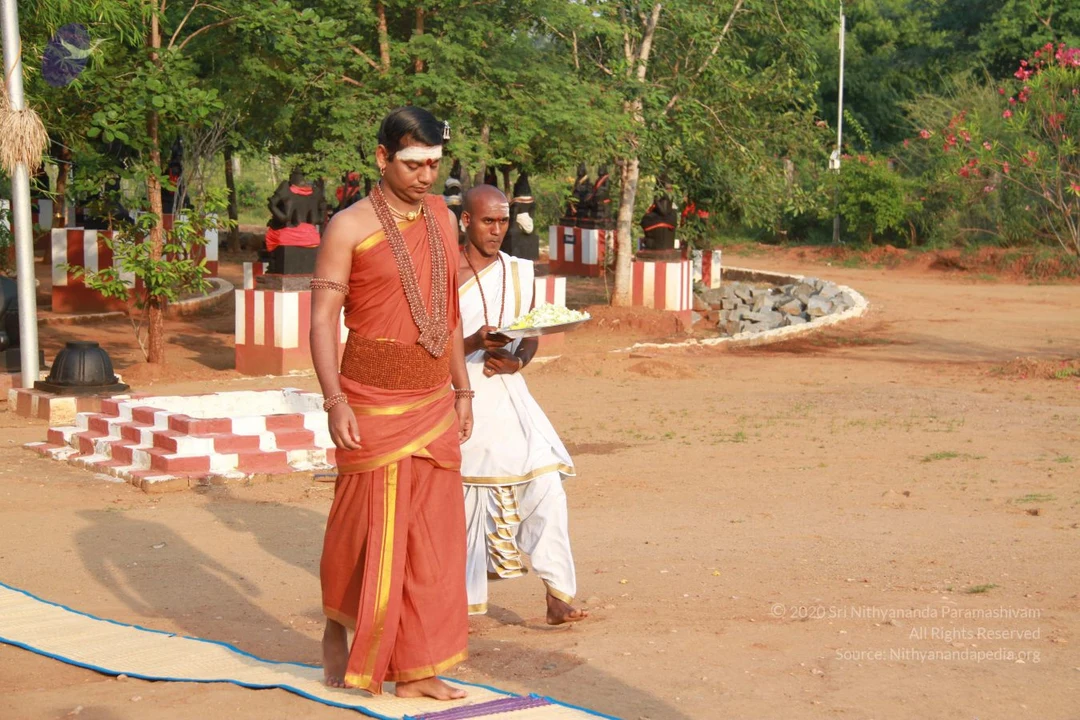
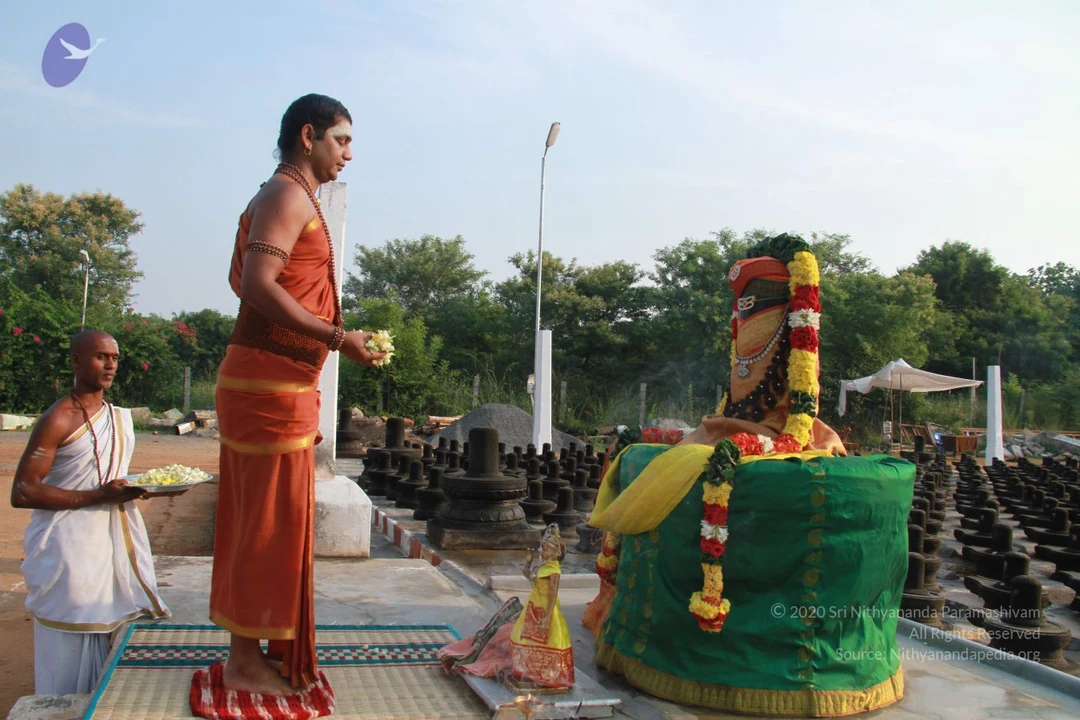
A photograph of a single man standing against a plain cream wall. He wears an orange-saffron cloth draped over one shoulder with a gold-coloured border, and multiple strands of rudraksha beads hang across his chest with a gold necklace at his throat. He has a smooth, slicked-back hairstyle, white vibhuti or sandalwood marks on his forehead and a red kumkum dot between the brows.A man stands on a stage beneath a large ornate green-and-gold circular arch, lit with red and green stage lights. He wears a leopard-print cloth wrapped around the torso, a red-orange dhoti, and many red rudraksha malas around his neck, with red bangles on his arms and wrists. He holds a silver trident in his left hand and rests his right hand on his hip. A red tiger-stripe drape hangs behind him, with a brass oil lamp and a figure statue visible at the sides. A forehead tilak marks his face. A photo caption at the lower right reads Sri Nithyananda Paramashivam, and the stage is set for a ceremonial event.An outdoor temple courtyard shaded by leafy trees, lined with black stone shivalinga on red-and-white striped plinths. In the centre, a gold-painted arched frame encloses a colourful deity murti with a trident and a tall headdress, flanked by smaller gold arches holding more painted murtis. Two men stand on the path: one in an orange-saffron dhoti and shawl holding a plate, and one in white dhoti and shirt walking beside him. Potted palms and a paved stone walkway lead through the grounds, with a dark signboard set among the plinths.

October 11 2012

Original wiki page
Contents

Title:

Akashic Readings on renunciation - part 1

Description:

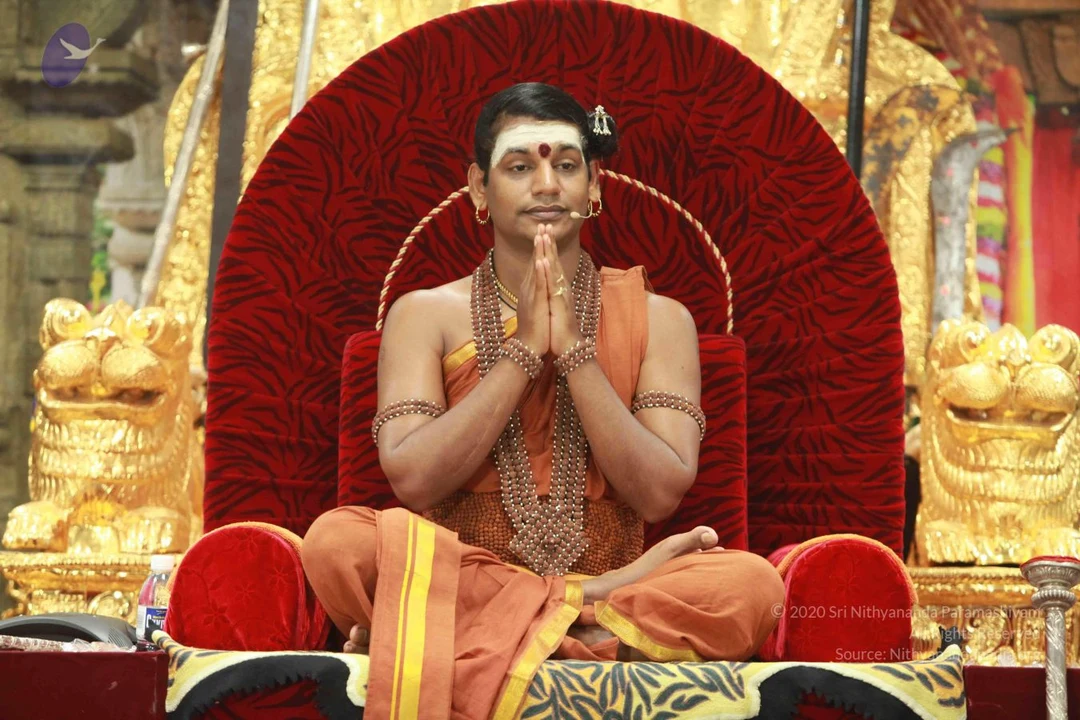
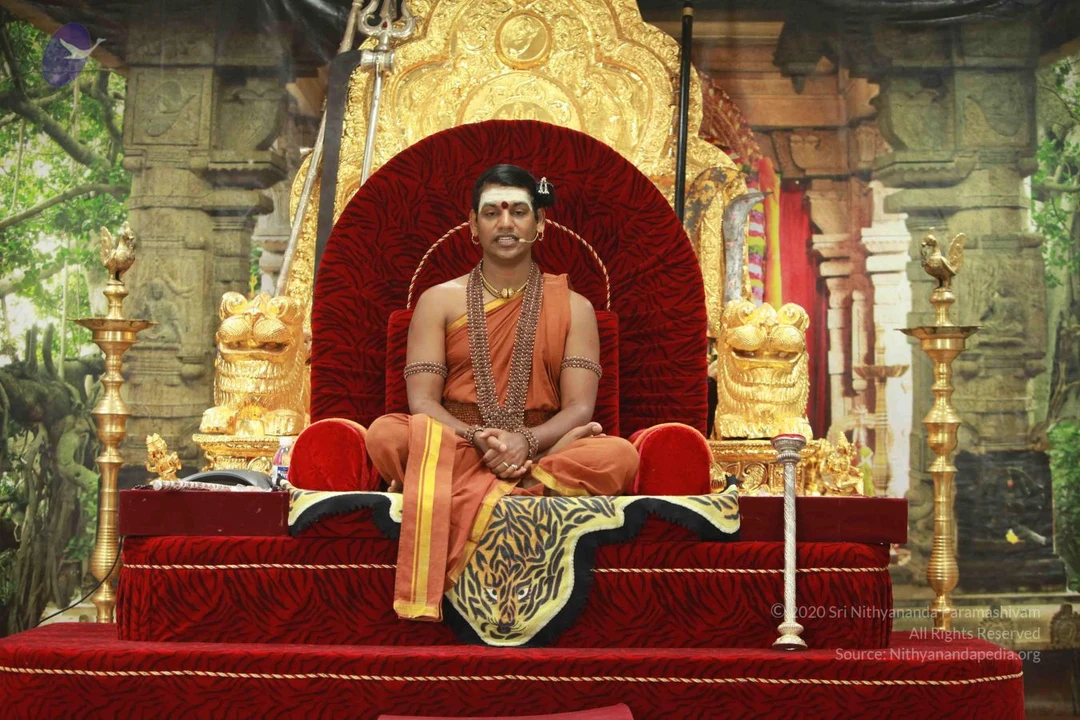
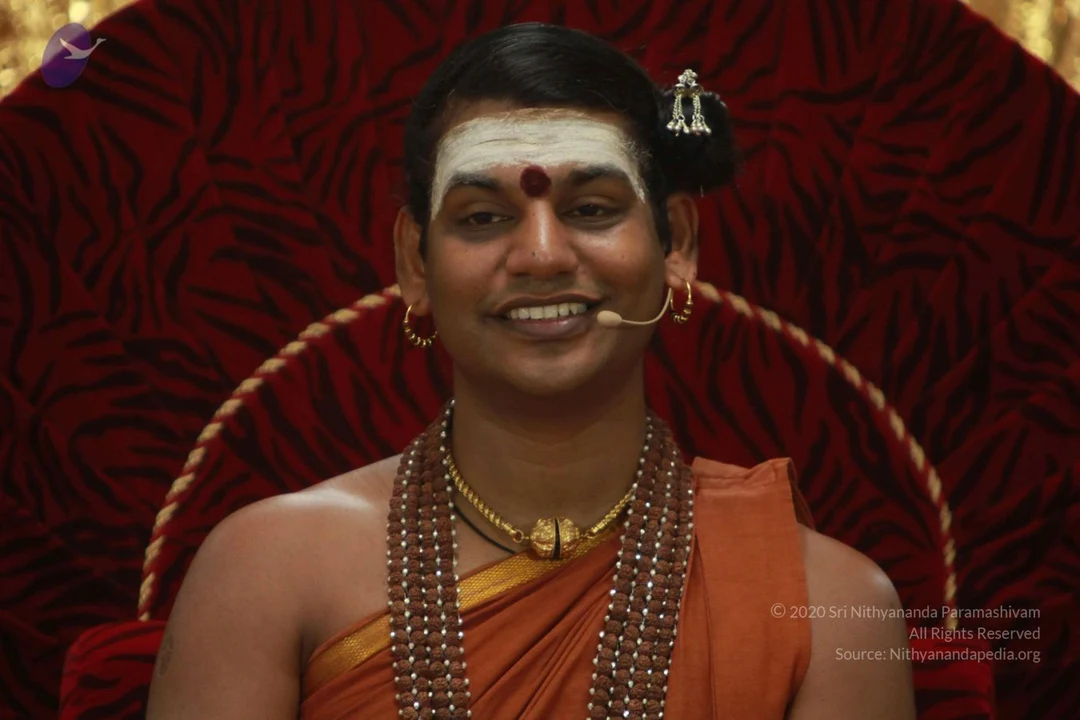
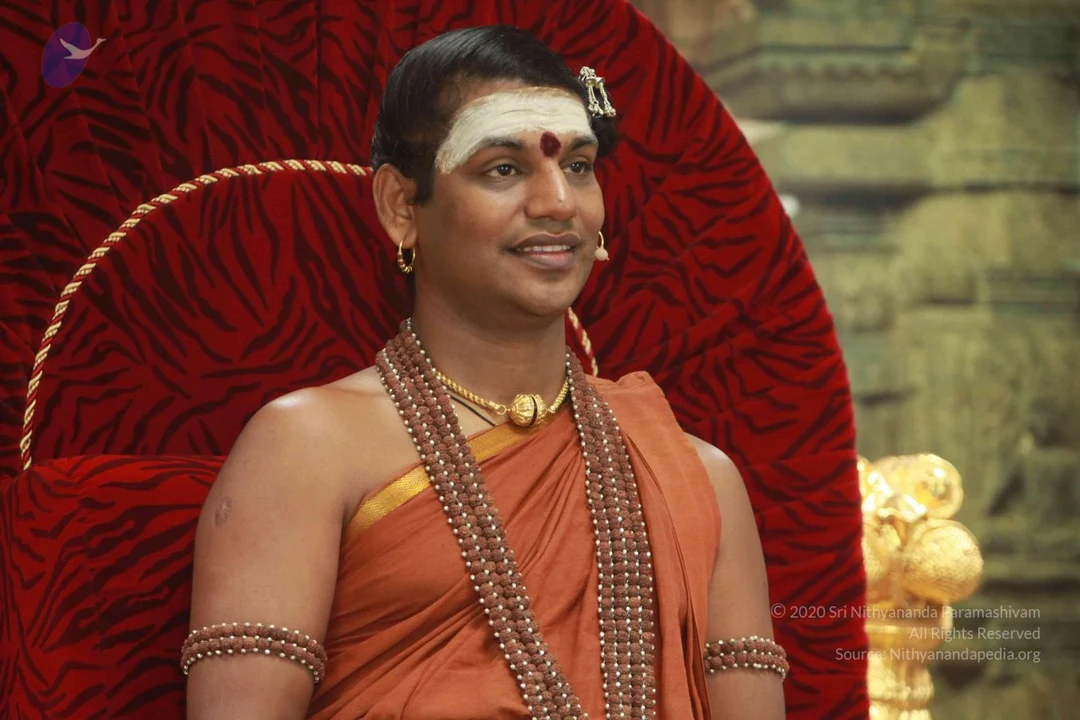
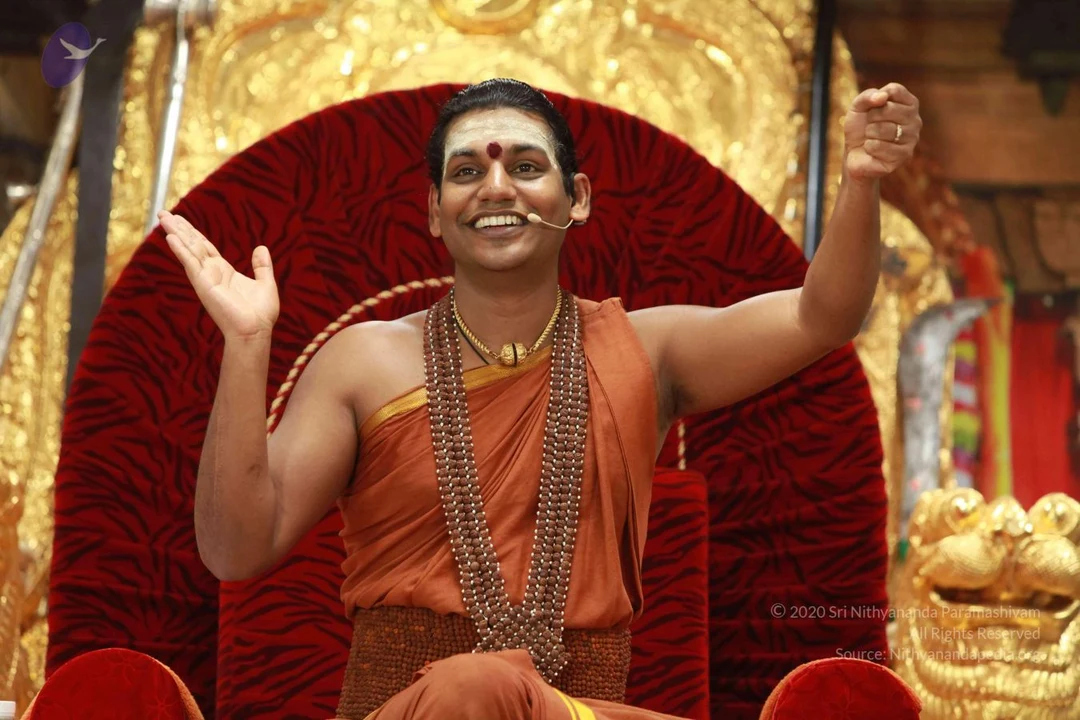
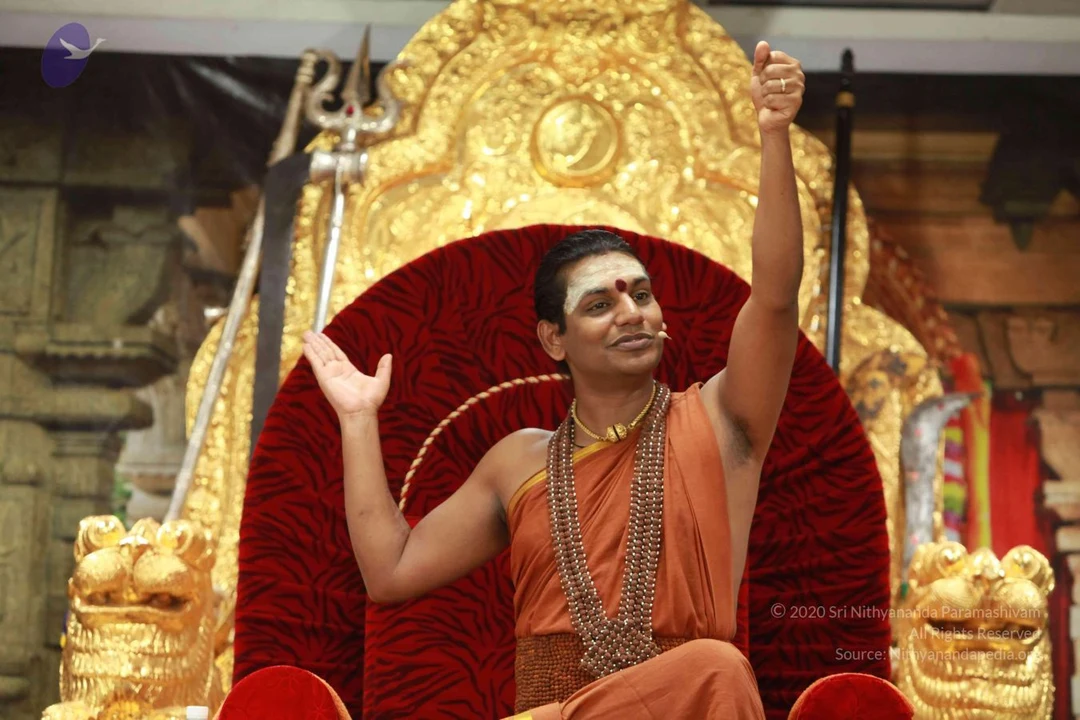
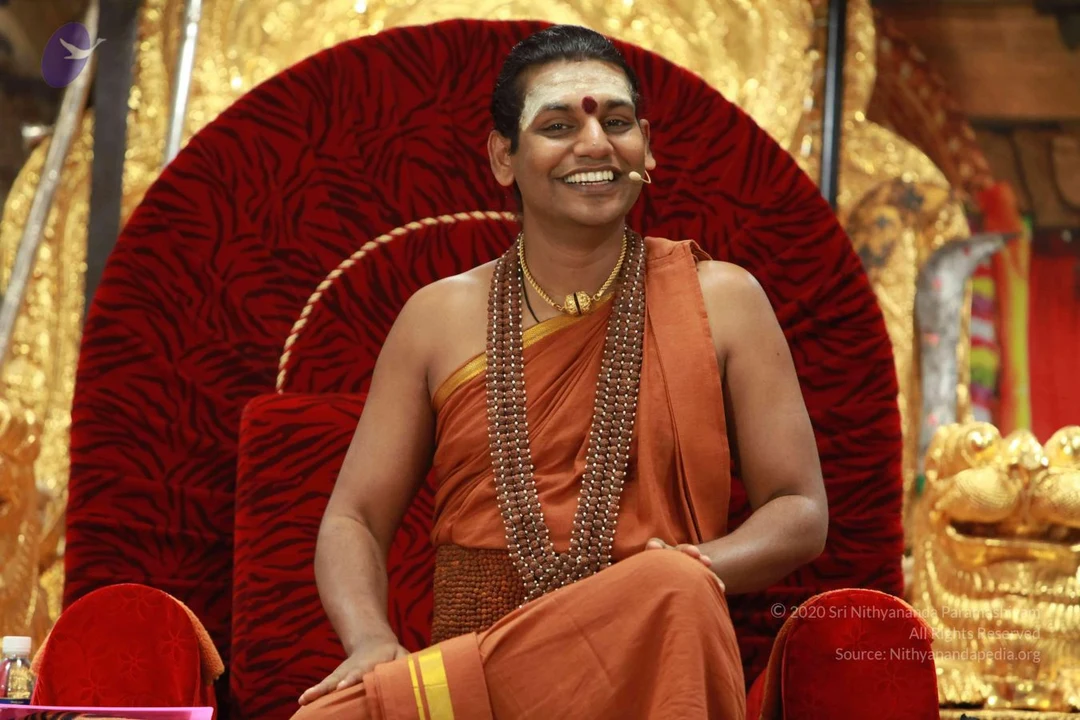
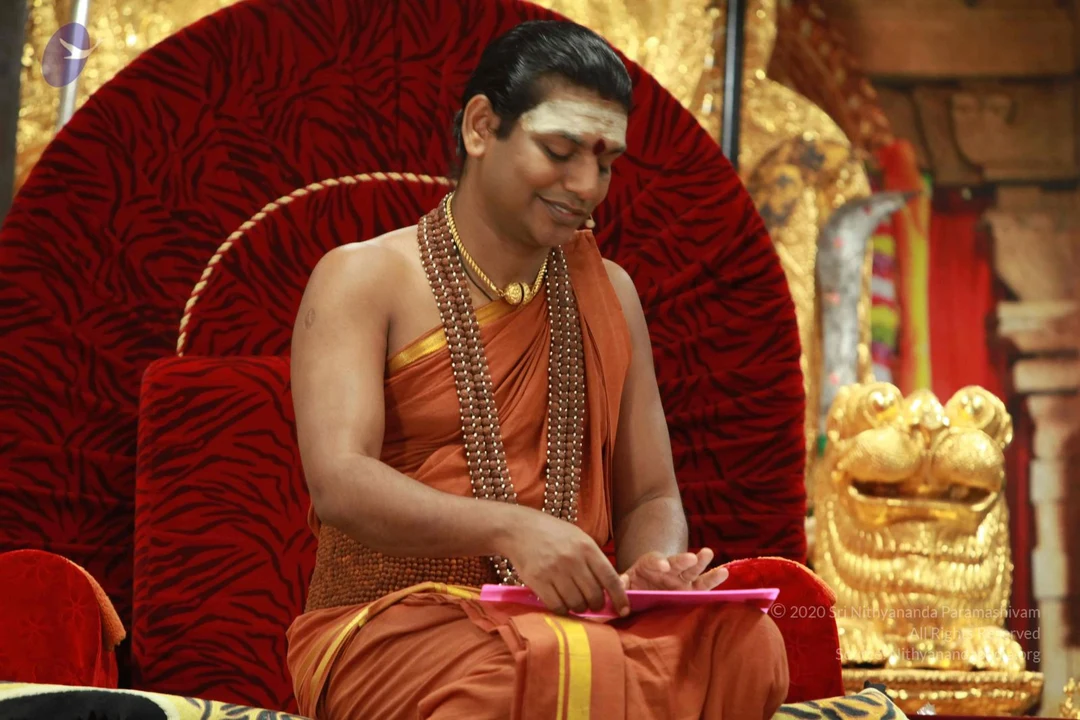
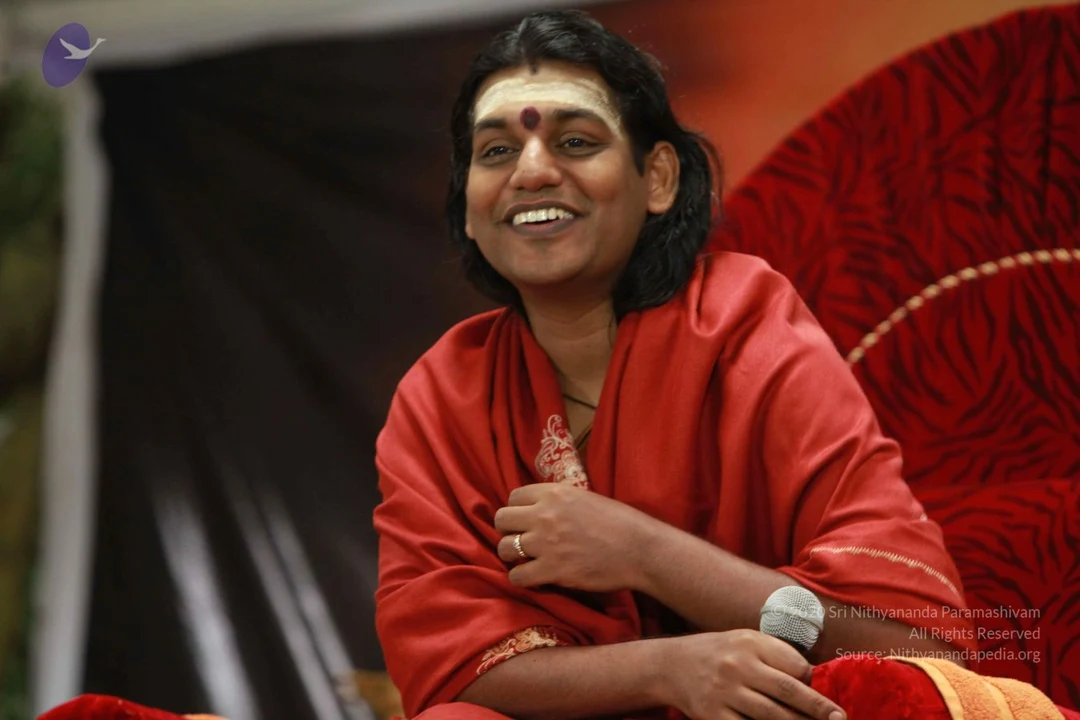
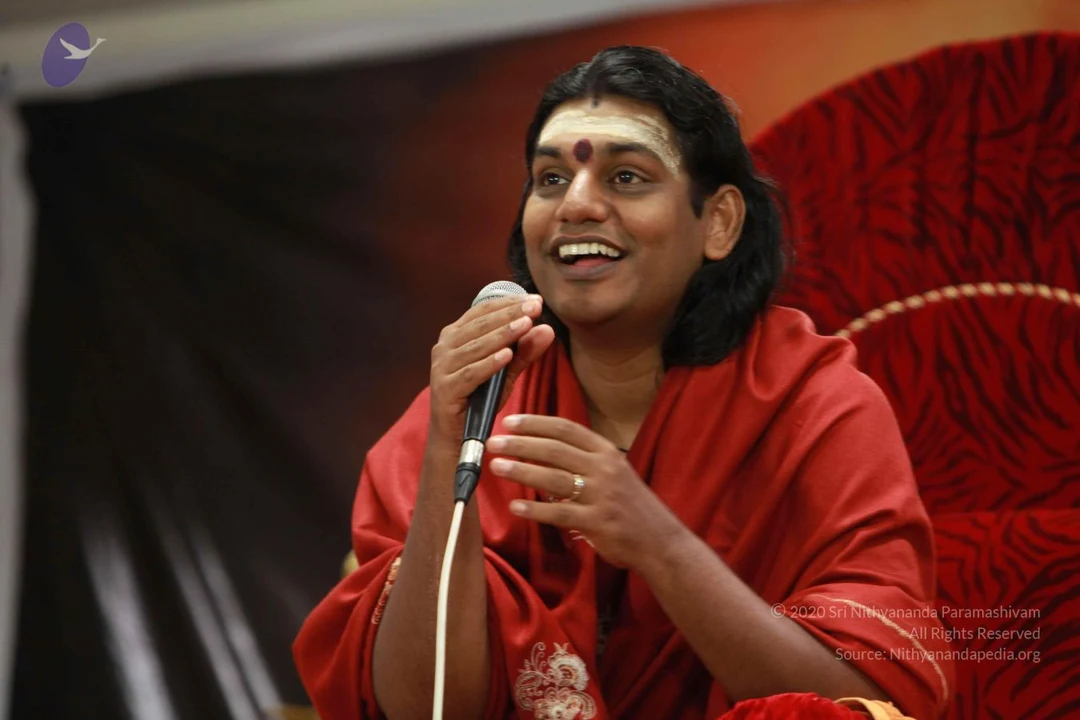
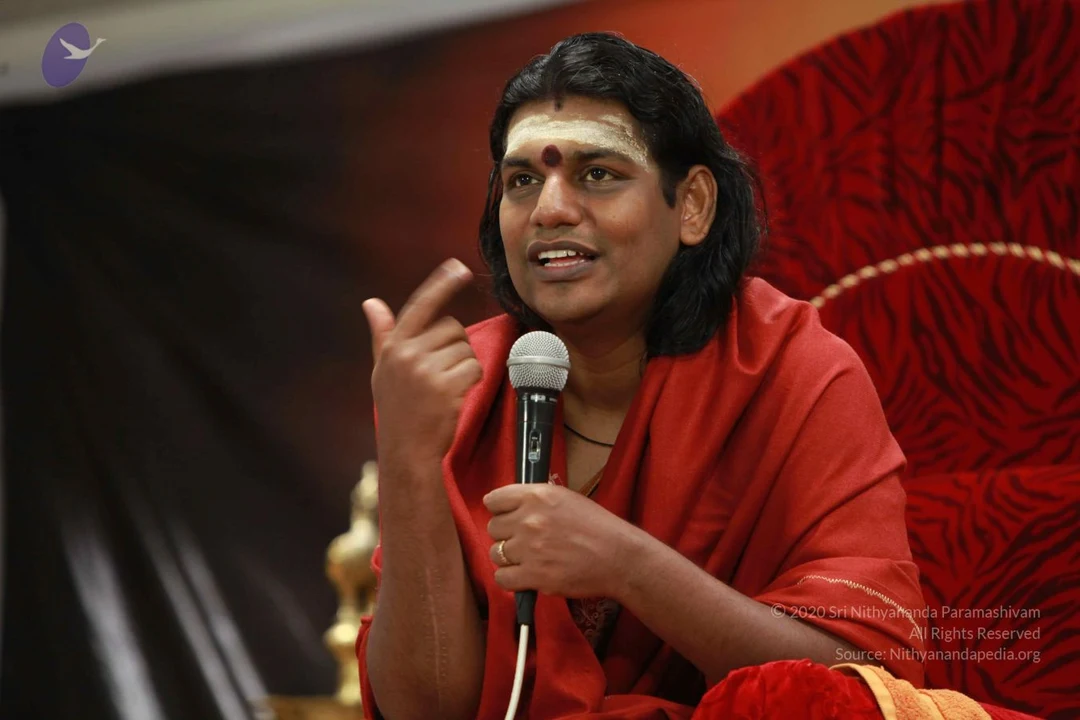
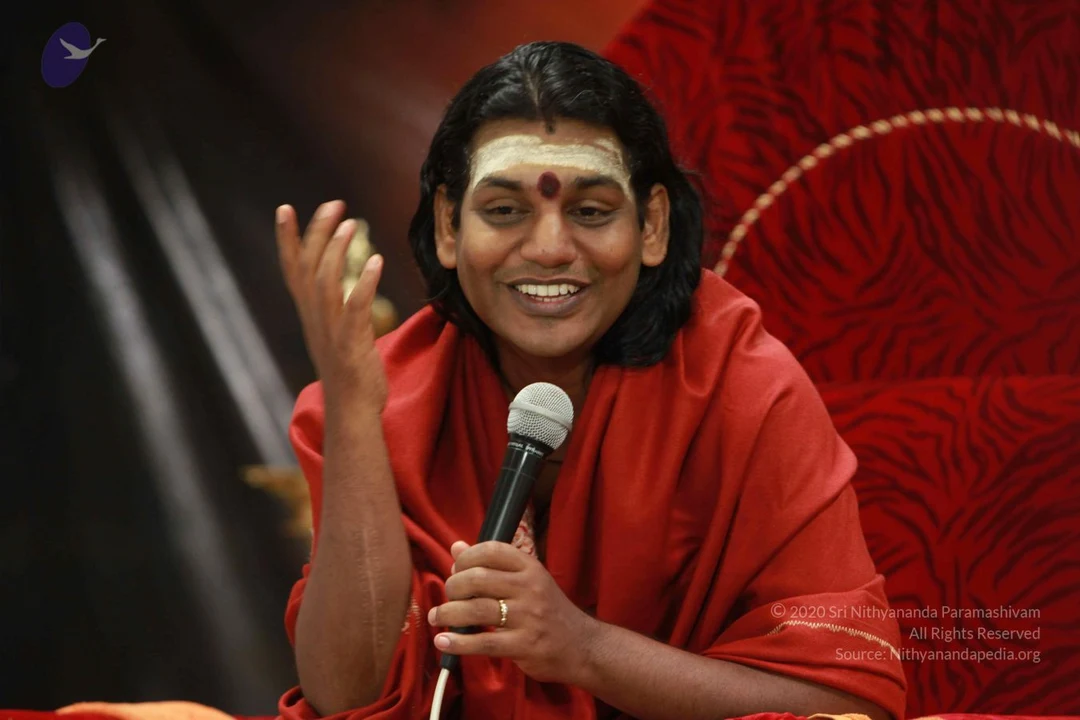
TALKS FROM MORNING SATSANG ON OCTOBER 11, 2012 AT TIRUVANNAMALAI ASHRAM, INDIA In today’s morning satsang, Paramahamsa Nithyananda (Swamiji) reads the Akashic Records on the subject of renunciation. The Records tell us that renunciation is the natural process whereby human beings renew themselves. When attachment takes place it creates an artificial identity: the individual becomes identified with the source of attachment. Shedding this external identity clears the way to enlightenment.

Link to Video:

VideoAudio

Link to Video:

Is Your Past Effecting Your Future? In this excerpt from the Inner Awakening Program conducted on 11 Oct 2012 by Paramahamsa Nithyananda we learn about how our past incompletions can effect the way we make our decisions in the present thus effecting our future life.

VideoAudio

Link to Video:

Freedom From Pain This excerpt has been taken from the Inner Awakening Program conducted by Paramahamsa Nithyananda on 11 Oct 2012. Here you will see Swamiji is taking a session on the issues created by pain pattern and how to recognise it and overcome it.

VideoAudio

Transcript:

AKASHIC READINGS – Renunciation (Part 1) - read through Nithyananda

11 October 2012

Renunciation is nothing but the ability to rejuvenate yourself continuously by dropping the different identities you create for certain purpose, but unfortunately associate yourself with it, feel one with it. Renunciation is of different levels; renouncing the external wealth which you decide to possess and identify yourself with it, renouncing the name and fame with which you identify yourself and possess and feel as one with, renouncing people with which you identify yourself, possess and feel one with, renouncing the identities which you possess and identify yourself and feel one with. Among these renunciations, renouncing the identity is the ultimate renunciation.

Renunciation is the most intelligent thing a living being can do because renunciation continuously rejuvenates and creates a possibility for higher expressions in your being. When the highest expression happens, you cross the border of renunciation and renunciation itself becomes your very being. When your very core becomes renunciation, the constant purification, a continuous intelligence shining becomes your life.

Constantly renouncing thoughts is unclutching, living renunciation as a lifestyle is living enlightenment. Ajapa japa is a powerful way of renouncing the words and thoughts continuously happening in you. Feeling connection is a powerful method to renounce all the emotions which are not necessary happening in you. Unclutching is the ultimate renunciation, renouncing all the identities which are unnecessary happening in you. Renunciation is the ultimate purification process to live enlightenment.

QUESTIONS & ANSWERS

The first question on renunciation we have is from Ravi from Vancouver, Canada: ‘Dear Swamiji, why should one become neutral to physical needs?’

The why do not does not have answer. When the spiritual evolution happens, when spiritual powers are unfolding through your body, becoming neutral to physical needs just happens. As a flow of life this expresses naturally in you.

He is also asking, ‘Isn’t the very creation of male and female and the senses also the gift of Existence?

Existence provides everything including poisons. It is up to you to use what you want and live the way you want based on the goal you want to reach and the purpose you feel as your life’s mission.

‘While savoring the gift of Existence, can’t we achieve the same highest coherence that we can achieve through renunciation?’

Whether you savor or renounce, in the end, only when the identities are renounced highest is achieved. Even what you call as savoring, in the end only when you are able to renounce the identity, the base, ultimate is achieved. Whatever you understand as savoring will not lead you to the ultimate and whatever you understand as savoring will not lead you to achieve the ultimate truth. Whether you live with it or leave it, identity needs to be dropped. Only when you renounce the identity ultimate is achieved. If you can renounce the identities, even if those things are around you, you will achieve the ultimate. If you can’t renounce the identity, even if you physically move away from those things you may not be able to achieve the ultimate. Finally everything boils down to renouncing the identities.

‘The next question is from Sri Nithya Gnanaprabhananda: ‘What is the true meaning of renunciation in the path of sannyas?’

Renouncing all the outer world objects, which you feel as your possession become one with it out of your delusion, renouncing all the people, renouncing all the places, renouncing all the pleasures, renouncing all the thoughts, renouncing all the identities; renunciation in its complete pure form is sannyas. The sannyas, even the training of the sannyas done by an incarnation constantly reminds you into the renunciation and puts you in renunciation.

The next question is from Joyce: ‘How are freedom and renunciation related?’

Renunciation is freedom, freedom means renunciation.

The next question is from Estelle Reiter from France: ‘Dear Mahadeva and Kalabhairava, dear Master, I listen to many of Swamiji’s videos and I realize that I have a deep misunderstanding about renunciation and so many questions are coming up. How do I know whether my bio-memory is ready for renunciation?’

All bio-memories by nature programmed for renunciation. It is your mind which goes against the renunciation, creates more and more troubles and identities, misconceptions. If you allow your bio-memory to function in a free natural way, you will not over-eat, you will not over-see, you will not over-enjoy, you not indulge in anything. As a natural flow you will renounce. Renunciation is way of life, flow of life as per cosmic law.

She is also asking, ‘Does it necessarily involve spiritual celibacy?’

Celibacy means just keeping yourself physically mentally emotionally away from lust. The renunciation in the ultimate sense is keeping yourself away from identities. If lust is going to awaken certain strong identities in you, keeping away from that identity is renunciation. If keeping away from the lust physically mentally emotionally helps you to be away from the identity, then that path can be used as a method to renounce the identity. But ultimate is renouncing the identity. If you think by keeping yourself physically away the identity is not disappearing, it is only becoming more and more strong getting strengthened, then going through the lust and transforming it into love, the pattern out of which you can easily unclutch and renounce and evolve and be free, can be evolved. It is like diluting the strength of the patterns. Lust is too strong pattern. If you can go into it and go through it with awareness, the patterns gets diluted. The influence of that pattern over you gets reduced. Then it flowers into love, then that pattern by nature is very simple, does not have too much power over you. You can easily move to the next level - patternless renunciation, full blown being, fully flowered enlightened being.

She is also asking, ‘What is a spiritual couple?’

There is no such thing as spiritual couple in cosmic law. Spiritual means all alone by yourself. Two spiritual beings does not make spiritual couple. They only make two spiritual beings.

The next question is from Mahanand Mrityunjay from Bangalore: ‘Swamiji pranam, which one is a true and real renunciation to be practiced – a) mental level renunciation b) physical or material renunciation?

If you are established in the material level, if your mind identify itself constantly in material level, material level renunciation also should be practiced. If you are established only in mental level, mental level renunciation is enough. But mental level renunciation is necessary for everyone. Material level renunciation can be decided based on the level in which you are established.

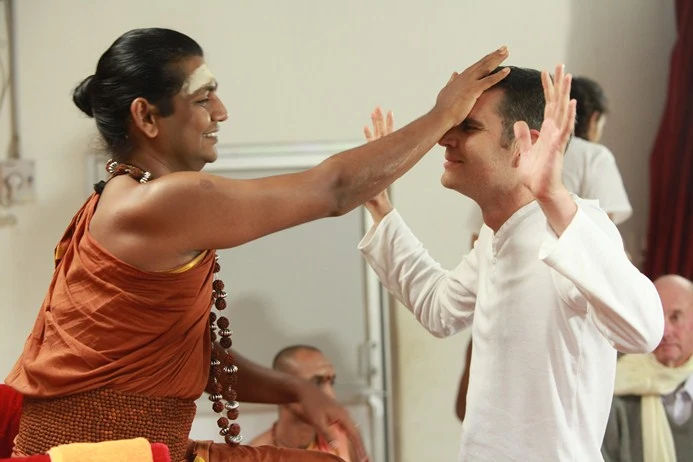
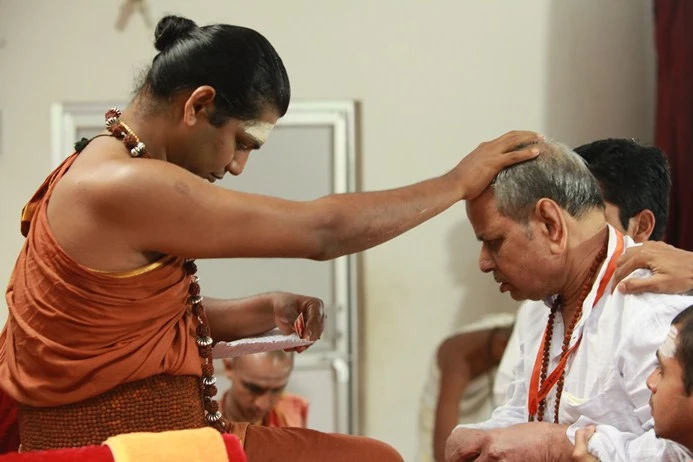
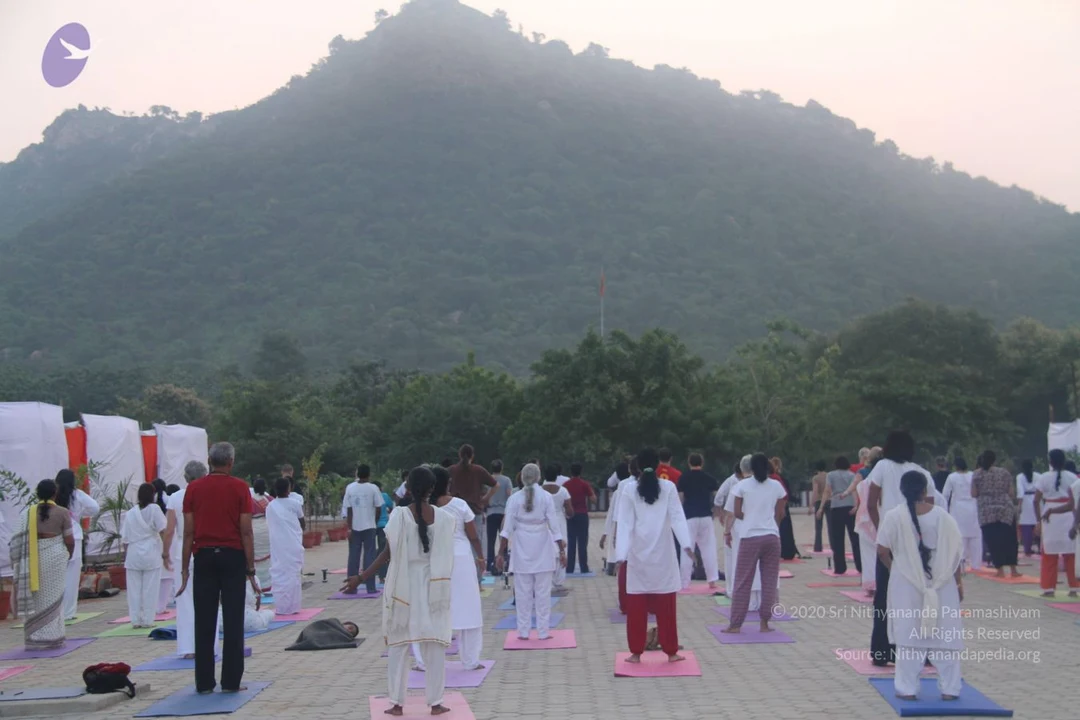
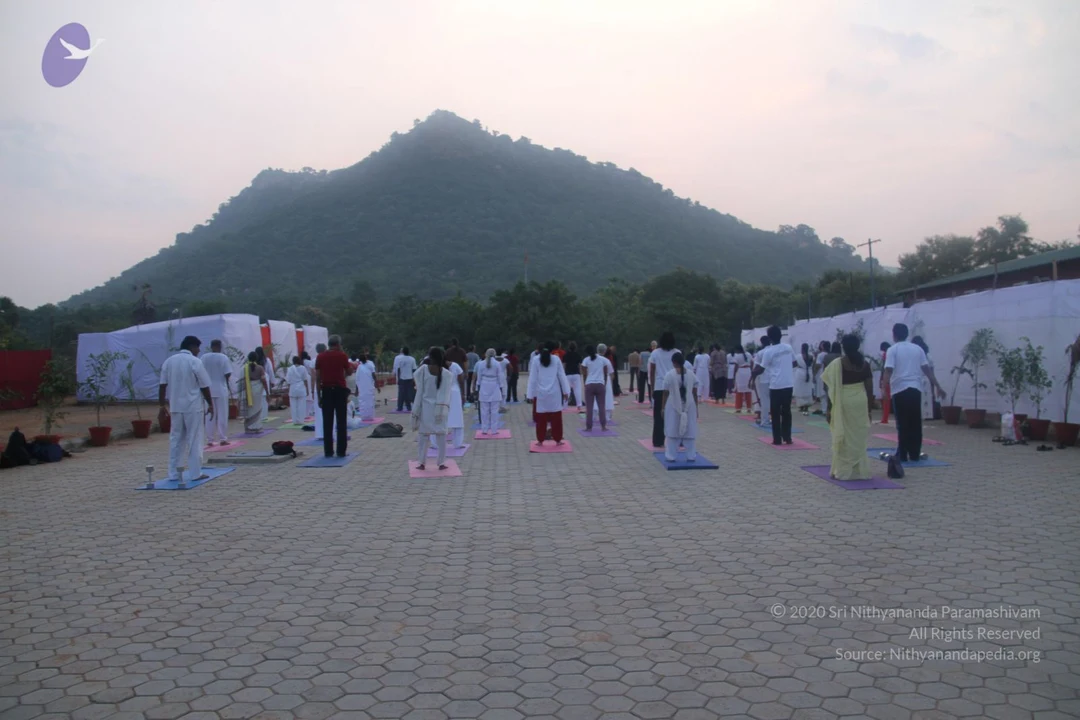
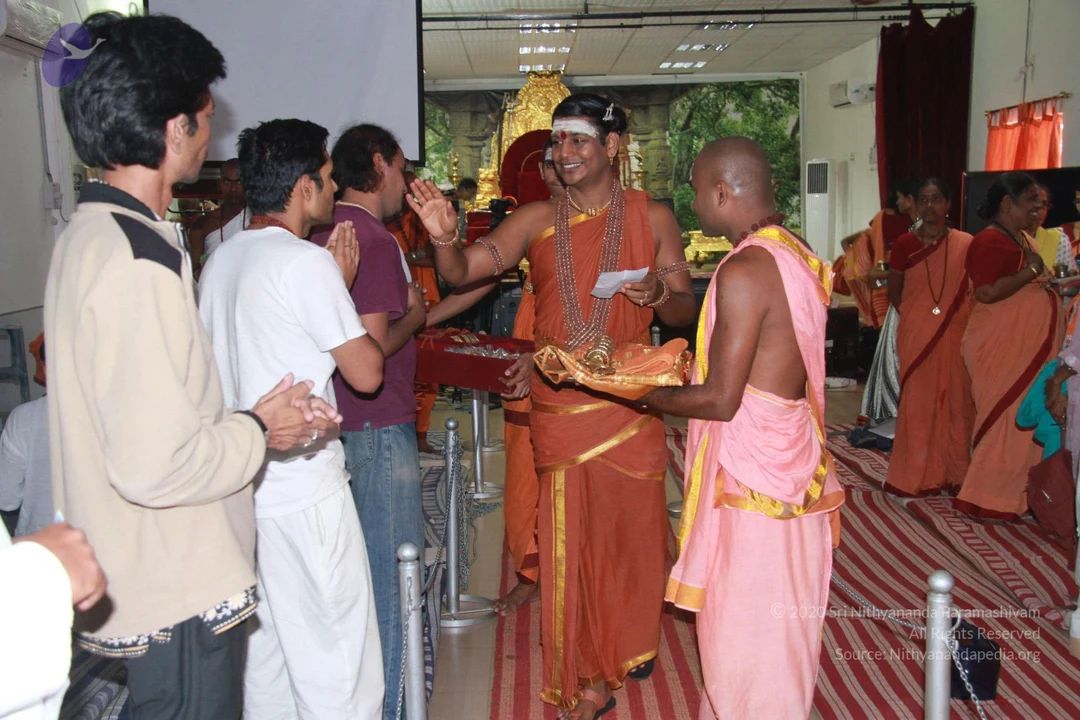
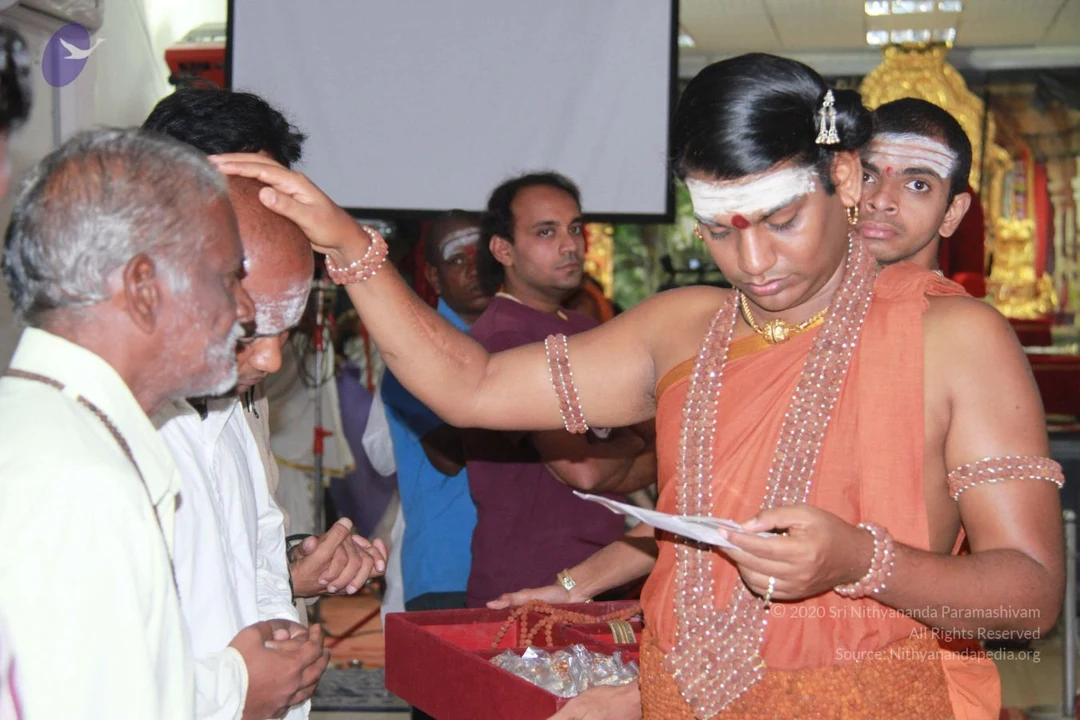
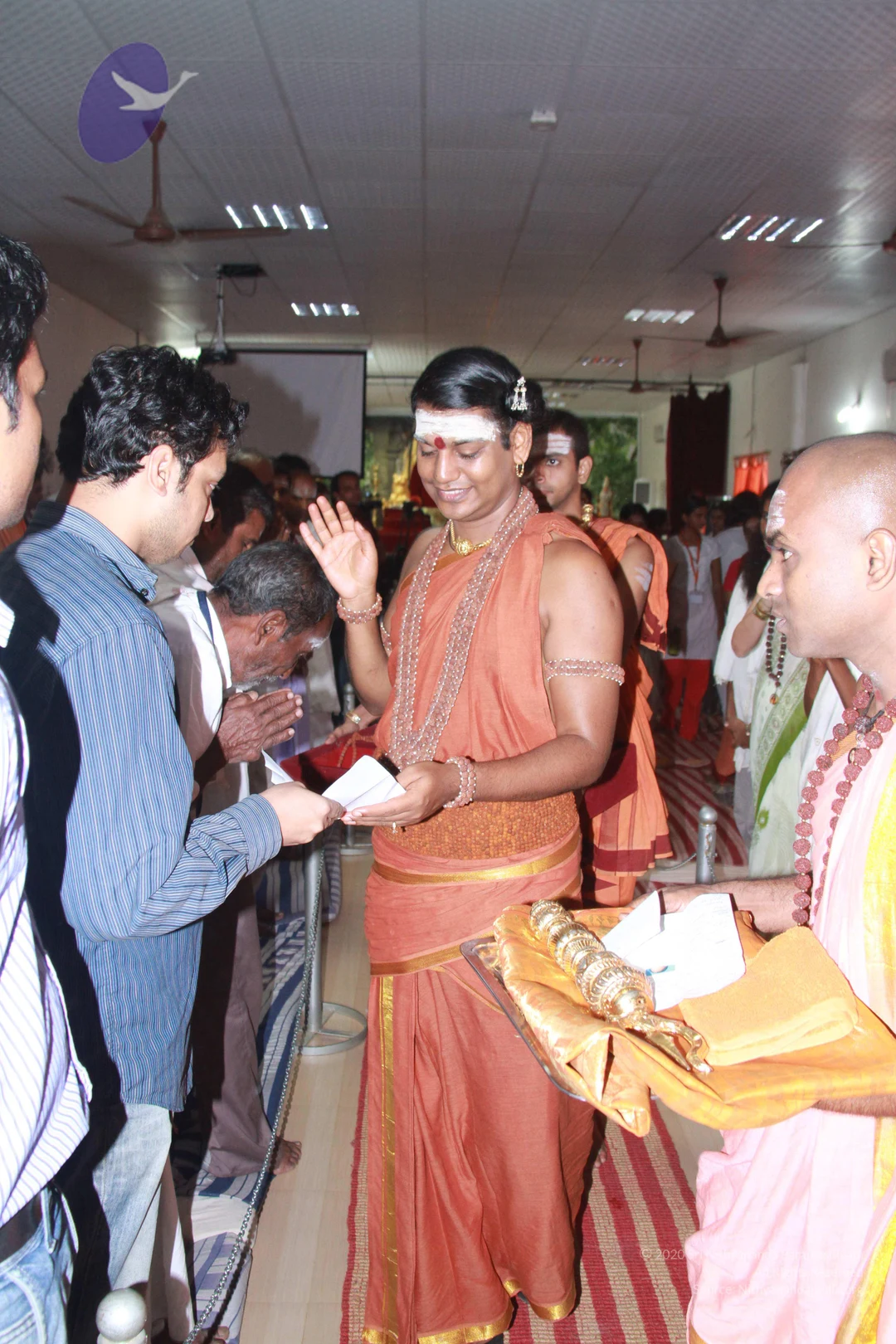
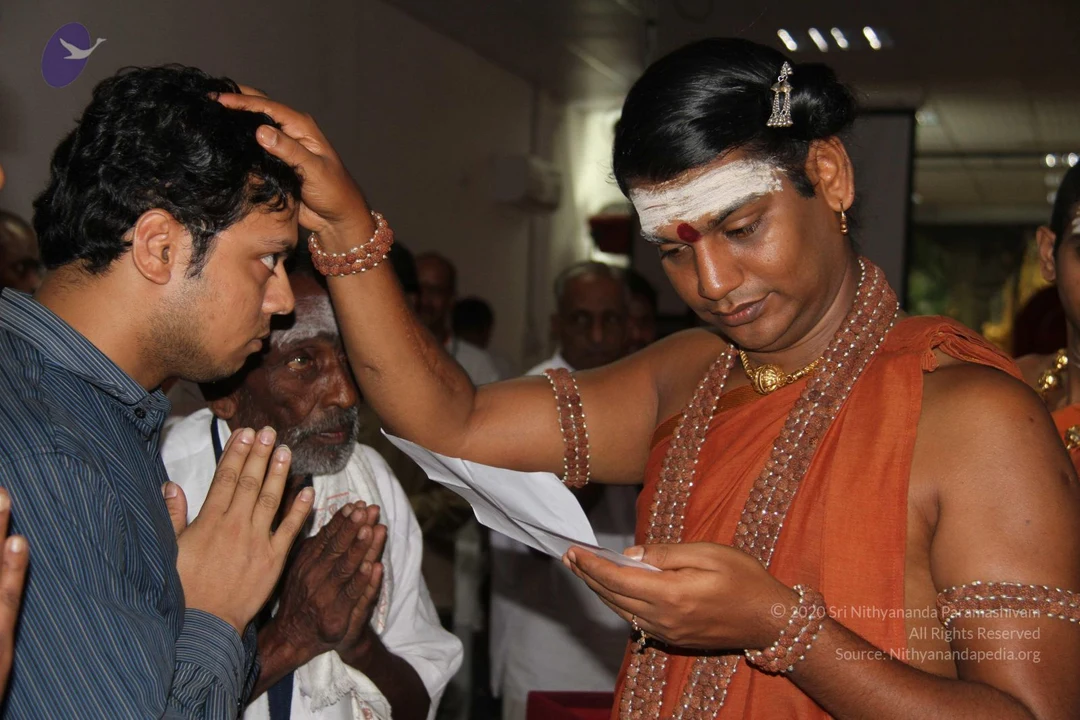
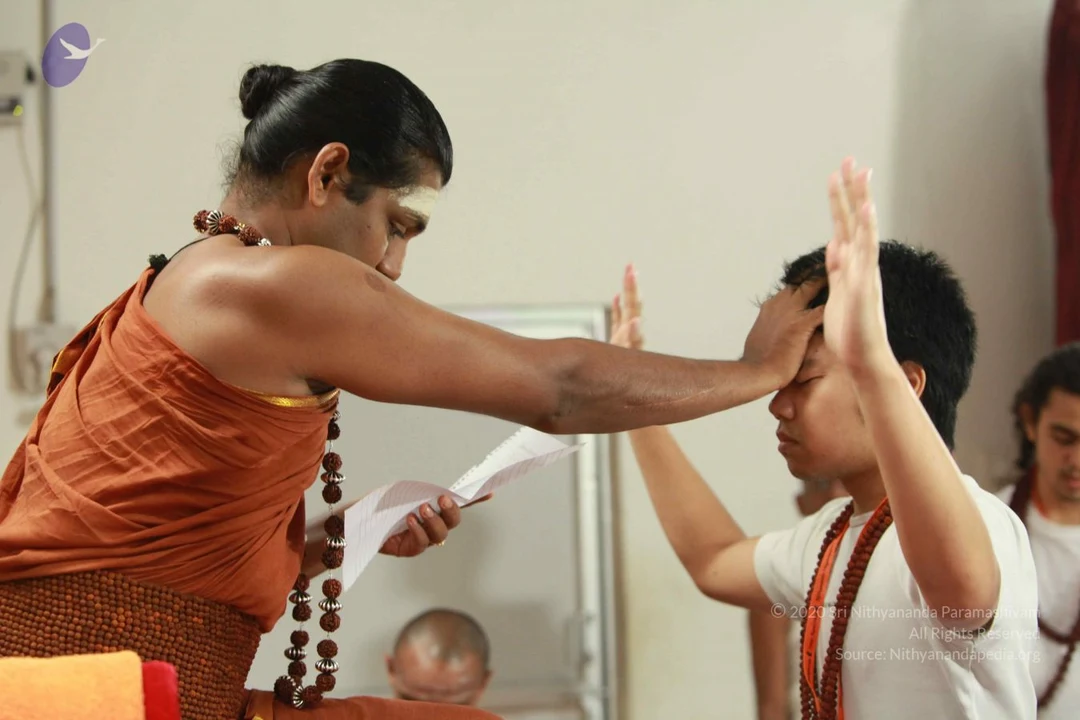
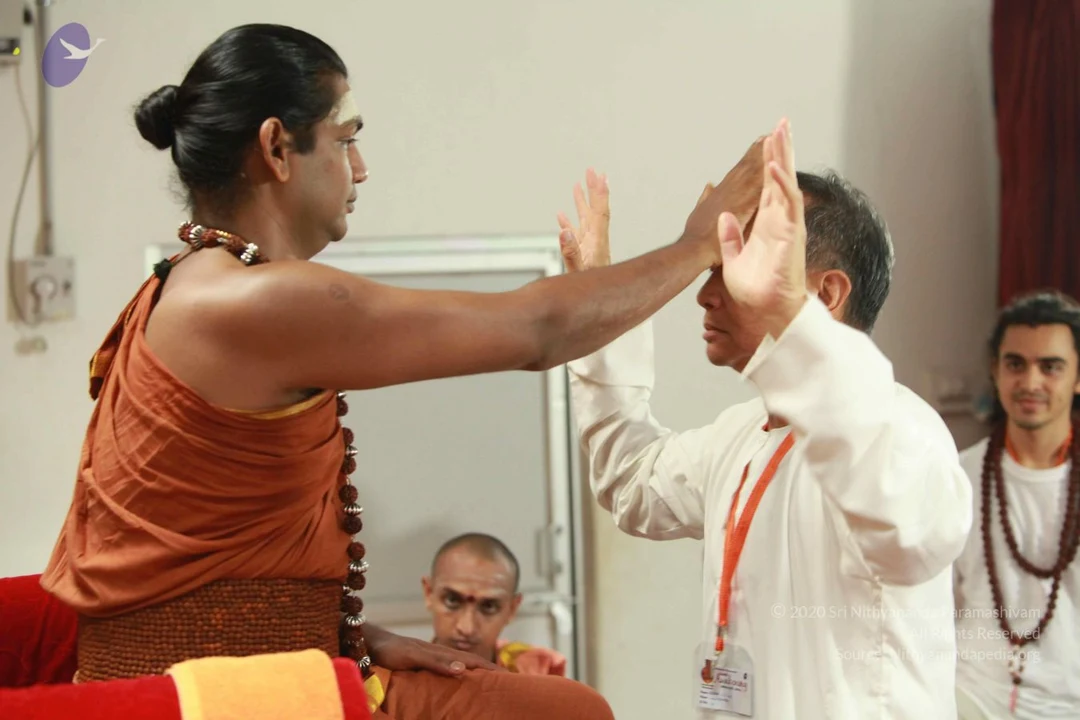
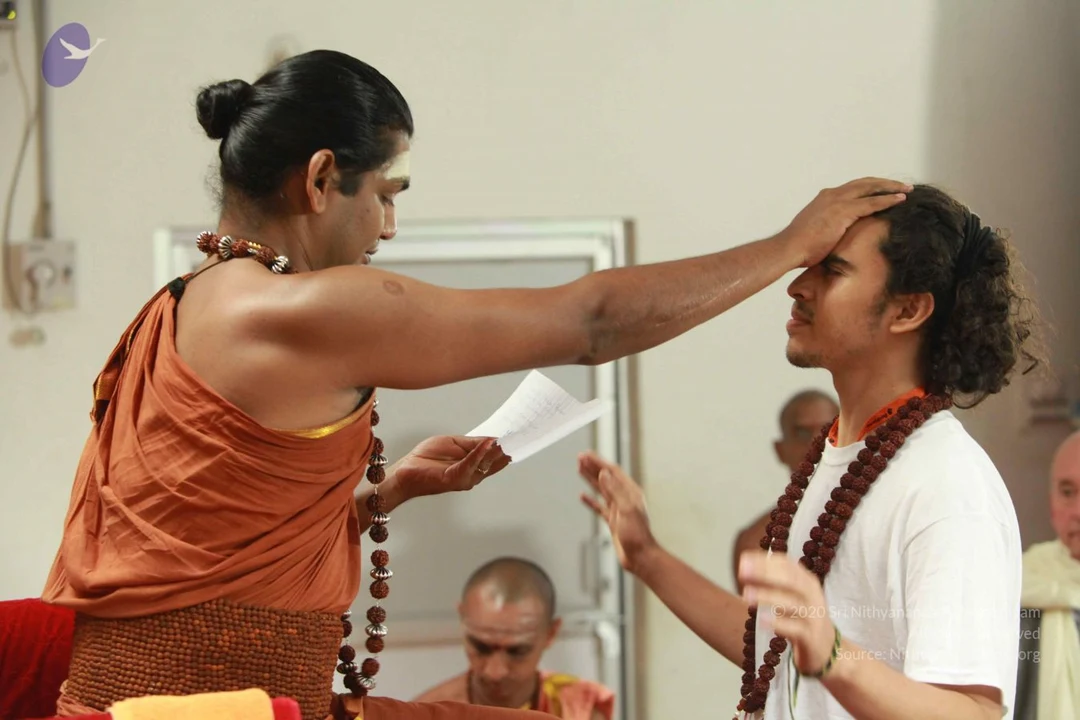
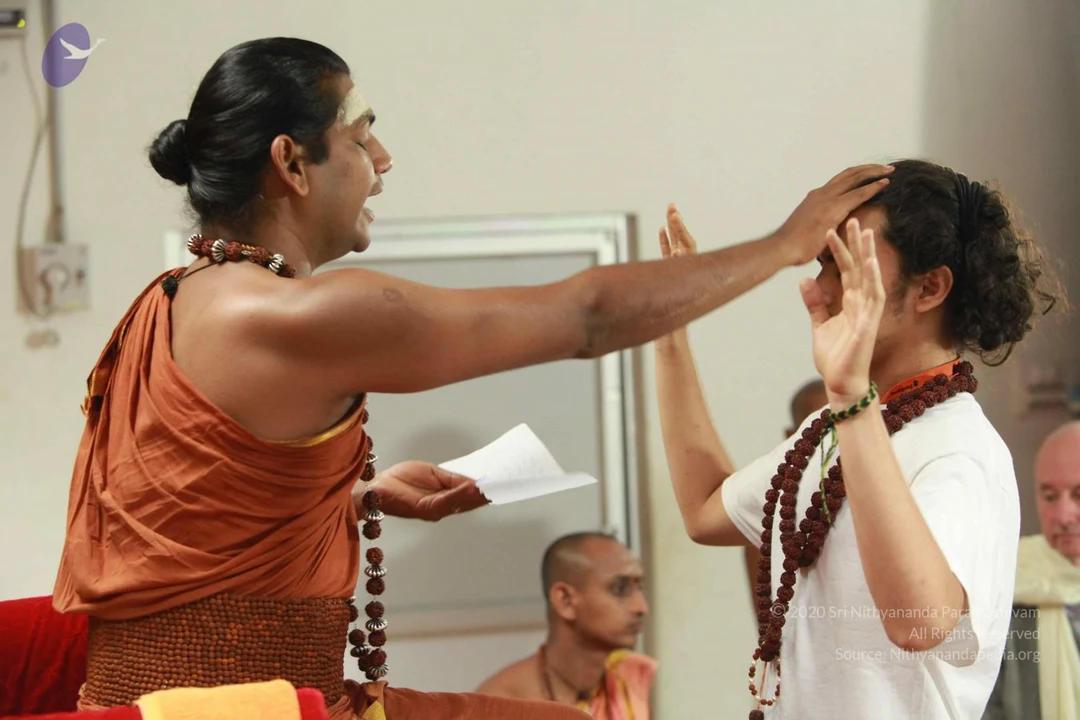
Photos From The Day:
Tags:

Paramahamsa Nithyananda, Akashic Records, natural, human beings, renew, attachment, identity, individual, enlightenment.

Photos Of The Day:

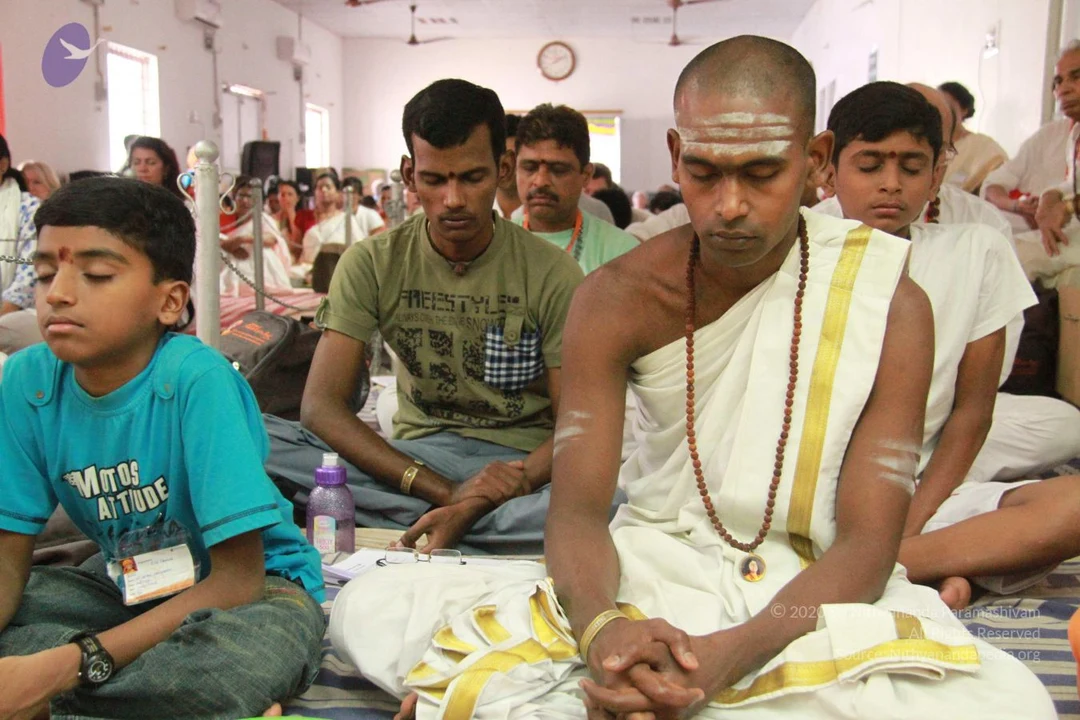
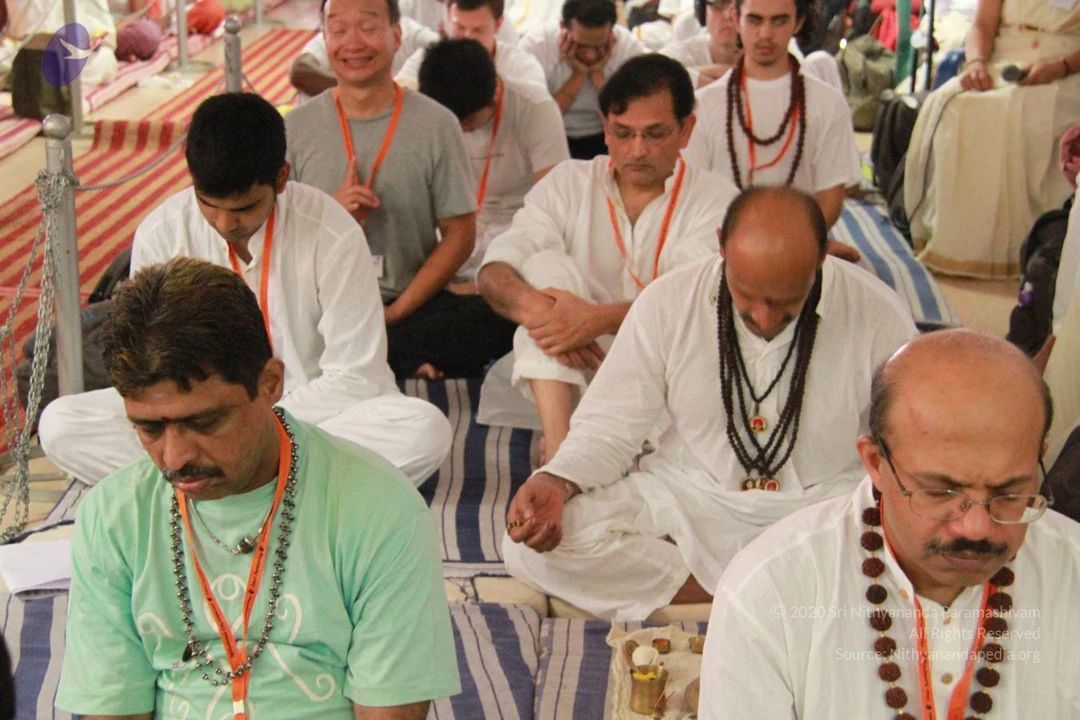
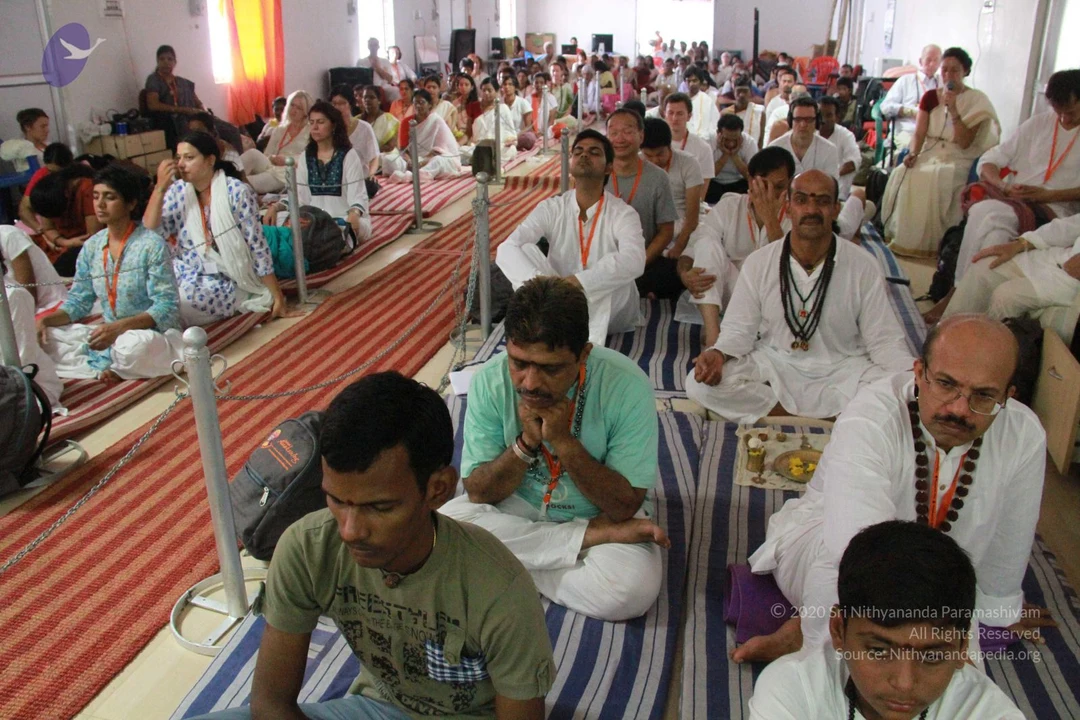
Morning-Satsang
Swamiji-Photo-Shoot

Session-On-Pain-Samaskaras

Swamiji-With-The-Samyama-Participants

eNGenius-and-Aarathi

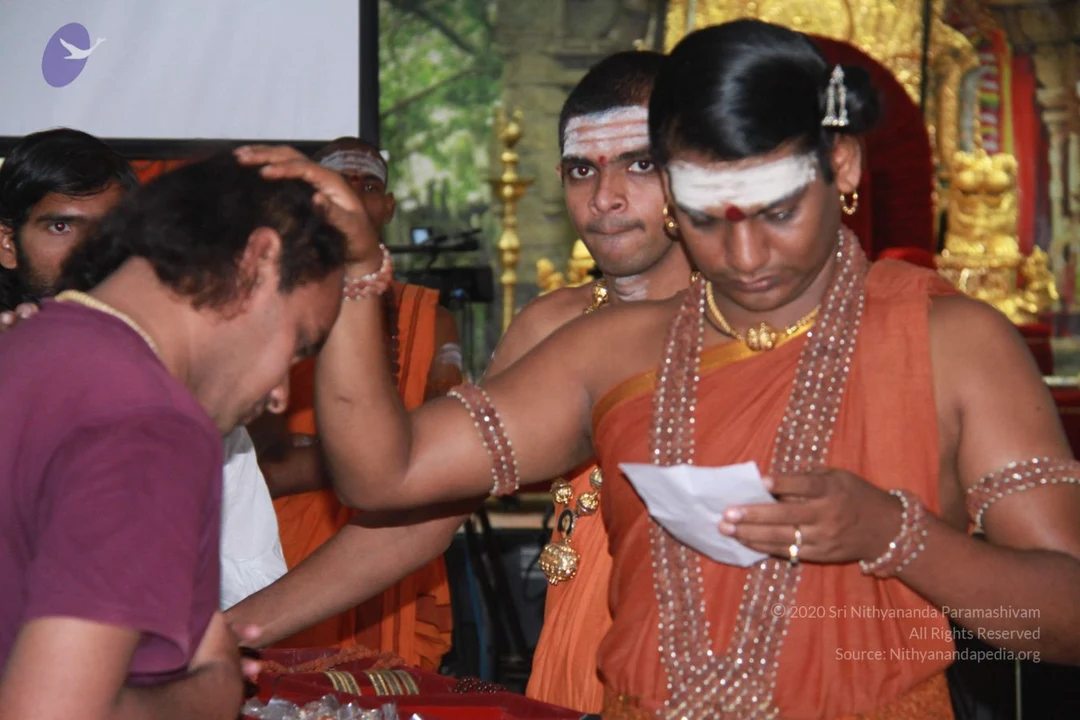
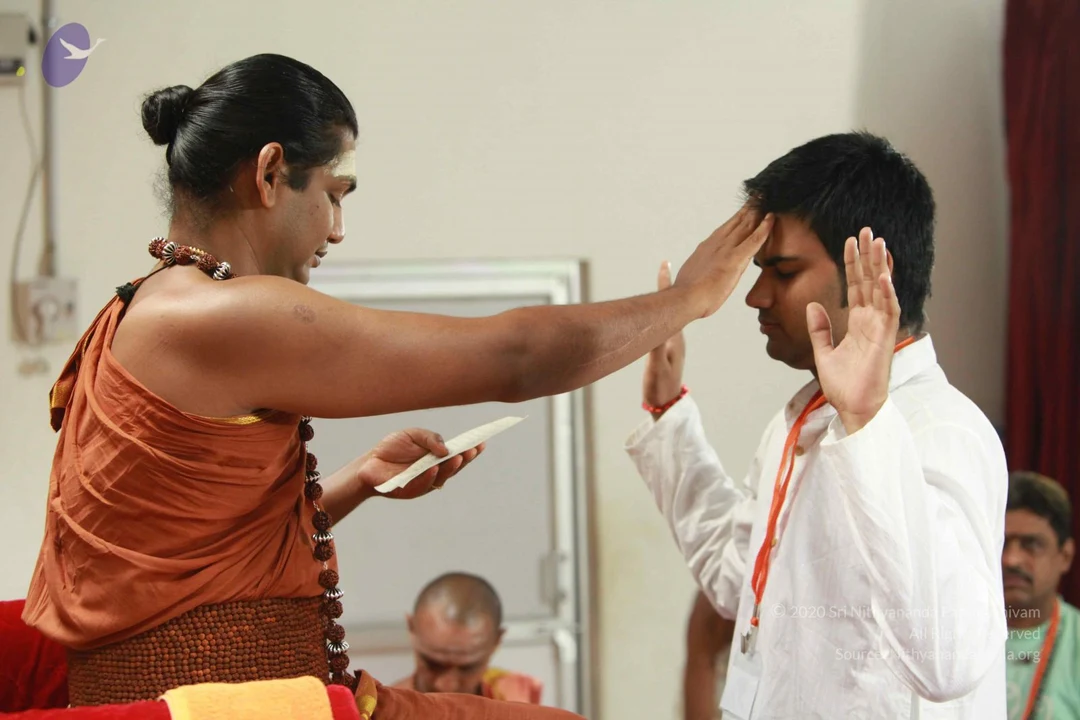
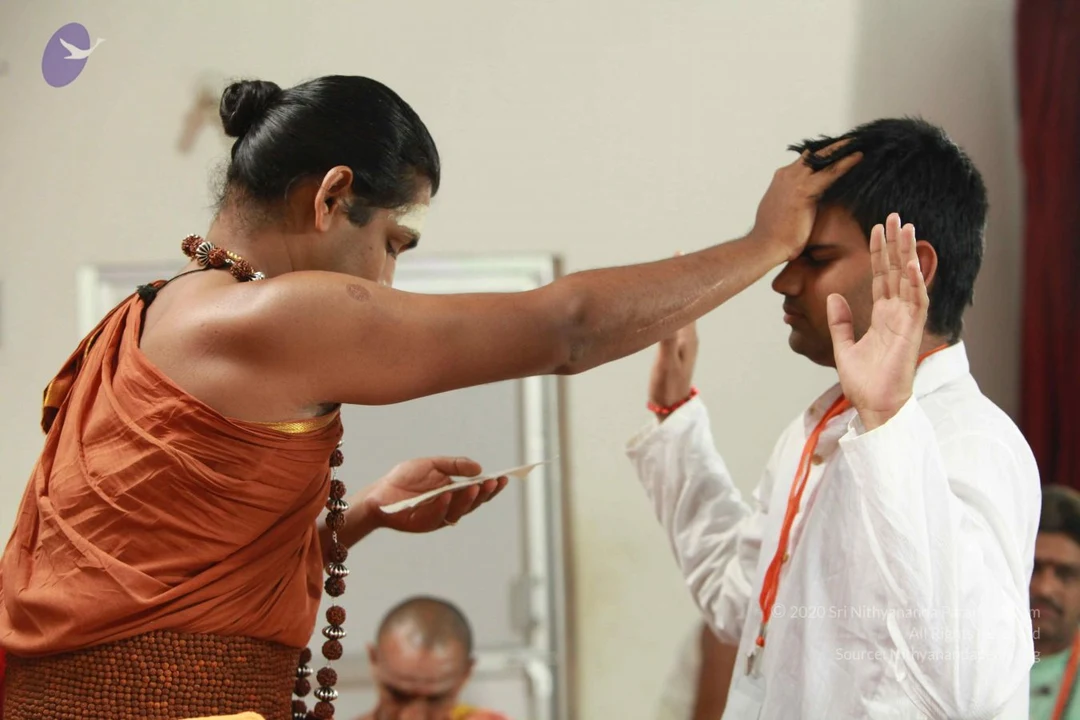
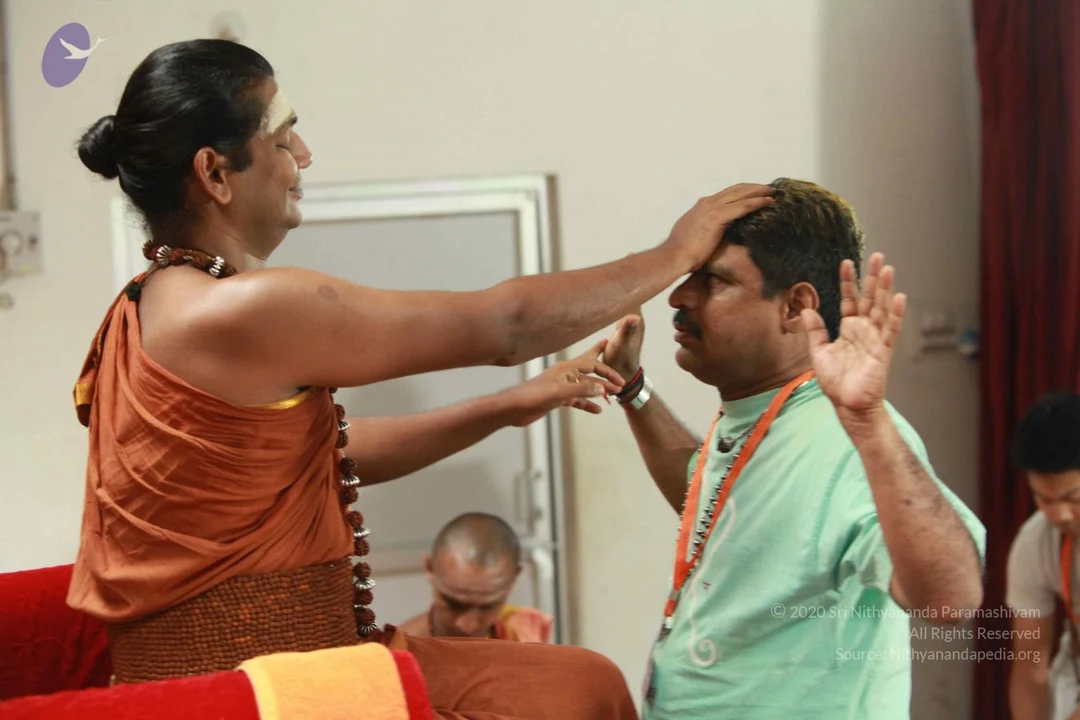
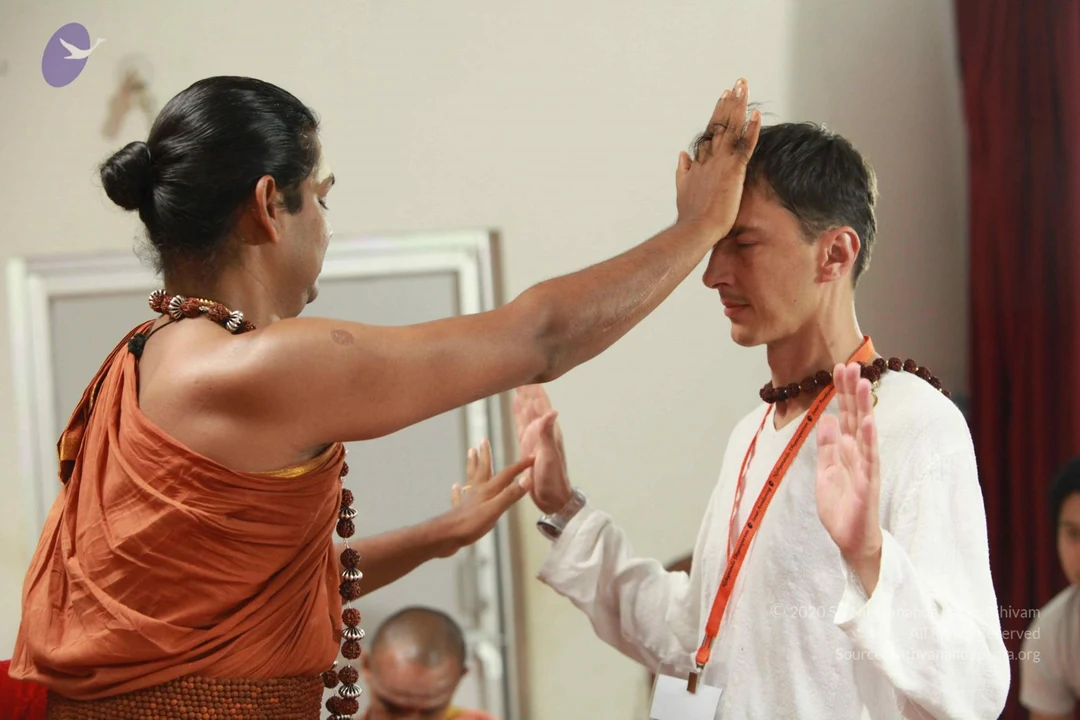
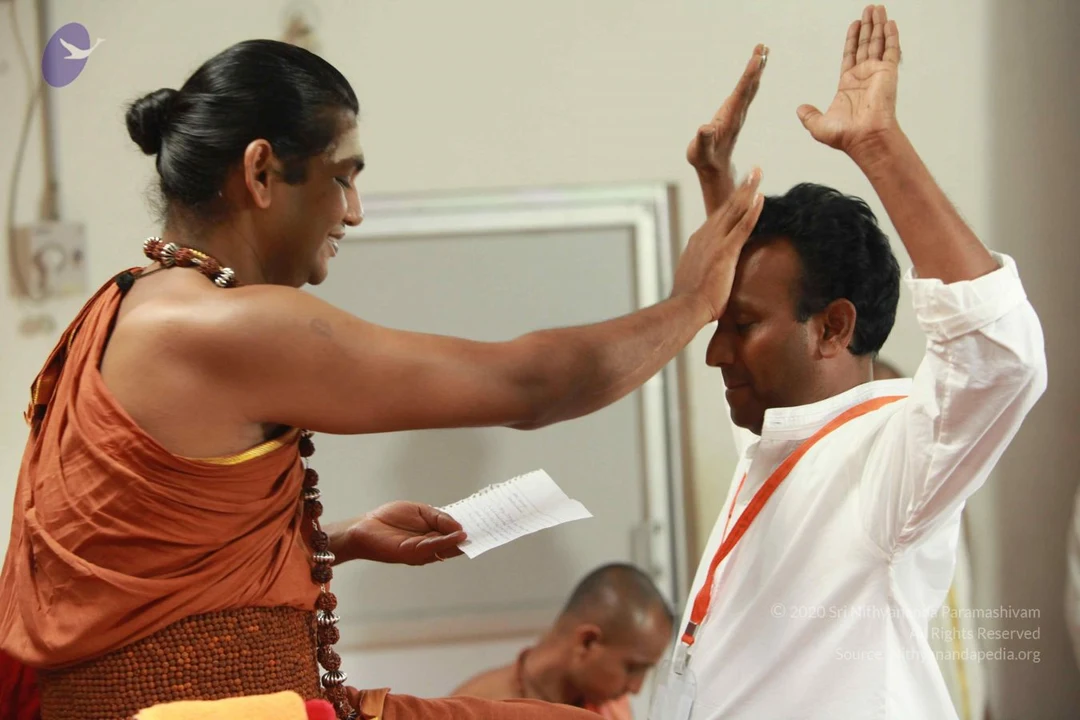
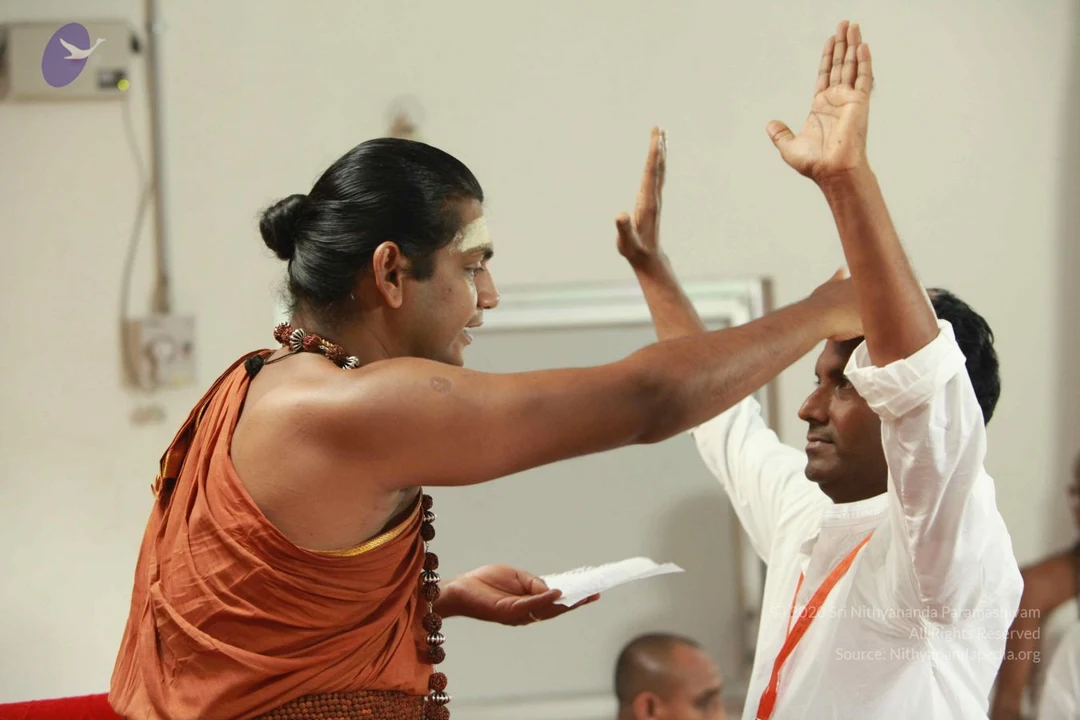
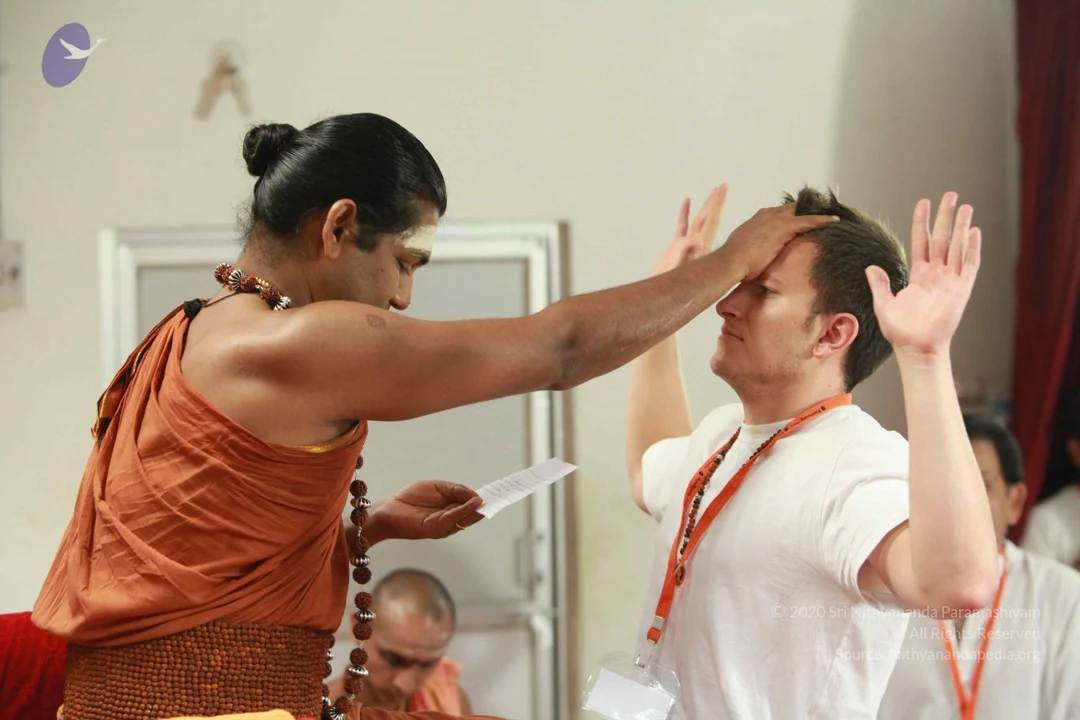
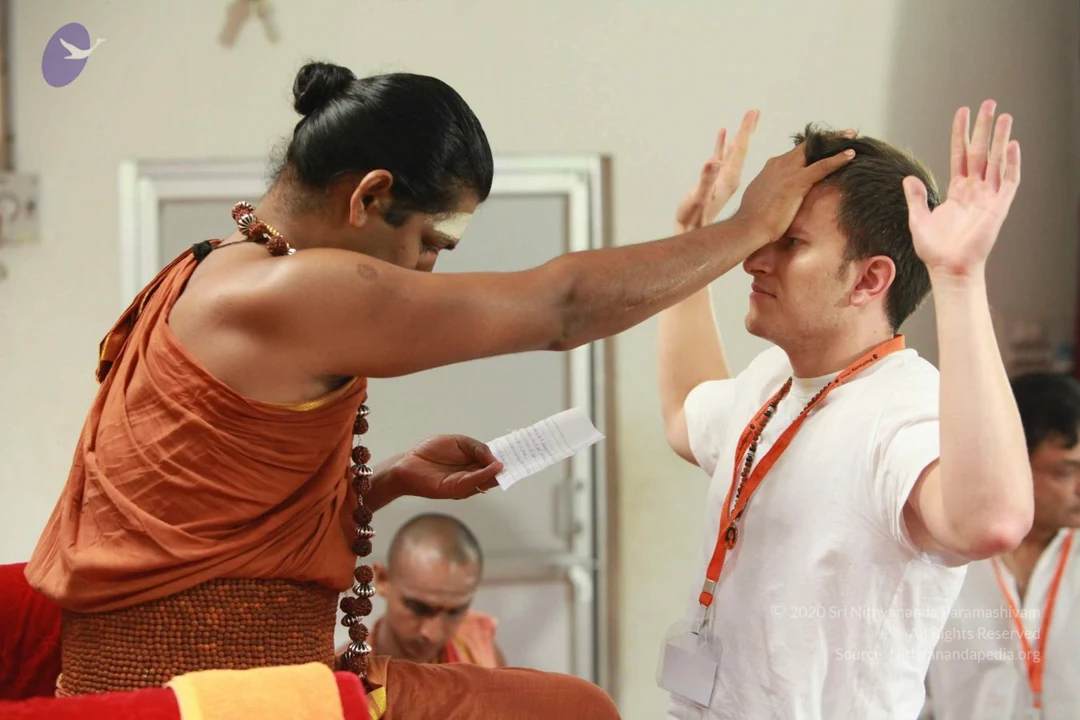
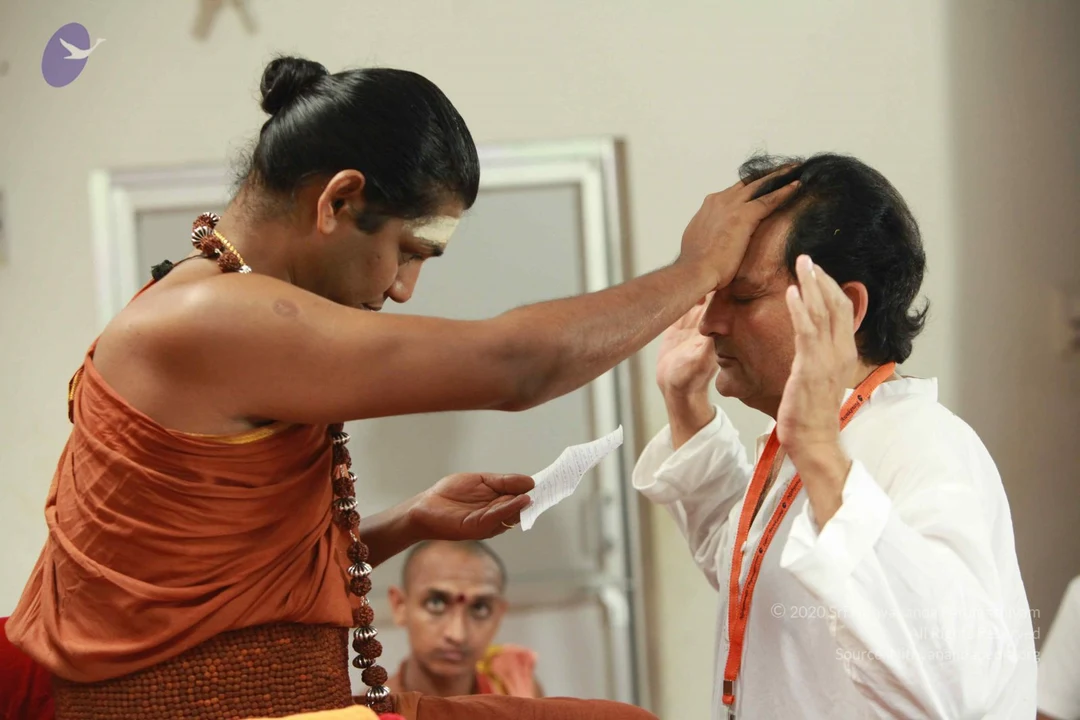
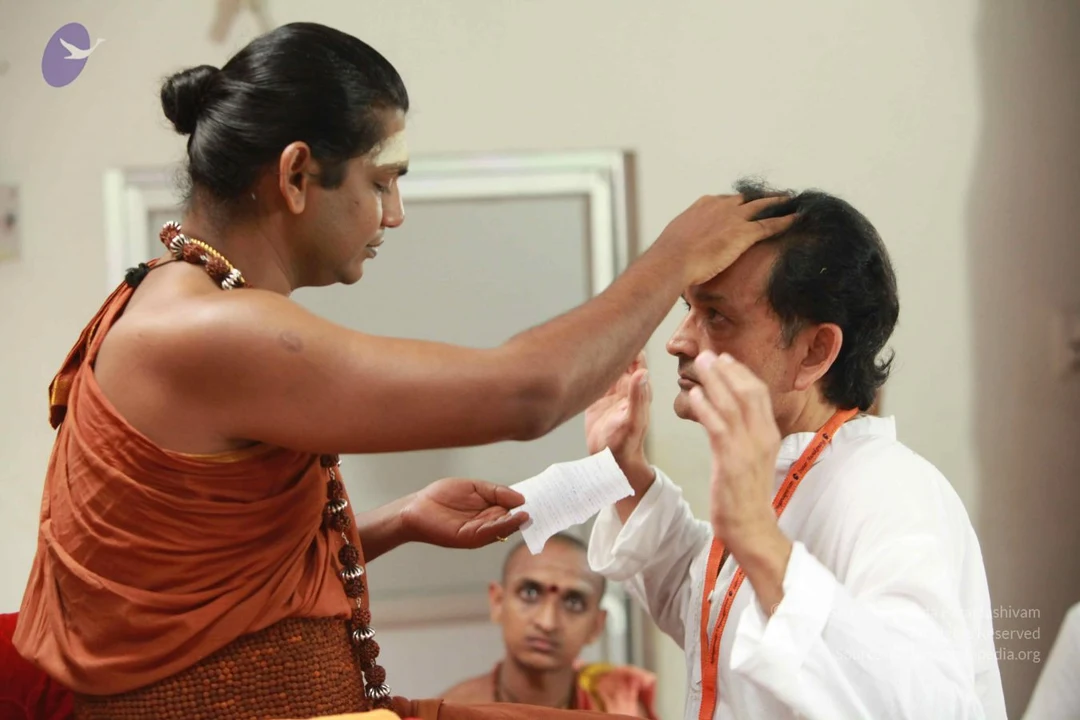
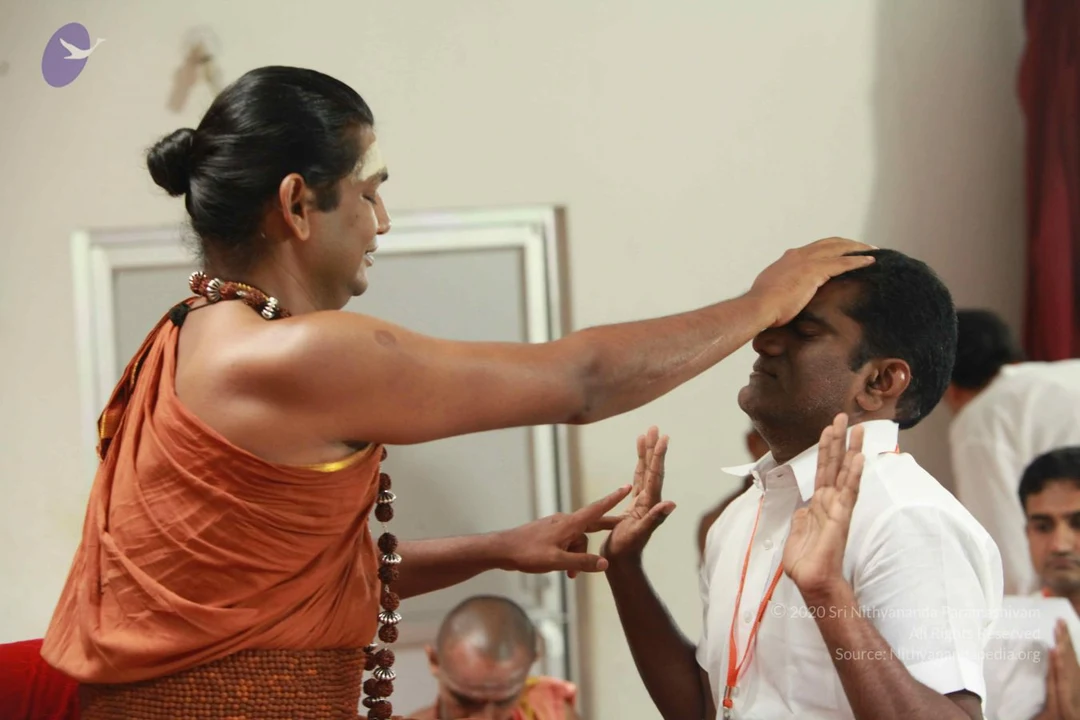
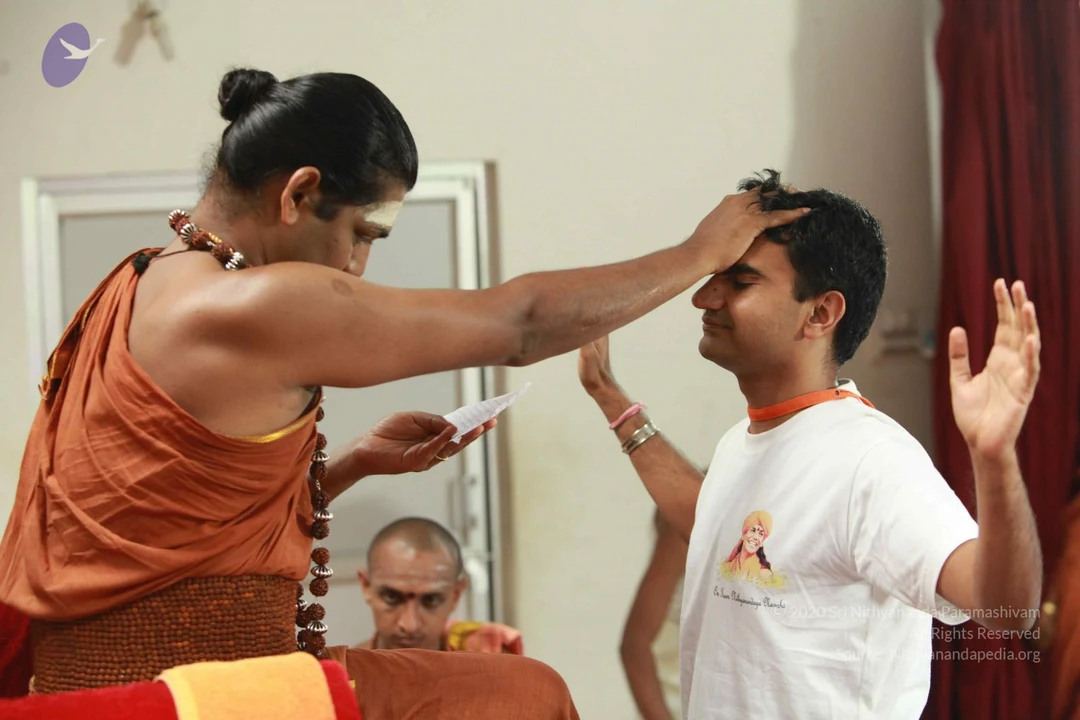
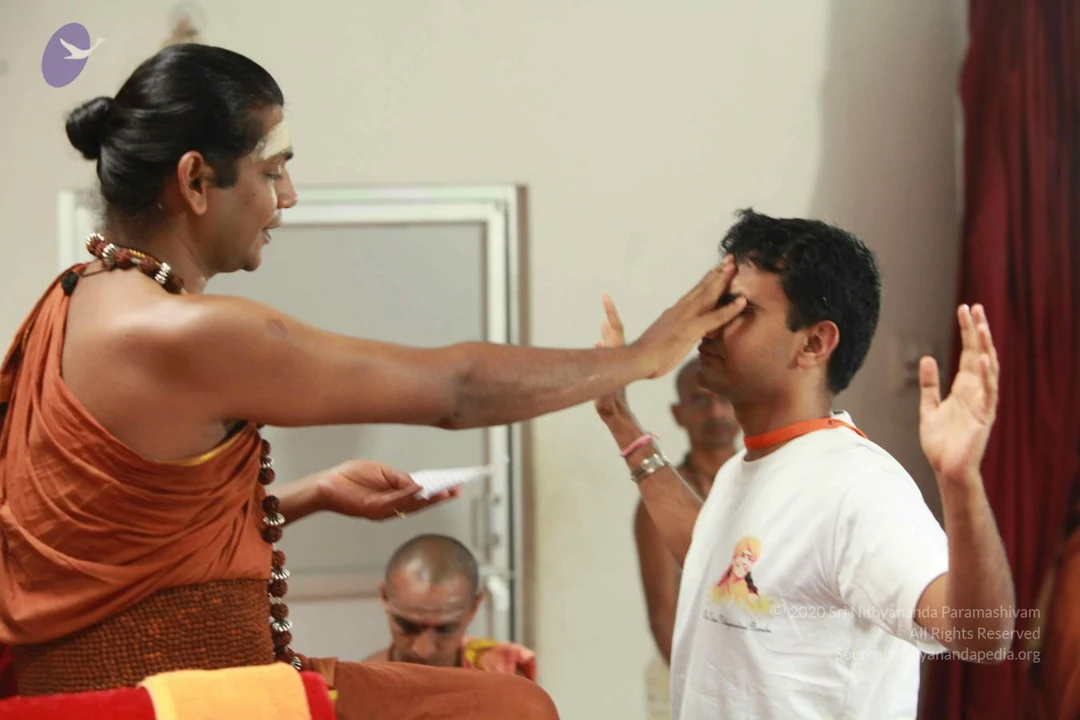
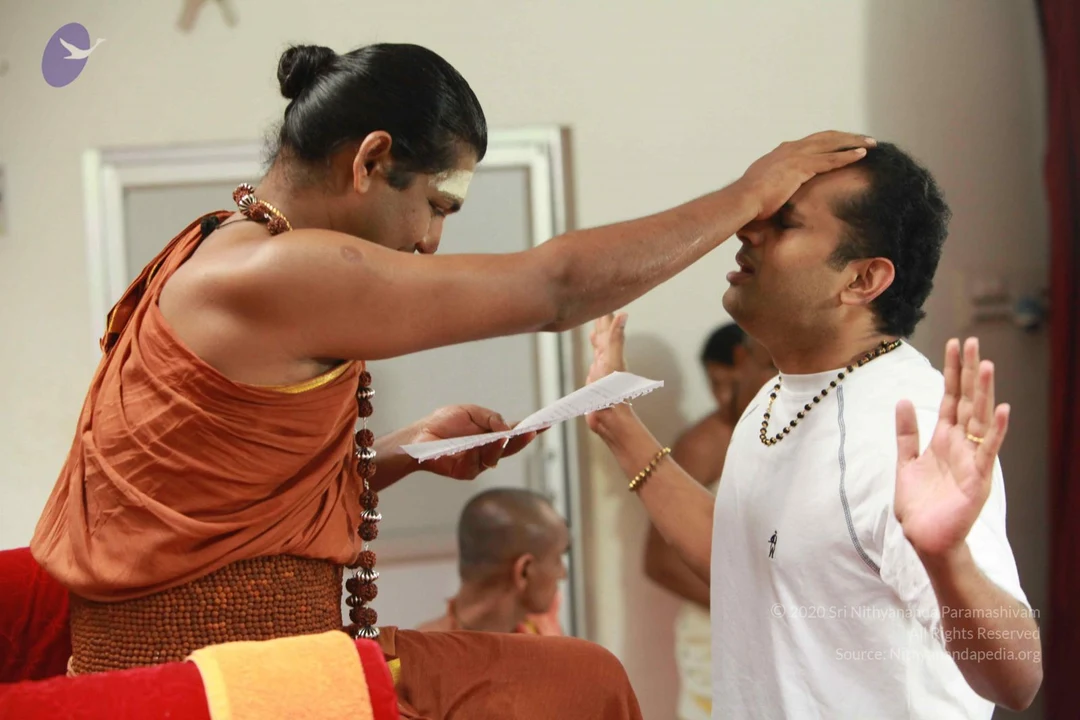
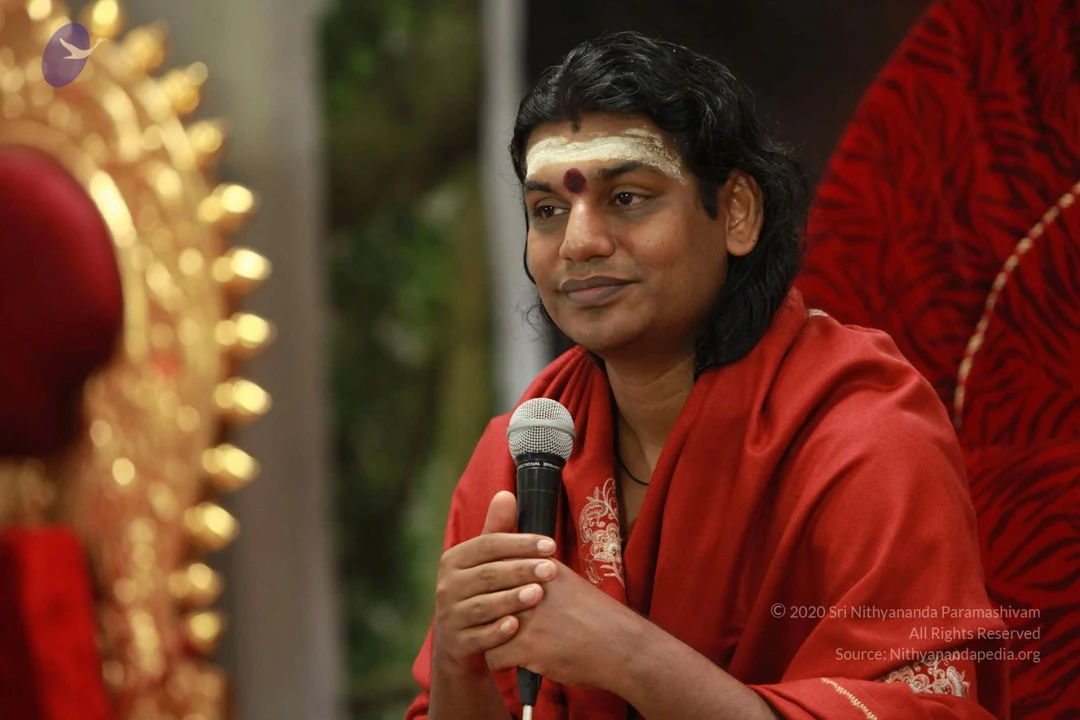
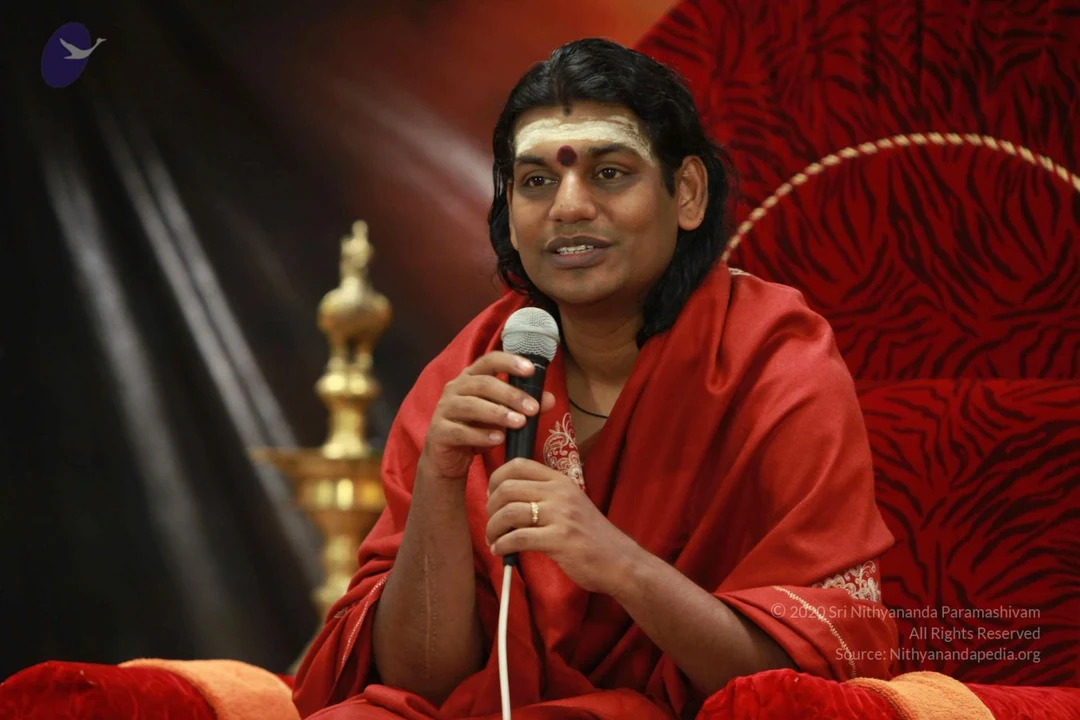
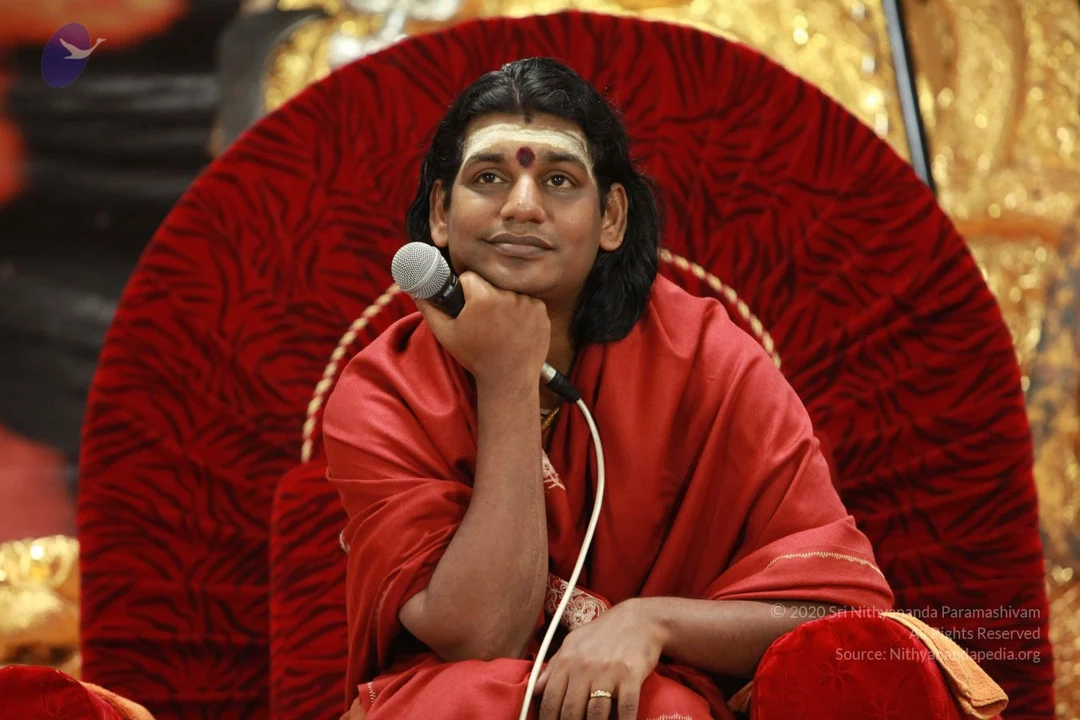
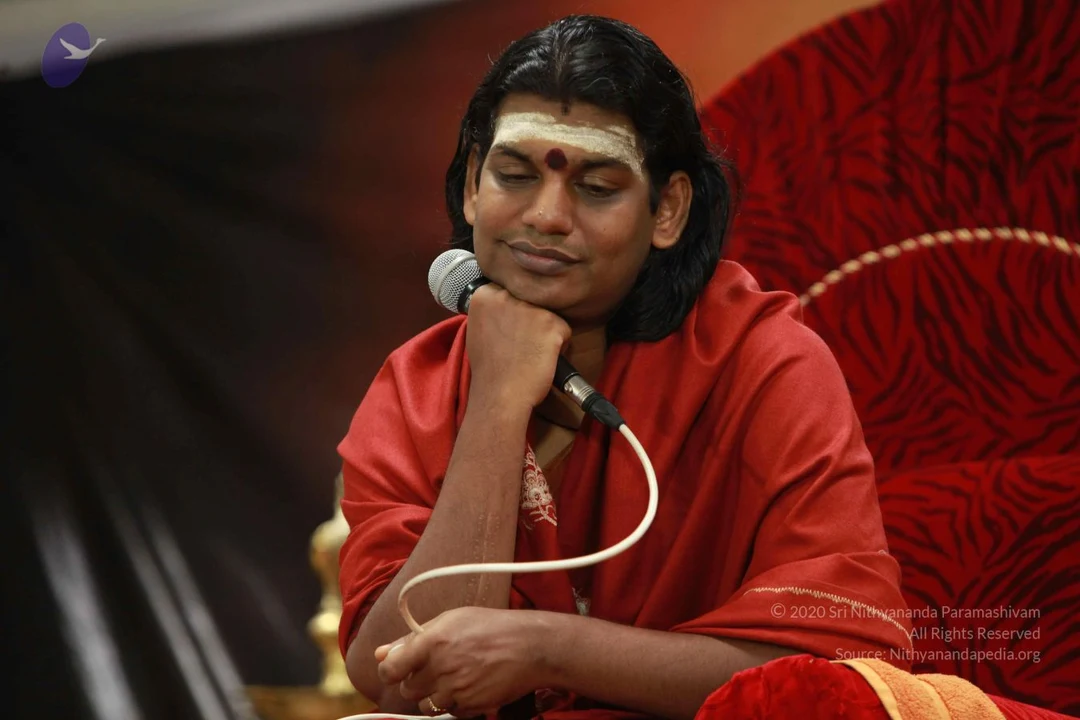
Darshan-and-Akashic-Reading

Night-Meditation

Photos from this day

View all 290 photos

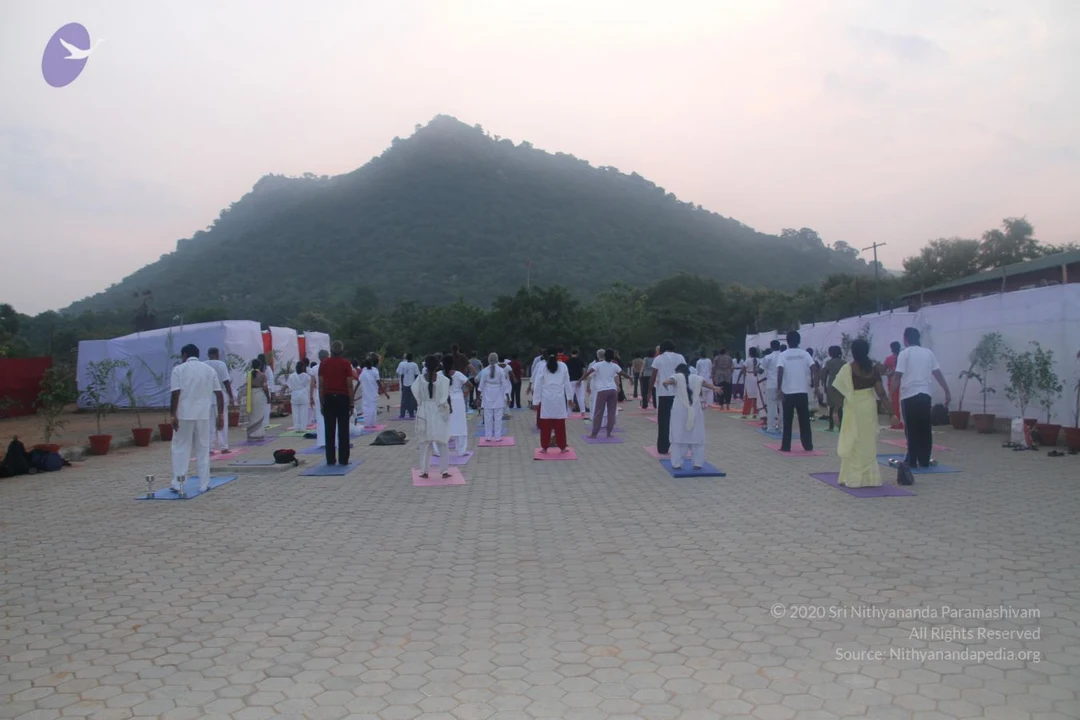
Morning-Satsang
77 photosSource gallery
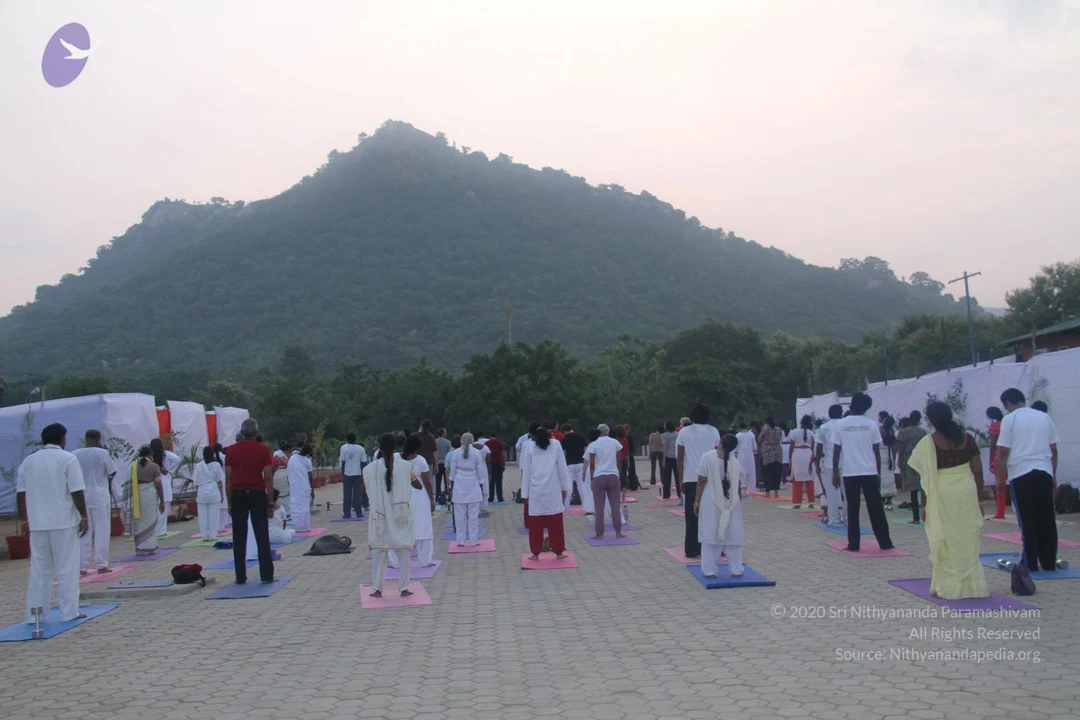
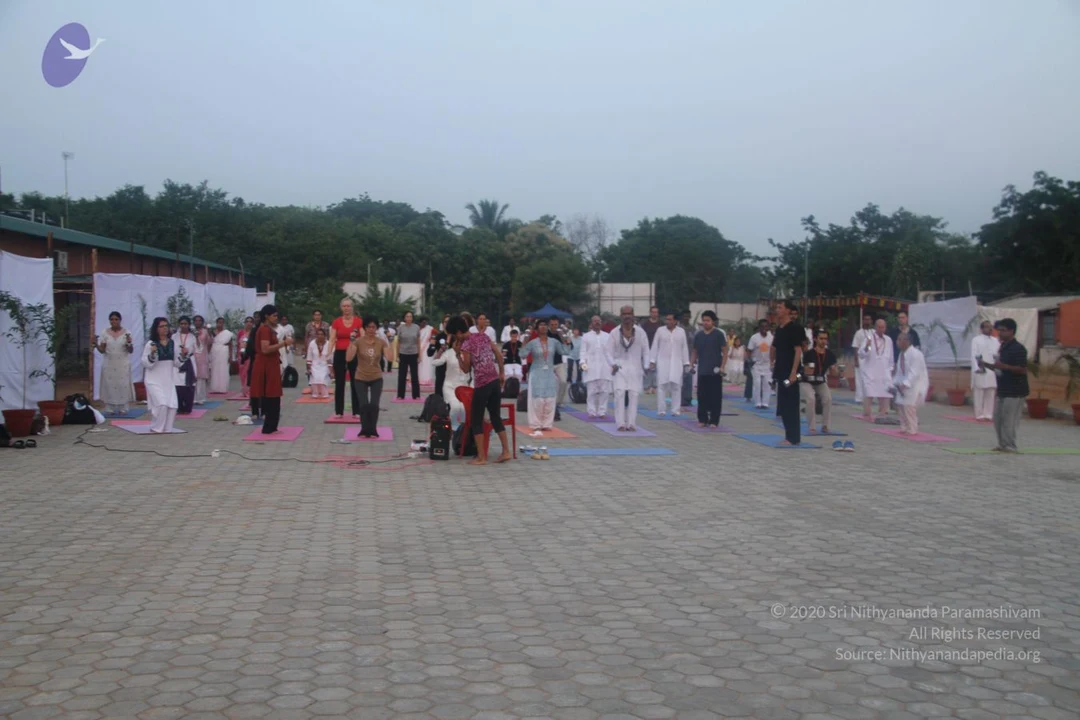
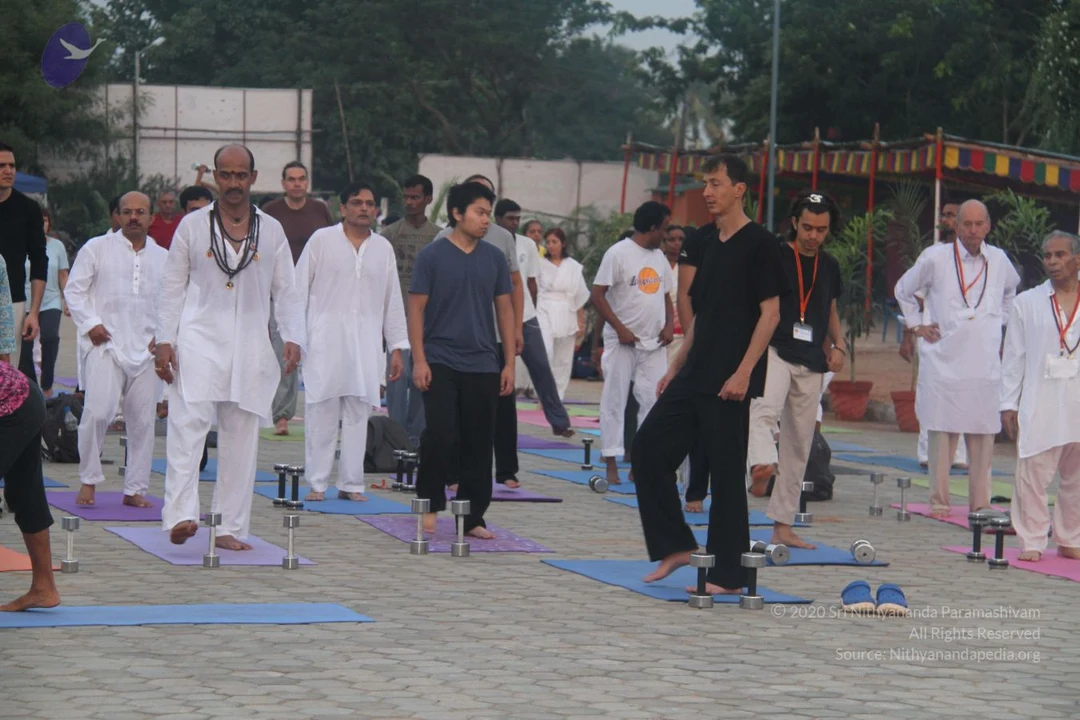
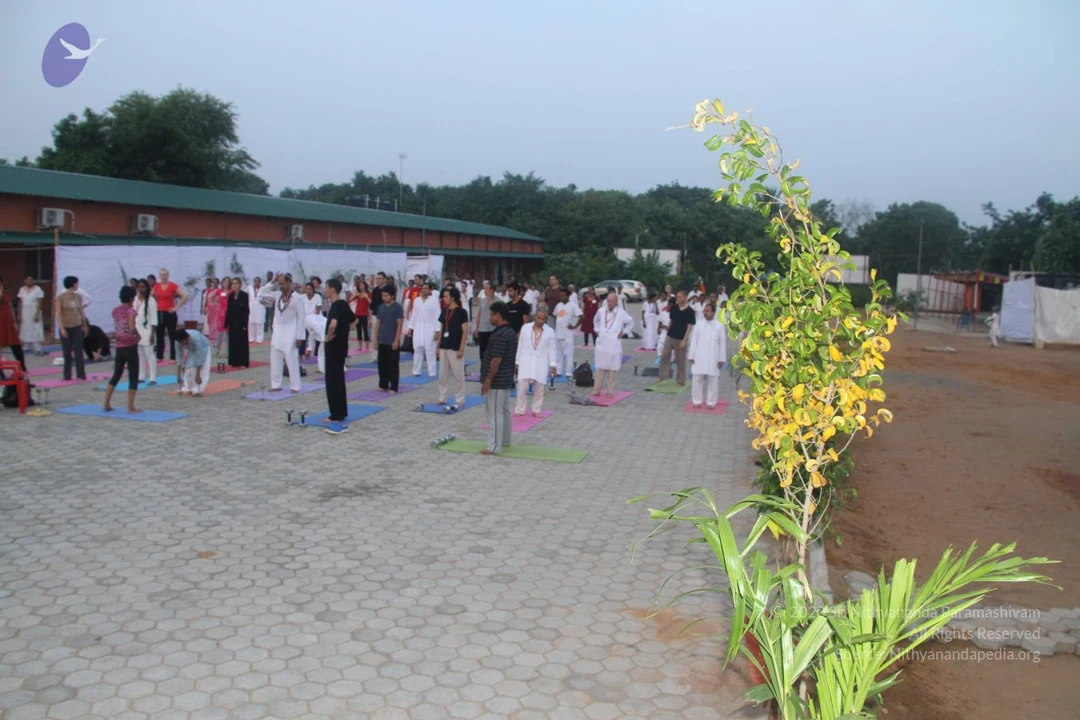
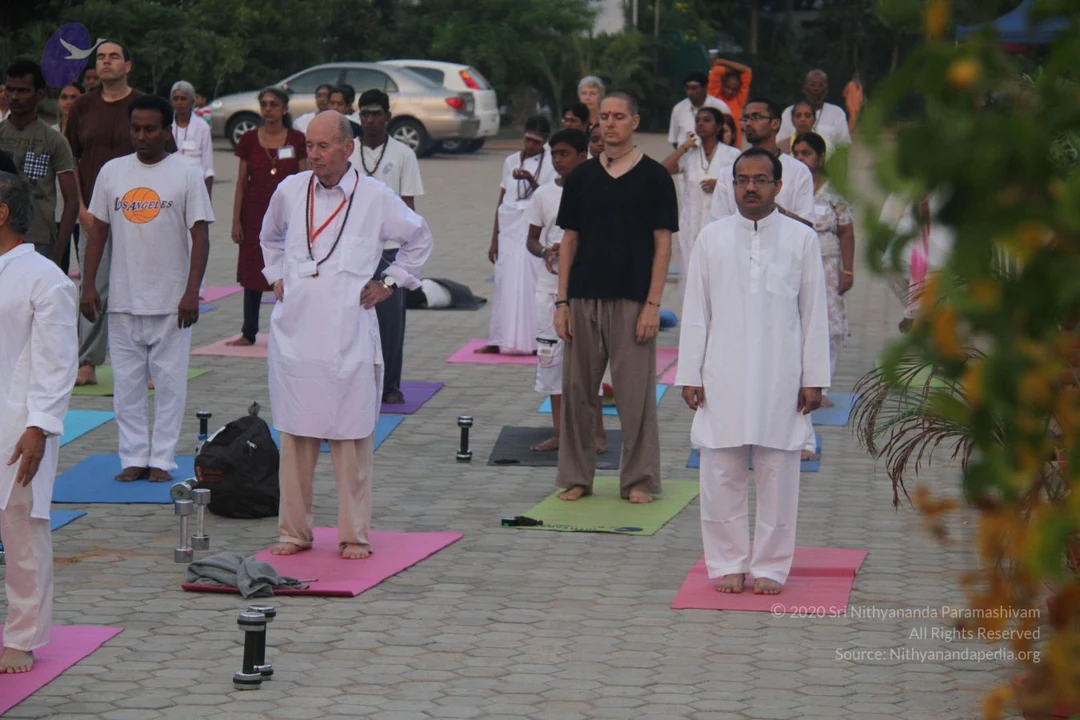
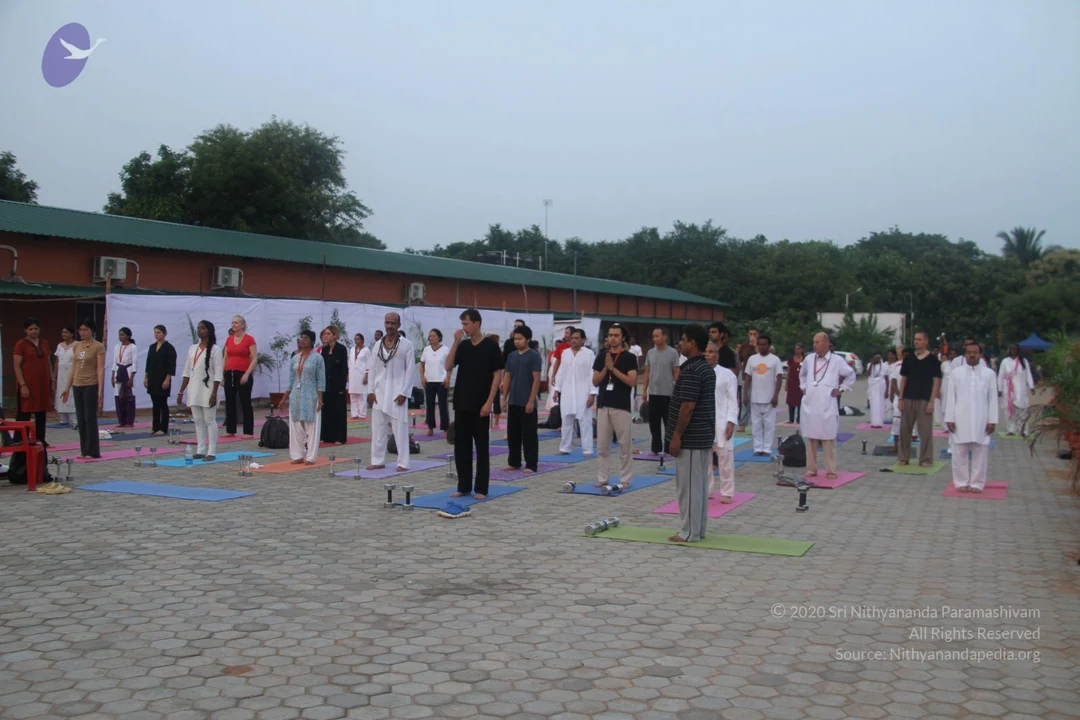
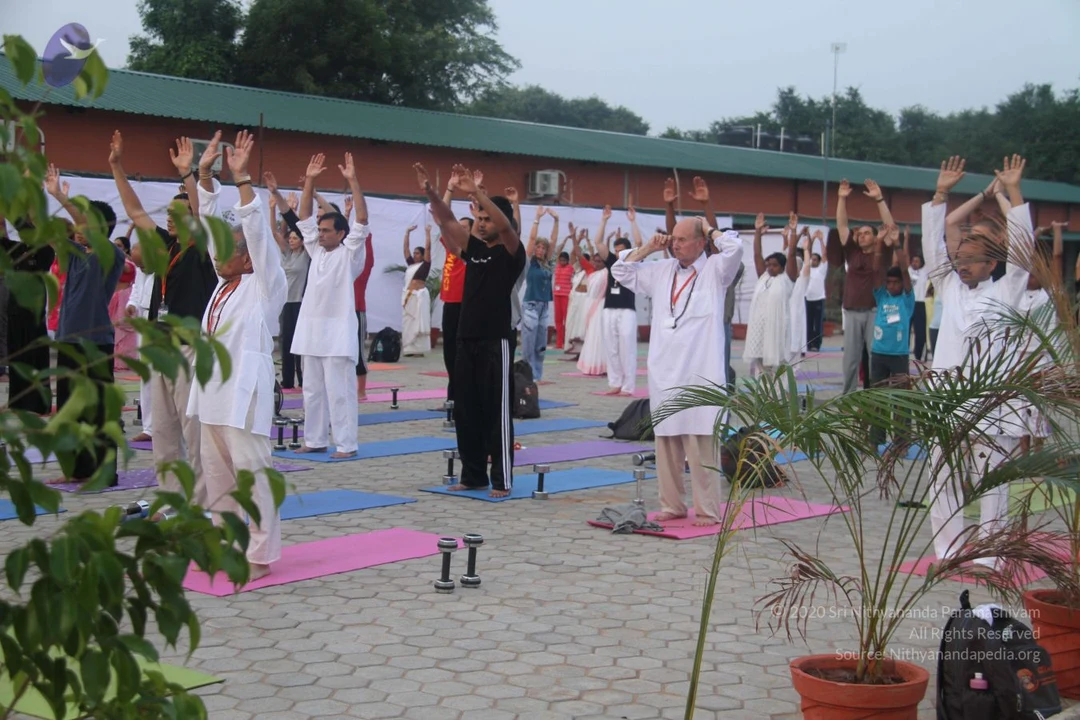
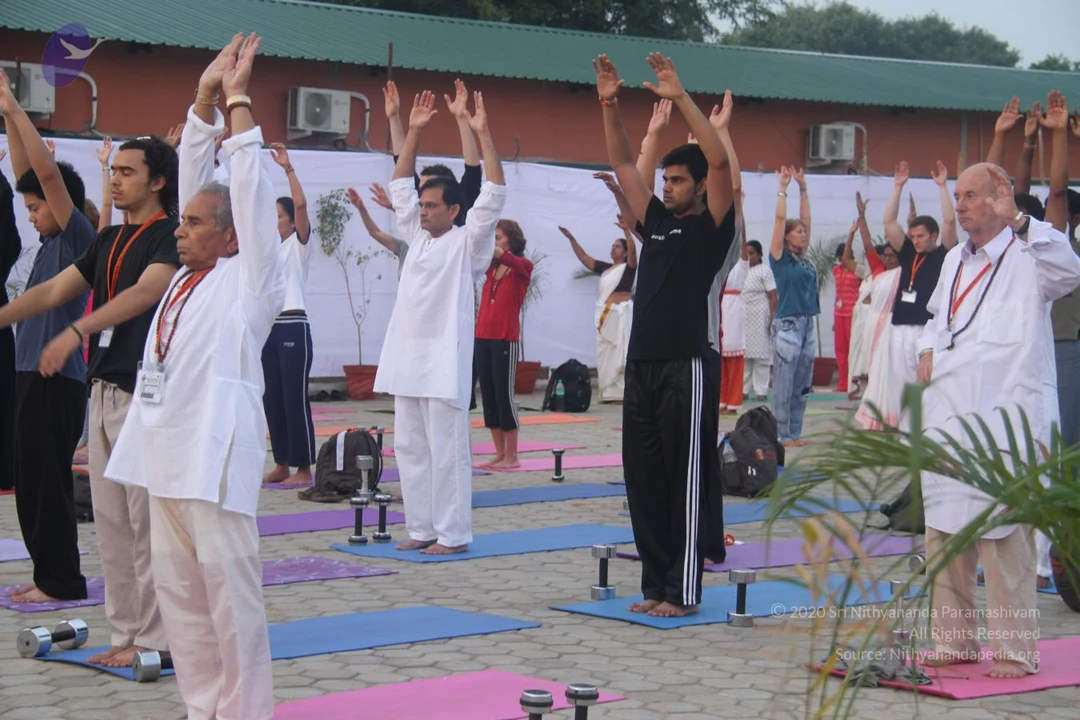
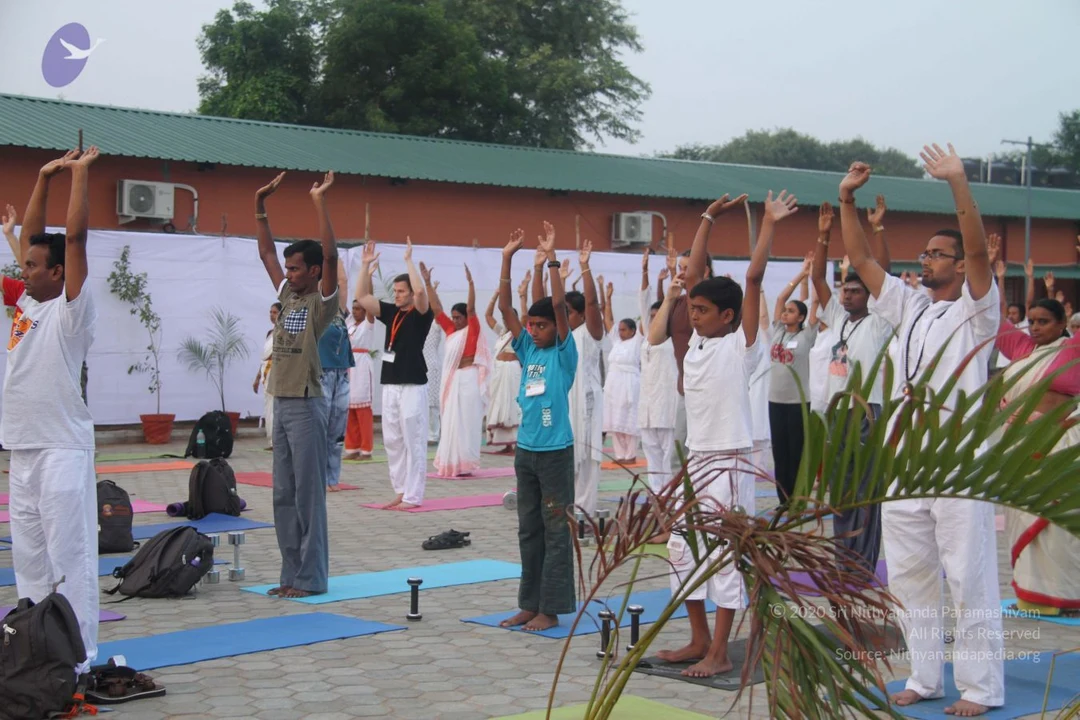
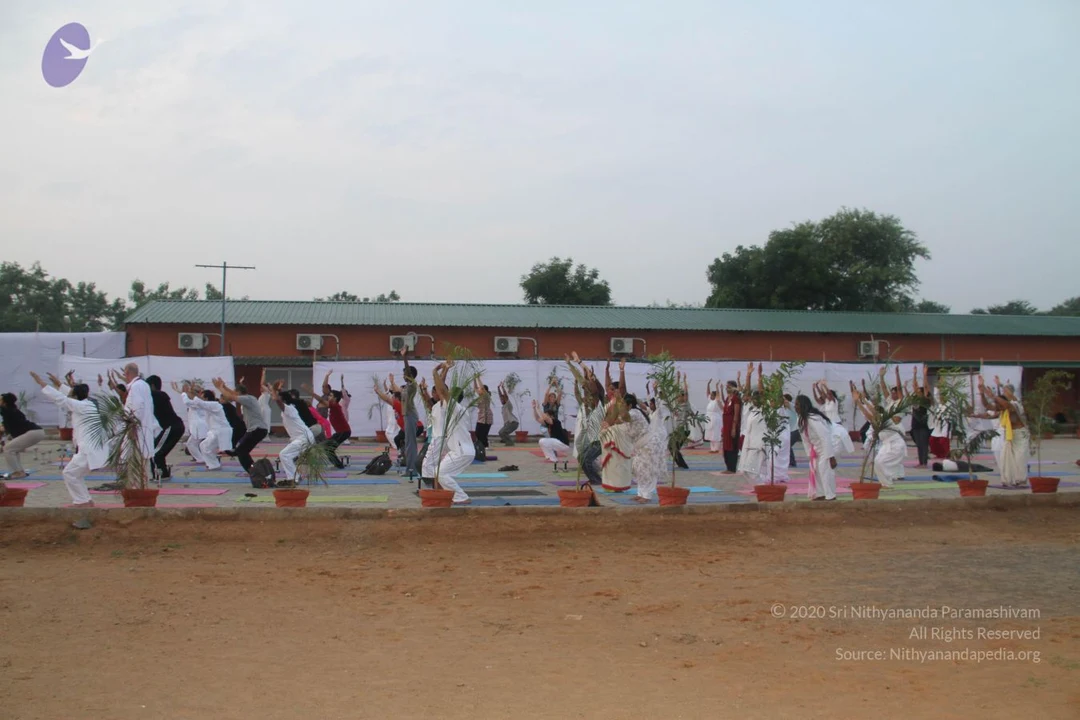
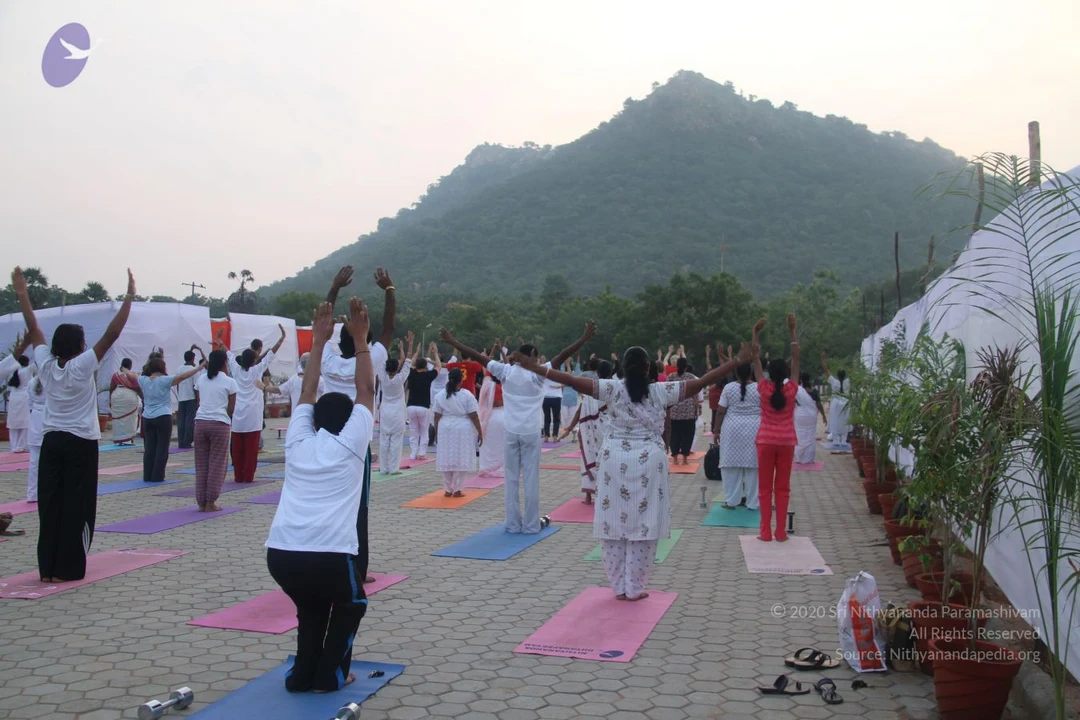
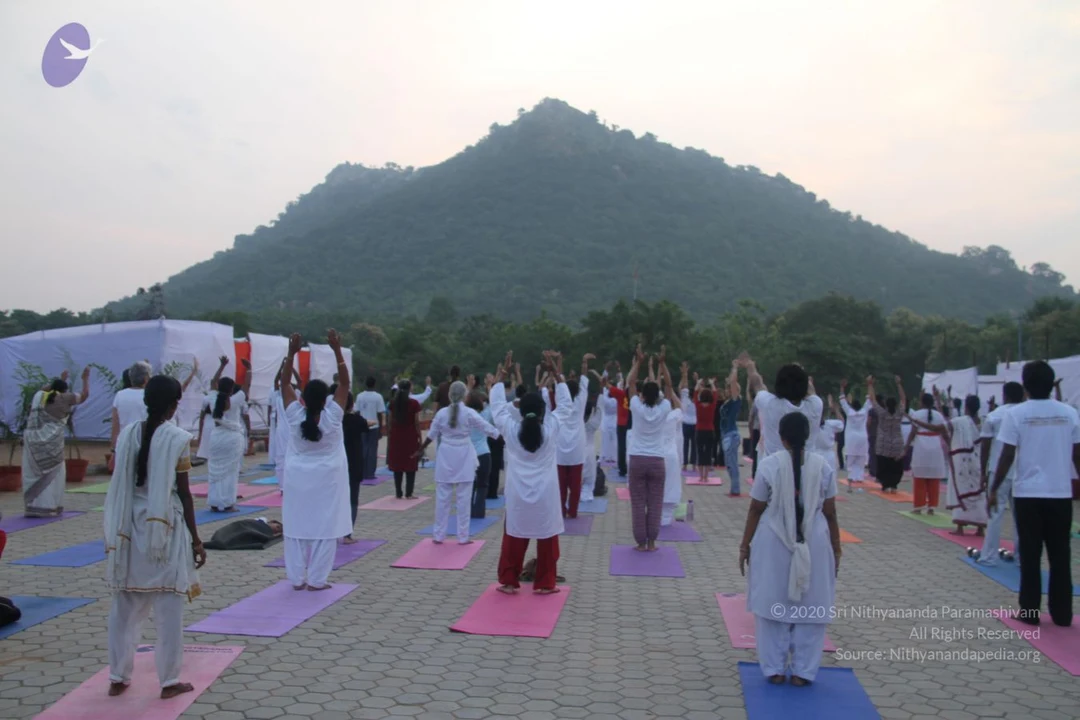
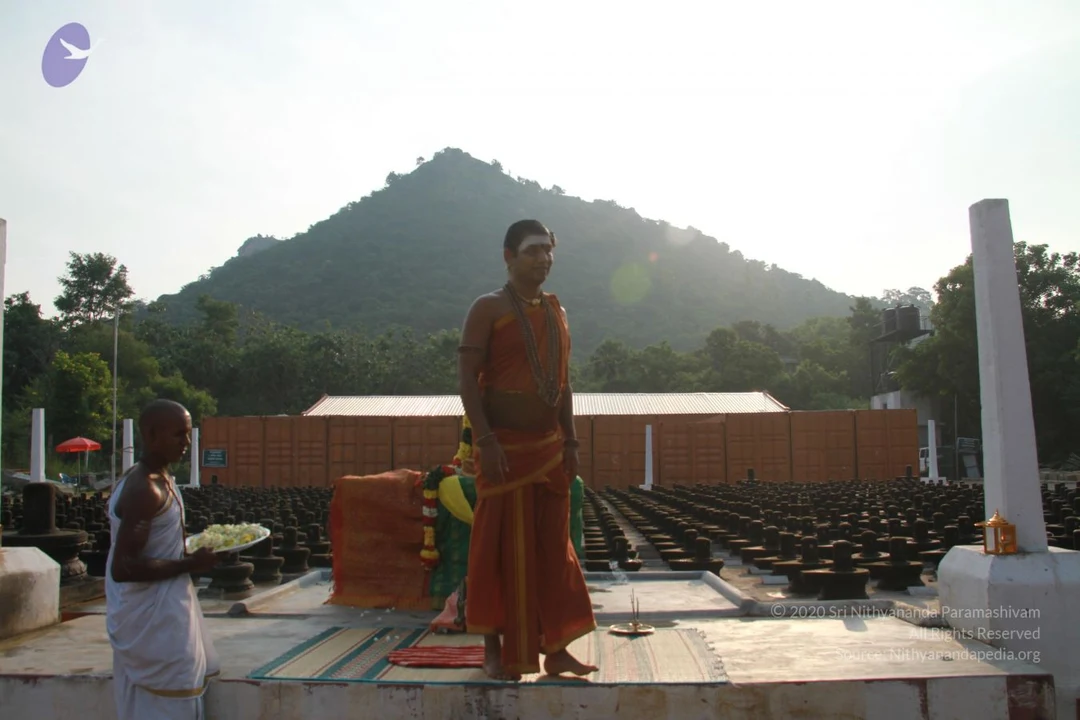
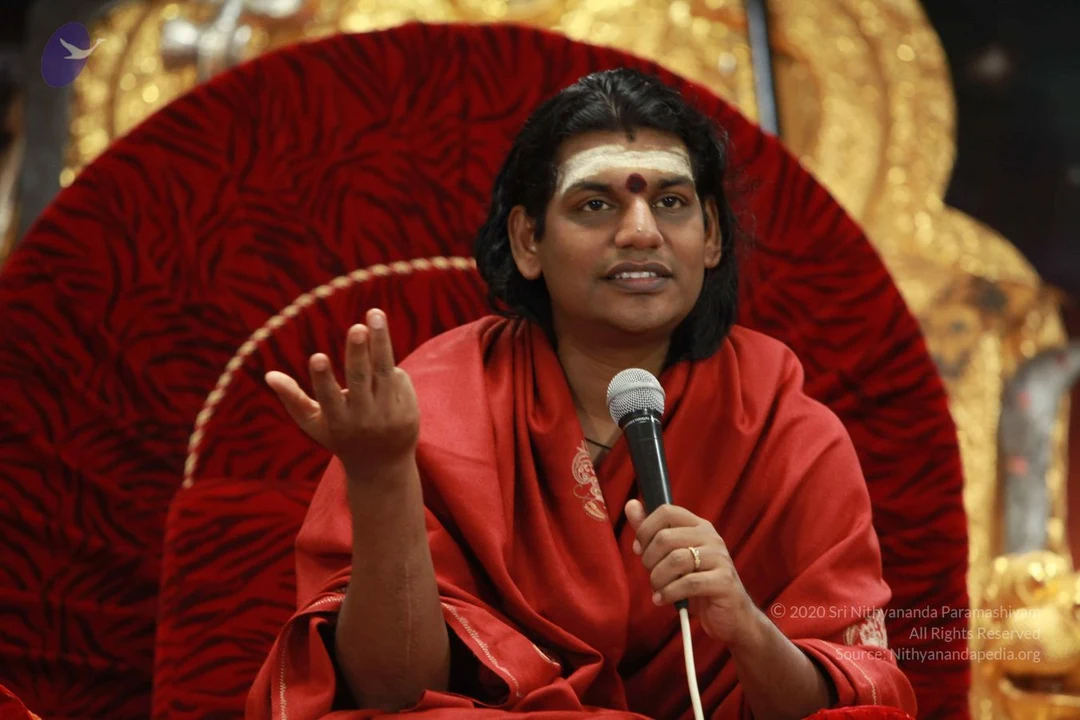
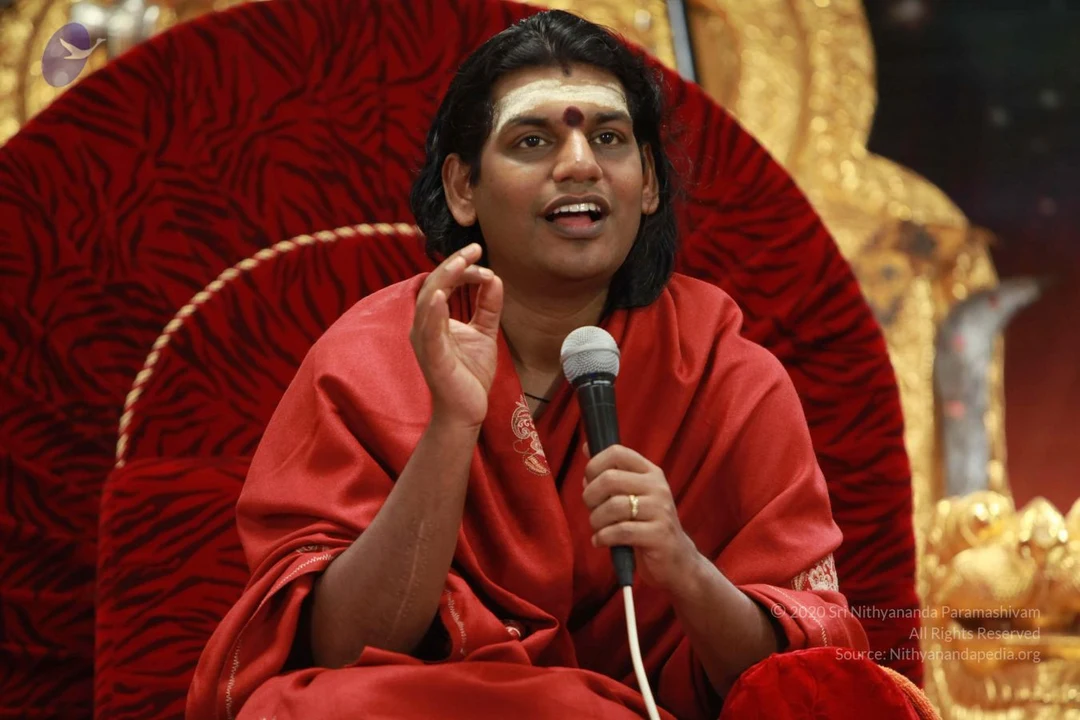
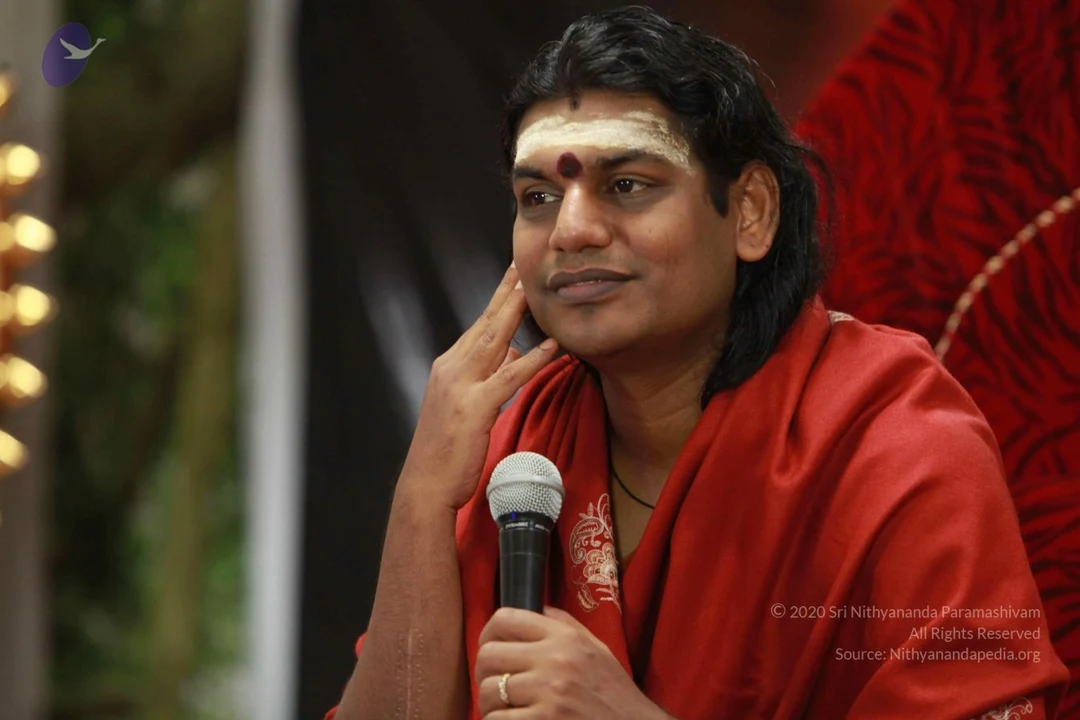
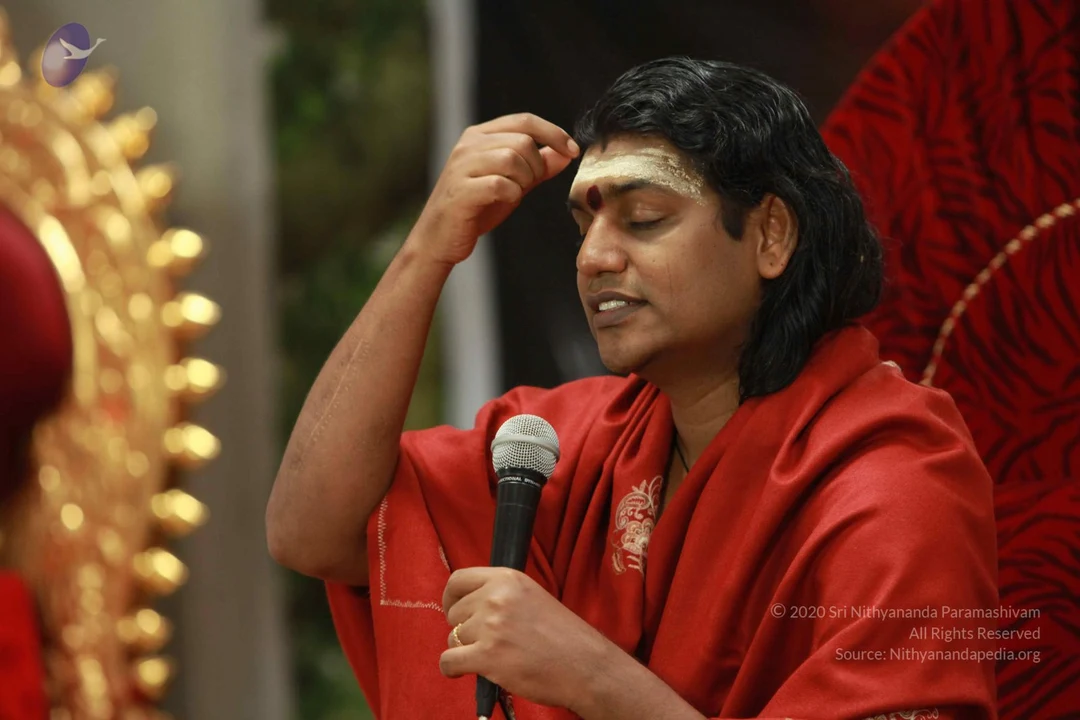
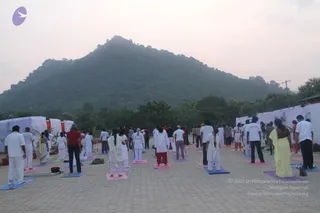
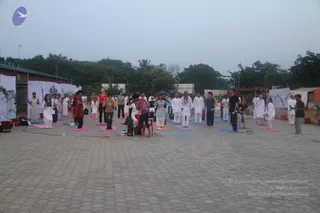
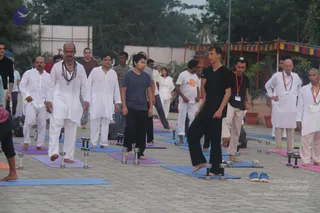
Outdoor group yoga session on a paved courtyard at dusk, with a forested hill rising behind white tented pavilions and potted saplings. Thirty or so practitioners stand on coloured yoga mats in rows, mostly dressed in white kurtas and white salwar outfits, with a few in red, purple and yellow saris and trousers. Some stand with hands raised or palms joined. A man in a red shirt stands at the front near the centre, and a woman in a yellow sari stands at right.Large outdoor yoga or meditation session on a paved courtyard in front of a forested hill at dawn. Dozens of participants stand on coloured yoga mats, facing away from the camera toward the hill, many wearing white kurtas, white salwar-style outfits and white shawls, while others wear red tops, blue, grey and dark clothing. A few people in the foreground are in bare-shouldered or kurta-style dress. Behind them are white canopy tents and a tall orange flag on a pole. A person lies on a mat at left. A tall figure in a red top and dark trousers stands prominently at left-centre. Hazy pinkish sky overhead.Outdoor morning yoga session on a paved hexagonal-tile courtyard at an ashram, with a forested hill rising behind white canvas tent walls and potted saplings. Dozens of participants stand on coloured yoga mats in rows, most in white clothing, some in red, yellow and purple saris or kurtas. Several people in the foreground appear to be bowing or stretching with arms raised, and a few wear dark trousers. Tall tree lines and a small green-roofed structure frame the right side of the courtyard under a pale pinkish sky.Outdoor morning yoga session on a paved courtyard before a forested hill under a pale sky. Many participants stand on coloured yoga mats in rows, most in white or light clothing, with some in red trousers, a pink top and a yellow saree. White tents with plants line both sides. No individual can be confidently identified as a person from appearance here, so no candidate is named.Outdoor morning group yoga session on a paved brick courtyard at dawn, with a crowd of participants standing on colored mats in rows. Many wear white or pale kurtas and salwar outfits, while others wear red, blue, and dark clothing. Some stand with hands folded in prayer, and a few people with cameras and bags are at the edges. White draped cloth screens and potted plants line the left side, with leafy trees and a low building behind the group under a grey sky. No clearly identifiable speaker or central figure stands out in the frame.Outdoor group exercise session on a paved courtyard at an ashram. Participants stand on blue, purple and pink exercise mats beside silver dumbbells, performing a standing workout. Several men in white kurta-style clothes, some with rudraksha-style beaded necklaces, are in the foreground, while others wear black, grey and tan casual clothes. A man in a black shirt and black trousers stands centre-right with bare feet on a mat, and a young man in a grey t-shirt stands centre-left. Behind them are trees, a low wall and a red-and-yellow striped tent canopy. No individual in the scene is identifiable as a person from appearance.

Swamiji-Photo-Shoot

10 photosSource gallery
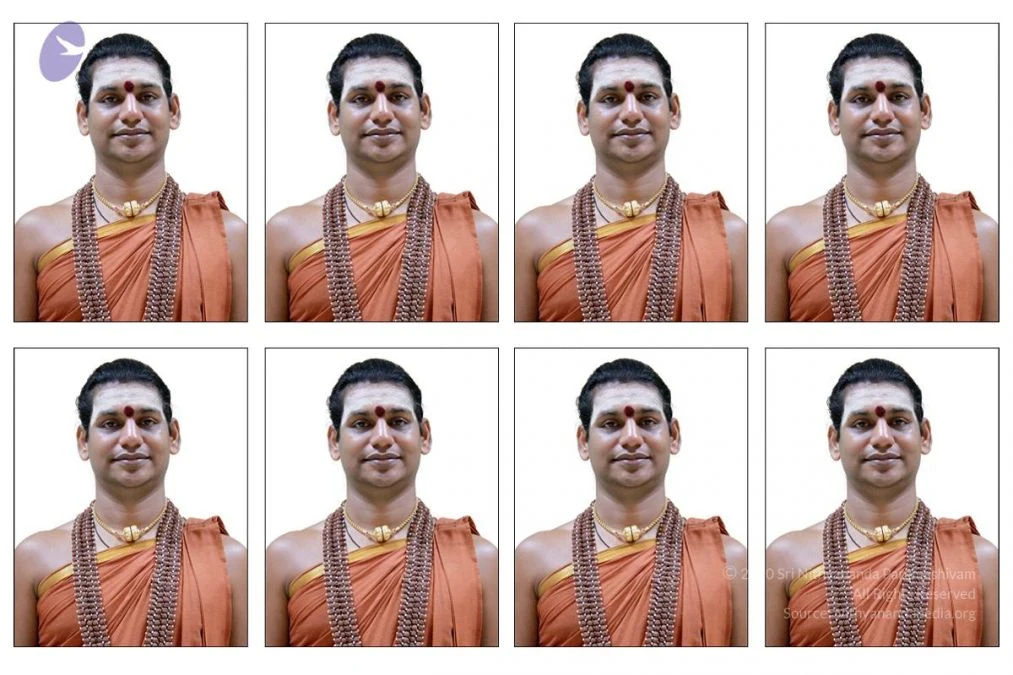
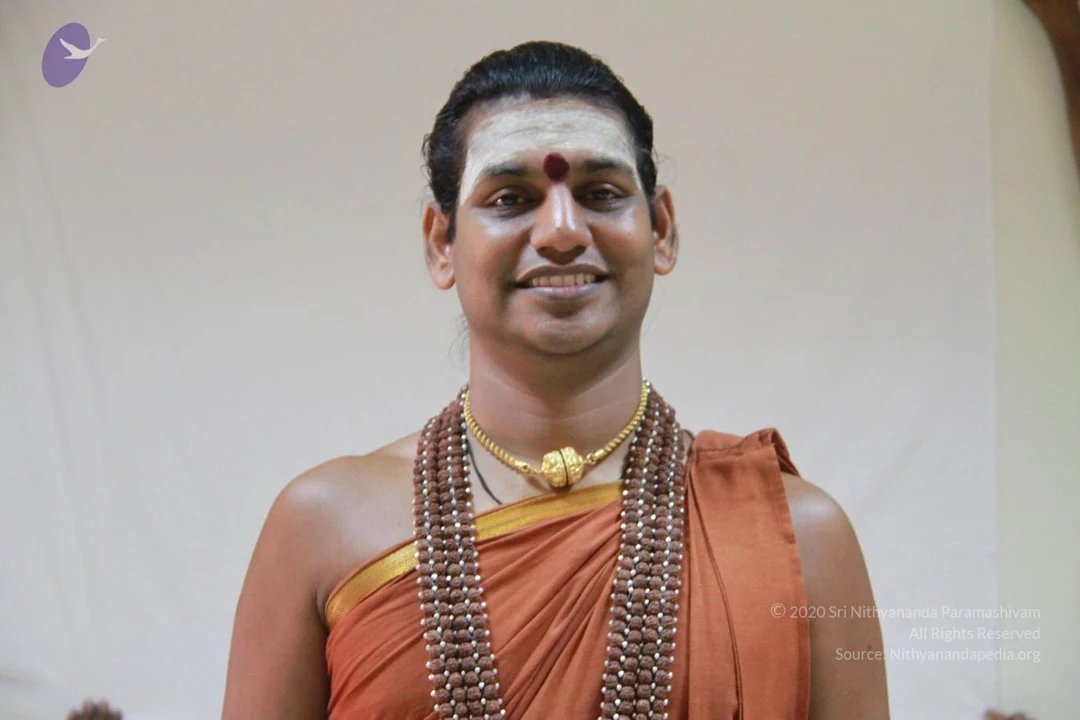
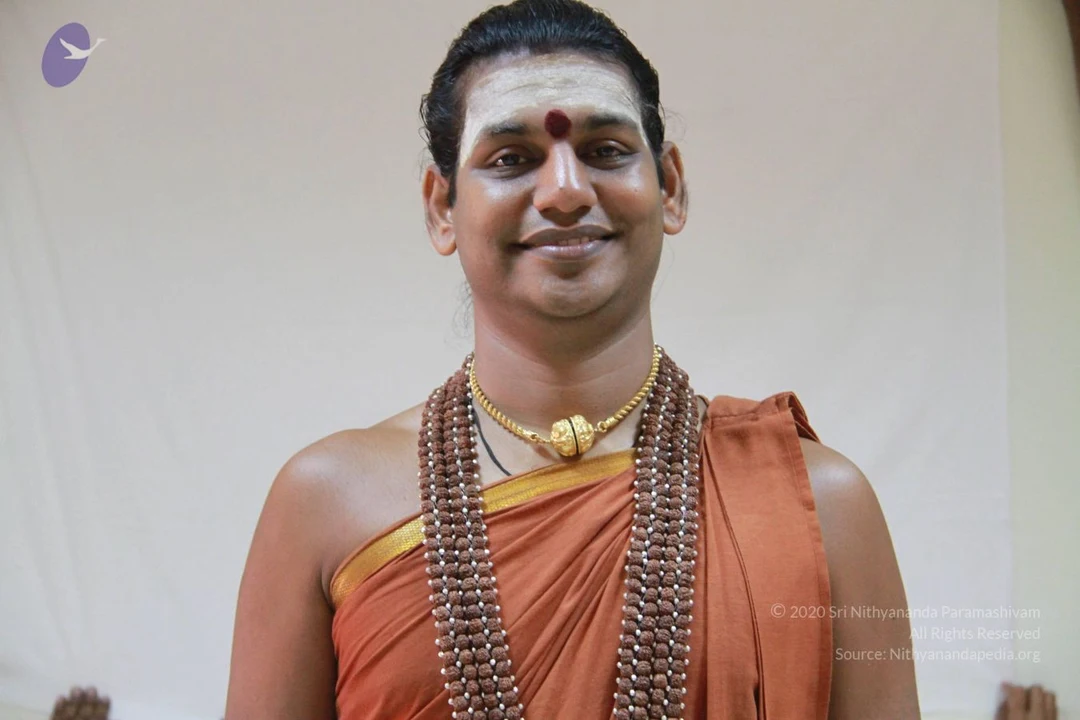
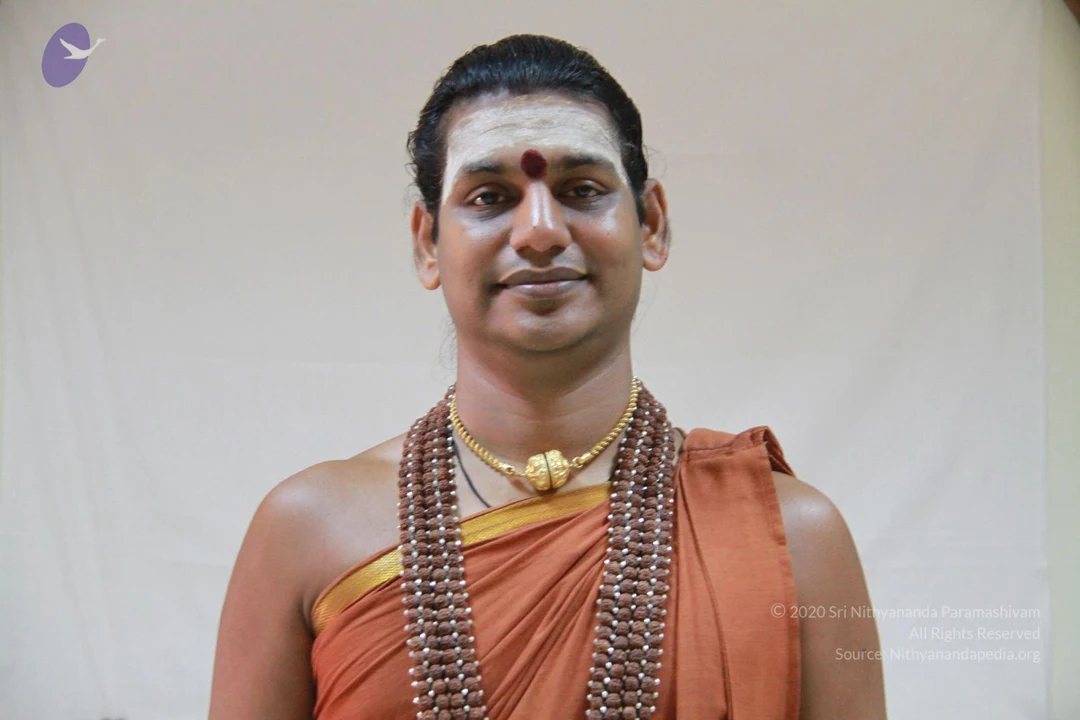
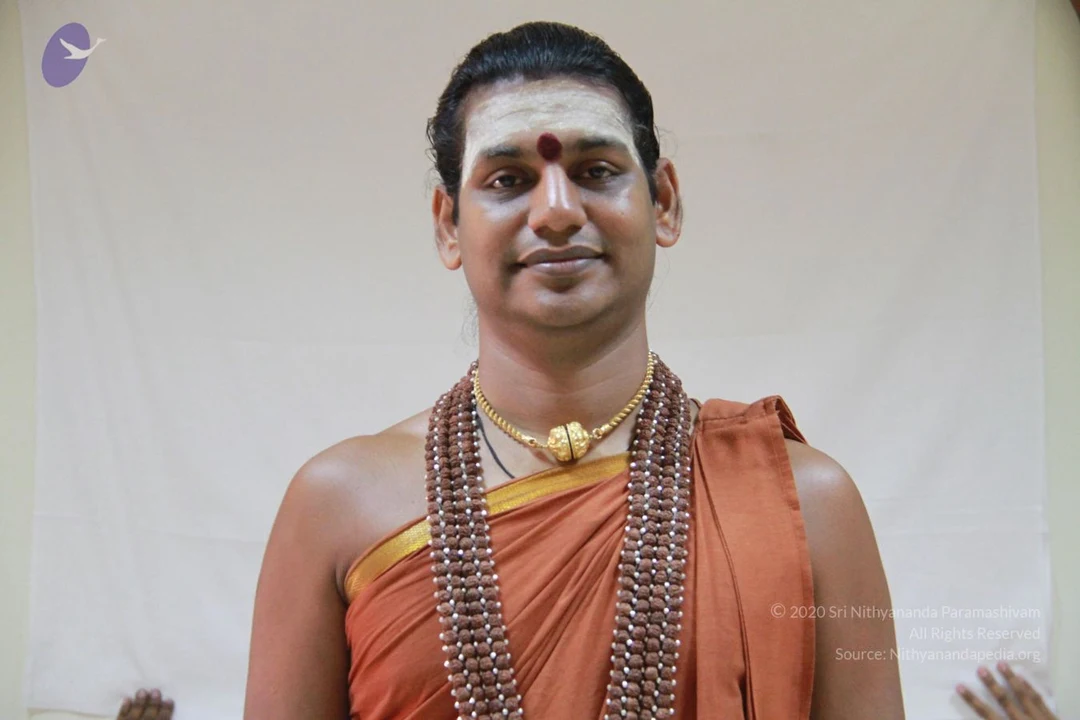
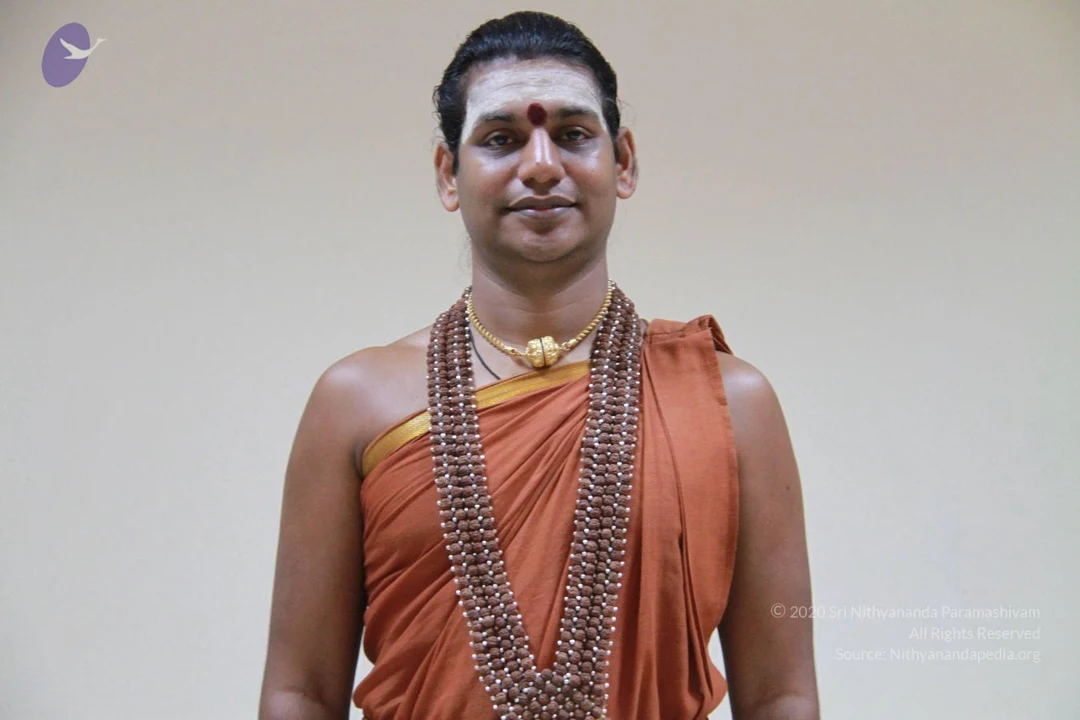
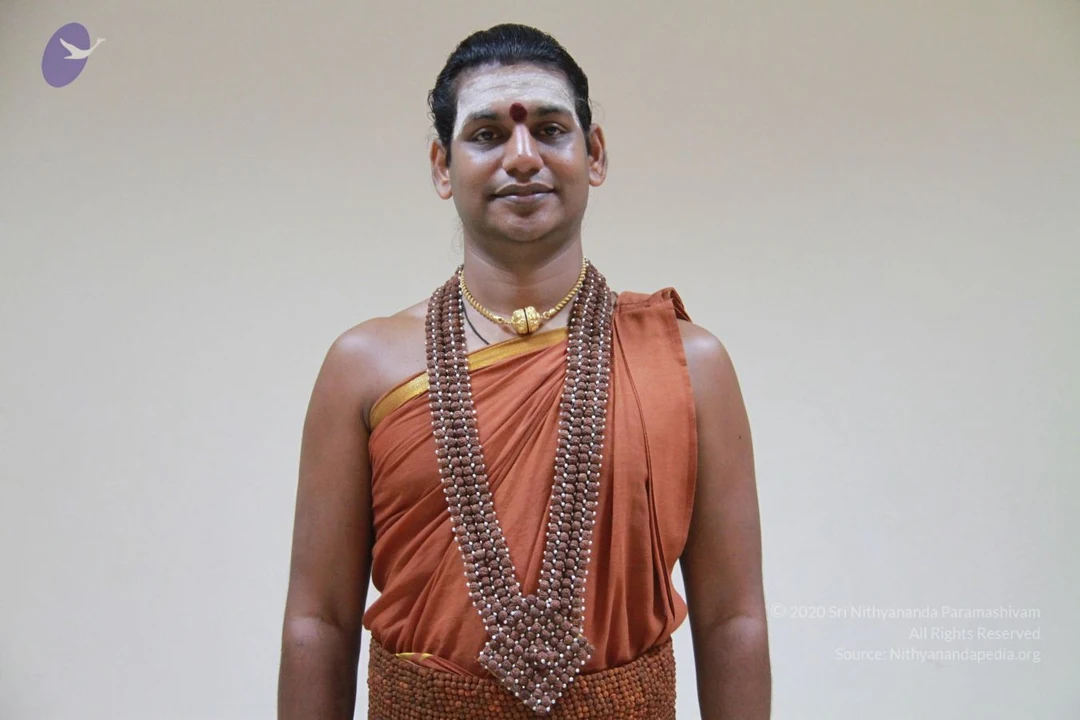
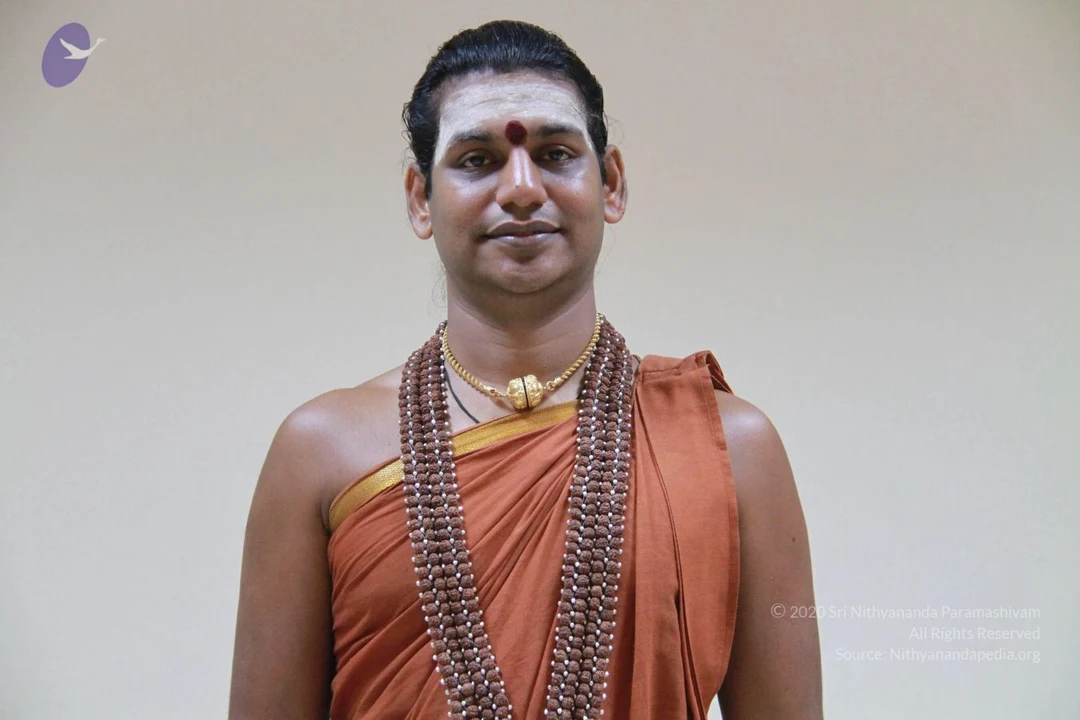
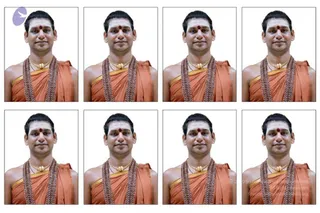
A graphic collage of eight close-up portrait panels, each showing the same man against a plain white background. He has short swept-back dark hair, white sacred ash on his forehead with a red bindi, and wears an orange-saffron shawl draped over his left shoulder and bare chest. Multiple strands of rudraksha malas and a gold ceremonial necklace hang around his neck. Expressions vary slightly across the panels. a person (saffron shawl, rudraksha malas, gold necklace, swept hair) appears in all panels, but the image shows printed portraits, so no physical people are present.A smiling man in orange-saffron robes stands facing the camera against a plain cream backdrop. He wears multiple strands of brown rudraksha beads and a gold necklace with a round gold pendant, and has white sandalwood paste with a red kumkum dot on his forehead and slicked-back dark hair. A gold-bordered orange shawl drapes over one shoulder.Close photo of a smiling man with short slicked-back hair, white sacred ash on the forehead and a red dot at the centre. He wears an orange-saffron shawl with a gold border over the shoulders, multi-strand rudraksha malas and a gold necklace with a large gold clasp. Plain off-white backdrop. Appearance-based candidate: a person, wearing saffron wrap, rudraksha malas and gold necklace, shown in a plain posed portrait.Head-and-shoulders photo of a man standing against a plain cream backdrop. He wears an orange-saffron cloth draped over the left shoulder with a gold border, a gold clasp necklace at the throat, and multiple strands of rudraksha beads with silver-toned spacer beads. He has a white vertical tilak on the forehead with a red bindi at its centre and slicked-back dark hair, and he looks toward the camera with a slight smile. Appearance-based identification: a person, based on the orange saffron cloth, rudraksha malas and ornate gold necklace visible on this in-person figure.A man stands against a plain cream backdrop, facing the camera with a slight smile. He wears an orange-saffron cloth wrapped over one shoulder with a gold border, multiple strands of rudraksha mala beads, and a gold ceremonial necklace with a pendant. He has white ash markings across the forehead and a red kumkum dot at the centre. His hands are partly visible at the lower edges of the frame.A standing man in front of a plain cream wall wears an orange-saffron cloth draped over his left shoulder and body, edged with a gold border, and multiple strands of rudraksha beads hang across his chest. He wears a gold necklace with a large gold ornament at the centre, has a red bindi on his forehead and white markings on his brow, and gazes directly at the camera with a slight smile.

Session-On-Pain-Samaskaras

20 photosSource gallery
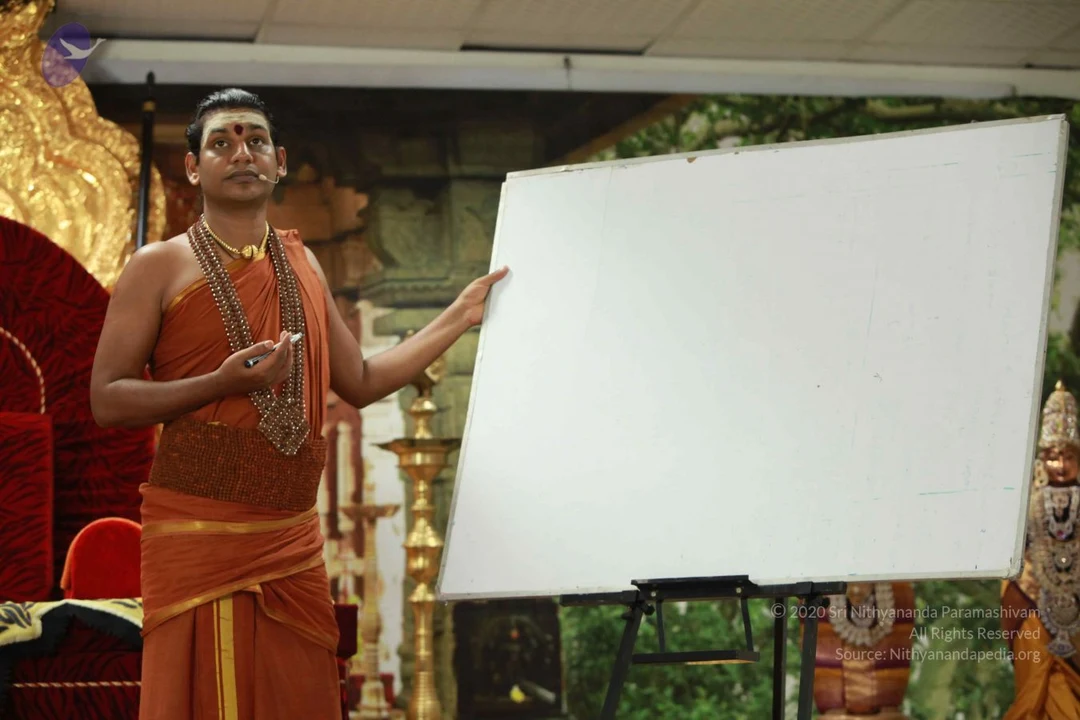
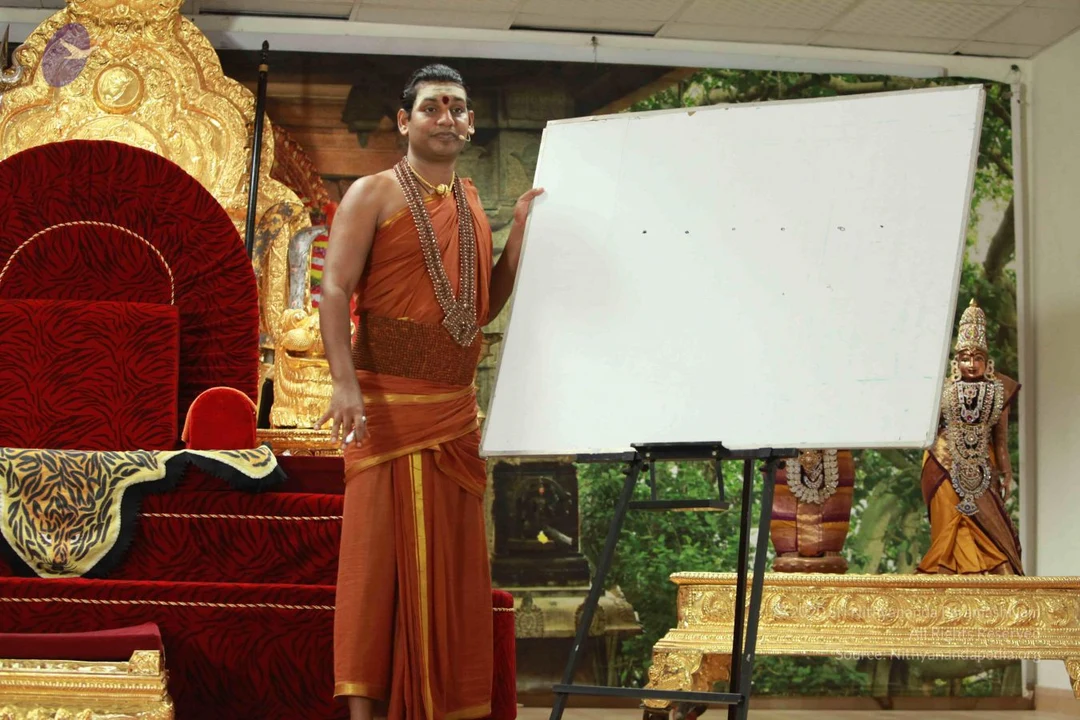
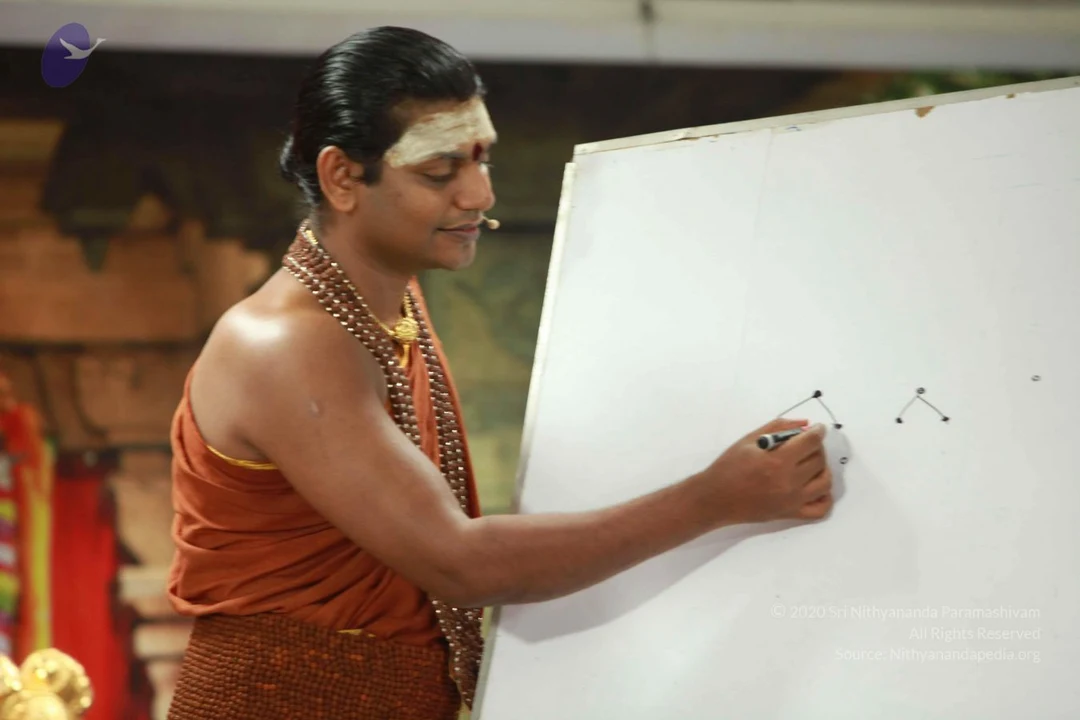
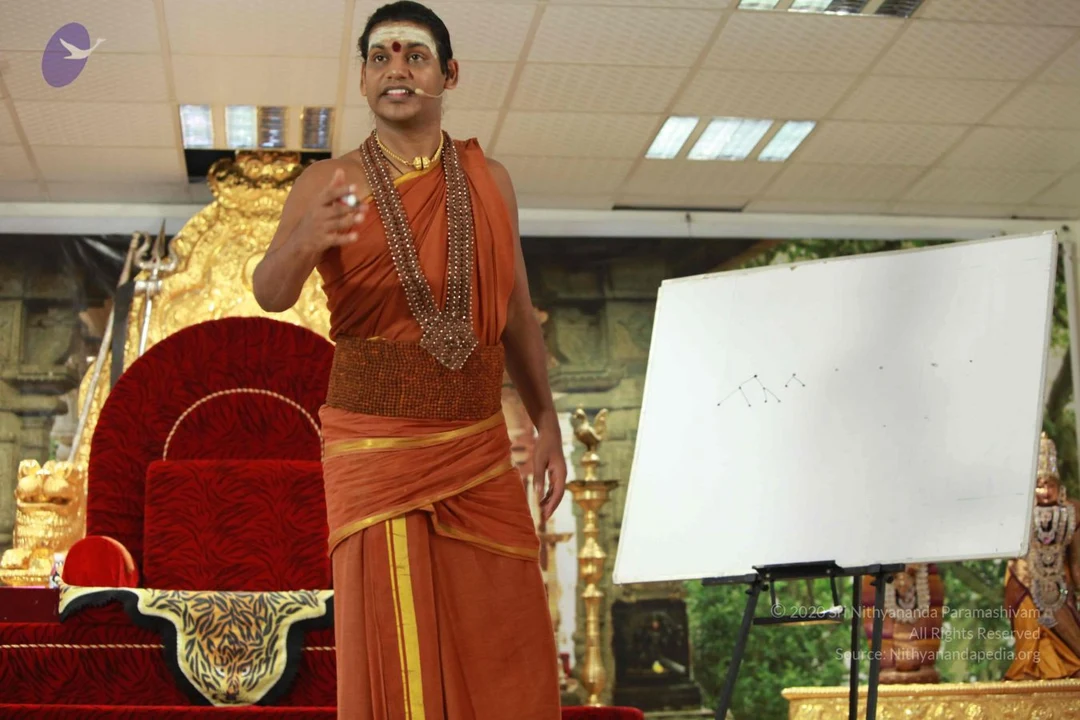
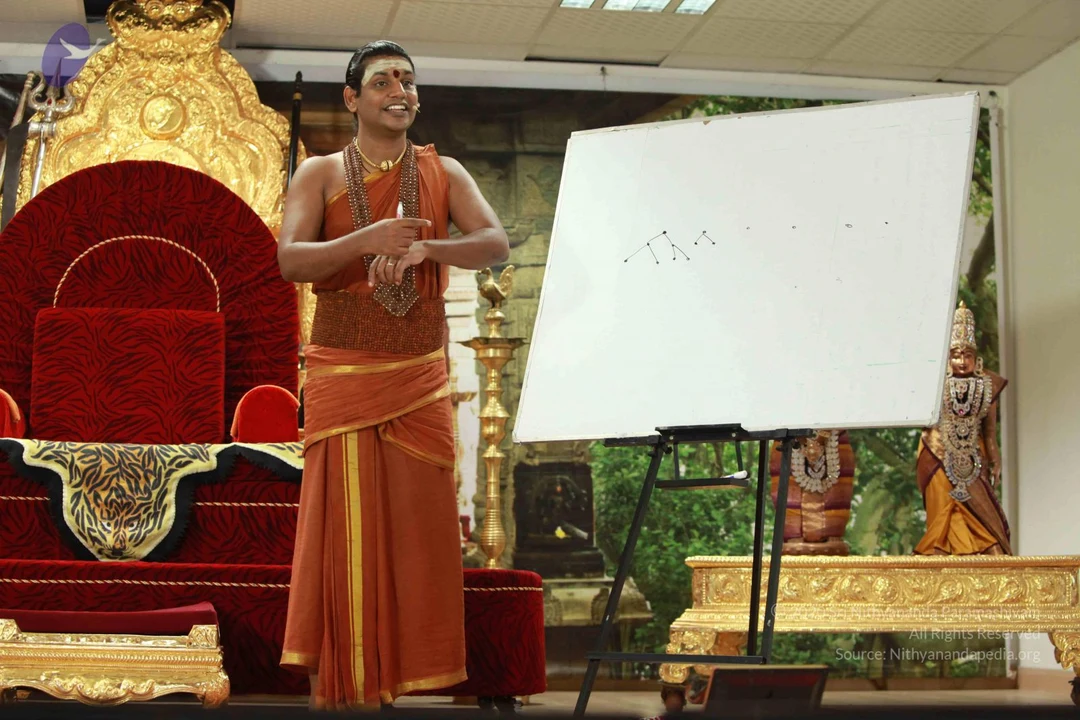
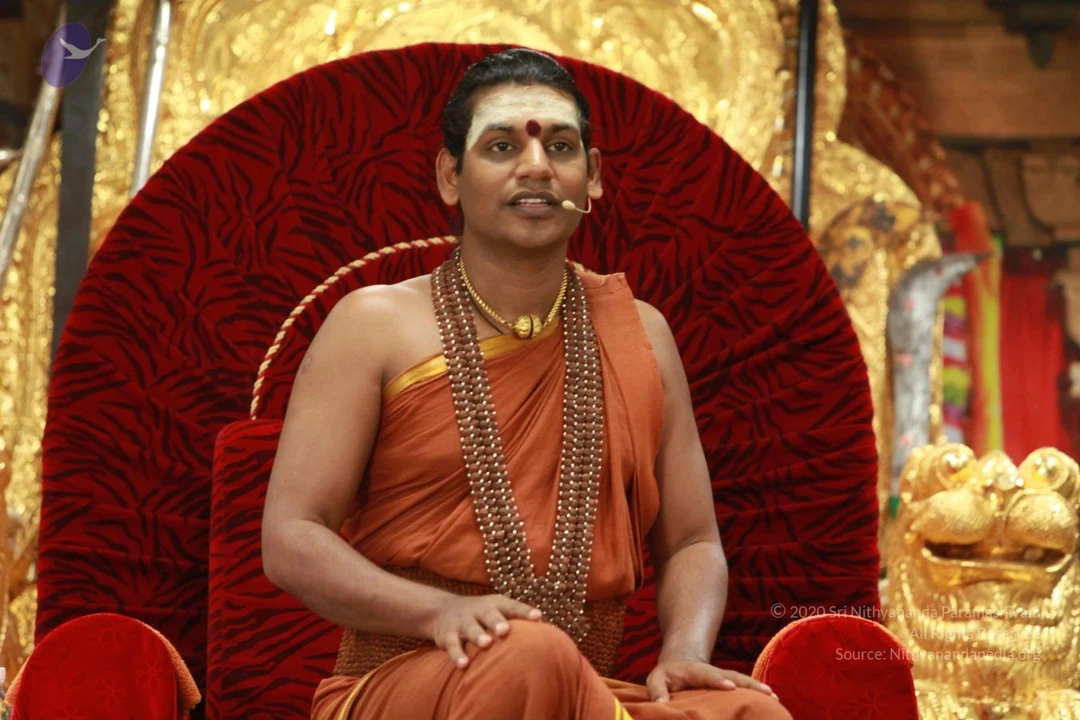
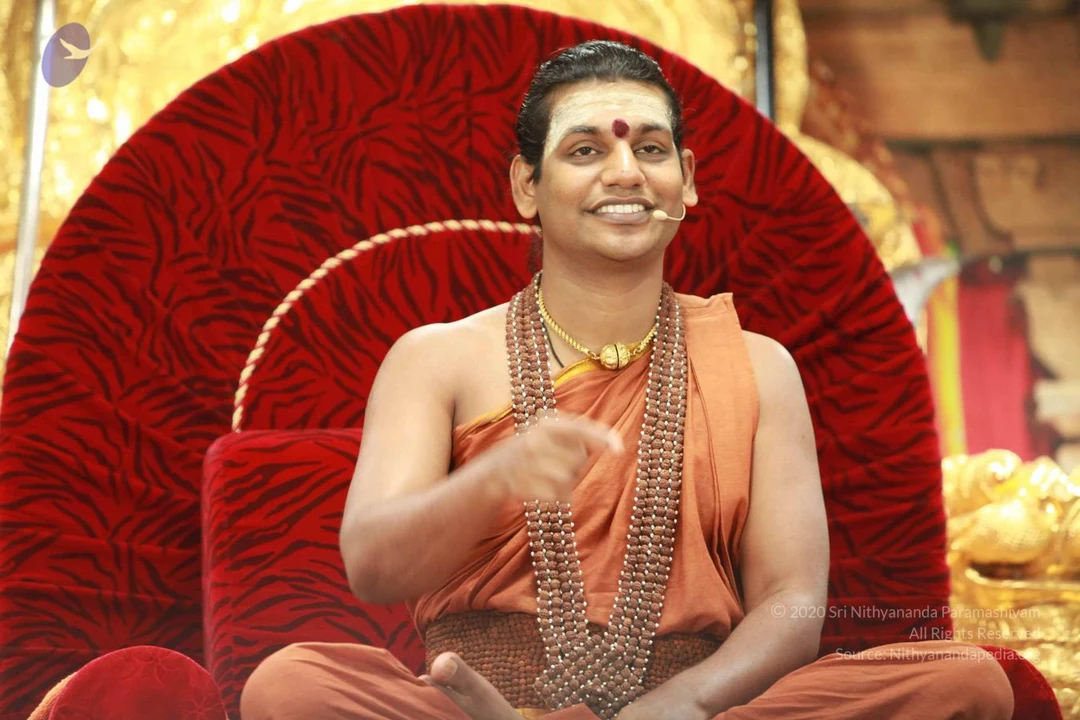
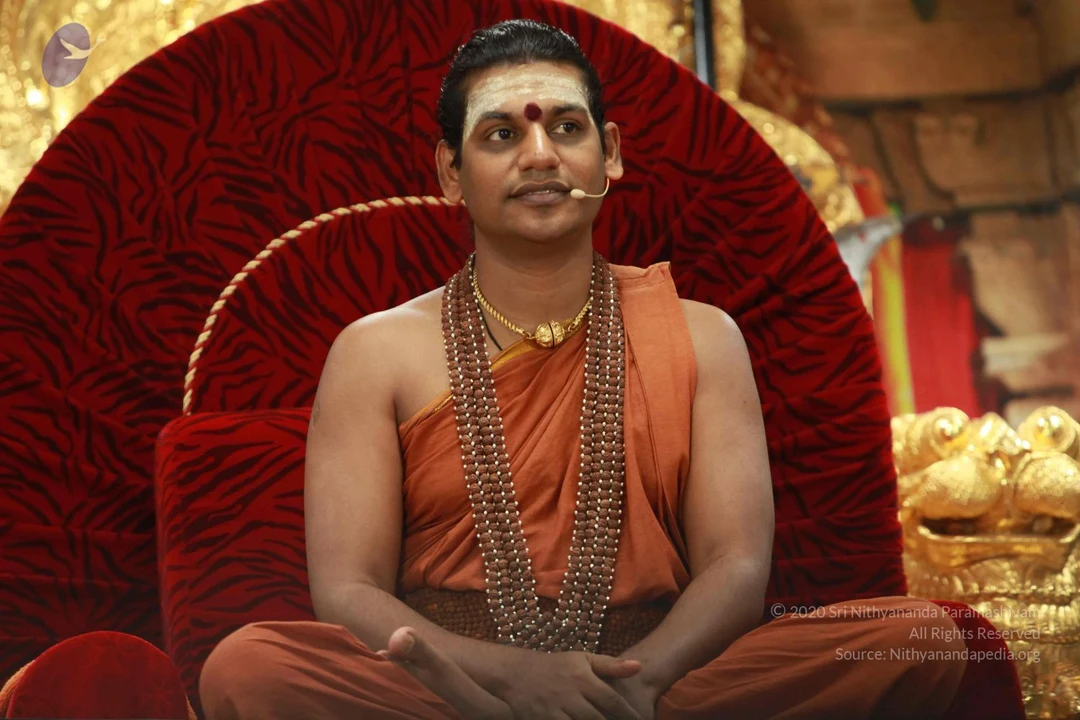
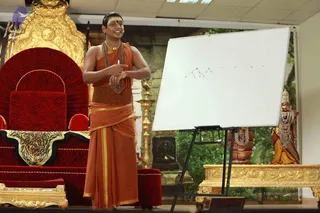
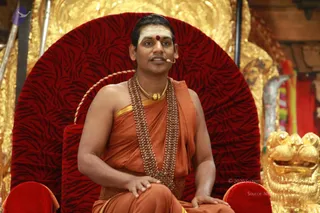
A man in saffron-orange robes stands beside a large blank whiteboard on an easel, pointing at it with his right hand while holding a black marker in his left. He wears a red bindi, a headset microphone, a long beaded rudraksha-style mala and a gold necklace across his chest. Behind him are a red velvet throne-like seat, gilded brass lamps and a deity murti adorned with jewelled garlands. The setting suggests a teaching session in an ashram hall.A man in saffron-orange robes stands beside a blank white whiteboard on an easel in a temple-style hall. He wears a rudraksha mala with a ceremonial gold necklace, a vertical tilak on his forehead, and a gold-bordered orange dhoti and shawl. Behind him is a gold-trimmed red throne draped with a tiger-print cloth, a golden backdrop with a painted forest scene, and a golden deity figure on the right. He gestures toward the board as if teaching.A man in saffron-orange robes with a wrapped orange garment over his shoulder stands at a large white board, drawing small marks with a black marker in his right hand. He wears multiple strands of brown rudraksha beads, a gold pendant, a white sacred ash band across his forehead and a red dot at the centre. A small clip microphone is attached near his mouth. The setting is an indoor talk or satsang with a warm painted backdrop and some red and gold fabric at the left edge.A standing man in saffron-orange robes with a gold-bordered dhoti and a wide rudraksha mala with a large ornate pendant gestures with his right hand while speaking, wearing a headset microphone. A white forehead marking and a red bindi are visible. Beside him stands an easel with a white board showing a small diagram of dots and lines. Behind him is a red velvet throne with gold trim and a tiger-striped cover, a gilded backdrop, a trident, and a golden stand. Gold-framed statues or deity murtis with garlands are visible on the right. One physical person is present.A man in saffron-orange robes stands on a stage beside a whiteboard on an easel, pointing with one hand toward a simple line diagram of connected dots drawn on the board. He wears a rudraksha mala and a gold necklace, with a red-and-white tilak on his forehead. Behind him is a red velvet throne draped with a tiger-skin pattern cloth and gold-framed trim. To the right, a golden pedestal holds decorative deity murti statues adorned with garlands. The setting appears to be a discourse hall with a painted temple backdrop and a brass lamp stand.Photograph of a man seated on an ornate red velvet throne with a gold-framed backdrop and a gilded lion-head armrest. He wears a saffron-orange robe draped over his shoulder with a gold-edged border, multiple strands of rudraksha beads across his chest, a gold necklace, and a small red bindi with white forehead markings. A small lapel microphone is clipped near his face, and he is speaking with his hands resting in his lap. The setting resembles a satsang hall. a person is seated in the centre, with saffron clothing, rudraksha mala and gold necklace as visible cues.
Swamiji-With-The-Samyama-Participants

10 photosSource gallery
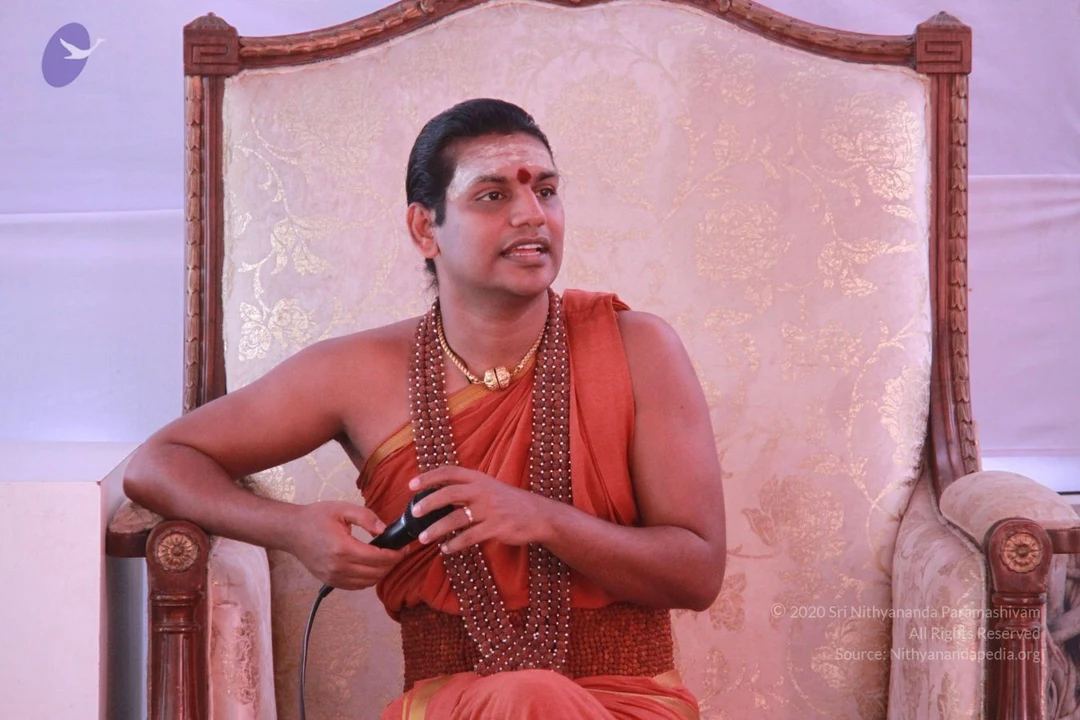
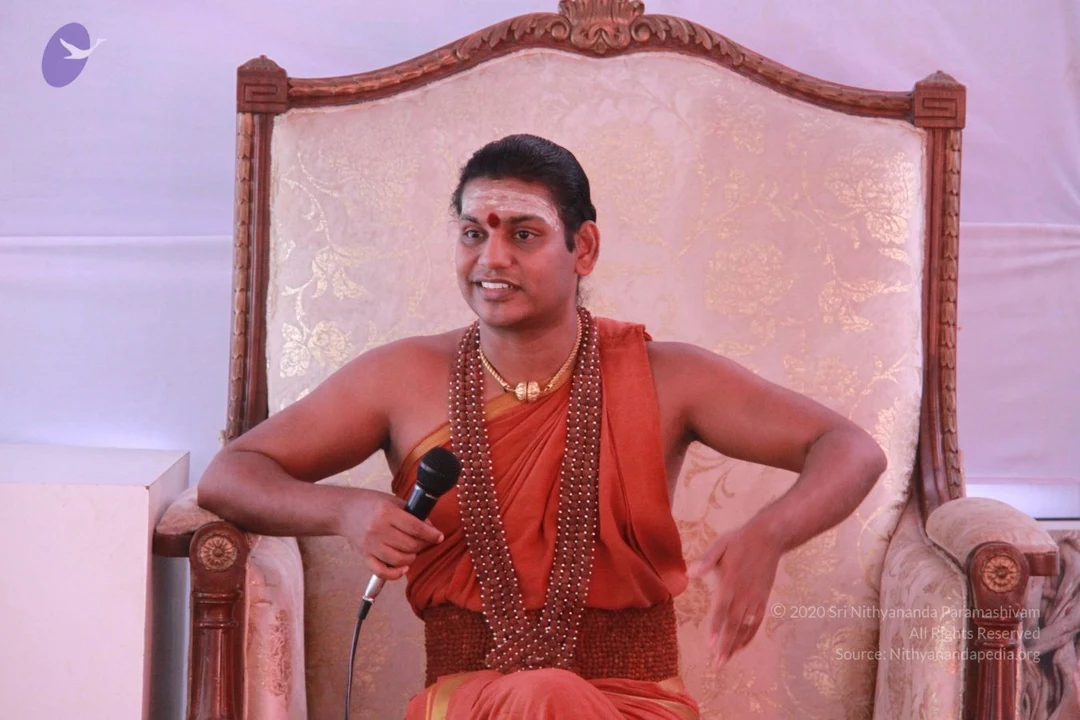
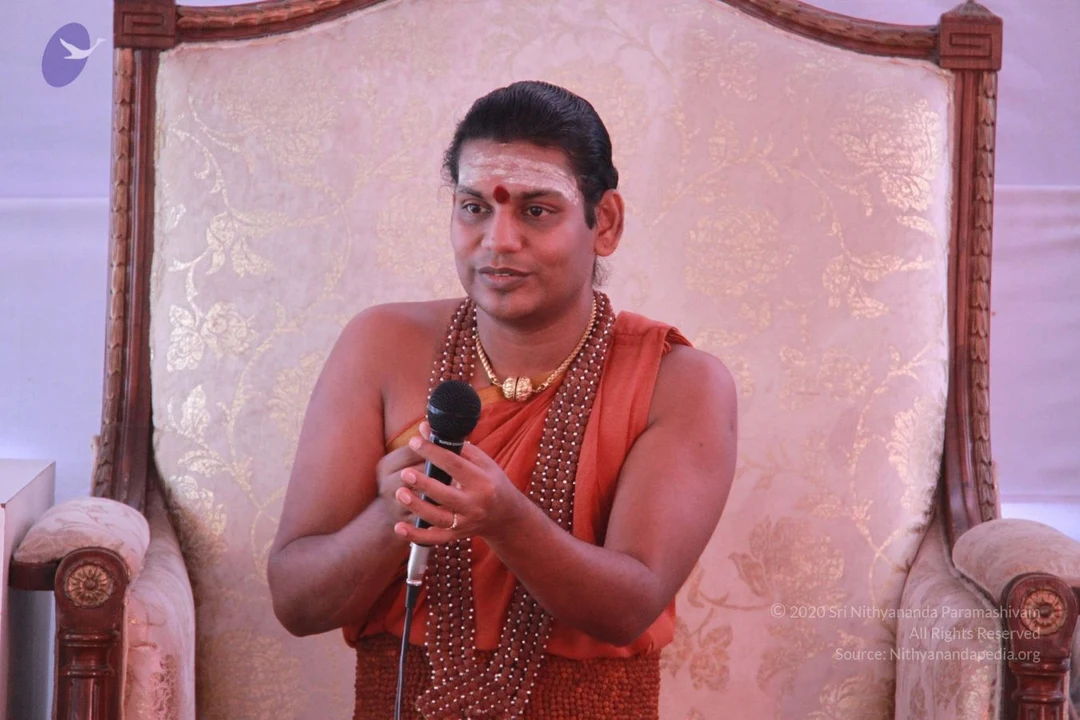
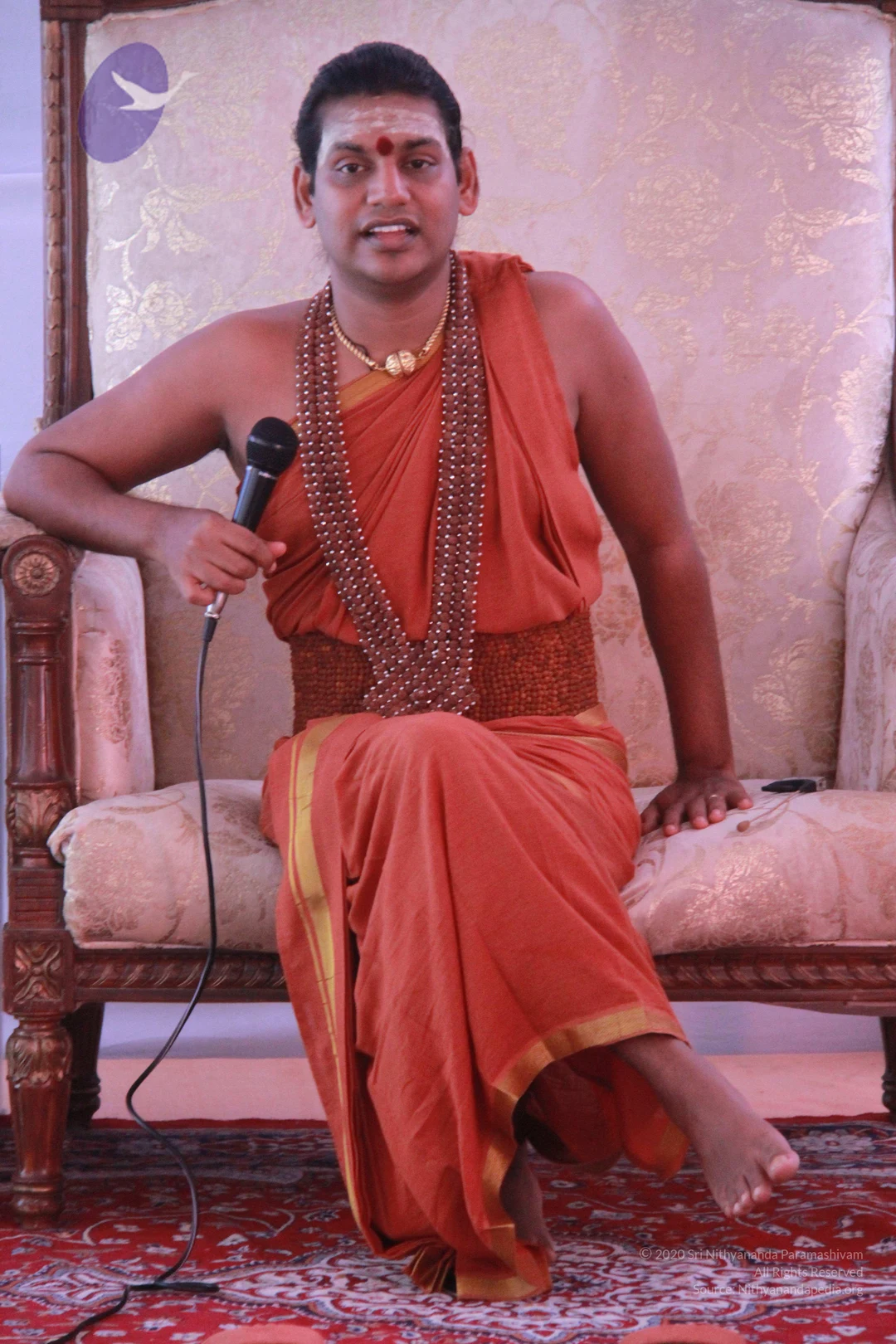
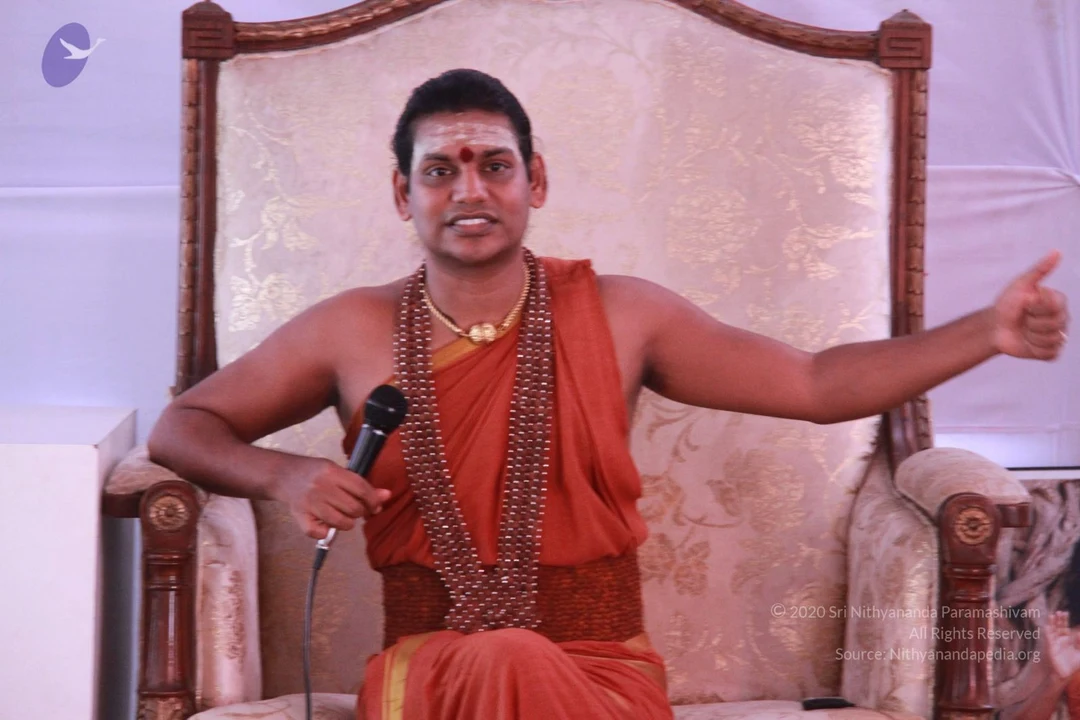
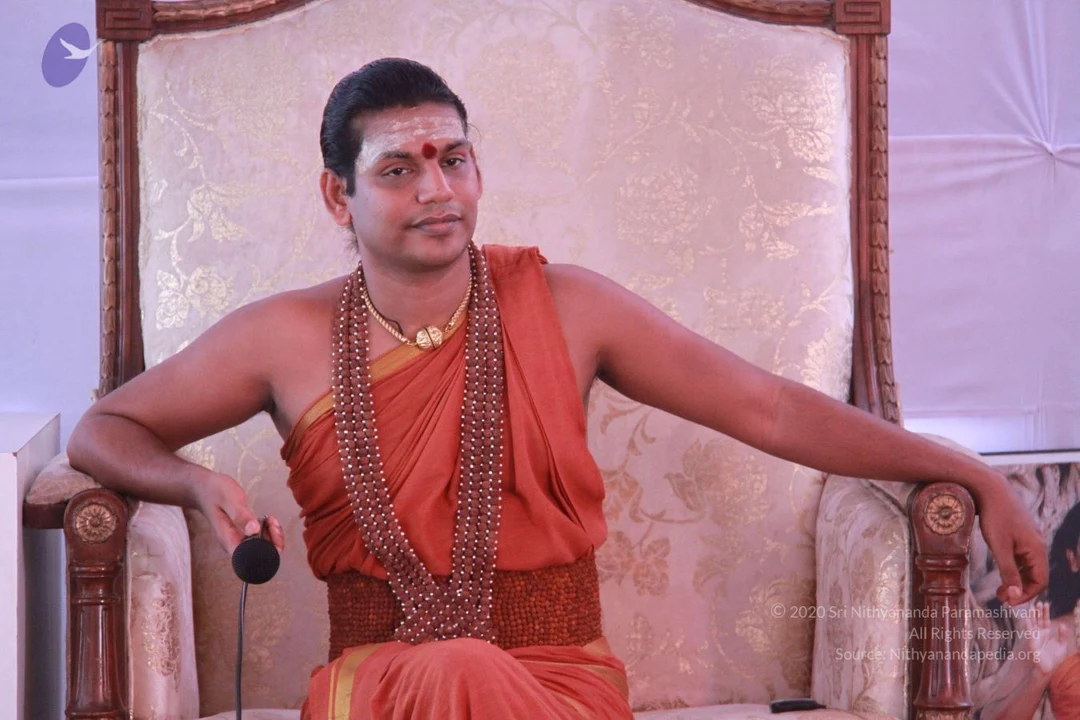
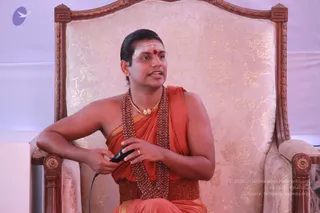
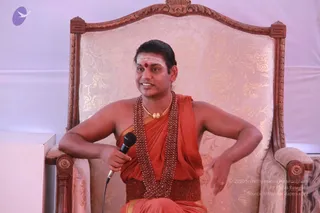
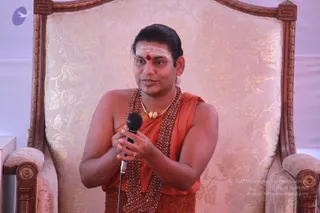
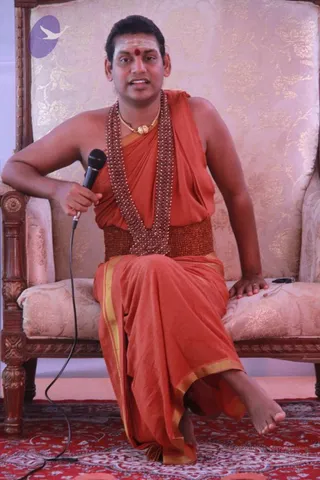
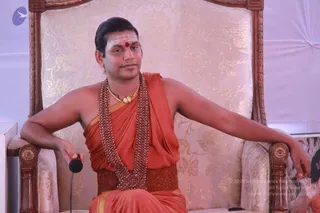
A man seated in an ornate wooden armchair upholstered in pale cream fabric with gold floral damask. He wears an orange-saffron cloth draped over one shoulder and wrapped at the waist, a multi-strand rudraksha mala across his chest, a gold ceremonial necklace, and a wide rudraksha belt. He has a white tilak with a red dot on his forehead, slicked-back hair, and holds a small black microphone in his right hand while speaking, his left arm resting on the chair arm. a person is shown in the appearance-based cues of saffron clothing, rudraksha malas and gold necklace, seated mid-discourse as a speaker at the satsang.A man sits in an ornate wooden armchair with gold floral brocade upholstery, speaking into a handheld microphone. He wears a saffron-orange shawl draped over one shoulder, a dark rudraksha mala with beads across his chest and a gold necklace, and a red bindi with white tilak marks on his forehead. His hair is swept back, and his left hand gestures while a white backdrop hangs behind him. Swamiji (probable): the visible cues are the saffron clothing, rudraksha mala, gold necklace and swept-back hair, and he appears to be giving a talk in the role of a speaker at a satsang.A photo of a man seated on an ornate wooden throne with a gold-brocade floral upholstered back, holding a handheld microphone near his chest while speaking. He wears a saffron-orange cloth draped over his shoulders, a rudraksha mala of multiple strands, and a gold necklace. A white horizontal tilak with a red bindi marks his forehead, and his hair is combed back. The background is pale pink fabric. The image carries a copyright overlay in the lower right.A man in orange-saffron robes sits on an ornate gold-patterned upholstered armchair with carved wooden frame, holding a corded microphone in his right hand while speaking. He wears multiple strands of rudraksha beads across his chest, a thick rudraksha waist band, a gold necklace, and a red bindi with white tilak on his forehead. His legs are crossed at the ankle, bare feet visible on a red patterned rug. a person (appearance cues: saffron clothing with gold border, rudraksha malas, ceremonial gold necklace) giving a talk at a satsang. A logo appears in the upper left corner.A man seated on an ornate, cream-and-gold floral upholstered throne-style chair speaks into a handheld microphone with his right hand while extending his left arm outward, thumb raised. He wears an orange-saffron dhoti and shawl, a long mala of brown rudraksha beads, a gold pendant necklace, and a red tilak with a vertical mark on his forehead. A white backdrop and a faint partial figure at the right edge appear behind him. a person is shown in this discourse, with appearance cues of saffron clothing and rudraksha mala, though the figure's identity is only appearance-based.A photograph of a man seated on an ornate, gold-patterned throne-style armchair with carved wooden arms, speaking into a small microphone held in his right hand. He wears an orange-saffron cloth wrapped over his torso and draped around his body, a multi-strand rudraksha mala necklace, a matching beaded rudraksha waist band, and a gold pendant necklace. He has a white ash mark and red bindi on his forehead and slicked-back hair. His left arm rests along the chair back. A white backdrop and a partly visible photograph are behind him. Appearance-based label: a person, seated in a satsang-style setting with the saffron clothing, rudraksha malas and gold necklace as cues.

eNGenius-and-Aarathi

22 photosSource gallery
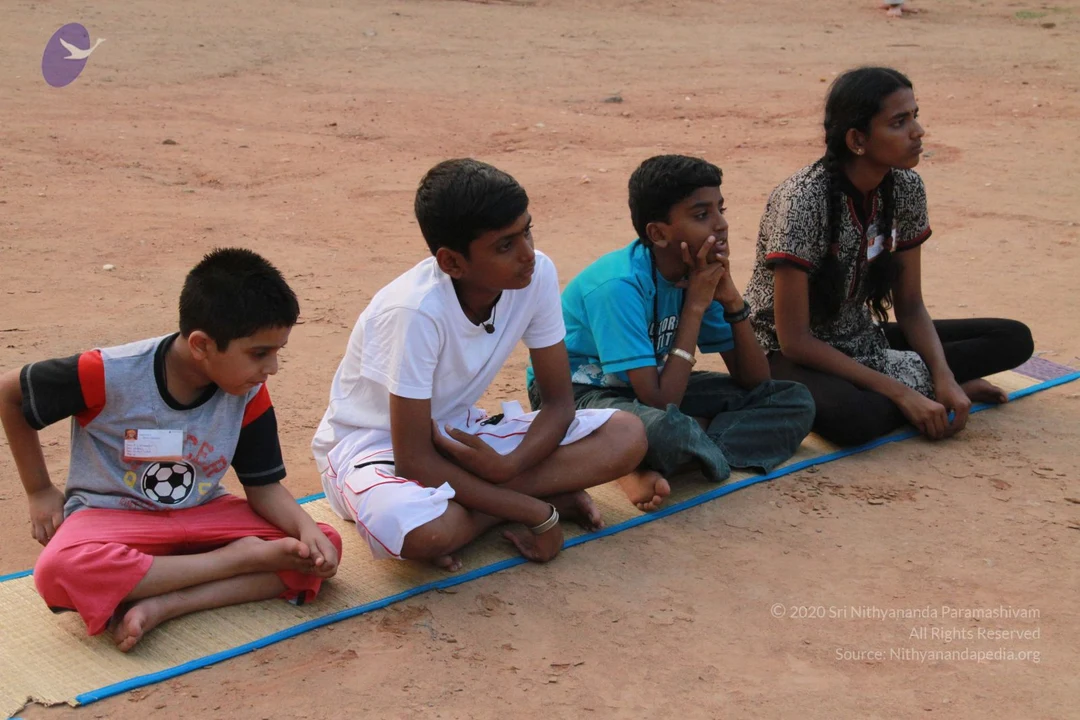
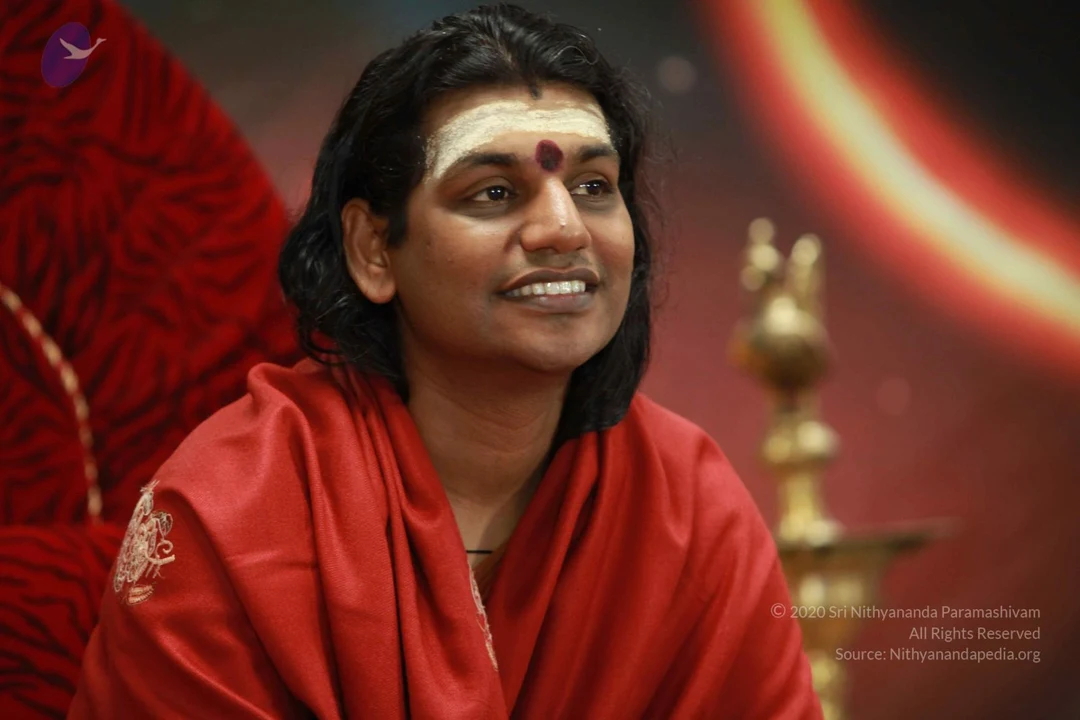
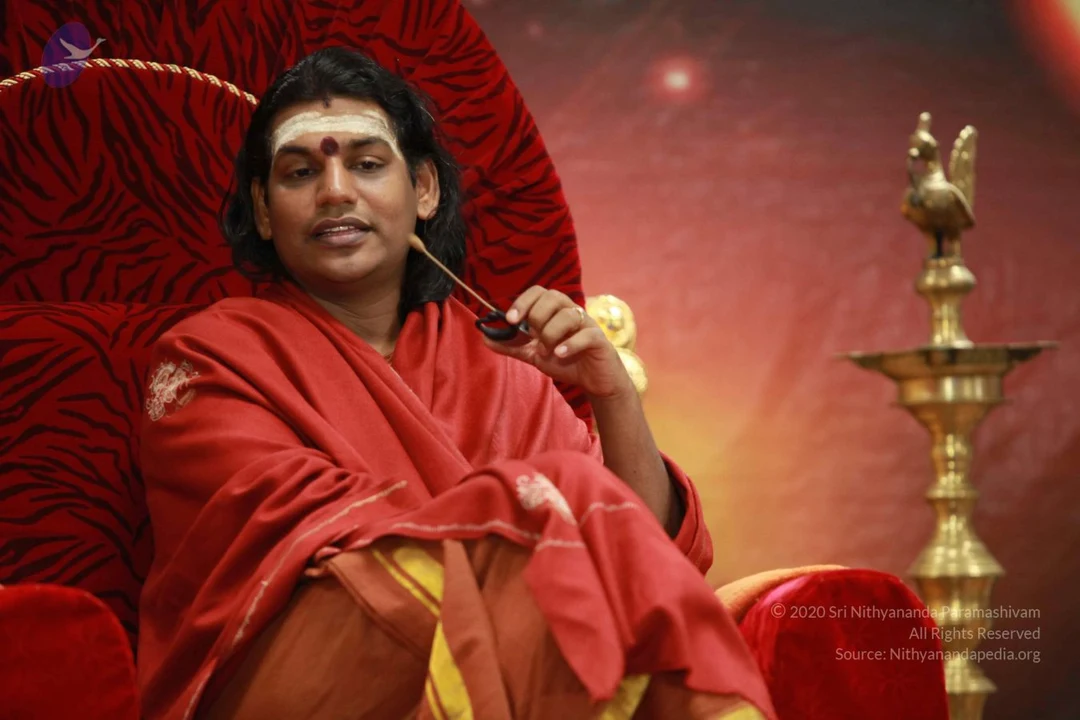
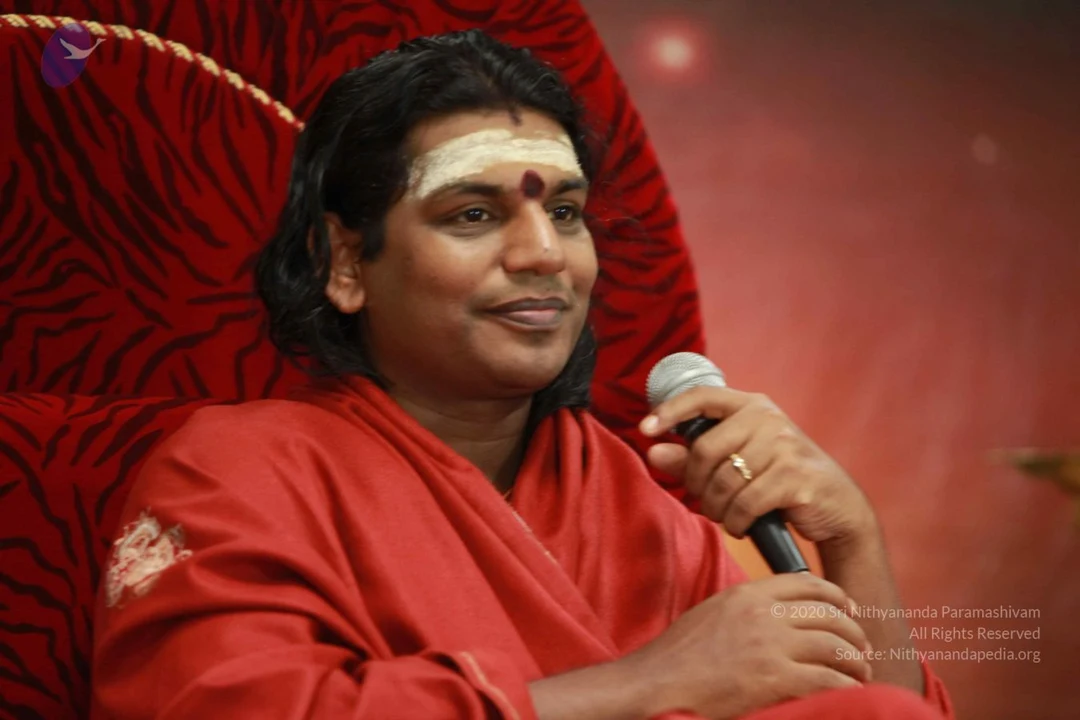
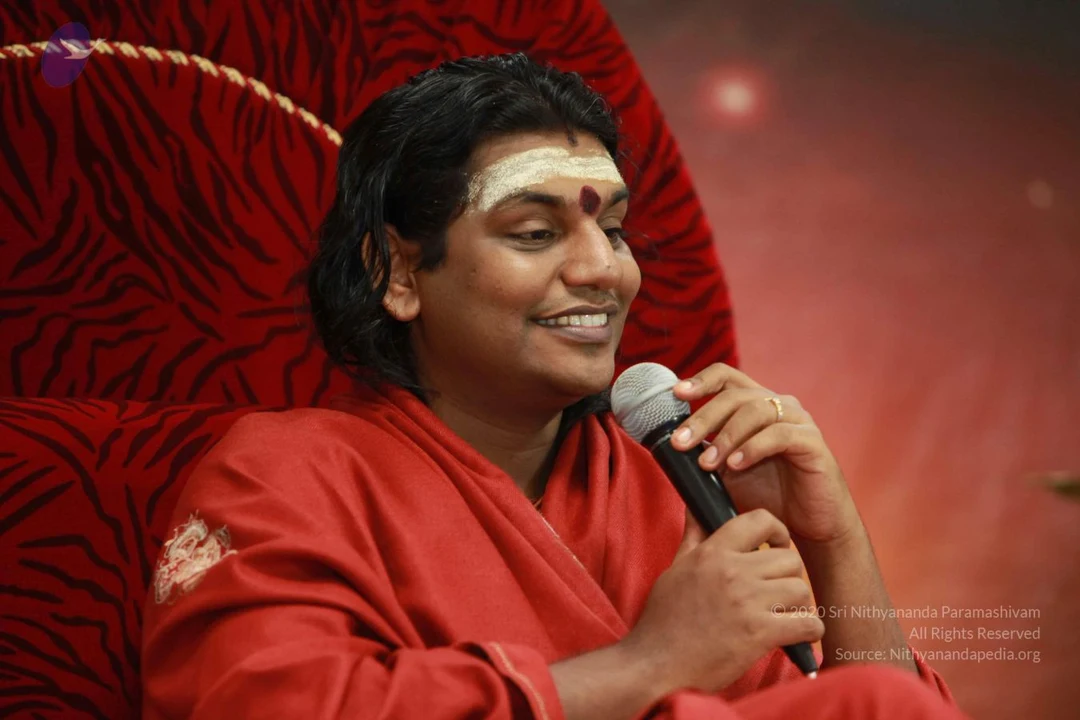
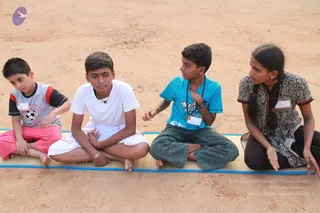
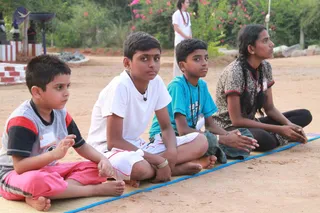
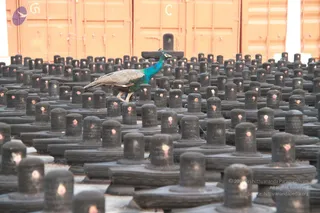
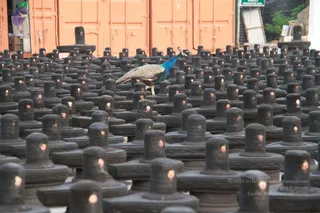
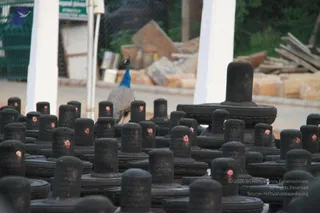
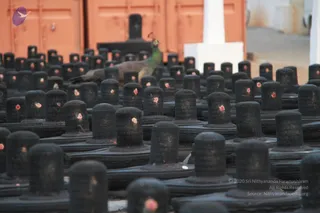
Four children sit cross-legged in a row on a thin straw mat with blue edging, on bare reddish-brown earth outdoors. From left: a small boy in a grey and red-trimmed t-shirt with a football graphic and pink shorts; a boy in a plain white t-shirt and white dhoti-style shorts with a silver necklace and bracelet; a boy in a turquoise t-shirt with a black rudraksha mala and a wristwatch, gesturing with one hand toward the girl; and a girl in a black-and-white patterned dress with a long side braid, sitting with hands resting on her knees. Each child wears a small name badge on the chest.Four children sit cross-legged on a yellow-brown mat outdoors on bare earth, facing forward in a seated meditation or satsang session. From left: a boy in a grey and black sleeveless top with pink trousers and hands loosely folded; a boy in a white t-shirt with a red bindi and a dark pendant necklace; a boy in a teal t-shirt with a black beaded mala; and a girl in a patterned top with a long braid, seated with hands clasped in her lap. A woman in white stands in the background among pink flowering shrubs, and red-and-white painted stone borders and a small stone structure appear at left. No a person figure is visible.A peacock with iridescent teal-blue neck and bronze-patterned wings walks among rows of dark stone Shiva lingams set on black yoni pedestals in an open courtyard. Several lingams bear small white and red kumkum or vibhuti markings. Behind them stand large orange-painted metal doors marked with white letters. No people are visible.A peacock walks among rows of dark stone Shiva lingams set on black yoni pedestals across a courtyard. Several lingams bear small red kumkum marks. Behind them stand orange shuttered container doors and a green sign on a chain-link fence. No people are visible.A photograph of many black stone Shivalingams arranged in rows on a paved courtyard, each on a round black yoni-pitha base, several marked with red-orange kumkum dots. A blue-necked peacock stands among them near the centre. Behind is a chain-link fence, a green signboard with Tamil text, white pillars and stacked building materials and timber. No people are visible and no a person candidate appears.A photograph of rows of black stone Shivalingams on round peetha bases arranged across an open outdoor yard. Several lingams show small red and white kumkum or vibhuti-like marks. A green-necked peacock stands among them near the middle. Behind them are large orange-painted container-like walls and a white structure at right. No people are visible.
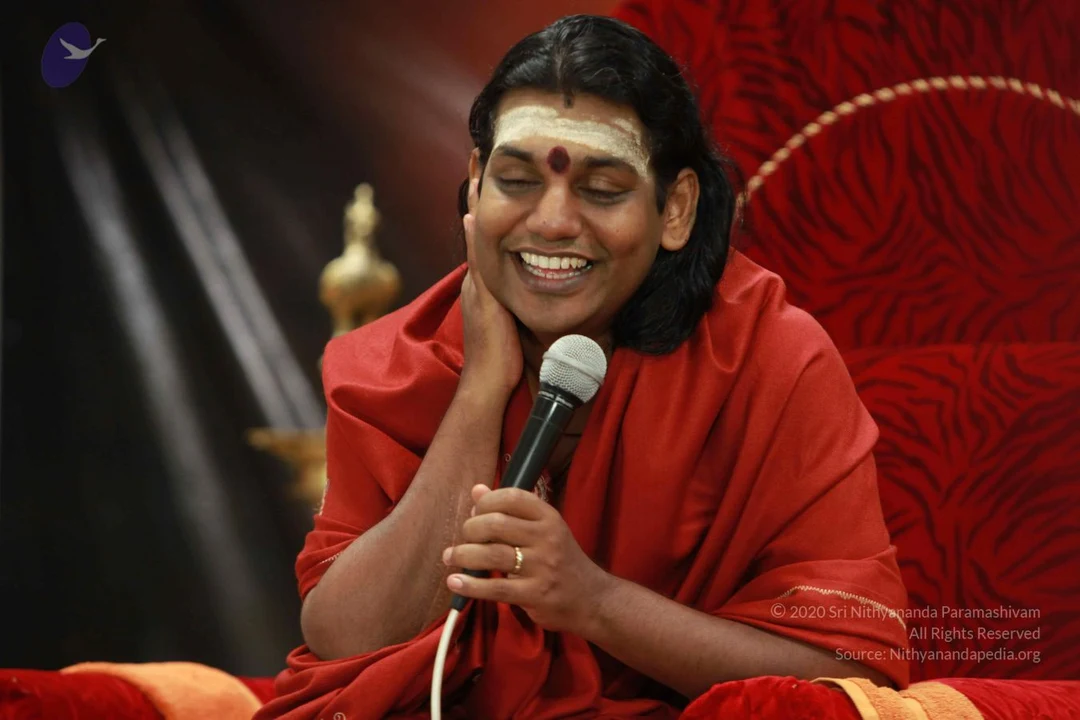
Darshan-and-Akashic-Reading

130 photosSource gallery
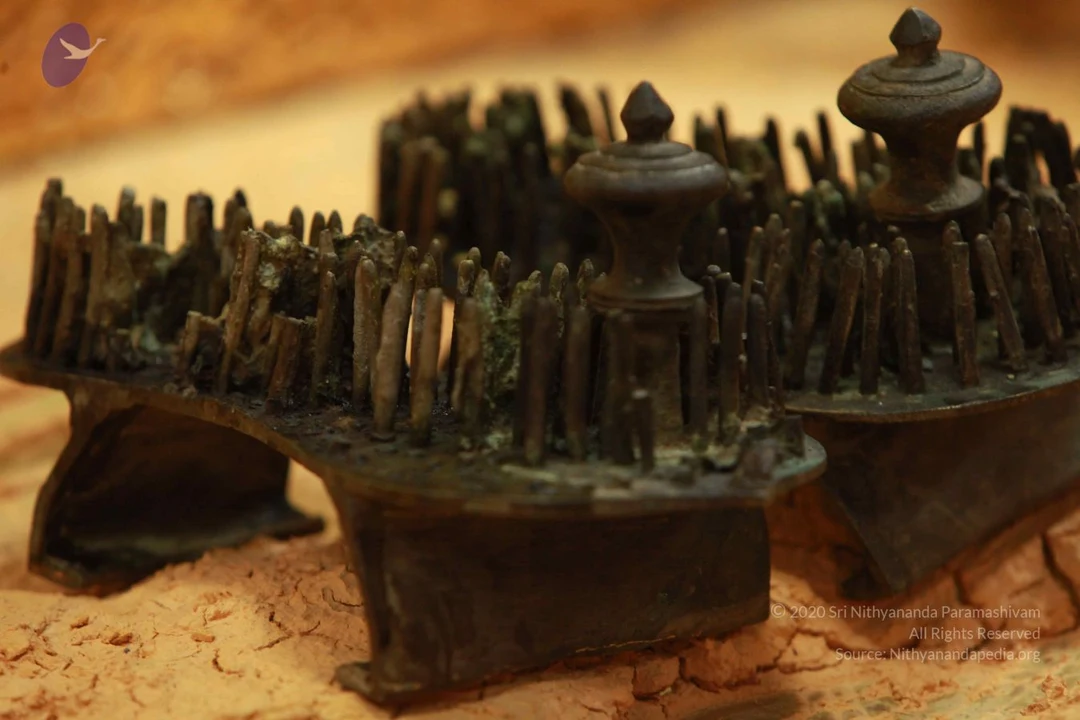
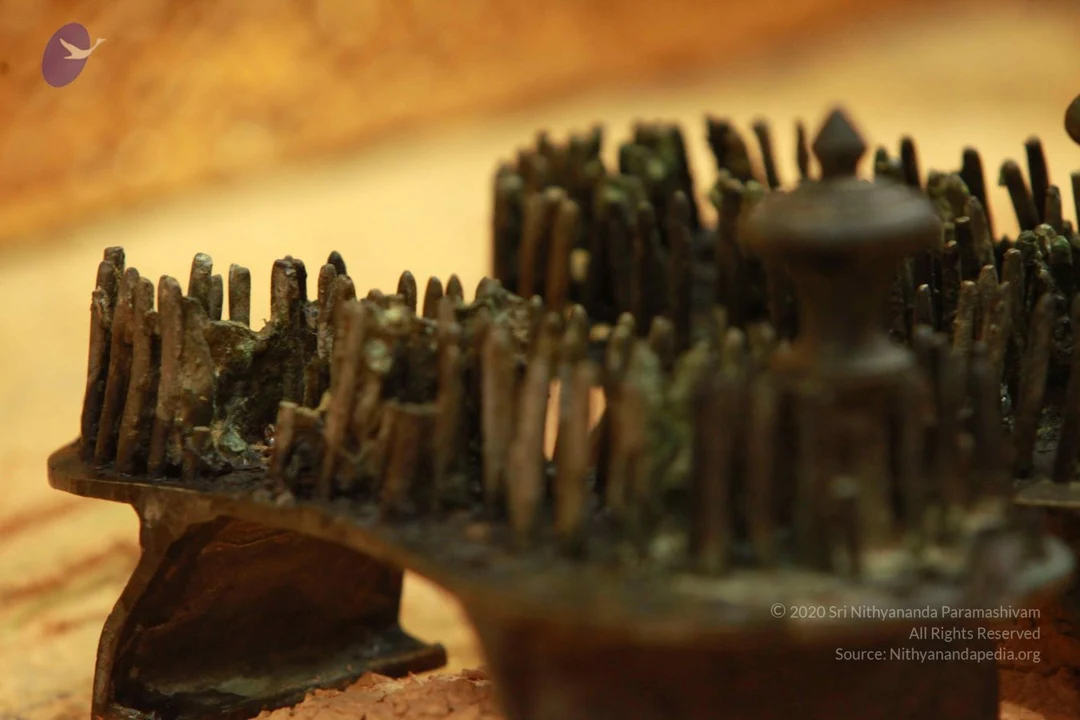
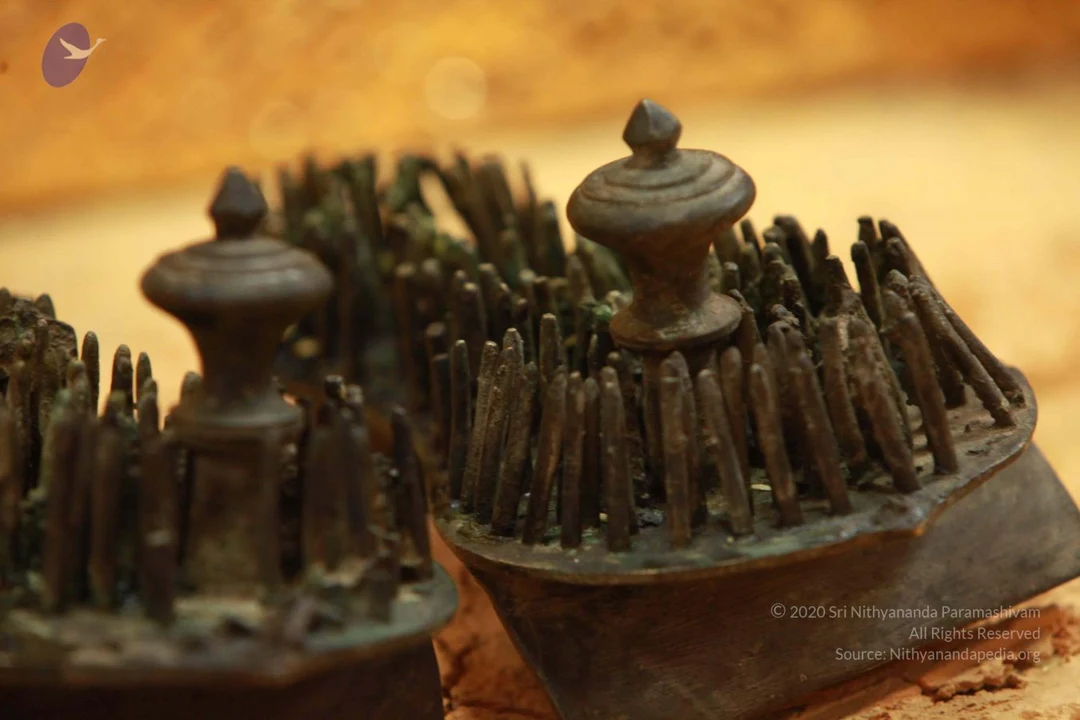
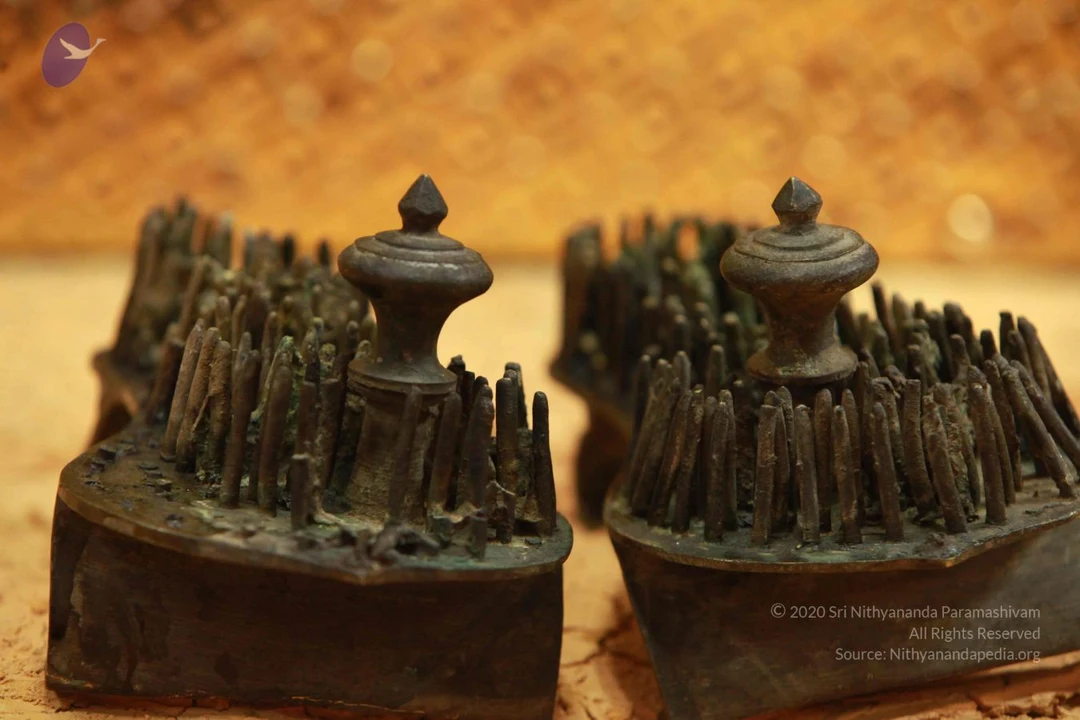
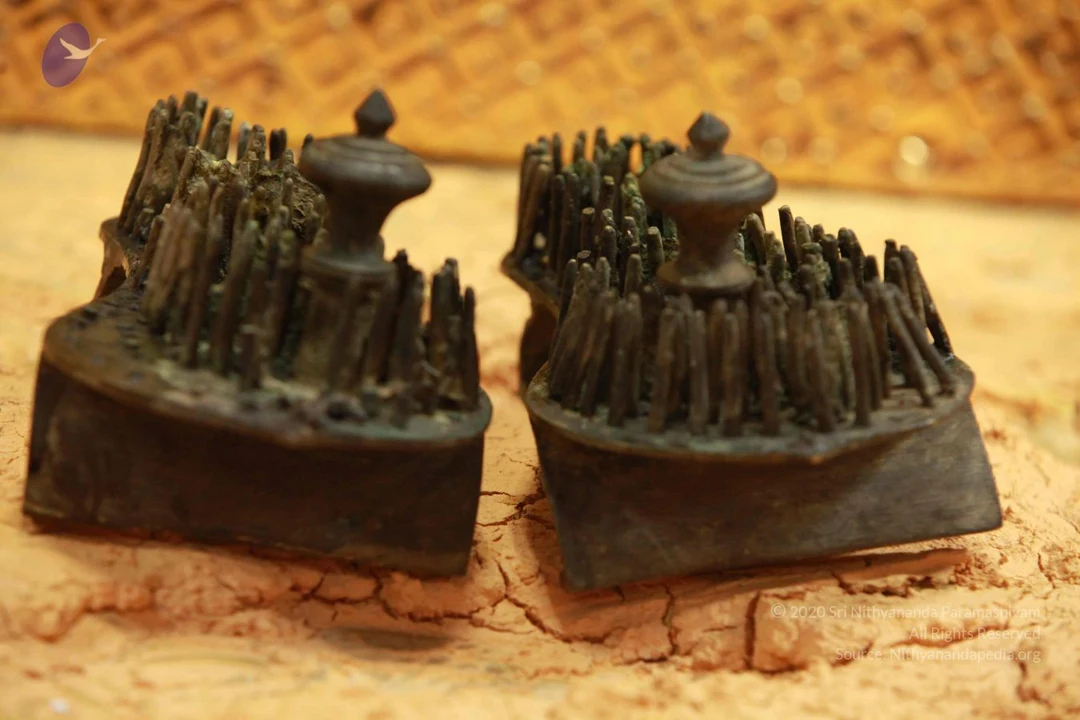
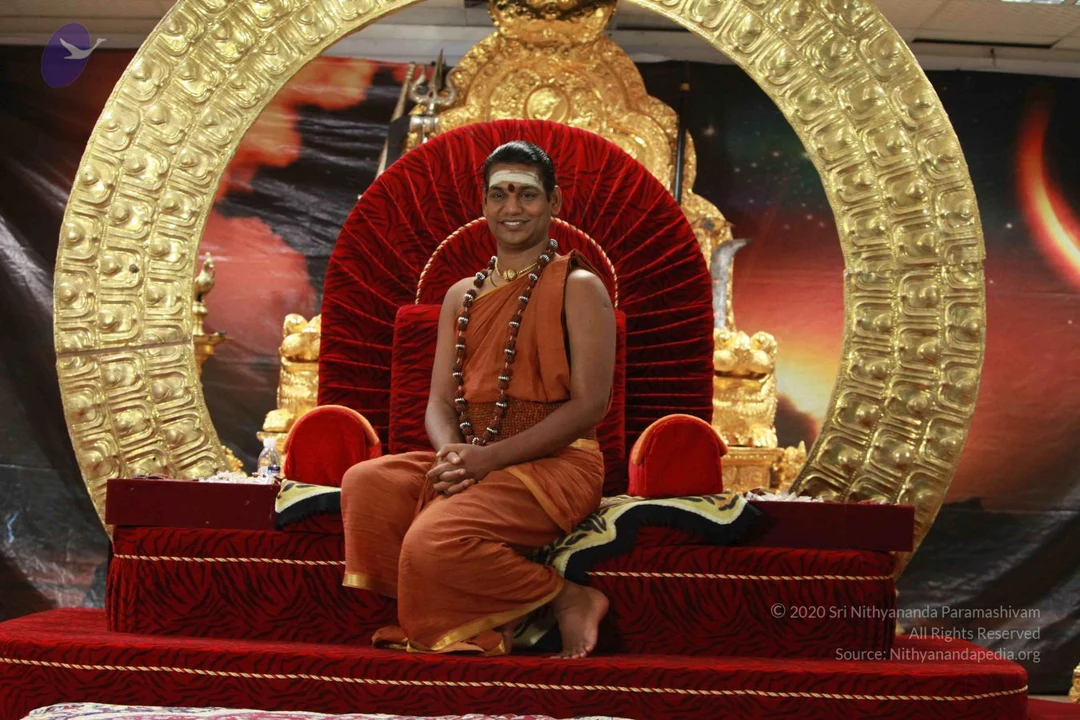
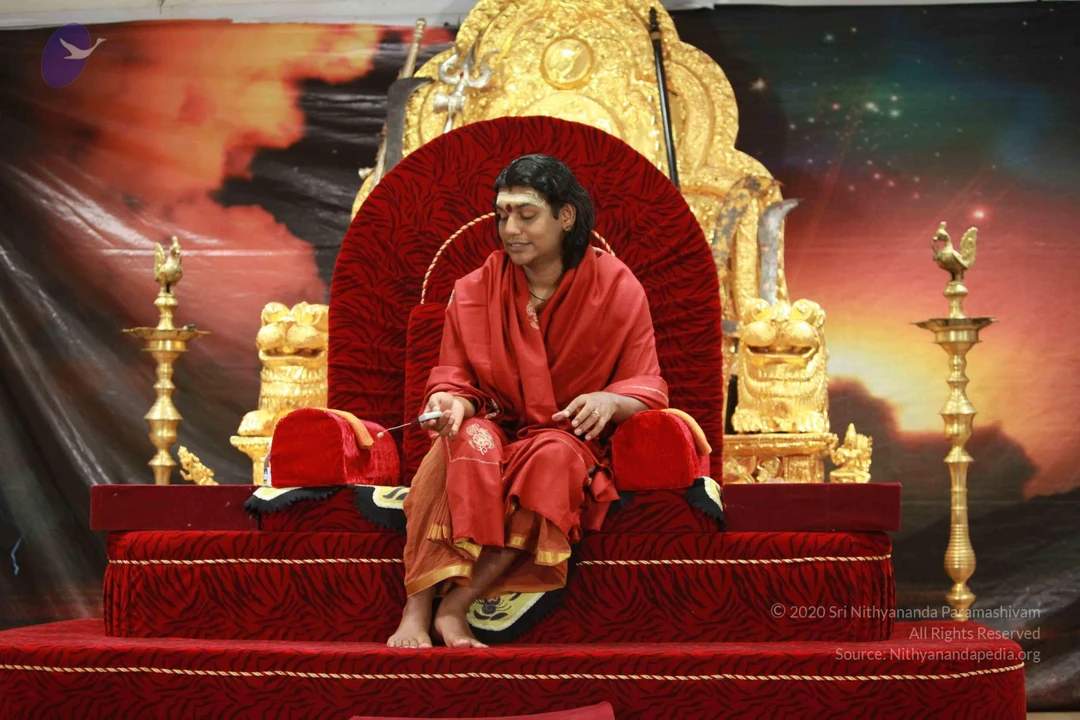
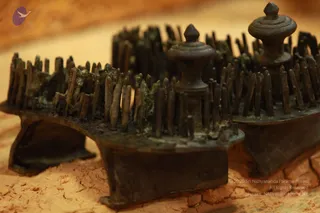
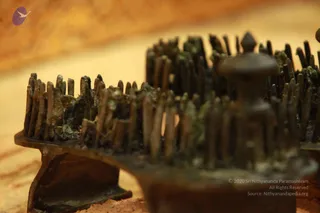
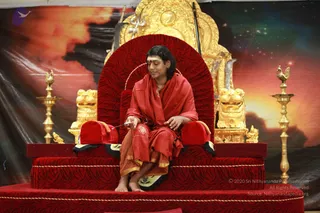
Close-up photograph of a weathered dark bronze or brass ritual object with two tall finial-topped posts rising from a fence-like base of many upright spikes, set on a cracked clay or earthen surface with warm blurred light behind. No people are visible, and the object is a bronze artefact rather than a portrait or depiction of any person.Close-up photograph of a weathered dark bronze object with a ring of upright spikes or tines rising from a curved base, with a small finial-topped post in the background. The metal shows green patina and dark oxidation. Warm orange-brown background, shallow depth of field. No people visible.Close-up photograph of two dark bronze or metal objects with rounded knob finials on top and rows of thin pointed spikes or tines radiating from flat bases, possibly ritual or tool objects. Background is blurred warm golden tones. No people are visible.Close-up photograph of two dark bronze or metal objects resting on a sandy surface against a blurred golden background. Each object has a flat rectangular base studded with rows of upright metal spikes or pins, rising to a tiered finial topped with a pointed knob. No people are visible. The lighting is warm and the background is out of focus.Two dark bronze or metal objects rest on a cracked, sandy-coloured surface. Each has a squared base with a rounded finial and a field of upright metal rods or spikes, dense and blackened with age, on the top. A woven, golden-brown mat is blurred in the background. No people are visible.A photograph of a man seated cross-legged on a large red velvet throne with a red fan-shaped back and red armrests, set in front of an ornate gold circular arch with carved gold figures and a dark backdrop with a red sunset-like glow. He wears an orange-saffron cloth draped over his body, multiple rudraksha malas, a gold necklace, and a white and red tilak on his forehead, with his hands clasped in his lap. Gold deity figures and a trident-like shape appear behind the throne. a person seated on the peetha, judging by the saffron robes, rudraksha malas and forehead marks alongside the throne setting.

Night-Meditation

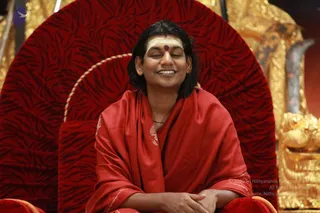
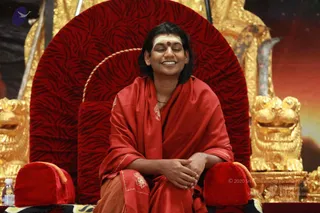
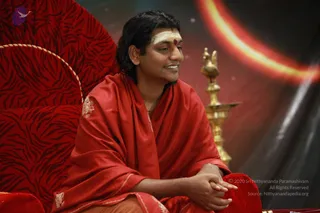
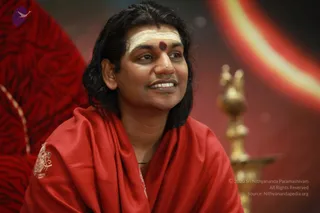
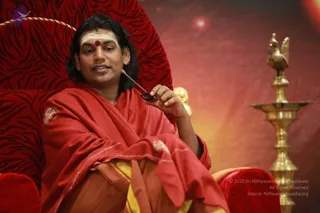
21 photosSource gallery
A photograph of a single seated man on an ornate golden-and-red throne at a satsang stage. He wears long dark hair, a red shawl over a red and gold garment, and a tilak mark on his forehead; his bare feet rest on a red platform. He holds a small white object and gazes downward. Behind him are a gold throne back with a trident and lion figures, flanking gold oil lamps topped with roosters, and a painted backdrop of orange clouds. The ornate throne and dress are visibly present, and the appearance cues (long swept hair, red and gold clothing, ceremonial throne) match the page's a person reference, so this is a person in person.A seated man with eyes closed and a broad smile sits on a red velvet throne with a tiger-stripe pattern and a rounded backrest. He wears a red shawl draped over his shoulders with gold embroidery at the edge, and a dark thread necklace. A white vertical tilak with a red dot marks his forehead, and his hands rest together in his lap. Behind him, an ornate gold carved structure with a golden lion-like figure fills the right side. The setting appears to be a formal satsang hall.A smiling man with eyes closed sits cross-legged on an ornate red-and-gold throne with a tiger-striped red velvet backrest and gold lion-head armrests. He wears a red shawl with gold-embroidered motifs over orange-red clothing, with a white vertical forehead marking and a red bindi, and his hands rest folded in his lap. A water bottle sits at the left edge of the frame, and a red-and-gold stage setting surrounds him.A man seated on a red throne with a tiger-striped red upholstered backrest, smiling and looking to the side with hands resting in his lap. He wears a red shawl over orange clothing, has a white vertical forehead mark with a red dot at the centre, and has shoulder-length dark hair. Behind him stands a golden oil lamp with a bird-shaped finial and a red and gold glowing arc against a dark background.A photograph of a smiling man seated in a red-cushioned setting, wearing a red shawl with a small embroidered emblem at the shoulder. He has long, swept-back dark hair, a white vertical tilak on his forehead with a red dot at the centre, and looks off to the right. Beside him is a polished brass lamp stand with a tiered top, and a blurred red and gold glow fills the background. The appearance and attire are consistent with the page's a person description, though the cues are not fully distinctive, so identity is uncertain.A seated man in a red-orange shawl and dhoti sits on a red tiger-striped throne with a red velvet backrest. He has long, swept-back dark hair, a white vertical tilak with a red bindi on his forehead, and holds a small wooden or red-tipped stick near his ear while speaking. Beside him stands a tall brass oil lamp with a bird finial against a red-lit backdrop. Swamiji (probable) is shown in a discourse setting with a red-and-gold ceremonial seat, his long hair, tilak and saffron-red clothing matching the candidate cues.