Skip to content
Friday

18 April 2014

Get Comfortable with Completion | Nithyananda Satsang | 18 Apr 2014

Dated photos
82
Source pages
1
Media
2
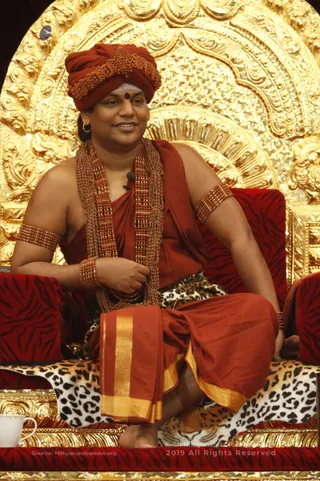
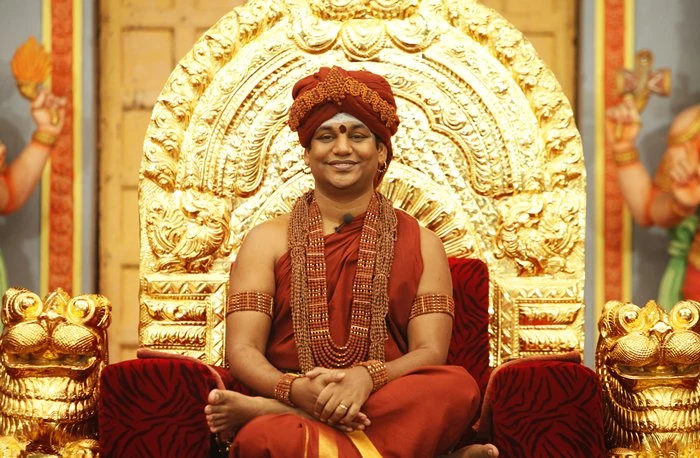
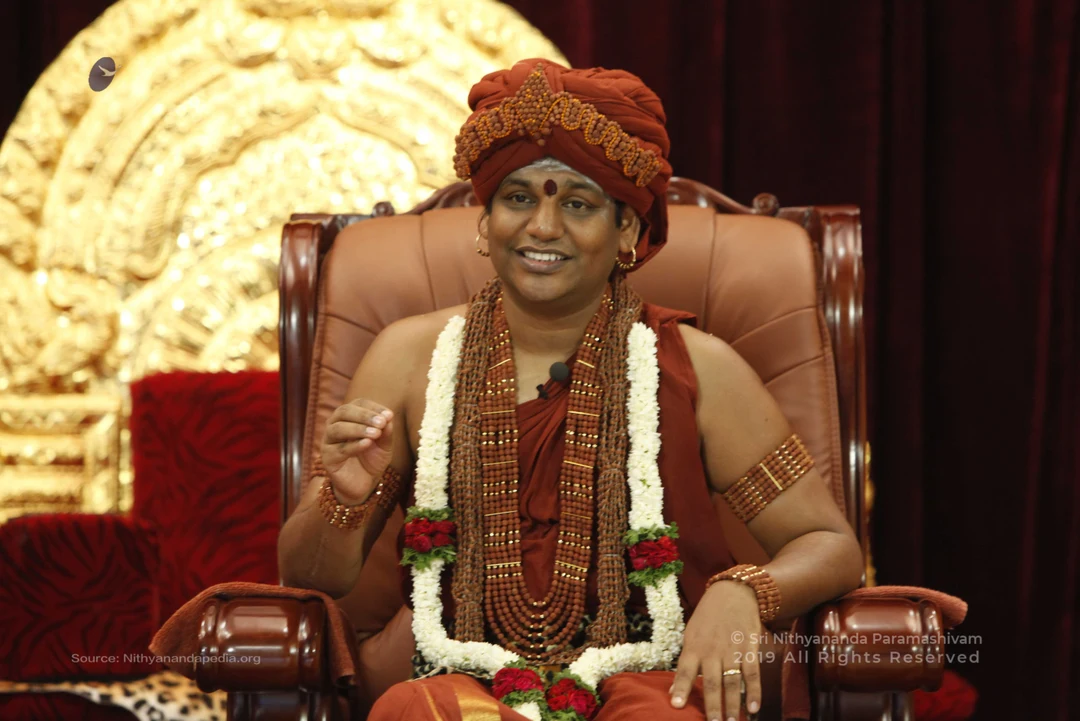
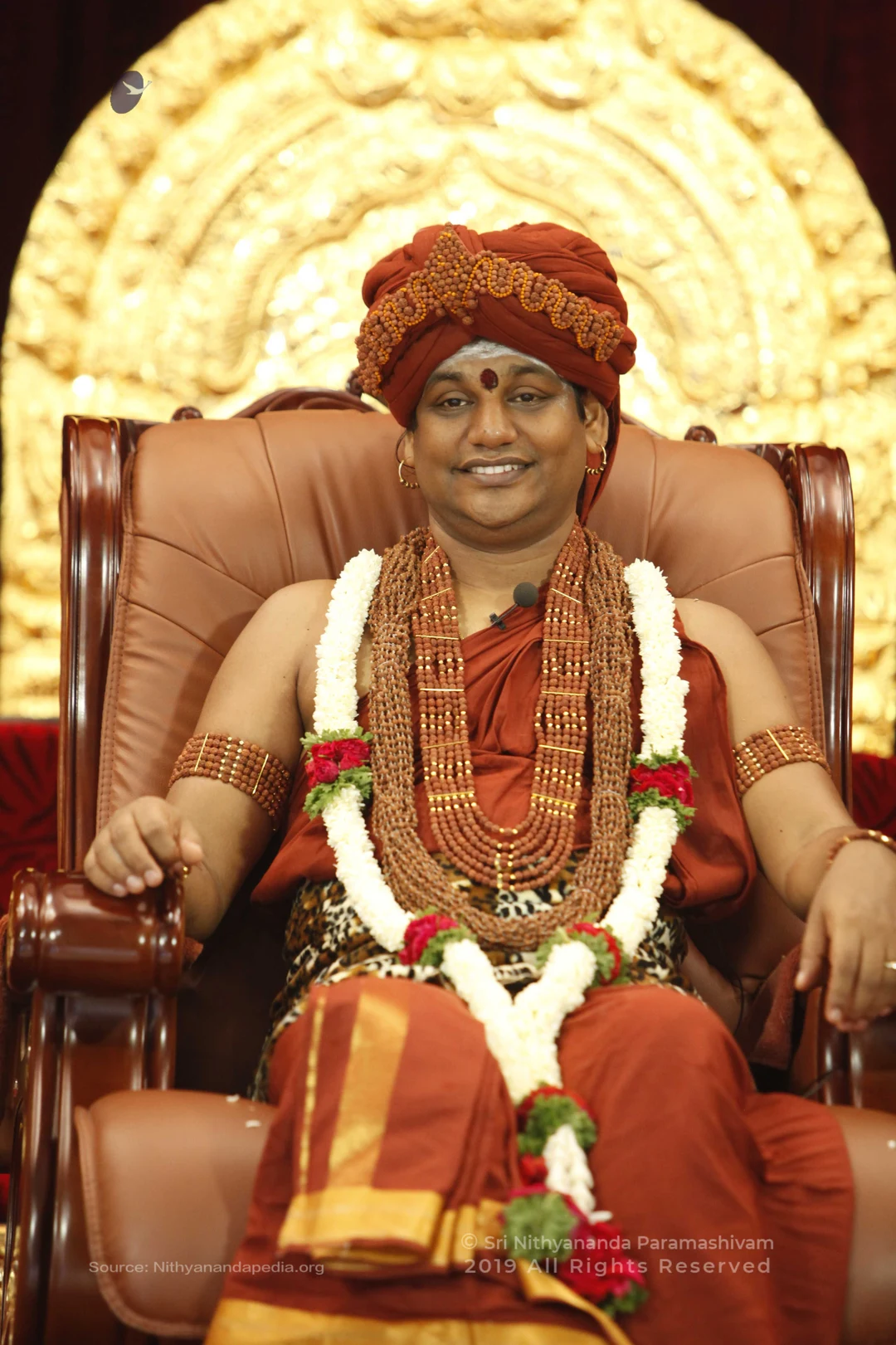
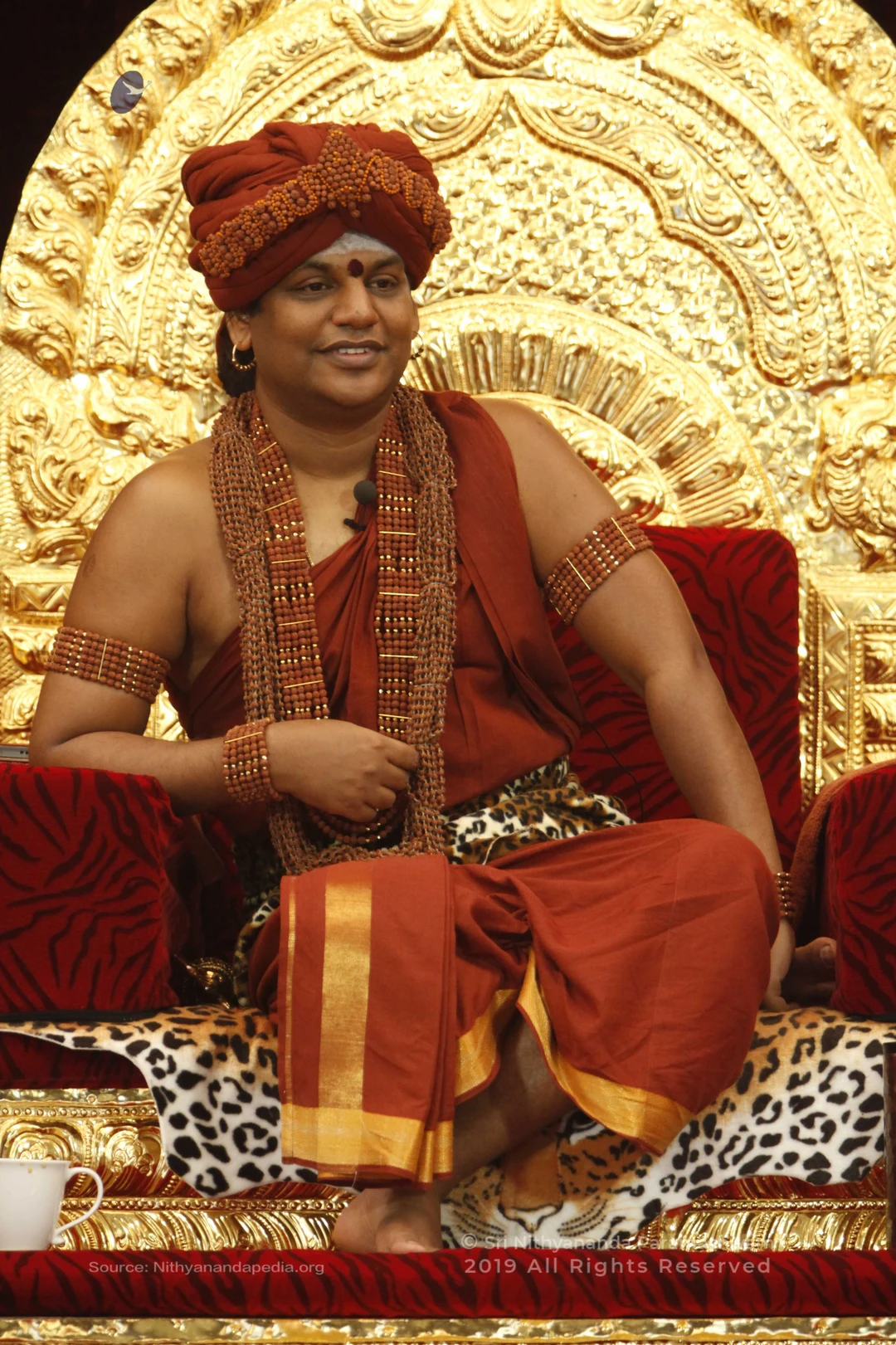
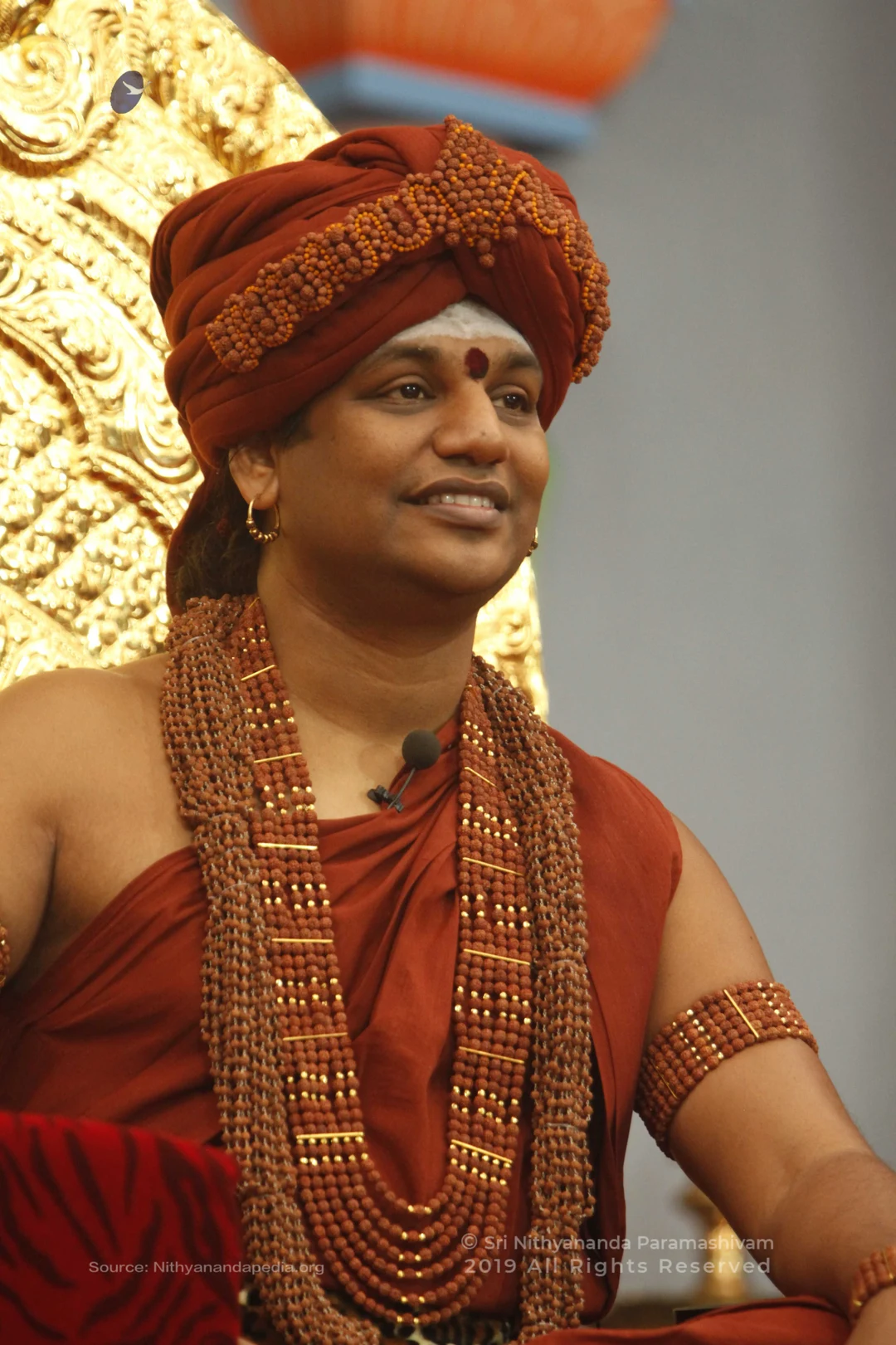
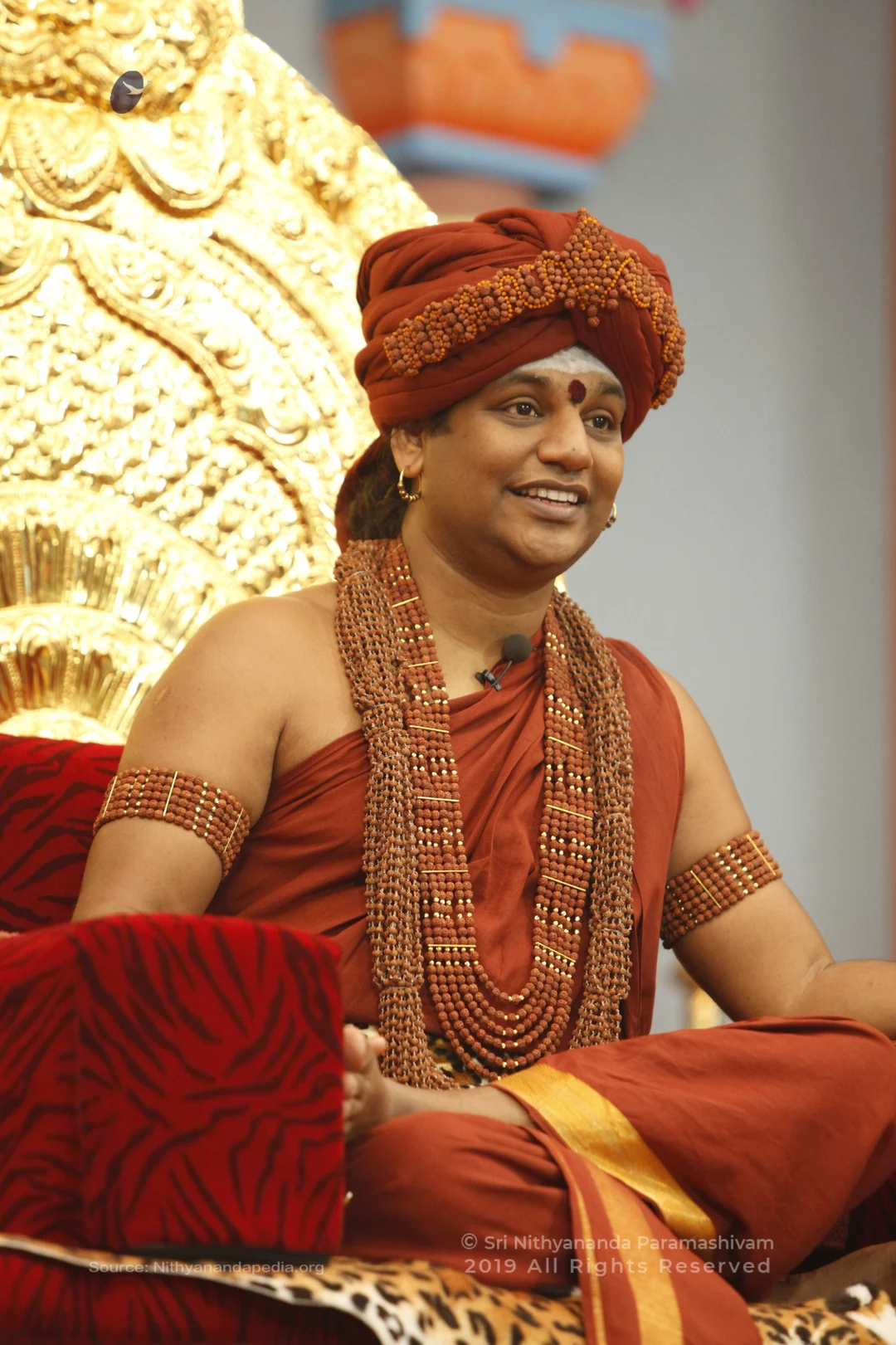
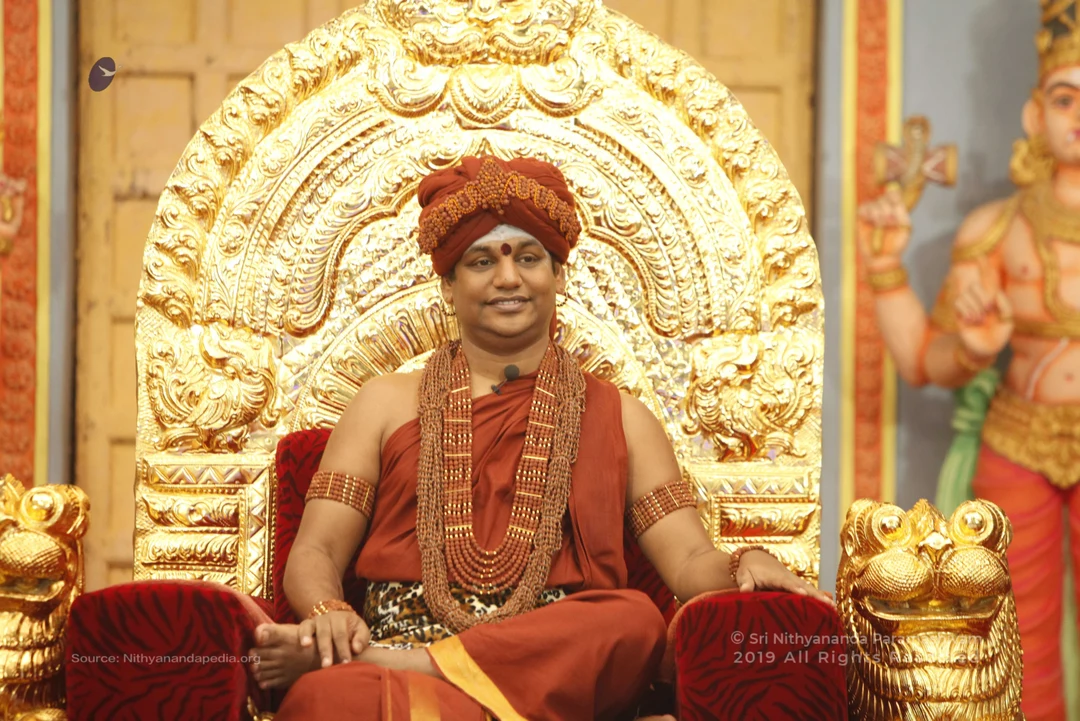
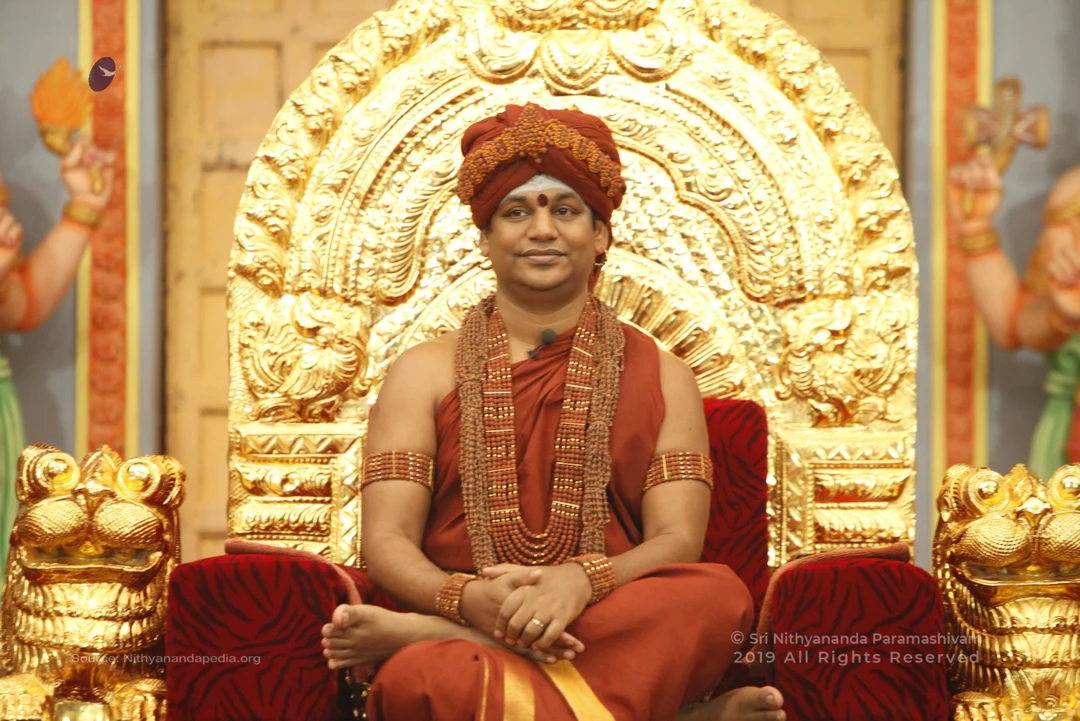
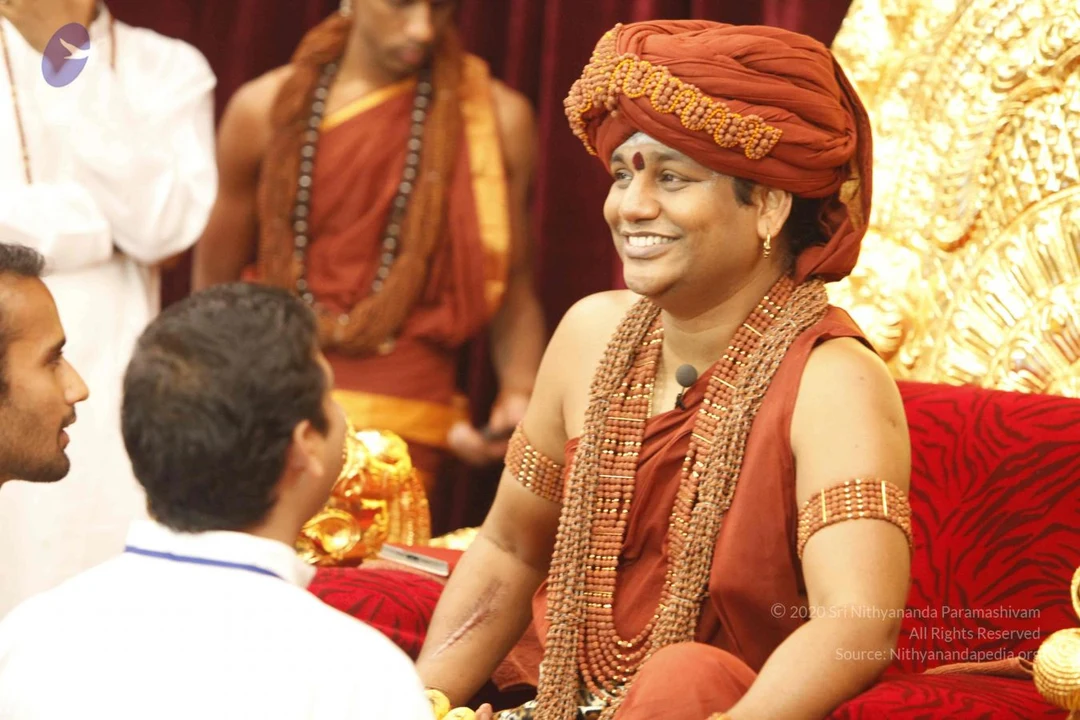
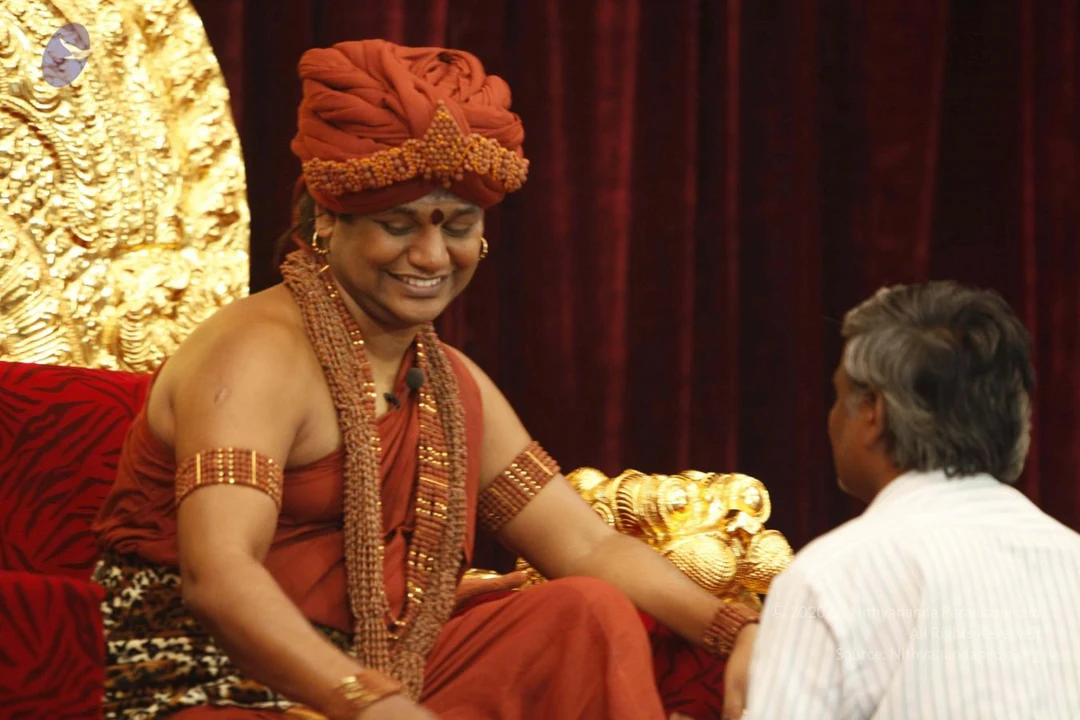
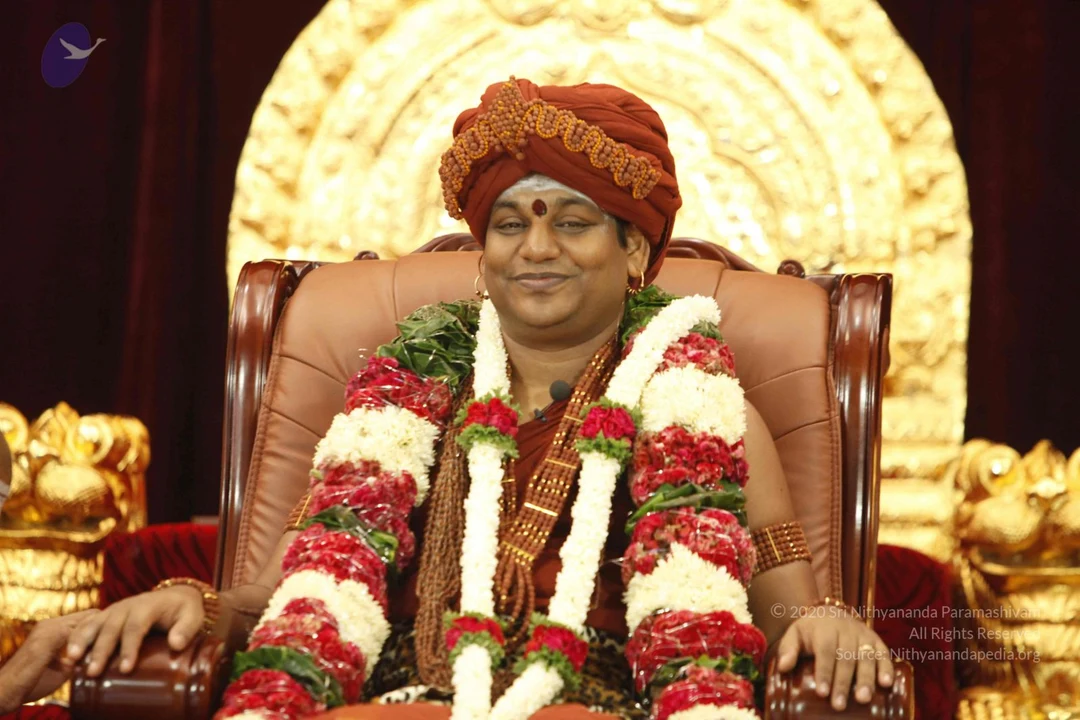
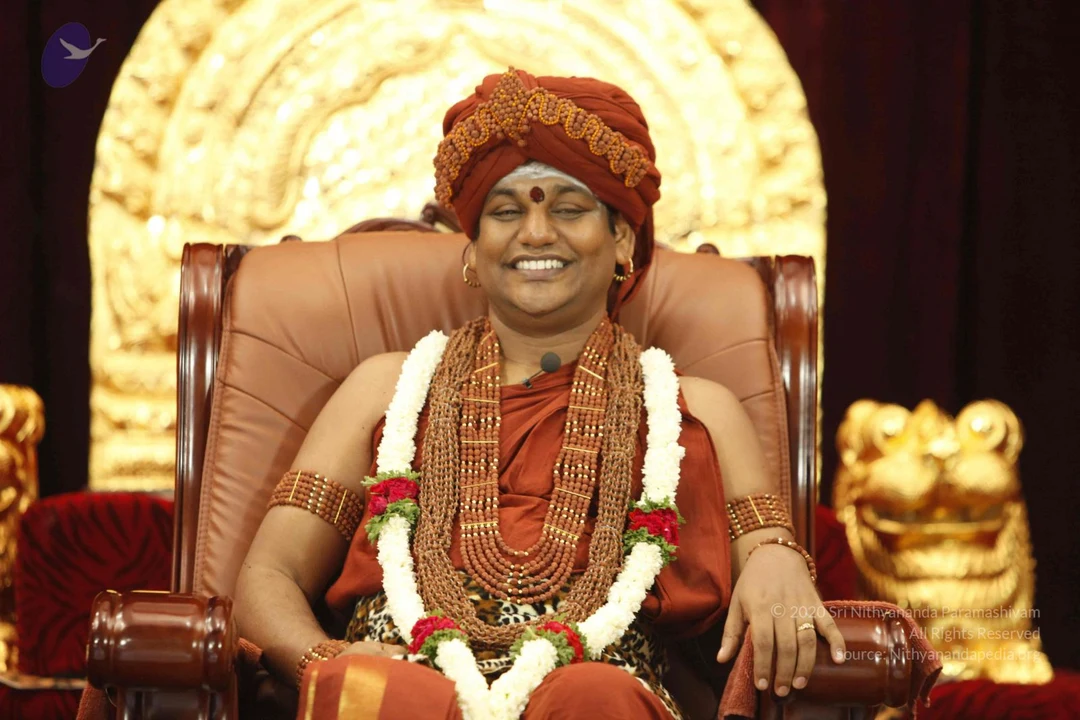
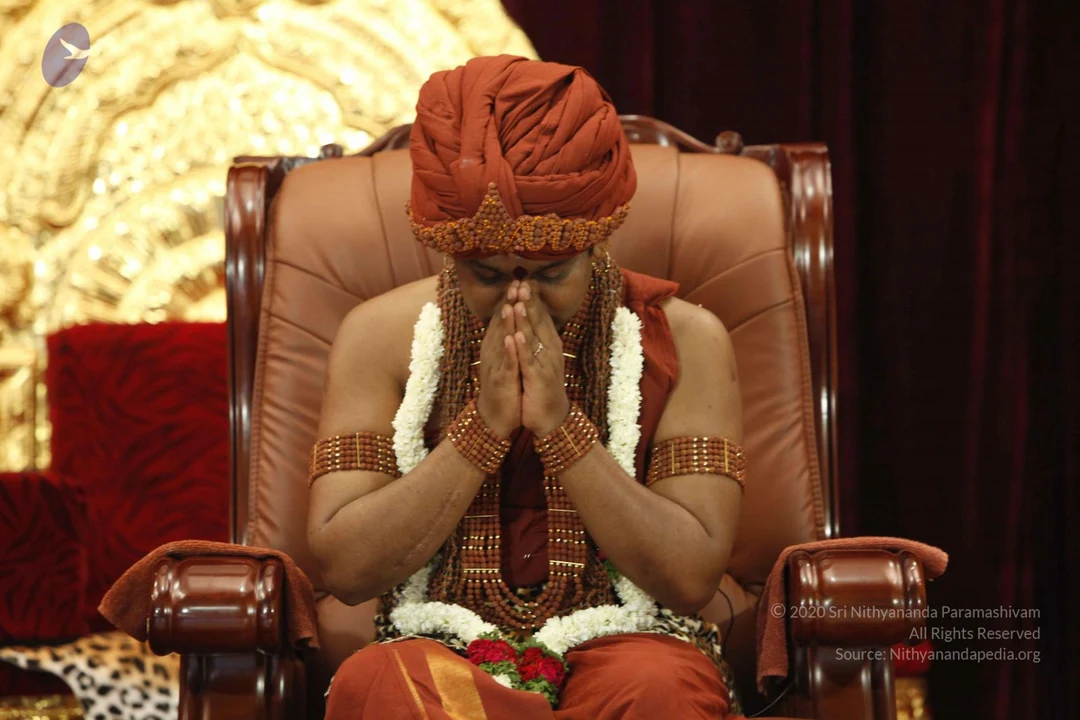
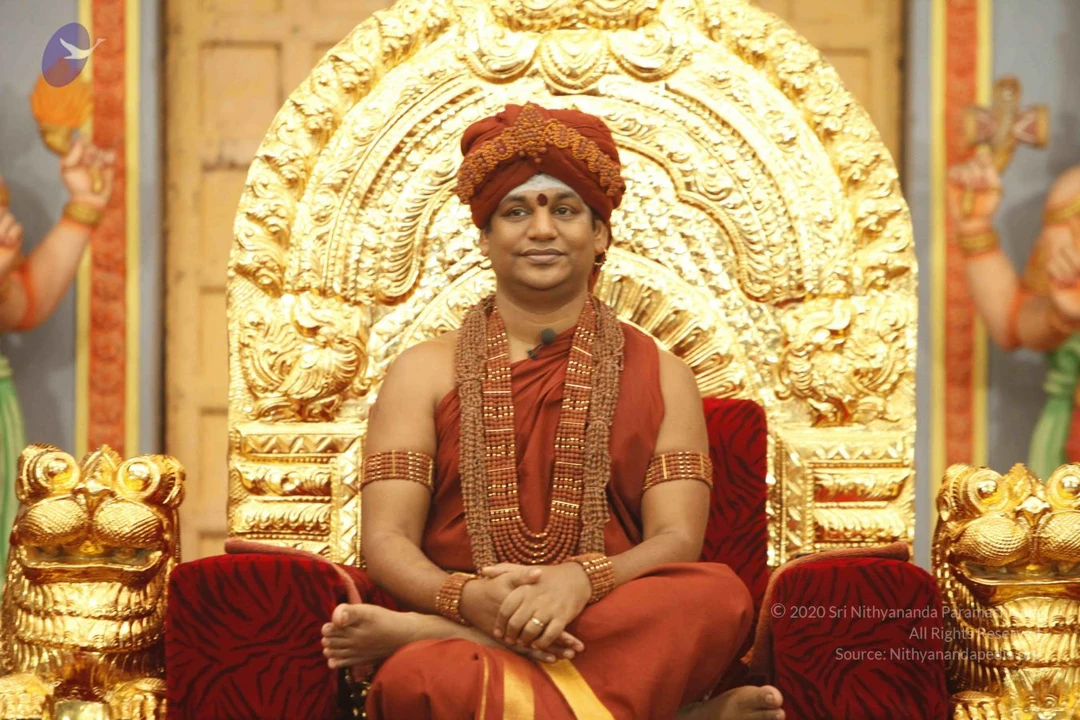
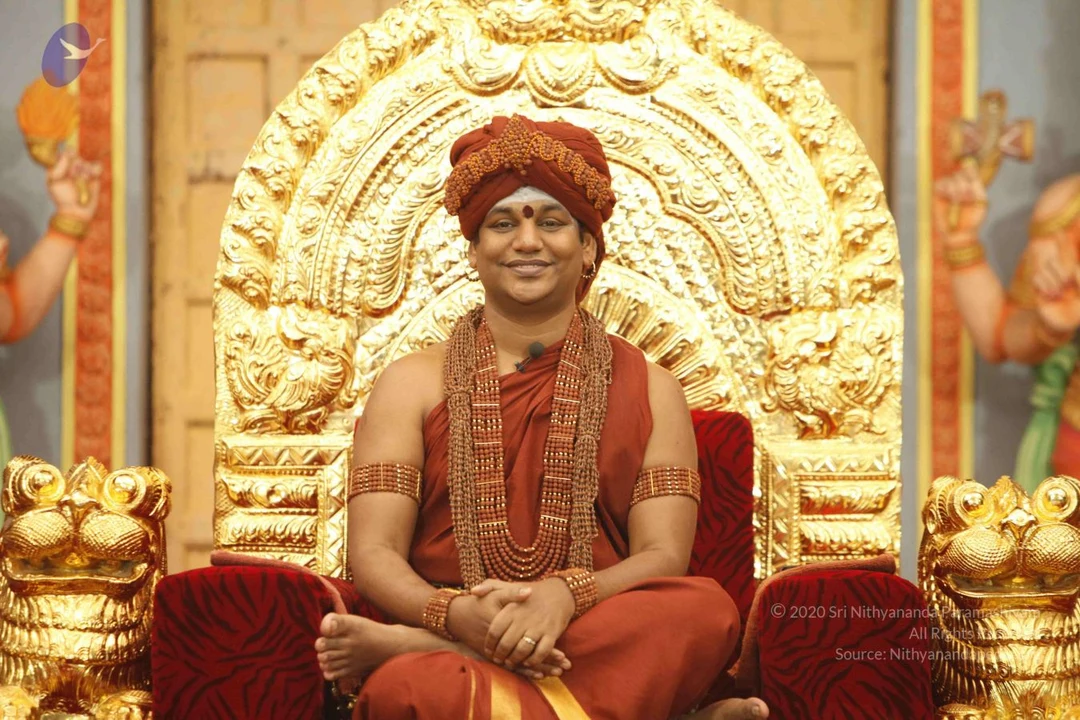
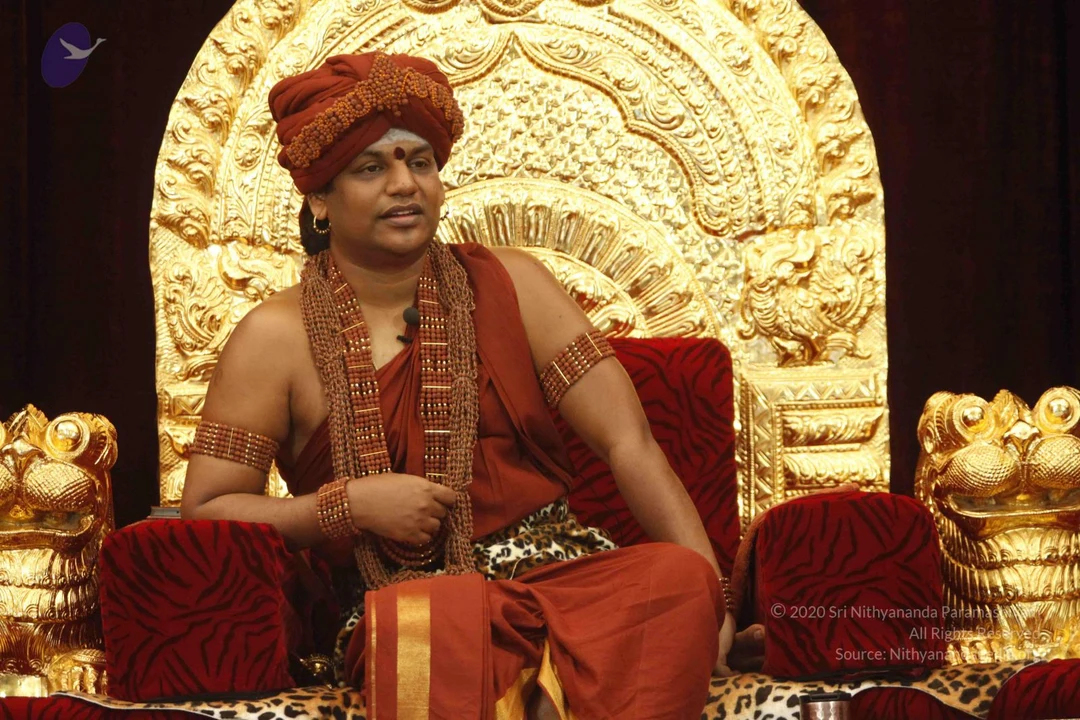
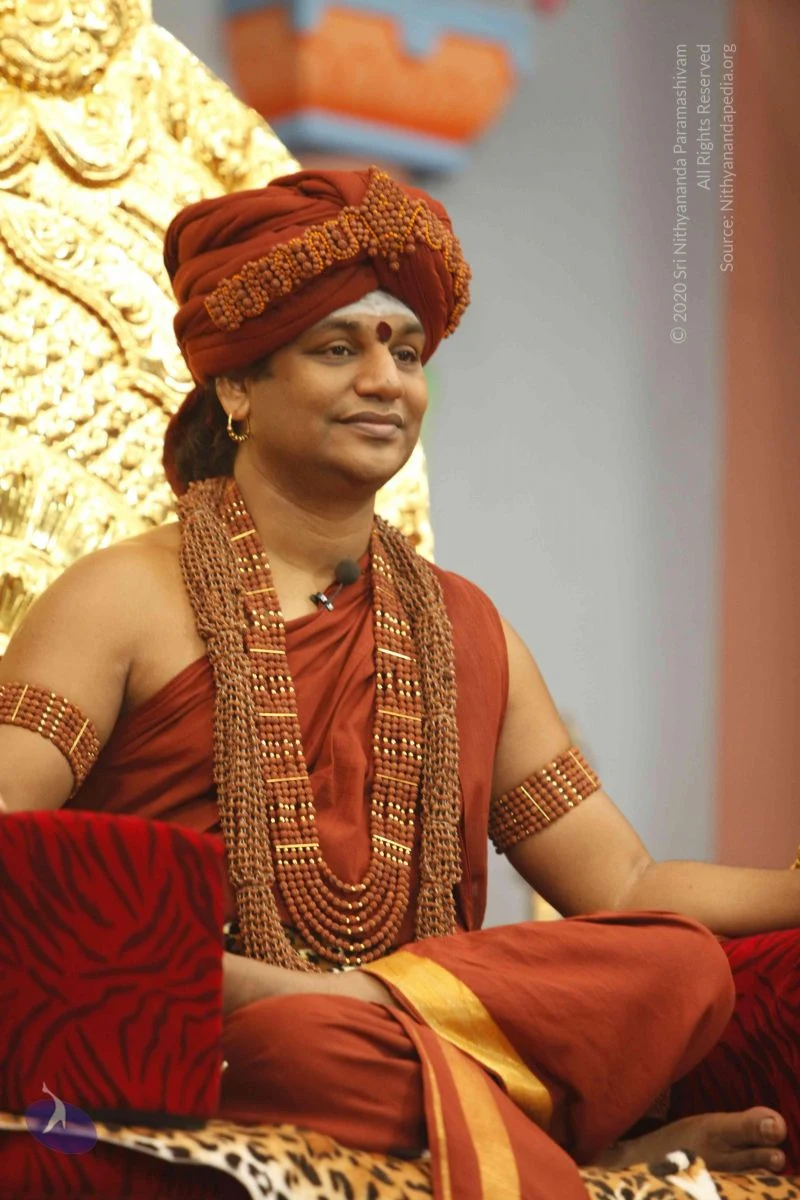
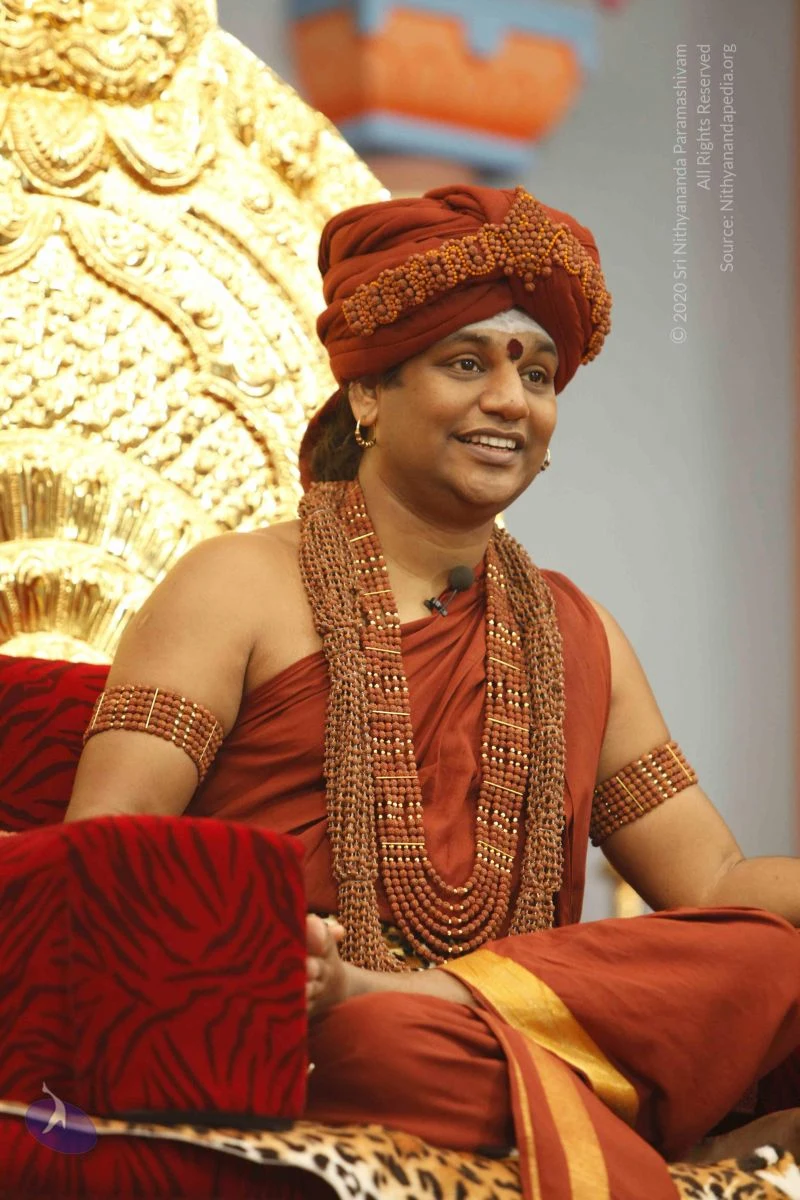
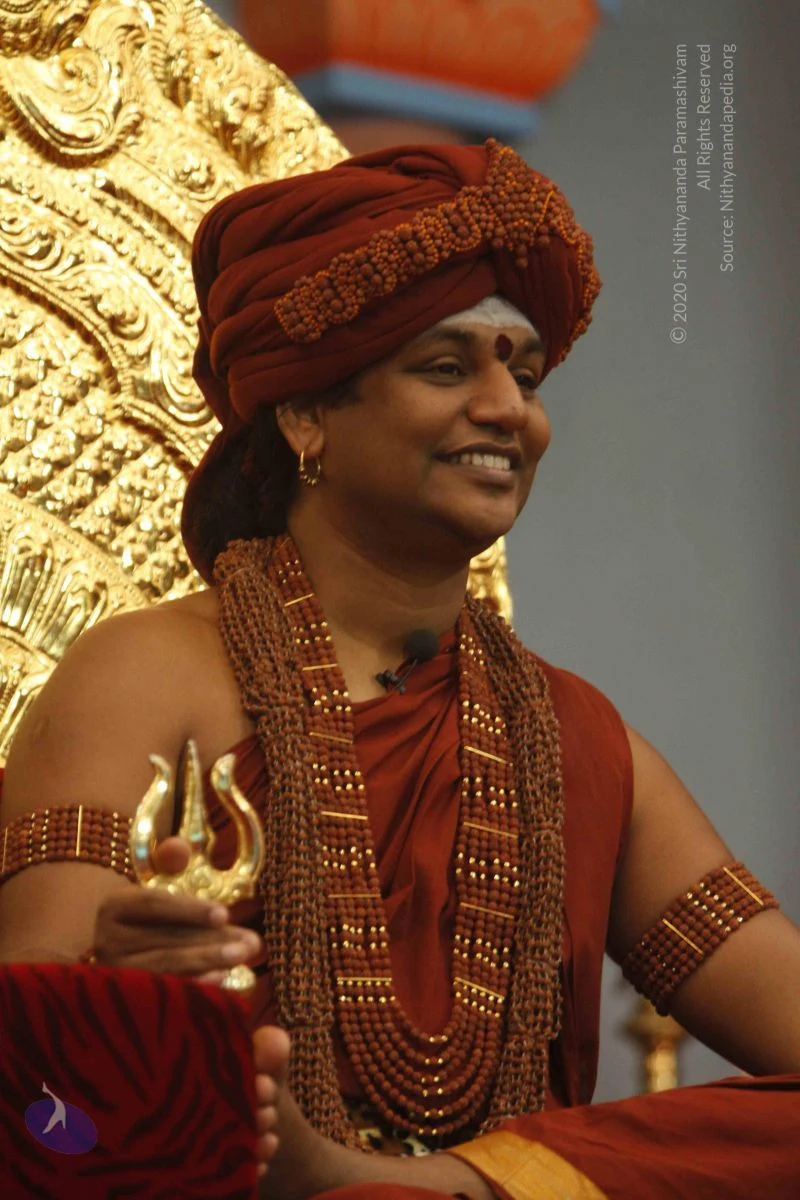
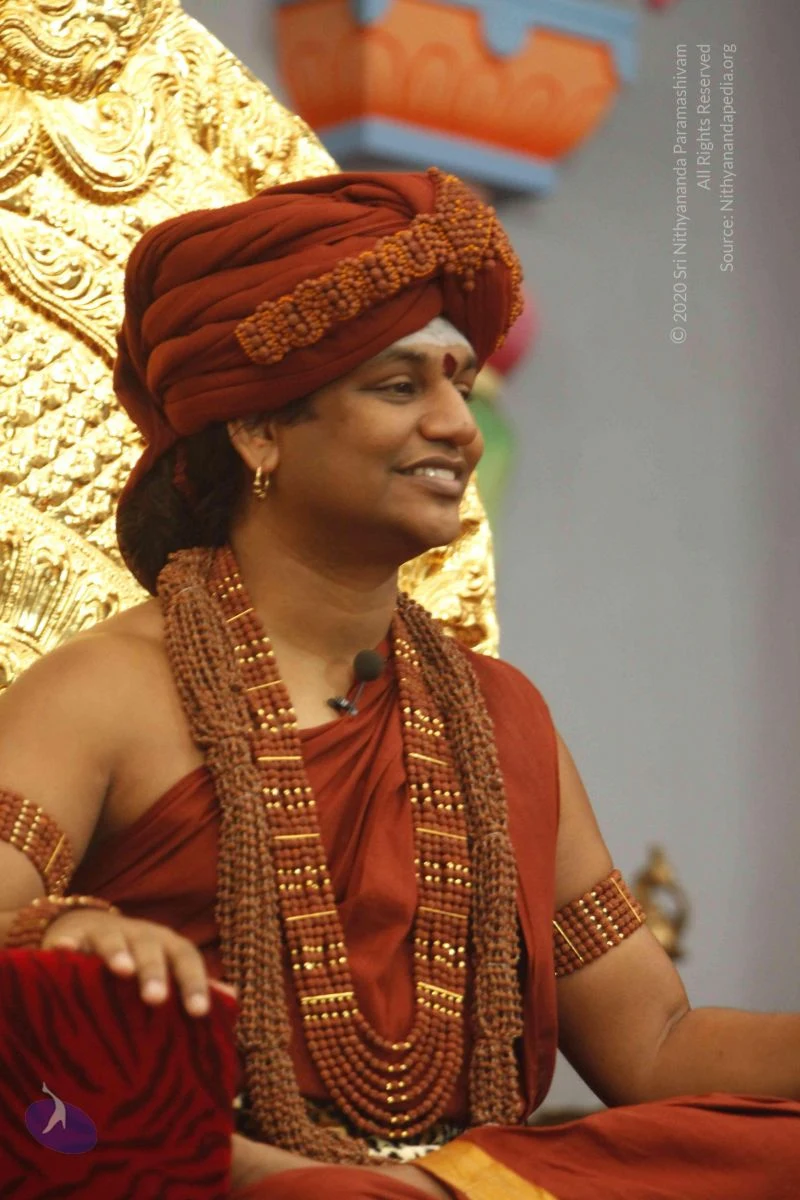
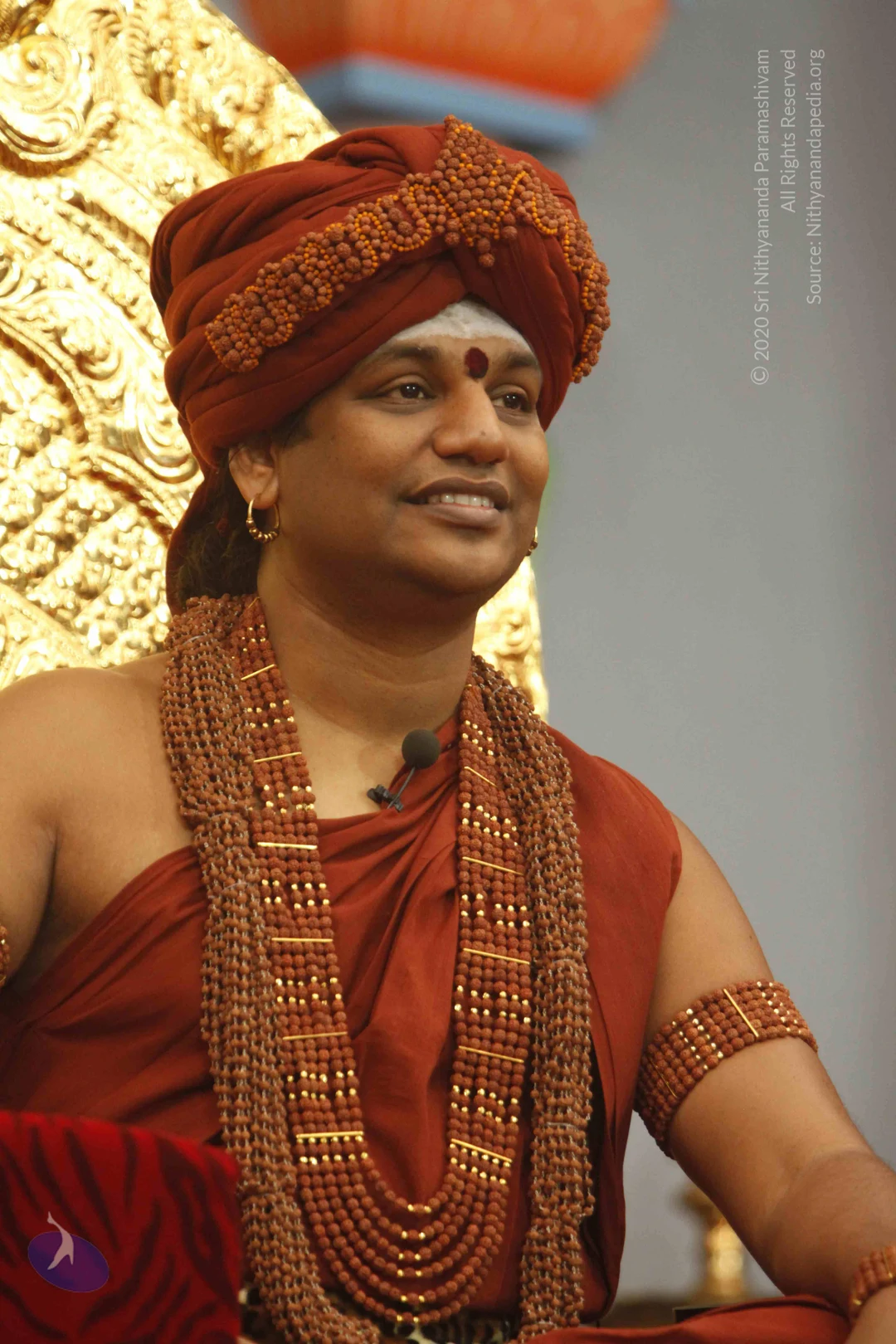
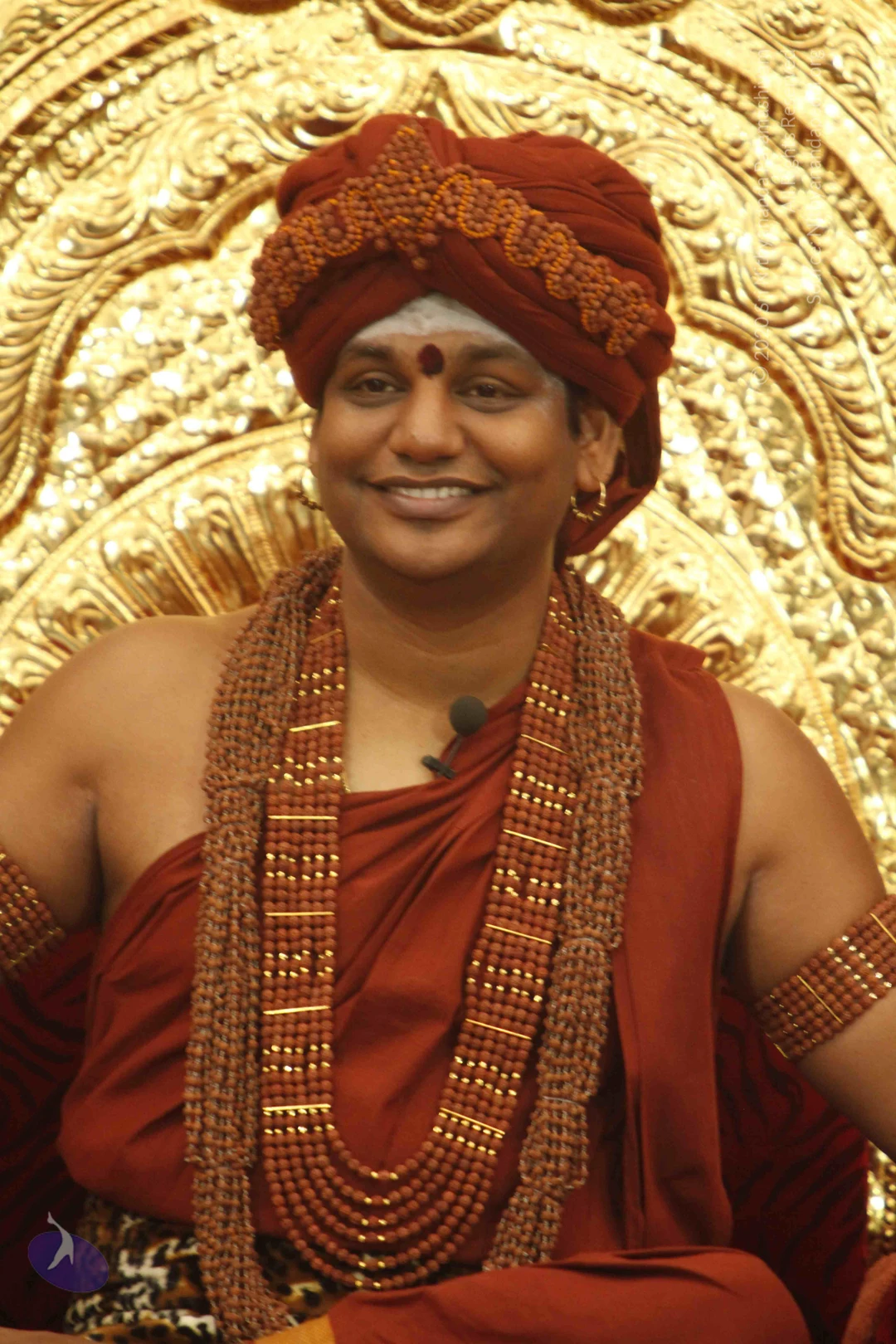
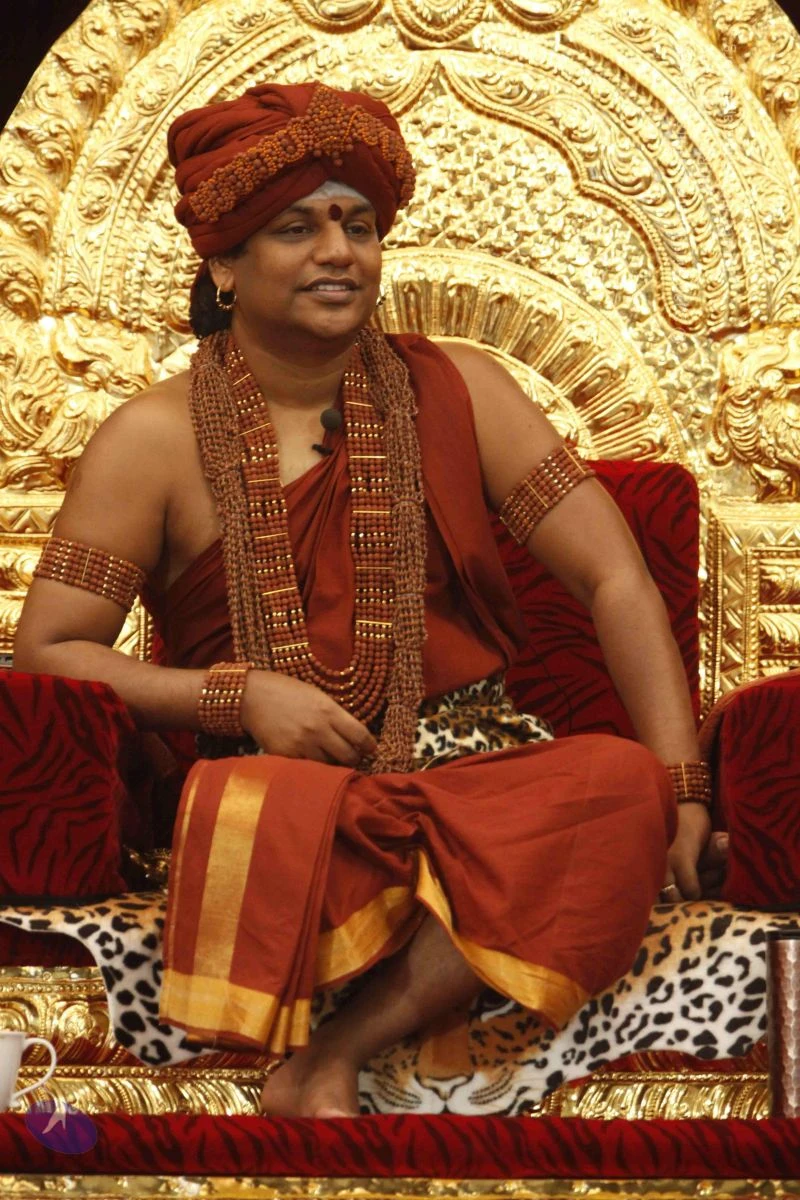
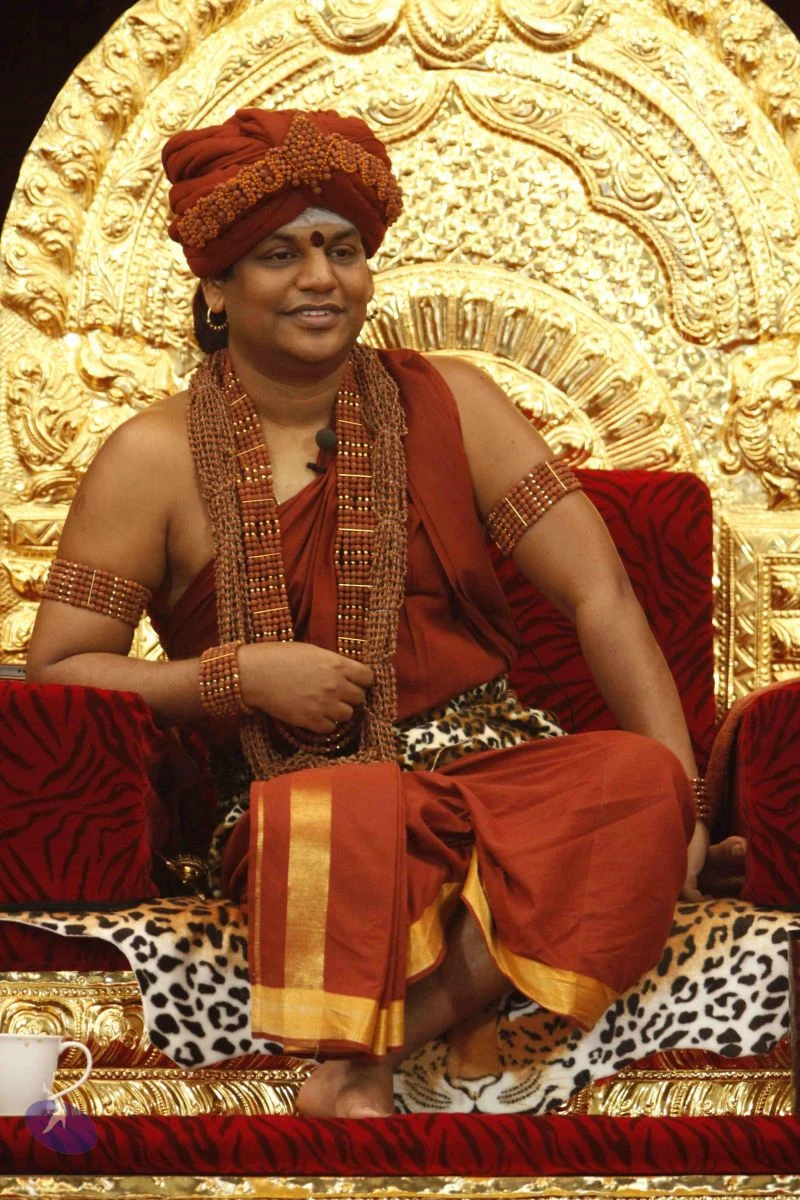
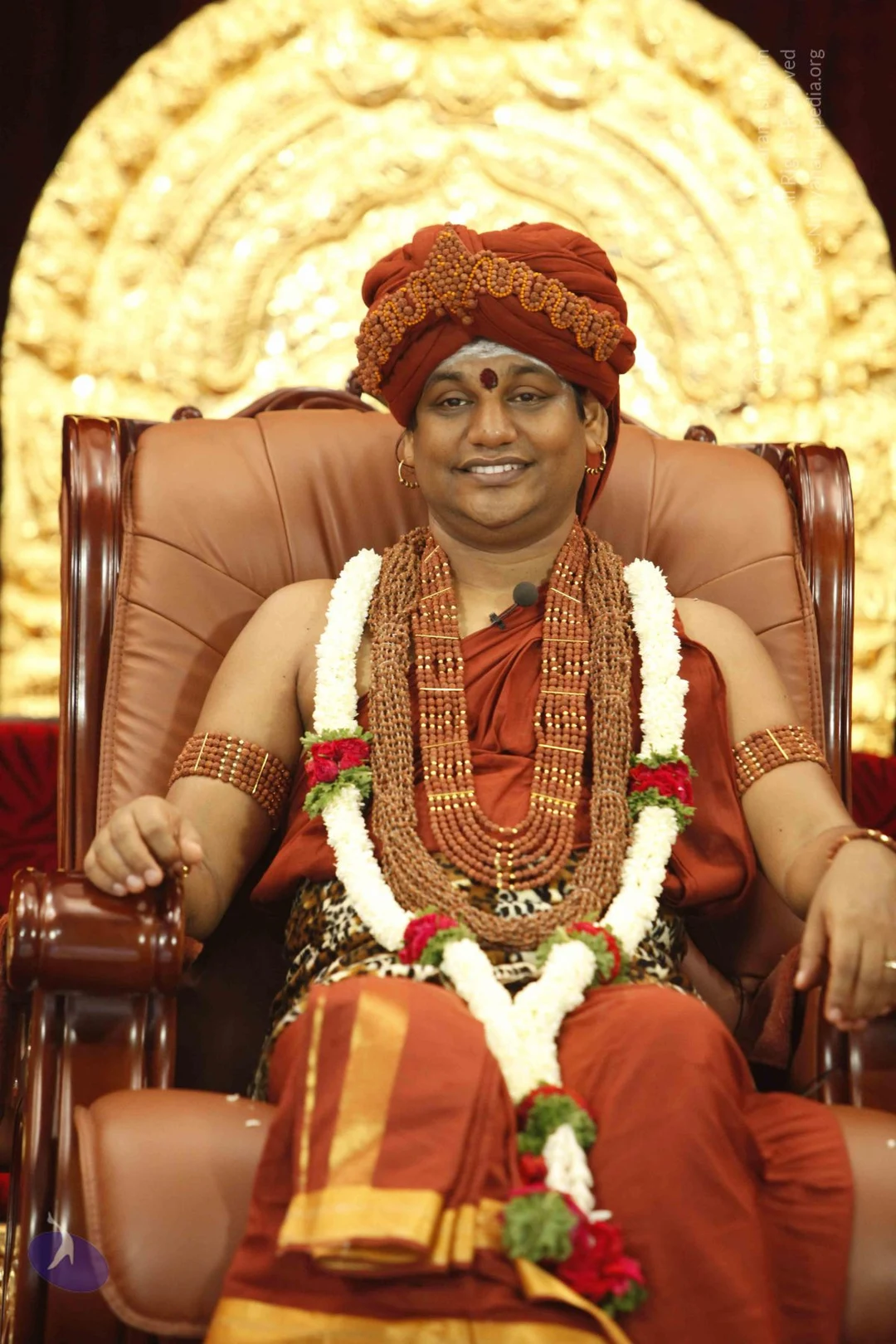
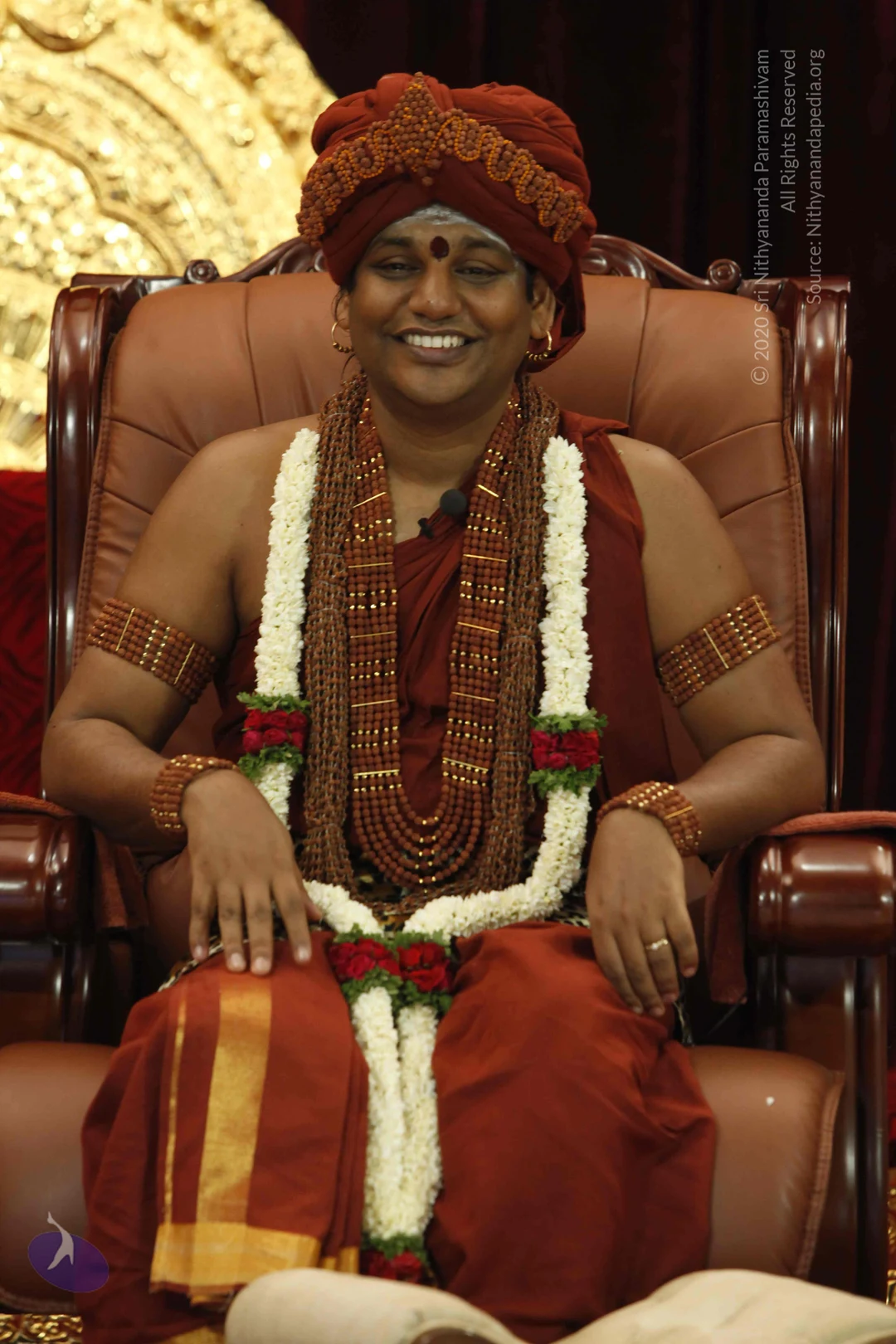
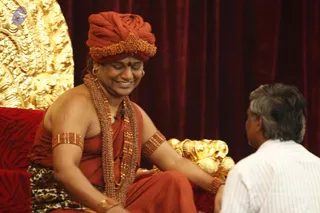
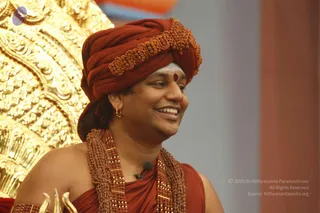
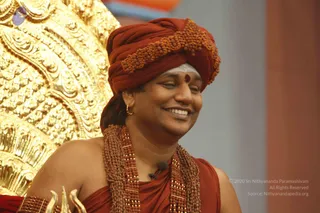
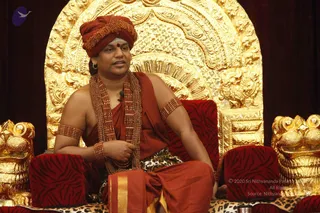
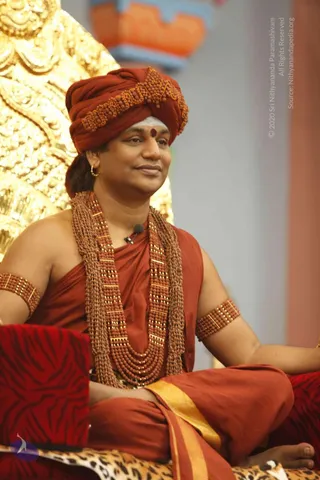
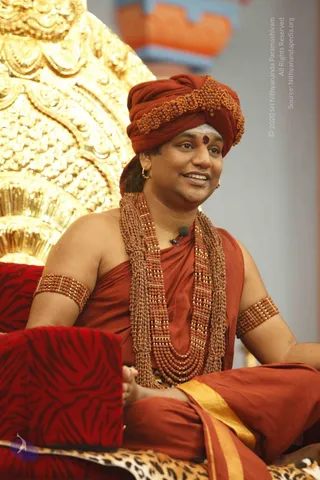
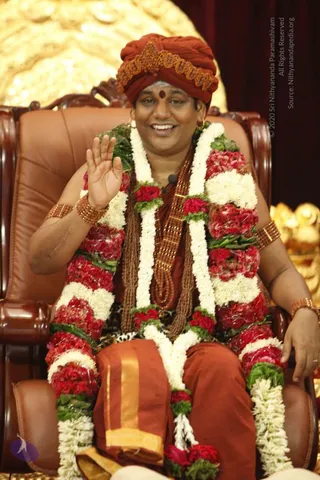
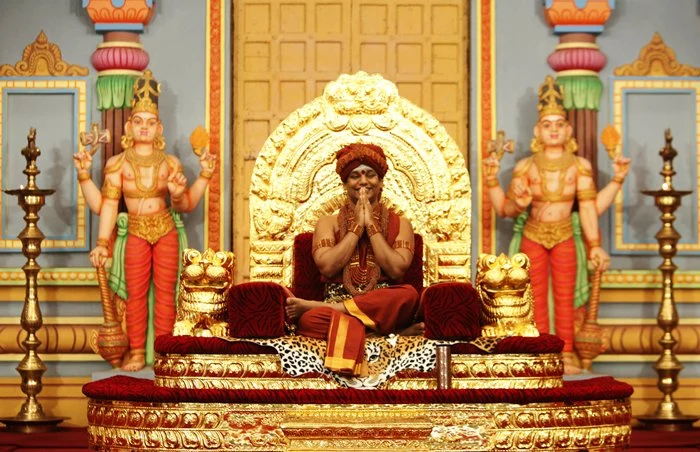
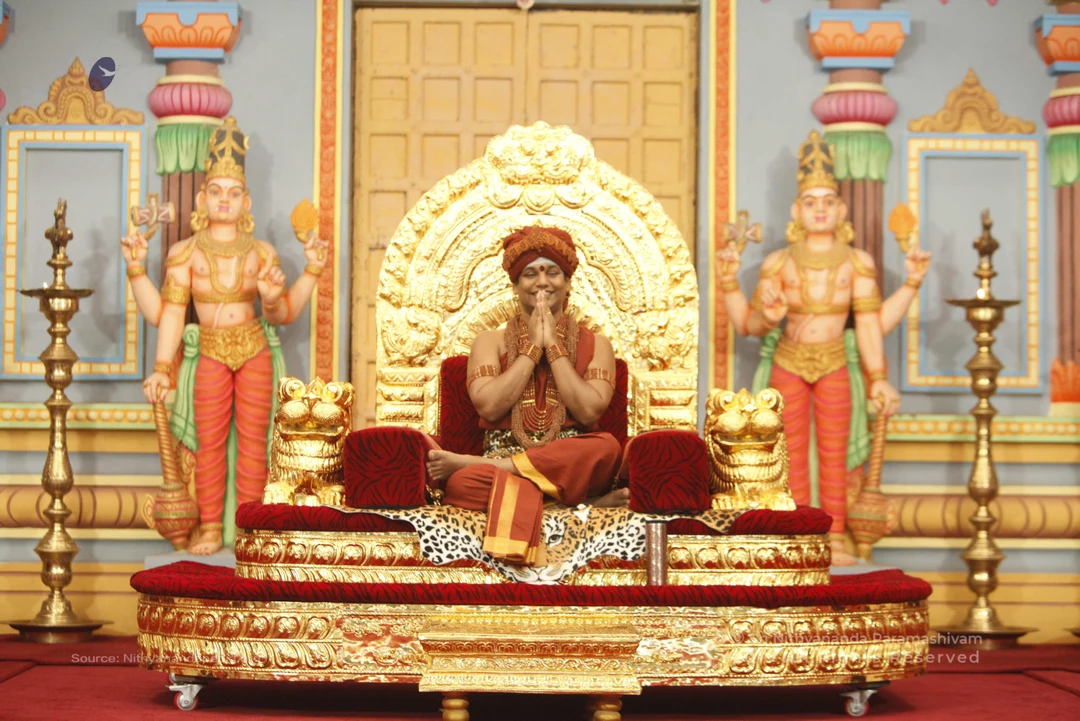
A seated man sits on an ornate gold throne with carved lion-head armrests and red velvet cushions. He wears a red-orange turban with gold beaded trim, a saffron-red shawl over bare shoulders, a dense multi-strand rudraksha mala, gold armlets and a wrap in a leopard-print pattern at the waist. He has a white forehead marking and a small lapel microphone, and he smiles while resting his hands on the chair arms. Behind him a painted deity statue with a gold crown and orange-red skin stands in a gold-trimmed red costume.

April 18 2014

Original wiki page
Contents

Title:

Get Comfortable with Completion | Nithyananda Satsang | 18 Apr 2014

Description:

In today's (18th April, 2014) morning Satsang, Paramahamsa Nithyananda describes how when we get comfortable with completion, our presence has the ability to enchant and make others feel complete. The key is to always practice keeping our inner space complete. Whenever agitations and incompletions arise, we need to go off and complete with them immediately. Making a clear decision to be in completion, removes the layers of thinking which confuses us and engulfs our reality.

Link to Video:

VideoAudio

Transcript:

(0:14)

||nithyānandeśvara samārambhām nithyānandeśvari madhyamām | asmat ācārya paryantām vande guru paramparām ||

(In Hindi)

Is samay hamare saath upasthit sabhi darshako aur bhakto ka Me prem evam ashivad sahit swagat karta hu. I welcome all the devotees, disciples, samajis, satsangis, srimahants, mahans, kotharis, thanedars siting with us all over the world thru Nithyananda TV, Lotus news channel, Sadhna TV, wo-way video conferencing having Nayana Deeksha in many cities, many countries around the world. Cities sitting with us Thiruvanmiyur - Chennai, Simi valley - California, Toronto - Kailasam, St. Louis - Tirumala, Los Angeles - Nithyananda University Los Angeles, Varanasi, San Jose - Madurai, Charlotte - Sri Sailam, Seattle - CHidamabaram, St. Louis - Tirumala, Toronto - Kailasam, Simi Valley- California, Thiruvanmiyur - Chennai, Varanasi, Singapore - Singapuam, Nithyananda Nagaramu - Hyderabad, Nithyananda Nagar - Tiruvannamalai, Nithyananda Nagar - Bidadi, Nithyananda University - Los Angeles, Nithyananda University - Paris, Ohio - Prayag, Toronto - Kailasam, San Jose - Madurai, Hong Kong - Sirgadi, Dekota -Dunes, Houston - Kalahasti, Guadalupe - Rameshwaram, Hyderabad - GuptKashi, Jorpati - Nepal, London - Kashi, Dubai - Vaidyanatham, High Point - North Carolina, Coimbatore - Youth sabha, Coimbatore Dhyanapeetam, and Aukland, New Zealand, Port Washington - New York, High Point - North Carolina, Houston - Kalahasti, Dakota - Dunes, Hong Kong - Shrigadi, London - Kashi, Oman - Shiv Gangai, Abu Dhabi, Philadelphia, Chitletpagu - Chennai, Scottsdale - Arizona, Warrington - UK, I welcome all of you with Love and Blessings.

(03:36)

I will expand on getting comfortable with completion. Listen, still I am going to take two more days for you guys to lead you guys into completion because still you need to have little more time, energy, understanding about all your incompletions but before that I wanted to share this very important idea with you: Getting comfortable with completion. Let Me expand on this truth: getting comfortable with completion. Listen, how the space of completion feels, how your everyday activity from that space is so enchanting. Listen, ‘enchanting.’ That is the word I will use. ‘Enchanting.’ Please understand, when you get comfortable with the space of completion, simply anybody who sees you will be enchanted by you because you are closer to them than their own soul. Please understand, everyone loves their soul because of the space of completion the soul gives, the space of the completion experience the soul provides.

(05:34)

If you enchant people, the enchanting is done so many ways. If you have a beautiful body, people can be enchanted or you have amazing entertaining habit, attitude like telling jokes or the great ideas about life or music, dance, this also can be entertaining but all that is only a depreciation asset. Your beauty cannot enchant people for long time. It is a depreciation asset. Your singing ability or your knowledge, your wit, intelligence, maybe that can be appreciation asset but that also only limited to one life but if you carry the space of completion, it is actually exponentially appreciating asset. You will be the source of completion for thousands of people. You will just be enchanting. Please understand, that enchanting will be like Krishna's enchanting, Mahadeva's enchanting. Even in Krishna's case, only the gopas and gopikas were enchanted. In Mahadeva's case bhoota, preetha, pishacha, whatever exists around, all of the existence was enchanted.

(07:35)

Now let Me give you exact technique of how to get comfortable with completion. Listen, you need to spend few days on it. Only then you will get the knack. It is not a separate action, it is a simple decision…. It is not a separate action, it is a simple decision. Listen, Brihadaranyaka upanishad beautifully says, Tat Ye tat Preyah putraat preyovittat preyo nyesmaat sarvasmaat antaratharam Yat ayam Atma The soul, self, is dearer to oneself than his most beloved son, wealth and anything and everything else.

(08:39)

Listen, that is why, if you fall into the river with your money suitcase and your son, you first save yourself. Then only think of your son or your suitcase bag, whatever. Because if you are there, you can have money and one more son. Anyhow, listen, getting comfortable with your completion. Whole day constantly try to be in the space of completion. Whenever agitation happens, incompletion happens, take few minutes. Go to the bathroom, lock yourself and do completion and come out. No one will tell you anything. Why, when you want to go to the bathroom, you run to the restroom. So decide, decide, getting comfortable with completion will remove the layers and layers of thinking which is away from the reality.

(10:10)

Please understand, many time you can see in your life, if you are doing some work, suddenly when the layers of thinking engulfs you, you are removed from reality. After few minutes, you wake up, “Oh! Where I am?” Especially when you are working on the computer, cooking, sitting in the CEO chair of the office, being moved away from the reality due to incompletion, that should be completely completed. First two-three days if you try, you will see all the restlessness completely gets settled. You will start feeling very comfortable with your space of completion and not only that, you will get the taste of how in the space of completion itself you can operate. You can walk, talk, work, think, do everything. How the knowledge to operate the body and mind from the space of completion gets awakened, you can see.

(11:42)

Please listen! Operating from the space of completion means you getting very comfortable in your day-to-day life with completion. Actually I wanted the youth of this country to learn that only. If the youth of this country learns to live in the space of completion, the whole country will be blessed! That is why, today we are organizing the Youthsava in Coimbatore Dhyanapeetam. I welcome all the youth in the Coimbatore Dhyanapeetam to learn the process of completion and get comfortable with it. It is completion, the process of completion, the knowledge of completion….process of completion, the knowledge of completion that makes you a man, that makes you a person.

(13:06)

Understand, we will conquer the world by being the source of completion to the world, never by wealth nor by terrorism. Understand, neither by conversion nor by terrorism. We will be unique and successful by being the source of completion for the whole universe. I Myself personally neither believe in conversion nor believe in terrorism. Terrorism is the violent conversion; conversion is the psychological terrorism…. Psychological terrorism is conversion; physical conversion is terrorism, that's all. I do not believe in both. I wanted the youth of this country to be the source of completion for the whole world. When you go to all over the world for a job, accept job, work, nothing wrong, great but carry the science of completion and be a source of completion for millions of people!

(14:48)

Understand, English is not a language, it is a culture. Completion is not just a technique, it is a culture…. It’s a heritage. English is not just a language. If you pick up that language, your accent, your dress, everything will become different. Same way, completion is not just a technique, it’s a heritage, a great cultural heritage. Once you pick it up, the way you sit, the way you walk, the whole thing will be different. The way you talk, walk, whole thing will be different. Getting comfortable with the space of completion means trying whole day to be in the space of completion even when you are reading, writing, working, talking, planning, using your time or misusing your time or abusing your time, whatever you maybe doing, getting more and more comfortable, getting more and more comfortable with your completion, getting more and more comfortable with the space of completion is all we need. That's all we want.

(16:51)

Understand, so today this is the only thing I wanted to share with you all. Spend more and more time to get comfortable with the space of completion because getting comfortable with the space of completion is like a pilot drill. Whenever we drill any object, the pilot drilling will be done, means they will just for few millimeter, they will try to put the drill bit into it, into that object and take it out. It is called pilot drilling to see whether that drill bit goes straight into the object, is the drill bit guided properly into the object for that. These all few lessons of engineering once in a while I remember. This getting comfortable with the space of completion is like a pilot drilling. Once you get little comfortable with the space of completion, then burning all your incompletions and permanently establishing you in the space of completion is My job. It is easy for Me, very easy.

(18:27)

See, now because you are so comfortable with incompletion and impossibility, I am not able to move you out of it. You don't even know why you should move out of it. If I just make you understand the space of completion and little comfortable with the space of completion, then burning all your incompletions and establishing you in the space of completion is such an easy task, such easy thing. It is like once your organs are comfortable with diabetes, you will never be able to get out of diabetes.

(19:18)

Please understand, you can have any disease but not diabetes. You can tolerate with any disease but don't ever tolerate or get comfortable with diabetes. Even heart disease is okay, blood pressure is okay because your organs cannot get comfortable with blood pressure. But diabetes, your other organs gets comfortable. Then getting out of it will be impossible because your intestine, your kidney, your brain, your nervous system, all of them who are not directly involved with the disease also will ask for the experience of diabetes. Getting comfortable with incompletion is just like getting comfortable with diabetes. Too dangerous! Never allow it! Do whatever it takes, get out of diabetes; do whatever it takes, get out of incompletions. I tell you, anything is okay, not diabetes. Of course, not herpes! Do not get comfortable with incompletions.

(21:03)

I Bless you all. Let you all radiate with integrity, authenticity, responsibility, enriching and causing Eternal Bliss- Nithyananda. Thank you

(21:22)

Photos

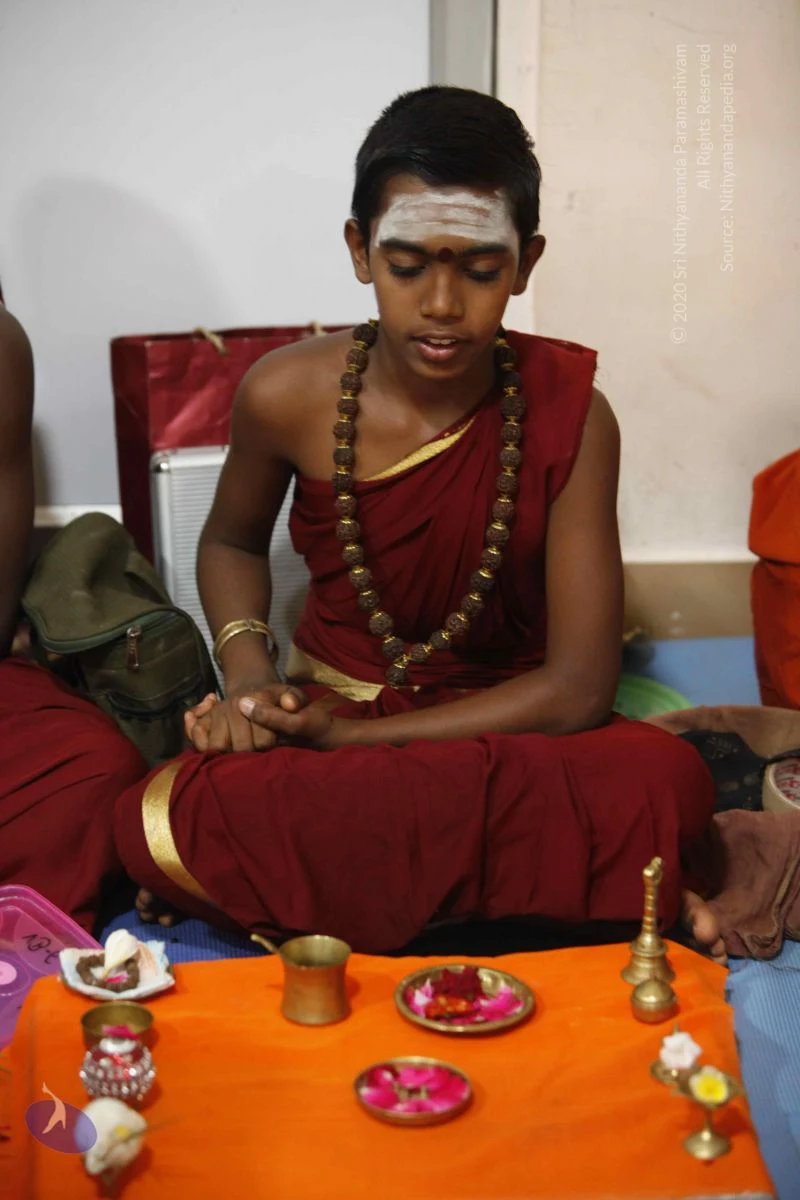
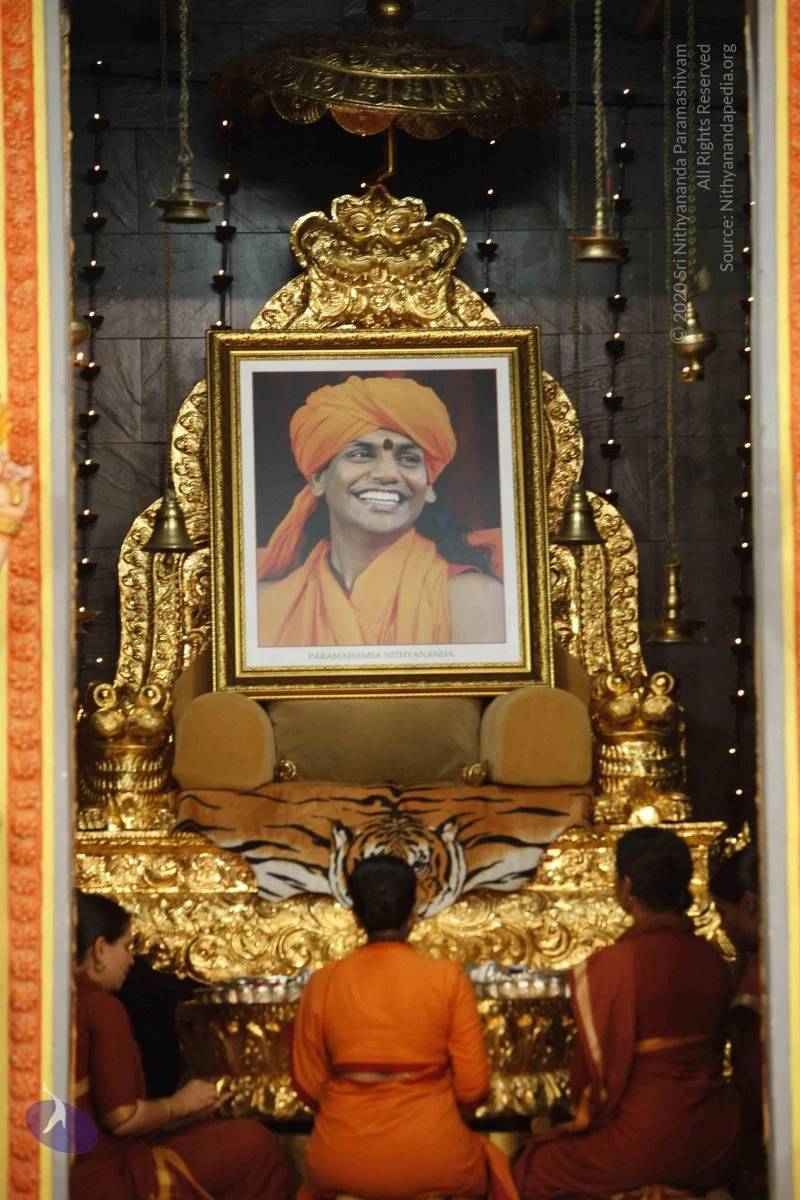
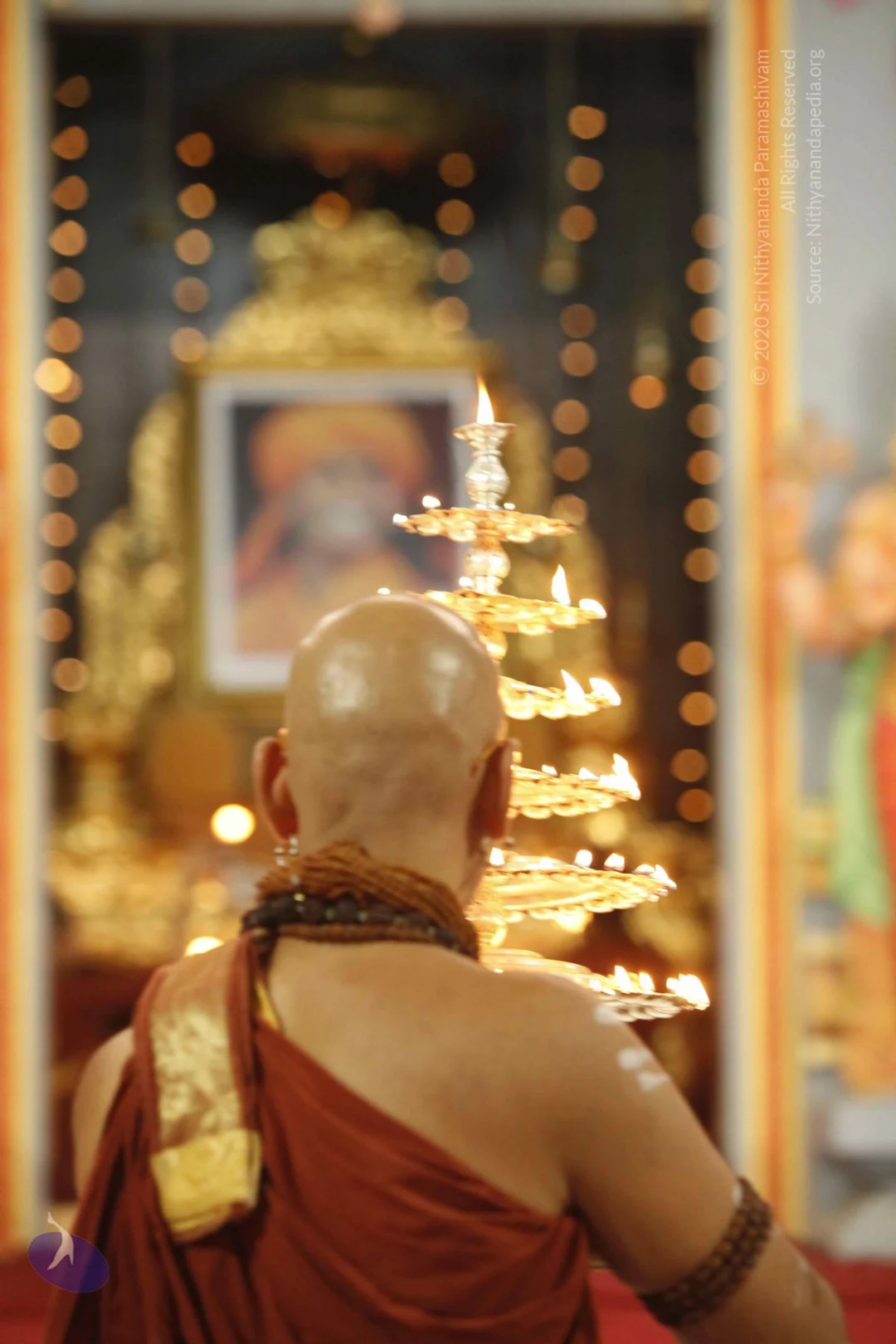
Pada Puja
Nithya Satsang
Tags:

Paramahamsa Nithyananda, completion, presence, enchant, inner space, incompletions, reality.

Photos Of The Day:

DARSHAN

PUJA

SATSANG

Photos Of The Day:

DARSHAN

PUJA

SATSANG

Photos Of The Day:

DARSHAN

SATSANG

PUJA

Photos from this day

View all 82 photos

Nithya Satsang
10 photosSource gallery
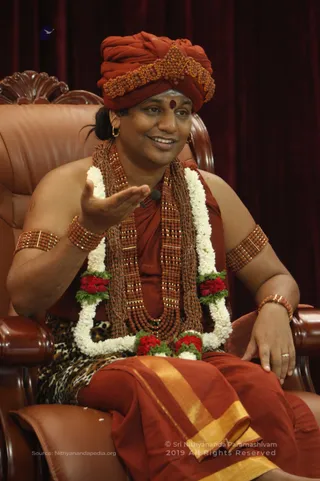
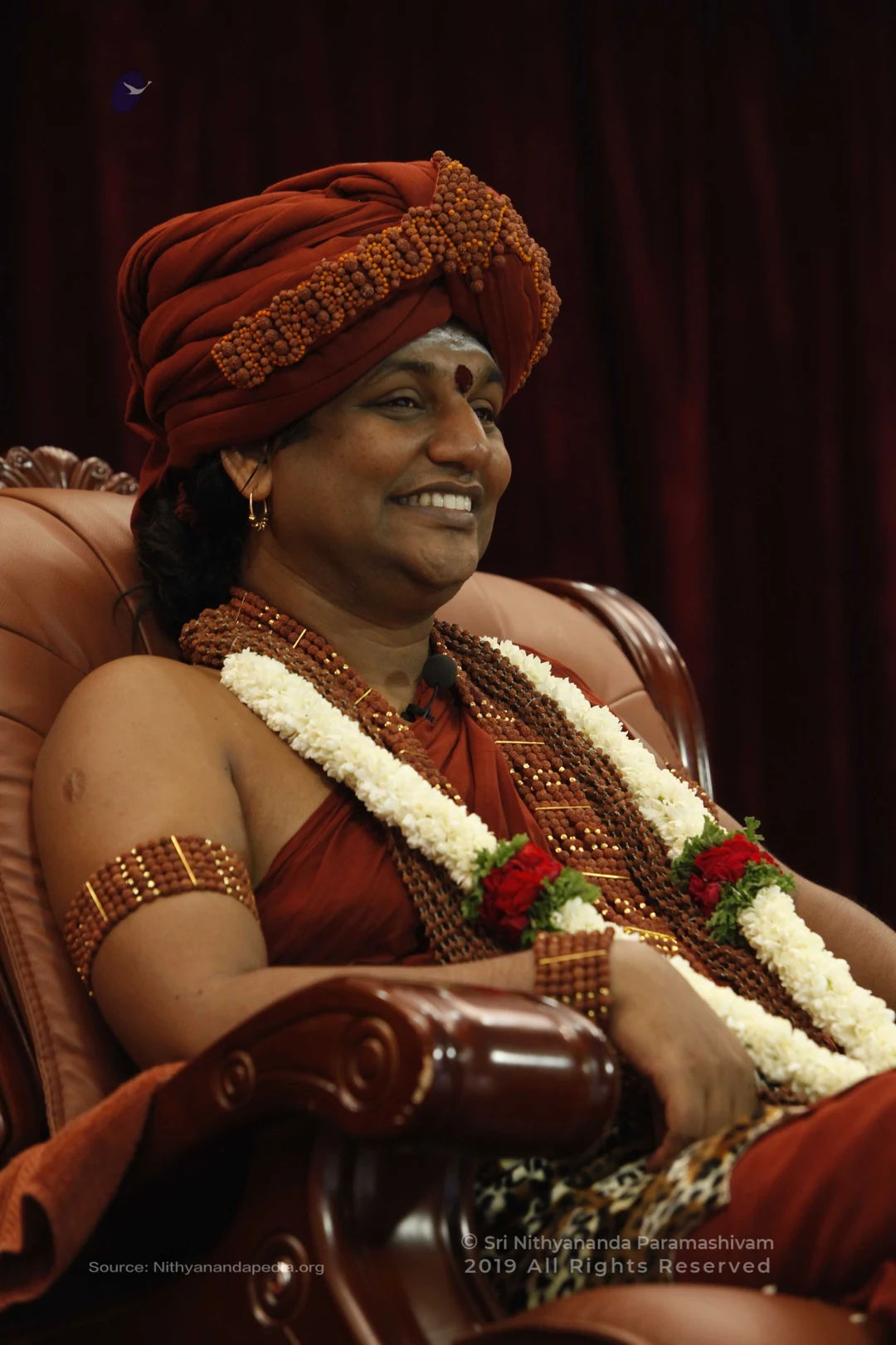
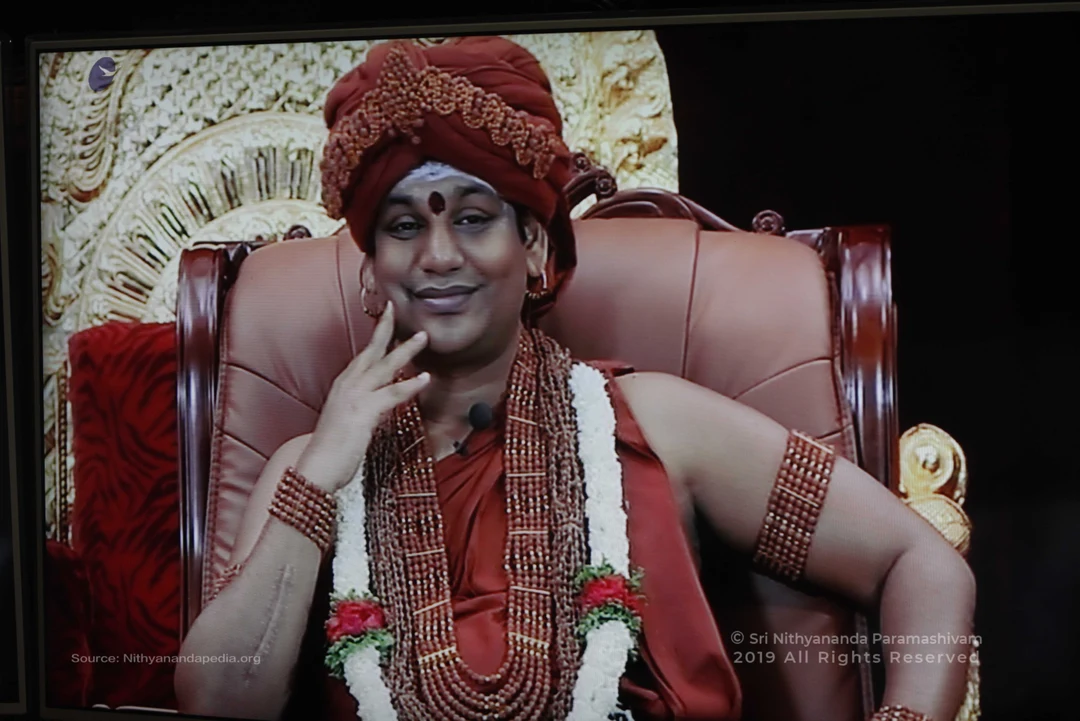
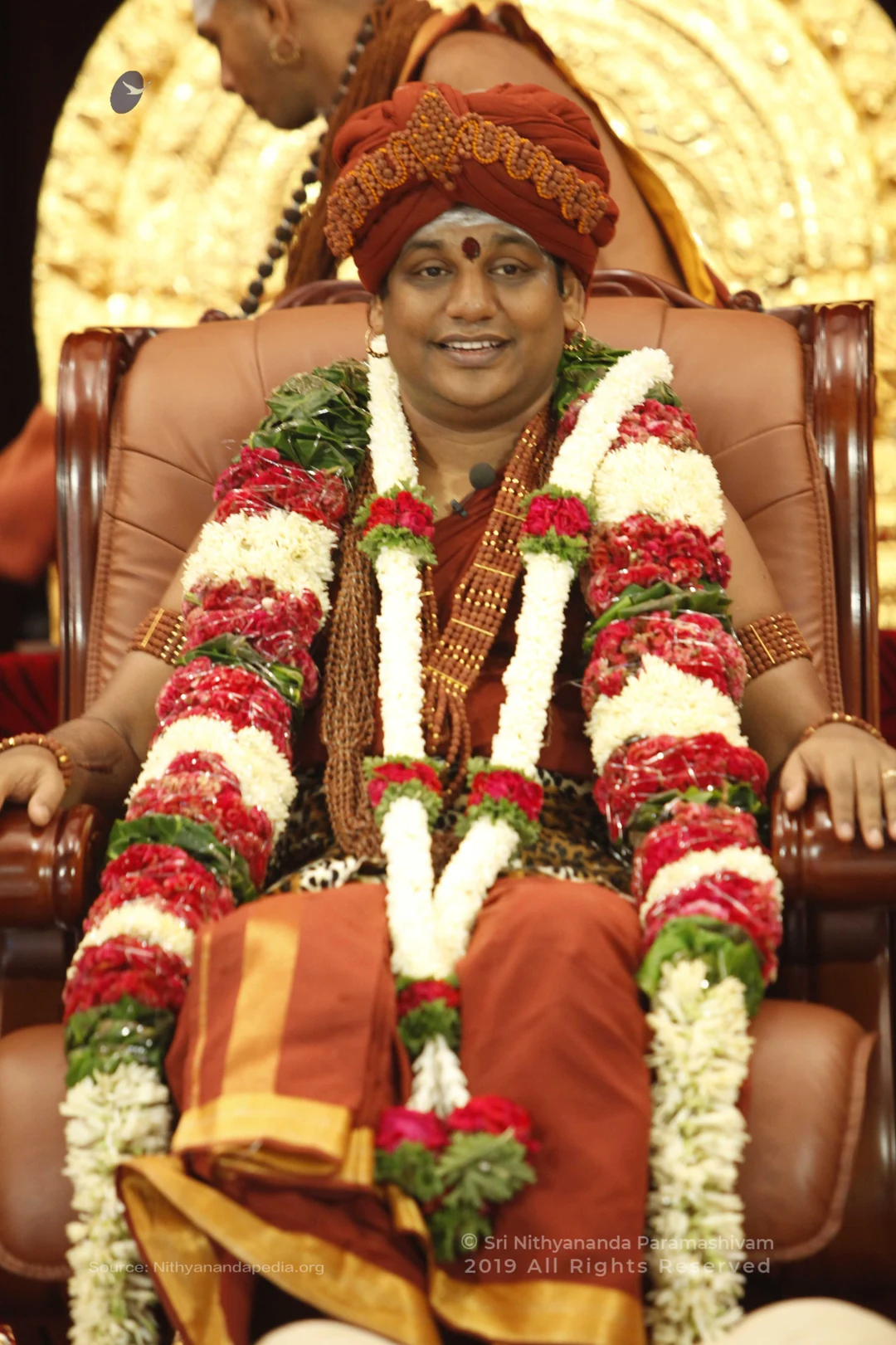
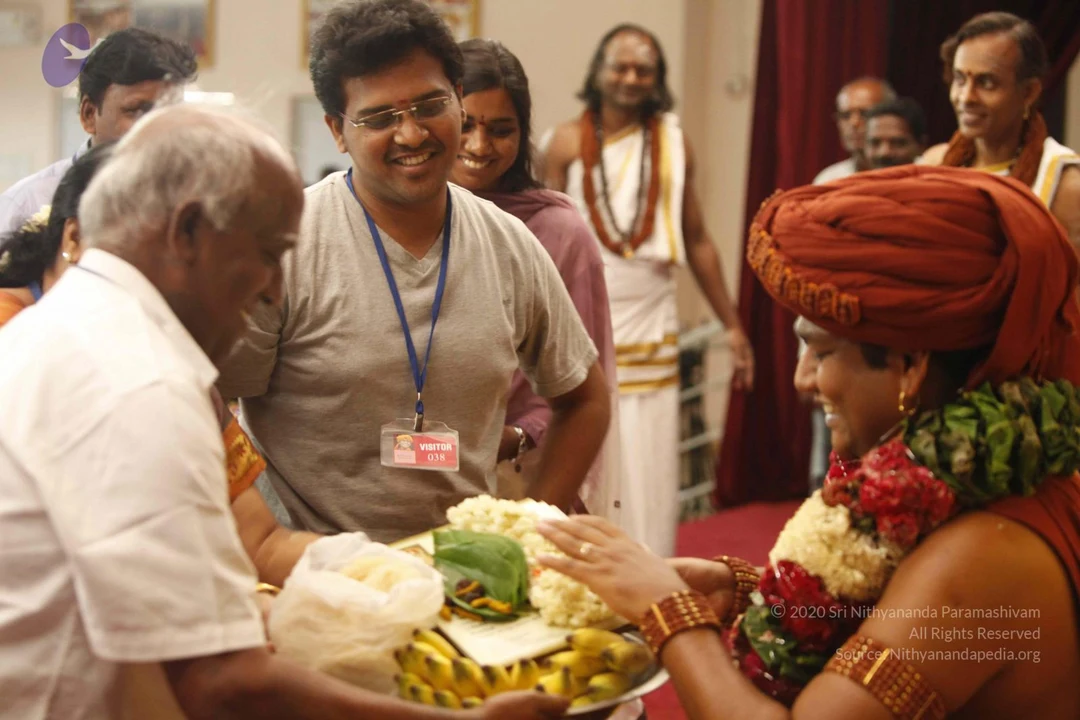
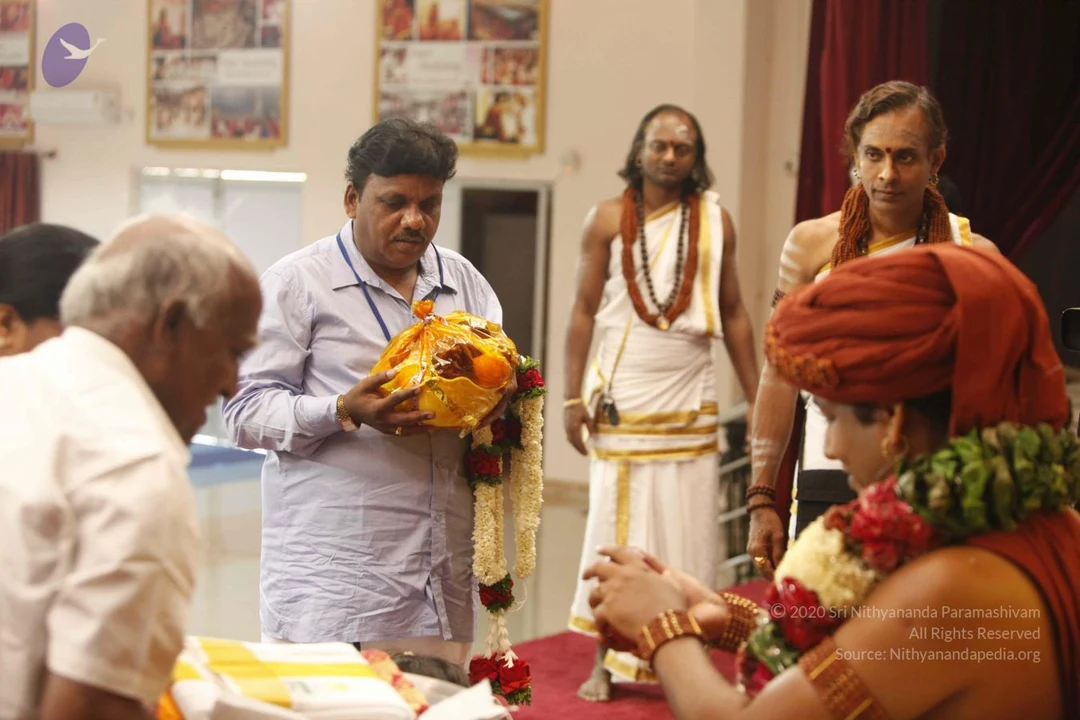
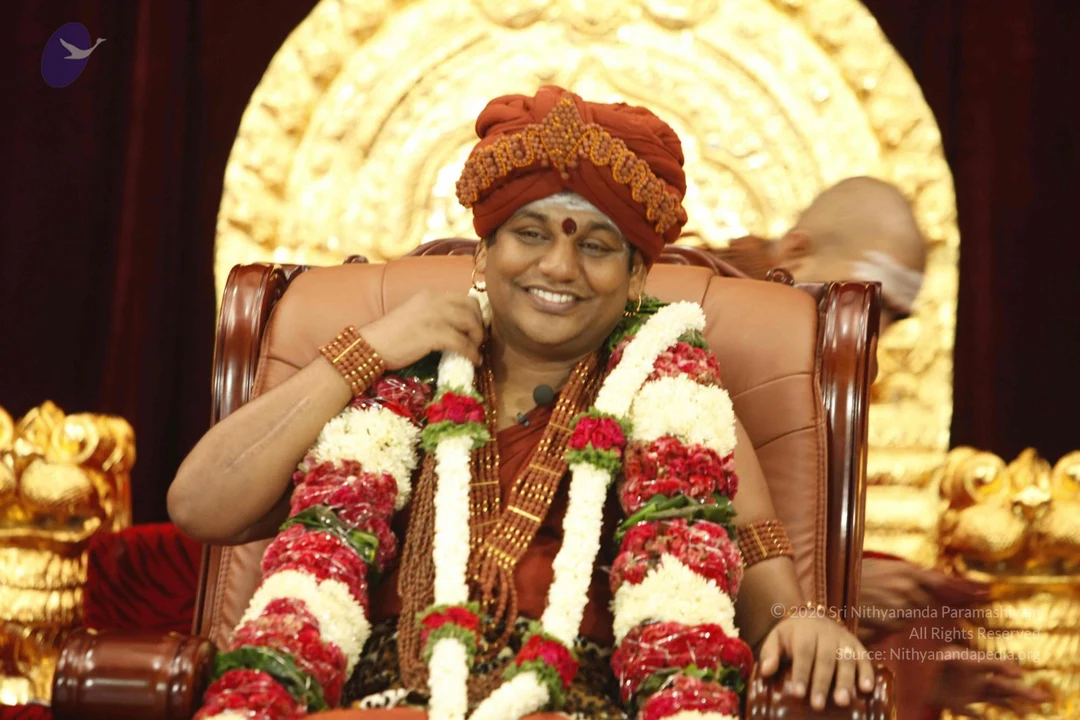
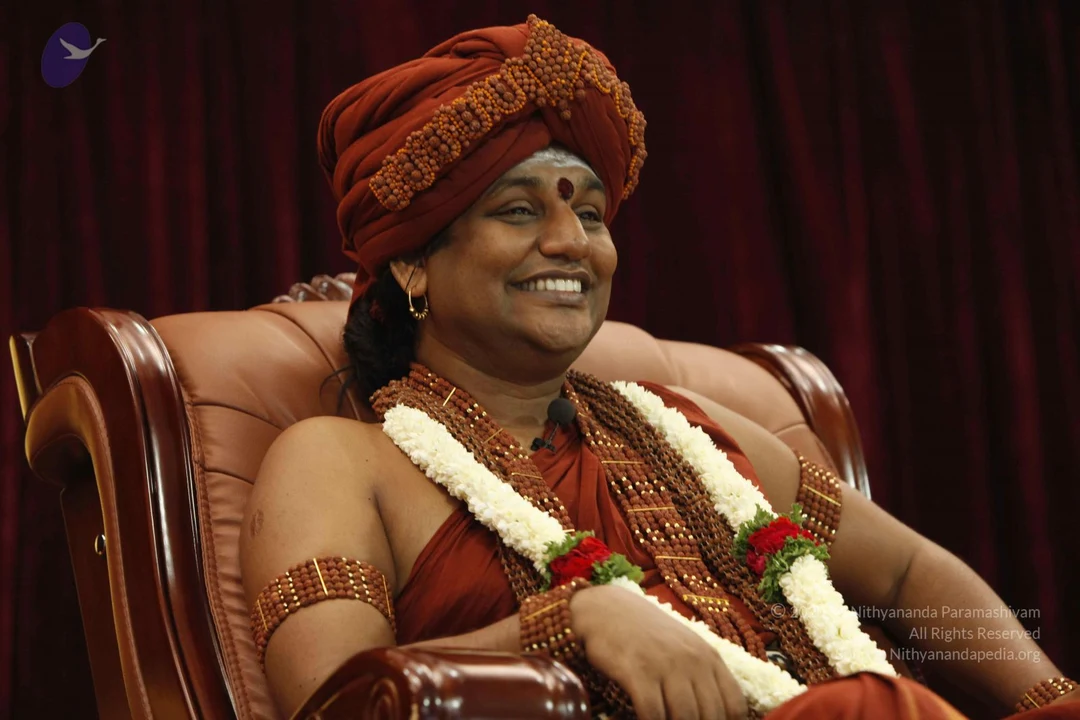
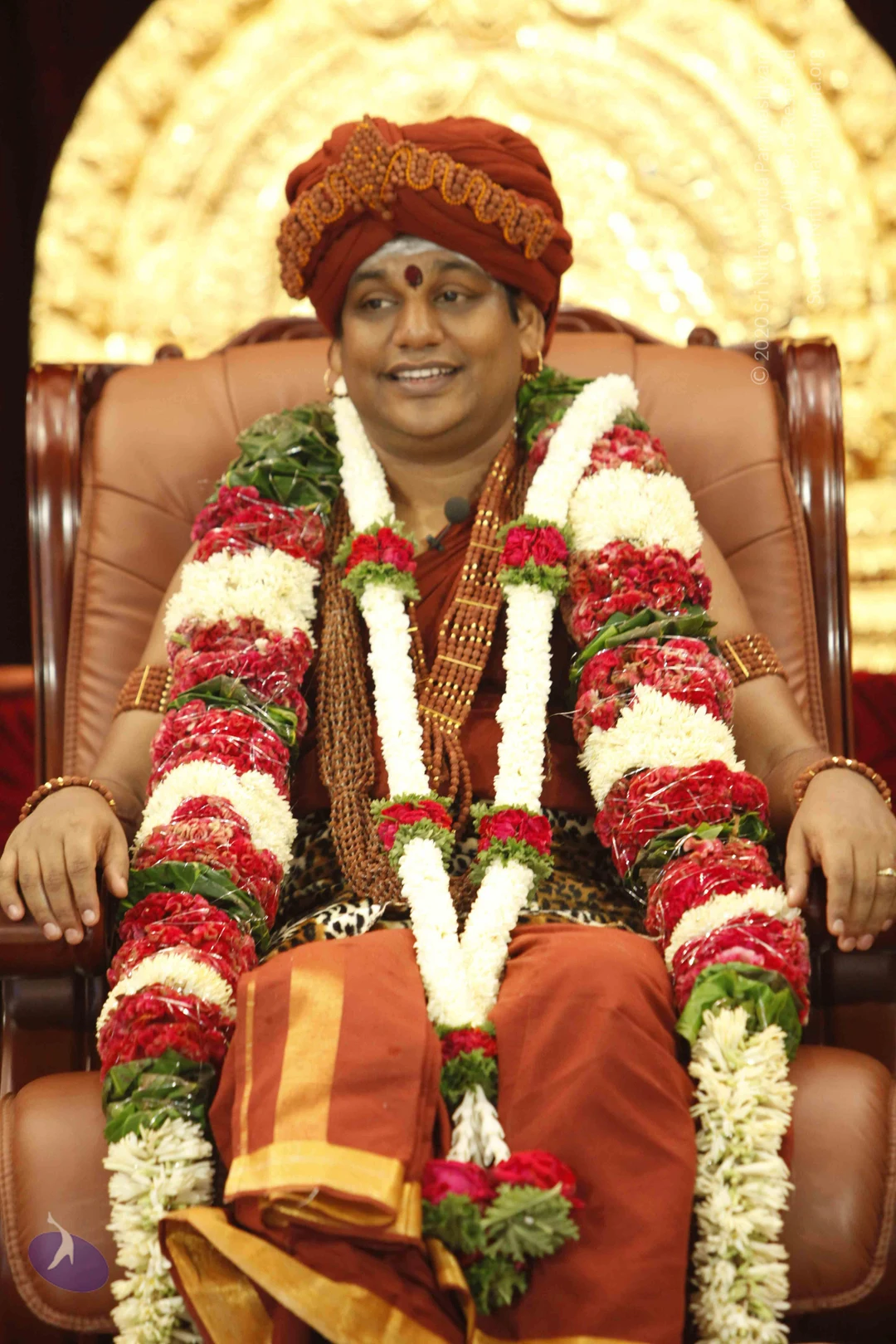
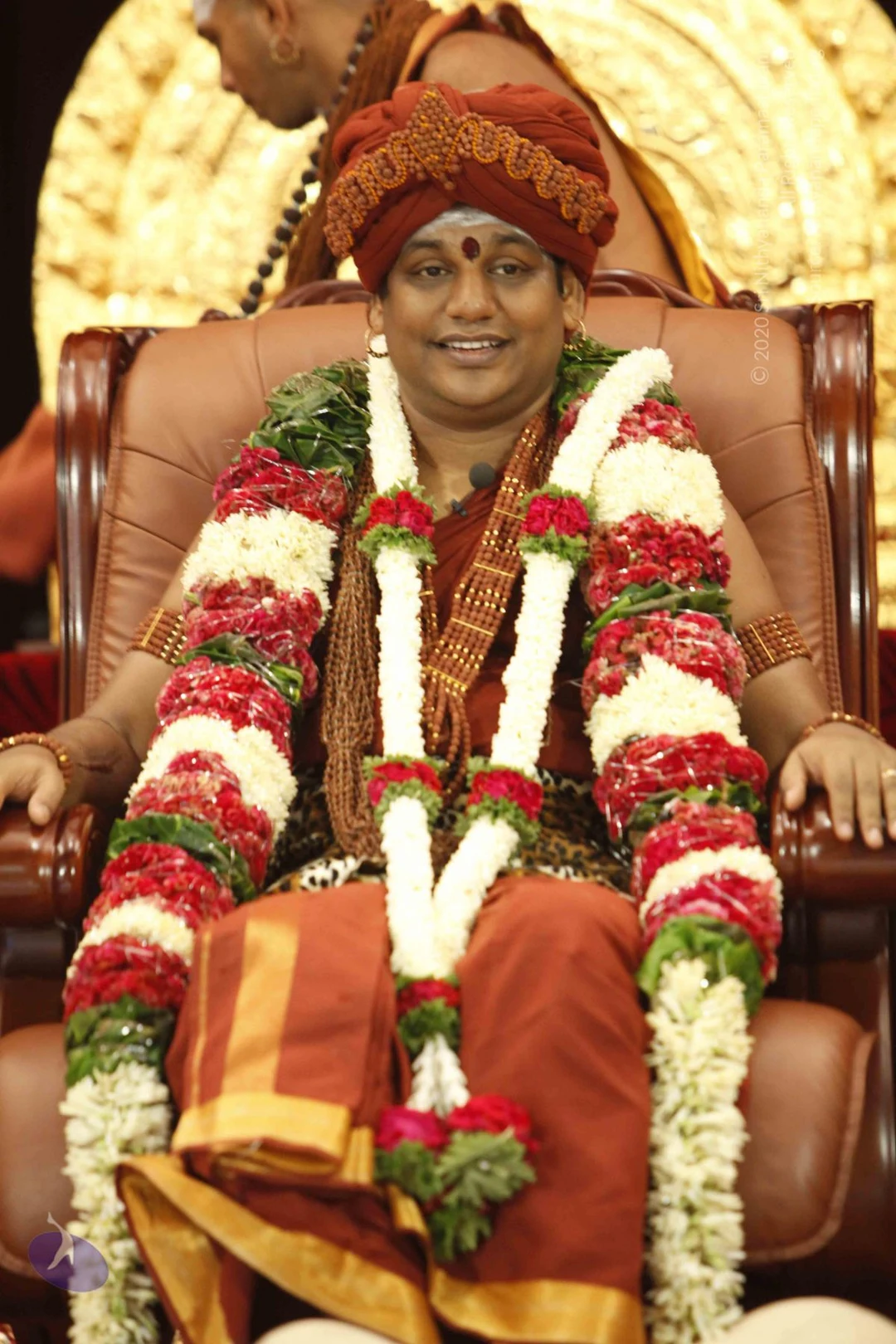
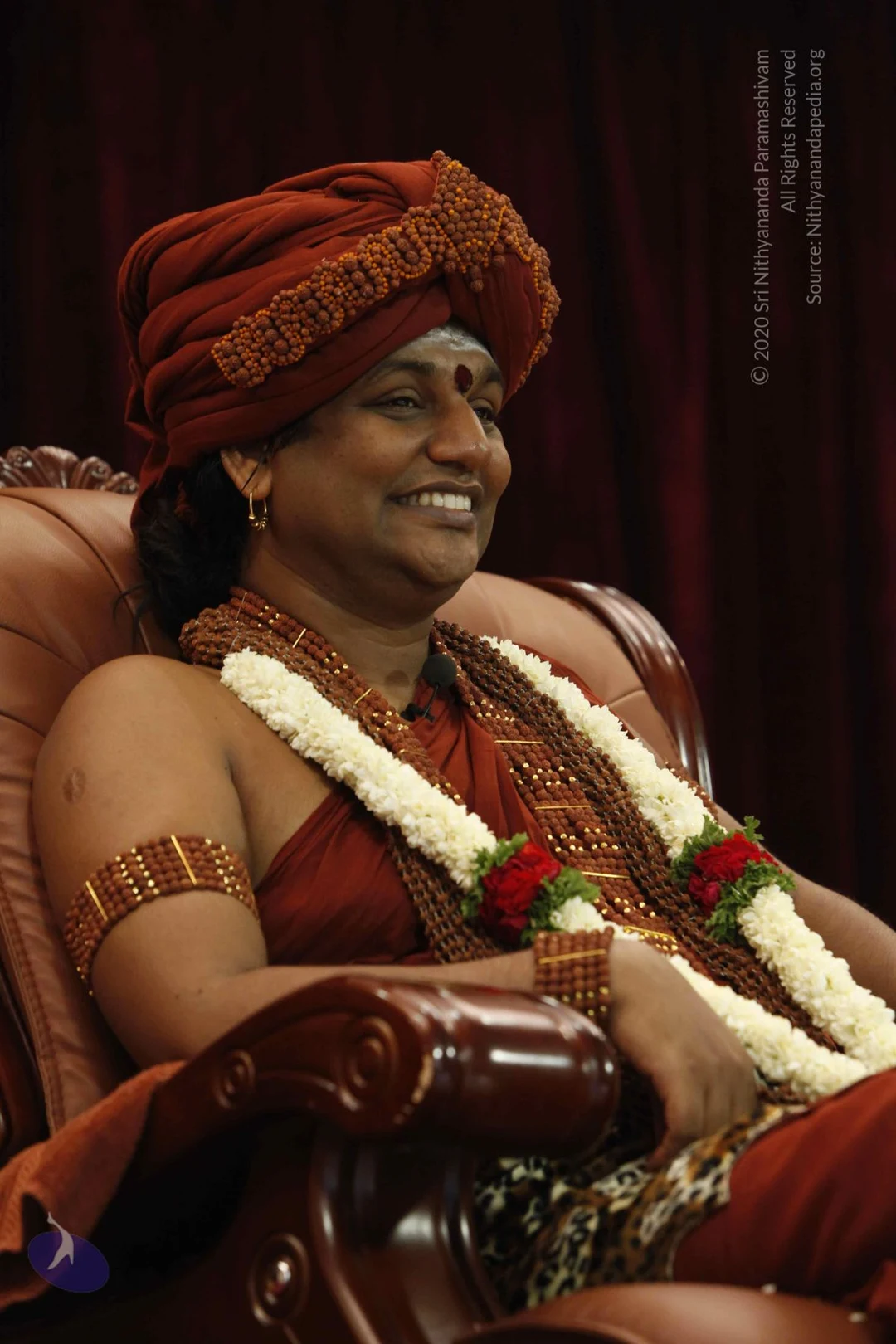
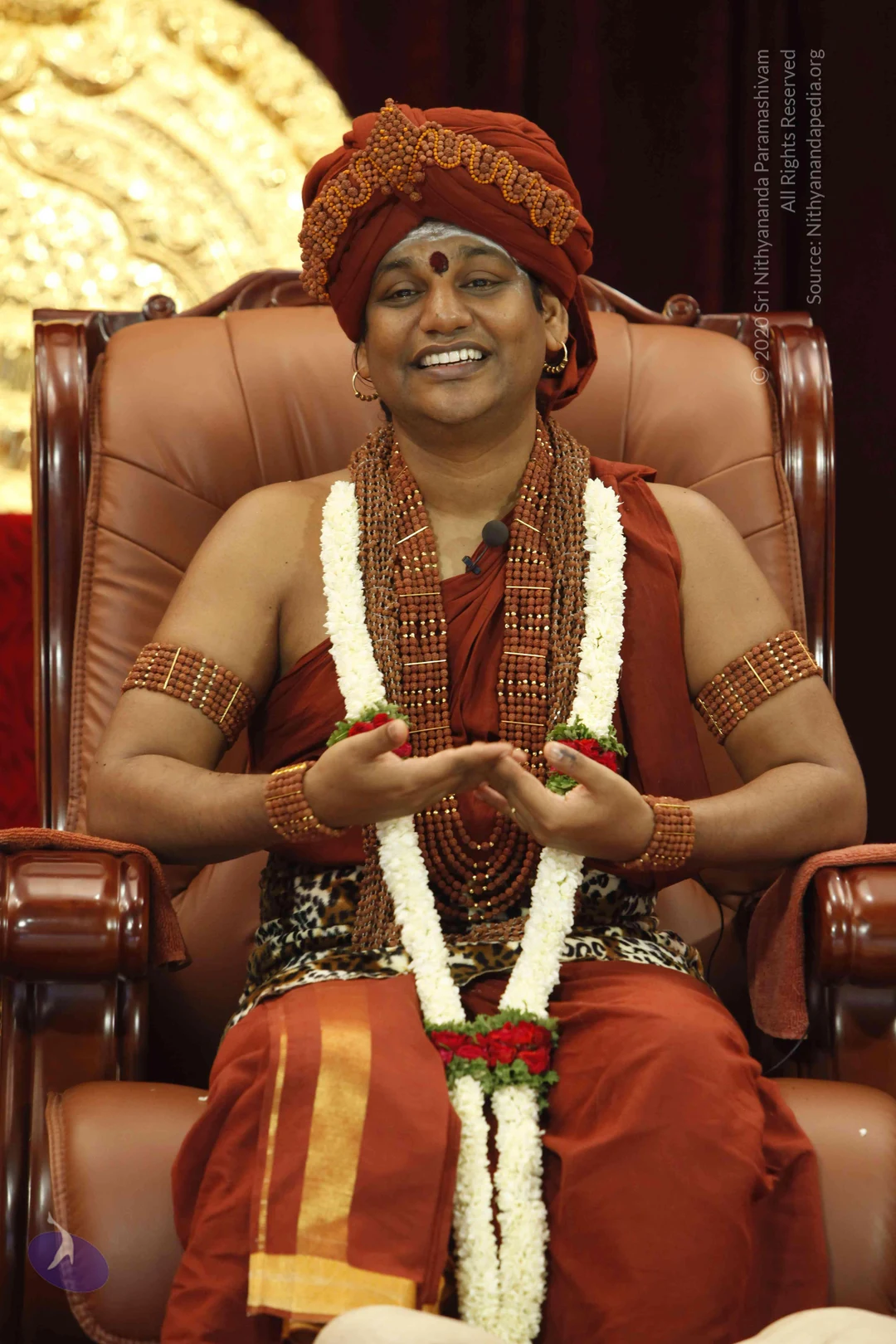
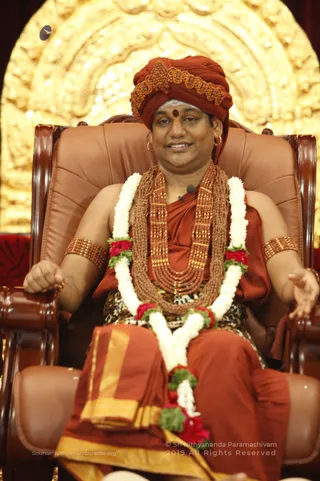
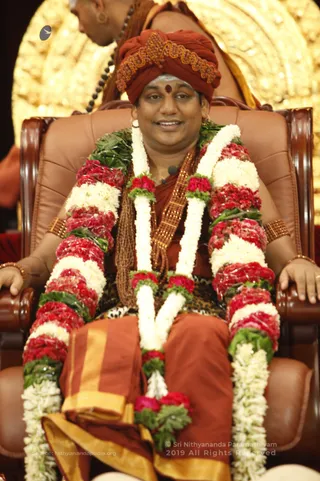
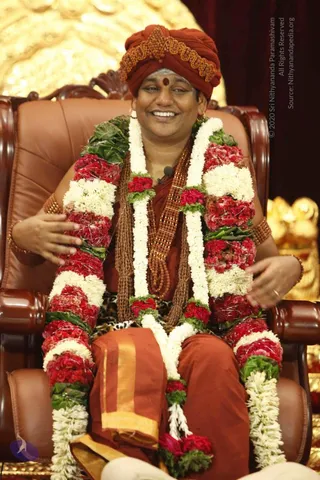
A smiling person sits in a brown leather armchair against a deep maroon draped backdrop during a satsang setting. The person wears a rust-orange turban decorated with rudraksha beads, a red bindi and white tilak, a rudraksha mala draped across the chest, beaded armbands, and a red-orange wrap, with white jasmine garlands and red roses around the neck. A small lapel microphone is clipped to the clothing. Swamiji (probable): the appearance has a rust-orange turban, rudraksha malas, bead armbands and ceremonial garlands, consistent with the page's claim, so this is a probable in-person appearance of the speaker in a satsang seat.A screen shows a seated figure on an ornate brown leather throne with carved wooden arms, in front of a gold-embossed backdrop. The figure wears a red-orange turban with beaded trim, a red-orange robe, a long rudraksha mala with a white and red flower garland, bead armbands, and a red bindi with white vibhuti on the forehead. Their right hand rests near the cheek in a relaxed pose. A small lapel microphone is visible. The image is a photograph of a screen, so the person pictured is on a display rather than physically present. Appearance-based cues (turban, rudraksha mala, saffron-red robe, ornate throne) are consistent with the page's Swamiji reference, so this is a probable depiction.

DARSHAN

17 photosSource gallery
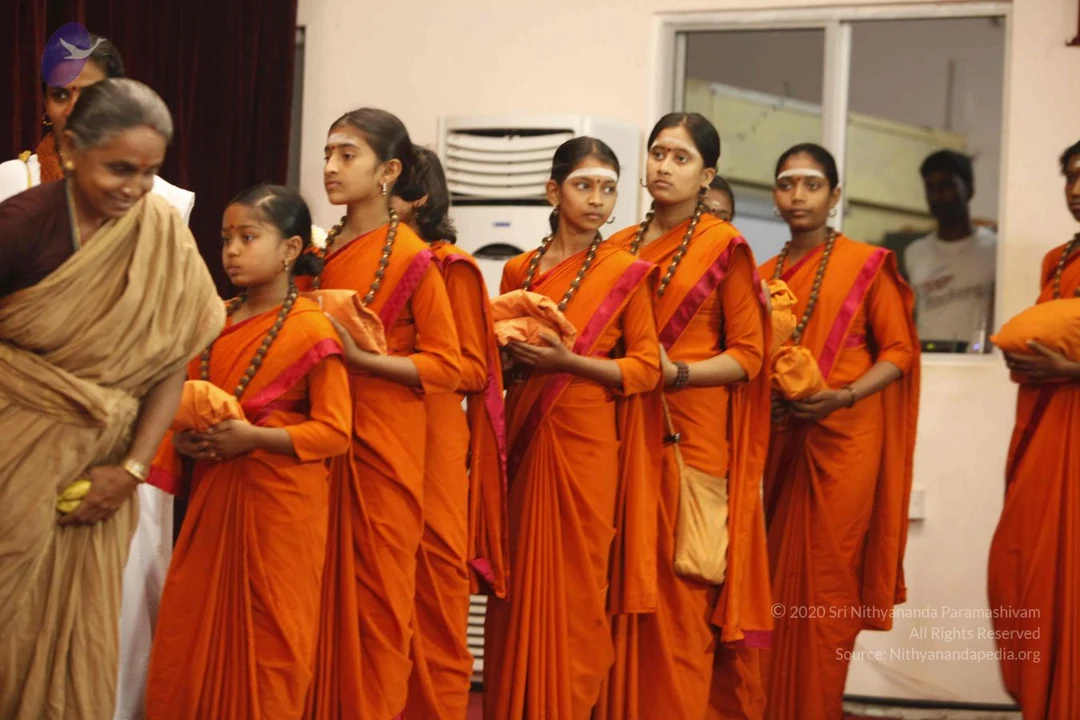
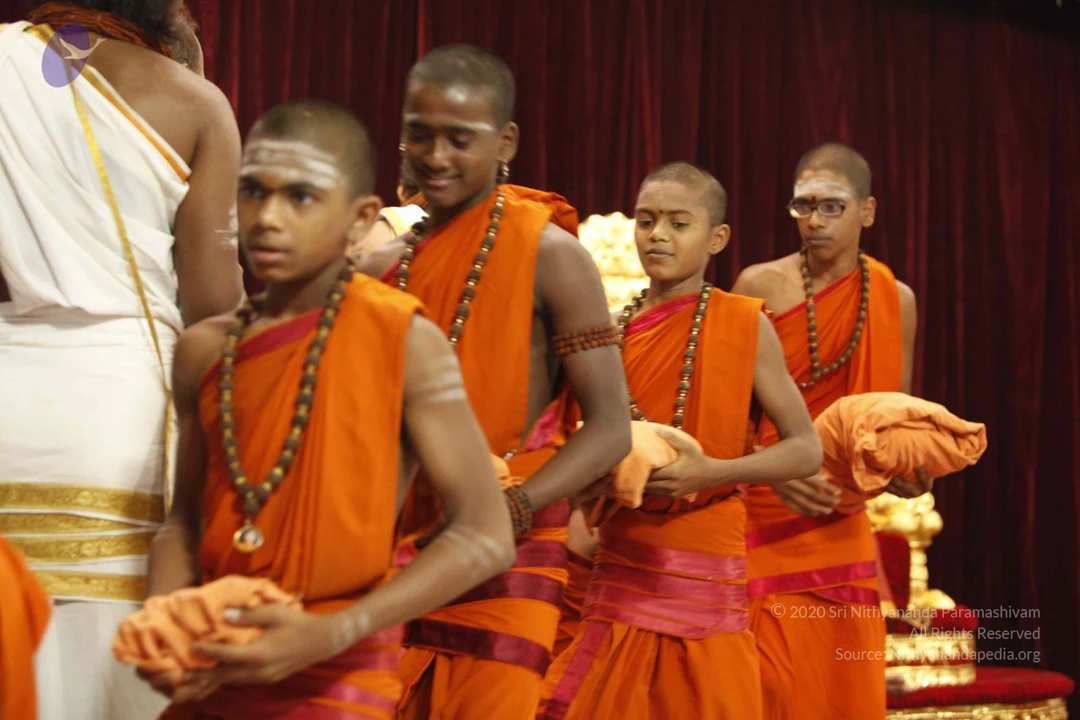
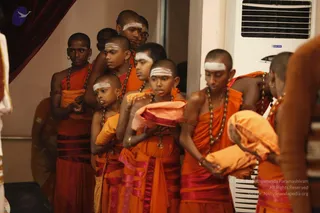
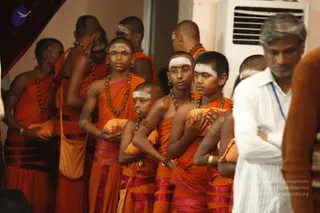
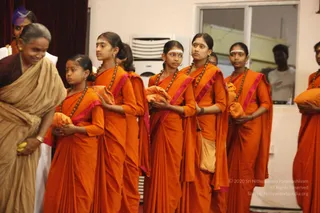
Swamiji (probable) sits smiling on a red throne-like seat in front of a gold ornate backdrop, wearing a rust-orange turban with beaded gold trim, orange-red robes, a thick multi-strand rudraksha-style mala and beaded gold armbands. A small red bindi is on his forehead and a microphone clips to his collar. Two men are in the foreground: one in white shirt with blue lanyard seen from behind, and another at left in white. Behind them a man in orange-red robes with a rudraksha mala and gold sash stands near the throne. Red velvet drape hangs behind, with a golden kalasha-like object at lower right.A photograph of a seated man in an orange-red turban decorated with a beaded band, wearing a matching rust-orange cloth draped over the shoulders and bare upper body, with layered rudraksha-style beaded necklaces, beaded armlets and a small lapel microphone clipped to his chest. He sits on a red zebra-striped couch in front of an ornate gold throne-backed seat, with gold lion-head and shell-shaped decorations beside him. In the foreground a man in white shirt with a blue-trimmed collar sits facing him from the left edge, and a partly visible person in orange stands behind. Behind is a red velvet curtain.A line of young boys in saffron-orange robes stands indoors beside a white wall-mounted air conditioner labelled Blue Star. Several boys have white and red tilaka marks on their foreheads and wood-bead malas around their necks, and some wear orange cloth wrapped around their arms. Several hold folded orange and pink cloth bundles in their hands, and a maroon curtain hangs at the left edge. The boys are standing in an orderly row and appear to be waiting or moving forward during a ceremony. No recognisable a person figure is clearly visible among them.A photograph of a line of young boys and adolescents in saffron-orange robes standing indoors. Several wear rudraksha malas around their necks, and many have white vertical tilak marks on their foreheads. Some hold folded orange cloth in their hands. Behind them a red curtain hangs at left and a white wall-mounted air conditioner is visible at top. At right, a man in a white shirt with a blue lanyard stands with arms folded, and a person in an orange top stands at the edge of the frame. No identifiable a person appearance is visible among the people shown.A row of young women and girls stand in a hall wearing matching saffron-orange saris with magenta borders and rudraksha malas. Several hold small orange cloth bundles in cupped hands, and some wear white or pale tilak markings on their foreheads. On the left, an older woman in a beige sari with a gold bangle turns toward them. A wall air conditioner, window and a man in a white shirt in the background complete the indoor setting. No one visibly identifiable as a person is in the frame.A seated man in an orange-red turban and matching saffron-orange robe smiles warmly while sitting on an ornate gold-carved throne. He wears a long mala of rudraksha-style beads, gold bangles on his upper arms and wrists, and gold earrings, with a red bindi on his forehead and a small clip-on microphone at his collar. A gilded armrest and a red tiger-striped cushion sit beside him. Across from him, a man with short grey hair in a white-and-grey striped shirt faces him from the right edge, slightly out of focus. The backdrop is deep red velvet drapery. Appearance-based candidate for Swamiji (probable), seated on the throne with distinctive saffron clothing, turban and beaded mala.

PUJA
20 photosSource gallery
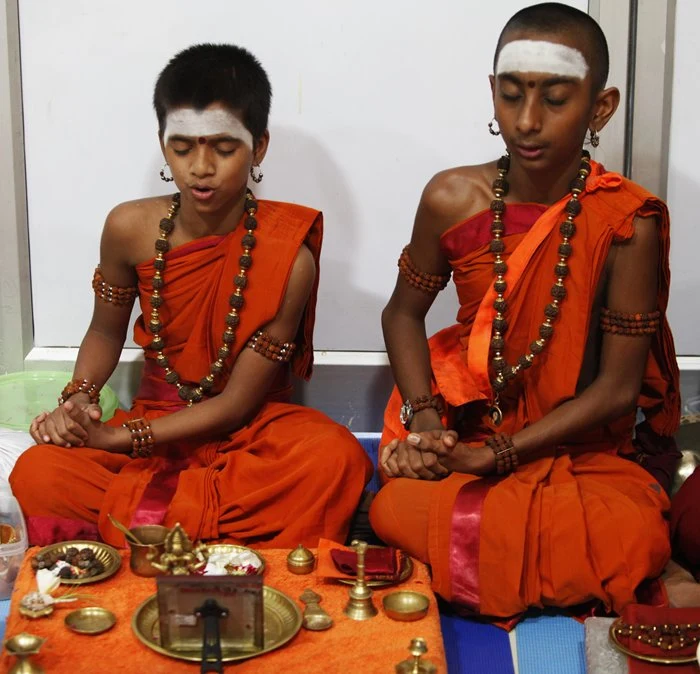
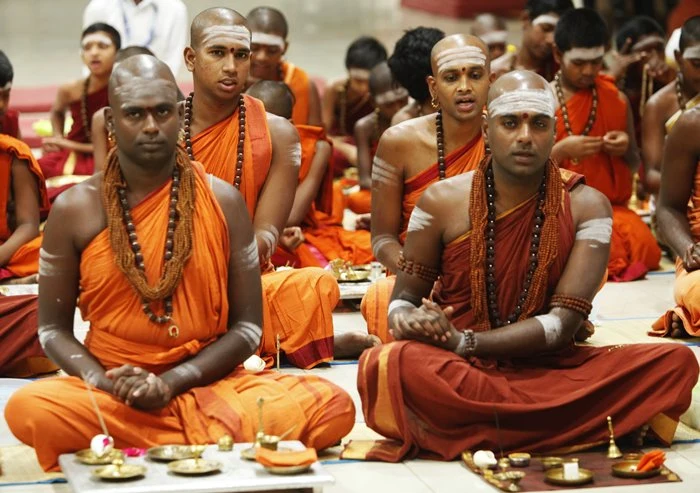
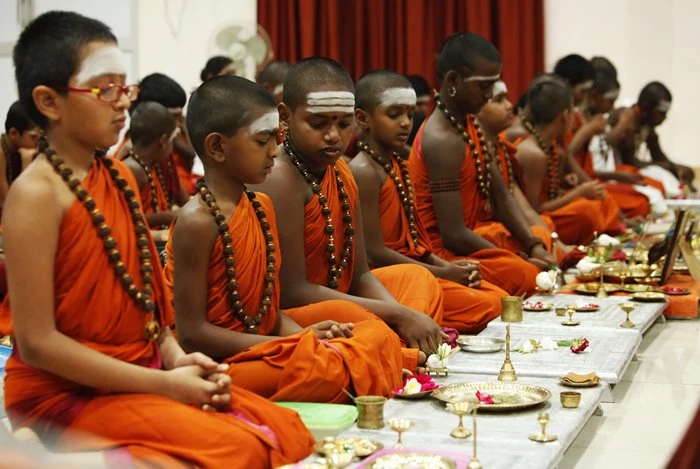
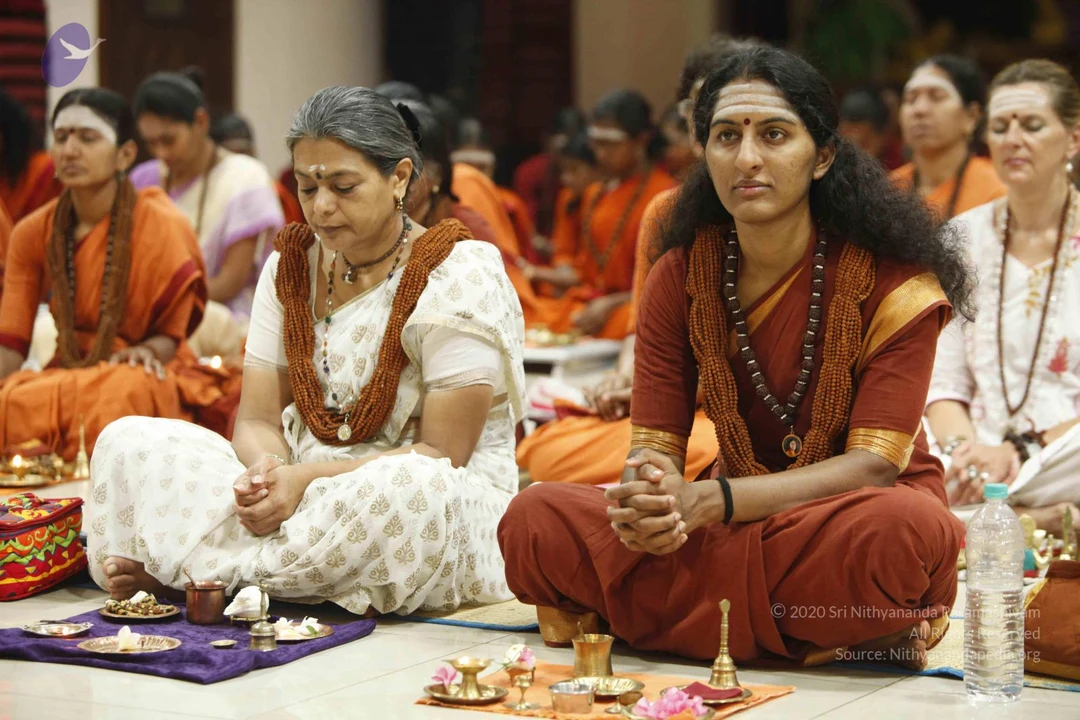
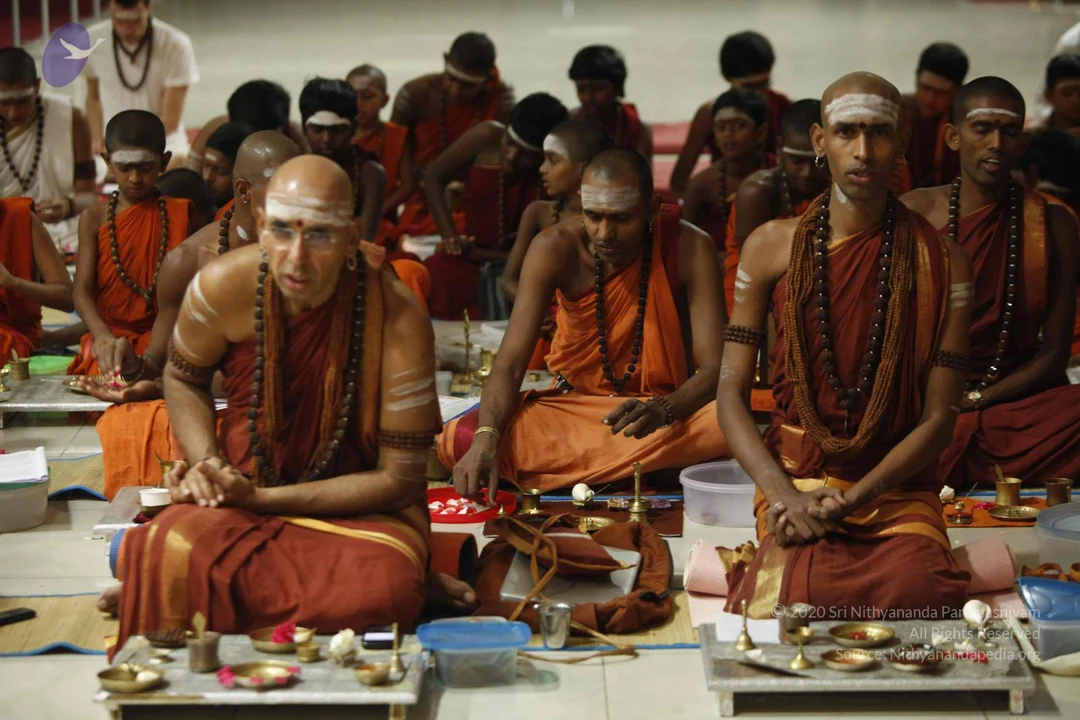
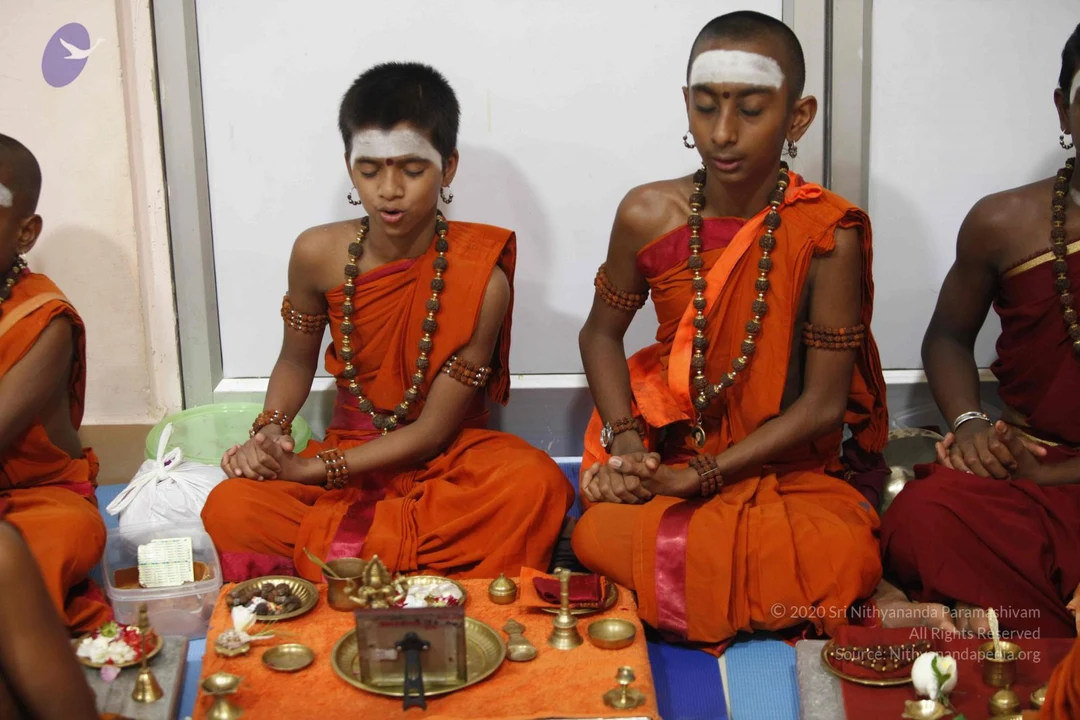
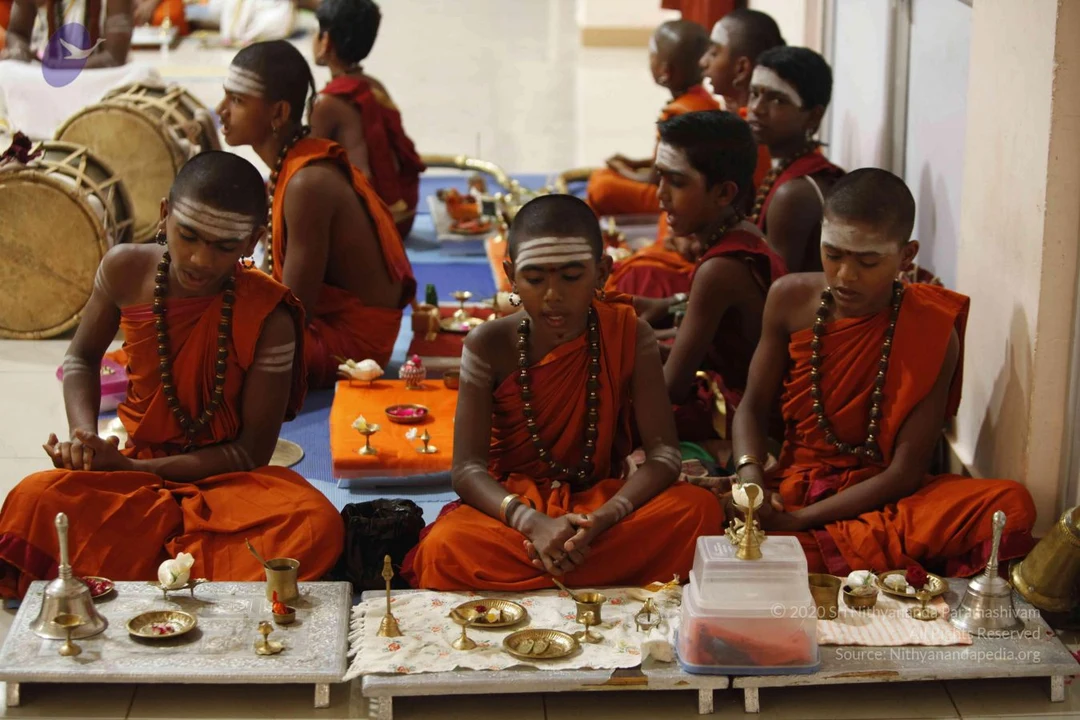
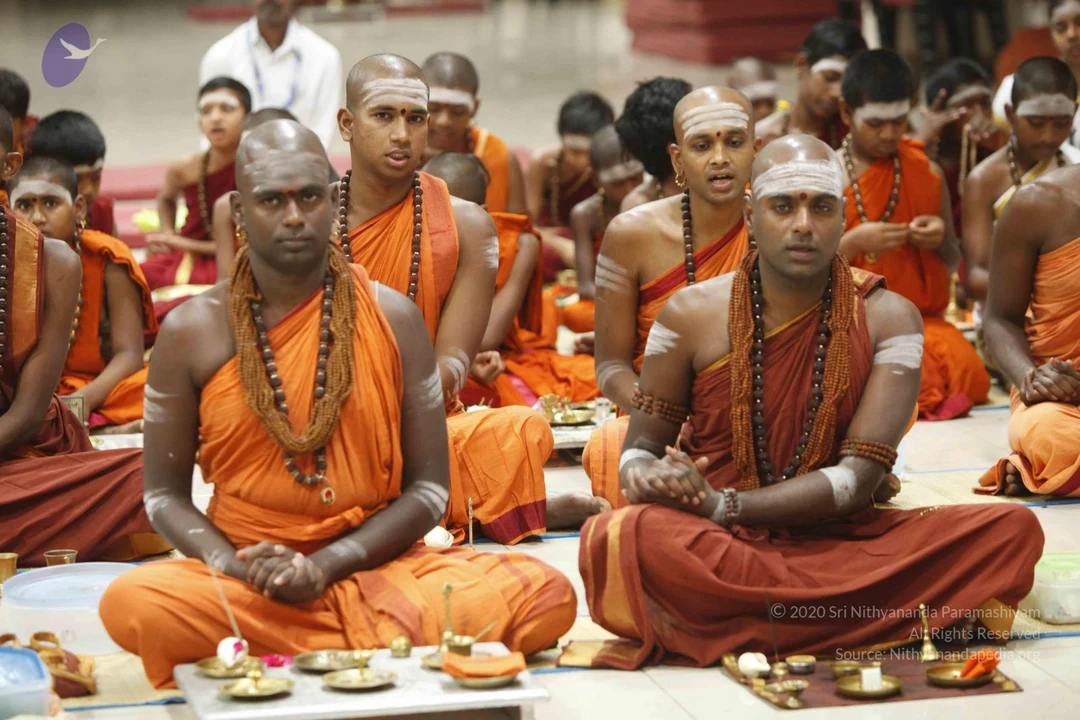
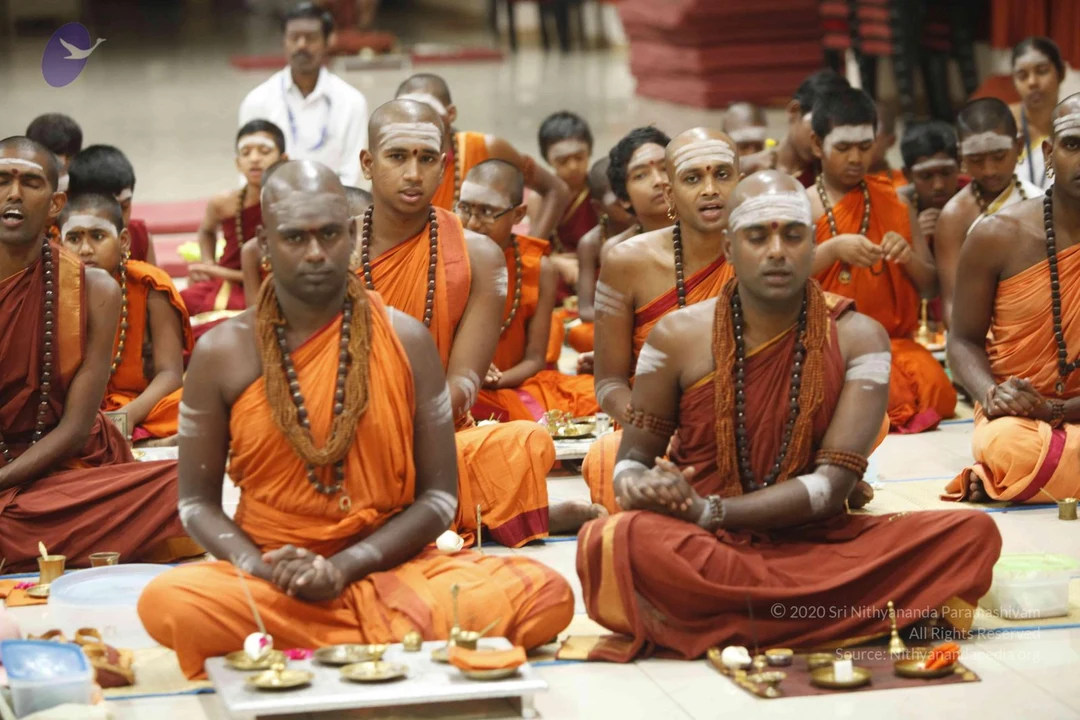
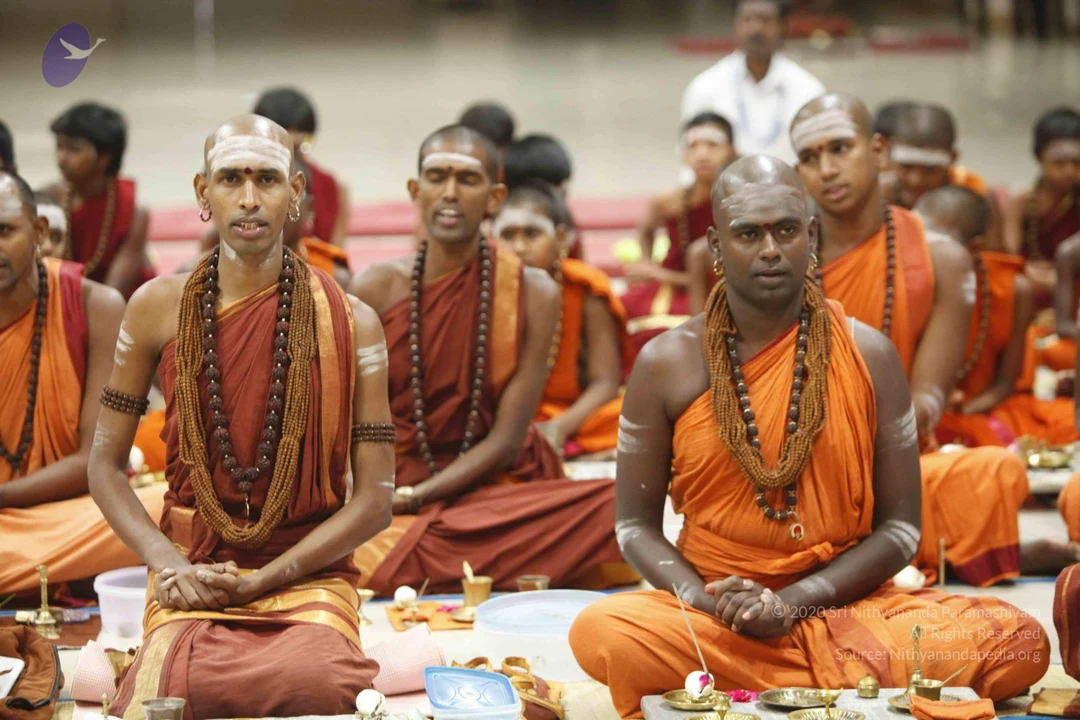
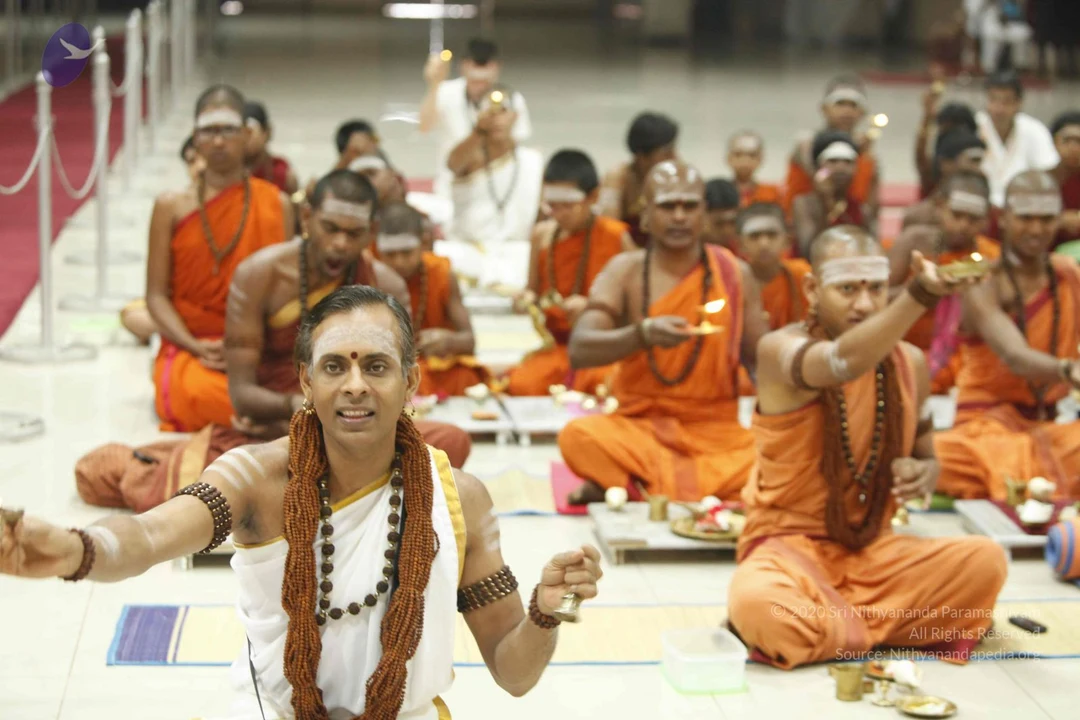
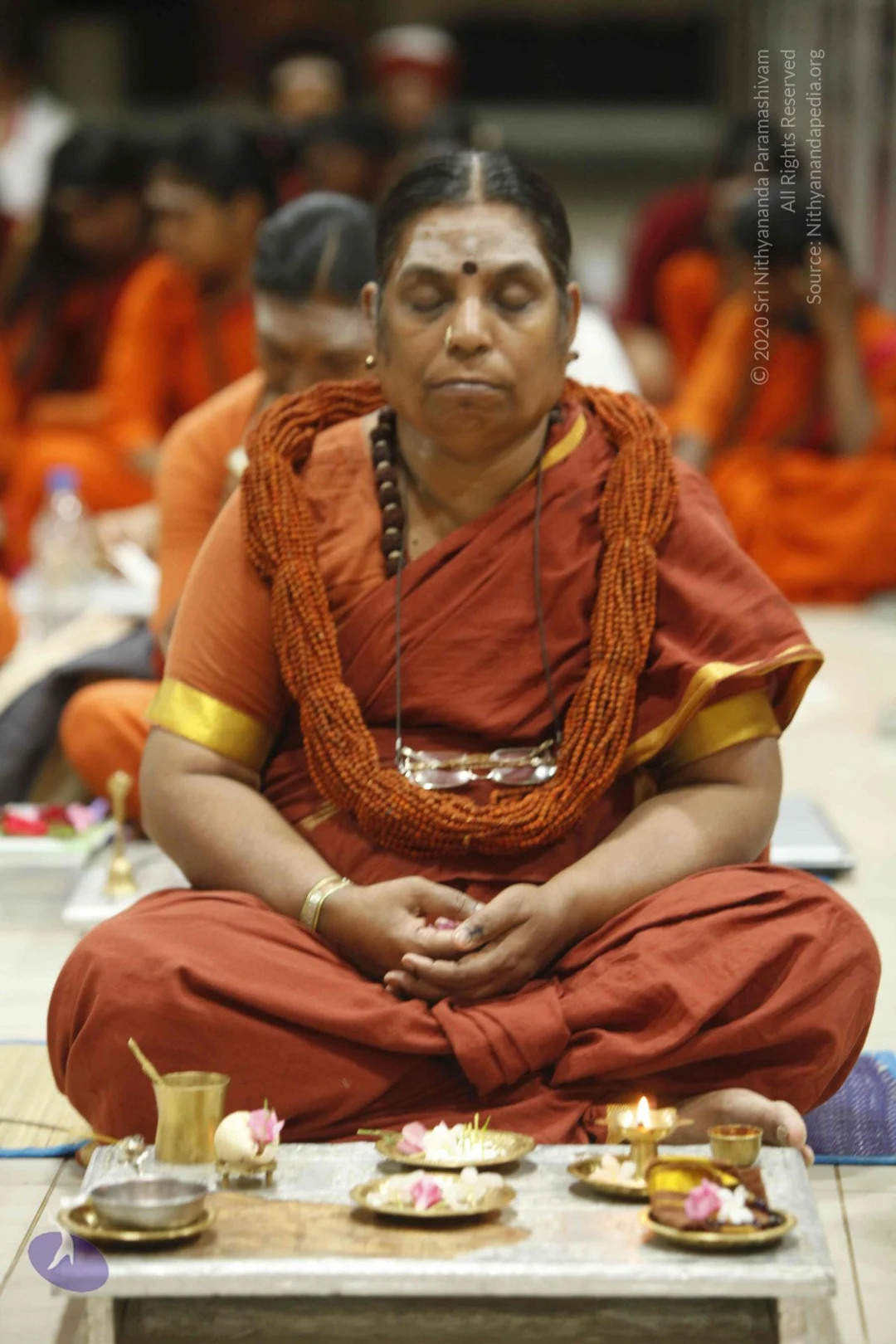
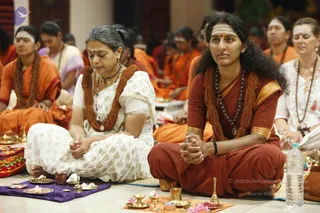
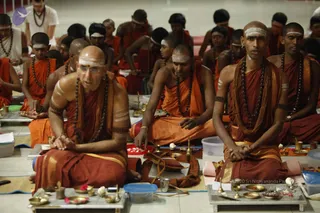
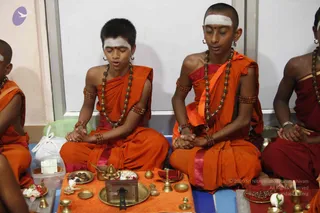
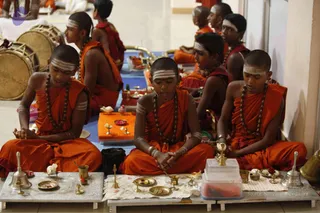
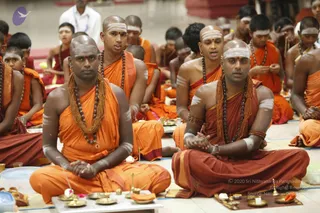
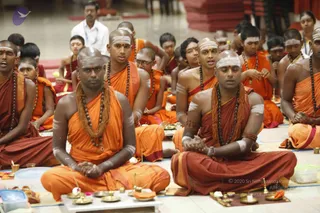
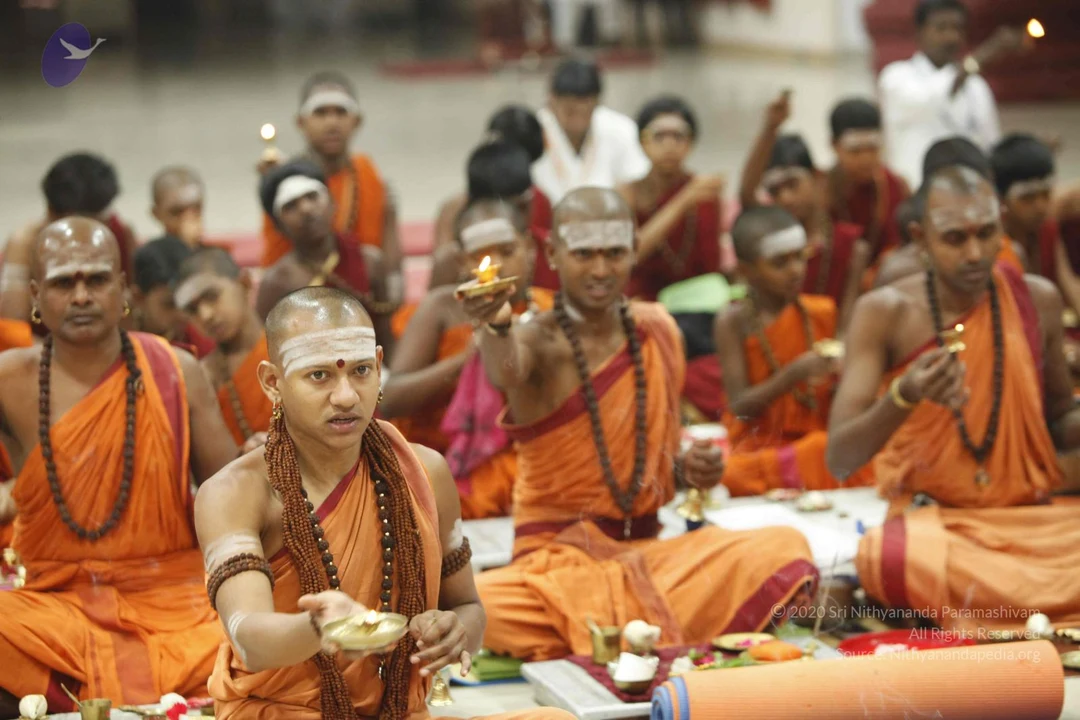
Seated devotees sit cross-legged on the floor during a group ritual indoors. In the foreground a woman with grey hair wears a white block-printed sari and a rudraksha mala, her hands folded in her lap, eyes lowered. Beside her a woman in a rust-red sari with gold border and a long rudraksha mala holds her hands together in prayer, with a tilak on her forehead. Before them stand brass oil lamps, a small copper cup, a brass bell and pink flowers on a purple cloth and orange mat. Behind, many people in orange and saffron robes and white clothes sit in rows, some with white forehead markings. A water bottle stands at the right edge.Several saffron-robed sannyasis sit cross-legged on a floor during a ritual gathering. In front, a bald man with white-painted forehead and arm markings wears an orange-red dhoti, a long rudraksha mala and a thin shawl, with his hands folded and mouth open as if chanting. Beside him, a younger man in orange wears a rudraksha mala and bangles and handles items at a brass-and-tray setup. On the right, a shaven-headed man with white tripundra marks sits with palms pressed together in an orange-and-gold dhoti. Brass lamps, flower petals, small bowls and cups lie on silver trays and mats, while devotees in white and orange sit behind them.Photo of young boys in saffron-orange robes seated cross-legged on blue mats during a ritual puja. Two prominent boys in the foreground have white sandalwood vibhuti lines on their foreheads, red bindis, rudraksha malas around their necks and rudraksha bracelets on their arms; they sit with palms pressed together, eyes closed and mouths open as if chanting. Before them on an orange cloth are brass plates with flowers, a brass kalasha, small brass oil lamps, bowls and a small wooden box. A child at the left edge and another at the right, in maroon-and-orange clothing, are partly visible. Behind them is a white wall and a green plastic bowl.Several young shaved-headed boys in saffron-orange robes sit cross-legged on the floor in a ritual setting, with white ash marks on their foreheads and arms and rudraksha malas around their necks. Before them are brass bells, small lamps, brass plates with flowers and offerings, and a white cloth on a low table. Large drums lean against the wall behind them, and a covered plastic container of red offering sits at the front. No single figure is identified as a person in this image.A seated group of saffron-robed sadhus and devotees in a hall during a satsang or puja. Two bald-headed men in the foreground sit cross-legged with hands folded; the left one wears an orange robe and a thick rudraksha mala, the right one a deep red-orange robe and rudraksha beads. Both have white tilak marks on forehead and arms. Behind them, many young men in orange robes and rudraksha malas sit on the floor, some with hands clasped or chanting. Brass plates, small brass lamps, and offering dishes with flowers sit on low tables in front.A seated group of shaven-headed men in saffron and orange robes, many with white vibhuti horizontal markings on their foreheads and arms, sit on a white floor during a ritual. Rudraksha malas hang around their necks, and several wear rust-red or deep orange shawls. In the foreground, a man in orange with a rudraksha mala and a saffron shawl sits with palms joined, while a man beside him in rust-red robes sits with hands folded. Brass plates, small brass bowls, lamps and flower offerings are arranged on low wooden stands and mats before them. Behind them, younger boys in orange robes and beaded necklaces sit in rows, and a man in a white shirt stands near the back. A purple bird logo appears at the top left.

SATSANG

6 photosSource gallery
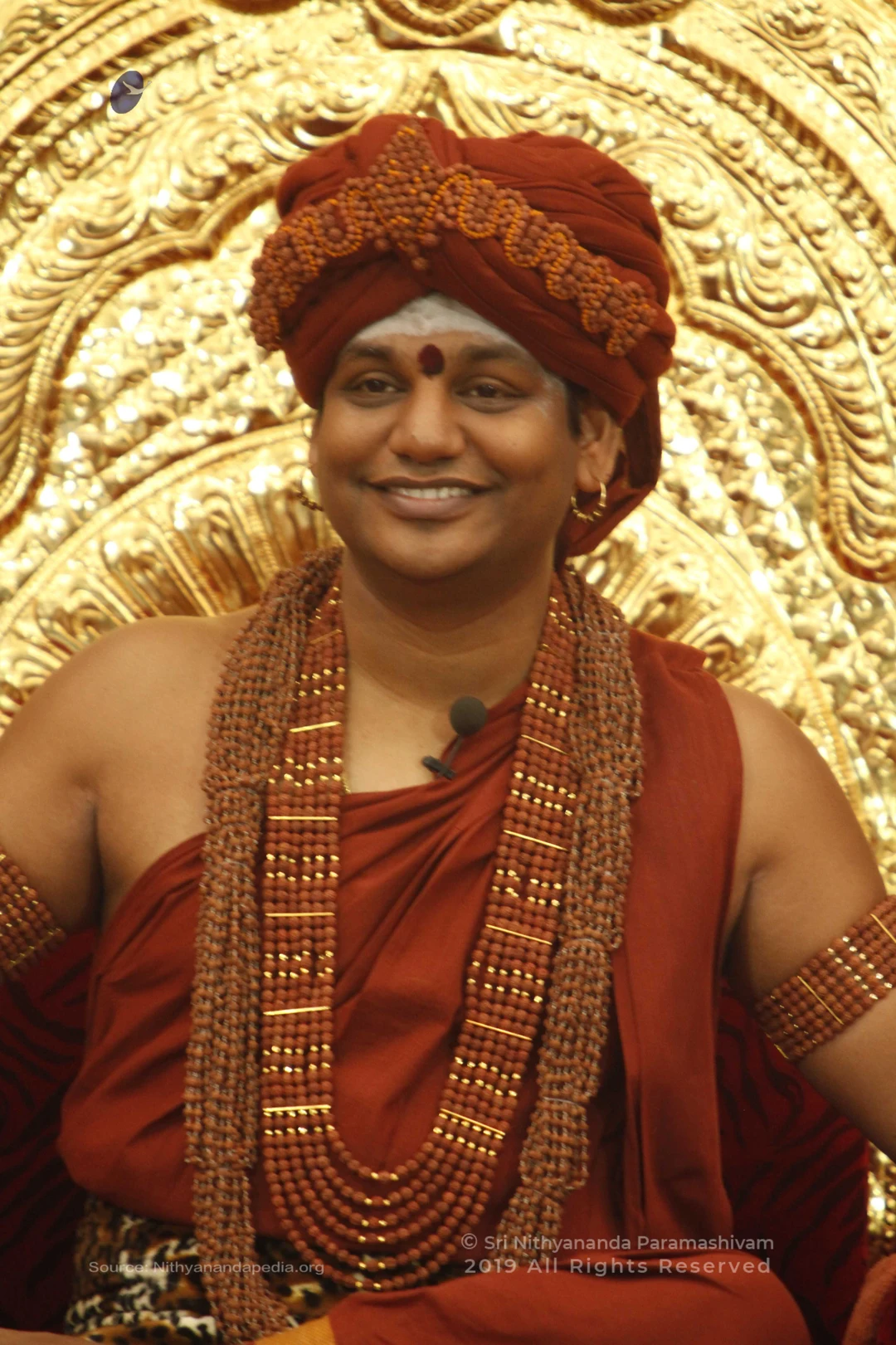
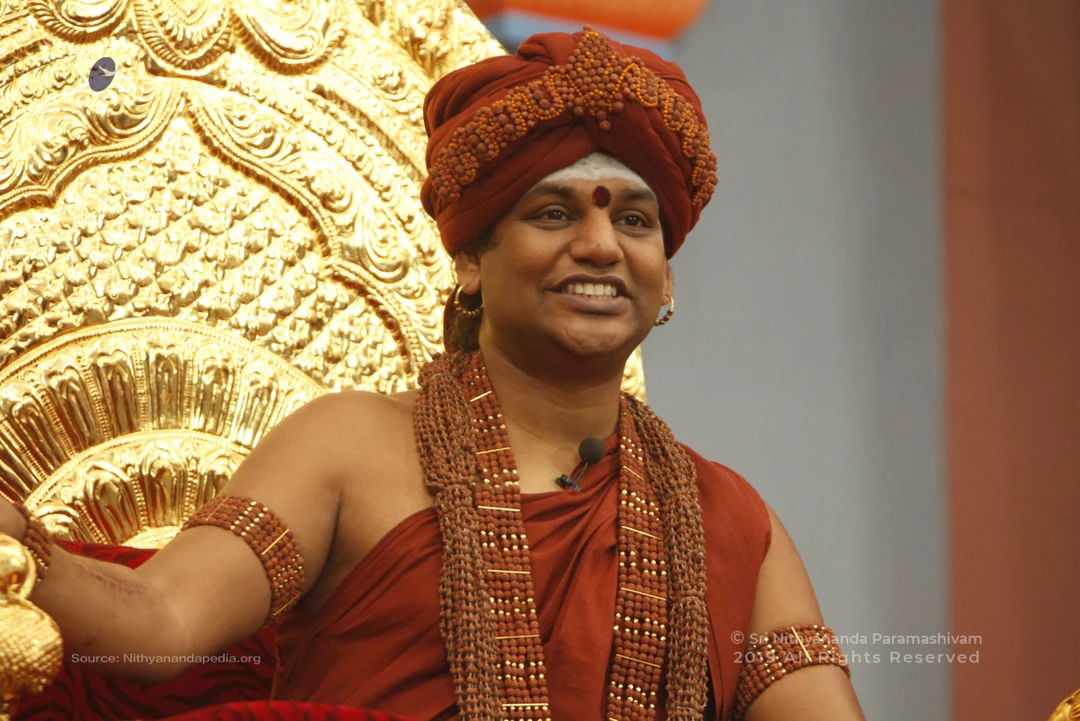
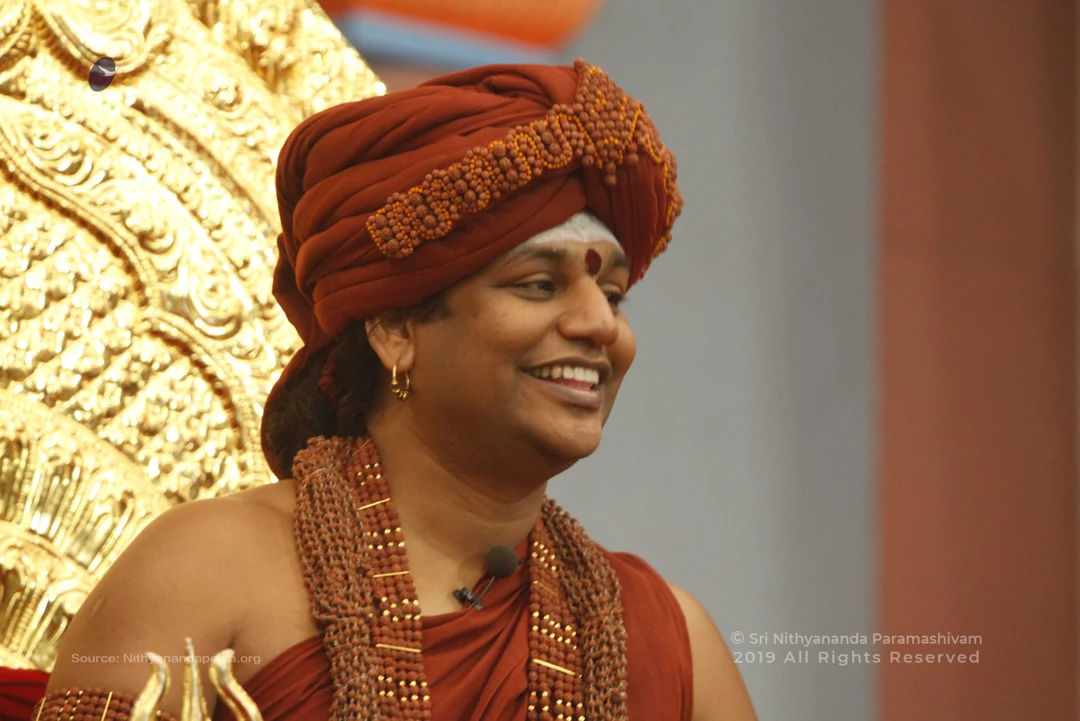
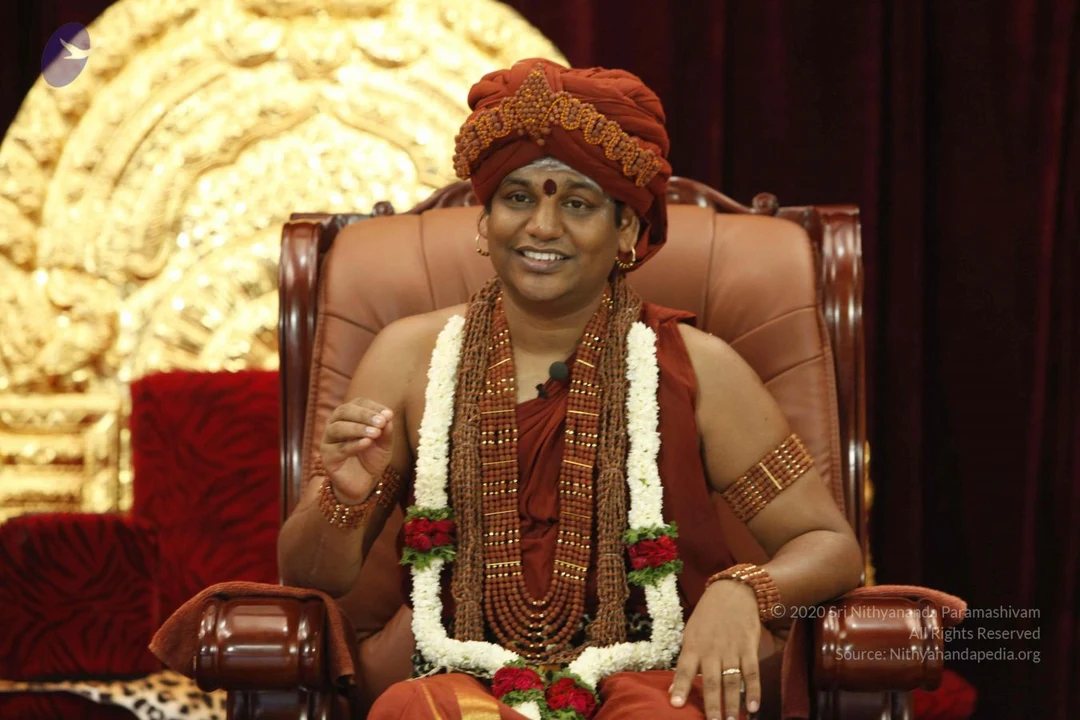
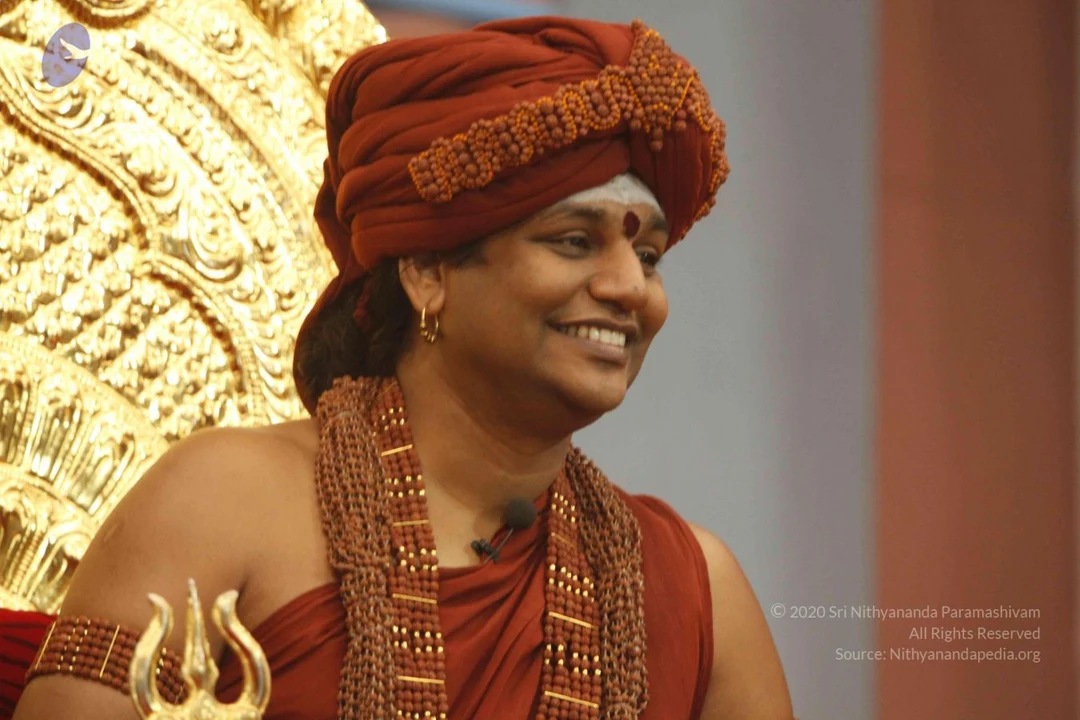
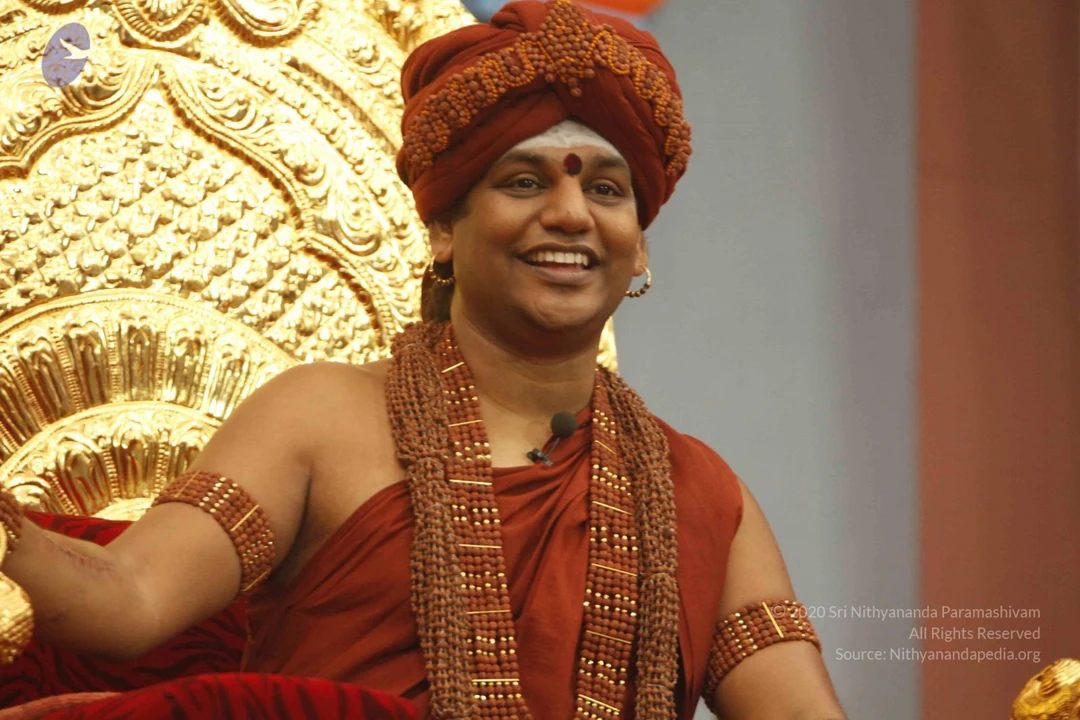
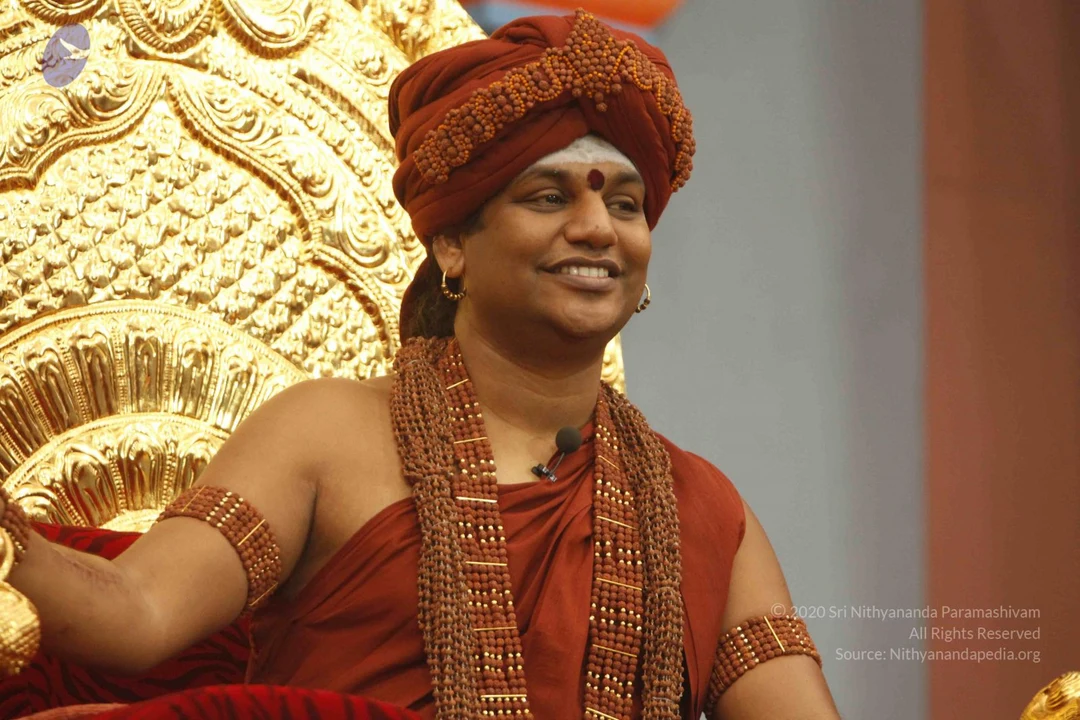
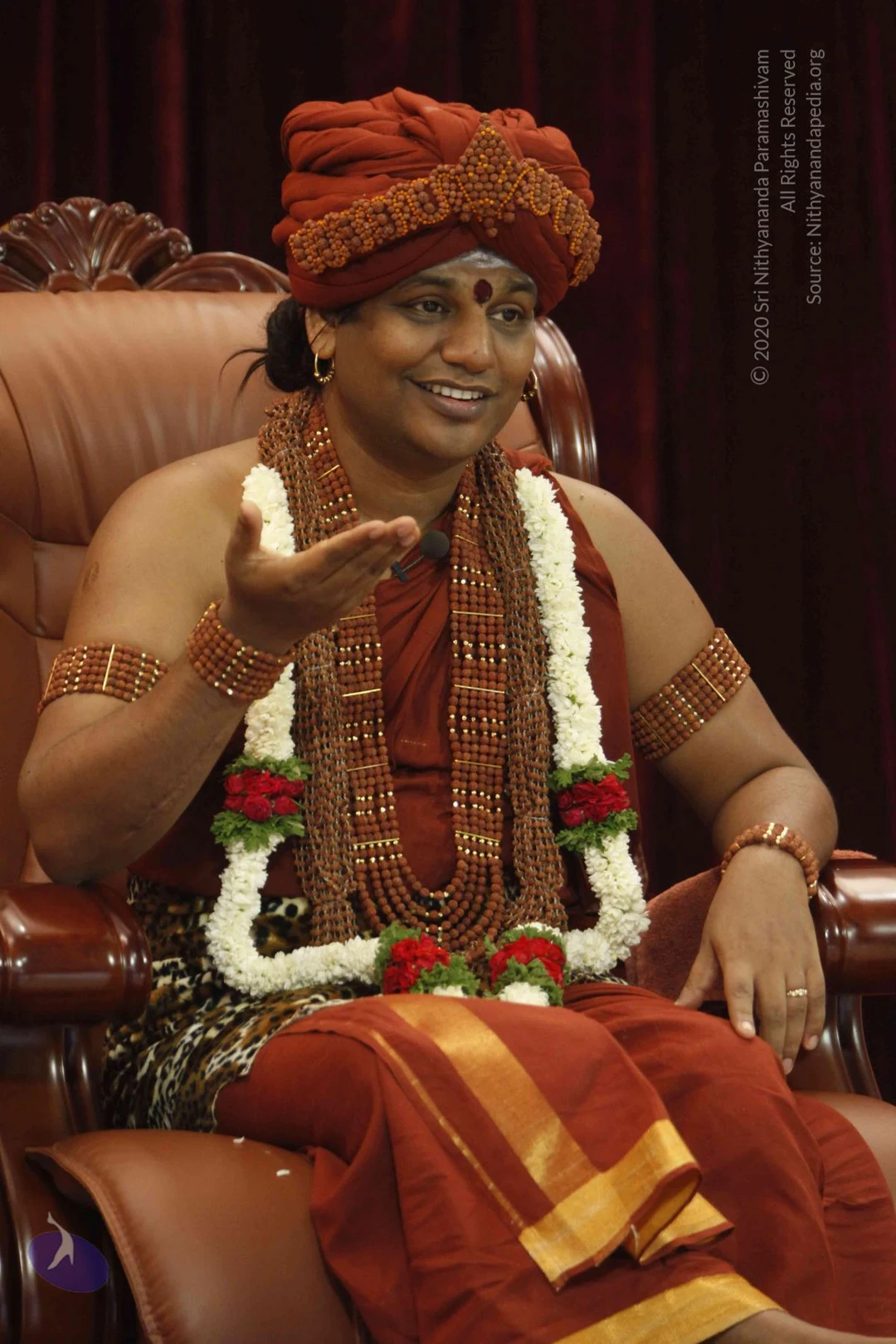
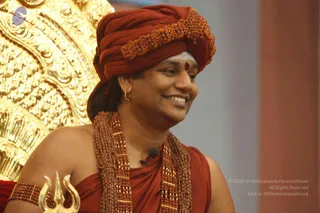
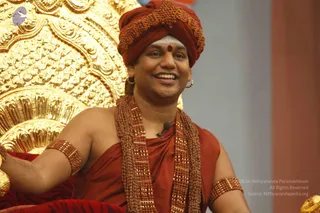
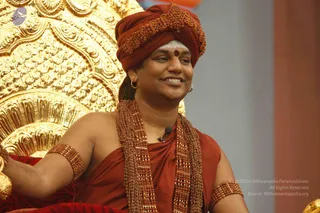
A smiling man in a rust-orange turban decorated with rudraksha beads and a red bindi on his forehead sits before an ornate gold throne-like carved backrest. He wears an orange-red shawl over bare shoulders, a long rudraksha mala with gold spacers, and gold earrings, with a small lapel microphone clipped to his chest. a person appears in this photograph, seated in a satsang setting with an orange-painted wall behind him.A smiling man with closed eyes sits beside an ornate gold throne with carved floral and leaf patterns. He wears a rust-red turban decorated with rudraksha beads, a rust-red cloth draped over his shoulders, and multiple strands of rudraksha and gold beads around his neck. A small red bindi and white tilak mark his forehead, and a small lapel microphone is clipped to his clothing. The setting is a stage with orange and grey backdrops. Swamiji (probable) is present in person; the appearance cues are the turban, rudraksha malas, saffron-orange clothing and seated throne position.A smiling man in a rust-orange turban decorated with beaded trim sits before an ornate gold throne carved with floral and scroll patterns. He wears a red-orange shawl draped over his bare shoulder, layered rudraksha mala necklaces, a gold trident armlet, a gold hoop earring, and a red bindi with white vibhuti on his forehead. A small lapel microphone is clipped to his chest. The background is a plain grey wall and a pinkish-brown pillar. Matching his distinctive turban, rudraksha malas and saffron wrap, he is a probable Swamiji (probable) shown in person on stage at a satsang.A smiling man in a deep red-orange turban with a beaded rudraksha-style crown ornament sits on an ornate gold throne with repoussé floral and scale-like carving. He wears a red-orange draped robe, long layered beaded rudraksha malas with gold accents, matching beaded armlets and small gold hoop earrings. A red bindi and white forehead marking are visible, and a small lavalier microphone is clipped to his chest.A smiling man in a rust-red turban and rust-red draped robe sits in front of an ornate gold throne with a carved floral and scroll backrest. He wears rudraksha mala necklaces and beaded armbands, gold hoop earrings, a red bindi and white ash markings on his forehead, and a small clip microphone on his chest. The setting suggests a satsang stage.A man seated on an ornate gold throne with a carved arched back and gold lion-head armrests, upholstered in red with dark tiger-stripe fabric. He wears a rust-red turban with beaded trim, a red-orange cloth draped over his shoulders, long rudraksha mala necklaces, beaded armlets and bangles, and a gold hoop earring. A red bindi and white markings are on his forehead. He gestures with one hand while speaking into a lapel microphone, as if giving a satsang discourse. Swamiji (probable): appearance cues are the saffron-orange clothing, multiple rudraksha malas, armlets and a turban on a throne.

DARSHAN

17 photosSource gallery
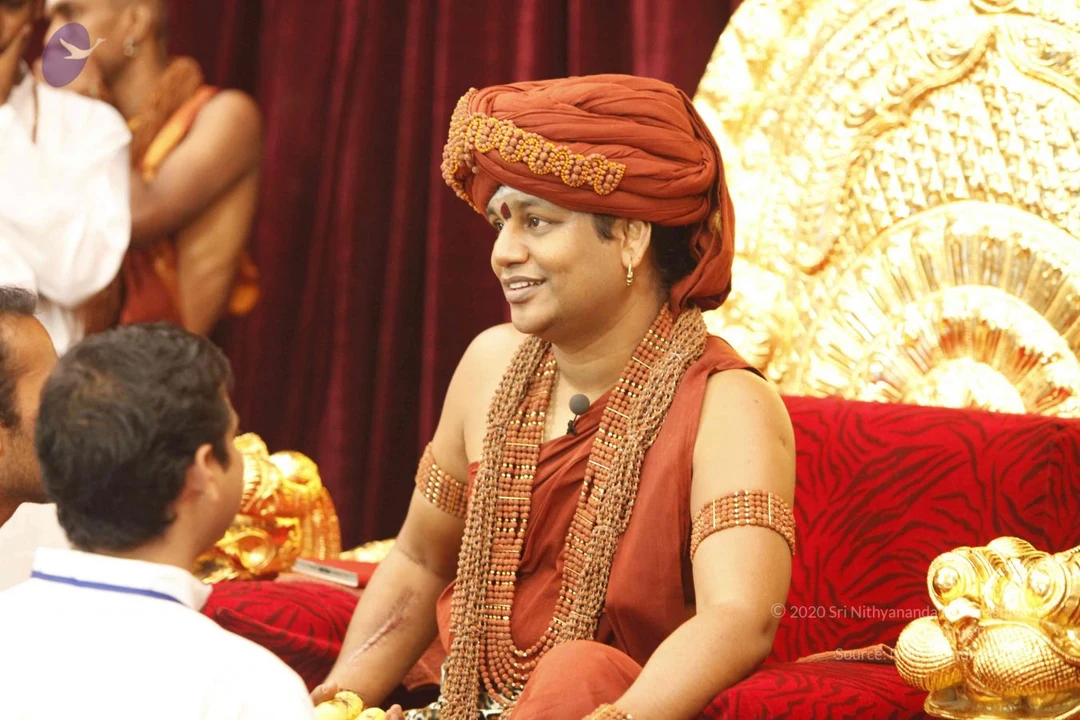
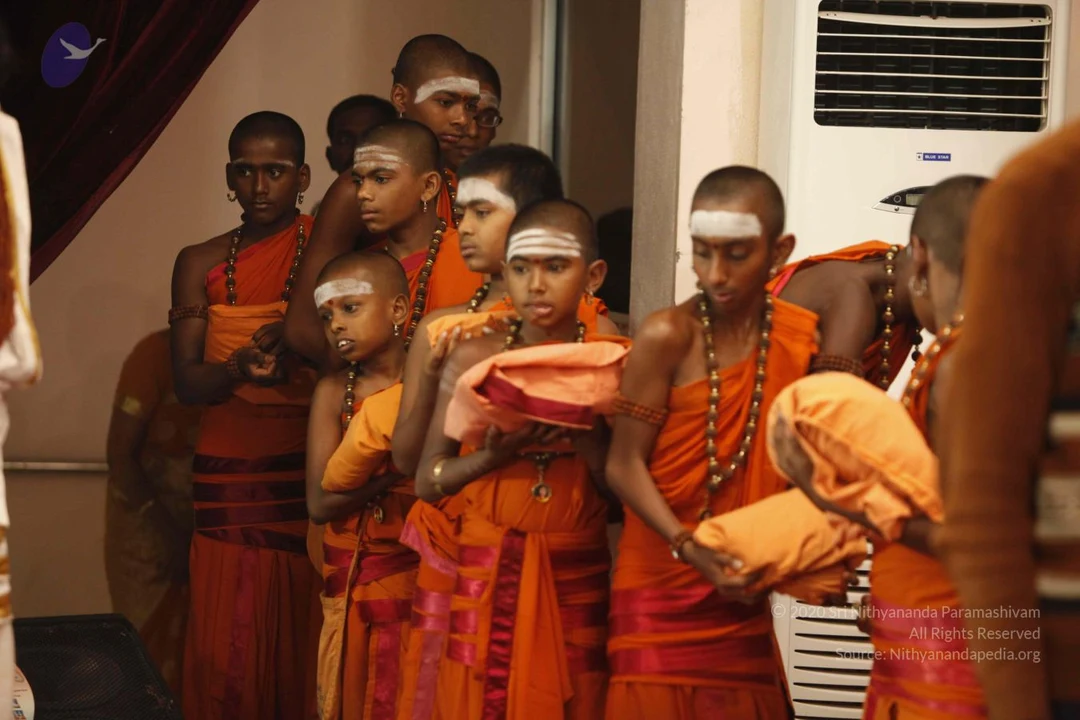
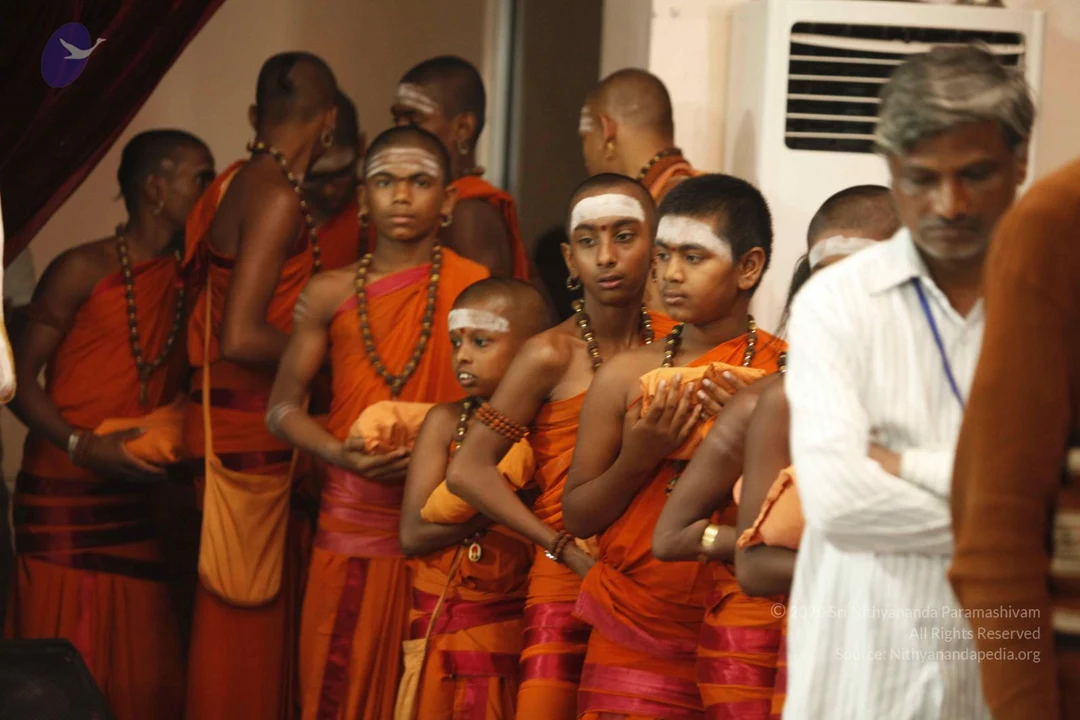
Swamiji (probable) sits smiling on a red throne-like seat in front of a gold ornate backdrop, wearing a rust-orange turban with beaded gold trim, orange-red robes, a thick multi-strand rudraksha-style mala and beaded gold armbands. A small red bindi is on his forehead and a microphone clips to his collar. Two men are in the foreground: one in white shirt with blue lanyard seen from behind, and another at left in white. Behind them a man in orange-red robes with a rudraksha mala and gold sash stands near the throne. Red velvet drape hangs behind, with a golden kalasha-like object at lower right.A photograph of a seated man in an orange-red turban decorated with a beaded band, wearing a matching rust-orange cloth draped over the shoulders and bare upper body, with layered rudraksha-style beaded necklaces, beaded armlets and a small lapel microphone clipped to his chest. He sits on a red zebra-striped couch in front of an ornate gold throne-backed seat, with gold lion-head and shell-shaped decorations beside him. In the foreground a man in white shirt with a blue-trimmed collar sits facing him from the left edge, and a partly visible person in orange stands behind. Behind is a red velvet curtain.A line of young boys in saffron-orange robes stands indoors beside a white wall-mounted air conditioner labelled Blue Star. Several boys have white and red tilaka marks on their foreheads and wood-bead malas around their necks, and some wear orange cloth wrapped around their arms. Several hold folded orange and pink cloth bundles in their hands, and a maroon curtain hangs at the left edge. The boys are standing in an orderly row and appear to be waiting or moving forward during a ceremony. No recognisable a person figure is clearly visible among them.A photograph of a line of young boys and adolescents in saffron-orange robes standing indoors. Several wear rudraksha malas around their necks, and many have white vertical tilak marks on their foreheads. Some hold folded orange cloth in their hands. Behind them a red curtain hangs at left and a white wall-mounted air conditioner is visible at top. At right, a man in a white shirt with a blue lanyard stands with arms folded, and a person in an orange top stands at the edge of the frame. No identifiable a person appearance is visible among the people shown.A row of young women and girls stand in a hall wearing matching saffron-orange saris with magenta borders and rudraksha malas. Several hold small orange cloth bundles in cupped hands, and some wear white or pale tilak markings on their foreheads. On the left, an older woman in a beige sari with a gold bangle turns toward them. A wall air conditioner, window and a man in a white shirt in the background complete the indoor setting. No one visibly identifiable as a person is in the frame.A seated man in an orange-red turban and matching saffron-orange robe smiles warmly while sitting on an ornate gold-carved throne. He wears a long mala of rudraksha-style beads, gold bangles on his upper arms and wrists, and gold earrings, with a red bindi on his forehead and a small clip-on microphone at his collar. A gilded armrest and a red tiger-striped cushion sit beside him. Across from him, a man with short grey hair in a white-and-grey striped shirt faces him from the right edge, slightly out of focus. The backdrop is deep red velvet drapery. Appearance-based candidate for Swamiji (probable), seated on the throne with distinctive saffron clothing, turban and beaded mala.

PUJA
20 photosSource gallery
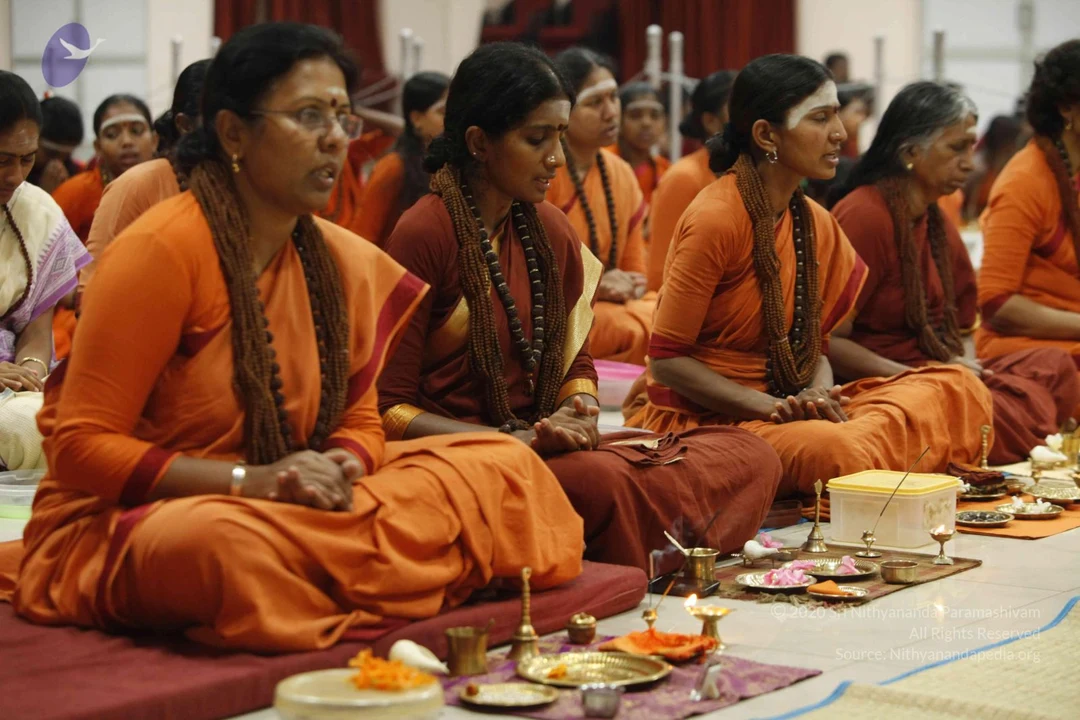
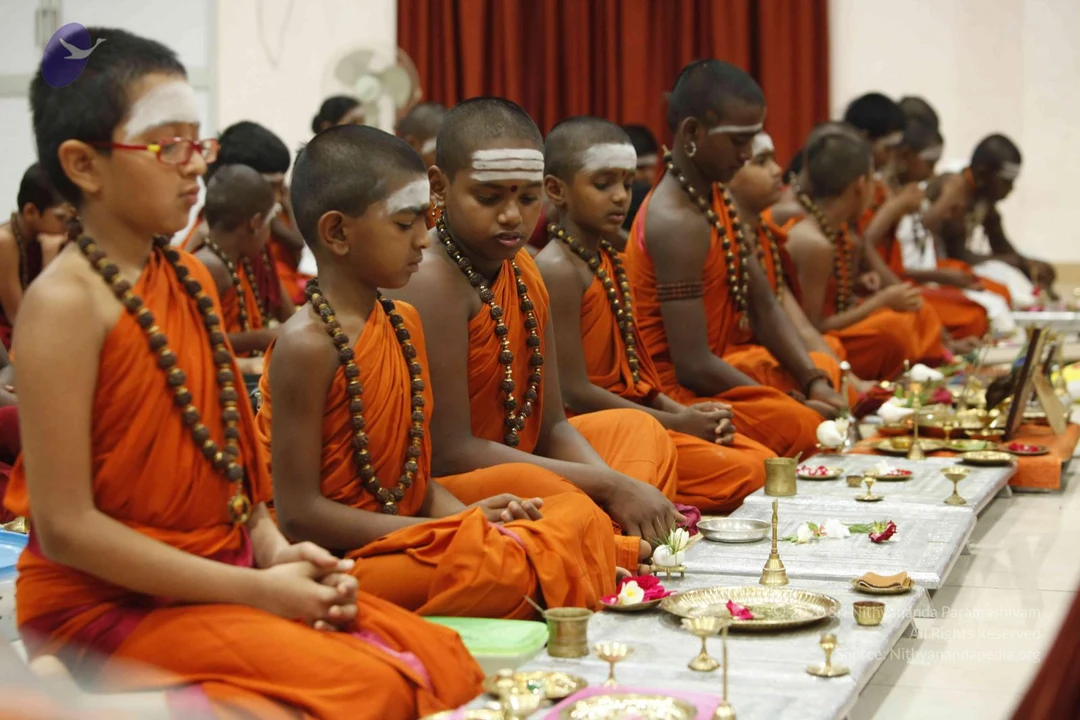
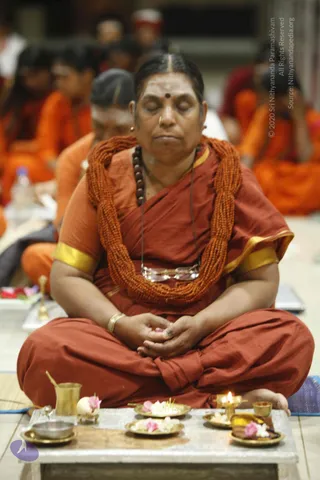
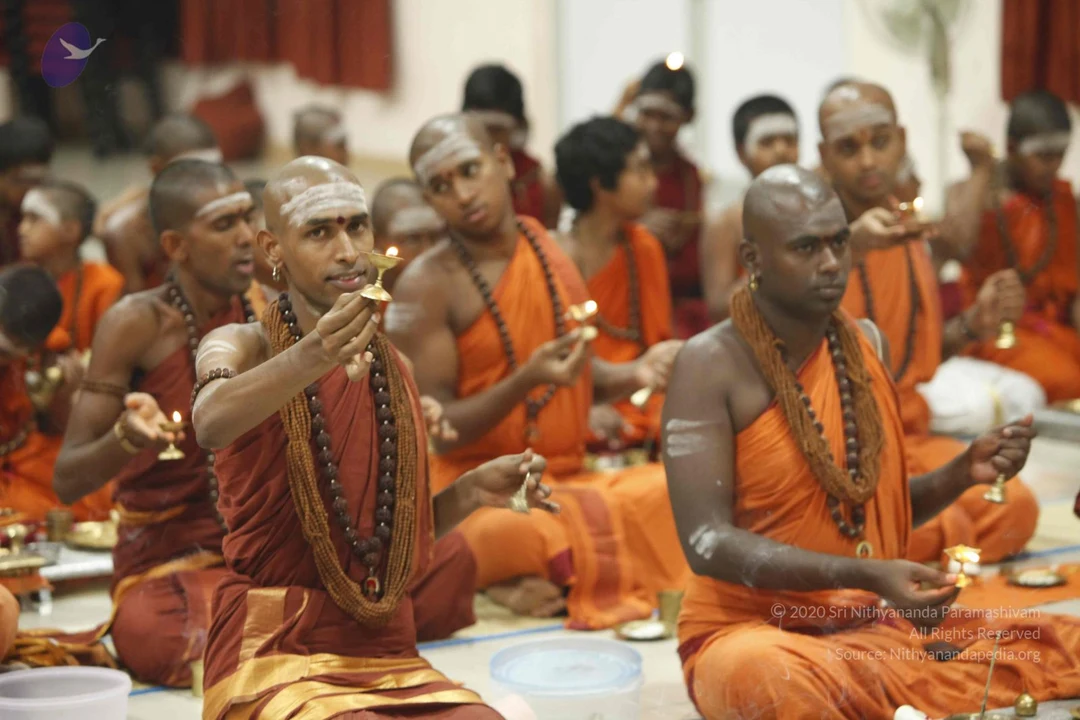
Seated devotees sit cross-legged on the floor during a group ritual indoors. In the foreground a woman with grey hair wears a white block-printed sari and a rudraksha mala, her hands folded in her lap, eyes lowered. Beside her a woman in a rust-red sari with gold border and a long rudraksha mala holds her hands together in prayer, with a tilak on her forehead. Before them stand brass oil lamps, a small copper cup, a brass bell and pink flowers on a purple cloth and orange mat. Behind, many people in orange and saffron robes and white clothes sit in rows, some with white forehead markings. A water bottle stands at the right edge.Several saffron-robed sannyasis sit cross-legged on a floor during a ritual gathering. In front, a bald man with white-painted forehead and arm markings wears an orange-red dhoti, a long rudraksha mala and a thin shawl, with his hands folded and mouth open as if chanting. Beside him, a younger man in orange wears a rudraksha mala and bangles and handles items at a brass-and-tray setup. On the right, a shaven-headed man with white tripundra marks sits with palms pressed together in an orange-and-gold dhoti. Brass lamps, flower petals, small bowls and cups lie on silver trays and mats, while devotees in white and orange sit behind them.Photo of young boys in saffron-orange robes seated cross-legged on blue mats during a ritual puja. Two prominent boys in the foreground have white sandalwood vibhuti lines on their foreheads, red bindis, rudraksha malas around their necks and rudraksha bracelets on their arms; they sit with palms pressed together, eyes closed and mouths open as if chanting. Before them on an orange cloth are brass plates with flowers, a brass kalasha, small brass oil lamps, bowls and a small wooden box. A child at the left edge and another at the right, in maroon-and-orange clothing, are partly visible. Behind them is a white wall and a green plastic bowl.Several young shaved-headed boys in saffron-orange robes sit cross-legged on the floor in a ritual setting, with white ash marks on their foreheads and arms and rudraksha malas around their necks. Before them are brass bells, small lamps, brass plates with flowers and offerings, and a white cloth on a low table. Large drums lean against the wall behind them, and a covered plastic container of red offering sits at the front. No single figure is identified as a person in this image.A seated group of saffron-robed sadhus and devotees in a hall during a satsang or puja. Two bald-headed men in the foreground sit cross-legged with hands folded; the left one wears an orange robe and a thick rudraksha mala, the right one a deep red-orange robe and rudraksha beads. Both have white tilak marks on forehead and arms. Behind them, many young men in orange robes and rudraksha malas sit on the floor, some with hands clasped or chanting. Brass plates, small brass lamps, and offering dishes with flowers sit on low tables in front.A seated group of shaven-headed men in saffron and orange robes, many with white vibhuti horizontal markings on their foreheads and arms, sit on a white floor during a ritual. Rudraksha malas hang around their necks, and several wear rust-red or deep orange shawls. In the foreground, a man in orange with a rudraksha mala and a saffron shawl sits with palms joined, while a man beside him in rust-red robes sits with hands folded. Brass plates, small brass bowls, lamps and flower offerings are arranged on low wooden stands and mats before them. Behind them, younger boys in orange robes and beaded necklaces sit in rows, and a man in a white shirt stands near the back. A purple bird logo appears at the top left.

SATSANG

6 photosSource gallery
A smiling man in a rust-orange turban decorated with rudraksha beads and a red bindi on his forehead sits before an ornate gold throne-like carved backrest. He wears an orange-red shawl over bare shoulders, a long rudraksha mala with gold spacers, and gold earrings, with a small lapel microphone clipped to his chest. a person appears in this photograph, seated in a satsang setting with an orange-painted wall behind him.A smiling man with closed eyes sits beside an ornate gold throne with carved floral and leaf patterns. He wears a rust-red turban decorated with rudraksha beads, a rust-red cloth draped over his shoulders, and multiple strands of rudraksha and gold beads around his neck. A small red bindi and white tilak mark his forehead, and a small lapel microphone is clipped to his clothing. The setting is a stage with orange and grey backdrops. Swamiji (probable) is present in person; the appearance cues are the turban, rudraksha malas, saffron-orange clothing and seated throne position.A smiling man in a rust-orange turban decorated with beaded trim sits before an ornate gold throne carved with floral and scroll patterns. He wears a red-orange shawl draped over his bare shoulder, layered rudraksha mala necklaces, a gold trident armlet, a gold hoop earring, and a red bindi with white vibhuti on his forehead. A small lapel microphone is clipped to his chest. The background is a plain grey wall and a pinkish-brown pillar. Matching his distinctive turban, rudraksha malas and saffron wrap, he is a probable Swamiji (probable) shown in person on stage at a satsang.A smiling man in a deep red-orange turban with a beaded rudraksha-style crown ornament sits on an ornate gold throne with repoussé floral and scale-like carving. He wears a red-orange draped robe, long layered beaded rudraksha malas with gold accents, matching beaded armlets and small gold hoop earrings. A red bindi and white forehead marking are visible, and a small lavalier microphone is clipped to his chest.A smiling man in a rust-red turban and rust-red draped robe sits in front of an ornate gold throne with a carved floral and scroll backrest. He wears rudraksha mala necklaces and beaded armbands, gold hoop earrings, a red bindi and white ash markings on his forehead, and a small clip microphone on his chest. The setting suggests a satsang stage.A man seated on an ornate gold throne with a carved arched back and gold lion-head armrests, upholstered in red with dark tiger-stripe fabric. He wears a rust-red turban with beaded trim, a red-orange cloth draped over his shoulders, long rudraksha mala necklaces, beaded armlets and bangles, and a gold hoop earring. A red bindi and white markings are on his forehead. He gestures with one hand while speaking into a lapel microphone, as if giving a satsang discourse. Swamiji (probable): appearance cues are the saffron-orange clothing, multiple rudraksha malas, armlets and a turban on a throne.

DARSHAN

12 photosSource gallery
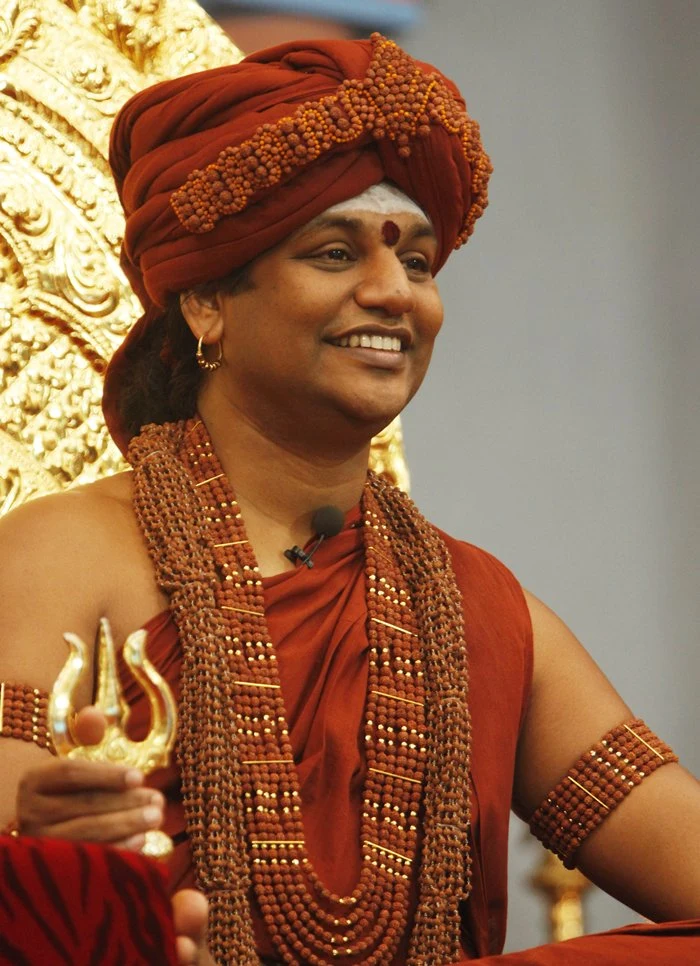
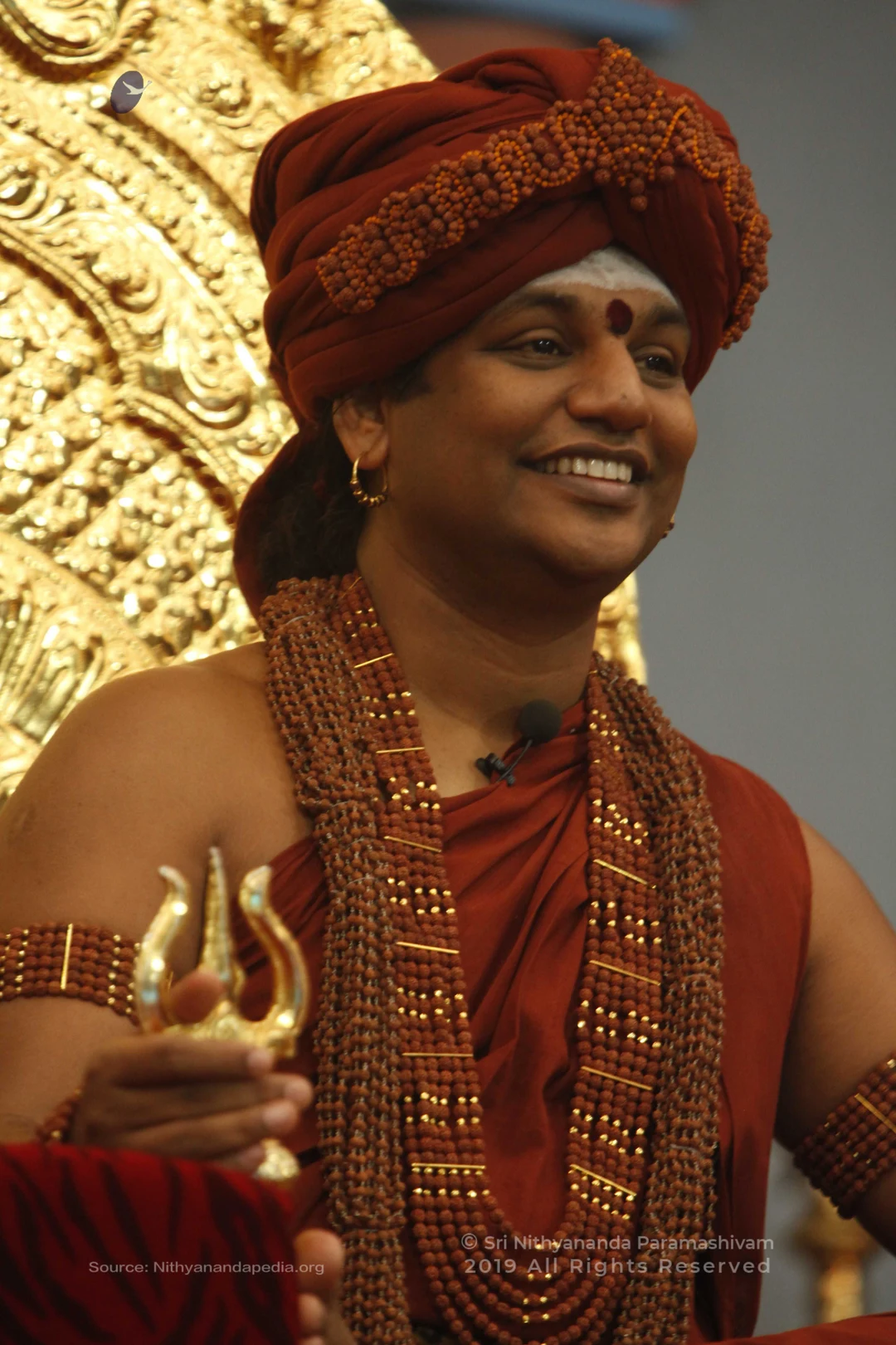
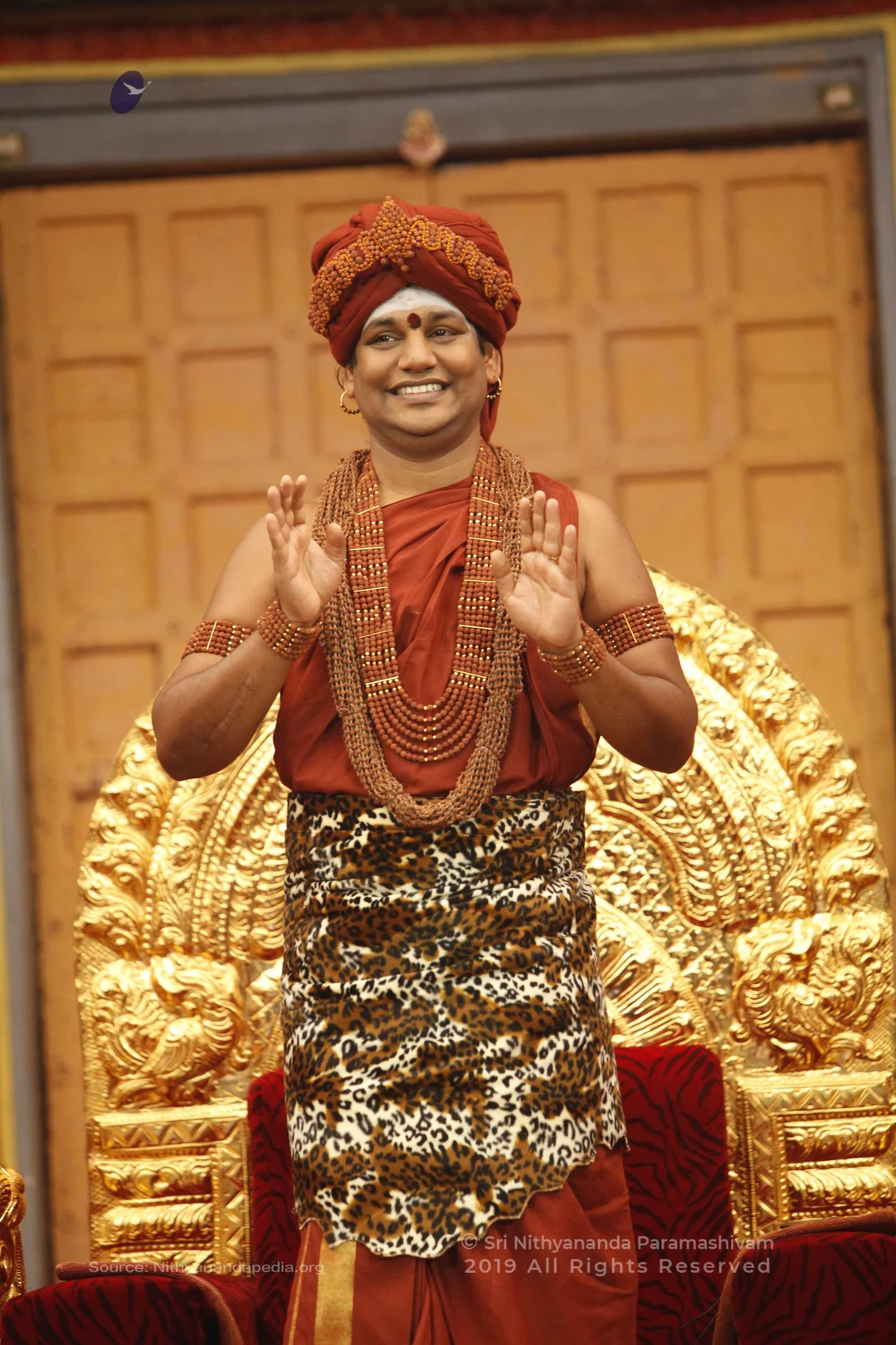
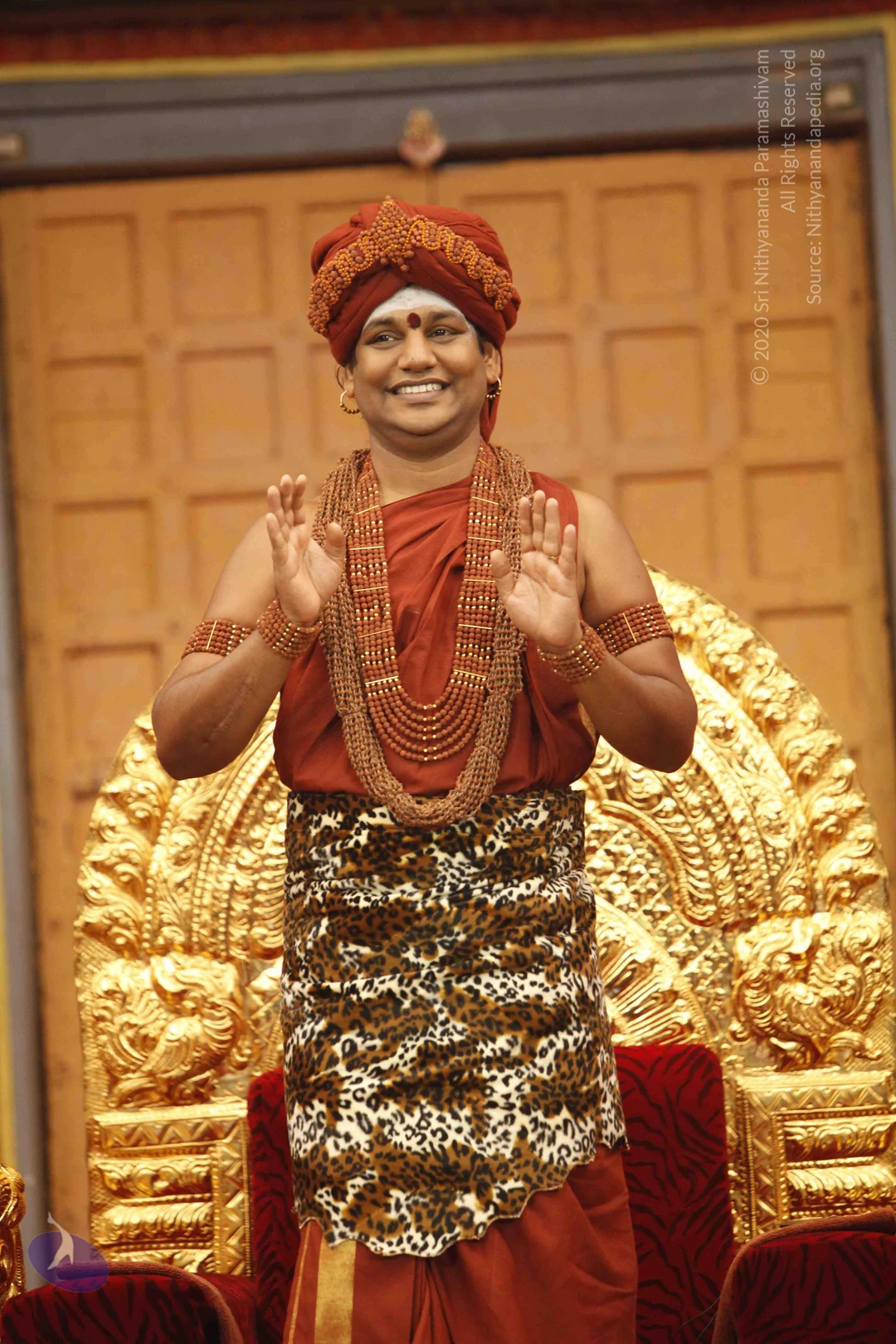
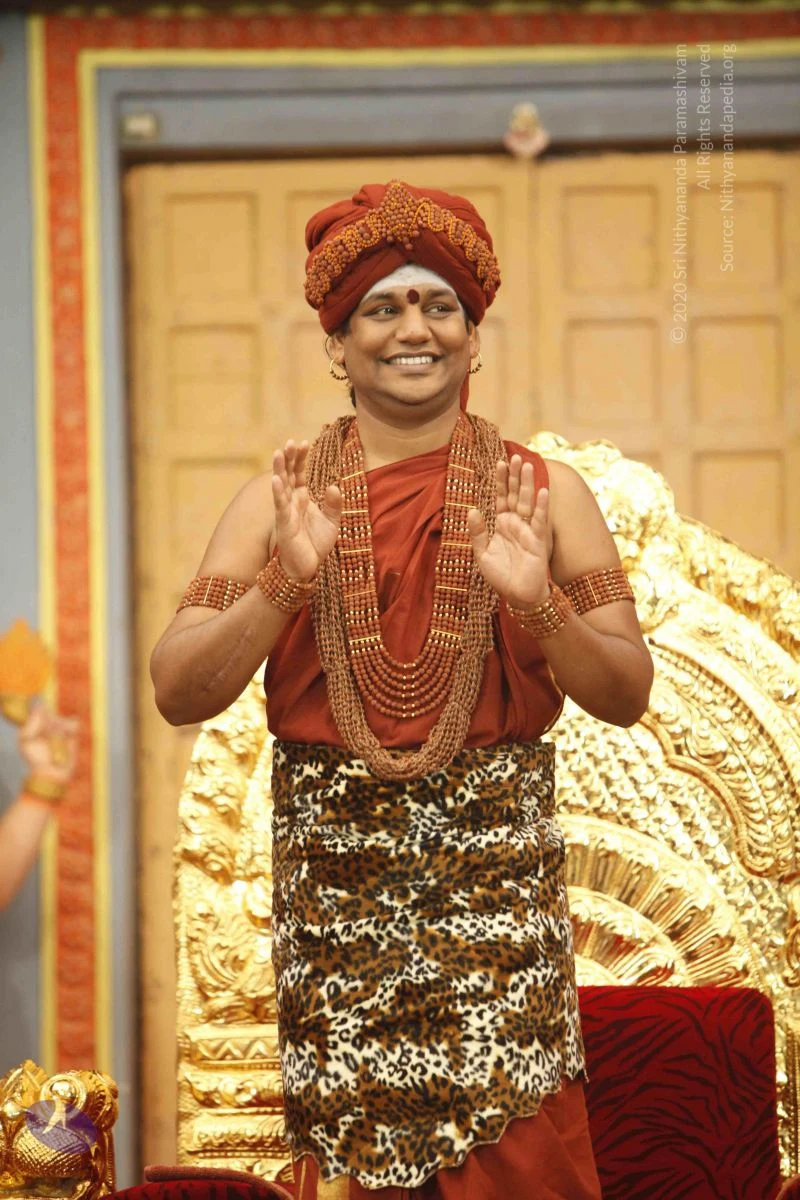
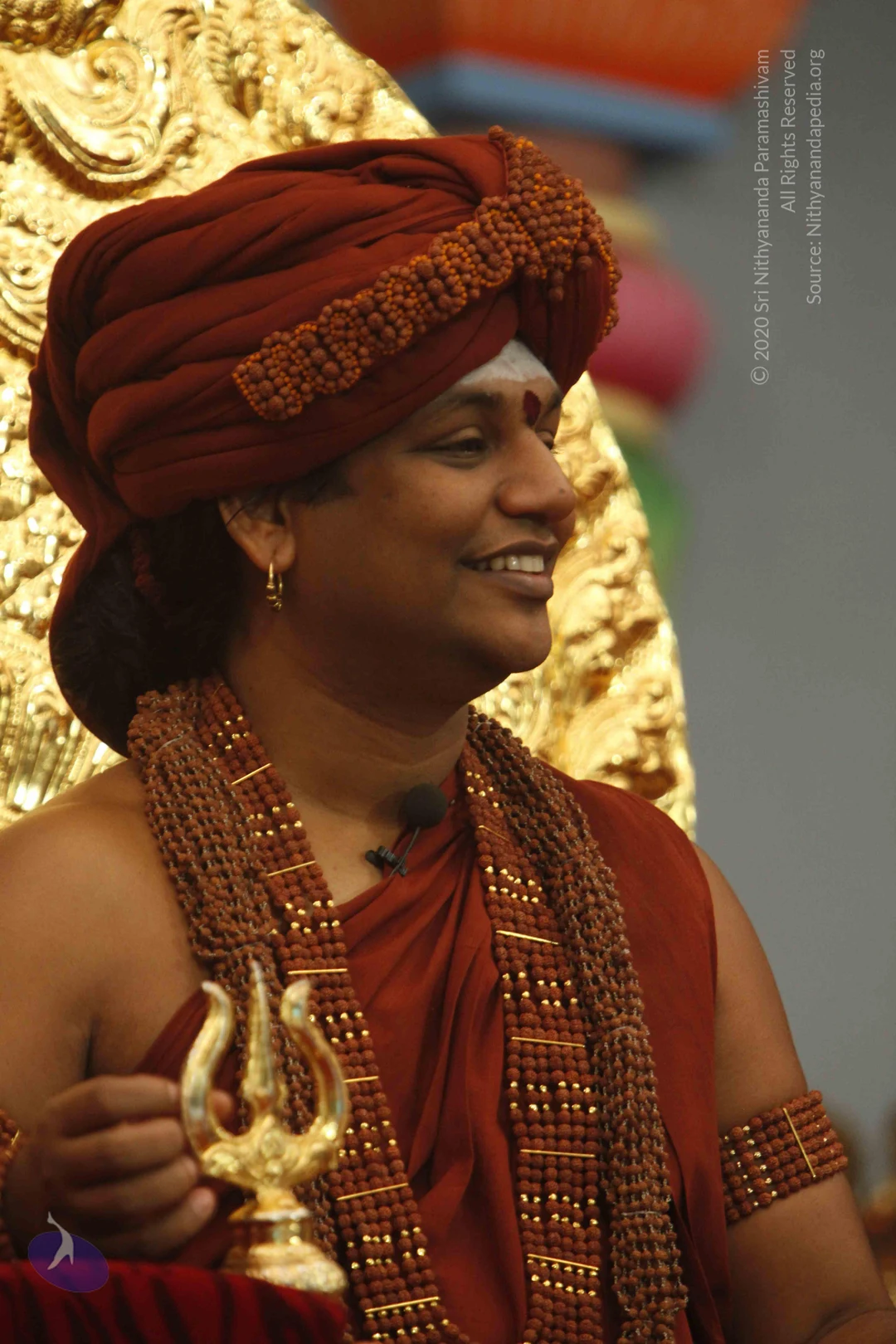
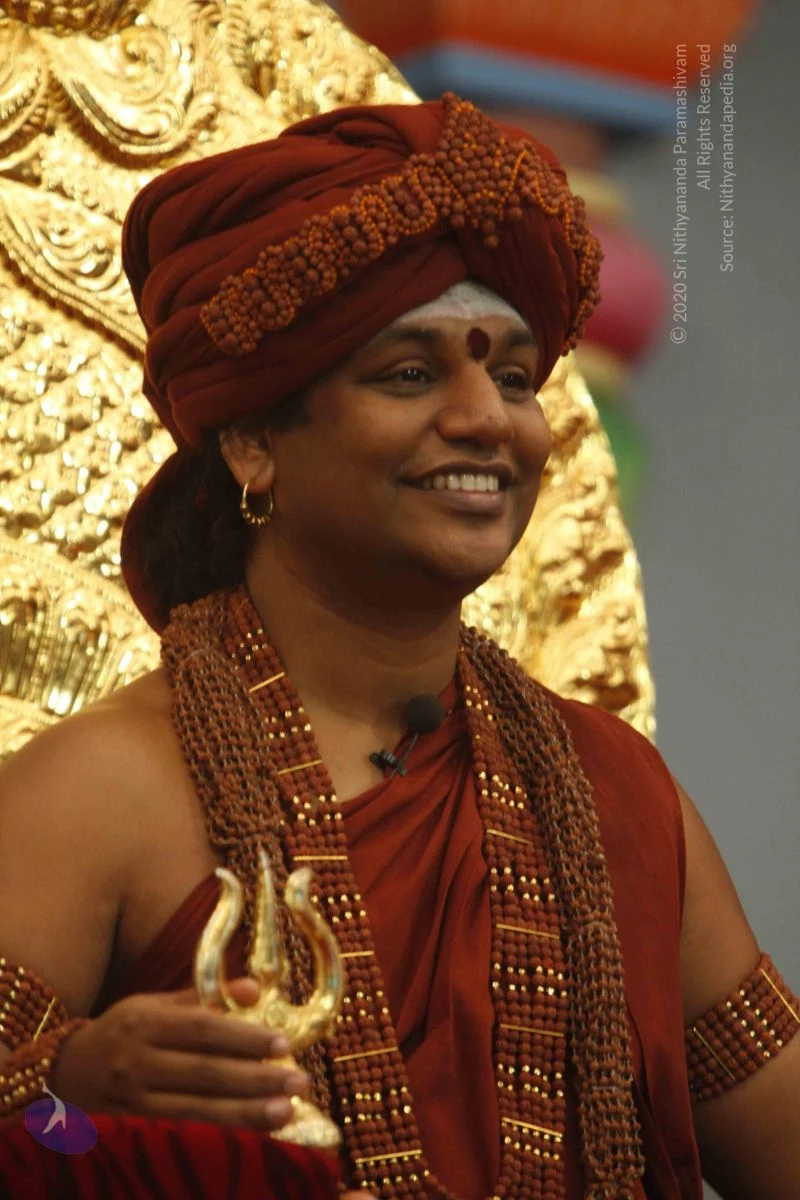
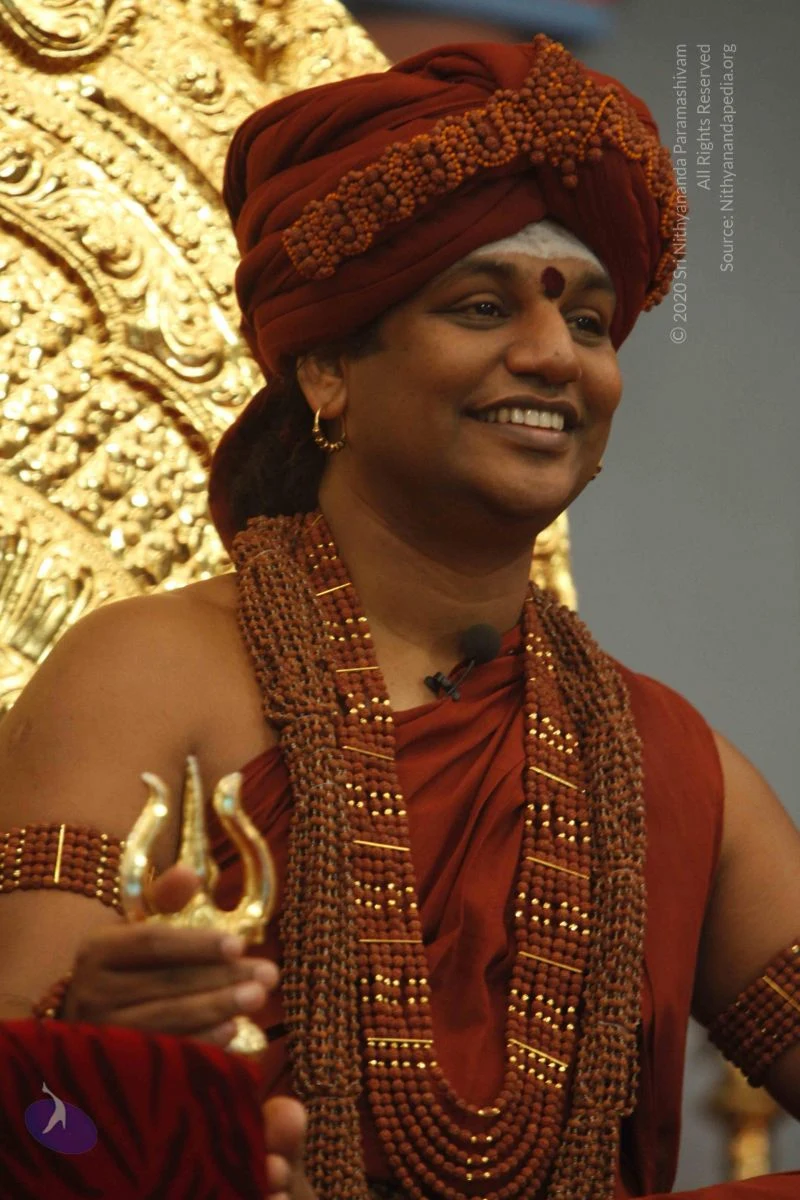
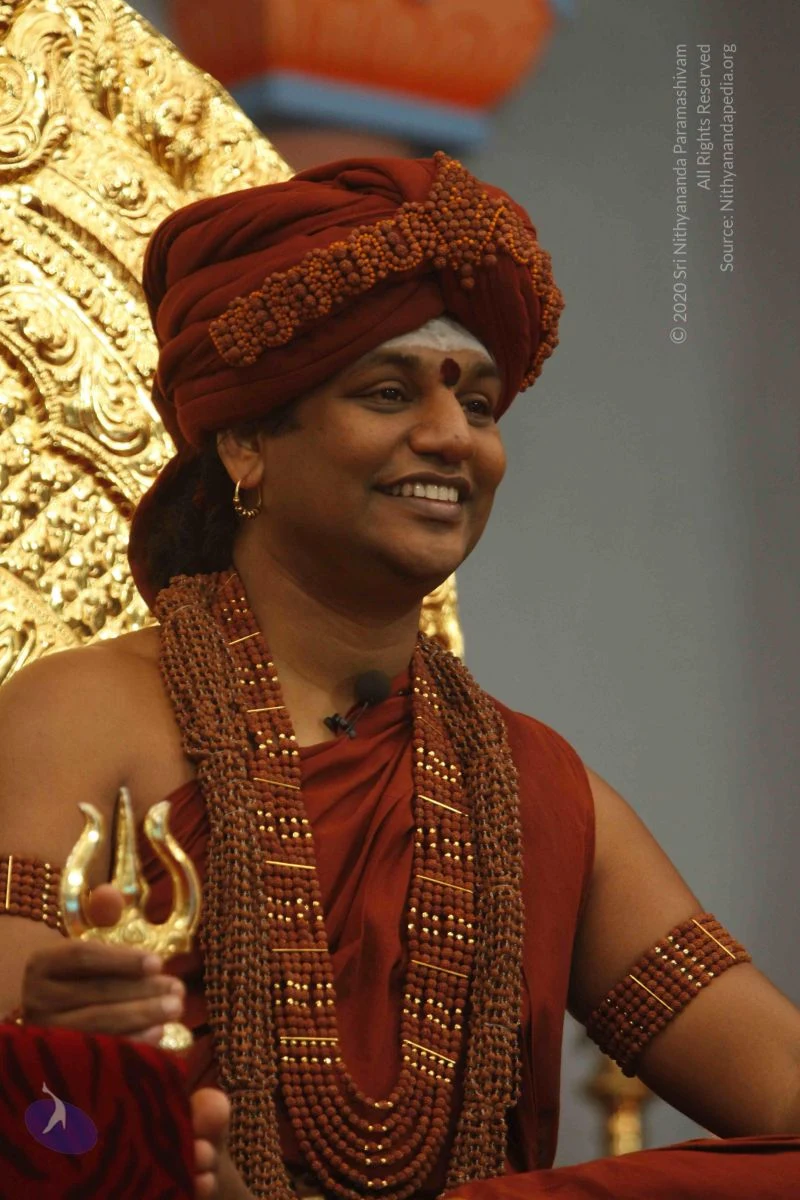
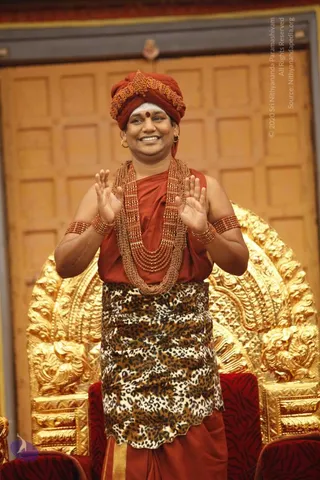
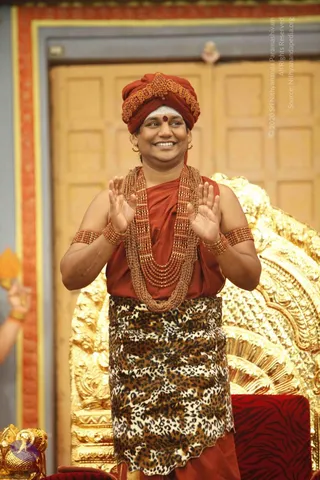
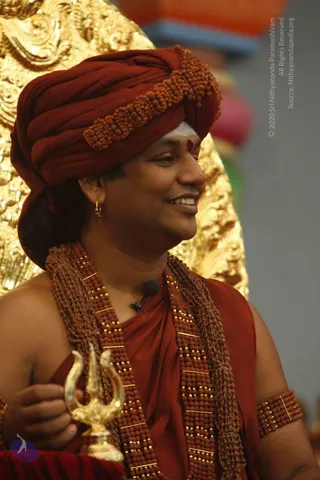
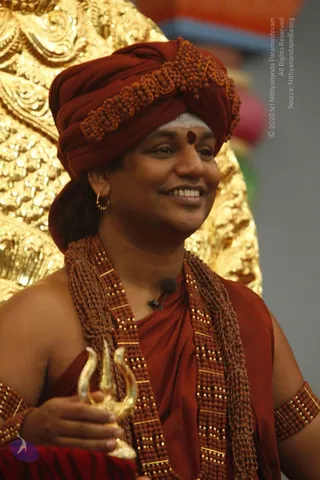
A photograph of a smiling man standing before an ornate gold throne with carved floral and scrollwork detailing and a wooden panelled backdrop. He wears a red turban with beaded ornamentation, a white forehead marking with a red bindi, layered red and gold beaded necklaces, matching beaded armlets, and a red shawl over the upper body. His lower garment is a leopard-print wrap over red dhoti-style cloth. He raises both palms outward in a gesture of blessing or greeting. The described Swamiji (probable) cues are the distinctive red turban, ornate beaded malas, and ceremonial dress, with the figure standing in front of a golden throne. One person is visible.A standing man in saffron-red ceremonial dress smiles and raises both palms forward in a gesture of welcome before a golden throne with ornate carved backrest. He wears a red turban with beaded trim, a white vibhuti mark with a red bindi on his forehead, layered beaded rudraksha-style malas, beaded bangles on both arms, and a red garment draped over the shoulders with a leopard-print cloth wrapped at the waist. Behind him are a wooden panelled door and red and gold decorative borders. A red-upholstered seat is visible at lower right and a partial brass object at lower left. Appearance cues with the turban, malas, saffron-red clothing and throne suggest a probable Swamiji presence, identified by appearance only. One partially visible arm appears at the far left edge.A seated man in a rust-red turban decorated with rudraksha beads sits cross-legged on a red and black tiger-striped cushion before an ornate gold throne. He wears a rust-red shawl over his torso, a long multi-strand rudraksha mala with gold spacers, matching rudraksha armlets, and a small gold earring. A red bindi and white ash marking show on his forehead, and a lapel microphone is clipped to his chest. He sits barefoot with a gentle smile, and the golden carved throne fills the left background. Appearance-based label: a person, seated on the throne as a speaker at a satsang.A man seated cross-legged on a red tiger-striped cushion before an ornate golden throne with carved relief panels. He wears a rust-red turban with a beaded band, a red-orange shawl draped over his shoulders with a gold-bordered dhoti, multiple strands of rudraksha mala with gold spacers, beaded armlets, and a small clip-on microphone at his collar. A red kumkum dot and vibhuti marks adorn his forehead. He smiles and looks to his left.Close-up photo of a smiling man in a rust-red turban decorated with rudraksha beads and a white-and-red forehead mark, wearing a rust-red shawl over the shoulder, a long rudraksha mala with gold spacers, a rudraksha armband, and a small gold hoop earring. He holds a gold trident (trishula) in his left hand and sits before an ornate gold throne. A lapel microphone is clipped to his chest. Probable Swamiji, appearing in person, based on the saffron-red attire, rudraksha malas and turban cues. Background is blurred with red and pink decorations.A smiling man in a maroon-red turban decorated with rudraksha beads sits before an ornate gold throne-like backdrop. He wears a matching red-orange shawl draped over a bare shoulder, layered rudraksha and gold-bead malas, a rudraksha armband, a gold hoop earring, and a small red bindi on his forehead with white vibhuti. He holds a gold trident (trishul) in one hand and a small clip microphone is on his chest. Appearance-based candidate: Swamiji (probable), in person, with distinctive red turban, rudraksha malas and ceremonial gold trident. The photo is captioned as an archive image of Sri Nithyananda Paramashivam.

SATSANG

9 photosSource gallery
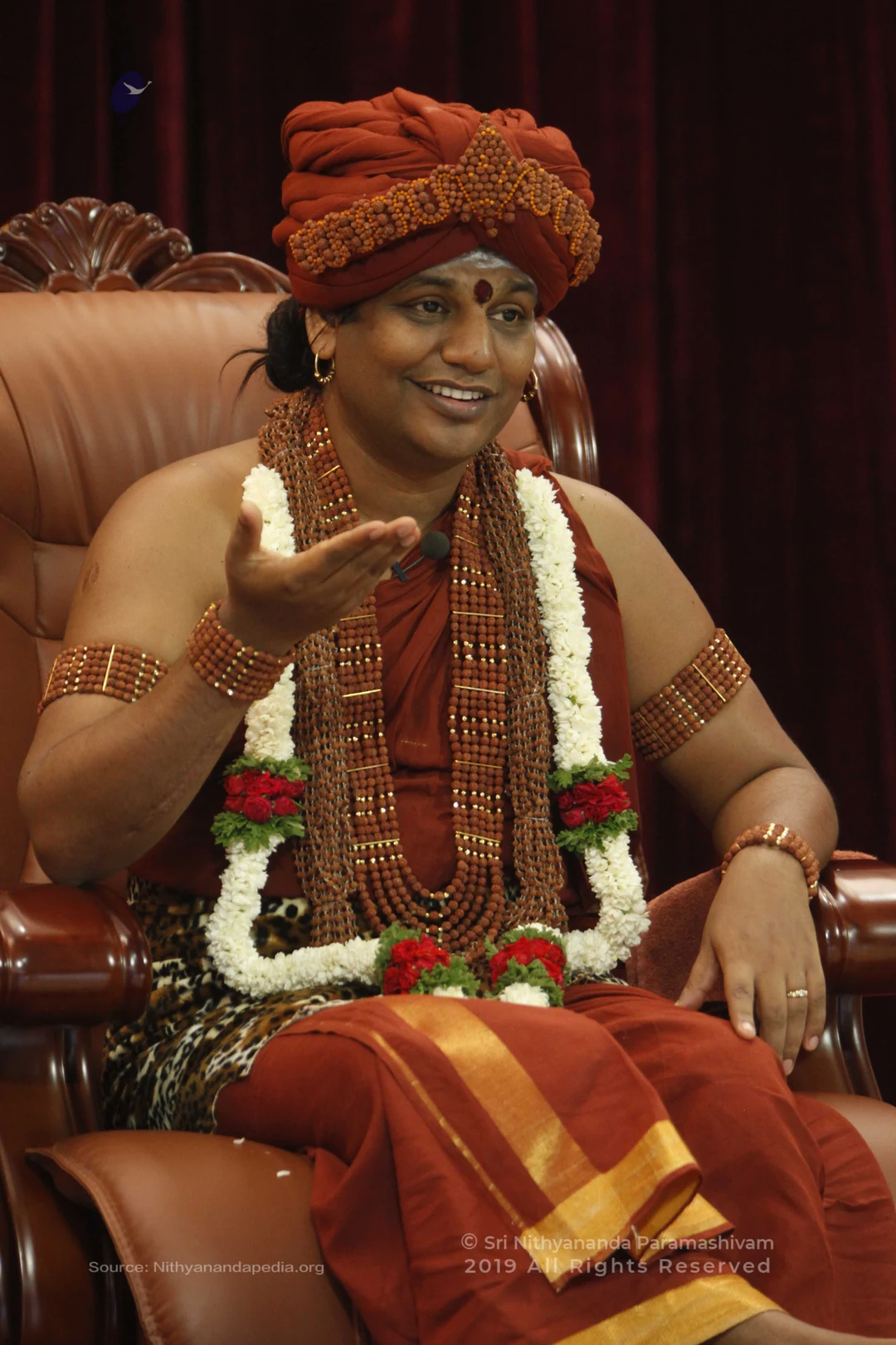
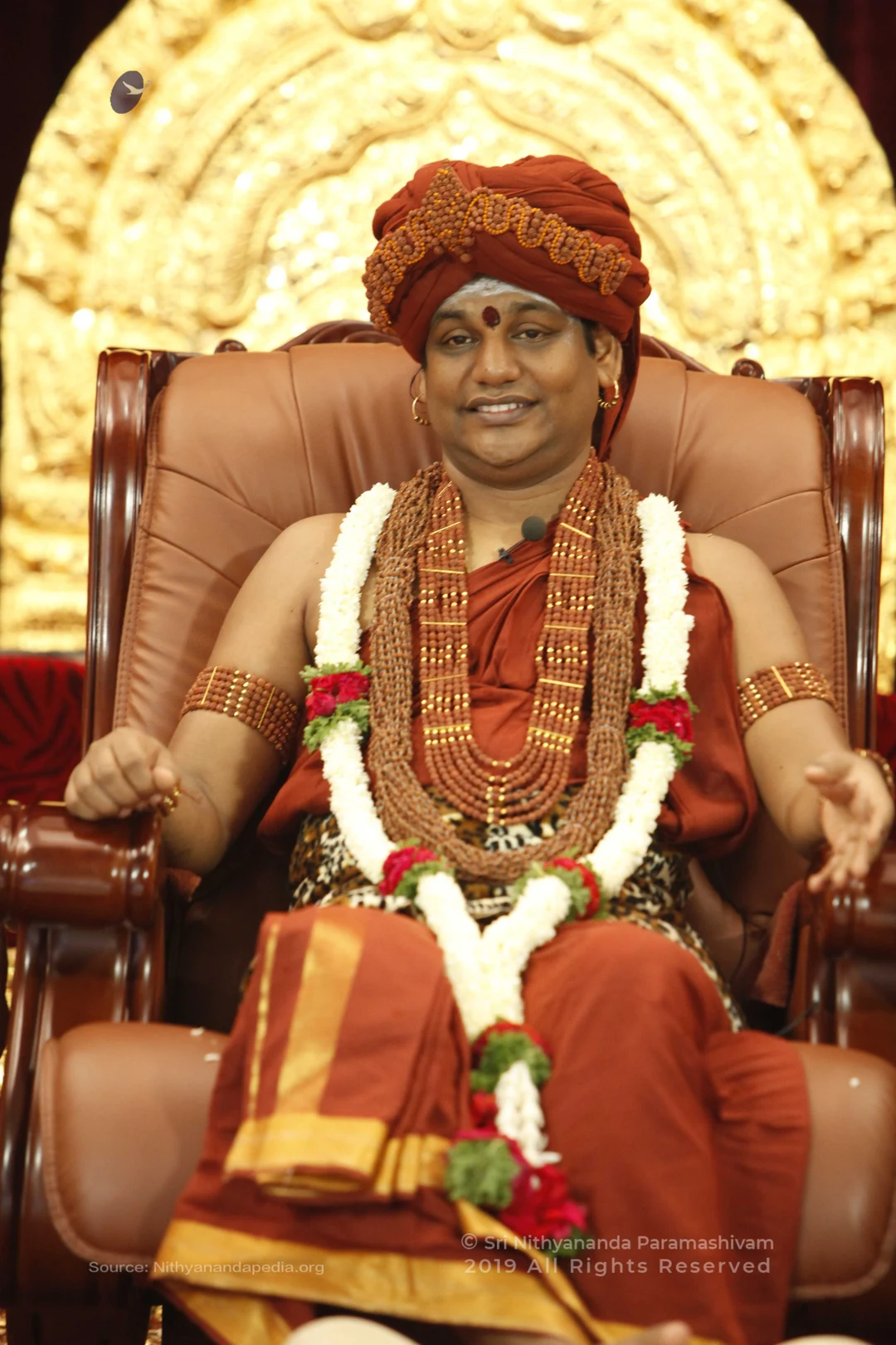
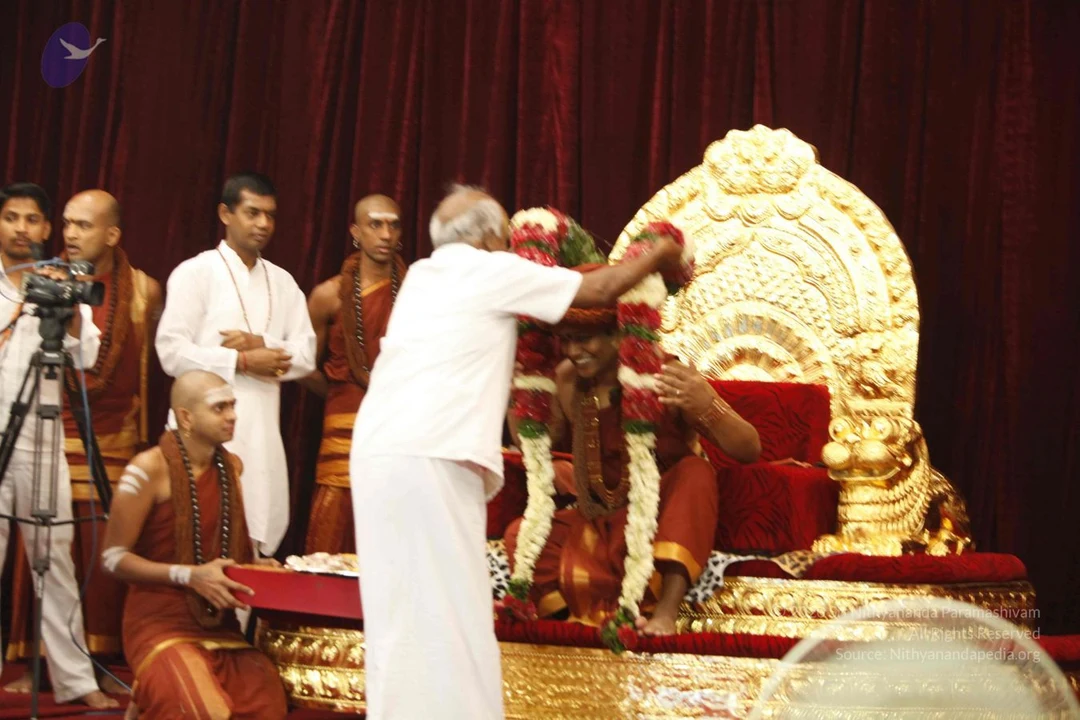
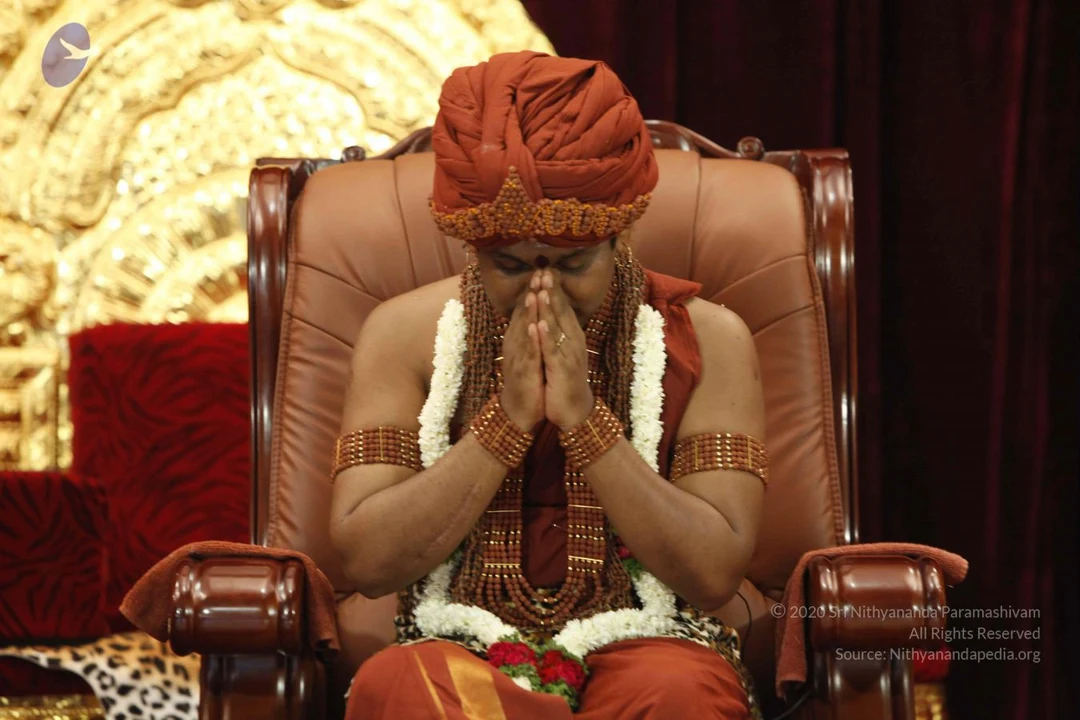
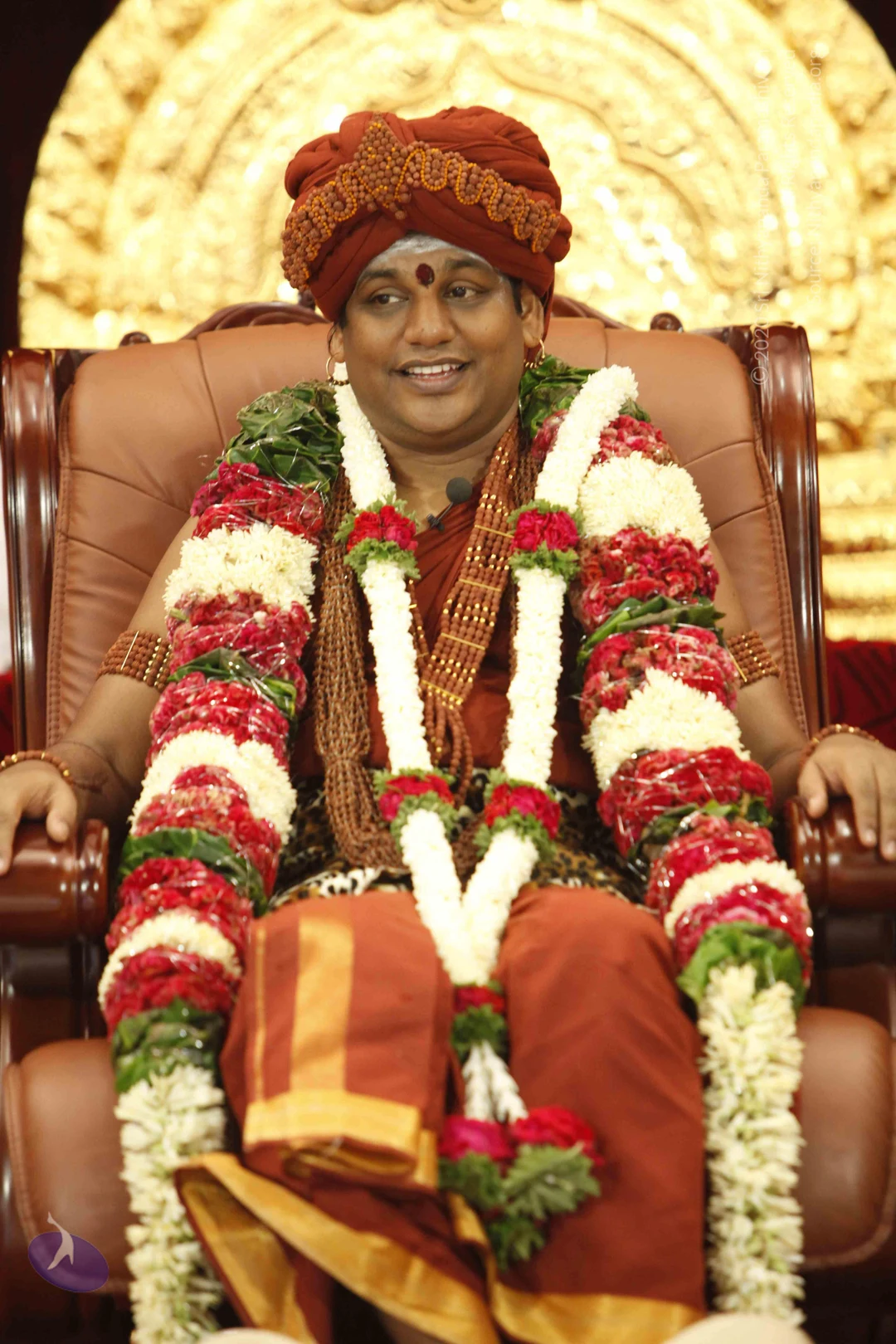
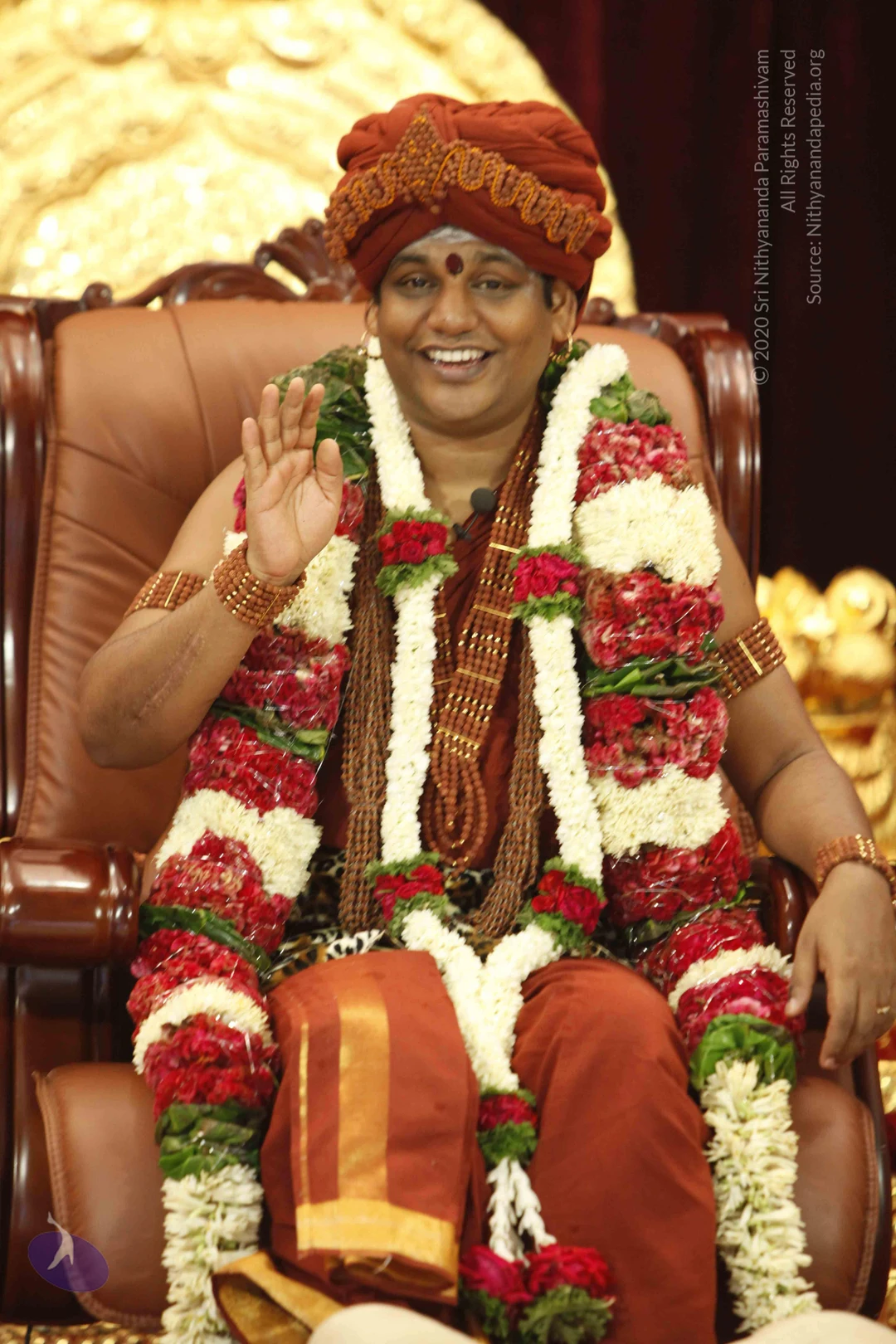
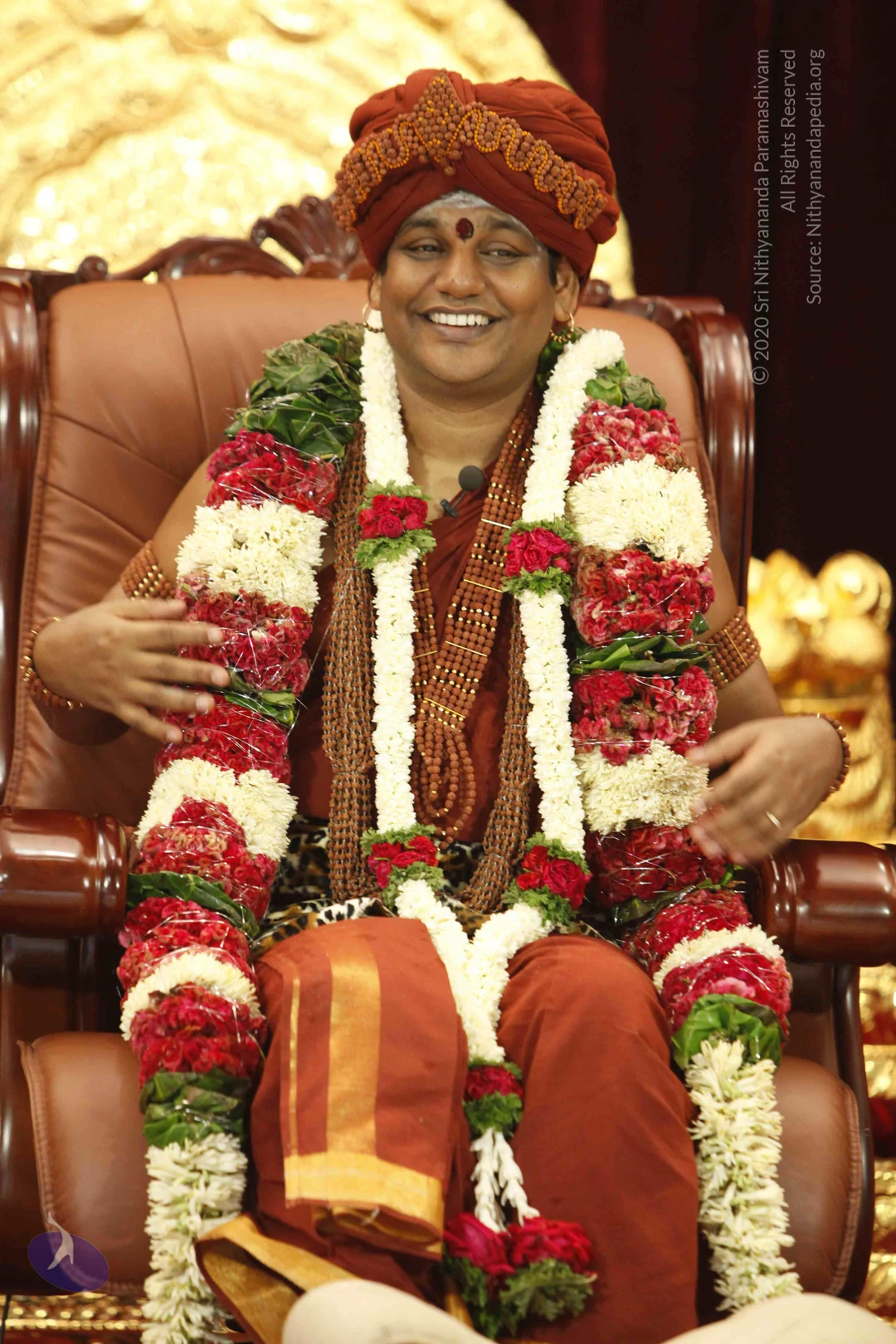
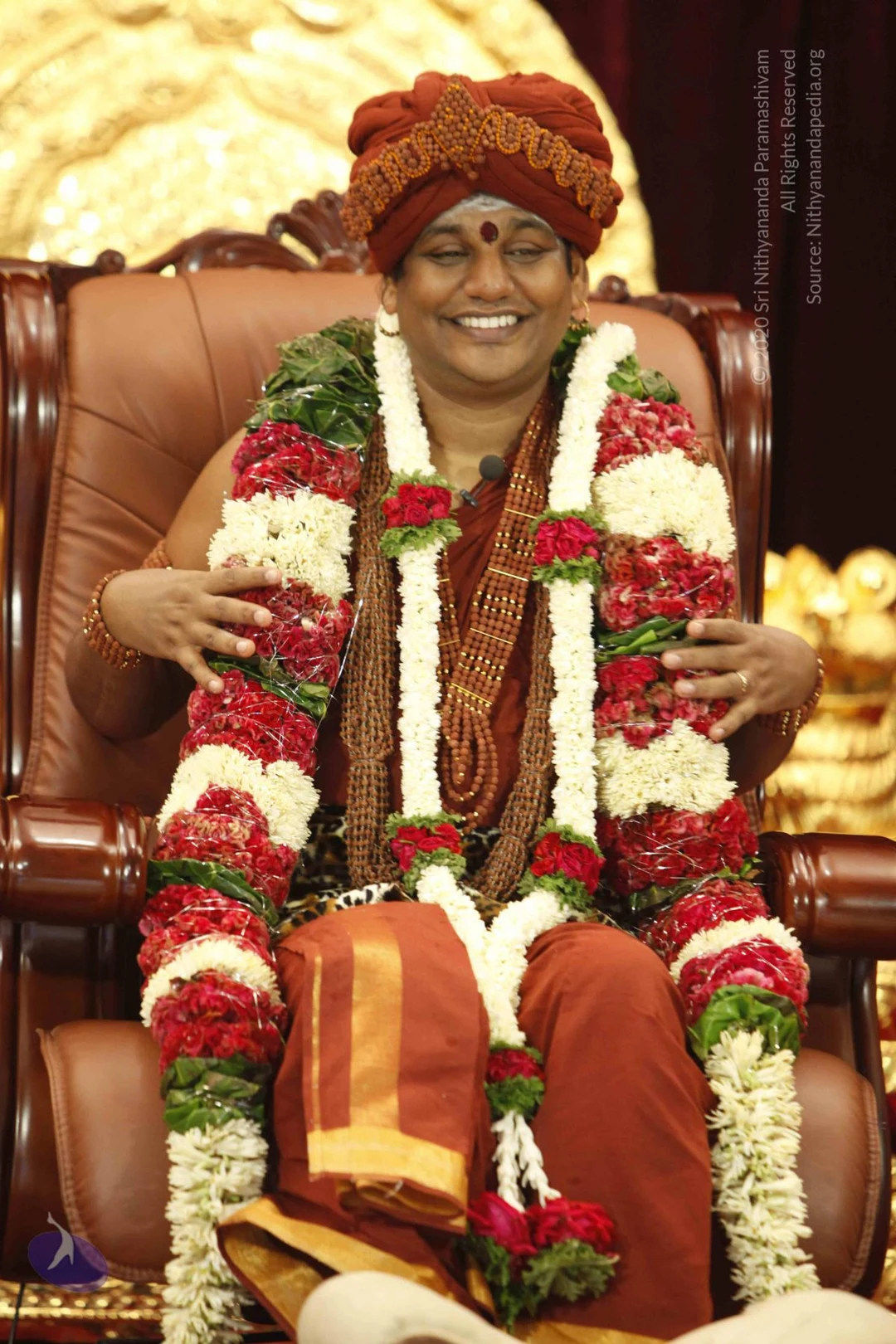
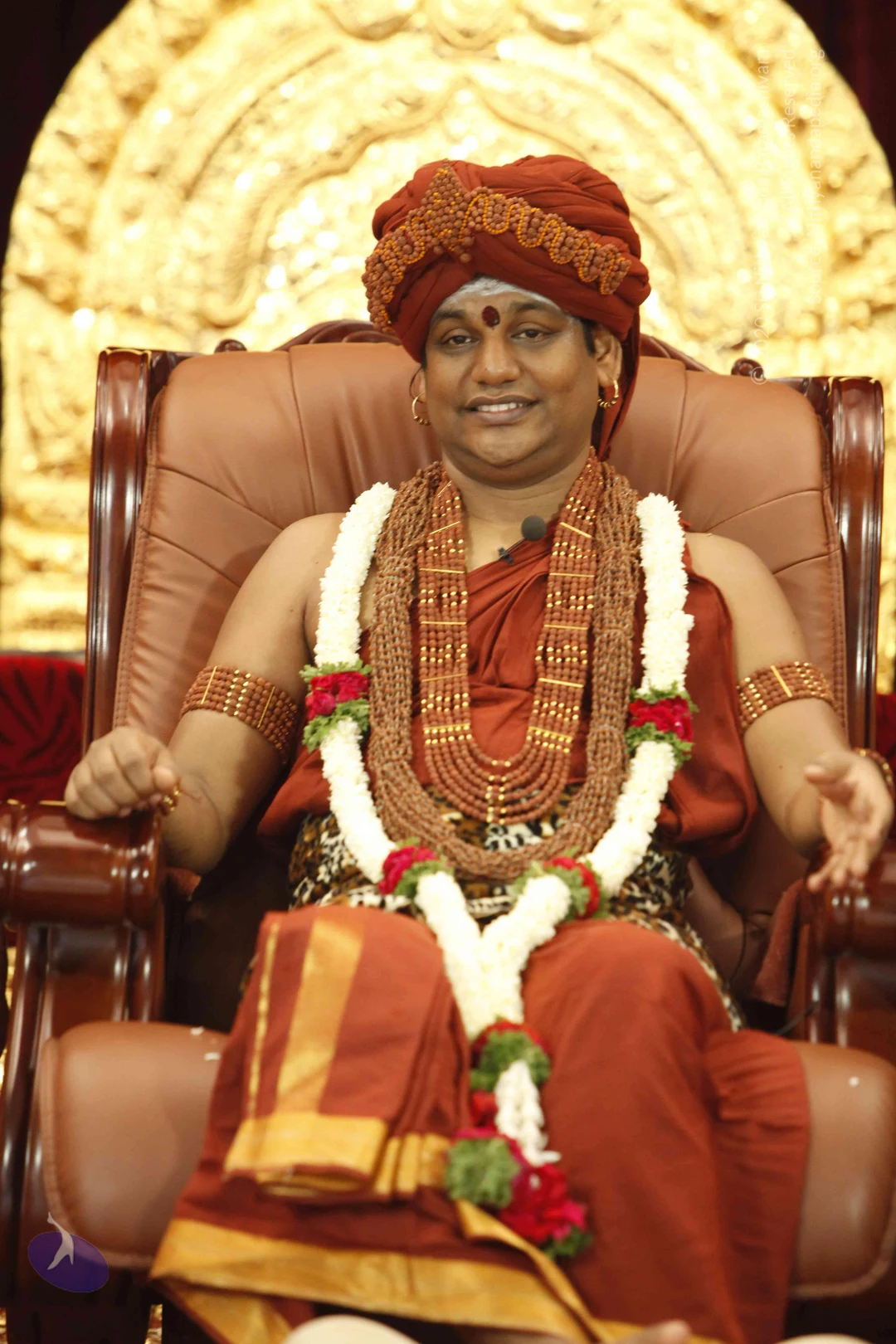
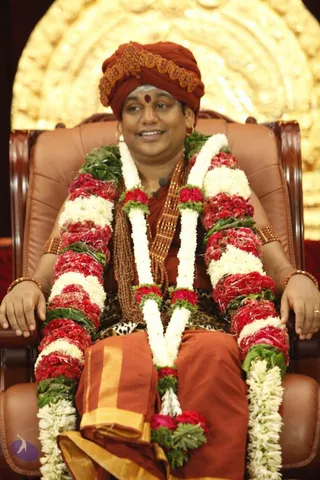
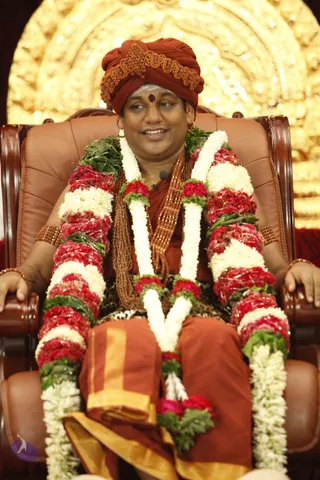
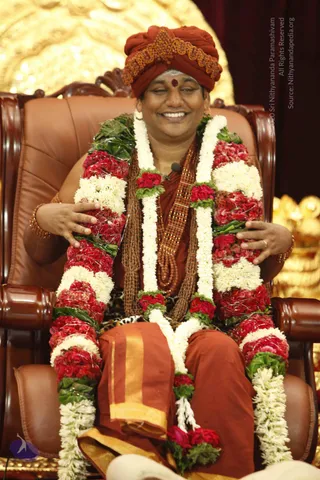
A seated man in an orange-red turban with a beaded gold-accented band and a red bindi sits in a brown leather armchair, smiling, wearing an orange-red robe with a gold border and a rudraksha bead necklace. Long garlands of red roses, white jasmine and green leaves drape over his shoulders and lap. Behind him is an ornate golden arched backdrop with carved relief patterns. A small microphone is clipped to his robe. One person is visible.A seated man on a brown leather throne-style chair, smiling, wearing a rust-orange turban decorated with rudraksha beads and a red bindi with white vibhuti on his forehead. He wears an orange-red robe with a gold-bordered cloth across his lap and multiple rudraksha malas around his neck and wrists, and is draped in heavy garlands of red roses, white jasmine and green leaves. A golden ornate backdrop with radiating patterns is behind him, and a small clip microphone is visible on his chest. Probable Swamiji cues: ornate saffron-orange clothing, rudraksha malas and a decorated turban, seated in a satsang setting.A smiling man seated on a brown leather throne-style armchair with carved wooden armrests, waving his right hand. He wears a rust-orange turban with gold embroidered trim, an orange-red garment, and a dark red-brown rudraksha-style bead mala across his chest. He is draped in long garlands of red roses, white jasmine and green leaves, wrapped in clear plastic. A small red bindi marks his forehead, and a microphone clips to his clothing. Behind him is a large gold ornamental backdrop with a gilded carved panel. A partially visible hand appears at the right edge. The frame includes a vertical 'A smiling man sits on a brown leather throne-style chair in front of a gold-patterned backdrop. He wears a rust-red turban decorated with rudraksha beads, a red-orange robe, and a rudraksha mala draped across his chest. He is adorned with long garlands of white jasmine and red roses with green leaves, and has a red bindi and gold earrings. A small lapel microphone is clipped to his robe. Swamiji (probable): the seated man has a turban, rudraksha malas and ceremonial floral garlands, and is seated as the honoured speaker at satsang.A smiling man in a red-orange turban decorated with beaded rudraksha-style trim sits in a brown leather armchair in front of a gold-patterned backdrop. He wears an orange-red robe with a gold-bordered cloth over his lap, a brown rudraksha mala across his chest, and a lapel microphone. He is draped in long garlands of red roses, white jasmine and green leaves, and holds his hands on the flowers across his body. A cream-and-gold draped cloth edge is visible at the bottom.A smiling man seated on a brown leather throne-style armchair before a large gold ornate arched backdrop. He wears a rust-orange turban with a rudraksha-bead band, a red bindi and white vibhuti on his forehead, and multiple strands of rudraksha malas with gold spacers around his neck. White and red flower garlands drape over his shoulders and lap, and he wears rudraksha bracelets on his upper arms. His rust-orange robe is paired with a leopard-print wrap and a rust-orange dhoti with a gold border. A small lapel microphone is clipped to his chest.

PUJA
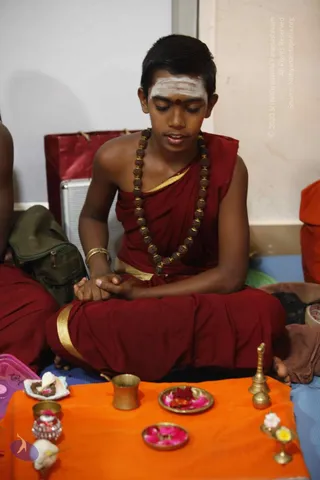
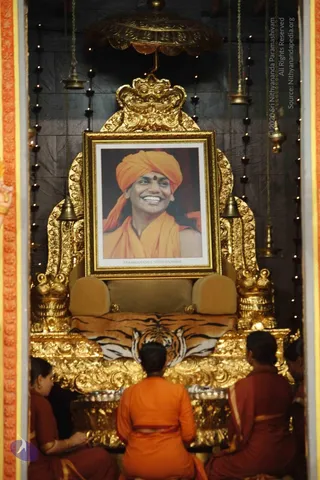
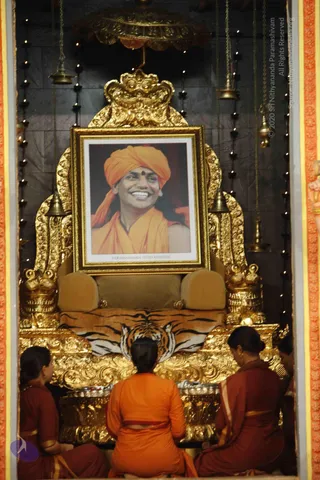
8 photosSource gallery
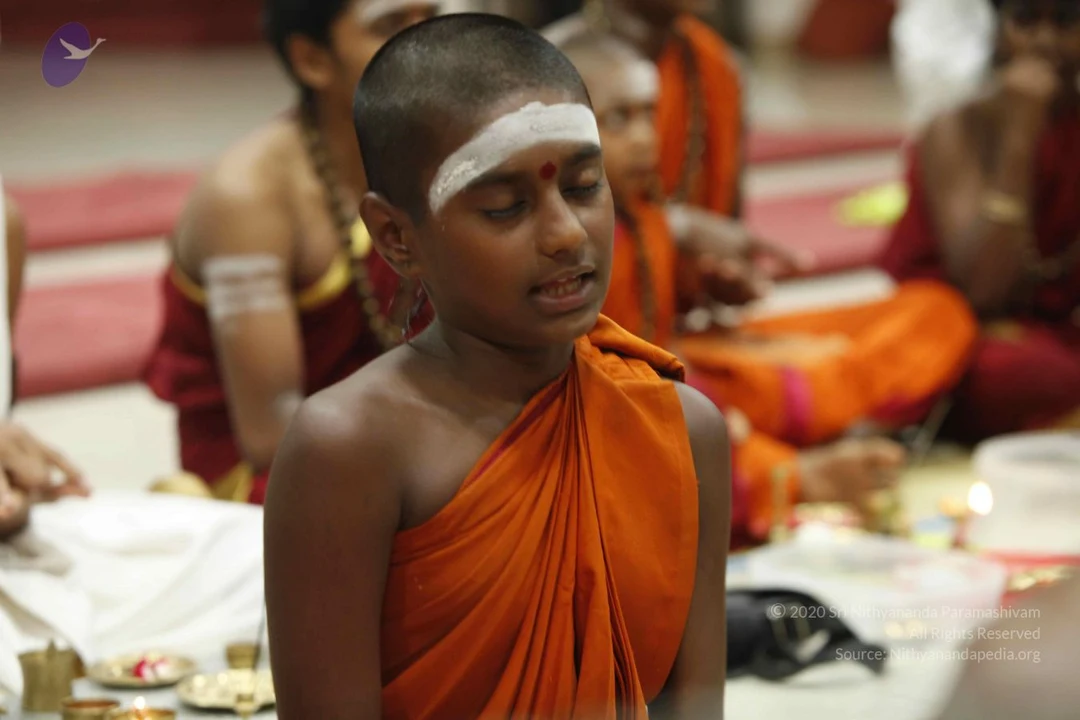
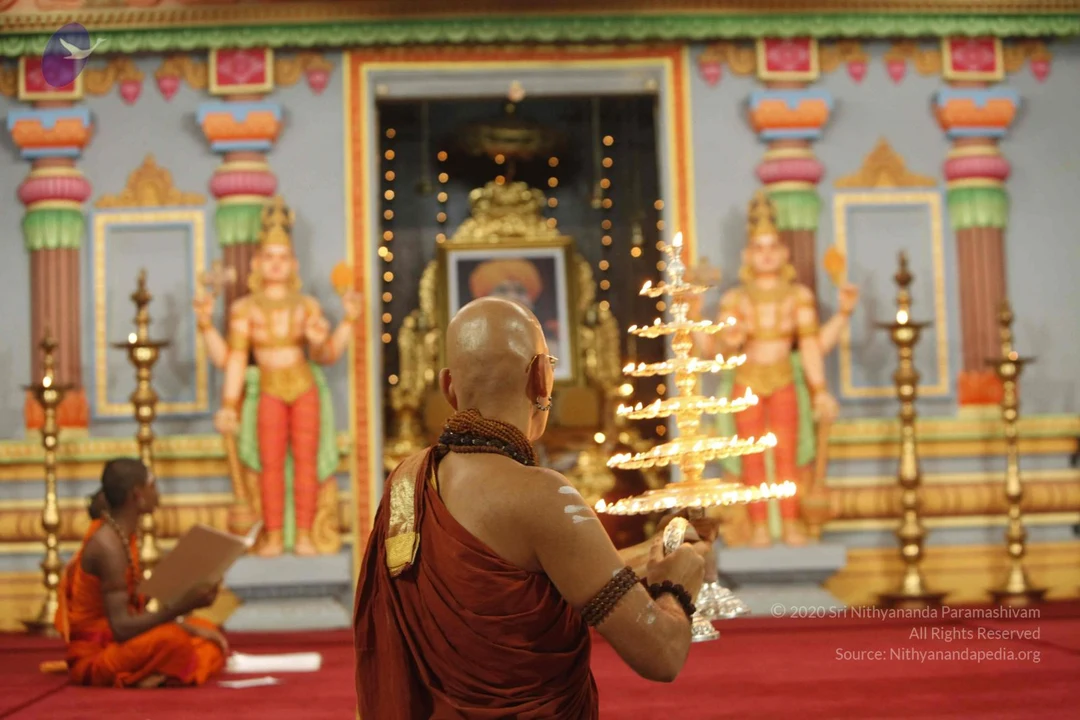
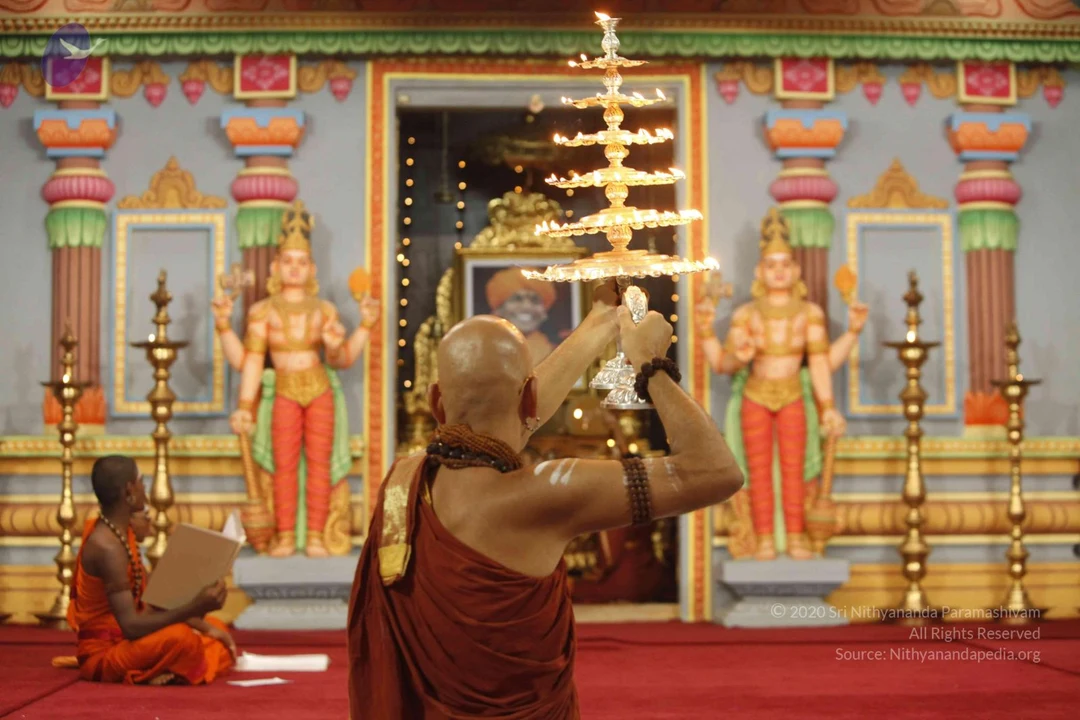
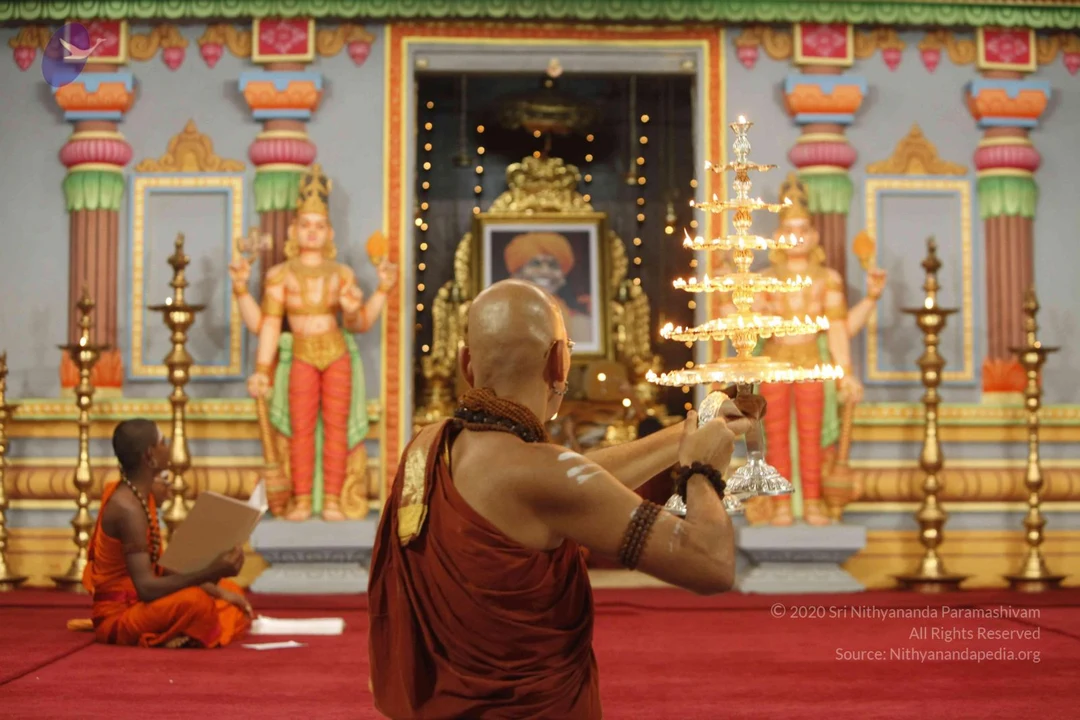
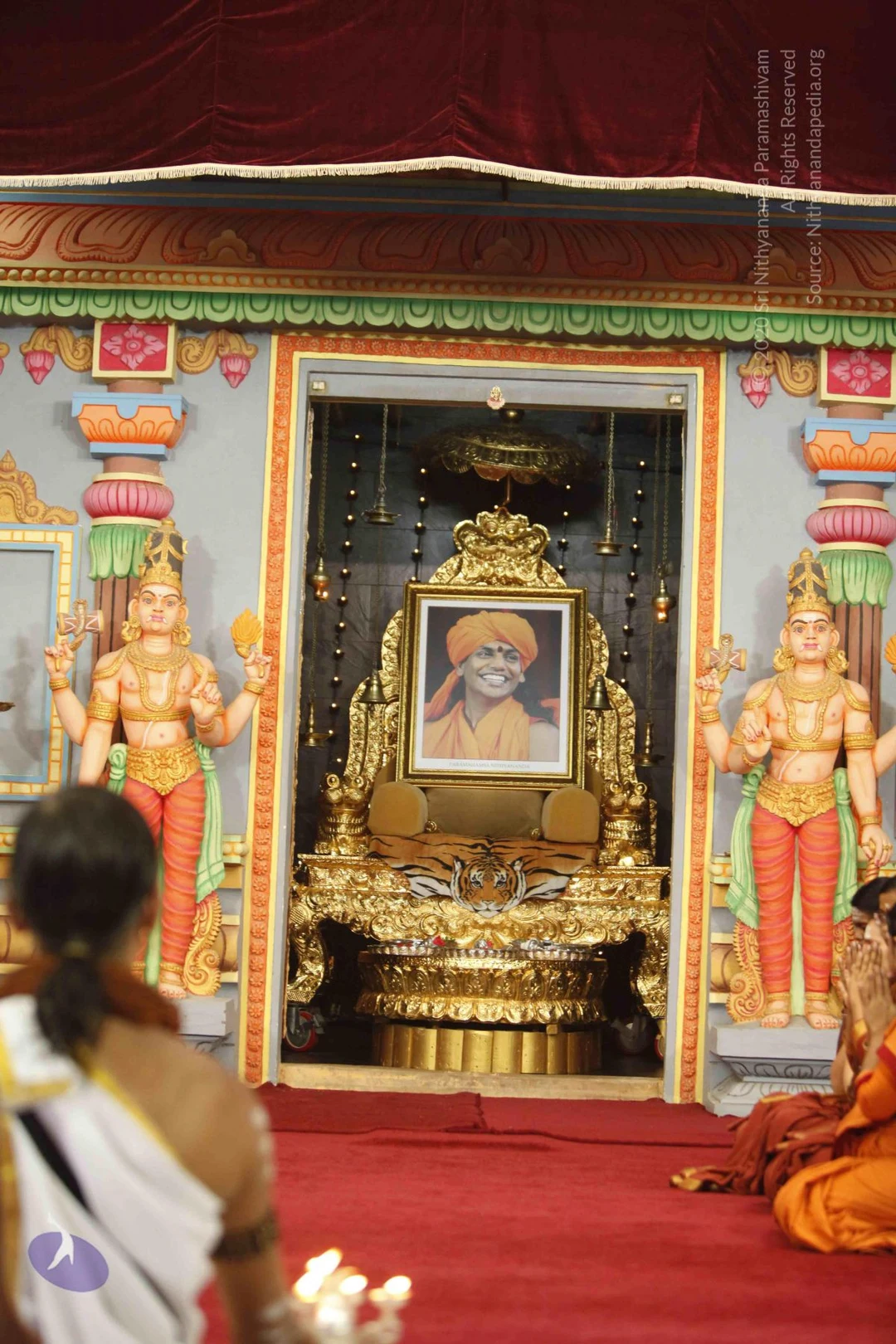
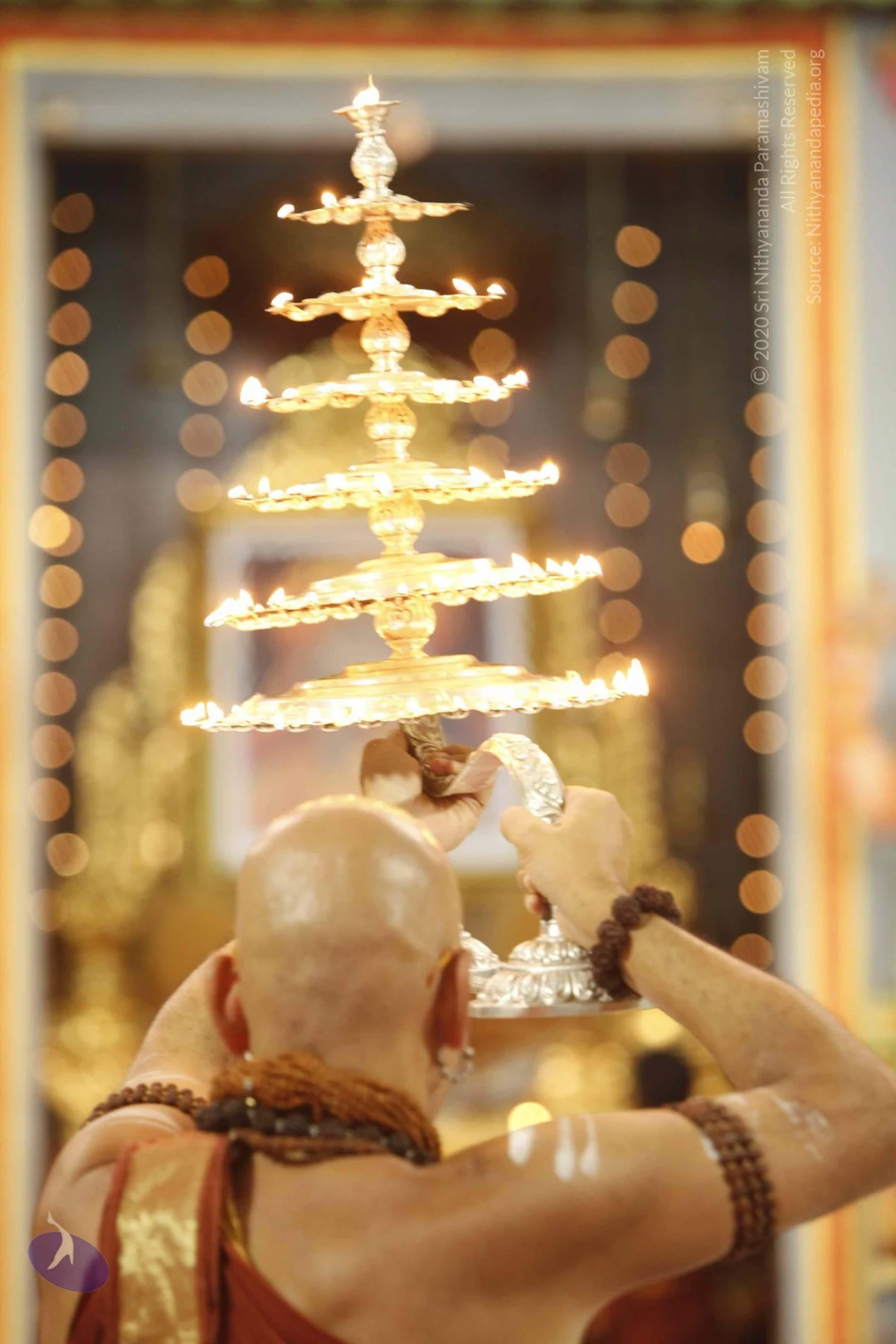
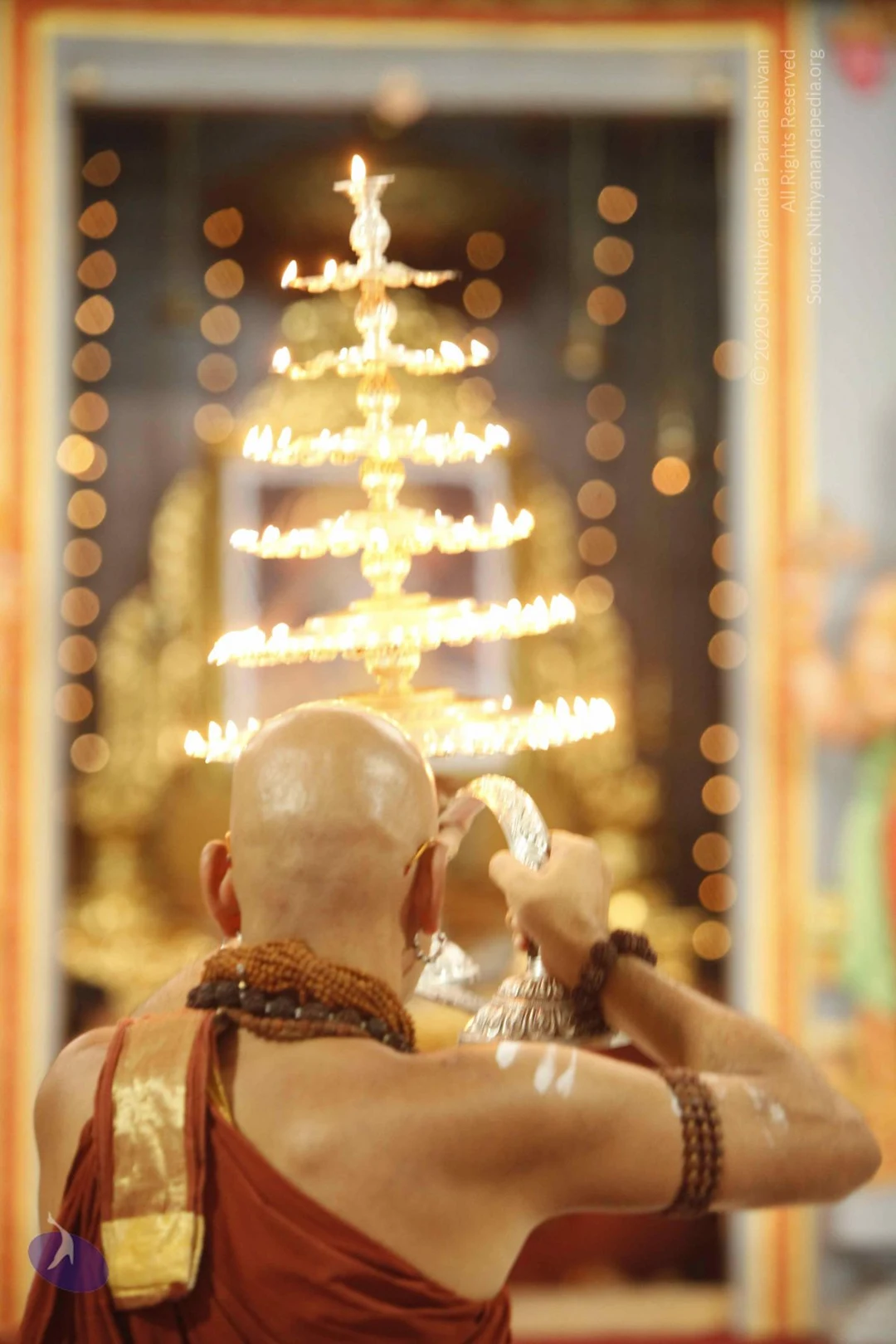
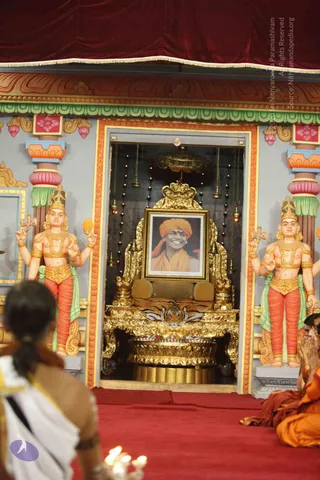
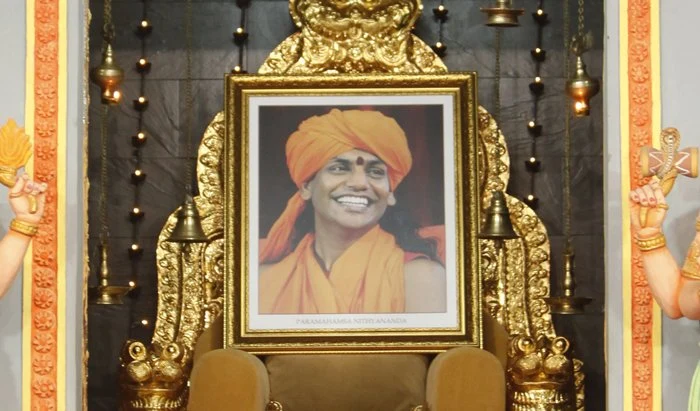
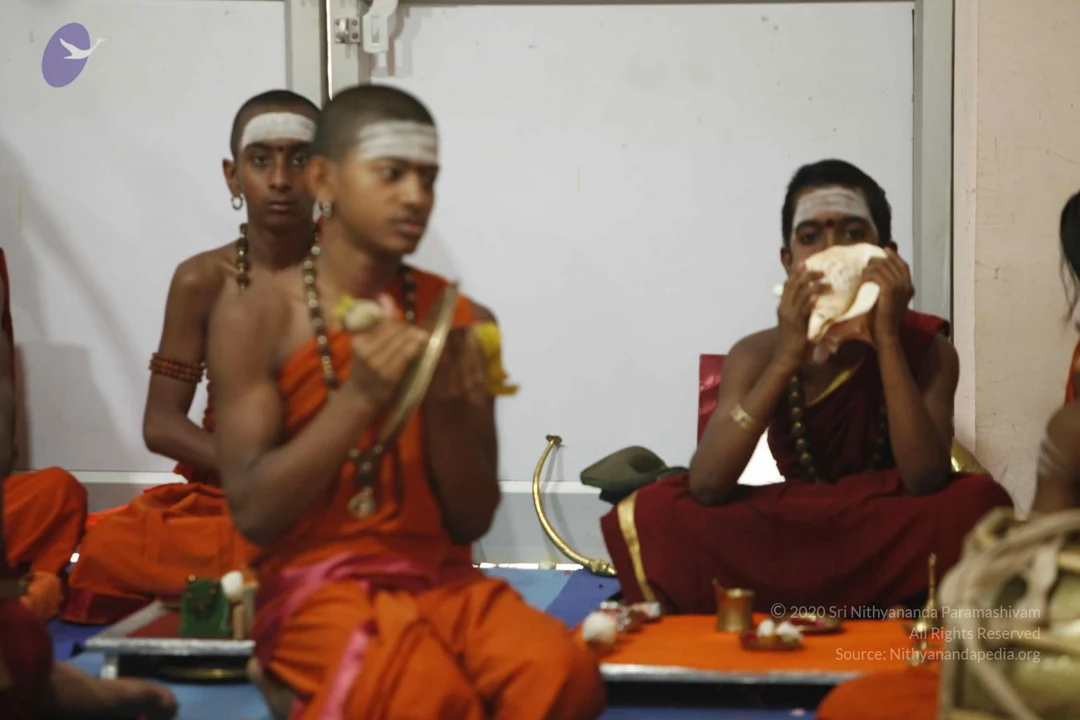
A gilded throne stands in a shrine-like alcove framed by painted colourful pillars, with a framed portrait of a smiling man in orange turban and orange robes placed on the throne back; the portrait bears a printed caption "Paramahamsa Nithyananda" at its base. A tiger-skin cushion rests on the seat, with brass oil lamps and hanging bells beside it and a gold kalasha-like canopy above. Two painted deity statues with four arms and gold crowns flank the alcove. In the foreground a woman with hair in a bun wears white with gold border and holds oil lamps, while devotees in orange robes sit with folded hands at the right on a red carpet.A woman devotee sits cross-legged with eyes closed, hands clasped in her lap, in a meditative posture during a ritual. She wears a rust-red sari with gold border, a long orange-red rudraksha mala draped over her shoulders, a dark bead necklace and a red bindi with white vibhuti on her forehead. Brass plates with flowers, a small brass vessel and a lit oil lamp sit on a low stone platform before her. Several people in orange and saffron robes are seated in rows behind her, blurred.A young boy with a shaved head and white vertical tilak with a red dot on his forehead sits cross-legged on a blue mat, eyes lowered and palms joined, in a red-maroon robe with gold edging. A thick rudraksha mala hangs around his neck and a bangle is on one wrist. In front of him on an orange cloth are brass puja vessels, a brass plate of red and pink flower petals, a small brass cup, a brass lamp-stand, and white flowers. Behind him a red bag and a dark bag sit against a white wall. He appears to be performing a devotional puja or meditation.A golden ornate throne draped with a tiger-skin cloth sits in a shrine, with a framed portrait labelled "PARAMAHAMSA NITHYANANDA" on its back. The portrait shows a smiling man with an orange turban, orange shawl and red bindi. Above it hangs a gilded umbrella and brass bells dangle from strings. Three women sit at the base: one in an orange garment at the centre with her back to the camera, and two in maroon-brown saris at the sides, one handling an offering on a golden tray.A golden ornate throne canopy frames a framed portrait labelled "PARAMAHAMSA NITHYANANDA", showing a smiling man in an orange turban and orange shawl with a red bindi. The portrait sits above a gold-trimmed seat draped with a tiger-stripe cloth, under a golden parasol and hanging brass oil lamps and bells. Three women sit in front on the floor: two in maroon saris on the sides and one in an orange sari in the centre, facing the throne with their backs to the camera. Dark stone walls with rudraksha-style bead strings and orange-red carved borders complete the shrine setting.A shaved-headed priest seen from behind, wearing a rust-orange cloth draped over one shoulder with a gold border and a brown rudraksha mala around the neck and wrist, holds up a tiered brass aarti lamp with multiple lit oil lamps. He faces a golden shrine with a framed portrait and a deity murti, surrounded by warm string lights. Aarti in a temple setting. a person identity is not established by appearance here.