Skip to content
Sunday

2 February 2014

Dated photos
176
Source pages
1
Media
4
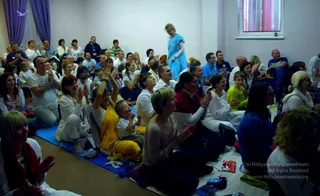
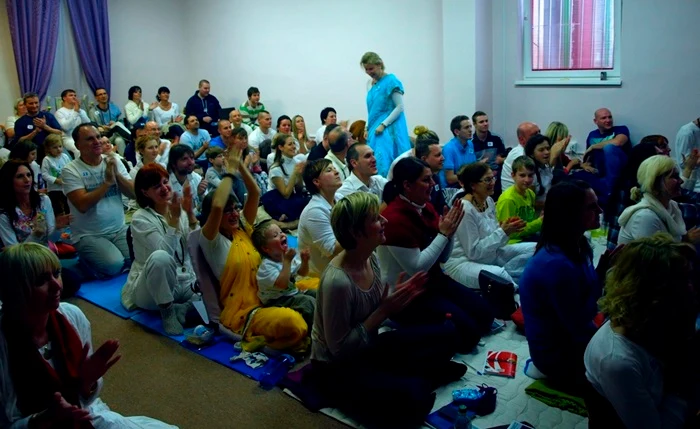
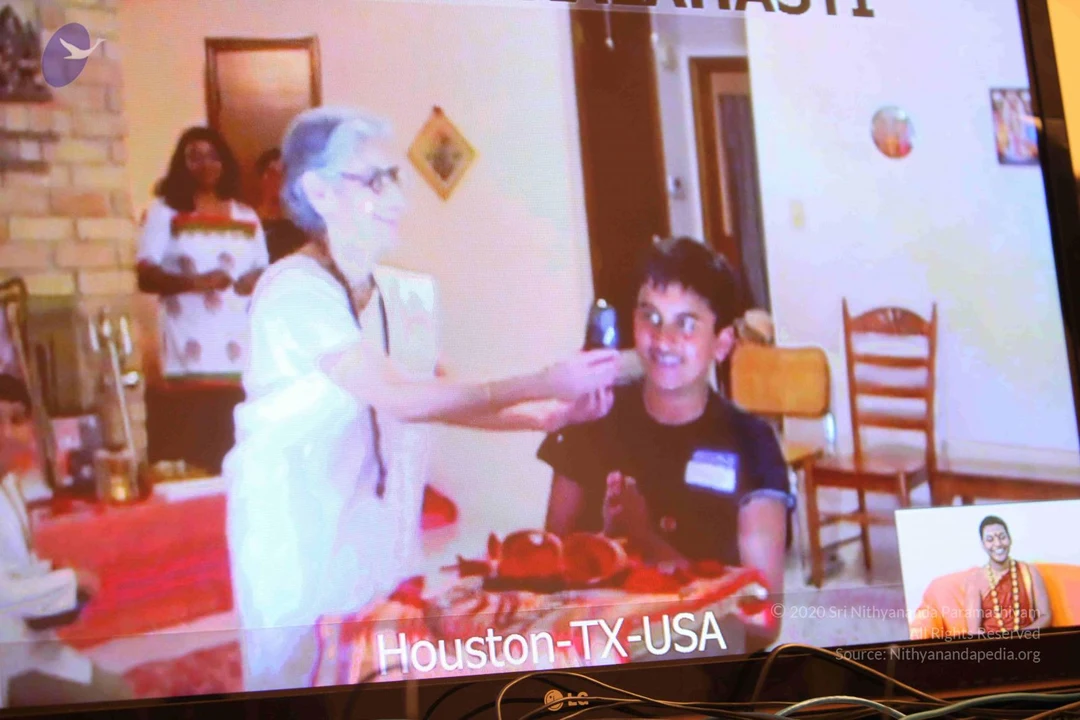
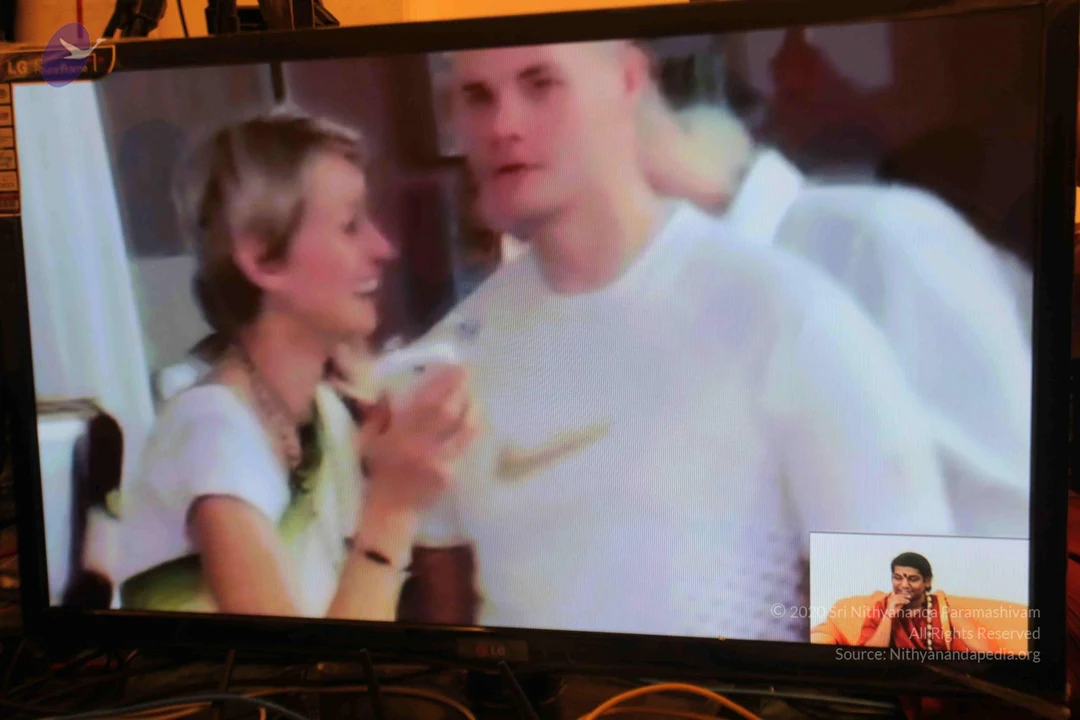
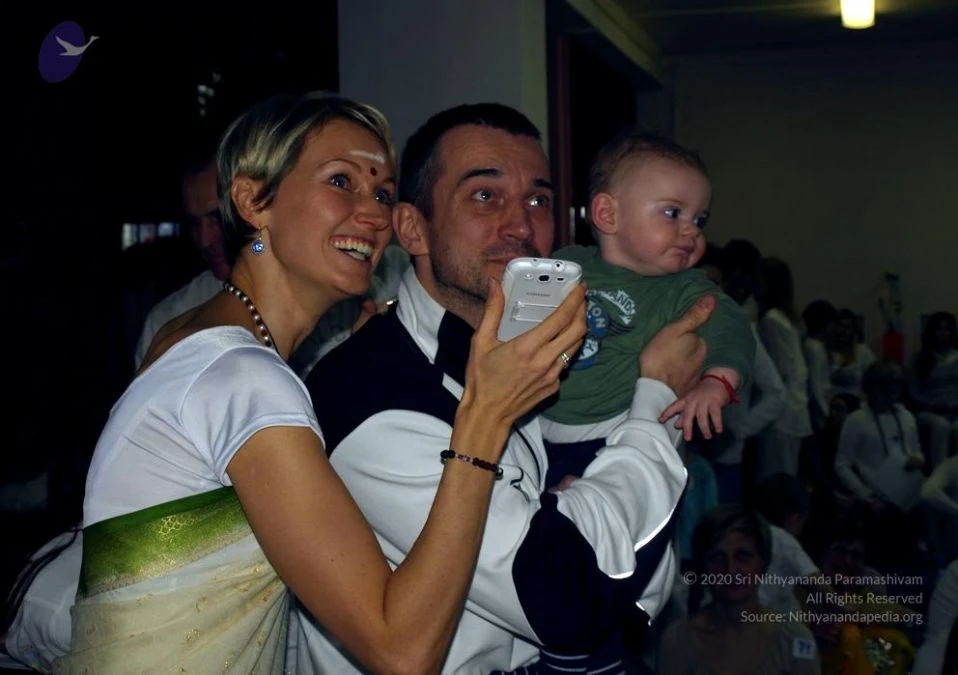
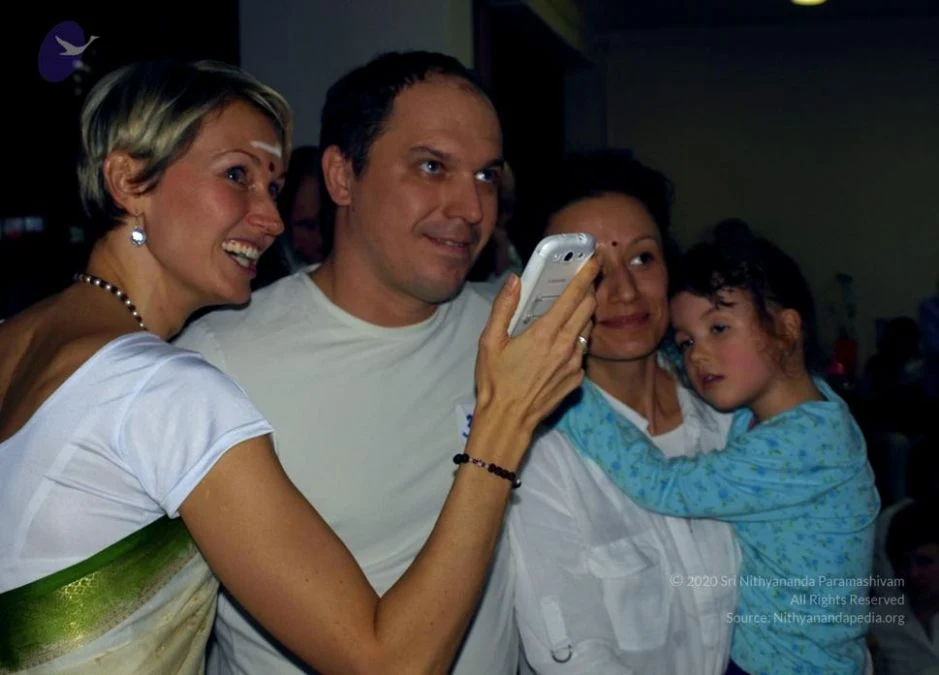
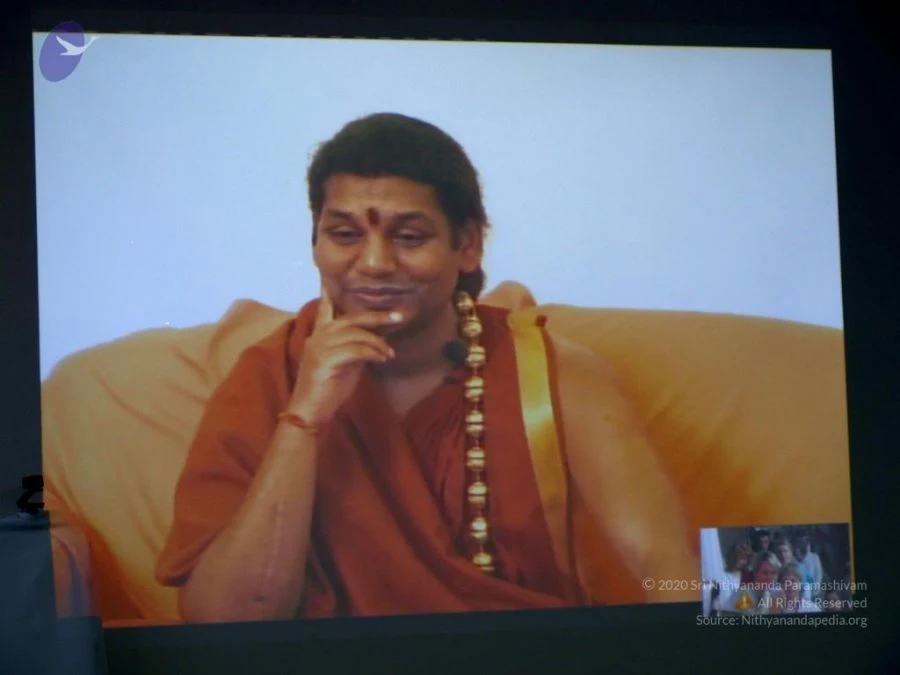
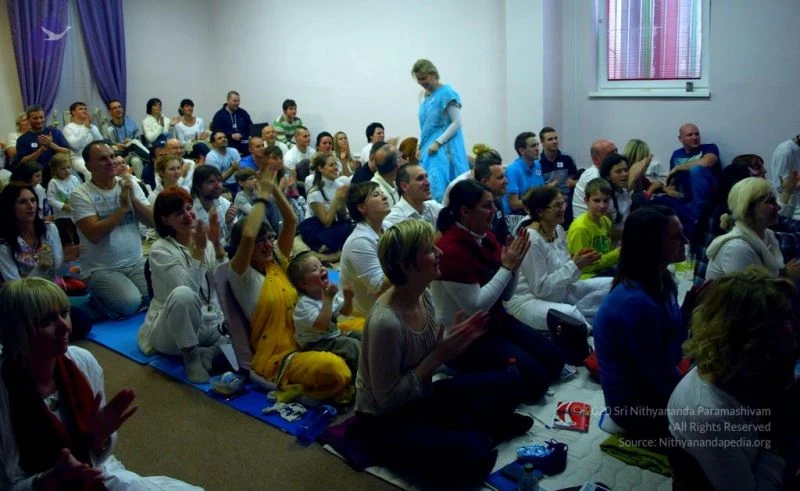
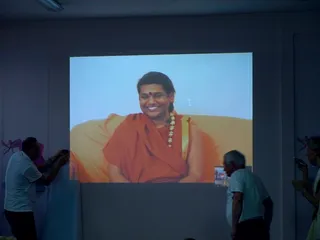
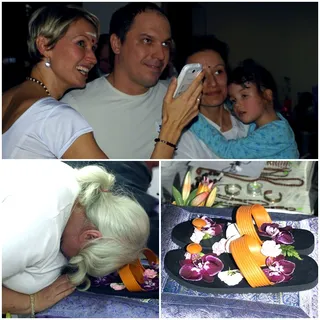
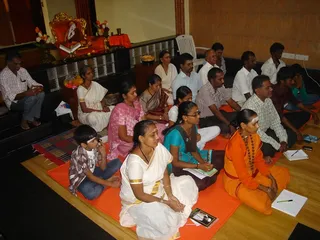
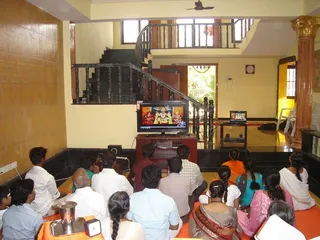
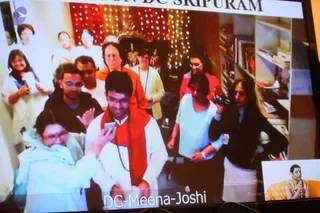
A seated group of devotees fills a bright room with lilac curtains and a white wall, many clapping with hands raised. Most sit on blue and white mats, with a few on the floor, and the crowd wears mostly white, grey and blue clothing. In the front left a woman in a yellow sari holds a small child, and a woman with light hair in a blue dress stands at the back centre.A photograph of a large screen showing a live video feed. The main image shows a smiling woman with a red bindi and a white top with a beaded necklace, holding a small white object near her face, beside a man in a blue t-shirt with a graphic print. A small inset in the lower right corner shows a figure in orange robes with rudraksha beads and a shaved head, seated and gesturing with raised hands. The background is dim and blurred.

February 02 2014

Original wiki page
Contents

Description:

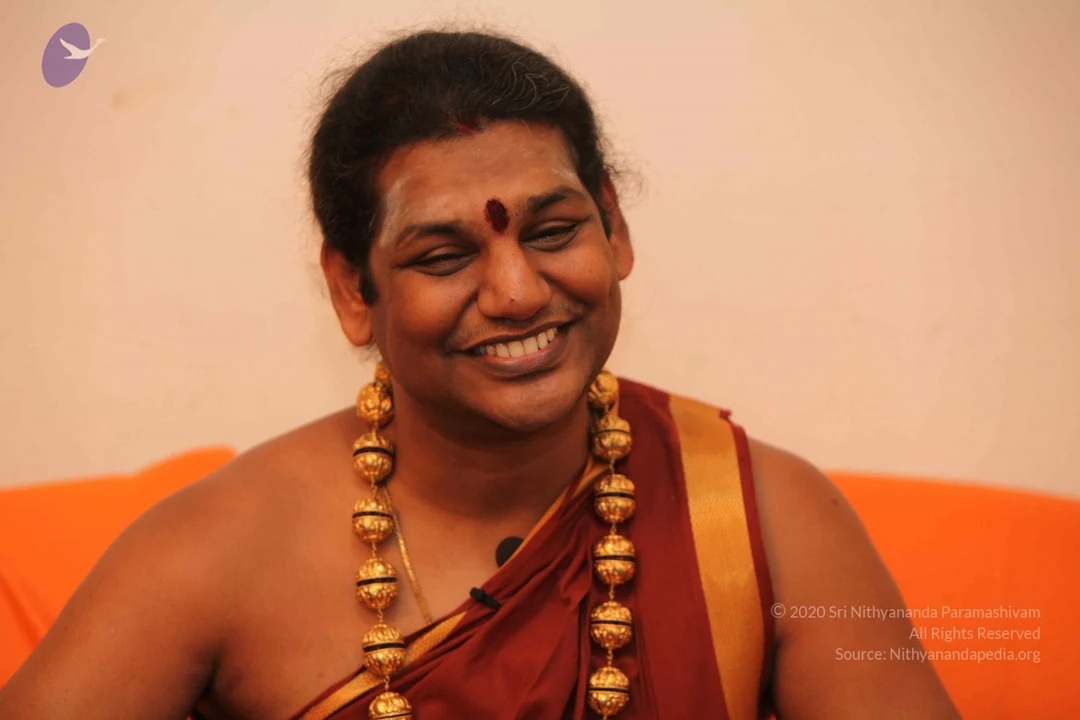
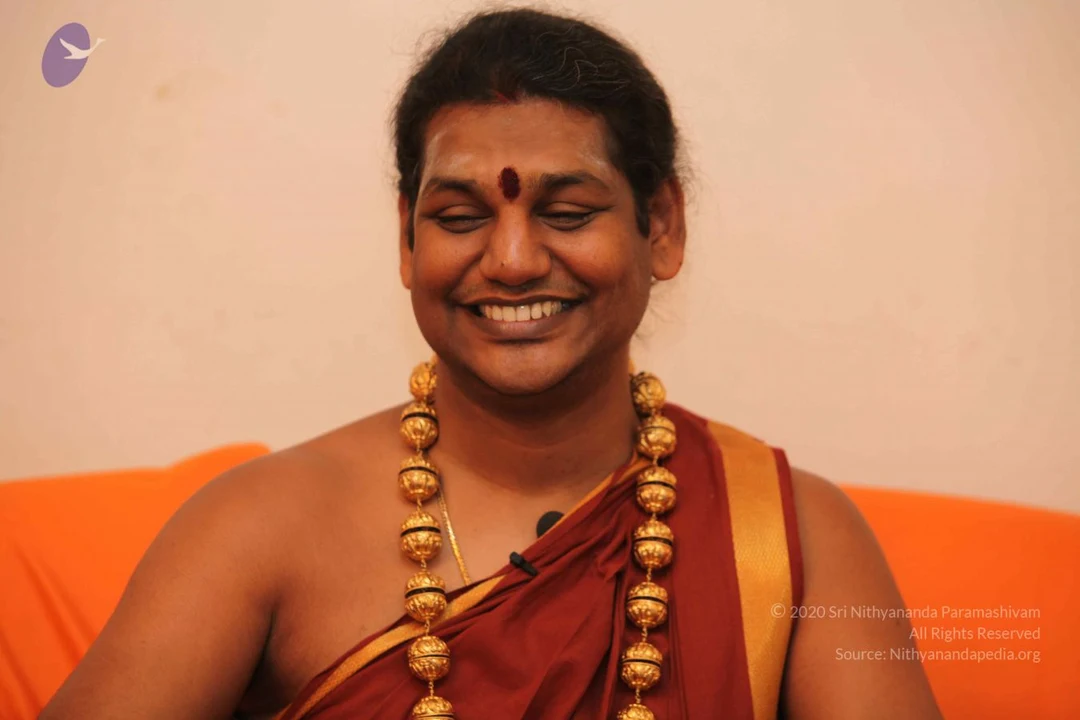
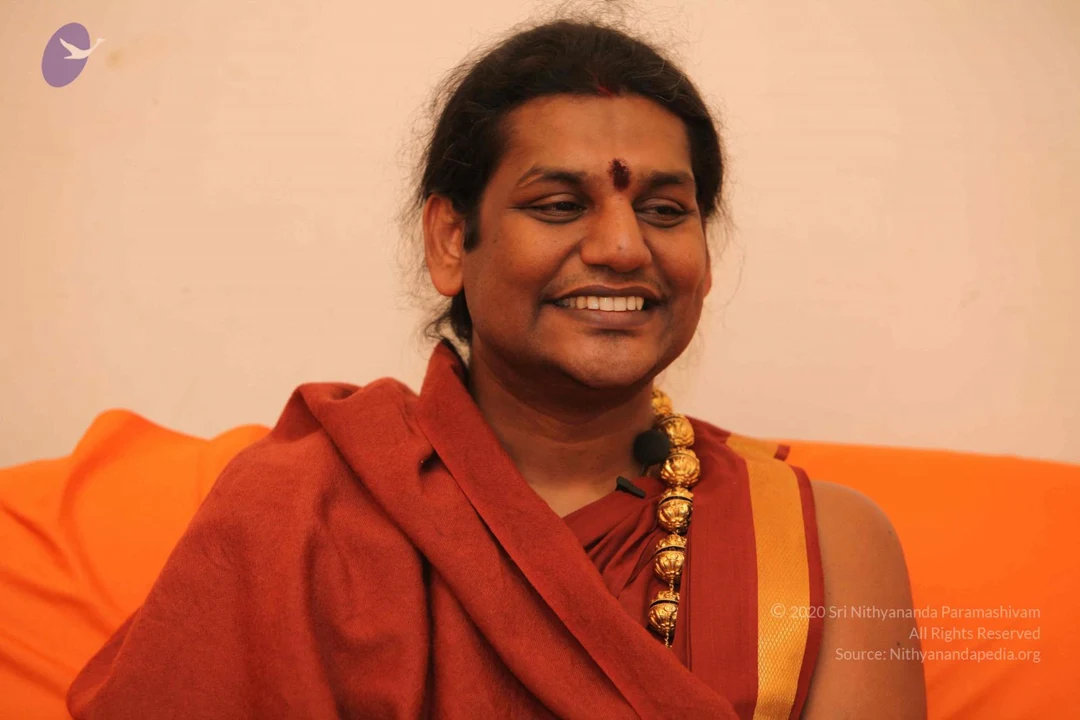
In today’s morning Satsang, Paramahamsa Nithyananda reveals an important component of the Kalpataru process – it is up to us to create the space inside. When we sincerely go through the Kalpataru process, completing with the self-doubts we carry, our inner space opens up, making room for the energy and blessings we receive to enter. Otherwise, in the same way that a balloon with a small hole in it cannot hold the air, our bodies cannot hold the energy and blessings showered on us.

VideoAudio

Transcript

[00:16]

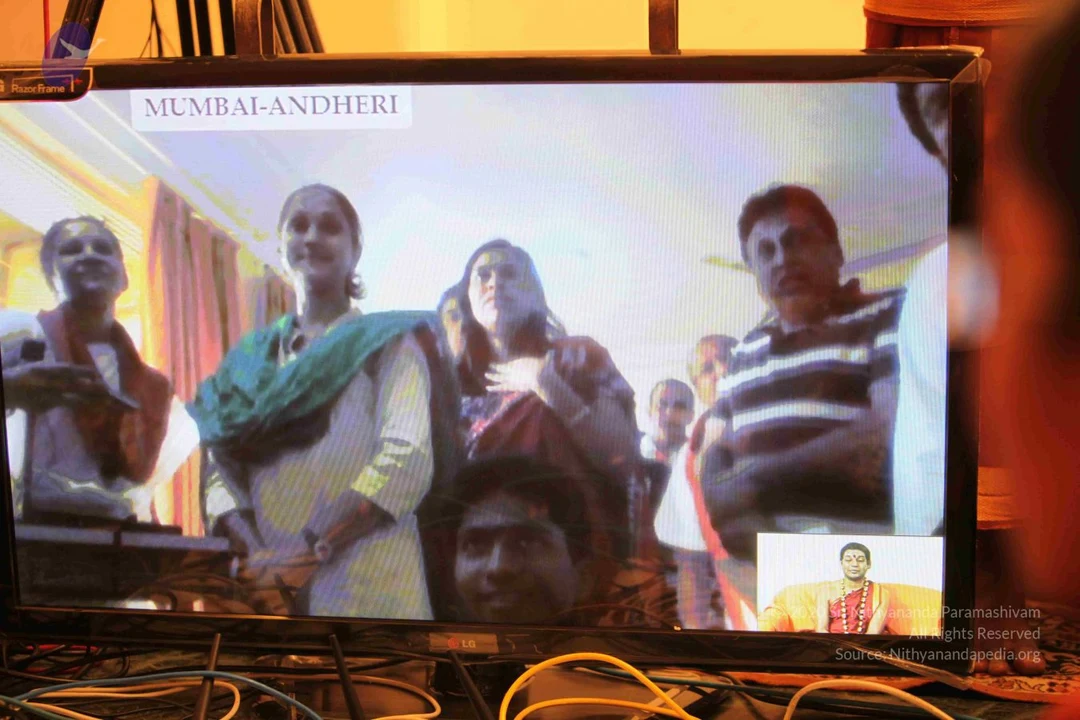
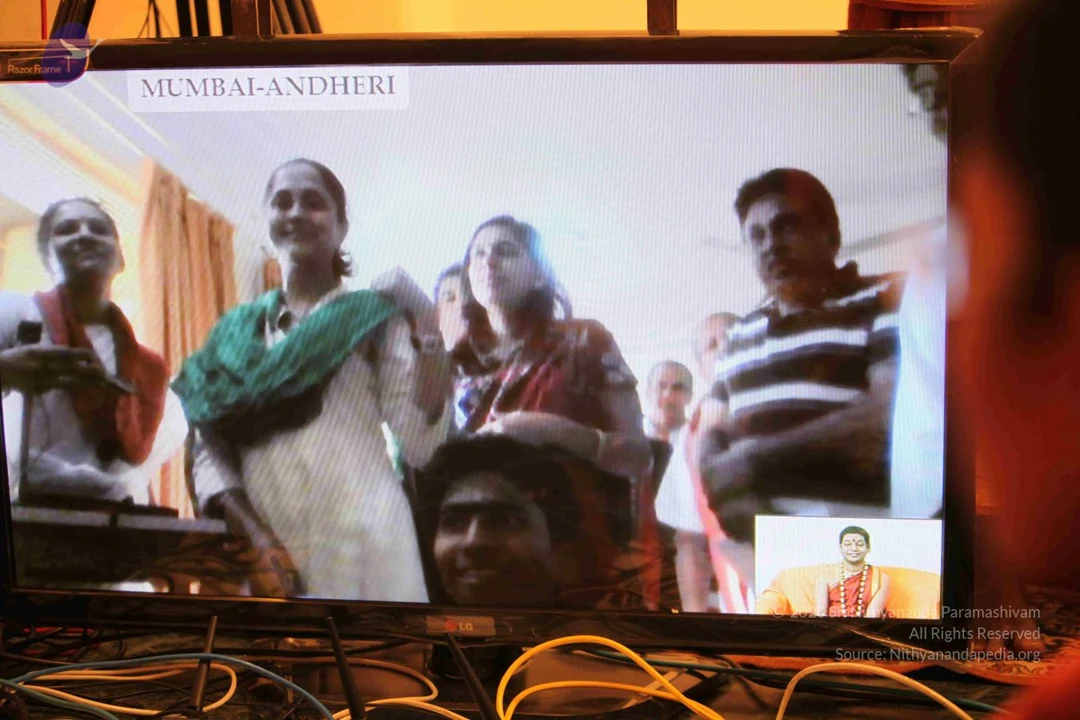
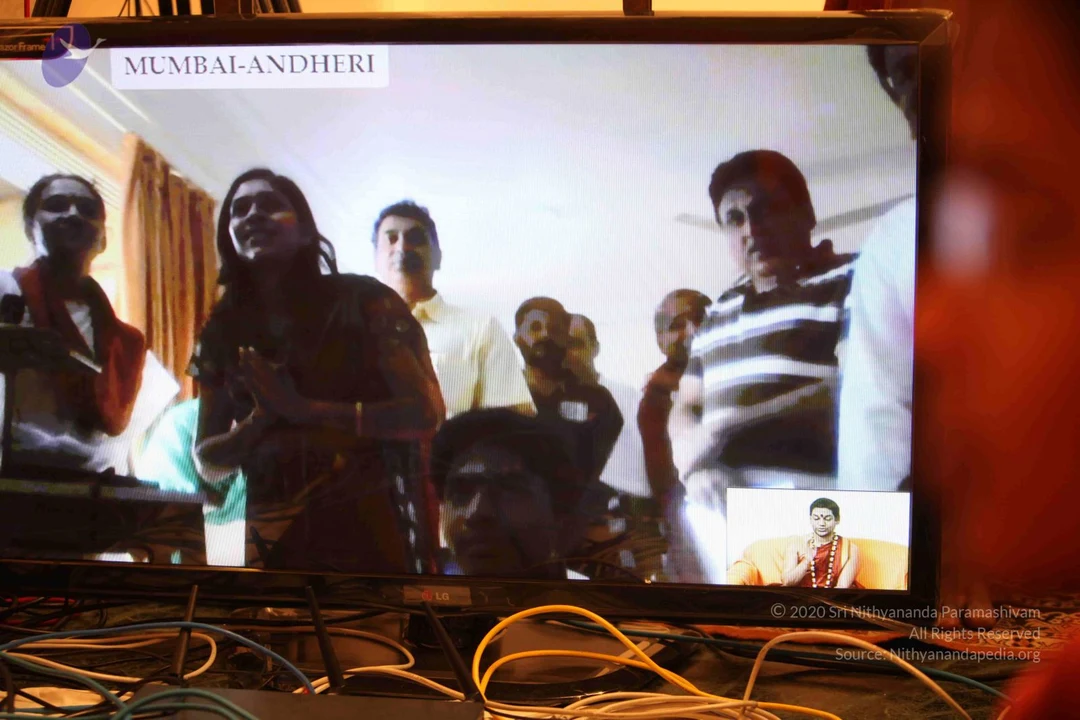
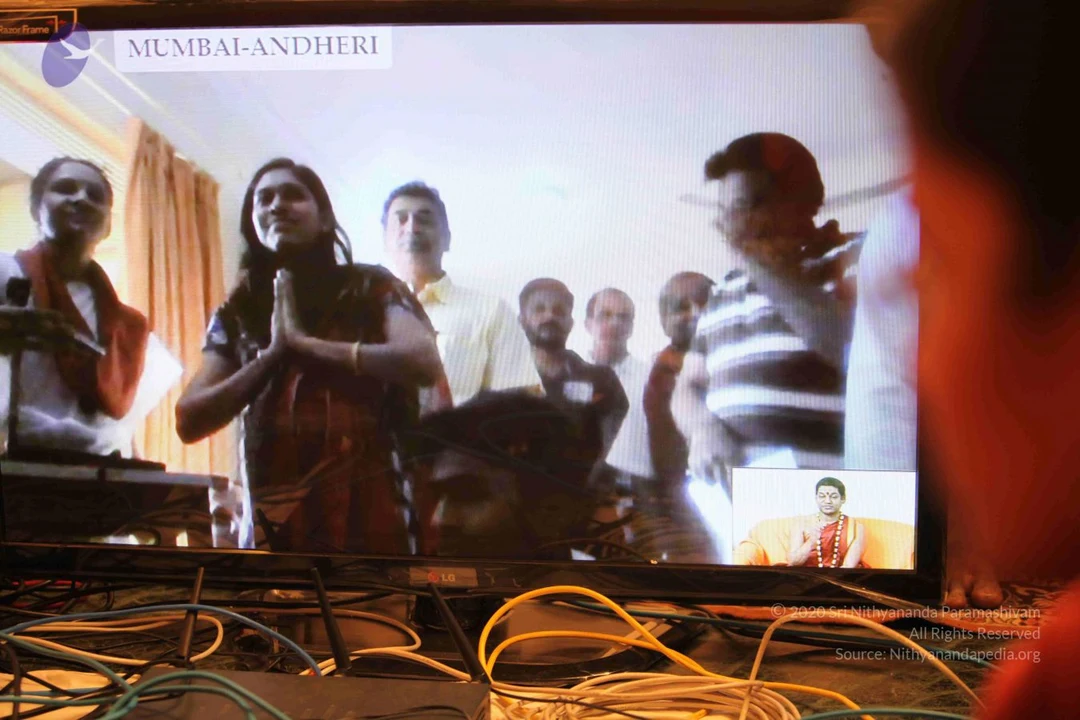
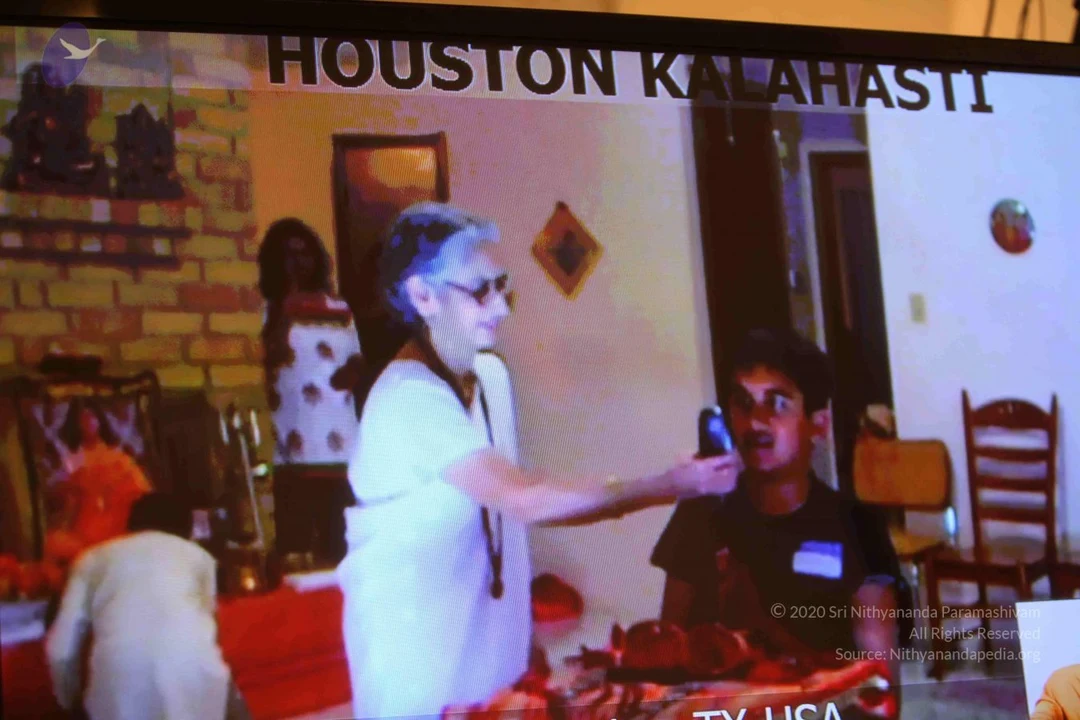
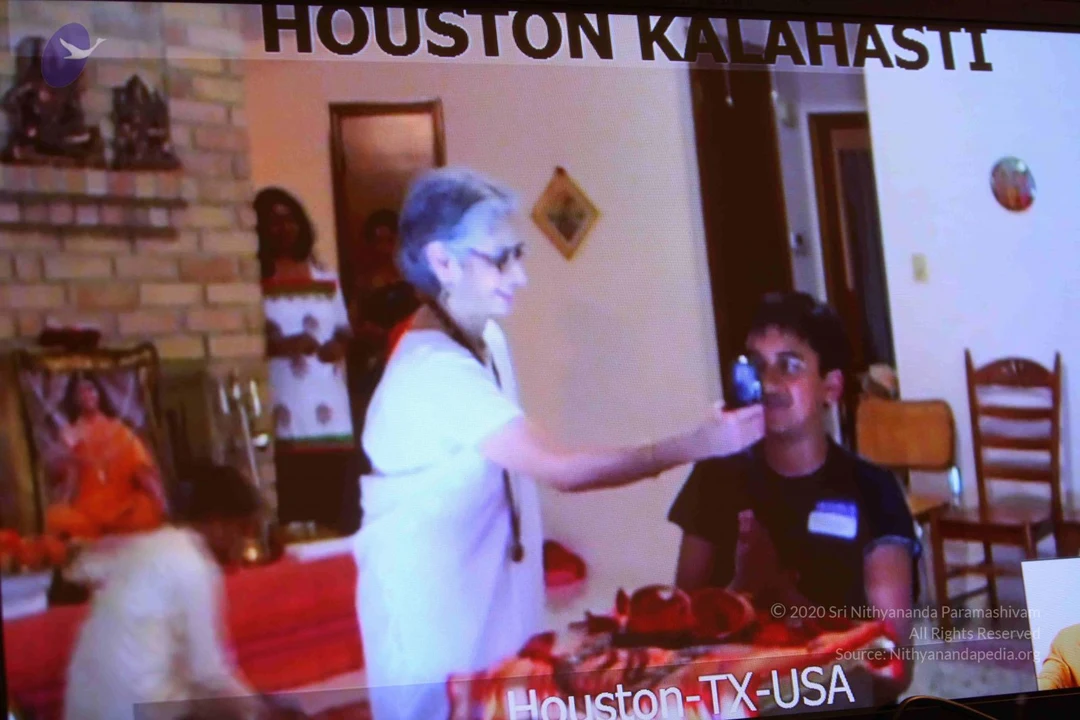
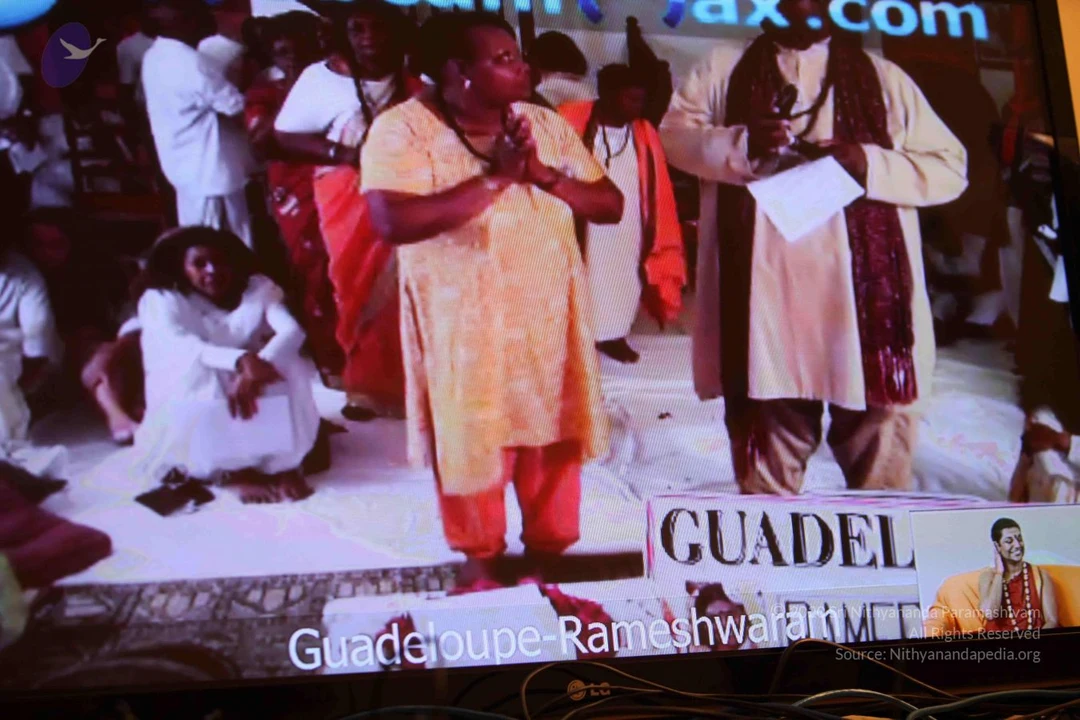
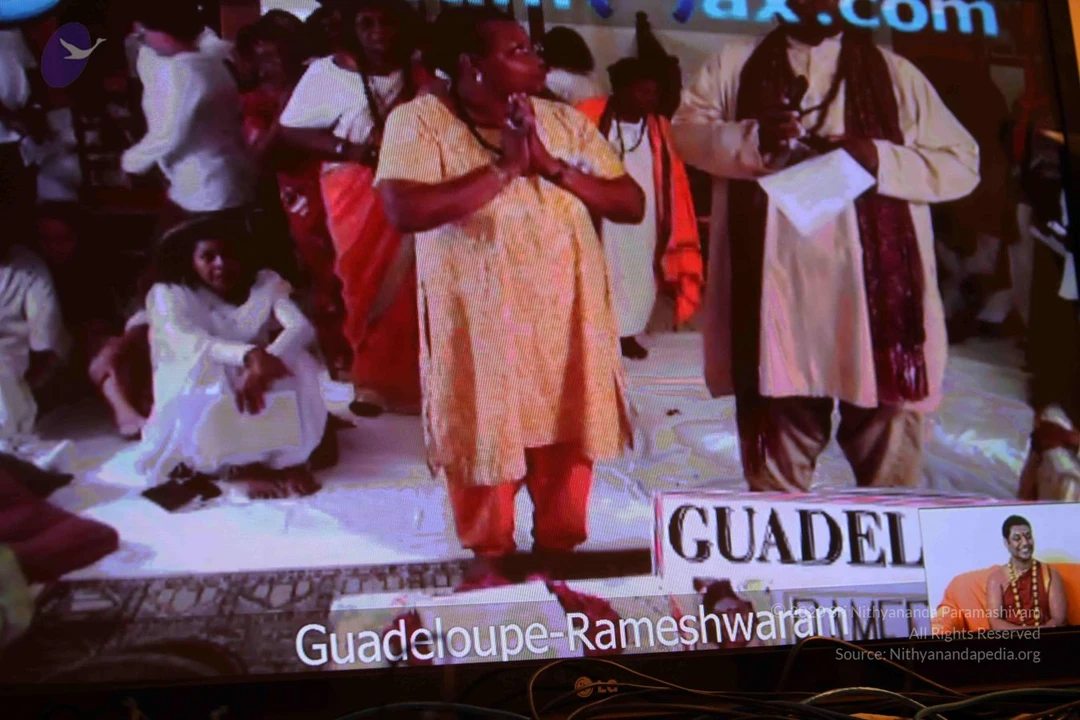
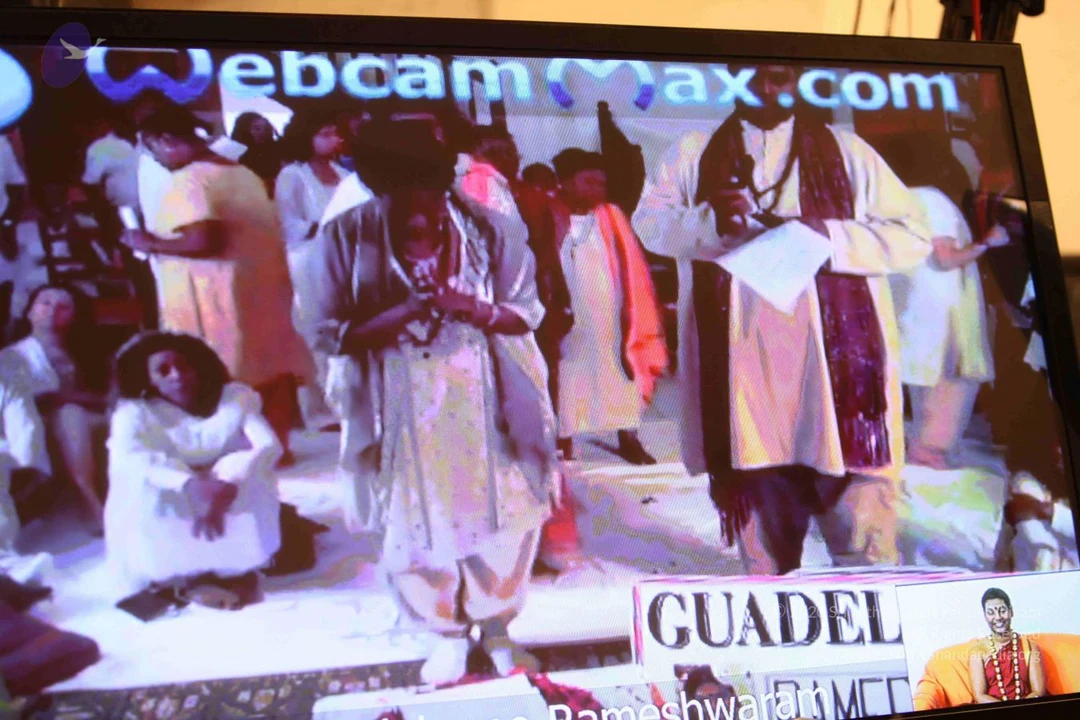
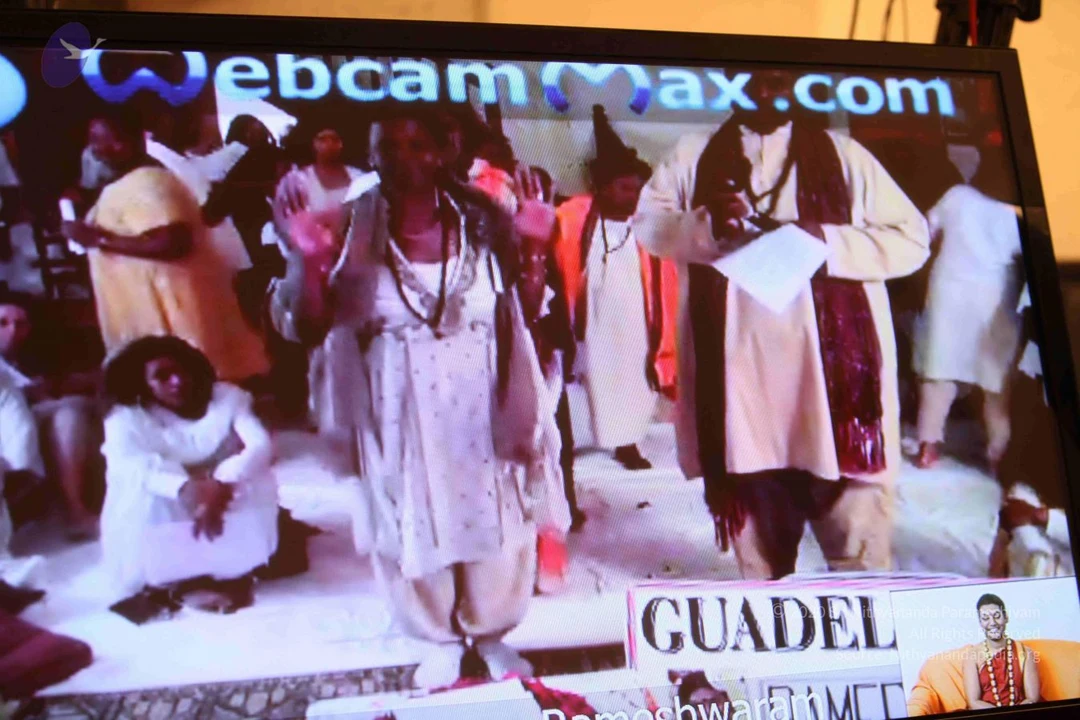
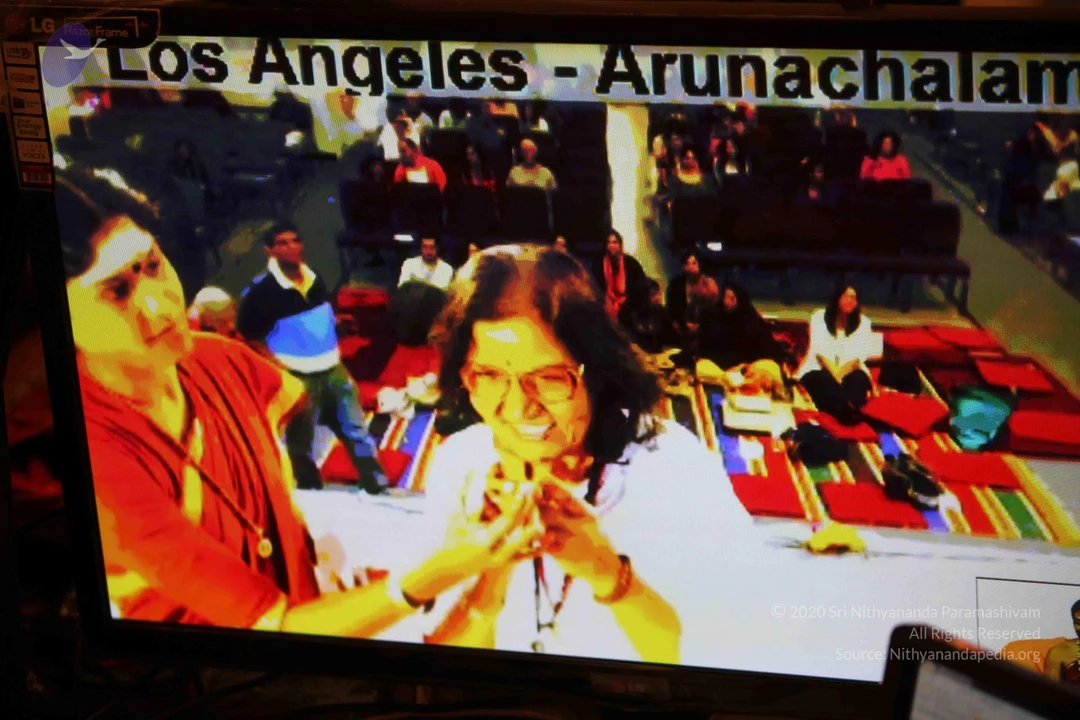
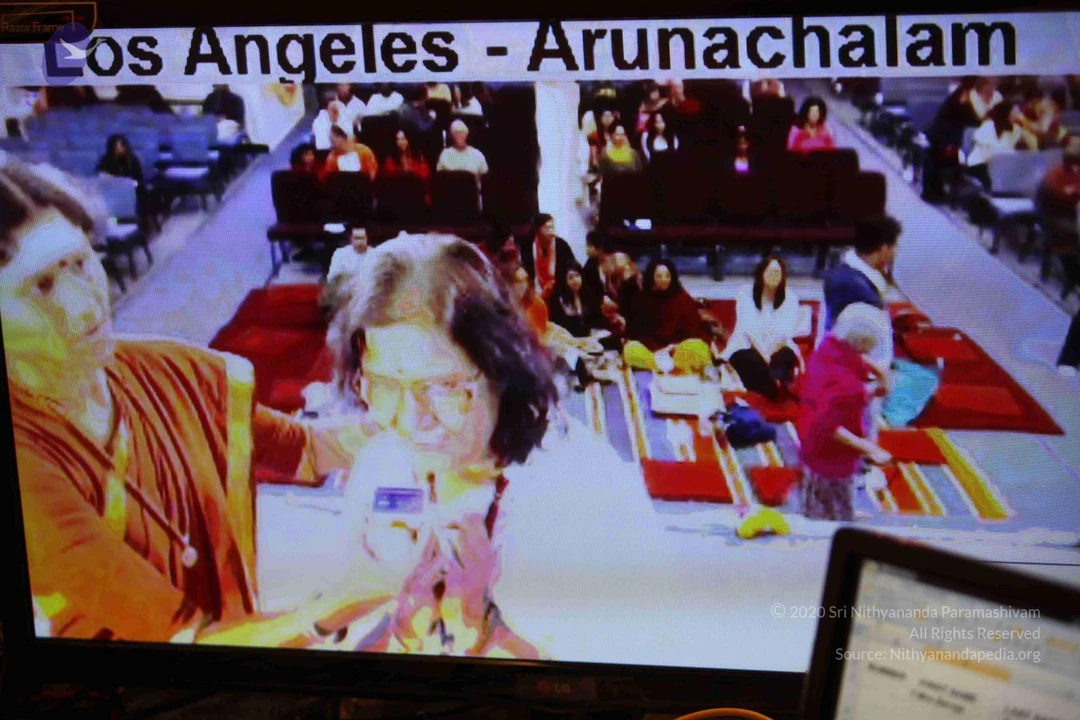
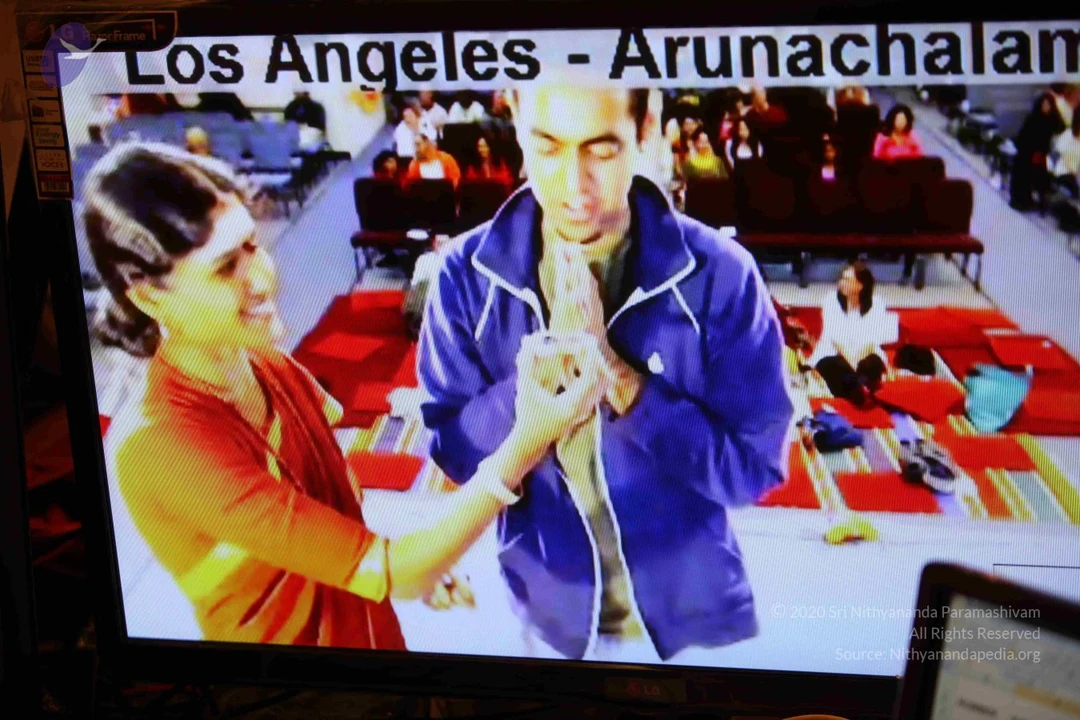
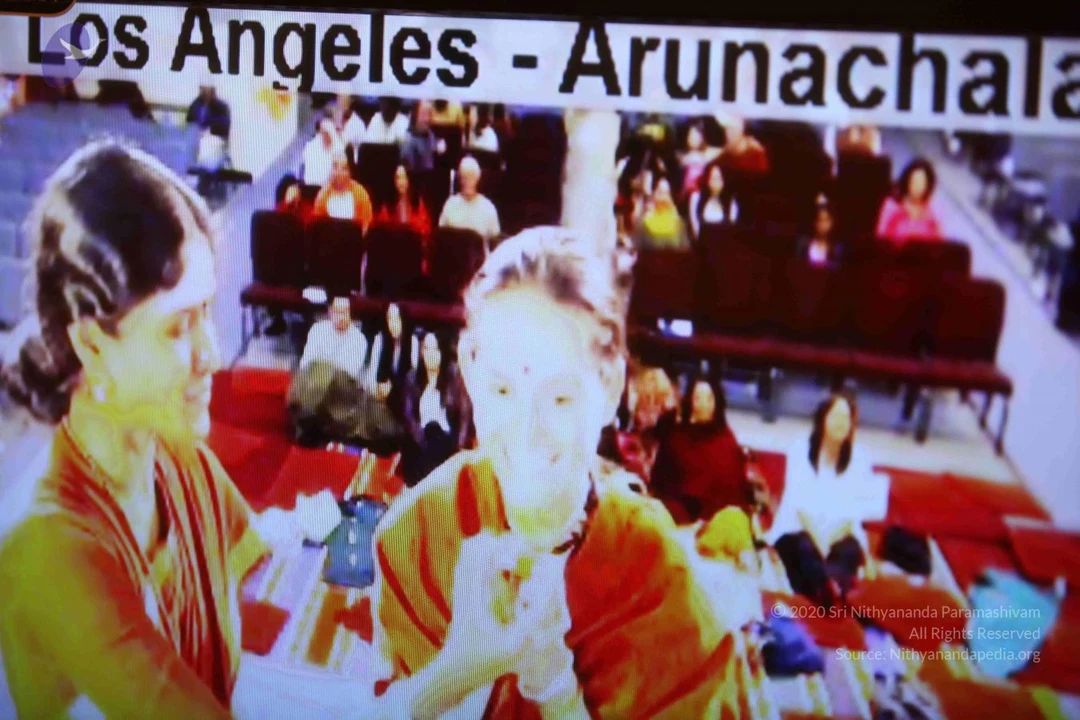
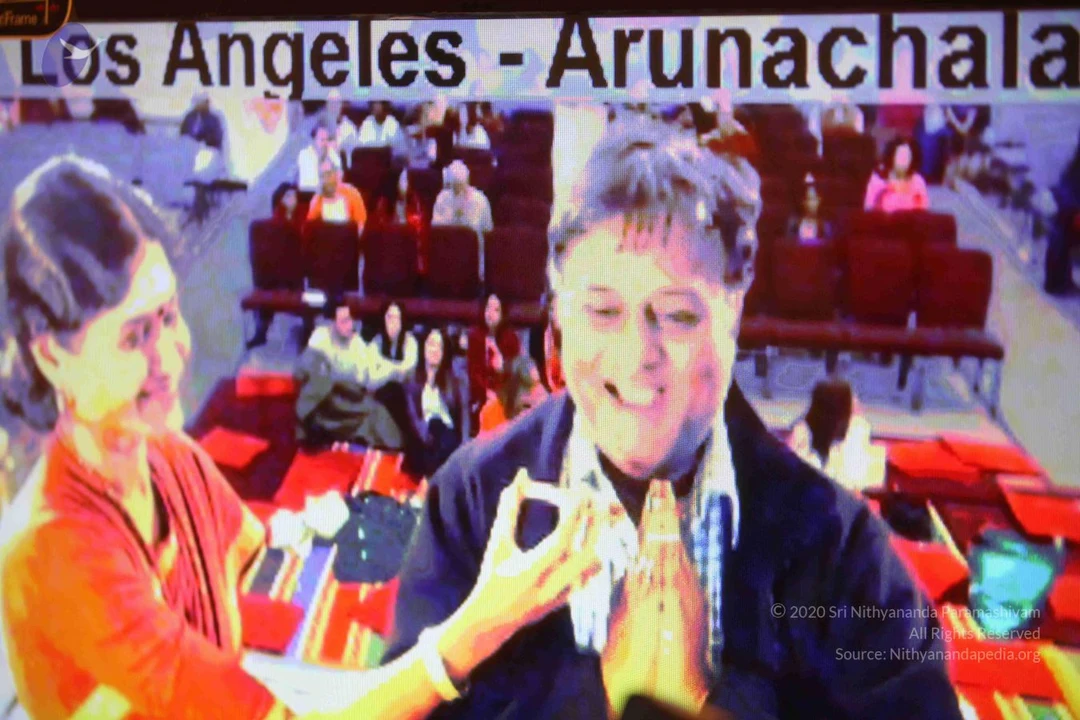
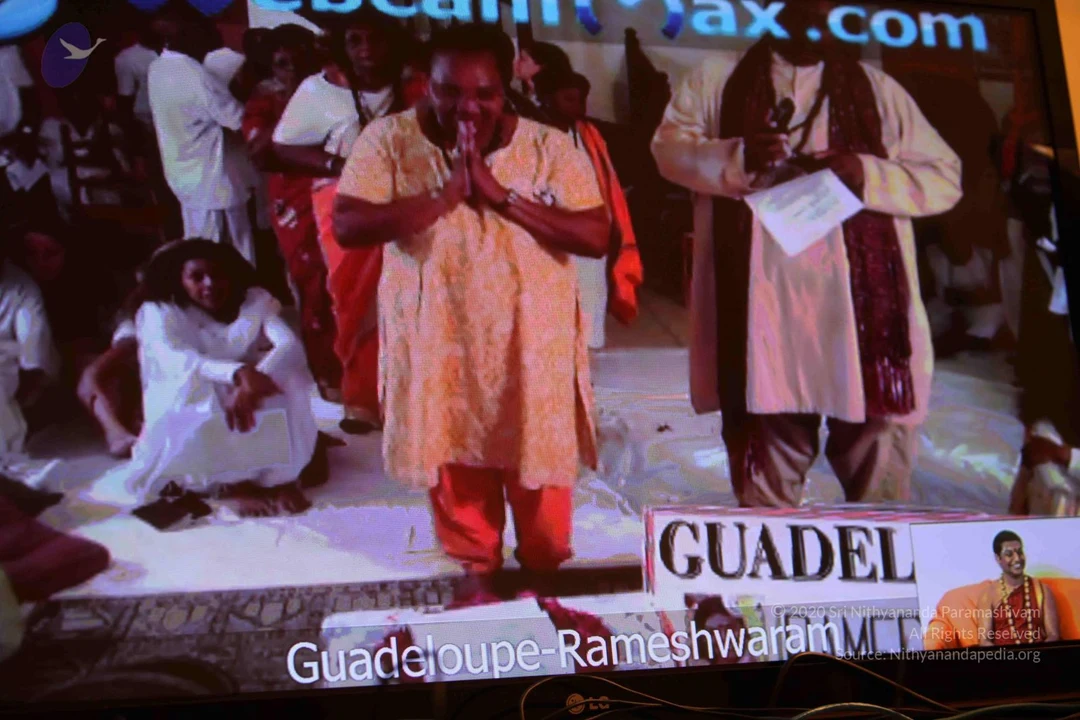
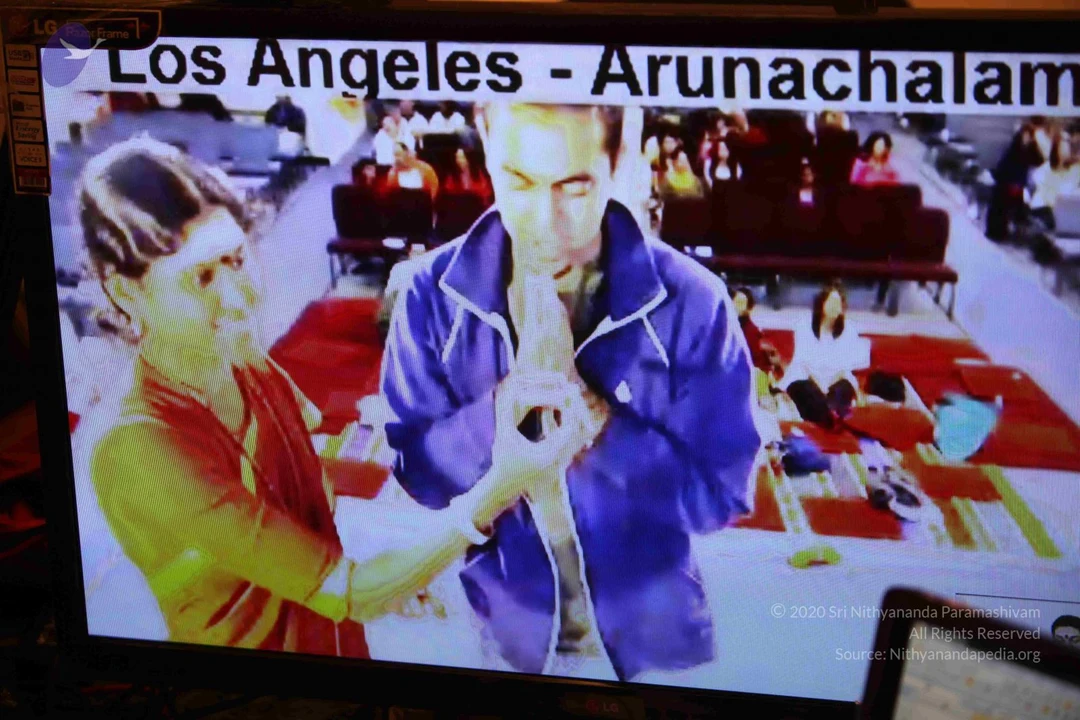
Nithyananda Nagara-Bengaluru, Guadeloupe-Rameshwaram, Oklahoma-Somanatham, Thiruvanmiyur-Chennai, Melbourne-Australia, Nithyananda Nagaramu-Hyderabad, Vancouver-Bhubaneswar, Phoenix-Kanchipuram, Seattle-Chidambaram, Singapore- Singapuram, Wellington-New Zealand, So, I welcome all of you with My love and blessings. I can see now Port Washington - New York, Port Washington - New York and Hongkong - Seerkazhi, I can see all of you. My blessings. I also welcome all the devotees who gathered for Kalpataru Darshan in so many places, more than six places. Warsaw -Poland, Washington DC-Sripuram, Andheri-Mumbai, Houston-Kalahasti, Los Angeles-Arunachalam, Guadeloupe-Rameshwaram. I welcome all of you who have gathered for the kalpataru darshan with My love and blessings. I can see London Kashi also.

[01:42]

I will expand on Kalpataru. Please listen. Maybe, before entering into Kalpataru, just one more thing. Today, Chinese New Year. My blessings to all the devotees from Chinese background and China country. My blessings to whole China and all the Chinese people. And Singapore, My blessings for your celebration on Chinese New Year. My blessings. Let us celebrate. And My blessings for all that Snake Dance, Chinese ritual, Chinese food, everything you are doing in Singapore. My blessings. Oh, that is why today everyone is in the red colour. Chinese New Year, Blessings. Gongsi Phocahi, Gongsi Phochai My blessings. Gongsi Phochai My blessings. I am with you all and we will move to Kalpataru Darshan, the Nithya Satsang.

[03:15]

Please listen. It is the power of Completion you create, and the power of space you create that makes My blessings into reality. You make the balloon, I infuse air into it. You make the visualization, I infuse energy into it. If the balloon has a hole, how much ever air I fill, it is not going to come to the shape. Sameway, if your inner-space has incompletions, how much ever Kundalini energy I pour into you, your body may jump, you may roll on the ground. I have a PhD’s in rolling on the ground. People have done PhD jumping and rolling. But, that is not the ultimate result we need. I have people, if they start jumping and rolling, they will directly reach Bidadi. Dubai, Atlanta-Ujjaini, all of them don’t even need flight; just by kundalini jumping they will reach Bidadi. 😃 But understand, 😃 and I have specialists in jumping. Understand, jumping is only one symptom of Kundalini awakening; but what you want, when it becomes reality is the result of Kundalini awakening. Ishta Siddhi -Eshwaratva.

Please listen. I am not teaching superstitiousness. I am not teaching superstitious beliefs. What is actual superstitious belief you know? Constantly thinking you are going to be a failure, even though life is giving you so many success, is superstitiousness. Understand. Constantly believing you are going to be a failure, even though life is giving you so many good things, is superstitiousness. I am defining superstitiousness. So, when I teach you the science of possibility - Eshwaratva, I am not giving you any false hope or I am not teaching superstitiousness, I am teaching you the science of saadhya - possibility, science of possibility.

[06:30]

When you do the Kalpataru process, when you close your eyes and sit and meditate, when I guide you into that Kalpataru process, bring awareness inside you, one by one, first create a space for what you want to cause. I am giving you one example. If you want to cause health, see clearly you already become healthy. You see, I wanted to cause ten lakh sannyasis to the planet earth; ten million, sorry ten lakh is one million. One million sannyasis, active, intelligent, living enlightened, sannyasis to the planet earth. If I create a space for it, means, already I am seeing ten lakh sitting in front of Me in Samadhi, radiating, living in Integrity, Authenticity, Responsibility and Enriching, Causing, living enlightenment. I am already seeing, I am already seeing, understand, ten lakh sannyasis radiating enlightenment.

[08:16]

If you are creating a space for health, just see it is already real, present, you already became healthy, you are living healthily. Now, naturally your mind will not accept. “No, no, no already I have… I have a knee pain. I can’t even sit. I have back pain. I am coughing. I am laughing, I am sneezing. I have a headache. All my spare-parts are functioning on their own. How can I be healthy?” Your mind will ask. Complete with one by one. Constantly having headache, who is responsible? “I developed that as a pattern. Come on, let me complete and drop.” Constantly having cough, who is responsible?” I developed that as a pattern. Come on, let me complete and drop”. That is the way I managed. See, My whole cough, I have not stopped even single day any of My program. Even if I don’t have whole day Inner Awakening last few days, whole day Kalpatarus are going on. Today, kalpataru in seven-eight cities; eight cities today kalpataru. Whole day kalpatarus are happening at different, different times. I am not stopped...I have not stopped talking. I have only completed with My cough and dropped. The good medicine for cough is going for a walk in the cold. That is what I did. In nice chill weather I went for a walk and cough become alright. Anyhow you don’t try this medicine. But you try completion.

[10:21]

Listen. The incompletions you have, the doubts you have, you think, if you think you may not be able to survive, complete, you may not be able to achieve…. Many people think, “Before becoming healthy I will die. Before becoming wealthy I may die.” No. Please listen. You don’t need to have so much hatred towards you. And you don’t need to think you are not qualified to have a health or wealth. See, anything belongs to the universe belongs to you. Please understand. You have a right over everything of the universe, because you are the children of the universe. Children has every right over everything belongs to father and mother. You have a right over everything belongs to humanity. That is why..actually that's exactly the context from which I went for parivrajaka. Some of My sadhus all the time fantasize about parivrajaka. But you can’t go to parivrajaka as a beggar. These fellows are bloody beggars I know, irresponsible beggars, they will only go for begging, not for parivrajaka. Parivrajaka, you should go as a king. See, when I went to parivrajaka, I just know any… this whole universe belongs to Me, I have a right over the whole universe. I am responsible for the whole universe. Sameway, I have the right over the whole universe from this context you should live your life.

[12:37]

Please listen. I am throwing so many ideas in front of you. In a way, I am bombarding you. But all these ideas align your inner space to cause what you want as reality. So, step by step I am explaining. We can use today’s satsang before every e-kalpataru session for people to understand how to do the kalpataru process. It is a very powerful process and technique you can do every day.

First, pen down one desire you want to cause as reality. Don’t pen down two, three, more. No. Only one. This is a big problem with people who come for kalpataru darshan. The moment they get the phone to speak to Me, that’s it. They know when they will get the chance again, they don’t know. Dama..dama..dama..dama “My grand-father’s brother’s mother’s son is having a knee pain. My uncle’s aunt’s cousin’s dog ran away from the home. My cats, cousins.. cousin brother’s, student’s, father’s mother lost his dog”, they start..... Please understand. I can cause any number of your thoughts as reality, but your inner space is not capable of receiving it. You are capable of receiving only one thought at a time. So pick up one thought you want to cause it as reality. ONE thought you want to cause it as reality.

[15:01]

And listen, listen, and pen down all the incompletions you have related to that desire. Pen down all the incompletions you have about that desire. List it out. Start listing it out. Once your both lists are ready – the thought you want to cause as reality and all the incompletions around that thought you may..... The incompletions means, it may be a doubt – “Will I ever become healthy? Will I ever become wealthy?” It may be a hatred towards yourself. I think sometime you yourself develop a thought that you should not become healthy, this self-hatred. Sometimes, self-denial you think health is not part of your life. Will I become healthy? is - self-doubt. I should not become healthy - self-hatred. I can never become healthy - self-denial. This kind of SDHD patterns you carry, pen them down, write them down. The SDHD patterns you carry related to that one desire, one thought you want to cause as reality, pen them down.

[17:17]

Once your list is ready – the thought you want to cause as reality and all the incompletions, SDHD you carry about the thought you want to cause it as reality – pen down both the lists. The thoughts are...the thought you want to cause it as reality, as I advised, every process pick up only ONE, one thought. Today when you are sitting for kalpataru process, pick up only one thought. Tomorrow when you sit for kalpataru process, you can pick up another one thought. It can be different thought. Today you may do the kalpataru process for health. Tomorrow you may do it for wealth. Day after tomorrow you may do it for having good relationships. You can do different, different. But during any process, during one process, do only ONE thought. So, first pen down in a very detailed way the ONE thought you want to cause it as reality and all the self-doubt, self-hatred, self-denial, incompletions you have around that thought. And please listen, when these two lists are ready, sit with your eyes closed. See, now don’t do, now I am only giving instructions.

[19:36]

When these two lists are ready, sit with your eyes closed, create a space for what you want to cause as reality. When I say create a space, I mean for example, if you want to have wealth, billion dollar, see already you have a billion dollar, it has become reality. And whatever doubts, incompletions, Hatred, SDHD you have which is stopping you making your reality, complete with that and drop it.

For example, when you want to have health, when you are creating a space for health, you may have so many SDHD, self doubt, hatred, denial. Complete all of that and drop and decide “I will hold on to the space of health”. When you create wealth, the space for wealth, all your self hatred, doubt, denials will come up. Declare very clearly, “I am completing with all this self doubt, hatred, denial; dropping it.” Hold on to the space of wealth. Hold on to the space which you want to create as reality at least for twenty-one minutes. Then you will see all the incompletions, doubts, hatred, denial you have loses power over you and the space you created gets infused with power, energy, kundalini shakti, your kundalini and My kundalini both. In front of Master’s kundalini, your kundalini is only a small rat – sundeli. Understand. But when you create a sincere space for you, Master’s kundalini breathes energy into what you want to create. When that Master’s energy, life is infused into your space, your inner space gets prana pratishta done. It gets the prana pratishta happen. The prana pratishta happens by it. So understand, the space you carry becomes reality when you properly go through the kalpataru process.

[23:03]

VideoAudio

Transcript:

[00:00:04]

[Title: Learn to Taste the Joy of Creativity] Life never brings incompletions to us because life is not sadist. Life brings only teachings to us. If you pick it up in a right way it becomes energy, creativity in us. If we pick it up from the wrong side, it becomes incompletion in us.

[00:00:30]

I tell you creativity is joy. When you create something, when you do something, the joy which opens up in your heart remains in you and soaks you continuously in that experience. Learn to taste the joy of creativity. I tell you, literally I tell you, whenever I train and chisel and mold and raise every human being, whenever I bring every disciple to the space of completion I feel the joy of creativity, I feel the joy I have expanded. So be very clear, more work means more creativity, more opportunity for joy, more opportunity for spiritual strength, more opportunity for causing enlightenment. Tirelessly, without any boredom go on causing enlightenment to people. Go on be a catalyst for others to realize their reality. Go on being a light for others to reach their goals. Go on be a path for people to reach their goal. Buddha’s last statement was: Be light onto yourself. I tell you ‘Be light onto yourself and others’. Go on. Go on. Go on. Cause, cause, cause enlightenment.

[00:02:29] [Details of upcoming Shivaratri celebrations]

[00:04:10]

[Title: Let Your Love and Devotion be based on Completion] Do not have God or Guru in your life because of your incompletion. Have both of them because of your completion, strength, and love. I tell you, people who try to project hero figure, father figure on Me because of their incompletion, I am afraid of them because any day they will pull out their gas supply to My form. Whether it is Guru or God, if your devotion, if your love is based on completion only then you will also grow. You will be really, really, really growing in pure love and devotion towards Guru or God. Please listen, this whole rumors and scandals and problems around us, throw away all the fellows who were projecting their hero figure, father figure on Me due to their incompletion.

[00:05:26]

Please listen, let everything be based on the space of completion. Whether it is your devotion or anything… Of course, based on completion you will not be able to have a hatred or violence but you will have a powerful strategy planning like Sri Krishna. Krishna did not have any hatred towards the Bhishma. Krishna did not have any hatred towards Drona. Krishna liberated Bhishma but he had a powerful strategy. He knows what he wants and he will do what he wants.

[00:06:15]

So understand, let everything be based on the space of completion; whether it is your devotion, whatever. The form filled by incompletion only will go on binding you more and more and more. So, understand whether it is danger or what you call as love, both. If you fill it with your insecurity, if you fill it with your incompletion, both are going to be dangerous to you, harmful to you and both are going to be binding you. So understand, life in its pristine, pure form is completion. Please listen, when you bring completion into you no form will bind you. Whether it is love or danger, no form will be binding you, whether it is love or fear.

[00:07:44-08:50] [Details of Inner Awakening]

[00:08:52] [Title: Harness the power of Your Words]

[00:08:56]

See, when you harness the power of words, you know you will use the best words towards you and towards others. You will be so happy and feel strong about you, strengthened. Words are the material out of which you are built. This building will feel strength based on the material on which it is built. Listen, if this building is built out of brick it will feel itself certain level strong. If this building is built out of stone, it’ll feel itself totally in a different level. The strength of the building, how the building feels itself, feels about itself is based on the words, based on the building material used. Same way, how you feel about you is based on the words you use towards you. Listen, when you harness the power of words you will have such powerful feeling about you. You will use such choiceful words towards you and others.

[00:10:10] [Details of upcoming Shivaratri celebrations]

[00:11:50] [Title: Power of Authenticity - Living in Eternal Possibility] See, the power of authenticity is you live in eternal possibility. If you see in the shipyards, boatyards you will see a wall separating one bit of ocean, where the ships and boats are stationed. That small wall gives the feeling that area is separate from ocean, to protect the boats from the high waves. If the wall is broken that shipyard and the ocean is one and the same.

[00:12:47] Same way, the idea of impossibility separates you from the Cosmos, separates you from the God. Whenever you say this is not possible for me, you are a human separated from God. Please understand breaking the boundary of impossibility... I am not saying you will start flying, you will start walking on the water. I am not saying that but all I am saying is you know you created the law of who can fly, which can fly, what can fly. Who can walk, which can walk, where can walk so you know you are the owner of the constitution. You are the head of the constitution of the cosmos, so you can do what you want. You can fly by taking the bird body. You can fly by assuming the bird’s body. So you know, you are the head of the constitution of the Cosmos. You know you created the law. So you know, what all you can express through the body and what all you can't express because you designed the body such a way. And same way, I am not saying you will not have any benefit other than intellectual understanding. No. You may not be able to fly but you will be able to really, really run fast.

[00:14:32 [Details of Inner Awakening]

[00:15:40]

[Power of Responsibility makes you a Leader] [No video only audio] Power of responsibility. Please listen. Whenever you become tired, facing conflicts, contradictions, you don't feel responsible, that is why tiredness happens to you. Please listen, ability to face conflicts, ability to encounter contradictions, ability to face problems, very important quality you need to be a leader. Feeling responsible gives you that power, it makes you a leader.

[00:16:39]

I tell you, only if all the patterns which create panic pattern, the root patterns which cause panic patterns in you, only if they are cleared, they are removed, you will have the ability to handle responsibilities. I tell you, your longevity is directly connected to pattern-free inner space. If your patterns are so powerful even a small panic, small problem, small conflict, small contradiction raises your BP, releases adrenaline, reduces your health, and longevity.

[00:17:31]

The pattern-free inner space, conflict-free inner space, that is such an important thing. I tell you, when you create a pattern-free inner space for yourself I guarantee, you will live healthily, long and you will not be afraid of conflicts, contradictions, controversies. You will face them. Ability to face controversies is leadership consciousness. Ability to face controversies is leadership quality, leadership consciousness.

[00:18:12]

But one thing I am so happy, whatever, whether to create controversy or problems, they are watching My Satsang and surely they will be enjoying all these spiritual ideas and soon I expect them to get enlightened. And I also give you all My blessings, heartfelt blessings. Let you all be enlightened soon. I tell you, My words are so powerful, I am so confident about My words, even if you are listening just to create controversy, for some moment you will lose yourself and you will be lost, I’ll take over you. And if you are watching Me to find some points for controversy and some moment: “Wow, this guy is a real orator.” Be very clear, I am entering you. Even if you appreciate for a moment: “Wow, this guy is really humorous and he is really entertaining and he is able to make us listen and wow.” And If you are searching for My other discourses in YouTube, after listening to this Satsang, be very clear I am entering you, join the club.

[00:19:41]

Photos
Photos Of The Day:

Satsang-Kalpataru
Photos Of The Day:

PADAPUJA

NITHYA-SATSANG

DARSHAN

Photos Of The Day:

Kalpaturu-Darshan

Kalpaturu-Darshan at Slovakia

Kalpaturu-Darshan at Tiruvanmiyur, Chennai

Paduka Puja and Sri Nithyanandeshwara Temple, Adi Kailash, Bengaluru

Photos from this day

View all 176 photos

Photos

11 photosSource gallery
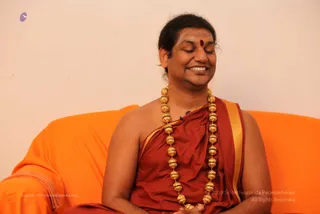
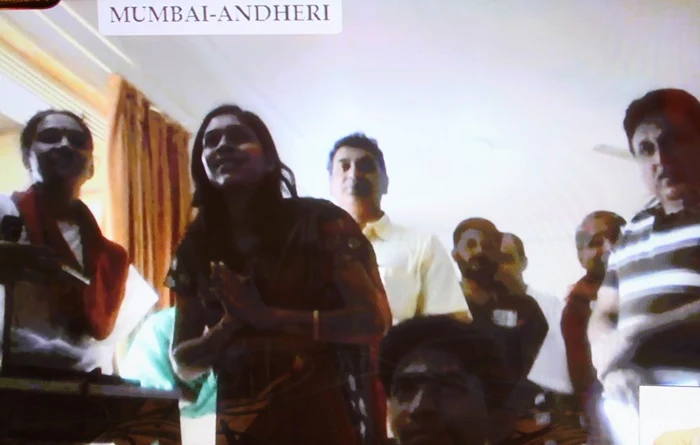
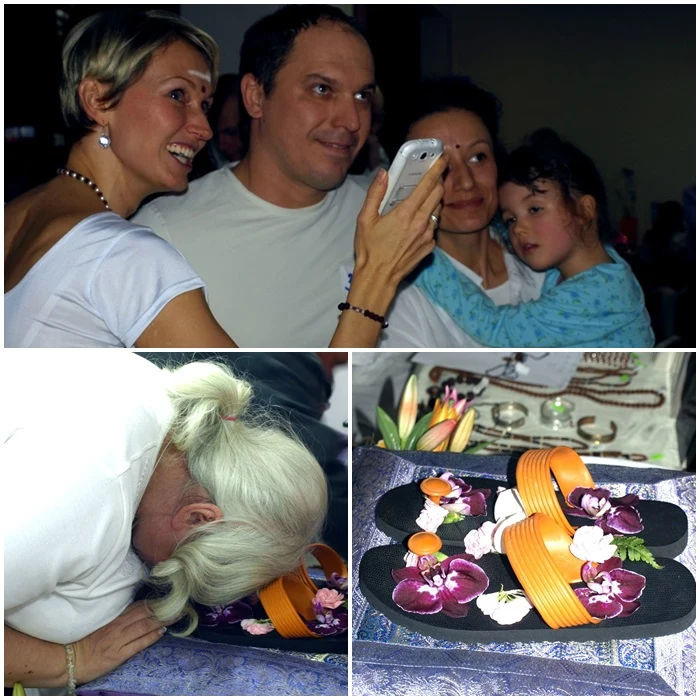
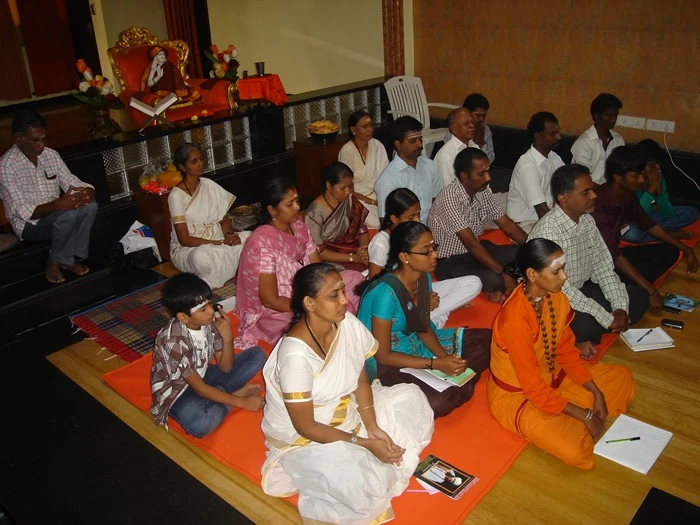
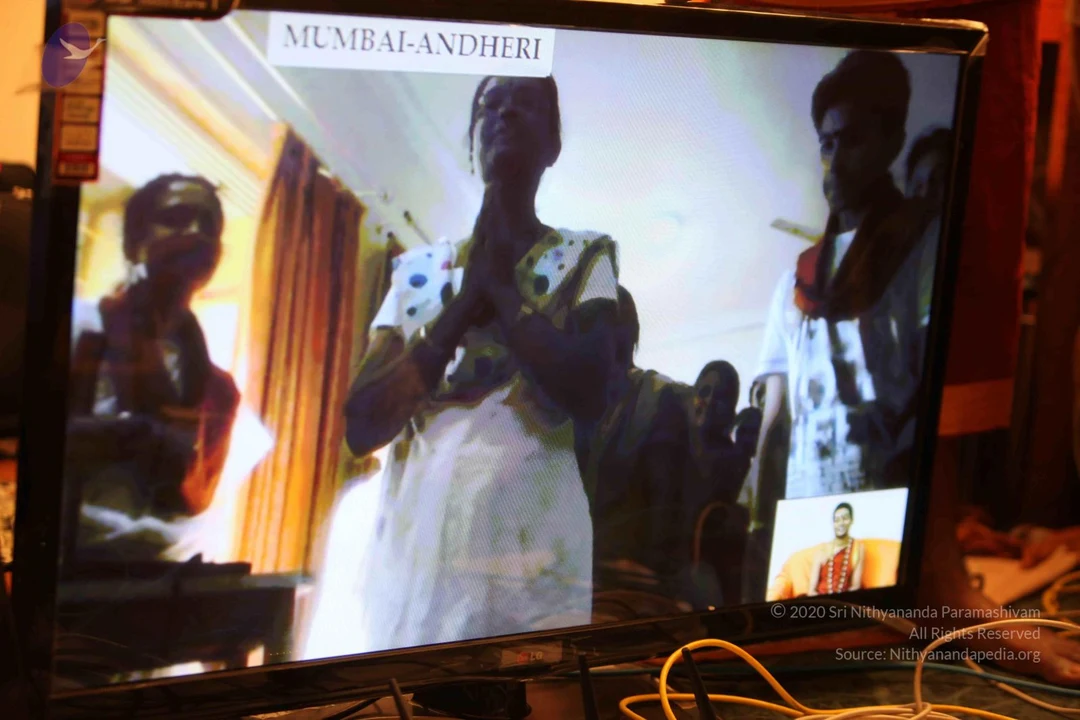
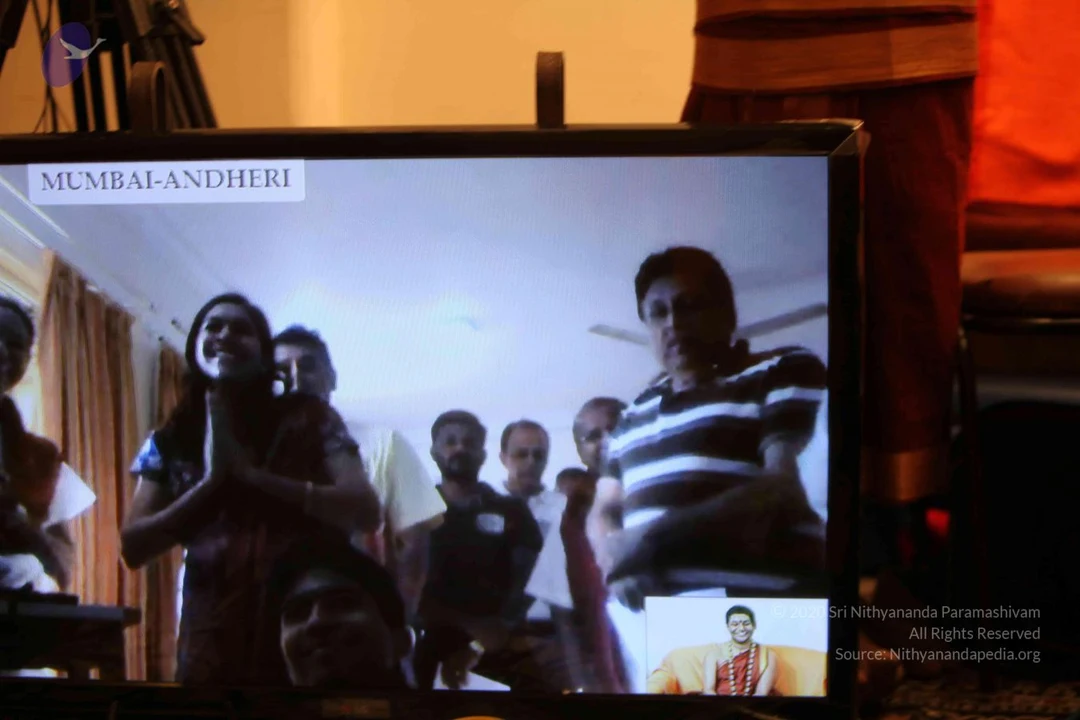
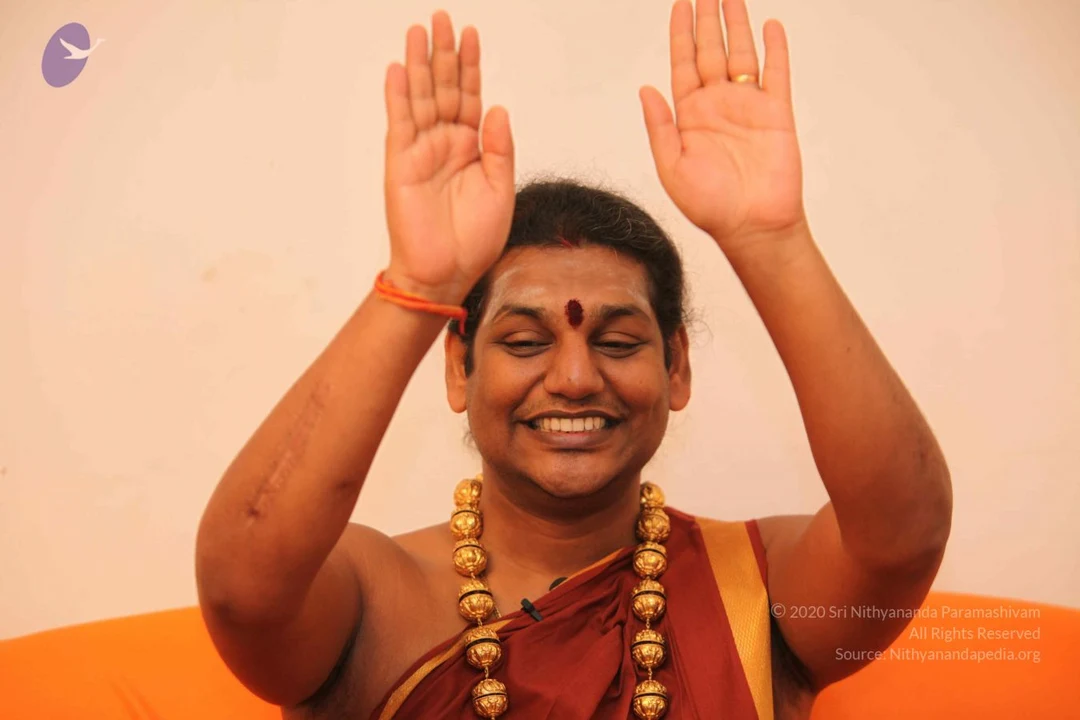
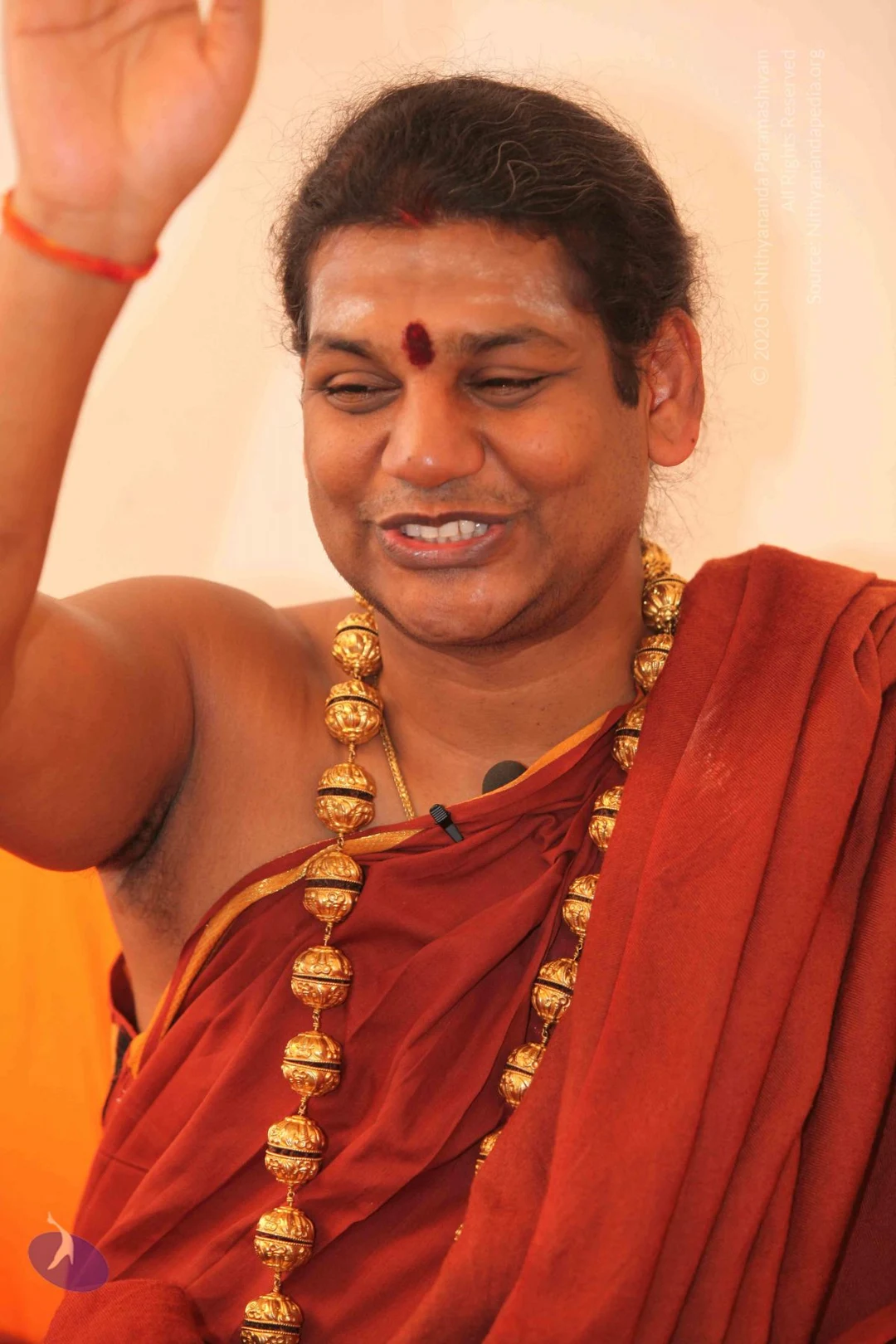
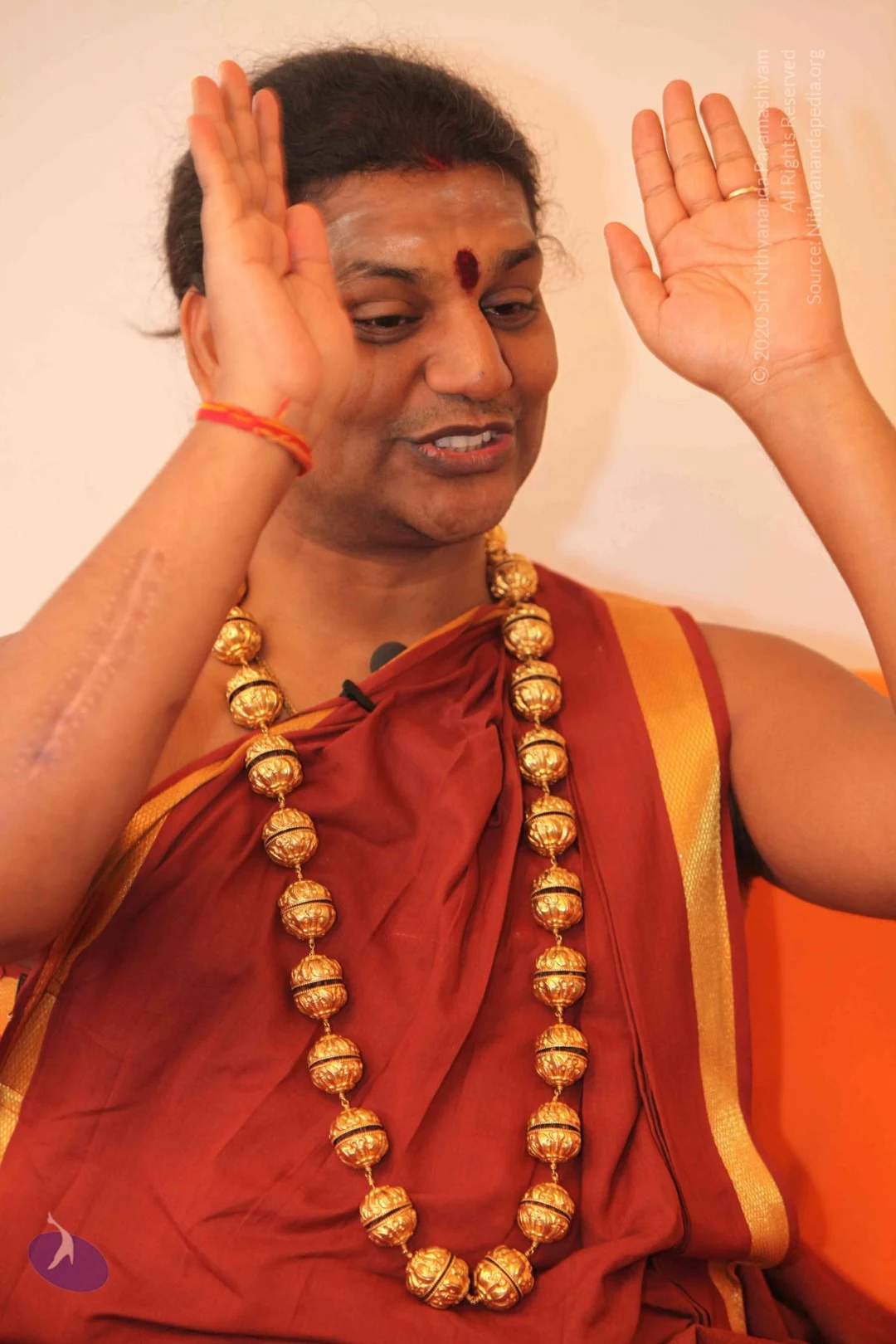
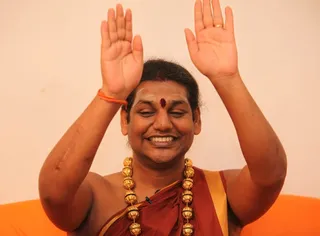
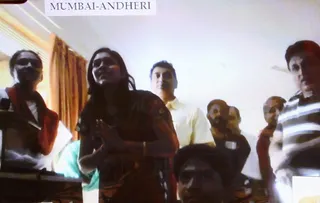
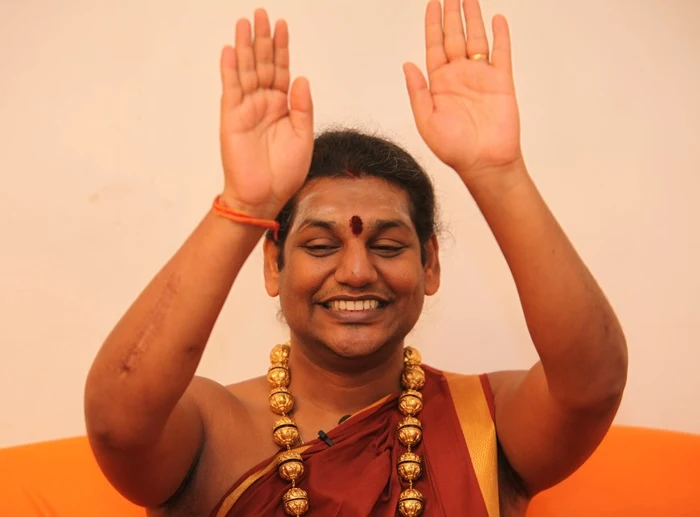
A smiling man with closed eyes raises both hands, palms open, above his head in a blessing or ecstatic gesture. He wears a red-maroon garment with a gold border draped over one shoulder, a heavy necklace of large gold beads, a red bindi on his forehead, and an orange-red thread bracelet on one wrist. His hair is swept back and he sits against a plain cream wall with an orange cushion or seat visible below. The appearance is consistent with the page's appearance-based label of a person, given the saffron-toned clothing, gold ornamental necklace and swept-back hair, though the cues are not fully distinctive, so identity is recorded as unsure.A photograph of a video screen showing a live satsang feed, with a white label reading MUMBAI-ANDHERI at the top left. On the screen, a group of devotees stands together in an indoor room with beige curtains. A woman in the center wears a dark patterned sari with a red shawl and palms pressed together in greeting. Beside her a man in a cream shirt stands, and to the right a man in a striped shirt and several bearded men stand close behind. The a person depiction is not clearly visible in this frame, so no candidate is identified.A dim room with a large projection screen showing a smiling man in orange-saffron robes with a rudraksha mala and a red bindi on his forehead, seated on an orange cushion. Two men in white shirts stand in the foreground at the lower edges, one holding a phone toward the screen, and another person's arm and phone are visible at the right. Purple decorative ribbons hang on the side wall. The projected figure is shown on a screen, so the depiction is of Swamiji (probable) based on the saffron robes, rudraksha mala and long swept-back hair.Four-panel collage of devotees at a KAILASA event. Top panel: three adults in white tops and a young girl in a blue top posing together, one holding a white phone to take a selfie; a woman on the left has a red tilak mark on her forehead. Bottom left: a woman with pale blond hair tied back bows low with her forehead touching a black sandal decorated with purple orchids and white flowers. Bottom right: a pair of black sandals with orange straps decorated with orchids, white blossoms and a green leaf, set on a blue patterned cloth beside beaded malas and brass items.A seated group of devotees sits on orange and red mats in a hall with a wooden floor during a satsang. At the top left, an ornate golden throne with red cushions holds a framed portrait and floral garlands; a small puja-style table with a bowl of offerings sits nearby. A woman in white with gold border sits in front, hands folded, next to an older woman in an orange sari and a woman in a teal top taking notes. A boy in a striped shirt sits at left. A man in orange clothing with a white shirt and beige trousers writes in a notebook on the right, with several men in white and checked shirts behind. Plastic chairs and a wall with decorative panels complete the room. Count of visible people: about 20.Devotees sit on orange mats in a bright interior room, watching a flat-screen television mounted on a wooden cabinet. The screen shows a colourful devotional painting of a deity trio in red, yellow and green tones. Men in white shirts and dhotis, women in saris and salwar, and girls with plaits face the screen, some with their backs to the camera. A brass vessel and a small clock sit on the mat in the foreground. A wooden staircase with turned balusters rises at left, and a second screen shows a small image near the doorway. Pink-and-cream walls and a tiled dado frame the scene.

Satsang-Kalpataru
72 photosSource gallery
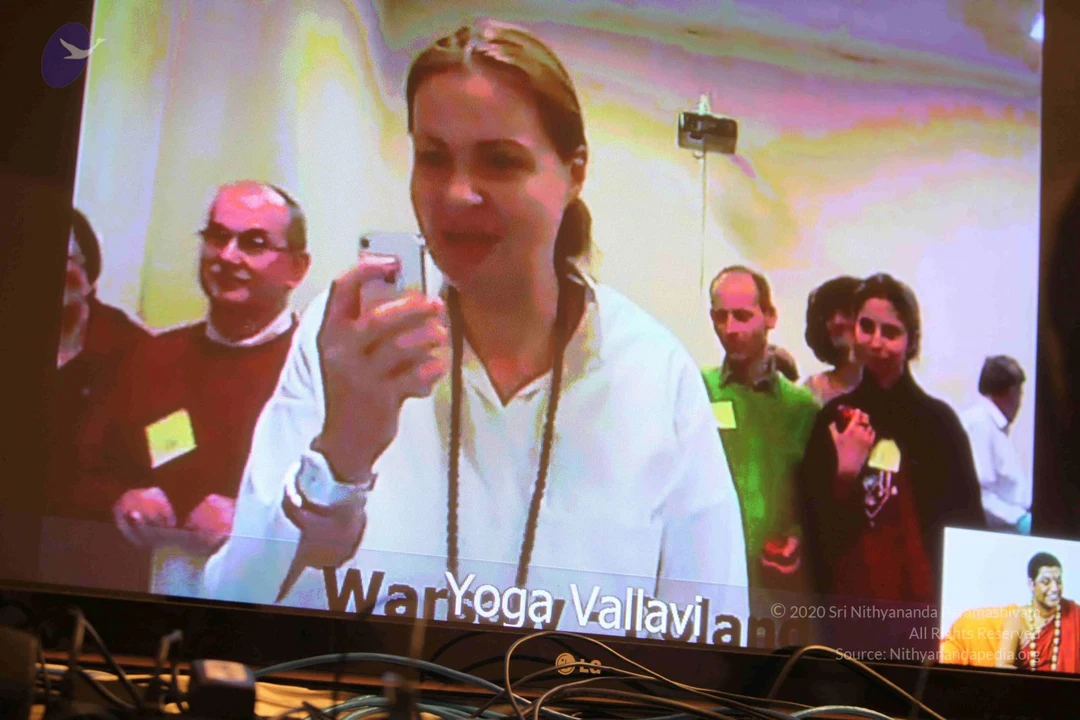
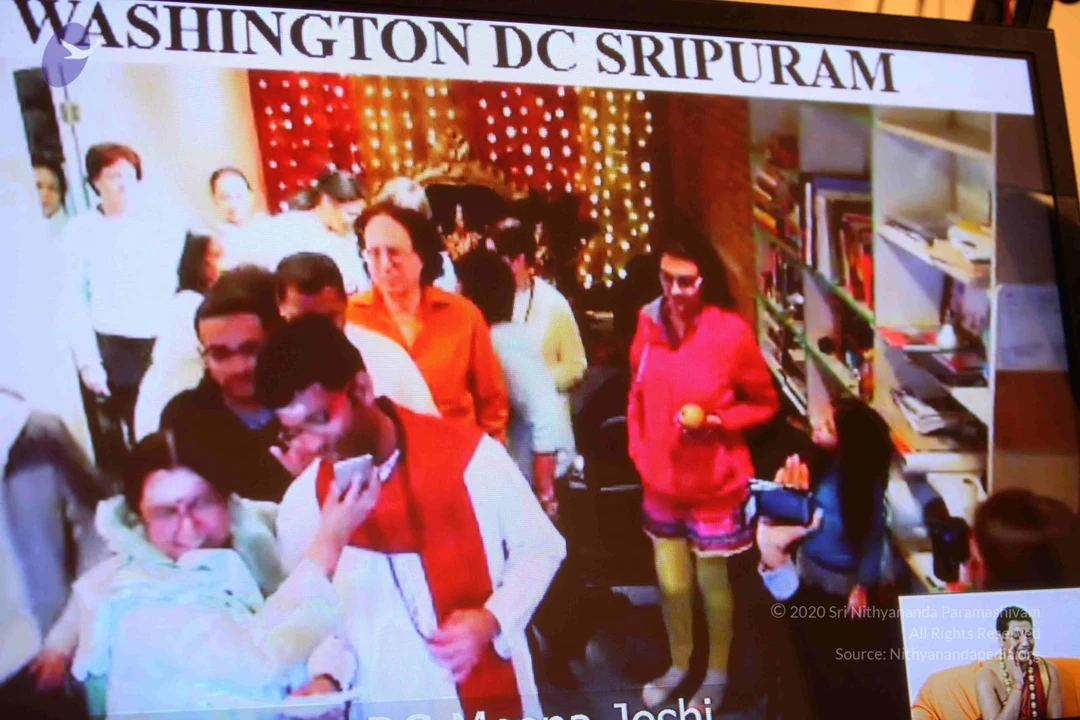
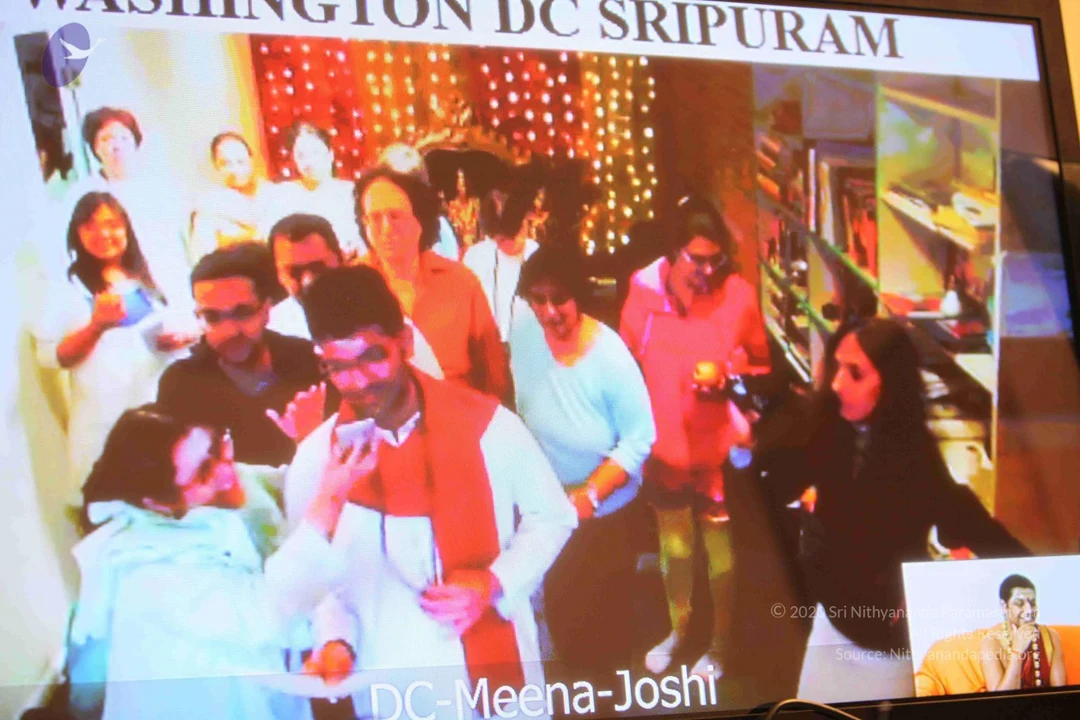
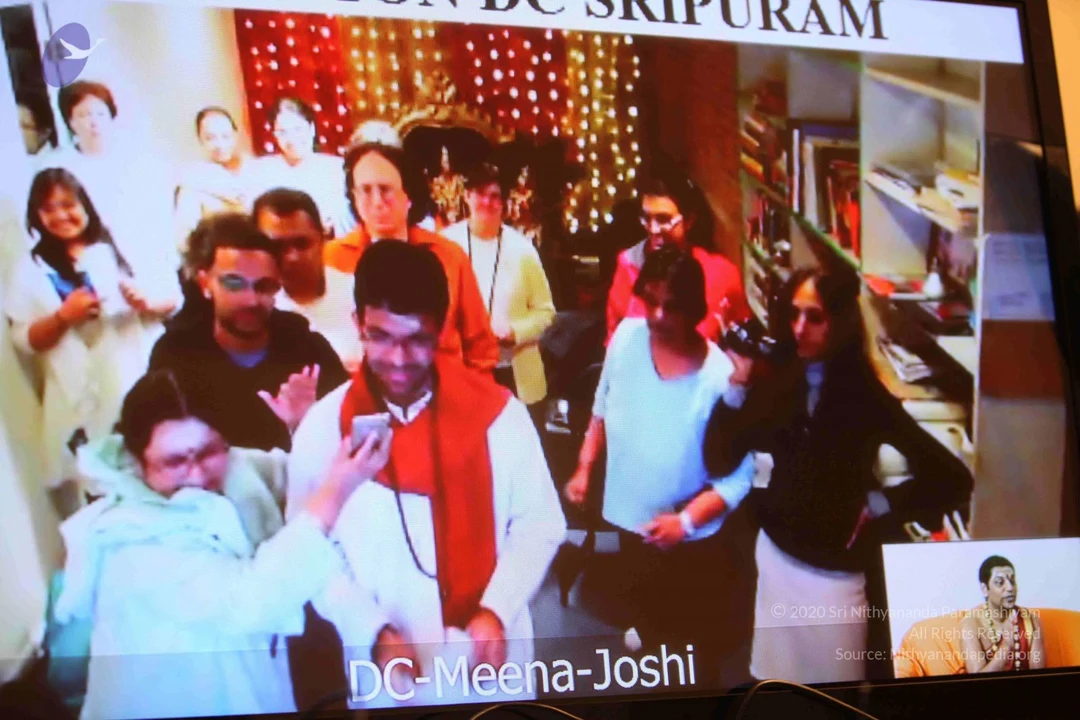
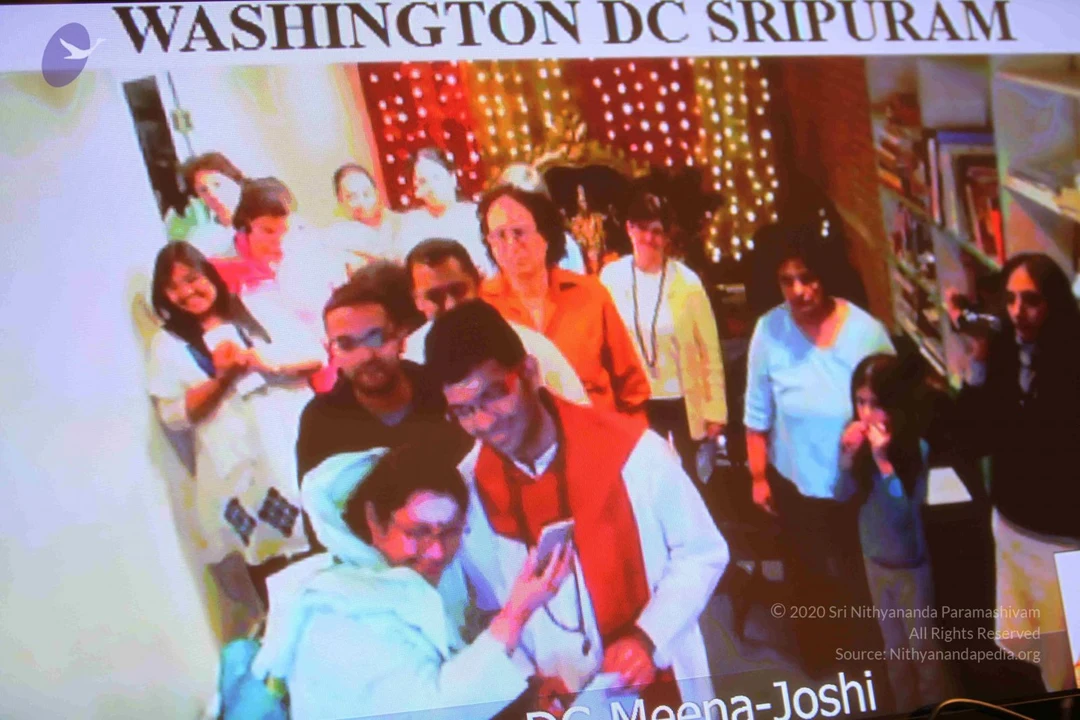
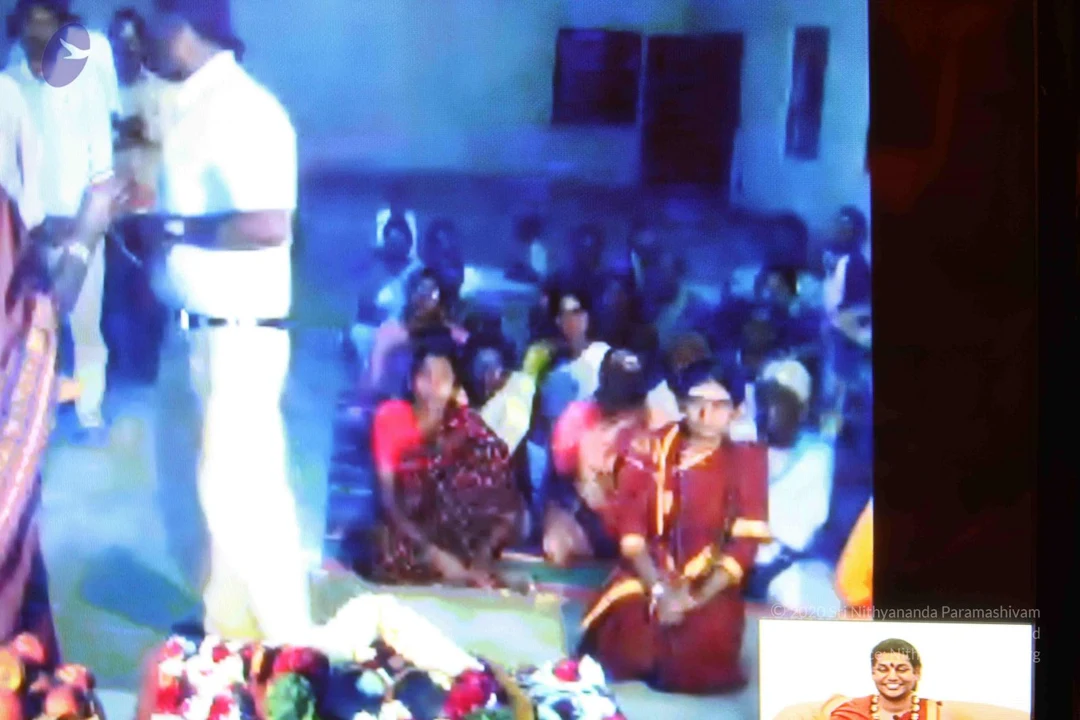
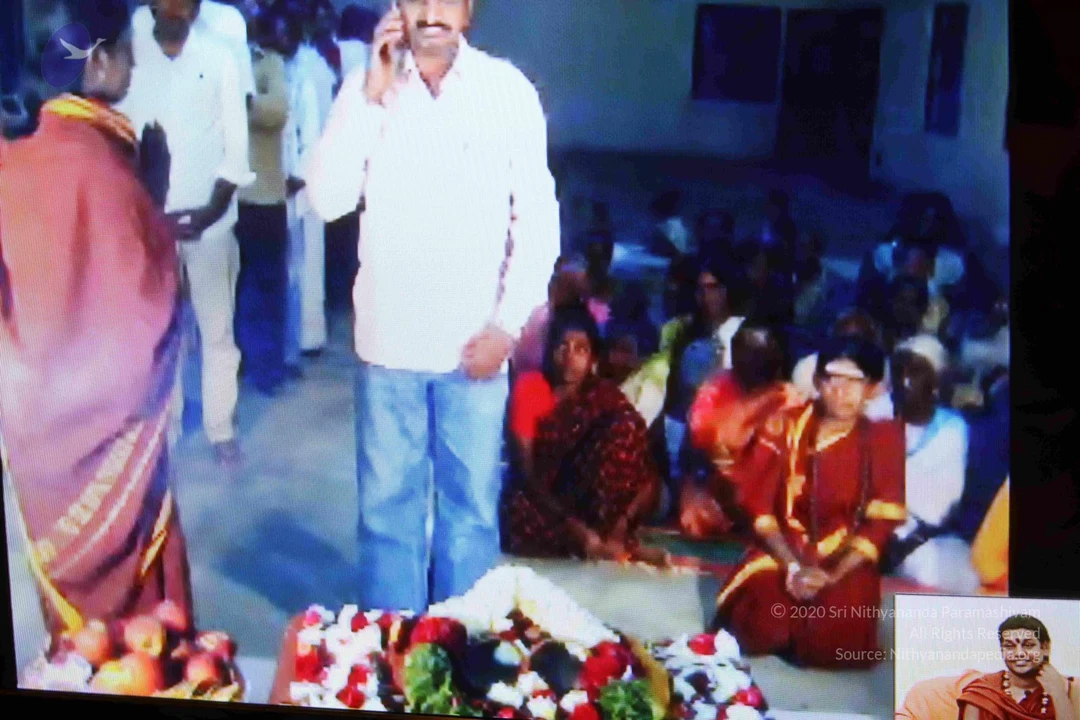
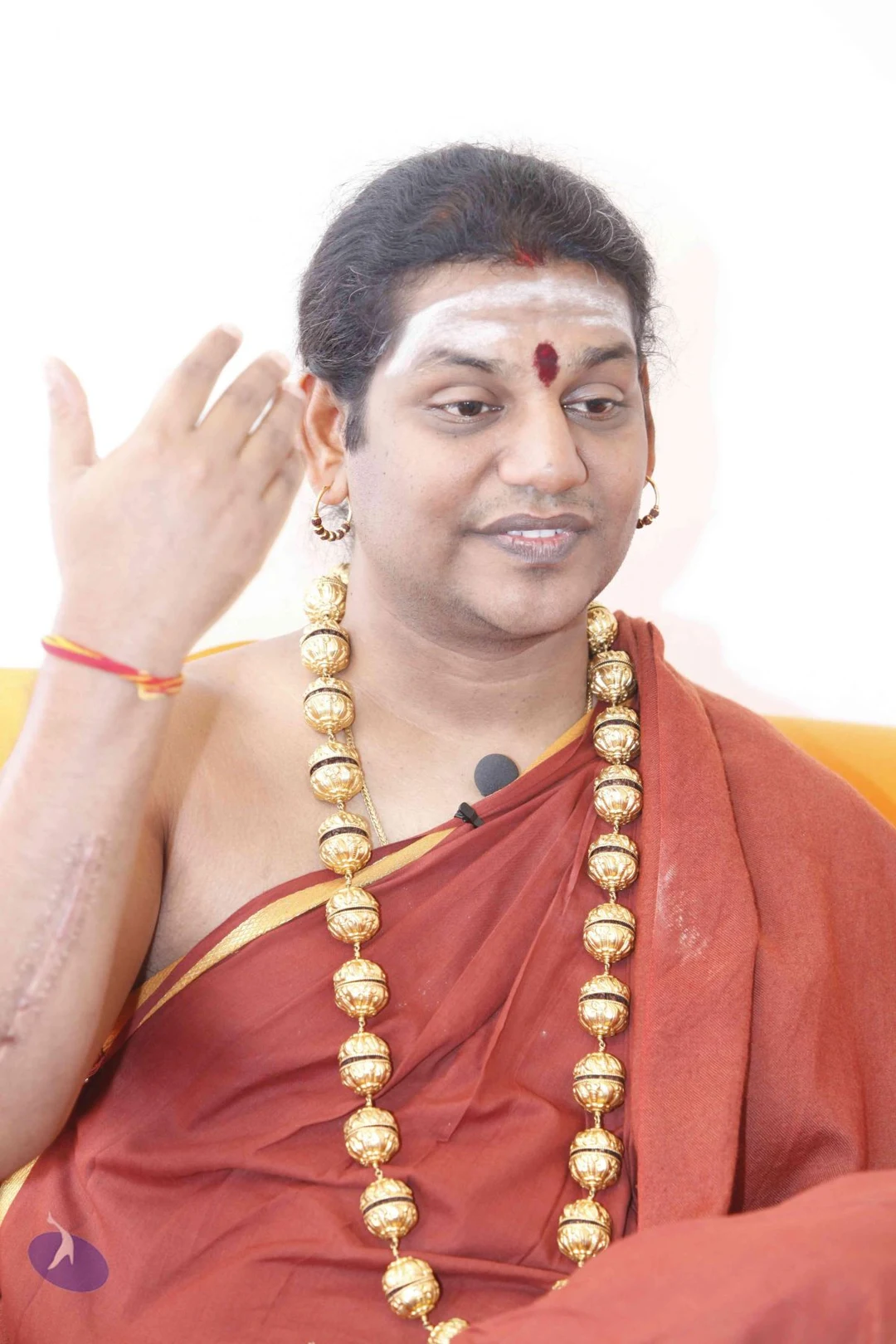
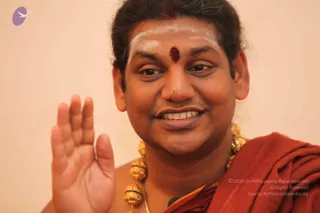
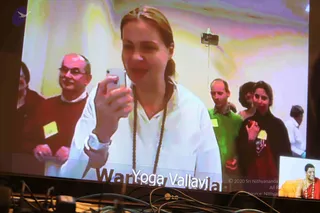
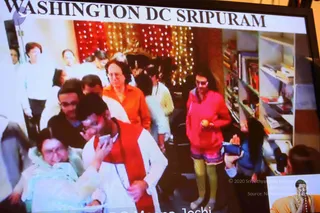
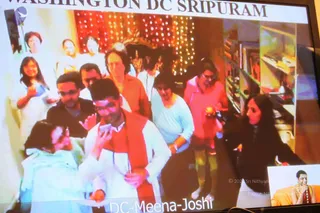
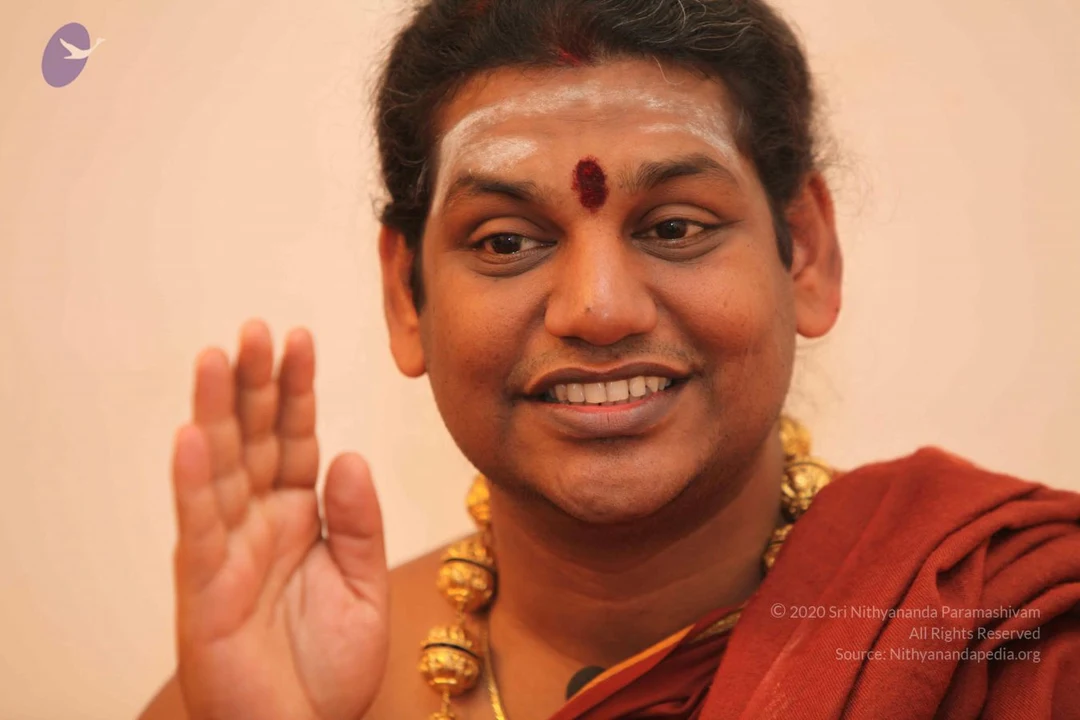
Close-up photo of a smiling man with short dark hair, white vertical forehead markings and a red bindi, raising one open palm toward the camera. He wears a rust-red saffron shawl over the shoulder and a heavy gold beaded necklace with large gold bead pendants. Plain cream background. Appearance cues include ceremonial gold necklace and saffron shawl, consistent with a person addressing an audience.A photograph taken of a screen showing a live video feed. Two people stand close together in a bright, plain white corridor with a ceiling light. On the left, a smiling woman with dark hair pulled back wears a white jacket and a wristwatch, holding up a silver smartphone. On the right, a man with short dark hair wears a white hooded sweatshirt with stylised red-and-orange eyes and the words Jai Maa printed in red script. A faint third person is partly visible at the far left edge. A small logo appears in the top left corner of the screen.Photograph of a large projection screen at an event, showing a live video link. A woman with hair pulled back wears a white top and a long beaded necklace, holding a smartphone up as she speaks. Behind her, several smiling people in casual clothes, including a man in a red sweater and a man in a green top, stand in a room with pale yellow walls. A lower-third caption labels the woman. In the bottom right corner of the screen, a small inset shows a man with a white beard, orange-and-saffron clothing and a rudraksha-style necklace, but the inset is too small to confirm identity. Cables lie on a table in the foreground.A photograph of a large screen showing a live video feed labelled "WASHINGTON DC SRIPURAM" in the banner at top. Inside the feed, a crowd of devotees gathers in a room with string lights and a red and gold backdrop. A woman in an orange top stands near the centre, a man in a red jacket and shorts holds an orange fruit, and a man in a red and white garment holds a mobile phone. A woman in pale green sits in the lower left. Shelves of books line the right side. In the bottom right corner of the screen, a small inset shows a figure in saffron with a rudraksha mala, but the figure is too small to assess further. A caption at bottom reads "DC Meena Joshi".A photograph of a large screen showing a live video link from a group in Washington DC Sripuram. The screen label reads "WASHINGTON DC SRIPURAM" and a caption at bottom reads "DC-Meena-Joshi". A crowd of devotees stands in a warmly lit room with string lights and a shrine behind them. A man in the foreground wears a white kurta with a red-orange shawl and sunglasses, and holds a small orange fruit; a woman in a light blue top and others in pink and white clothing also hold fruit. A small inset at the lower right shows a woman in orange and red clothing with a mala, the speaker feed of the satsang. The screen shows people on the video link, which are not counted as physical people here.A photograph of a large projection screen showing a video link from a devotee gathering labelled "DC-Meena-Joshi" with a title banner reading "...ON DC SRIPURAM" at the top. Inside the link, a group of about a dozen people stands in a home room with a backdrop of red fabric and string lights. In the foreground a man in a white kurta with a red shawl and a mala holds a phone, a woman in pale green holds a phone to her face, and a man in a black jacket gestures. Behind them a woman in a light blue top and a woman in black with a camera stand near a bookshelf, and a man in an orange shirt and a woman in yellow appear behind. In the lower right corner, a small inset shows a woman seated in an orange chair, and a copyright line is printed on the screen.

PADAPUJA

2 photosSource gallery
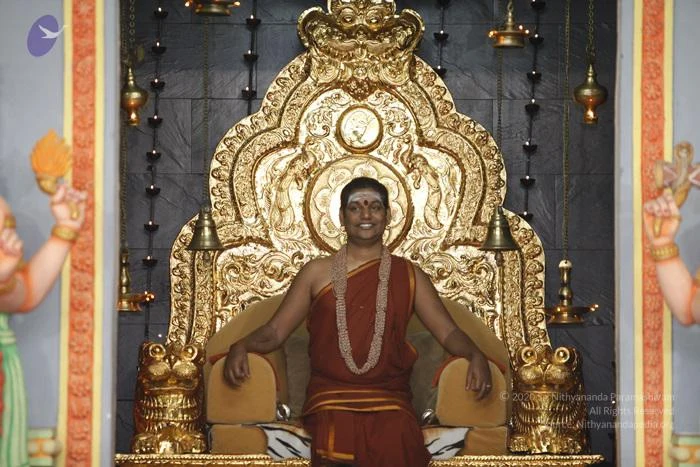
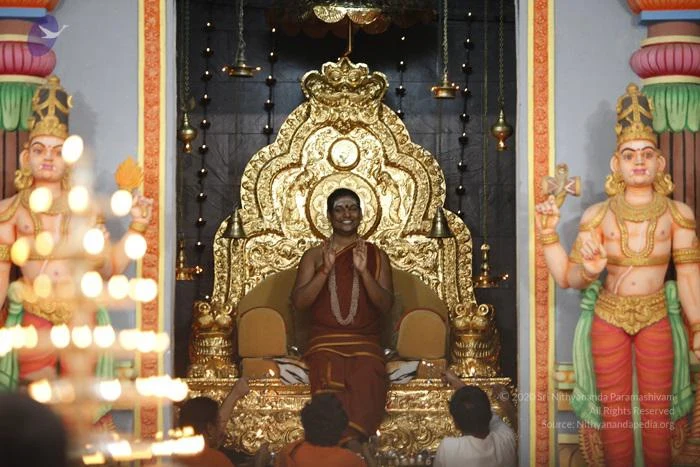
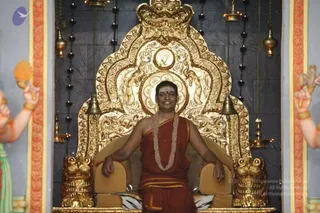
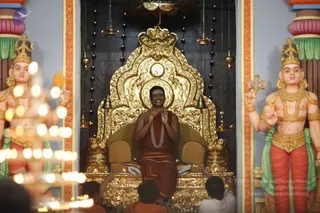
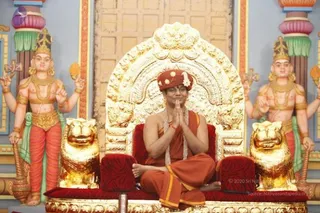
A seated man in a maroon-red robe with a matching sash sits on an ornate golden throne with carved lion-headed armrests and a large gilded backrest. He wears a white flower garland and a red-orange tilak on his forehead, and sits with his hands resting on the armrests. Hanging brass oil lamps, bells and dark beaded strings decorate the wall behind the throne, flanked by painted pillars with colourful deity figures. a person: the figure has a shaved head, a red-orange robe and a white garland, but these cues are not distinctive enough to confirm identity, so the appearance is treated as uncertain.A seated man in a golden ornate throne with a carved gold arch and hanging brass lamps sits centrally with palms pressed together in greeting, wearing a rust-orange robe and a white mala necklace. Two large painted deity guardian statues flank the throne, one with raised hands and gold jewellery, the other in green and gold garments. Lit oil lamps blur in the foreground, and several seated devotees with their backs to the camera face the throne. The setting resembles a temple hall with pink and blue painted pillars.

NITHYA-SATSANG

8 photosSource gallery
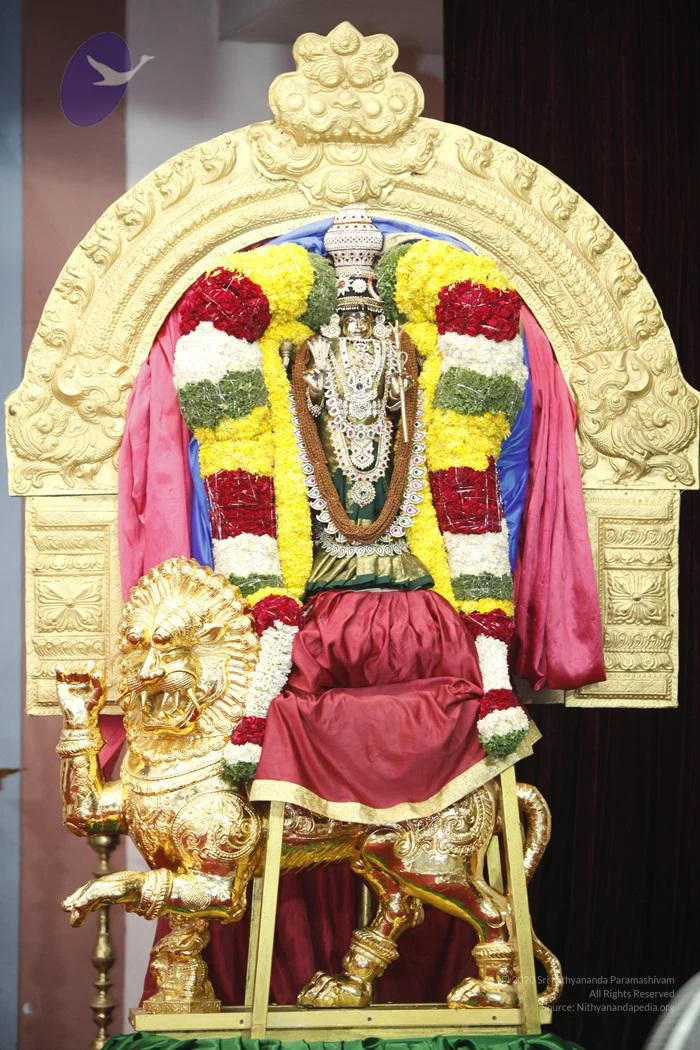
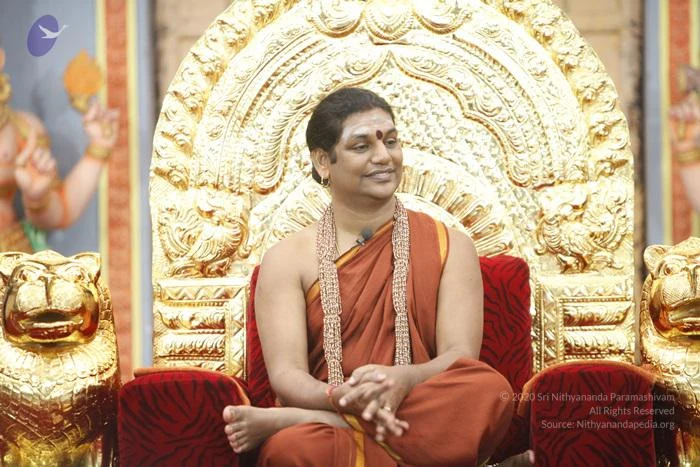
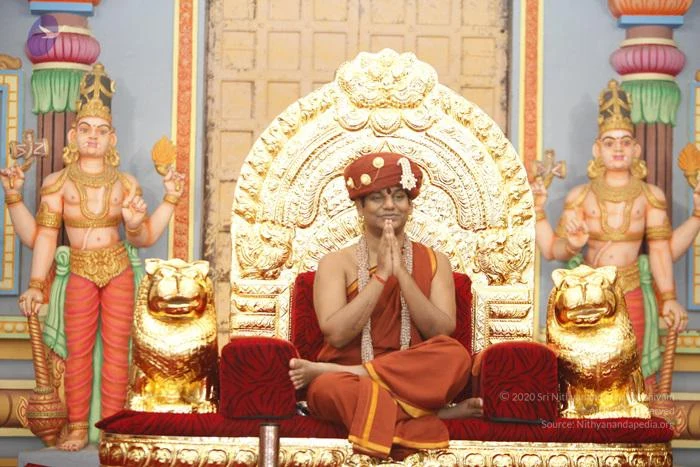
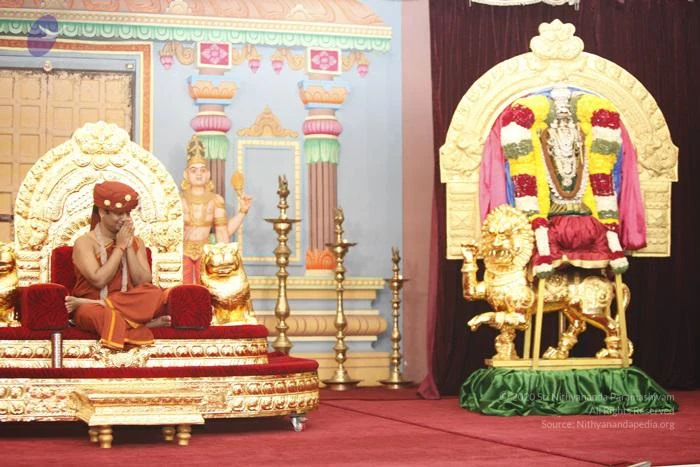
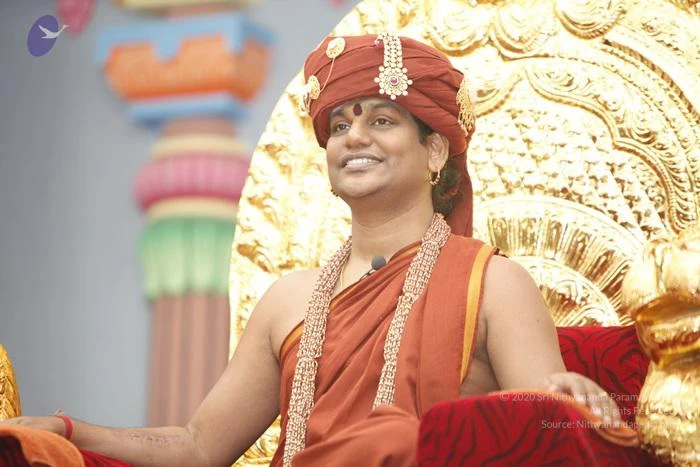
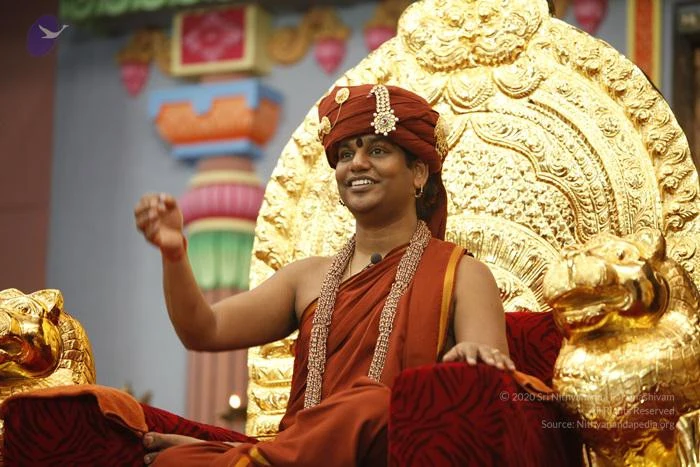
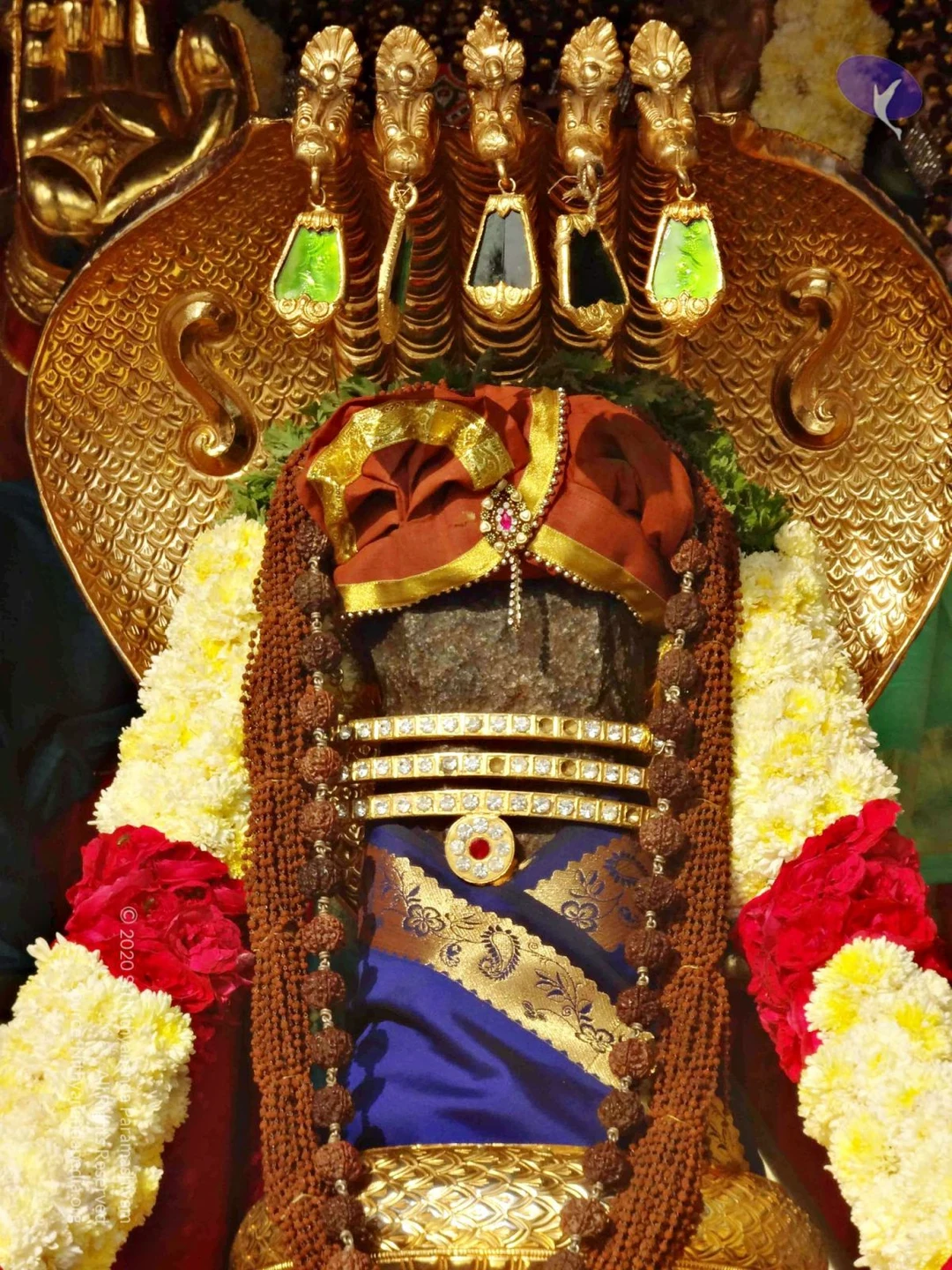
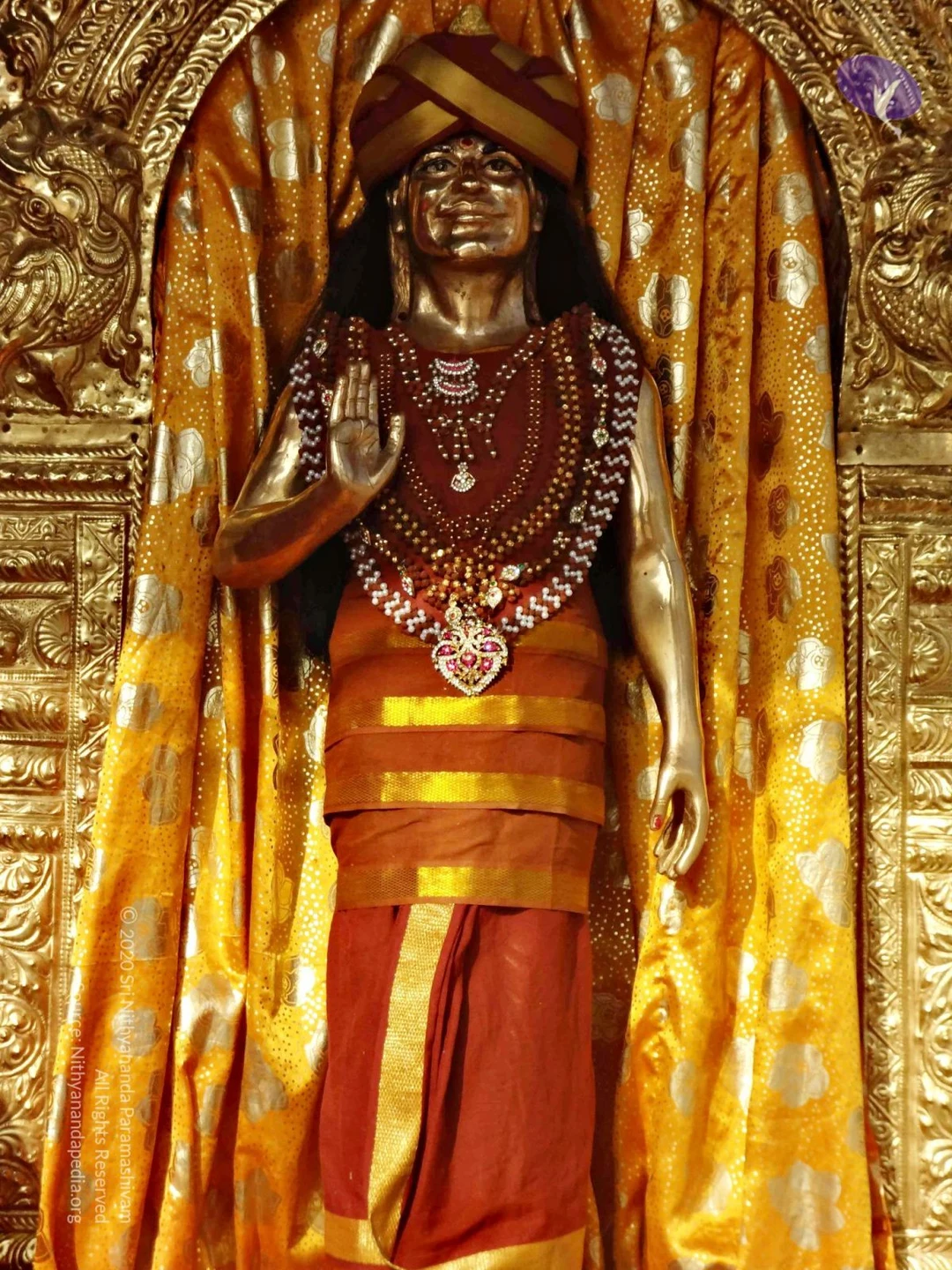
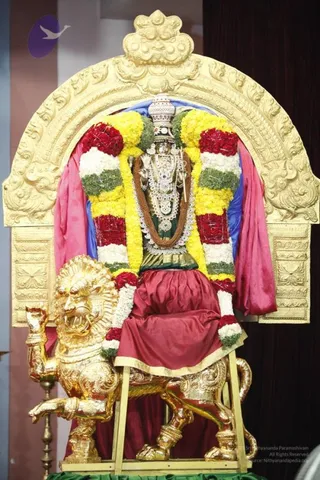
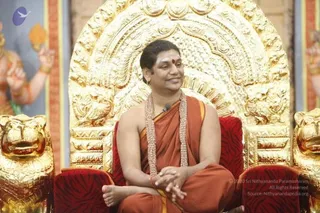
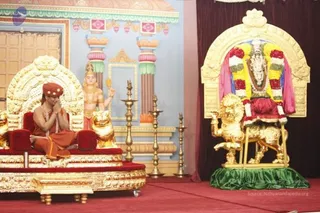
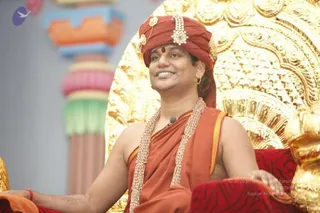
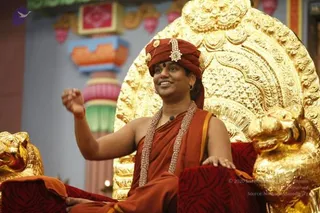
A decorated deity murti of a standing figure with a tall ornate crown, multiple ornate necklaces and a rudraksha-style mala, set in a gilded arched shrine niche. Red, yellow, white and green garlands drape over the figure's shoulders and sides. Below sits a golden lion-form throne with a red cloth draped over its seat. A gold lamp stand stands at the left. Pink and blue fabric backs the niche. No people are visible in the image, so the scene is a photograph of a worship display.A photograph of a seated man in saffron-orange robes on an ornate gold throne with carved lion-shaped armrests and red velvet cushions. He wears a rudraksha mala and a long ceremonial gold-toned necklace, a red bindi on his forehead, and sits cross-legged with his hands folded and bare feet visible, smiling. A small microphone is clipped to his robe. Behind him a painted deity figure with raised hands is partly visible on a decorated wall. A printed and . Matching the page's a person cues (ornate saffron clothing, rudraksha mala, gold necklace), this is a person seated in a satsang settingA seated man in saffron robes and a red-and-gold turban sits cross-legged on an ornate golden throne with red cushions, hands joined in namaste. Two golden lion figures flank the throne base. Behind him, two painted deity murtis with multiple arms stand on either side in orange and red dhoti-style garments with gold jewellery, holding staffs and ritual objects against a richly decorated temple wall. The man wears a white garland and a bead mala, with a visible crown-like turban and saffron robes.A seated figure in an orange saffron robe and a red turban sits on a gold and red throne with hands pressed together in namaste, on a red carpeted dais. A standing golden deity figure with a mirror-like object in hand stands in the painted background beside brass oil lamps. To the right, a golden arched shrine holds a deity murti draped in red and pink cloth and decorated with red and white flower garlands, with a golden lion-shaped mount in front.A seated man in saffron-orange clothing sits on a red cushioned throne before an elaborate gold-leaf backdrop. He wears an orange turban with a gold jewelled ornament and a red bindi, with long gold-and-pearl necklaces and gold earrings. His bare right shoulder is draped in an orange shawl, and he smiles while raising his hands in an open gesture toward the audience. A small microphone is clipped to his chest. Behind him, pink, green and white painted pillars are visible on the left. Swamiji (probable): the visible cues are the saffron turban, ornate gold jewellery, rudraksha-style necklaces and throne seating, consistent with a satsang discourse setting.A seated speaker in a saffron-orange dhoti and matching shawl sits on a red cushioned throne with an ornate gold carved backrest and gold lion-shaped armrests. He wears a red-orange turban with a gold jewelled ornament at the front, a long pearl-and-gold necklace, and gold earrings. His right hand is raised mid-gesture while he smiles toward the audience. Behind him, a colourful painted pillar in red, green and pink stands in a temple-style hall. The figure appears to be Swamiji (probable), identified by the saffron clothing, turban and ceremonial gold necklace, seated in a discourse setting.

DARSHAN

6 photosSource gallery
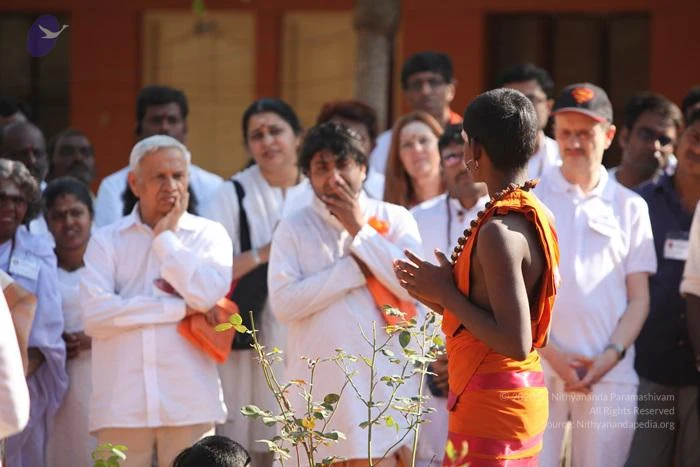
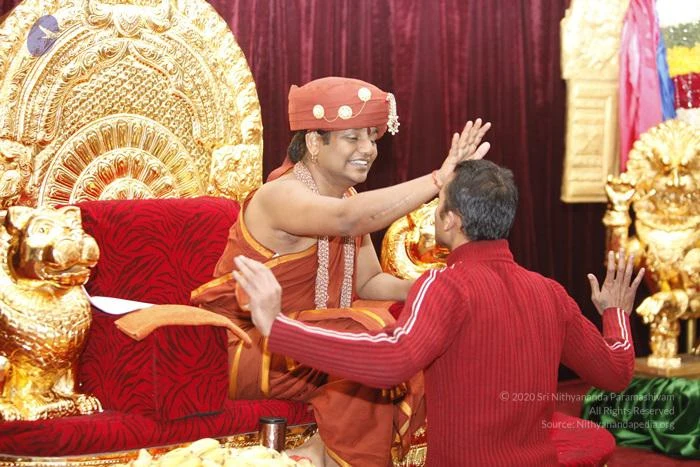
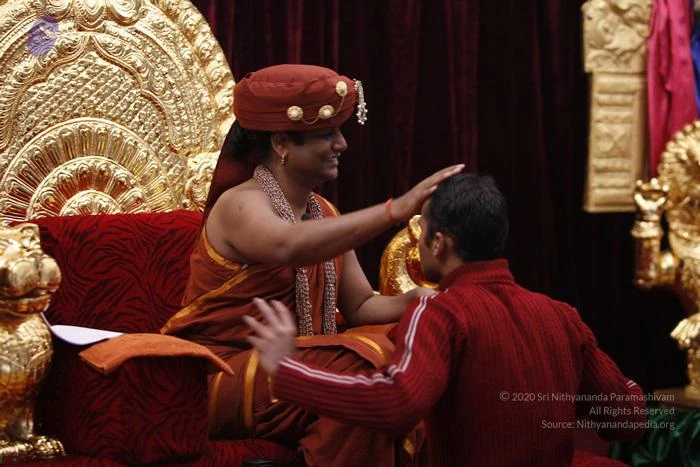
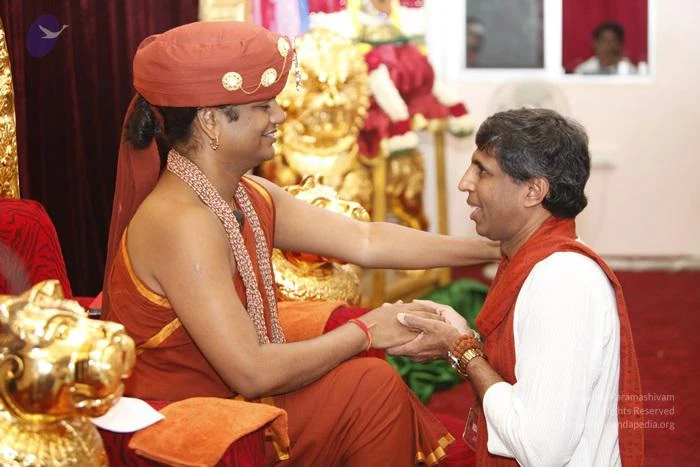
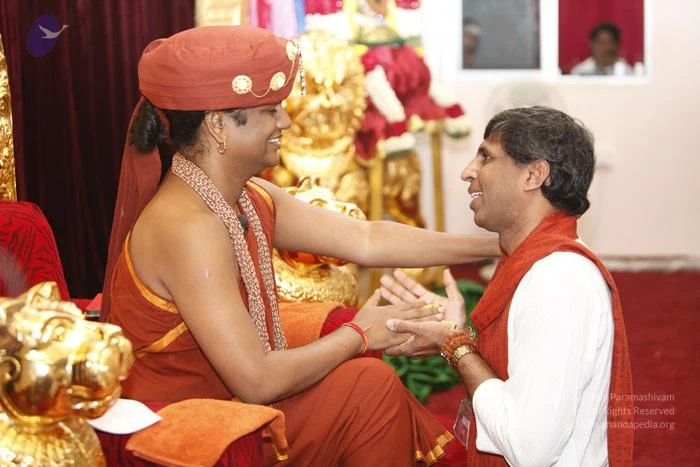
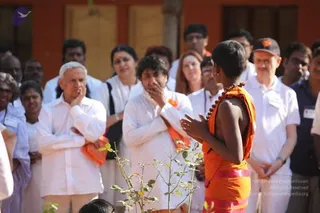
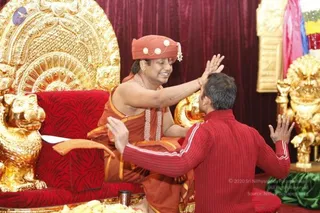
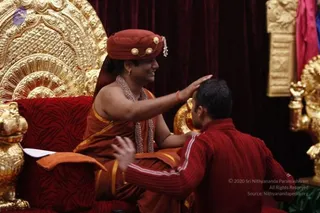
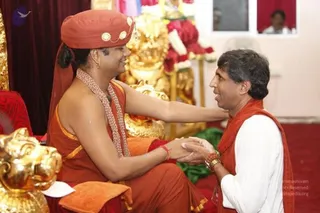
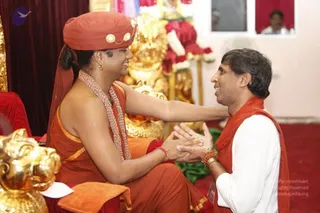
A photograph of a outdoor gathering with a crowd of devotees dressed mostly in white, with some wearing orange shawls. In the foreground, a sannyasi with a shaved head wears an orange robe and rudraksha beads, with hands pressed together in anjali, facing the crowd near a small leafy plant. Several people in white stand in the background, some with hands near their faces, and a red-orange building wall is visible behind them.A single red rose in bloom on a green stem with narrow serrated leaves, some beaded with water droplets. The blurred background shows soft brown and orange tones. No people are visible; the image is a close-up nature photograph of the flower.A photograph of a man in saffron-orange robes and an orange turban with white dot ornaments, wearing a beaded rudraksha-style mala and a bare-chested drape, seated on an ornate red-cushioned golden throne flanked by golden lion carvings. He smiles and places his palm on the forehead of a kneeling devotee in a red knit sweater who has his hands raised in reverence. Red drapes and gold decorative elements form the backdrop. a person is seated on the throne, appearing as a figure with the turban, saffron robes and mala cues, bestowing blessings on the devotee. Two people are visible.A photograph of a seated figure on an ornate golden throne with red velvet cushions and gold lion armrests, wearing an orange-red turban with gold studs, an orange-saffron shawl and a rudraksha mala with a gold necklace. He smiles while placing his right palm on the forehead of a kneeling man in a red zip-up sweater with white stripes, who holds his left hand out toward the throne. Dark red drapes hang in the background. Probable Swamiji (probable) is the seated figure with a crown-like turban, saffron clothing and rudraksha mala, and the kneeling man is a devotee receiving blessing. AA photograph of two people in close, warm conversation before a golden ritual backdrop with gilded deity figures and red floral decorations. On the left, a seated figure in a saffron-orange robe and matching orange-red turban with gold ornaments, a pearl-and-bead necklace, rests one hand on the other person's shoulder while holding his hands. On the right, a man in a white shirt with an orange-red shawl and a red thread on his wrist leans forward, smiling and speaking. A golden lion-like figure sits in the lower left foreground. Two people are visible in the scene.A photograph of two people in close, smiling conversation on a red-carpeted stage with gold lion-shaped decor in the foreground. A woman seated on the left wears a rust-orange head covering with gold medallions, a rust-orange robe and a beaded rudraksha-style necklace, and she extends her hand toward a man kneeling to her right. The man wears a white kurta, an orange-red shawl over his shoulders, a red thread bracelet and a wristwatch, and he holds his palms together in a respectful gesture. Golden deity murti and red floral decorations appear in the background, and a small figure sits behind a window at the top right.

Kalpaturu-Darshan

29 photosSource gallery
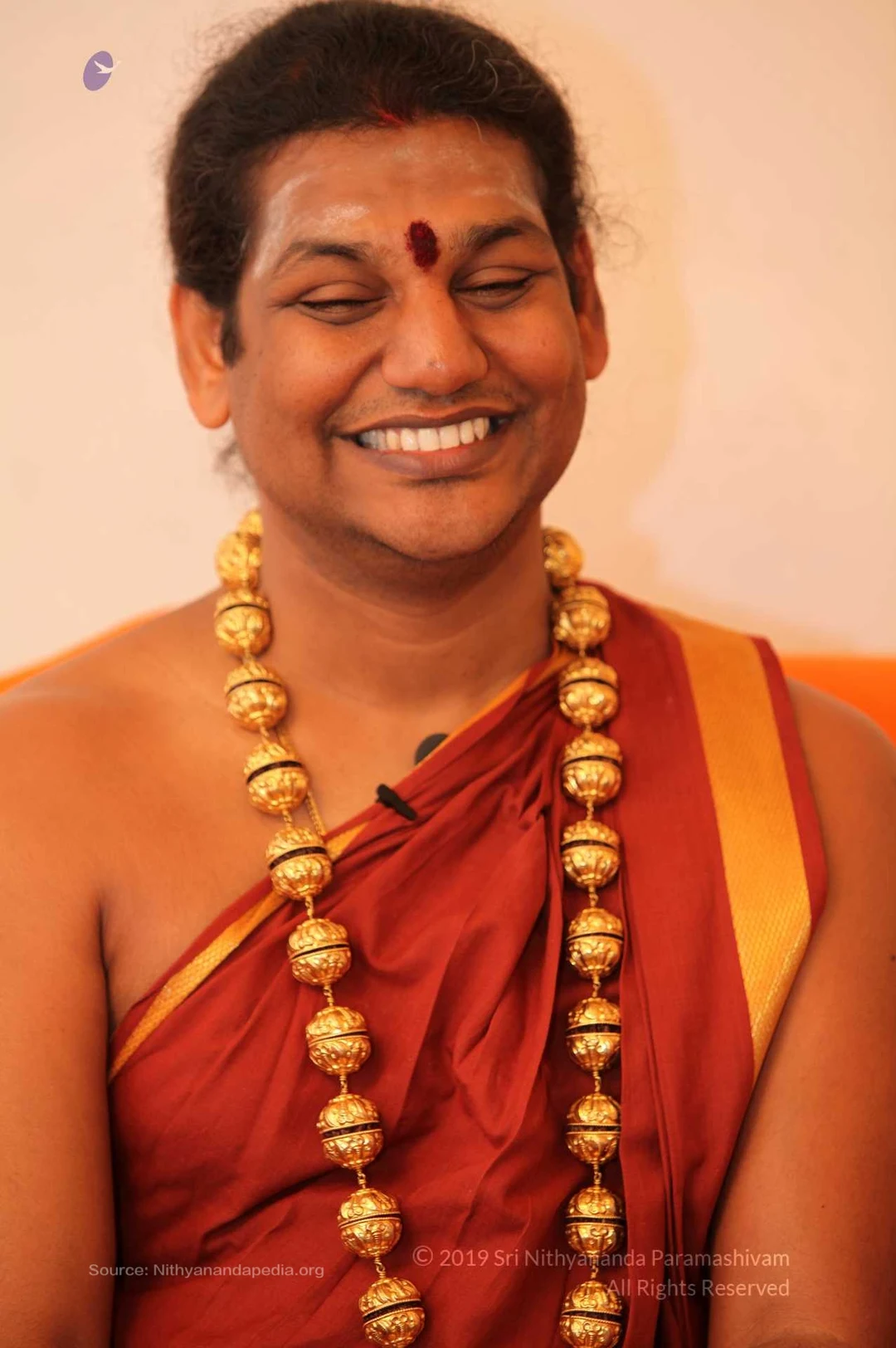
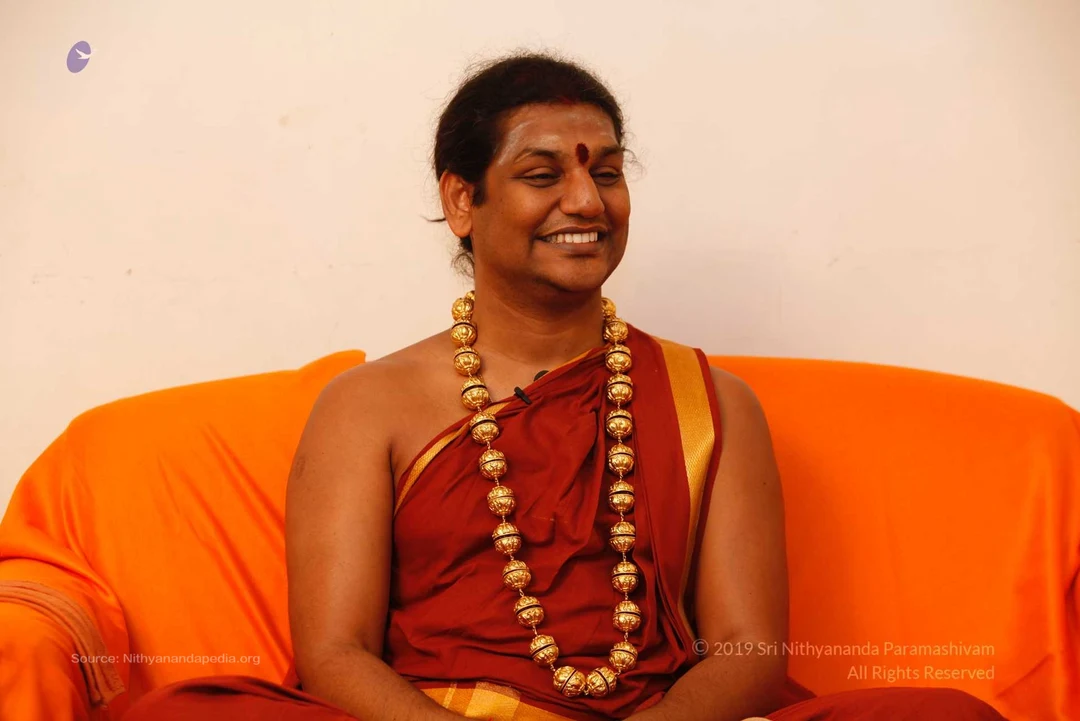
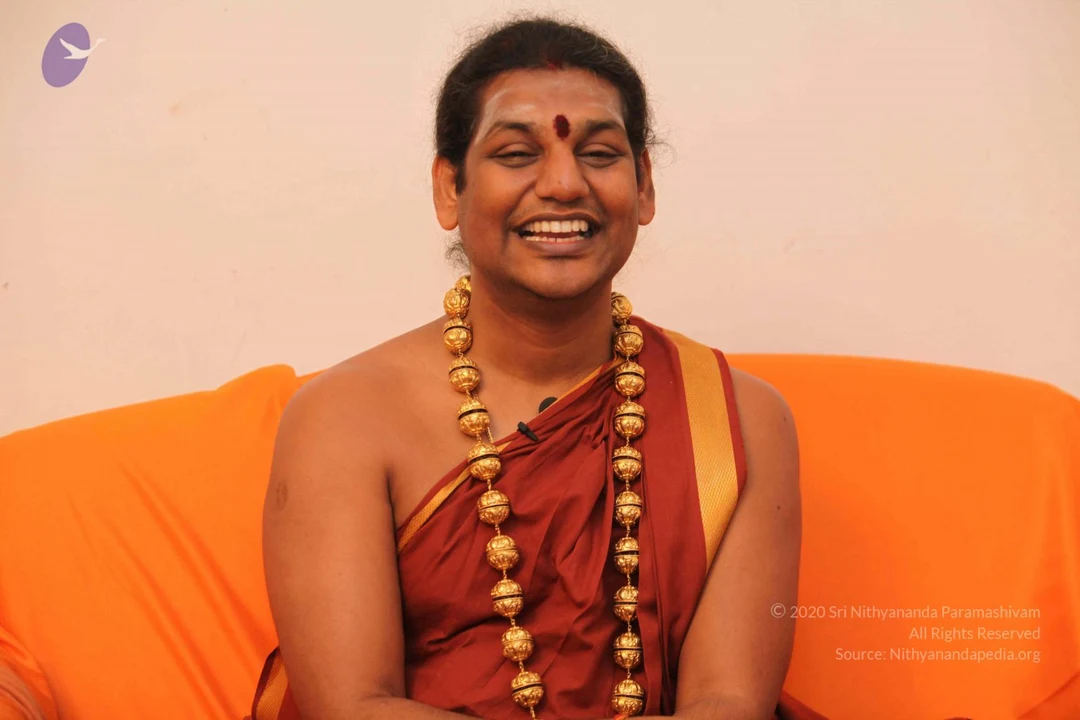
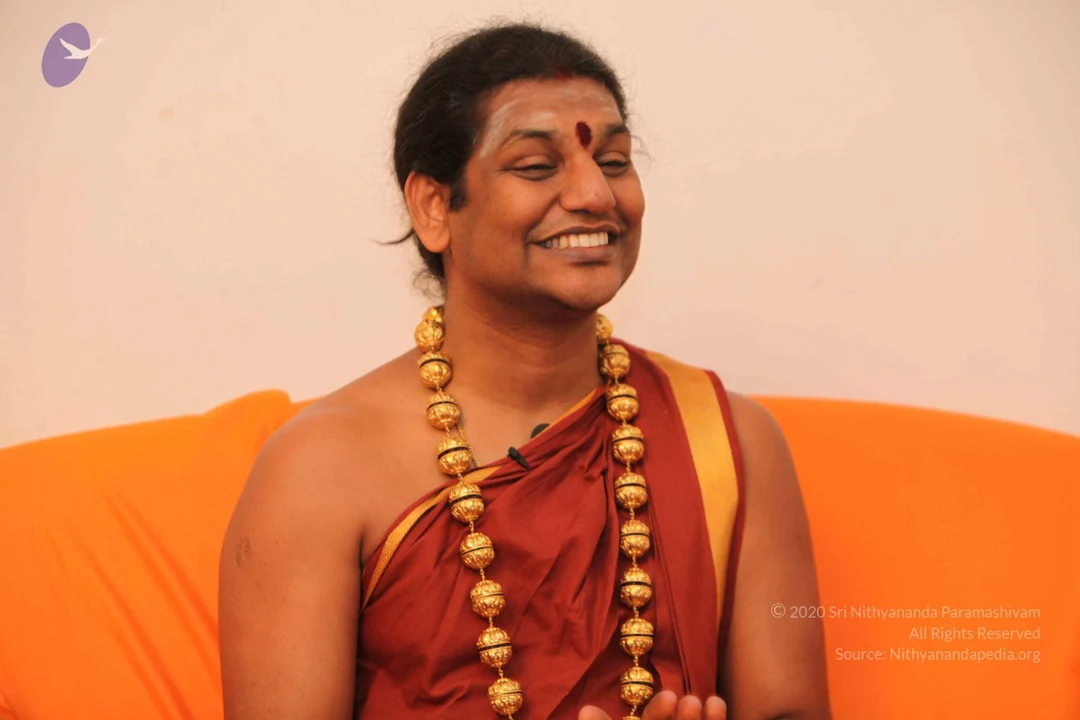
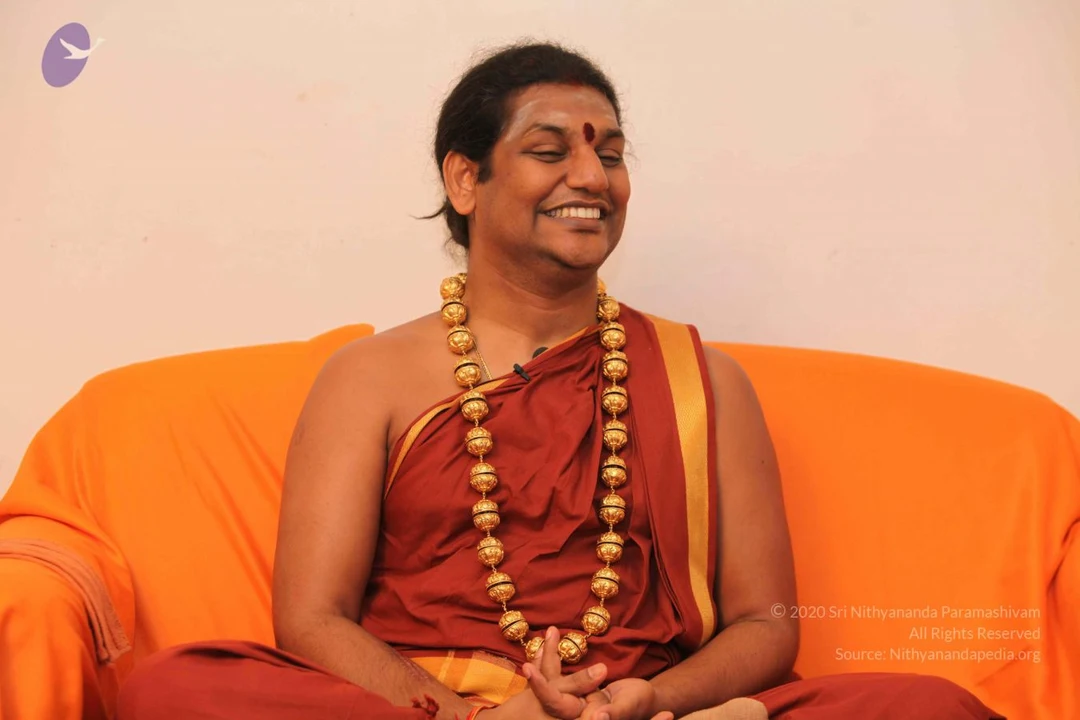
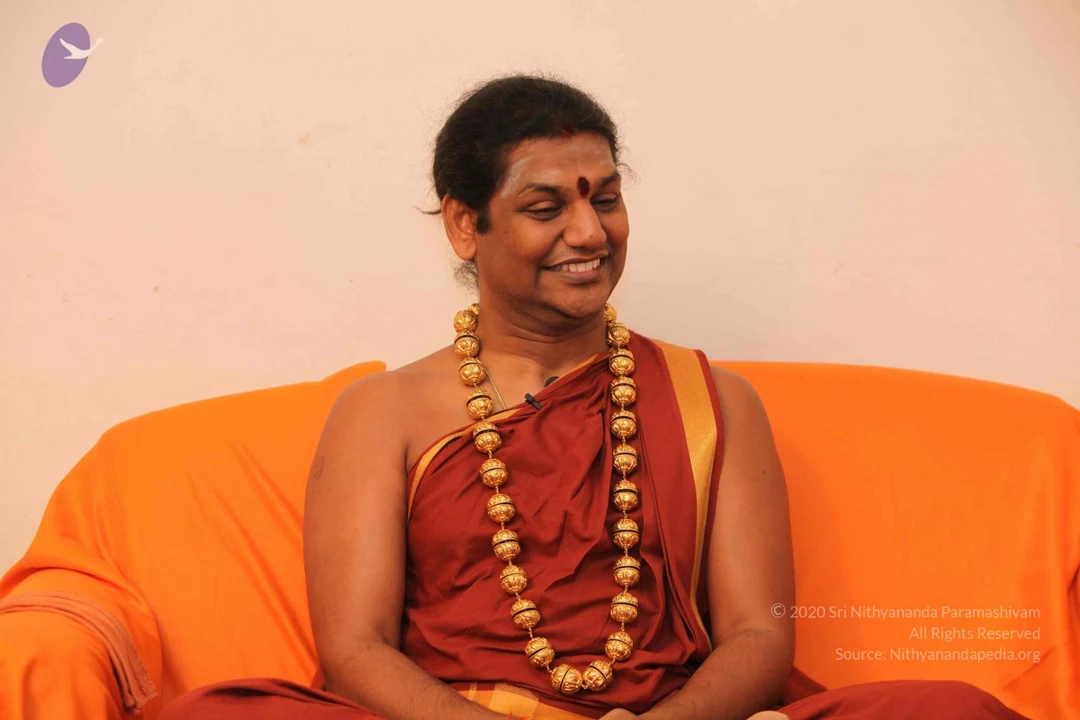
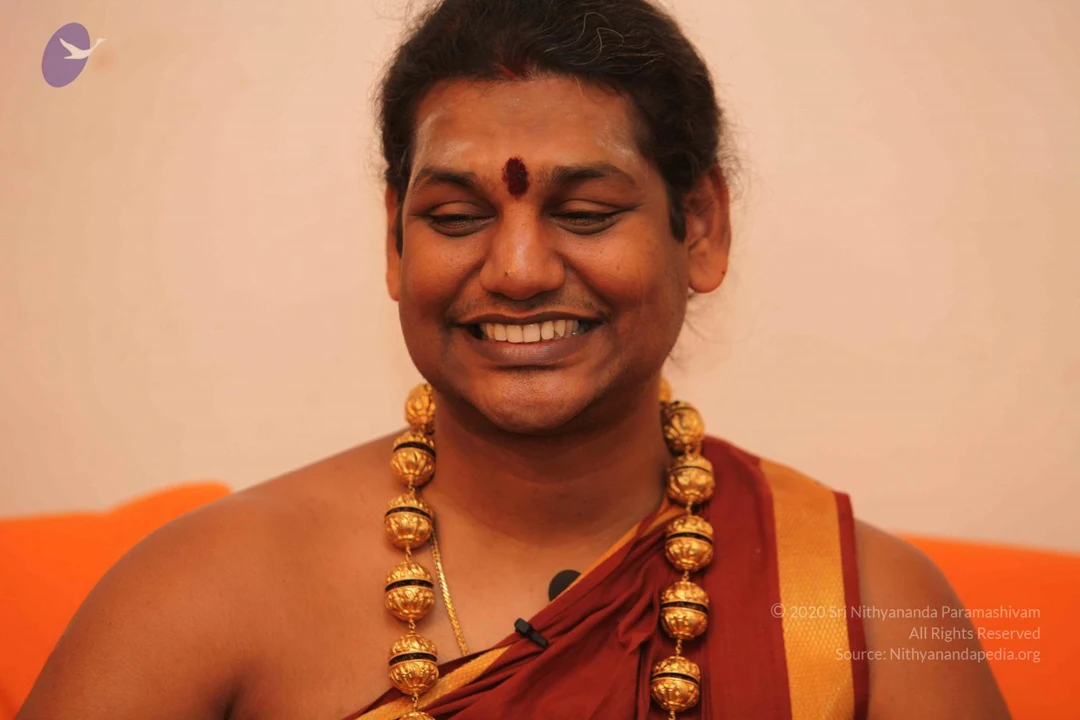
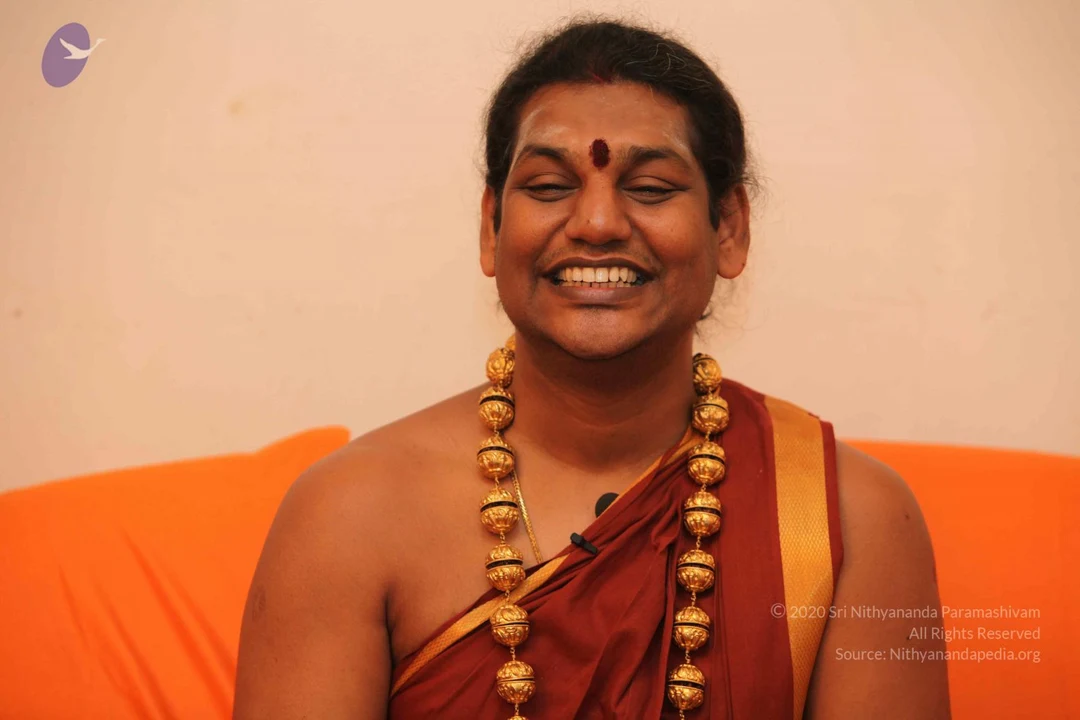
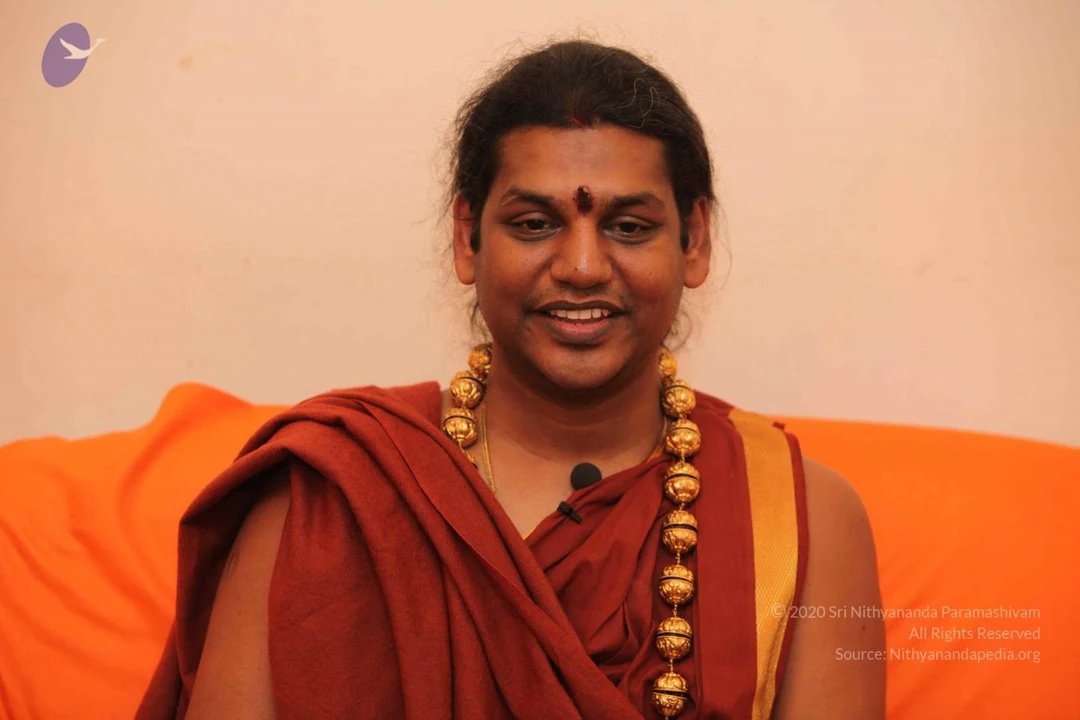
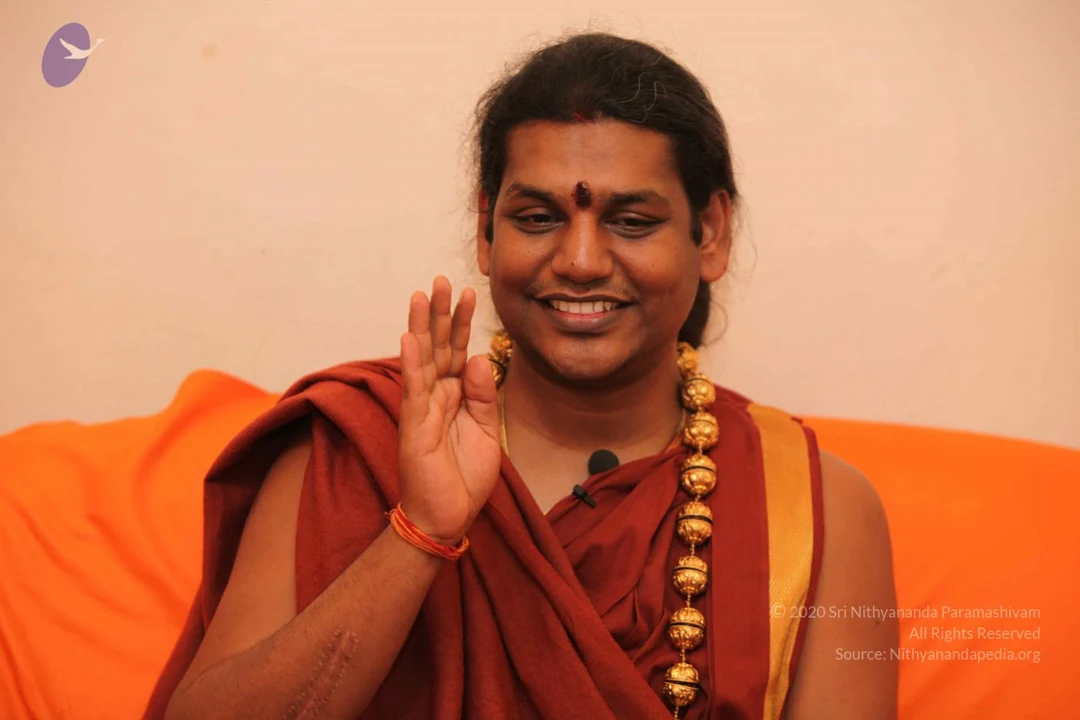
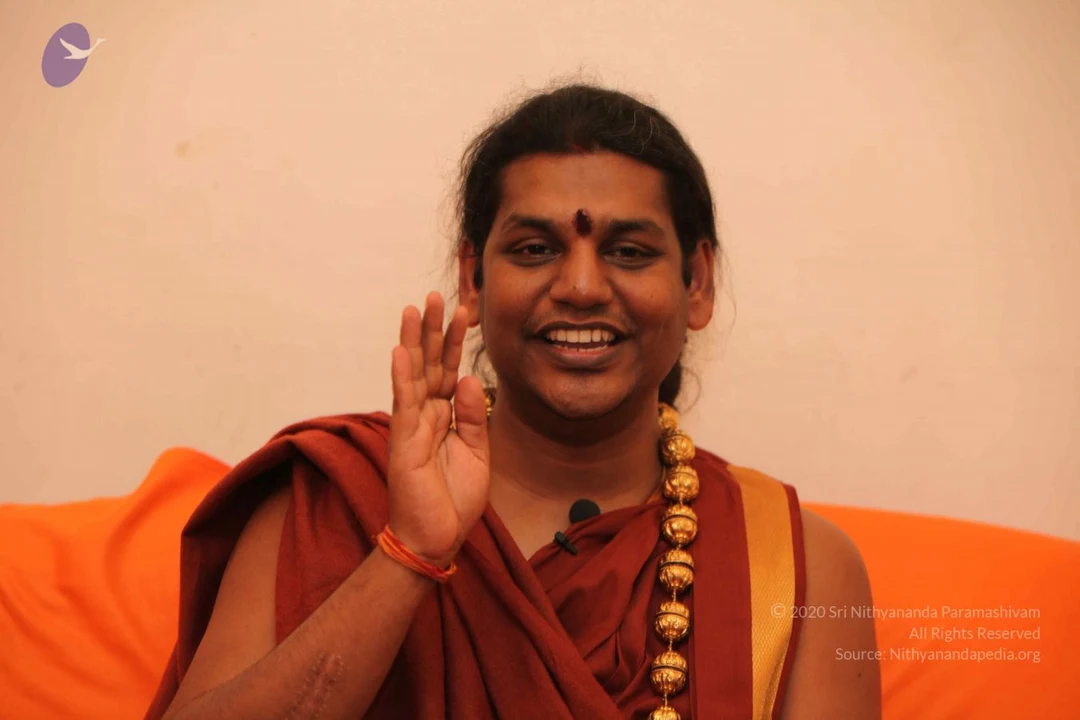
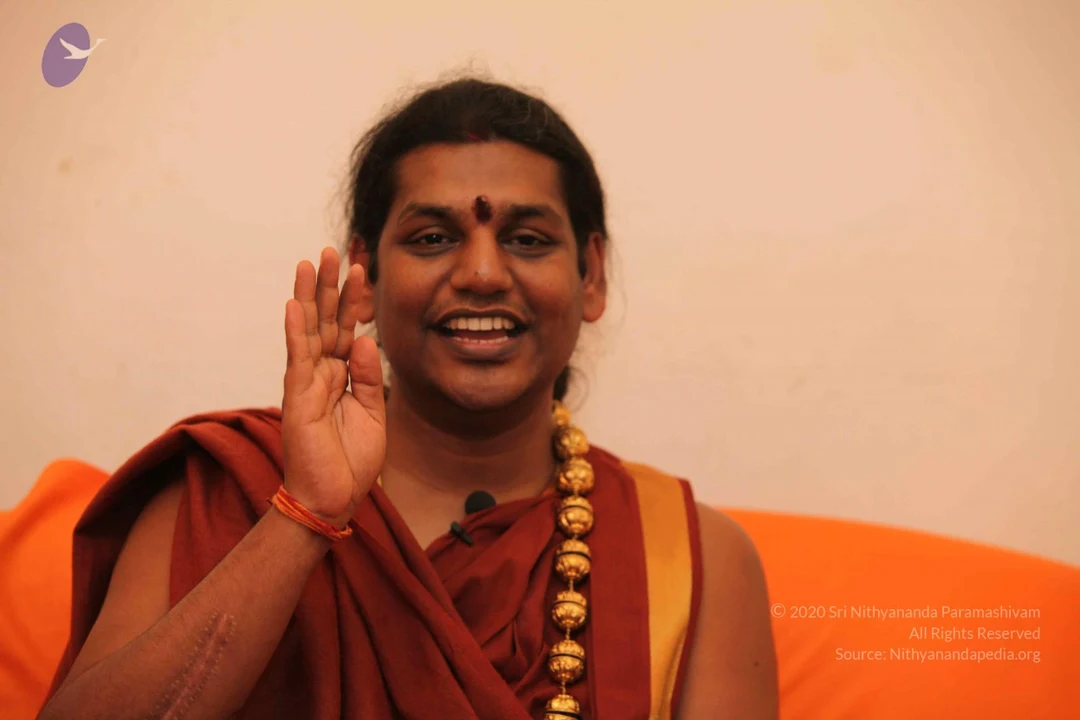
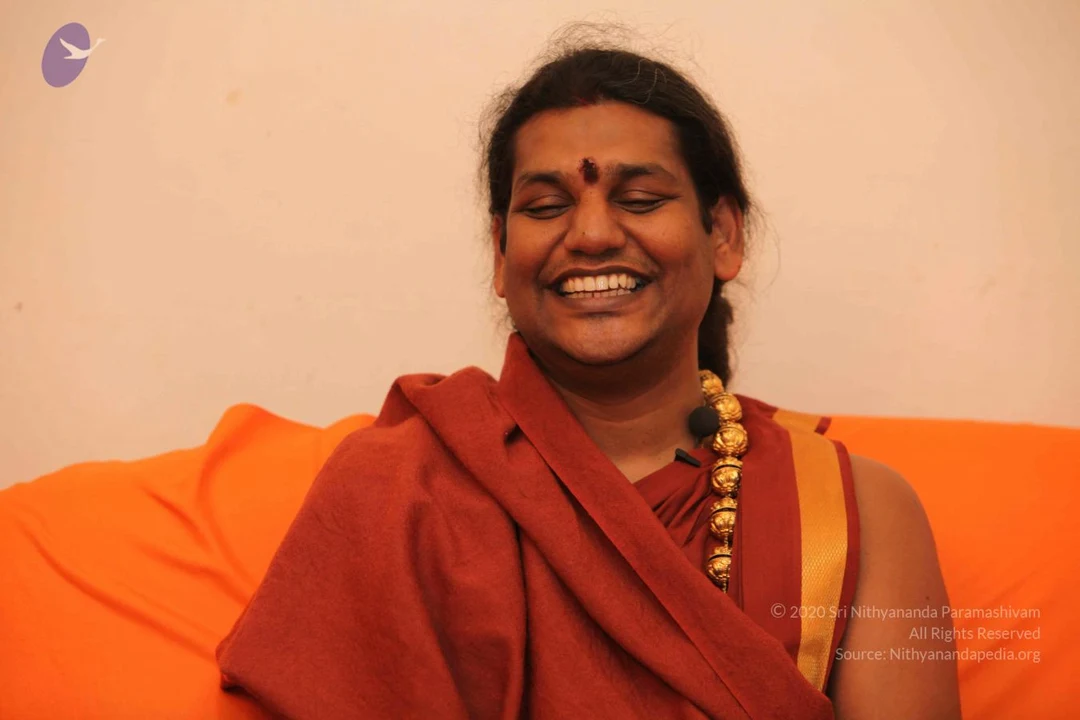
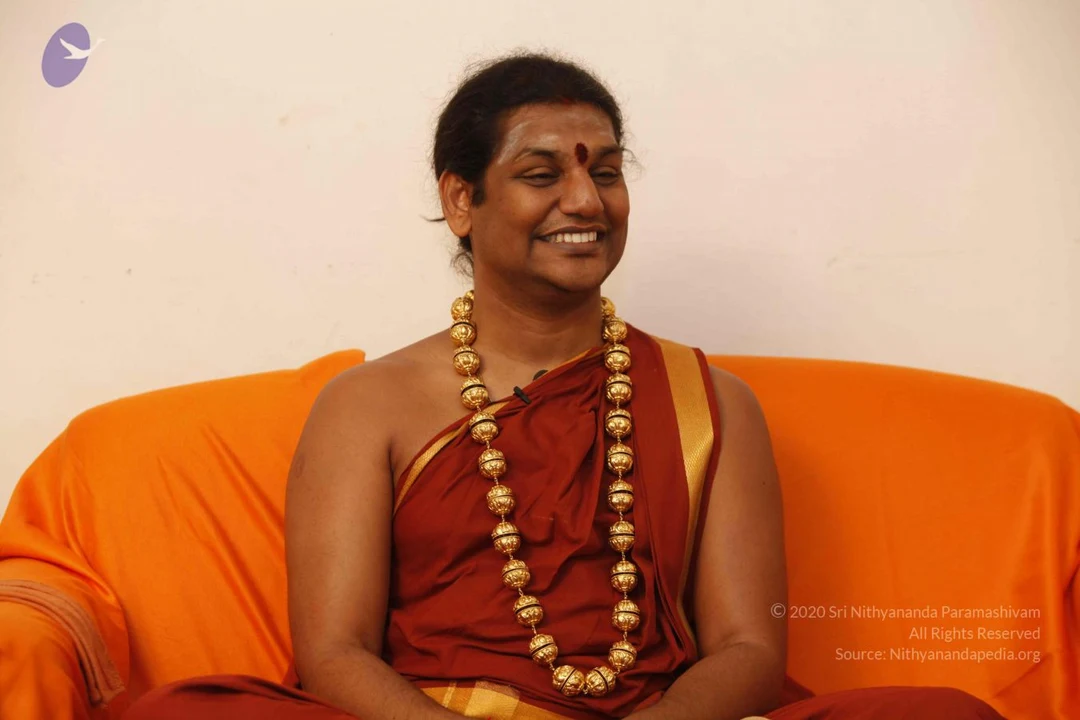
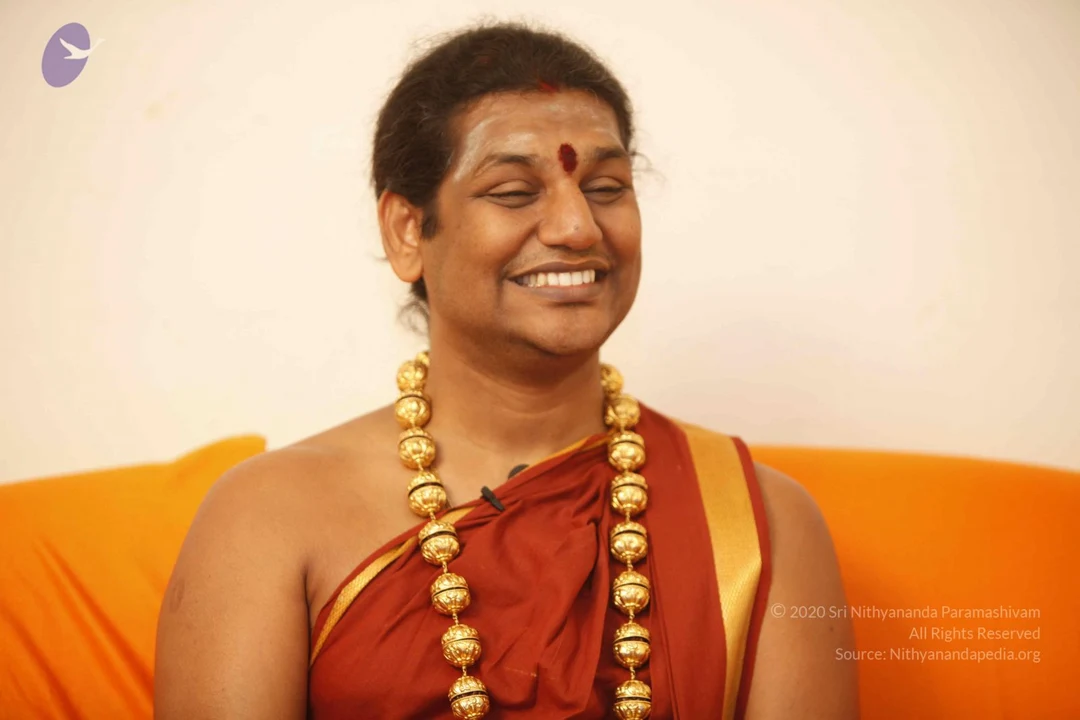
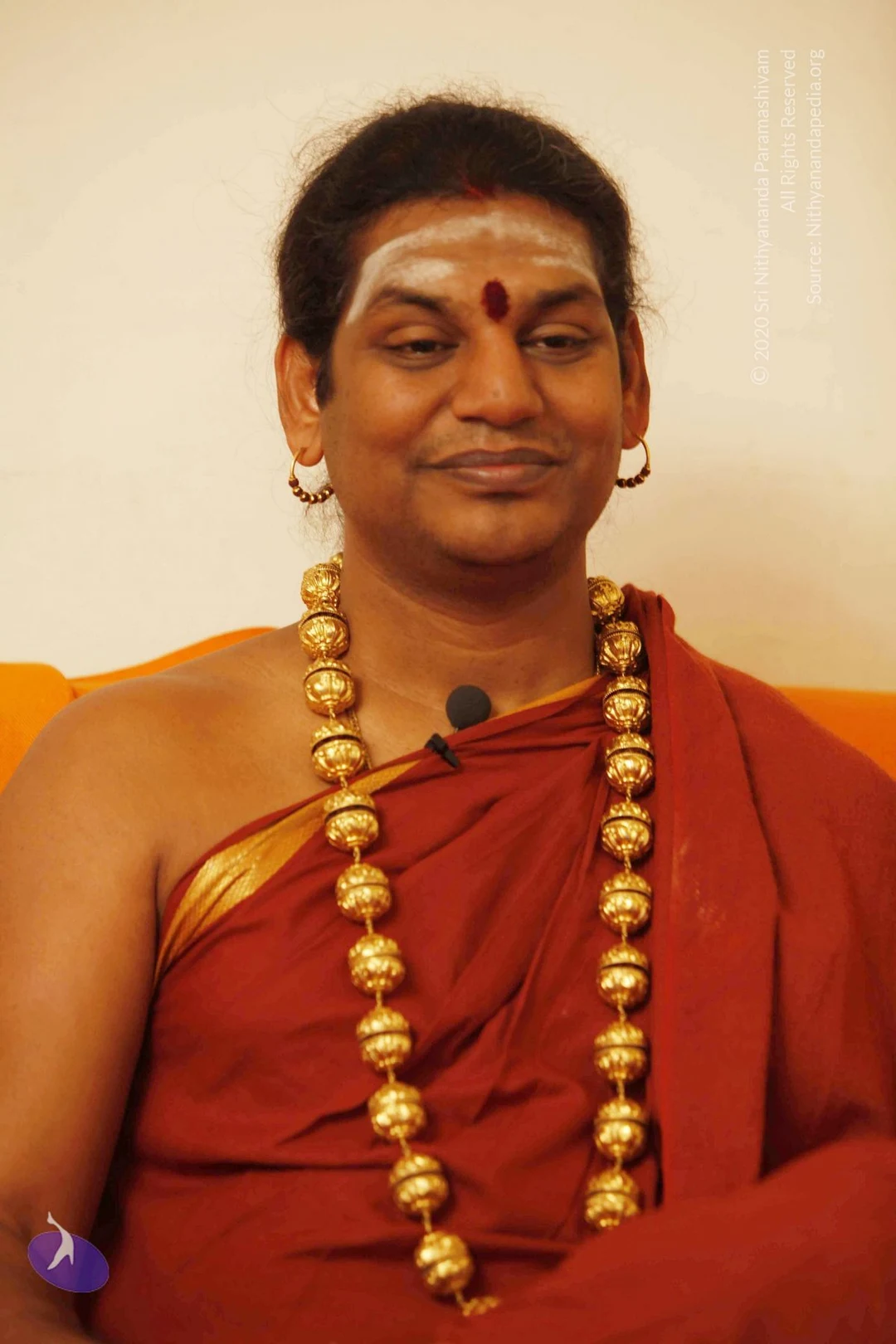
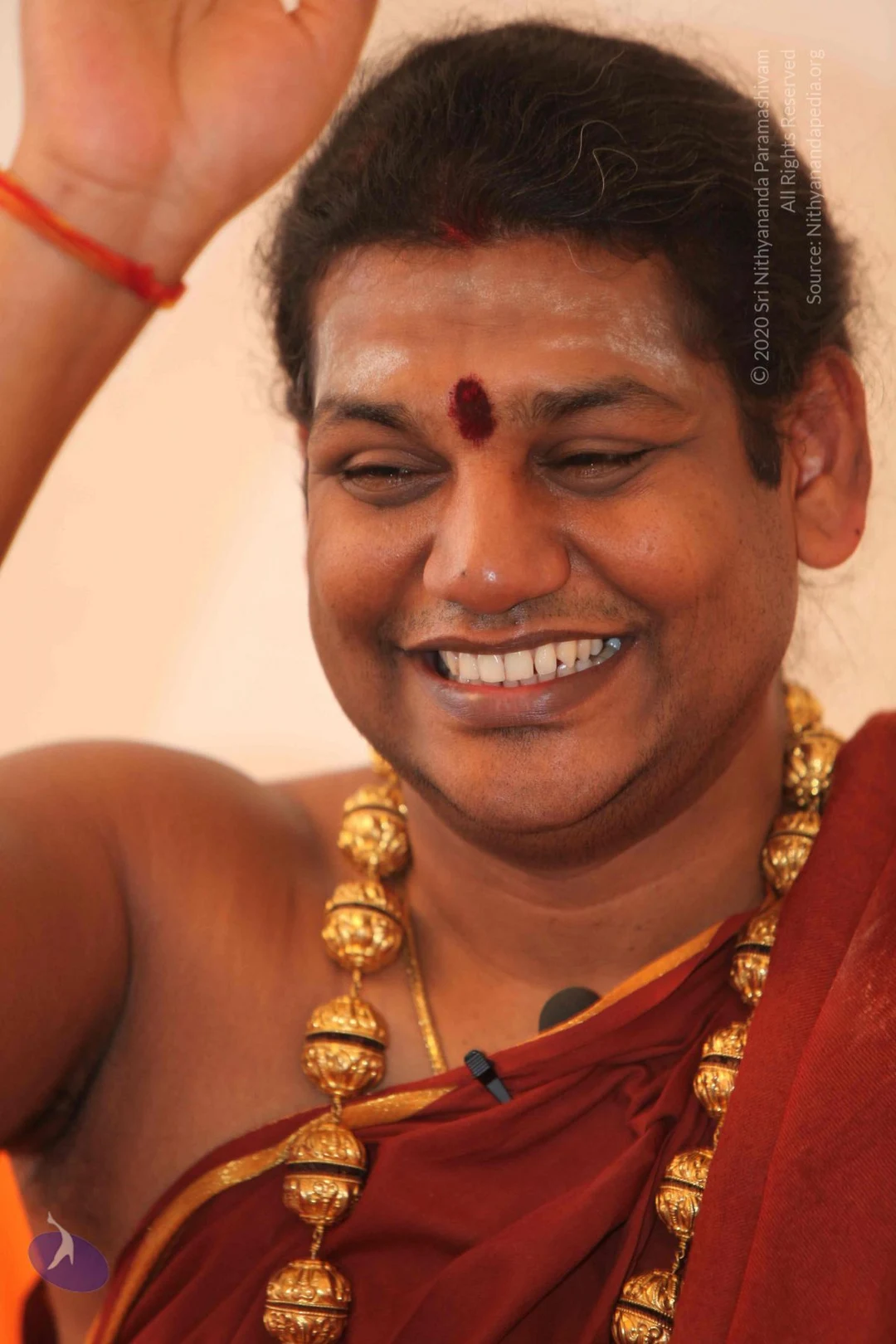
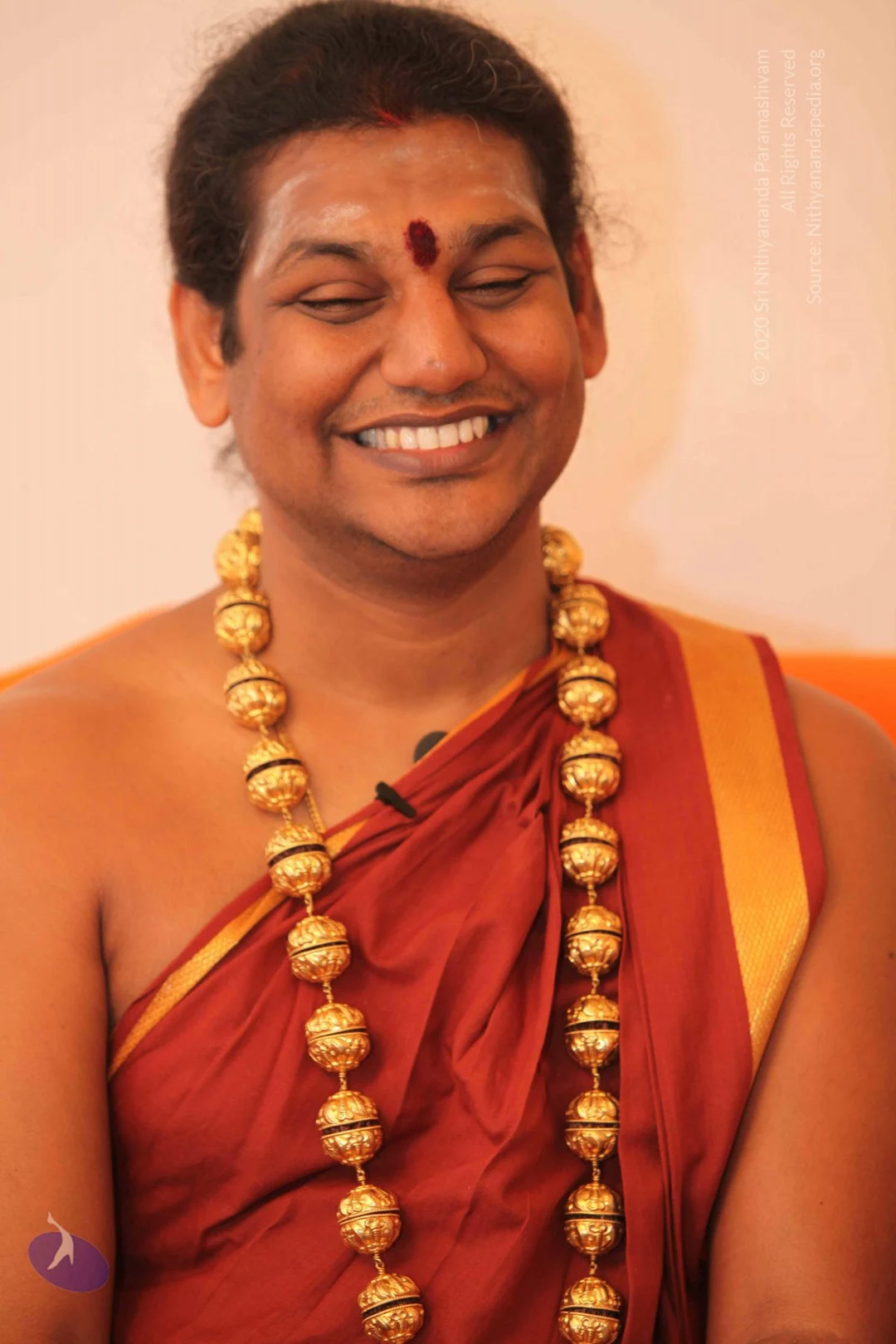
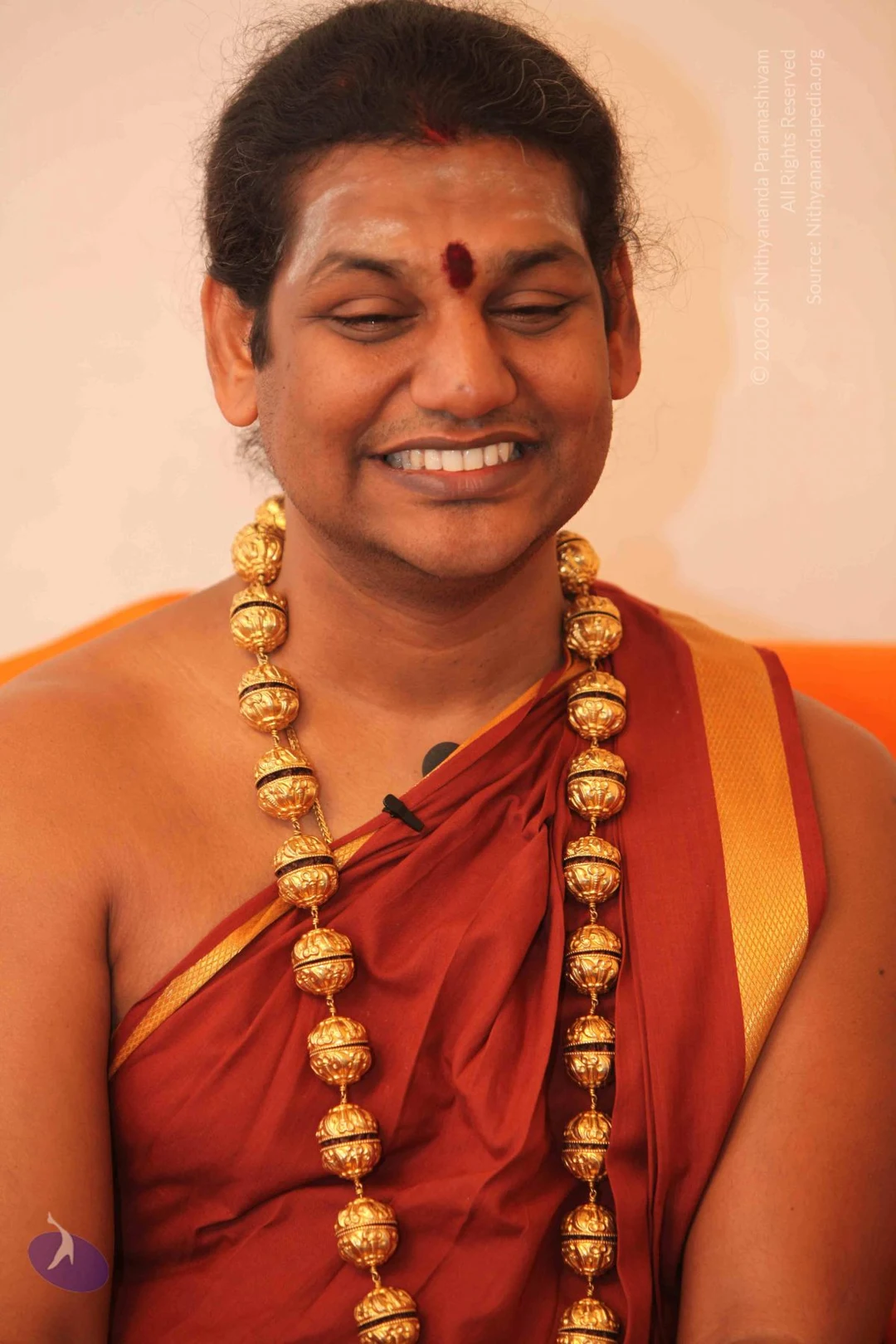
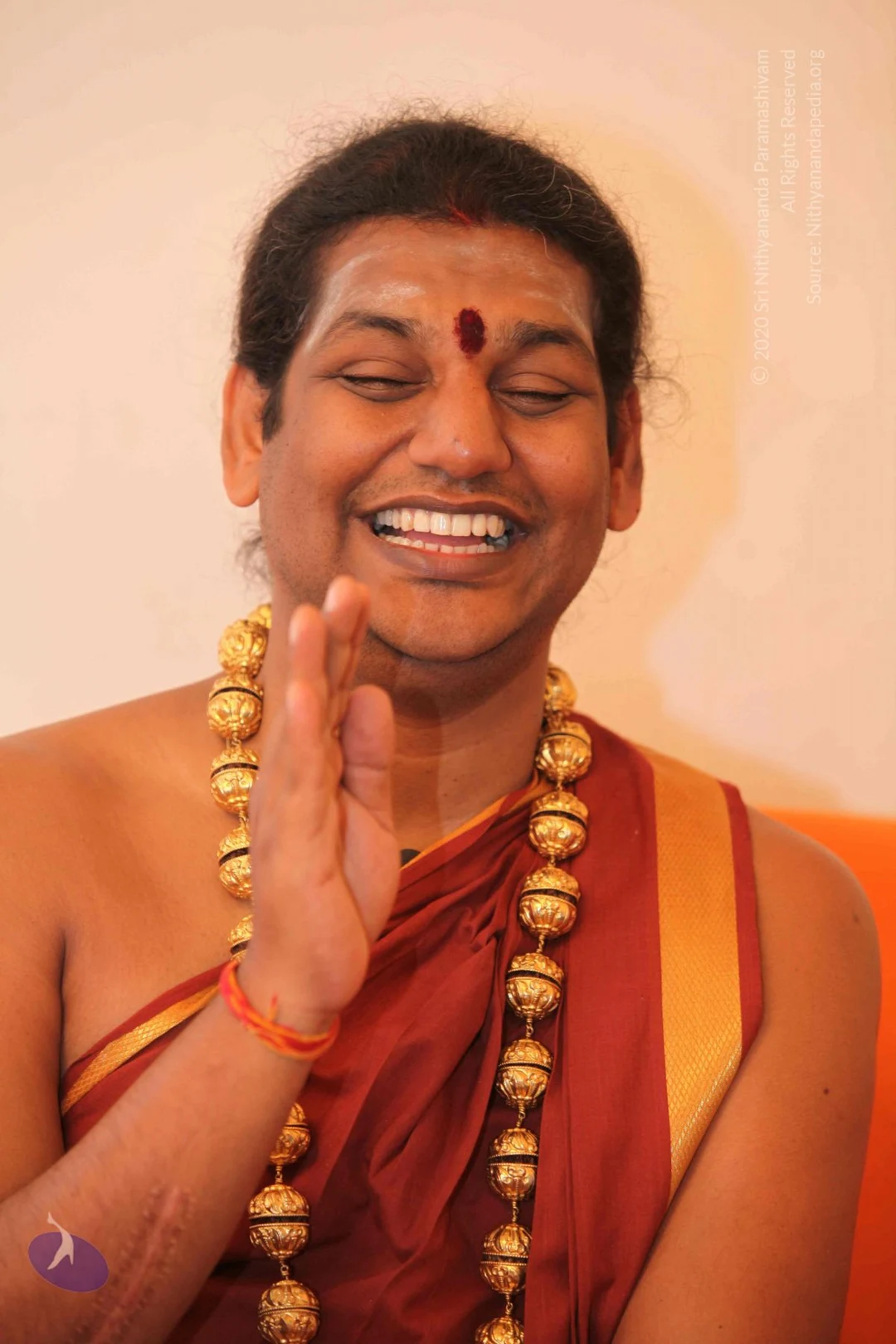
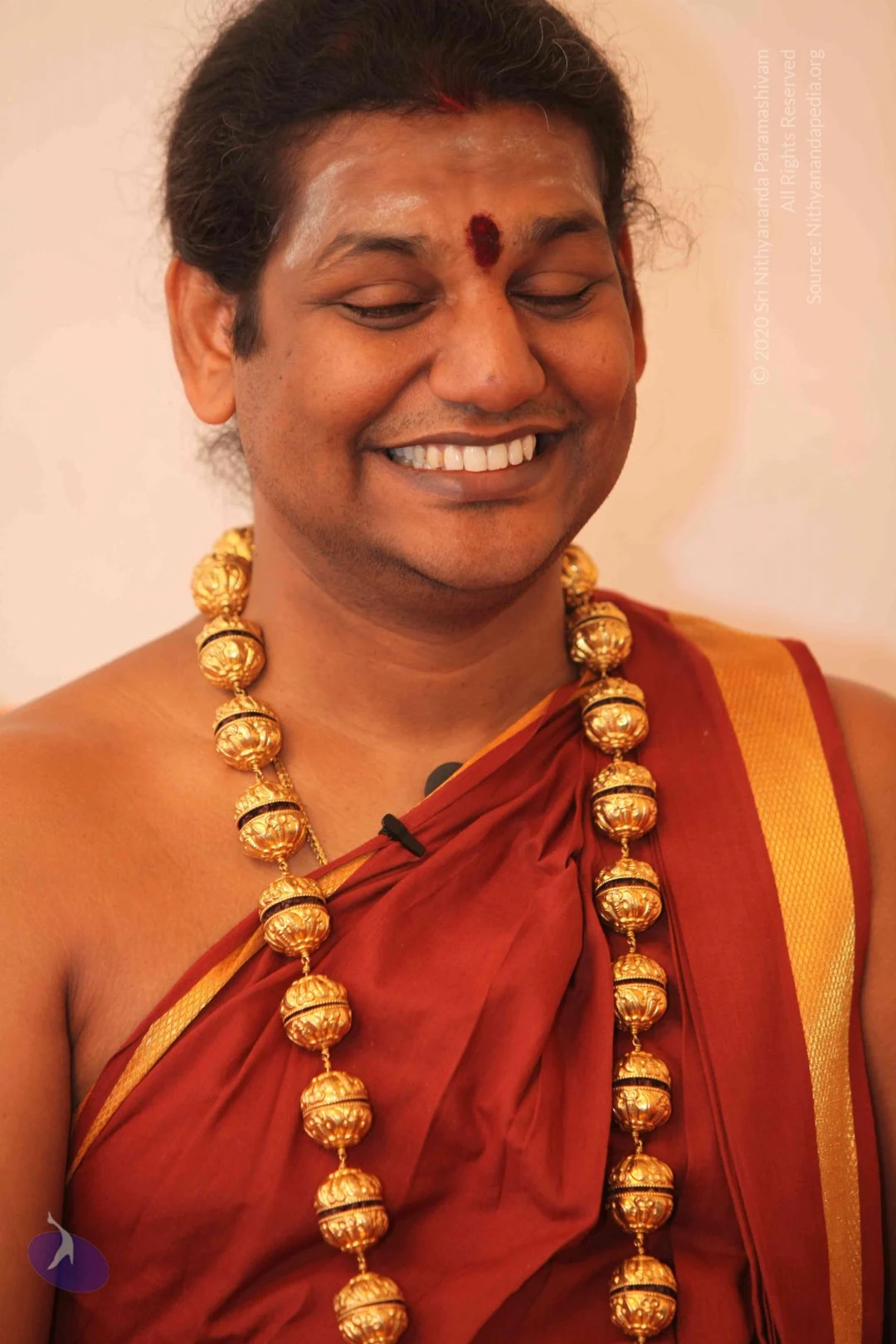
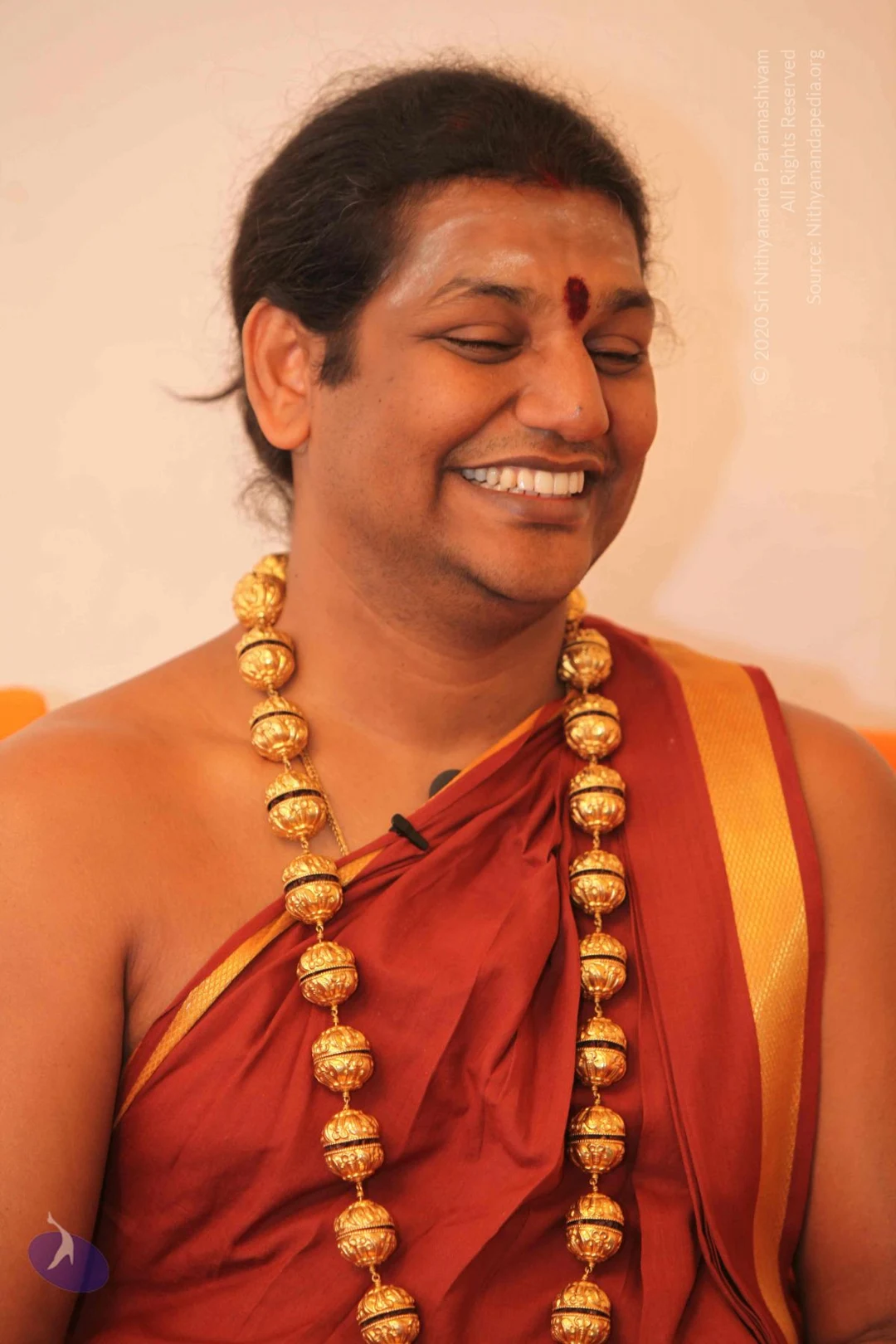
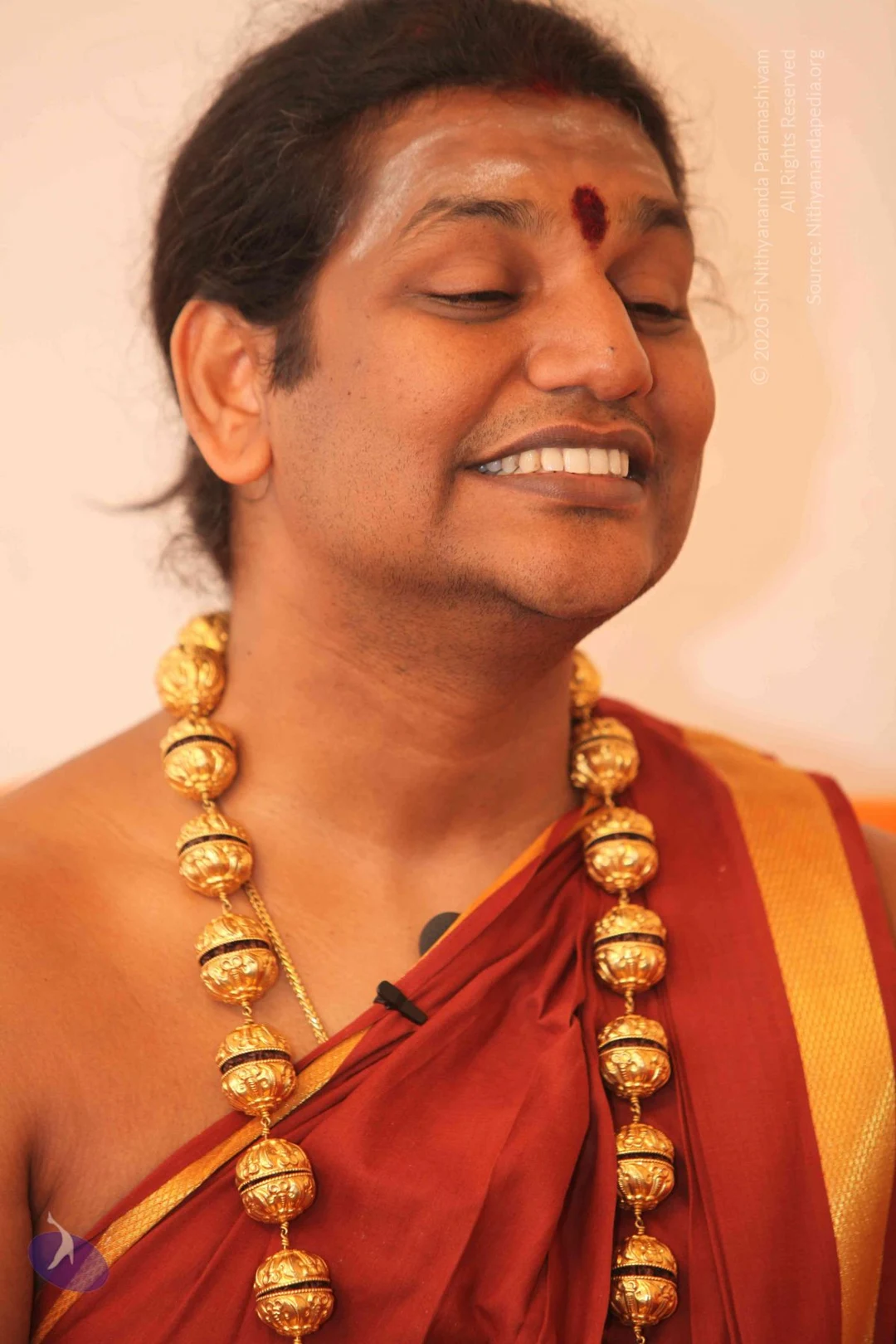
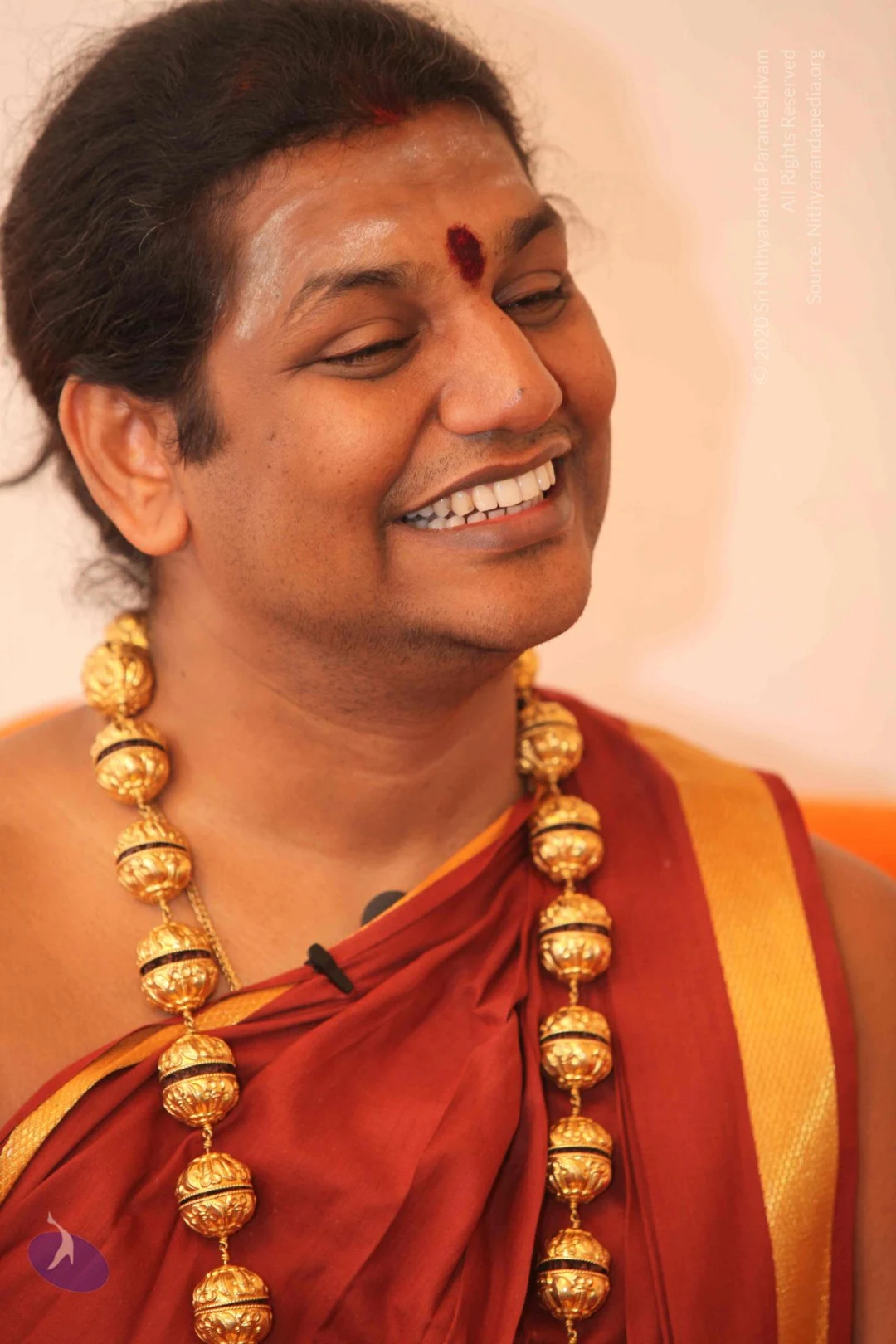
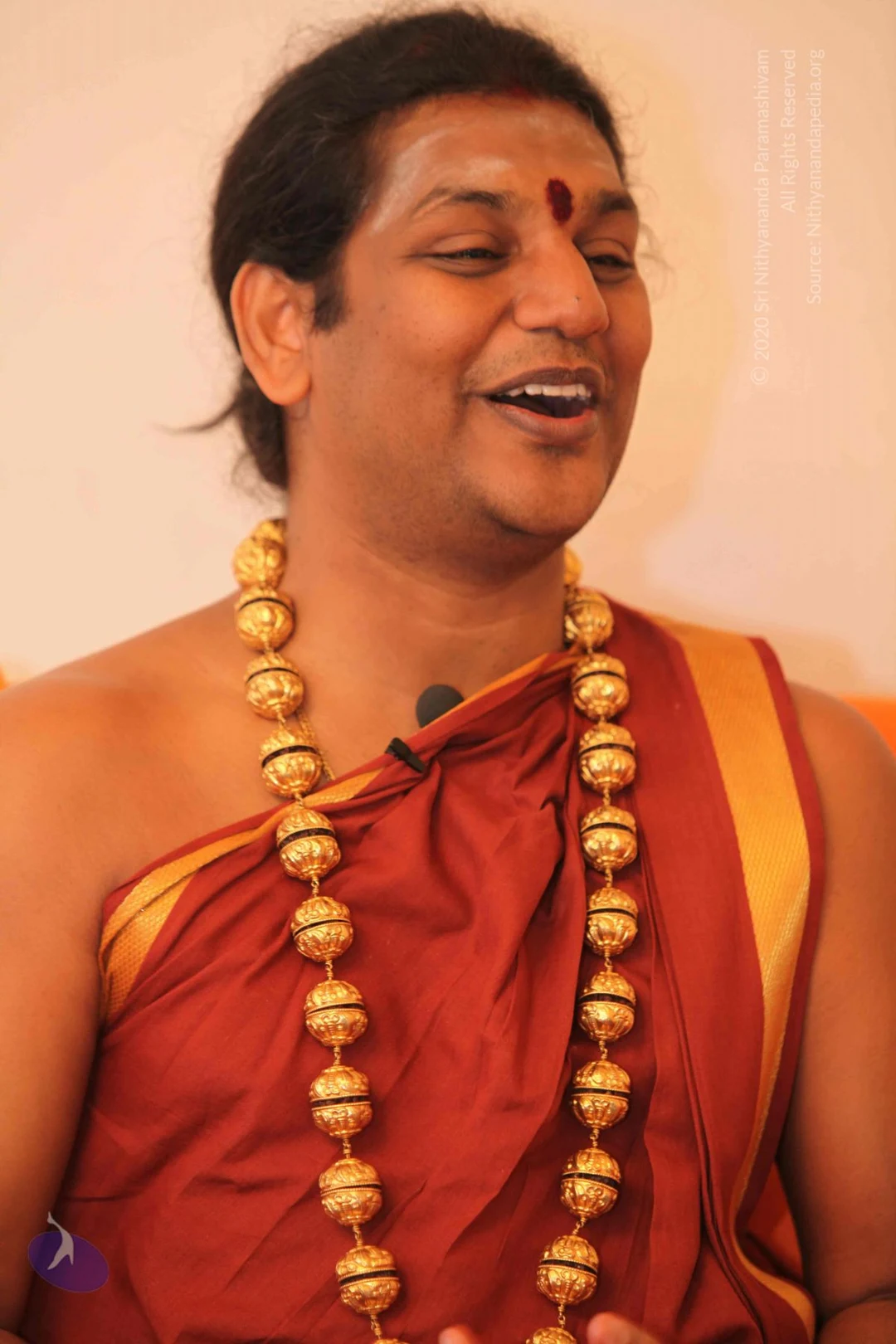
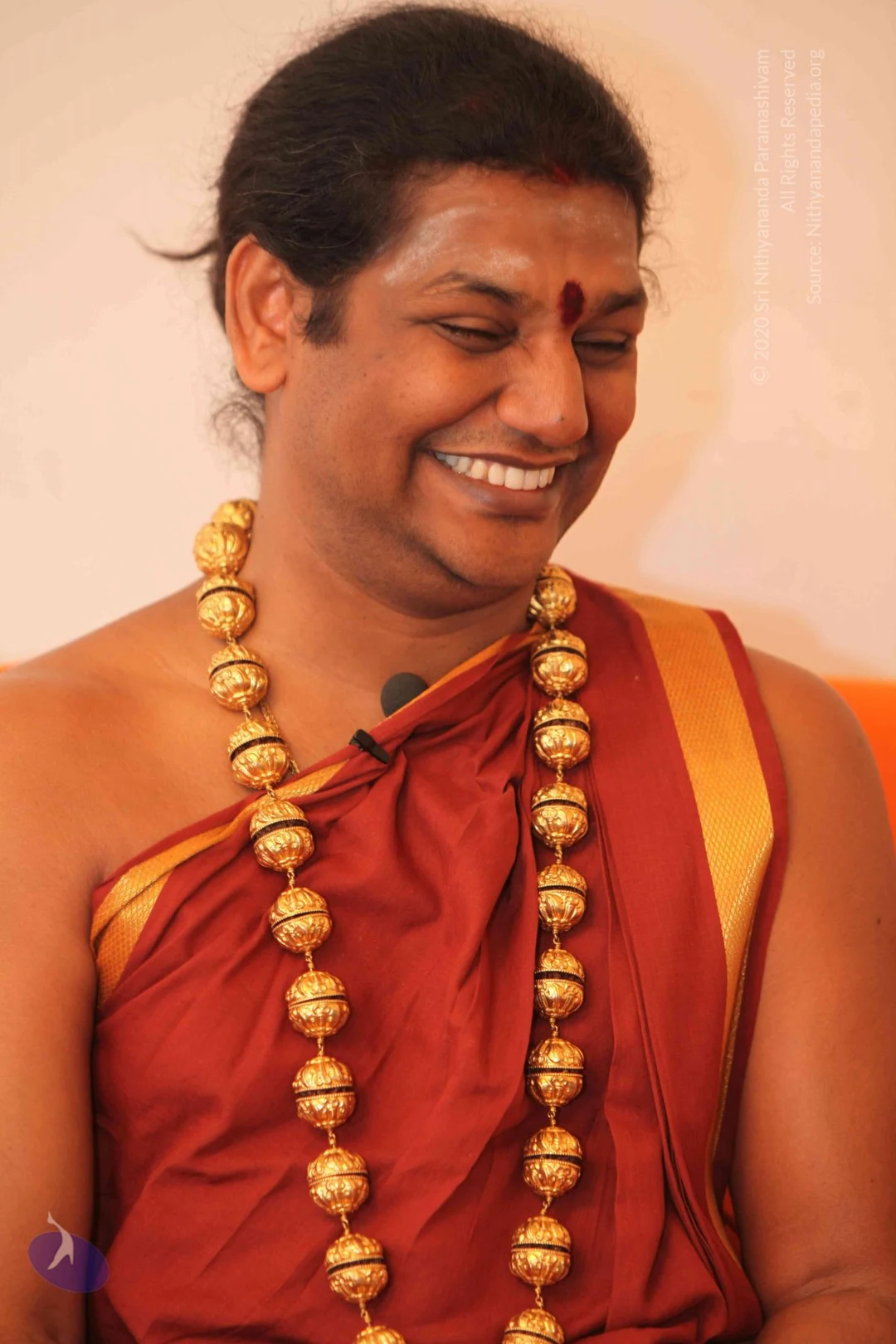
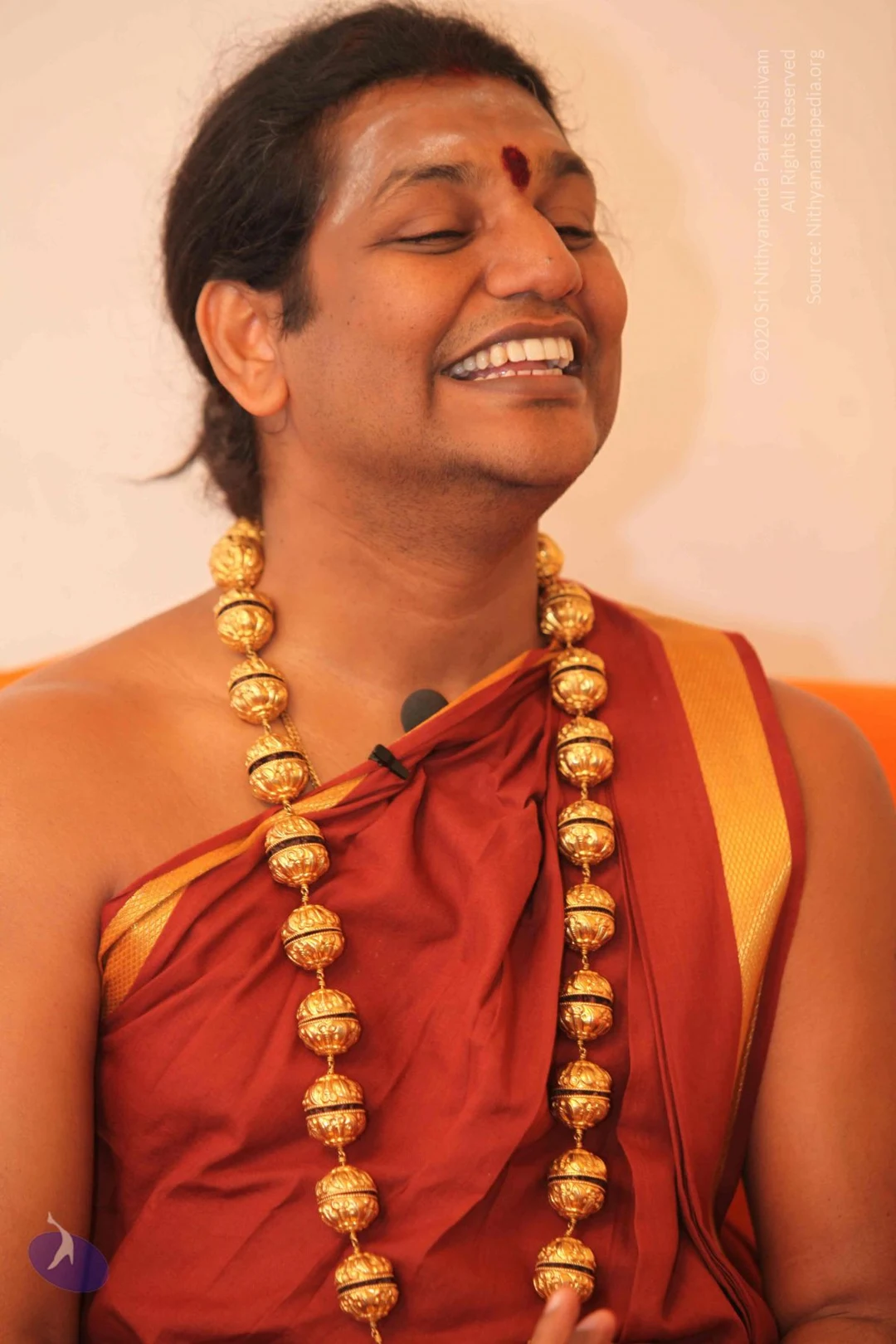
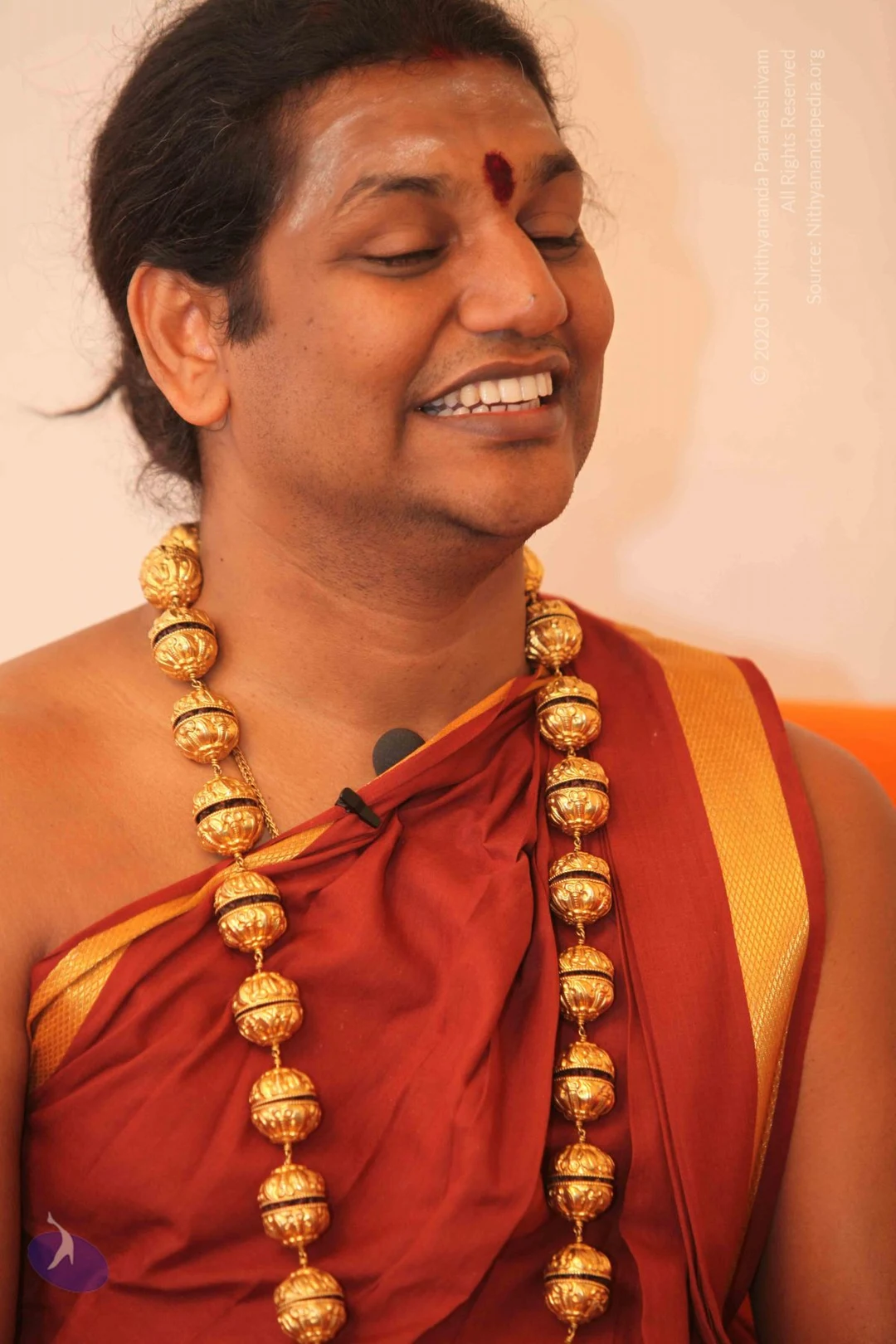
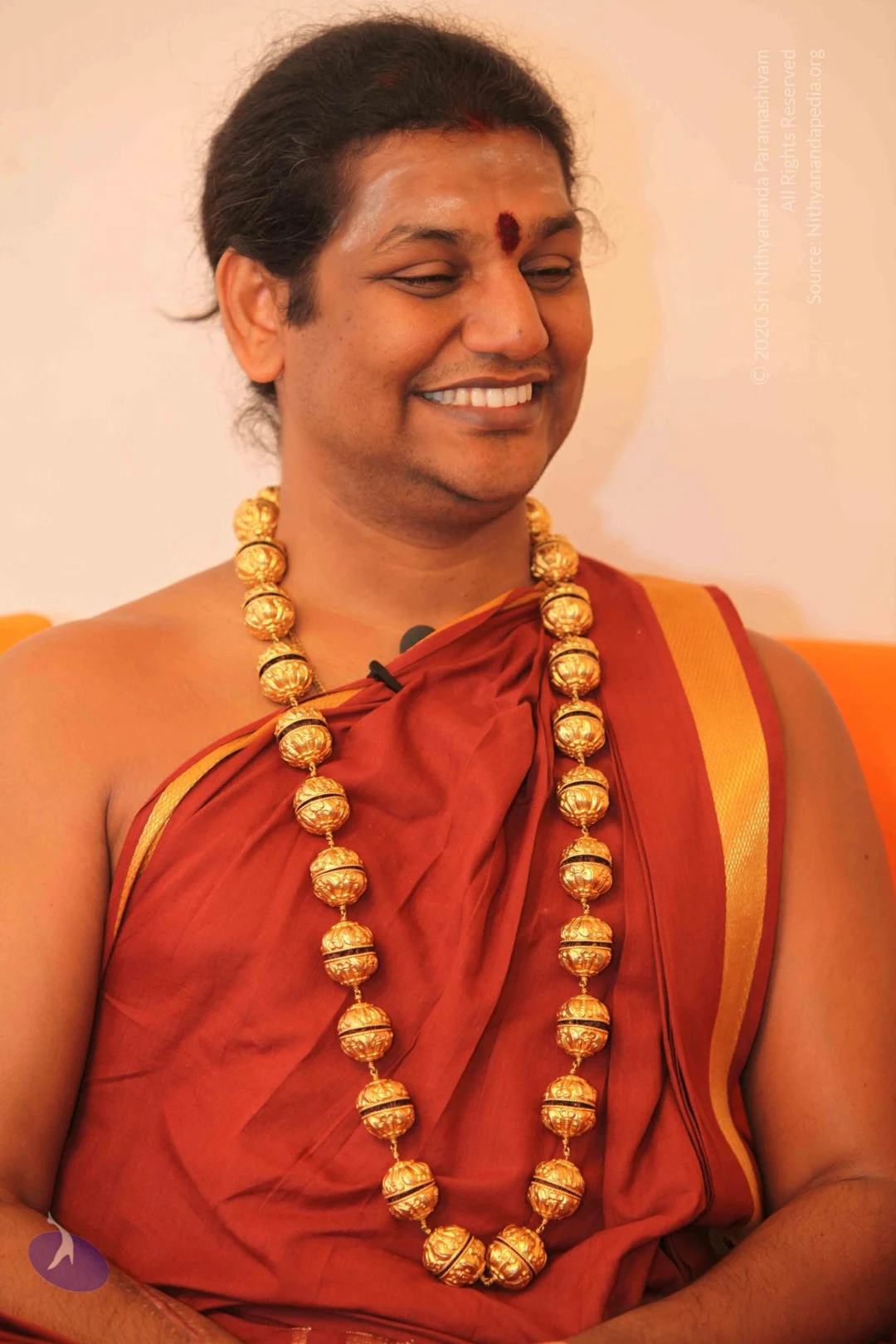
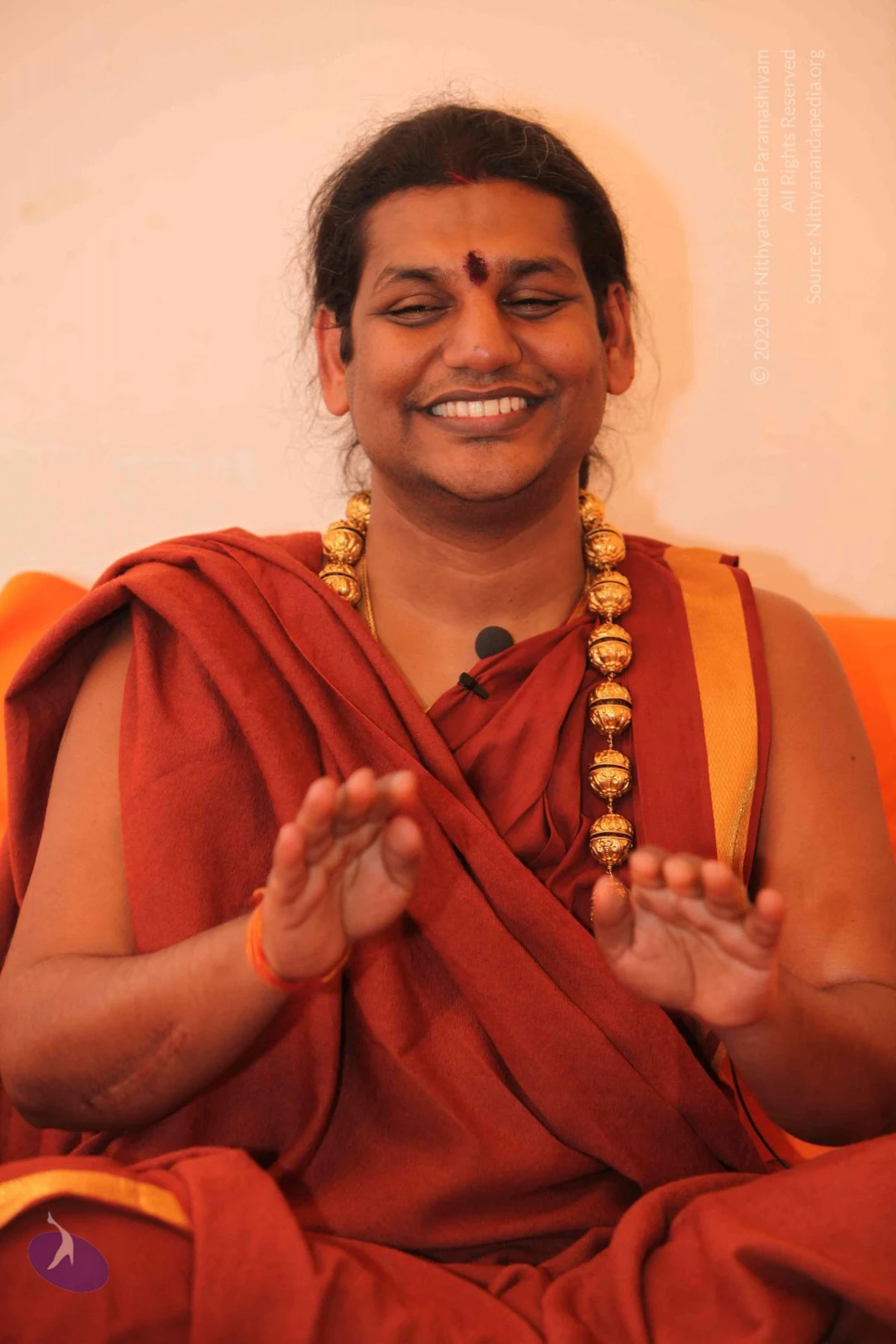
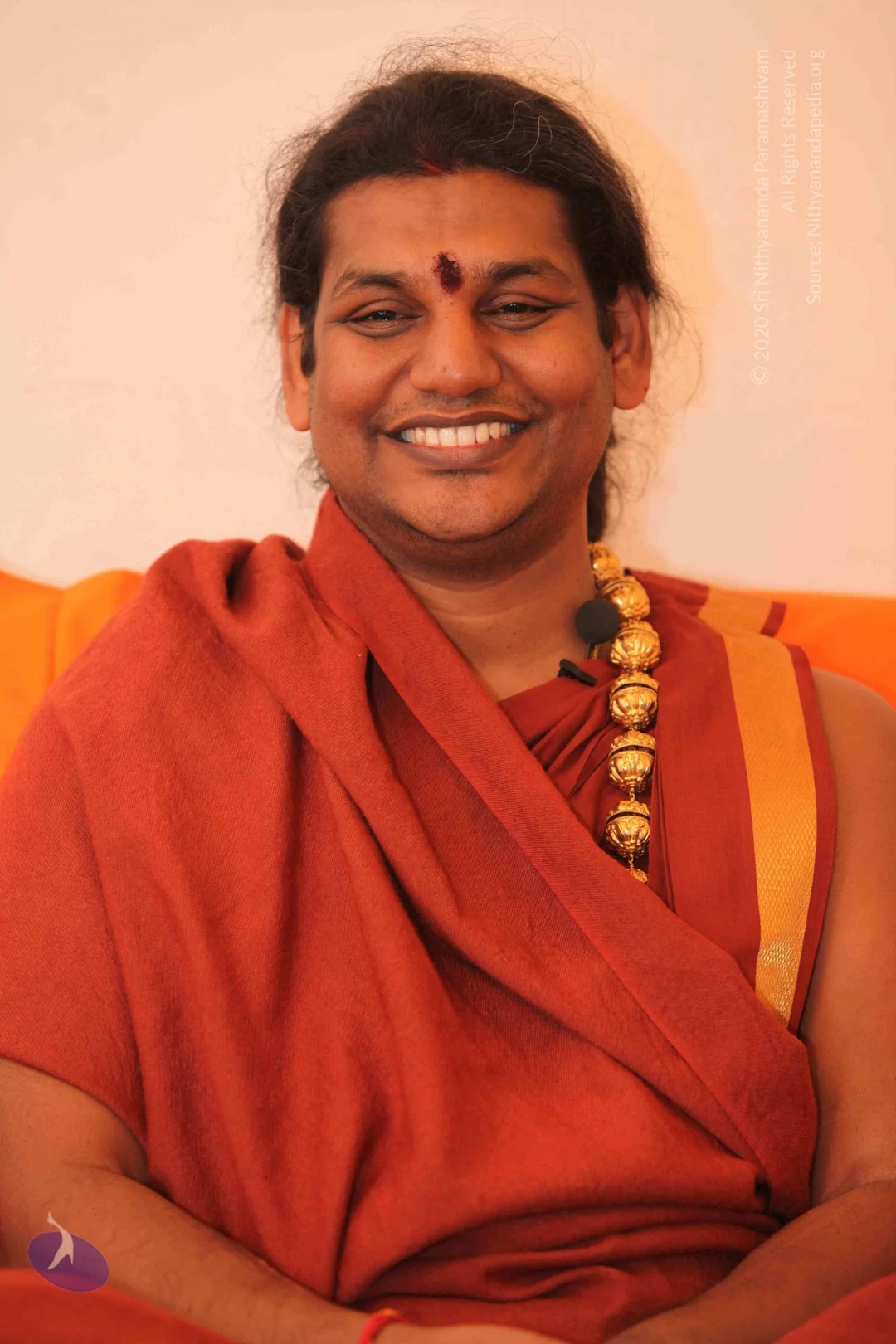
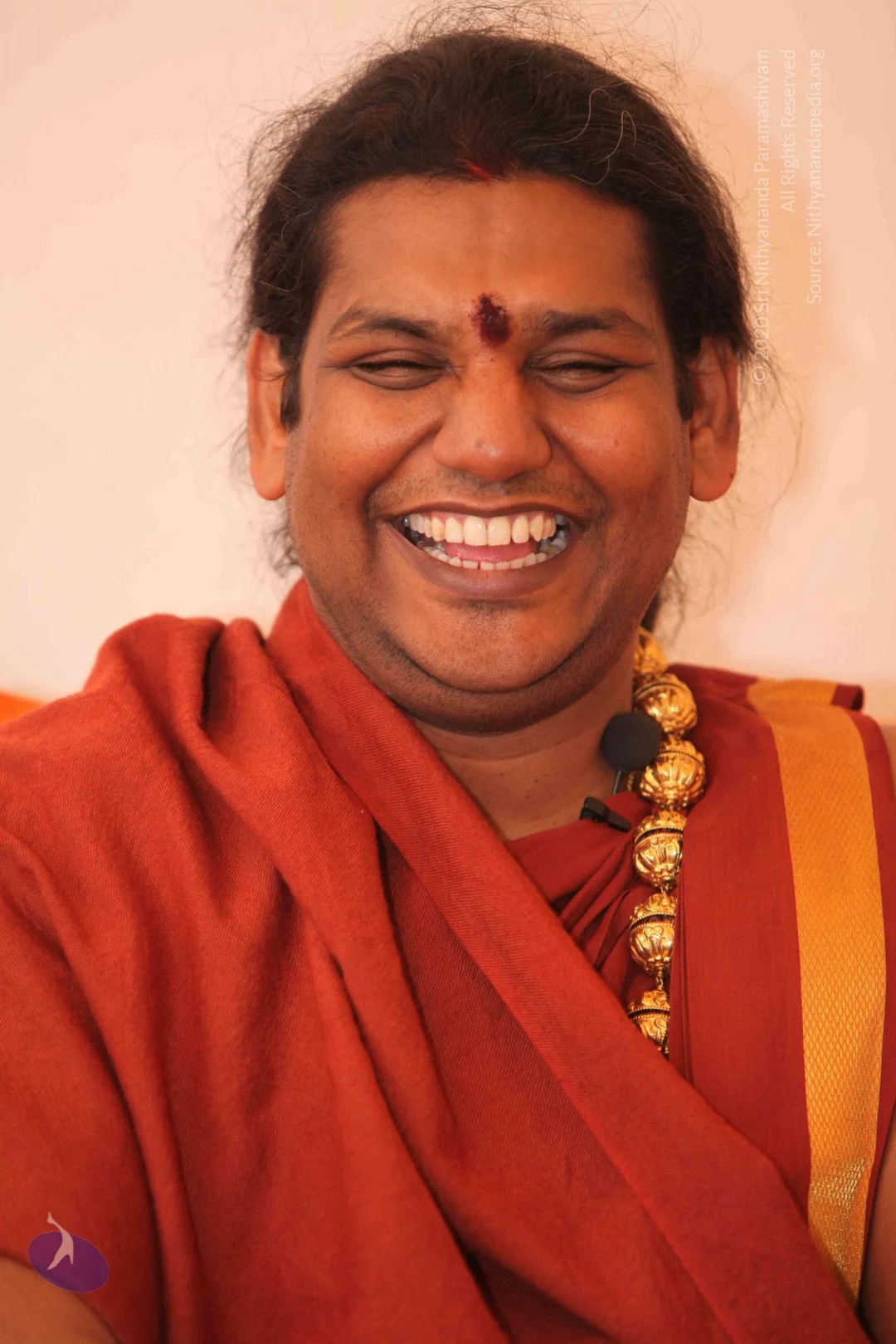
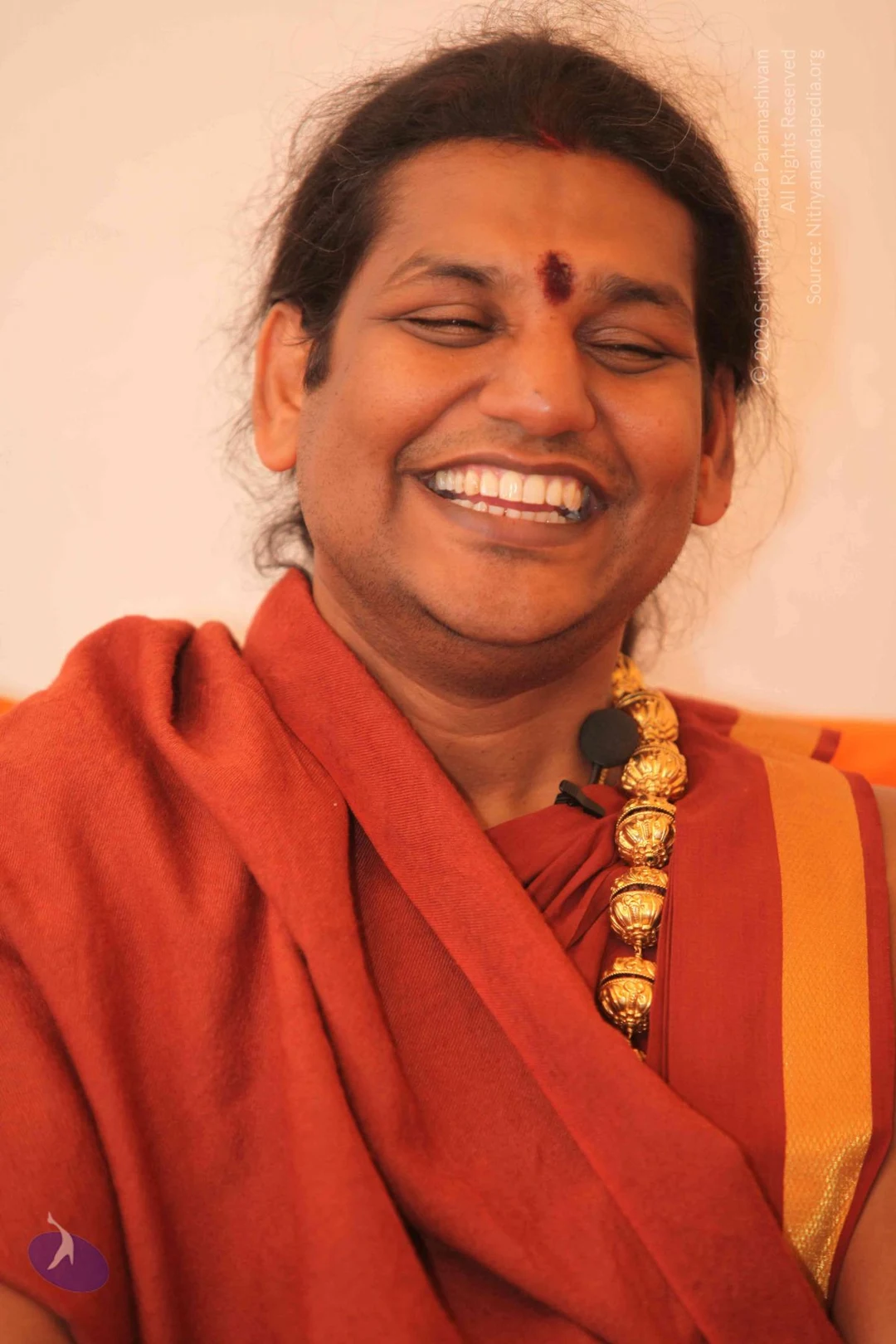
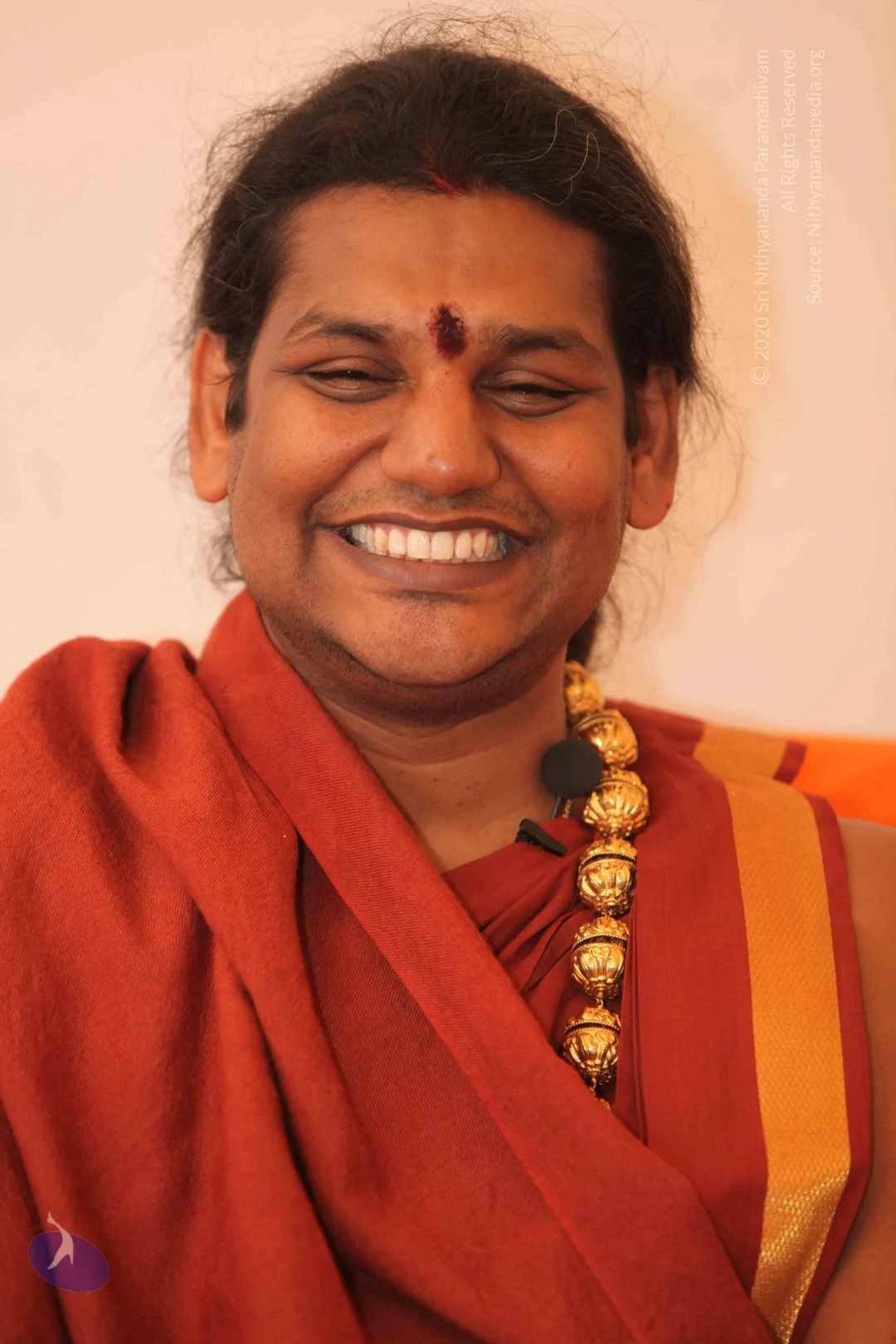
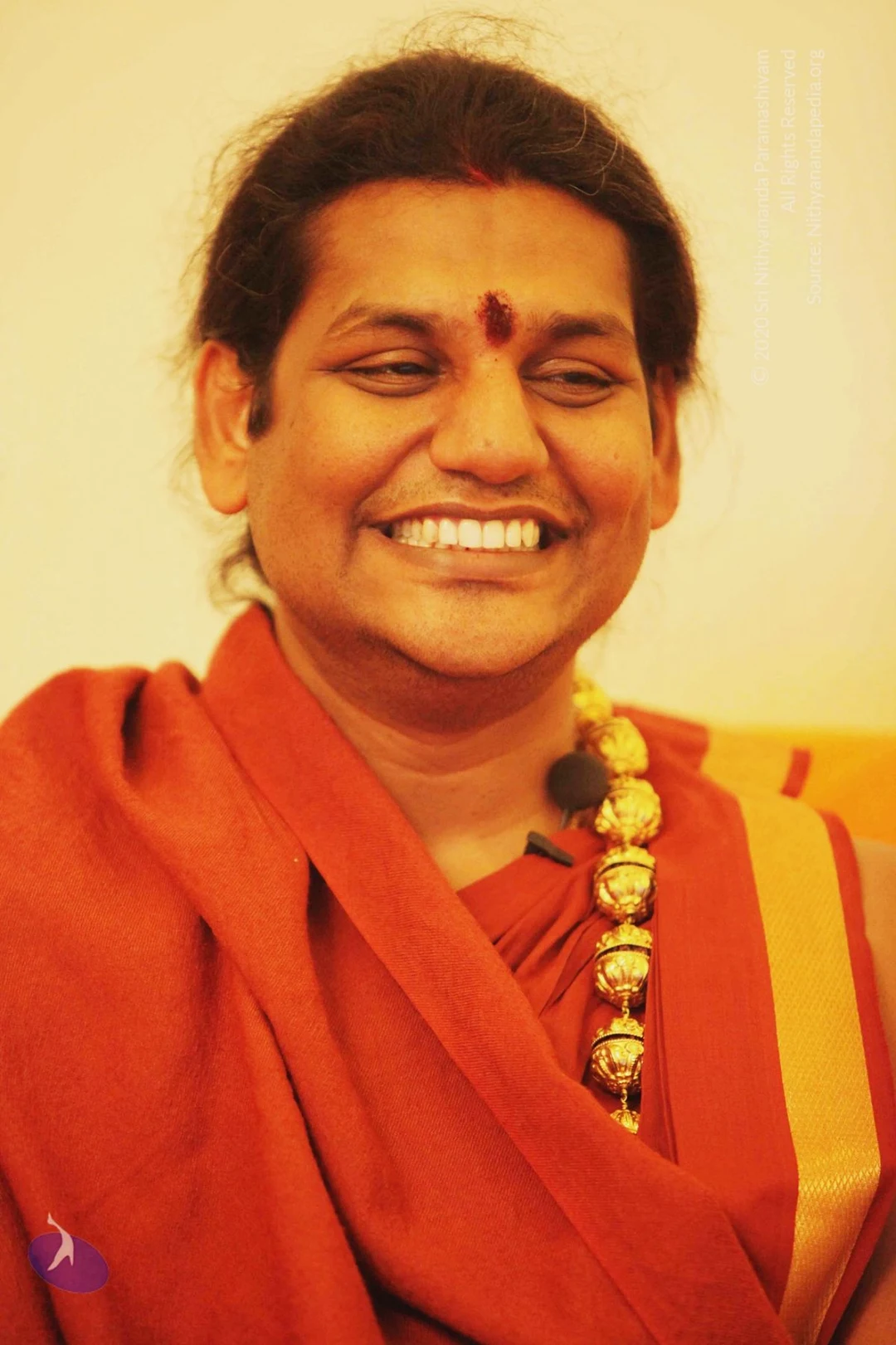
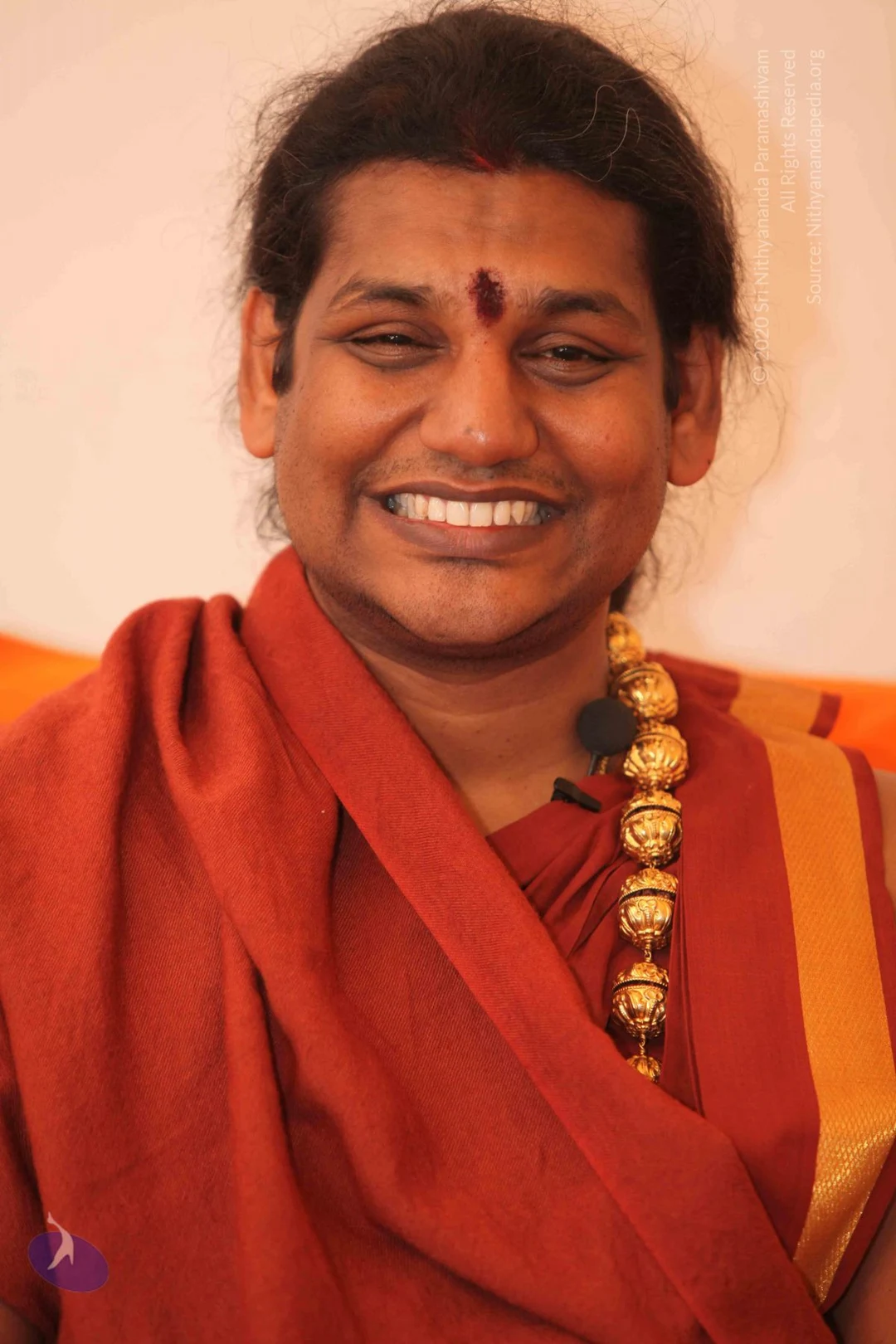
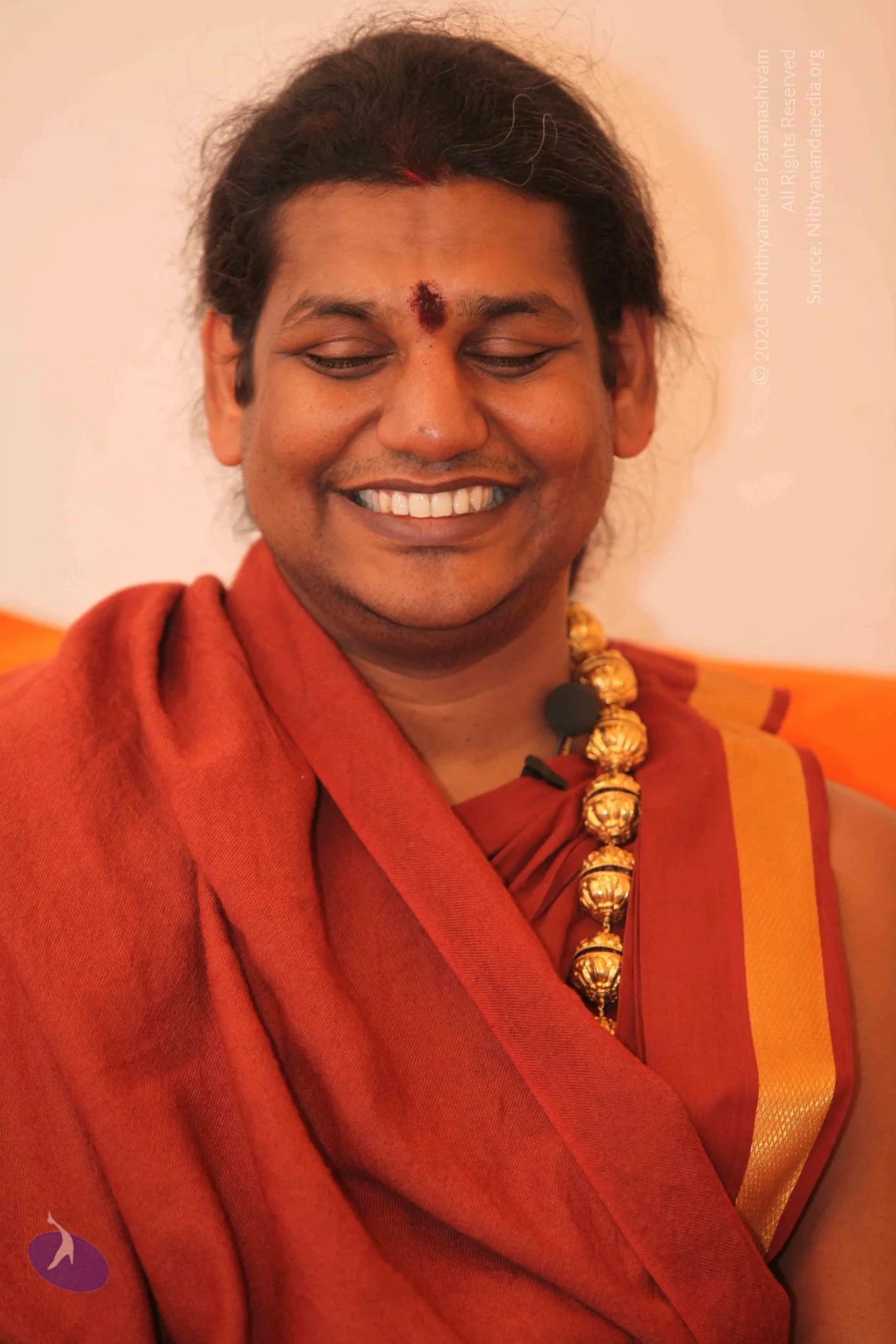
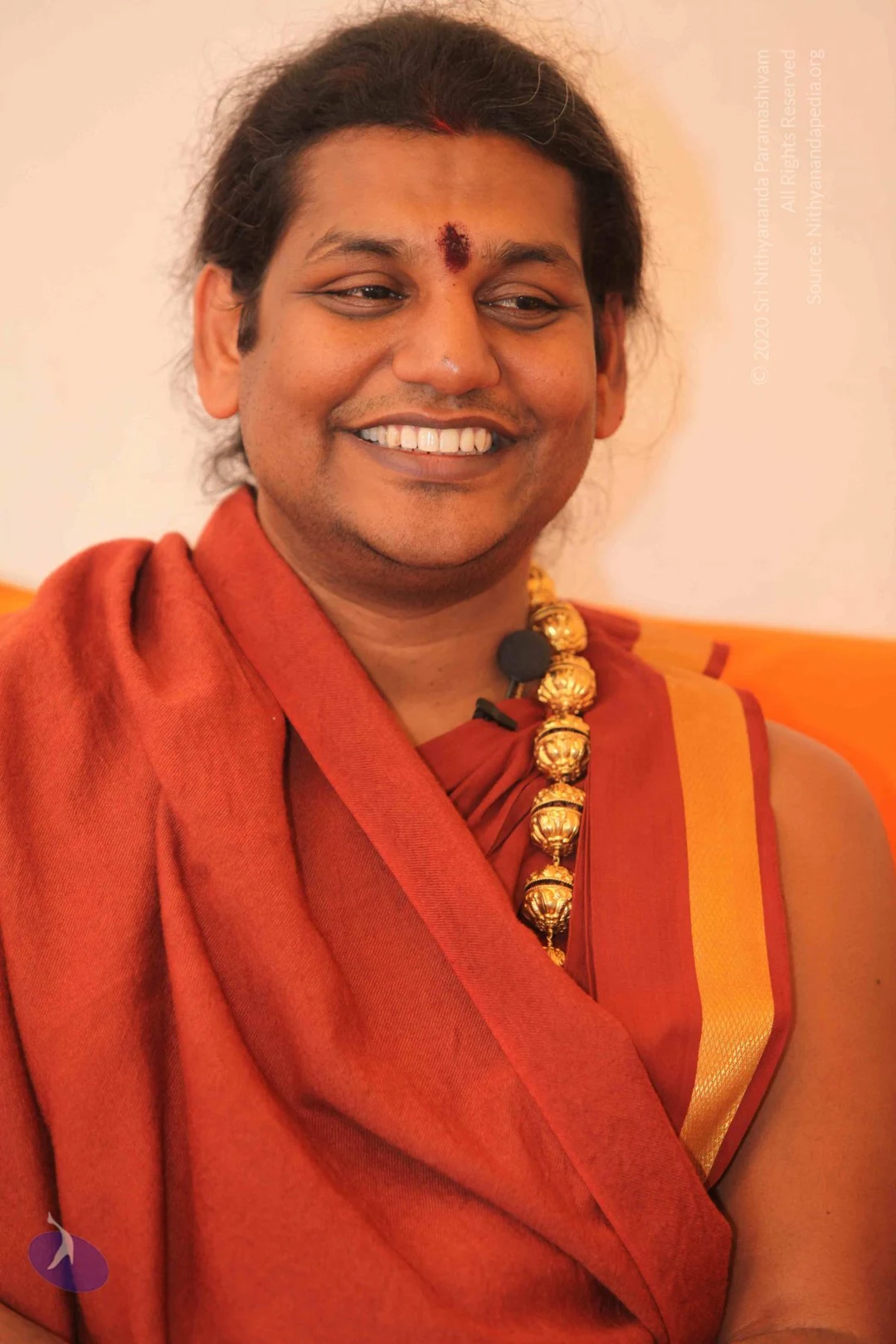
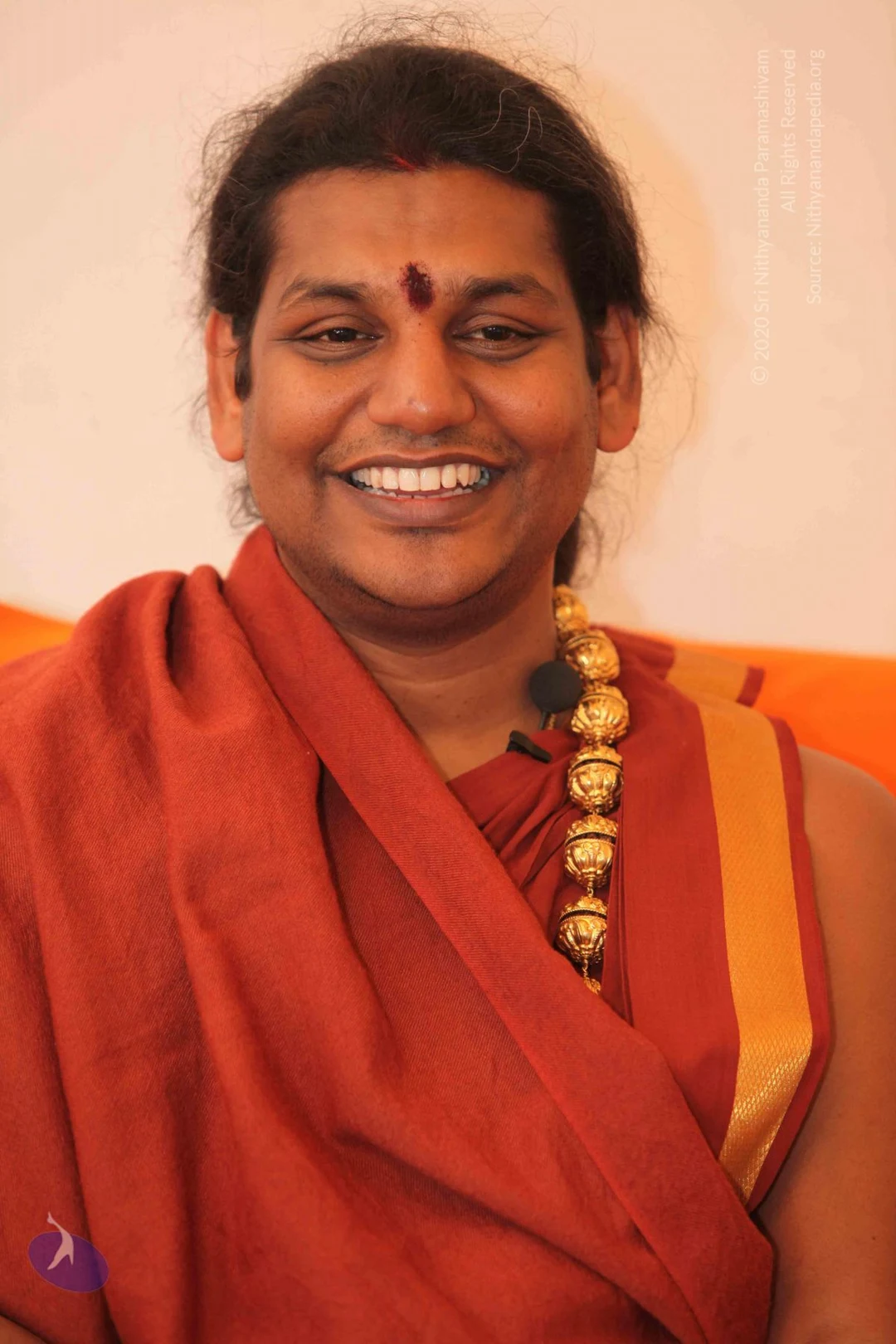
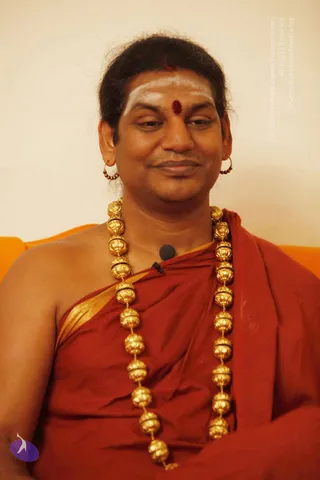
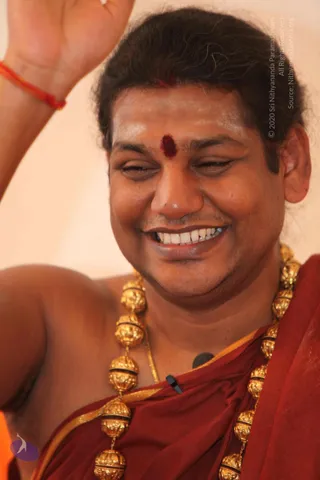
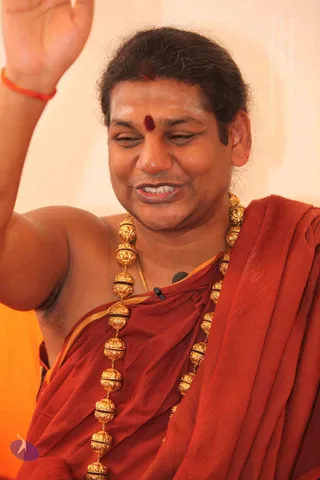
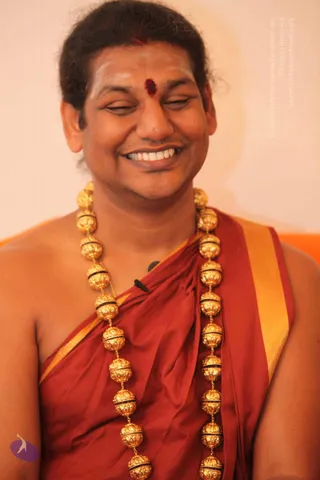
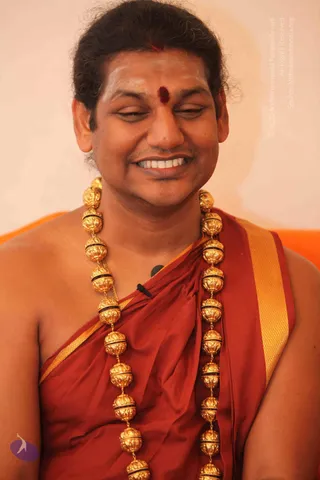
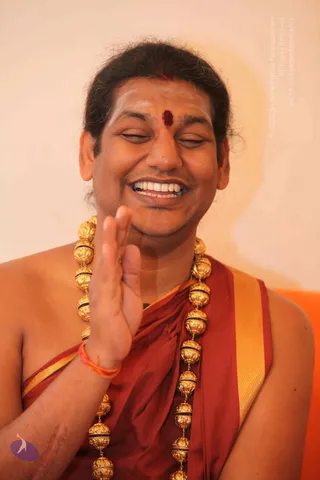
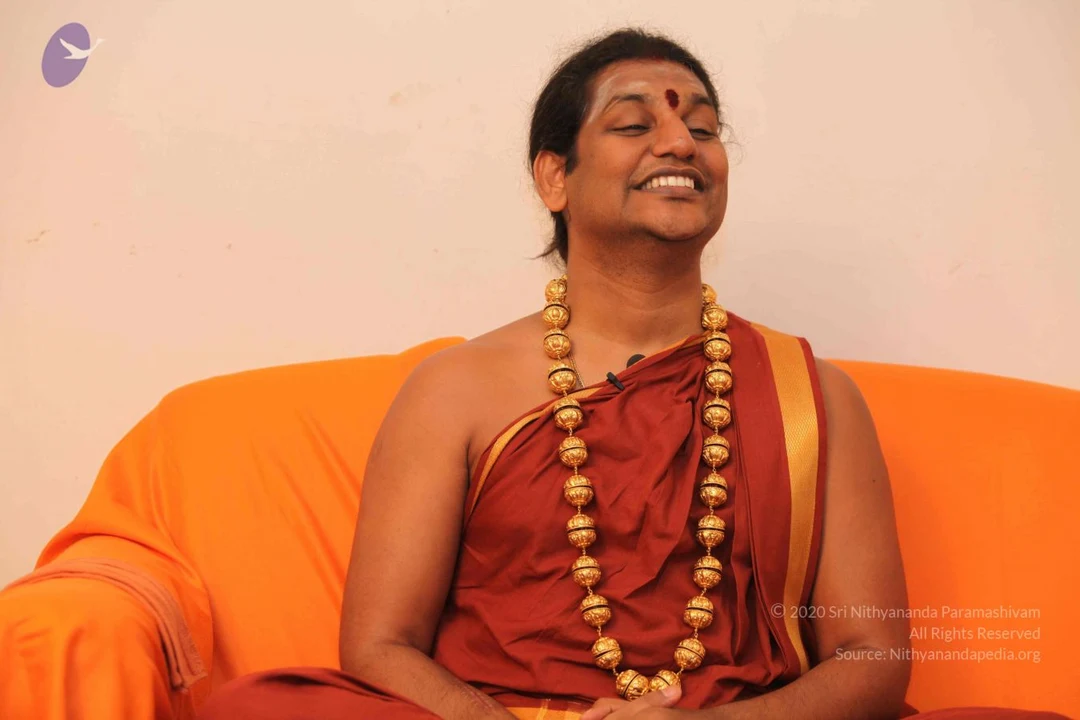
A man seated on an orange cushioned seat against a plain cream wall, wearing a deep red-maroon sannyasi-style wrap with a gold-bordered edge over one shoulder. He wears a heavy necklace of large gold beads, gold hoop earrings, a white horizontal forehead band and a red kumkum dot, with dark hair tied back. A small clip-on lapel microphone is attached to his chest. He sits calmly with a slight smile, head tilted, appearing to listen.Close photo of a smiling man with a raised hand, wearing a red-maroon shawl with gold border and large gold beaded necklaces, with a red bindi on his forehead and a red thread on his wrist. A small lapel microphone is visible on his chest. The page identifies this event as a Kalpataru satsang; the appearance cues of gold necklaces and a red-maroon shawl with a bindi are distinctive, so this is a person in person.Close photograph of a smiling man in a rust-red shawl over bare shoulders, raising one hand with a red thread bracelet. He wears a long chain of large gold beaded ornaments and a red tilak on his forehead, with a small lapel microphone clipped to his chest. The background is pale orange. Probable Swamiji by appearance, showing swept-back hair, gold ceremonial beads and saffron-red dress.Close portrait of a smiling man with eyes half-closed, a red kumkum mark and white vibhuti on his forehead, dark hair pulled back. He wears a maroon-red shawl with a gold border draped over bare shoulders and a heavy ornate gold necklace of large beaded gold balls on both sides. a person in saffron-red robes with rudraksha-style gold ornamentation, seated in front of a pale cream wall. A small Nithyanandapedia logo appears at lower left and vertical copyright text on the right edge.Close-up photograph of a smiling man with swept-back dark hair and a red bindi with white vibhuti on his forehead. He wears a deep red-maroon shawl with a gold zari border draped over bare shoulders, and a heavy necklace of large gold rudraksha-style beads with black bands. A small clip microphone is pinned to his chest. The background is a plain light wall with orange cushioning behind him.Close-up photograph of a smiling man with eyes closed, raising one hand in a blessing gesture. He wears a maroon-red wrap with a gold border, a heavy ornate gold necklace of beaded pendants, a red-and-orange thread on his wrist, and a red kumkum mark on his forehead above white ash markings. His bare shoulders and an orange cushion appear behind him against a pale wall.
Kalpaturu-Darshan at Slovakia

14 photosSource gallery
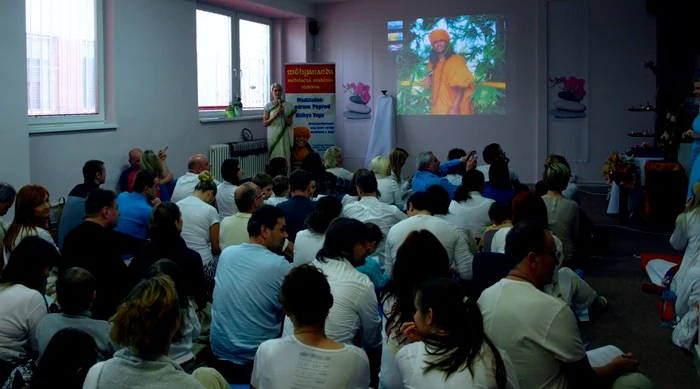
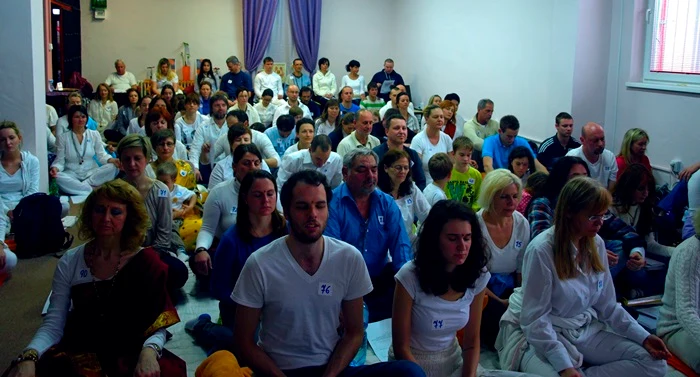
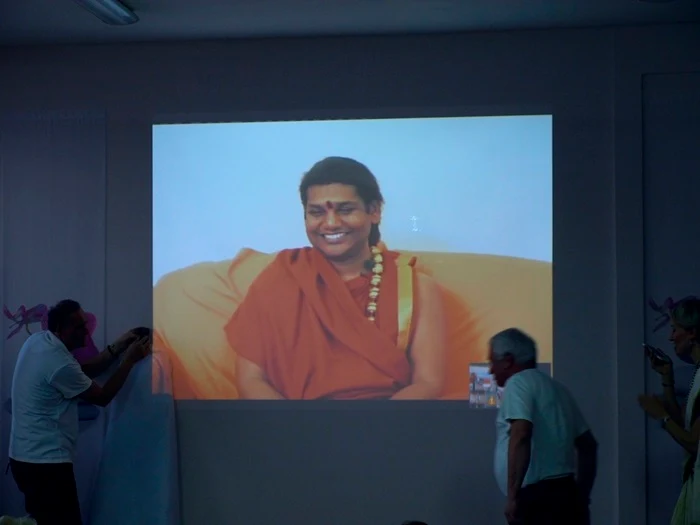
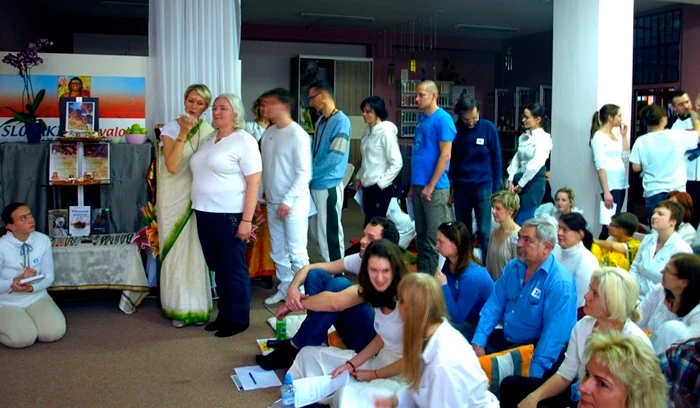
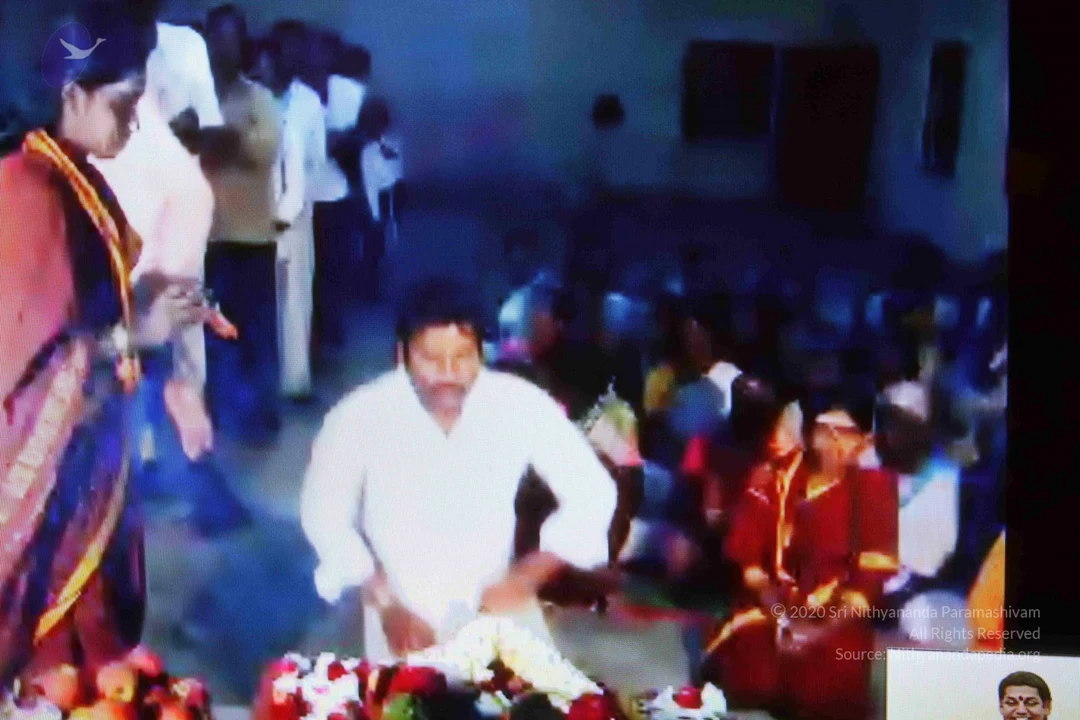
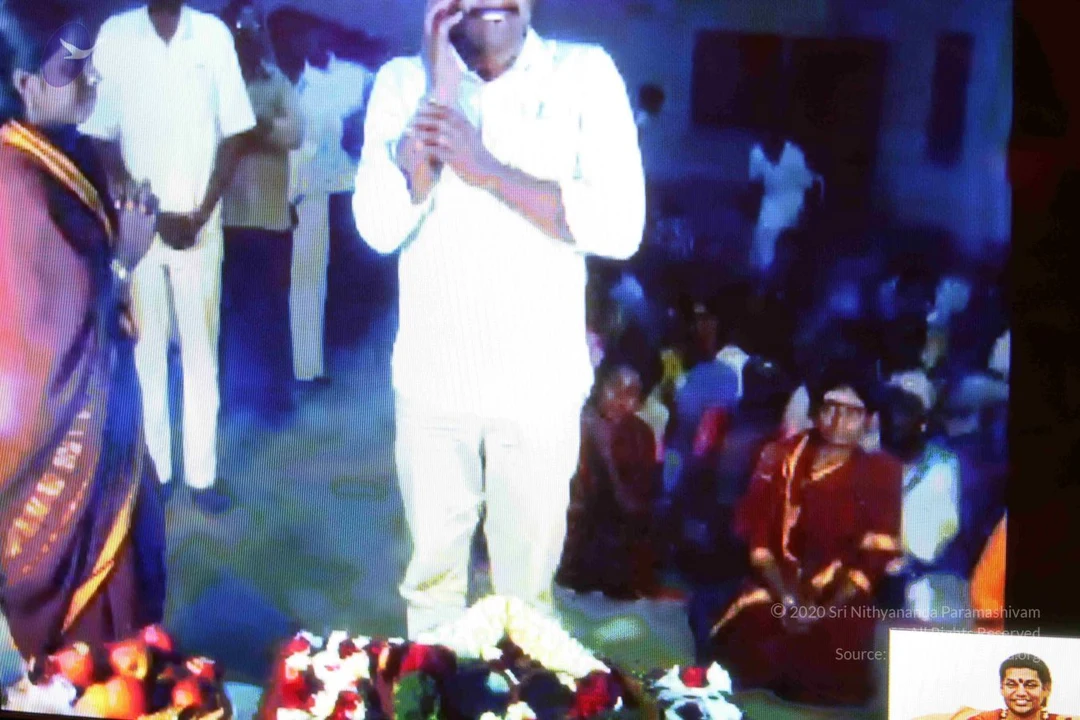
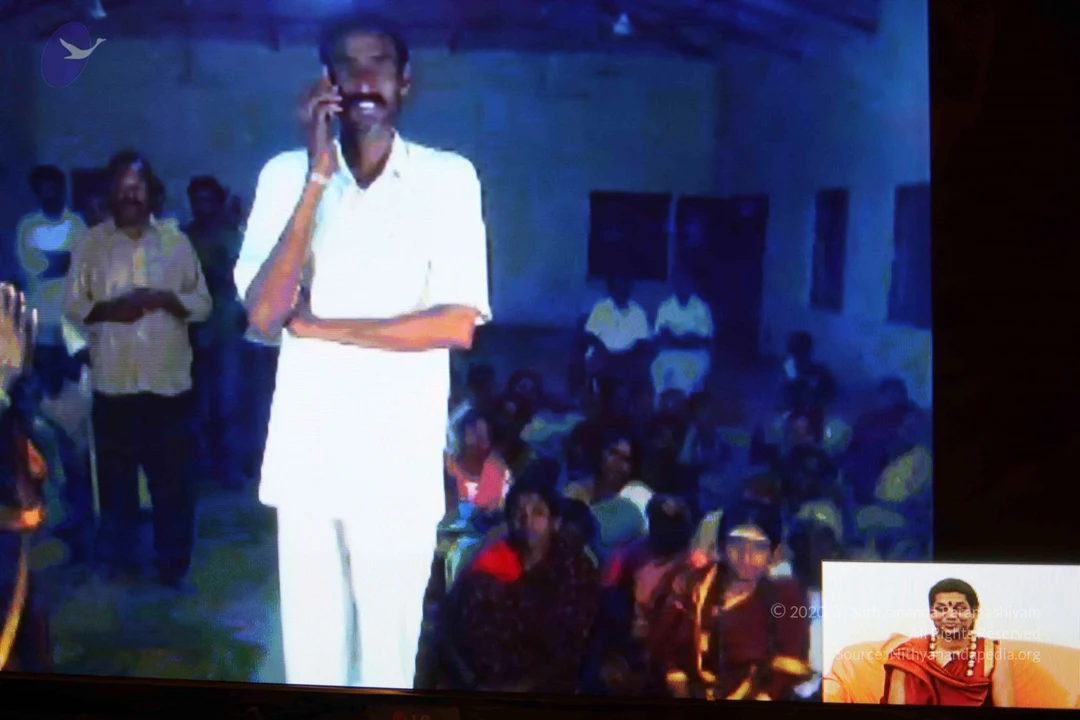
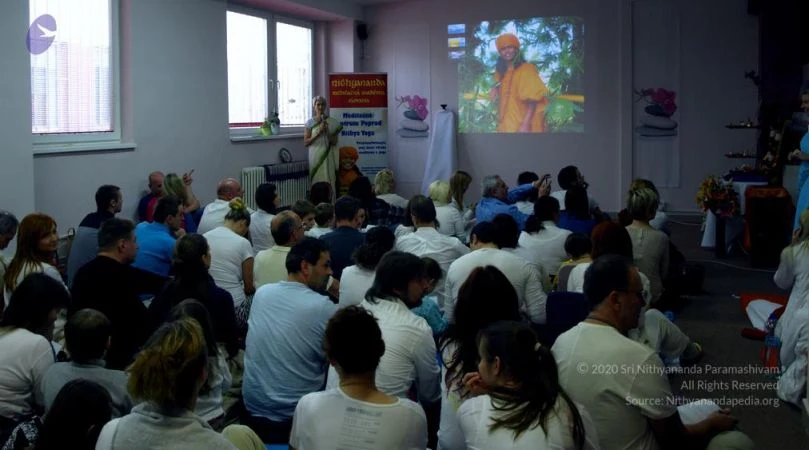
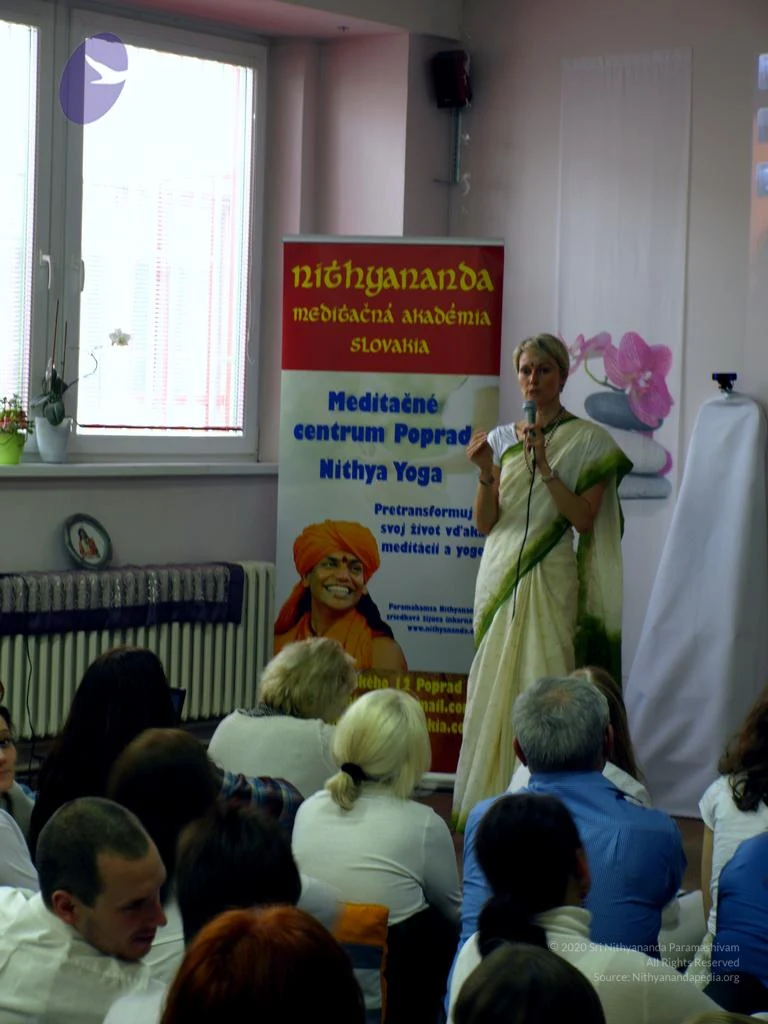
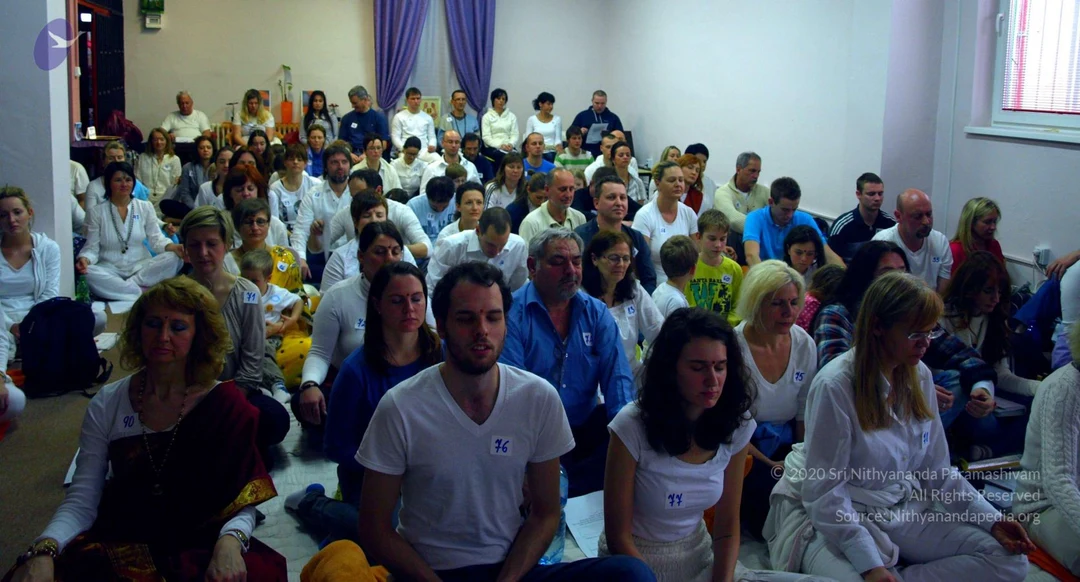
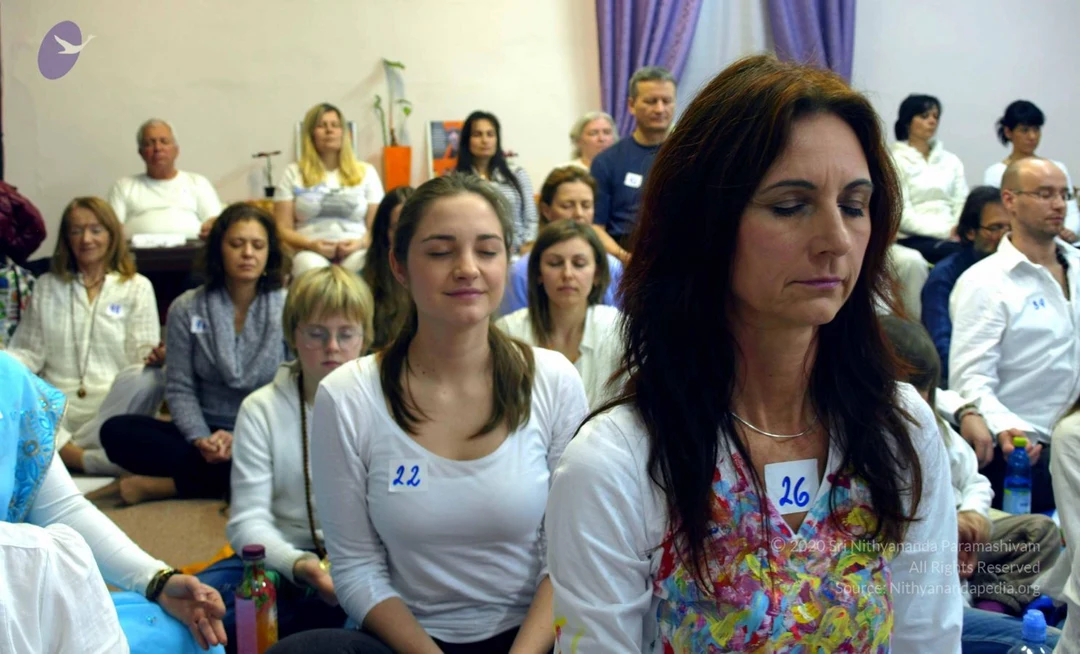
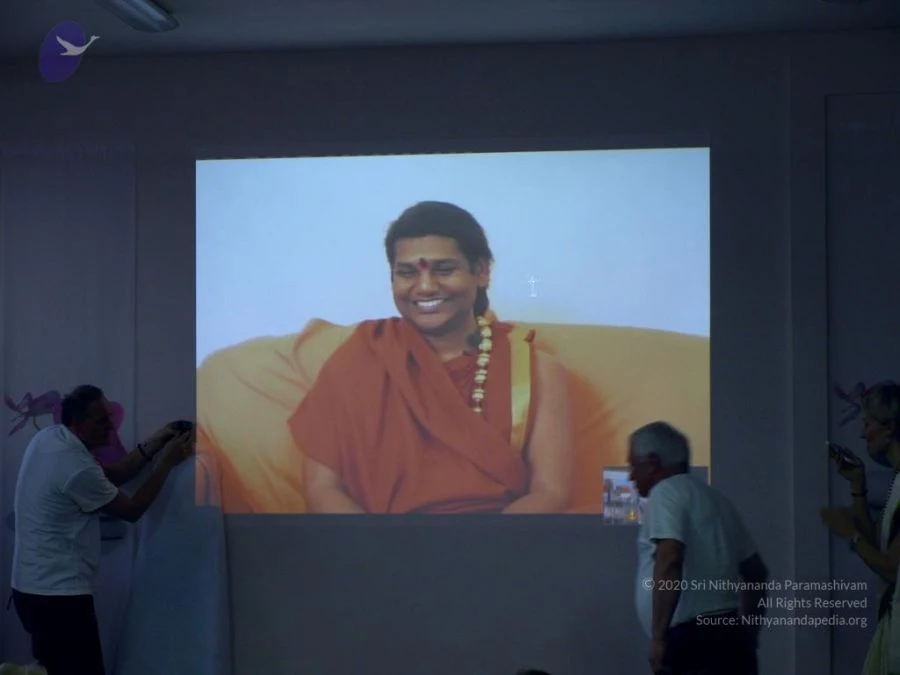
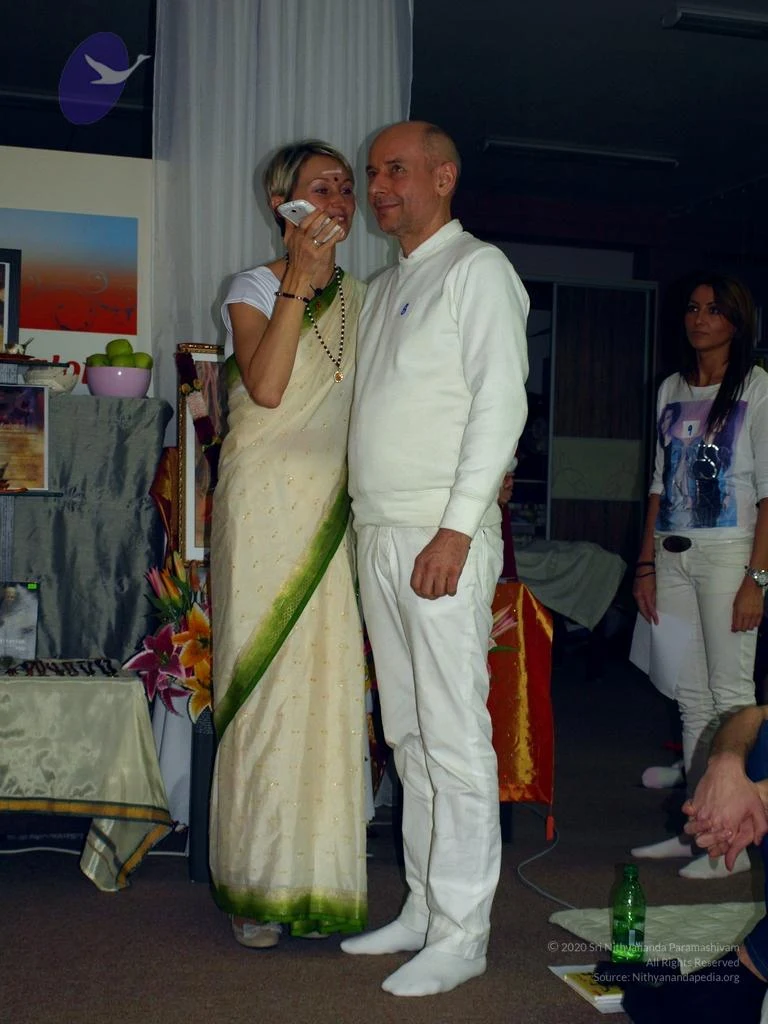
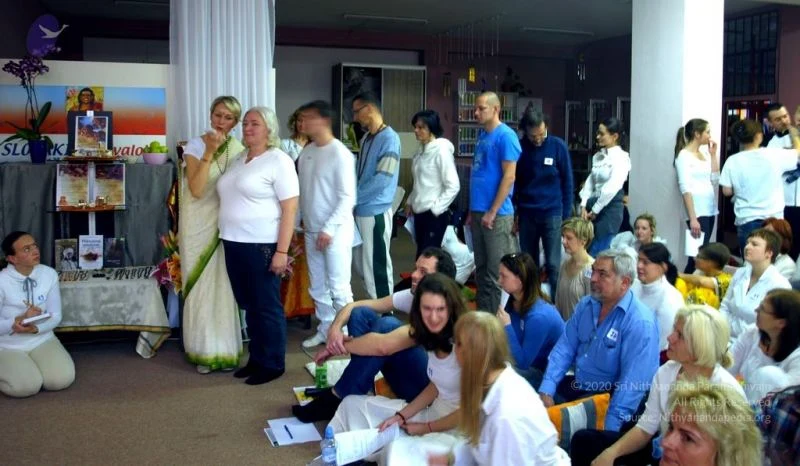
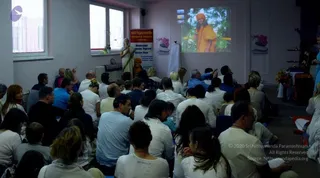
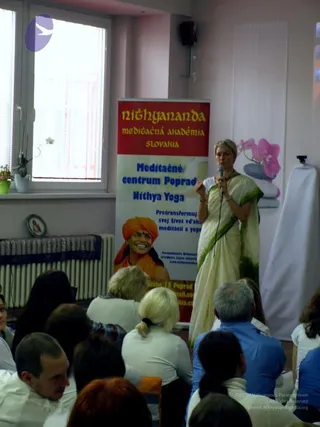
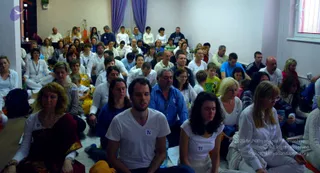
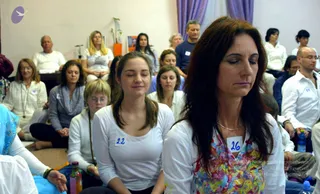
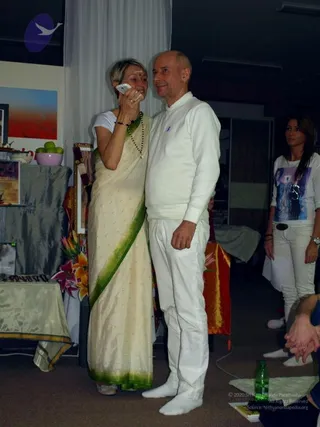
A seated audience of many people in white clothing fills a bright room, facing a woman in a white sari standing at the front near a banner reading Nithyananda Dhyanapeetham and a projector screen. The screen shows a photo of a man in orange robes and an orange turban standing among green foliage; a small orange-robed figure stands beside the banner. Many attendees sit on the floor in rows, some with hands raised or pointing, while a few stand near the right edge beside a table with flowers and stones.A woman with short blonde hair, wearing a cream sari with a green border and a green necklace, stands at the front of a room holding a microphone and speaking to a seated audience. Behind her is a vertical red-and-white banner reading "Nithyananda meditačná akadémia Slovakia" and "Meditačné centrum Poprad Nithya Yoga", showing a smiling figure in orange saffron robes and a turban, labelled as Paramahamsa Nithyananda. Seated audience members in white and blue shirts face her, and a pink orchid in a pot decorates the wall on the right.A large group of seated devotees with eyes closed in a bright meditation hall with lilac curtains, white walls and a window at right. Foreground: a woman in a white top with number 90 and a maroon-and-gold skirt, a bearded man in a white tee marked 76, a woman in a white tee marked 74, and a woman in white on the right; a man in a blue shirt sits between them. Many participants wear white, and a few have numbered badges. No a person is visible among the attendees, so no candidate is marked as present.Photograph of a seated meditation group indoors, with participants in white clothing and numbered name tags. In the foreground a woman with long dark hair, closed eyes and a multicolored paint-splattered top sits with her eyes closed; a younger woman in a white top beside her also has eyes closed. Behind them, rows of people sit on mats and cushions in meditation posture, with a bottle of water and a plastic bottle on the floor. A lilac curtain and a potted plant with orange pot appear in the background. A visible sitter in light blue fabric is at the left edge. No a person candidate is visibly present.A dimly lit meeting room where a large projection screen shows a smiling man with short dark hair, a red bindi, an orange-saffron shawl and a beaded necklace seated against a yellow cushion. Two men in white shirts stand at the sides, one adjusting a blue cloth near the screen and the other leaning in beside a small table. A woman on the right holds a phone.A bald man in all-white clothing stands beside a woman in a cream sari with a green border and a beaded necklace, holding a white mobile phone to her ear. A shaved-headed man in a white high-collared top and white trousers stands close to her in a room with a white curtain. Behind them a dark-haired woman in a white top and white trousers stands watching, and a small table holds green apples, flowers and a framed picture. A green plastic bottle lies on the floor in the foreground. The man in white shows no distinctive a person cues such as long hair, saffron clothing or rudraksha malas, so his identity is uncertain.

Kalpaturu-Darshan at Tiruvanmiyur, Chennai

13 photosSource gallery
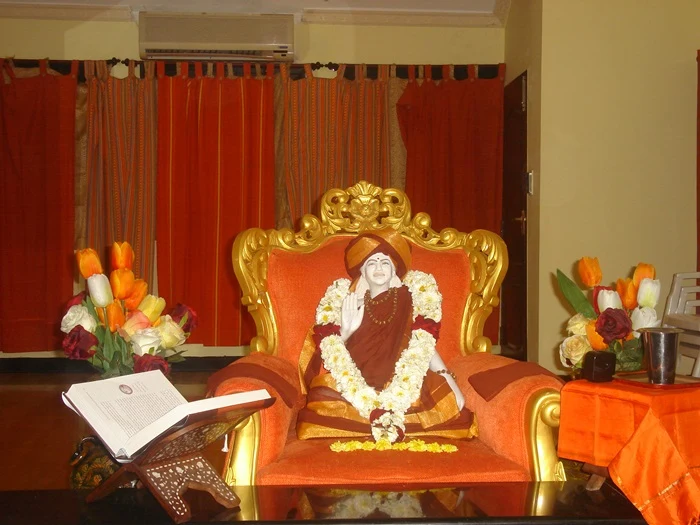
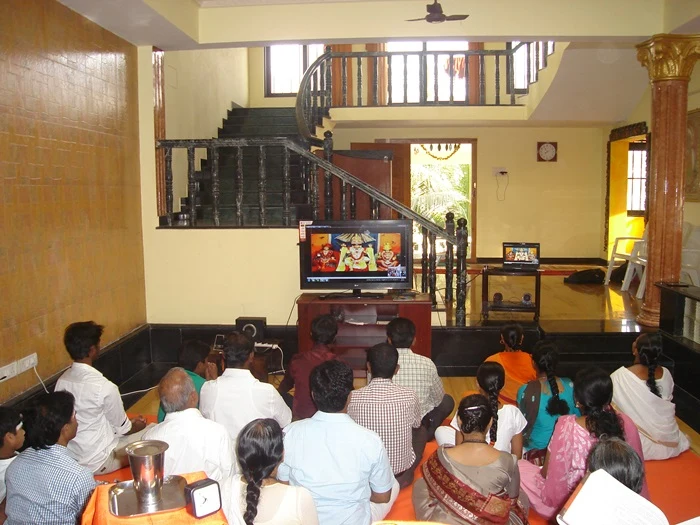
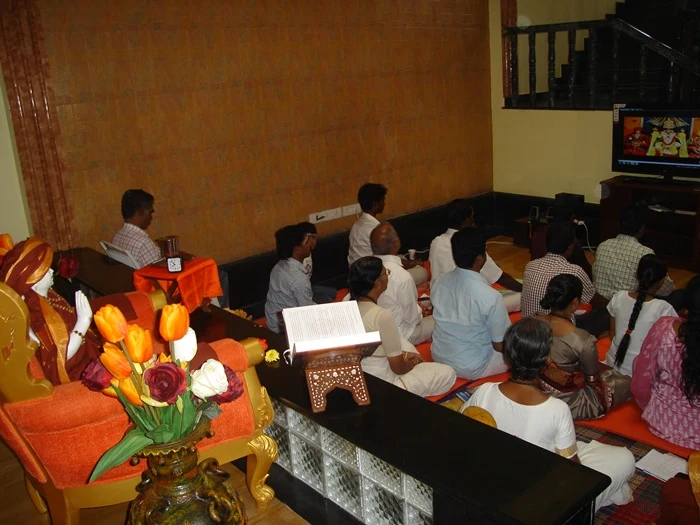
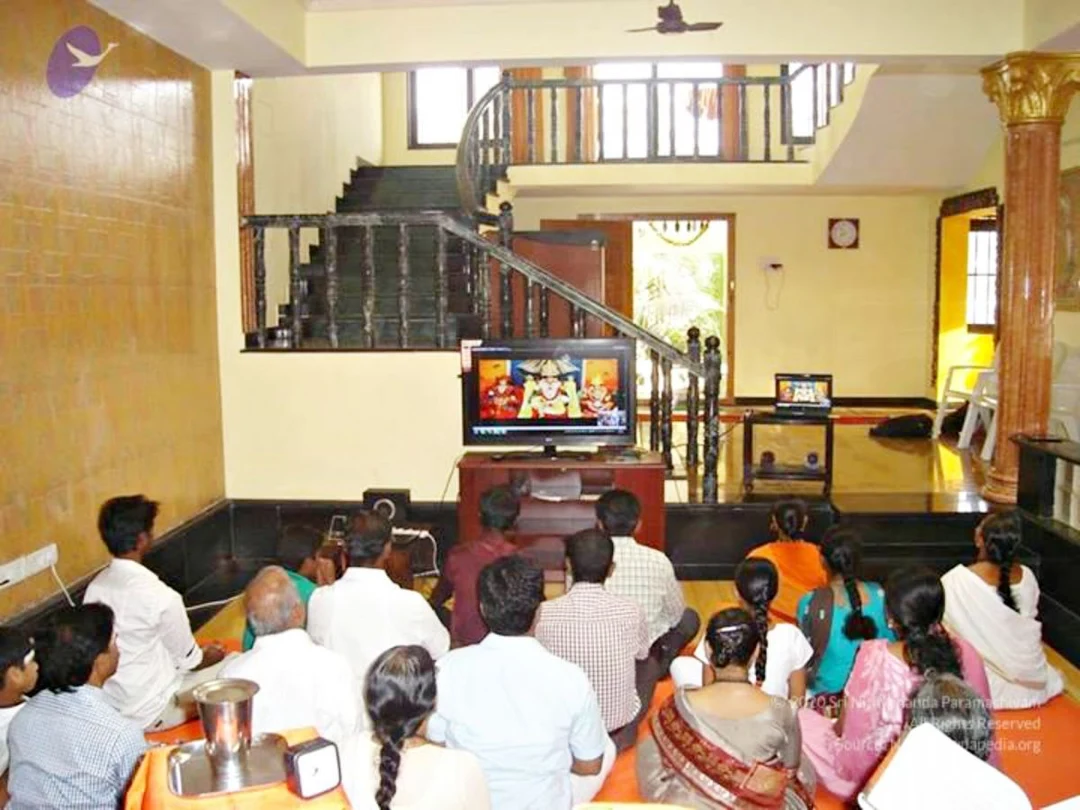
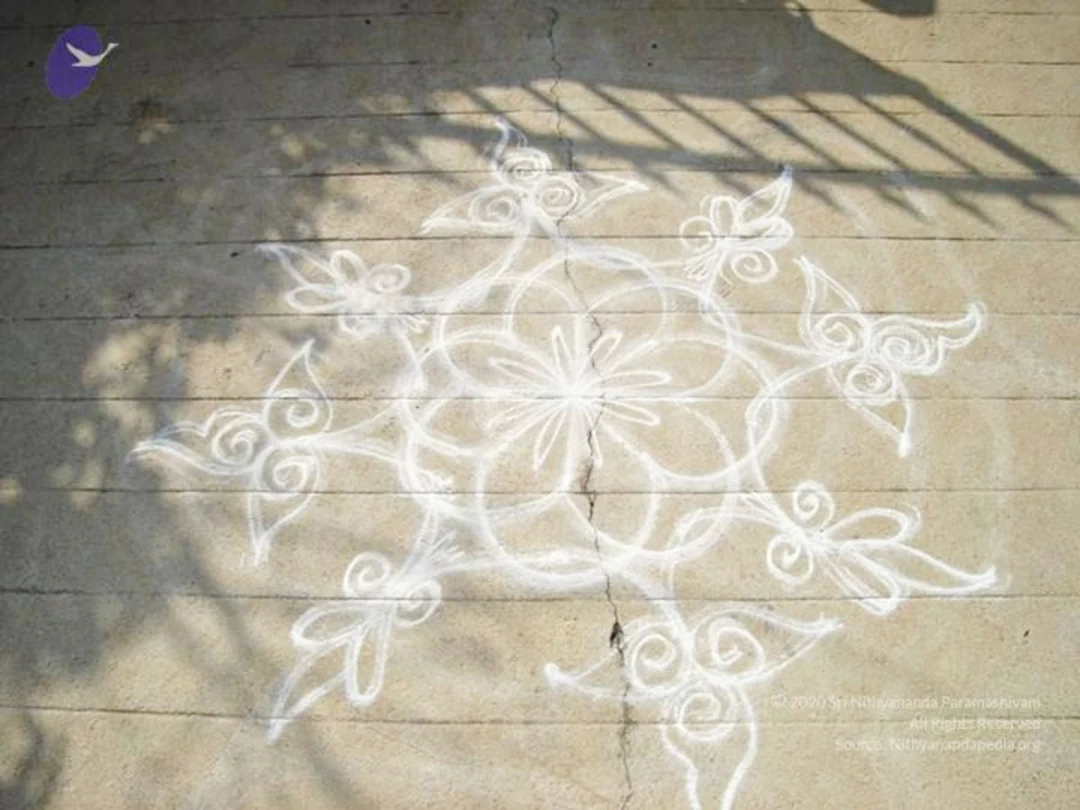
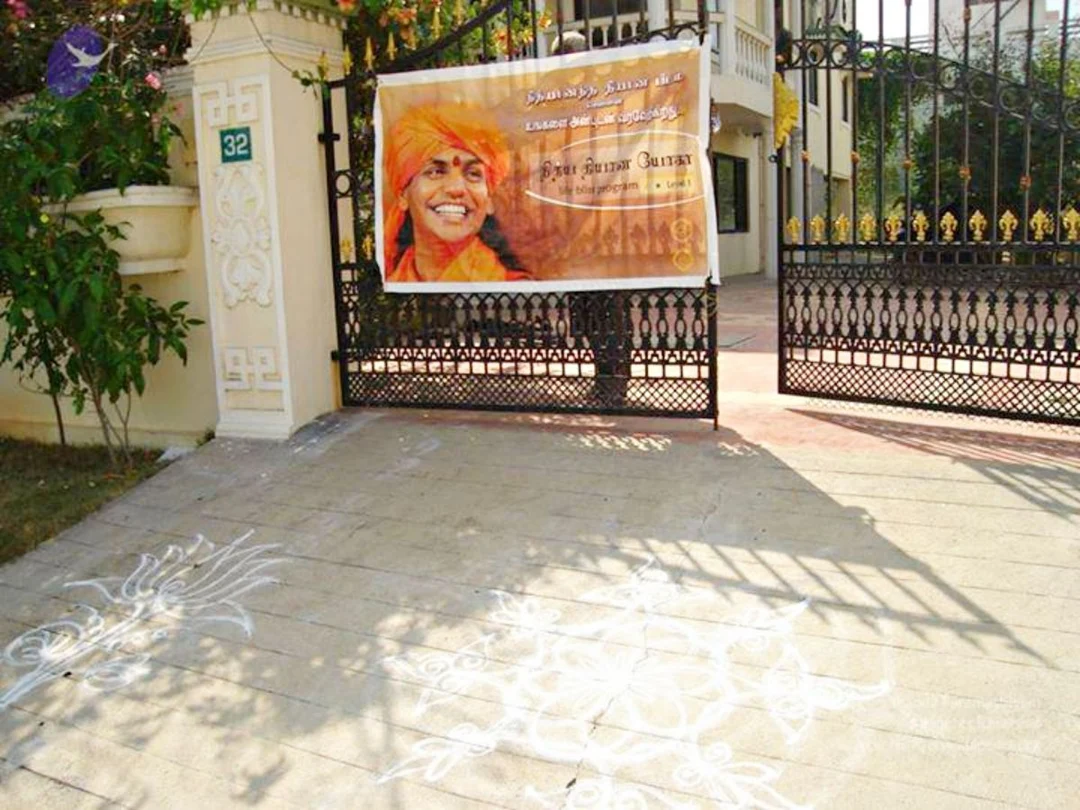
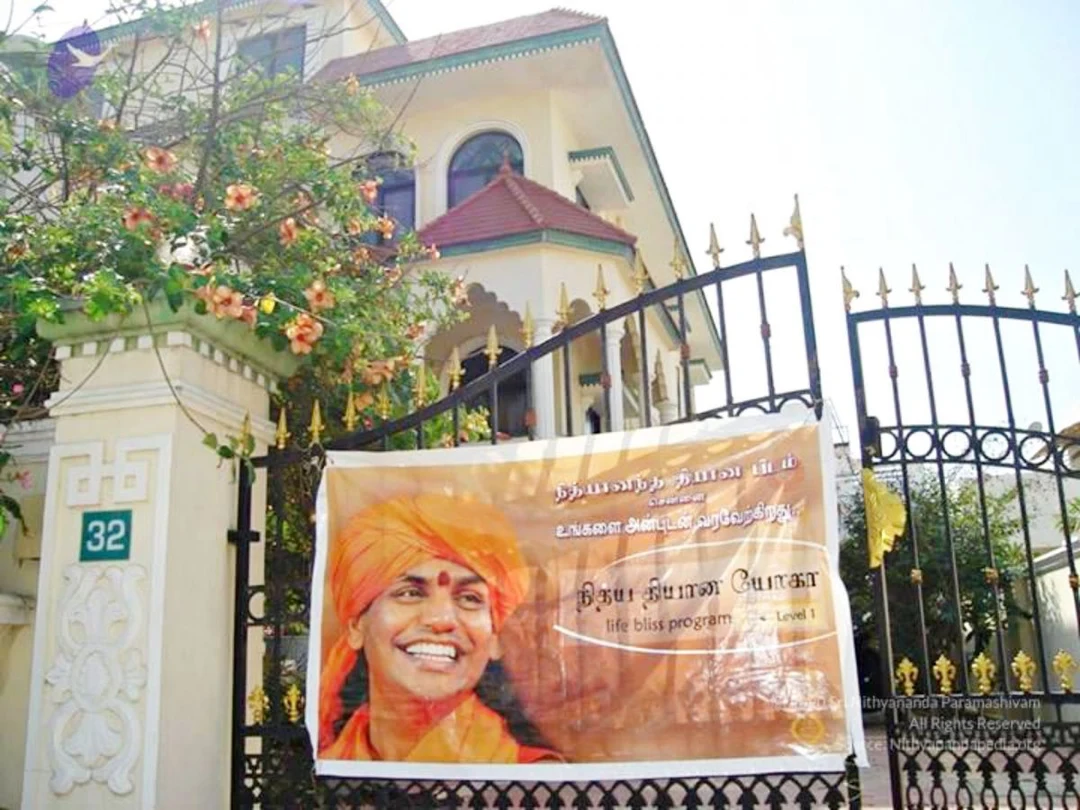
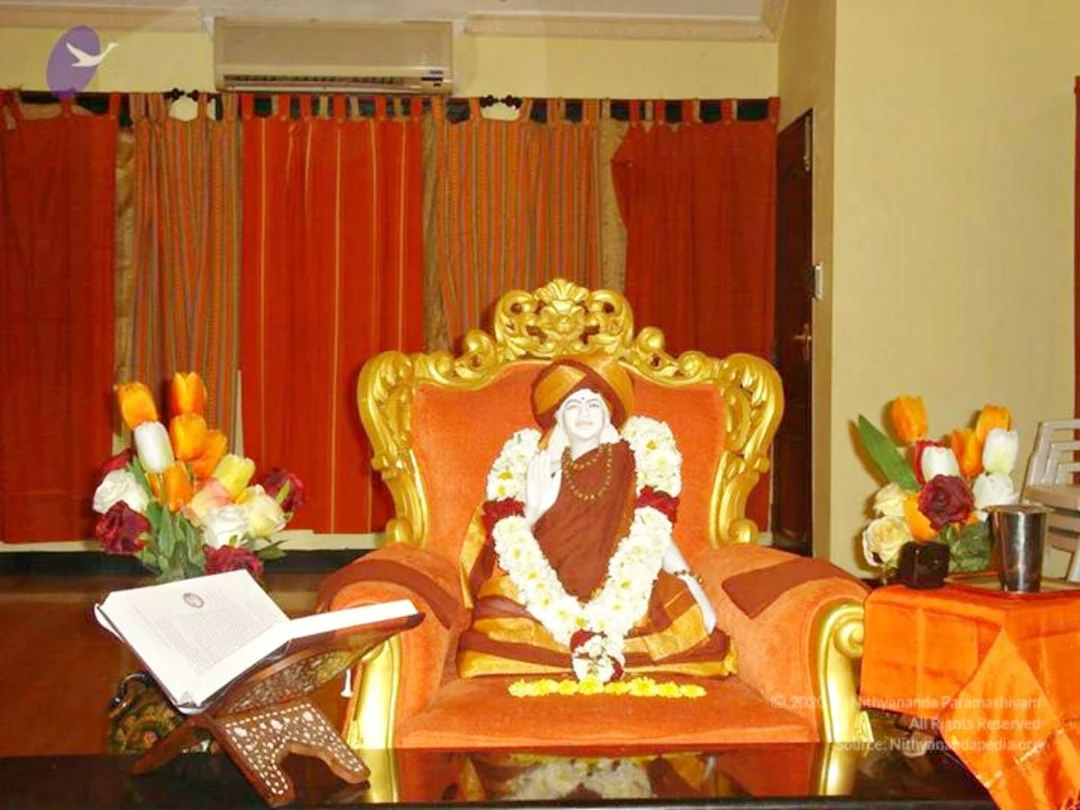
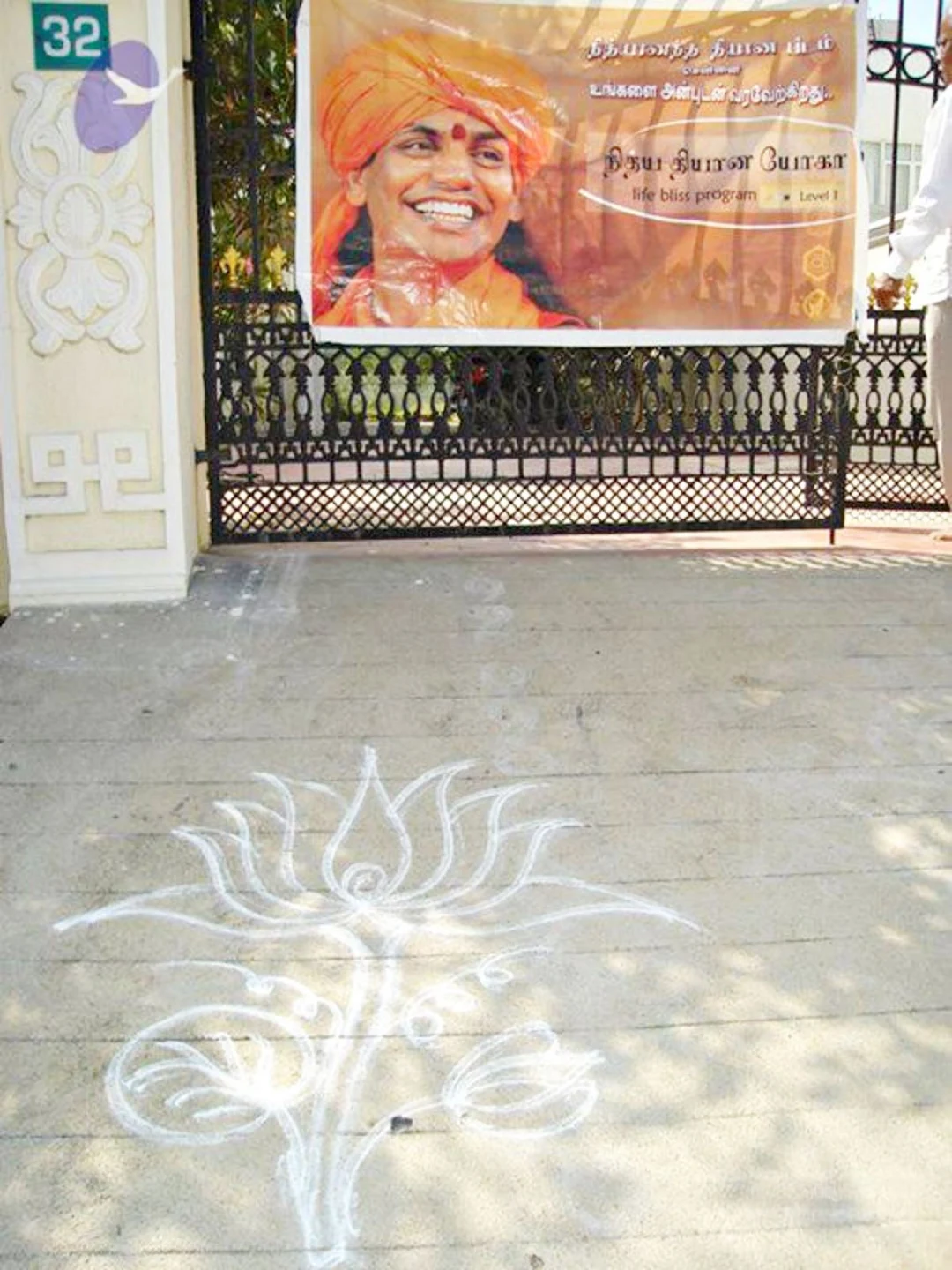
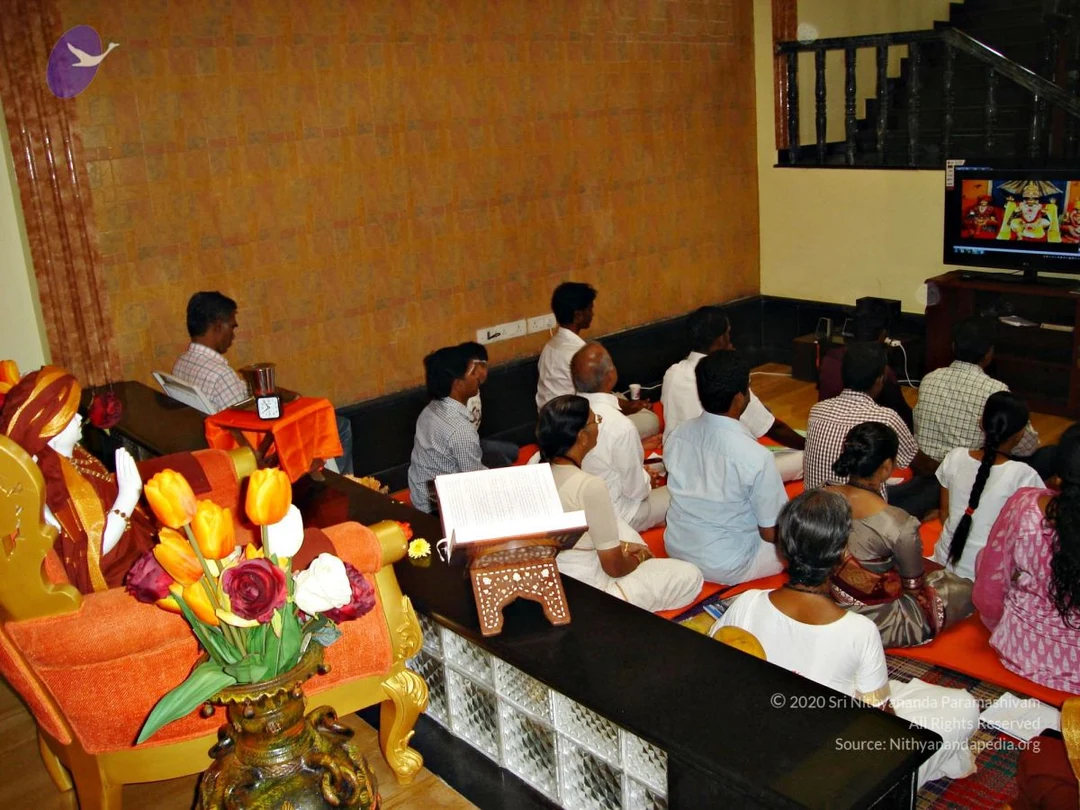
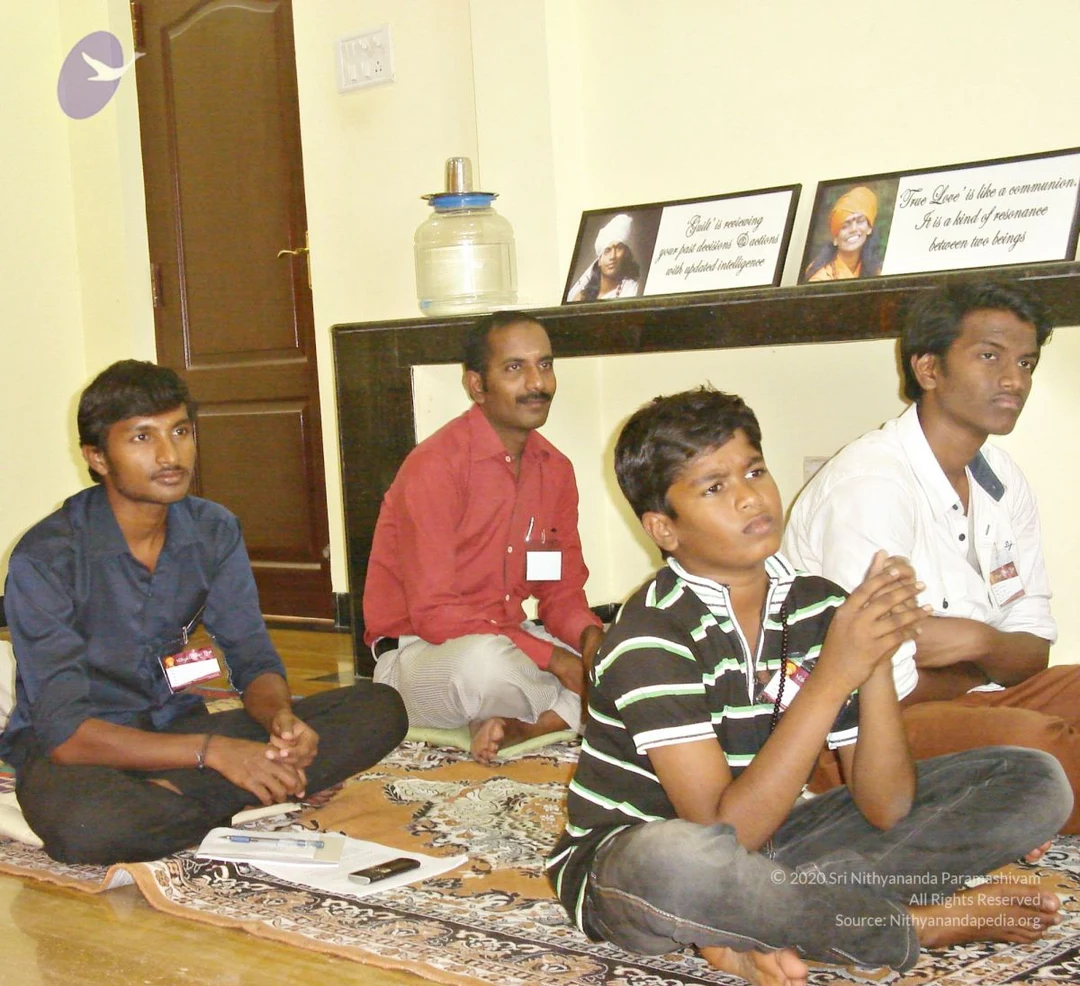
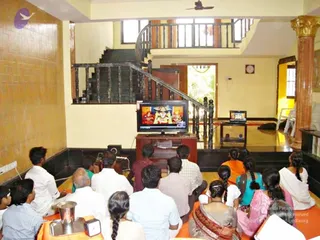
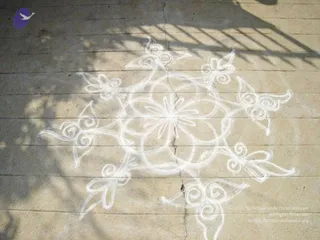
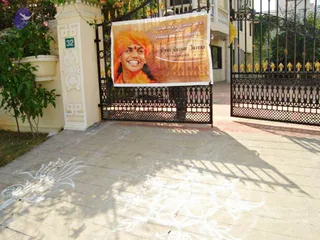
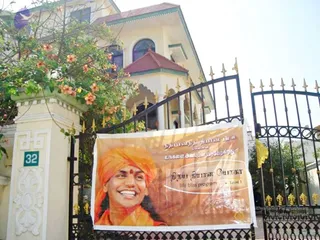
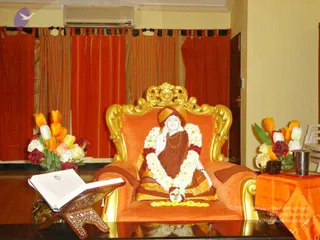
A small indoor room where a group of about ten seated devotees watch a flat-screen television mounted on a wooden stand at the right. The screen shows a figure in ornate red and gold attire. Devotees sit cross-legged on orange and red mats facing the screen, several in white or light shirts and sarees, one woman with a long braid, a man in a checked shirt at the back. In the foreground a golden ornate chair with orange cushions holds a seated figure in orange and gold robes with a white face, beside a vase of yellow tulips, pink and white roses. A wooden book stand holds an open book. The wall is covered with woven bamboo-like panels and a staircase rises at the upper right.Devotees sit on the floor of an ashram hall with a staircase and balcony behind them, watching a flat-screen TV on a wooden cabinet. The screen shows a man in orange and white ceremonial dress with a tall headdress flanked by two other figures in red and orange. Around a dozen people are seen from behind: men in white shirts and checked shirts, women in orange, teal and pink saris with long braids. A steel pot and a small speaker sit on the orange floor cloth in front. A laptop is on a side table at the right. The people appear to be watching a live video broadcast of the event.A white chalk kolam drawn on a pale concrete floor, with a symmetrical floral design of looping curves, petals and a central star-like flower radiating outward. Dappled shadows of a railing or branches fall across the upper part of the ground. The pattern is complete and no people are visible.A photograph of a gated entrance with a decorated white-chalk kolam on the paved driveway in front of a black wrought-iron gate. A large printed banner hangs on the gate showing a smiling figure in an orange turban and orange robes against a warm orange background, with Tamil text above and the words "Shiva Yoga" and "life bliss program · Level 1" below. The banner is a depiction on printed material, and no people are visible. A house number plate reading 32 is on the white pillar beside a flowering plant.A photograph of a cream-coloured two-storey building with a red-tiled turret and arched windows, behind black wrought-iron gates topped with gold spikes. A large orange vinyl banner is hung on the gate, showing a smiling man with a saffron turban and a red bindi, with an orange background. Pink hibiscus flowers climb a pillar beside the gate, and the house number 32 is shown on a green plate. Printed on the banner are Tamil text and the words 'life bliss program' and 'Level 1'. The man on the banner is a printed depiction, and no physical people are visible in the scene.A seated statue or portrait figure on an ornate gold-framed orange throne-style chair, dressed in ochre-brown robes with a rudraksha-style mala and a white flower garland, wearing an orange-brown turban and raising one hand in blessing. Flower arrangements of orange tulips and red roses stand on either side, with a wooden book stand holding an open book at left, a small metal cup on an orange-draped table at right, and orange and red curtains behind. This is a depiction of a deity-like figure, not an identified living person. No physical people are visible.

Paduka Puja and Sri Nithyanandeshwara Temple, Adi Kailash, Bengaluru
20 photosSource gallery
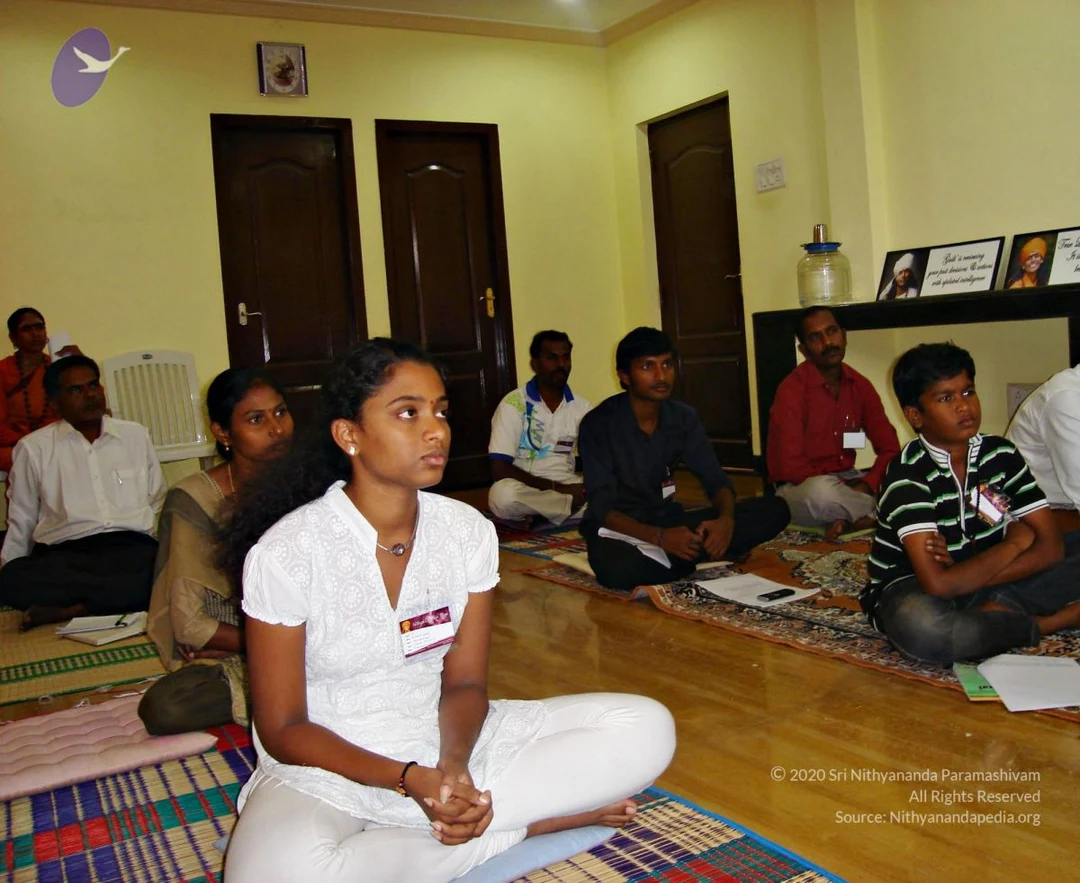
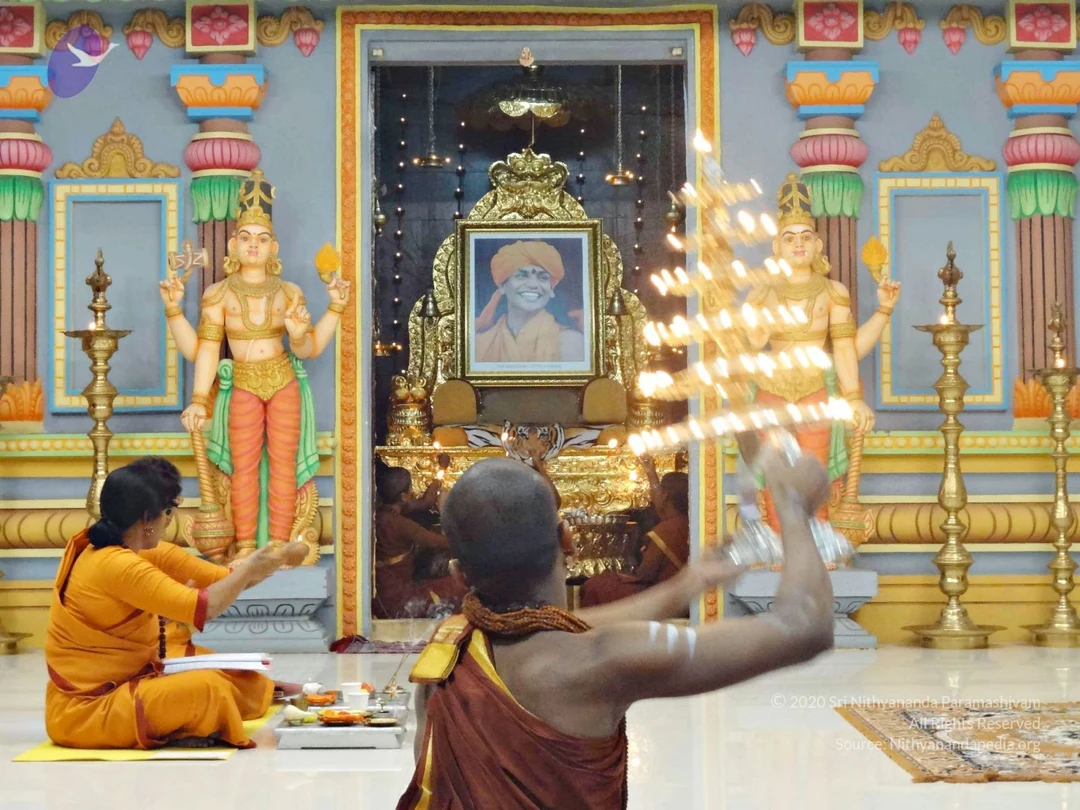
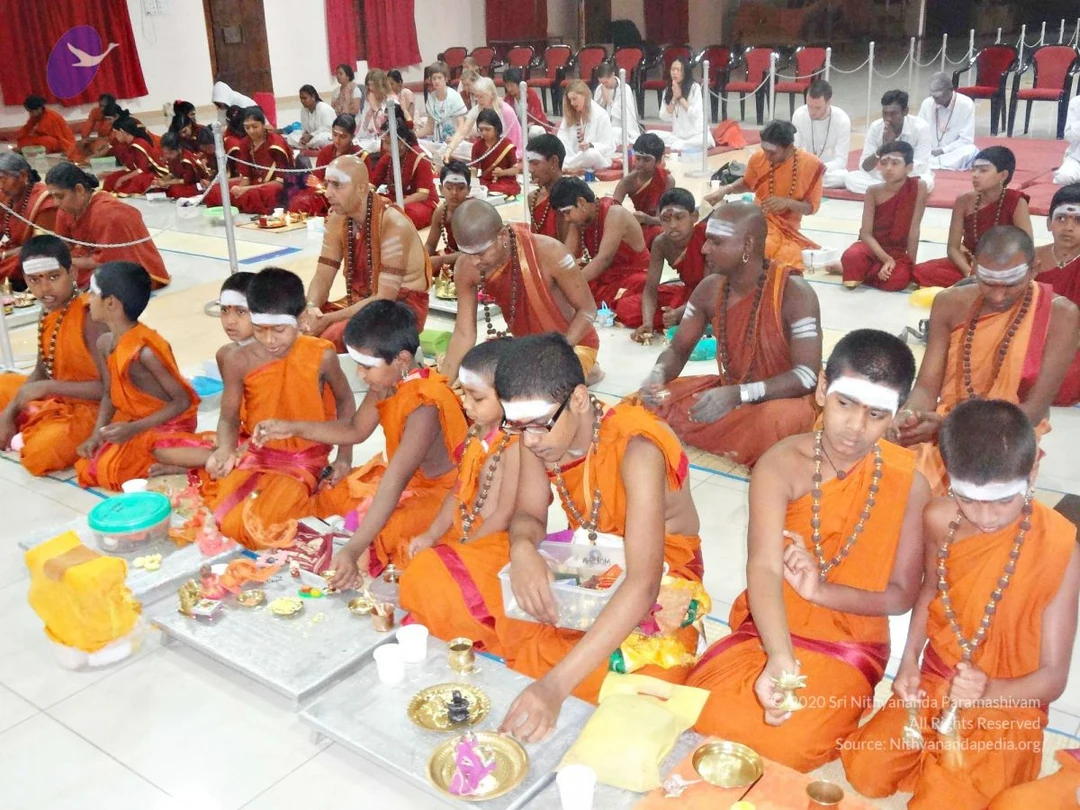
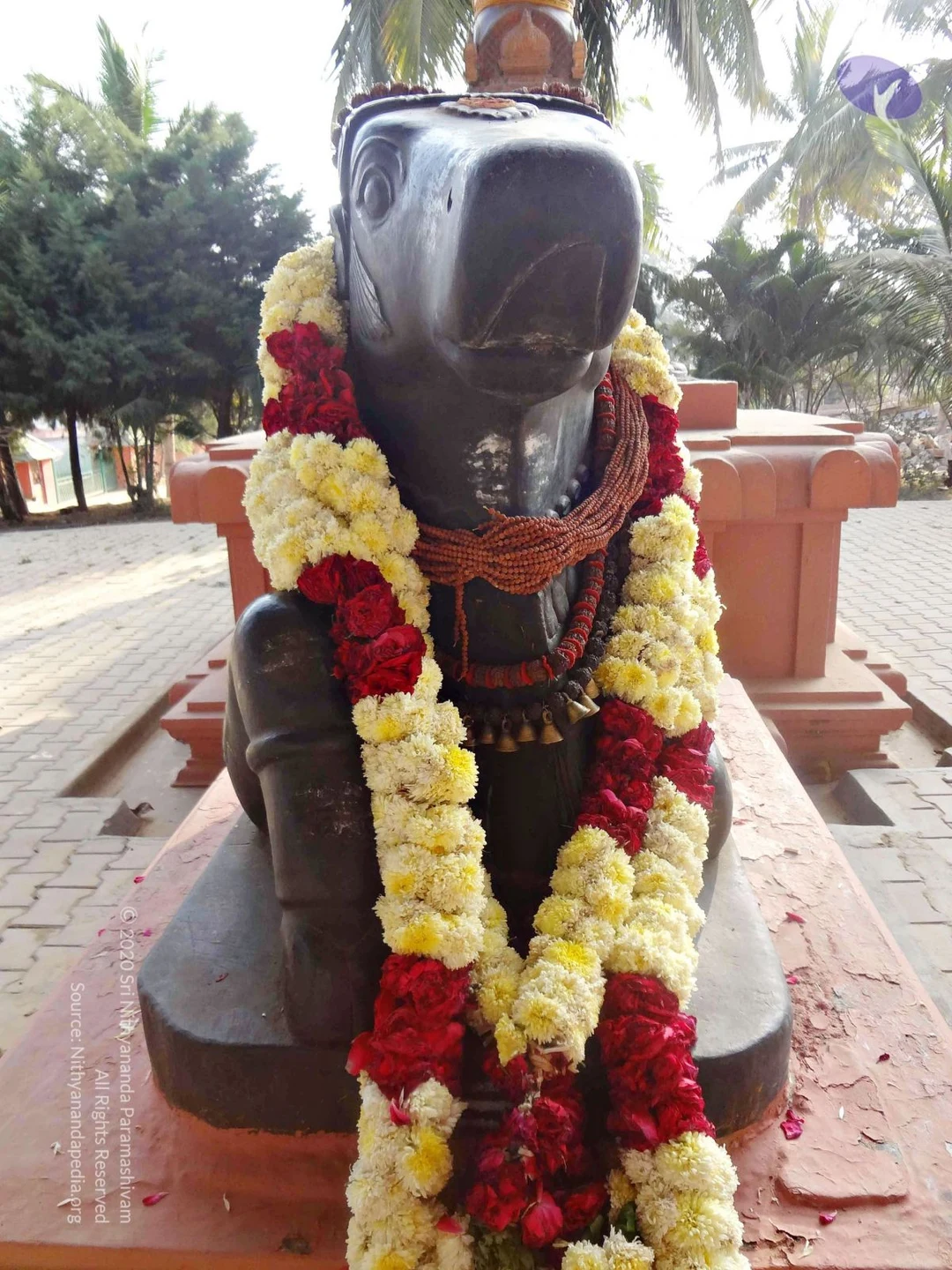
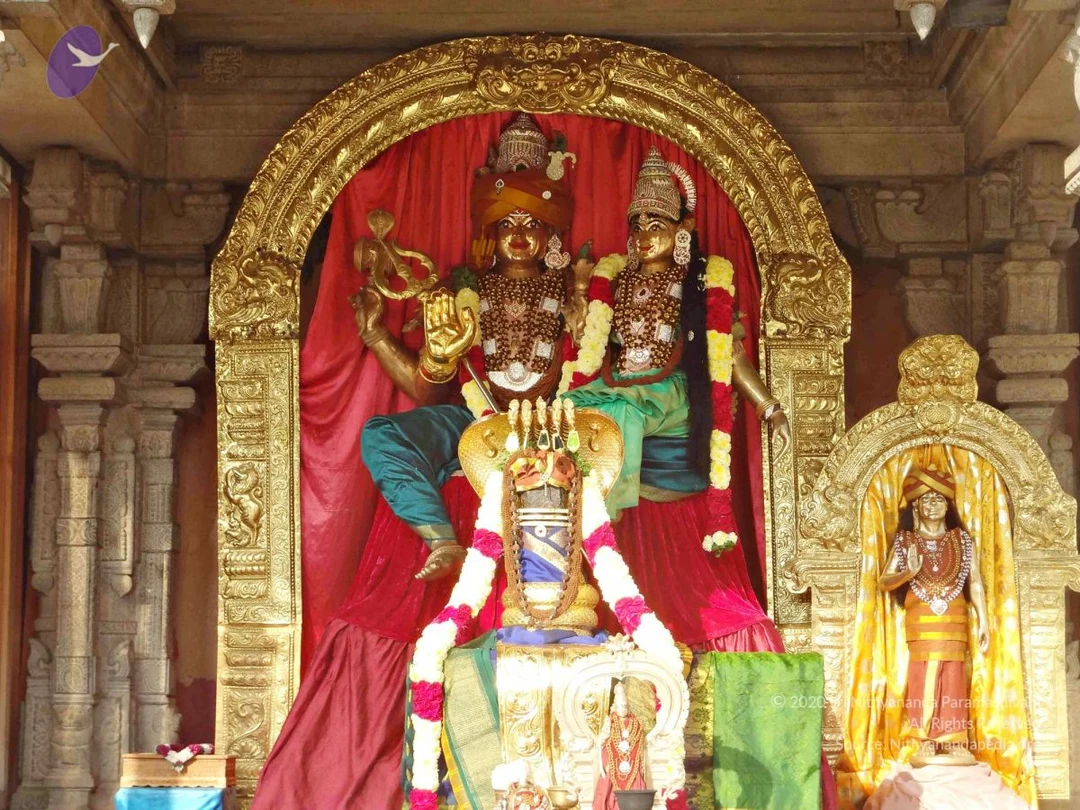
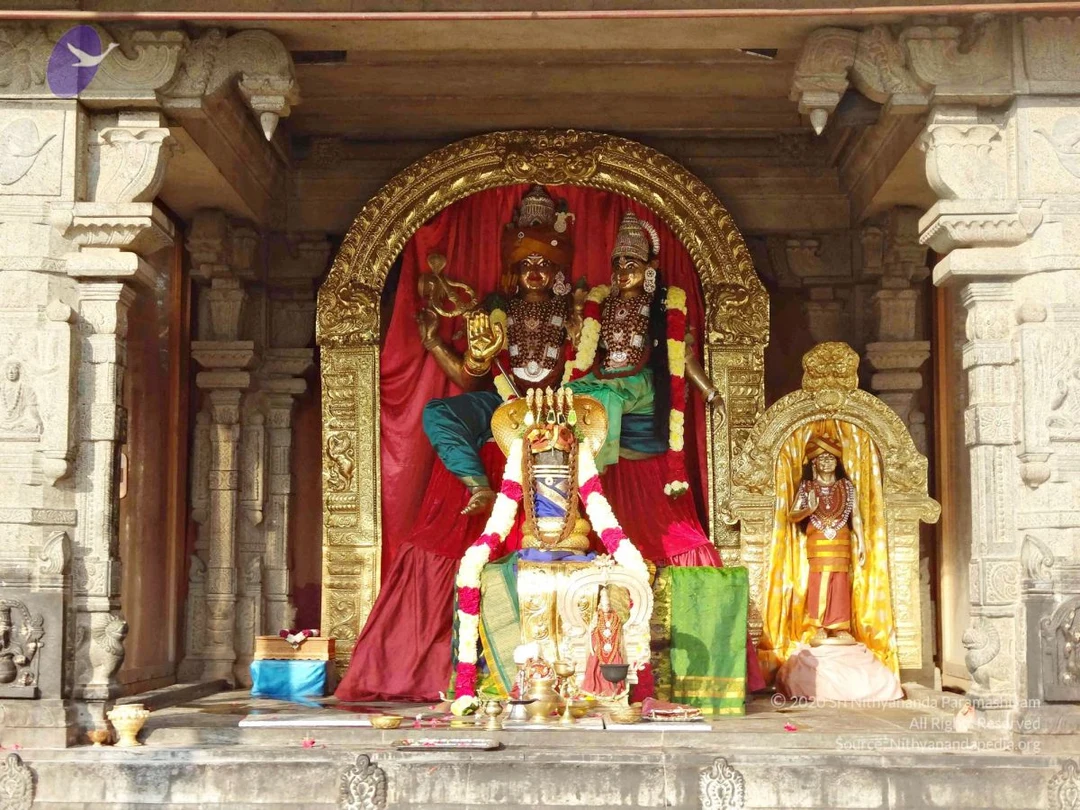
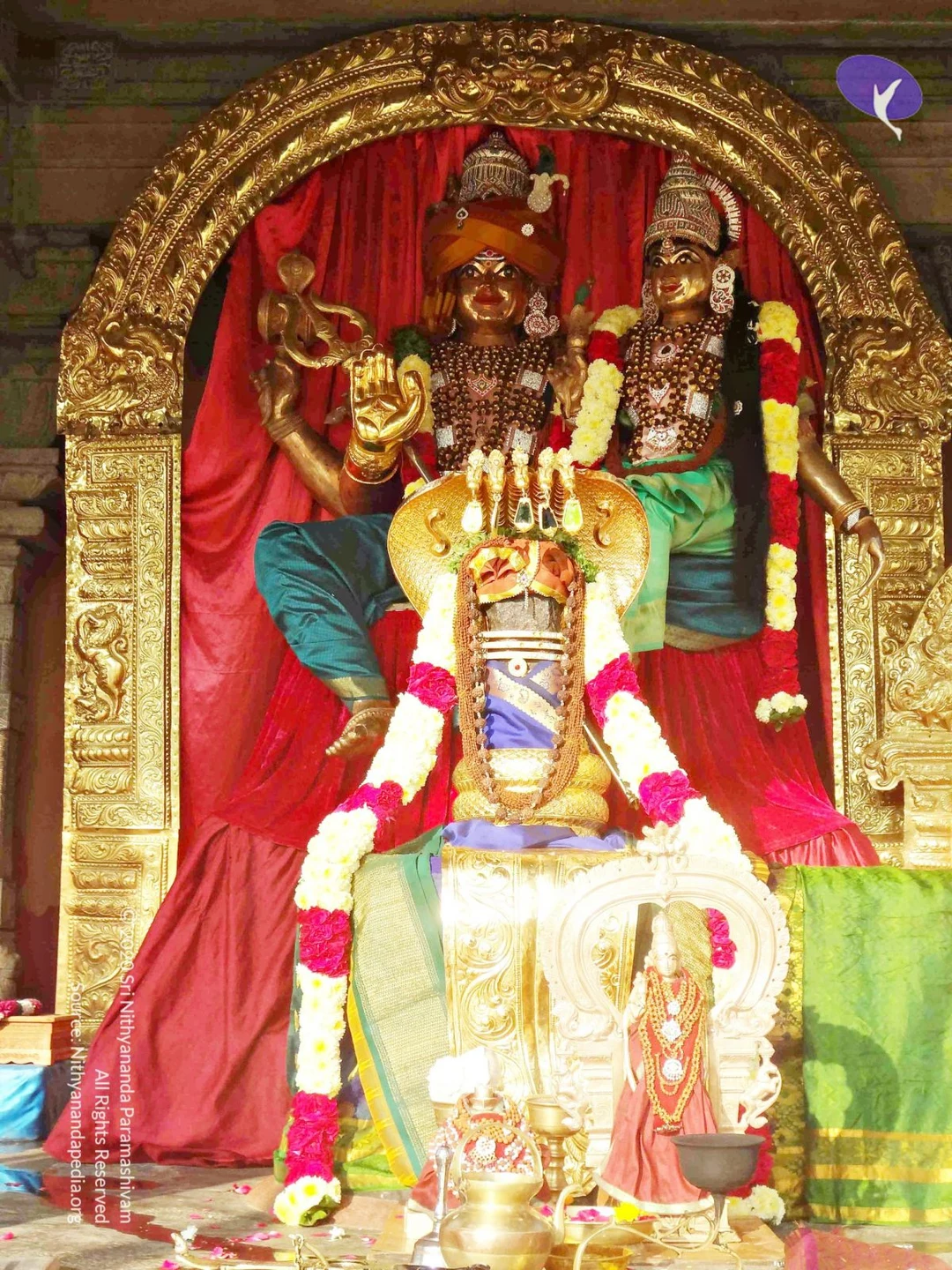
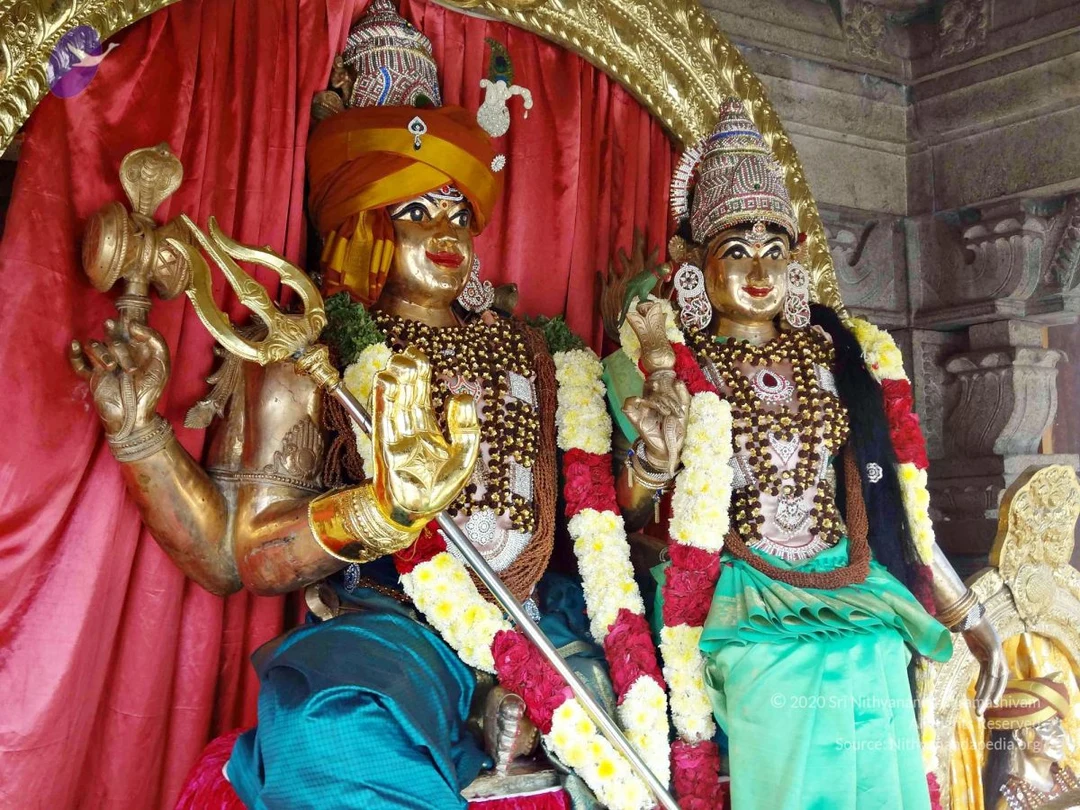
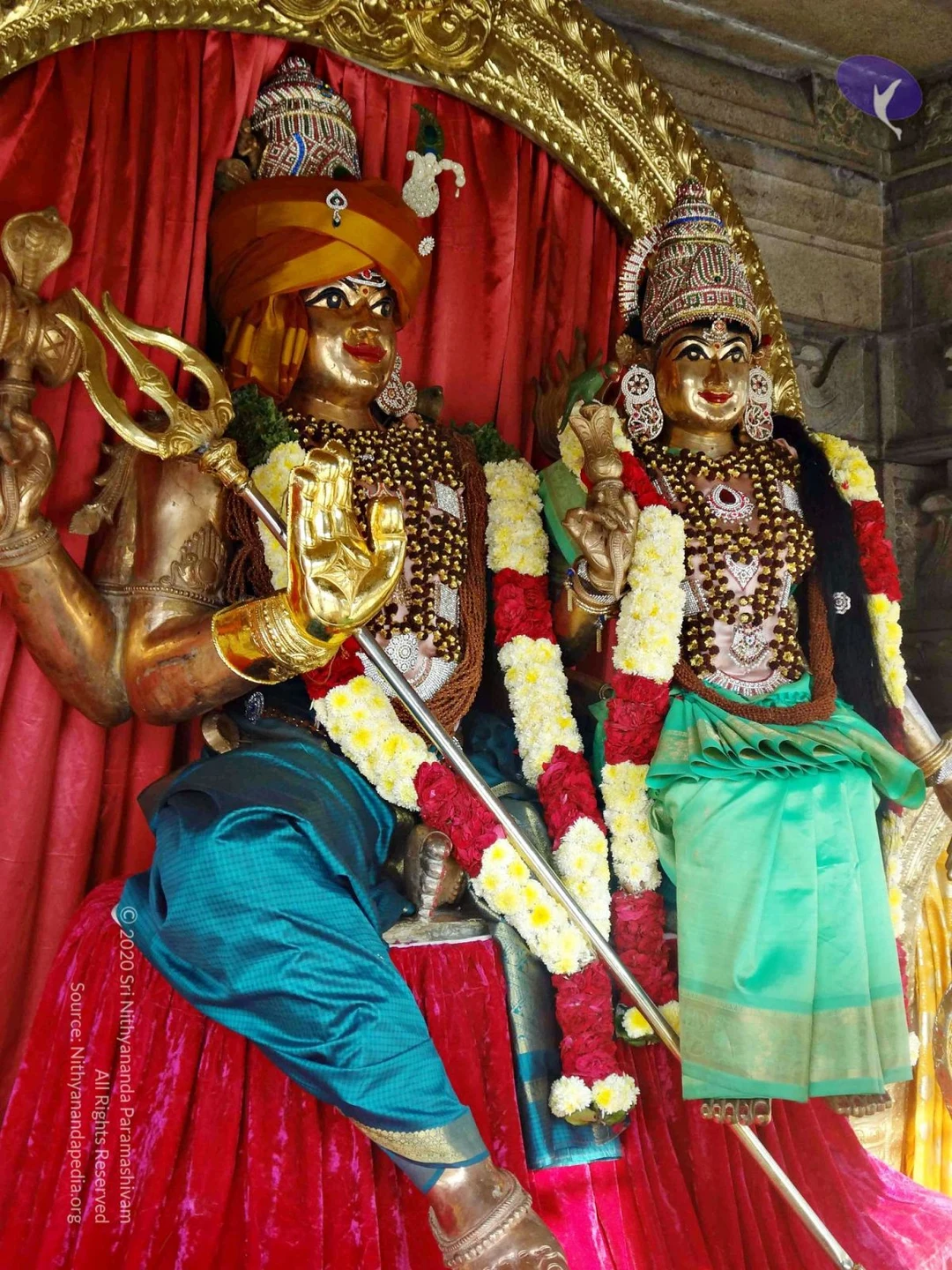
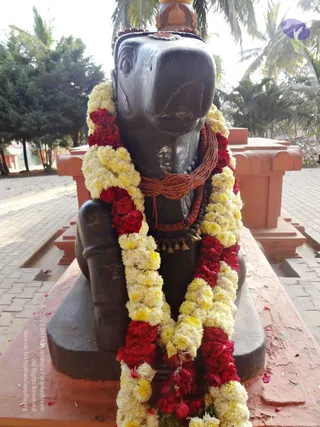
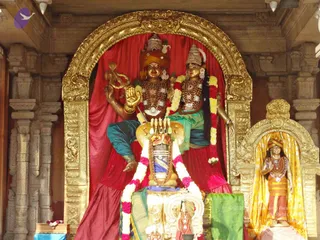
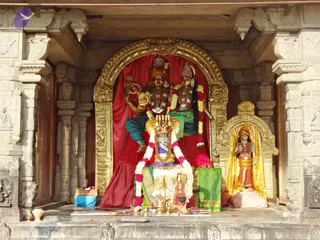
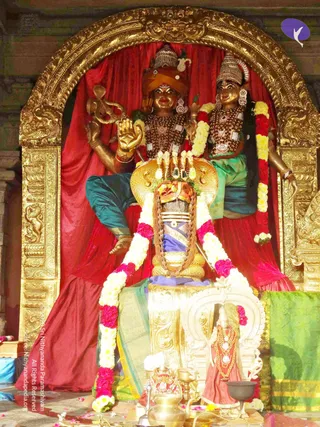
A temple-hall aarti in progress before a gilded throne (peetha) holding a framed portrait of a smiling man in an orange turban. Two painted deity statues with four arms stand on either side in orange and green dhotis and gold ornaments. A priest in a dark brown robe with a rudraksha-style necklace and white markings on his arm swings a large multi-wick oil lamp that throws bright flame streaks. A woman in orange sari sits on a yellow mat at left with a tray of offerings, and brass oil lamps stand along the walls.A photograph of a ritual puja inside a hall with red curtains and white tiled floor. Many young boys and men in saffron-orange dhotis and robes sit cross-legged on mats, wearing white forehead bands, rudraksha malas and ash markings. Brass plates, small bowls, cups and offering trays sit on low metal tables in front of them, and one boy holds a small brass vessel. Behind them, women in red and maroon saris and several Westerners in white clothing sit on red floor mats, some seated on chairs at the back. The scene resembles a group puja or homa with ritual implements arranged for worship.A dark stone Nandi bull statue sits on a red-brick pedestal outdoors, draped with thick garlands of white-yellow marigolds and red roses. Strands of rudraksha beads hang around its neck, with small brass bells at the chest. Palm trees and green foliage stand behind it on a paved courtyard with fallen petals scattered around. No physical people are visible; the statue is the sole subject.Photograph of a gilded temple shrine with a deity murti of a seated Shiva-Parvati form: a male figure with a trident and tall orange-and-gold crown, and a female figure with long dark hair in a crown, both draped in jewelled necklaces and garlands of white and pink flowers. In front sits a shiva linga with a golden yoni base, decorated with flower garlands and an ornate mukha, on a green cloth-covered altar with oil lamps. A smaller gilded figure stands in the right niche, wearing a yellow-orange garment and a bead necklace, hands folded. Red drapery frames the central deities beneath a gold arched prabhavali. No living people are visible.A shrine niche framed by a gold arch with a red drape shows a large Shiva-Parvati deity murti pair seated behind a black lingam. The lingam is draped with white and red garlands and set on a gold-trimmed peetha with a green cloth. Oil lamps and brass vessels stand in front. To the right, a smaller gold-clothed figure in a yellow cloth stands in an alcove. The carved pale stone pillars and walls surround the shrine, and a small gold-embossed altar sits to the left.A gilded temple shrine with an ornate golden arch framing a red drape. Two large metal deity murti sit on a golden seat: the figure on the left wears an orange turban and holds a trident-like implement and a raised hand, while the figure on the right wears a tall crown and green garment. Both are adorned with rudraksha-style beaded necklaces and fresh white and pink flower garlands. In front, a tall lingam-like form is draped with a purple cloth and garlands, with a golden kalasha and brass pot with flowers, a small brass lamp, and scattered petals on the floor. A small standing figure in red and gold jewellery stands at the lower right. No living people are visible.

February 02 2014

1 photoView all
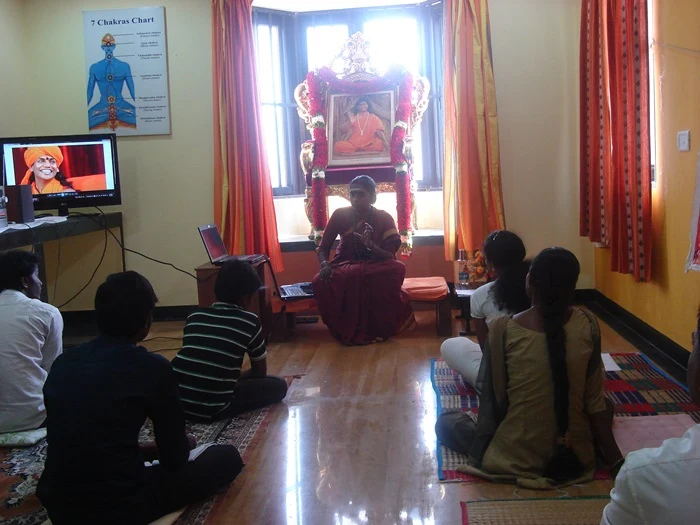
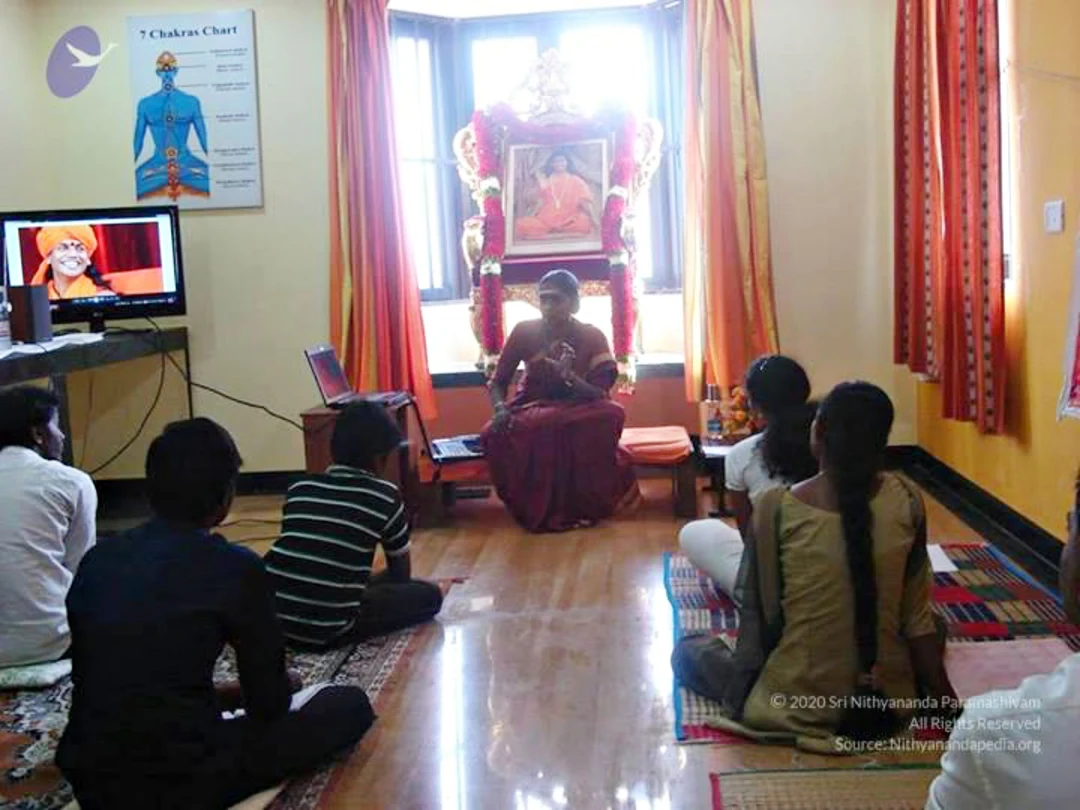
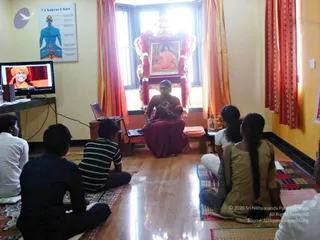
A small room with yellow walls hosts a satsang watched on a flat-screen TV at left, which shows a smiling figure in an orange turban and orange robe. A woman in a maroon sari sits cross-legged at centre before a laptop, in front of a shrine framed by red and white flower garlands, with a framed portrait of a figure in orange robes. Five to six young people sit on mats and rugs on the floor, watching the screen. A wall chart shows the 7 Chakras with a blue figure. Red and orange curtains frame a bright window. The screen figure shows no distinctive a person cues beyond an orange turban, so identity is uncertain.