Skip to content
Saturday

1 February 2014

Dated photos
117
Source pages
1
Media
8
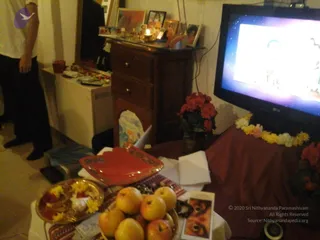
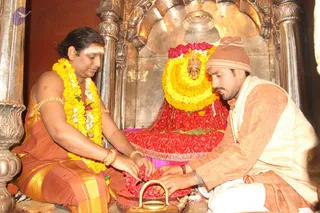
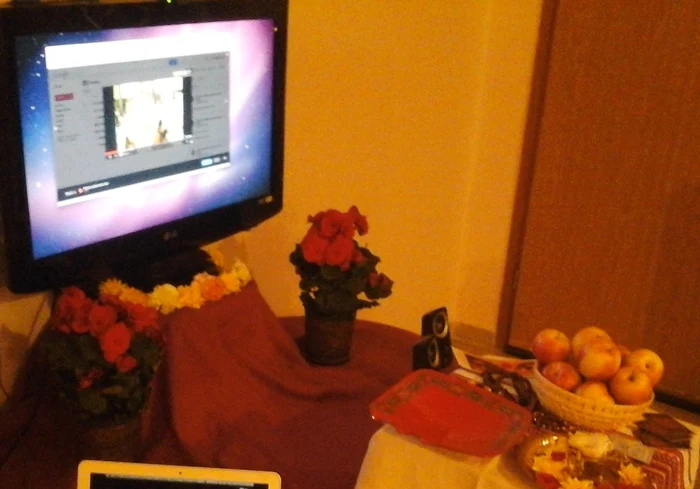
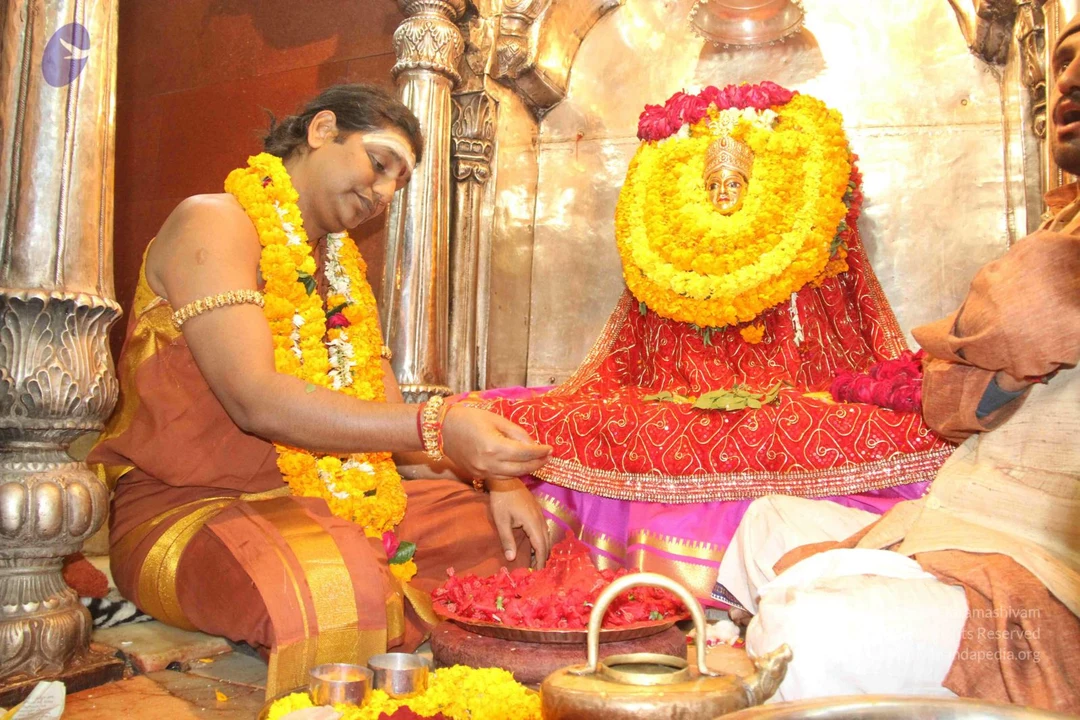
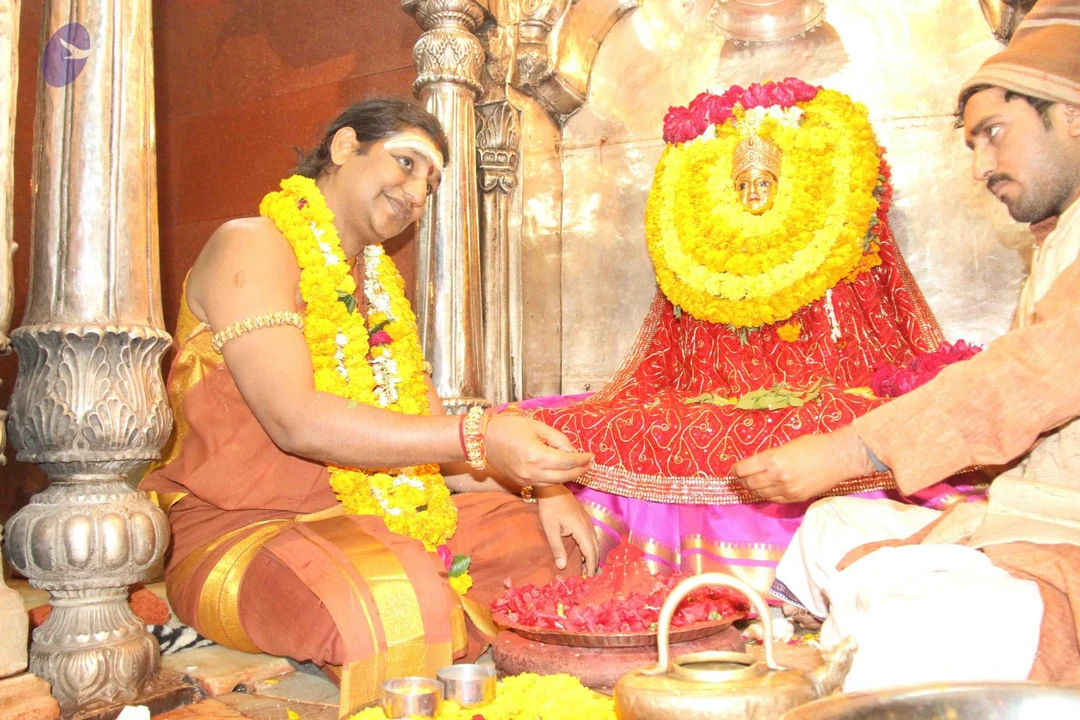
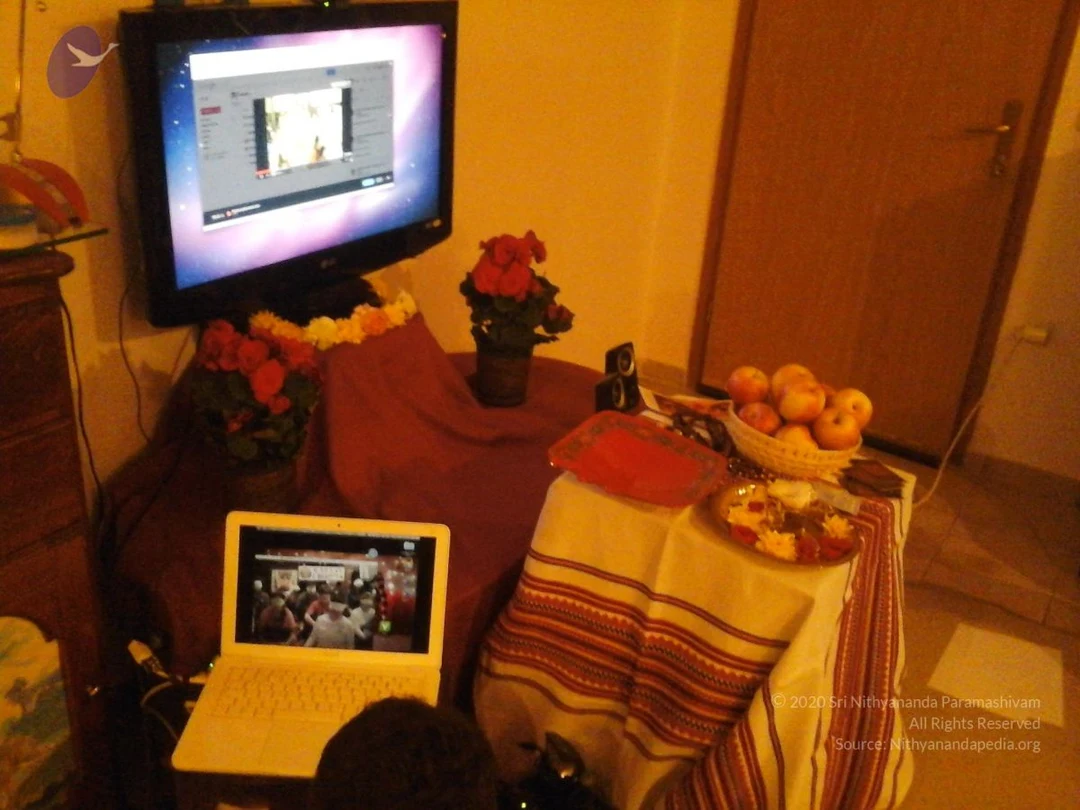
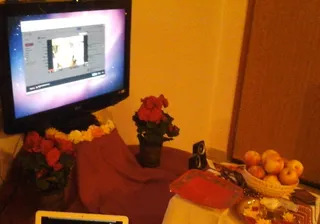
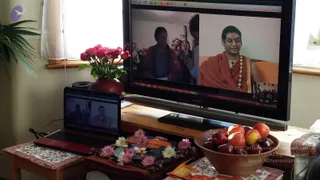
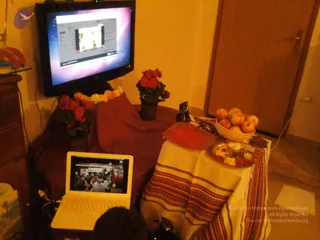
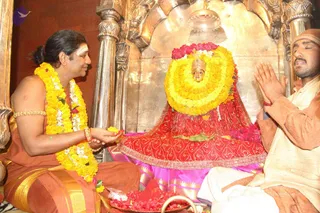
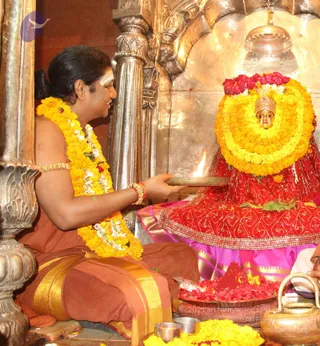
A home shrine setup photographed indoors in the evening. A flat-screen LG television on the right shows a bright image of a figure in a white setting, framed by a garland of yellow and white flowers draped on a maroon cloth. On a wooden chest of drawers in the centre, framed photographs and small brass items stand around a lit oil lamp. A red flower arrangement sits in a vase nearby. In the foreground, a bowl of yellow-green apples sits on a patterned cloth beside a brass plate of flowers and a red ceramic tray. A partly visible person in white shirt and dark trousers stands at the far left edge. Two people are at most visible, no clear figure identifiable as a candidate in the pictured photos.A photograph inside a temple shrine. A man in saffron-orange robes with a gold-bordered dhoti, a white tilak on his forehead, and yellow and white flower garlands sits on the left, pouring petals from a brass vessel. Beside him a younger man in an orange kurta over a white vest and a brown knitted cap offers flowers from a silver plate. Behind them stands a silver-backed alcove holding a deity murti with a crown, draped in a large yellow marigold garland and a red embroidered cloth. The scene suggests a puja or abhishekam offering.

February 01 2014

Original wiki page
Contents

Title

Completion with Self Hatred || Nithyananda Satsang || 1 Feb 2014

Description

This video is an excerpt from the Nithya Satsang conducted on 01 Feb 2014. Here Supreme Pontiff of Hinduism Jagatguru Mahasannidhanam HDH Bhagavan #Nithyananda Paramashivam explains that any negative thoughts or violence that we experience about others or situations around us or ourselves , all root from the self hatred we carry in our inner space about ourselves. Swamiji tells the delegates that if they complete with the self hatred towards themselves, then everything else in the outer world will also align and they can live a blissful life forever. He also talks about how he functions on oneness as his only principle in life.

The Supreme Pontiff of Hinduism Jagatguru Mahasannidhanam His Divine Holiness Nithyananda Paramashivam (HDH) is the reviver of #KAILASA - the ancient enlightened civilization and the great cosmic borderless Hindu nation. Revered as the incarnation of Paramashiva - the primordial Hindu Divinity, HDH has a following of 2 billion Hindus worldwide with de facto spiritual embassies in over 150 countries. He has worked untiringly for over 26 years for the revival of Kailasa, for global peace and to give super conscious breakthrough to humanity. He has survived the worst persecution of multiple assassination attempts on person and on character by anti-Hindu elements. He is collecting, organising, preserving, time capsuling, decoding, spreading and reviving 20 Million source books of Hinduism and the 64 sacred arts & sciences like Ayurveda, music, dance, sculpting, astrology, vastu and much more. Close to 20,000 hours of HDH’s timeless talks have been recorded till date (Sep 2020), which are a treasure trove of powerful cognitions to solve individual and global problems of any kind.

VideoAudio

Transcript:

[00:15]

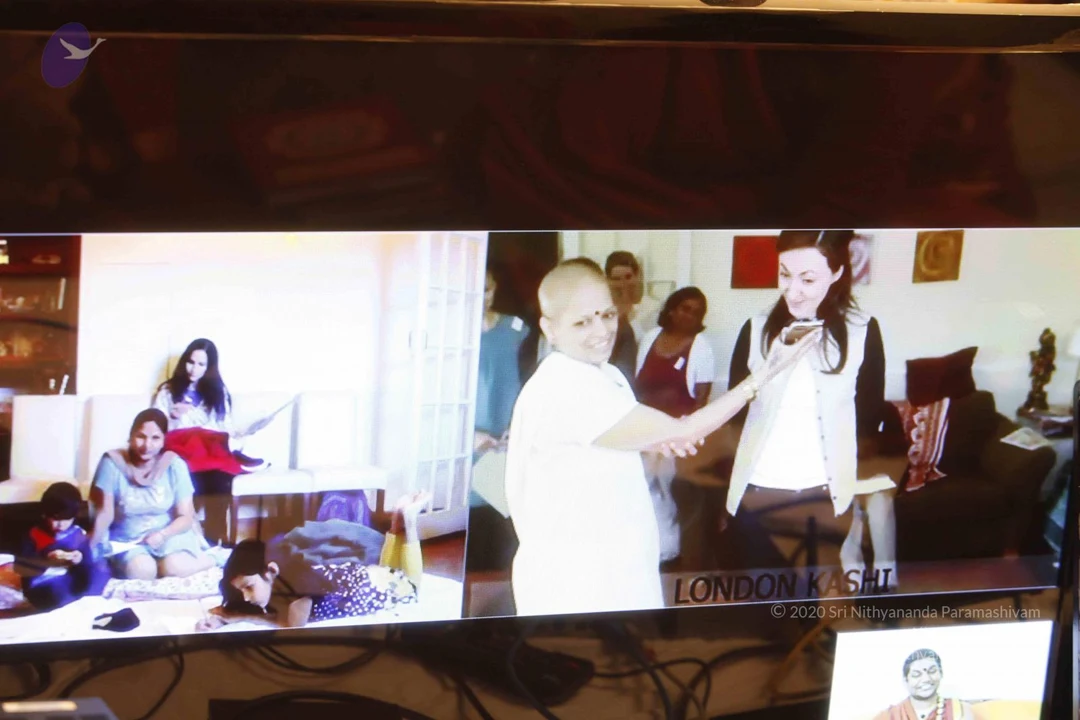
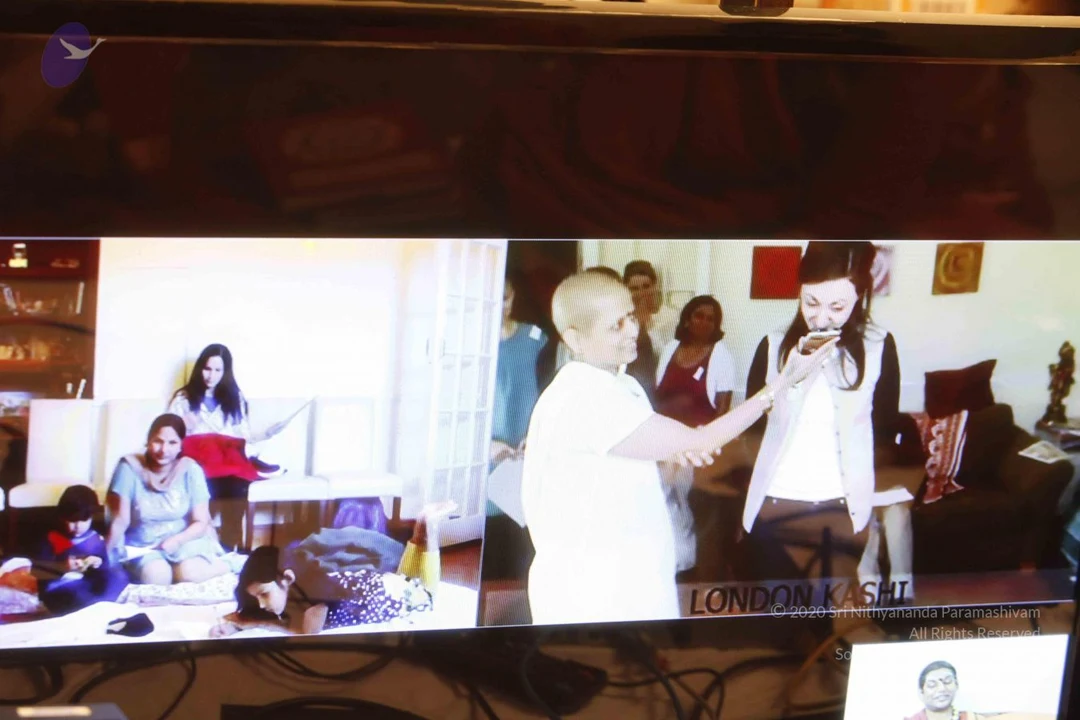
…vande guru paramparam | I welcome all the devotees, disciples, Samajis, Satsangis, Mahants, Kotharis, Sri Mahants, Thanedars sitting with us all over the world through Nithyananda TV, Sadhana TV, Lotus News Channel, Janasri TV, two-way video conferencing in many cities, many countries around the world. Cities sitting with us in two-way video conferencing having Nayana Deeksha: Ohio-Prayag, Nithyananda Nagaram-Hyderabad, Beng… Nithyananda Nagara-Bengaluru, Oklahoma-Somanatham, San Jose-Madurai, Scottsdale-Arizona, London-Kashi, Indrani-New Jersey, Guadeloupe-Prameshwaram, Bengaluru city center, Charlotte-Sri Sailam, Thiruvanmiyur-Chennai, Enriching Temple-Bidadi, Guadeloupe-Rameshwaram, Bengaluru City Centre, San Jose-Madurai, Oklahoma-Somanatham, Los Angeles-Arunachalam, Scottsdale-Arizona, <English Inaudible 01:59>-Slovakia, Toronto-Downtown, Kathmandu-Nepal, Oman-Sivagangai, Hosur Dhyanapeetam, Singapore-Singapuram, Hyderabad-Gupta Kashi, <English Inaudible 02:12>-Hong Kong, Jorpati-Nepal, New Zealand-Adi Arunachalam, Bogotá-Colombia, Grasse-France, High Point-North Carolina, Port Washington-New York, Devon-UK, Vancouver-Bhuvaneshwar, San Diego-Thirualavai, Monterrey-Mexico, Hong Kong-Seerkazhi, Devon-UK, High Point-North Carolina. “That’s it!”

[02:47]

I welcome all of you with My love and respects. I welcome all the devotees have gathered in Jorpati-Nepal. I welcome all of you with My love and blessings. I am so happy all of you are gathered in Nepal. My blessings to all of you. Today we will have Kalpataru in Nepal. I will start expanding on Kalpataru continuously. “Yes! Great!” We will start the Kalpataru Darshan and the… I will expand on the Kalpataru process. Please listen, usually, end of the Satsang, I give the essence of the Satsang but today I am going to make the statement now and go on expanding, go on expanding, this one statement. “All the incompletions of the planet Earth starts with violence towards you and others. All the Completions of the planet Earth, happens with love towards you and others”.

[04:31]

Please listen, I will expand on it but now what I am saying is like a Shloka… Sutra. All the incompletions starts with hatred towards you and others. All the Completions starts with loving you and others. All bad things in the cosmos starts with hating you and others. All the good things starts with loving you and others. Please listen and it is not a simple statement and I also don’t expect… I am not that insensitive that I expect you should understand this statement immediately.

[05:42]

Please listen, step by step, only when you start completing with all the hatred you have towards others and the outside things… As I said two-three days before, the hatred towards others and other things has no justification, no justification. You can not justify it. You can’t use any justification because that person is black and white or green or yellow, or north indian, south indian, westerner, easterner, you can’t even use religion as a justification for your hatred. Please understand, nothing, nothing can be used as a justification for your hatred. You have to complete with every hatred you have towards the outer world whether it is hatred towards a person or hatred towards a animal. Sometime we may not be afraid of snake but we will be… we will hate that creepy effect of that cockroach. I have seen people who are not even afraid of snakes, will be afraid of that hate… it is not even a fear kind of hatred they will have towards that creepy effect of cockroach.

[07:34]

Whether it is a human being, or a building, or an object, or a cockroach, whatever, the hatred can not be justified. Hatred can not be justified. No question of hatred. It has to be completed. Only when you complete all the hatred, anger, violence you carry with outside, you realize everything boils down to self-hatred. Please understand, discovering this experientially, discovering this experientially… Please understand, all of you need to know I am not teaching any morality, <Audio is cutoff 08:52> My relationship, My idea with… with non-violence is completely separate. I am not teaching non-violence here as a morality, please understand. First of all, I don’t teach the so-called moralities. I am a guy who is completely grounded on Advaita experience. I have that Advaitic experience and I am sincere to the Advaitic experience. I am not married to anybody else, understand. I don’t have a respect or affiliation to anything else other than Advaita. I don’t care about any of your other rules, regulations, laws, understandings. So be very clear, understand the context from which I am talking about non-violence. You need to know the context.

[10:12]

See, there was a great devotee called Baneshwar Shiv… Baneshwara. He asks Mahadeva, “Mahadeva, you have to give whatever boons people ask. Give me this boon”. Then Mahadeva says, “Whoever knows this that whatever boon they ask I give. For them I will give”. Please understand, he puts a very small twist. He says, “Tathastu, so be it” to Baneshwara. Sorry his name is Banasura. The Shiva worshipped by him is become Baneshwara; Banasura. Banasura asks Mahadeva, “Mahadeva, whoever ask whatever boon you should give”. Mahadeva puts a small twist and says, “Whoever knows whatever they ask, I give. For them, I give”.

[11:28]

I am not trying to promote non-violence as any morality or this, that. I am neither far nor against any rules, regulations, morality, it is all up to them but I am very clear I am married to Advaita, the truth of Advaita and I am sincere to that truth, that experience. “नित्यं अद्वितीयम् निरञ्जनं” “nityam advitīyam nirañjanam” Eternally being in the Space of Advaita and Nirañjana, purity.

[12:14]

Please listen, only when you complete with all the hatred you carry with the outer world, you wake up to the reality, it is nothing but the… all the hatred you have towards the outer world is the extension of the hatred you carry inside, the hatred towards you. If you are… for example, if you hate easterners or westerners, only if you complete, complete, complete and completed that hatred, you will understand it is nothing but one part of you, you are hating, you are projecting it on others. I am not talking it as a philosophy. I am talking this as everyday strategy planning. The day to day strategies for your life, day to day strategies for your life.

[13:31]

See if I tell you, go to the corner of this street, there is a hotel where you can get your morning food, “Is it talking philosophy?”. Arey! It is a strategy for your morning breakfast, the basic need of your life. Strategy for your breakfast is not philosophy so whatever I am talking, don’t push it aside as a philosophy to be realised when you are old, retired, tired. When you don’t have anything else, you will just chew the pan and sit in the banks of Ganga in Varanasi and go-on be thinking, “Yes, I will be non-violent. Let me complete”. No, don’t push Me aside as a philosopher. I am talking to you. I am giving you the strategy for your day to day eating and sleeping, for your clothes and shelter, for your breathing and being alive.

[15:07]

Realizing, realizing that everyone is extension of you is the first step for realizing everyone is you. The first step for that realization happens non… with non-violence. Completion, Completion, Completion, Completion, Completion, Completion, Completion, Completion. If you have fear of some higher authorities, your boss, your wife, your elder brother, your politicians, some robber or unknown fellows, complete with all those fears. Only when you complete with all those fears, you will understand it is pa… extension of you, parts of you, you are projecting it on others and seeing.

[16:33]

There are some people who can’t face Me, they are afraid. It means, one part of you, you are not able to face. Ability to face Kalabhairava is Enlightenment; understand. Ability to face Kalabhairava means lord of time who has all the archives of all your strategies and plans. How many layer by layer by layers and layers and layers of hypocrisy and secrecy you build and justify it, “Oy! He is hypocrite, that is why I am hypocrite. He is cunning, that is why I am cunning. He is cheating me that is why I am cheating him. He is cheating her, that is why I am cheating him”. You can have layers and layers of all this cunningness. He knows, he cheating somebody has no justification for you cheating him because when you cheating him, you are only cheating the part of you.

[17:45]

For you to become Dharmic, whole world does not need to become Dharmic. Forever in the world, there will be some Adharmic people. If you are waiting for the whole world will become Dharmic, only then I will become Dharmic, you will be like Duryodhana or if you think whether the whole world becomes Dharmic or not, I will become Dharmic and then I will become the example, so that whoever wants, let them follow.

[18:22]

So understand, when you face Kalabhairava, your justifications, why you are inauthentic, why you are insincere, why you are no… non integrated. Those reasons are not going to be asked at all. Kalabhairava does not listen to reasons. He doesn’t listen to any reasonings. No, ability to face Kalabhairava means ability to face yourself, ability to face yourself. You get the ability to face yourself only when you complete with all the non-violence you carry, that is the first thing you need to do.

[19:31]

Title

Love Yourself First || Part 2 || NS || 1 Feb 2014

Description

This video is an excerpt from the Nithya Satsang conducted on 01 Feb 2014. Here Supreme Pontiff of Hinduism Jagatguru Mahasannidhanam HDH Bhagavan #Nithyananda #Paramashivam explains that any negative thoughts or violence that we experience about others or situations around us or ourselves , all root from the self hatred we carry in our inner space about ourselves.

Swamiji tells the delegates that if they complete with the self hatred then everything else in the outer world will also align and they can live a blissful life forever. He also talks about how he functions on oneness as his only principle in life.

The Supreme Pontiff of Hinduism Jagatguru Mahasannidhanam His Divine Holiness Nithyananda Paramashivam (HDH) is the reviver of #KAILASA - the ancient enlightened civilization and the great cosmic borderless Hindu nation. Revered as the incarnation of Paramashiva - the primordial Hindu Divinity, HDH has a following of 2 billion Hindus worldwide with de facto spiritual embassies in over 150 countries. He has worked untiringly for over 26 years for the revival of Kailasa, for global peace and to give super conscious breakthrough to humanity. He has survived the worst persecution of multiple assassination attempts on person and on character by anti-Hindu elements. He is collecting, organising, preserving, time capsuling, decoding, spreading and reviving 20 Million source books of Hinduism and the 64 sacred arts & sciences like Ayurveda, music, dance, sculpting, astrology, vastu and much more. Close to 20,000 hours of HDH’s timeless talks have been recorded till date (Sep 2020), which are a treasure trove of powerful cognitions to solve individual and global problems of any kind.

VideoAudio

Transcript:

[00:18]

In the Hindu tradition, a Brahmachari who starts the spiritual life, he is asked to do three things. In this three, any one he has to do, sometimes all three. One, he has to do Go-Seva means serving the cows, taking care of the cows or he has to go around and beg and collect food or sit in the cremation ground and watch the dead bodies being burnt day in and day out. All this three completes the violence you carry inside. All this three, any one process or all the three put together makes you complete with the hatred you carry inside. If you see the bodies being burnt day in and day out, you understand, “Oh God! Like this only this body is going to be burnt, then why am I foolishly carrying so much of junk inside me, stinking hatred or anger”; that understanding will land on you.

[01:50]

Or if you do Go-Seva, taking care of the cows, everyday touching the cows… you see, cow carries a very beautiful, best possible Bio-Memory of giving love. The Bio-Memory of the love is available in its peak form in the cow body. In the Pashu, cow, the loving, non-violent giving Bio-Memory is available when you do the Go-Seva by touching it. Everyday washing, cleaning, taking care, cleaning the cow dung, milking, feeding the calf, feeding the cow, that Bio-Memory gets transmitted. I used to think sometime why the traditionally they have that idea of Go-Seva as a Prayaschitta for your anger or sins committed. In many of the Gurukuls, Ashramas if a disciples somes… does some mischief, mischief for… does some mistake, Go-Seva is given as Prayaschitta. I used to wonder why? Later on, I found out… I also experientially saw, it is true cows carry the most beautiful loving, sharing, caring, non-violent Bio-Memory; that is why you should never eat cows meat.

[03:39]

You should take care of the cows. When you touch, take care, protect the cows, that beautiful Bio-Memory gets transmitted to you. If you eat the cows, when you kill the cows, so much of that cow’s suffering, sorrow, even after being so loving, he is been killed, she has been killed, that sorrow will get stored in the Bio-Memory and it will get into your system. You will all the time feel you are a victim, so don’t eat cows. Love them, don’t eat them. Understand, this is the slogan we should raise, “Love them, don’t eat them”. So, Go-Seva, serving the cows or going around and begging and sharing that begged food with others, even that takes away your violence. When you go around and beg, you will understand the magnanimity, generosity of the people. You will start developing love for the people. So listen, in this three, any one or all three completes the hatred you carry, the anger you carry.

[05:43]

In our Gurukul, I gave a, one more powerful process, talking to the lotus plants and making them drop their thorns, that is also basically to get you out of that anxiety, fear pattern, hatred, violence pattern. The hatred or violence gets developed when you are constantly in anxiety and fear. When you talk to a rose plant everyday and make that plant drop their thorns, not by forcibly plucking, by automatically. You will develop such a subtle grounded Bio-Memory in you. I tell you, feeling grounded…

[06:41]

I can give you one more tip, if you lie down on the floor, belly button touching the ground, you will feel grounded and lot of your anger and hatred will come down, will become complete. When you want to complete with a hatred with others or hatred with yourself, lie down, your belly button touching the ground. If the ground is too cold, maybe you can use a Kambal or blanket but pushing your belly on the ground, lie down and do the Completion. All the hatred towards others and towards yourself, the Bhuma Devi, the Earth will suck and release you from that incompletions. You will be grounded. You will be grounded completely. It’s a very powerful tip and technique. It will be very powerful process for Completion. I know I have not started even expa… I did not even go to the second statement, I am only still expanding on the first statement. Maybe the second statement I will expand on tomorrow’s Satsang but today let Me at least complete the first statement.

[08:27]

Listen, hatred cannot be justified. Gender, race, colour, creed, religion, sex, language, province, geography, nothing can be, nothing can be the reason for hatred. Nothing can be the reason for the hatred. Only when you complete with all the hatred, you will realize, suddenly like you will wake up, “Hey God! Both side, the person who is hating and being hated; both side is me. Because of the heap of hatred, I forgot that I am playing both side game”. Realizing you are playing both side game is Advaitic experience. You are the Gods, you are the demon, you are the Meru hill, you are churning, realizing it is nectar, Amruta and denying to realize it is poison, Visha. How much ever poison you vomit, out of his compassion Mahadeva keeps it in His throat. Neither it affects Him nor it affects you, and He gives you the nectar; that’s the most, safest place He can keep the poison so that nobody is affected, that is why he kept it in His throat.

[10:45]

Sometime you have to keep things safely, not because they are valuable, because they are dangerous. All the valuables are kept safely by Vishnu, all the dangerous things are kept safely by Mahadeva. What to do? He keeps all the dangerous things safely so that the world is not affected by it. So please listen, please listen, everything is you. Whoever you love is extension of you. Whoever you hate is extension of you. Whoever you doubt is extension of you. Whoever you have trust is extension of you. Everything is extension of you, you, you.

[12:04]

I can add, few more techniques. One, lying down the belly, pressing the belly on the ground and completing. Sitting in the breathing Space of Ganga and completing. Sitting in the breathing space of Ganga means the distance, the breeze of the trees which is routed in the Ganga water. See, the trees which drinks the Ganga water through their roots. The breeze, the distance the breeze goes is a breathing Space of Ganga. Sitting in the breathing Space of Ganga and completing, all these can completely heal, complete the violence, hatred, doubt, distrust, denial you carry with others and yourself. The anxiety pattern can be completed. When you complete with that anxiety pattern, I tell you, you realize everything is just extension of you, you, you alone. With this understanding, when you start thinking, talking, acting, feeling, you are in the Space of Completion, you are Kalpataru.

[14:23]

So the essence of today’s Satsang, all incompletions, bad things, negativity starts with the hatred towards yourself and hatred towards others. Even feeling unsettled, incomplete, everything; anxiety, the subtle tremor, trembling, shaking, constantly you carry inside, “What will happen? What will happen? What will happen?” is nothing but this deep denial and doubt you carry about you and others. So, with this I complete and move to the… I will give the essence of Hindi.

[15:50]

Title

Manifest Your Reality || Nithyananda Satsang || 1 Feb 2014

Description

Name Of The Convention: Nithya Satsang Session on: Kalpataru Process Title : Manifest Your Reality Date : 01 February 2014

This video is an excerpt from the Nithya Satsang conducted on 01 Feb 2014. Here Supreme Pontiff of Hinduism Jagatguru Mahasannidhanam HDH Bhagavan #Nithyananda Paramashivam tells the delegates to write down all the realities they want to cause and the incompletions they have with them. He then takes them through a completion process also.

The Supreme Pontiff of Hinduism Jagatguru Mahasannidhanam His Divine Holiness Nithyananda Paramashivam (HDH) is the reviver of #KAILASA - the ancient enlightened civilization and the great cosmic borderless Hindu nation. Revered as the incarnation of Paramashiva - the primordial Hindu Divinity, HDH has a following of 2 billion Hindus worldwide with de facto spiritual embassies in over 150 countries. He has worked untiringly for over 26 years for the revival of Kailasa, for global peace and to give super conscious breakthrough to humanity. He has survived the worst persecution of multiple assassination attempts on person and on character by anti-Hindu elements. He is collecting, organising, preserving, time capsuling, decoding, spreading and reviving 20 Million source books of Hinduism and the 64 sacred arts & sciences like Ayurveda, music, dance, sculpting, astrology, vastu and much more. Close to 20,000 hours of HDH’s timeless talks have been recorded till date (Sep 2020), which are a treasure trove of powerful cognitions to solve individual and global problems of any kind.

VideoAudio

Transcript

(0:17)

Write one thought you want to cause as reality and all the self doubt, self hatred, self denial you are having about making that thought into reality. Write the thought you want to cause as reality and the incompletions about the thoughts, about the thought you have. Pen both of that. Please take few minutes and pen down sincerely... (Music)

(1:30)

With all the incompletions and drop it. Create and hold the space for what do you want to cause as reality... Sit with your closed eyes and hold the space. Namah Shivaya. Relax. Please open your eyes. I bless you all. The space you created let it become reality.

(02:52)

Title

Manifest Your Reality || Hindi || Nithyananda Satsang || 1 Feb 2014

Description

Name Of The Convention: Nithya Satsang Title : Manifest Your Reality (Hindi) Session on: Kalpataru Process Date : 01 February 2014

This video is an excerpt from the Nithya Satsang conducted on 01 Feb 2014. Here Supreme Pontiff of Hinduism Jagatguru Mahasannidhanam HDH Bhagavan #Nithyananda Paramashivam tells the delegates to write down all the realities they want to cause and the incompletions they have with them. He then takes them through a completion process also.

The Supreme Pontiff of Hinduism Jagatguru Mahasannidhanam His Divine Holiness Nithyananda Paramashivam (HDH) is the reviver of #KAILASA - the ancient enlightened civilization and the great cosmic borderless Hindu nation. Revered as the incarnation of Paramashiva - the primordial Hindu Divinity, HDH has a following of 2 billion Hindus worldwide with de facto spiritual embassies in over 150 countries. He has worked untiringly for over 26 years for the revival of Kailasa, for global peace and to give super conscious breakthrough to humanity. He has survived the worst persecution of multiple assassination attempts on person and on character by anti-Hindu elements. He is collecting, organising, preserving, time capsuling, decoding, spreading and reviving 20 Million source books of Hinduism and the 64 sacred arts & sciences like Ayurveda, music, dance, sculpting, astrology, vastu and much more. Close to 20,000 hours of HDH’s timeless talks have been recorded till date (Sep 2020), which are a treasure trove of powerful cognitions to solve individual and global problems of any kind.

VideoAudio

Photos

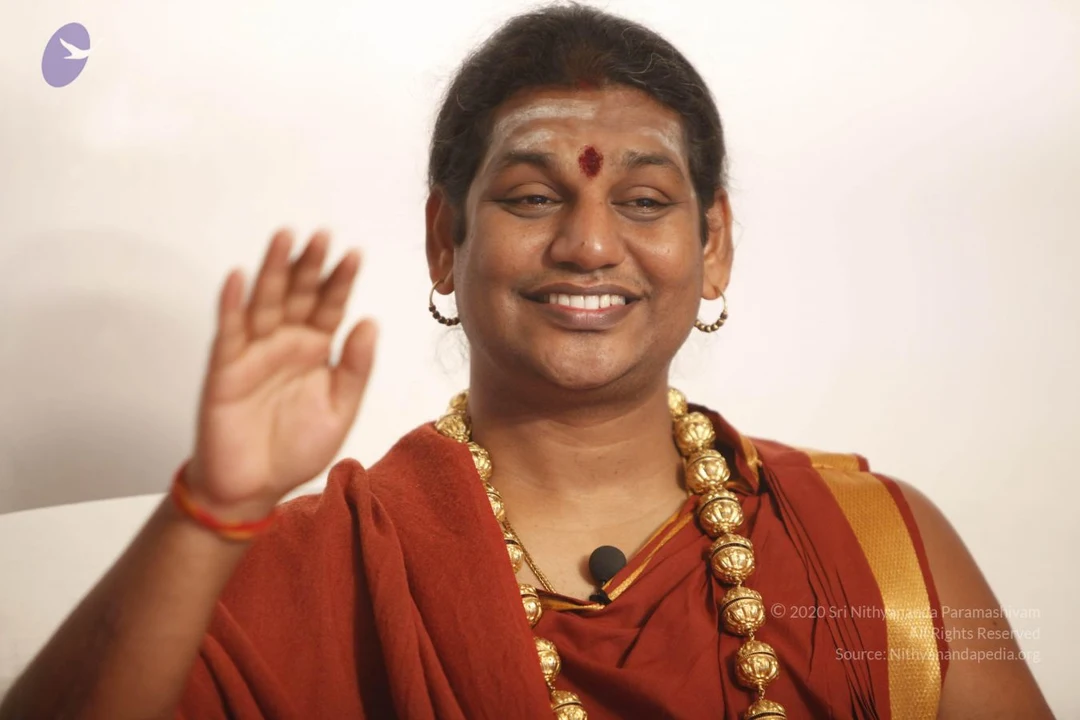
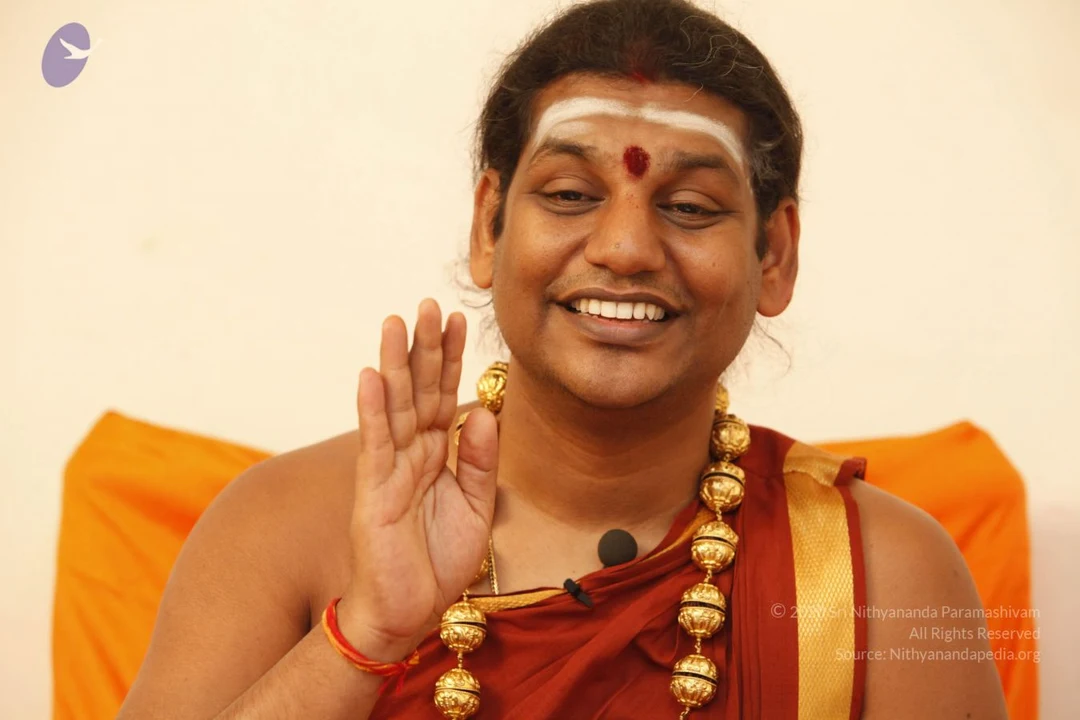
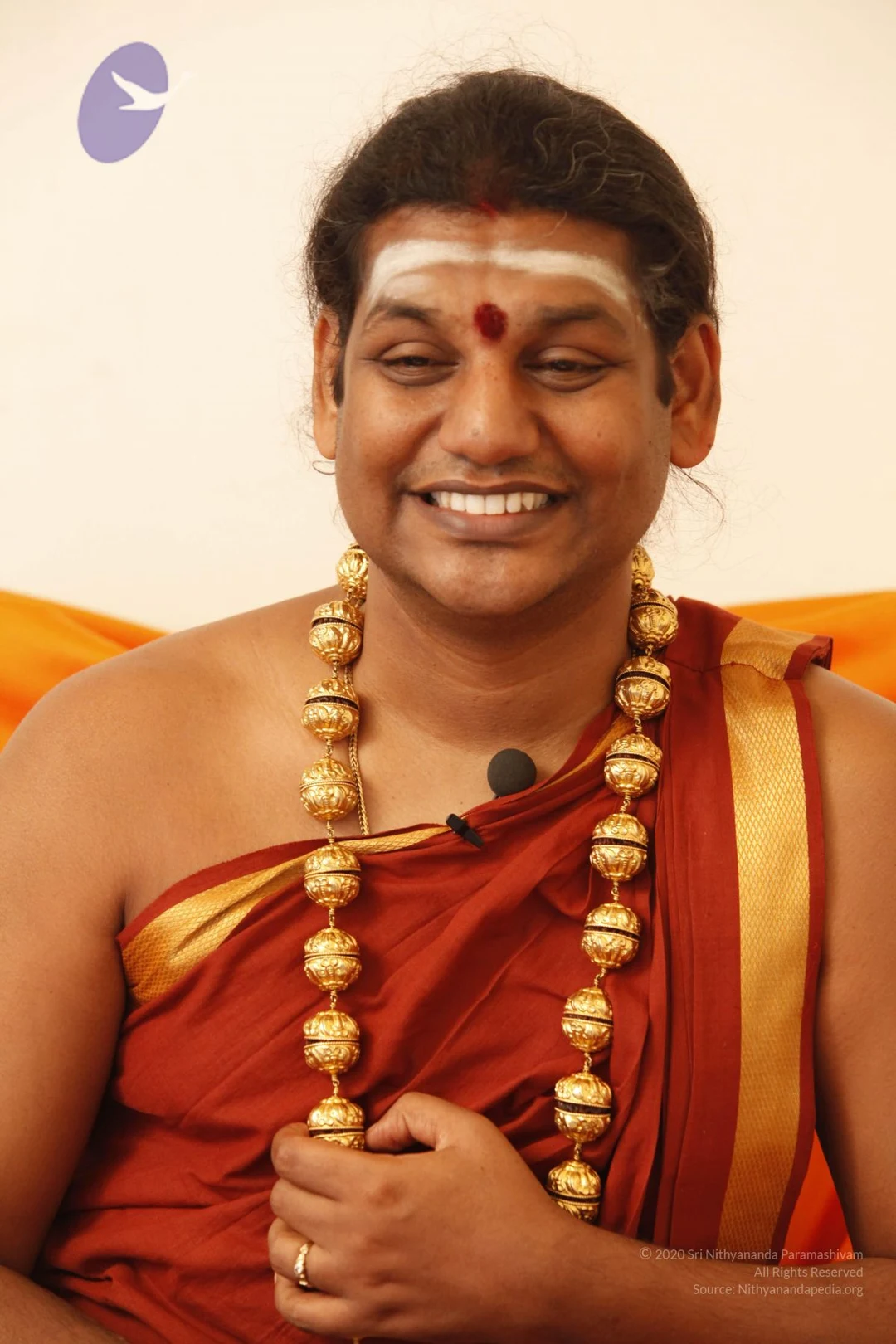
Bhagavan Sri Nithyananda Paramashivam blessing the participants

Nithya Satsang

Photos Of The Day:

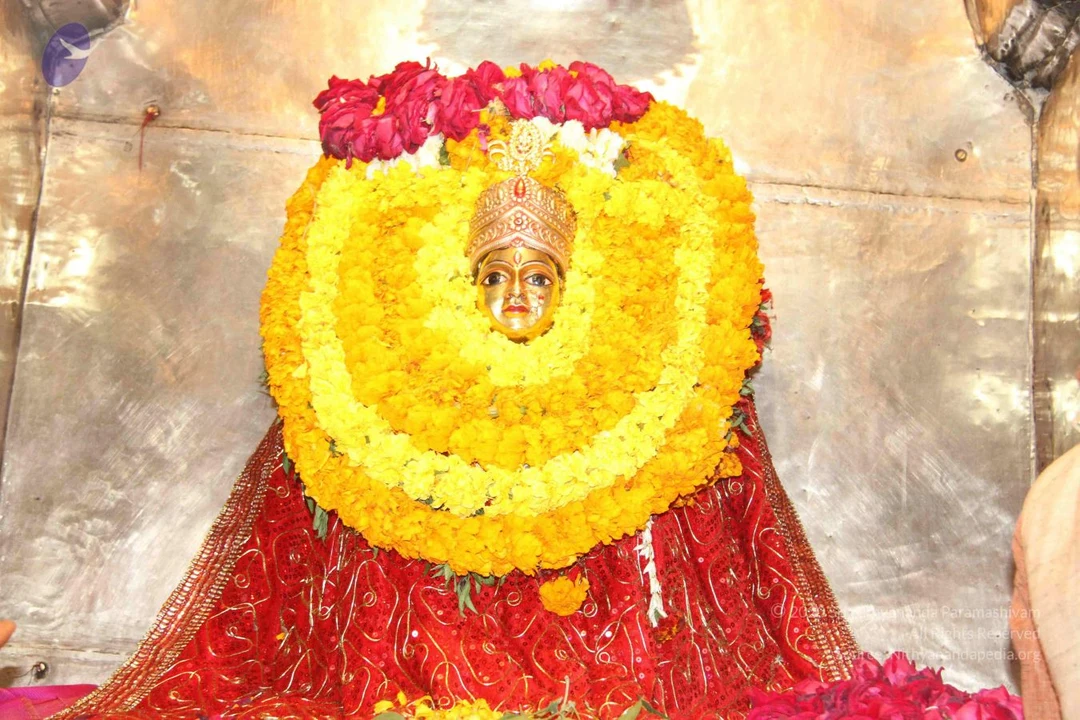
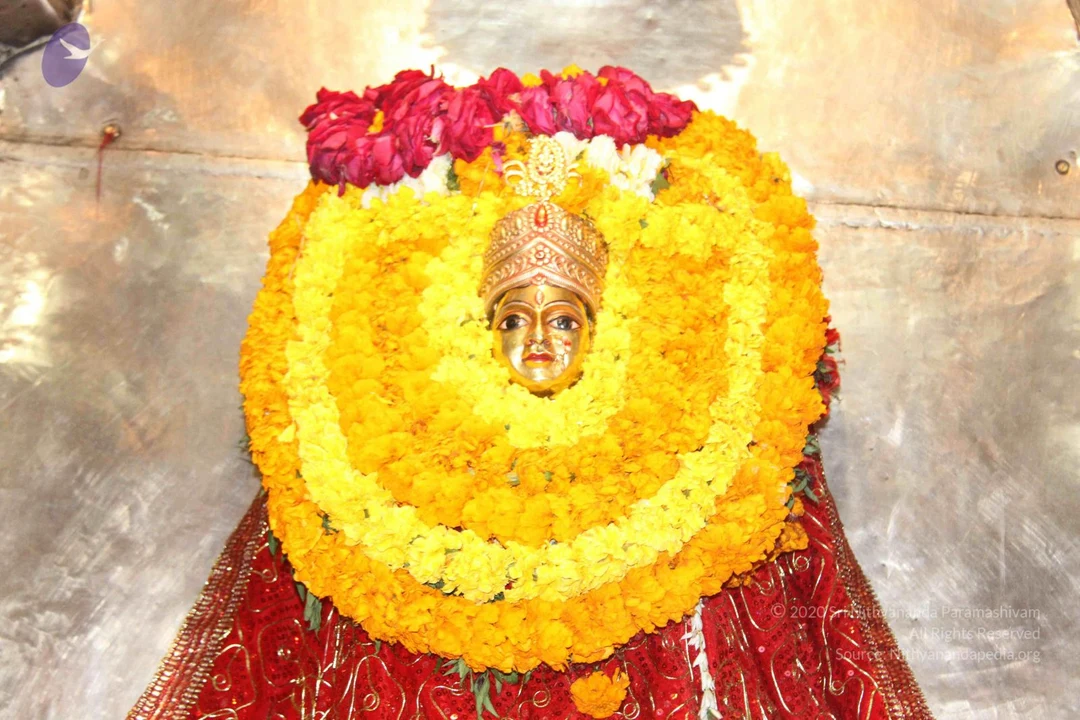
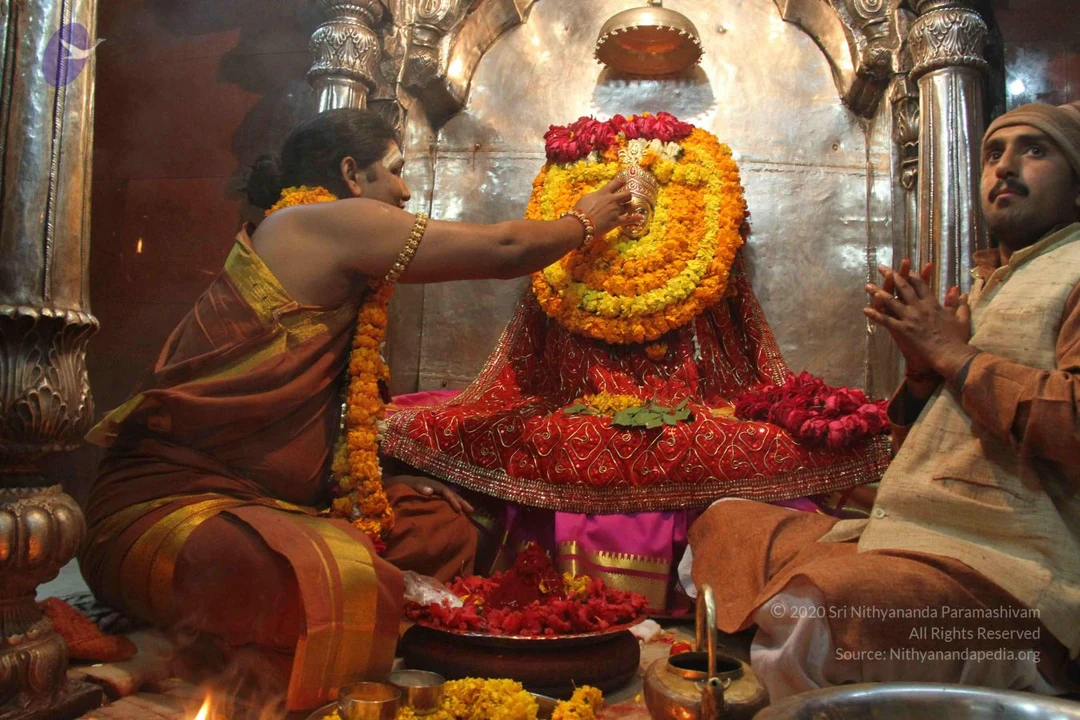
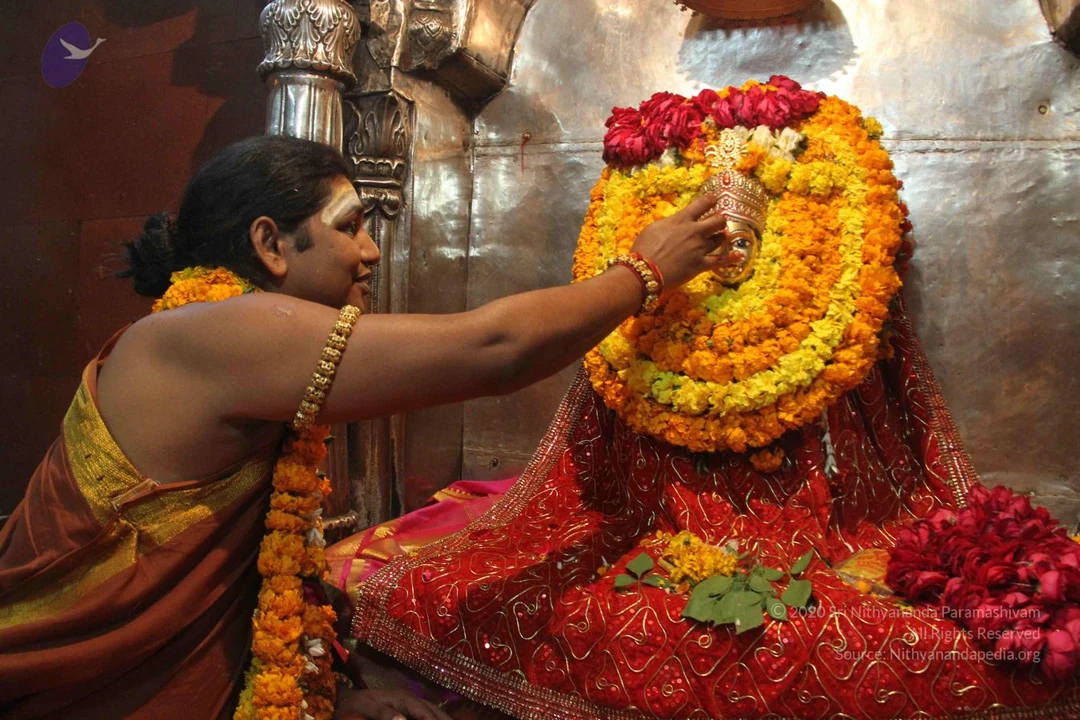
Visit-to-Annapurneshwari-temple-in-Kashi-Varanasi

Satsang

Photos Of The Day:

E-Kalpataru at Croatia

E-Kalpataru at London

E-Kalpataru at SriLanka

Photos Of The Day:

Visit-to-Annapurneshwari-temple-in-Kashi-Varanasi

Satsang

01-Visit-to-Annapurneshwari-temple-in-Kashi-Varanasi

Photos from this day

View all 117 photos

Bhagavan Sri Nithyananda Paramashivam blessing the participants

5 photosSource gallery
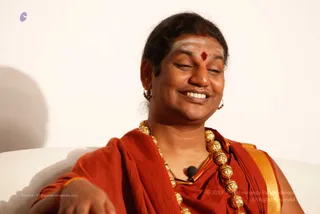
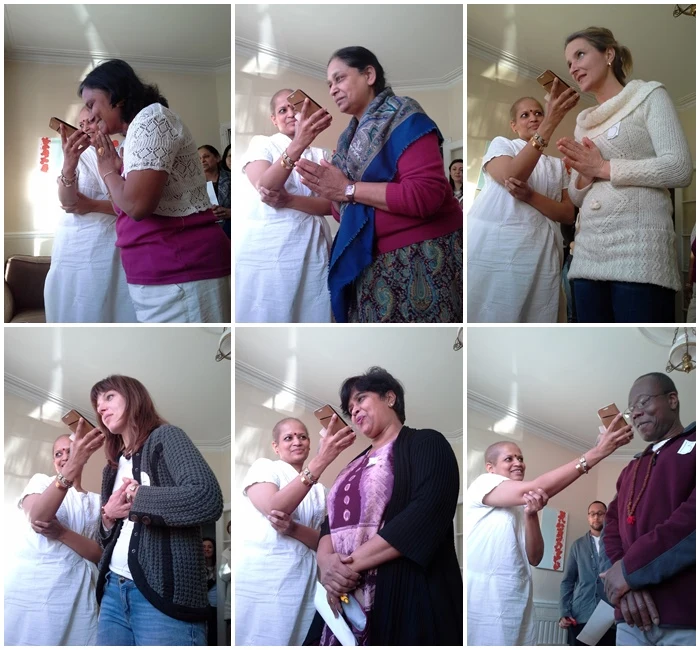
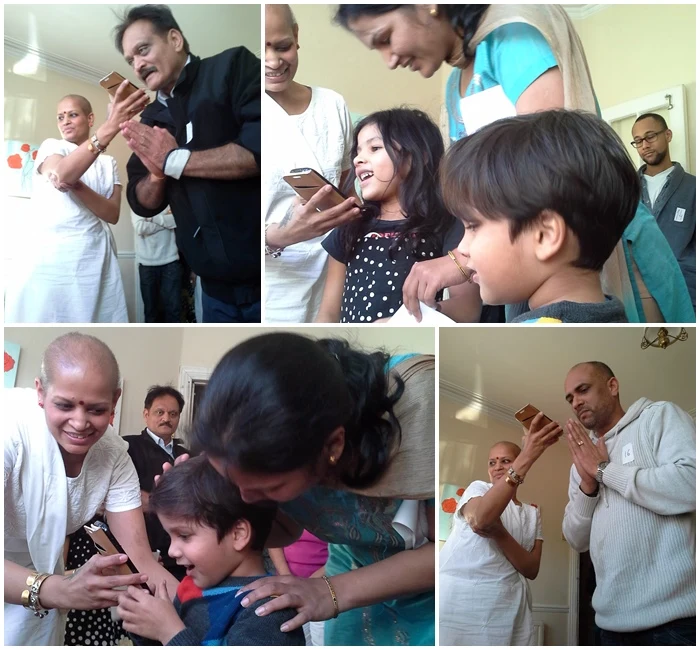
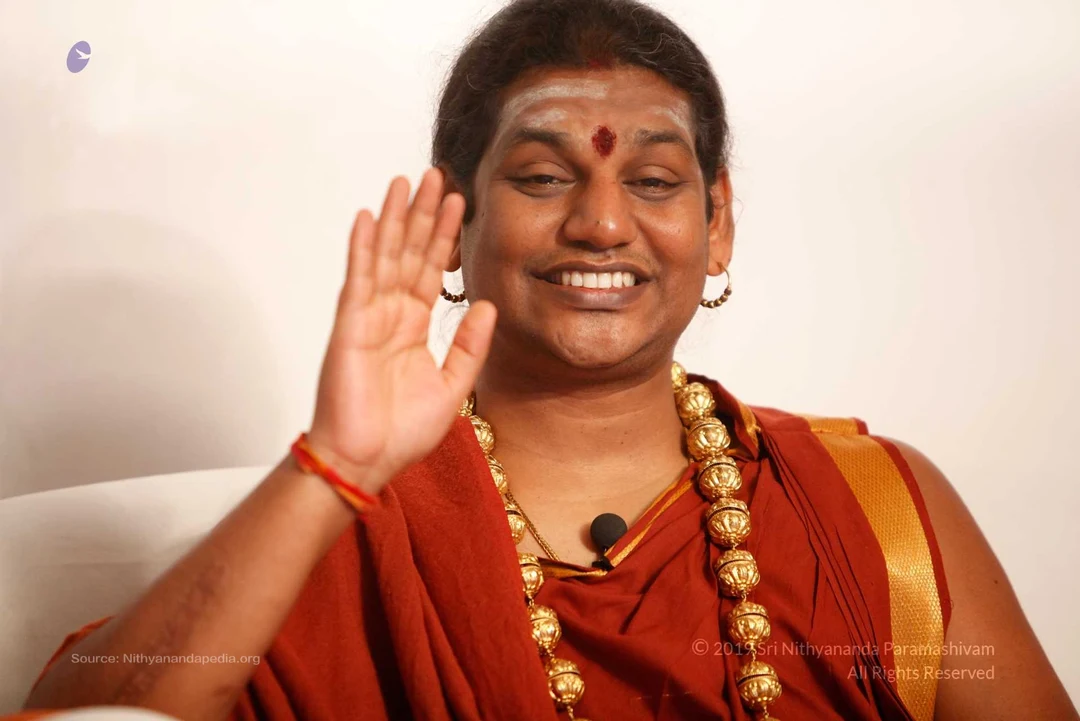
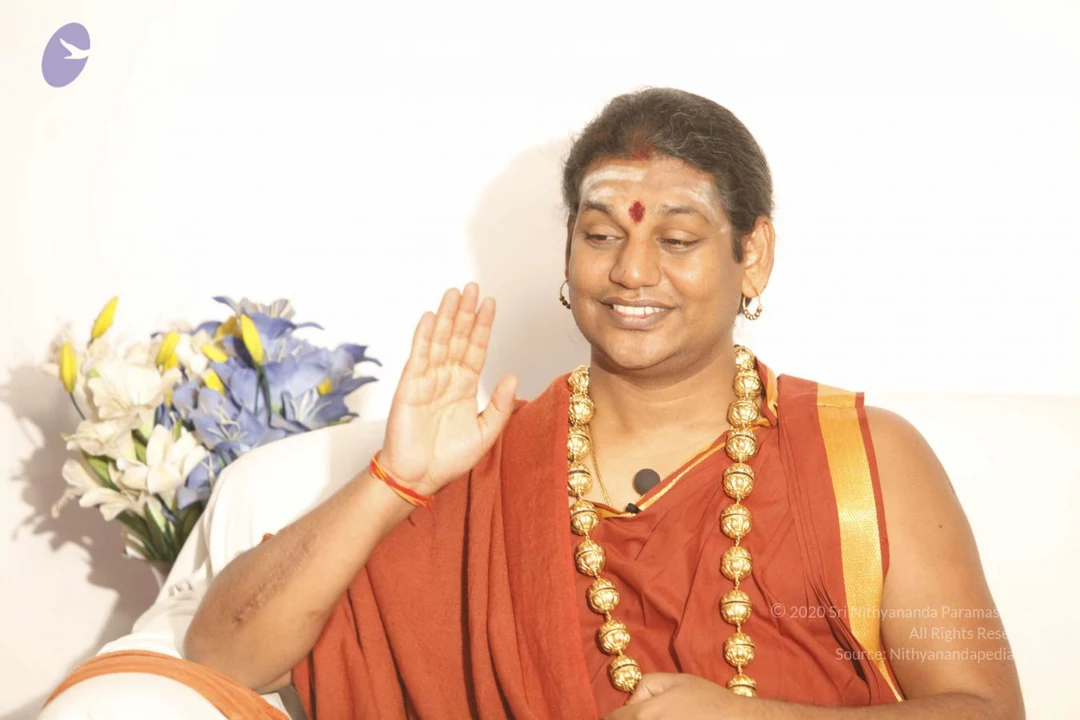
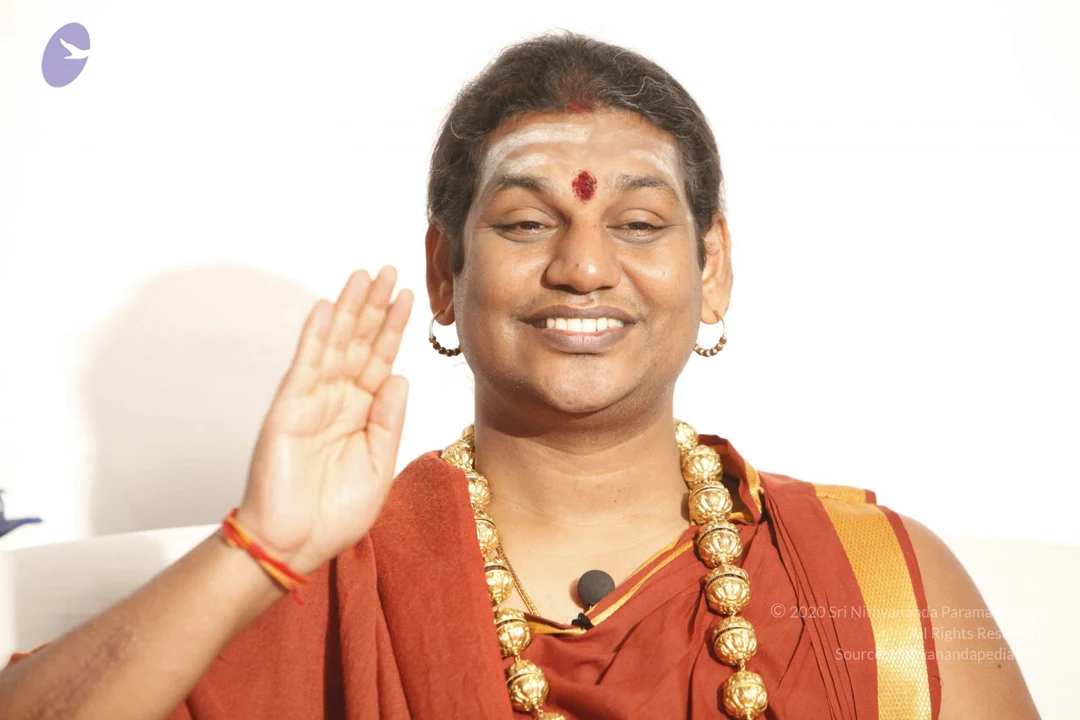
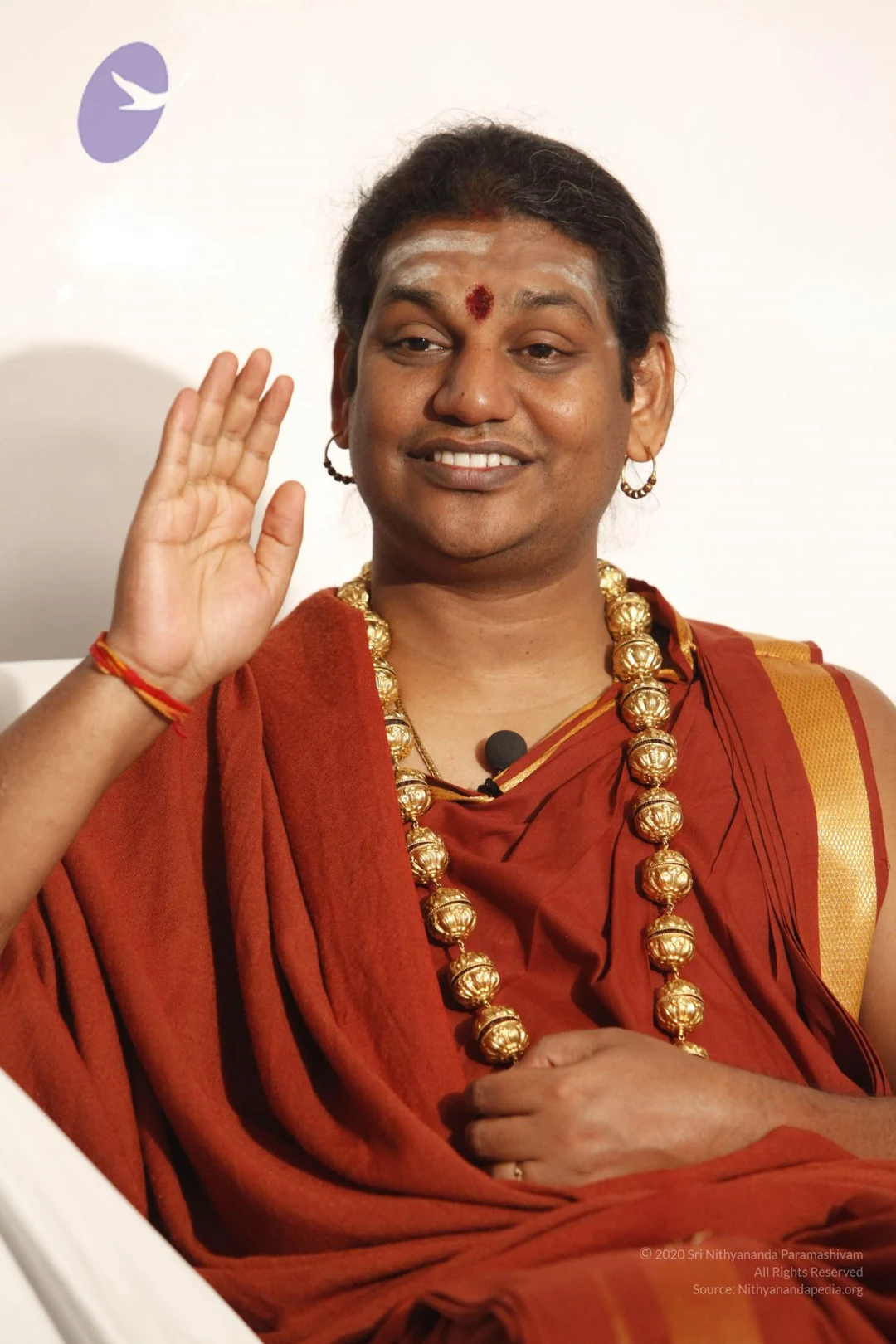
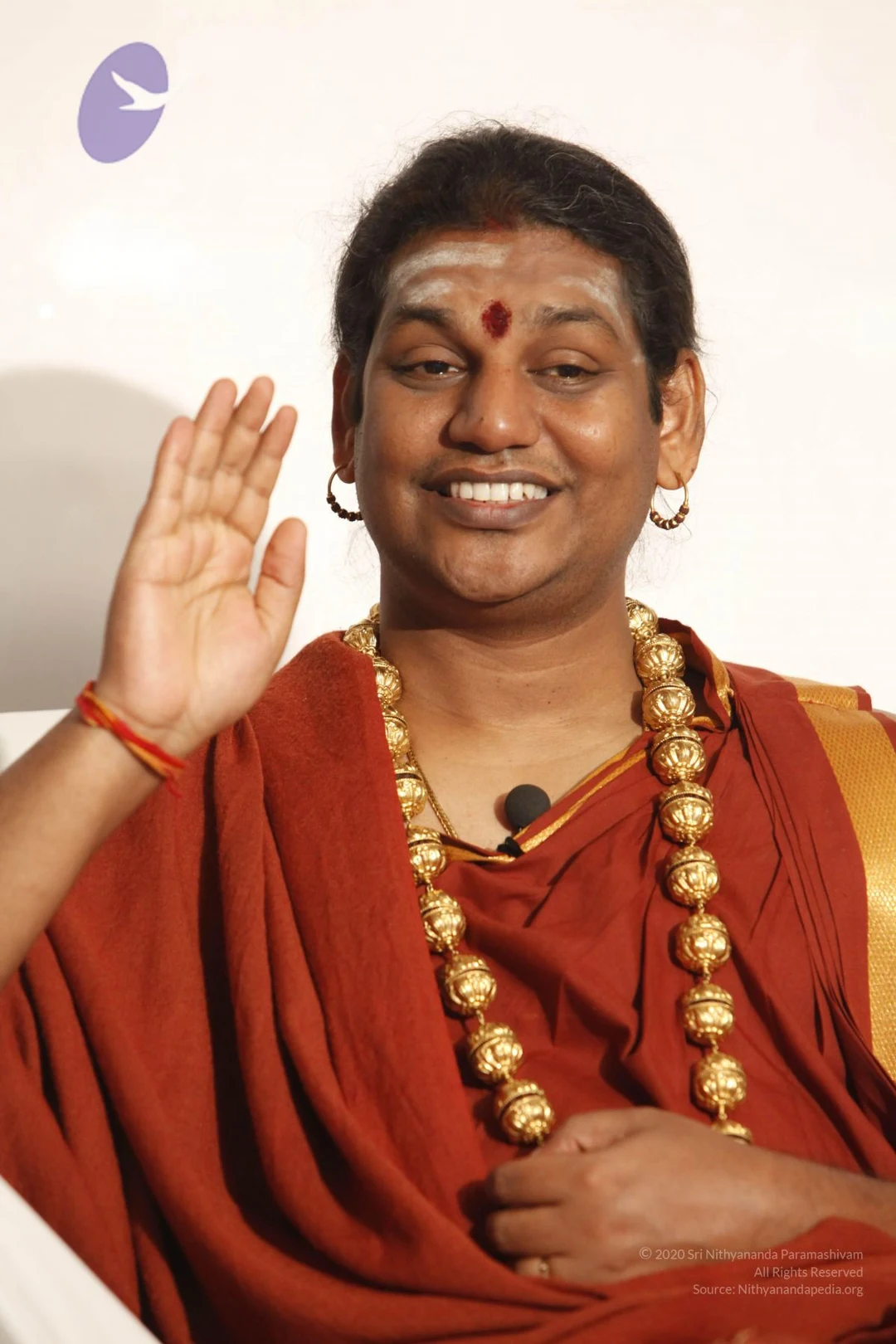
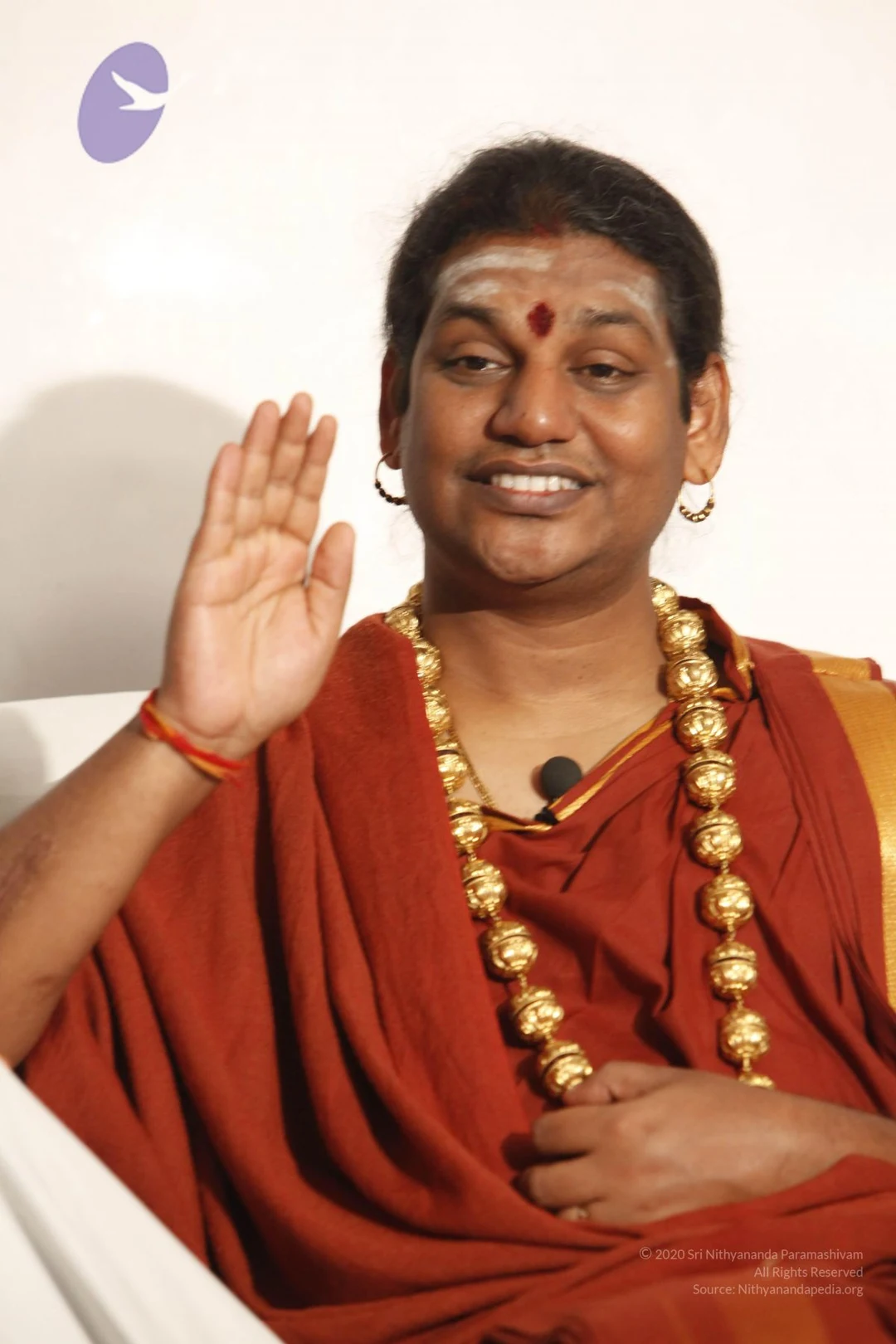
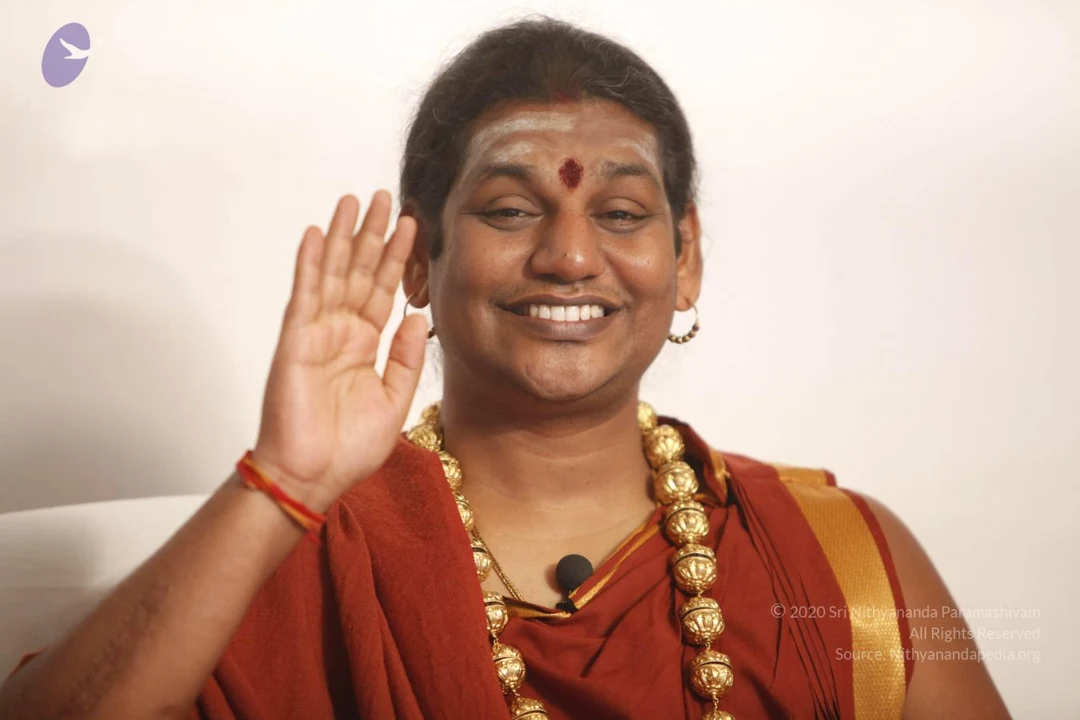
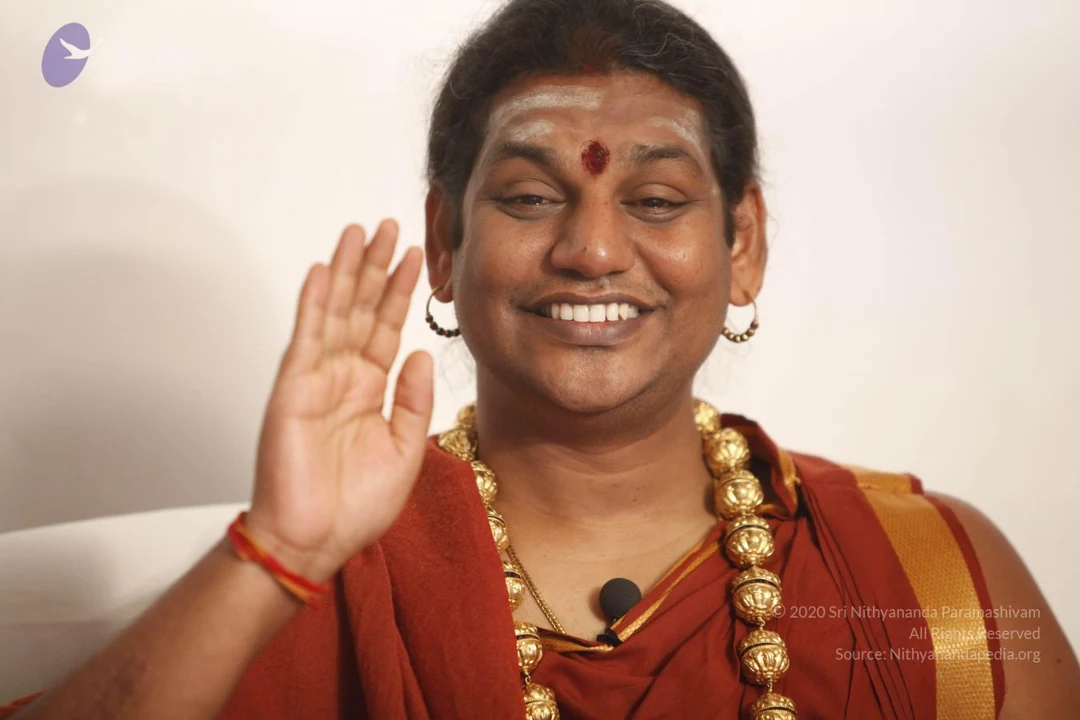
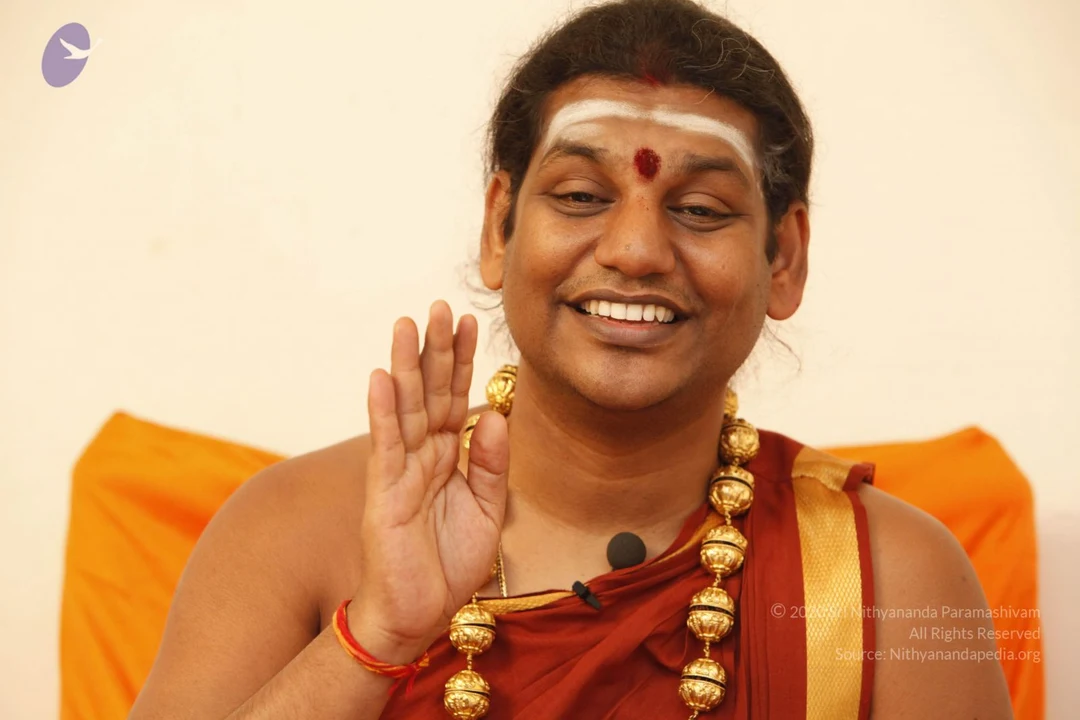
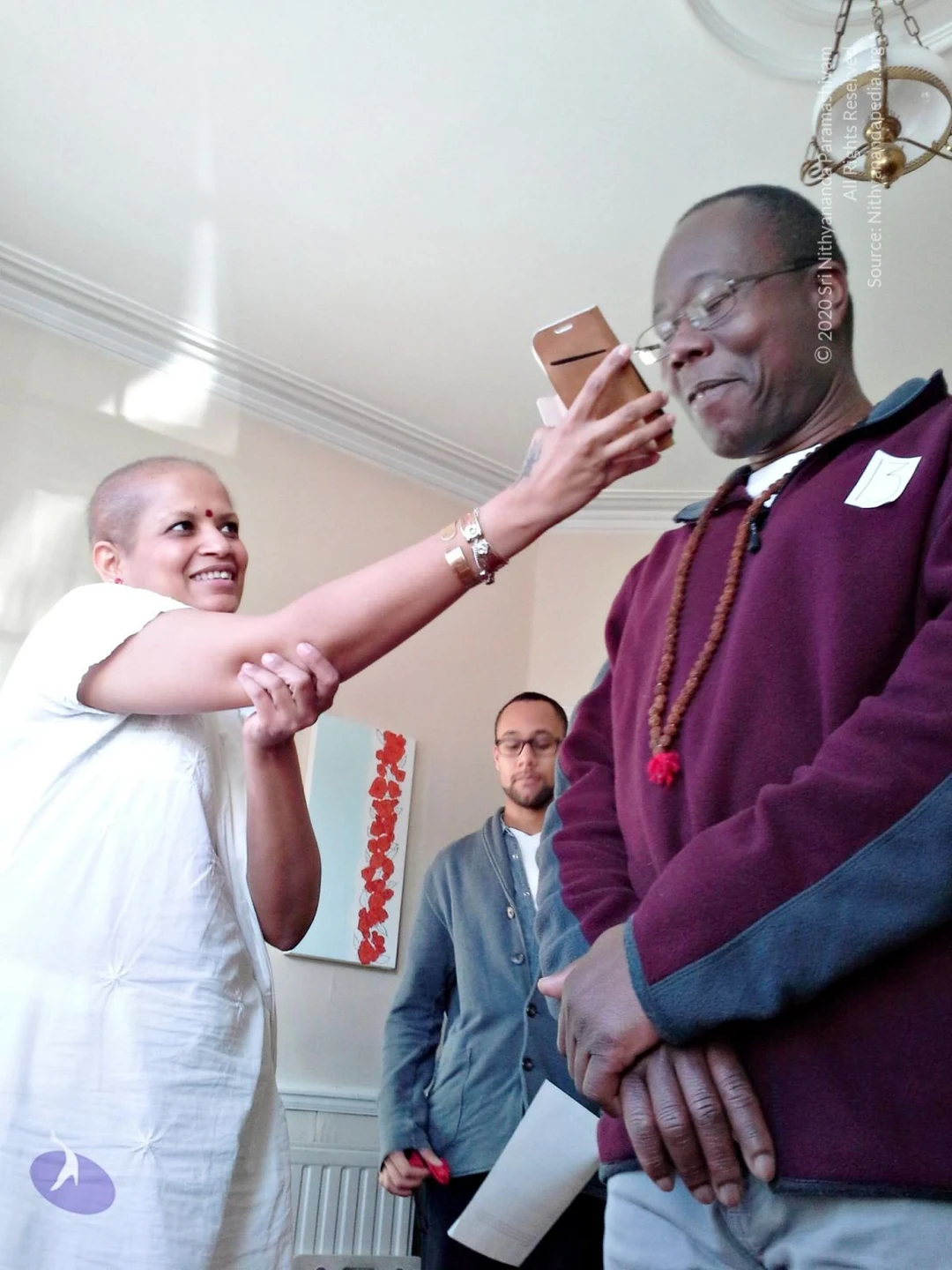
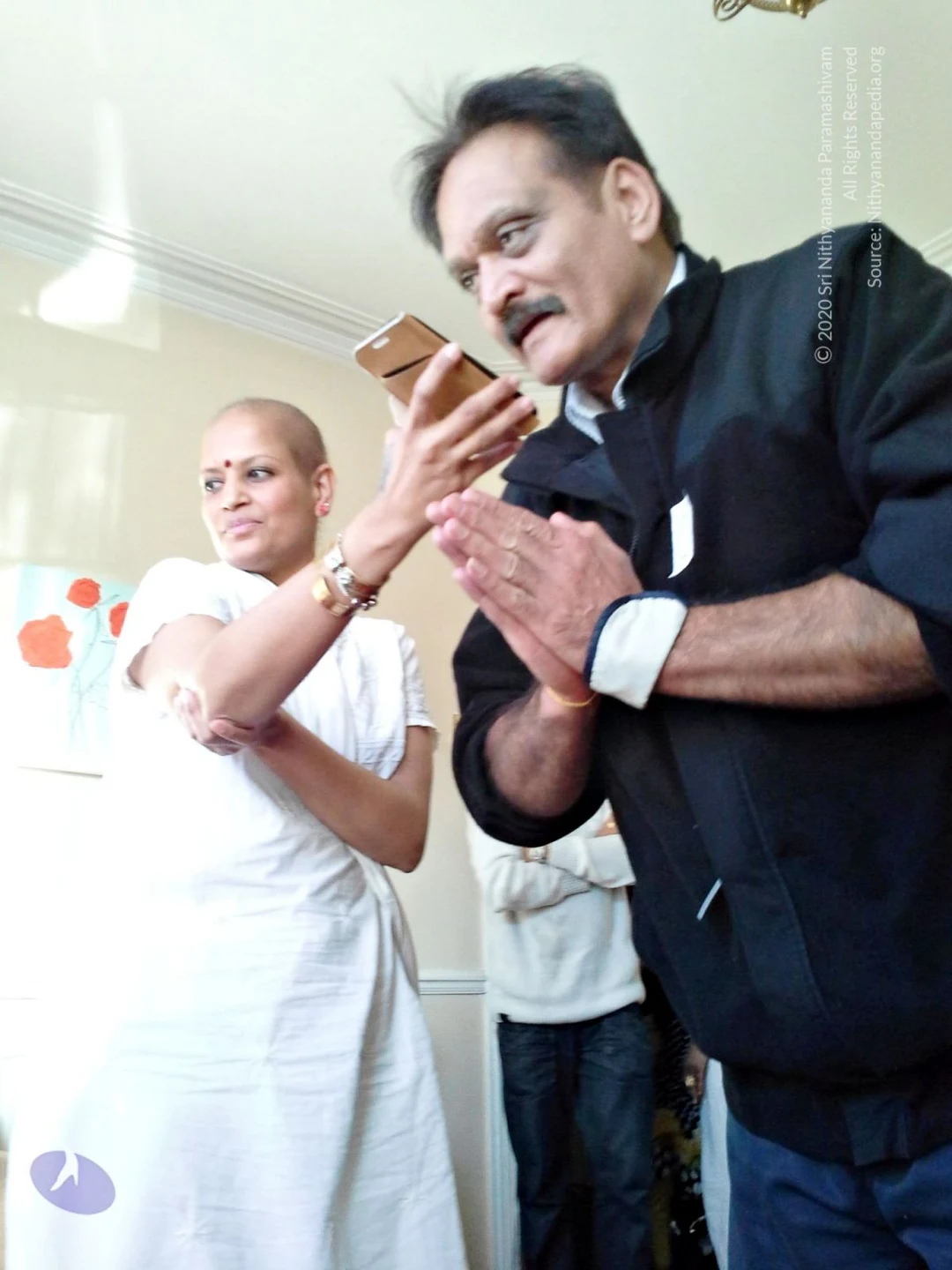
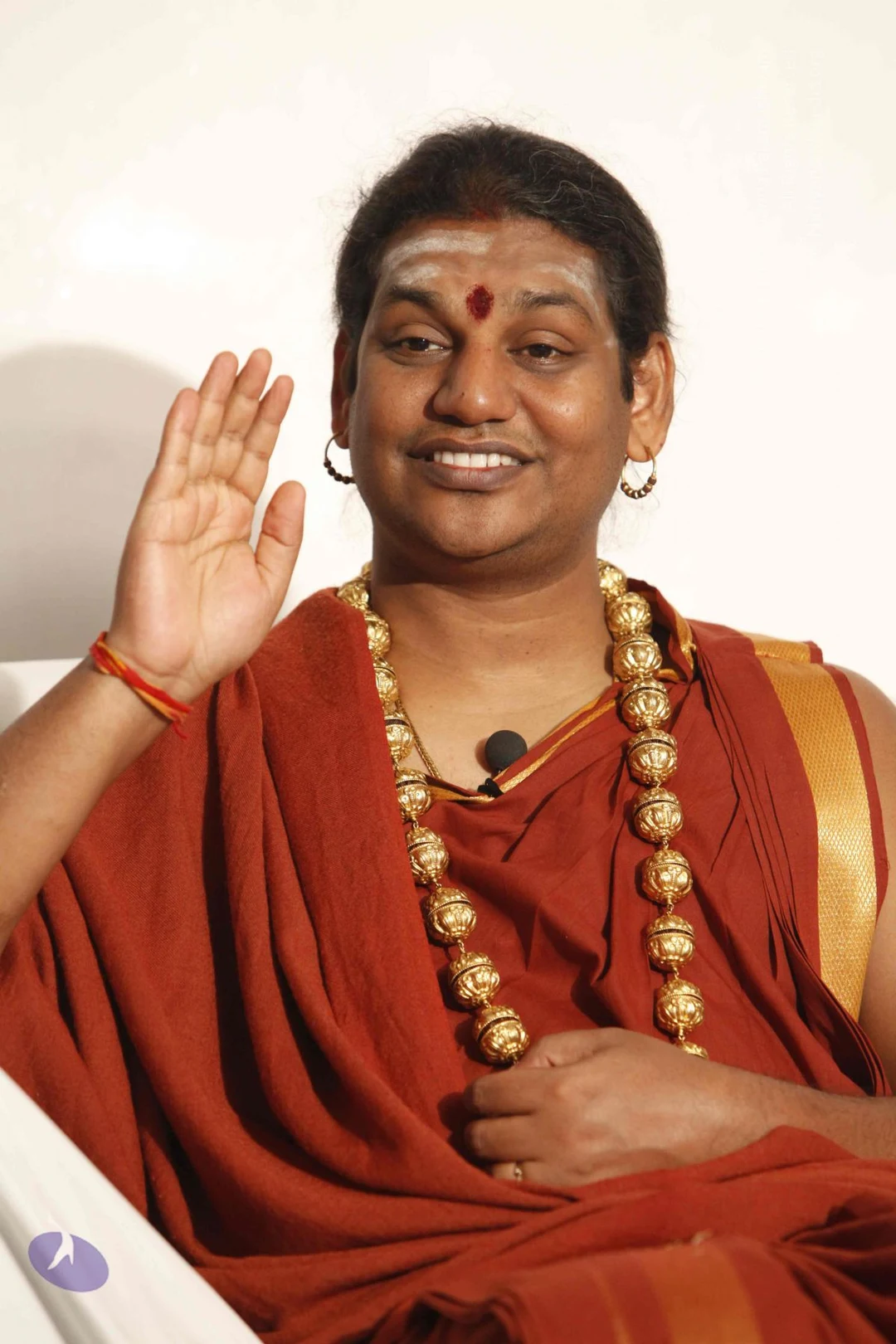
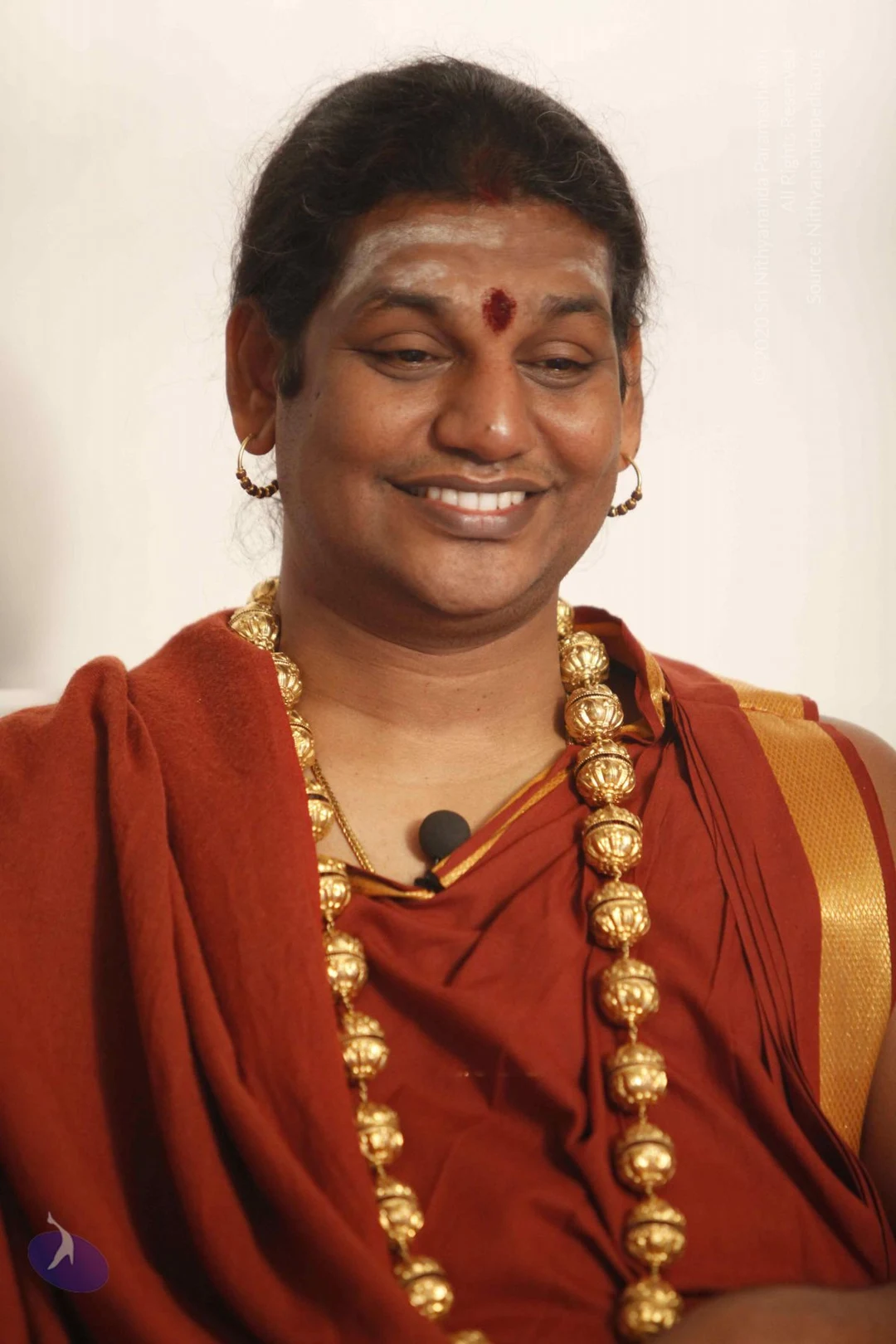
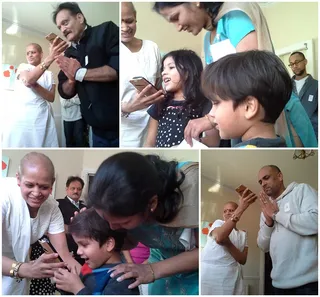
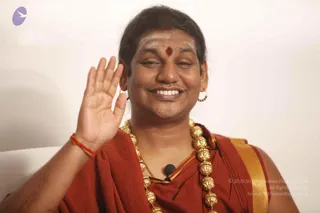
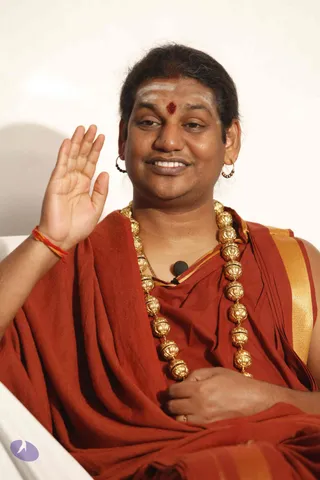
A smiling man with short dark hair and white vibhuti marks on his forehead with a red kumkum dot raises his right hand in a wave. He wears a saffron-orange shawl with a golden border over a bare upper body, and a heavy gold necklace of large beaded pendants. A small clip microphone is attached to his chest. Behind him is a plain white wall. The subject matches the page's a person reference through his saffron ceremonial dress and gold necklace, so he is a person candidate in person.Six-panel collage of a bright room with cream walls and a white ceiling cornice. In each panel a bald woman in white clothing holds a smartphone-like device near the face of a different participant, who places her hands together or raises an arm. Participants include a woman in a lace top and magenta cardigan, a woman in a blue shawl and purple outfit, a woman in a cream knit sweater, a woman in a grey cardigan, a woman in a purple blouse with a black cardigan, and a man in a maroon sweater with a red-beaded necklace. The panels show the participants receiving the blessing gesture while standing close to the bald figure.A four-panel collage of photographs from an indoor event in a bright room with cream walls. Top left: a bald woman in white holds a phone up while a man in a black jacket and white shirt stands beside her. Top right: a bald woman in white looks at a phone beside a girl in a polka-dot top and a young boy, with a woman in a teal and beige sari and a man in a grey suit behind. Bottom left: a bald woman in white smiles as a boy leans in while a woman in a teal sari bends over him. Bottom right: a bald woman in white holds a phone while a bald man in a white sweater stands with palms pressed together in greeting. The page describes blessings, but the panels show people with phones, children and greeting gestures; no deity, altar or ritual objects are visible.A small indoor corner set up for viewing a satsang video. A flat-screen LG monitor on the left shows a video player window with a figure on screen, its image small and indistinct. Below and beside the screen, a draped maroon cloth covers a low table with pots of red and orange flowers and a yellow-and-orange floral garland. A wicker basket of red-and-yellow apples sits on a white cloth at right, next to a red tray, small speakers, and a plate with petals and sweets. A laptop is visible at the bottom edge. No people are visible in the frame.

Nithya Satsang

2 photosSource gallery
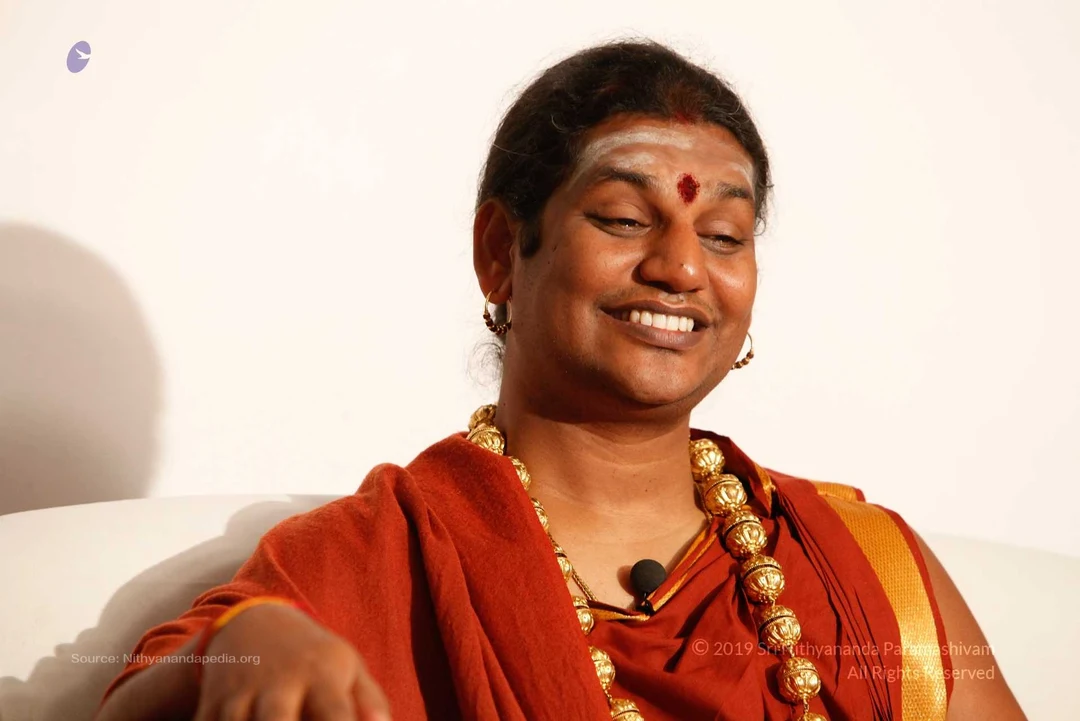
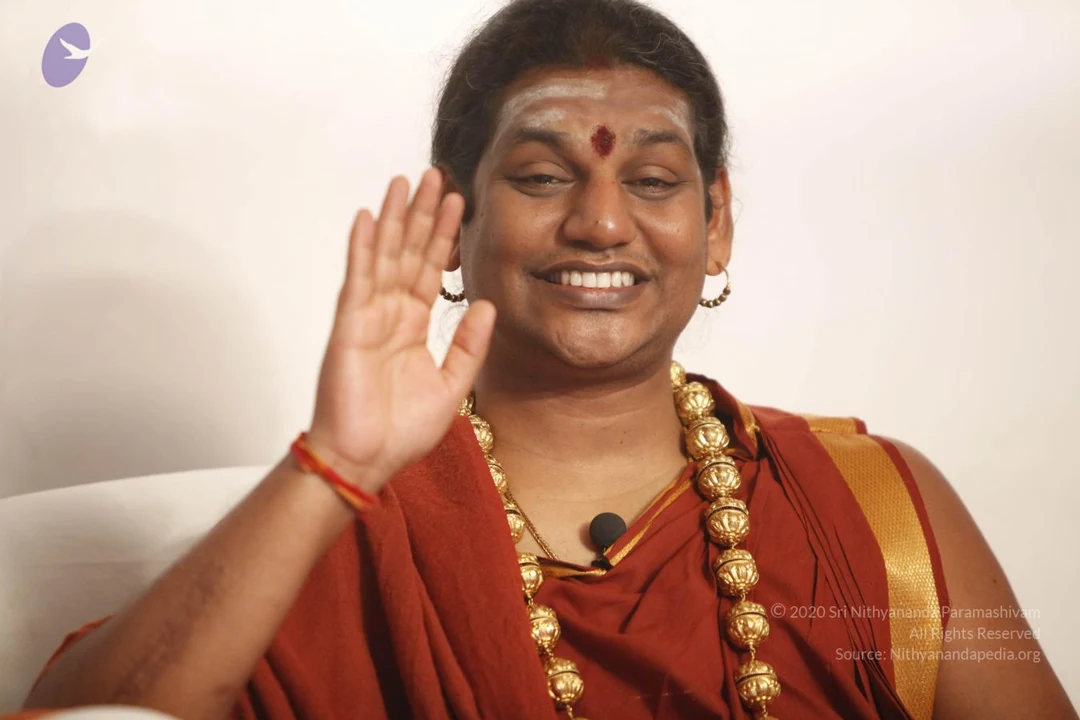
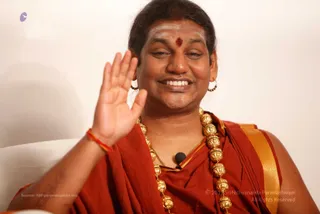
Close-up photo of a smiling man in a rust-red dhoti-style wrap with a gold-bordered edge, wearing a long necklace of large gold-toned beads and small rudraksha-style beads at the ears. He has a white and red forehead mark and raises his right hand in a wave toward the camera; a small clip-on lapel microphone is attached to his chest. Plain cream background.

Visit-to-Annapurneshwari-temple-in-Kashi-Varanasi
26 photosSource gallery
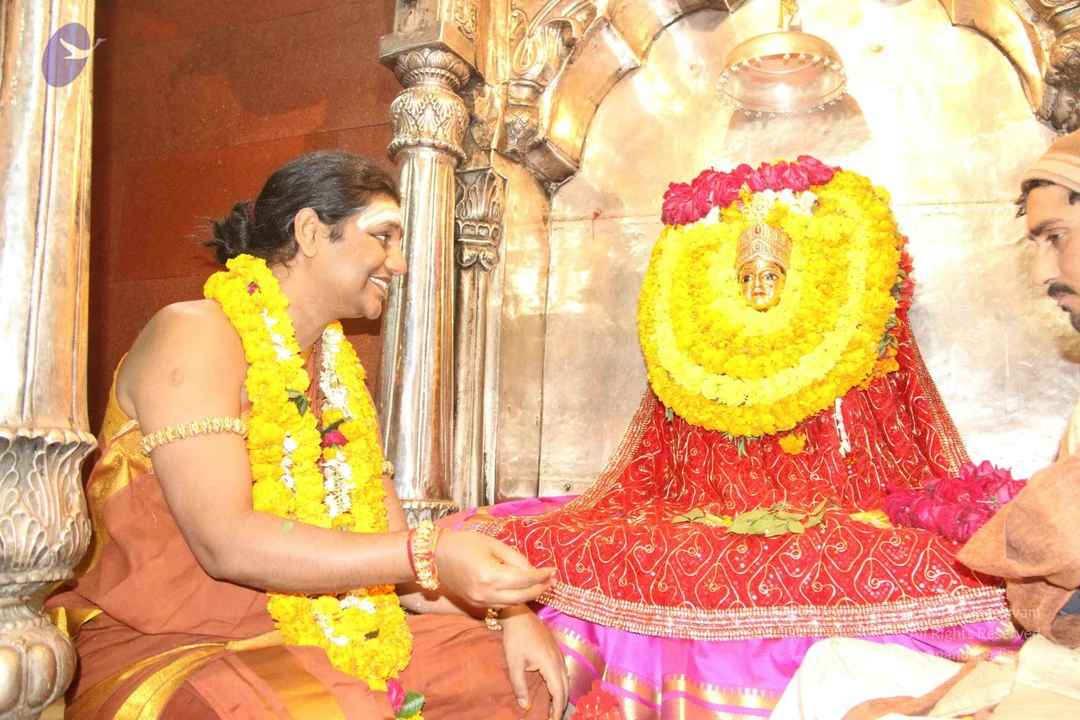
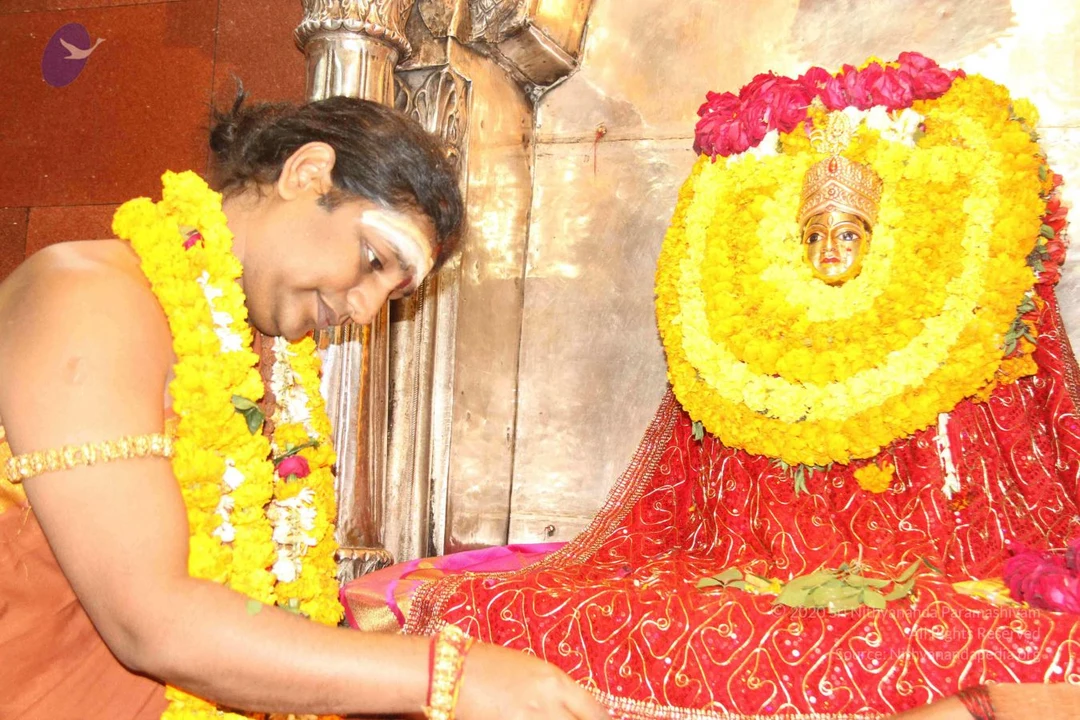
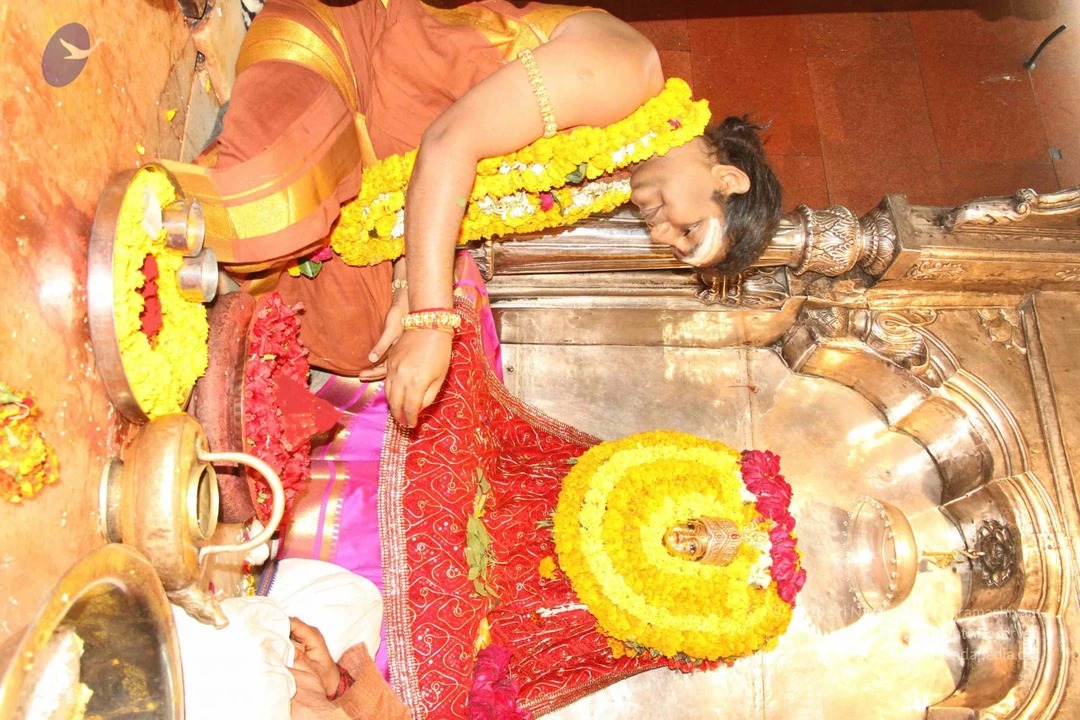
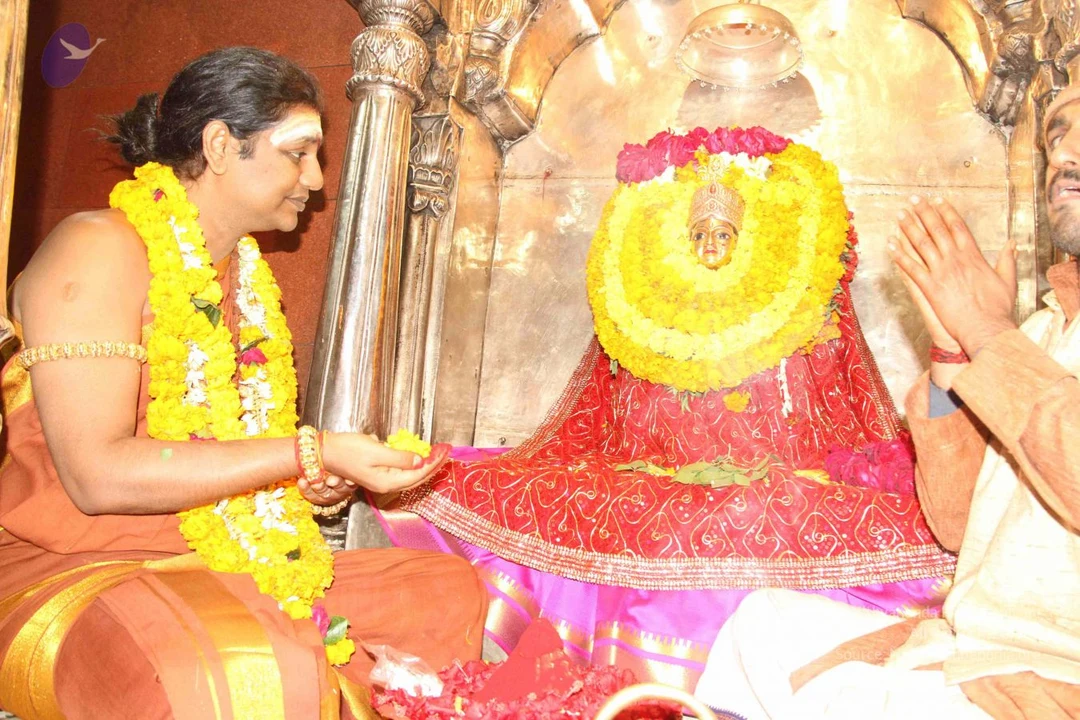
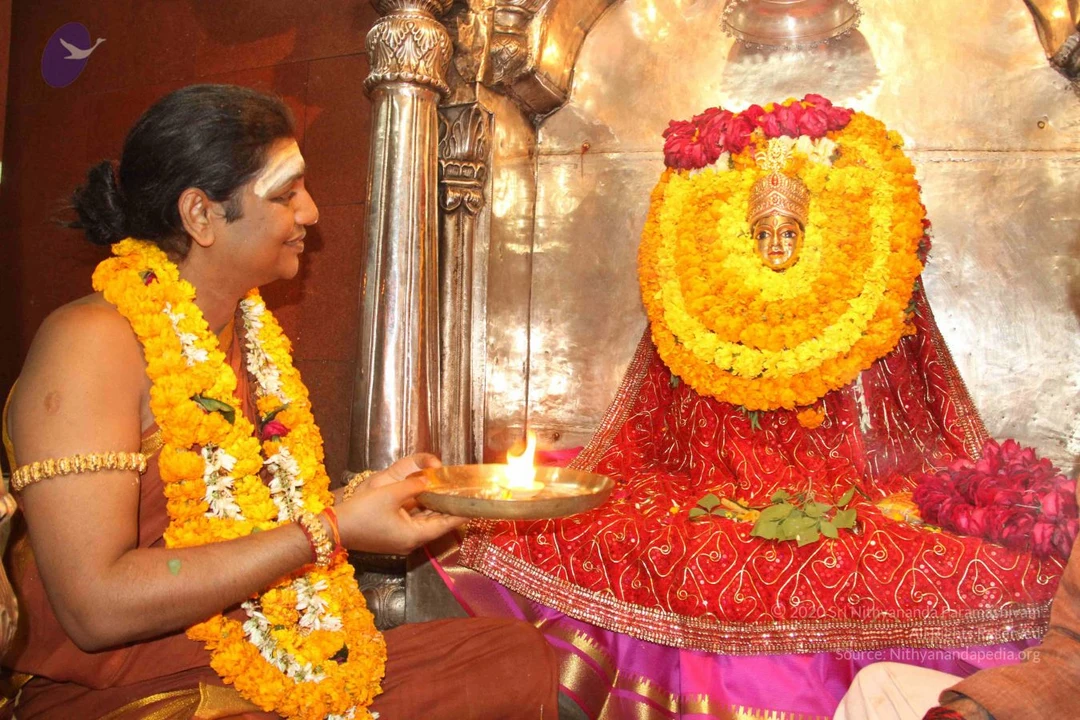
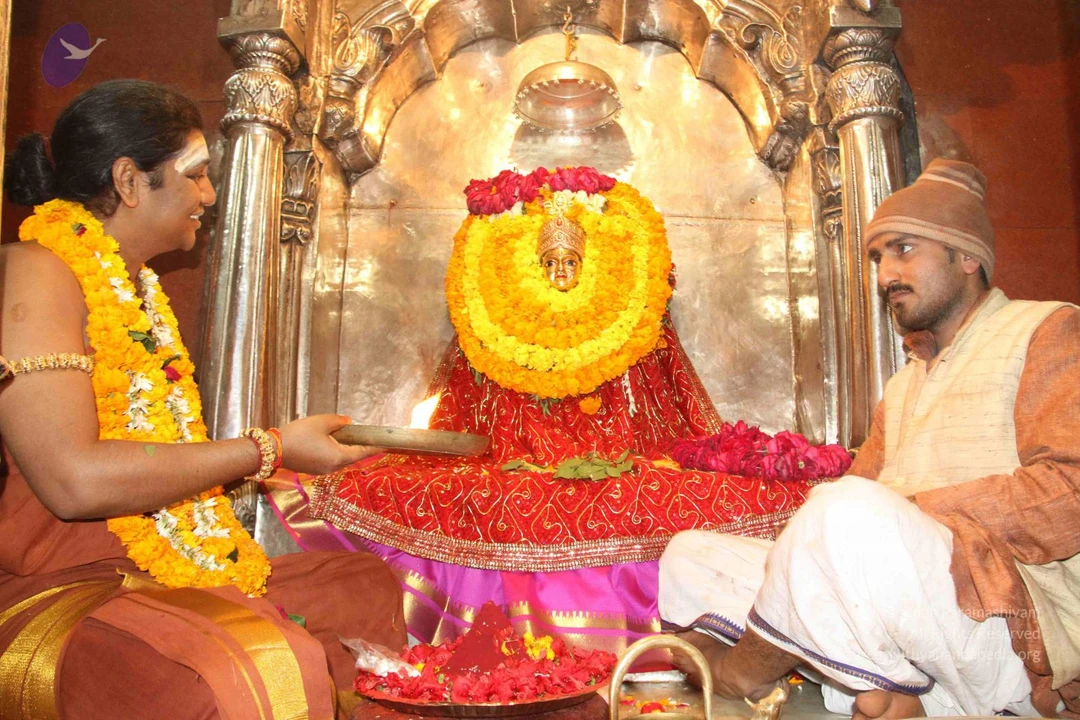
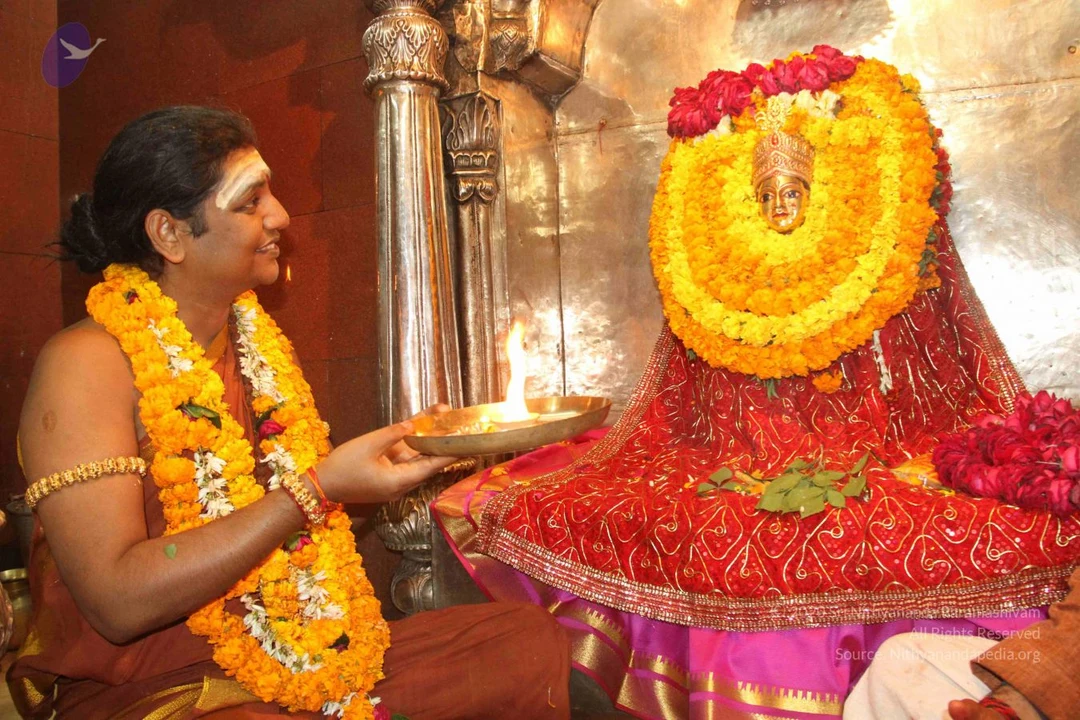
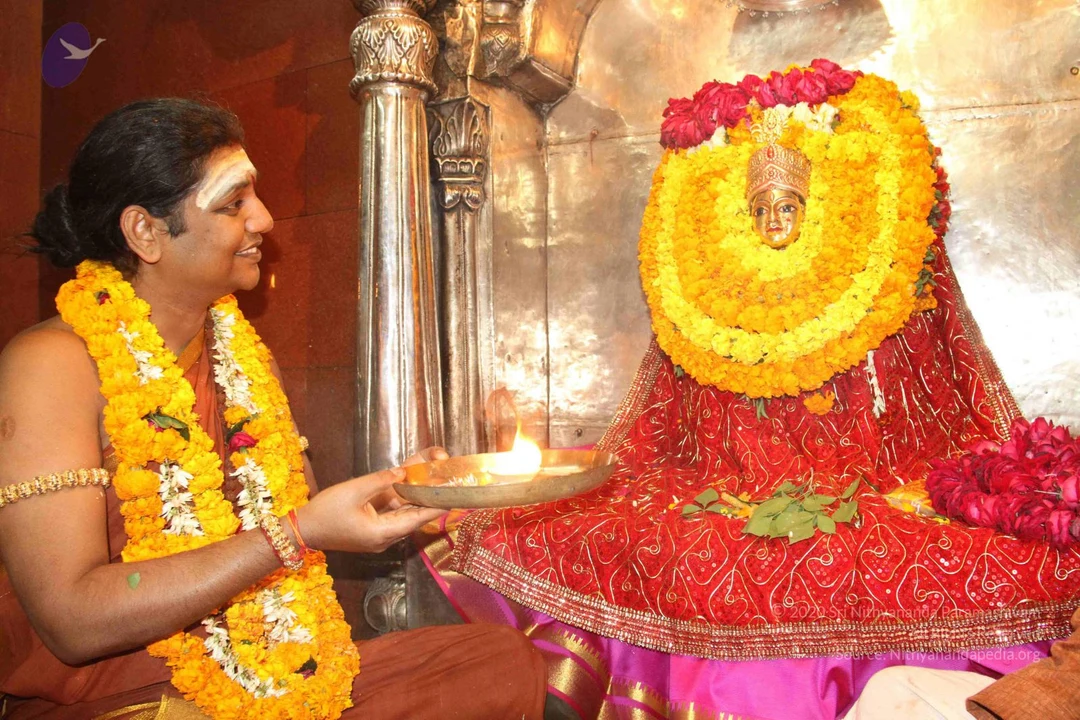
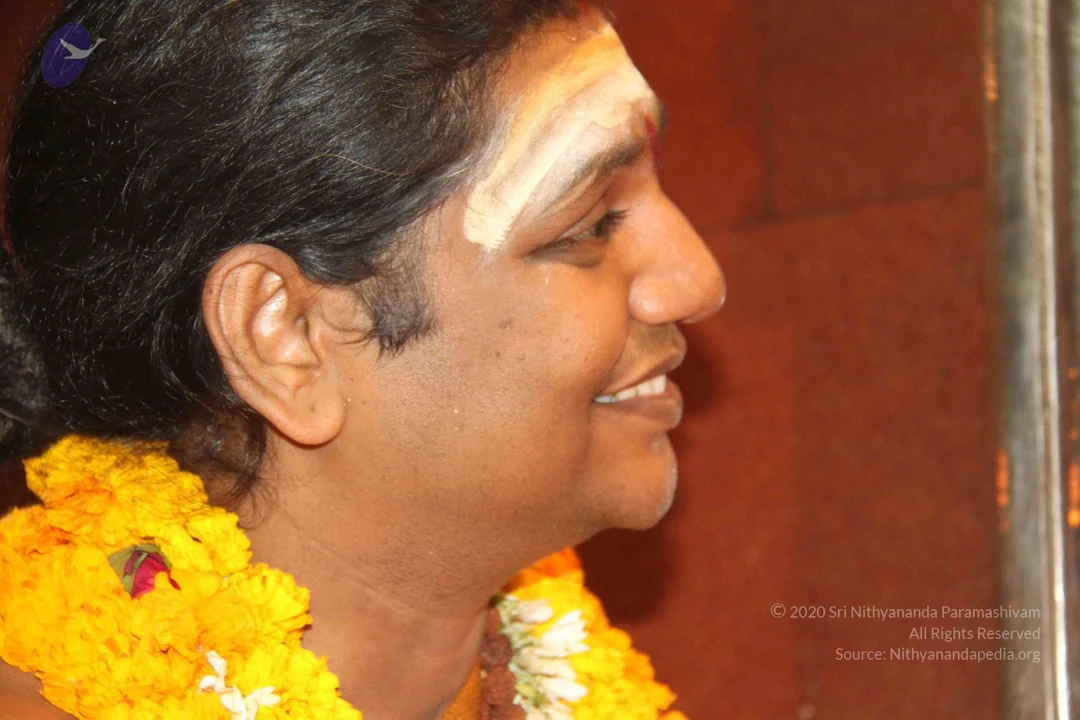
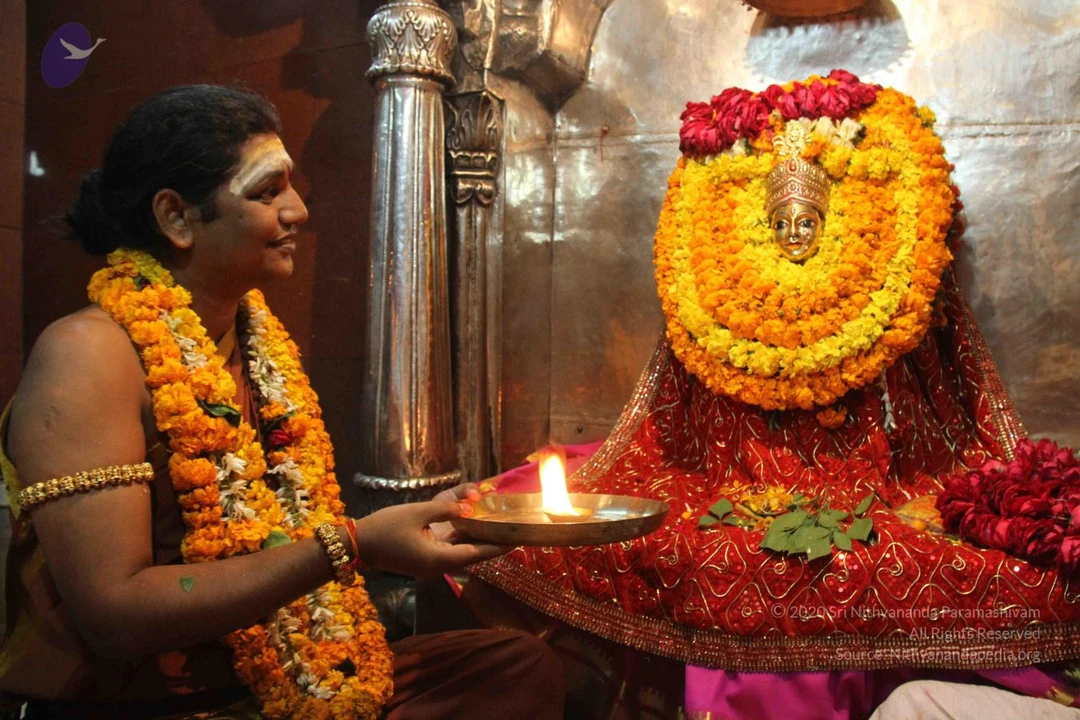
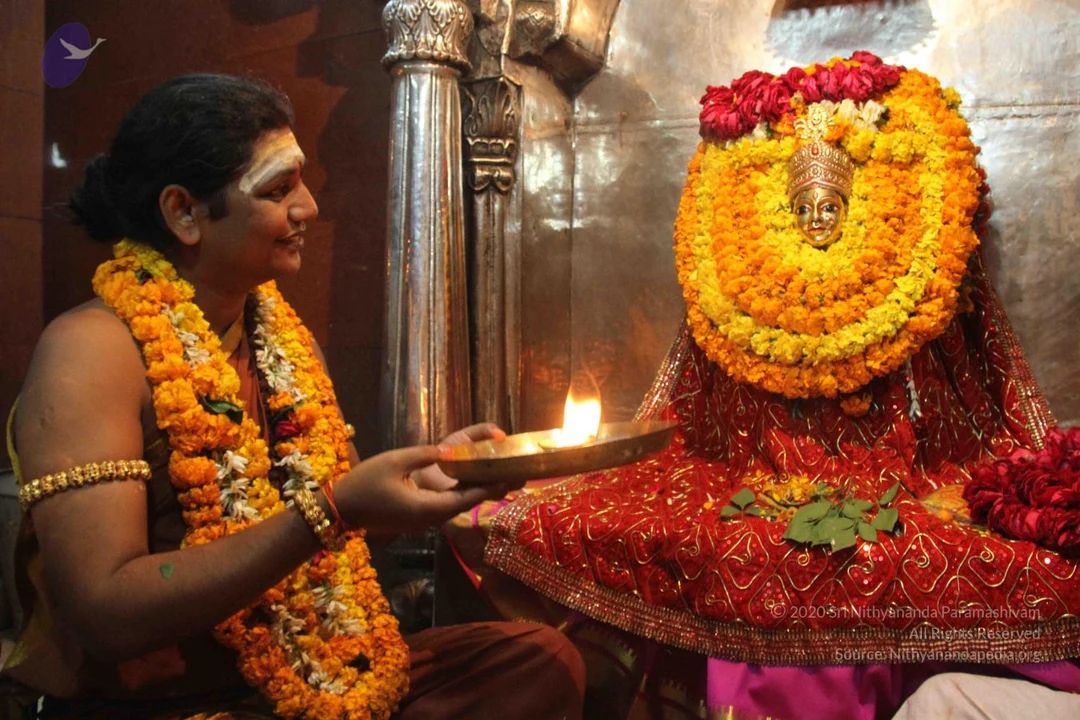
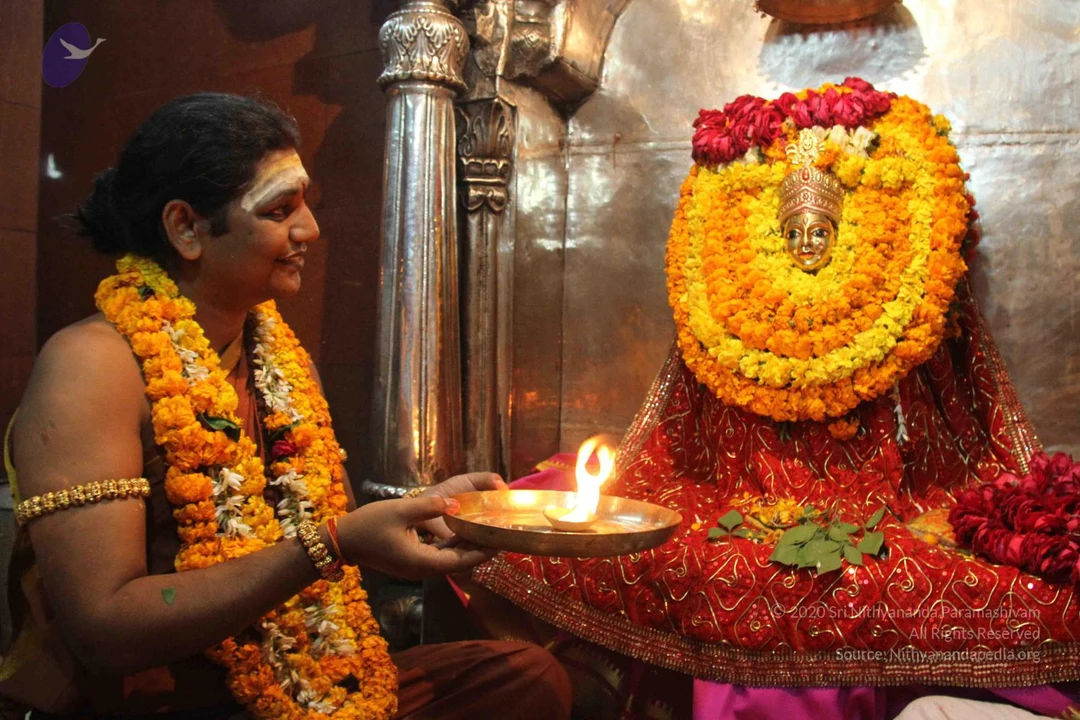
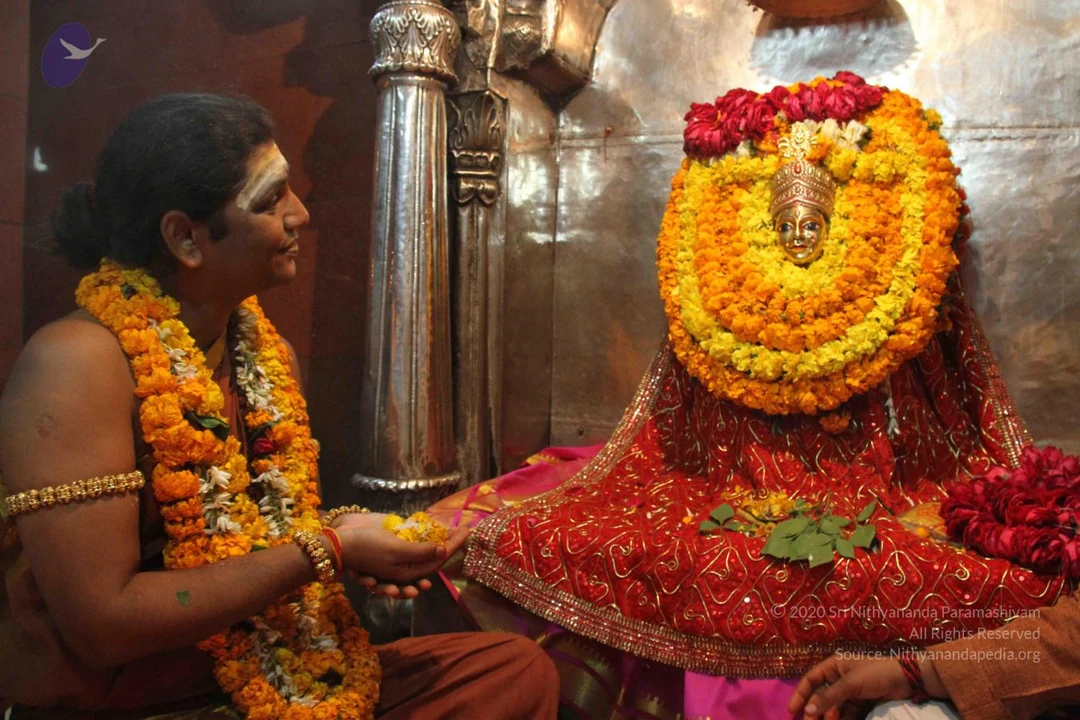
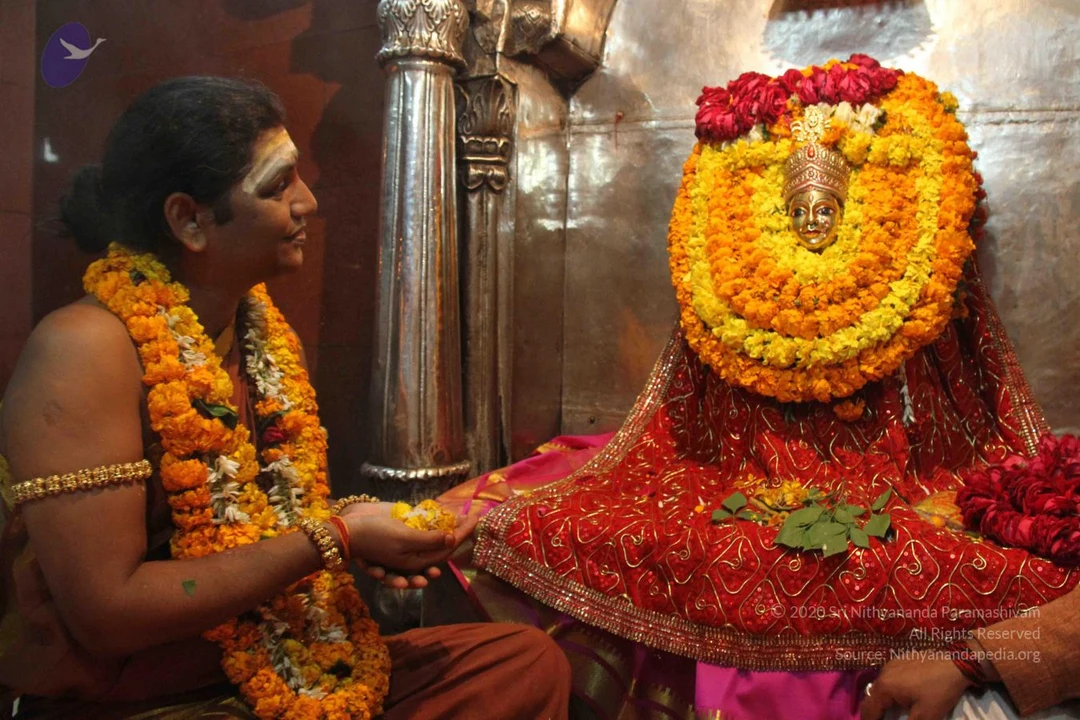
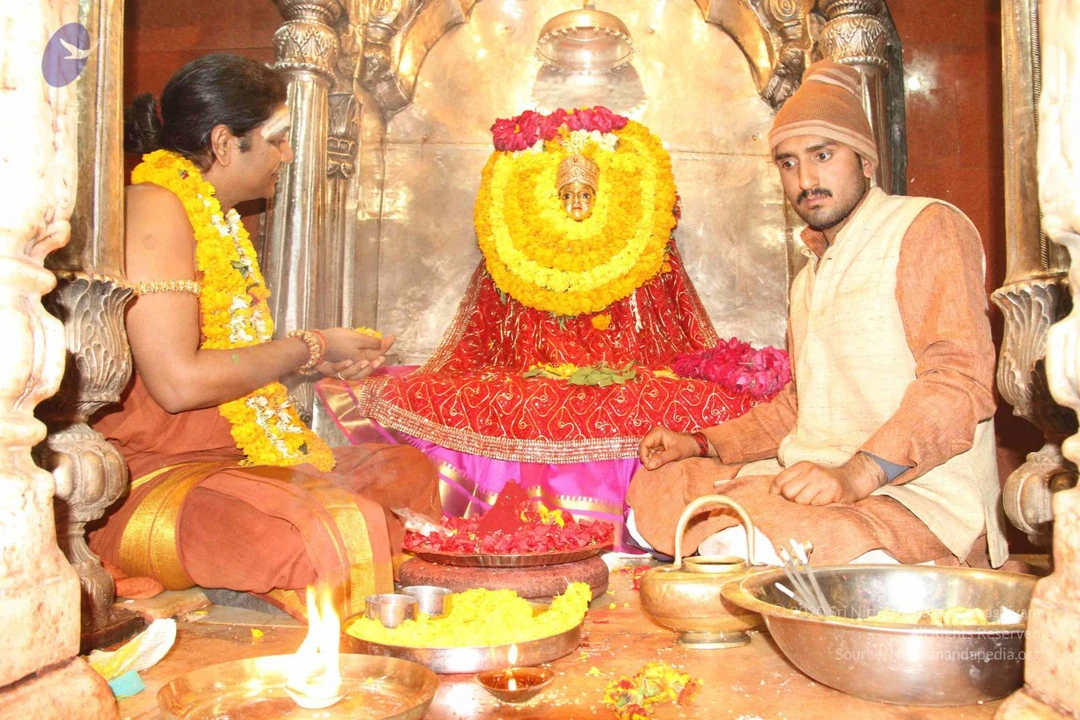
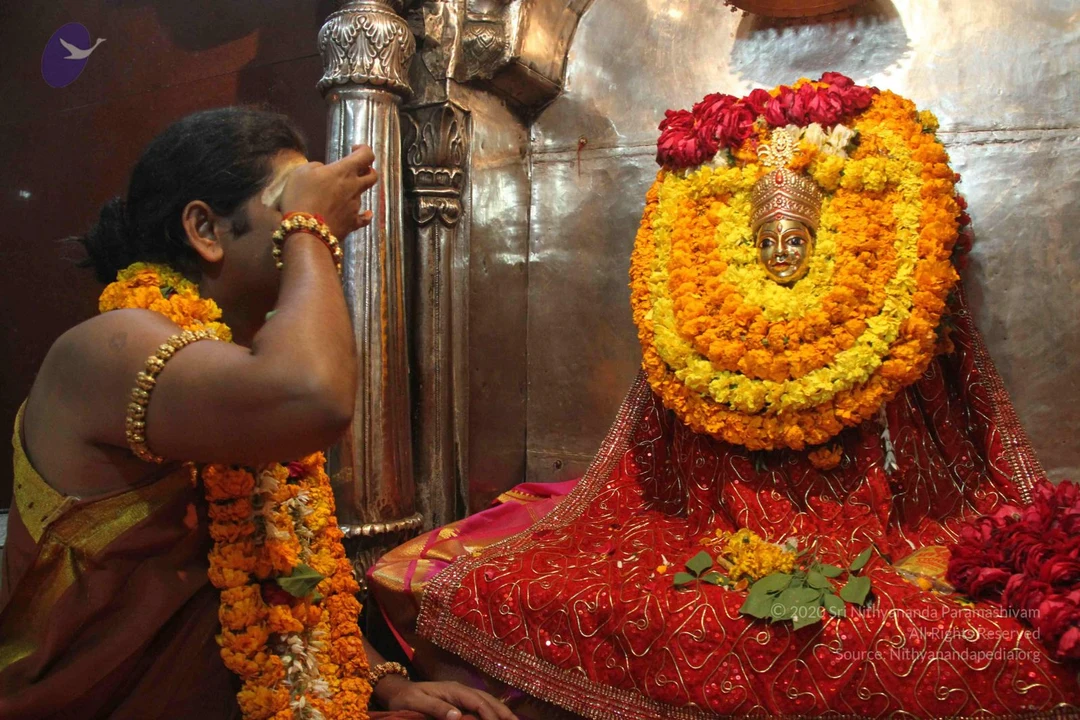
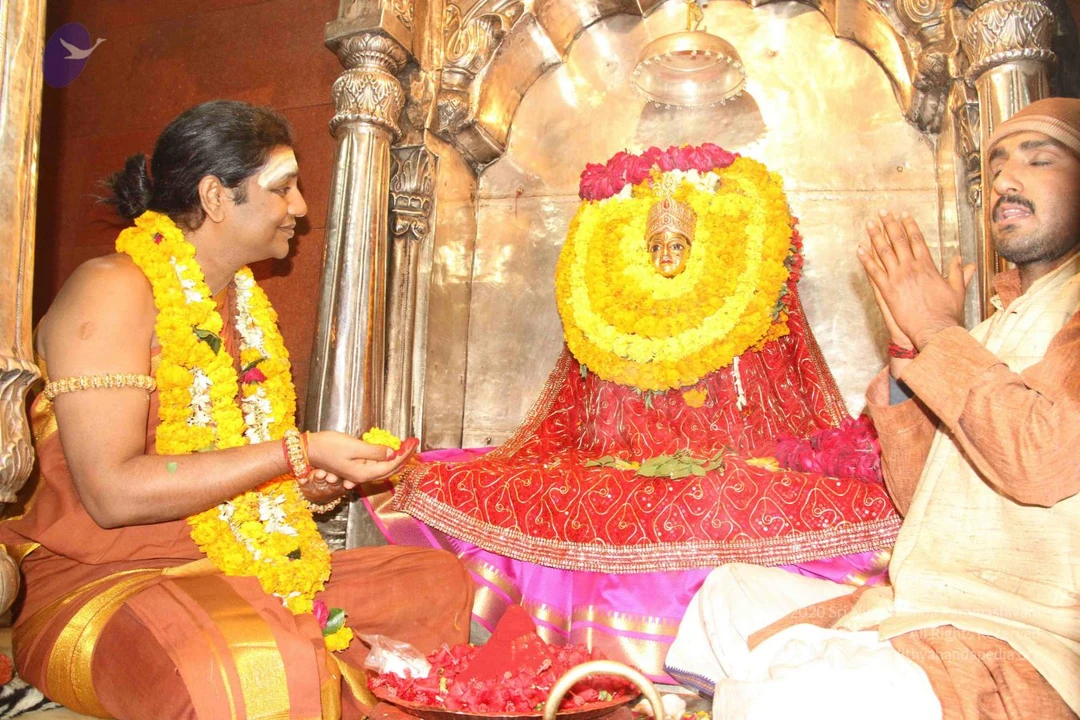
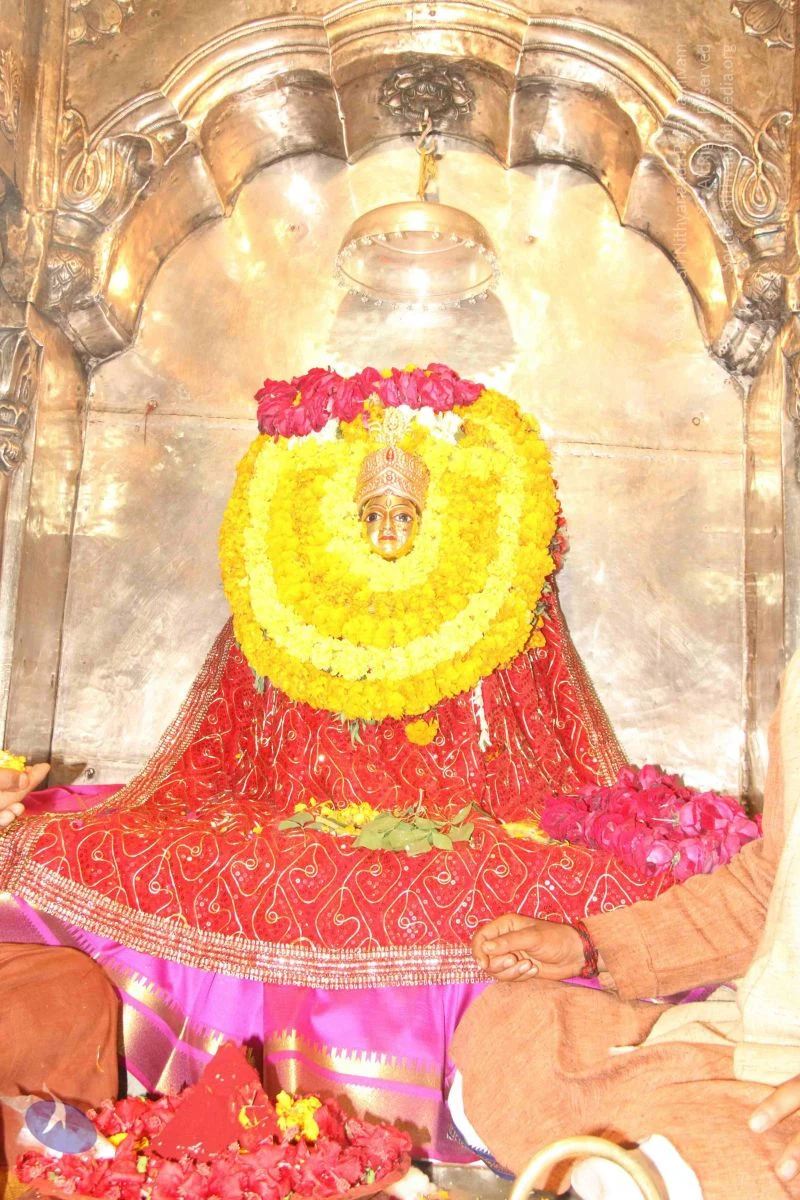
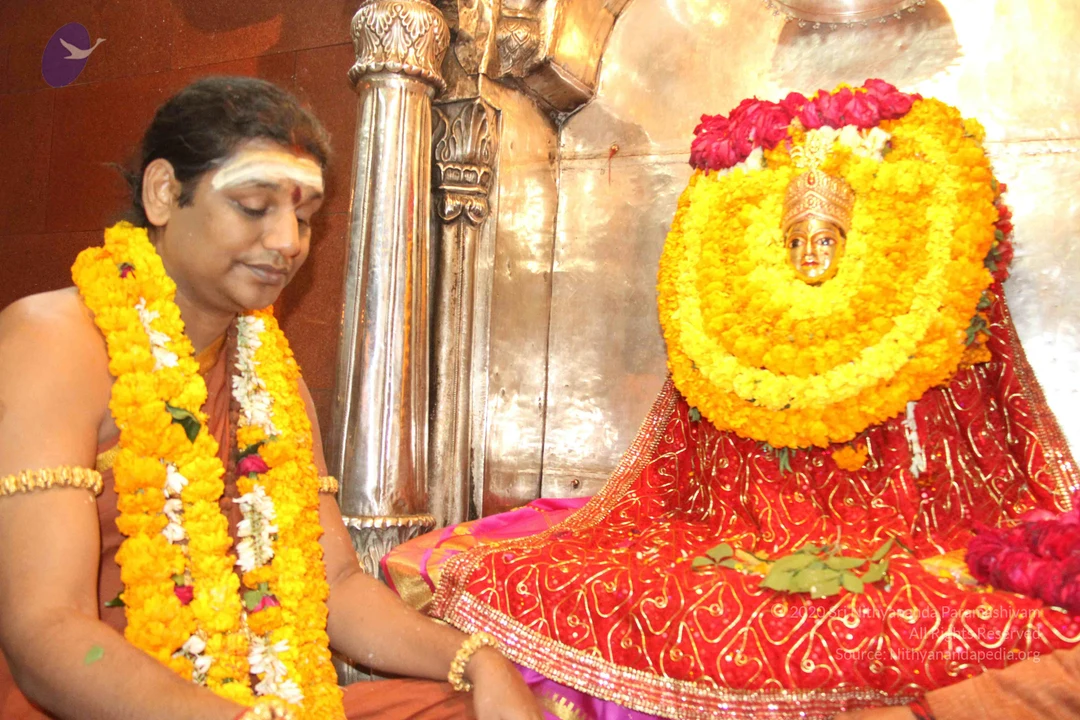
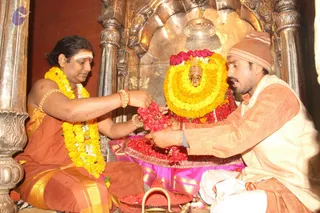
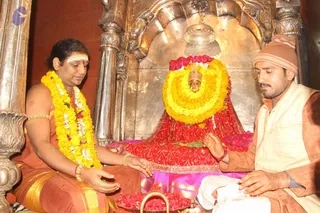
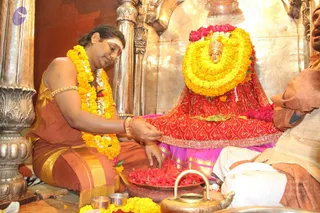
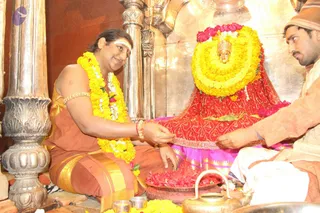
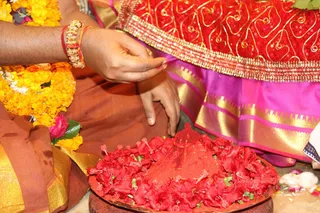
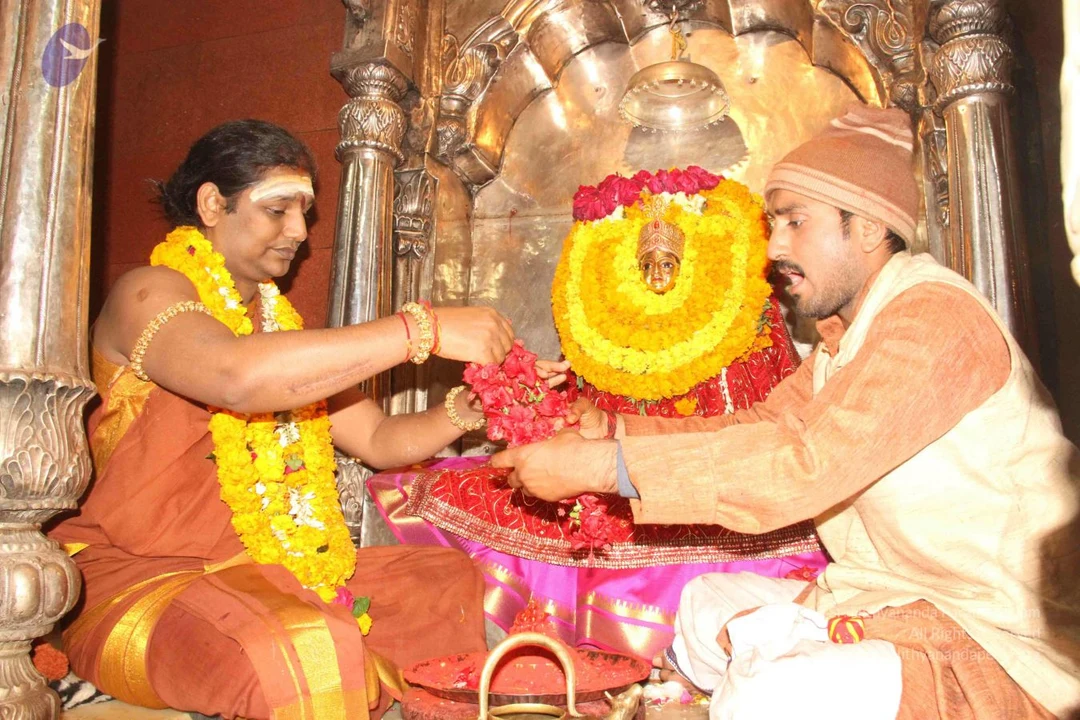
A photograph of a temple worship scene in front of a silver-clad shrine with a golden deity murti (face visible) draped in a large yellow marigold garland and red flower garlands. A man in orange-saffron dhoti with gold border and a long yellow-and-white garland, with a white tilak on his forehead and gold armlets, sits on the left offering red flowers. On the right a young man in a cream kurta and orange-brown head wrap holds the flowers together with him. A brass tray with red offering sits in the foreground, and a magenta cloth lies under the deity.A photograph inside a temple shrine. A man in saffron-orange robes with a gold-bordered dhoti, a white tilak on his forehead, and yellow and white flower garlands sits on the left, pouring petals from a brass vessel. Beside him a younger man in an orange kurta over a white vest and a brown knitted cap offers flowers from a silver plate. Behind them stands a silver-backed alcove holding a deity murti with a crown, draped in a large yellow marigold garland and a red embroidered cloth. The scene suggests a puja or abhishekam offering.A photograph inside a temple shrine showing a deity murti of a goddess draped in a red and pink sari with a dense ring of yellow marigold garlands and a golden crown. Two men sit before her: on the left, a man with a white tripundra on his forehead wears a long yellow-and-white marigold garland, an orange-brown dhoti and gold bangles, and offers his hands in prayer near the murti; on the right, a bearded man in a brown knit cap and cream vest offers rose petals from a brass plate. A silver-clad arch and pillars frame the shrine and red rose petals lie in front. a person cues: the left man wears a garland and orange ritual attire; appearance is consistent with the page but not conclusive, so this is marked unsure.A photograph of a temple puja before a deity murti draped in a red and gold embroidered cloth and wrapped in a large marigold garland with red roses. A seated man with a light bare upper body, gold-bordered brown-orange dhoti and a yellow-orange marigold garland offers red rose petals from a brass plate with his right hand, a gold armlet and bangle on his wrist, and a white tilak on his forehead. A second seated man on the right wears an orange-brown shawl and white dhoti. Brass vessels, a brass kettle-shaped pot and marigolds sit in the foreground beside silver-toned pillars.A photo of a seated ritual in a temple sanctum with silver-clad pillars. A figure in saffron-brown robes with a gold-bordered dhoti, a yellow and white flower garland, a tilak on the forehead and gold armlet sits cross-legged and offers flower petals from a brass plate onto a deity murti. The deity wears a red and magenta silk cloth draped over a large yellow marigold garland and a gold crown. A second man in a light brown shawl and white dhoti stands at right holding petals. A brass kalasha and small oil lamps sit on the floor with yellow flowers.Close view of a ritual offering: a brass or copper tray holds a conical mound of red kumkum powder decorated with red hibiscus flowers and green leaves. A person's hand with gold bangles and red-and-white wrist threads is extended over the tray, and a second hand rests nearby. The wearer's clothing is a red and gold embroidered blouse with a magenta and gold-bordered sari, and an orange-brown cloth with a marigold garland lies at the left. Scattered petals surround the tray. No identifiable face is visible.

Satsang

13 photosSource gallery
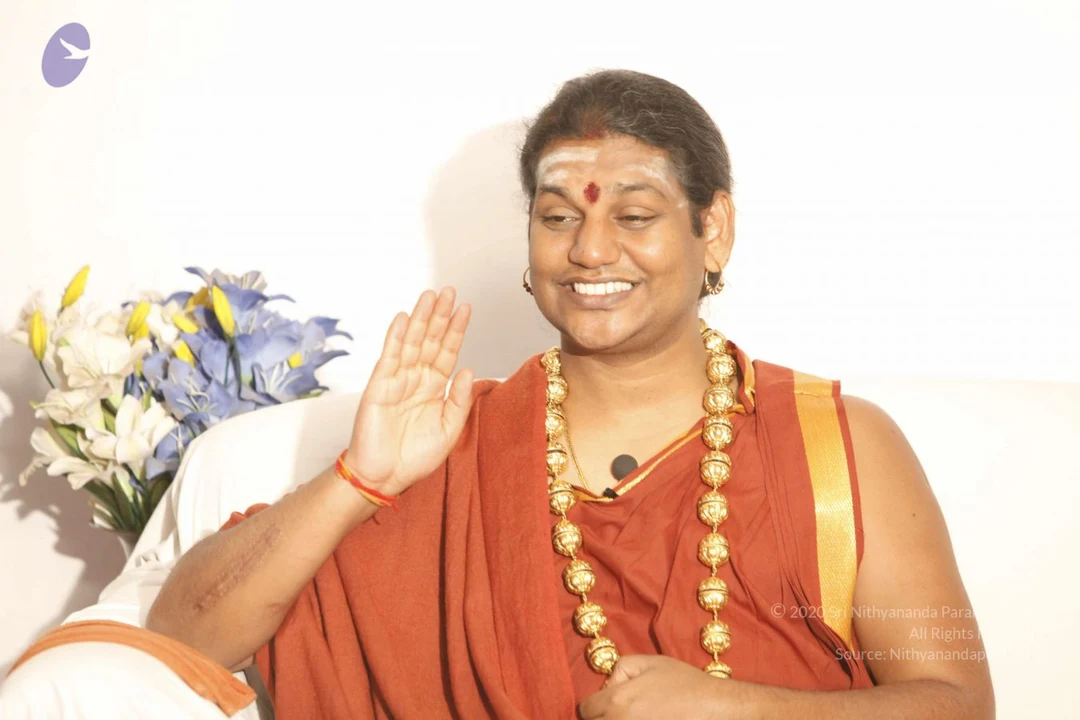
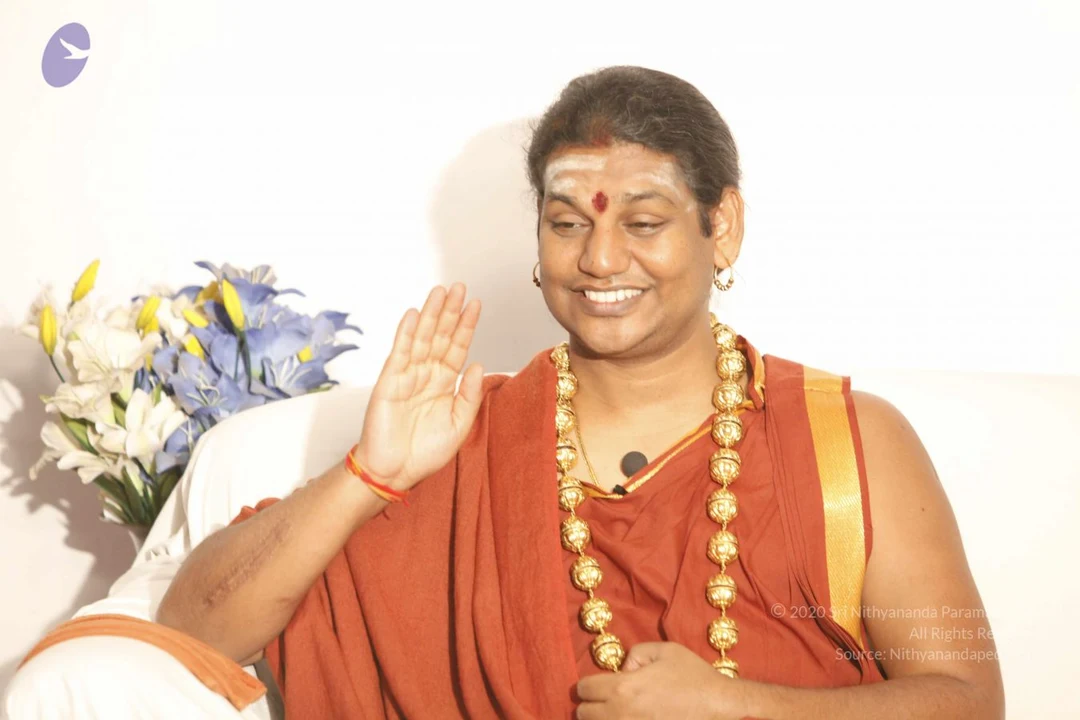
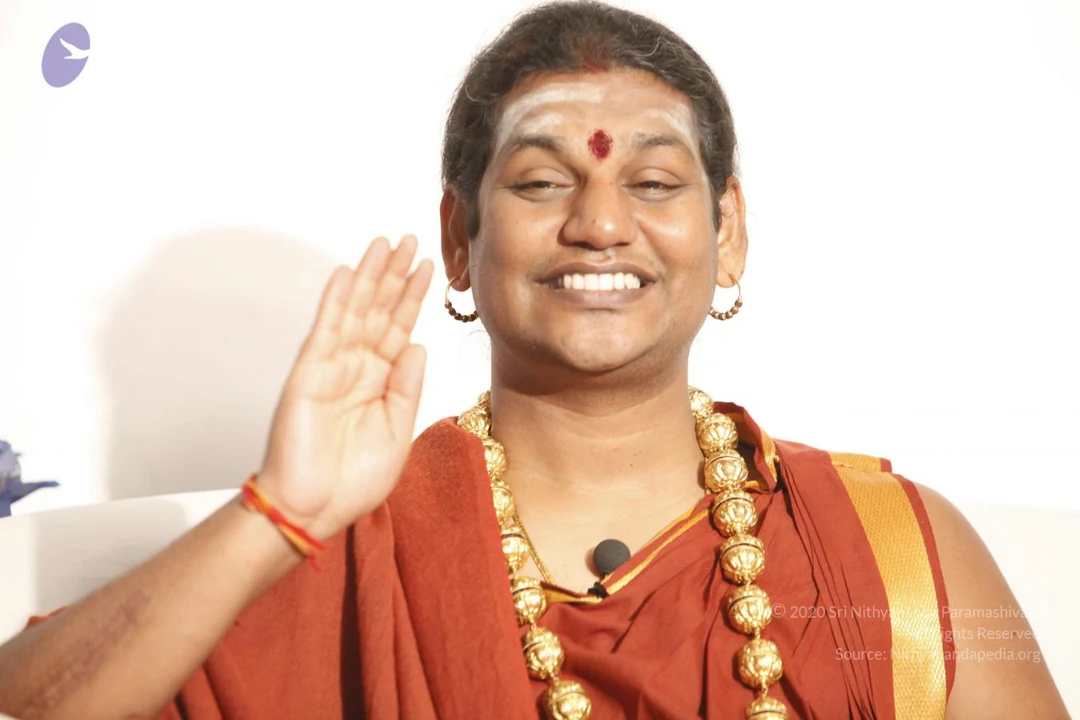
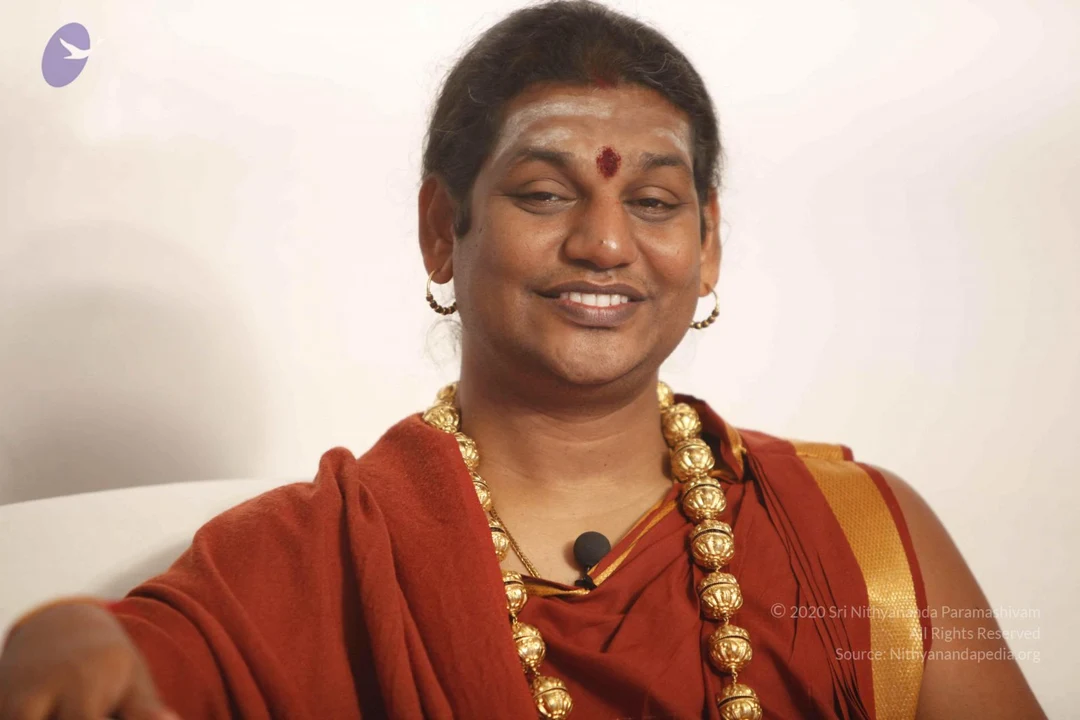
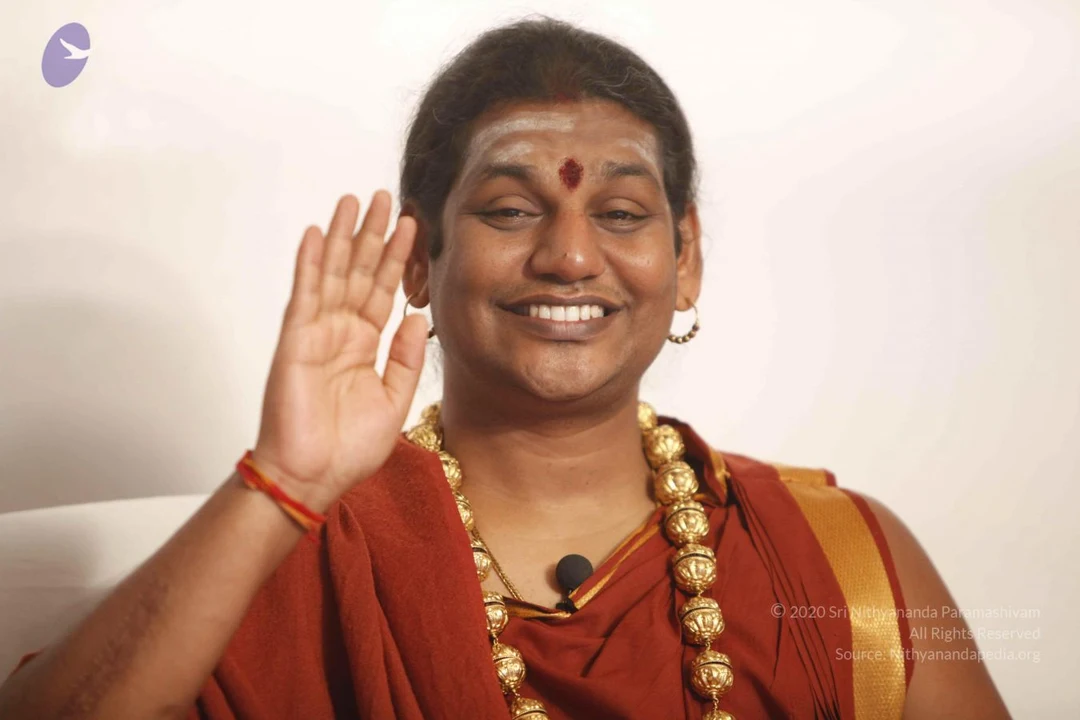
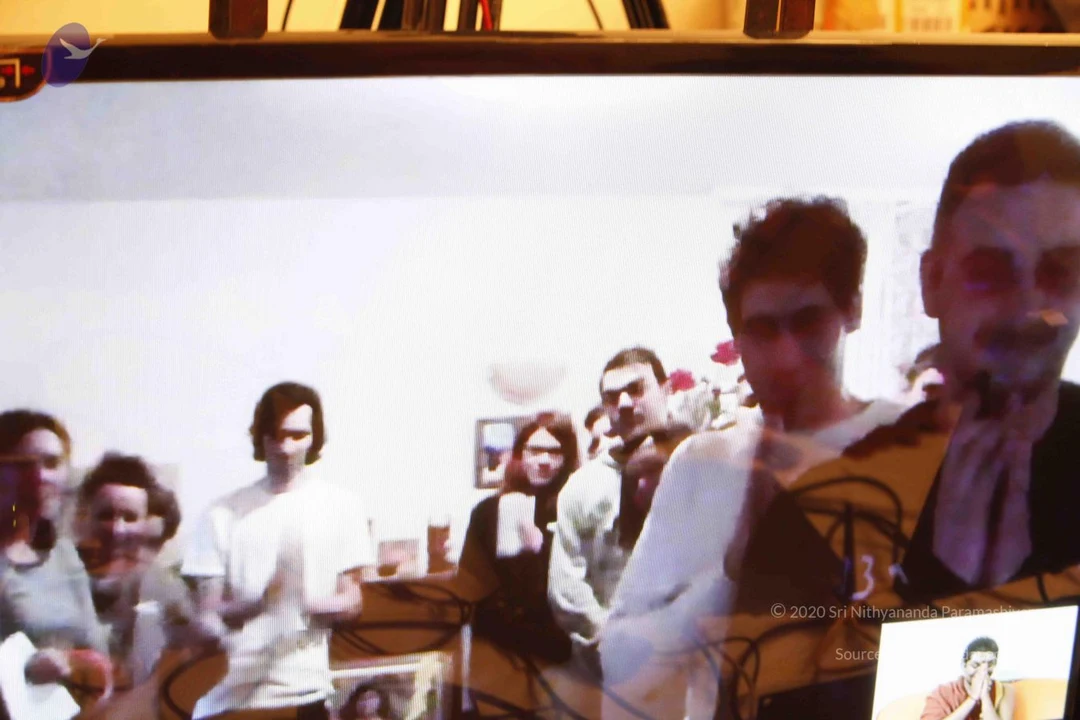
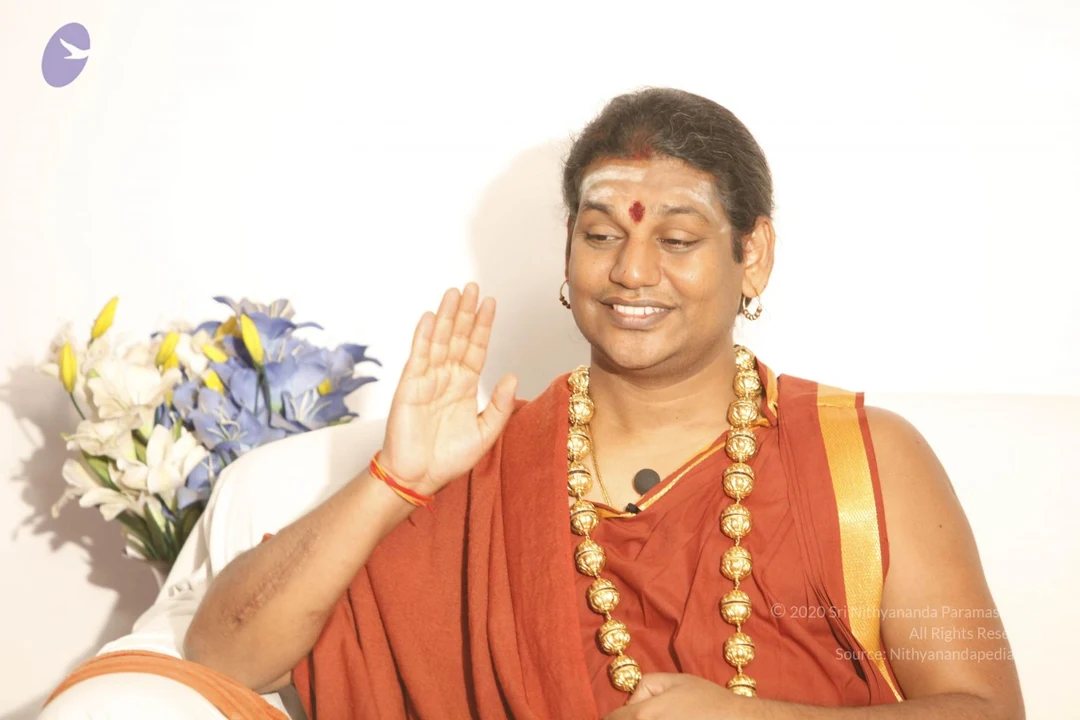
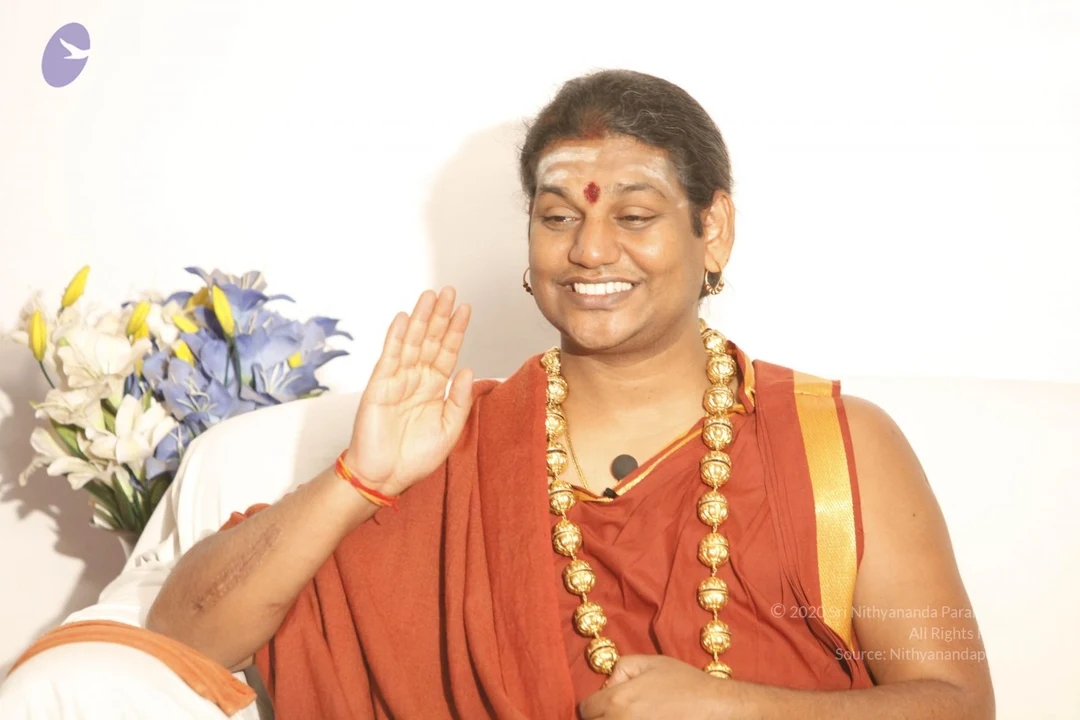
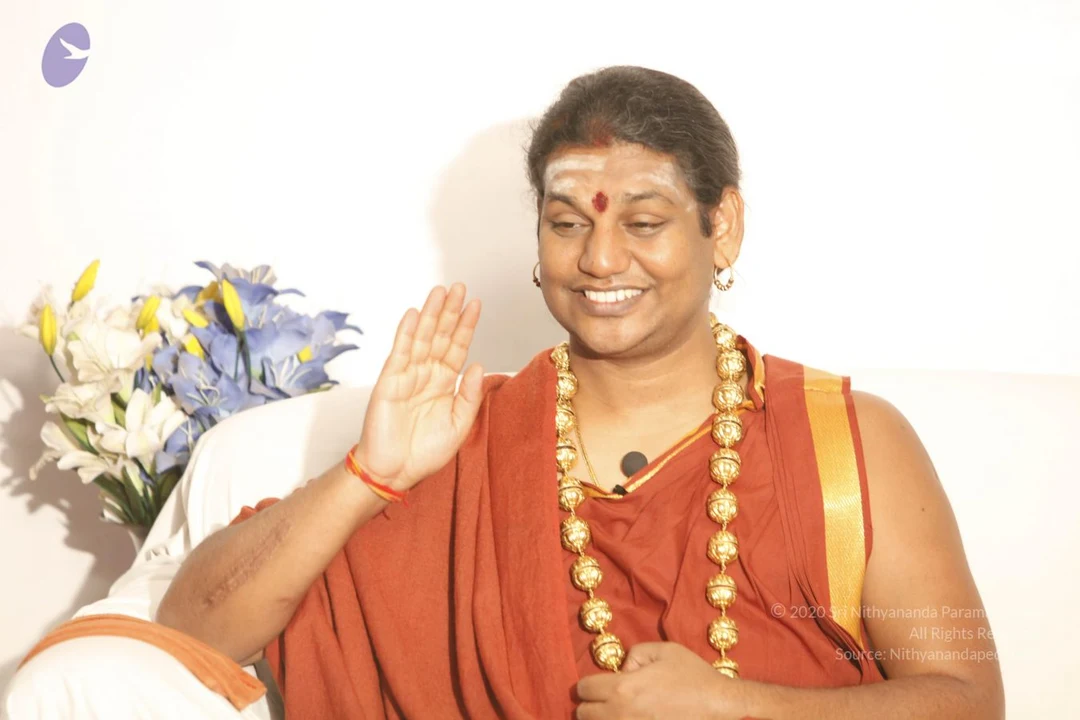
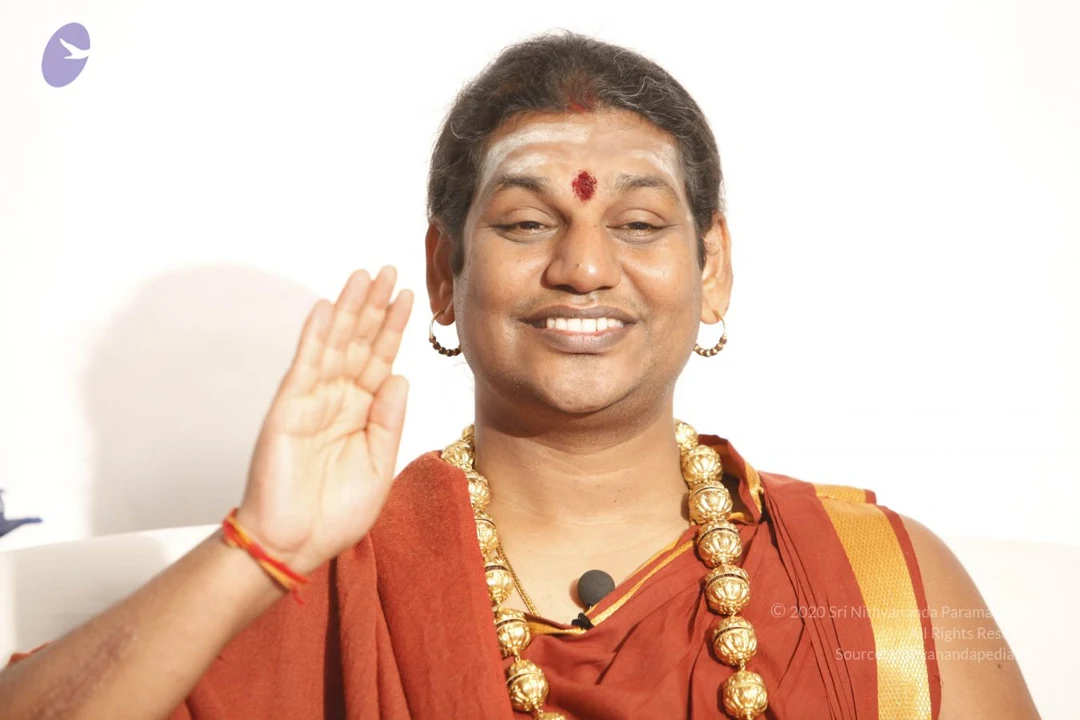
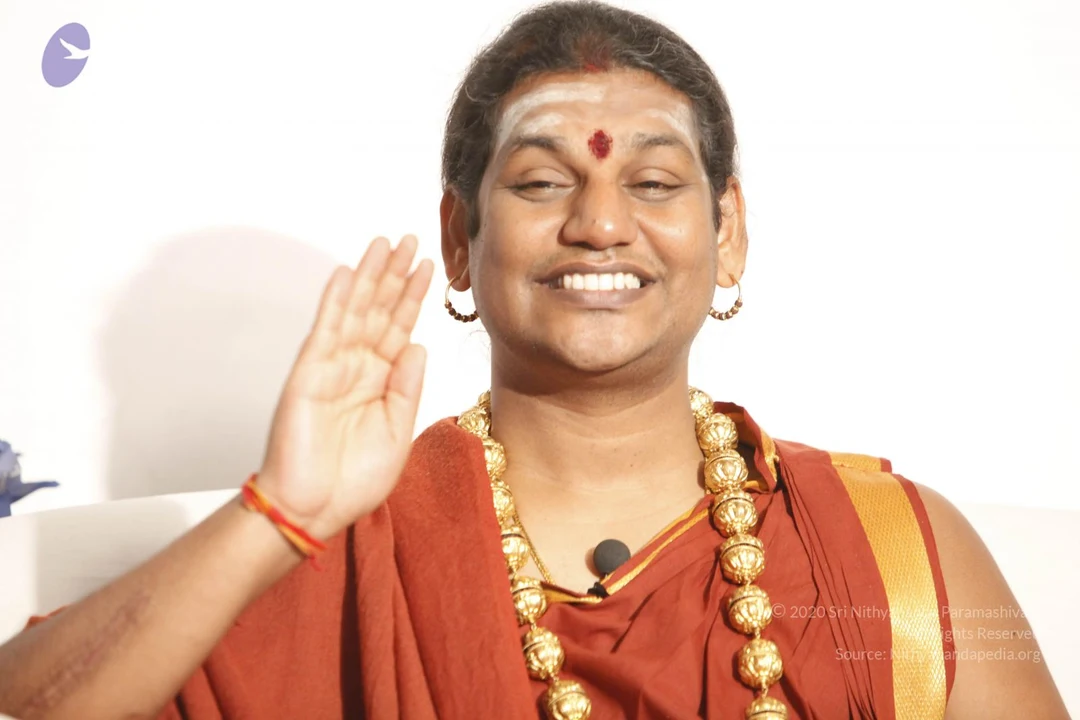
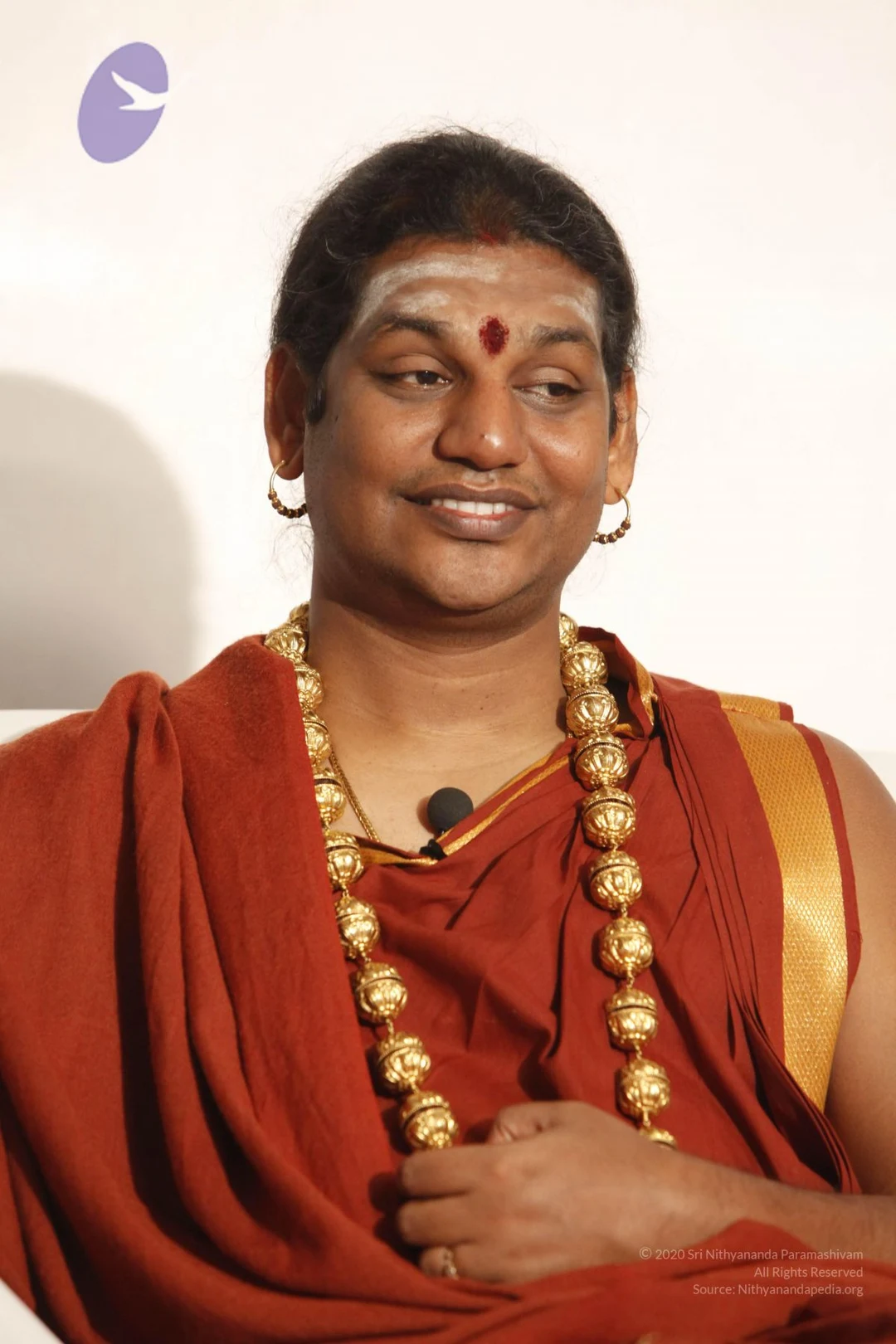
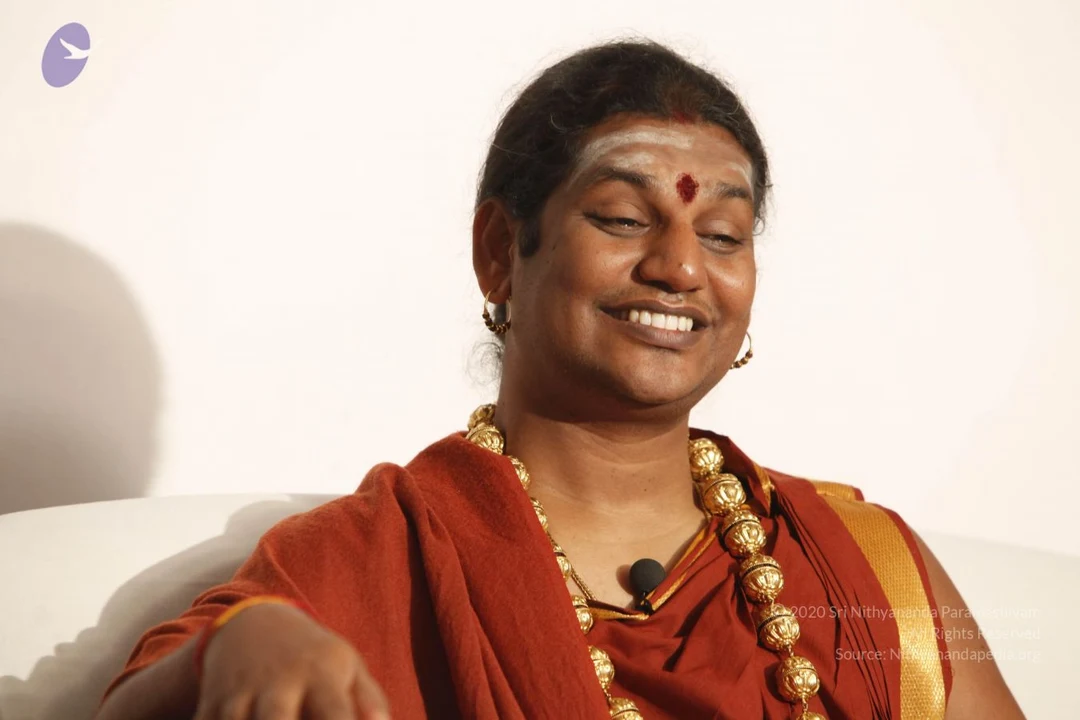
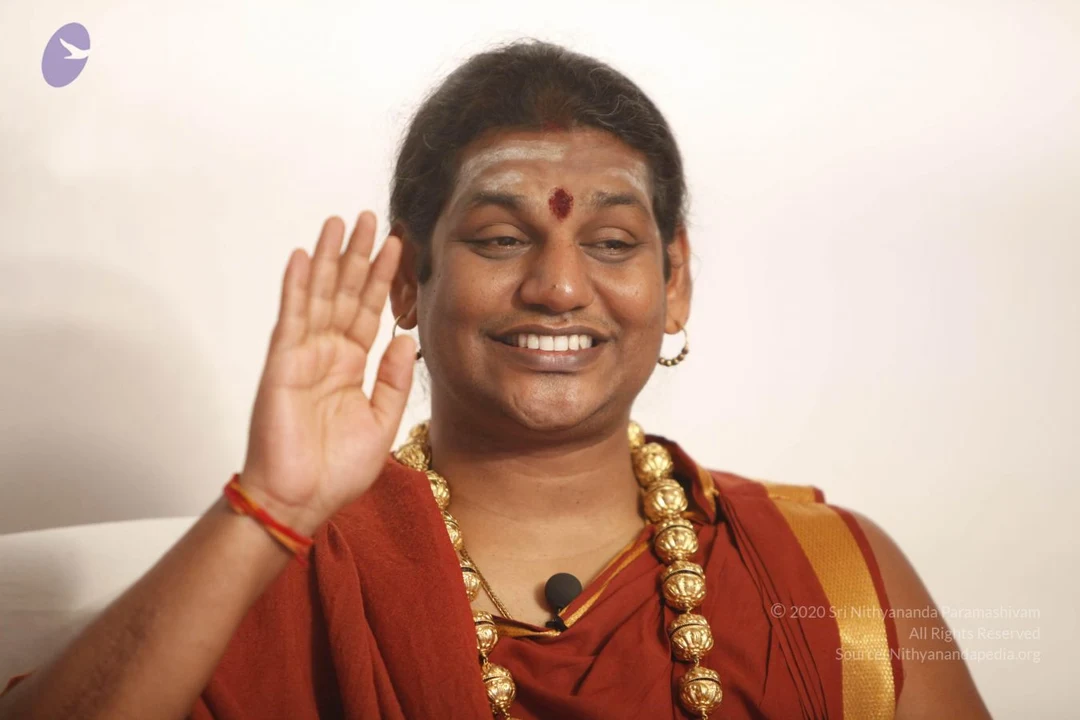
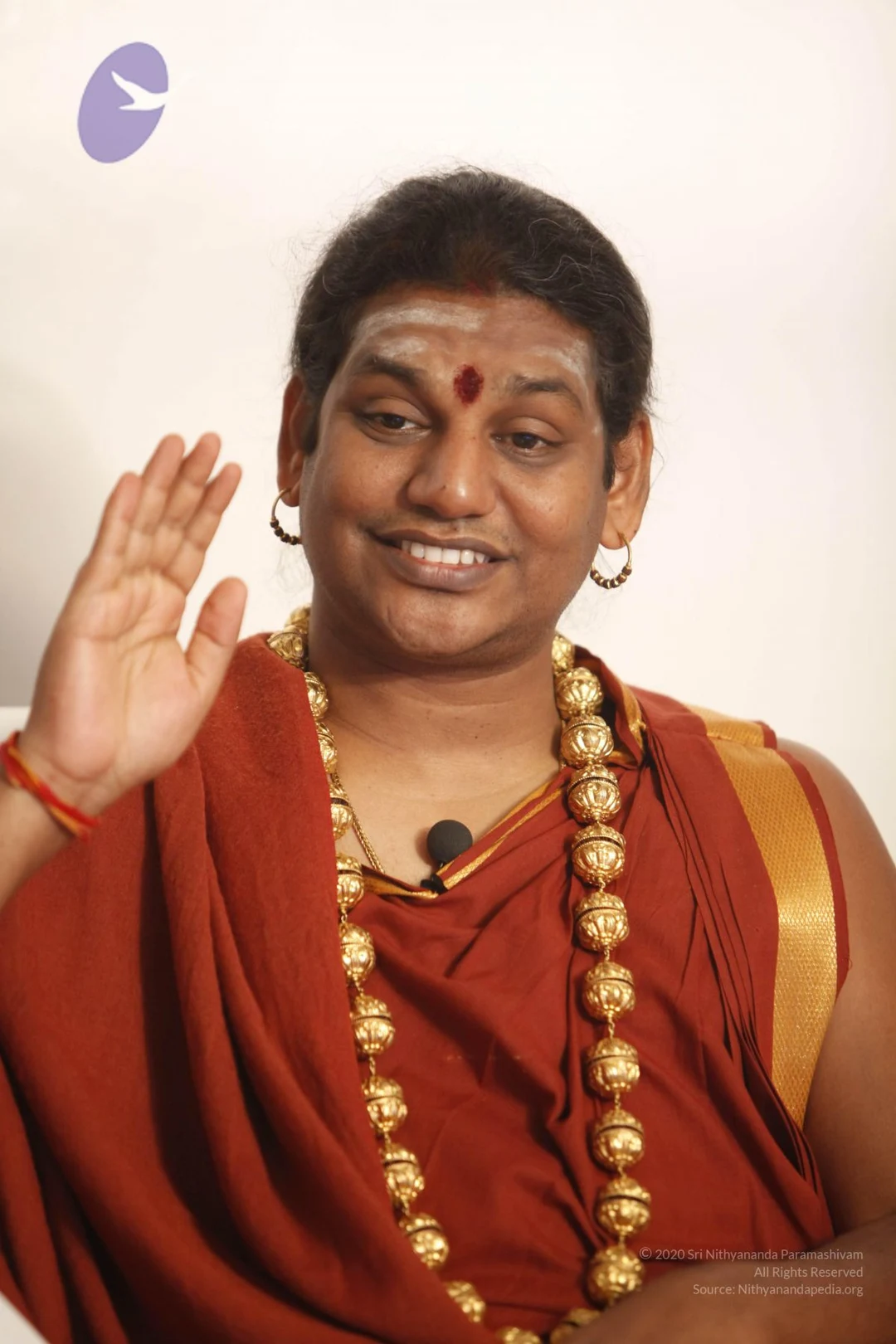
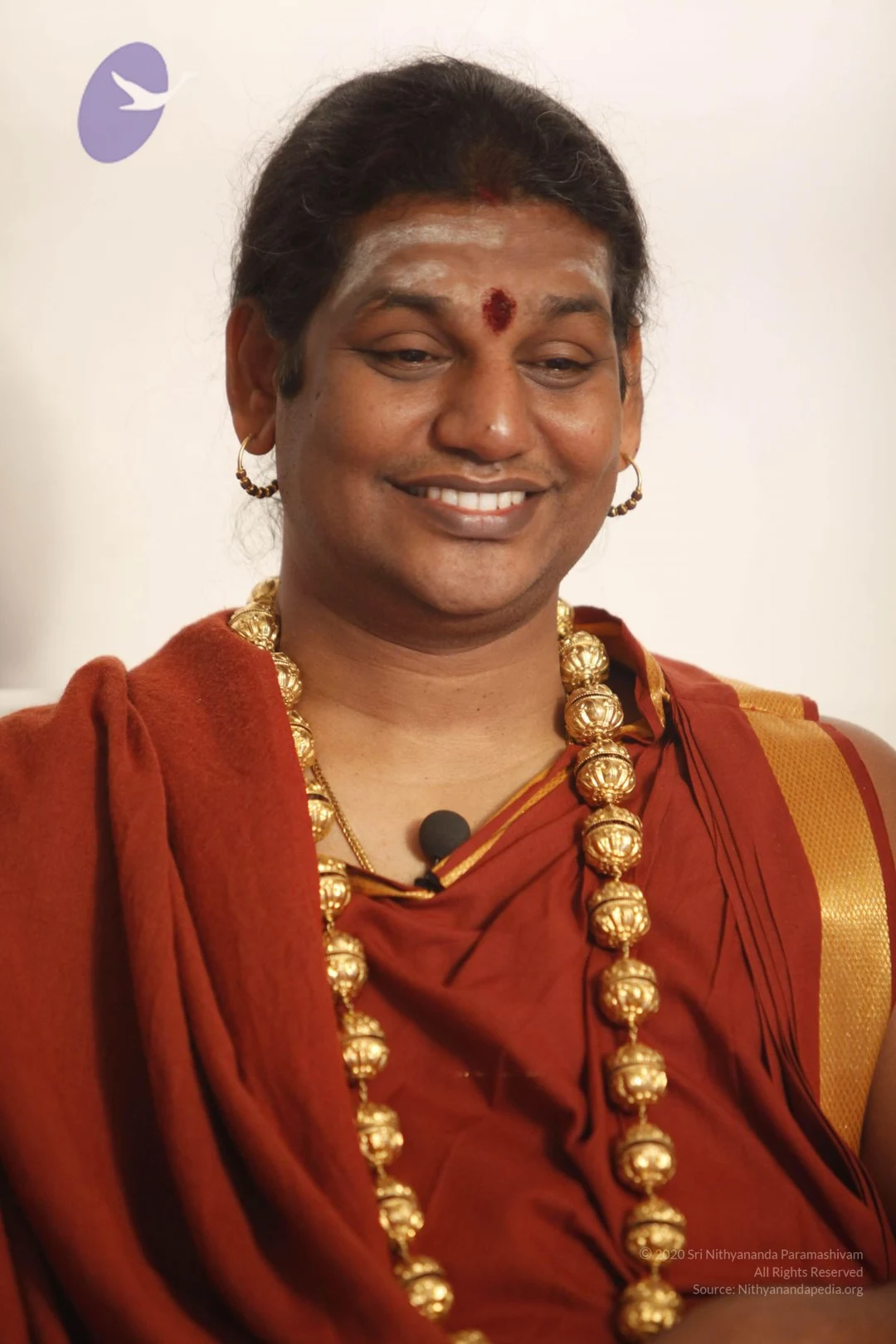
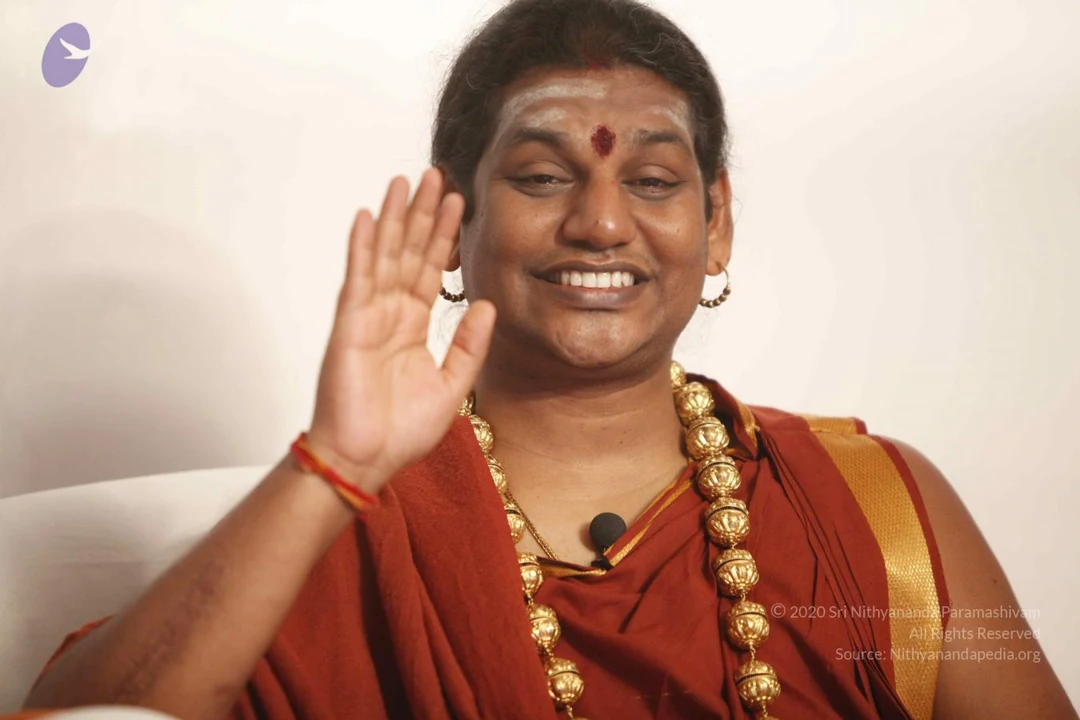
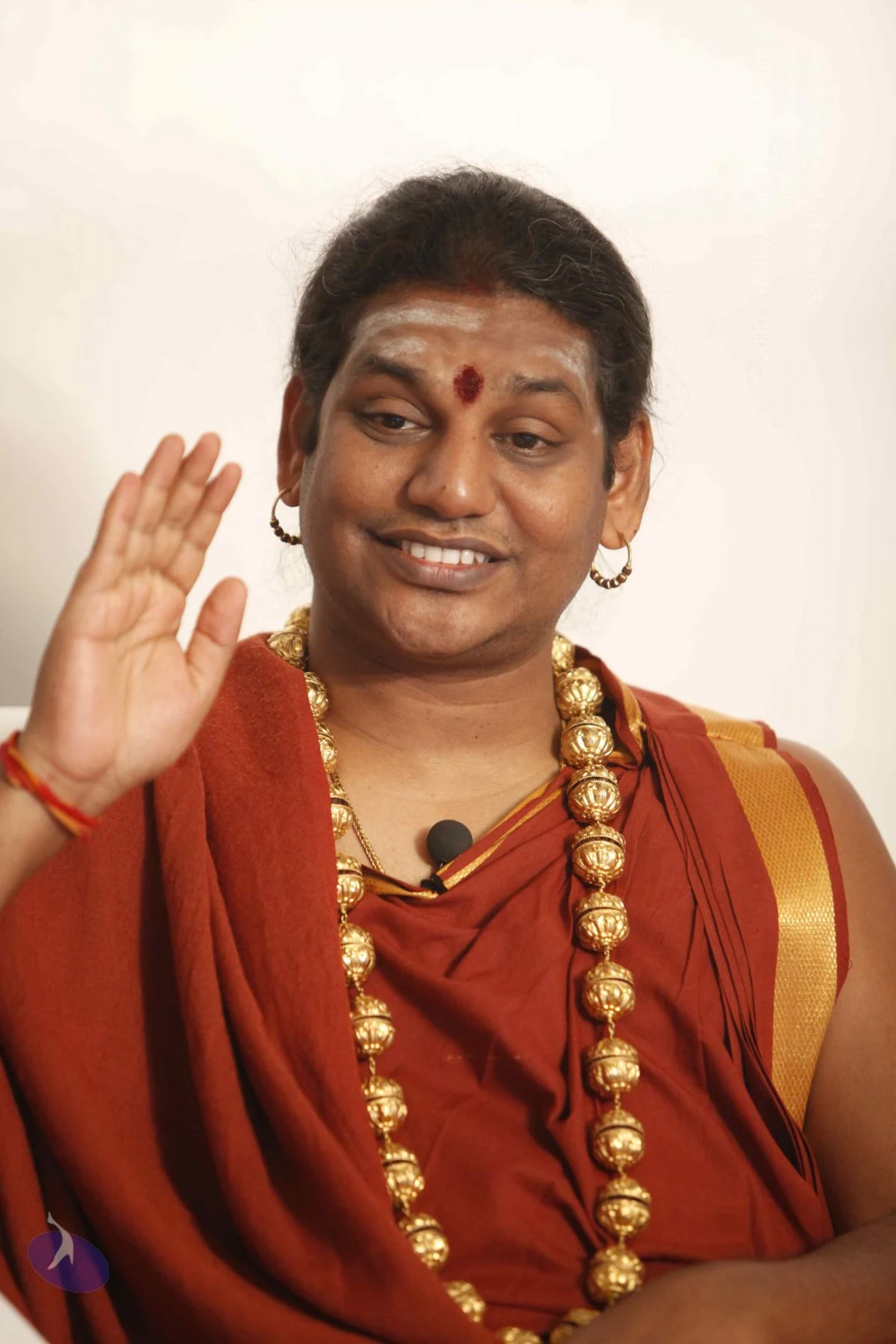
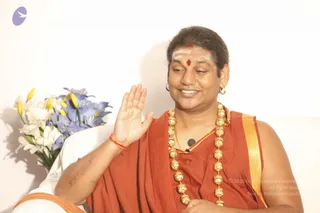
A photograph of a man seated on a white sofa, raising his right hand palm-outward in a gesture while smiling and looking to his left. He wears a saffron-orange shawl over his shoulders with a gold-bordered edge, a long necklace of large gold beads, a lapel microphone clipped to his chest, and a red thread on his wrist. He has white vertical tilak lines and a red dot on his forehead and gold hoop earrings. Behind him stands a vase of blue and white flowers near a plain white wall. a person: the saffron shawl, gold bead necklace and forehead markings are consistent with the page's reference to a person speaking at a satsang.Close-up photo of a smiling man in an orange-red saffron-style shawl with a gold-coloured bead necklace of large ornate beads, raising his right hand in a wave or greeting. He wears a red kumkum bindi and white vibhuti lines on his forehead, small hoop earrings, and a red-and-yellow thread on his wrist. A small lapel microphone is clipped to his shawl. He sits against a plain white background, apparently at a satsang or talk. Appearance-based probable identification: a person, seated and speaking as a teacher.a person (appearance-based label) seated in a close photograph against a plain white background, smiling broadly. He wears a deep rust-orange shawl draped over one shoulder, with a wide gold-bordered edge, and a heavy necklace of large gold beads. He has a red bindi and white-painted forehead markings, small gold hoop earrings, and a small black lapel microphone clipped to his shawl. His right hand is extended toward the camera at the bottom left.A smiling man in a rust-red and gold-bordered shawl raises his right hand in a wave toward the camera. He wears a red kumkum mark and white vibhuti on his forehead, small hoop earrings, and a heavy gold bead necklace of large ornamental beads. A small clip-on microphone is pinned to his shawl, and a red thread is tied at his wrist. The plain white backdrop suggests a seated satsang or interview setting. Swamiji (probable): long hair, saffron-red clothing, gold rudraksha-style necklace and ceremonial adornments visible.A photograph of a television screen showing a satsang stage. On the left, a man in a white shirt stands beside a red-draped chair and red cloth on the floor. Centre, a bald man in an all-white outfit with a white shawl stands with hands folded, near a man in a white shirt. Behind them, men in striped shirts stand near a purple backdrop. On the right, a woman in a white dress with a white shawl stands at the edge. Cables and a microphone stand lie on the stage in front of an LG monitor.A photograph of a screen showing a video call or satsang broadcast. On the screen, a group of people stands and sits in a room with a white wall, framed picture and flowers, several smiling. A man with dark hair and a white t-shirt stands at left-center, and a man in a dark jacket with a light scarf stands at right. In the lower right corner, a small inset shows a man with hands folded in namaste, seated before a yellow backdrop.

Photos Of The Day:

26 photosSource gallery
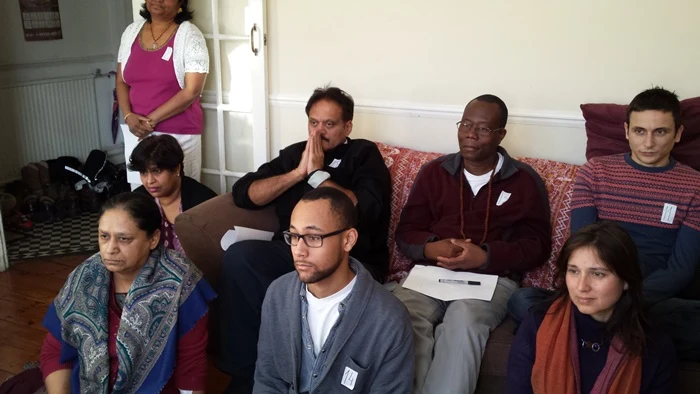
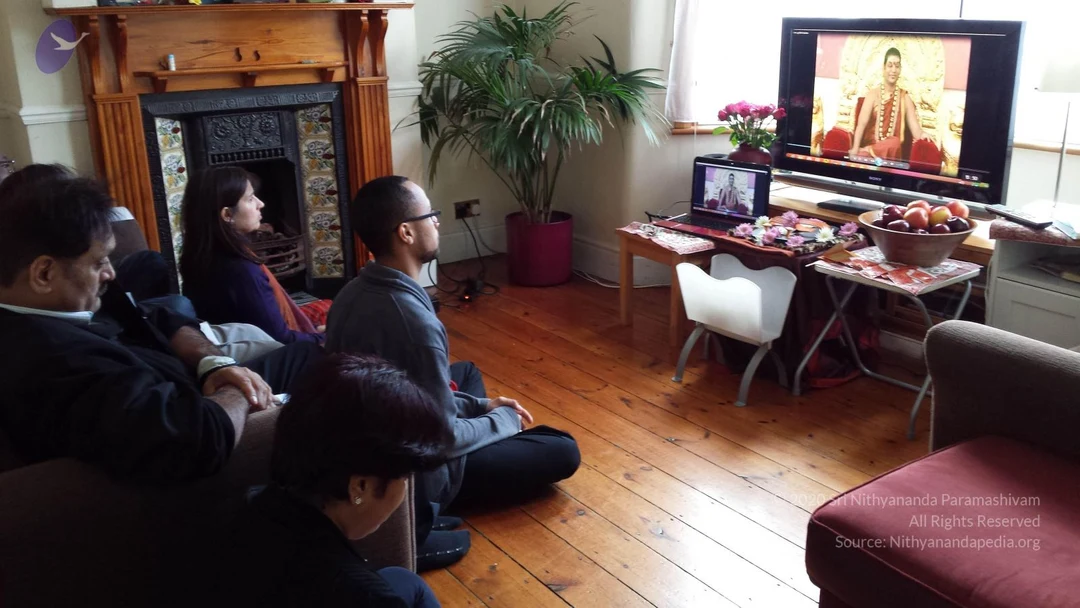
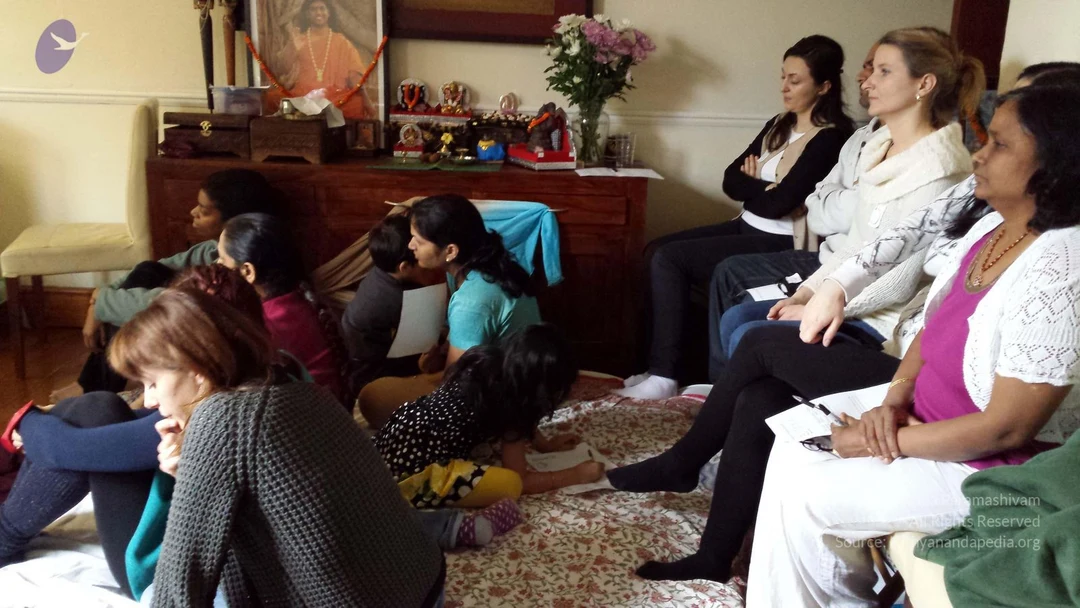
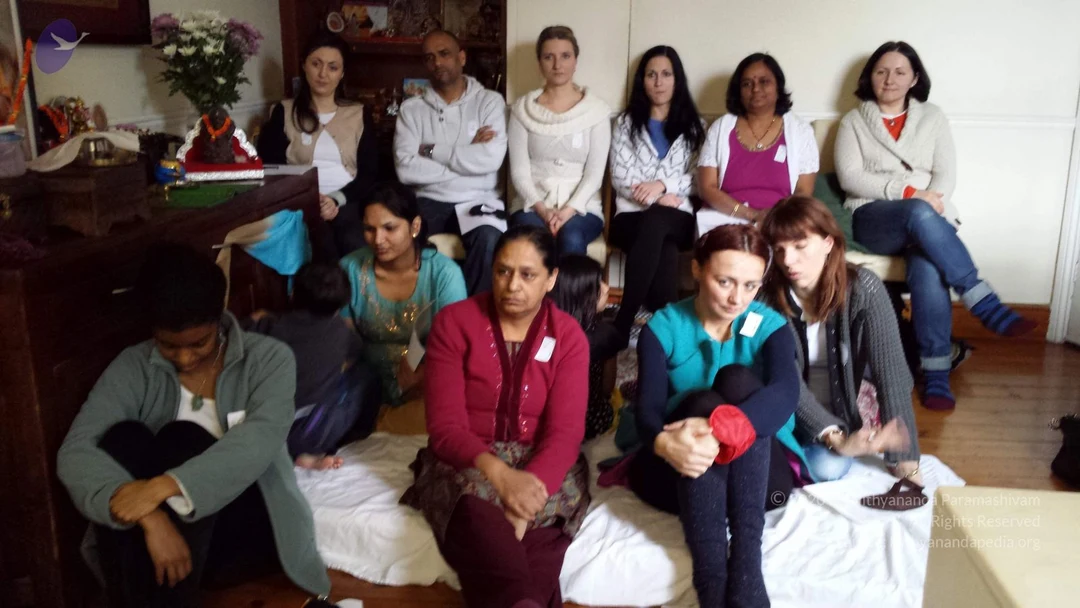
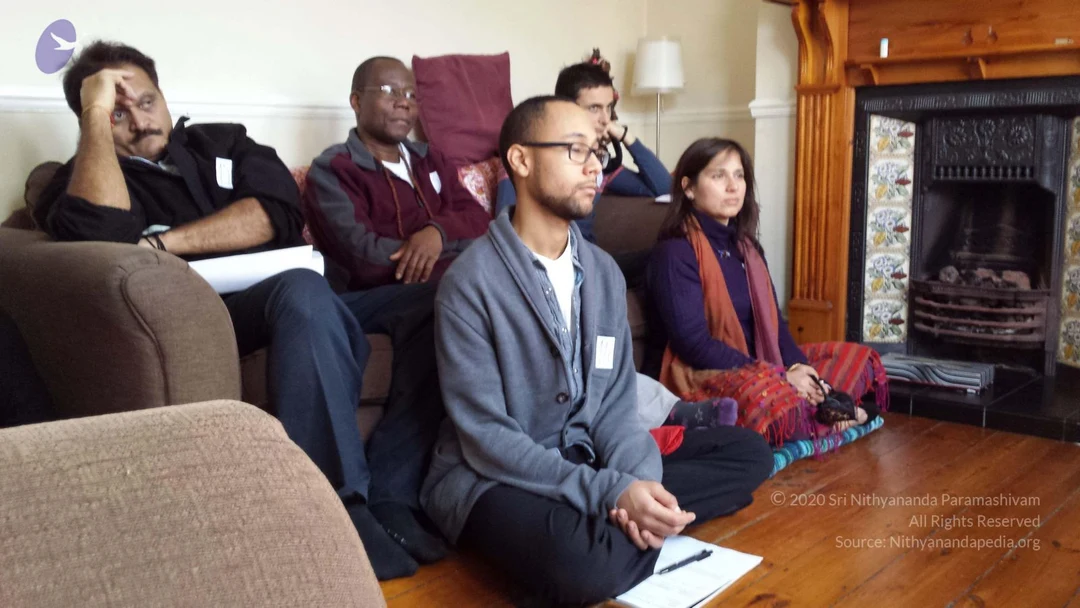
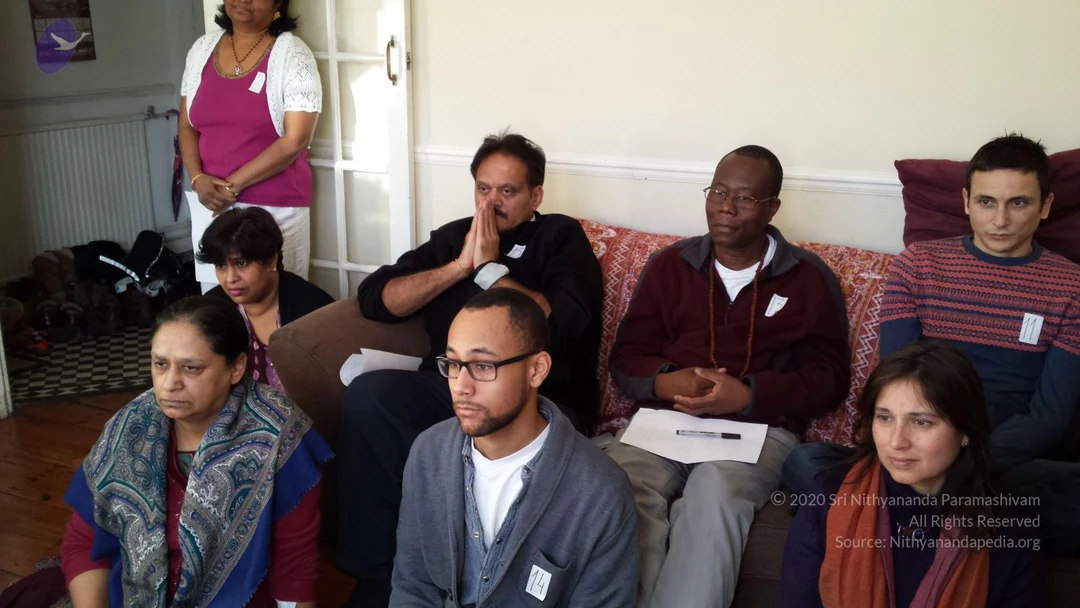
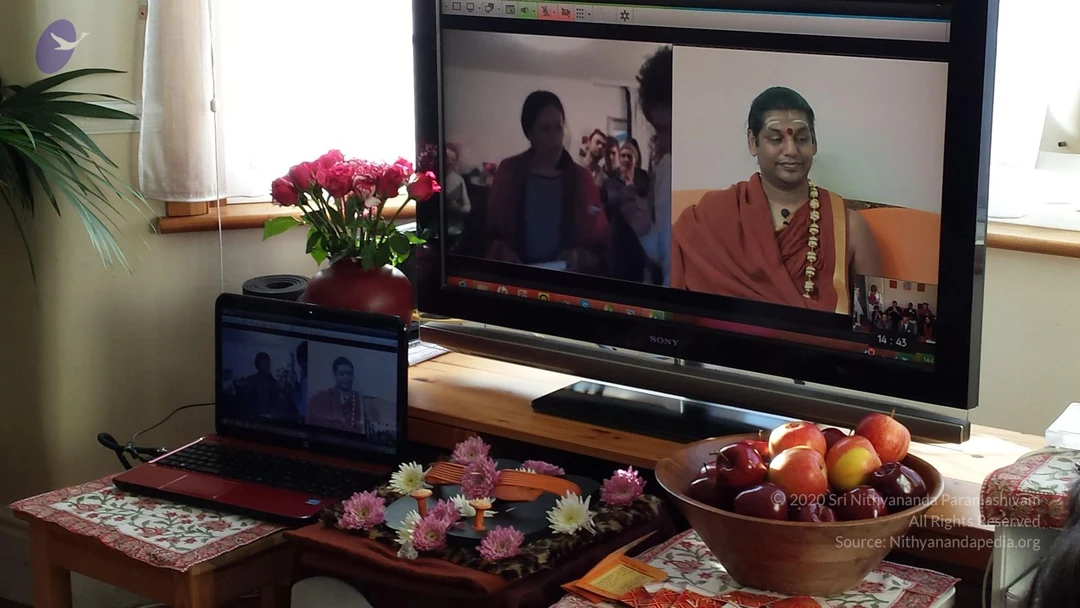
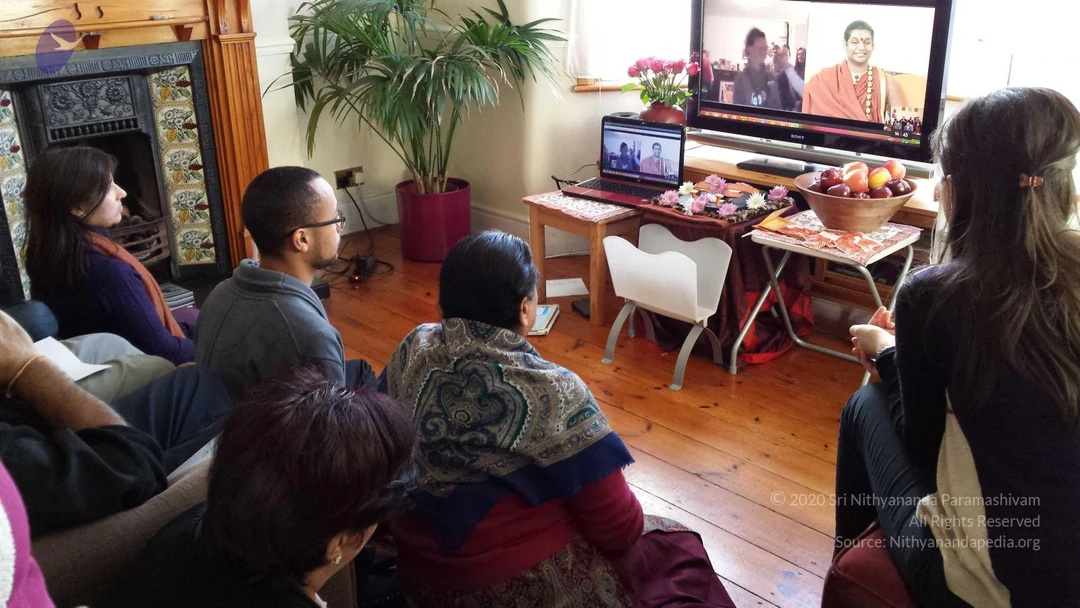
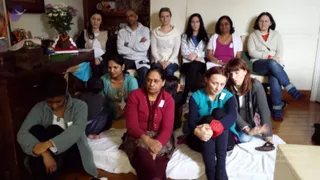
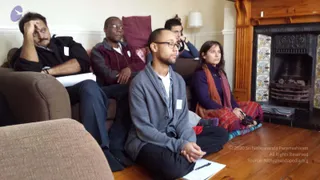
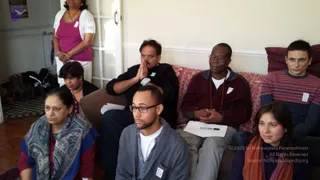
A living room with wooden floorboards and a tiled fireplace shows several people seated and watching a large flat-screen TV. The TV displays a figure in a red and gold ornate outfit seated on a red cushioned throne against a golden backdrop. A laptop on a low table shows a smaller video of a person in a white garment. Pink flowers sit beside a bowl of red apples, and a potted palm stands nearby. On the left, a man in a dark jacket and a woman with reddish-brown hair in a blue top sit on a sofa. A man in a grey hoodie sits cross-legged on the floor with glasses, and a woman with short dark hair sits in the foreground.A photograph of a small room where women and a few children sit on the floor and on chairs listening to a satsang. A framed portrait of a saffron-robed man with long hair and beads hangs on the wall above a wooden sideboard decorated with small brass deity murtis, orange marigold garlands and a vase of pink flowers. Several seated attendees wear dark tops, white sweaters, a pink top and a grey knit cardigan, and a few hold papers or notebooks. The portrait is a depiction, so the person in it is not treated as present in the room.A photograph of a small room during a seated satsang gathering. Around ten people sit on a white mattress and along a wooden bench against a white wall. A man in a grey hooded sweatshirt sits with arms crossed in the back row, and a woman in a teal top sits on the mattress in front. A woman in a red cardigan and maroon trousers sits in the centre, and a young man in a grey-green jacket sits at the lower left. At the left, a wooden cabinet holds a small red deity murti adorned with an orange garland and flowers in a vase.Indoor satsang scene in a living room with a tiled, black cast-iron fireplace and wooden floorboards. Five seated attendees face forward: a man on the left in a black jacket with his hand on his head, a bald man in a maroon fleece with a rudraksha-style beaded necklace, a man in a grey cardigan sitting cross-legged on the floor with a notepad, and a woman in a purple top and orange shawl sitting on a cushion. Name badges are visible on several chests. No a person candidate is visible in the frame.A photograph of a small indoor room with cream walls and a wooden floor, where a group of around eight seated and standing people watch a satsang. A woman in a magenta top and white cardigan stands at the back by a glass door. In the centre, a man in a black shirt presses his palms together in anjali. On a red patterned sofa sits a man in a maroon sweater with a rudraksha mala, and a young man in a striped sweater is on the right. In the foreground, a woman in a paisley shawl sits on the left, a young man in a grey cardigan sits centre, and a woman in an orange scarf sits on the right. Several people wear small numbered name tags, and shoes are lined up by the wall.A living-room setup with a large Sony television showing a video call. On the screen, a person in orange-and-red robes with a tilak on the forehead and a garland of beads sits smiling on an orange cushion, while a woman in a dark top and others stand behind him. A red laptop on the left shows a smaller video call of two figures. In the foreground, a table holds pink and white flowers, a red vase of roses, a lit oil lamp and a wooden bowl of apples. The screen shows a person Satsang broadcast, with the on-screen figure in saffron-orange robes and a red-and-gold garland, seated before a crowd.

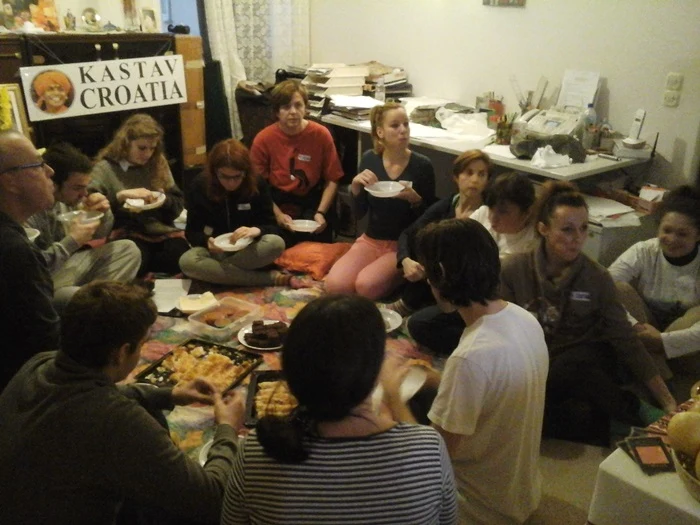
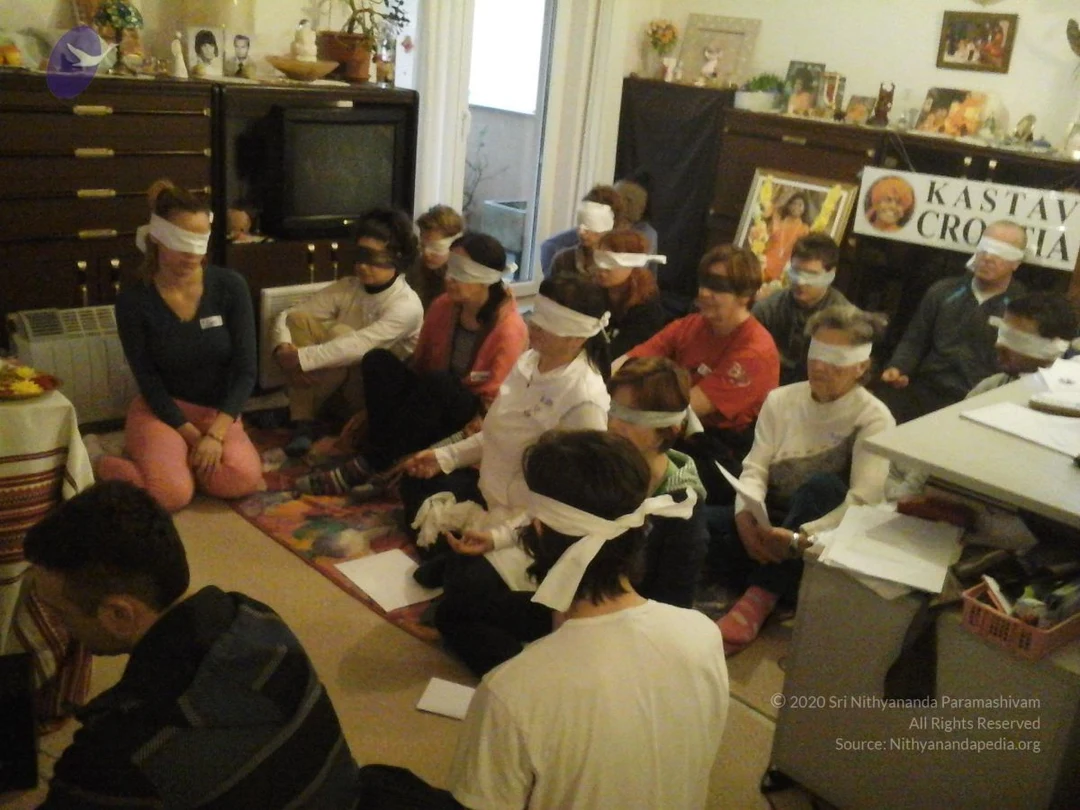
E-Kalpataru at Croatia

11 photosSource gallery
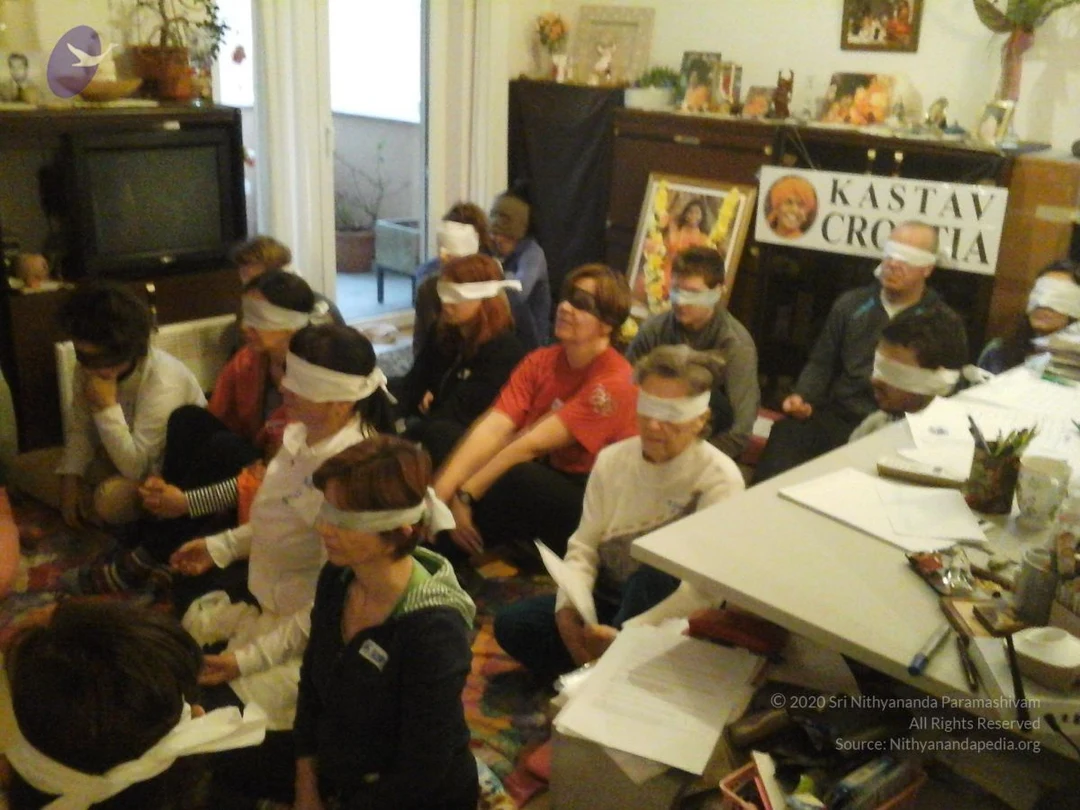
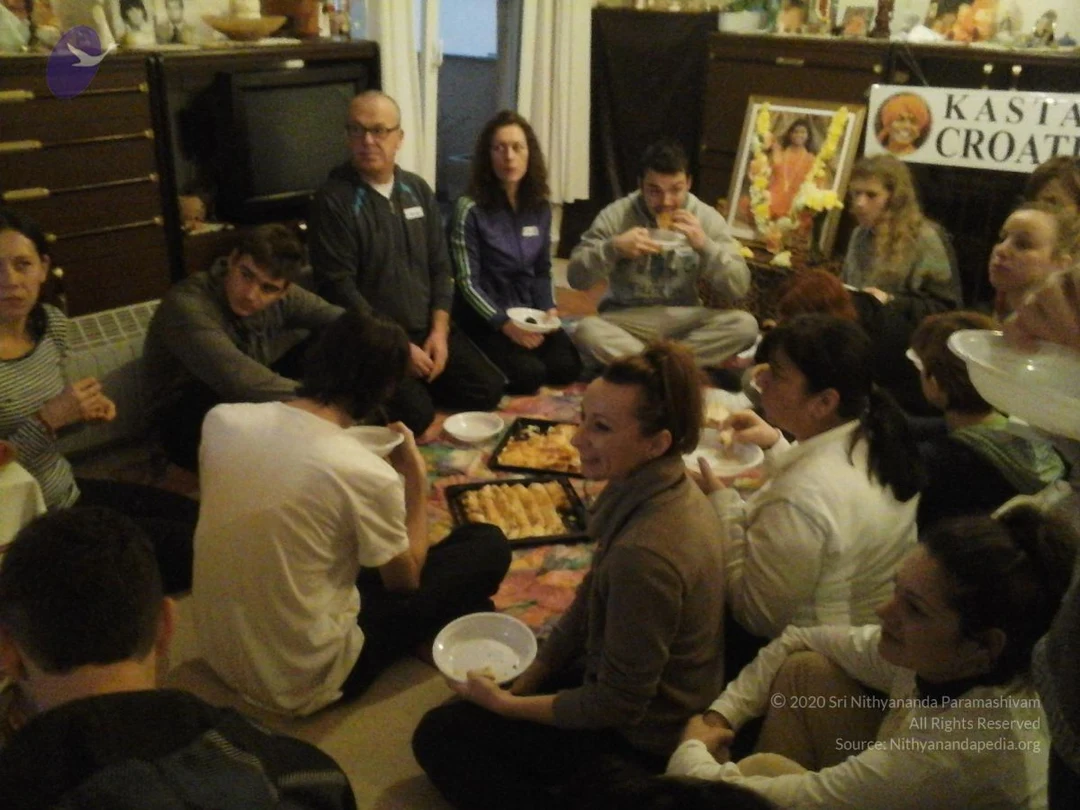
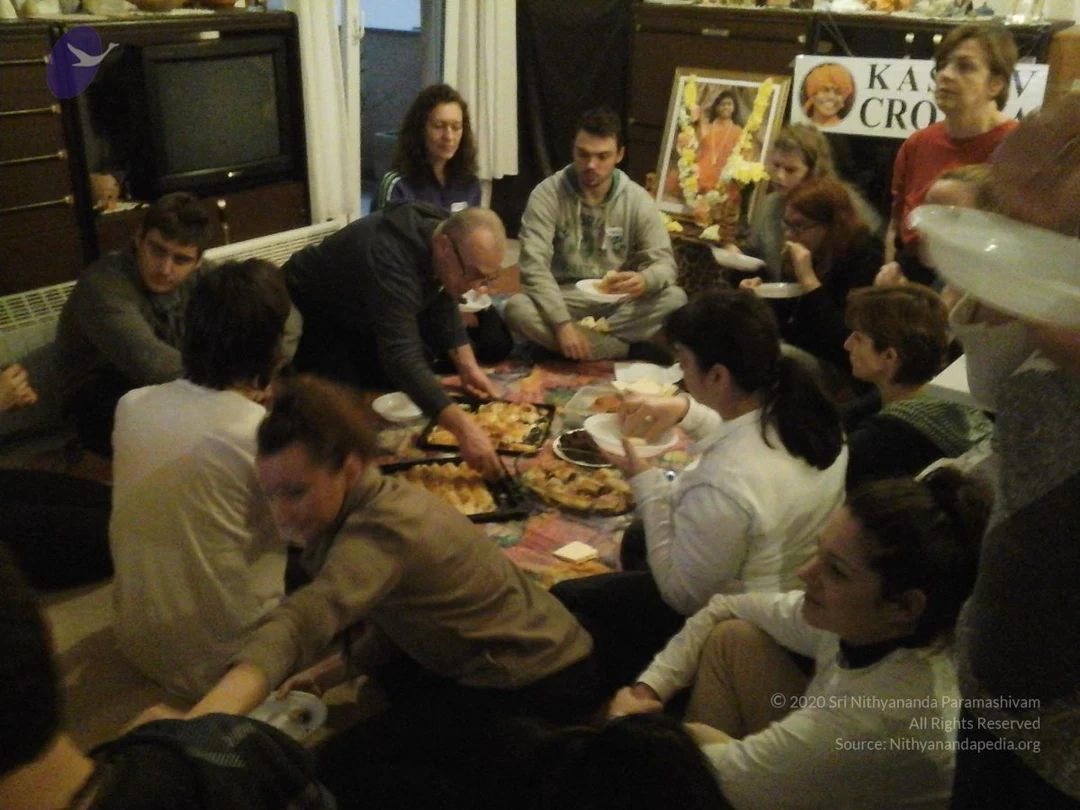
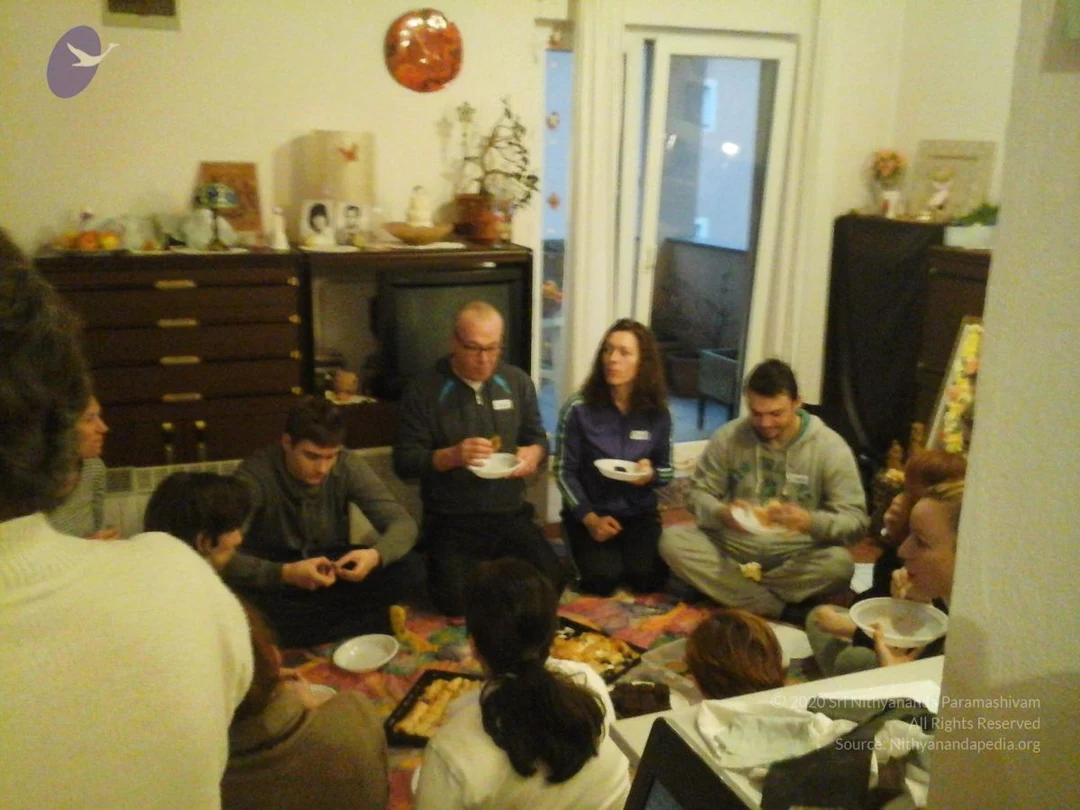
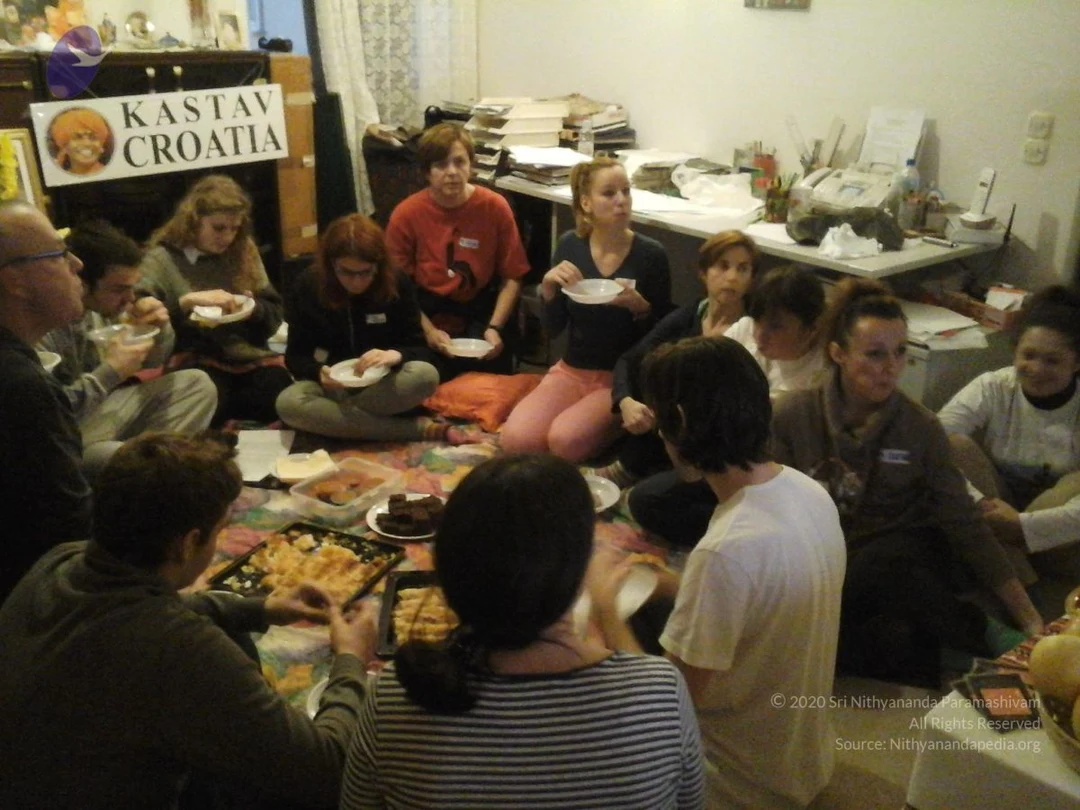
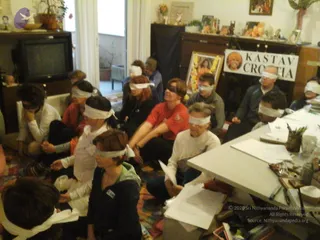
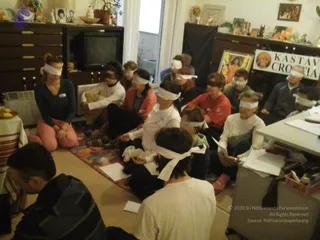
A group of about a dozen people sit on the floor of a living room, each wearing a white blindfold over their eyes. Several wear casual clothes, including a red t-shirt, a white sweater and dark jackets. A wooden table at right holds papers, pens and a cup. Behind them stands a framed portrait of a smiling saffron-robed sannyasi with long hair, garlanded with flowers. A white banner reads KASTAV CROATIA with a small circular portrait of the same saffron-robed figure. A television, potted plants and shelves with small statues and framed pictures line the room.A group of about fifteen adults sit on the floor of a home room, most wearing white or grey cloth blindfolds over their eyes. A woman in a dark top and pink trousers sits at left, and a woman in a red top sits centre. A white banner reads KASTAV CROATIA beside a framed portrait of a smiling figure with a garland on a cabinet. Dark wooden cabinets, a television, a small radiator and a white table with papers are visible, with offerings and framed pictures on top of the cabinets.A home shrine setup photographed indoors in the evening. A flat-screen LG television on the right shows a bright image of a figure in a white setting, framed by a garland of yellow and white flowers draped on a maroon cloth. On a wooden chest of drawers in the centre, framed photographs and small brass items stand around a lit oil lamp. A red flower arrangement sits in a vase nearby. In the foreground, a bowl of yellow-green apples sits on a patterned cloth beside a brass plate of flowers and a red ceramic tray. A partly visible person in white shirt and dark trousers stands at the far left edge. Two people are at most visible, no clear figure identifiable as a candidate in the pictured photos.A photograph of an indoor room with cream walls and wooden doors. In the foreground, a woman with short grey hair in a white sweater with grey panels stands beside a colourful floral floor cloth. Two women in dark jackets and a man in a dark jacket stand near a white table laden with a basket of apples, a red cloth, a framed picture and a laptop. Stacks of papers sit on a desk at left.A photograph taken indoors in a room with a colourful patterned tablecloth-covered table. A man in a grey long-sleeved top and dark trousers stands at the left, facing right, with a second man in a plaid shirt beside him. Several seated people are visible in the background near a sign on a table reading part of a country name. A window with a white curtain and a small floral arrangement sit at the back, and a wall-mounted air conditioning unit is at the lower right. No candidate for a person is visibly present; all people wear everyday Western clothing.

E-Kalpataru at London

12 photosSource gallery
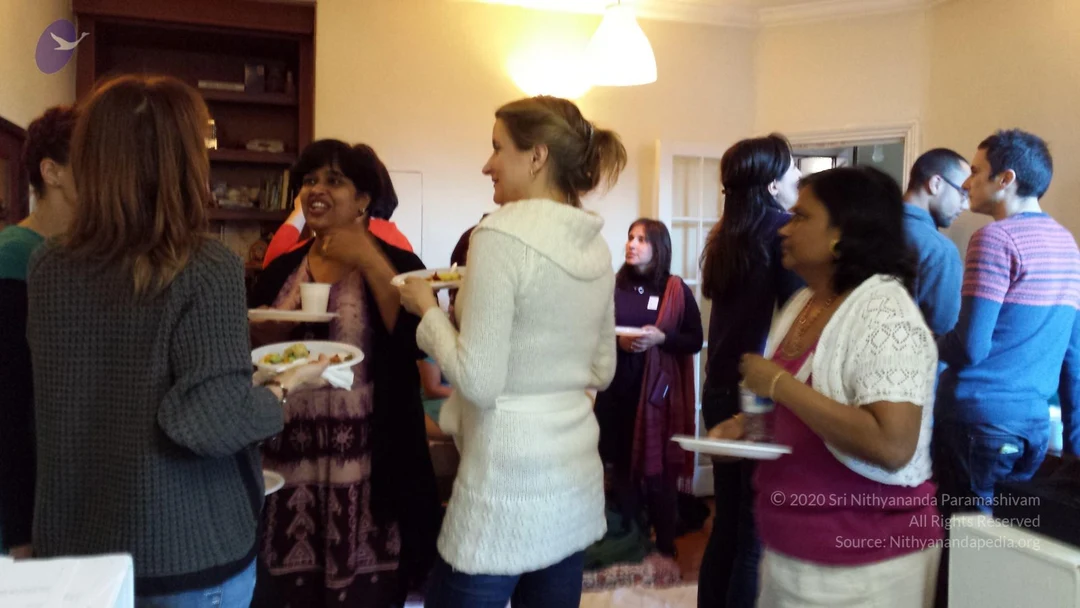
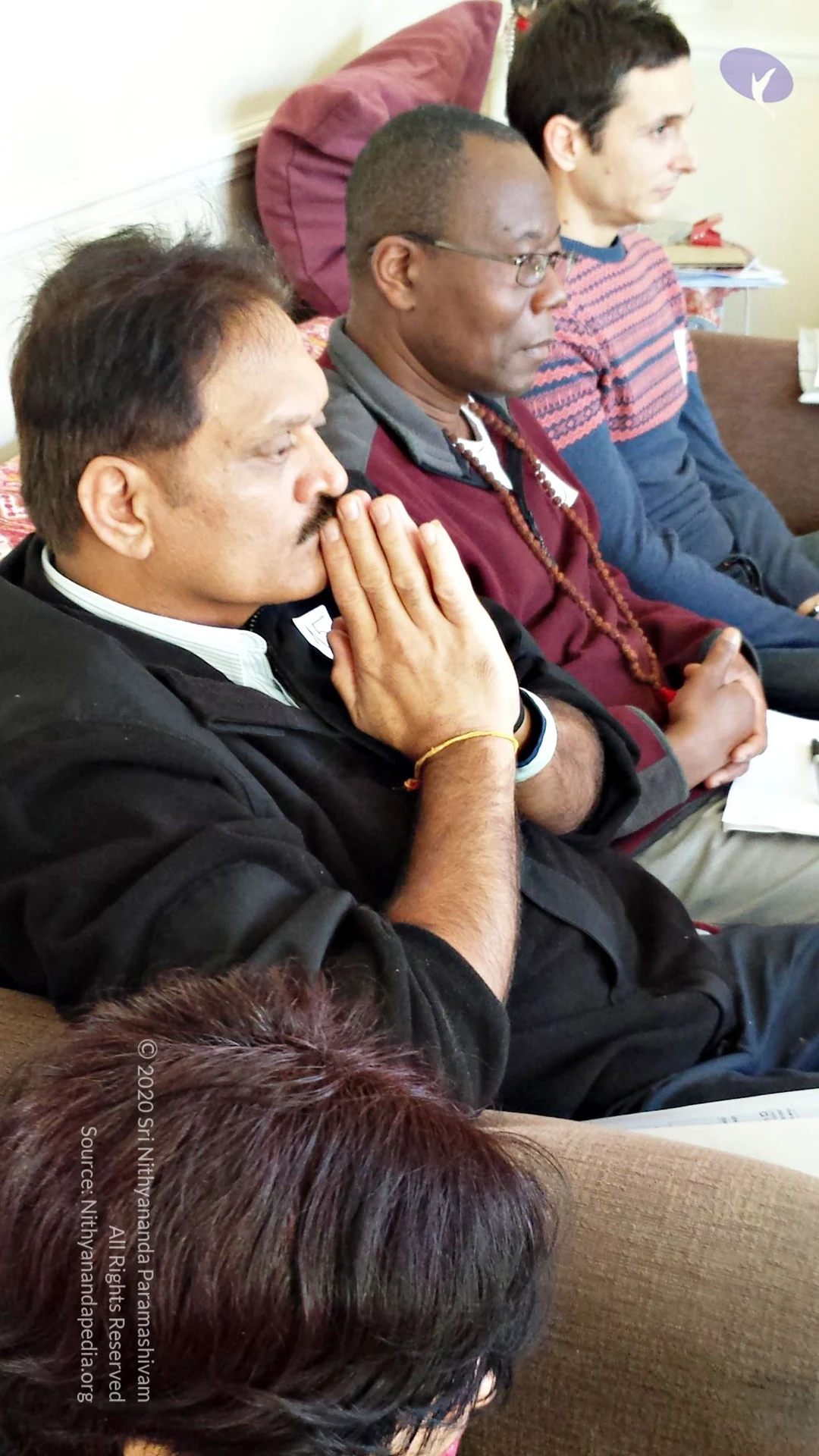
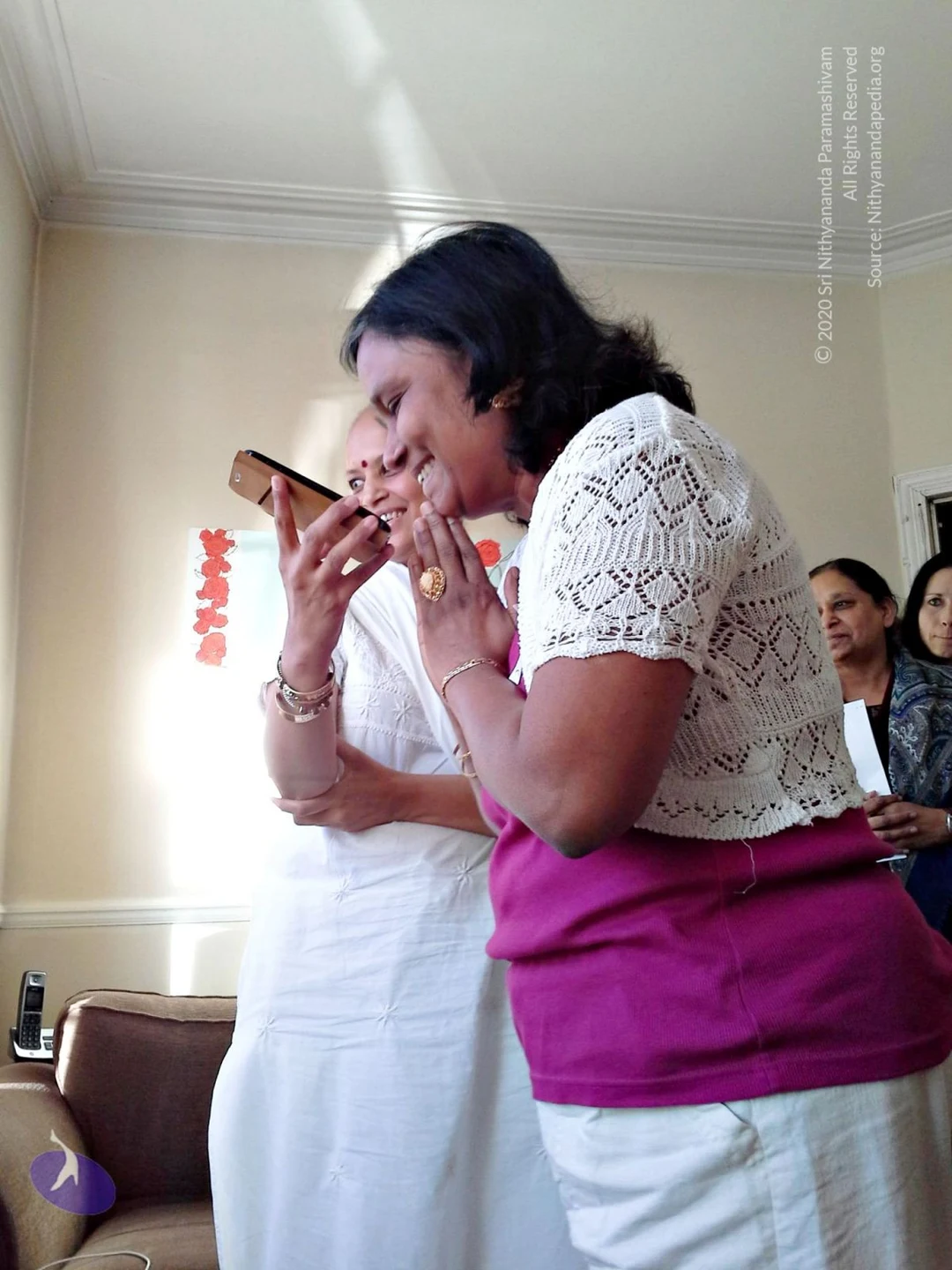
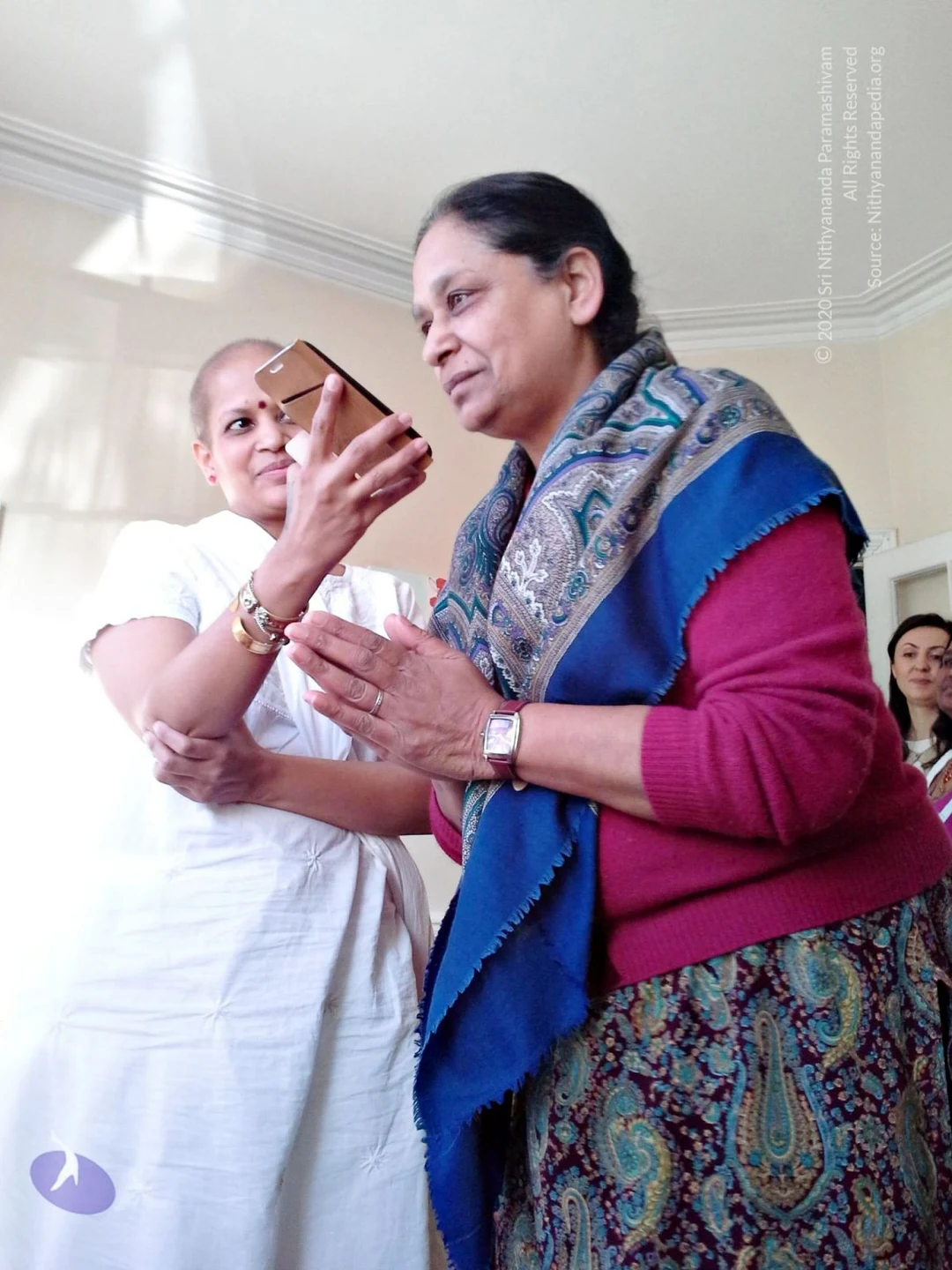
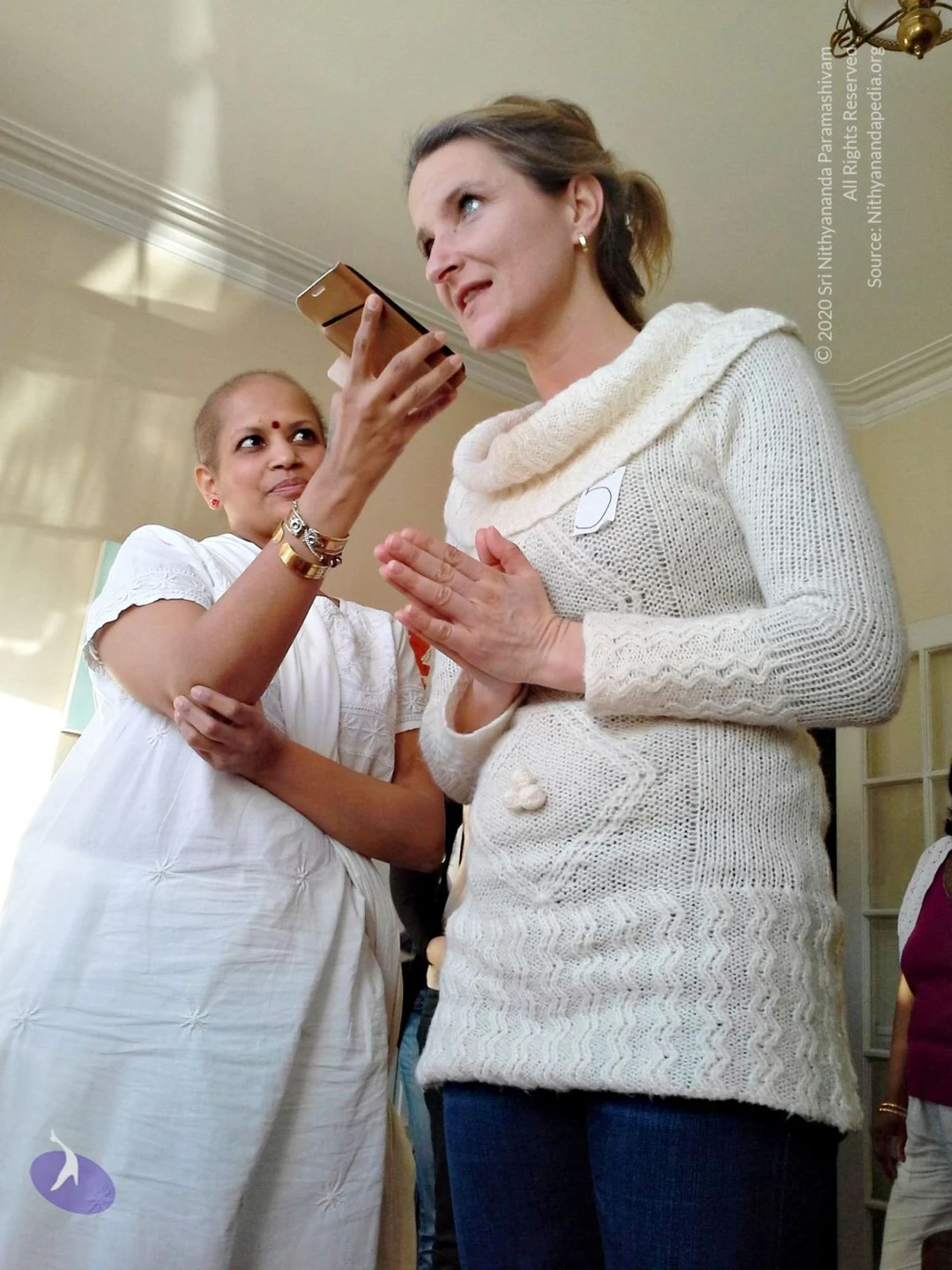
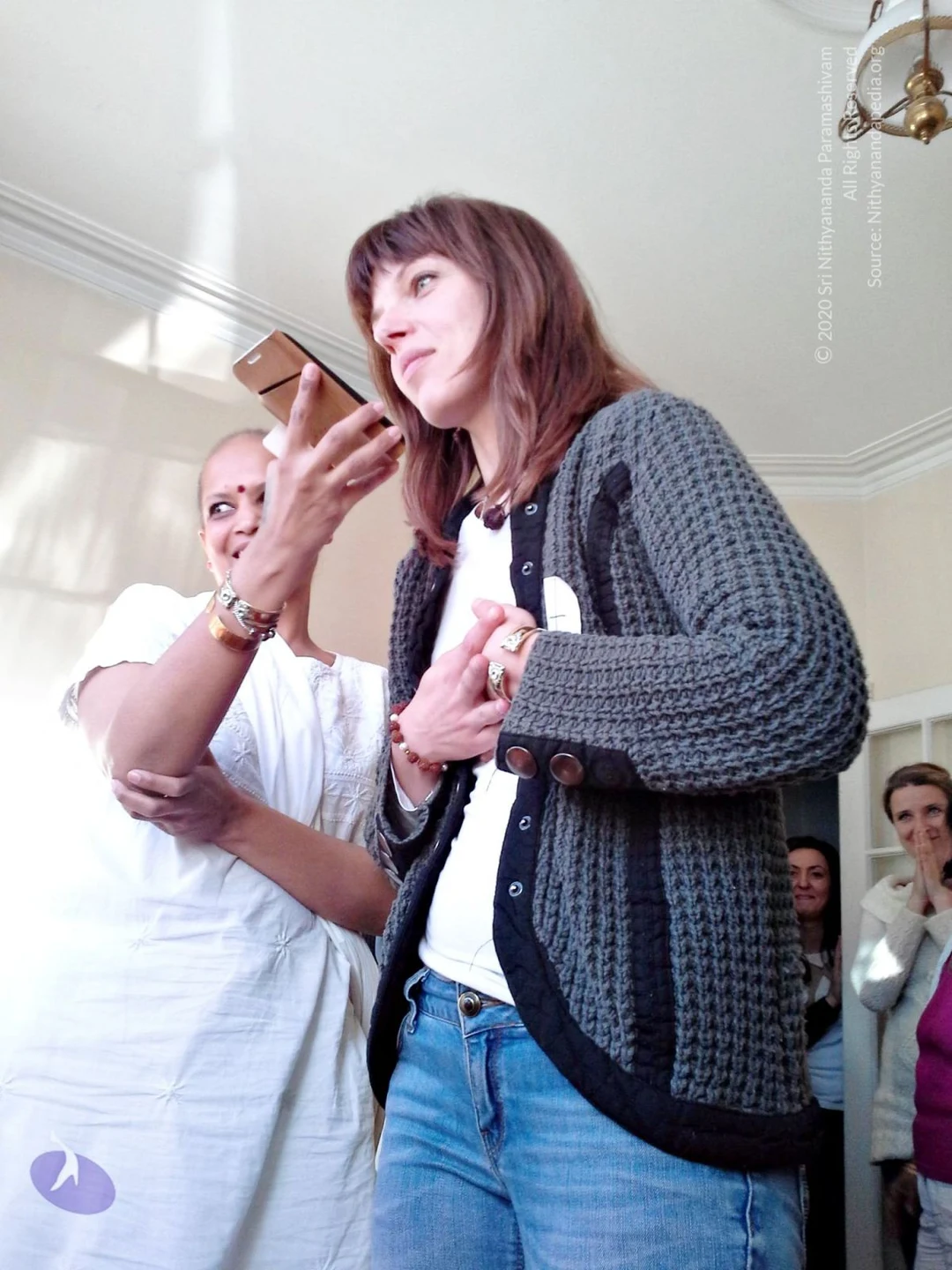
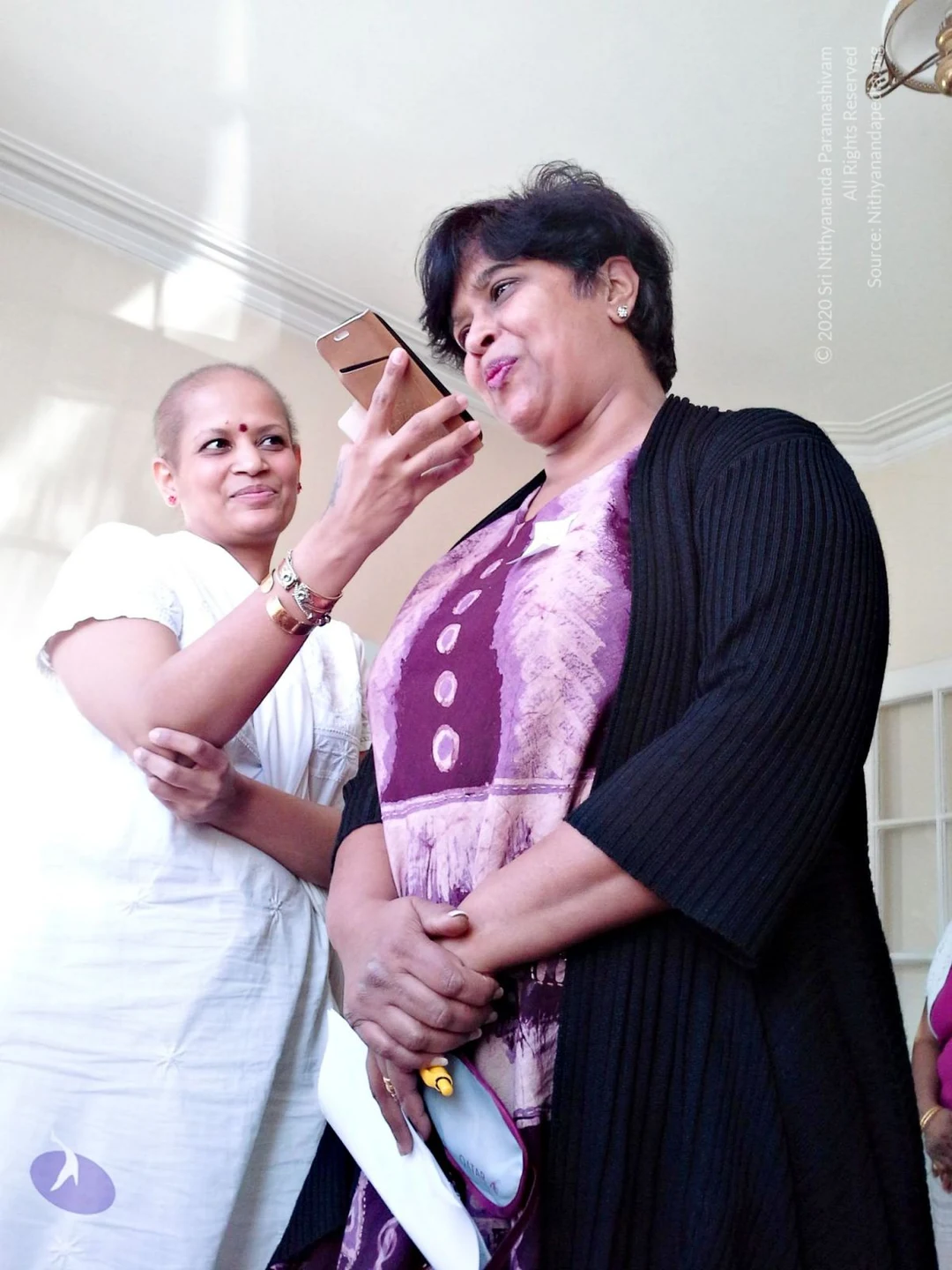
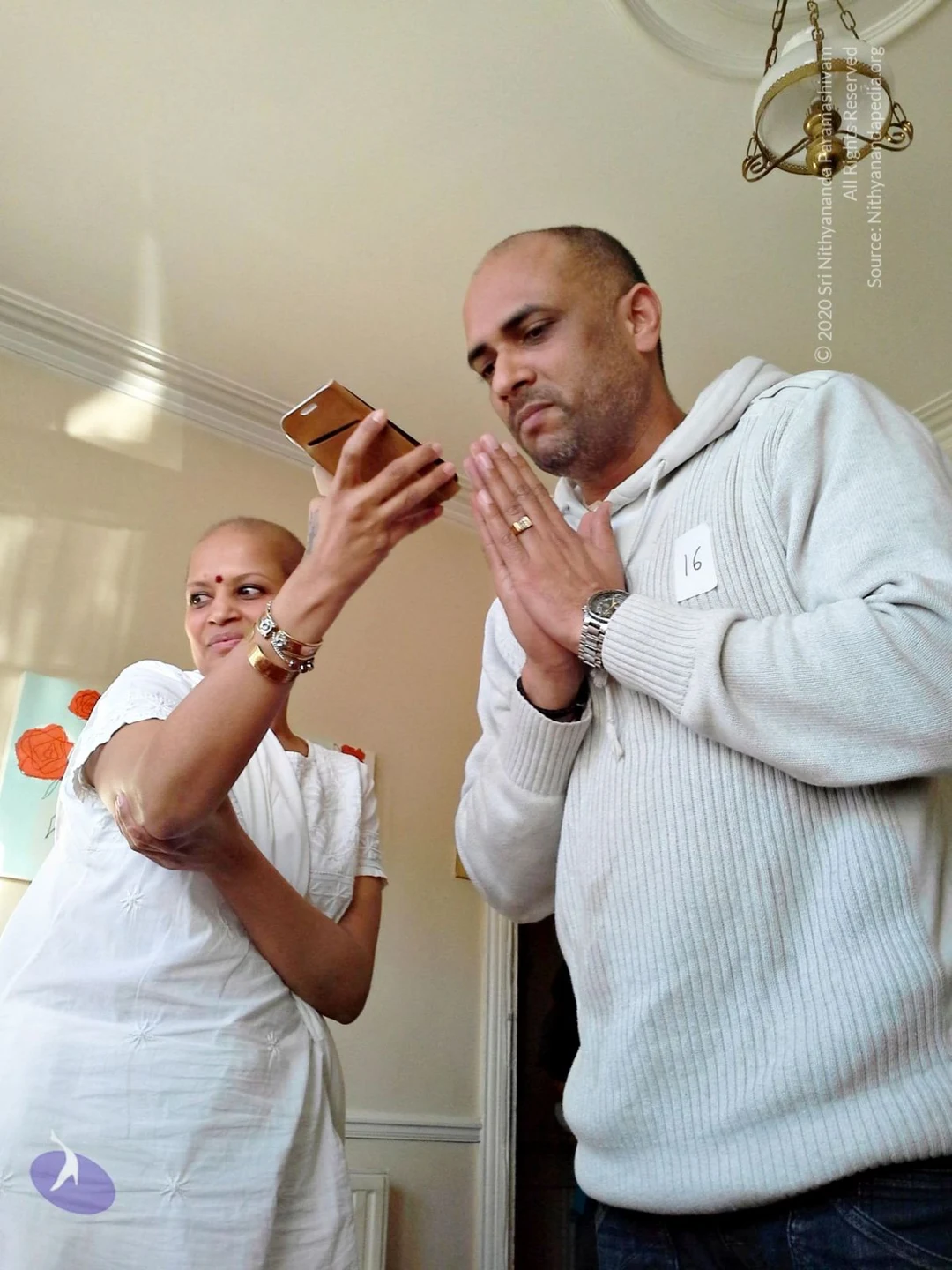
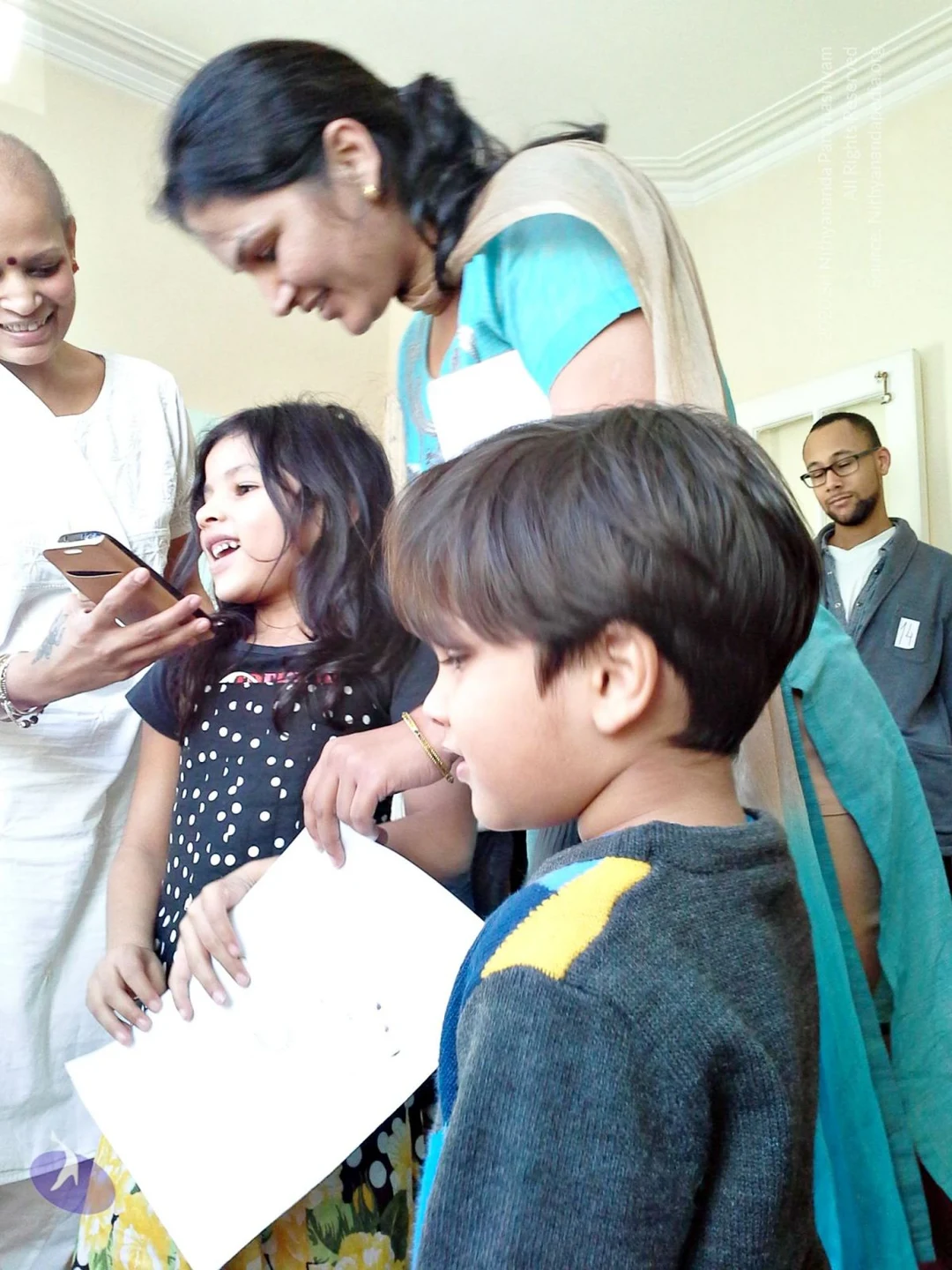
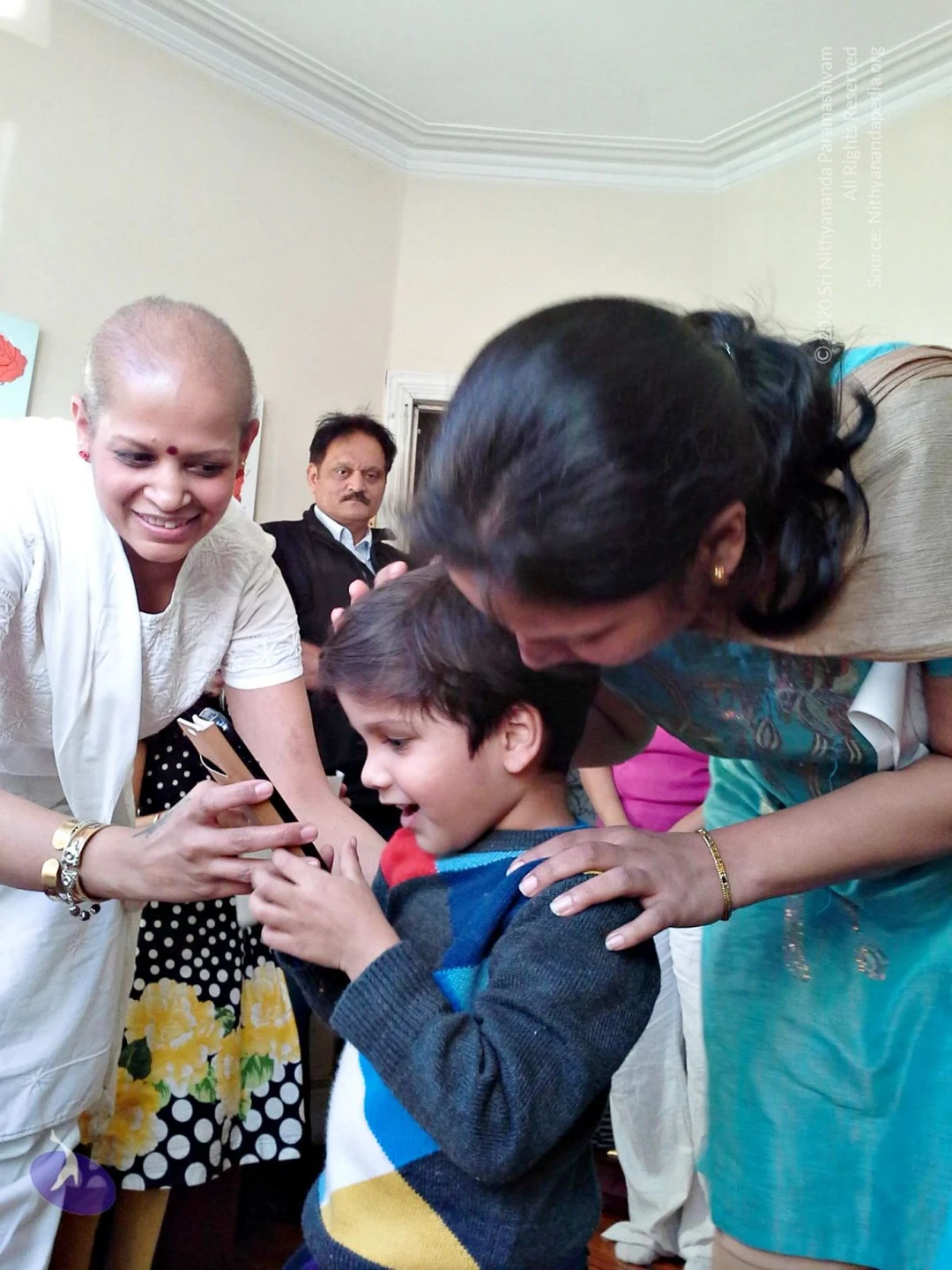
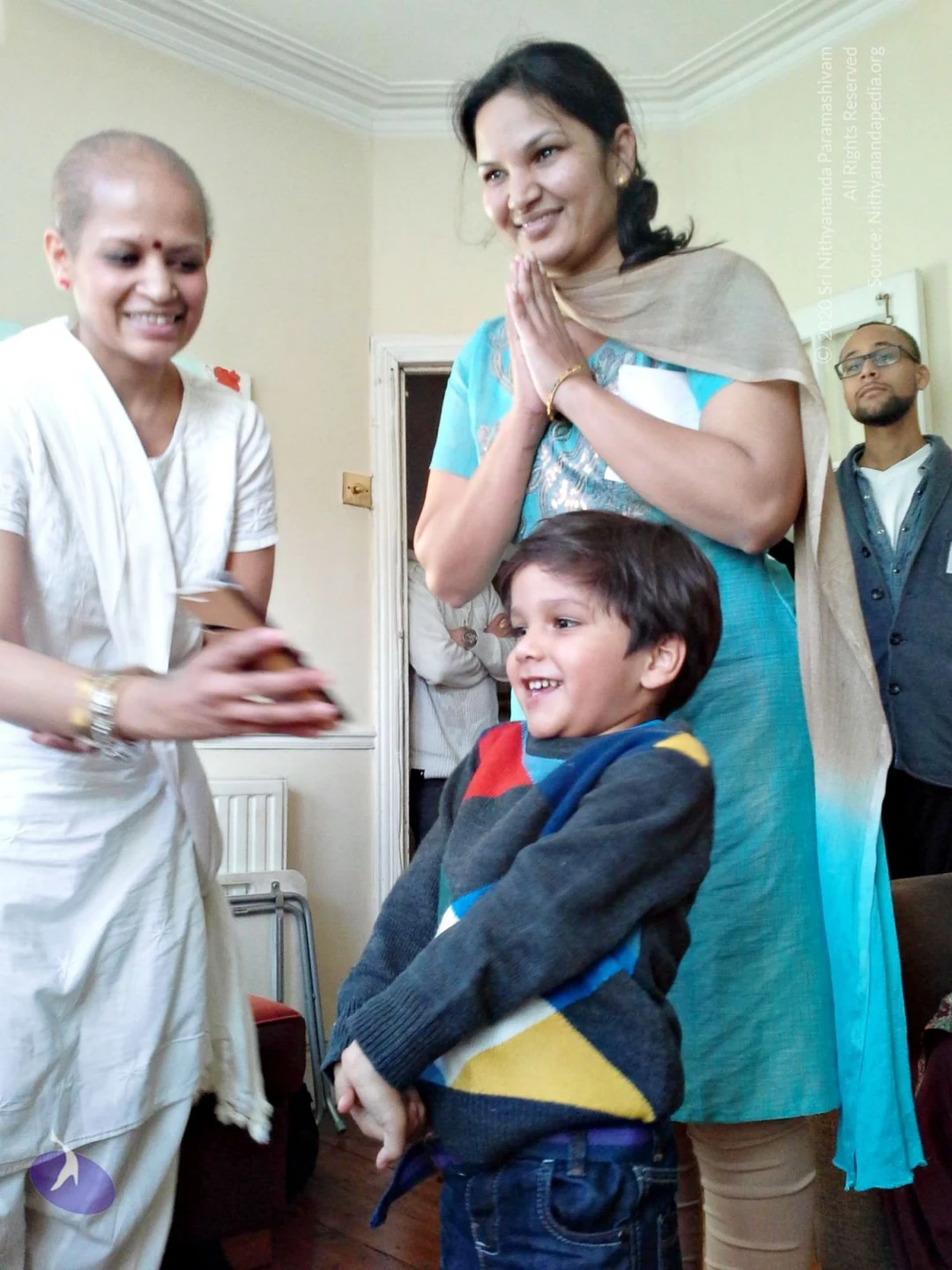
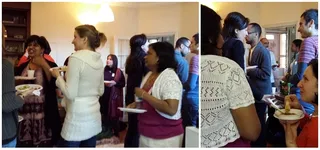
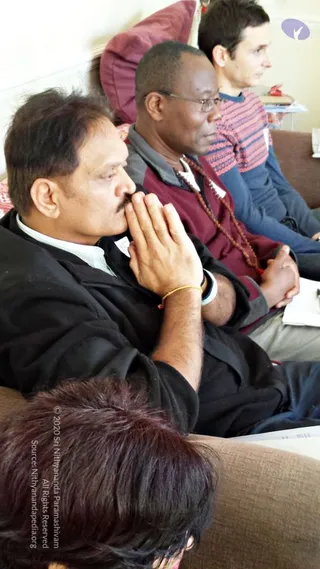
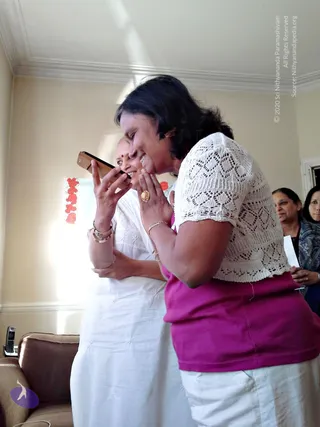
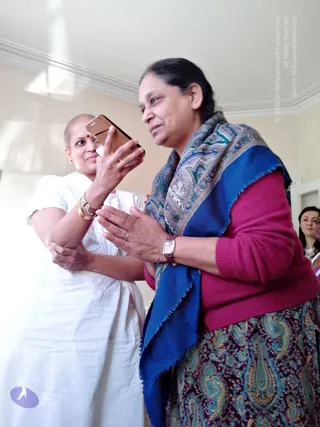
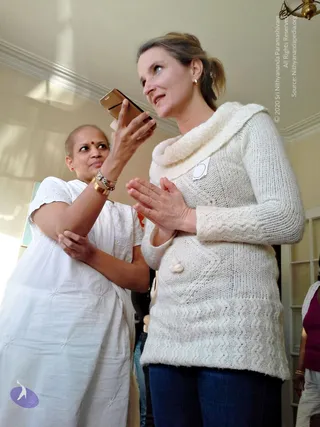
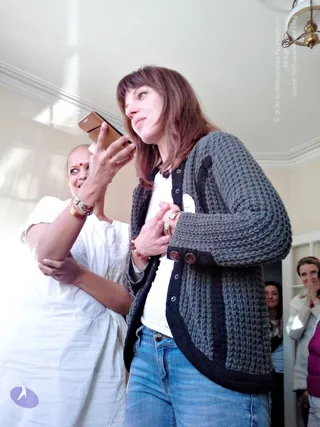
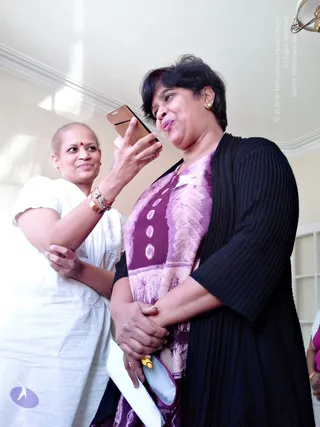
A photograph of seated satsang attendees on a brown sofa indoors. In the foreground a man in a black jacket over a light collared shirt holds his palms together in anjali near his face. Beside him a man in a maroon top with a grey collar wears a rudraksha mala and holds a notebook. A third man in a striped red and blue sweater sits at the back, and a person's dark hair is visible at the bottom edge. No one shown has distinctive a person cues such as long hair, saffron clothing or a crown, so no candidate is identified.Indoor photo in a cream-walled room with a brown sofa and a cordless phone on the left. A woman in a white knitted lace-pattern short-sleeved top over a magenta top, with a gold ring and bangles, smiles while holding a smartphone to her ear. Beside her a woman in a white dress with a red bindi smiles and holds her arm. Two more women stand at the right edge, one in a blue patterned shawl. Red flower decorations hang on the wall behind them. No a person candidate is visible.Indoor photo in a bright room with cream walls and white ceiling molding. A shaved-headed woman in a plain white kurta with a red bindi holds a gold-toned mobile phone up to her face, looking into it, while a woman in a magenta sweater and blue-and-paisley shawl stands beside her with her palms pressed together. Gold and silver bracelets and a wristwatch are visible. A partially visible woman stands at the right edge in the background. Sheer curtains light the room from the left.Indoor photo in a room with cream walls, white crown molding and a brass chandelier at upper right. A woman with a shaved head, a red bindi and gold bangles wears a white embroidered cotton dress and holds a gold smartphone up while looking toward the right. Beside her a woman with pulled-back hair and a cream cowl-neck knitted sweater and jeans stands with palms pressed together in anjali, speaking. Partly visible people at the right edge, one in a maroon top. No deity, a person depiction or ritual objects are visible.Indoor photo in a bright room with white walls, a white crown molding and a brass chandelier. A woman in a grey knitted cardigan with black trim, white top and jeans stands center, holding a gold phone and smiling. Beside her, a woman in a white embroidered kurta with a red bindi and stacked bangles holds her arm and looks toward the phone. Two more women watch from the doorway on the right, one with hands raised near her face. No a person candidate is visible in the scene.Indoor photograph of two women in a bright room with cream walls and a white ceiling cornice. A woman in a black ribbed knit cardigan over a purple and mauve printed dress holds a gold smartphone up at eye level while looking at its screen, a white paper and yellow pen tucked under her arm. Beside her, a woman with a shaved head and a red bindi wears a white kurta and gold bangles, smiling as she watches the phone. A partial figure in pink stands at the right edge. Light comes through a window at left, and a brass fixture hangs at upper right.

E-Kalpataru at SriLanka

6 photosSource gallery
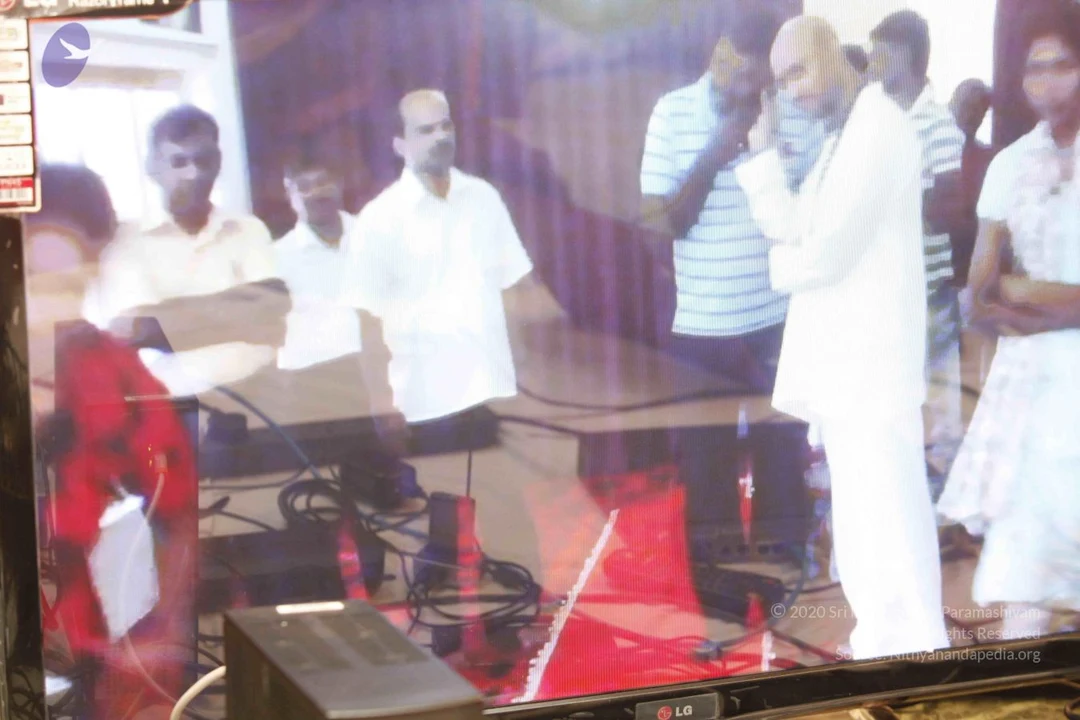
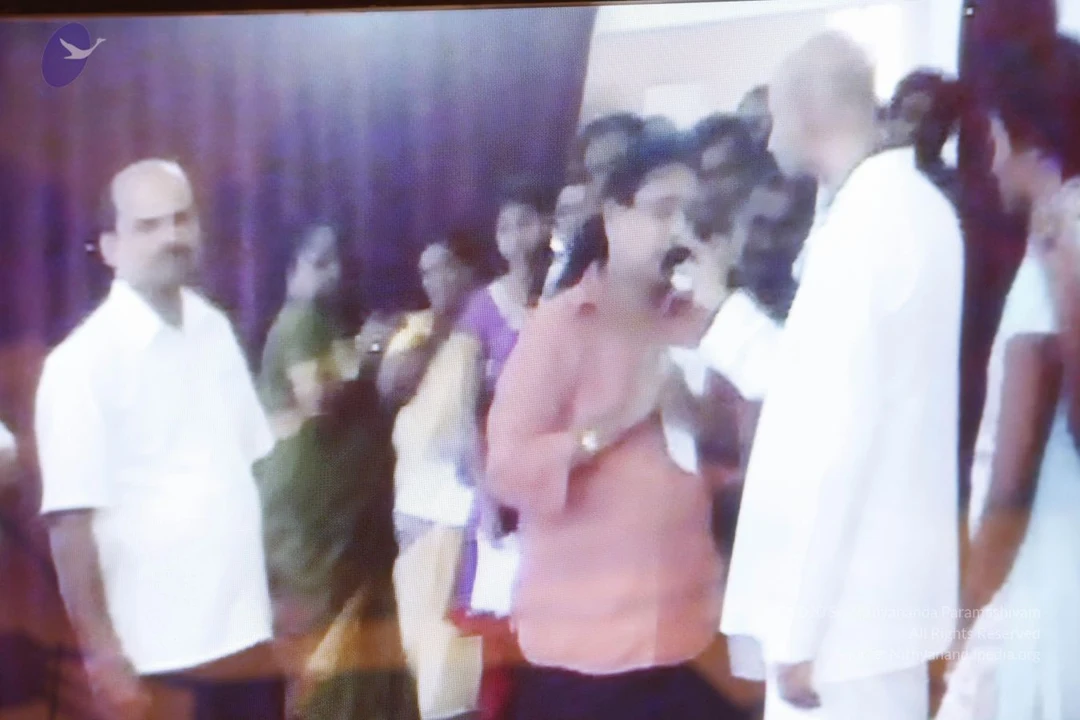
A photograph of a flat-screen television displaying a blurred, washed-out video of a ritual scene. Several people in white clothing stand close together, with one person in white and maroon reaching forward toward a figure on the left. A small inset picture in the lower right corner shows a smiling man with long dark hair and a saffron-orange robe, wearing a rudraksha mala and ceremonial necklaces, seated in front of a red backdrop.Photograph of a television screen showing a live feed of a satsang hall with red curtains and a red carpet runner. On the screen, an older man with a bald head wears a white kurta and white dhoti, with a striped shirt-wearing man beside him; a younger woman in a pink kurta with white print and a light blue dupatta stands with hands folded in front of her. Blurred figures in white shirts and a red-clad person move at the edges. An LG monitor base and cables are visible in the foreground. The on-screen overlay reads 2020 Sri Nithyananda Paramashivam, , . a person is not identifiable by appearance here, so the depicted man is described only by his clothing and role in the sceneA photograph of a television or monitor screen showing a live stream. On the screen, a shaved-headed man in an all-white outfit stands at right beside a young woman in a pink kurta with light blue trousers who holds her hands together near her face. A man in a striped shirt stands behind her, and another man in red stands at the far right edge. Behind them, a man in a white shirt sits near black cables on a red-carpeted floor. In the lower right corner of the screen, a small inset shows a woman in a cream and red sari seated against a plain backdrop.A photograph of a television screen showing a group of people standing on a red carpet in a room with dark curtains. In the foreground, a young man in a blue-and-white striped polo shirt walks forward. To the right, a man in a long white robe and white cap stands beside a woman in a pale blue dress. A man in a blue-and-white striped shirt and white trousers stands near them. In the bottom right corner of the screen, a small inset shows a woman in a saffron-and-gold sari.A blurred, low-resolution still of a bald, white-robed man in a white garment with a beaded necklace standing at right, turned toward a younger man in a checked light-blue shirt at left who stands beside a dark-haired person holding up a hand near his face. A woman in a white patterned top stands at far right against a bright white wall, with a purple curtain at left. The bald man wears white ceremonial clothes and a beaded necklace, and his appearance is not clear enough to confirm identity, so this is an unidentified devotee in white.A screen capture of a video showing a crowded indoor satsang hall with a dark purple curtain behind. In the foreground a bald man in a white shirt stands at left, and a woman in a salmon-pink top with gold bangles stands at centre, facing a bald figure in an all-white kurta at right. Several other devotees in saffron, green, yellow and purple clothing stand in the background.

Visit-to-Annapurneshwari-temple-in-Kashi-Varanasi
8 photosSource gallery
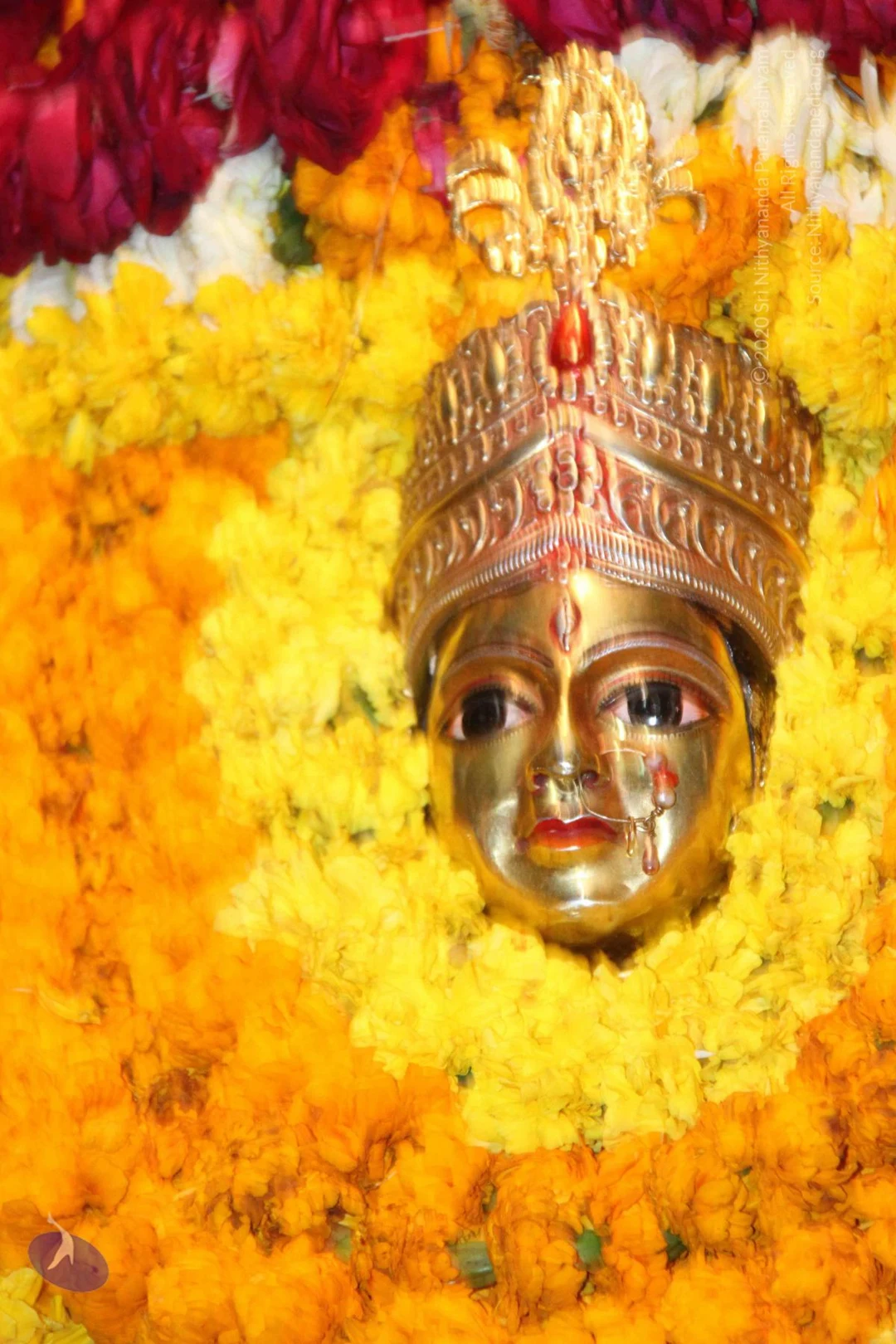
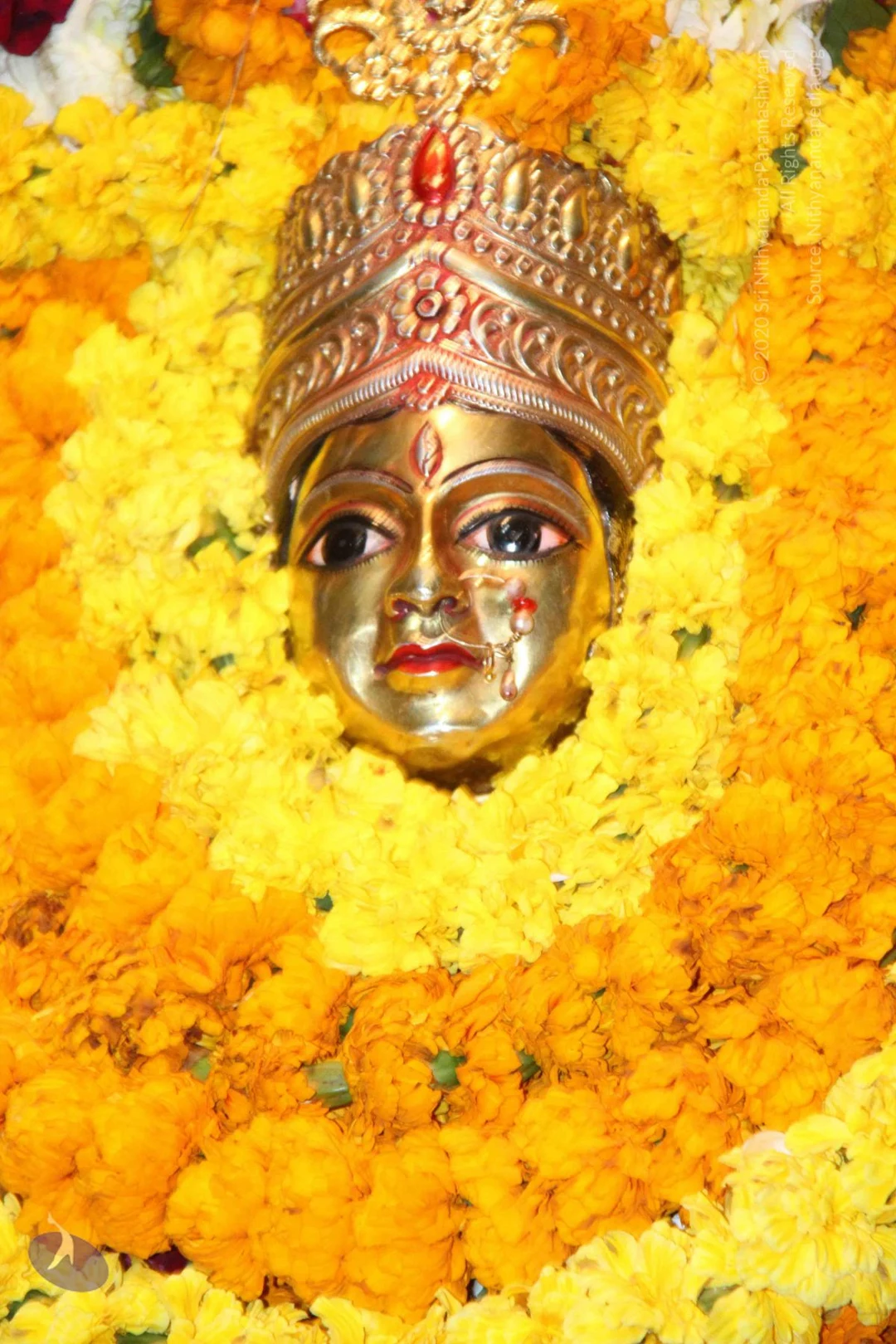
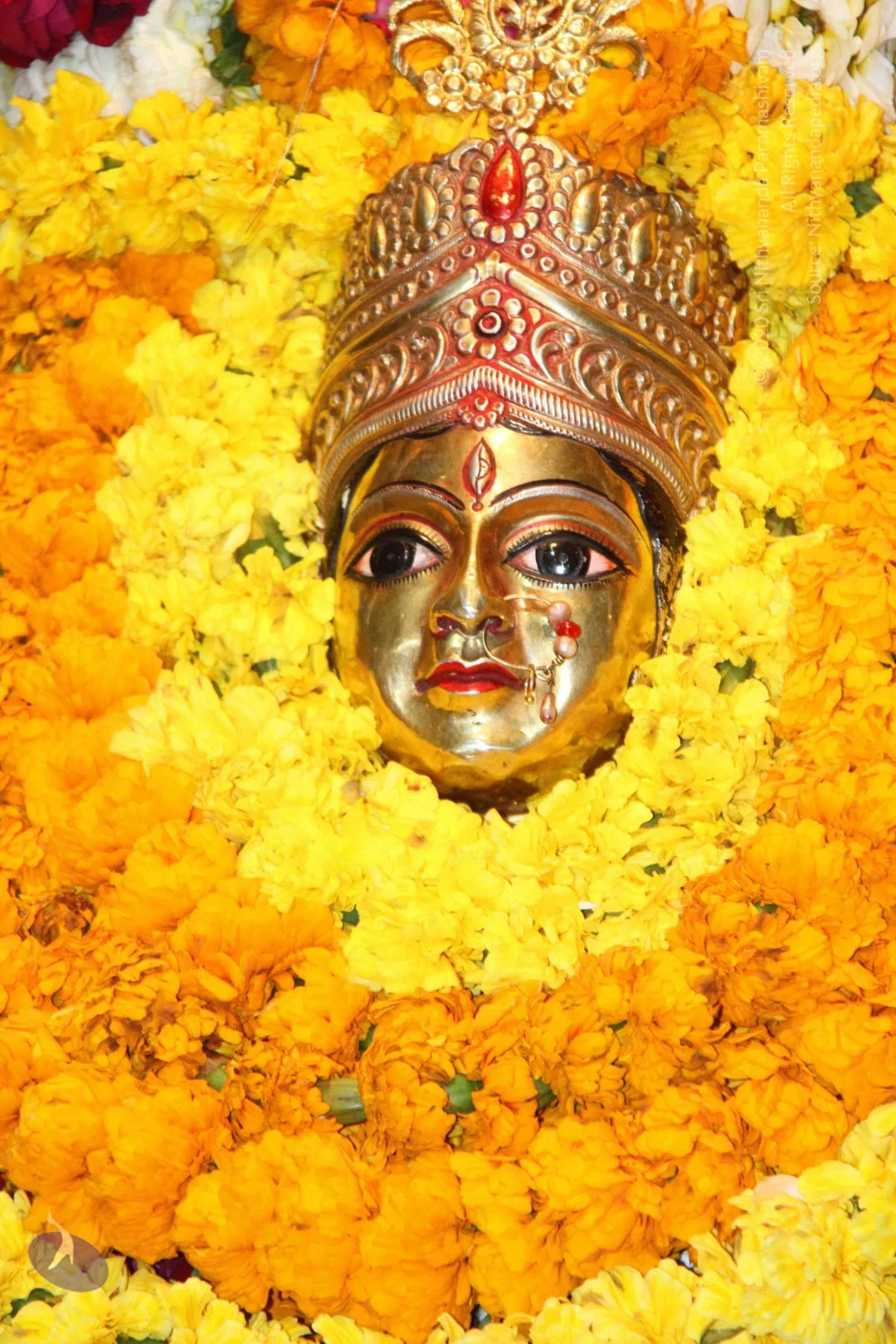
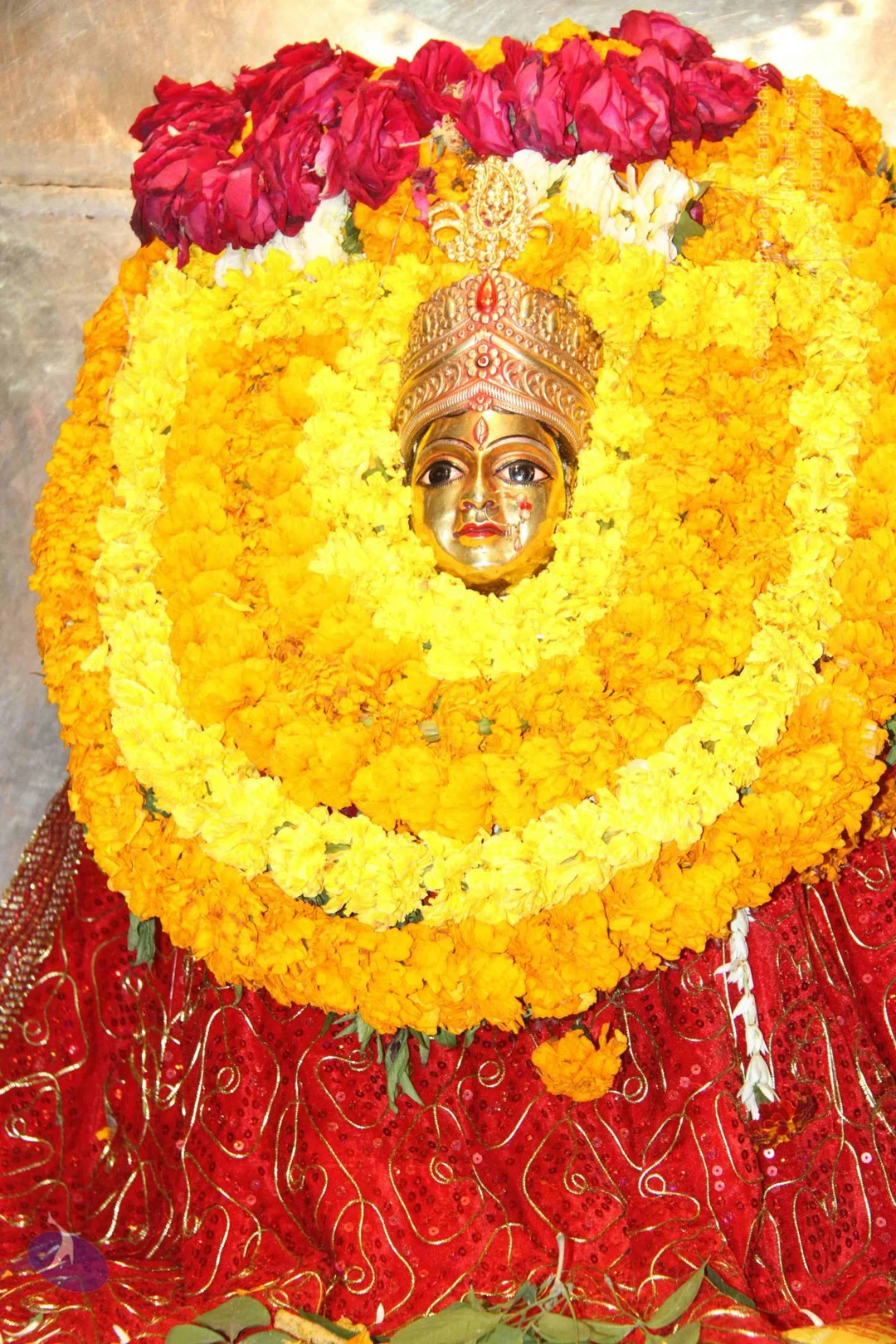
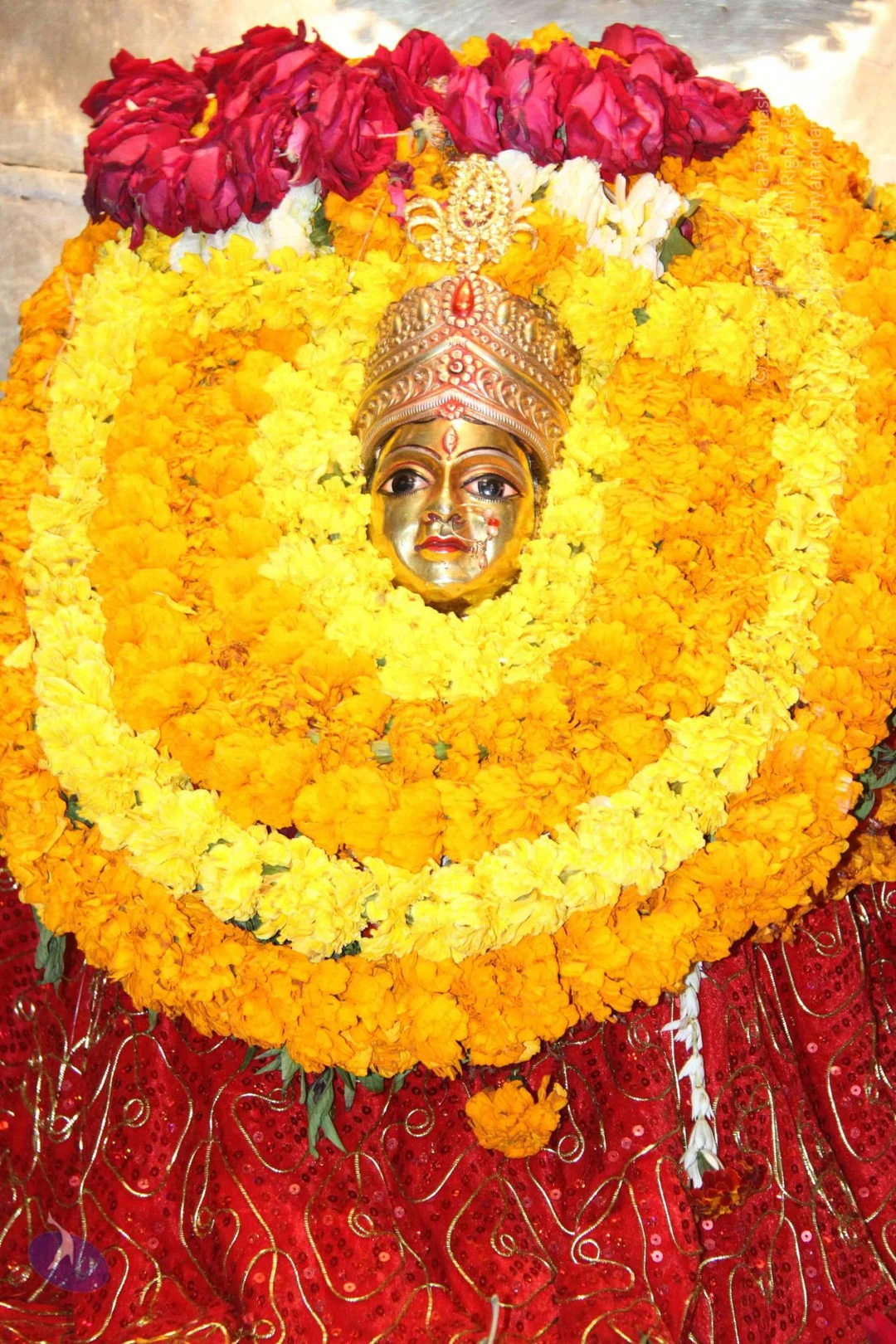
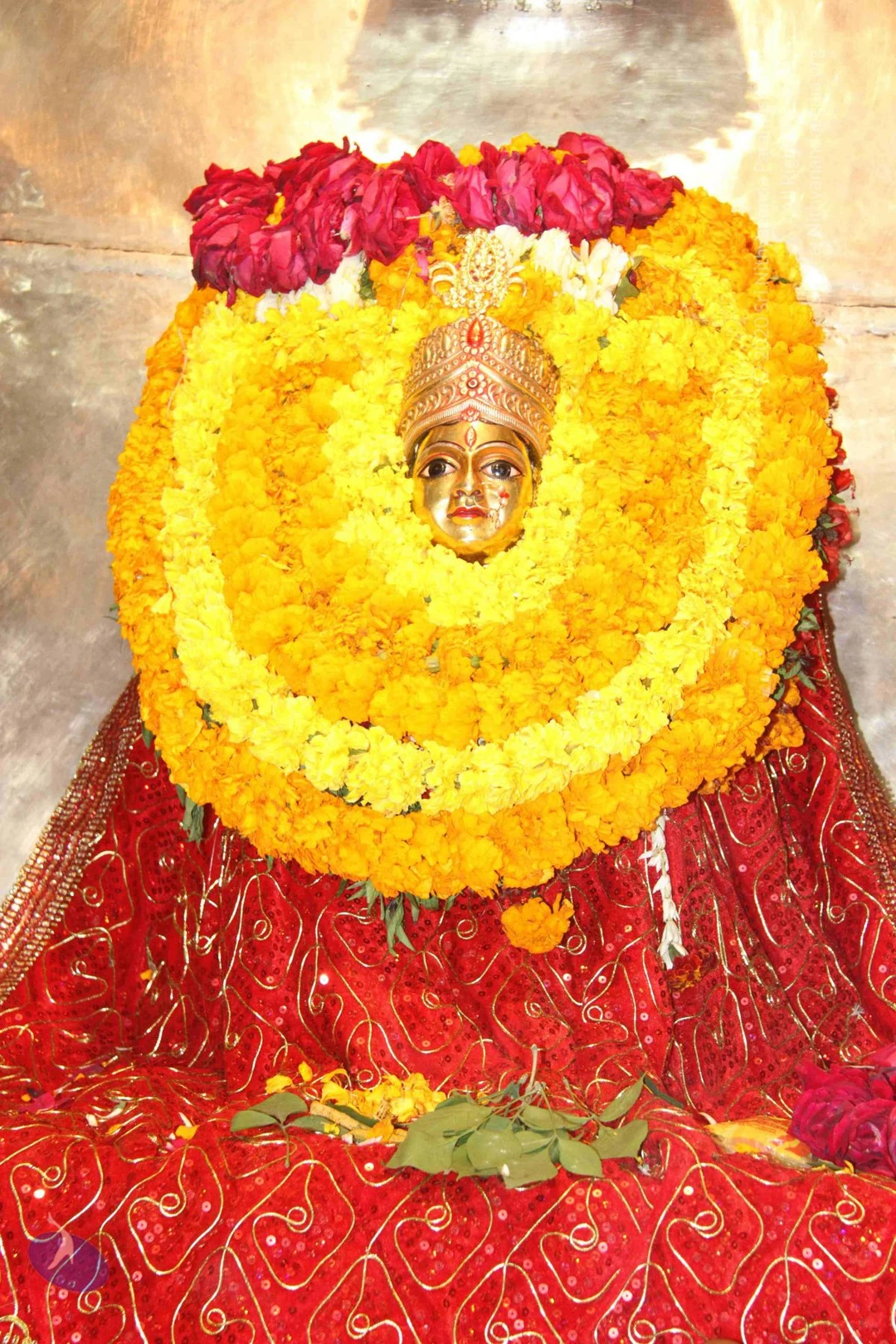
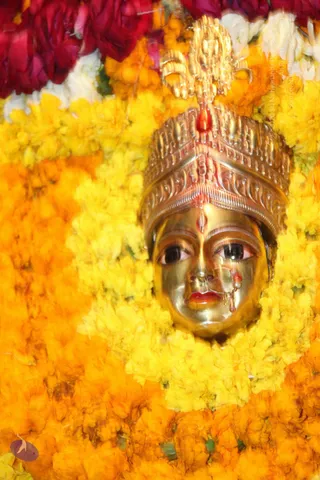
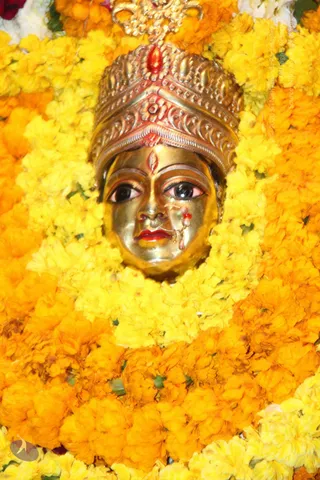
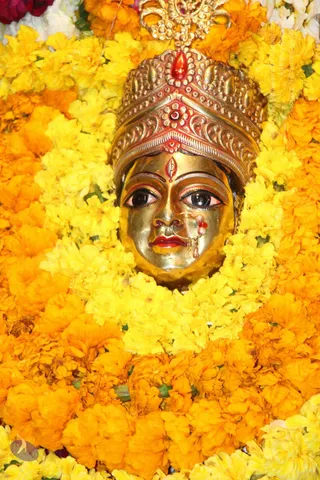
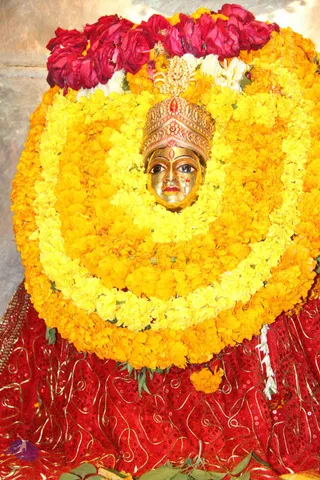
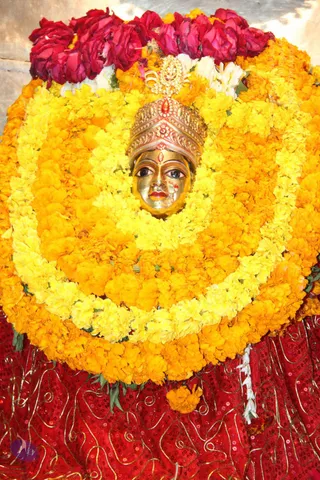
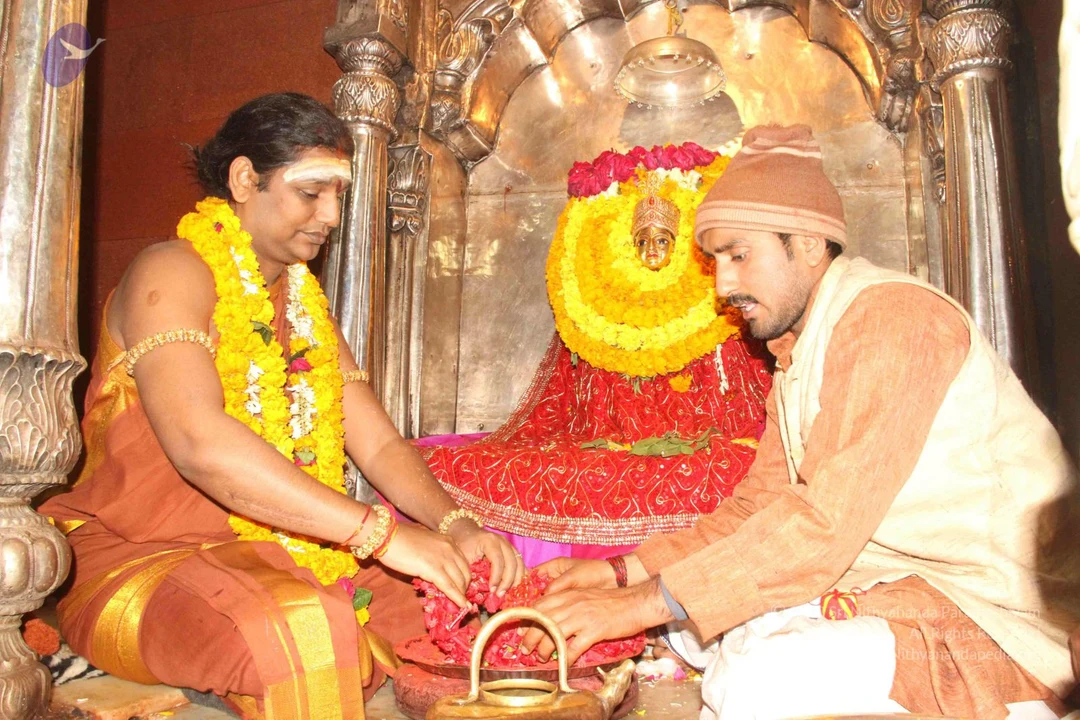
Close-up photograph of a gilded deity face mask. The face wears an ornate gold crown with repoussé patterns and a red tilak, with large dark eyes, red lips and a gold nose ring with dangling drops. No people are visible; the image shows only the decorated idol.Close-up photograph of a gold-coloured metal deity face mask framed by layers of bright yellow and orange marigold garlands. The face has painted dark eyes, red lips, a red bindi and a red-and-gold nose ring with a dangling bead. A richly embossed gold crown with a red central gem sits atop the head, and a gold ornament hangs above. No physical people are visible; the image shows a murti of a goddess adorned with flower garlands.Close-up photograph of a golden deity murti face framed by dense marigold garlands in yellow and orange. The murti wears an ornate gold crown with a red central gem and red floral patterning, a red tilak on the forehead, red lips, kohl-lined eyes and a nose ring with red and pink beads. Thick marigold garlands surround the face and cover the lower frame, with a golden ornament visible at the top. The setting suggests a shrine decorated for worship. No physical people are visible and no a person depiction is shown.A golden deity murti face wearing an ornate gold crown is framed by thick garlands of yellow and orange marigolds and a ring of red roses at the top. A red silk cloth embroidered with gold thread drapes below, with a red tilak on the forehead and a small red mark on the cheek. No people are visible; the image shows only the decorated murti as a temple or altar offering.A golden deity murti's face framed by concentric garlands of yellow and orange marigolds and red rose petals, with a gilded crown and red and gold sequined cloth below. The face has painted eyes, a red bindi and a nose ring; a stylised flower ornament sits at the crown. No people are visible; the scene is a decorated temple image adorned for worship.A photograph inside a temple shrine. A man with a shaved-looking dark hair knot, wearing an orange-brown dhoti and shawl, a gold armlet, and yellow and white marigold garlands, sits at left with his palms holding flower petals offered toward a deity murti. The murti is a metal face crowned with a gold crown, draped in a red and pink silk cloth and encircled by a large yellow marigold garland with red flowers. A second man at right, wearing a cream kurta and orange-brown shawl, sits with hands folded in prayer with eyes closed. A brass plate of red flower petals sits in front. Silver columns and an arched metal backdrop frame the shrine.

Satsang

4 photosSource gallery
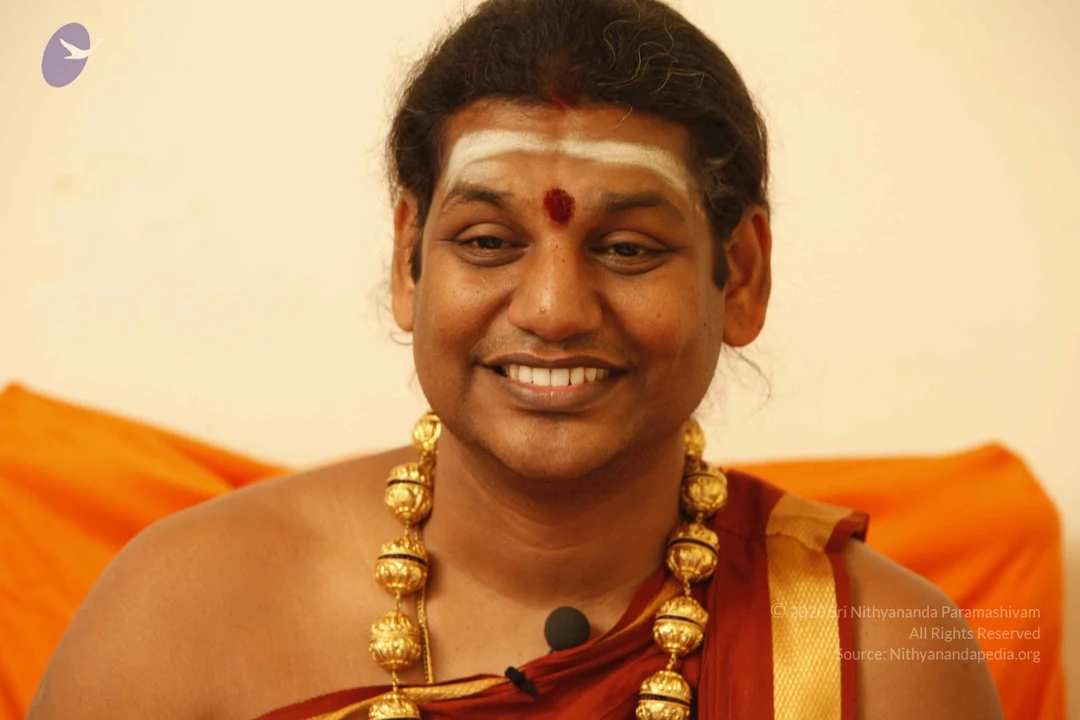
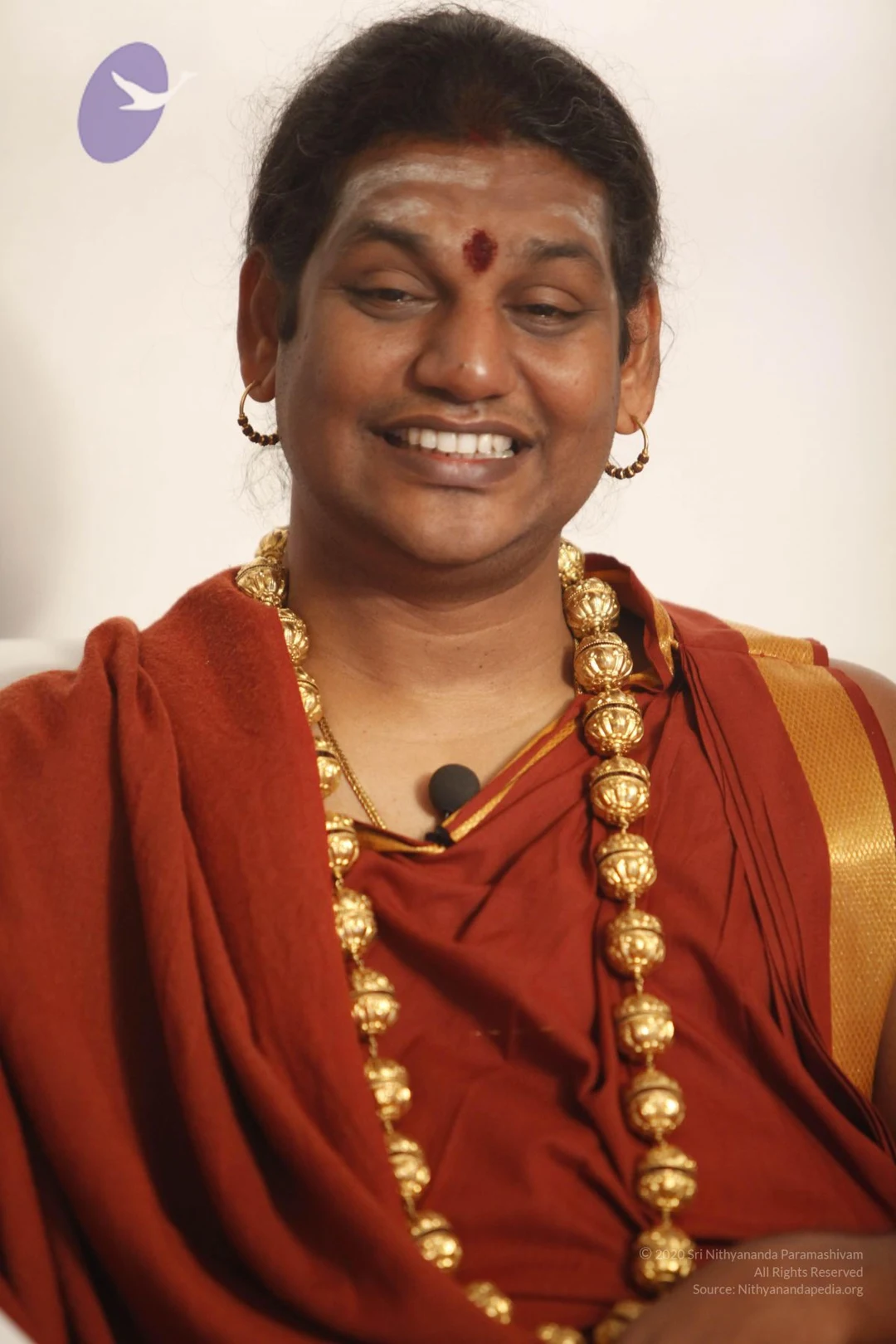
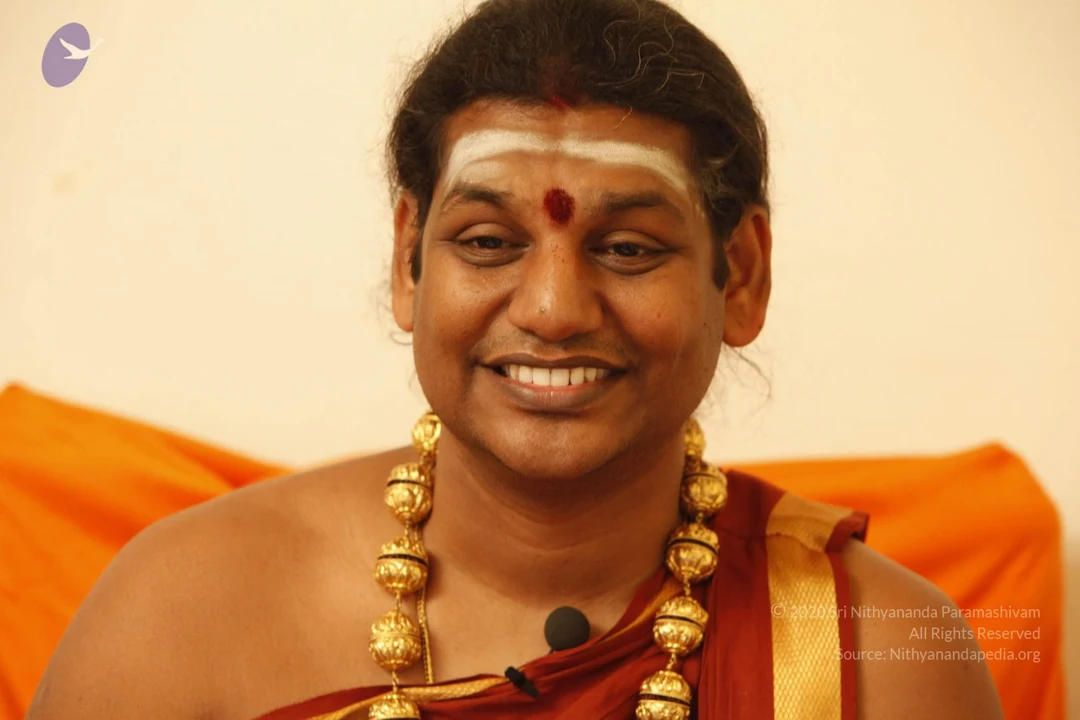
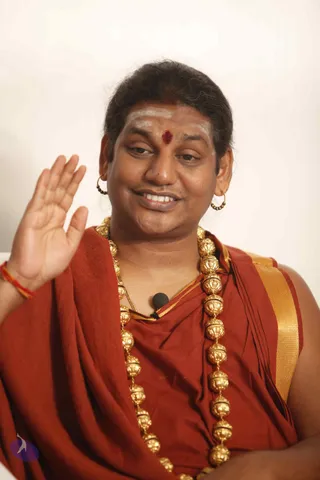
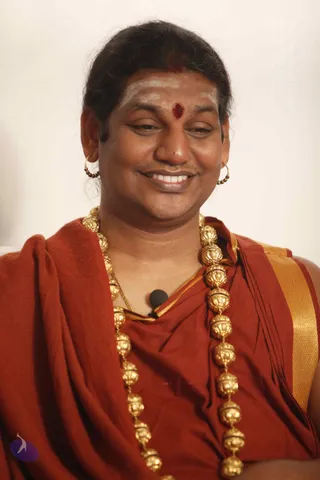
Close photograph of a seated man in an ochre-red shawl with a gold-and-brown bead necklace of large gold-toned beads, plain red-orange robe edged with gold border, small hoop earrings, white vertical tilak with red dot on forehead, and a lapel microphone clipped to his robe. He raises his right hand in a greeting or blessing gesture while smiling, his left hand resting in his lap, against a plain white background.Close-up photograph of a smiling man seated in a white chair against a plain white backdrop, raising his right hand in a greeting or wave. He wears a rust-red and saffron robe with a gold-bordered shawl, a multi-strand necklace of large gold beads with a small lapel microphone clipped to it, and gold hoop earrings. A red kumkum dot and white markings are on his forehead, and a red-and-gold thread is on his wrist. a person: the robe, gold bead necklace and forehead markings fit the presentation, but the image is not certain enough to confirm identity.A smiling man in a maroon-red sleeveless wrap with a gold-bordered edge raises his right hand in a gesture of greeting or speech. He wears a heavy necklace of large gold beads, small gold hoop earrings, a red-and-saffron thread on his wrist, white forehead markings and a red bindi. A small black lapel microphone is clipped to his chest against a plain white background. Appearance-based candidate: a person, seated and speaking to an audience, with cues of ornate gold beadwork, saffron-red ceremonial clothing and a styled hairline.Close-up photo of a smiling man with short dark hair, white and red tilak markings on the forehead, small gold hoop earrings, and a thick ornate gold bead necklace over a rust-orange shawl with a gold-bordered edge. A small black lapel microphone is clipped to the shawl at the chest. Plain light background.

01-Visit-to-Annapurneshwari-temple-in-Kashi-Varanasi
1 photoSource gallery
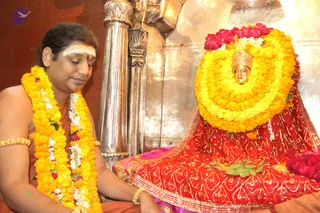
February 01 2014

3 photosView all
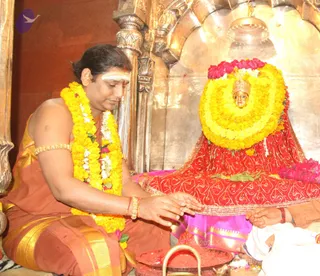
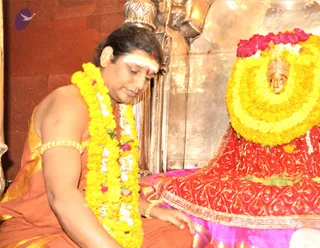
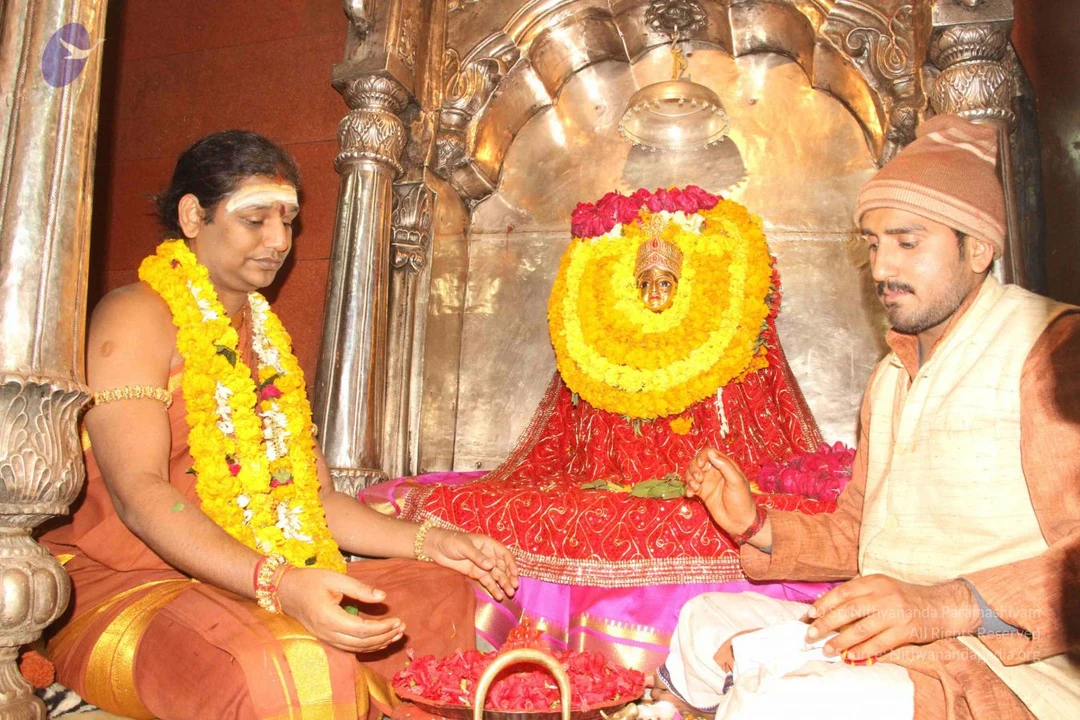
A seated man in a temple sanctum touches the red-draped body of a goddess murti with his right hand, a ritual gesture in a shrine. He wears a bare-chested orange-brown dhoti with a gold border, a thick yellow marigold garland with white flowers and a gold armlet. A white forehead tilak marks his brow. The murti, decorated with a gold crown and face, sits beneath a heap of yellow marigolds and pink roses on a red sari with gold embroidery. Brass lamps and a silver plate of red offerings sit on the floor. Another person's hand, in white clothing with red bangles, is visible at lower right. Gilded silver arches frame the shrine behind.A photograph inside a temple shrine. A man in an orange-saffron dhoti-style garment with a gold armlet sits on the left, head bowed, wearing a long yellow and white marigold garland and a white sandalwood tilak on his forehead. To the right stands a deity murti with a golden crown, draped in a red embroidered cloth and wrapped in a yellow marigold garland with a crimson flower arrangement on top. Pink fabric lies on the floor at the base of the murti, and a silver-toned wall forms the background. The seated man is distinguished by his tilak, garland and armlet, and the scene is a quiet darshan moment before the deity.A man in saffron-brown ochre robes sits cross-legged at the left, wearing a thick yellow and white marigold garland, a gold-toned armlet and bangles, and a white tilak on his forehead. He smiles while holding a brass plate toward a silver-clad shrine where a deity murti with a gold crown is adorned with a large yellow marigold garland and draped in a red and gold embroidered silk. Red flower offerings, a red kumkum mound on a plate, a lit oil lamp flame and a brass kalasha-style vessel rest in front.