Skip to content
Sunday

26 May 2013

Inner Awakening Day 19 | Jnanasambandars Enlightenment Day

Dated photos
302
Source pages
1
Media
2
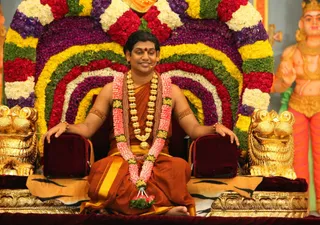
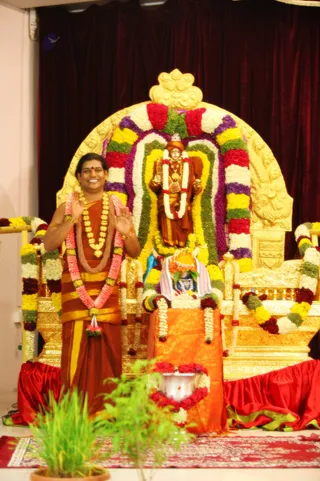
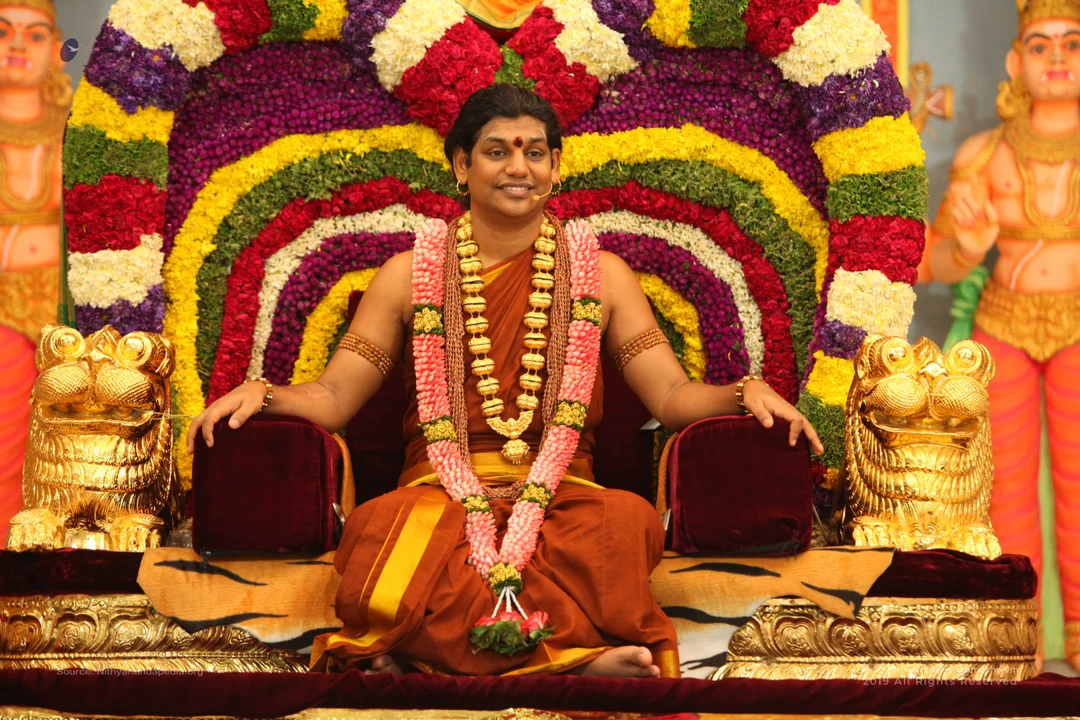
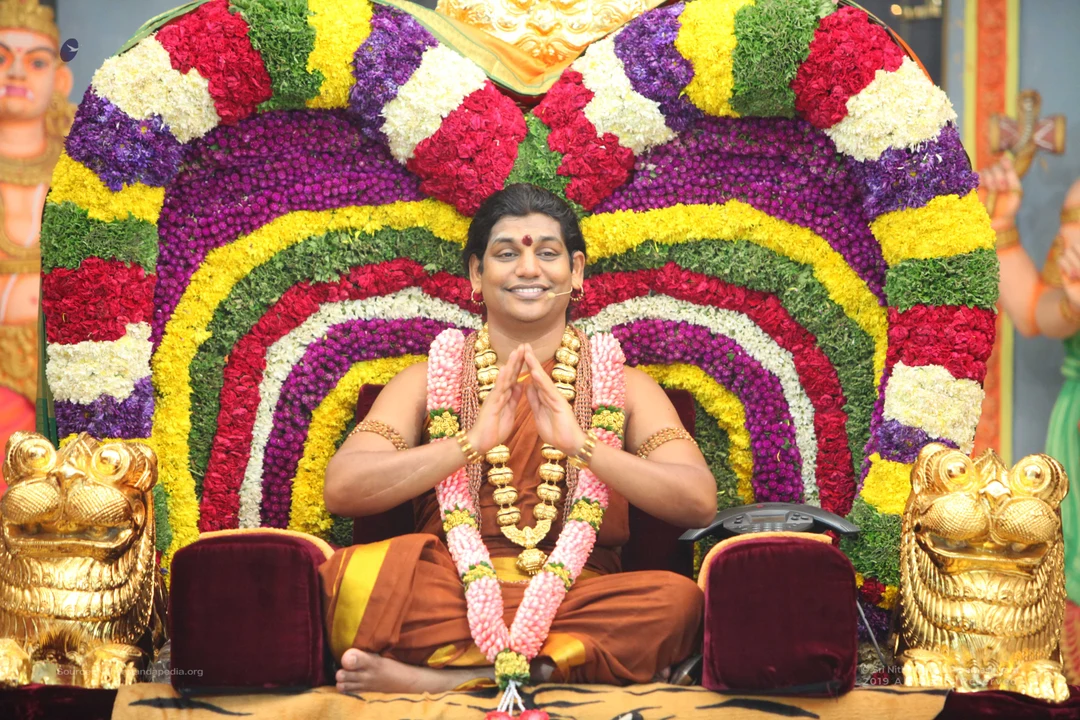
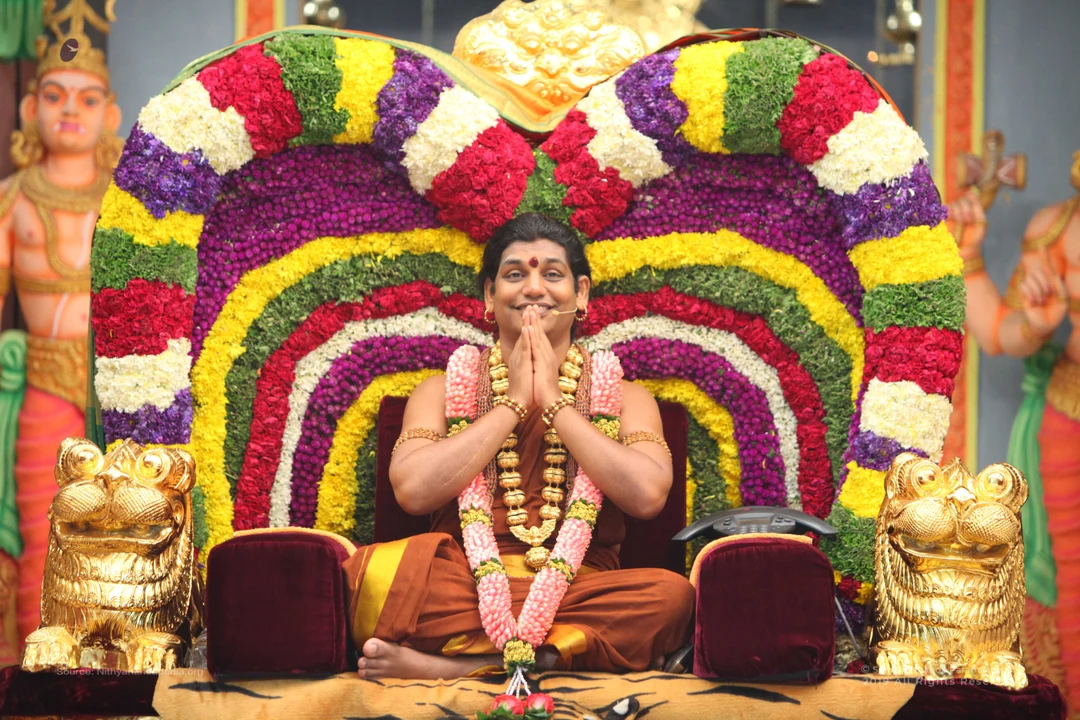
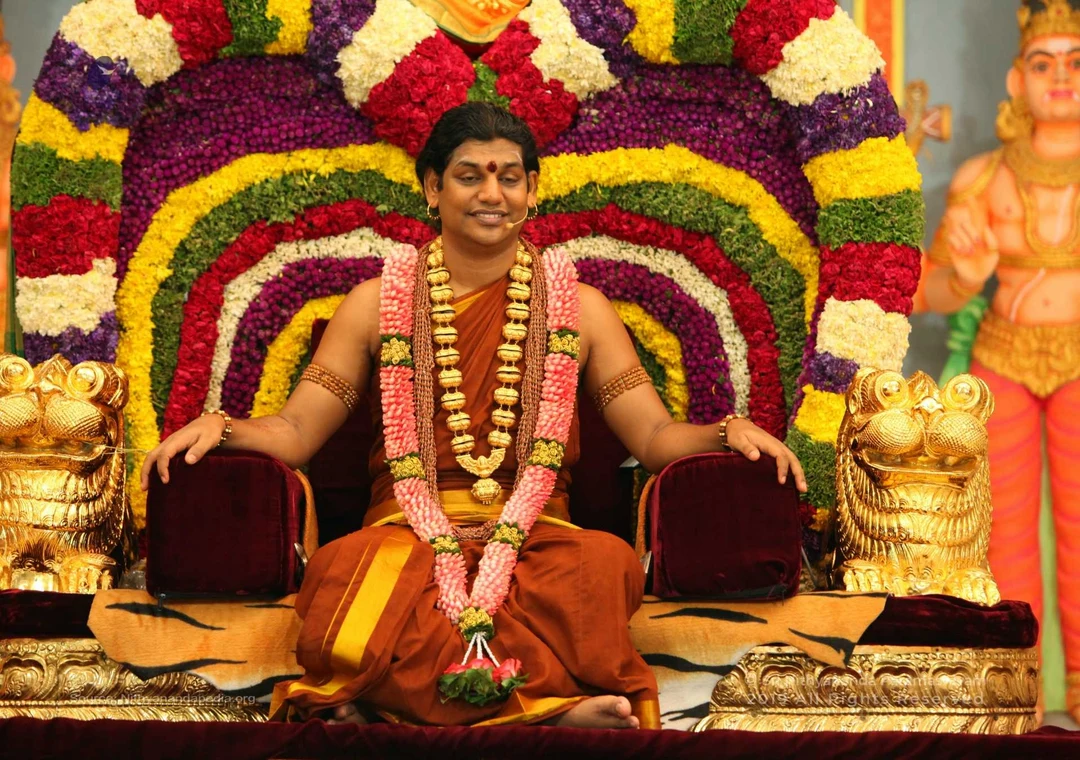
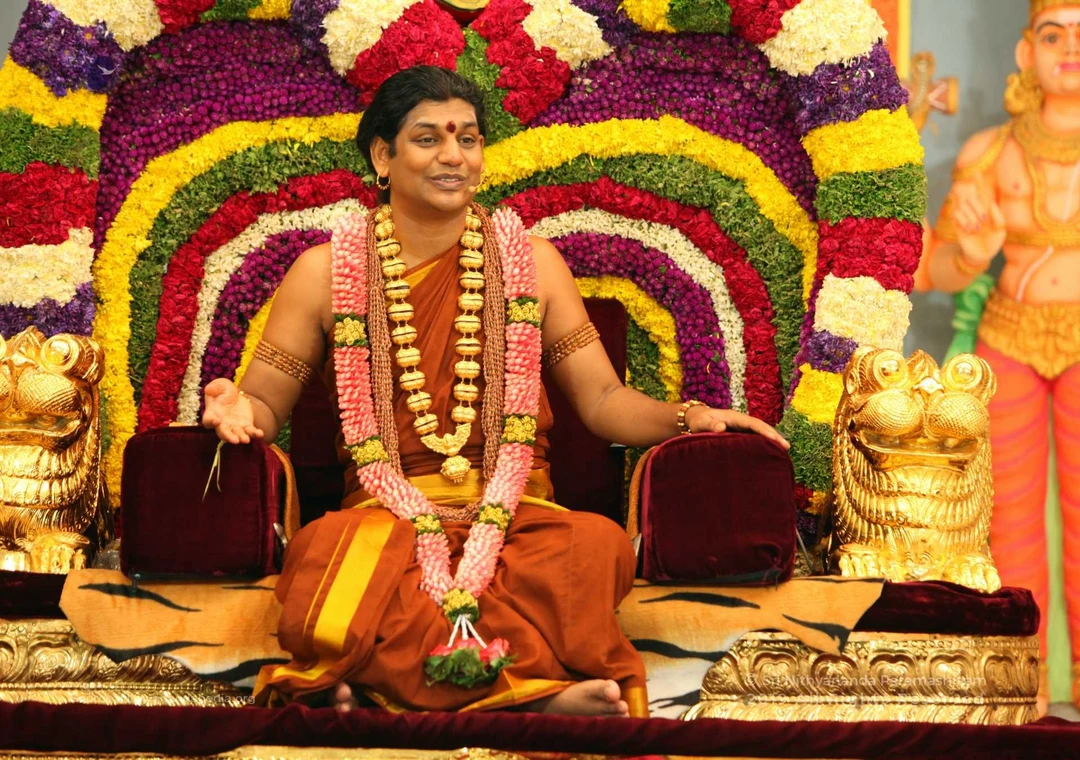
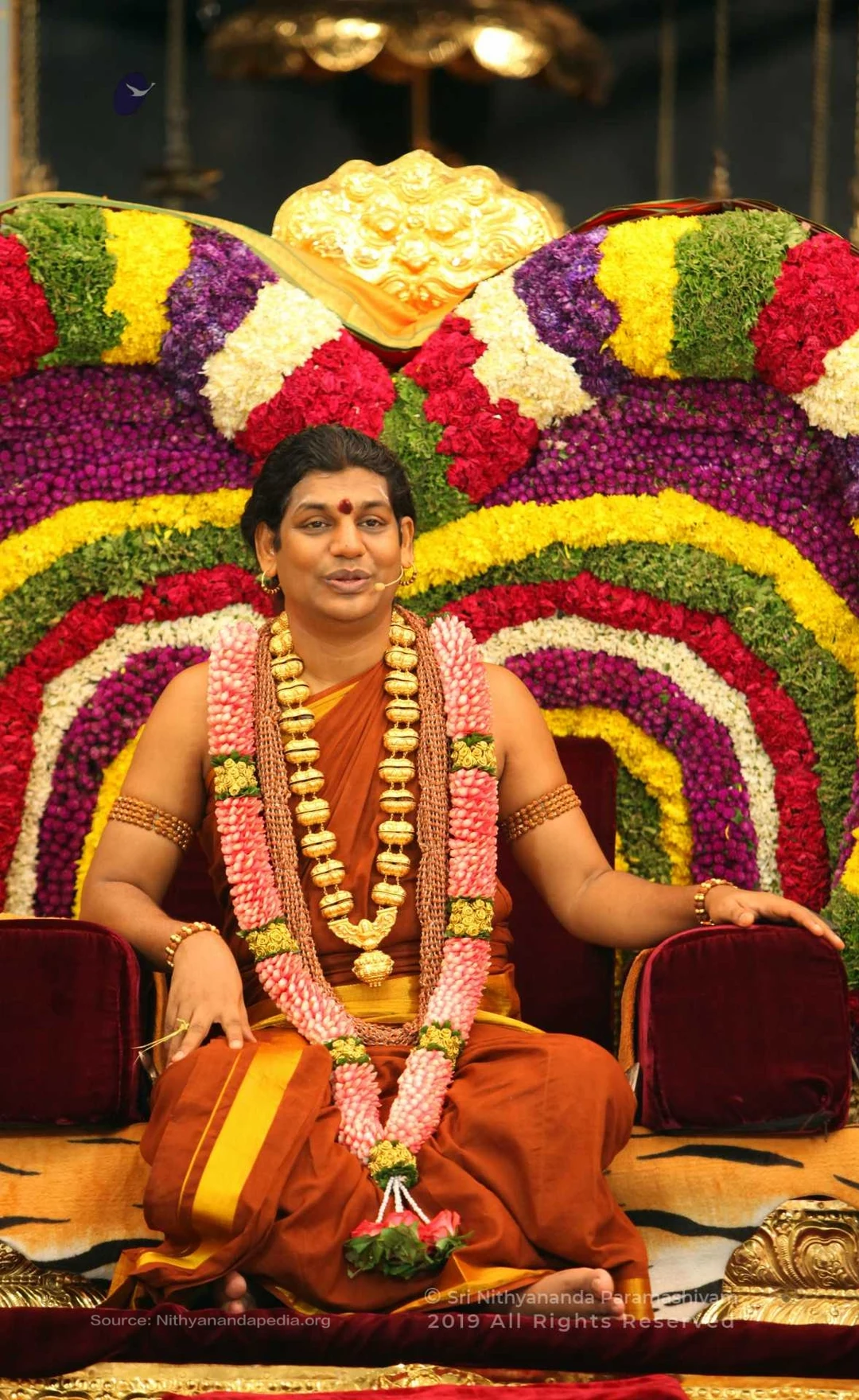
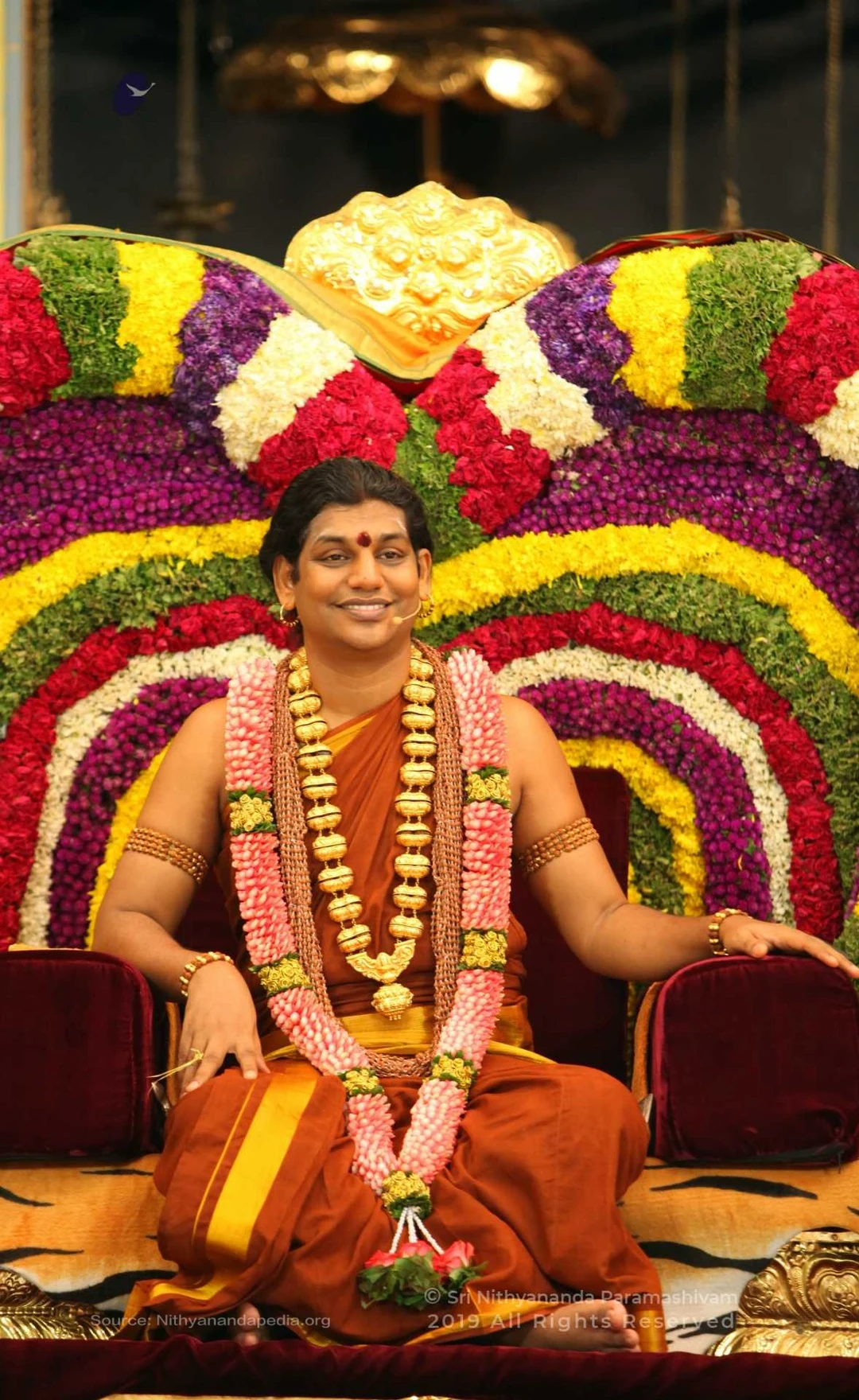
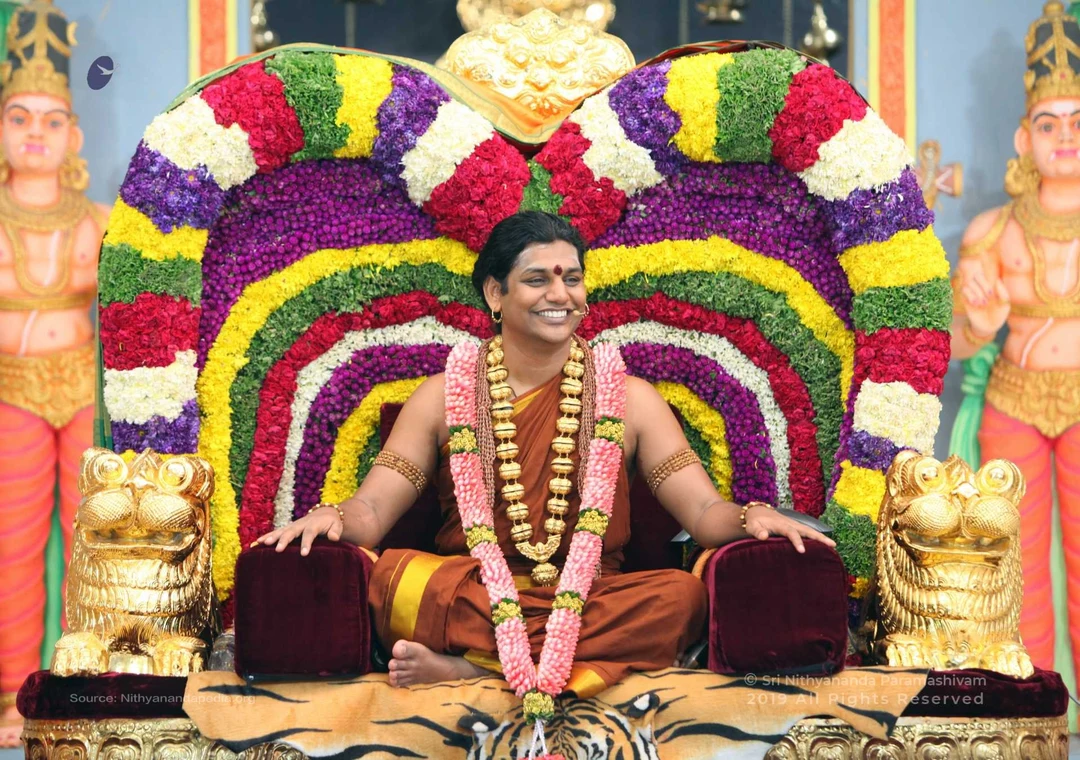
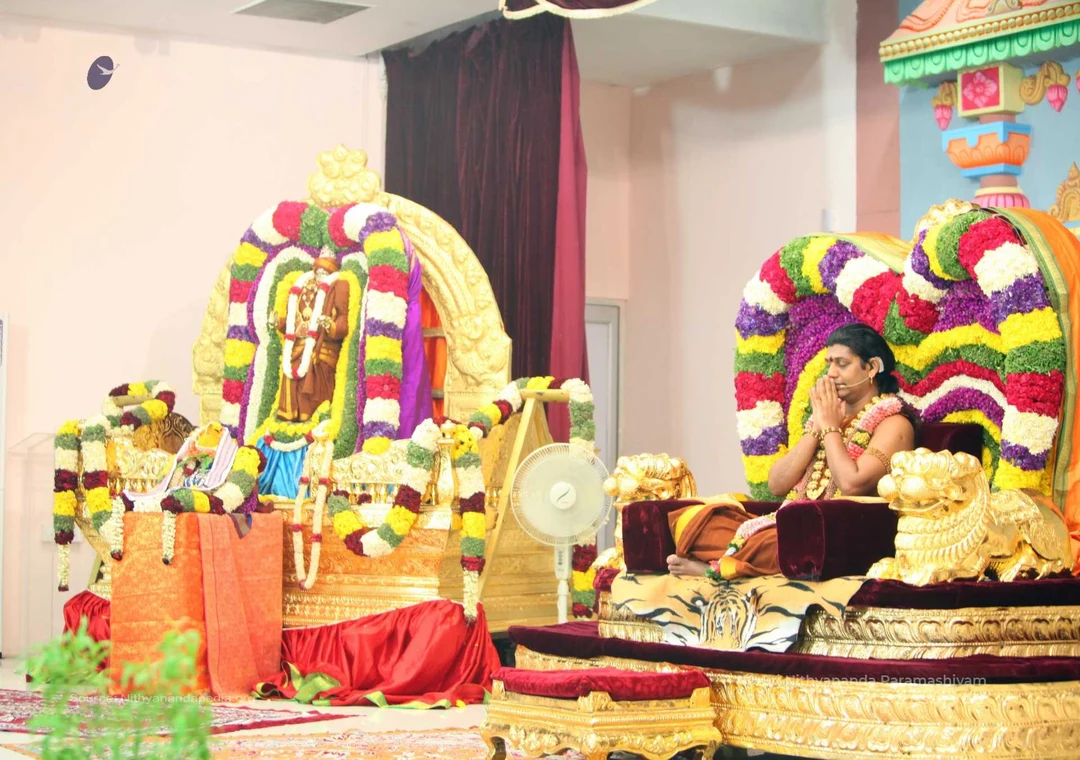
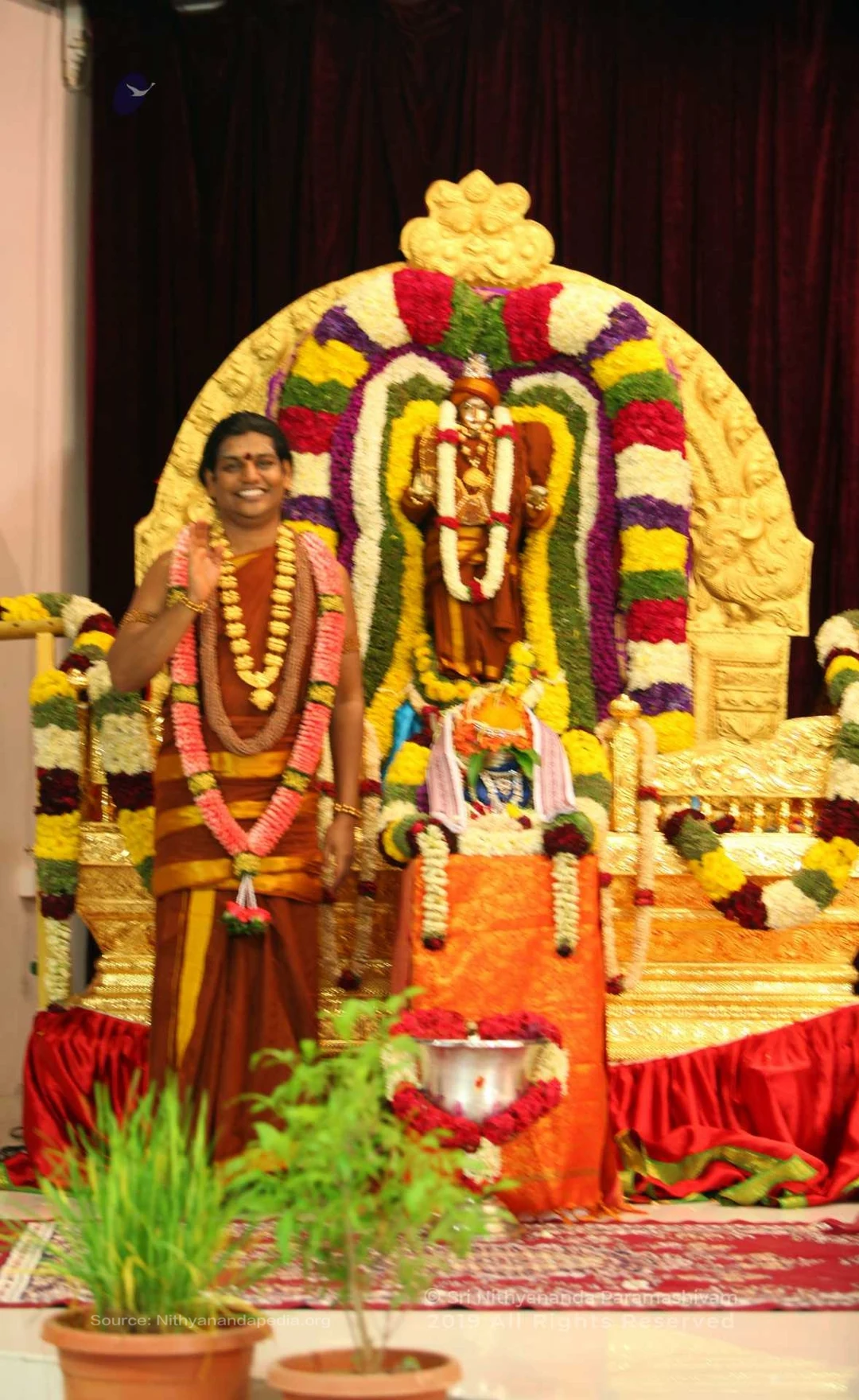
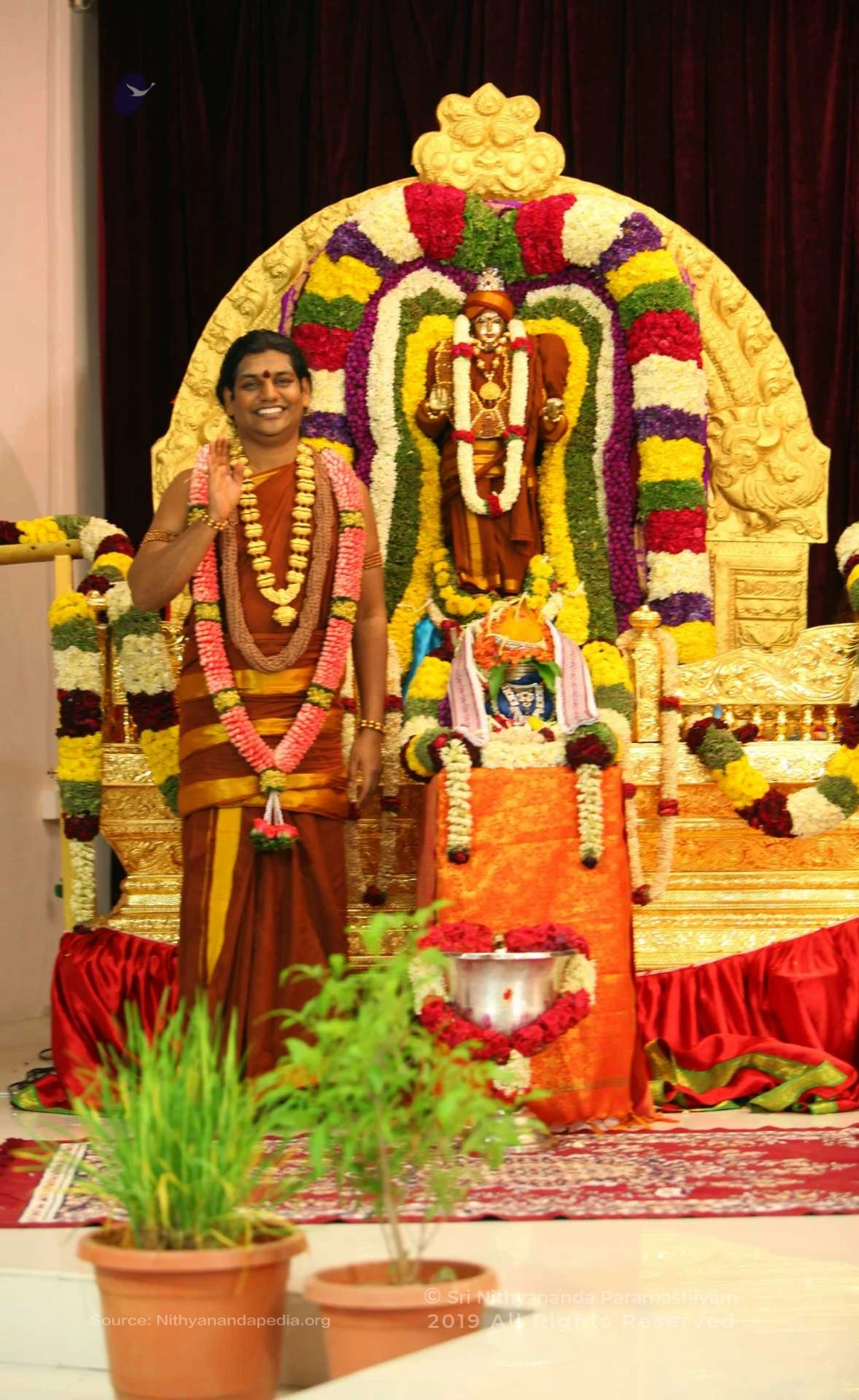
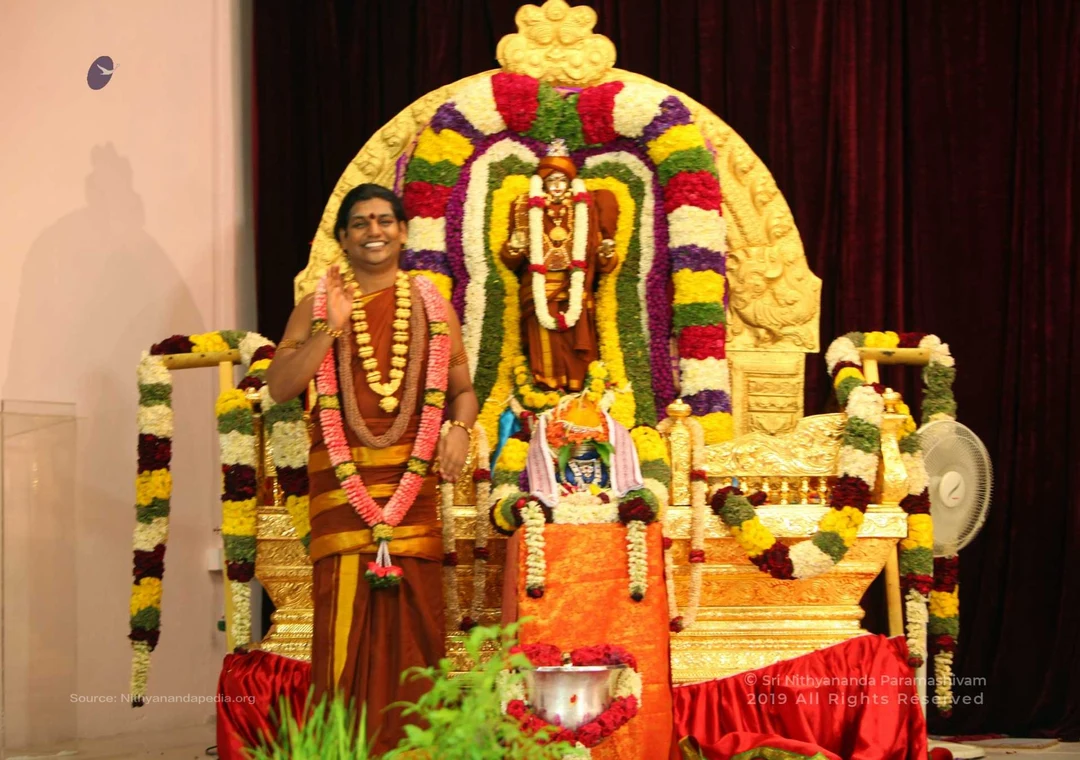
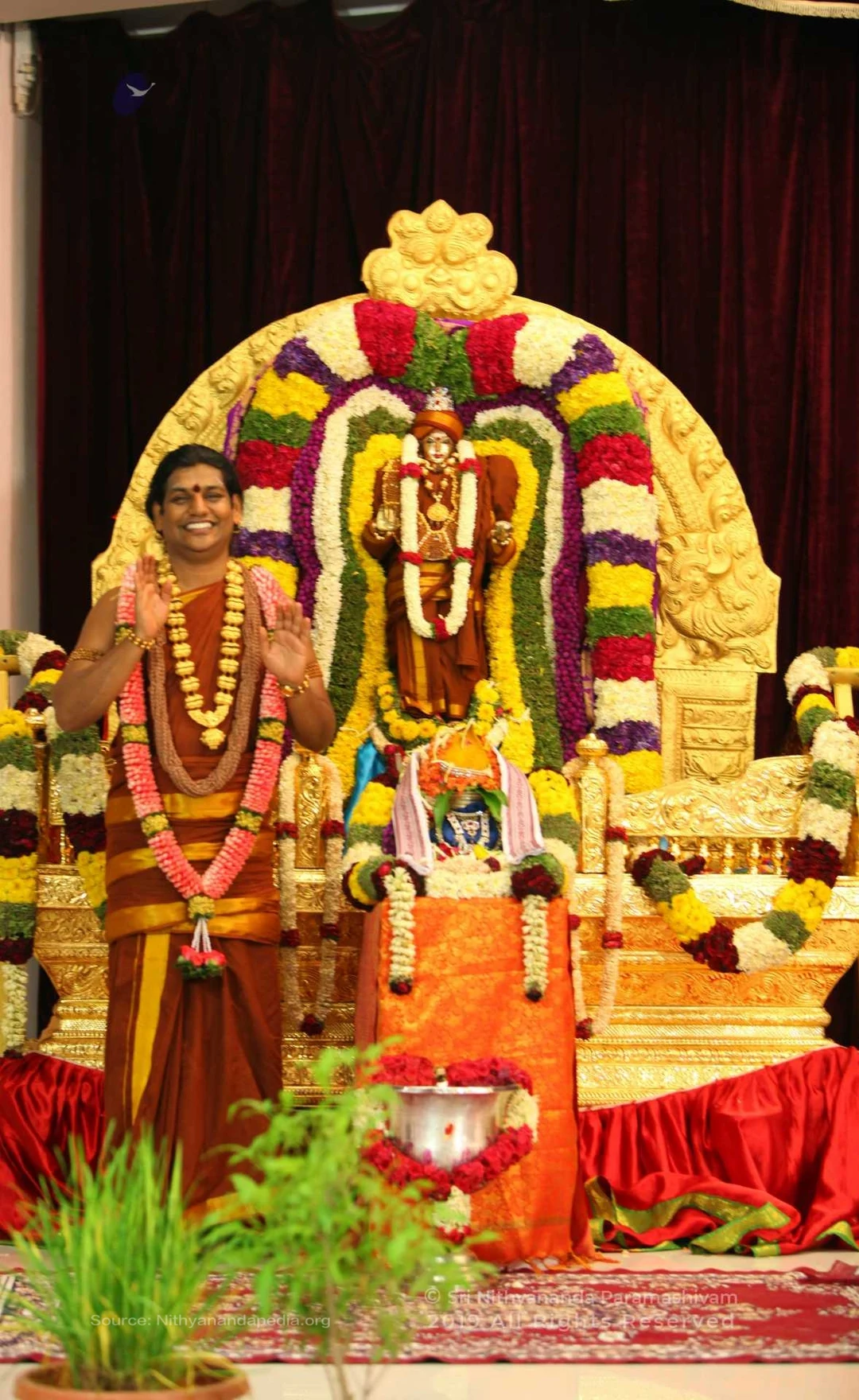
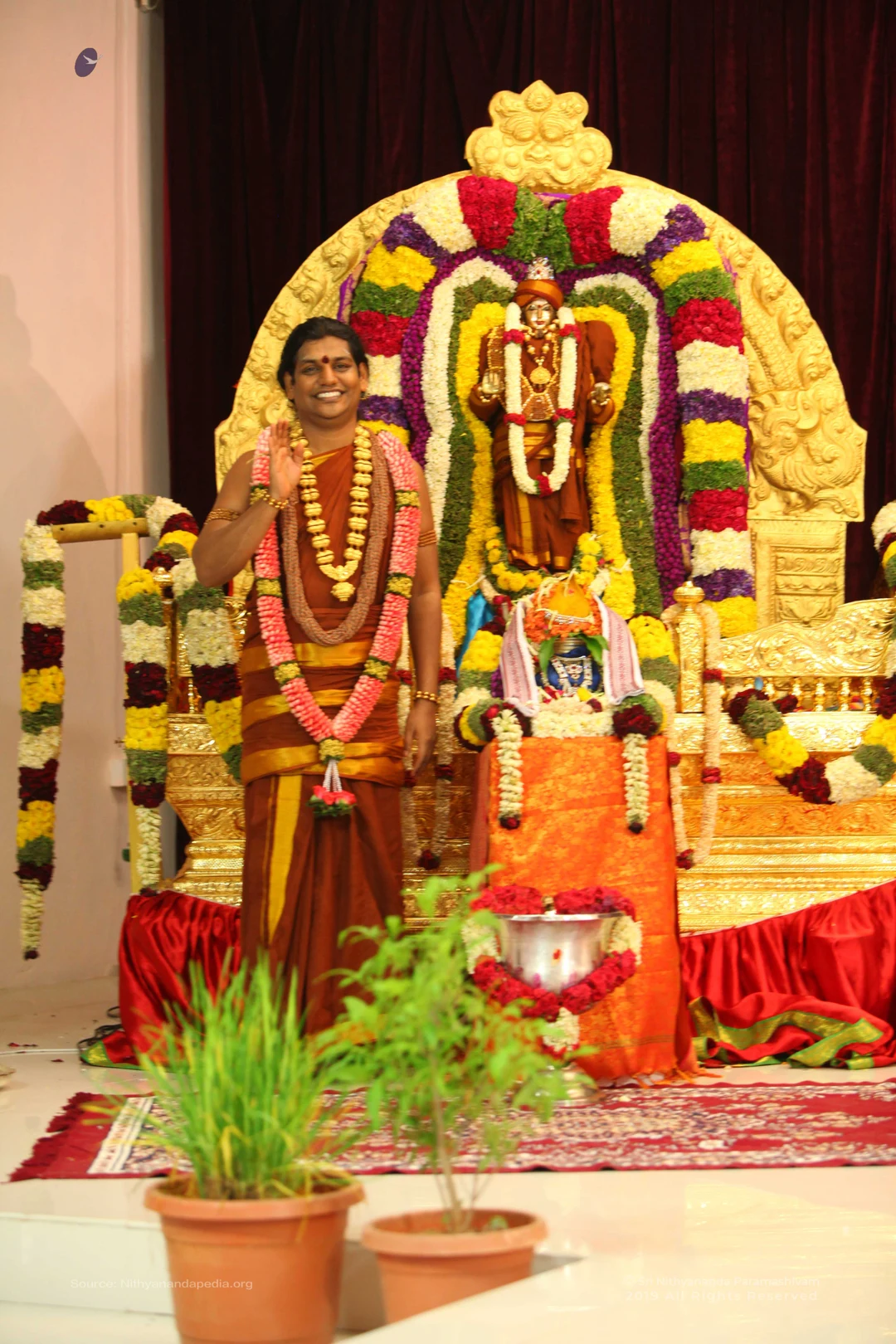
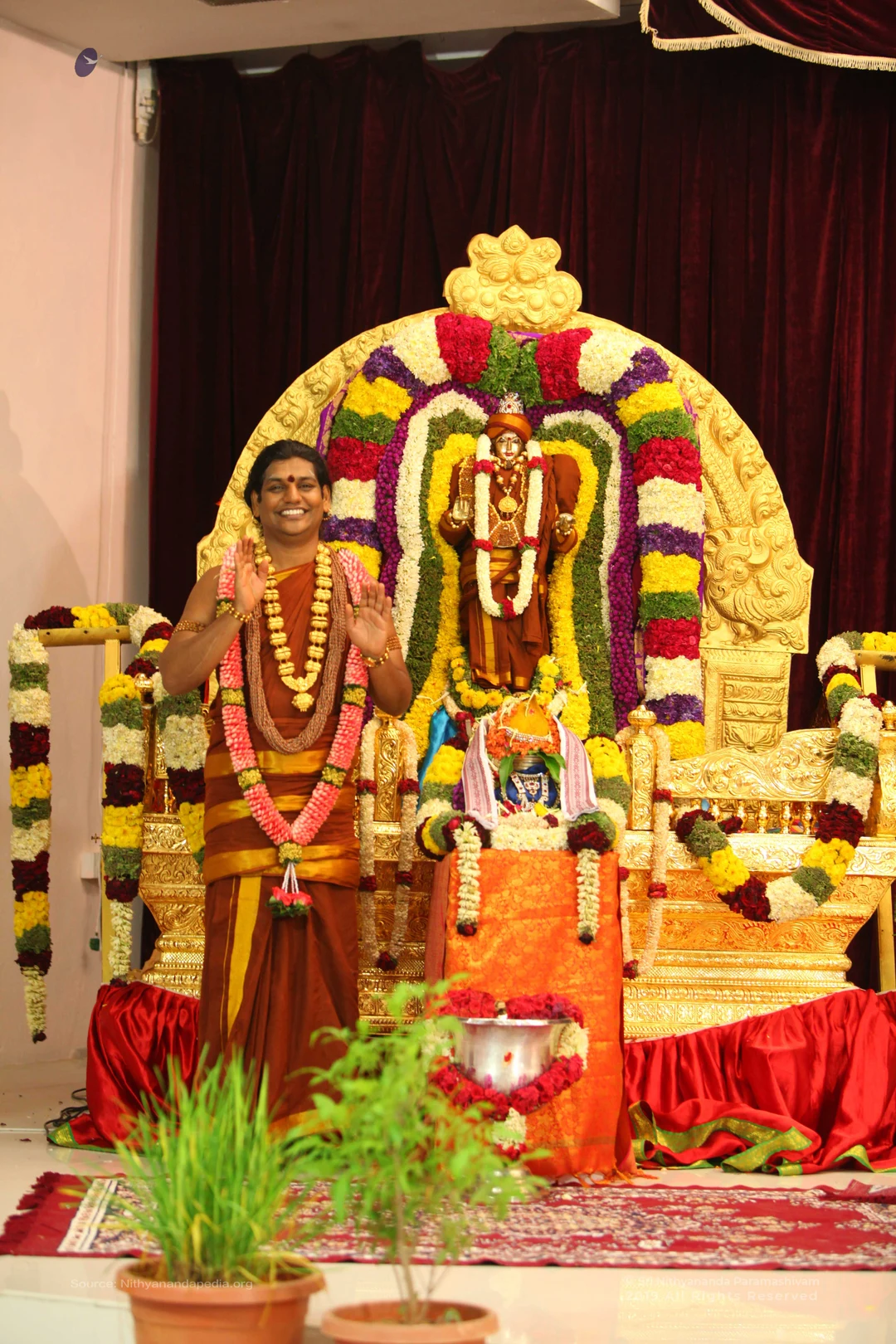
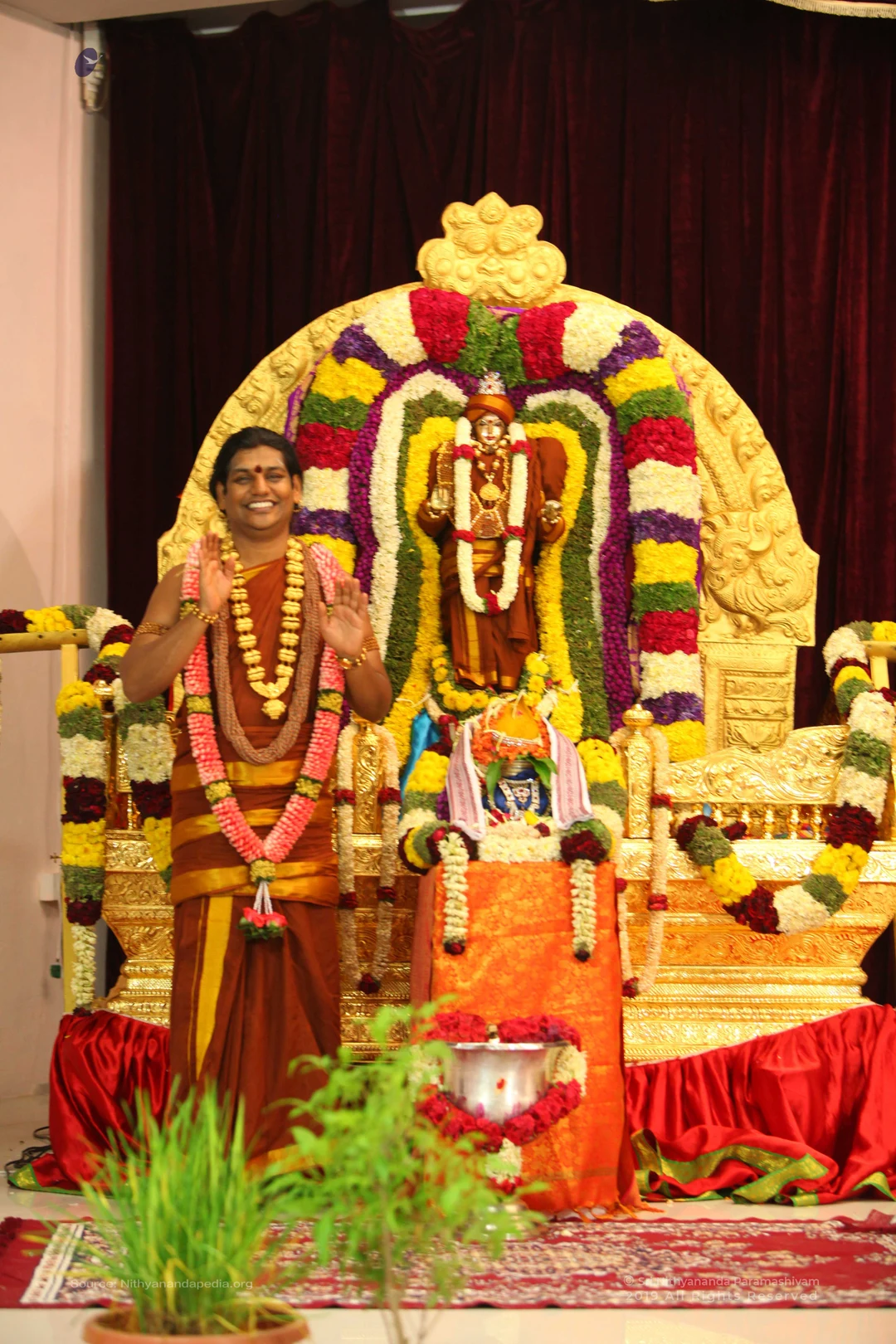
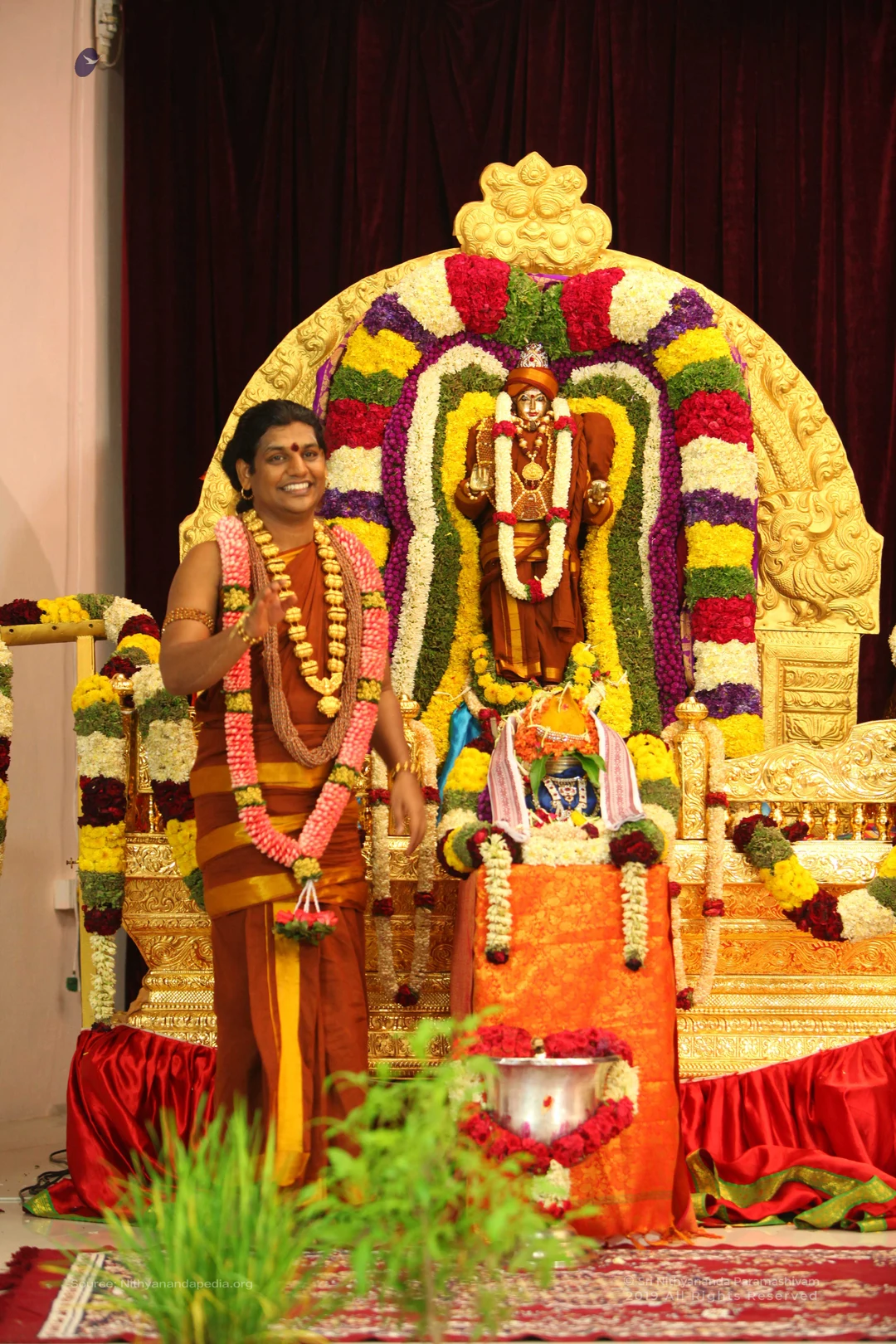
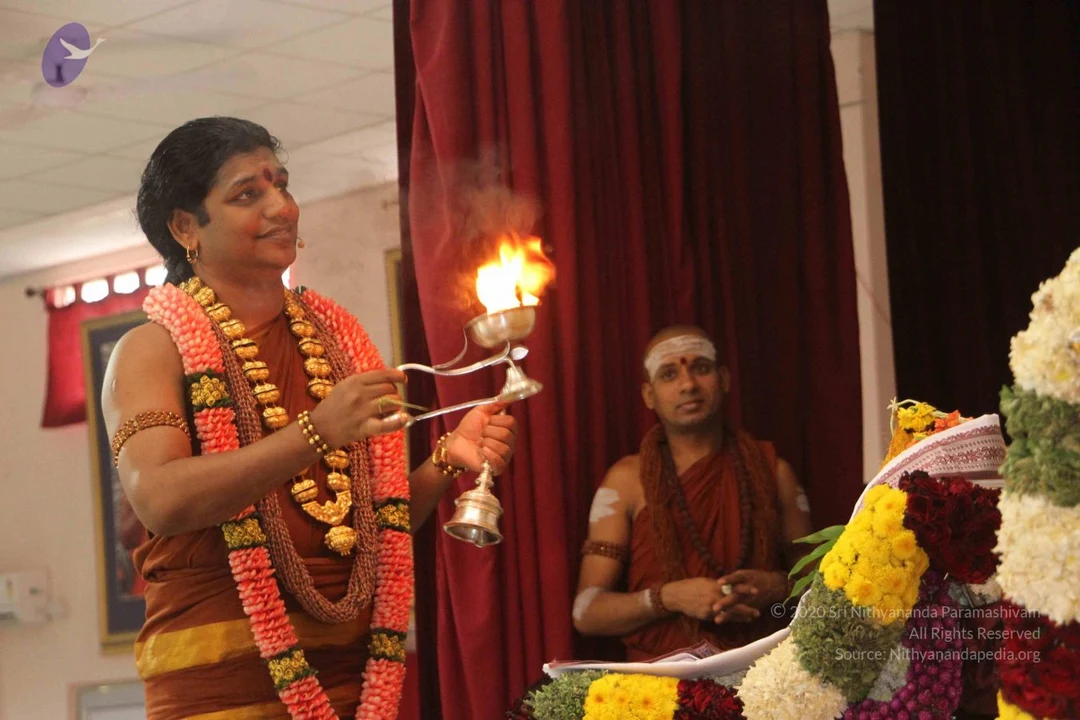
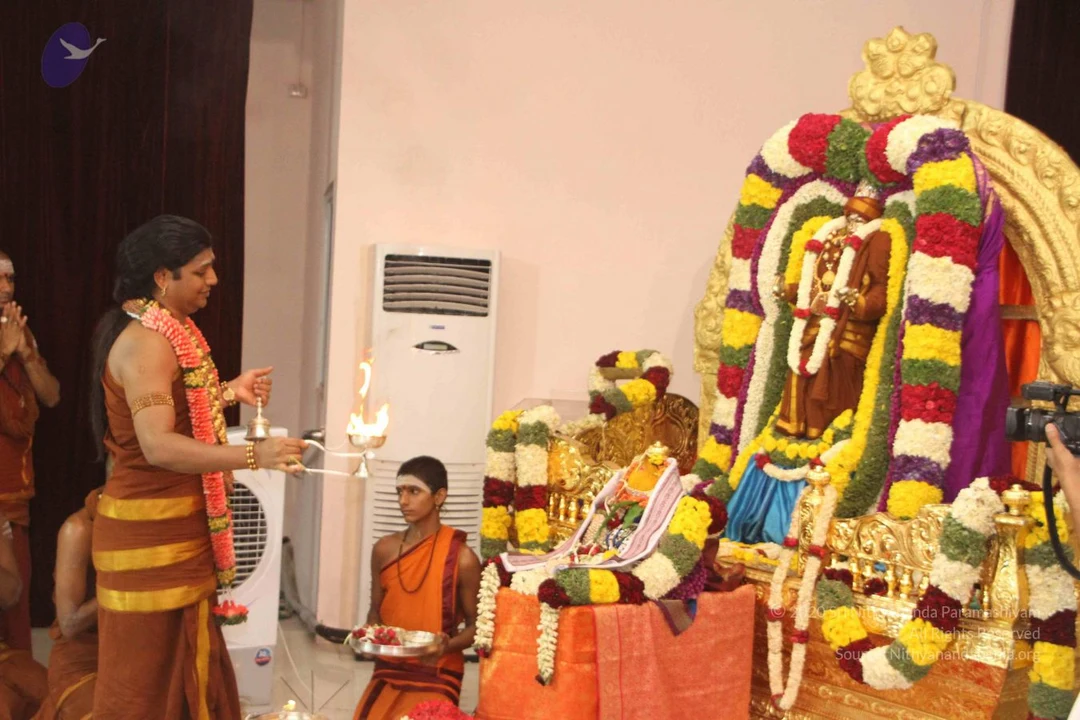
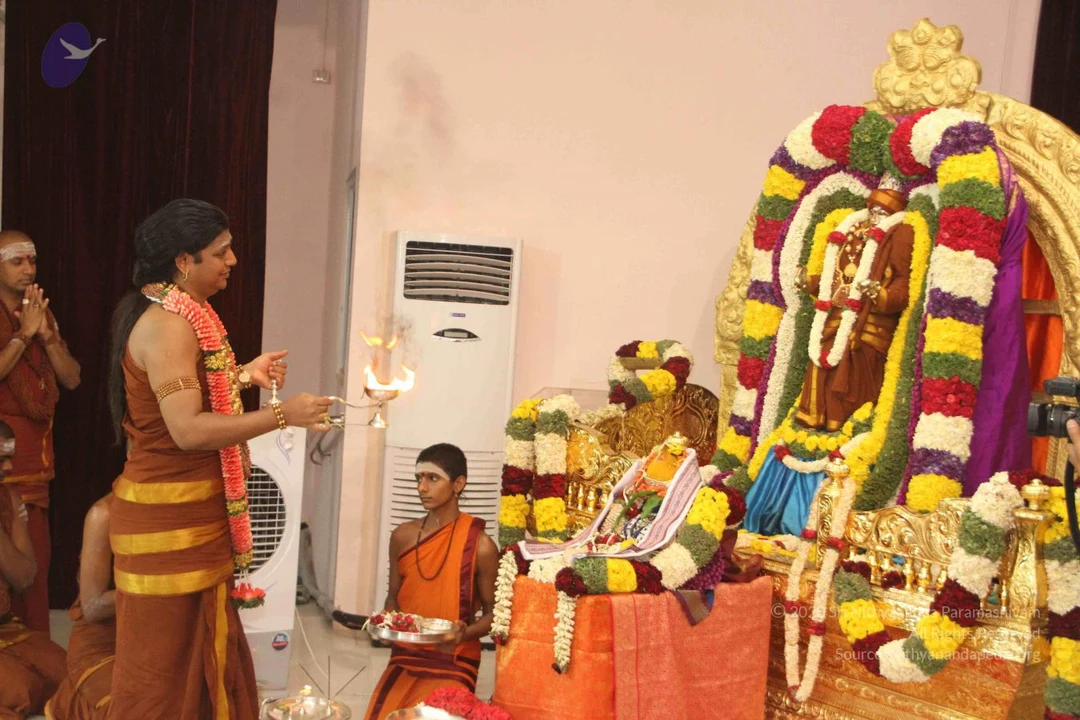
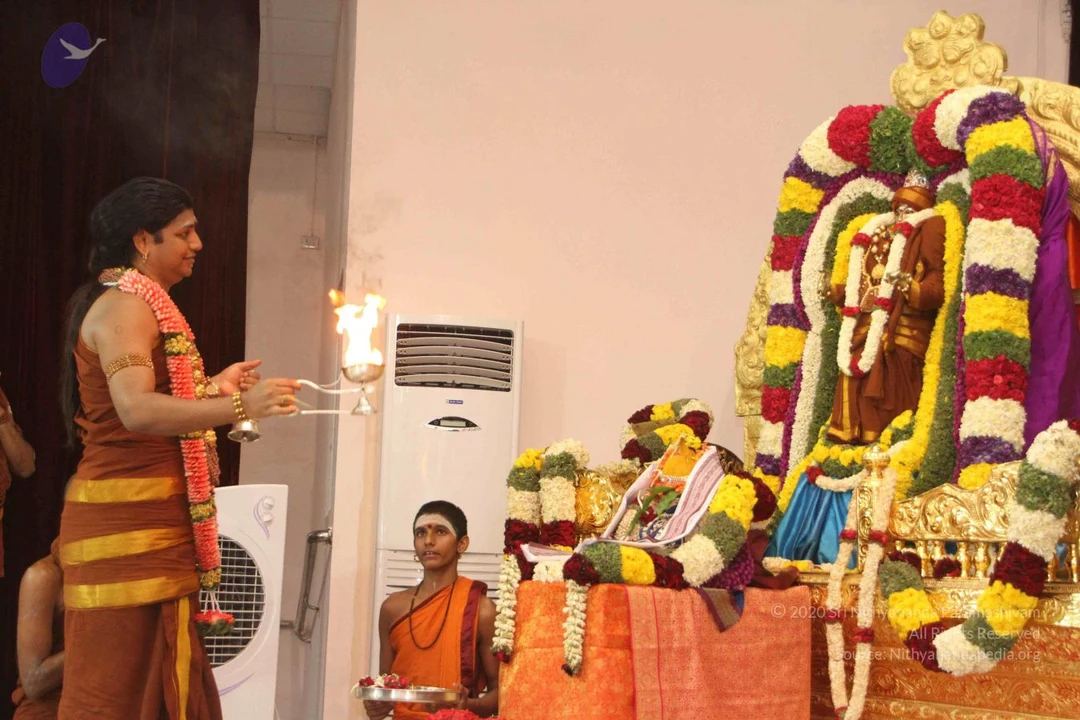
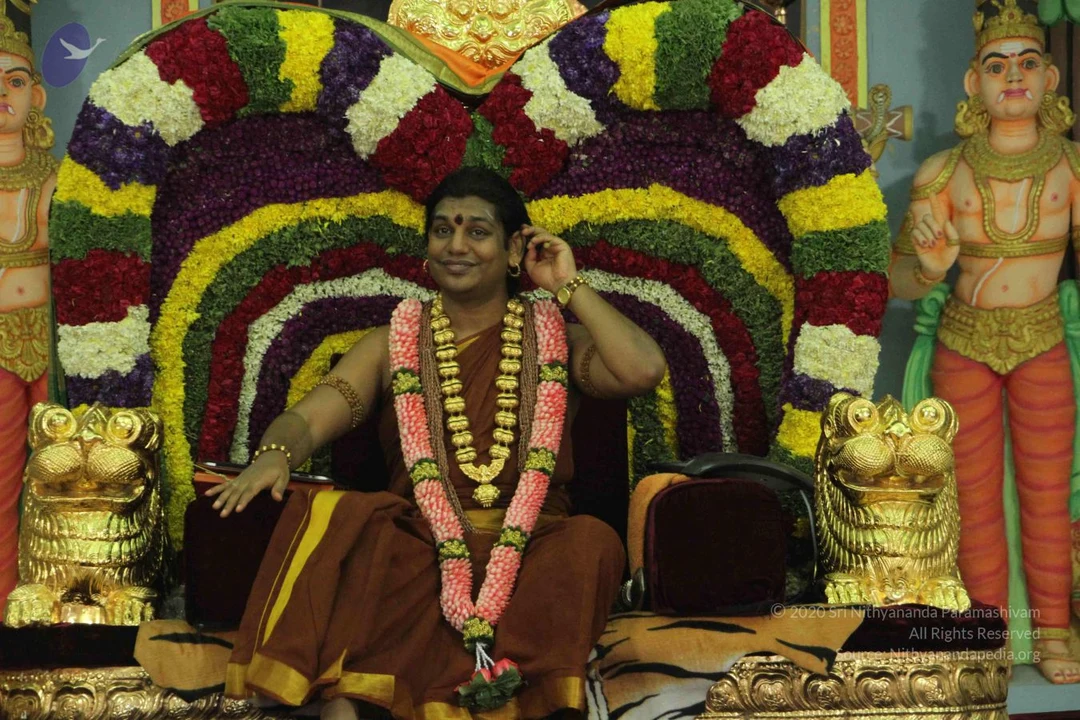
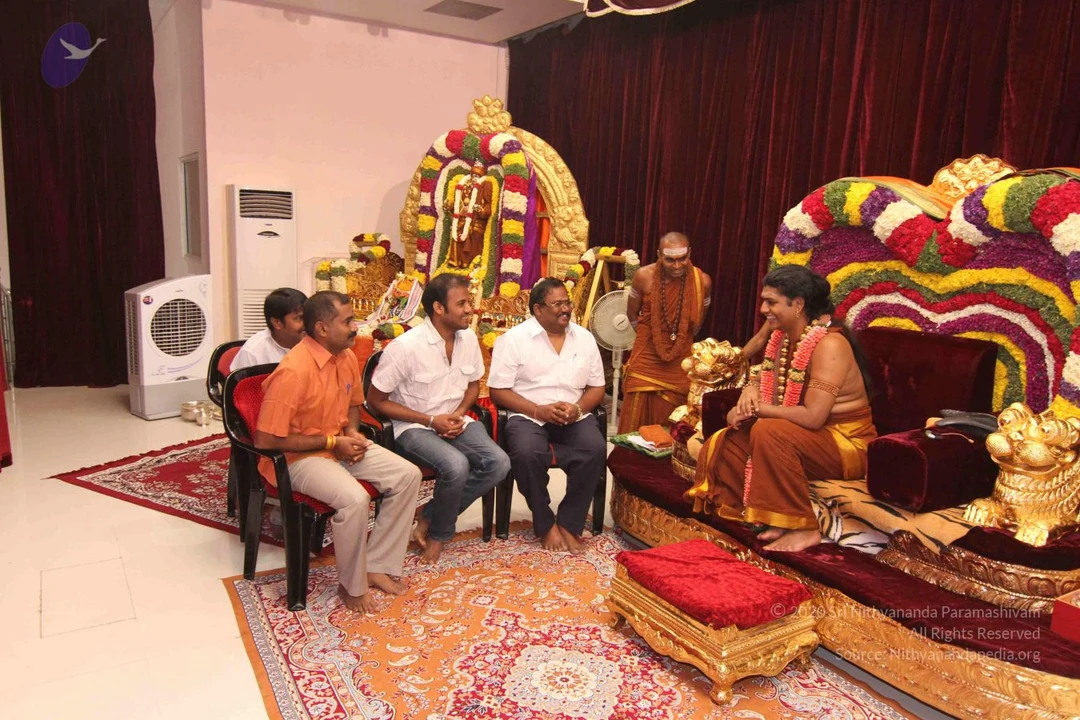
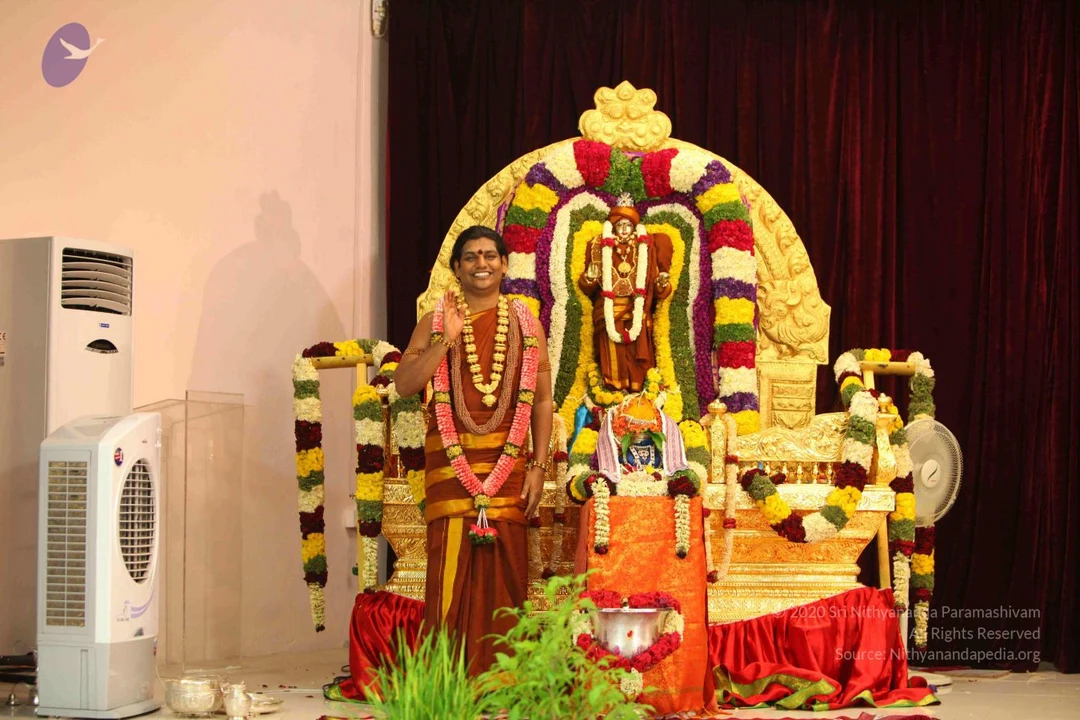
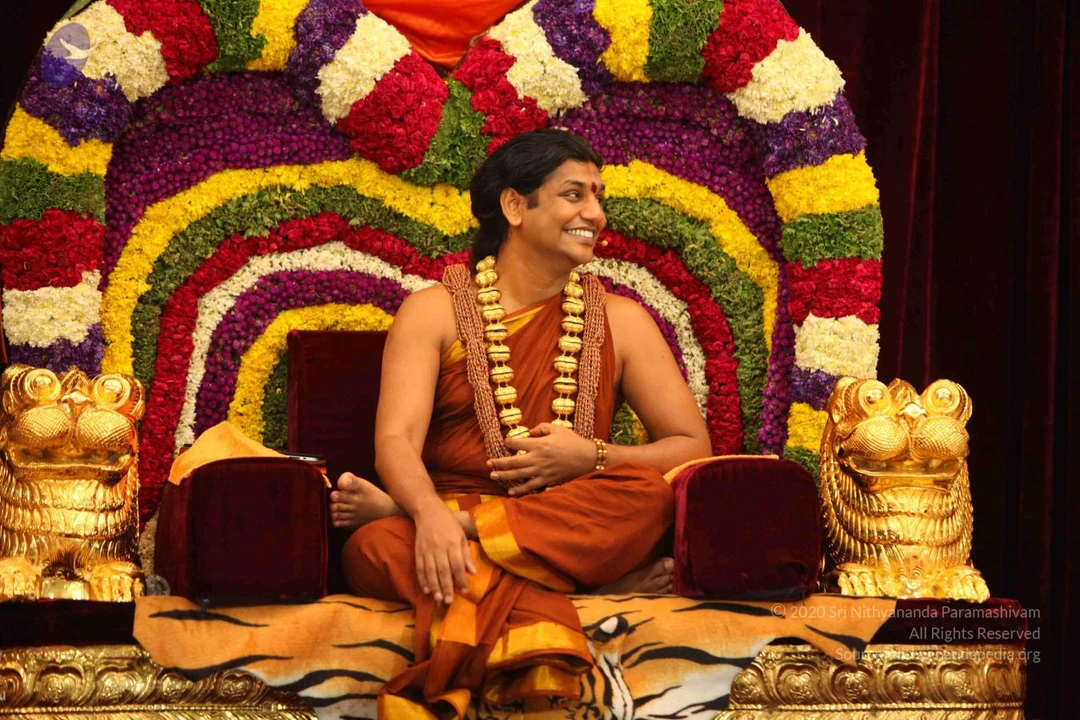
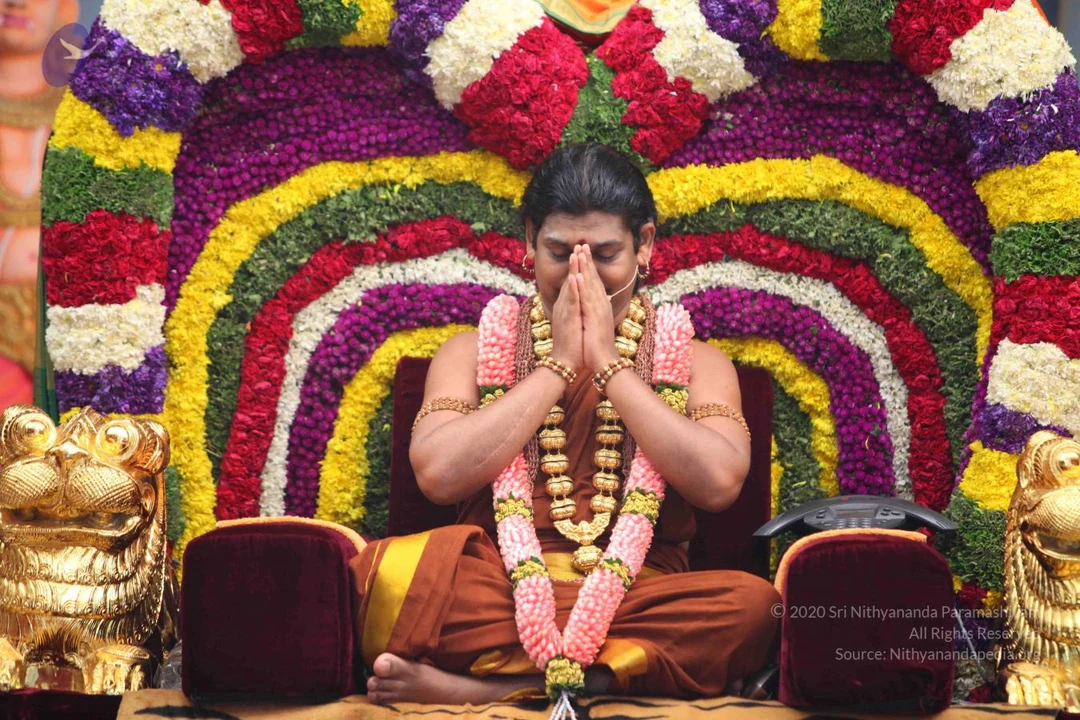
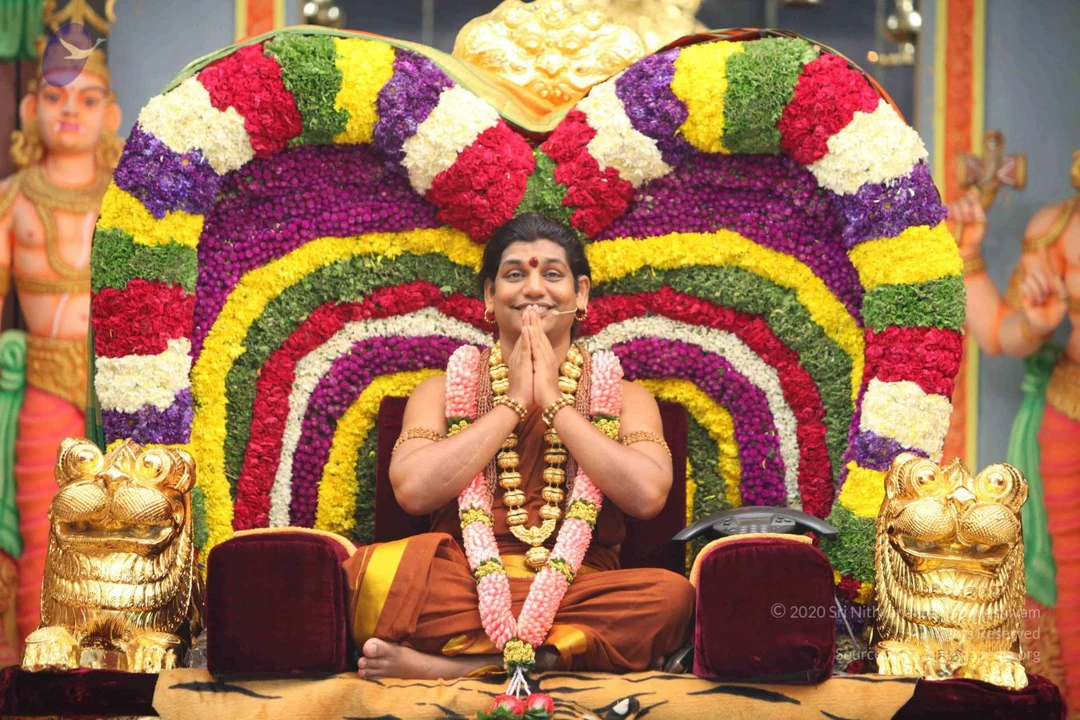
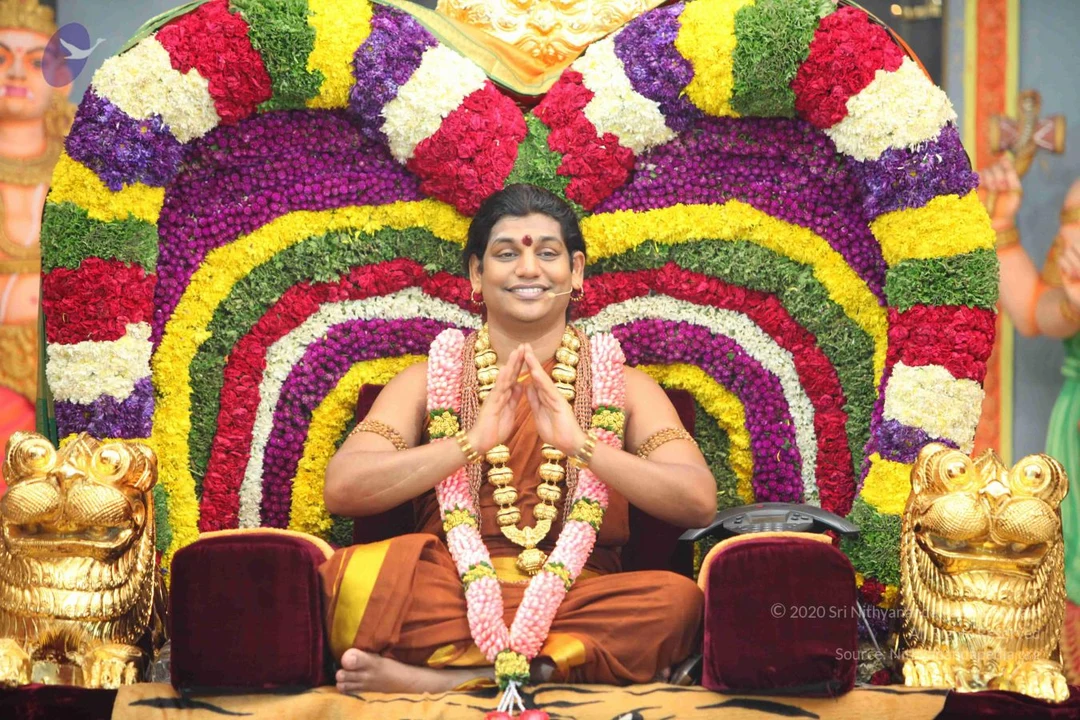
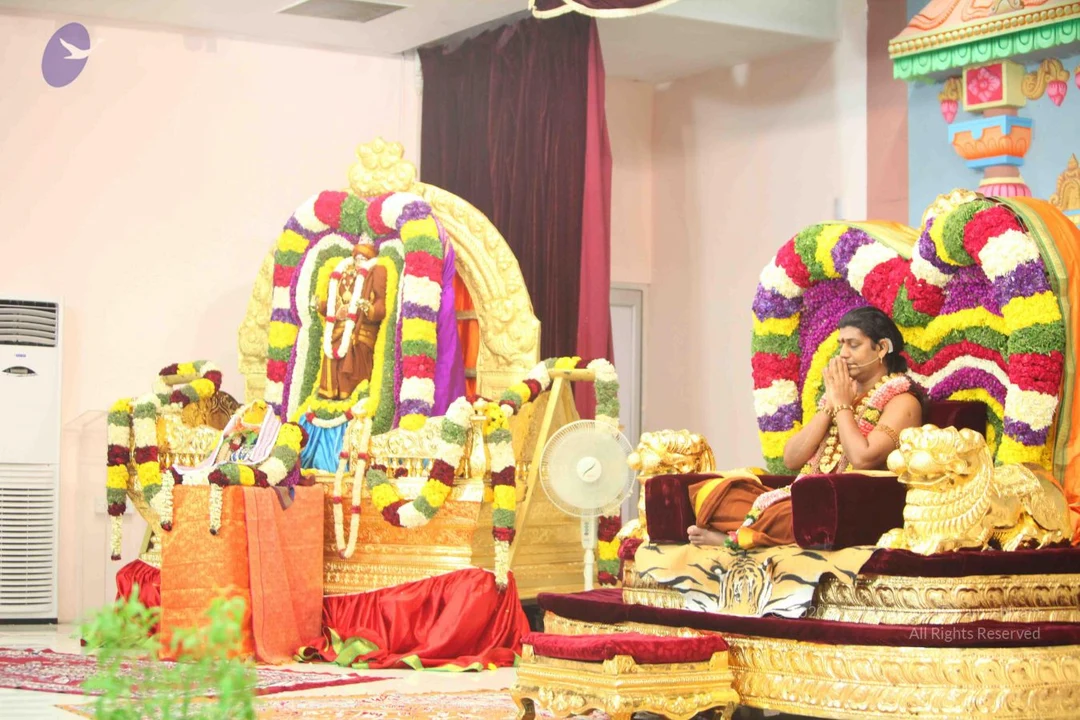
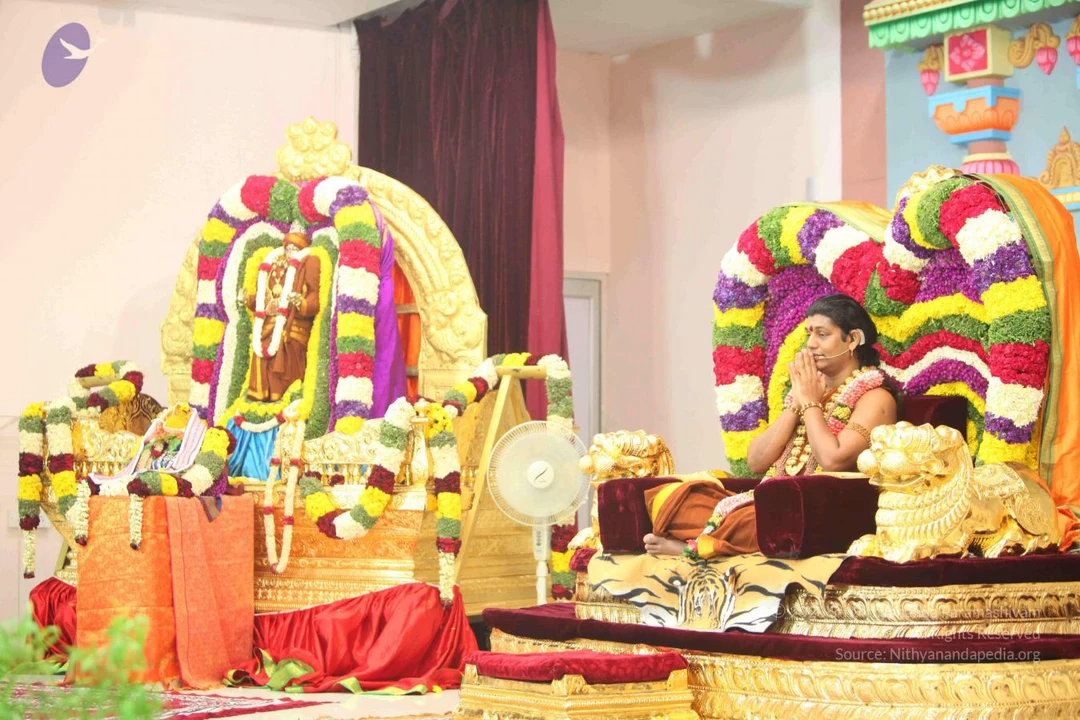
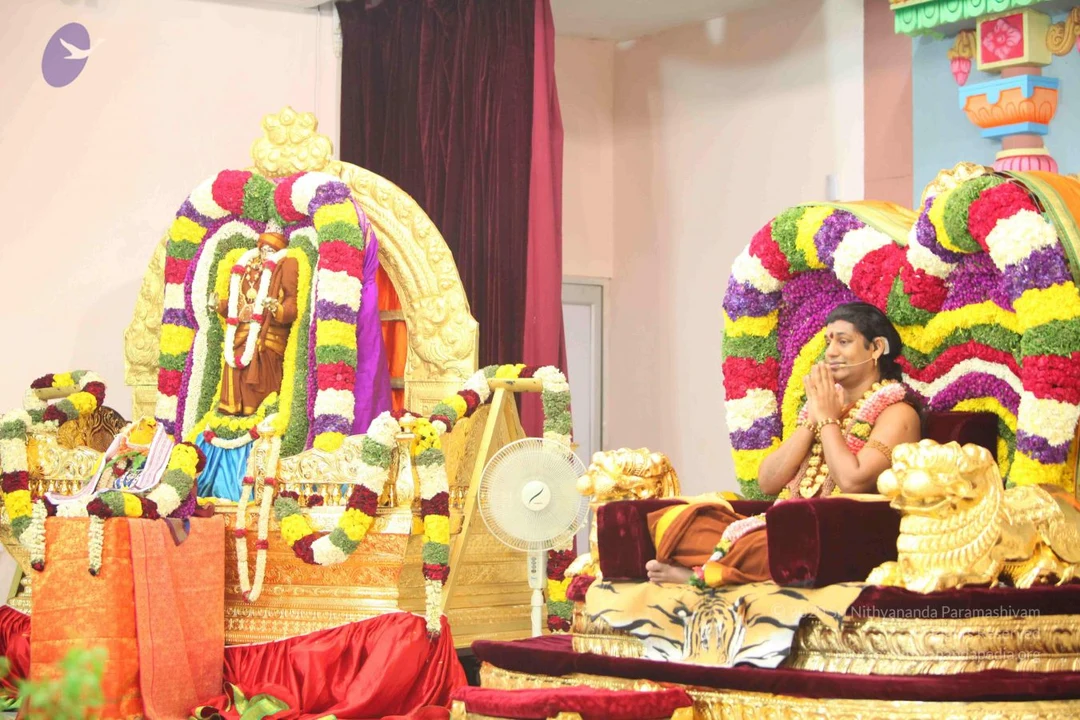
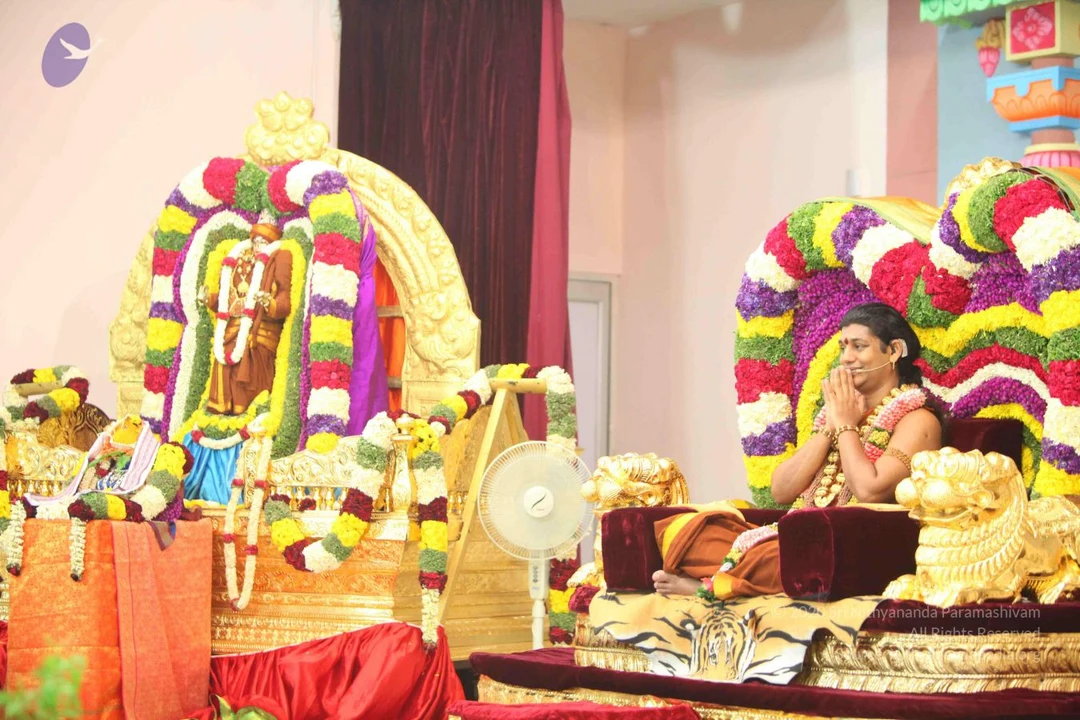
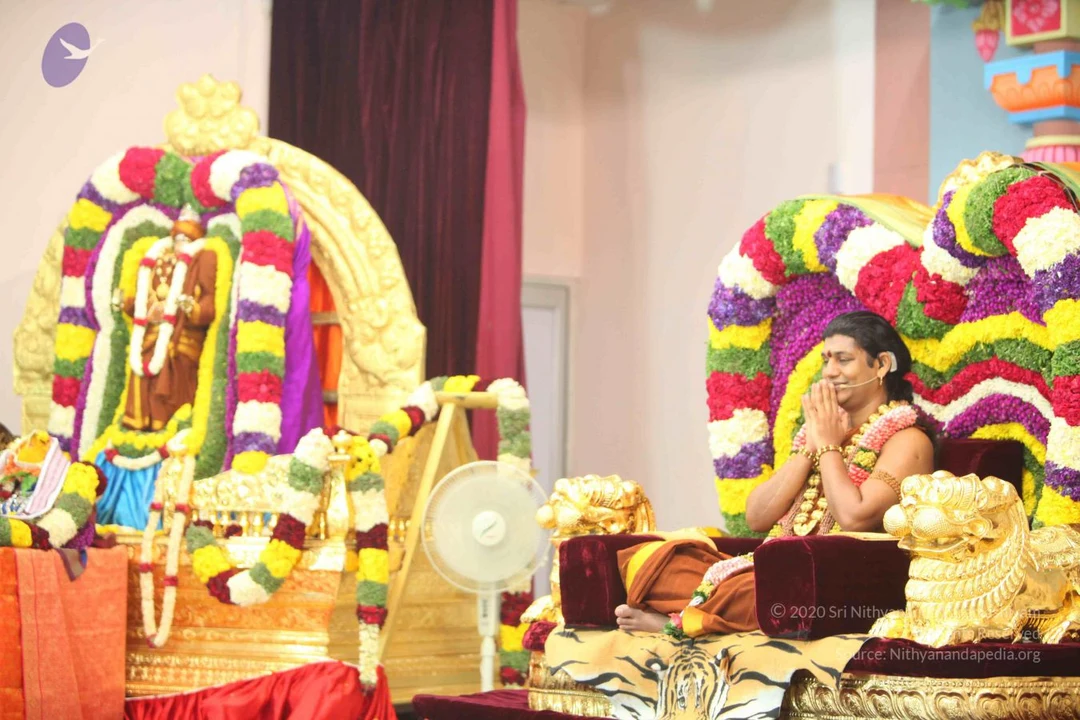
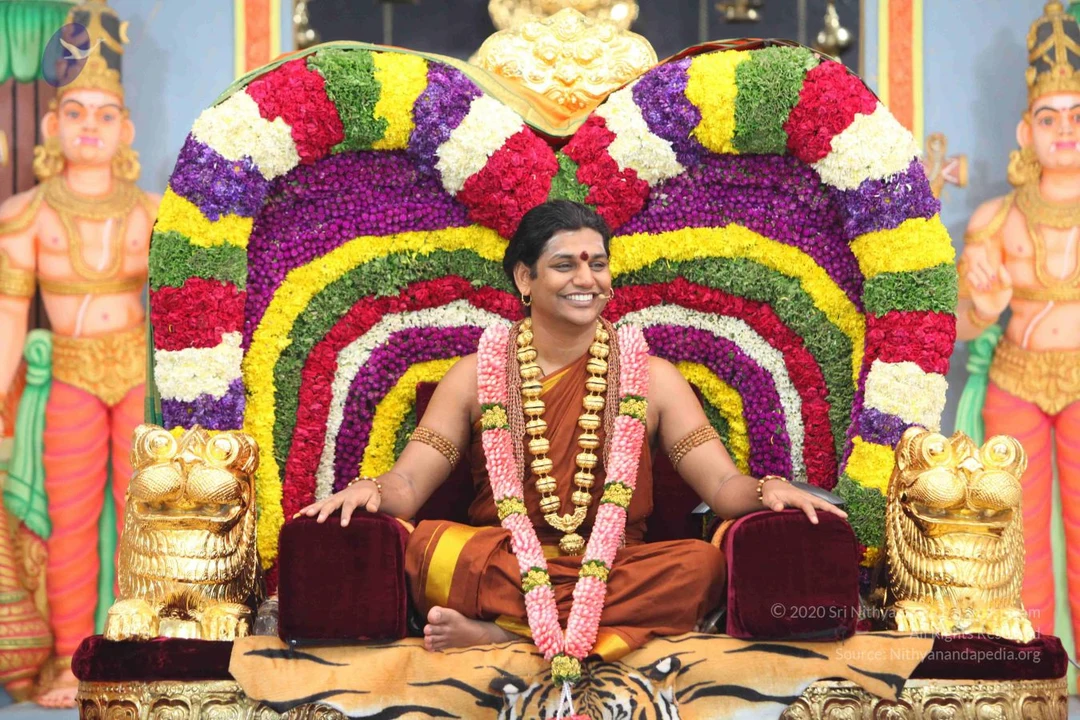
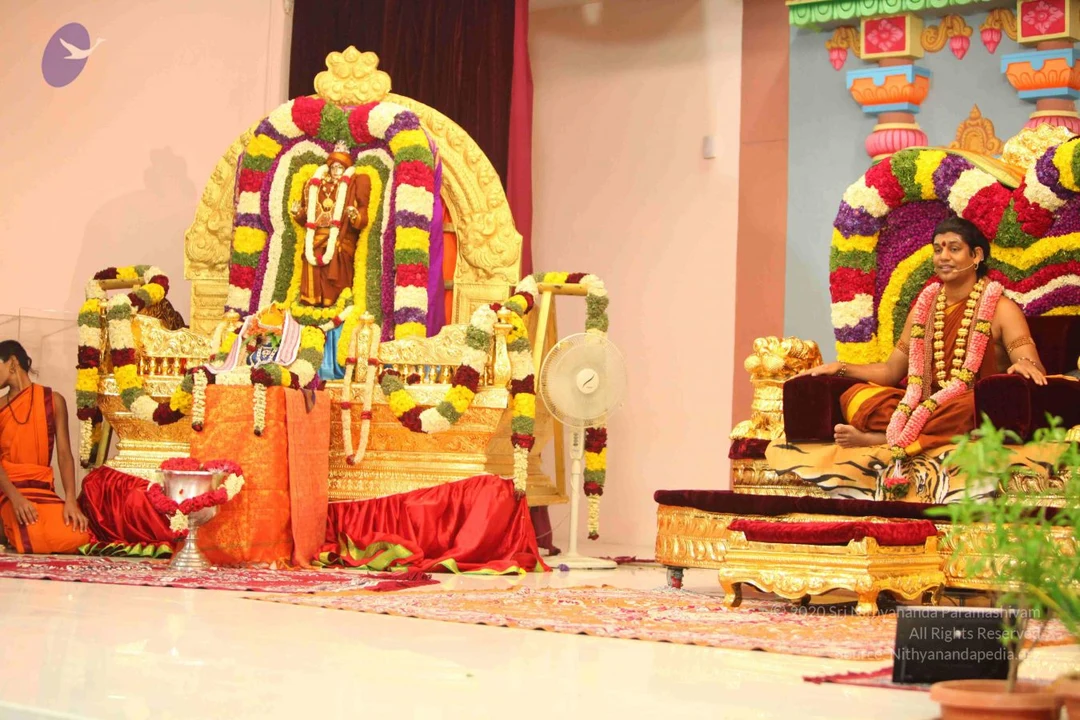
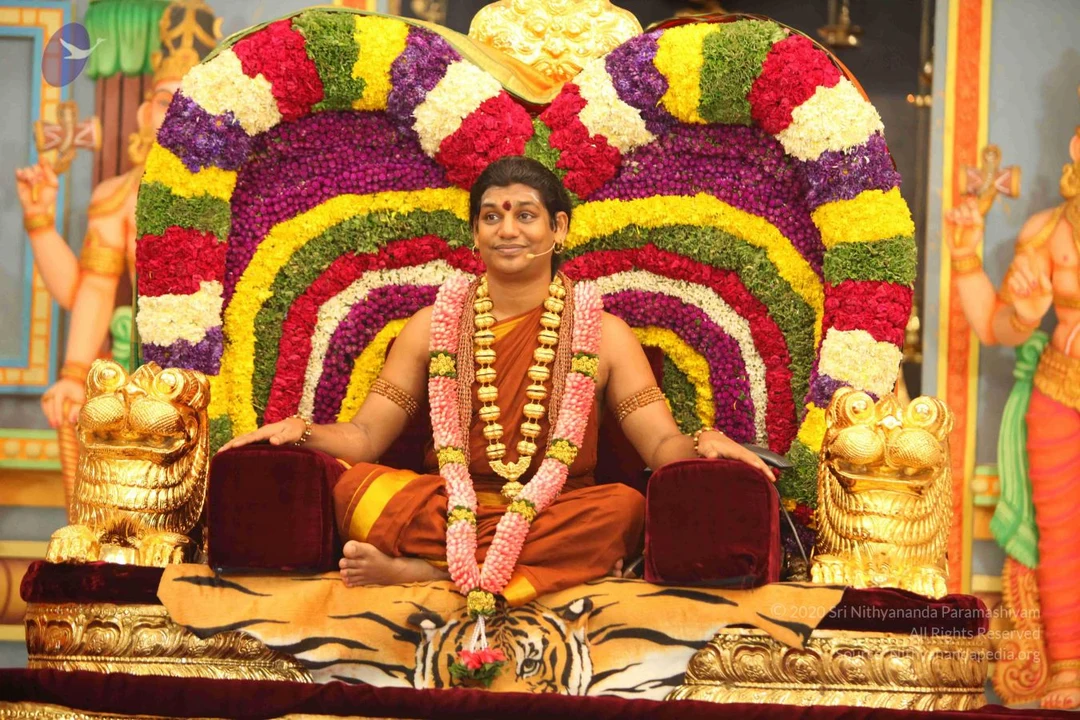
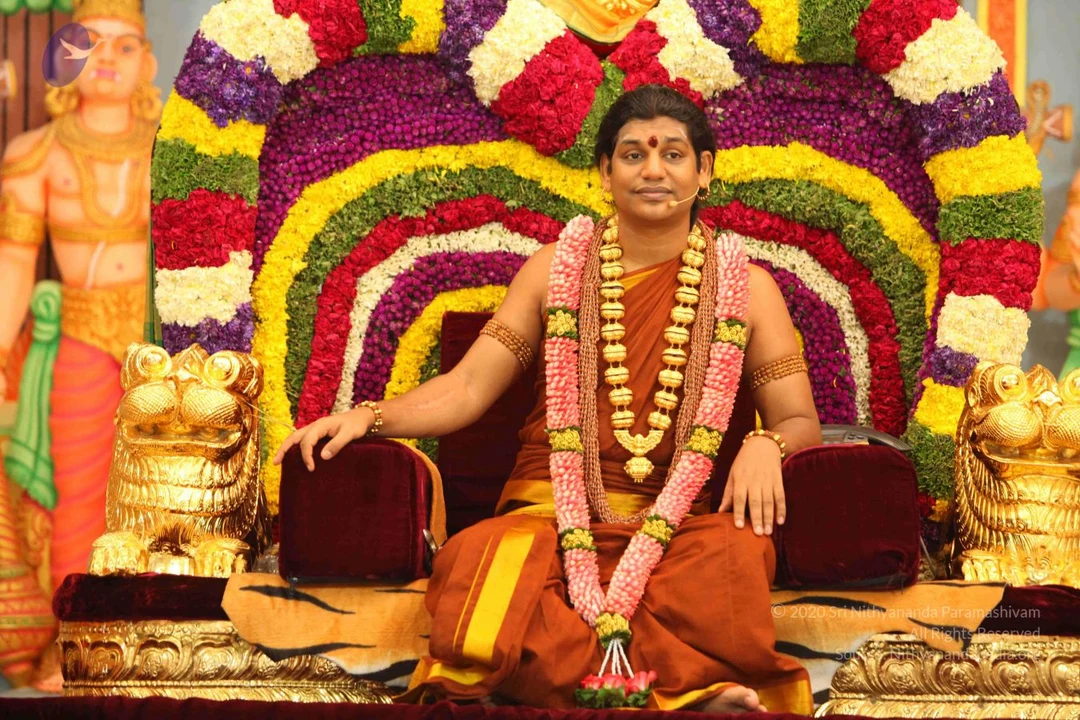
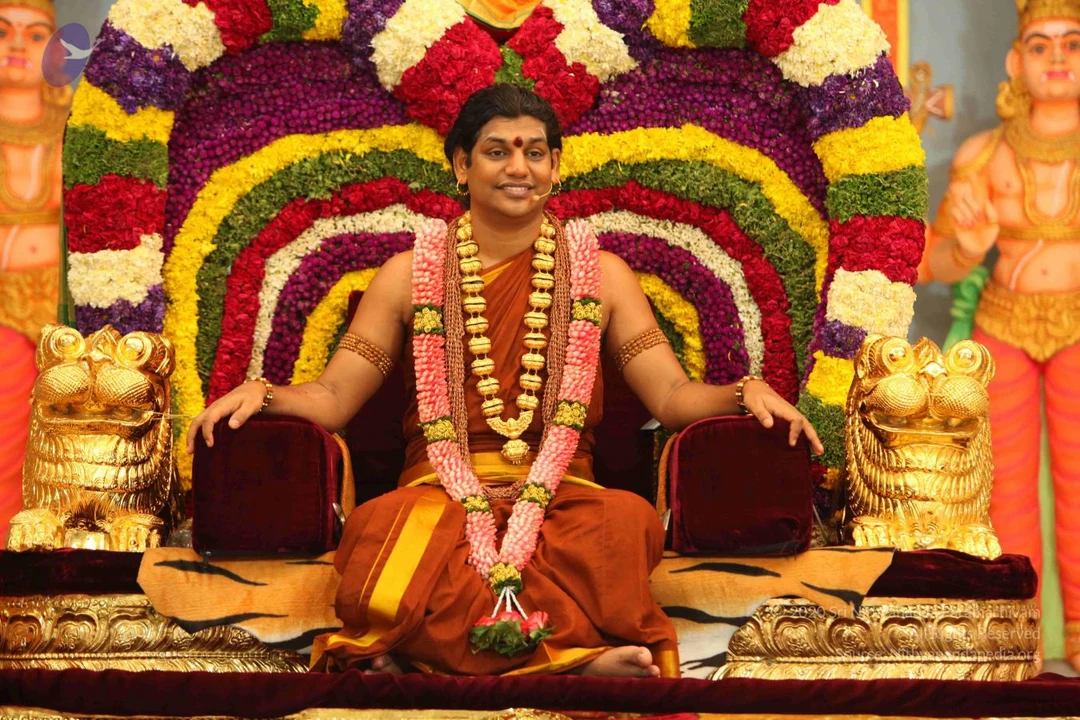
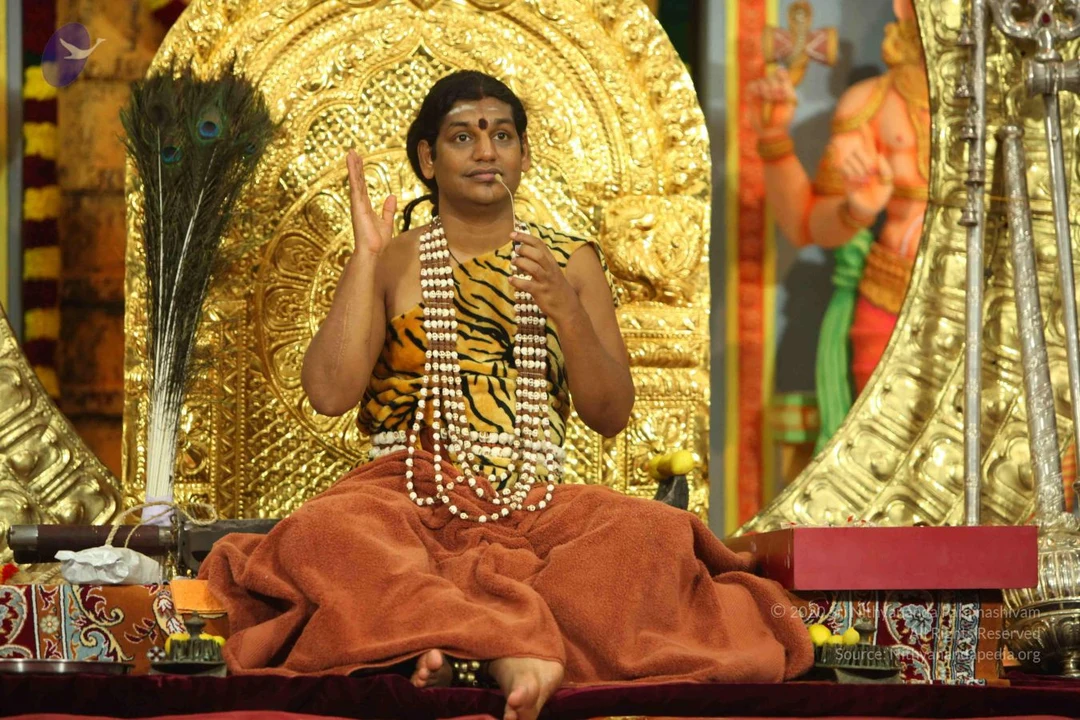
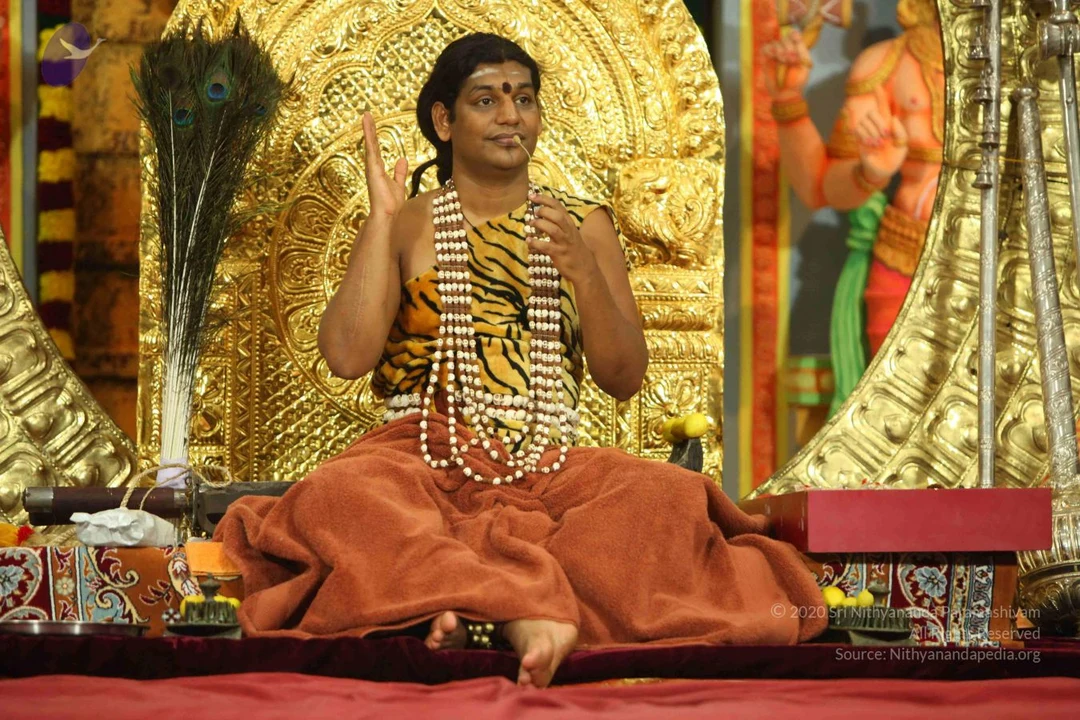
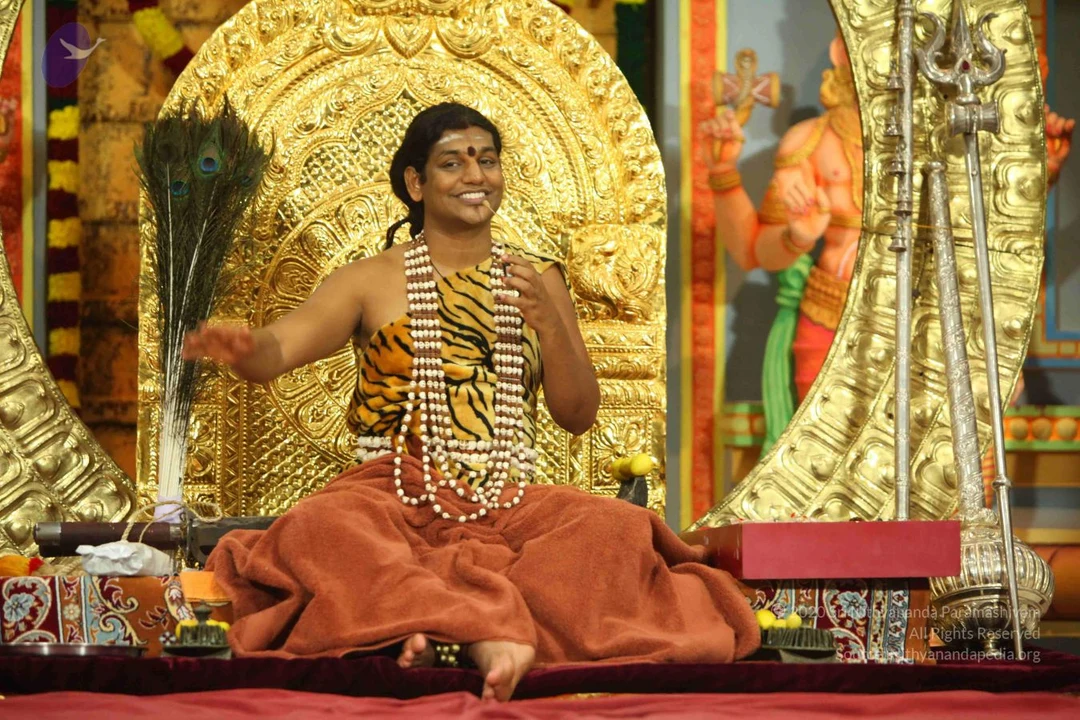
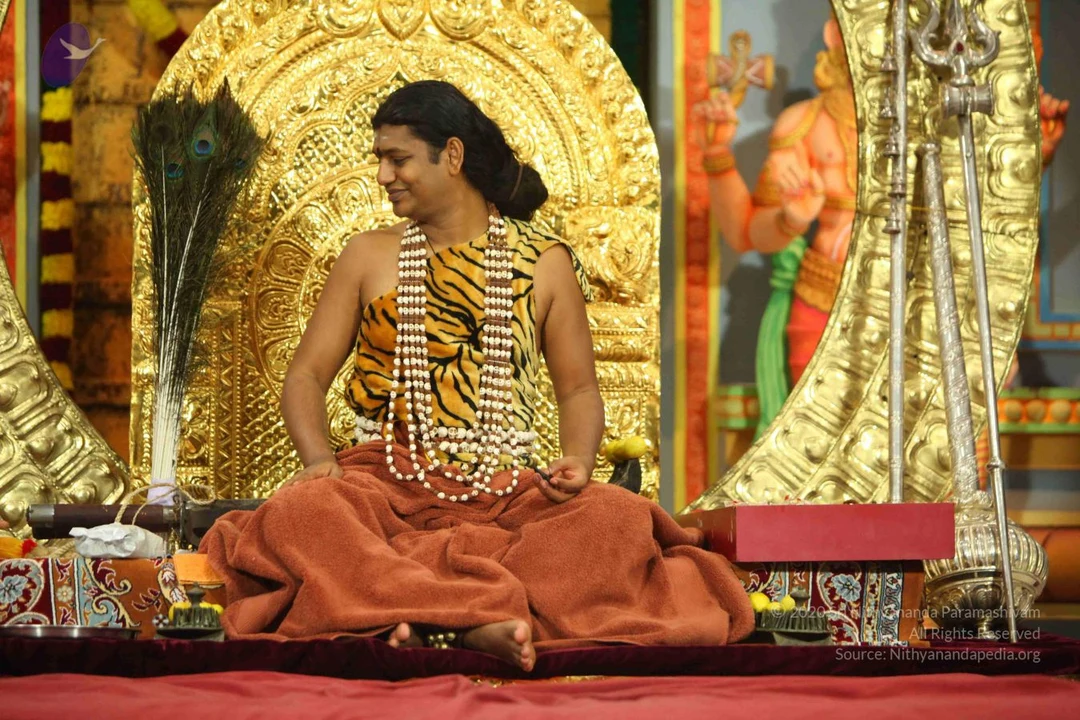
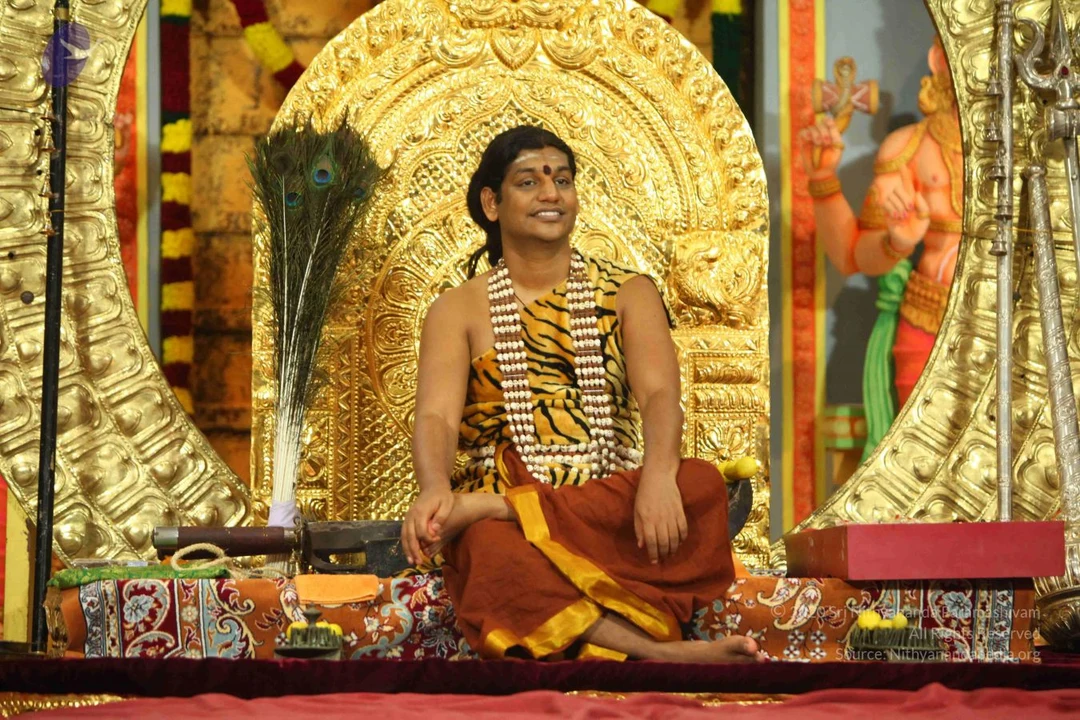
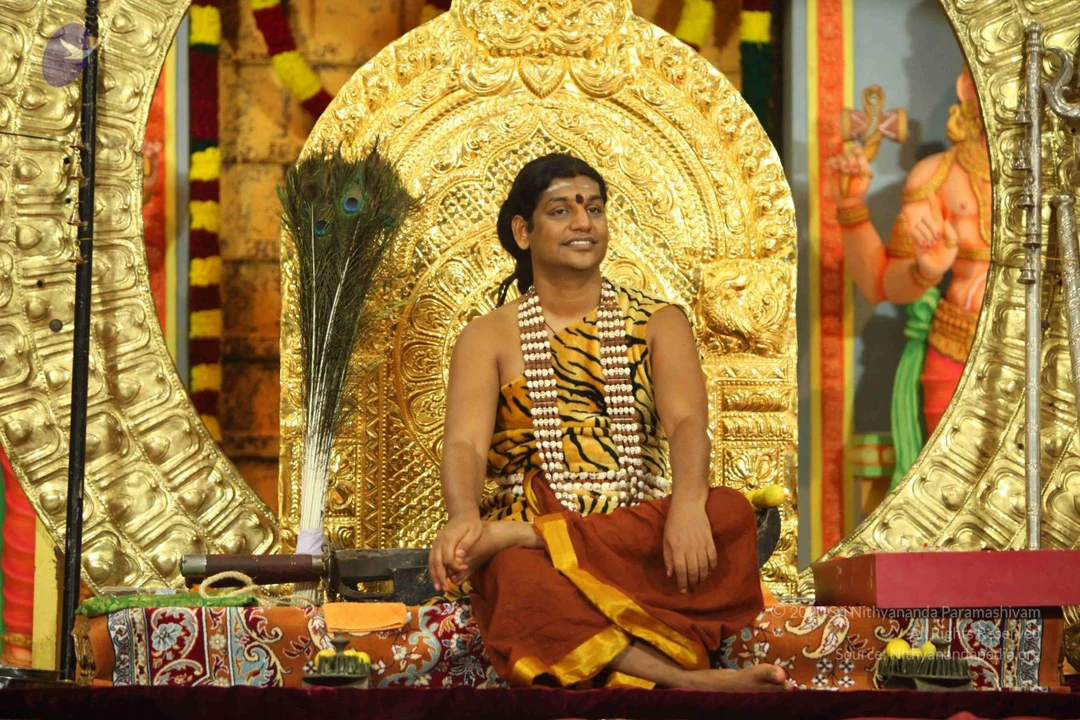
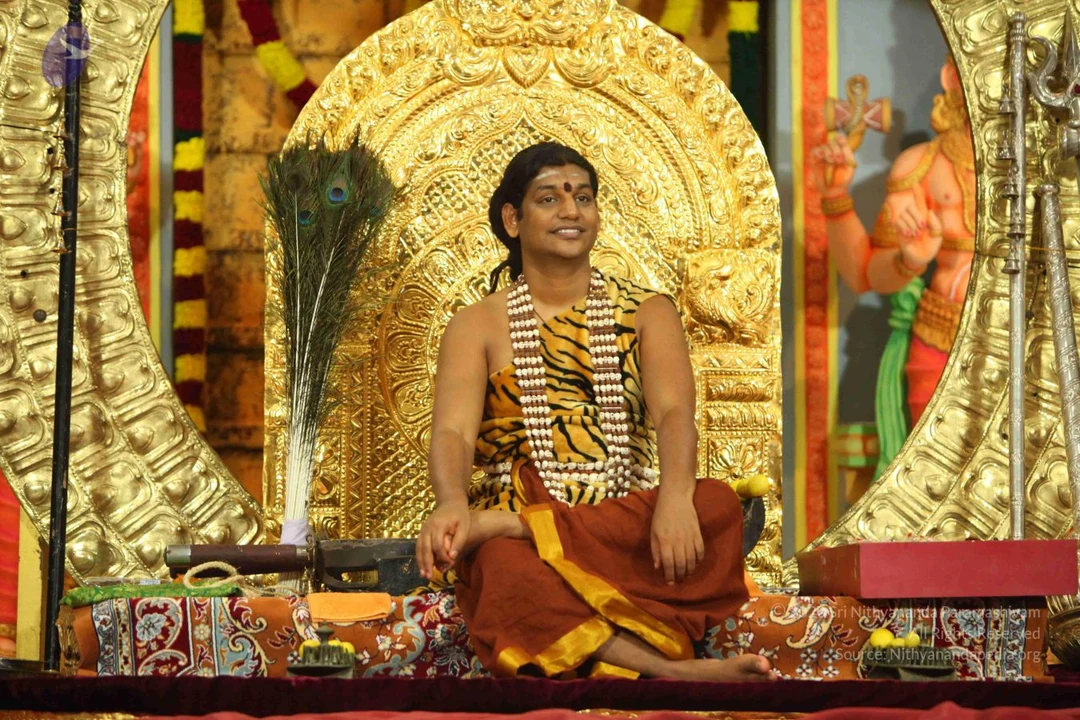
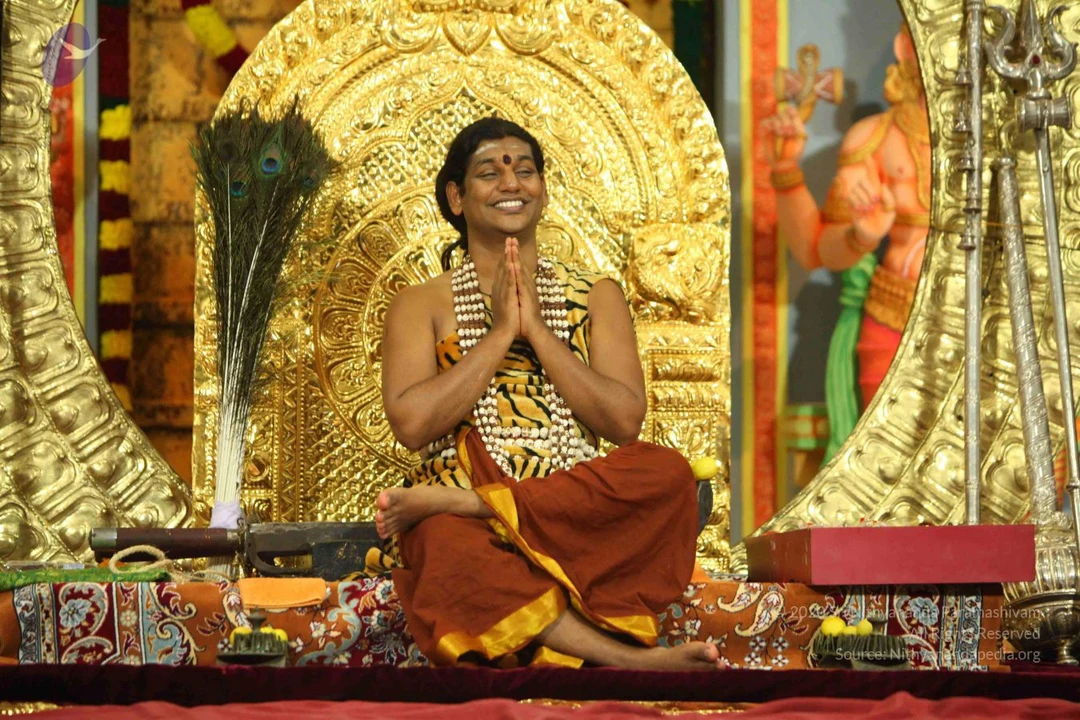
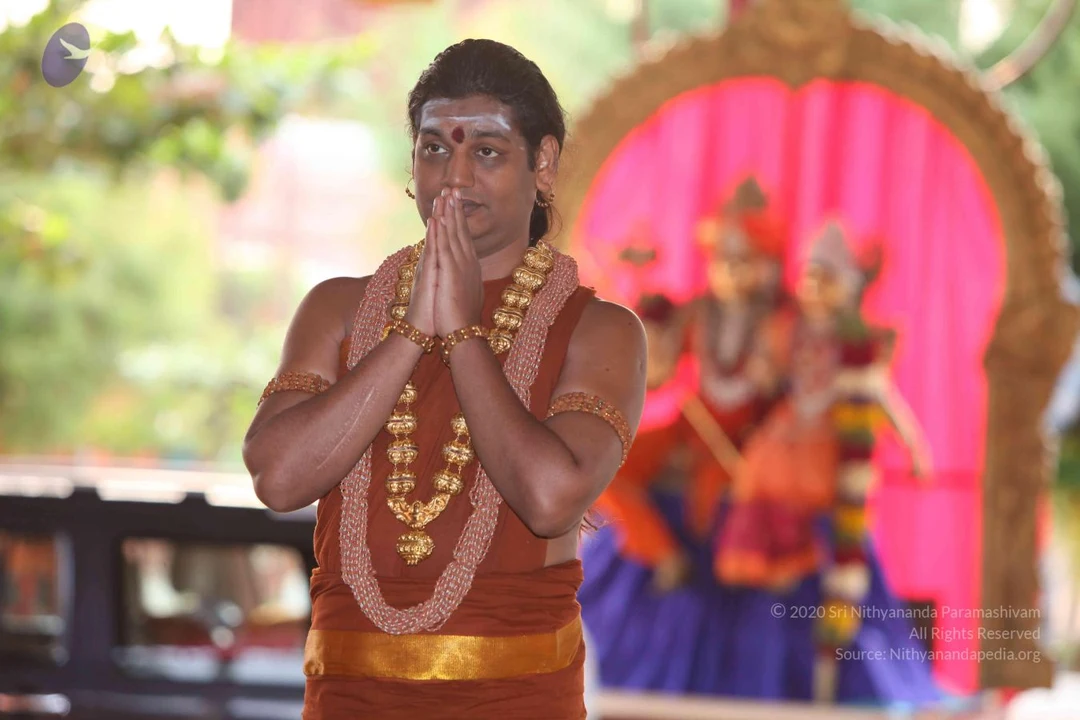
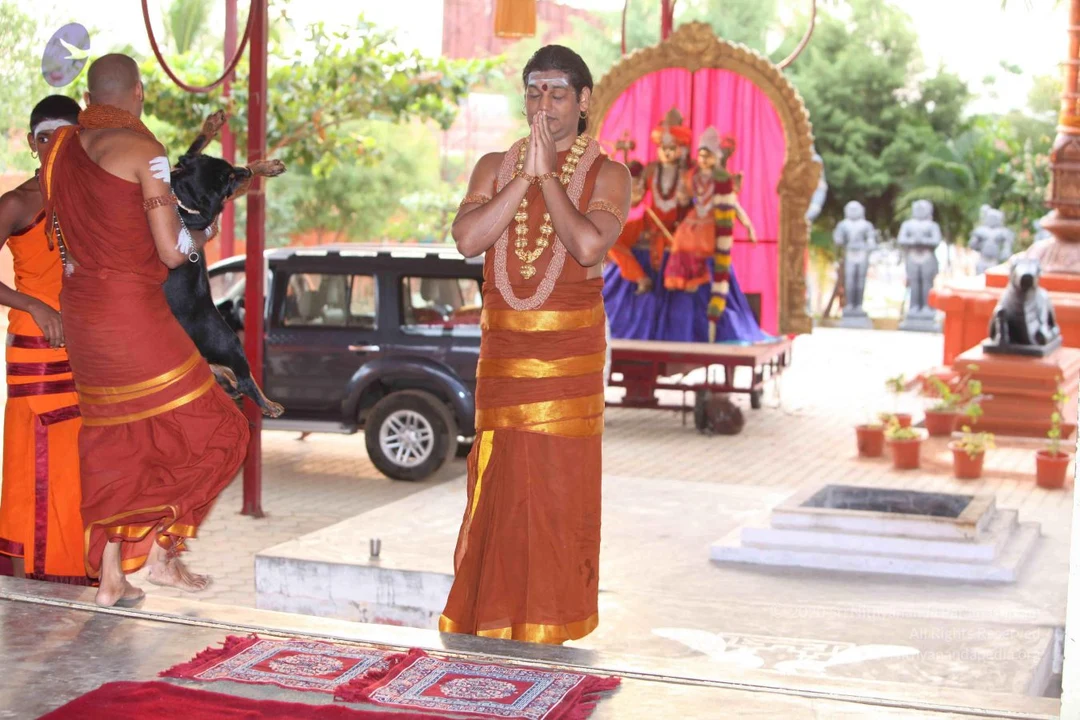
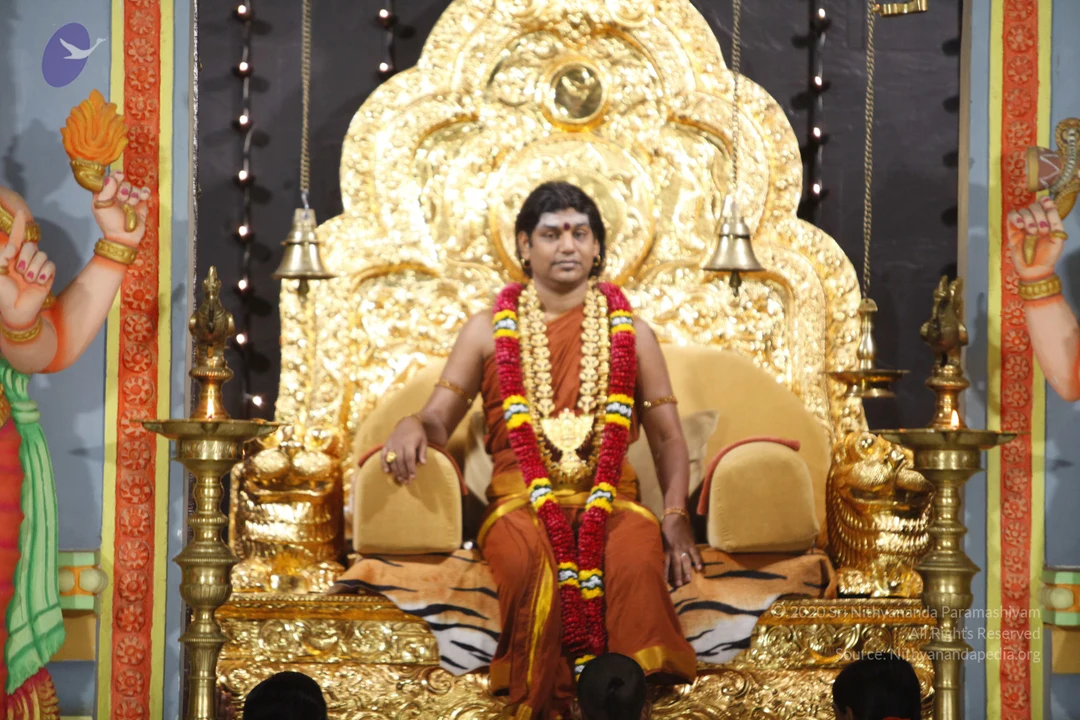
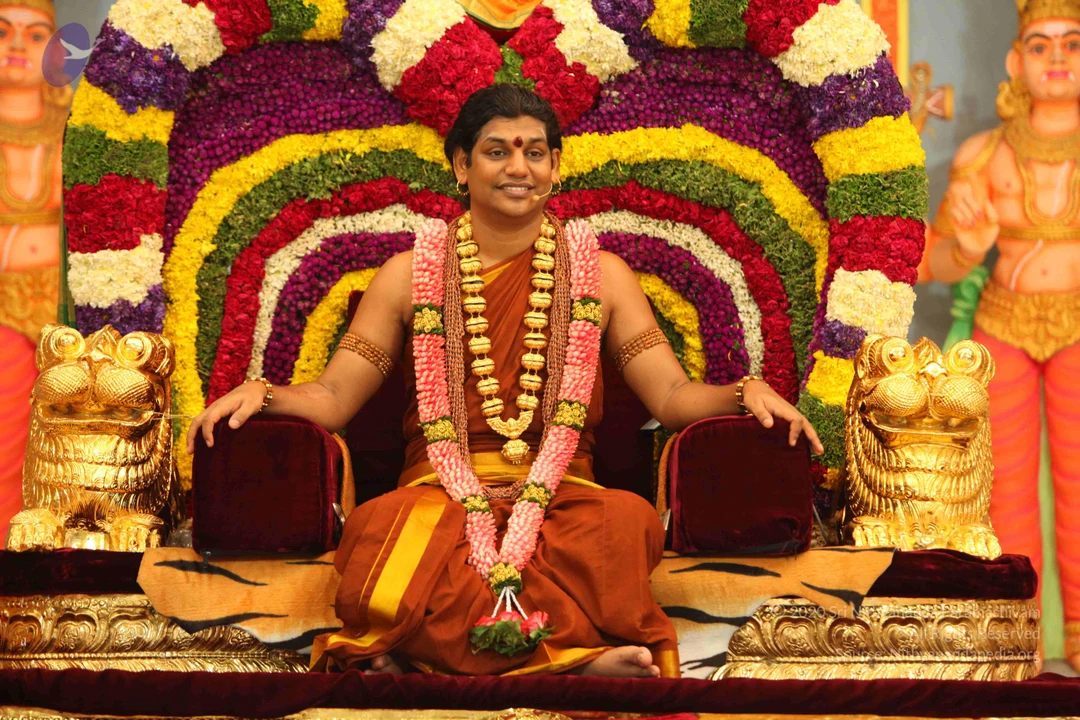
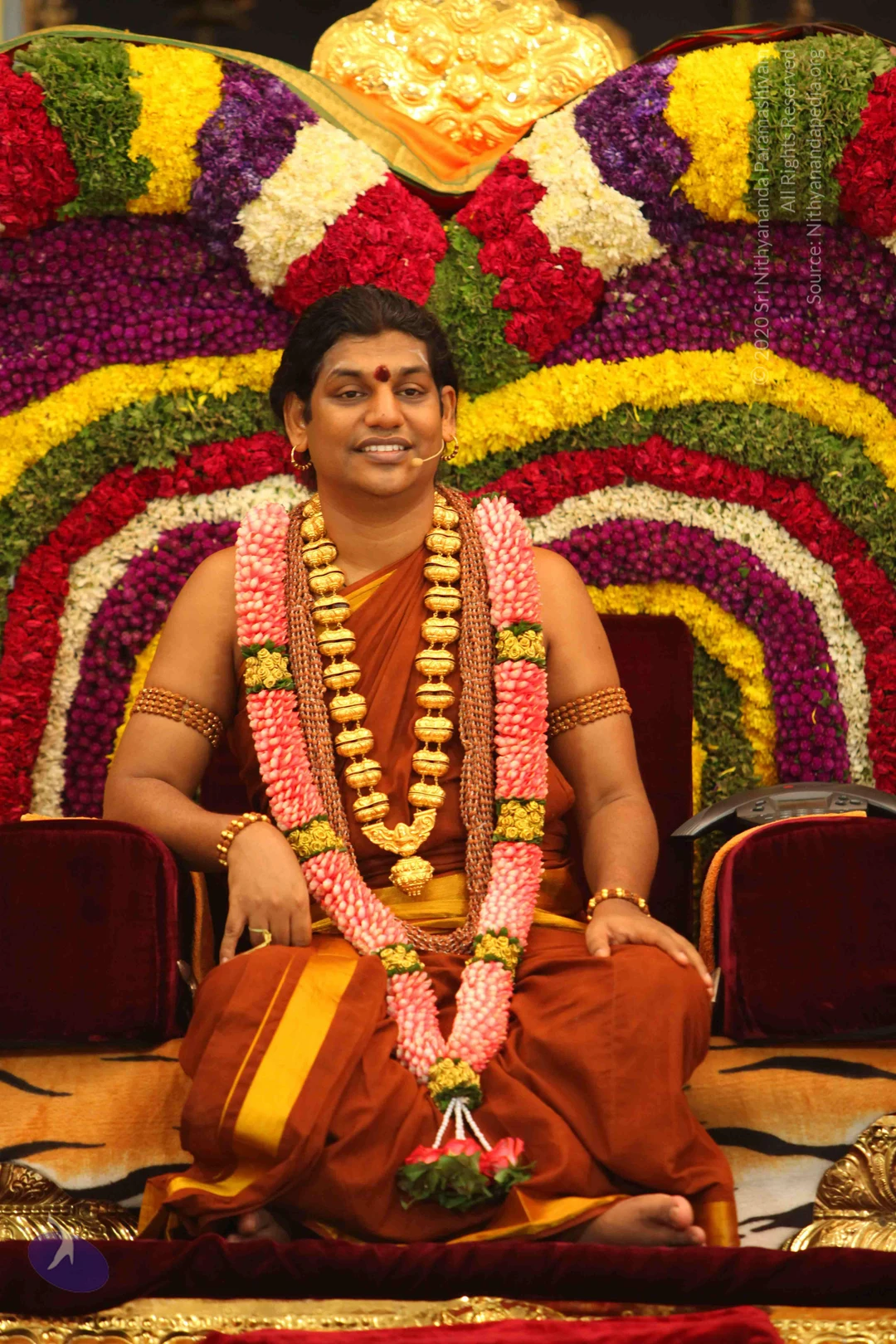
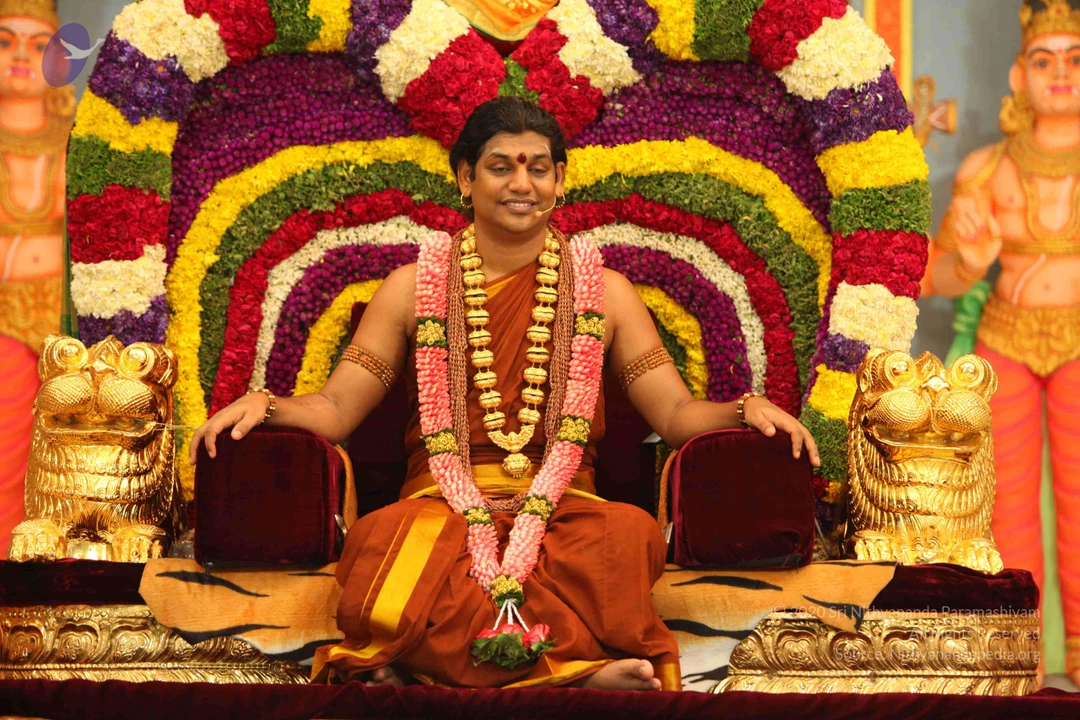
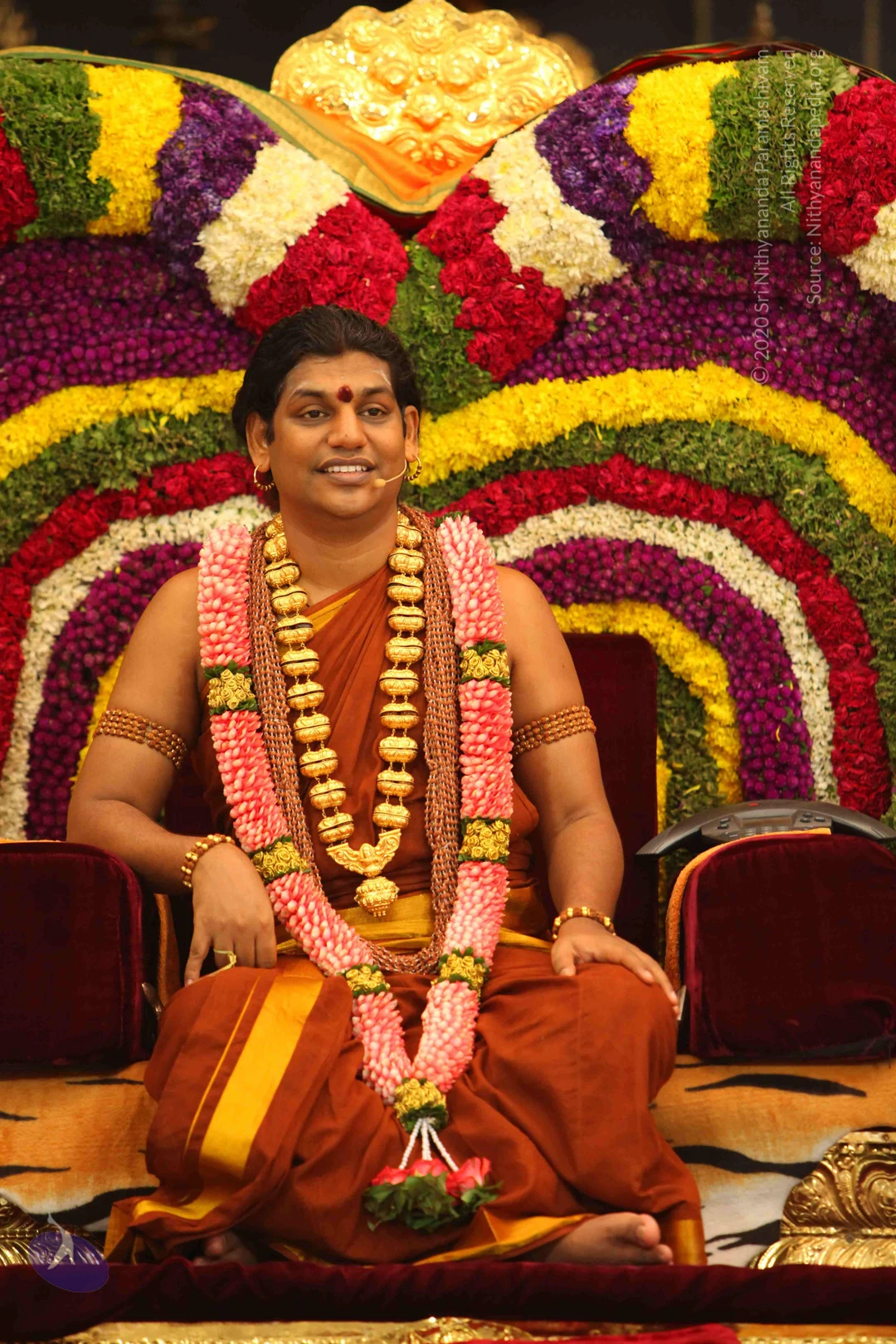
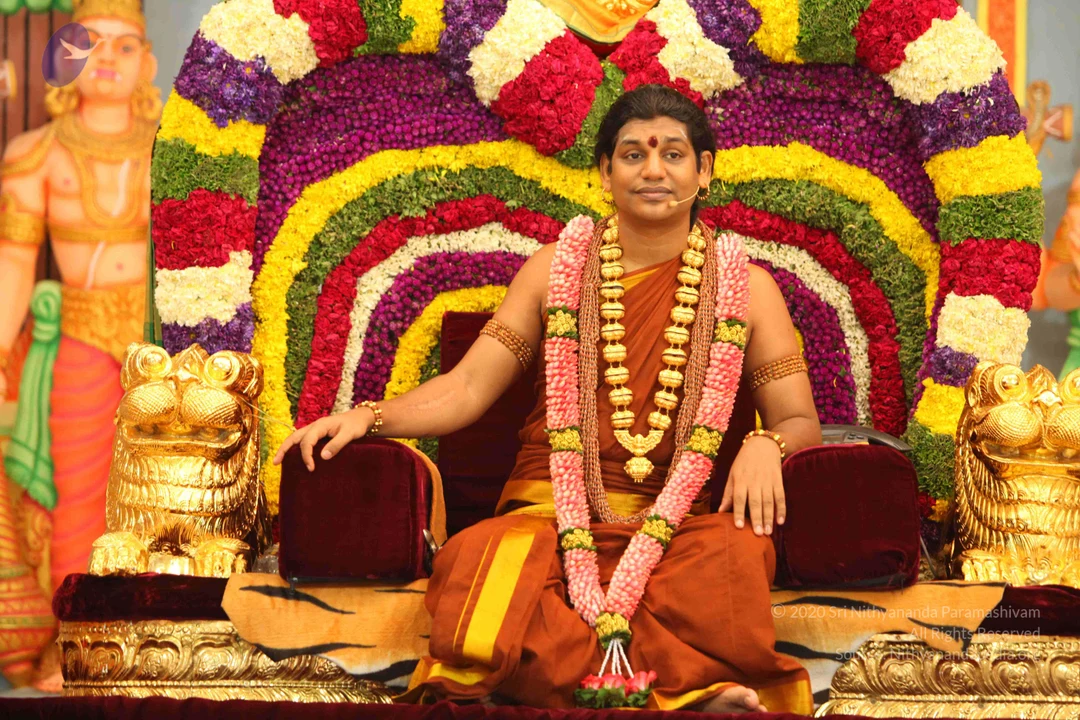
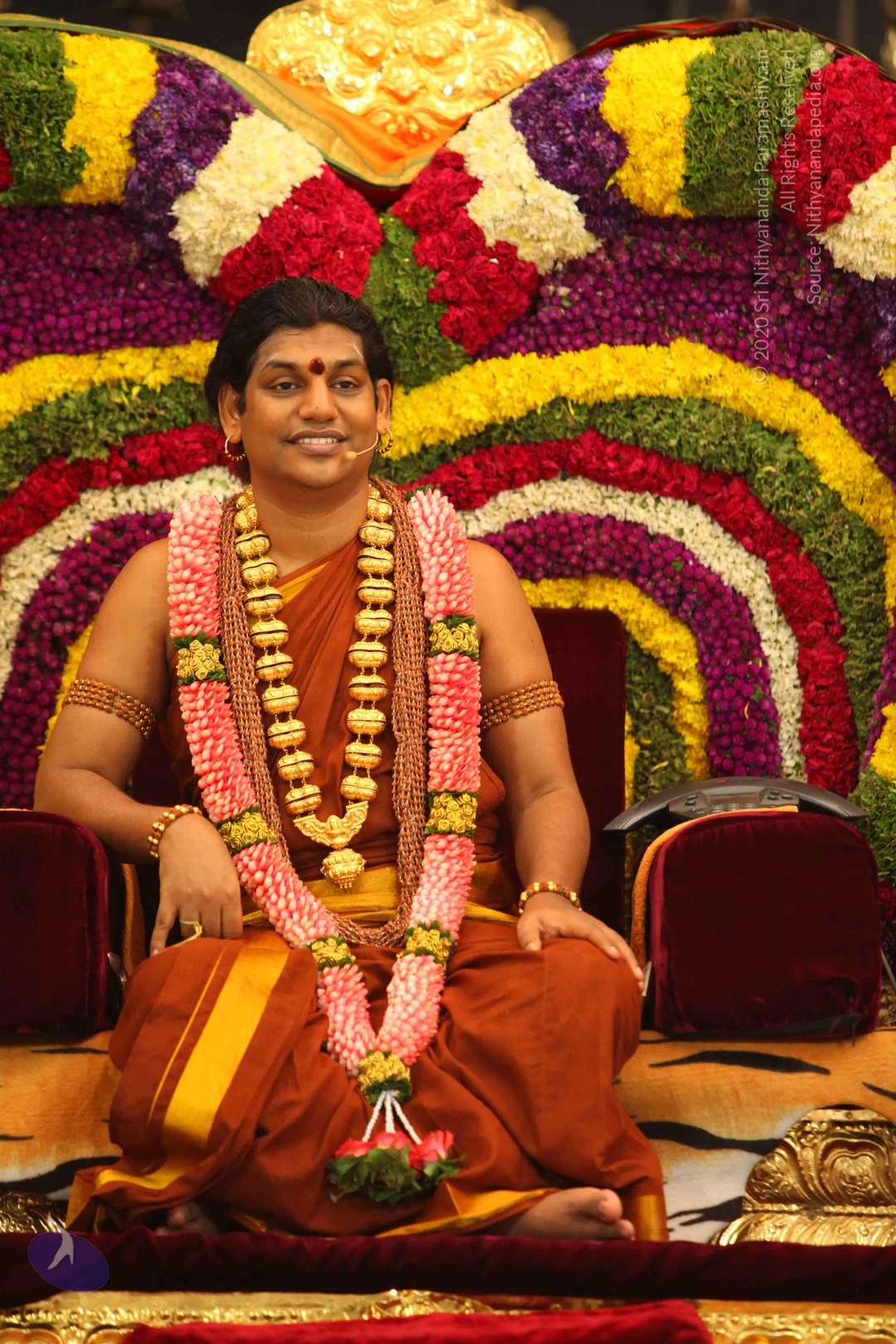
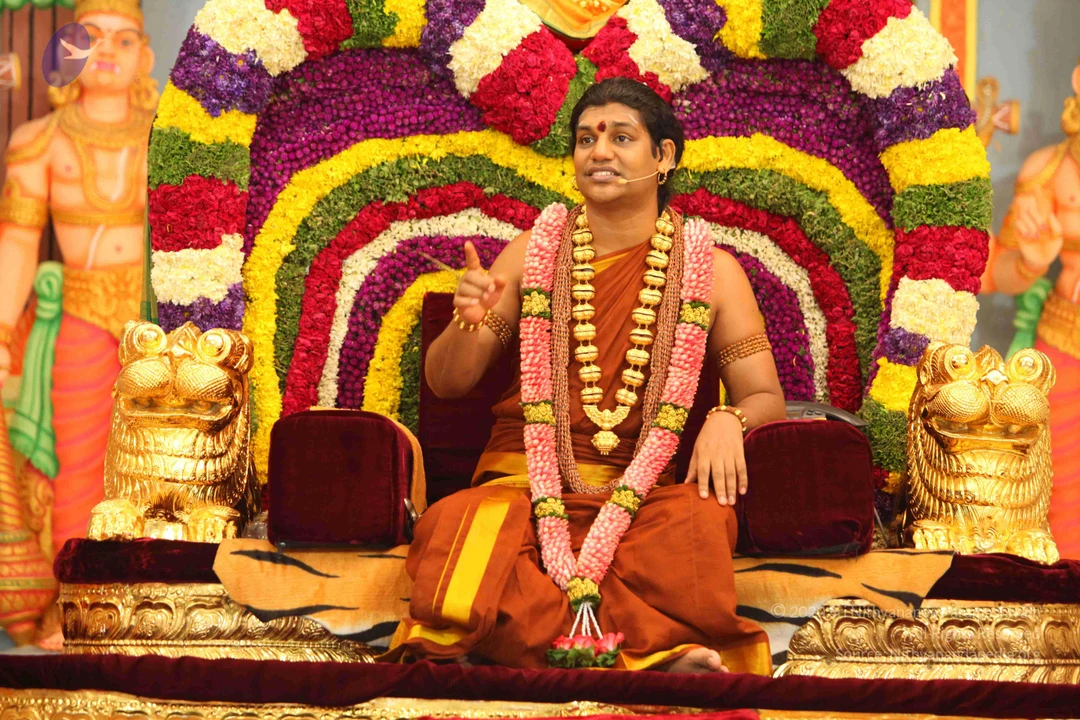
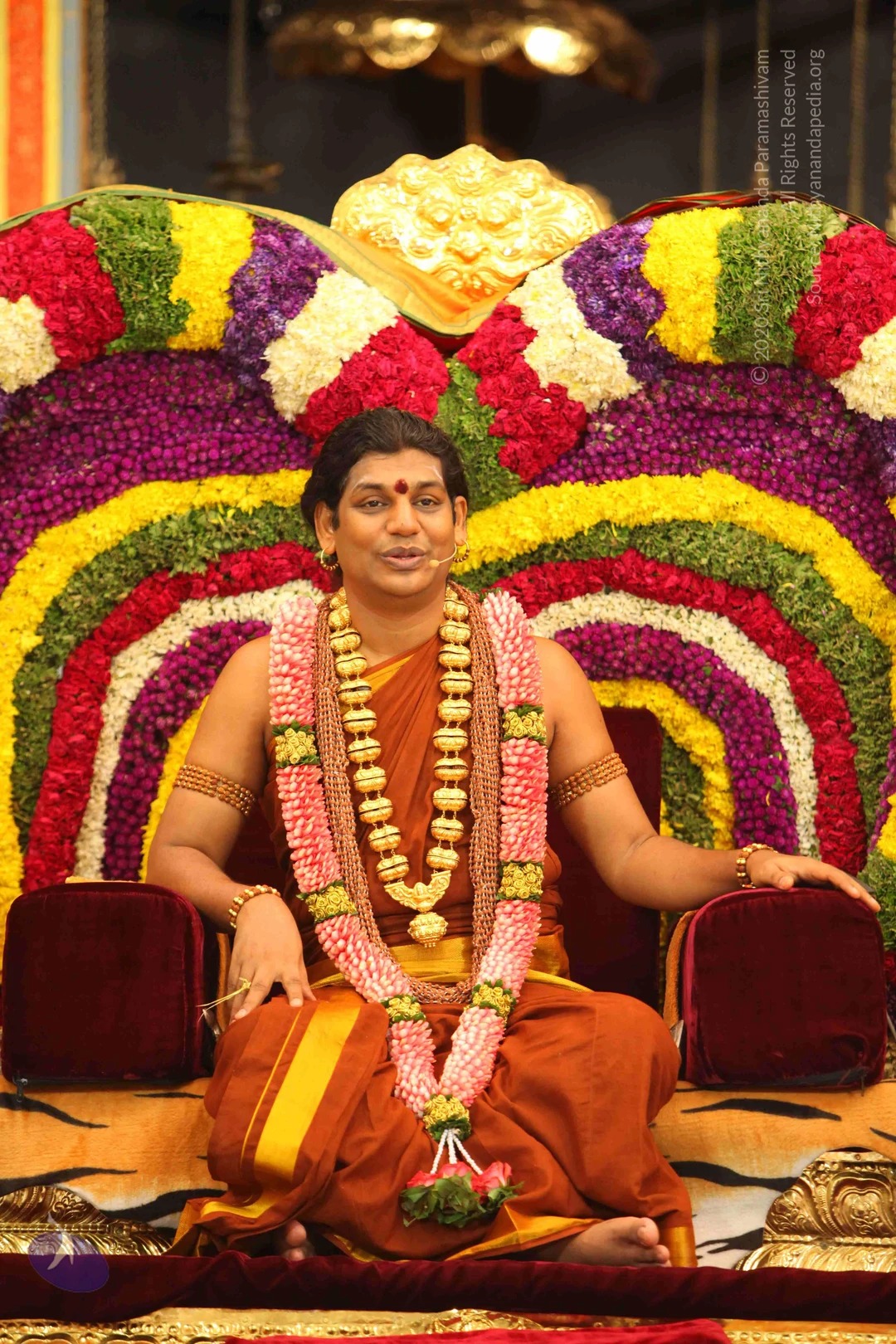
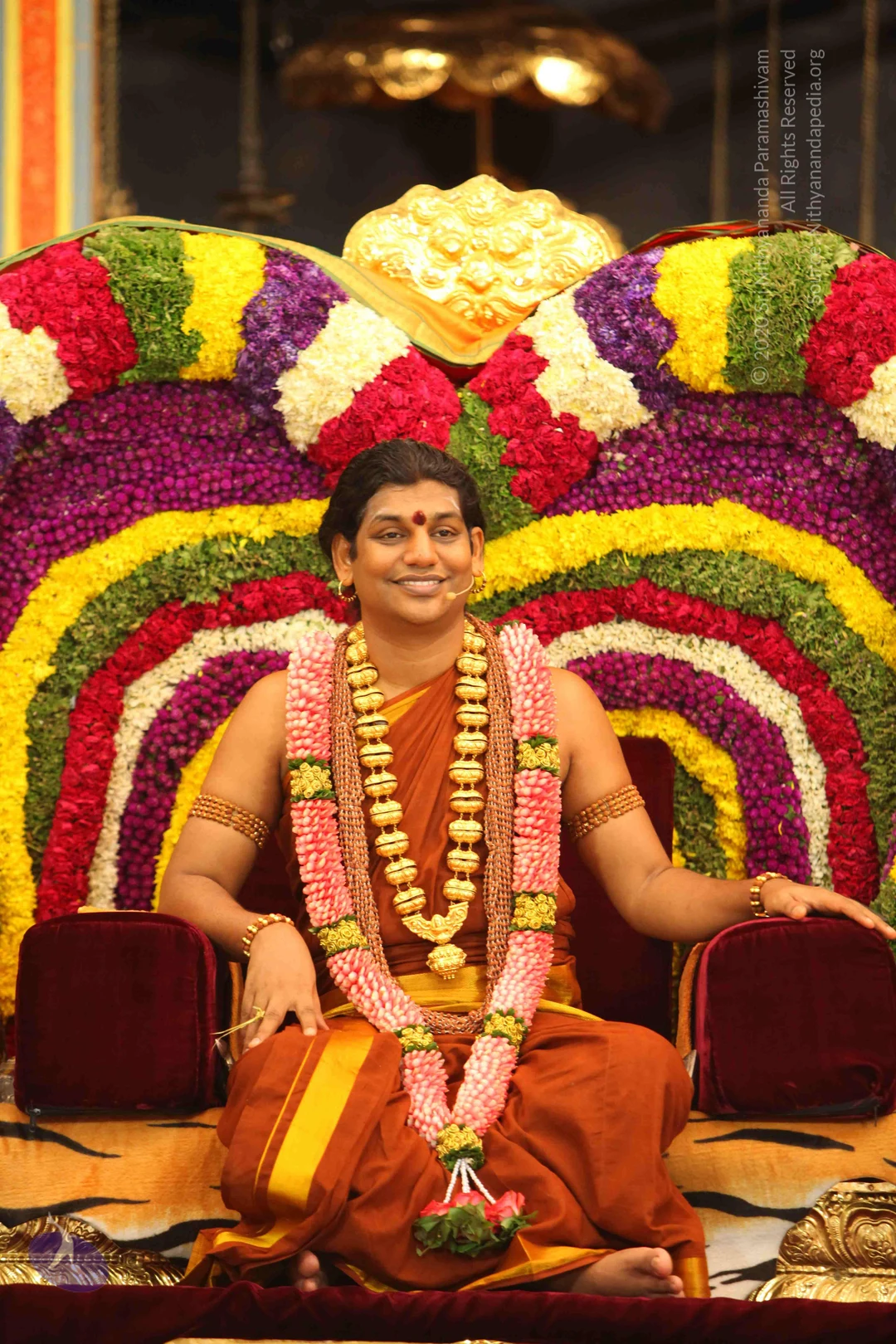
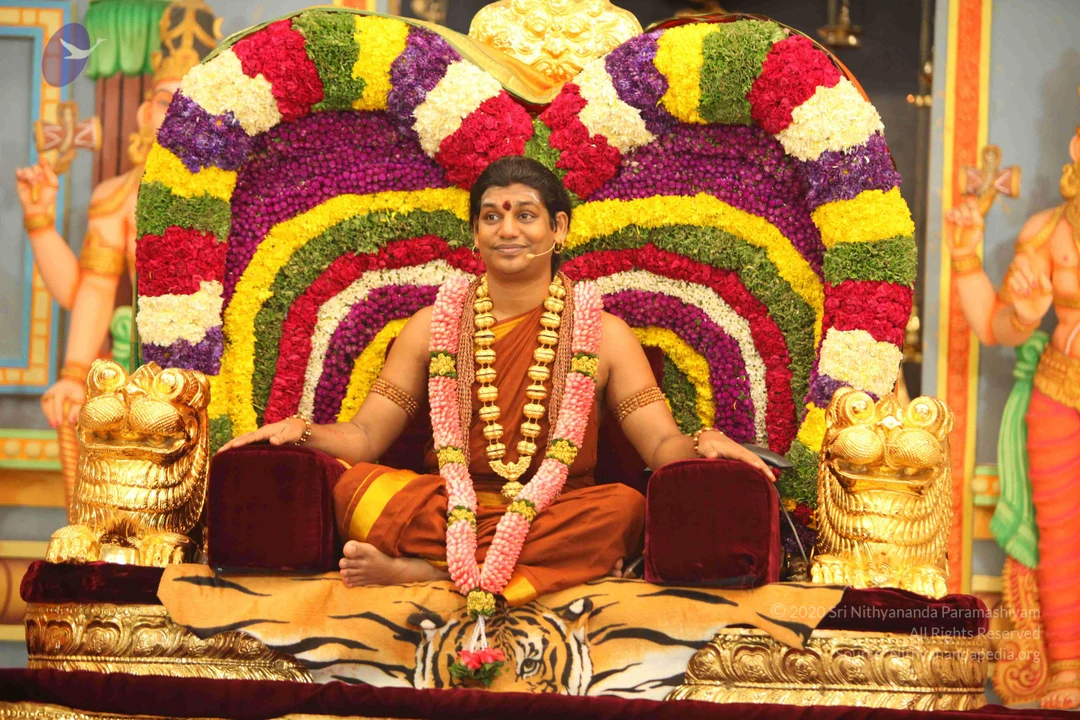
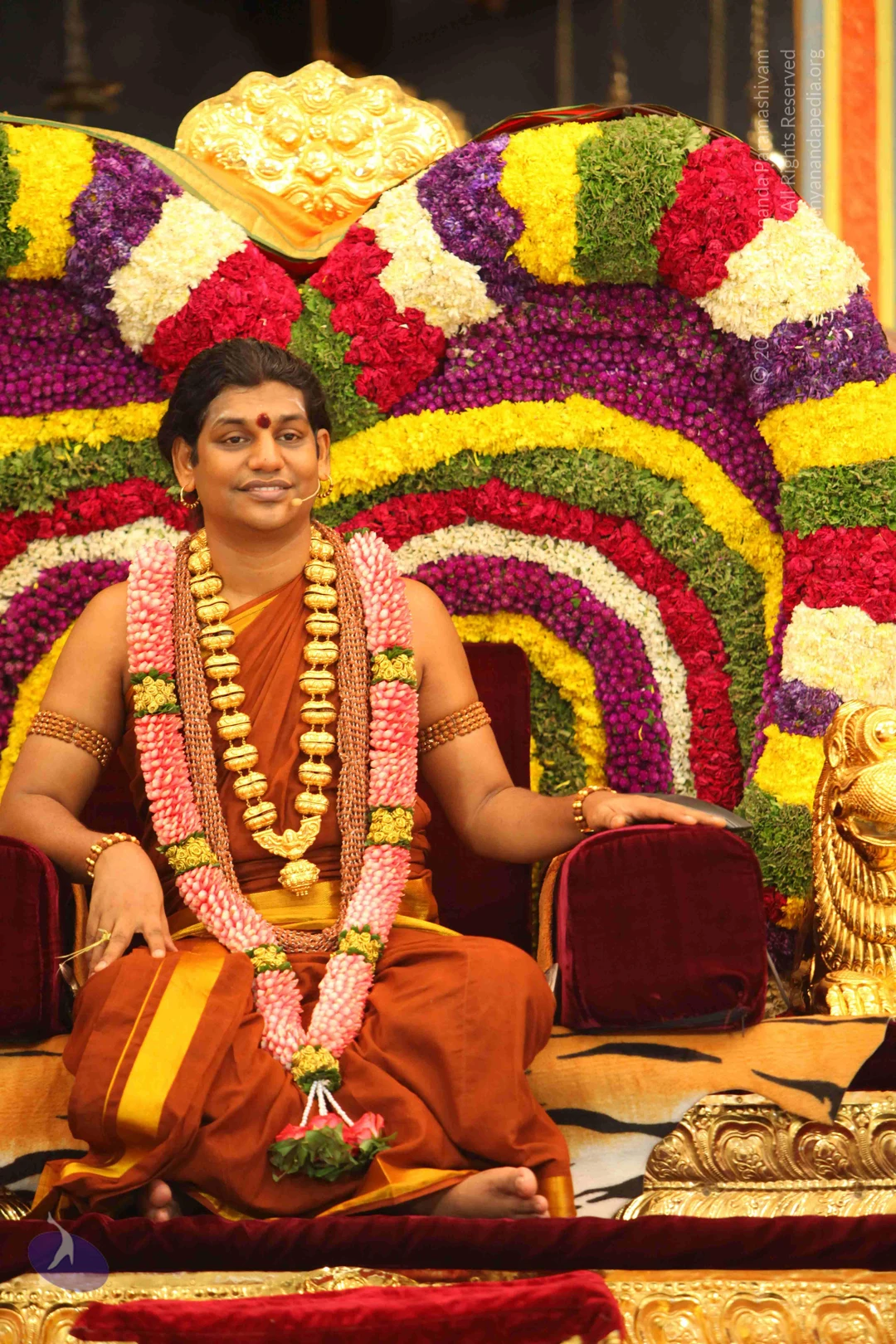
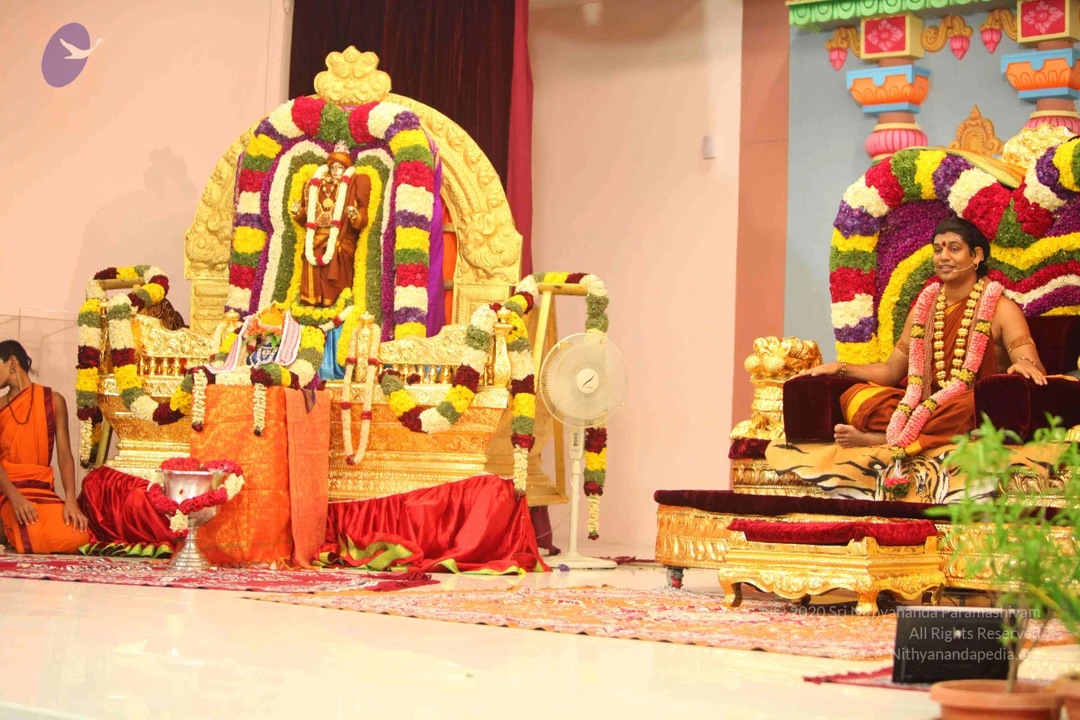
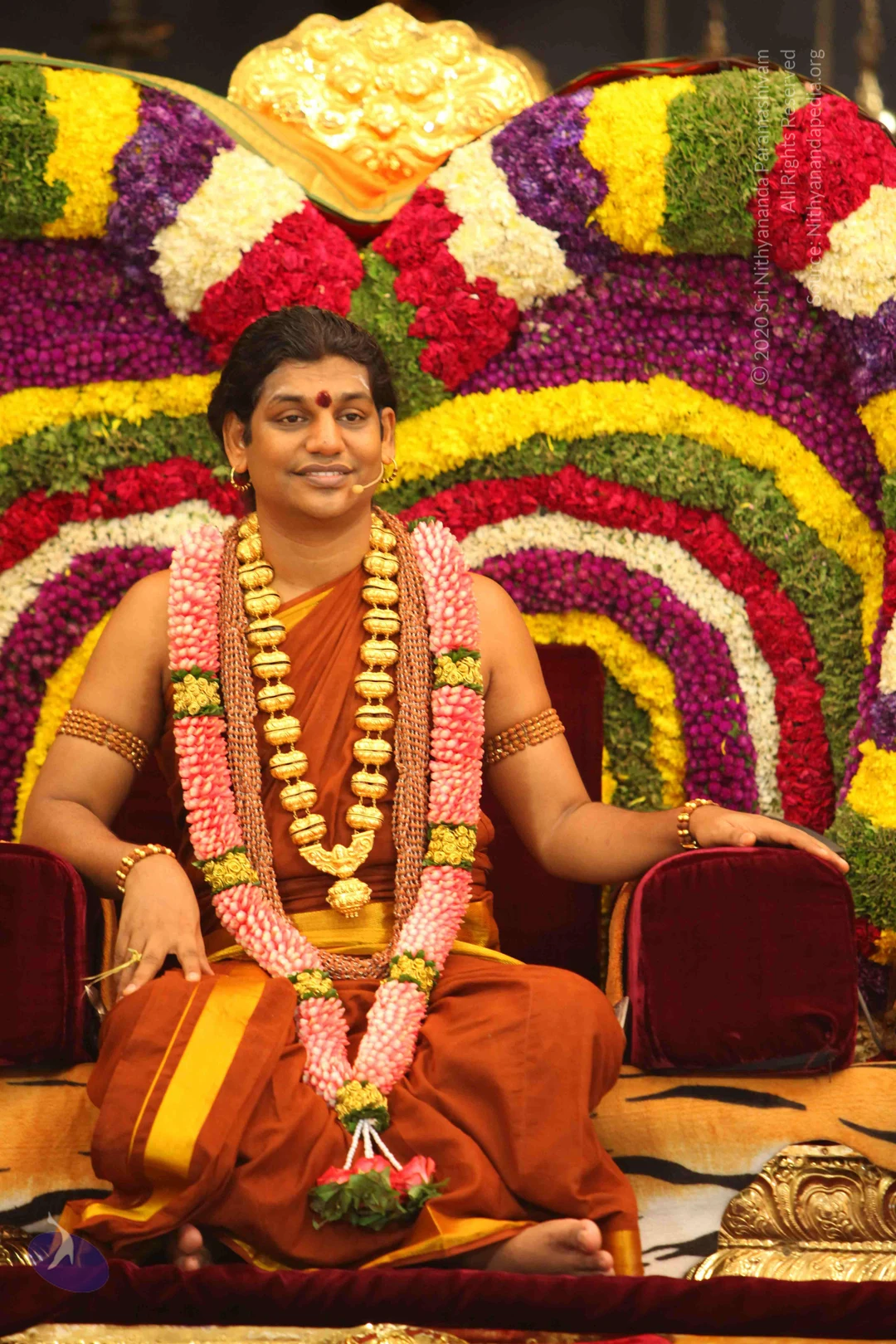
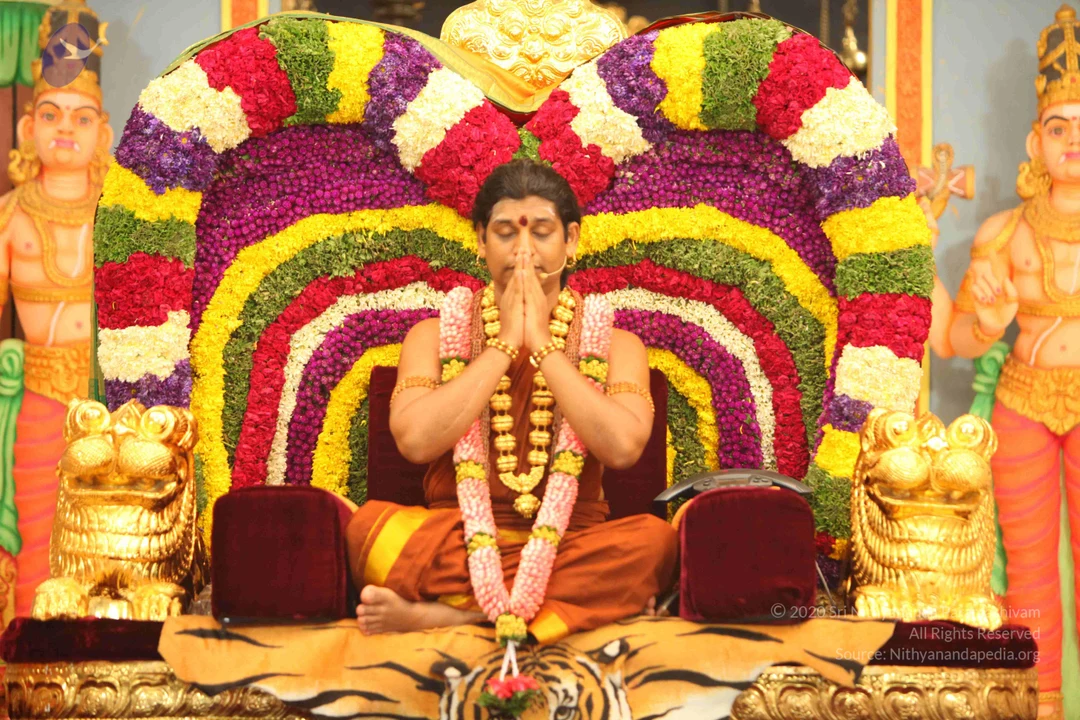
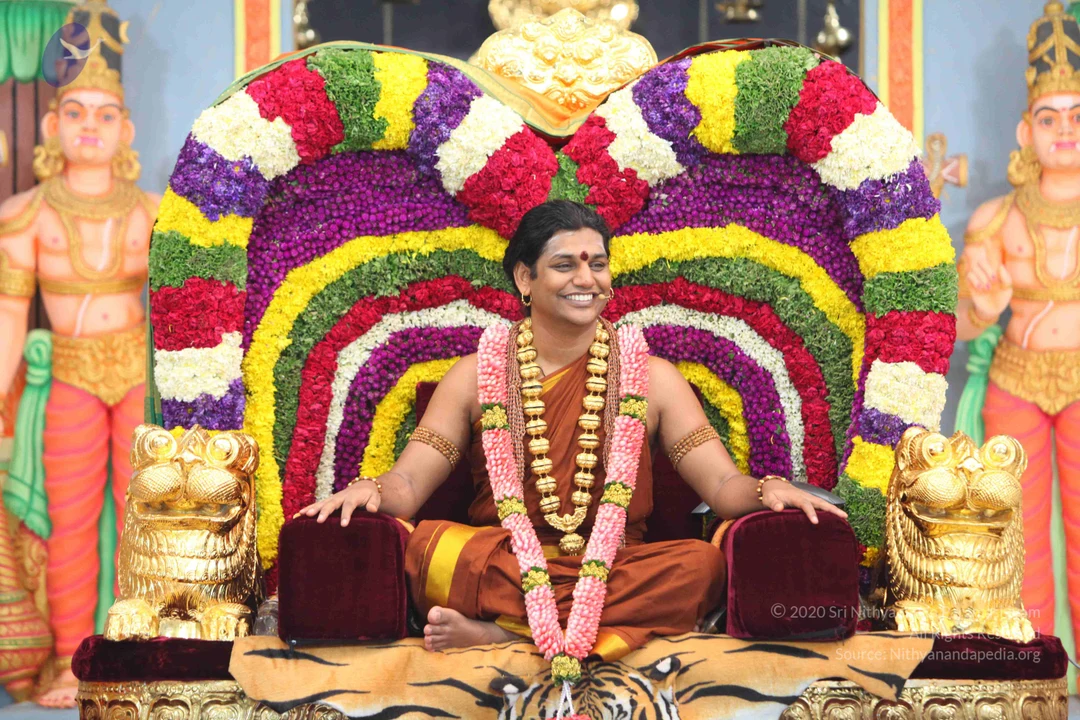
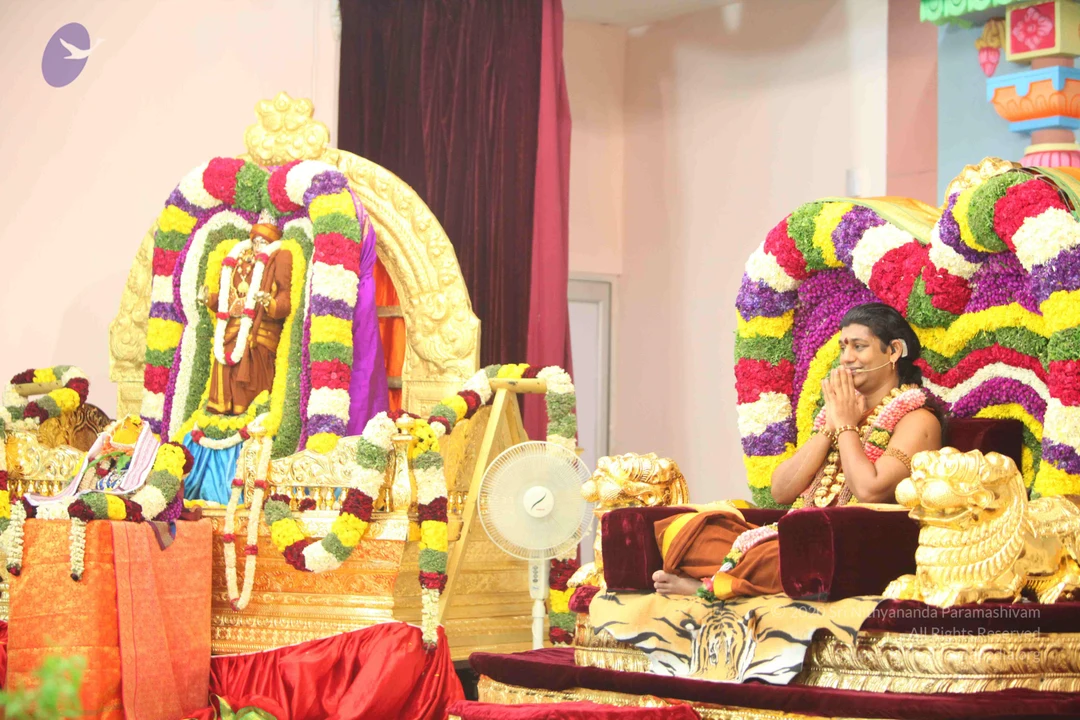
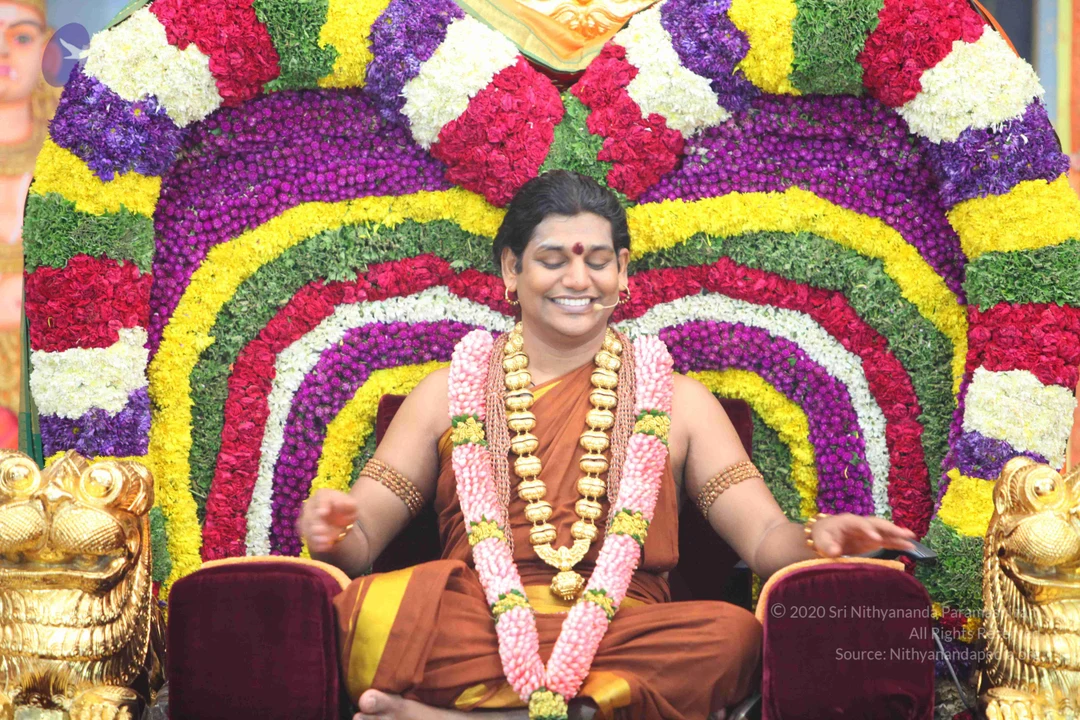
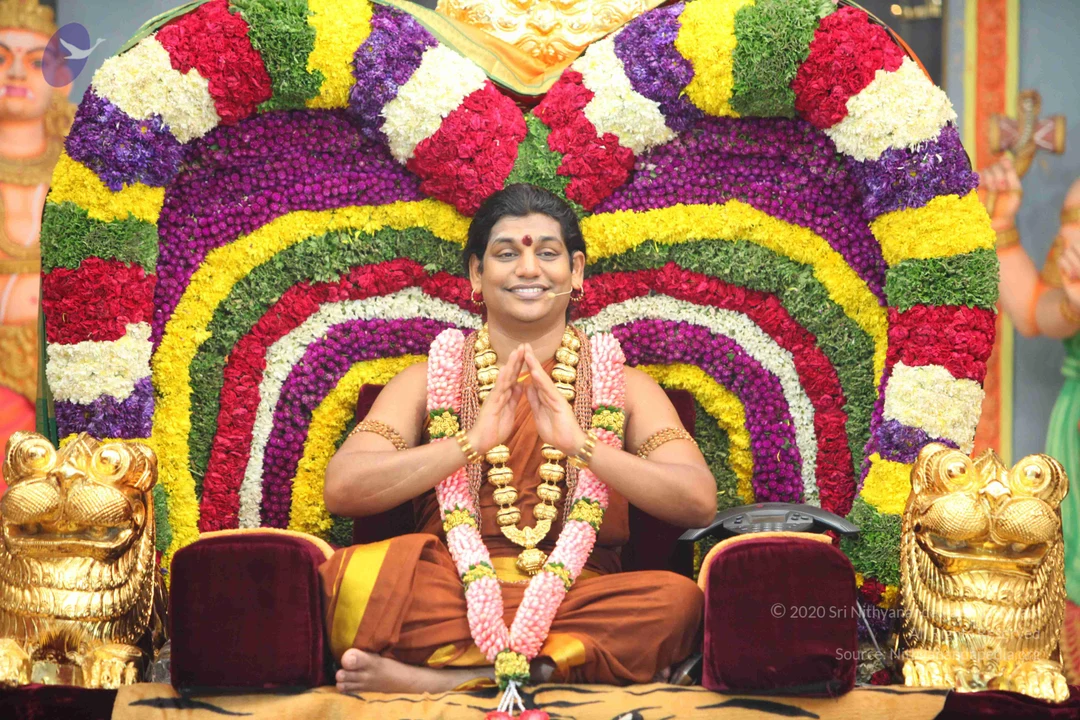
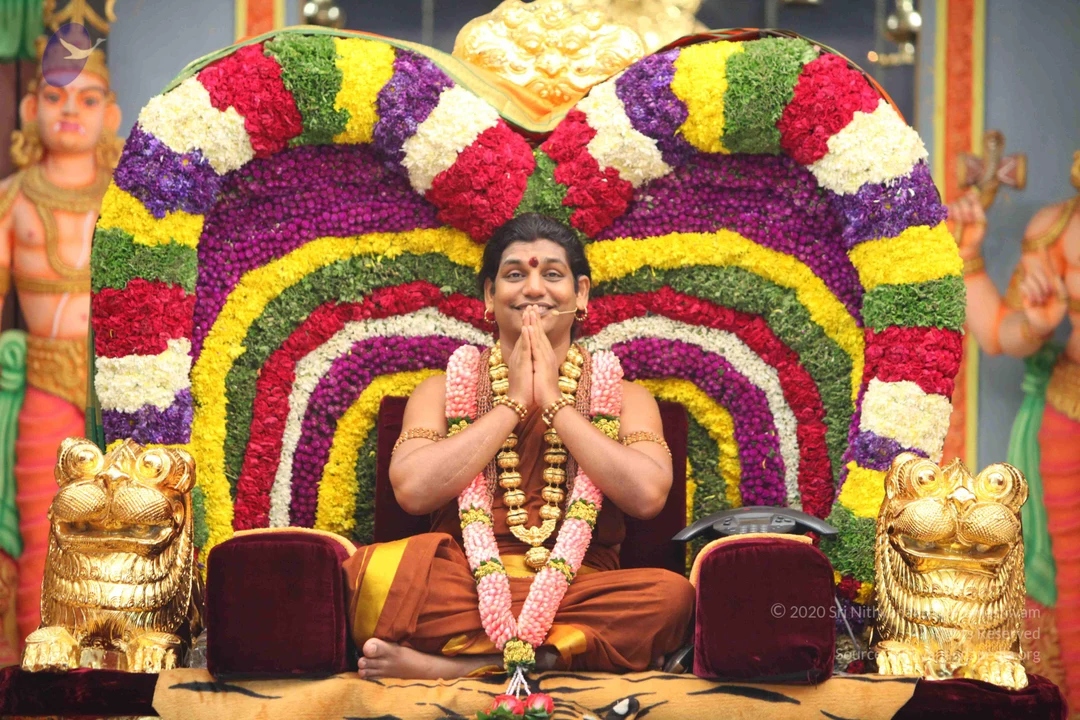
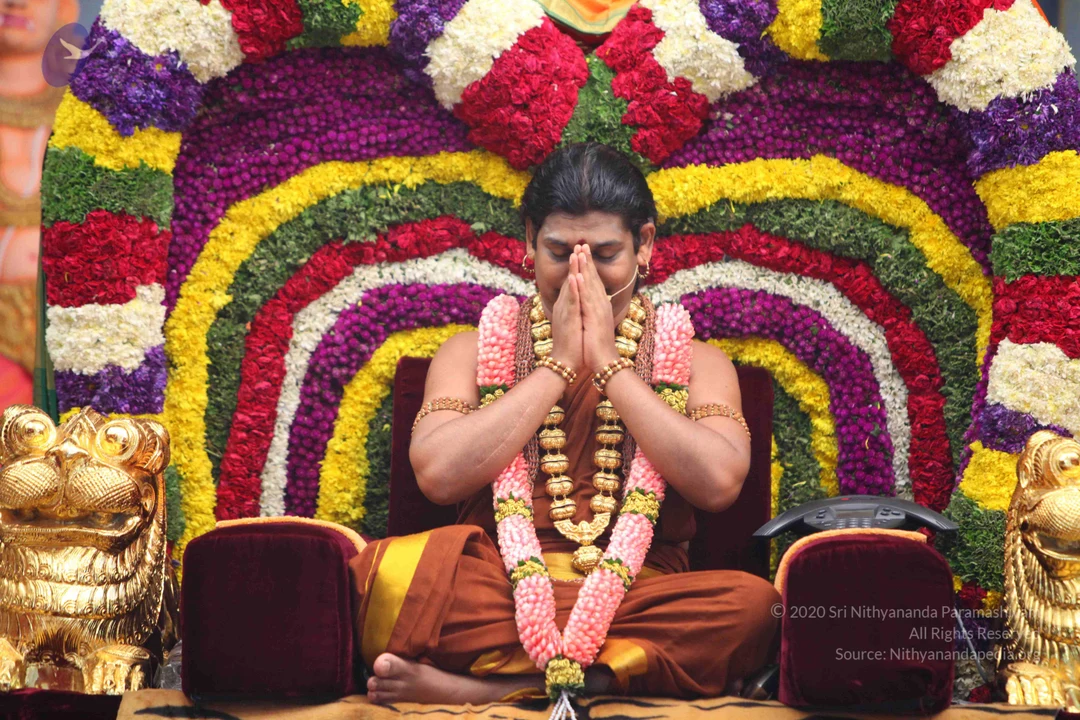
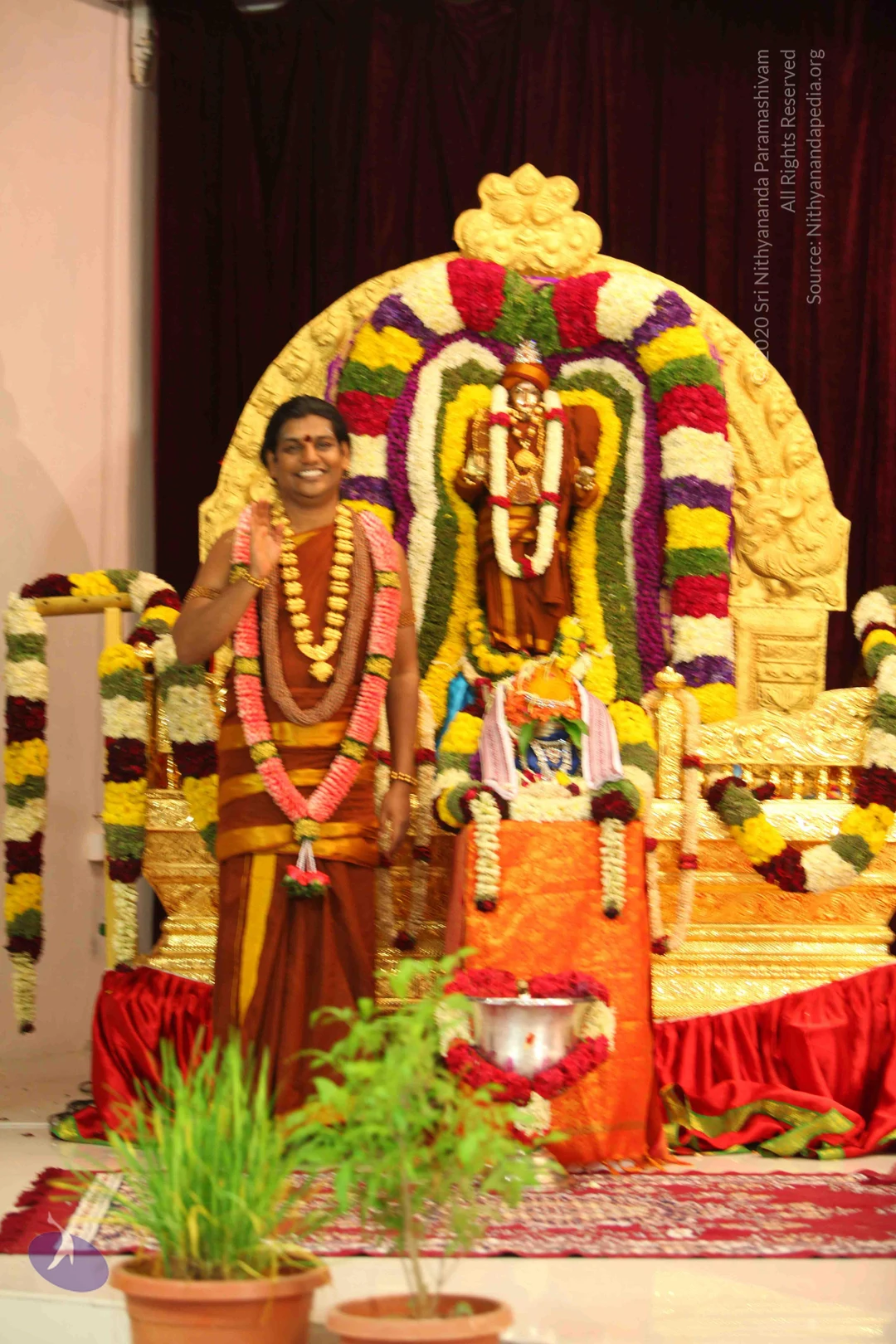
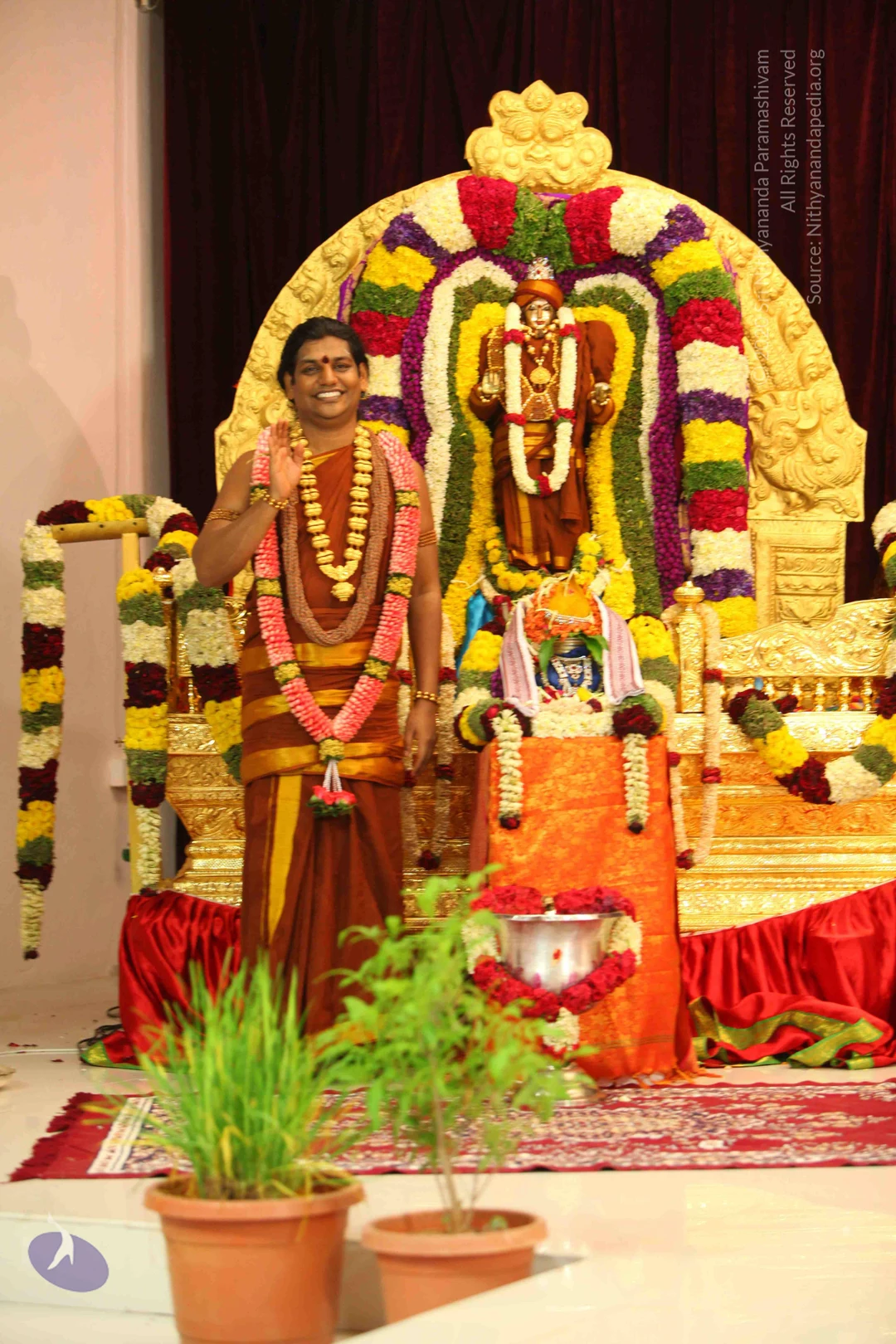
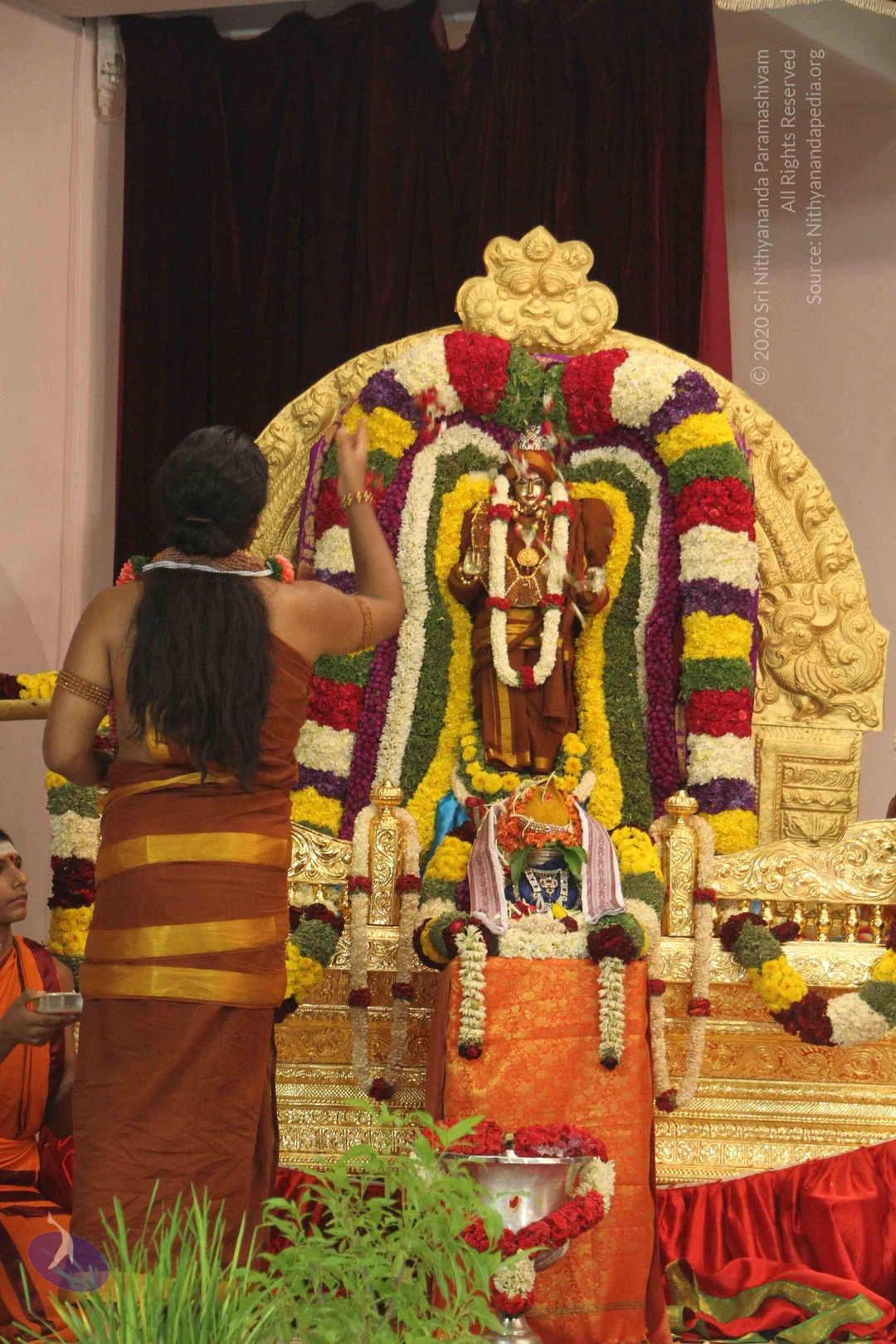
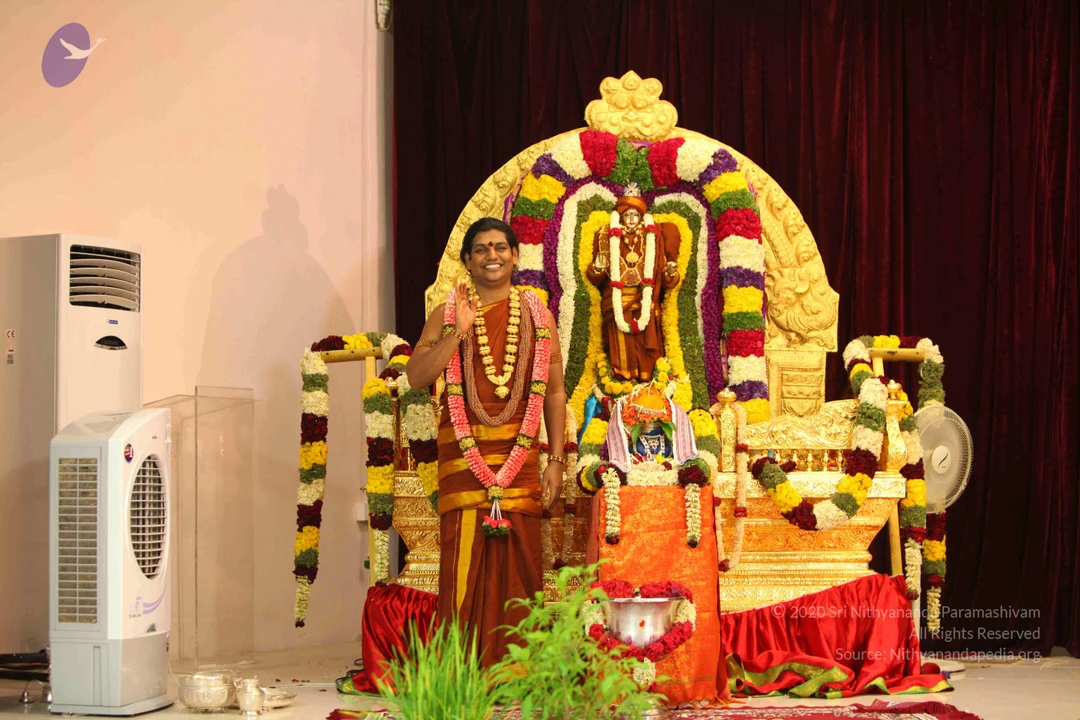
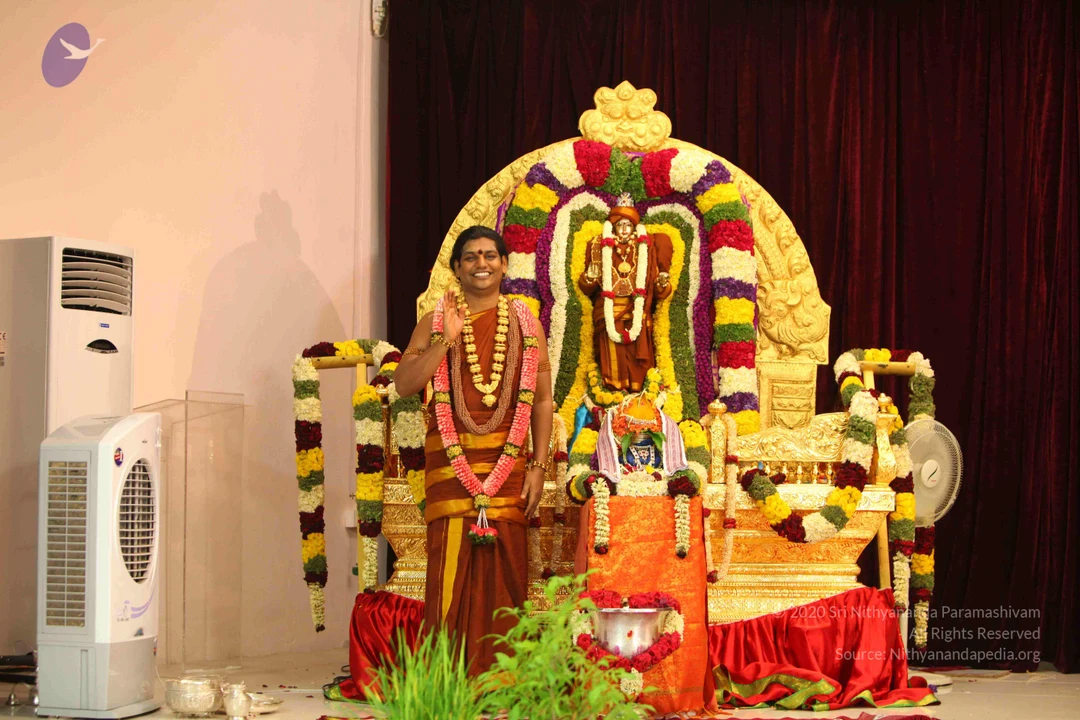
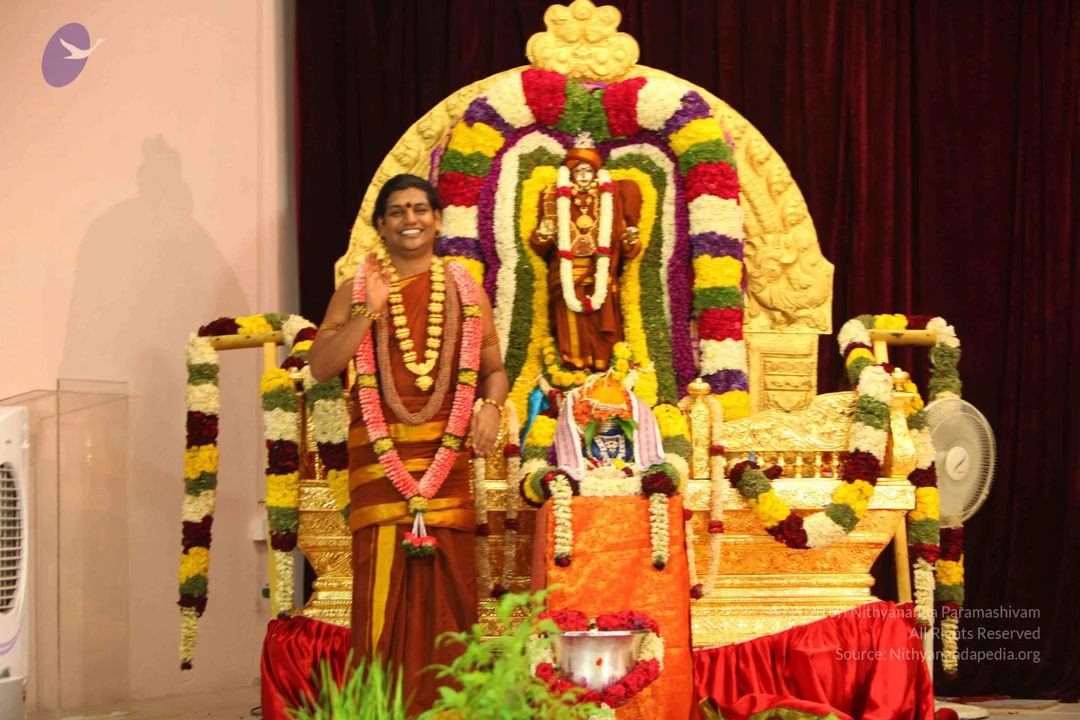
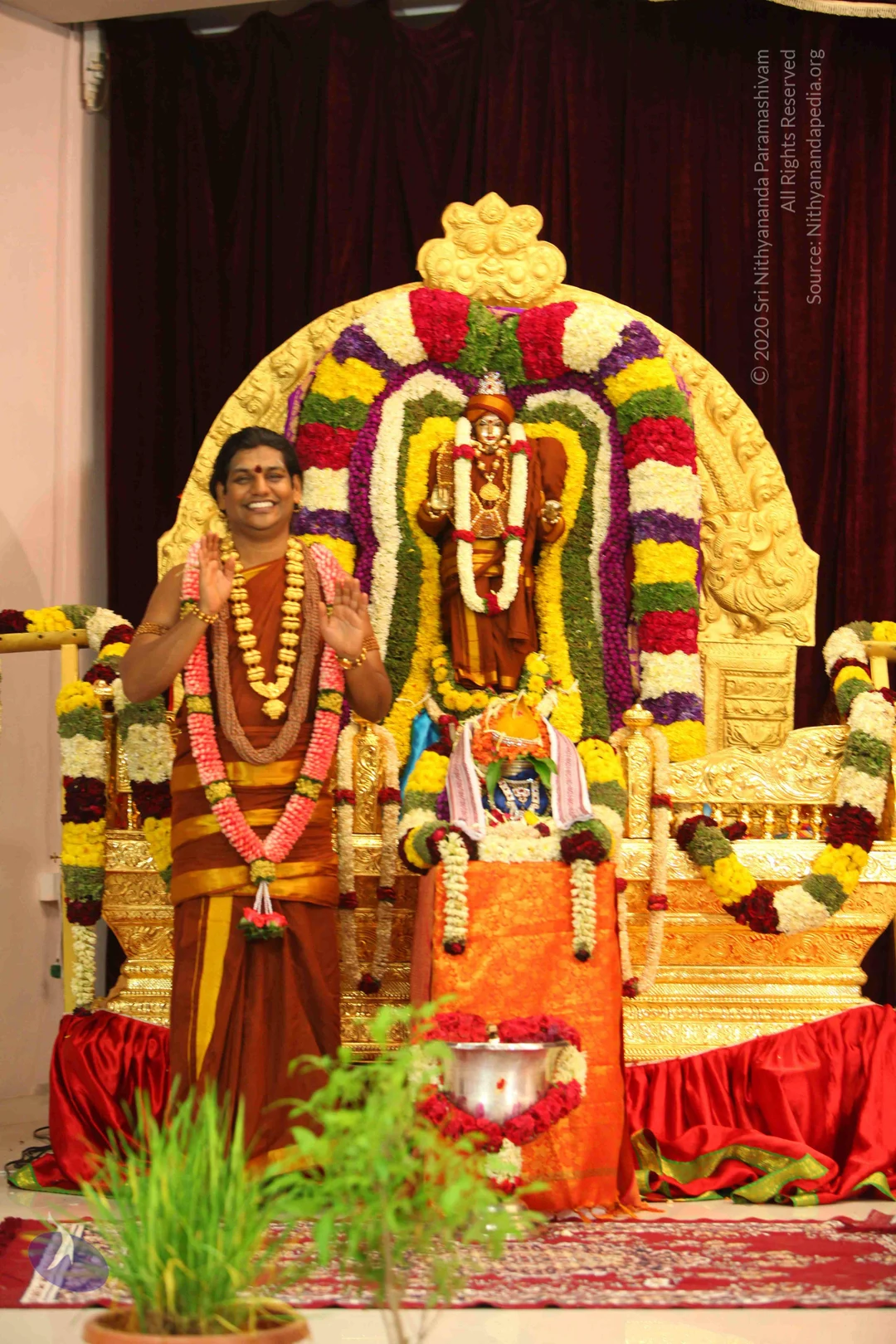
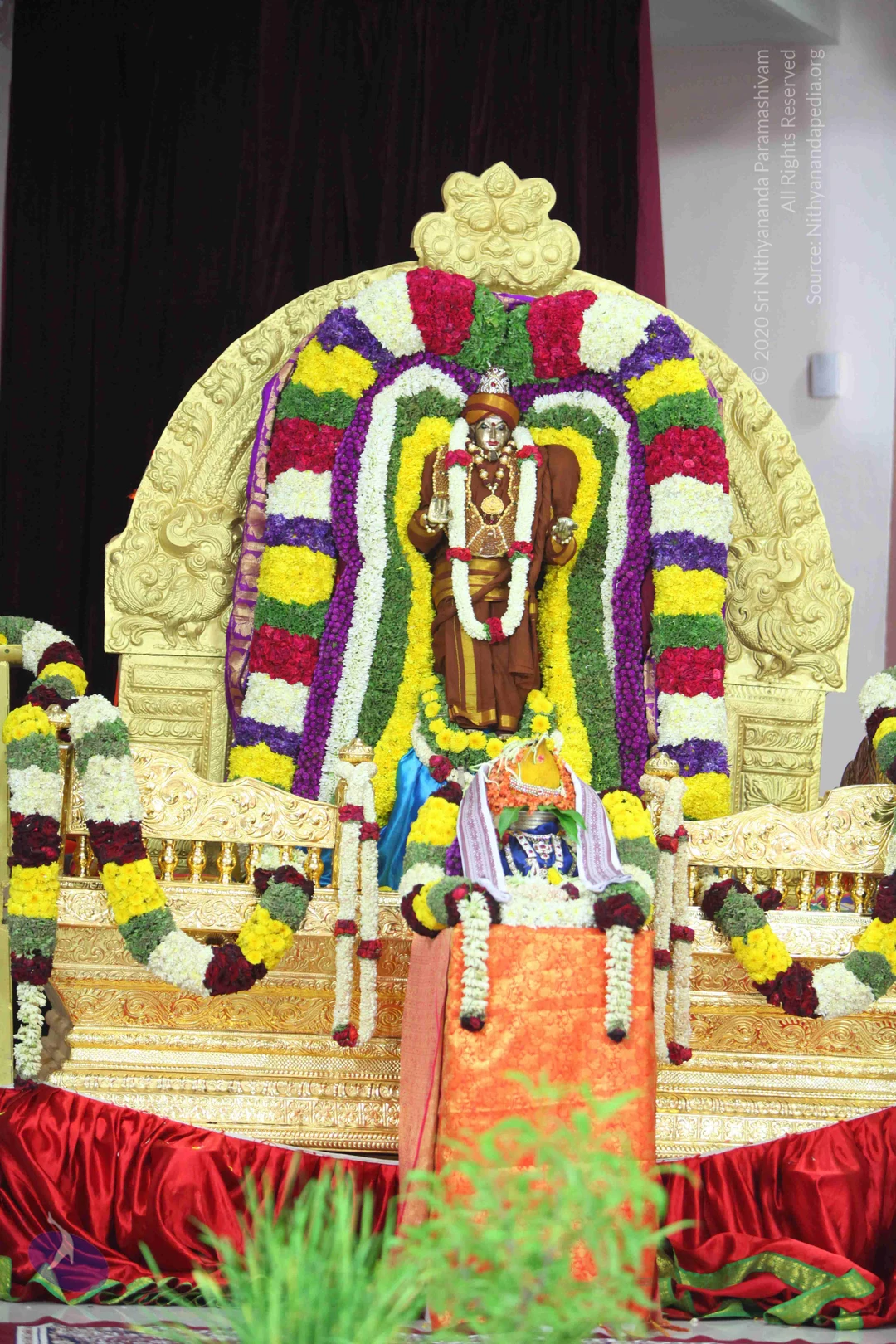
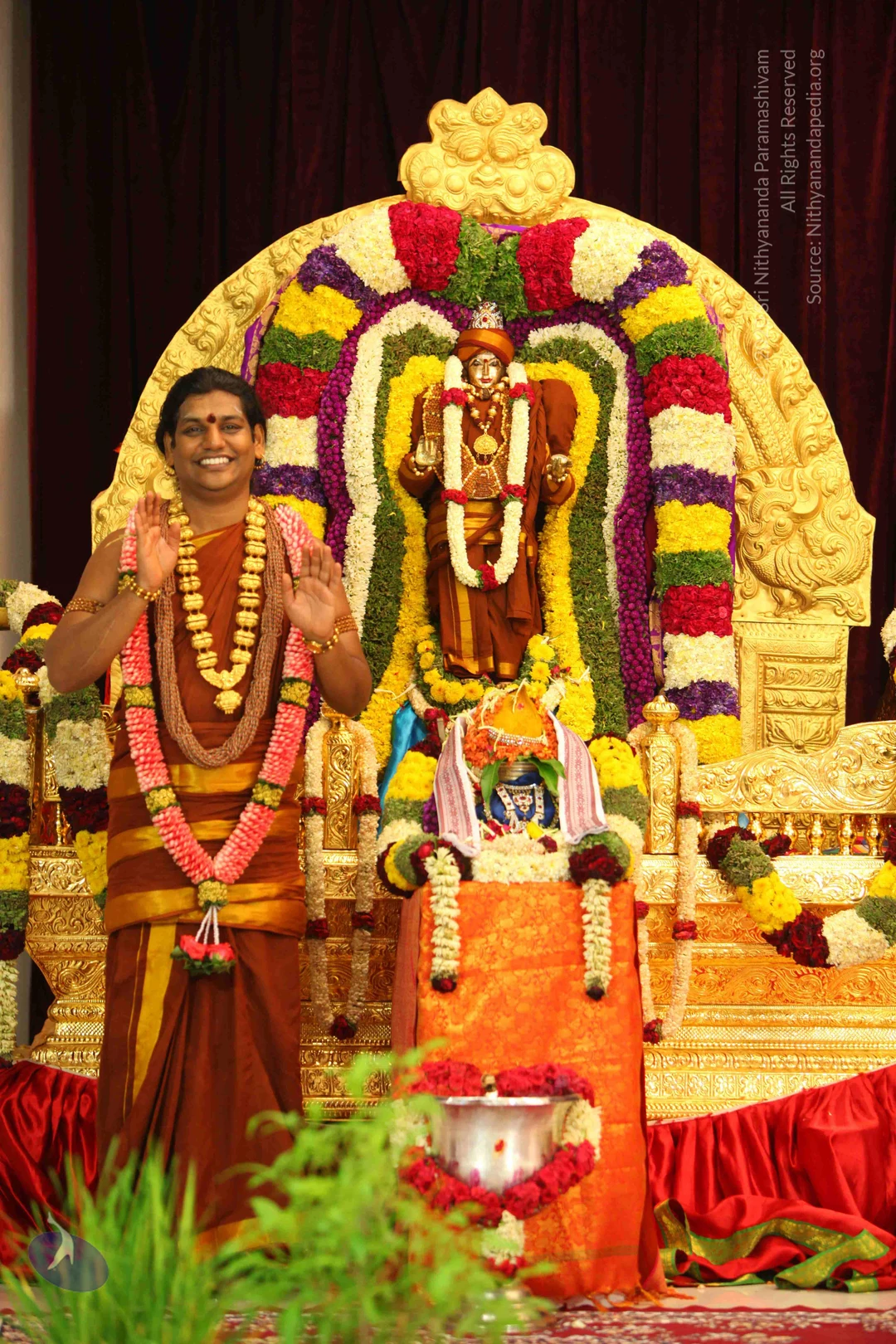
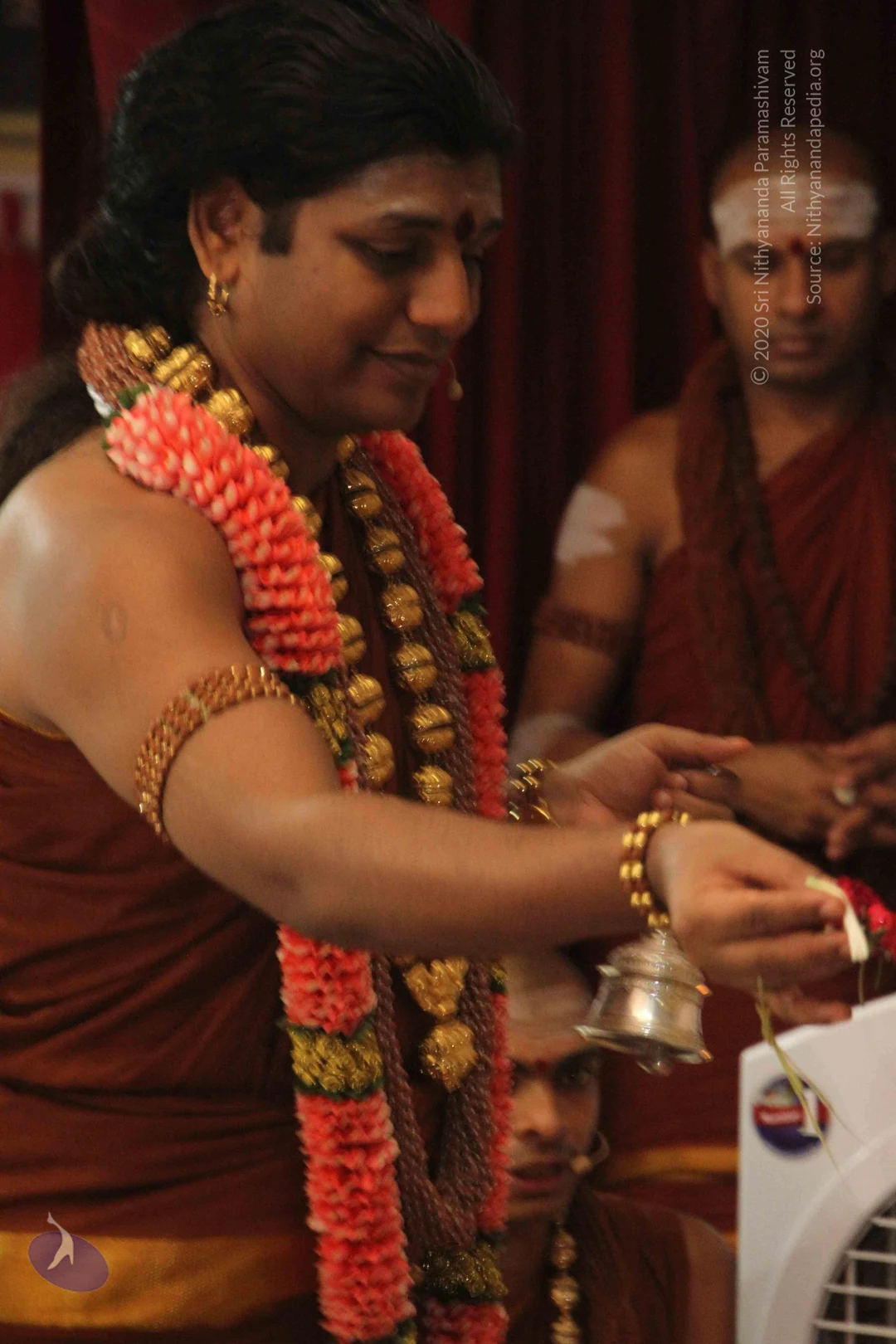
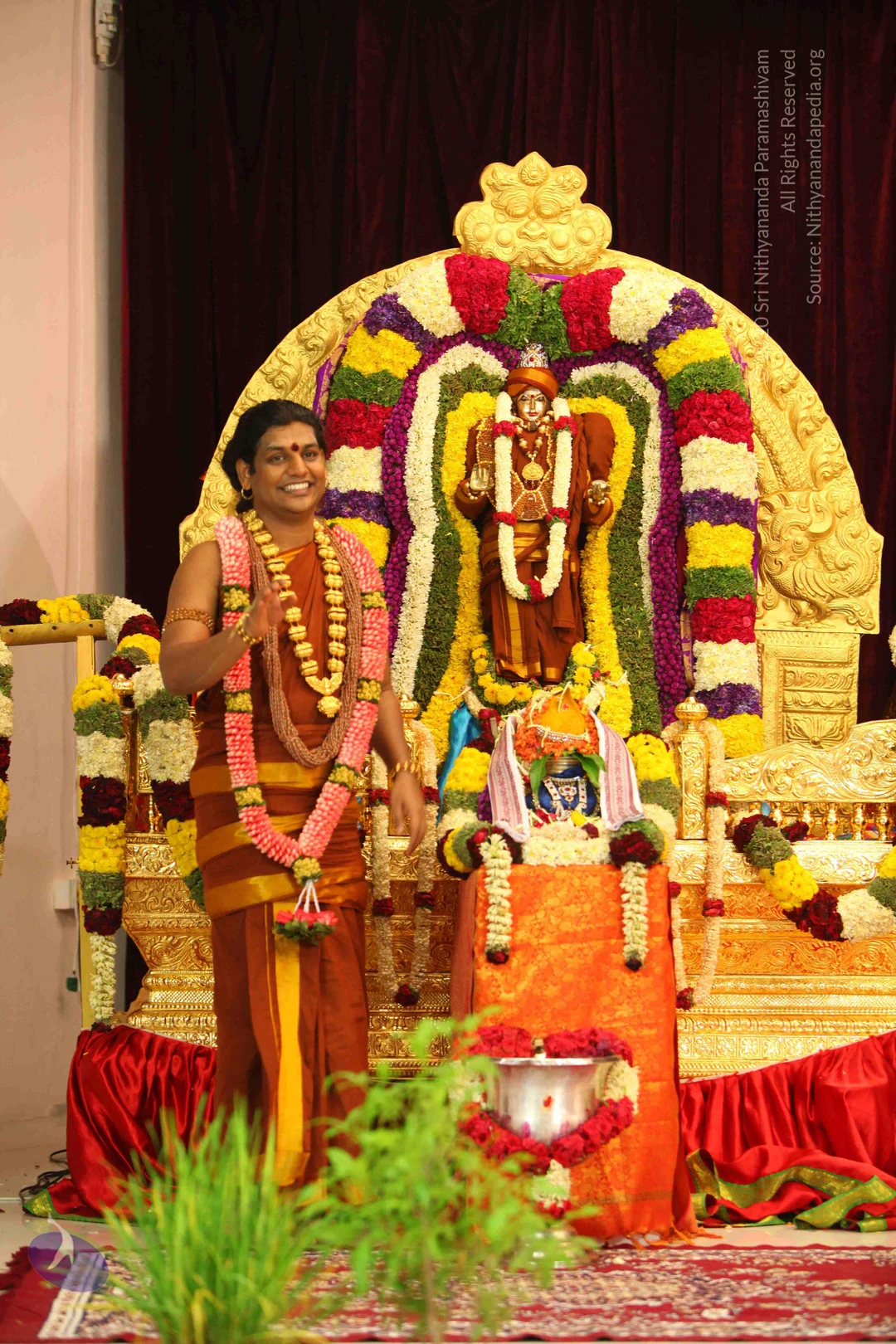
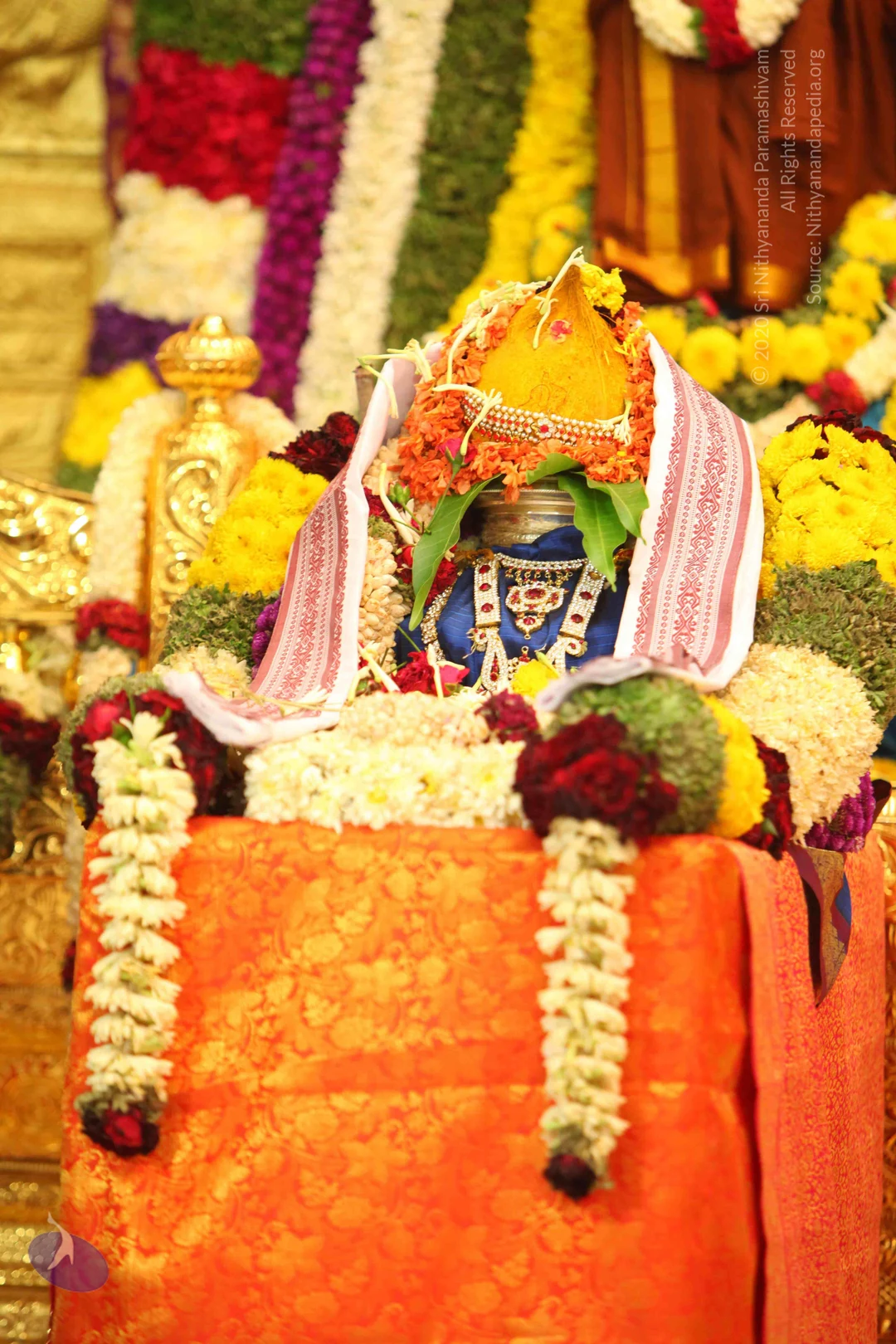
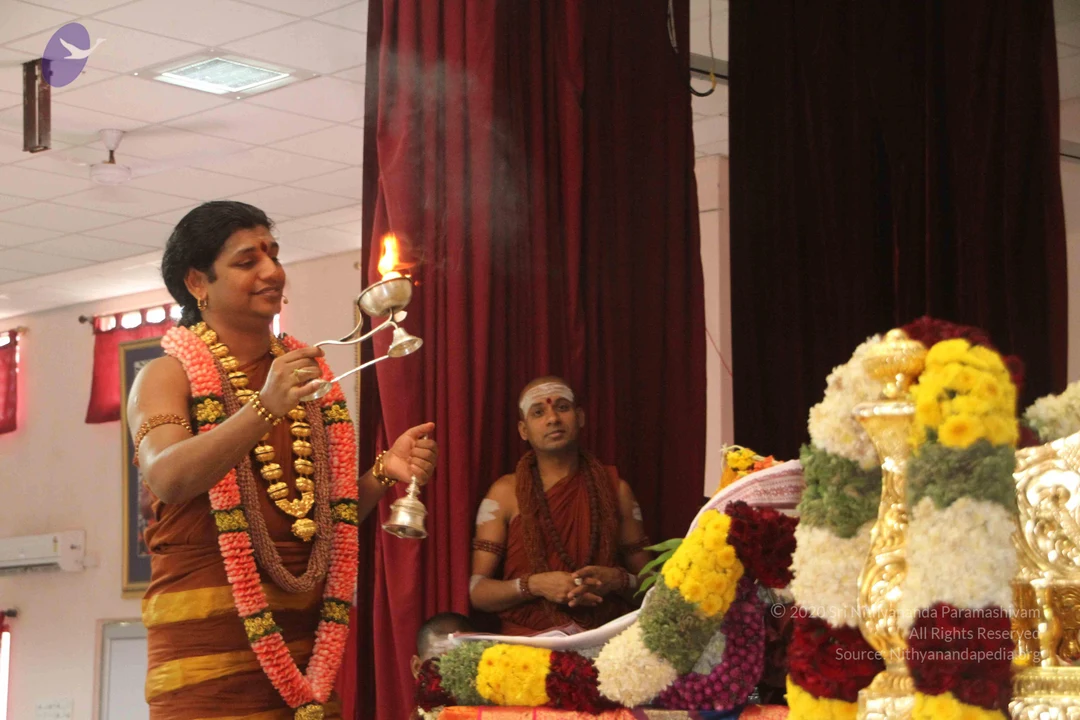
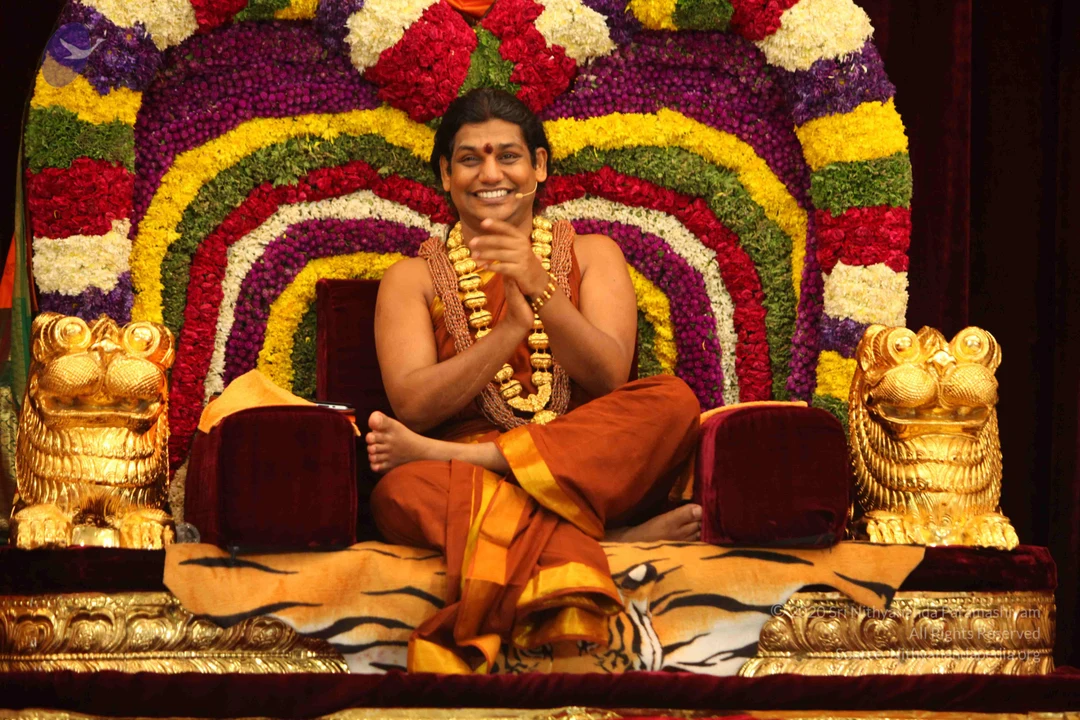
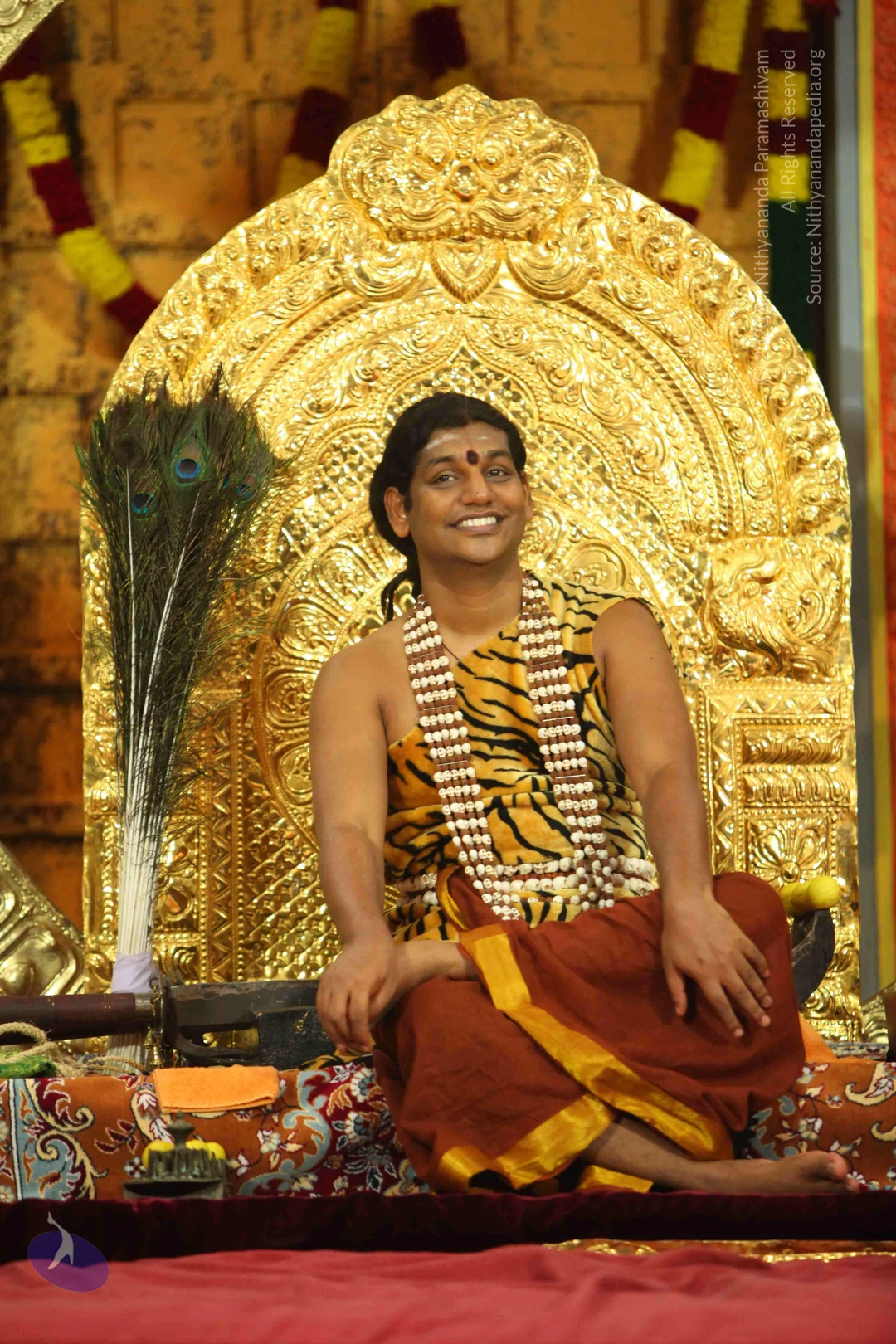
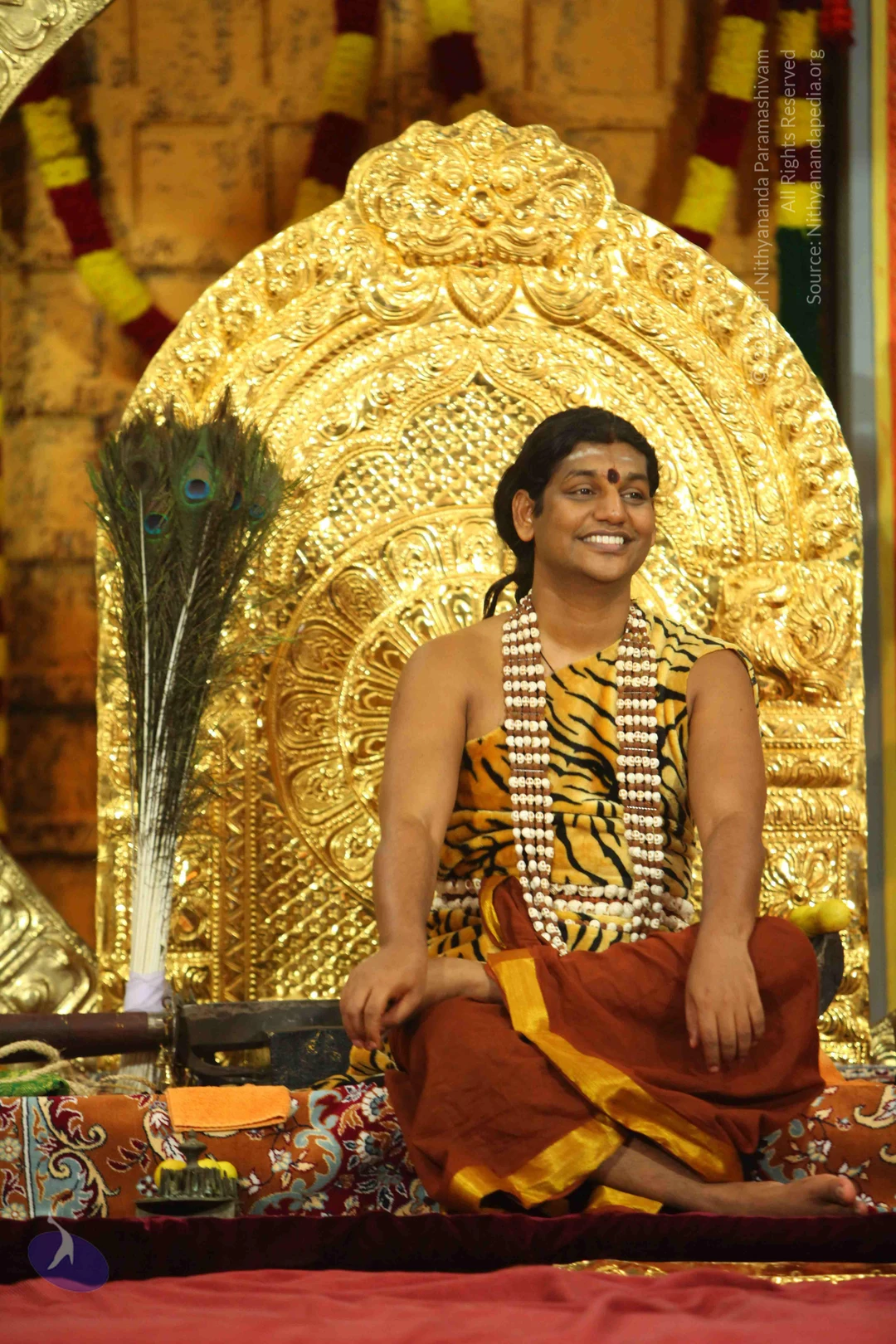
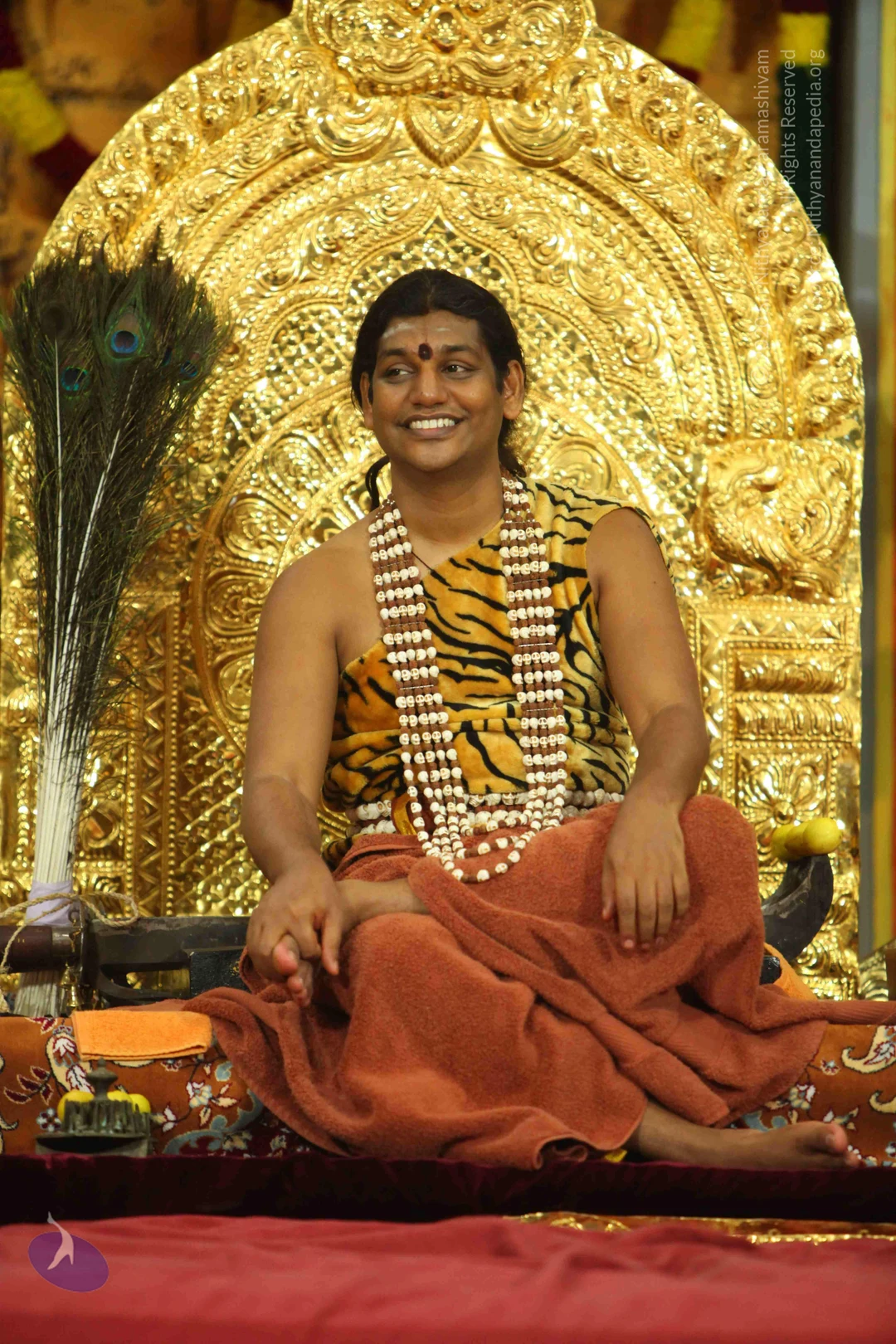
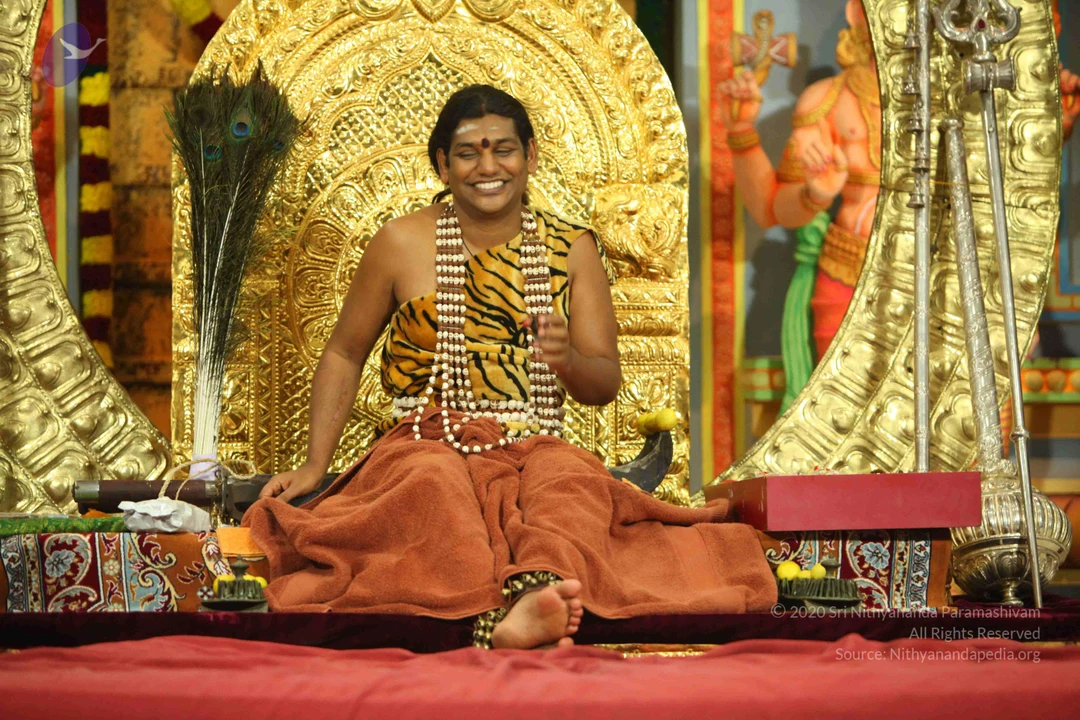
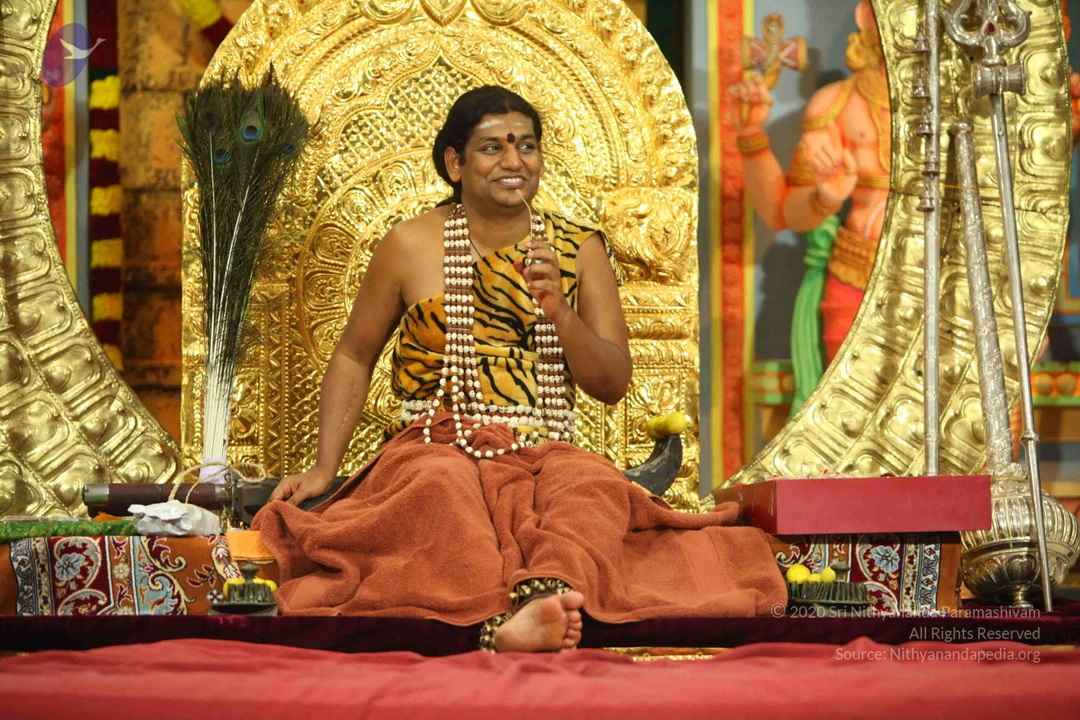
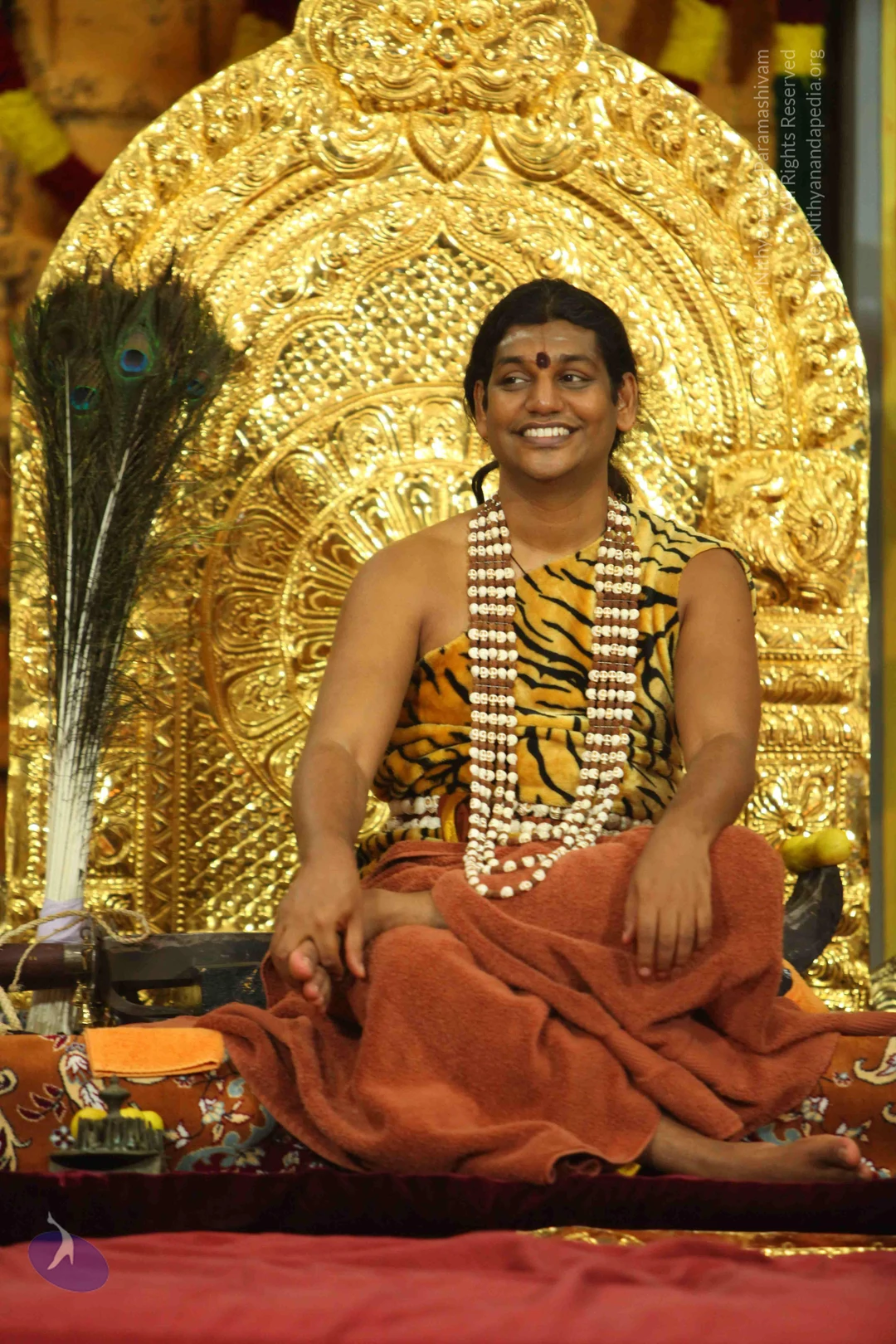
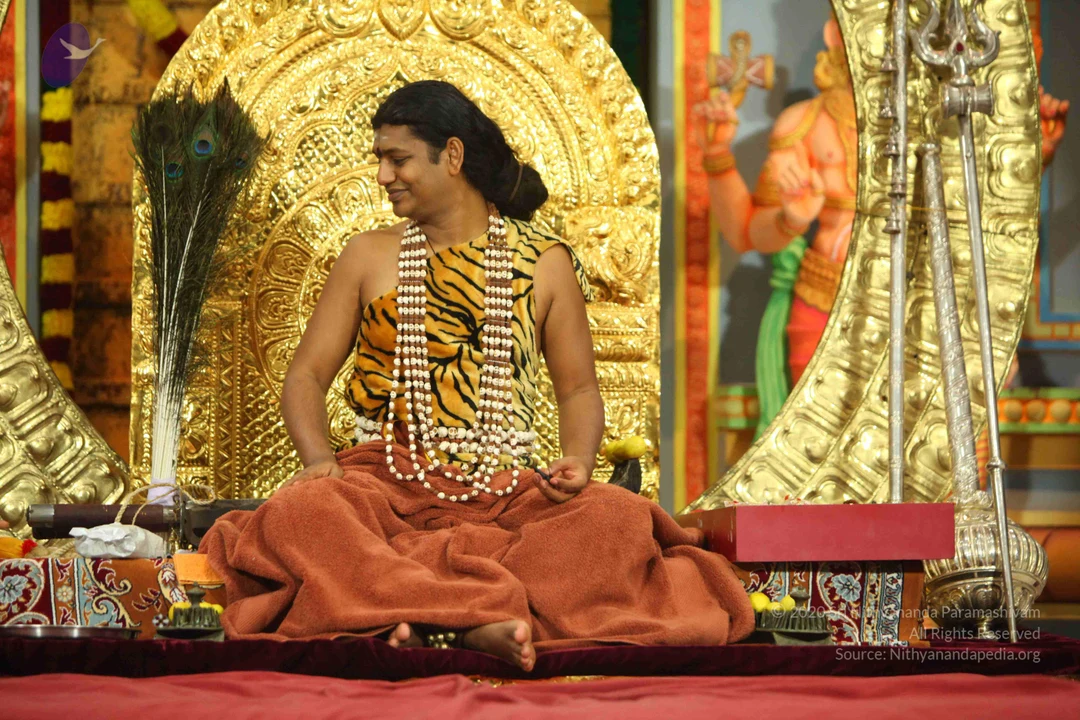
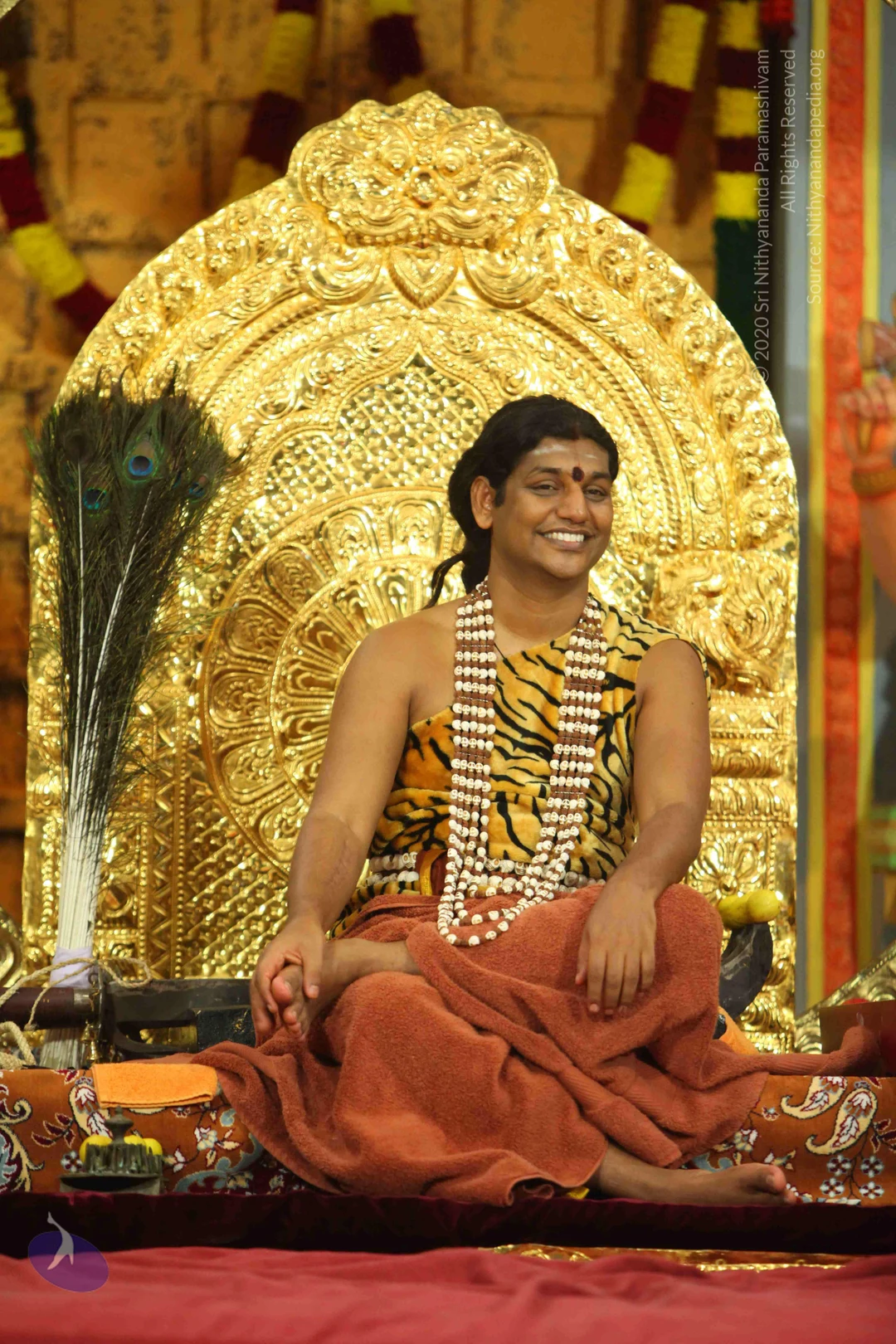
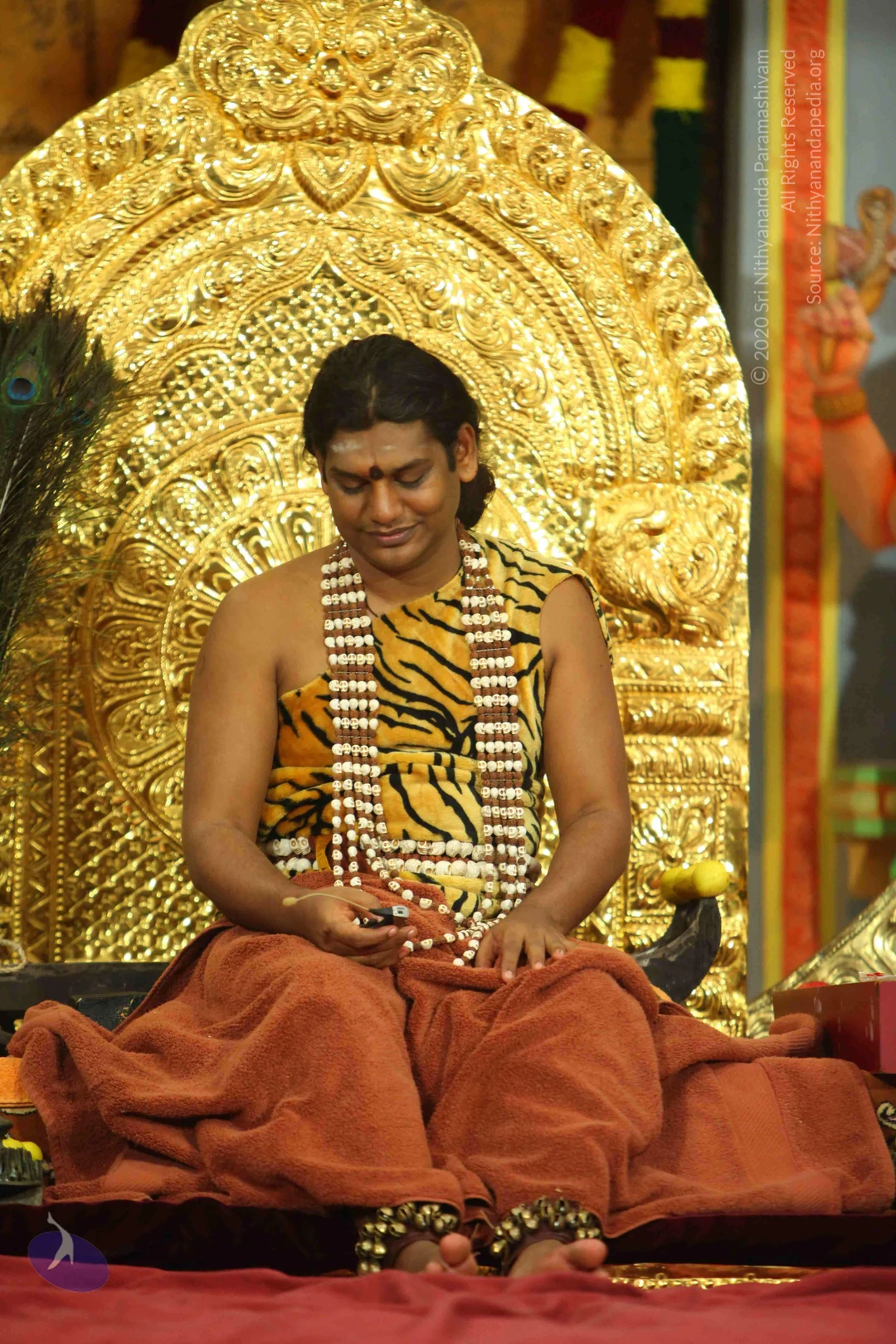
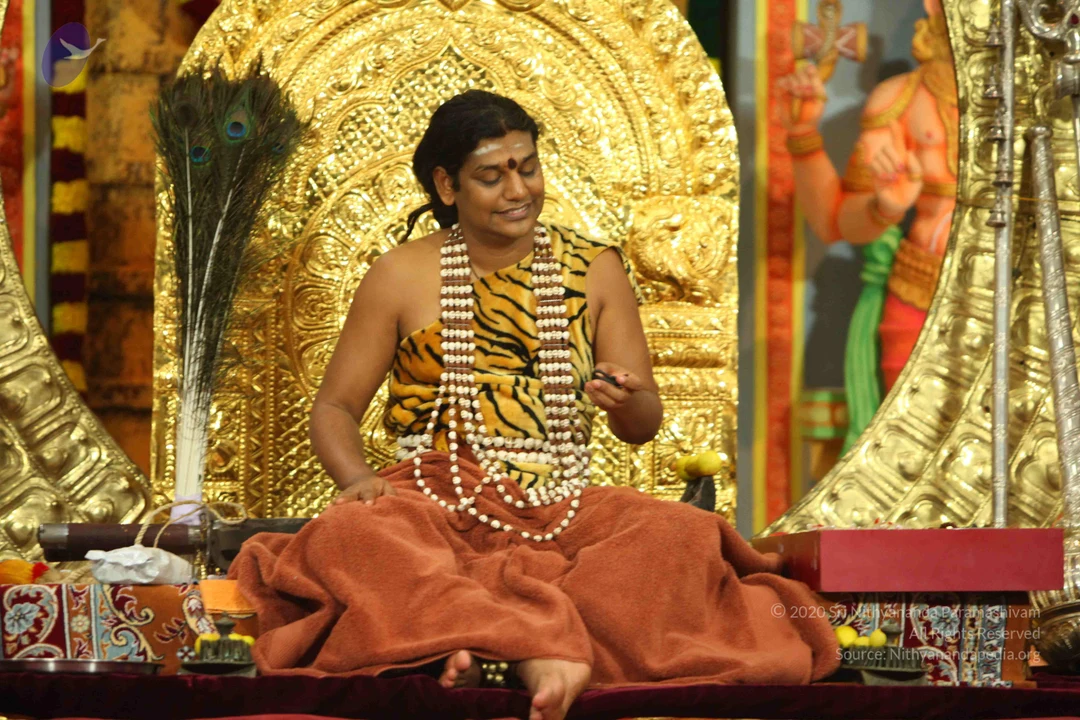
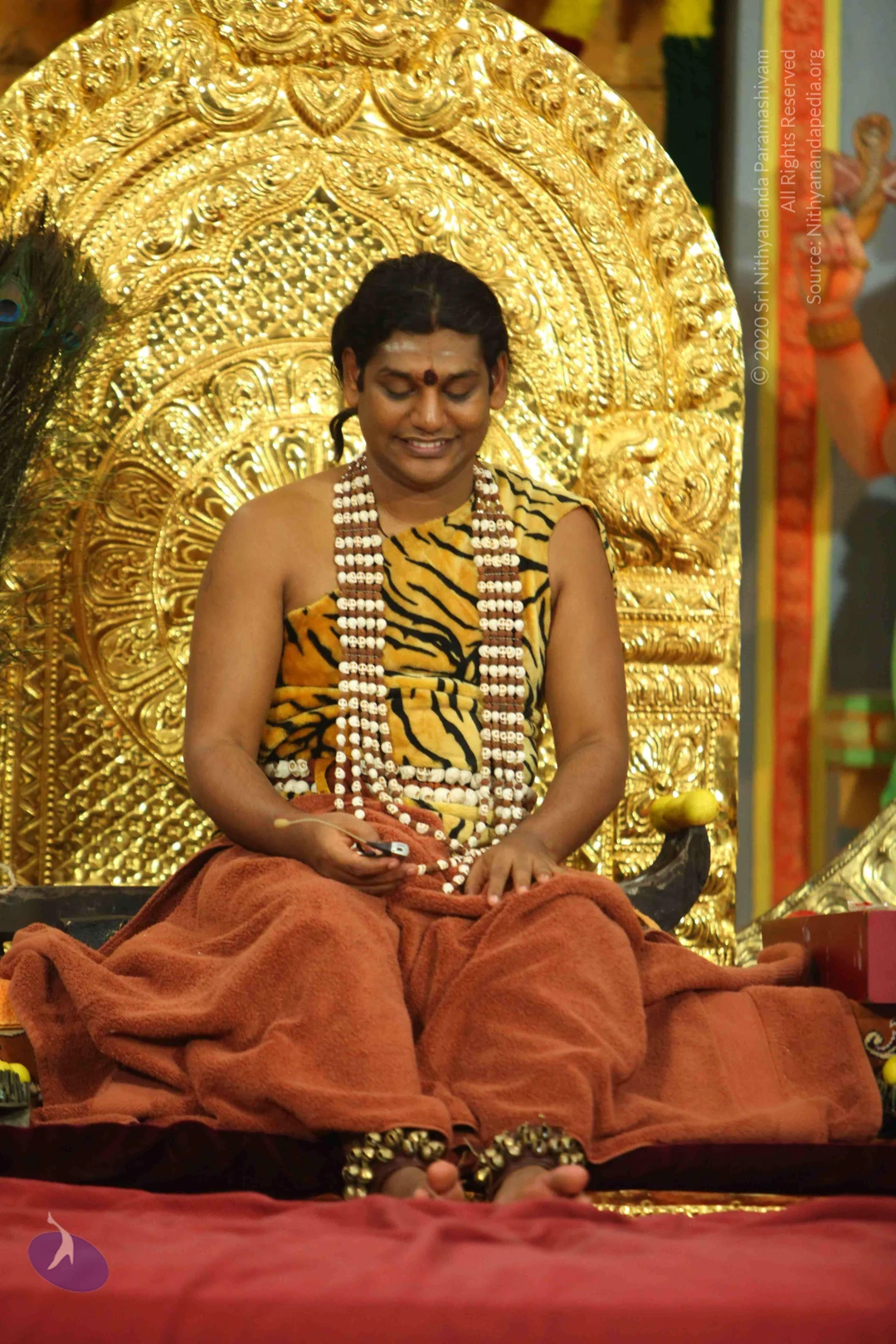
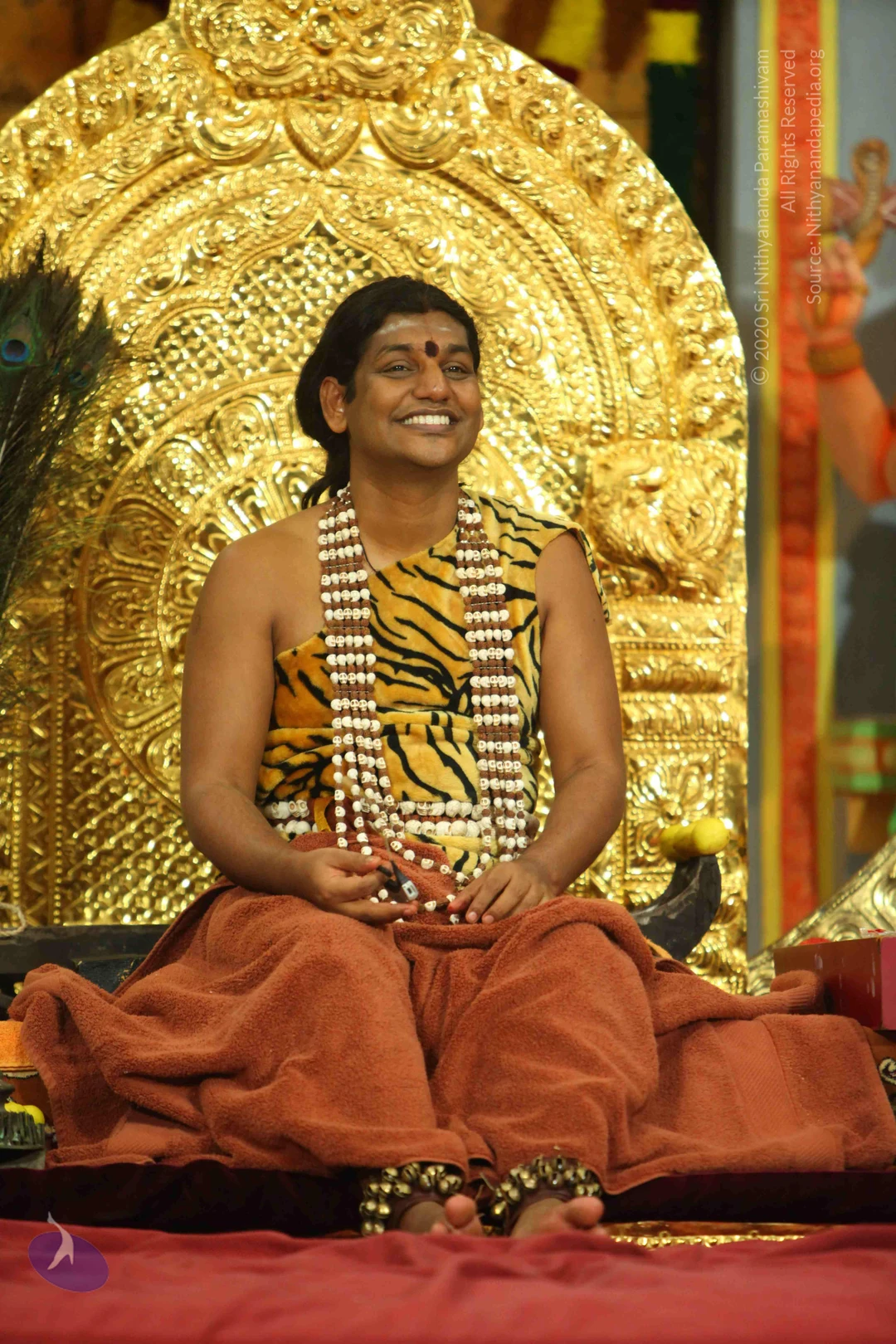
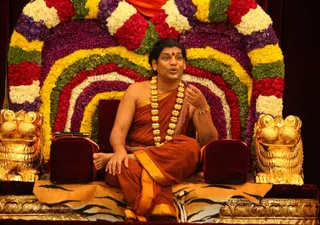
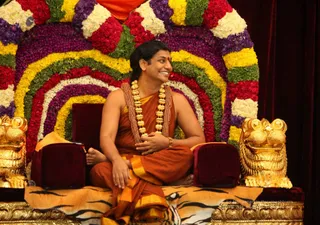
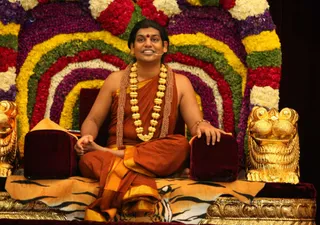
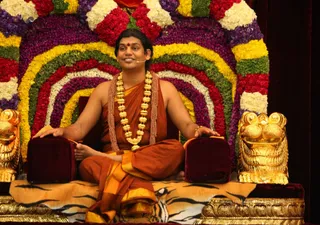
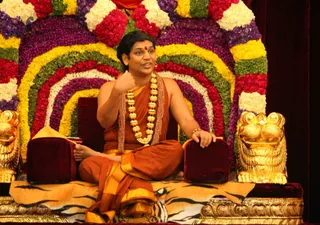
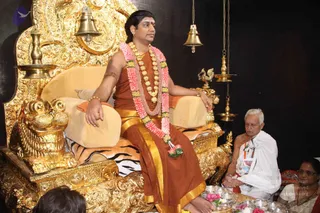
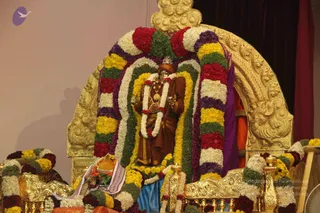
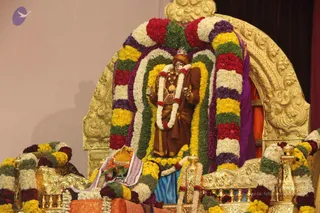
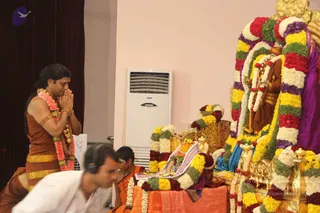
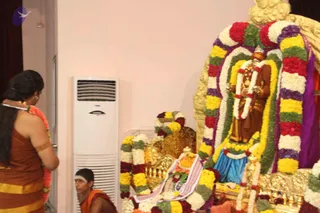
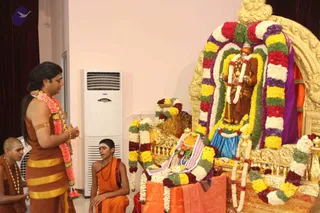
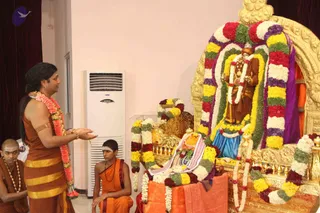
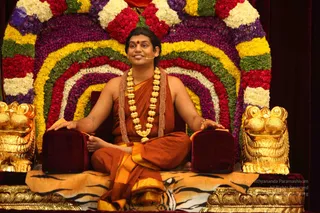
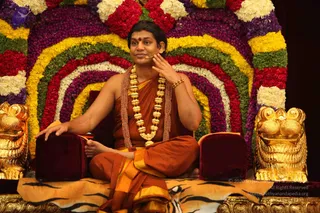
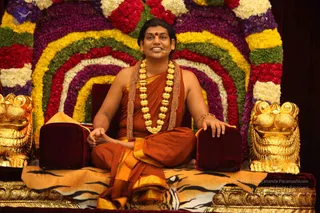
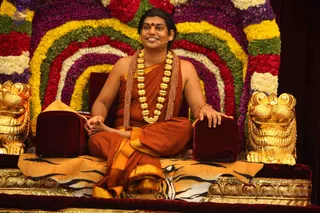
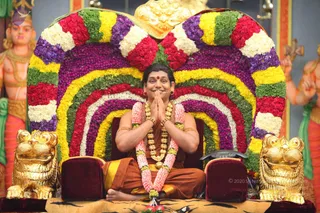
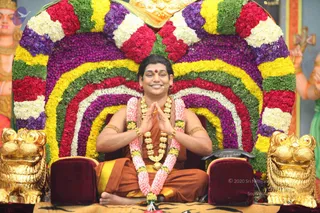
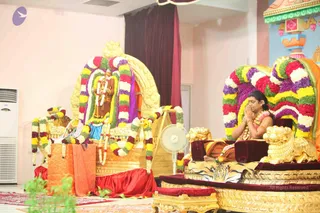
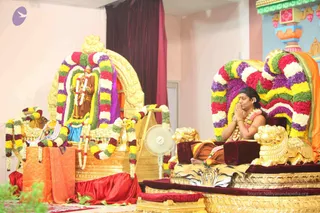
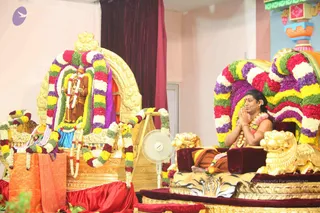
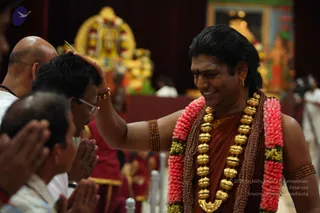
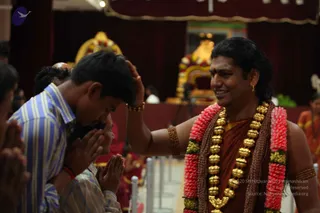
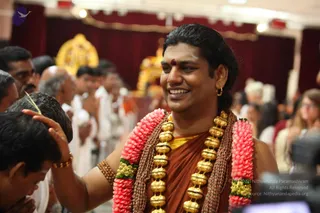
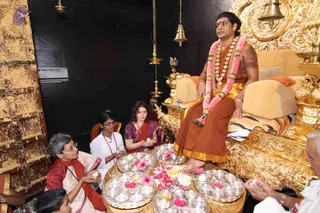
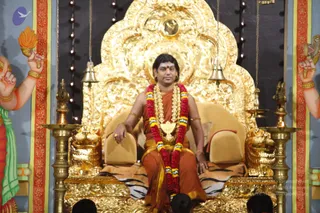
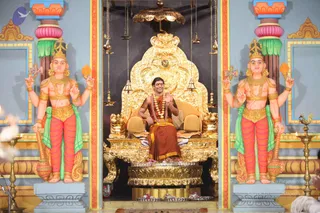
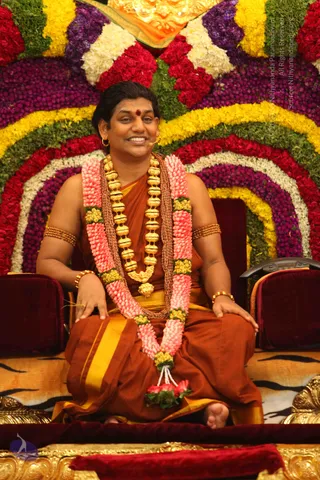
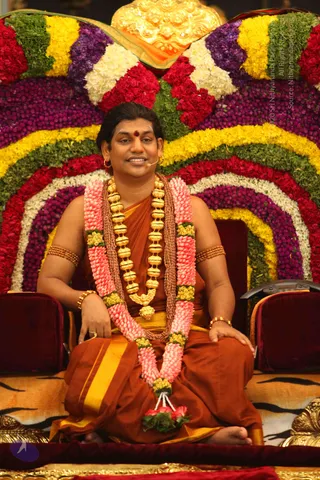
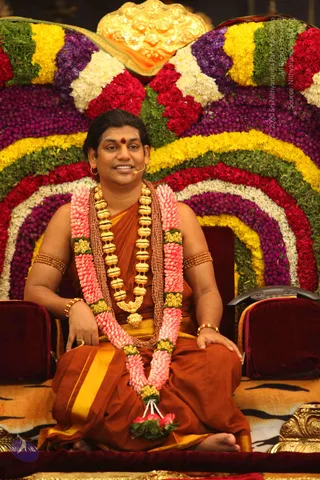
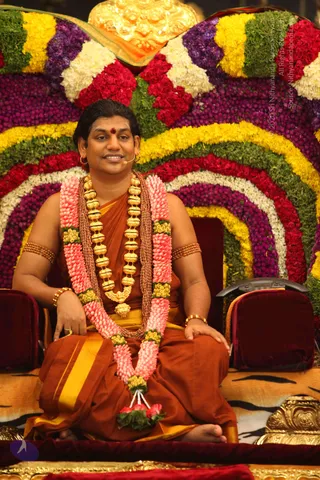
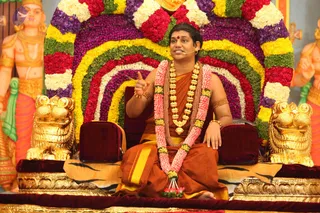
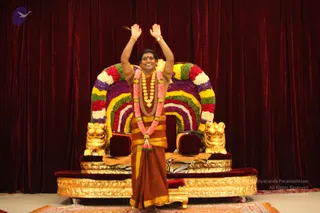
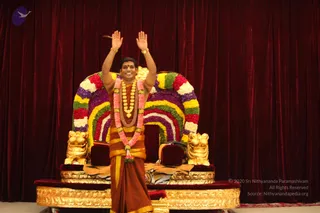
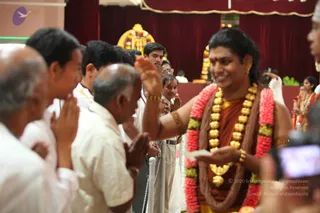
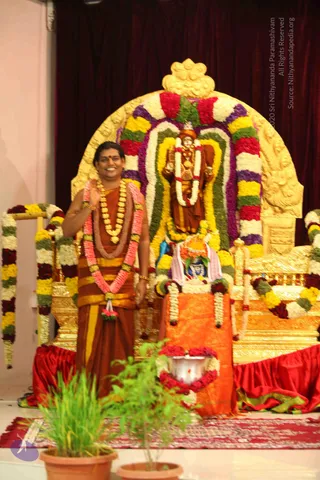
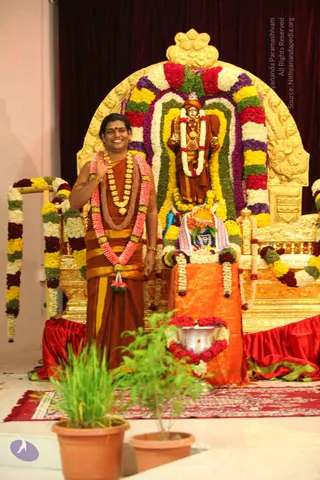
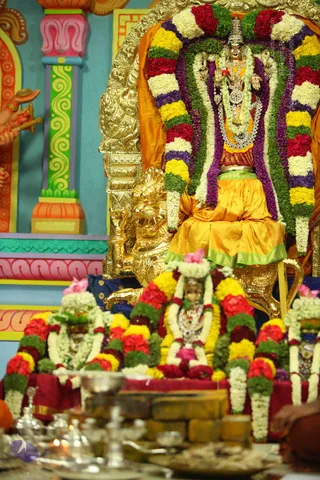
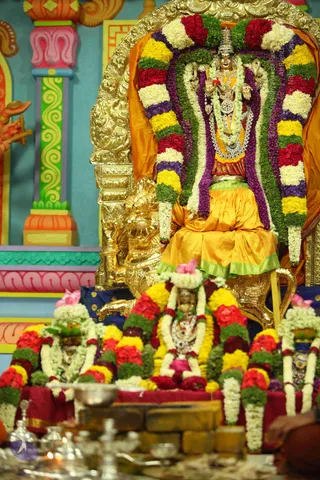
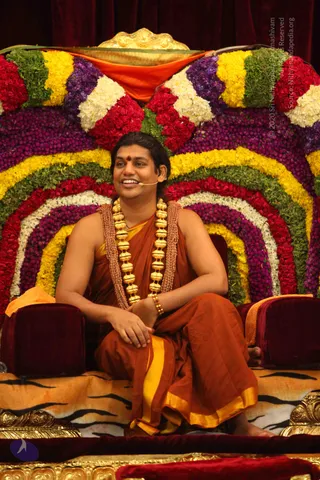
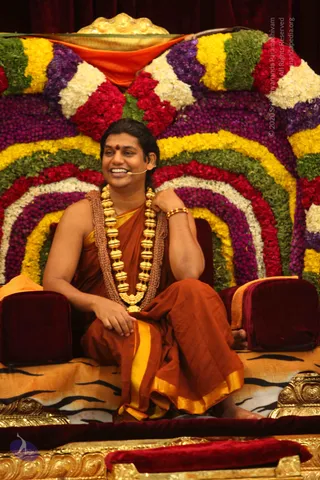
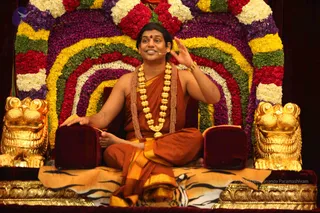
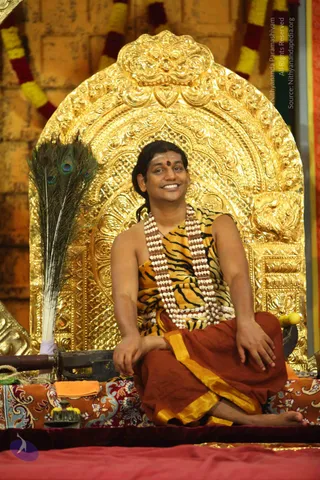
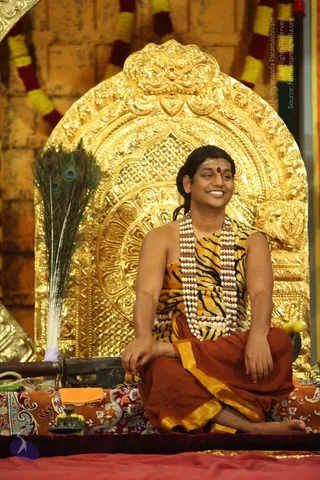
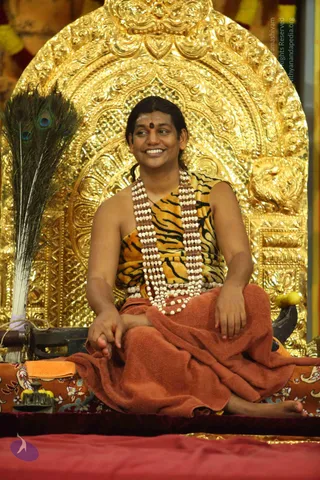
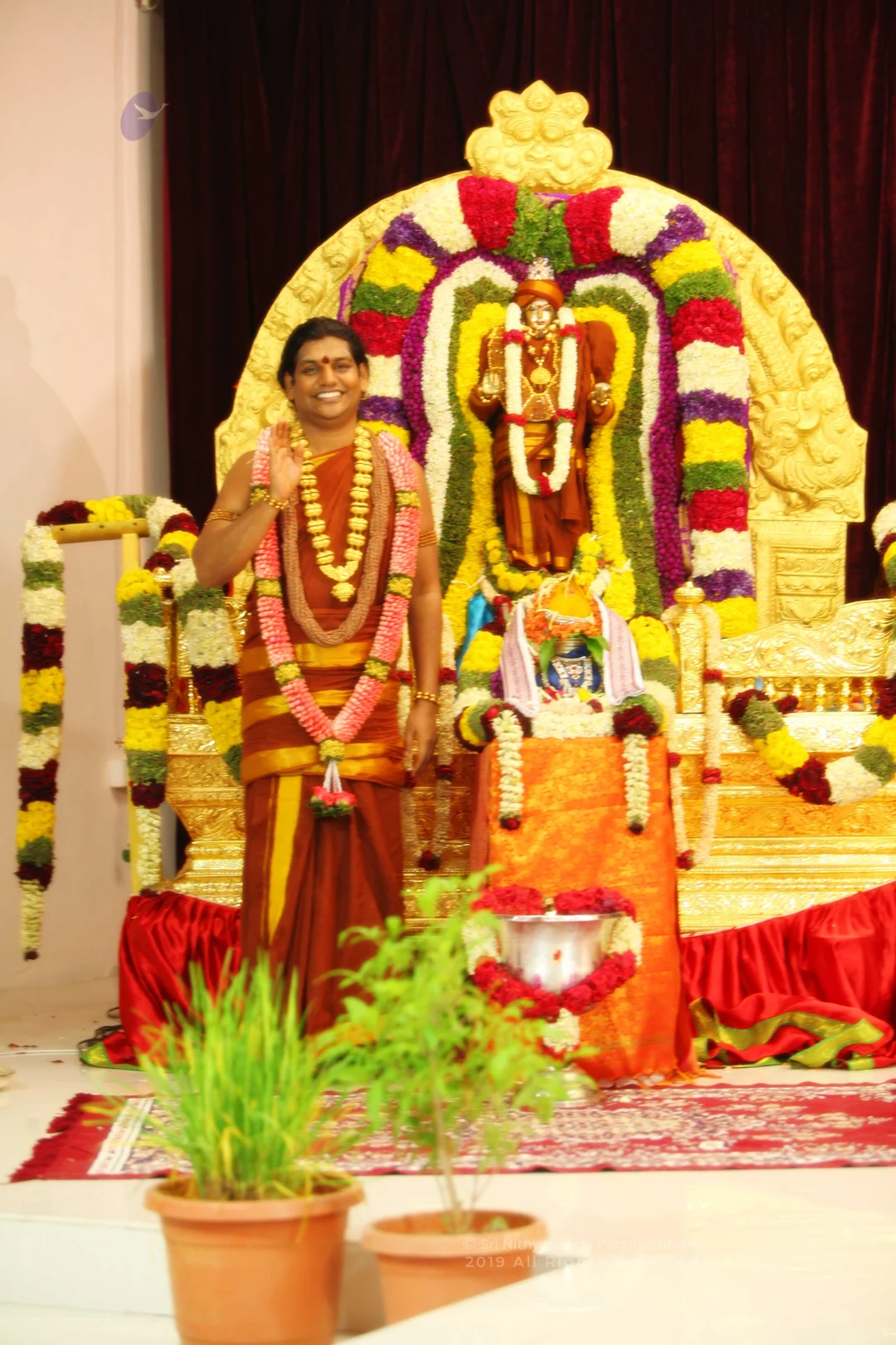
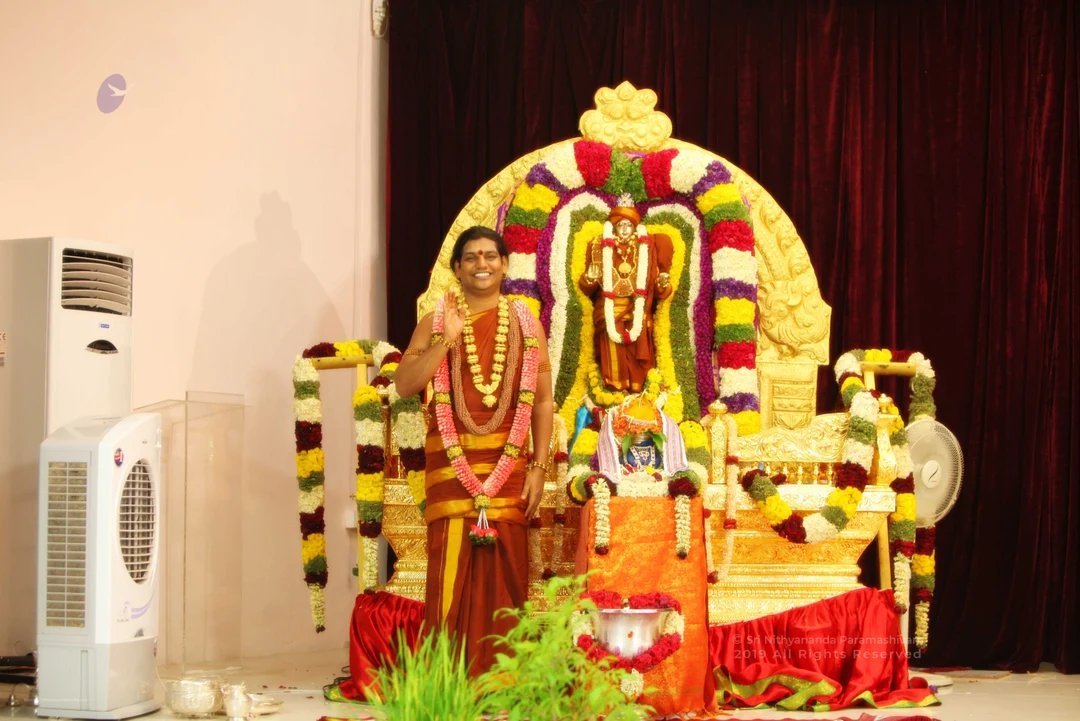
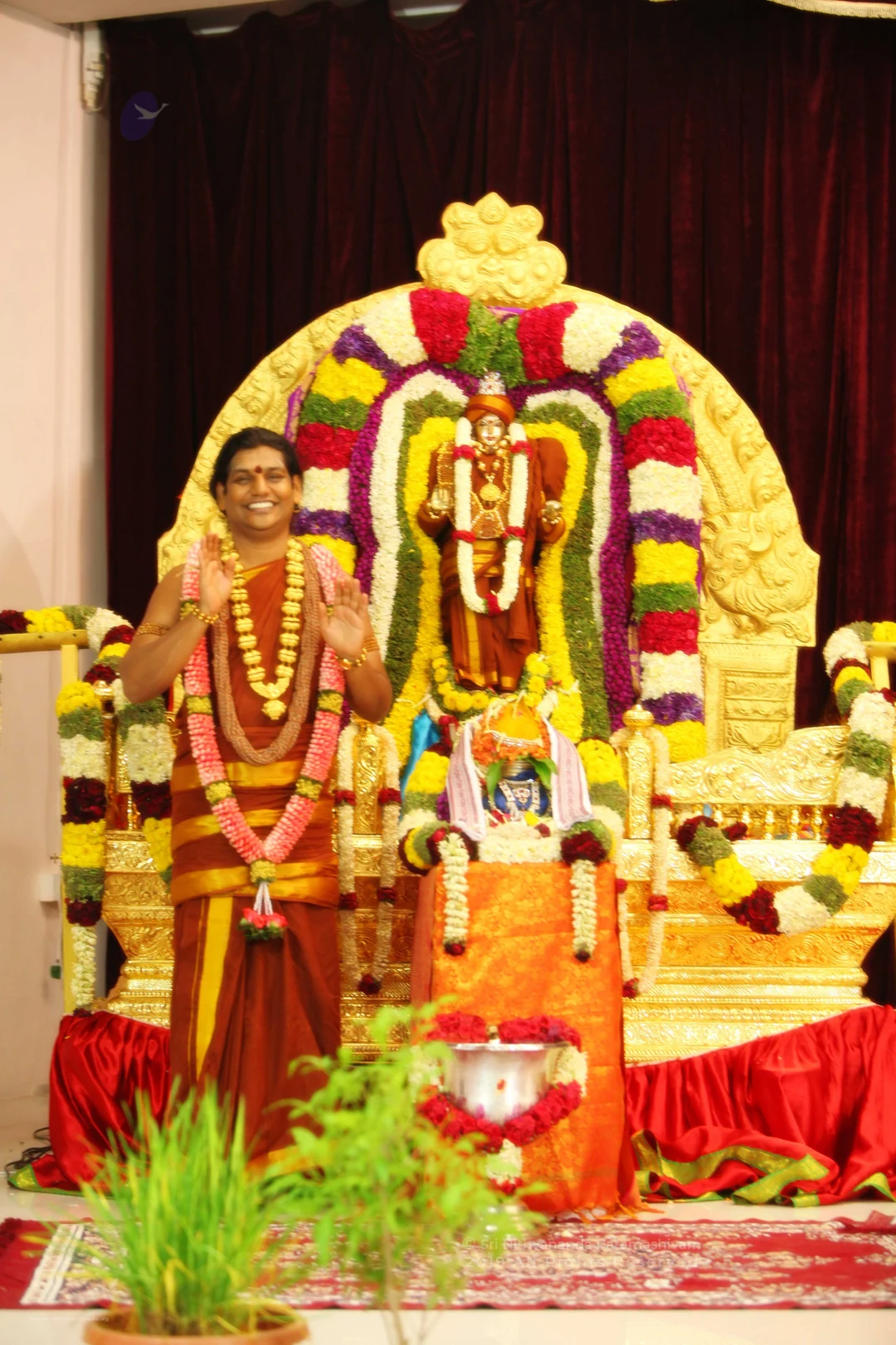
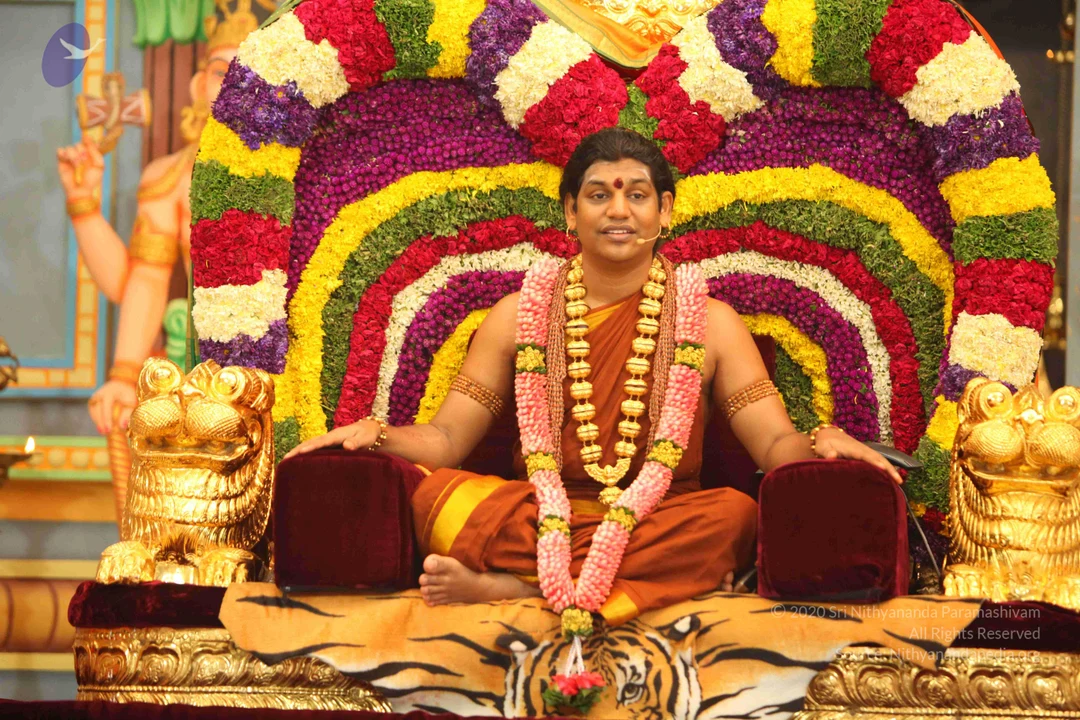
A seated man in an orange-saffron dhoti and shawl sits centrally on a gold lion-headed throne (peetha) in front of a large floral backdrop of concentric arches made of red, pink, white, yellow, green and purple flowers. He wears a long pink-and-white flower garland with a red floral tassel, a heavy gold bead necklace with a pendant, gold armlets and a red bindi. His hands rest on maroon cushioned armrests and he smiles with eyes half-closed. To the right stands a painted deity figure in orange and gold ornaments. The scene is a stage or dais setting for a satsang. Swamiji (probable): long swept-back hair, saffron clothing, gold necklace and rudraksha-style ornaments fit the page's identification, though appearance alone is not conclusive.A man in saffron-orange robes with a gold chain and a multi-strand rudraksha mala stands on a stage, smiling and raising one hand in greeting. Behind him is a large golden arch decorated with garlands of yellow, red, green and white flowers, framing a golden deity murti in orange and gold garments. In front, an orange cloth draped altar holds a decorated kalasha or offering vessel with flower garlands, and potted green plants sit in the foreground. The scene appears to be a devotional stage setting with floral decoration and a gold throne-like backdrop.

May 26 2013

Original wiki page
Contents

Title

Inner Awakening Day 19 | Jnanasambandars Enlightenment Day

Description:

In today’s morning satsang, Paramahamsa Nithyananda answers questions about karma and sannyas, the monastic lifestyle. The first question asks how we can erase karmic patterns which emerge from previous lives and have impact on the present life. Nithyananda replies that once we complete with those inner karmas they cease to control us. Completion also heals the previous lives in which those patterns originated. Asked what qualities merit sannyas, He replies that candidates should have passed through a minimum of twenty-five human lives to have achieved the maturity to appreciate sannyas. After so many births, a soul has completed its shallow expectations of life and is ready for the spaciousness beyond completion. This is true liberation, the freedom to travel on the ultimate journey: the journey to enlightenment.

Link to Video:

VideoAudio

Transcript

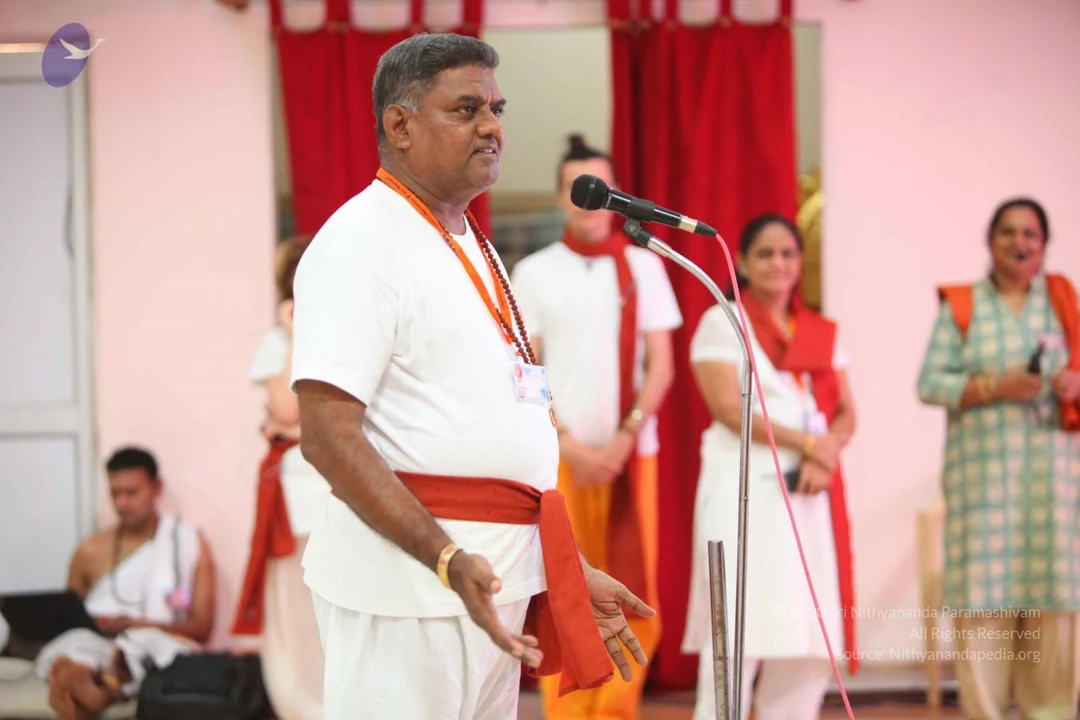
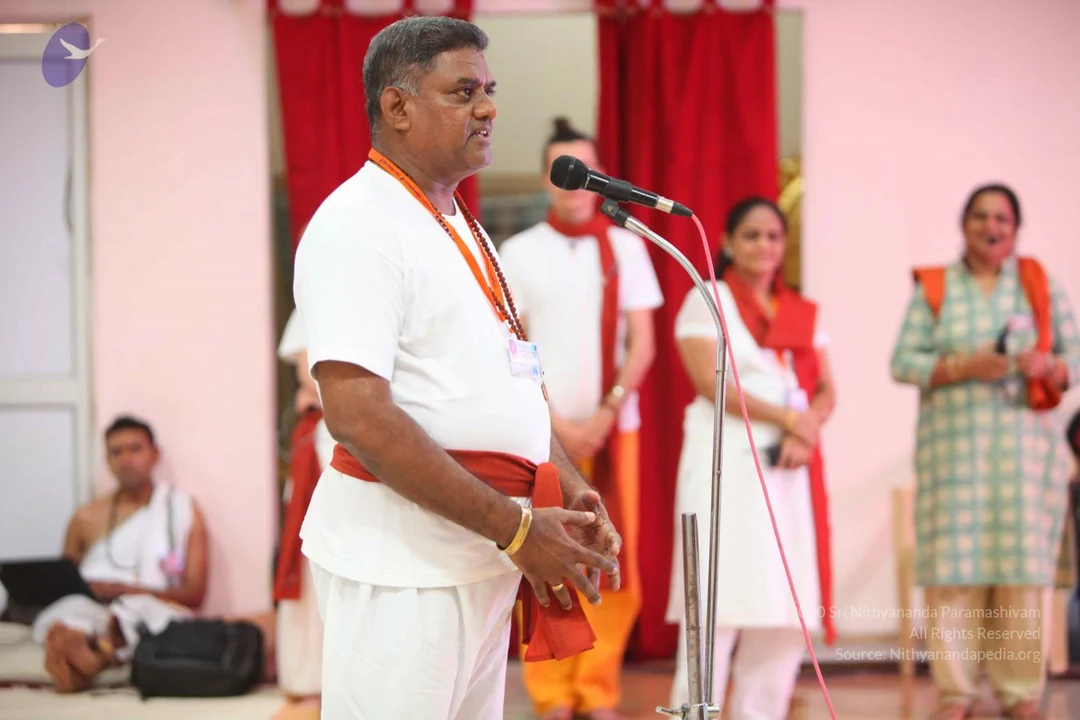
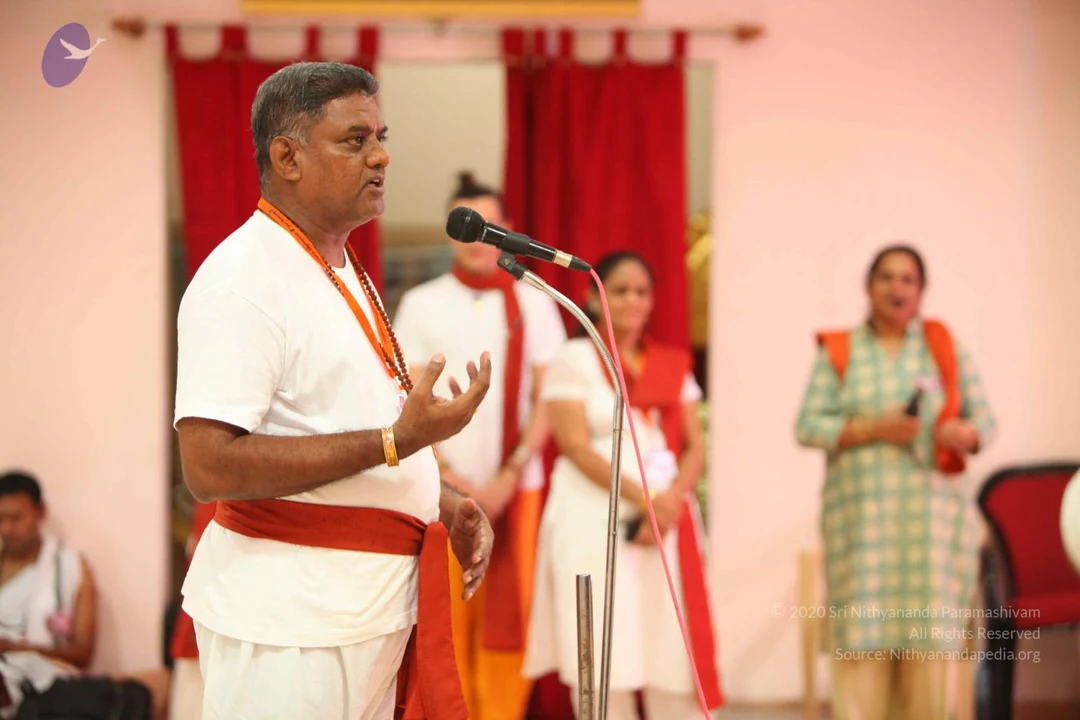
Today I will answer your questions. Please start the questions. Q. The first question today is from Ma Yoganandini, who is asking, ‘How does one decide upon whether their path is sannyas or not? Is there any way to feel sure about it, or is it simply a conscious choice? How far is an individual’s decision of sannyas affected by prarabdha and past lives? Is it possible that the guru can change a being’s prarabdha? Swamiji: It is a long question, Yoganandini, showing exactly your confusion. The question needs to be analyzed more deeply. First, the effect of prarabdha or past life cannot happen in you if you complete all the known patterns in you. They can have power over you only as long as the known patterns you carry are alive and continue to remain incomplete. Listen! Only as long as the patterns you carry continues to remain incomplete, the patterns you carry acts like a receiver. The electronic waves may be in the air, but unless you have a receiver, it can’t be received, it won’t be received. So, understand, the patterns you carry acts as a receiver for you to experience your life. So, if you decide to complete with the root-patterns you are carrying, you don’t need to worry or bother about the past life or the prarabdha. Listen! The effects of the past life or the prarabdha will not have any effect on you if you can complete your root-patterns. Completing your root patterns liberates you not only from the karmas of this life, it frees you even from the past and the prarabdha. Sannyas can be a simple, conscious decision. Sannyas can be simple, conscious decision. You are also asking, ‘Is it possible that the guru can change a being’s prarabdha?’ Guru can change. But in your case, I will not change, and I will let you suffer in your confusion. Because you are so strongly associated, I can say that, you literally love your confusion. Because the space you carry that confusion, you don’t need to take t he responsibility, you can continue to blame, blame, blame your confusion, and it gives you the feeling you are “trying your best; what else you can do?” The most cunning athma hathya on the Planet Earth is “I am trying my best; what else I can do?” This is the worst form of suicide! Please listen! This is the worst form of suicide! So, sannyas is a simple, conscious decision. You do not need any other external support. And the decision of sannyas is not affected by the past or the prarabdha. Next question. Q. The next question is from Kishen Naik, ID No.136, who is asking, ‘While being in sannyas, if sometimes the sannyasi feels like going back to normal life, how can this situation be handled?’ Swamiji: Kishen Naik, then sannyas has not happened in you! Forget about it. He is asking a question, ‘While being in sannyas, if sometimes the sannyasi feels like again going back to normal life, how can the situation be handled?’ Will you ever want to go back to the life of a pig after living a human life? Kishan Naik, understand, if you have experienced the life of a human-being, you would not like to go back to the life of a pig or a stone. So, sannyas life is a space of sannyas. If you experience that, you will never feel like going back! If somebody feels like going back, they have changed the route, they have not changed the space! Sannyas has a deeper dimension. It is changing the space, not changing the route. As I said before starting the satsangh, it is so unfortunate we Hindus lost respect on the whole space, the possibility. That is why, just see the simple logic! We are able to produce thousands of IT engineers and send them to U.S. and Europe. See, U.S. and Europe is filled with Indian IT engineers. In Microsoft, you can write programs in Telugu and Tamil; everyone will understand! Because, filled with Telugus and Tamilians! All over the world, we are able to produce so many IT engineers and able to send. We have not bothered to produce Hindu Ph.Ds., Hindu doctorates, to send for head Hinduism Chairs all over the world. It is not that the Hinduism Chair Professor does not get paid. He gets paid more than a IT engineer. We never had a confidence that our religion is worthy of teaching. That is where the problem starts. We never had a confidence ‘this can be lifestyle, this can be the life and lifestyle.’ It is so sad the modern youth think, IT field is their life and career, but they do not get the confidence living and enriching the world of the Hindu tradition can be a career, can be life, fulfilling. West should have learnt Hinduism from Hindus. Then even this question will not come, this question is from such a weak space. Such weak space. The question would not have come if we have the strength about our tradition and religion. So, understand, many time I feel the whole U.S. is filled with Indian doctors. Something like a 60,000 Indian doctors are there in the U.S. The American Association of Physicians of Indian Origin has 60,000 members. Every year, thousands get visa. And almost 1% of the U.S. population is Indians. But still not a single U.S. university has a Hindu heading Hinduism Chair! Means, understand the confidence we have on our religion and the confidence we have on teaching it! Even if they get paid, nobody takes up this line. That is the reason I am creating Rishikul where I will create at least ten-thousand Ph.Ds., on Indology, on Hinduism, and see to it, they are placed all over the world. We have sent enough of Yoga teachers to world. We have sent enough of Yoga gurus to the West, enough of IT engineers to West. It is time we send Indology Ph.Ds, Ph.Ds. on Hinduism, doctors on Hinduism to head Hinduism Chairs. Doctorates does not mean the people who are supposed to head the Hinduism Chairs , does not need to be sannyasis. But, even for that, we don’t have strength. It is so sad. That is the reason you asked this weak question. It is almost like asking, ‘Swamiji, If I don’t feel like breathing, how to handle the situation?’ Just die! That’s all! Nothing else can be done! Weakness is death. Power is life. It is a statement from Vivekananda. Vivekananda says very clearly, ‘Expansion is life. Weakness is death.’ Next question. Q. The next question is from Inner Awakening ID No.8, Madhur, who is asking, ‘The sannyasis who take initiation into the Poorna Sannyas during the Kumbha Mela will be sannyasis of the Nithyananda Sampradhaya or the Mahanirvani Akhada, or both? Are the two organizations, stand-alone, independent, or does one take precedence over the other?’ Swamiji: Madhur, Nithyananda Sampradhaya is part of Maha Nirvani Akhada. Mahanirvani Akhada is part of Hinduism. So, understand, it is like internal branches. Can you ask, does Bidadi stand apart from Ramnagar District? Does Ramnagar District stand apart from Karnataka? It is like, in Karnataka, Ramnagar District; in Ramnagar District, Bidadi; in Bidadi, Nithyananda Dhyanapeetam. Same way, in Hinduism, Mahanirvani Akhada; in Mahanirvani Akhada, Nithyananda Sampradhaya. So, you are a sannyasi of Nithyananda Sampradhaya and Mahanirvani Akhada and Hinduism. Q. The next question is from volunteer Nithya Kailashananda from the IA hall. He is asking, ‘Who is qualified for sannyas? In one of the talks, Swamiji mentioned that he gives sannyas only to the beings who have taken at least twenty-five human lives before and matured. Can Swamiji please elaborate on this?’ He is also asking, ‘Society usually equates sannyas to running away from home and from responsibilities. Can you please give the right interpretation?’ And also, ‘What is the solution for people who are already married? Swamiji suggested for them to take sannyas in the old age. Should we wait till old age happens?’ Swamiji: I’ll answer all the three questions. First thing, ‘Who is qualified for sannyas?’ Paramahamsa Upanishad describes very beautifully, whoever feels he is complete with the life, whatever varana or ashrama, he may be, means brahmacharya, grihastha or vanaprastha, or Brahmana, Vaishya, Kshatriya, Shudra, he can be any varna or any ashrama or any dharma, if he feels he is complete with himself and the world, he is qualified for sannyas. Whoever feels he is complete within himself and with others, he is qualified for sannyas. 15 min - end Yes, I do mention I give sannyas only to the beings who have taken at least twenty five human lives and matured. Only if you take twenty five human life you even bother about completion with you and others. The eternal vacation which you are searching in your life cannot be achieved in any beach, any hill, any resort other than the space of completion. It is the space of completion gives you the vacation you are searching for. Continuously people search for vacation they expect, ‘I should go away there, I should go away here.’ Whenever especially if you see the postcards of some beach, or a hill, or a resort, you immediately visualize you there lying on the beach, on the couch. You think that is going to give you the vacation. No the space of completion only can give you vacation. Even to understand that you may need to take twenty five human births. It takes twenty five human births to understand unless completion happens you cannot be in vacation so that’s the reason I wait for people to get the maturity to complete so that their sannyas is fruitful. Next question, ‘Society usually equates sannyas to running away from home from responsibilities can you please give the right interpretation?’ Please understand sannyas is taking responsibility for whole world. Taking the responsibility for the whole world’s inauthenticity. It is not running away from home or responsibility it is running away from small responsibilities to the greatest responsibilities. That is why again and again I tell you sannyas is the greatest responsibility. My sannyasis will be the real greatest responsible sannyasis. It is time we create responsible sannyasis. And the third question, very important question, ‘‘What’s the solution for people who are already married? Swamiji suggested for them to take sannyas in the old age. Should we wait till the old age happens?’It’s a very controversial question but I am going to answer straightaway. Why should I be afraid? Why should I be bothered if somebody’s inauthenticity is going to give them little pain? I am very clear when I say wait till the old age that word means to people who don’t have a guts or courage for themselves to complete with the life or they are afraid, ‘So many are completing and going I am left out I am all alone.’ The fellows who are caught in the jealousy that others are completing and going, or the fear ‘All of them are going. I am left out’, or the anger, ‘they are all taking I am not able to.’ See what to do? Society is filled with these dirty fellows neither they will become authentic nor they will relax if somebody else takes authentic decisions. They want to be in the dirt and they want everyone to give them company for them to be in the dirt. So Kailashananda, I am making it very clear when I say wait till the old age happens you should look around who are all around you and why I am telling that word. No if you can’t perfectly alright I have no problem, but you feel hurt, ‘what is this? Why should so many people take sannyas?’ So when these kind of fools are there not to hurt them I say, ‘it’s okay you wait till the old age happens.’ There’s a beautiful story in Ramakrishna’s life he goes to see a great guy called Devendranath Tagore, who is father of Rabindranath Tagore and Devendranath Tagore had fourteen children and Devendranath Tagore was telling Sri Ramakrishna now he is meditating on the God continuously and he is planning to take sannyas. Ramakrishna makes just one punch line, ‘in the village they will use the neem stick for brushing morning every day. When the neem stick becomes really old they can’t brush any more, they throw it away. Same way only your sannyas is’ You understand, if you can understand and if you are not having a smile in your face I know you didn’t catch it. If you catch it, catch it. This is what is Ramakrishna’s opinion about the sannyas in the old age, and I second it, with all my due respect I second it. So it is individual’s decision please understand, the individual’s decision and even my answer is going to be based on the people who are sitting in front of me it is never going to be the same answer forever. So now it is up to you if you are authentic even if I say, ‘No, no,no take sannyas when you are become old I will not break the family, I’ll not give sannyas till you become old.’ If you are authentic even if I don’t give you will run away and take sannyas from somebody else somewhere. If you are inauthentic even if I say now, ‘no, no, no its okay, you are complete you take the sannyas’, you are not going to move. So understand it is how you feel what is the need of your life and one thing I’ll tell you life should be alive, flowing, taking next, next, next, next steps. If you are feeling your married life has become stagnant, you are stuck, nothing is moving all the excitement and joy is over I won’t tell you to continue to be in that same life and as I said this question has to be answered by yourself from my various answers. I have given you many answers for this question now you have to choose which answer you are going to live. I tell you understand see yesterday you all learned about the space of positivity and possibility, the Nithyanandoham space of leadership. Only when you see miracles happening because of the space you create in the outer world you will have the trust or faith on the four tattvas. Listen only when you see miracles happening when you create a space and it happens outside only then you will have trust on four tattvas and start enriching others. This space can come to a sannyasi immediately because he has faced his inauthenticities, he has completed with everything. So if you think these words are going to be your life then don’t worry start planning for completion. Next. Q. Ma Maneesha: The next question is from ID No.45 Ma Ananda France who is saying ‘Swamiji, could you define freedom in the context of Sannyas? From outside Sannyas can be perceived as losing freedom. In which way Sannyas will help us to experience real freedom?’ Swamiji: Ananda France, the first thing sannyas liberates you from the wrong ideas of freedom. Freedom has two dimensions, freedom from and freedom for. Whatever society taught you as freedom is only freedom from and you never learnt for what you need freedom. What are you going to do with your freedom? Sannyas gives you both freedom from many of the patterns of bondages you are carrying the ideas of freedom pseudo ideas of freedom you are carrying. You will be liberated from the pseudo idea of freedom you are carrying and you will find the real inner freedom and outer freedom. I tell you sleeping till morning ten o’clock as you want is not freedom. Ability and the ambience to get up every morning four thirty and do Yoga is the real freedom. Freedom is it has to be understood from the angle of what for, what for?. So understand sannyas only gives you the real freedom, freedom from the wrong ideas of freedom, freedom from the so-called concepts of freedom. Freedom from the concepts of freedom and for right reason is real freedom. Freedom to travel in the ultimate journey is freedom. I tell you in India whether you are living in a slum, making fifty rupee per day, or five crores per day living in a palace both guys do not have the freedom for the ultimate journey. Both of them will not be able to dedicate five hours of their day every day towards the ultimate life. I tell you my sannyasis are the real richest people they can dedicate their life and time for the ultimate freedom. Freedom from and freedom for when both are attended that is the real freedom. 29:12 Hindi - 30:03 So understand it is the ultimate lifestyle of enriching yourself and others with these tattvas of different , in different frequency altogether. I also request the people who can’t tolerate this not to be offended by it but what I said is truth. 31:08 Hindi - 31:21 Let you all achieve, experience, live, express, radiate, share and explode in eternal blisss, Nithyananda. _____________________ END OF SATSANG _____________________

Photos
Tags:

Paramahamsa Nithyananda, karma, sannyas, lifestyle, life, human, birth, soul, expectation, freedom, journey, enlightenment.

Photos Of The Day:
Pratyaksha-Pada-Puja

Thirugnanasambandhar-Puja

Inner-Awakening-Session

Nithya-Satsang

Sarvadarshan

Akashik-Reading-and-Kaalabhairava-Darshan

Gayatri-Homa

Kalpatharu

Adikailaash

Deity-darshan

01-TEMPLE

02-PRATHYAKSHA-PADA-PUJA

03-NITHYA-SATSANG

04-SARVA-DARSHAN

05-THIRUGNANASAMBANDAR-PUJA

06-GAYATHRI-HOMA

07-IA-SESSION

08-KALABHAIRAVAR-DARSHAN

09-LINGA

Photos from this day
View all 302 photos
Photos
34 photosSource gallery
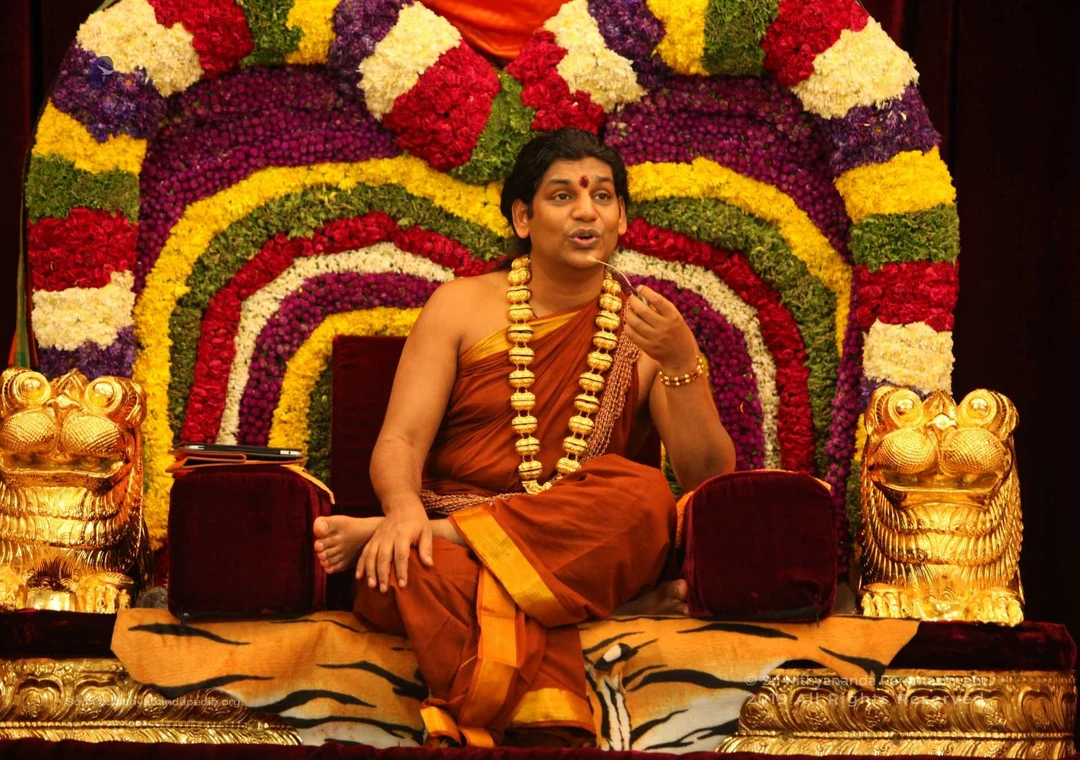
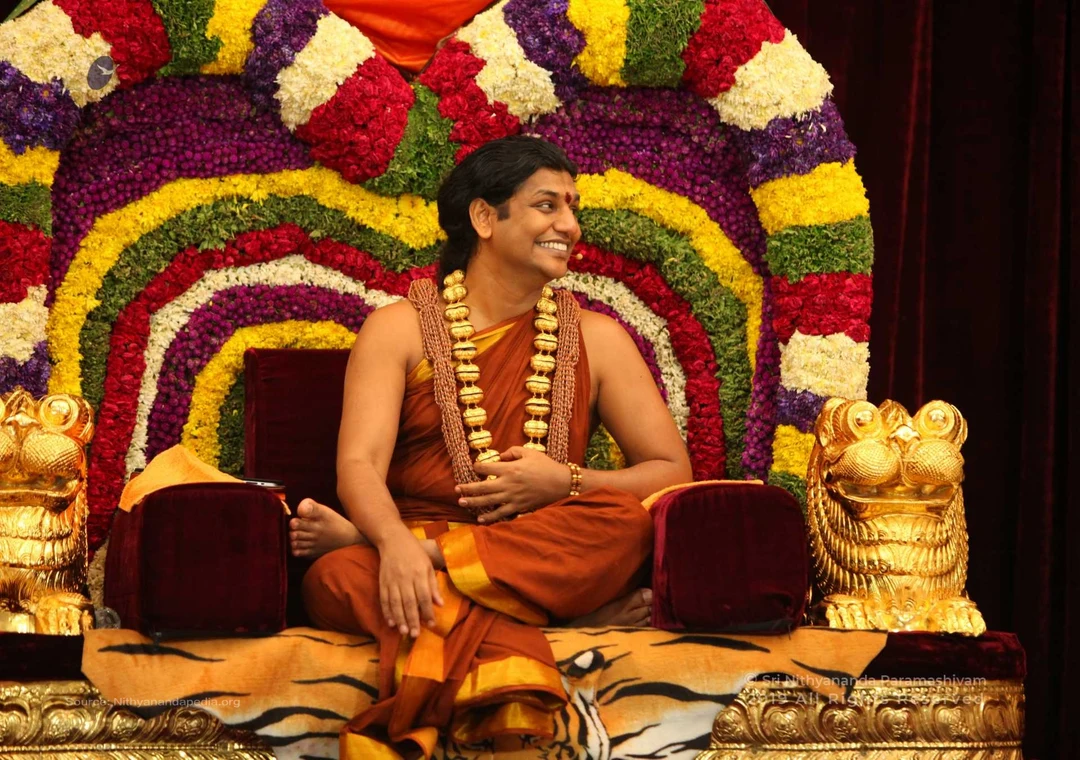
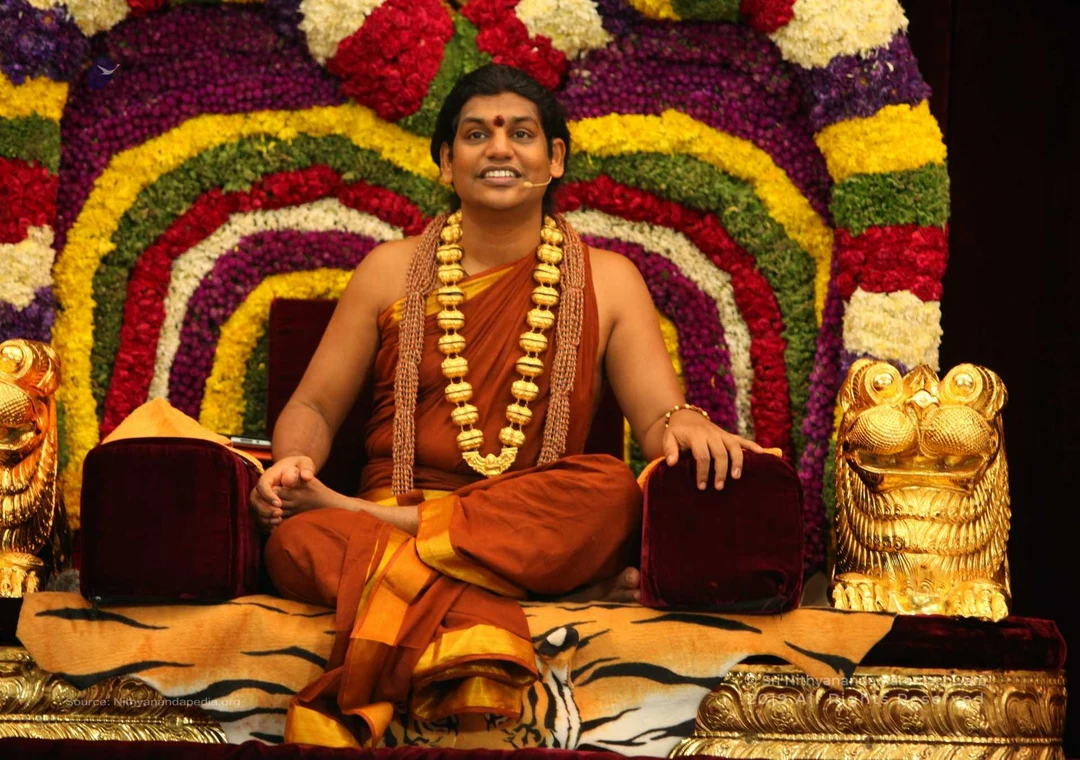
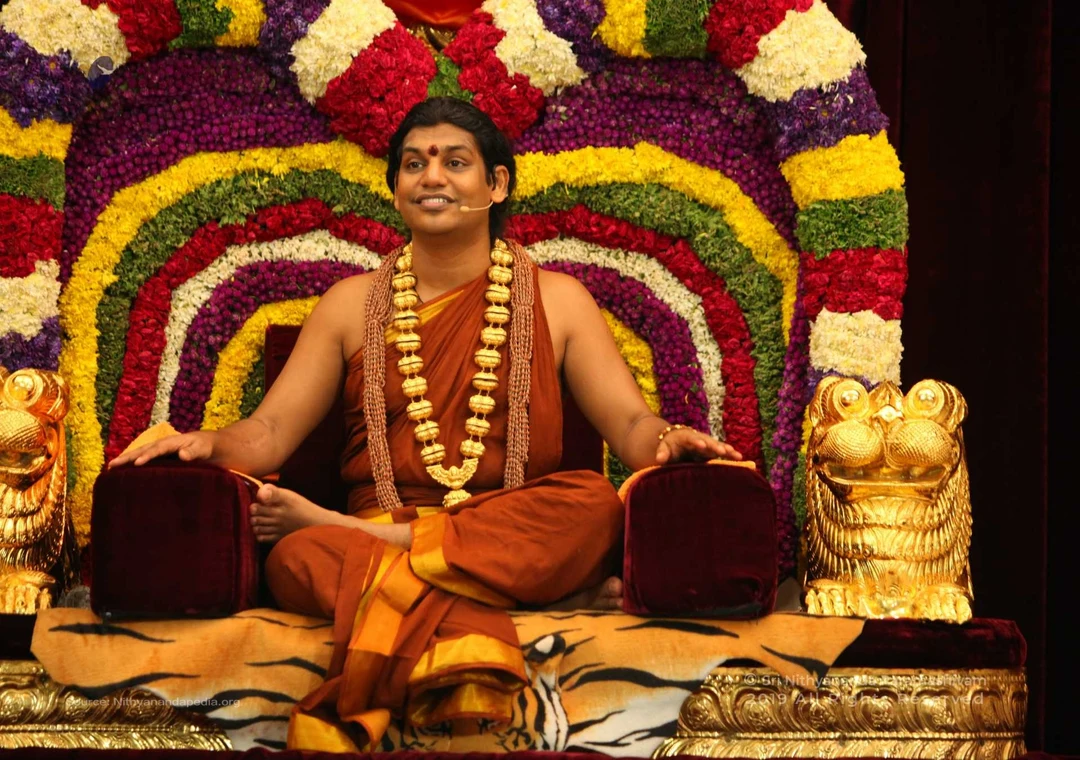
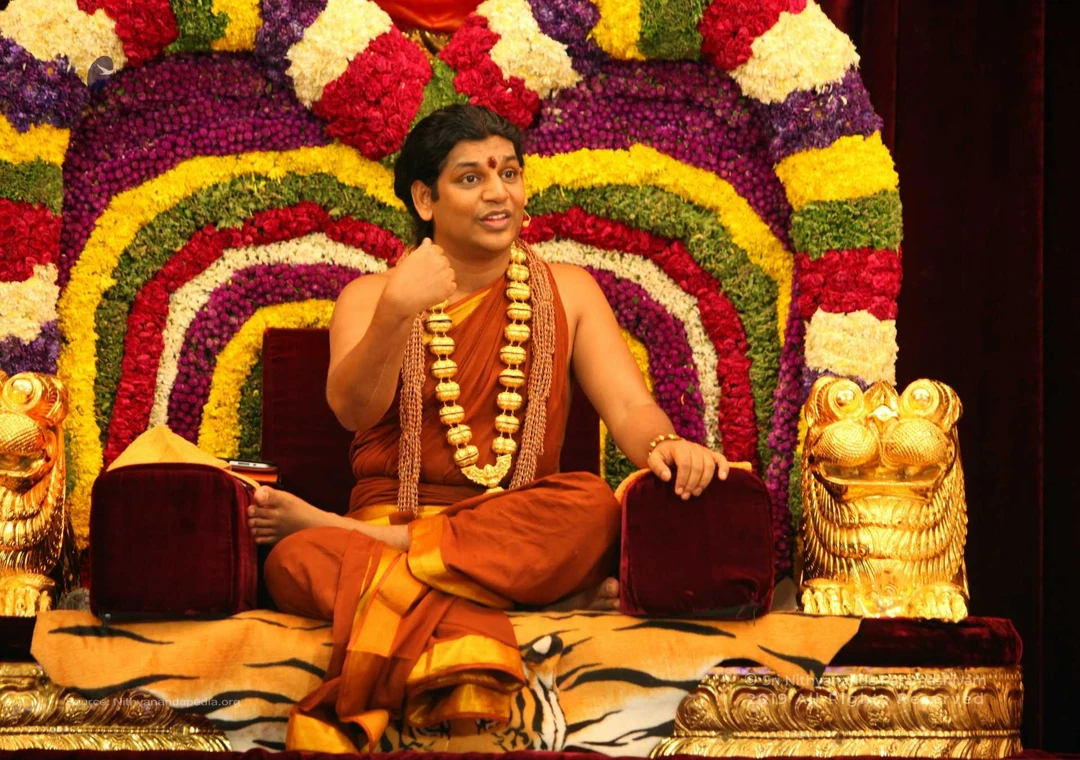
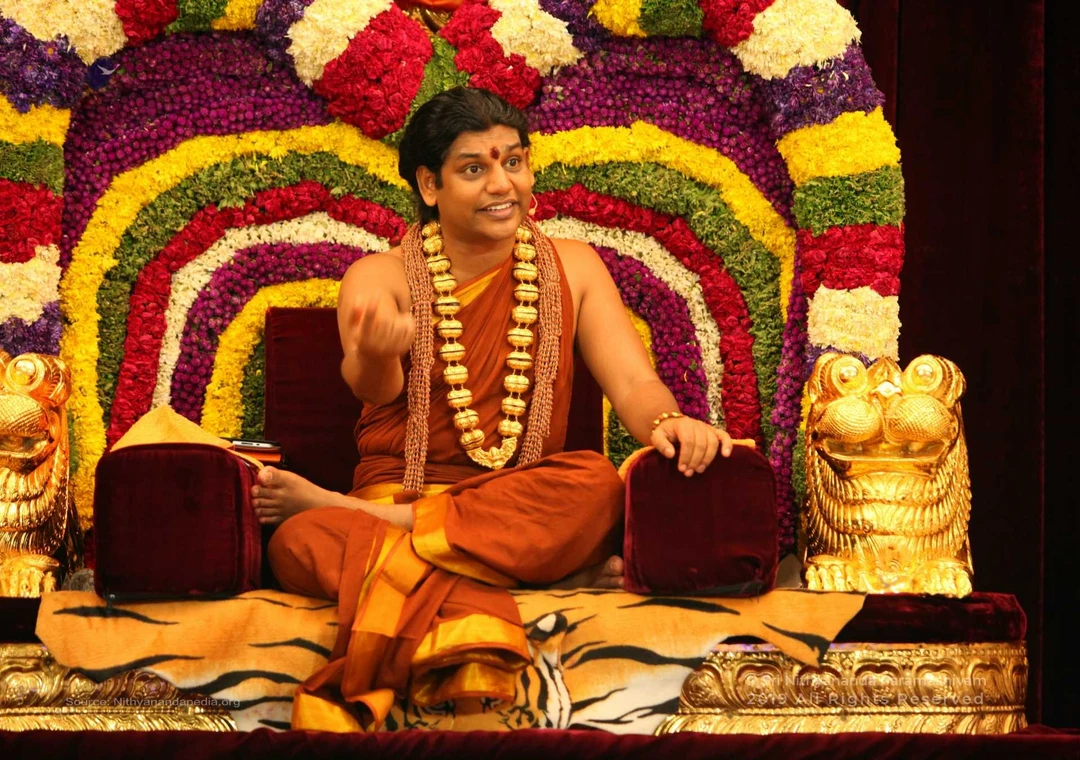
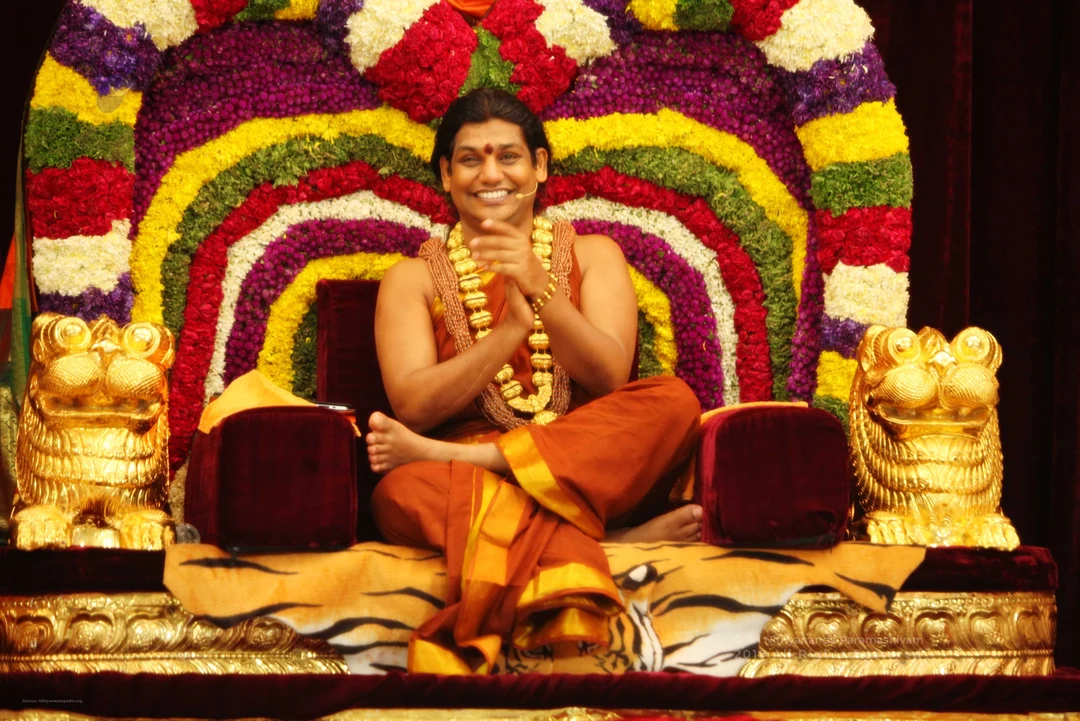
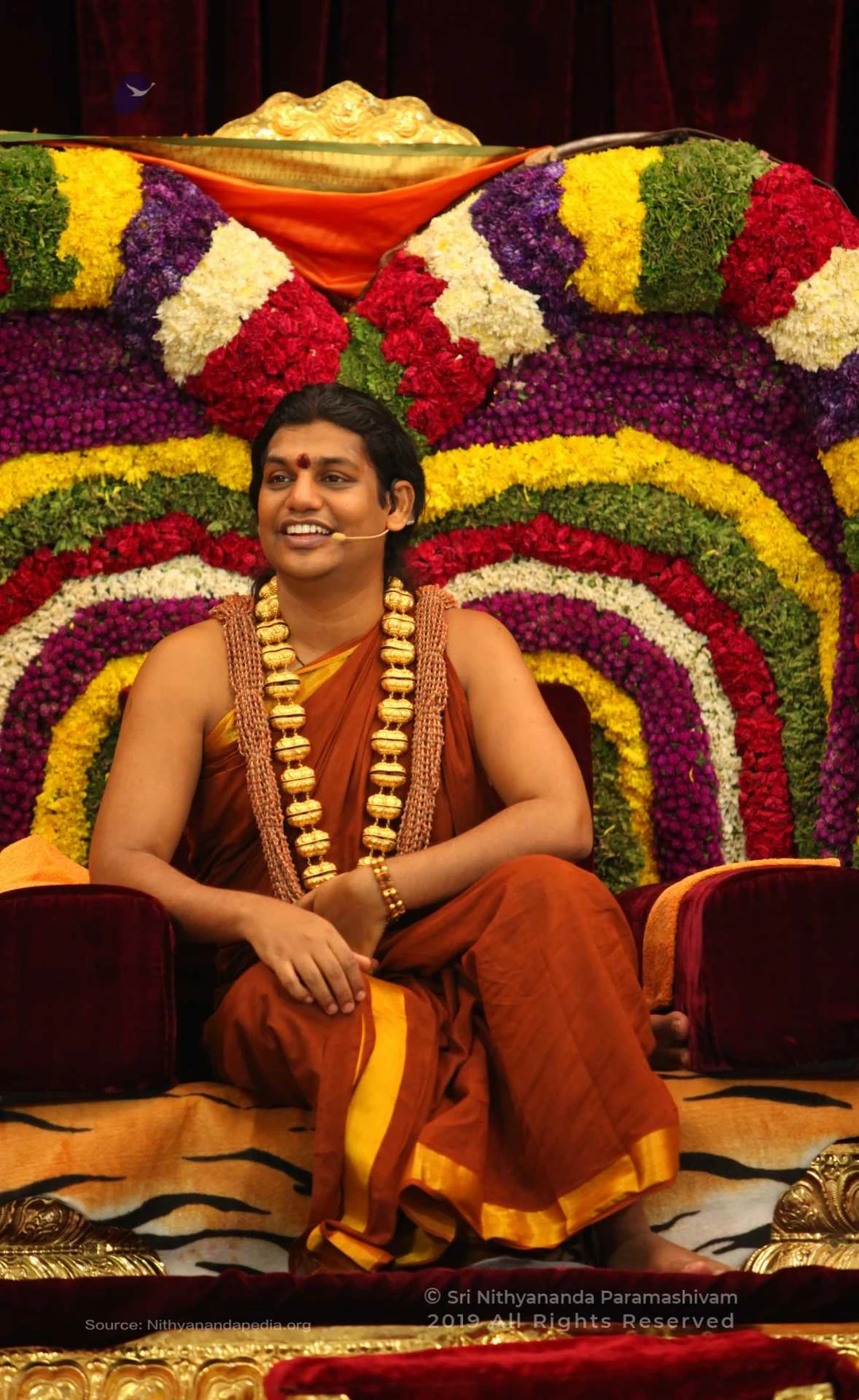
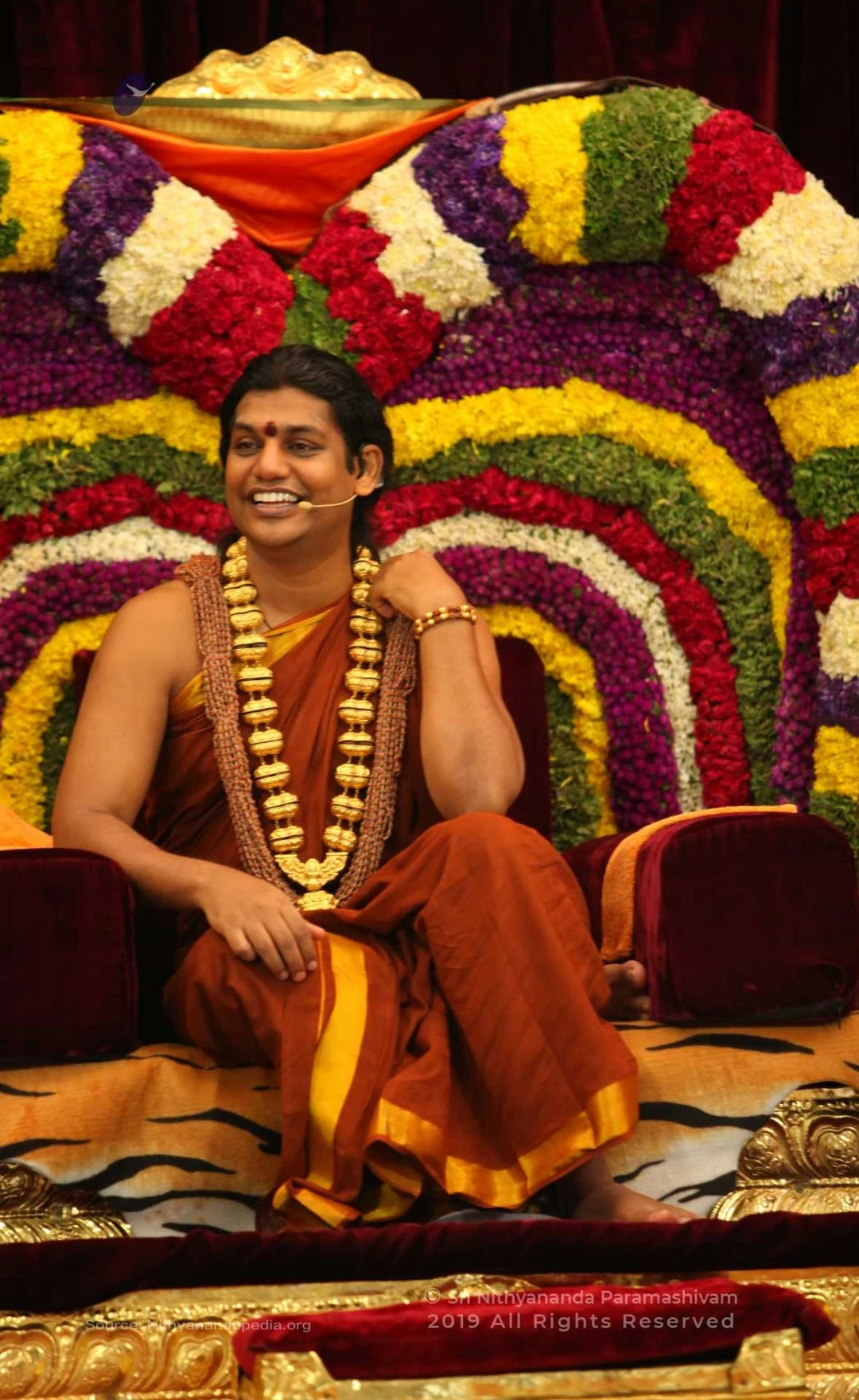
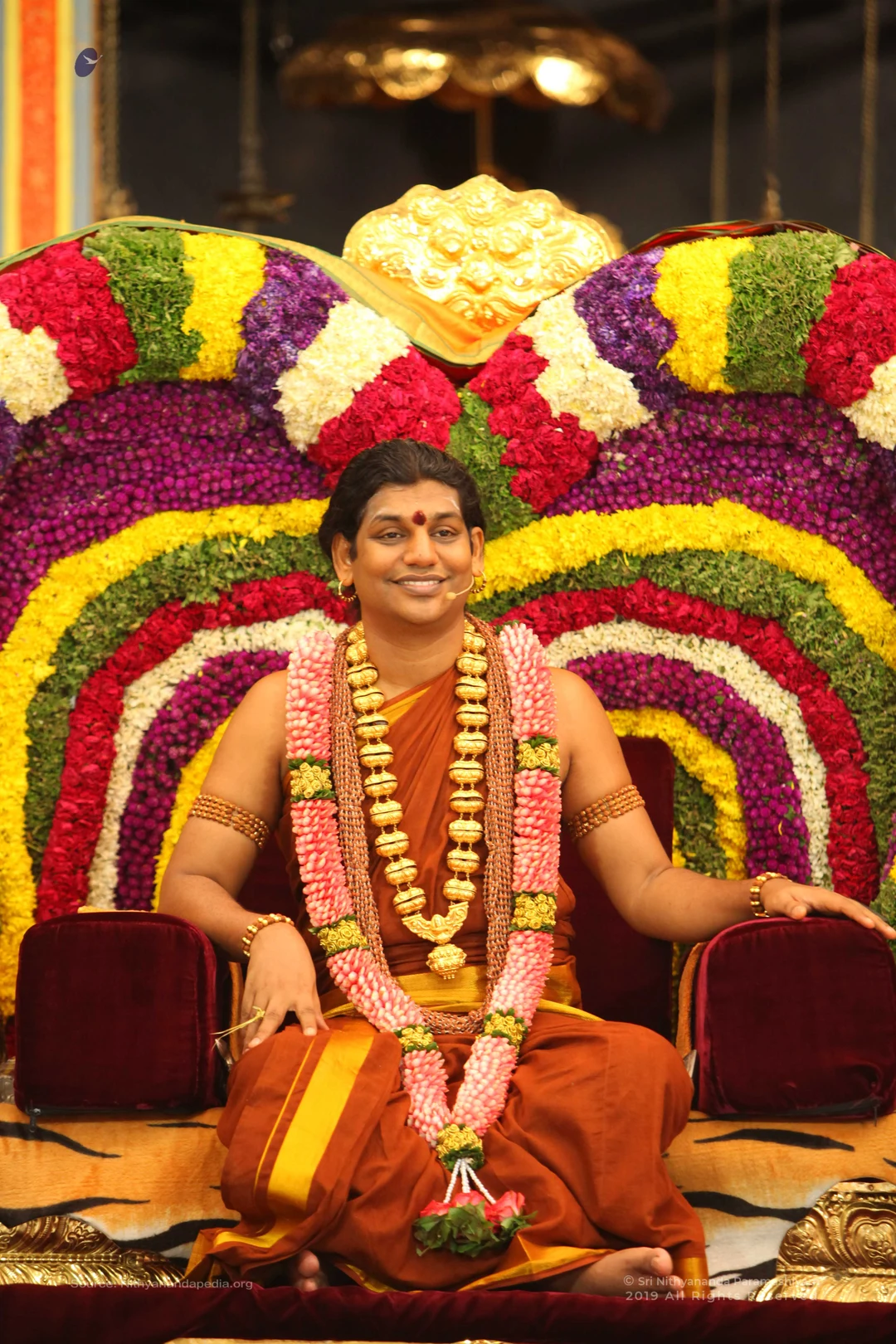
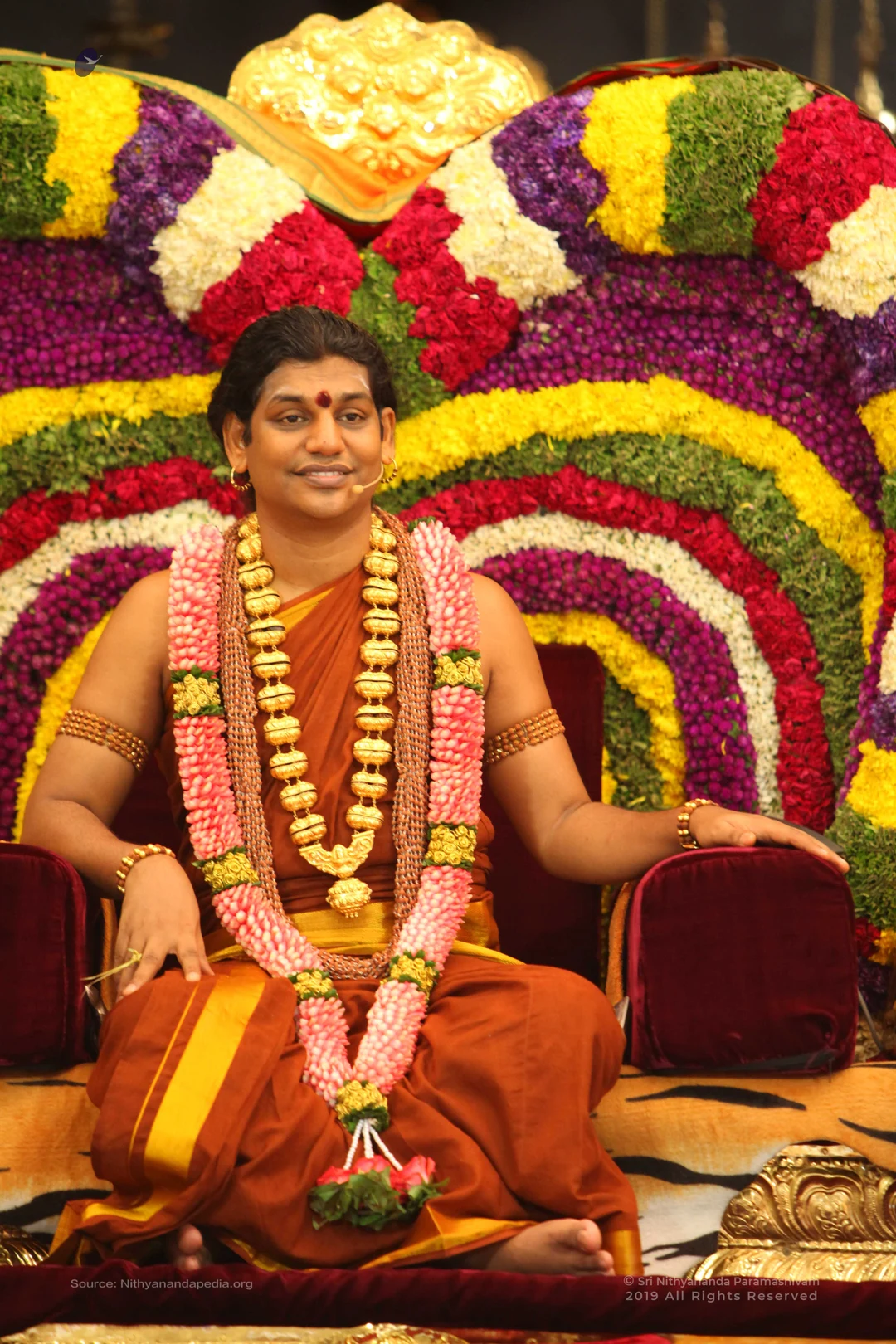
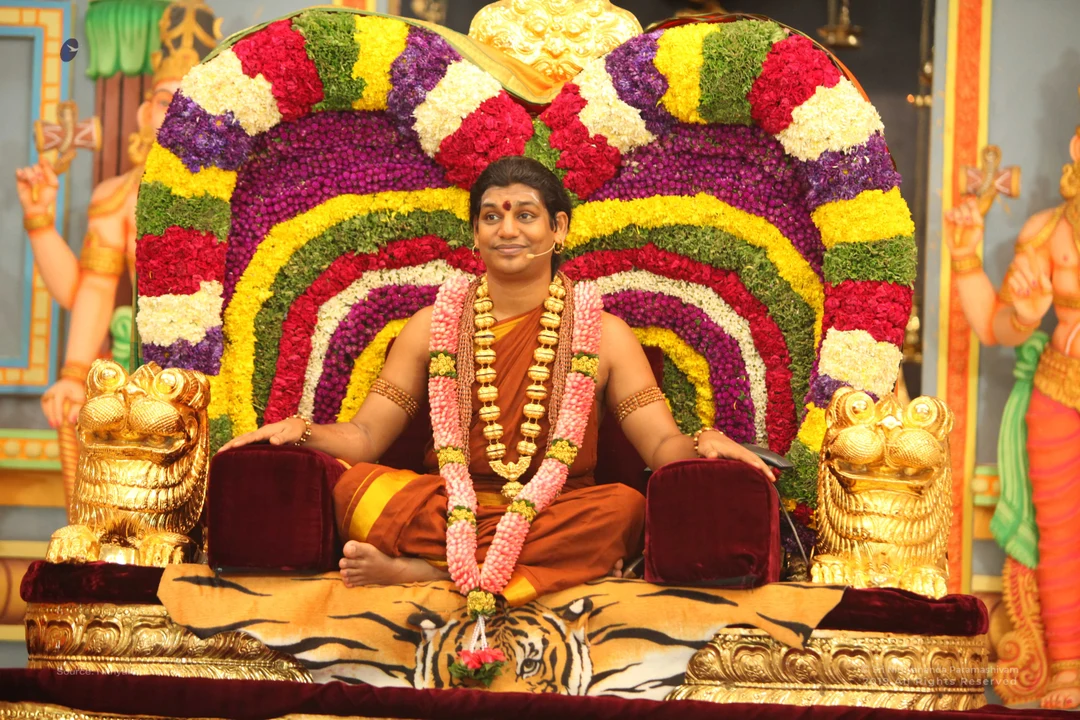
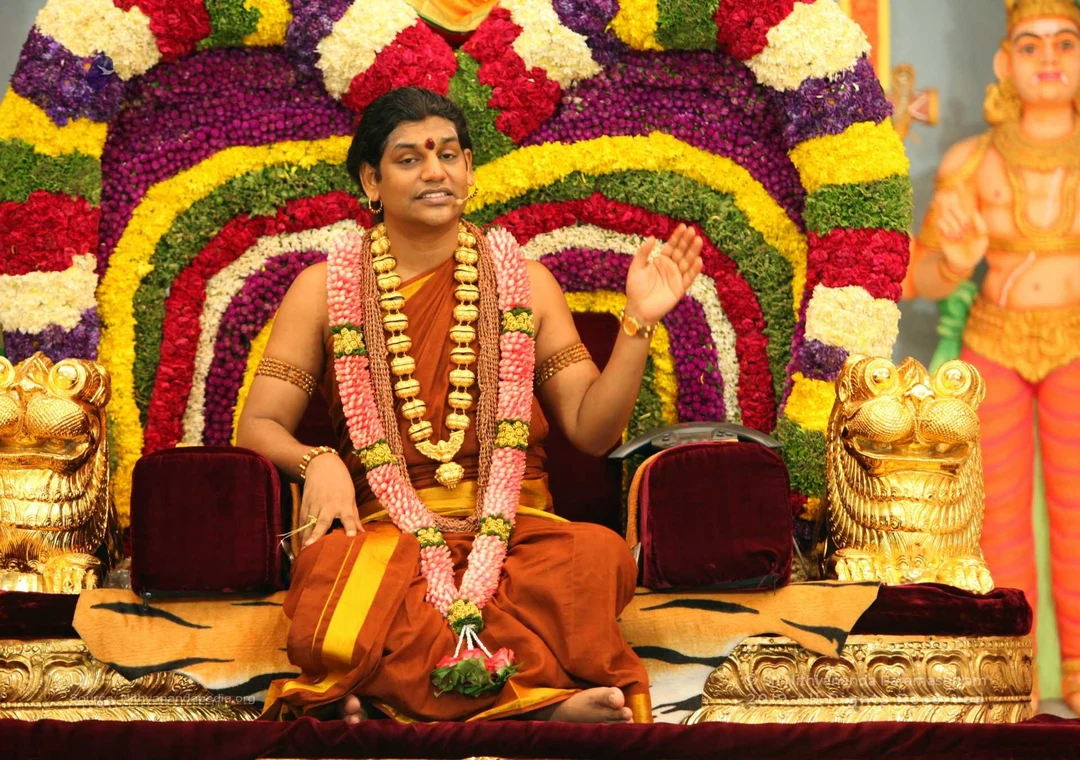
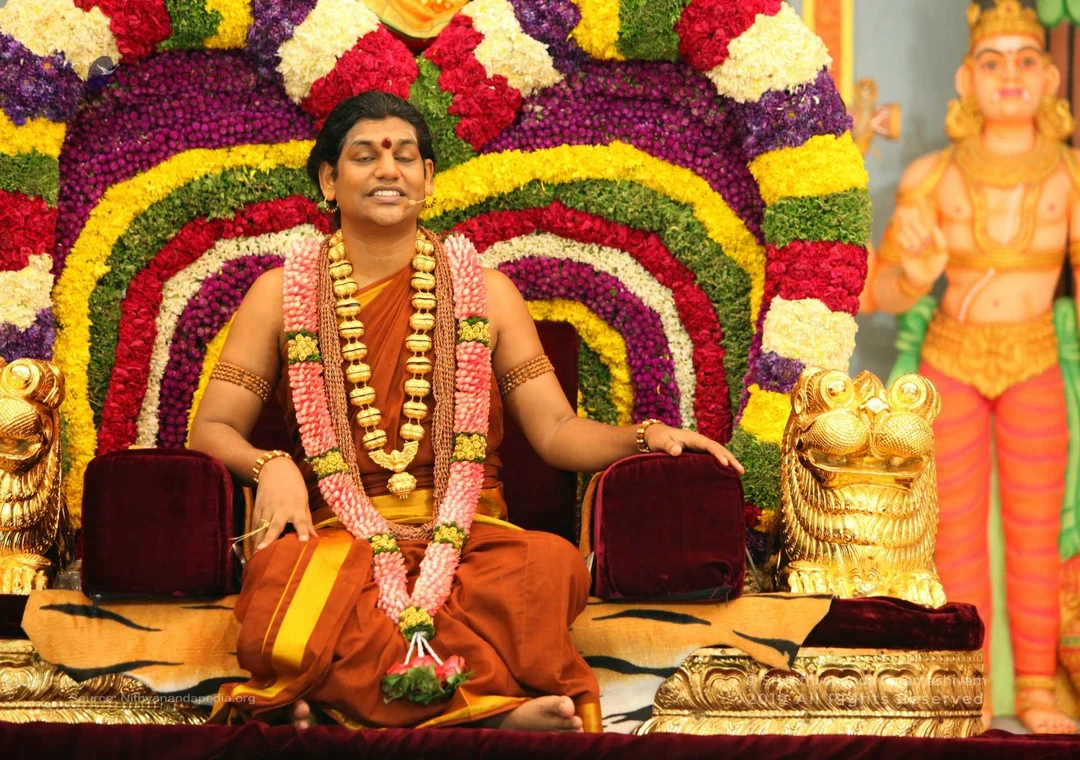
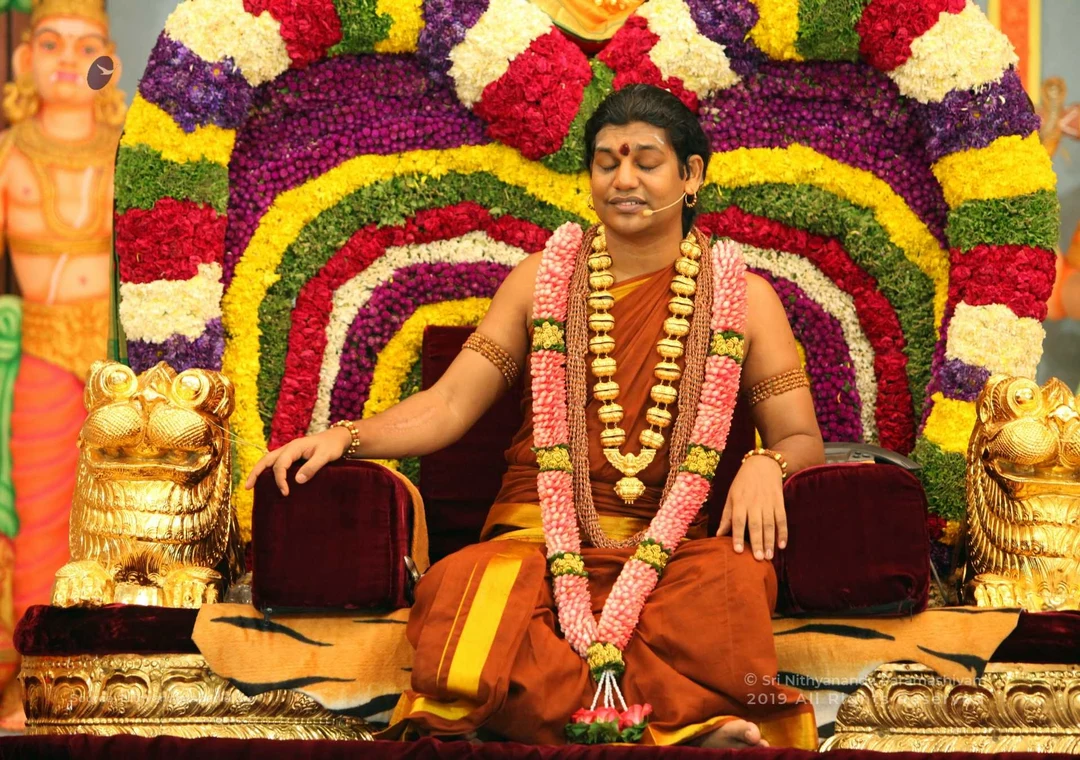
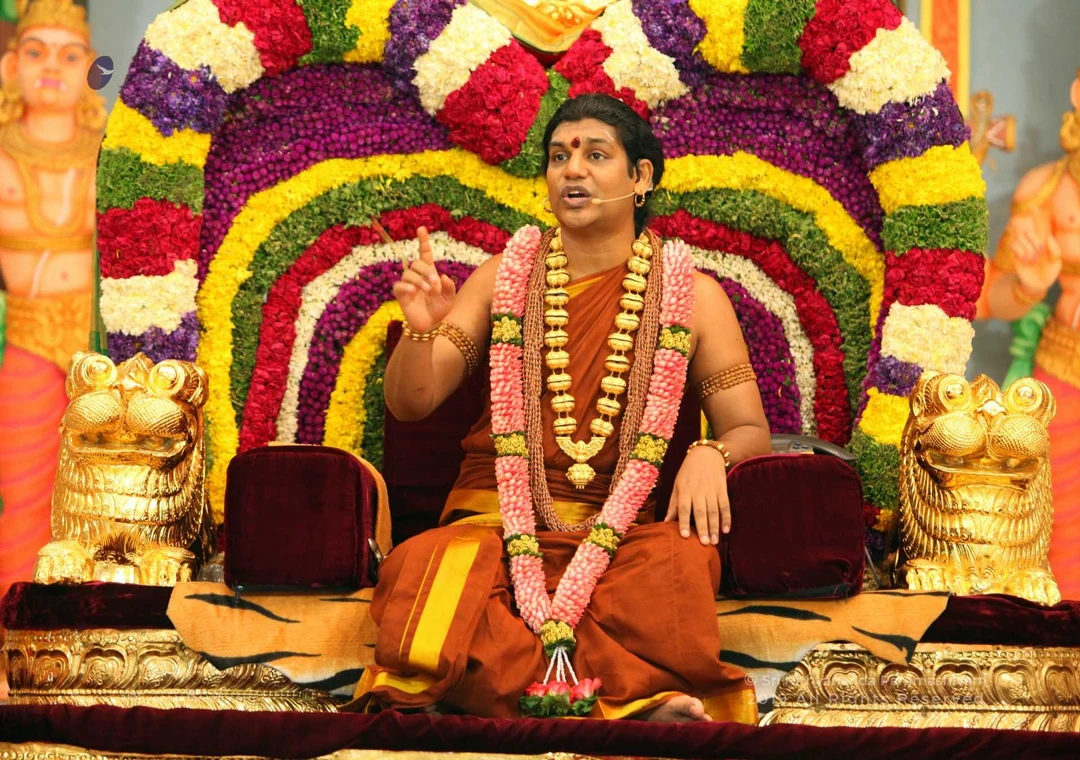
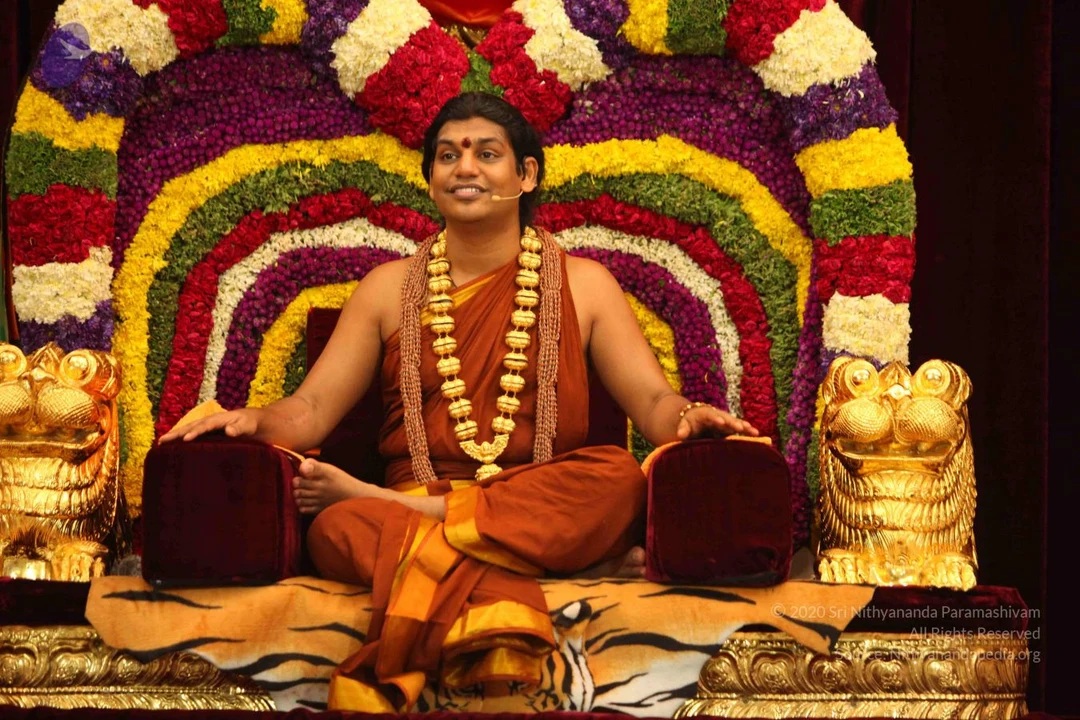
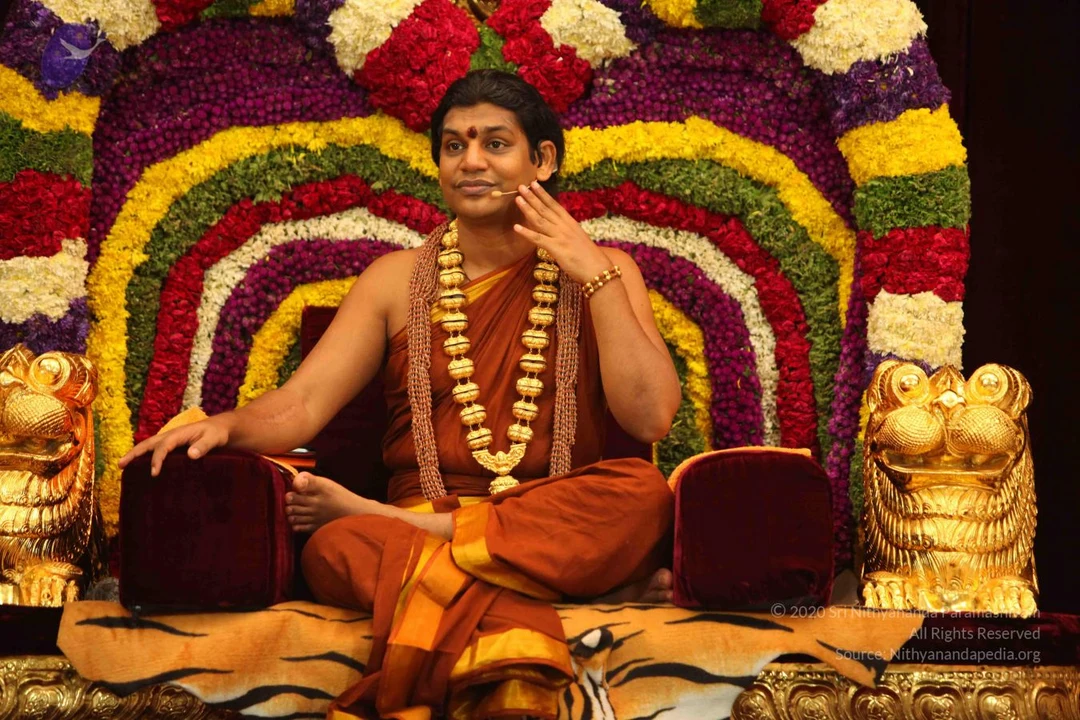
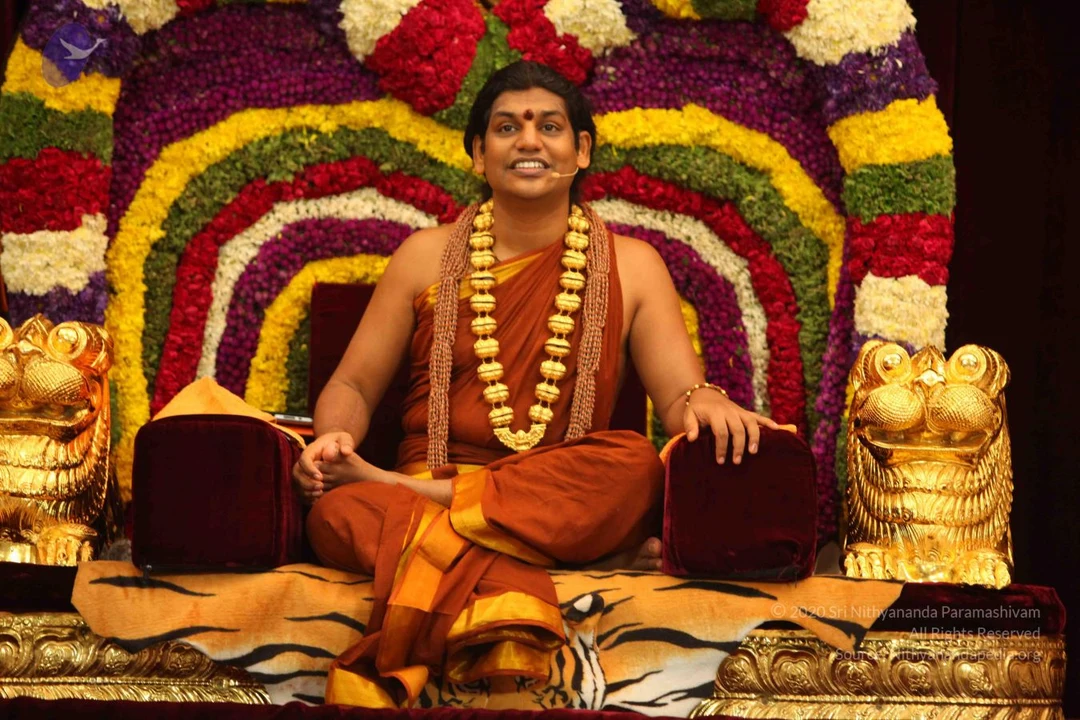
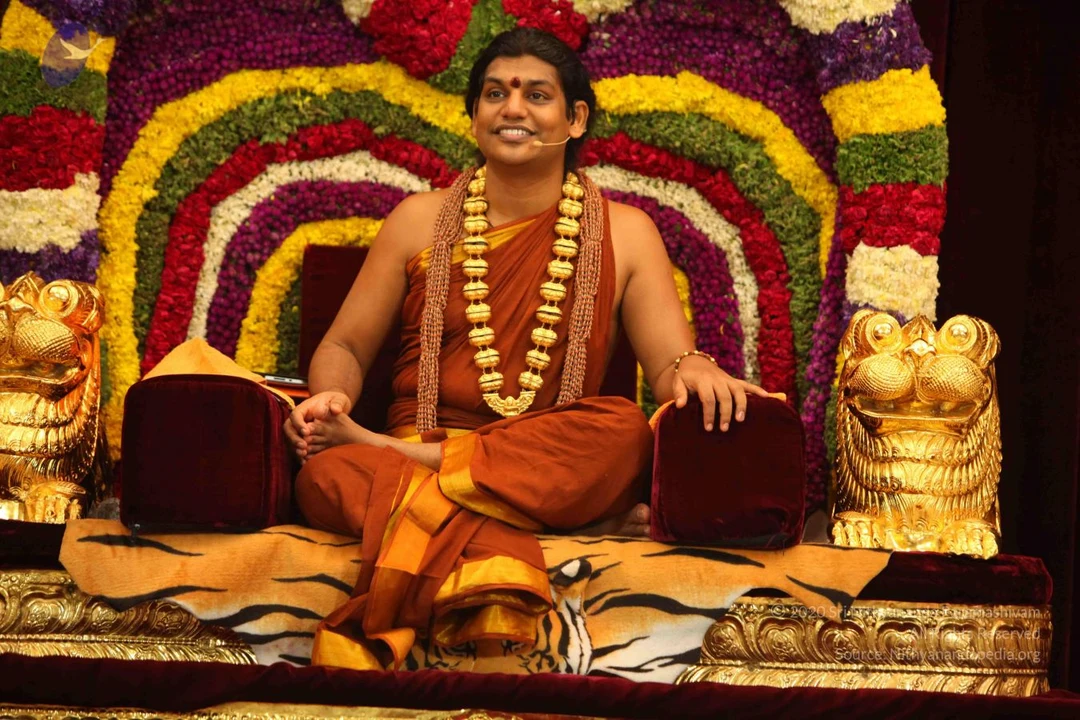
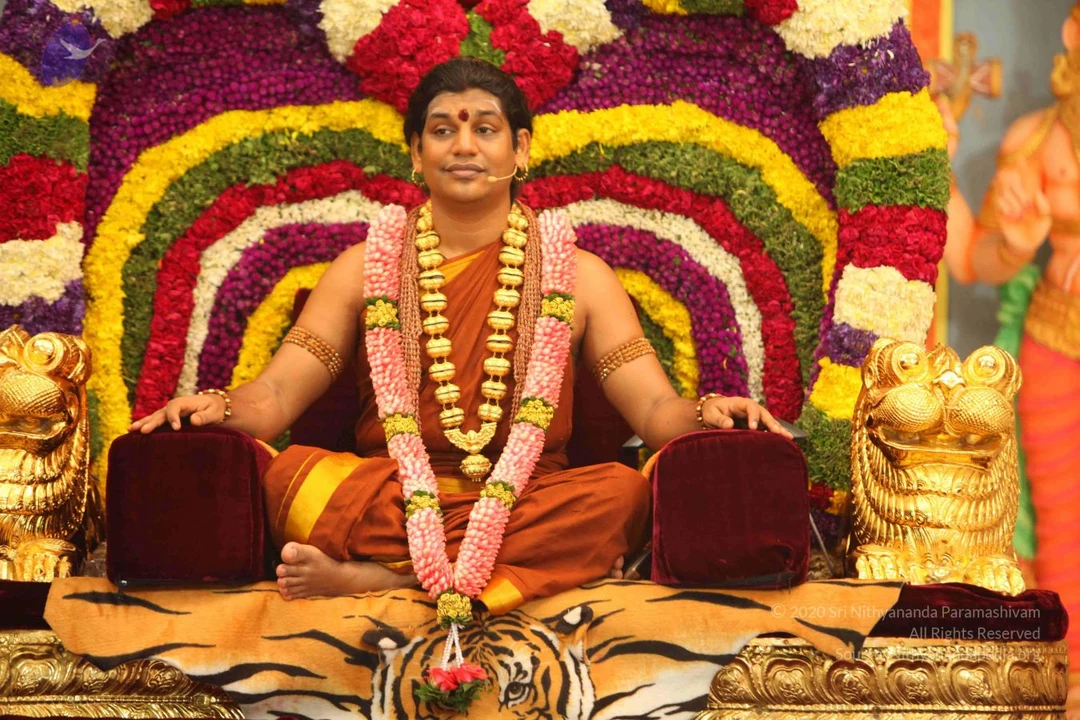
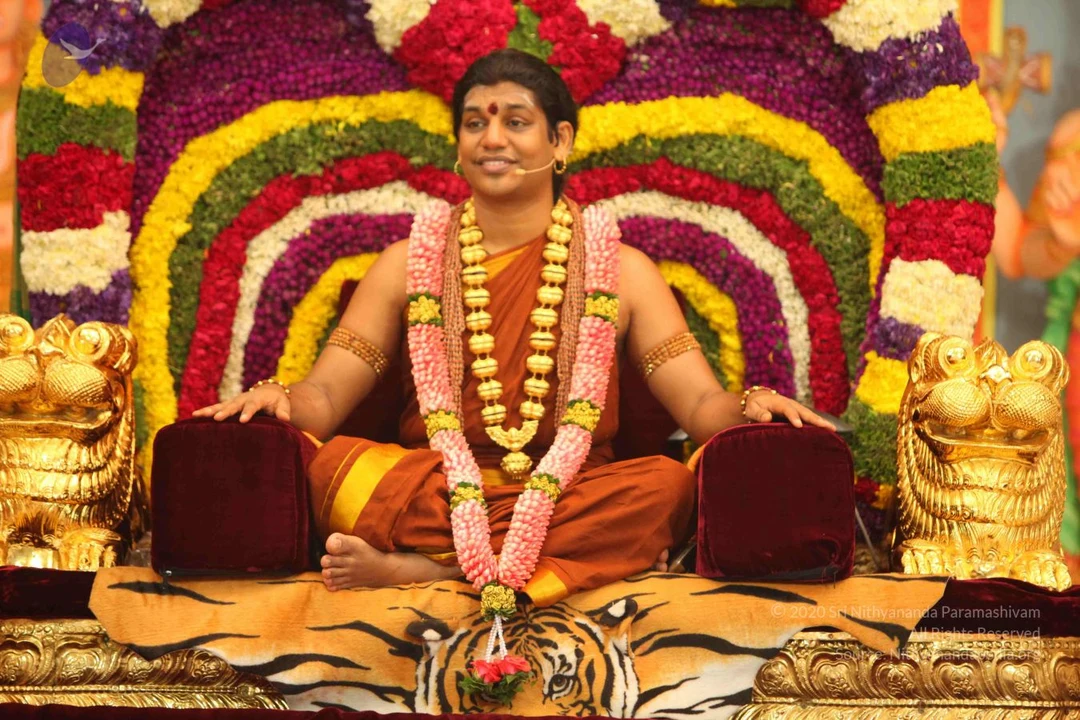
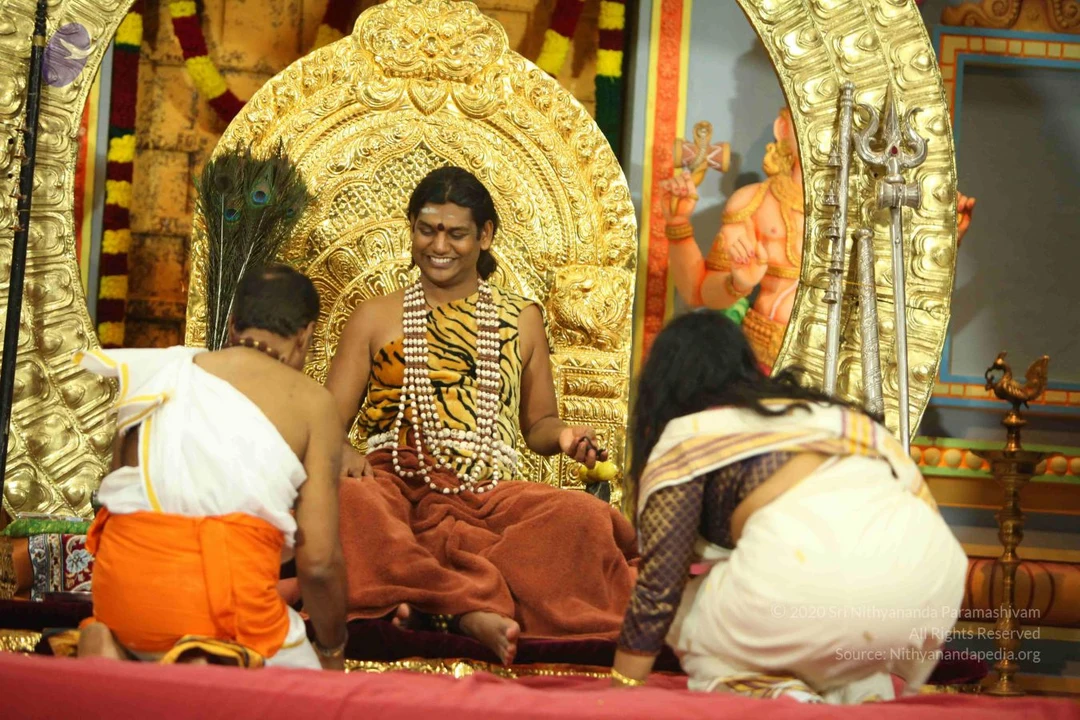
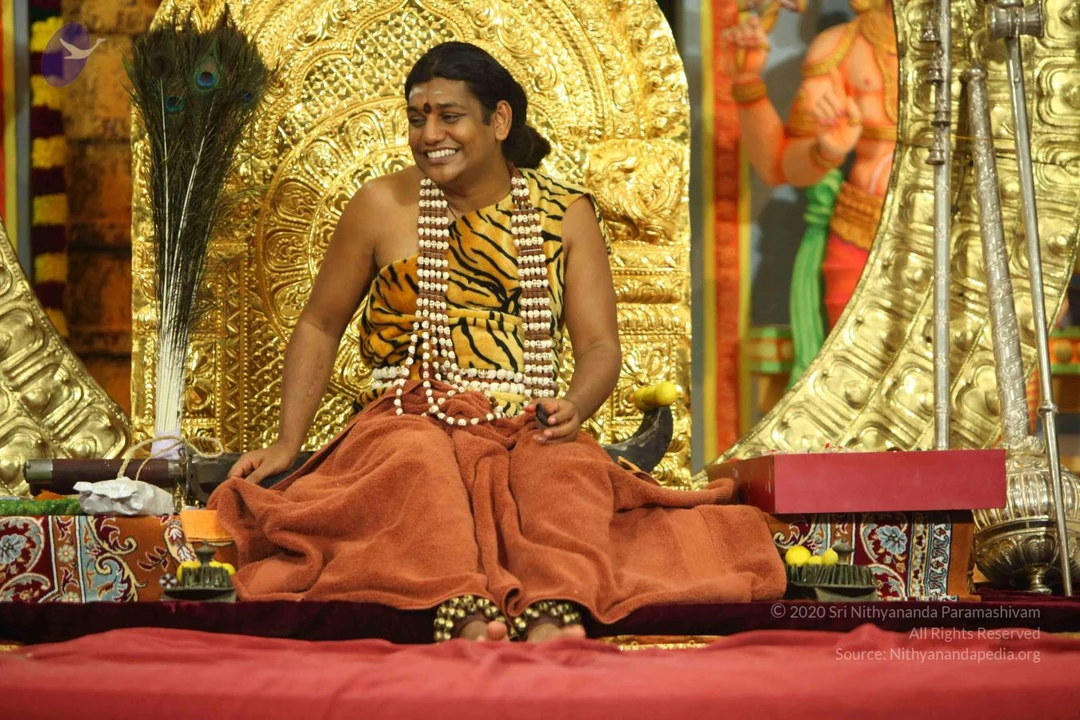
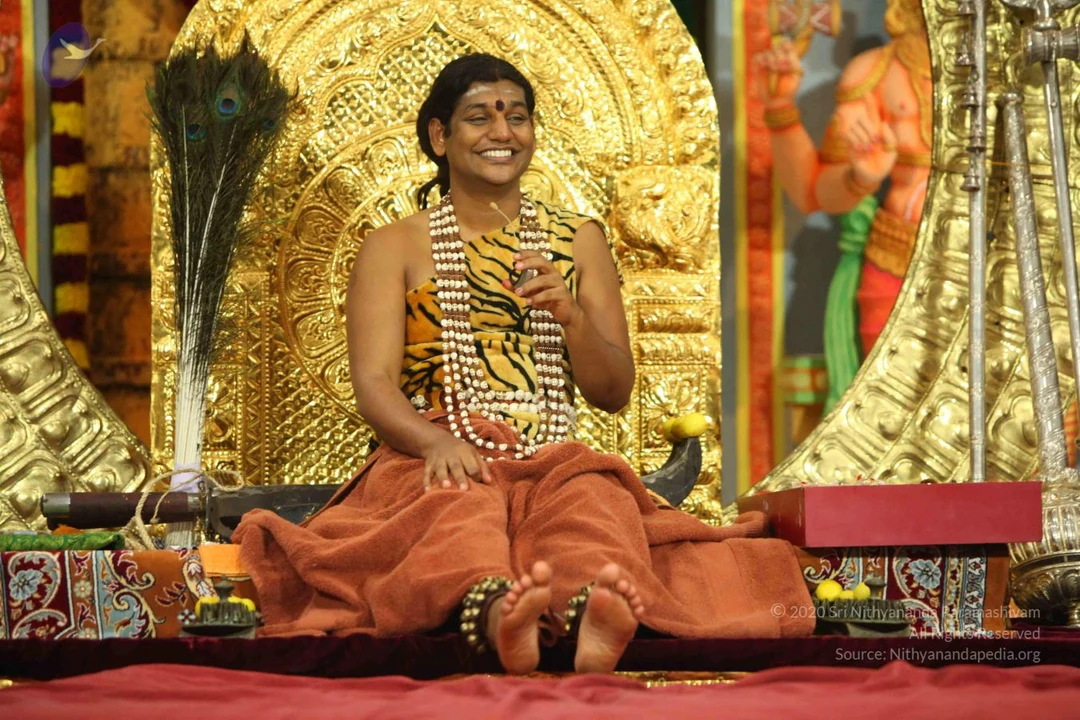
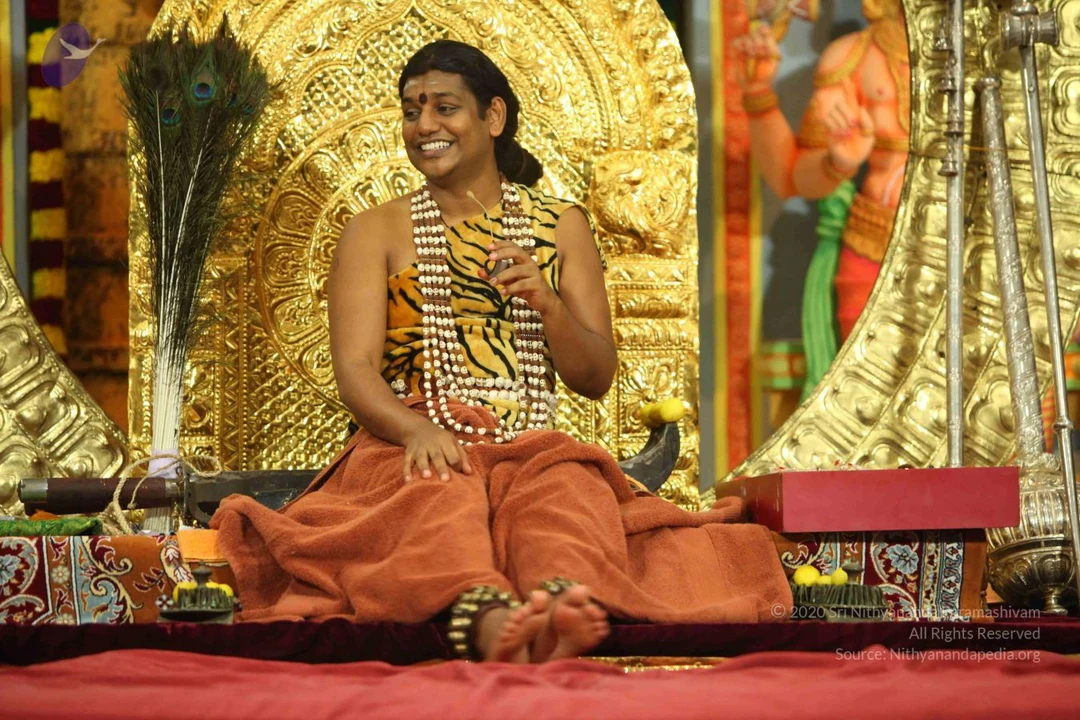
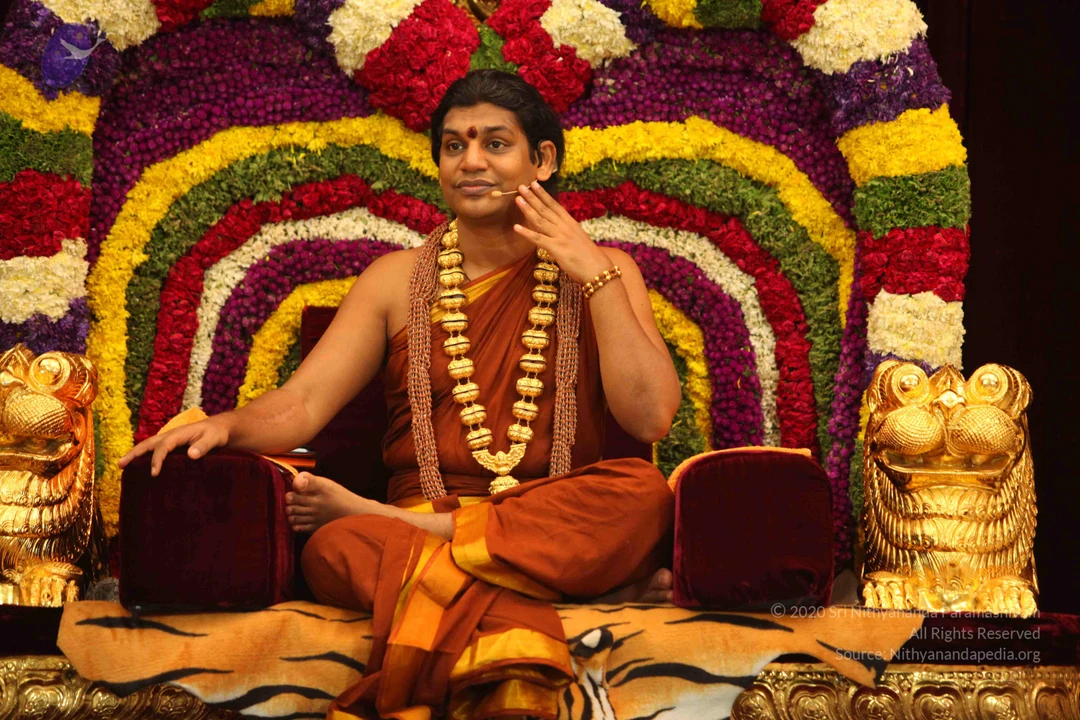
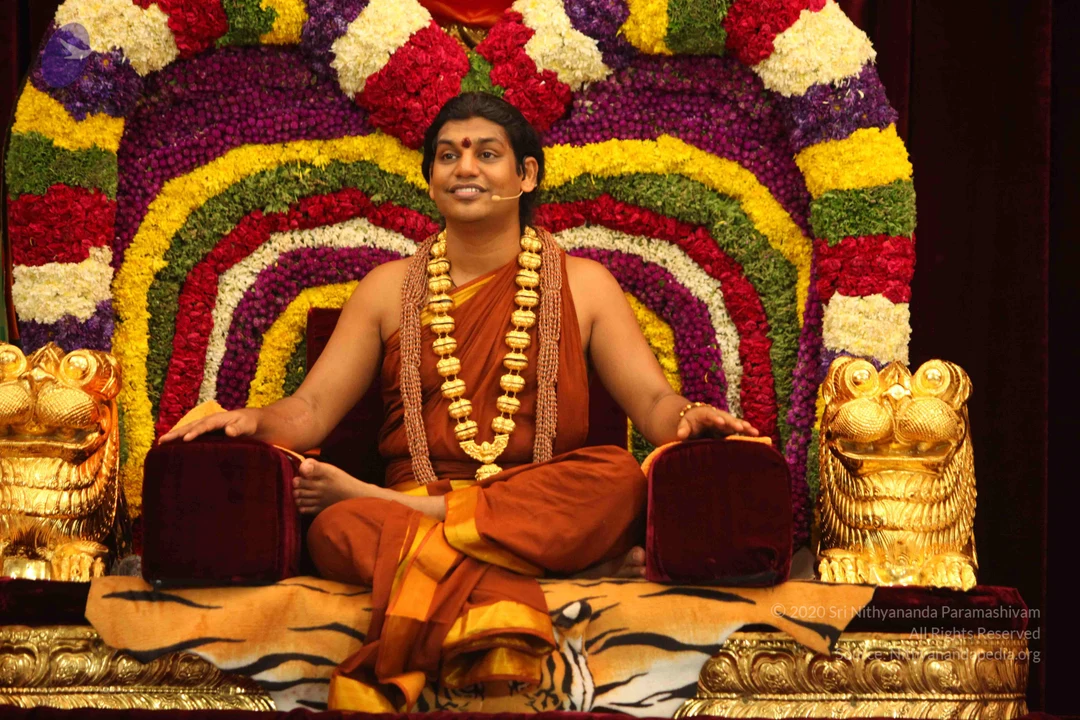
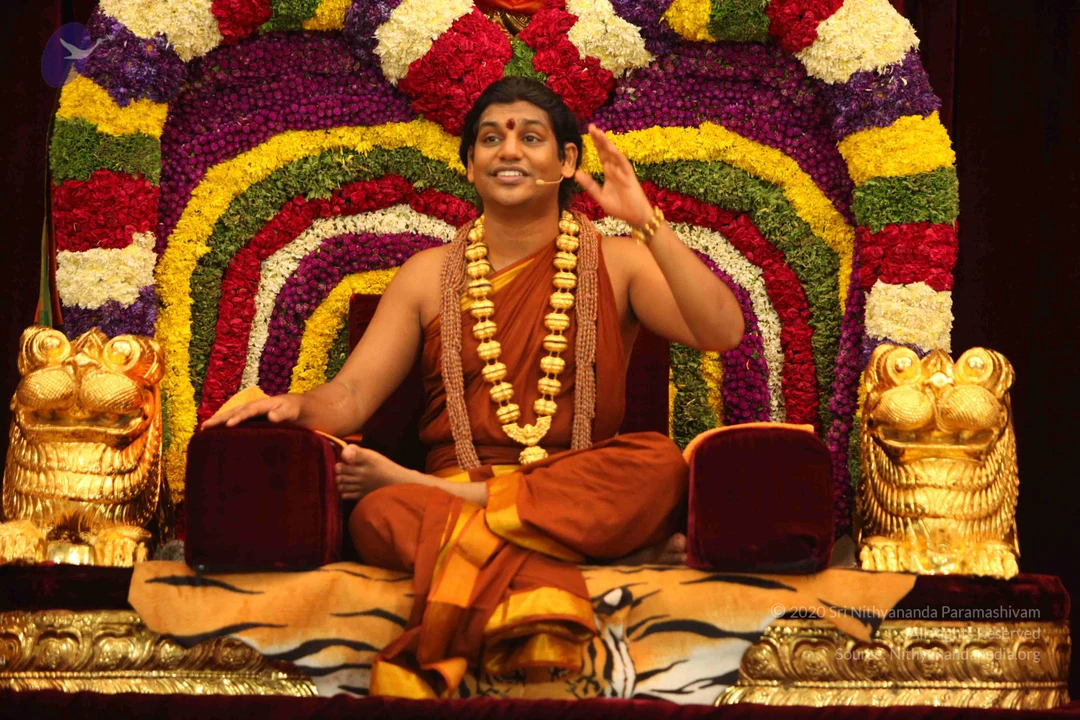
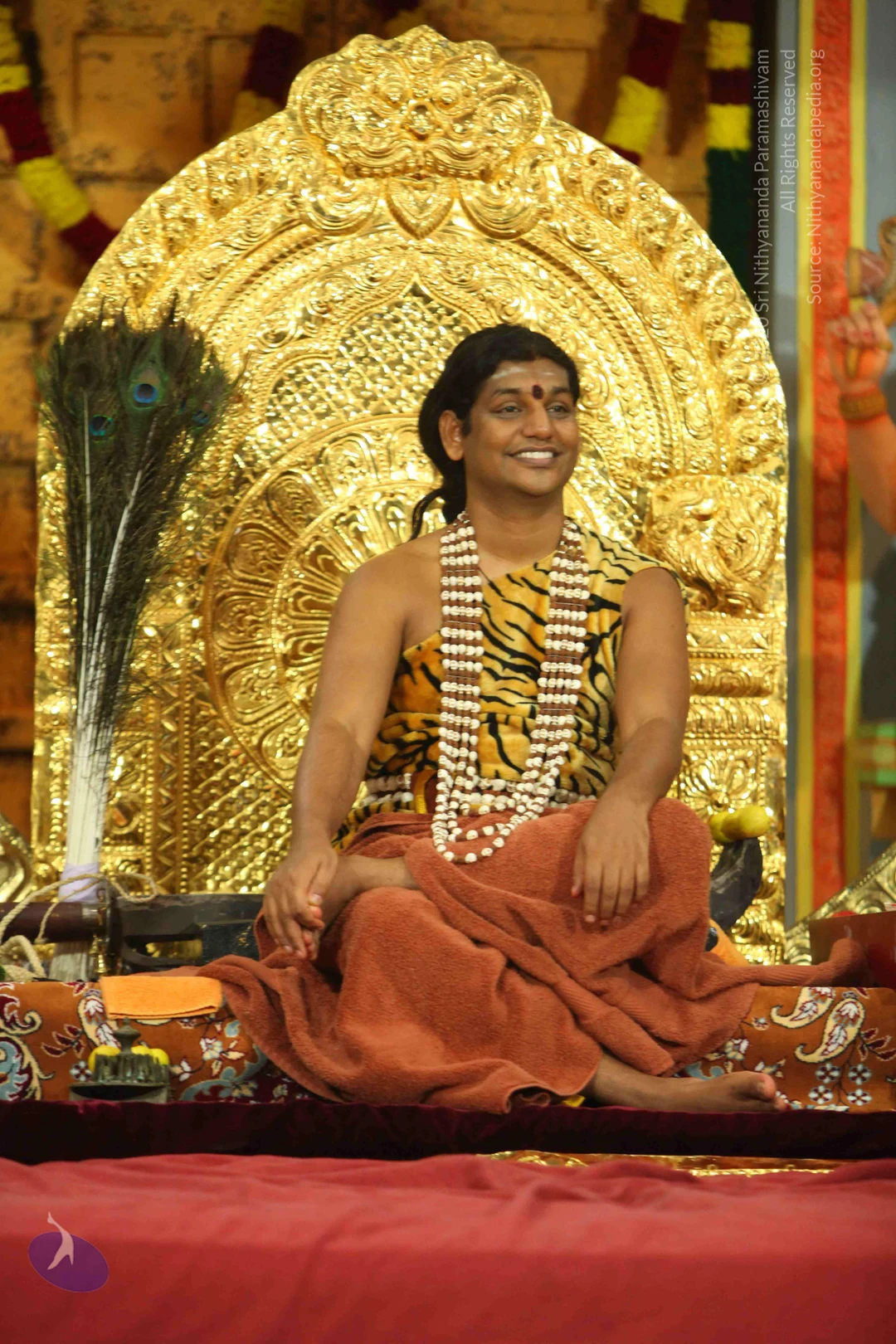
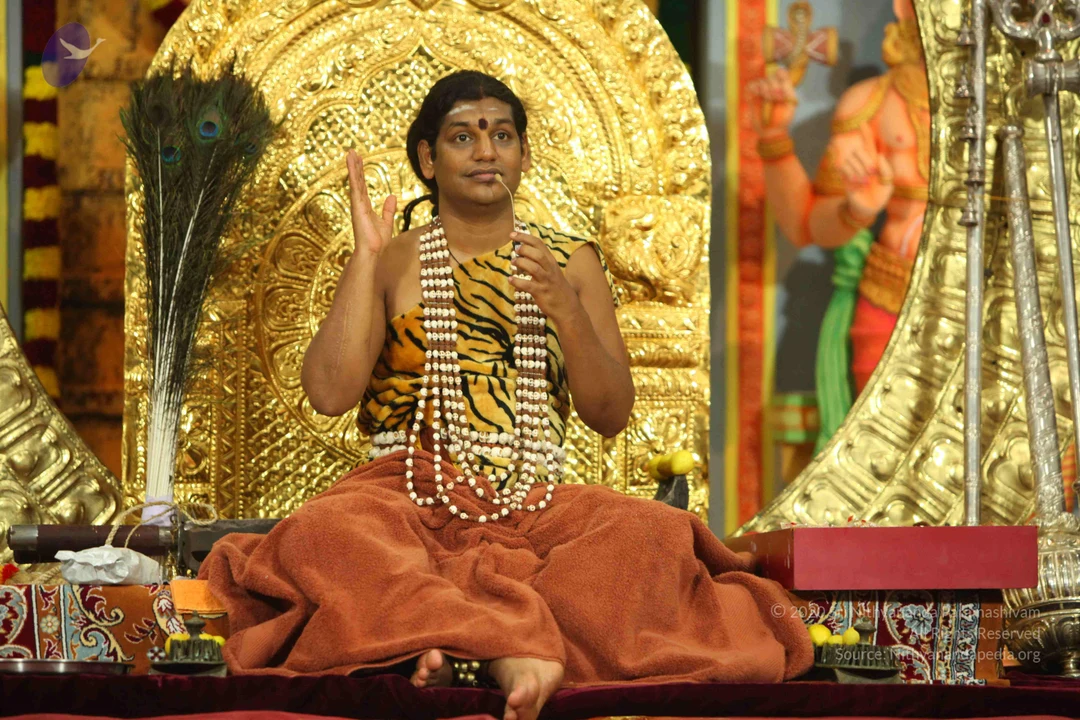
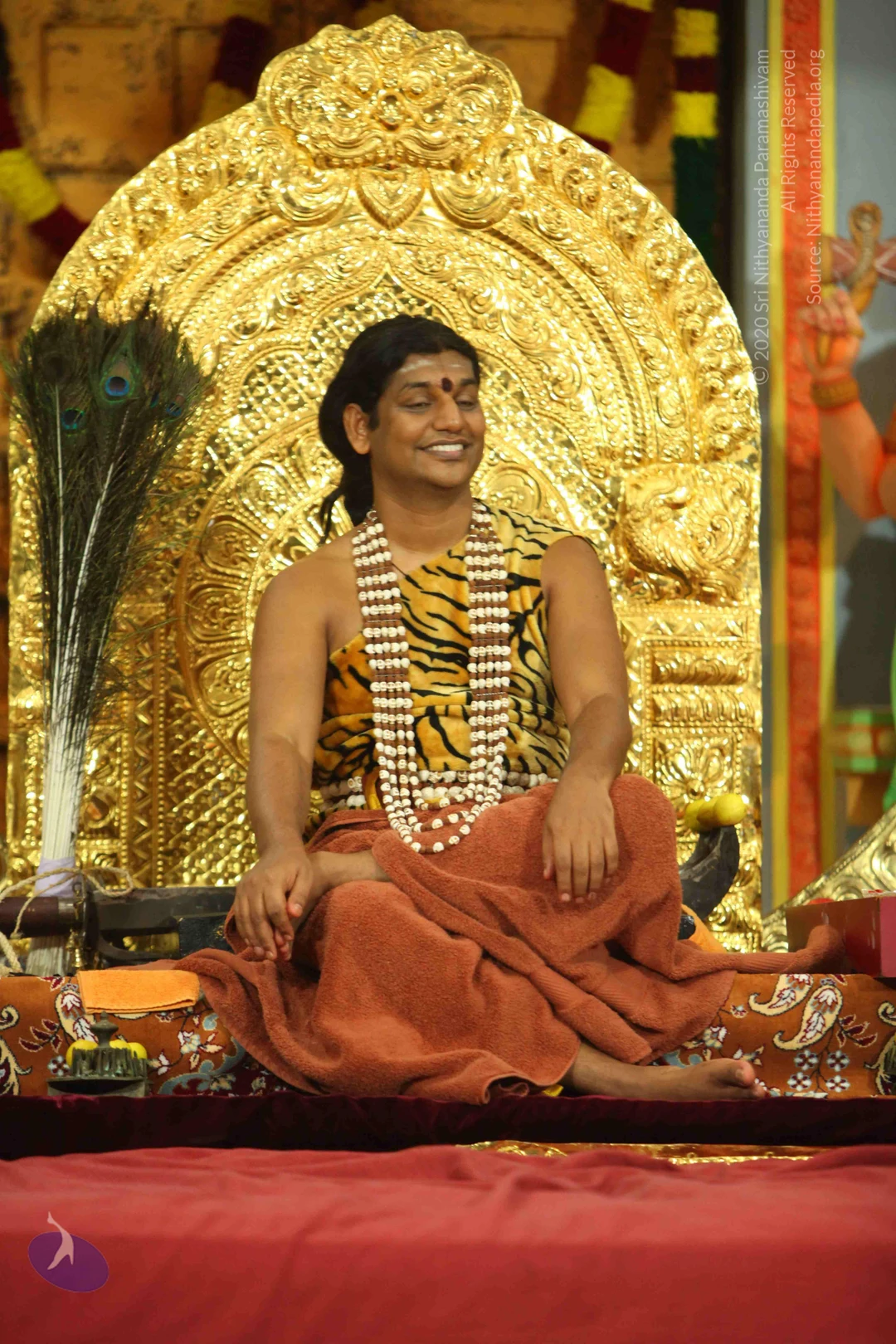
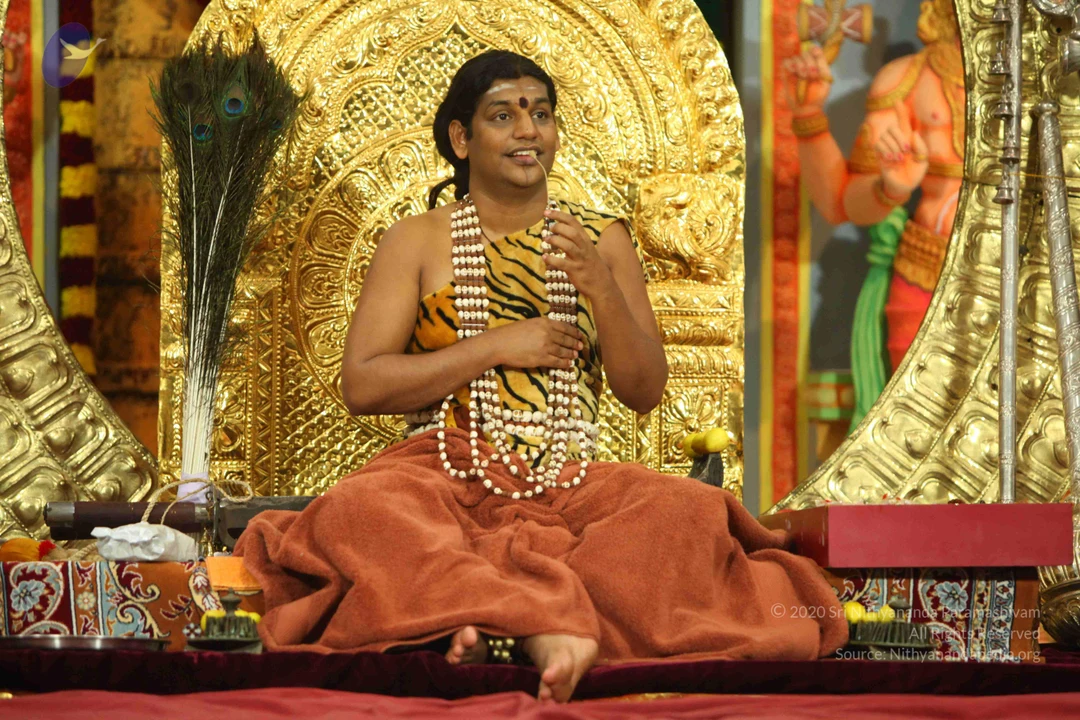
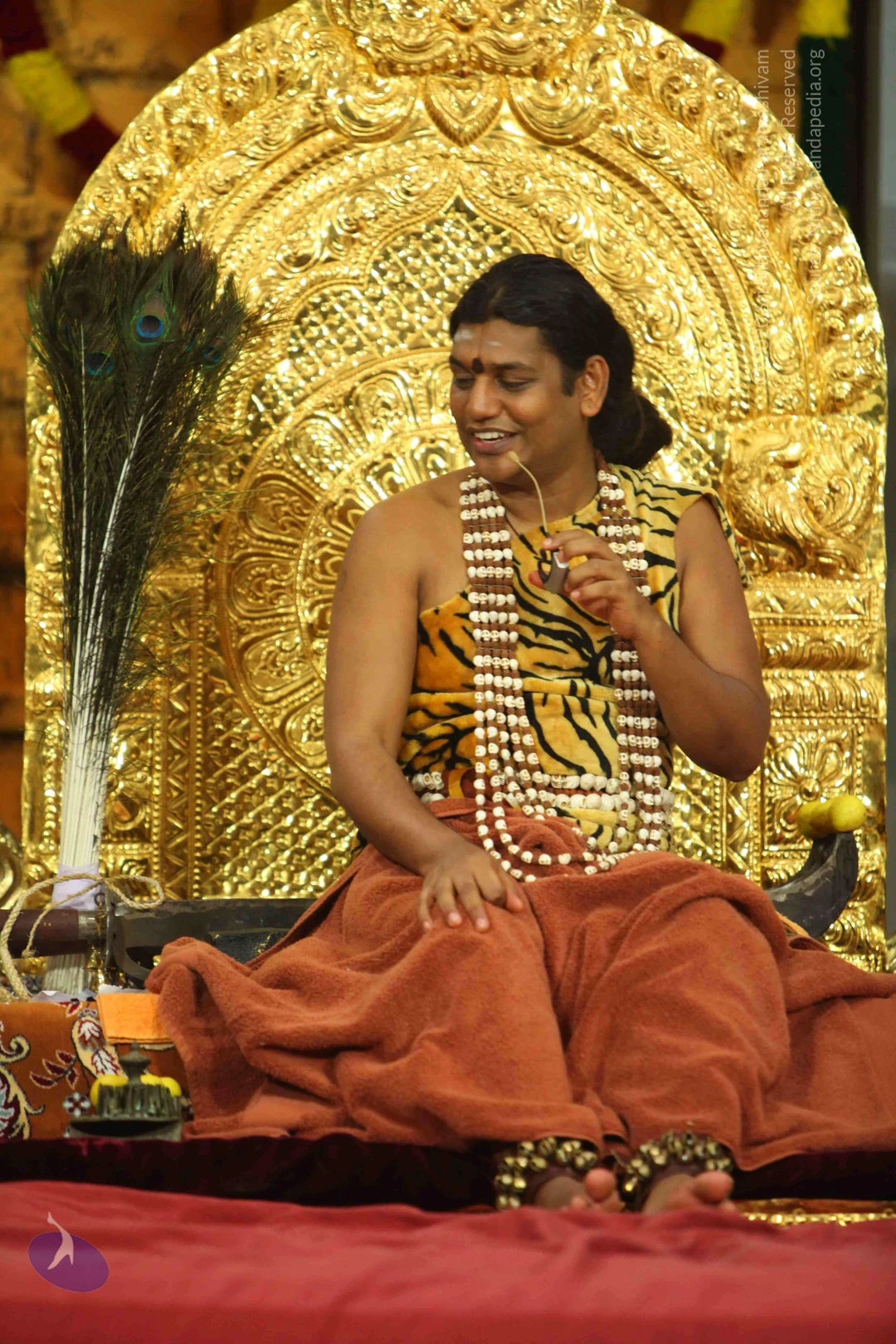
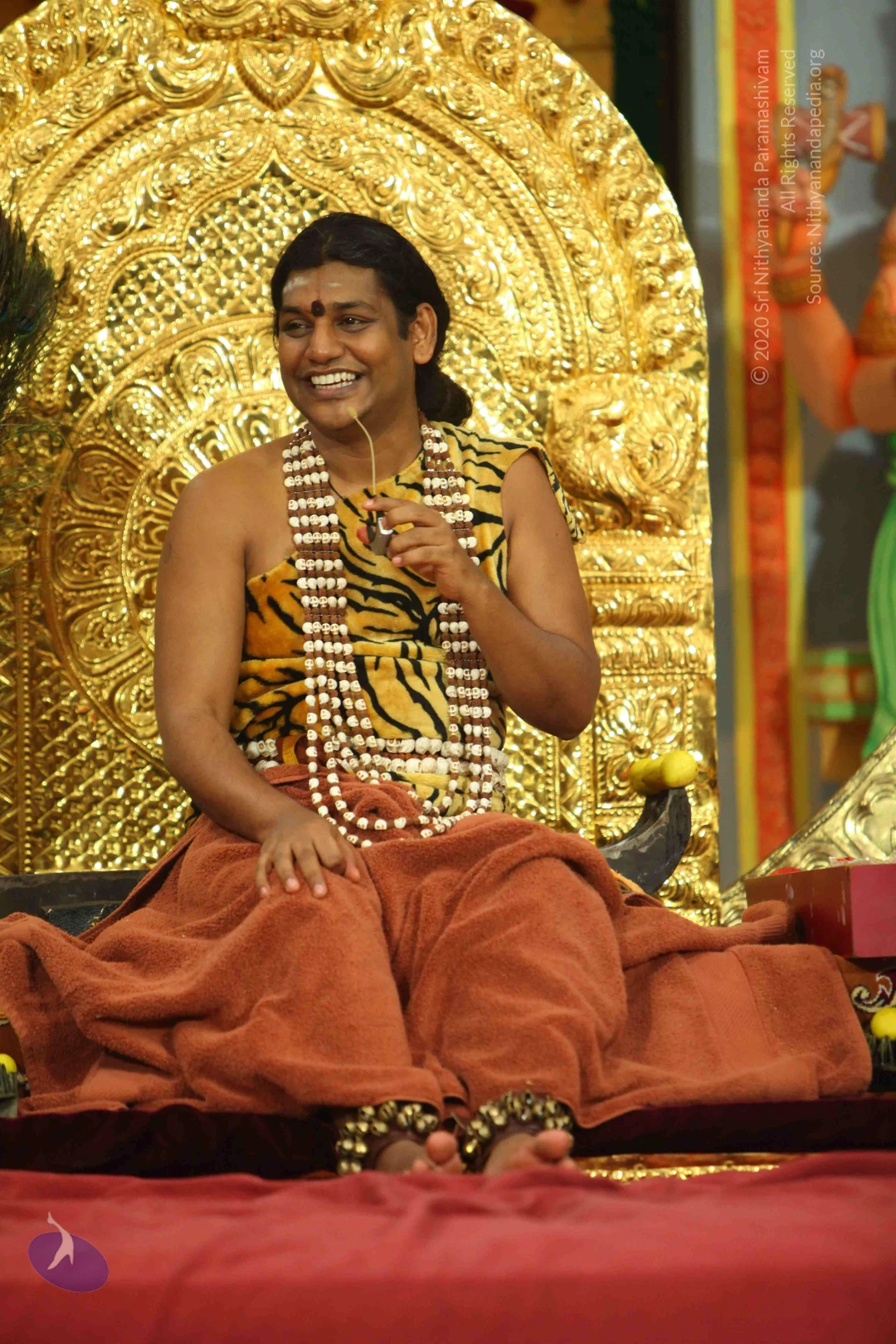
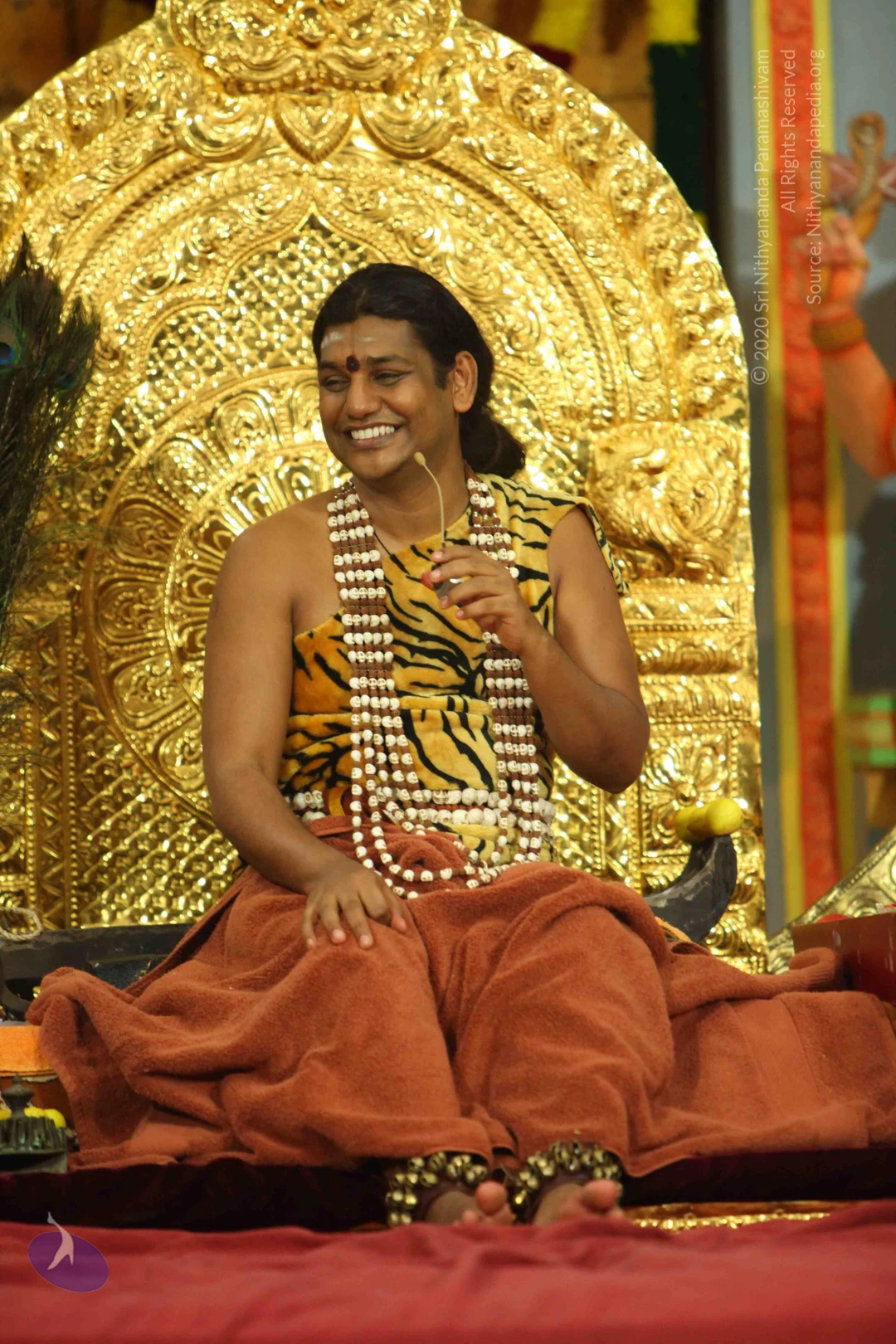
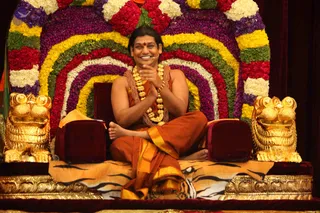
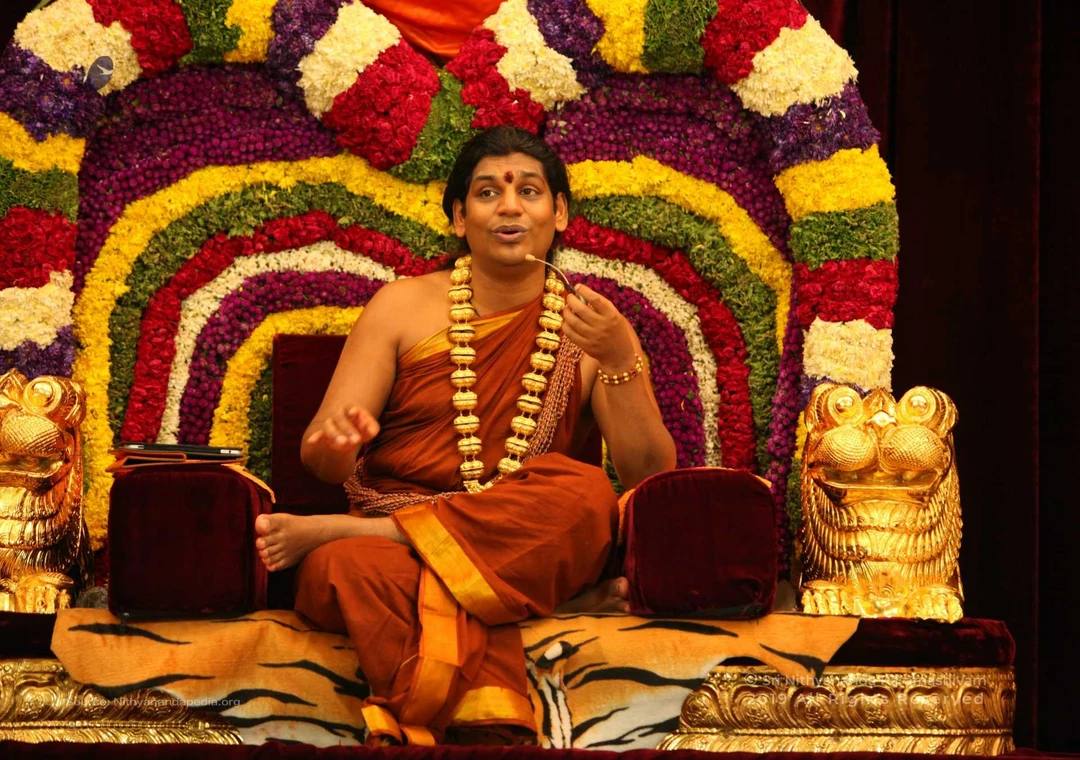
A man seated cross-legged on a tiger-skin covered throne speaks while holding a small wooden stick or pen. He wears a saffron-orange shawl and dhoti with gold borders, a heavy gold and beaded necklace, and gold bangles, with a red bindi on his forehead and short dark hair. Behind him a tall arch is decorated with rows of red, yellow, white, green and purple flowers, and golden lion-head armrests flank the seat. A small book or tablet rests beside him. The setting suggests a satsang or discourse.A photograph of a man seated cross-legged on a golden throne with gold lion-head armrests, draped with a tiger-skin rug, speaking to an audience while holding a small object in his right hand. He wears an orange-saffron cloth over the shoulder and waist, a gold-beaded necklace of large beads, a gold bangle, and a red bindi. Behind him is a tall arch of marigolds and roses in red, yellow, white, purple and green, forming a rainbow pattern. A small tablet or device rests on a red cushion beside him. a person appears as the seated speaker, with long swept-back hair, saffron clothing and gold beaded necklace as distinguishing cues, giving a satsang discourse.A smiling man with long dark hair sits cross-legged on an ornate golden throne with lion-head armrests, draped with a tiger-skin cloth. He wears an orange-saffron robe with gold borders, a rudraksha mala, and a heavy gold necklace of beads, with a red bindi on his forehead. Behind him is a large arch of marigold and rose garlands in yellow, red, white, purple and green, and dark red velvet drapes frame the stage. Swamiji (probable): the saffron robe, long swept-back hair, rudraksha mala and ceremonial gold necklace match the page's identification, but this is an appearance-based label only.A photograph of a seated man on a golden throne with gold lion-head armrests, draped in a tiger-striped cloth. He wears a saffron-orange robe with a gold-bordered dhoti, a heavy gold bead necklace over brown rudraksha-style cords, a red bindi, a wrist bracelet, and a small headset microphone. He sits in a meditative lotus-style pose, one hand resting on a maroon velvet cushion, smiling toward the audience. Behind him is a tiered arch of marigolds and roses in yellow, orange, white, red and purple. Physical appearance suggests a probable Swamiji (probable): long swept-back hair, saffron robes, gold necklace and rudraksha cords, seated on a throne at a satsang setting.A photograph of a seated man in a saffron-orange robe and dhoti with a yellow border, wearing a heavy gold ceremonial necklace of beads over rudraksha-style cords, a red tilak on his forehead, and a lapel microphone. He sits cross-legged on a throne at a stage, hands resting on maroon cushions, in front of a tall arch of marigolds and roses in rainbow bands of yellow, green, red, white and purple. Golden lion-head armrests flank him and a tiger-striped cloth covers the dais. The setting suggests a satsang discourse. Swamiji (probable): the man has long swept-back hair, saffron clothing, a gold necklace and rudraksha cords, consistent with the page's reference to Swamiji's satsang.A seated man in saffron and orange robes speaks during a satsang on a stage. He sits cross-legged on a golden throne with red velvet armrests and gold lion-head ends, on a tiger-striped cloth. His left hand is raised in a fist and he wears a long gold bead necklace over a tan shawl, with a red bindi and a gold bracelet. Behind him is a large arch of red, yellow, purple and white flower garlands. a person: the orange robes, ornate gold necklace and throne seating match the page's a person discourse context, but the face is not used to confirm identity.
Pratyaksha-Pada-Puja
20 photosSource gallery
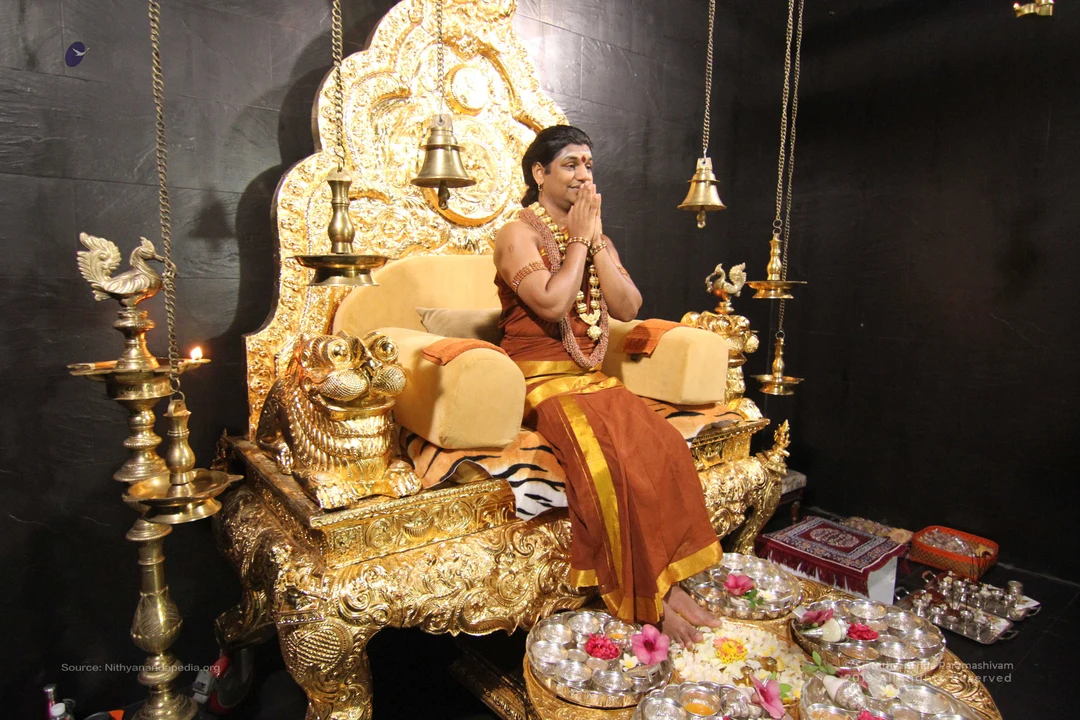
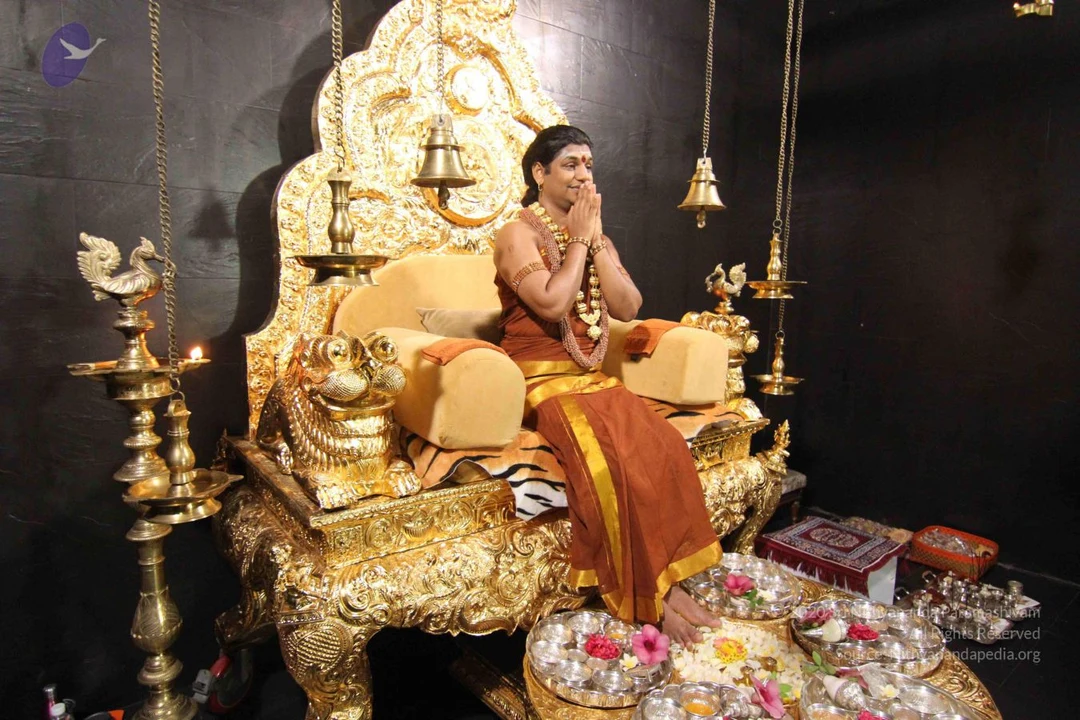
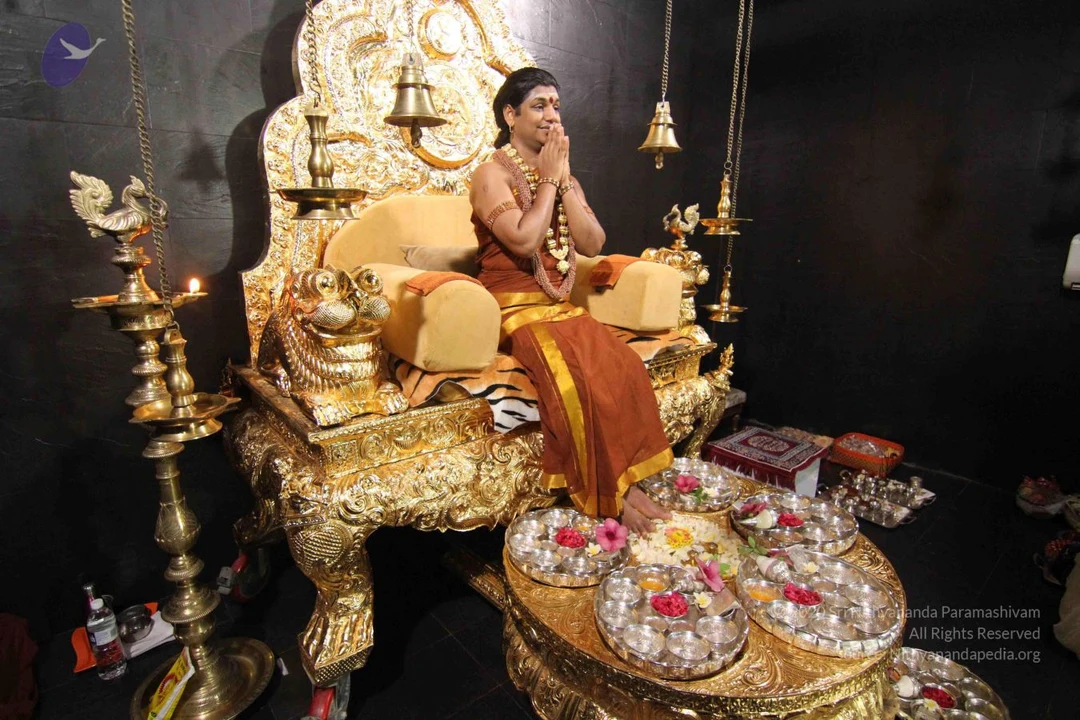
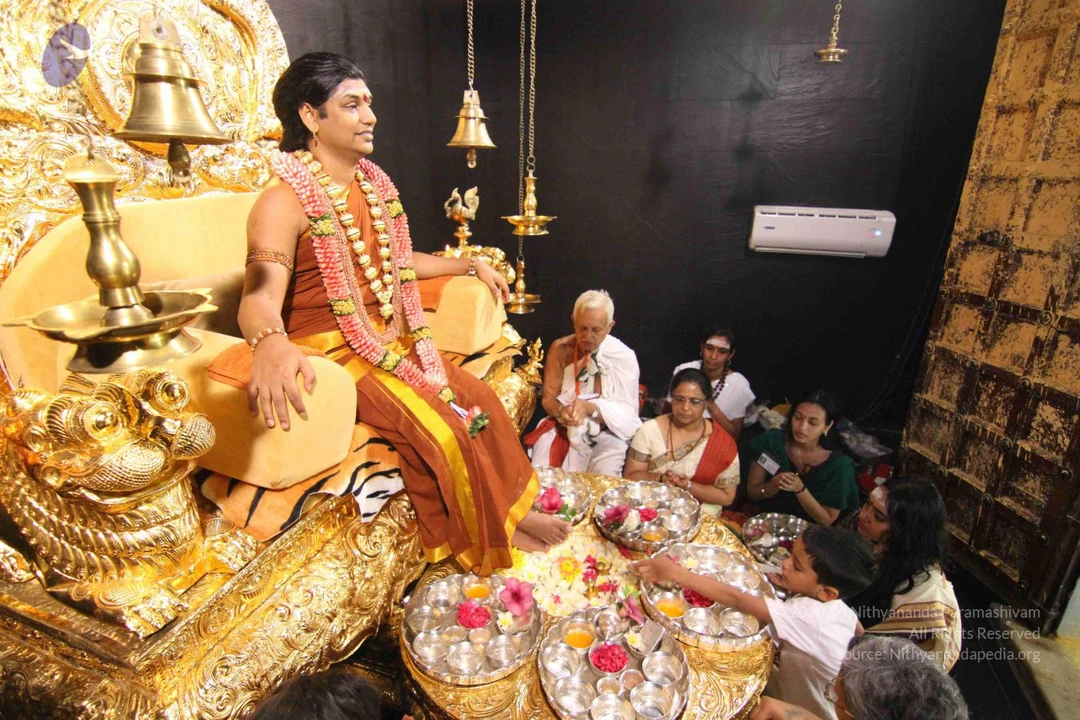
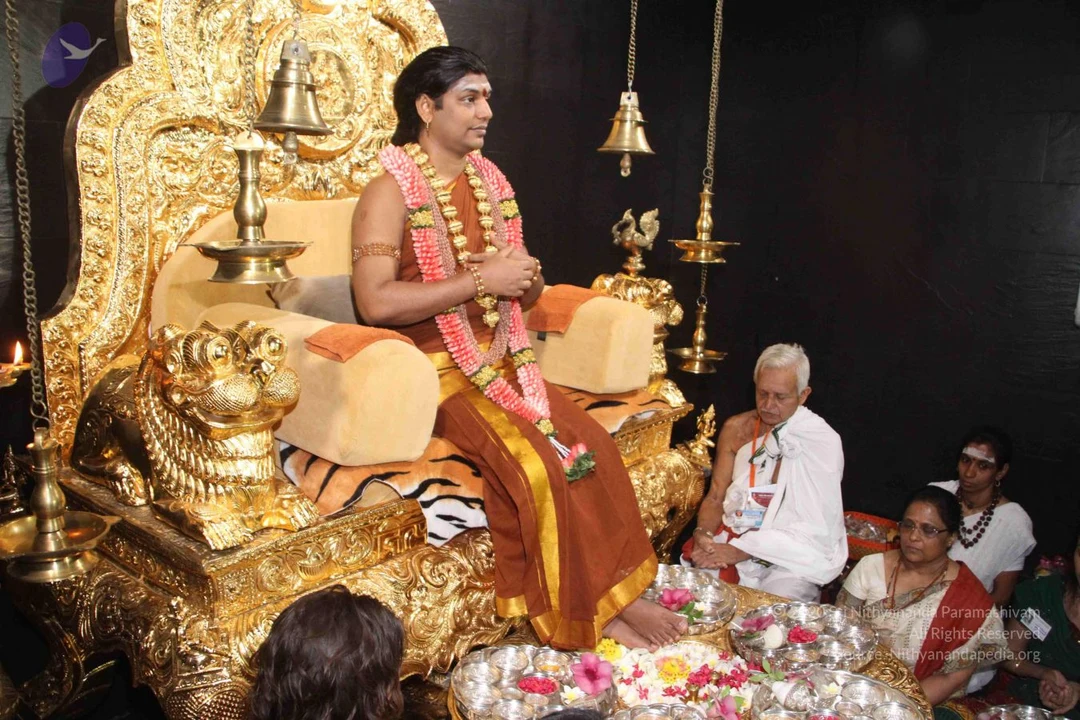
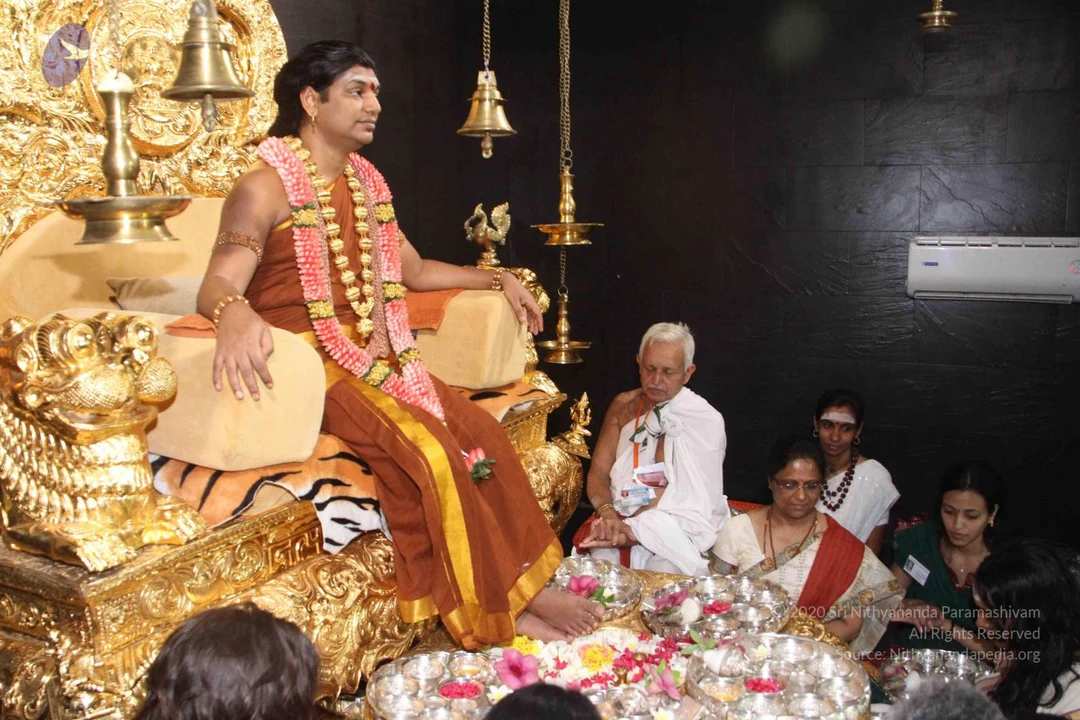
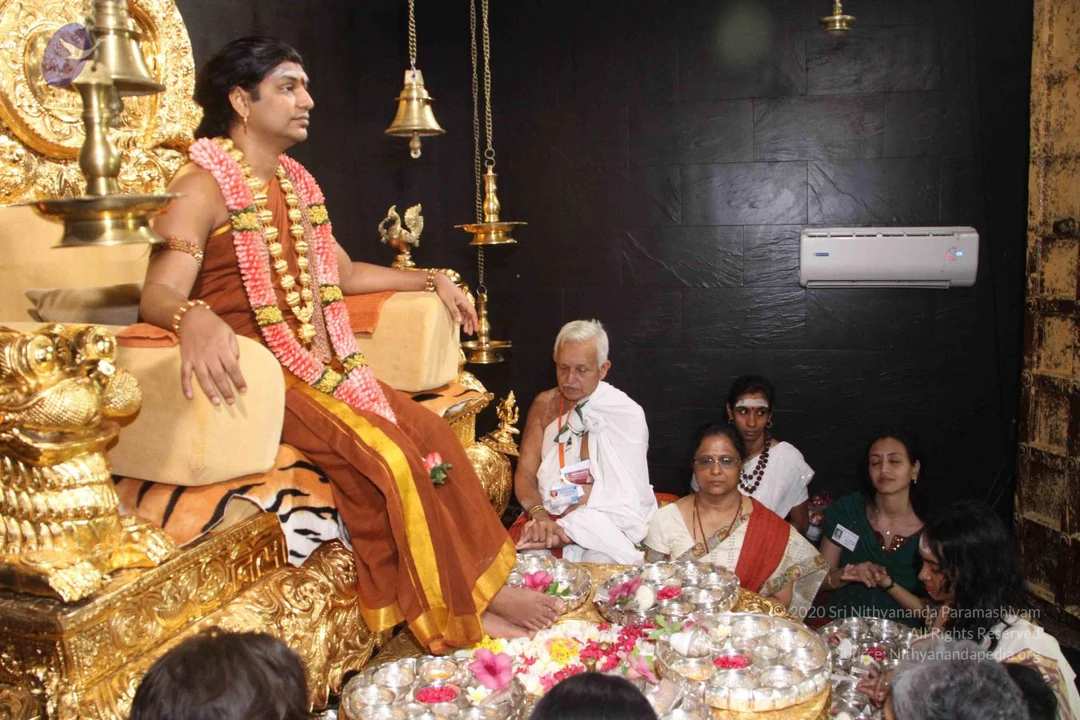
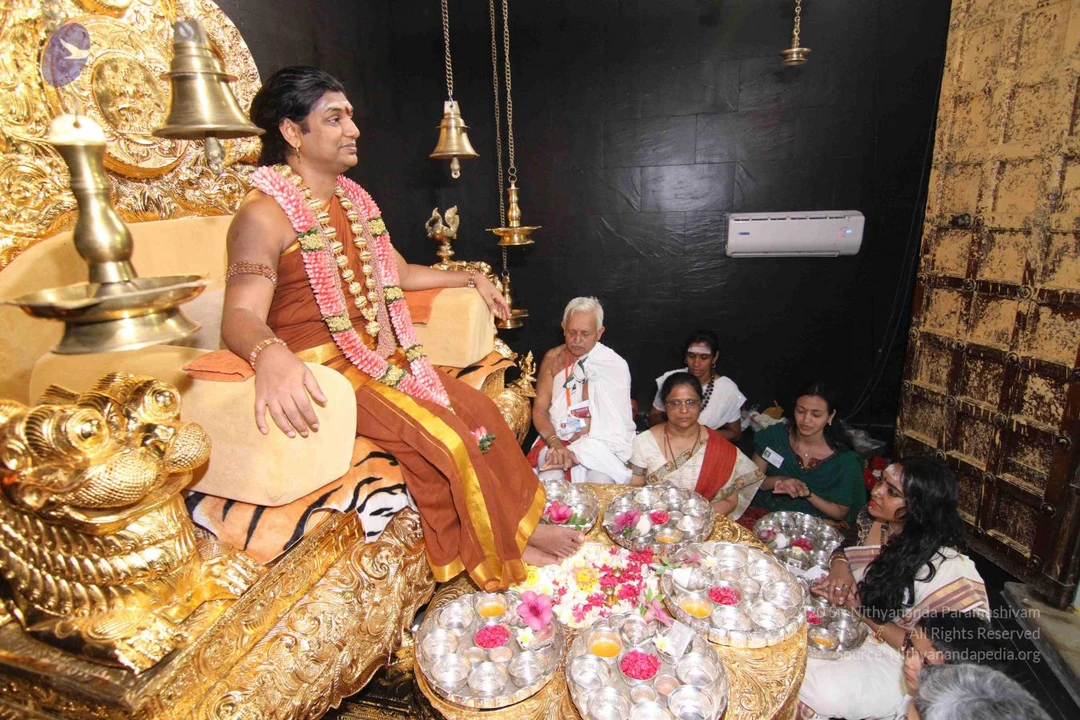
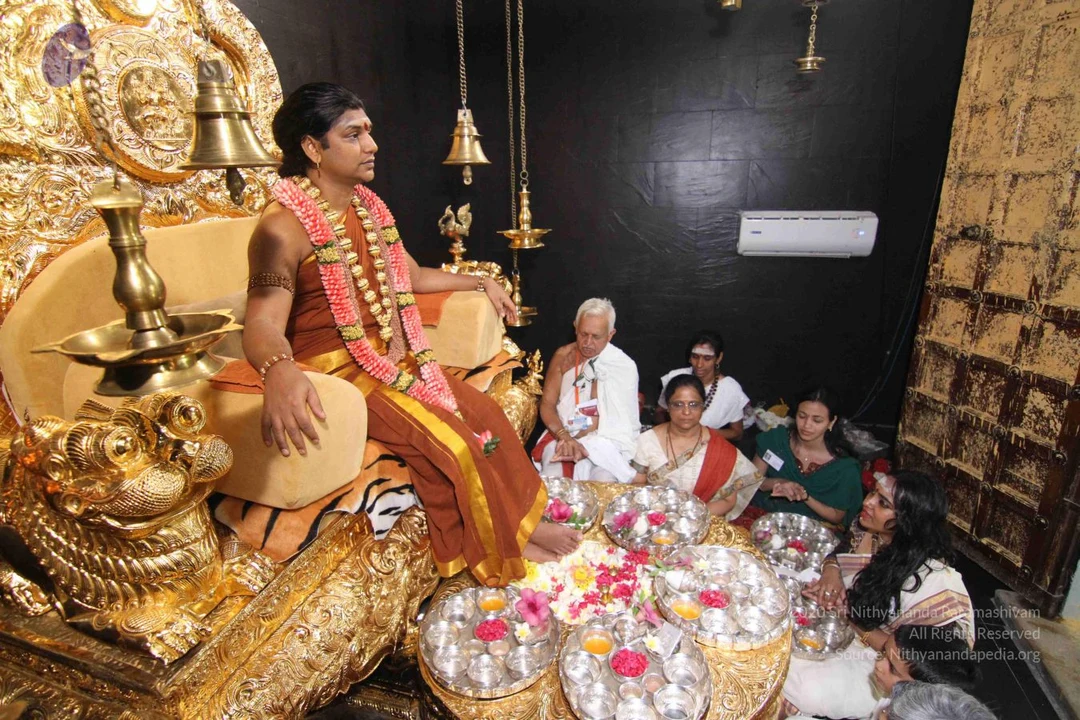
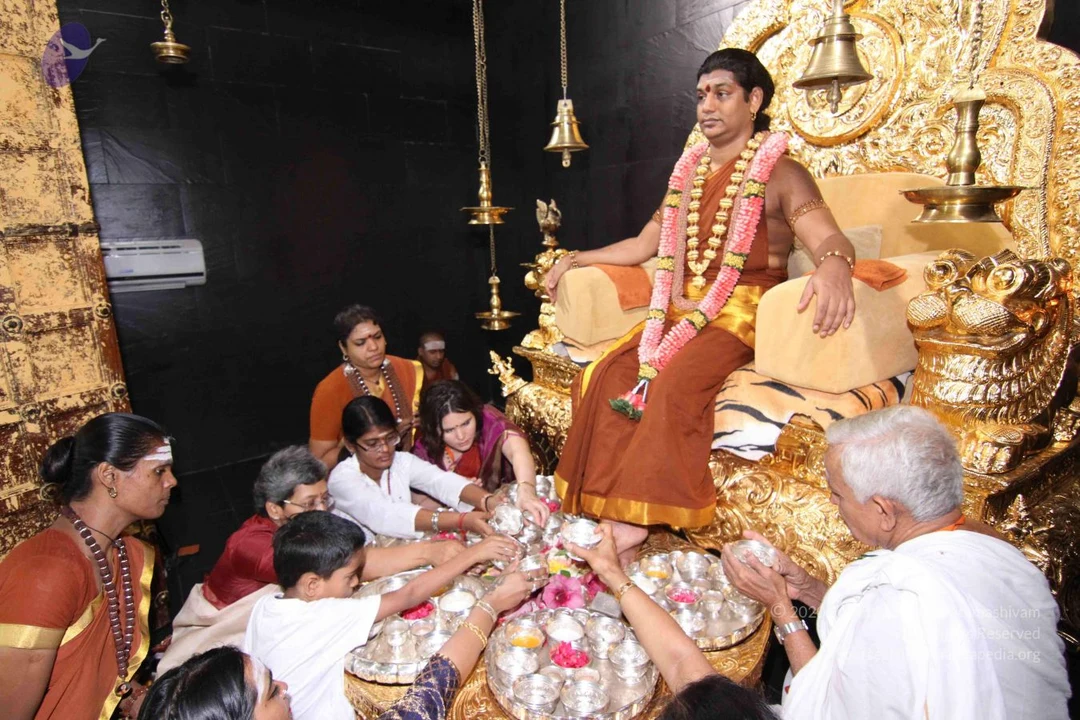
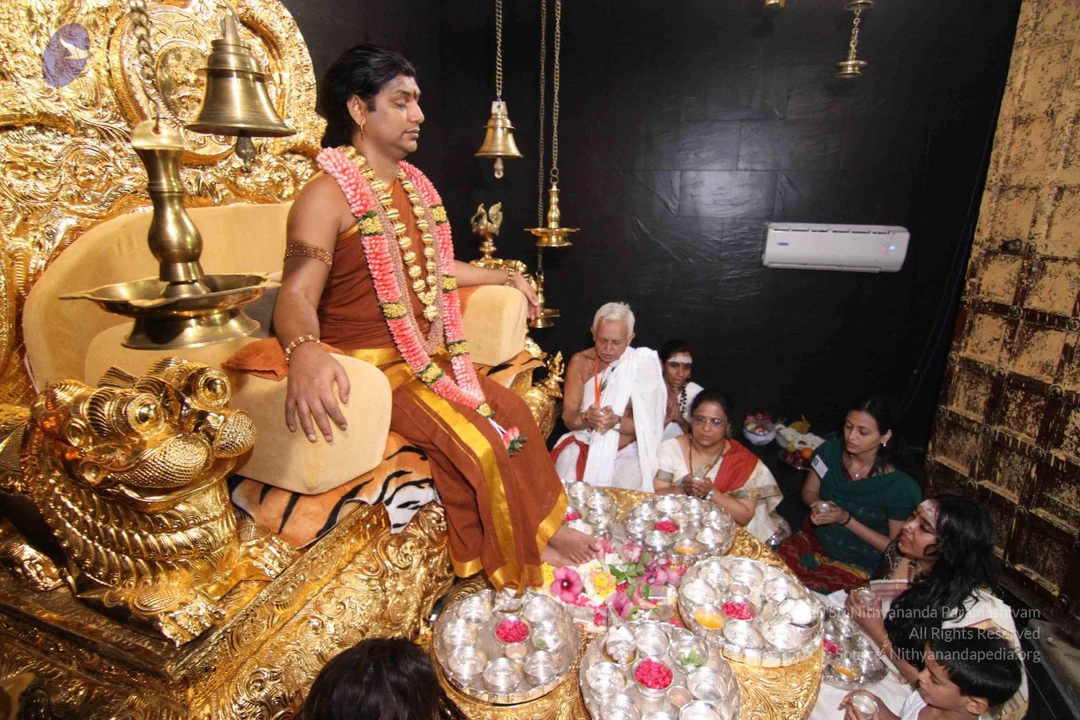
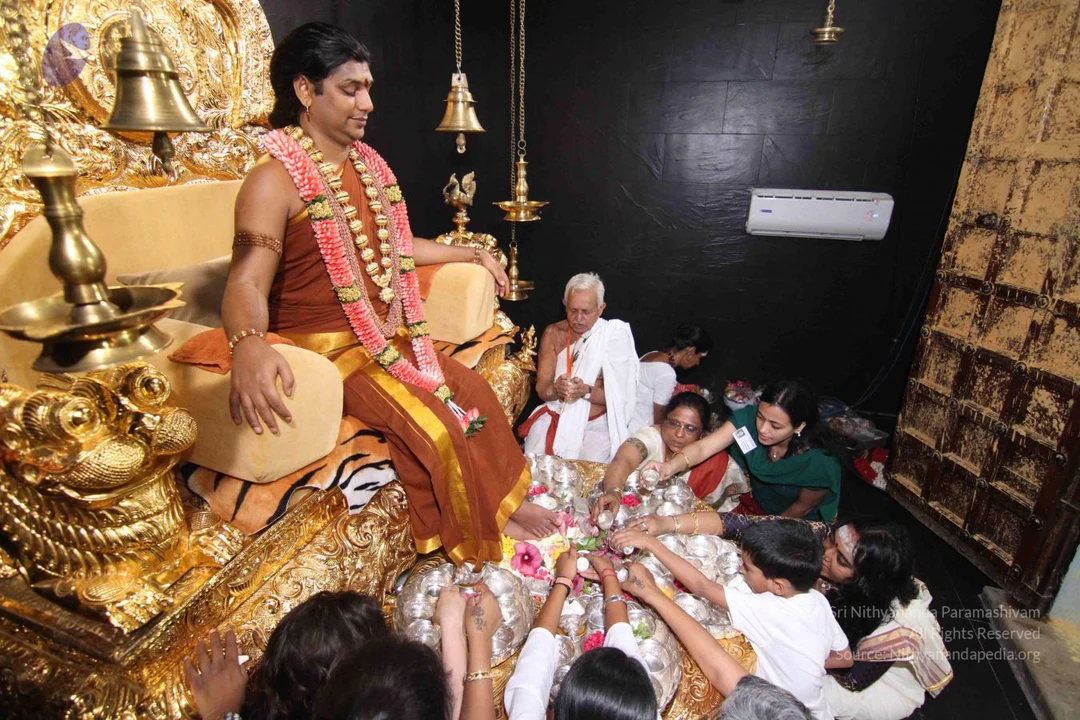
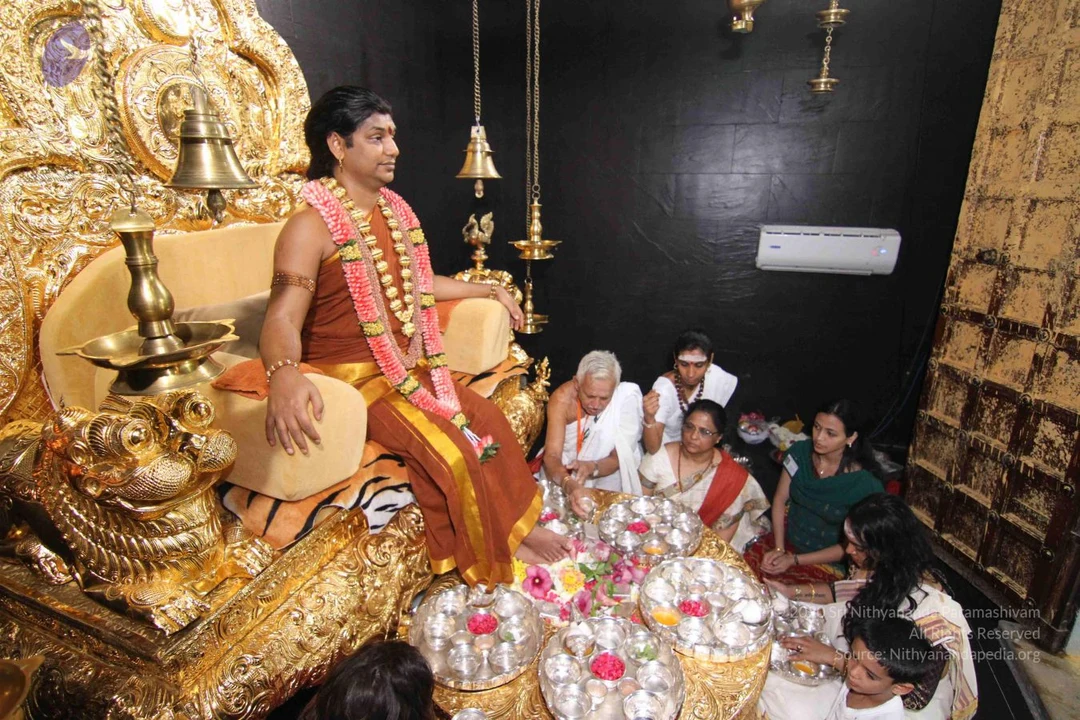
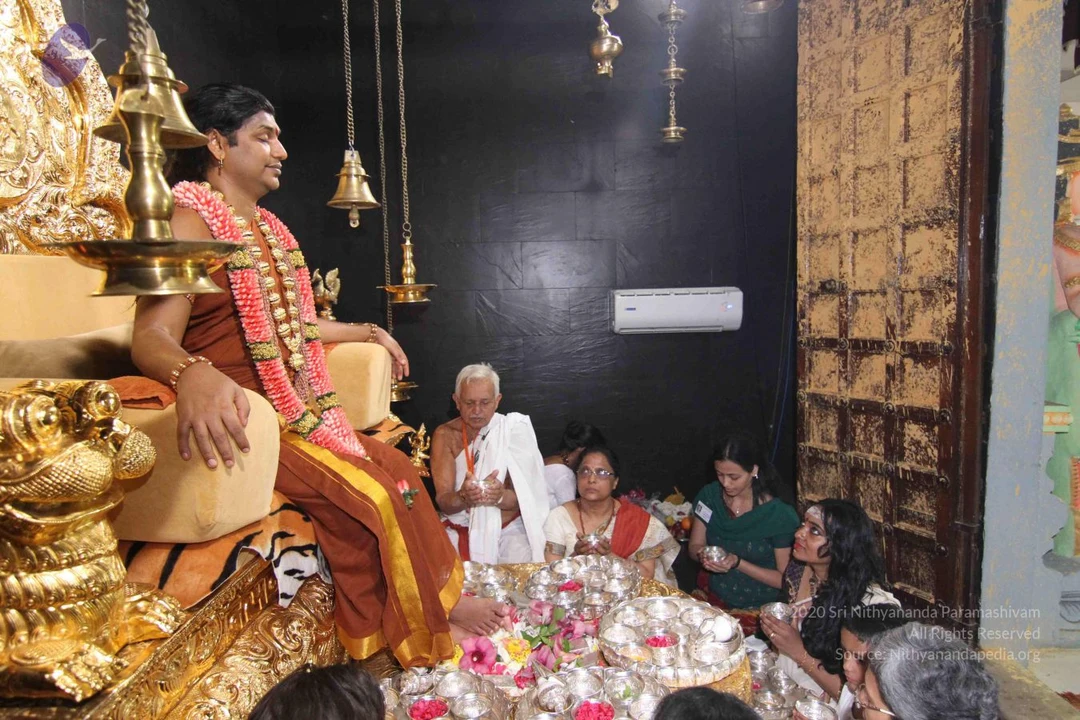
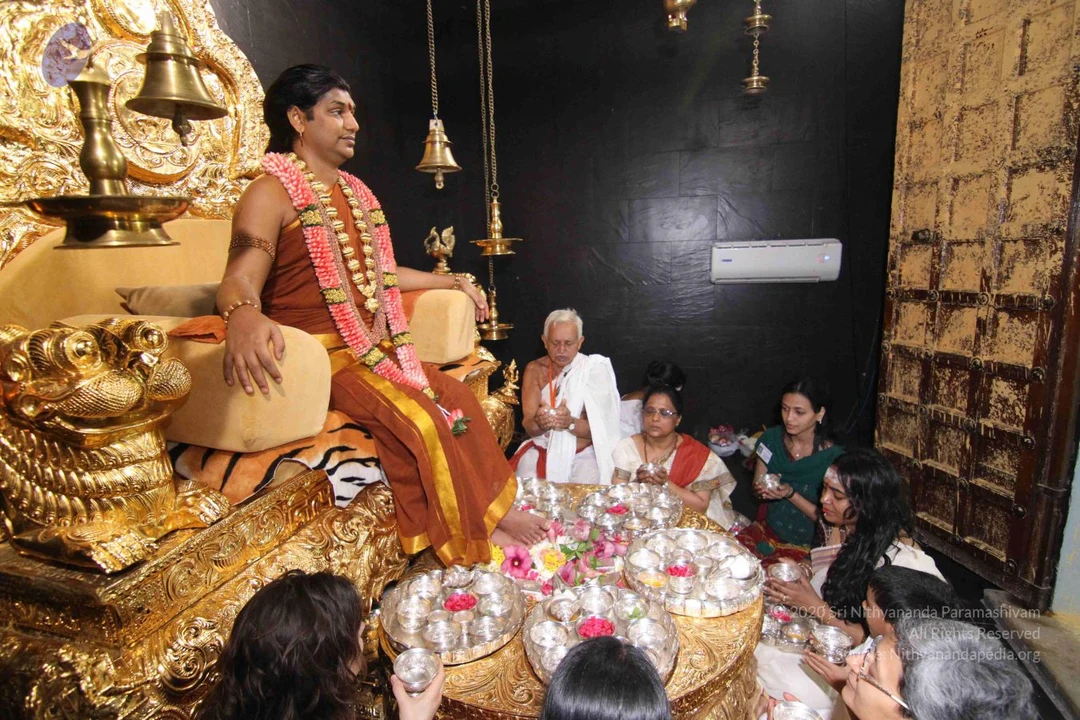
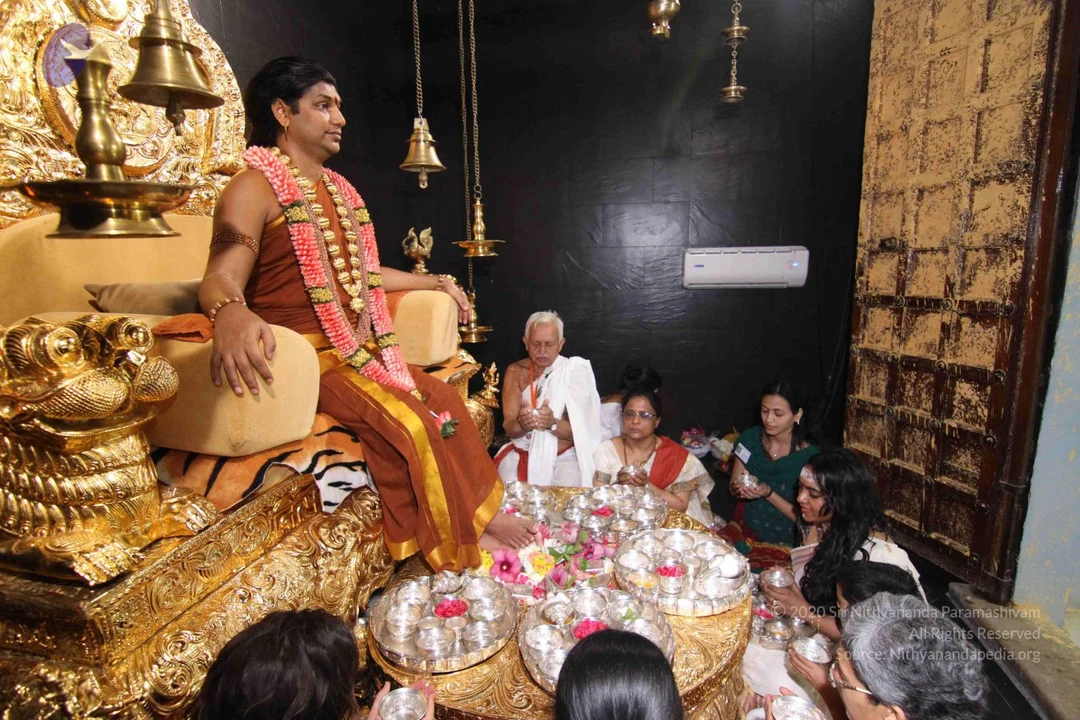
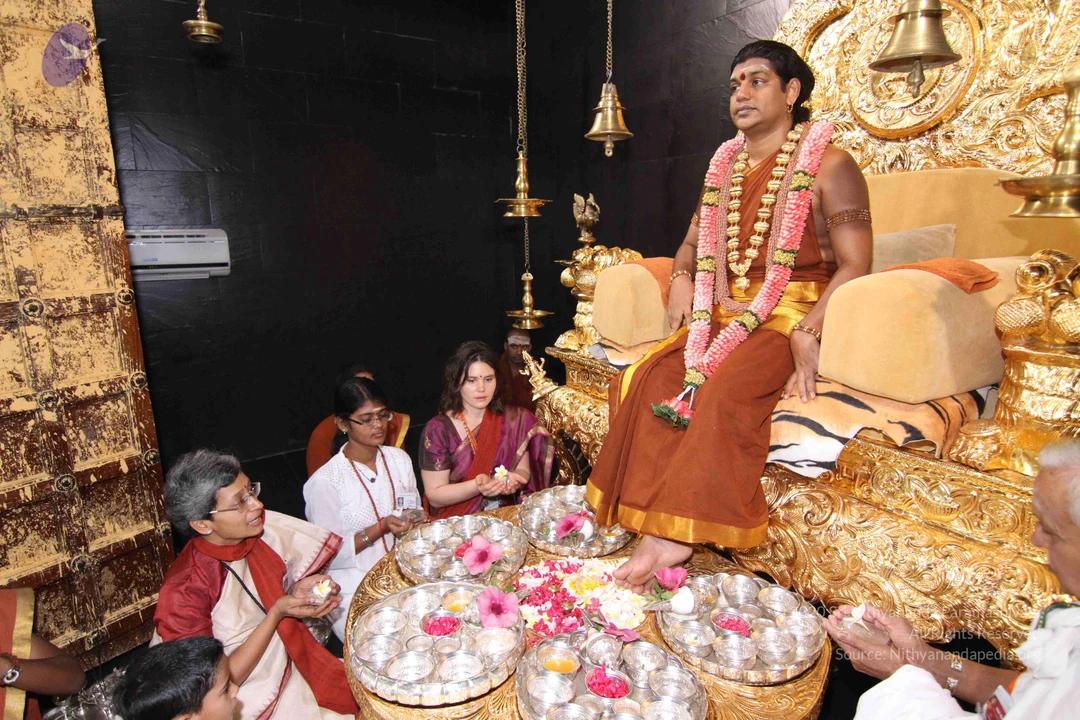
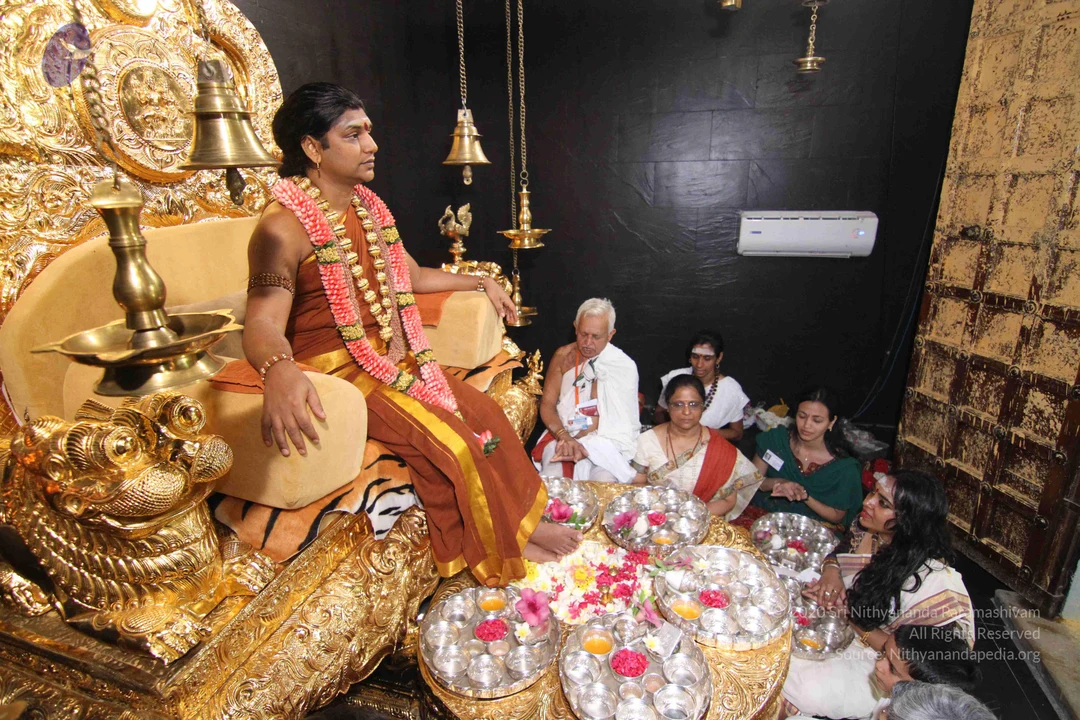
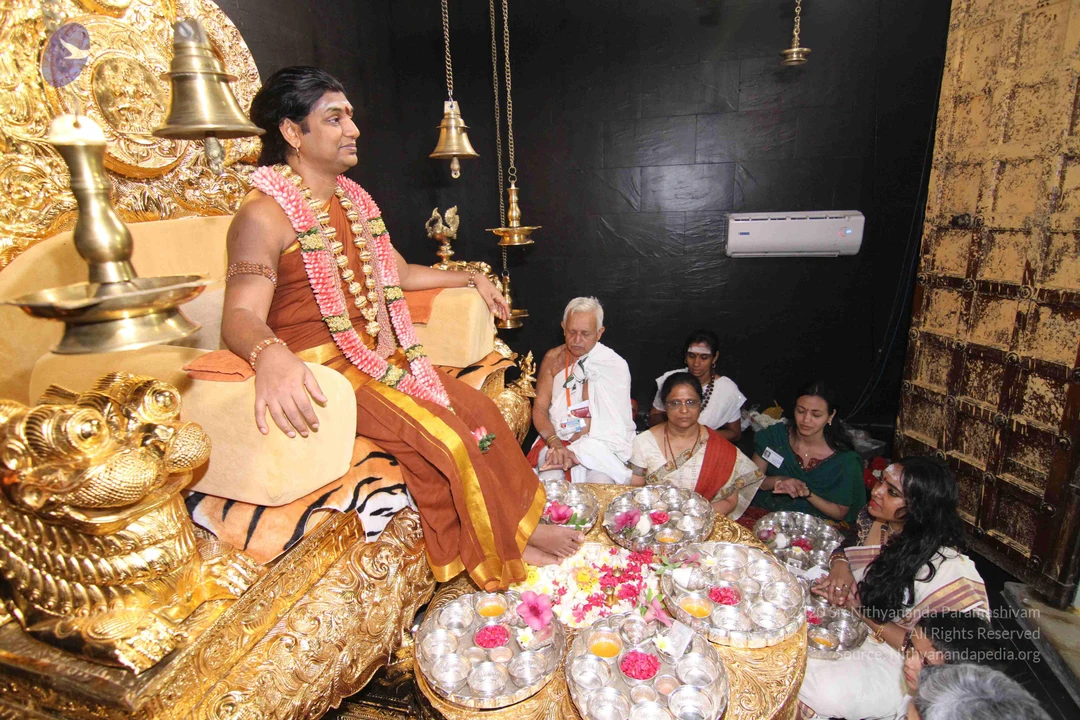
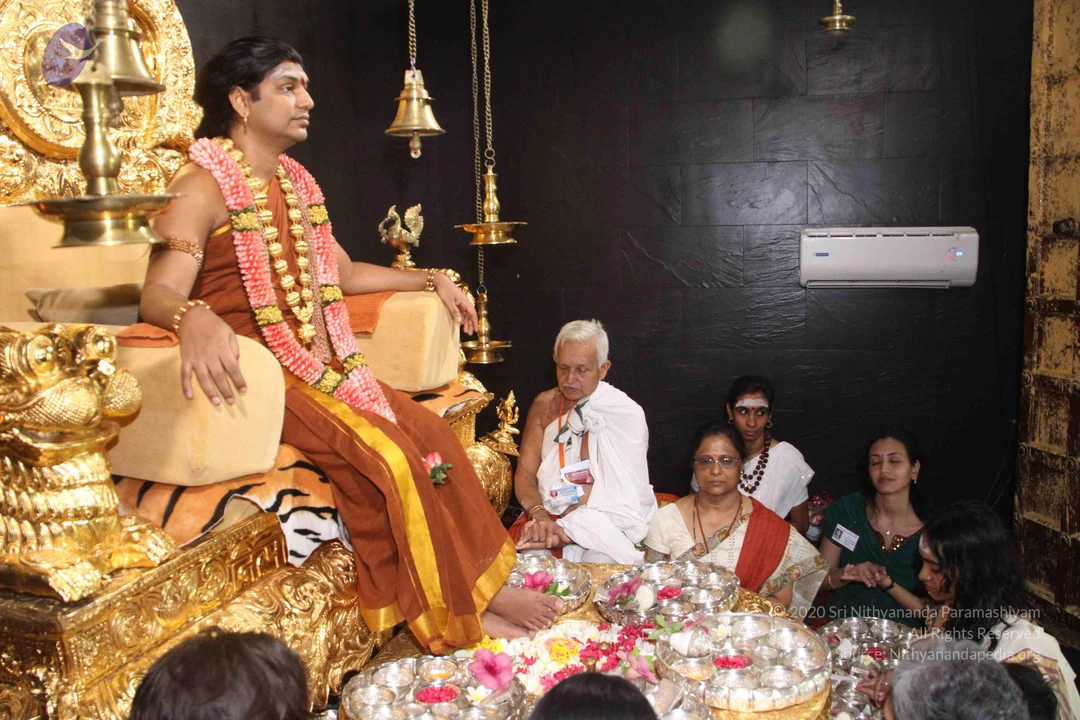
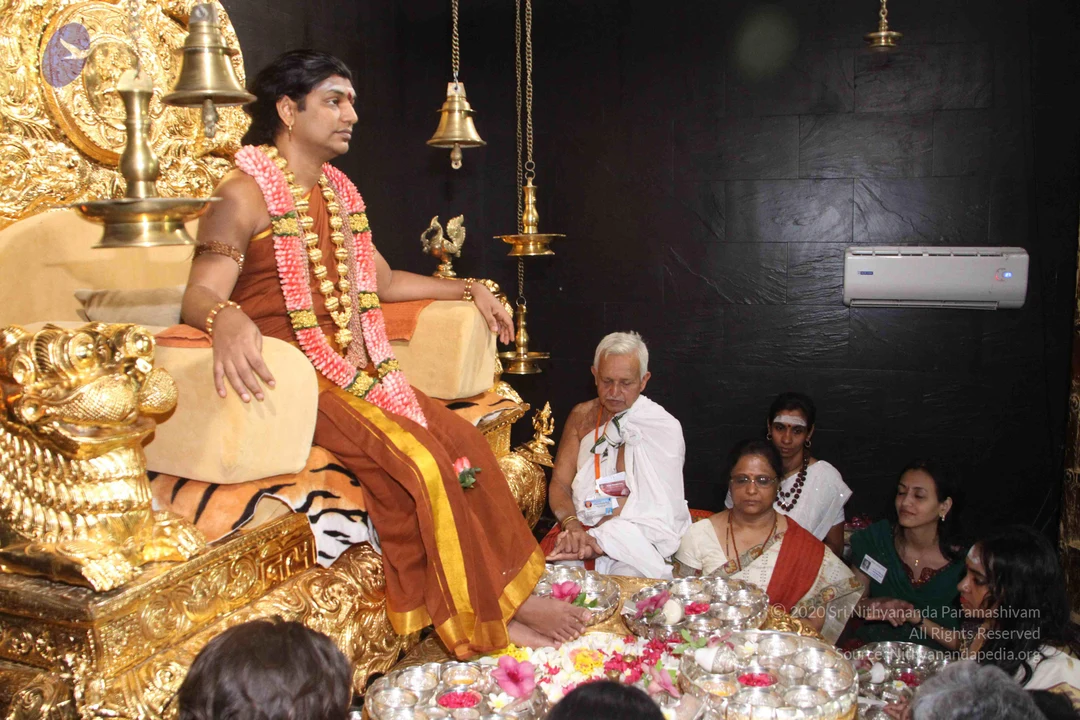
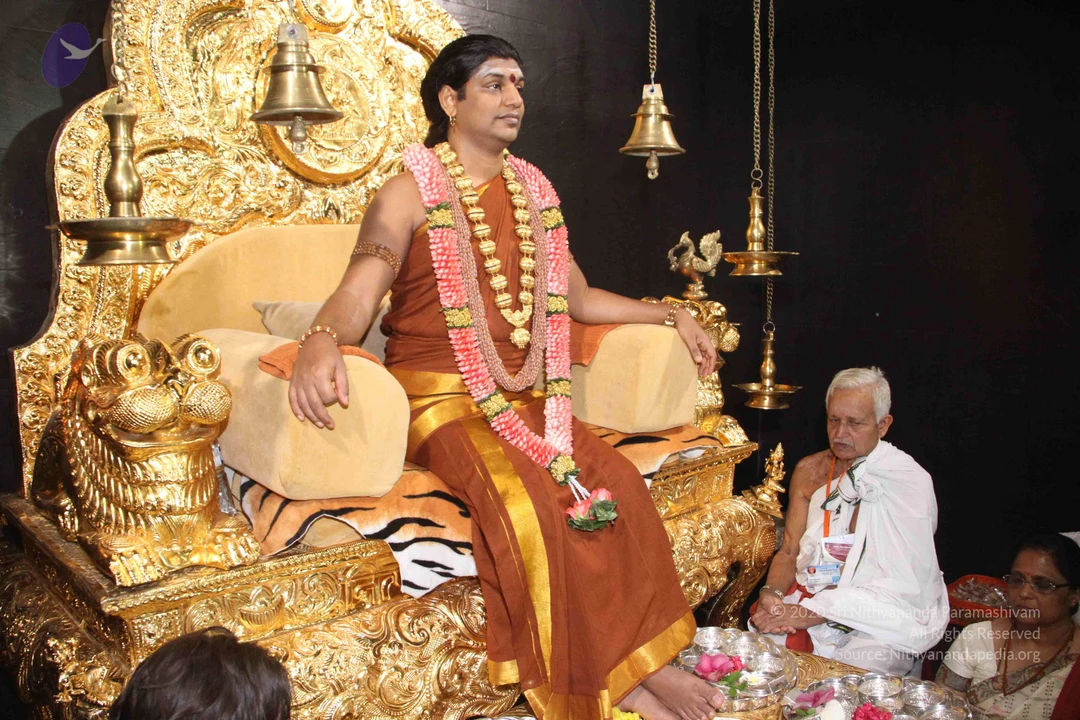
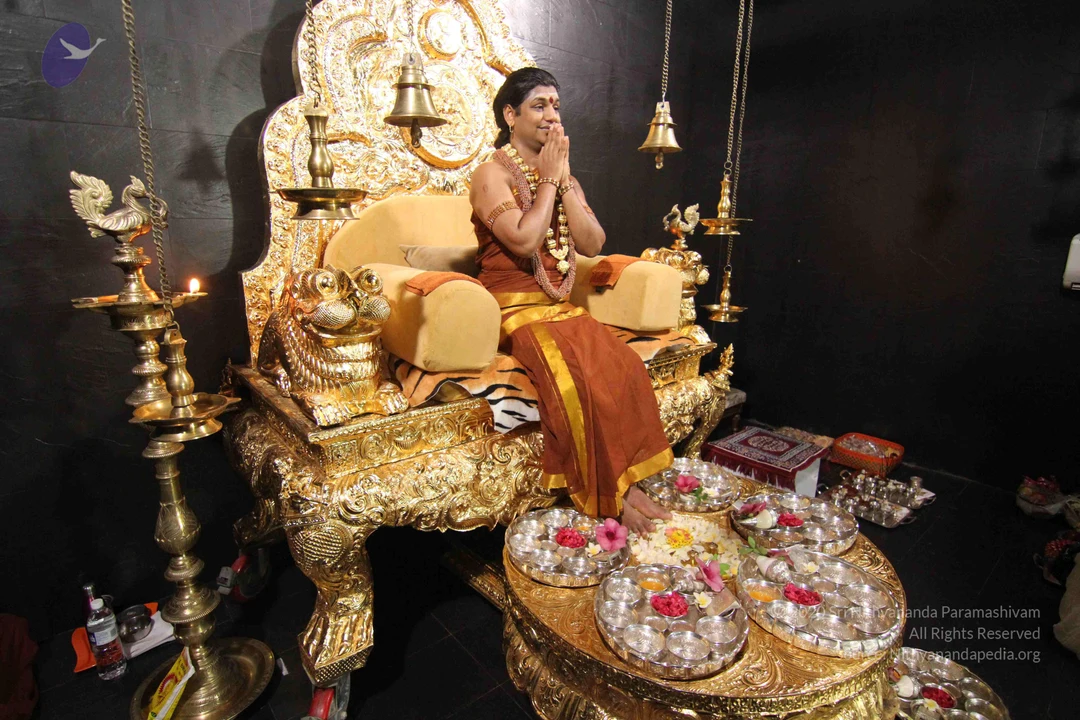
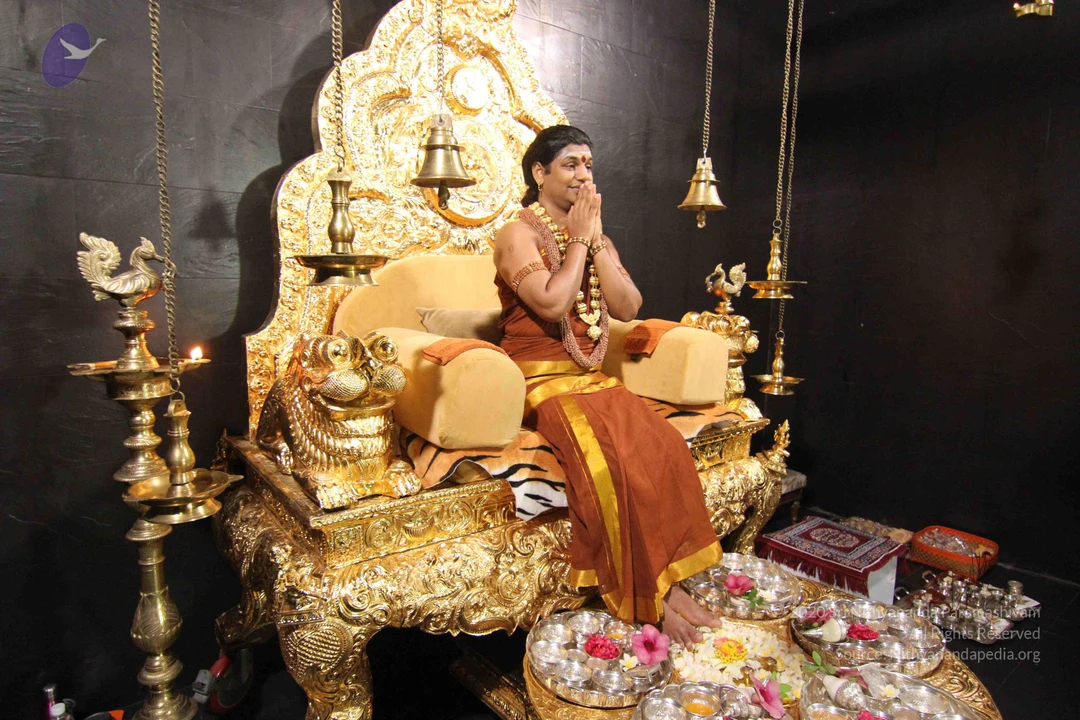
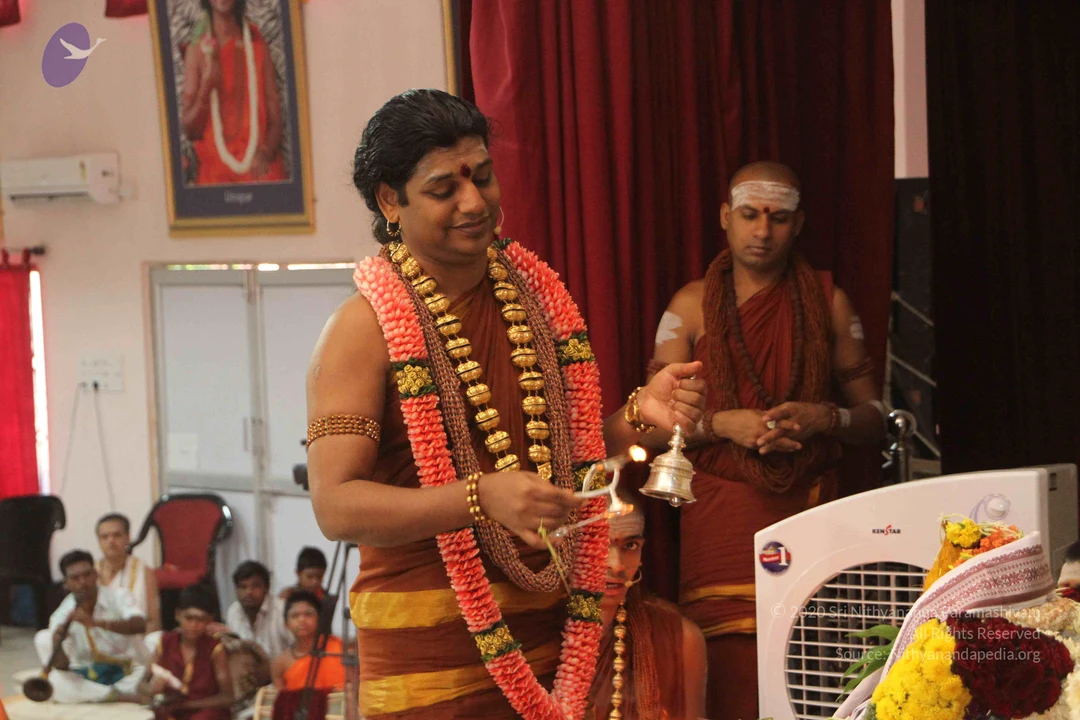
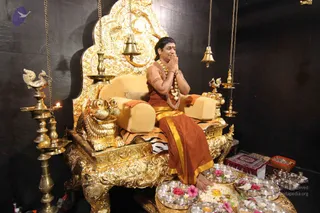
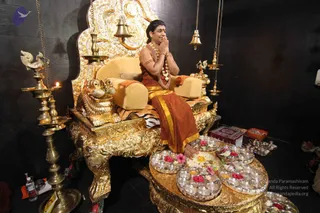
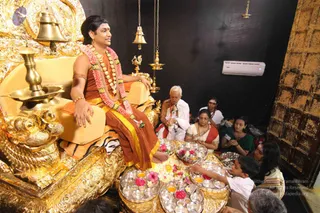
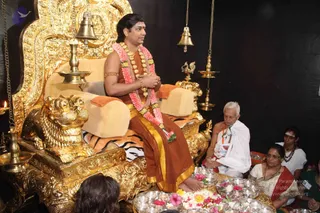
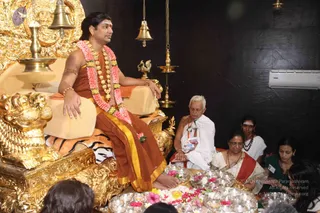
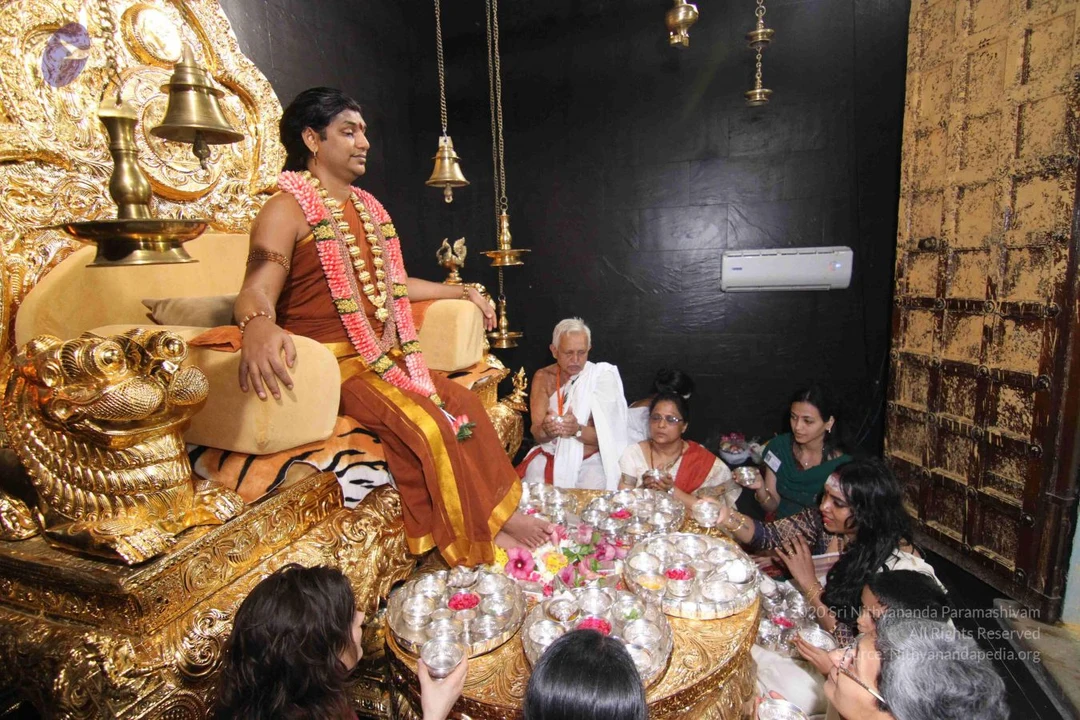
A photograph of a seated man on an ornate gilded throne with a tiger-skin cushion and an elaborately carved golden backrest. He wears a rust-orange garment with a gold border, a rudraksha-style bead necklace, gold chains, bangles and armbands, and a red bindi. He sits with palms pressed together in namaste, and a brass oil lamp with a flame stands at the left. Hanging brass bells on chains are above him. In front, silver thali trays hold flower petals, pink and red flowers, and small offering bowls, with a floral-patterned cloth and a stand beside them. The black backdrop completes a ritual reception setting. a person: the seated figure has long swept-back hair, ceremonial gold necklaces and saffron-orange clothing on a throne.A photograph of a seated person in an ornate gold throne with carved lion-shaped armrests and a tiger-skin draped cushion, in a dark room. The person wears an orange-brown garment with a gold border, layered beaded necklaces, and bangles, with hands folded in namaskar. Brass oil lamps with swan-shaped tops, hanging bells, and a brass lamp stand surround the throne. At the feet, a gold-rimmed tray holds silver puja thalis with rice, yellow and red flowers, and small lamps, as part of a padapuja offering. A red box and small bottles sit at the edge of the frame.A photograph of a seated man on an ornate gold throne with a tiger-skin draped over it, wearing an orange-saffron dhoti-style garment with a gold border, multiple red and white flower garlands, a rudraksha-style necklace, and bangles. Behind him hang brass bells and a brass oil lamp. Around him sit devotees on the floor: an elderly man in white ritual dress, a woman in a red-bordered saree, a woman in a green top, and a child in white. Several brass thalis hold flowers, fruit and oil lamps on the floor in front. a person is seated on the throne in the center-left of the frame, with a gold-framed black door behind and a wall air-conditioner.A seated man in a rust-orange robe with a gold-bordered saffron dhoti sits on an ornate gold throne carved with a lion-head armrest and draped with a striped tiger-skin cushion. He wears a pink and white flower garland, a long gold-bead necklace and a rudraksha-style mala, with bangles on his wrist and a red tilak on his forehead. Brass hanging bells and lamps hang above him against a black backdrop. In the foreground, a white-clad elderly man with a saffron-orange lanyard sits beside a woman in glasses, and silver plates with pink flowers and offerings rest near the throne. a person on throne, with the lamps and bells.A long-haired man in saffron-orange robes sits on an ornate gold throne carved with lion heads, draped with a tiger-skin cushion and orange cushions. He wears a pink and white flower garland, gold beaded necklaces and a gold armlet, with a red tilak on his forehead, and his hands are folded together. Before the throne sit devotees: an elderly man in white with an orange lanyard, a woman in a cream sari with red border, and another woman in white at right. Brass lamps hang from chains and brass bells stand on the throne, with silver plates of flowers and offerings arranged on the floor in front. The black backdrop and golden throne suggest a satsang or darshan setting. The seated figure is a probable Swamiji by appearance, given his long swept-back hair, ornate gold jewellery and saffron clothing, with the page noting his presence.A seated man with long dark hair wears an orange-brown robe with a gold border, pink and white flower garlands, and gold bangles on his arms. He sits on an ornate gold throne draped with a tiger-striped cloth, with a gold lion-head armrest in the foreground. Before him, silver trays holding lit oil lamps, pink and yellow flowers, and marigold petals sit on the floor. Behind them, an older man in white dhoti and shawl with a lanyard and a woman in a cream sari with red border sit near the trays; a woman in white with a tilak and a woman in green look on. Brass bells hang from chains and a brass oil lamp stands at the top right beside a wall-mounted air conditioner, with a dark stone wall behind.

Thirugnanasambandhar-Puja
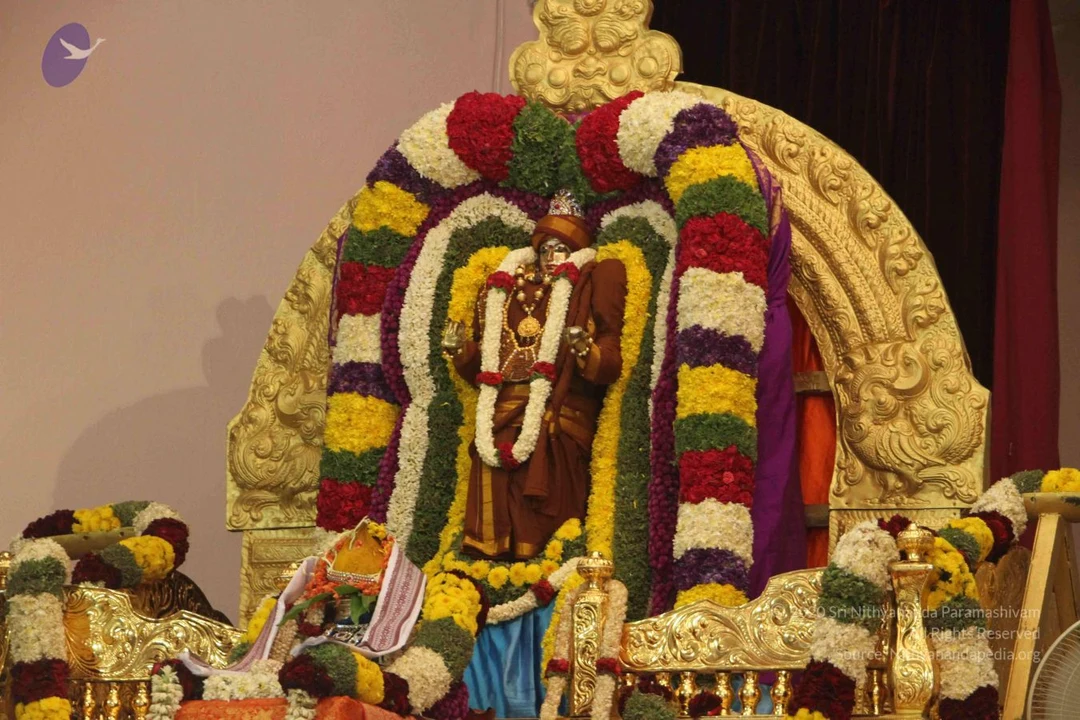
33 photosSource gallery
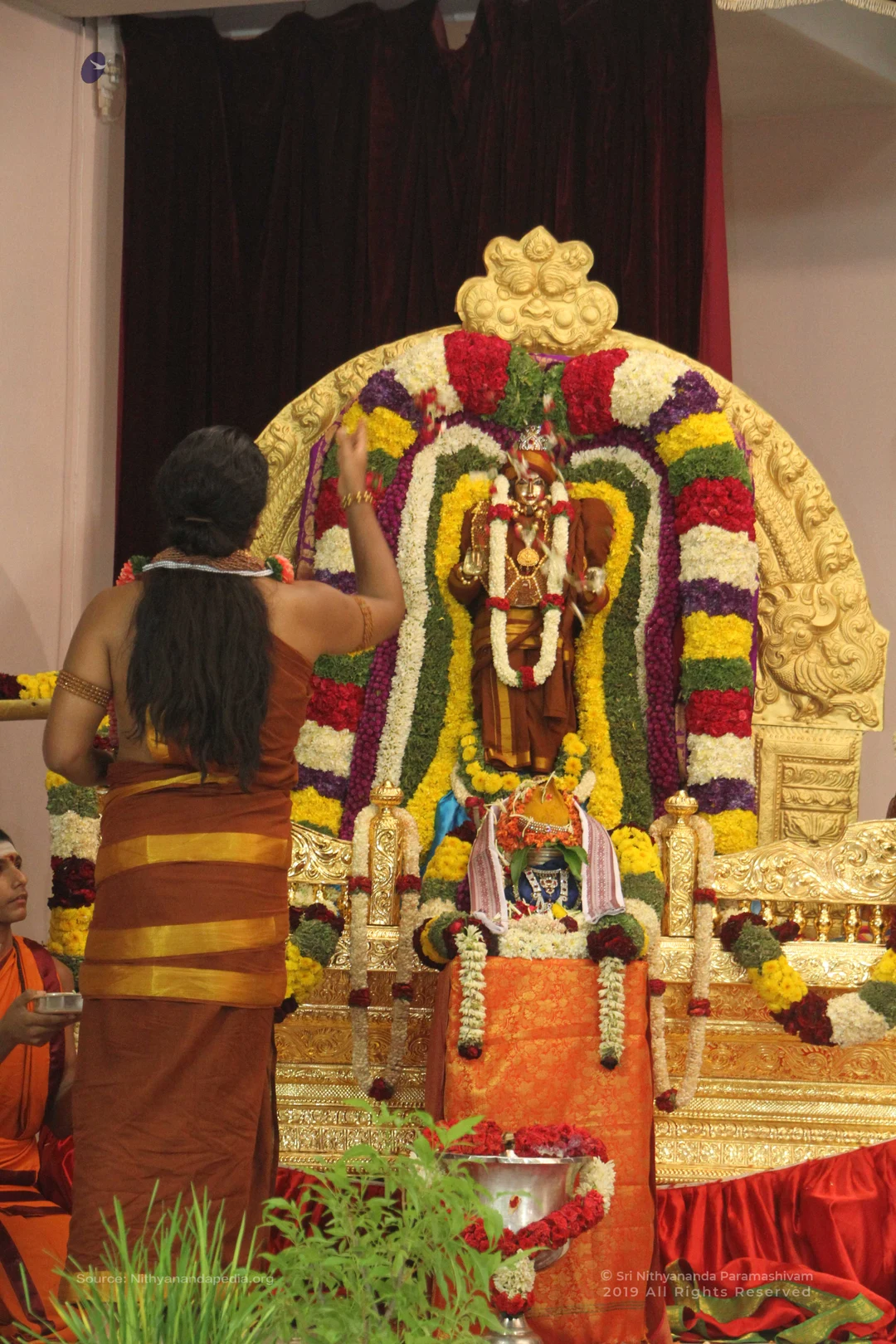
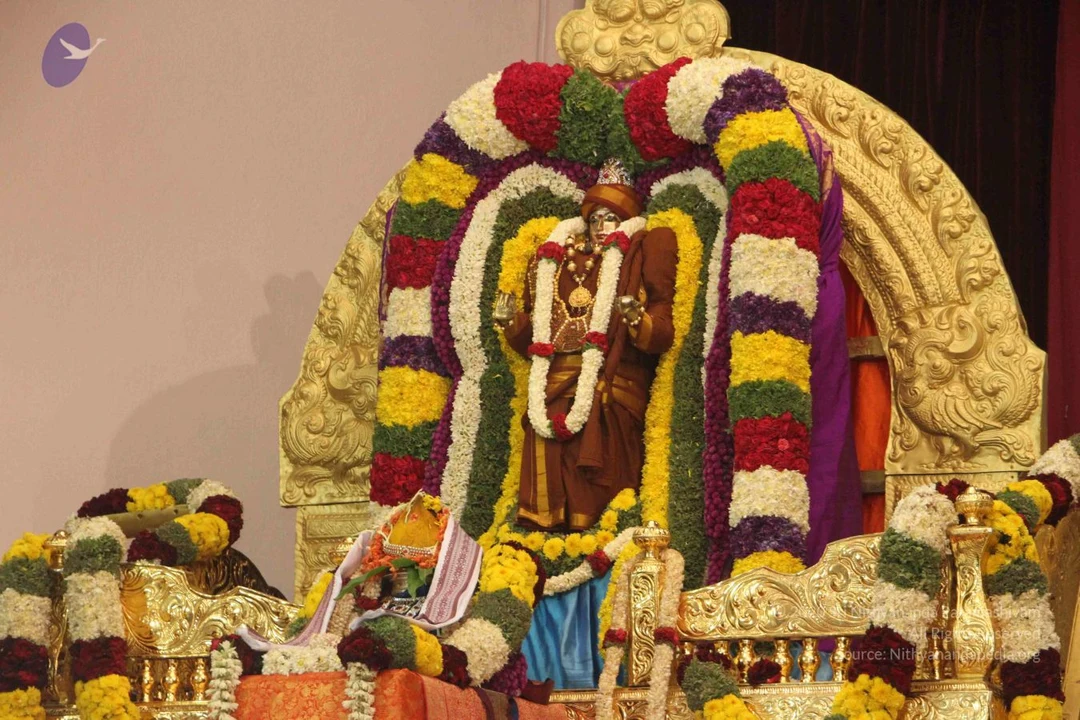
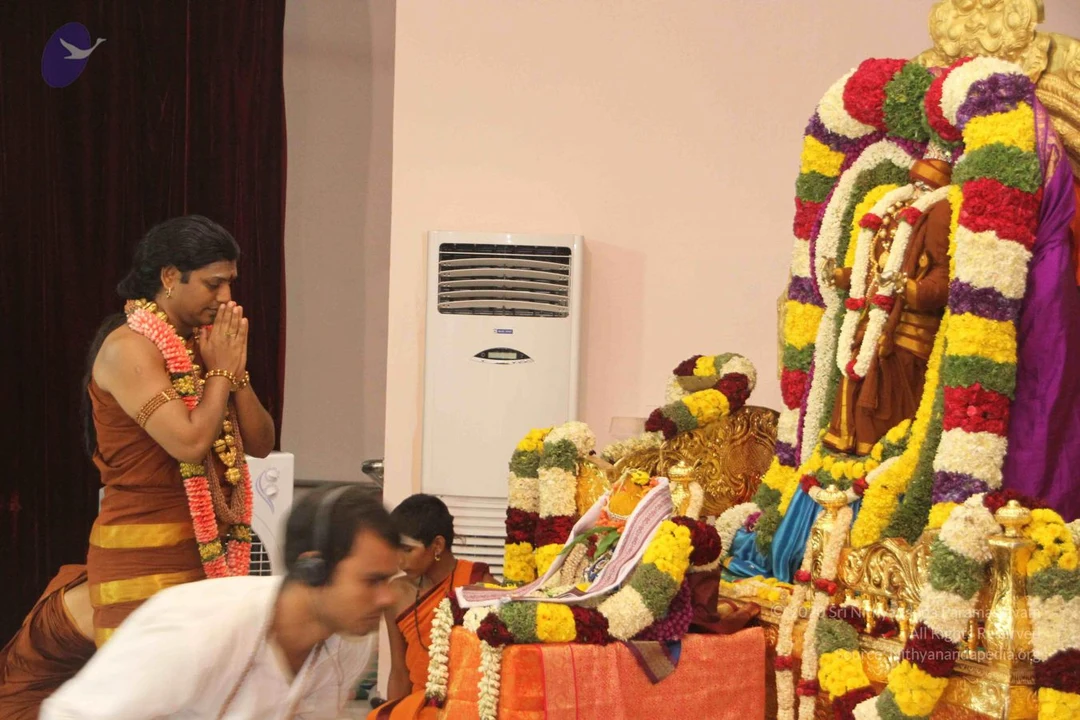
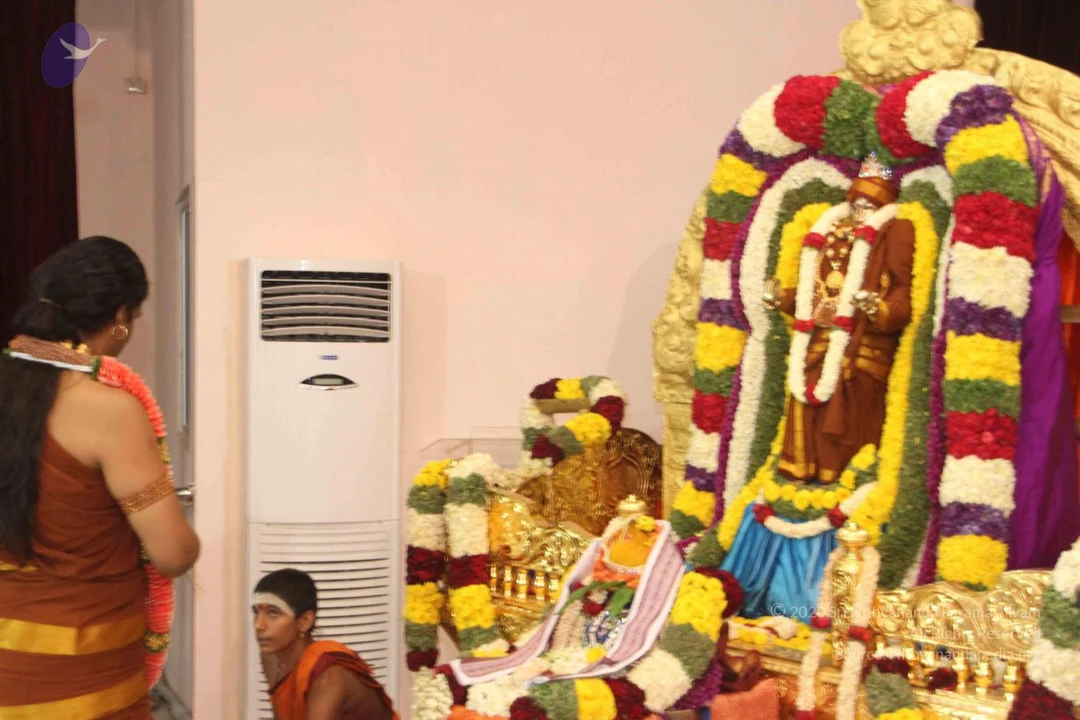
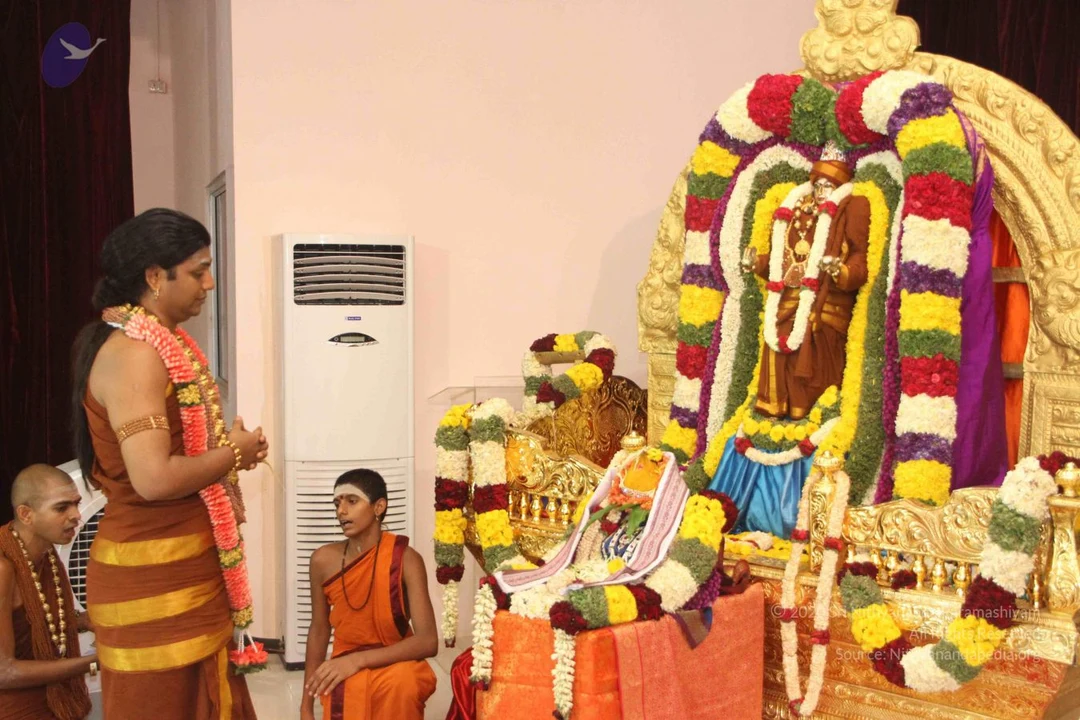
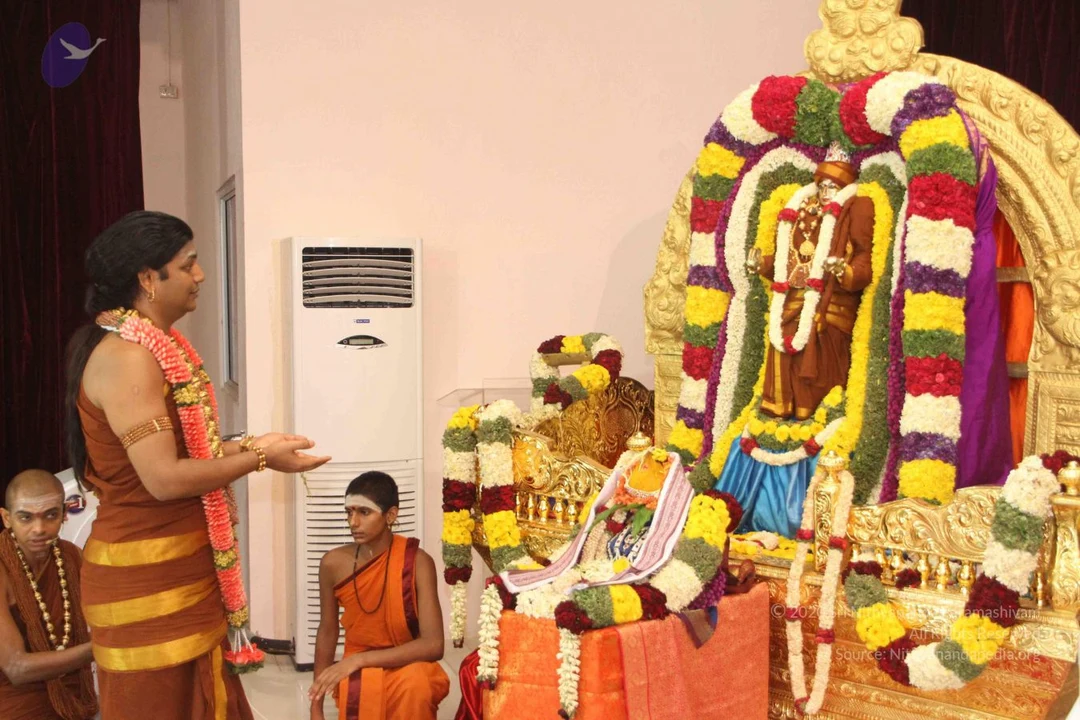
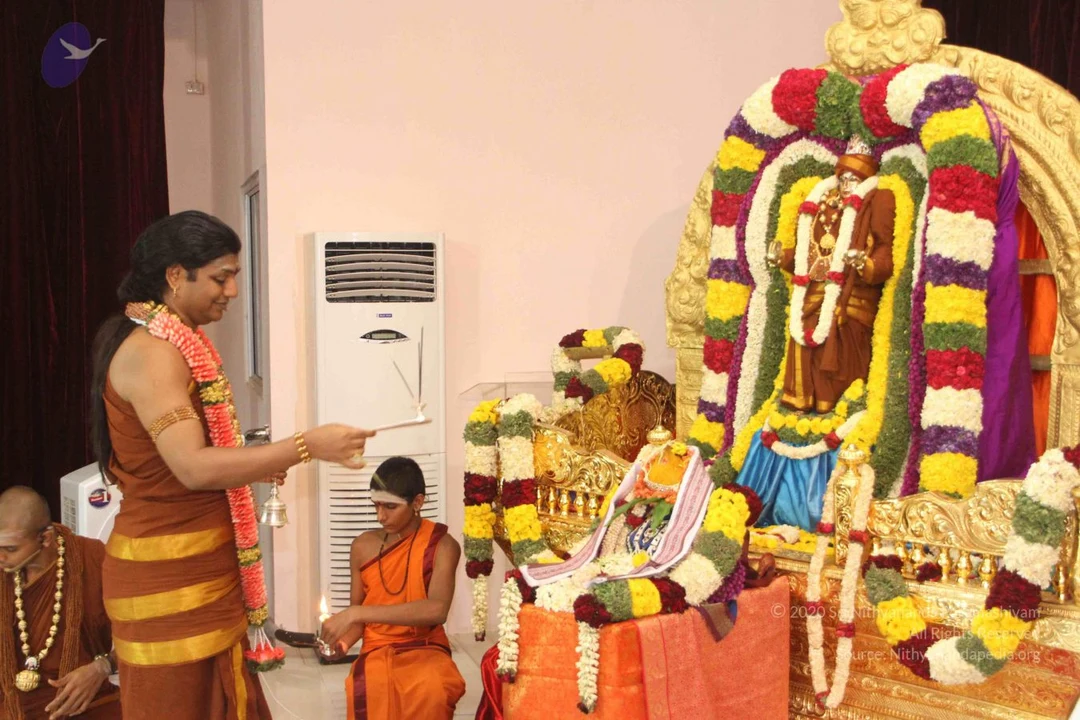
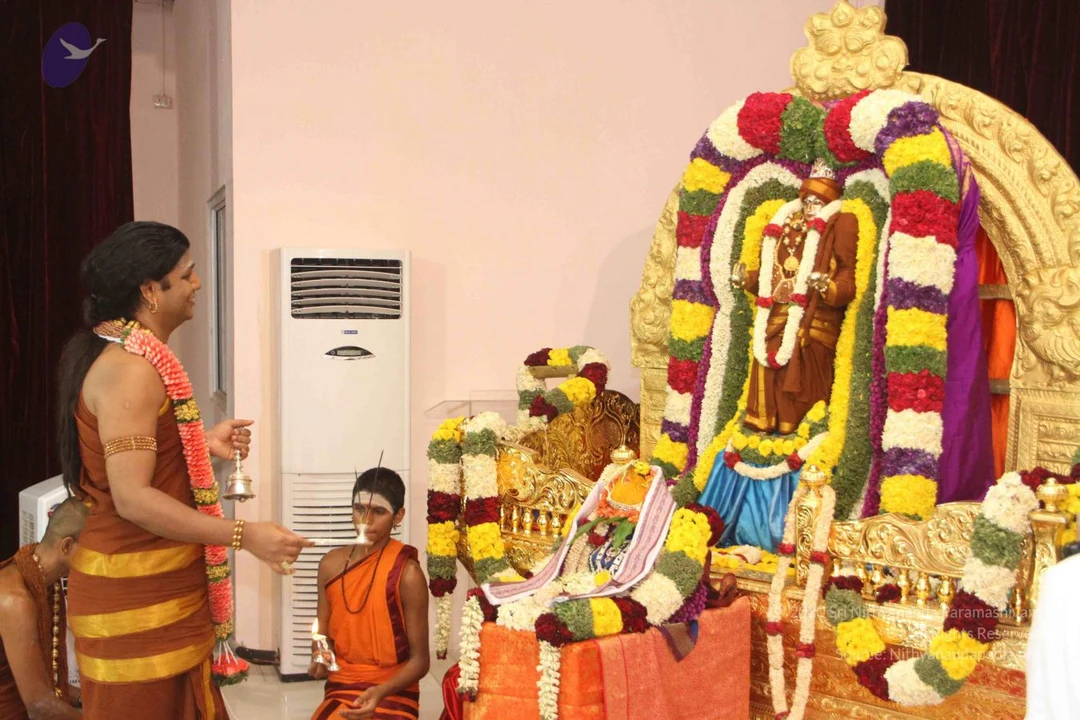
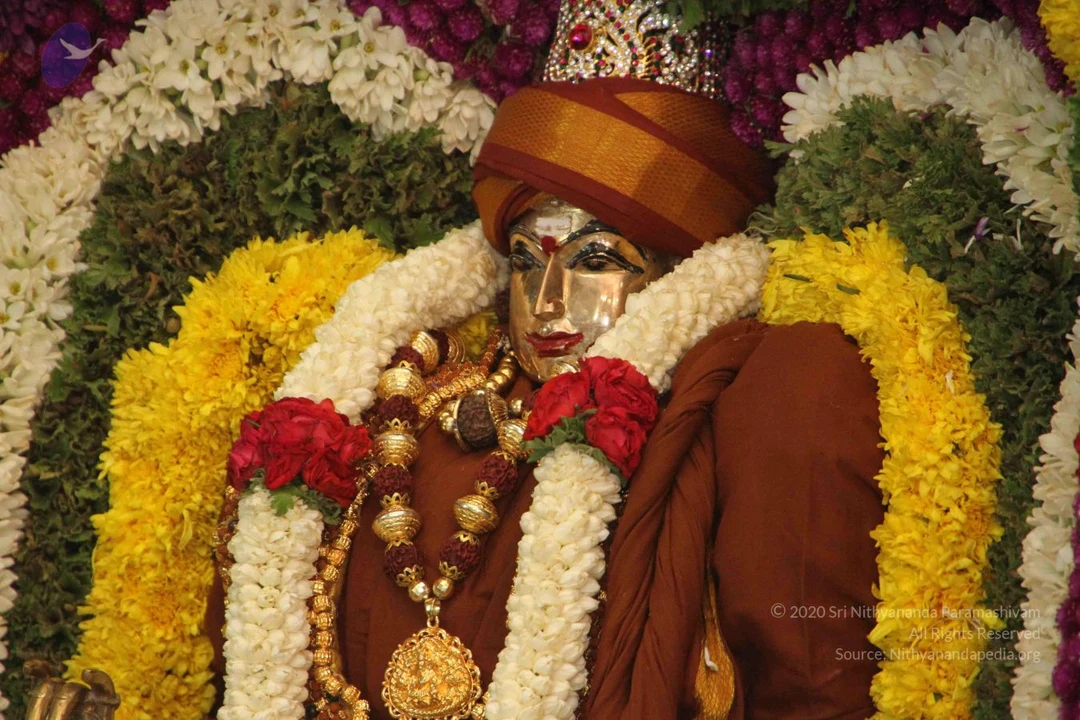
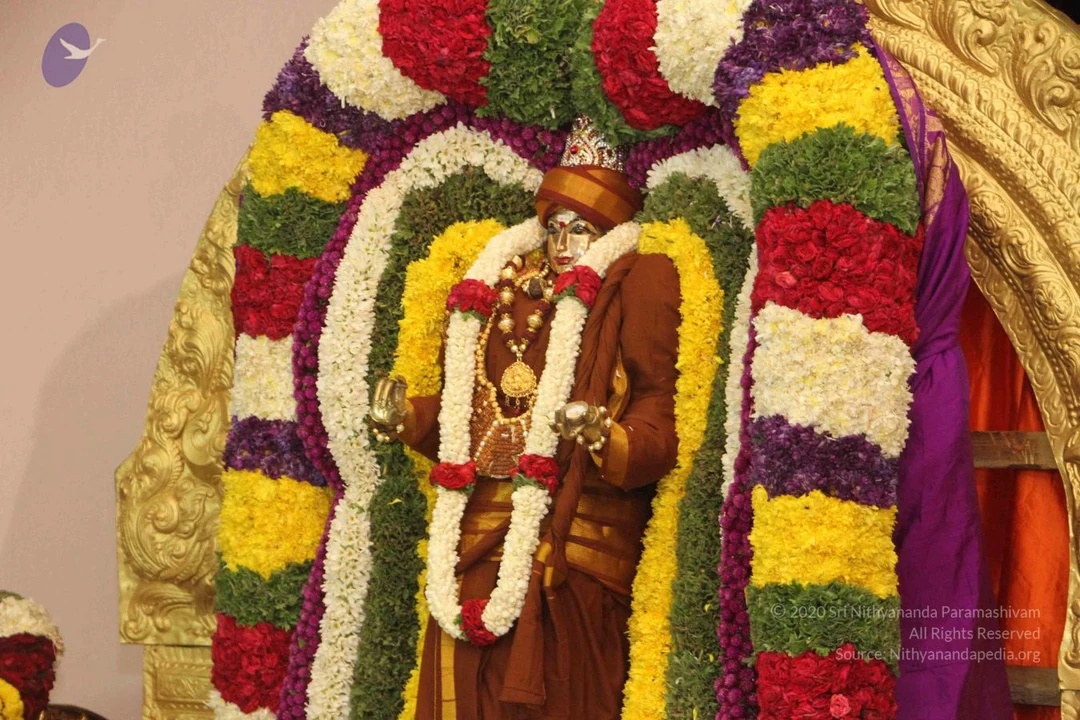
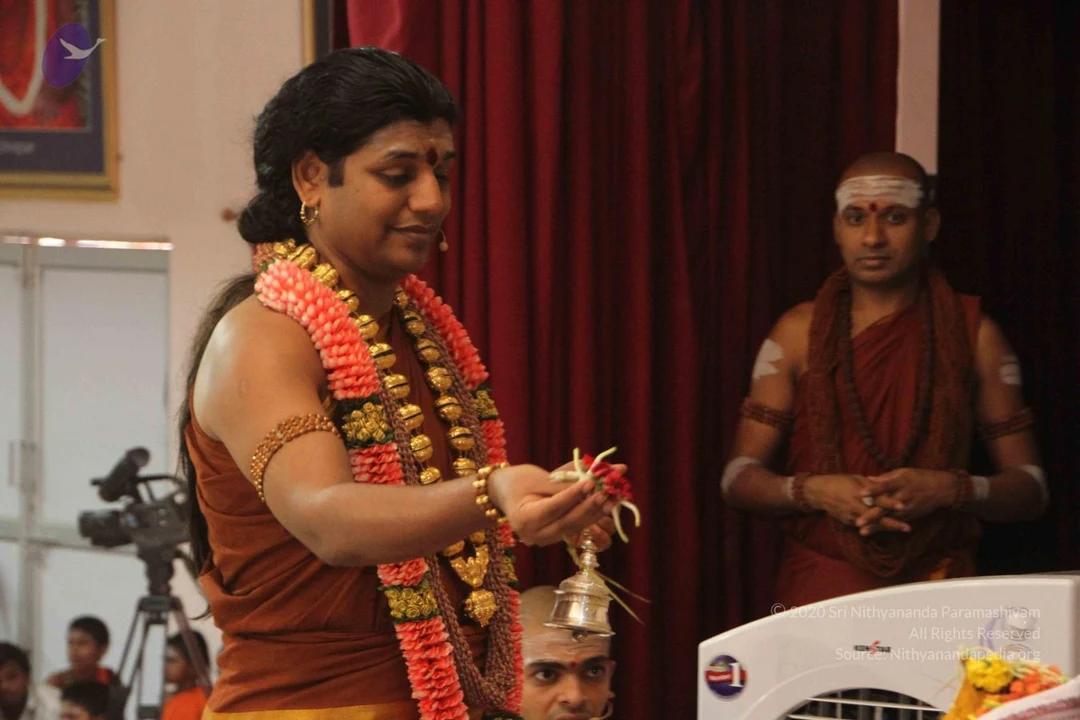
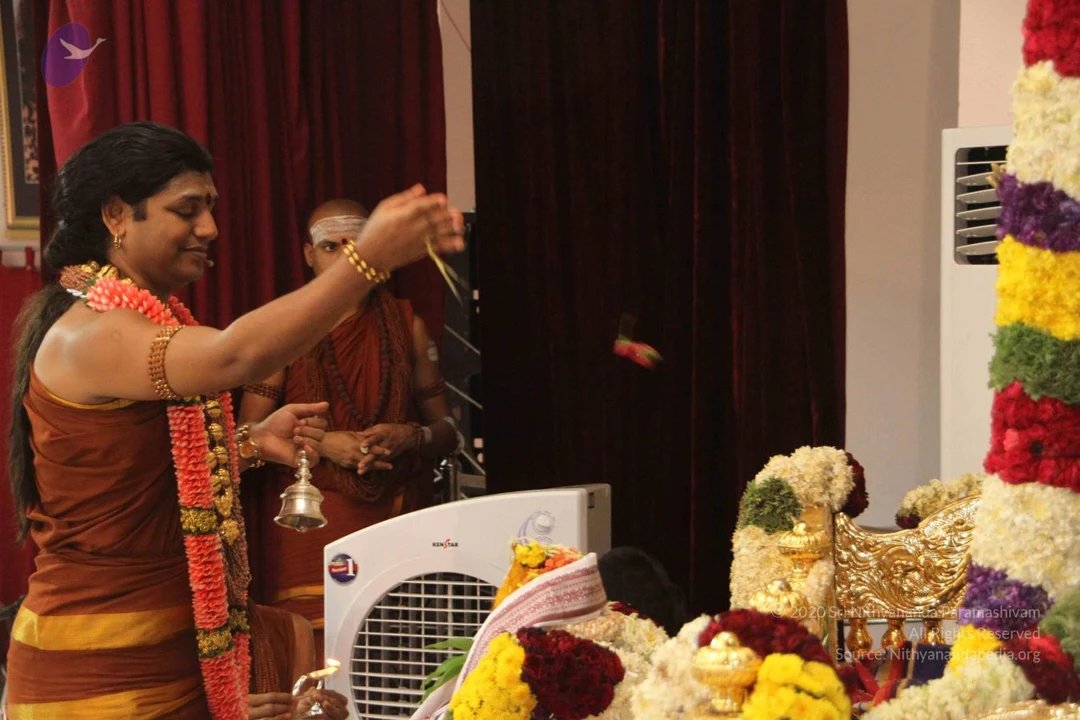
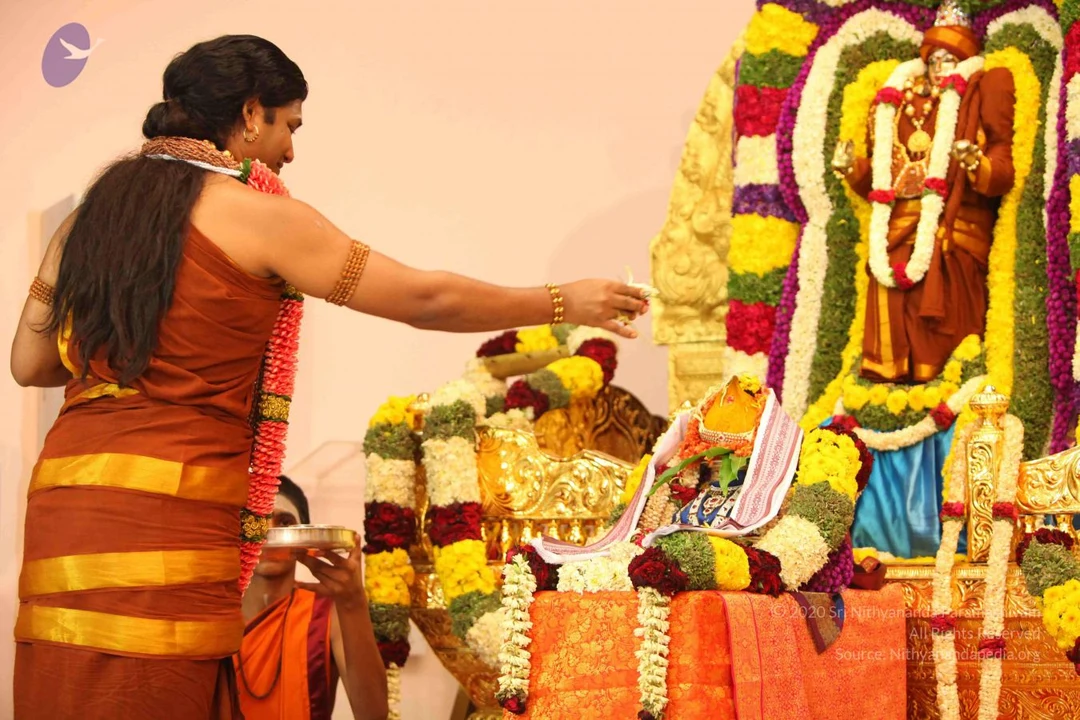
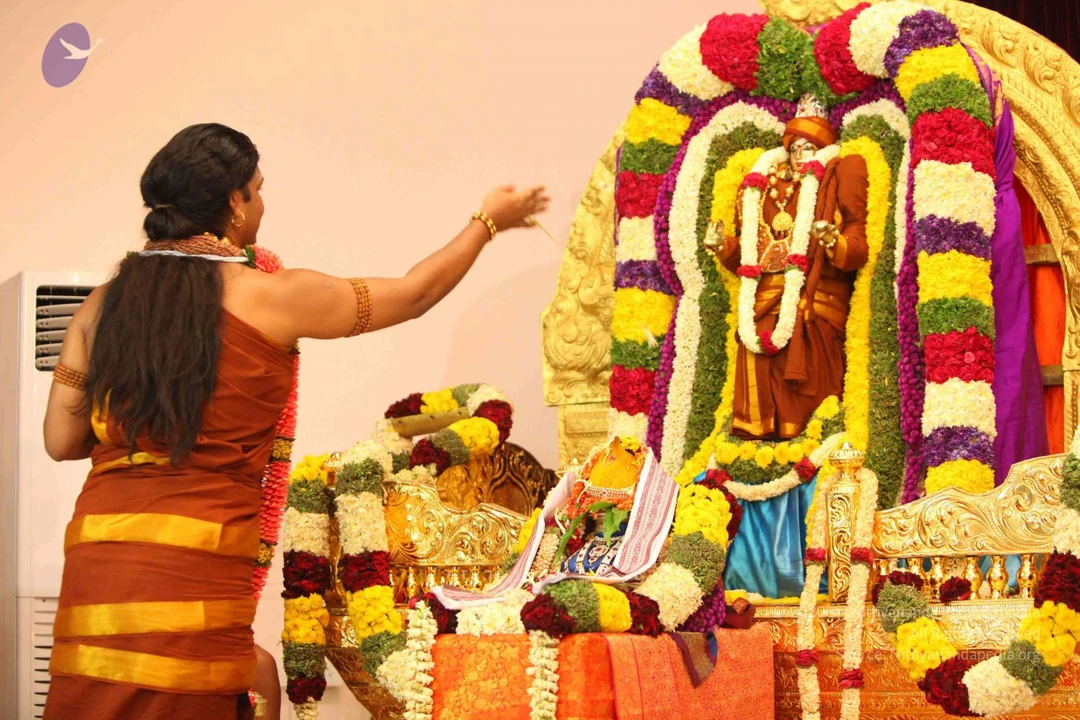
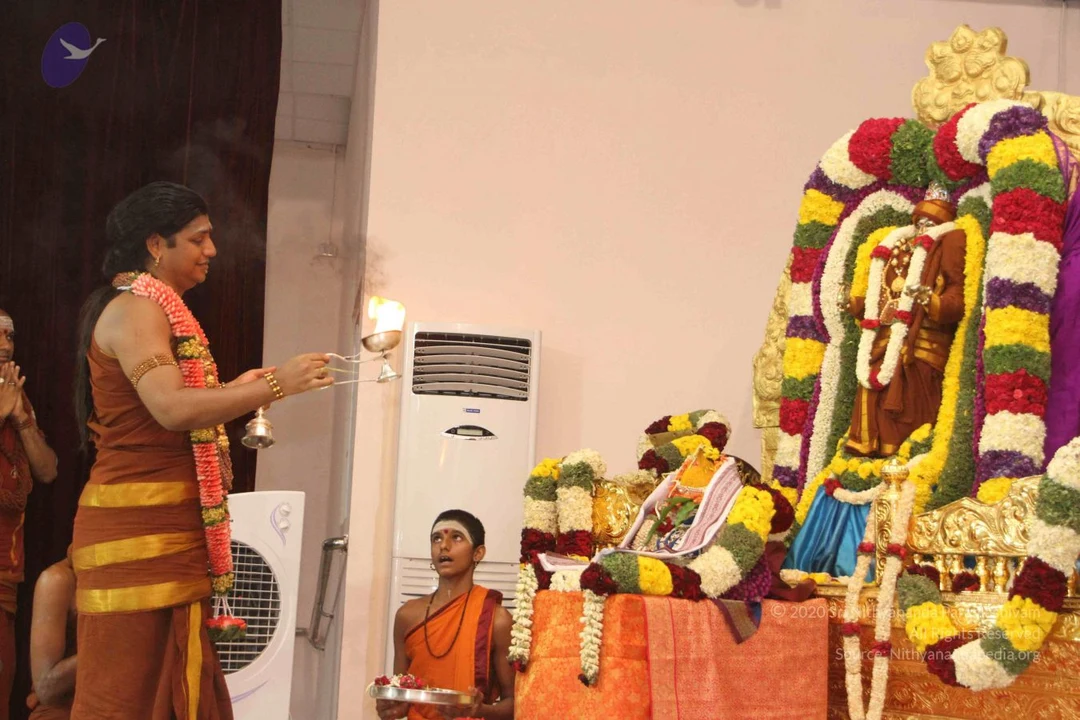
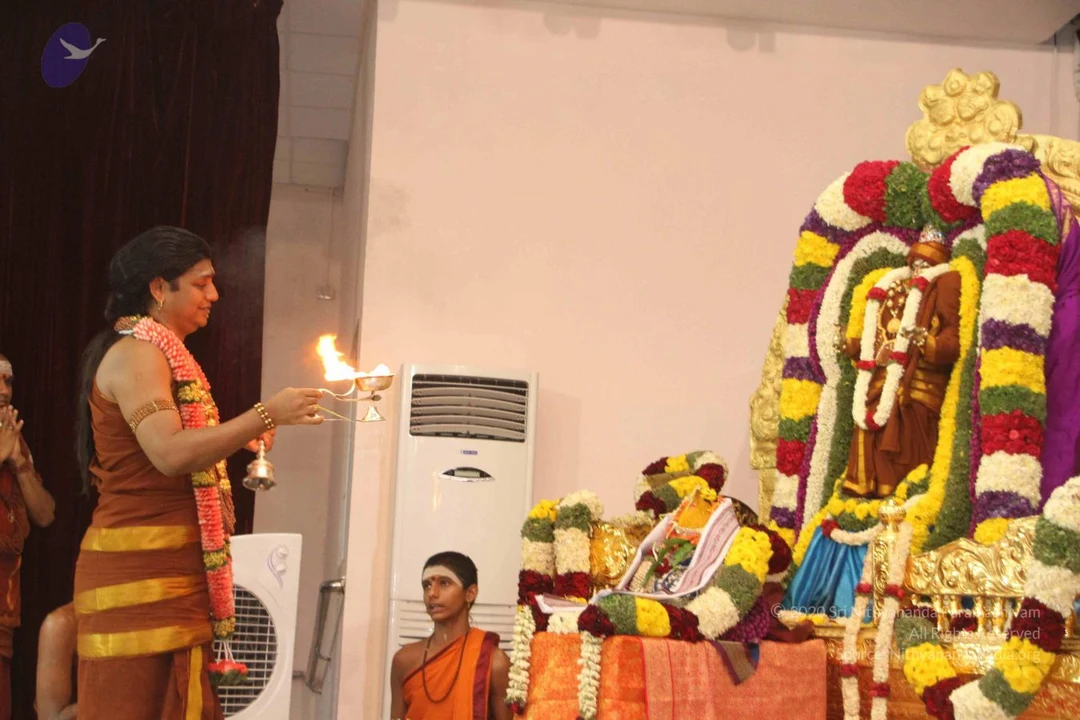
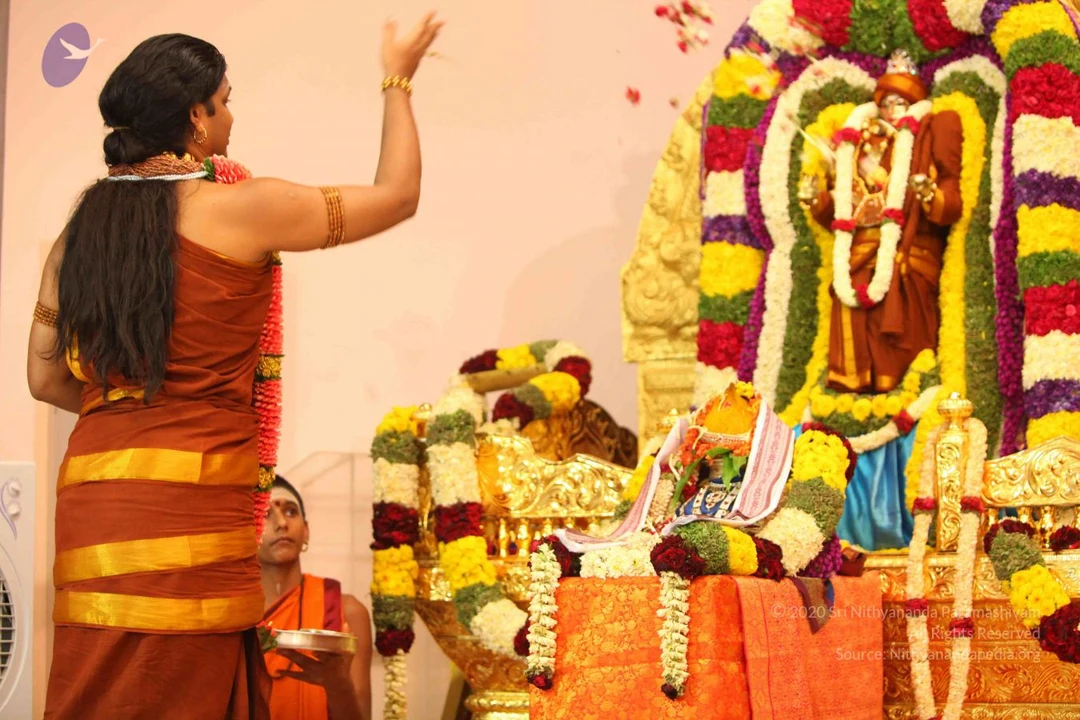
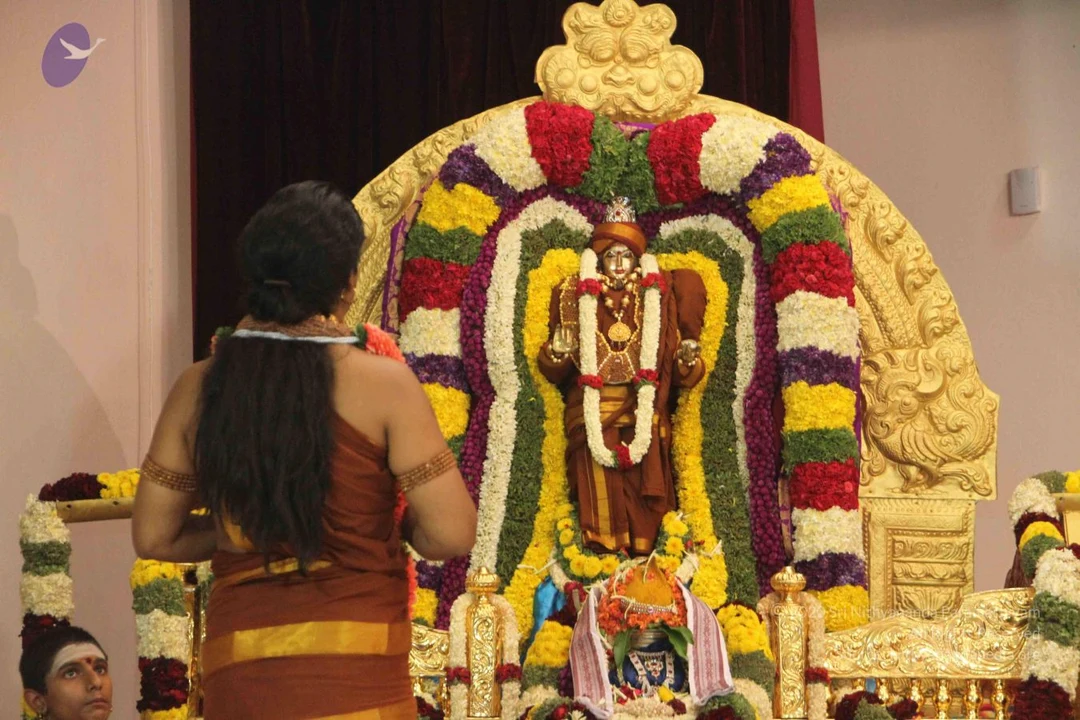
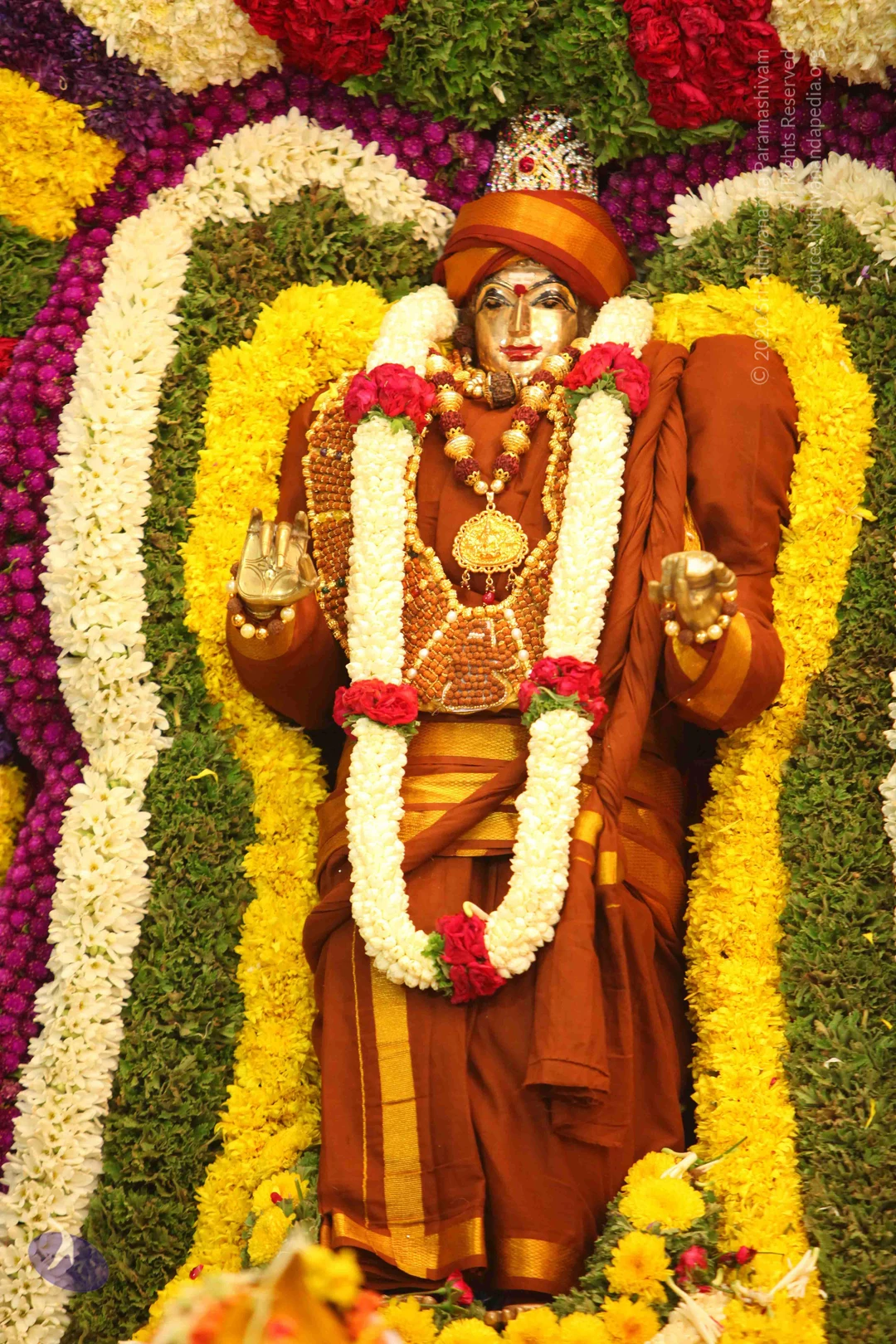
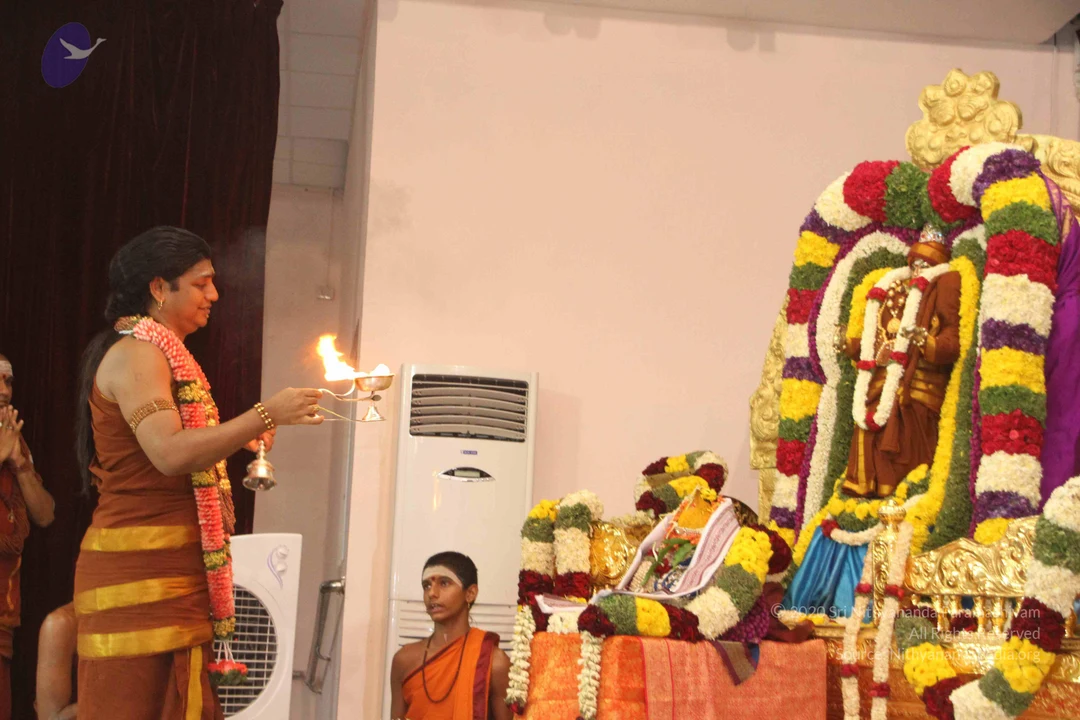
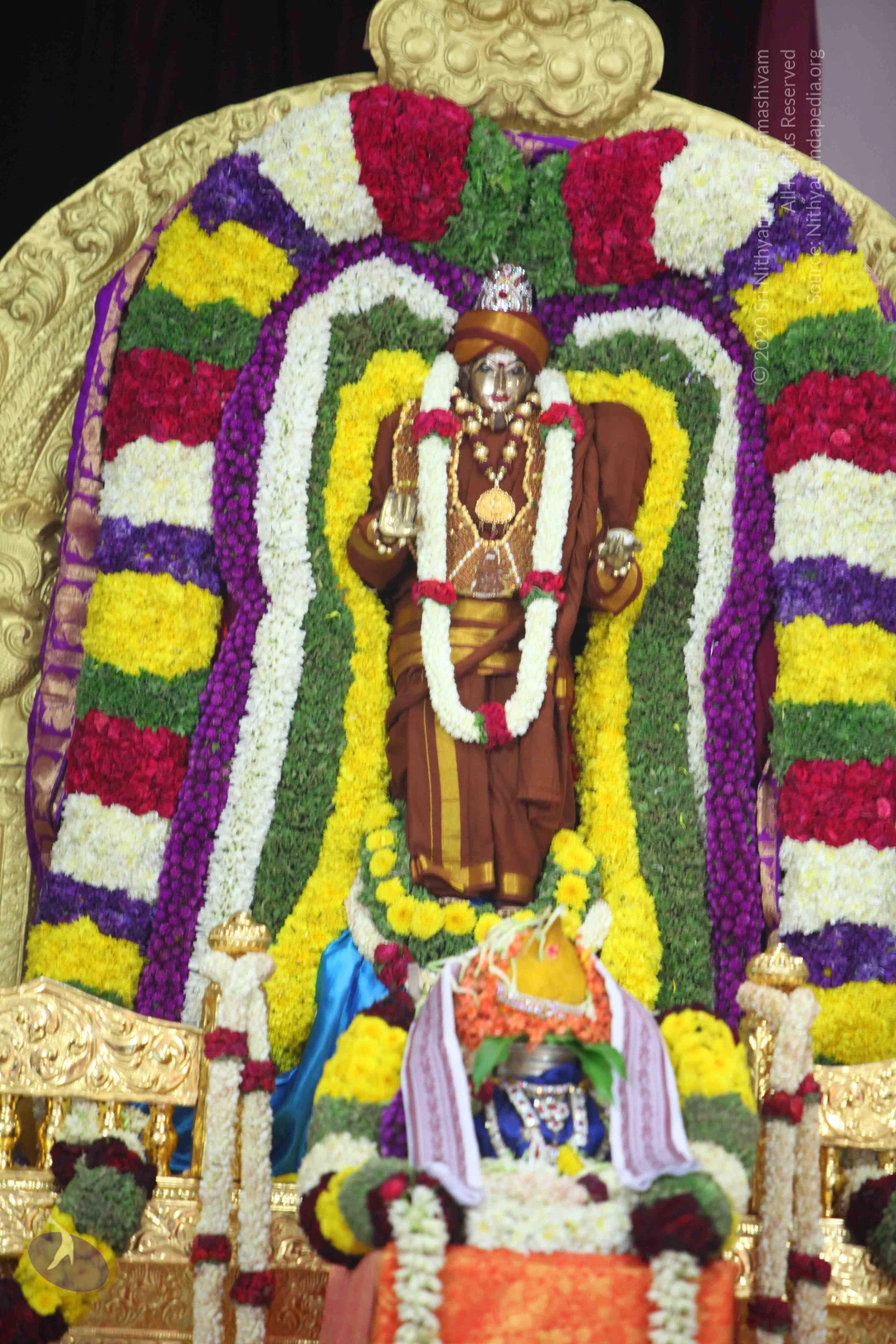
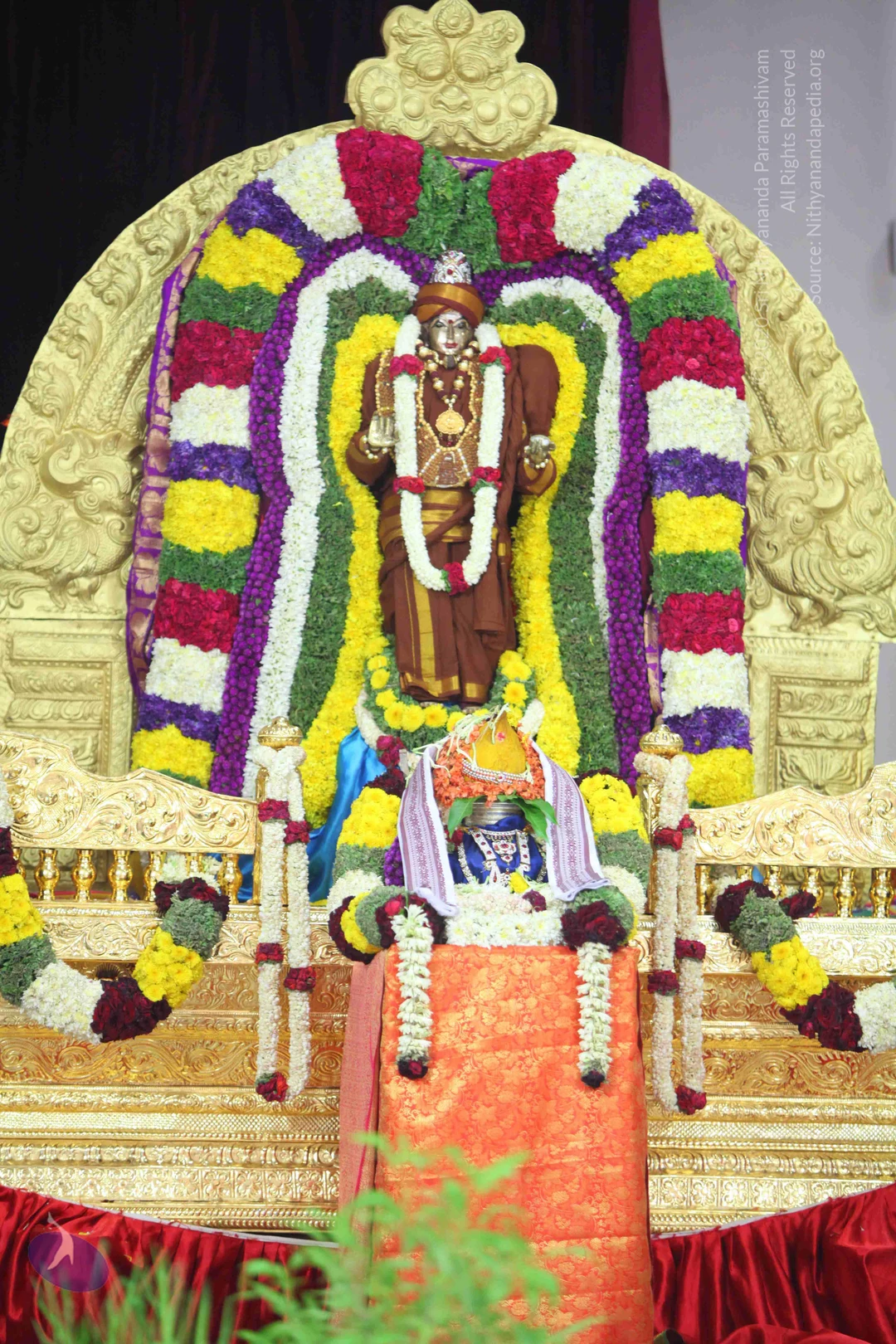
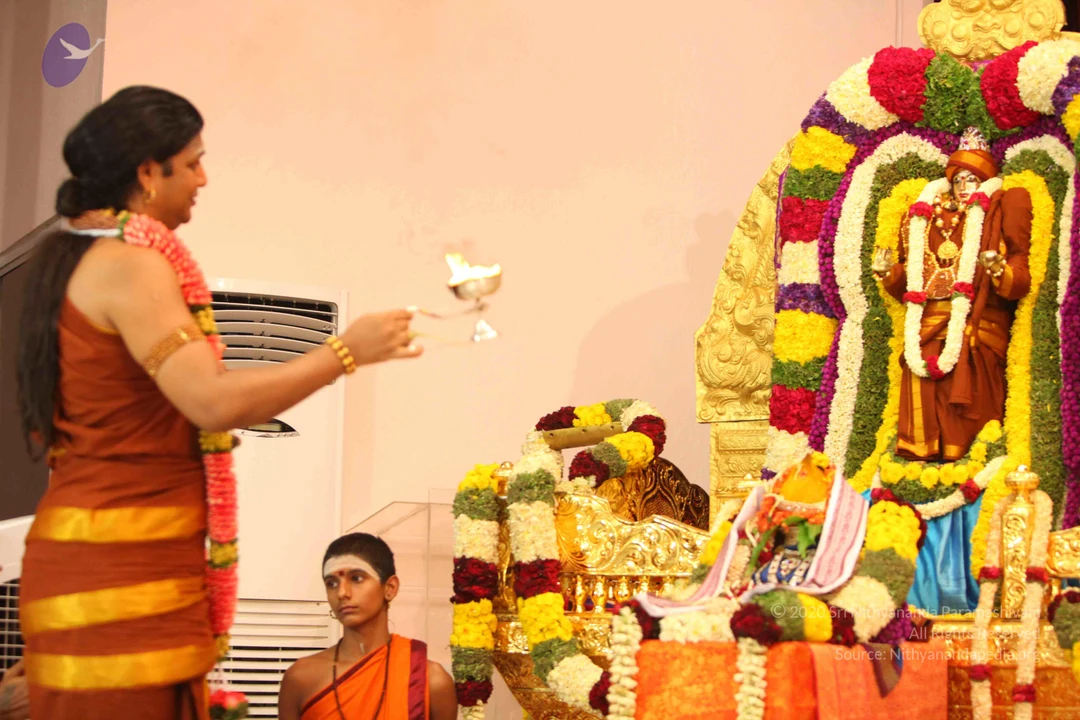
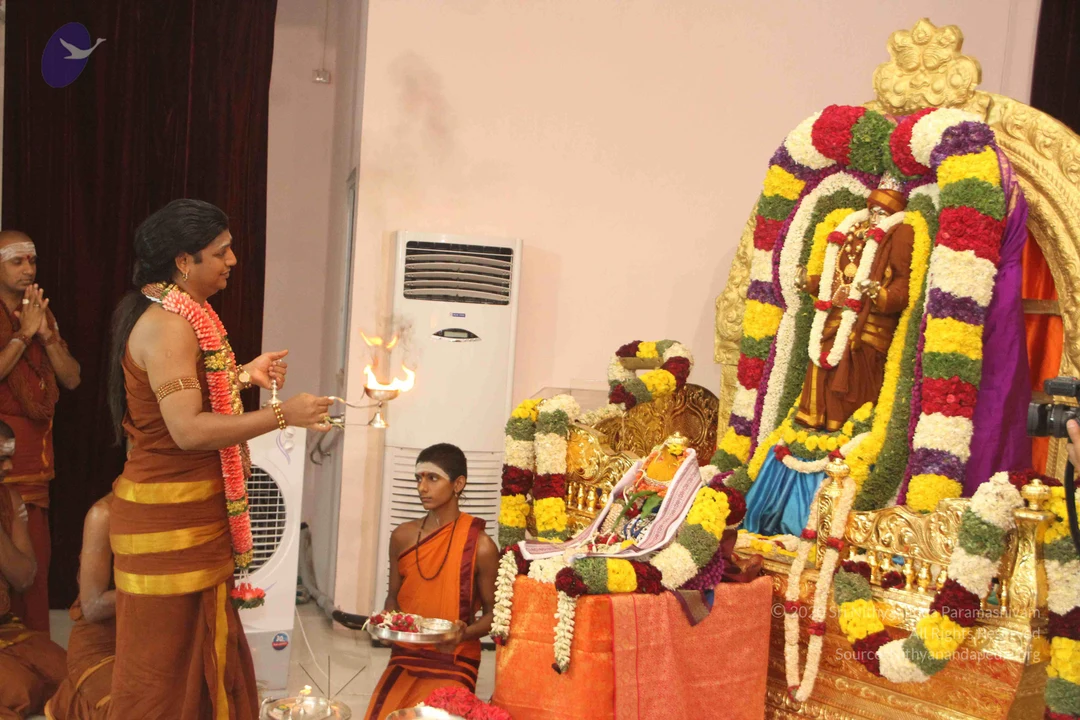
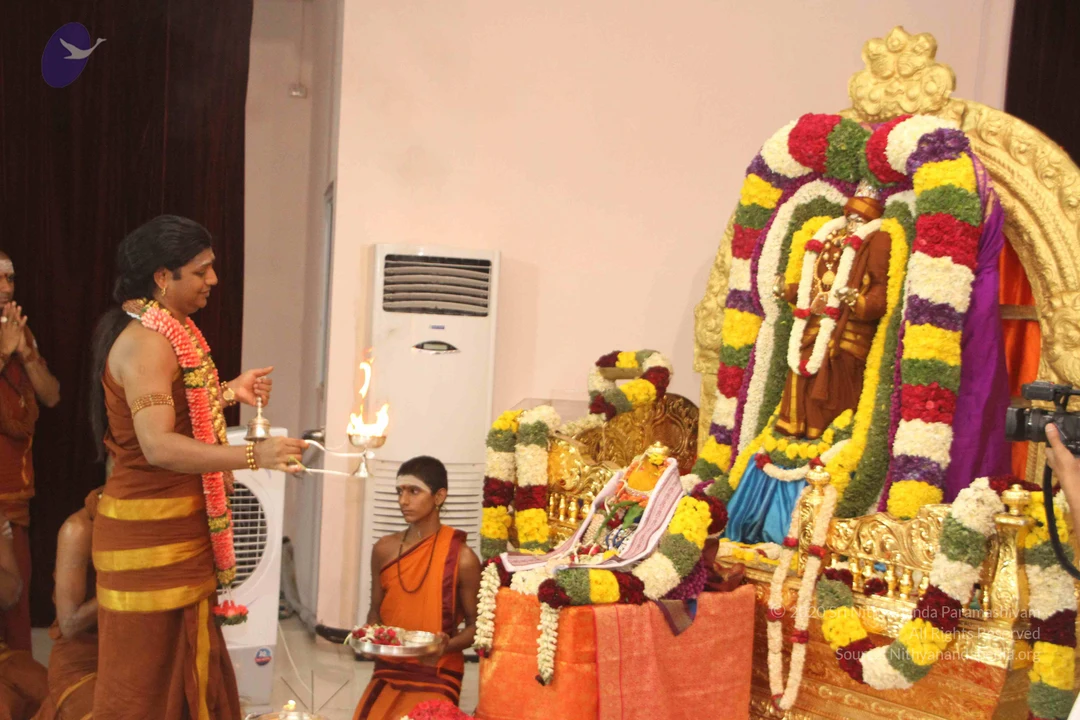
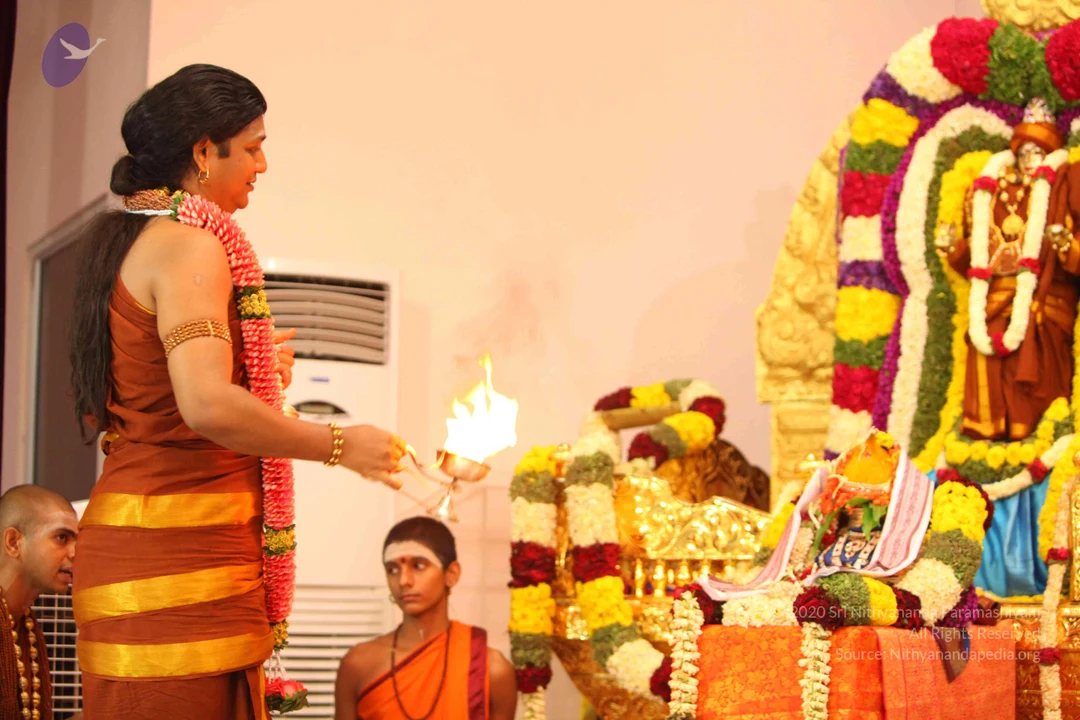
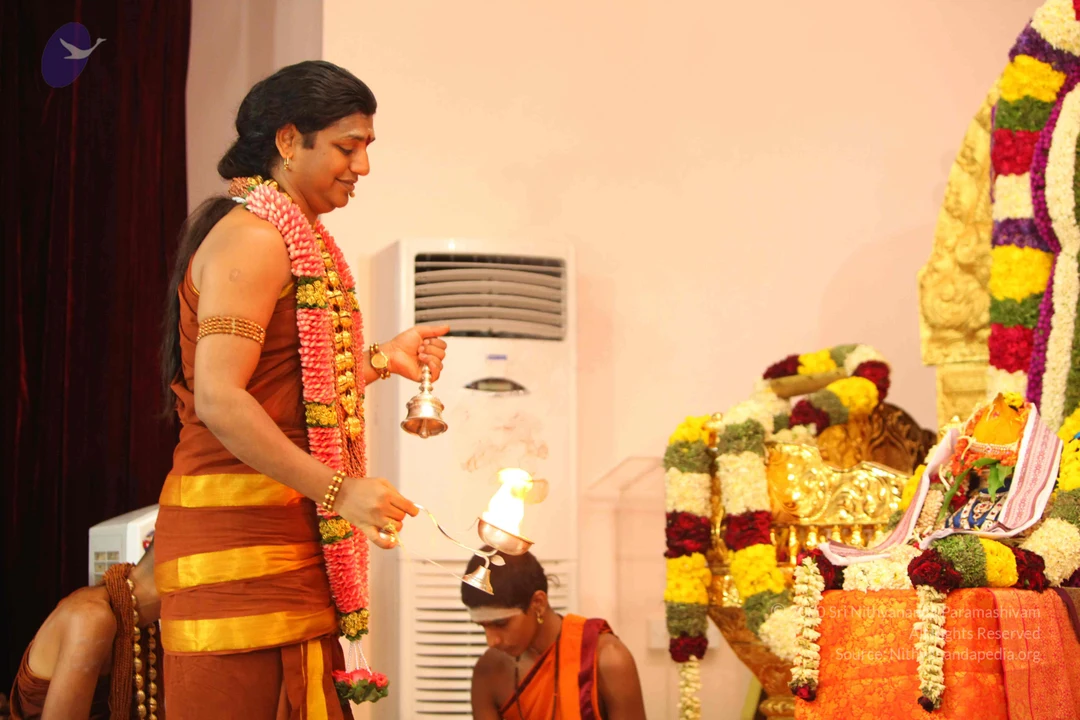
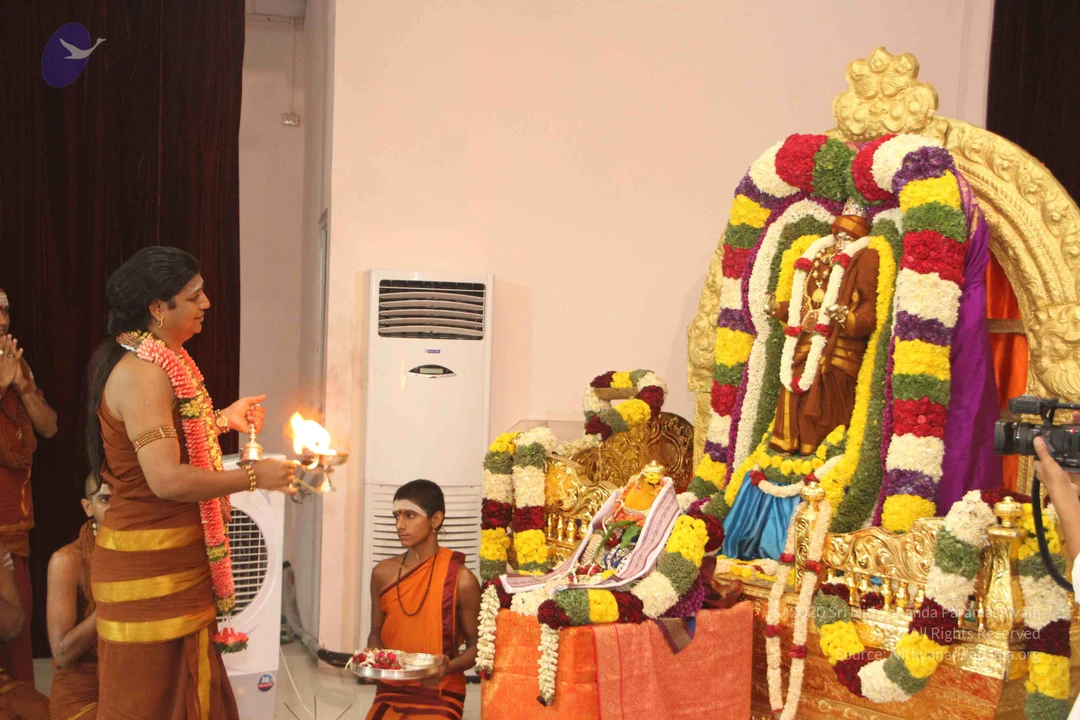
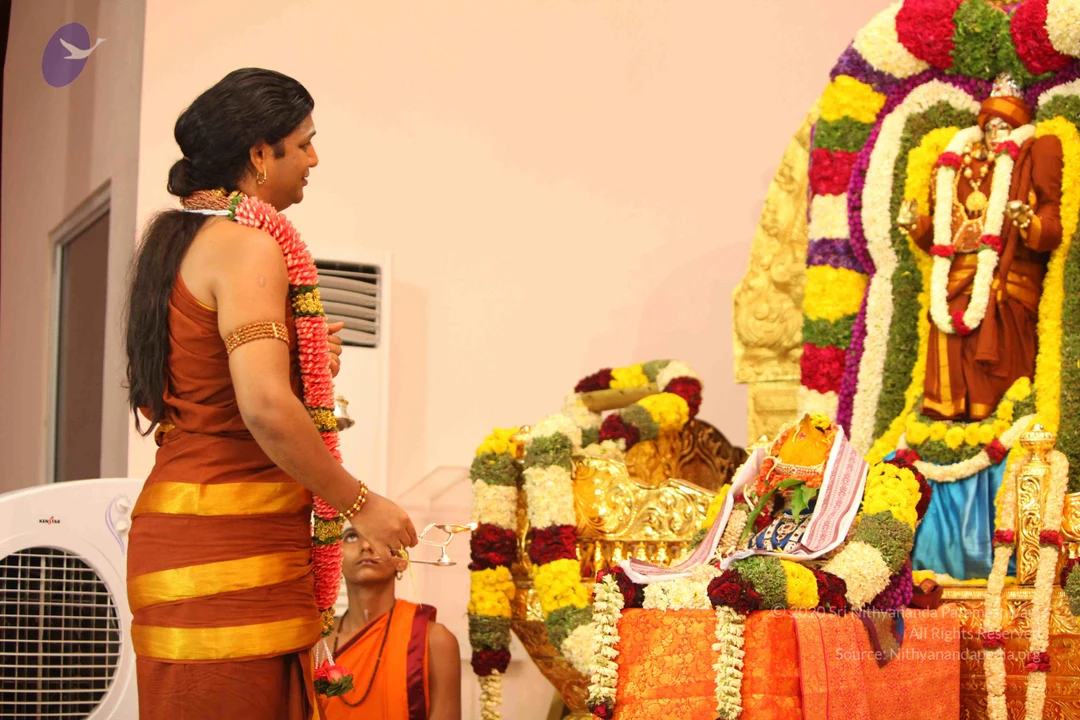
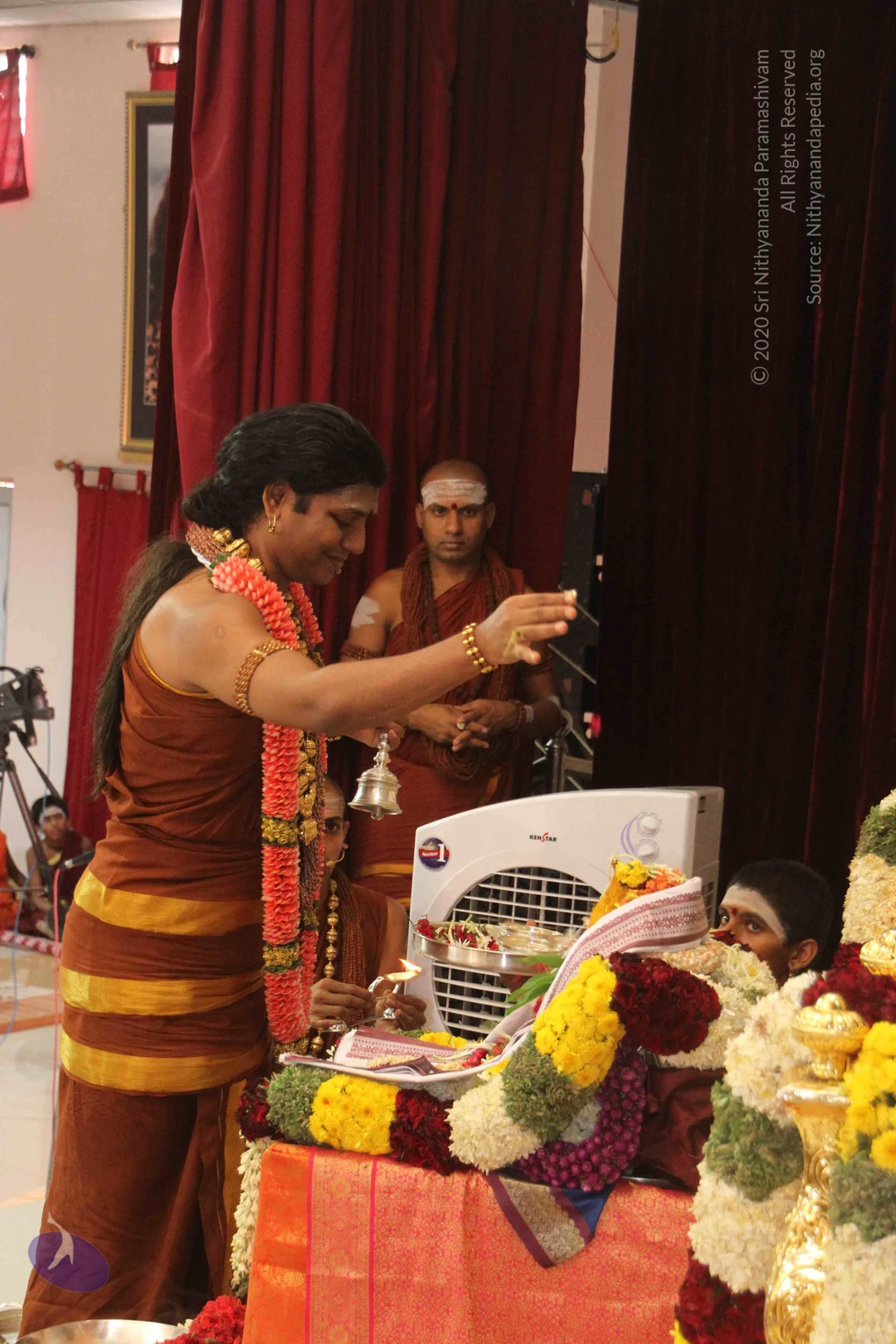
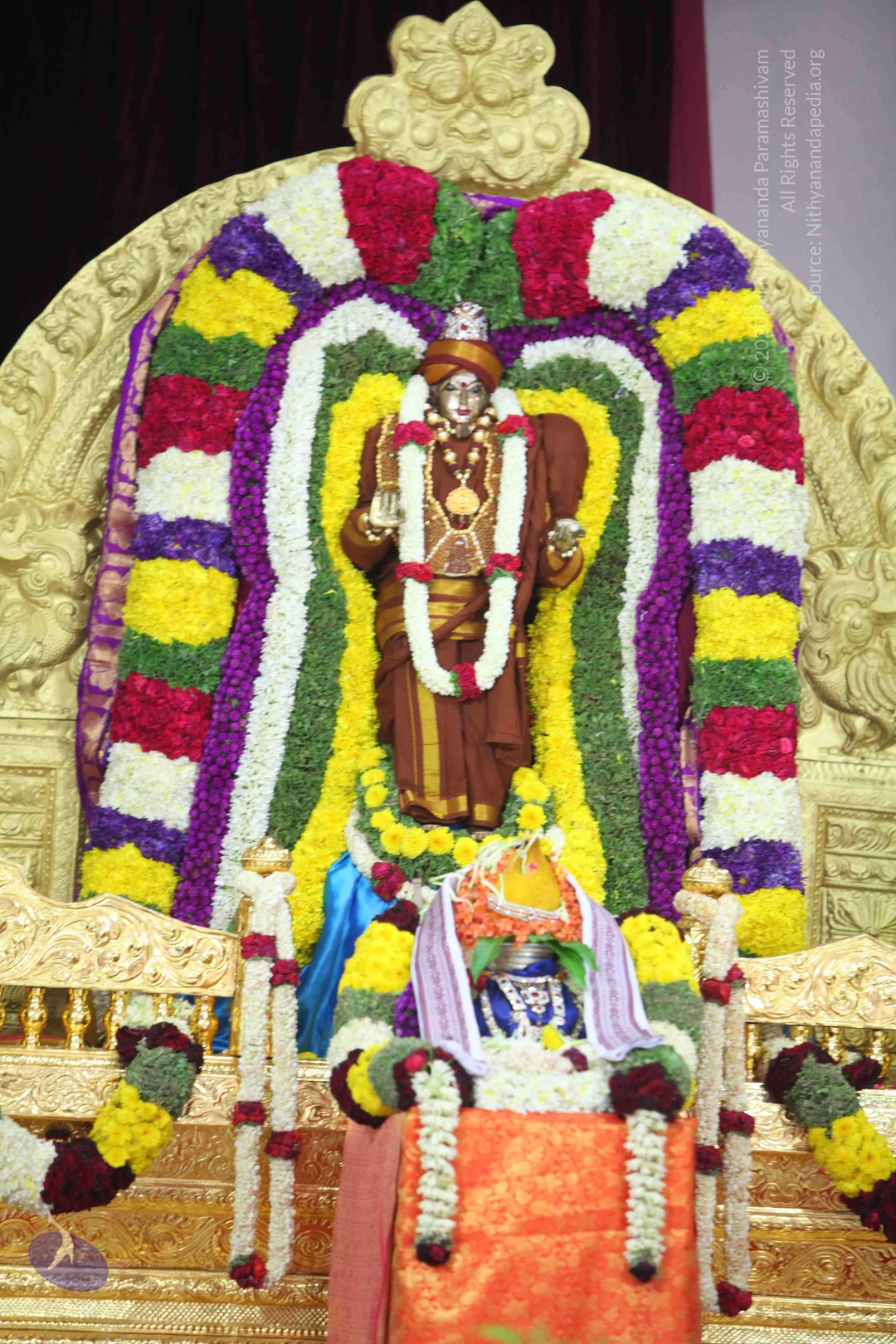
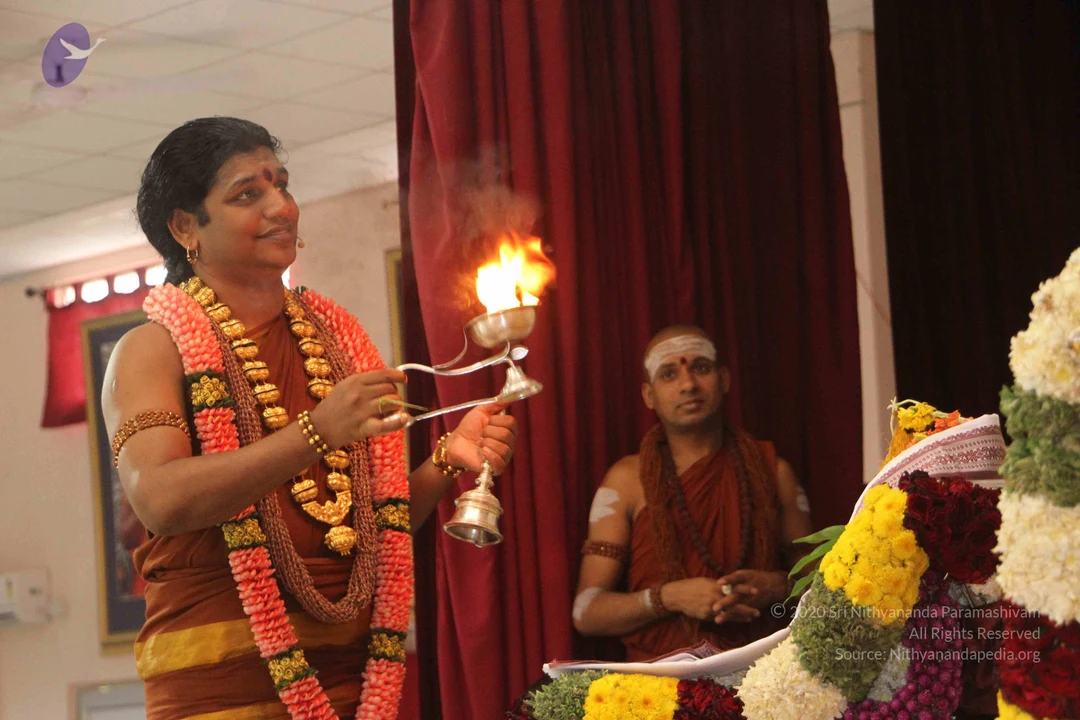
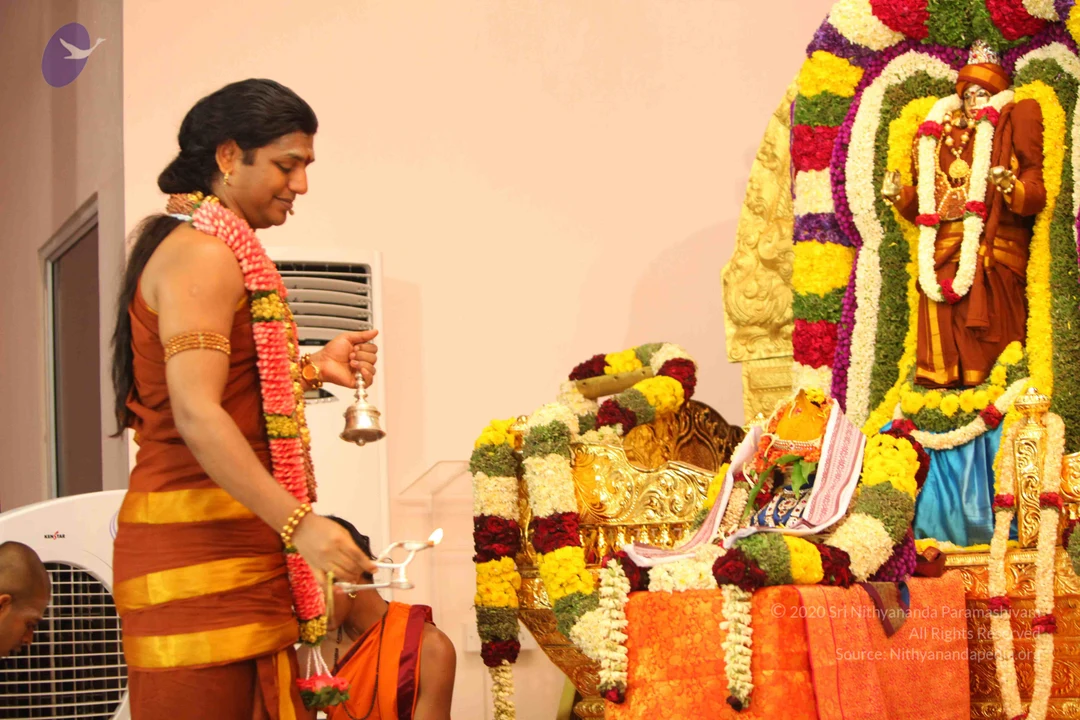
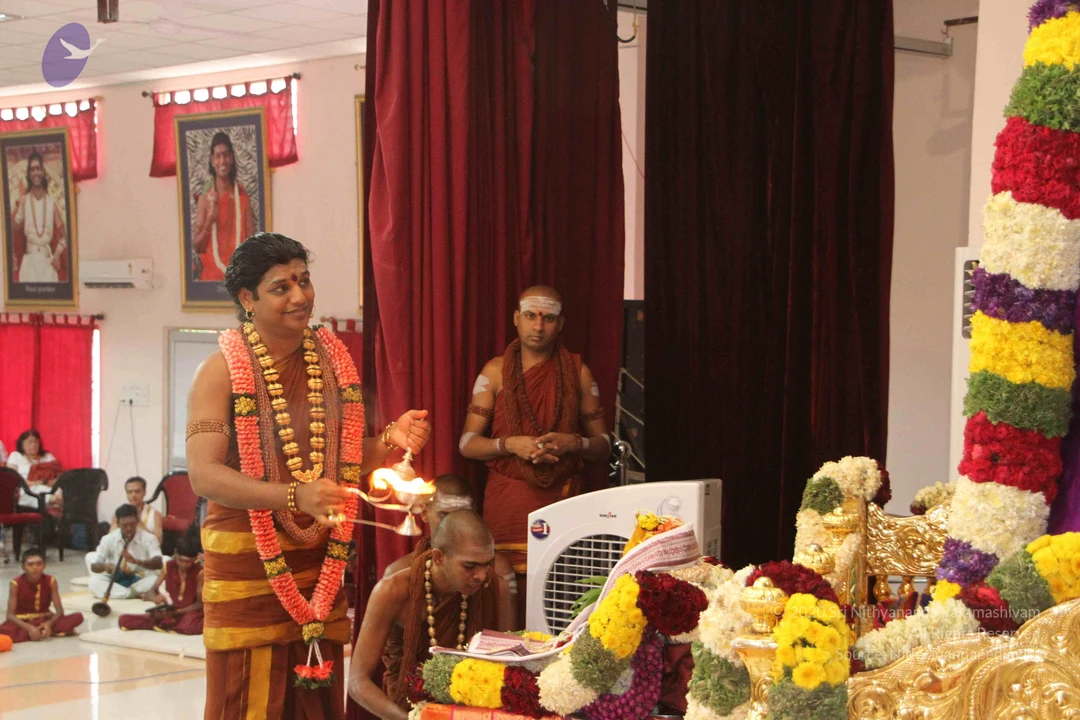
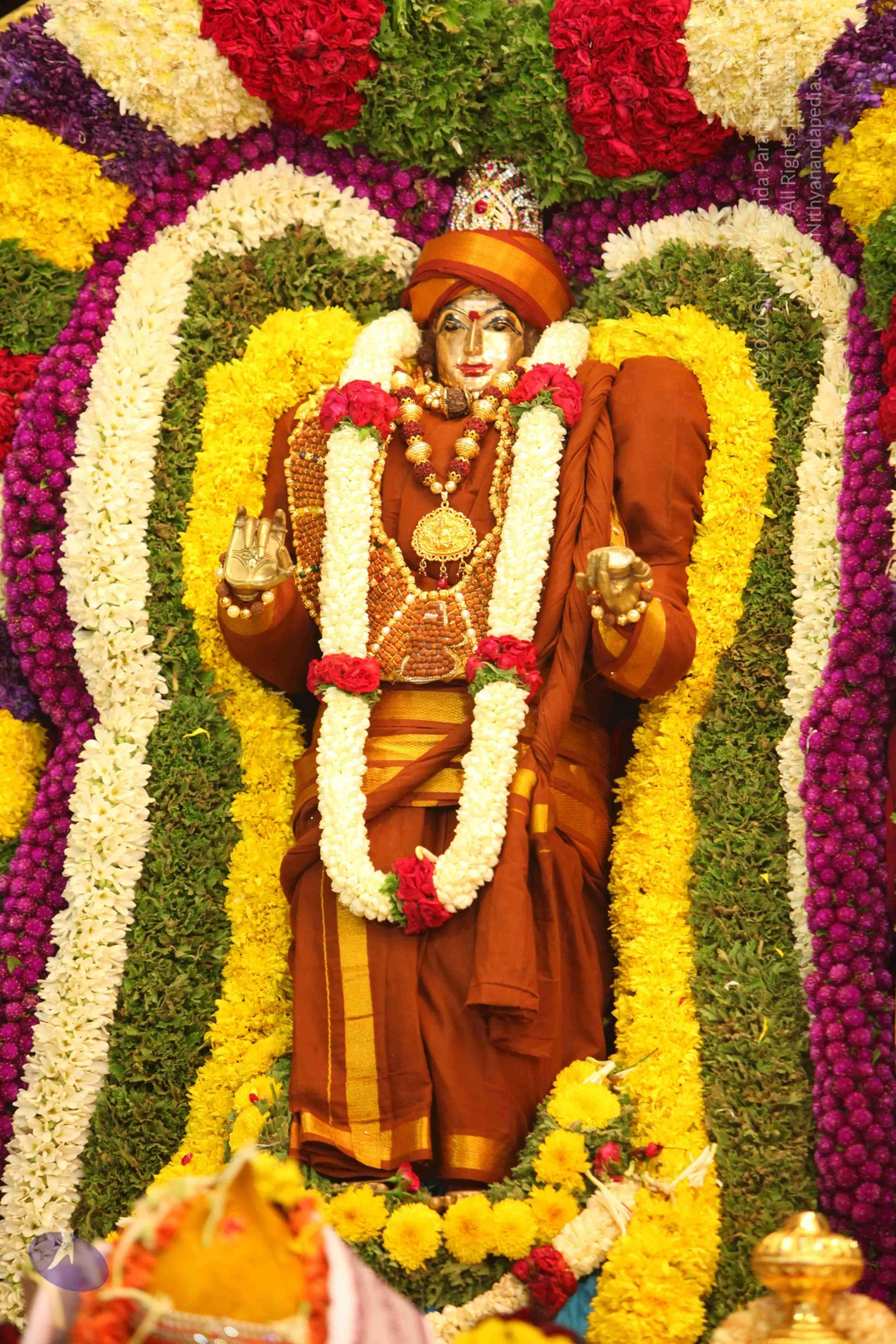
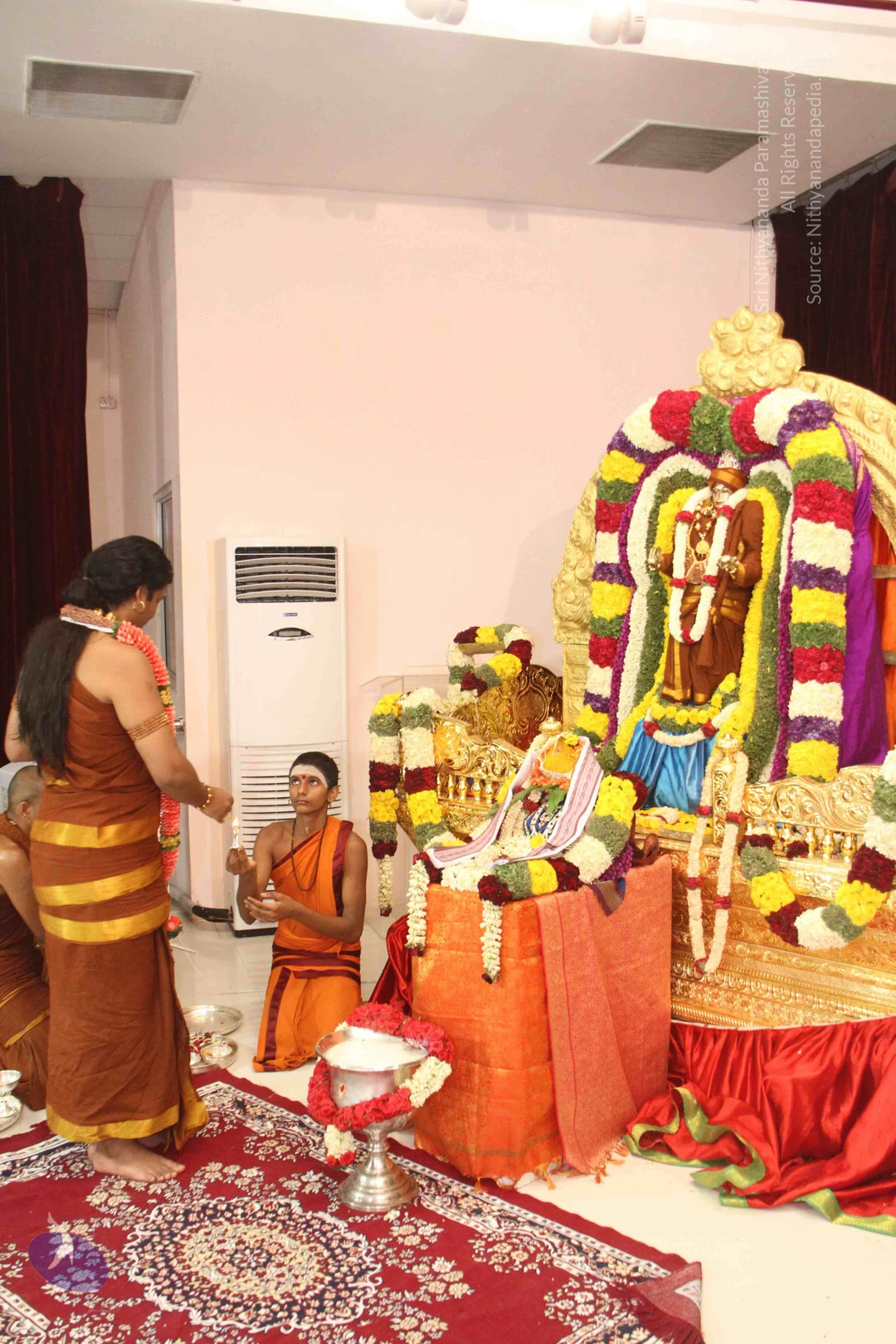
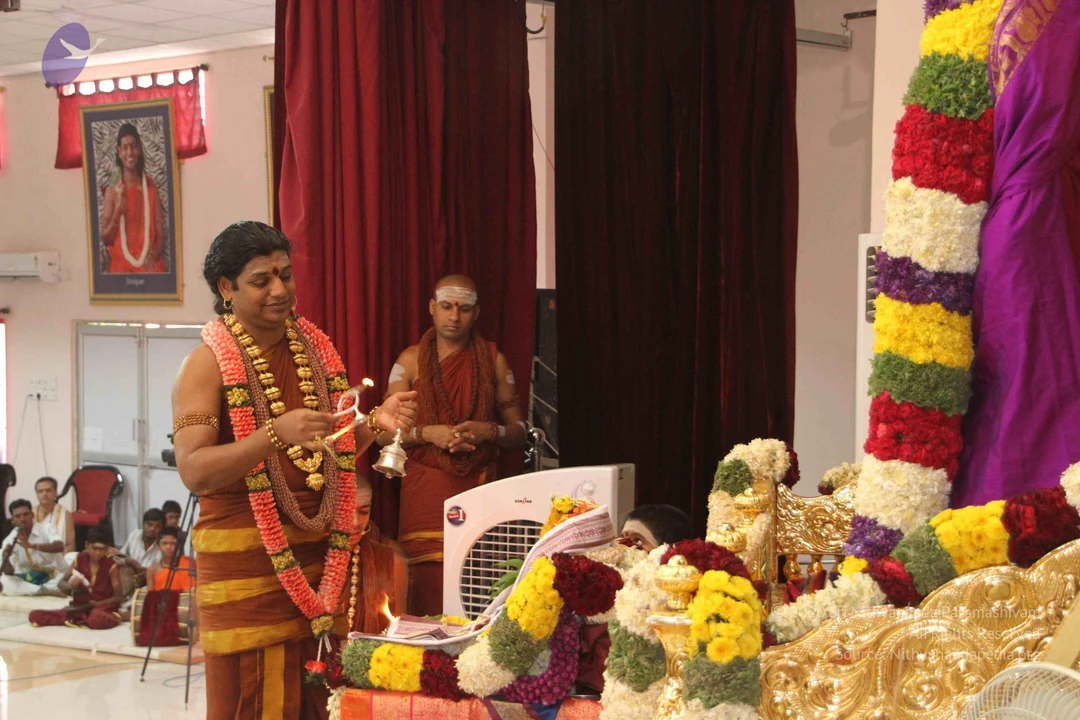
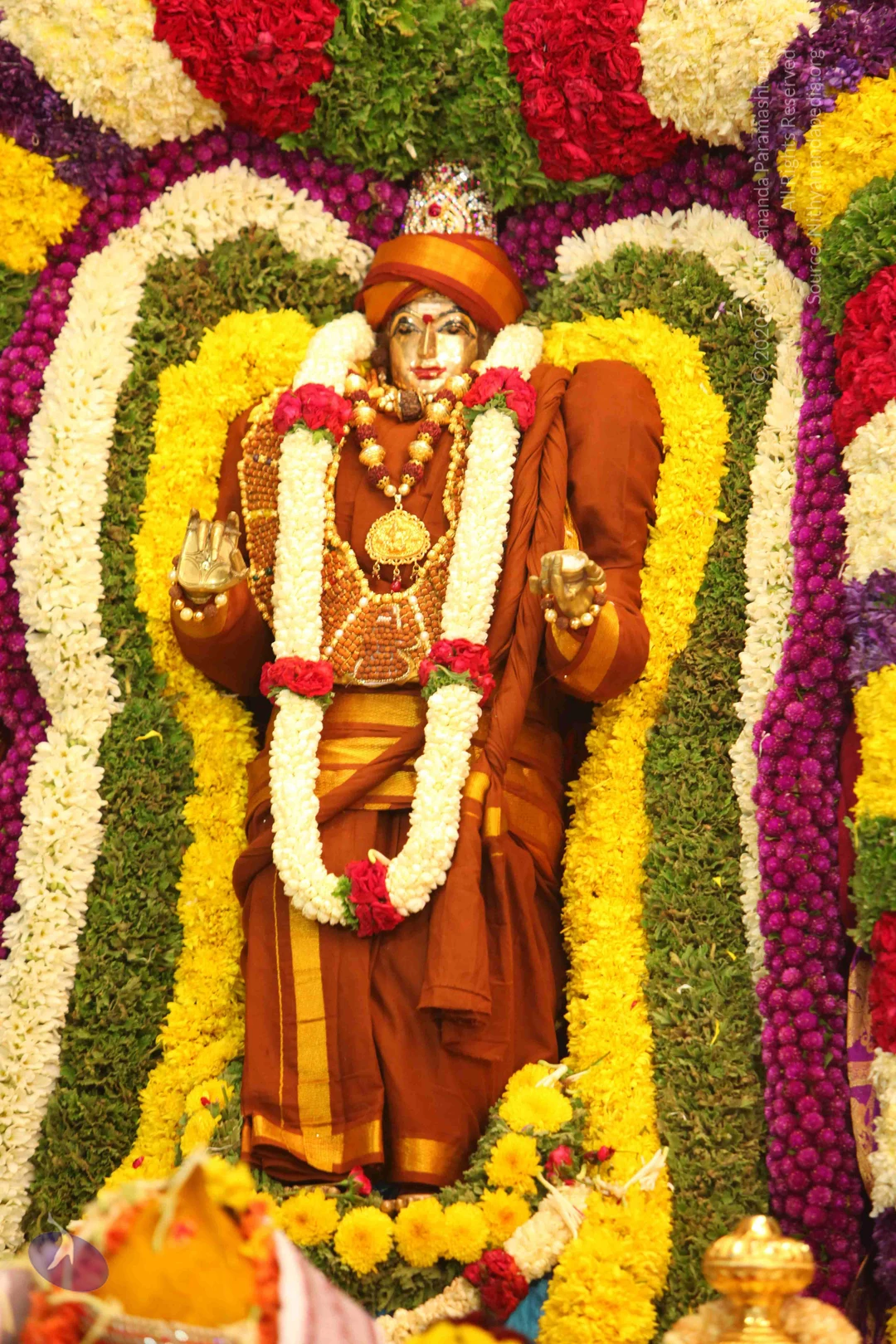
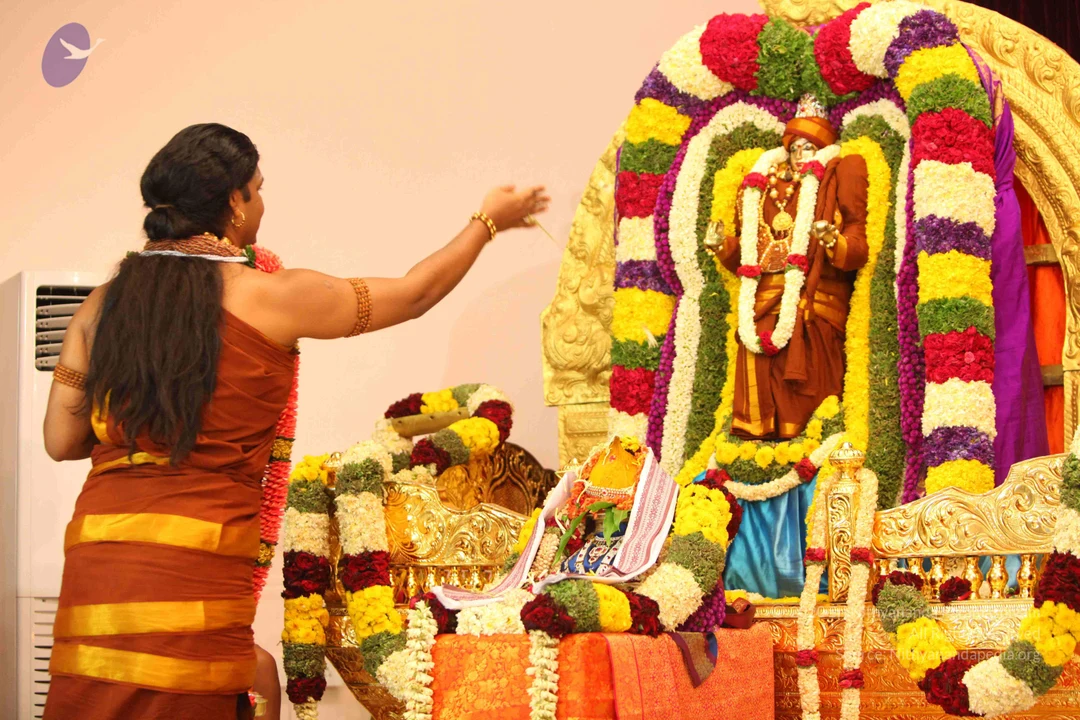
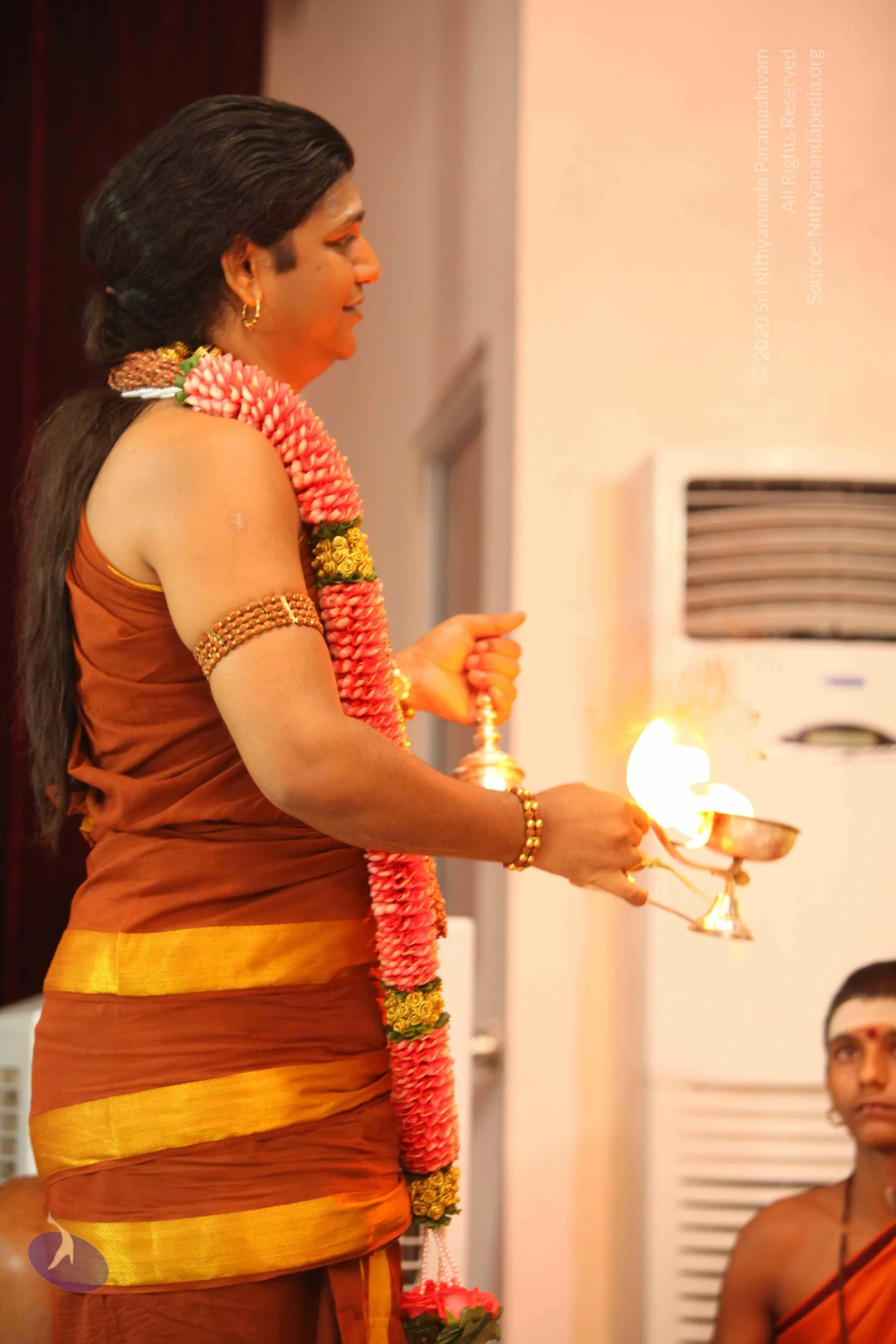
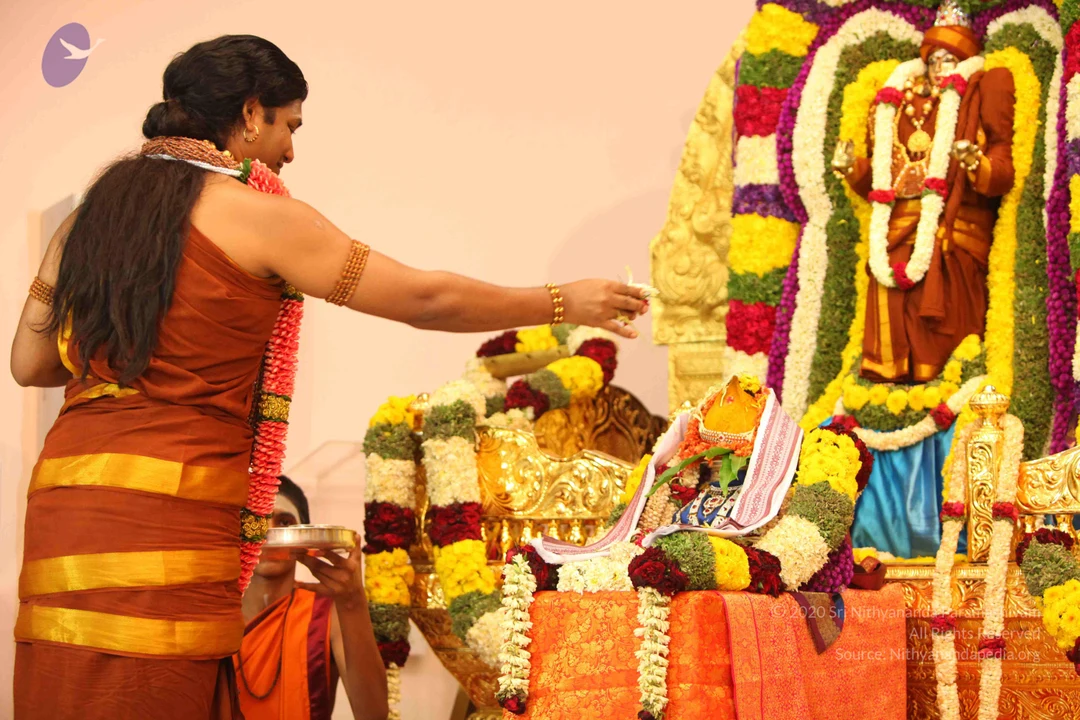
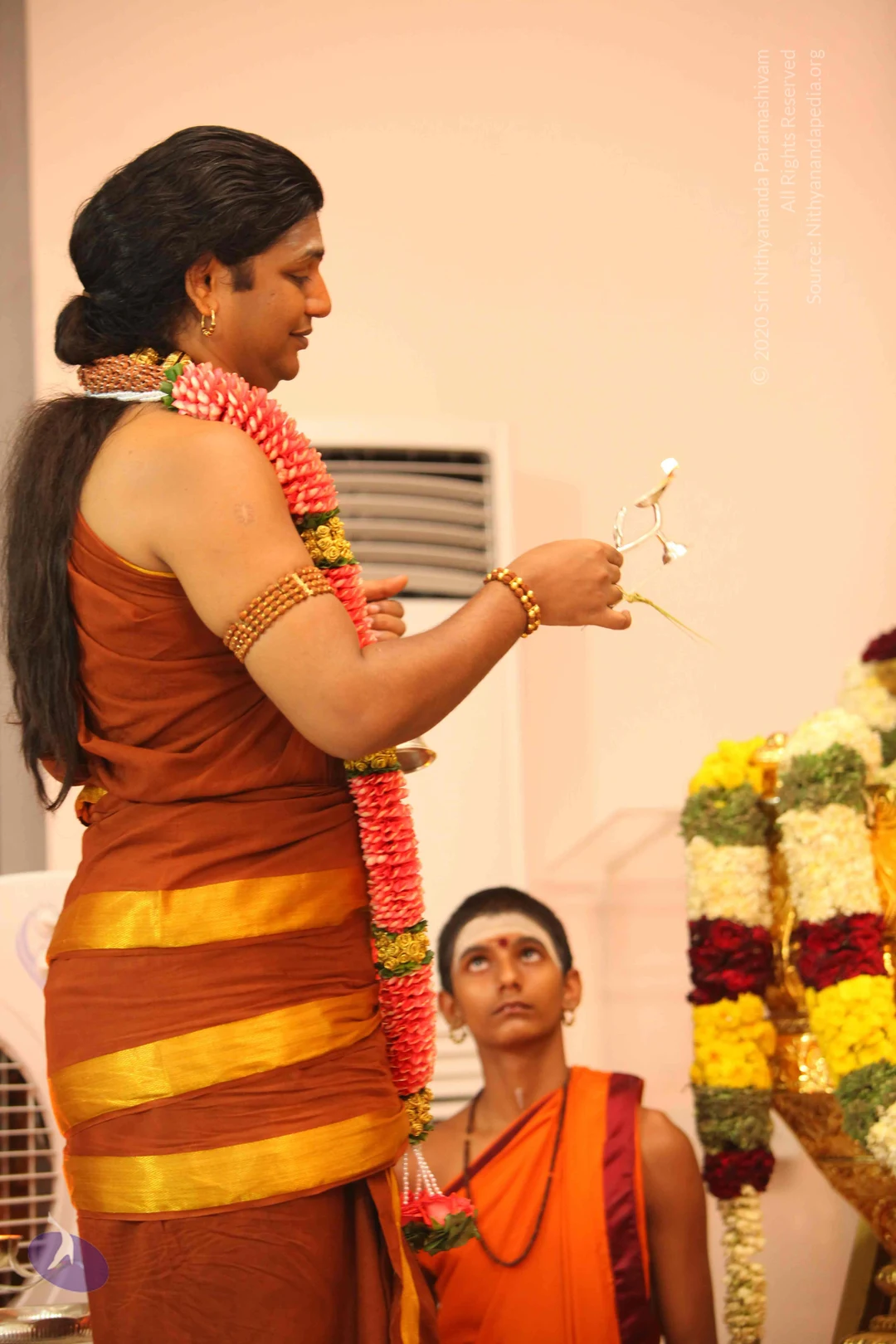
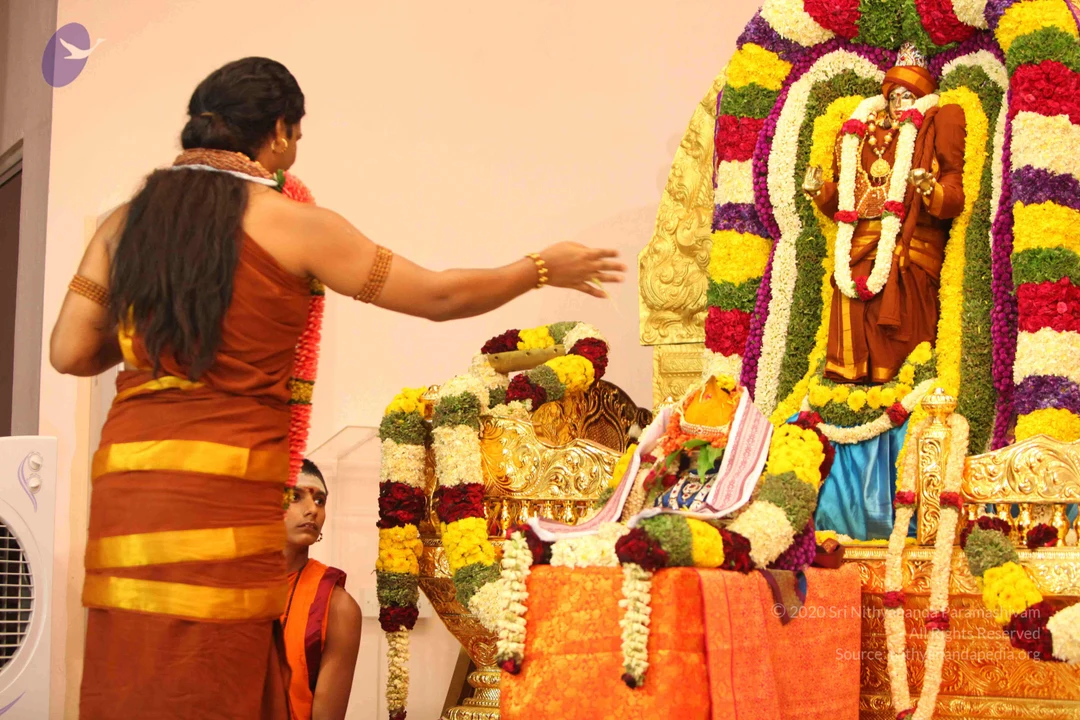
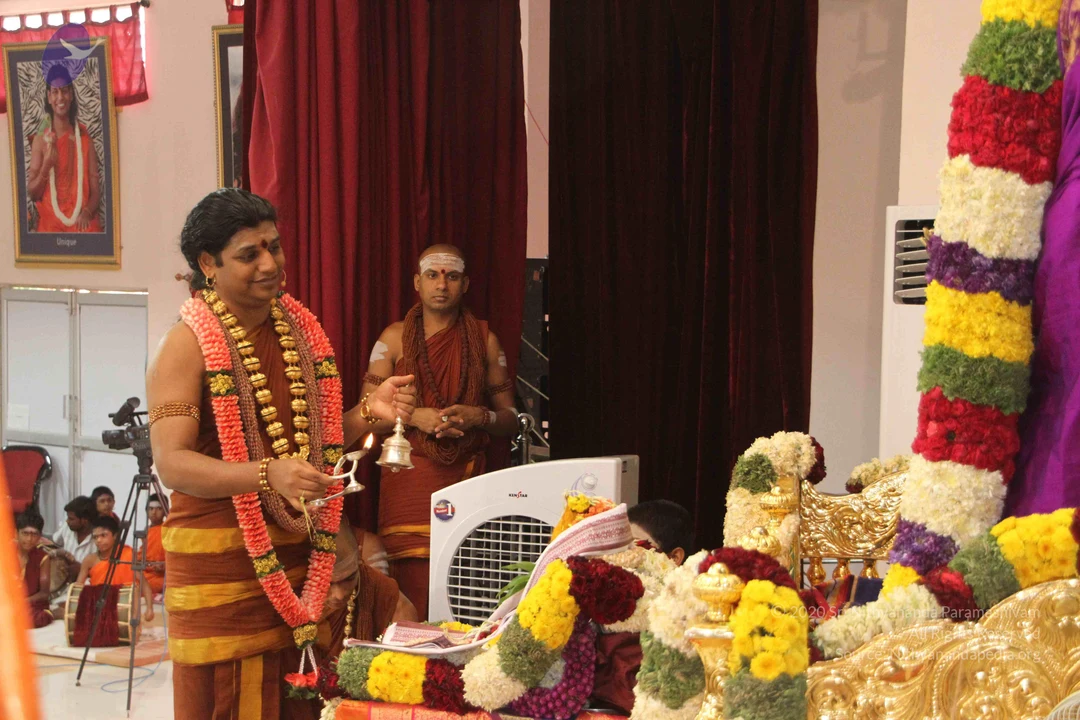
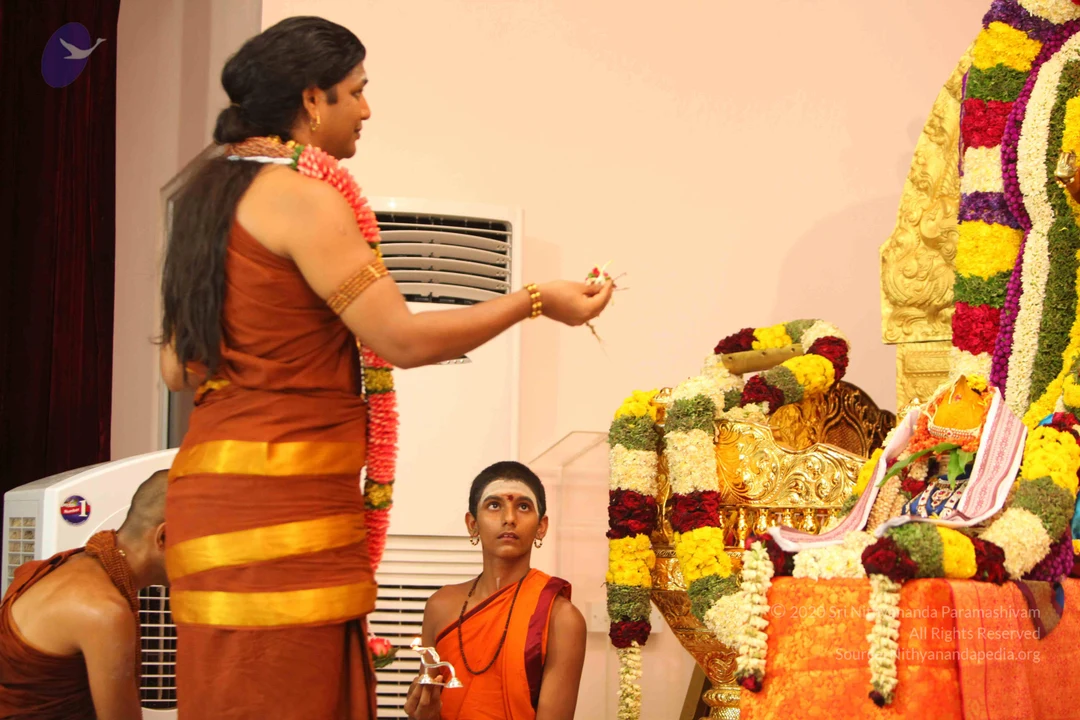
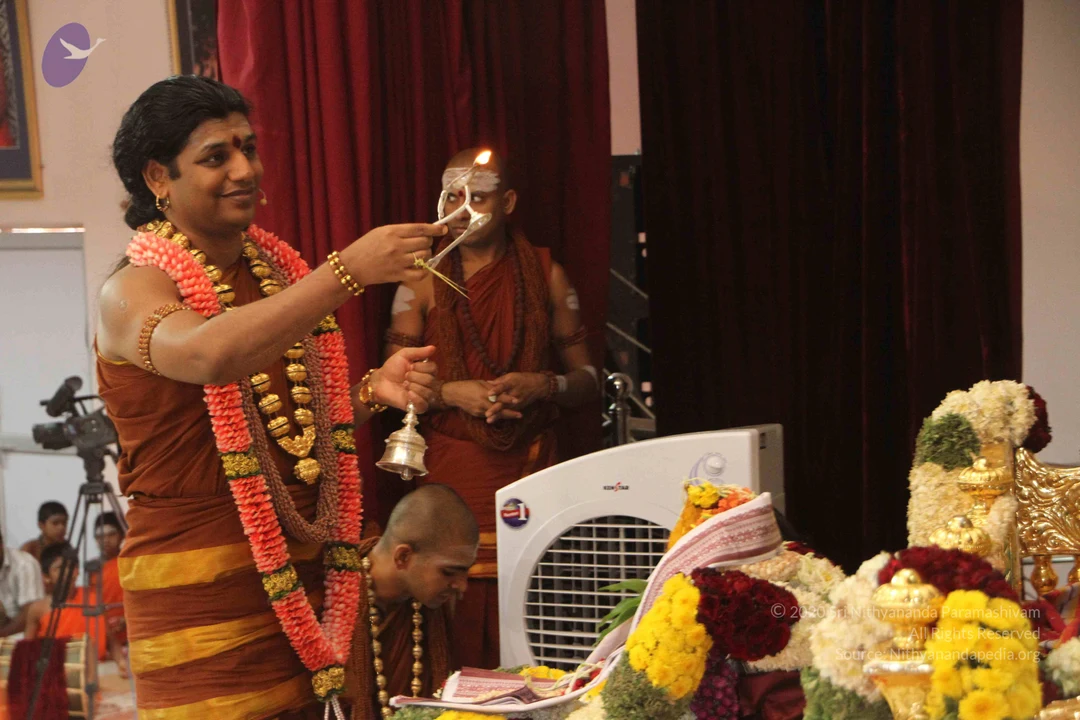
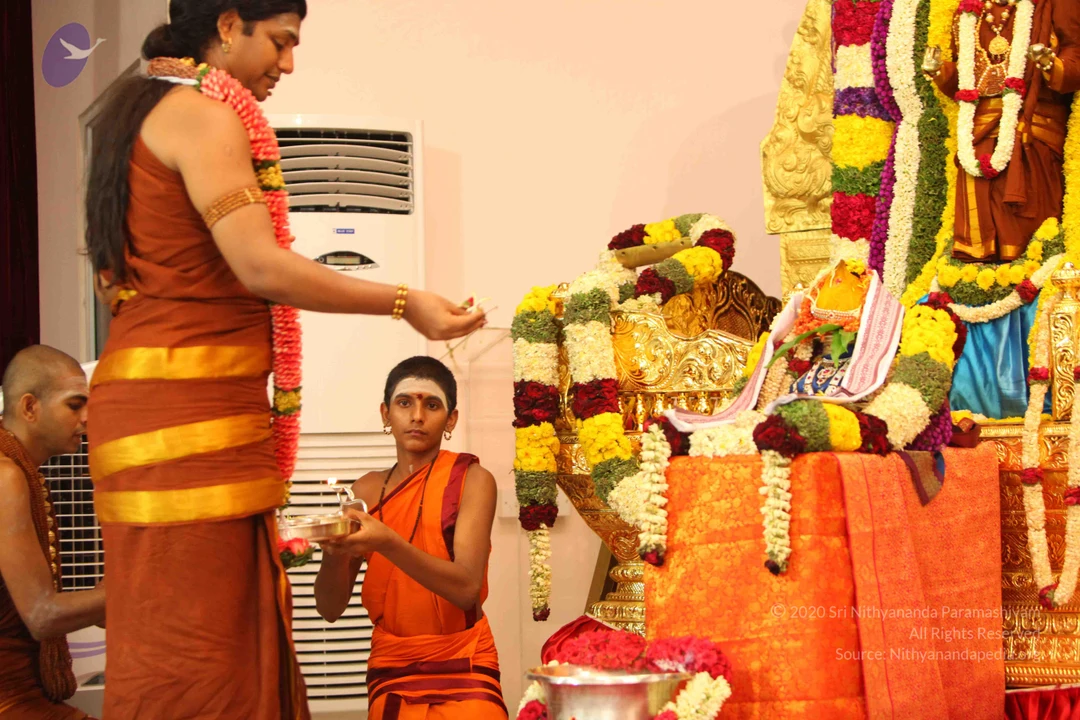
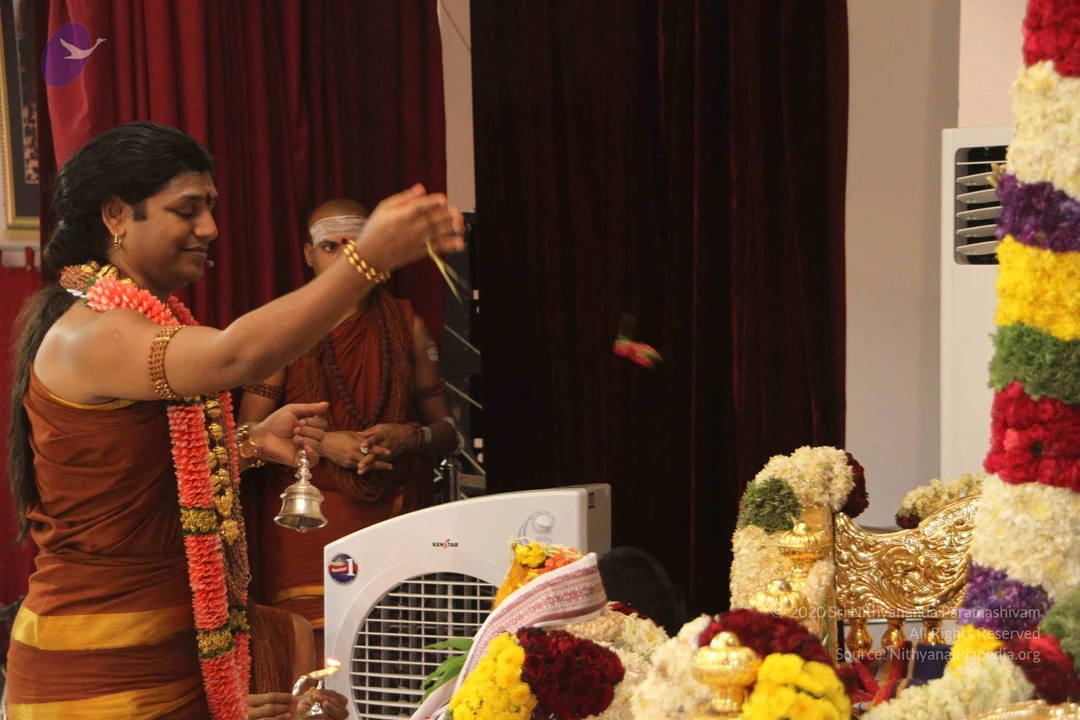
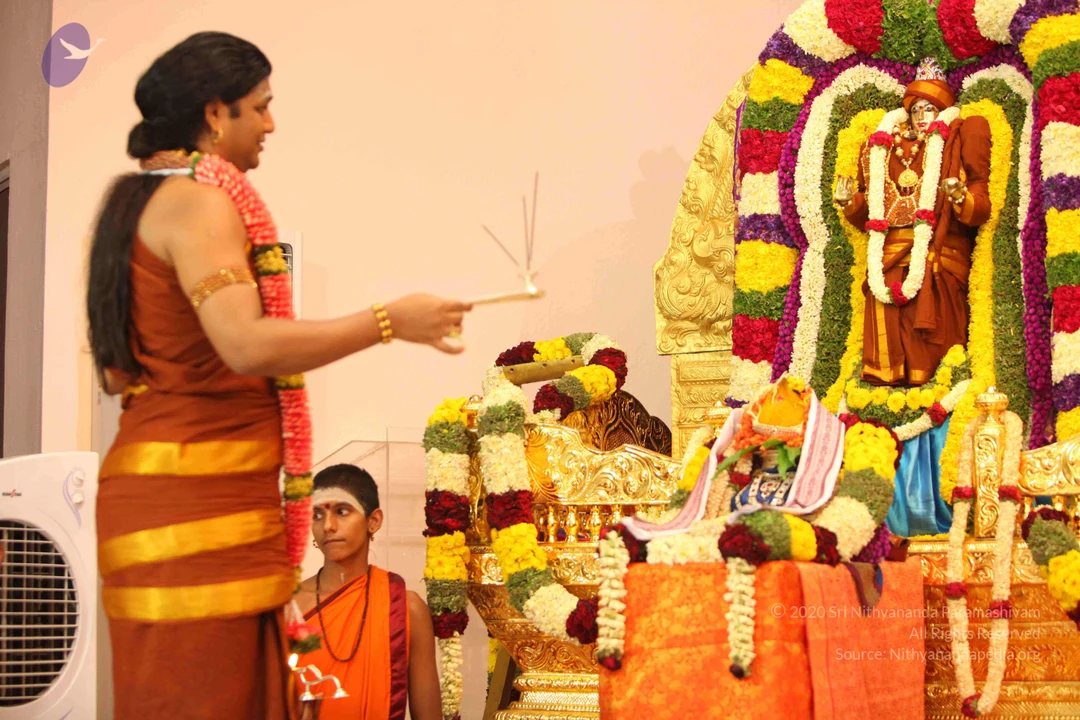
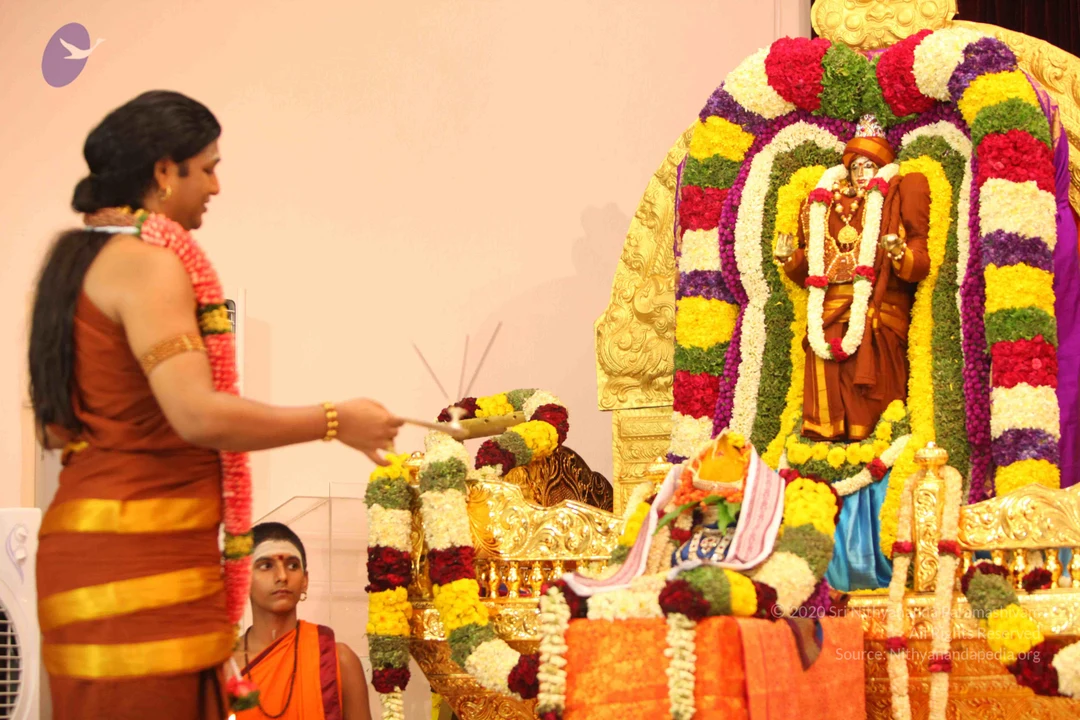
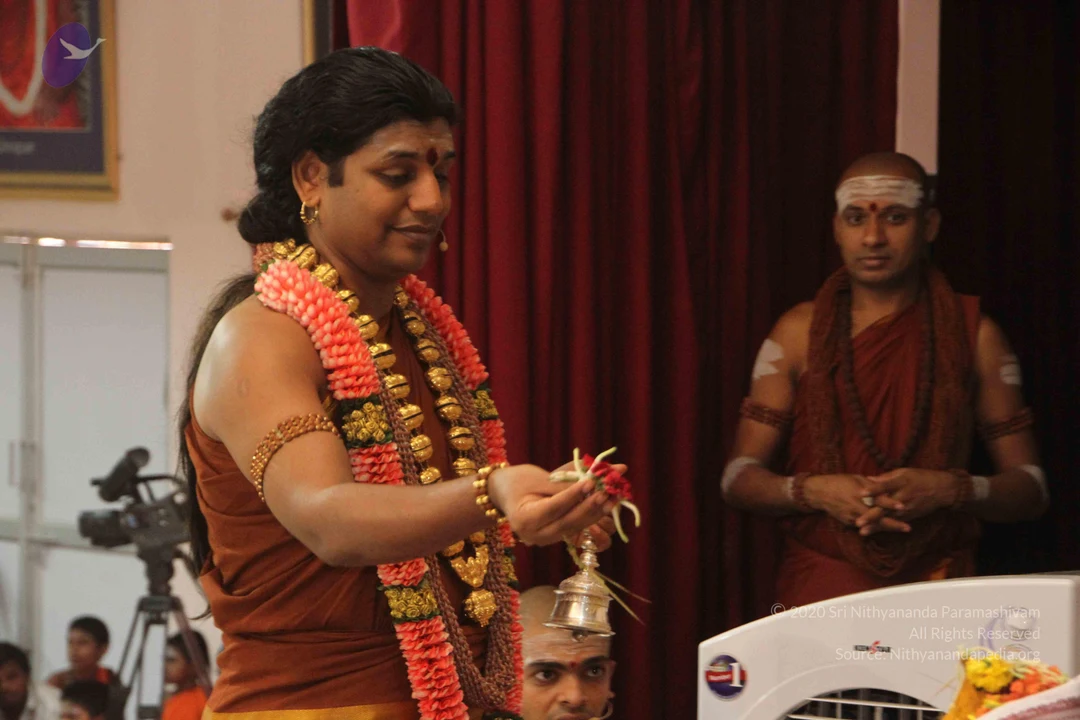
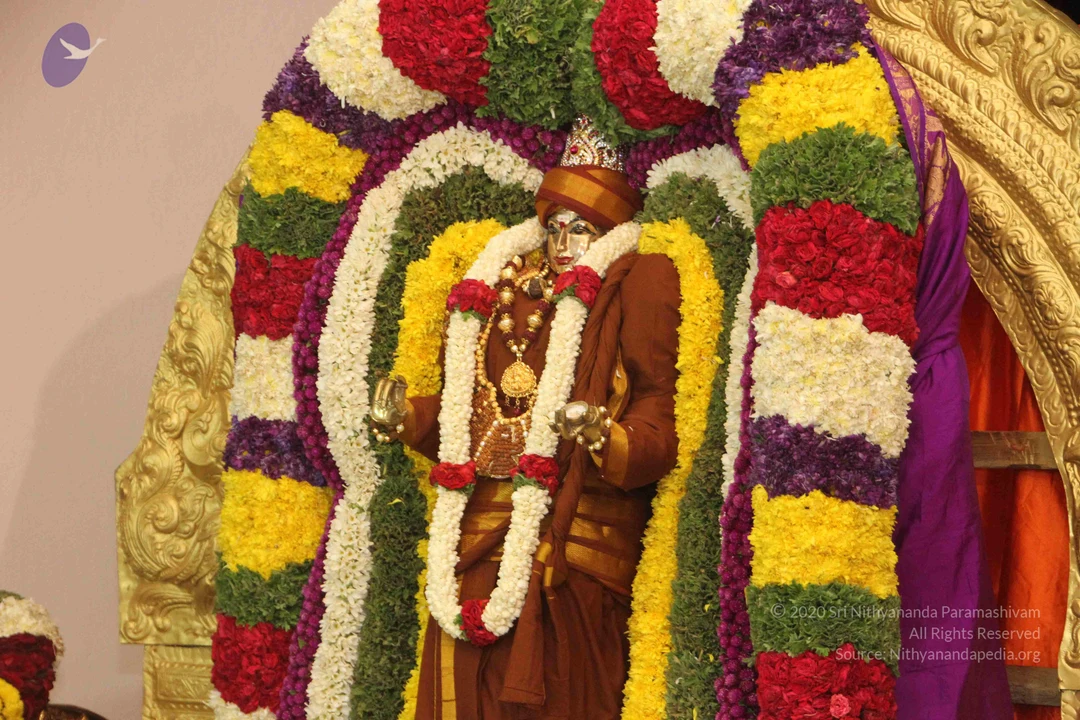
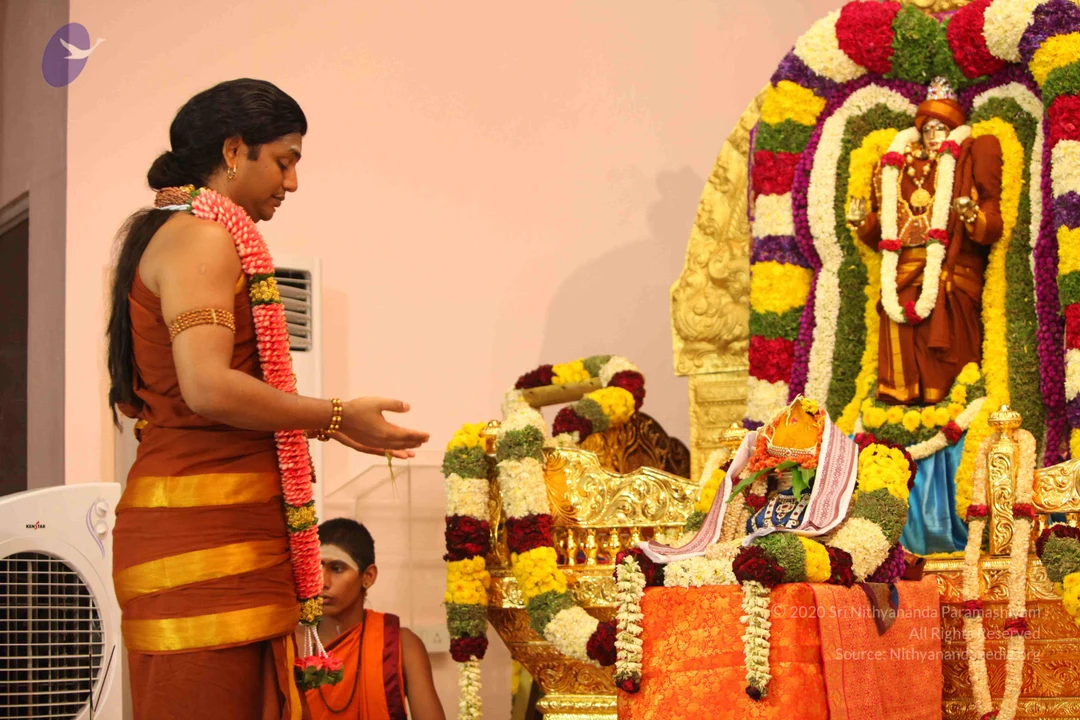
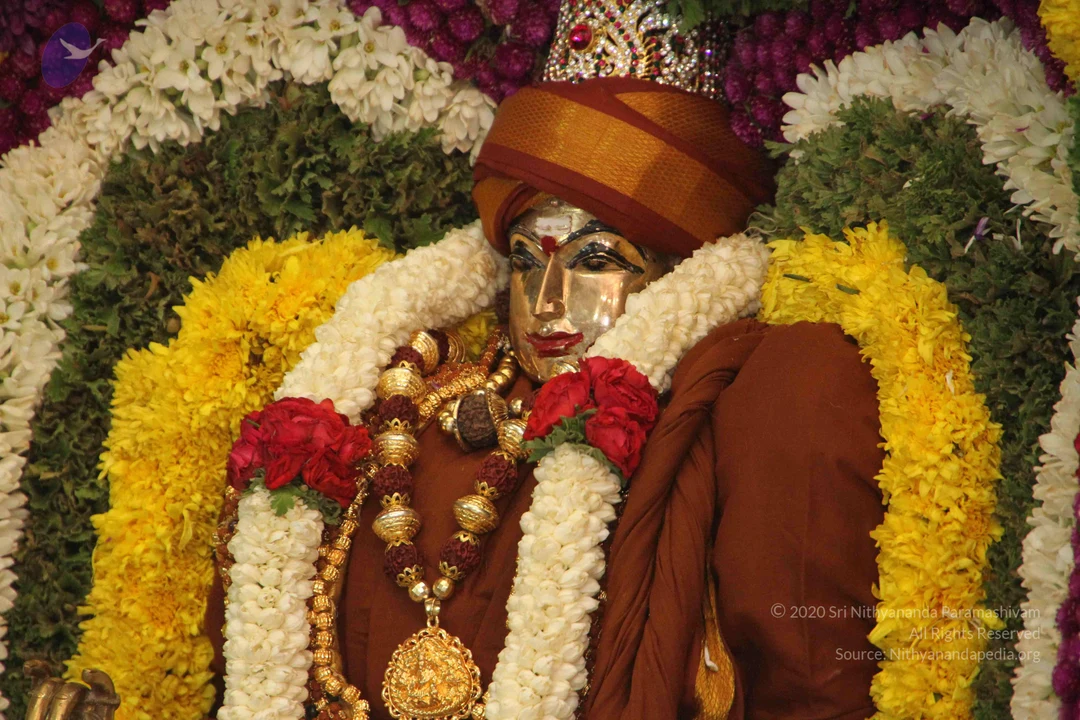
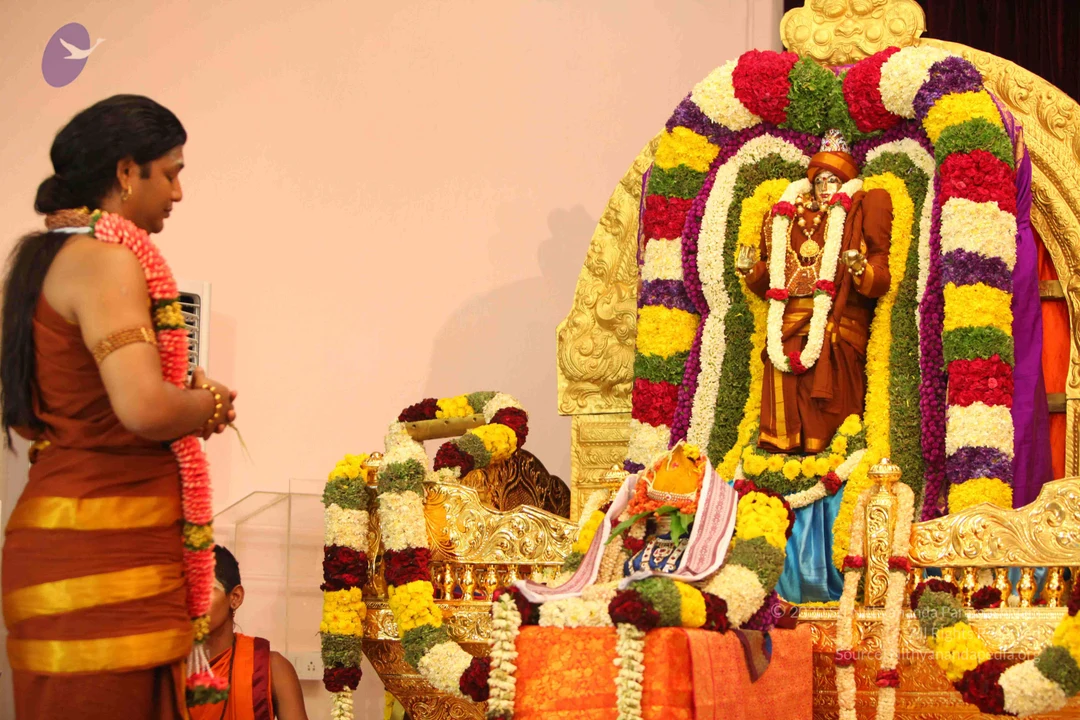
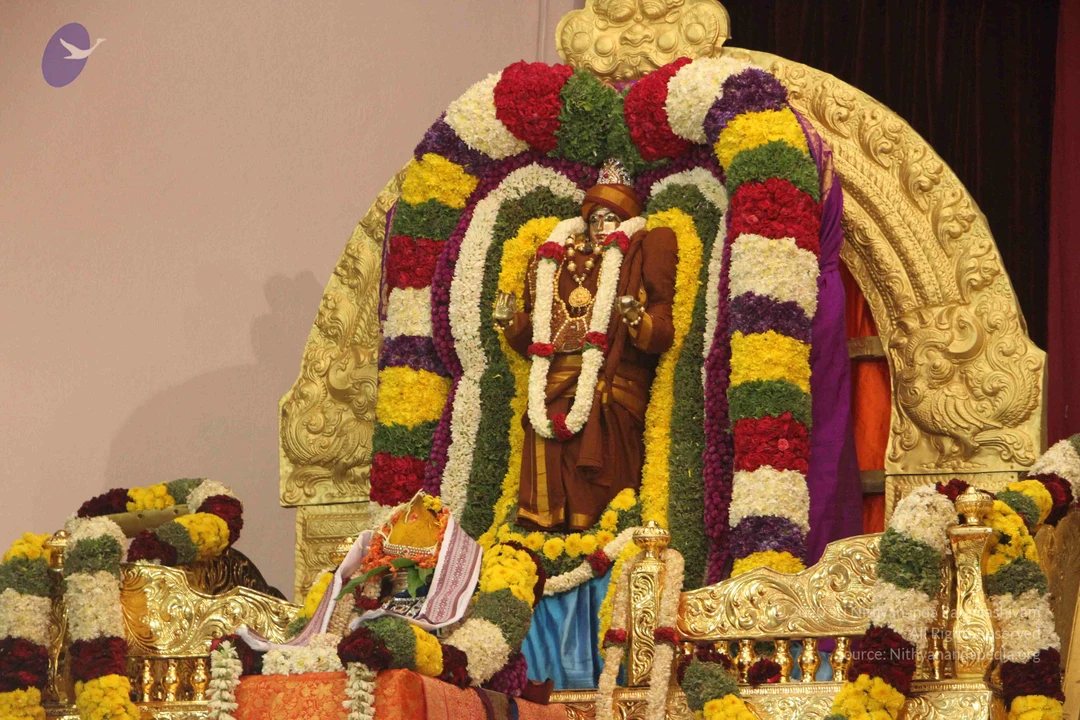
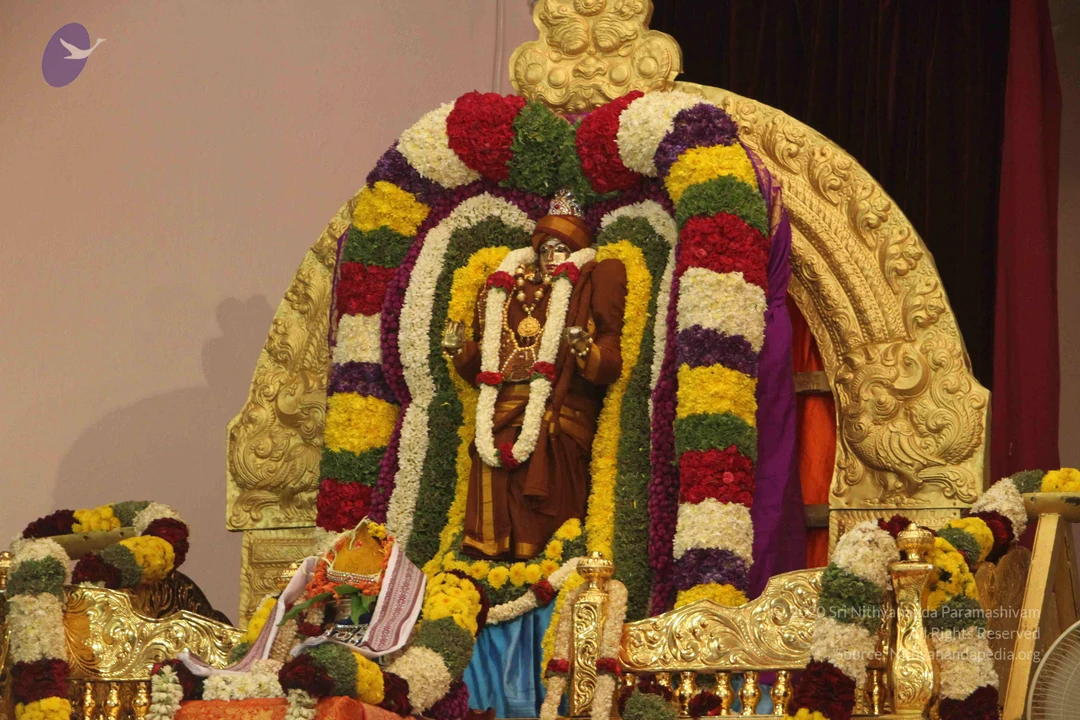
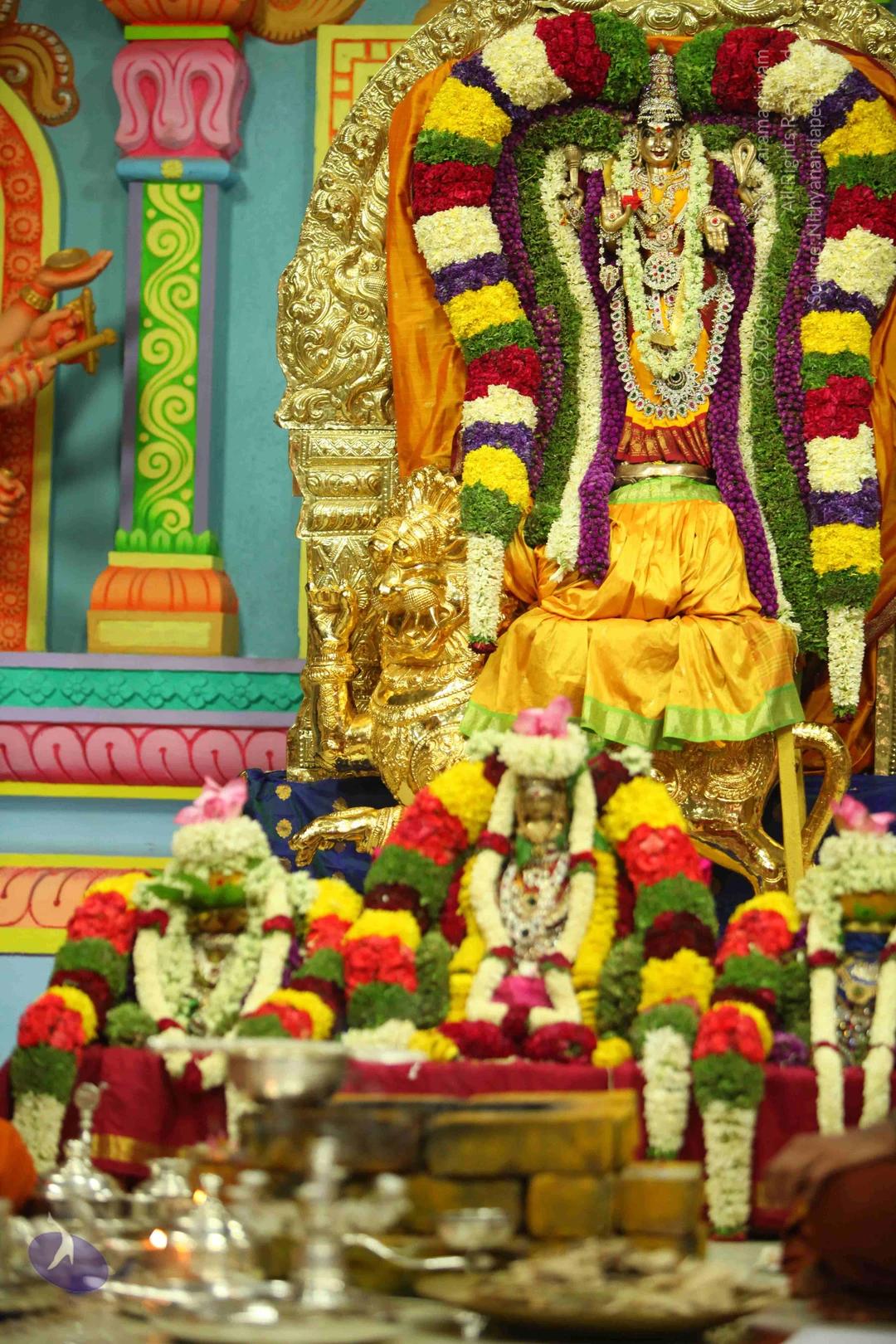
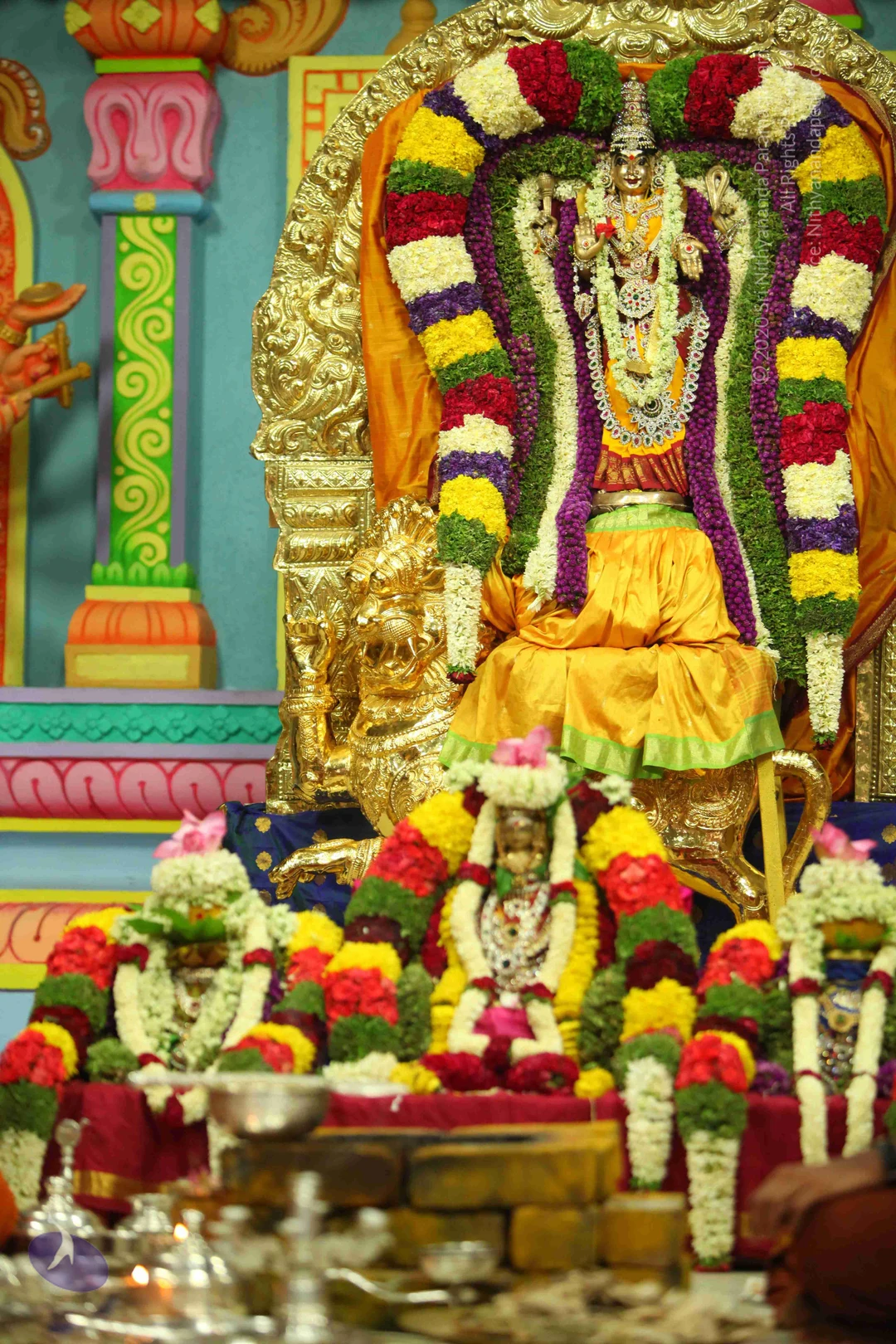
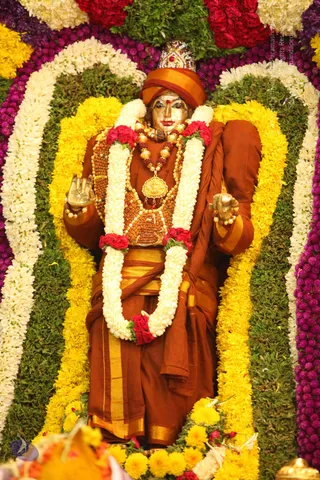
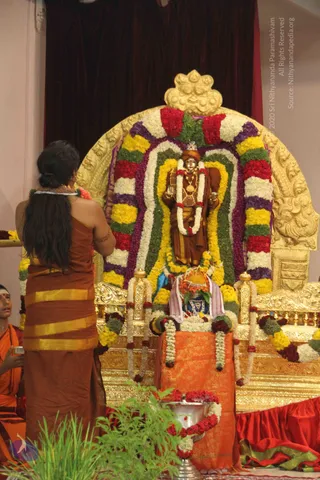
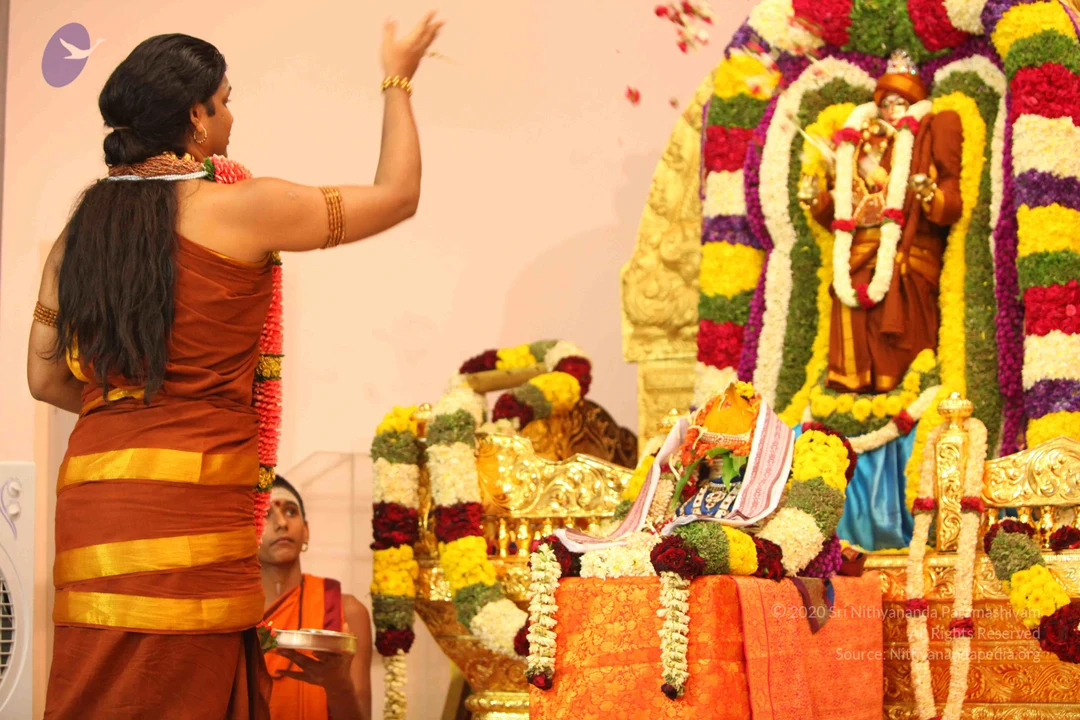
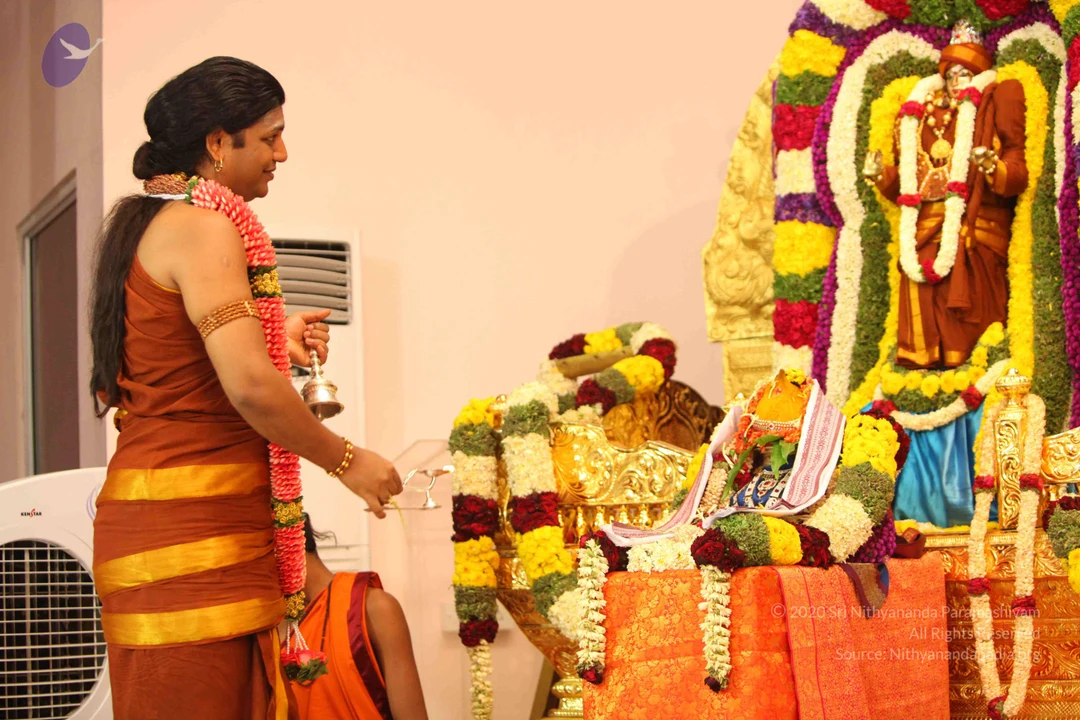
A figure in a brown and gold garment with a crown-like headpiece and a white and red flower garland stands within a large arch of marigolds and roses in red, yellow, white, green and purple. Gold ornate carved frame surrounds the arch, with a gold throne-like seat at the lower right and left, decorated with flowers, and a purple cloth hanging behind. The figure appears to be a deity murti or statue rather than a living person, as its surface looks sculpted. Ornate gold necklaces and a ceremonial headdress are visible.A photograph of a deity murti on a ceremonial stage, framed by a dense arch of garlands in red, white, yellow, green and purple flowers. The figure wears a brown garment with a gold crown and a gold-and-red necklace, and holds objects in both hands. Gold-carved thrones or seats flank the arch and are also draped with flower garlands. A purple cloth hangs behind, and a small offering plate with fruit and a decorative tray sits at the lower left. The figure is a statue, not a living person, so no physical people are present.A photograph of a figure in a rust-brown dhoti-style garment with a gold-bordered cloth over the shoulder, wearing a pink and white flower garland and gold armlets, standing with palms pressed together in namaste before a large decorated deity murti. The murti is heavily adorned with garlands in red, yellow, green, white and purple and stands beside a golden throne-like seat. In the foreground a man in white with a headset is seen blurred, and a second person in orange sits at a decorated altar draped with orange and blue cloth. A white floor-standing air conditioner stands in the background against a pale wall with a dark red curtain.A photograph of a decorated shrine room with a seated figure in a brown-orange robe and a crown, wearing a rudraksha-style necklace, placed on a gold throne and surrounded by long garlands of red, yellow, white, green and purple flowers. A woman with long hair wearing a brown-orange garment and gold armband stands at left with her hands together, while a shaved-headed attendant in an orange robe with a white forehead mark sits lower at left-centre. A white floor air conditioner stands between them against a pale pink wall, with a deep purple cloth draped at right and a gold-lacquered throne and kalasha-like offerings arranged at the base of the altar.A photograph inside a temple-like hall with a pale pink wall and a white floor-standing air conditioner. On the left a figure with long dark hair in a braid and an orange-brown dhoti with yellow stripes stands with palms pressed together, wearing a red and white flower garland and gold armband. Beside him a shaved-headed attendant in orange-brown robes and a bead necklace kneels. A young boy in orange robes and a rudraksha mala sits in front. On the right a large ornate gold throne is decorated with multicolored marigold and rose garlands, and seated on it is a small statue of a figure in brown robes with a crown-like headpiece, also garlanded. Kalasha-style offerings sit at the throne base.A long-haired man in an orange-brown dhoti and shawl, with a pink-and-white garland and gold armband, stands at left gesturing with open hands while speaking. Beside him, a shaved-headed young man in a saffron robe and rudraksha beads listens, and a seated youth in orange with a white tilak sits near the front. At right, a golden throne with a seated figure dressed in brown and gold is adorned with multicoloured garlands of red, yellow, green and white flowers, with an orange cloth and a white tray of offerings before it. A white floor-standing air conditioner stands against the pale wall, and a purple curtain hangs at right.

Inner-Awakening-Session

13 photosSource gallery
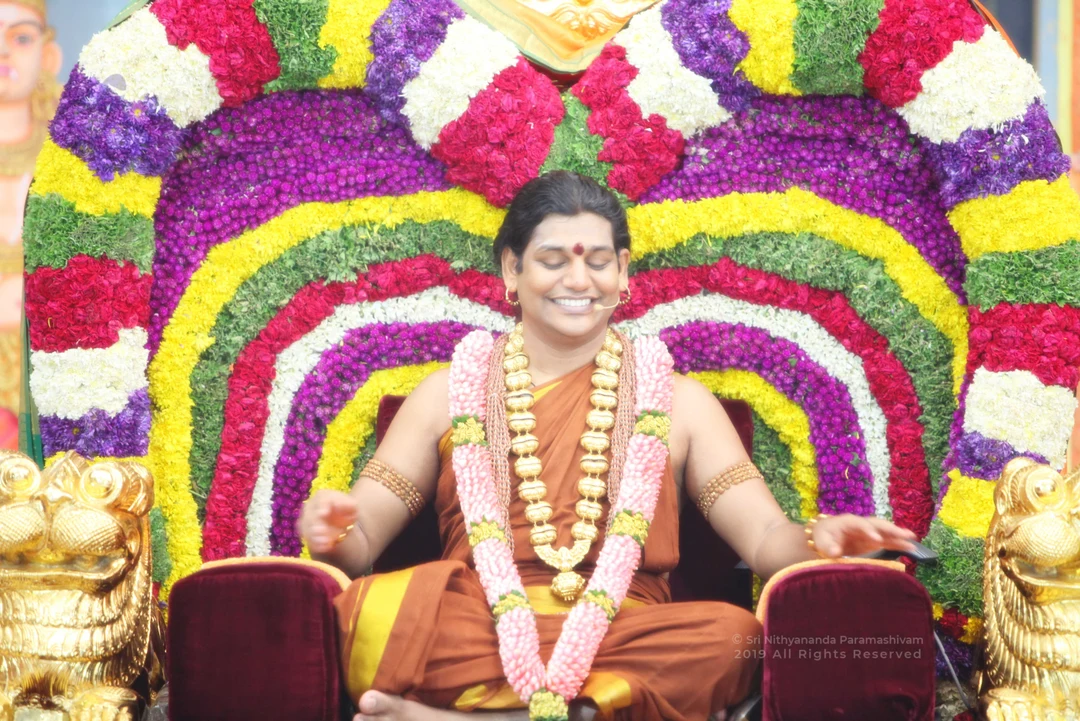
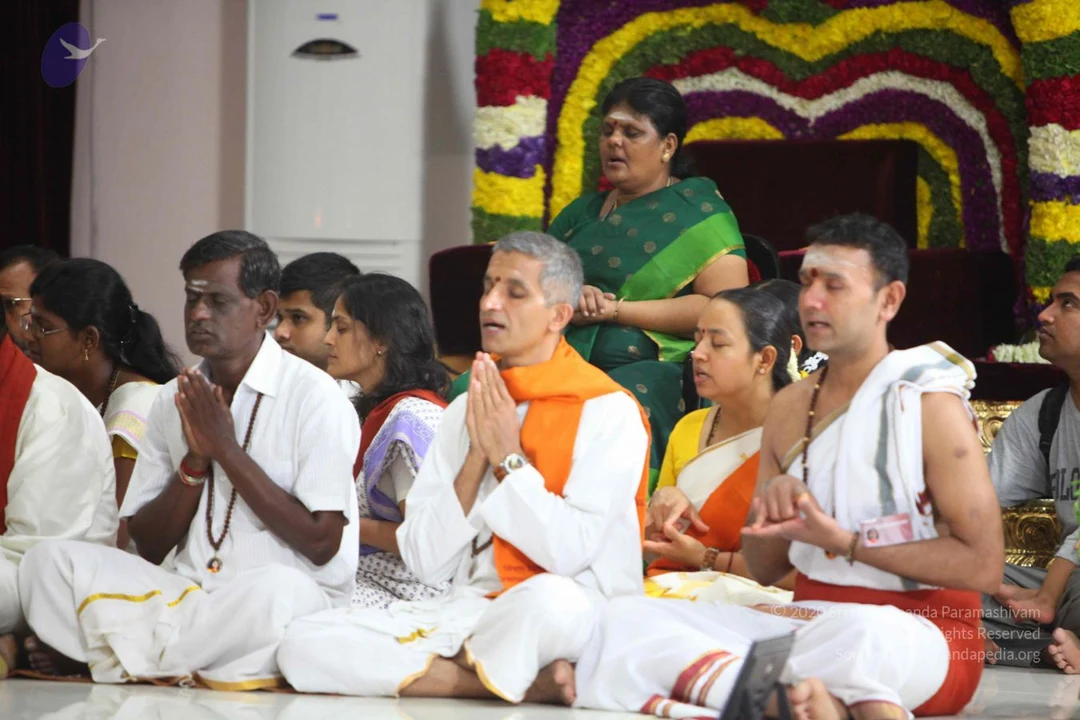
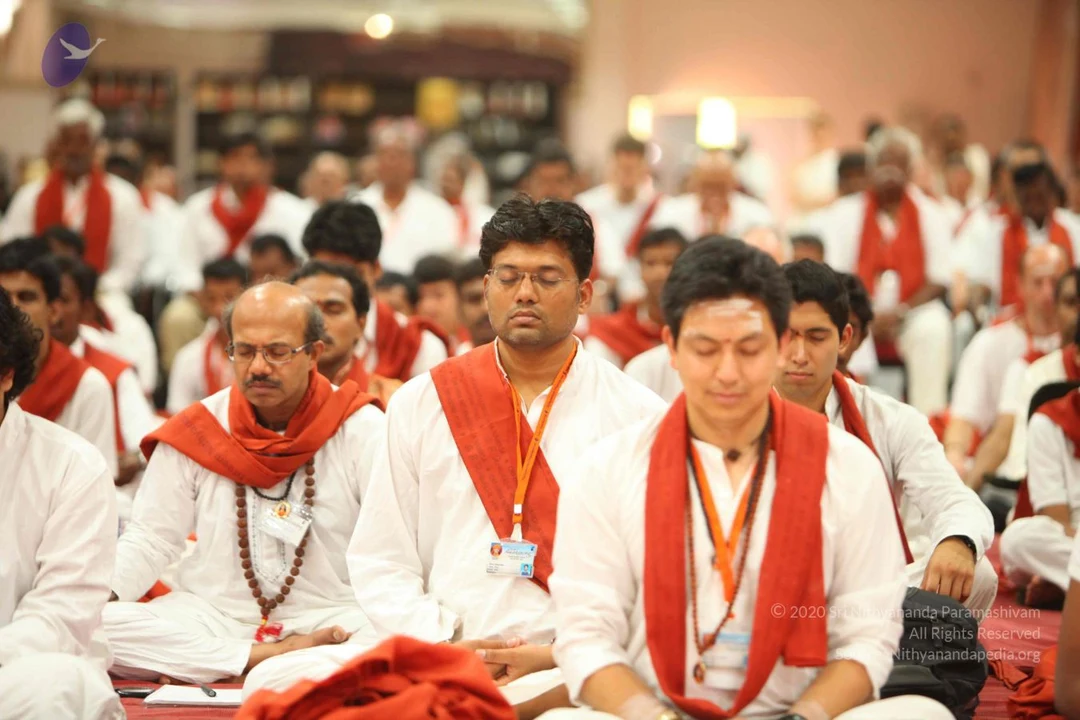
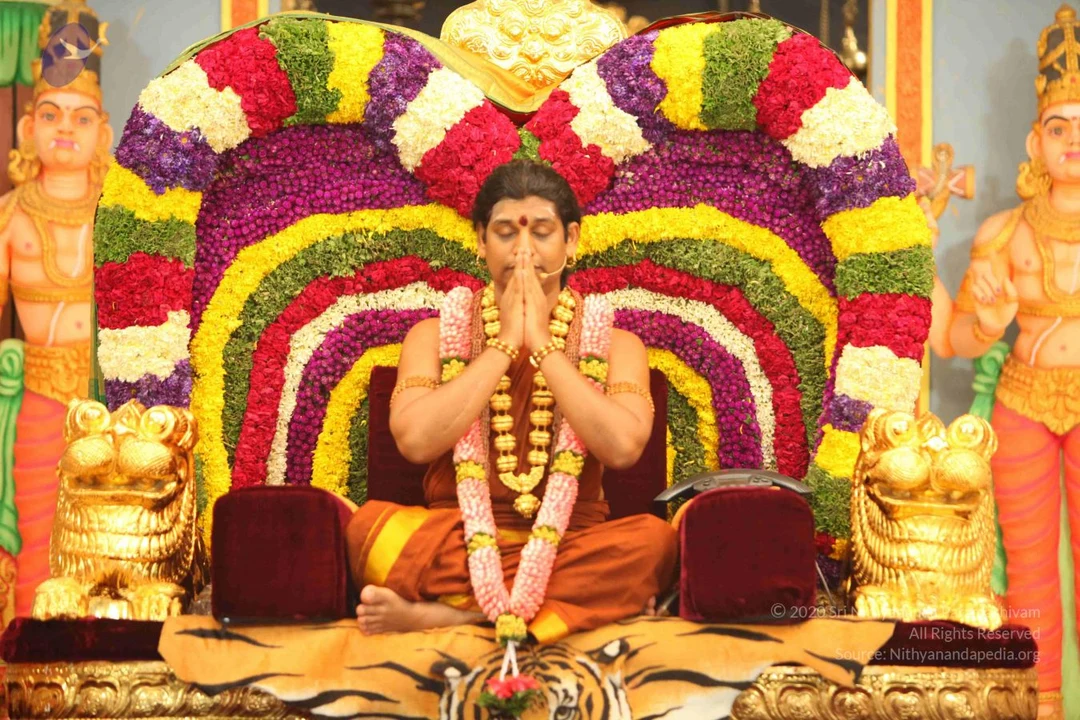
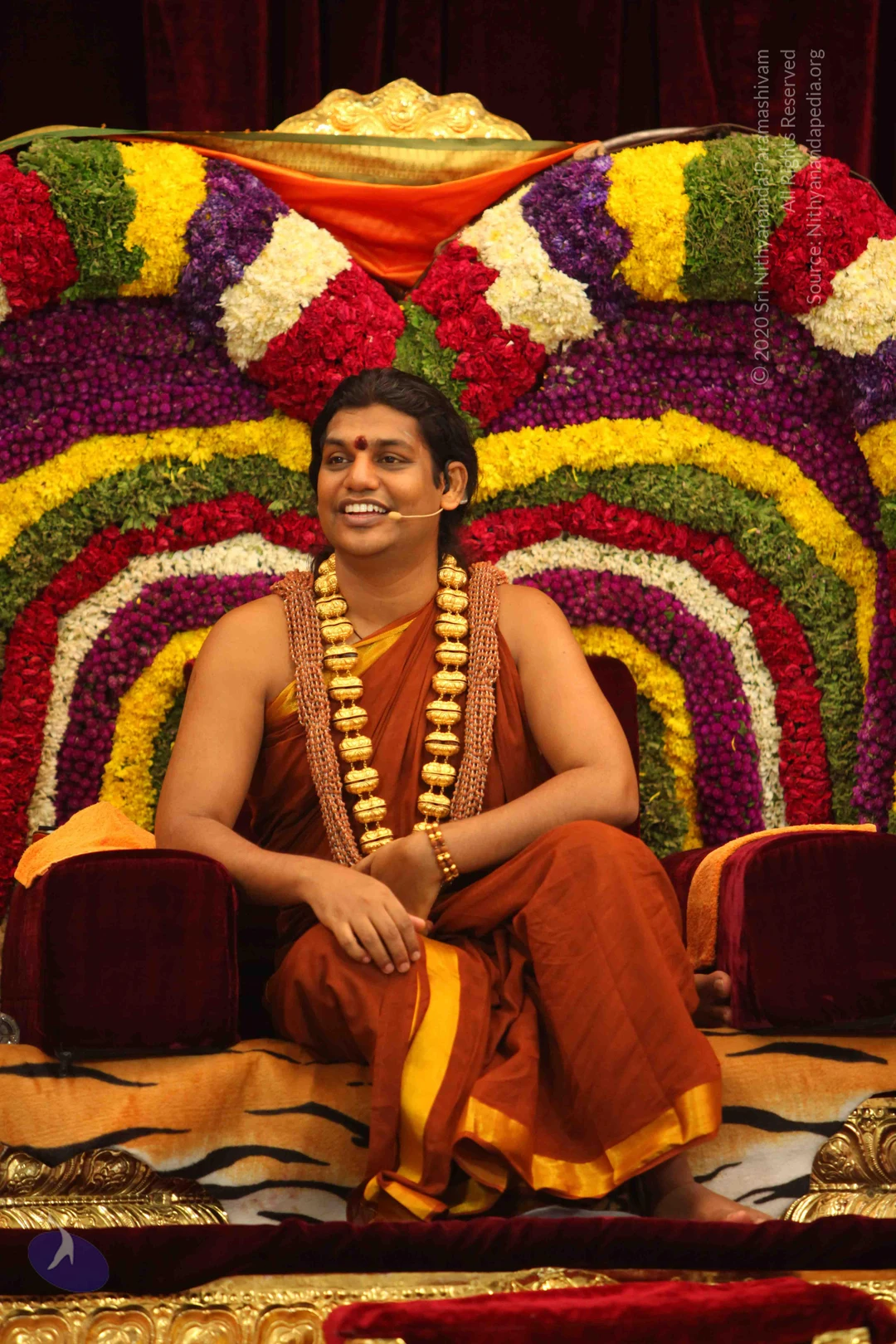
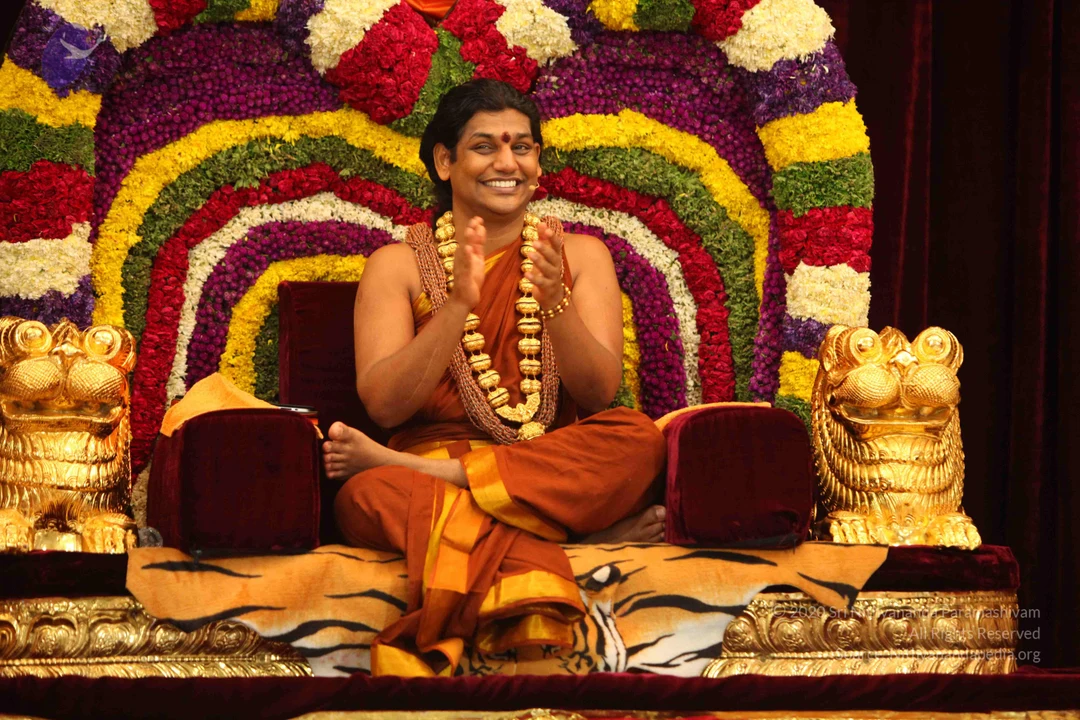
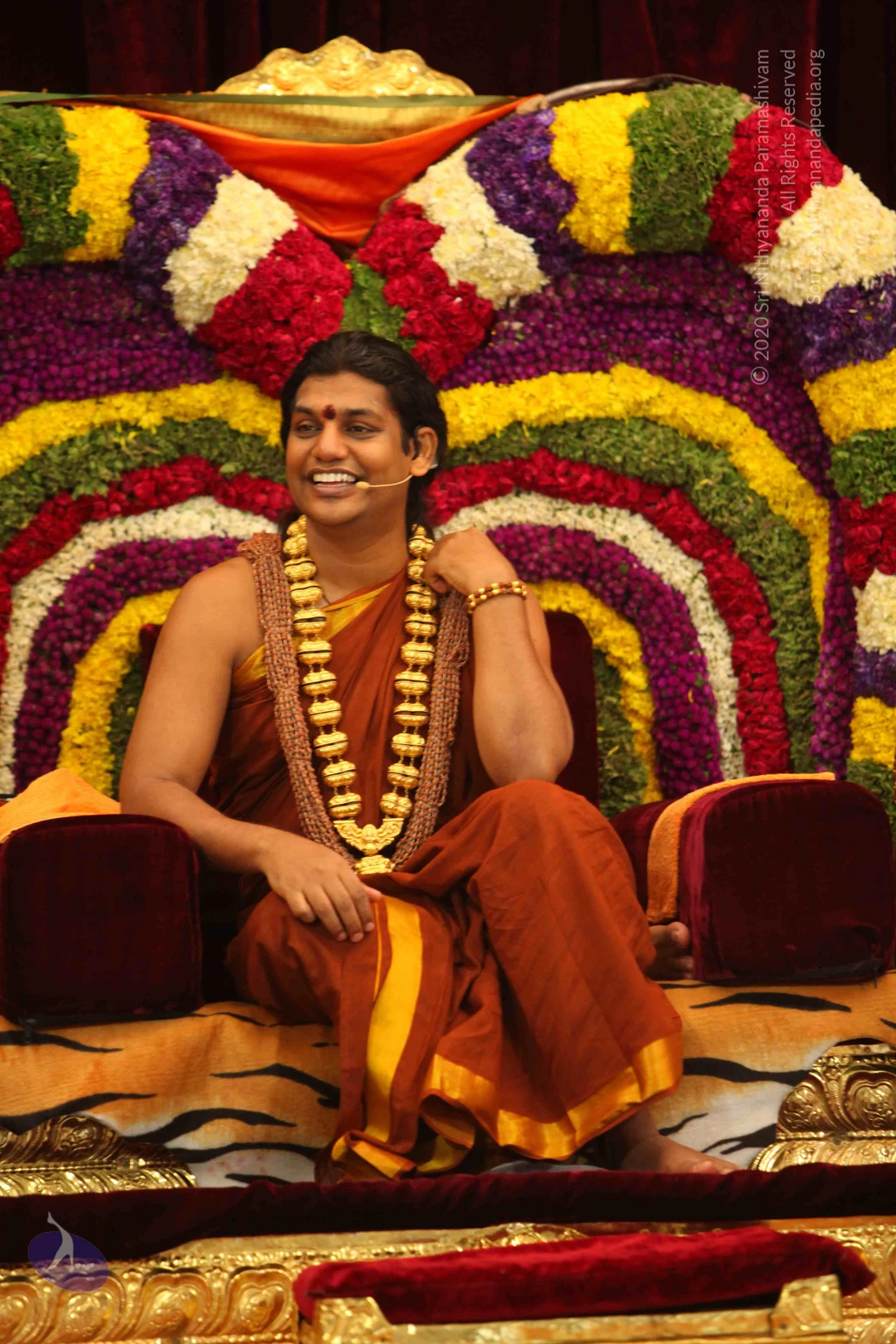
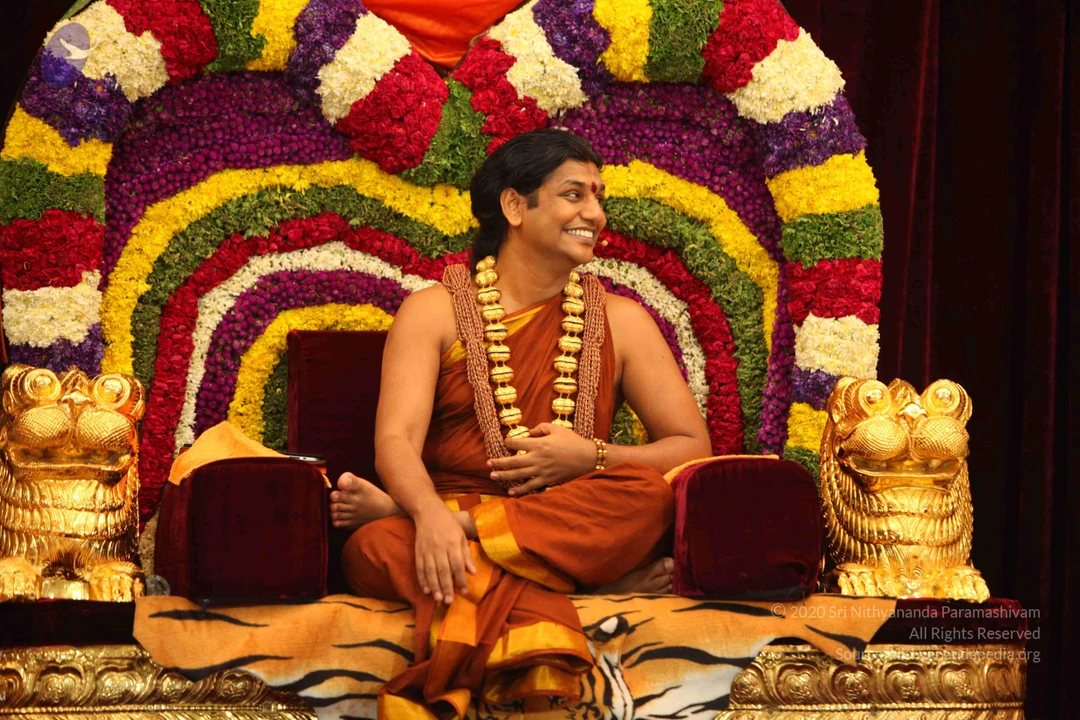
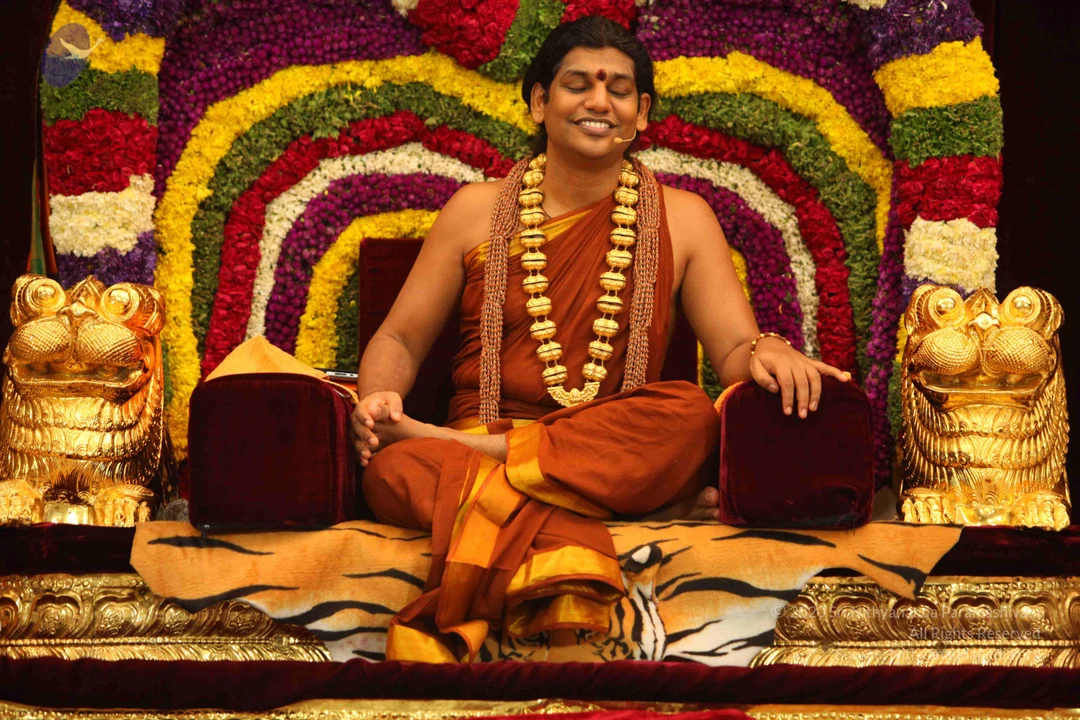
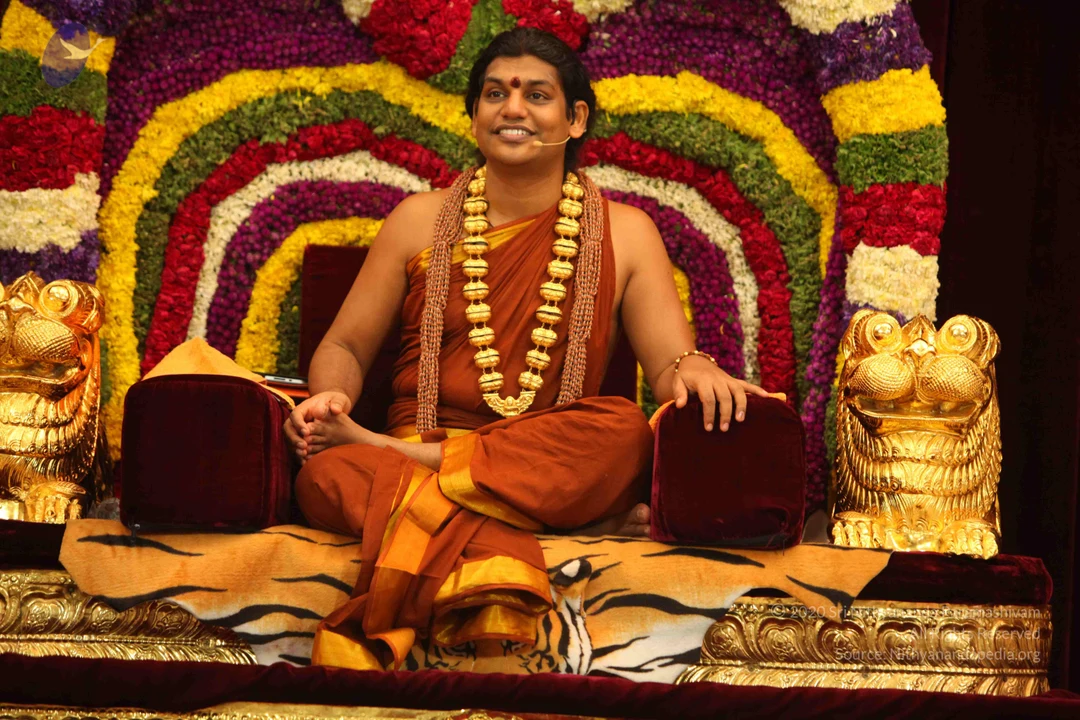
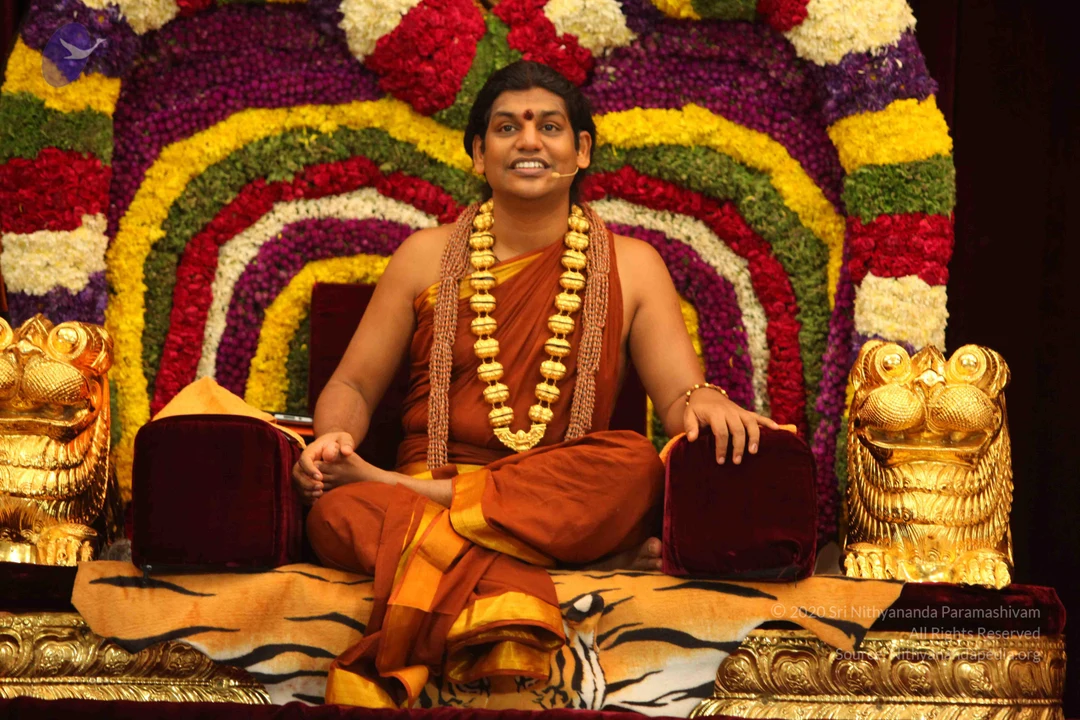
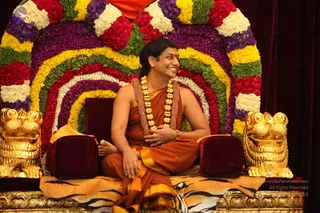
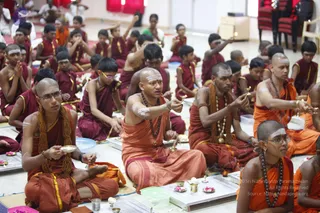
A seated group of devotees in white kurtas and red-orange shawls sits with eyes closed in meditation during a satsang-style gathering in an ashram hall. Several foreground men wear orange lanyard badges, rudraksha malas and one has a vertical tilak on his forehead. Many more participants fill the background, some wearing red shawls and white clothes, with pink walls, warm lights and shelves behind. No figure is clearly identified as a person; the central figures are devotees with no distinctive presentation cues.A photograph of a seated man in orange-saffron robes on a throne in a hall, with a tiger-striped cloth draped over the seat. He wears a headset microphone and a long necklace of large gold beads, and sits cross-legged with his hands resting on red velvet armrests. Behind him is a tall arch of marigold and rose garlands in red, yellow, green, white and purple, flanking gilded lion-head armrests. a person: long dark hair and a red kumkum mark on the forehead, with a rudraksha-style gold necklace over orange clothing, while seated in a central teaching seat as the satsang speaker.A photograph of a man seated cross-legged on an ornate throne with gold lion-head armrests, draped in a tiger-stripe cloth. He wears saffron-orange robes with a gold-bordered cloth, a long ornate gold necklace of large beads, gold bangles, and a red bindi, and holds a small microphone near his face while gesturing with one raised hand during a talk. The throne is backed by a large arch of tightly packed flowers in red, yellow, orange, purple and white arranged in rainbow bands. a person is seated in the centre, delivering a discourse to an audience.A photograph of a seated man on a raised golden throne during a satsang discourse. He sits cross-legged on a tiger-skin cloth, wearing an orange-saffron dhoti and shawl with a gold border, a heavy gold bead necklace, a rudraksha-style mala, and a small red bindi. A small microphone is clipped near his face and his hands rest on maroon cushions. Behind him a deity murti-style arch is decorated with rows of marigolds and roses in yellow, red, white and purple. Golden lion-head armrests flank the throne.A seated man in saffron-orange robes sits cross-legged on a golden throne draped with a tiger-striped cloth, flanked by gilded lion-head armrests with red velvet cushions. He wears a long ceremonial gold bead necklace over a brown-orange shawl, a red bindi on his forehead and a small headset microphone, and smiles while resting one hand on a cushion. Behind him is a tiered arch of marigolds and roses in yellow, red, purple and white, with rainbow-like bands of flowers. Swamiji (probable): the saffron robes, long swept-back hair, rudraksha-style gold bead necklace and ornate throne suggest the Paramahamsa Nithyananda presenting a discourse.A smiling man sits cross-legged on a golden throne with lion-head armrests draped in a tiger-striped cloth. He wears an orange-saffron robe with a golden border, a long gold bead necklace over a rope-textured cord, a bangle on his wrist and a red bindi. Behind him a large arch of marigolds and roses in red, yellow, purple and white forms a rainbow-like backdrop before maroon curtains. Swamiji (probable): long swept-back hair, saffron robe and ornate gold necklace on the throne, consistent with the page's claim.

Nithya-Satsang

16 photosSource gallery
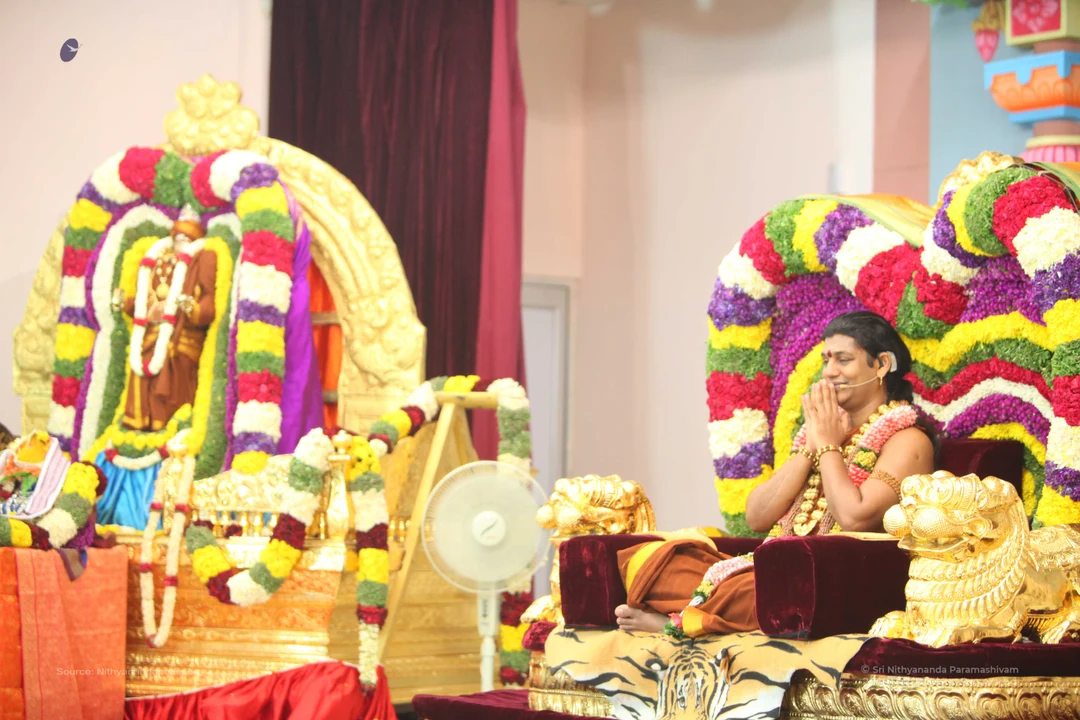
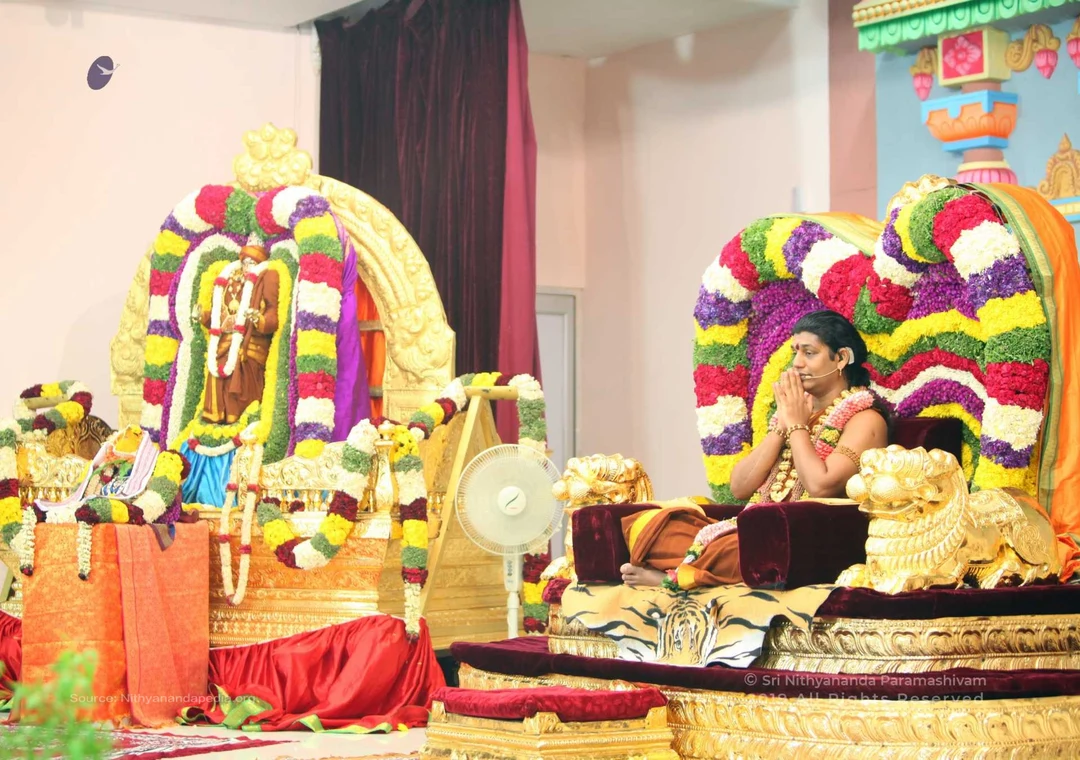
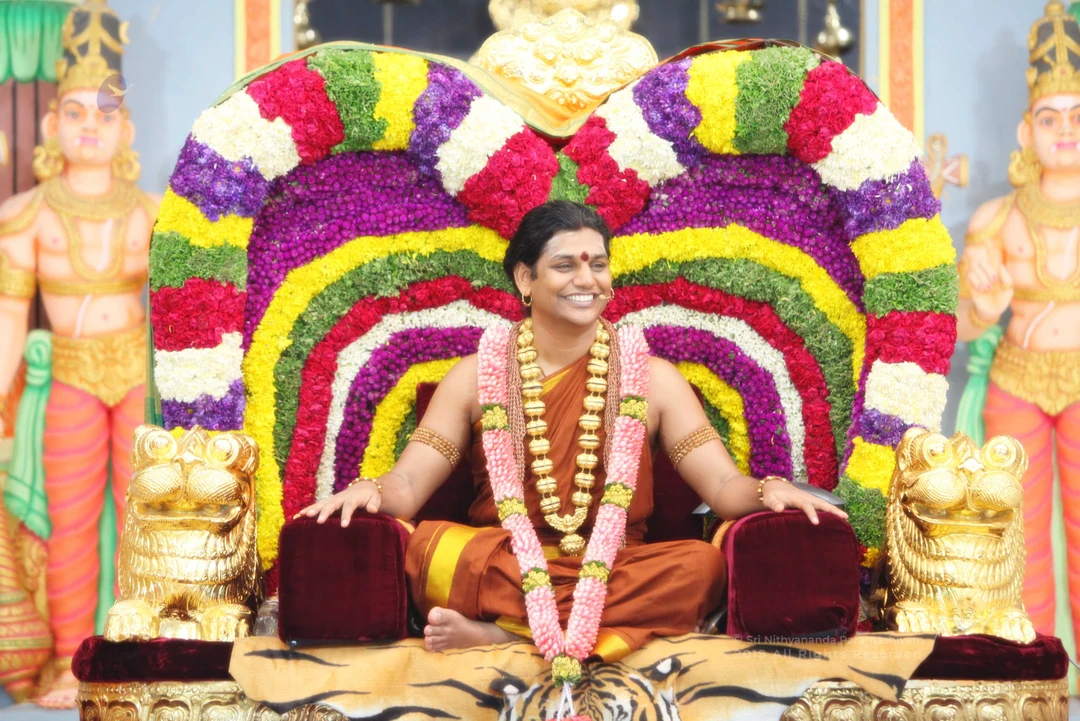
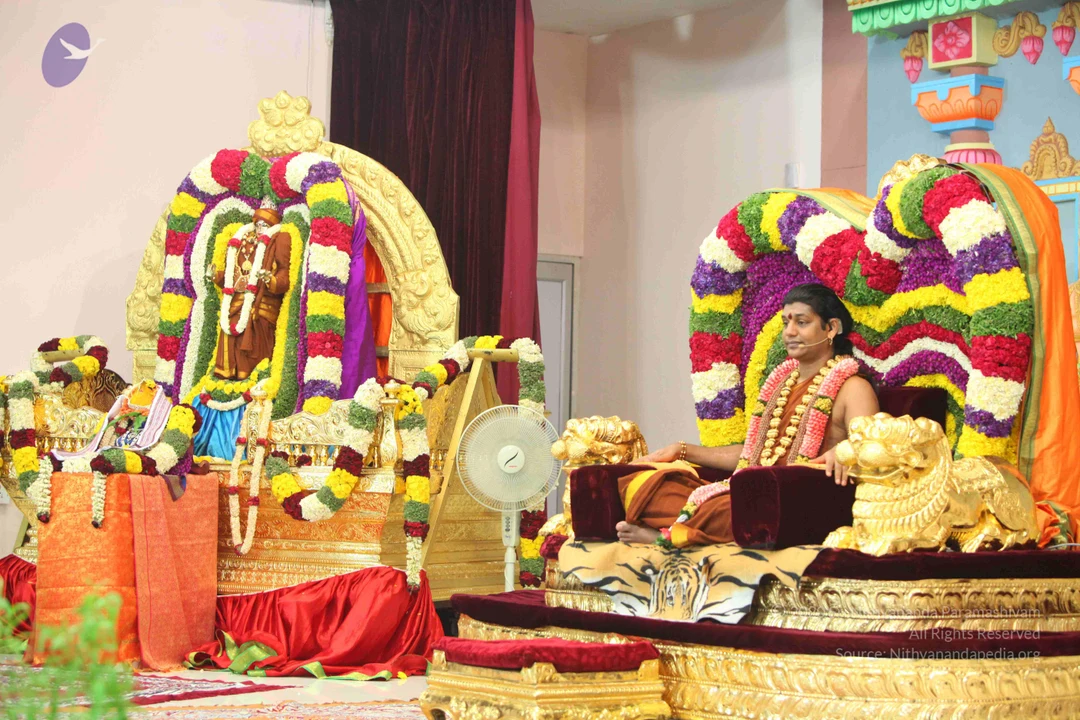
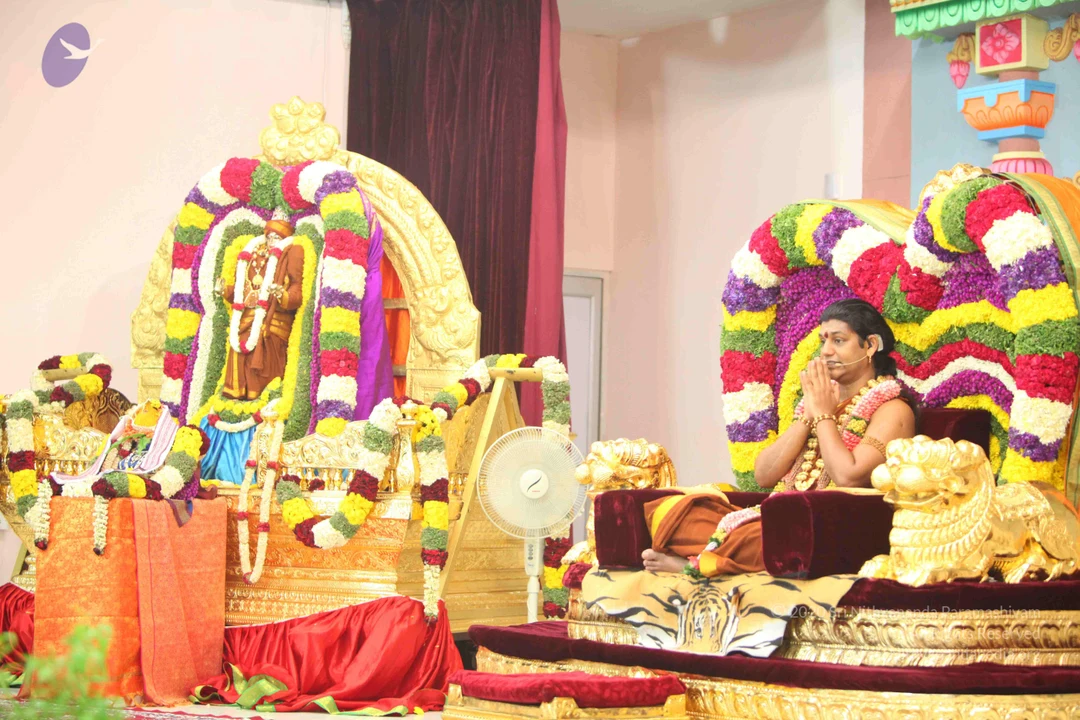
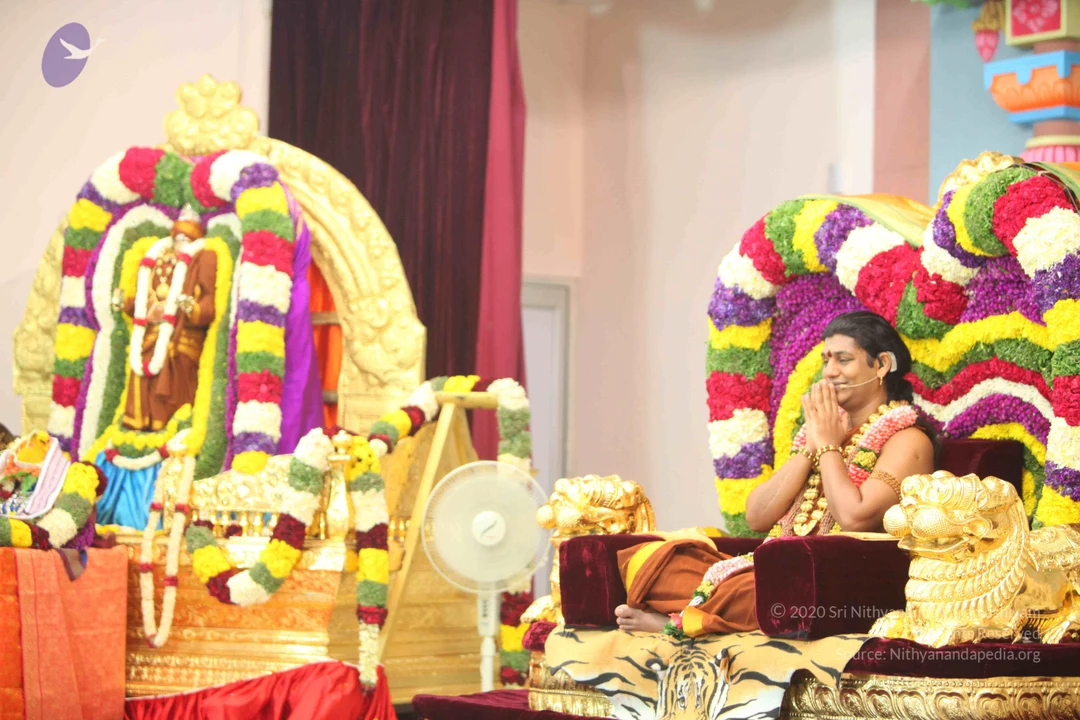
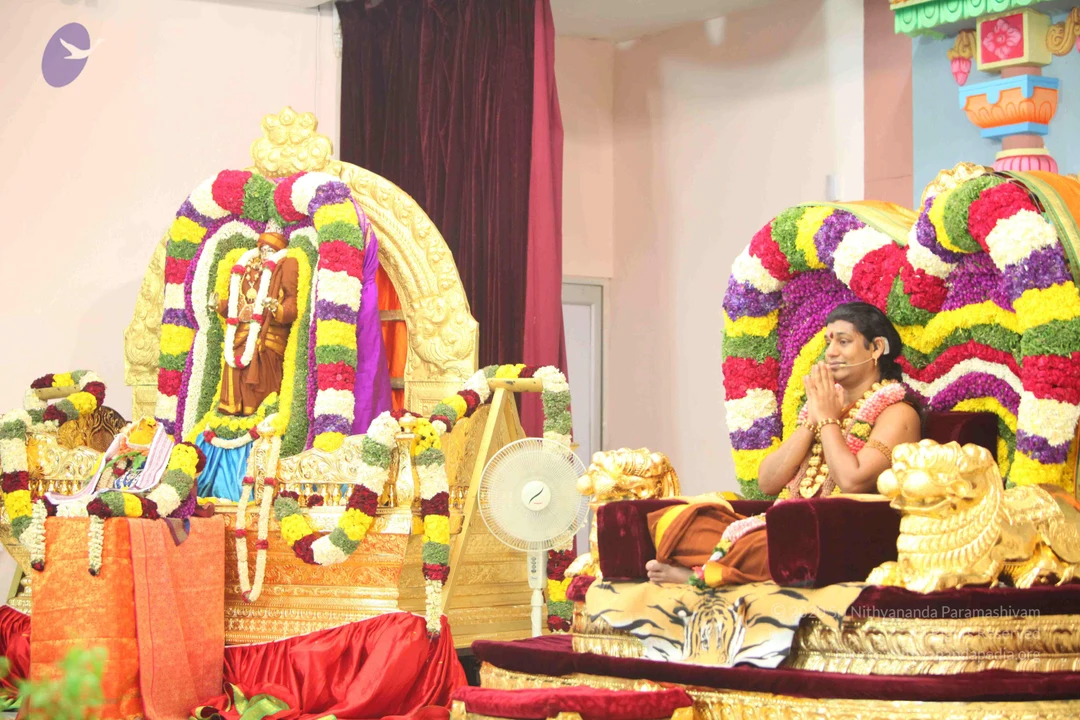
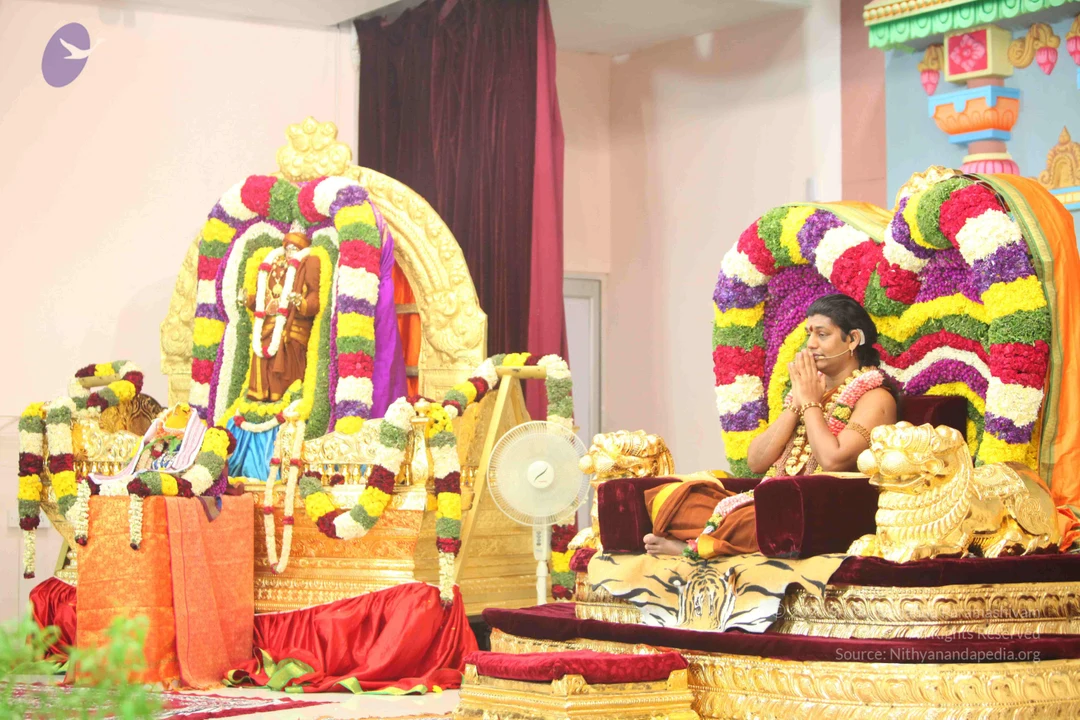
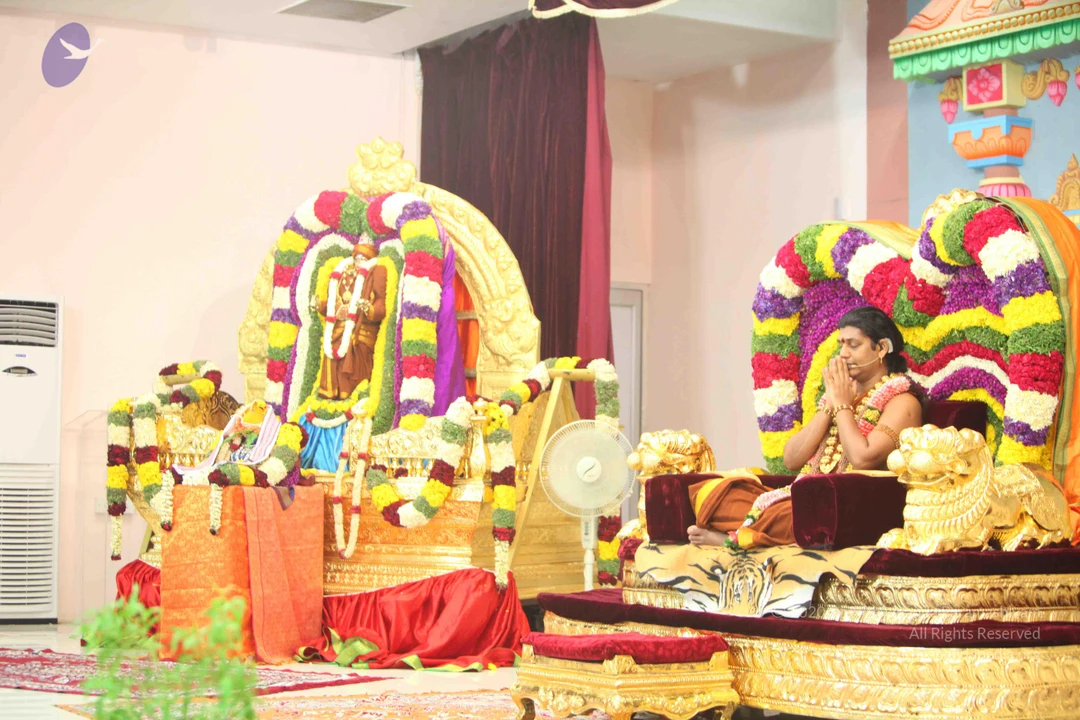
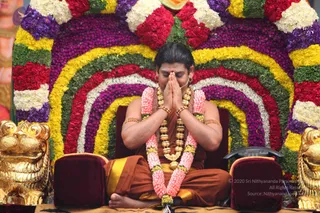
A photograph of a seated man in orange-brown robes with a gold-toned yellow border, palms pressed together at chest level in namaste with eyes closed. He wears a large gold ceremonial necklace of beads and a pendant, pink and white flower garlands, gold bangles and earrings. He sits on a dark red velvet throne backed by a rainbow-striped arch of marigolds and roses in yellow, purple, red, white and green, flanked by golden lion statues. The setting suggests a satsang or devotional sitting. A man with distinctive gold ornaments and swept hair is seated on a throne, consistent with a person appearance based on ornate robes, gold necklace and throne cues.A seated man in saffron-orange robes sits cross-legged on a red-cushioned throne before a large flower-garland backdrop of concentric arcs in purple, yellow, red, white and green blossoms. He presses his palms together in namaste, smiling, wearing a layered gold necklace, gold armlets, a red bindi and a pink-and-white flower garland draped down his front. Gold lion-face armrests flank the throne, and painted standing deity figures in orange and green stand at either side. A microphone is clipped near his face. a person in a seated darshan setting, with saffron clothing, a rudraksha-style gold necklace and an ornate throne.A smiling man with short dark hair and a red bindi sits cross-legged on a throne in front of a large arch of rainbow-striped flower garlands in red, purple, yellow, white and green. He wears a saffron-orange dhoti and shawl, layered gold beaded necklaces, gold armbands and bangles, and a long pink and white flower garland. His palms are pressed together in namaste. Golden lion-head armrests flank the throne, and gilded deity figures appear at the edges of the frame. A small microphone is visible near his face. The man has long-swept hair and a gold-and-saffron ceremonial look, so this is a person depiction in person in a satsang setting. The image has a faint copyright overlay in the lower right, which is not described.Indoor satsang hall with a golden throne draped in multicoloured flower garlands of yellow, red, white and purple. On the right, a man in orange and saffron clothing with a gold necklace and bangles sits with palms pressed together in namaskar on a gold throne covered by a tiger-skin cloth. On the left, a golden throne holds a small deity murti decorated with garlands and a second garland-draped seat in front. A standing fan and a wall air conditioner are visible; a golden lion-headed armrest sits at right.A seated man in orange and saffron robes with long dark hair and a rudraksha mala sits with palms pressed together in namaskar on an ornate gold throne draped with a tiger-skin cloth, beside a golden lion-form armrest. The throne is decorated with garlands in red, yellow, white, green and purple. Beside him, a second gold throne holds a deity murti or statue wearing a garland and rich orange-and-gold cloth, with a red cloth draped at its base. A white pedestal fan stands between the thrones, and a purple curtain hangs behind. The dais setting suggests a satsang or discourse.A photograph of a satsang stage decorated with floral garlands in red, yellow, green, purple and white. On the right, a man with long dark hair, a rudraksha mala and gold necklaces sits cross-legged on a gold throne with a tiger-skin cover, hands pressed together in greeting, with a microphone at his ear. On the left, a gold-framed throne is draped with garlands and holds a small standing figure in orange robes, a statue or portrait rather than a person. A table fan stands in the foreground, a maroon curtain hangs behind, and an orange cloth lies on the lower left. a person is seated on the right, presented in the satsang role of a teacher on a throne.

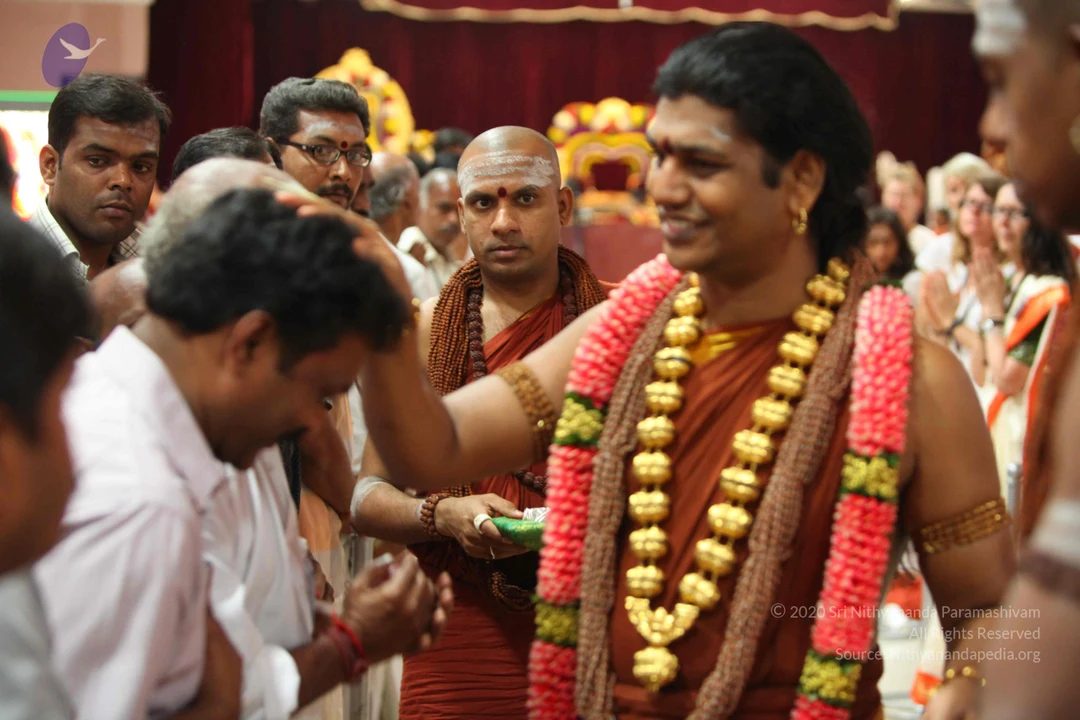
Sarvadarshan

6 photosSource gallery
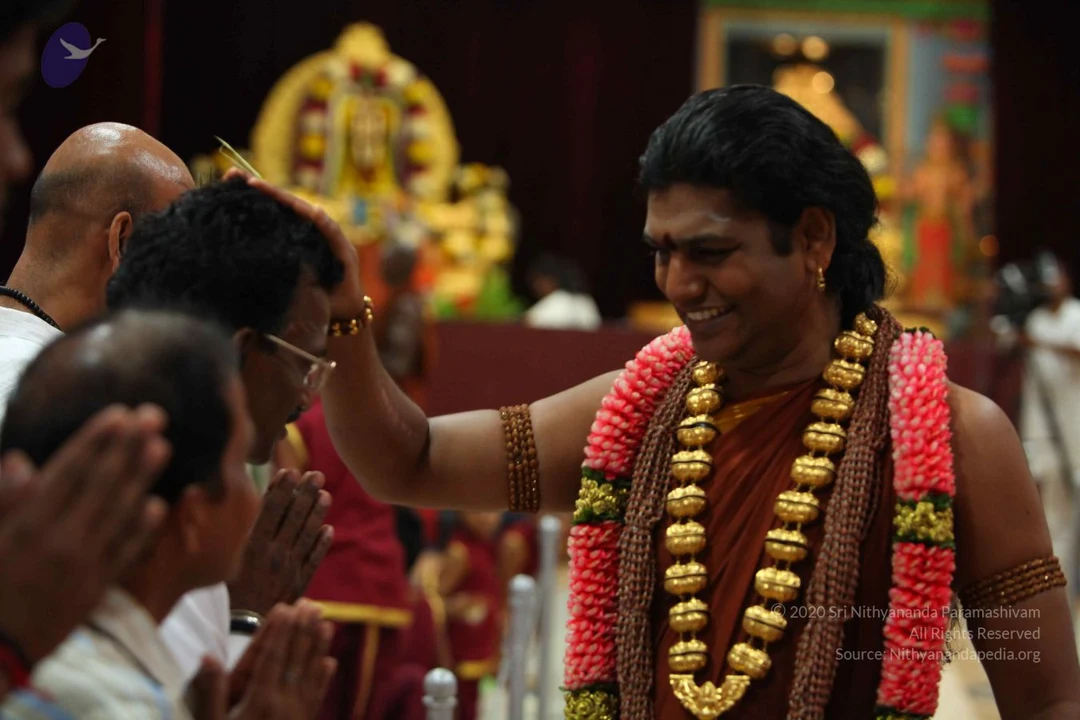
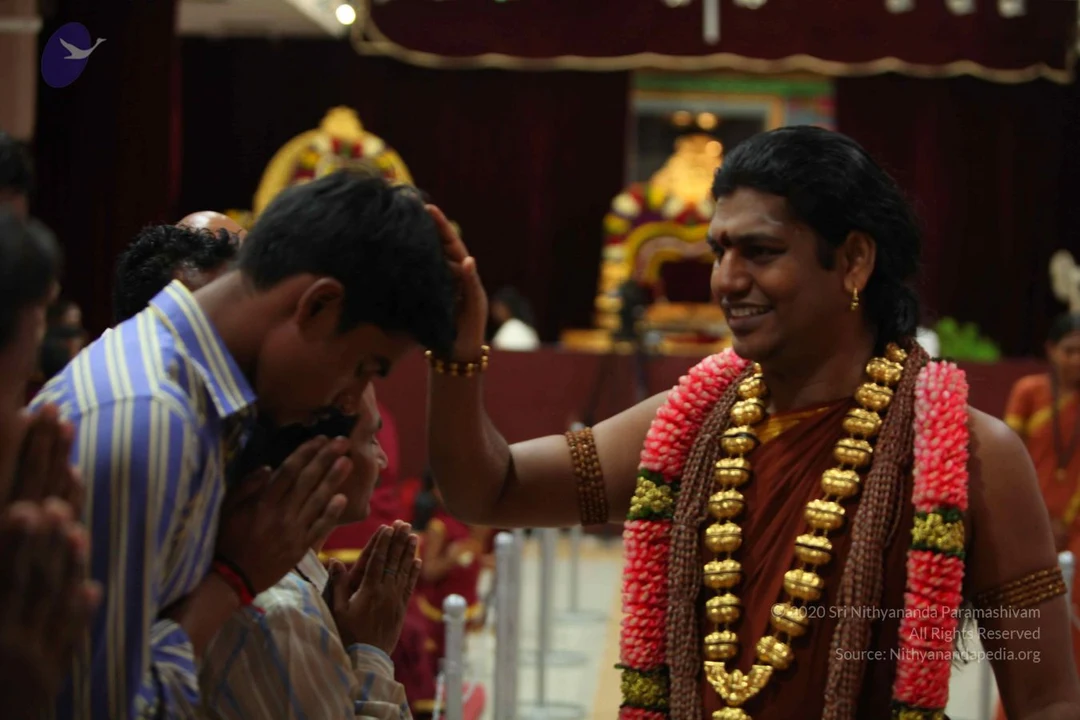
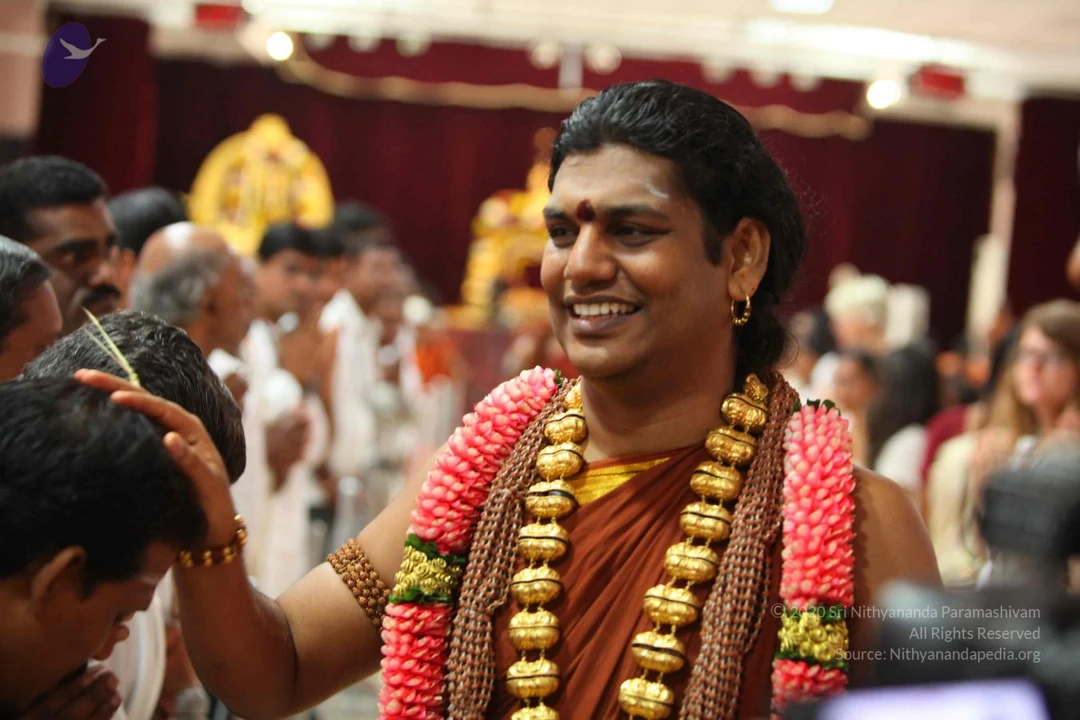
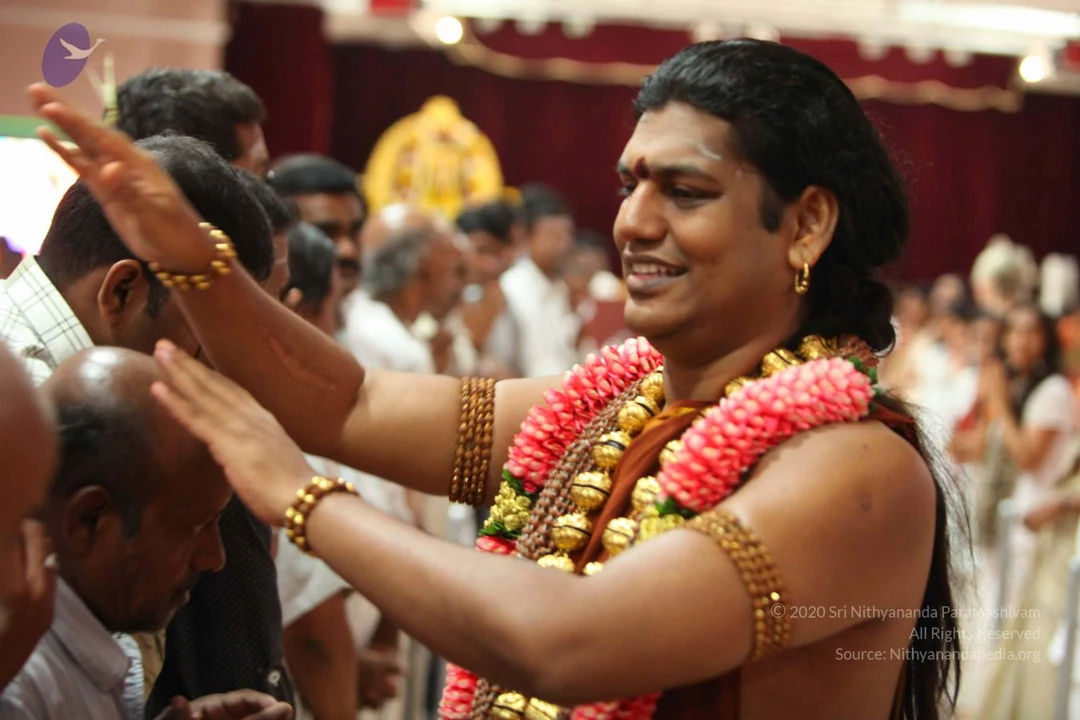
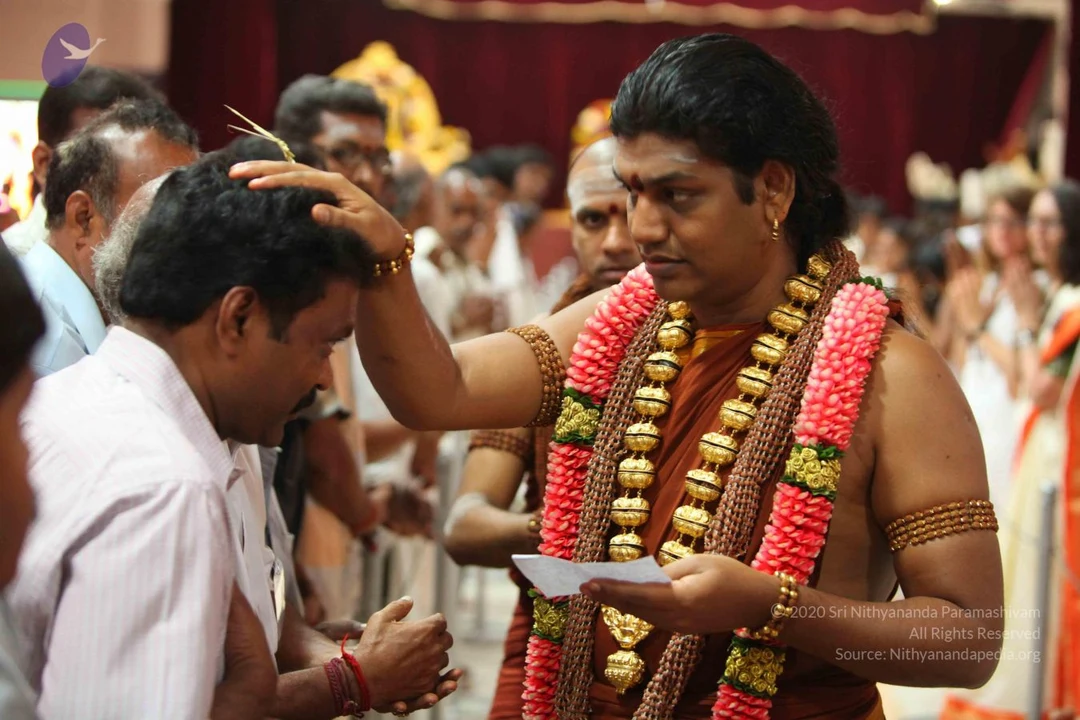
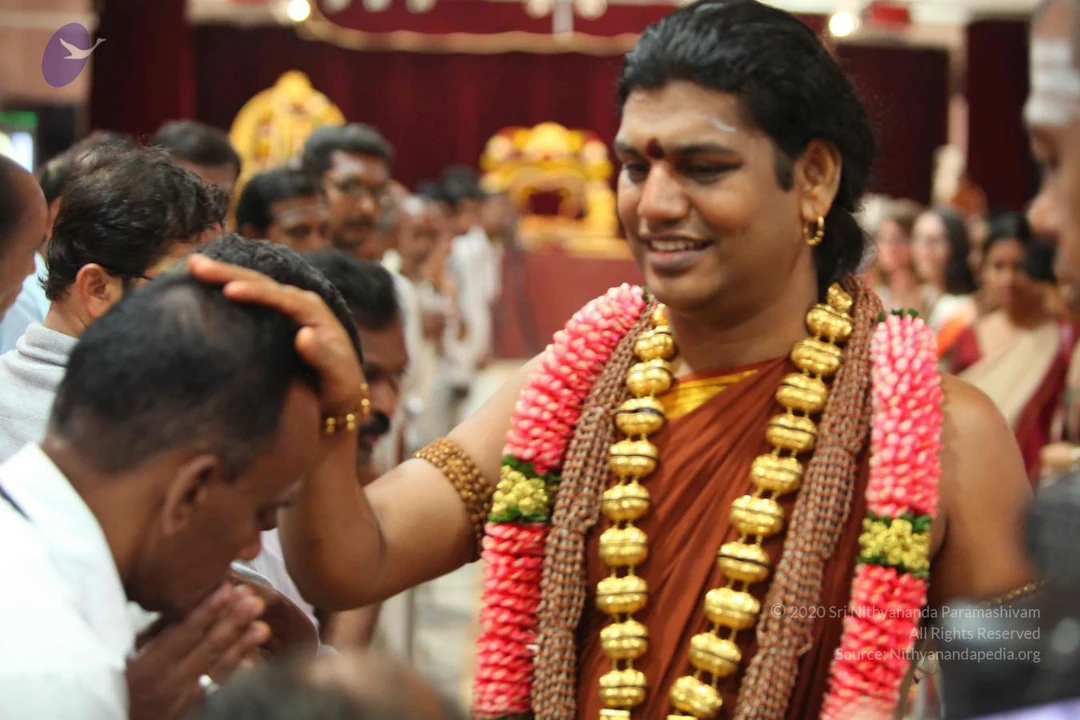
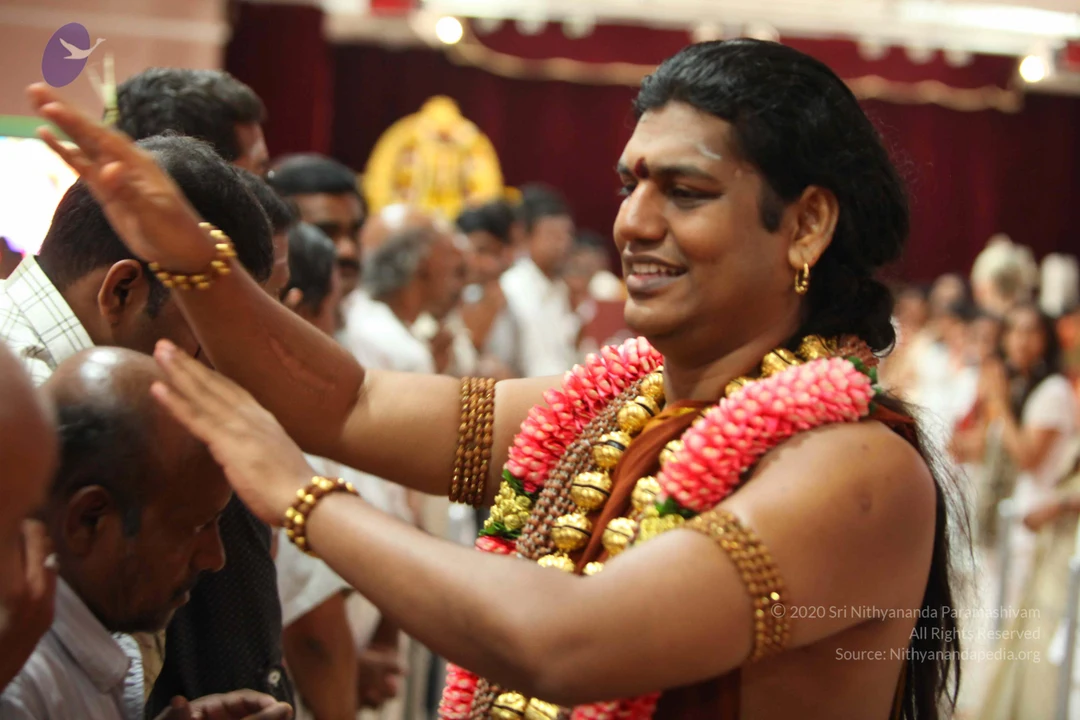
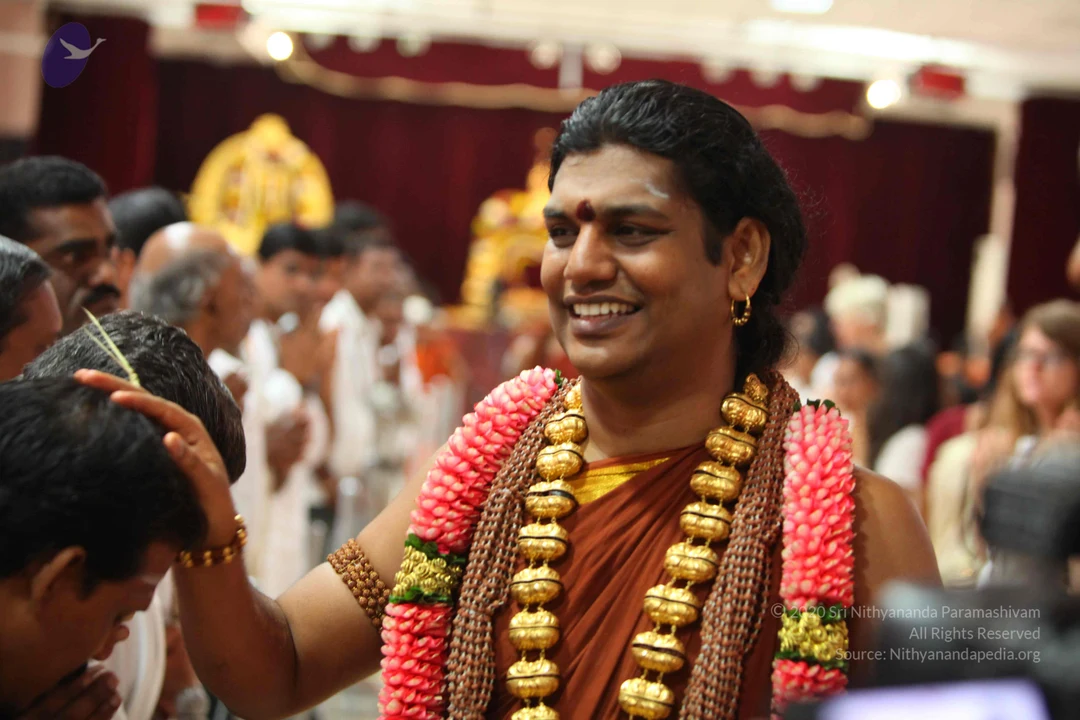
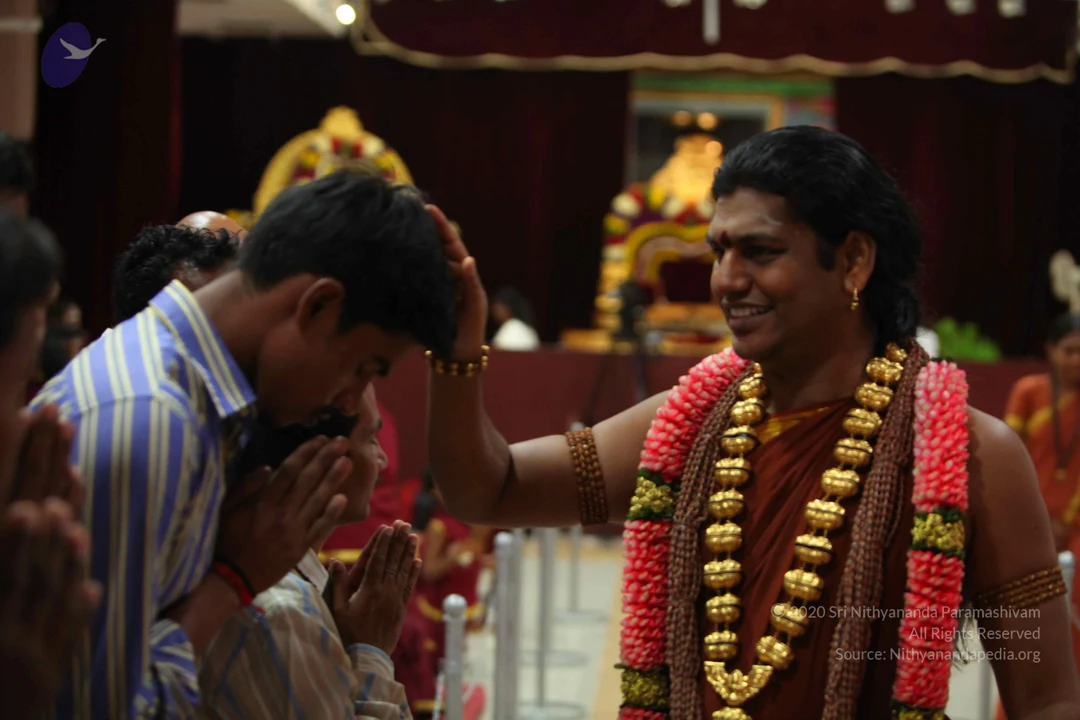
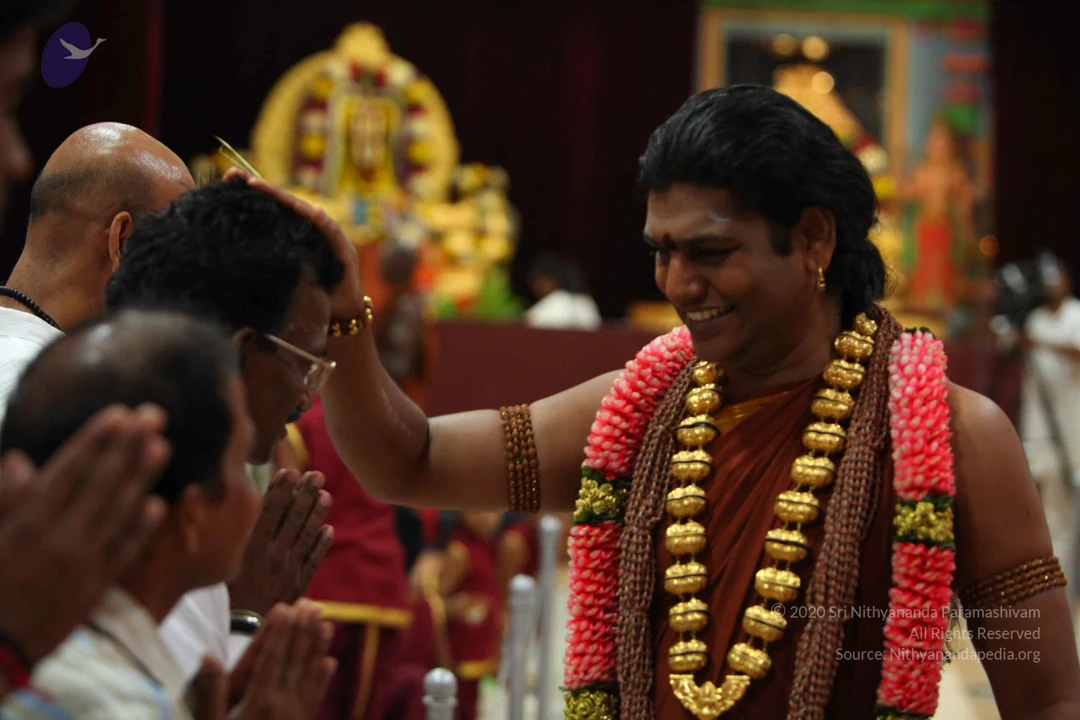
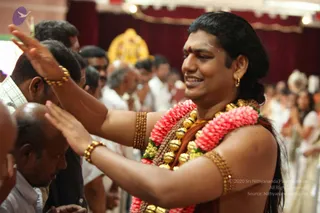
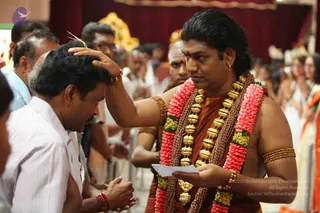
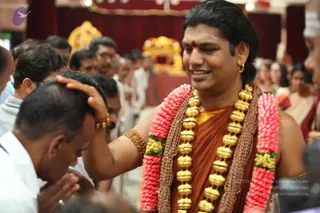
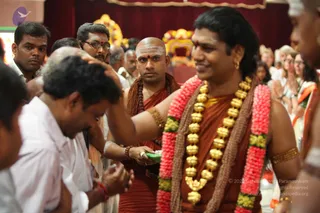
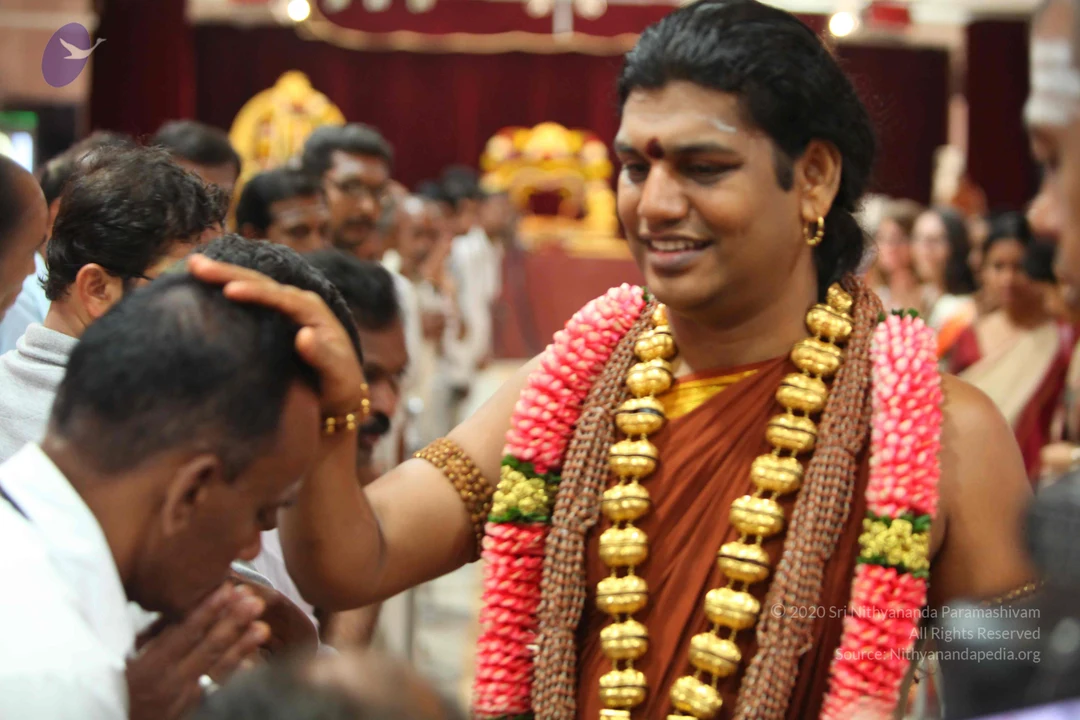
A smiling man with swept-back long dark hair, wearing an orange-brown saffron-toned robe, a thick rudraksha mala, a gold ceremonial necklace and a red-pink flower garland, raises his hand to bless or touch the head of a seated devotee with folded hands. Behind him are a gold-decorated deity murti and a shrine with flowers, and partially visible devotees and a cameraman in white clothing stand in the background. a person is shown in person with distinctive saffron clothing, rudraksha mala and ornate gold necklace while blessing a devotee during a satsang-style gathering.A photograph in a temple hall with maroon drapes and a gilded deity murti in the background. A man with long dark hair, wearing a rust-brown robe, a long pink and green flower garland, a heavy gold bead necklace and gold armlets, places his right hand on the head of a devotee bowing with folded hands. The devotee wears a blue-and-white striped shirt. Other people with folded hands stand at the left edge. The man in the robe has a distinctive long hairstyle and ceremonial gold adornments; a candidate matching a person is blessing the devotee in this darshan moment.A smiling man with swept-back long dark hair, a red bindi and a rudraksha-style brown bead mala stands in a crowded hall, wearing a rust-orange wrap over the shoulders and an ornate gold-bead necklace flanked by pink and white flower garlands. He wears gold hoop earrings and a brown beaded bracelet. His right hand rests on the head of a seated devotee in white, who receives a blessing. Behind them, a crowd of men in white and other devotees stands near a golden deity murti and maroon drapes. a person by appearance: long swept-back hair, ornate gold necklace and saffron-orange wrap, shown giving a head blessing to a devotee. Event context suggests a satsang day.A photograph of a long-haired man with a red tilak on his forehead, smiling as he raises his right palm toward the head of a seated devotee. He wears layered necklaces of pink flower garlands and gold bead-and-rudraksha style strands, a gold bracelet and beaded arm bands, and a reddish-brown cloth over his shoulder. Behind him, a crowd of seated and standing people fills a hall with maroon drapery and a gold deity murti in the background. Swamiji (probable): the long hair, ornate gold necklaces and flower garlands match the appearance cues, and he is blessing a devotee in a satsang-like setting. Other people in the crowd wear white shirts and white dhotis.A photograph of a standing man in an orange-brown cloth draped over bare shoulders, wearing a long pink-and-white flower garland with green-gold borders and a thick gold-bead necklace over a rudraksha mala. He has long swept-back dark hair and a red tilak on his forehead, and holds a folded white paper in his left hand while his right hand rests on the head of a kneeling devotee in a white shirt with folded hands, a ritual gesture like blessing or initiation. Gold armlets and bangles adorn his arms. Behind them, a crowd of devotees in white and saffron, some shaved-headed, watches, with red curtains and a gold deity figure in the background.A photograph of a man with long swept-back dark hair, a red tilak on his forehead, and a rudraksha-style brown mala with large gold beads, wearing an orange-brown wrap, smiling as he places his right hand on the head of a kneeling devotee in white clothes with palms joined. Behind them, a crowd of people stands in a red-draped hall with golden ornaments. The man's appearance is consistent with the probable Swamiji cues of long swept-back hair, ornate gold mala and orange-brown clothing, and he is blessing the devotee as a satsang-style darshan. Several other devotees and onlookers are visible in the background, and a pink-and-green flower garland hangs over his shoulders.

Akashik-Reading-and-Kaalabhairava-Darshan

24 photosSource gallery
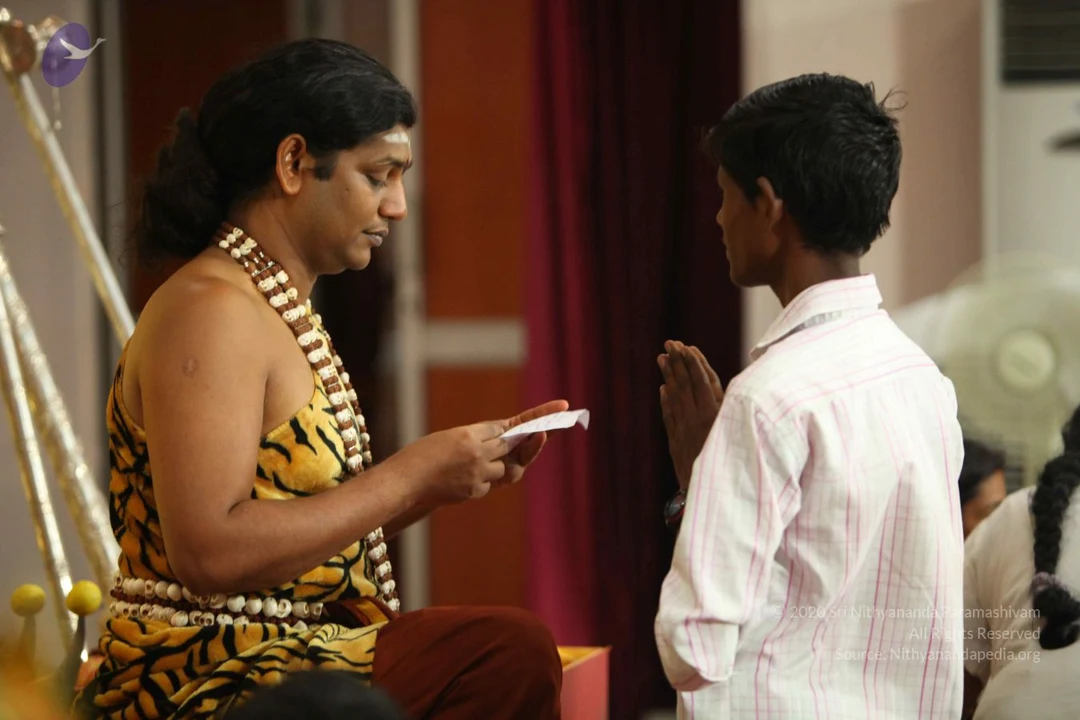
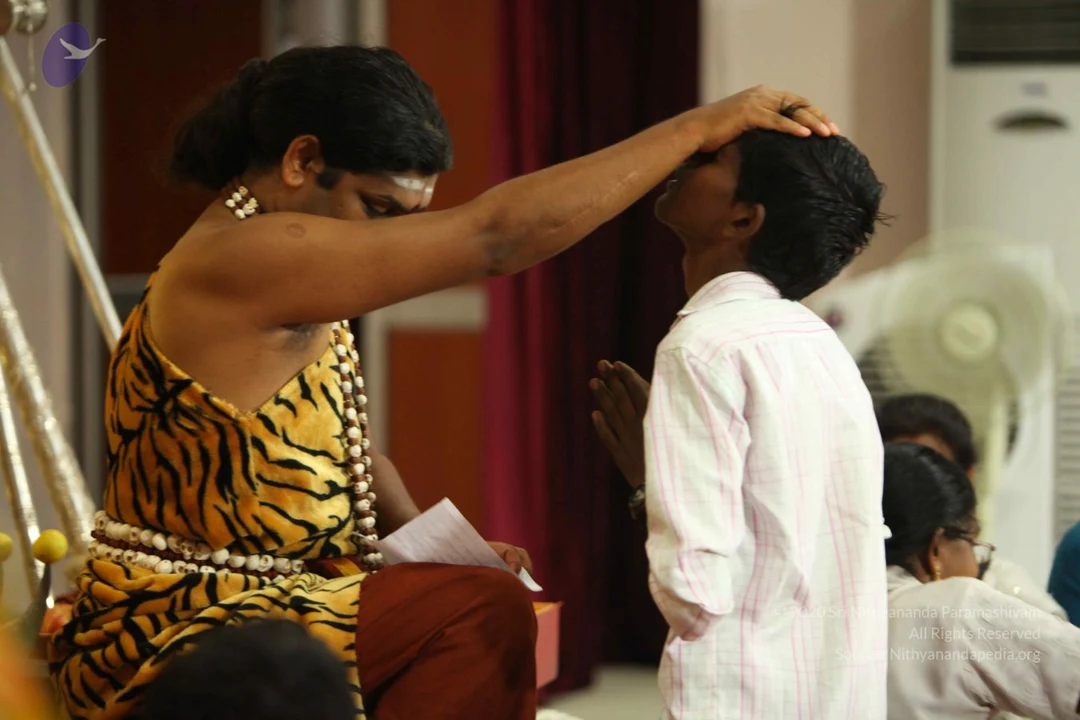
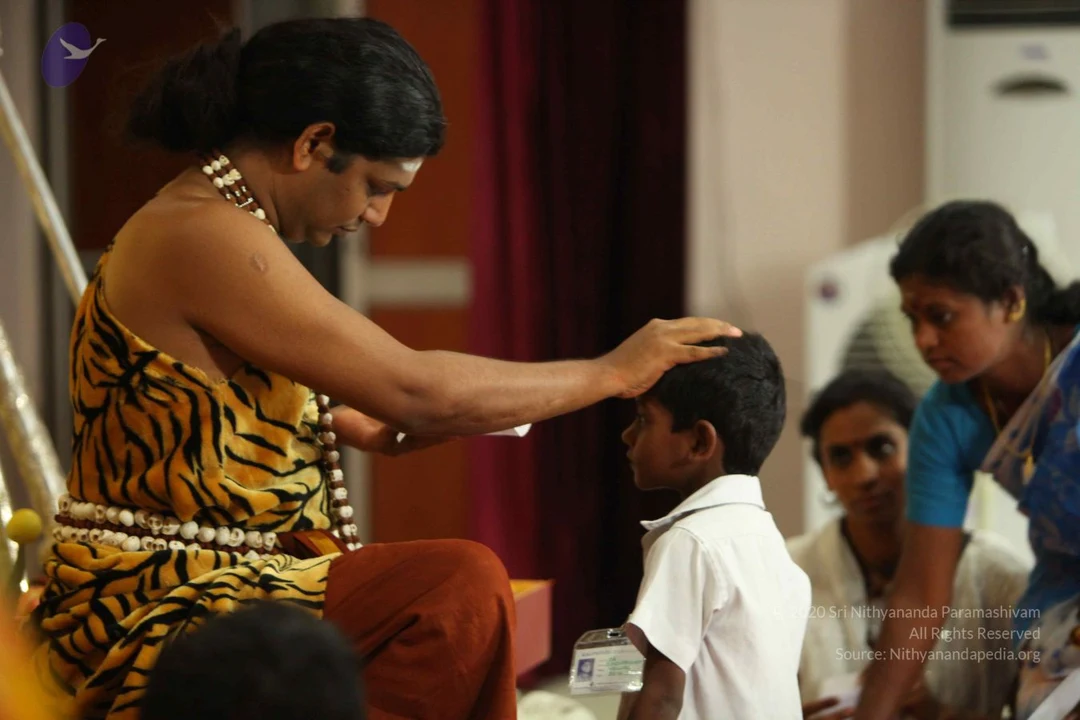
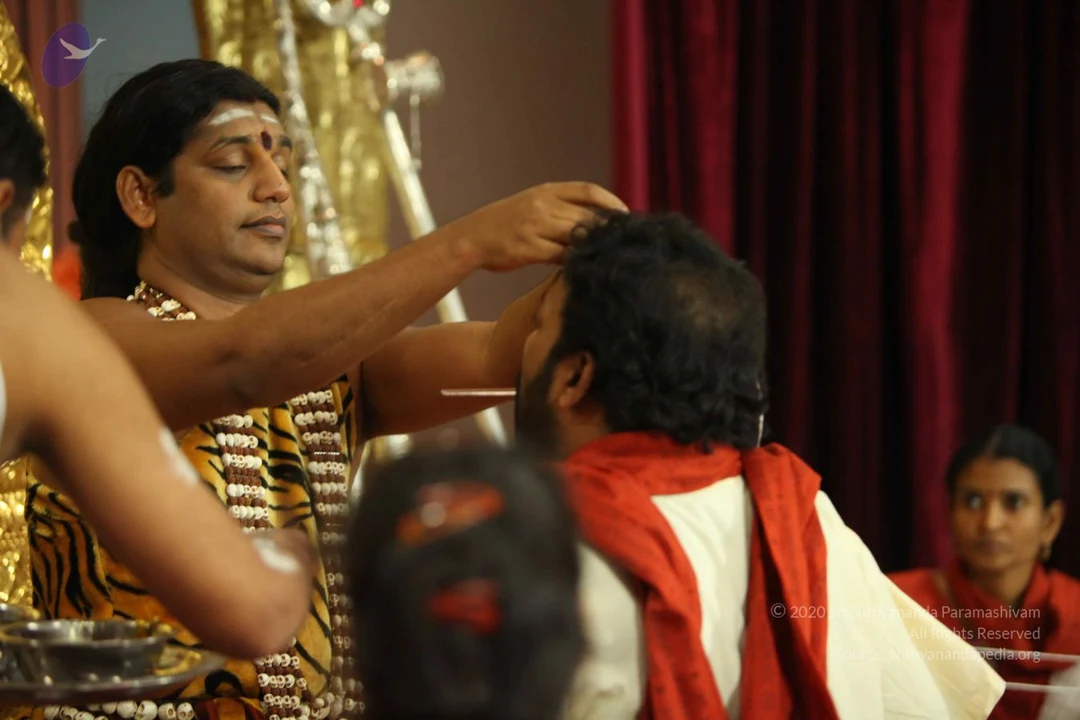
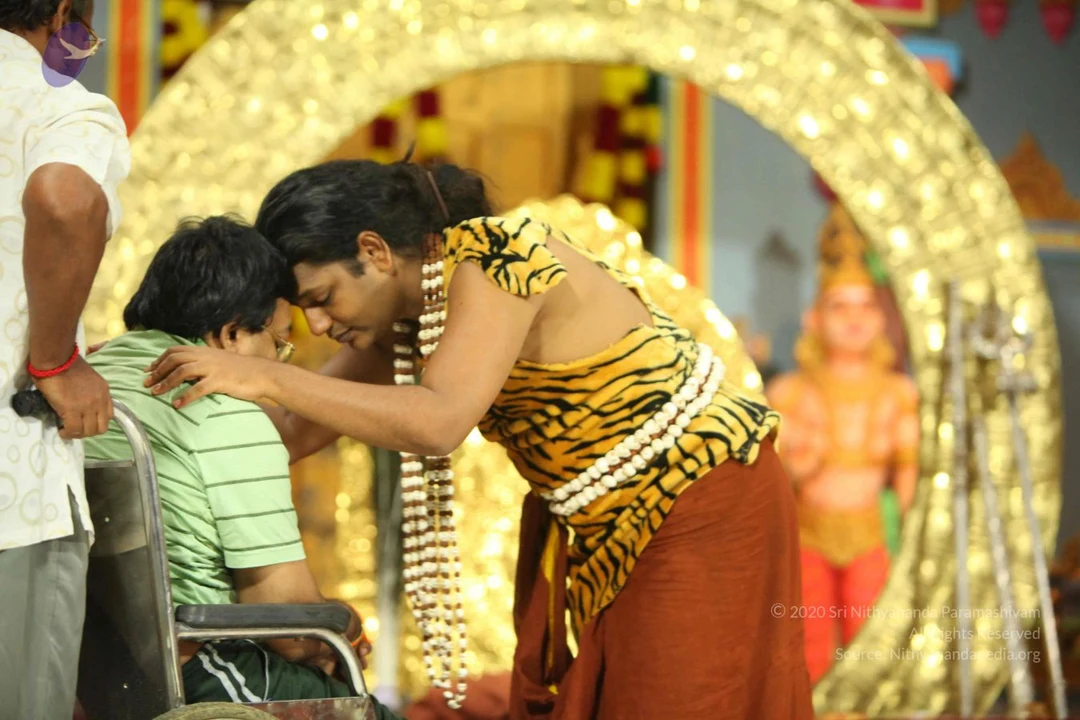
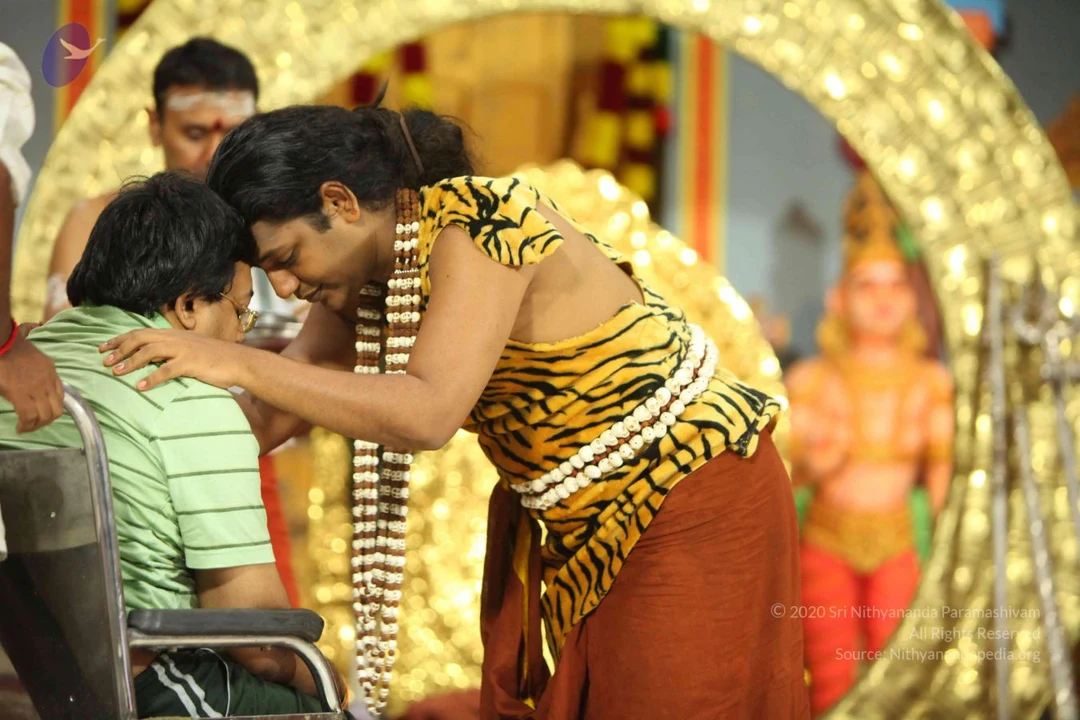
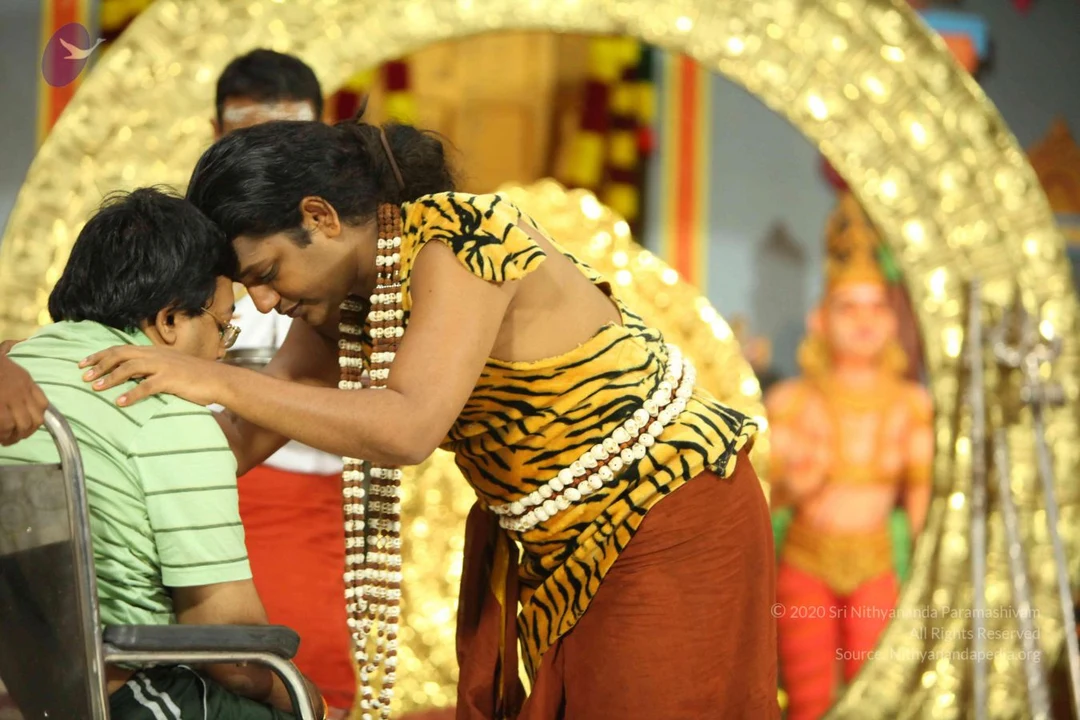
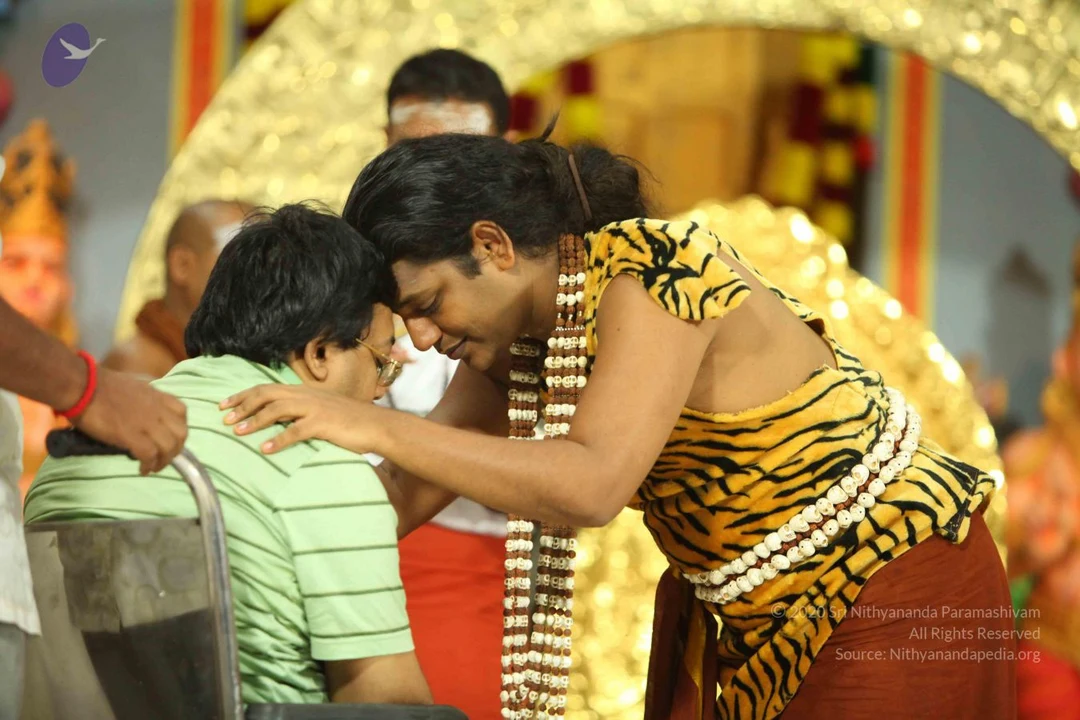
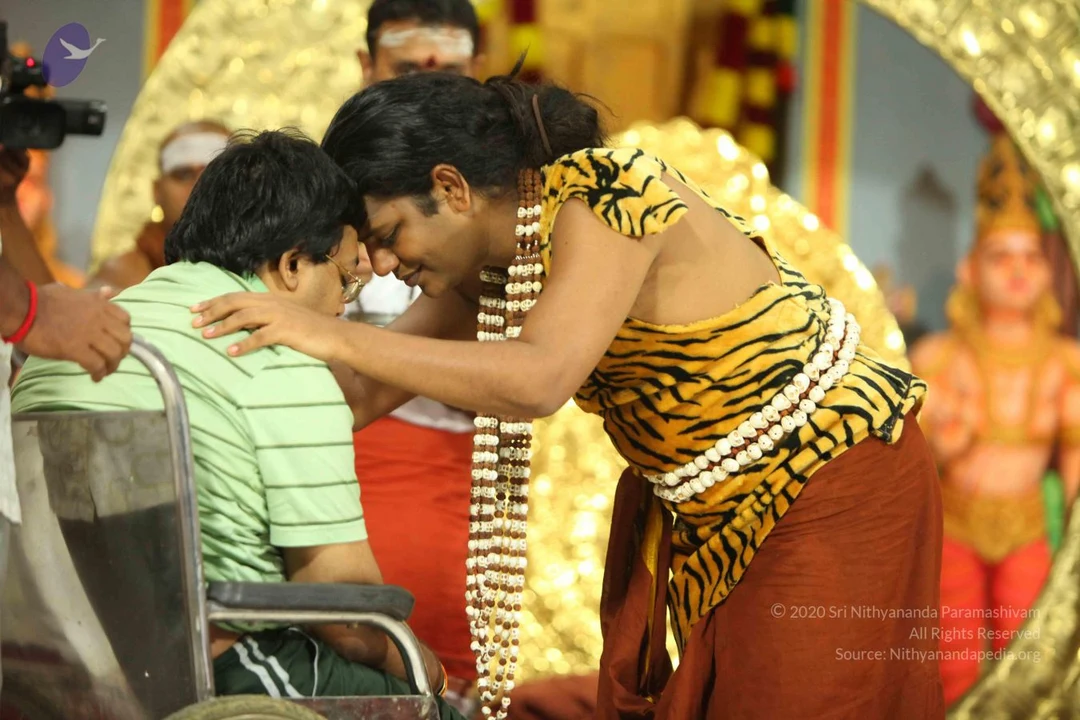
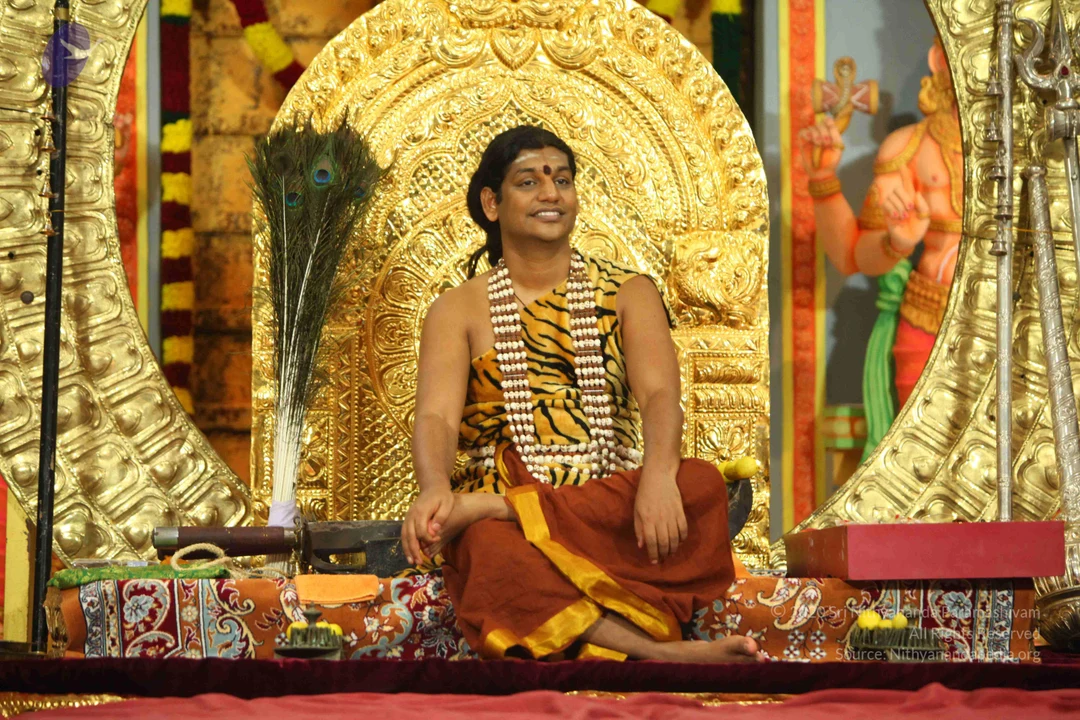
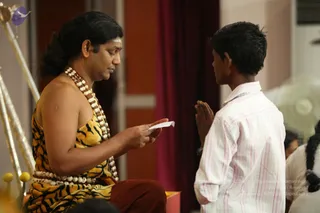
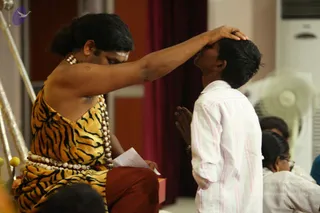
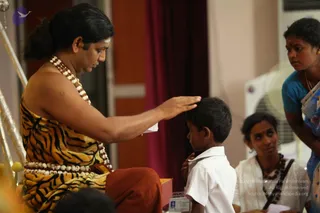
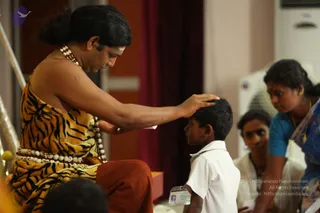
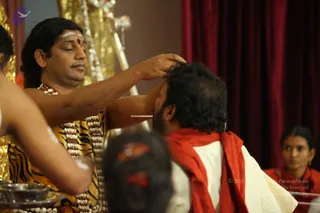
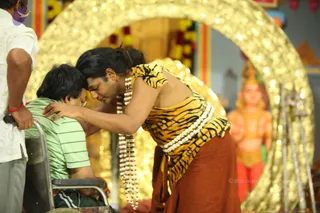
A photograph of a satsang setting where a seated man with long dark hair, a white tilak on his forehead, a multi-strand rudraksha-style bead necklace and a yellow-and-black tiger-print cloth draped over his shoulder reads a small folded paper. Facing him, a young boy in a white shirt with pink stripes stands with palms pressed together in namaste. A red curtain and a metal stand with gold-tipped rods frame the background, and a fan is visible at right. a person appearance cues: long swept-back hair, ornate bead necklaces and a shawl-like garment, shown in the role of seated teacher receiving a question from a devotee.A photograph of a satsang setting in which a seated figure in a tiger-striped yellow and orange top, with a white-beaded necklace, a long beaded waist garland and a white tilak on the forehead, lays a hand on the head of a standing man in a white pink-striped shirt with palms pressed together in prayer. The seated figure holds a folded white paper in the other hand. Other people are partly visible at the right edge. A white pedestal fan and a red curtain are in the background. The scene resembles a blessing or initiation moment. Whether the seated figure is a person cannot be confirmed from appearance alone.A seated figure with long dark hair tied back, wearing a tiger-striped orange and black shawl over bare shoulders, multiple strands of white and brown beaded malas across the chest and waist, and rust-coloured cloth on the lap, places a hand on the head of a young boy in a white shirt standing before him. Two women watch: one in a white sari with a beaded necklace, another in a blue blouse with a gold necklace, and a white fan and maroon curtain stand behind. A white card is held in the blessing hand.A photograph of a seated man with long dark hair pulled back, wearing a tiger-striped yellow and orange garment, rudraksha-style white bead malas across his chest and waist, and rust-coloured trousers. He rests his right hand on the head of a young boy in a white shirt with an ID badge. Two women in saris sit to the right, one in a blue blouse and gold earrings, watching the blessing. A red curtain and cream wall form the background, and a white air conditioning unit is visible at top right.A photograph of a ritual scene inside a temple-style hall with a gold-toned backdrop and deep red curtains. A man with long swept-back hair, a white tilak on his forehead and a red bindi, wears a rudraksha mala and a striped gold-and-black shawl. He is applying a white paste or marking to the head of a seated devotee, who wears a white dhoti and a red shawl and whose back is turned to the camera. Metal ritual trays are visible in the foreground, and a woman in a red shawl watches from the right.A photograph of a man in a yellow and black tiger-striped sleeveless top and rust-red wrap, with long dark hair and a multi-strand white and beaded necklace, leaning forward with his forehead against the head of a seated young man in a green striped shirt and dark trousers who sits in a metal wheelchair. The standing man places a hand on the seated man's shoulder. A bystander in a white patterned shirt stands at the left edge with a red wrist thread. Behind them a large gold-glittered circular arch frames the scene, with floral garlands and a painted deity murti at the right, and a blurred figure in orange at the right edge.

Gayatri-Homa

3 photosSource gallery
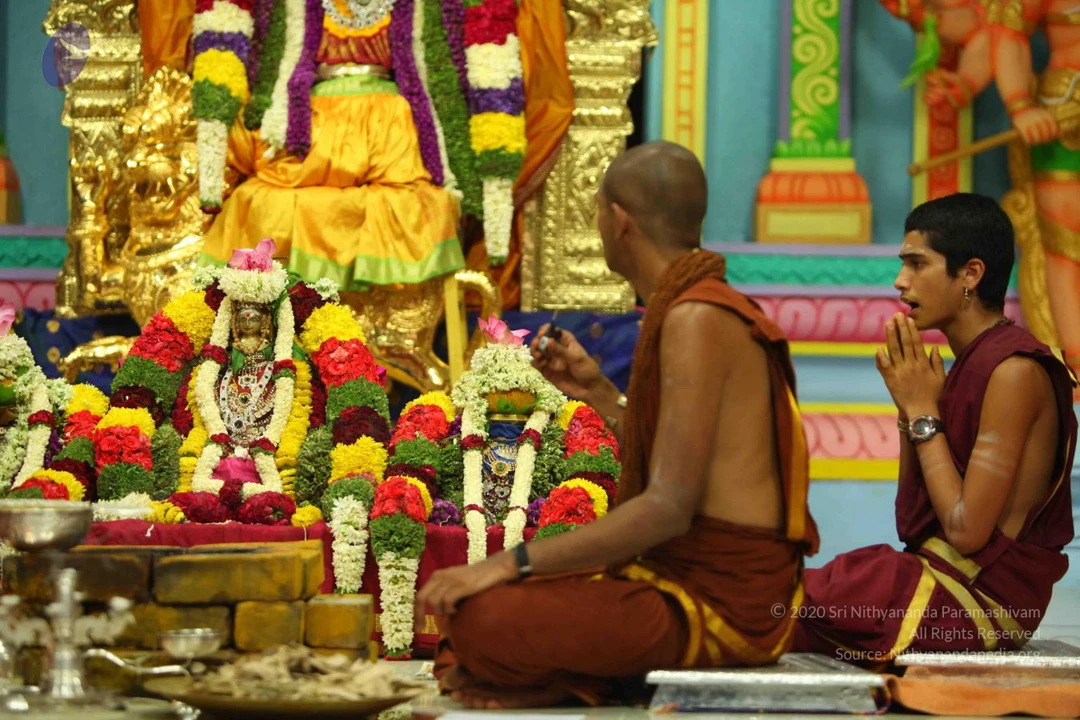
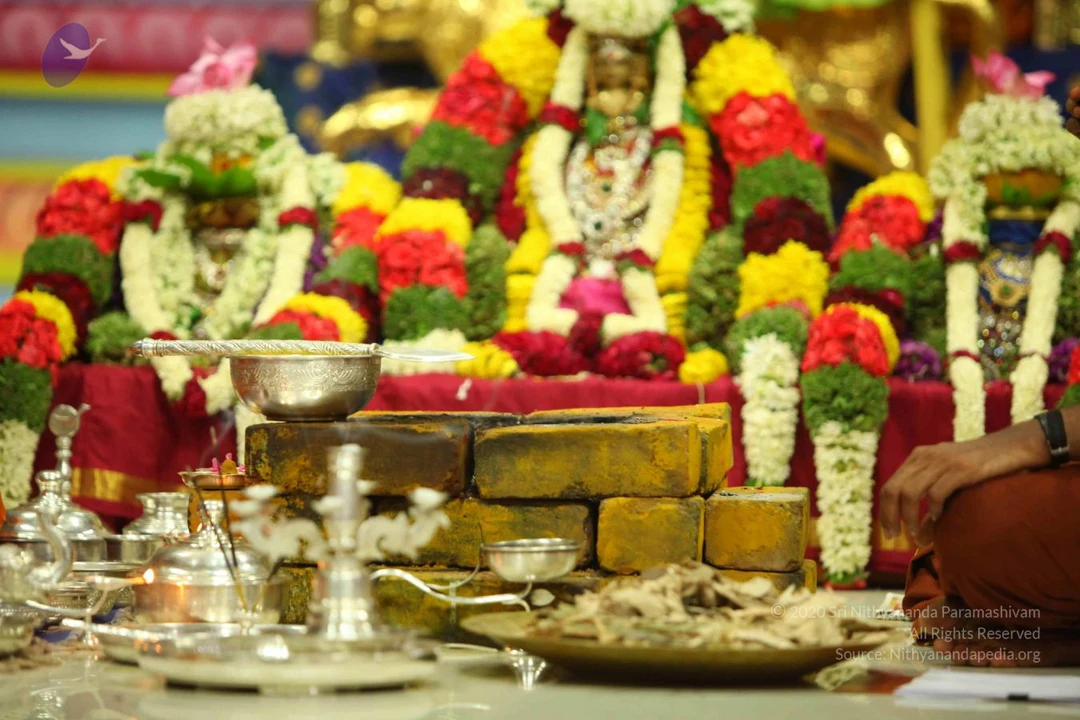
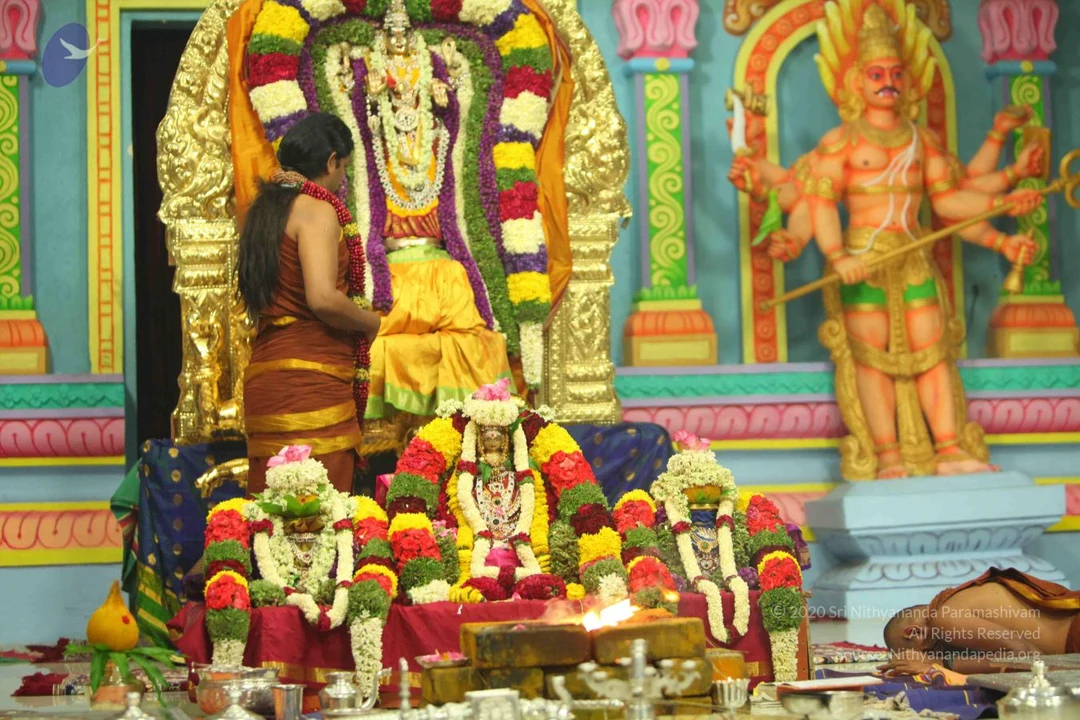
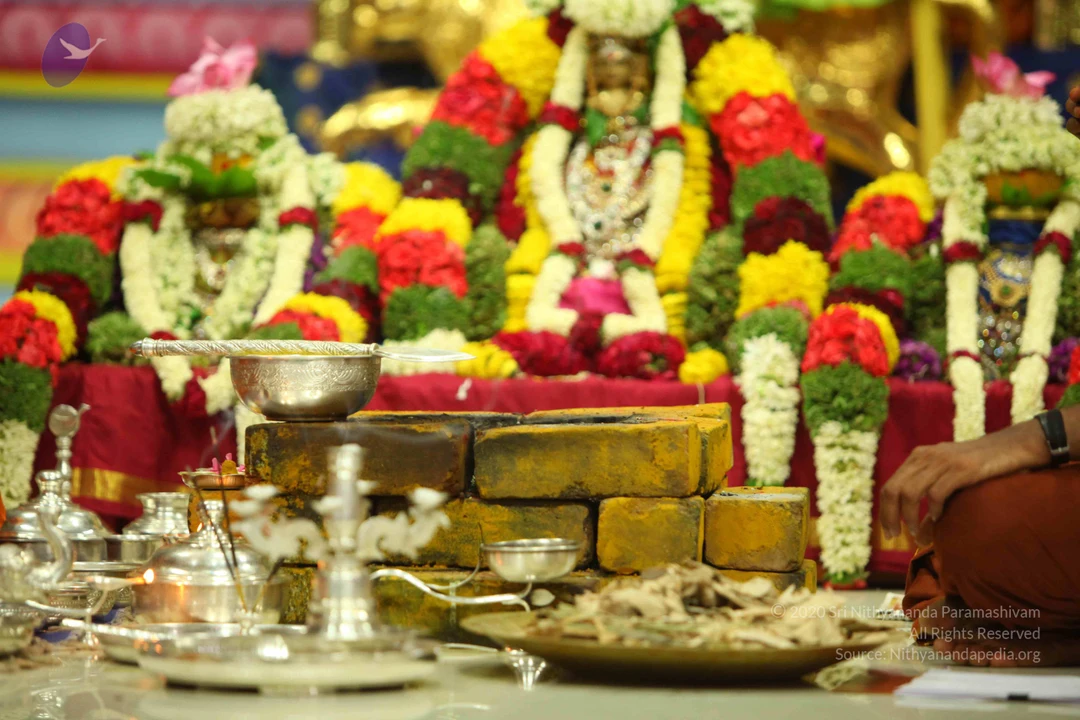
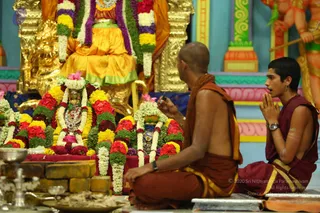
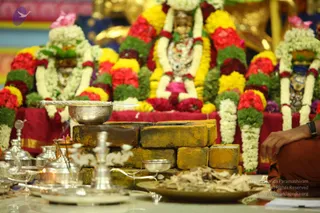
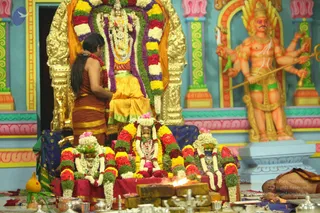
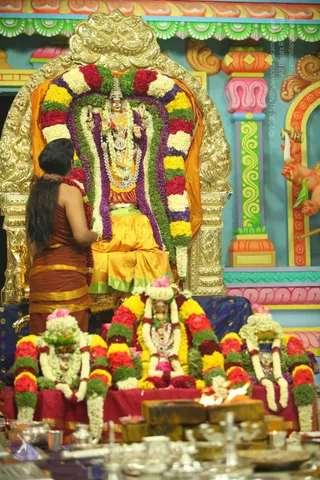
A photograph of a temple shrine with two seated figures in front of a flower-garlanded deity murti. A bald, bare-chested priest in a rust-orange cloth sits cross-legged, facing the shrine and holding a small object near the altar. Beside him, a younger man with short dark hair in a maroon garment with gold border sits with palms pressed together in prayer. Behind the shrine, a large gold-and-orange deity figure is seated on a throne draped with yellow and green cloth, and the altar is decorated with red, yellow and purple flower garlands. Brass vessels and offerings lie in front. a person is not identifiable here from visible cues.A decorated deity murti stands at the centre of a shrine, framed by garlands of white jasmine, red roses, yellow marigolds and green leaves. Flanked by two smaller decorated figures and shrouded in red cloth, the arrangement sits behind a row of stacked golden-yellow bricks topped with a silver bowl and ladle. Silver puja vessels, a small oil lamp, a brass lota and a plate of flower petals rest on a table in the foreground. At the right edge, a seated person in orange-brown robes and a wristwatch rests a hand on their knee. The scene suggests a ritual or puja in progress.A temple ritual scene before a richly decorated central deity murti seated on a yellow cloth throne, garlanded with red, yellow, white and green flower strings. A woman in a rust-brown and gold-bordered sari stands at left, adjusting or offering a red and white garland. In front, three smaller decorated murtis sit on a red cloth with flower garlands, and a small oil lamp burns at the center. A devotee in saffron-coloured clothing kneels at the lower right near brass vessels and offerings. A large painted figure with multiple arms holding a staff and weapons stands at right against a turquoise and pink temple wall. Brass lamps and pots, marigold petals and a kalasha-like vessel lie on the altar.
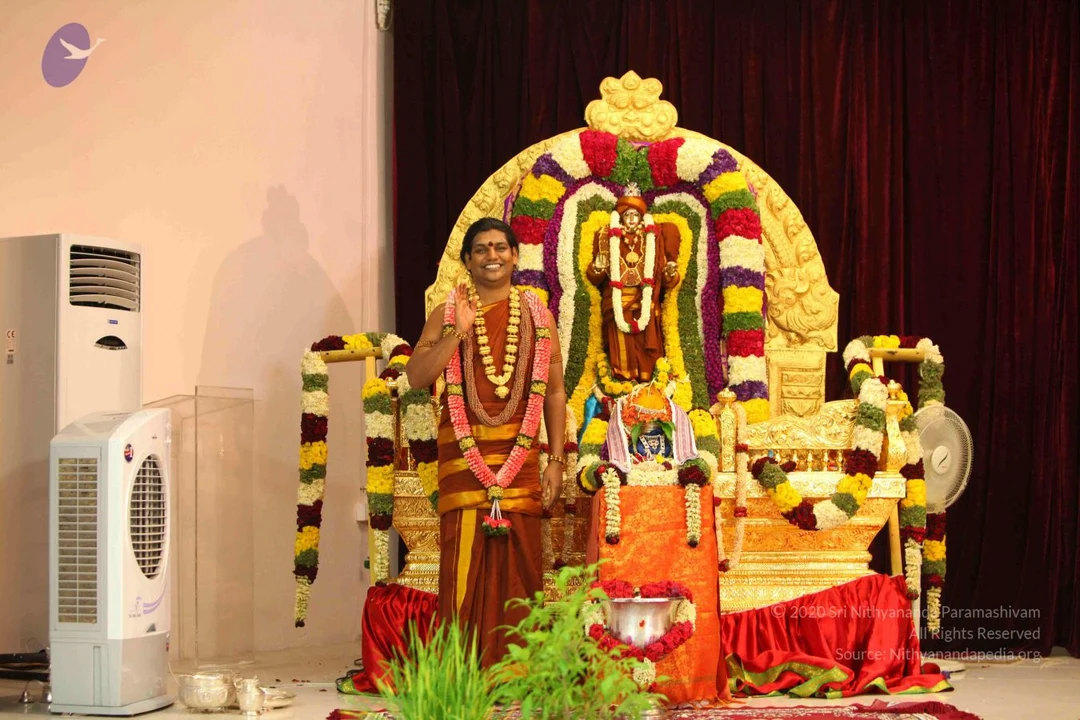
Kalpatharu

5 photosSource gallery
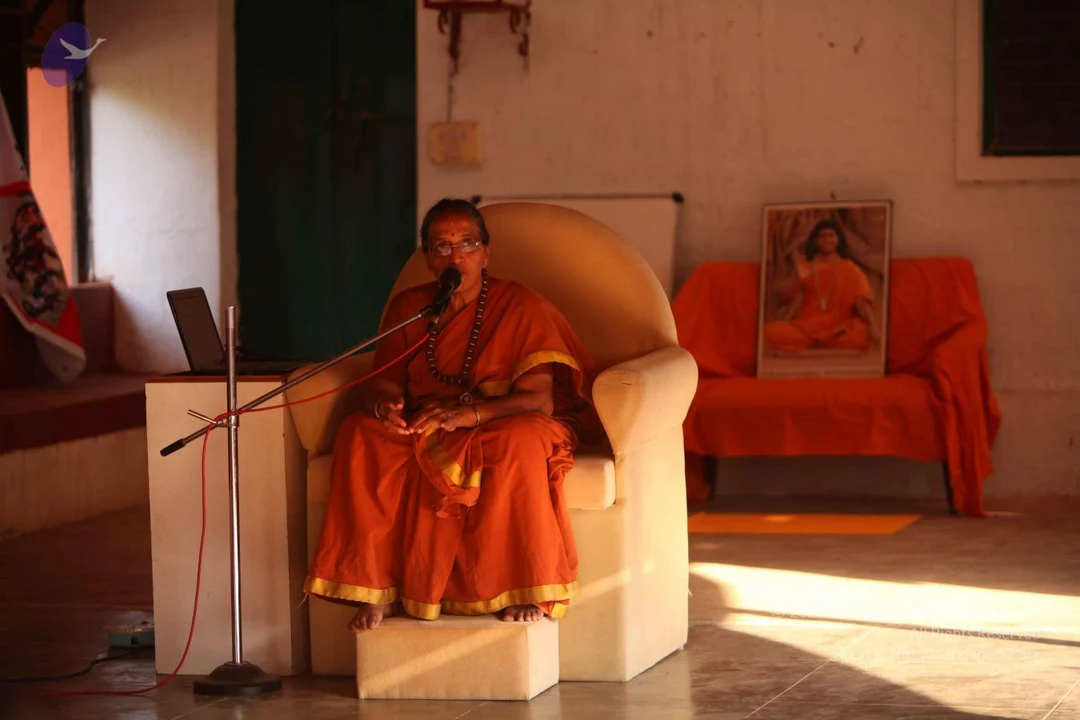
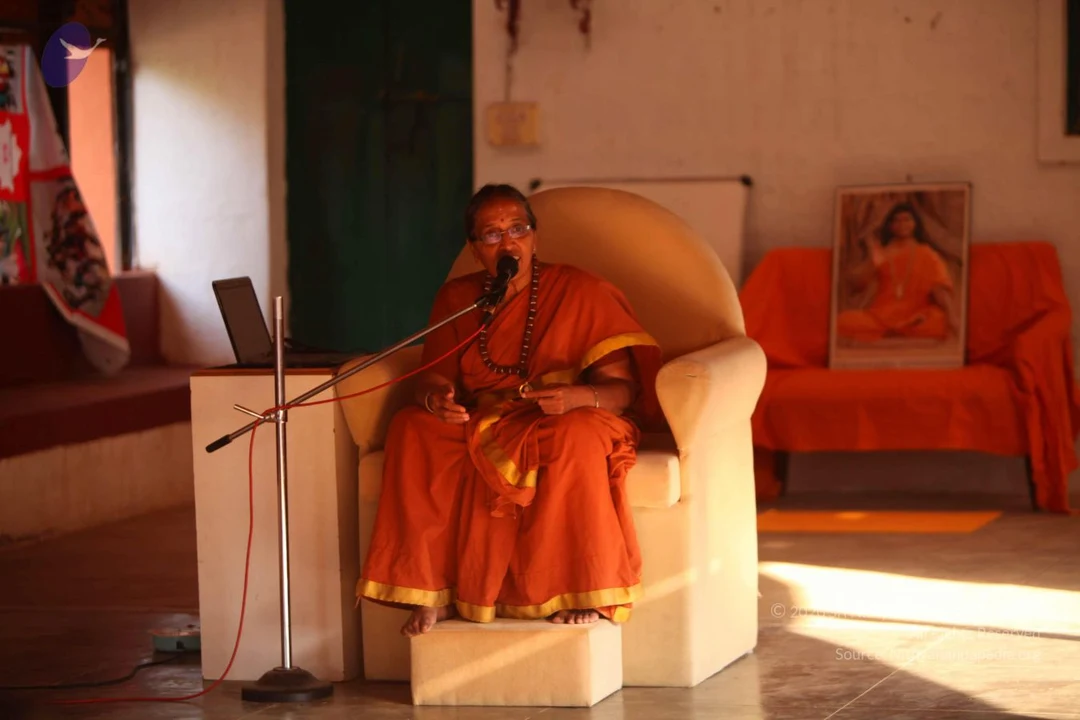
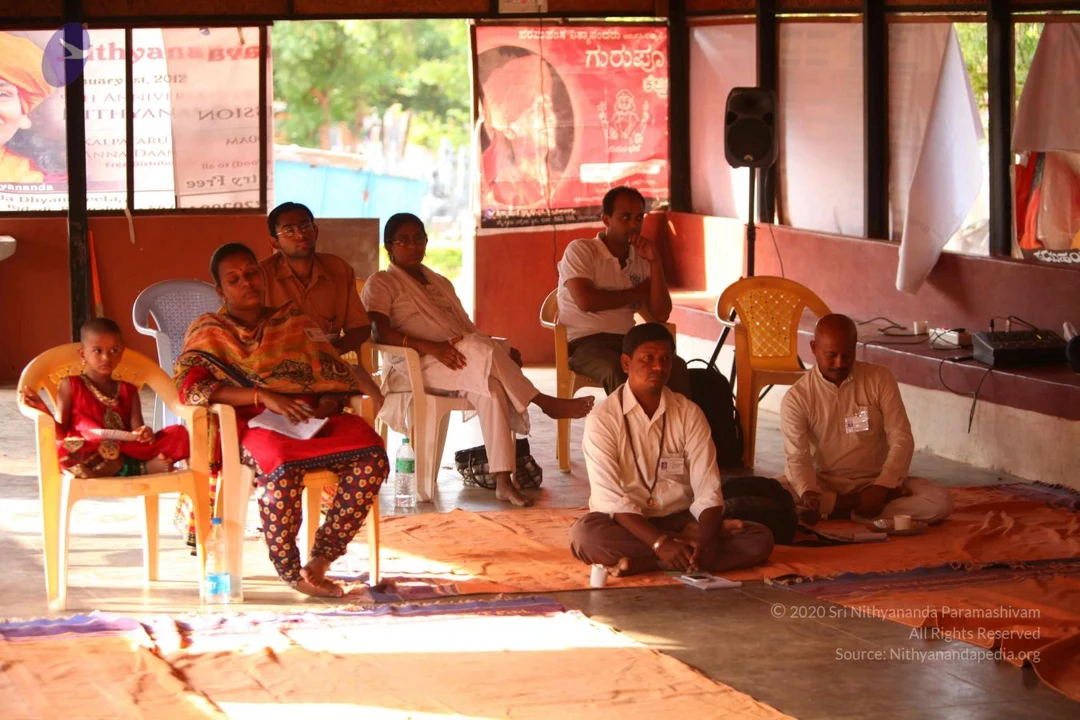
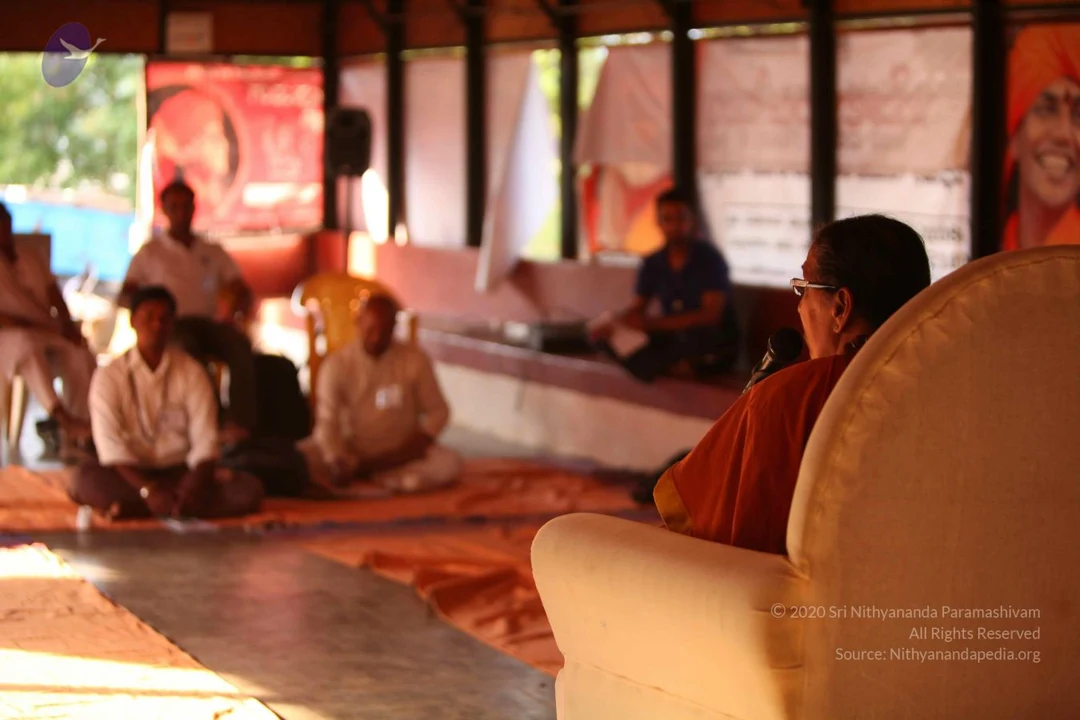
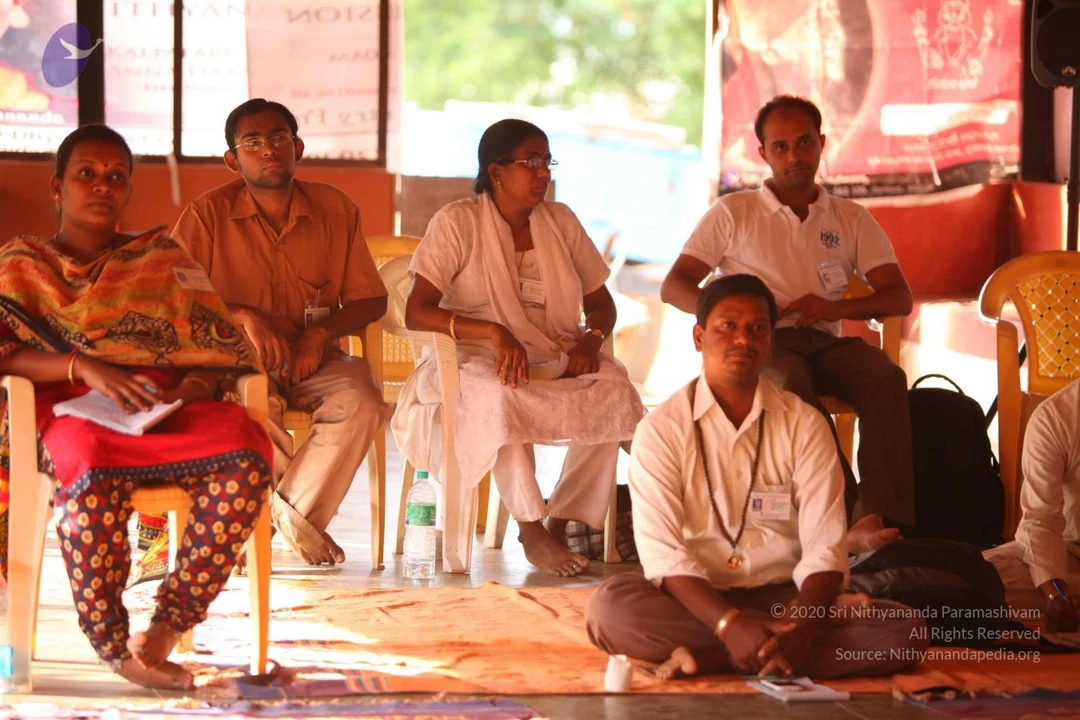
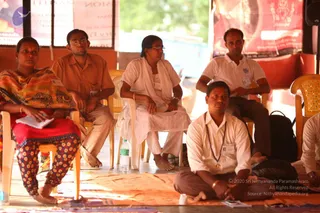
An elderly woman with short grey hair and glasses sits in a cream-upholstered armchair in an orange-saffron robe with golden trim, a rudraksha mala around her neck, speaking into a microphone on a stand. A small laptop sits on a low white stand at left. Behind her, an orange-draped sofa holds a framed portrait of a saffron-clad figure with a mala and raised hand. A red-and-white flag hangs at the left edge and warm sunlight falls across the tiled floor.A seated man in saffron-orange robes with gold-bordered edges speaks into a microphone on a stand, in a bright, plain hall. He wears a rudraksha mala and a thin gold bracelet, and his feet are bare on a pale floor. He sits in a cream upholstered armchair set on a low step, with a laptop on a small table beside him. Behind him, a framed painting shows a figure in orange robes seated in meditation, above an orange-draped couch. A red-and-white banner hangs at the left edge, and a small white logo appears in the upper left. a person is visible as the speaker, identified by saffron robes, rudraksha mala and gold bracelet cues while seated on a throne-like chair during discourse.Photograph of a seated group in a covered open hall with a concrete floor and orange-brown cloth mats. A young girl in a red dress sits on a yellow chair at left, beside a woman in an orange and red sari with patterned trousers holding papers. Behind them a man in a light shirt with glasses, a woman in white kurta and trousers, and a man in a white shirt sit on chairs. In front, a man in a white shirt with a lanyard sits cross-legged on the mat, and a bald man in white kurta sits on the floor at right. A red banner reading a Kannada-language Guru Purnima message and a white banner with Nithyananda-related text hang on the walls, with a speaker stand and microphone on a raised platform at right. Plastic water bottles and a cup sit on the floor.A photo of a satsang held in an open-sided pavilion with orange cloth spread on the floor. In the foreground, a woman with glasses and a short dark bob, wearing an orange-saffron sari, sits in a cream upholstered armchair facing away from the camera, speaking into a microphone. Around her, several men sit cross-legged on the orange mats in white shirts and light trousers, while others sit on yellow and white chairs and a man in a blue shirt sits at the back. Red banners and posters hang on the pillars behind, and at the right edge a large portrait shows a smiling figure in an orange turban and saffron robe. A small logo appears in the top-left corner.A photograph of a seated audience at an indoor satsang hall. In the foreground a man in a white shirt with a rudraksha mala sits cross-legged on an orange mat, hands folded. Behind him, several people sit on white plastic chairs: a woman in a colourful patterned shawl with a red garment holds a notebook, a man in an orange-brown shirt sits beside a woman in white with a white shawl, and a man in a white polo shirt sits at the right. A water bottle and bags lie on the floor. Behind them hang red and white banners and a window shows greenery.

Adikailaash

6 photosSource gallery
A close photograph of a bougainvillea branch with magenta and pink papery bracts and small white flowers, green oval leaves, set against vertical weathered bamboo poles bound with twine. No people are visible.A photograph of pink and magenta bougainvillea blossoms with green leaves trailing across pale bamboo poles tied with wire. A small red bloom and a white-centred flower are visible among the clusters. No people are present. The bamboo fence forms a blurred background of vertical tan poles, with a purple bird logo in the upper left corner.Close-up photograph of bright magenta bougainvillea blossoms clustered on thin branches against a soft-focus background of green leaves and blue sky. Small white flower centres are visible among the papery pink bracts. No people are present.A close outdoor photograph of slender green stems topped with small white daisy-like flowers with yellow centres, some still in bud and others gone to fluffy white seed heads. The background is a soft blur of green leaves and stems. No people are visible.A close-up photograph of a field of small wildflowers in soft focus. Slender green stems rise through blurred foliage, each topped with a tiny white daisy-like flower with a yellow centre, alongside fluffy, seeded white and beige flower heads. No people, ritual objects or structures are visible. The background is a blurred mix of green leaves and warm yellow tones.Close-up photograph of a meadow of slender green stems topped with small white daisy-like flowers with yellow centres, some already gone to fluffy white seed heads. Soft green leaves and blurred foliage fill the out-of-focus background. No people, figures or ritual objects are visible.

Deity-darshan
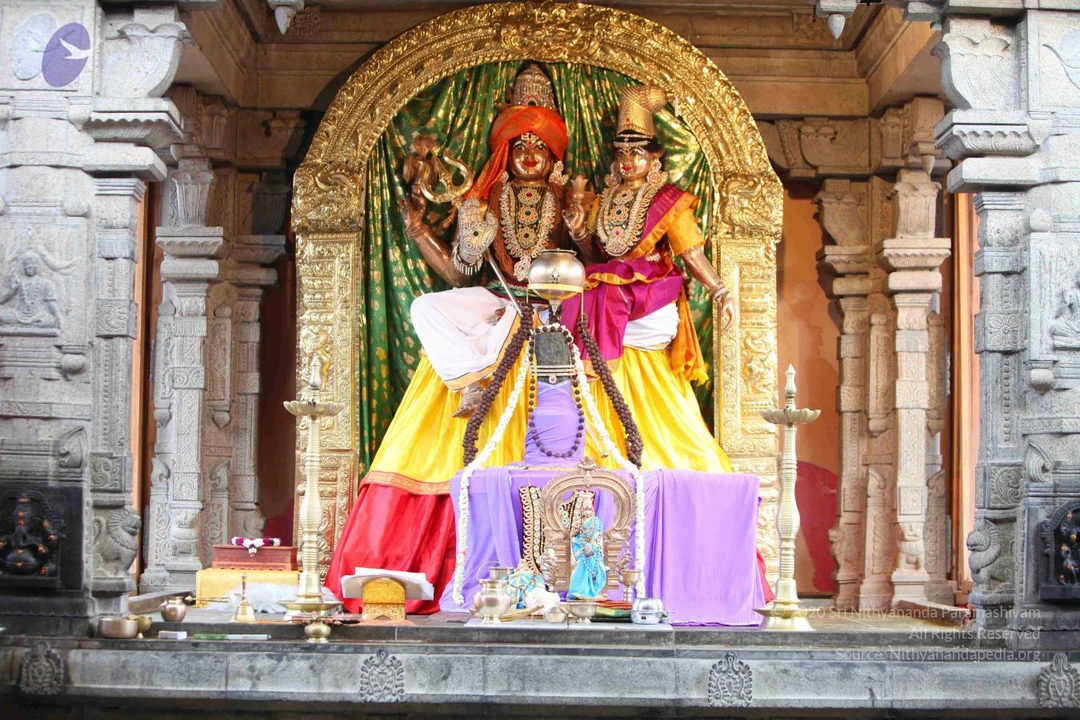
32 photosSource gallery
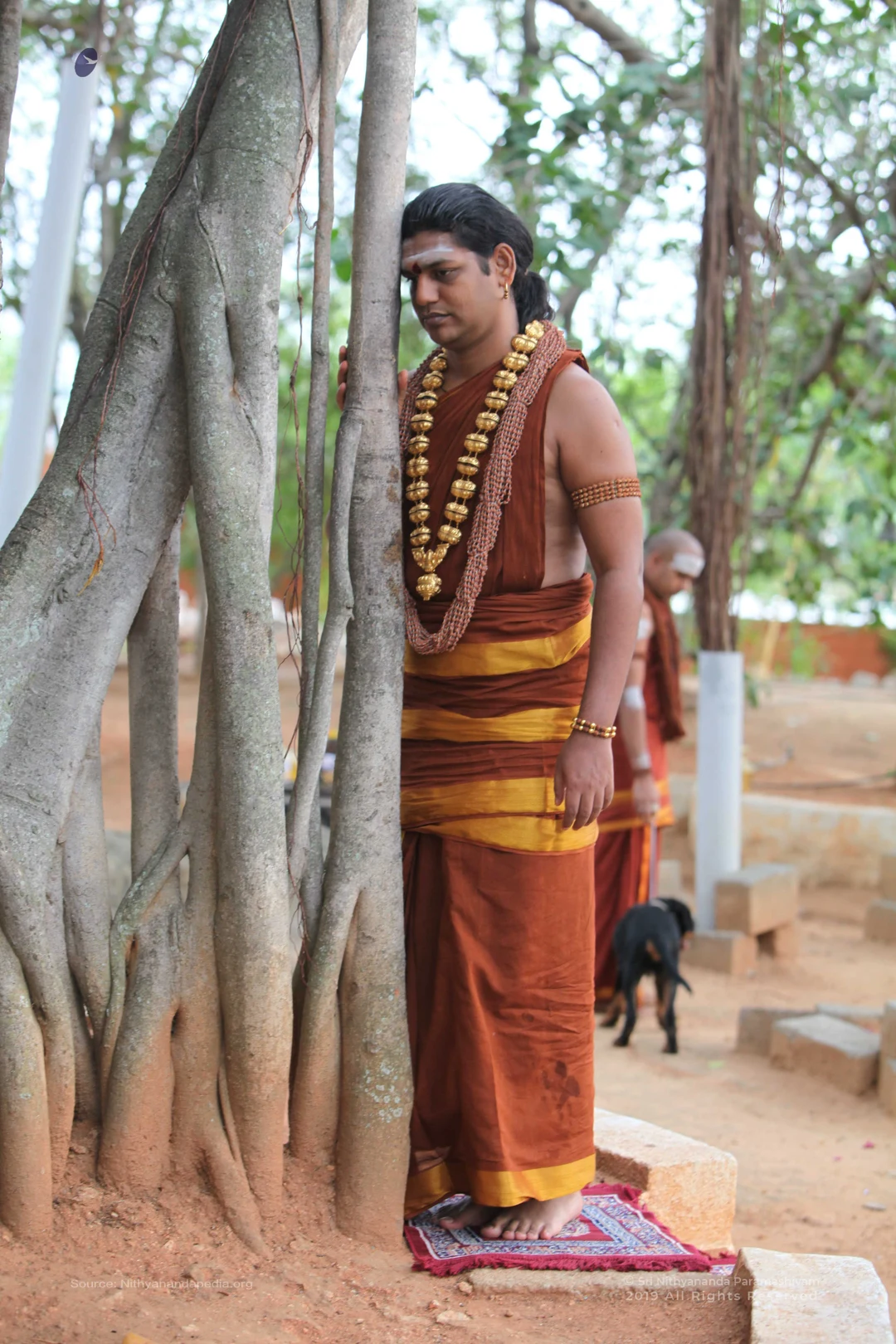
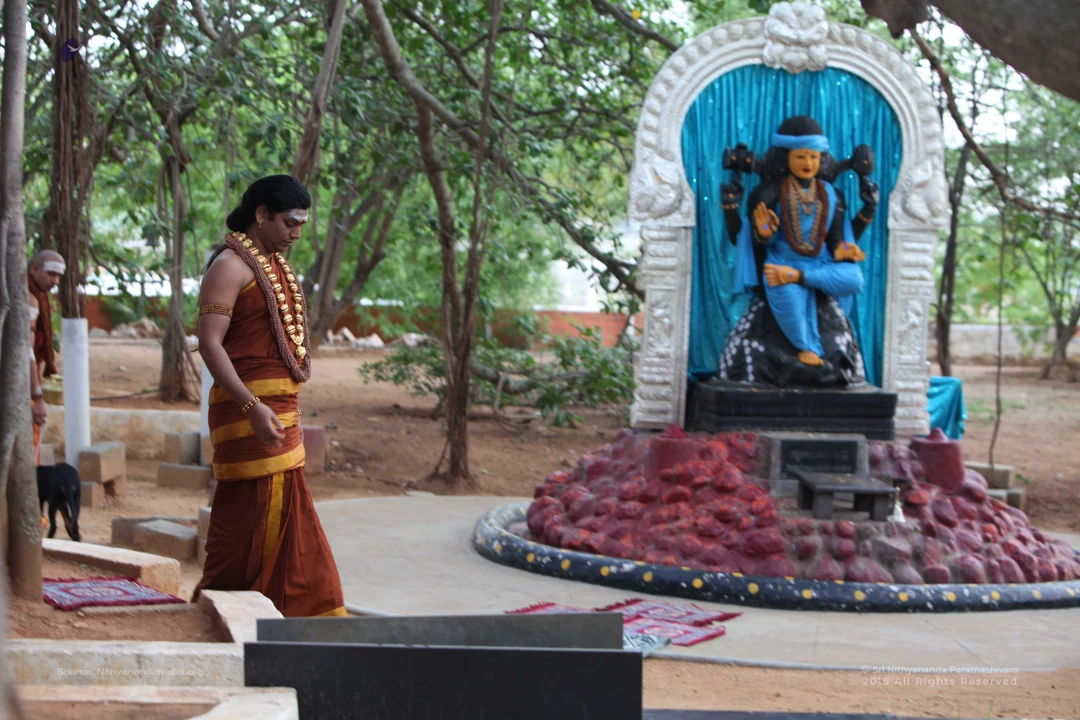
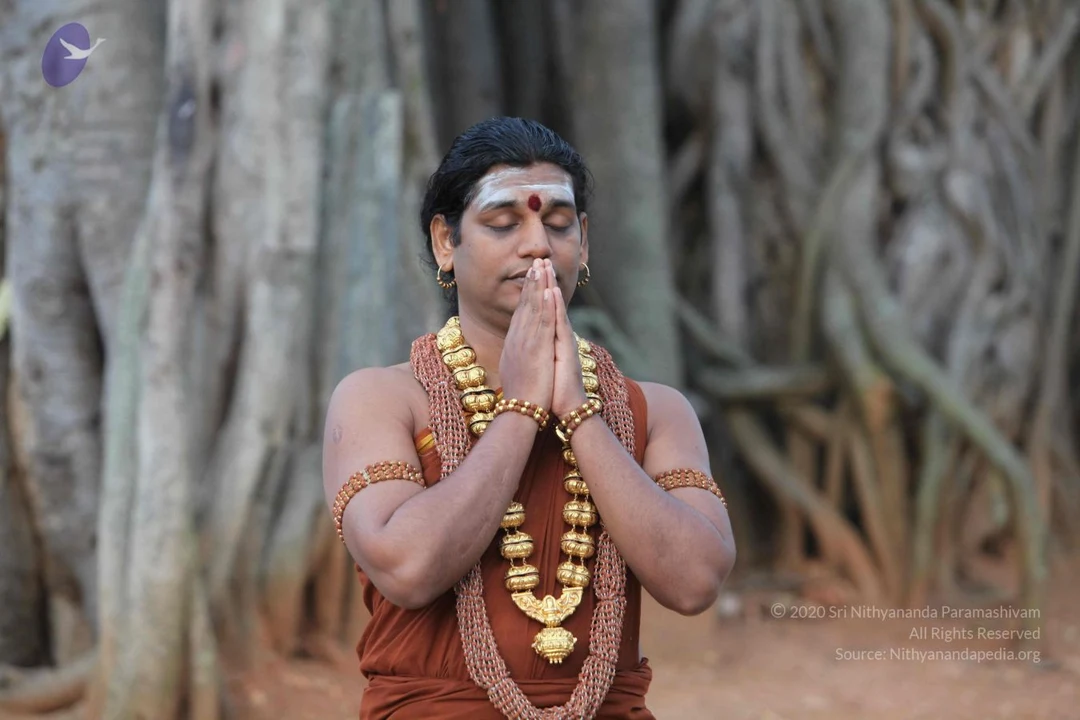
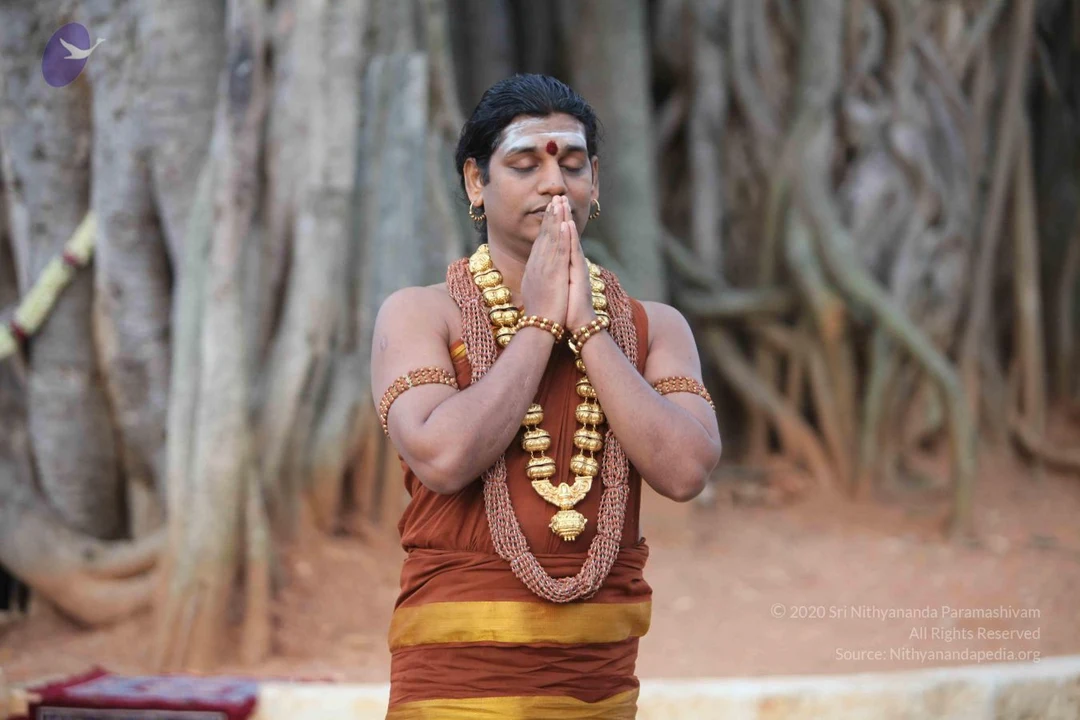
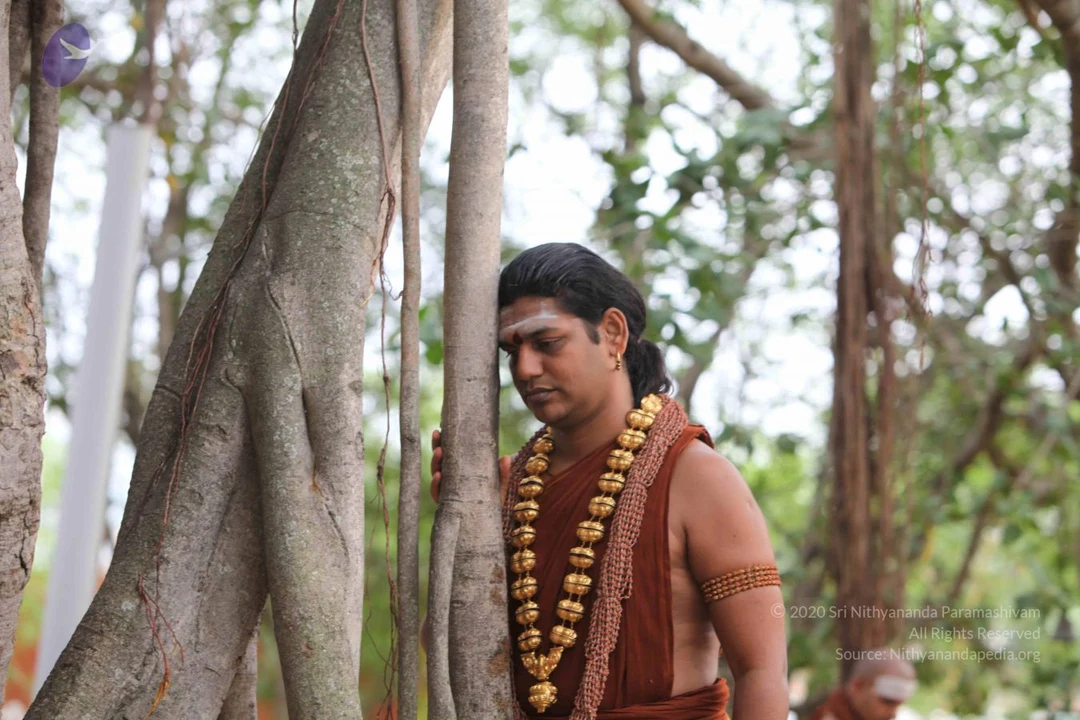
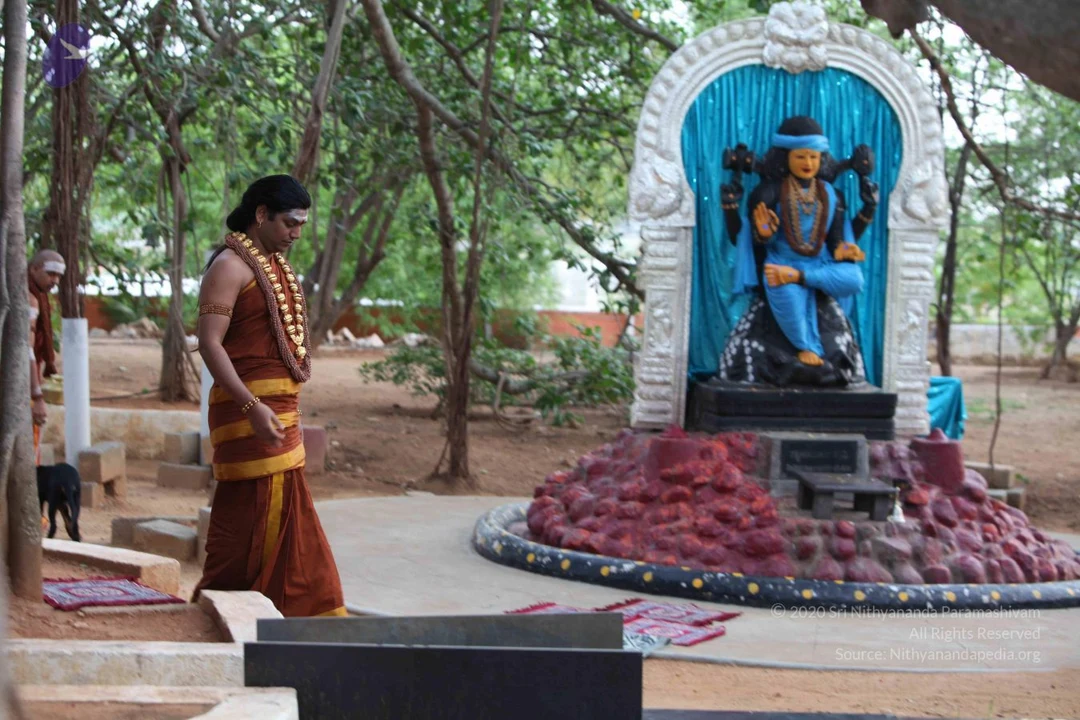
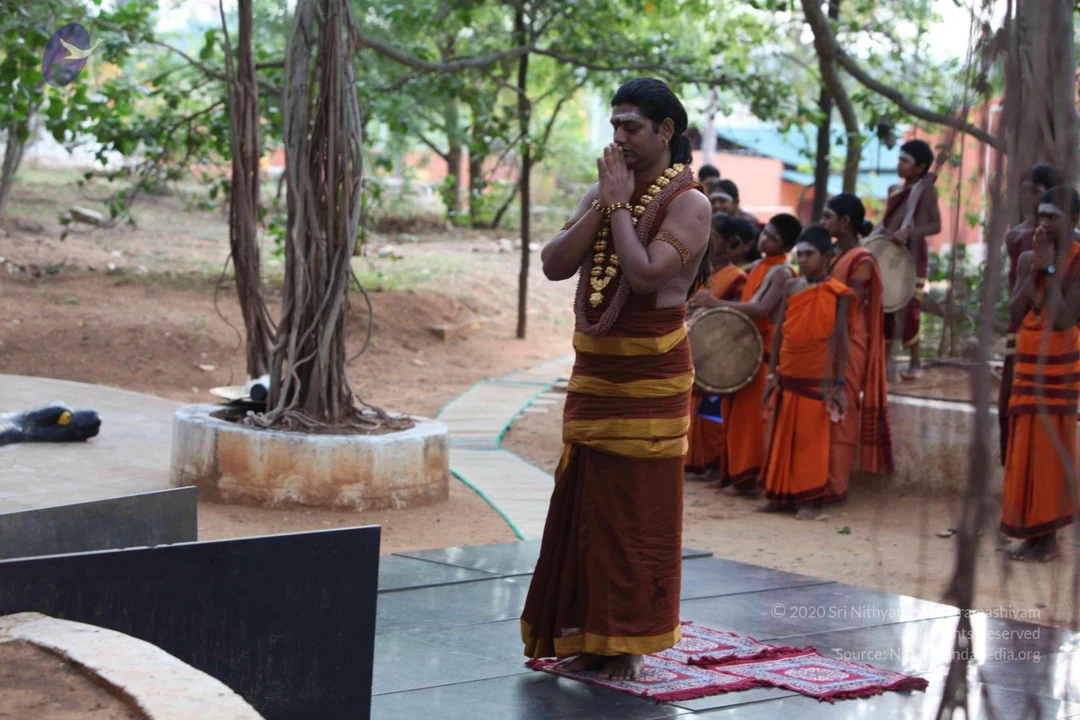
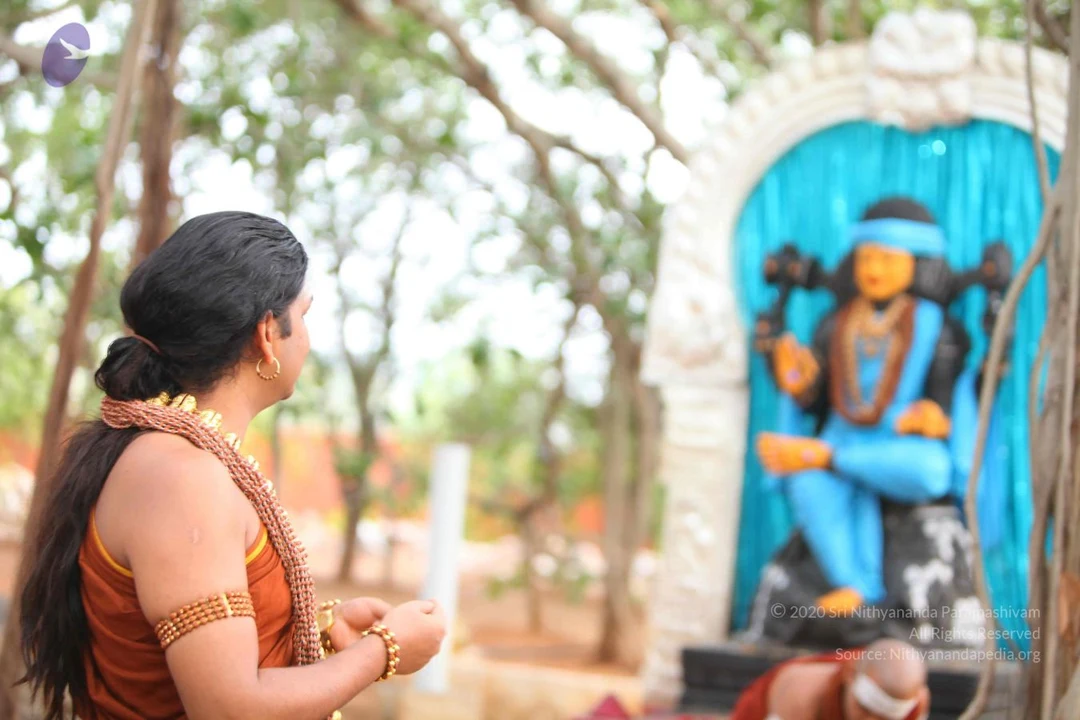
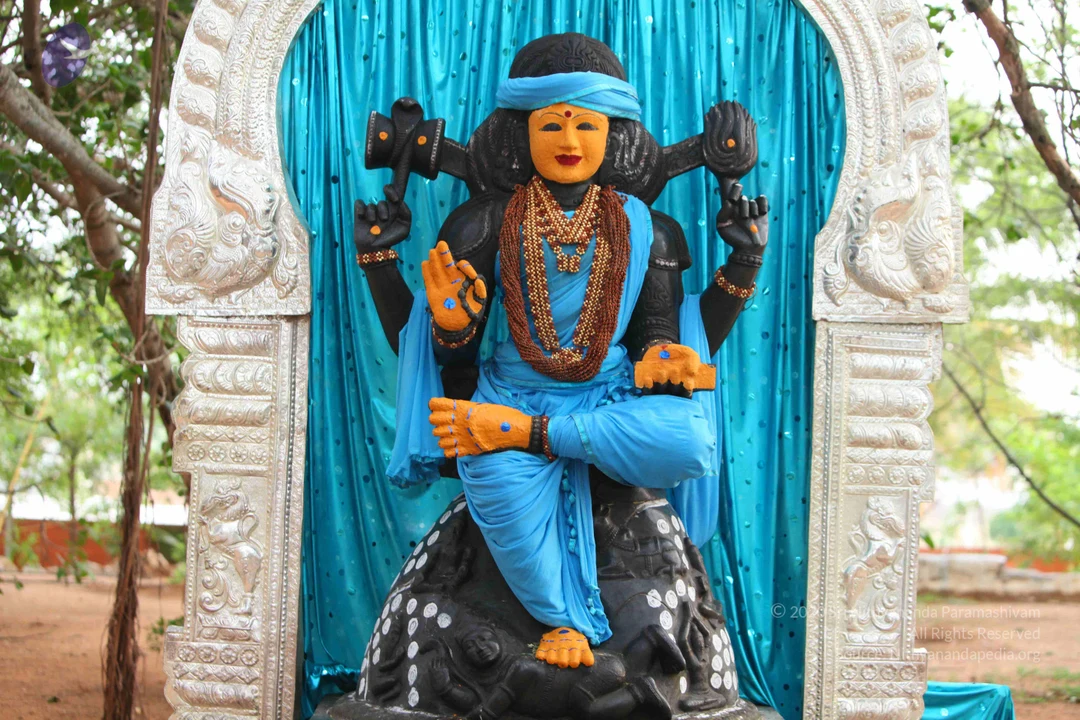
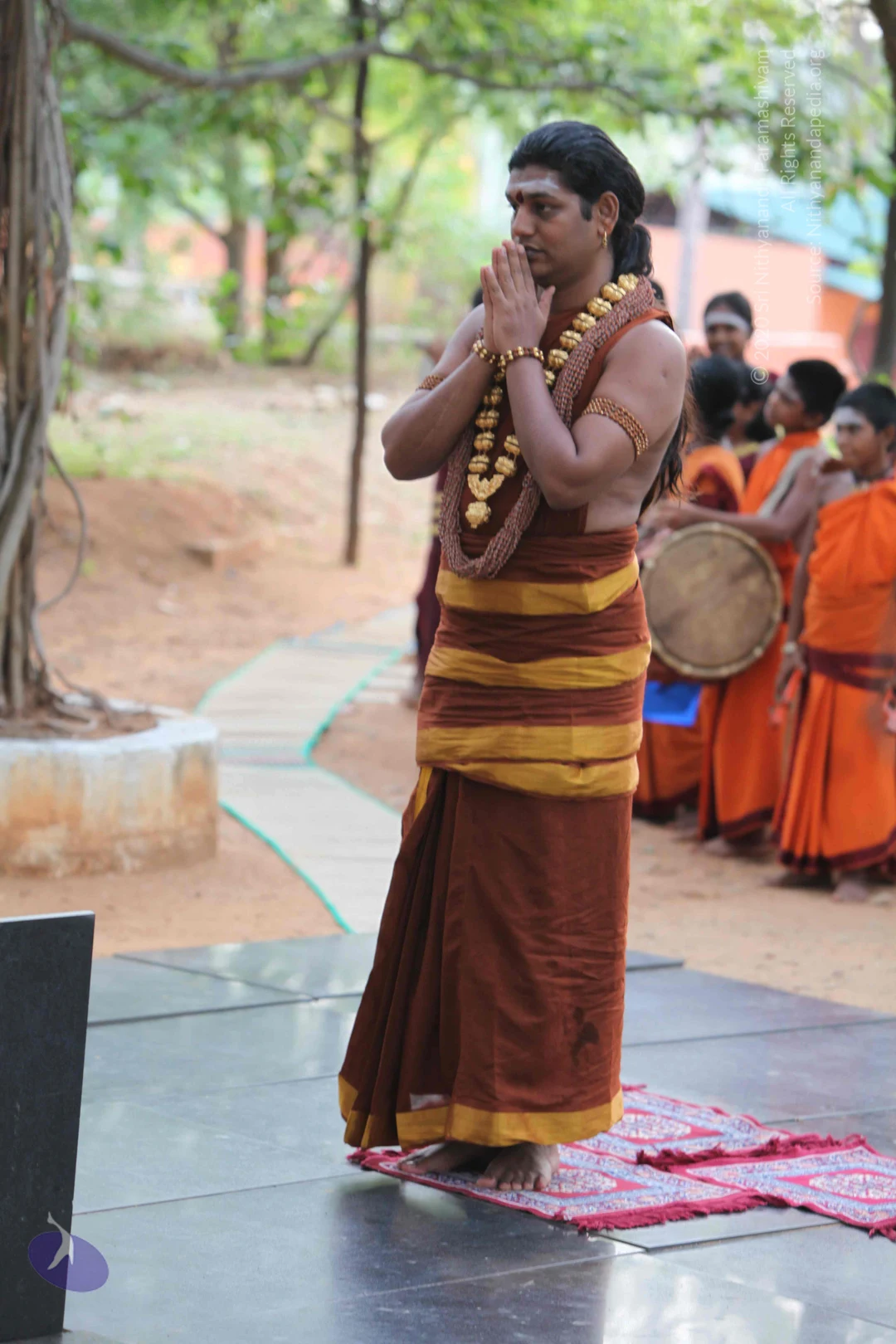
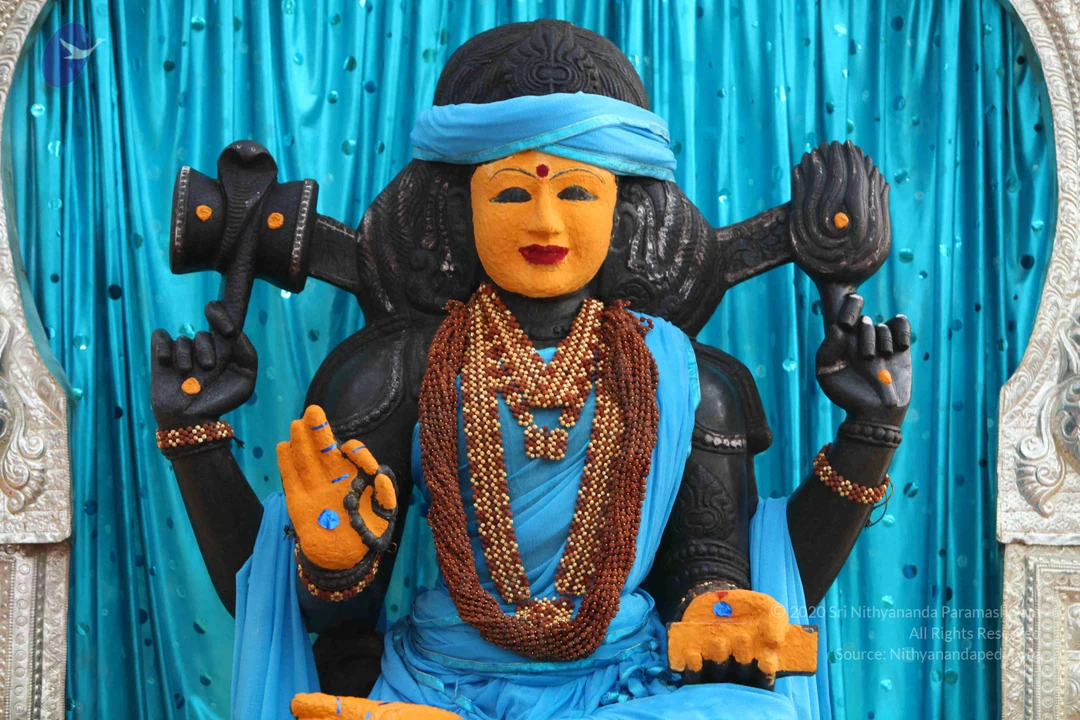
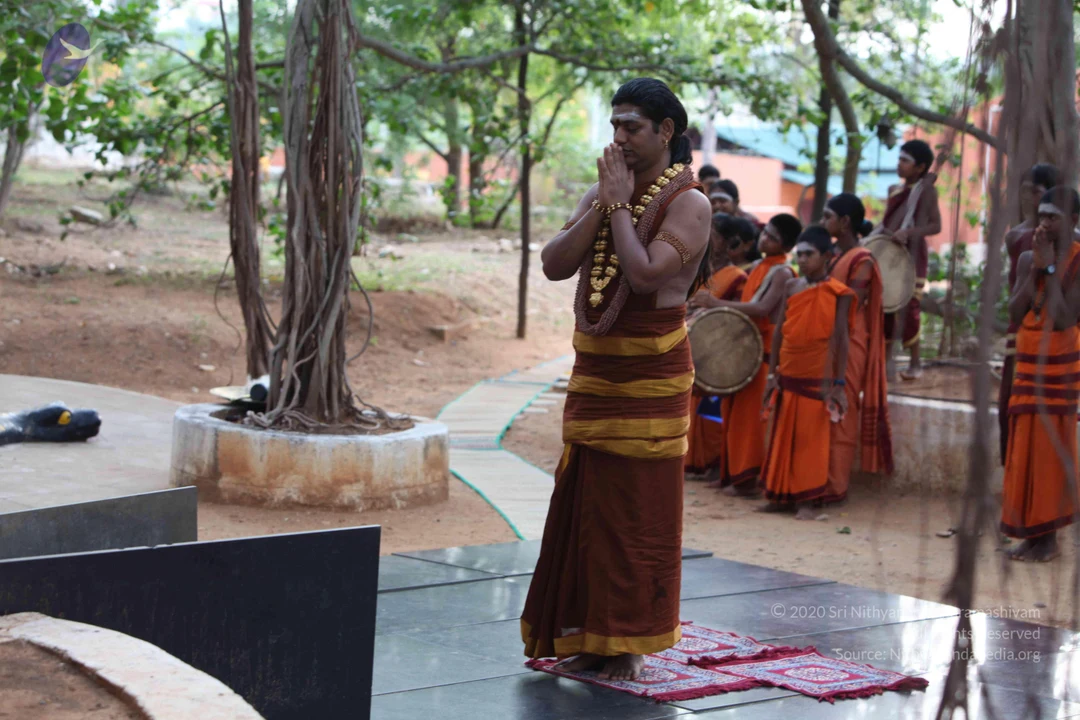
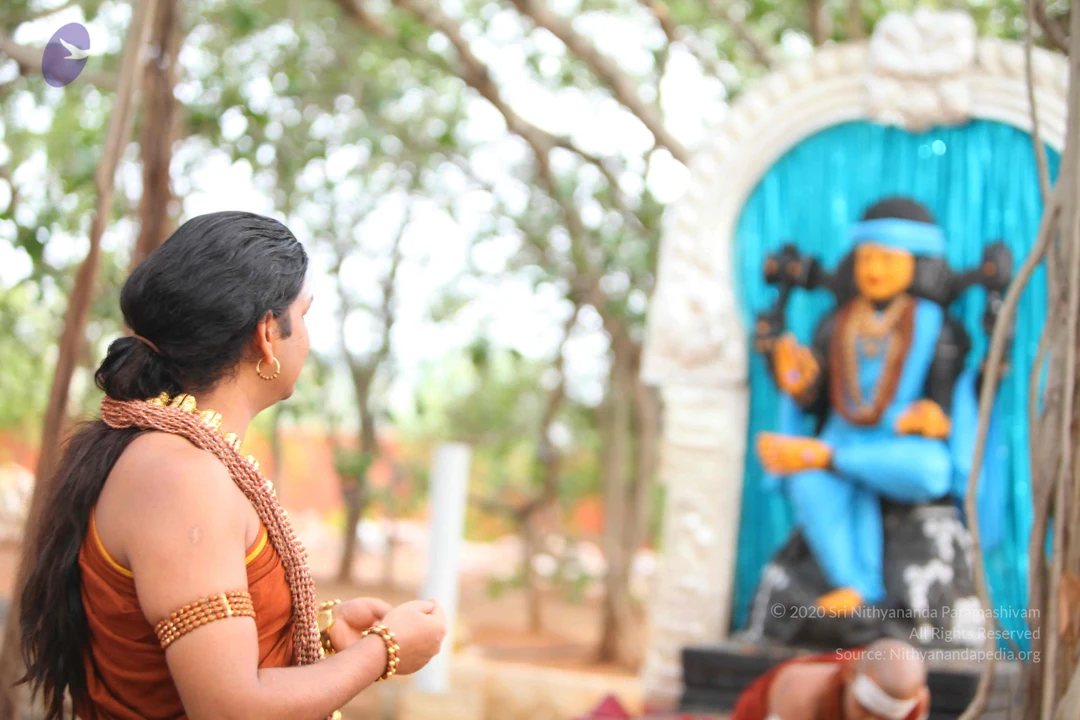
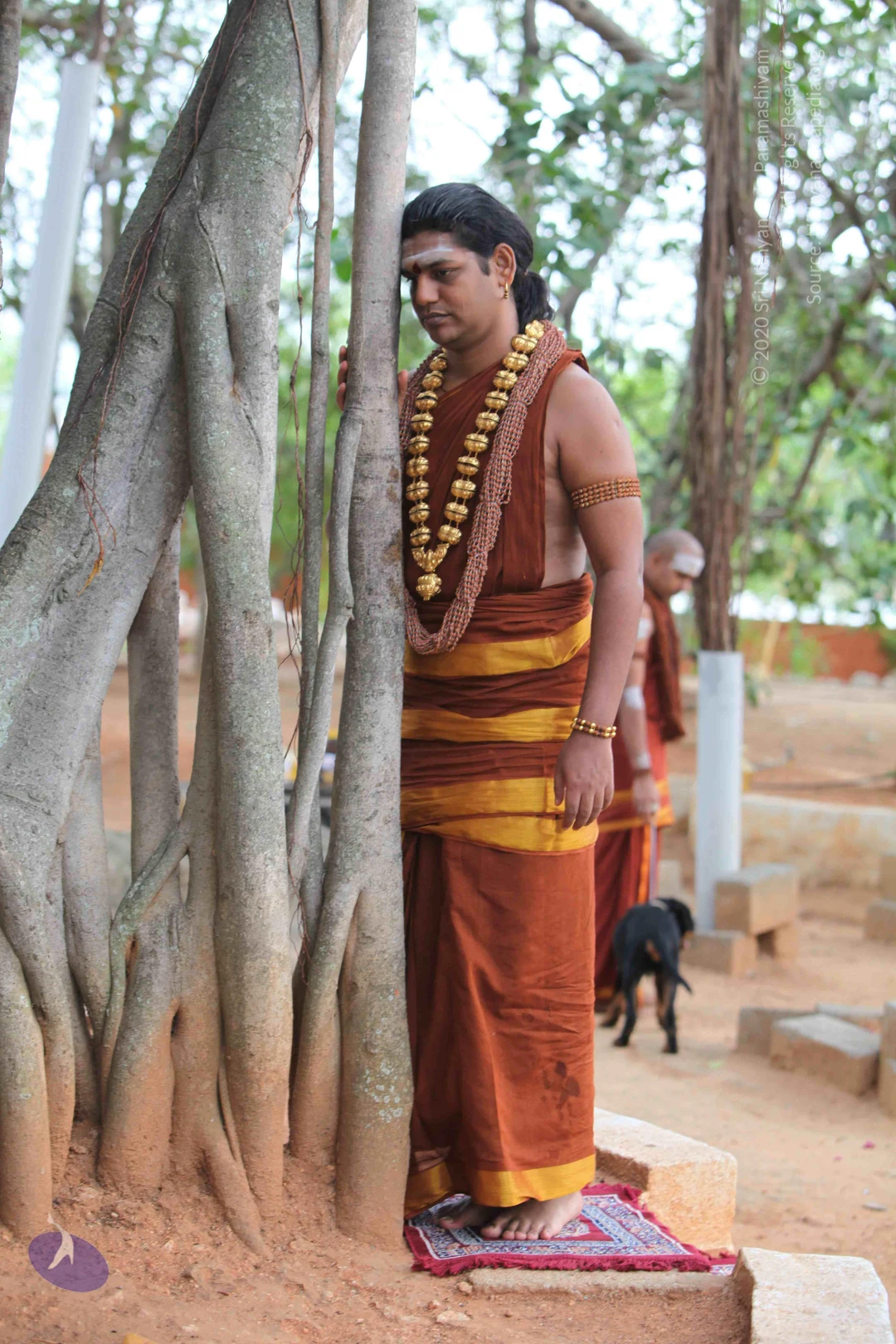
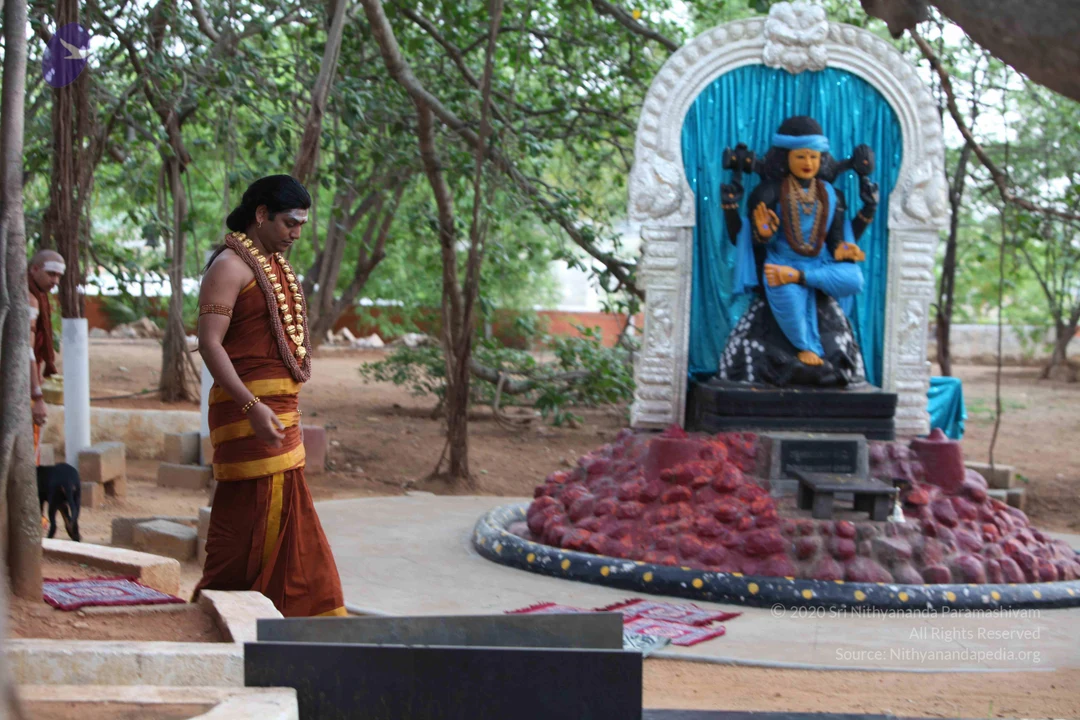
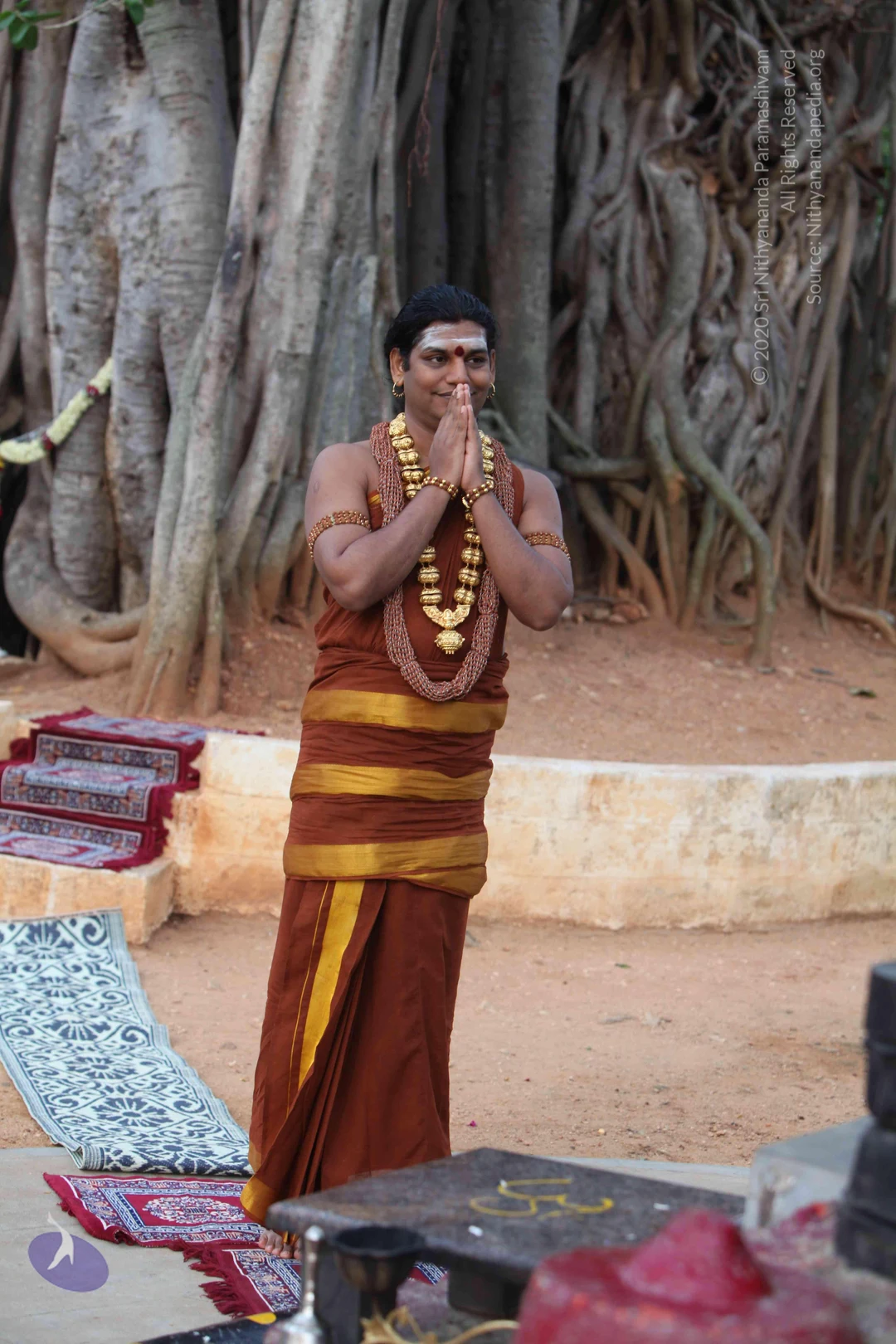
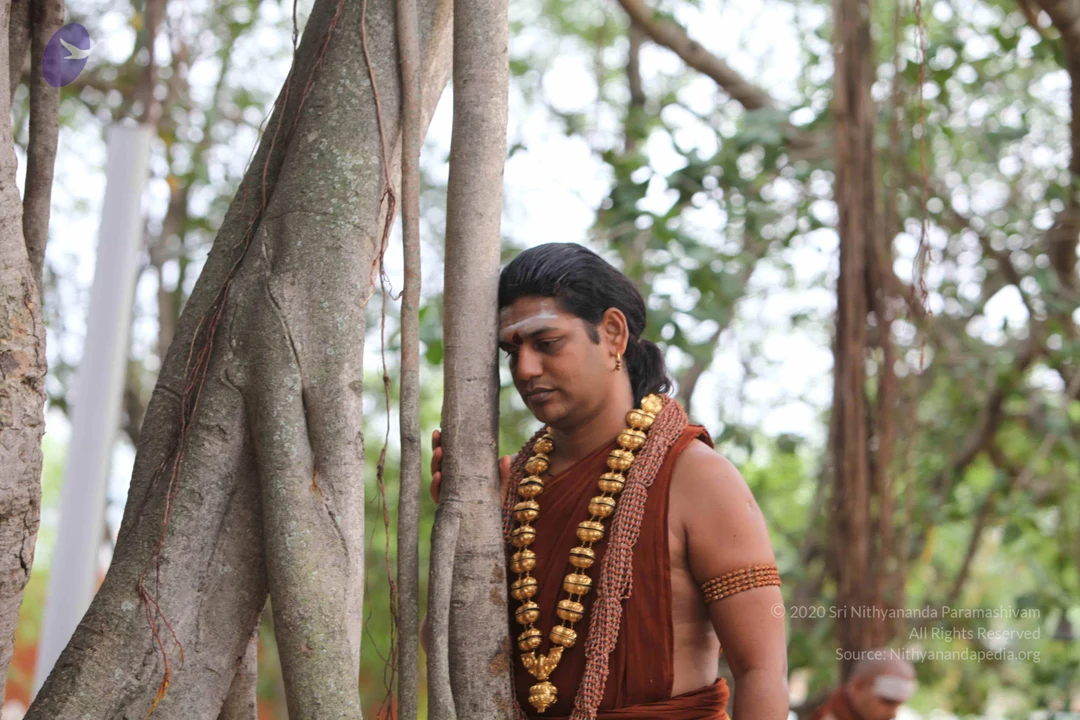
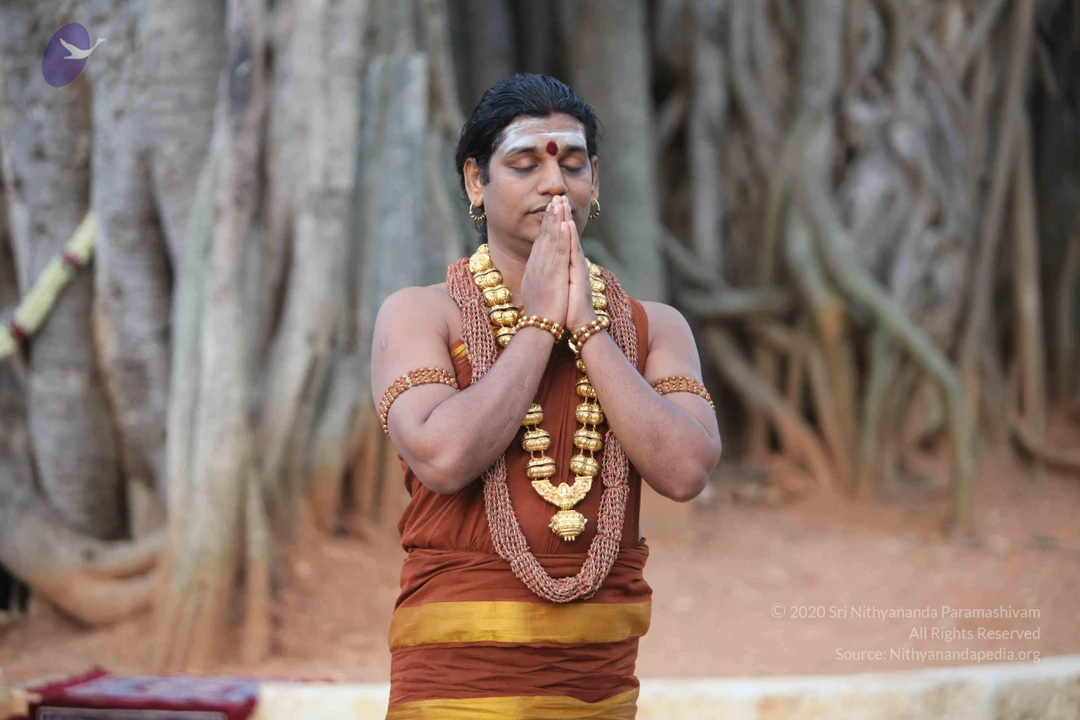
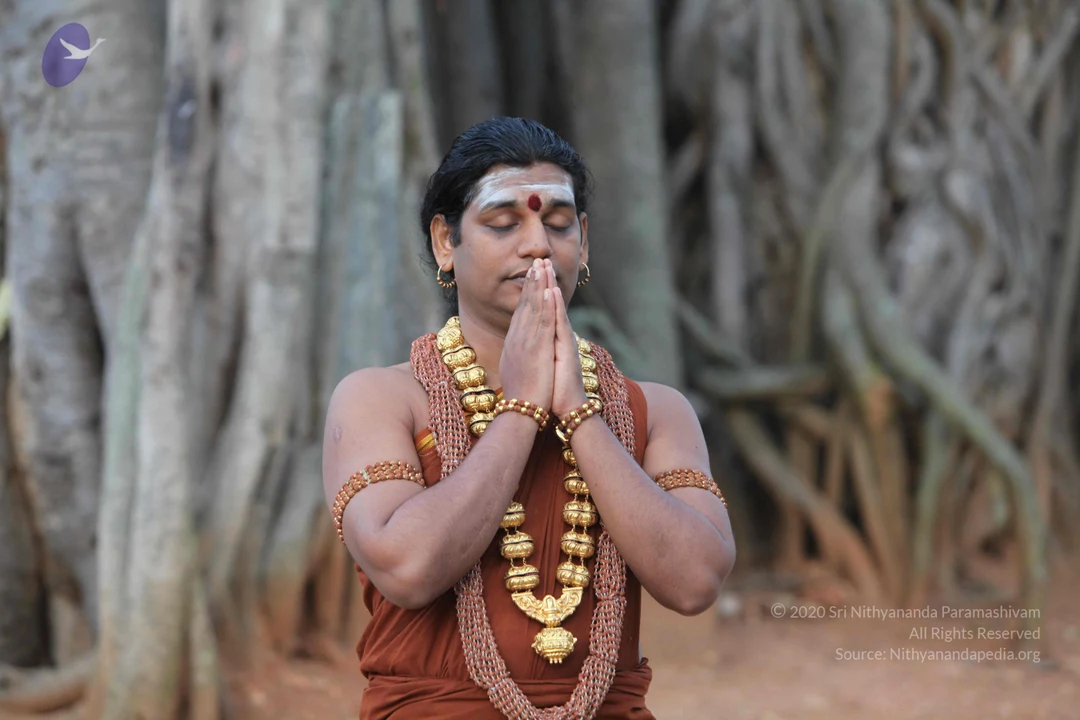
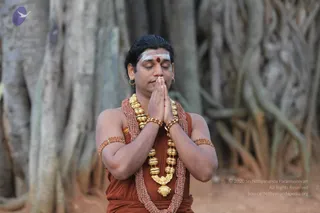
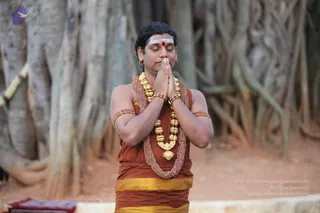
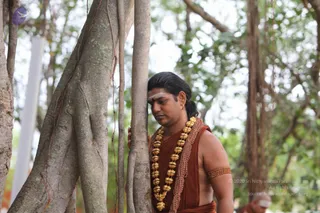
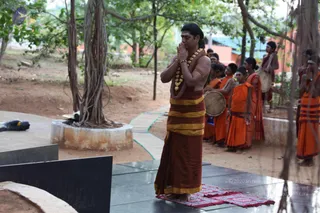
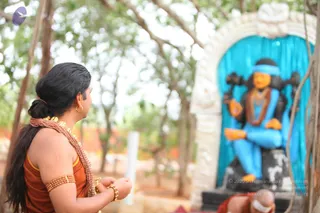
A man with short dark hair, eyes closed, sits with palms pressed together in anjali mudra before a large banyan tree with tangled aerial roots. He wears a white horizontal tilak with a red dot on his forehead, gold hoop earrings, a heavy gold bead necklace with a central gold pendant on a copper-coloured chain, gold armlets, and an orange-red saffron-toned cloth draped over his torso, bare-shouldered. a person: the man's appearance has several cues including ornate gold necklaces, orange-red ceremonial clothing and gold armlets, and the page identifies a person at this event.A man stands outdoors before large, gnarled banyan tree roots, his palms pressed together in anjali mudra with eyes closed. He wears a rust-orange wrap with a gold-striped hem, a rust-coloured rope-style necklace with heavy gold beads and a central gold pendant, gold armlets and bangles, and gold earrings. A white urdhva-style marking and a red bindi mark his forehead. Swami-style attire and bare shoulders are visible; a red cloth and a yellow flower garland lie at the lower left edge. a person appears as the person in orange, with ornate gold jewellery, in a prayer posture, consistent with a satsang or darshan setting.A man in a reddish-brown ochre robe stands with his head bowed and his hand resting against a thick tree trunk in a wooded outdoor setting. He wears a large gold bead necklace over a rust-coloured rudraksha-style mala, a gold armlet on his upper arm, and a white tilak on his forehead. His long dark hair is tied back. Other tree trunks and green foliage surround him, and part of another person in white with a white forehead mark is visible at the right edge.A photograph in an outdoor garden setting with tall trees. In the foreground a man with long dark hair tied back and a white tilak on his forehead walks along a stone path. He wears a rust-orange garment with a yellow sash and a dense ornate gold necklace with a rudraksha-style bead mala, and a gold armband. Behind him to the left, a second robed figure in orange stands partly visible, and a black dog is on the left. To the right, a blue-painted deity murti with multiple arms sits inside a white arched shrine framed by blue drapery, wearing a beaded necklace and a blue headband. In front of the shrine is a large mound of red kumkum-coated stones or offerings on a tiled platform, with small prayer mats on the ground.A man with long swept-back dark hair stands barefoot on a dark stone platform under trees, hands pressed together in anjali at his chest. He wears a reddish-brown dhoti with gold borders, a bare chest, a dark shawl and a long ornate gold-and-beaded necklace with a ceremonial garland. Behind him, several young boys in saffron-orange robes stand in a row, some holding hand drums and others with hands folded. A round concrete base with a tree stands to the left, and a few red-and-white cushions lie on the platform before him. Brick buildings and green trees are visible in the background.A photograph taken outdoors under shady trees. In the foreground a person seen from behind, with long black hair tied back, gold earrings, gold bangles on the arm, and a rust-orange garment with a rudraksha-style beaded necklace, faces a blue-painted deity murti seated on a black pedestal inside a white arched shrine framed by a turquoise backdrop. The blue murti has a blue headband, orange hands, and beaded necklaces. Reddish earth and blurred foliage fill the background, and a small flame or offering stands near the base of the shrine.

01-TEMPLE
11 photosSource gallery
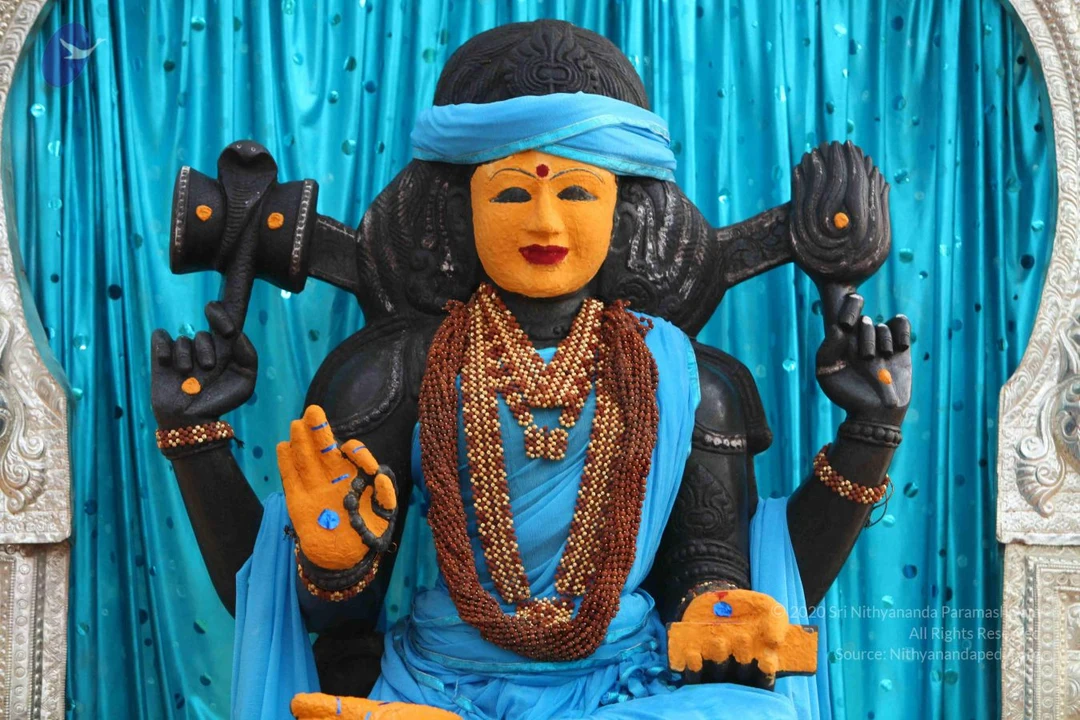
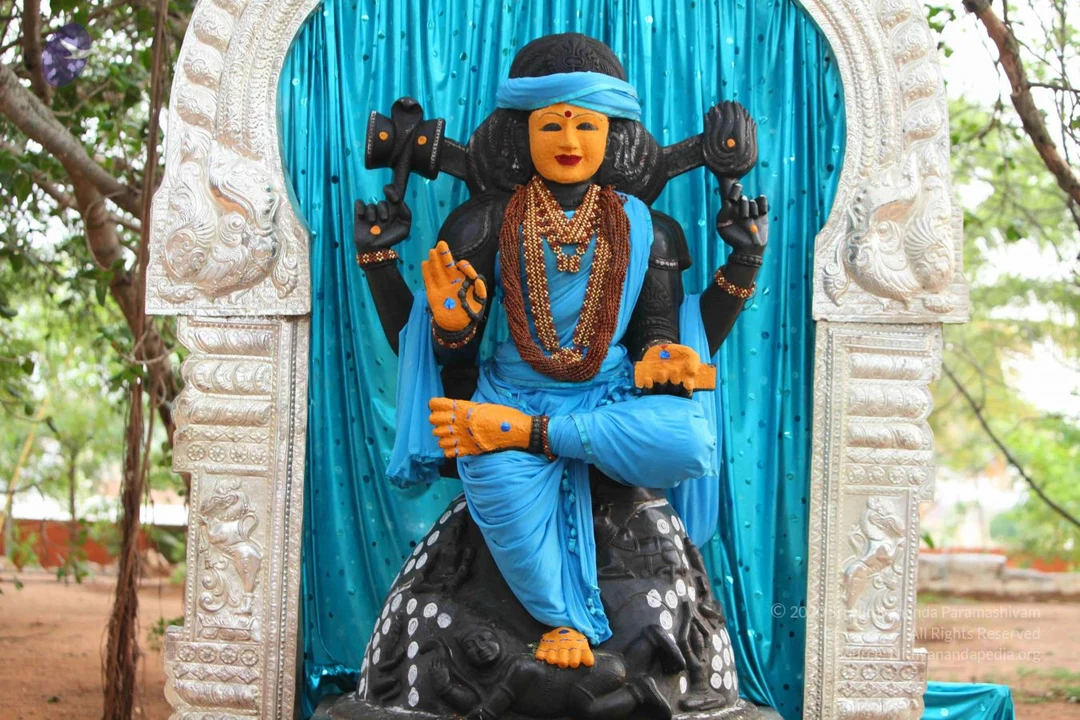
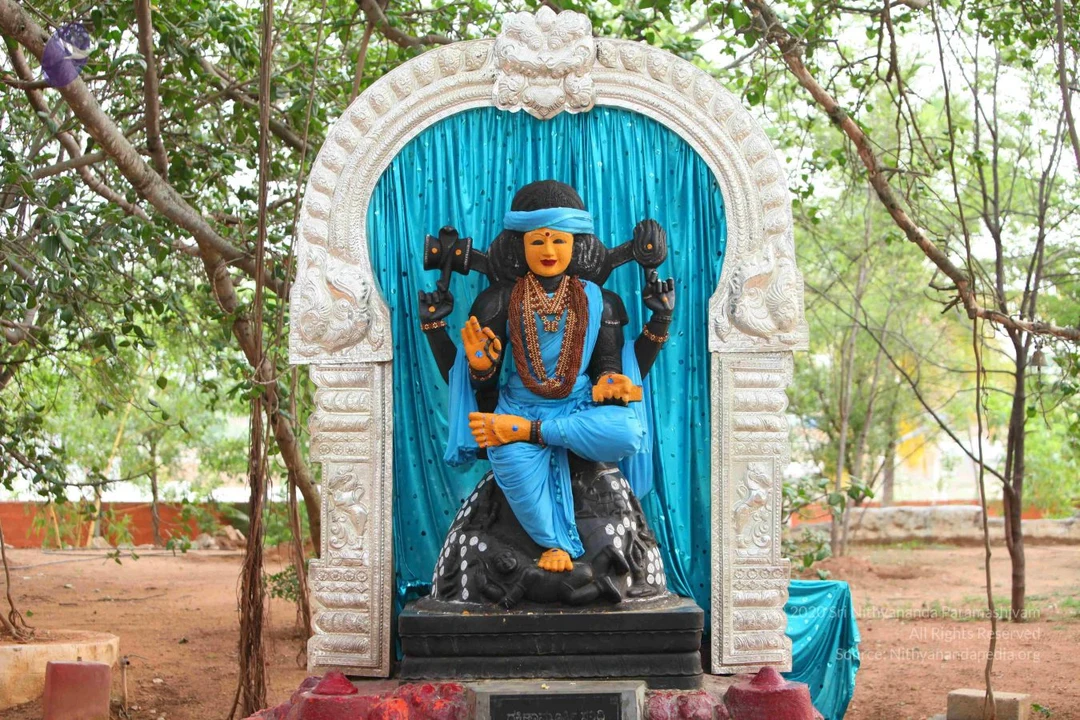
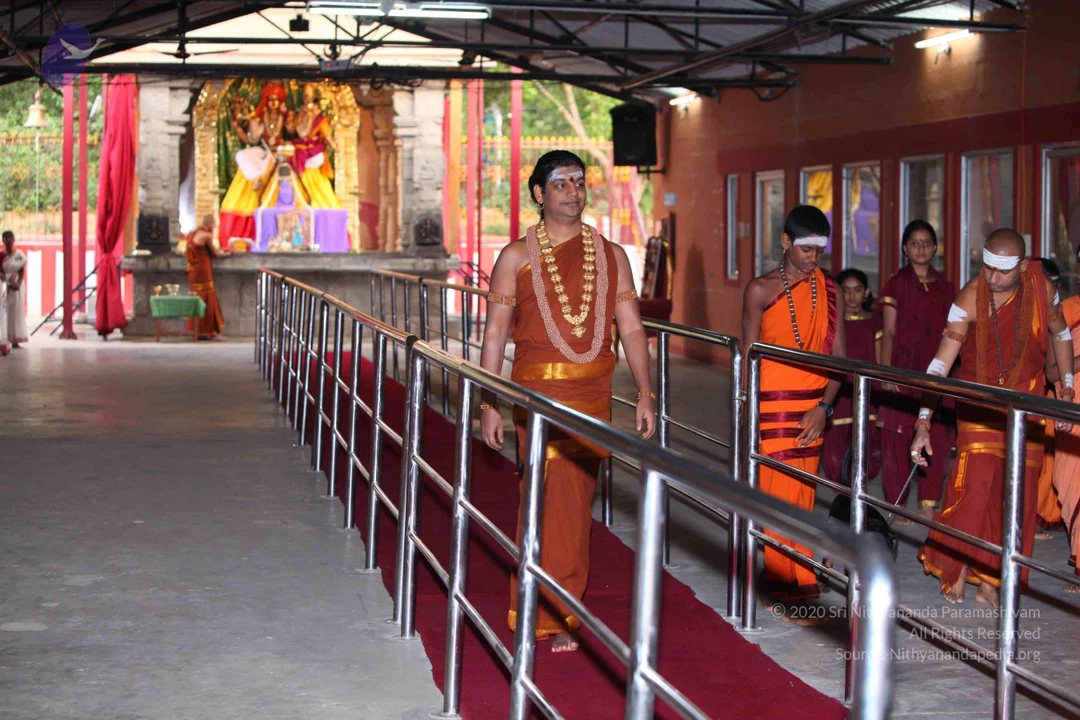
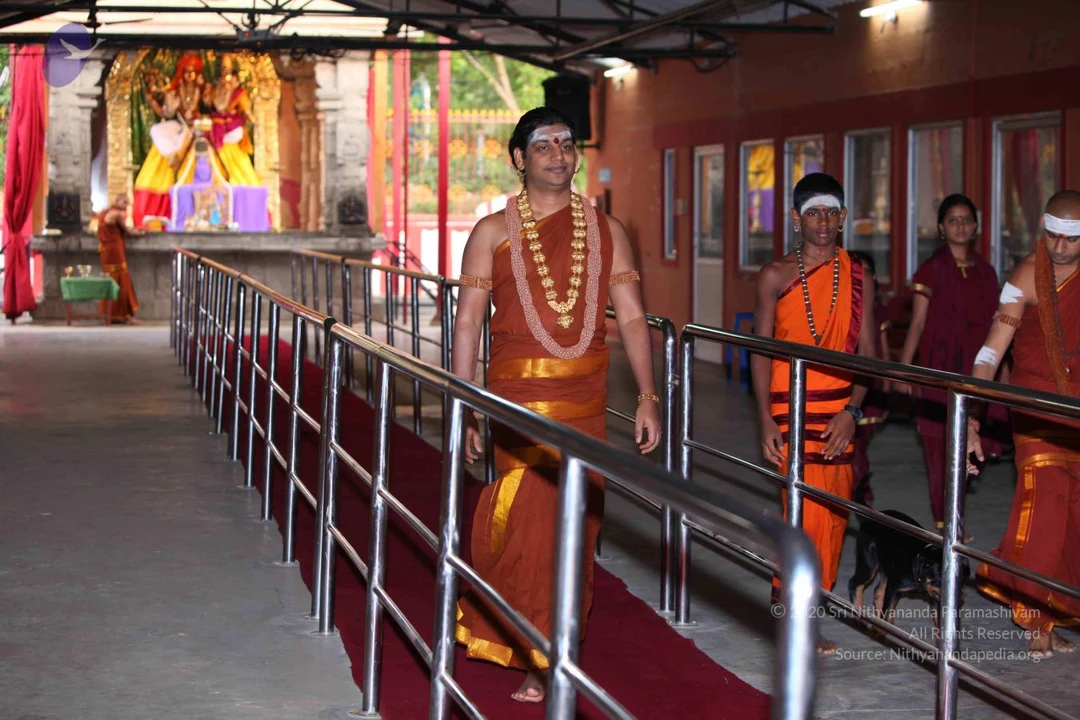
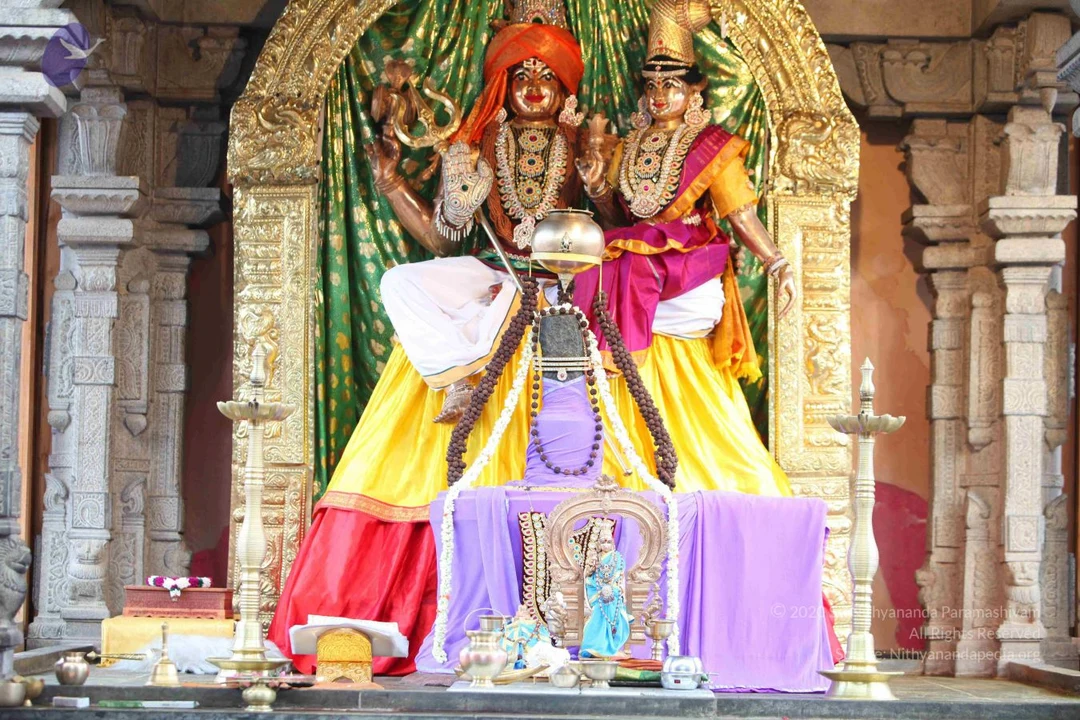
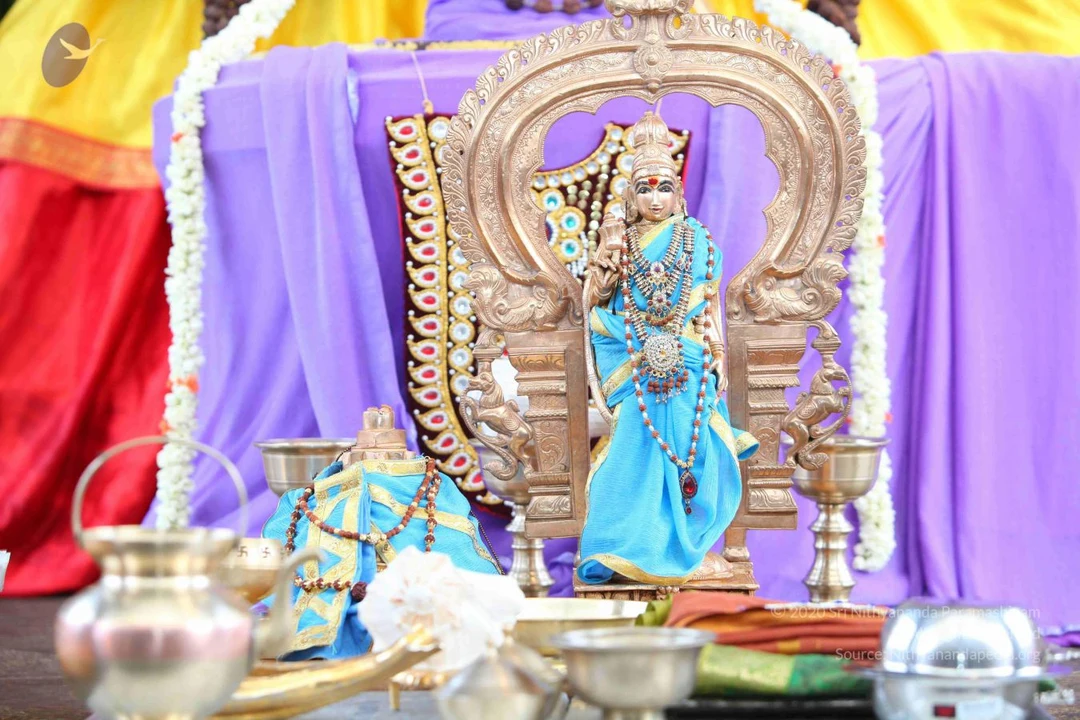
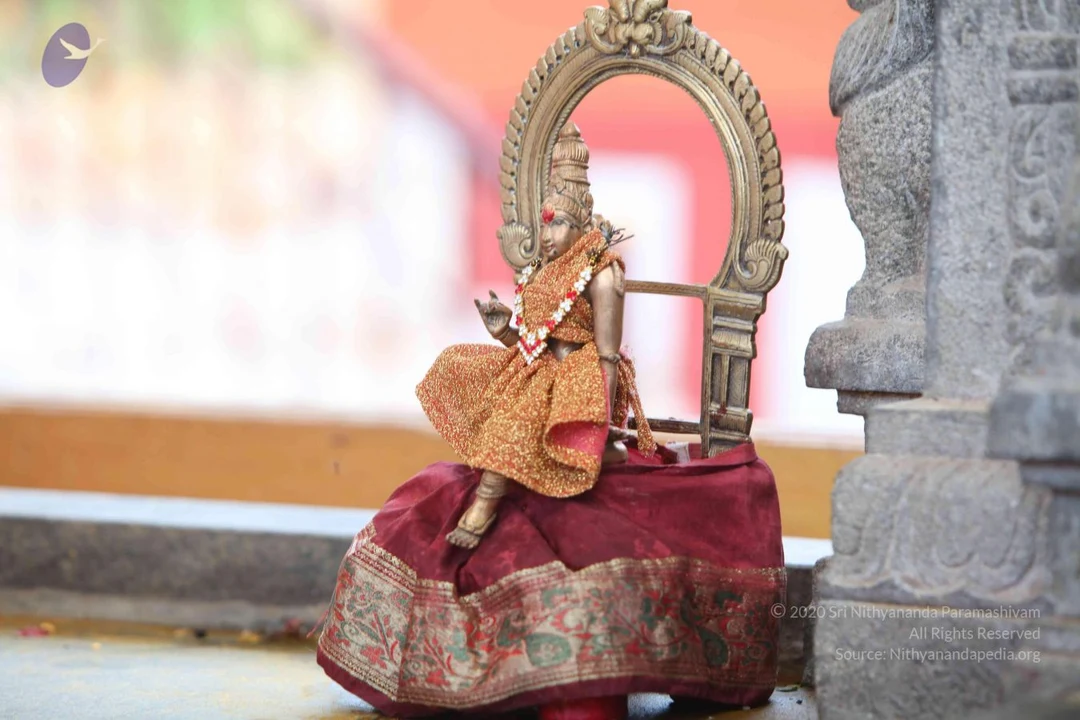
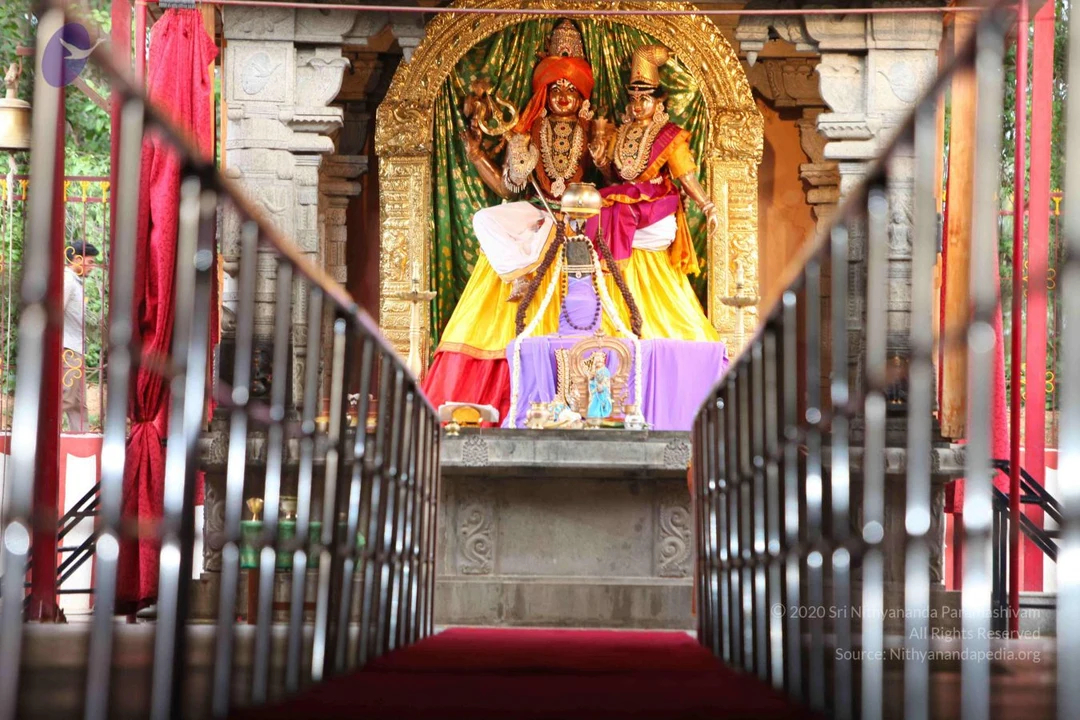
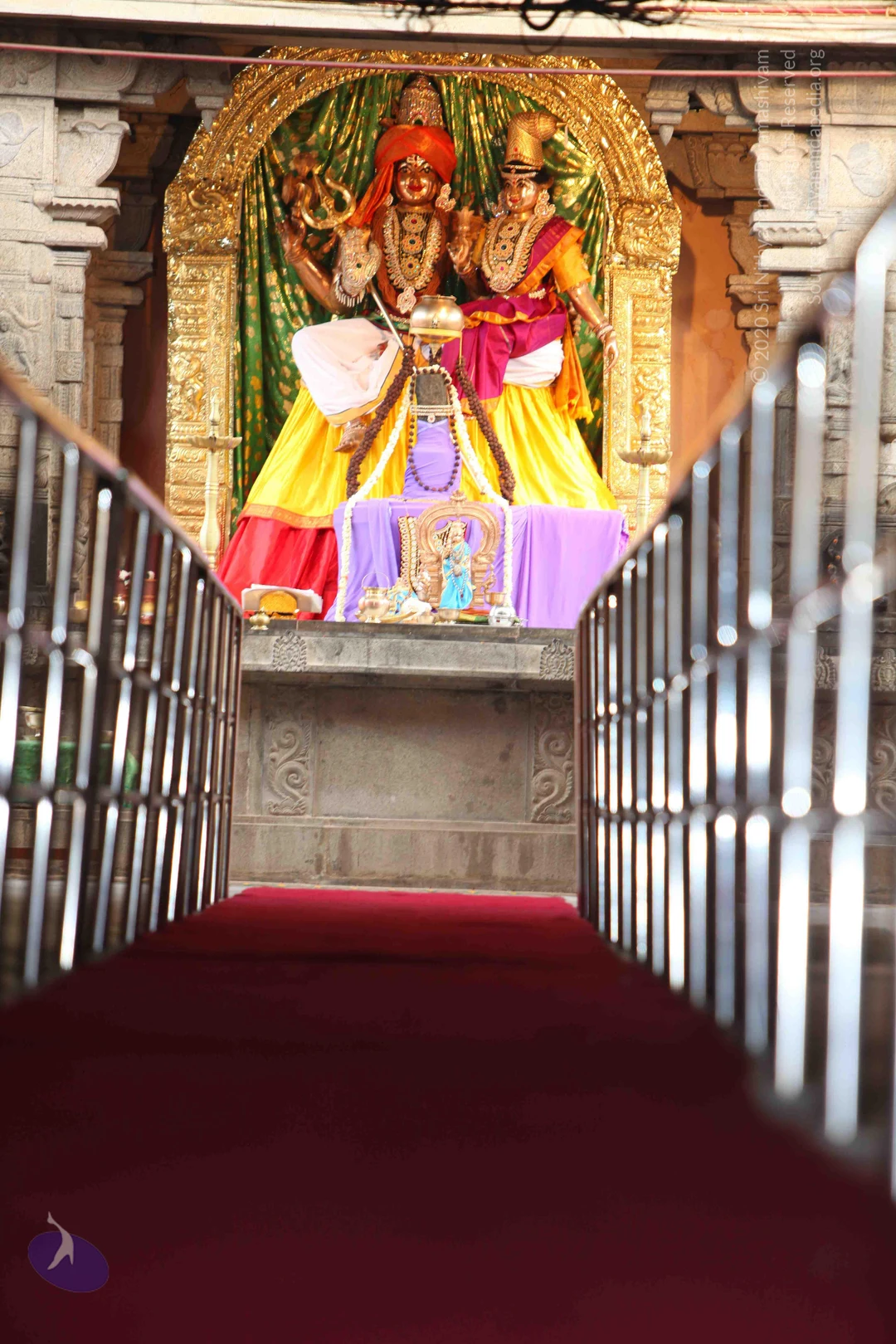
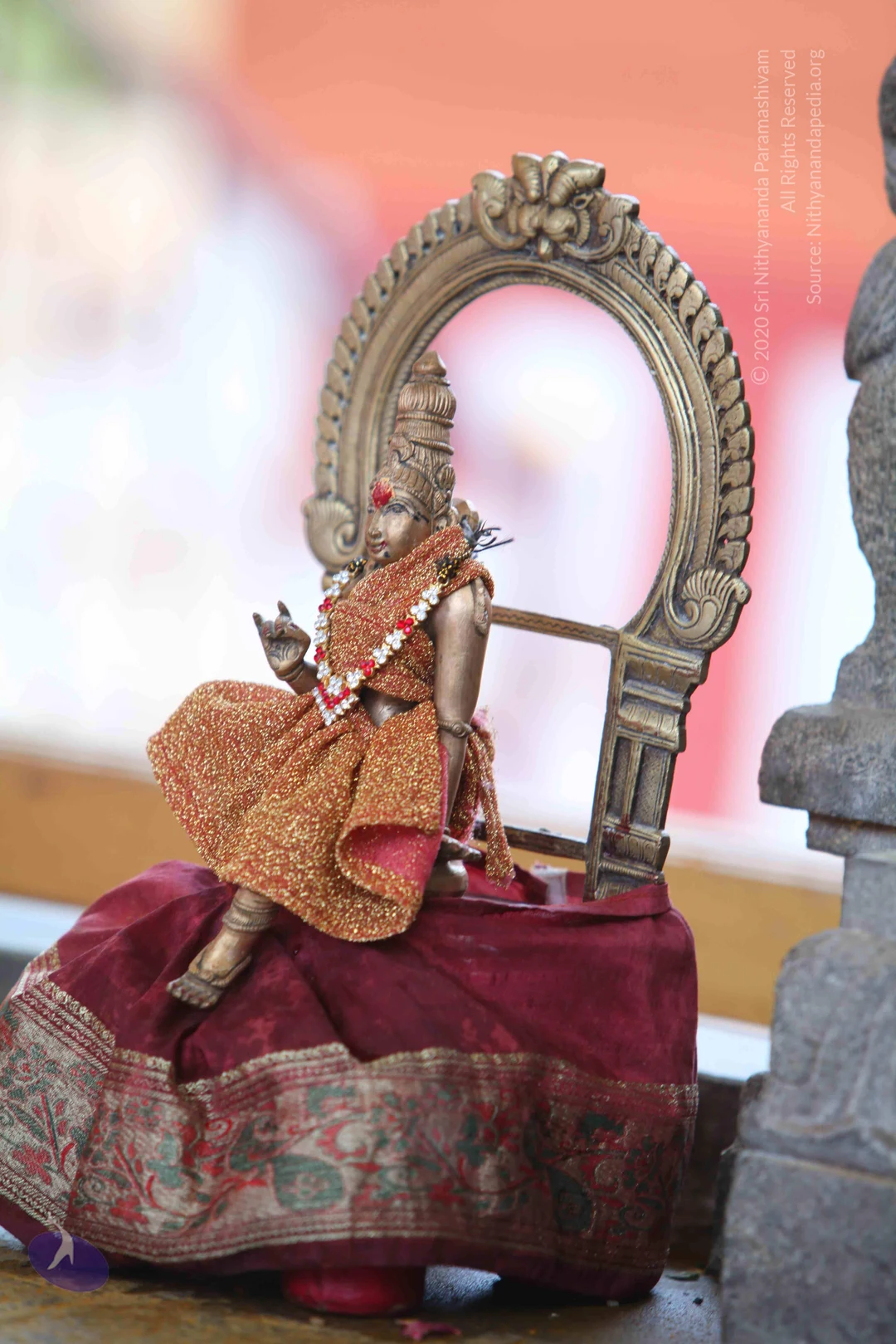
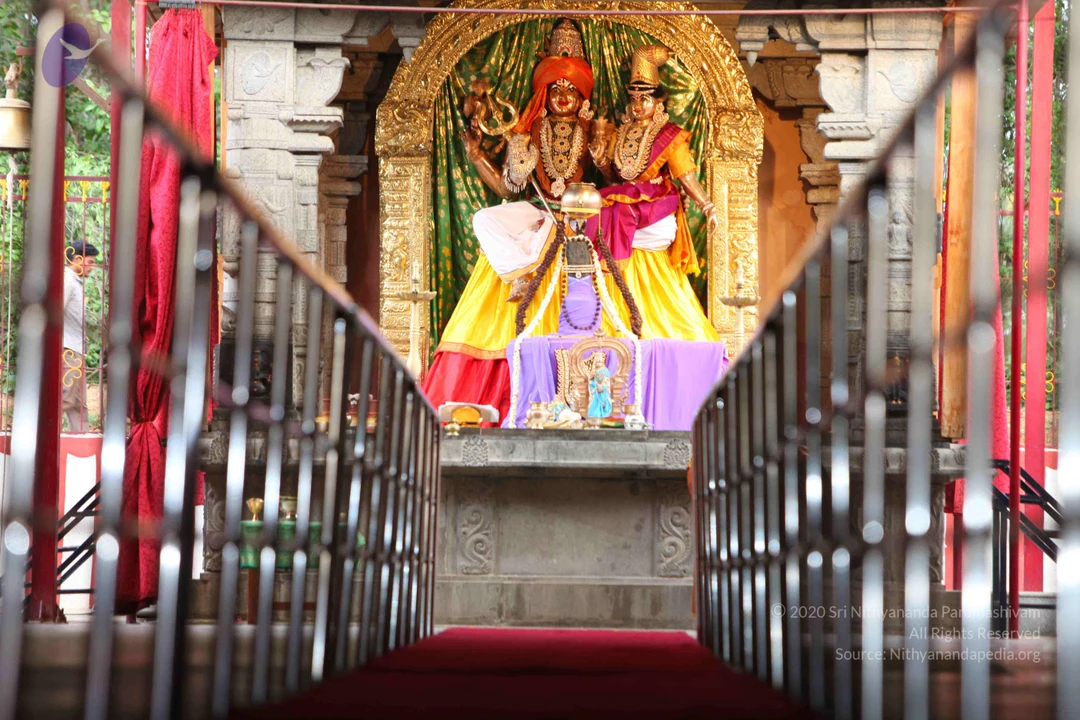
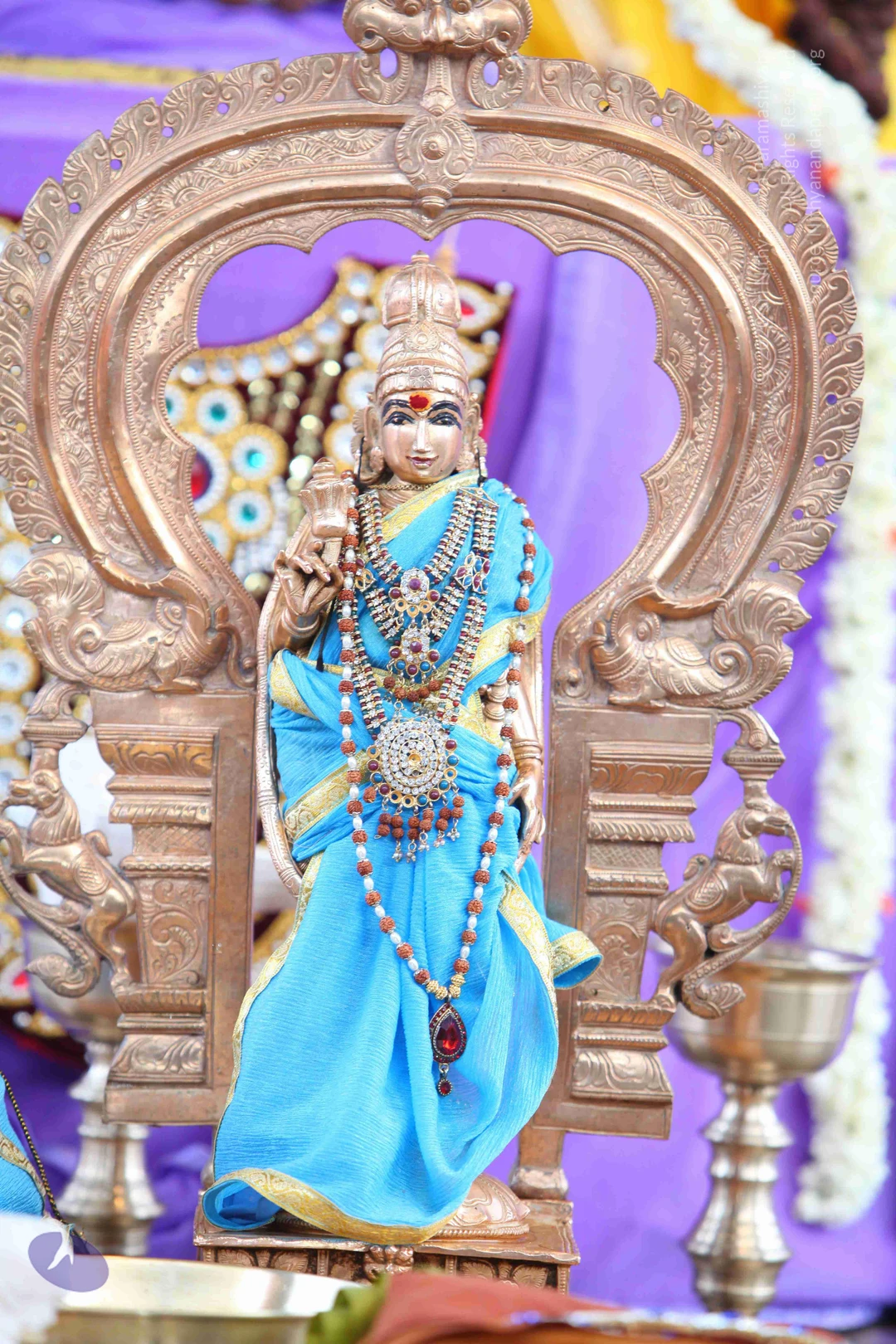
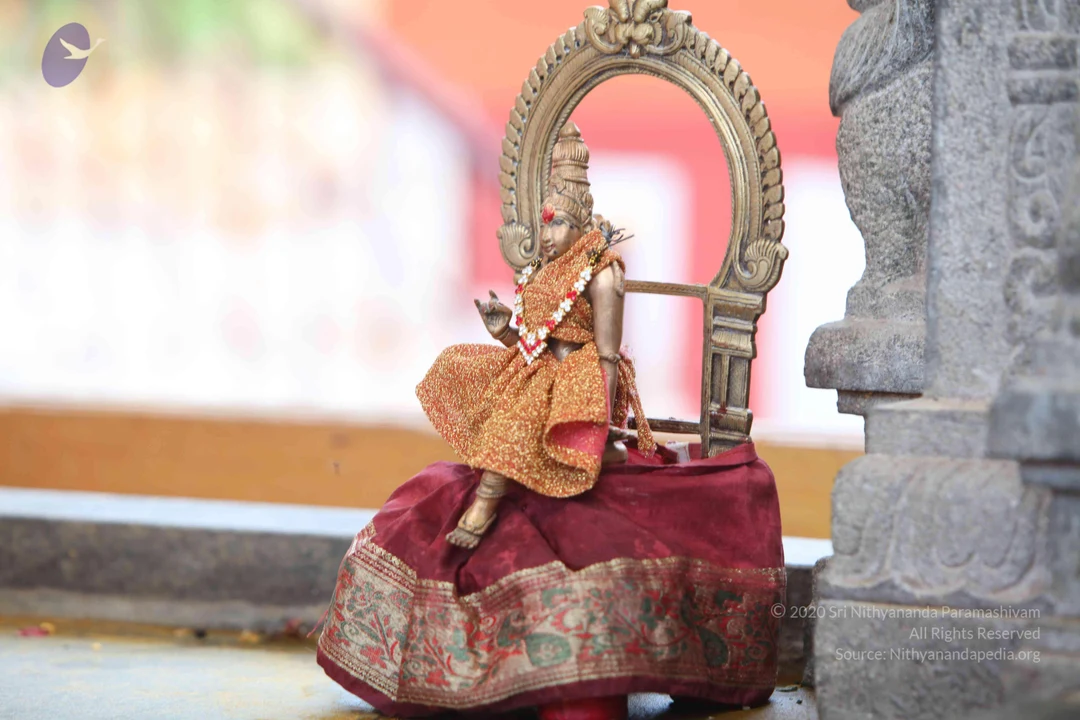
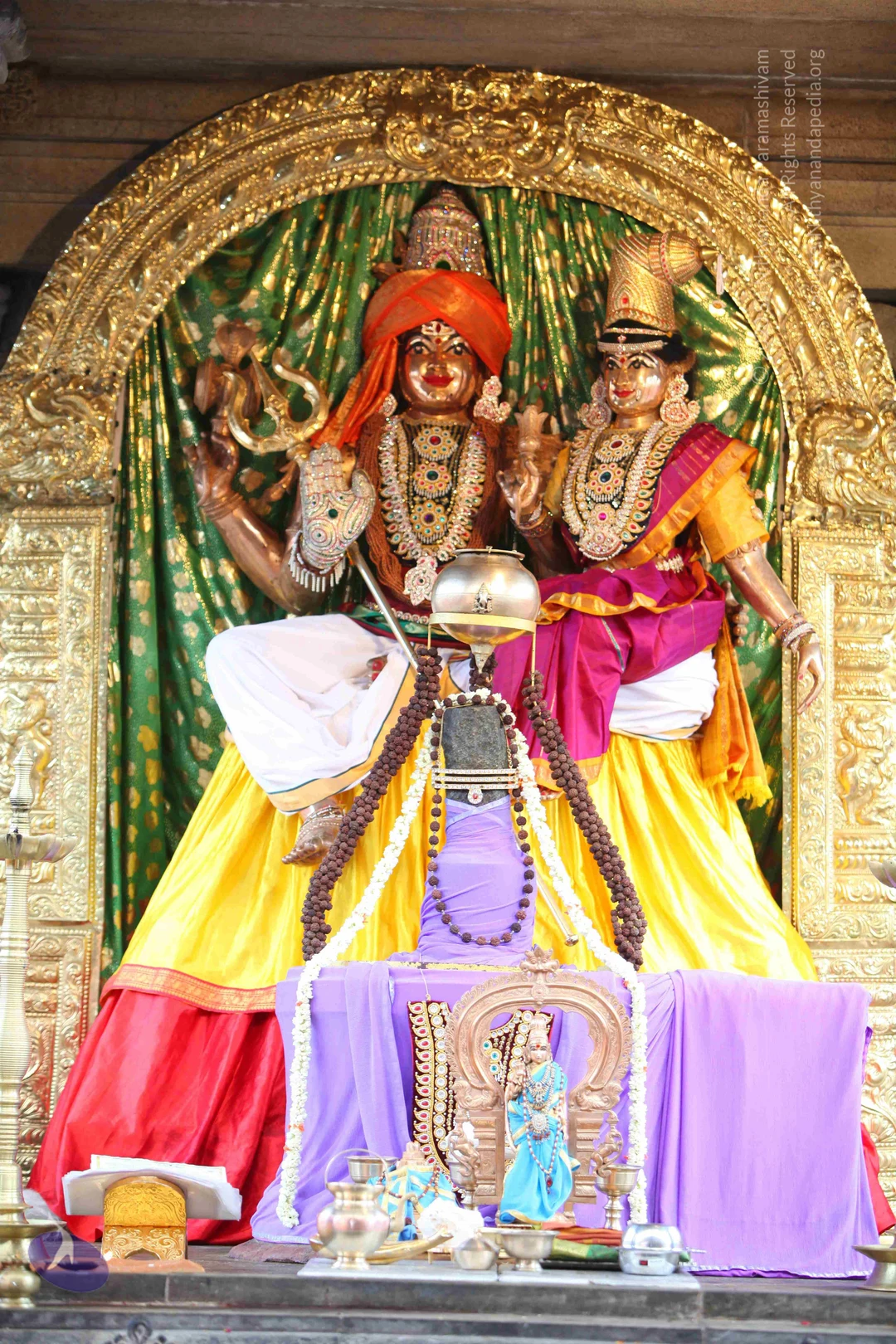
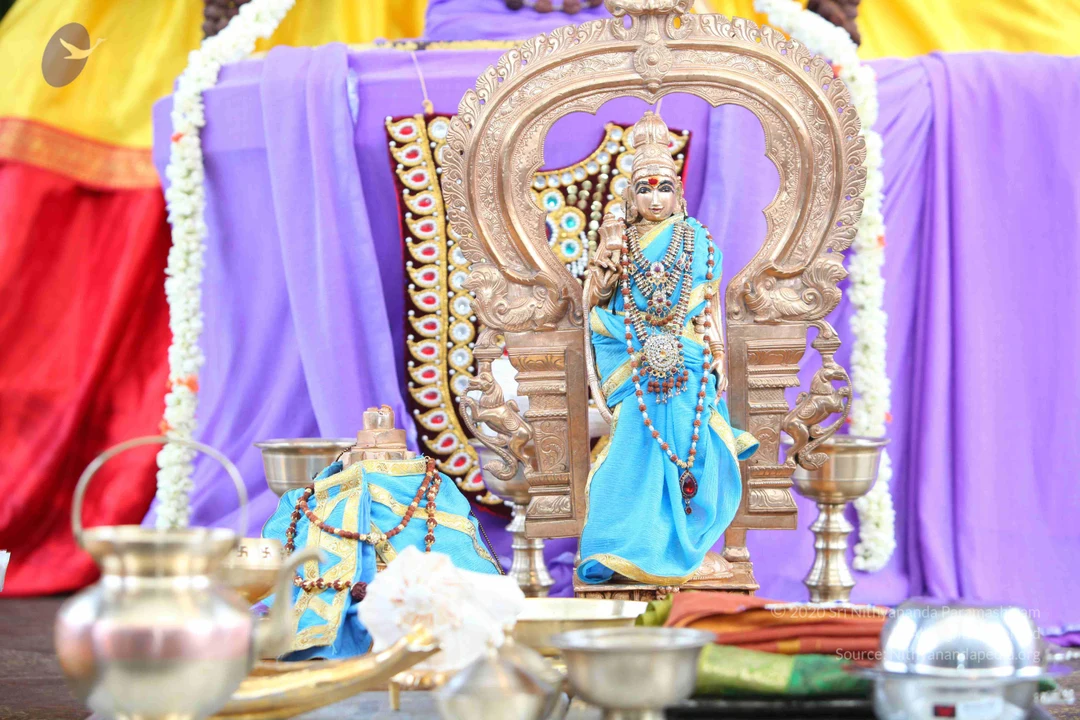
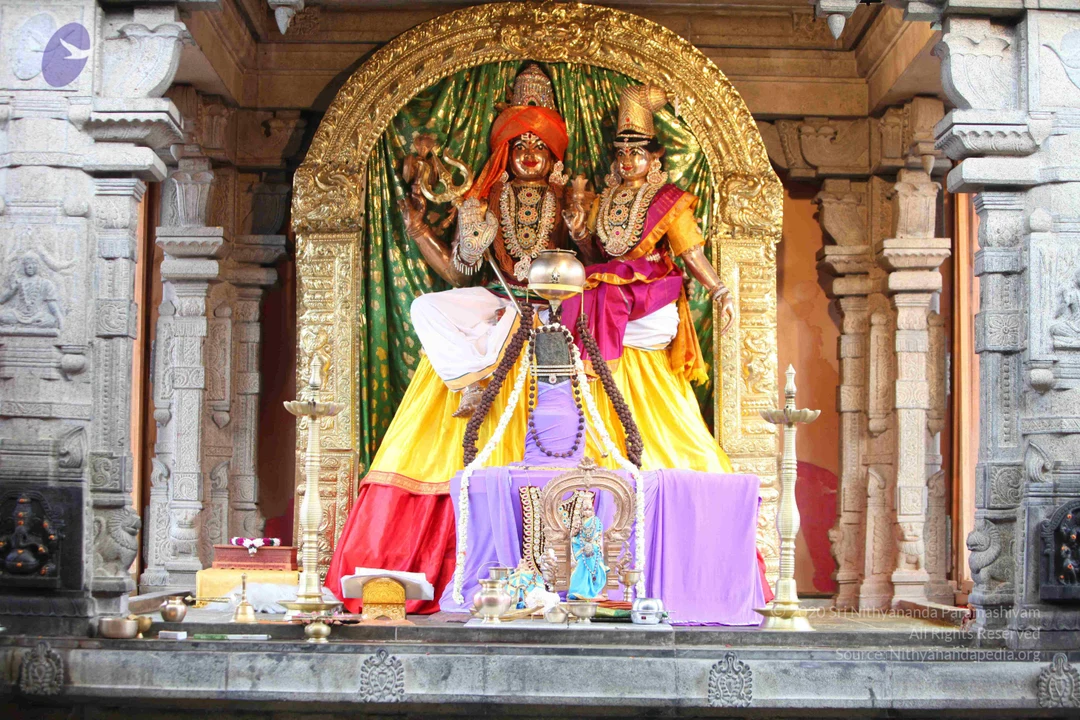
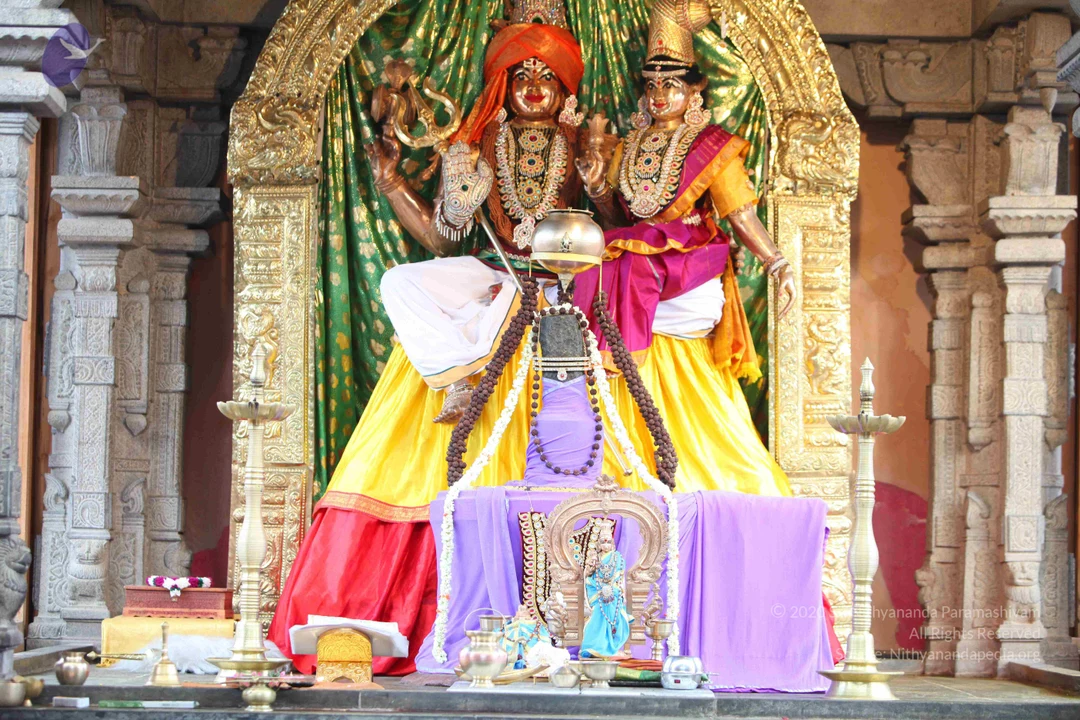
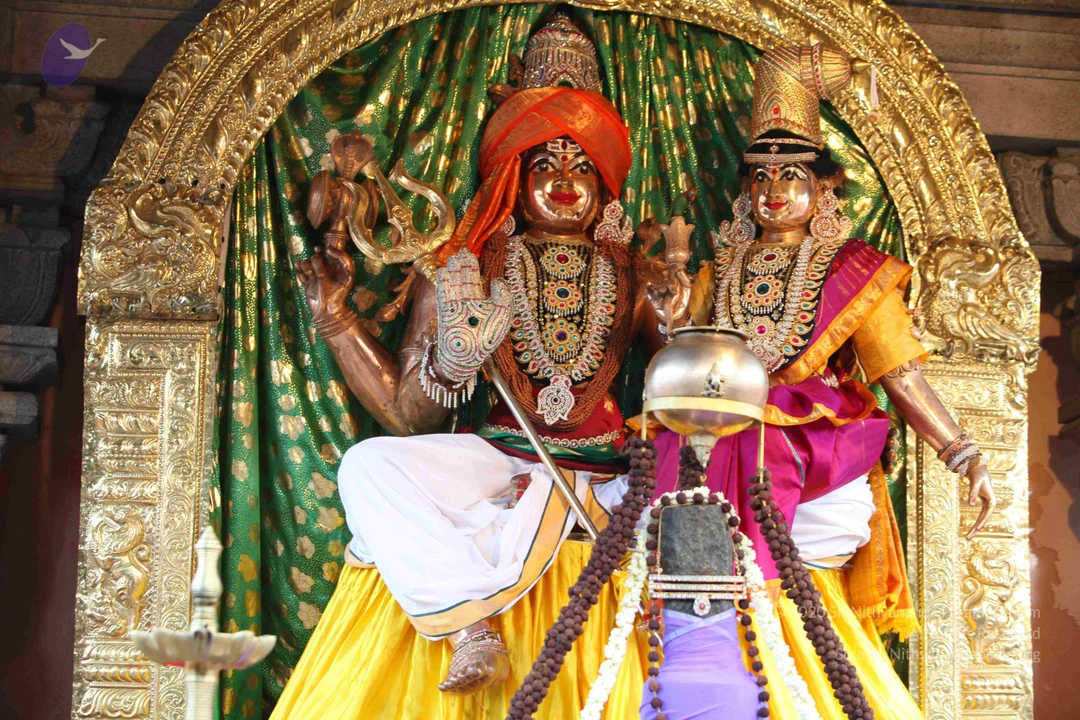
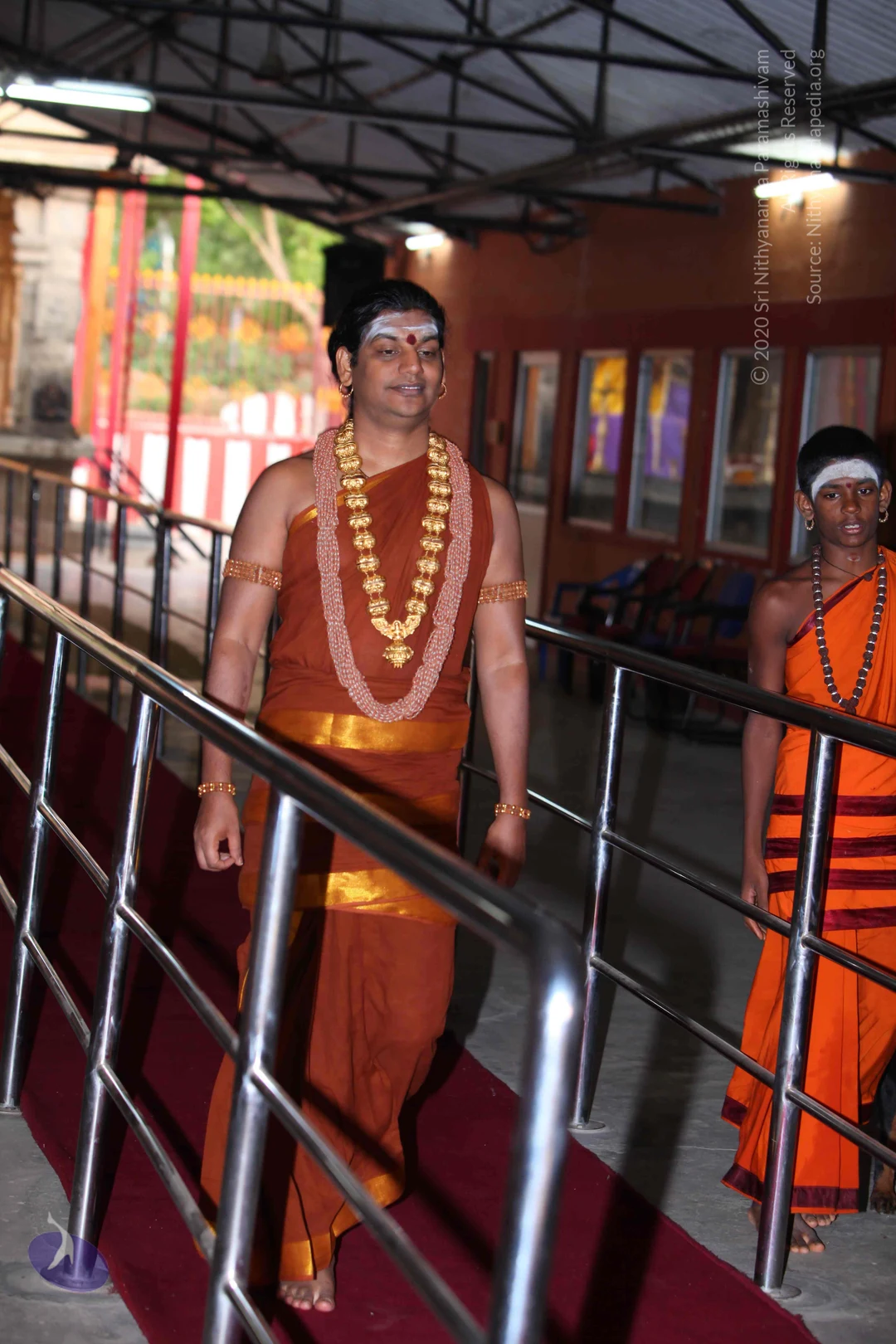
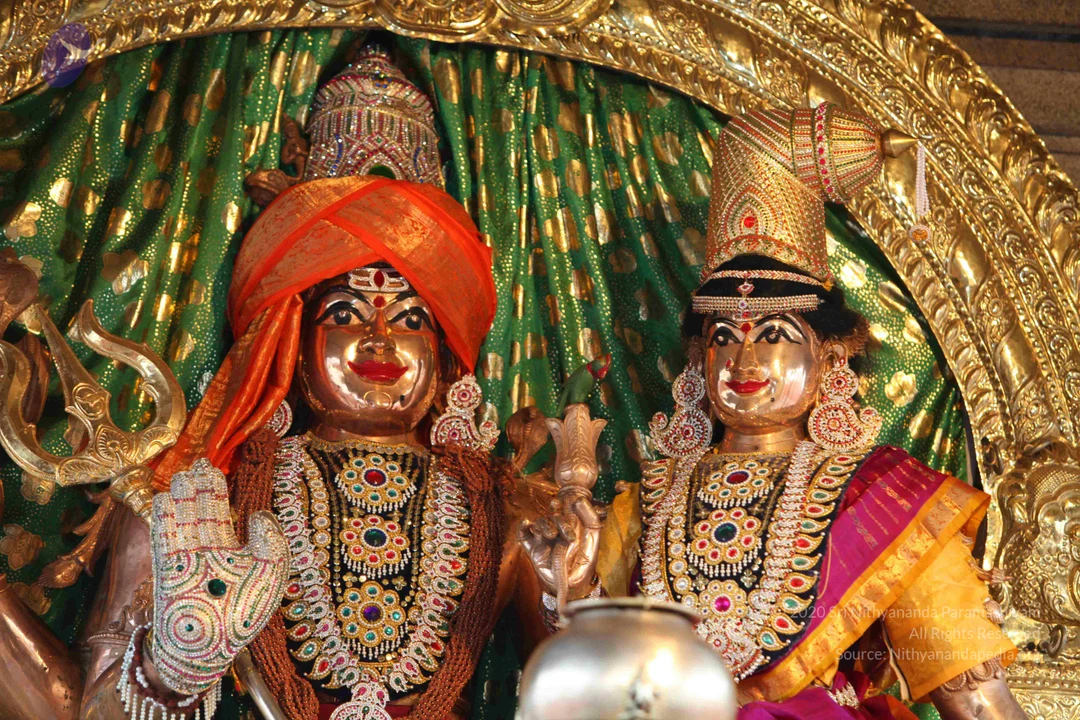
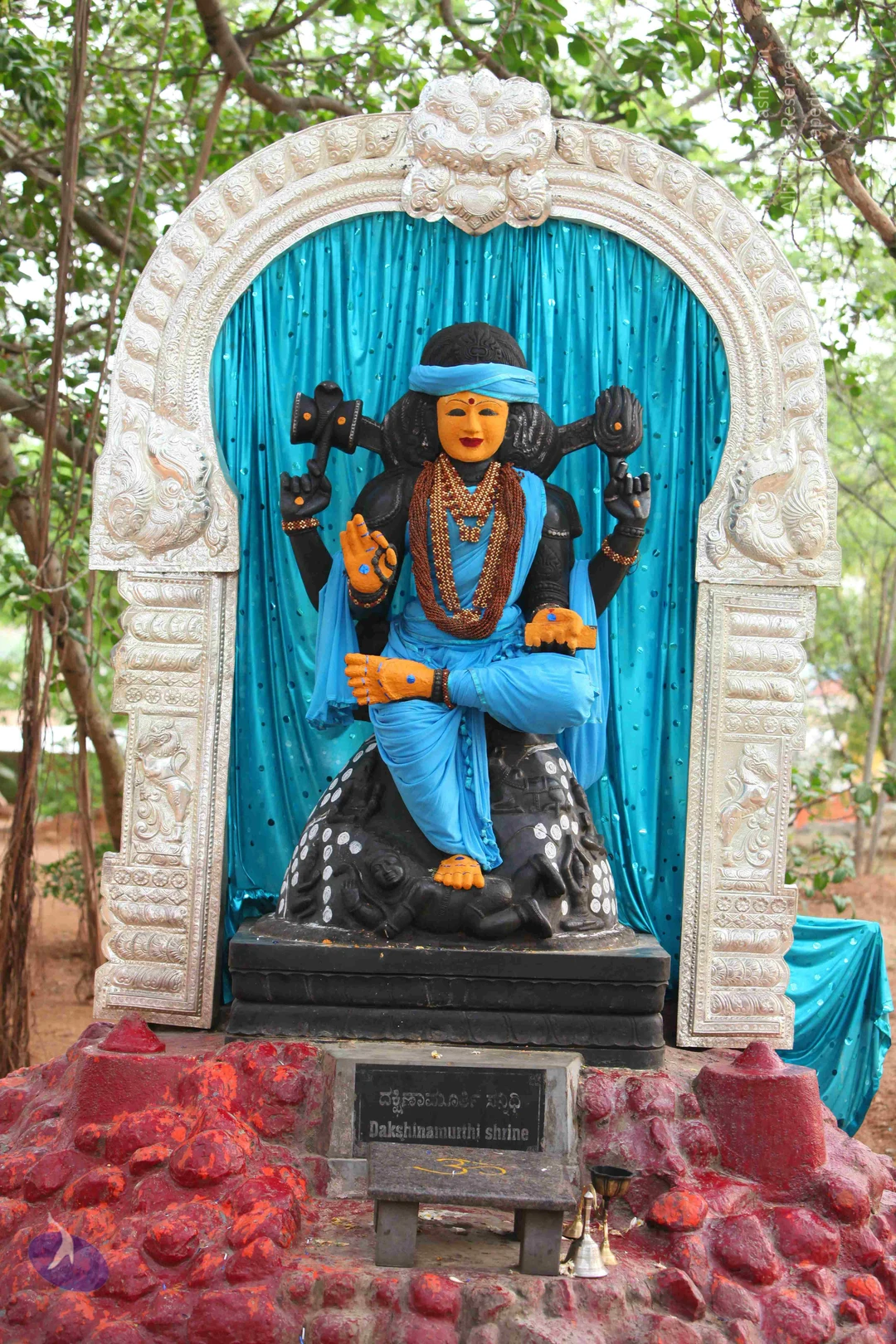
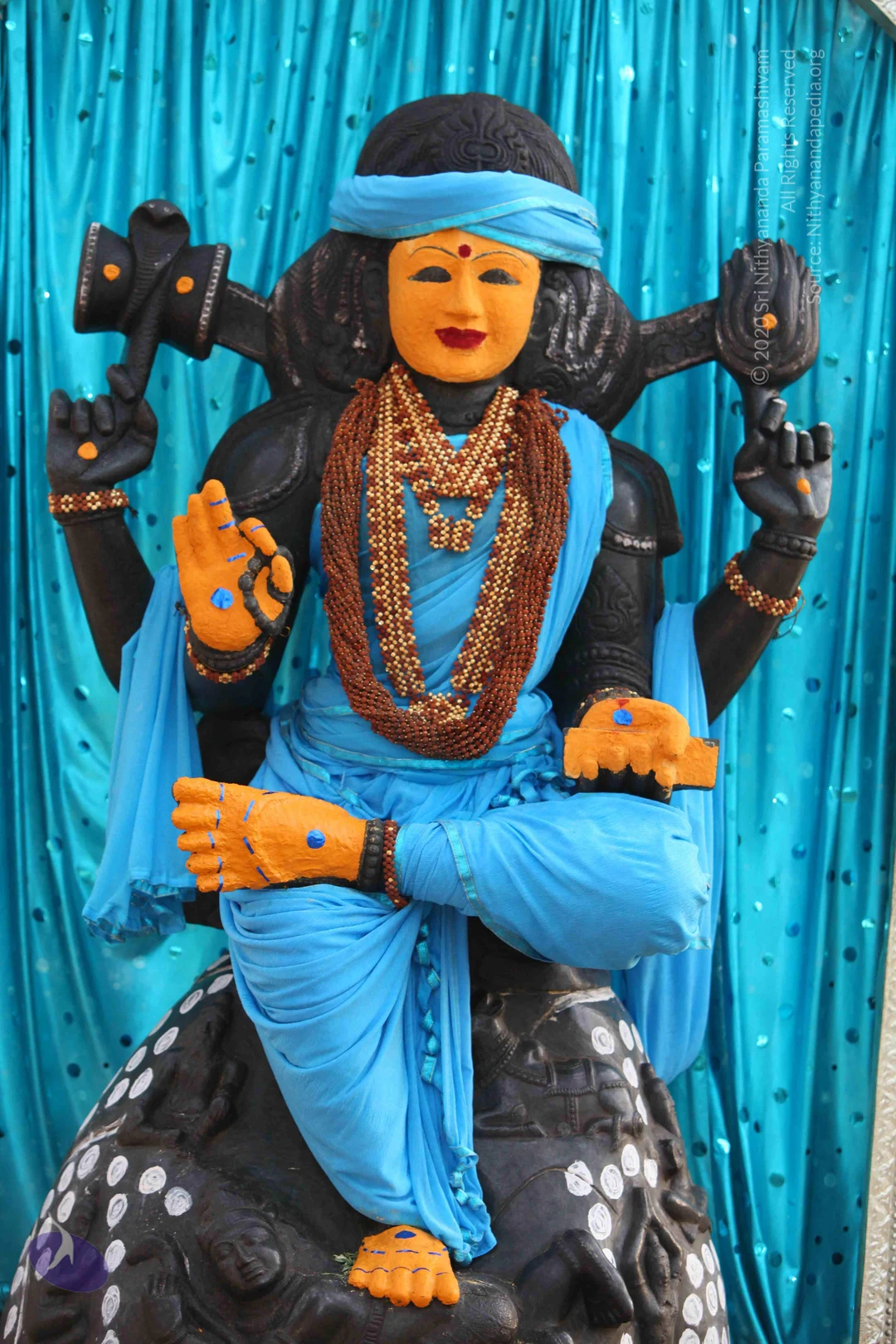
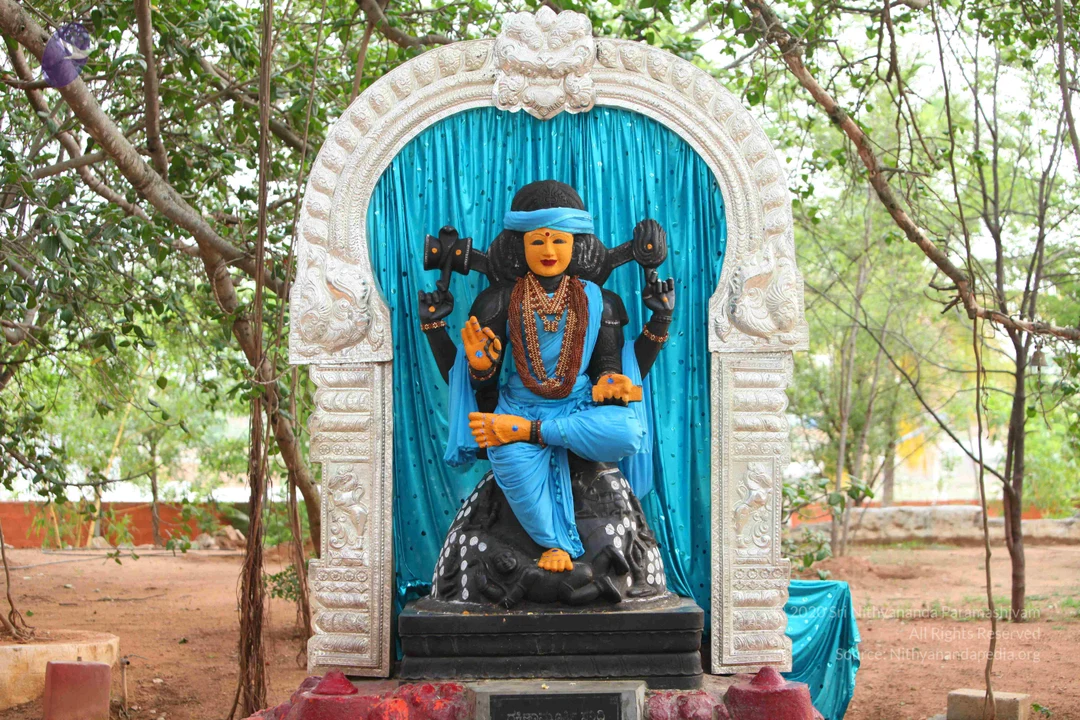
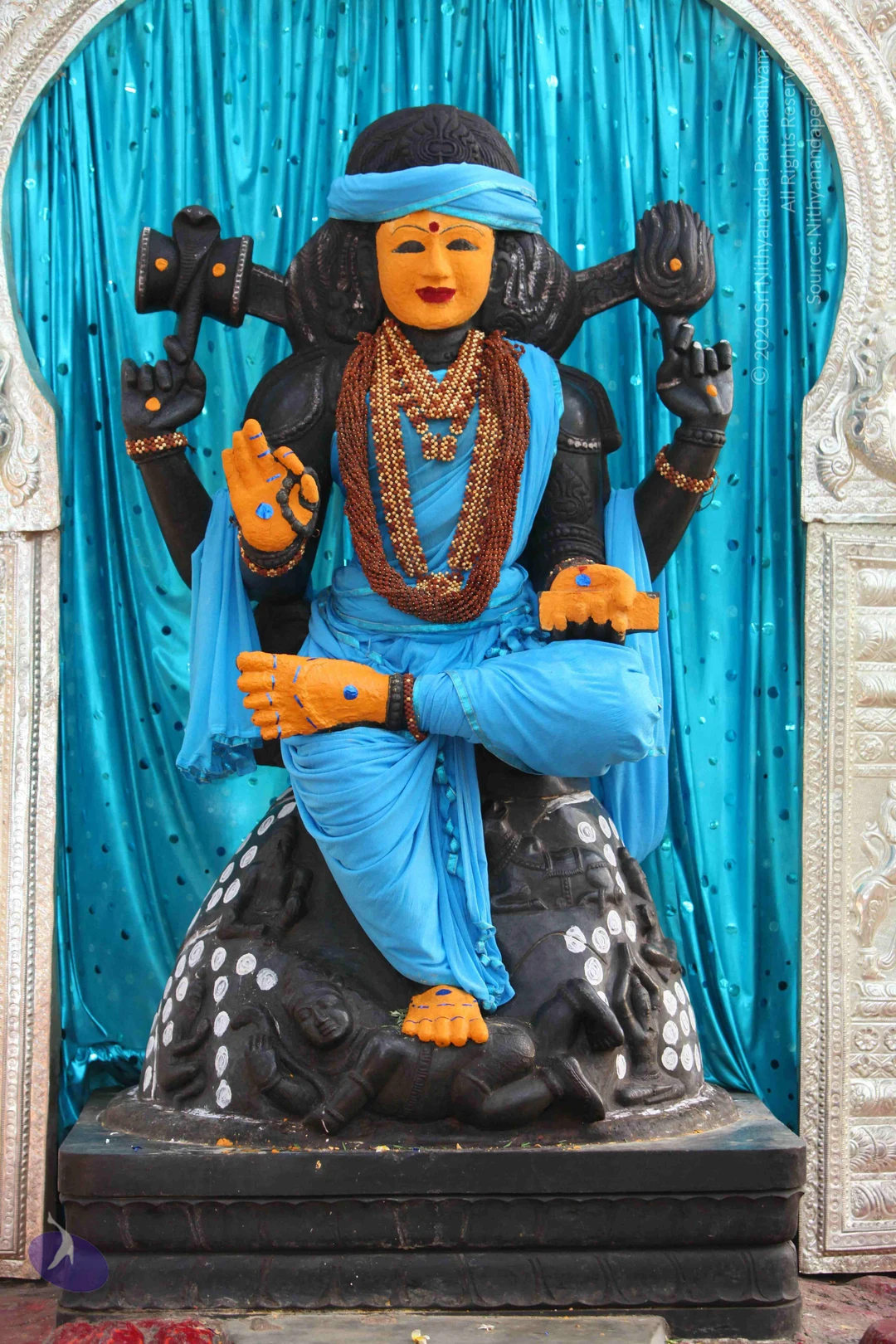
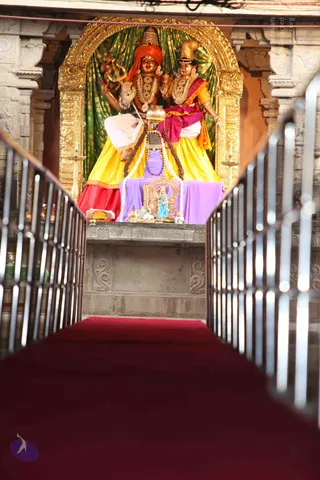
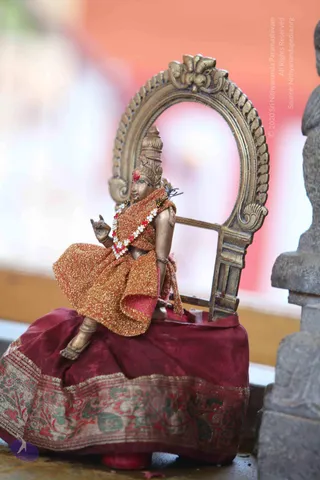
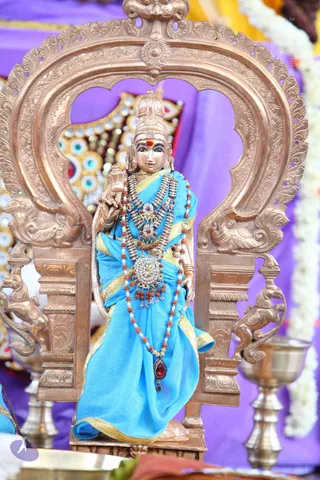
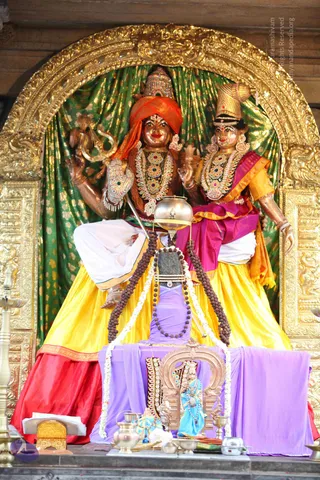
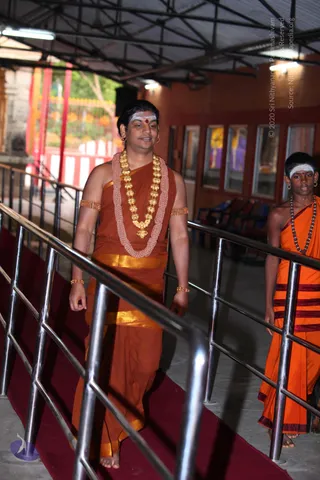
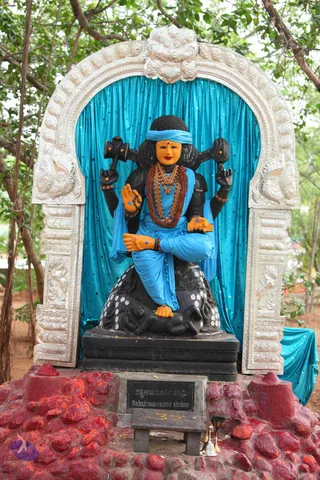
Photograph of a temple sanctum with a red carpet runway leading between silver metal railings toward a raised stone platform. Above it stands a gold-framed arch with green draped cloth behind a pair of deity statues: a figure in orange turban and ornate jewellery holding a trident, beside a female-form figure in yellow and magenta silk with a tall crown. Beneath them is a lingam-style form draped in purple cloth, decorated with a white flower garland and rudraksha beads, with a small kalasha and a brass lamp nearby. No physical people are visible; the statues are depictions.A small bronze deity murti seated on a maroon silk cloth with a gold brocade border, dressed in an orange-gold shimmering shawl and a red-and-white beaded garland. Its right hand is raised in a gesture, and it sits within a gilded arched prabhavali backdrop. A grey stone pillar stands at the right edge, and the background is softly blurred pink and cream.A photograph of a standing deity murti, a figure with a painted face and red tilak, wearing a turquoise sari with gold border and layered jewelled necklaces with rudraksha beads. It stands in front of an ornate copper-coloured throne with lion and peacock carvings. Behind it are purple draped cloth, a garland of white flowers at the right edge, and brass oil lamps at the sides. No physical people are visible.Golden temple shrine with a large gilded arch framing two painted deity statues seated on a yellow and red base before a green sequined backdrop. The male-form figure wears an orange turban, a jewelled garland and a trident-like staff; the female-form figure wears a magenta and gold sari with a jewelled necklace and a tall gold crown. Before them stands a black shivalinga draped in lilac cloth, wrapped with rudraksha beads and white jasmine garlands, with a silver kalasha on top. Brass oil lamps flank the shrine, and offerings, a small silver pot and a blue-clad figurine sit on a lilac-draped platform. No physical people are visible; the figures are statues.A man in rust-orange dhoti and shawl walks barefoot along a red carpet beside a metal railing inside a covered hall. He wears a gold-and-pink beaded garland with a gold pendant, gold armlets and bangles, and a white vertical line with a red dot on his forehead. Beside him, a younger attendant in orange robes with a dark bead necklace and matching white forehead marking walks in the same direction. The room has red-framed windows, plastic chairs at the back and a view of a temple gateway outside.An outdoor shrine featuring a black stone murti of a four-armed deity seated in a cross-legged pose on a black pedestal with carved figures, its face and hands painted orange. The figure wears a blue cloth headband, blue wrap, layered gold and rudraksha-style beaded necklaces, and holds a trident-like implement and a drum-like object. It sits within a silver-toned arched frame draped with a turquoise curtain, surrounded by trees. In front is a red-painted stone base with a black plaque reading Dakshinamurthi shrine, a small bench, a bell and a brass lamp. No people are visible.

02-PRATHYAKSHA-PADA-PUJA
5 photosSource gallery
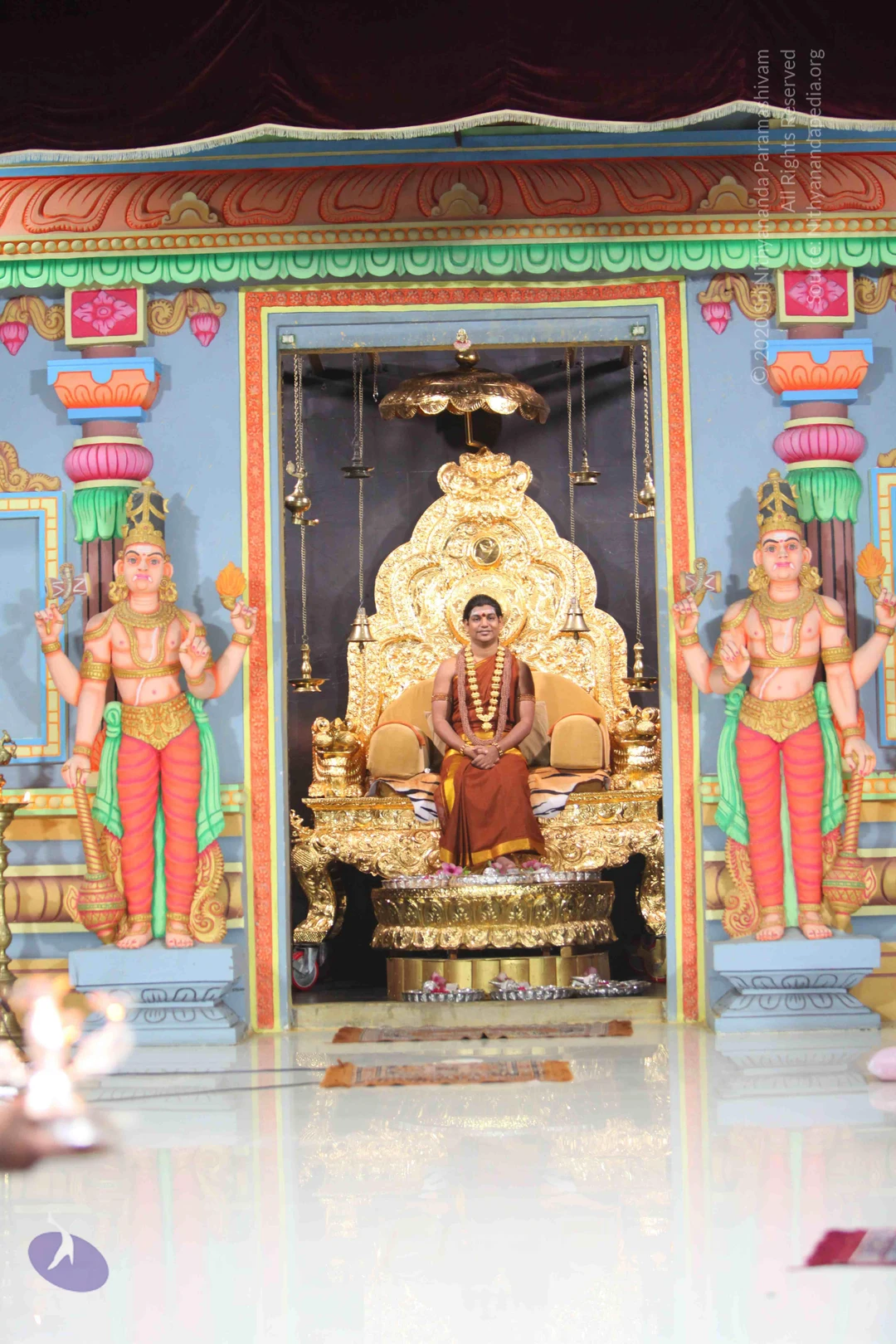
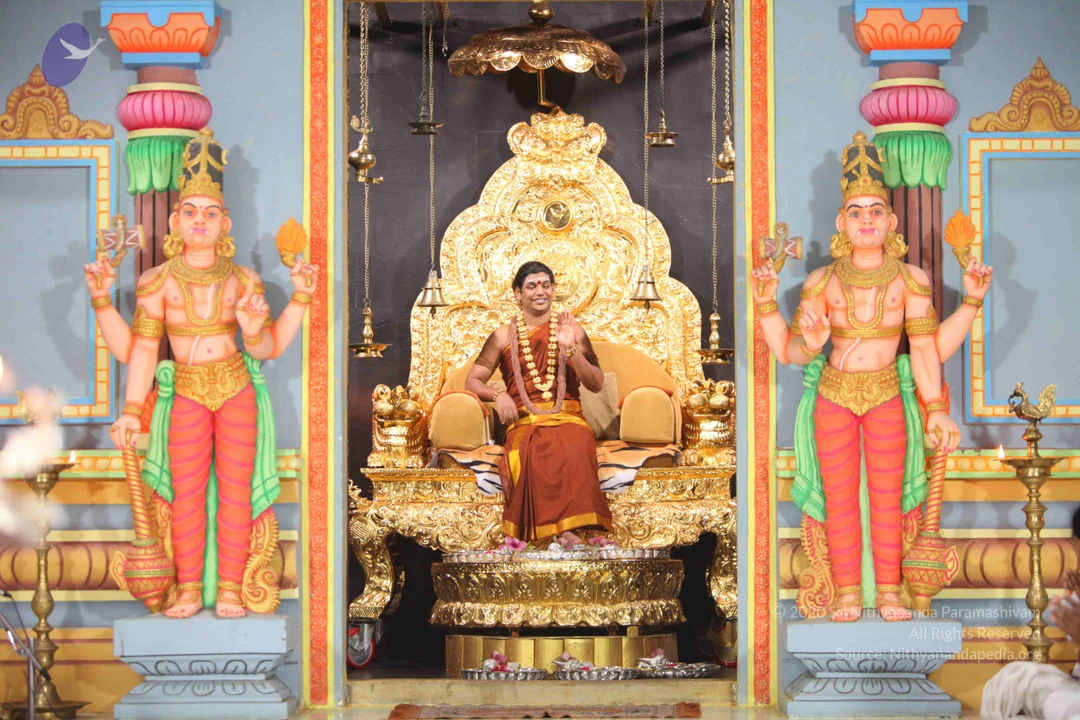
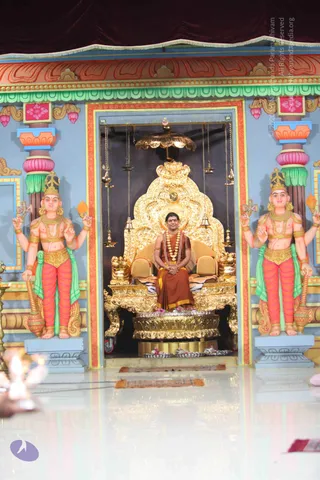
A seated man in an ornate golden throne sits centrally in a niche framed by painted pillars, wearing a rust-orange robe with a gold-bordered dhoti, a white-and-gold garland, rudraksha mala and gold ornaments, hands folded in his lap. The throne has lion-form arms and a gold-leaf backrest with a golden umbrella overhead and hanging brass bells. Flanking him are two large painted, multi-armed deity murti figures in red and green dhotis with gold jewellery, holding weapons and lamps. Brass oil lamps and flower-decorated trays sit at the base, and the glossy white floor reflects the scene. a person on the throne, distinguished by the robe, garland and rudraksha mala.A photograph inside an ornate golden-carved hall with a black wall and brass bells hanging overhead. A man with swept-back hair, a red bindi and a tilak sits on a gilded throne draped with an orange cushion and tiger-striped cloth. He wears an orange-saffron dhoti and shawl, a pink and white flower garland, gold necklaces and bangles, and is barefoot. Several women and an older man sit on the floor around a golden tray filled with small brass lamps, pink and white flowers and petals, performing a puja. One woman in a maroon sari holds offerings, another in white wears a rudraksha-style mala, and a woman in a red and cream shawl holds a lamp. The man on the throne appears to be Swamiji (probable), seated at the centre of the ritual, with the cues being the swept-back hair, saffron clothing, ceremonial gold necklaces and his position on the throne.A seated man in a saffron-orange robe and a light-coloured shawl sits on an ornate gold throne with carved lion-head armrests, raising one hand in blessing and wearing a long white-and-orange flower garland. Two large painted guardian statues in gold jewellery, red dhoti-style lower garments and green sashes stand on either side, each holding a mace and ritual objects. Brass oil lamps, a gold canopy with hanging bells, and a tray of flowers sit before the throne. A man with a distinctive long hairstyle and orange-saffron robes is seated at the centre, and a ceremonial appearance fits the page's a person reference, though the face is not clearly visible enough to confirm identity.

03-NITHYA-SATSANG
15 photosSource gallery
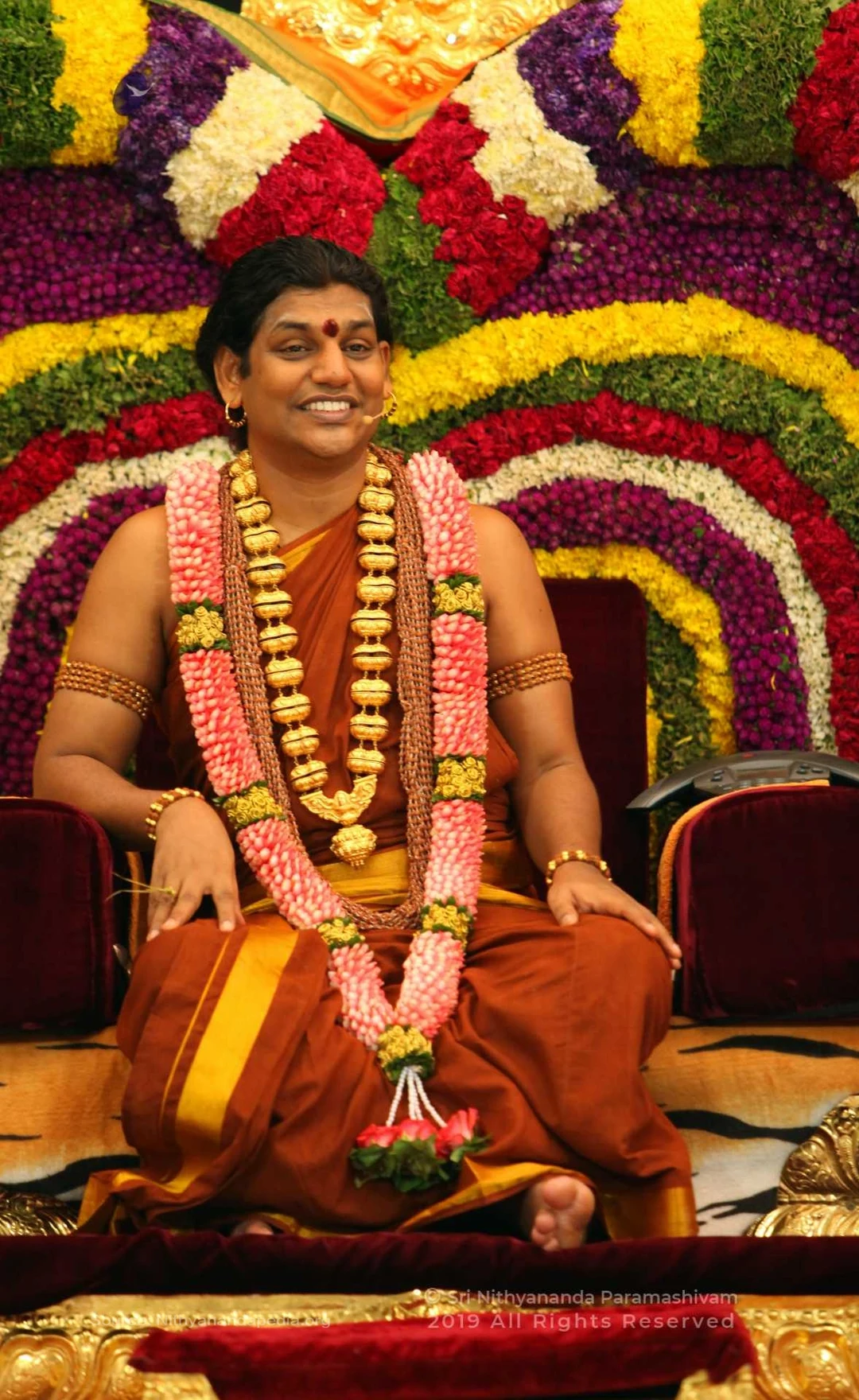
A smiling man sits cross-legged on a golden-edged throne draped with tiger-striped fabric, in front of a floral backdrop arranged in rainbow arches of marigolds, roses and jasmine. He wears a rust-orange robe with a gold border, layered gold bead necklaces, a thick pink and white jasmine garland, gold armlets and bangles, and a red kumkum dot on his forehead. A small headset microphone is visible at his ear. He rests his hands on his knees, appearing to address a gathering. Appearance-based probable Swamiji (probable): long dark hair, saffron-orange robe, ornate gold necklaces and garlands, seated on a throne in a satsang setting.A seated man in rust-orange saffron robes sits cross-legged on a throne-like seat with red velvet armrests, draped over a tiger-striped cloth. He wears a thick gold necklace with bead-like links, a long pink and white jasmine garland, gold armbands and a gold bracelet, with a small red bindi on his forehead and a microphone at his ear. He smiles while seated before a backdrop of rainbow bands of marigolds, roses and jasmine topped by a gold crown ornament. He is the only person visible; the satsang setting suggests a discourse, though his identity cannot be confirmed from appearance. Page indicates he is a person, with orange robes, garlands and seat as the appearance cues.A man in an orange-brown robe sits cross-legged on a golden lion-armed throne in front of a large floral arch of red, yellow, white, pink and purple flowers. He wears a long pink and white garland, a heavy gold necklace of beads, gold armbands and a red bindi, with a small lapel microphone visible. His hands rest on maroon cushioned armrests. Two painted deity figures in orange and gold stand at either side. A lotus bud rests in front of him. a person: the seated man has a distinctive ceremonial presentation, with gold necklaces and a saffron-orange robe, and is seated as the speaker at a satsang. One physical person is visible.A man seated cross-legged on a red velvet throne draped with a tiger-skin cloth, smiling and speaking into a headset microphone. He wears an ochre-orange dhoti and matching shawl, a heavy gold bead necklace with a gold pendant, gold armlets, and a red bindi on his forehead, with a pink and white jasmine garland hanging to his lap. Behind him is a large backdrop of concentric arcs of marigolds, roses and jasmine in red, yellow, green, purple and white, topped by a gold ornamental crest. A visible flower-decorated throne setting suggests a satsang discourse. Only one person is physically present.A seated man in saffron-orange robes sits cross-legged on a raised dais before a large flower-decorated backdrop of arched bands in yellow, red, white, green and purple blooms. He wears a thick pink and white jasmine garland, layered gold beaded necklaces, gold armlets and bangles, a red bindi and a small headset microphone. A tiger-striped cloth covers the dais and a gilded ornament sits at the lower right. The scene resembles a satsang setting with a presenter seated on a flower-decked peetha. The clothing and ornaments are consistent with the a person presentation cues, so this is a probable match on appearance.A seated man in saffron-orange robes and a gold-and-pink flower garland delivers a satsang discourse on a richly decorated throne. He wears a red bindi, a microphone headset, gold armlets and bangles, and a long gold bead necklace, and raises his right index finger while gesturing with his left hand. The throne is backed by a rainbow arch of marigolds, roses and jasmine in yellow, red, purple and white, and flanked by gilded lion-head armrests on a tiger-striped cloth. Behind him stand large painted deity murti figures in dhoti-style clothing. a person is identified by his saffron robes, long swept hair, rudraksha-style gold beads and ceremonial garland while speaking from the throne.

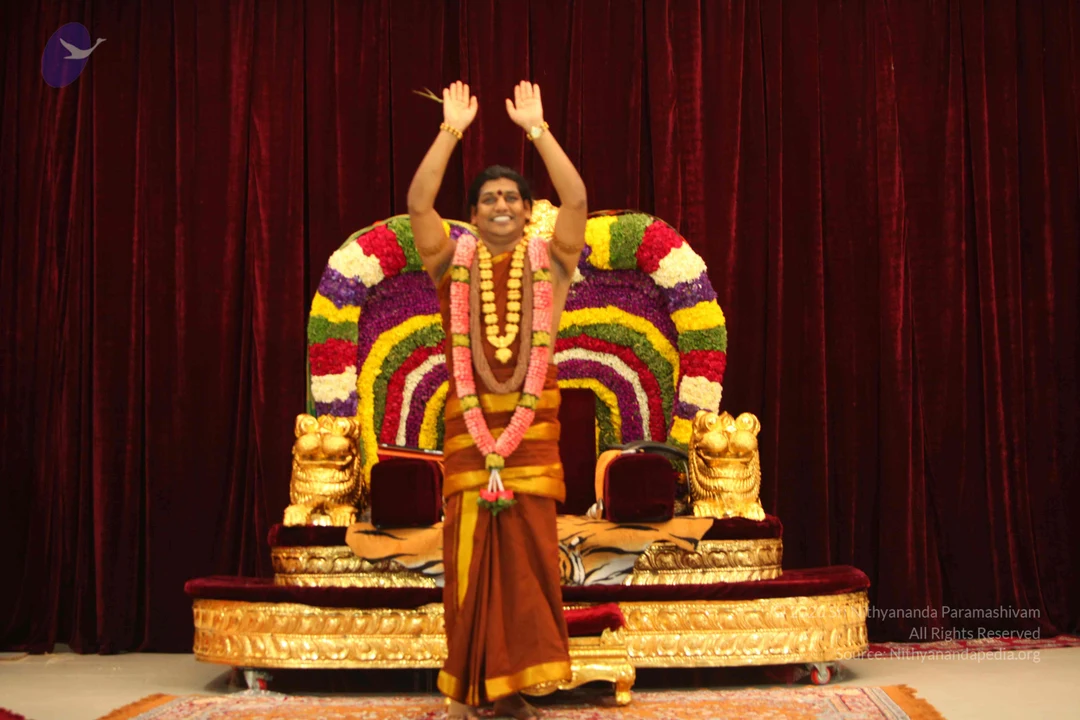
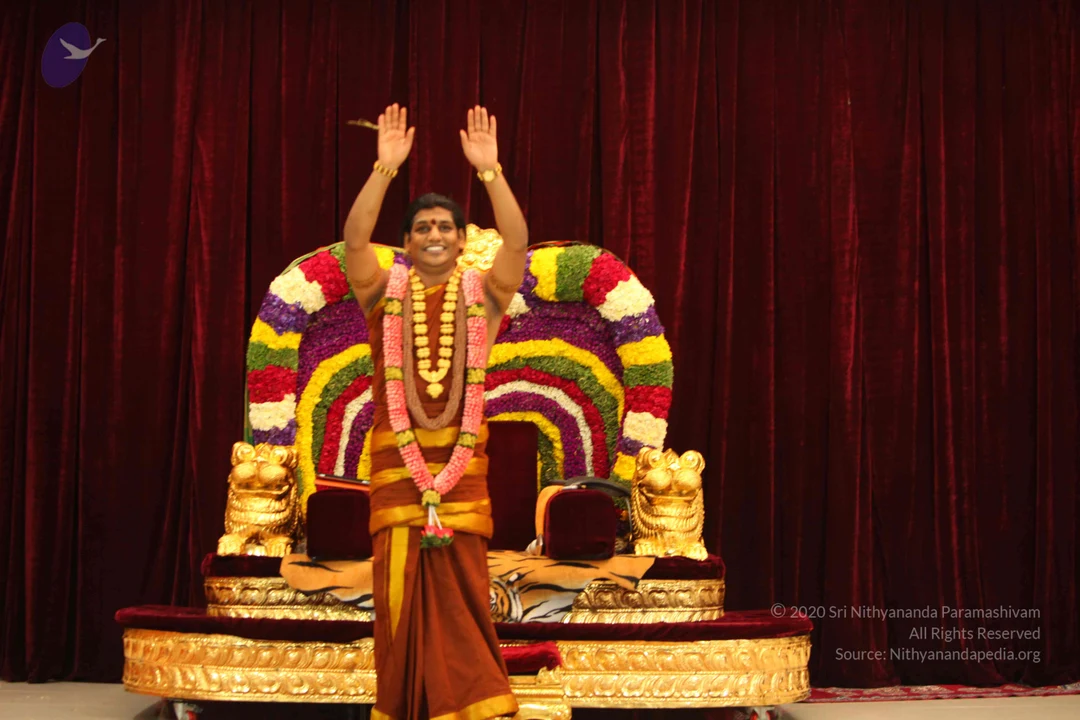
04-SARVA-DARSHAN
4 photosSource gallery
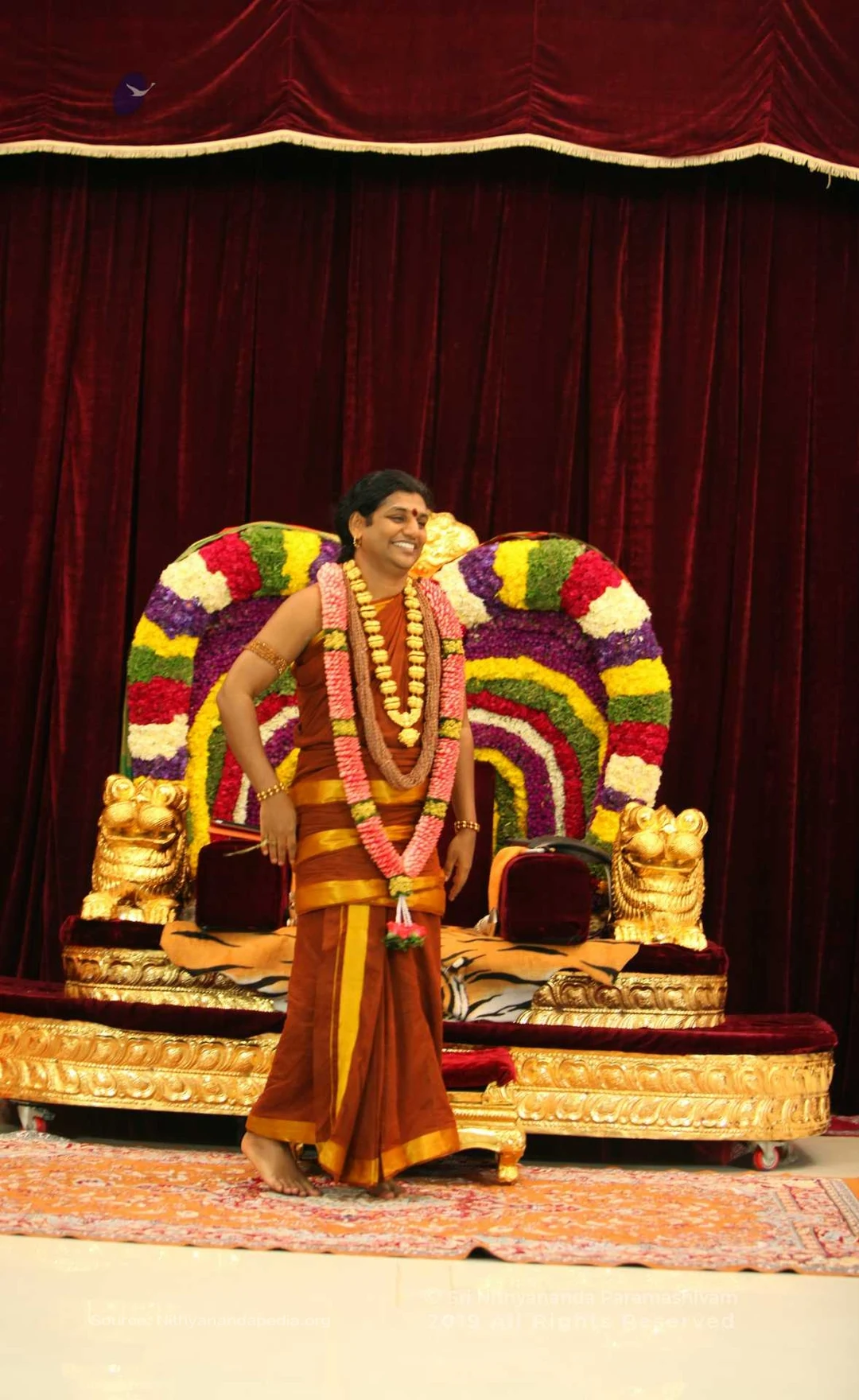
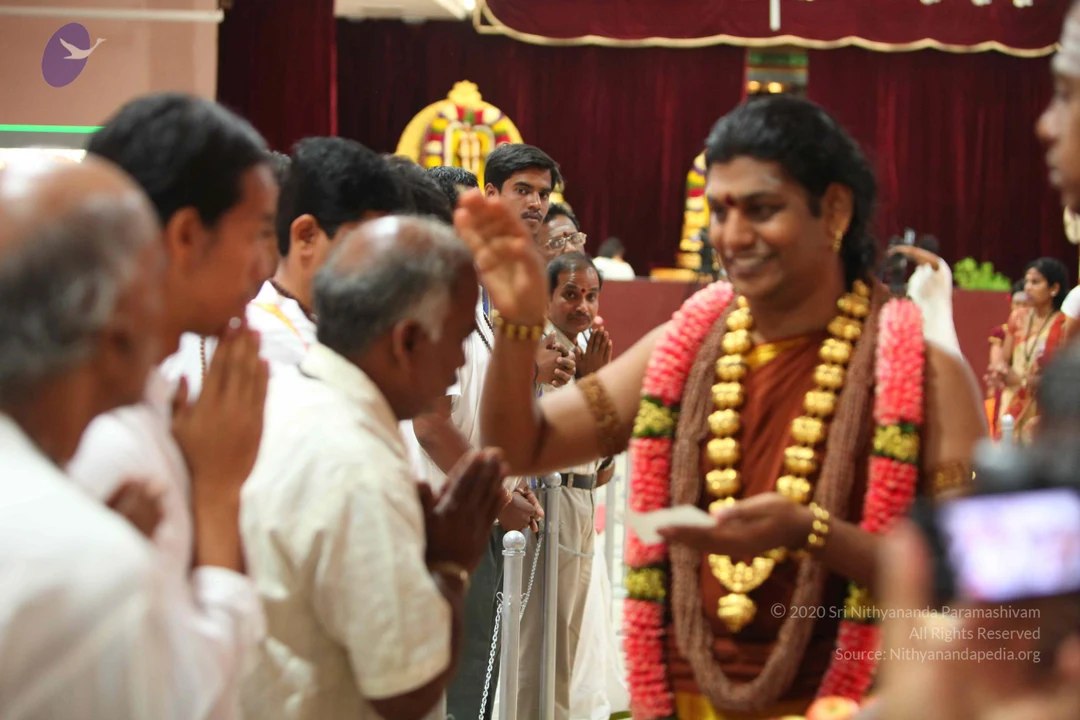
A man stands on a carpeted stage in front of a red velvet curtain and a golden throne decorated with a rainbow-coloured floral arch and gold lion heads, with a tiger-striped cloth on the seat. He wears a rust-orange silk dhoti-style garment with a gold border, a pink and white flower garland, and a gold-bead necklace, with a red bindi on his forehead. He raises both hands above his head and smiles.A photograph of a man standing on a stage in front of a large golden throne decorated with a rainbow-coloured floral arch in red, pink, yellow, green, purple and white blooms. He wears a saffron-orange dhoti and matching upper cloth, a long pink and white flower garland, a shorter yellow flower garland and a gold armband. His arms are raised with palms open in greeting. The throne has gold lion figures at each side and a tiger-striped cushion, set before deep red velvet drapes. The image is a photo with one person visible.A photograph of a crowded indoor darshan event with a man in an orange-brown saffron-toned robe and a large garland of pink flowers with green and yellow bands, plus a long necklace of gold beads, standing at centre right with his long dark hair swept back and smiling. His right arm extends forward, touching the head of a bowing devotee in a white shirt in the lower left, who is receiving blessing. Beside him stands a shaved-headed priest in a saffron-orange robe with rudraksha beads, holding a small green tray with white and red ritual items. Behind them, devotees in white, saris and orange stand in the background before a red curtain and floral decorations. A purple logo appears in the upper left corner.A photograph of a long line of devotees in white clothes with hands joined in namaskar, bowing toward a central figure in an orange-brown robe wearing a large pink and white flower garland, a long rudraksha-style mala and a heavy ceremonial gold necklace, with gold bangles and long swept-back dark hair. The figure raises one hand in blessing while holding a small white card or prasad. Behind a silver barrier rail, a crowd of men stands in white and cream shirts, and a red velvet backdrop with a gold ornamental arch and a decorated shrine appears in the background. A woman in a red and gold sari stands at the right edge, and a smartphone is visible at the lower right. a person is the central figure, identified by the rudraksha mala, ceremonial gold necklace, orange robe and flower garland, and is receiving devotees in a darshan setting.

05-THIRUGNANASAMBANDAR-PUJA
45 photosSource gallery
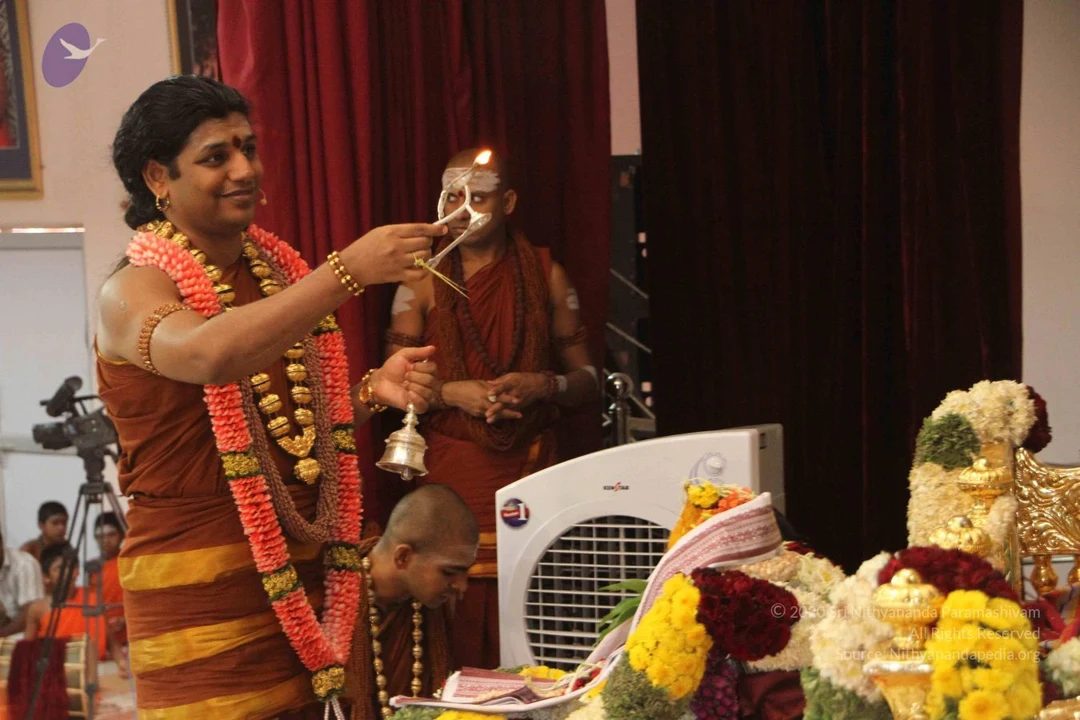
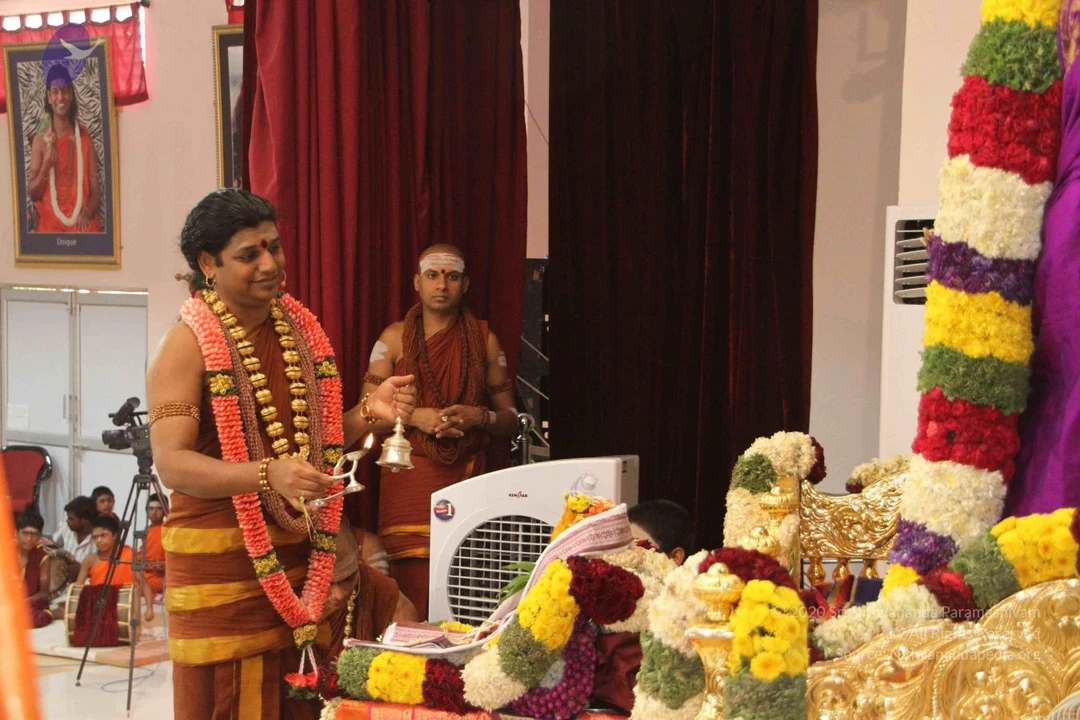
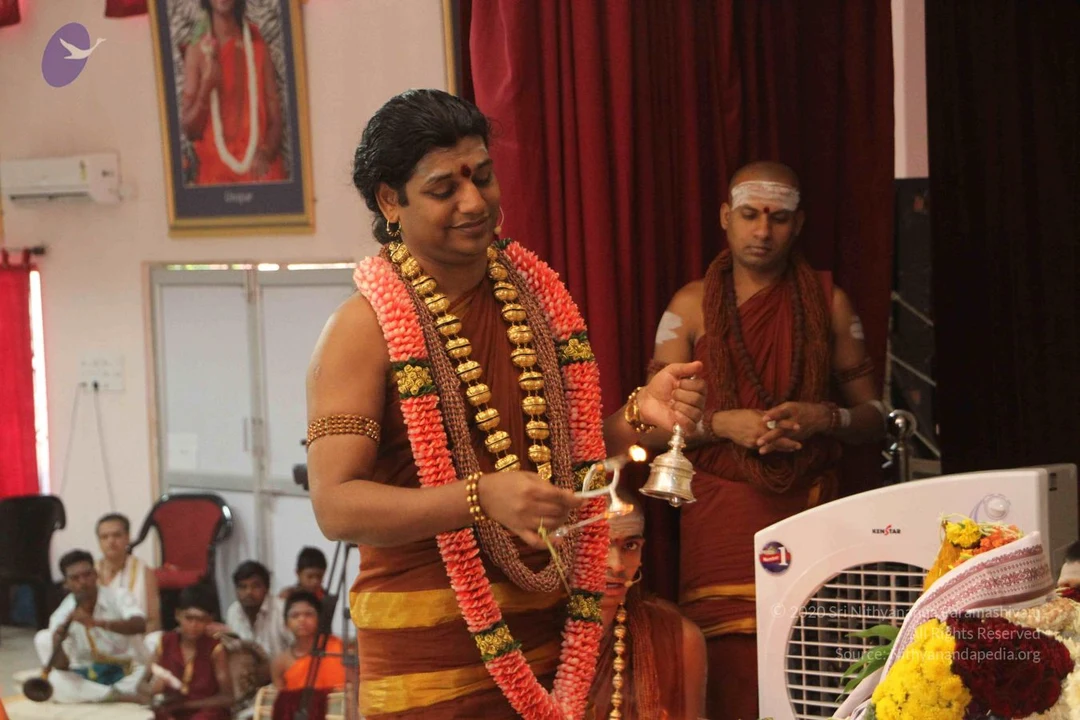
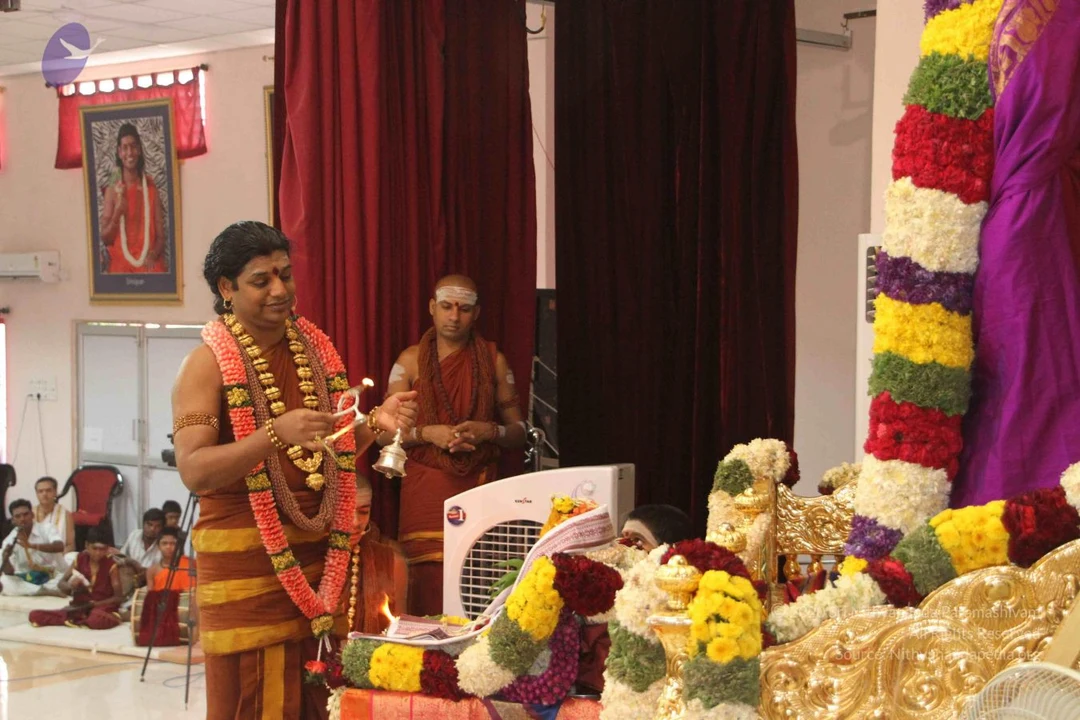
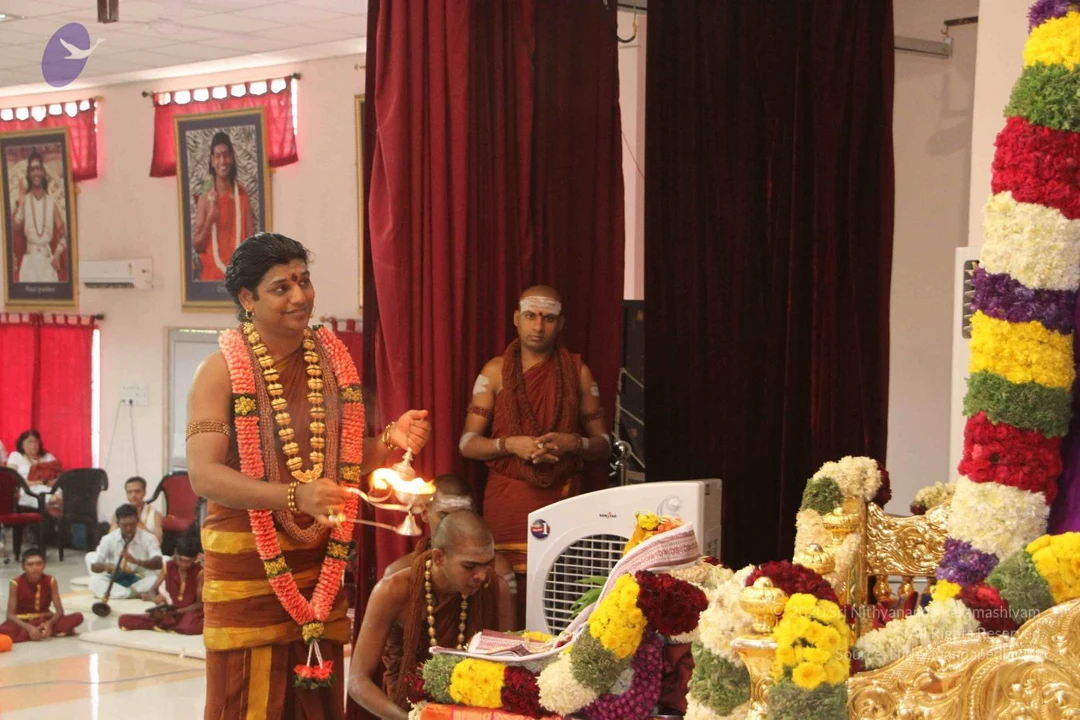
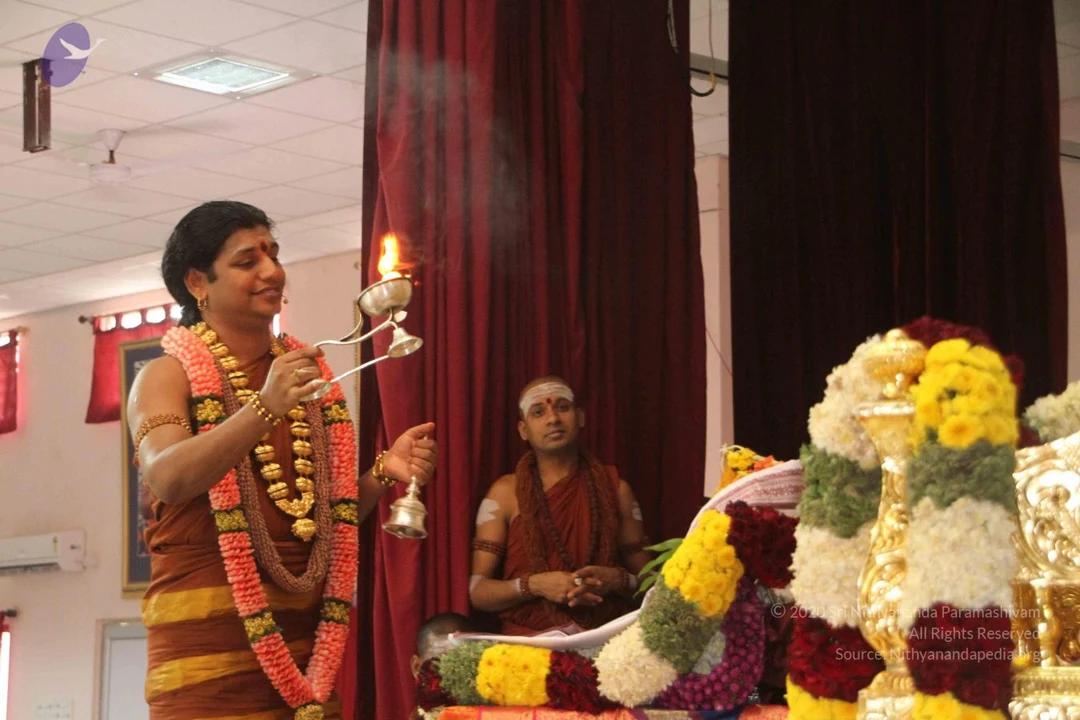
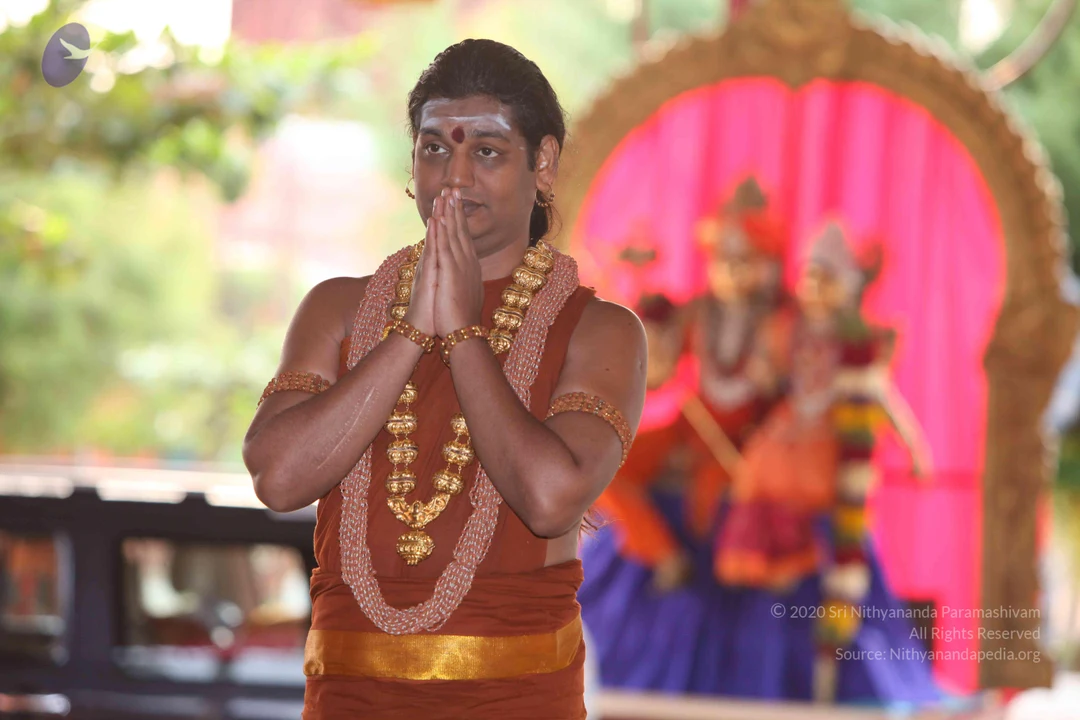
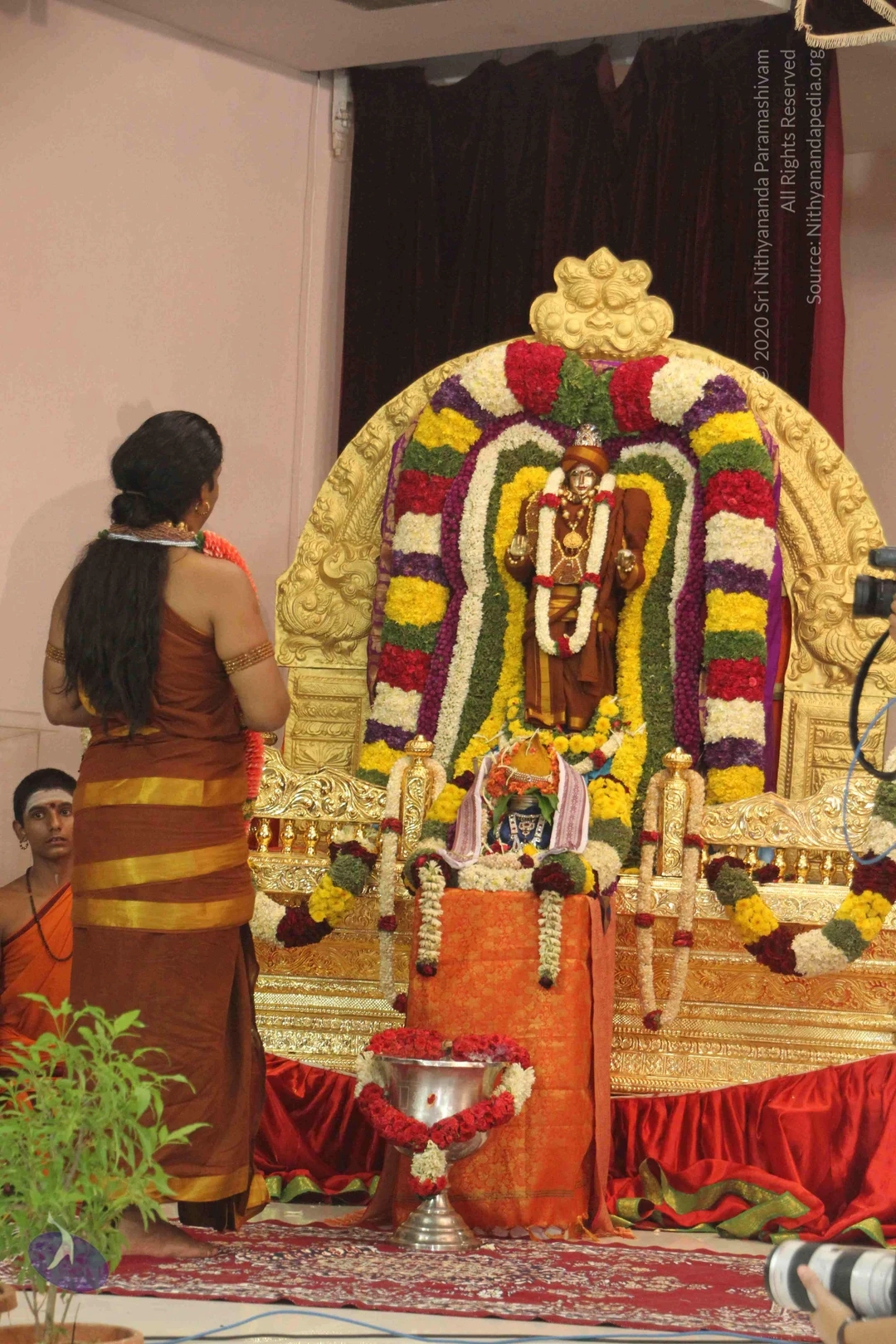
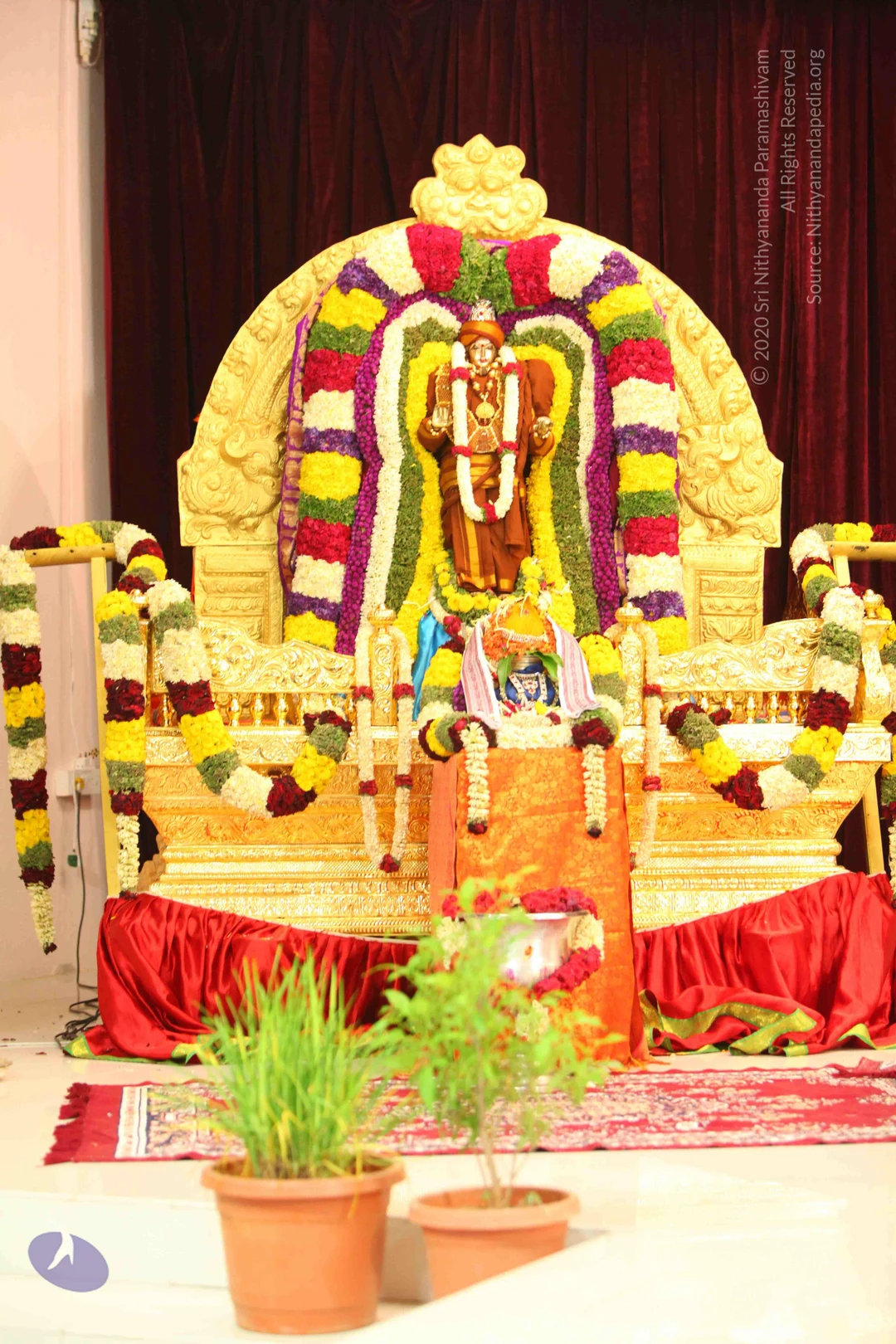
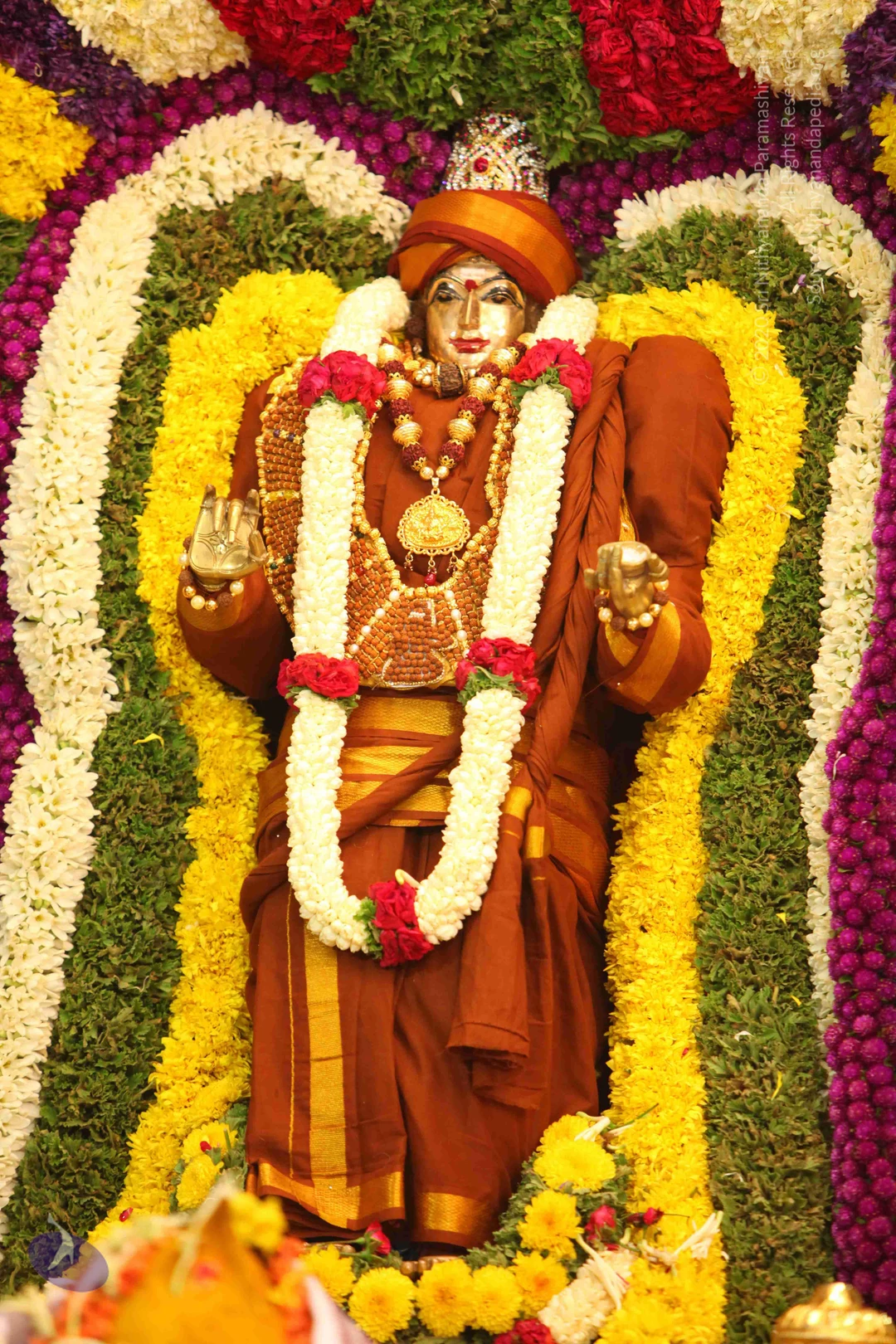
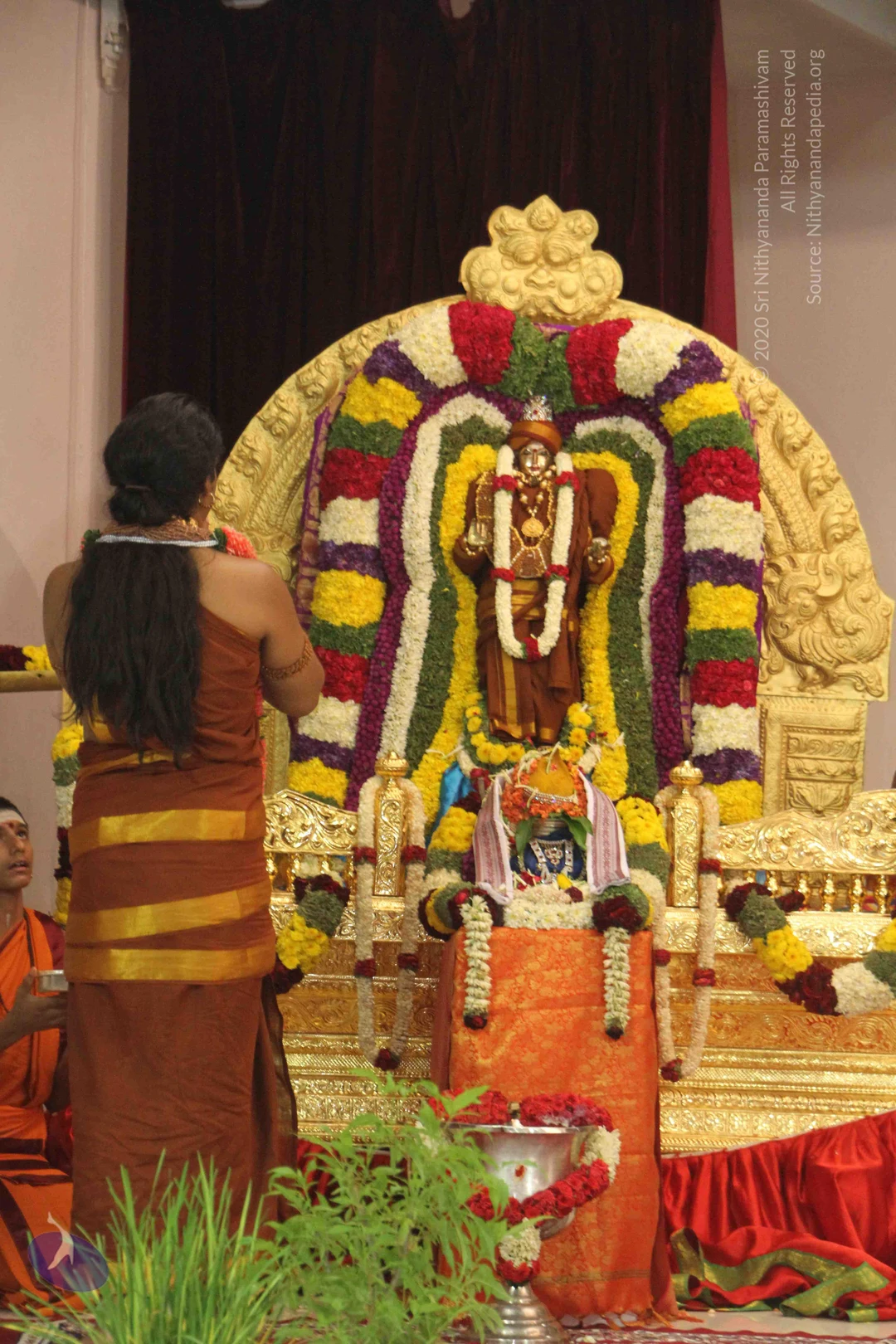
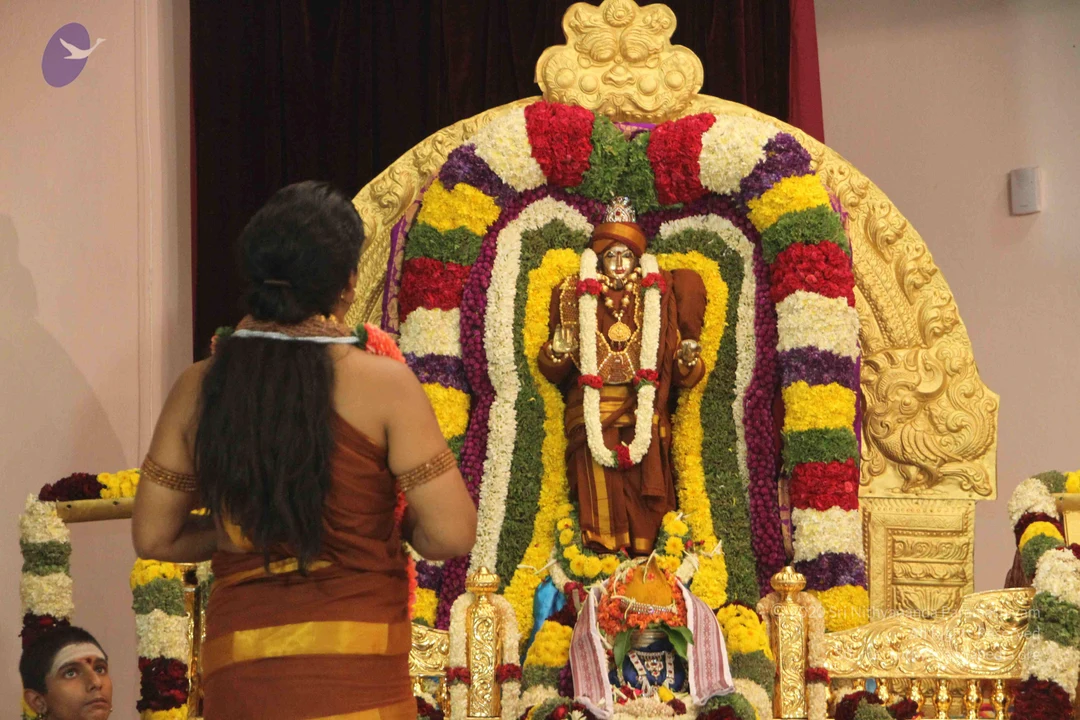
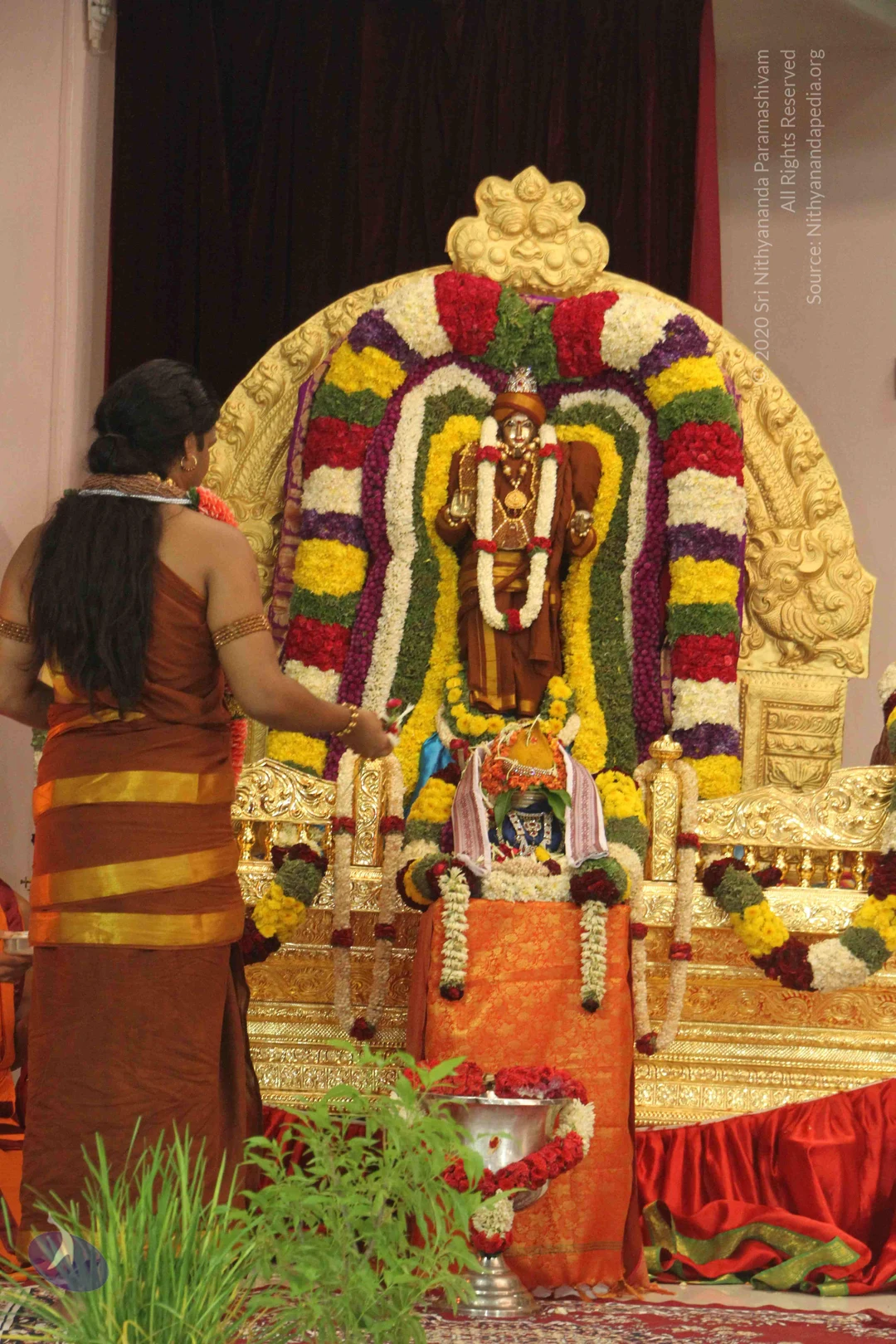
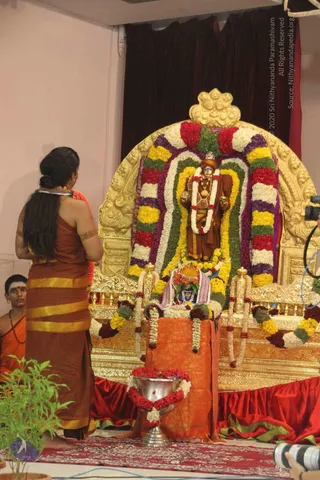
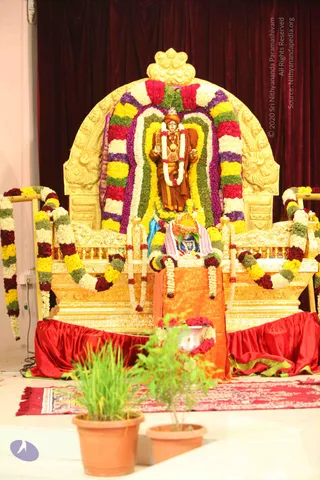
A photograph of a smiling man standing on a stage in front of an ornate gold arch decorated with multicolour flower garlands in yellow, green, white, purple and red. He wears a rust-orange dhoti and shawl, a long pink and white flower garland, a gold bead necklace and a rudraksha mala, with a red bindi on his forehead. He raises one hand in a greeting. A gold-metal deity murti stands within the arch, wearing a crown and garlands. Below, an orange cloth-draped altar holds a silver vessel and a small decorated icon, surrounded by red and white flowers. Potted green plants sit in the foreground on a red patterned rug, and a gold throne is visible at the right.A woman with long dark hair tied back, wearing a brown sari with gold border and gold bangles, stands with her back to the camera, hands folded in prayer before a gold-framed shrine. Within the arch, a bronze-coloured standing murti of a saint or deity wears a gold necklace, a crown-like headpiece and a rudraksha-style garland, surrounded by a dense arch of marigolds, roses and green leaves in yellow, red, white and purple. Before it stands a tall orange-draped pedestal holding a kalasha-like vessel and flower strands, with a silver bowl of red roses in front. To the left, a young man in an orange robe and white tilak sits at the edge of frame. Red velvet drapes and a potted plant complete the scene, and a camera and lens are visible at the right edge.A decorated ornate golden throne (peetha) stands on a raised white stage, framed by a tall arch of garlands in yellow, red, green, white and purple flowers. A standing statue in orange and gold robes, wearing a crown and a flower garland, is placed at the centre of the throne. In front, a brass kalasha with orange cloth and a mango-leaf top sits on a draped orange cloth on the platform, with more garlands hanging at the sides. Red satin drapes cover the throne base, a patterned red rug lies on the stage, and two potted green plants stand in the foreground. A maroon velvet curtain forms the backdrop. No living people are visible.A golden-faced murti of a saint figure, dressed in rust-brown and gold-bordered cloth with a gold-and-brown turban topped by a jewelled crown. It is heavily garlanded with white jasmine, yellow marigold and red rose strands, with a rudraksha and gold bead necklace and a large gold pendant. Its hands are gold-plated in a teaching or blessing gesture, and it is framed by a bed of yellow, red and purple flowers and green leaves. Offerings sit at the base. This is a decorated statue, not a living person.A woman with long dark hair pulled back, wearing a rust-brown sari with a gold border and gold necklace, stands with hands joined in prayer before a decorated shrine. Behind her a golden arched frame is festooned with garlands of yellow marigolds, red roses, white jasmine and green leaves. At the centre stands a bronze-coloured deity murti in a brown dhoti and shawl, holding objects in both hands, with a crown and a gold chest ornament. Before it sits a shivalinga-like altar draped in orange and white cloth with fresh flower garlands and a kalasha-style pot. A silver bowl of red and white flowers rests in the foreground. A man in orange robes sits at the left edge, partly visible. The scene reads as a puja or padapuja in a temple-like hall.A smiling man in a rust-brown dhoti and shawl with a golden-yellow border stands on a stage, waving with his right hand. He wears a long pink and white flower garland, a gold necklace and a tulsi-style beaded mala, with a red bindi on his forehead. Behind him a golden arched throne is draped in multicoloured flower garlands, and a standing deity murti in brown clothing with a crown and gold ornaments is garlanded at the centre. In front, an orange-draped altar holds a sacred pot and a Shivalinga-like object covered with flowers, with a silver vessel set below and red flower garlands. Potted green plants stand in the foreground on a red patterned rug.
06-GAYATHRI-HOMA
4 photosSource gallery
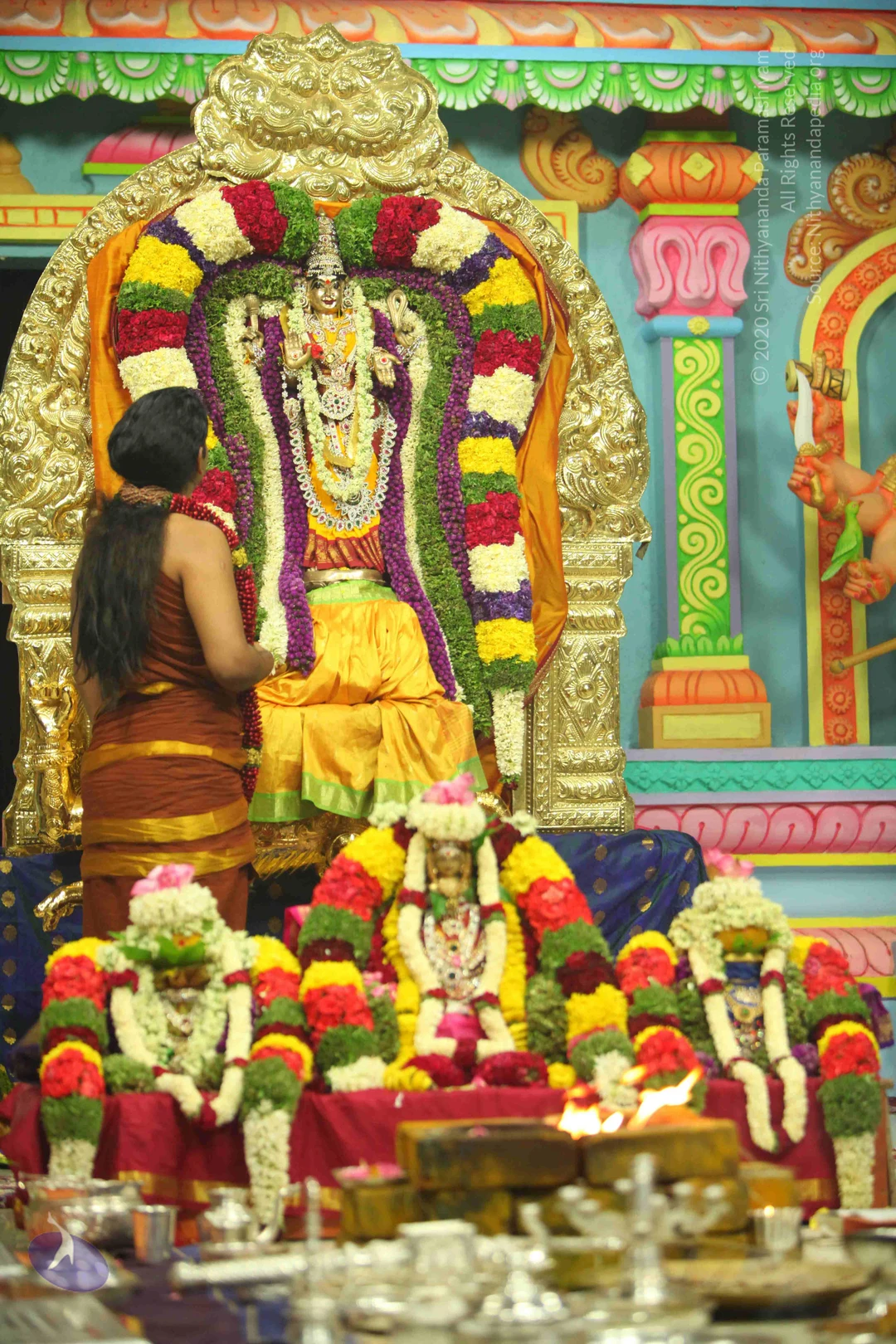
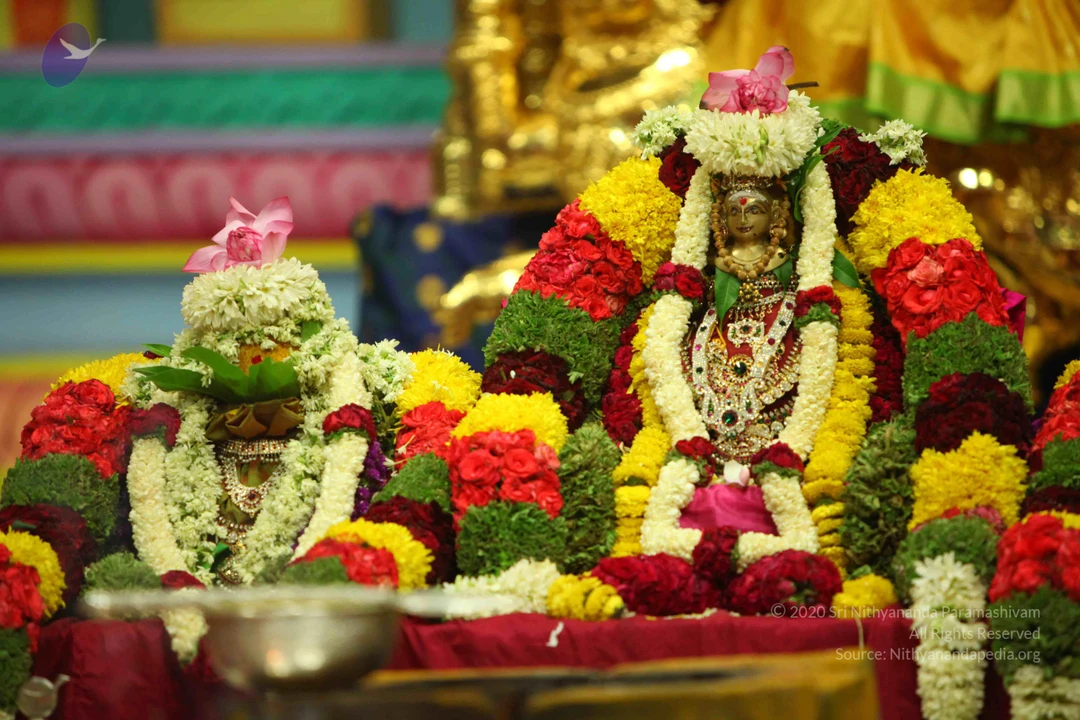
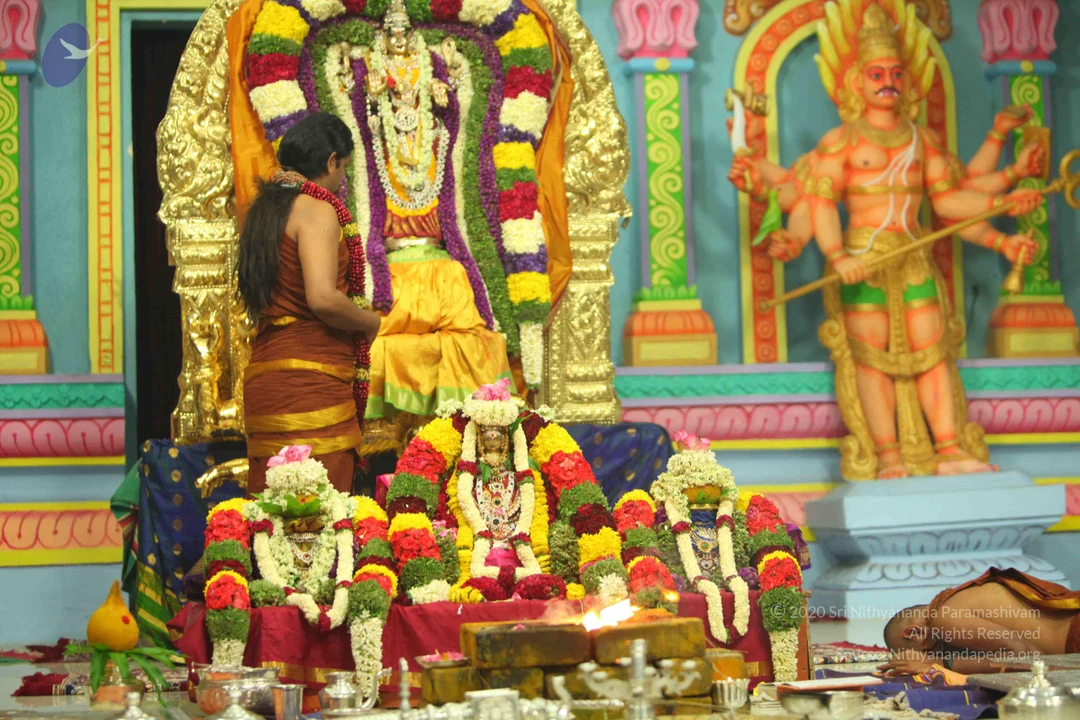
A photograph of a temple shrine decorated with multicoloured flower garlands in red, yellow, green, white and purple. A central deity murti stands in a gilded arch, adorned with jewelled ornaments, a crown and a long white garland. In the foreground a woman with long dark hair, wearing a rust-brown and gold-bordered sari, stands with her back to the camera facing the shrine. Smaller garlanded deity figures sit on a red cloth-draped platform, and a flame burns near brass vessels and a homa area in the lower right. Painted pink and green pillars and orange-red carved panels frame the scene.A decorated shrine of a seated deity murti, a crowned figure in silver and jewelled ornaments, dressed in an orange and green silk skirt, framed by a golden arch and layered garlands of red, yellow, white and green flowers. Smaller garlanded murtis sit on a red-draped platform in front, with silver puja vessels and a small oil lamp in the foreground. No people are visible in the scene. Colourful painted pillars and a gold-embossed backdrop surround the shrine.Two deity murti figures are heavily decorated with garlands of white jasmine, yellow marigolds, red roses and green leaves, with pink flowers placed on their crowns. The figure on the right wears a jeweled gold and red necklace and a crown; the figure on the left wears a gold headdress and jewelry. Behind them a gold-coloured figure and red-and-green decorative pillars are blurred. A silver bowl sits on a red cloth in the foreground.A richly decorated deity murti, seated on a gold lion-armed throne under an ornate golden arch, is adorned with multicoloured flower garlands in red, yellow, green, white and purple, a jewelled crown and gold ornaments, and wears an orange and yellow silk garment. Smaller flower-garlanded murtis sit in front, and brass oil lamps and offering vessels stand on a red-draped platform in the foreground. No people are visible in the frame.

07-IA-SESSION

6 photosSource gallery
A smiling man with long dark hair sits cross-legged on an ornate throne covered with a tiger-skin cloth, his bare feet visible. He wears an orange-saffron cloth draped over his bare upper body with gold-bordered orange dhoti, a rudraksha mala and a heavy ceremonial gold necklace, and a gold bracelet. His hands are pressed together near his chin. The throne has gold lion-head armrests and a backdrop arch of rainbow bands of marigold and rose garlands in yellow, red, purple, green and white. A small microphone is visible near his face. Probable Swamiji seated in satsang, with an appearance-based candidate description: long swept-back hair, saffron clothing, rudraksha mala and gold necklace.A seated man in ochre saffron robes sits on a tiger-print cushioned dais in front of a large floral backdrop of arched garlands in red, yellow, white, green and purple. He wears heavy gold beaded necklaces over rudraksha-style strands, a gold bracelet, and a red bindi, and has a headset microphone, smiling as he speaks to an audience. The setting resembles a satsang. Only one physical person is visible.A photograph of a smiling man seated cross-legged on a golden lion-armed throne draped with a tiger-striped cloth, clapping his hands. He wears an orange-saffron dhoti and shawl with gold borders, a heavy gold necklace of beads and a rudraksha mala, and a red bindi. Behind him rises an arched backdrop of tightly packed flowers in rainbow bands of red, yellow, green, purple and white. Only one physical person is present.A smiling man sits cross-legged on a tiger-striped cushioned dais in front of a large floral backdrop of rainbow-arched marigold, rose and jasmine garlands in yellow, green, red, purple and white. He wears a rust-orange and saffron dhoti and shawl, a rudraksha mala, a heavy gold bead necklace with a gold pendant, a red bindi and a beaded bracelet, and a small headset microphone. He leans on one arm and laughs during a seated satsang. A gilded throne-like frame is visible at the edges.A photograph of a seated man in saffron-orange robes on a flower-decorated dais at an event. He sits cross-legged on a tiger-striped cloth with his eyes closed and a faint smile, a red bindi on his forehead, a rudraksha mala and a heavy ceremonial gold necklace around his neck, and a thin microphone near his face. Behind him a tall backdrop of concentric rows of red, yellow, purple and white flowers frames the seat. Golden lion-head armrests flank the cushioned seat. a person is seated in the centre, presiding as a discourse speaker, distinguished by the swept hair, saffron robes, rudraksha mala and gold necklace.a person sits cross-legged on a golden throne draped with a tiger-striped cloth, speaking during a satsang while raising one hand in a gesture. He wears a rust-orange dhoti and shawl, a long ornate gold necklace with beads, a rudraksha mala, and a red tilak on his forehead, with a small microphone at his cheek. Behind him is a tall arch of garlands in yellow, red, white, green and purple flowers. Gilded lion heads flank the throne, and the surrounding setting is dark red drapery.

08-KALABHAIRAVAR-DARSHAN
20 photosSource gallery
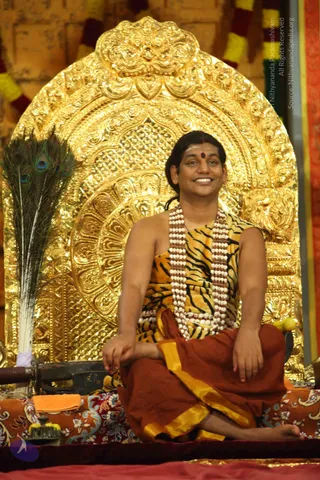
A photograph of a smiling man seated cross-legged on a red and gold cushioned seat before an ornate gold-leaf arched backdrop. He wears a tiger-striped saffron-and-black shawl over one shoulder, a rust-red dhoti with gold border, multiple strands of white and brown beaded rudraksha malas, and a red tilak on his forehead. A large peacock-feather fan stands to his left and a small brass oil lamp sits on the cushions. Marigold garlands in red, yellow and green decorate the top of the backdrop. The setting resembles a satsang or darshan hall.A seated man in a tiger-striped yellow and black shawl over his shoulder, rust-red lower garment with gold border, and multiple strands of white and brown beaded necklaces, sits cross-legged on a red cushioned dais before an ornate gold repoussé throne backrest. He has a red bindi and tilak and wears his hair pulled back; he is smiling. A peacock-feather fan stands to the left, with an orange cloth and a small brass lamp on the cushion. a person by appearance cues: ornate beaded necklaces and distinctive yellow tiger-print wrap; he appears to be seated in a satsang setting on a throne.A smiling man sits cross-legged on a red-and-gold cushioned seat before an ornate gold repoussé throne with arched backrest. He wears a tiger-striped yellow-and-black sleeveless garment, a rust-red dhoti with gold border, multi-strand white and rudraksha beaded malas, and a red bindi on his forehead; his long dark hair is pulled back. A peacock-feather fan stands at left, beside a brass lamp and a red floral-patterned rug, with yellow and red marigold garlands hanging at the top of the frame.A seated man smiles on an ornate golden throne backdrop with a gilded arched halo-like panel and marigold garlands above. He wears a yellow and black tiger-striped sleeveless wrap, a rust-red dhoti with gold border, and a long multi-strand white rudraksha-style bead mala, with a red bindi on his forehead. He sits cross-legged on a patterned floral cushion, with a peacock feather fan and a brass lamp at his side. a person is shown seated in the presenter role; the ceremonial throne and garland setting indicate a satsang or public discourse.A man with long dark hair tied back sits cross-legged on an ornate gold throne-back with repoussé floral and lion-like carving. He wears a tiger-striped yellow and black sleeveless garment, multi-strand rudraksha and white bead malas, a red-brown dhoti-style wrap over his legs, and a red bindi with white vibhuti marks on his forehead. A peacock-feather fan stands to the left, and a small brass oil lamp rests on a floral-patterned cushion. Smiling, he looks off to the side.A smiling man with long dark hair sits cross-legged on a red-draped platform before an ornate gold throne-like seat with gilded carved panels. He wears a yellow and black tiger-striped shawl over his shoulder, a long rust-orange cloth around his lower body, a layered white pearl necklace and a red bindi with a tilak. His right hand is raised in a gesture while his left rests on the platform. A peacock feather fan stands to the left, and a silver trident and ceremonial staff rise on the right. Behind him a painted deity figure holding a trident is visible, with garlands of yellow flowers along the left edge. a person is seated centrally, identified by the tiger-striped shawl, pearl necklace and throne-like setting.