Skip to content
Wednesday

25 July 2012

Make Miracles Happen In Your Life.

Dated photos
97
Source pages
1
Media
3
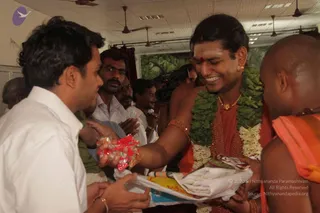
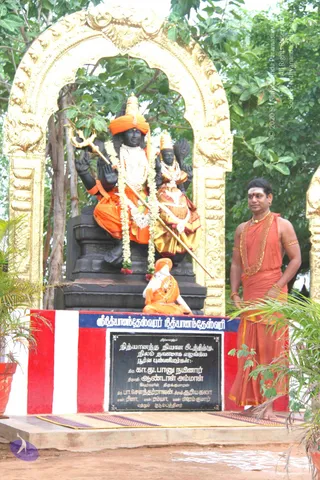
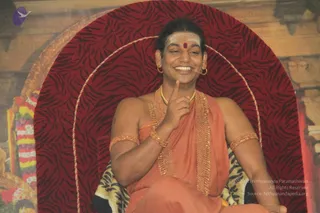
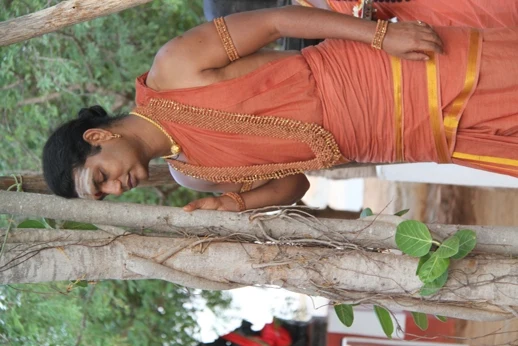
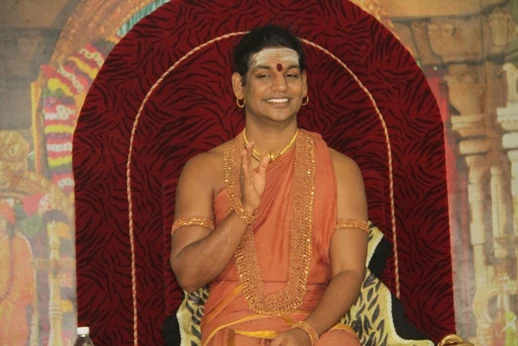
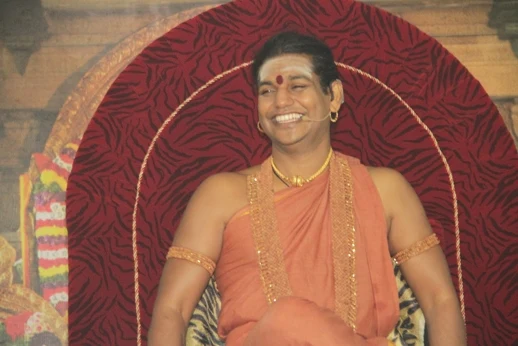
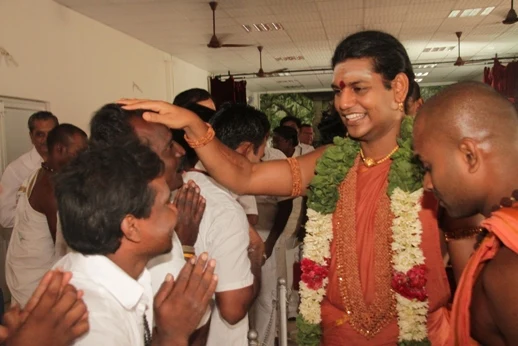
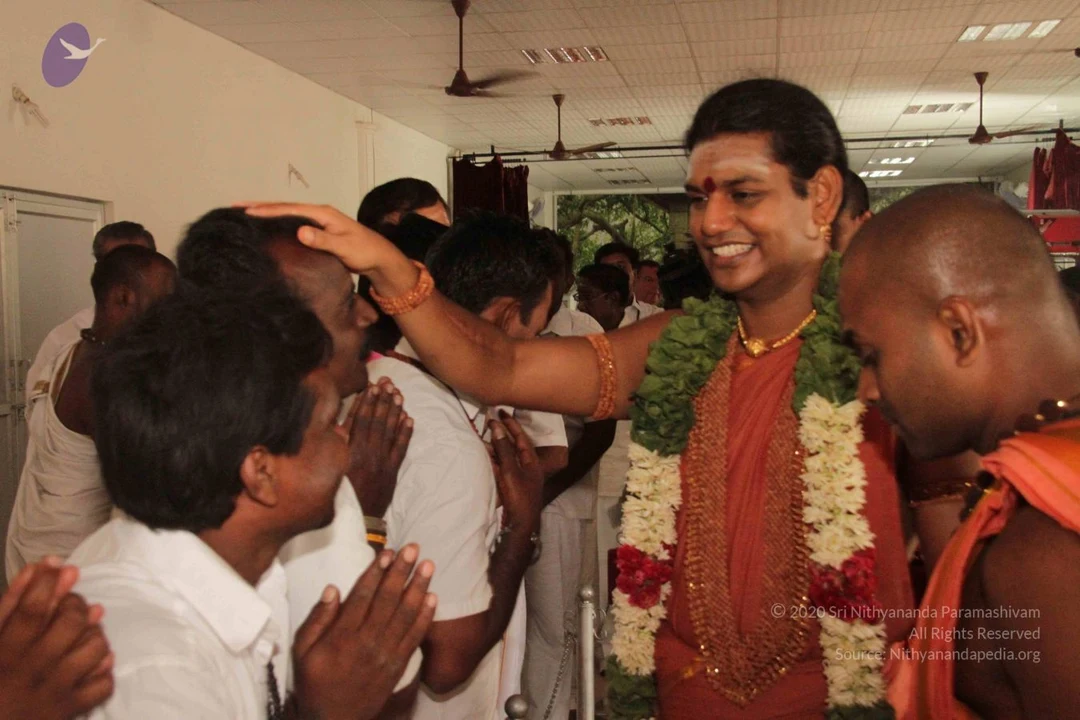
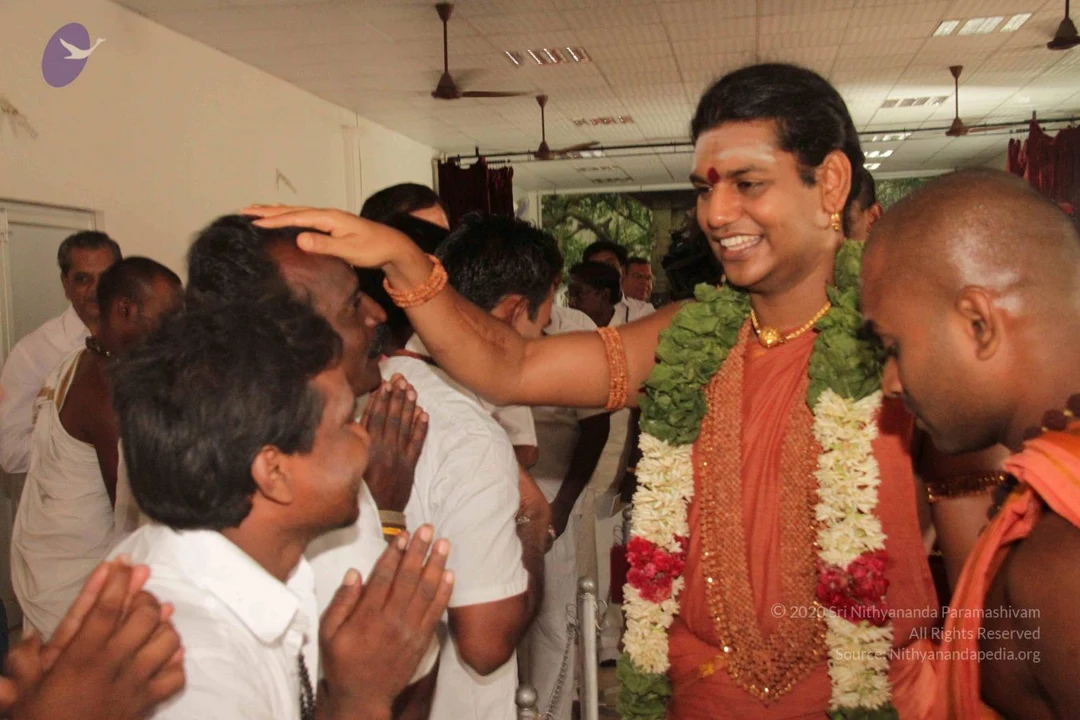
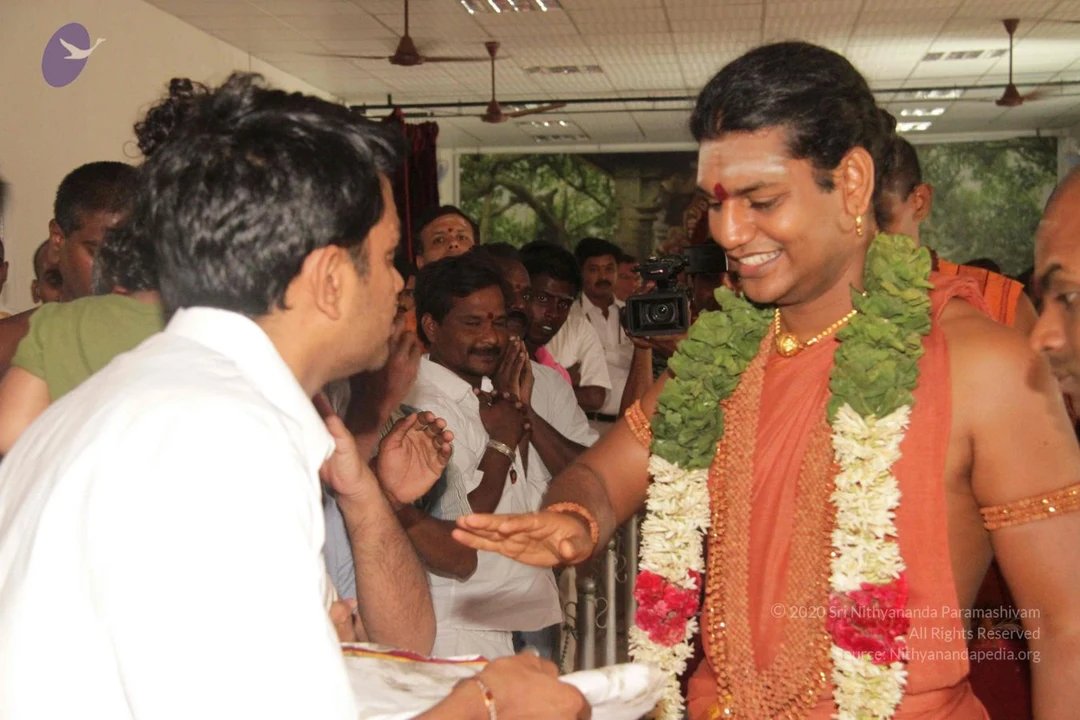
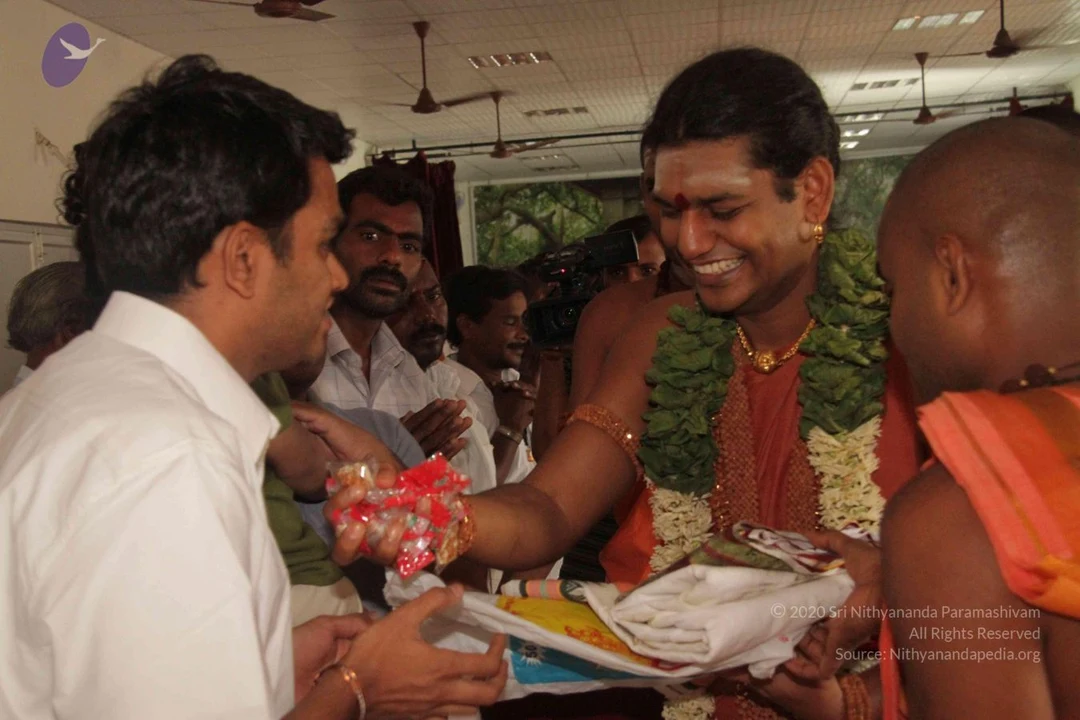
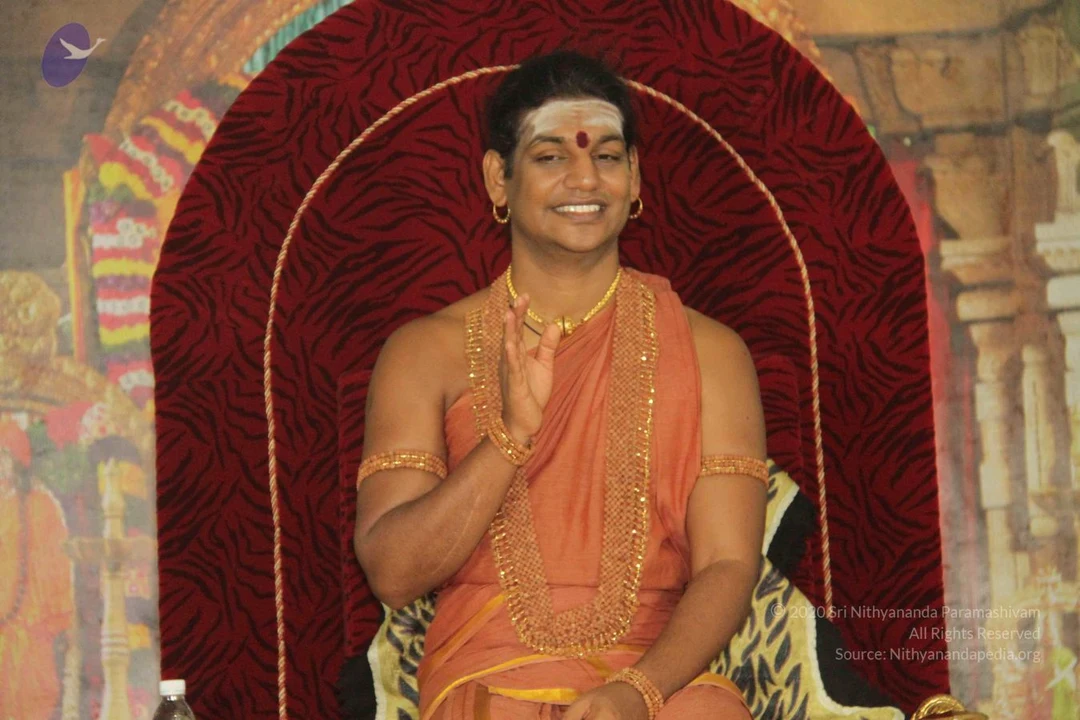
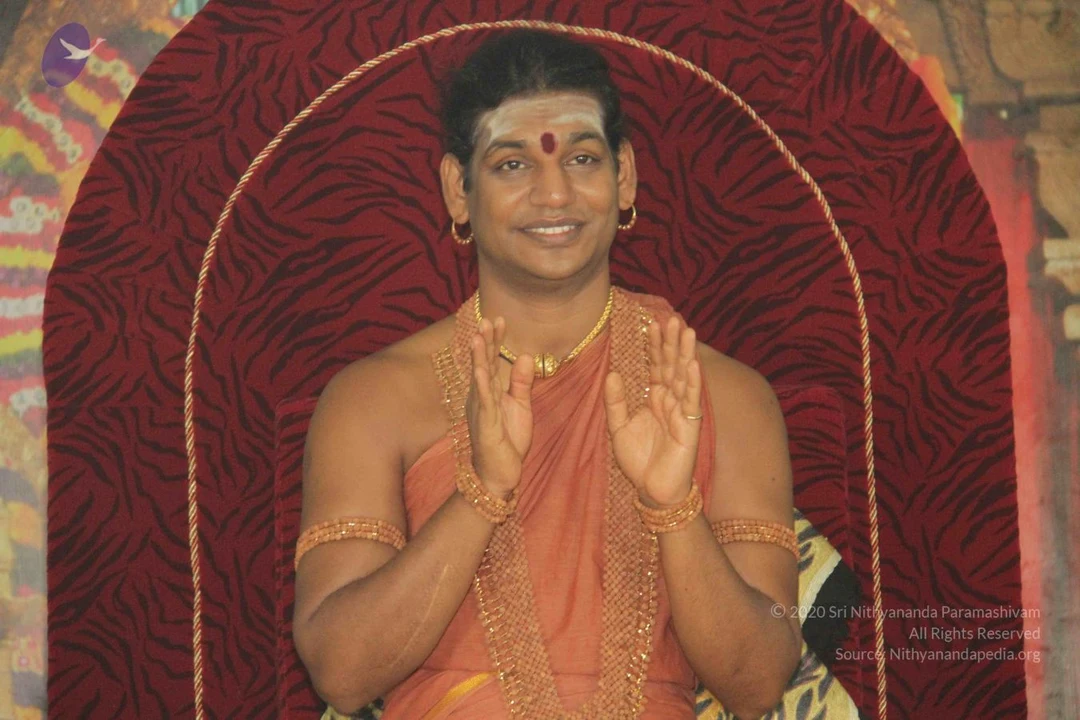
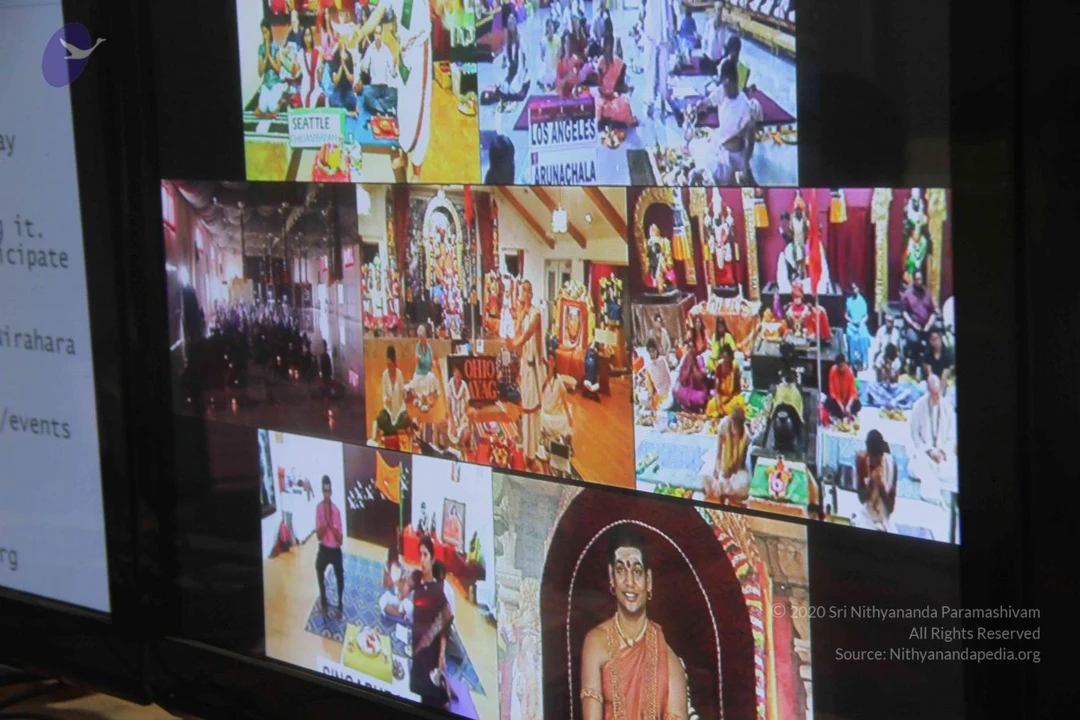
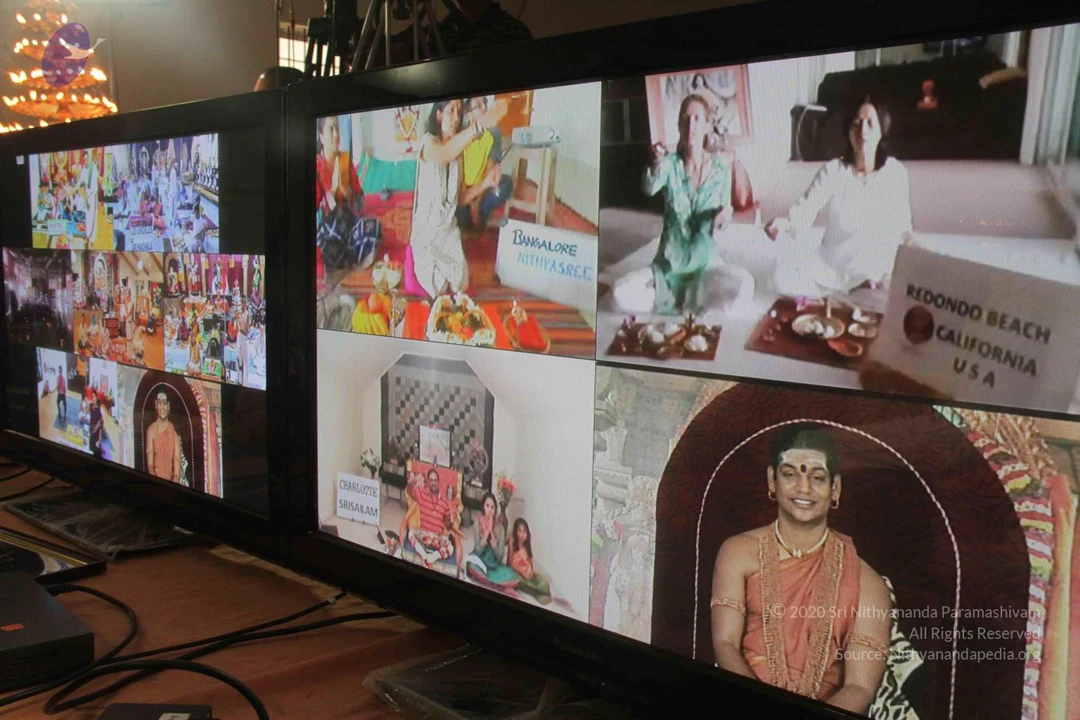
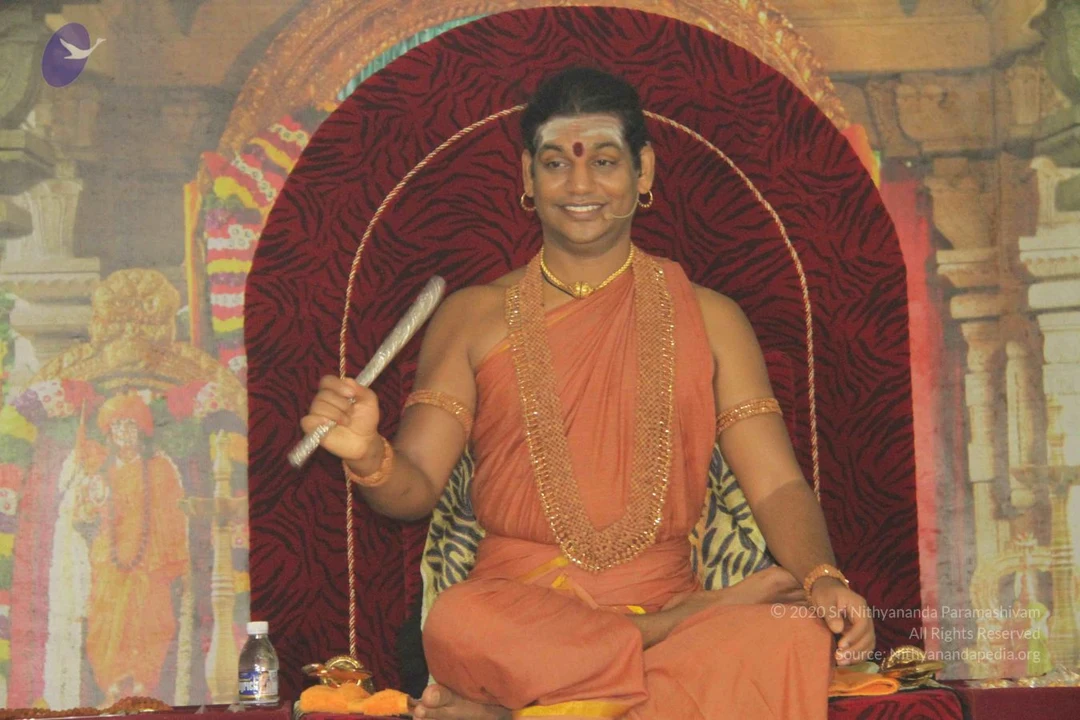
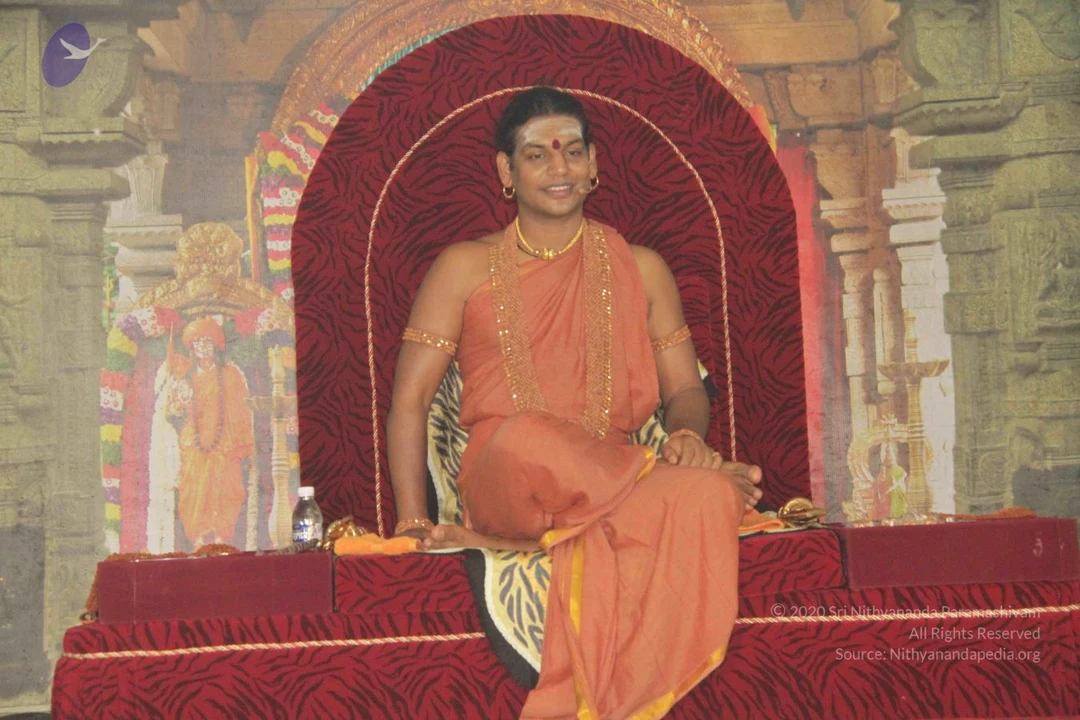
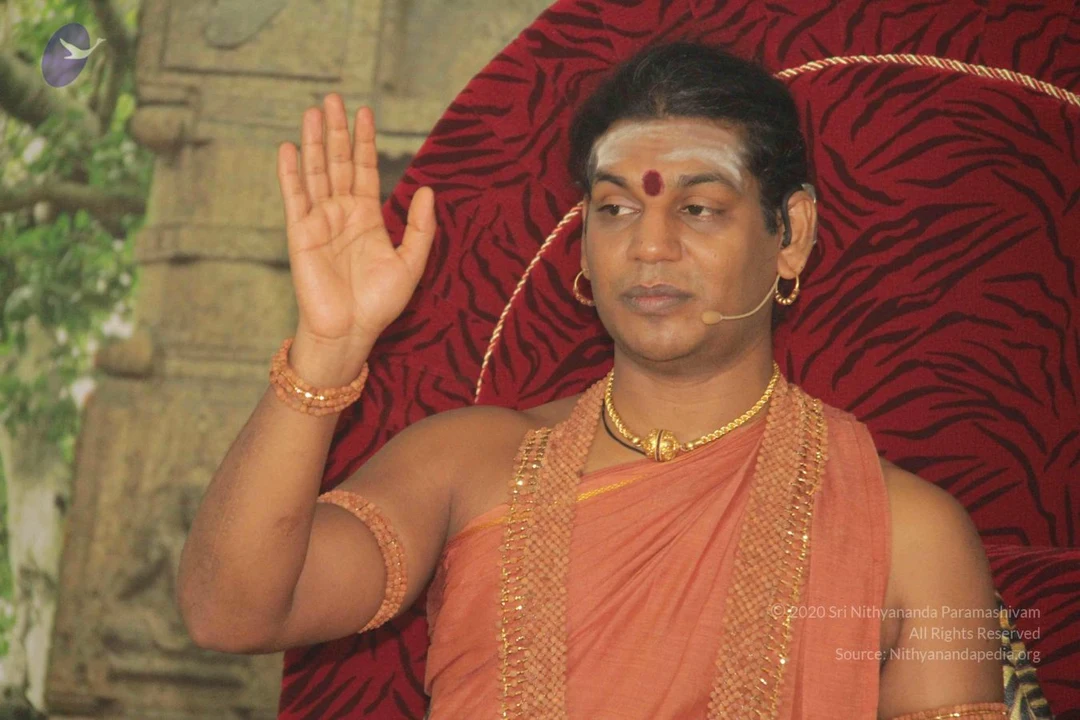
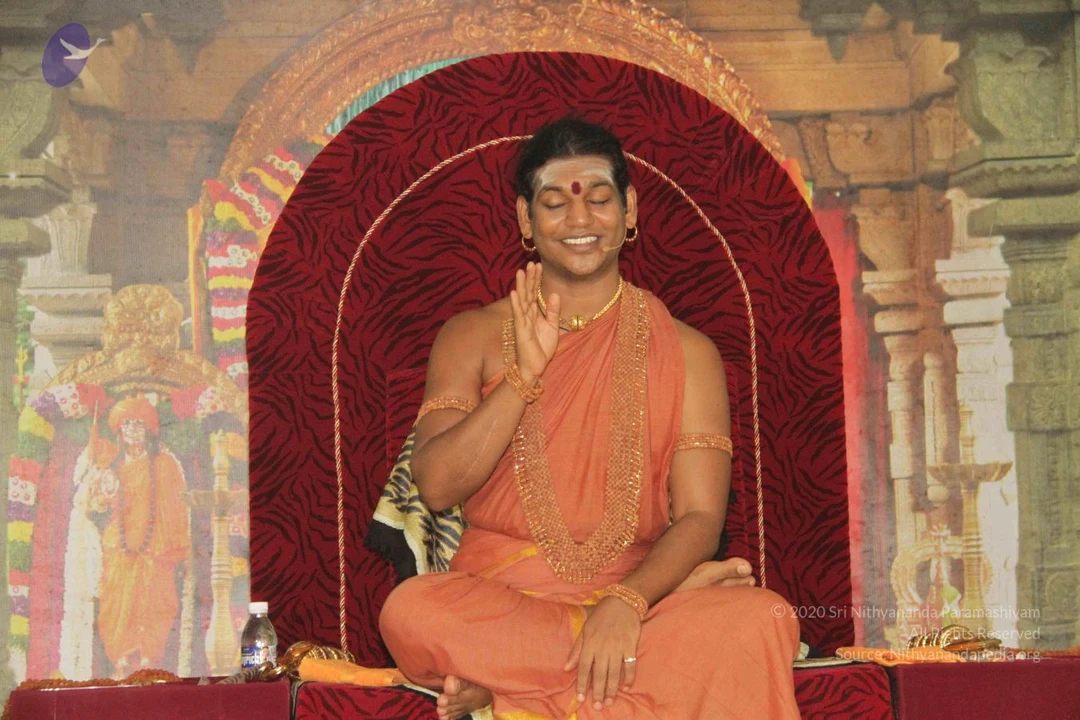
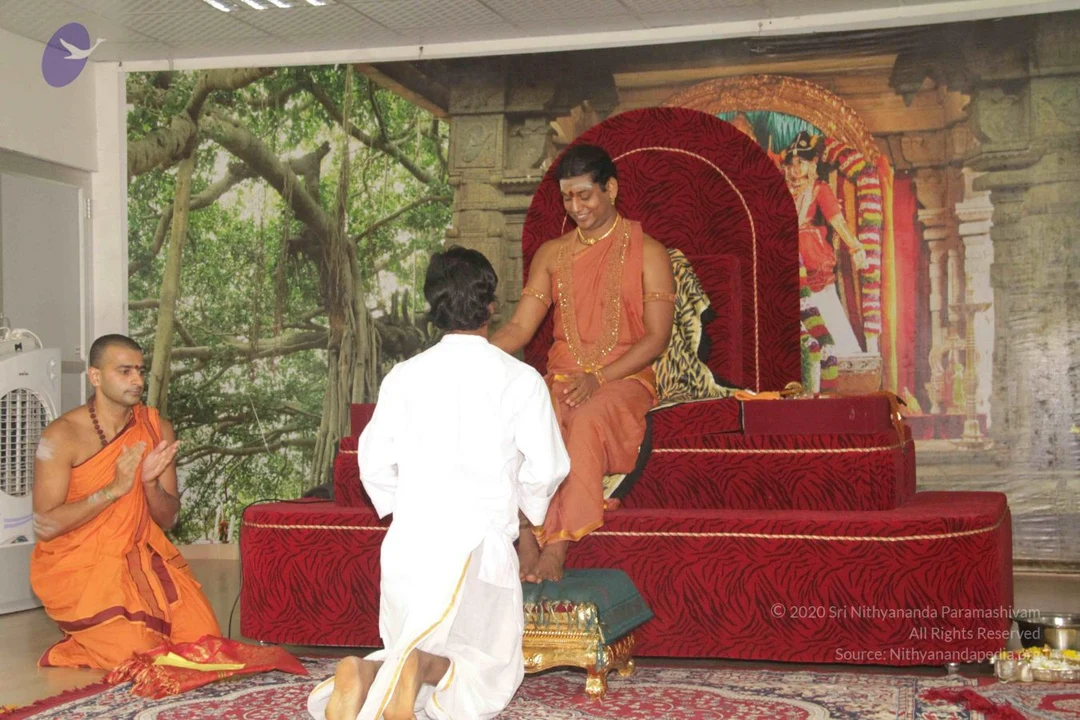
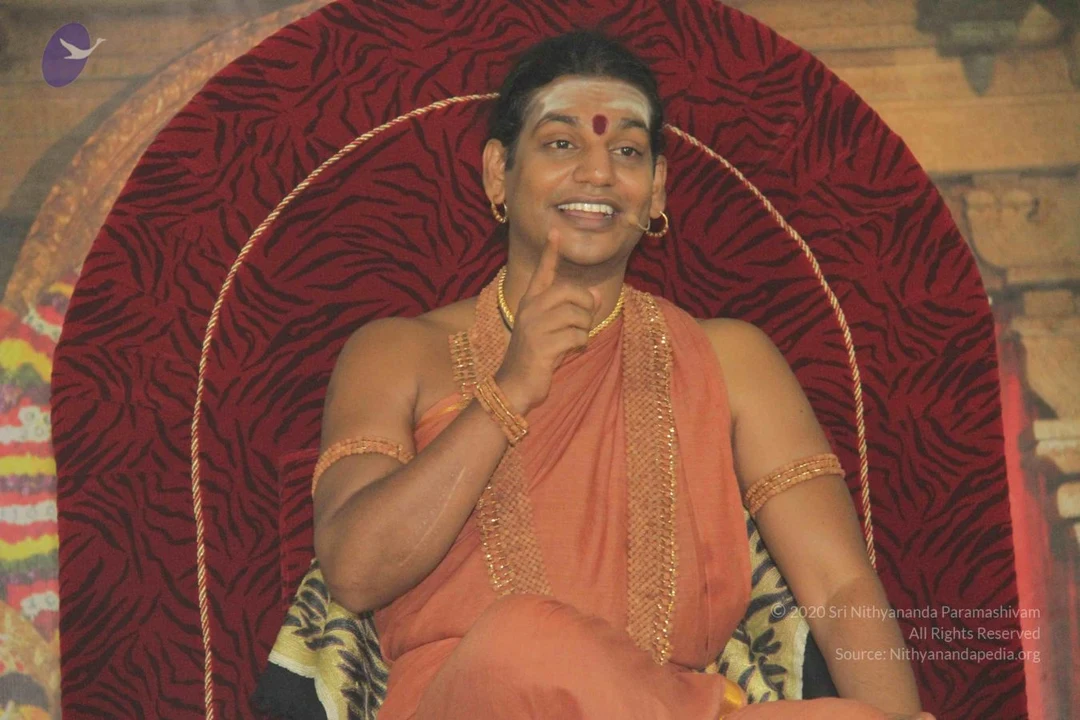
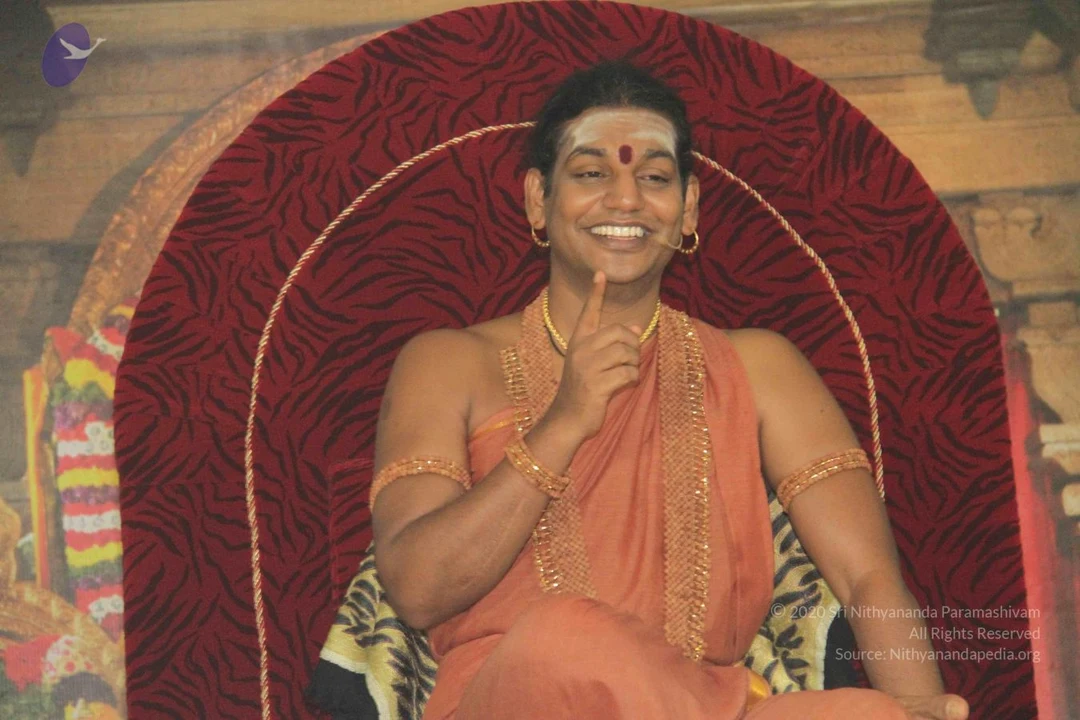
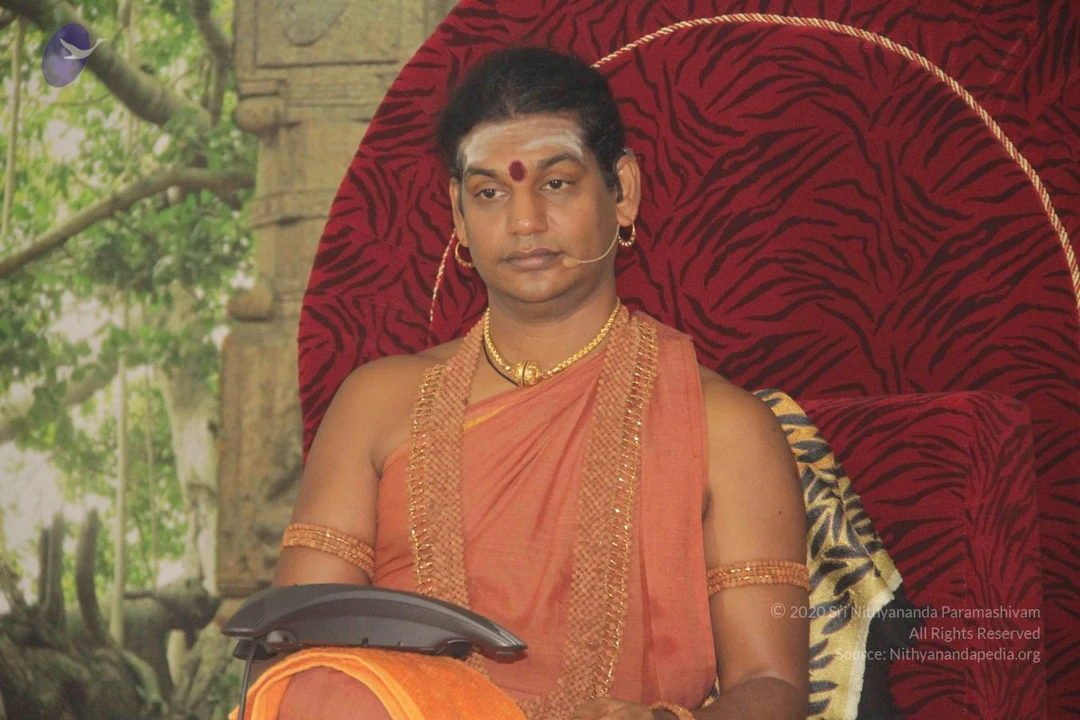
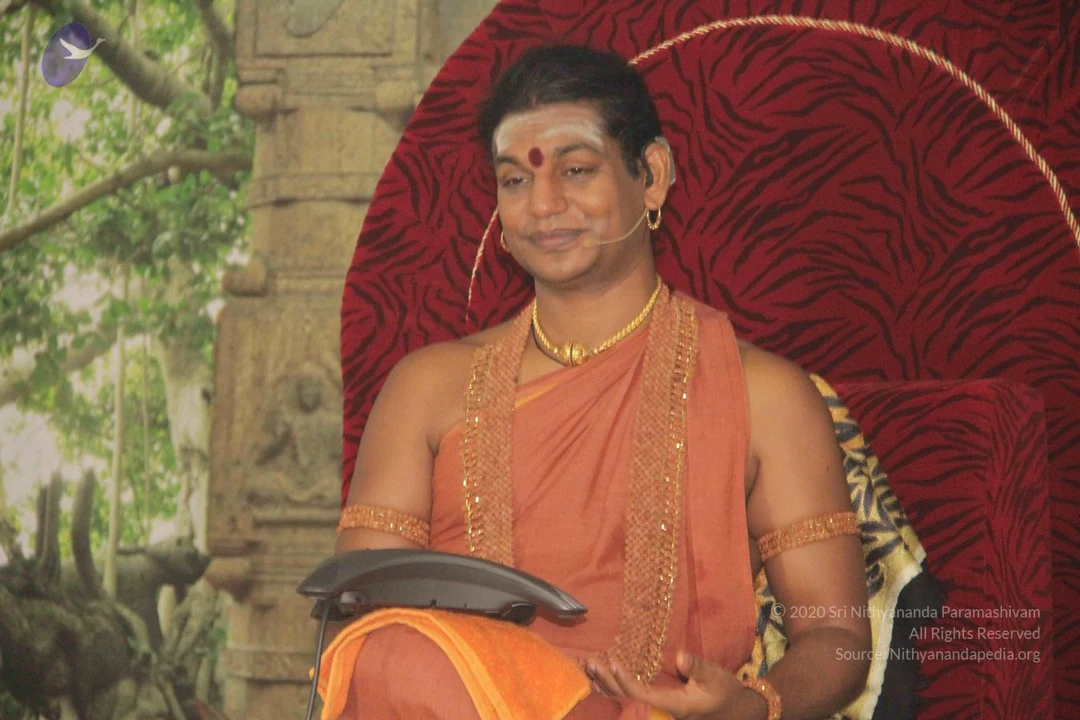
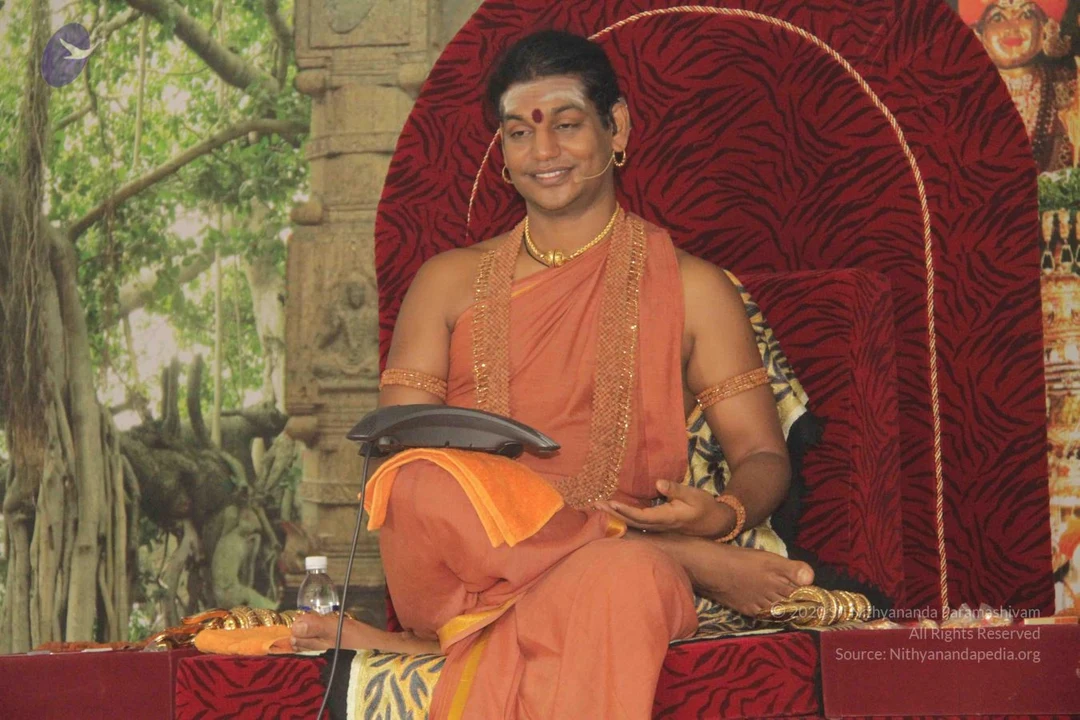
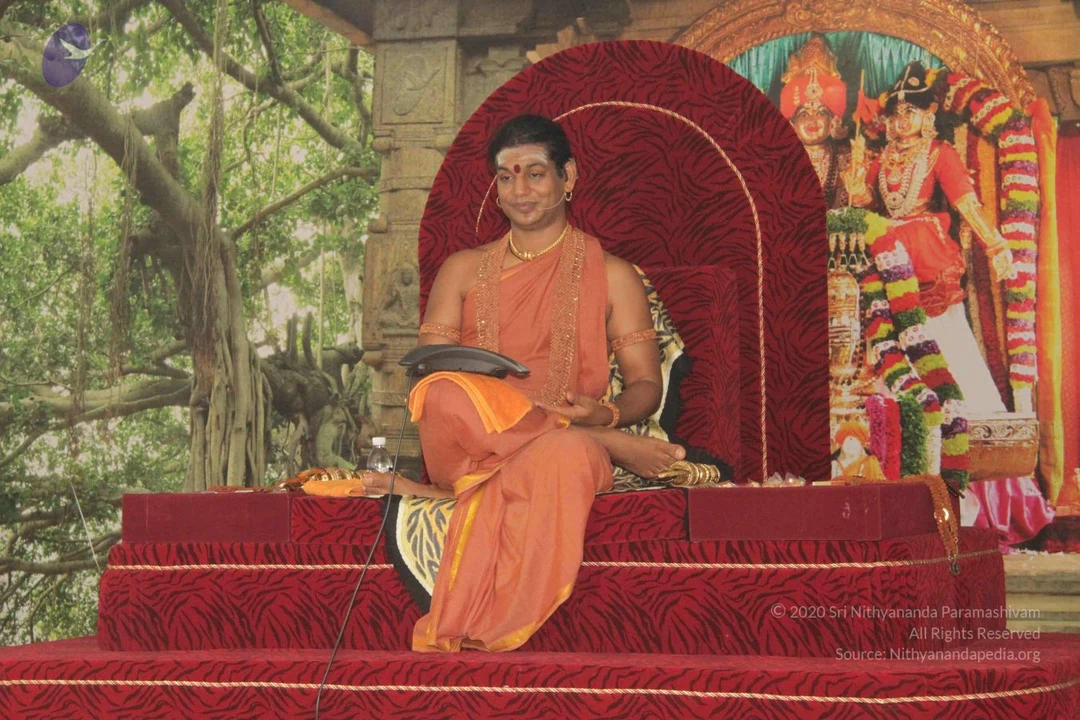
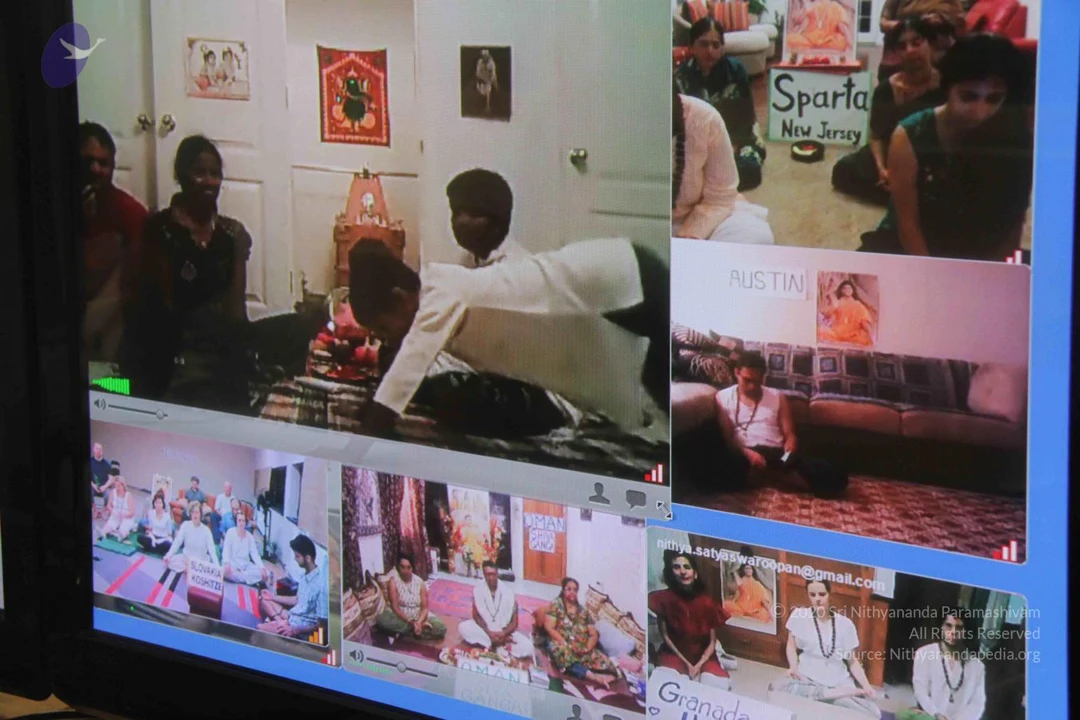
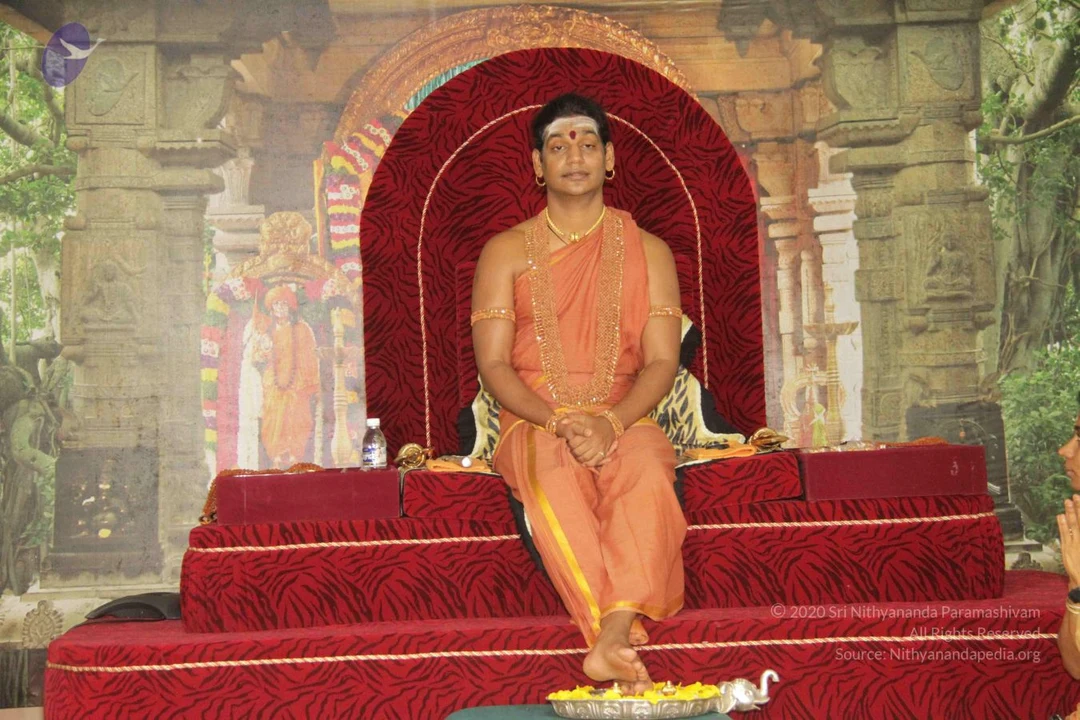
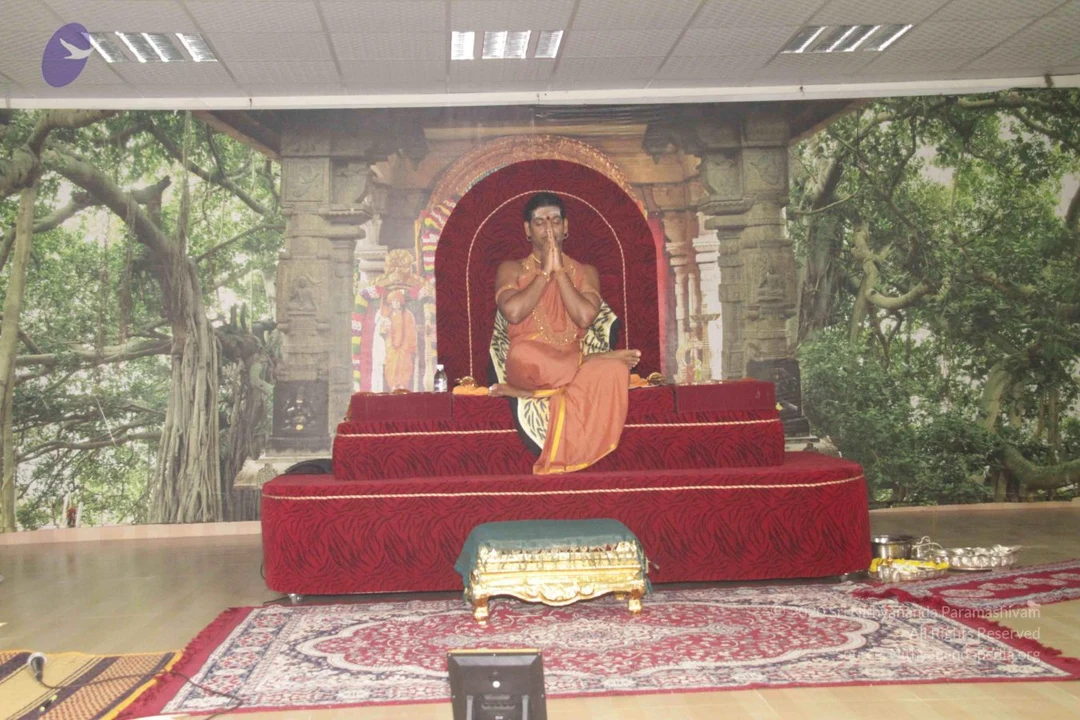
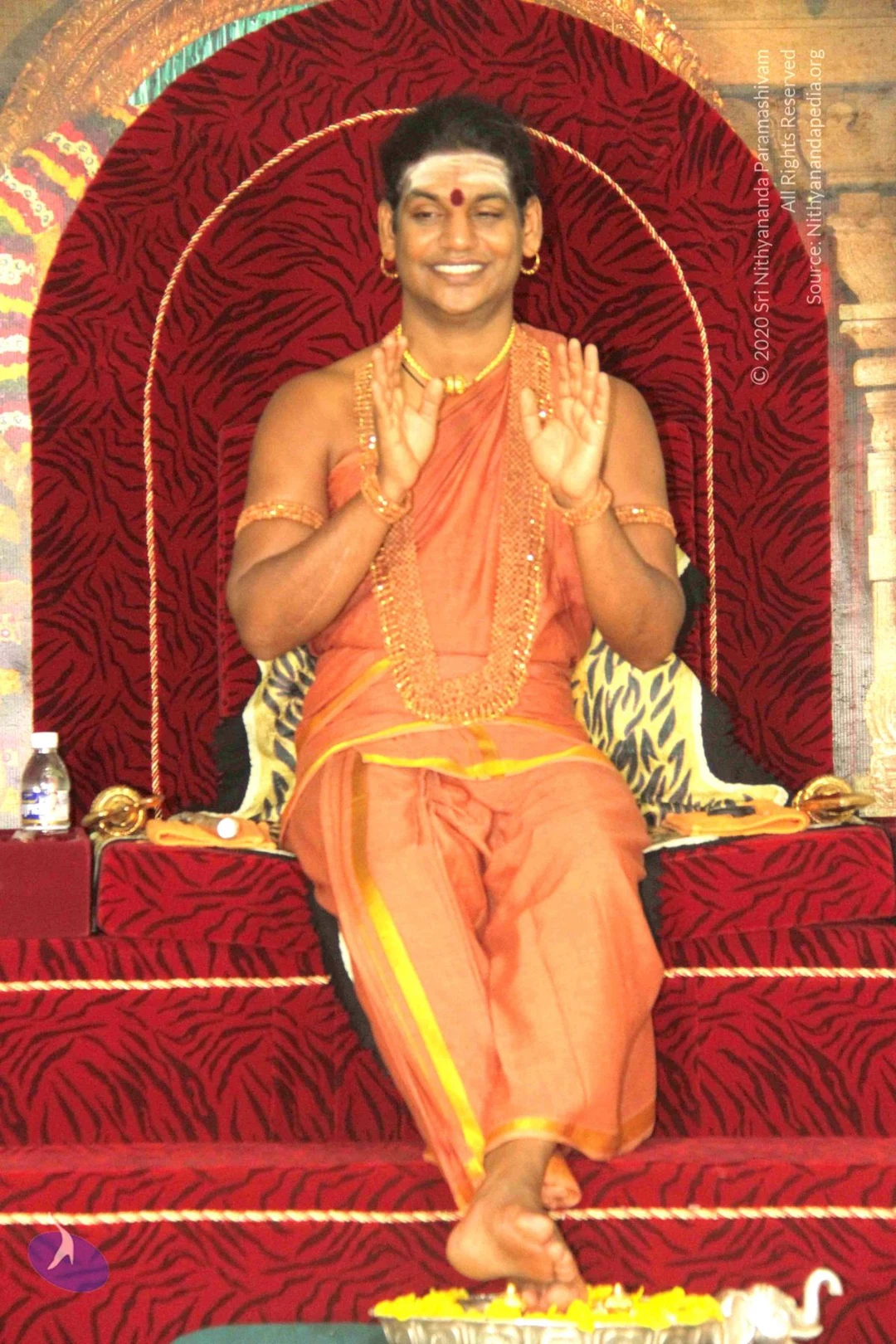
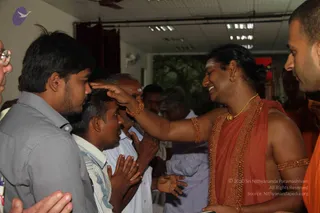
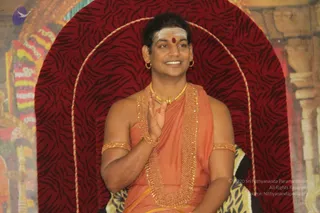
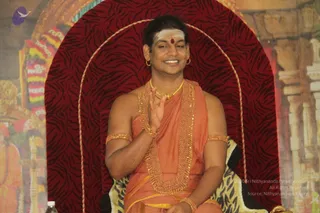
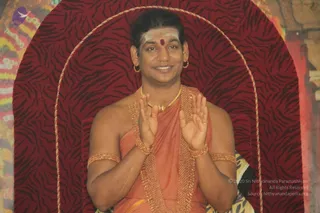
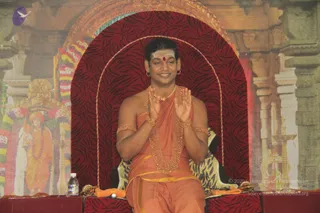
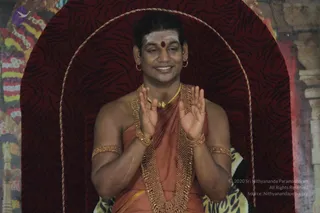
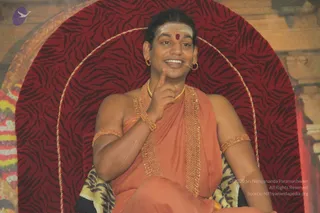
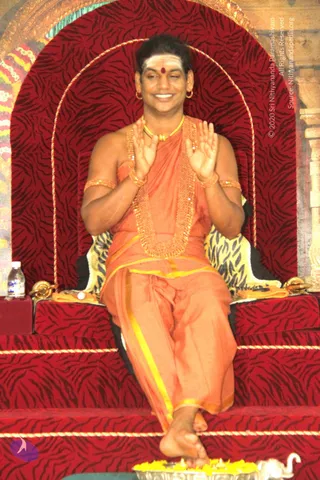
A photograph of a devotional exchange in an indoor hall with ceiling fans and a painted forest mural. A central man in orange robes, wearing a green leaf garland and white jasmine garland, a gold necklace, gold bangles and a red bindi with white tilak, smiles while holding out a small bundle of wrapped sweets and folded white cloth. A man in a white shirt on the left reaches toward him with his hands extended. A bald saffron-robed monk stands at the right edge. Several onlookers and a video camera operator stand behind them.Outdoor photo of a golden arched shrine framing a dark stone statue of a deity pair, seated figures with orange turbans, trident and garlands of white flowers. A living man in orange-saffron dhoti and sleeveless top with gold necklace and arm bands stands to the right, hands on hips, beside a shrine plinth. A small white and orange seated figure sits at the base. A black plaque with Tamil script sits on a red and white painted base, with potted plants and a woven mat on the ground. Green trees behind.A smiling man in saffron-orange robes sits on a red velvet throne with a curved back trimmed with gold rope, one index finger raised to his lips in a teaching gesture. He wears gold armbands, gold bangles, a gold chain of ornate ceremonial design, gold hoop earrings and a red bindi with white vibhuti lines on his forehead. The background shows a decorated temple-style backdrop with floral garlands in pink, yellow and green. A satsang discourse setting. Swamiji (probable): long hair swept back, saffron robes, gold ornaments and rudraksha-style adornments visible, seated on a throne.

July 25 2012

Original wiki page
Contents

Title:

Make Miracles Happen In Your Life.

Description:

TALKS FROM MORNING SATSANG ON JULY 25 2012 IN BIDADI ASHRAM, INDIA Bhagavad Gita (Song of God) is a timeless treatise on the essence of living enlightenment. The Gita was imparted by the enlightened Hindu incarnation Sri Krishna to the warrior-prince Arjuna over 5000 years ago. Amazingly, the spiritual wisdom and life solutions offered in the Gita are so universal and current that even today it is used as a personal transformation guide. In today’s talk on Bhagavad Gita, Chapter 5, Verse 19, Paramahamsa Nithyananda (Swamiji) explains the source of extraordinary powers. When we establish ourselves in the Supreme consciousness, in the state of living enlightenment, we can surpass the laws of nature. This is not actually miraculous, it is simply fact. If we embody the divine spirit, we acquire divine abilities. Our lives become a reflection of God.

Link to Video:

VideoAudio

Transcript:

Make Miracles Happen in Your Life

Discourse by Paramahamsa Nithyananda

Bhagavad Gita – 5th Chapter – Sanyasa Yoga – 19th Verse

July 25, 2012

Ihaiva tair – jitaha SargoYeshaam saamye sthitam manaha I

Nirdosham hi samam brahmaTasmaad – brahmani te sthitaaha II

The translation:

Here, ihaiva, in this world itself, the nature is surpassed by them whose intelligence remains impartial for the Supreme Being that is flawless in the same in all. Therefore, they remain established in the supreme.

Oh God! Krishna is too much. What he says you know:

If you are established in the enlightenment space, in the intelligence, even now all the rules and laws of the nature is changed. If you are established in the supreme consciousness, all the laws of the nature is surpassed. And I tell you, wherever you surpass the laws of the nature that is what others claim as miracle. But for you it is “Happening”. “The Happening”, which is “The Happening” for unconsciousness fellow is crime for society. Which is “The Happening” for the conscious fellow, it is being part of the nature, flow of the society, which is “The Happening” for the super-conscious person, is miracle for society.

Understand, which is “The Happening” for an unconscious fellow is a crime for society. An unconscious fellow does not plan and do the murder. Just yesterday, see whenever I come to Tiruvannamalai, I have one habit. This local villagers, 4~5 fellows are there, who will give me report. What is going on, that village talk, who ran away with whom, who is sitting with whom, who is hanging around with whom, who is killed by whom, whose house is sold by whom, whose house is bought by whom. I don’t have time to see the news, CNN, IBN or the International things, but I will have 2 ~ 3 of these villagers. One of my informer is Mr.Krishnamurthy. “Swamiji, do you know few days before there was a murder in Tiruvannamalai?” I asked “What happened, why, who?” He gives me thoroughly who is the person who planned the conspiracy, who is the person who went and killed. I said “You are giving so much information, are you connected to Police Department?” He says “No Swamiji. Even Police Department does not know this much”. I asked him “Why did they kill that guy?” He said “Swamiji, these fellows have done some other murder earlier. This person who got killed now is the eye-witness. If he goes to the court and gives eye-witness, they all will be convicted”. I said “What an unconsciousness!” See, to escape from one murder conviction, they killed other person. Now it is going to be double murder. Two murders! So the person who has done both murders, is not conscious person. He is unconscious. He does not even understand the ripple effect of the whole thing. So, just “The Happening” for the unconscious person is crime for society. If you ask that guy who planned and did the murder “why did you do it?”, he will only scratch his head and say “Oh, I thought if this fellow is alive, he will come to the court and give eye-witness. That may lead to conviction”. Okay that is true. But now, “what have you done? You have done one more murder. So naturally it is going to be now conviction for double murders, two murders!”

An unconscious person does not think through. So whatever is the flow of life for him, is crime for society. For a conscious person, whatever is flow of his life, like he wakes up, morning he goes to the job, works in his office, goes for lunch, comes back, again works in his office, comes back to sleep, whatever is his course of life, “The Happening”, it is part of society, the flow of society. If you ask him “Why are you doing this?” He says “That is the way life is!”

It is like a common understanding. If you are a girl, the moment you are 25, get married. If you are a boy, the moment you are 27, get married. Of course, what I am saying age is city limit, city age limit, in villages it is much less. These all commonly accepted understanding, the commonly accepted understanding. It’s a flow of society. If this is next, then this is next. If this is next, then this is next. The conscious person’s “The Happening”, is flow of society.

But, the super conscious person’s “The Happening”, is the miracle for society. When thousands of miracles are happening around me, I tell you, I promise you, I don’t do anything. It is ‘The Happening’ for me!

People come and tell me. “Swamiji, I came to Kalpataru, I did not have kid for 20 years. I asked for your blessings. In one year I am having the child, I am so happy”. When I see the surprise in their face, I understand “So you fellow, you came without any trust or faith. That is why you are surprised”. Because when People come and tell me, I don’t get surprised. When you come to Kalpataru, when I am in that Samadhi, whatever I say naturally comes true. It is ‘The Happening” for me. What is there in that to be surprised?

But when these guys are surprised, they think I will be very happy. See, I don’t take myself granted. I enjoy. I enjoy the devotion component of you reporting. When you come back and report to me “ I did not have child for 20 years and you blessed me in the Kalpataru, now I have a child”, your gratitude component I enjoy. There is a gratitude part in that. That I enjoy. But the surprise part I don’t enjoy.

Understand, I never enjoy the surprise part. It means what? See there is a gratitude component . You have a devotion. “Yes, I did not have, I asked you. You gave me. I am grateful to you”. But if there is a surprise component, I will just turn my face and walk to the next person. Because I don’ feel surprised. But when you come back and report, when I see gratitude, I am very happy. I don’t take myself for granted. I see the gratitude part, I do enjoy the gratitude part. But if there is a surprise part, then you did not comprehend or have deep trust. That is Okay.

All I wanted you to understand, just “The Happening”, ordinary happening for me, becomes miracle for you. Because of the consciousness established in the super-consciousness, because it remains in the super consciousness, in the highest intelligence, Supreme Being, even “The Happenings” are celebrated as the miracles. Bhagavan is very clear; Krishna is very clear. He uses the word,

Ihaiva taihi – jitaha Sarga Yeshaam saamye sthitam manaha I

Nirdosham hi samam brahma Tasmaad – brahmani te sthitaah II

Here, in this world itself, the nature is surpassed by them whose intelligence remains established in Supreme Being.

It is about Thirugnanasambandar. 292nd Guru MahaSannidhanam asked me a question in Akashic reading. He put question to me in the Akashic Reading for KalaBhairava. “What are all miracles Gnanasambandar Swami did?” In the Akashic Reading, I read out “78 times he broke the law of nature, science and law of nature”. I tell you, that 78 incidents are miracles for us. But for Gnanasambandar Swami, Thirugnanasambandar, it is “The Happening”! It is just the flow! Because he is established in the super consciousness, the nature is surpassed by them, whose intelligence is established in Supreme Being.

Ihaiva taihi – jitaha SargaYeshaam saamye sthitam manaha

78 times nature would have tried to cross him and he crossed it. That’s all! When he puts the palm leaves and it goes against the water current in Vaigai, when he puts the palm leaves in Fire and it does not get burnt, means he is not performing miracle, he is established in the Supreme Being. “The Happening” itself is miraculous for ordinary people who see the whole thing in ordinary mind, from the ordinary consciousness.

Understand, now, this is the Sutra for all of you. This is the important understanding for all of you.

Be established in Ajapa Japa, Feeling Connection and Un-clutching. You will simply pass the law of the nature, which is - you can’t live without food. You will just surpass it. Be established in the supreme consciousness. You will just surpass the law of nature. You can’t live without food is a law, it’s a nature. You will just surpass it by being established in Supreme Being!

Photos From The Day:
Sakshi Pramana:

Sharing from Inner Awakening

Tags:

Bhagavad Gita, Paramahamsa Nithyananda, power, consciousness, living enlightenment, nature, miraculous, divine, spirit, live, God.

Photos Of The Day:

Sarva-Darshan
Darshan
Dial-The-Avatar

Pada-Puja

Tiruvannamalai-Aadheenam

Photos Of The Day:

Darshan
Dial-The-Avatar

Tiruvannamalai-Aadheenam

Photos from this day

View all 97 photos

Photos From The Day:

3 photosSource gallery
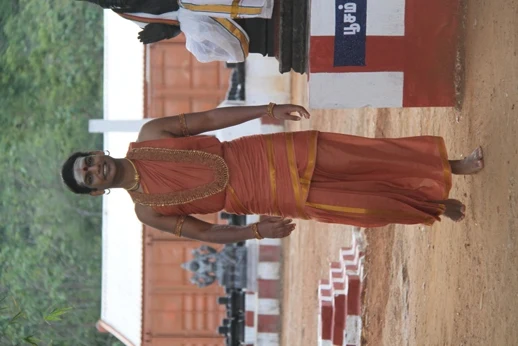
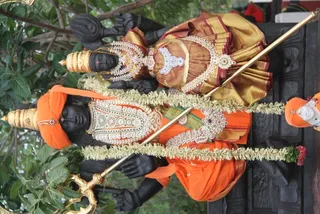
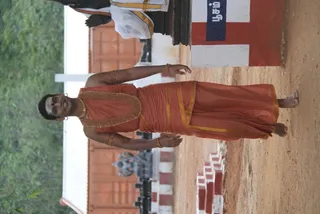
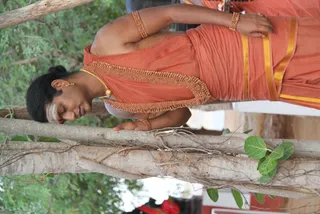
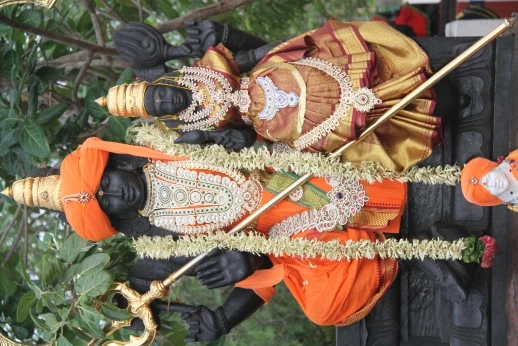
Image rotated on its side shows two black-stone murti statues of Hindu deities adorned for worship, set before green foliage and a dark carved stone backdrop. The figure in front wears a saffron-orange dhoti, an ornate silver-and-gold embellished crown and a long garland of white flowers, and holds a golden trident. The figure behind wears a rich maroon and gold silk garment with jewelled ornamentation and holds a golden staff. Both are decorated with floral garlands, gold jewellery and a red flower near the lower edge. Statues only; no living people are visible.Photo taken outdoors at an ashram courtyard, image rotated sideways. A man stands centrally in an orange-saffron dhoti-style garment with a matching shawl wrap and gold-toned ornate collar necklace, bangles on his wrists, arms extended palms-out in a gesture of address. Behind him, a red-and-white painted wall and a partly visible figure in white with a yellow-bordered cloth at the top edge. Green foliage and a pale wall are on the left, with a red and white painted kerb along the right and sandy ground below. The standing man's appearance with saffron clothing and ornate collar is a candidate for a person, with the figure described as a speaker addressing devotees; no crowd is visible.A photograph, rotated sideways, of a woman in an orange-red sari with a gold border and matching orange blouse with gold trim, leaning forward with her arms resting on a horizontal tree branch. She wears gold bangles, a gold necklace and earrings, and has her hair pulled back. Green leaves and bark of the tree fill the frame, with blurred greenery and a light-coloured structure behind her. She appears to be a devotee or ashram participant; no person is identified as a person.

Sarva-Darshan

16 photosSource gallery
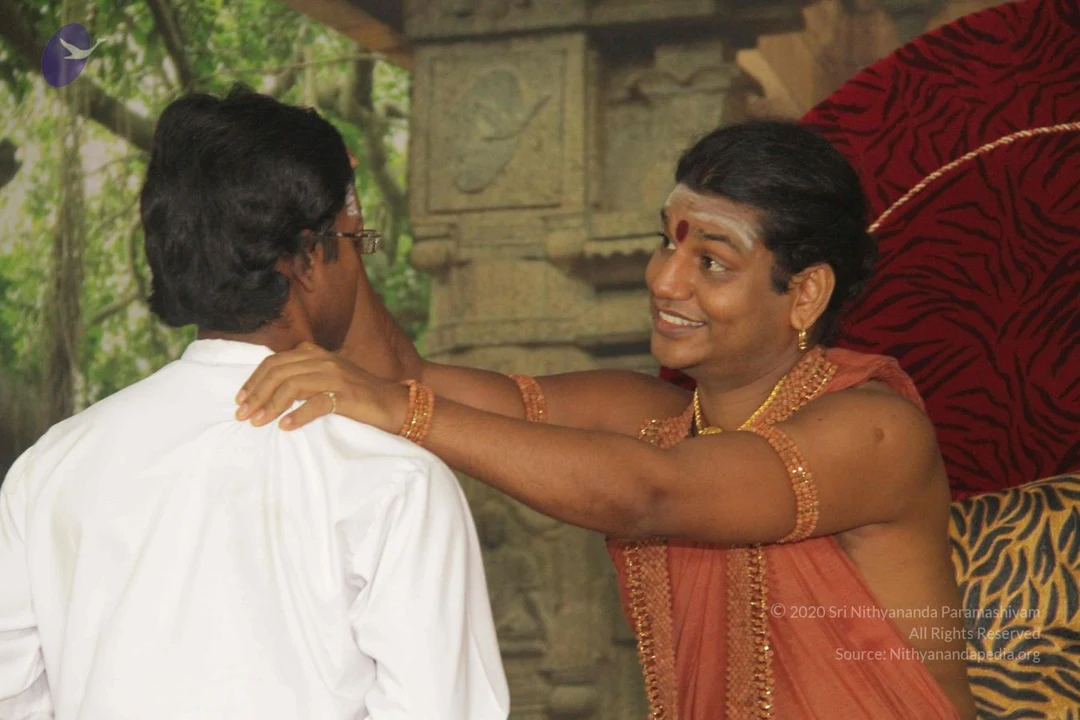
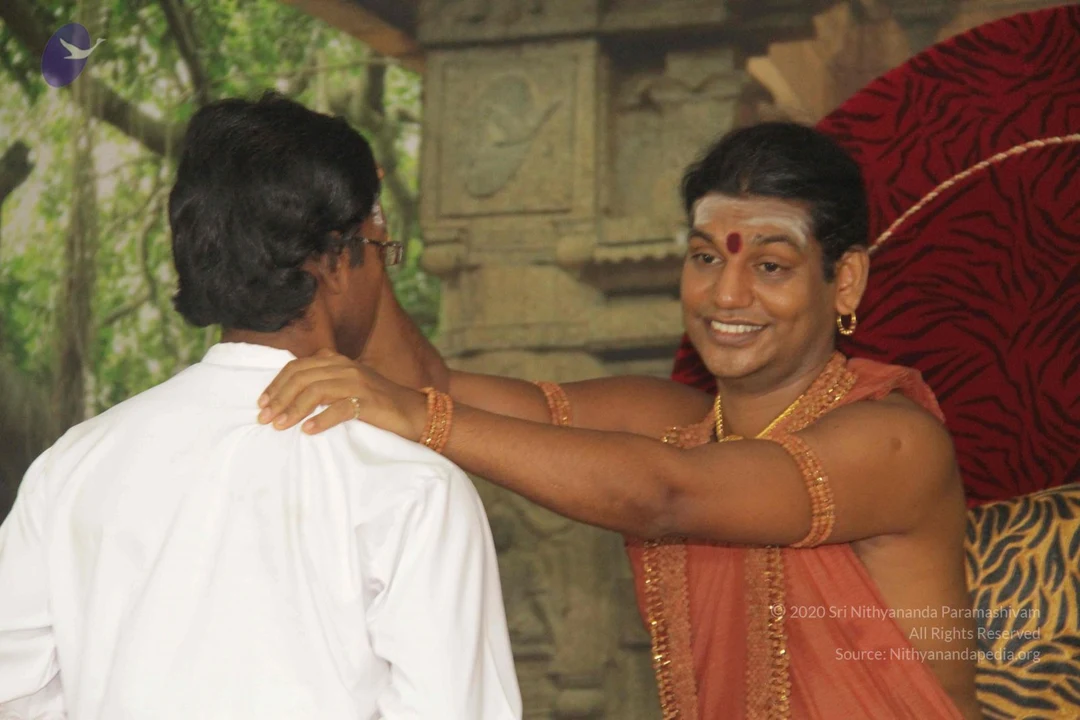
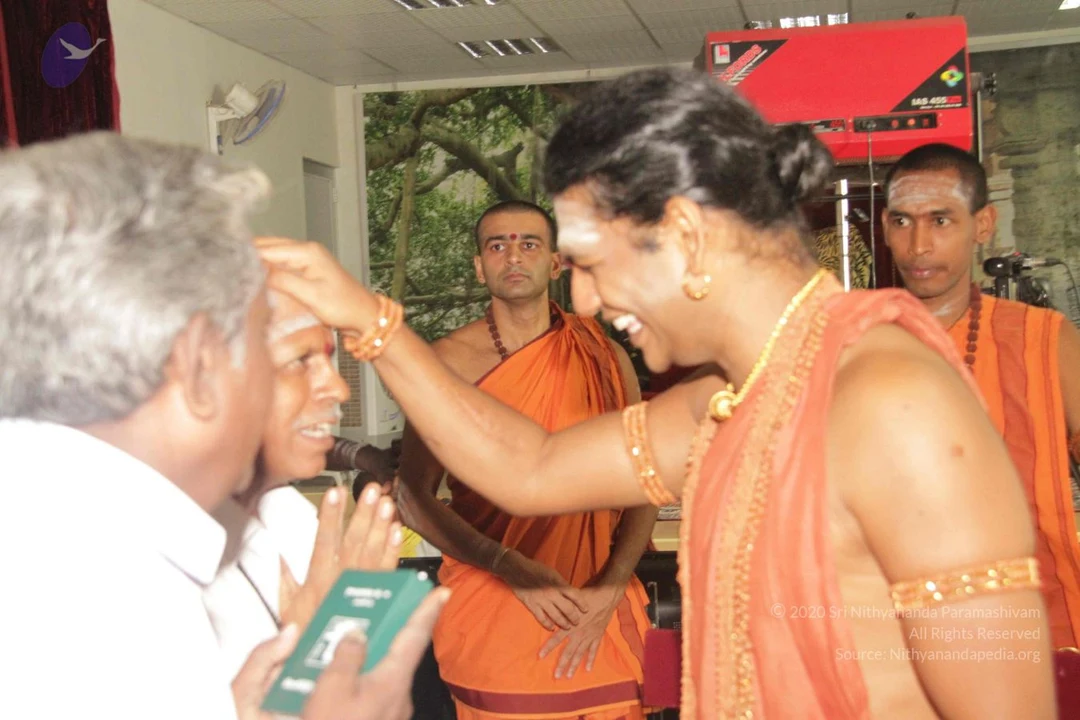
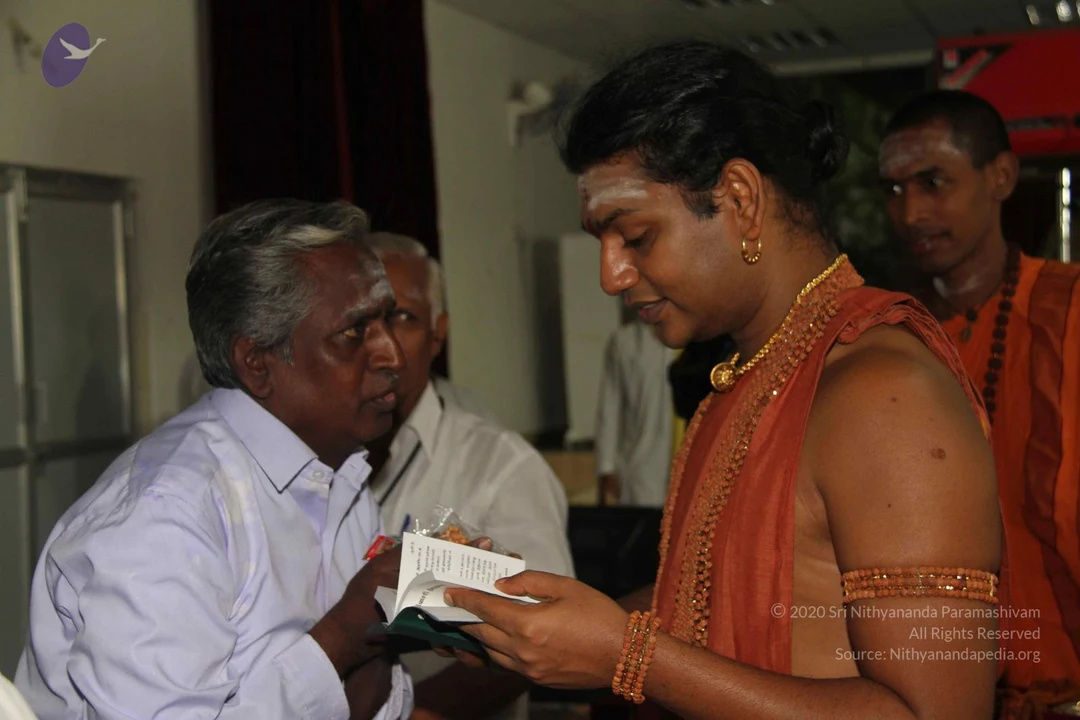
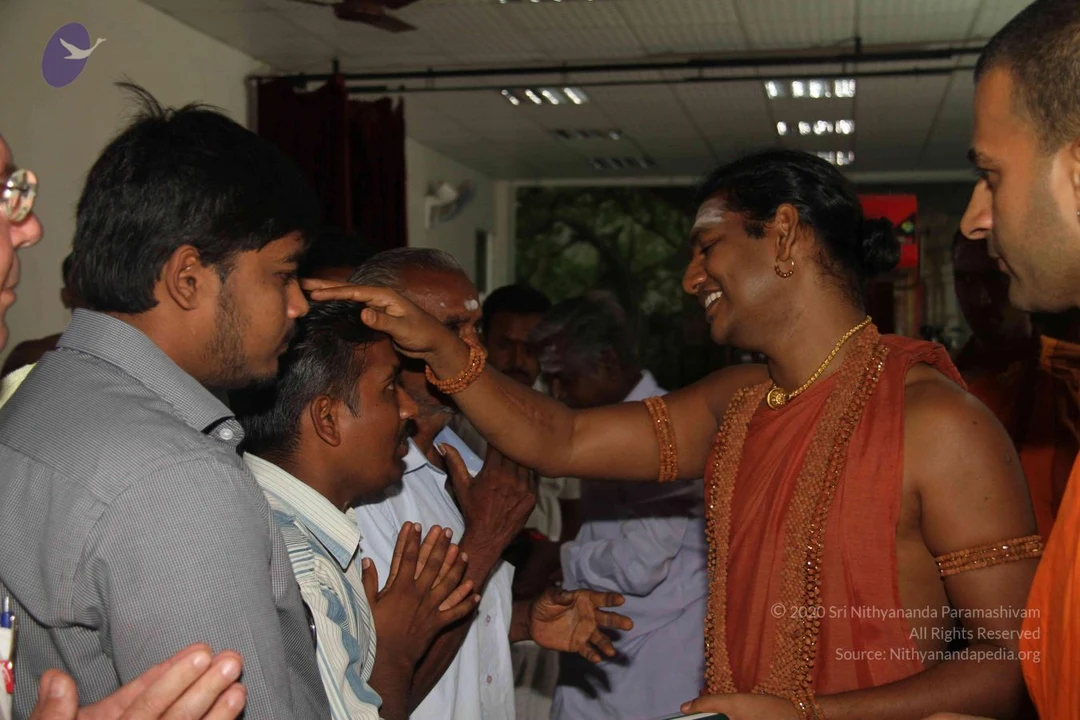
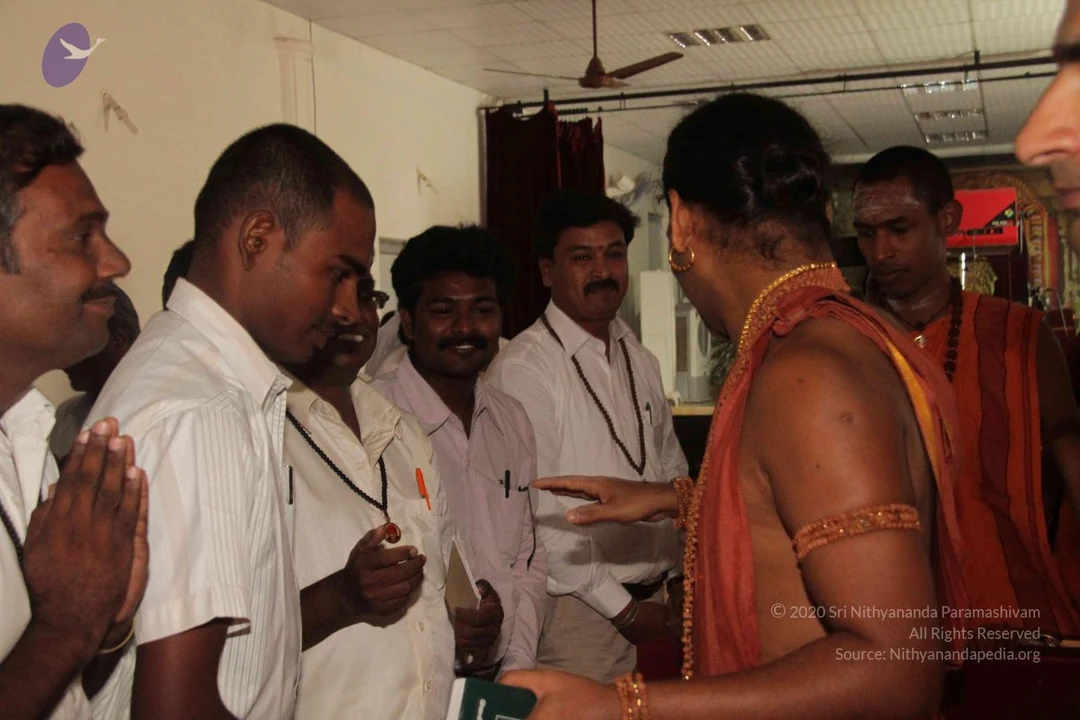
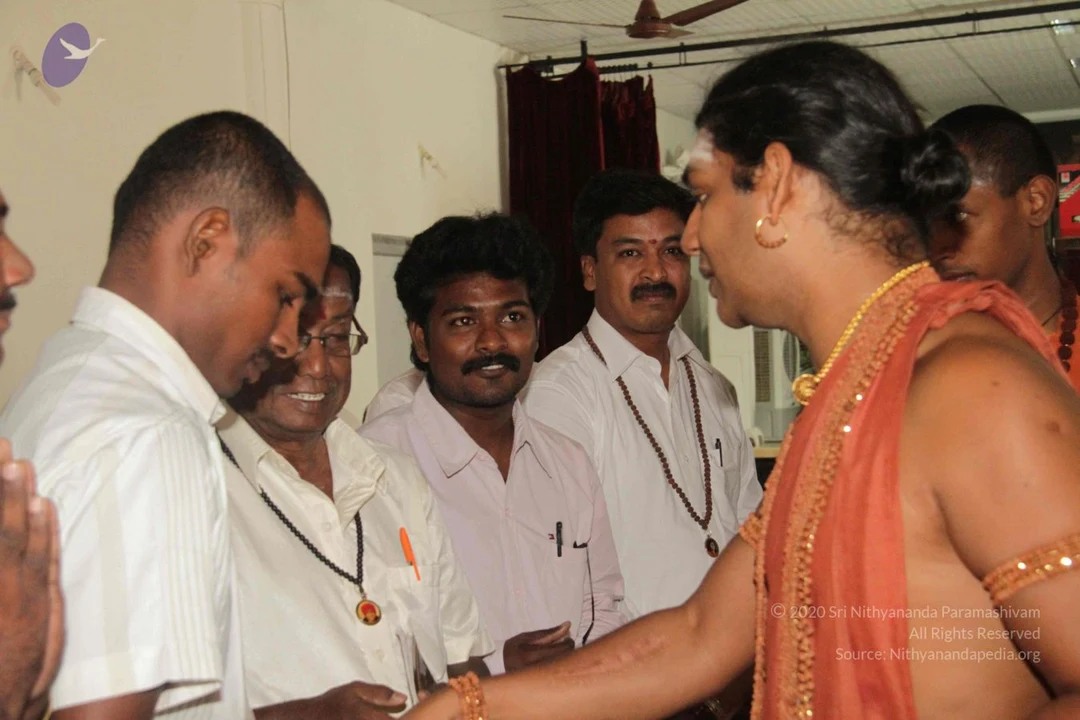
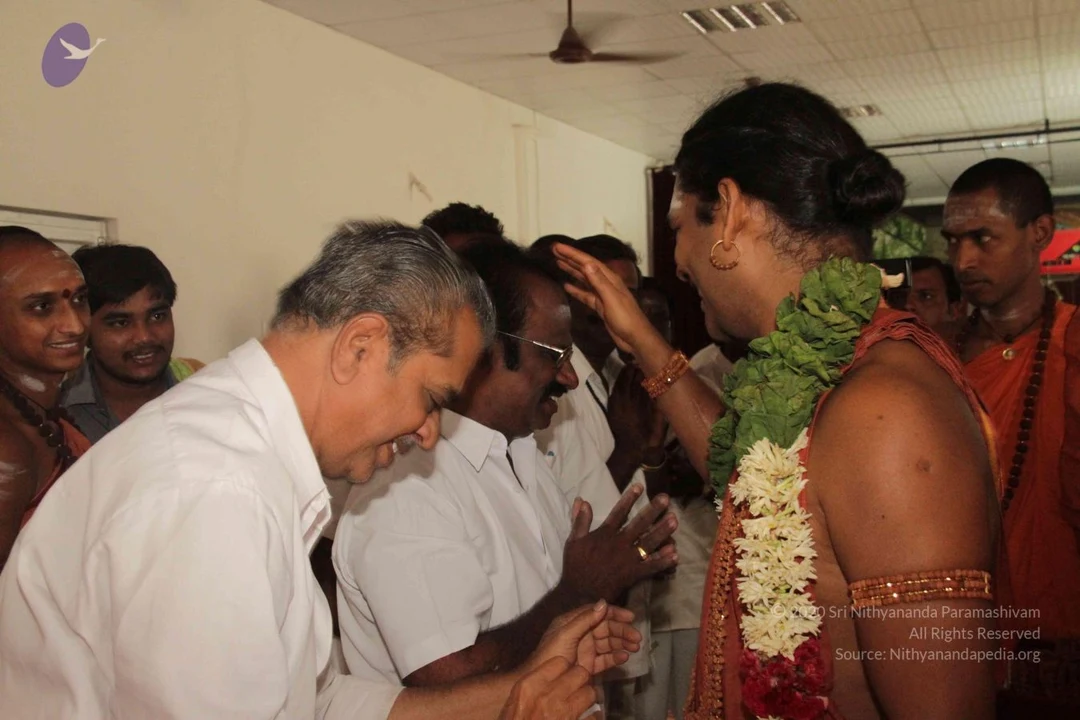
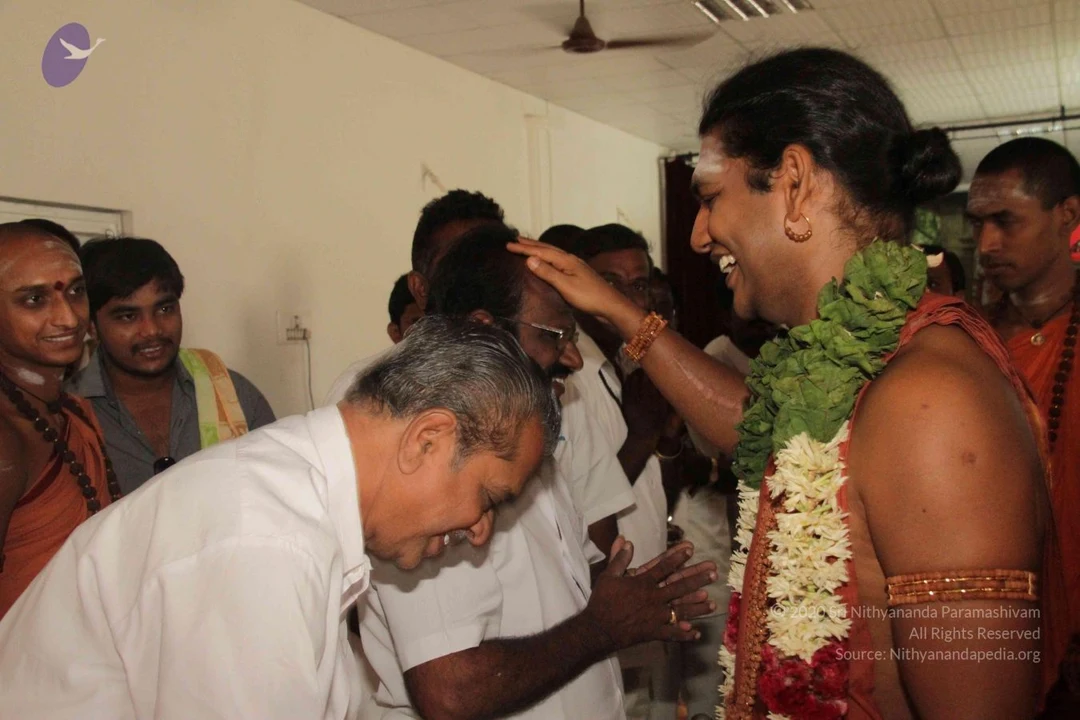
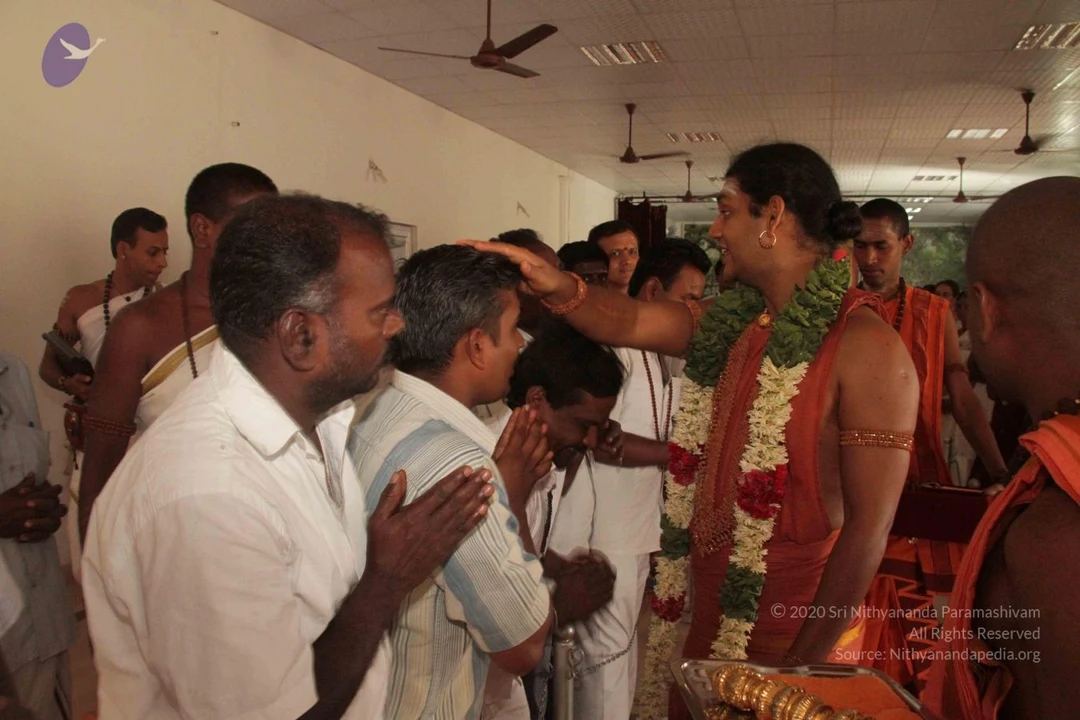
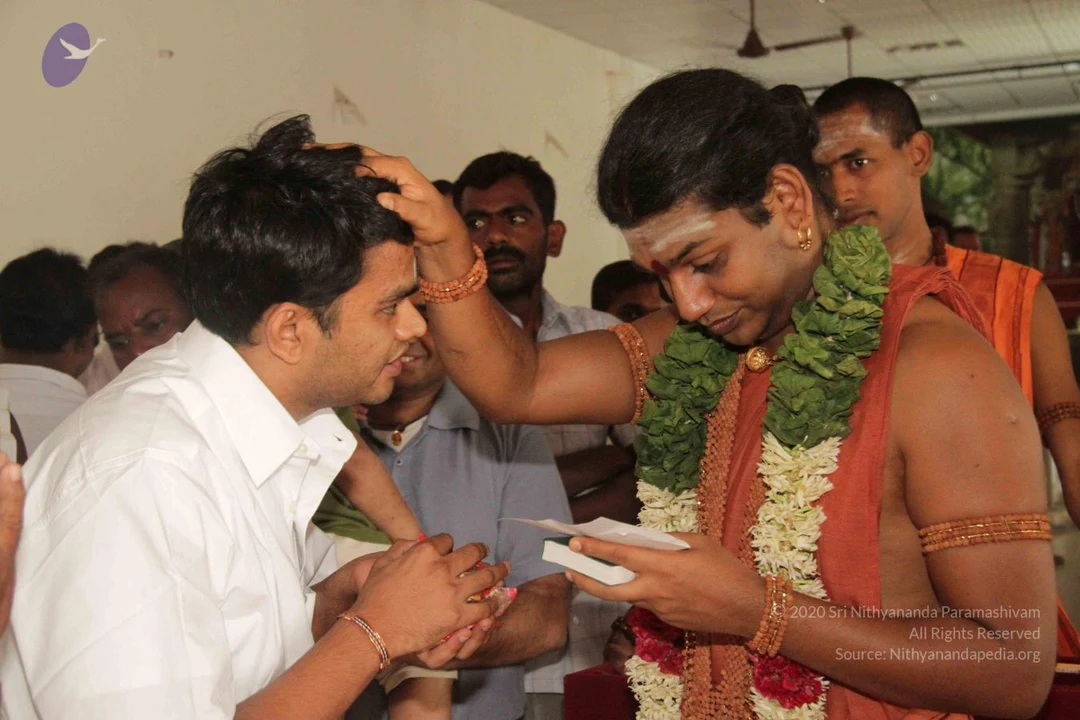
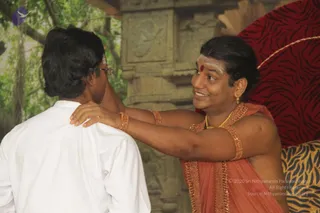
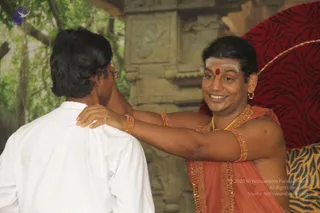
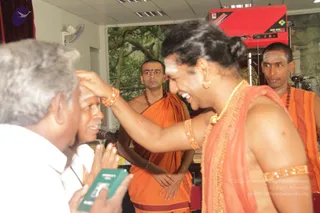
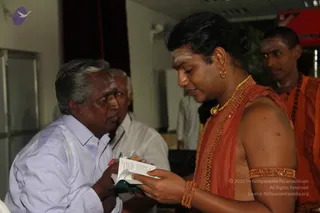
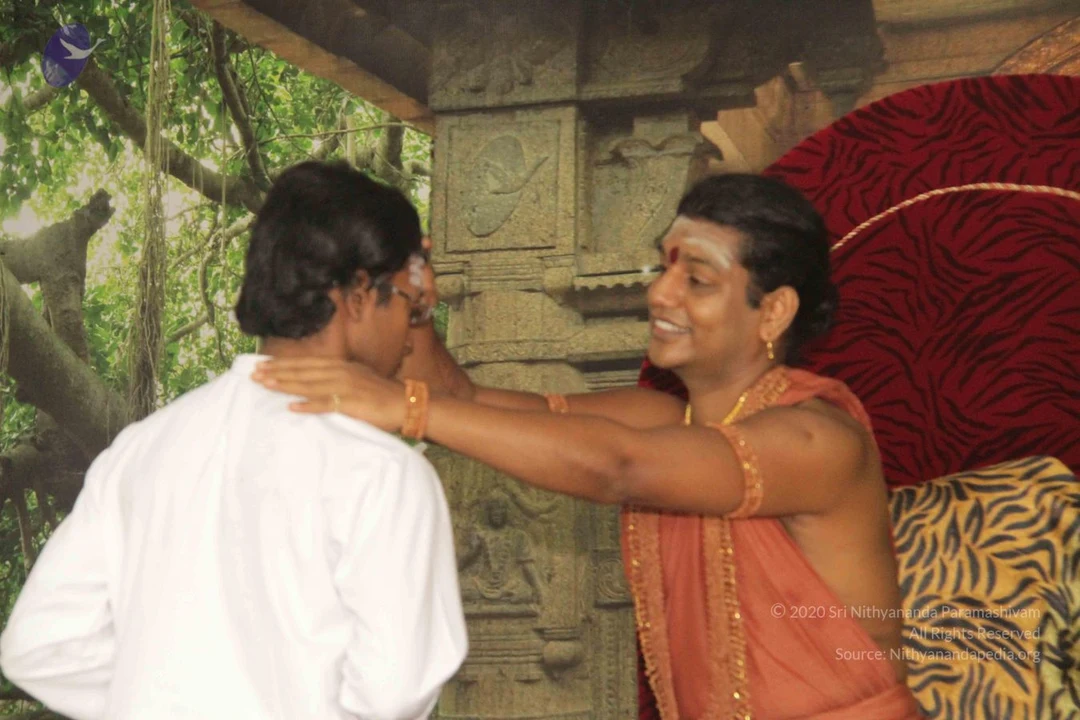
Photo of a satsang setting in an outdoor-style stage backdrop of green foliage and a carved stone pillar with reliefs. A bare-chested figure in a saffron-orange shawl and gold necklace, with a red bindi and white tilak, leans in to place his hands on the shoulders of a man in a white kurta and glasses, who faces away from the camera. A red patterned cushion and a tiger-print seat appear at right. a person cues: saffron and gold ornamentation with a sacred mark; the figure is seated at the right of the scene, performing the blessing.A photograph of a man in a rust-orange ochre robe with gold-edged borders and gold armbands sitting on a red and gold tiger-striped seat, a red kumkum dot and white vibhuti marks on his forehead, gold chain and earring, smiling as he rests both hands on the shoulders of a man seen from behind. The seated man wears a white shirt and dark hair. Behind them is a painted backdrop of green foliage and a carved stone pillar. Two people are visible.A photograph of a seated man in a saffron-orange shawl and bare-shouldered draping, with sandalwood-paste tilak and a red kumkum dot on his forehead, a gold chain and gold bangles, smiling as he rests both hands on the shoulders of a man seen from behind in a white kurta. The seated man sits before a red and leopard-print cushioned seat and a carved stone pillar with a foliage backdrop. The man in white has short dark hair and glasses. The seated figure has short dark hair and a gold earring. The seated man's appearance is consistent with the page's description of the speaker, though this is uncertain from appearance alone.A photograph of an indoor satsang setting. In the foreground, a man in a white shirt with grey hair, hands folded, faces a smiling person with white forehead markings who is receiving a touch on the forehead. A bare-chested figure in an orange-red cloth wrap with a gold necklace, gold armbands and long swept-back dark hair extends a hand toward the forehead of the seated devotee and smiles. Two men in saffron-orange robes with rudraksha malas stand behind, one with a red tilak. A large tree backdrop and a red sound equipment unit are visible. Visible people: five.A photograph of an indoor room with a red curtain and a wall-mounted cabinet. A bare-chested man with long swept-back dark hair, gold necklaces, rudraksha beads and gold bangles, wearing an orange-red cloth, holds an open book and gazes down at it while an older grey-haired man in a light blue shirt leans in to look. Behind them a shaved-headed man in an orange robe with rudraksha malas stands with white forehead markings, and another person in white stands further back. a person (long swept-back hair, gold ornaments and rudraksha malas visible on the central figure) is shown in person, handling a book with a devotee.Indoor photo of a satsang-style blessing in an office-like room with a ceiling fan, fluorescent lights and maroon curtains. A bare-chested figure in orange-red ochre cloth with a gold-bordered shawl, gold necklace, wrist bands and a hair bun touches the forehead of a man in a grey shirt, while a man in white and others press palms together nearby. Several devotees wait with hands folded and a figure in orange robe stands at right. a person: the bare-chested figure in ochre cloth with gold ornaments, hair bun and necklace is the person giving the forehead blessing.

Darshan
27 photosSource gallery
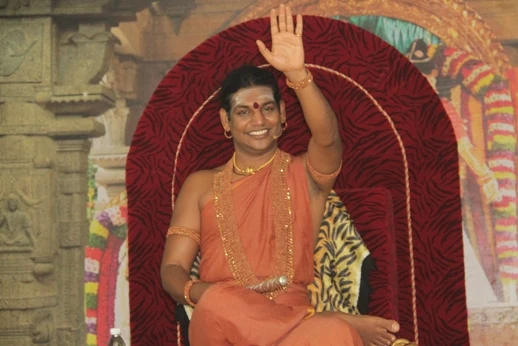
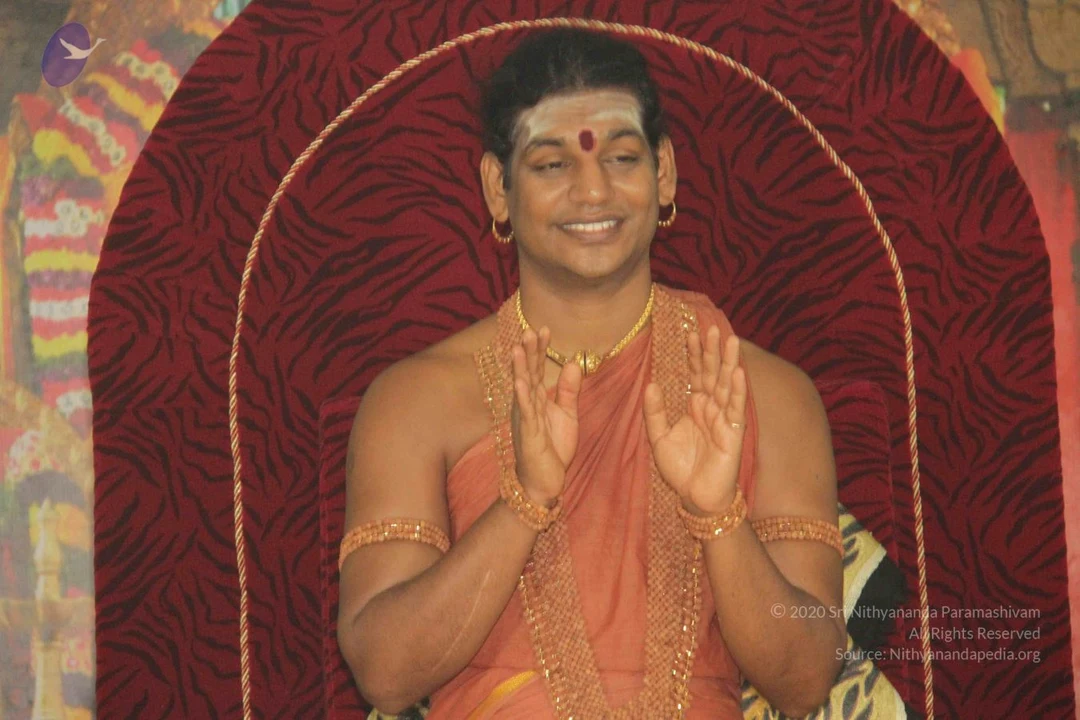
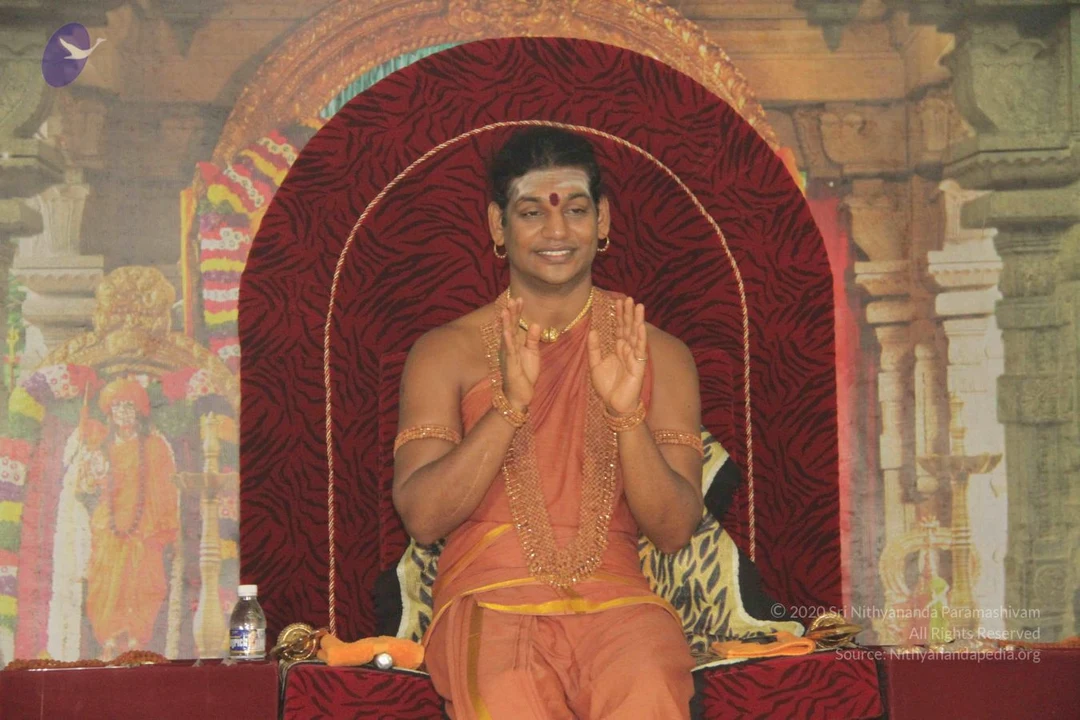
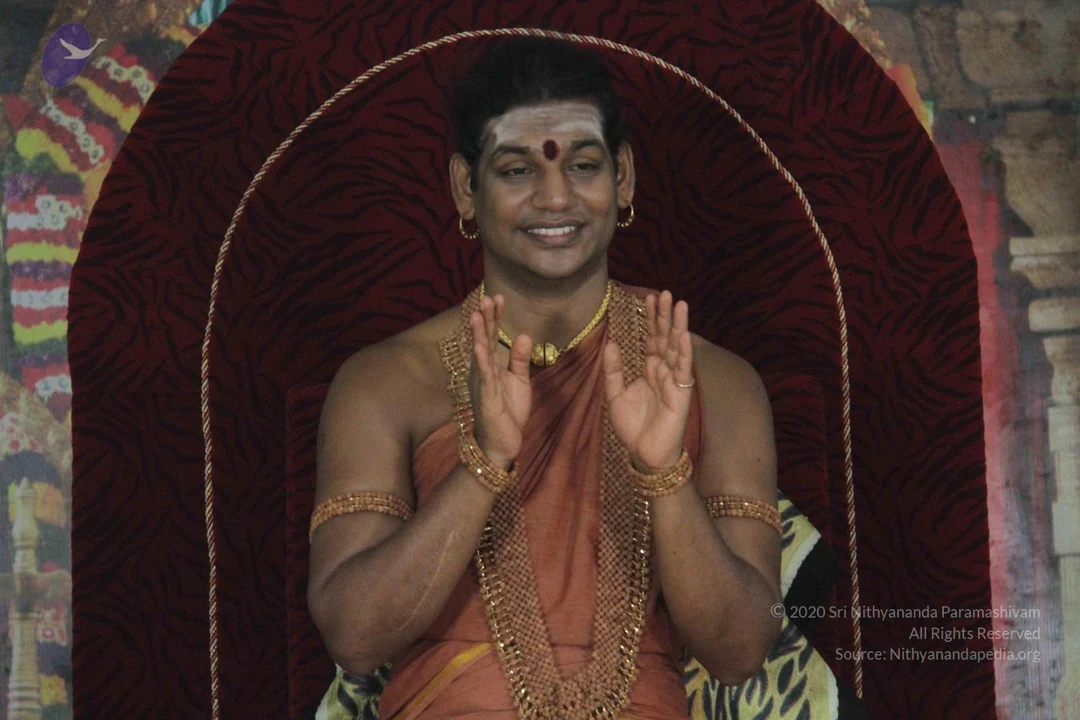
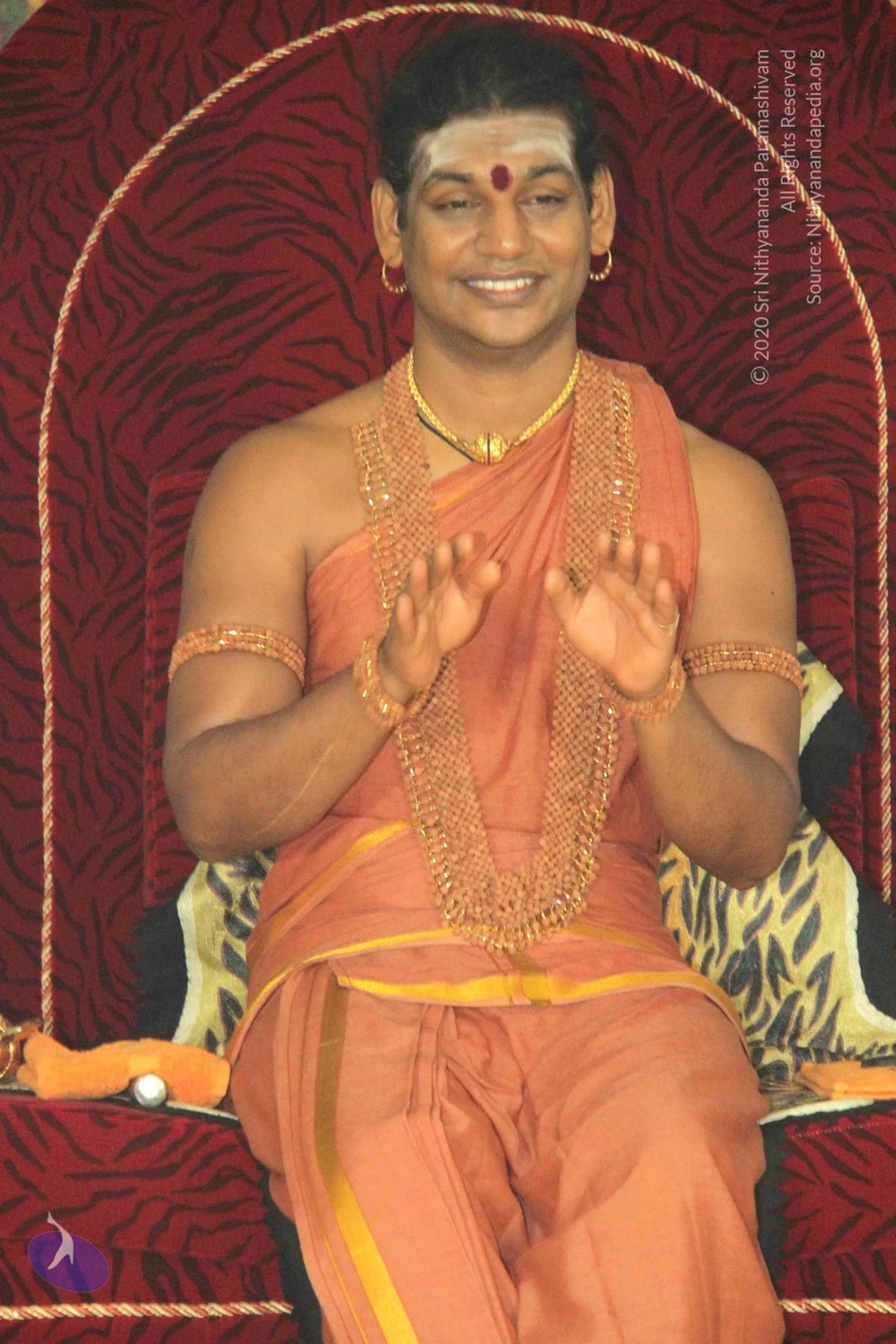
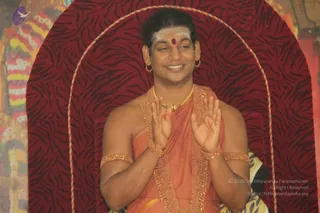
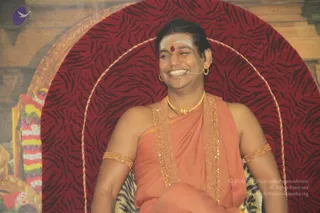
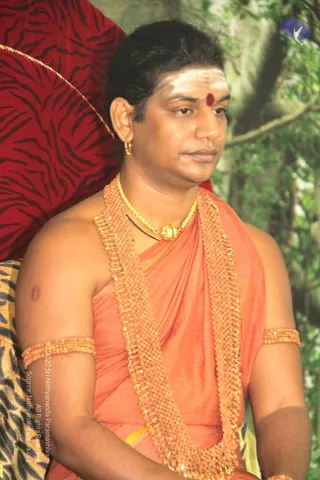
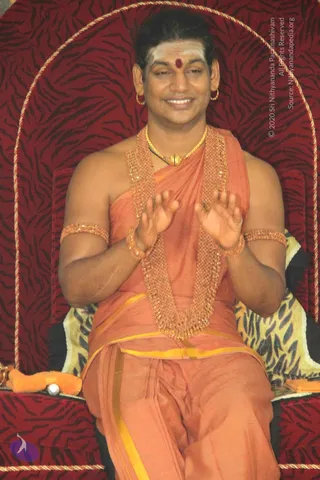
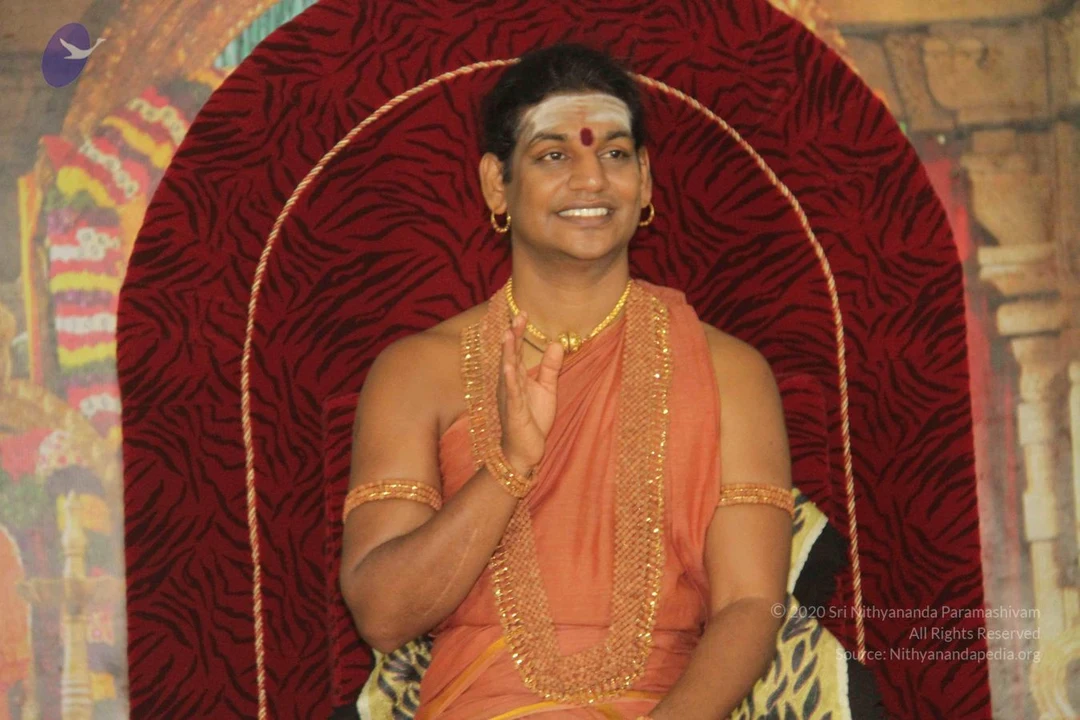
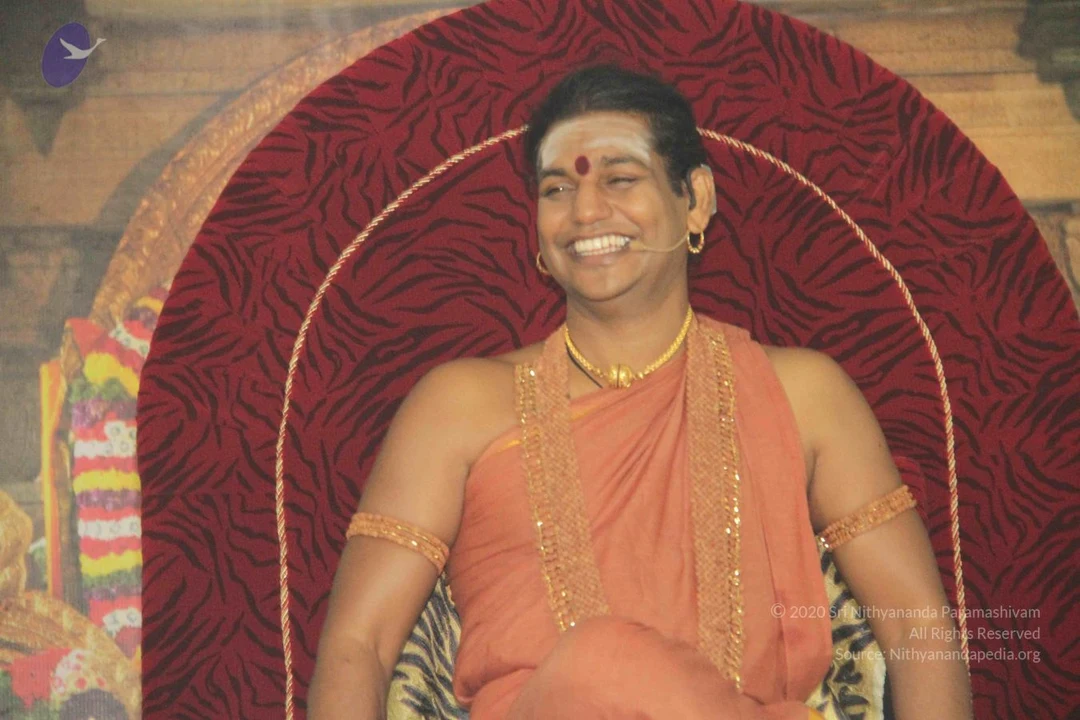
A seated man in saffron-orange draped clothing sits on a red velvet throne with a tiger-stripe pattern and a rope-edged arch behind him. He wears a gold-coloured ornate necklace, layered gold arm bands, hoop earrings, a white vertical tilak and a red dot on the forehead. He raises one hand in a blessing gesture and smiles. A painted temple-style backdrop with red and yellow patterns and carved pillars surrounds him. A purple bird logo appears in the upper left corner.A man seated on a red and black tiger-striped throne against a backdrop of painted temple pillars and ornate deity imagery, raising one hand in a blessing gesture while smiling. He wears an orange-saffron dhoti and shawl, layered gold beaded necklaces, gold armlets and bangles, a red bindi on his forehead and white vibhuti lines. A water bottle sits at the lower left. Appearance-based label: a person, seated in a ceremonial setting consistent with a satsang discourse.A photograph of a smiling man seated on a red zebra-striped throne with a rope-trimmed arched backrest, hands raised together in a greeting or blessing gesture. He wears an orange-saffron cloth over his bare shoulders, gold armlets, a gold chain necklace, a gold ornamental collar, and a red kumkum dot with white sacred markings on his forehead. Gold hoop earrings are visible. A colourful painted backdrop with red, yellow and pink patterns fills the left side. a person, seated as a discourse speaker, with a bare-chested figure adorned in gold ornaments and saffron cloth.A smiling man sits on a dark red throne with zebra-stripe patterned upholstery and a gold rope border. He wears an orange-saffron cloth draped over his shoulders, a thick gold-coloured beaded necklace with a gold pendant, rudraksha-style beaded malas, gold bangles on his upper arms and wrists, and small hoop earrings. He has white and red tilak marks on his forehead and presses his palms together in a greeting gesture. A patterned backdrop with colourful flower garlands is visible behind the throne.A man seated on a red and black zebra-striped throne with a gold-edged arch behind him, giving a discourse with palms pressed together at chest level. He wears a saffron-orange dhoti and shawl, a gold necklace, gold armlets and bangles, and a red bindi on his forehead with an ash mark. A water bottle and a brass lamp sit at the base of the throne, and a painted temple-style backdrop with pillars and a deity figure surrounds him. Appearance-based candidate: the saffron clothing, gold ornaments and throne match the a person in a seated discourse setting, though the face is not used for identification.A photograph of a man seated on a dark red velvet throne with a rounded arched back, his palms pressed together in front of his chest in a greeting gesture. He wears an orange-saffron cloth draped over his bare upper body, multiple gold necklaces and long beaded gold chains, gold armlets and bangles, small gold hoop earrings, and a red bindi with white vibhuti markings on his forehead. He has a broad smile and short hair. Behind him are patterned panels in red, yellow and blue. The image is a single person seated in a satsang setting, with no other physical people visible. Appearance-based label: a person, seated in a satsang setting with saffron cloth, gold ornaments and a ceremonial throne.

Dial-The-Avatar

16 photosSource gallery
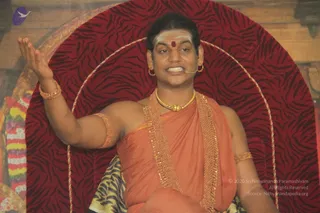
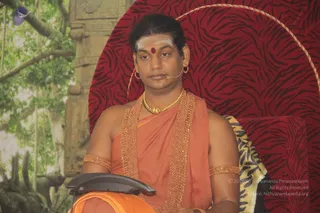
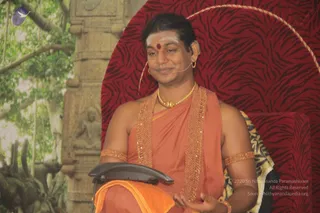
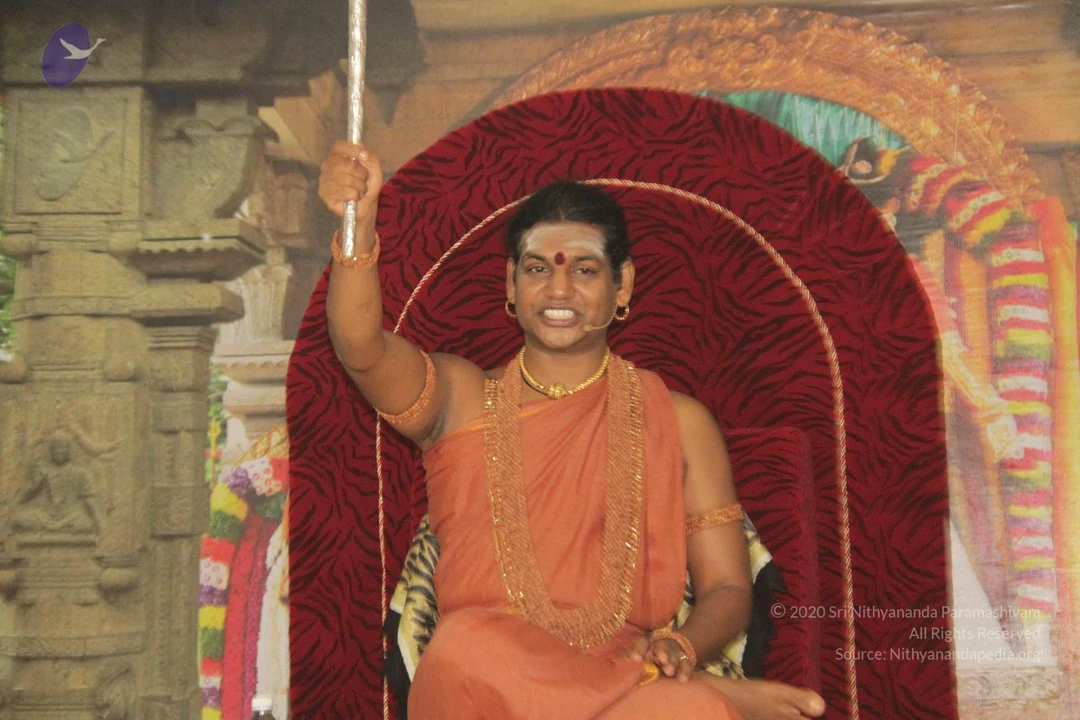
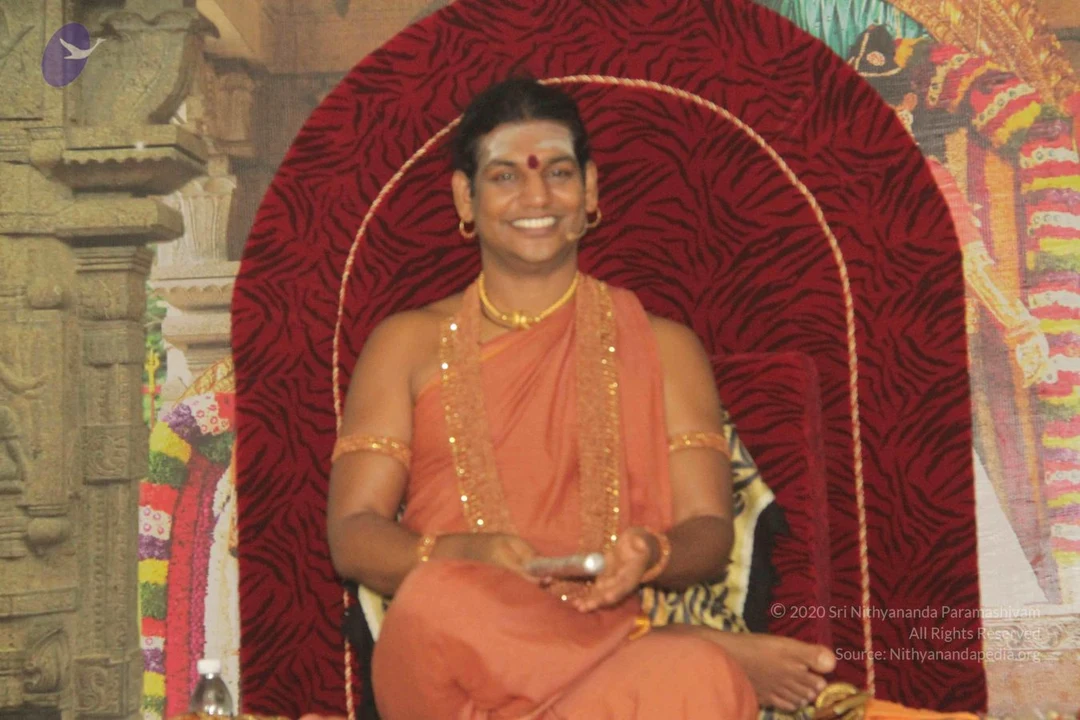
A smiling man sits on a red and black zebra-striped throne with an arched backrest, a gold-edged cushion and a tiger-striped seat cover. He wears an orange-saffron shawl draped over the shoulder with gold brocade borders, a gold necklace, gold armlets and gold bangles, with white vibhuti lines and a red bindi on his forehead. A small lapel microphone is clipped near his face. Behind him, a painted temple-style backdrop and a garland of multicoloured flowers are visible at the left edge.A man seated on a red throne with a dark zebra-striped upholstered backrest and a gold cord border speaks to an audience while smiling and raising one index finger. He wears a saffron-orange robe draped over his shoulders, gold bangles on his upper arms, gold beaded necklaces, and gold hoop earrings. He has white vertical tilak marks on his forehead with a red dot at the centre. A small lapel microphone is clipped near his face. Behind him are carved wooden panels and a colourful striped fabric hanging. A photo credit overlay in the lower right reads copyright text.A smiling man in saffron-orange robes sits on a red velvet throne with a curved back trimmed with gold rope, one index finger raised to his lips in a teaching gesture. He wears gold armbands, gold bangles, a gold chain of ornate ceremonial design, gold hoop earrings and a red bindi with white vibhuti lines on his forehead. The background shows a decorated temple-style backdrop with floral garlands in pink, yellow and green. A satsang discourse setting. Swamiji (probable): long hair swept back, saffron robes, gold ornaments and rudraksha-style adornments visible, seated on a throne.A seated man in saffron-orange robes speaks during a satsang discourse, one hand raised in an open gesture. He wears a gold ceremonial necklace with a rudraksha-style bead mala, gold bangles and earrings, and a small red bindi with white forehead markings. A small microphone is at his face. He sits on a deep red throne with a zebra-striped velvet back and a gold cord border, in front of a painted backdrop. The image is a photograph of one person. Appearance cues of long hair are not visible, so identity is uncertain.A man seated on a red throne with black zebra-stripe patterning and a gold-trimmed round backrest, in front of a painted backdrop of green foliage and a stone pillar. He wears an orange-saffron cloth draped over his shoulders, a gold necklace and gold armlets, and gold hoop earrings, with a white vertical forehead mark and a red bindi. A small microphone is clipped near his face and a dark object rests on his lap. The appearance of a long-haired, ornately adorned teacher with saffron robes and gold jewellery matches the Swamiji candidate described in the page, so the figure is.A photograph of a man seated on a red throne upholstered in a dark zebra-striped fabric with a gold rope edge, speaking into a small headset microphone. He wears an orange-saffron cloth draped over his shoulders, a gold necklace, long beaded gold-toned armbands, a gold stud earring, and white vibhuti with a red kumkum dot on his forehead. He rests one hand on a black armrest with an orange cloth draped over his lap. Behind him is a painted backdrop of green trees and a carved stone pillar.

Pada-Puja

7 photosSource gallery
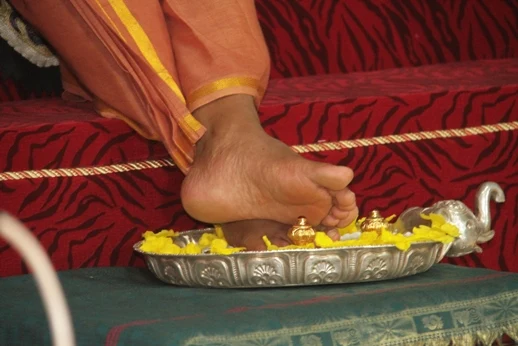
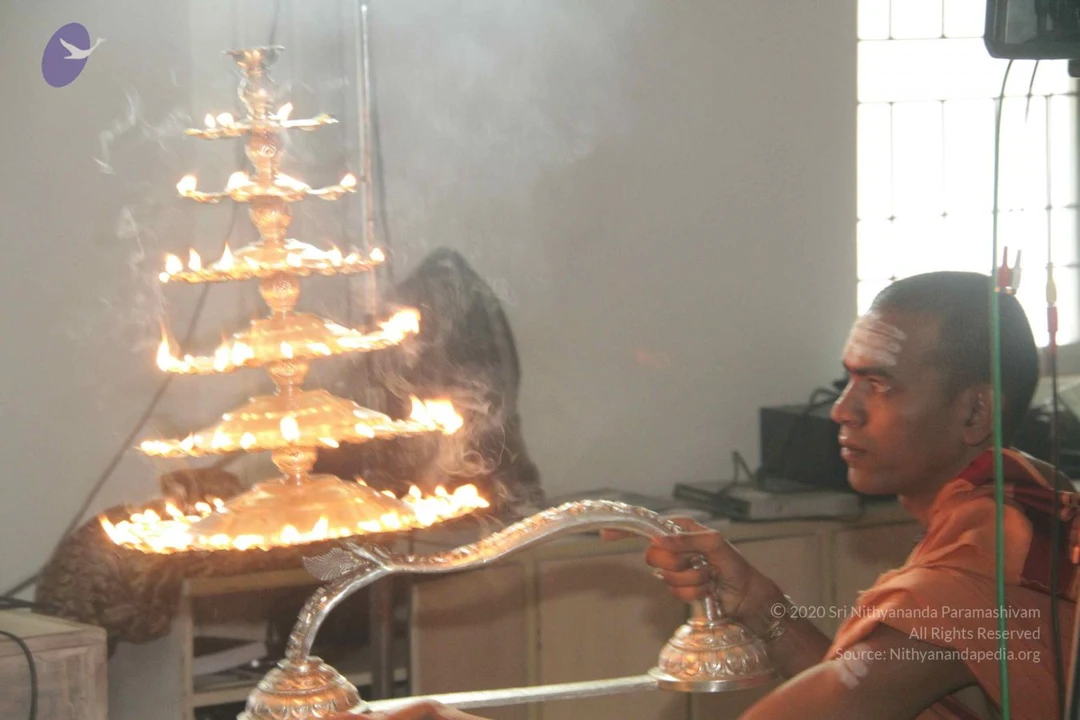
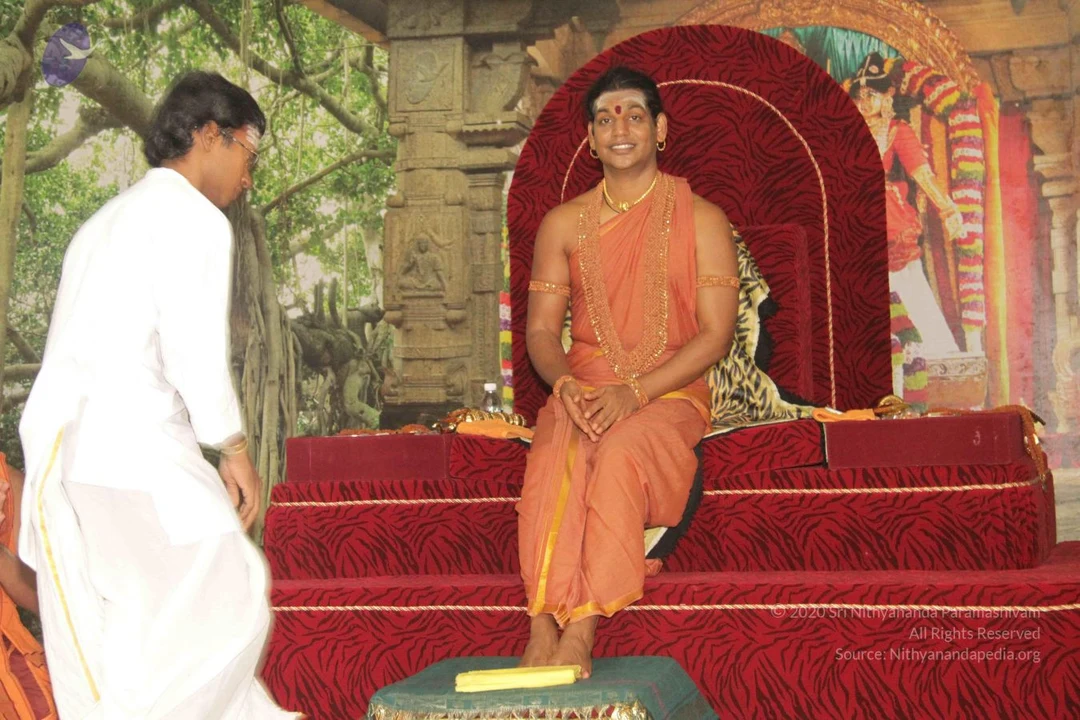
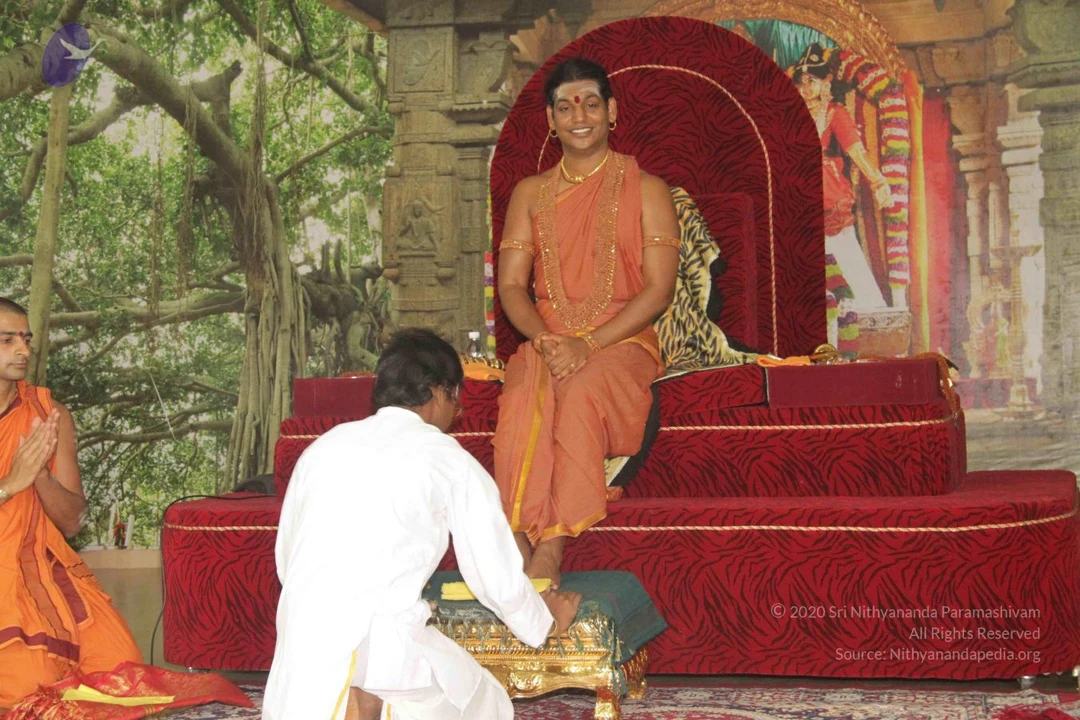
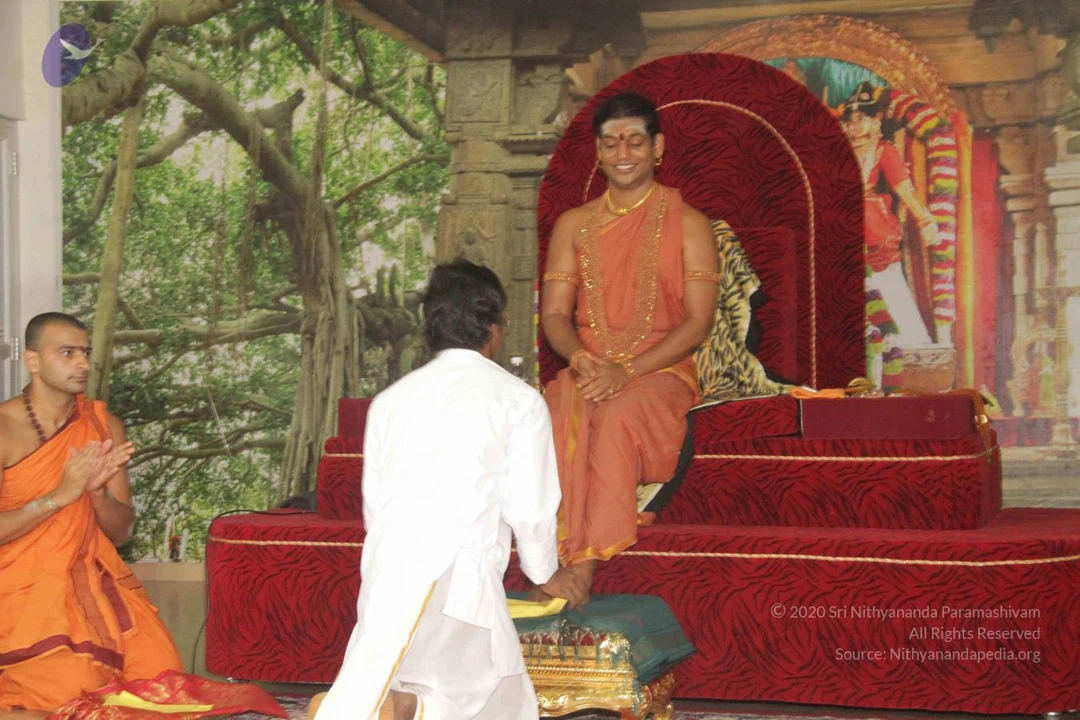
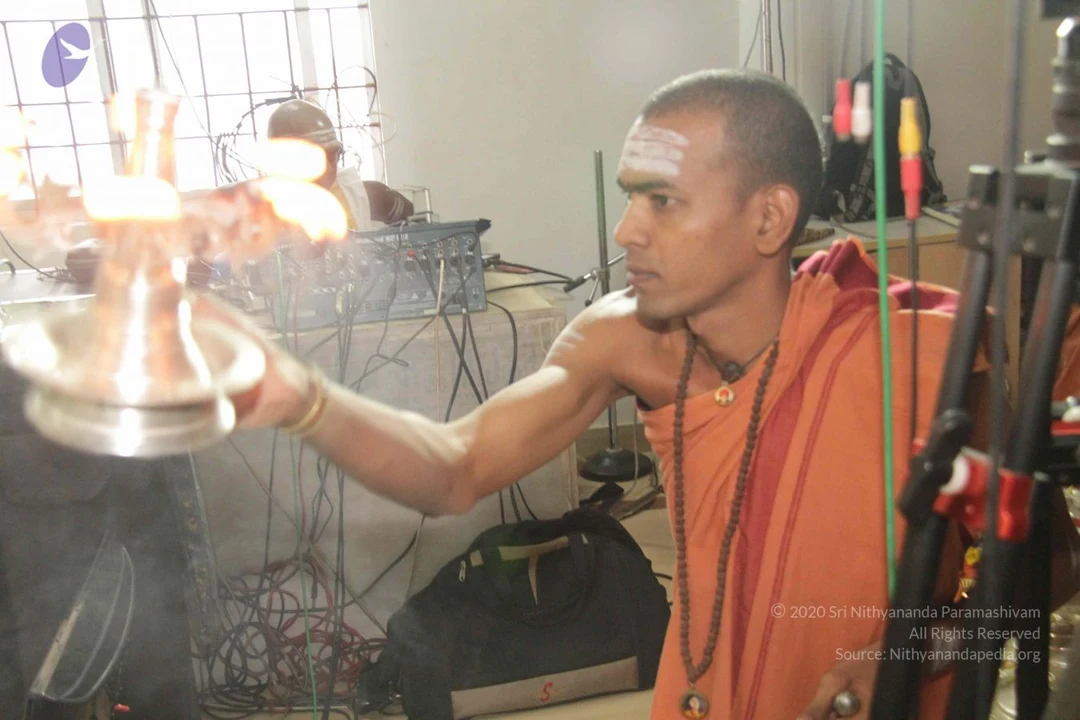
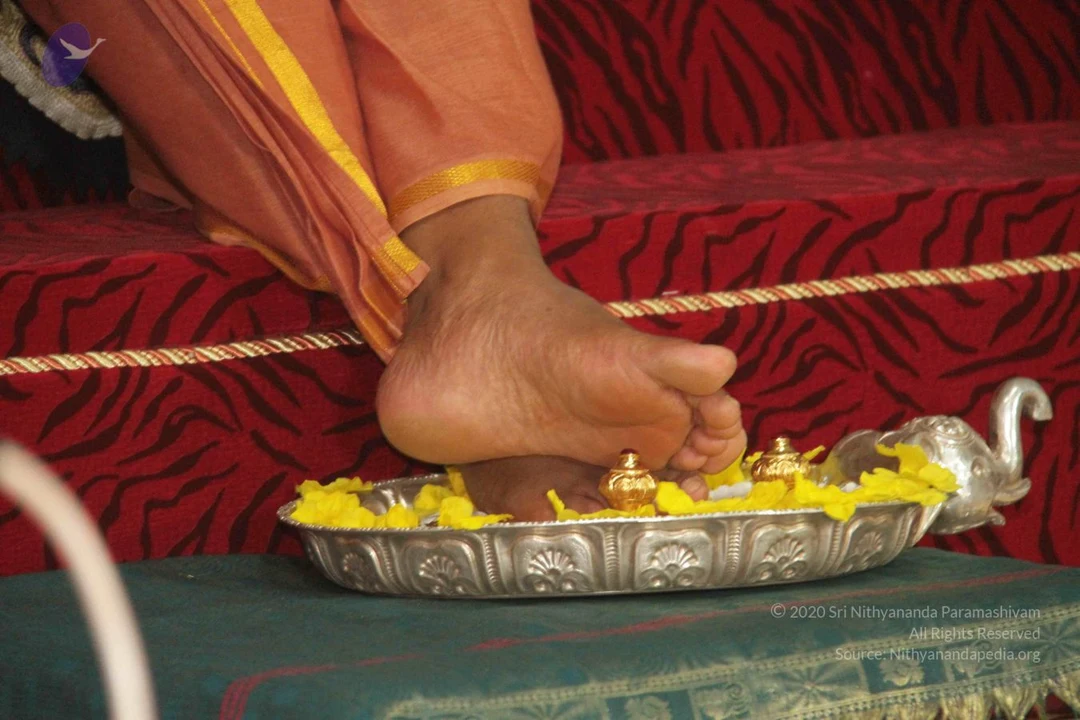
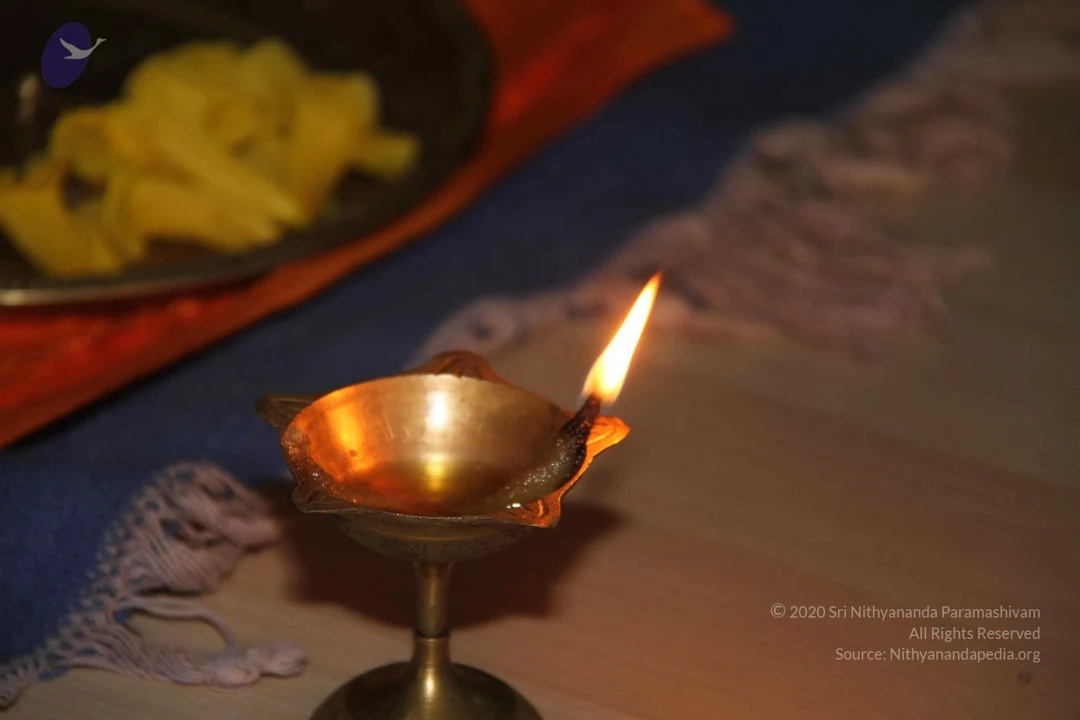
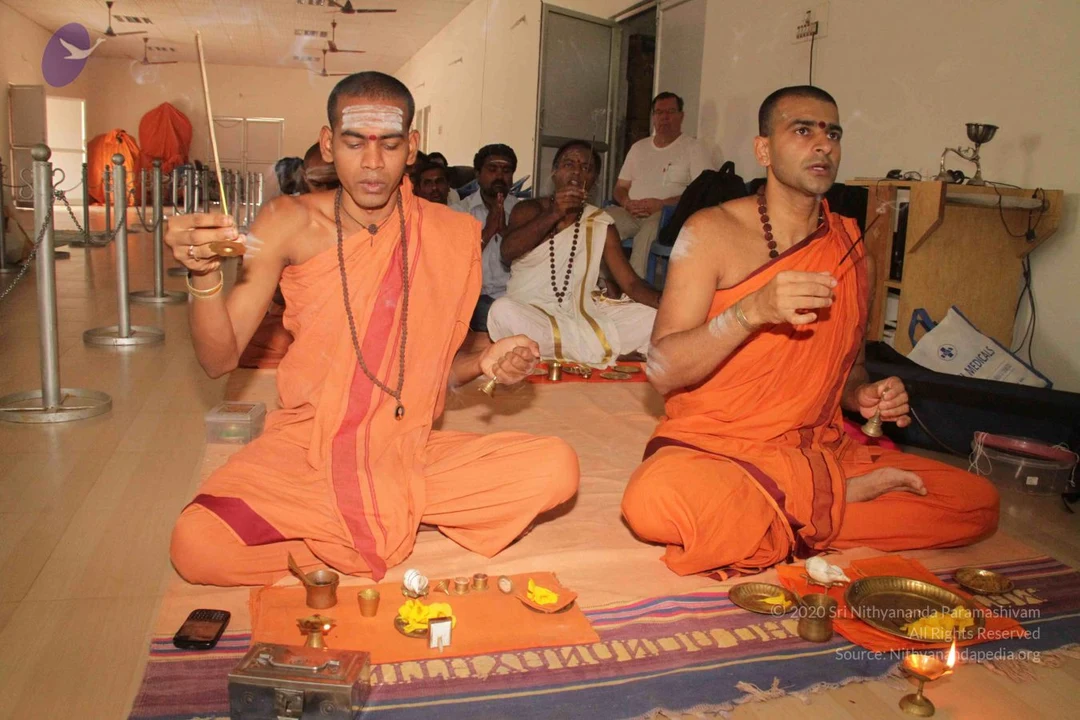
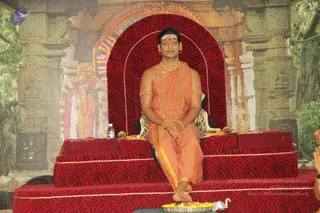
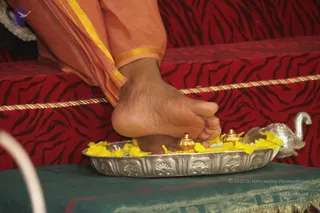
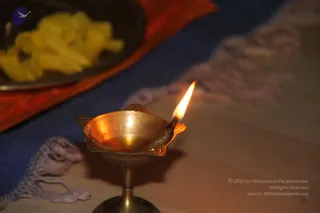
A man with a red-and-white tilak on his forehead sits on an elevated red, zebra-patterned throne in front of a painted temple-gate backdrop with stone carvings and green foliage. He wears an orange saffron wrap over his shoulder, a gold ceremonial necklace, gold armlets and bangles, and holds his hands together in his lap. A water bottle and a silver tray of yellow flowers sit on the dais, and a partially visible person is at the right edge. a person appears seated in person, identified by his saffron wrap, gold necklace and the throne setting.A photograph of a shaved-headed man in saffron-orange robes holding a brass aarti lamp with flames toward the left of the frame. He wears a rudraksha mala and a pendant, a white tilak on his forehead, and gold bangles on his wrist. Behind him are cables, a mixing console, a black bag and tripod-mounted lights in a plain room. The man's appearance does not clearly match the page's claim, so the identity is unsure; he is described by role as a devotee performing aarti.Close-up photograph of a bare foot resting on a polished silver tray filled with yellow marigold petals and two small gold kalasha-like finials. The foot belongs to a person wearing orange-saffron dhoti-style cloth with gold border, seated on a red sofa with a red-and-black tiger-stripe fabric. The silver tray has a spout shaped like an elephant head at the right. This appears to be a padapuja foot-worship ritual, with the feet being honoured with flowers. A small segment of green fabric with gold embroidery is visible at the lower edge. No face is visible, and no one is identified.Close-up photograph of a hand held out palm-up, holding a folded piece of orange-saffron cloth. The hand is pale-skinned and mostly fills the left side of the frame, and the cloth rests across the palm. Below and behind the hand is a broad expanse of matching orange-saffron fabric. The background is dark with a faint wisp of smoke or incense visible at the upper right. Only the hand and a portion of the robe are visible; no face is shown.A photograph of a single lit brass oil lamp on a small stand, its flame burning steadily on a wooden surface. Behind it, on a dark metal tray, sits a heap of yellow sweets or offering pieces, with a red cloth and a blue cloth with a fringed edge beneath. No people are visible. The background is softly blurred.Photo of a puja inside an ashram hall with a tiled floor and metal stanchions. Two shaved-headed priests in saffron-orange robes sit cross-legged on a striped mat, each holding a small brass bell or ritual implement and a lit incense stick. The priest on the left has white tilak on his forehead and rudraksha beads; the priest on the right wears a rudraksha mala and holds a brass lamp. Brass plates, small cups, a kumkum-marked tray, marigold petals and a brass oil lamp are arranged before them. Behind them, a few seated devotees, one in white dhoti with a bead mala, watch. Saffron cloths hang on a rack in the background.

Tiruvannamalai-Aadheenam

8 photosSource gallery
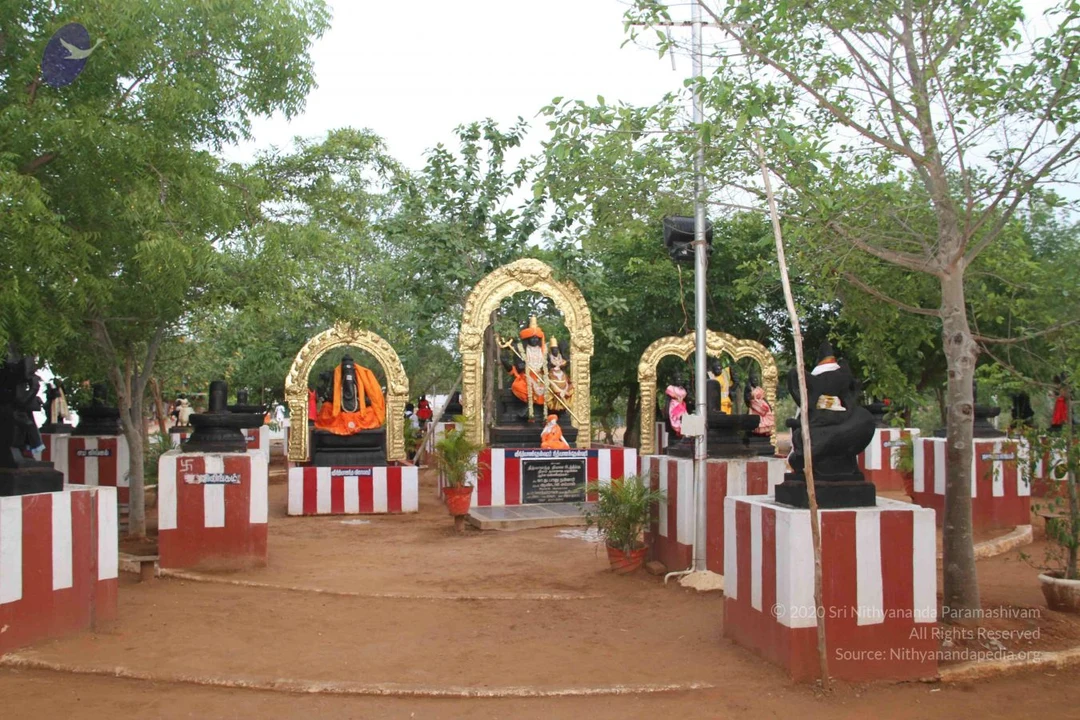
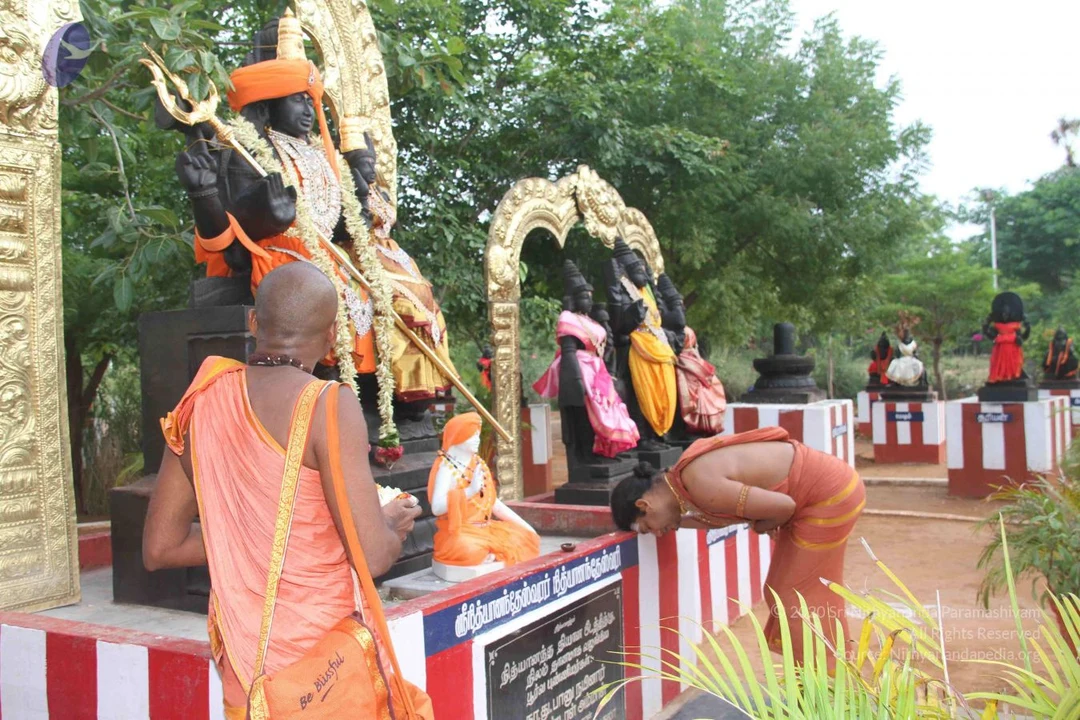
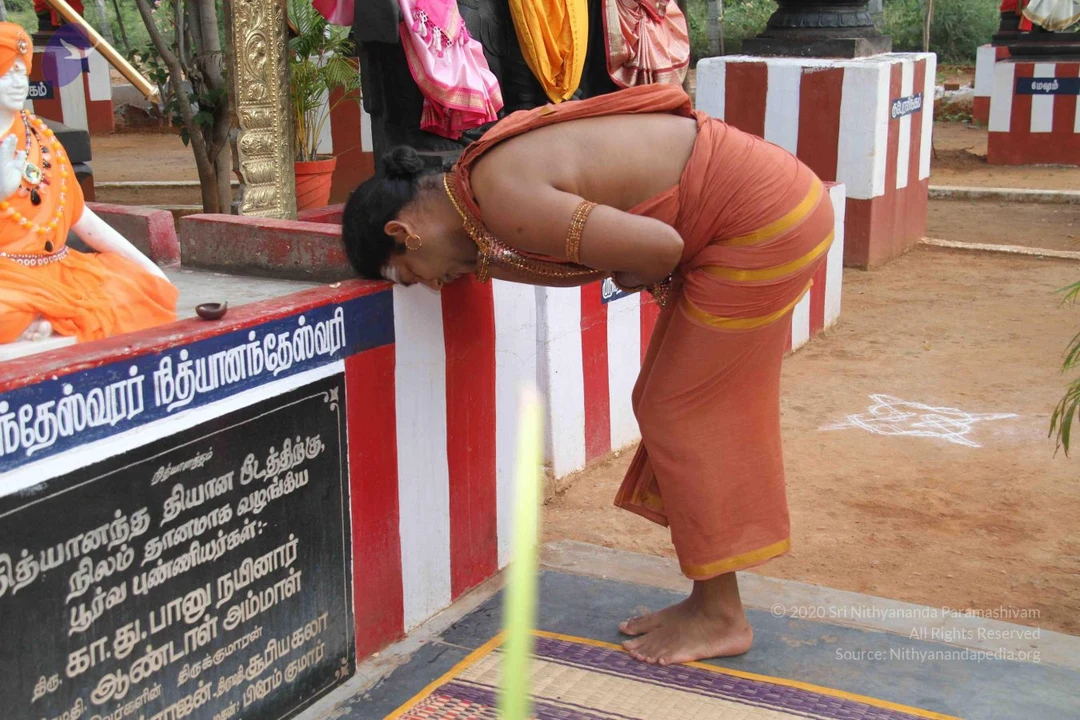
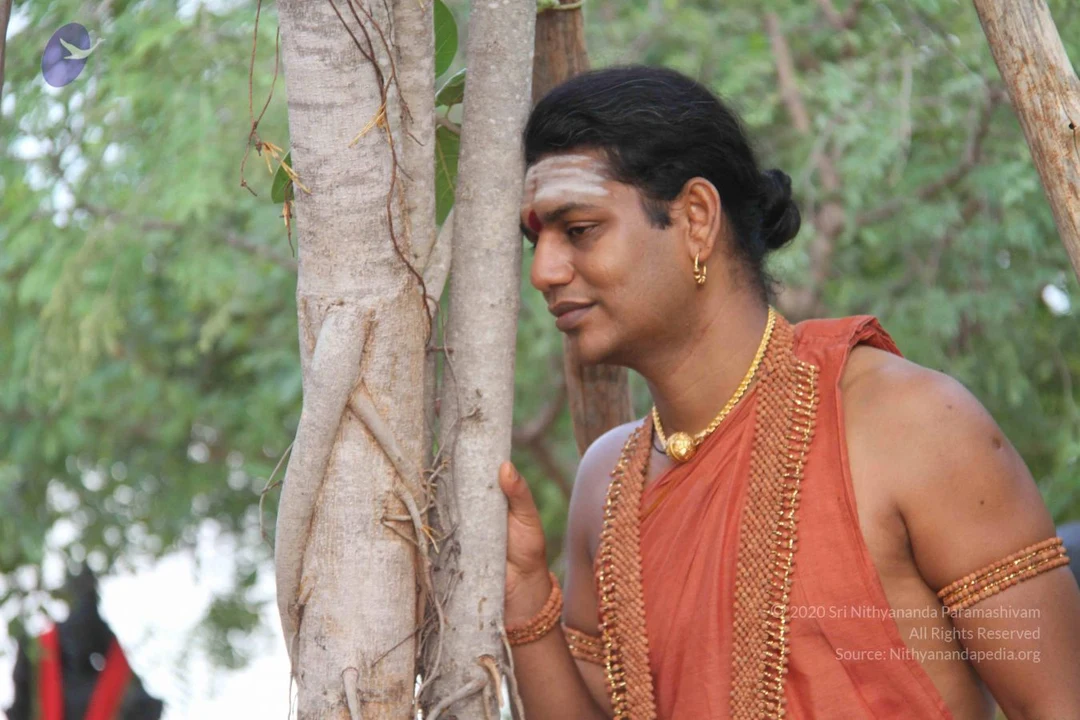
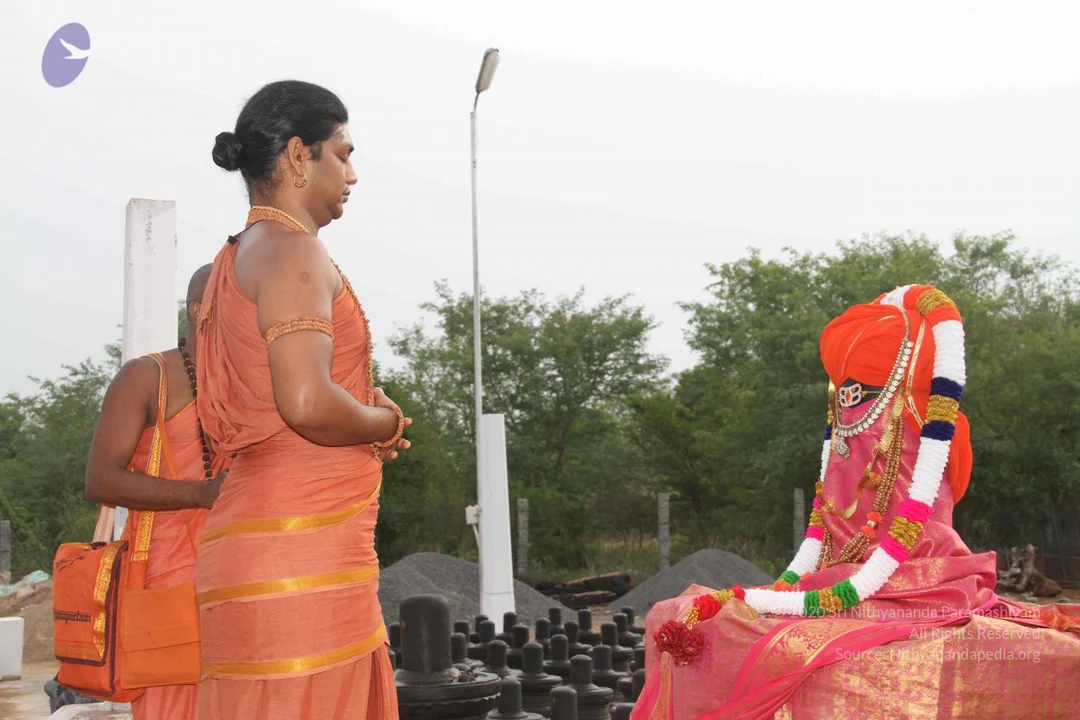
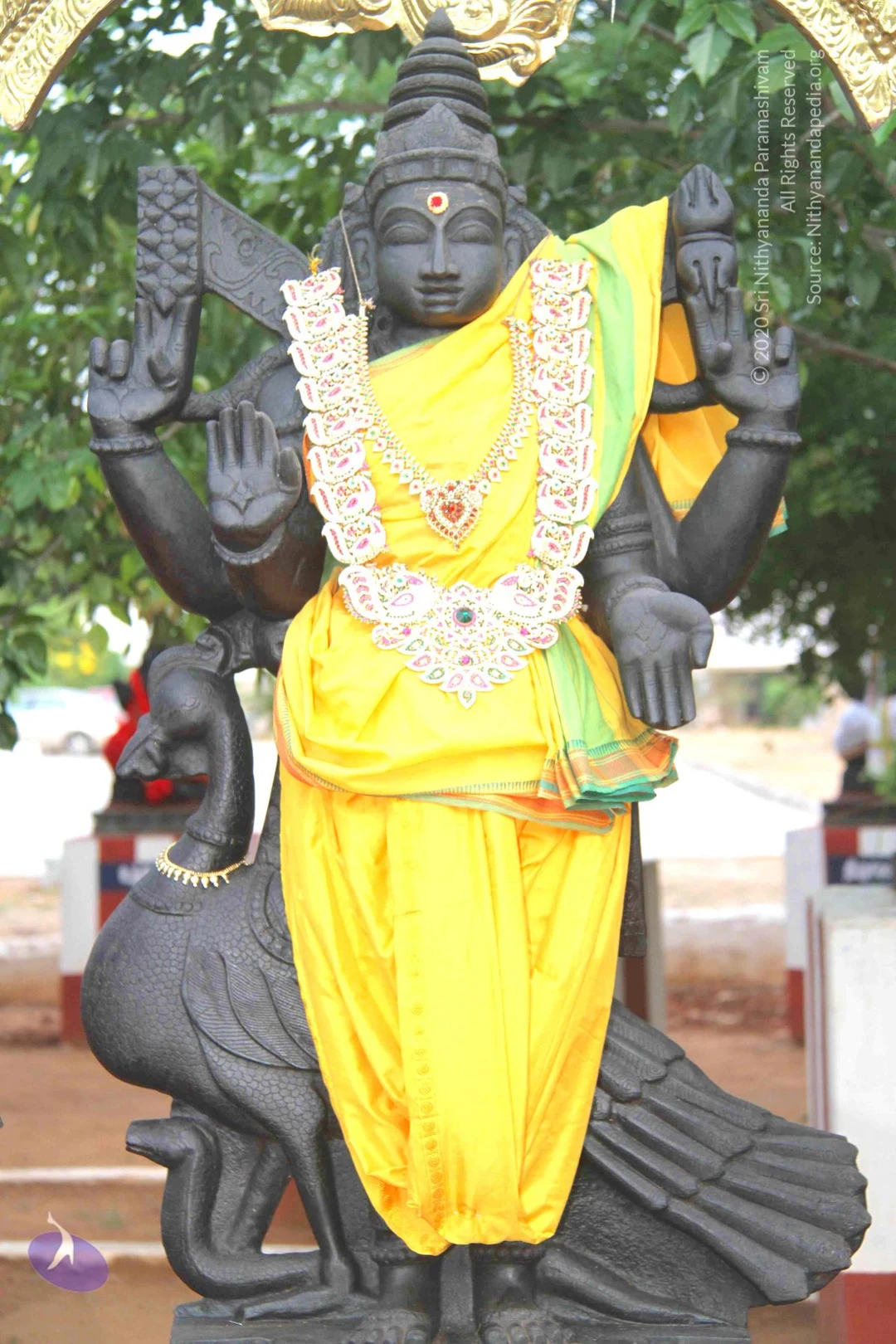
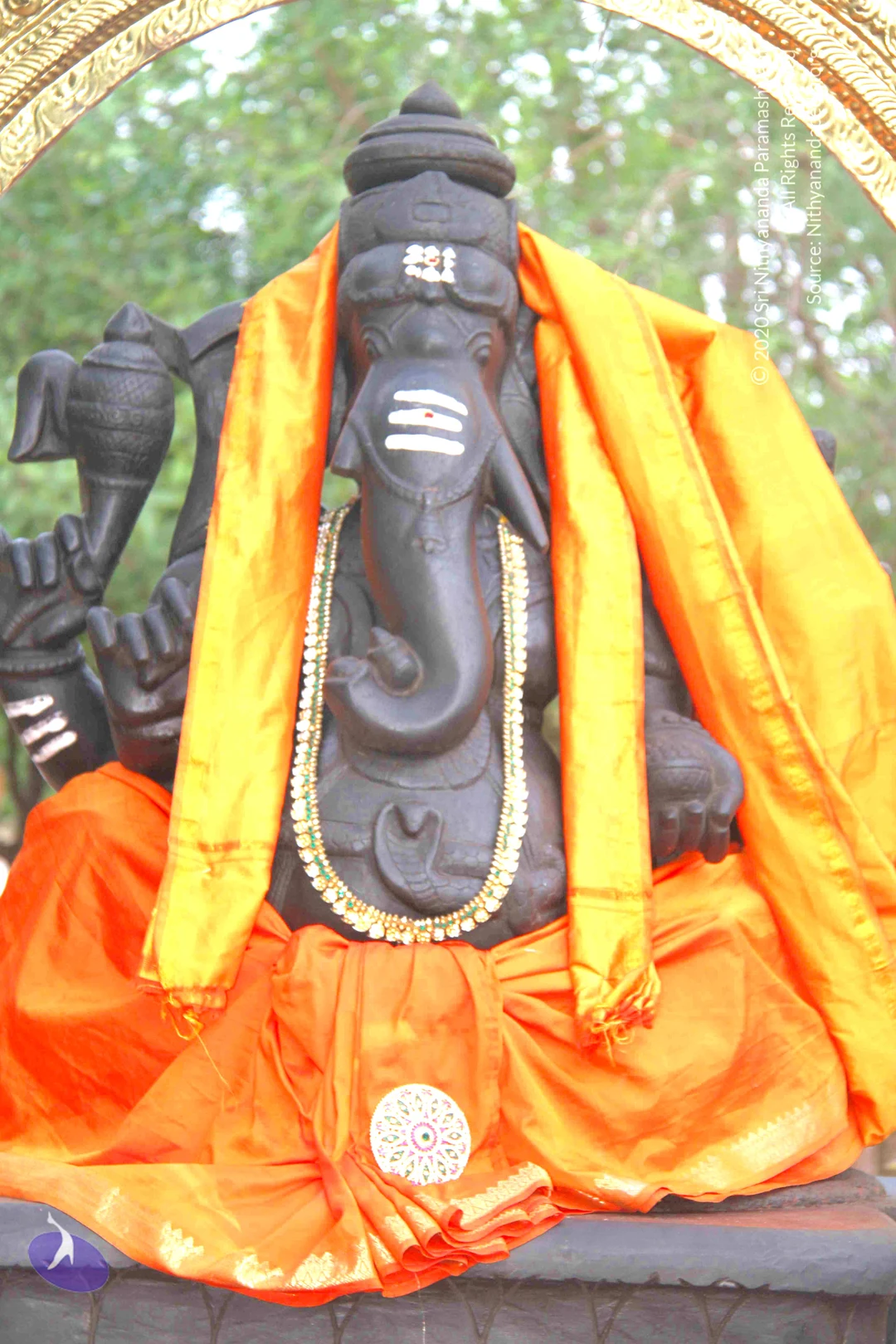
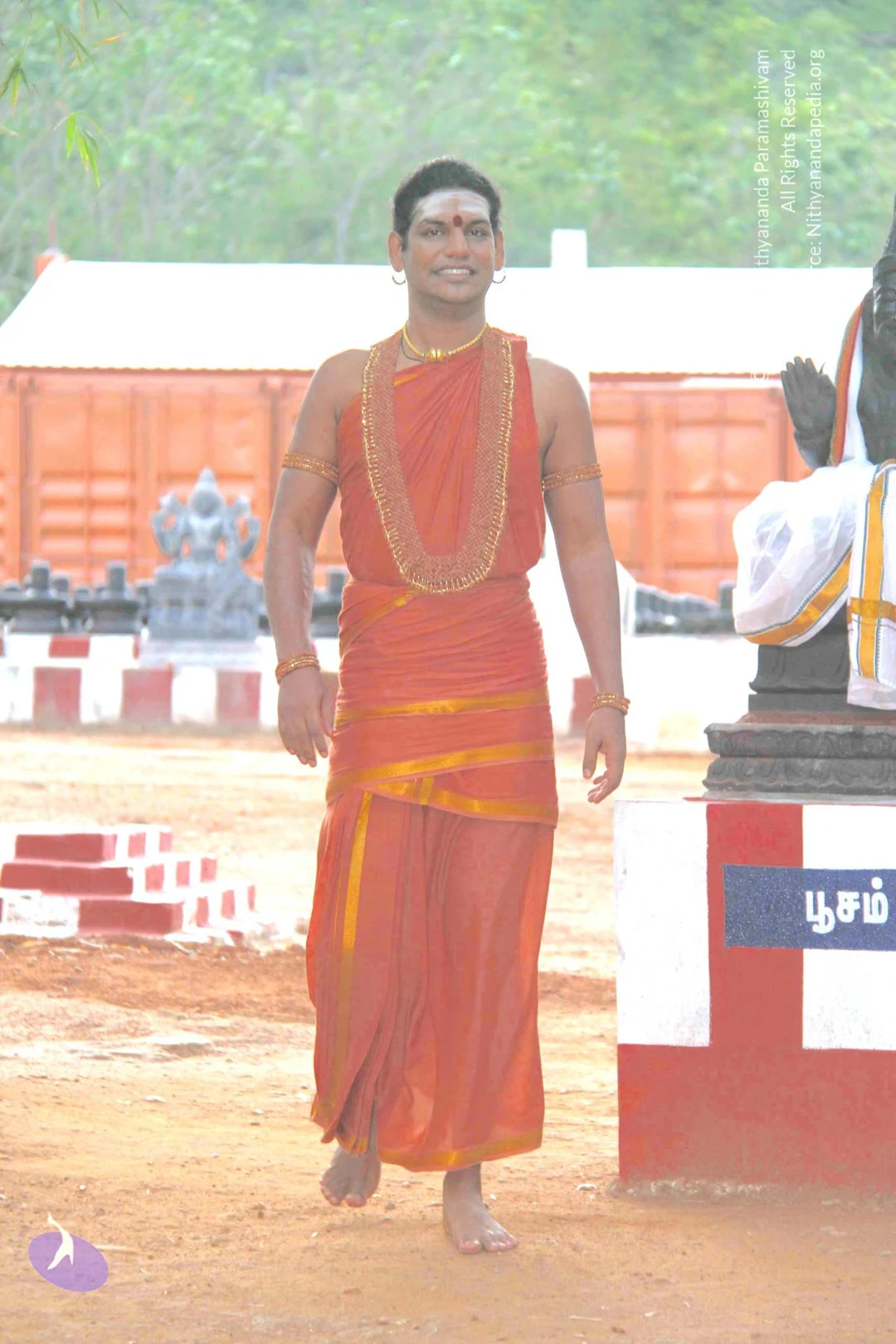
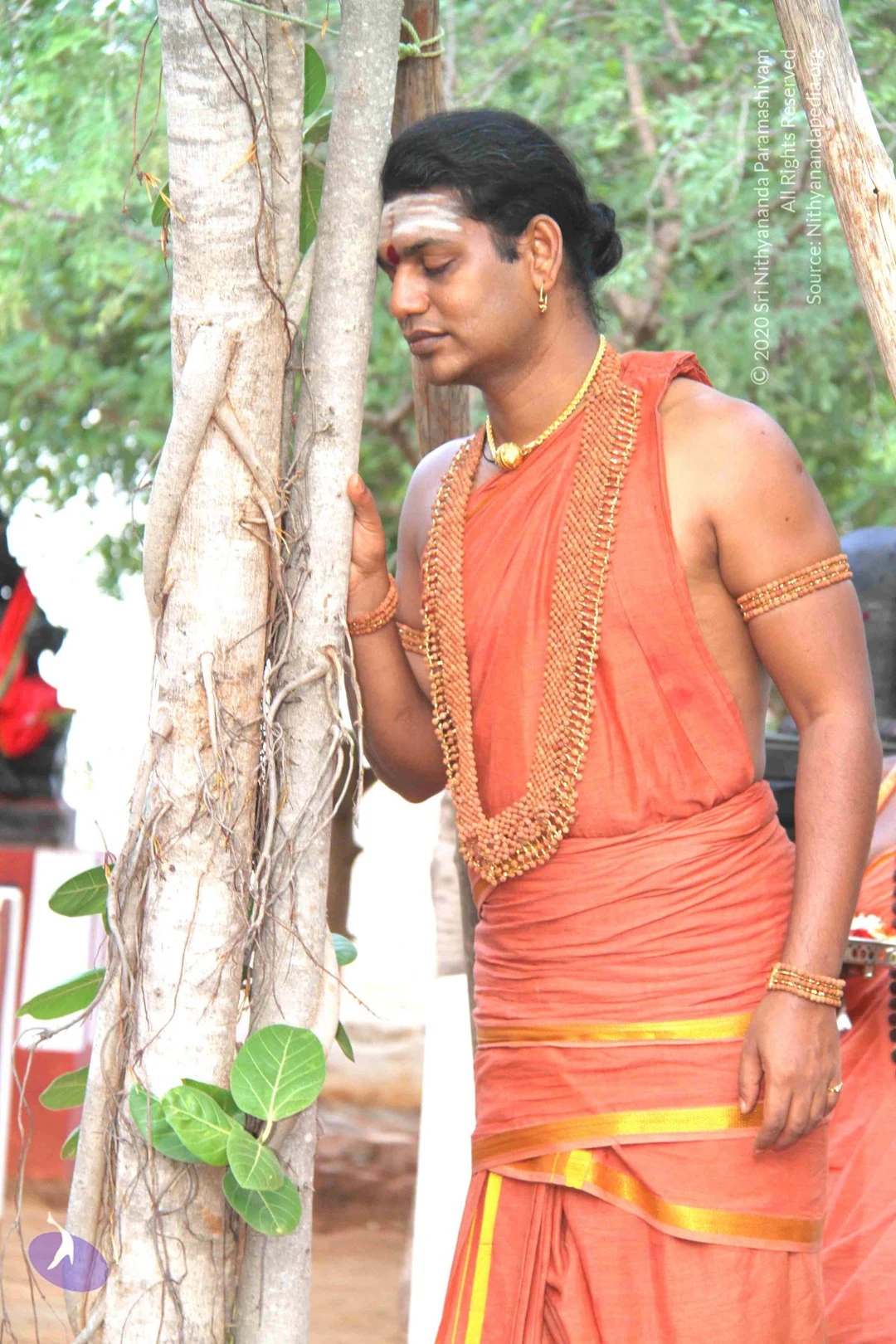
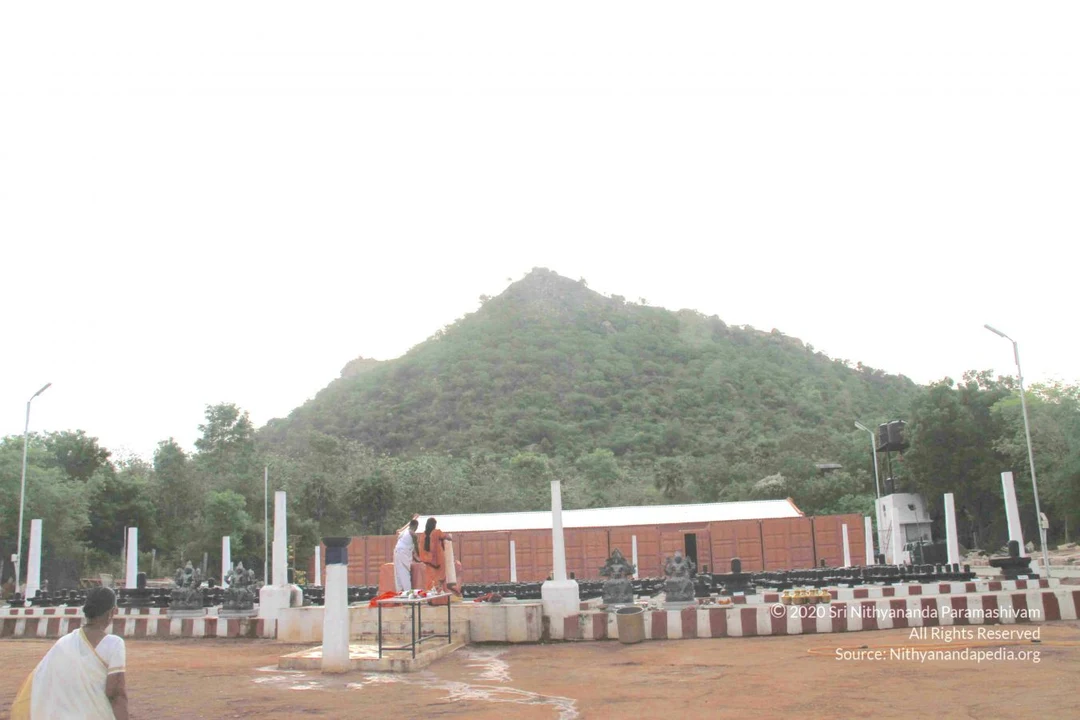
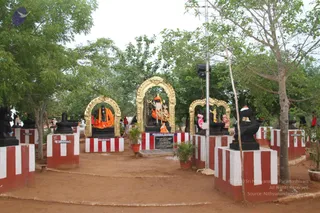
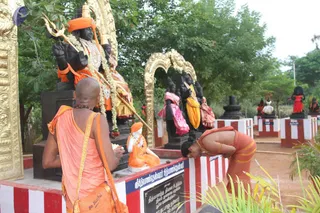
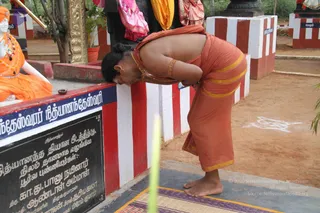
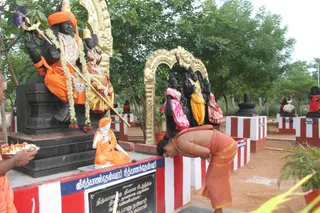
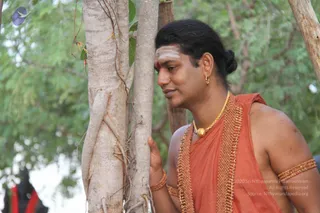
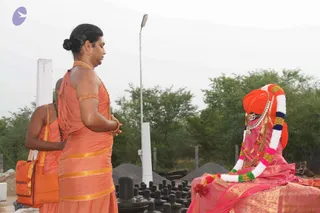
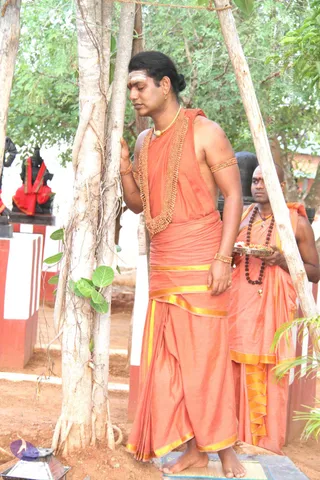
A photograph of an outdoor temple-style garden at an ashram, with red-and-white painted plinths arranged in a circle on bare earth under trees. Three golden arched niches frame black stone shrines; the central shrine holds a figure in orange and gold clothing beside a deity murti with a crown and trident, and the left shrine holds a seated figure in orange robes. A black plaque with white lettering sits at the centre base, and a few potted plants and a lamp stand are visible. Several small figures appear in the background near the shrines, which are statues or devotees. A grey lamp post and a faint logo appear at the top left.Outdoor photo at a shrine garden with a large black stone deity murti wearing an orange turban, a trident, and white floral garlands, beside a golden arch and smaller black murtis draped in pink and yellow cloth. In the foreground a bald man in an orange ochre robe with a rudraksha mala and an orange shoulder bag stands with hands joined in front of a white-and-orange seated figure. To the right a second person in orange clothes bows low, hands on the ground, before the shrine. Red and white painted borders edge the platforms, with trees and greenery behind. A Tamil-script plaque is set on the platform.A woman in an orange-saffron sari-style garment with a yellow border bends forward at the waist, pressing her forehead to the top of a red-and-white striped stone platform in an outdoor temple courtyard. Her dark hair is pinned in a bun, and she wears gold bangles, earrings and a gold necklace. Beside her, a seated orange-robed deity figure and a black granite plaque with Tamil inscription stand on the platform, and a white kolam design is drawn on the ground. Pink and yellow cloth hangs above. Her posture suggests pranam or devotional prostration at a shrine.Outdoor temple garden scene with black stone deity statues seated on a plinth, one wearing an orange turban and holding a trident, adorned with white garlands and gold jewellery. Beside them, a white-and-orange statue of a seated figure stands on a red-and-white base. A devotee in an orange sari with gold border bows deeply with hands joined near a pedestal, while a priest in orange robes on the left holds a plate of offerings. Gold arched frames surround standing statues in pink, yellow and orange garments, and a black plaque with Tamil text sits on a red-and-white base. Trees and plants fill the background.A man in orange-saffron draped clothing with a gold-toned necklace, gold armlets and bangles stands beside a tree trunk, one hand resting on the bark. He has dark hair swept into a bun, white sacred ash markings and a red bindi on his forehead, and wears a small gold earring. He gazes to the side. Blurred greenery and a red-and-black figure appear in the background. Appearance-based label: a person, wearing saffron cloth, gold necklace and armlets; the visible person is one man.Outdoor photo at an ashram-style site with grey gravel piles, dark stone shivalingams standing in rows, and trees behind. In the foreground a woman in saffron-orange robes with her hair in a bun and gold bangles stands with hands folded, facing right toward a seated figure. Behind her, a second person in orange sits with an orange bag at the left edge. The seated figure on the right is a stone or statue figure draped in pink silk, wearing an orange turban, gold necklaces, a rudraksha-style chest ornament and white and pink garlands. A kalasha-like bowl and red flowers lie at the base. The statue may be a murti; a standing street lamp is visible.

Darshan
6 photosSource gallery
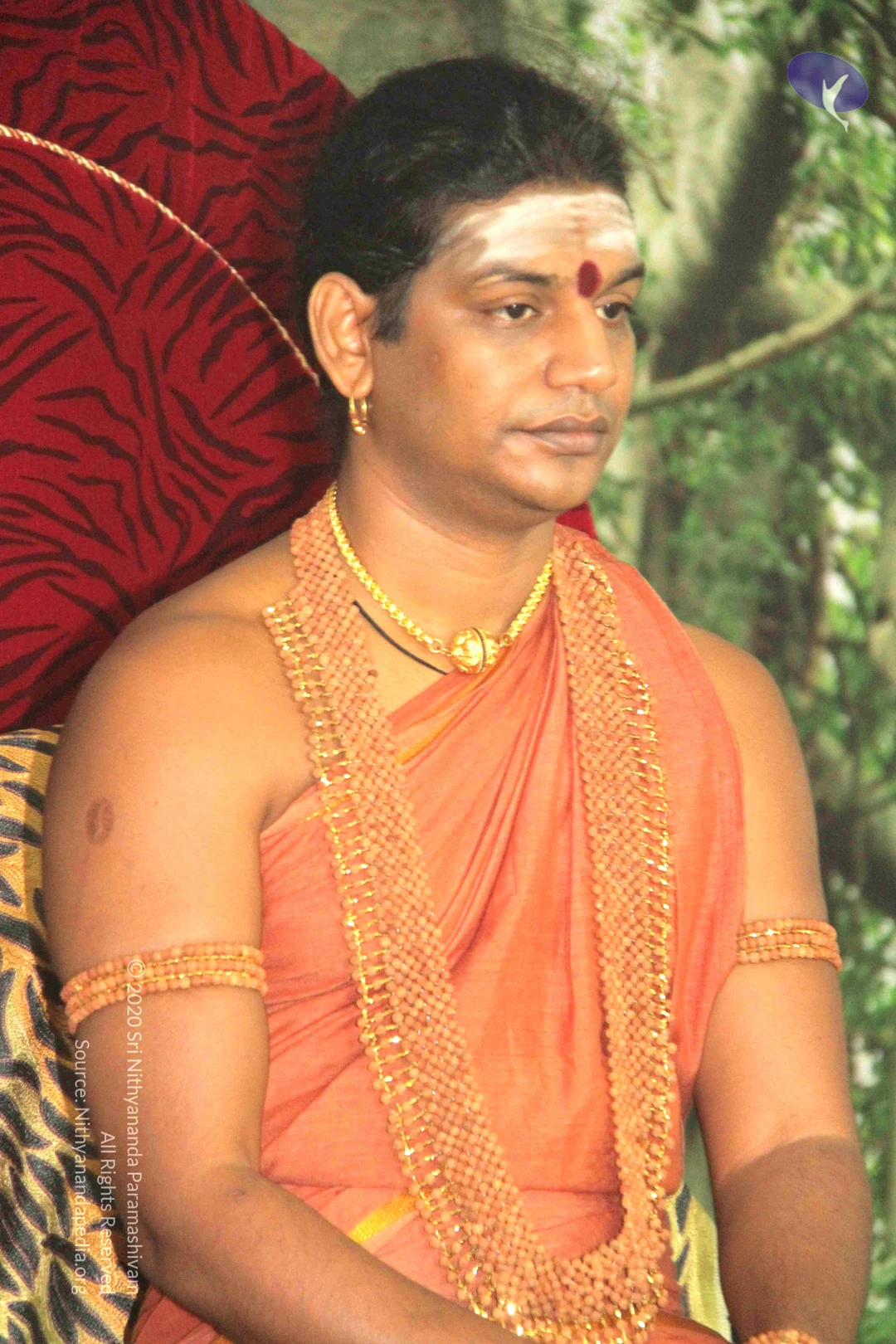
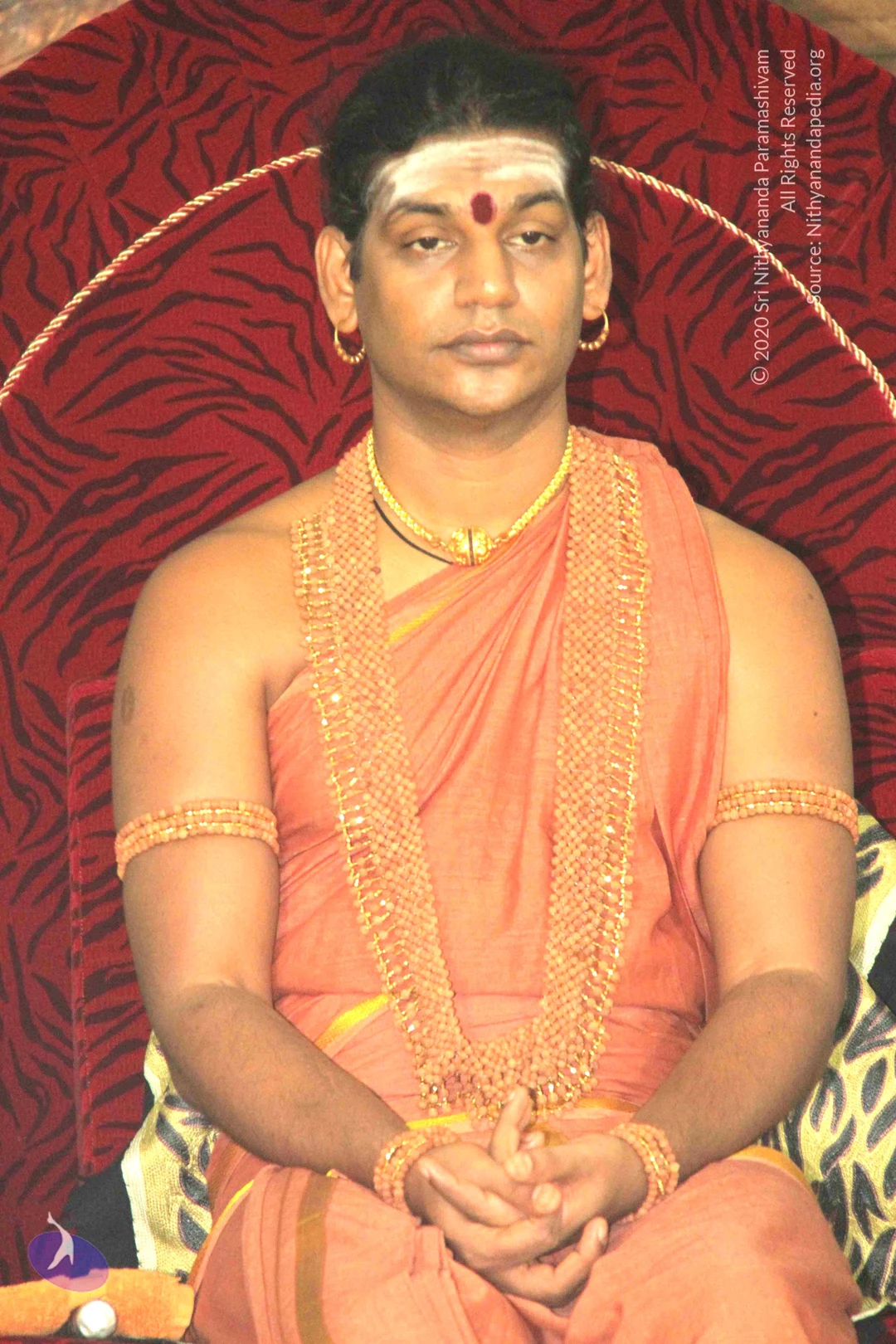
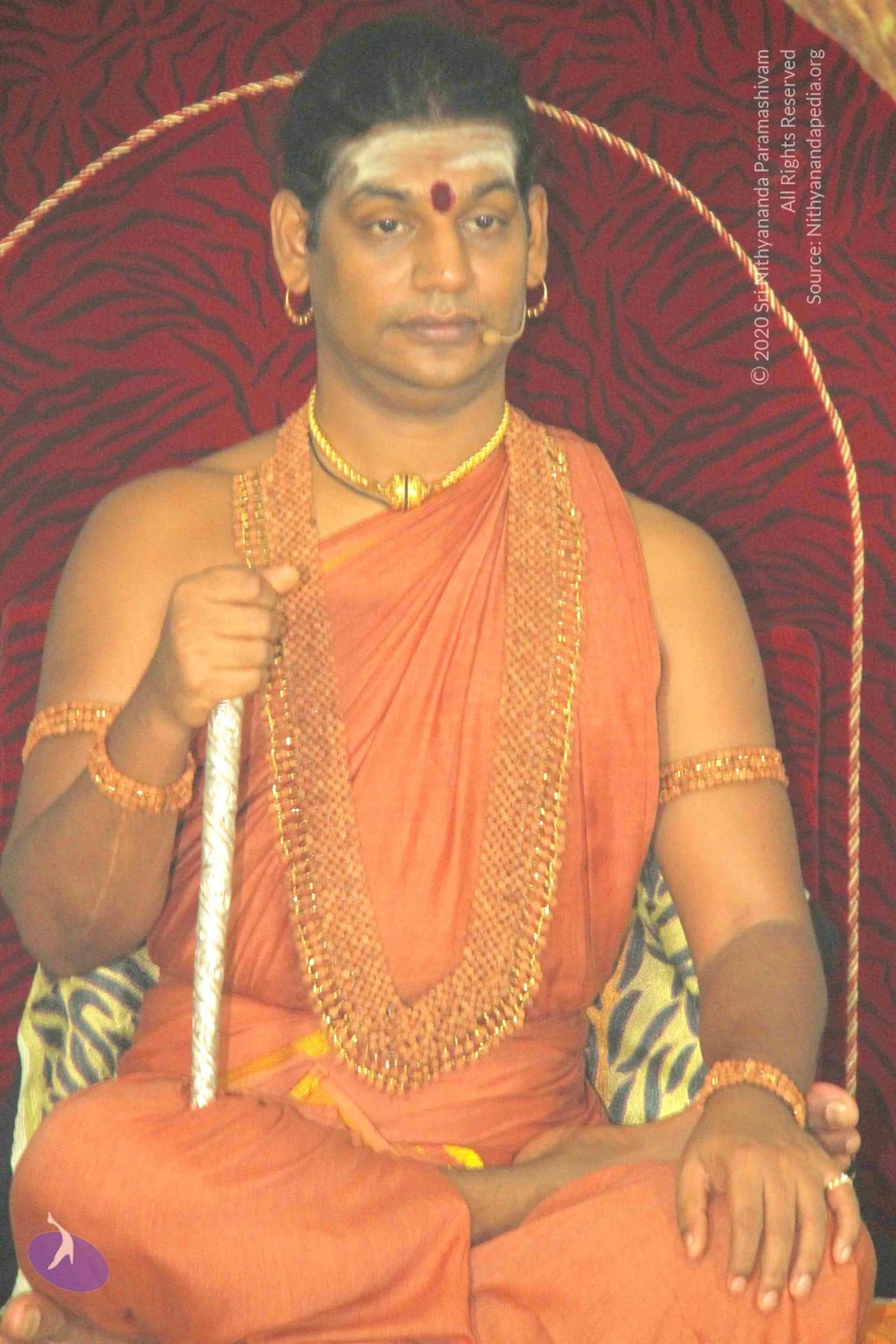
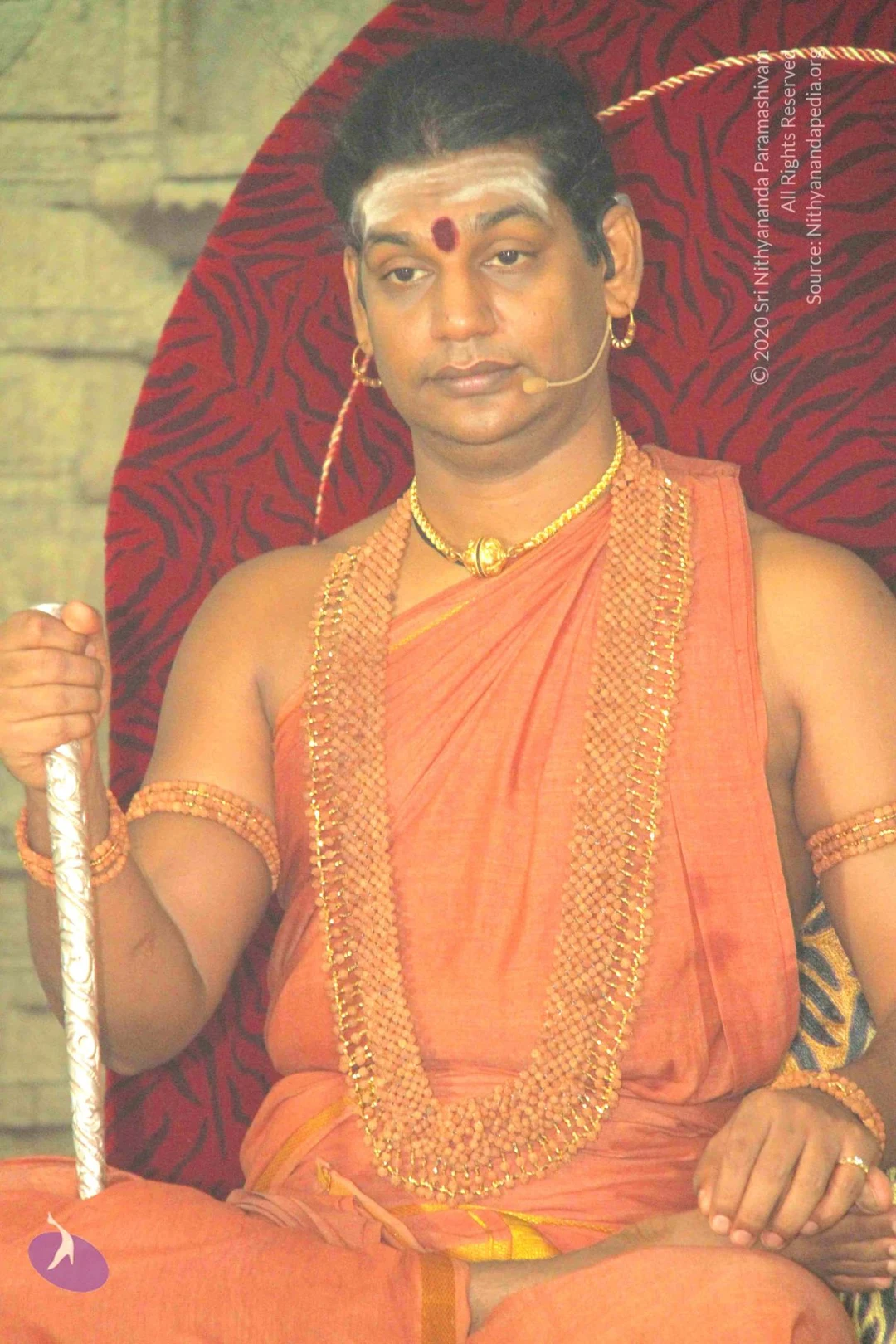
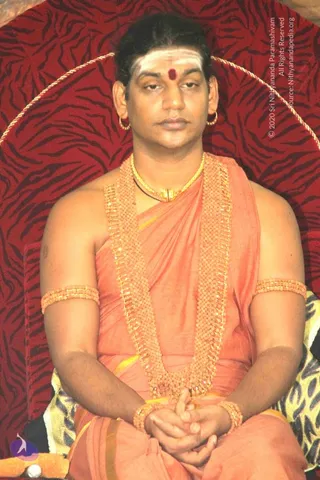
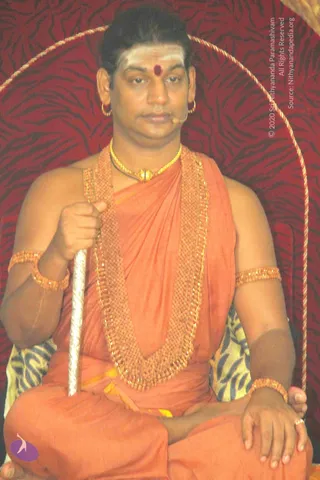
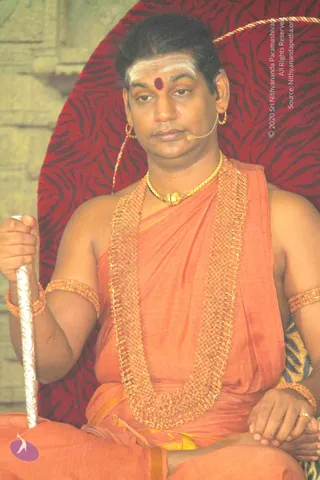
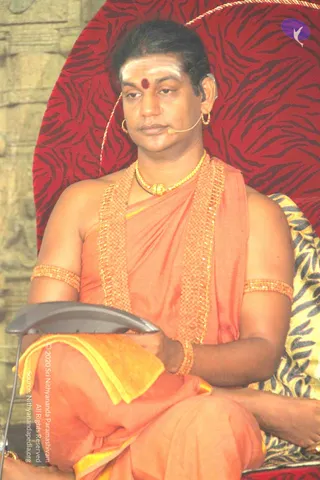
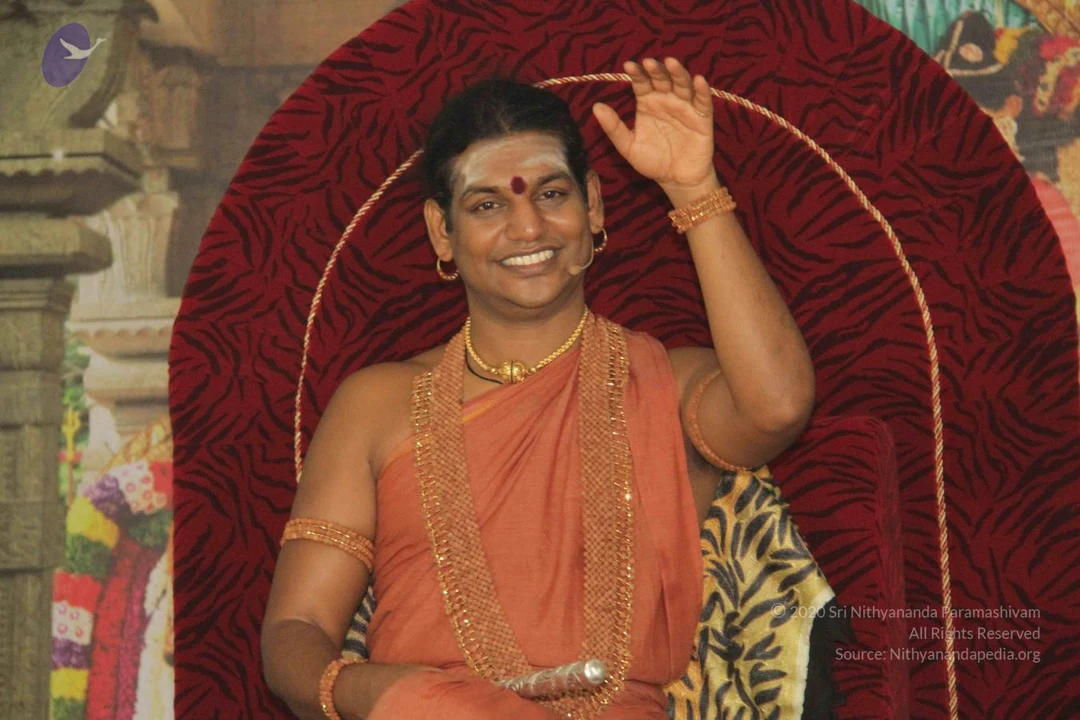
A seated man in saffron-orange robes with gold-bordered dhoti sits on a red zebra-striped velvet throne with a gold arched backrest. He wears a heavy gold necklace, gold armlets, and gold ear studs, with a red bindi and white tilak on his forehead. He raises both palms in a blessing gesture and smiles. A plate of yellow flowers and a small silver vessel sit in the foreground, with a water bottle and a folded orange cloth beside the throne. a person is seated on the dais, identified by the saffron robes, ornate gold jewellery and throne cues.Close photograph of a man seated before a red and black tiger-striped cushion with a painted green tree backdrop. He wears an orange-saffron shawl draped over bare shoulders, a long multi-strand beaded necklace of orange rudraksha-style beads with gold caps, a gold chain with a gold pendant, orange beaded armlets, and a small gold hoop earring. He has white horizontal tilak lines on his forehead with a red dot at the centre and looks to the side with a composed expression. a person by appearance cues including saffron-orange shawl, rudraksha-style mala and gold ornaments, though the identity is uncertain.A photograph of a seated man on a red upholstered throne with a zebra-striped pattern and a gold rope edging. He wears a saffron-orange shawl draped over his shoulders, a long multi-strand beaded garland of orange-gold beads, gold chain necklace, gold hoop earrings, beaded armlets and wrist bands, and a red bindi with white vertical tilak on his forehead. His hands rest clasped in his lap. The shawl and ornate adornments match the a person cues, with the figure seated on a throne in a satsang setting.Photo of a man seated on a red velvet throne with a rope-trimmed arched back, smiling with palms raised in front of his chest in a teaching gesture. He wears saffron-orange draped garments with gold-bordered cloth, layered rudraksha-style beaded necklaces, a gold chain, beaded armlets and bangles, a white vertical forehead mark with a red dot, and gold hoop earrings. Orange cloth lies on the armrest beside him. Only one person is visible. This is a probable identification, not a confirmed one.A seated man in saffron-orange sannyasi robes sits cross-legged before a red throne-like backdrop with black tiger-stripe patterns and a rope-like border. He wears a dark rudraksha-style mala and gold beaded necklace, multiple beaded armlets and bracelets, and gold hoop earrings. A white vertical tilak marks his forehead with a red bindu, and he holds a silver staff upright in his left hand while his right hand rests on his knee. A small microphone is visible near his face. a person (appearance cues: saffron robes, ornate beaded adornments, ceremonial gold necklace and a throne-style seat).A seated man in saffron-orange robes sits before a red cushioned backdrop with black tiger-stripe pattern, holding a silver ceremonial staff in his right hand. He wears long rudraksha mala strands with gold beads, a gold necklace, gold hoop earrings, a white vertical tilak with a red bindi, and a small headset microphone. His left hand rests on his lap with a ring. Behind him is a stone wall. Appearance-based label: a person, seated speaker on a throne-like seat, with saffron clothing, rudraksha malas and a ceremonial gold necklace as the qualifying cues.

Dial-The-Avatar
4 photosSource gallery
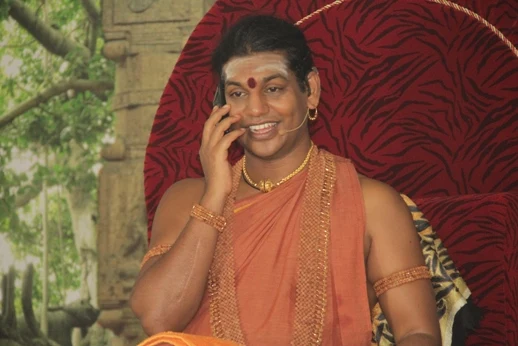
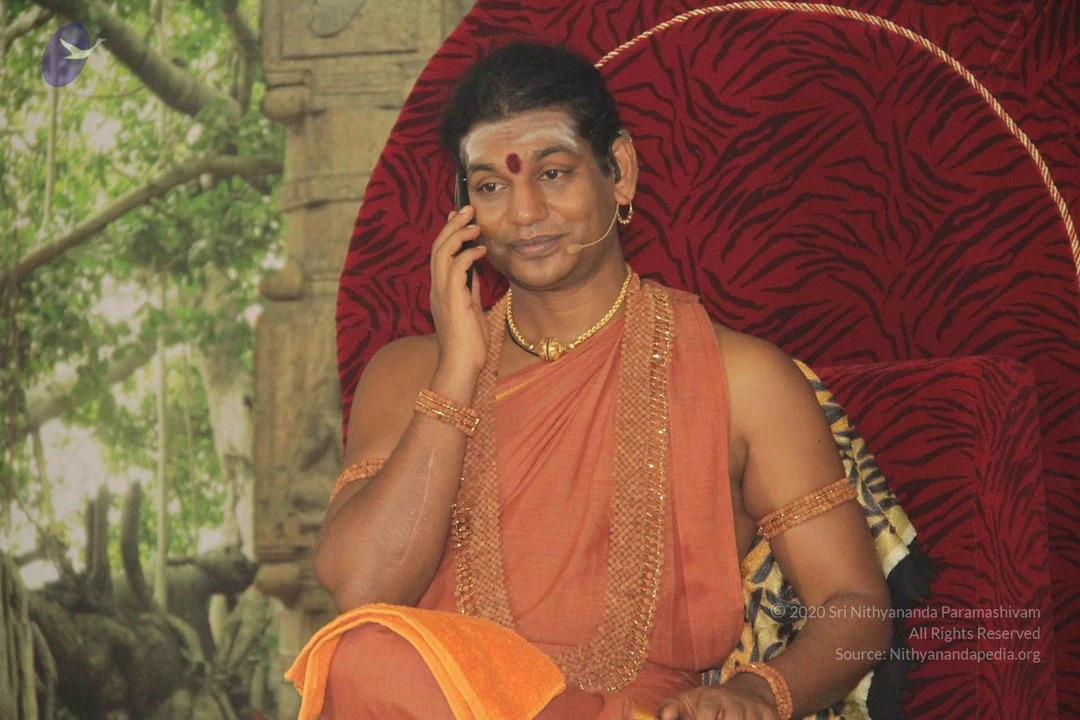
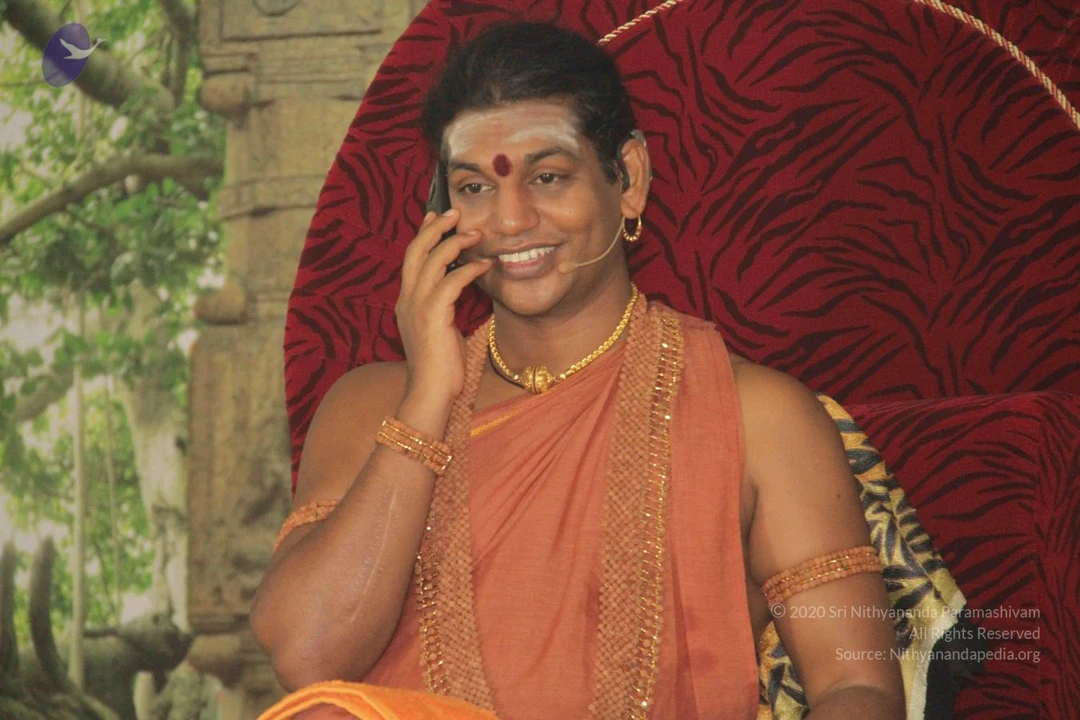
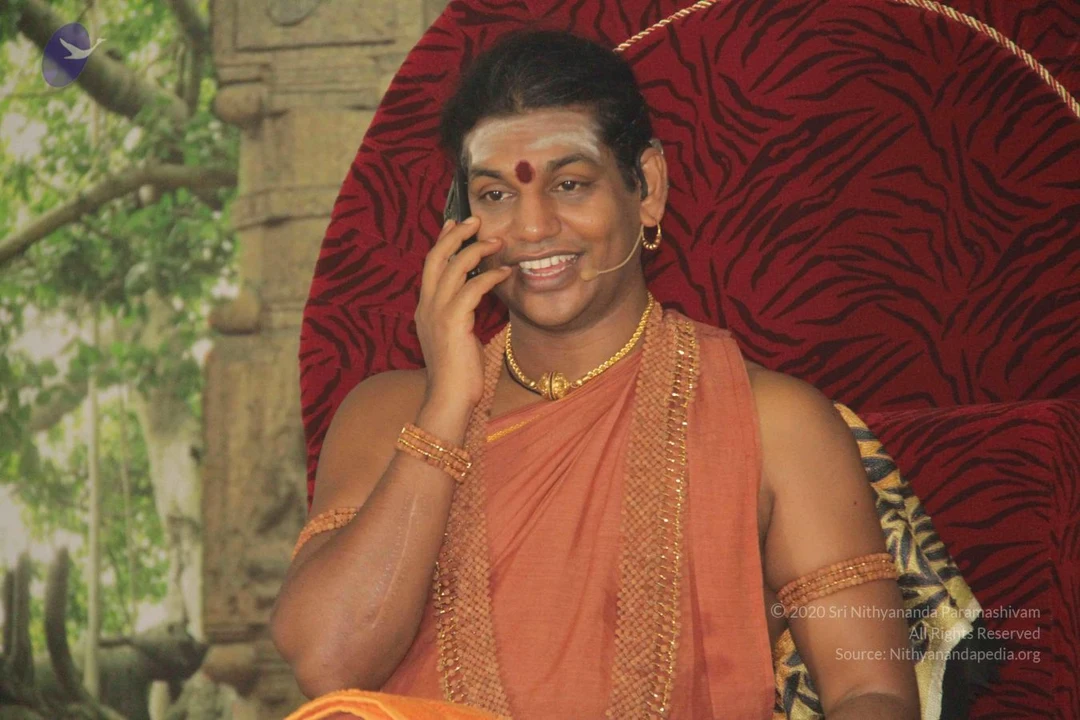
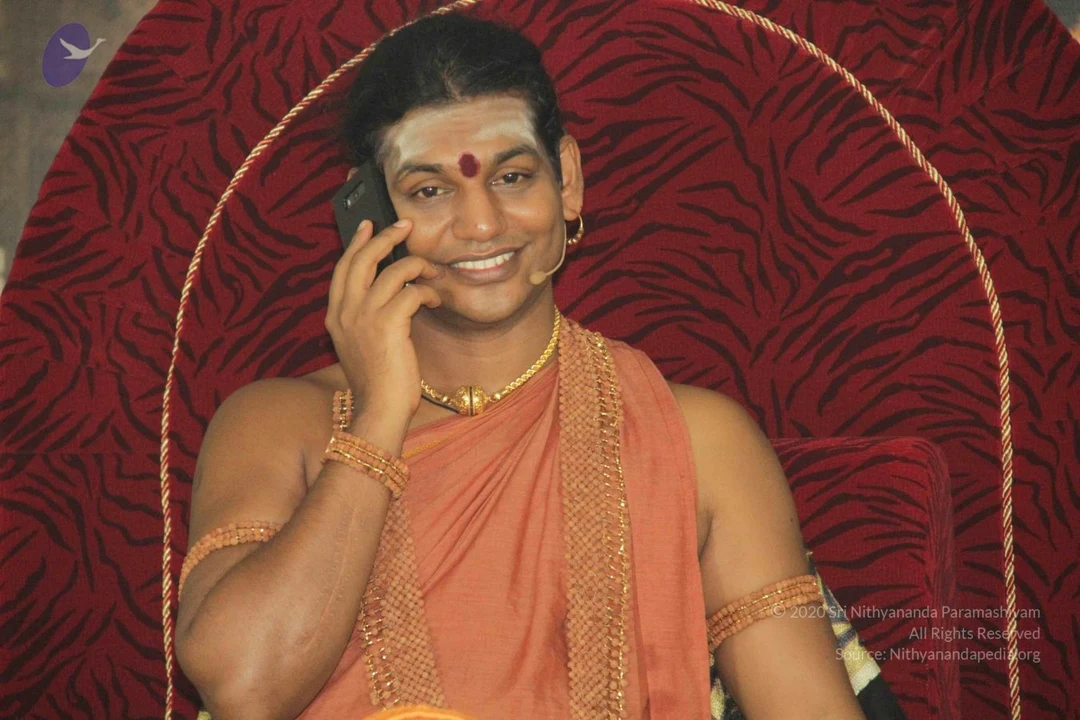
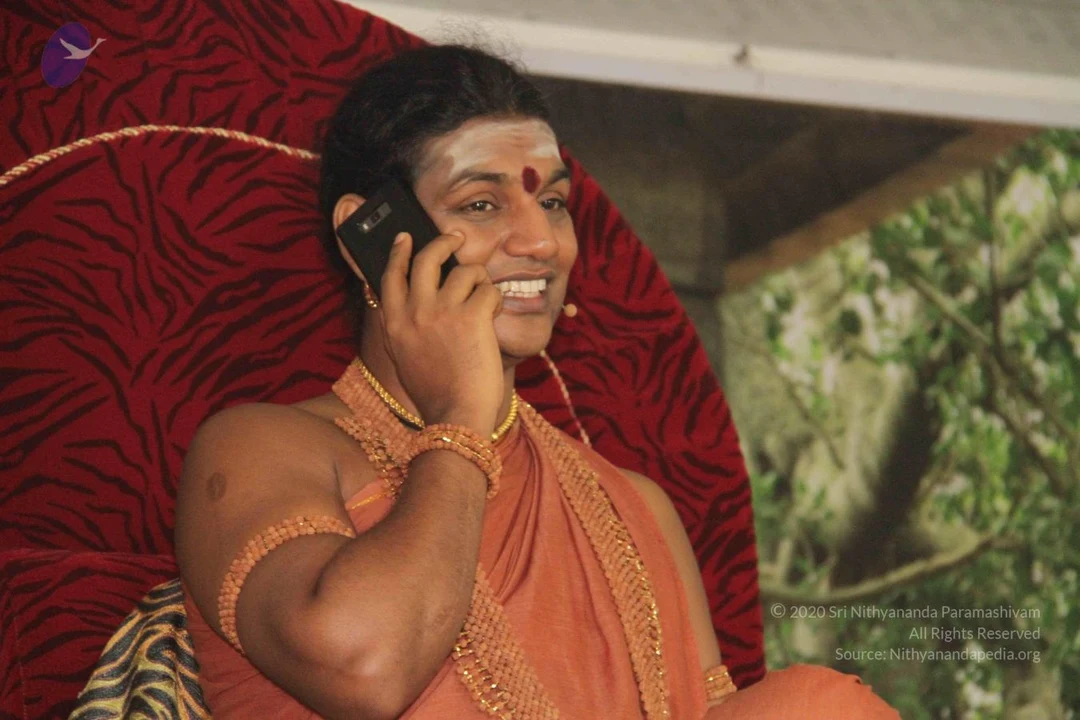
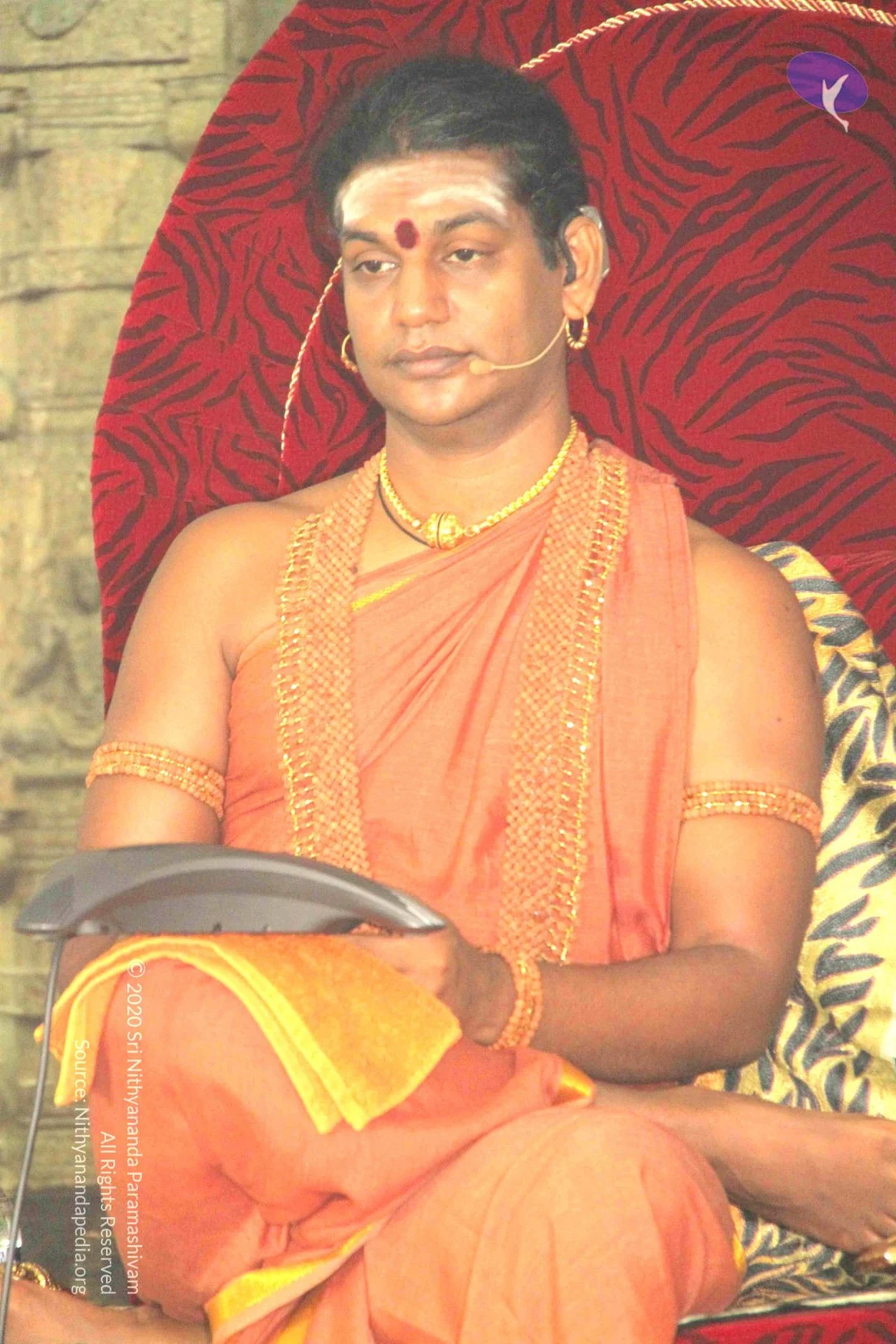
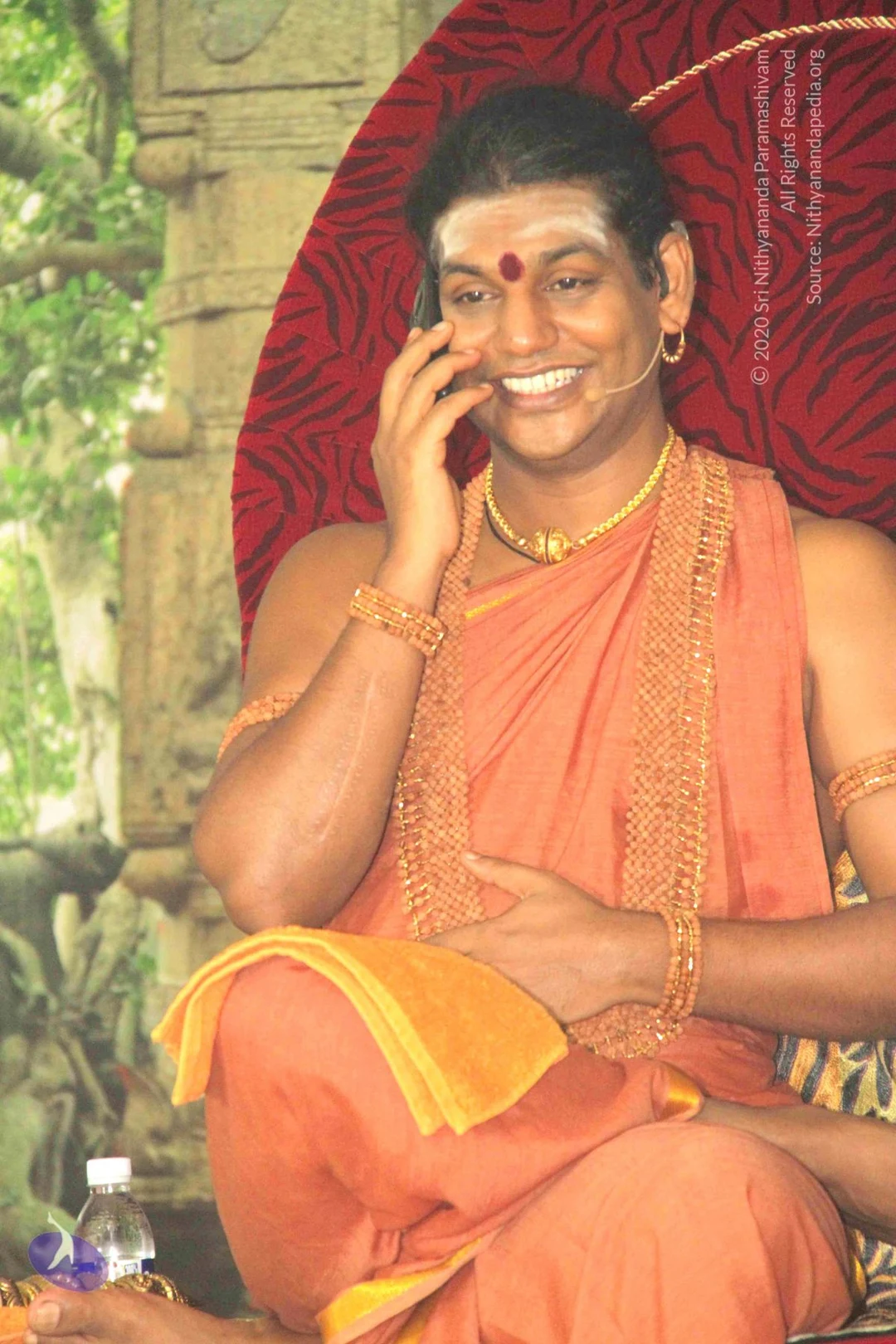
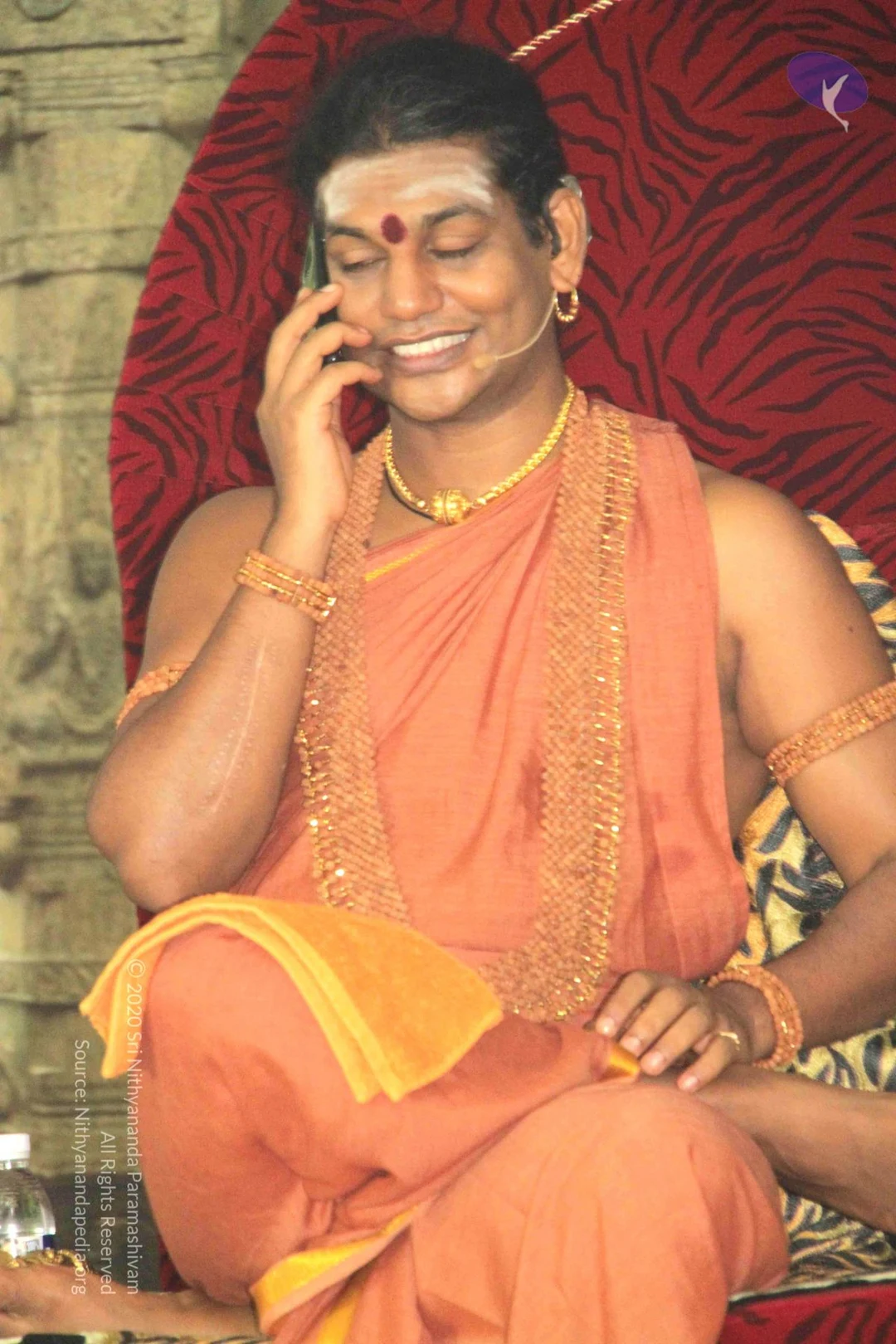
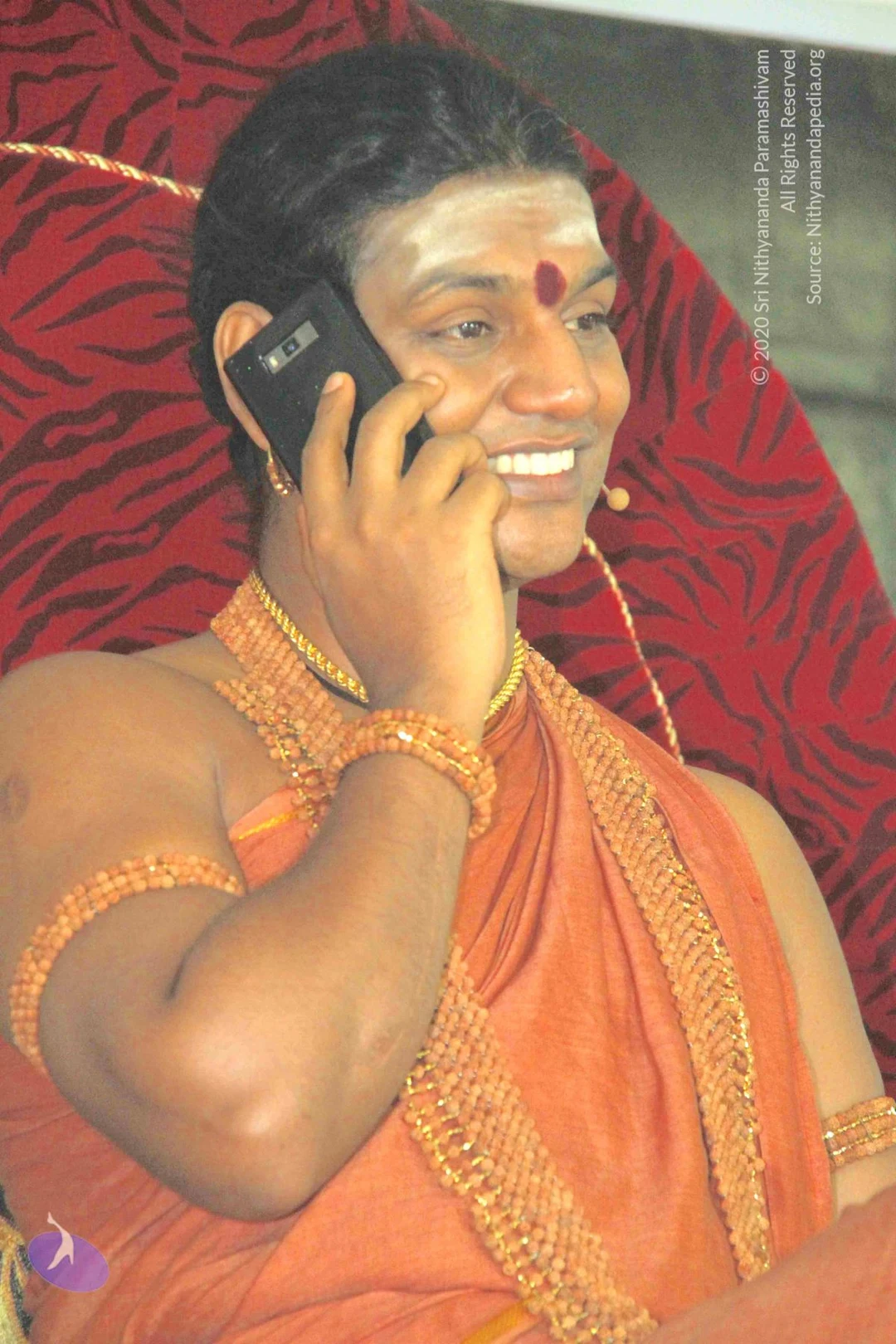
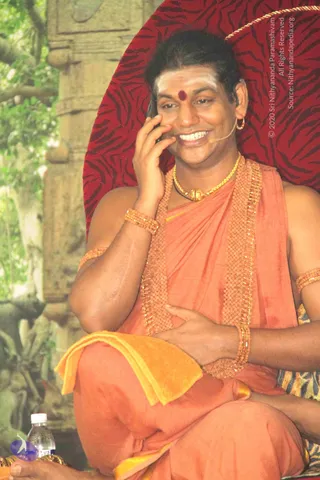
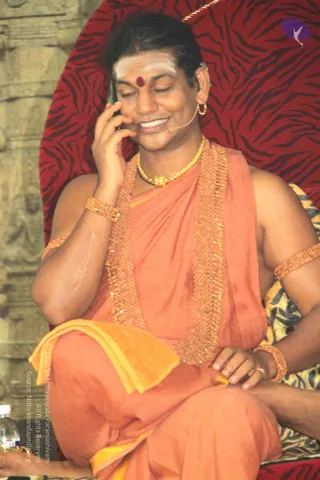
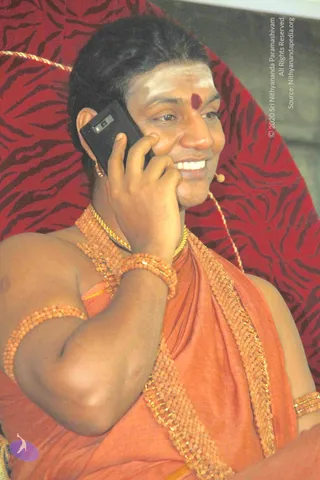
A seated man in orange-saffron robes sits on a red throne-like chair with a zebra-striped cushion, holding a black microphone-style device and a yellow cloth draped over his lap. He wears a gold beaded necklace, gold armlets and a gold beaded garland across his shoulders, with gold hoop earrings and a headset microphone. His forehead bears white and red tilaka markings. Behind him is a carved stone pillar. Visible cues include long swept-back hair, saffron clothing, ceremonial gold necklaces and rudraksha-style beadwork, consistent with a probable Swamiji (probable) appearance seated as a speaker during a satsang discourse.A smiling man seated on a red and black tiger-striped cushioned throne-like seat, holding a mobile phone to his ear. He wears saffron-orange robes, a gold-beaded rudraksha-style mala and gold necklace, gold bangles and armlets, and a white and red forehead mark. A small headset microphone is visible at his ear. A yellow-orange cloth rests on his lap, a water bottle sits at lower left, and a stone carved pillar and foliage form the backdrop. a person seated in discourse setting.A man in orange-saffron robes and a gold-beaded rudraksha-style mala sits on a red and black zebra-patterned throne-like chair, holding a mobile phone to his ear and smiling. He wears a white vertical tilak with a red dot on the forehead, a small gold hoop earring, a gold necklace, gold bangles and an orange-gold cloth draped over his lap. A lit microphone headset is visible near his face. a person is identified by the page as present at this satsang; the seated figure shows distinctive saffron robes, ornate gold malas and jewellery consistent with that role. A carved stone pillar stands at the left edge and a water bottle sits in the lower left corner.Close photo of a smiling man with swept-back dark hair, white forehead markings and a red bindi, holding a black mobile phone to his ear with his right hand. He wears an orange-saffron shawl edged with gold-threaded beaded trim, multiple rudraksha-style beaded malas, a gold chain and a beaded armlet and bracelet. A small headset microphone is visible near his ear. The background is a red and black tiger-striped fabric backdrop. Probable Swamiji (probable) based on the swept-back hair, saffron shawl with ornate beadwork, and layered malas, shown in person speaking by phone.

Tiruvannamalai-Aadheenam
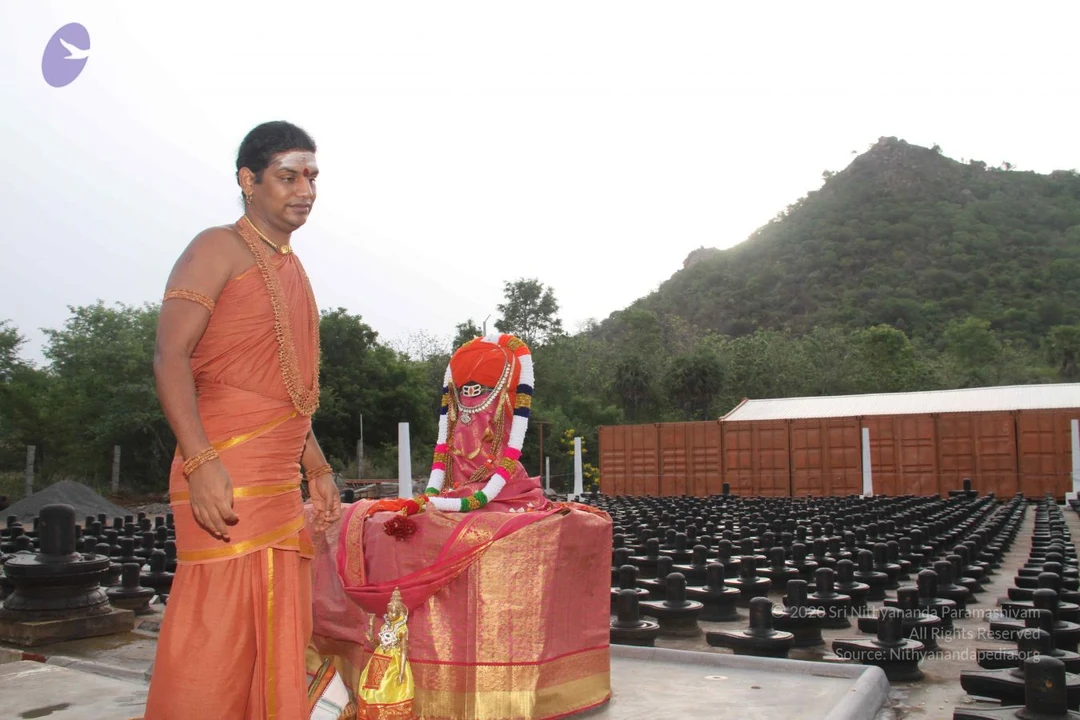
10 photosSource gallery
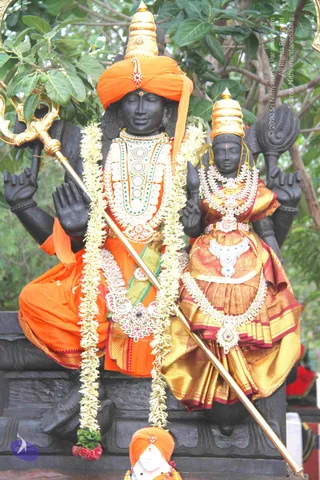
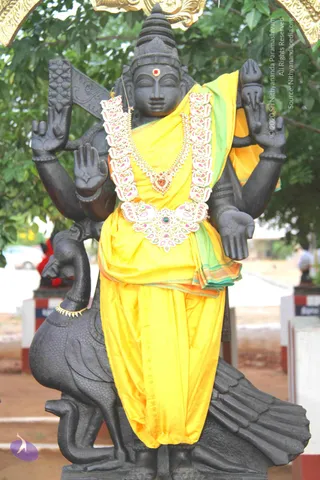
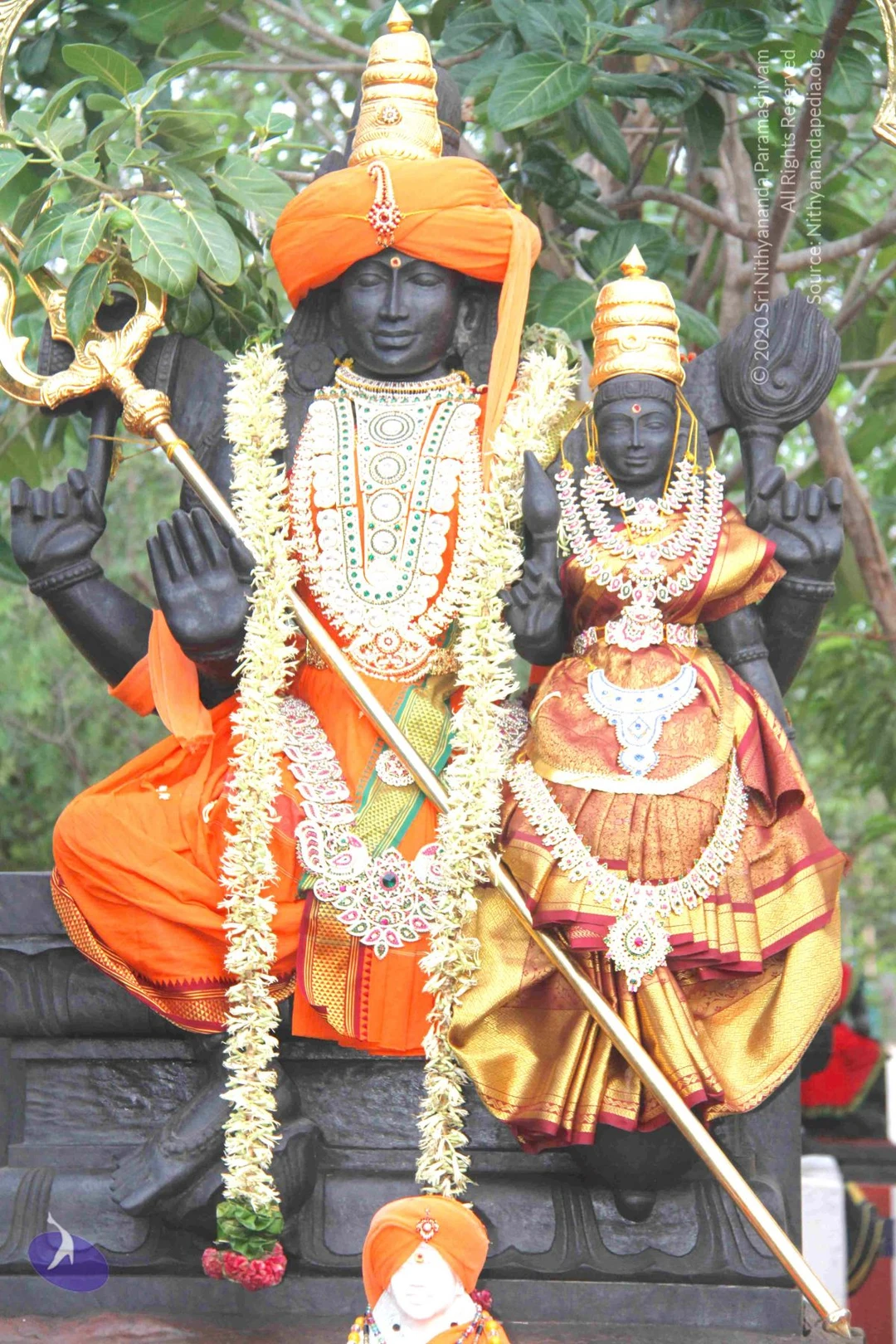
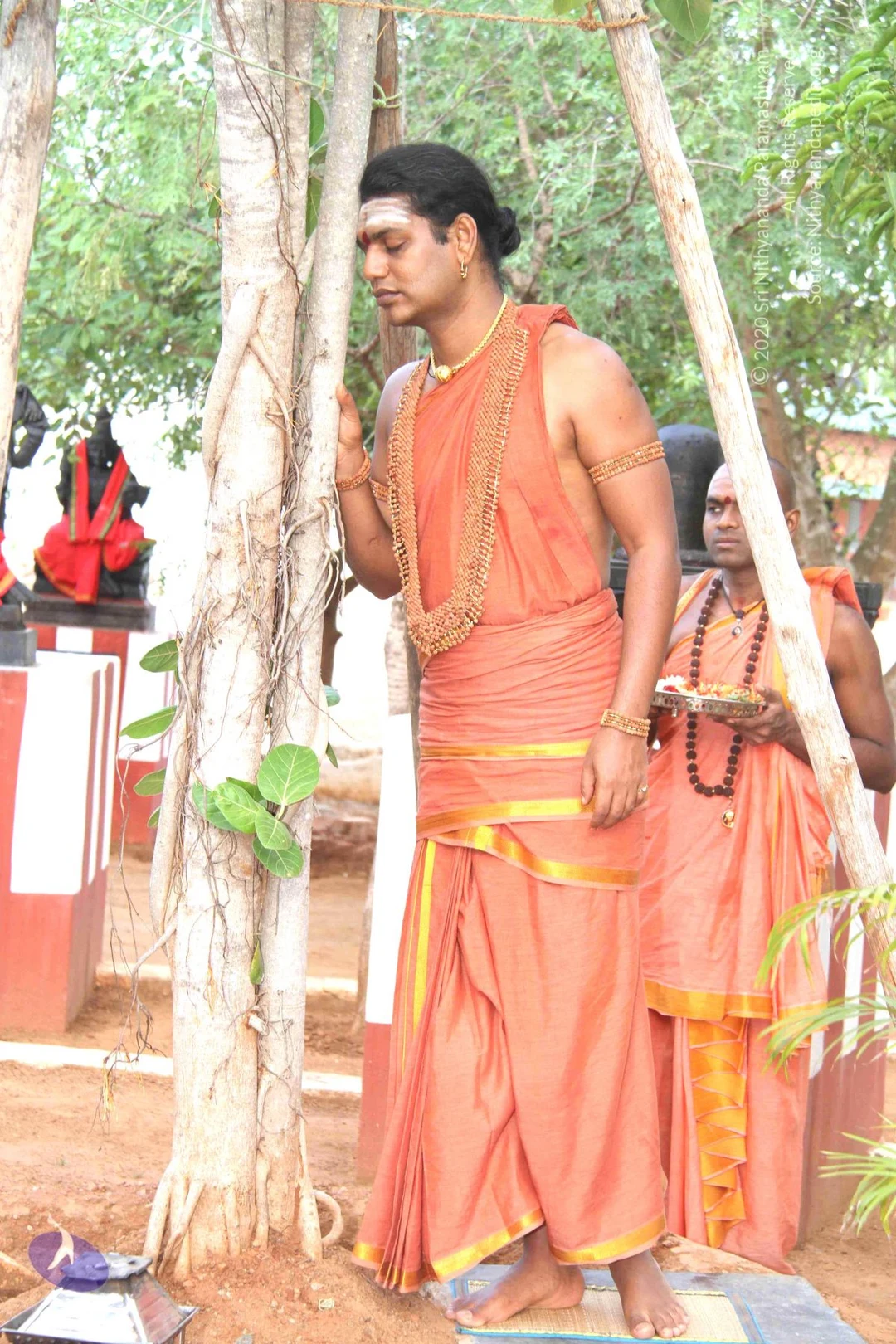
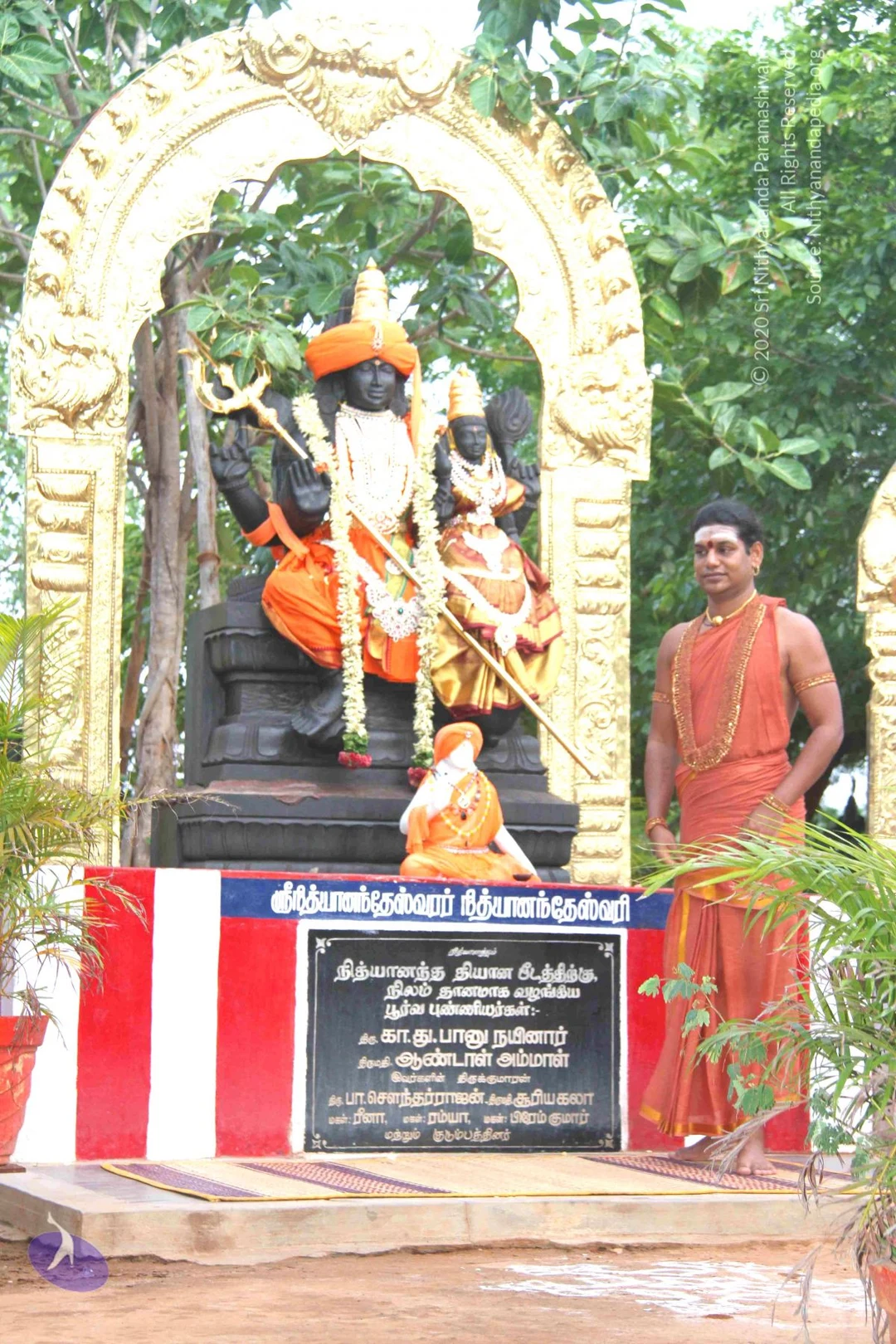
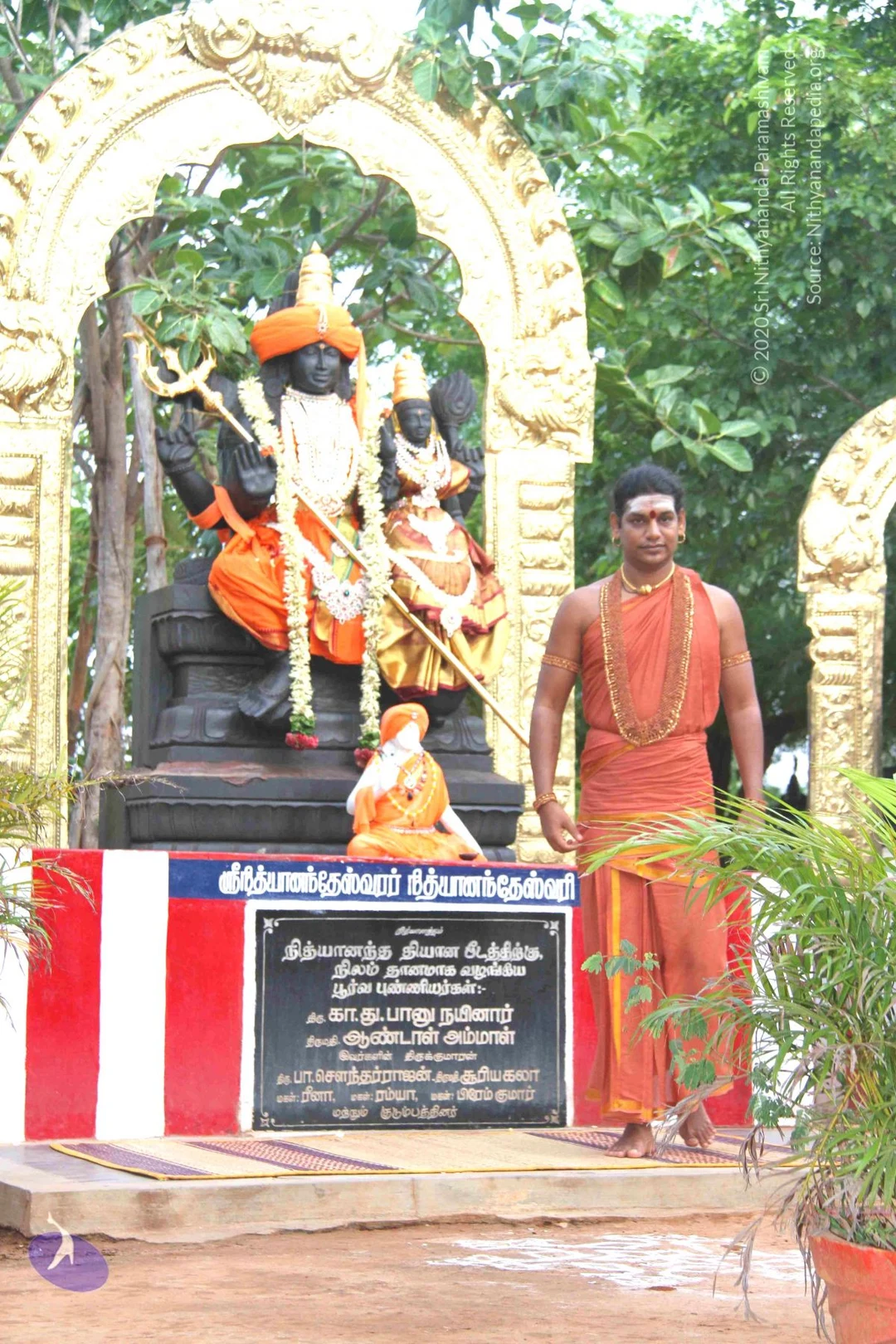
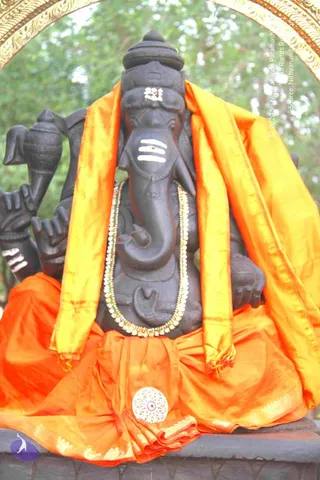
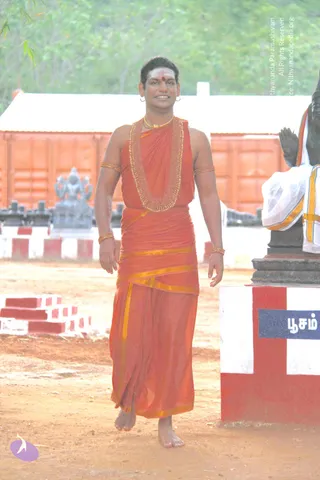
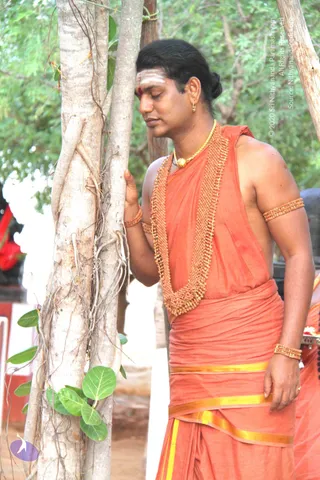
Dark stone statues of a deity couple stand outdoors against green foliage. The male figure wears an orange turban with a gold crown finial, orange dhoti, layered white and green jewelled necklaces and garlands of white flowers, and holds a long golden trident. The female figure wears a gold crown, rich gold and maroon silk sari with jewelled necklaces, and holds a golden staff. A small white figure in an orange turban sits at the base, between garlands hanging from the statues. Copyright text is printed diagonally in the upper right corner.A dark stone statue of a multi-armed deity stands on a peacock-shaped pedestal under an ornate gold canopy, dressed in a bright yellow dhoti and green-edged shawl with a white and red flower garland and gold jewellery, with a red tilak on the forehead. Trees and a red-and-white railing surround the statue outdoors. No physical people are clearly visible in the foreground.Close-up photograph of a dark stone murti of the elephant-headed deity Ganesha seated in a meditative pose. The statue wears an orange-gold silk dhoti and a matching orange-gold shawl draped over its shoulders. A white horizontal tripundra mark with a red dot is painted on the forehead and a white marking on the trunk area, and a beaded gold necklace hangs at the chest. A small decorative rosette sits on the lap fabric. Green leaves and trees appear in the background beneath a gilded arch. No people are visible.A photograph of a man walking barefoot on dirt ground toward the camera, smiling. He wears an orange-red sannyasi-style garment with a gold-striped border, a thick gold-beaded necklace, gold armlets and bangles, hoop earrings, and a red bindi and white forehead marking. Beside him to the right stands a dark stone statue of a seated figure with raised hands and white cloth. Behind are orange-painted structures, red-and-white pedestal blocks, and a stone deity murti on a pedestal. A blue sign with Tamil script is on a red-and-white base at right. Green foliage fills the background.A man in orange-saffron sannyasi robes stands outdoors leaning his right hand against a pale tree trunk, eyes closed and head bowed in meditation. He wears a long multi-strand rudraksha mala draped over the shoulder, a gold pendant necklace, rudraksha armlets, and a gold-bordered orange dhoti. A white and red tilak marks his forehead, and his dark hair is tied in a bun. Green foliage and a wooden post are behind him, with a partially visible second person in orange at the right edge. a person is shown in person, identified by the saffron robes, rudraksha malas and gold ornaments, not by face.Outdoor ritual photograph at a temple grounds with sandy earth and trees. A man with eyes closed and a white tilak with red bindu on his forehead stands barefoot on a mat, one hand resting against a bare tree trunk. He wears an orange-saffron unstitched garment with gold border, a long gold chain necklace, gold armbands and bangles, and his hair is tied in a knot. Beside him a second man in orange robes wears a rudraksha mala and holds a silver tray of flowers. Behind them a black stone deity murti dressed in red cloth sits on a white and red pedestal, and a dark shivalinga is visible. a person: the standing man in saffron with gold ornaments and knotted hair matches the candidate cues.