Skip to content
Friday

2 March 2012

Your Future is Your Choice

Dated photos
34
Source pages
1
Media
2
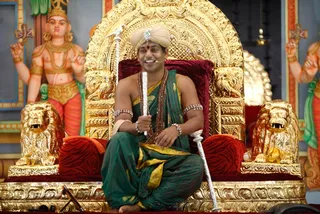
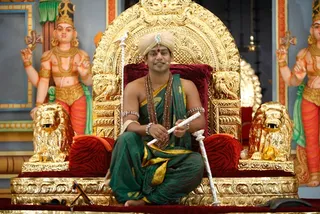
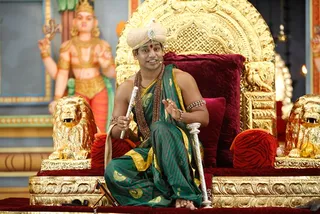
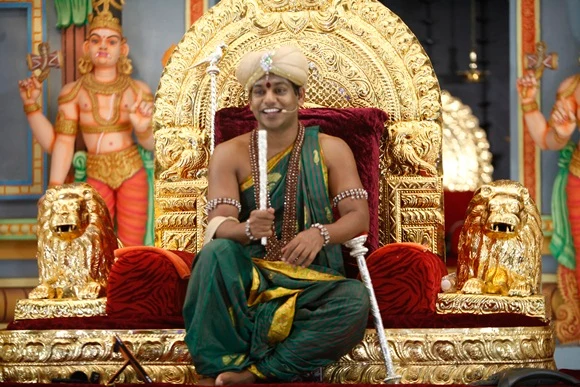
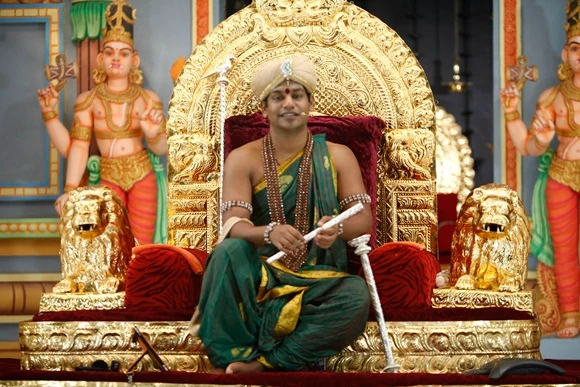
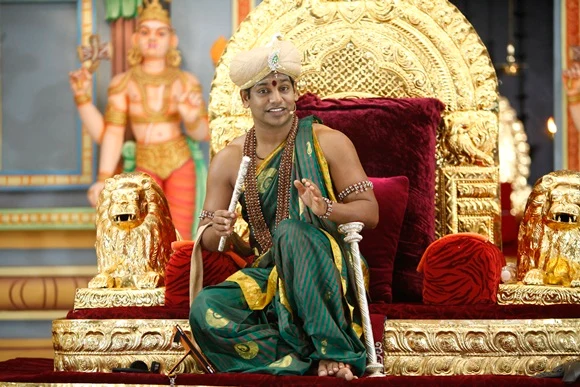
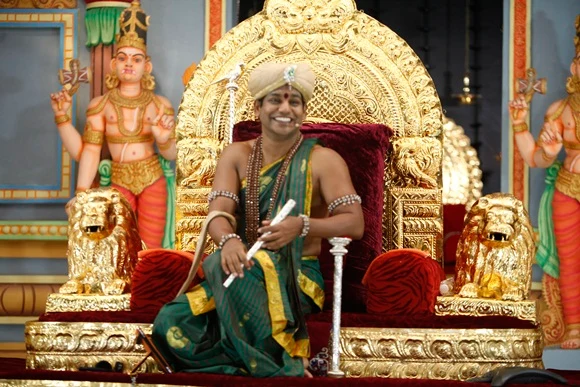
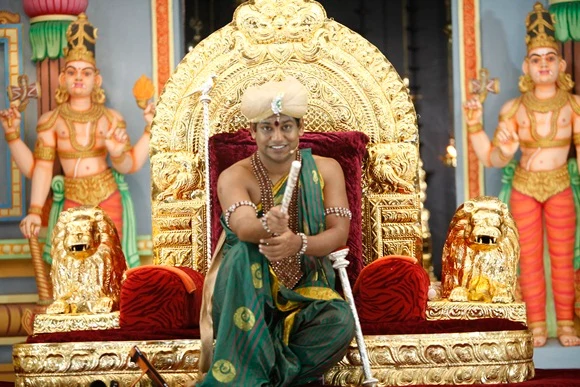
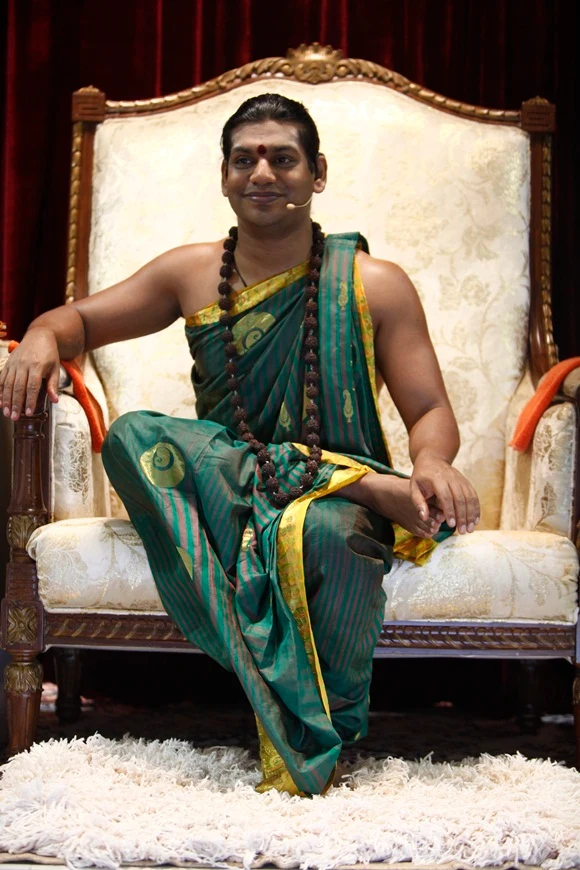
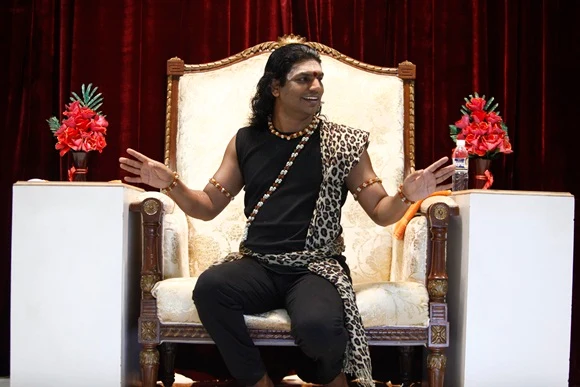
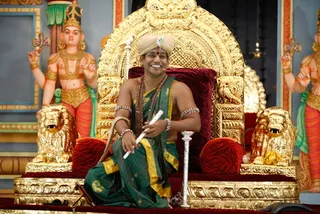
A photograph of a smiling man seated cross-legged on an ornate gilded throne with lion-figure armrests and red cushions. He wears a golden-yellow turban, a green and gold draped garment, multiple rudraksha-style beaded malas and bracelets, and holds a white staff in each hand. Behind the throne stand large painted deity statues in red and gold, with raised hands and crowns. The setting appears to be a temple or ashram hall. One physical person is visible.A man seated cross-legged on an ornate gold throne with carved backrest and gilded lion armrests, set against a dais with painted deity statues. He wears a cream turban with a red mark on the forehead, a green dhoti-style garment, bare chest, multiple rudraksha malas and ceremonial gold necklaces. He holds a white ceremonial stick or chamara-like rod in one hand and smiles toward the audience. Two large painted standing deity figures with raised hands flank the throne, with red velvet cushions below. The man's appearance with turban, rudraksha malas and ornate gold setting is a probable Swamiji candidate seated on a peetha in a satsang setting.A man seated on an ornate golden throne with red cushions and a carved gold lion armrest on each side, speaking with an open-handed gesture. He wears a yellow turban with a jewelled ornament, a green and gold silk garment draped over the body, a long rudraksha mala with ceremonial beads around his neck, and bangles on his wrist. He holds a white ceremonial staff or fly-whisk in one hand. Behind the throne stands a painted deity figure in orange and gold with a raised hand, and a blue painted backdrop. Only one person is physically present. The throne and rich ornamentation suggest a satsang setting. Appearance-based label: Swamiji (probable), seated on a throne with turban, rudraksha mala and gold-trimmed silk.

March 02 2012

Original wiki page
Contents

Title

Your Future is Your Choice

Description

http://www.nithyananda.org/

2nd march 2012 Morning satsang Bhagavad Gita (Song of God) is a timeless treatise on the essence of living enlightenment. The Gita was imparted by the enlightened Hindu incarnation Sri Krishna to the warrior-prince Arjuna over 5000 years ago. Amazingly, the spiritual wisdom and life solutions offered in the Gita are so universal and current that people continue to use it as a transformation guide in their personal and professional lives.

Paramashivoham: 22-day Ultimate Spiritual Journey with the Avatar HDH Nithyananda Paramashivam Learn more: https://paramashivoham.nithyananda.org

Link to Video

VideoAudio

Photos From The Day:
Photos from this day

View all 34 photos
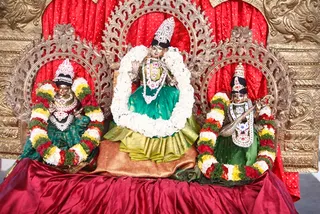
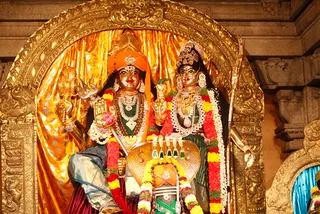
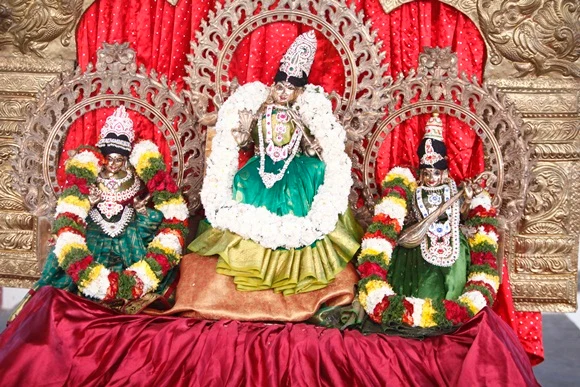
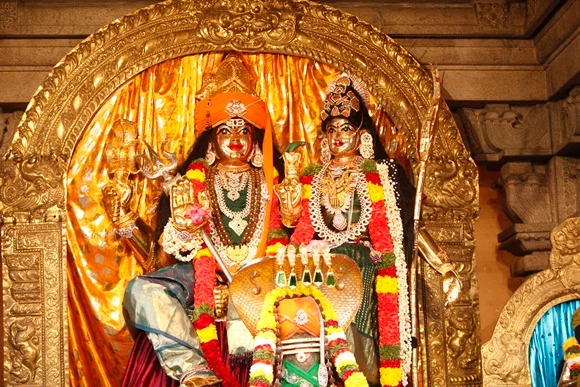
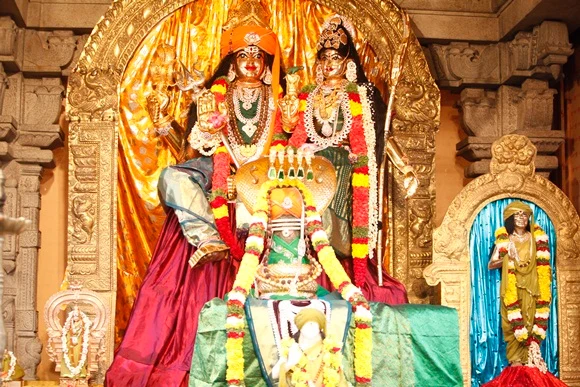
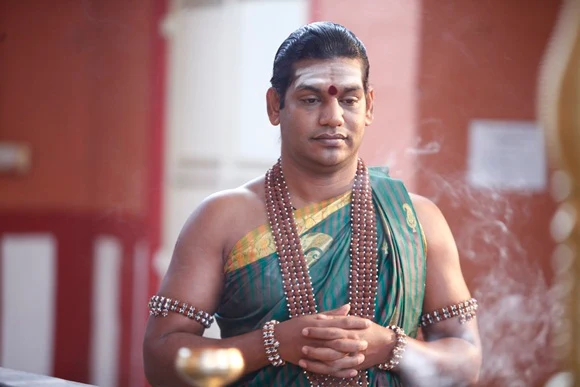
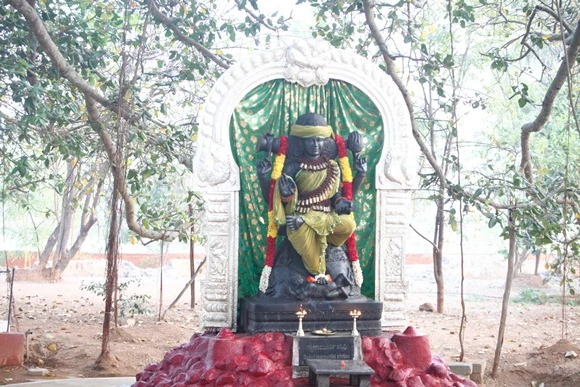
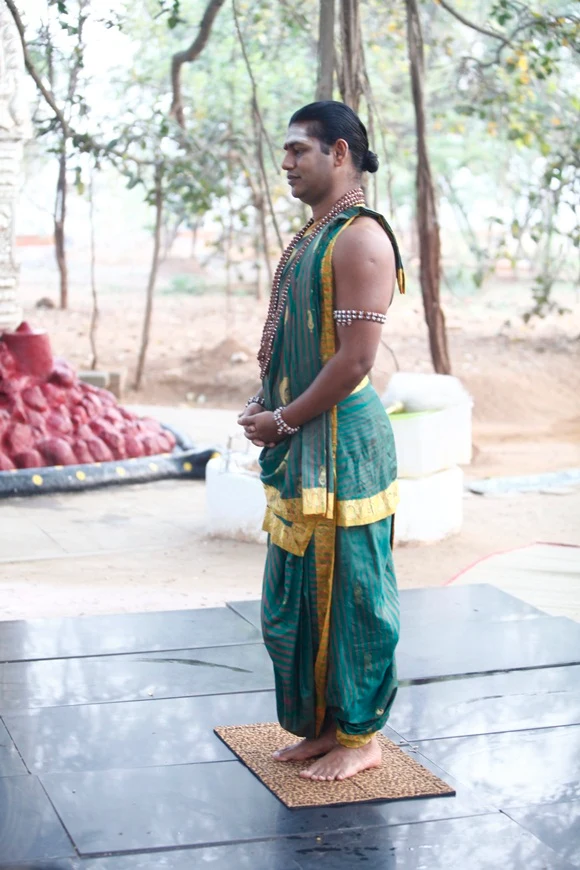
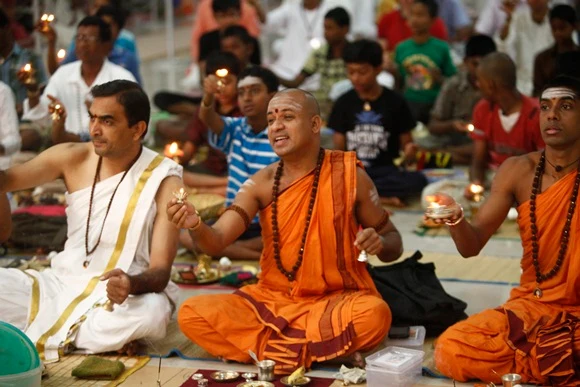
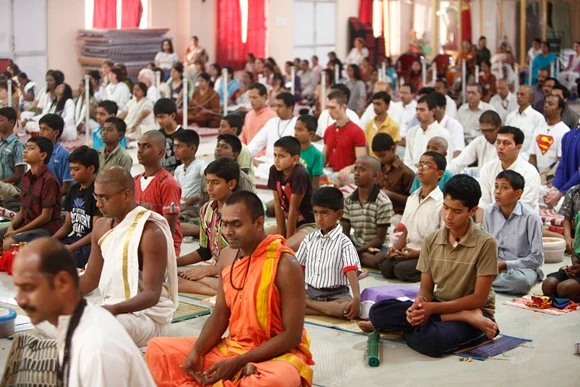
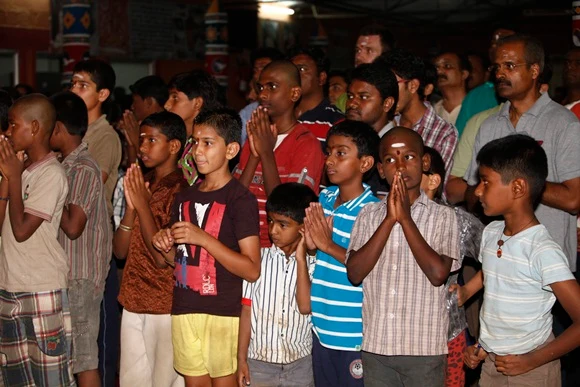
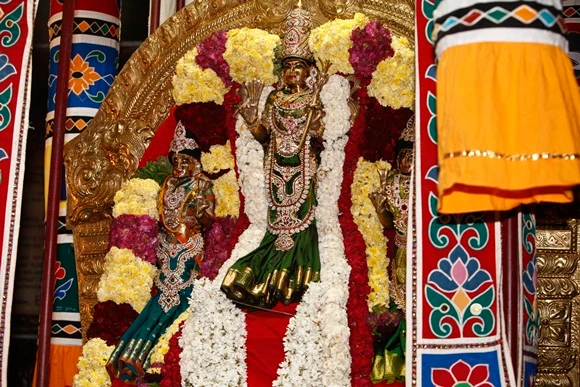
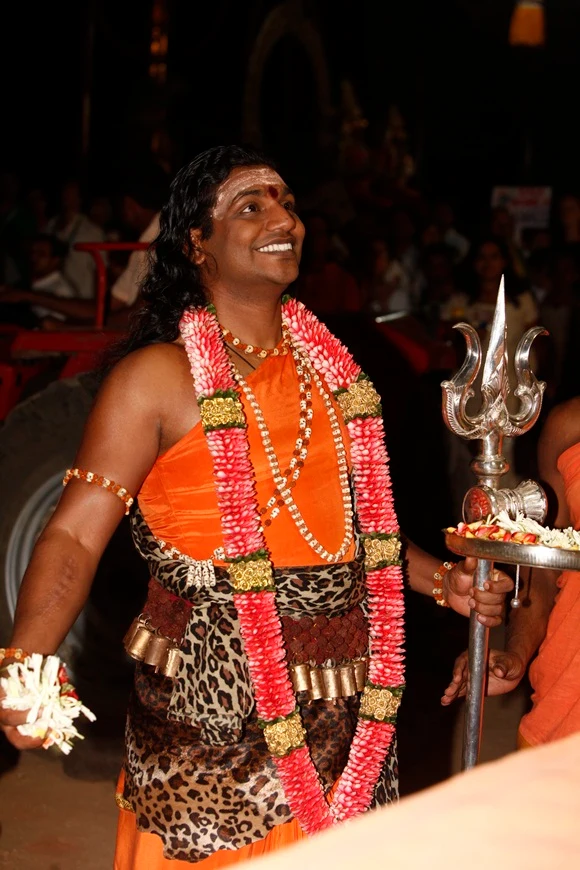
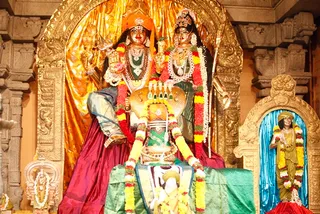
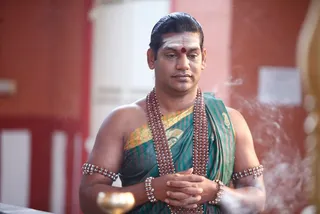
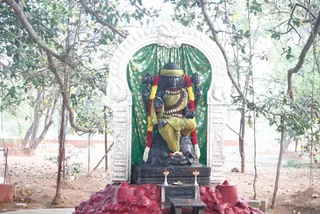
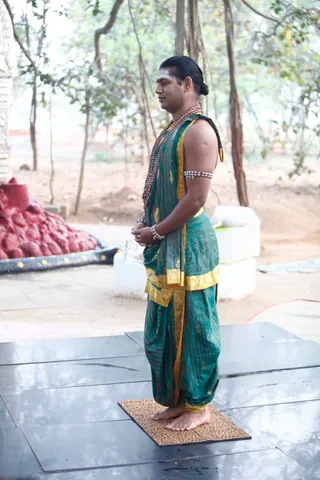
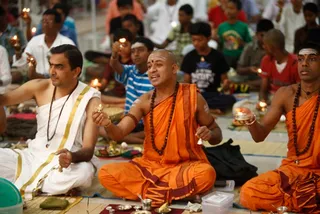
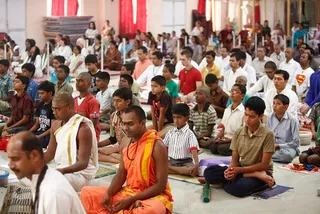
Three deity murtis are displayed on a red draped platform before an ornate gold and red backdrop. The central figure wears a green gown, a white flower garland and a tall decorated crown, with a gold-bordered ornament at the chest. Flanking murtis on each side are similarly dressed in green and garlanded with multicoloured flower chains, and the figure on the right holds a stringed instrument. No physical people are visible.A decorated shrine with two large deity murtis in an ornate golden gopuram-style alcove framed by gold-brocaded drapes. The murtis wear layered gold necklaces, garlands of white flowers and red, yellow and green blossoms, and gold crowns. One holds a staff or trident and the other carries a lotus-like object. Between them sits a golden yoni-peetha base decorated with garlands and small brass lamps, and a decorative gold-trimmed shrine structure surrounds the arrangement.A photograph of a temple shrine decorated with a golden backdrop and ornate gold arch. Two large deity murtis, one with a crown and one with a rudraksha-style necklace, sit above a central lingam covered in garlands of red, yellow and white flowers. A green and gold cloth lies before the lingam with a small brass lamp and offerings. To the right, a smaller standing figure in a saffron-coloured garland-draped dress stands in a blue-curtained niche. No living people are visible.A man stands with his palms pressed together in front of a brass lamp, with incense smoke rising beside him. He wears a green silk garment with gold border, multiple strands of rudraksha beads across his chest, and beaded bracelets on his wrists and upper arms. A red bindi and a tilak mark his forehead. A red wall stands behind him.A large dark stone murti stands in an arched white frame with a green draped backdrop, outdoors among trees and bare earth. The deity figure has multiple arms, wears a yellow dhoti and yellow sash, and is adorned with red and white flower garlands and a rudraksha-style necklace. Two brass oil lamps stand on a dark pedestal, and red offerings or stones are piled at the base. No people are visible.A barefoot man stands in profile on a leopard-print mat set on a black stone platform outdoors, hands folded in front of him. He wears a green striped silk garment with gold-bordered drapes over one shoulder and tied around the waist, a gold armlet on his upper arm, a gold bracelet, and a long multi-strand rudraksha mala around his neck. His hair is swept back and tied up. Behind him are trees, a pile of red offerings, and white stone containers near the platform.Outdoor satsang-style gathering with several seated men performing a ritual with oil lamps. In the foreground, three men sit cross-legged on a mat: one in white dhoti with a gold-bordered shawl holding a small object, a central man in saffron-orange robes and rudraksha malas raising a lit lamp, and a third in saffron with a white headband holding a lamp. Behind them, a crowd of seated devotees, mostly children and men in casual clothes, hold small flames. Brass vessels and a leaf-plate of offerings sit on the mat in front.A photograph of a smiling man seated cross-legged on an ornate gilded throne with lion-figure armrests and red cushions. He wears a golden-yellow turban, a green and gold draped garment, multiple rudraksha-style beaded malas and bracelets, and holds a white staff in each hand. Behind the throne stand large painted deity statues in red and gold, with raised hands and crowns. The setting appears to be a temple or ashram hall. One physical person is visible.A man seated cross-legged on an ornate gold throne with carved backrest and gilded lion armrests, set against a dais with painted deity statues. He wears a cream turban with a red mark on the forehead, a green dhoti-style garment, bare chest, multiple rudraksha malas and ceremonial gold necklaces. He holds a white ceremonial stick or chamara-like rod in one hand and smiles toward the audience. Two large painted standing deity figures with raised hands flank the throne, with red velvet cushions below. The man's appearance with turban, rudraksha malas and ornate gold setting is a probable Swamiji candidate seated on a peetha in a satsang setting.A man seated on an ornate golden throne with red cushions and a carved gold lion armrest on each side, speaking with an open-handed gesture. He wears a yellow turban with a jewelled ornament, a green and gold silk garment draped over the body, a long rudraksha mala with ceremonial beads around his neck, and bangles on his wrist. He holds a white ceremonial staff or fly-whisk in one hand. Behind the throne stands a painted deity figure in orange and gold with a raised hand, and a blue painted backdrop. Only one person is physically present. The throne and rich ornamentation suggest a satsang setting. Appearance-based label: Swamiji (probable), seated on a throne with turban, rudraksha mala and gold-trimmed silk.A smiling man sits on an ornate gilded throne with a red velvet cushion, flanked by two golden lion figures on the armrests. He wears a green and gold garment, a light turban-style head covering, multiple beaded necklaces, bangles and armlets, and holds a white ceremonial staff in one hand. Behind him stand two golden deity statues with raised hands and ornate crowns, set against a blue and yellow temple-style backdrop. The throne and ornamentation suggest a formal satsang setting, though the figure's appearance is not clearly confirmed.A photograph of a large indoor satsang hall with many people seated cross-legged on mats and cushions in rows, facing forward toward the front of the room. In the foreground a man in a saffron-orange robe with a rudraksha mala sits upright, and beside him a man in white ritual clothing sits with hands in his lap. Behind them rows of boys and men in casual shirts, t-shirts and white kurtas sit attentively, with brass vessels and cushions along the floor and white pillars and draped fabric in the background. The mood is calm, orderly and meditative.