Skip to content
Monday

9 January 2012

THE SUPREME PONTIFF OF HINDUISM HDH BHAGAVAN NITHYANANDA PARAMASHIVAM

Dated photos
121
Source pages
1
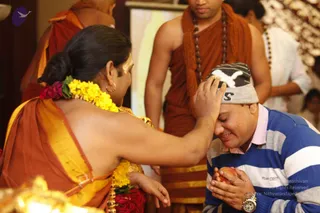
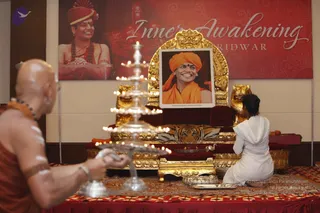
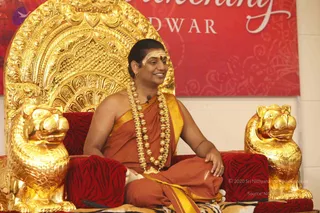
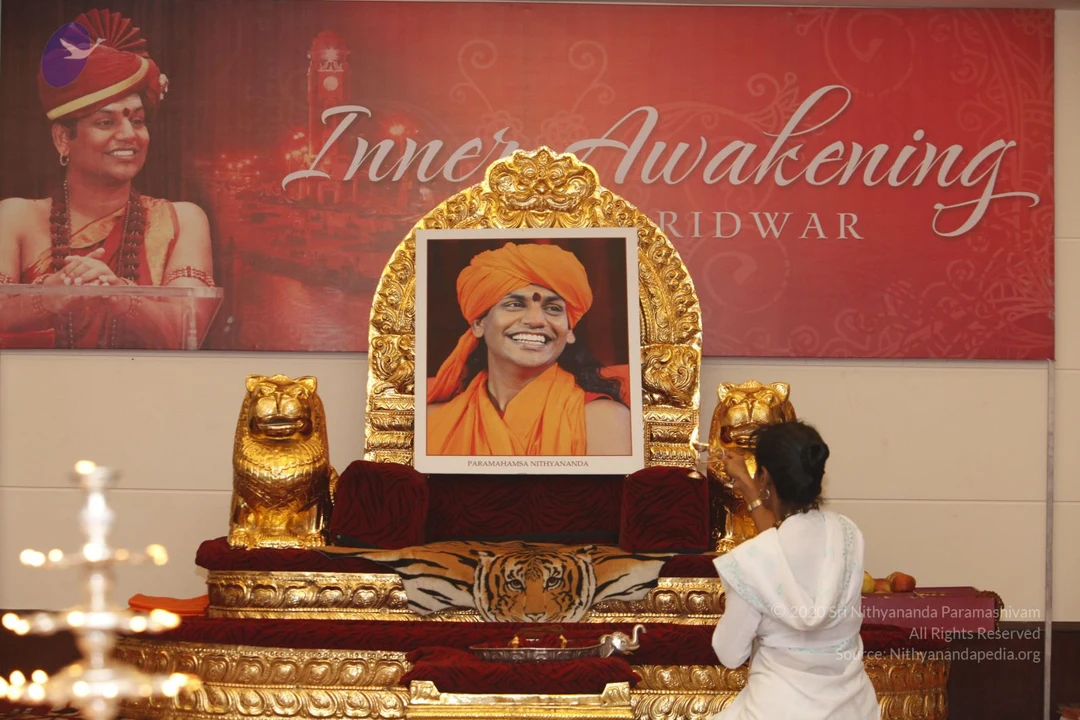
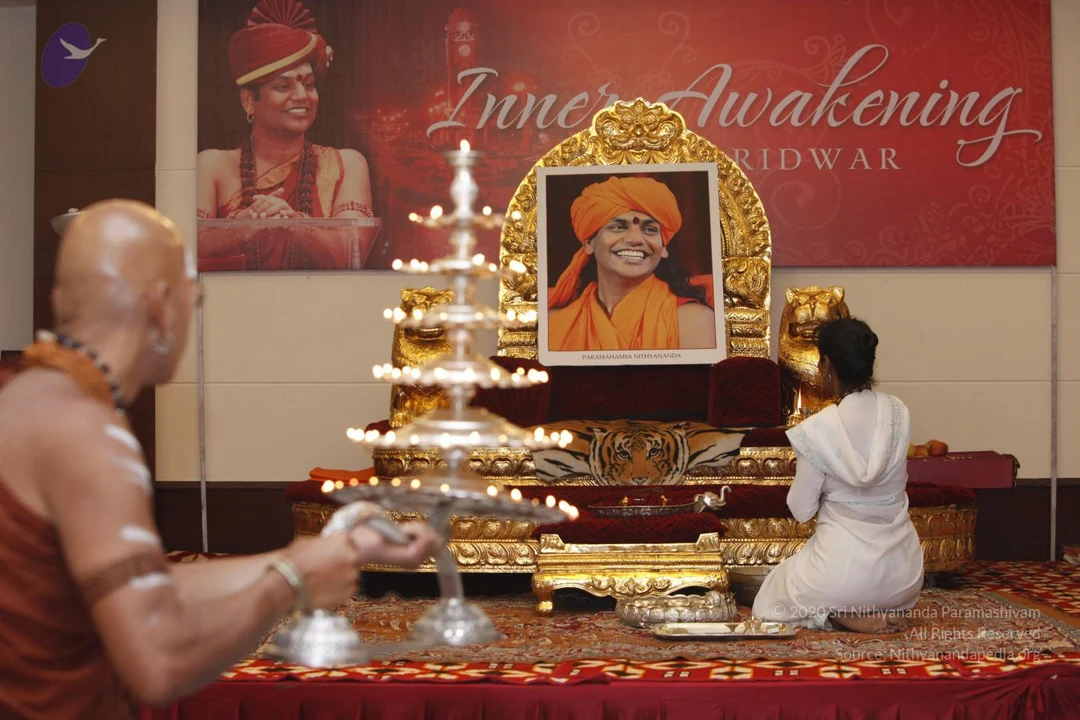
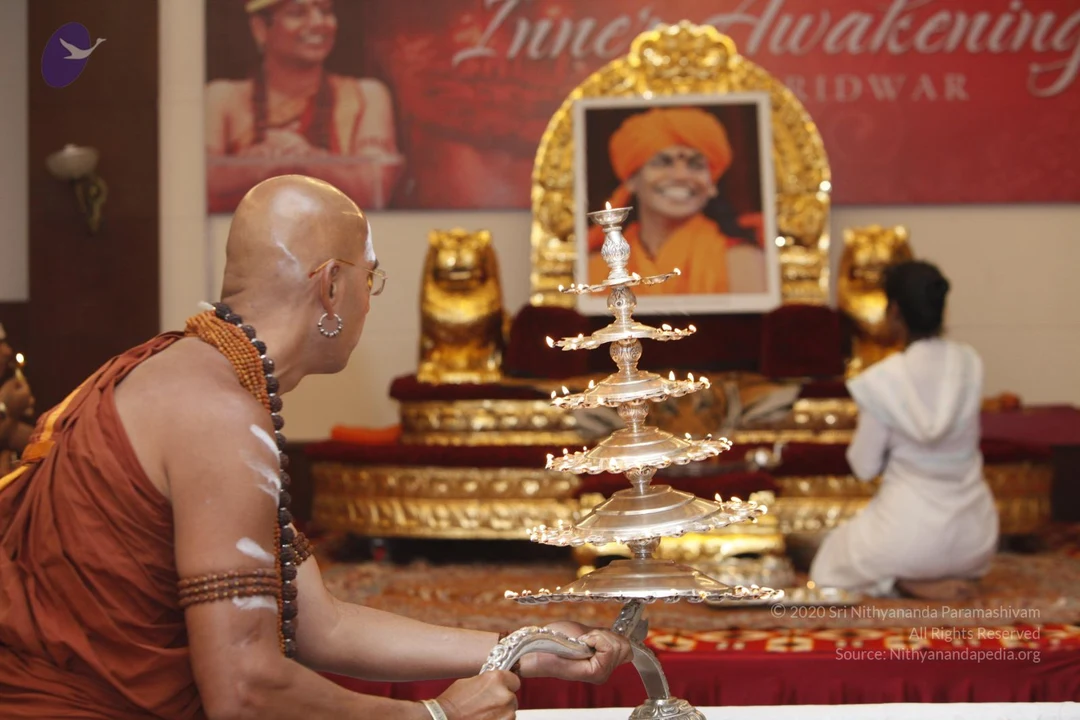
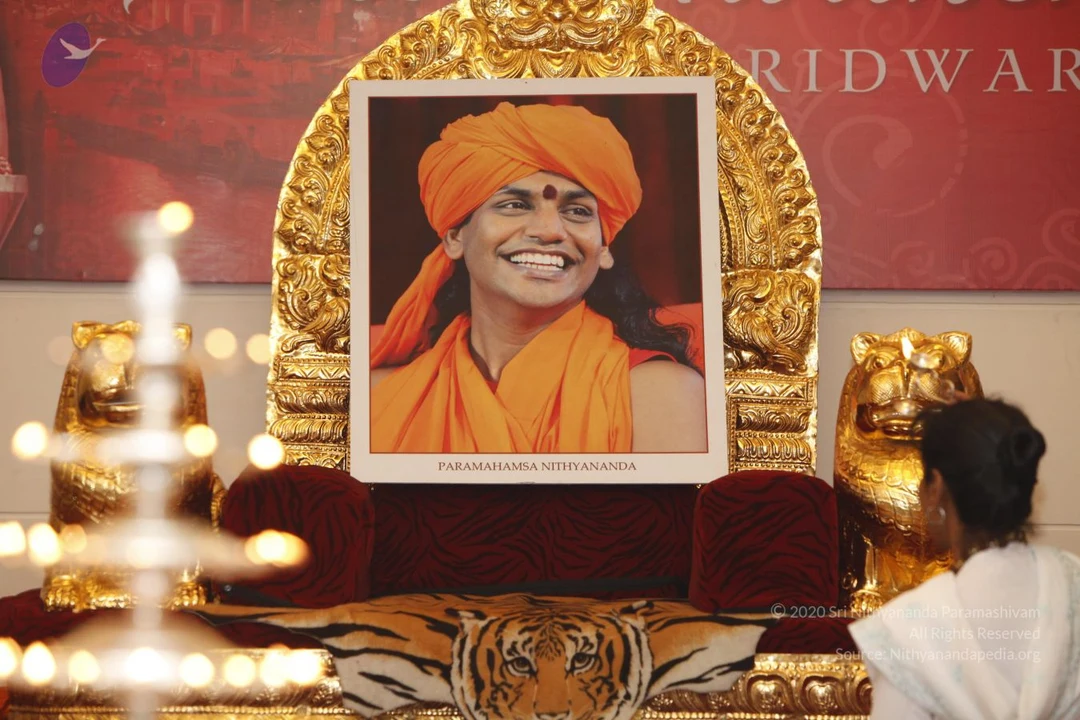
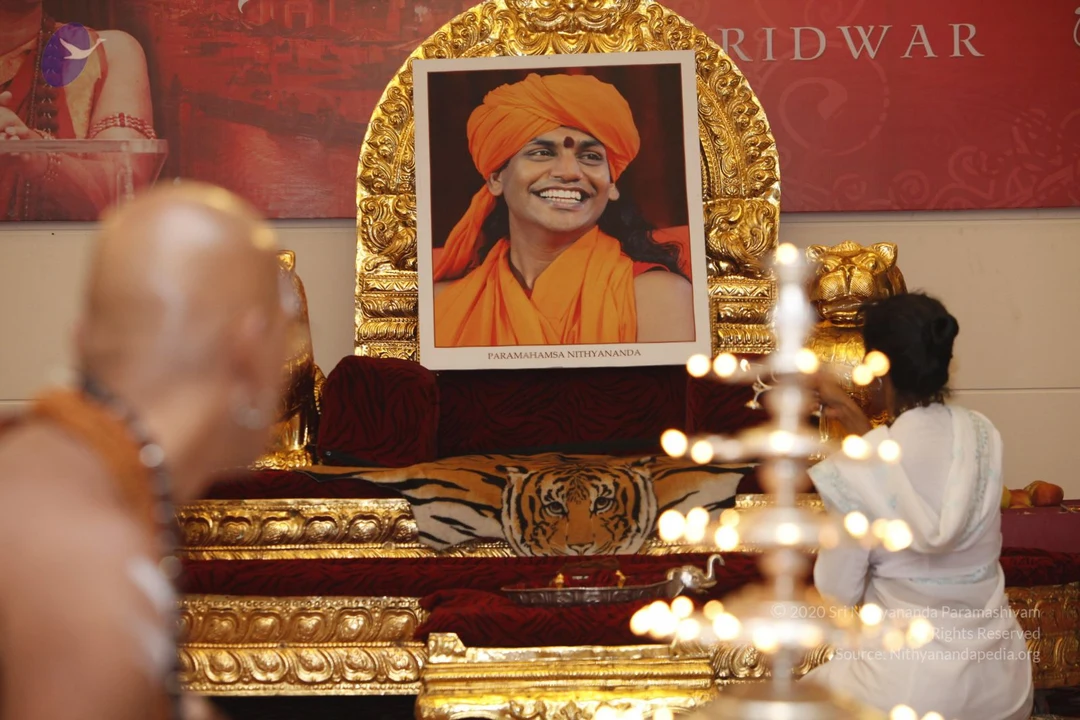
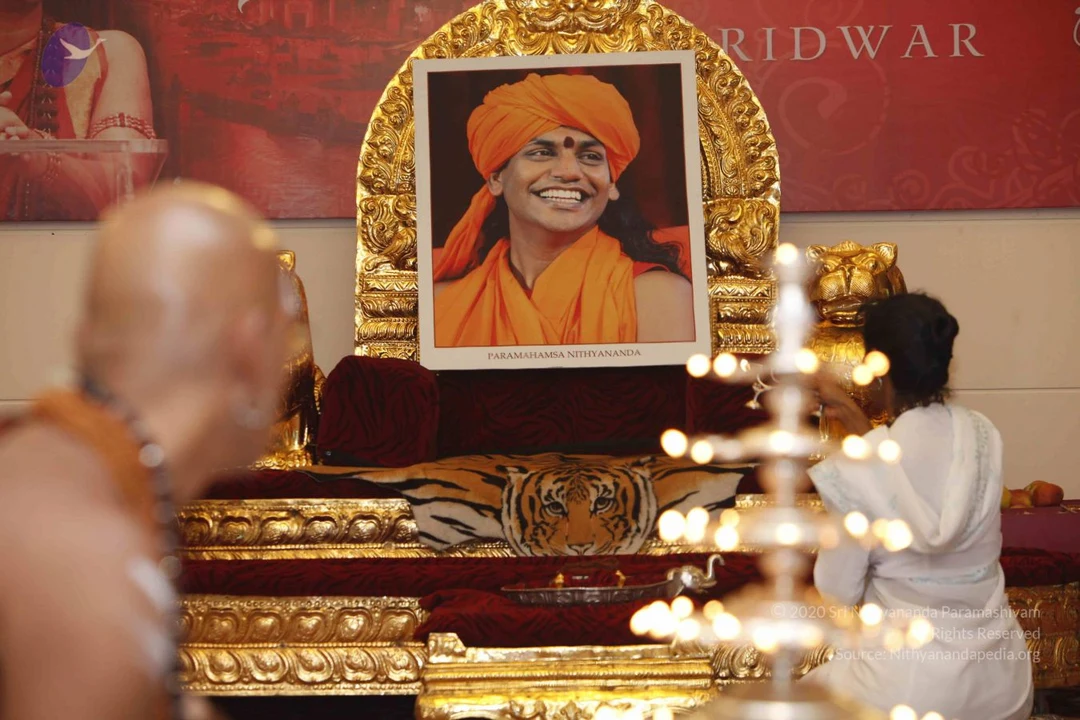
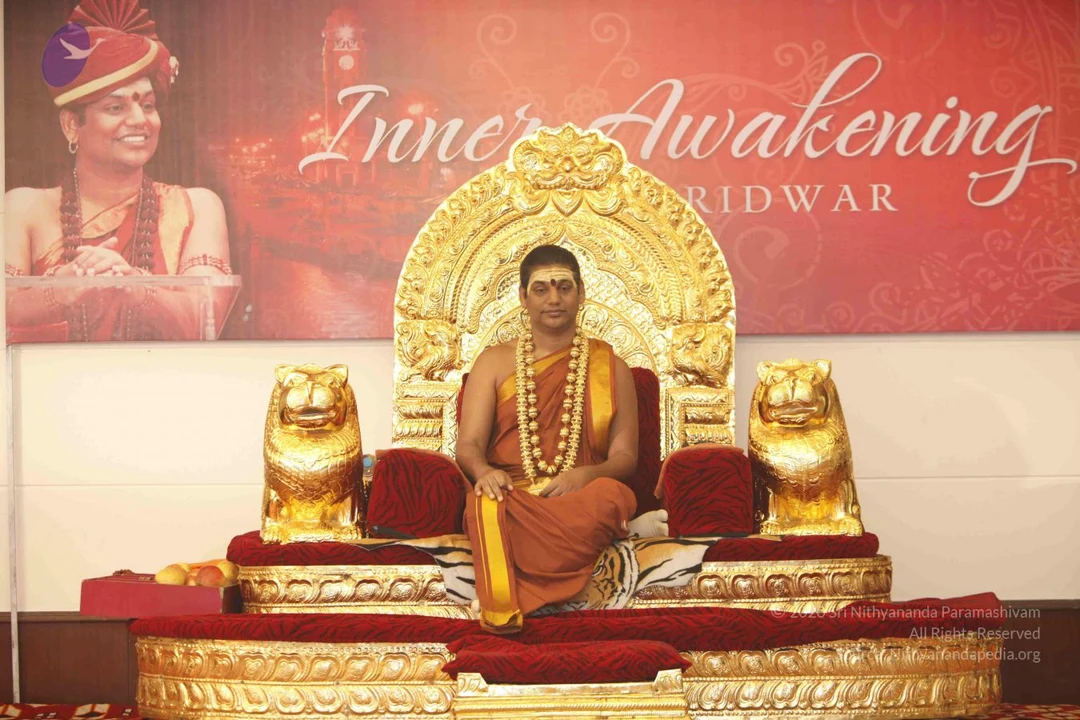
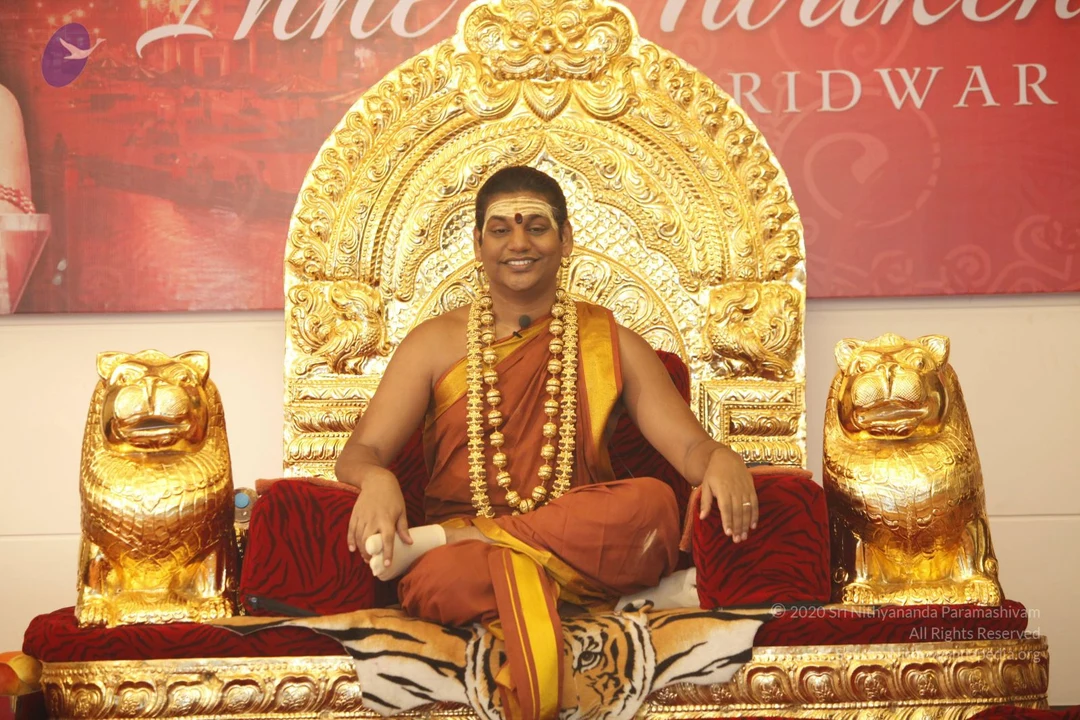
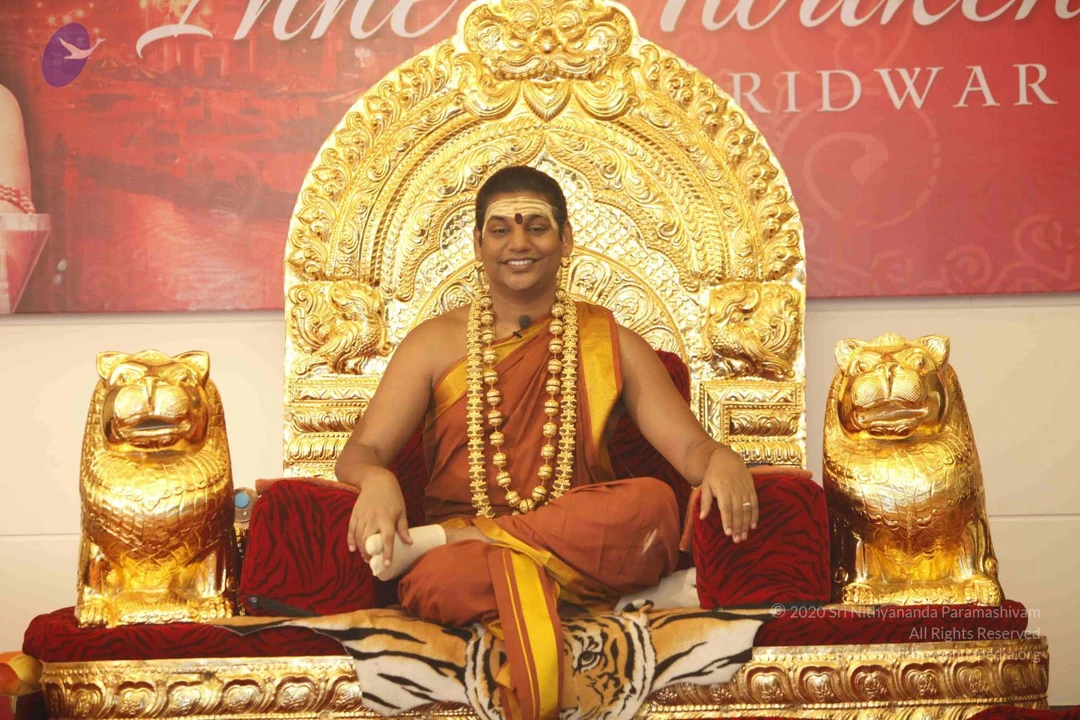
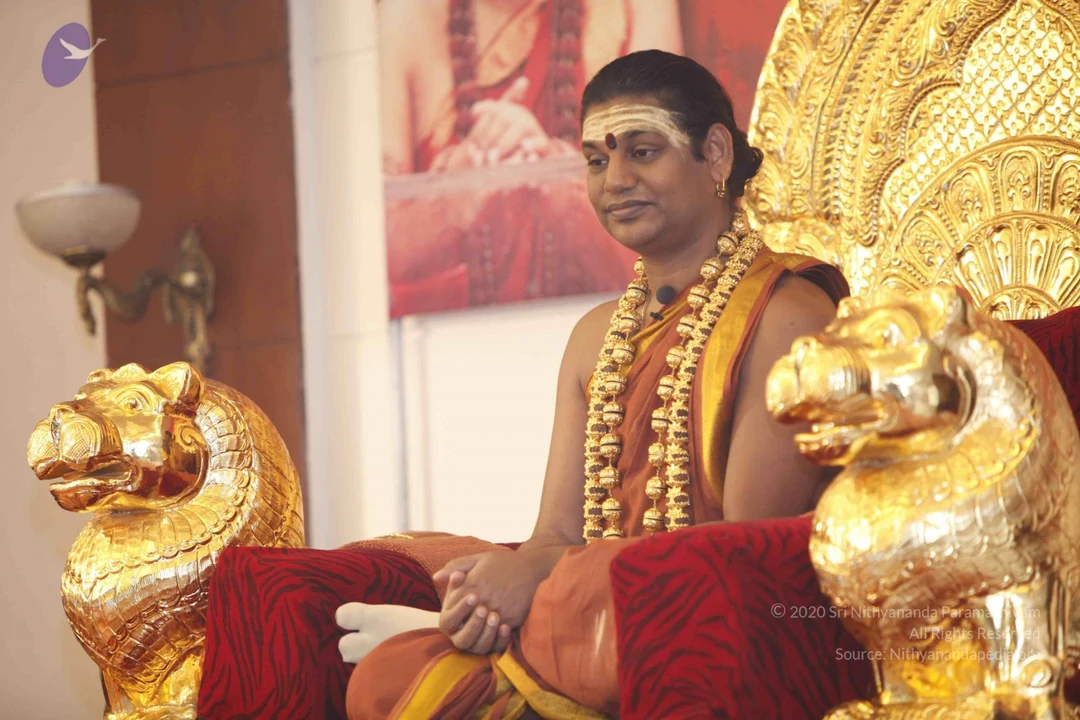
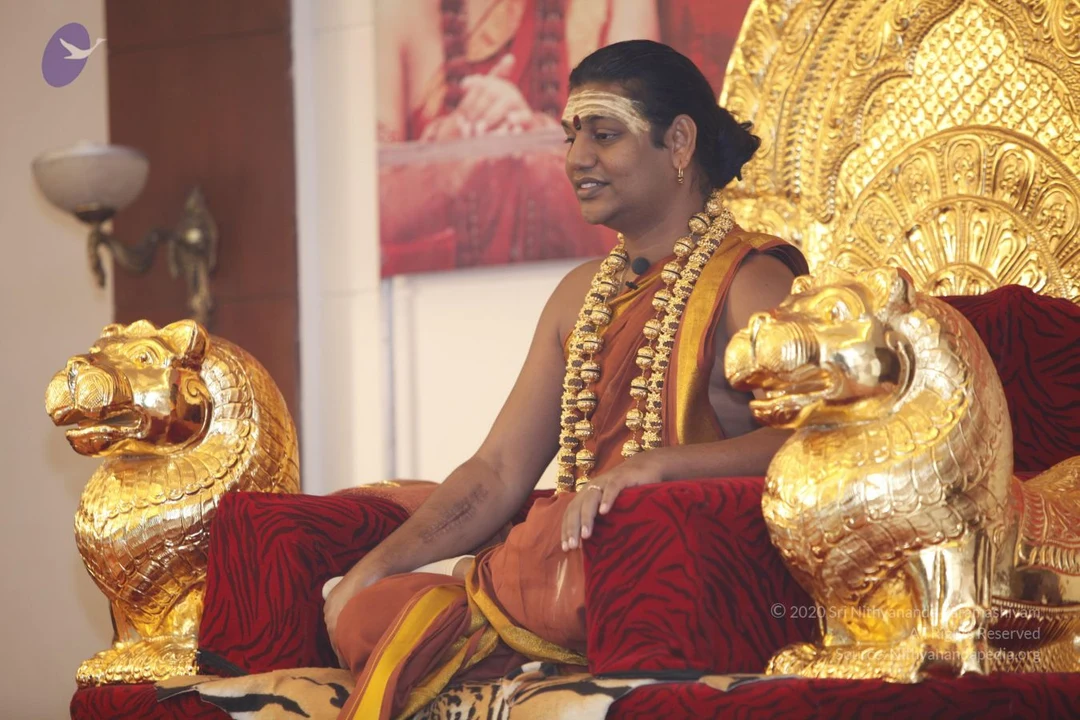
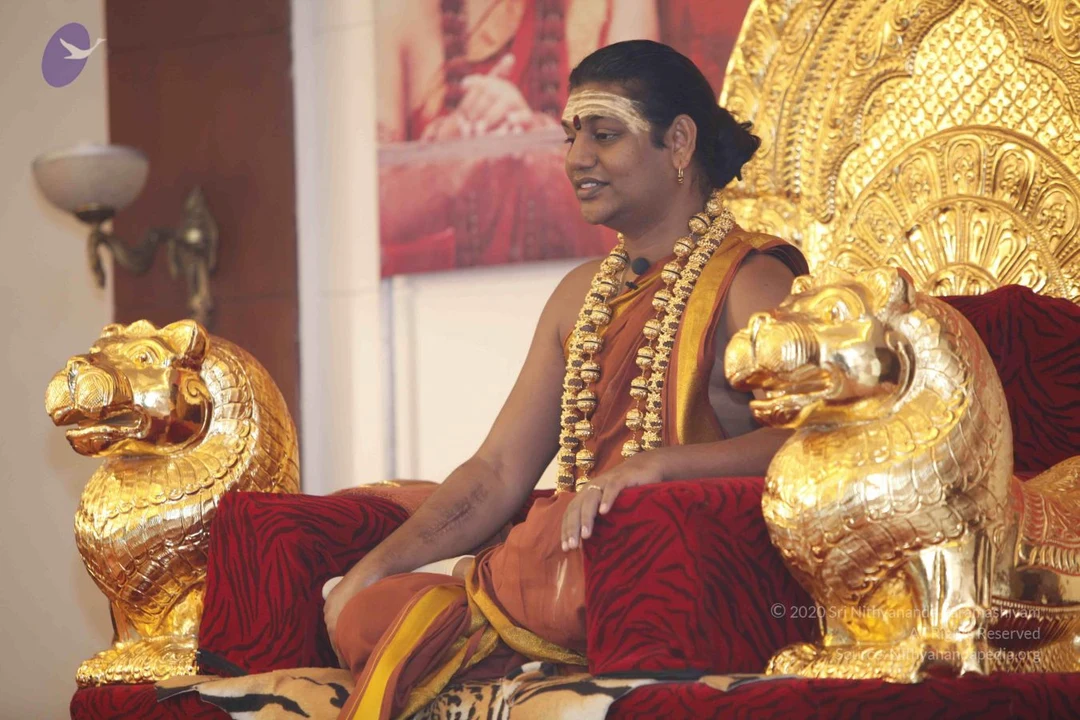
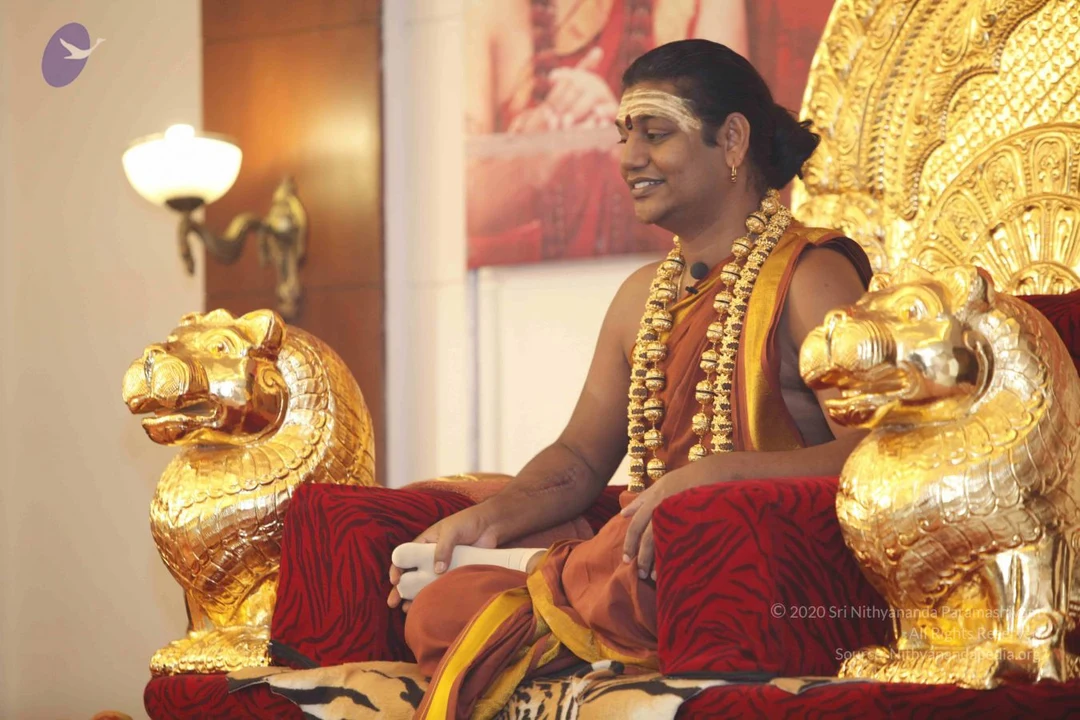
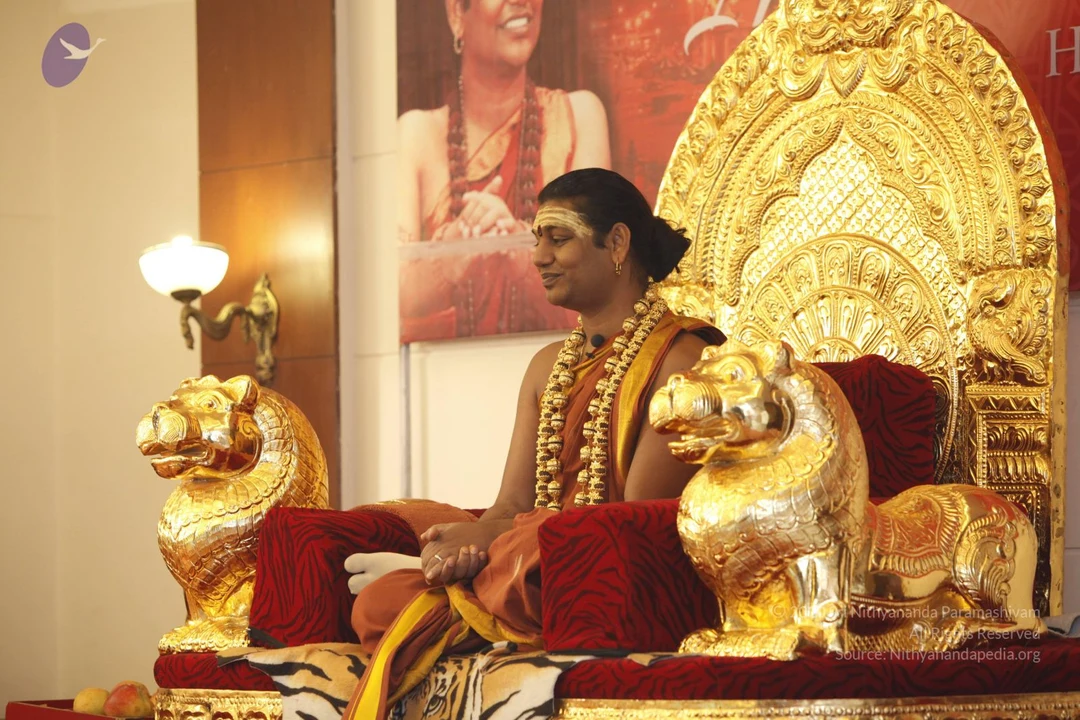
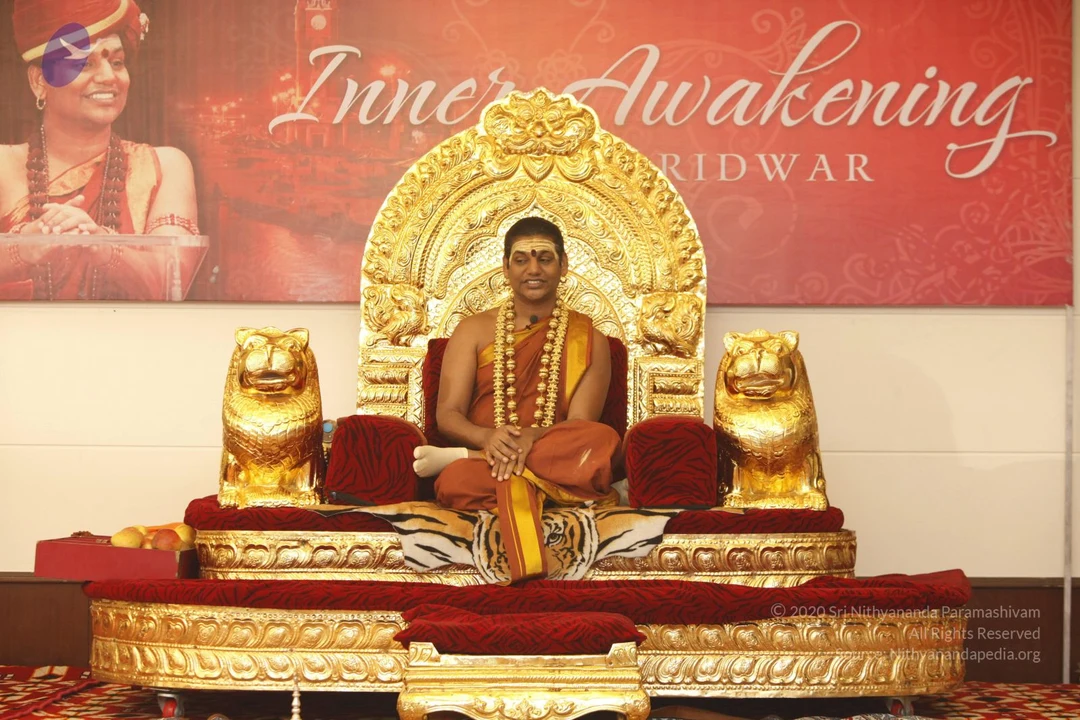
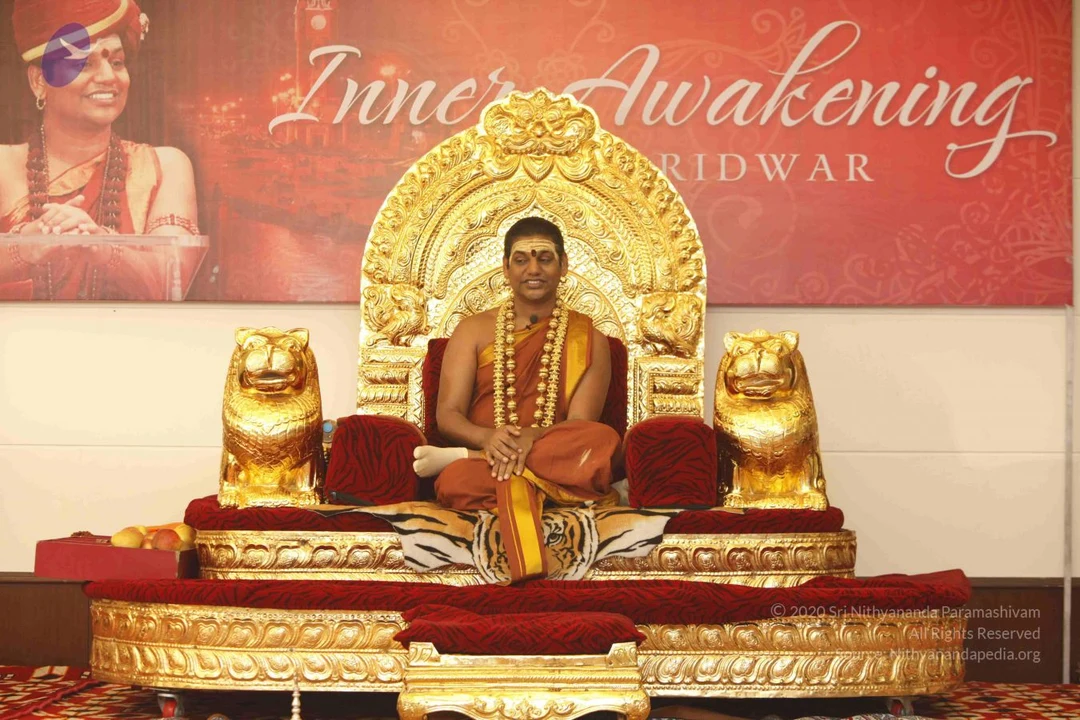
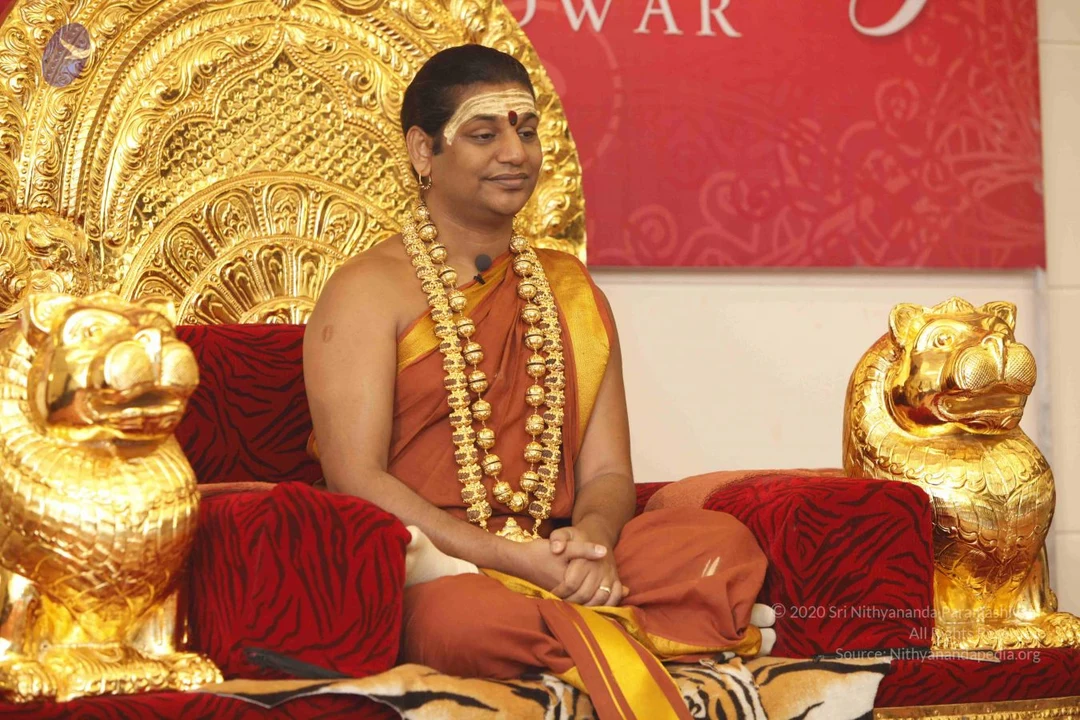
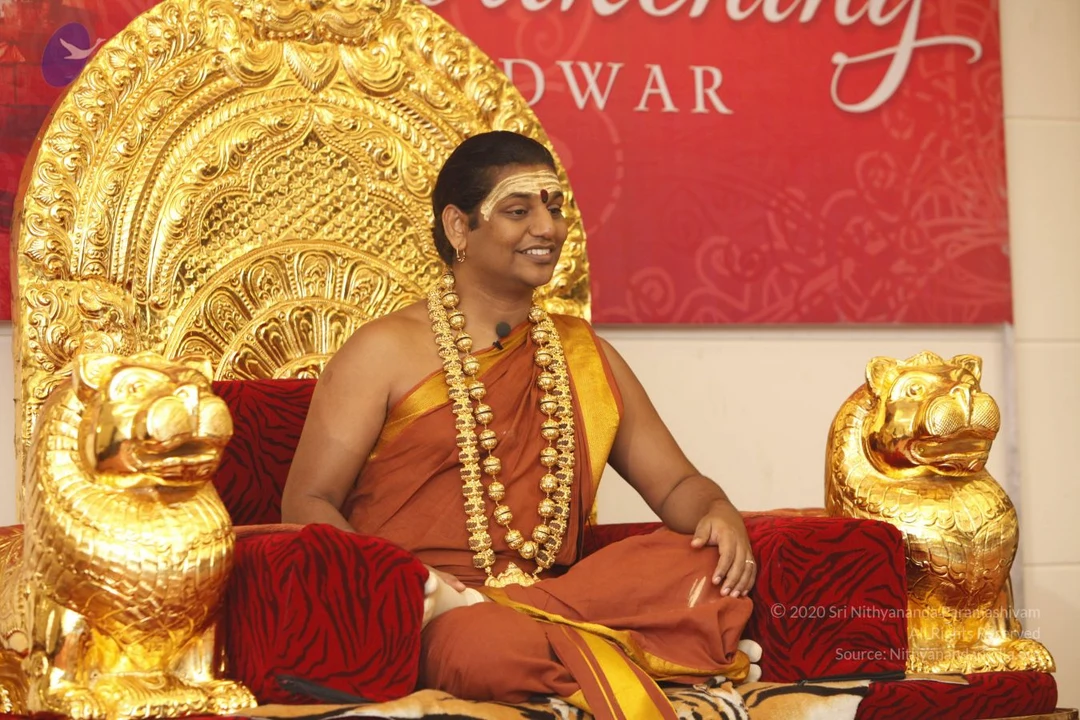
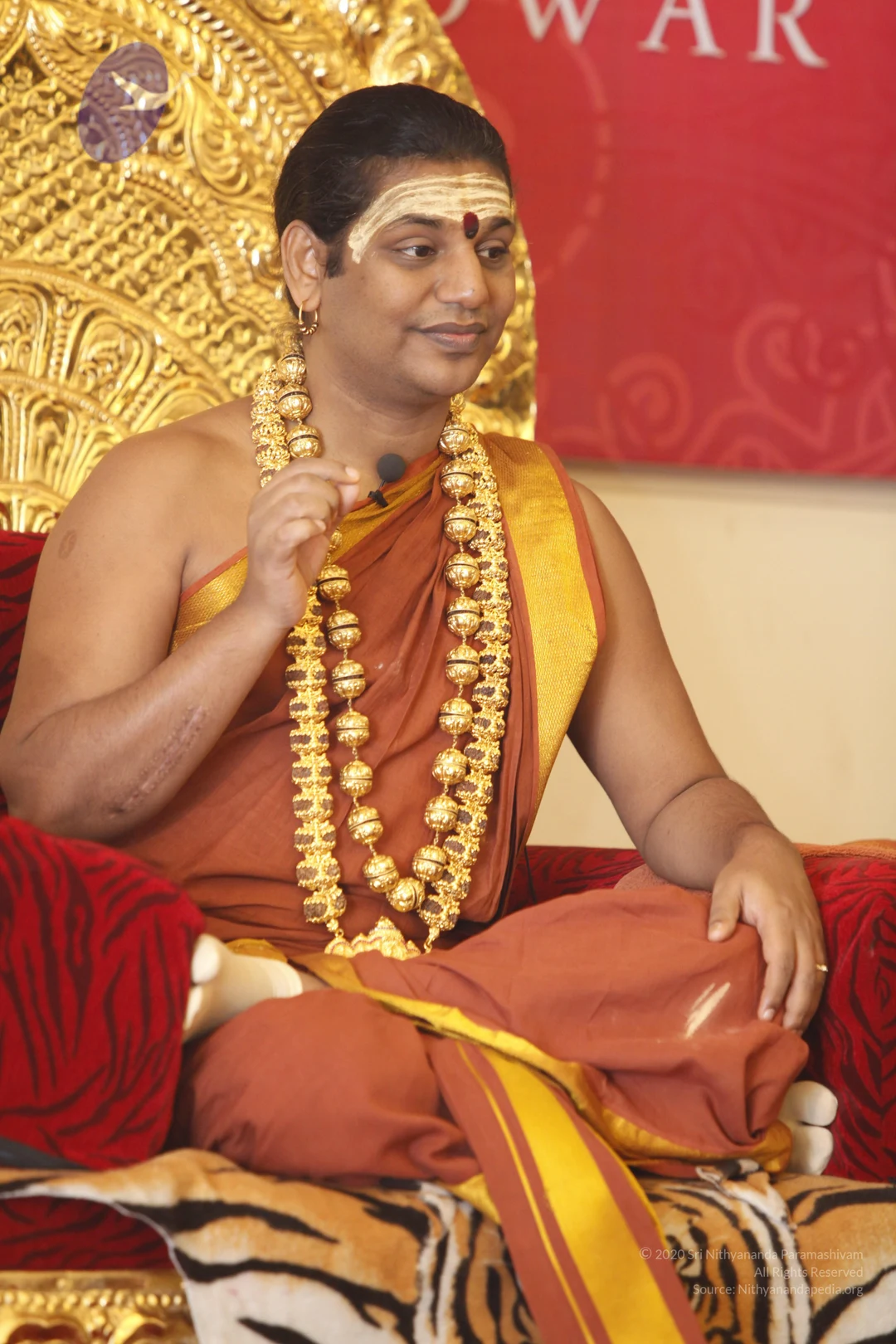
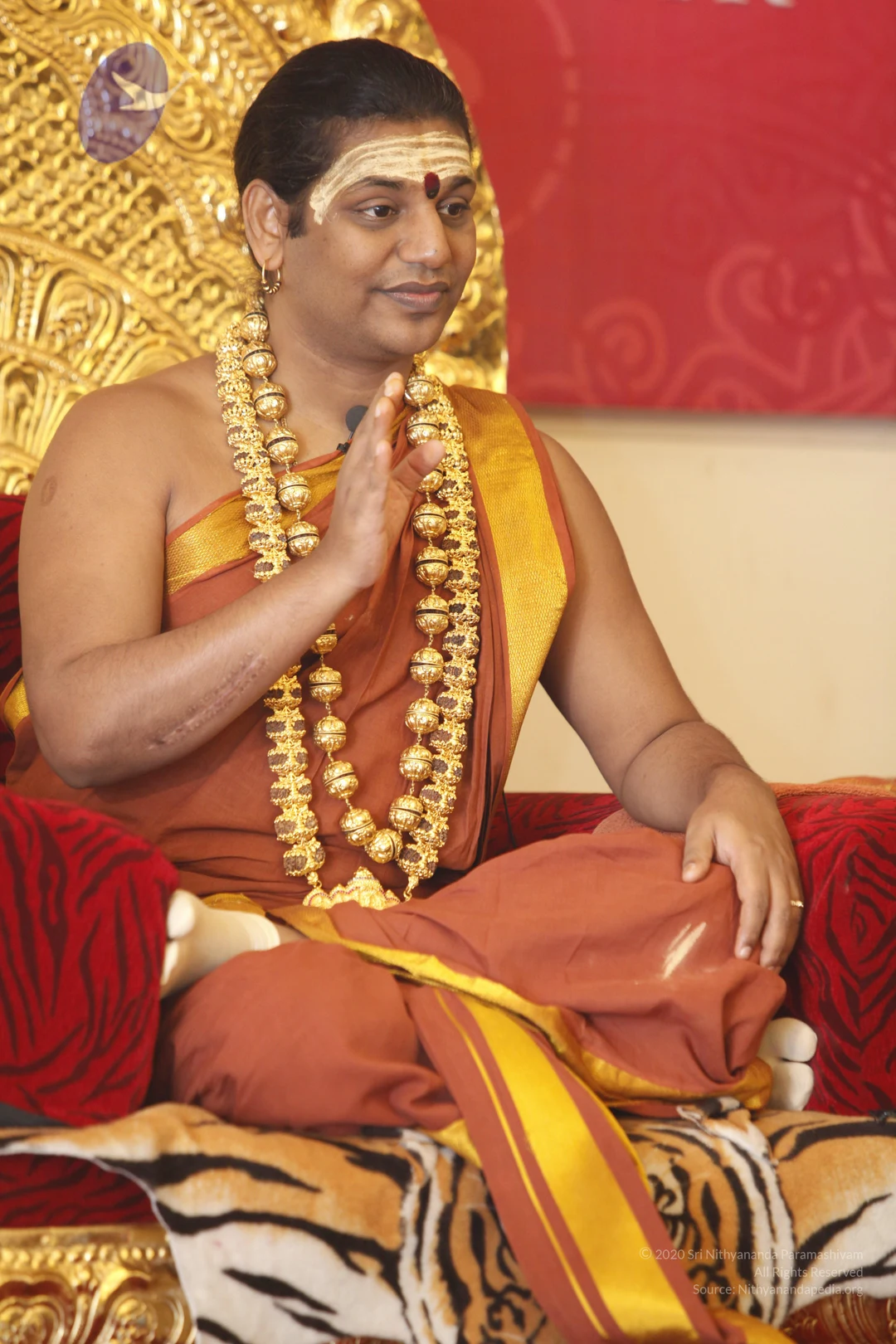
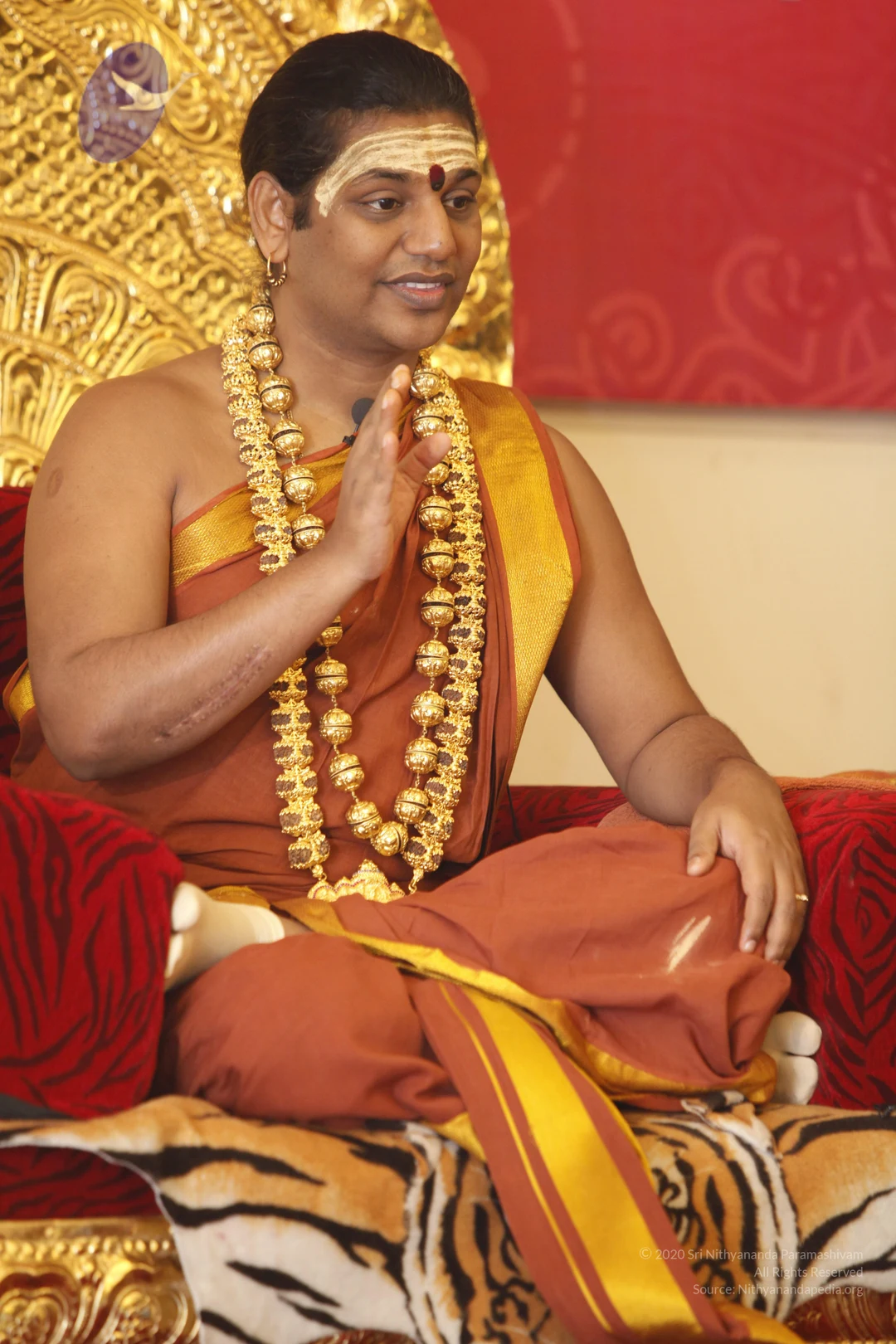
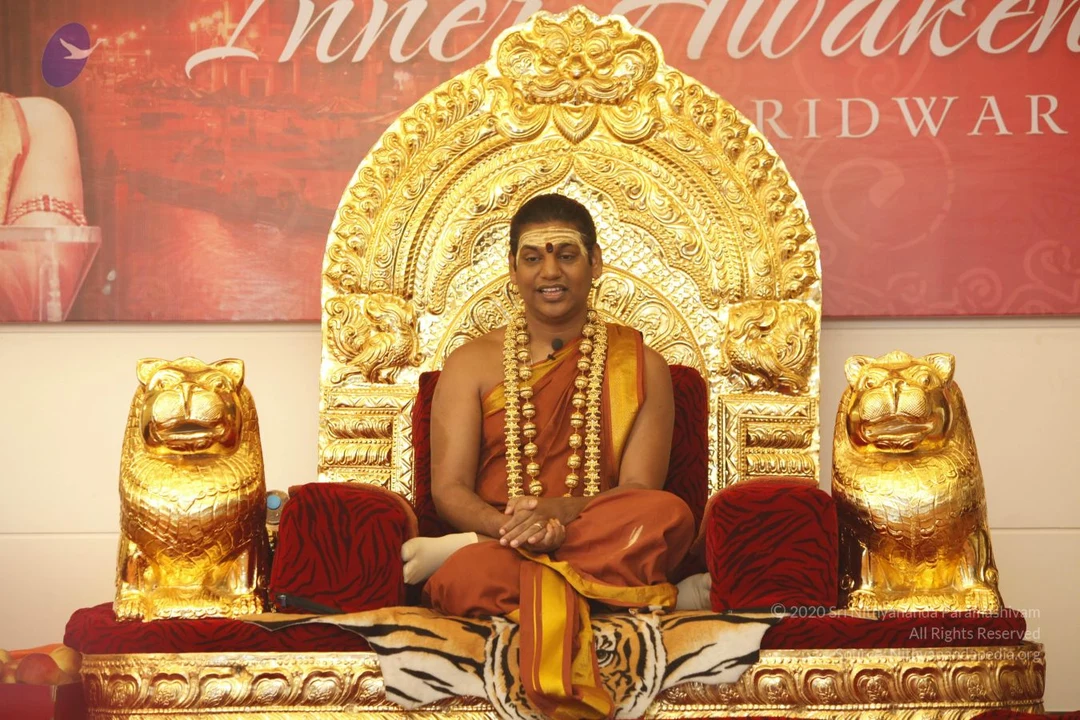
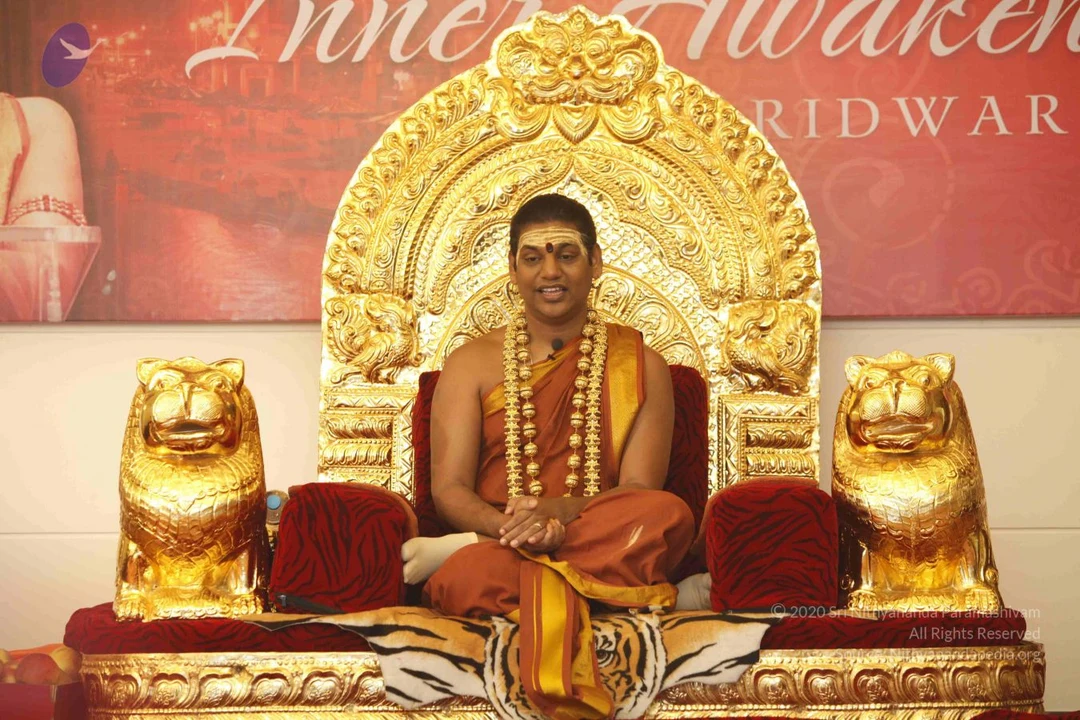
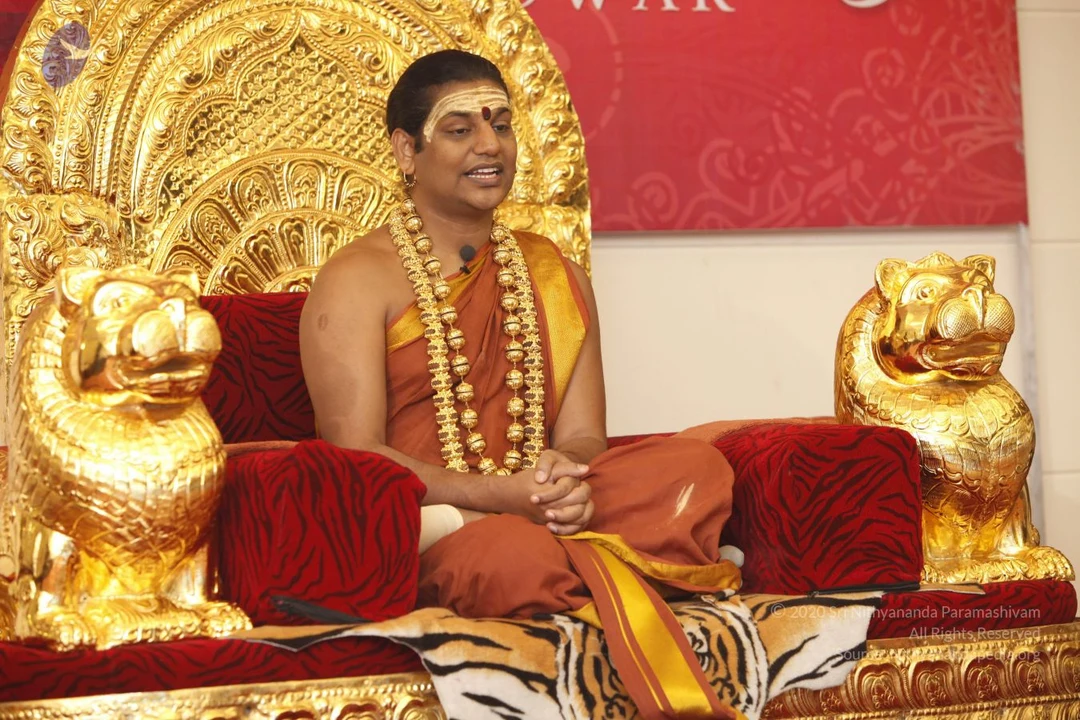
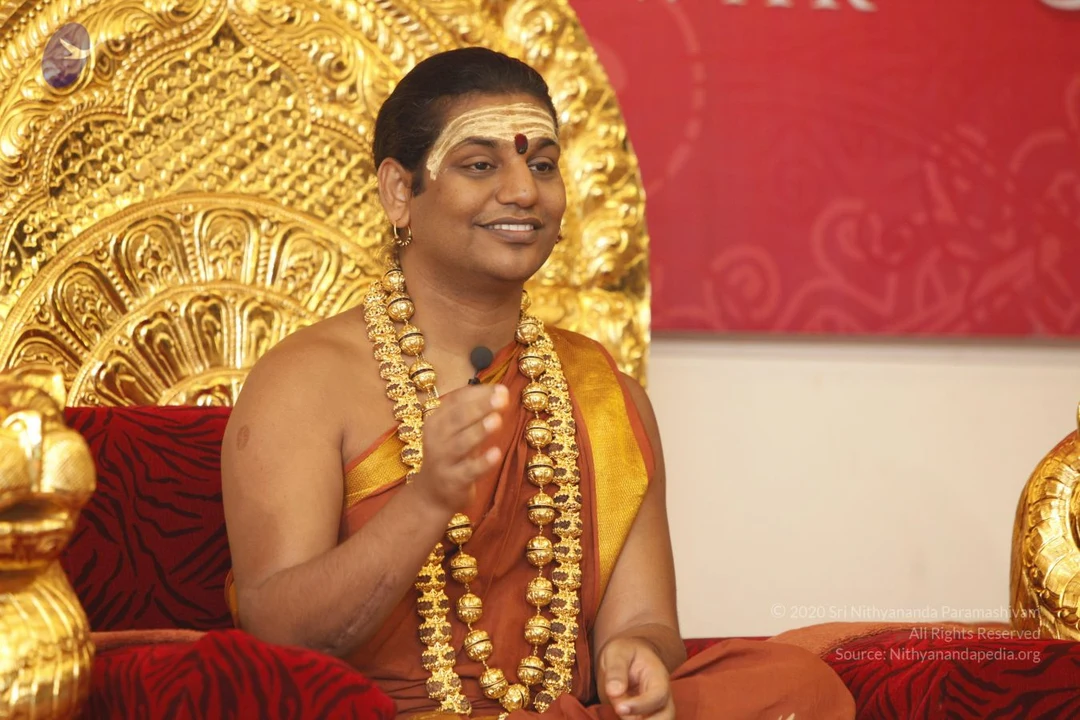
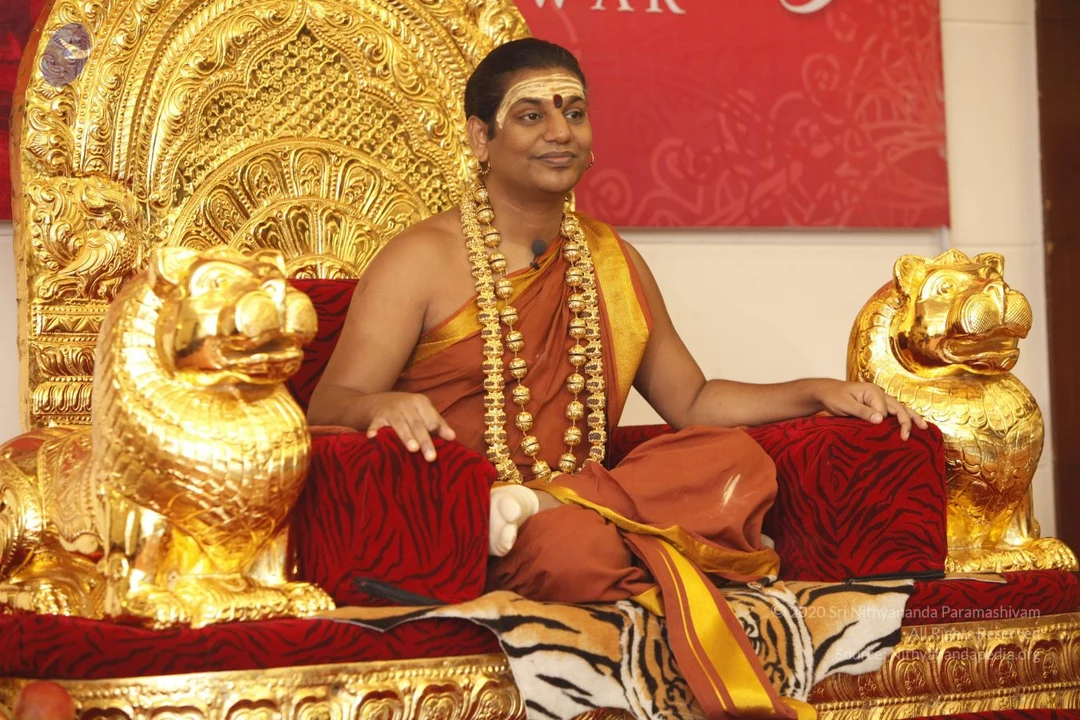
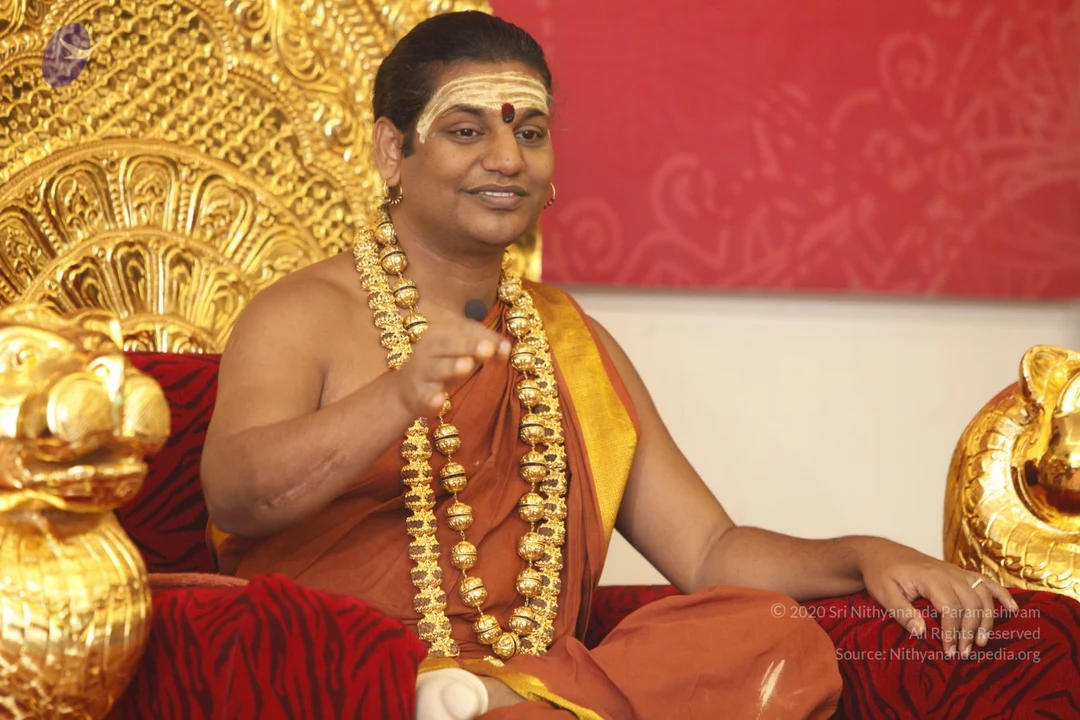
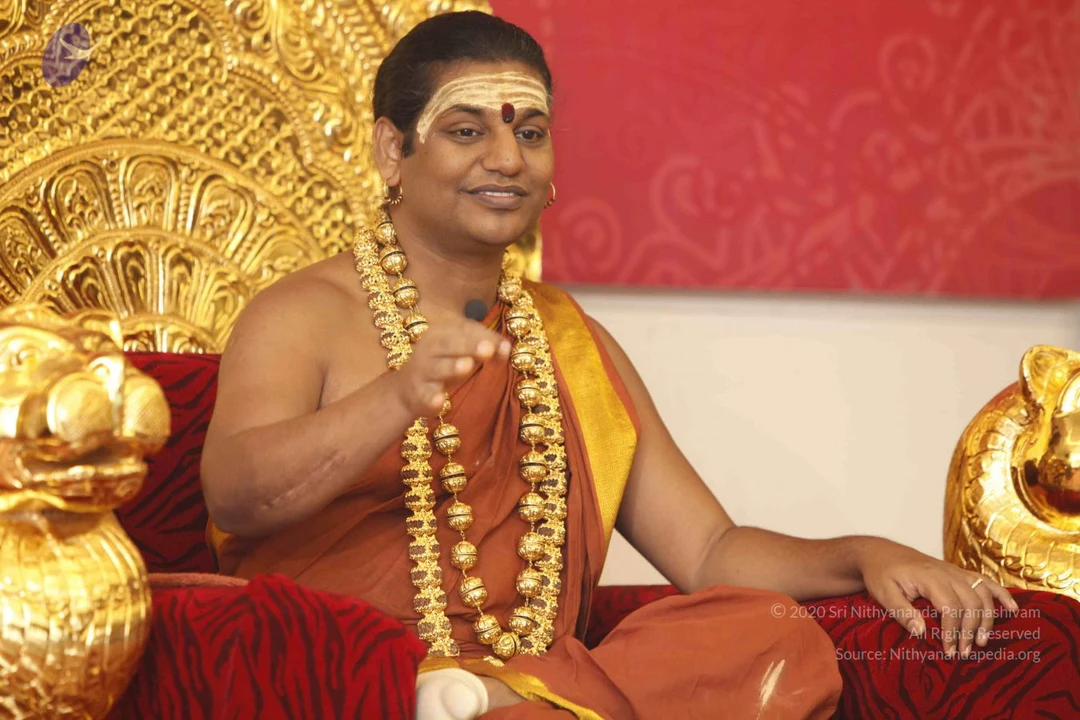
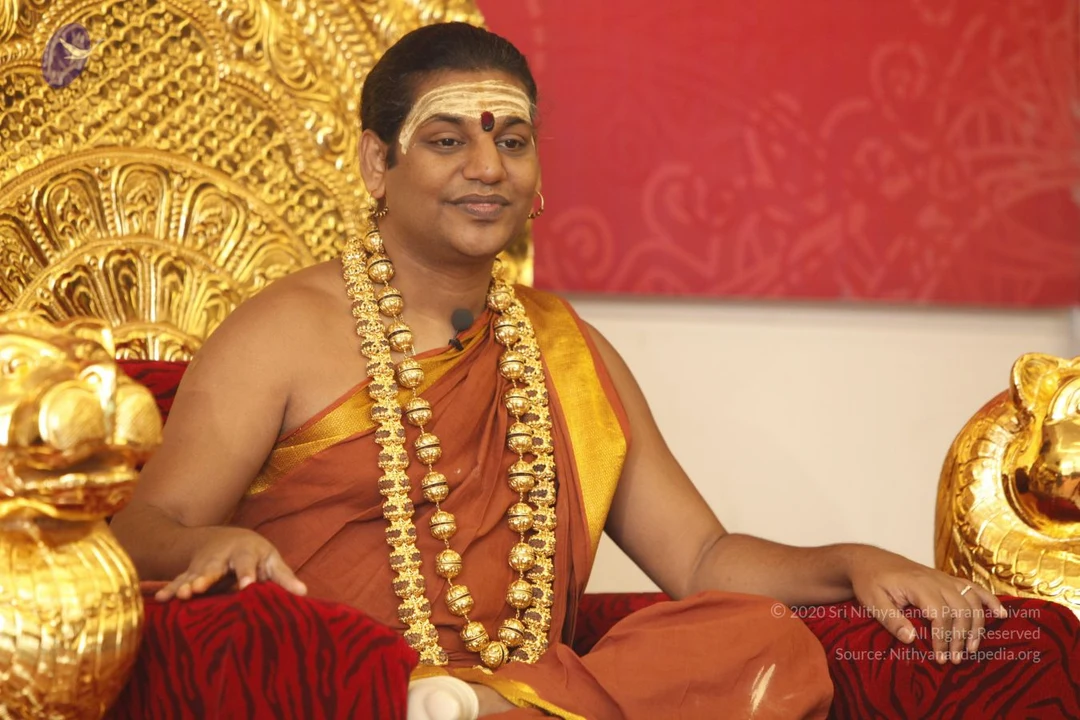
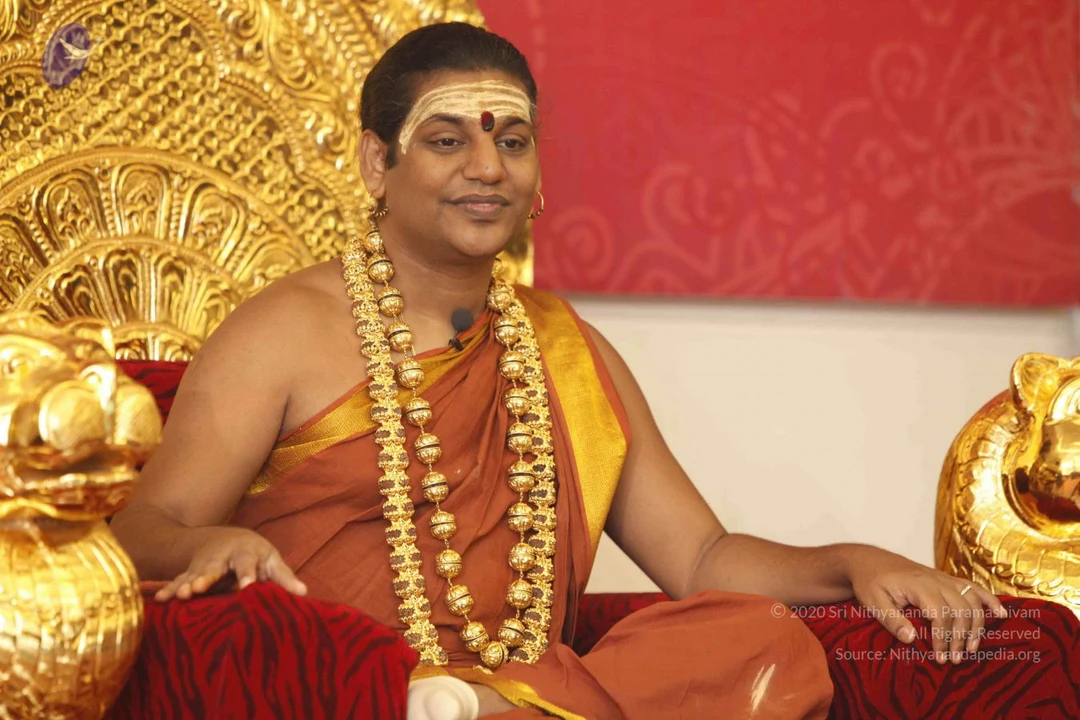
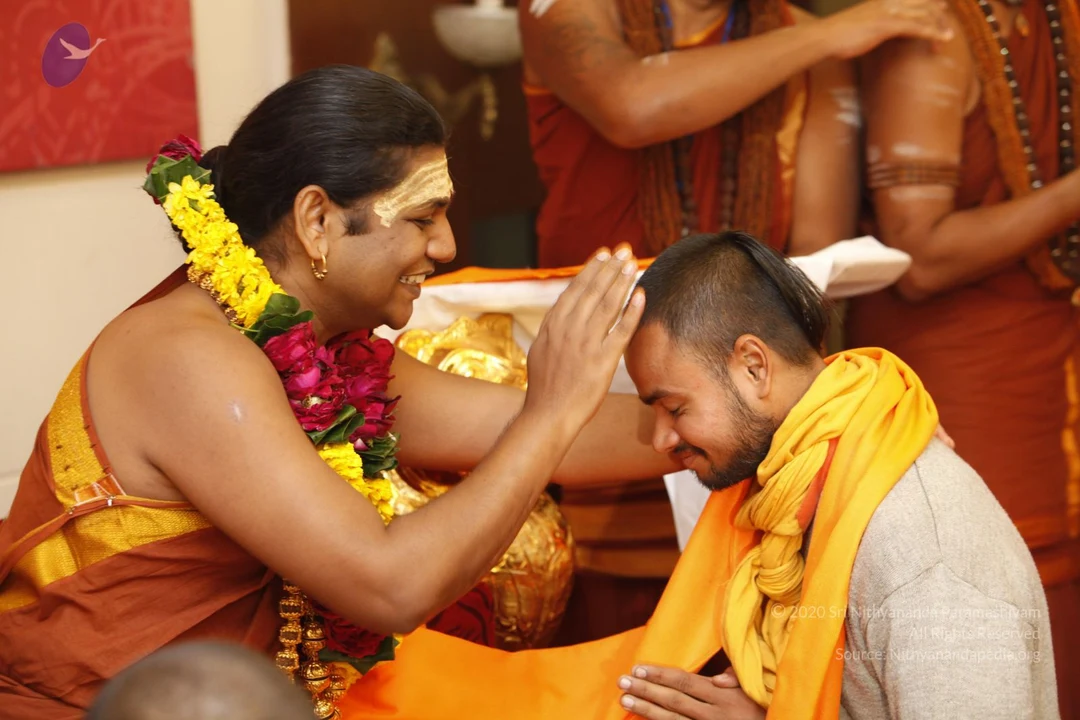
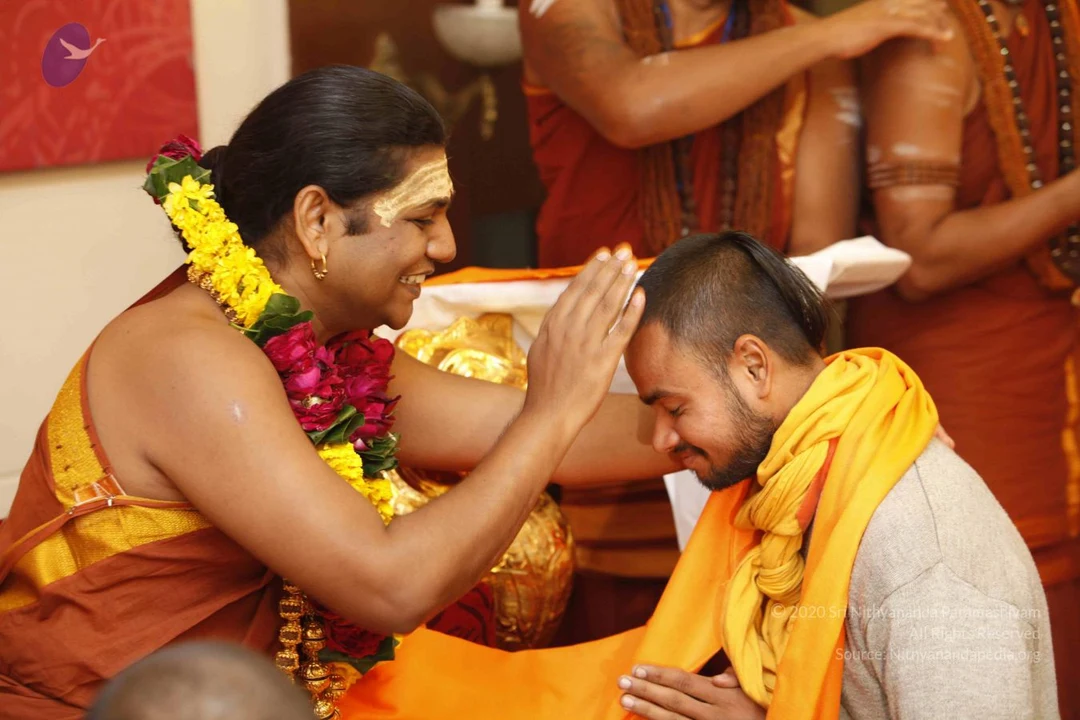
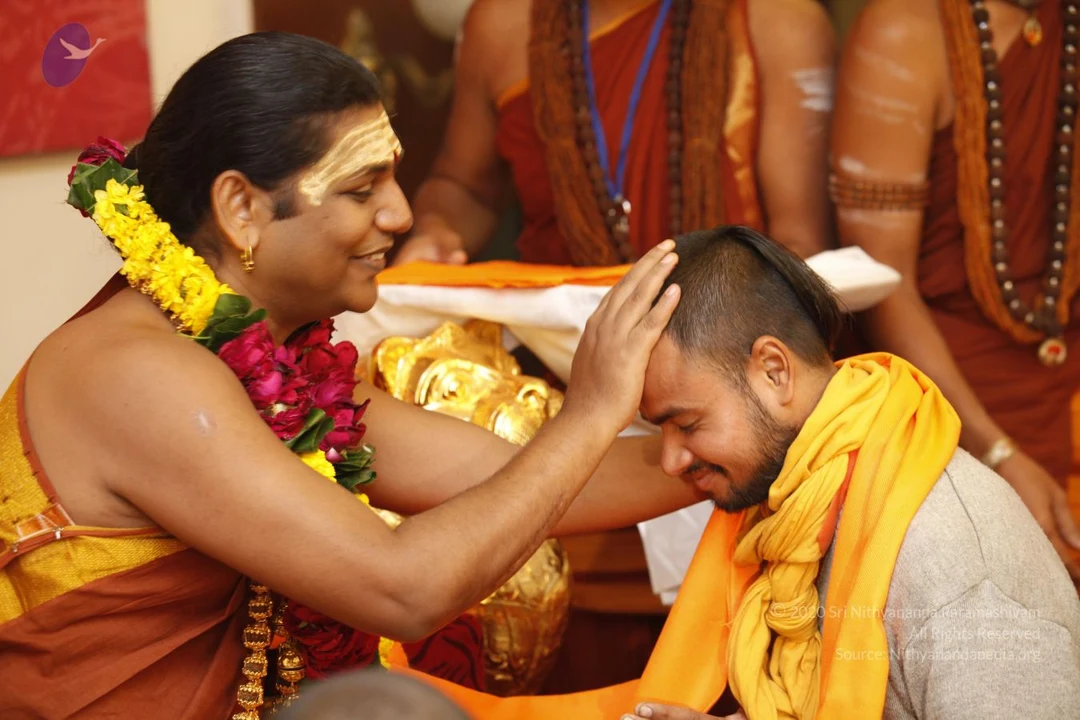
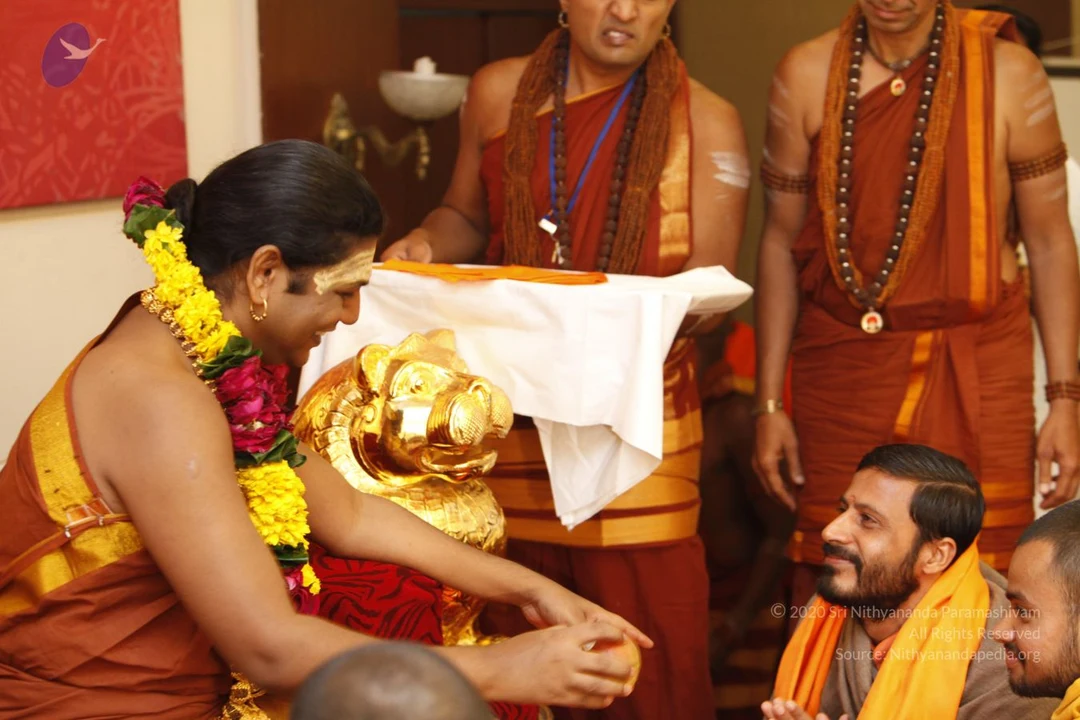
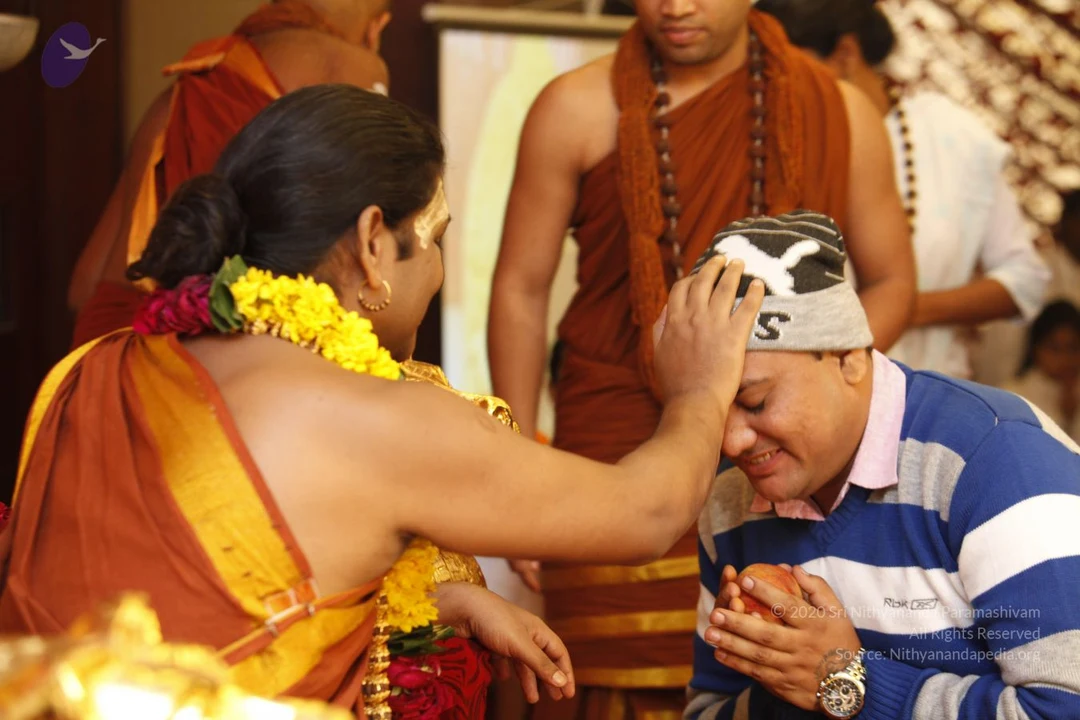
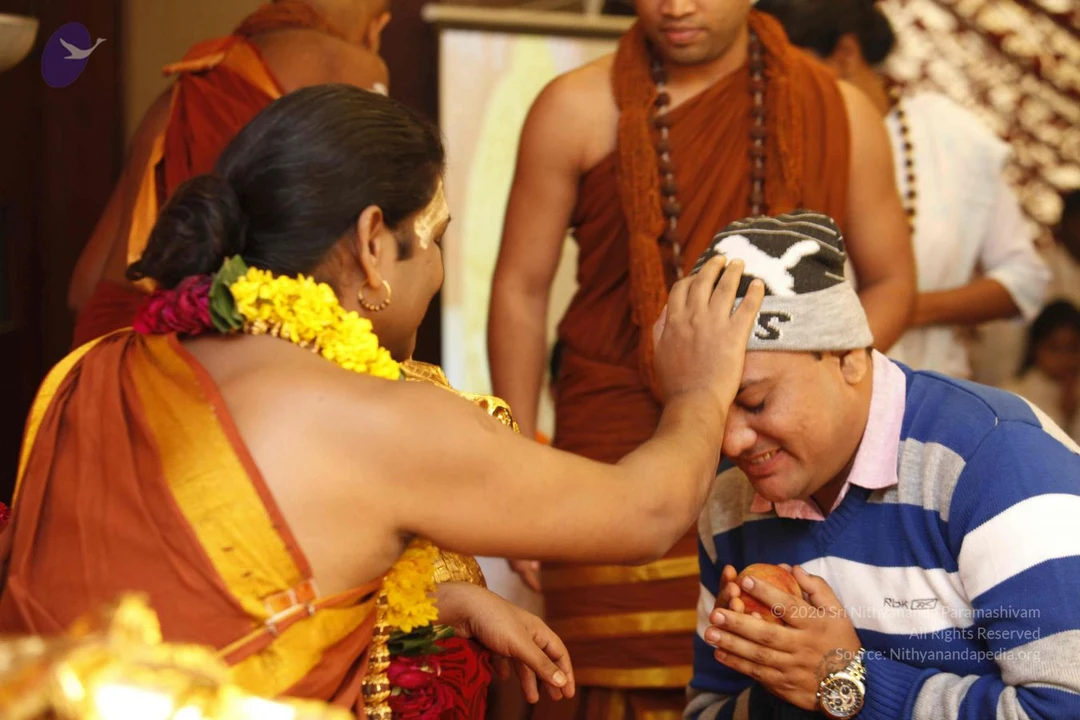
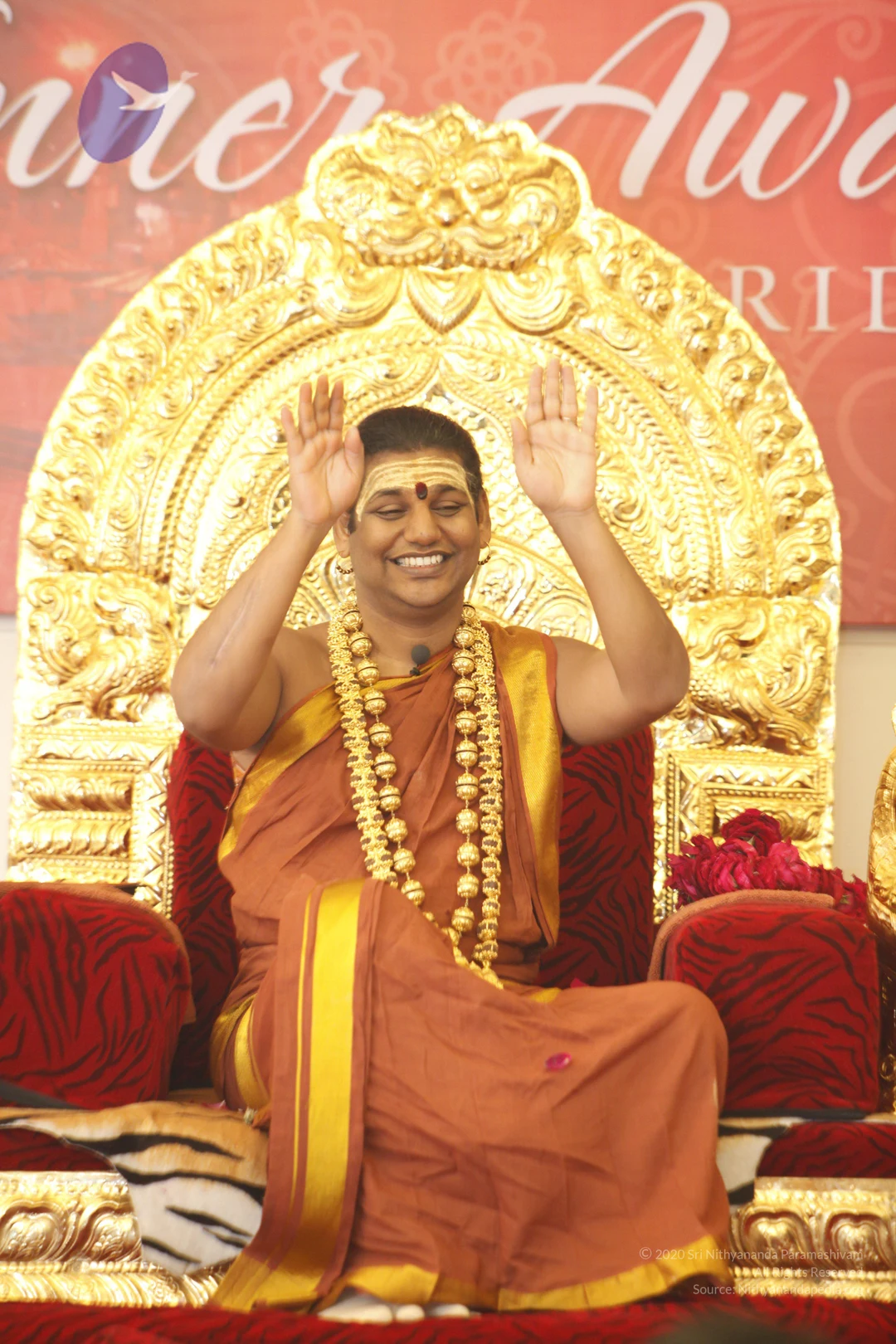
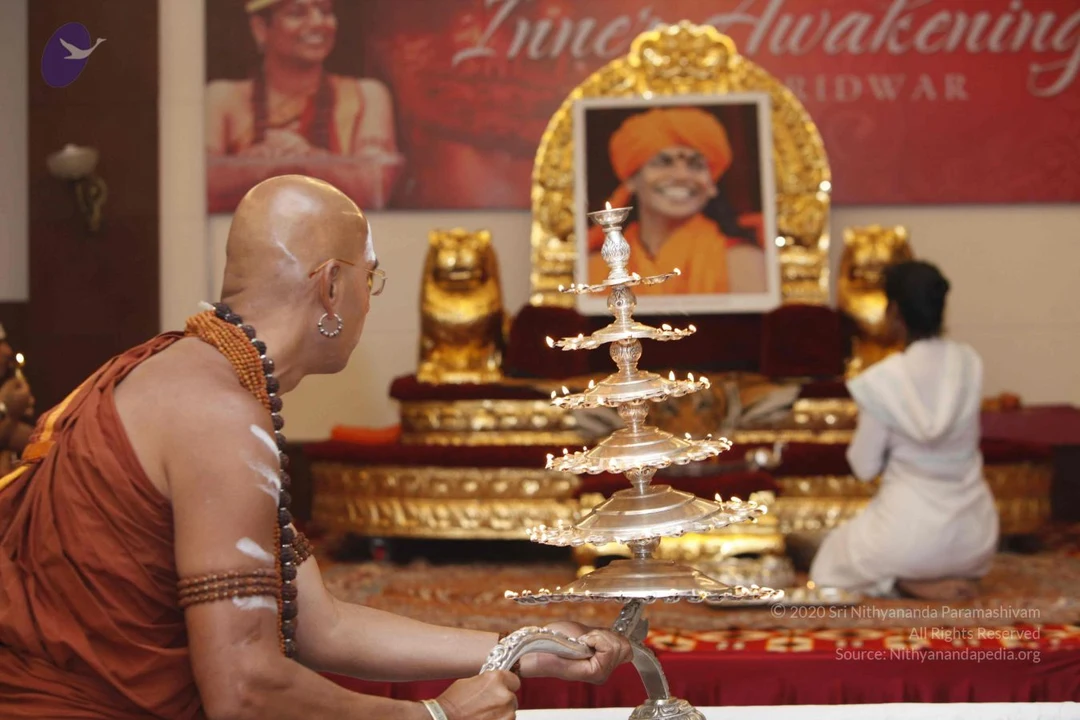
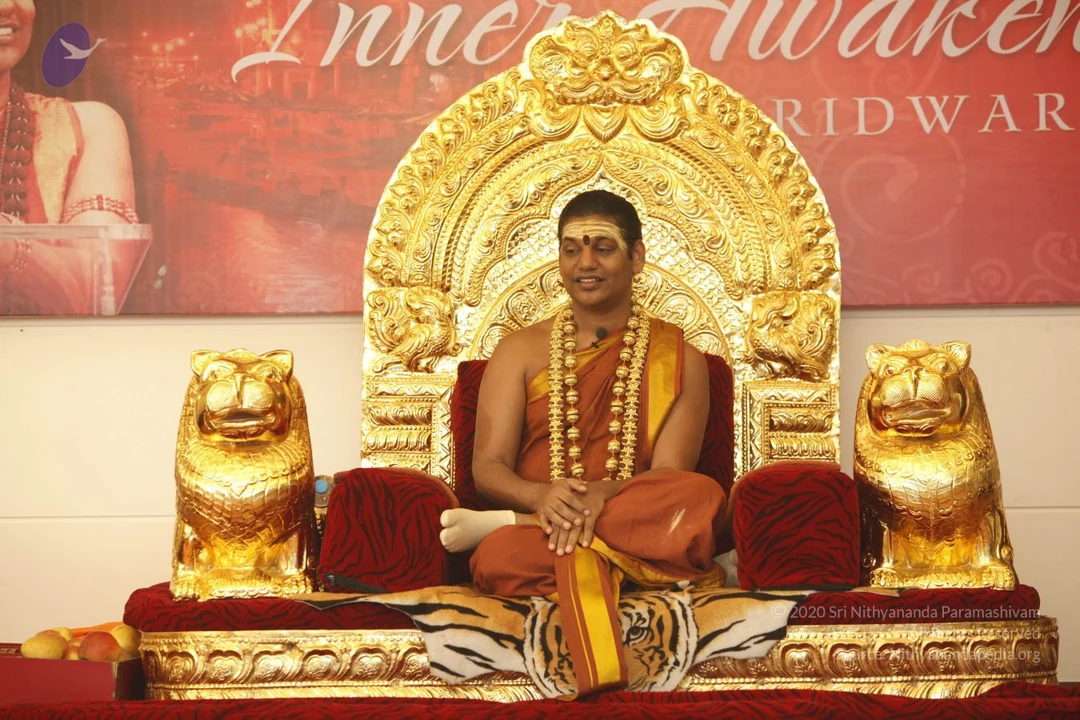
A photograph of a devotional blessing. A long-haired person in orange and gold garments, with a yellow and red flower garland and a gold necklace, places a palm on the forehead of a kneeling man in a grey cap and blue-and-white striped sweater with hands pressed together around a red fruit. Behind them, monks in saffron robes and rudraksha malas stand, and white-clad devotees and a bouquet of flowers are visible. The scene suggests a blessing or padapuja-style darshan. a person cues are not clearly present, so identity is uncertain.A photograph of a ritual scene before a golden throne-style peetha draped in red and maroon cushions with a tiger-skin cloth. Centrally on the throne hangs a framed portrait labelled "PARAMAHAMSA NITHYANANDA" showing a smiling figure in orange robes and an orange turban. A bald priest in an orange-brown cloth, with white markings on his forehead and arms and a beaded bracelet, holds up a tall silver multi-tiered aarti lamp with many lit oil lamps. In the foreground at right, a woman in a white hooded garment kneels in devotion before the throne. Above, a large red banner reads "Inner Awakening Haridwar" alongside a smaller framed image of a smiling woman in red and orange with a red turban and beaded necklaces. The setting appears to be an indoor hall with cream walls and a patterned red carpet.A seated man sits cross-legged on an ornate gold throne with a tall gold back and two gold lion-like armrests, upholstered with red and zebra-striped cushions. He wears an orange-saffron robe with gold borders, a heavy multi-strand gold necklace of beads, and a small red bindi with white tilak on his forehead. A small microphone clips to his robe. He sits in a satsang-like setting with a red wall backdrop bearing decorative patterns. Swamiji (probable): his long swept-back hair, saffron robes and ornate gold necklaces fit the page's description, and he is seated on a throne as a teacher.

January 09 2012

Original wiki page
Contents

Title

THE SUPREME PONTIFF OF HINDUISM HDH BHAGAVAN NITHYANANDA PARAMASHIVAM

Transcript

“Sadashiva samarambam, Shankaracharya madhyamam asmadacharya paryantam vande Guru paramparam!”

I welcome you all with my love and respects! I welcome all the devotees, disciples, Samajis, Satsangis sitting with around the world at this moment in 520 places through eNtv, in 156 cities, in 19 countries! I welcome you all with my love and blessings!

Let us enter into today’s Satsang. In Bhagavad Gita, 3rd chapter Karma Yoga, 27th verse –

“prakrteh kriyamanani gunaih karmani sarvasah ahankara-vimudhatma kartaham iti manyate |”

Translation - “The confused one due to the conception of individuality completely believes that I am the one performing means every individual is believing he is the one who is performing in the case of actions that are done whereas they are done by virtue of natural disposition.”

There is a beautiful example. See in the Hindu temples you will see the statues carved on four sides as if they are holding by the dome. But originally statues are held by the dome not the statue holding the dome. But the statue being in the position for ages, for years, suddenly one day starts thinking oh I am the one holding the dome. Sometime some of the foolish fellows think they are the ones who are running my mission. Understand the person who is running this whole mission does not even think he is running even his own body. I don’t even think I am running my own body, where is the question I am running this mission. In our own Sangha, except me everybody thinks they are doing so much work. Just like this statue which thinks it is holding the dome. But originally it is the dome holding the statue and not the statue that is holding the dome. When you are just talking and acting without performing, you develop the pseudo identity. You go on talking and acting but never performing that kind of people develop pseudo identity. That is what Bhagavan says here that confused due to the conception of individuality completely believes that I am the one who is doing whereas the actions are done by virtue of natural disposition. He is the one who is performing. No!

I want you to understand, even if you have an idea I am not the one who is performing, even that is wrong. Let me explain from my inner space. I neither have the idea that I am performing nor the idea that I am not doing. Even the idea I am not doing is also one more confusion. Now the words are coming from my mouth, so the air which is coming out is getting converted as words and coming out. Now when I silent, just the air comes out as breath. That’s all. When the breath comes out, breath comes out, when words come out, they come out. When needed, the idea I is uttered. When not needed, it is not uttered. Pl und just like the idea I am performing, same way the idea I am not performing both are ignorance. The very identity you create as I is nothing but lot of threads put together. See just like how a piece of cloth is lot of threads put together, weaved in a complicated way, same way every time you utter the idea I that becomes on fabric, one thread. More and more number of times you utter the word I and you ascertain the identity I, that many threads forms your identity cloth and where all you assume that identity strongly, that kind of color is given to that cloth. Please understand, in many good actions, good responses, if you strongly assume the idea I, maybe your identity cloth is painted into orange. If you are doing many wrong things as I maybe your cloth will be painted in some other color. Fabric out of which your identity is made is the very utterance of I. Here Bhagavan speaks about conception of individuality.

All of you have certain concept of individuality. How it gets developed, you need to understand that. The number of times you utter I, I, I that becomes the thread. The so many times you utter, they threads get intertwined and becomes the identity and you start wearing the cloth. That is also okay. But unfortunately, you start thinking that you are the cloth itself. You are wearing the cloth, but you are not the cloth itself. The only way to stop the confused I to disappear is stop uttering more and more words that speak I. editing the word I in all your conversations can be a powerful initial spiritual practice. Because that stops the power supply for the cloth to get strengthened or colored. Sometimes the cloth becomes so thick that it becomes like a blanket, sometimes more thick it becomes like a Tarpaulin, sometimes when even more thick it becomes like a rope itself. So the supply of identity will stop when you stop using the word I both outside conversation and inner conversation also. Pl understand you need to stop using I both outside and inside both are required. That is why I give the spiritual name. When you need to talk about you, always talk about the spiritual name. Just like how I used to talk. Now recently only I started. But people were getting confused. When I talk Swami will do, Swami will tell, people will ask which Swami. Of course any number of times I use I nothing will get added to me. But in your case, use the technique which I used – Swami says this, Swami does this. Swami is literally like a spiritual name for me. because the day I knew I existed, this Swami is the word called by everybody else. ..all the names I have given to the first 2, 3 years for people – pranananda, atmananda, tatvabodhananda, mayateetananda, atma maneeshananda, jnanananda…all these names I had used initially. Finally I settled with the word Nithyananda. Then media gave me different names that is different ☺ But the only word which always was with me was this word Swami only. You guys also use your spiritual name only when you talk about you, use your spiritual name only – atma says, prana says, jnana wants. The very fabric getting supplied to your pseudo identity will stop. And thickening of the fabric will not be there. And the conscious …..even in you think about you as your spiritual identity only. Do not think of I. see if you think of I that will be the mixture of your old identity and your new one. Not only others, even you should remember you by your spiritual name only. Then that pseudo identity will not get built up. Spiritual identity is nothing but knife which will cut all the old dirty clothes you are wearing. Everybody is like a beggar wearing dirty clothes, smelling clothes carrying from ages and ages, going around, thinking you are pretty. You never realize you wear all these dirty clothes and go around look at me, look at me. and the problem is nobody tells that you are wearing the dirty clothes, dirty piece. If somebody tells you that, you will jump at them. so they tell, place is smelling. Place is not smelling, you are smelling. New fabrics getting added to this dirty ugly cloth will be immediately disconnected when you stop using I in your talking outside and inside. Even in your dream if you can remember you with your spiritual name, I will tell you this truth has penetrated in your deep consciousness. Even in your death, if you will not remember this I, that is …..without using the idea I, I, I while you talk outside and inside, especially if it gets into the dream state the idea thinking without using the I or mine. Without these concepts if you start thinking if that becomes a process even in your dream then I can say you are saved from the death rope of Yama.

Markandeya was given this technique don’t use I and mine whether you talk or think. Just remember yourself as Shiva’s energy. That is exactly what I have given to all the people who are given spiritual name. Just remember your spiritual name build the new unconfused identity which does not have any confusion, disturbance, which has a clarity. Everything is happening by virtue of natural disposition. By the virtue of natural disposition!

Catch the truth – everything is happening by the virtue of natural disposition. Avoid constantly adding I while you talk or while you think. You will see the thick, dirty, ugly fabric of your pseudo identity will start getting dissolved. I can say this is one of the powerful method to experience the higher truth everything is happening, done by the virtue of natural disposition not by you. I tell you honestly, I promise actually I wanted all of you to know I don’t feel even once. I am struggling or doing something. I never feel I am doing any hard work. I use the words oh god, too much of work is there just to make you guys believe. I just know that casually I am enjoying everything. It comes. Just by the natural disposition. That’s all.

Bhagavan is using a Sanskrit word – prakrteh kriyamanani gunaih karmani – means by the very programming of the nature. See nature is programmed like this. Why? You don’t know. Neither you know, nor I know. This is the way it is programmed. So just flowing with it. I can say this is one of the greatest quality of enlightened being. Few of my bramhacharis and bramhacharinis are d…. Not feeling loaded, not feeling tensed, not feeling the doership. I know there are many fellows running around. Not feeling tensed and not doing at all. That is not what I am saying. Continuously performing but never feeling tensed. Knowing that nature is programmed to flow. Nature is programmed to do. Nature is programmed to live! We have a example in Hindu tradition, the fish has a capacity, just by a look it will hatch the eggs. It will lay eggs in the corner and just by a look the eggs will be hatched. Because the fish knows it is programmed by nature. Not like the hen, which goes and sit on it. Just with a look it hatches the egg. That is why Madhurai Devi is called Meenakshi! Just like how the fish hatches egg by seeing, just by seeing you become enlightened. Just by the look she makes you Dvija – the twice born.

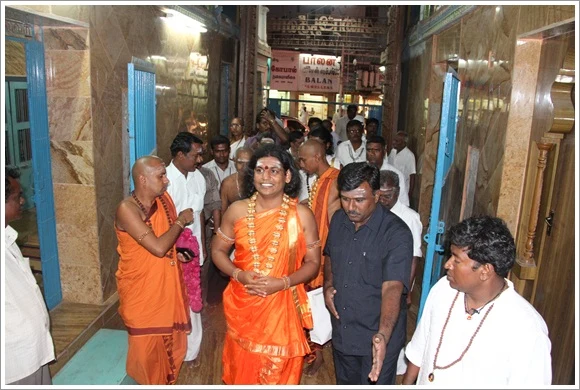
Tomorrow after long time I am going to Madhurai. Tomorrow you guys can listen to the Satsang from Madhurai. Today’s Satsang is from Tiruvannamalai, tomorrow from Madhurai. Meenakshi awakens all the auspicious things just by look. Eyes like fish that is the exact meaning of Meenakshi. It does not mean eyes that look like fish. All these fellows all these days give that meaning and paint her eyes like fish. And they put their eye liner like fish and they think they are Meenakshi. Just like how the fish by just one look gives life to the egg, same way by one look, she awakens the individual consciousness in people. She carries the quality of fish in her eyes. Fish just knows this is the way nature is programmed. So it does not bother, just by look it hatches. Understand, know that programming of the nature –

“prakrteh kriyamanani gunaih” - The virtue of natural disposition, knowing that relax without creating thick, dirty, smelling pseudo ego.

I bless you all who are sitting with us at this moment around the world in 768 places through eNtv, in 206 cities, 20 countries! Let you all achieve, experience, live, express, radiate and share & explode in eternal bliss, Nithyananda. Thank you!

Photos
Photos Of The Day:

Yoga
Nithya-Puja
Satsang

Kalpataru-darshan

Kalabhairava-Reading-and-Darshan

Ravidrapuri-MJ-Visit

Photos from this day

View all 121 photos

Photos

11 photosSource gallery
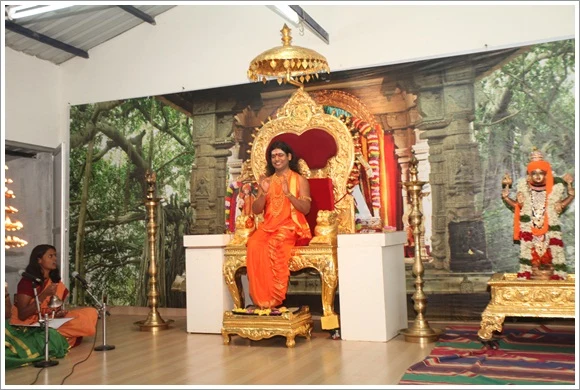
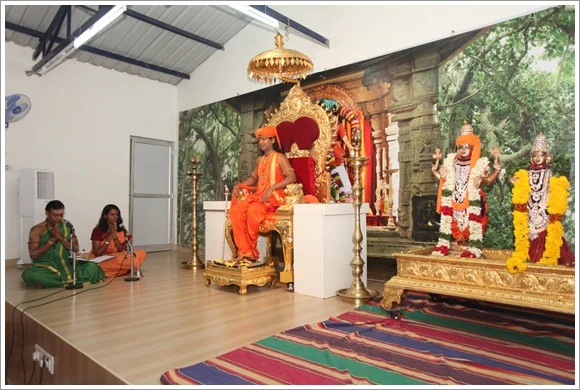
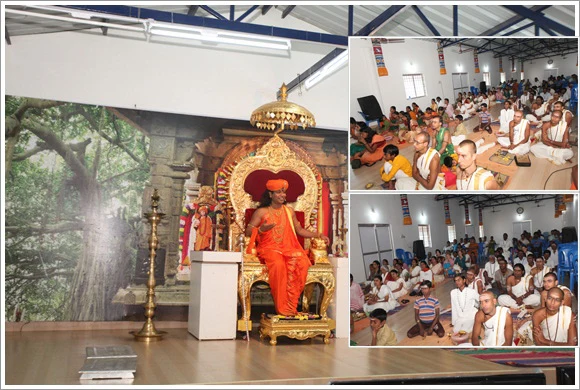
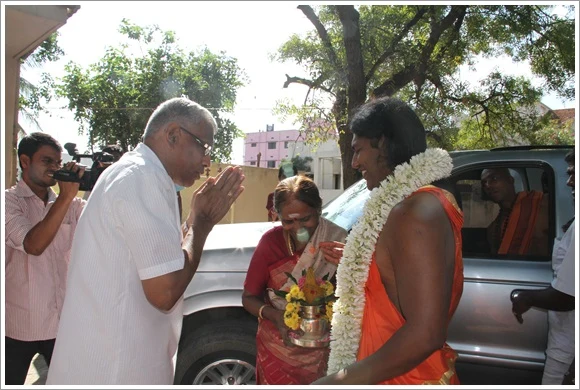
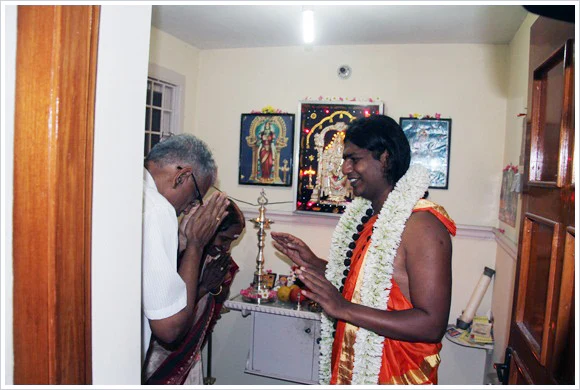
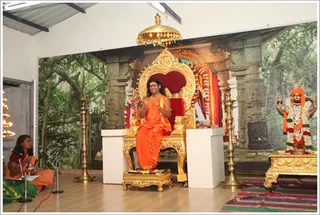
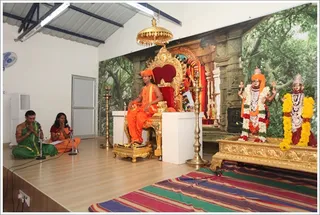
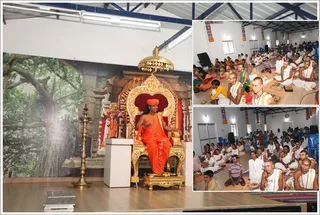
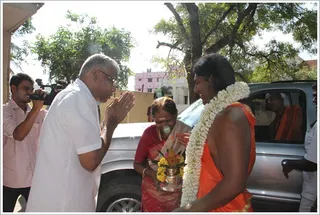
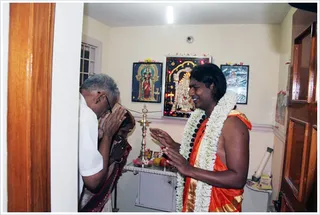
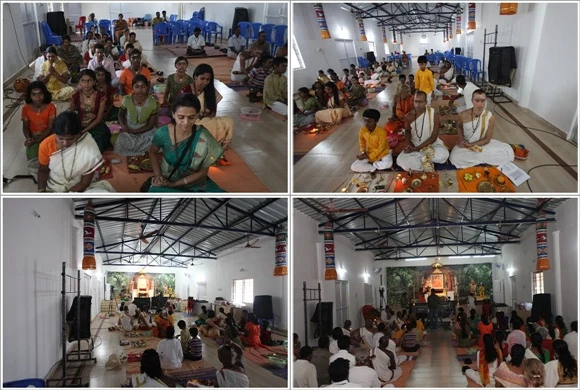
A four-panel collage of a hall with a tiled floor, metal-roofed ceiling and rows of blue chairs. Panels show seated devotees on mats and cushions, many women in colourful saris and salwar, some men in white and orange dhotis. In one panel two men in white dhotis and white shawls sit before a low table with brass plates and flower offerings, and a sheet of paper stands on a stand. Lower panels show a deity murti under a golden canopy at the front of the hall, with orange and saffron banners hanging from the ceiling and oil lamps lit on the floor, and a large crowd facing the altar. The collage shows a 6-20 to 21-100 range of visible physical attendees across its panels, and no individual can be confidently identified as a person.A photograph of a satsang hall with a figure in orange robes seated on an ornate golden throne with a red cushioned back and a golden canopy, hands raised in a gesture while addressing an audience. Beside the throne, a seated woman in an orange top and green skirt sits on the floor in front of a microphone and papers. To the right stands a deity murti dressed in orange with garlands and a crown, on a gold pedestal. Brass oil lamps flank the stage and a painted backdrop shows a stone temple gateway among trees. A figure in orange robes on a throne with a gold canopy suggests a teaching seat, and the setting is a satsang hall.A satsang hall on a wooden stage with a striped rug in front. A seated figure in saffron-orange robes and an orange turban sits on a large gold-and-red throne, with a rudraksha mala visible; the presentation is consistent with the page's claim of a person, though the face is not readable, so the identity is uncertain. To the left, a man in a green dhoti and a woman in orange sari sit cross-legged on the floor before microphones, reciting or chanting from papers. To the right, two deity murti stand on a gold palanquin-style platform, adorned with white and orange garlands and marigold garlands. Behind them, a large printed backdrop shows a forest scene with a stone temple. A brass oil lamp stands near the throne, and a gold canopy hangs above.A three-panel collage of a satsang hall. The large left panel shows a seated figure in saffron robes and an orange head covering on an ornate gold throne-like seat with a golden canopy, beside a tree backdrop and a brass oil lamp. The upper right panel shows seated devotees in white and mixed clothing on the hall floor, many with white garments and some in orange, facing forward beneath hanging banners. The lower right panel shows a wider view of seated white-clad devotees and a few men in orange and saffron near the front, with the room's windows and ceiling fans visible.Outdoor photo beside a silver car at a residential street. A man in a white shirt and light trousers, facing right, presses his palms together in greeting. A woman in a red sari with a gold necklace receives a steel tray of flowers and fruit. A tall figure in an orange garment and a long white flower garland stands beside her, and a cameraman in a pink shirt films at left. Another person in orange sits inside the open car door at right. Trees and a pink building are behind.A photograph inside a small home prayer room. A woman with short dark hair, wearing an orange-and-gold sari and a long white flower garland with a dark bead mala, stands at right with her palms joined and smiling. Before her, an elderly man in a white shirt and an older woman in a red-bordered sari bow with hands pressed together. Between them on a small side table sits a brass oil lamp (diya) with a lit flame. Behind them, framed devotional pictures hang on a pale yellow wall, one depicting a deity murti with an arched frame and lights. A wooden door frames the left edge.

Yoga

3 photosSource gallery
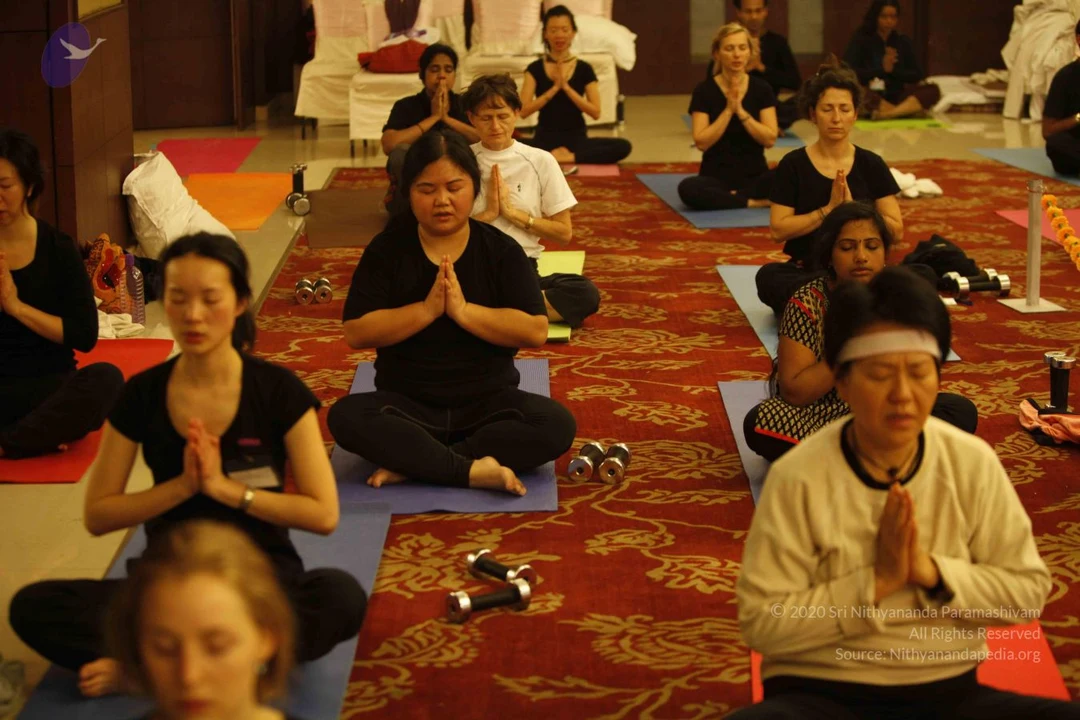
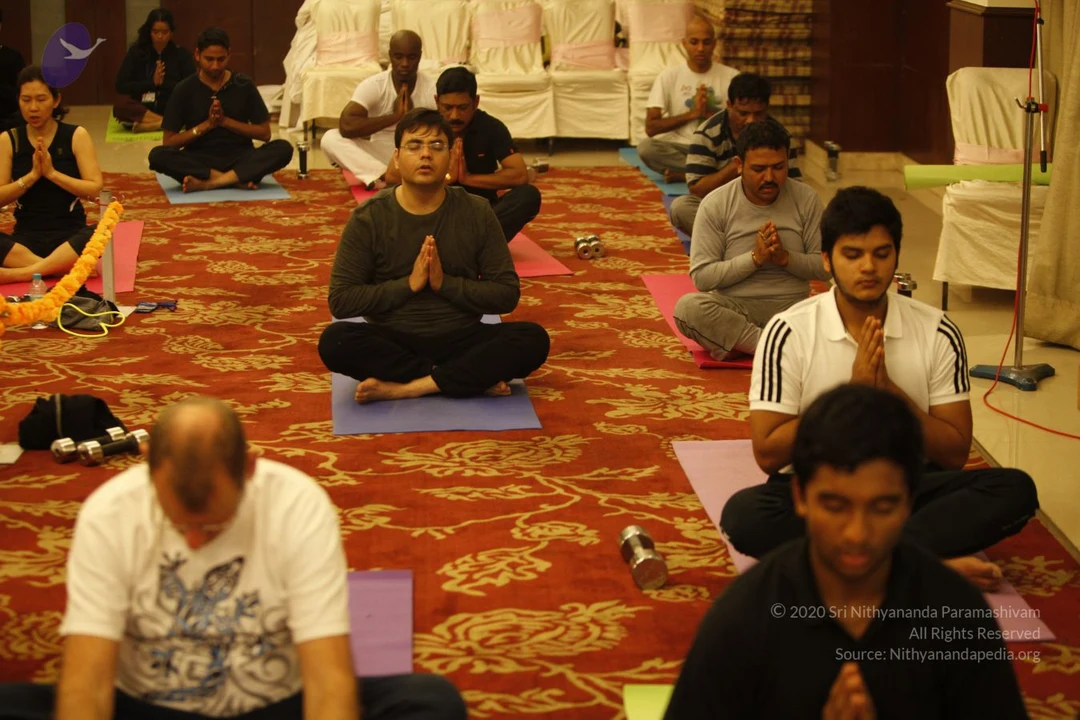
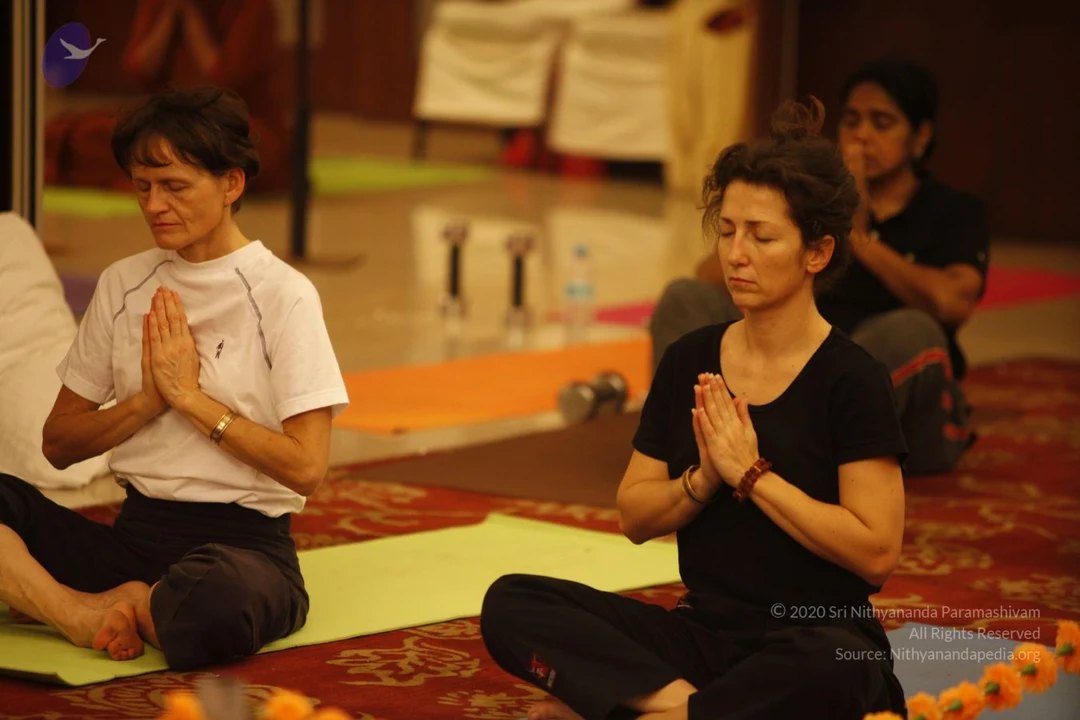
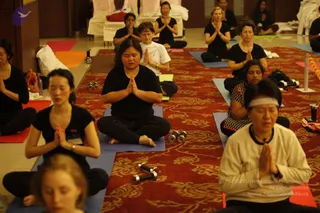
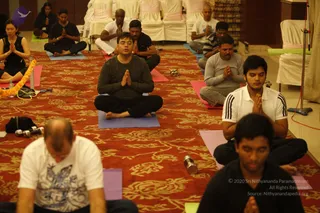
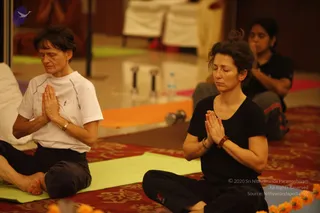
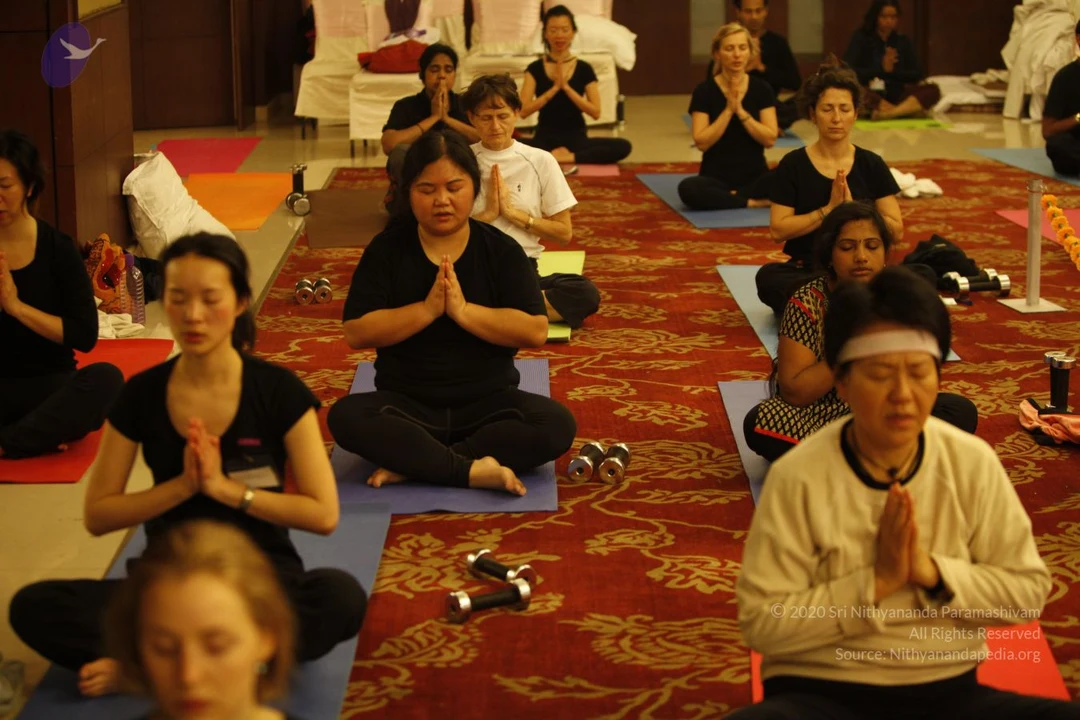
A group of women sit cross-legged on coloured yoga mats across a red patterned carpet, palms pressed together in anjali mudra with eyes closed, in a yoga or meditation session. Several wear black tops and trousers; one in the foreground wears a white headband and cream top, another in the centre wears a black top with a white headband tied at the forehead. Metal dumbbells lie on the carpet between the mats, and an orange-and-white flower garland hangs on a stand at the right edge. No a person candidate is clearly visible among the participants.A group of devotees sits cross-legged on yoga mats over a red and gold patterned carpet in a hall, hands pressed together in namaste with eyes closed, in a satsang or meditation session. A man in a dark long-sleeved top sits centrally, and others wear white and grey t-shirts and black clothing. A marigold garland lies at the left edge beside a mat, and dumbbells rest on the floor among the mats. Rows of white chairs with pink sashes stand in the background. Nearby people appear in a row of seated meditators, with no visible a person candidate.Photo of several people seated on the floor in an indoor hall for a yoga or meditation session. In the foreground, a woman in a white t-shirt and dark pants sits cross-legged on a green mat with palms pressed together at her chest and eyes closed. Beside her, a woman in a black t-shirt and dark pants sits on a mat with hands in anjali mudra, eyes closed, a red-brown bead bracelet on her wrist. Behind them, another person in black with hands joined sits on a yellow-orange mat. Orange marigold flowers line the lower edge, and a patterned red carpet covers the floor, with a water bottle and dumbbells visible in the background.

Nithya-Puja
14 photosSource gallery
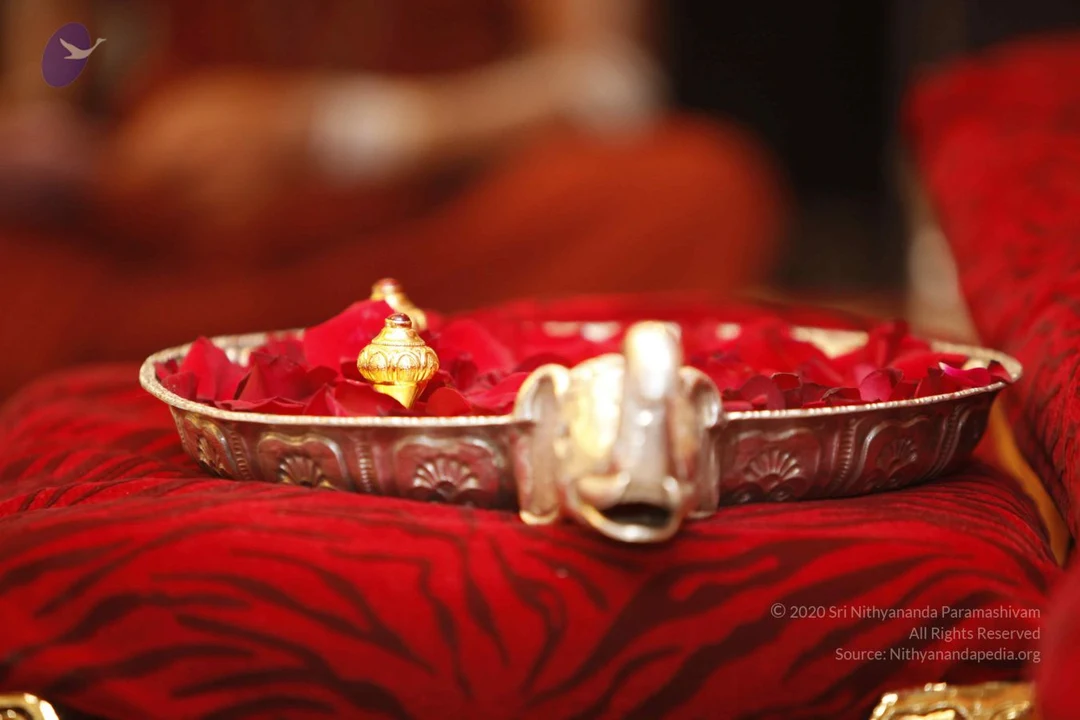
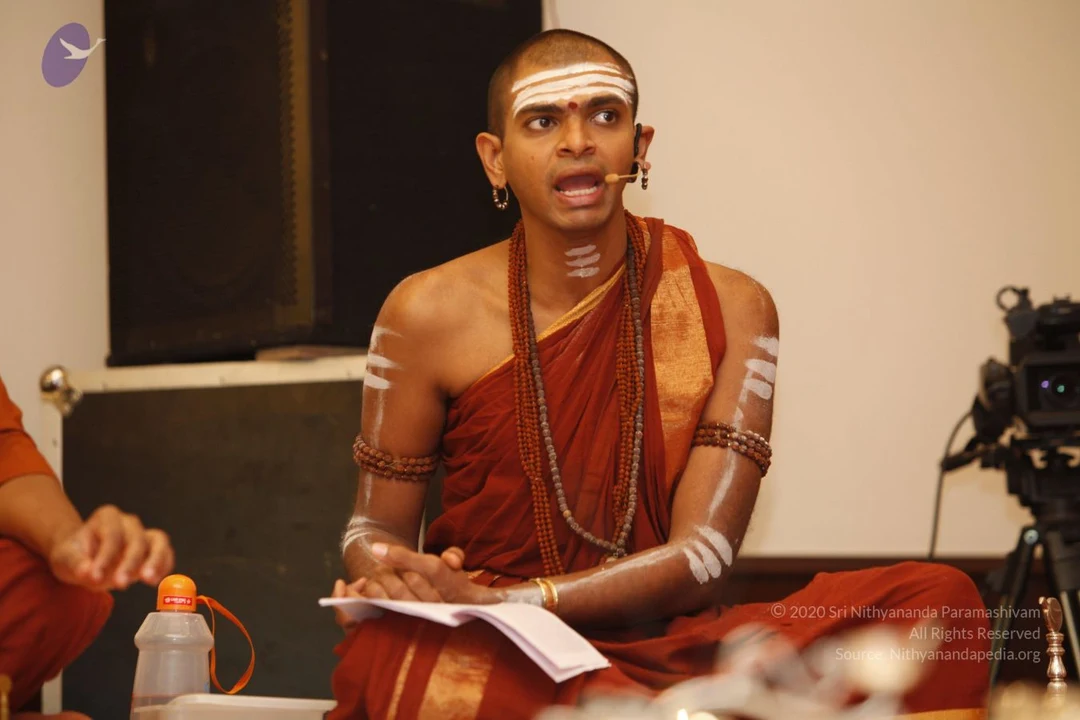
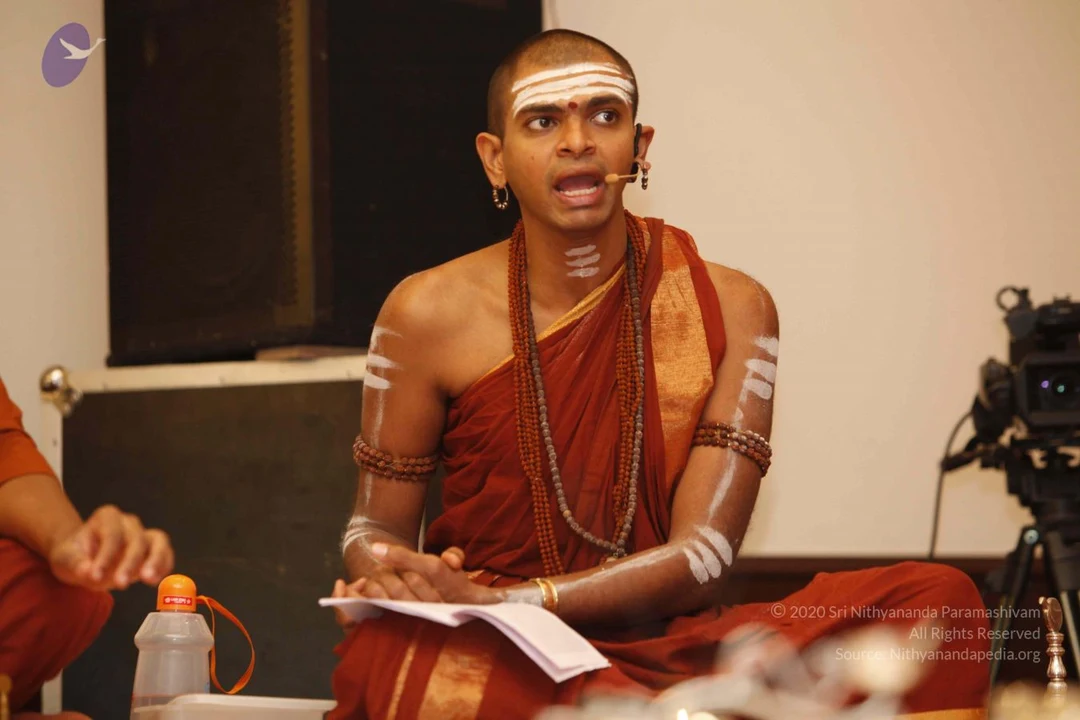
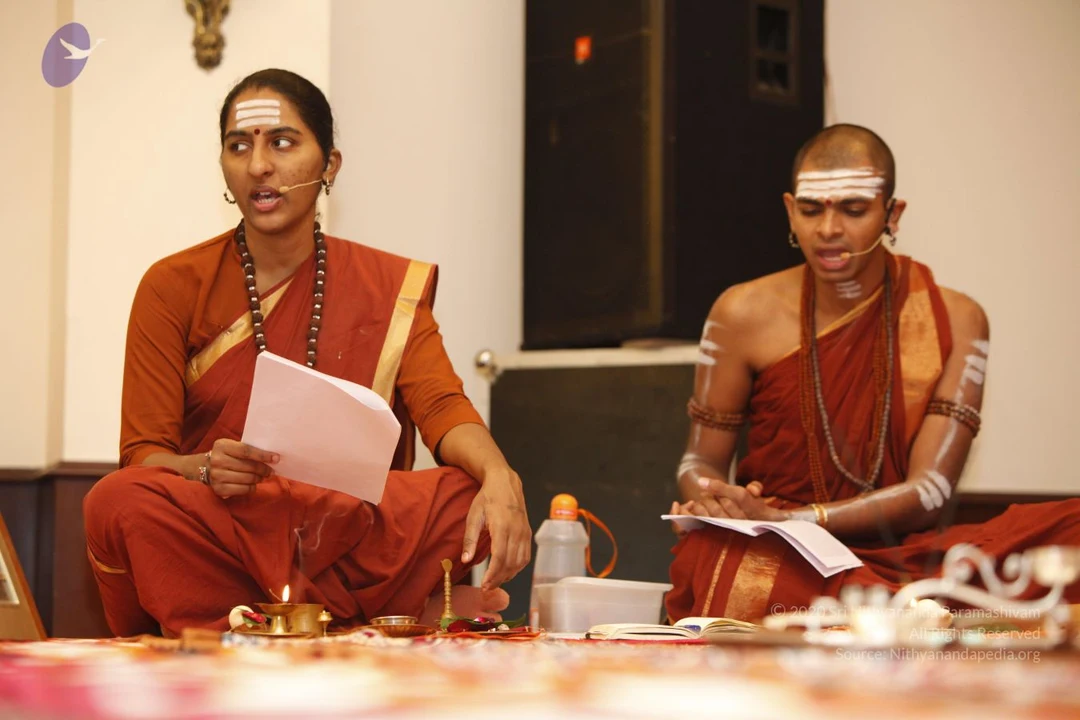
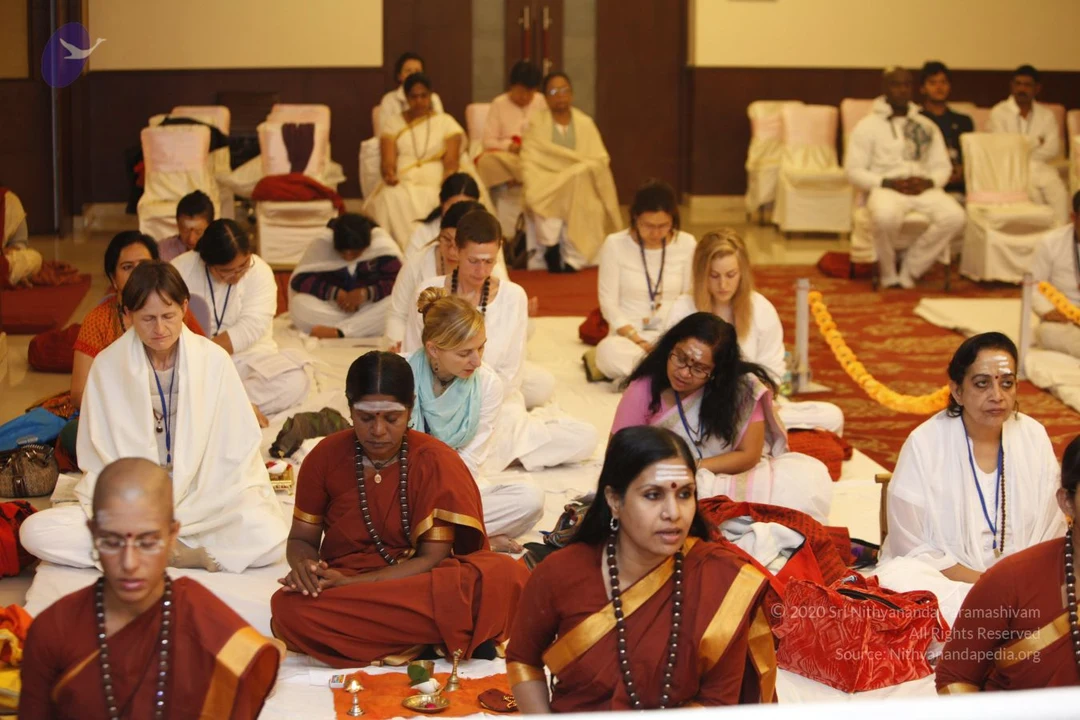
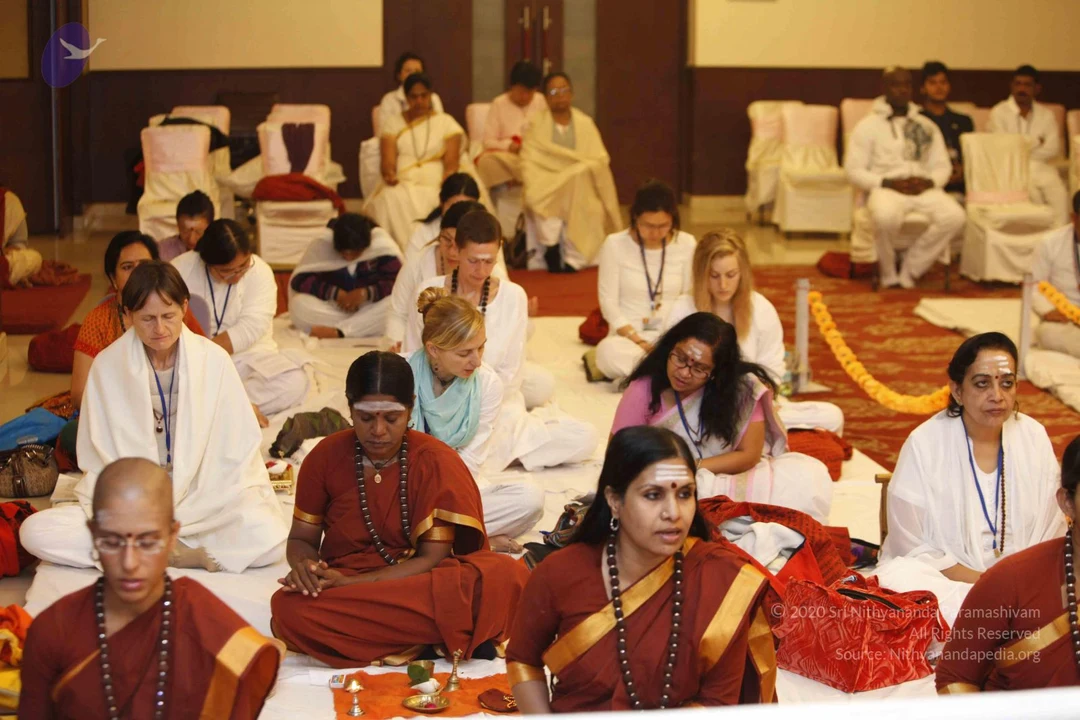
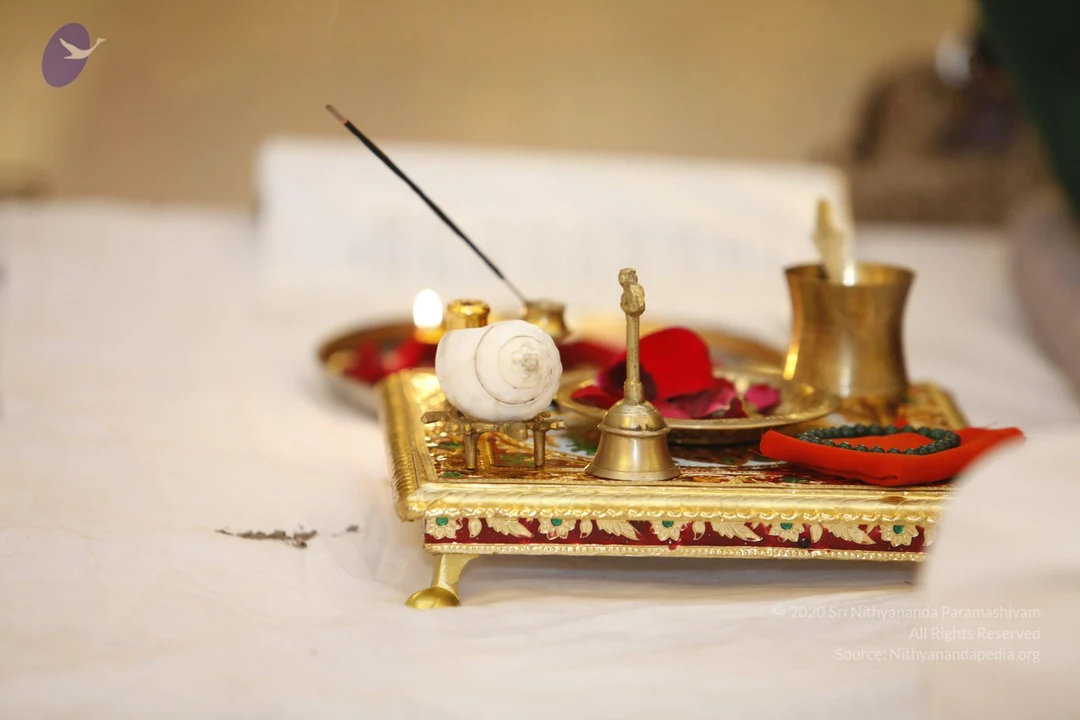
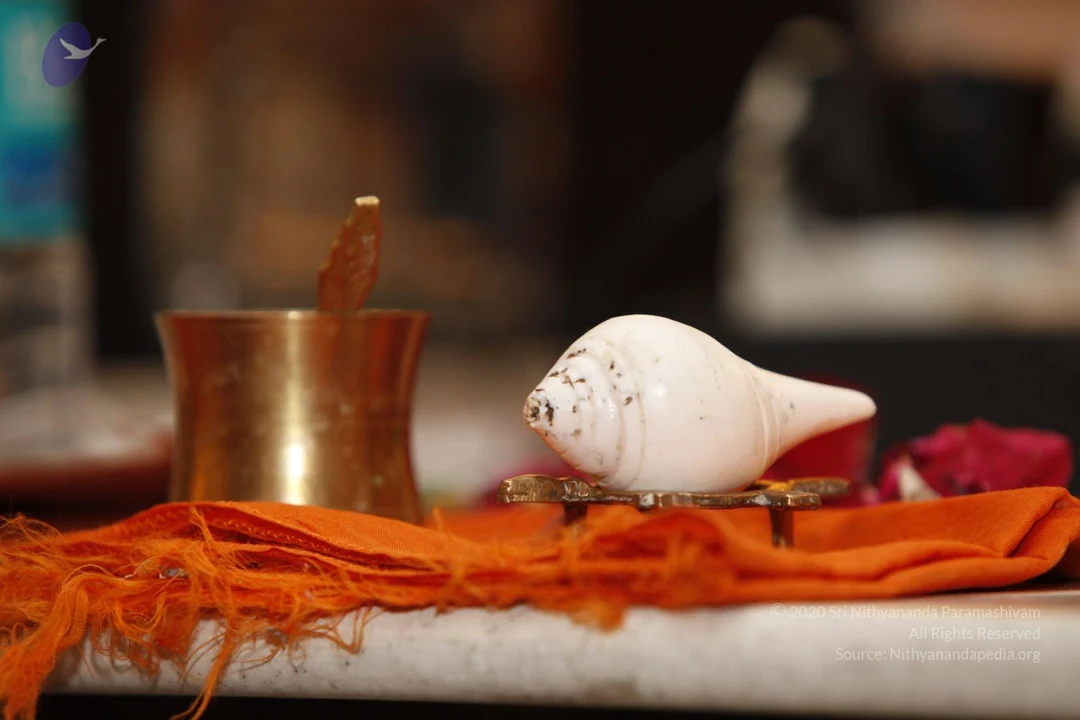
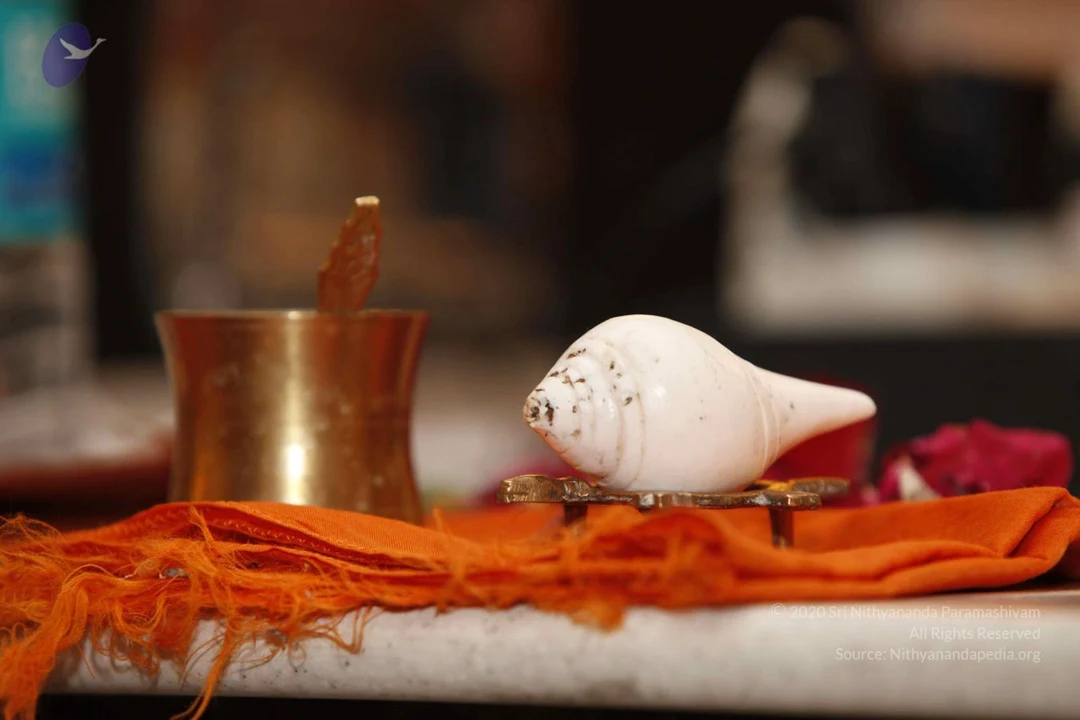
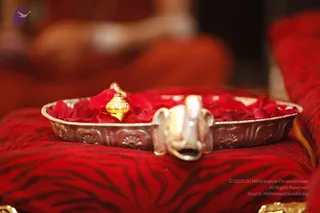
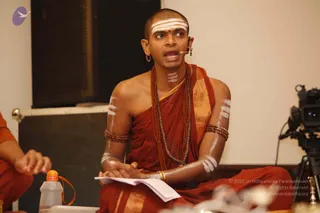
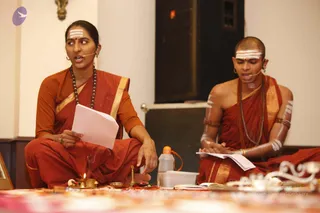
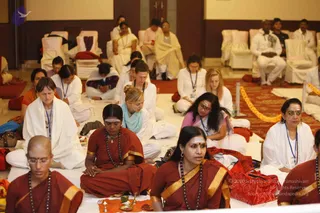
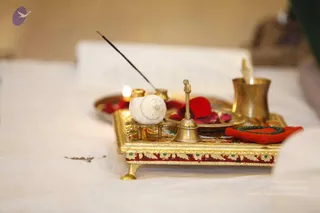
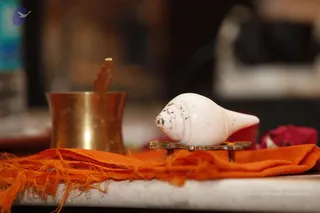
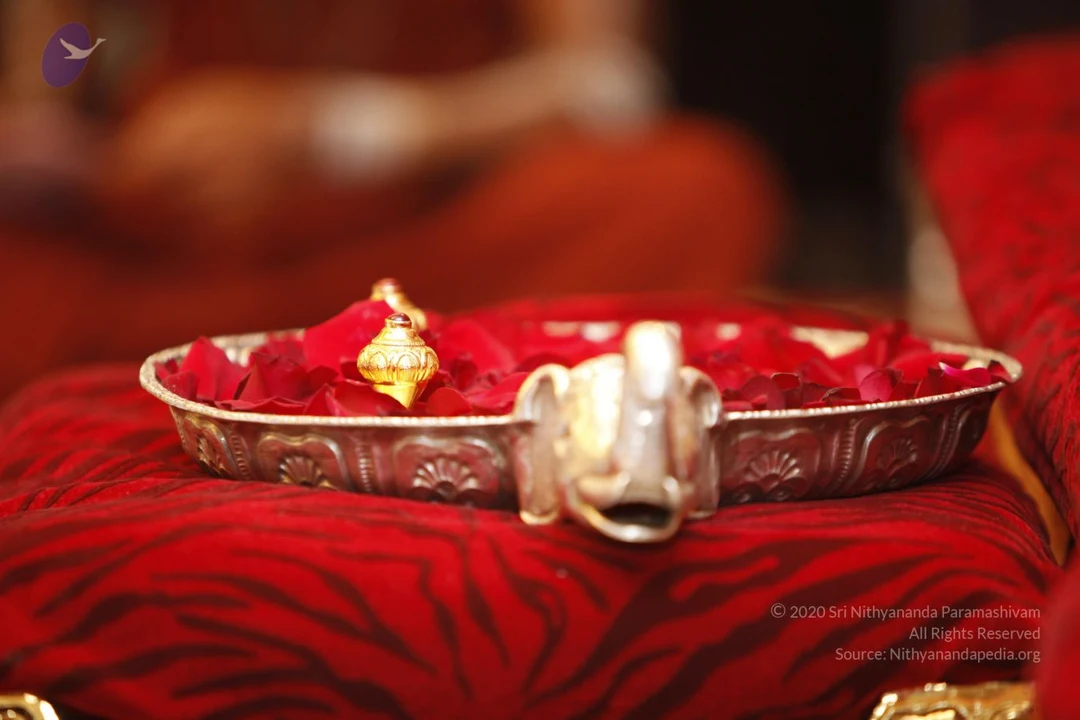
Close-up photograph of a silver ceremonial tray filled with red rose petals, resting on a red velvet cushion with a tiger-stripe pattern. A small golden ornamental finial and a silver spouted vessel sit among the petals. In the blurred background, an orange-robed figure is seated. Gold-tipped decorative trim edges the cushion.A seated man in orange-red ochre robes speaks during a satsang, holding a sheet of paper in his hands. He has a shaved head, white horizontal tilak stripes and a red dot on his forehead, and white ash markings on his arms. Multiple rudraksha malas hang across his chest and wrap his arms, and a small headset microphone is clipped near his mouth. Beside him to the left, the orange-robed arm of another seated person is visible, and a water bottle sits on the floor. A video camera on a tripod stands at right, and a dark board hangs on the wall behind.Two people in orange-red saffron robes sit cross-legged on a floor covered with a red and white cloth, speaking into small headset microphones during a satsang. The woman on the left wears a dark bead mala, gold-bordered sari and has white vertical tilak on her forehead with a red bindi; she holds a sheet of white paper and gestures with her right hand. The man on the right, with a shaved head and white forehead and arm markings, holds loose papers in his hands and speaks with eyes closed. In front of them sits a brass oil lamp with a lit flame, a small brass bell, a plate with flowers, a water bottle, and a book. A white and gold decorative stand sits at the right edge.A seated group of devotees in a hall during a satsang, most sitting on white floor mats. Foreground: a shaved-headed woman in red-and-gold saree with rudraksha mala, eyes lowered; another woman in red-and-gold saree with rudraksha malas and white tilak; a woman in white with blue lanyard and tilak. Brass oil lamps and a small offering plate sit on an orange cloth at lower left. Rows of white chairs with pink covers and more seated people fill the background, with a red carpet and marigold garland along a barrier at right.Close photograph of a brass puja tray on a white cloth. A white conch shell sits on a small brass stand beside a brass bell with a handle, a brass cup, red rose petals on a brass plate, a lit oil lamp, and a smoking incense stick. A red cloth holds a green beaded mala. The tray has gold filigree with floral motifs and red trim. No people are visible.Close-up photograph of a ritual setup on a white marble surface draped with an orange-saffron cloth with frayed edges. In the centre, a white conch shell (shankha) rests on a small brass stand. To the left, a polished brass cup holds a stick of incense or a wooden stick. A pink rose petal or flower sits at the right edge. The background is blurred. No people are visible.

Satsang
36 photosSource gallery
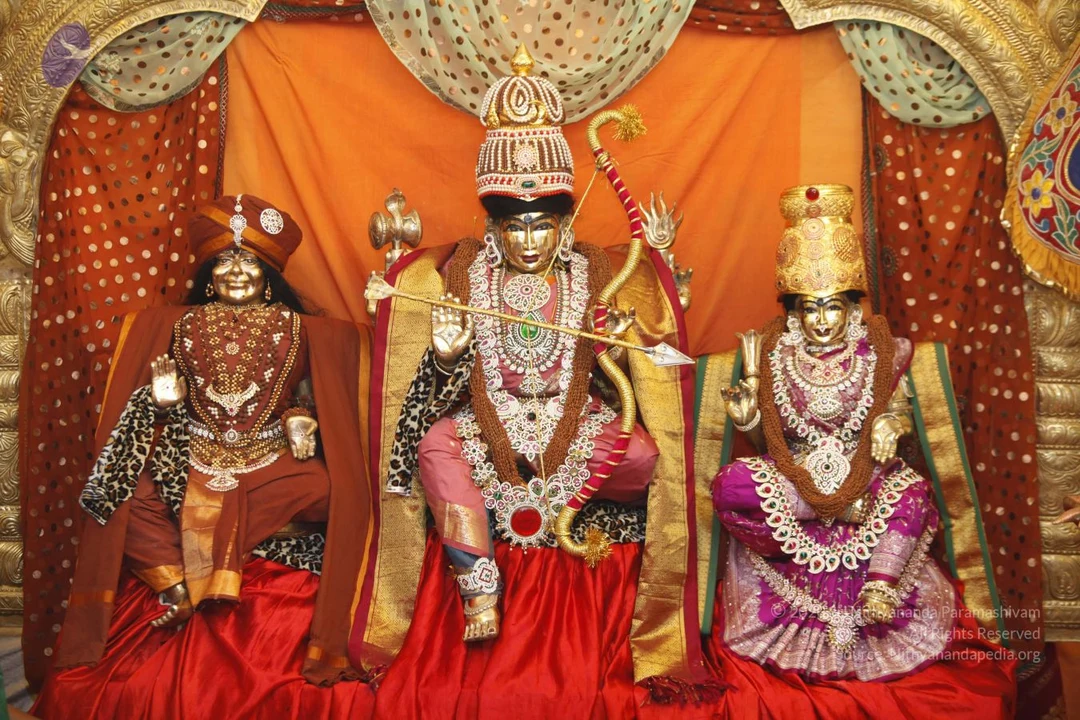
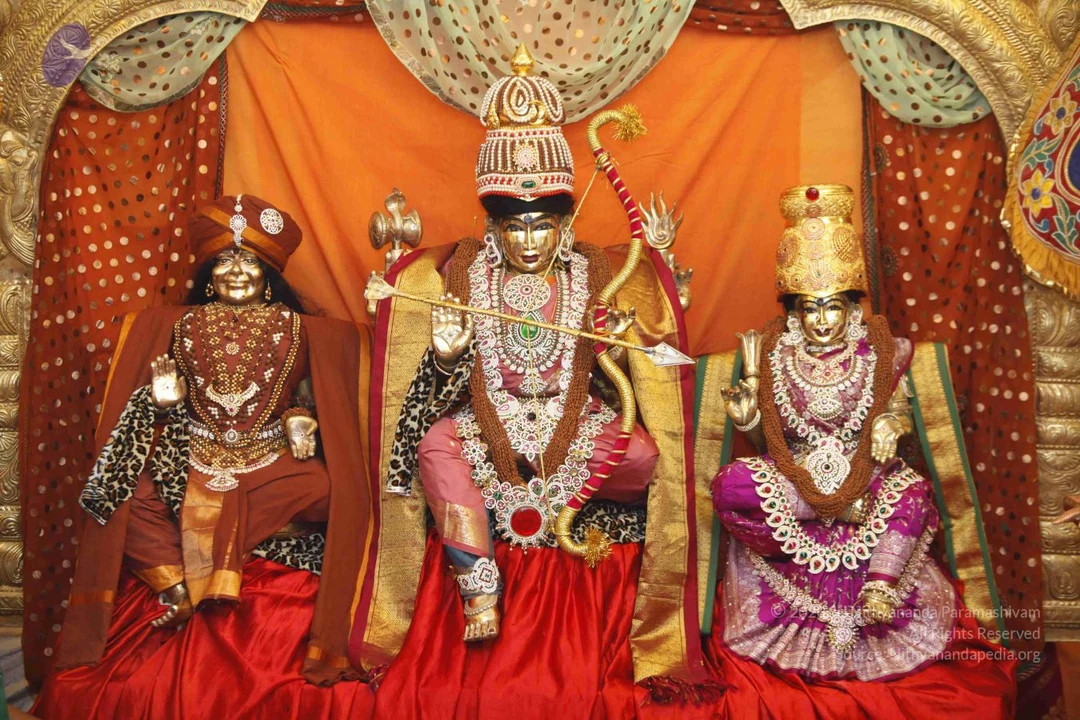
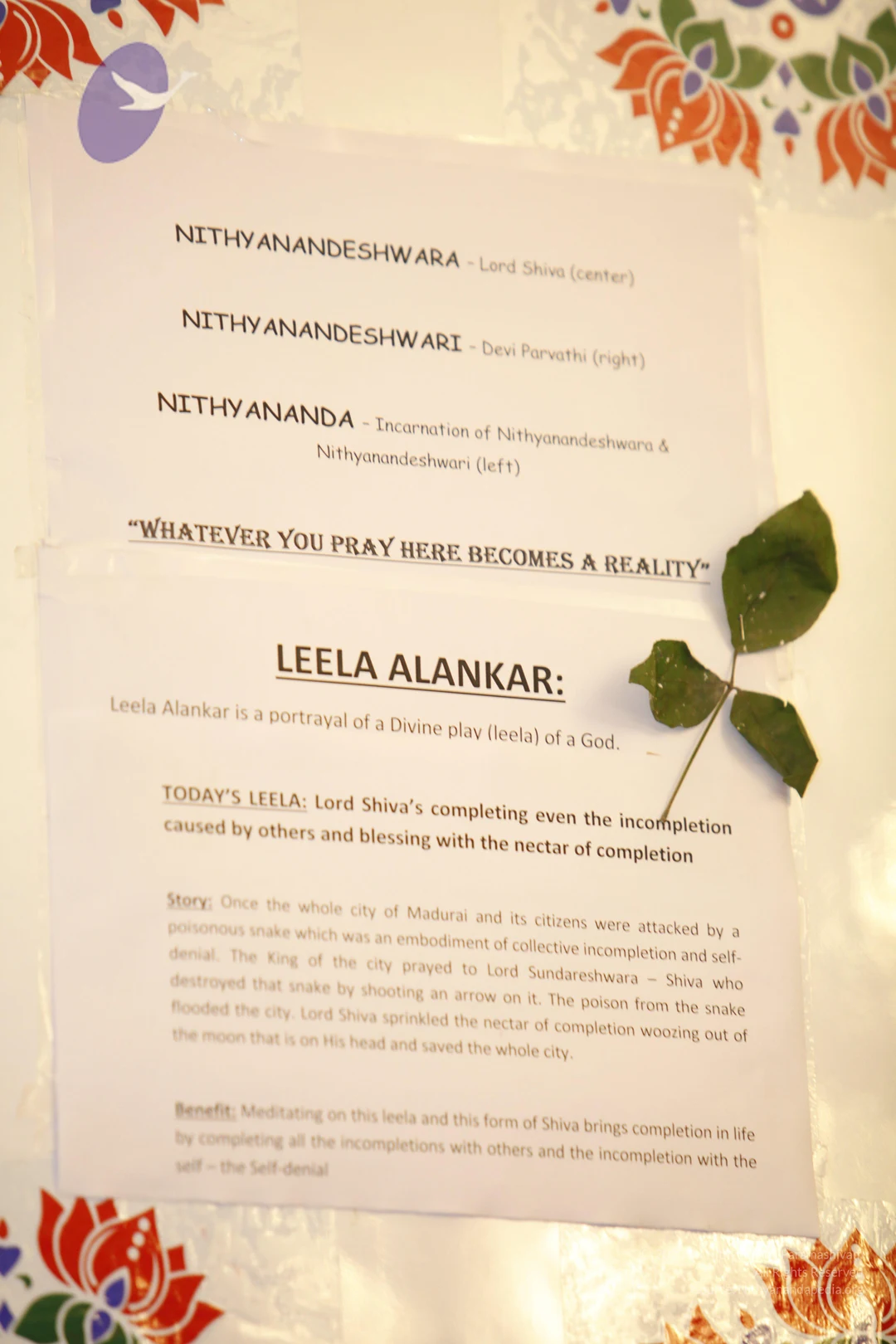
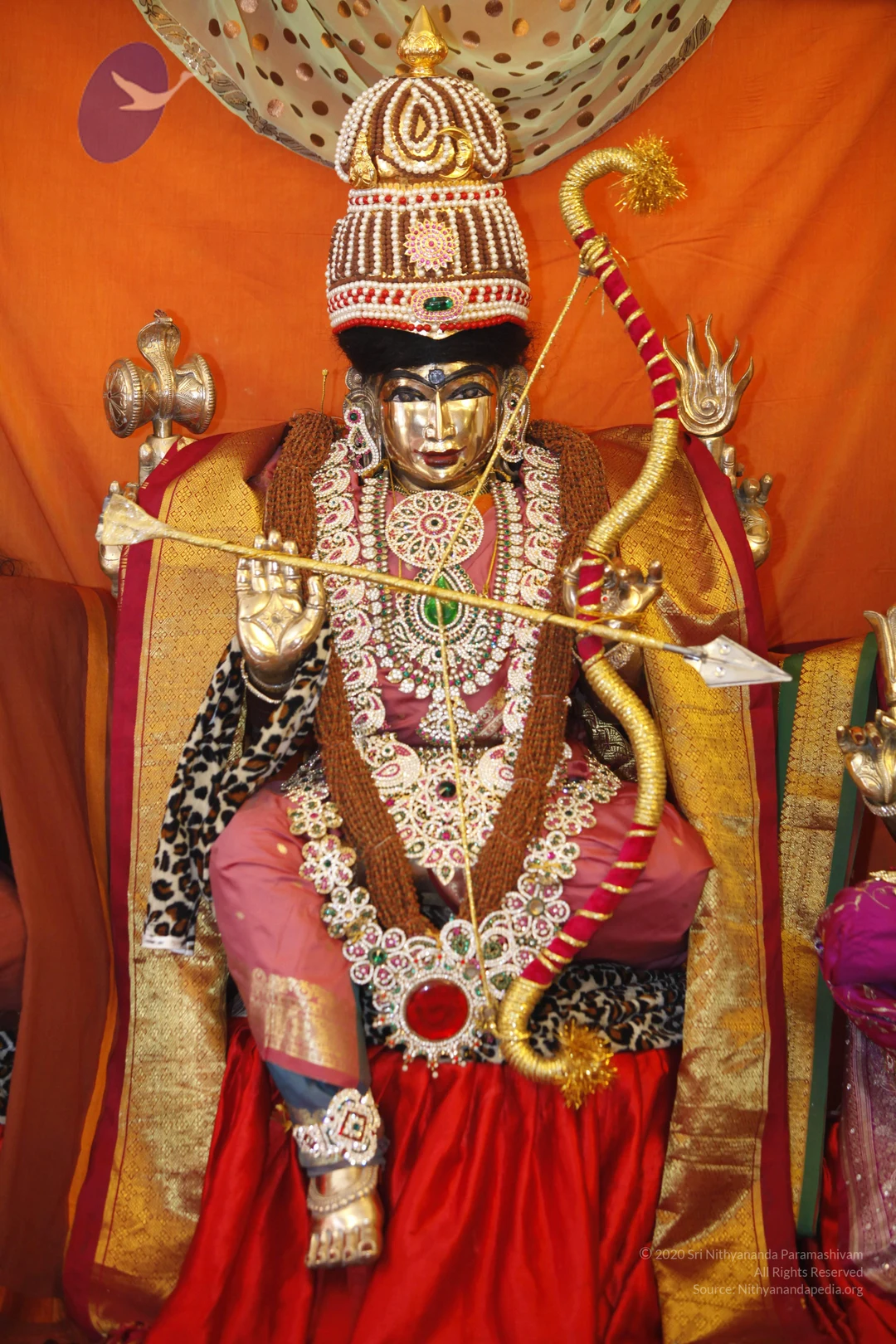
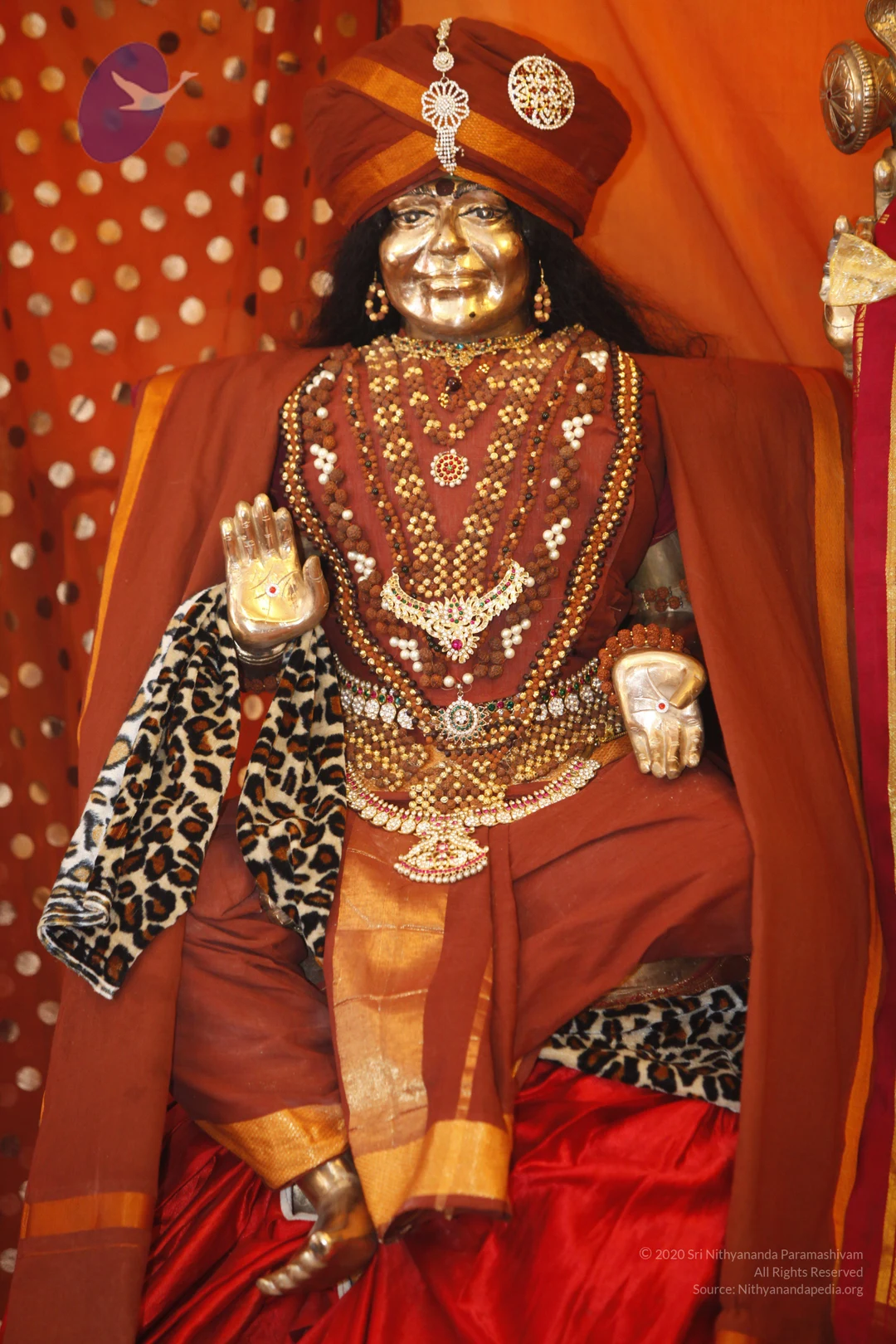
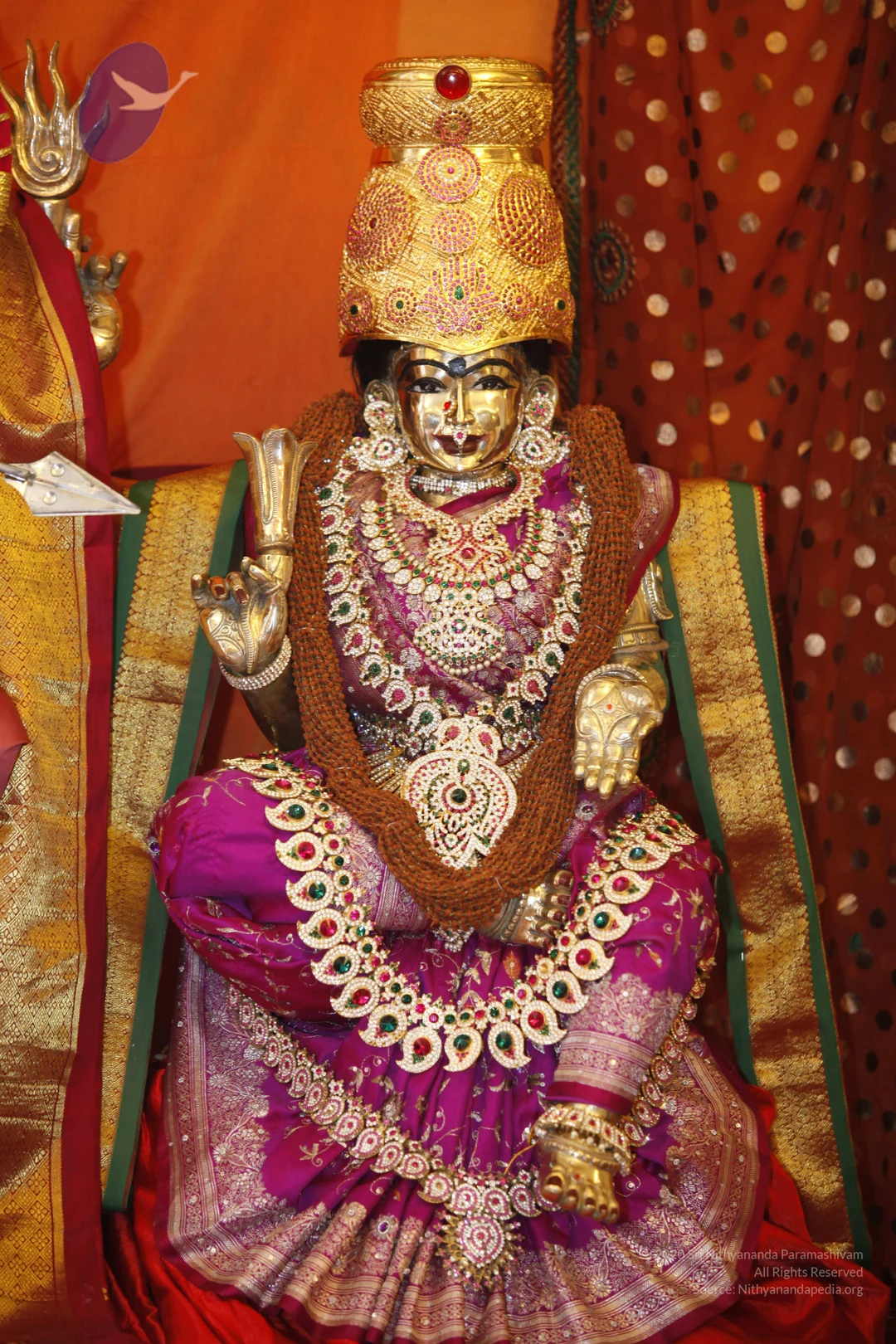
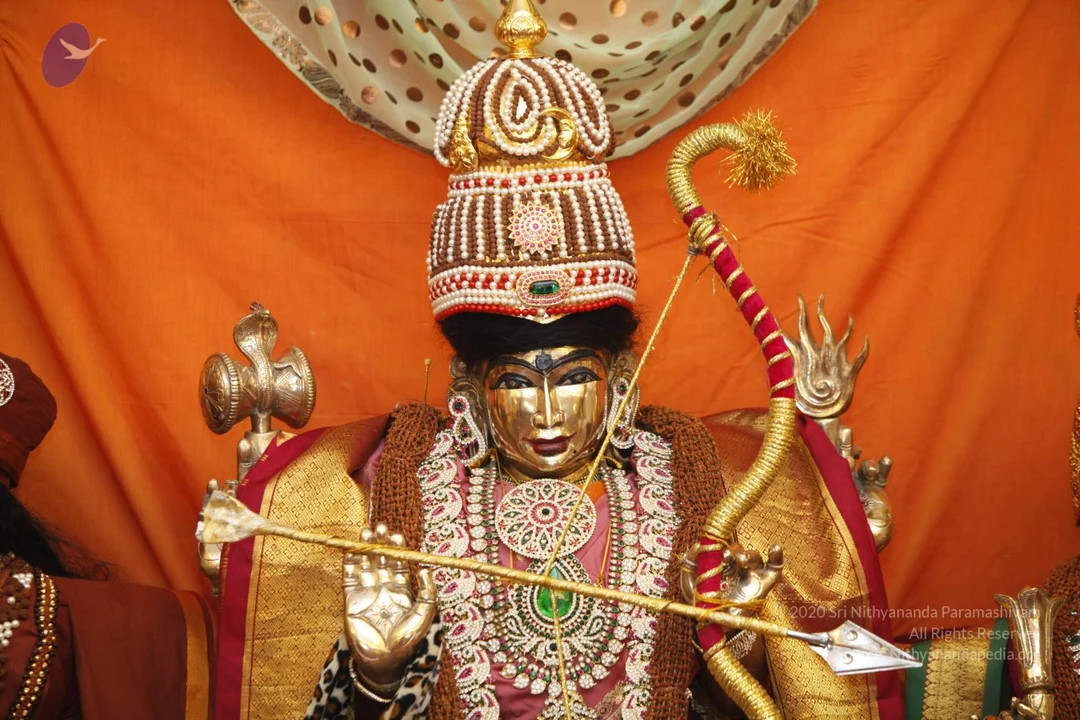
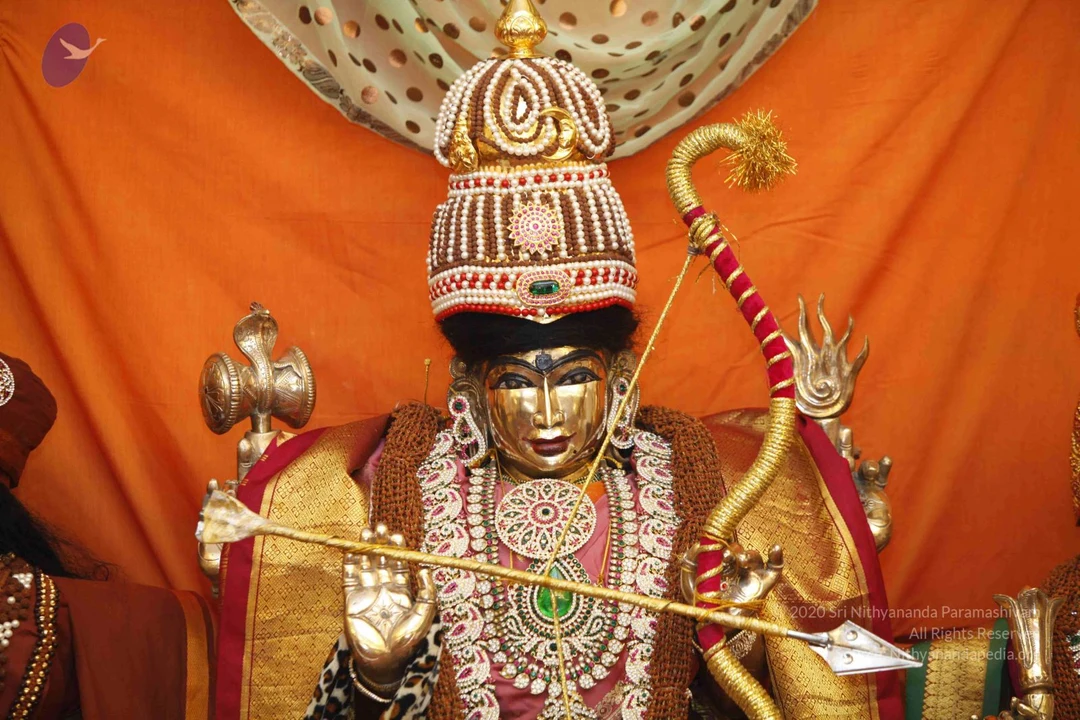
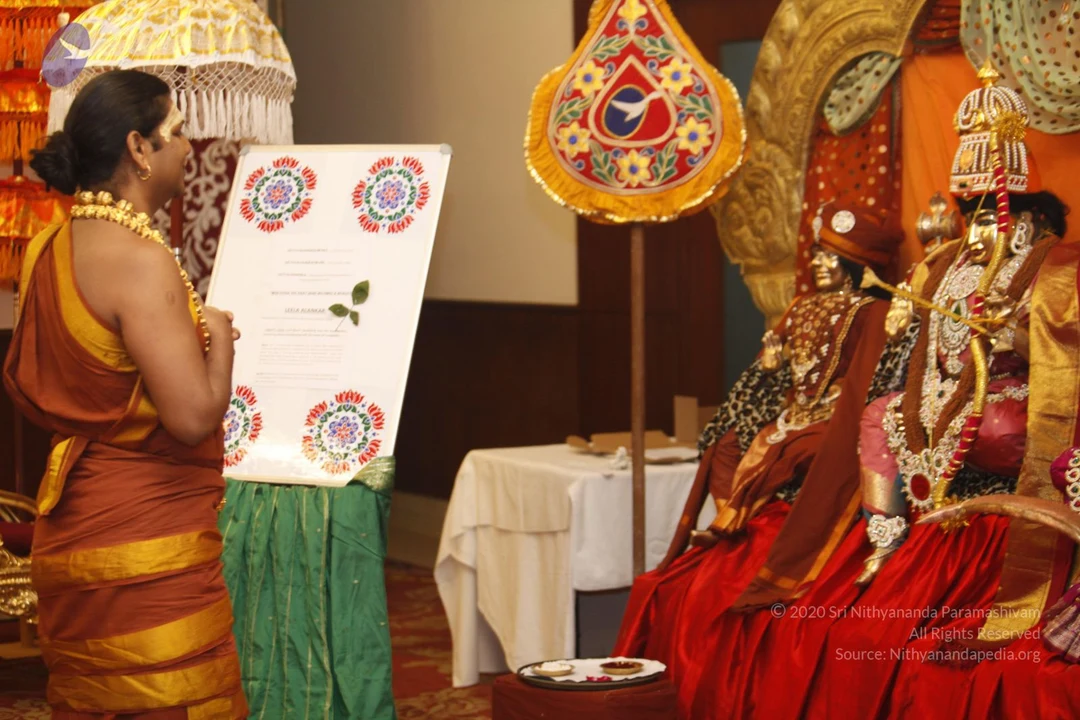
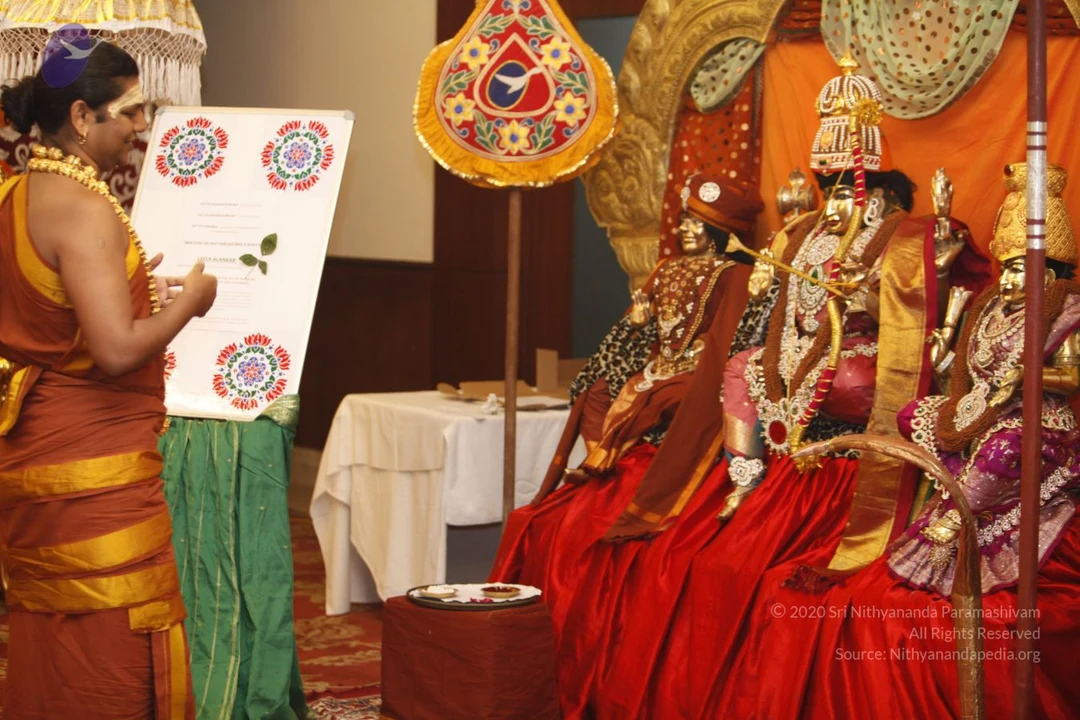
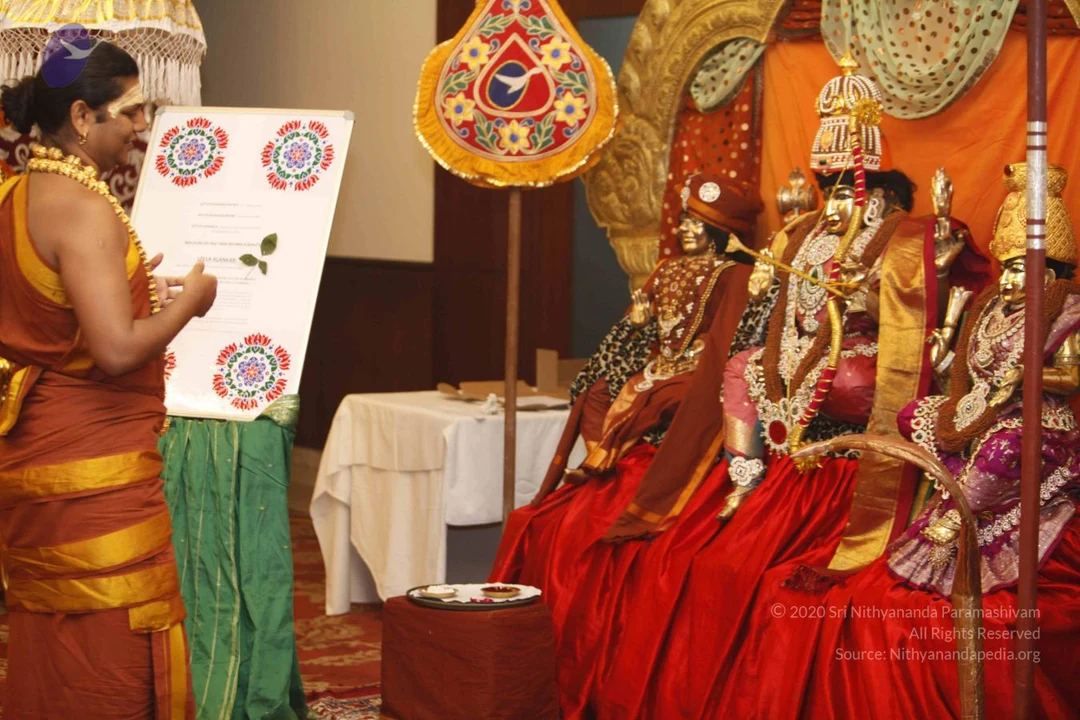
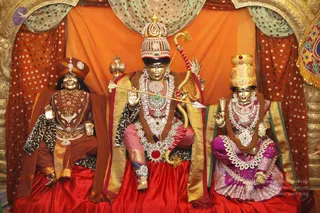
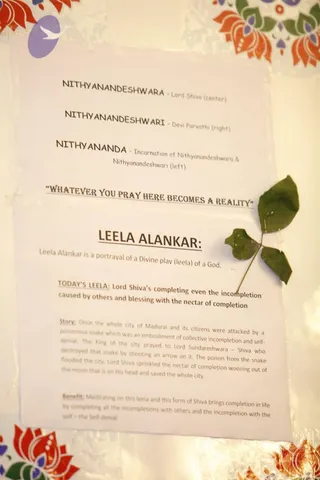
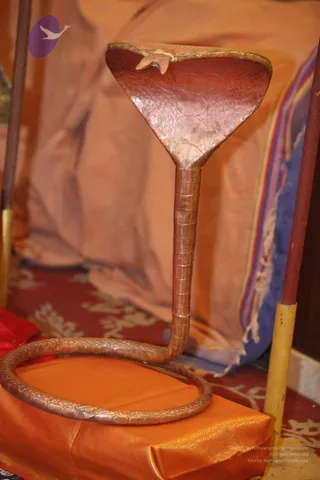
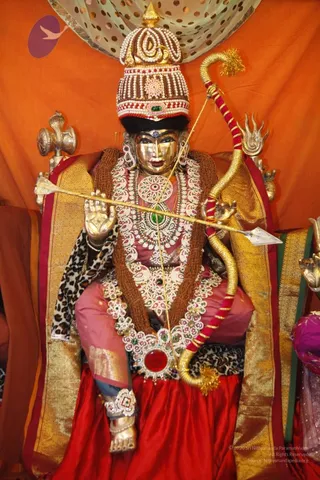
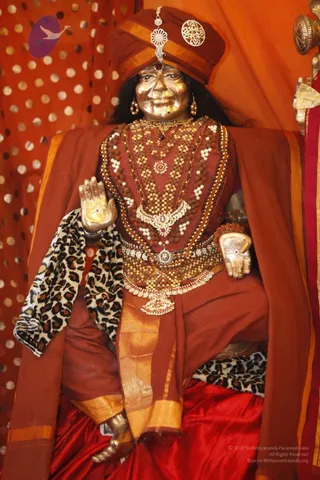
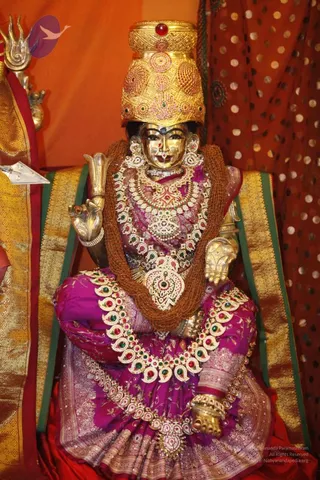
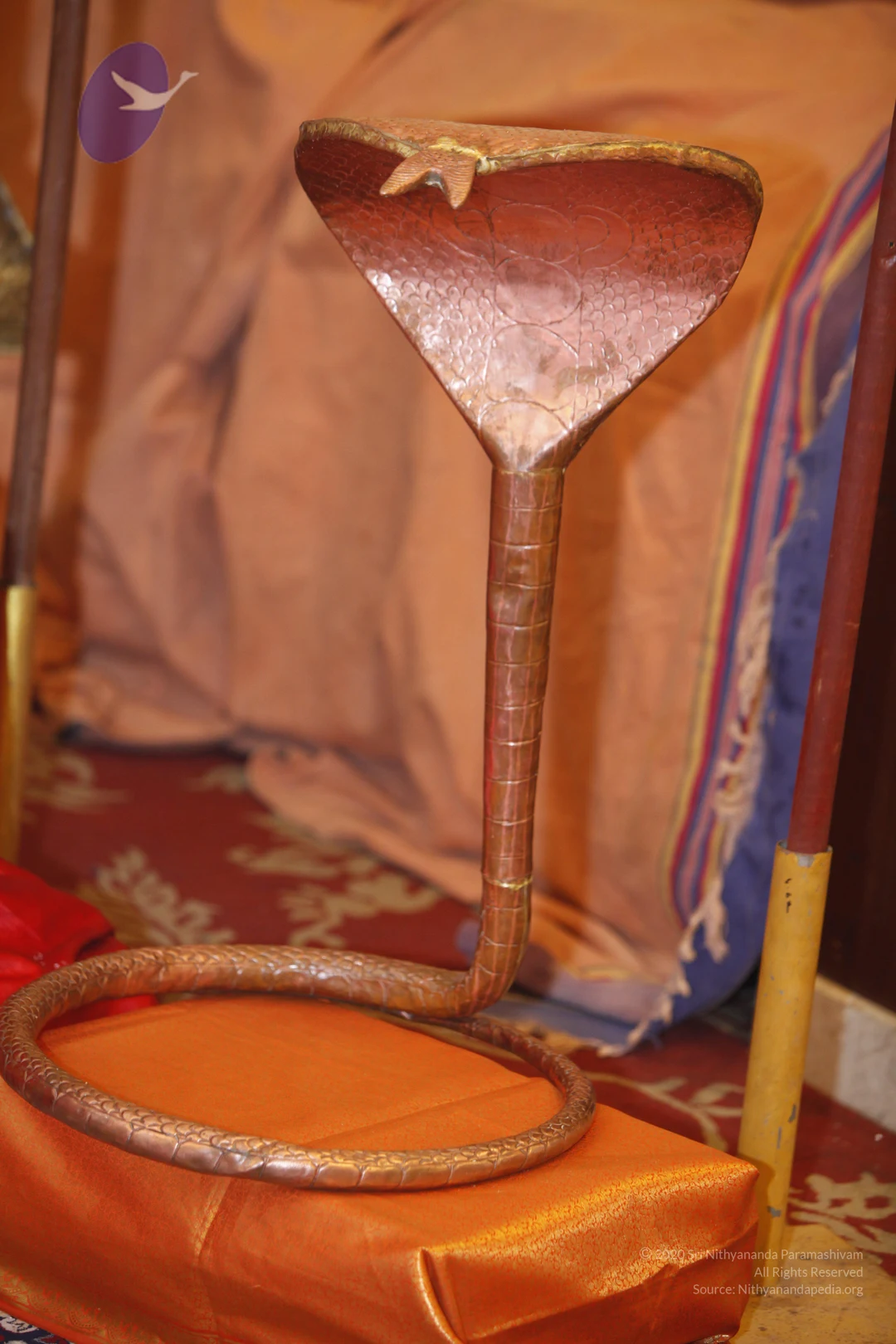
Three gilded statues seated on a red cloth throne against an orange drapery backdrop with gold-trimmed fabric panels. The central deity murti holds a bow and arrow and wears an ornate crown and rudraksha-style beaded and jewelled necklaces. The figure on the left wears a brown turban and a leopard-print garment, and the figure on the right wears a gold crown, pearl garlands and a purple sari with gold border. These are carved and dressed statues, not living people, and no physical people are present.A printed information sheet pinned to a wall decorated with red, orange, green and purple floral border motifs. The sheet lists three names with brief descriptions: NITHYANANDESHWARA as Lord Shiva (center), NITHYANANDESHWARI as Devi Parvathi (right), and a person as incarnation of Nithyanandeshwara and Nithyanandeshwari (left). Below is the caption "WHATEVER YOU PRAY HERE BECOMES A REALITY" and a section titled LEELA ALANKAR explaining it as a portrayal of a divine play of a God, with a story about Lord Sundareshwara destroying a poisonous serpent and a stated benefit of meditation. A green leaf with three leaflets rests on the page. No people are visible.A copper cobra hood sculpture stands upright on an orange silk cushion placed on a red patterned rug. The hammered hood shows scale texture and a small golden ornament at its top edge, while the coiled body curves around the cushion. Behind it hang draped orange cloth and a striped fabric with a blue-and-yellow border, with wooden rods at the left and right edges. No people are visible.A golden figure of a seated teacher is shown as a statue, not a living person. It wears a rust-red turban with a jewelled ornament, long dark hair, gold earrings, and layered rudraksha and gold bead malas with pearl and ruby necklaces, a red-and-gold ornamented waist belt, and a rust-red draped shawl with a leopard-print cloth over one arm. Its right hand is raised in blessing and the left rests on the knee against a red and gold polka-dot backdrop with a red silk cloth below. Because this is a statue, it counts as a depiction of a person rather than a physical person in the scene, so the people count is zero.A gilded deity murti seated on a green-and-gold throne against orange drapery with a gold-dotted backdrop. The figure wears a tall golden crown set with red and green stones, a magenta silk sari with gold brocade, layered jewelled necklaces, a rudraksha-style brown bead garland, and bangles. One hand is raised in a blessing gesture. A trident-like ornament appears at the left edge. No physical people are visible.
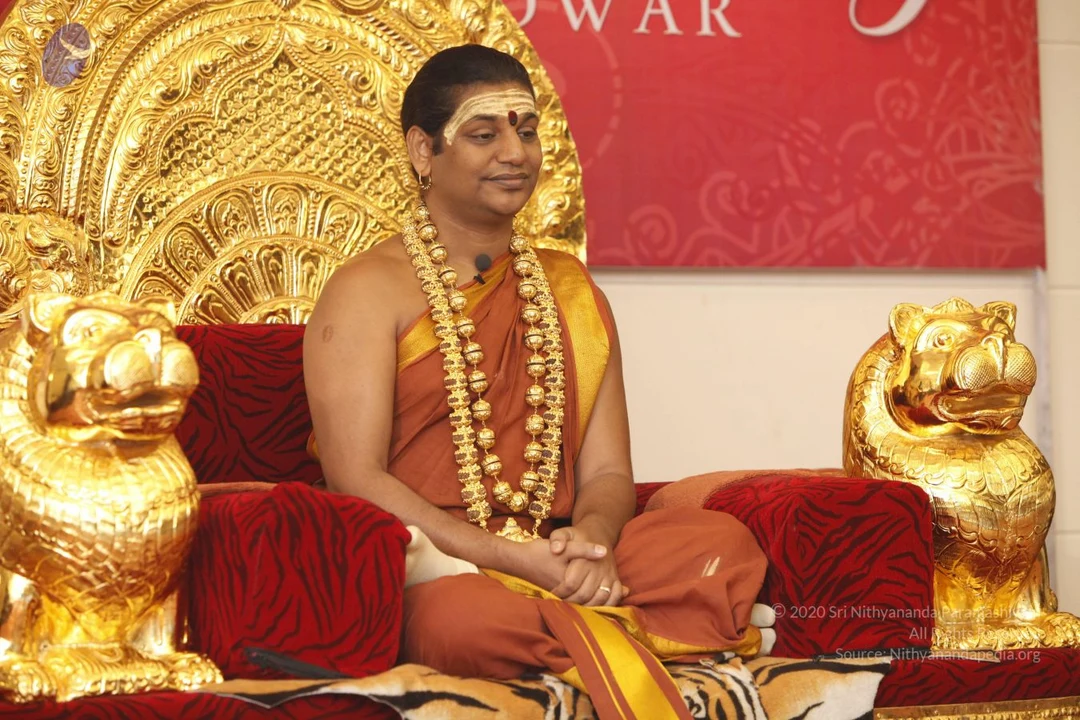
Kalpataru-darshan
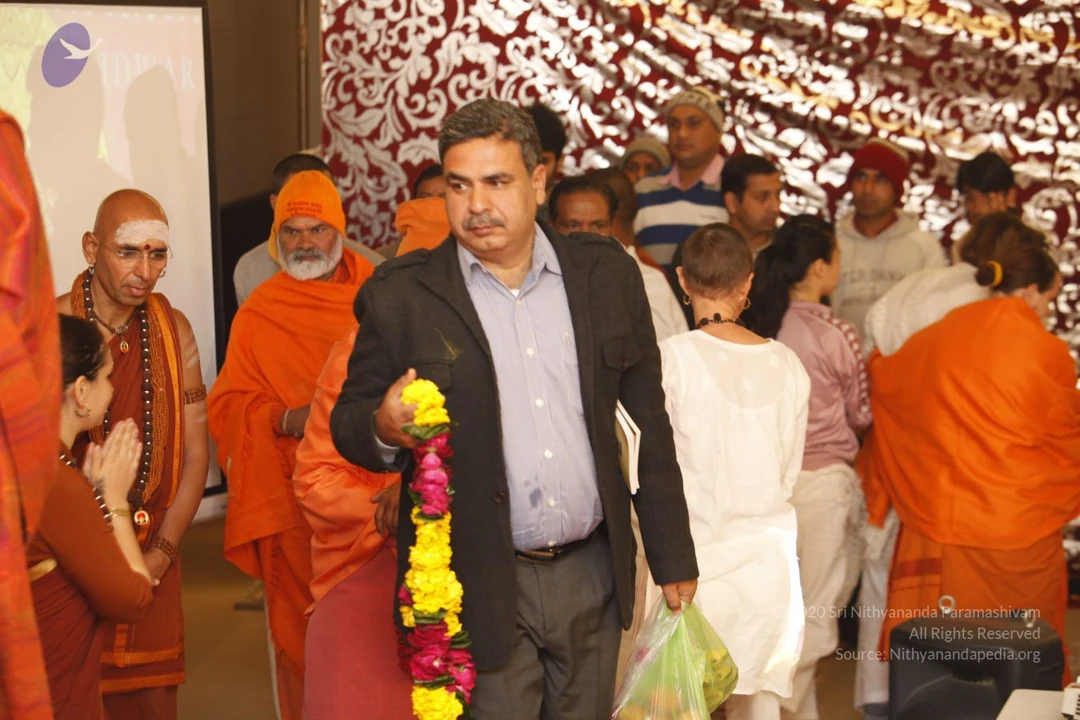
20 photosSource gallery
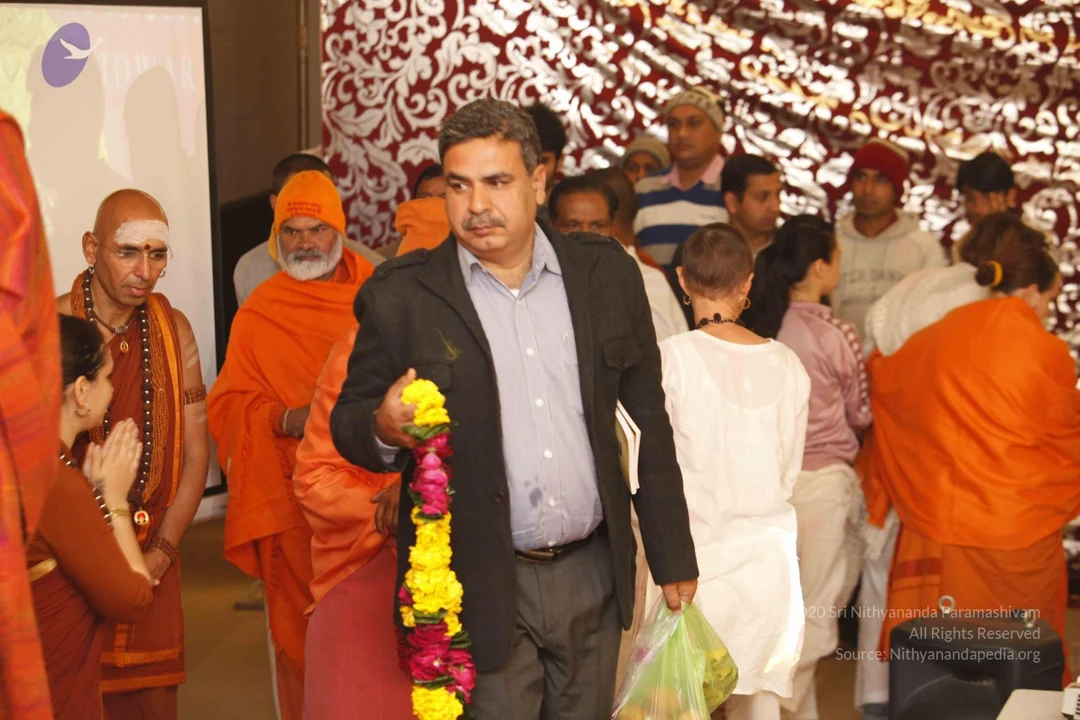
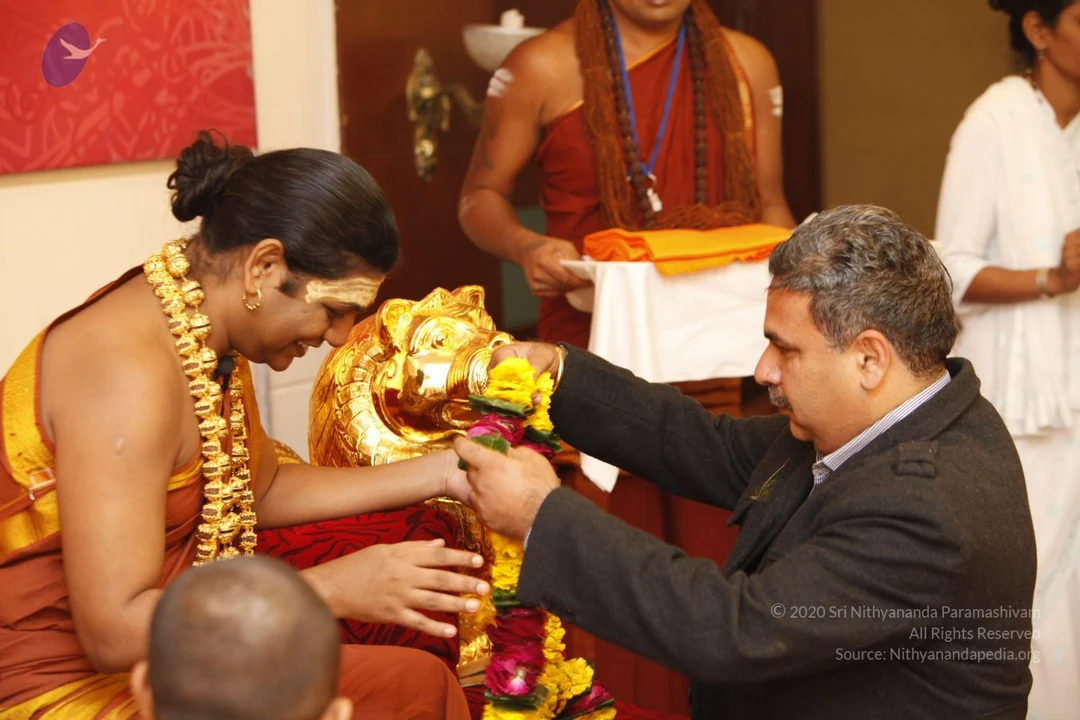
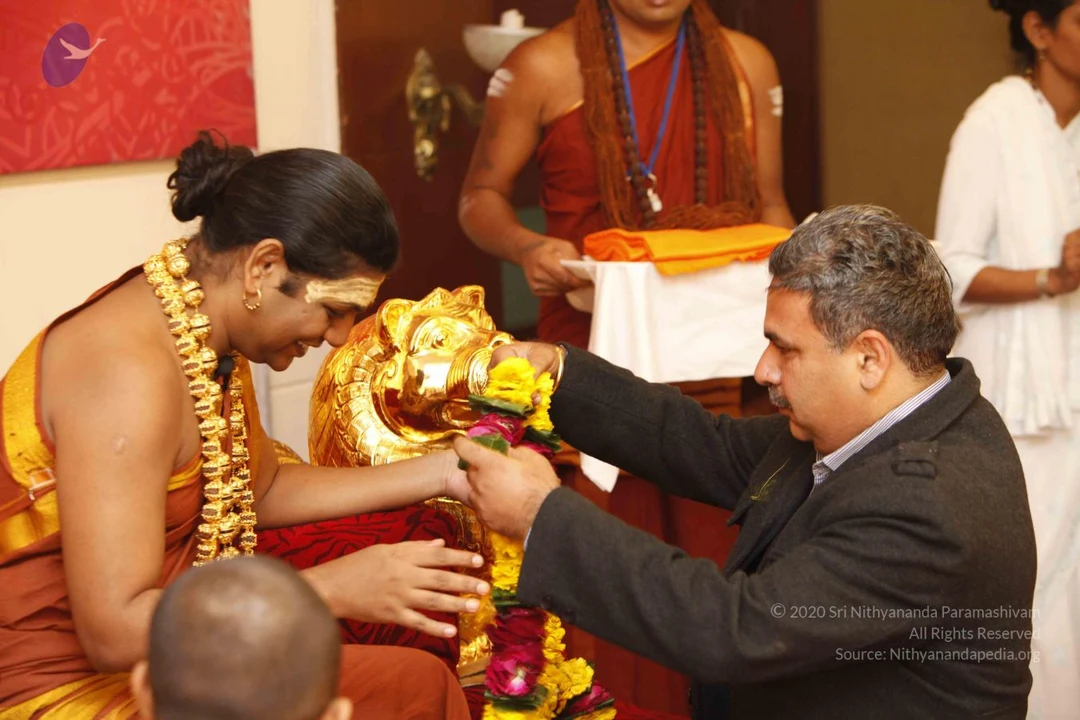
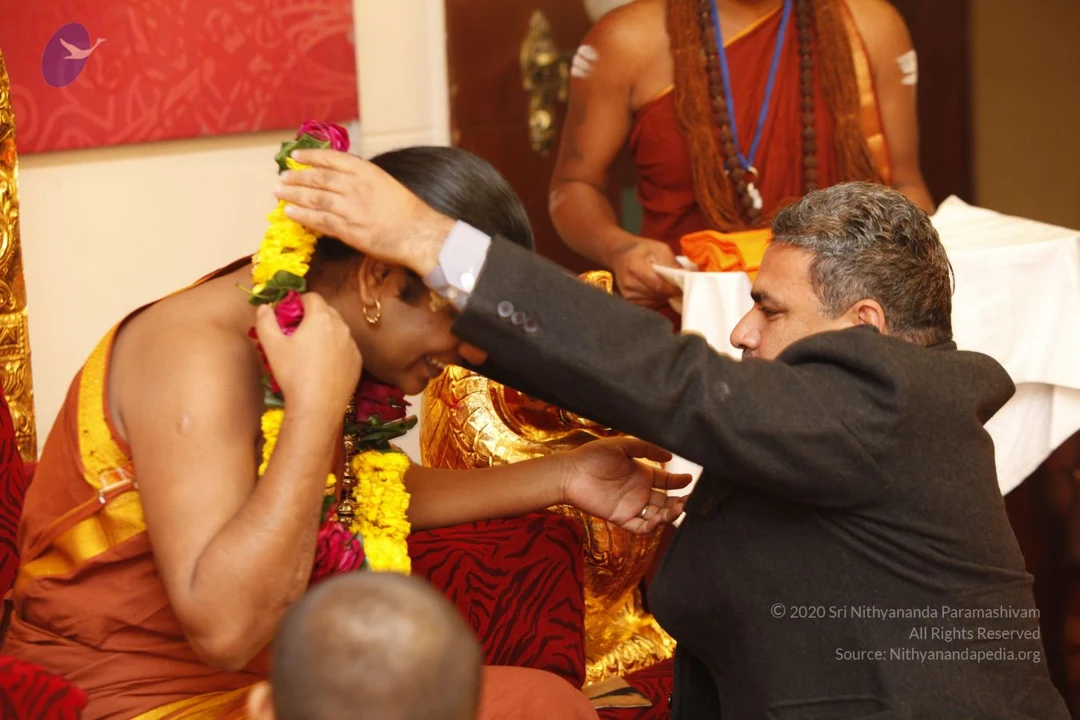
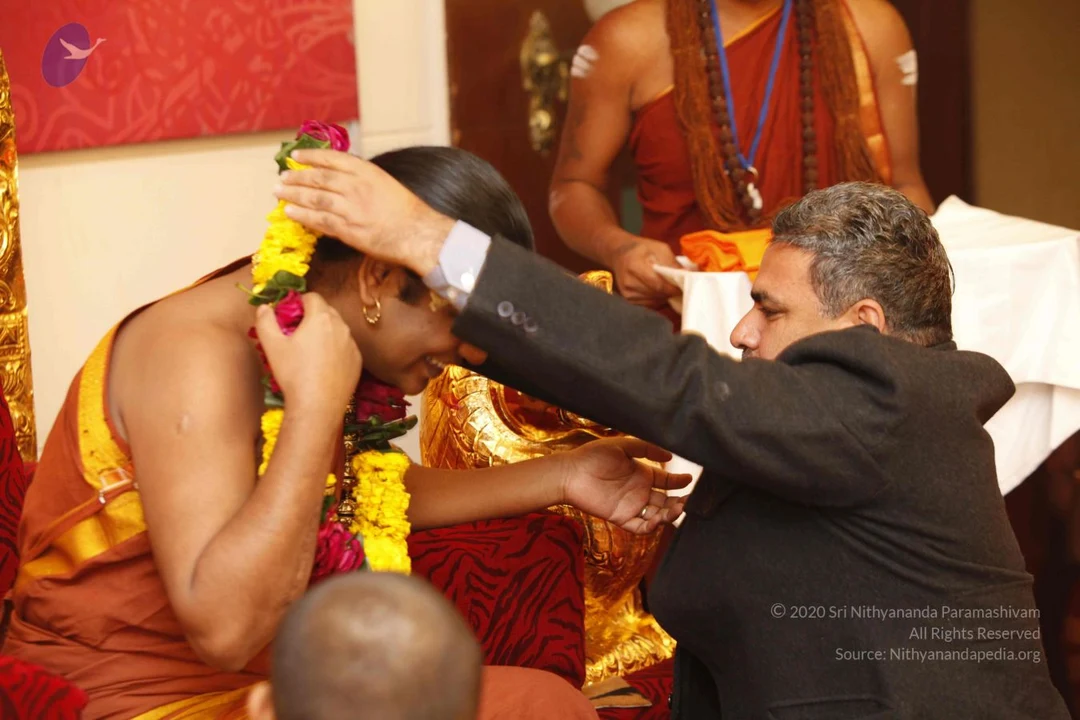
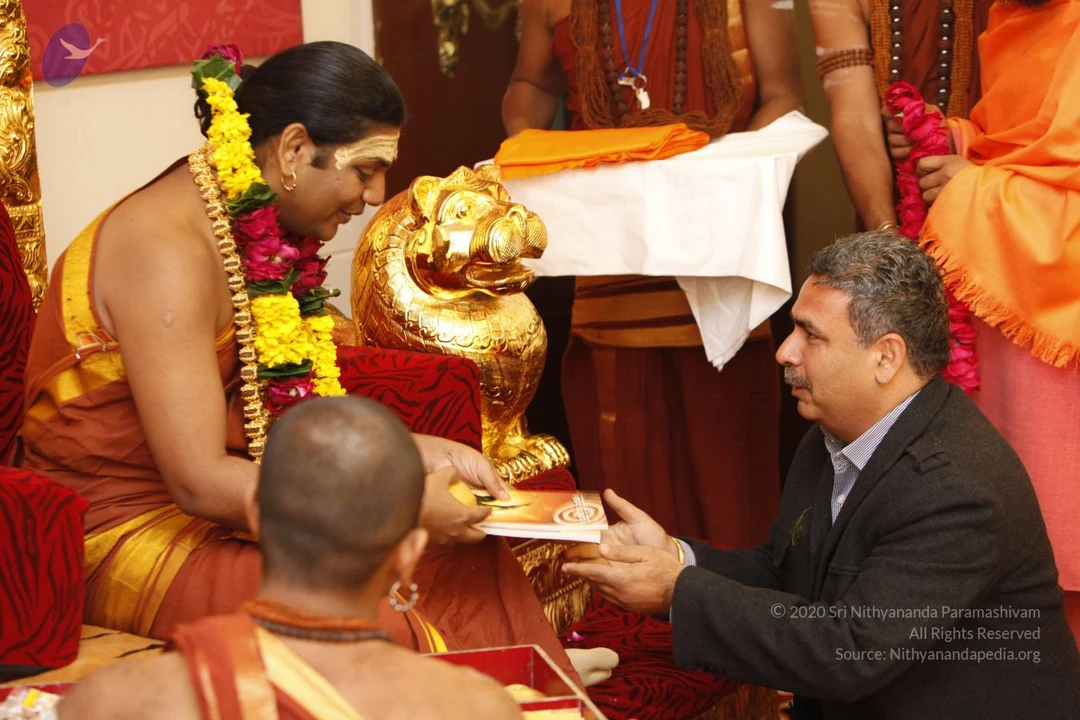
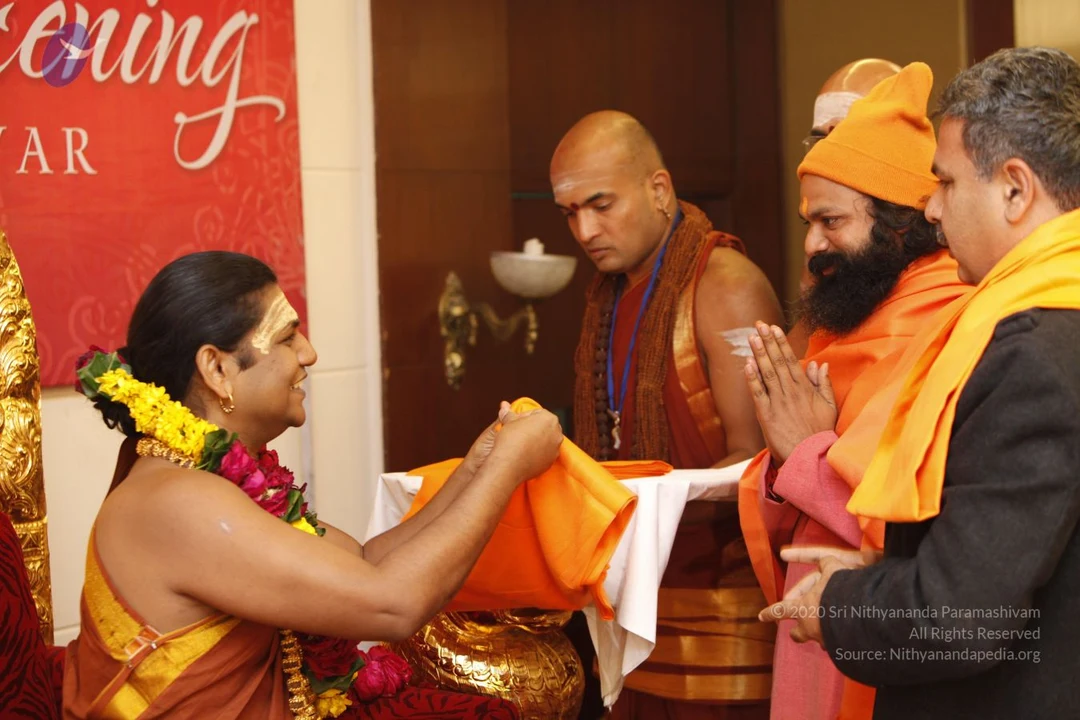
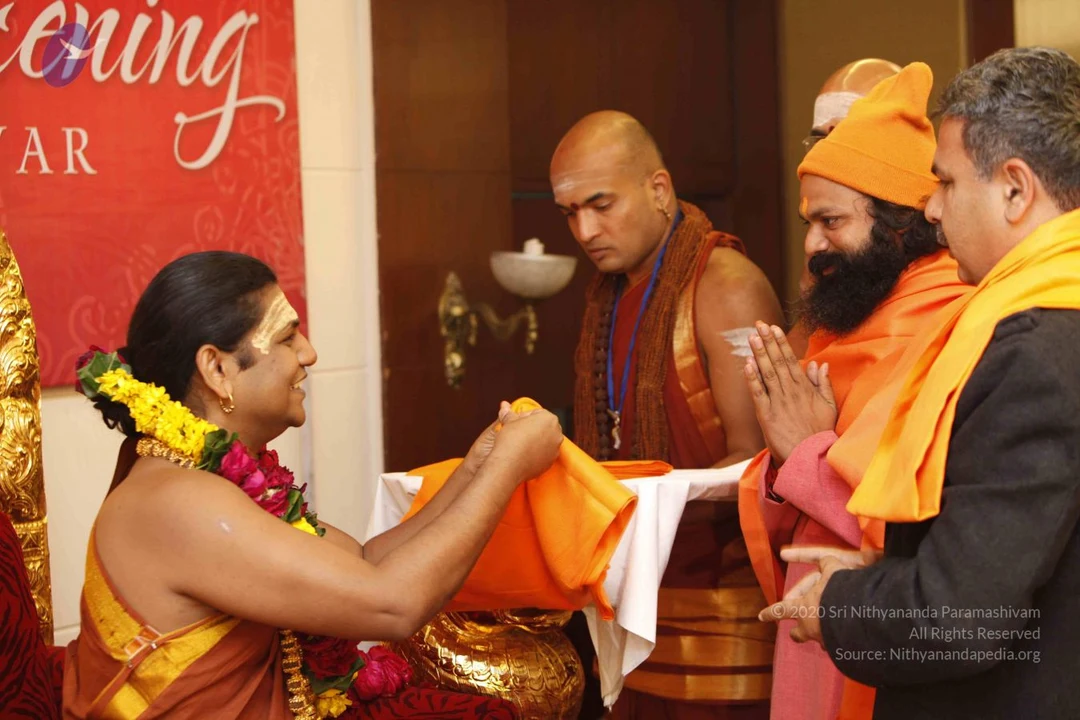
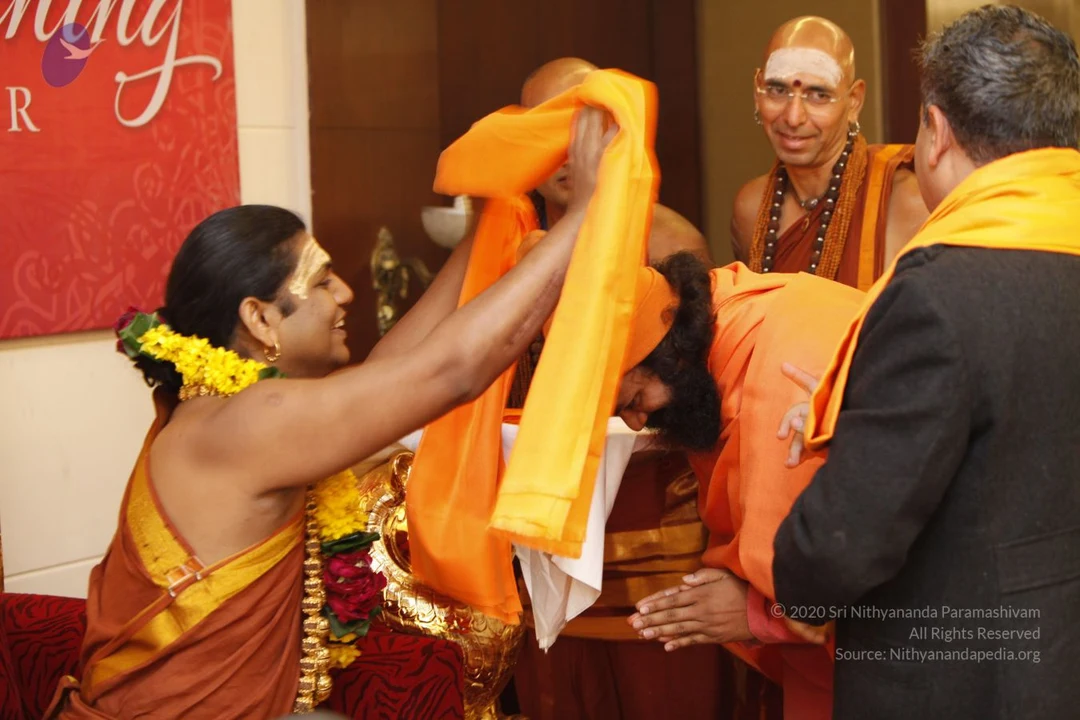
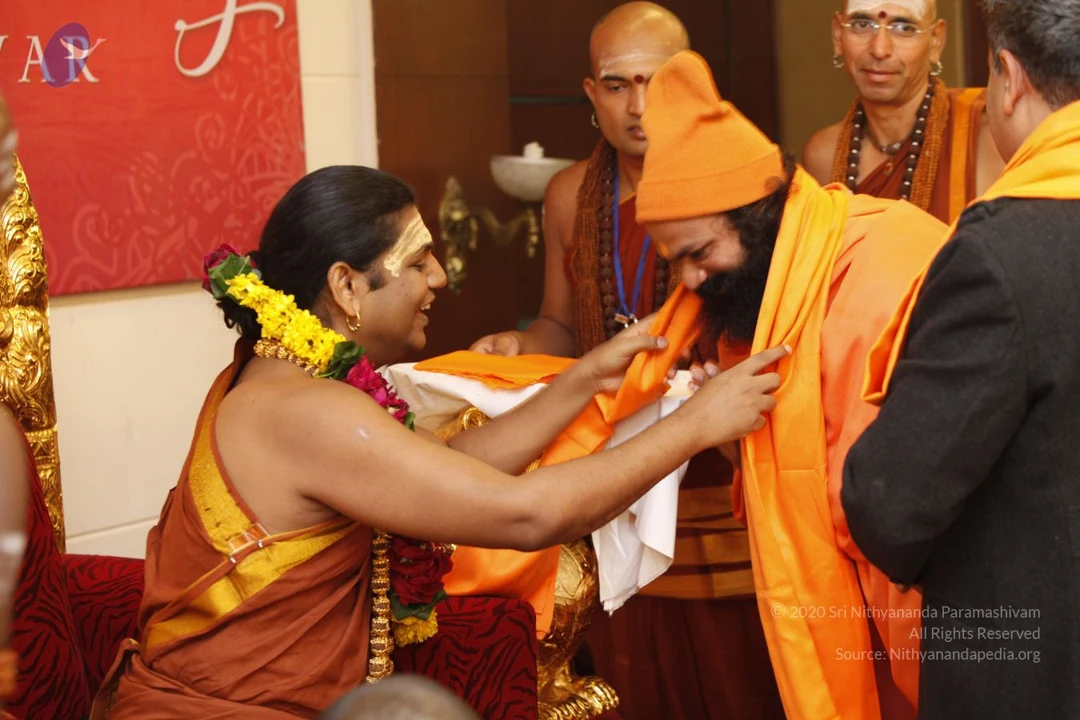
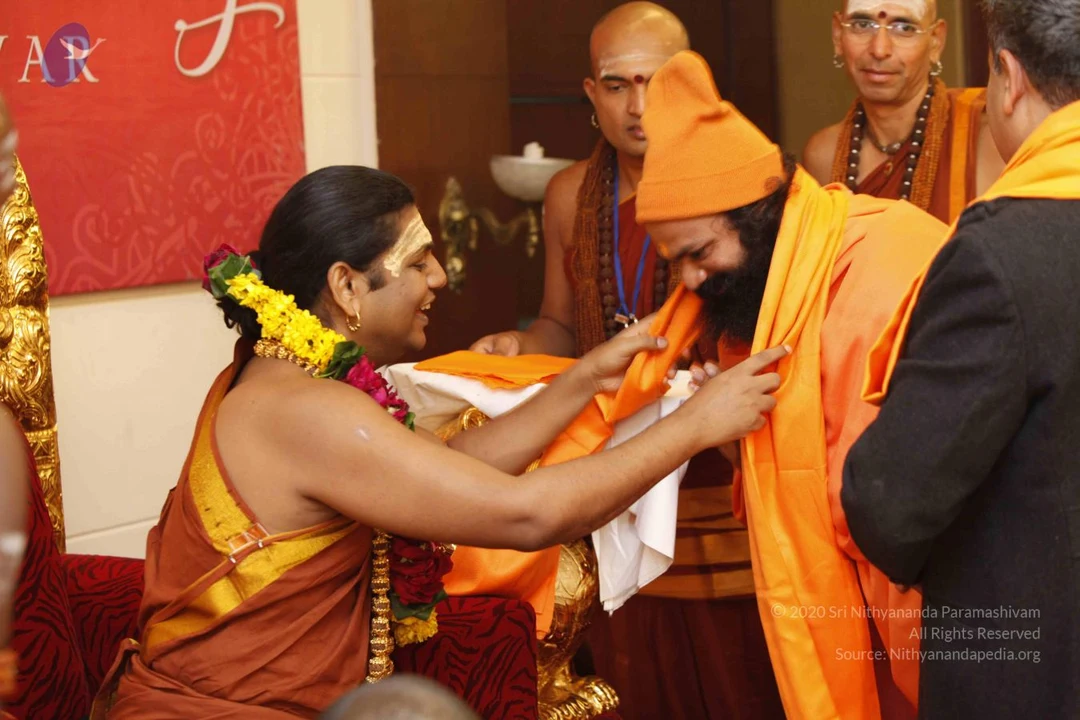
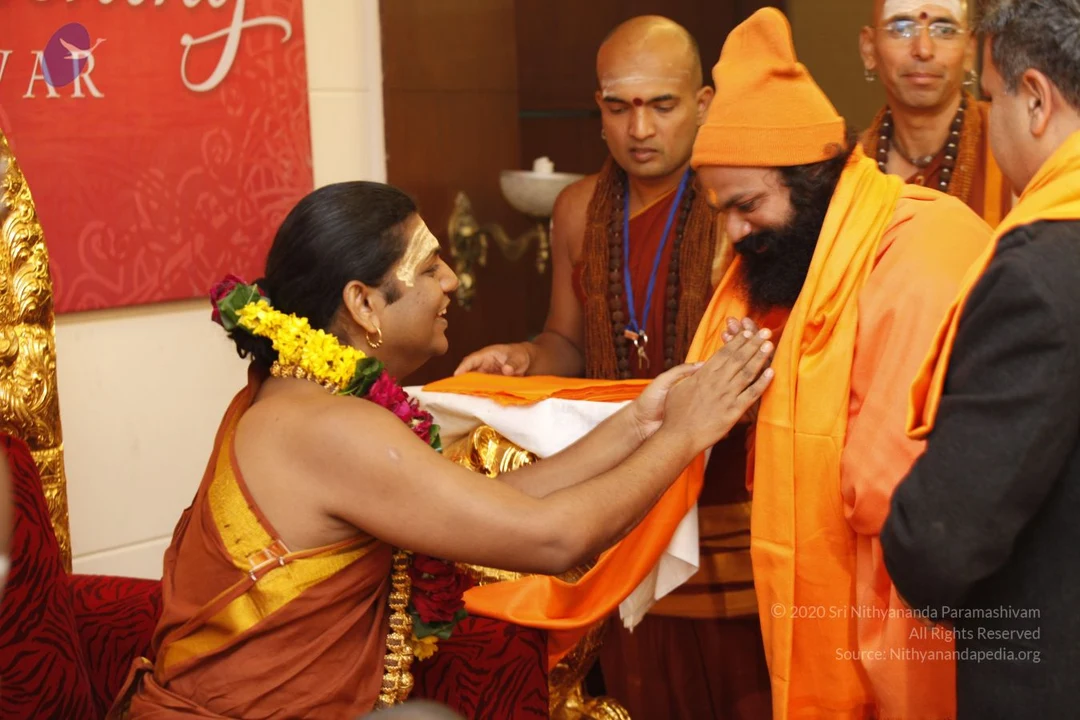
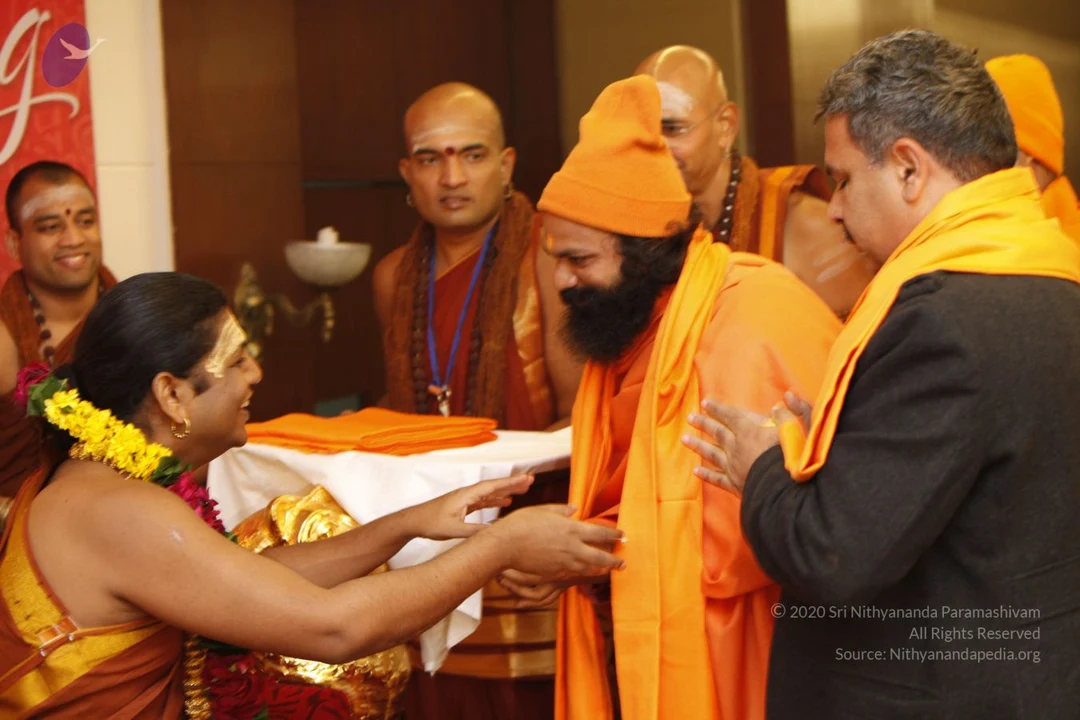
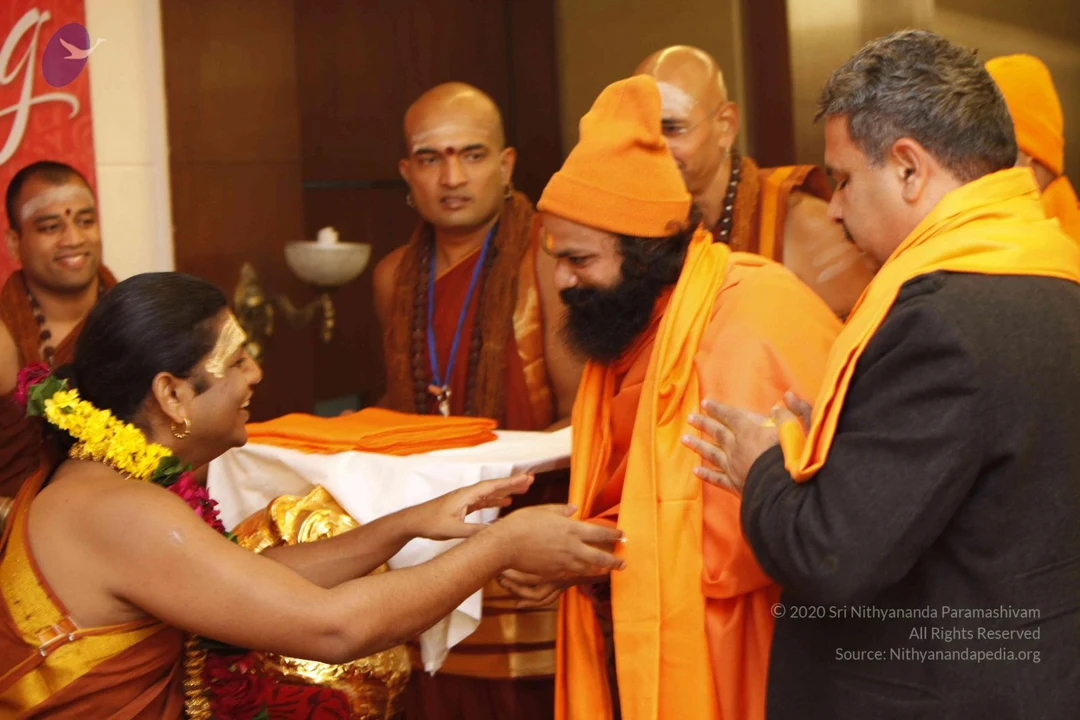
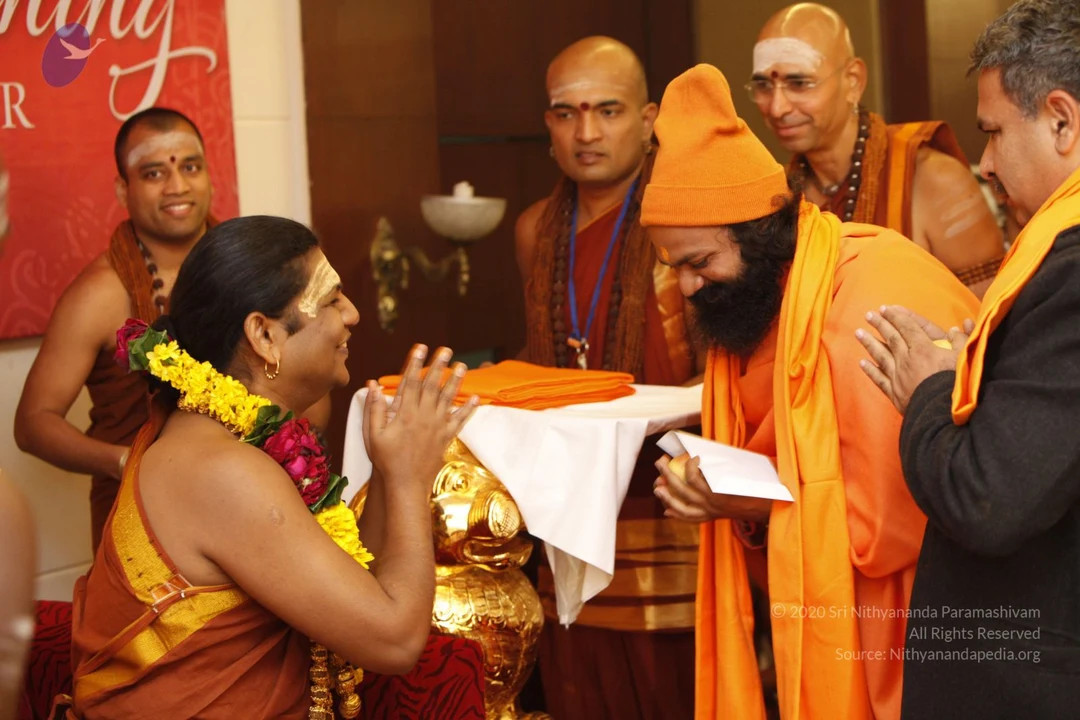
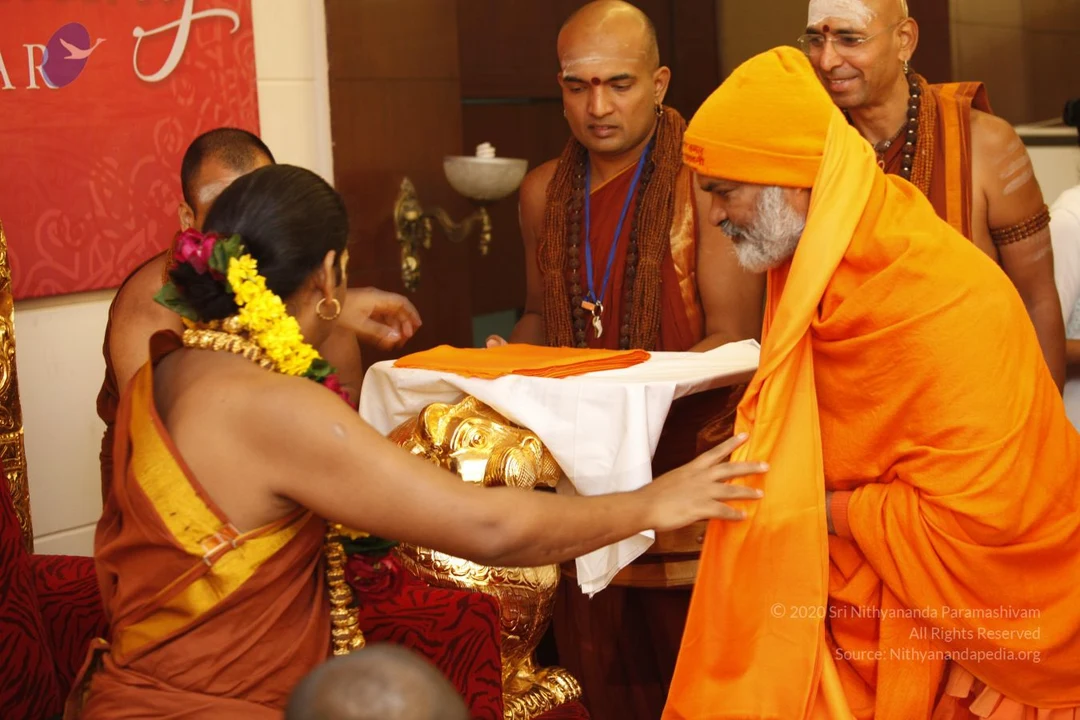
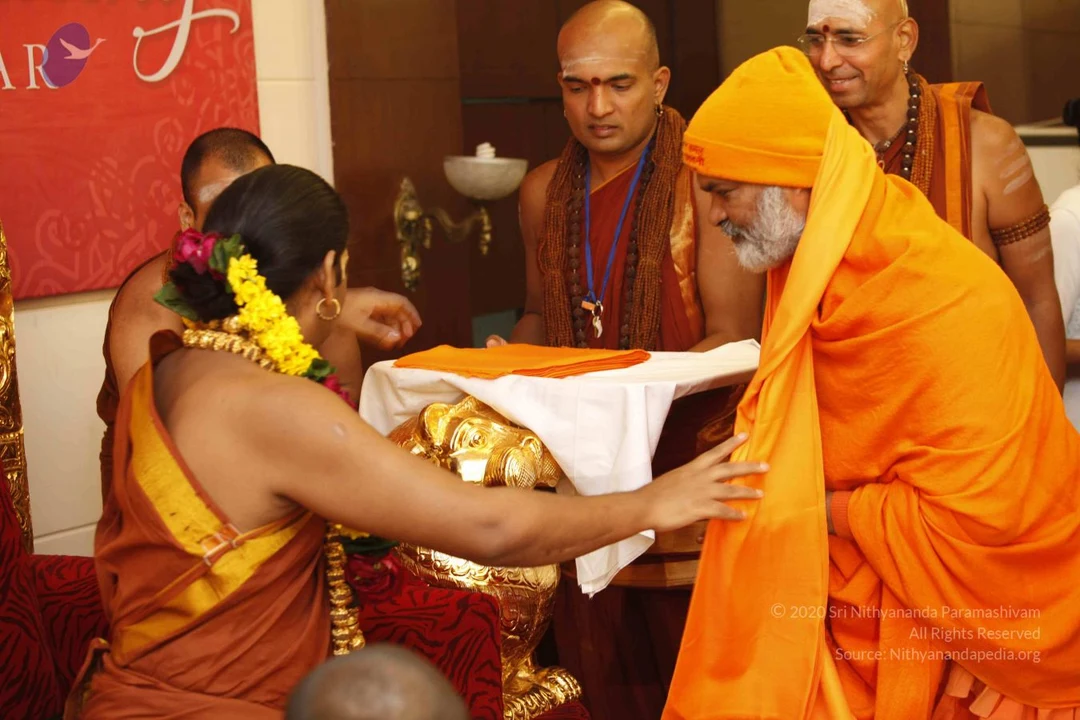
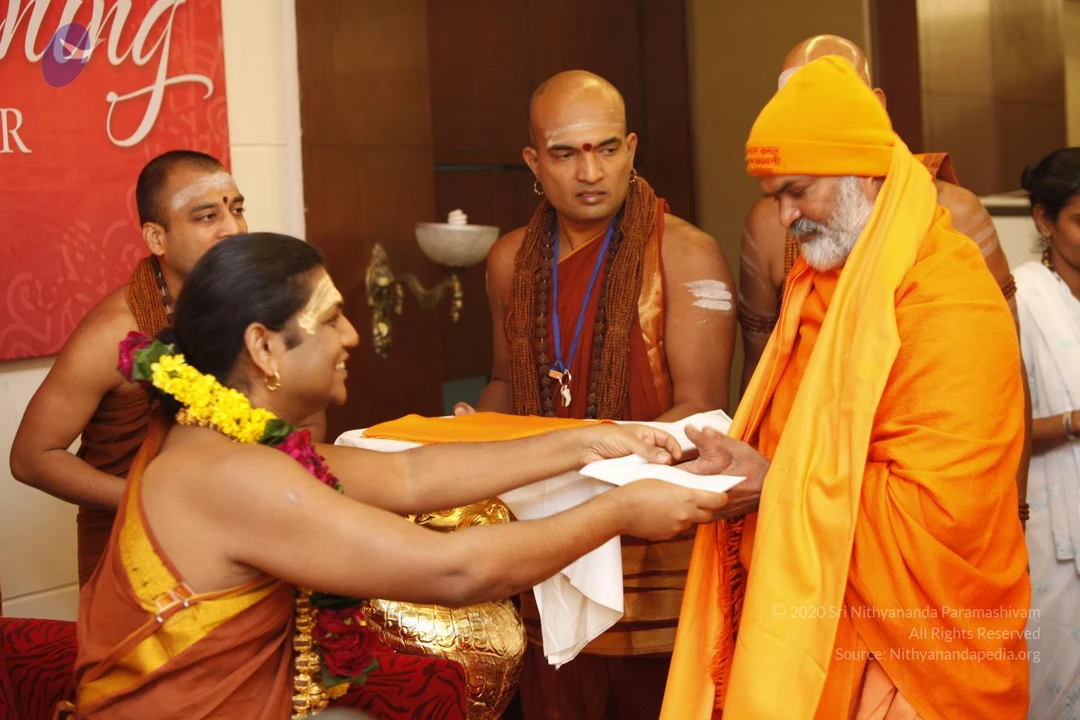
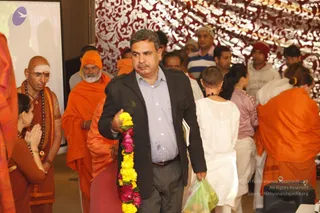
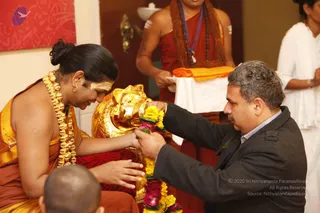
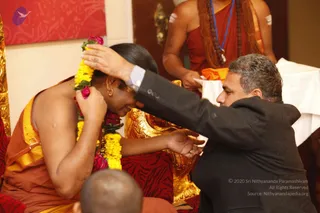
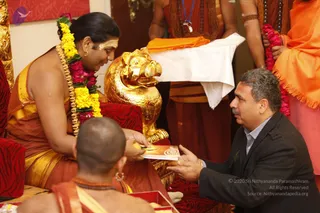
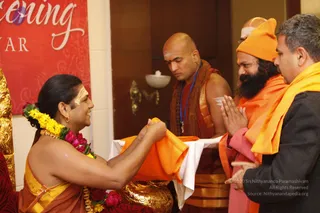
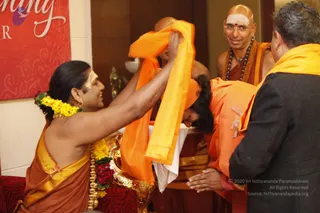
A photograph of an indoor gathering where a man in a dark blazer, light blue shirt and grey trousers walks forward holding a long garland of yellow and pink flowers and a green plastic bag. Behind him stands a shaved-headed man in an orange-saffron wrap with a white horizontal forehead mark, a rudraksha mala and gold ornaments on the neck, with another elderly bearded man in saffron robe and orange turban beside him. A third figure in orange robes stands at right, and a woman in white with folded hands is at far left. Behind them a crowd of devotees in casual clothing, including a red-capped man and a woman in white, stands before a silver-and-maroon patterned wall. A projection screen at upper left shows a pale image.A photograph of a ritual offering in an indoor room. A woman in an orange and gold sari with a heavy gold necklace and a white-and-orange forehead mark bends forward and touches a golden lion-headed object, while a man in a dark jacket and striped shirt kneels and drapes a garland of yellow and magenta flowers over it. In the background a monk in orange robes with long matted hair and a blue lanyard holds a tray with an orange cloth, and a person in white stands at right. A bald head is partly visible at lower left. a person is not clearly identifiable in this frame.A photograph of a devotee bowing with head lowered while a man in a dark grey suit jacket places his hand on the devotee's head in a blessing gesture. The bowing devotee wears an orange-saffron garment with a gold border and a long garland of yellow and pink flowers around the neck. Behind them a golden deity murti or ornate golden seat is visible, and a second robed figure in saffron, with long matted hair and a beaded rudraksha mala, stands at the upper right beside a white-draped table. A bald head is visible at the bottom edge. The setting suggests a blessing ritual at a satsang.A seated figure in saffron-orange and gold-bordered robes, wearing a yellow and pink flower garland and a tilak on the forehead, receives a small book with a gold cover from a kneeling man in a dark blazer and striped collared shirt. The seated figure has a distinctive long swept-back hair style, but the appearance cues are insufficient for a confident identification, so the person is described by role as a seated guru receiving an offering. Behind them stand robed sannyasis in orange with rudraksha malas and a white-draped table. A golden lion-headed throne armrest is in front, with a bald priest in the lower left foreground.A woman with a bare upper body and a red-and-gold garment, wearing a marigold and rose garland and white tilak on her forehead, kneels and hands an orange cloth to a bearded man in an orange turban-cap and orange shawl, who presses his palms together. Beside them a shaved-headed man in a brown-and-gold shawl and blue lanyard stands near a gold kalasha on a white-draped table. Behind, another man in orange and a man in a dark jacket with orange shawl watch. A red banner with script lettering hangs on the left. The bearded man's presentation is not a confident match to the a person candidate cues, so the role is given as devotee.A photograph of a formal ceremony indoors. A woman in an orange and maroon sari with white tilak on her forehead and a yellow-and-red flower garland holds up a saffron-orange shawl over the head of a man in orange robes who bends forward, his long dark hair falling down. Behind them a bald man with white tilak, rudraksha mala and orange robes smiles. A gold-coloured vessel and flowers sit in front. At the right edge a man in a dark jacket with an orange shawl watches. A red banner with partial script hangs on the left wall.

Kalabhairava-Reading-and-Darshan
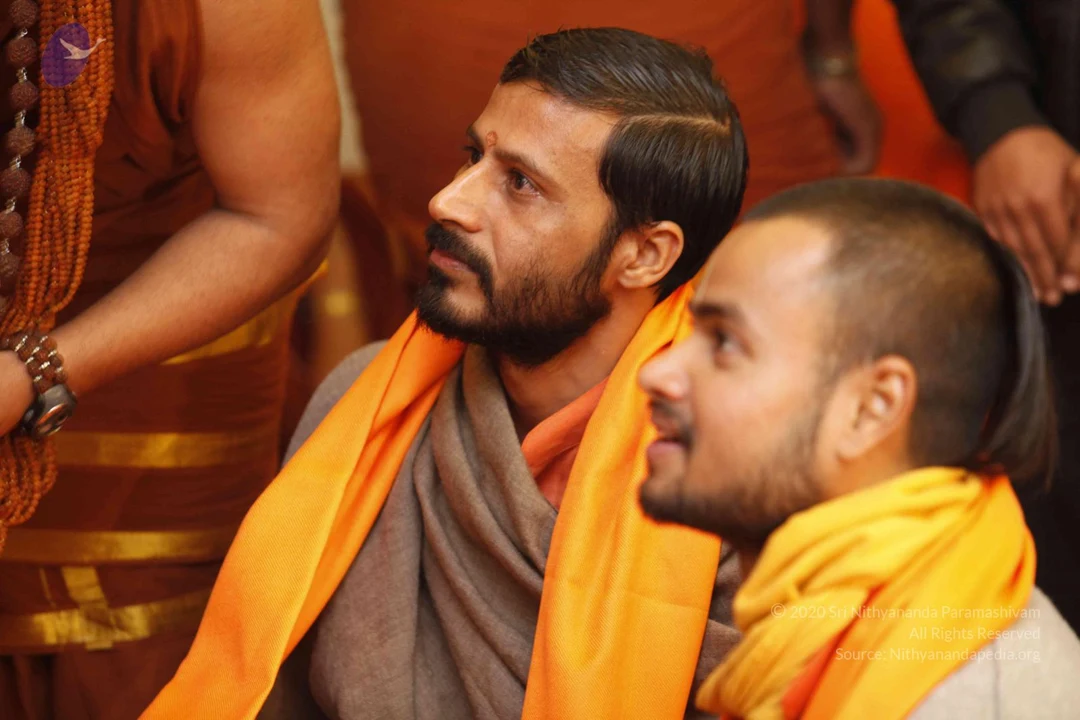
12 photosSource gallery
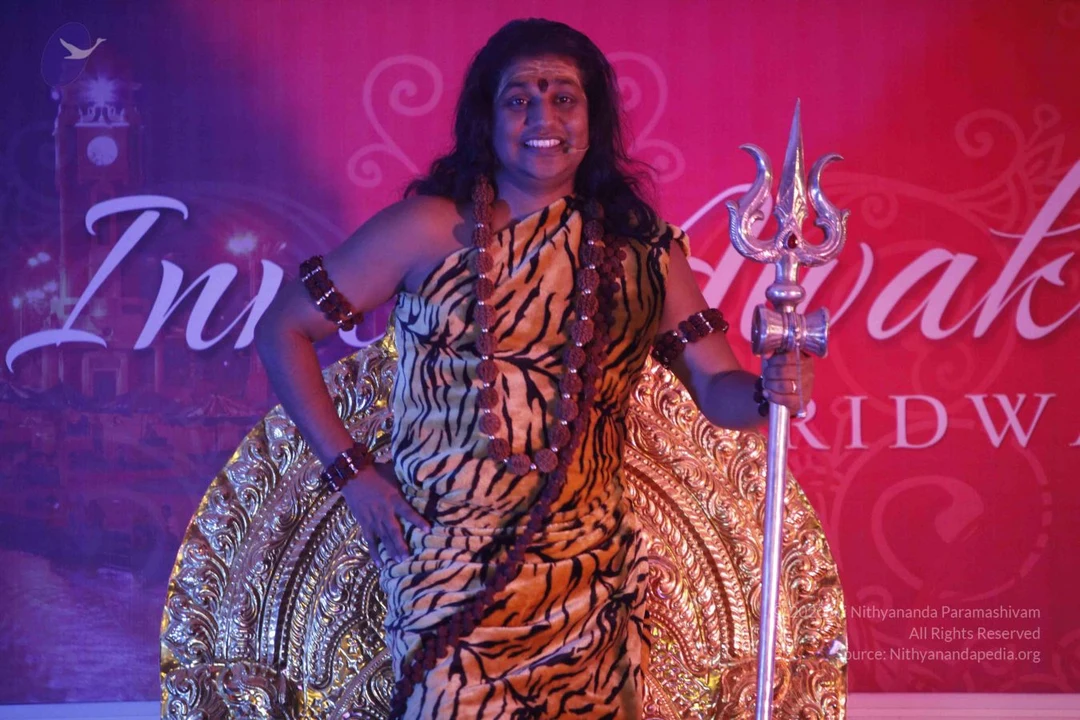
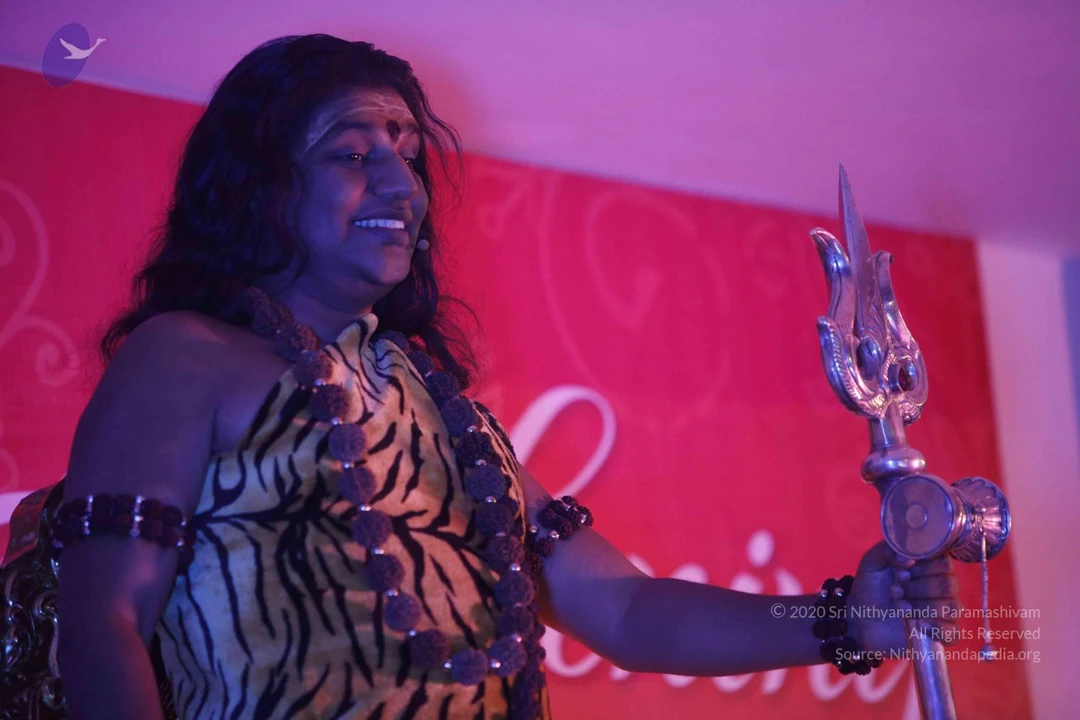
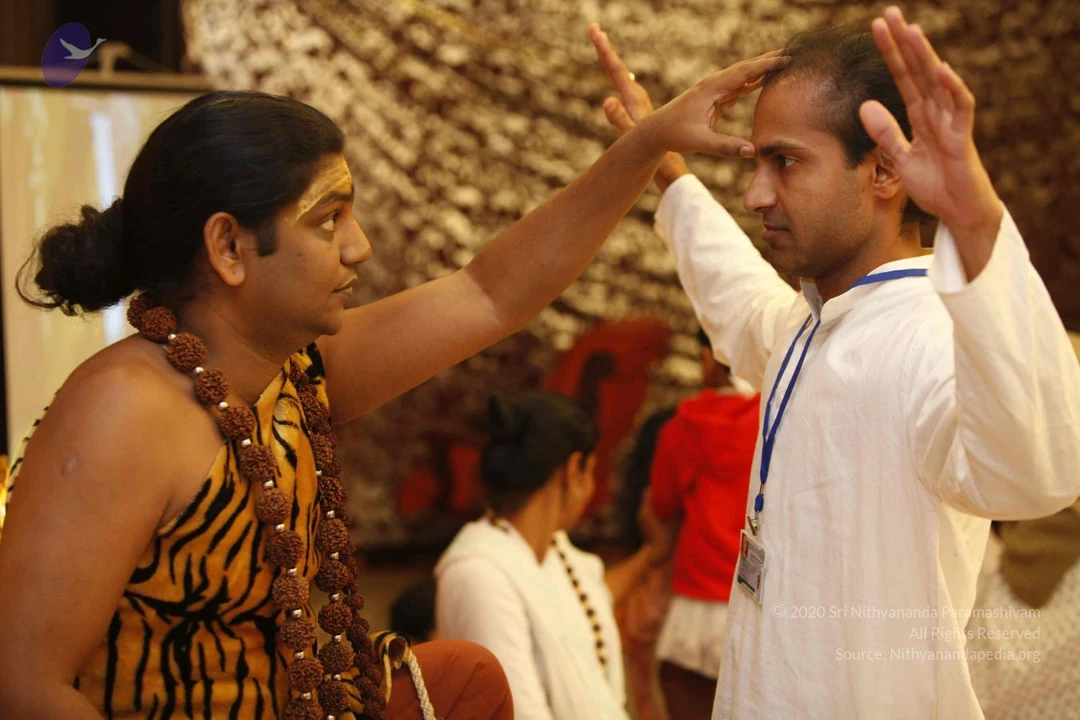
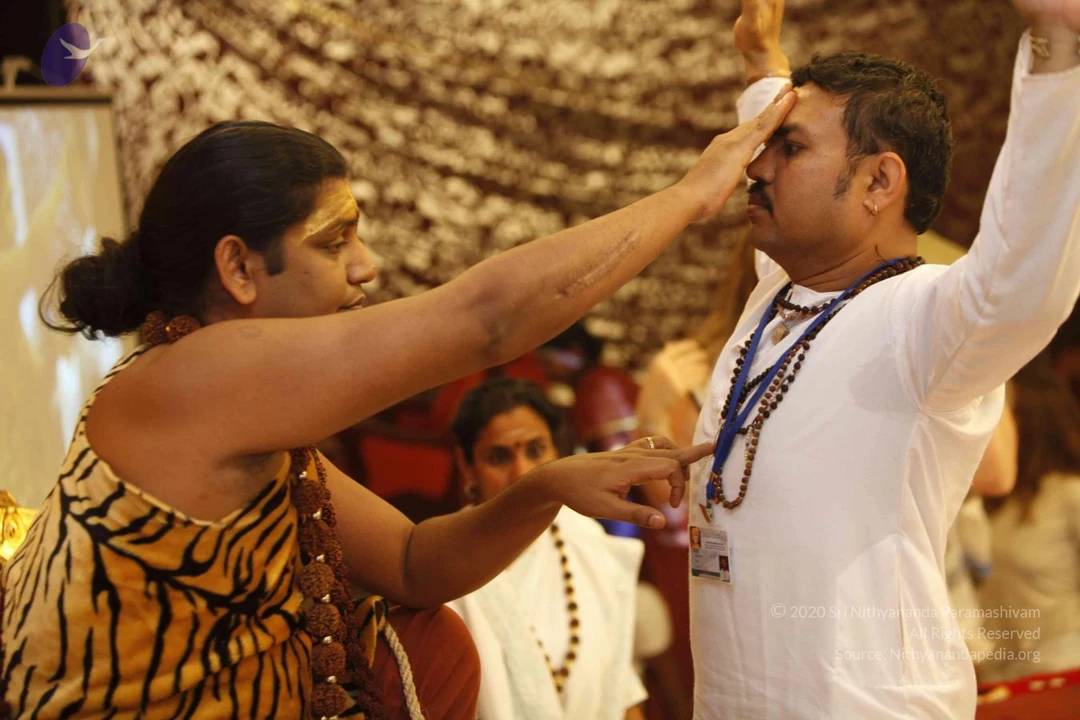
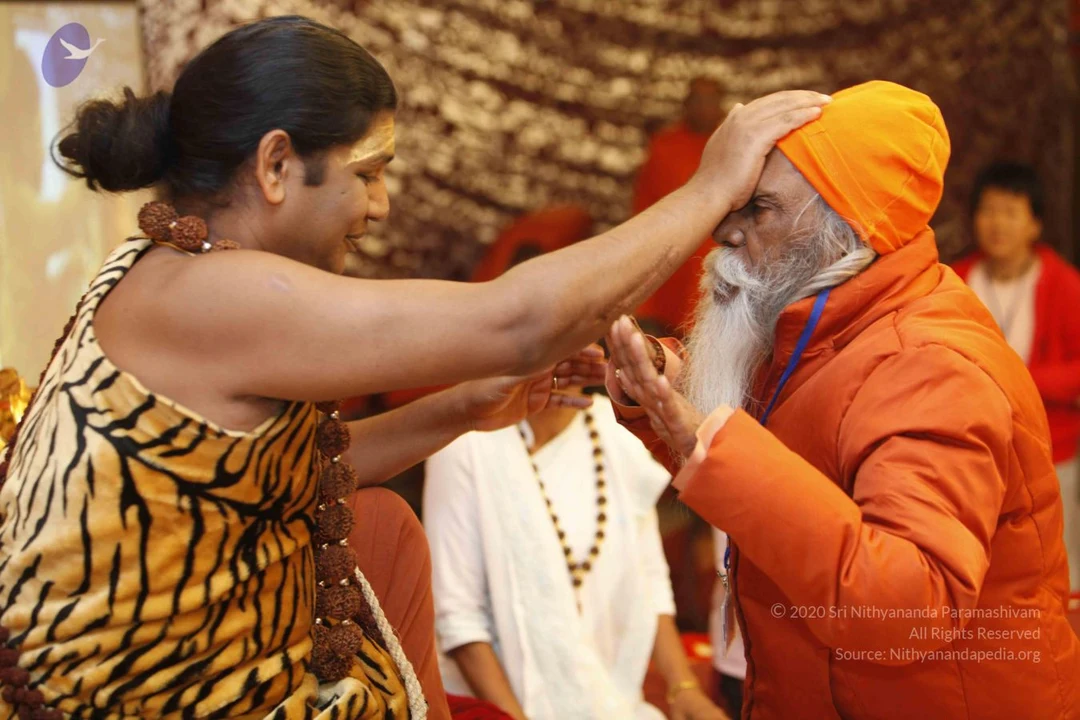
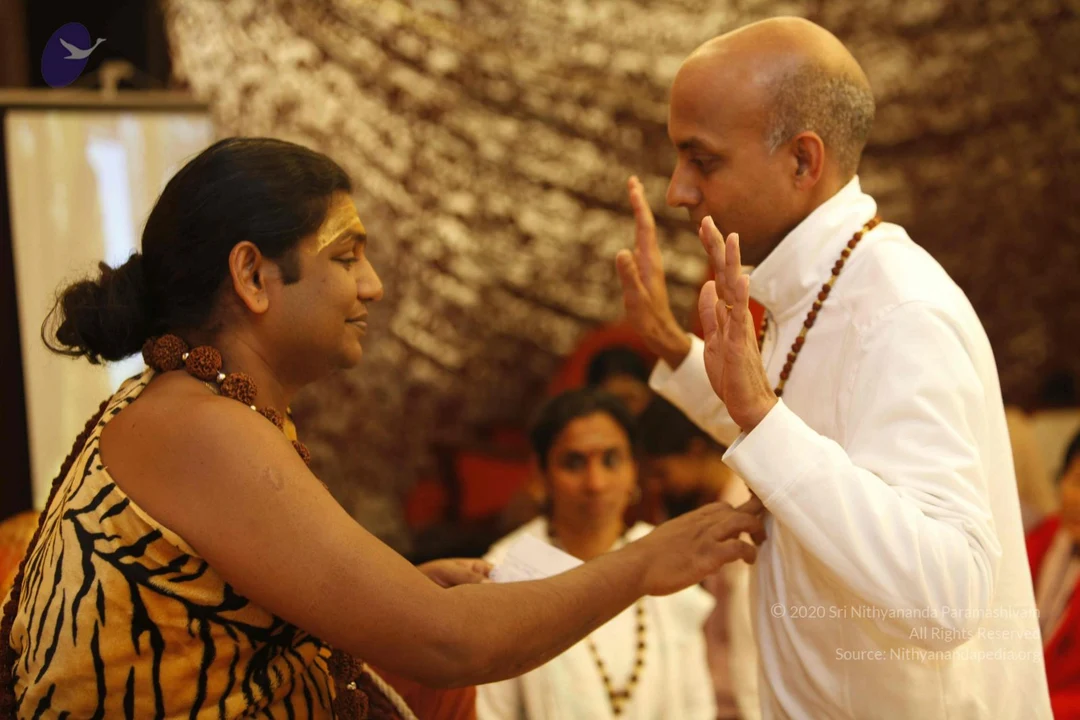
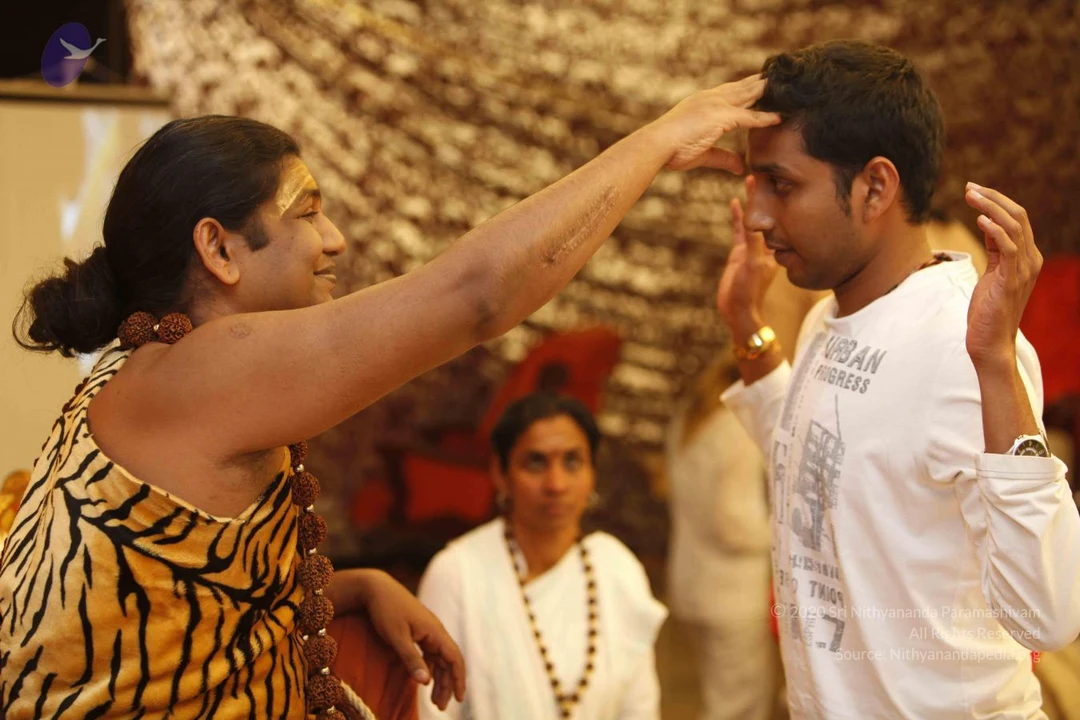
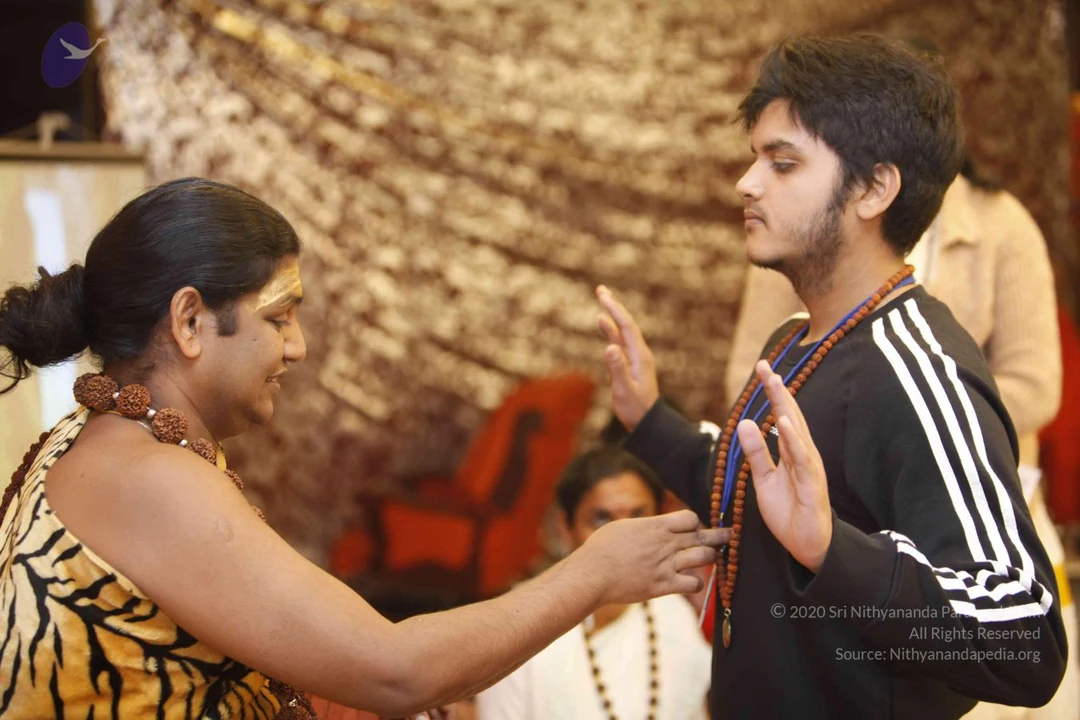
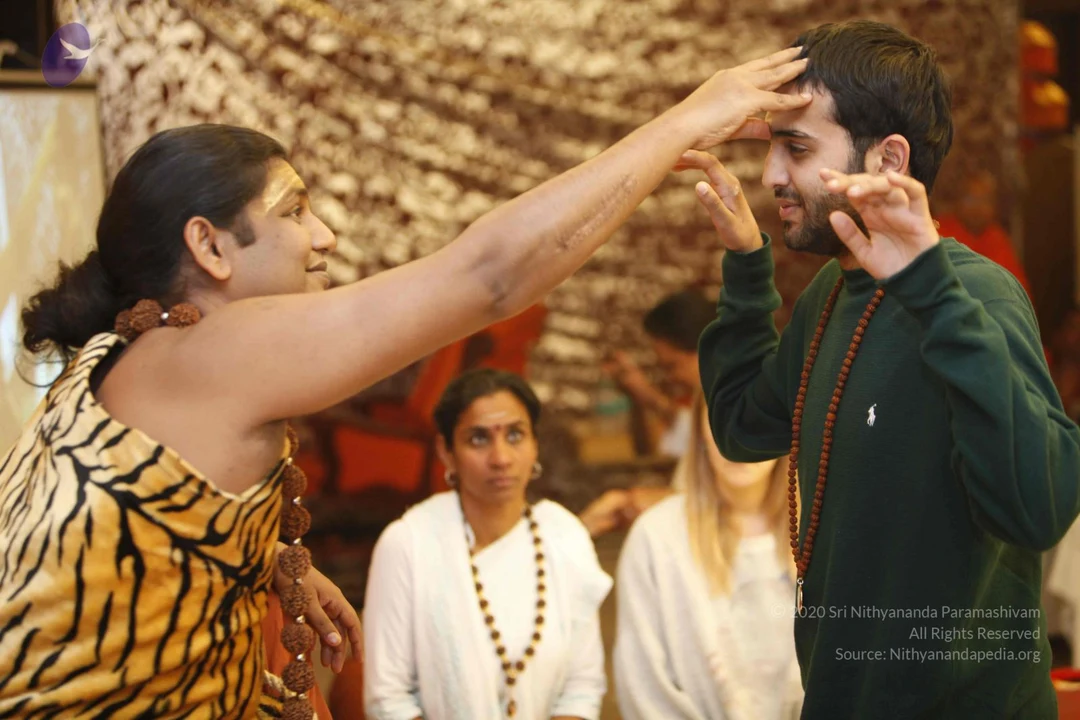
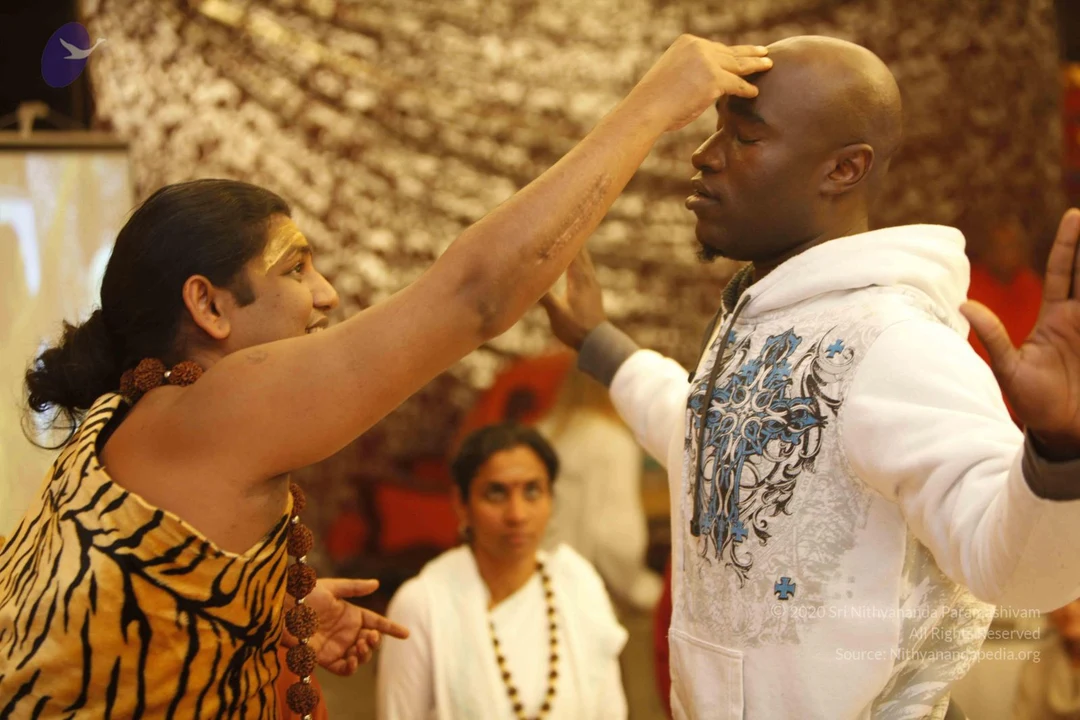
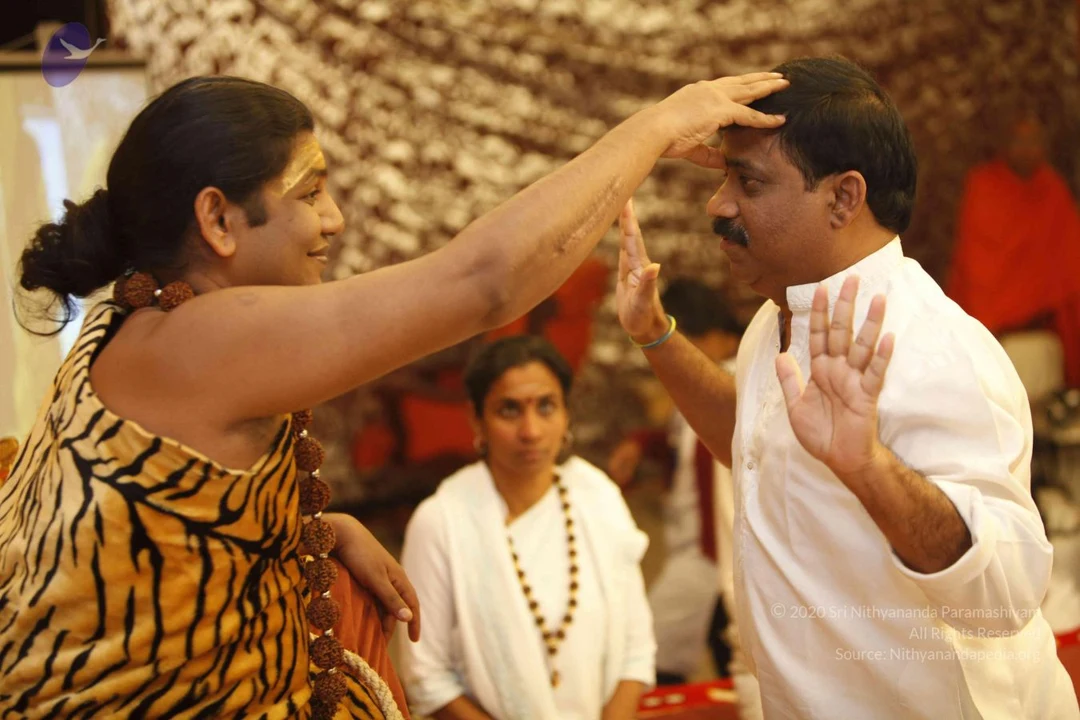
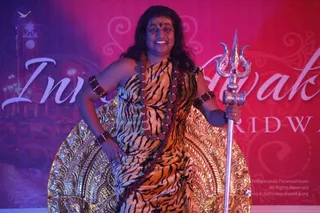
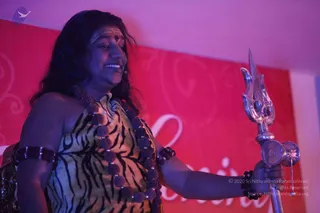
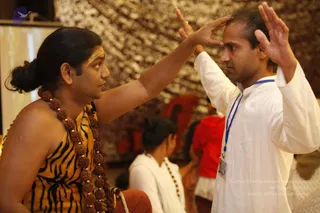
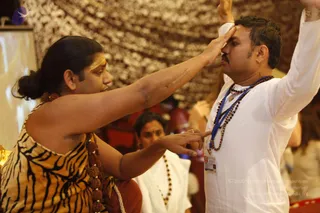
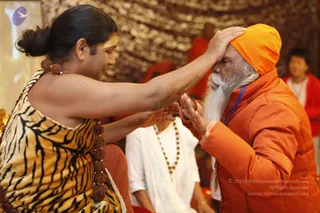
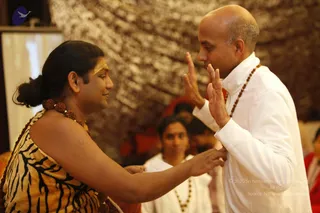
A man stands in front of an ornate silver-and-gold throne-like backdrop on a stage, smiling, with one hand on his hip and the other holding a polished silver trident. He wears a tiger-striped orange and black garment draped over one shoulder, long swept-back dark hair, a red bindi on his forehead, a long rudraksha mala around his neck, and beaded rudraksha bracelets on his arms. A pink-and-magenta banner behind him shows a clock tower and river scene with decorative lettering reading Inspi... and a partial word ending in ...akening and RIDWAR. The printed caption reads Nithyananda ParamashivamA photograph of a person seated on a dark ornate chair against a bright red backdrop with white scrollwork. The person has long dark hair, a white tilak on the forehead, and wears a tiger-striped sleeveless garment with multiple rudraksha mala necklaces and rudraksha bracelets on the arm. They hold a polished silver trident with the right hand, looking down and smiling mid-speech. A small microphone is visible near the face. a person: the long swept hair, rudraksha malas and ornate tiger-print clothing and trident match the page's description of a speaking satsang, though the face is not used for identification.A photo of a satsang-style exchange. On the left, a man with long hair tied in a bun, wearing a tiger-striped saffron-and-black garment and a long rudraksha mala, extends his right arm and hand toward a man's forehead; he has a yellow mark on his forehead. On the right, a man in a white kurta with a blue lanyard and an ID badge raises both hands toward the first man. Behind them, a woman in white and a figure in red sit before a textured, cream-coloured wall. The left man has distinctive long hair, rudraksha beads and saffron-patterned clothing, so this is a person in person giving a blessing, but appearance alone is not conclusive.A photo of a satsang-style blessing. A bare-chested man with long hair tied in a bun, a yellow-and-black tiger-striped cloth draped over him, several rudraksha malas and a vertical tilak on his forehead, reaches out and presses his palm to the forehead of a man in a white kurta wearing a blue lanyard, rudraksha mala and an ID badge. The recipient has his arms raised. Behind them a seated woman in white with a mala watches, and a shimmering, sequined draped backdrop fills the background. The blessing gesture reads as a darshan-style forehead blessing. a person: the bare-chested man with his distinctive adornments and rudraksha malas is a candidate for the a person figure.A photograph of a satsang-style blessing. A young man with dark hair in a low bun, a sandalwood mark on his forehead, rudraksha malas around his neck and a tiger-striped saffron-and-black shawl draped over his shoulders, sits and presses his palm to the forehead of an elderly bearded man in an orange hooded jacket, an orange turban and a blue lanyard. The elder has his hands pressed together in front of his chest. Behind them, a seated person in white clothes wears a rudraksha mala, and more people in orange and red sit in the blurred background. The wall behind is a textured cloth backdrop. Appearance-based label: the young man in the tiger-striped shawl and rudraksha malas is a person (in person, giving the blessing), with the elderly devotee receiving it.Two men face each other closely indoors. On the left, a person with hair in a bun, a yellow turmeric or sandalwood mark on the forehead, and a rudraksha mala wears a tiger-striped shawl and is extending a hand toward the other man. On the right, a bald man in a white shirt and white trousers with a rudraksha mala raises both palms toward the left figure in a gesture of blessing or greeting. Behind them, a woman in white and other seated attendees in white and red sit before a textured stone-like wall, with a soft white panel at the left edge.
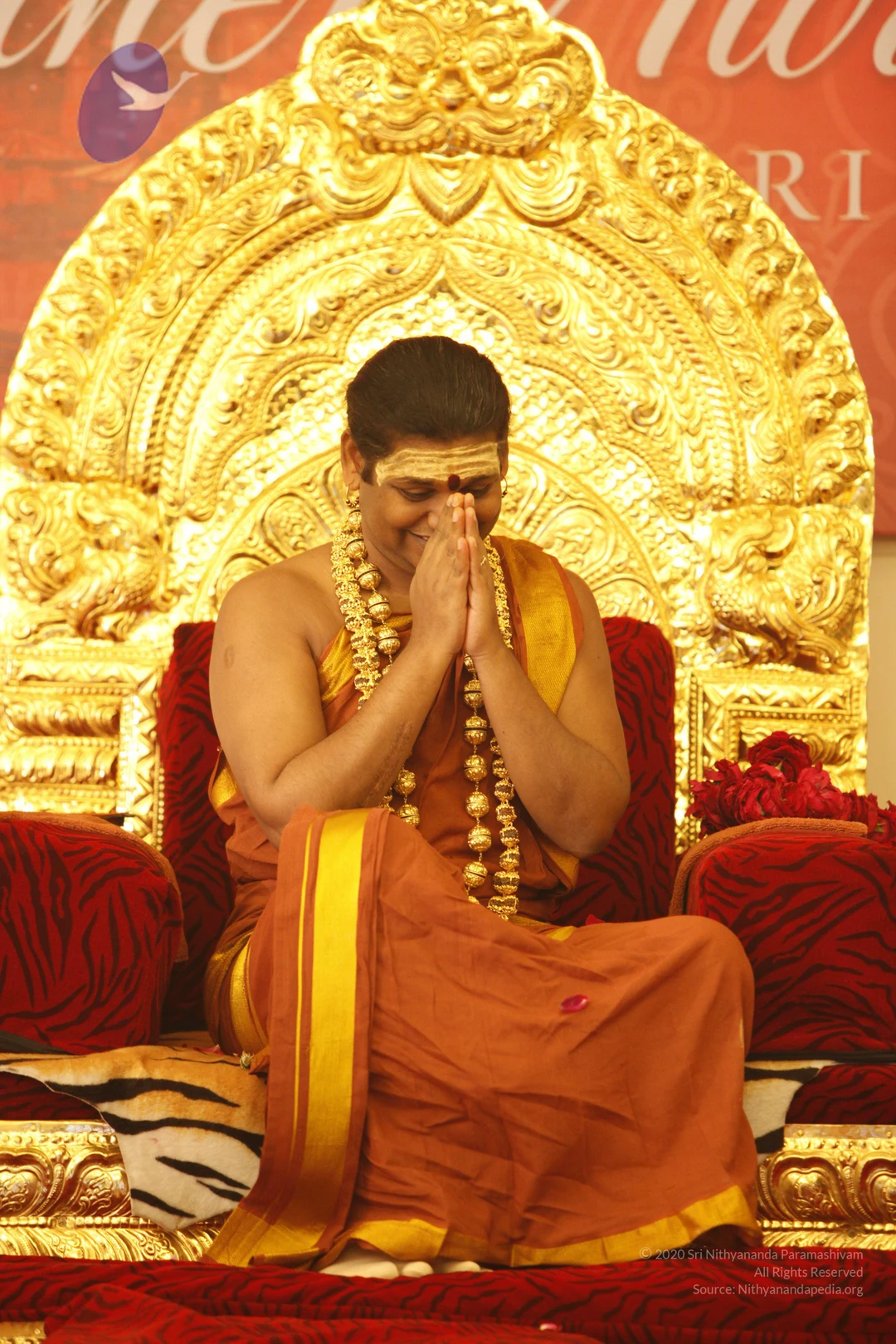
Ravidrapuri-MJ-Visit
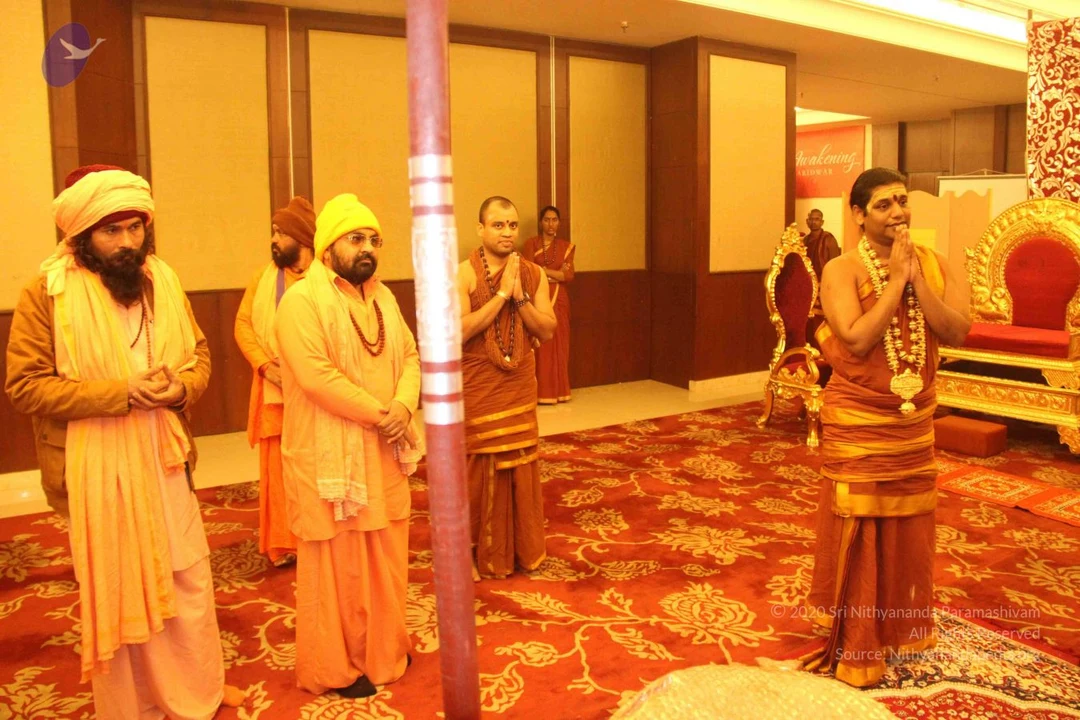
25 photosSource gallery
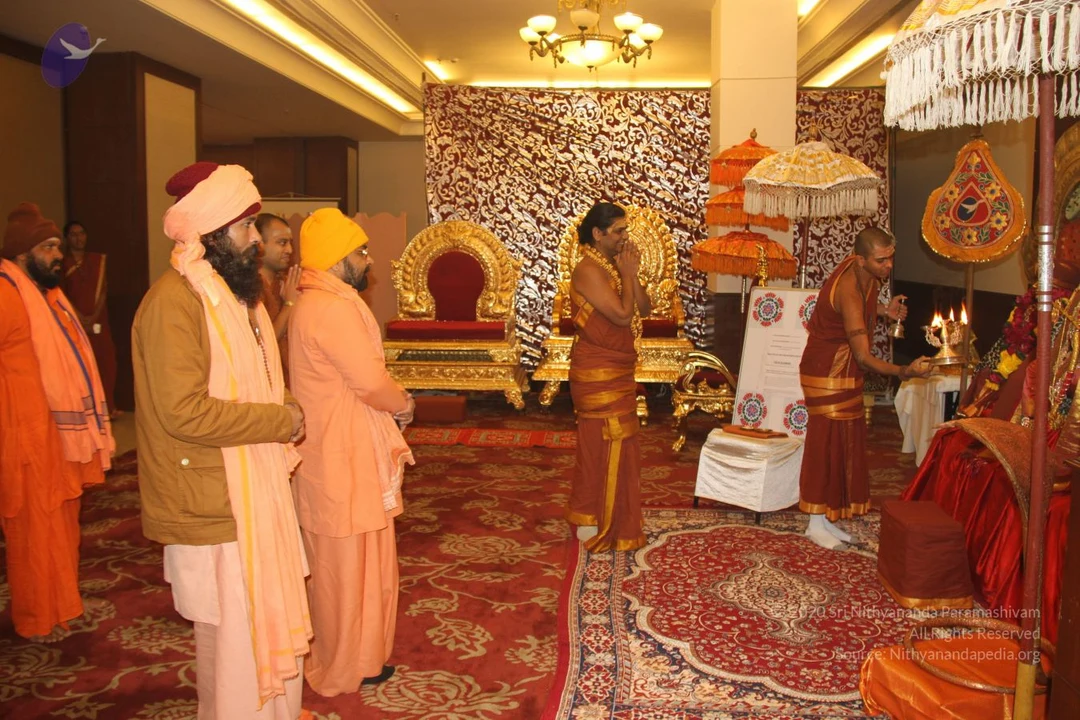
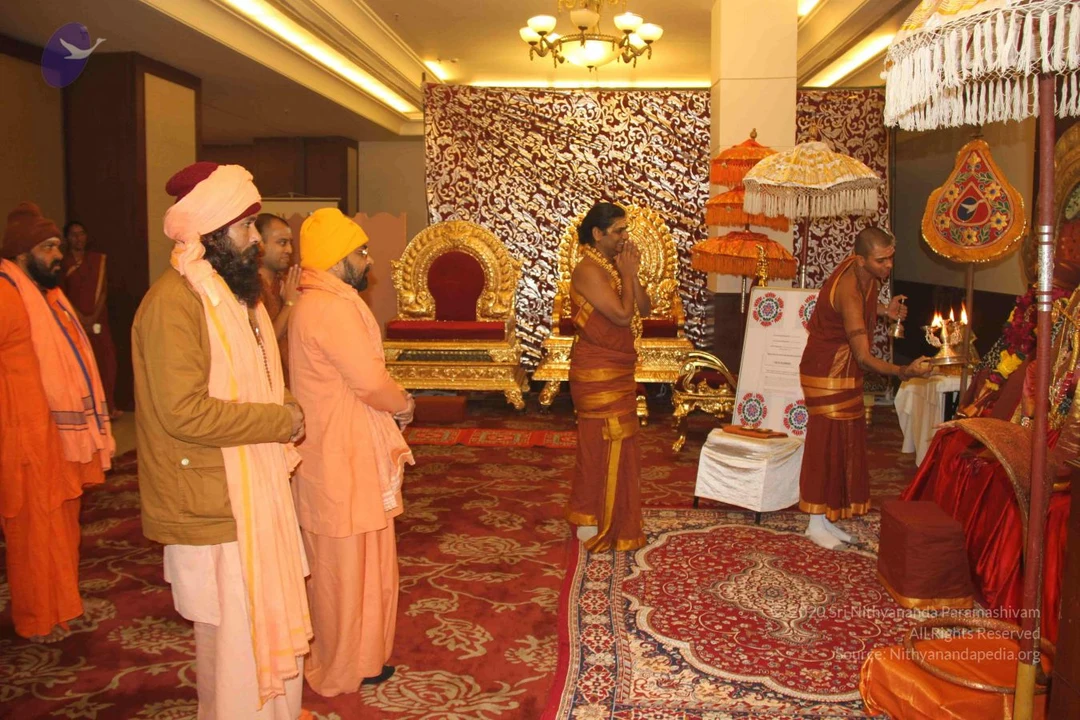
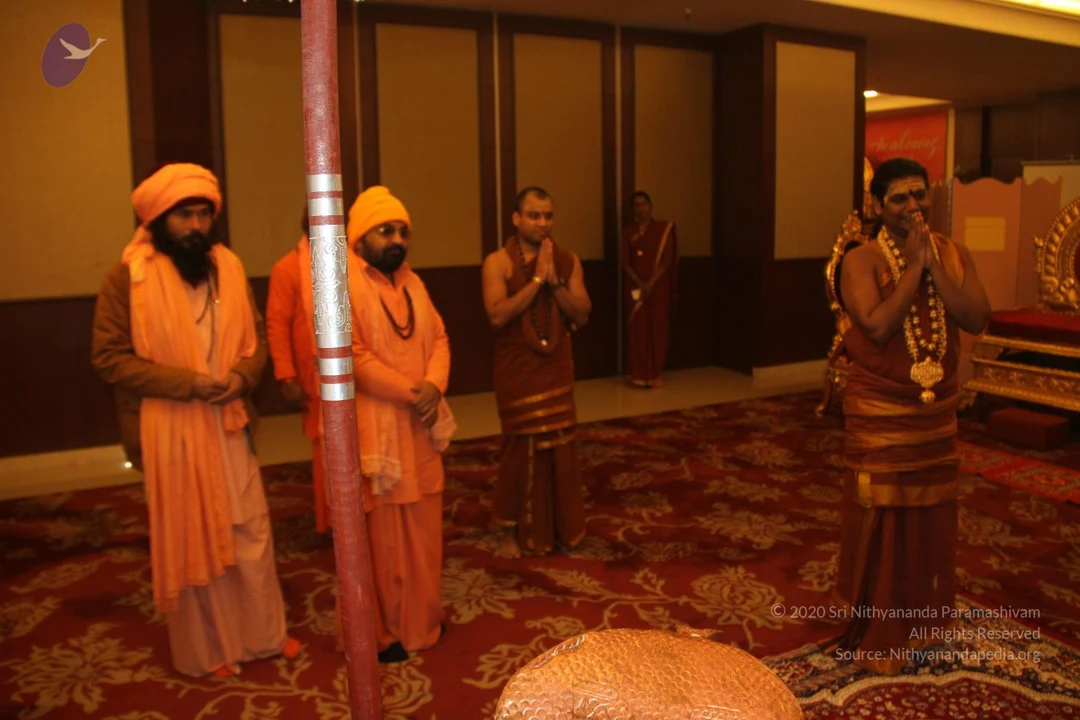
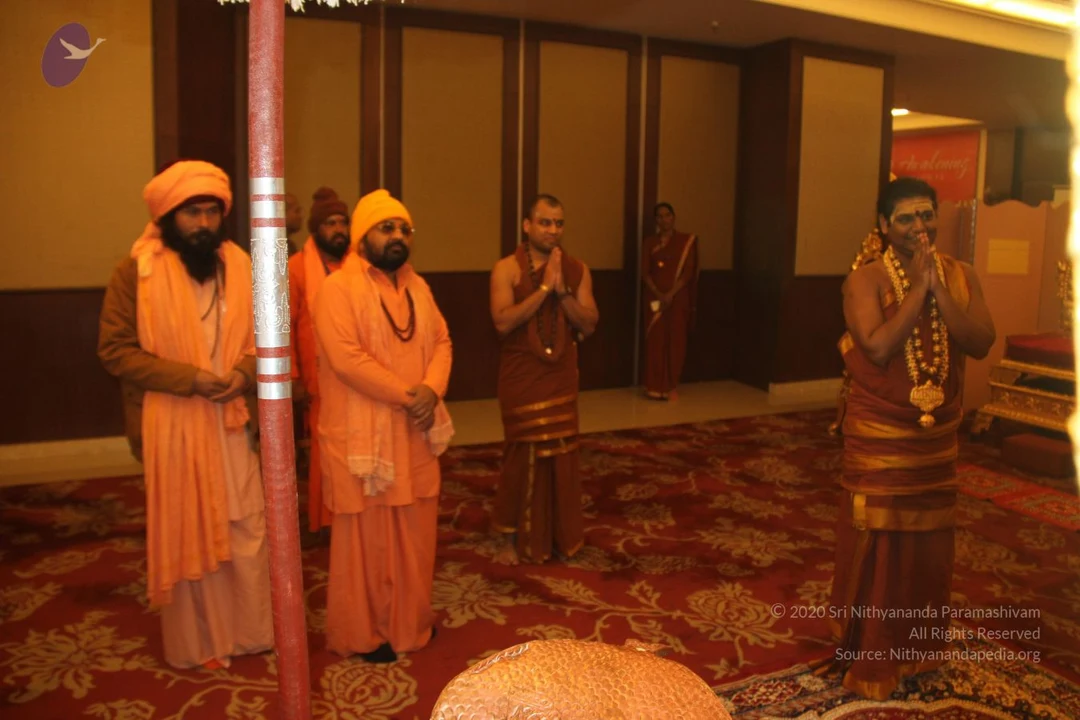
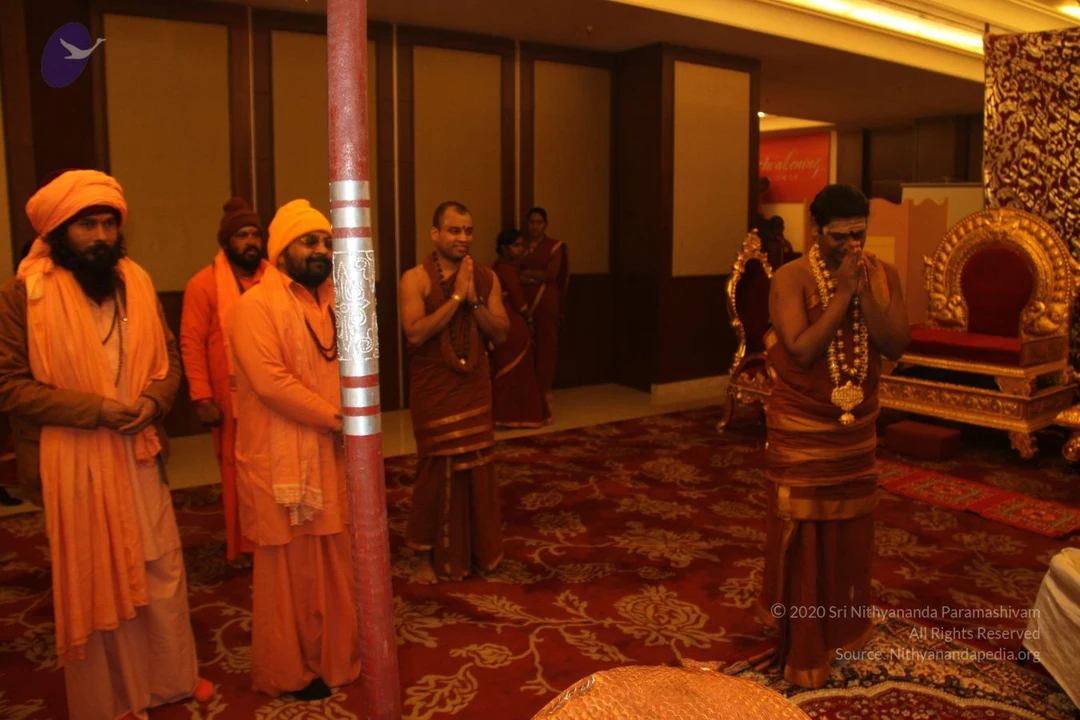
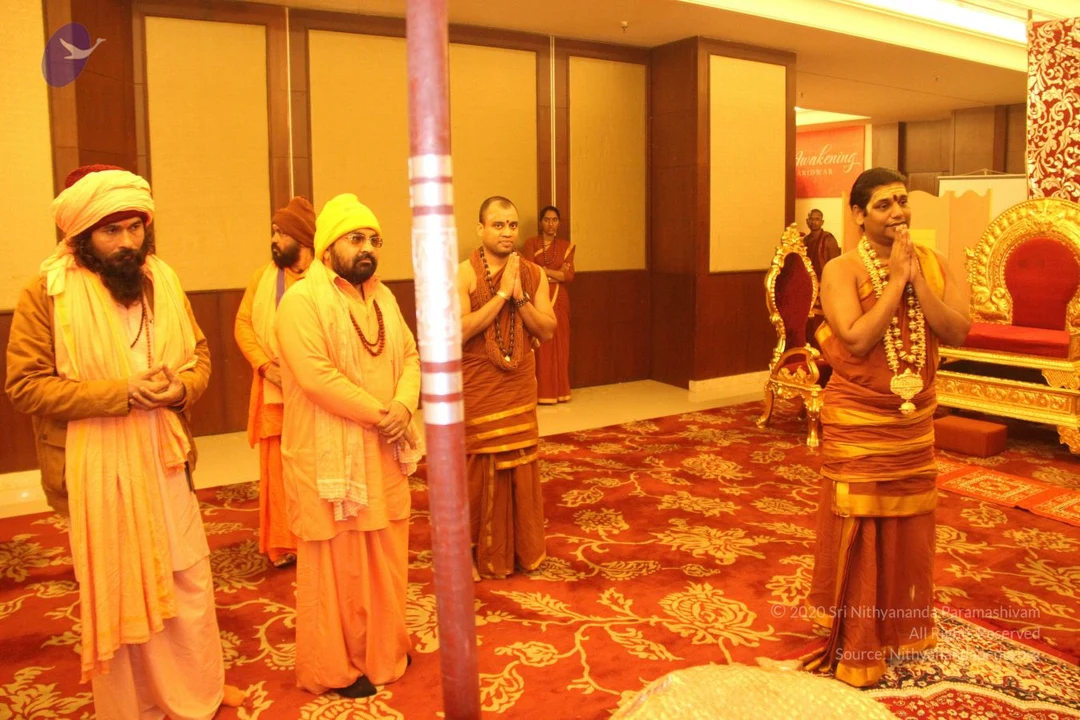
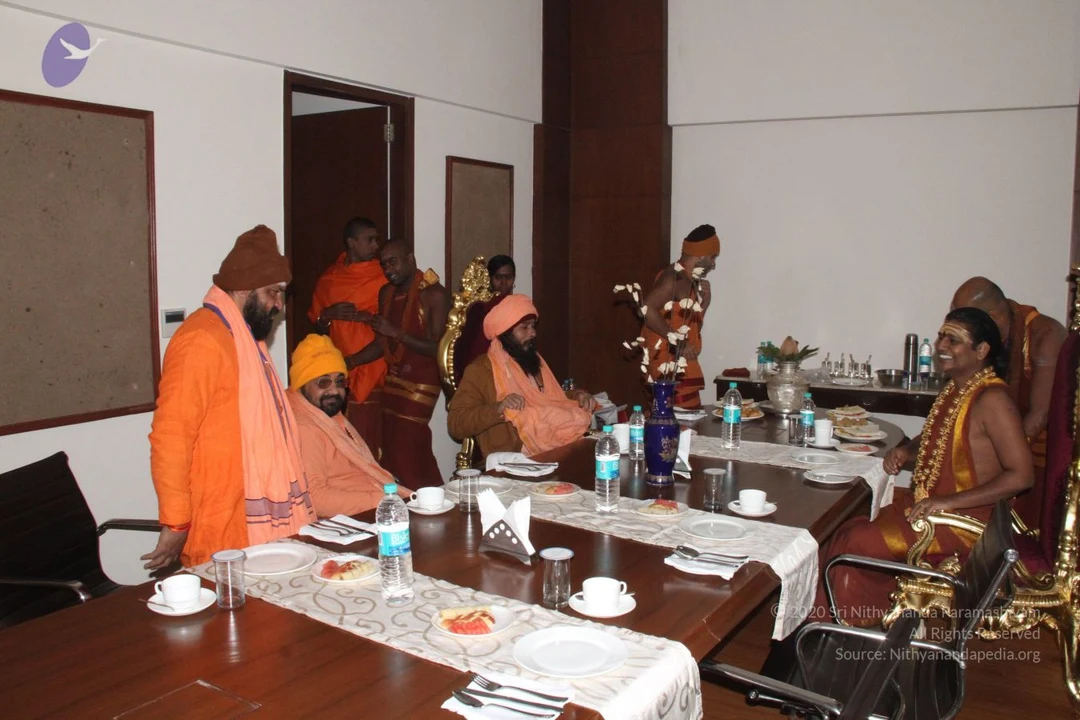
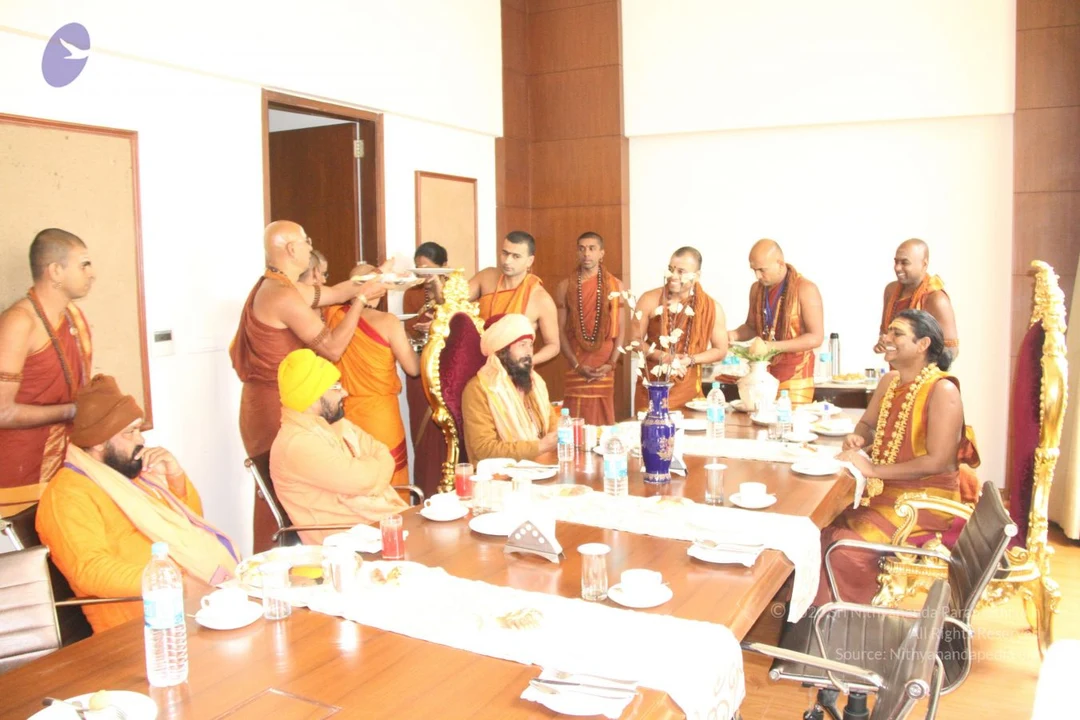
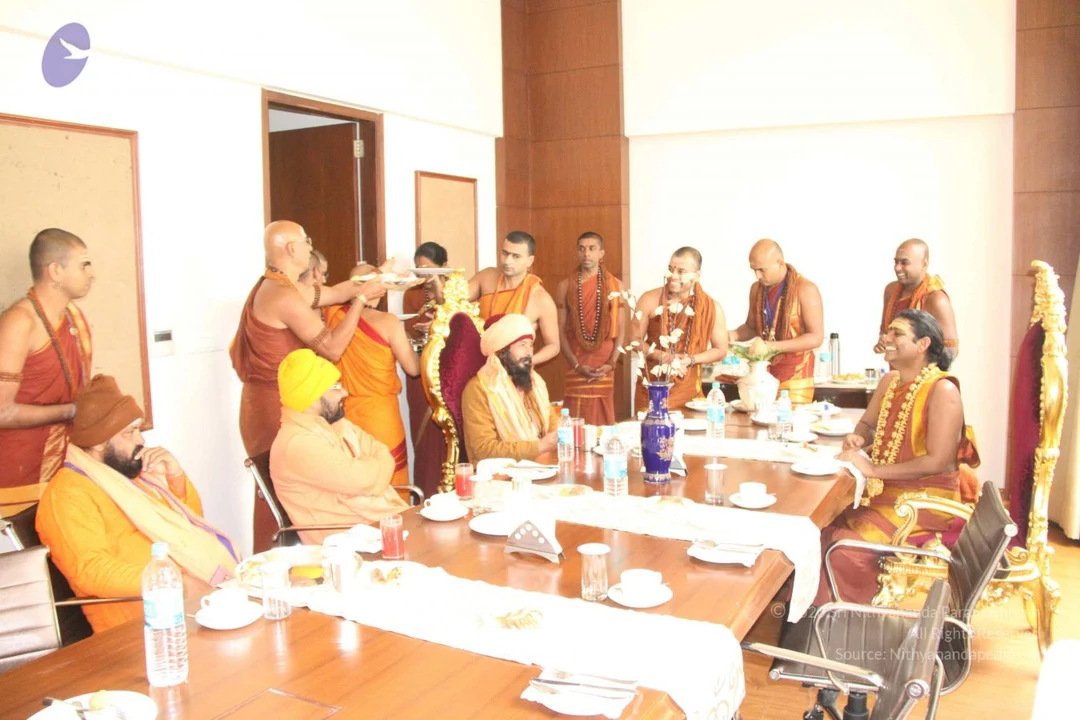
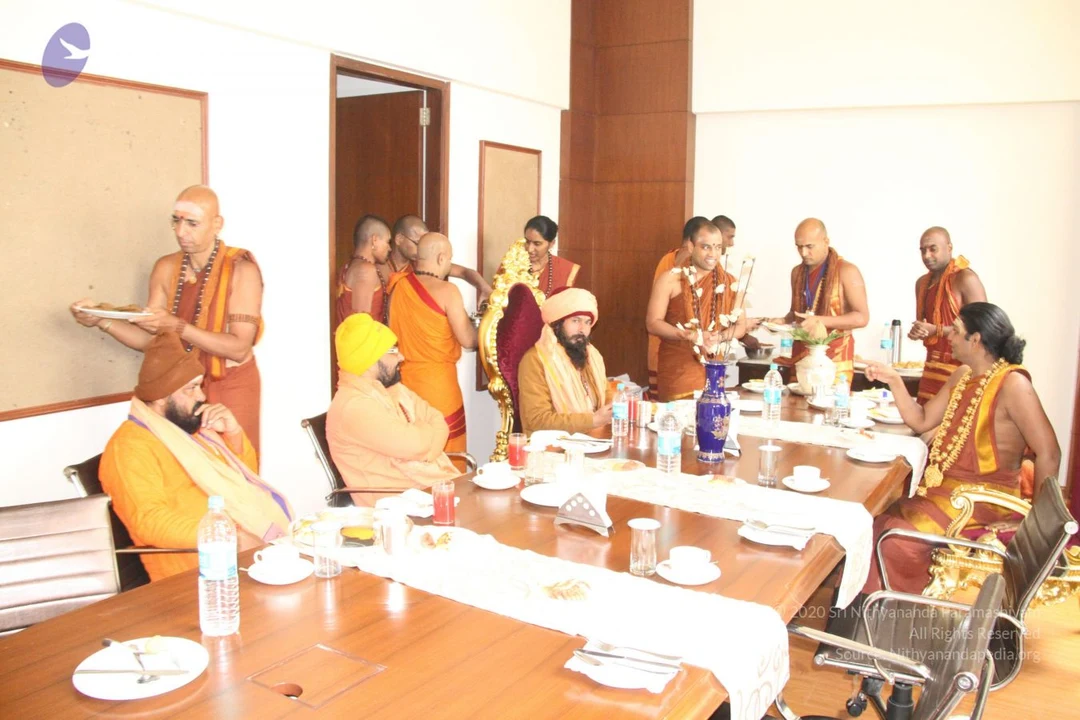
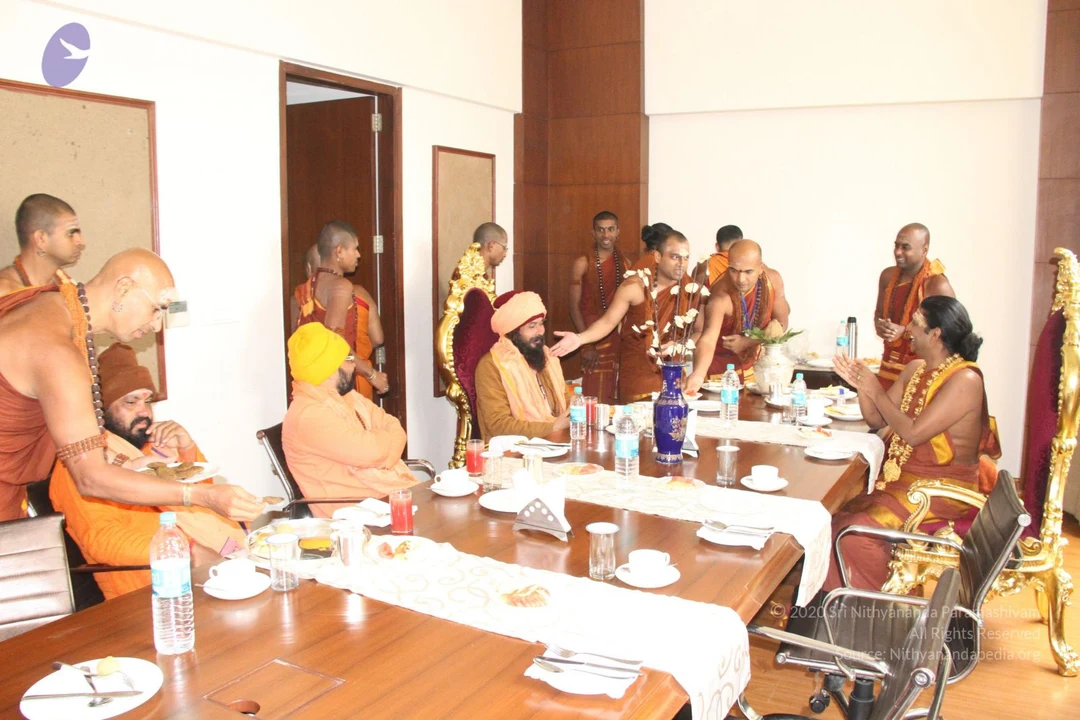
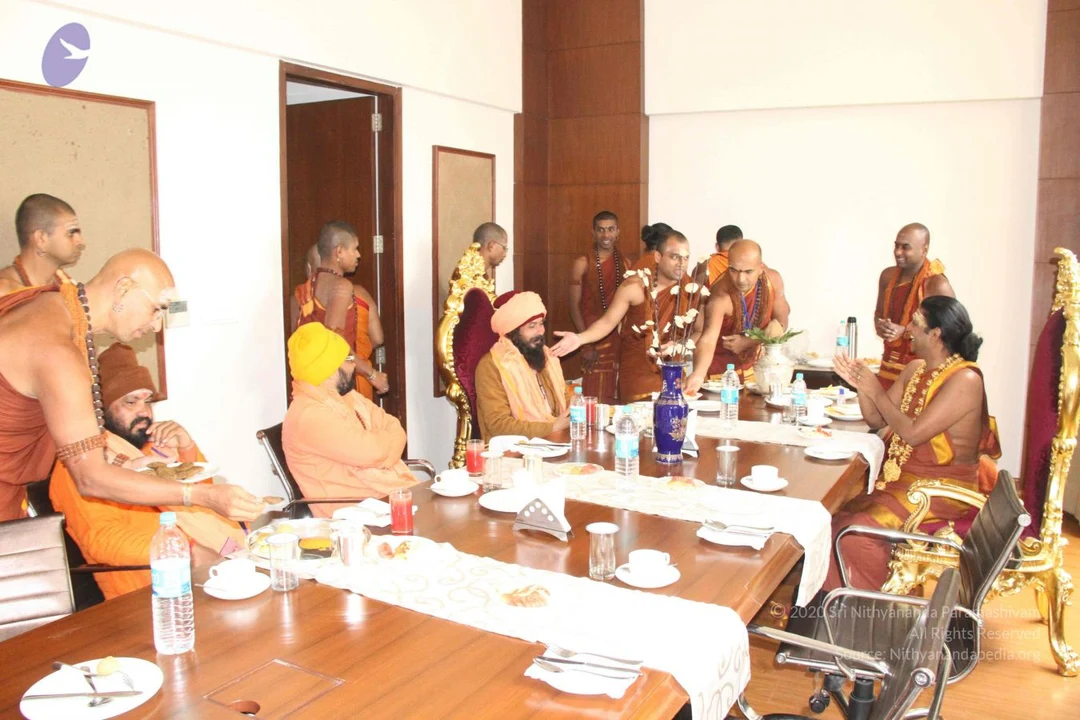
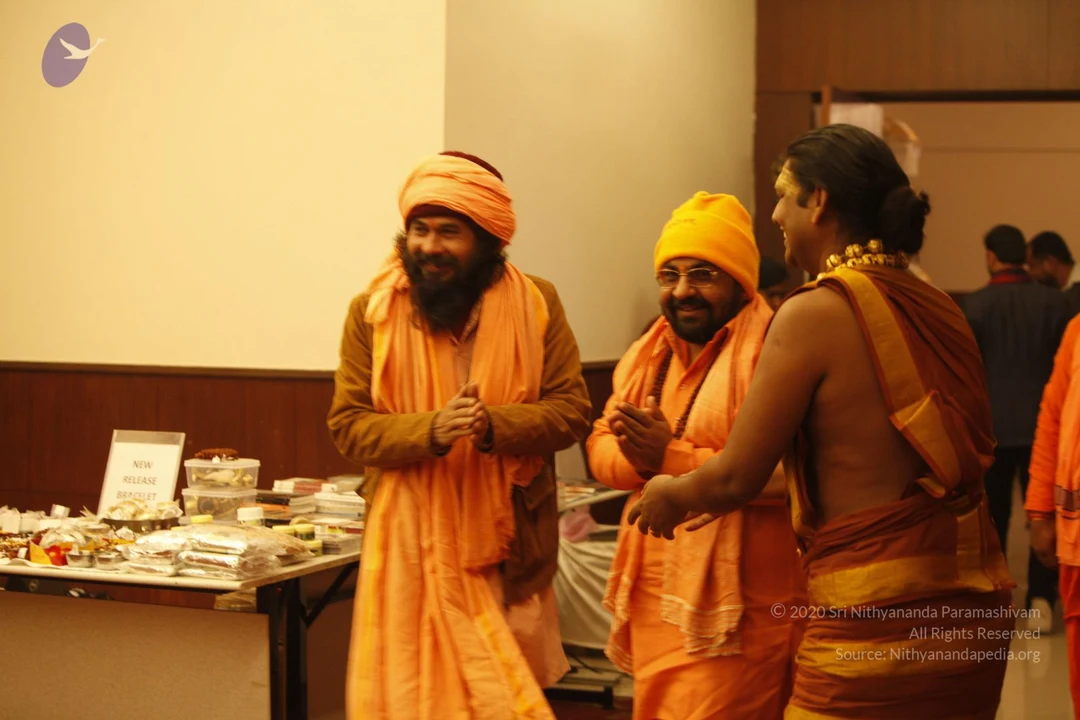
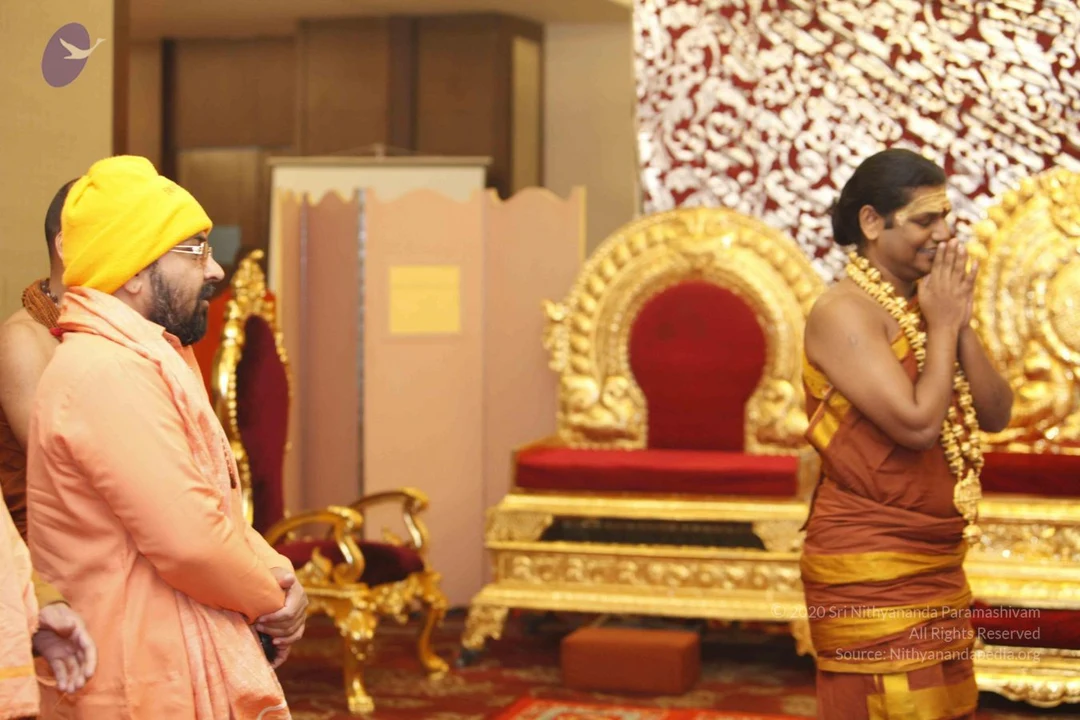
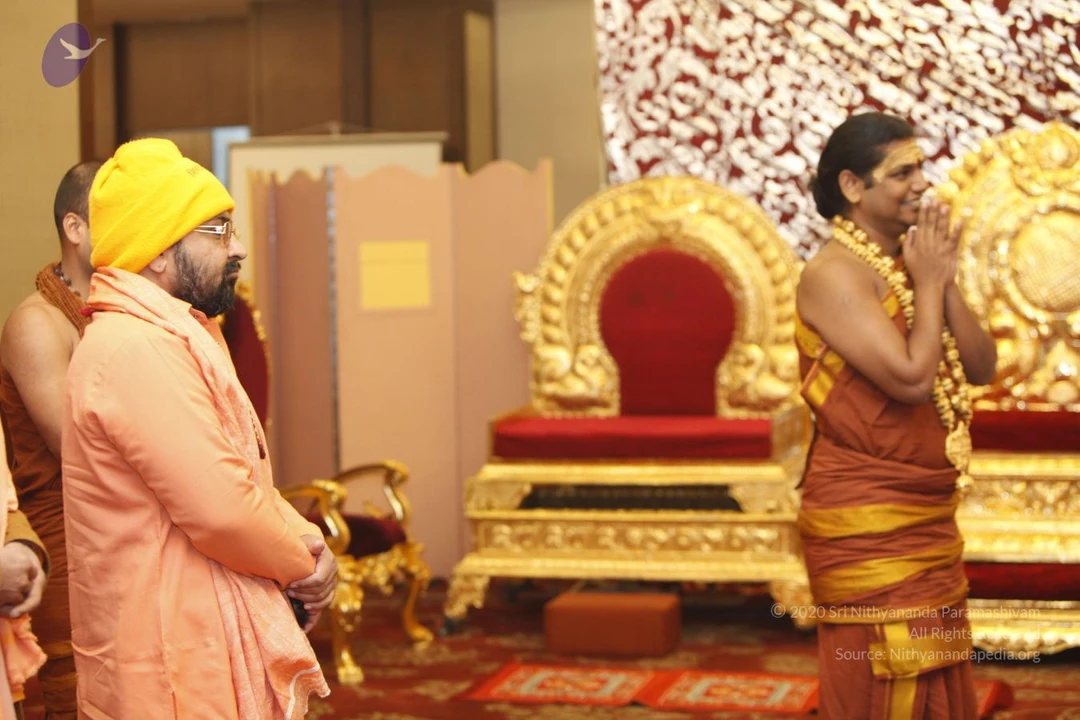
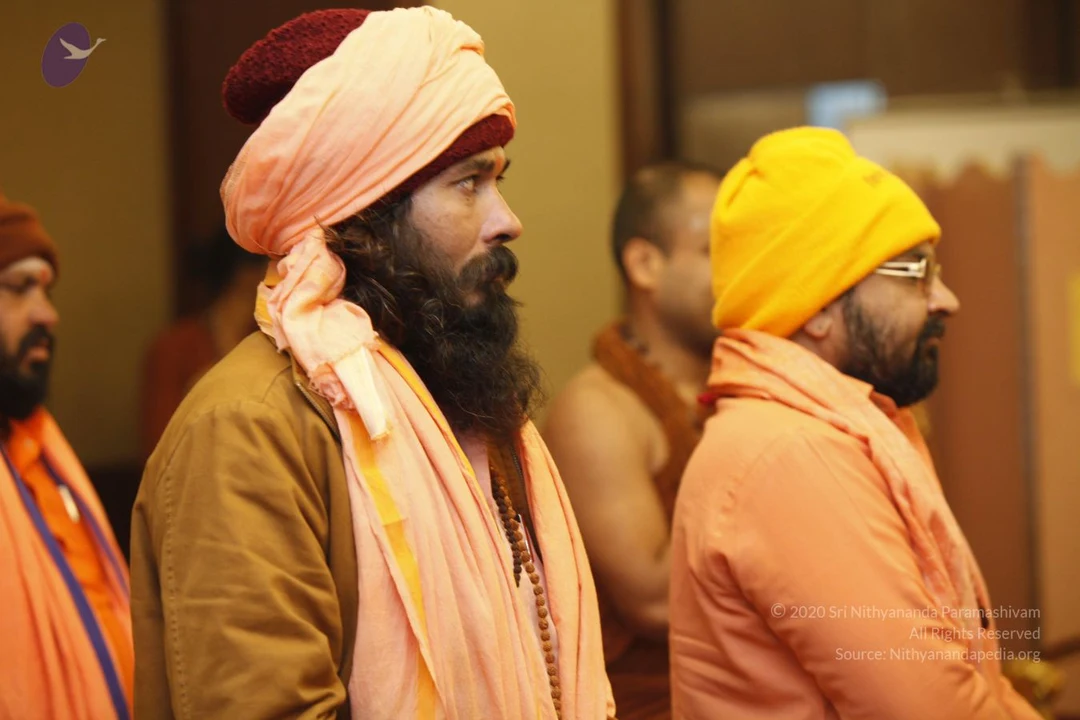
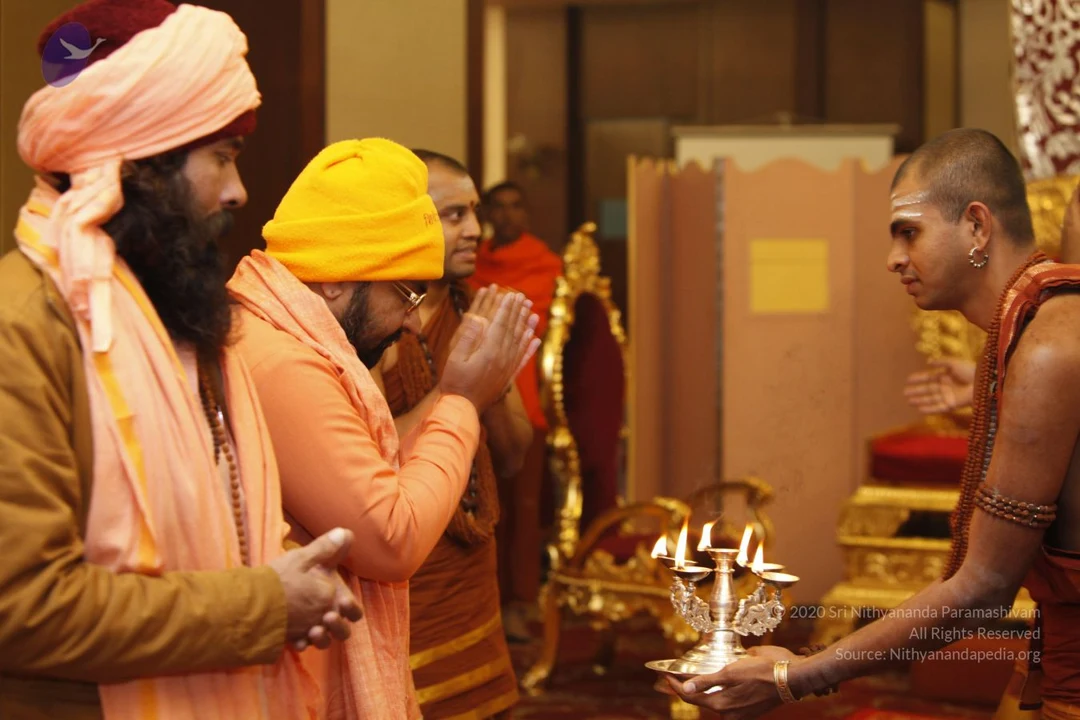
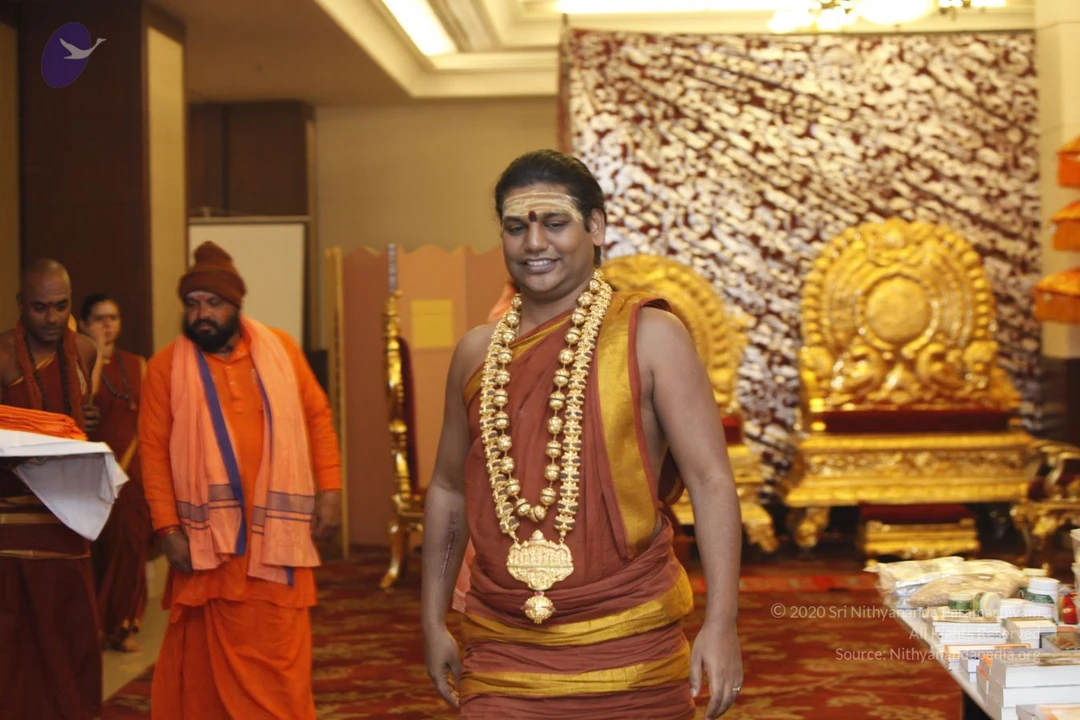
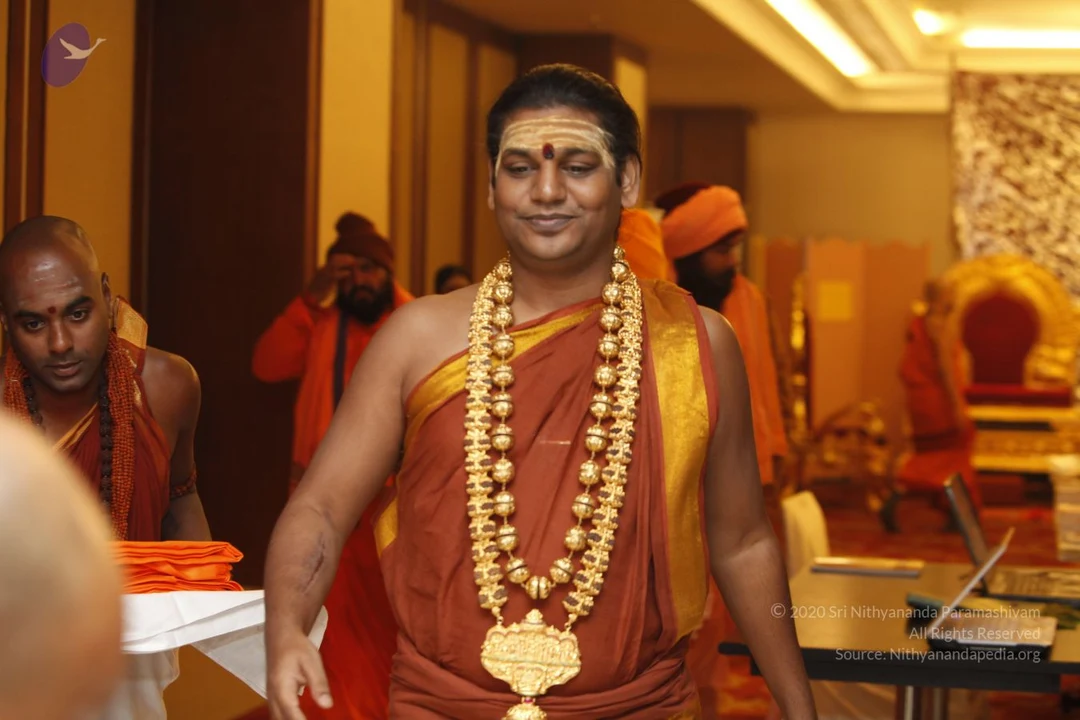
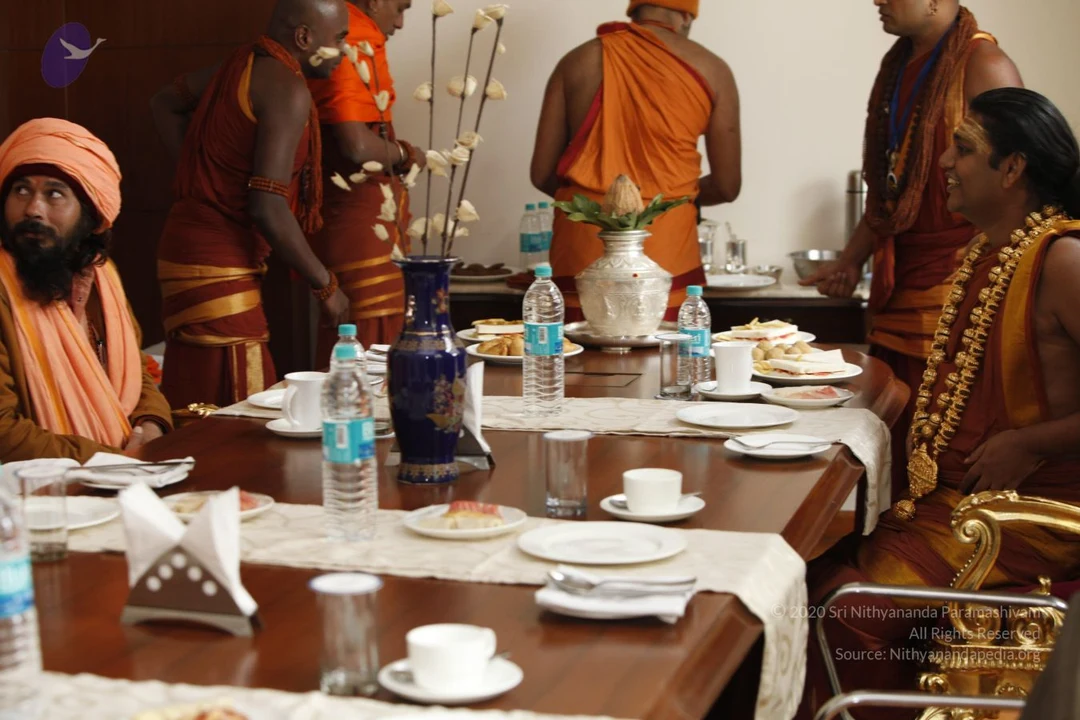
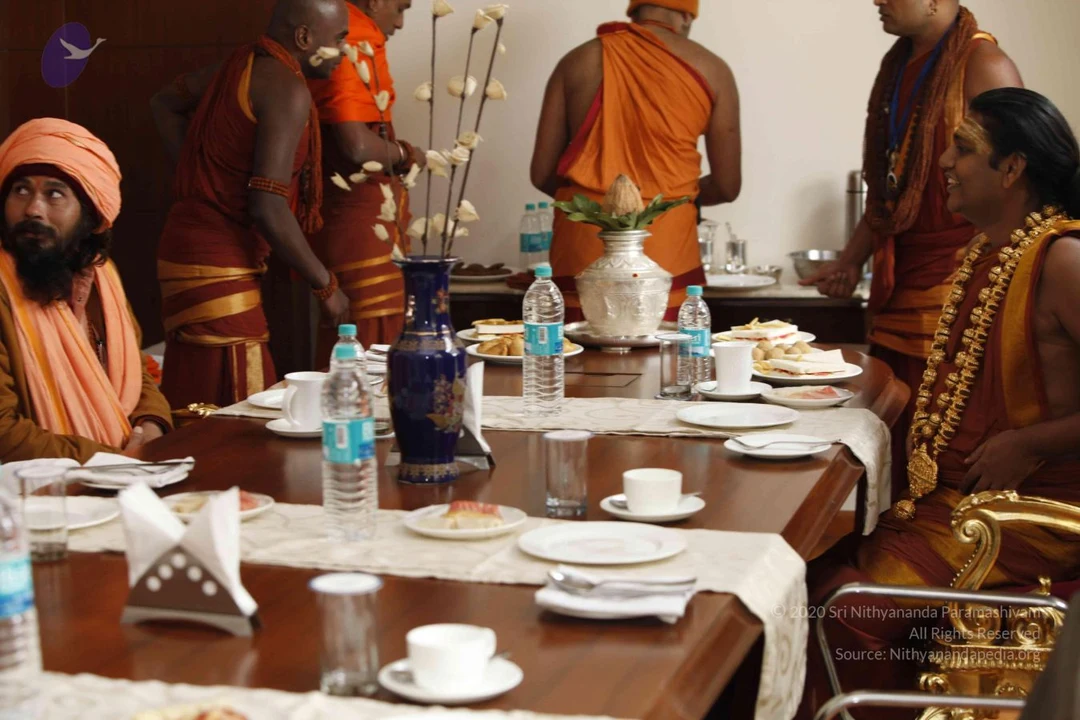
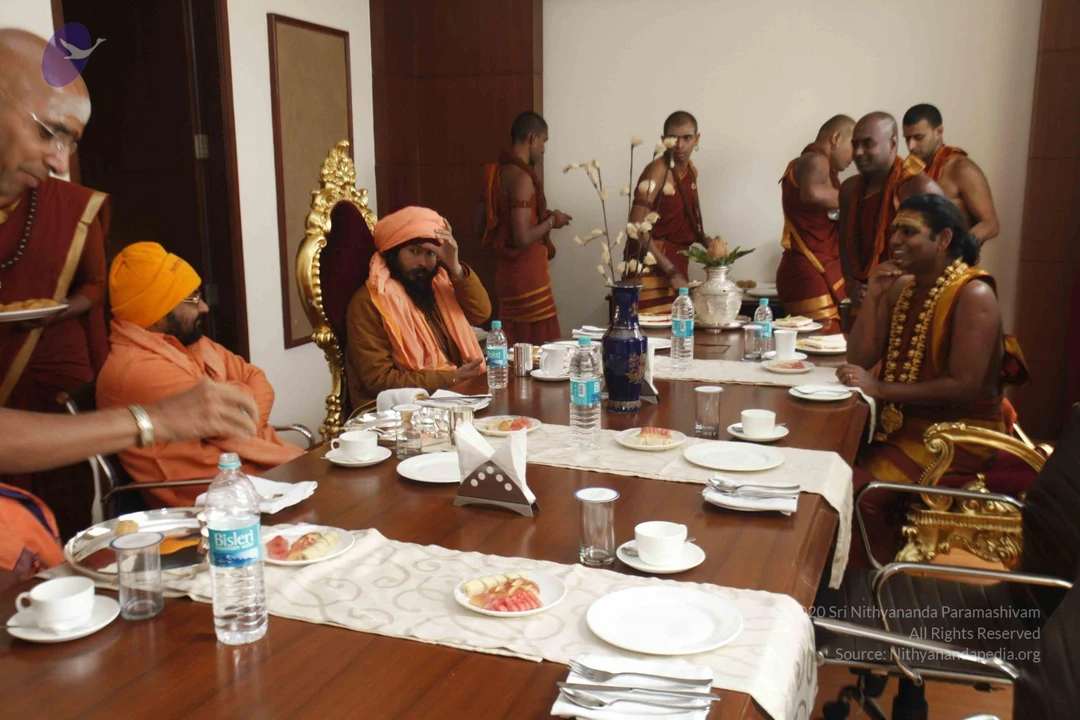
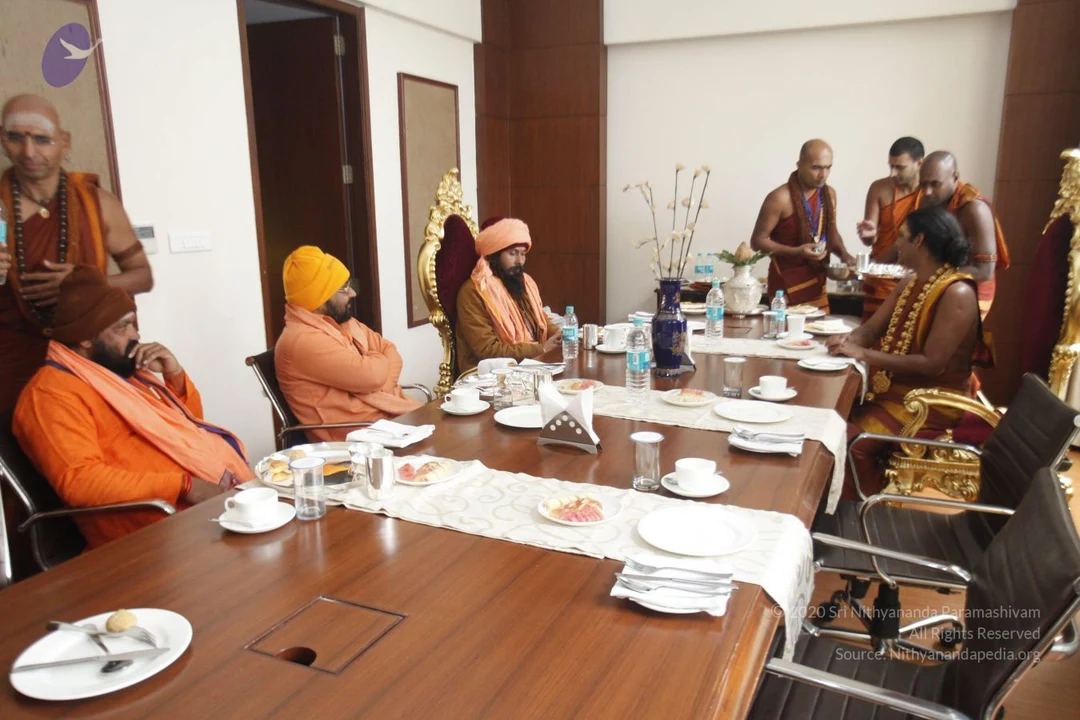
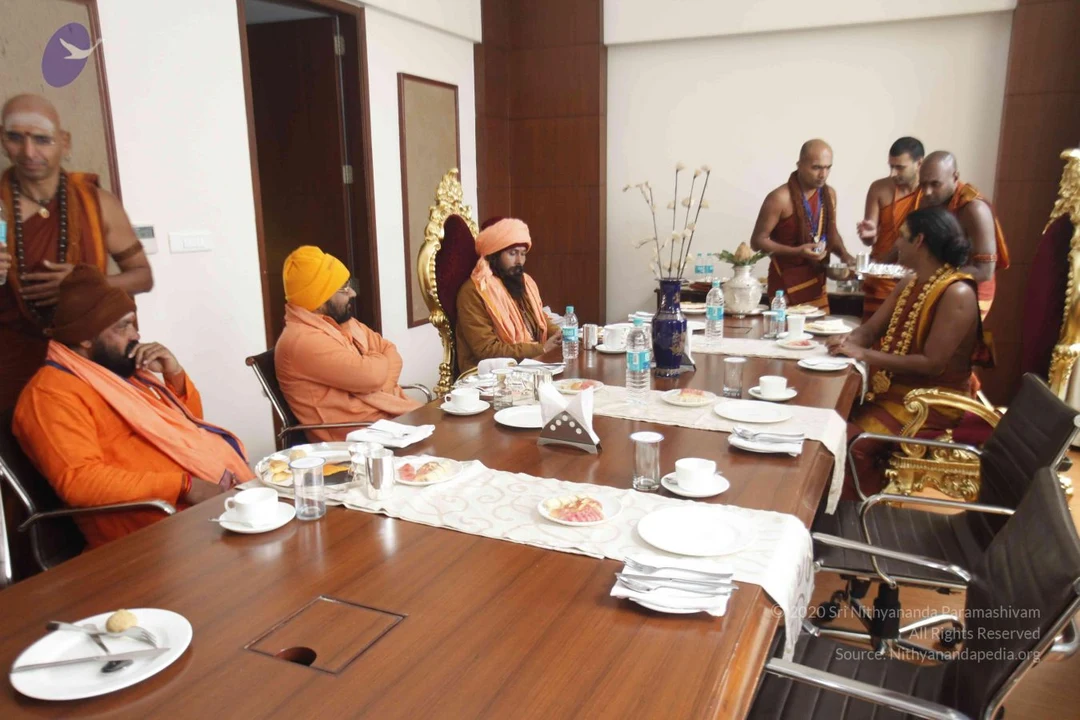
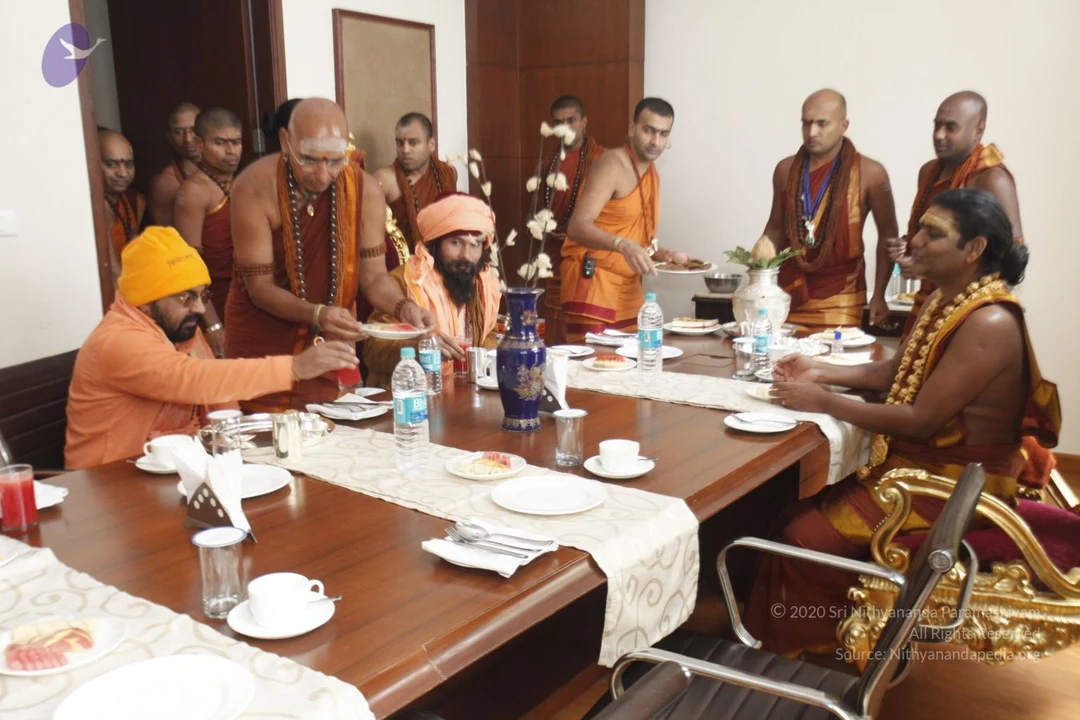
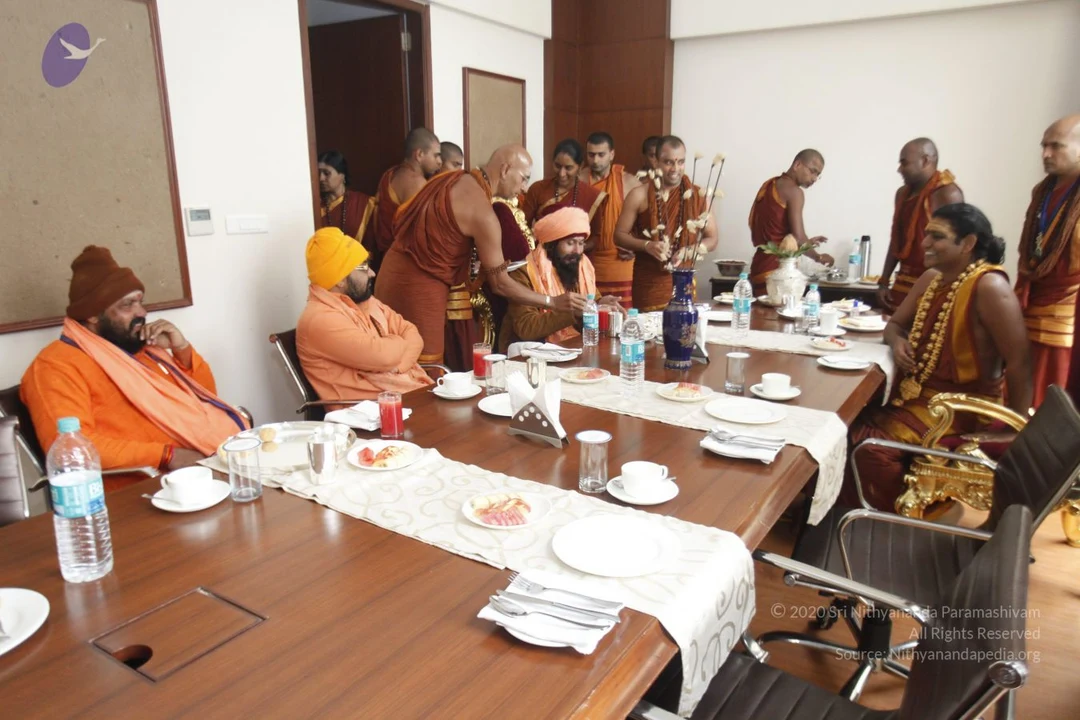
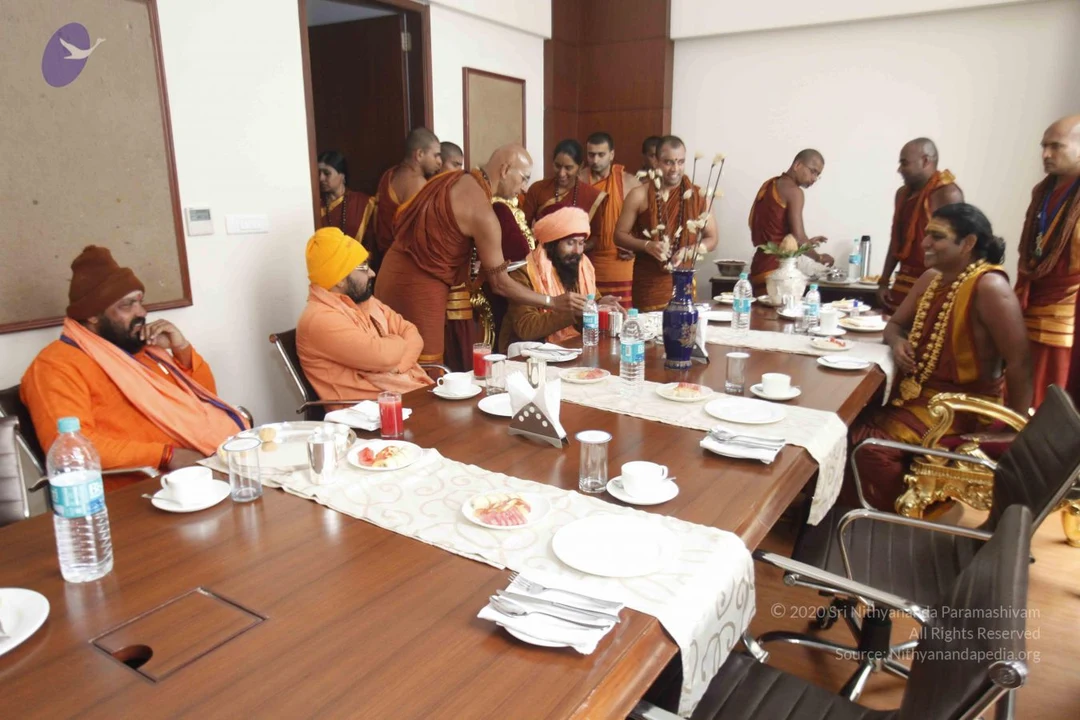
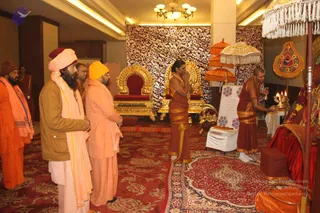
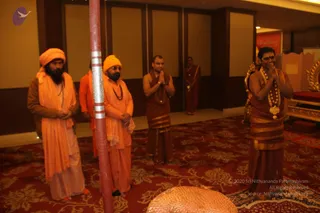
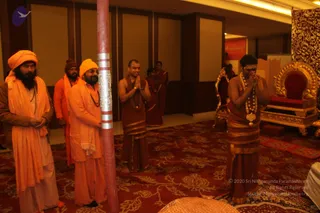
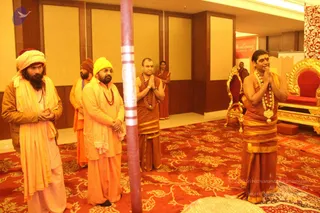
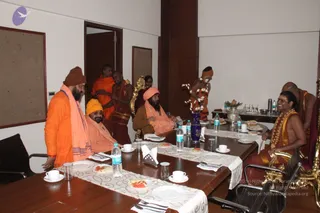
Indoor photo in a hotel-style meeting hall with a red patterned carpet, beige wall panels and a golden throne-like seat at right. Five men in saffron and orange robes stand in a row; the one at far left wears an orange turban and shawl, the second has an orange turban and shawl, and the third is bare-chested in dark red dhoti with rudraksha mala, hands in anjali. At far right, a man with a swept-back hairstyle wearing a red-brown dhoti, a gold-and-bead necklace and a gold pendant, hands folded in namaste near a copper kalasha-like vessel. A pale pole with silver bands stands in the foreground. Appearance of the right-hand figure with distinctive adornments is uncertain, so identity is not asserted.Photograph of a group of men in an indoor hall with a red patterned carpet and a wooden wall panel. On the left, a bearded man in an orange turban and orange wrap stands beside a red-and-silver pole. Next to him, a bearded man in an orange-yellow turban and orange robe stands with hands clasped. A man in red-brown dhoti and shawl with rudraksha mala stands with palms pressed together, and another in red-brown garments stands further back. On the right, a man with a gold pendant and garland of beads presses his palms together in front of a copper kalasha or vessel in the foreground. a person is the man on the right, whose long-hung pendant and beaded garland give some cues, though his face and build are uncertain and the role is ritual participant. Visible people are five.A photograph in a hotel ballroom with a red patterned carpet and gold-framed ornate chairs at right, one with a red seat. Several men in saffron, orange and maroon robes stand in a row with palms pressed together in namaste. A man at far left wears an orange turban and orange shawl with a long beard. A man in the centre-left wears a yellow turban and orange robe with a rudraksha mala. At right, a man in a maroon dhoti and shawl wears a long gold-and-bead necklace and presses his hands together with eyes closed. A red pillar with silver bands stands in the foreground. Other men stand in the background near a banner.A photo inside a hall with a red patterned carpet and gold-framed red thrones at the right. Five men stand in a row with palms pressed together in anjali mudra. The man at far right wears a rust-orange dhoti and shawl, a long garland and a large pendant, and bends slightly forward. Beside him, a bald man in orange and gold-bordered cloth holds his hands together, wearing a rudraksha mala. A man with a yellow turban and matching shawl stands next to a man in saffron robes with a rudraksha mala, and a bearded man in a long white-and-pink shawl and light-brown jacket stands at far left. A tall pink pillar with white bands stands in the foreground. Behind them a woman in rust-coloured clothes and a standing man are partly visible, and a red banner with partial lettering hangs on the wall.Indoor photo of a dining room with a long wooden table covered in white patterned runners, set with white cups and saucers, plates with snacks, glasses, water bottles and folded napkins. On the far right, a man with a bare chest, rudraksha-style beads and a gold ceremonial necklace sits in a golden-armed chair with a grey-white cloth over his lap, smiling. Seated at the table, a man in a yellow head-wrap and yellow-orange robe and a bearded man in an orange shawl sit near the table. Standing at left, a bearded man in an orange robe with a brown knit cap and an orange shawl stands by the table. Behind them, several men in orange and maroon robes stand near a doorway, and a man in an orange garment with a white flower garland and orange headband stands at the far back holding flowers. A golden chair and a vase with flowers and a steel jug are visible. Two people appear in the scene.