Skip to content
Tuesday

11 October 2011

Do You Really Love Yourself

Dated photos
219
Source pages
1
Media
2
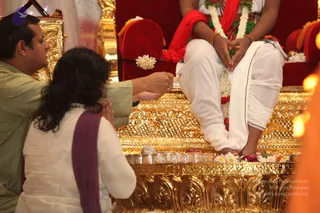
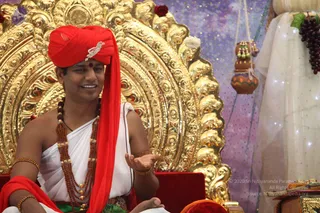
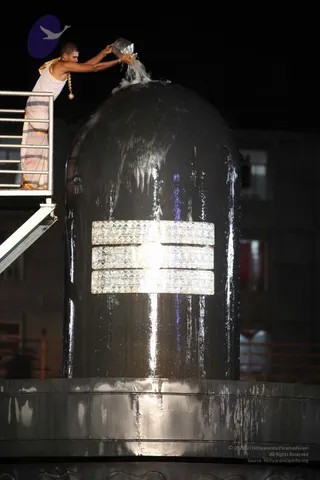
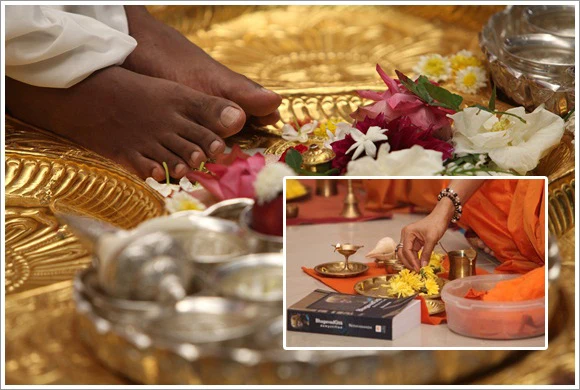
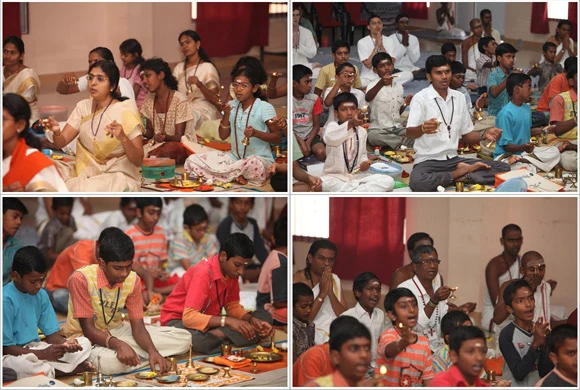
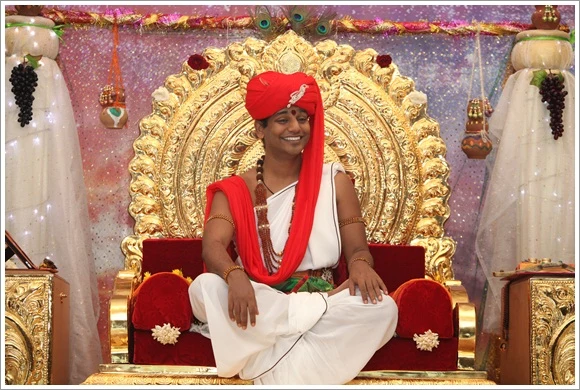
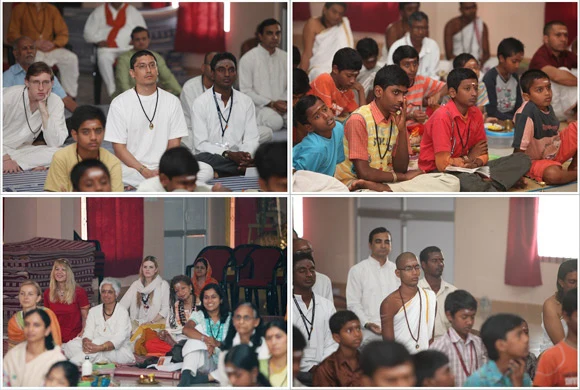
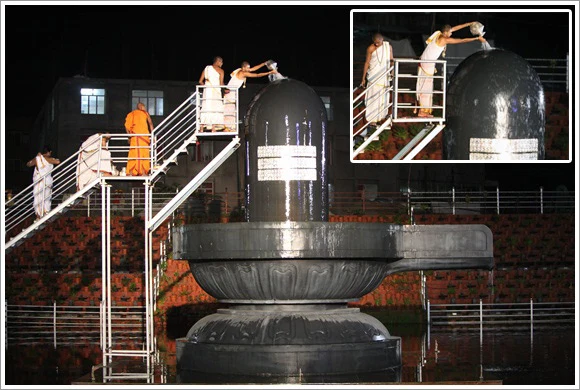
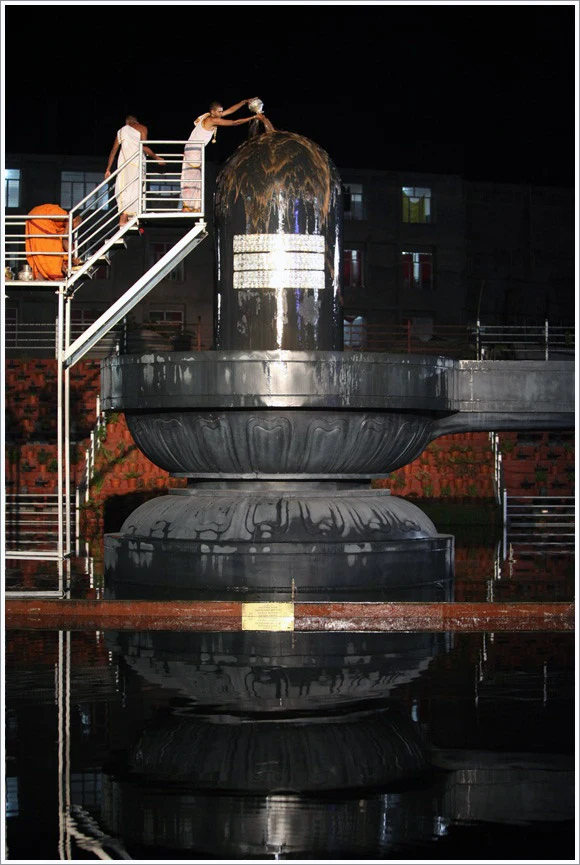
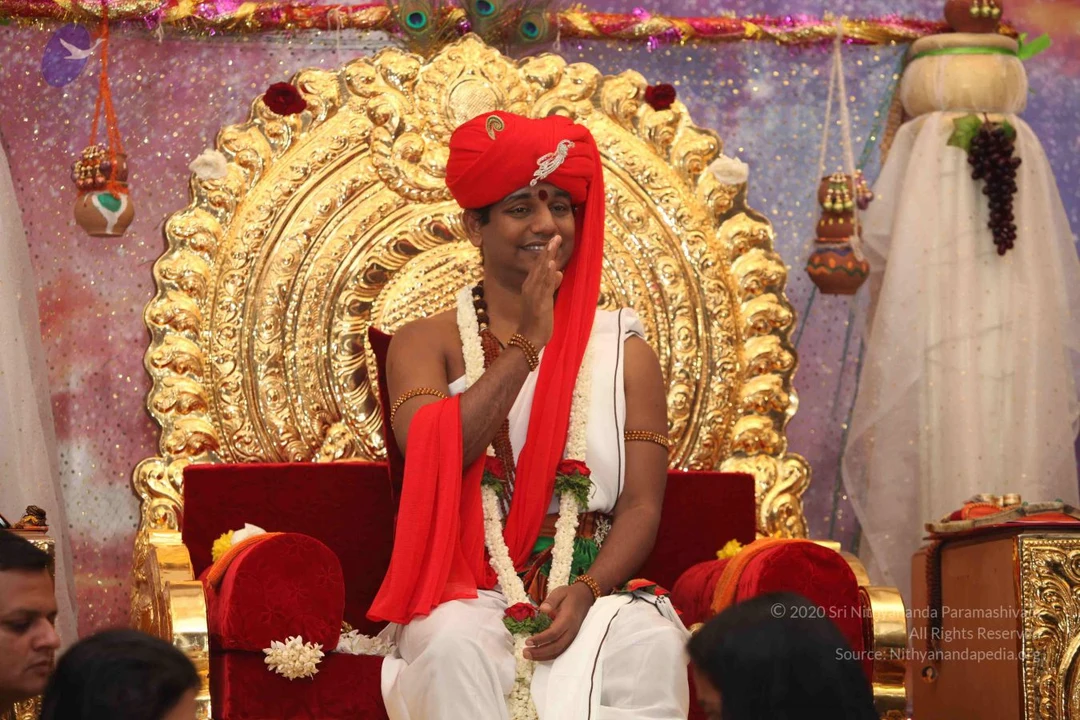
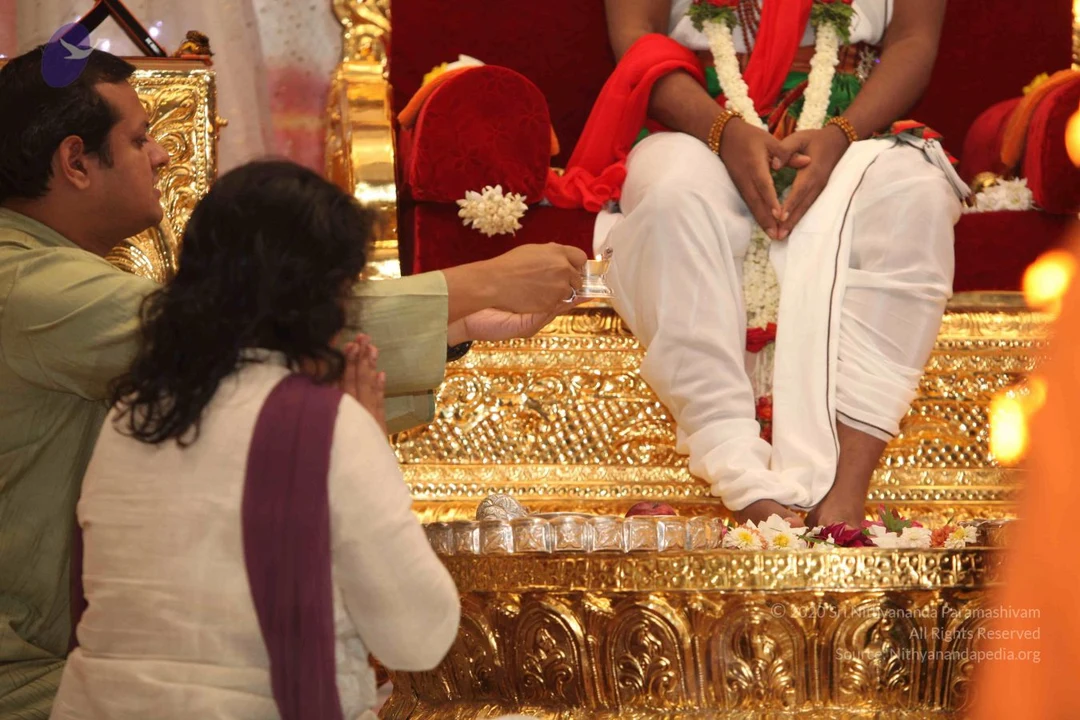
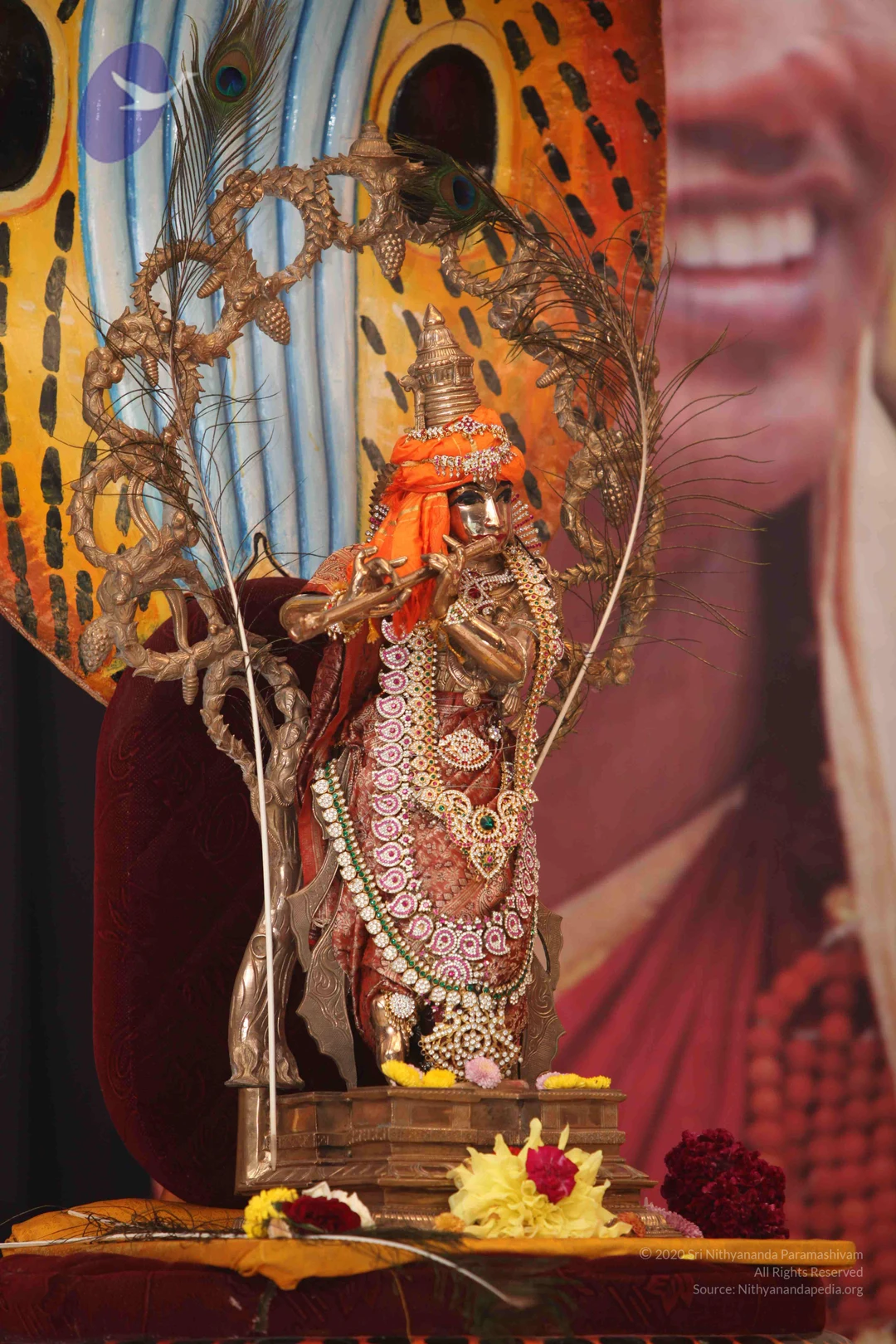
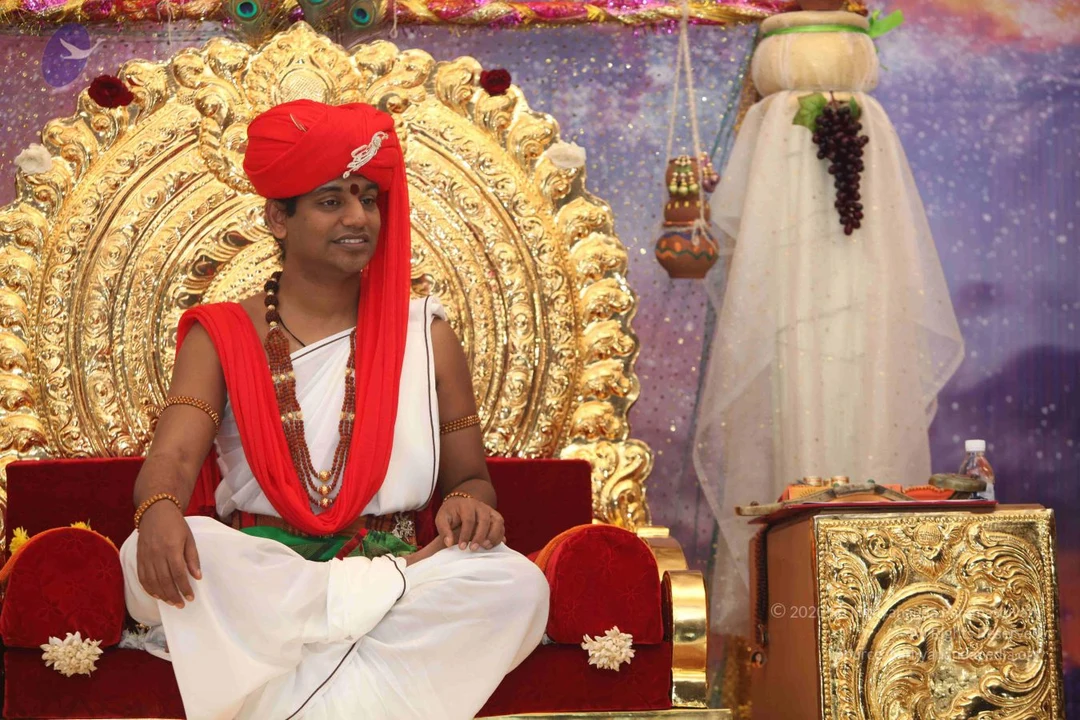
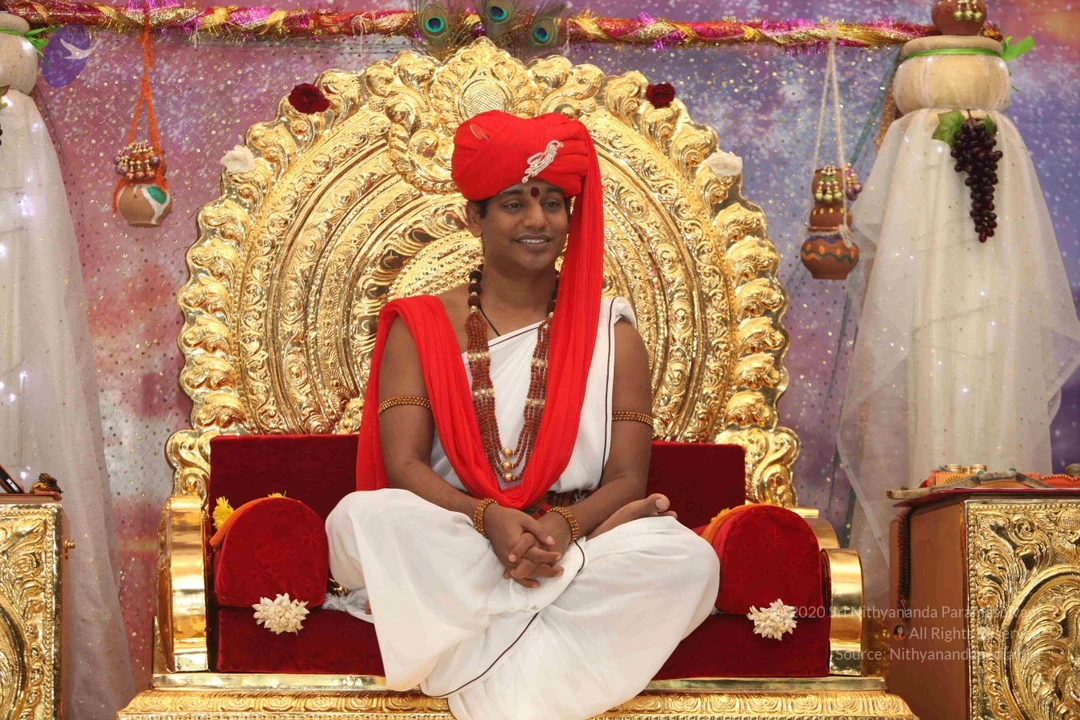
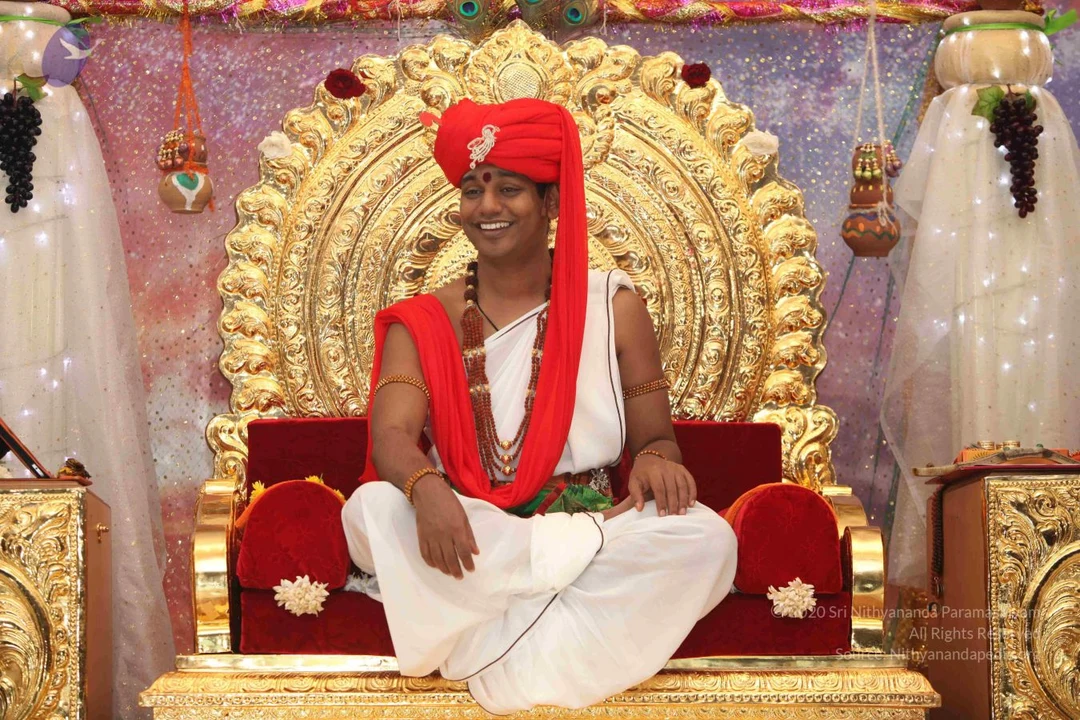
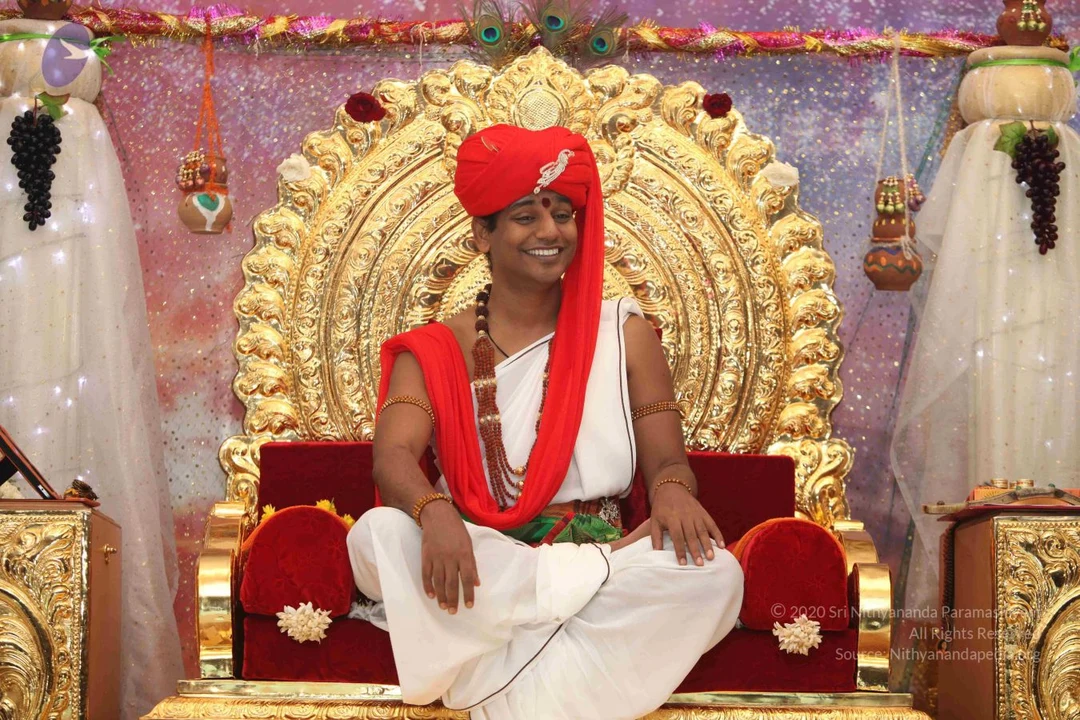
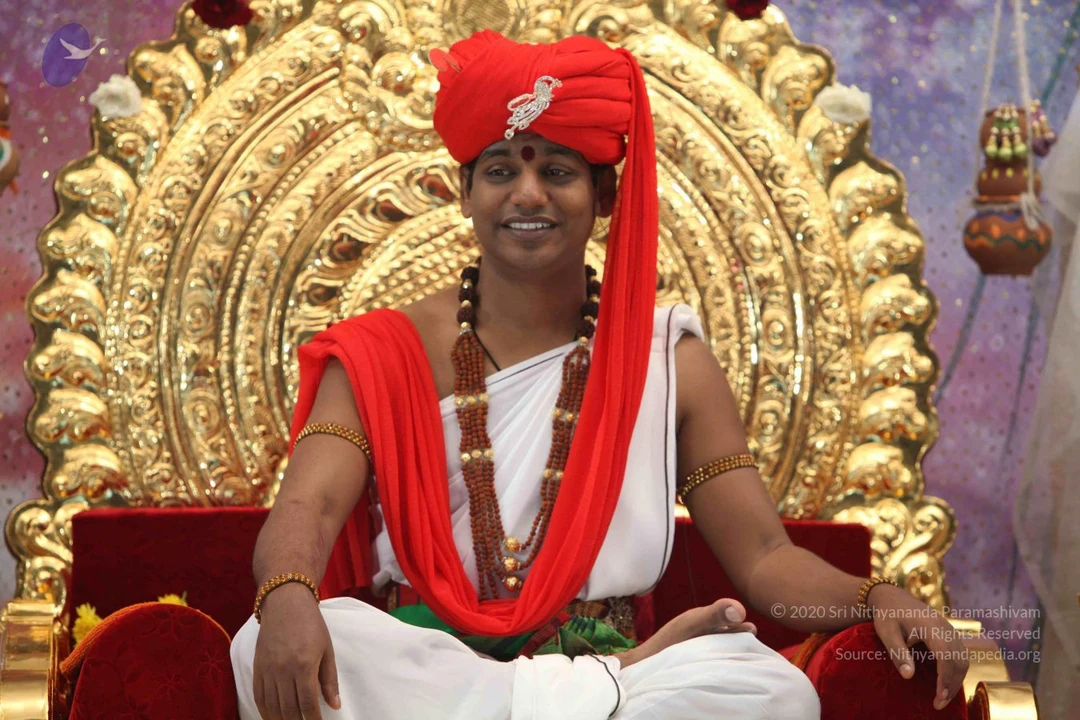
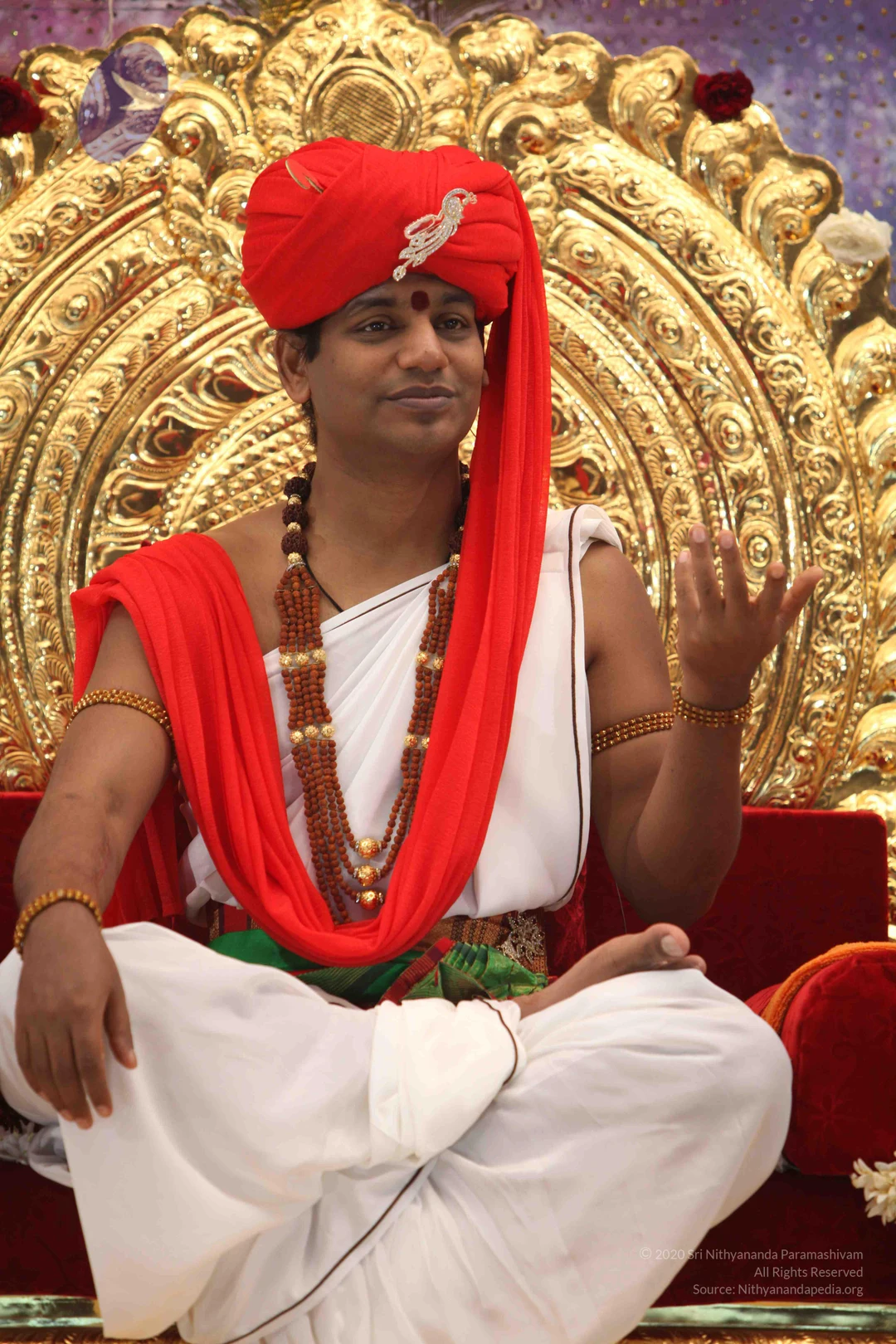
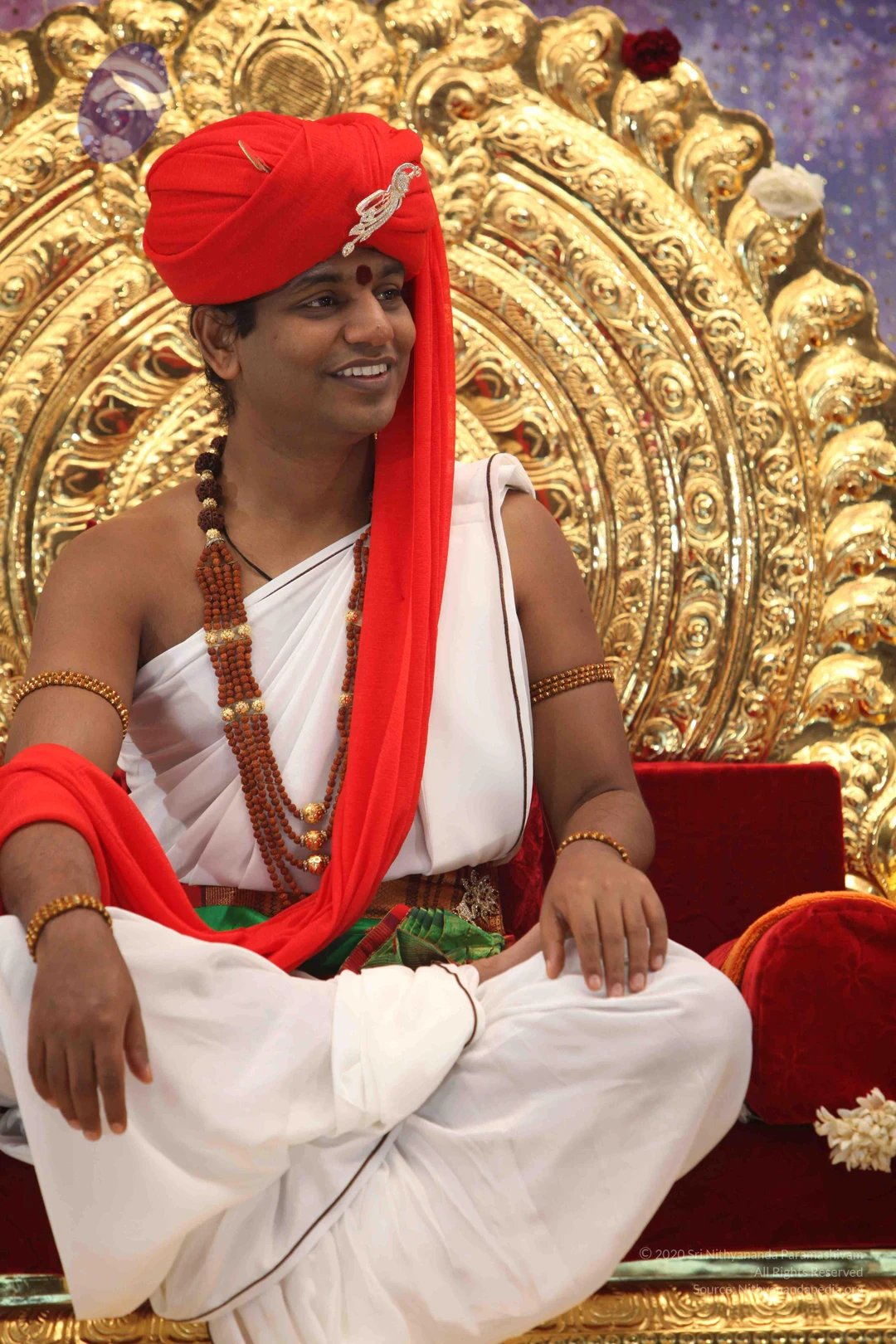
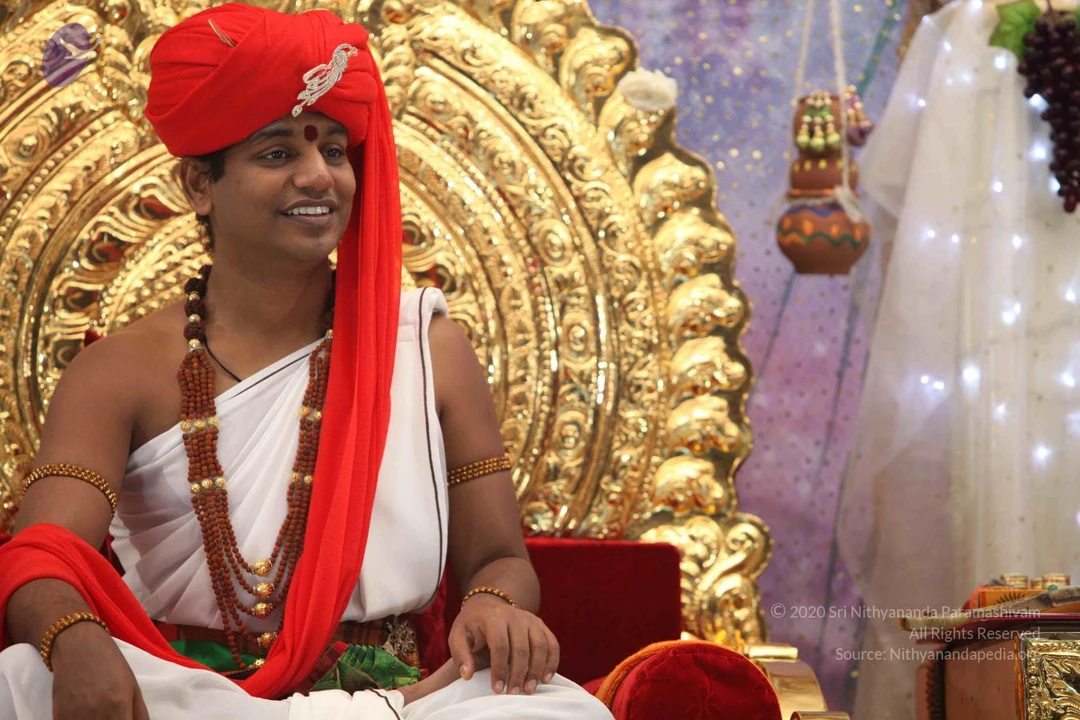
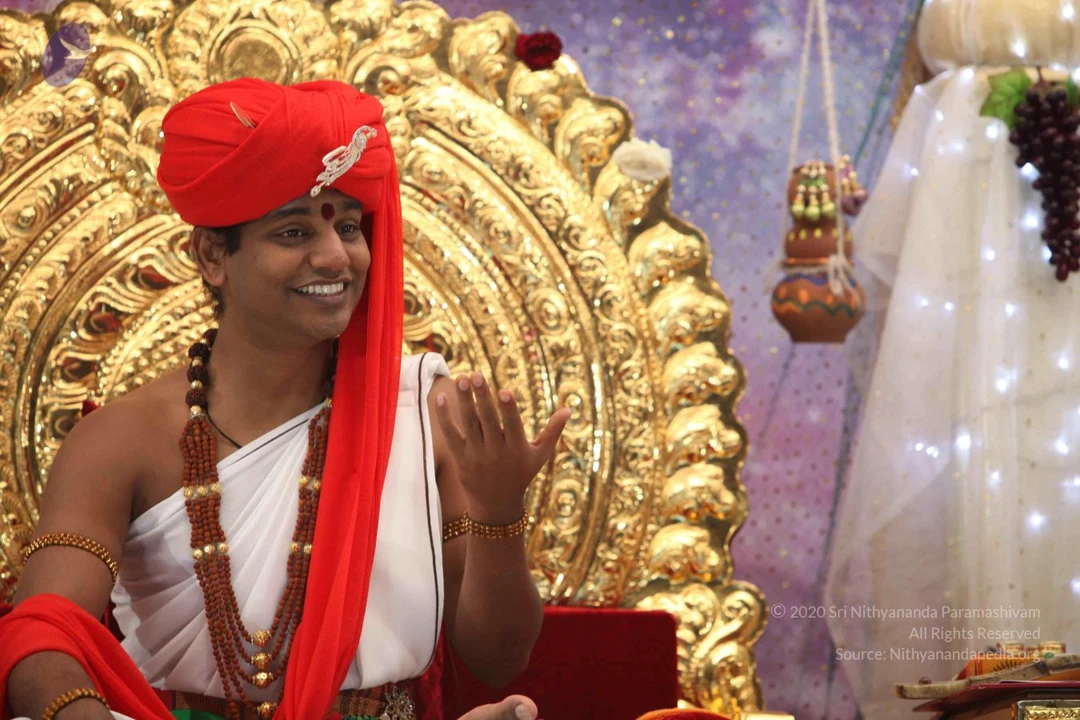
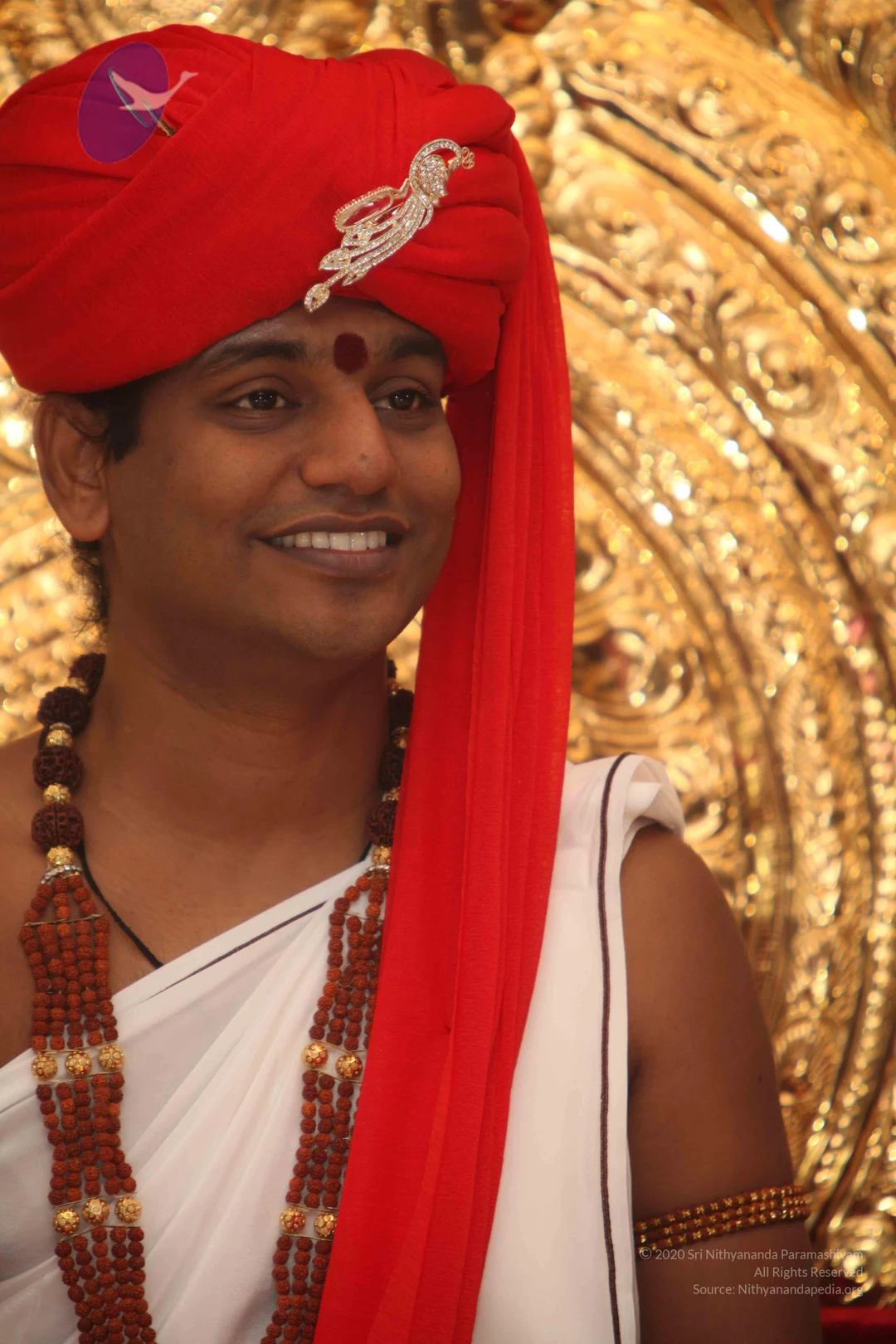
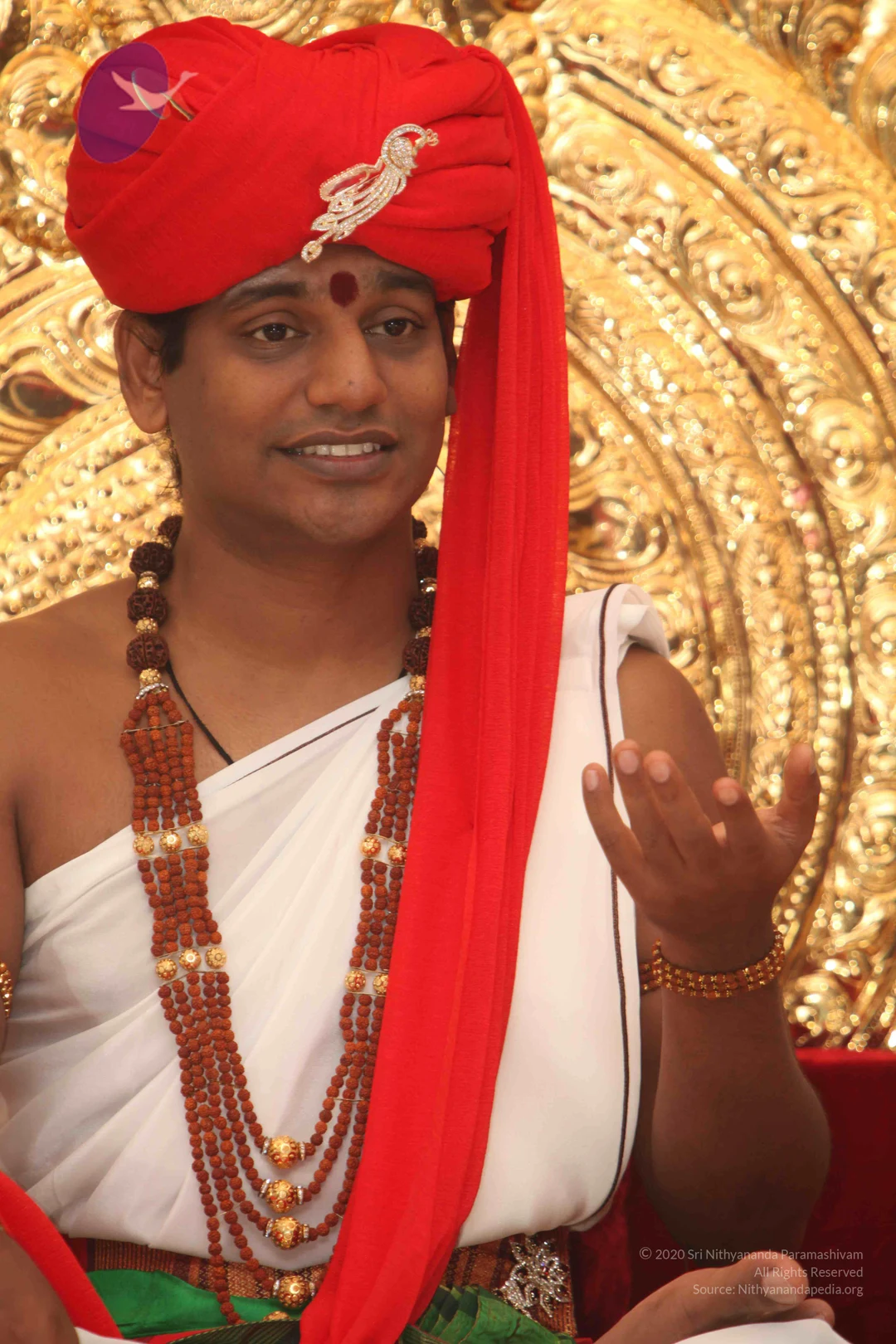
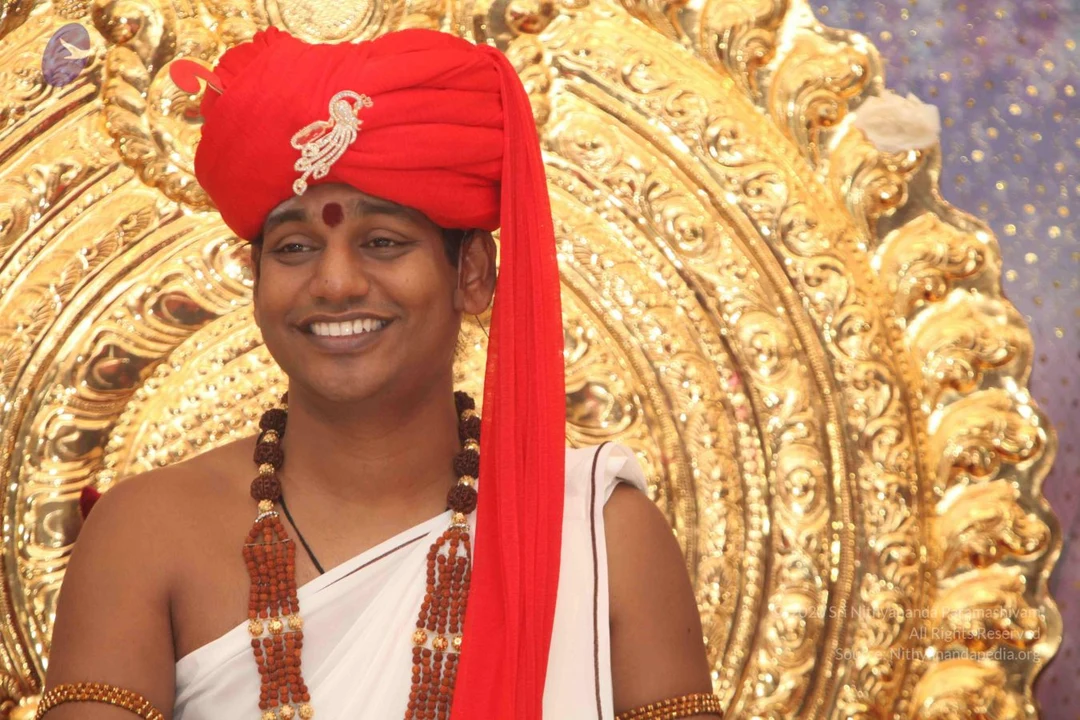
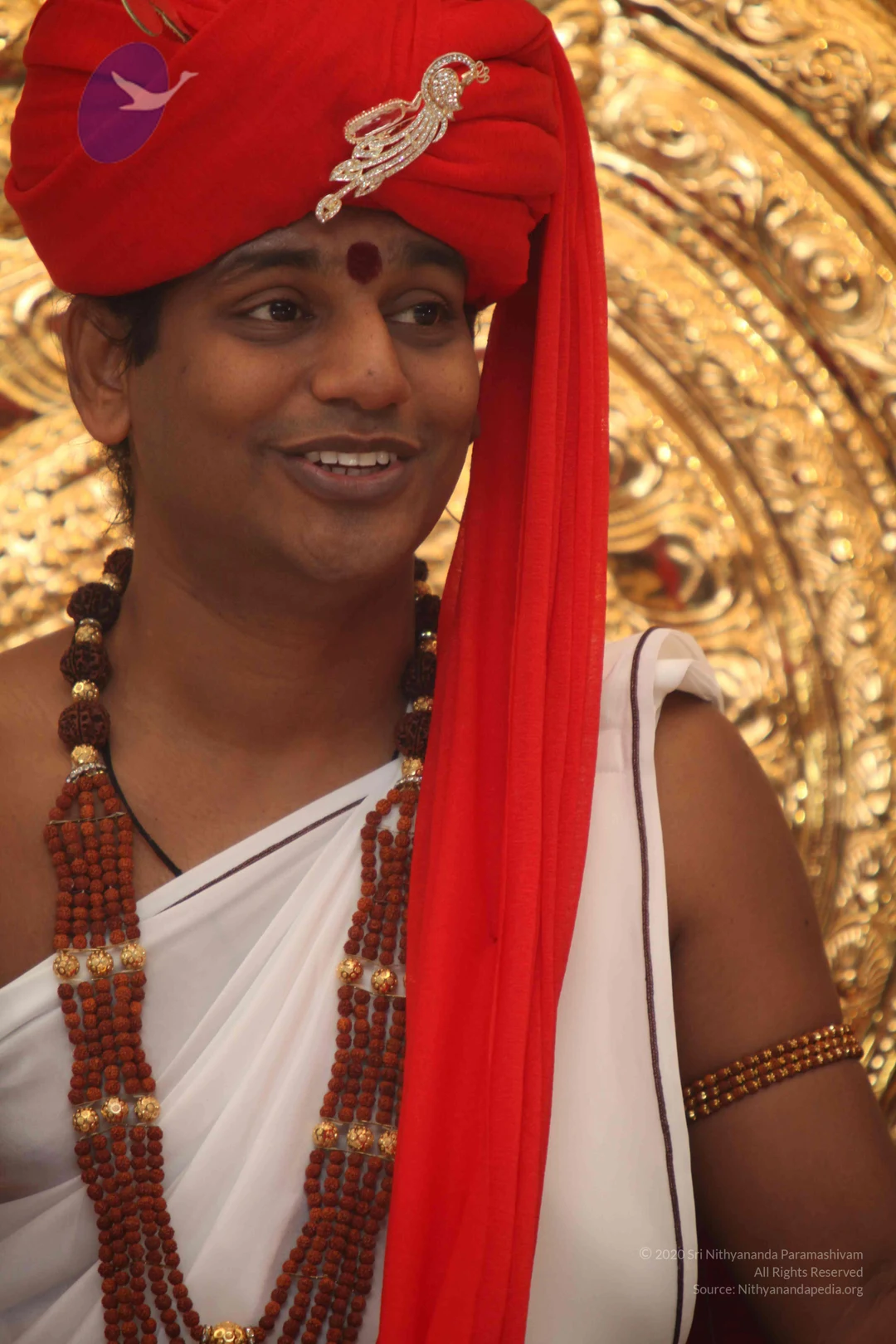
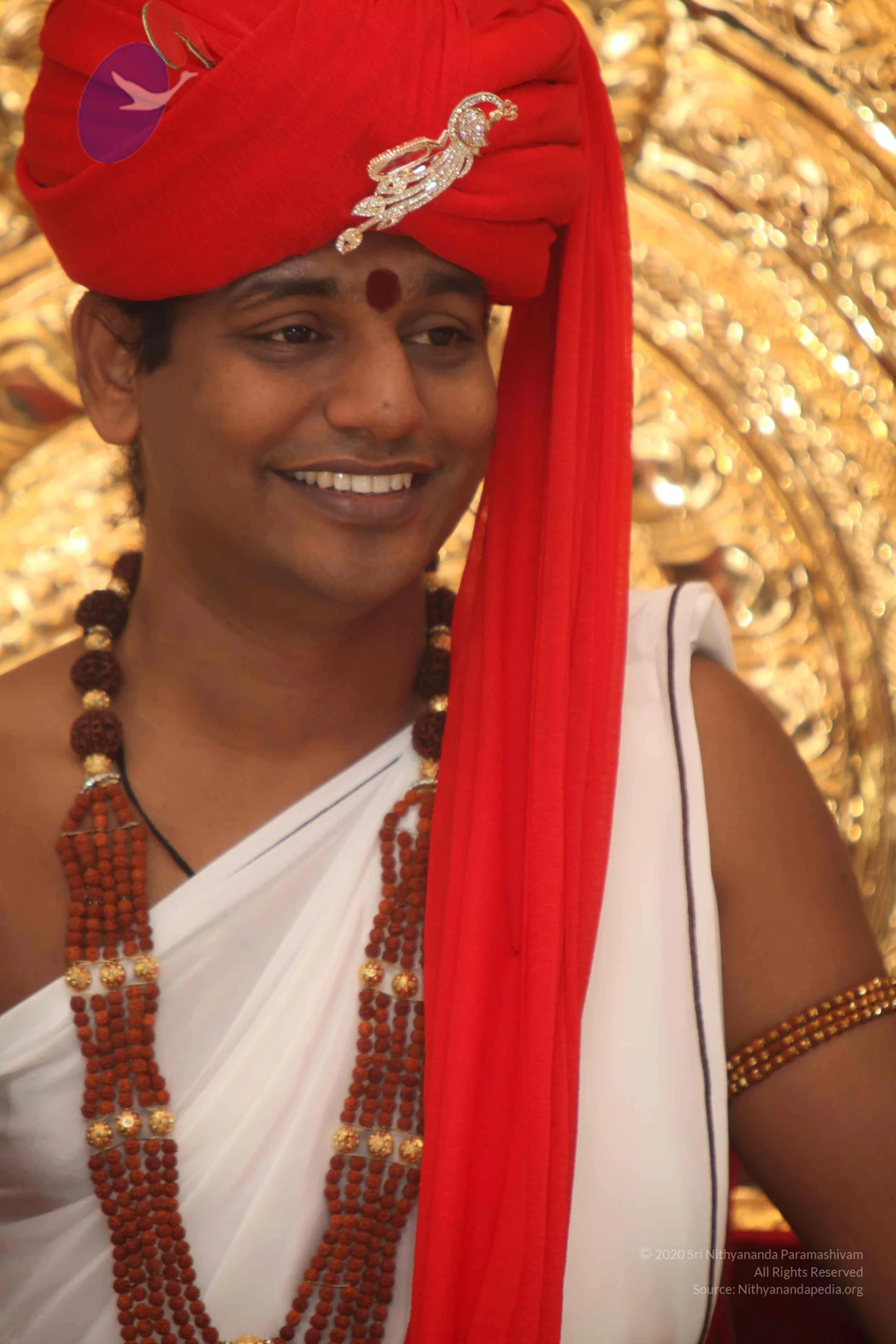
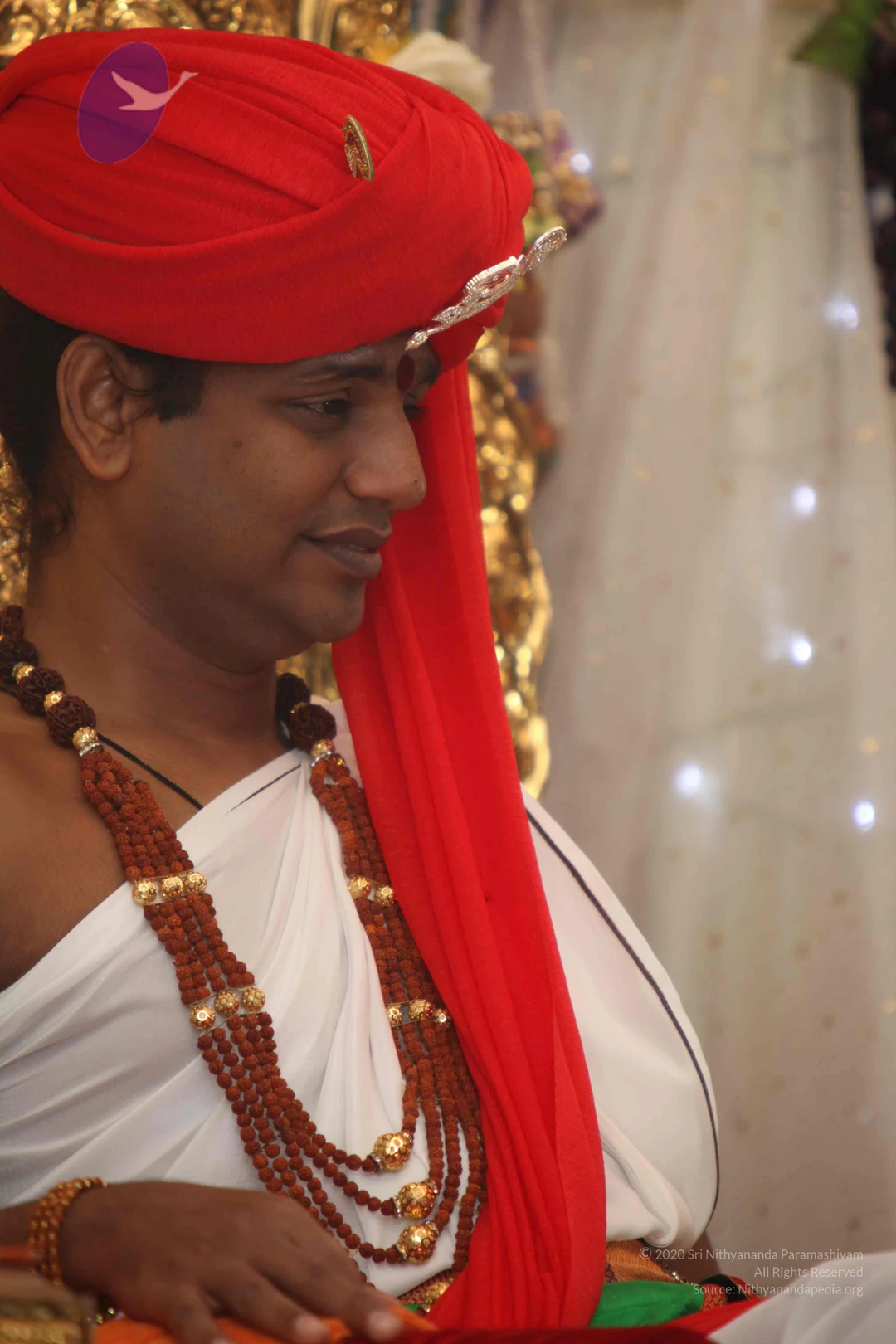
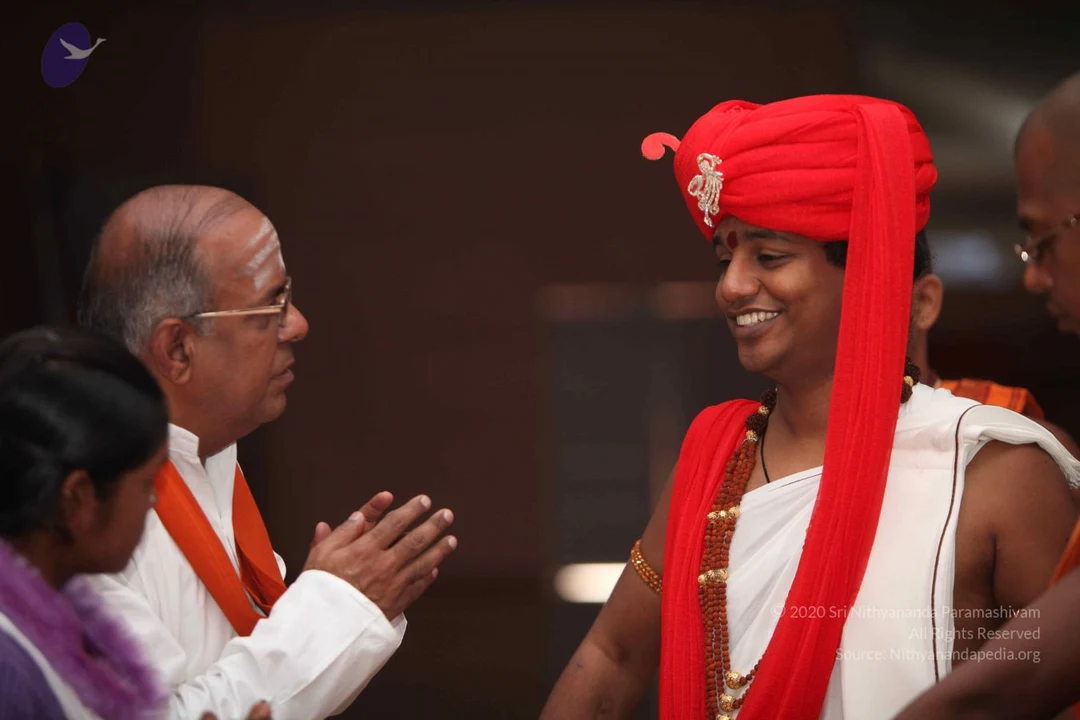
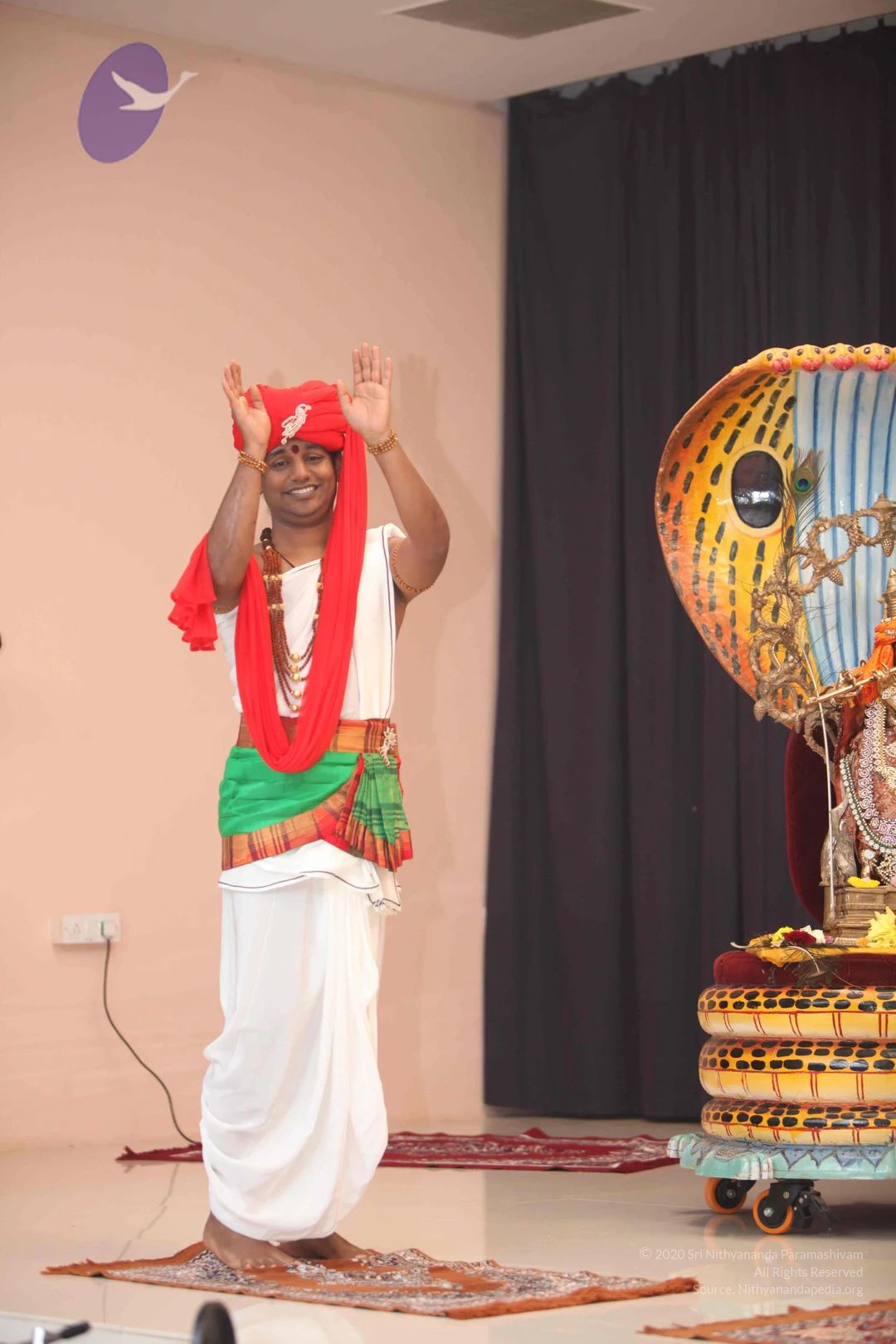
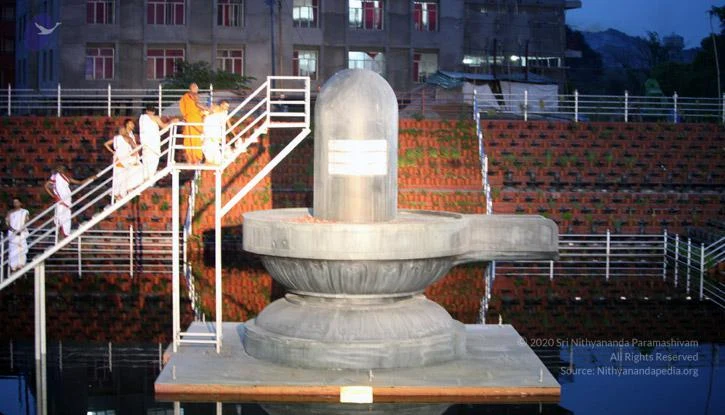
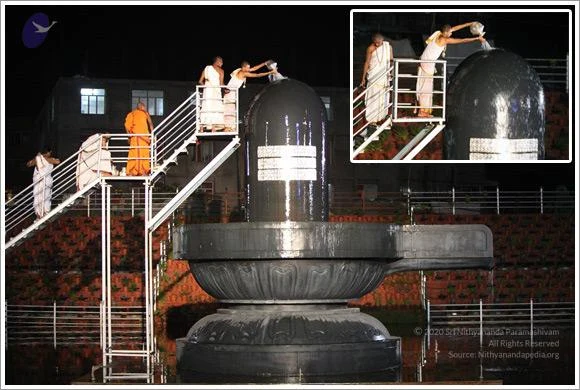
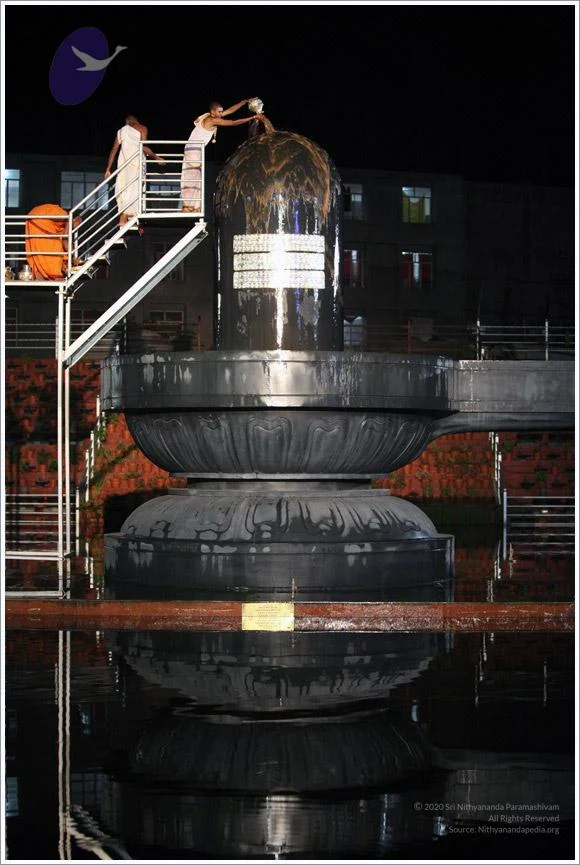
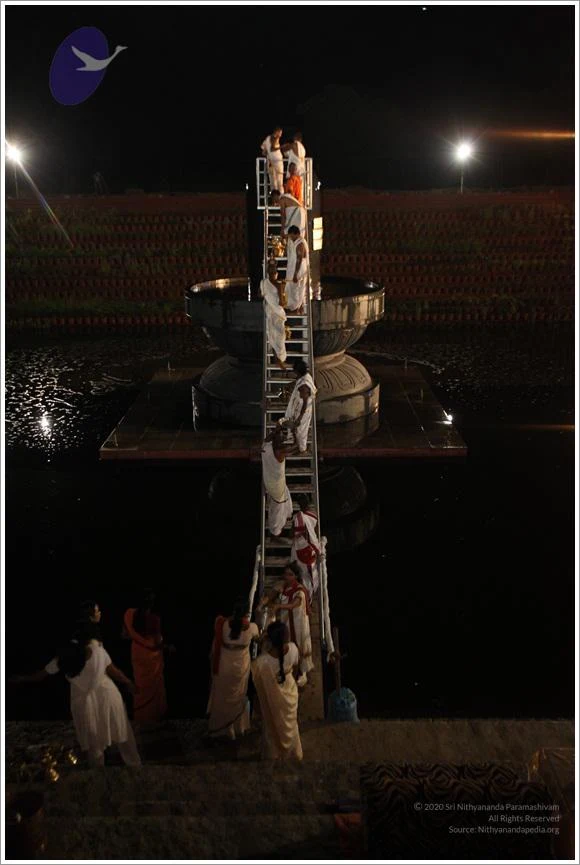
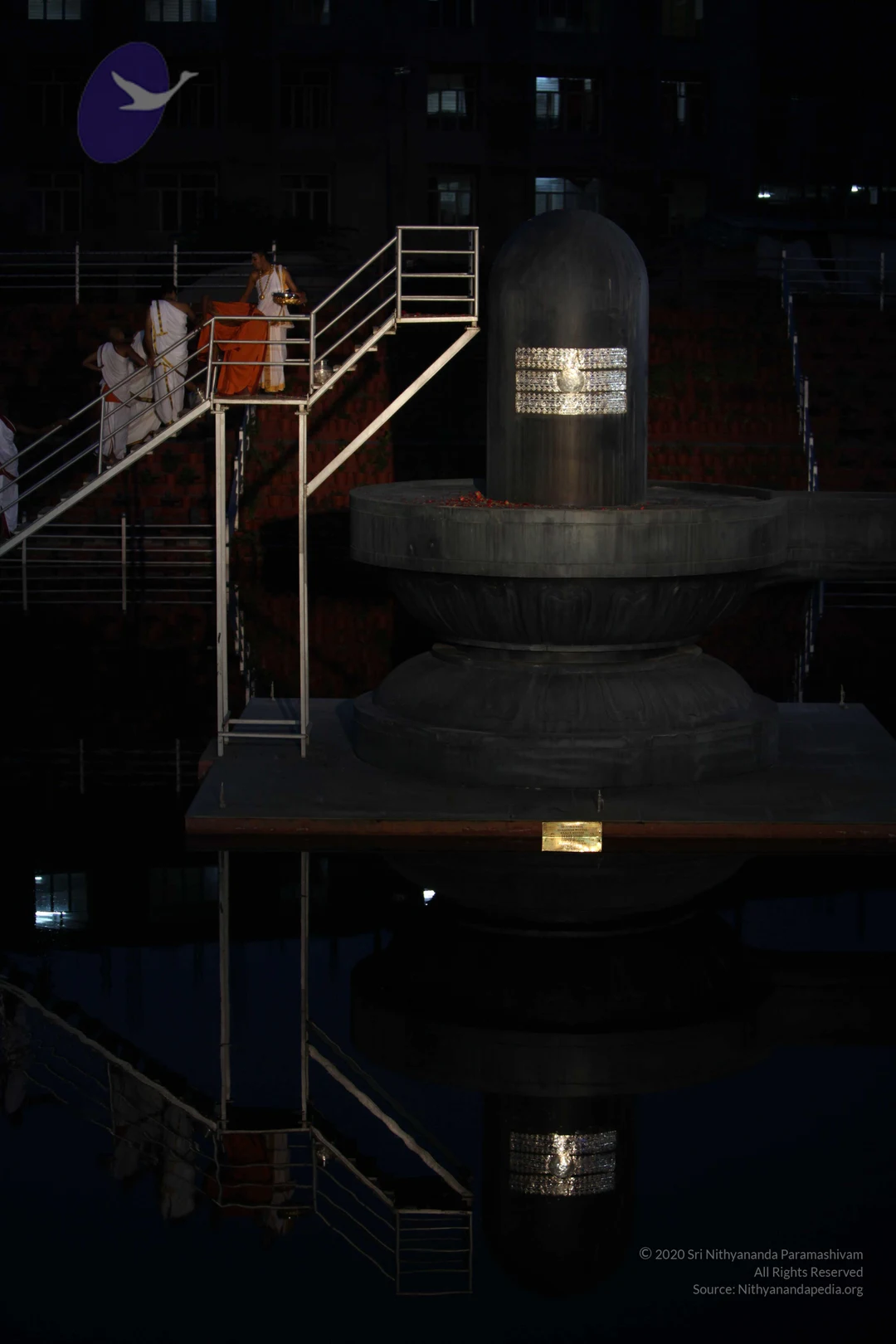
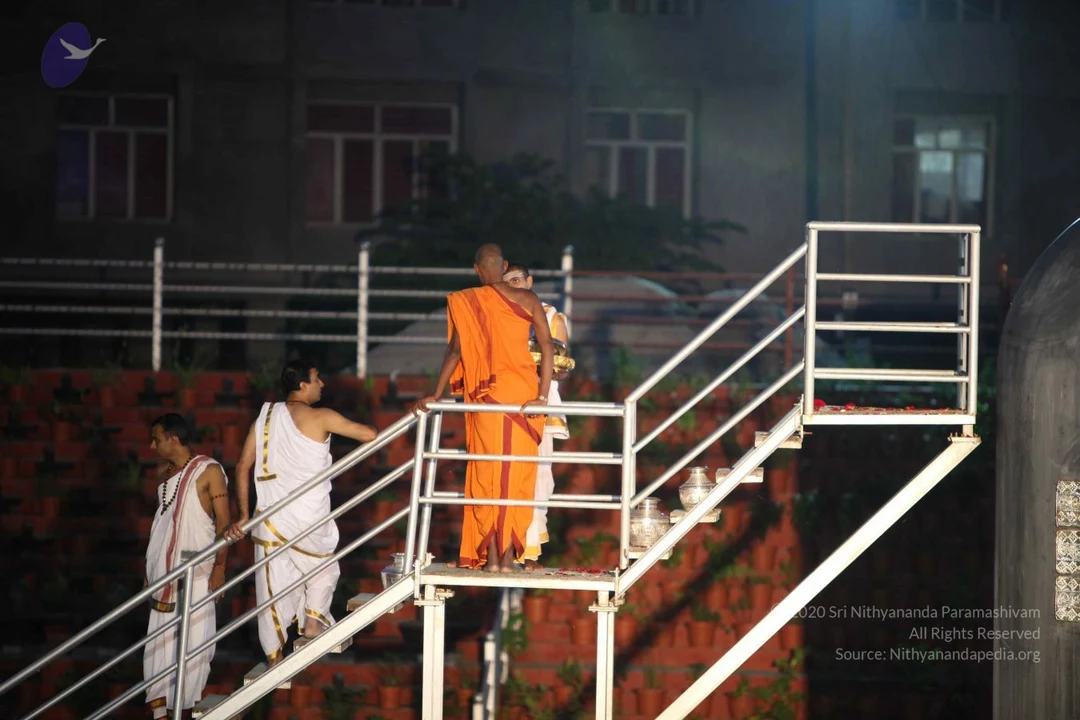
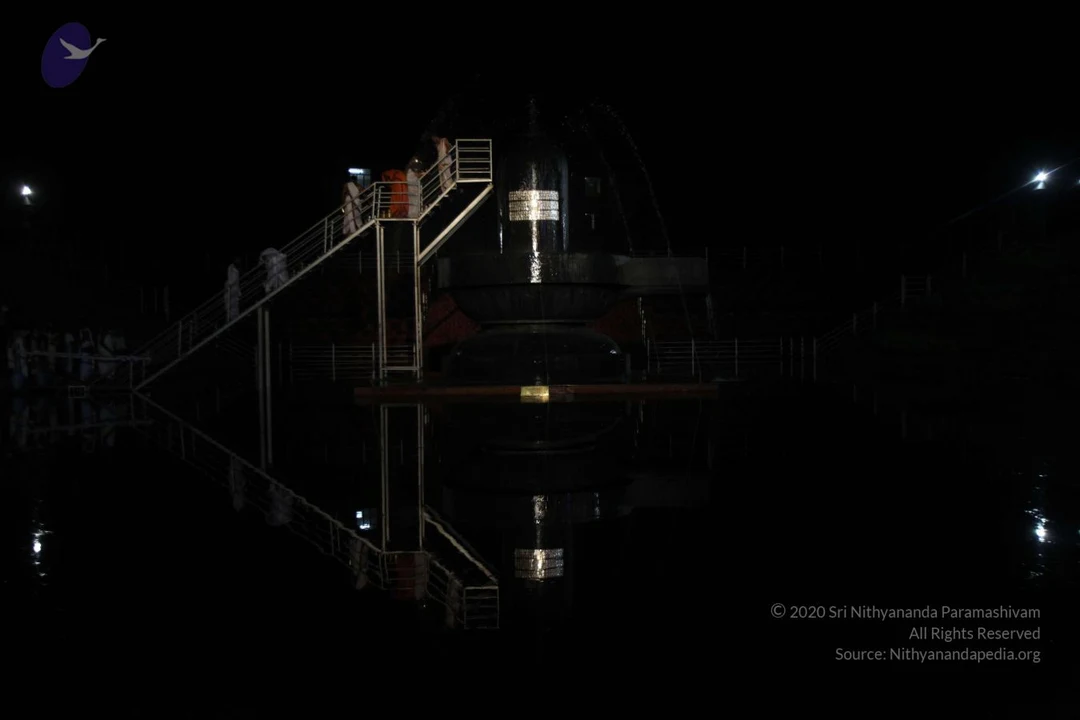
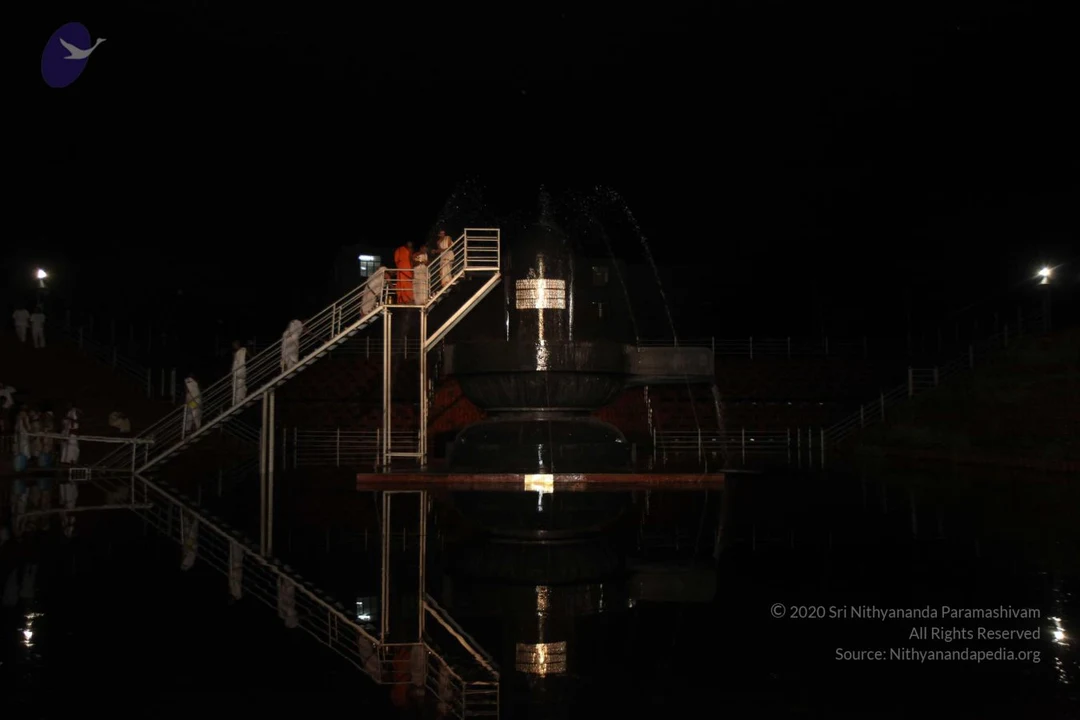
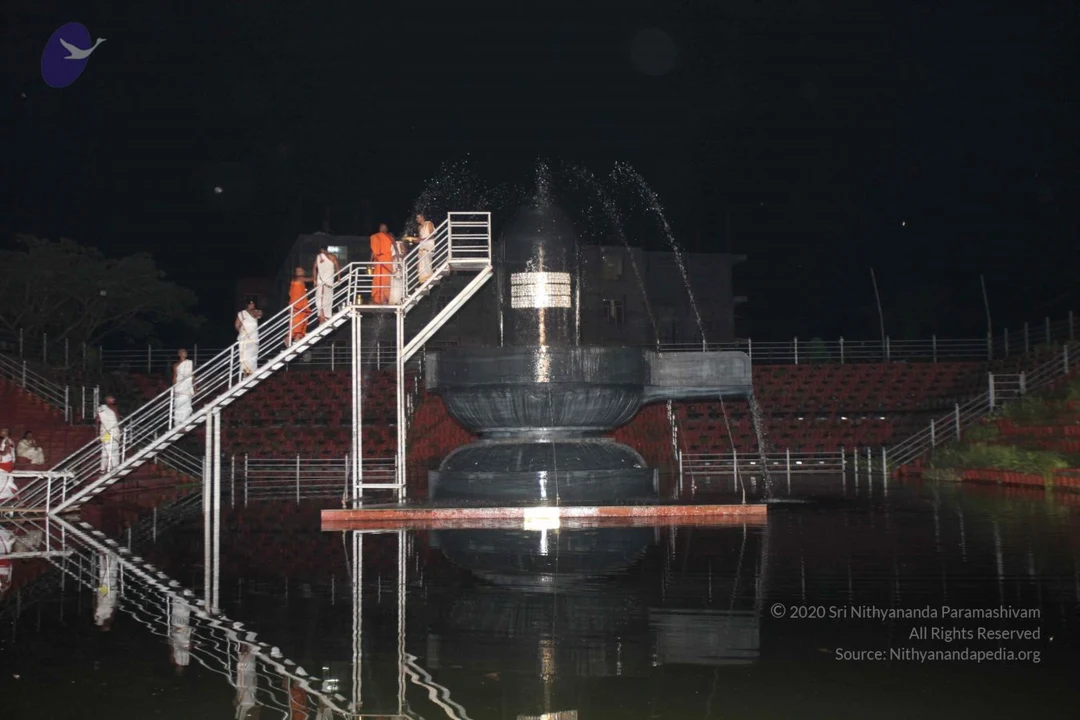
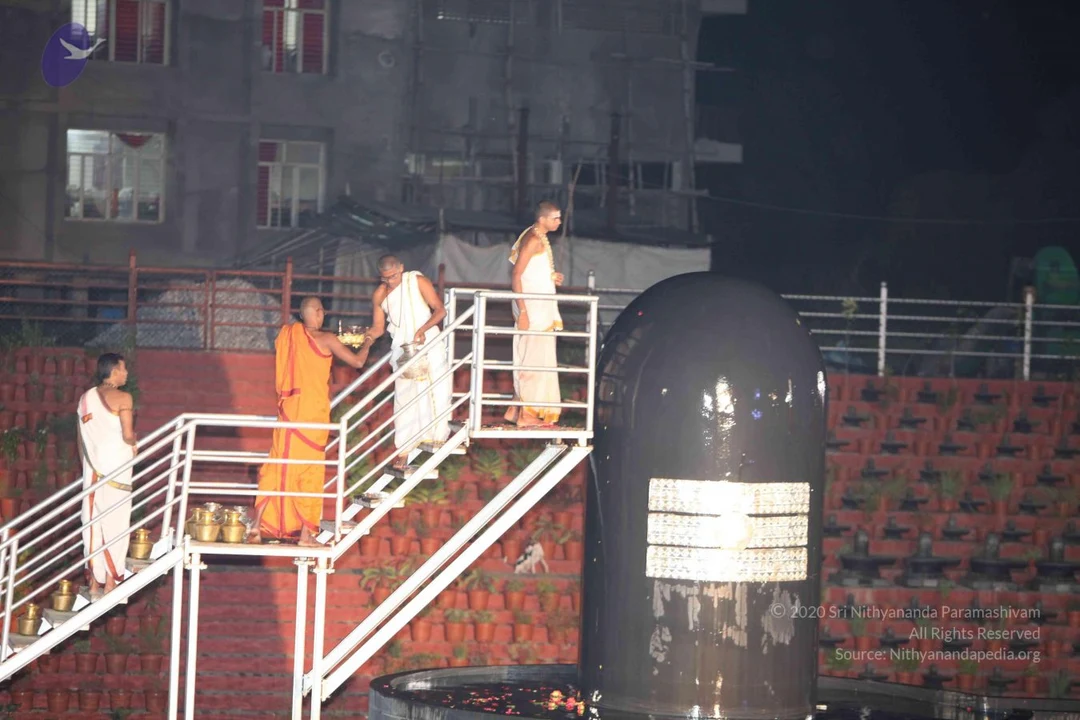
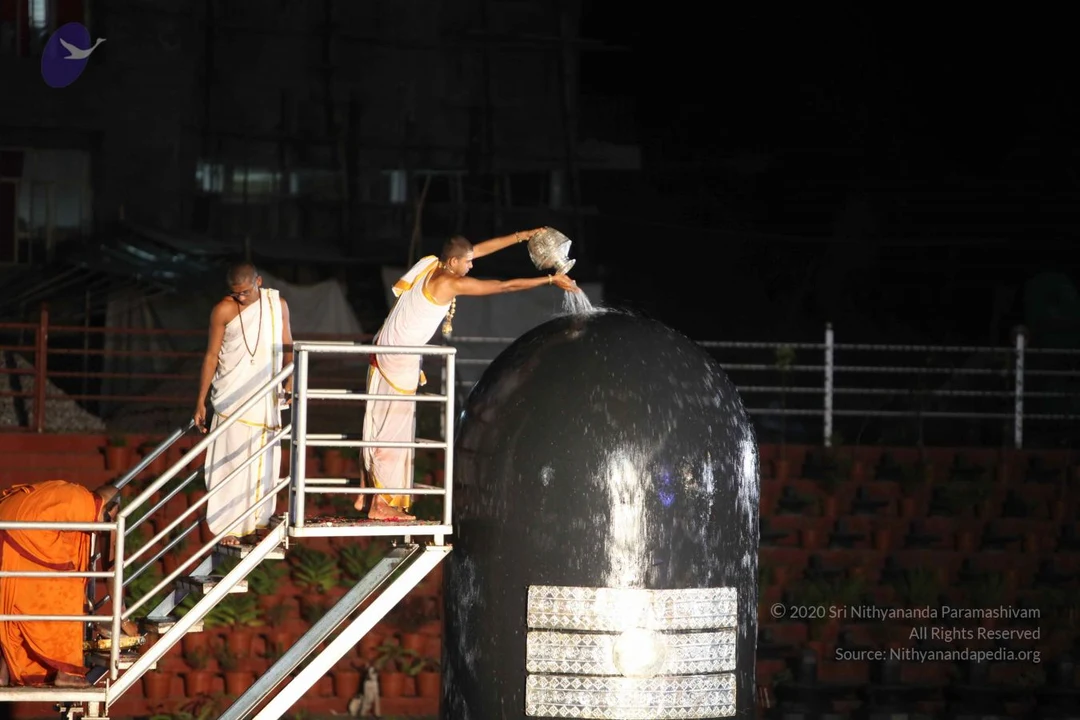
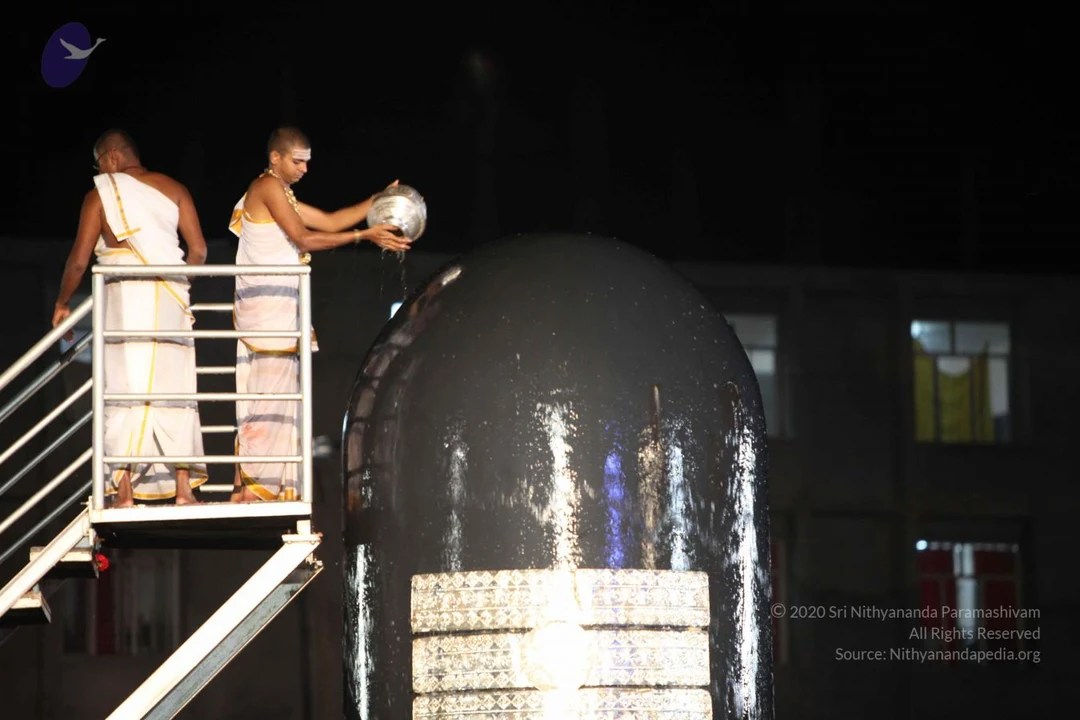
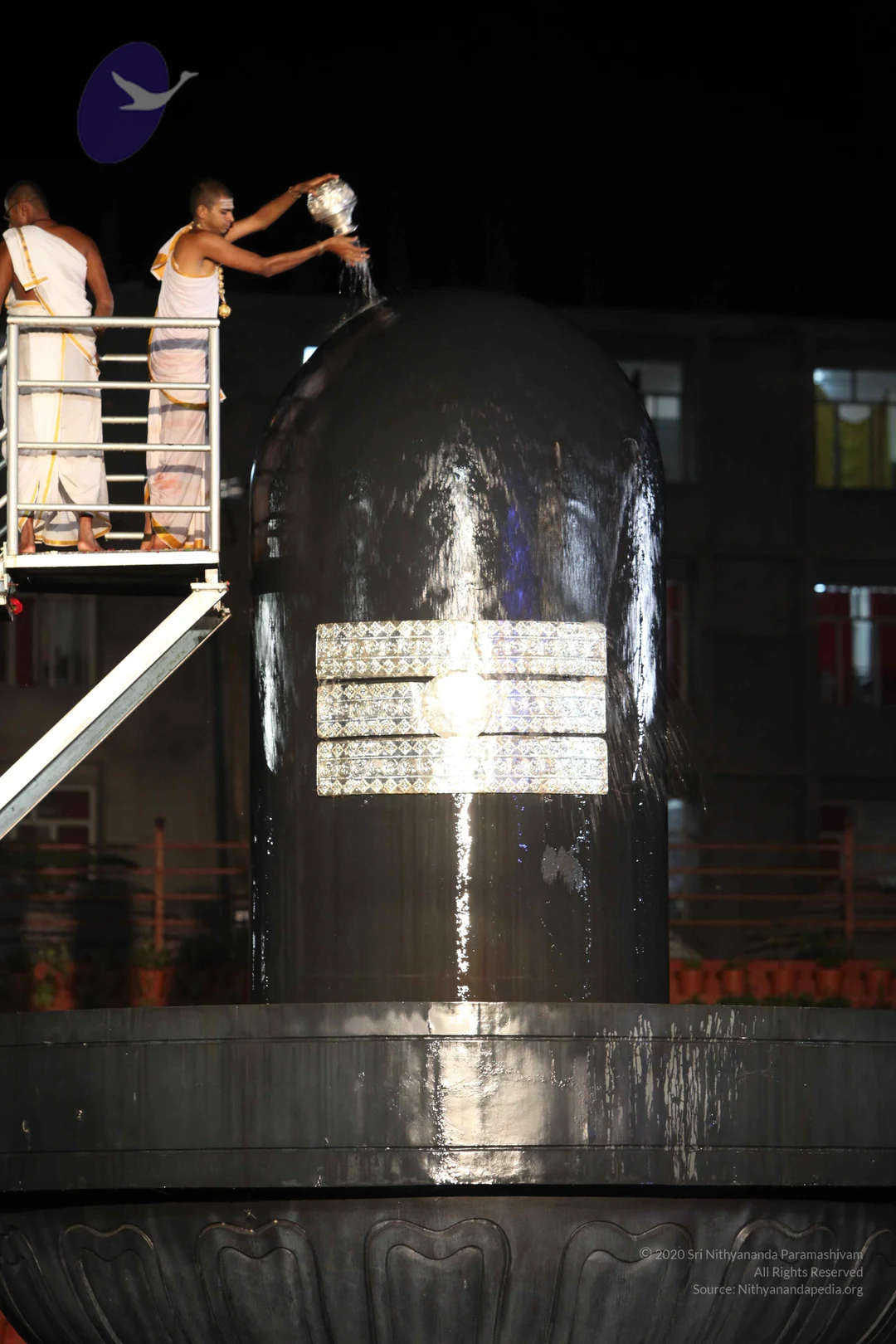
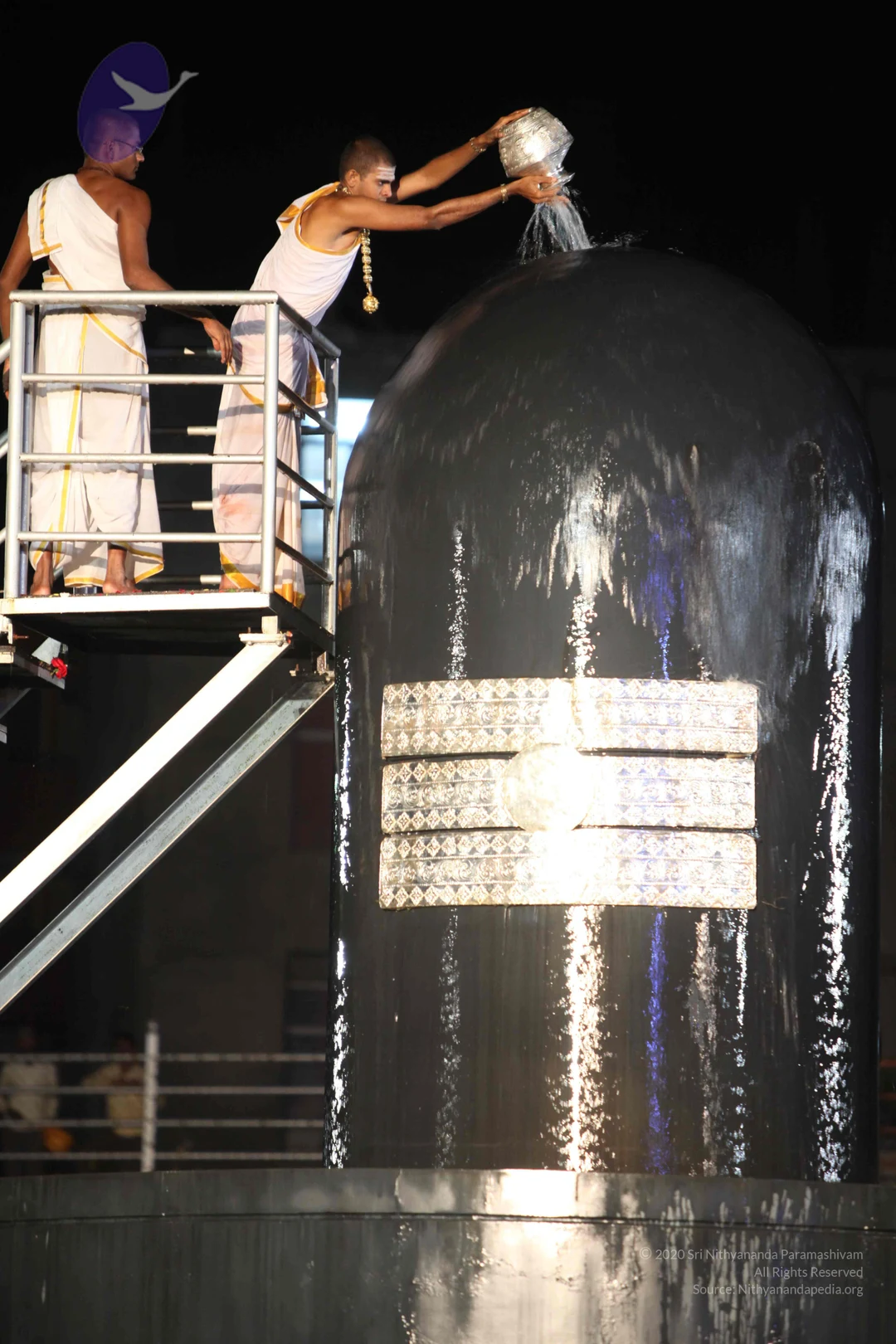
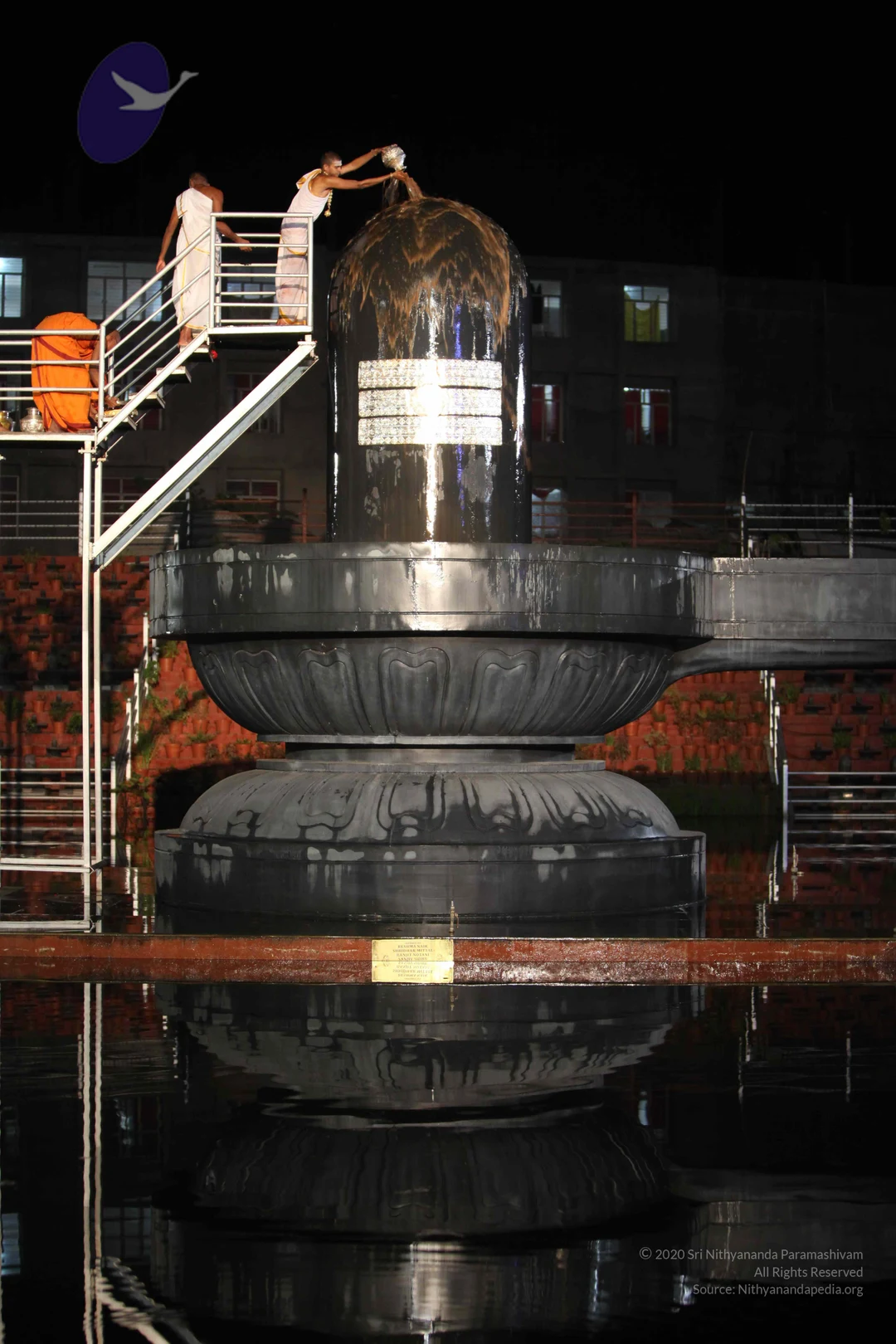
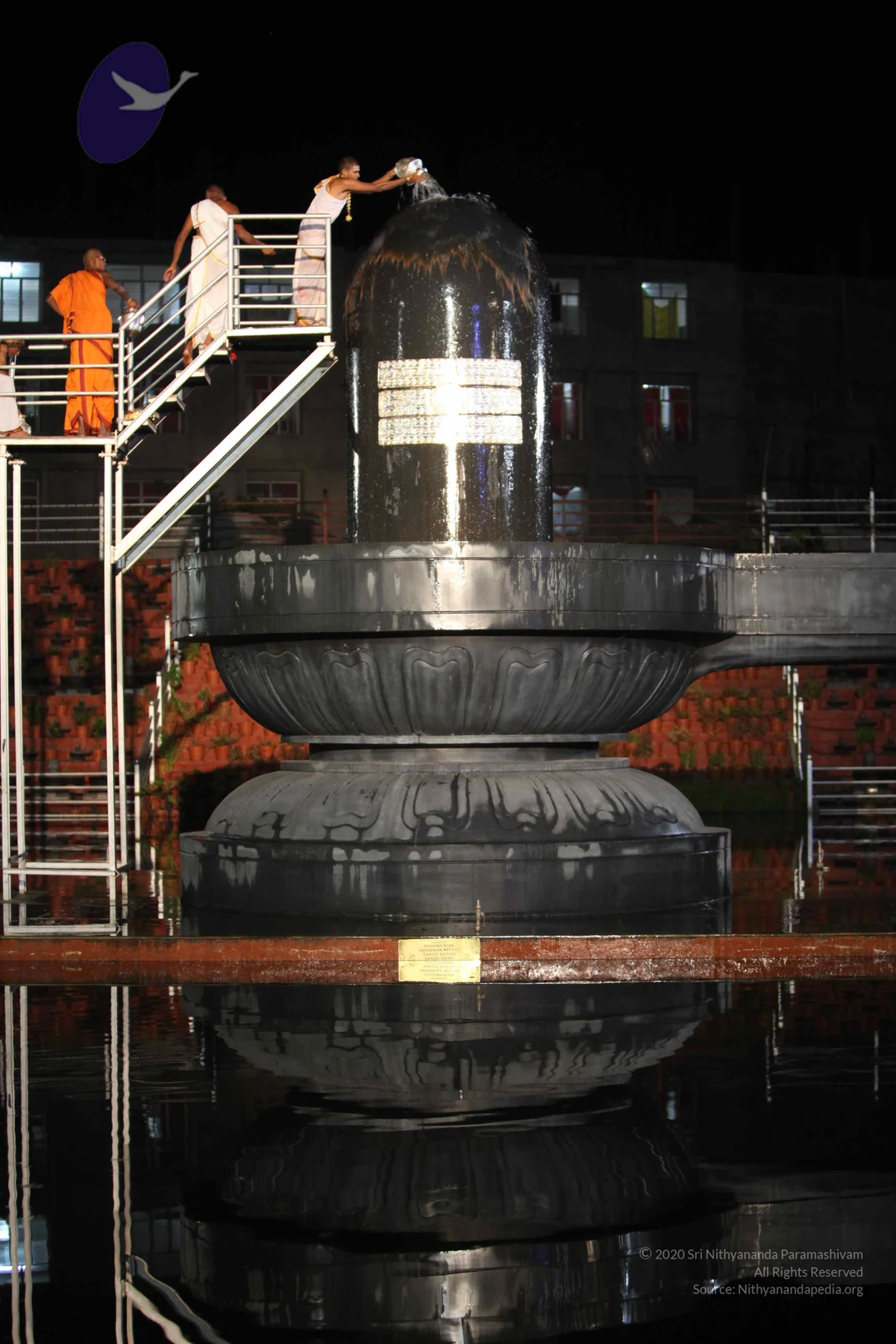
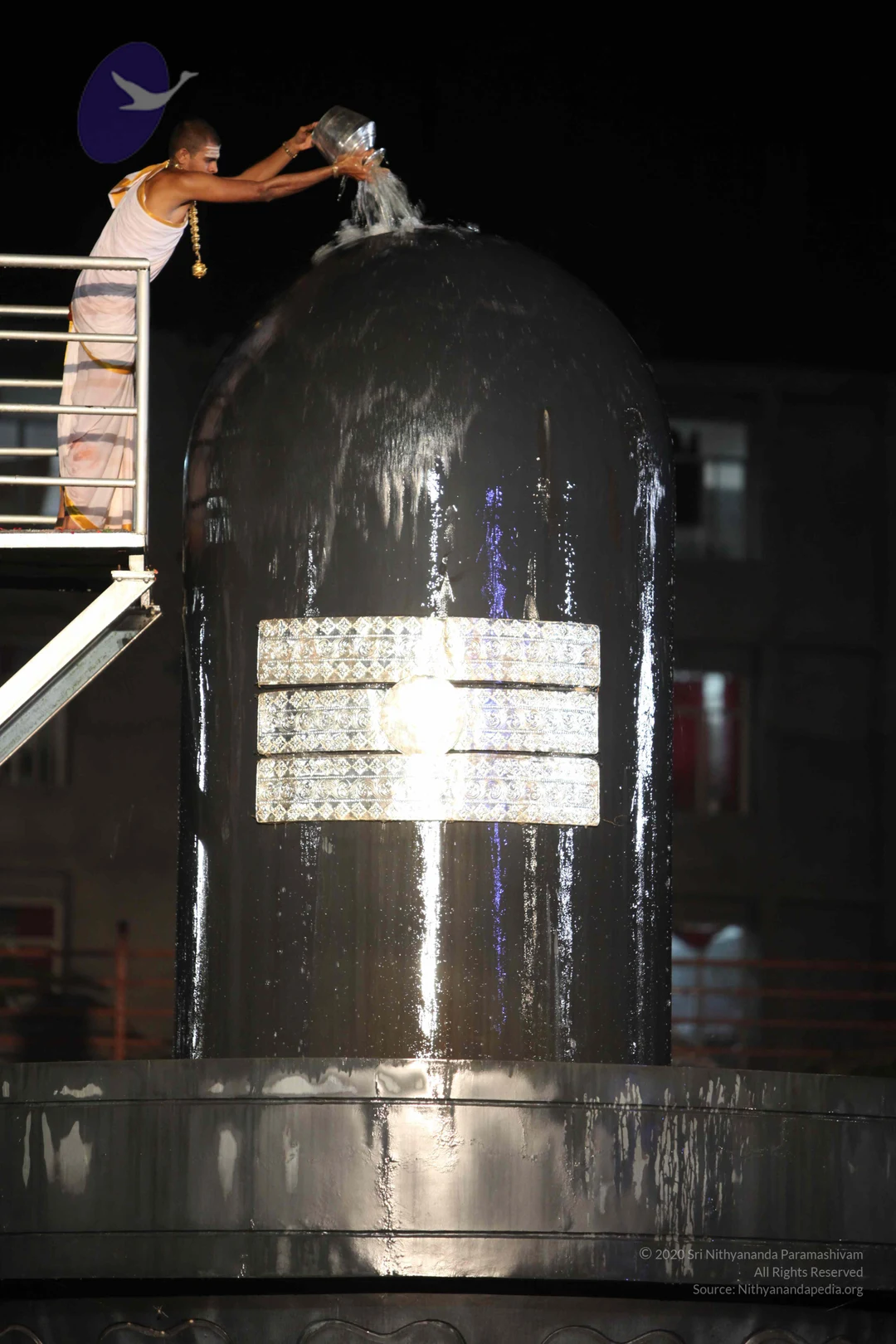
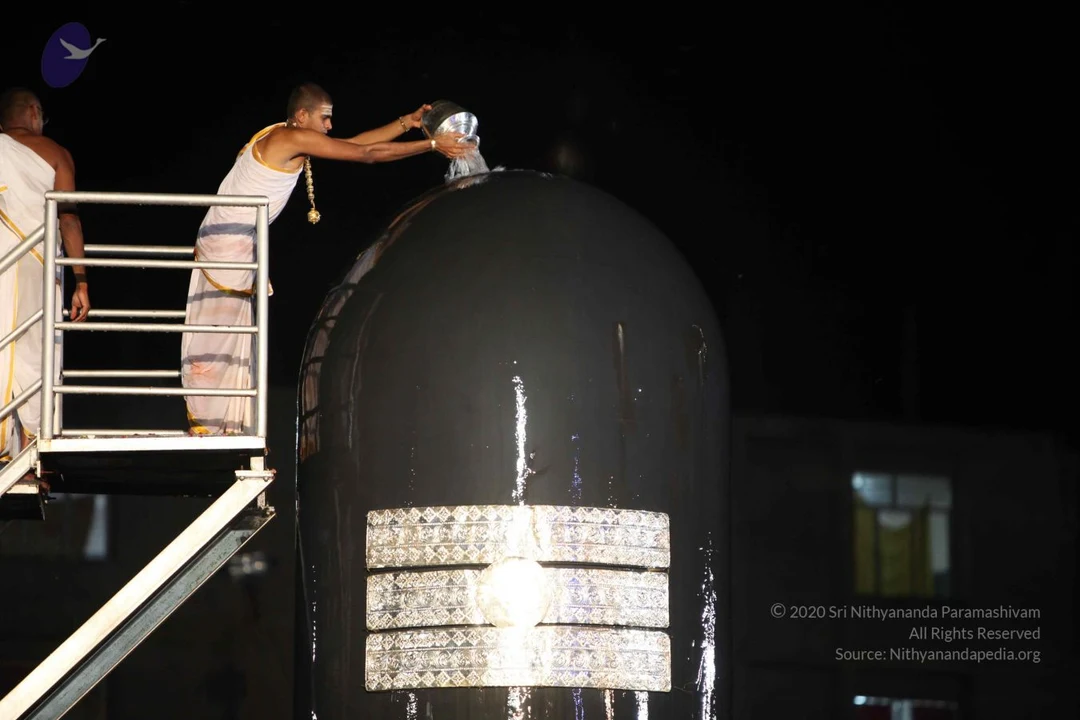
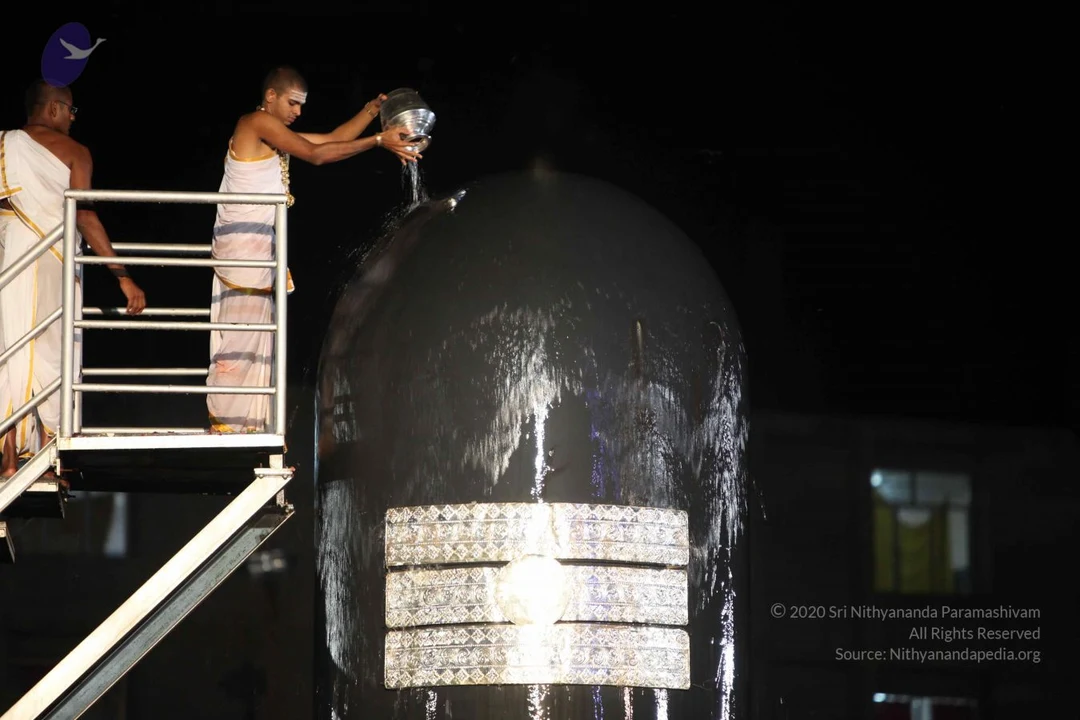
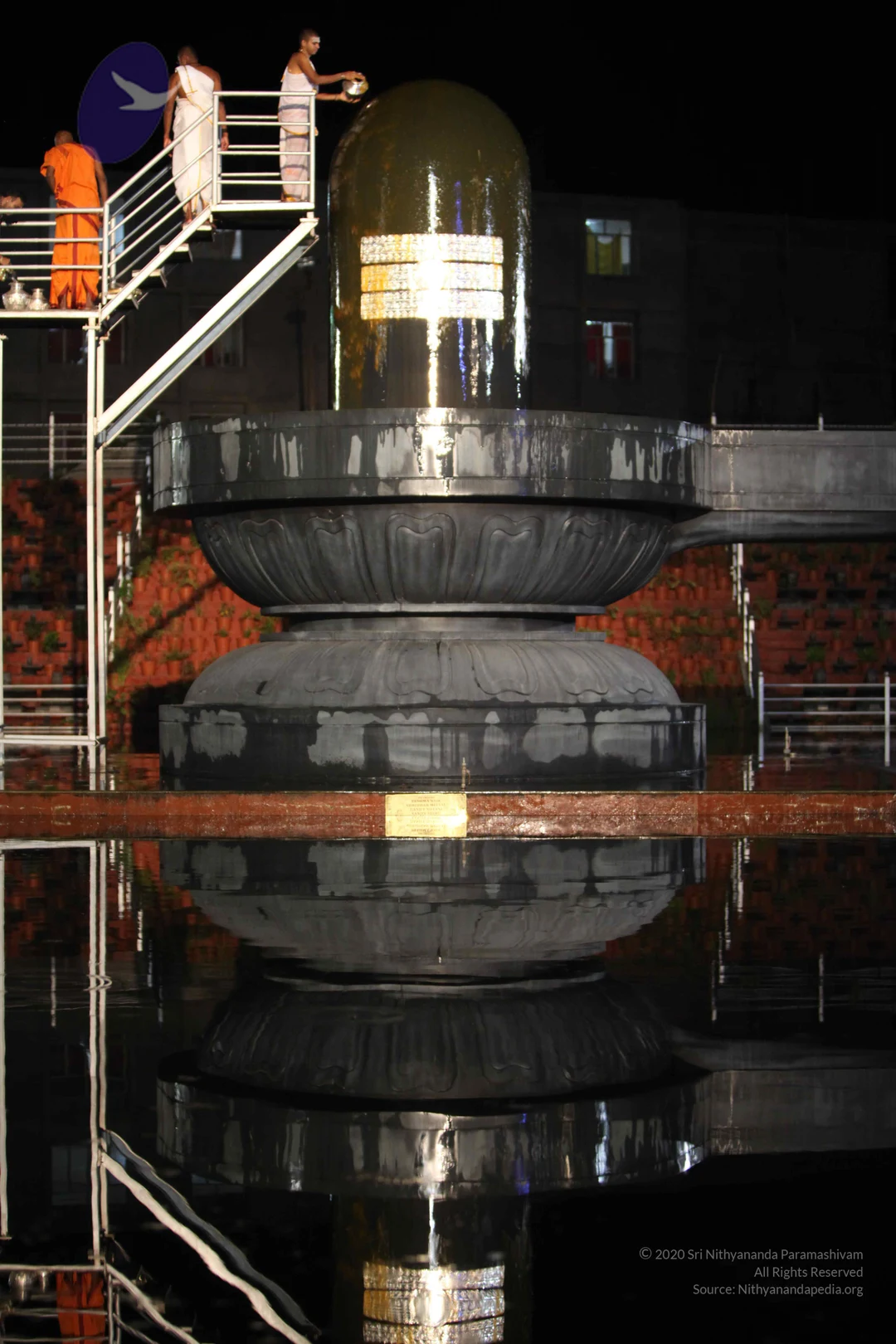
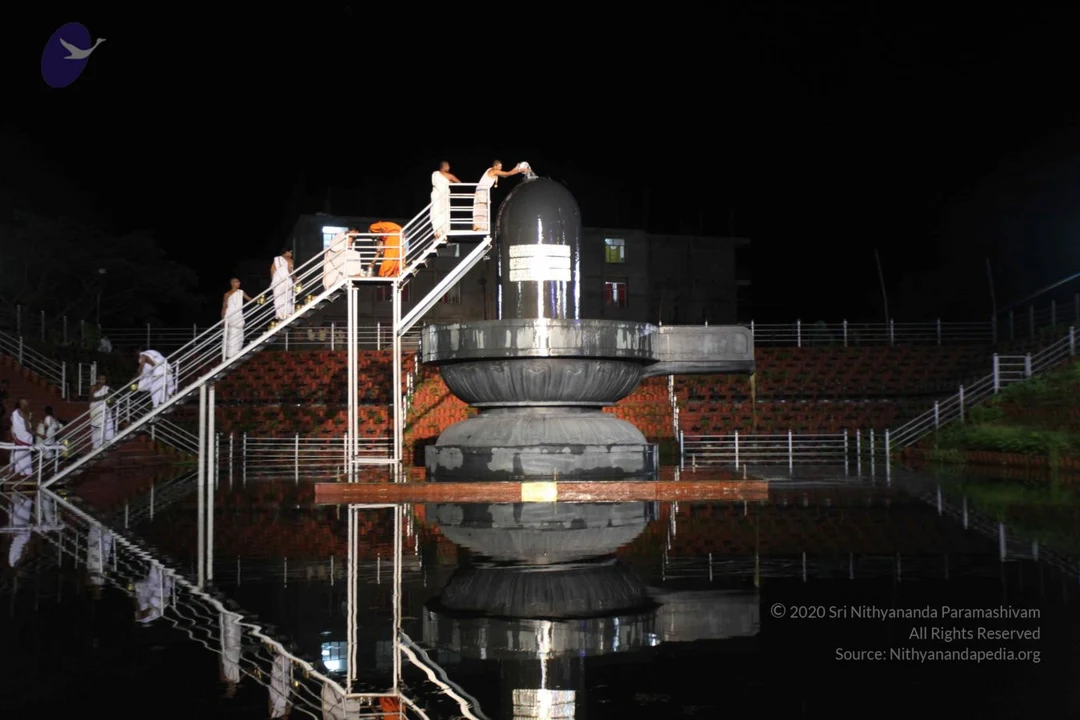
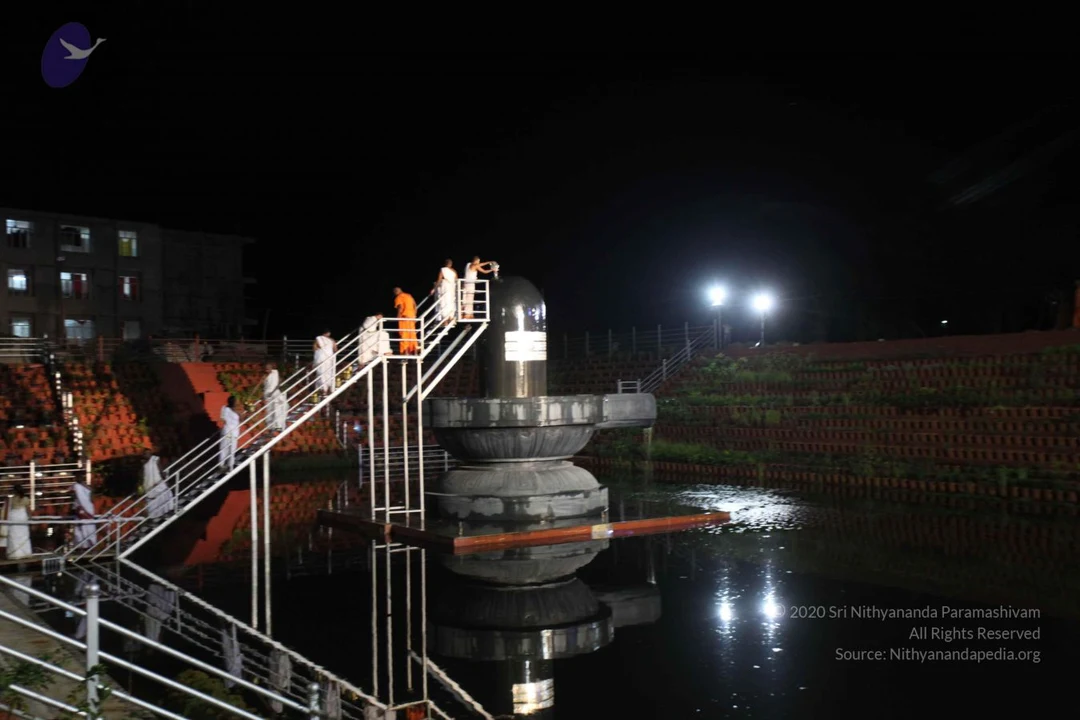
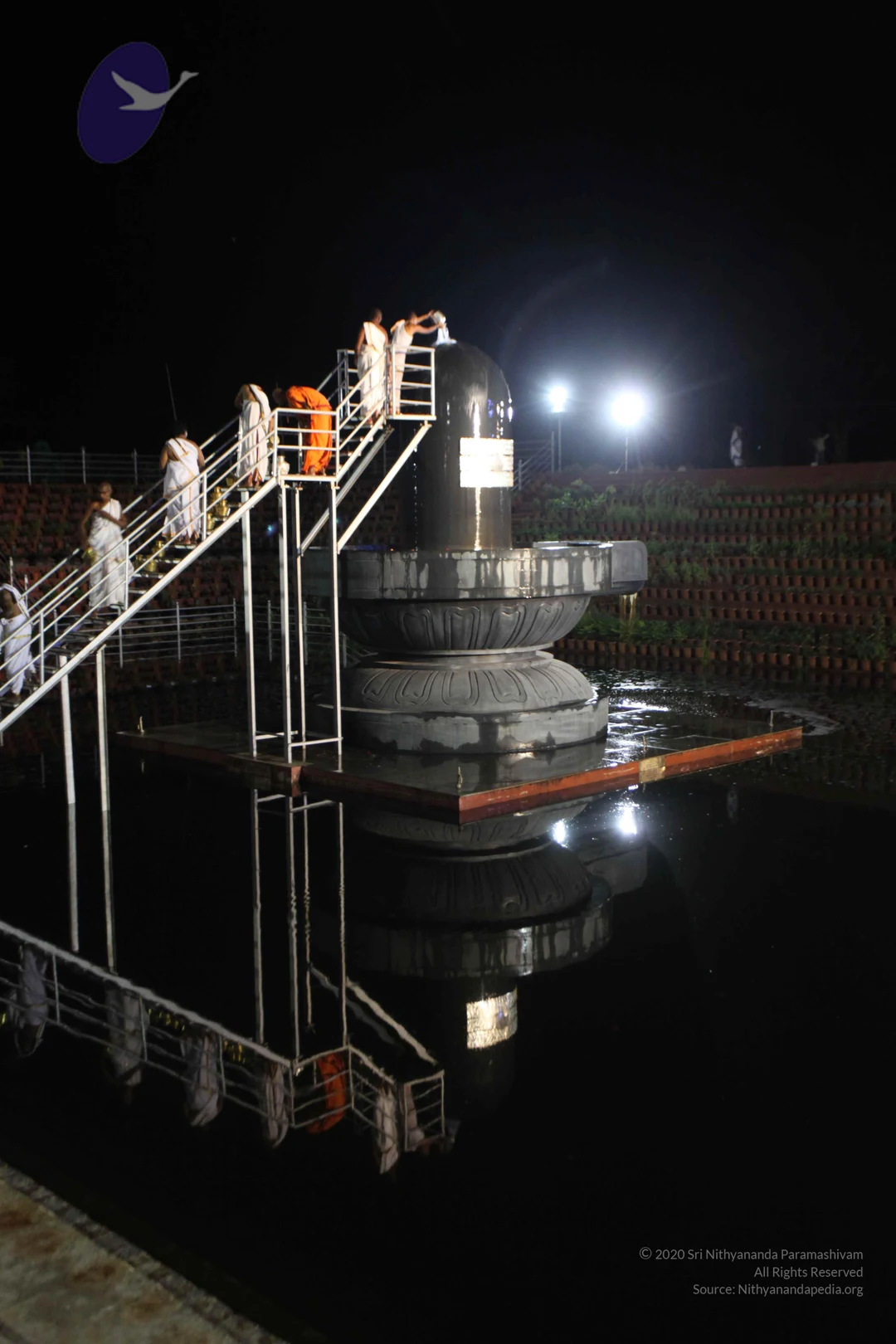
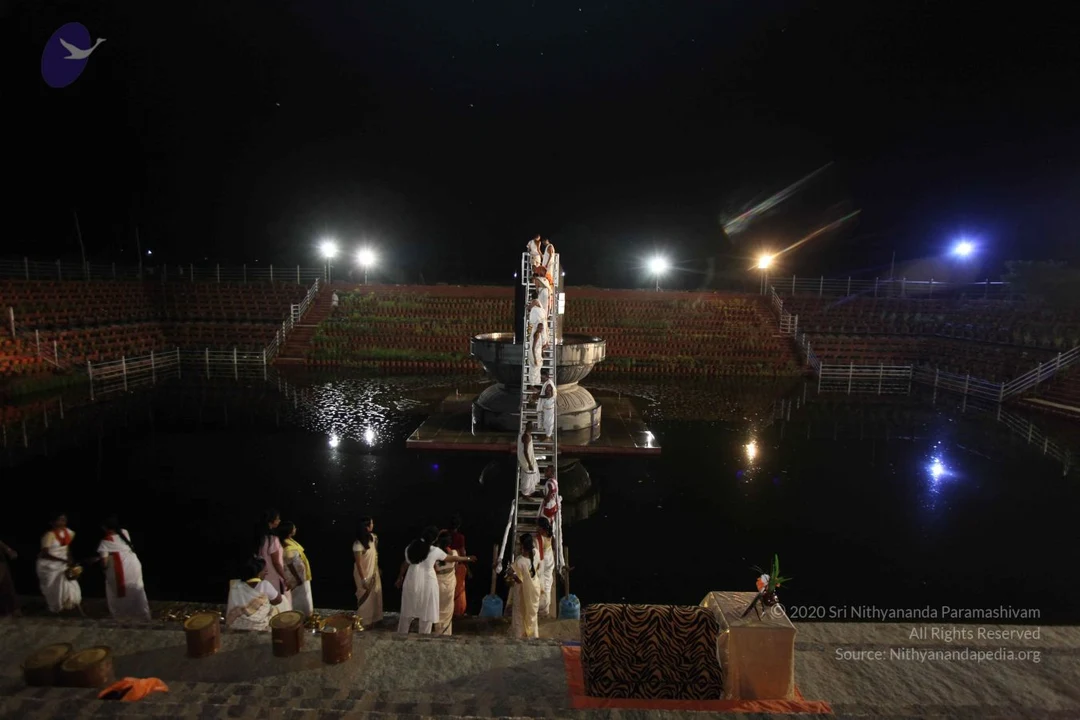
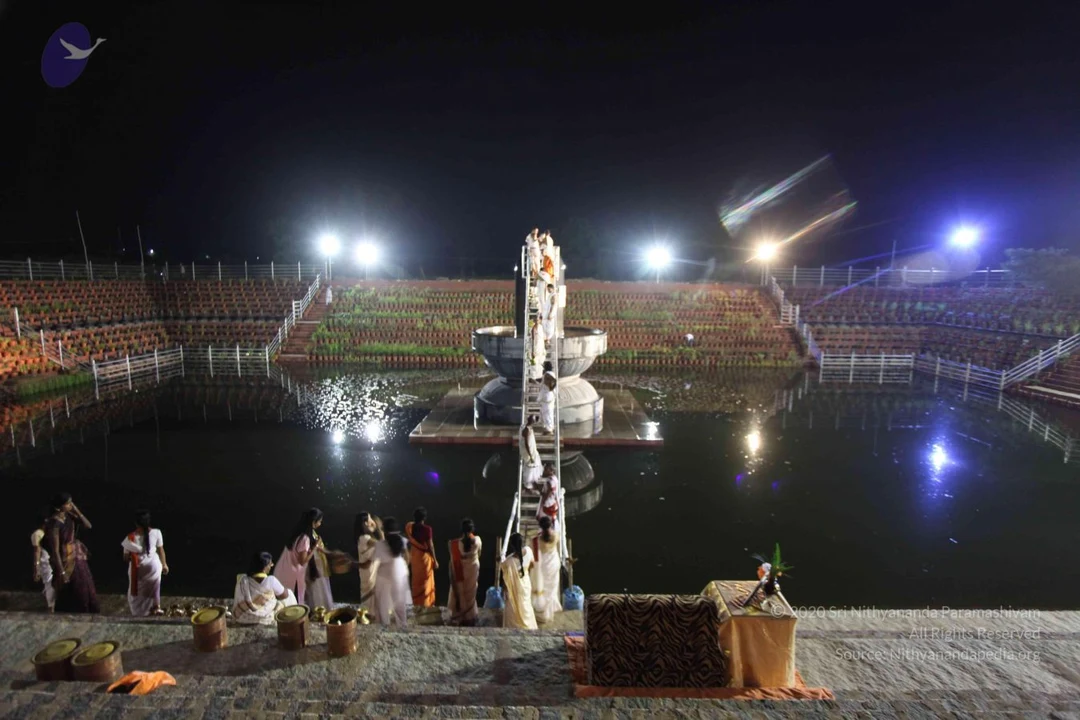
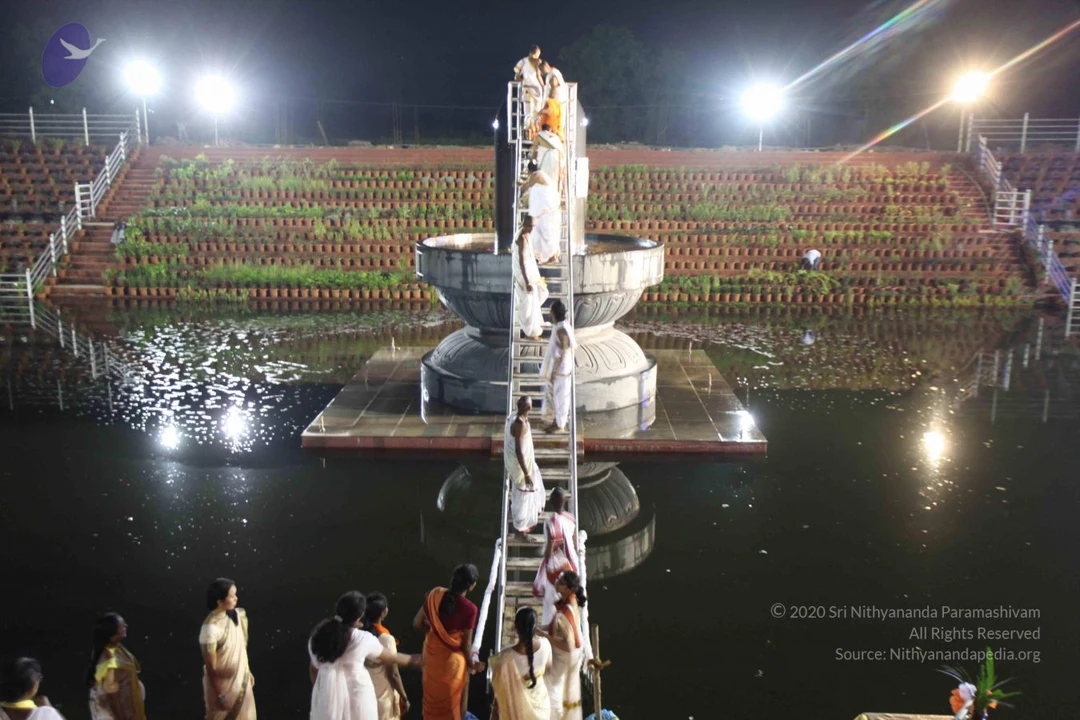
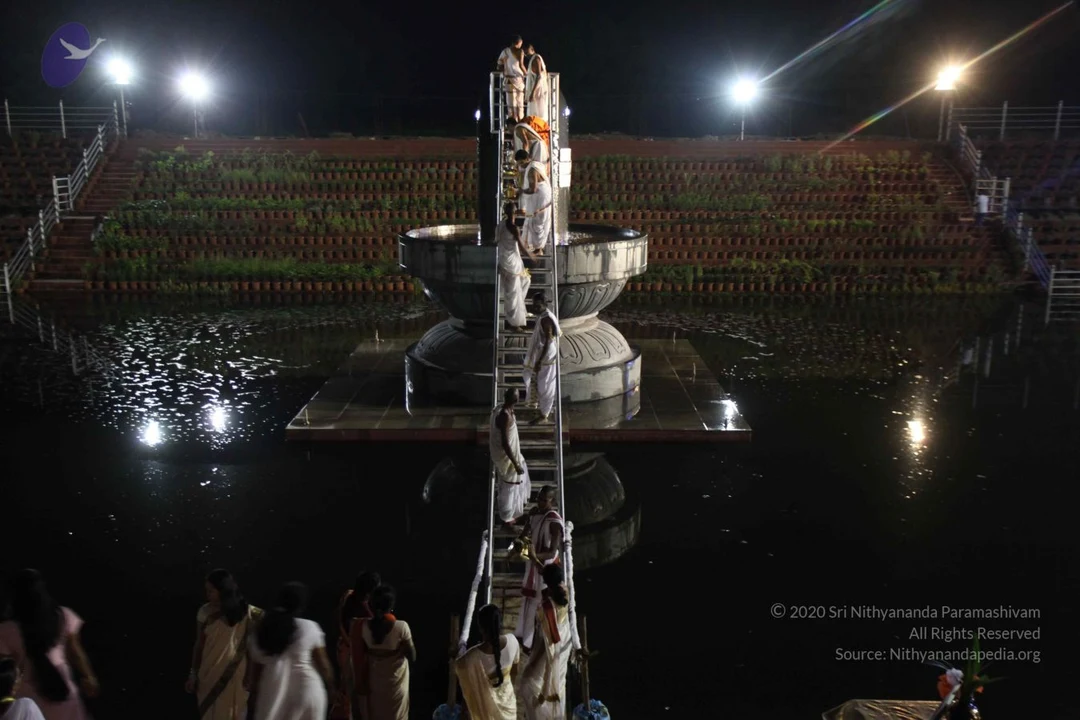
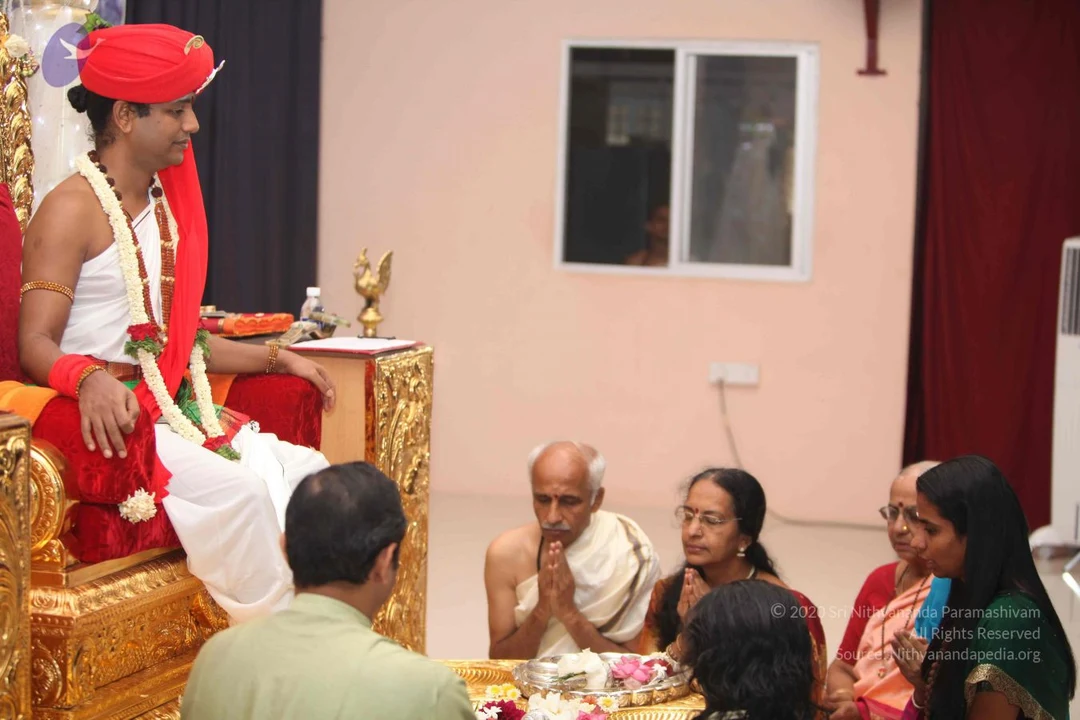
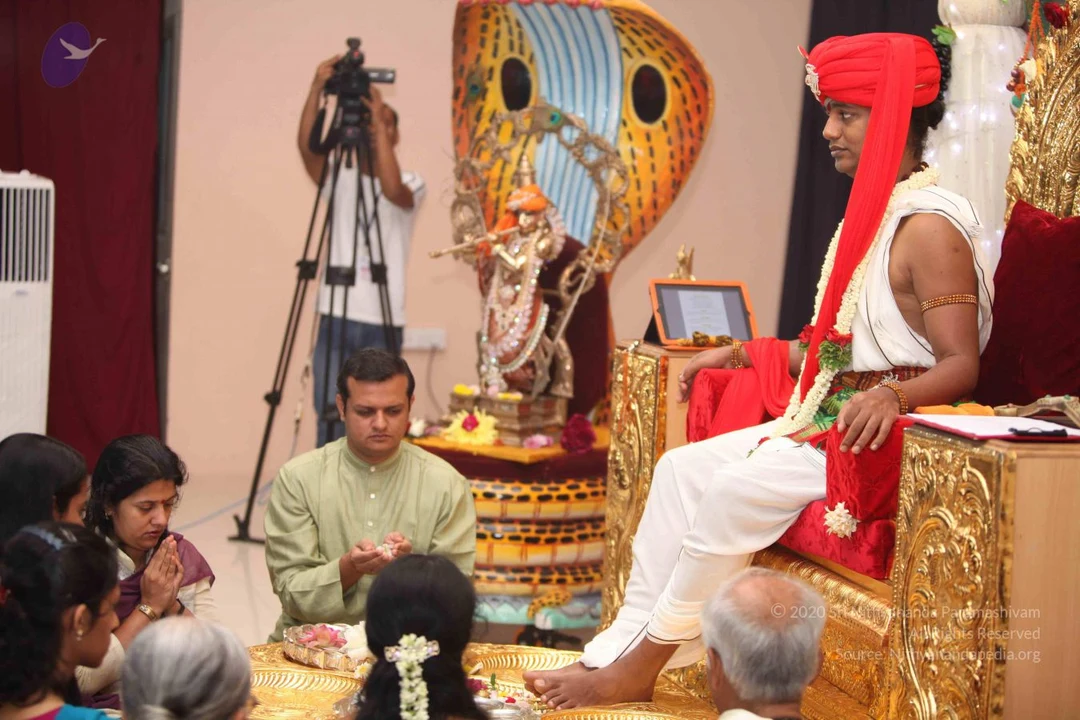
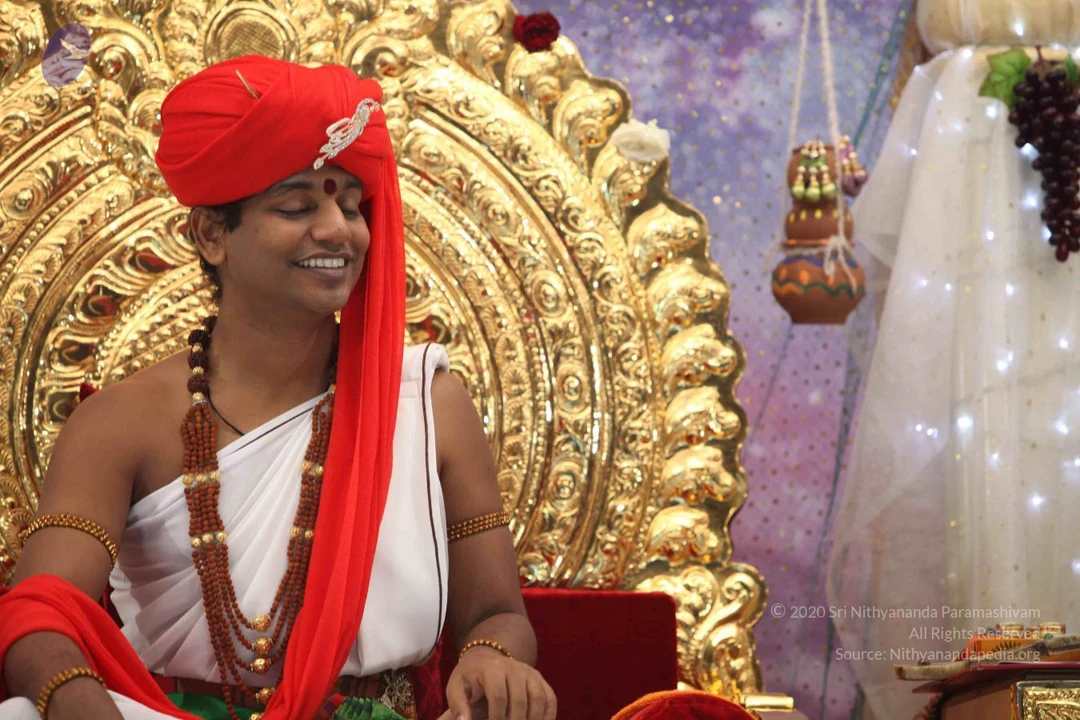
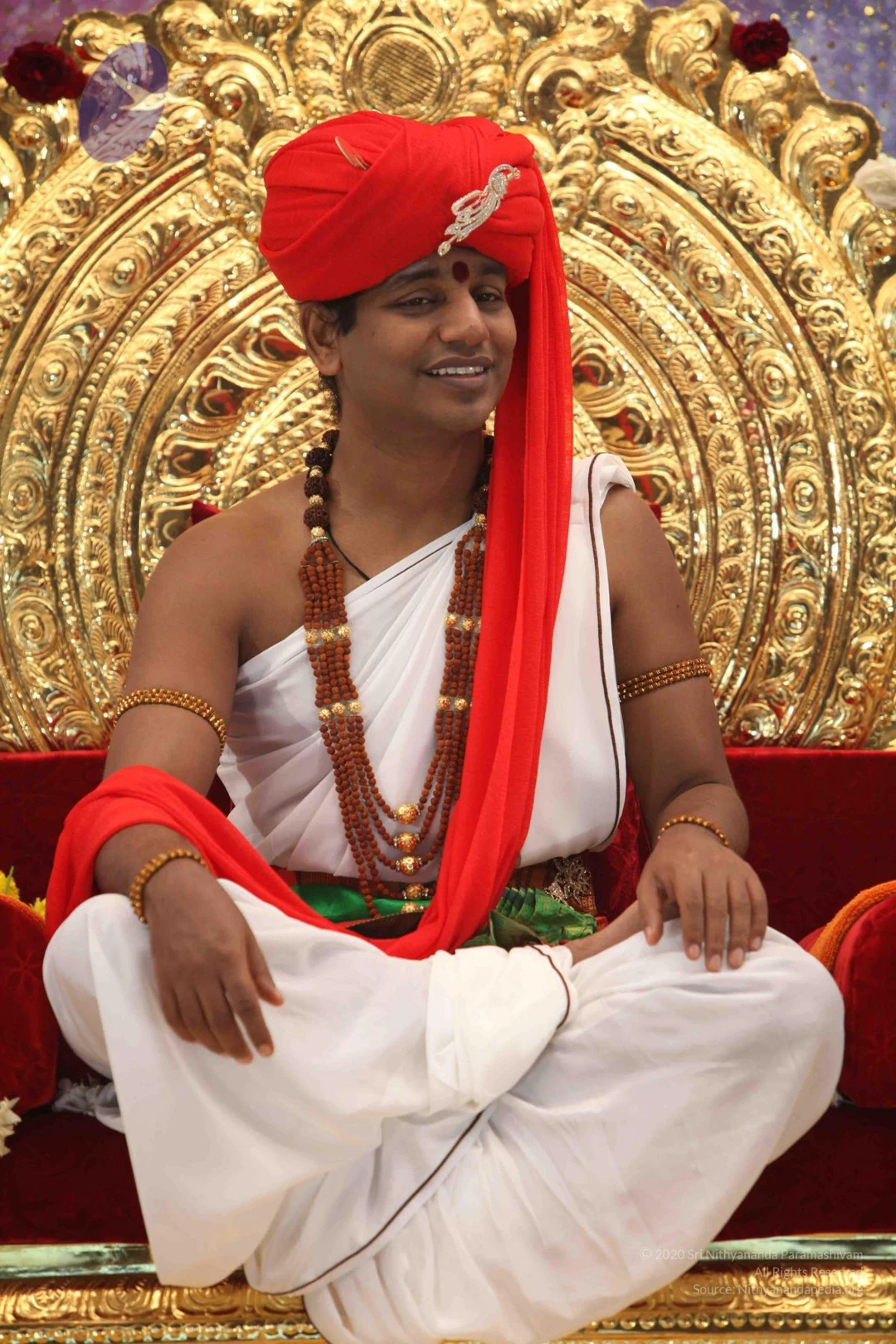
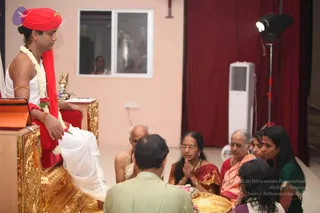
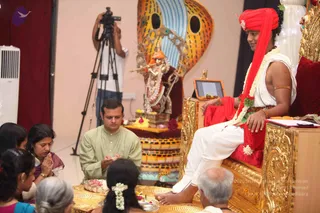
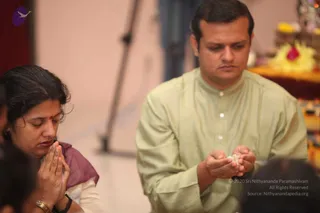
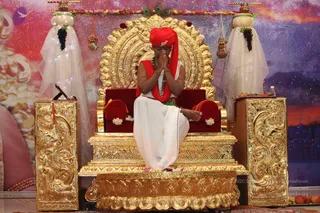
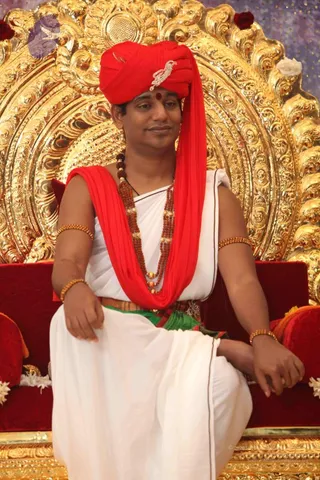
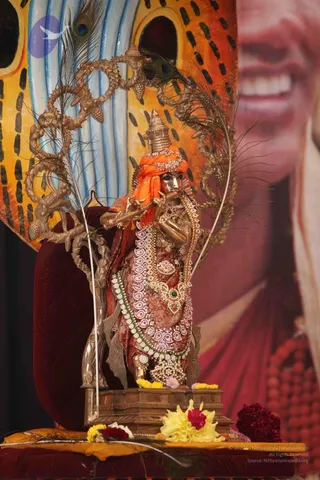
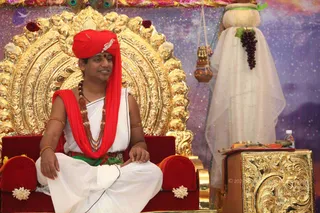
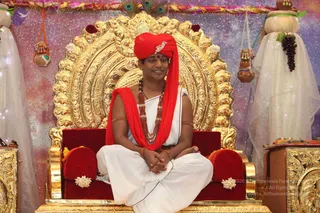
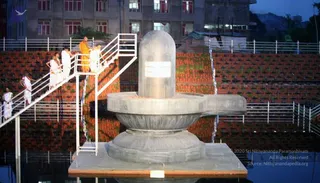
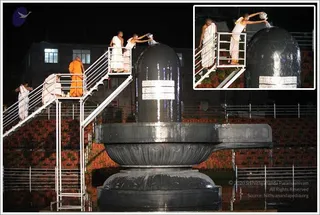
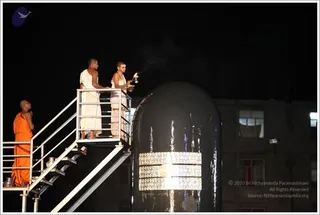
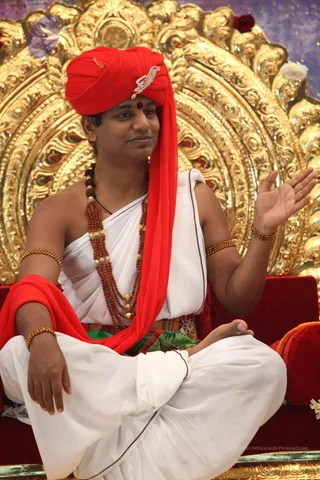
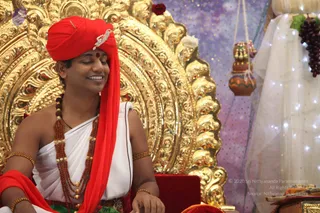
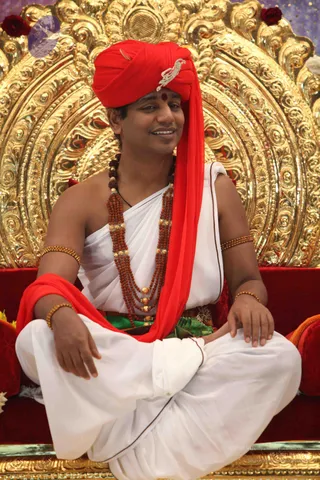
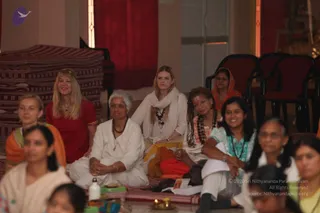
A seated figure in white dhoti-style clothing, with a red shawl and white and orange flower garlands, rests bare feet on a golden footstool in front of a red-cushioned throne. A man in a sage-green kurta, on the left, holds up a small silver cup or vessel, while a woman in a white top and purple shawl kneels with hands pressed together in front of the golden base. Flower petals lie on the golden platform beside small glass cups and an offering dish. Gold ornamental carving decorates the throne and footstool.A smiling man seated on a red cushioned throne in front of an ornate gold-framed backdrop, speaking with one hand open in a gesture of explanation. He wears a bright red turban with a silver brooch and a small red bindi, a white shoulder-draped cloth with a red wrap over one shoulder, multiple rudraksha malas, a gold necklace, and gold bangles on his arms. Behind him hang a decorated kalasha pot with beaded strings, bunches of grapes, and white draped fabric against a purple starry backdrop. The figure appears to be a person by appearance cues including the red turban, rudraksha malas and ornate gold adornments, seated in discourse posture.Night-time photograph of a large black polished Shivling standing on a circular black base, its surface streaming with water and milk-like liquid. Silver-embossed bands with a central raised ornament decorate the lingam. A priest in white dhoti with saffron-striped border and a white upper cloth stands on a metal railed platform at upper left, pouring liquid from a steel pot onto the top of the lingam, performing abhishekam. He has a shaved head with a tilak and wears a gold necklace. Dark buildings and night sky form the background.

October 11 2011

Original wiki page
Contents

Title:

Do You Really Love Yourself

Link to Video:

VideoAudio

Transcript:

Bhagavad Gita

Do you really love yourself?

DATE: Day 44: Oct 11th 2011

The first sacred secret I want you to know there is no such thing as pain and pleasure, good and bad, gain and loss, victory and defeat in planet earth. There is no such thing as victory and defeat, understand. Because all you understand in the name of pain and pleasure, victory and defeat, gain and loss is inside the small bubble - planet earth. 10million soap bubbles are there in the air, inside one soap bubble two ants are fighting one is claiming the victory over the other, one is dead at the feet, the other one is sitting with a big sword; how long this fellow can celebrate his victory? In few seconds the whole bubble blasted, both the fellows are dead, nobody knows who won, who lost. Even in the Mahabharata war I don’t think after the war the Pandavas lived even 100 years. No…. because already they are old; at least in the middle age.

What is the victory? The spectrum in which you feel pleasure, pain, gain, loss, victory, defeat, it is such a low spectrum. There is no such thing as defeat and victory, there is no such thing as gain and loss, there is no such thing pleasure and pain. Victory and defeat, gain and loss, pleasure and pain are all inside small bubble. You can understand in the way of pebble or bubble. Both are same. Whole world is a small pebble in the universe; the whole earth is a small water bubble in the cosmos.

In our Vedic literature we are describing Bhagawan is in anantha shayana; from his naval cord there was a lotus, and from there Brahma came and all this creation happened. You will be shocked just 7 days before there was a paper published on cosmos and universe. They are describing exactly the same. Group of scientists are saying…. from somewhere like a umbilical cord a kind of a thread is coming into the cosmos which we are living now. They are feeling through that umbilical cord only this cosmos has been fed with many stars and planets and there is a certain material with which this cosmos in which we are living is connected to the larger universe which is literally unmanifest. This whole galaxy which you are seeing itself is a one dust…. then how many dusts are there like this?

Pleasure and pain, gain and loss, victory and defeat are all in too low spectrum. I tell you whether you live this truth or not that is secondary. Everyday at least spend few minutes in remembering this sacred truth….. ‘ehh this whole thing is so small’. Remember life is too big at least for ten minutes a day. That remembrance can bring so much of healing in your system. I tell you just this moment when I am talking about it I can see how much of auspicious feeling, feeling to exist, feeling to live, feeling to love, feeling to radiate is happening in my system. I am not even…. see the moment I remember this feeling of huge…. and all our worry, victory, defeat, pain, gain, loss, pleasure, all too small; sukha dukhe same krutva labha labhou jaya jayou... treat them all the same.

I wanted to tell you all, you can’t treat all of them same directly. No. you try your best you will be constantly failing. I am revealing you the deepest sacred secret. Everyday at least few minutes before going to bed or after coming out of sleep, sit and remember how tiny you are. This whole planet earth itself is too small in the cosmos, the whole cosmos itself is too small in the universe. It’s all too negligible. If you want try to see some video or photograph from the YouTube or something just to understand about the hugeness of the cosmos. Let your mind absorb, let your mind understand ‘God everything is too big’.

You see one part of your mind will be no, no, everything is too big, that is true, but practically I have to get up and do my duty, do my job, come on let me find solution for this. Relax, relax for few moments and look at the whole ‘Oh God it is too big, my problems are too small’. Even if you have the problem that you want to become the president of America and you are not able to, that is too small. Before going to bed everyday at least for ten minutes allow this idea to sink inside. ‘God everything is too big’. I am just a small dust. What am I? All my problems, all my pleasure, all my pain, all my gain, all my loss, all my victory, all my defeat; when this smallness settles with you suddenly you will see the pleasure and pain becomes same for you, gain and loss will be same for you, victory and defeat will be same for you.

The next line, a powerful line, with this line Bhagawan brings the science of enlightenment to planet earth. Do battle for the sake of battle and you shall incur no sin. Your consciousness lands on the planet earth as a pure shining light but all your pleasure and pain and loss and gain, victory and defeat, these attachments makes it corrupt, dull. It’s like you bring a pure shiny mirror, here they throw all the dust, pleasure, pain, gain; all the dust and that mirror loses its quality to reflect, radiate, shining. Everybody will ask what is the way to keep the mirror pure, shining? The only way is do not allow pleasure and pain, gain and loss, victory and defeat. Do battle for the sake of battle and you shall incur no sin. Do battle for the sake of battle, live your life just because of the enjoyment it brings.

I tell you every time the feeling for life when it happens in me like a wave, I just feel oh God I am living I want to live so I am going to live forever. This is what I call energy - feeling that life is good. When this wave hits you energy fills your system; not because of any loss or defeat, any victory or gain, any pleasure or pain; just for no reason life is too big, consciousness is too great.

It’s like when you go in front of a too big guy you don’t feel like asking 50 paisa or one rupee or a pen or pencil. You become silent; asking these things is too petty or too small in front of him. I tell you that’s what exactly I feel in front of my consciousness to ask for anything. Again and again my disciples push me ‘Swamiji ask for this. If you think, it will all be done immediately’. The moment I turn inside, the life is too big to have a desire. Understand life is too big to have any desire. When you have a desire and look inside, turn inside, with that desire you look too petty too cheap too small.

Life is too big; consciousness is too big to have any desire. When I understand consciousness is too big, the wave raises, the wave ‘life is too good’ rises in my being. That’s what I call energy. Every time ‘the life is too good - that feeling comes in me I just feel I love life. Because I love the life I know I am going to live forever. This body and mind is not going to stop my existence. These two can come with me a long as they both can. When they both feel they can’t, they can retire, relax, rest; rest into the tatvas. When I say the word tatva I mean that different tathvas like water, earth, fire, air, ether. My body and mind can rest in different tatvas but I am going to continue to exist; because life is too good. I have so much of love for the pure life, so body and mind can come with me as long as they can. After that I will continue to live; they can relax into my tatvas.

Understand love for life should cross your love for your body and your love for your mind. Unfortunately your love for life is too small than your love for your body and your love for your mind. You are directing your love in wrong direction that is why suffering. You love people who constantly torture you.

I have seen sometime, in city slums, this husband will be a drunkard, womanizer; does everything which should not be done, will do everything in the day time and drink in the night time and come back to the house and beat the wife. But this lady will continue to love him and live with him just because of the temporary security this fellow provides. Once one devotee came to me; she was telling this same thing. This fellow is doing everything Swamiji. He drinks, he smokes, he womanizes and sometimes he even brings STDs to her, he beats her. I asked then why do you still live with him, why do you love him and live with him. She says no, no, I need a security of husband. At least nobody else comes and disturbs me because he is there as a husband.

Sometime this temporary securities they provide, you direct your love towards them. Same way your body and mind, your mind goes round... your mind is like this husband. This fellow goes round he drinks, smokes, fantasizes, gets the fear, gets insecured and brings STDs back. What is STD……. all the sufferings, pains, which comes to you by the association with the mind. This fellow goes round, creates fantasies…. that’s what is having affair, gets frightened means getting some STD and does everything, drinks - falling into delusion that’s what is falling into delusion, does everything comes back and beats you also putting you in depression, making you feel life is a depression, life is dangerous.

Look at your life!!! But still every morning you say oh my body my mind. You continue to love your body and mind more than your life. Unfortunately by and by you even forgot something called life exists which is longer than your body and mind, which is taller than your body and mind, which is more than your body and mind.

The first understanding a child should be given in our Gurukul is ‘life is more than body and mind’. So love the life more than you love your body and mind.

Photos:
Photos Of The Day:

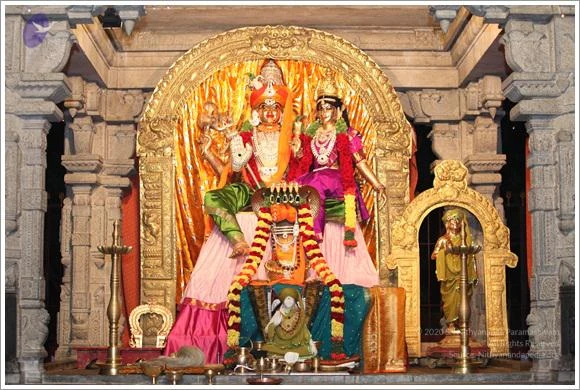
Temple
Pada-Puja
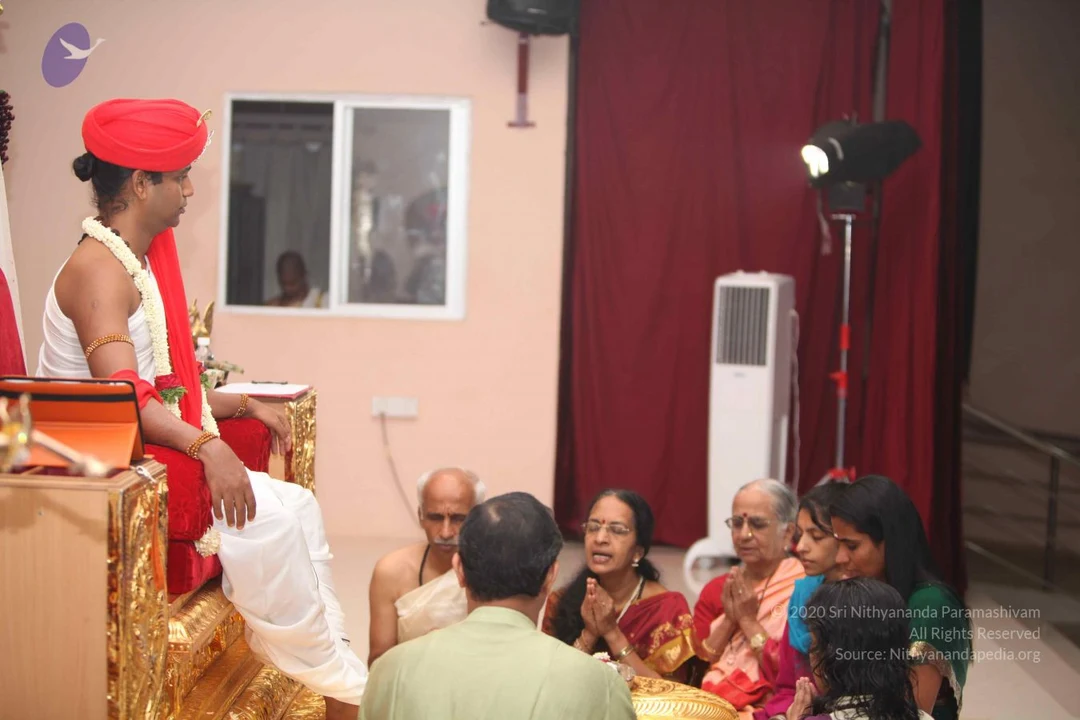
BG-Satsang

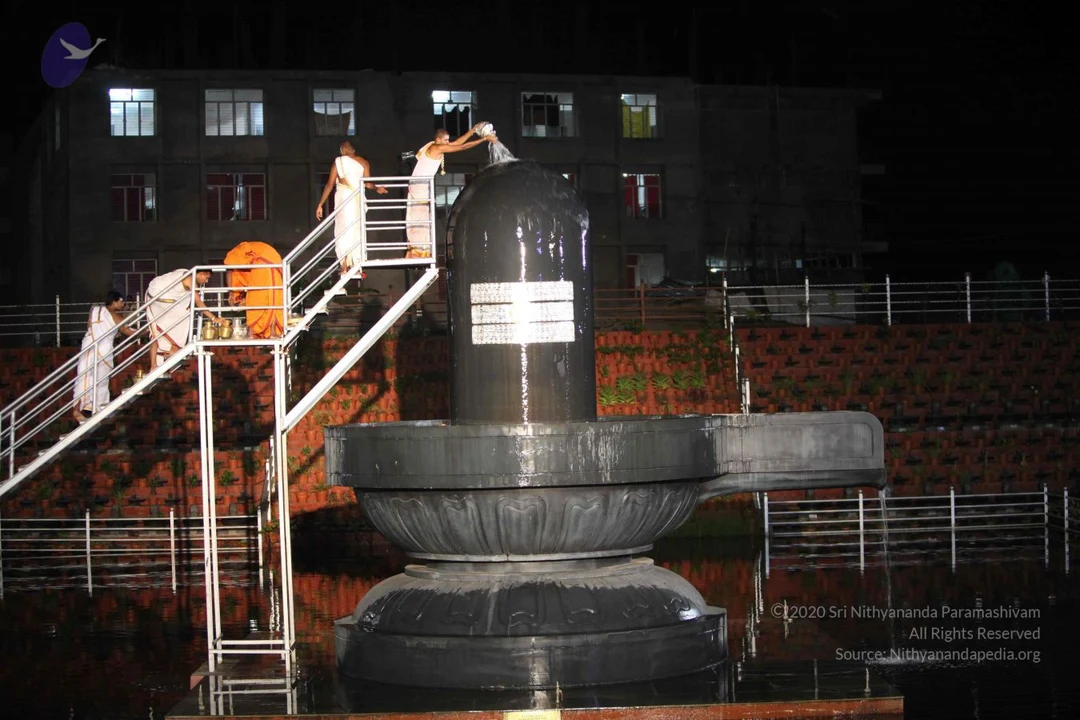
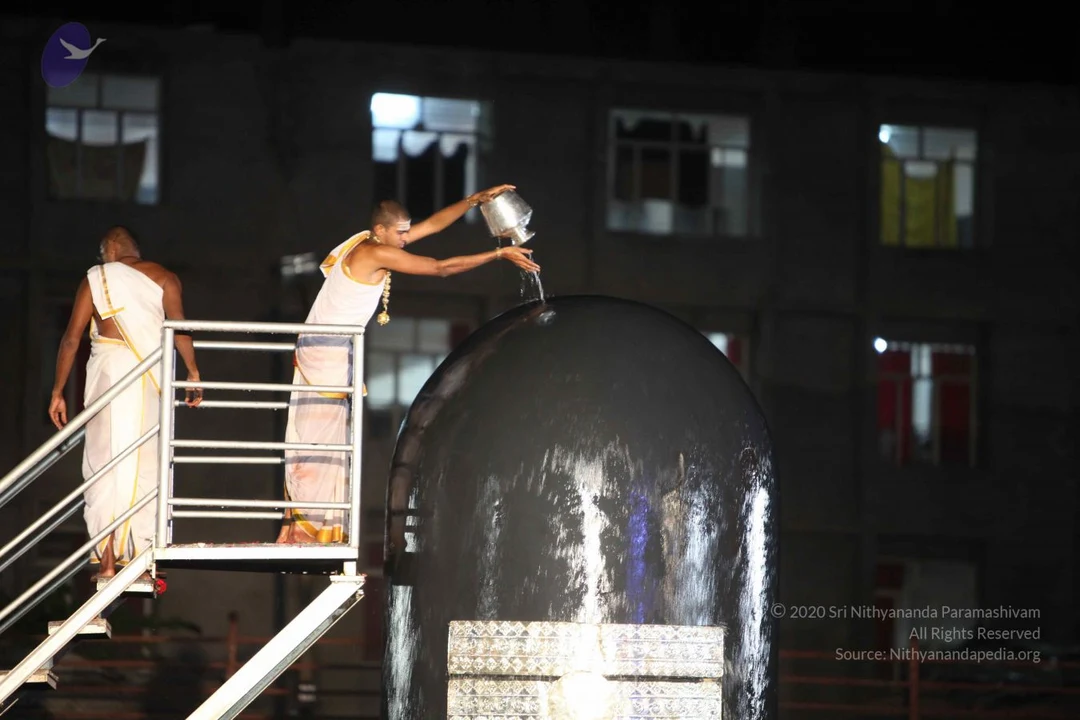
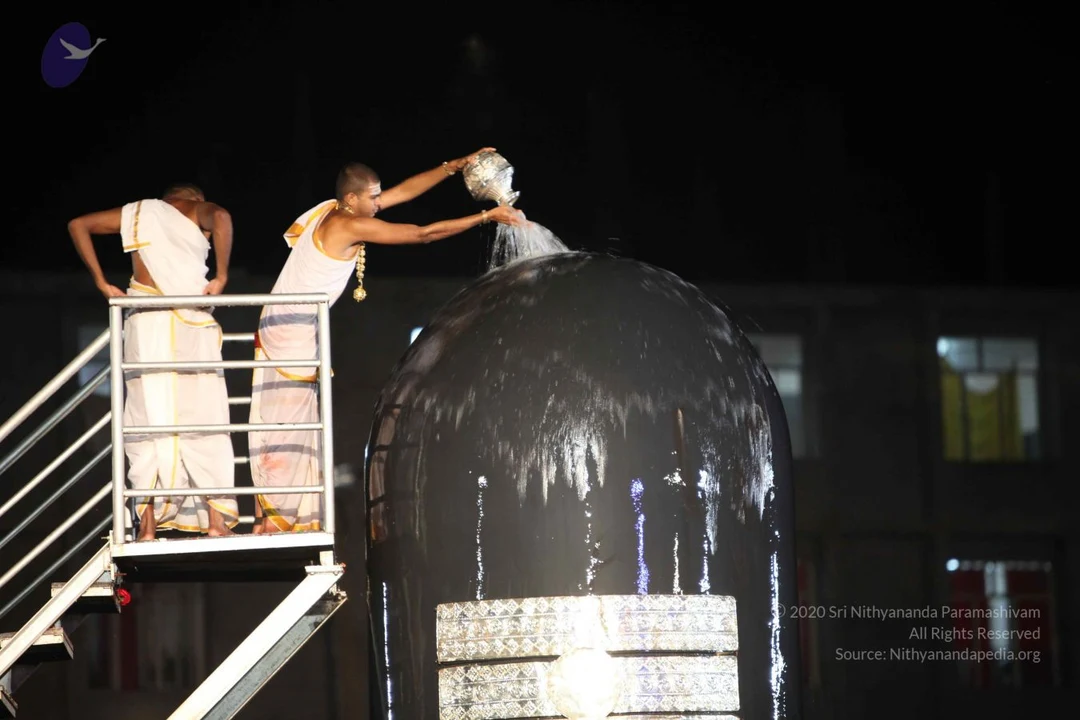
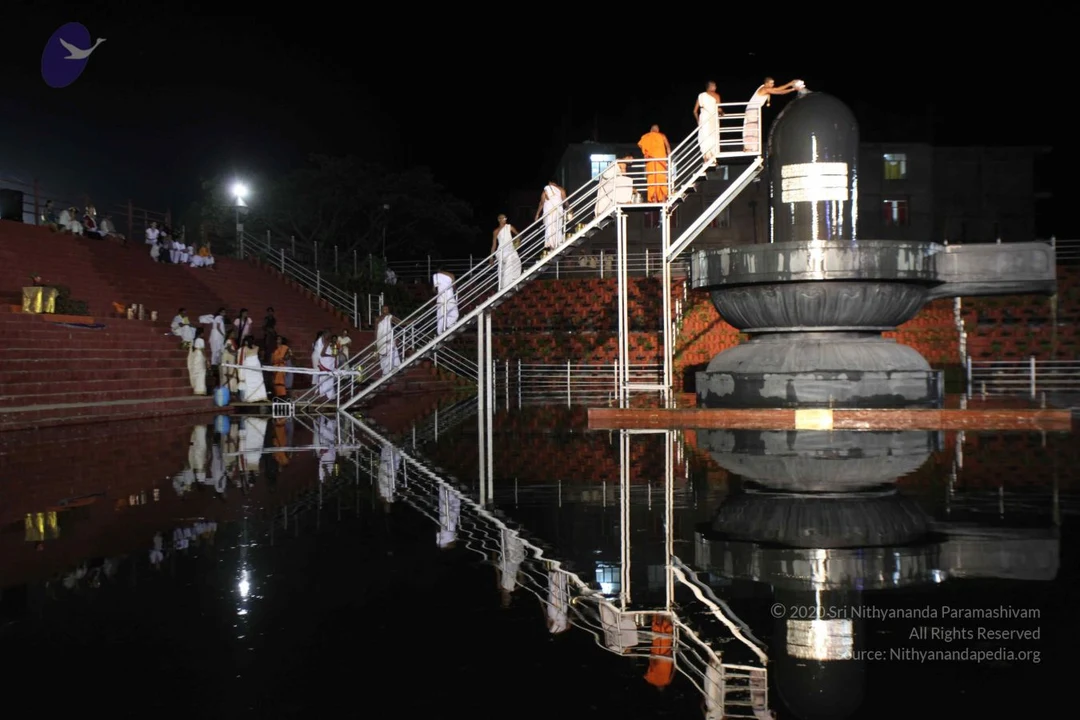
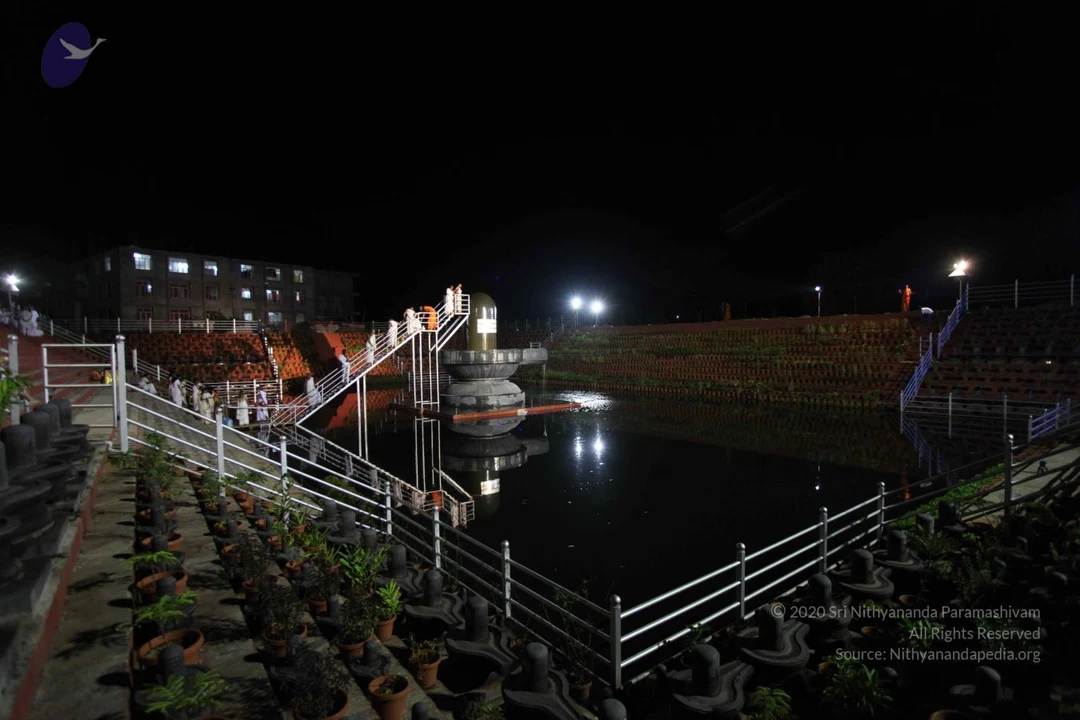
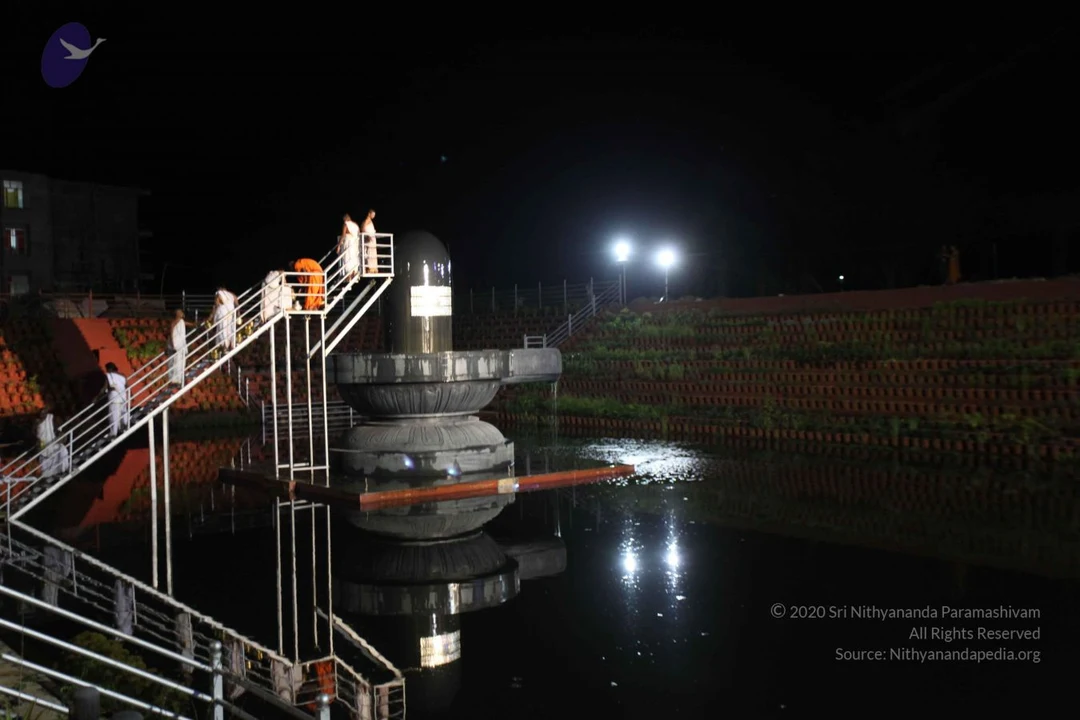
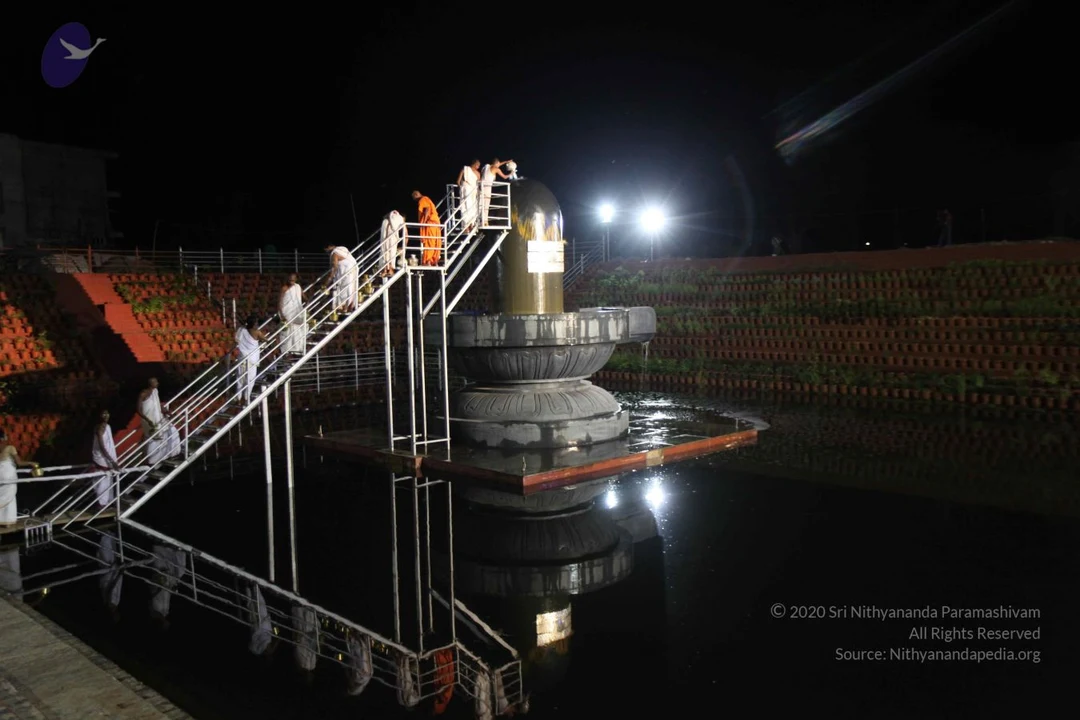
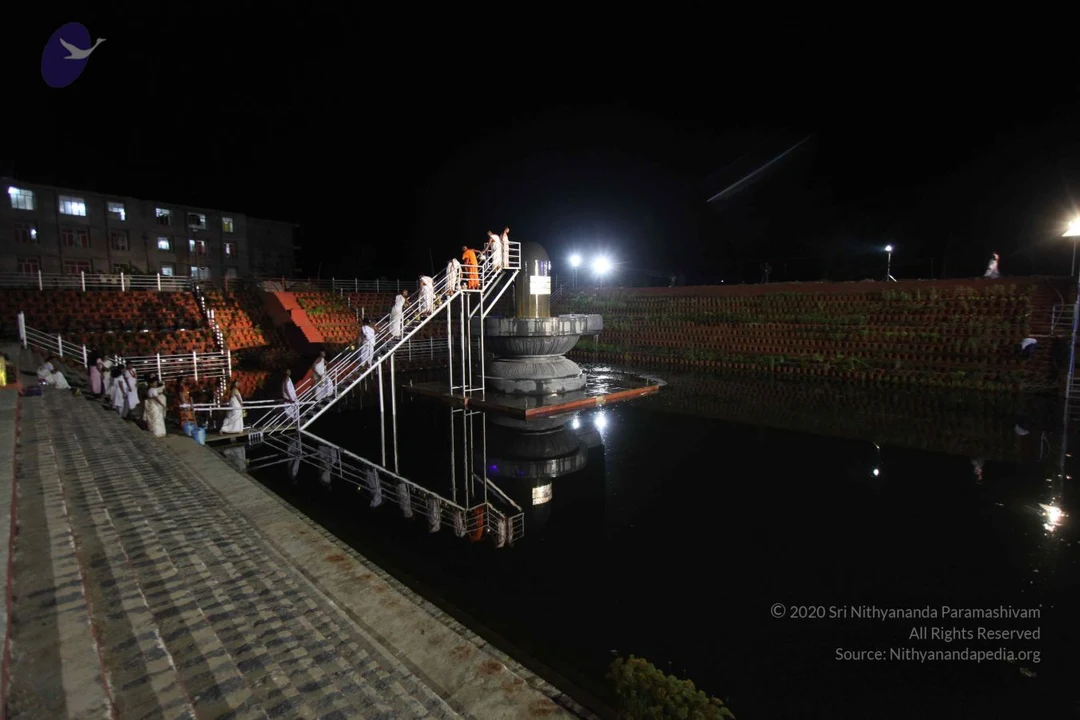
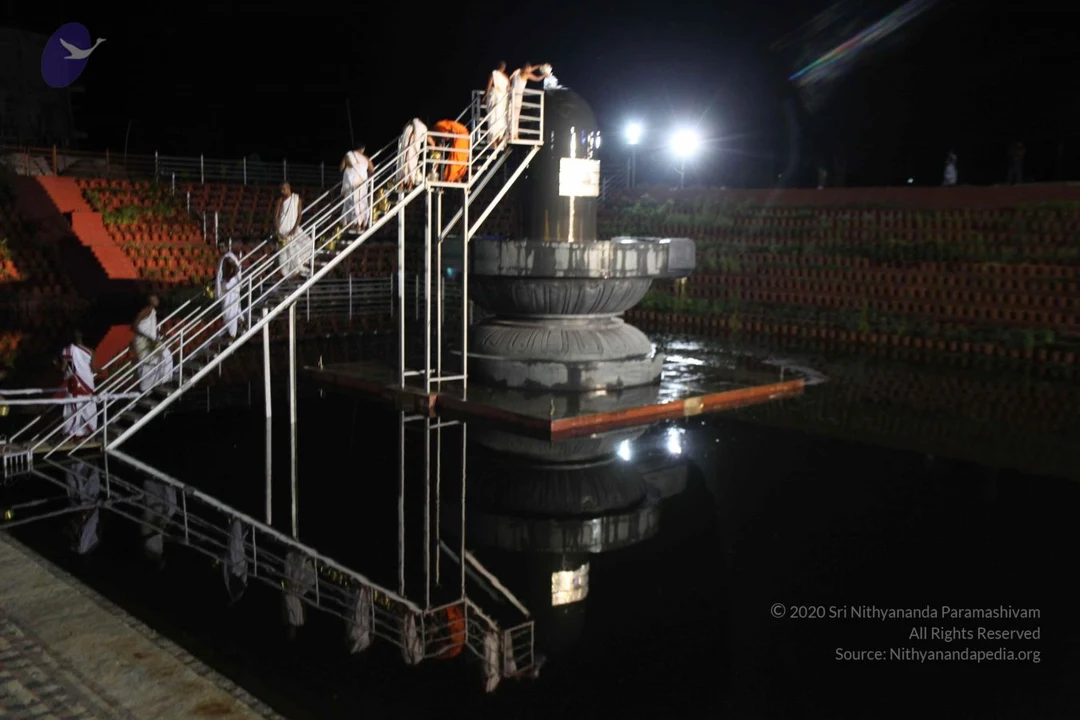
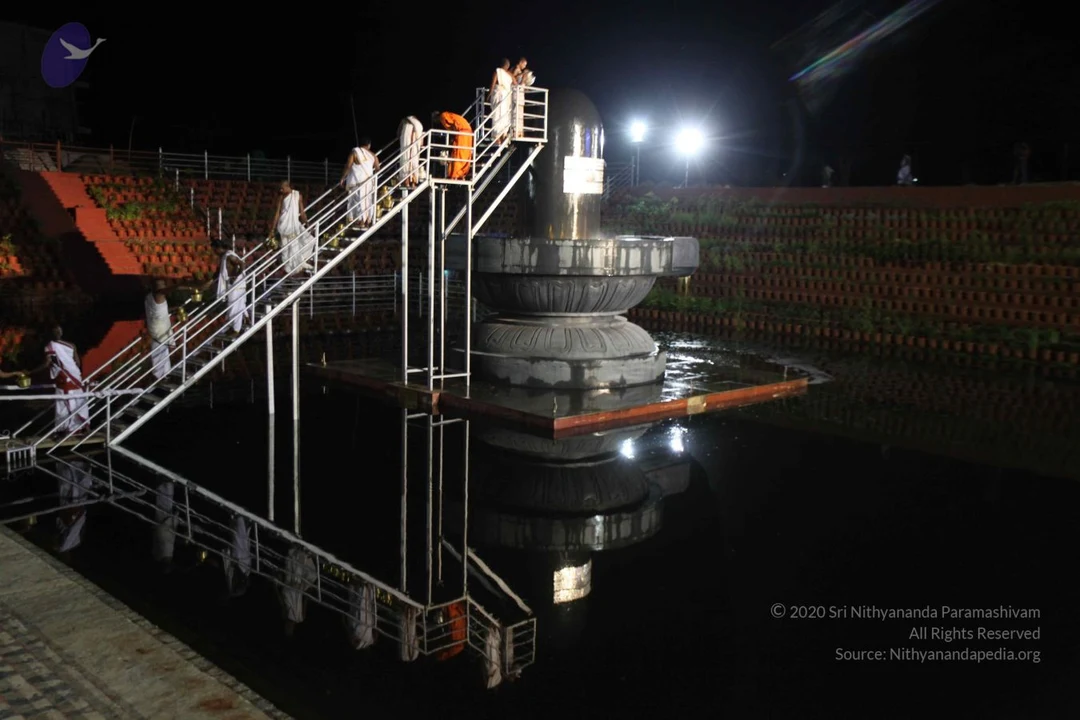
AnandaLingam-Abisheka

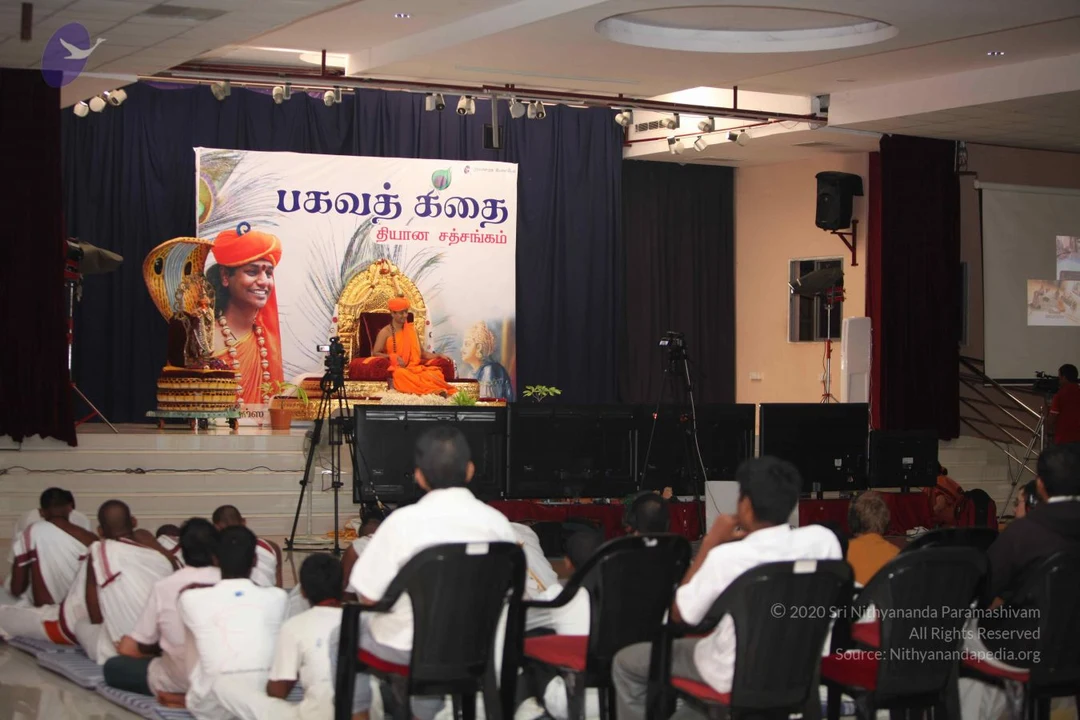
BGSatsang-Tamil

Photos Of The Day:

Pada-Puja
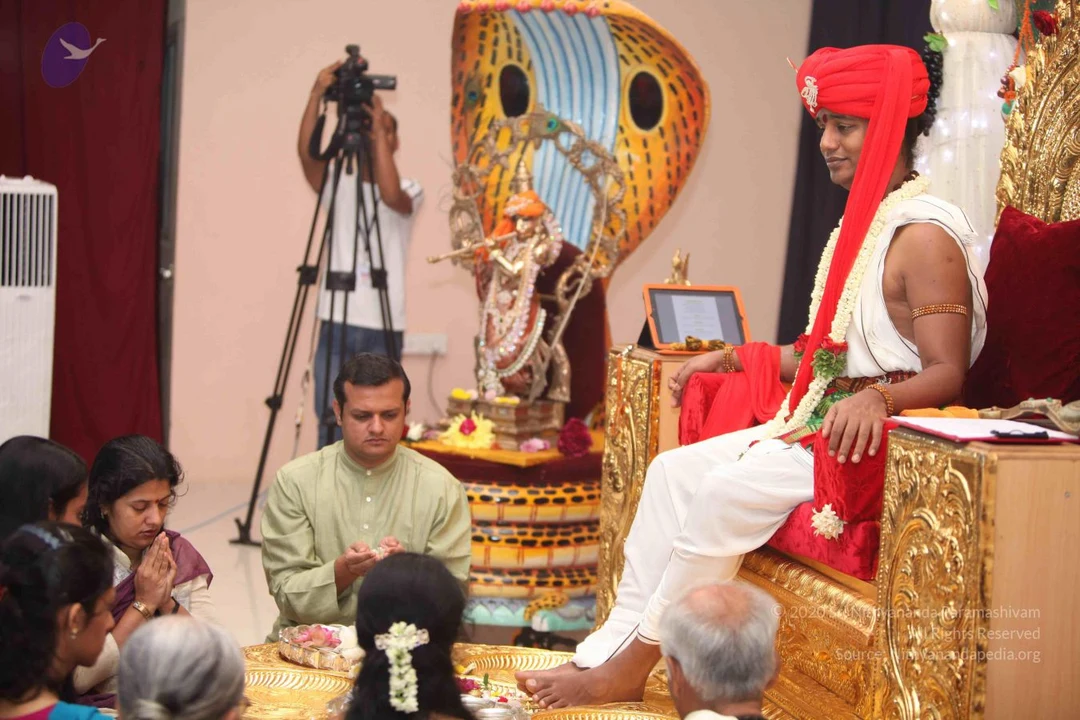
BGSatsang

BGSatsang-Tamil

Photos from this day

View all 219 photos

Photos:

9 photosSource gallery
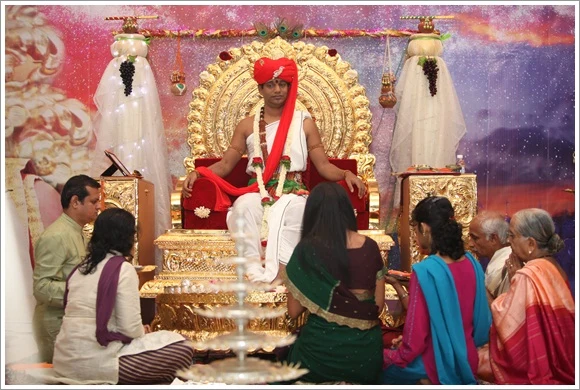
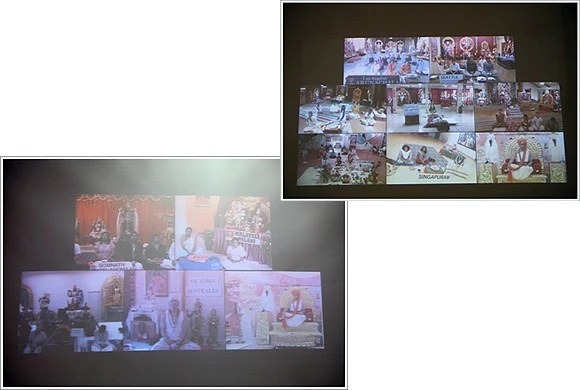
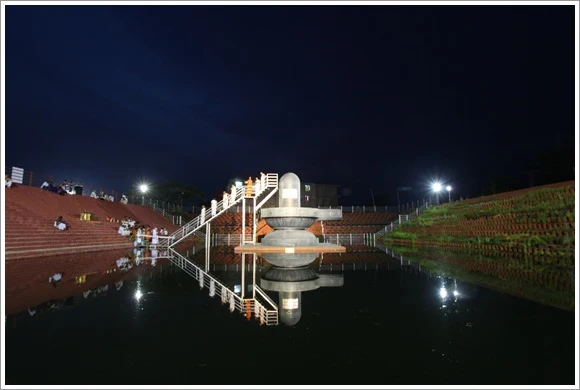
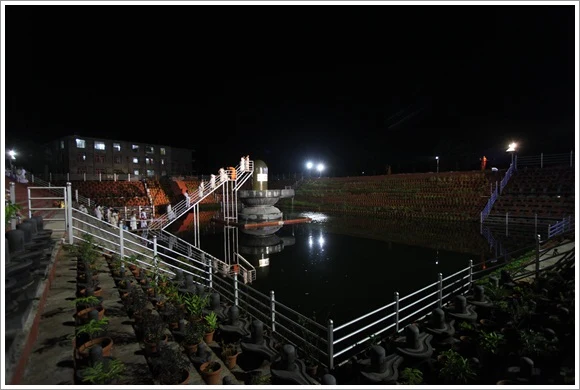
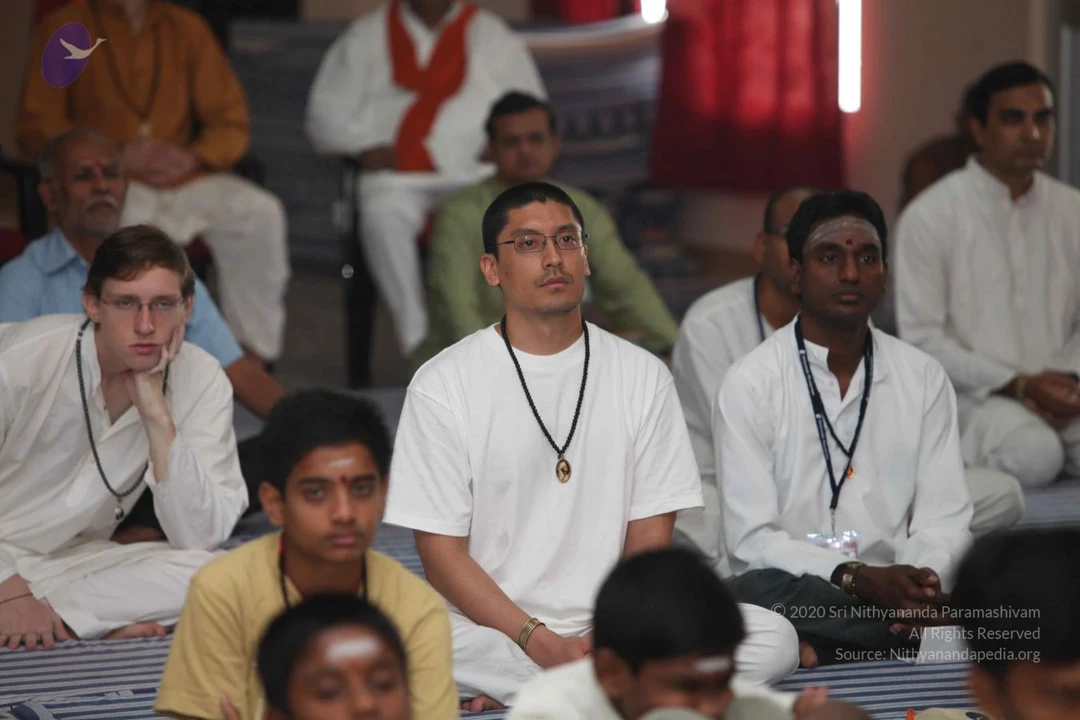
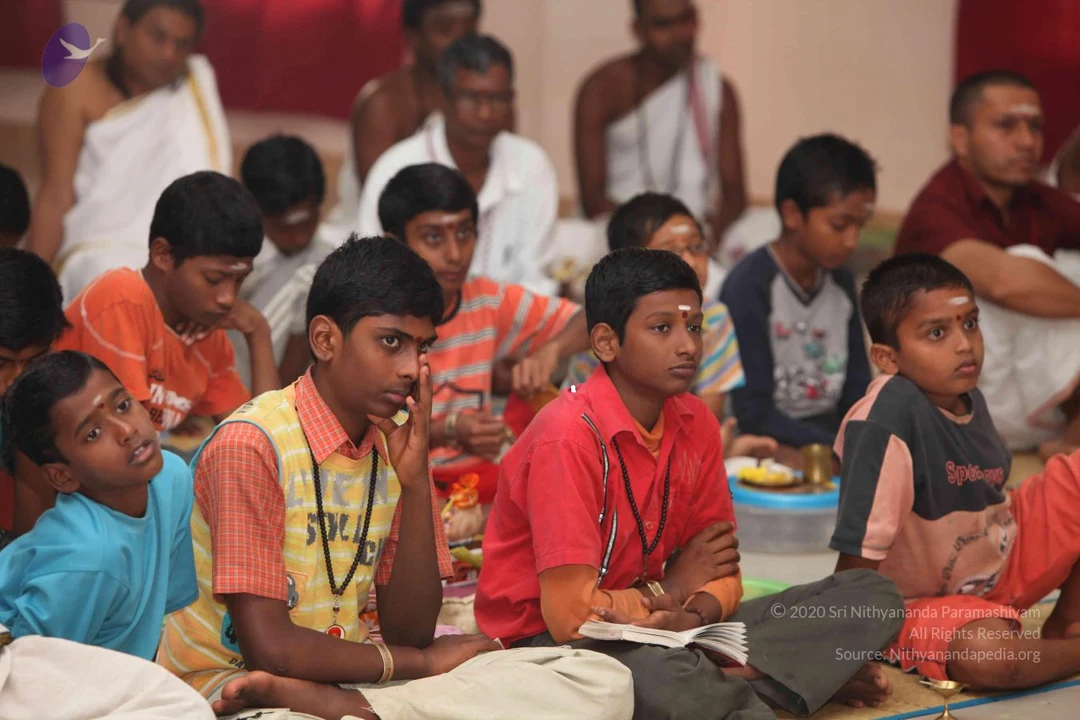
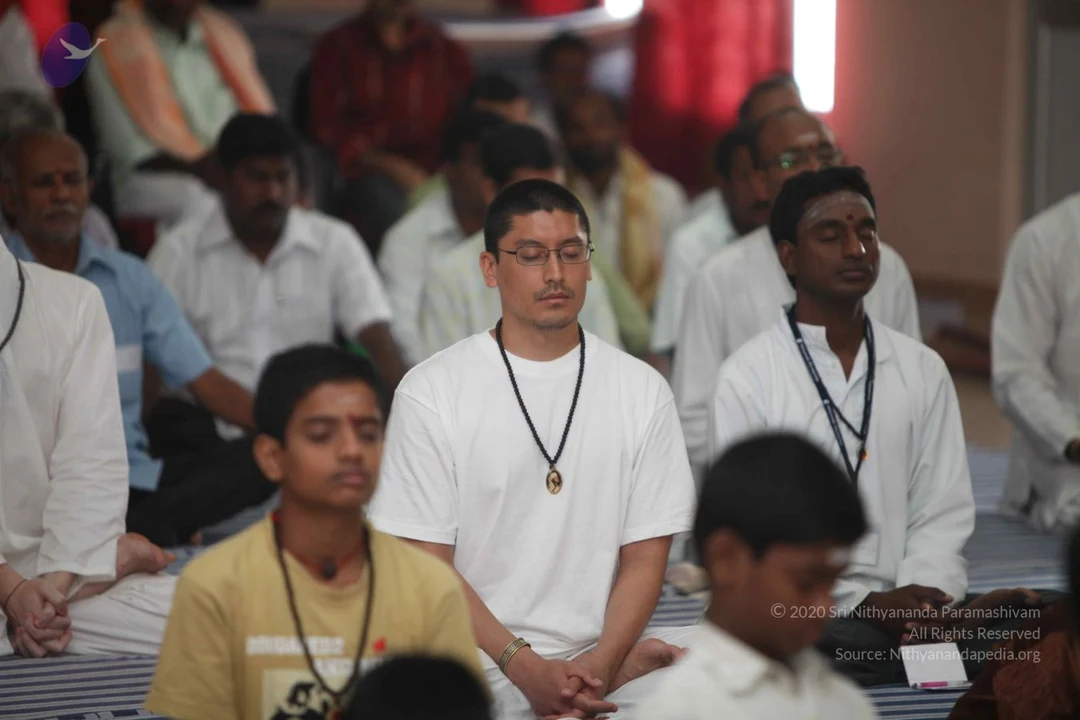
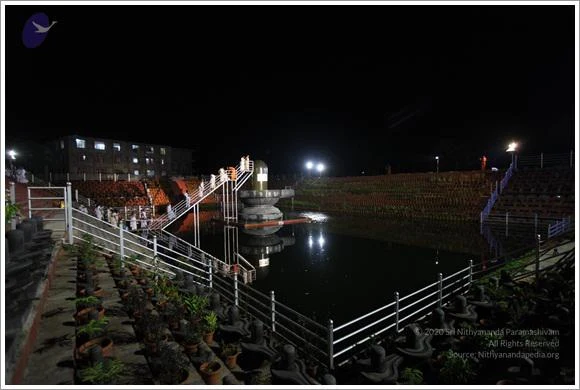
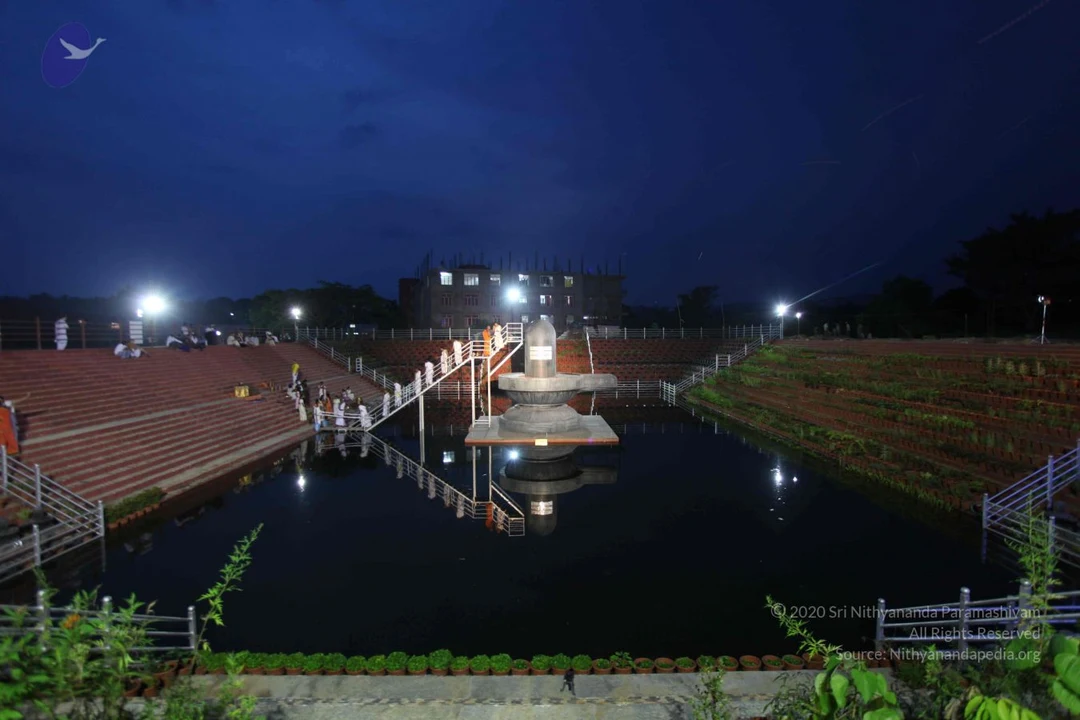
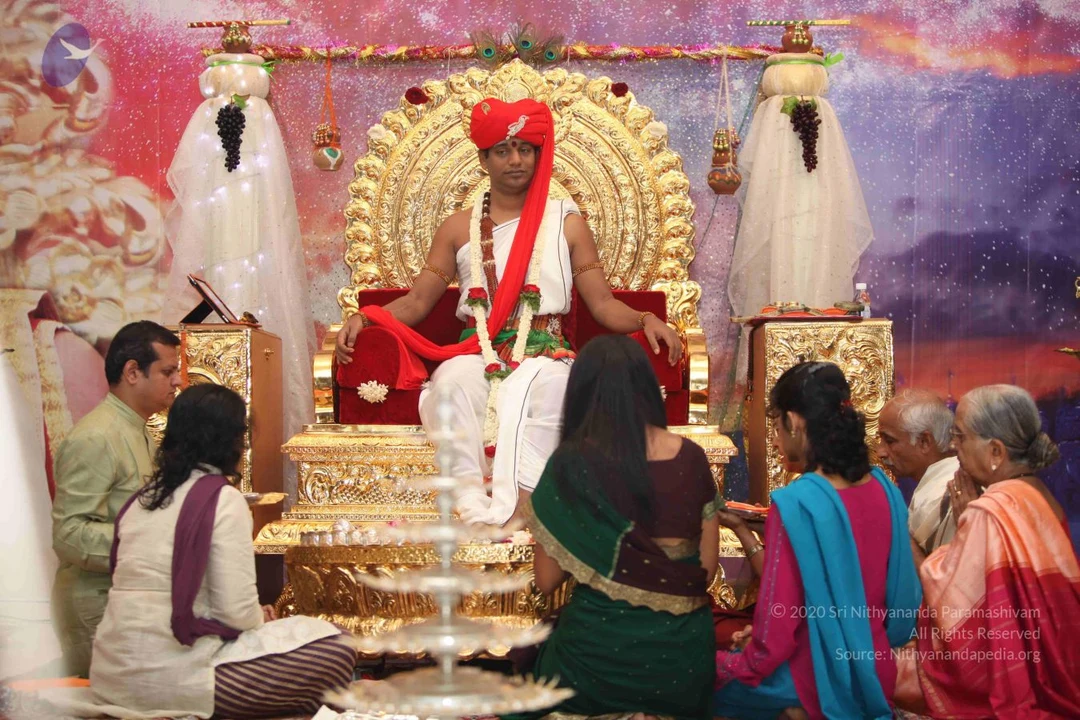
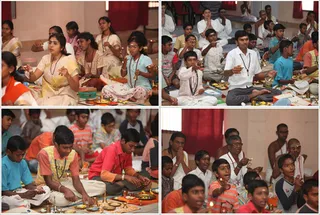
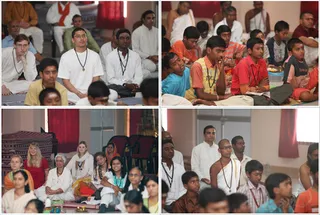
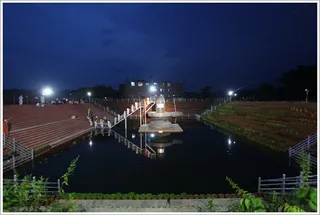
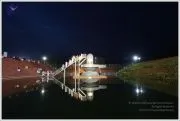
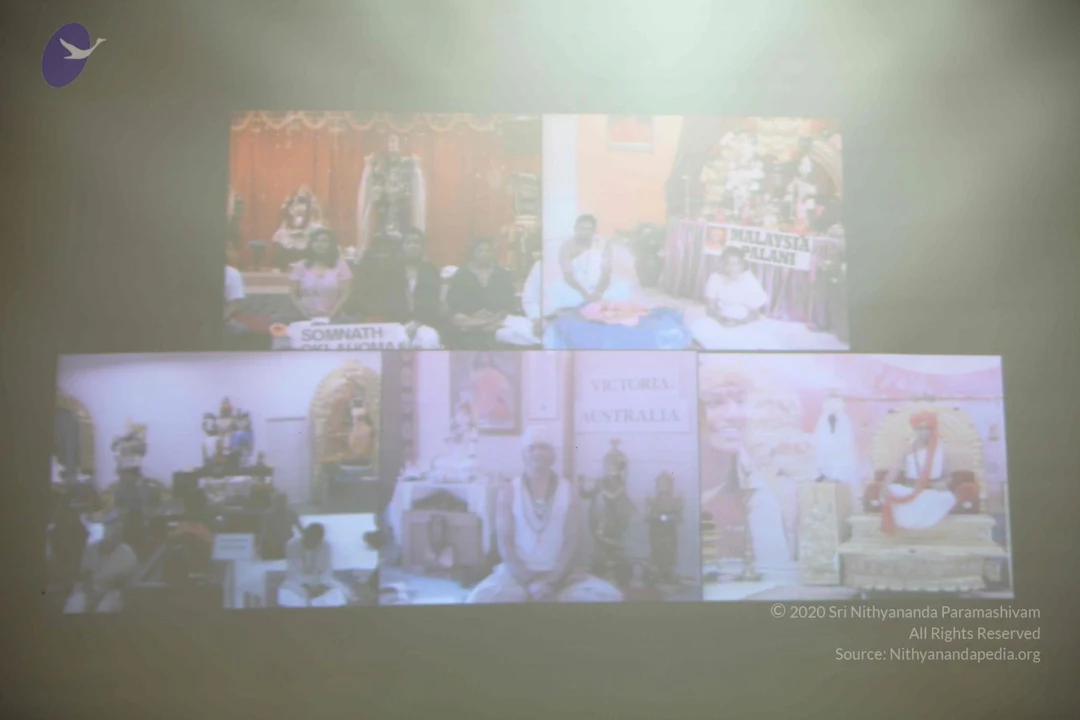
A seated figure in a large ornate gold throne with red cushioning sits centrally, wearing a red turban, a white dhoti-style garment with a red shawl across the shoulders, and a multi-coloured garland. Hands rest on the throne arms. Before him, several devotees sit on the floor and kneel in a semicircle: a woman in a purple shawl at lower left, a man in a light green kurta standing at left, a woman in a green saree with a dark blouse, a woman in a turquoise and blue saree, and an older white-haired woman in an orange saree at right, with an older man beside her. Ornate gold kalasha-style finials and a flowing tiered fountain or water display sit in the foreground, against a painted backdrop of sunset clouds and a deity figure. The scene resembles a darshan or satsang setting. a person: the seated figure has a red turban, shawl and garland on a throne, a visible appearance-based candidate.A two-panel collage. The large left panel shows bare feet resting on a gold tray surrounded by pink and white flowers, with silver vessels in the foreground. The small inset at lower right shows a person in orange robes and a beaded mala placing yellow marigolds on a brass tray beside a small brass lamp, a book and a plastic container of orange cloth. The collage shows ritual activity, but the people pictured are not counted as physical people in this image.A four-panel collage of group puja scenes in a plain hall with red-painted walls and white floors. Dozens of seated young students and adults hold brass oil lamps and small puja plates with flowers, kumkum and vibhuti, with many lamps arranged on the floor before them. Girls in cream and gold saris and salwar kameez sit in the upper left, boys in white shirts and dhotis sit in rows at upper right, and older men in white dhotis and saffron-trimmed clothing sit with folded hands at lower right. Several participants wear rudraksha malas. The panels show a collective aarti and puja, with each panel picturing people rather than individual portraits.A four-panel collage of seated audiences at an ashram satsang. Top left: men in white kurtas and rudraksha malas sit cross-legged in rows, one young man in a white shirt with a mala at centre. Top right: boys in orange, red and yellow shirts with rudraksha malas listen attentively, with men in white behind them. Bottom left: women in saris and white garments, including an older woman in white and a woman with long blonde hair in red, sit on a mat before a red curtain and a chair with brass items. Bottom right: a bald man in white with a sacred thread and mala sits among boys in red and white, with men in white nearby. The collage shows people seated for a discourse, but the panels contain no visible identifiable teacher on a dais.Two photographs of projection screens in a dim room show multi-panel video collages of satsang and ritual scenes. The left image has a large panel of a temple with a deity murti and a seated teacher in white beside a banner reading "Nithyananda" with a row of smaller panels below, several showing seated devotees and an altar. The right image shows a grid of around a dozen panels including a seated figure in white on a throne, devotees seated on the floor, and a panel with a deity murti and a kalasha. The collage shows pictured activities, but the people visible are only projected images, not present in the room.Night photograph of an illuminated rectangular pool at a temple-like complex. A stone lingam-shaped monument or tiered stone structure stands on a raised platform in the middle of the water, reflected on the still surface. Steps with metal railings lead down from a terraced stone embankment on the left, where a few small figures are visible near the water. Lights on poles and a dark blue sky frame the scene, with a multi-storey building under construction in the background and a planted bank of low shrubs on the right.

Temple

25 photosSource gallery
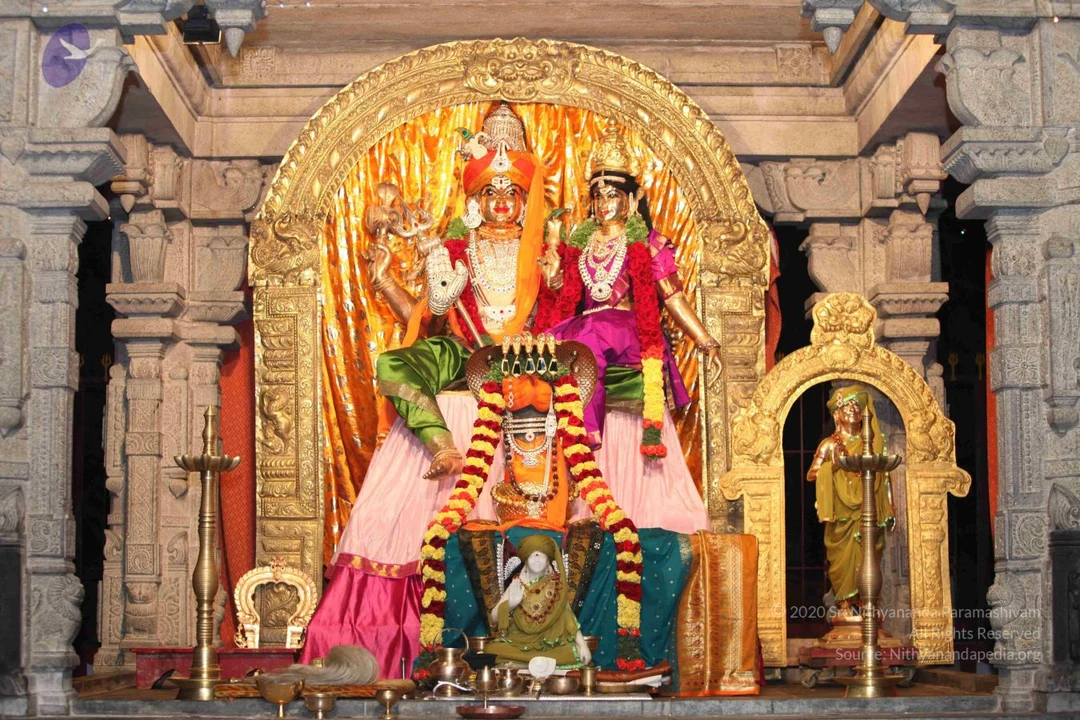
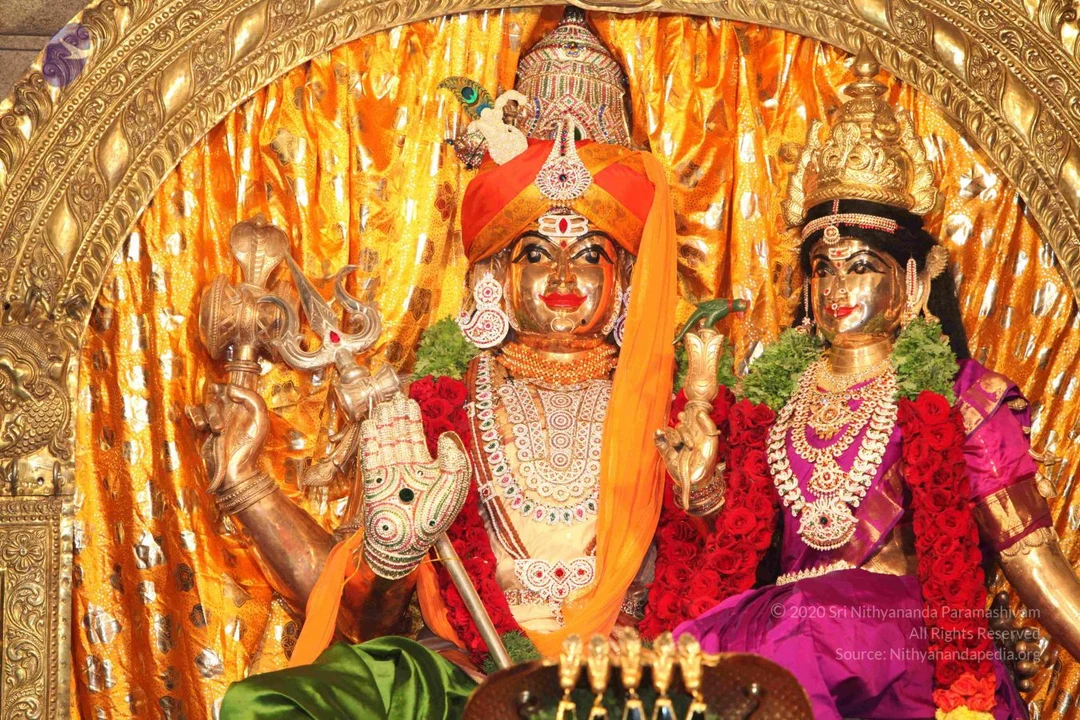
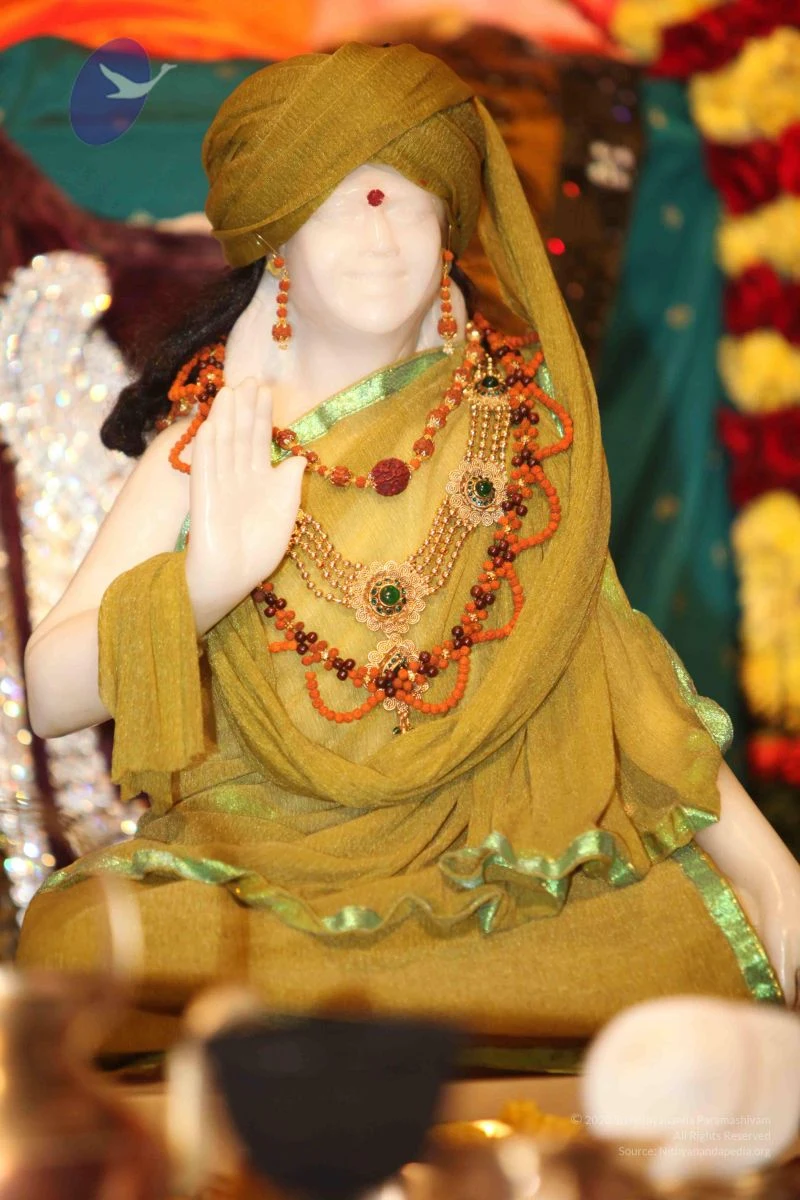
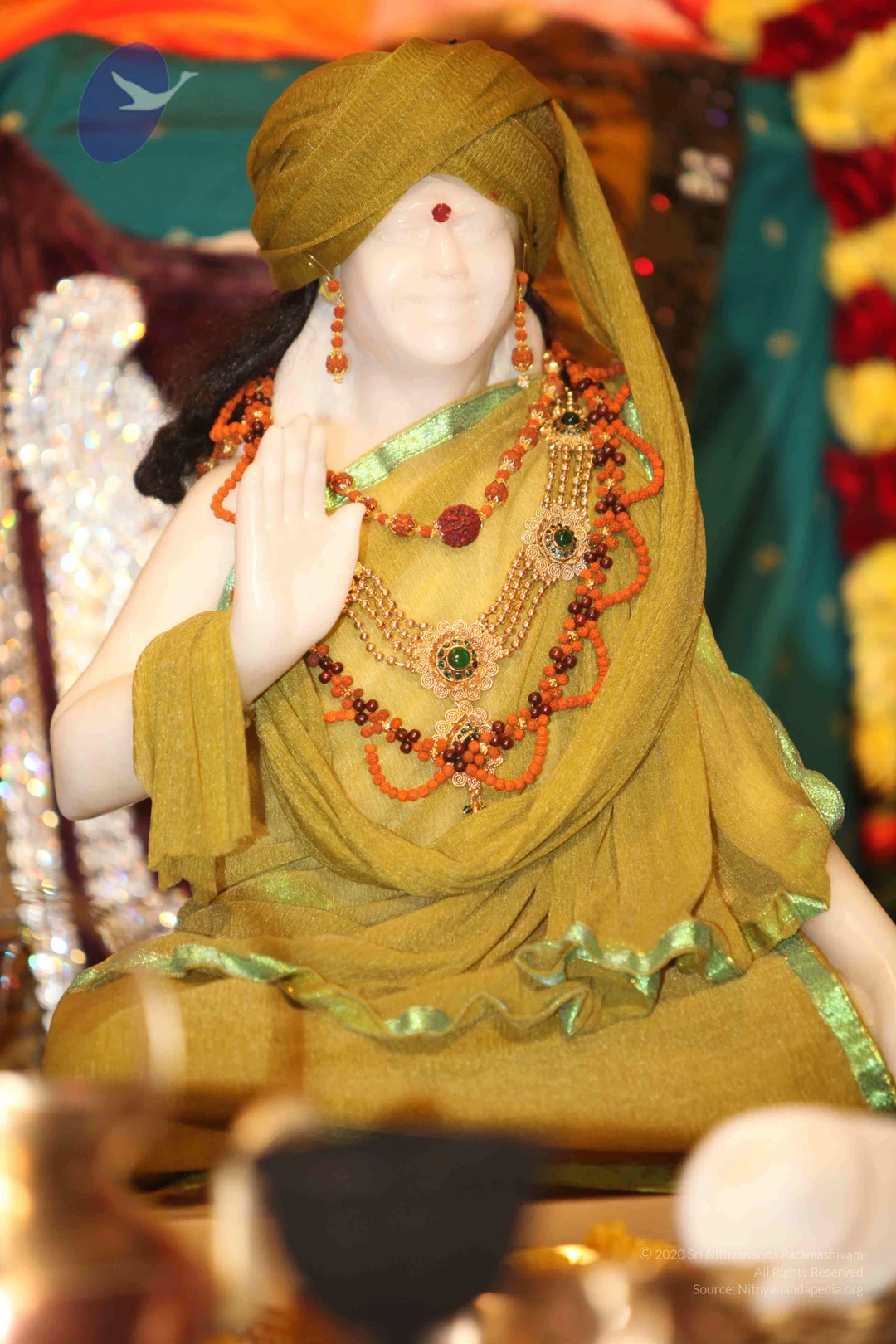
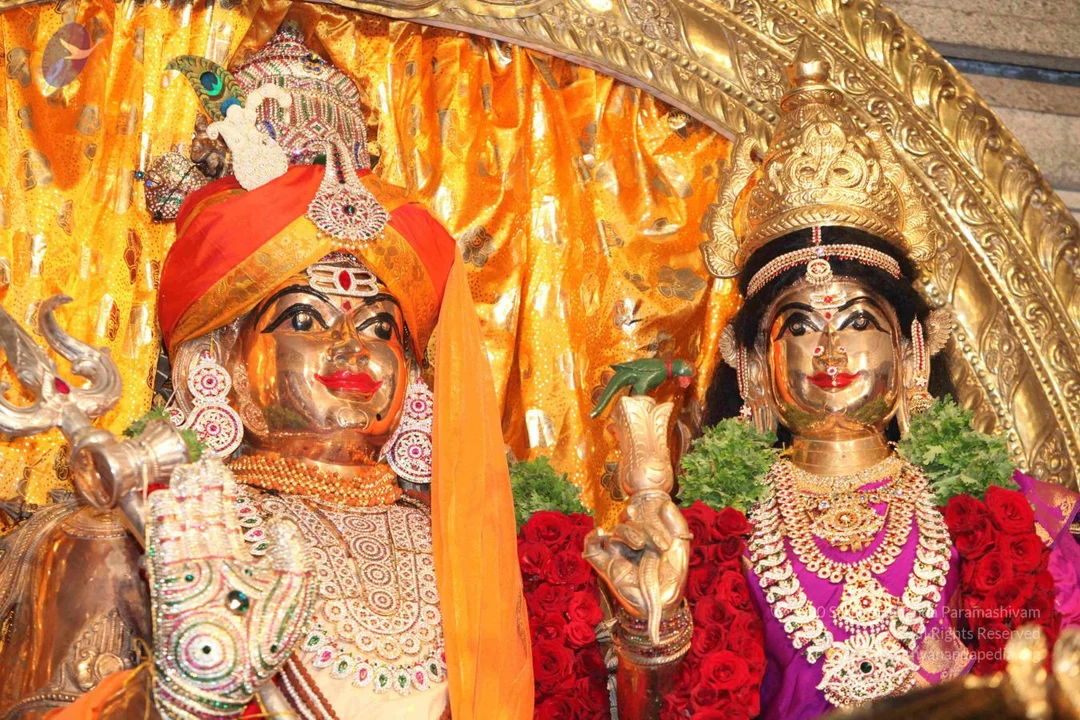
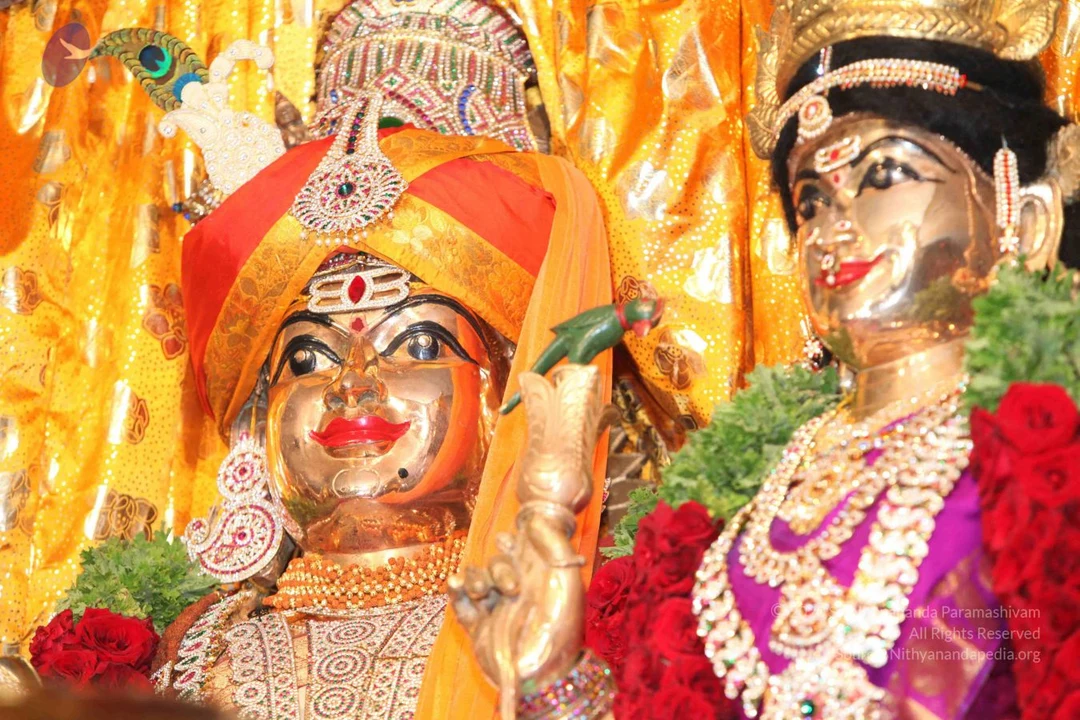
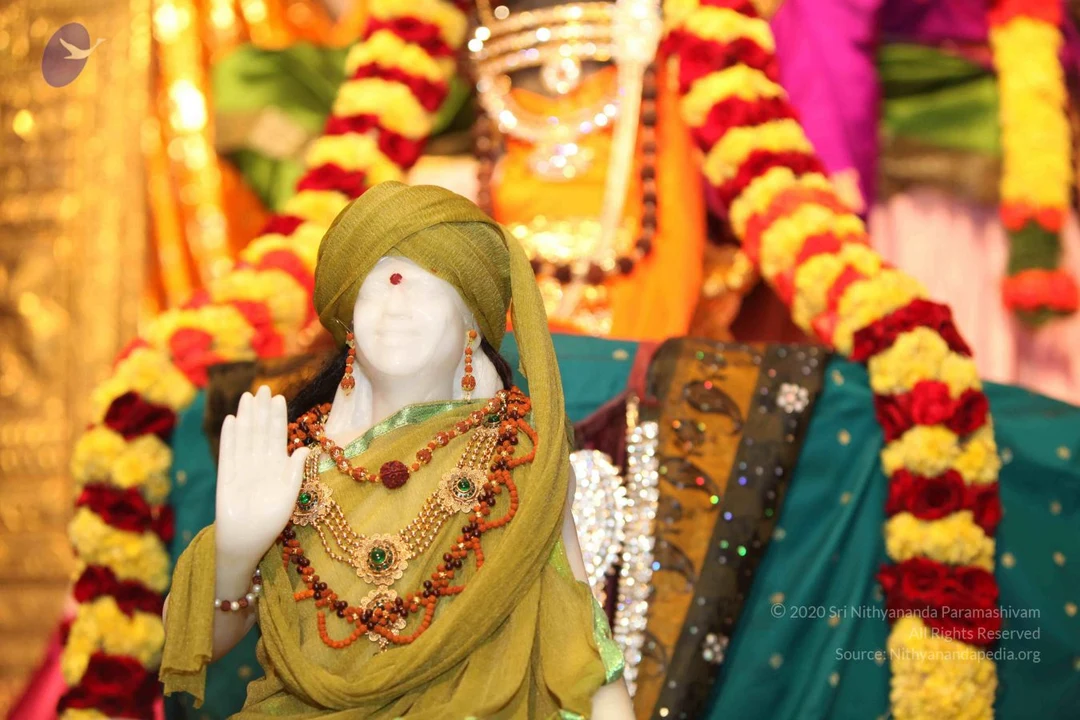
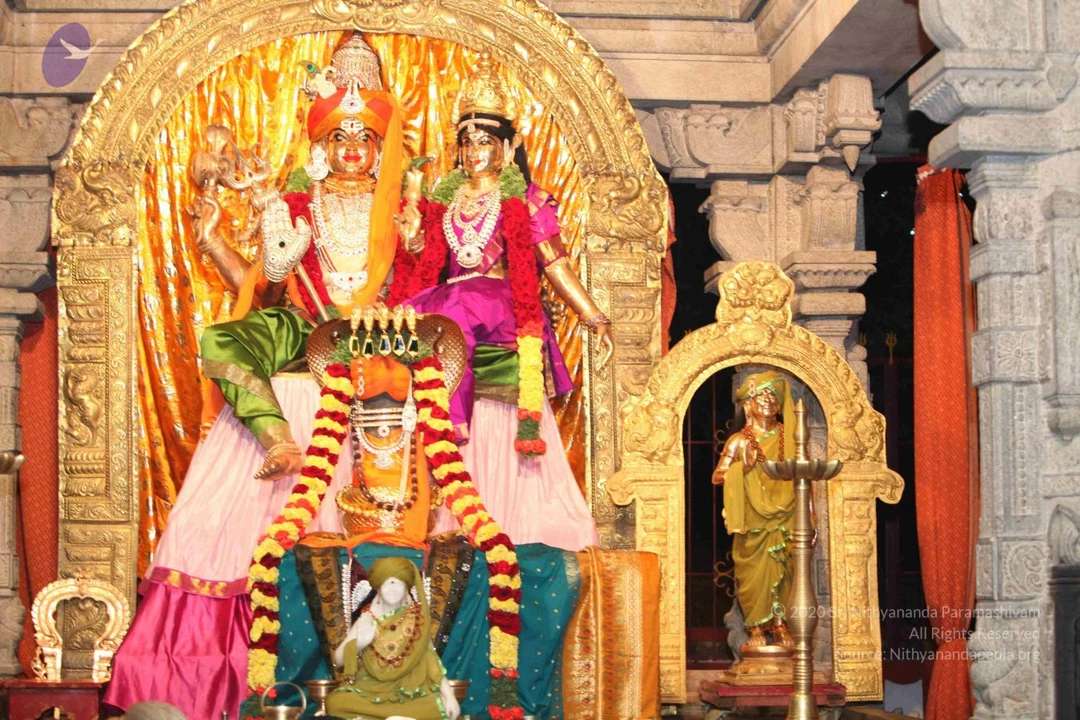
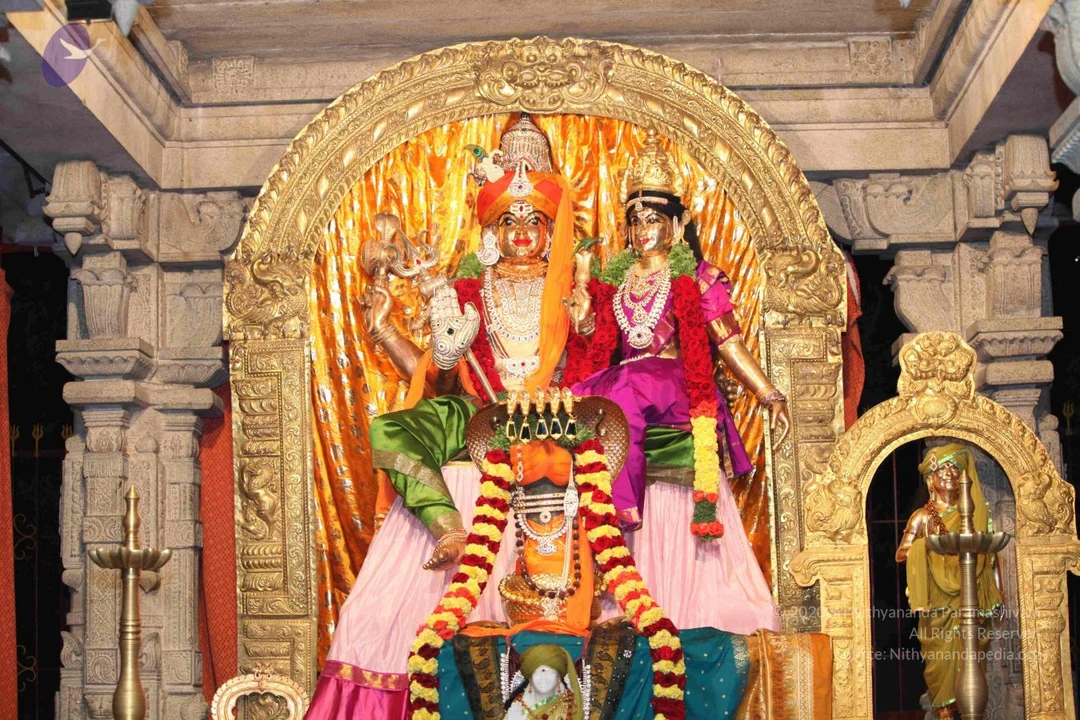
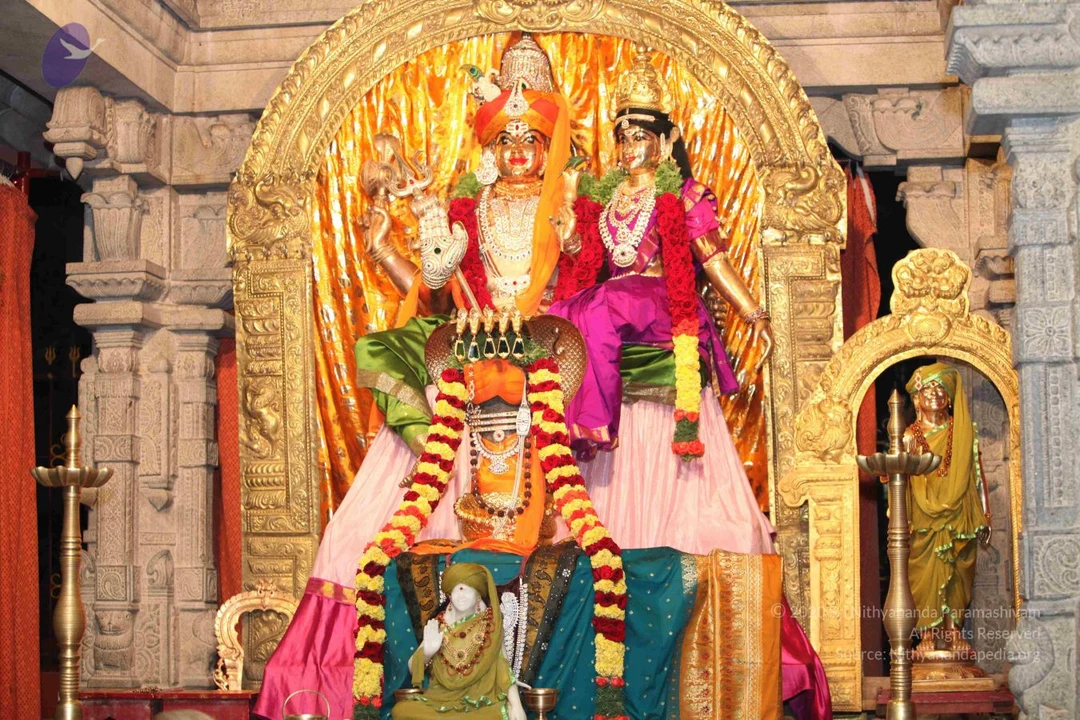
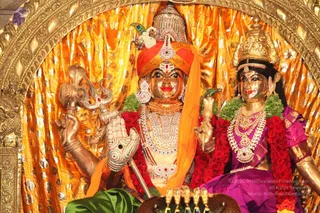
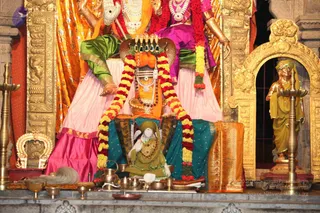
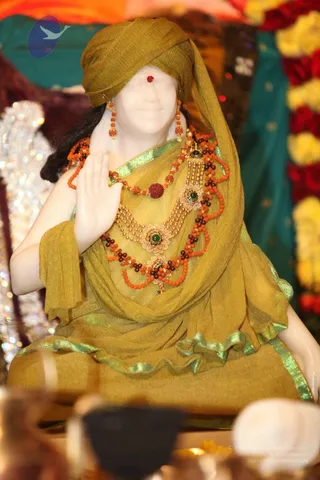
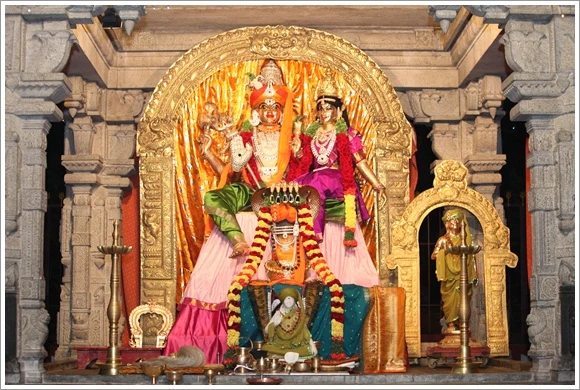
A temple shrine with ornate stone pillars and a gold-framed arch behind a golden drape. Two large deity murtis stand together on a raised platform: one male figure with a crown and bare upper body, adorned with garlands and a white dhoti, and a female figure in a magenta and pink sari with a crown and garlands. Between them stands a tall linga-like form draped with a multicolour garland. Oil lamps, brass vessels and a small figure of a devotee-like statue stand in the foreground, and a small figure sits at the lower centre beneath a yellow and green cloth. The scene is a deity worship arrangement with no living people visible.Photograph of a temple shrine with gilded arch and orange-gold curtain behind. Two standing deity murti are dressed in ornate garments: the left figure wears an orange turban-like crown, white jewelled necklaces and a green-and-orange dhoti, the right figure wears a magenta blouse, pink skirt and red-and-white garlands. Between them sits a seated figure on a green and orange stone base with a red and white garland draped across its body and a silver-bordered red cloth. Brass oil lamps stand on both sides and brass kalasha-style vessels rest at the base. No physical people are visible.A photograph of a shrine inside a temple with ornate grey stone pillars and a gilded arch framing a golden curtain. Three deity murtis are arranged on a raised platform: a central Shiva lingam wrapped in a red-and-yellow flower garland with a silver face or mask, flanked by two standing figures in colourful dress, one in orange and red with a crown and a pink-and-green garment, the other in pink and magenta with a crown and pearl necklaces. Brass oil lamps, kalasha-style pots, and offering bowls sit before the platform, and a small gold-clad figure stands in a niche on the right. No people are visible.Two gilded deity murti stand under an ornate golden arch against a shimmering orange-gold draped backdrop. The figure on the left wears an orange-red turban, a gold-and-jewelled headdress, a white and gold ornamented necklace with red and green accents, and holds a trident. The figure on the right wears a gold crown, a purple silk sari and layered gold and white necklaces. Both are garlanded with red roses and green leaves, and a brass offering vessel sits in the foreground.A photograph of a temple shrine showing a large deity murti adorned with red and yellow marigold garlands, a black serpent hood above the head, gold crown-like ornaments, and layered silk garments in green, pink, magenta and orange. A smaller seated figure in green robes with a veiled face and beaded necklaces sits at the base. Brass oil lamps, bronze pots, a kalasha-like vessel, a brass vessel and a small bell rest on the stone platform in front. A gilded arched niche on the right holds a standing figure in a yellow-green sari and garland. No physical people are visible in the scene.A white marble statue of a seated figure in a golden-olive draped garment with green-gold trim and a matching olive turban covering the head, raised right hand in an abhaya-style blessing gesture. The statue wears layered orange and rudraksha bead necklaces, a red-brown rudraksha pendant, gold chains with green stone pendants, and matching drop earrings, with a red bindi on the forehead. Behind it are green and red flower garlands, shimmering fabric, and blurred offerings in the foreground. This is a statue, not a physical person.

Pada-Puja
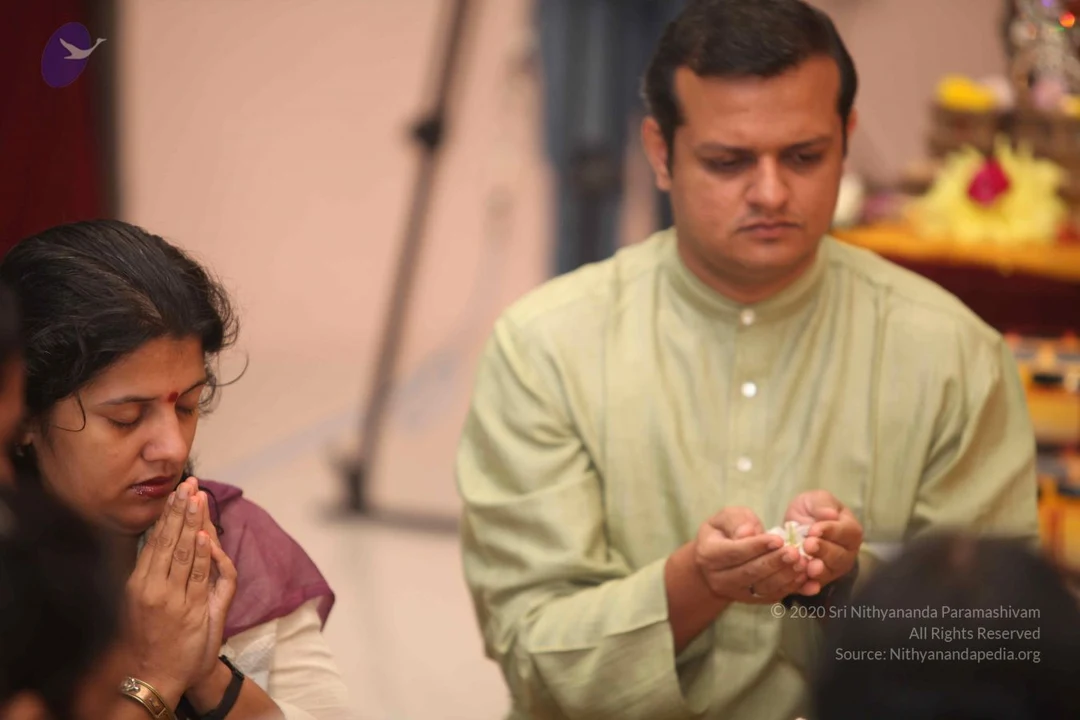
26 photosSource gallery
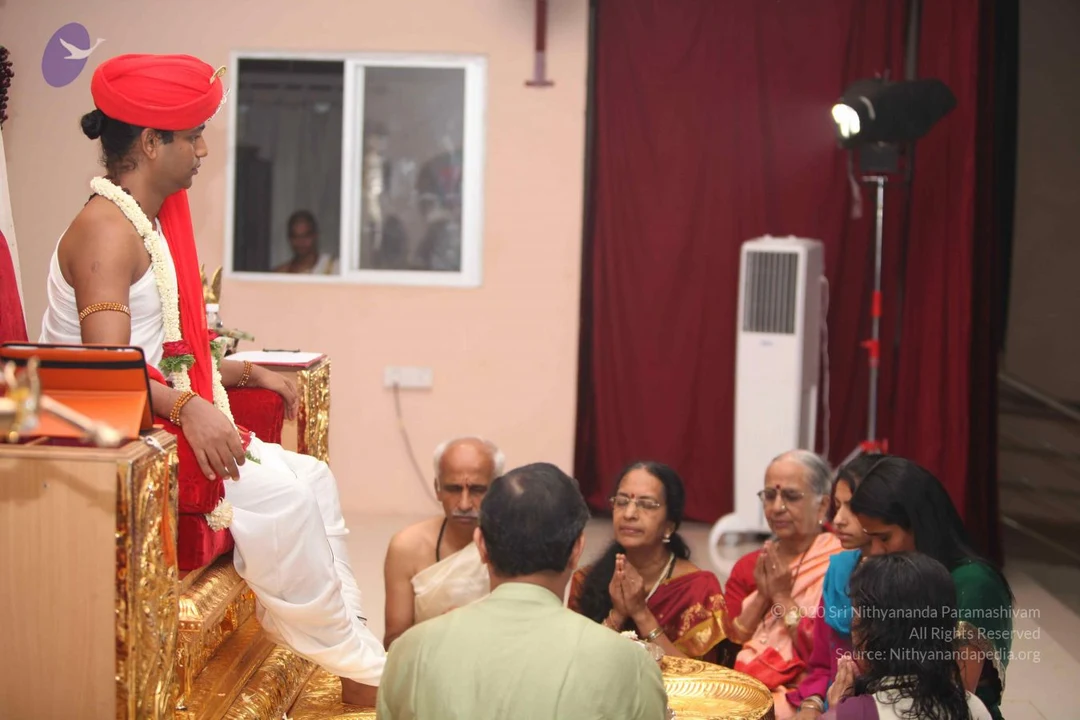
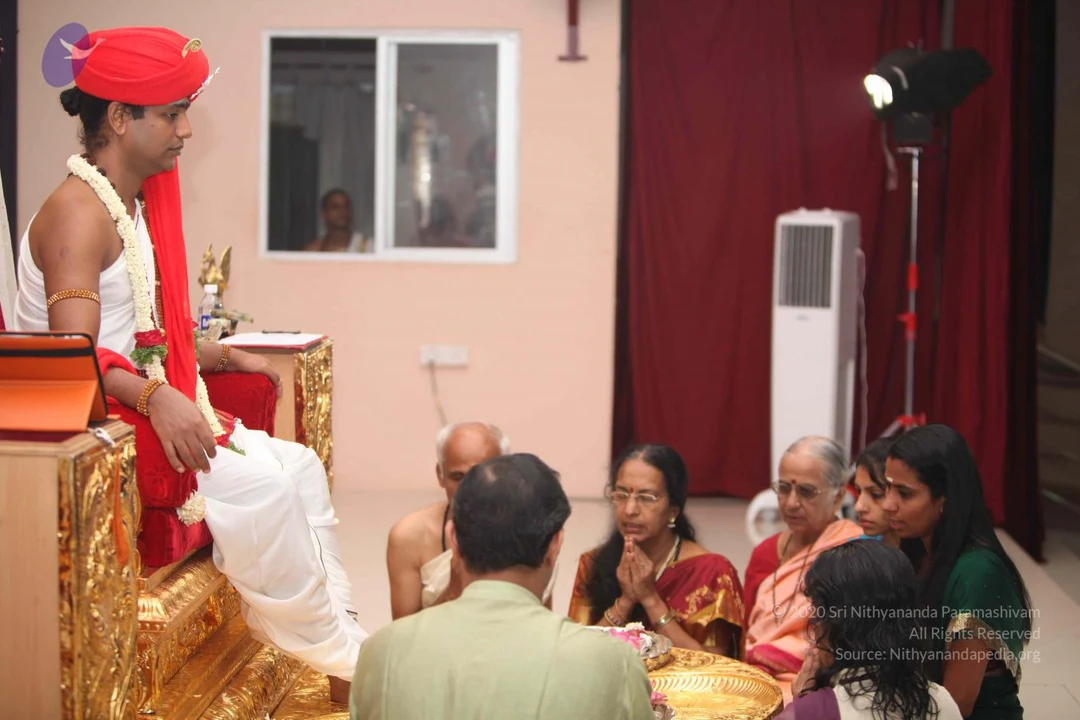
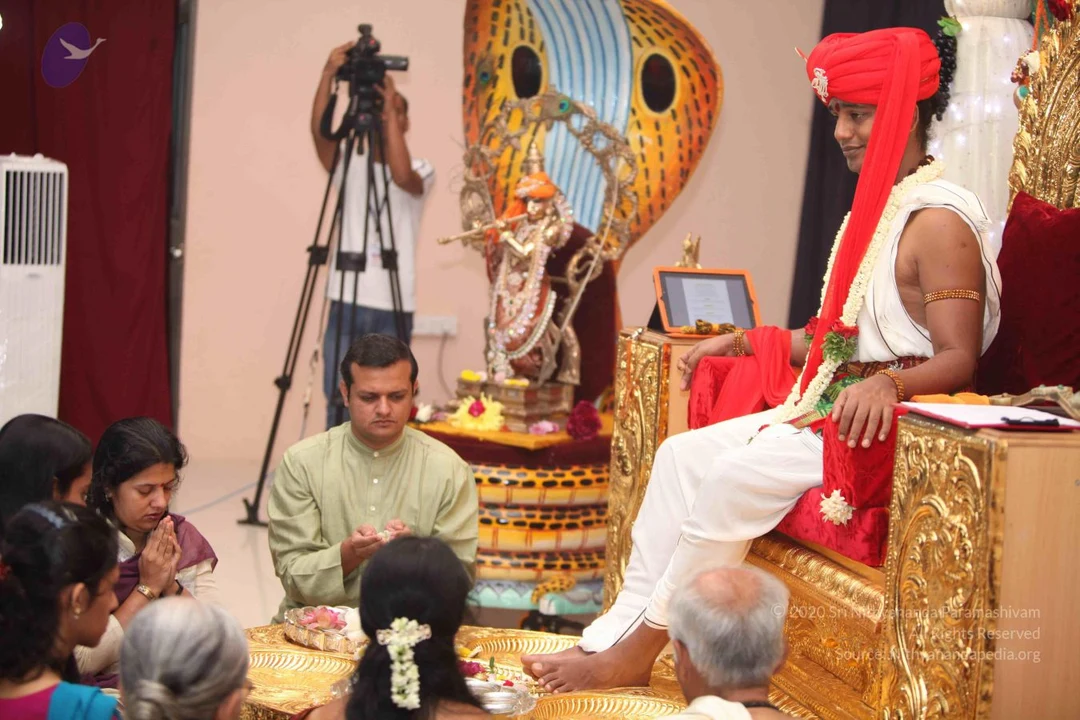
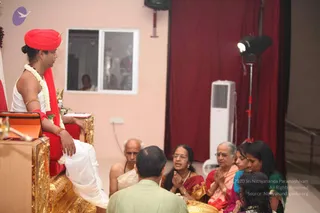
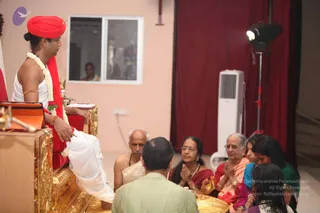
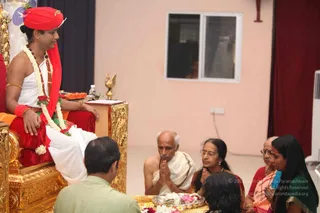
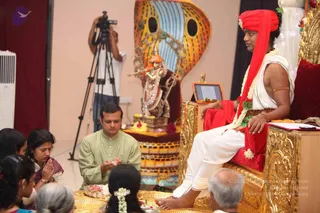
A seated man in a red turban with a white garland and white dhoti sits on a gold-trimmed red throne-like seat at left, one hand resting on his knee, looking toward a group. Facing him, a bald older man in white and a seated man in a light green shirt are in front, with several women in saris, including a red sari and pink sari, sitting on the floor with hands pressed together in anjali. A red curtain, a white tower fan and a stage light form the background, with a small window behind. The robed, garlanded figure on the throne appears to be a teacher receiving devotees; his identity is not established from appearance. The scene shows a satsang-style seated discourse setting.A man seated on a gilded golden throne wears a red turban, a red shawl over white ceremonial clothes, and a white flower garland with a gold bangle on his wrist, his bare legs resting on the throne. Seated before him on the floor, a bald man in a white dhoti and a woman in a red sari with a gold necklace face the throne, and a row of women in saris, one in pink and one in green, sit with palms pressed together in namaskar. A man in a pale green shirt sits with his back to the camera. A wall-mounted window, a red curtain and a standing white fan frame the room. The seated figure on the throne matches the appearance cues for a person, with his red turban, shawl and garland.A seated man in a red turban and white dhoti with white flower garland and gold bangles sits on an ornate gold-and-red throne at left, looking toward a group of devotees. Devotees in the foreground include a woman in a red sari with hands pressed in anjali, an older woman in a pink sari and glasses, and younger women in saris. A man in a light green shirt sits with his back to the camera before a gold tray with flowers. A red curtain, white cooling unit and studio light stand in the background, and a man is visible through a window.A photograph of a padapuja-style ritual in a hall. A man in a red turban and red shawl, with a white garland and white dhoti, sits on an ornate gold-and-red throne with bare feet, a small tablet device on a stand beside him. Seated on the floor below, a man in a light green kurta cups his hands in worship while a woman in a purple sari and another woman press their palms together in prayer. Gold plates with flowers, a brass lamp and offerings sit on the floor. Behind them stands a colourful deity murti of Krishna playing a flute, and a large painted backdrop with a peacock-like design. A cameraman with a tripod films at left. Several people are visible.A seated man on a gilded throne wears a bright red turban and red shawl over white dhoti, with a garland of white flowers and gold armlets, and bare feet resting on a golden footstool. A seated devotee in a light green kurta sits before him with hands together in prayer near a plate of flowers, while several devotees including women in saris and a woman with white flowers in her hair sit in the foreground. Behind them stands a deity murti of Krishna holding a flute, in front of a large yellow and orange cobra-hood backdrop. A cameraman on a tripod films the scene at left. The man on the throne is an unidentified figure; no name is visible on the scene itself.A photograph of devotees seated in a devotional gathering. In the foreground a woman with dark hair, a red bindi and a pink-and-white shawl sits with eyes closed and palms pressed together in namaskar. Beside her a man in a pale green kurta with a band collar sits with eyes lowered, holding a small offering in his cupped hands. In the blurred background a decorated altar shows yellow and red flowers, a red cloth and lit lamps. Two other people are partly visible at the frame edges. Three people are visible in total.

BG-Satsang

52 photosSource gallery
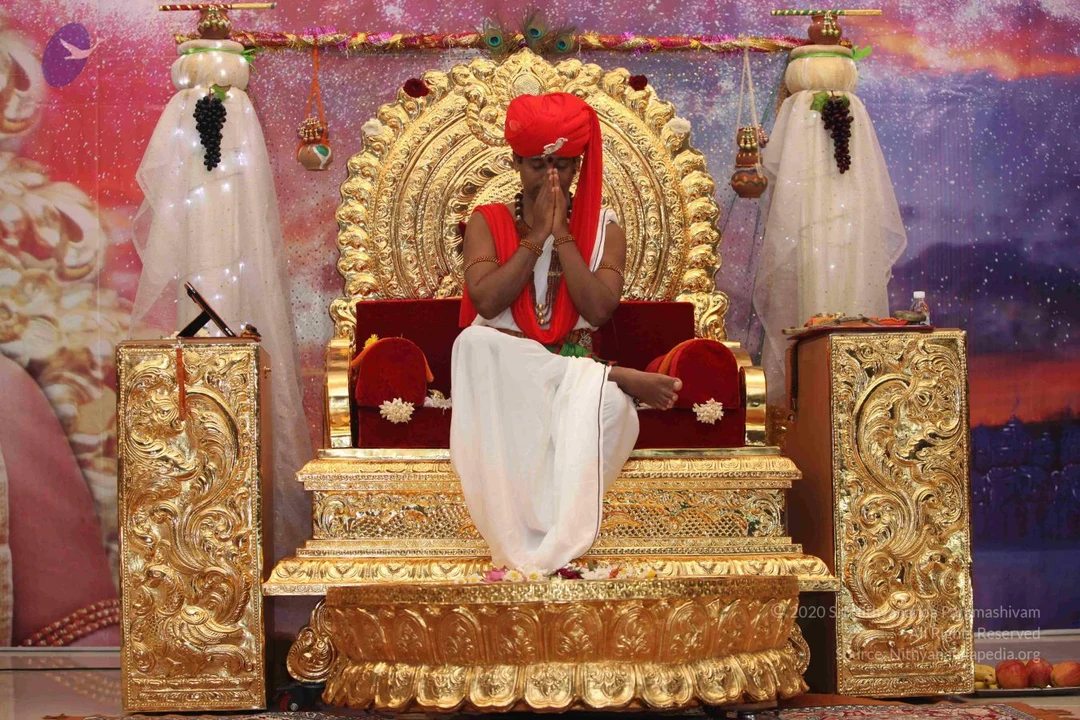
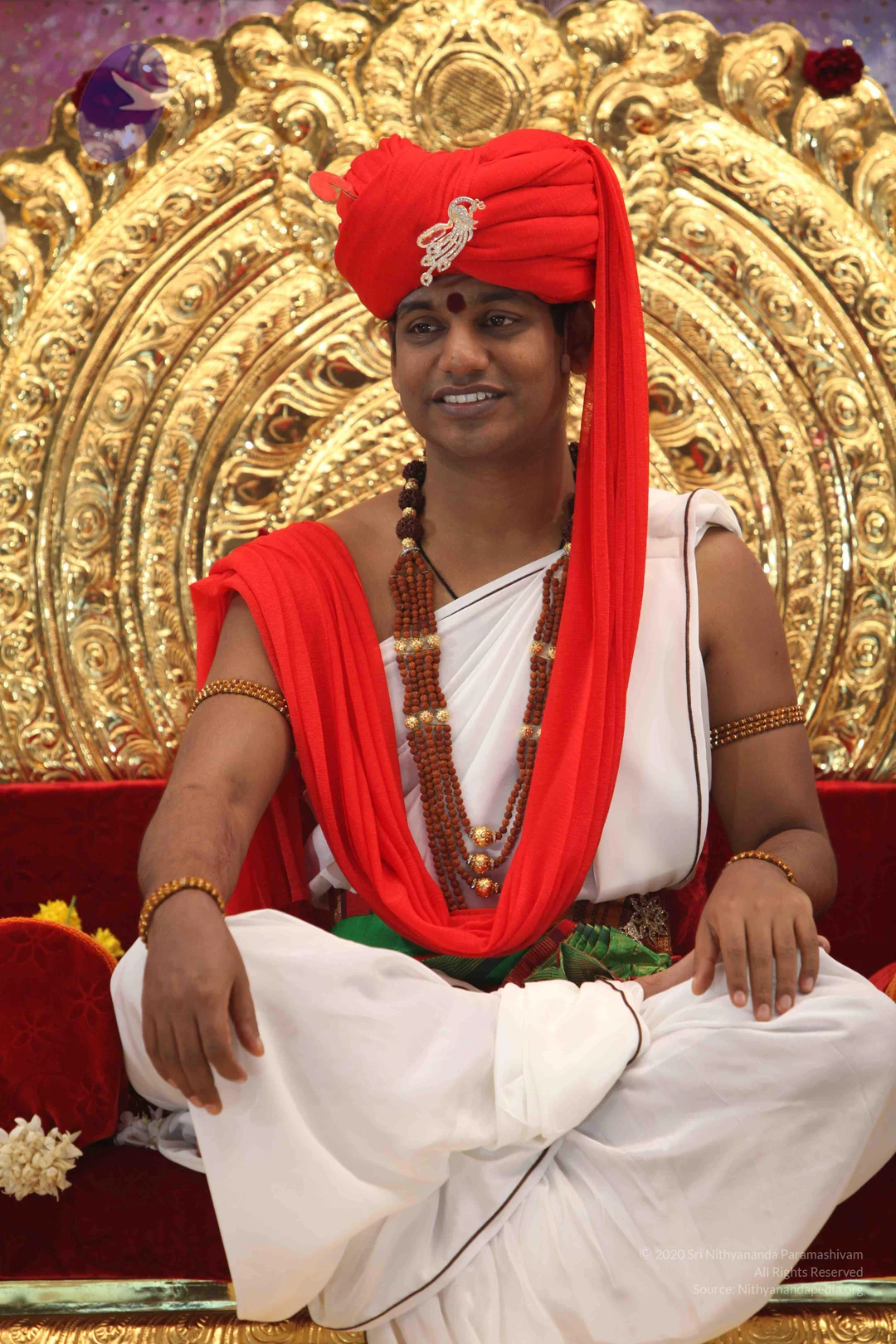
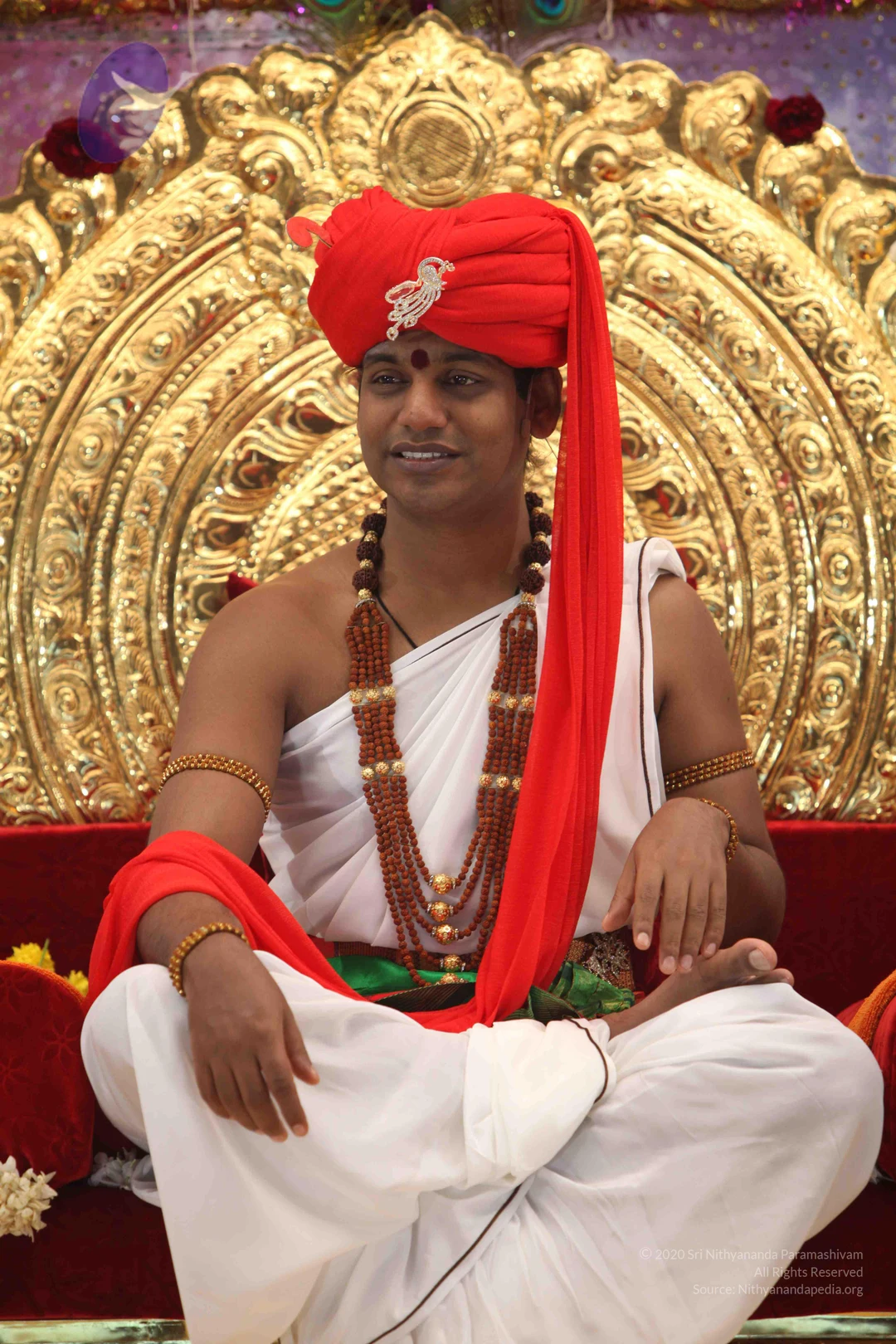
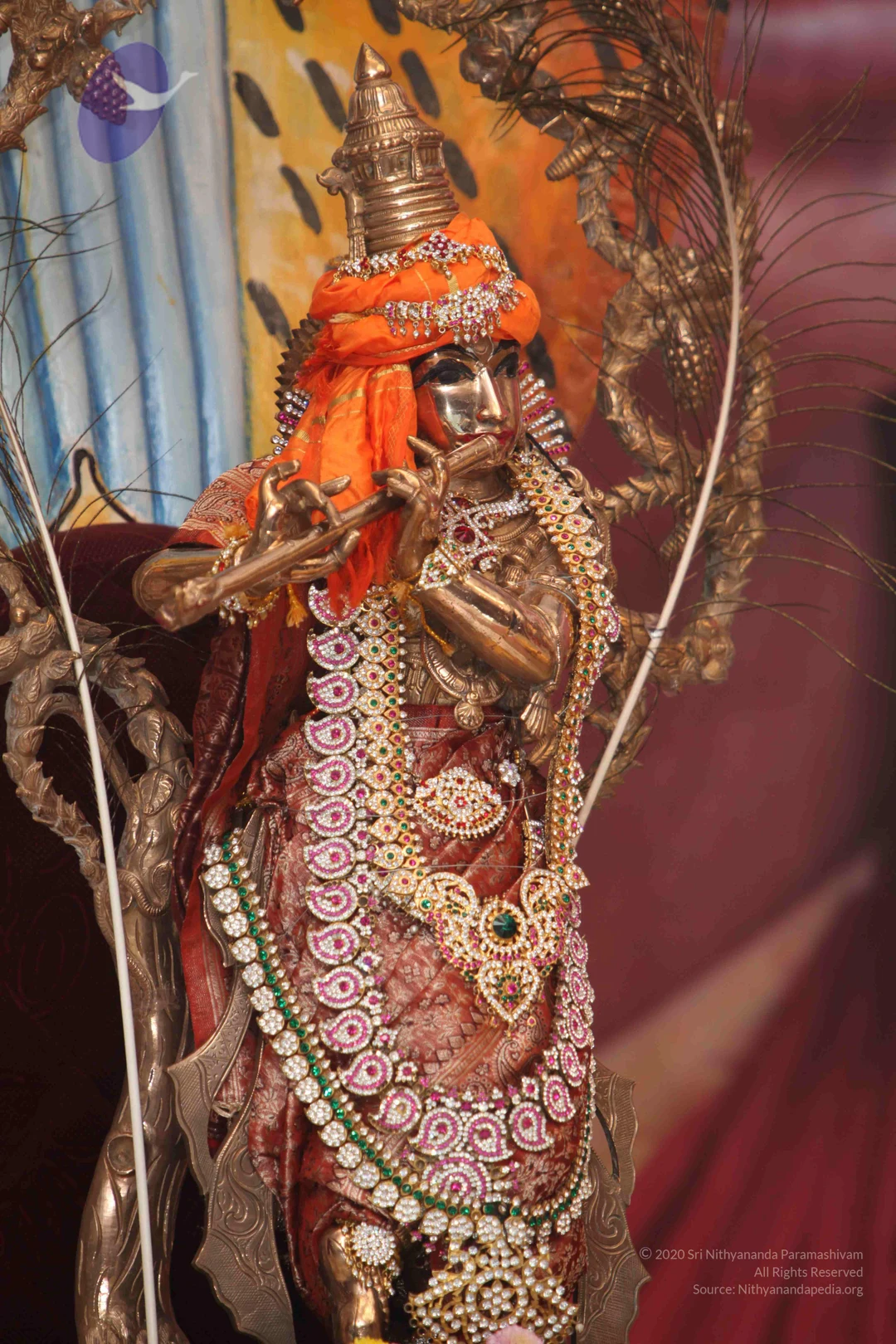
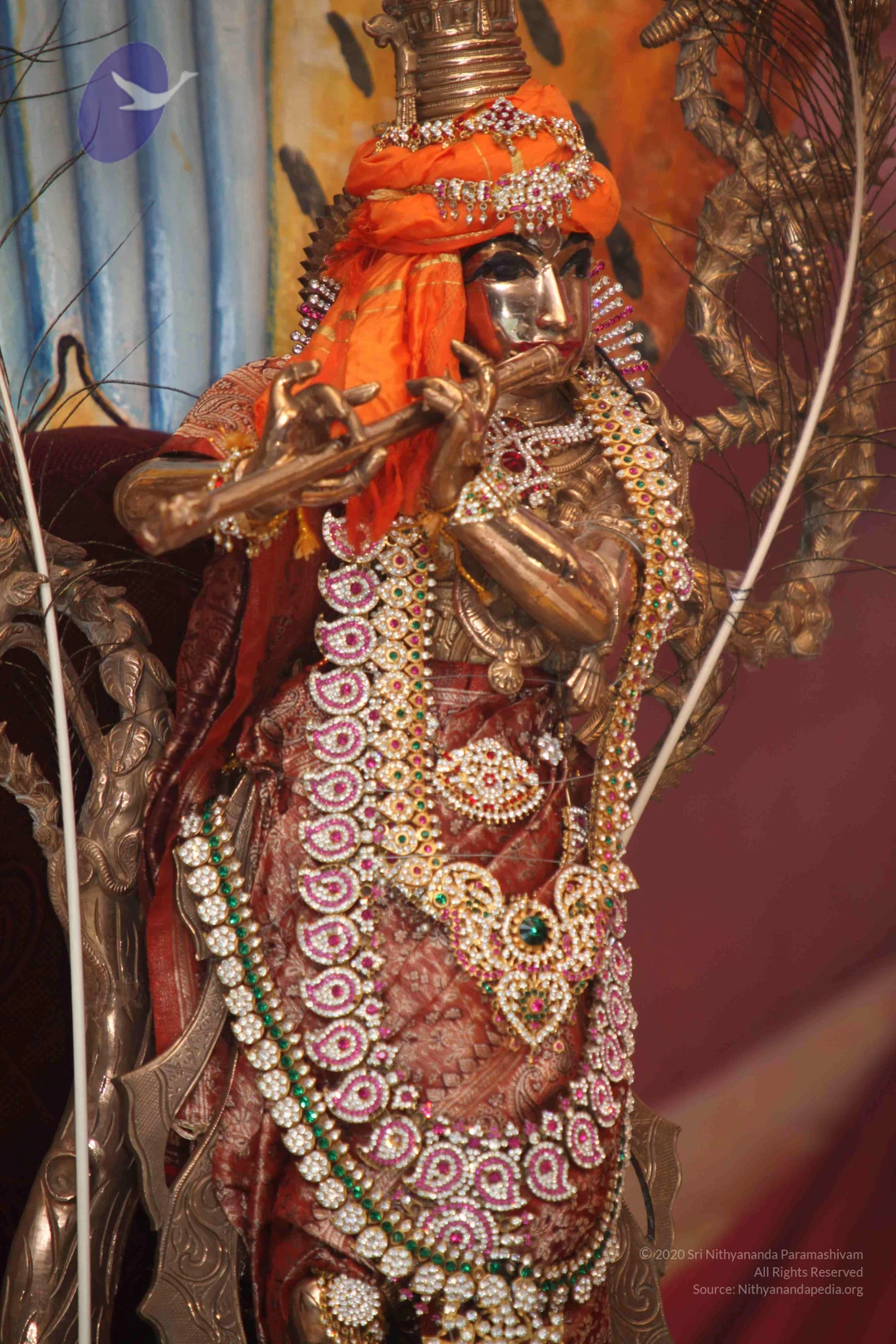
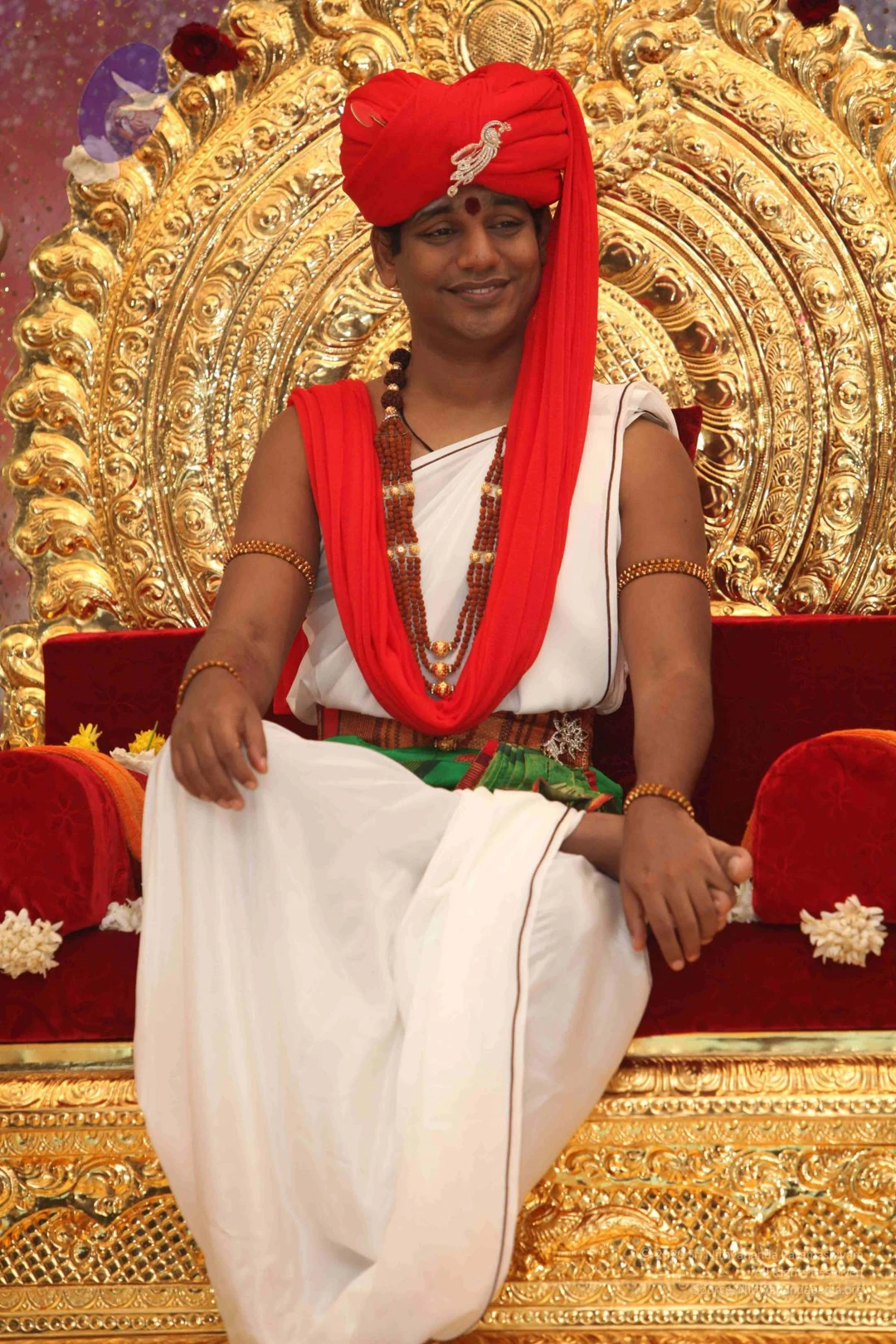
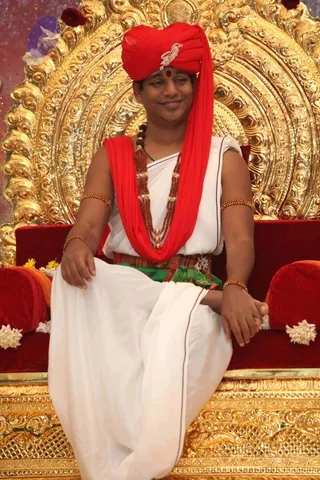
A photograph of a seated figure on an ornate gold throne with a large golden arched backrest and red cushions, set against a pale wall with pink and gold decorative drapes. The figure wears a red robe and a red head covering, with flowers and garlands nearby. The setting appears to be a formal satsang or darshan stage.A person seated cross-legged on an ornate gold throne with red velvet cushions, palms pressed together in namaste at chest level with head bowed. The person wears a red turban and red shawl over white dhoti-style clothing, with beaded jewelry and bangles. Behind the throne hang white draped cloth with bunches of grapes and kalasha-like ornaments, a peacock-feather decoration above, and a pink-and-purple sky backdrop. Flowers lie at the base of the throne, and carved gold side panels frame the scene.A man seated on a red velvet throne-like seat in front of an ornate gold repoussé backdrop. He wears a red turban with a silver brooch and a red shawl draped over his shoulder, white dhoti-style cloth, rudraksha mala necklaces, gold armlets and bangles, and a red bindi. His hands rest on his knee and the armrest. Red and white flower petals lie on the seat.A bronze-toned metal murti of Krishna stands on a pedestal, playing a flute, wearing an orange turban-like headdress and a red-and-gold brocade dhoti with layered jeweled necklaces and pendants. Peacock feathers and ornate gilded arch-shaped metal framing rise behind the figure. Fresh yellow and red flowers lie at its base on a yellow cloth. Behind it, a large orange-and-blue painted backdrop with peacock-eye motifs and a blurred smiling portrait area, with no visible physical people.A man sits cross-legged on a red velvet throne with an ornate gold frame, wearing a red turban with a small white ornament, a red shawl draped over one shoulder, and white dhoti-style clothing with a green-and-red sash. He wears multiple rudraksha-style beaded necklaces, gold bangles and a red bindi, and smiles while looking to the side. Beside him stands a white-draped figure decorated with a bunch of purple grapes and hanging clay pots, against a purple sparkling backdrop. A small gold-carved wooden table with a water bottle and offering items sits at the right.A seated man sits cross-legged on an ornate golden throne with red velvet cushions, smiling slightly with hands folded in his lap. He wears a bright red turban with a small white emblem, a red shawl draped over one shoulder, a white dhoti-style garment, a long rudraksha mala necklace, gold armlets and bangles, and a red bindi. Behind him a golden arch frames a glittering purple-and-pink backdrop, with hanging clay pots, white cloth draped on pillars and grape clusters decorating the sides. Peacock feathers appear at the top.

AnandaLingam-Abisheka

72 photosSource gallery
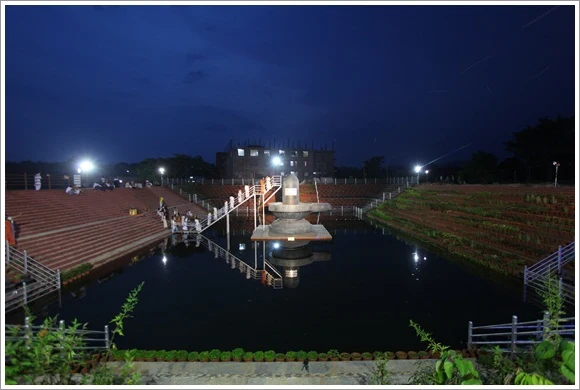
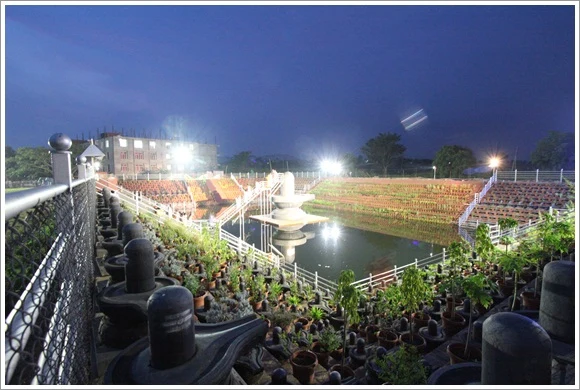
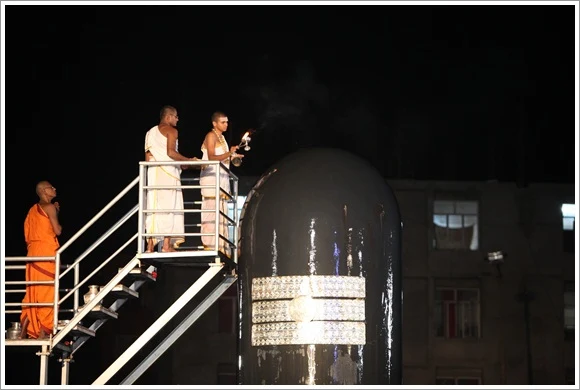
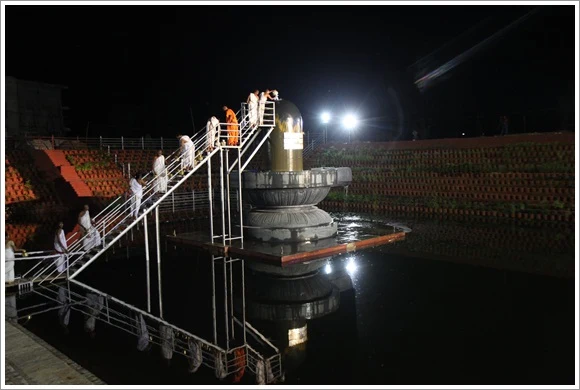
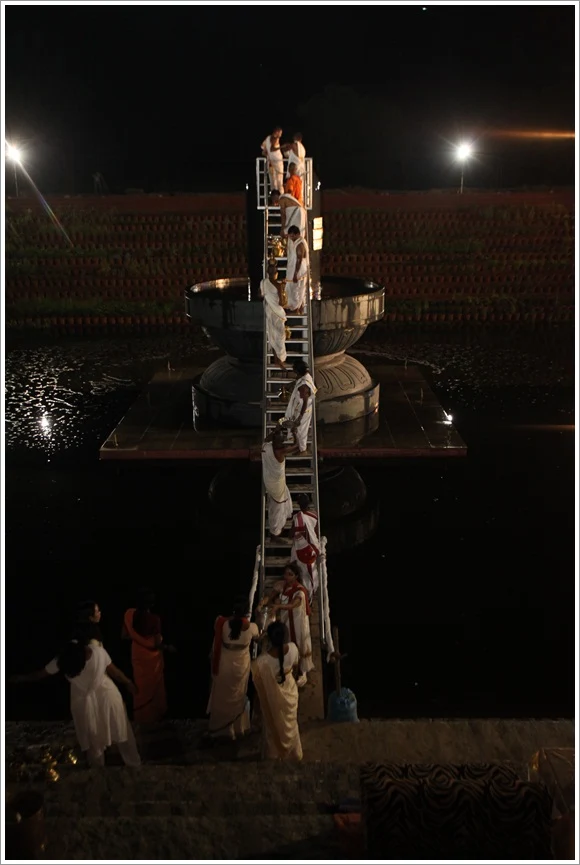
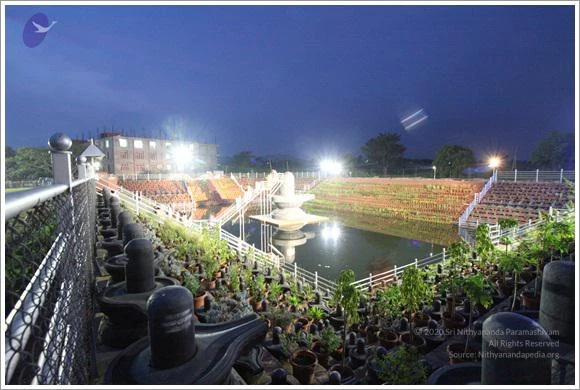
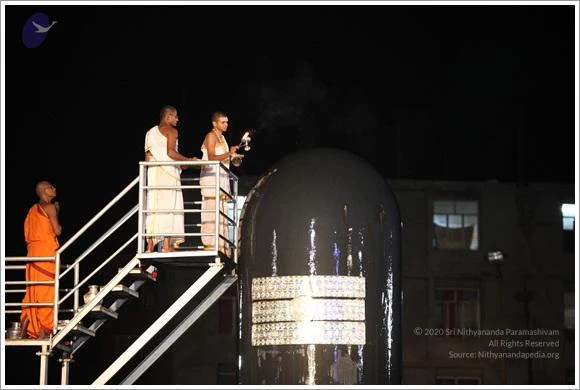
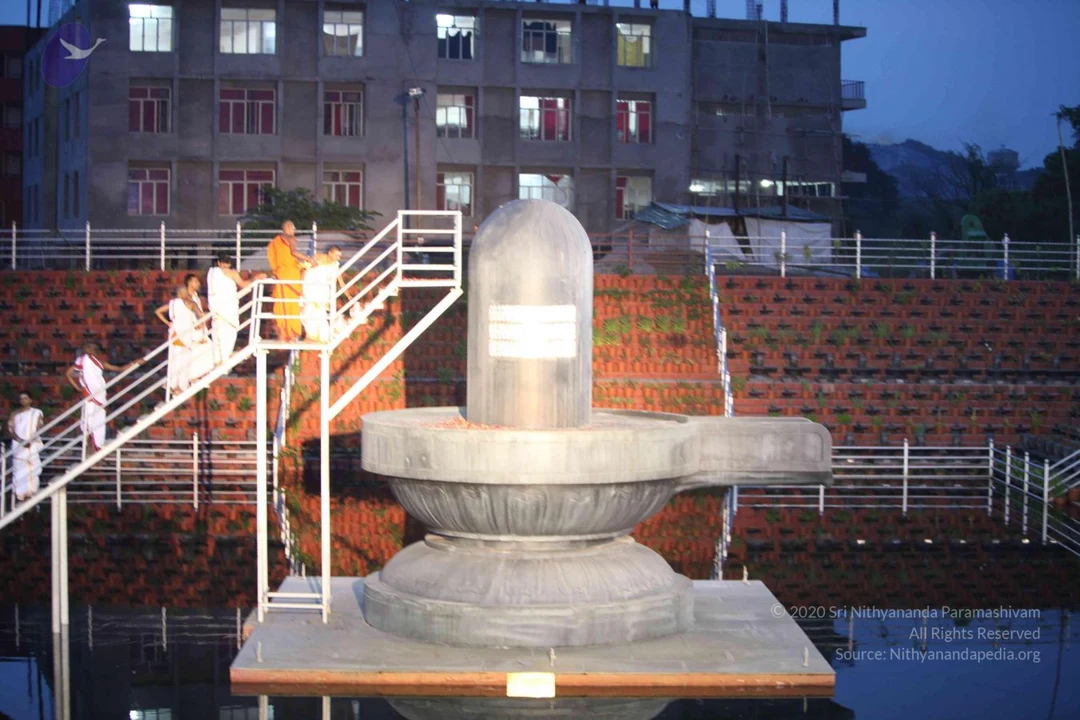
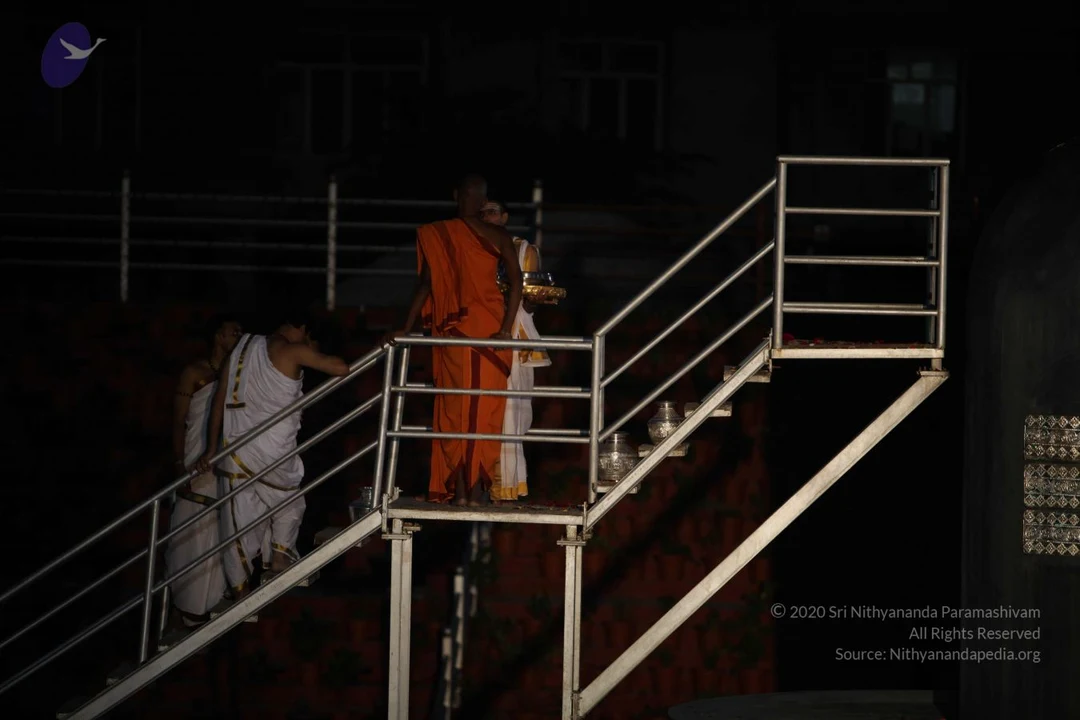
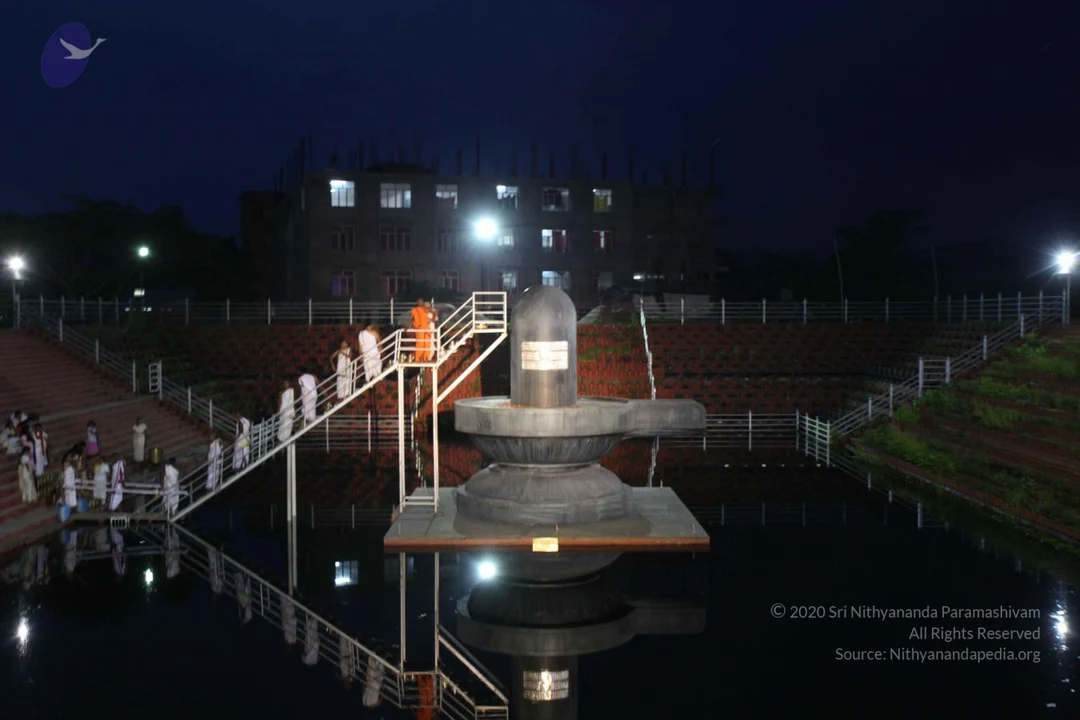
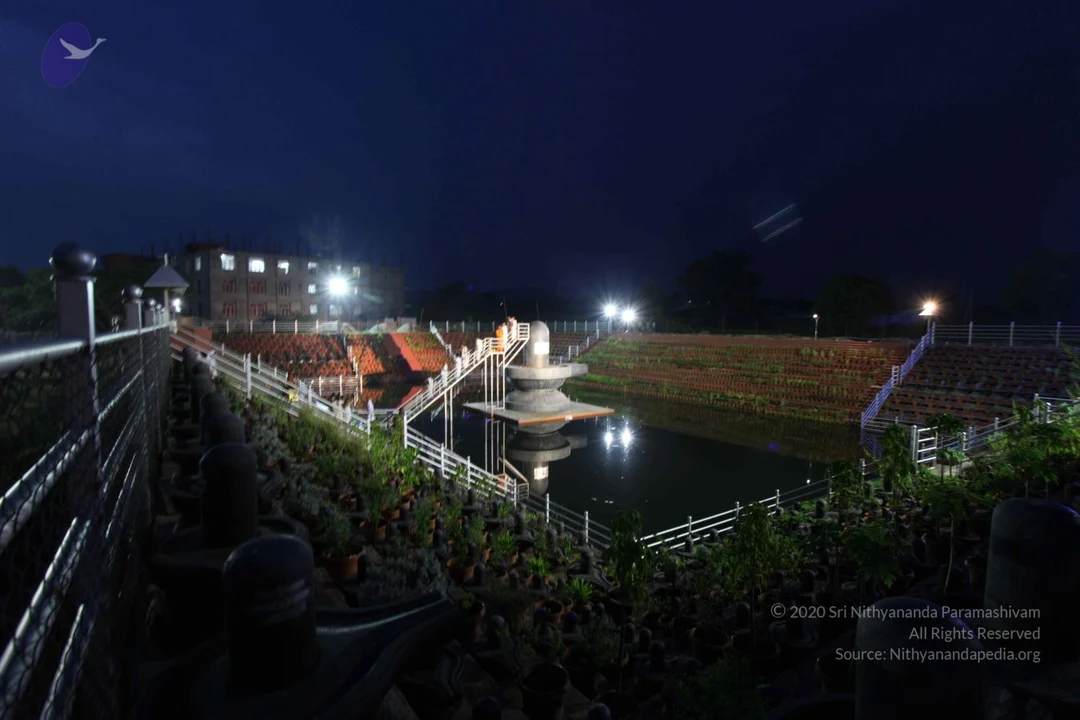
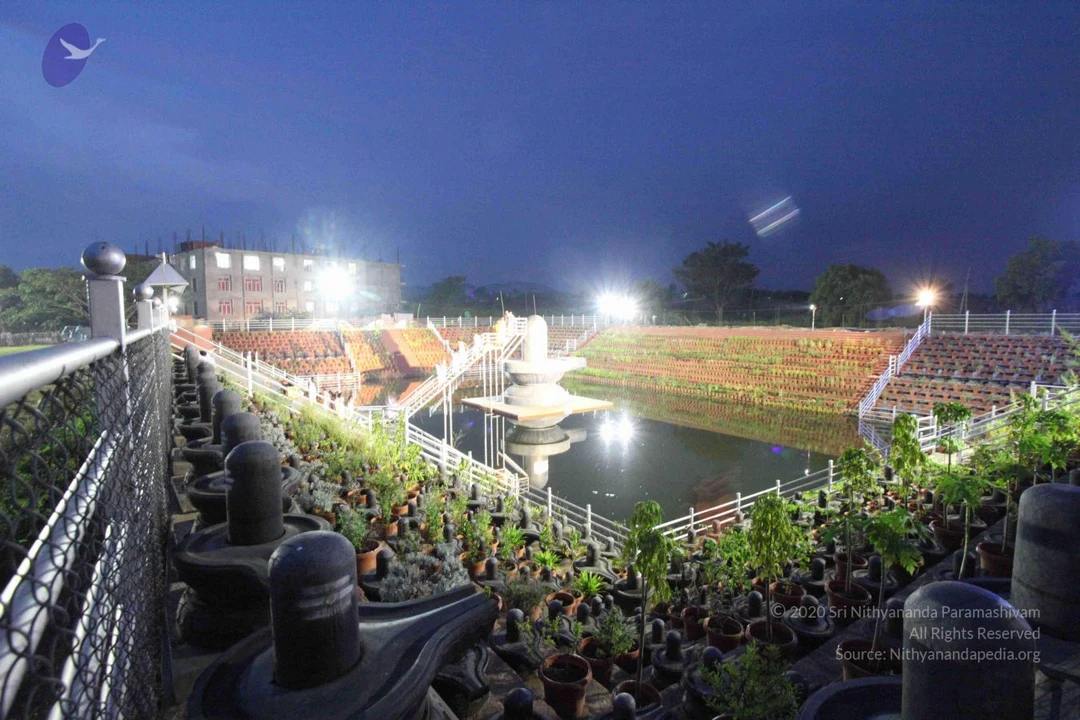
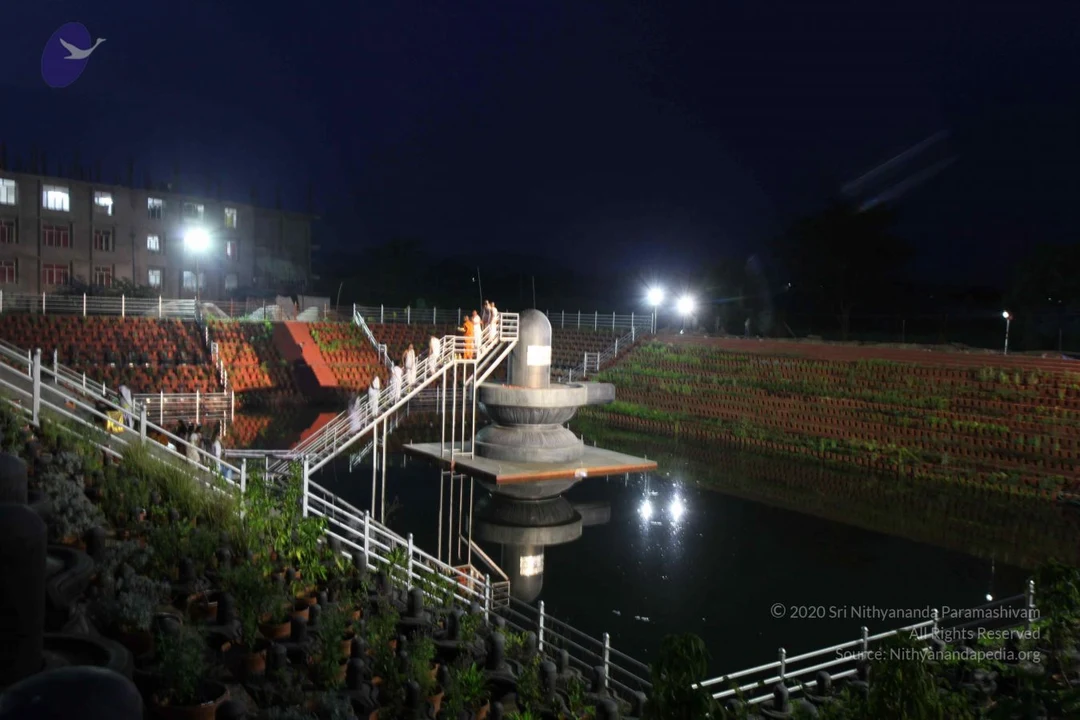
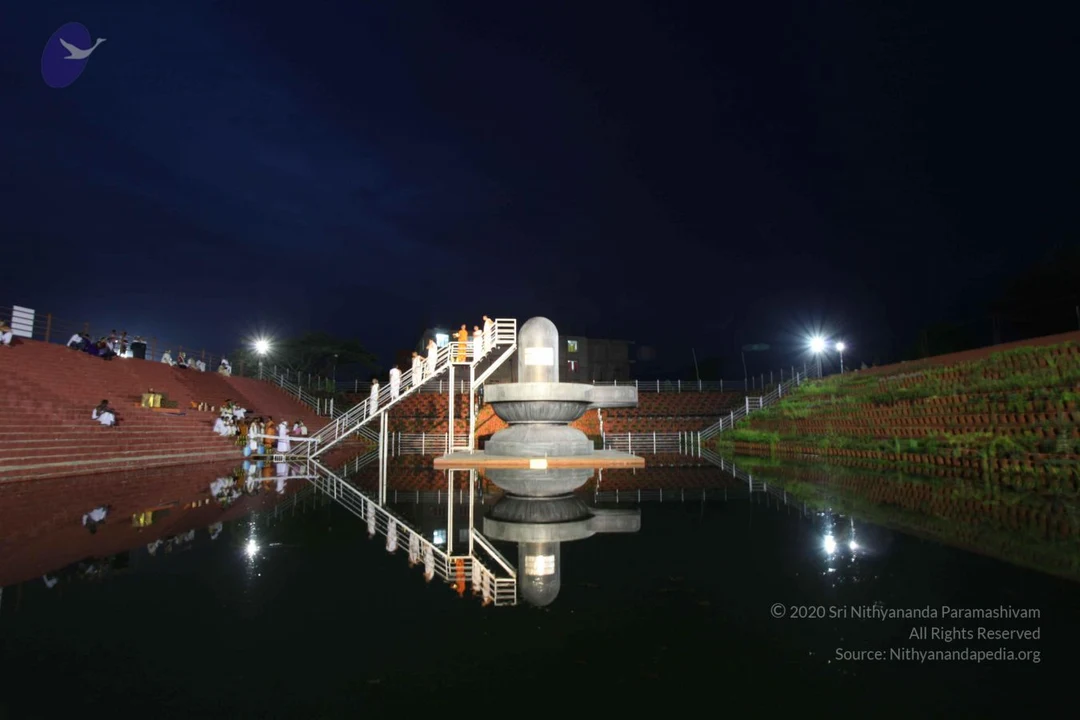
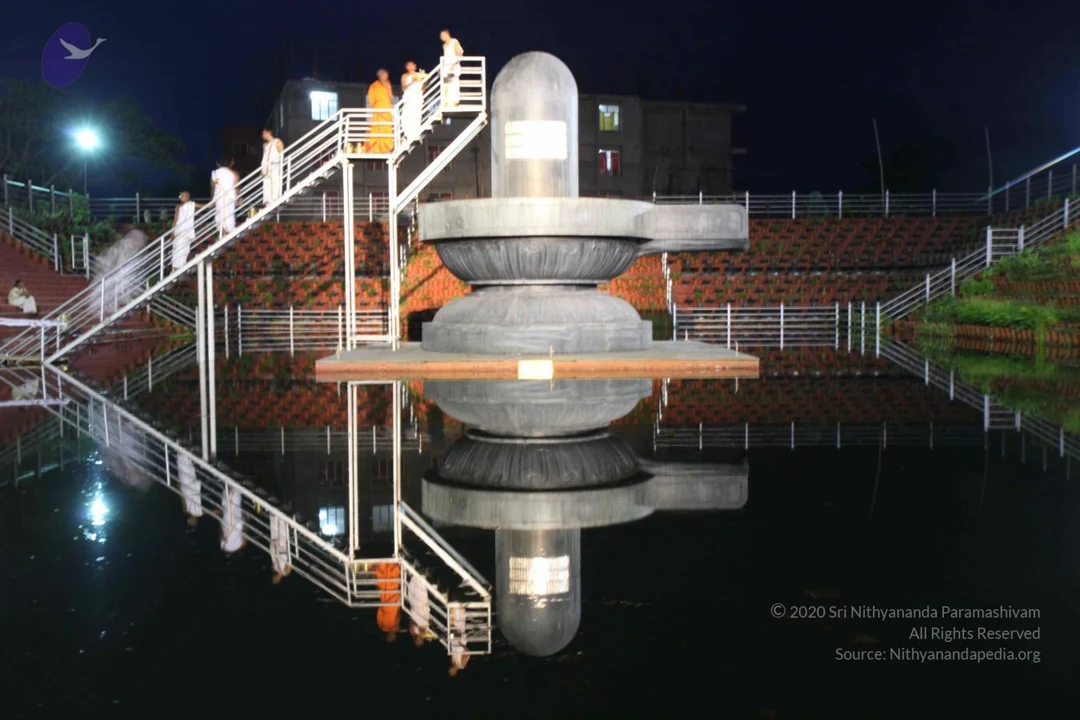
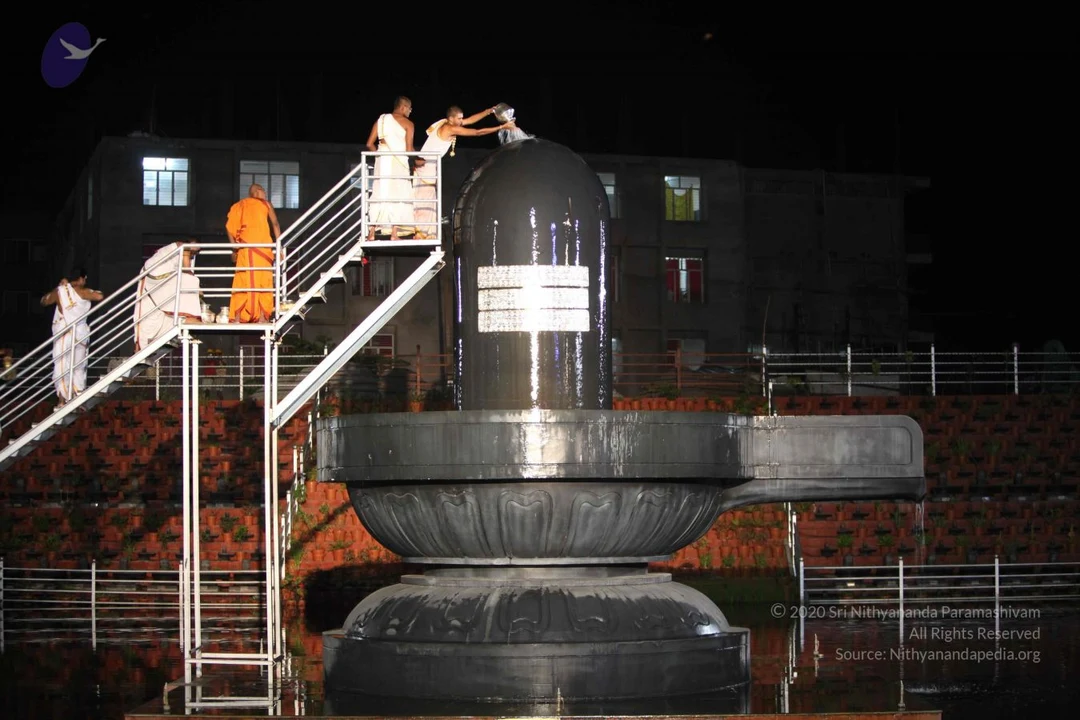
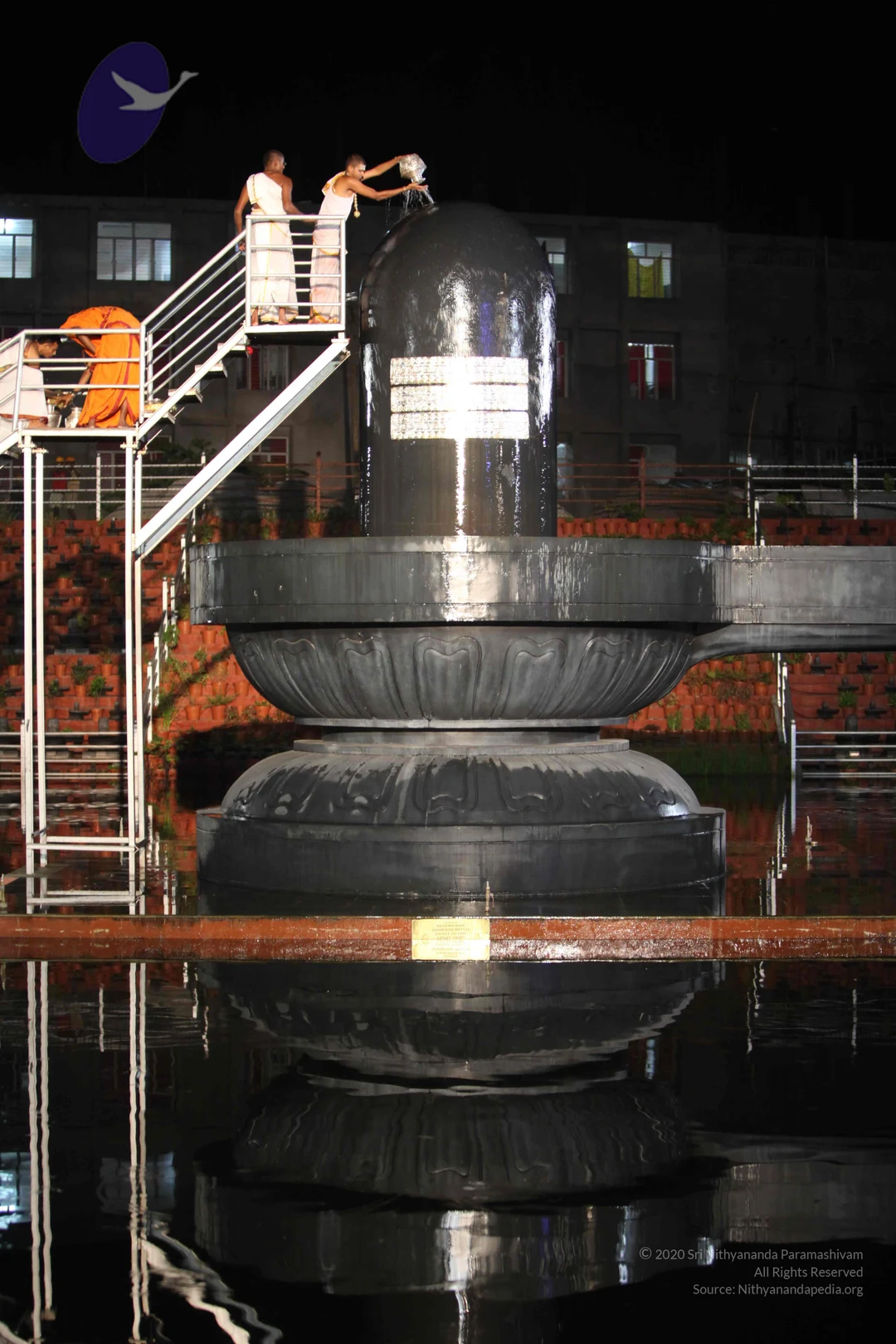
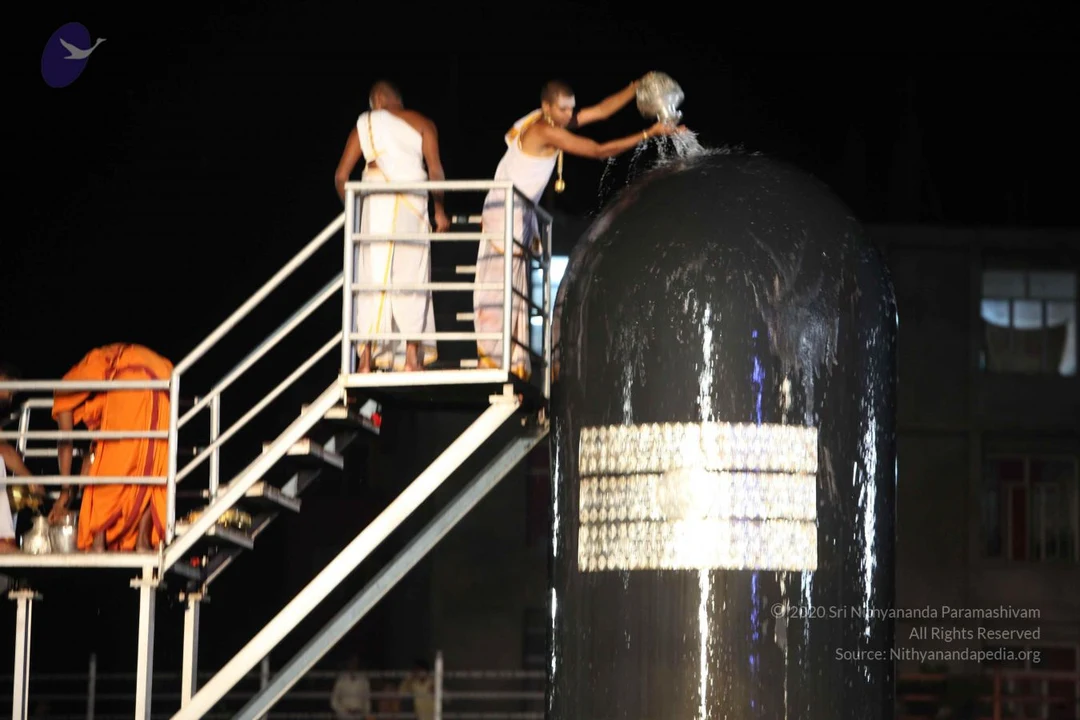
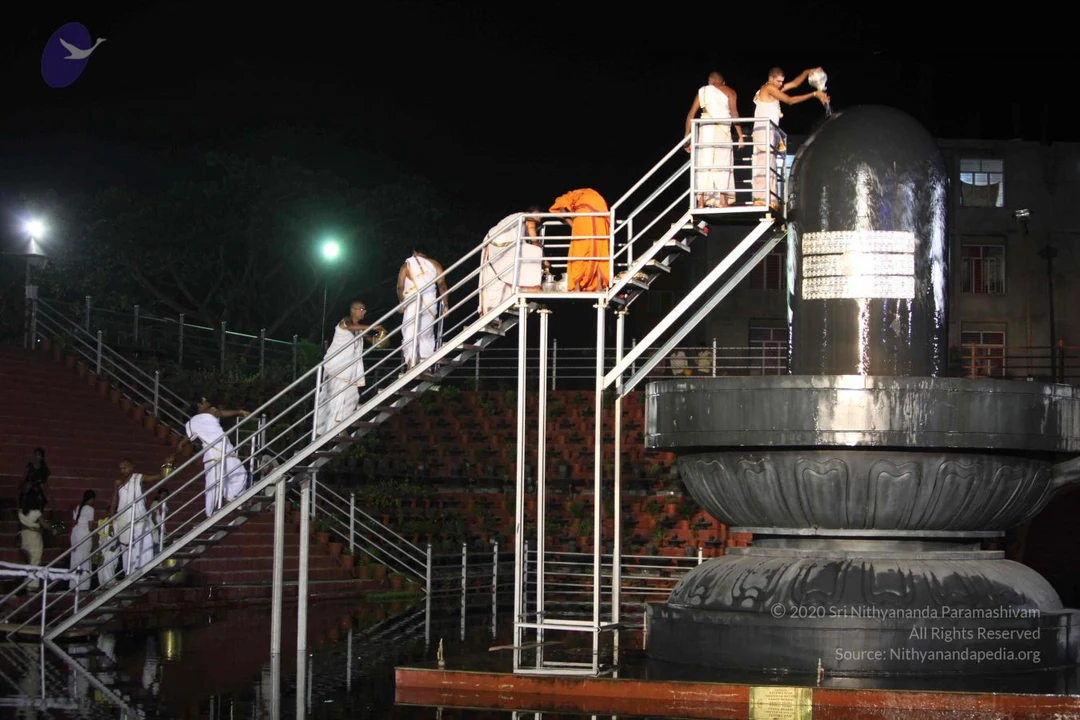
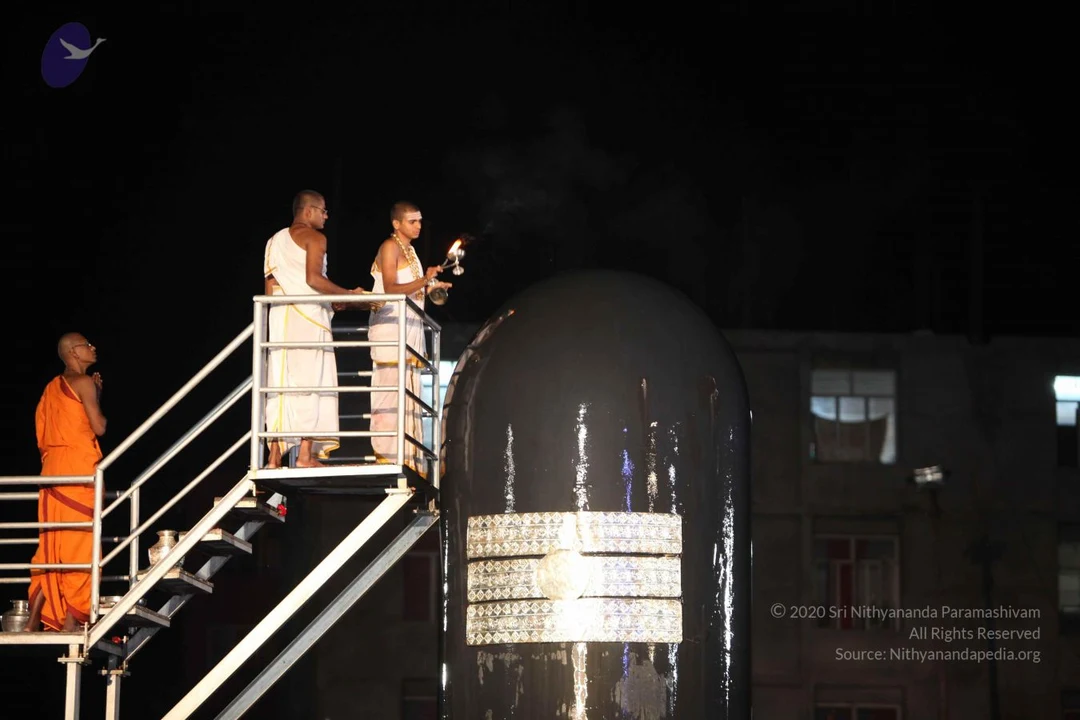
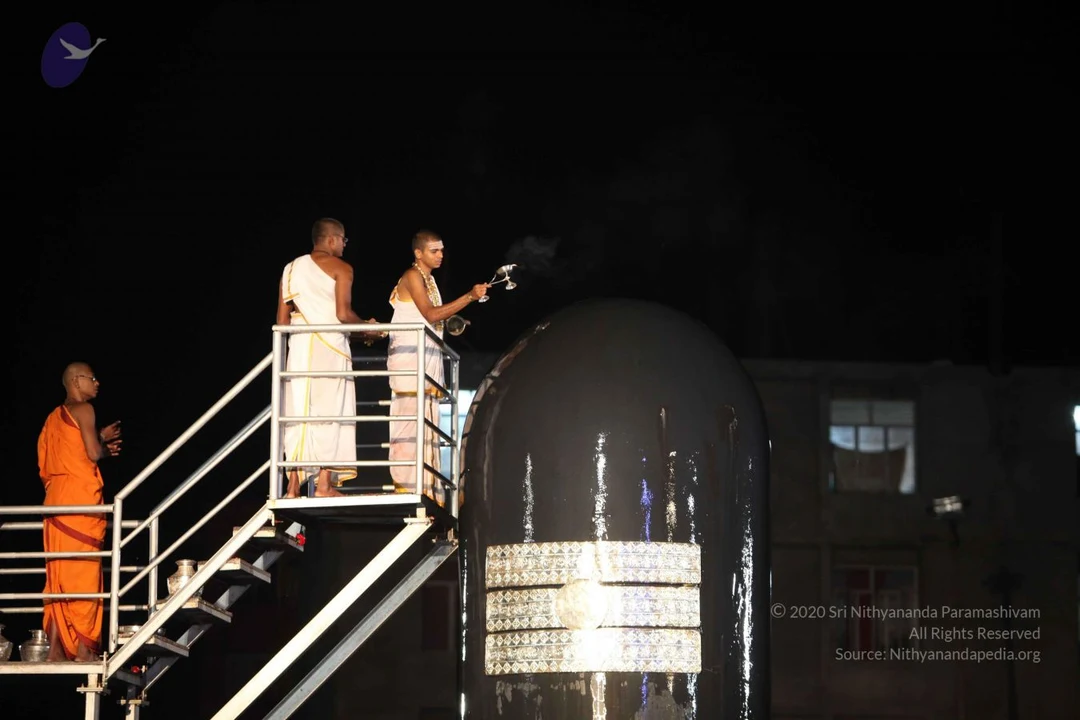
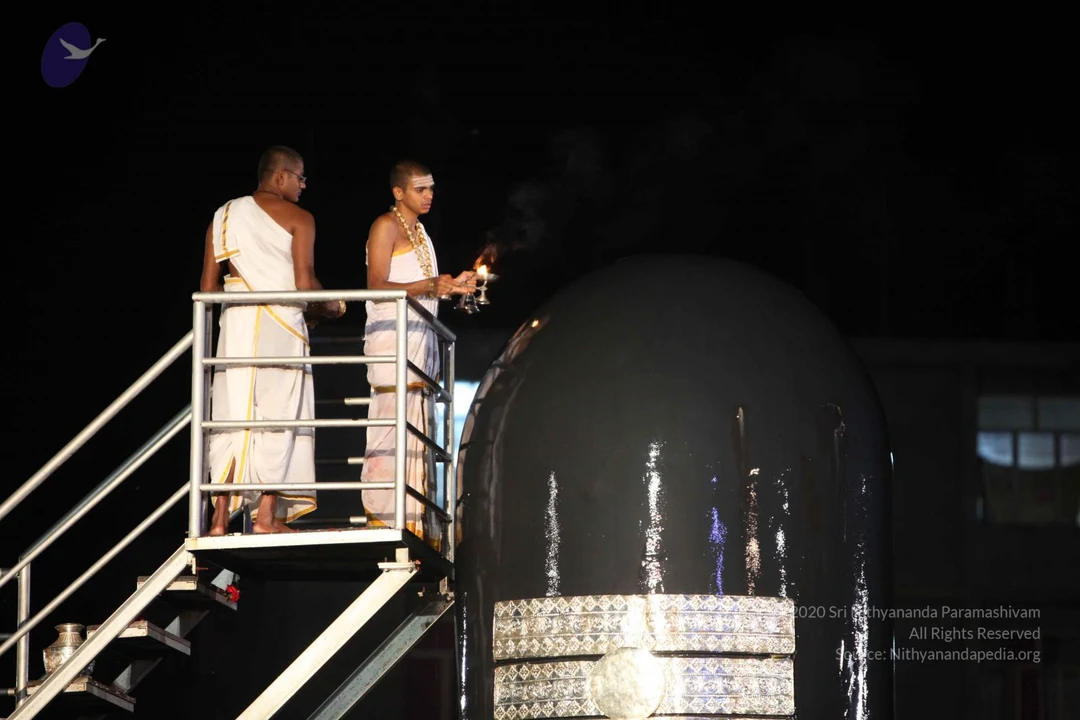
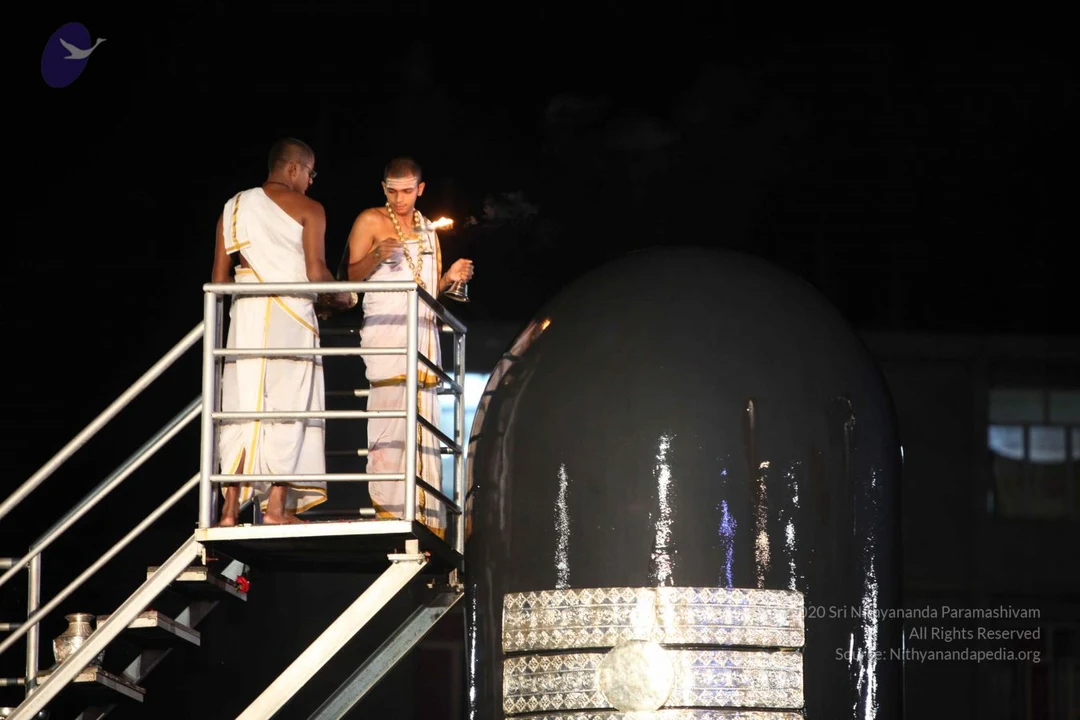
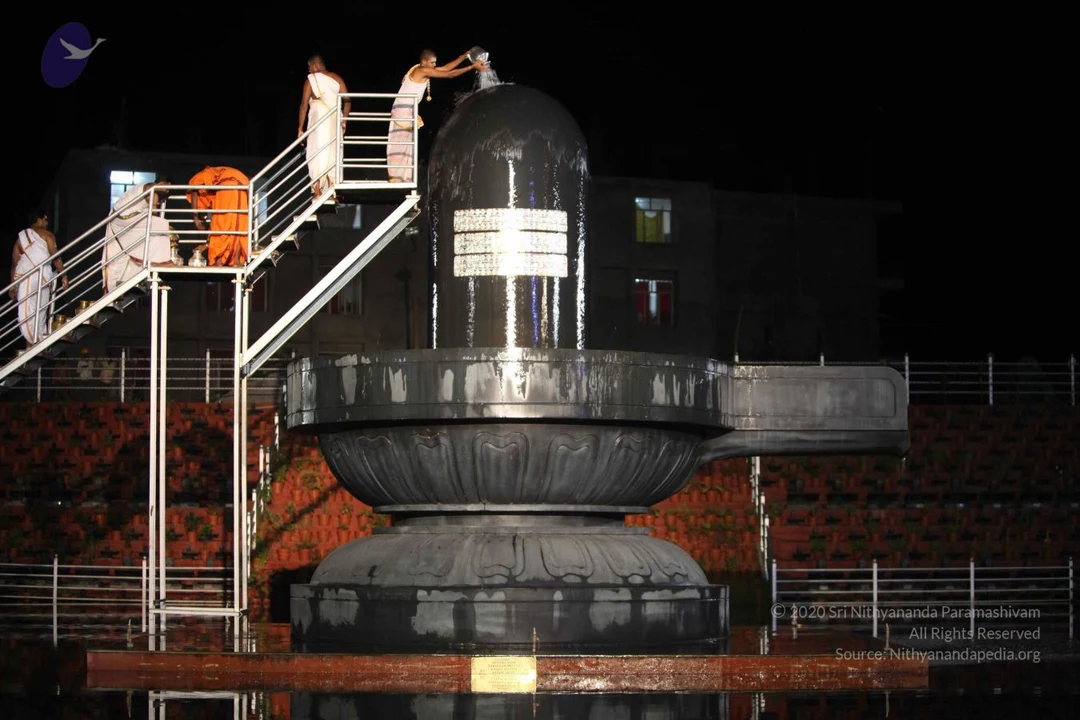
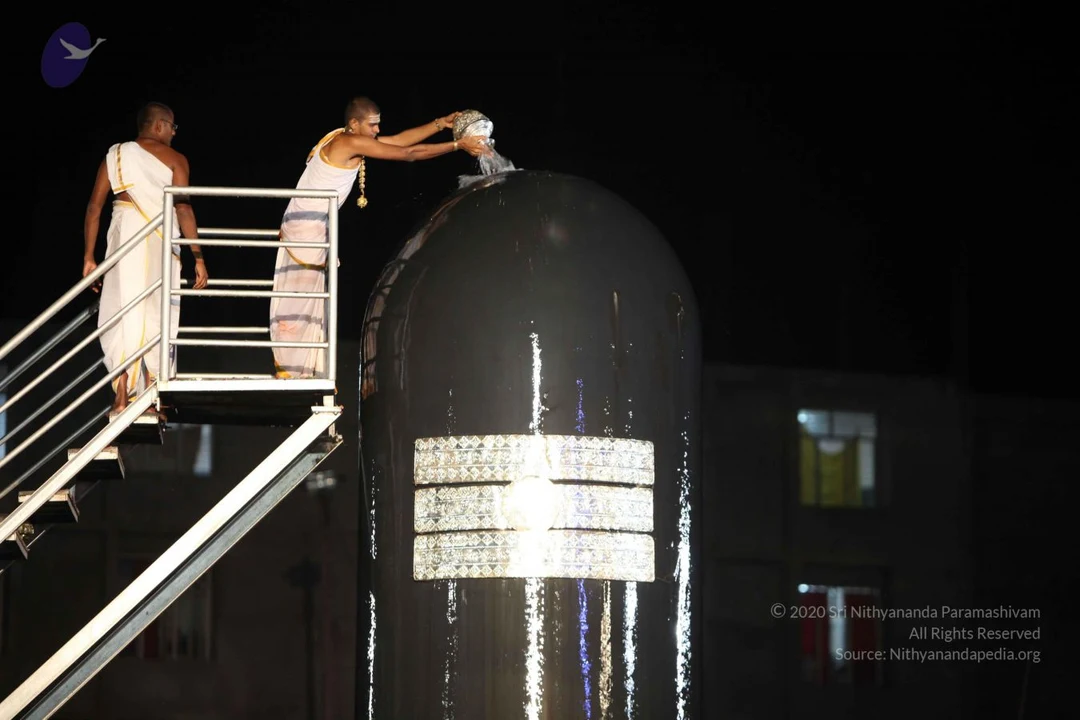
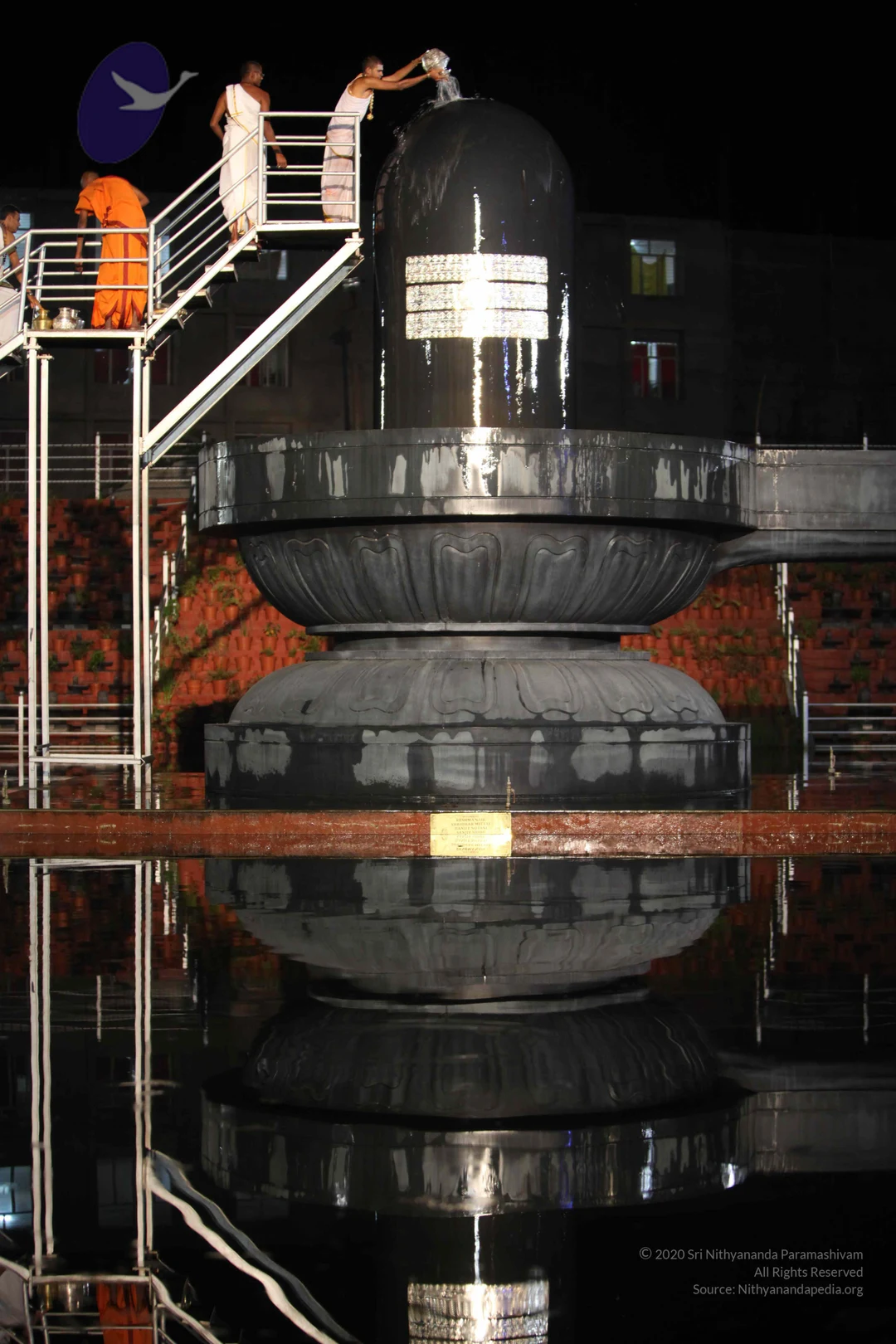
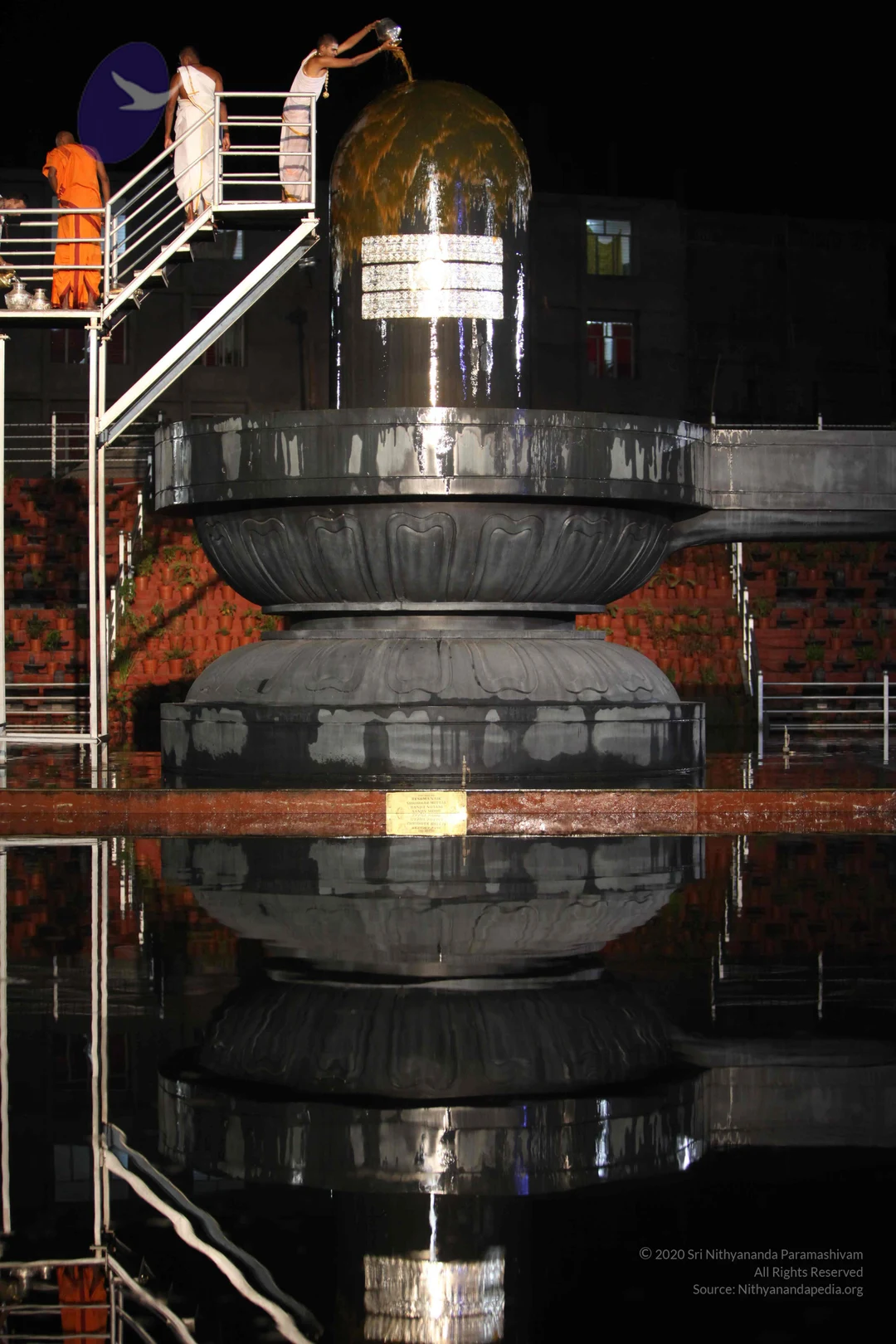
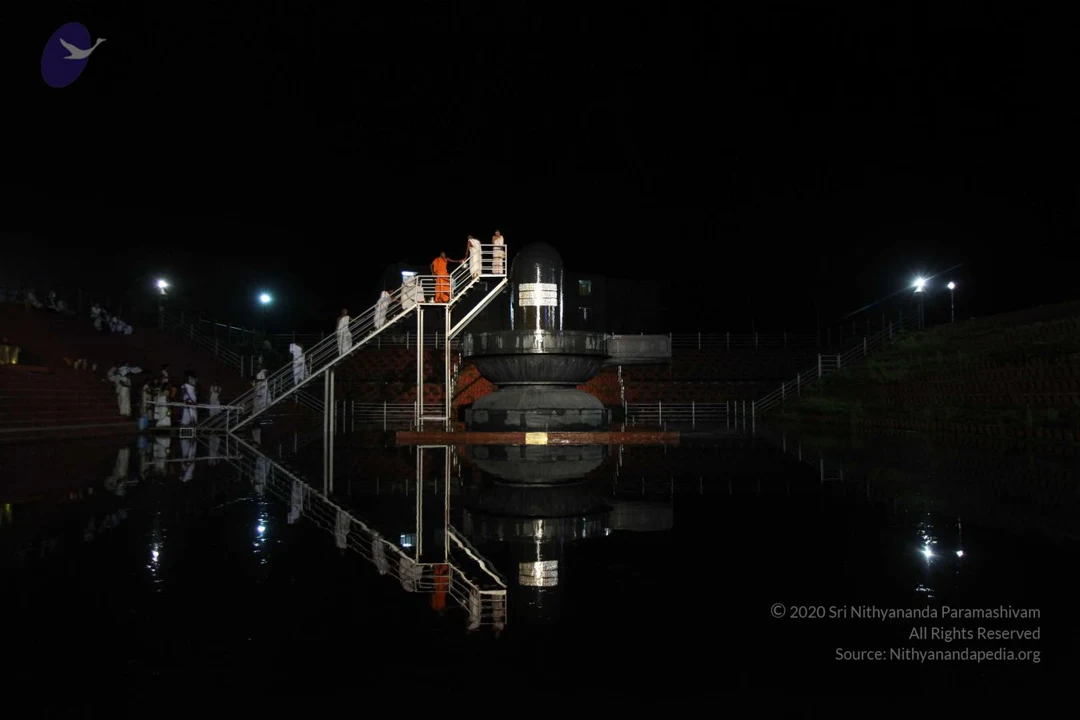
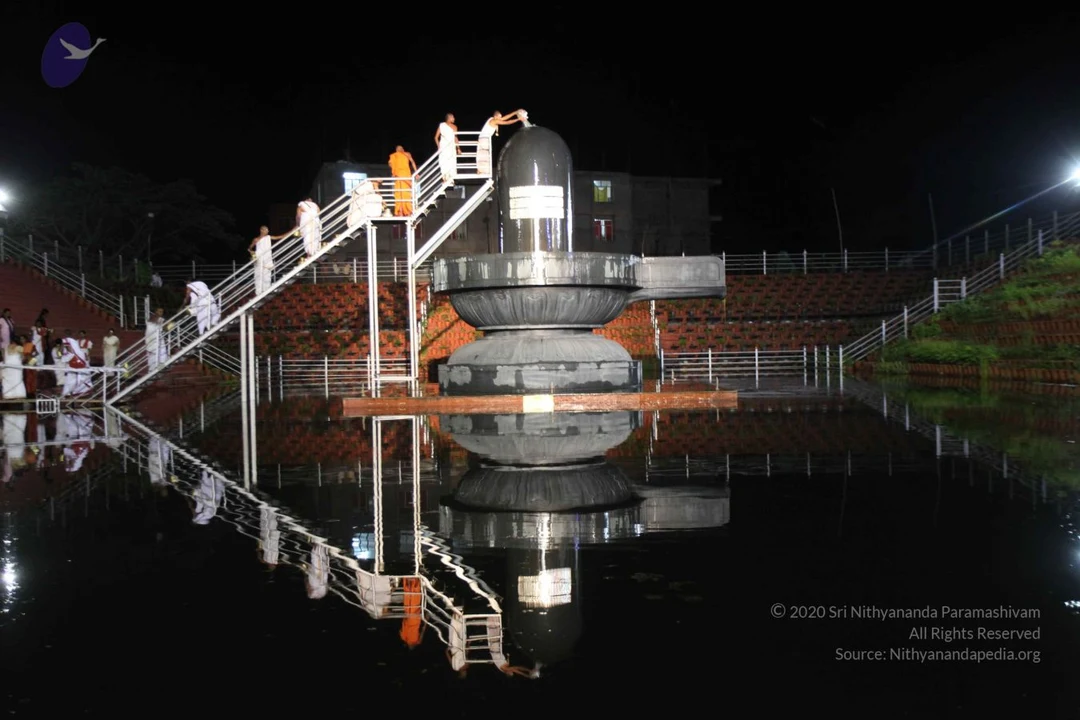
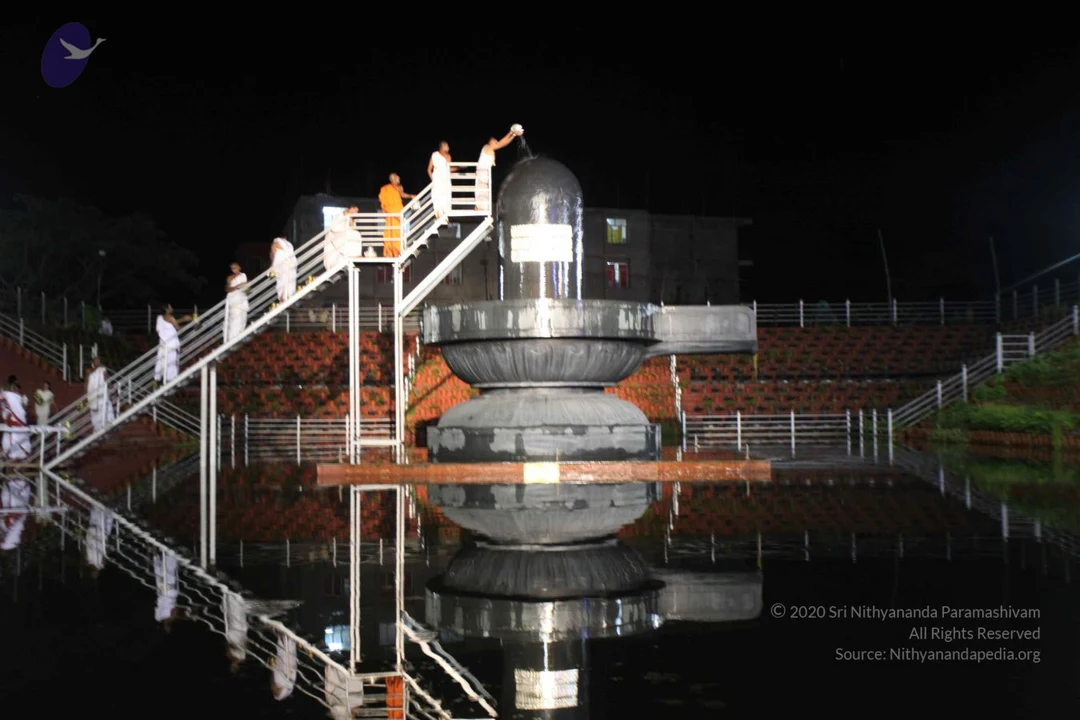
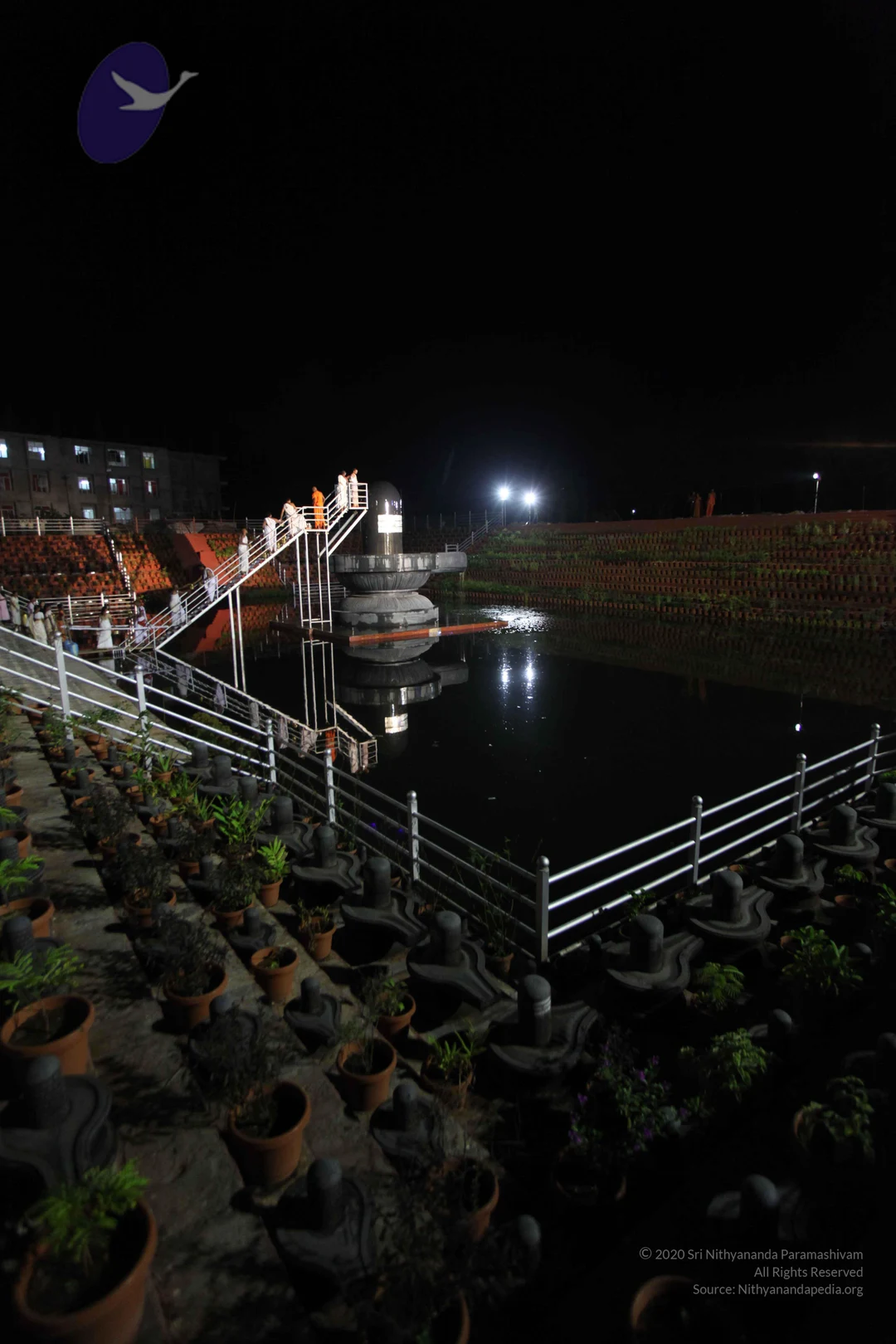
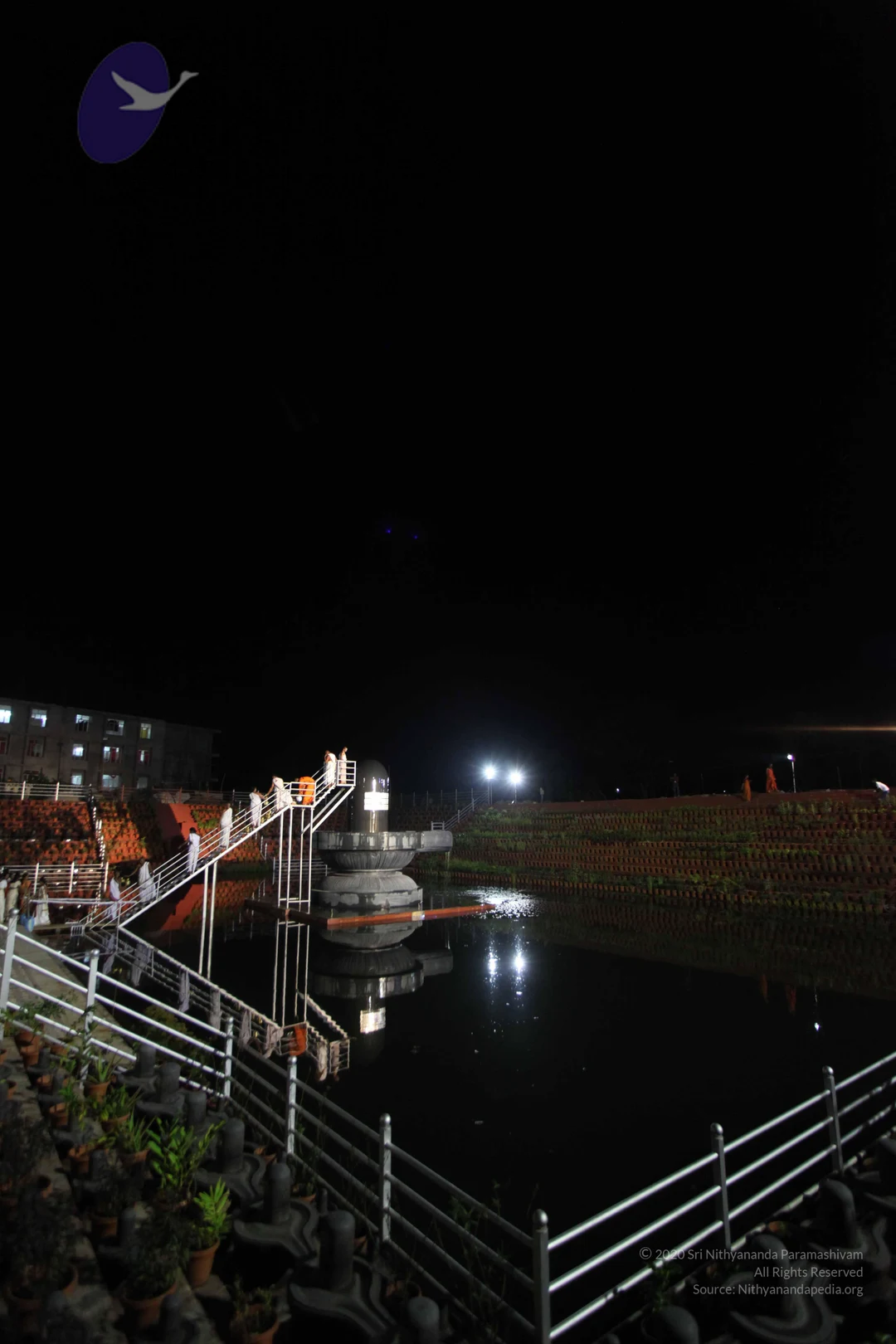
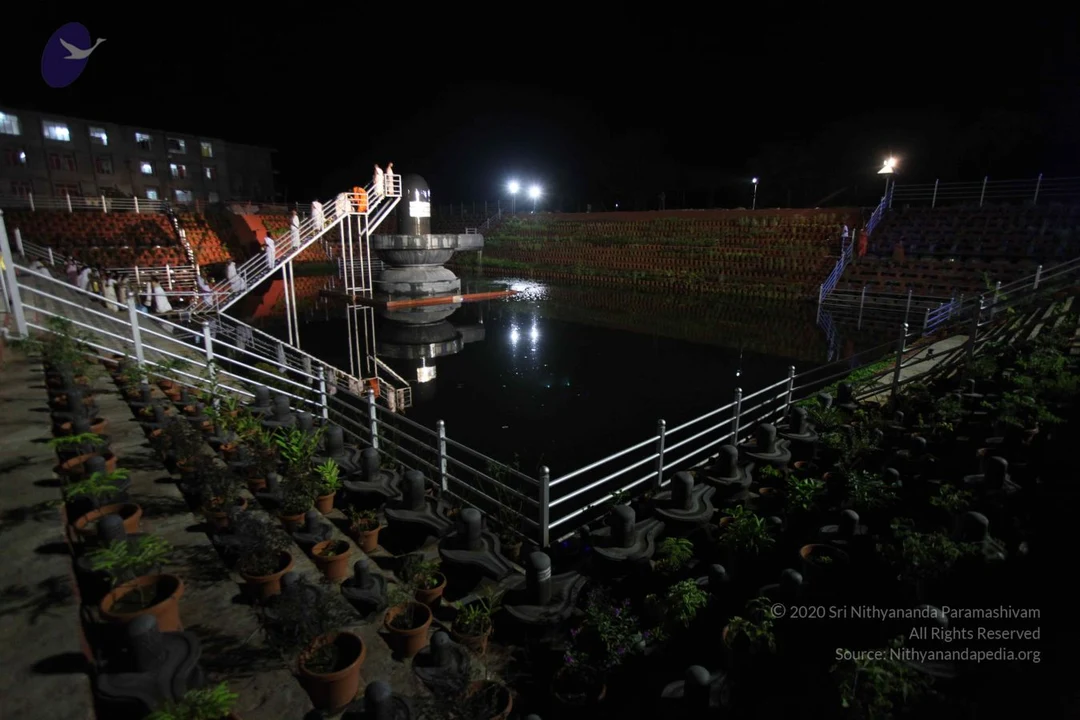
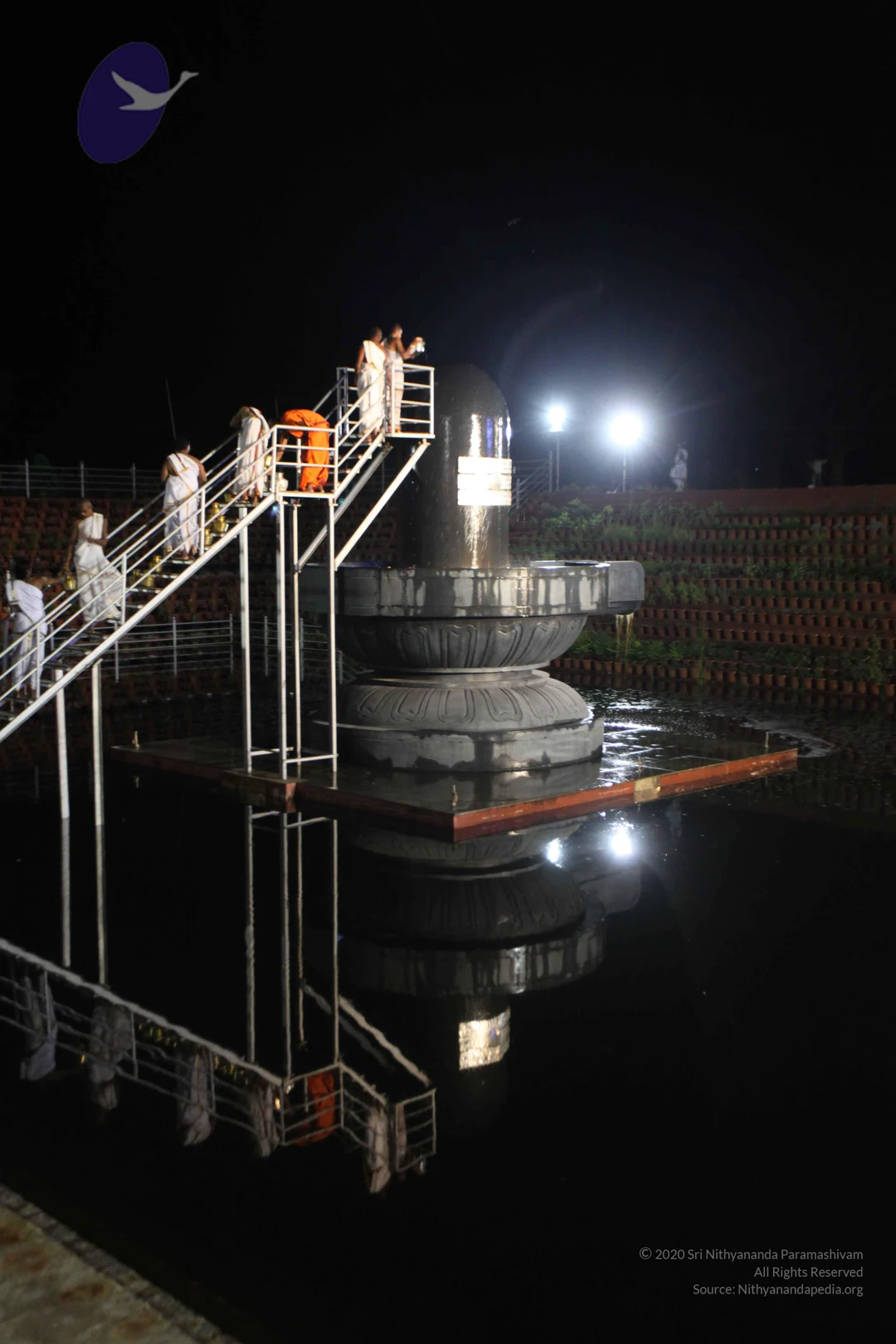
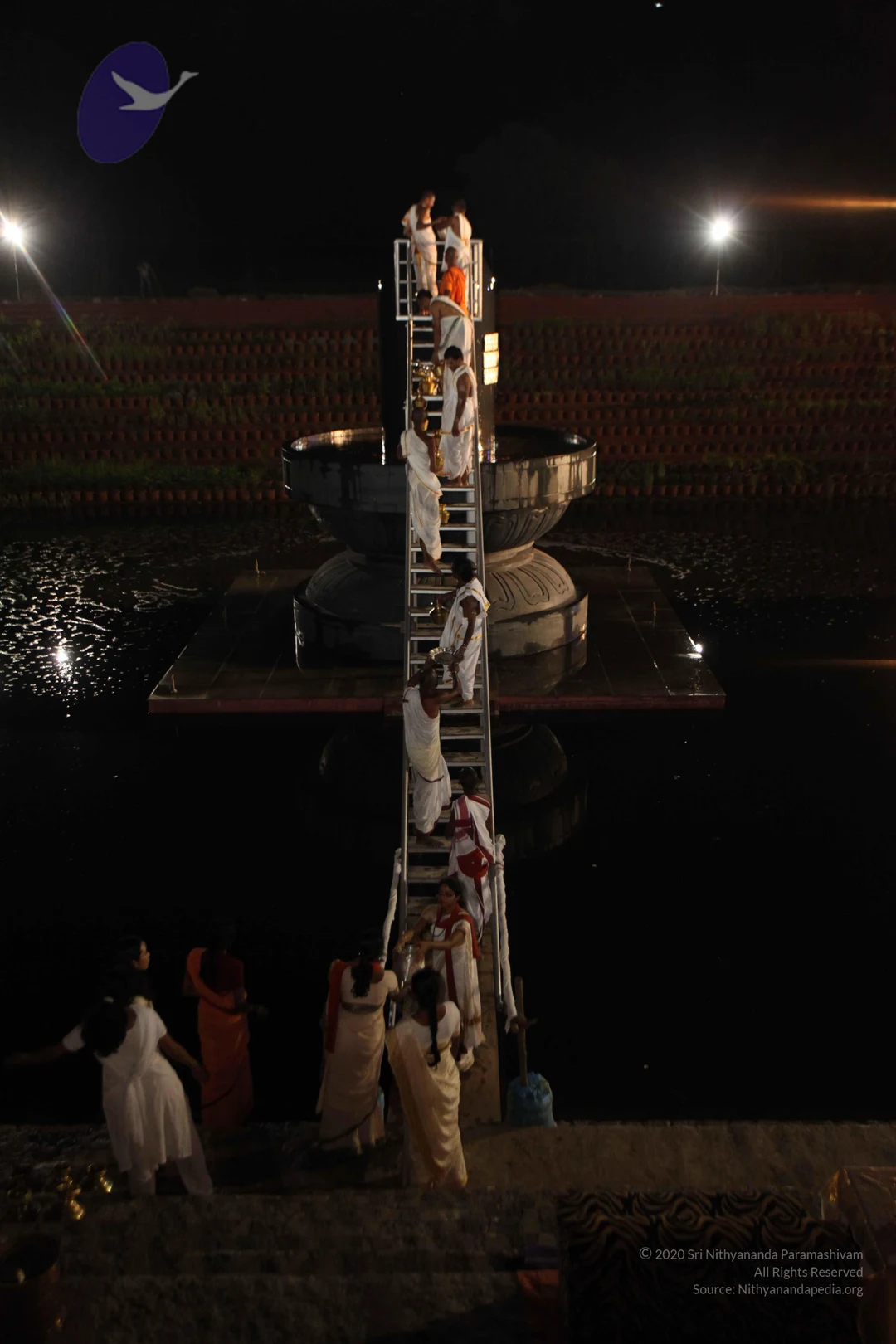
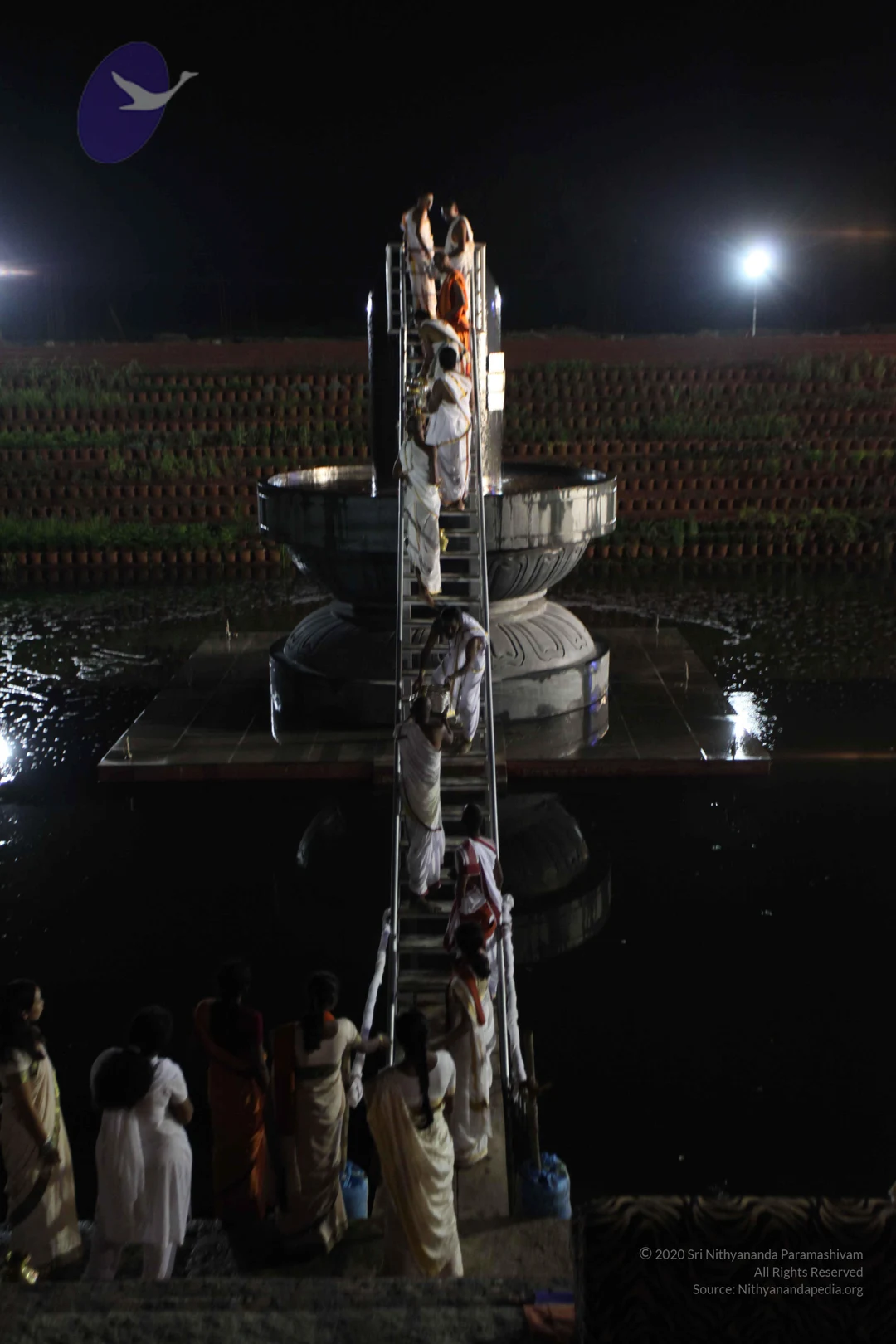
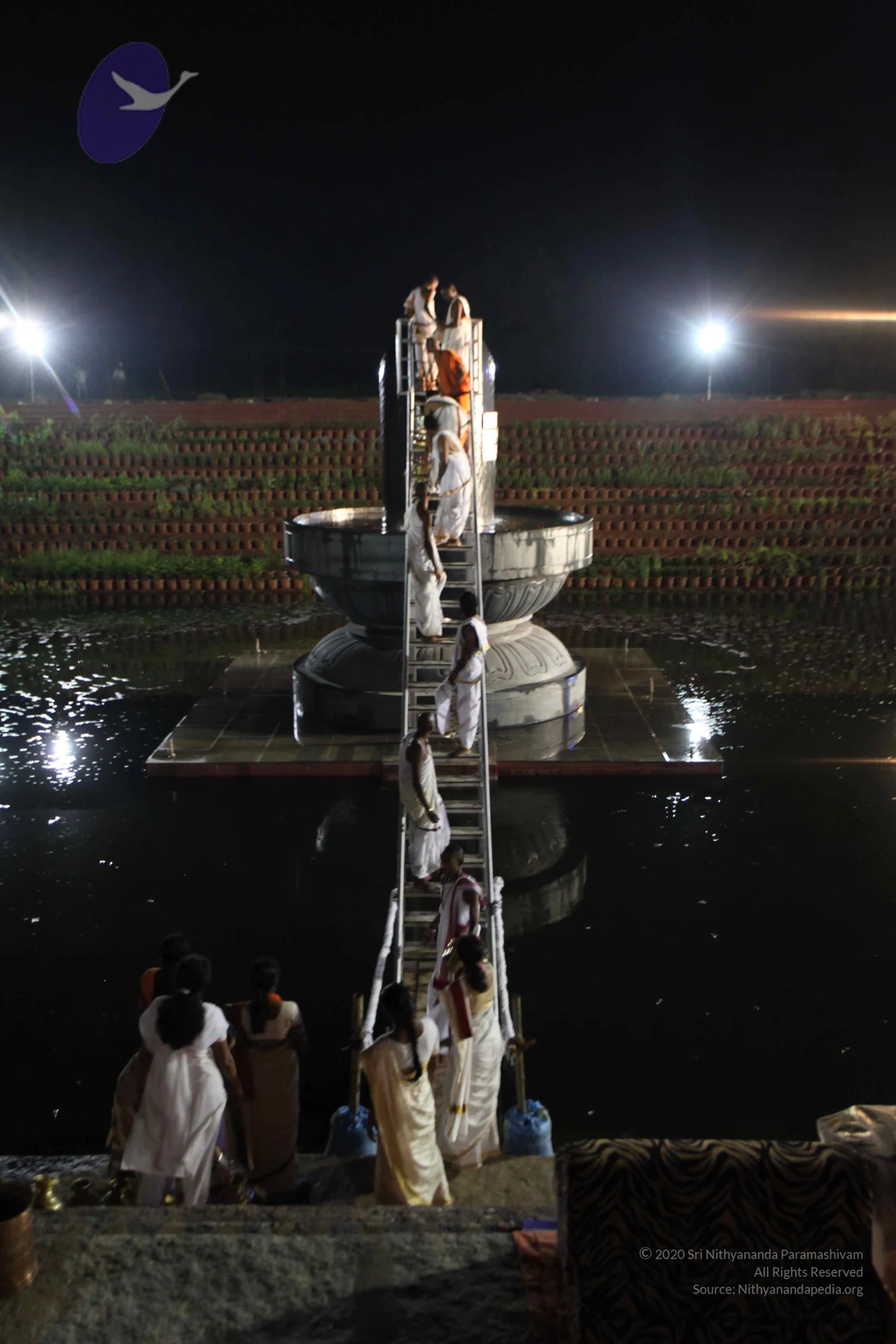
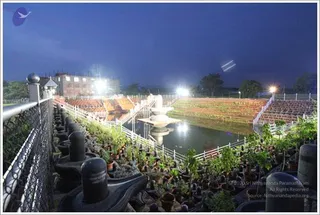
A large grey stone Shivalinga stands on a circular yoni-pitha base in a shallow water basin at dusk, with a lit lamp panel on its cylindrical shaft. A white metal staircase railing leads up beside it, where several people in white ritual clothes climb toward a central figure in saffron-orange robes standing on the steps. Tiered rows of small clay lamps line the terrace walls behind, and a multistorey building rises in the background.A night photograph of a wide concrete channel or canal with still dark water reflecting the lights of a bridge spanning it. Tall street lamps line the illuminated walkway on the left, and a grassy embankment slopes down on the right under a deep blue evening sky. No people or ritual activity are visible.Night view of an outdoor temple grounds lit by floodlights, with a large stone lingam-like shivalinga rows lining a fenced walkway in the foreground, potted green plants between them, and a central pond with a stone fountain or lamp-topped structure. Tiered terraced seating or steps with orange lamps line the far side of the water, and a multi-storey building stands at the left under a deep blue dusk sky. No people are visible.A two-panel photo collage of a night-time abhishekam at a large black Shivalingam on a stepped pedestal, lit with white lights. In the main panel, priests in white dhotis and shawls stand on a metal railed staircase and pour liquid from vessels onto the lingam's dome. A saffron-robed monk stands on the upper landing near the top. The inset at right shows a close-up of two white-clad priests pouring offerings over the lingam. Dark walls and a hedge sit behind.Night photograph of a large black cylindrical lingam sculpture with silver-and-gold banded ornamentation at its base, while a steel staircase railing platform rises beside it. Three priests stand on the platform: one in an orange saffron robe with hands folded in prayer on the far left, and two in white dhotis performing a ritual, one holding a lit flame or lamp aloft toward the lingam. Smoke rises from the platform, and a dark night sky and a multi-storey building lie behind. Four people are visible in total.

BGSatsang-Tamil

15 photosSource gallery
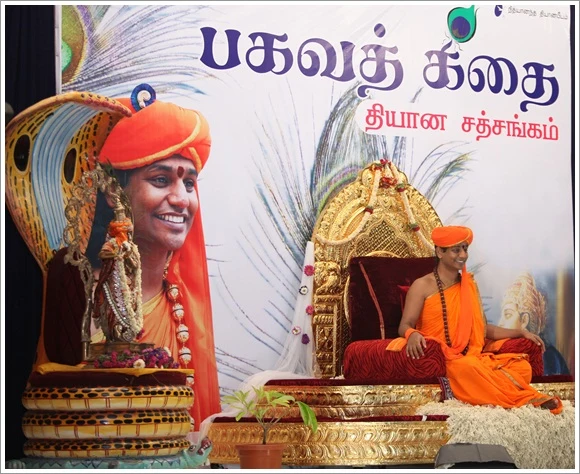
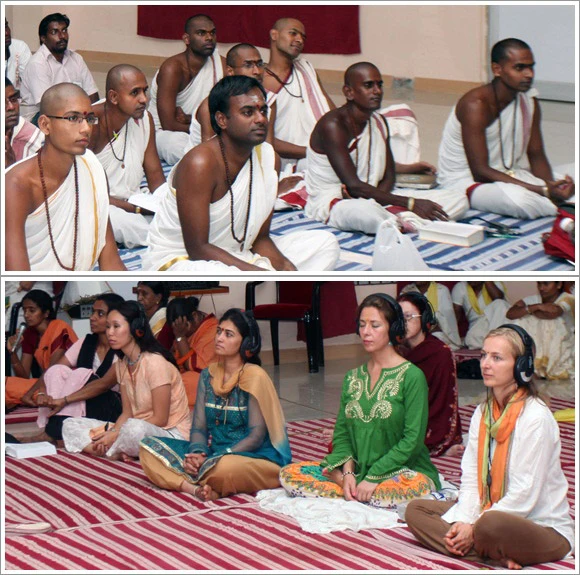
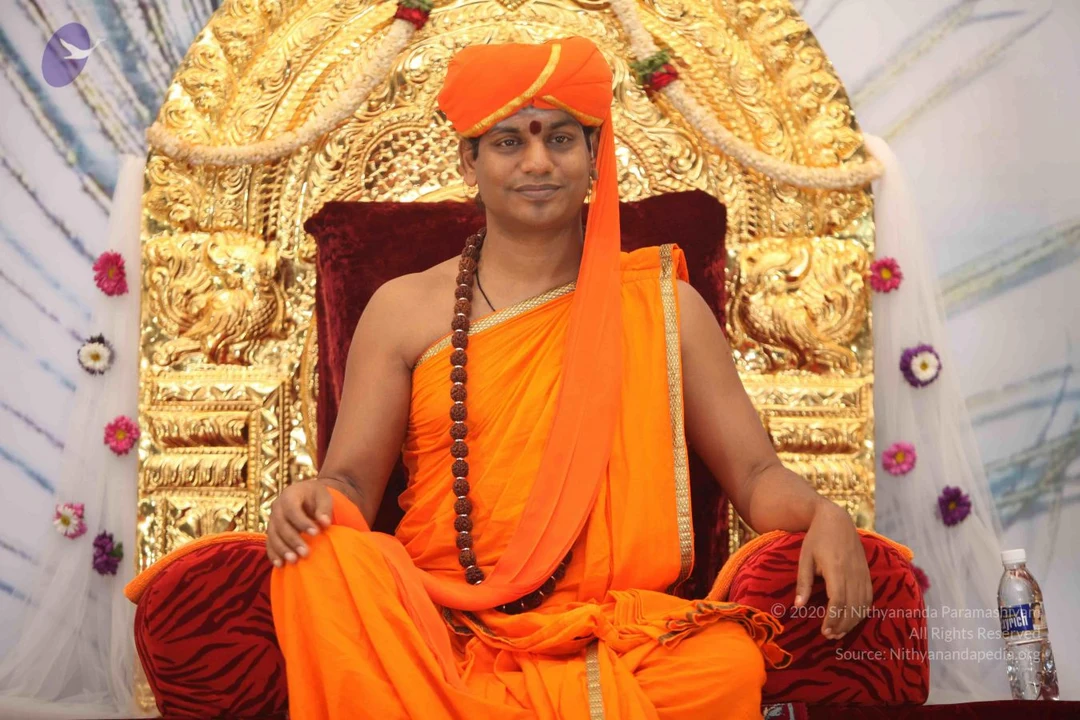
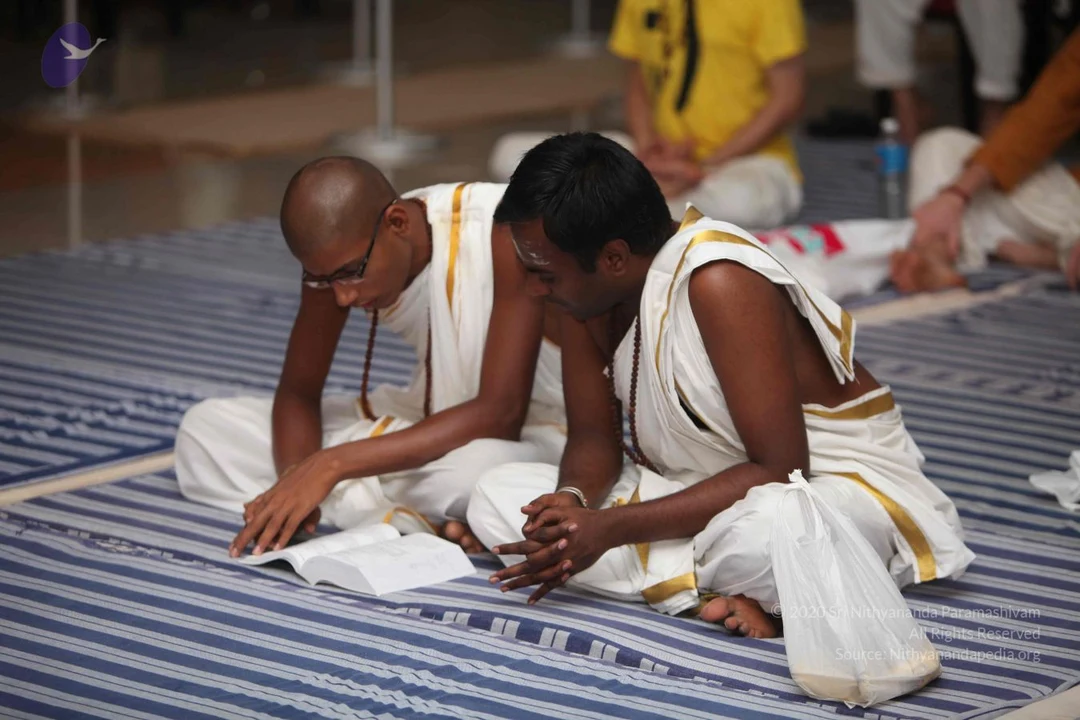
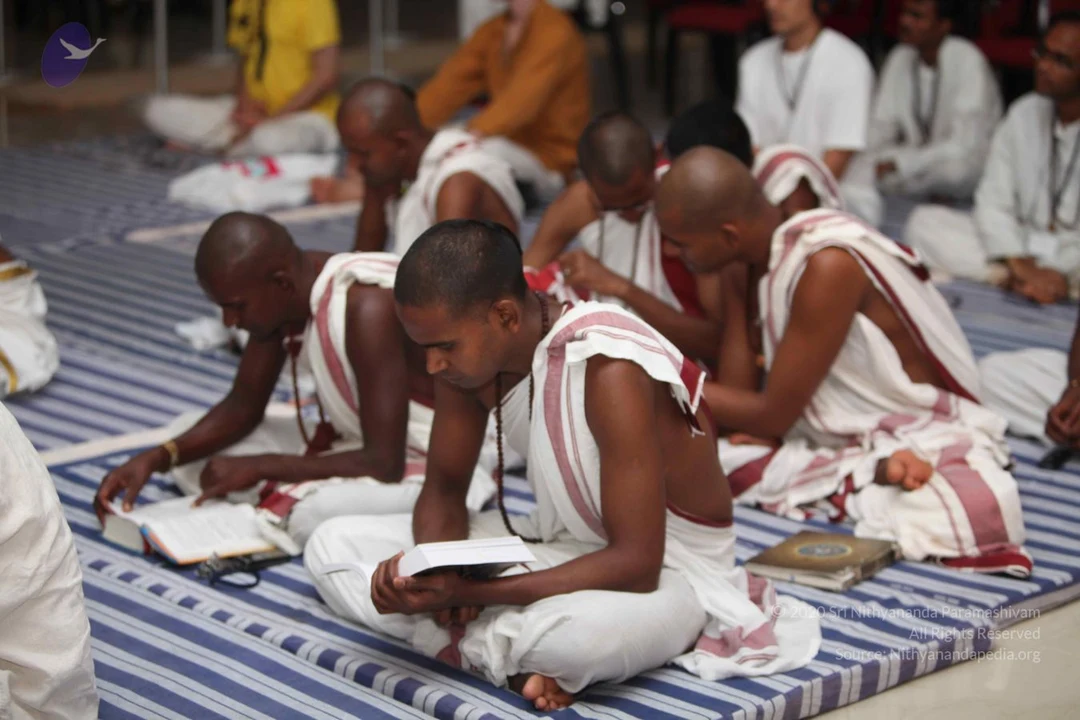
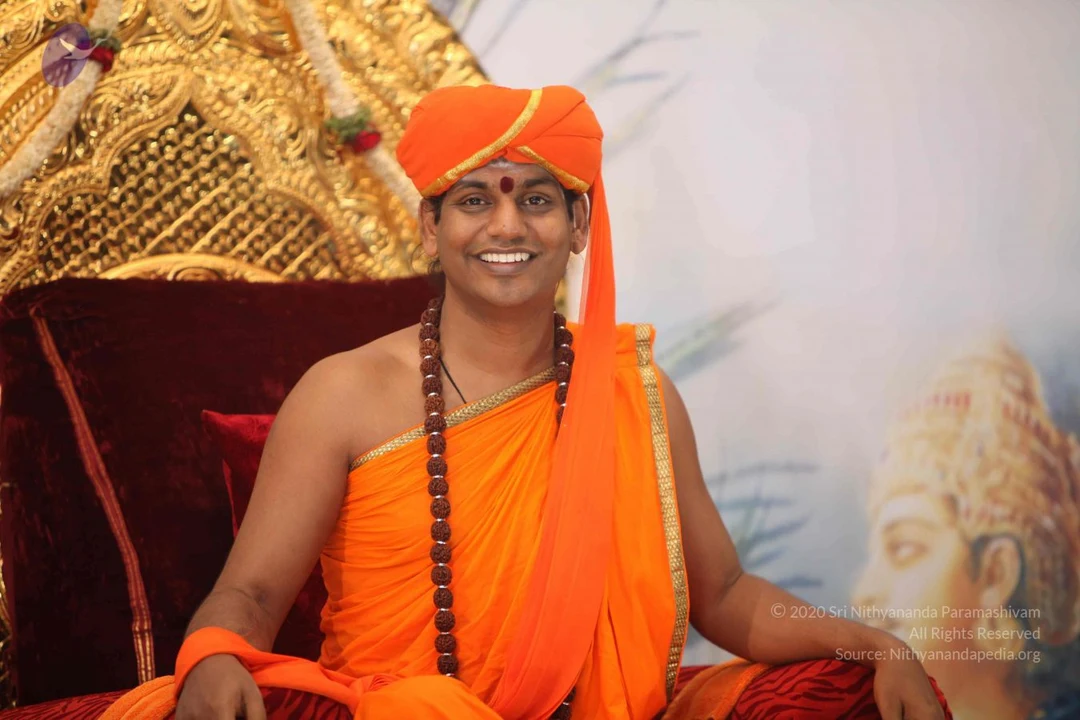
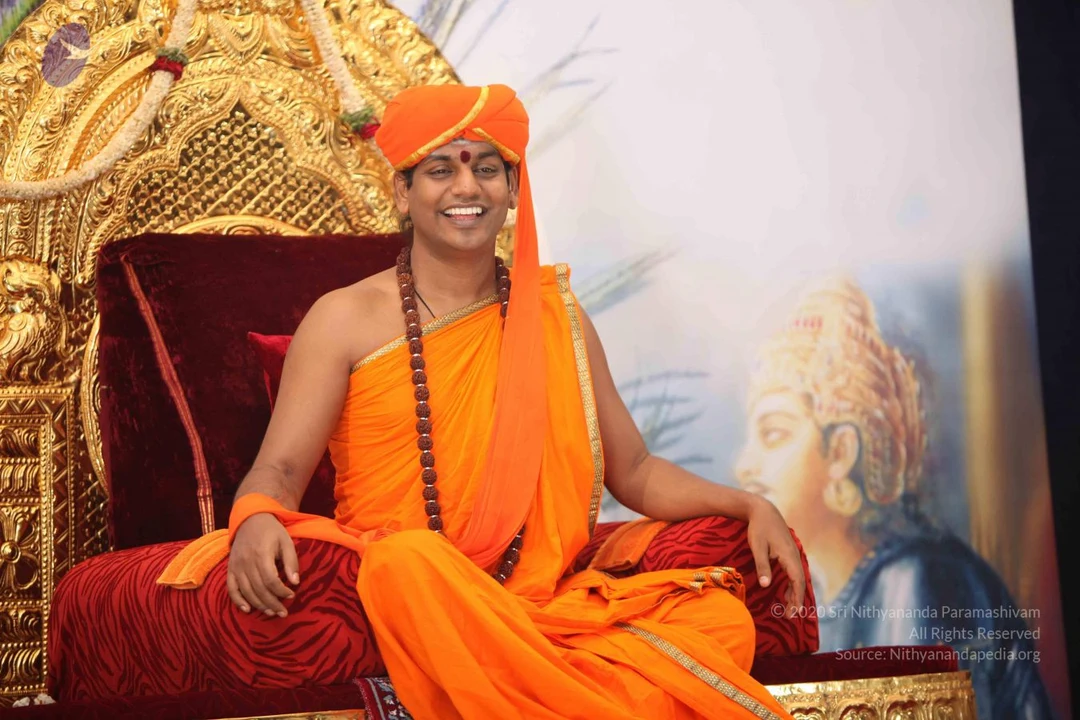
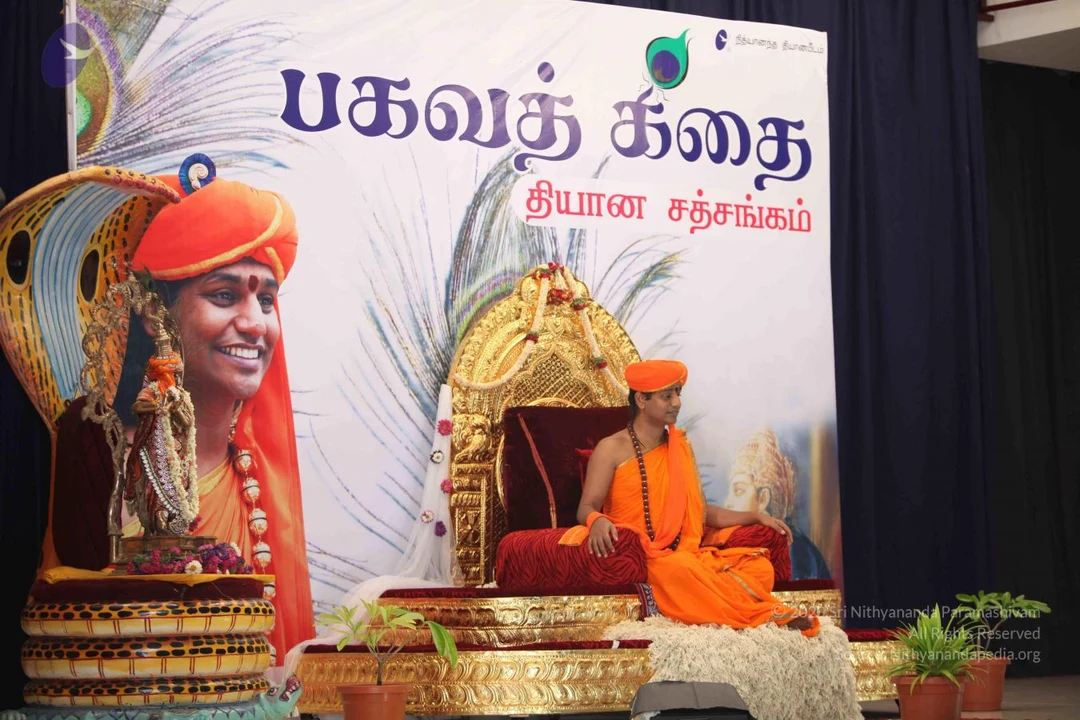
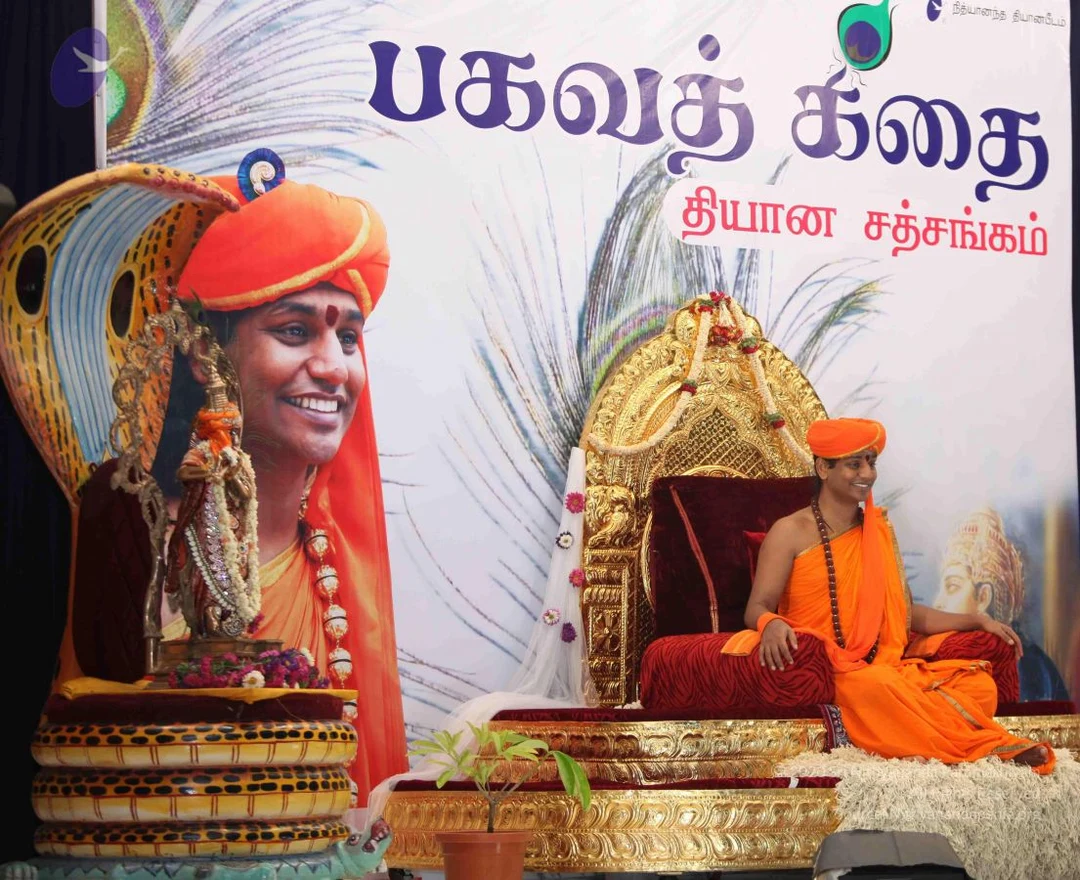
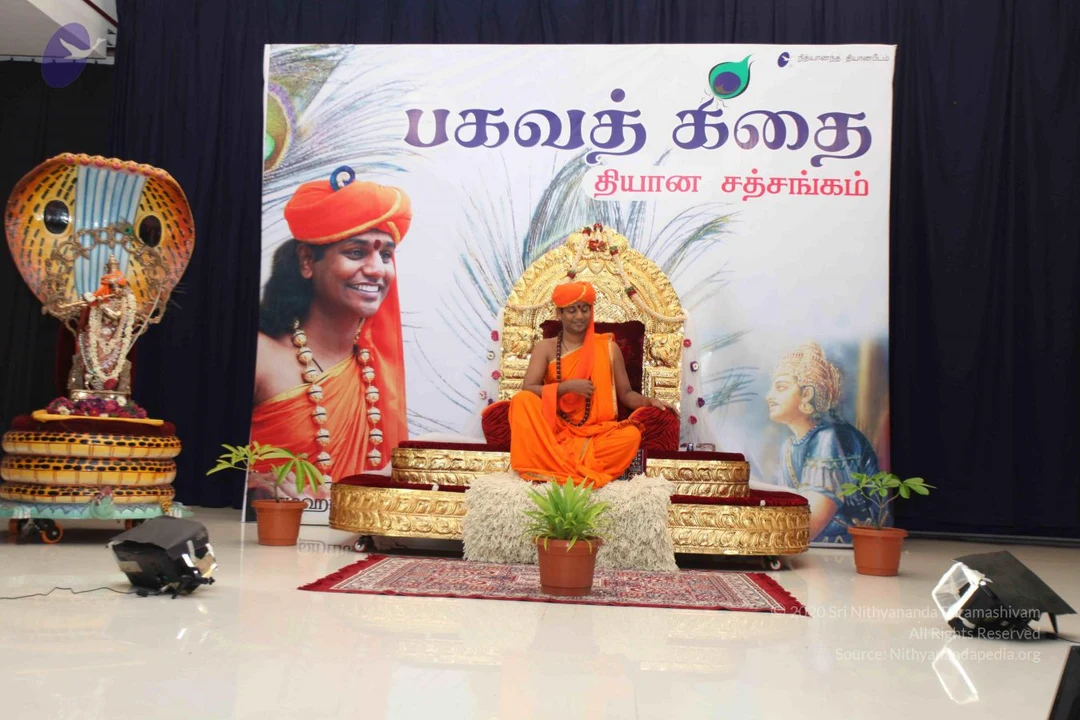
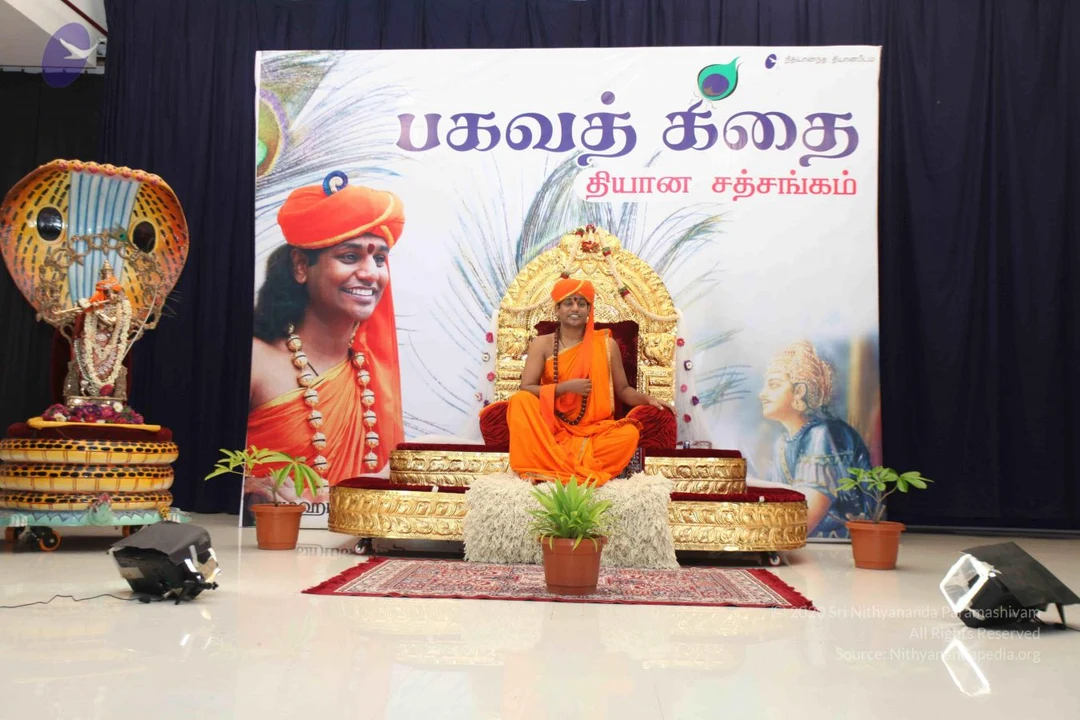
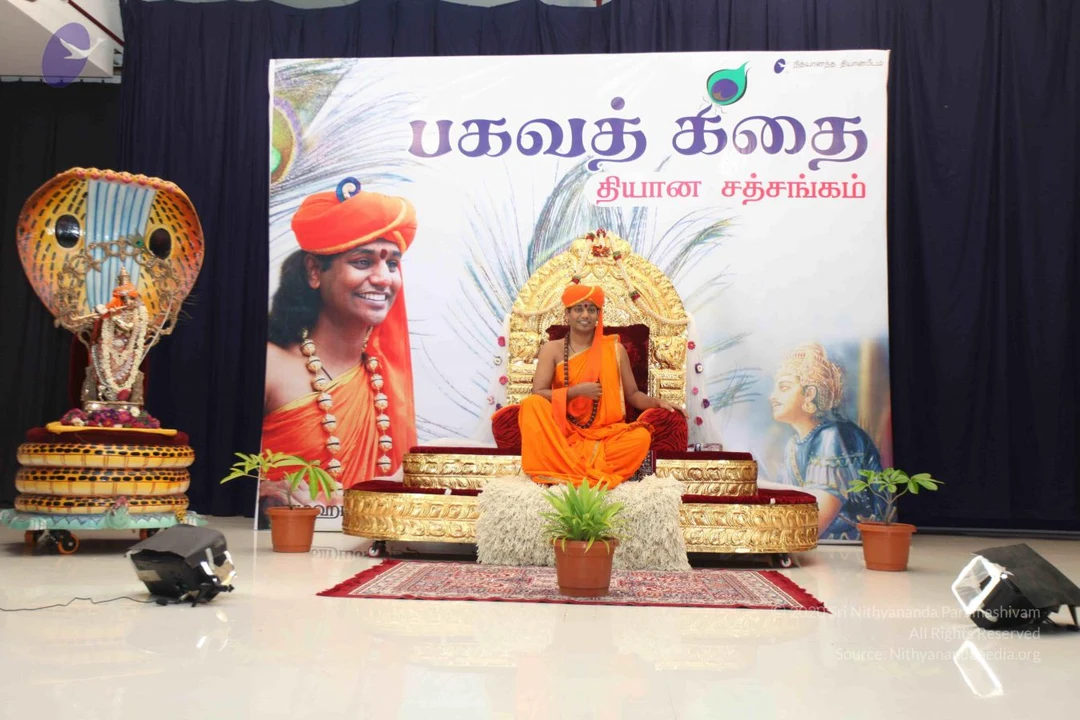
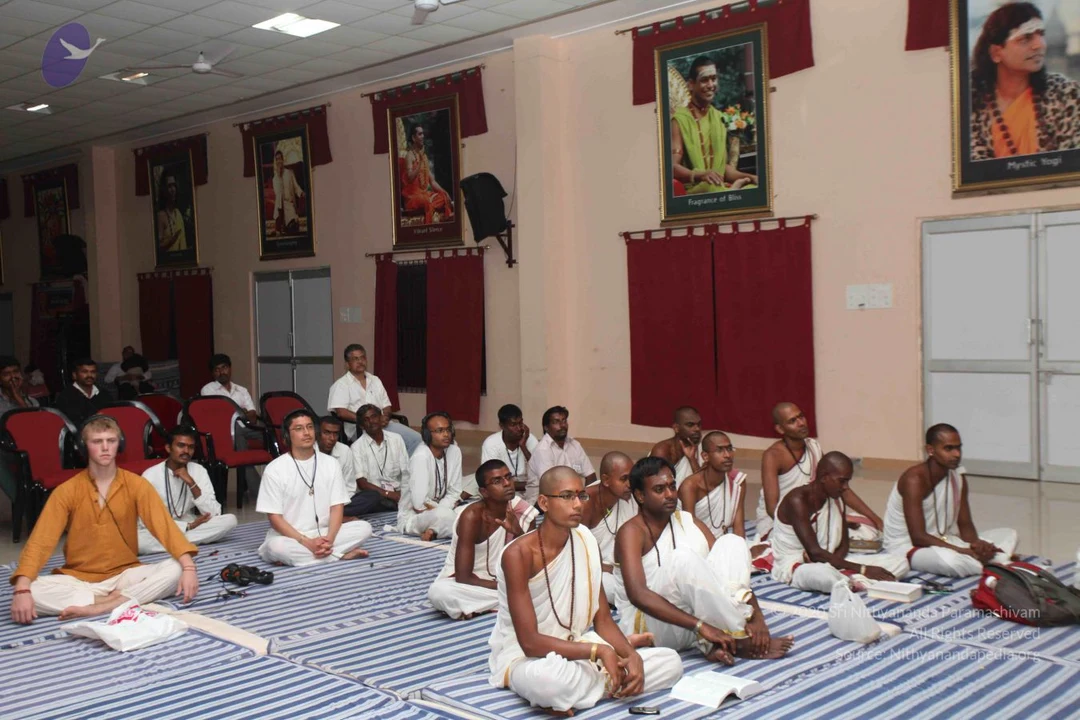
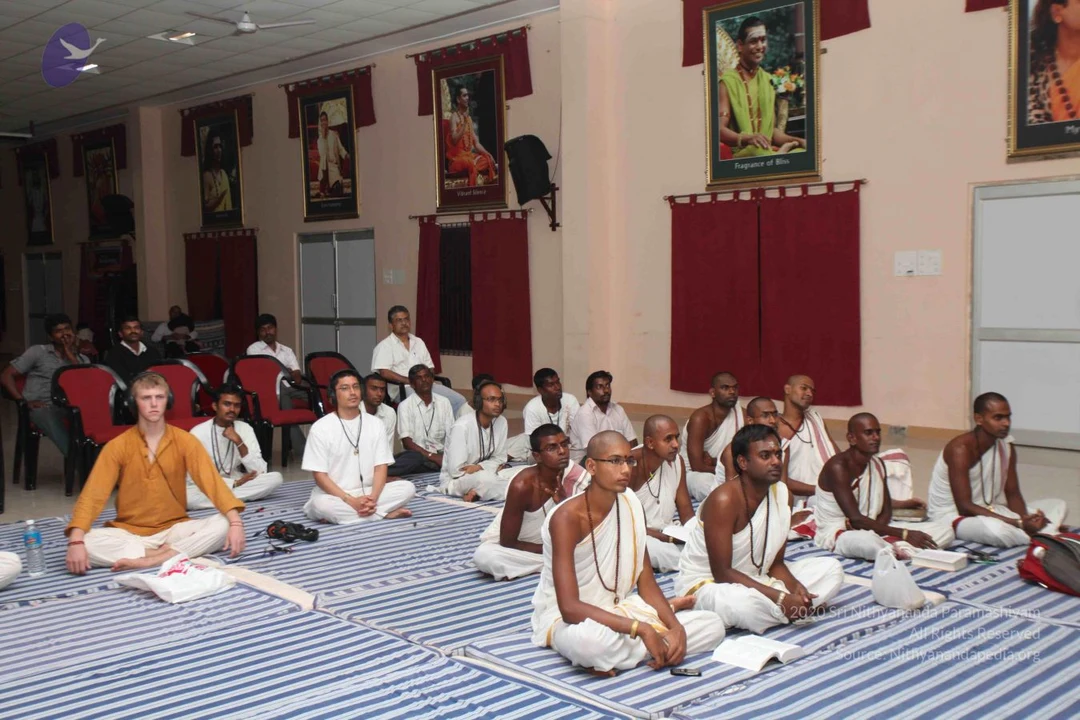
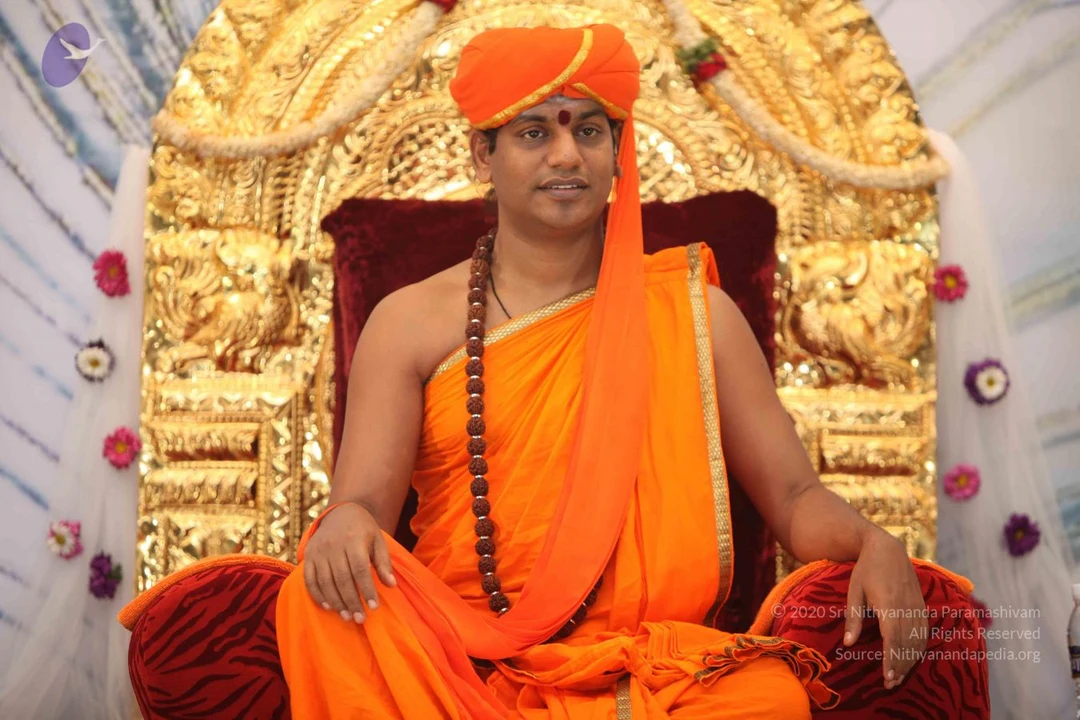
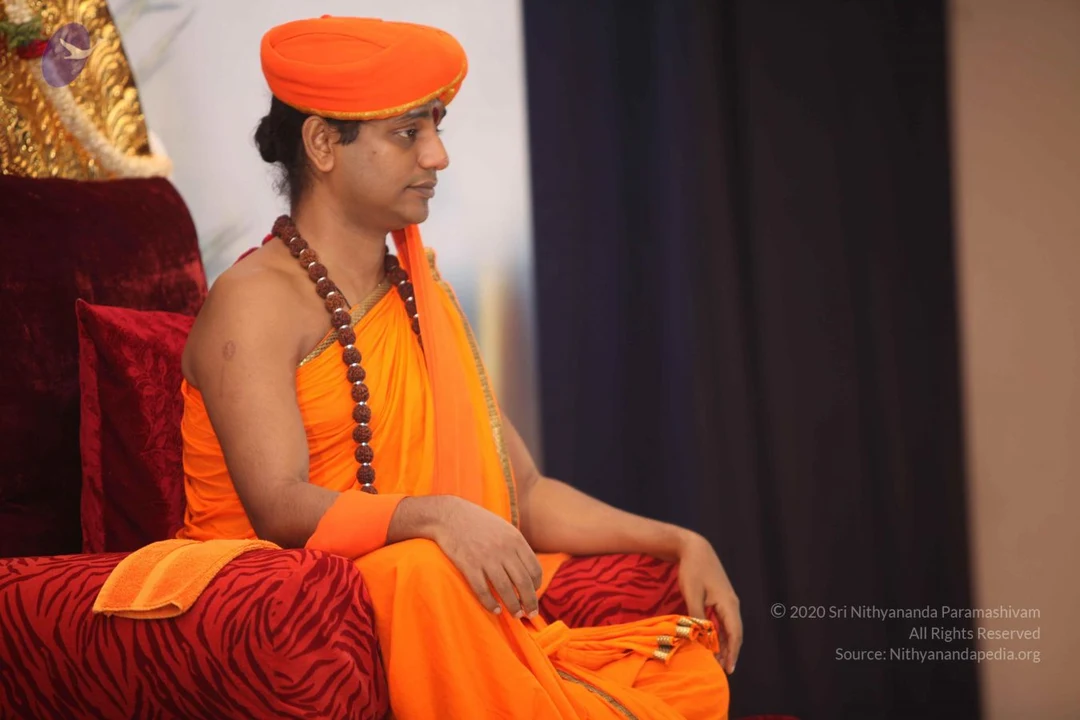
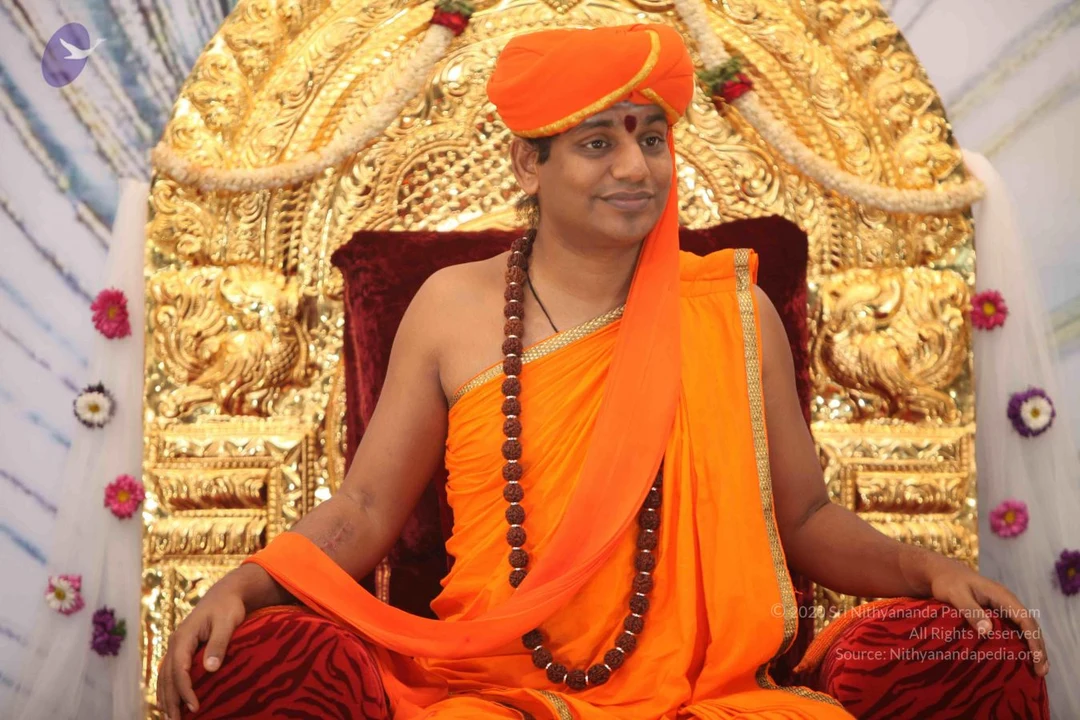
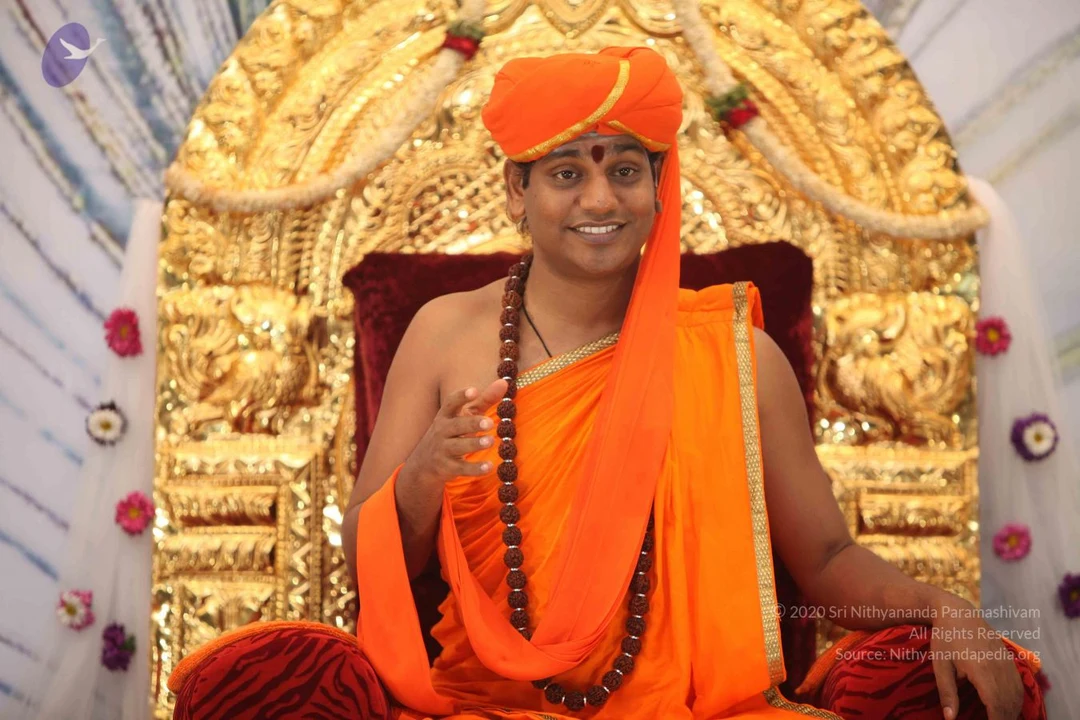
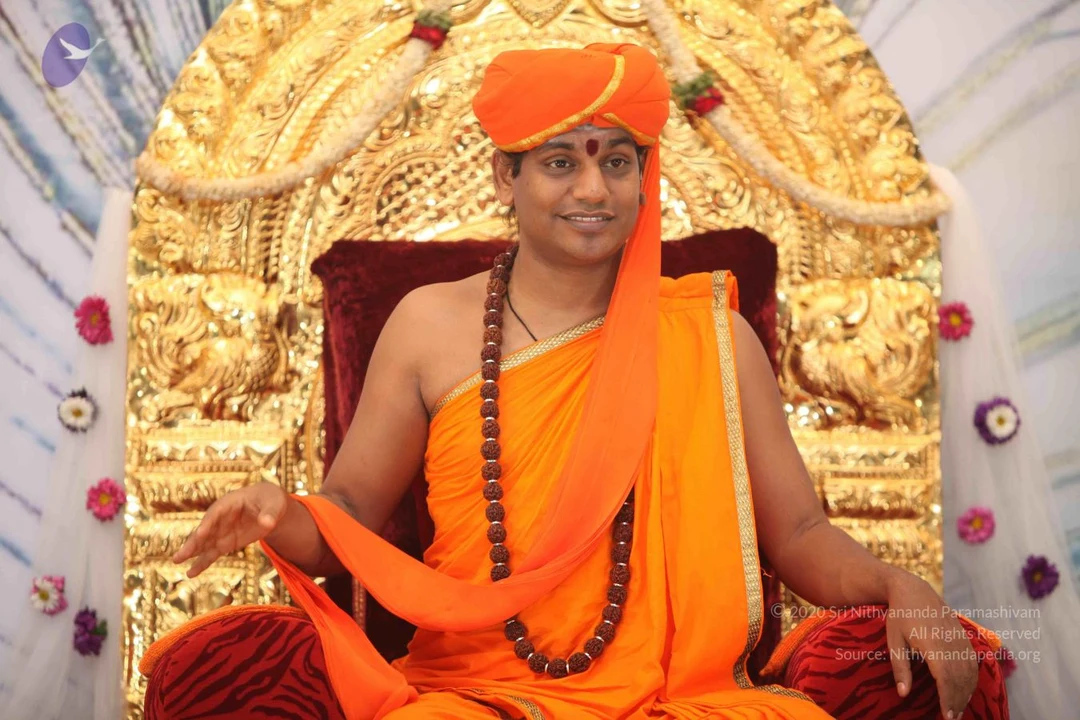
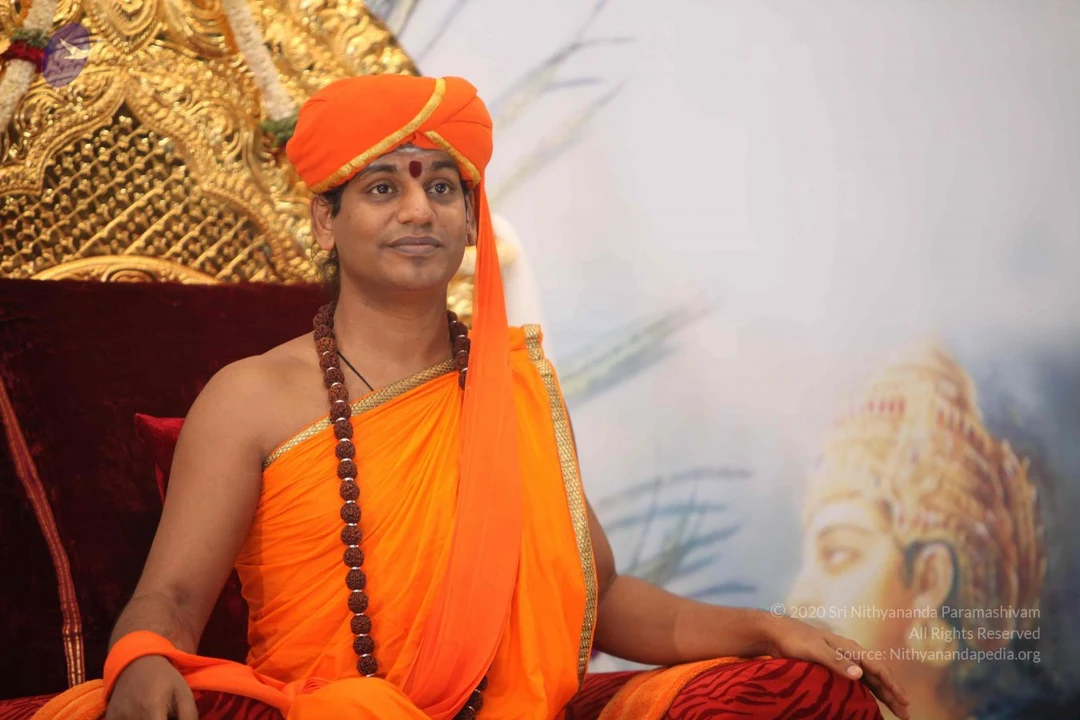
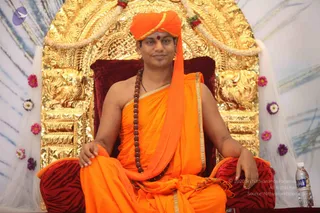
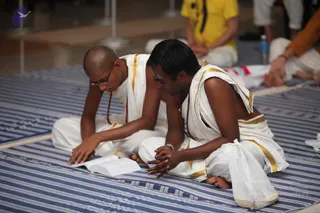
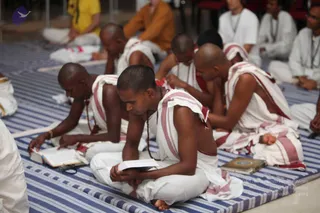
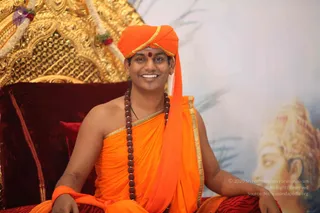
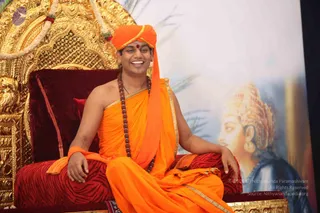
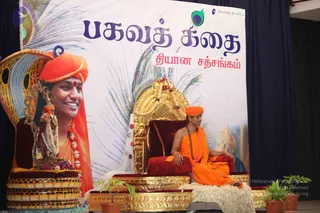
A photograph of a man seated on an ornate golden throne with carved lion figures and a deep red velvet cushion. He wears an orange turban with a red bindi on his forehead, an orange shawl draped over one shoulder, an orange robe with gold trim, and a long rudraksha mala. His hands rest on red-and-black tiger-striped armrest cushions. Behind him hang white draperies decorated with pink, purple and white flowers, and a plastic water bottle sits at the right edge. Appearance-based candidate for a person, seated in the honoured position on the throne, with a turban, orange saffron-coloured robes, shawl and rudraksha mala as qualifying cues.Two young men in white dhotis with gold borders sit cross-legged on a blue-and-white striped mat, reading from an open book on the floor. The man on the left wears glasses and has a shaved head with a rudraksha mala; the man on the right has a tilak on his forehead, a rudraksha mala, and clasped hands. Behind them, other seated people in white and yellow clothing are visible, and a white plastic bag lies beside the right man. The setting appears to be a hall with a blurred floor and a water bottle in the background.Several shaved-headed young men in plain white dhoti-style clothing with maroon-edged shawls sit cross-legged on a blue-and-white striped mat, reading small books and sacred texts. Some hold open books on their laps, one has a book resting on a small wooden stand. Rudraksha malas are visible around their necks. Behind them, seated devotees in white and one in orange and yellow robes listen attentively in a bright hall.A smiling man sits on a red velvet throne with an ornate gold carved backrest and garlands of flowers at the top. He wears an orange turban with a gold edge and a red bindi on his forehead, an orange saffron wrap over one shoulder with gold border, and a long strand of rudraksha beads around his neck. Behind him a painted backdrop shows a deity with a tall crown and a gold face.A smiling man in saffron-orange robes sits on an ornate gold throne with a red velvet cushion and red-and-black zebra-striped seat. He wears an orange turban with a red bindi, a shawl draped over one shoulder and a long rudraksha mala. He rests his hands casually on his knees. Behind him a large painted backdrop shows a figure in a jewelled headdress and blue garments with a feathered plant motif.A seated man in orange robes and an orange turban sits on an ornate golden throne with red cushions, garlanded with pink flowers, on a stage. He wears a long rudraksha mala and an orange shawl, with bracelets on his wrist. Beside him stands a large backdrop: a painted portrait of a smiling figure in an orange turban and orange garments with a long necklace, and a peacock-feather design across the banner. Potted plants and a small pedestal with a figurine and flowers sit at the edges. The banner reads Tamil text for a Bhagavad Katha and Dhyana Satsangam. a person is the seated figure, based on his orange turban, rudraksha mala and throne.

Pada-Puja
6 photosSource gallery
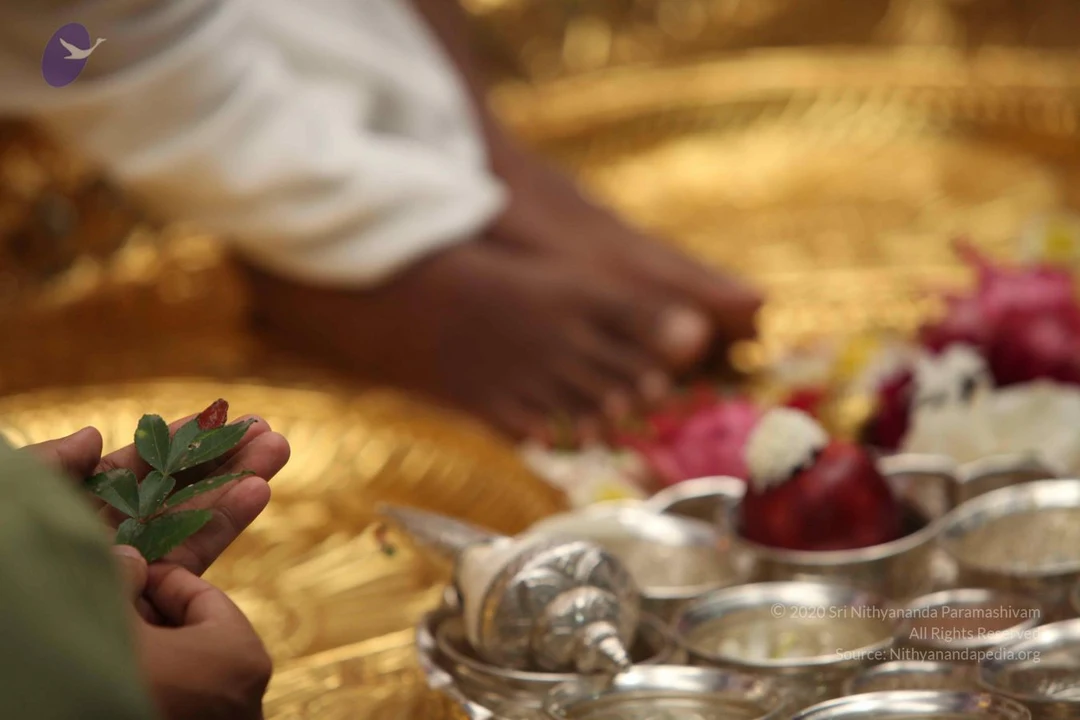
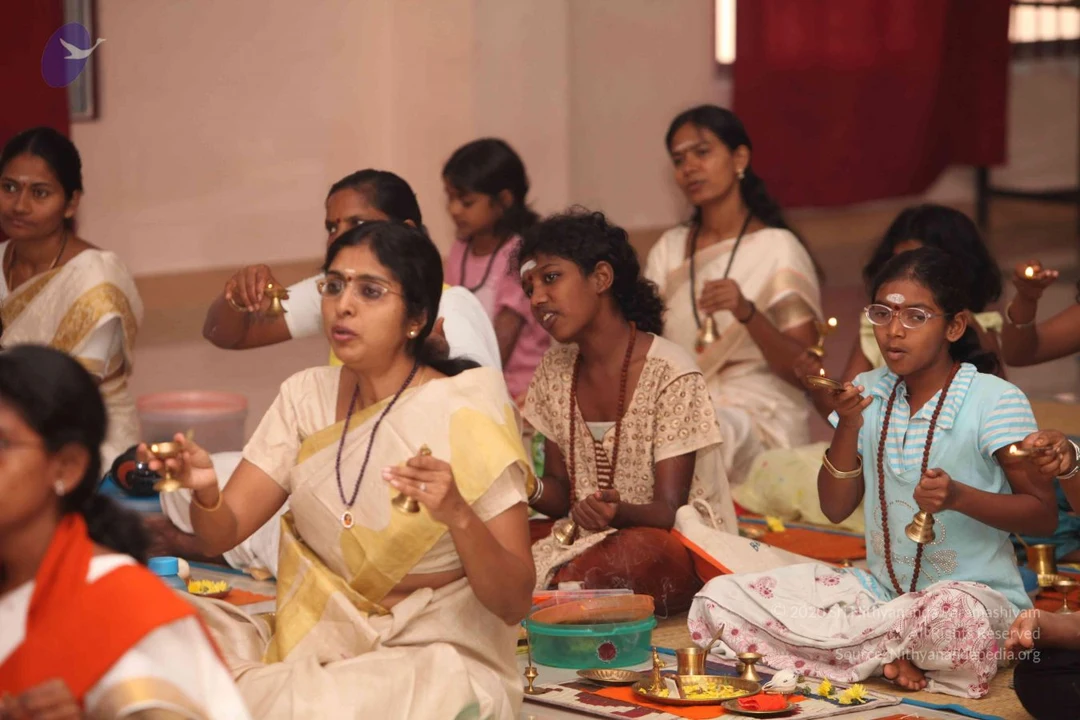
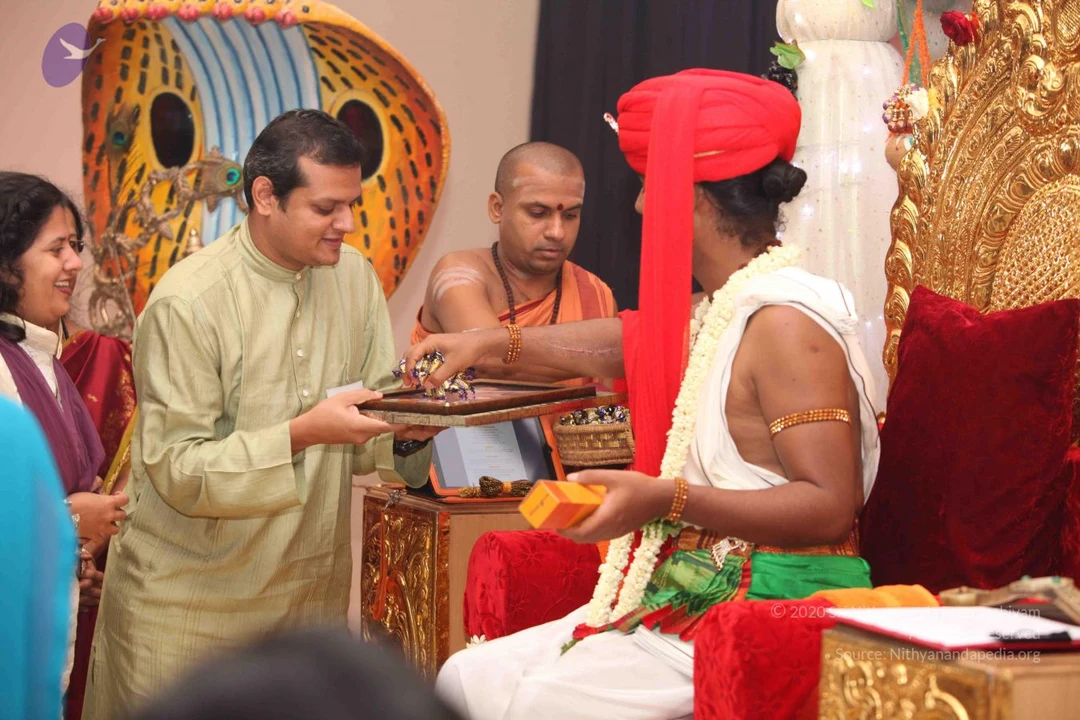
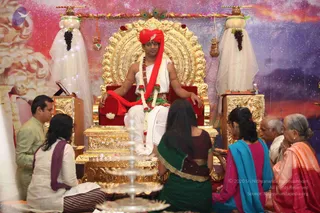
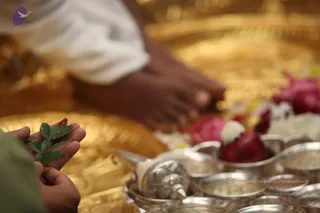
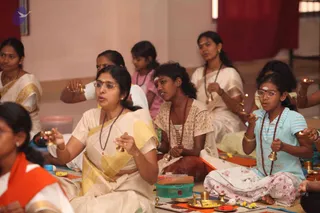
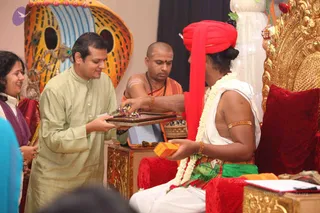
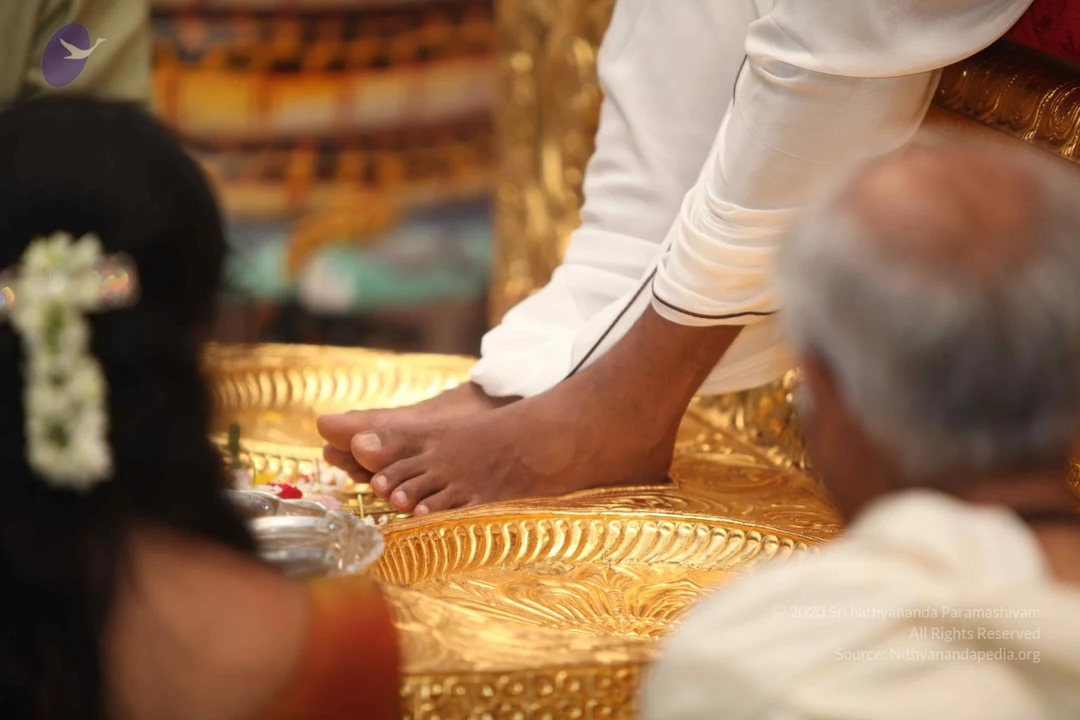
A seated man in a red turban and red shawl sits on an ornate gold-and-red throne, wearing white dhoti-style cloth, a white flower garland, and rudraksha beads. Before him, a grey-haired man in white dhoti with palms joined sits on the floor, and several women in sarees, including one in pink and one in green with glasses, sit with hands folded in namaste. A tray of flowers and offerings rests in the foreground near a seated person in green. The room has pink walls, a window, and maroon curtains.A seated man on a gold throne wears a red turban, a white garment, a red shawl, a garland and gold armlets, and sits barefoot on a red cushion. Seated devotees with folded hands and a kneeling man in a pale green kurta face him in front of a golden peetha setup. A small deity murti of a flute-playing figure stands behind an ornate decorated backdrop with a cameraman filming on a tripod. Offering plates and flowers rest on the floor. The turbaned figure's appearance is consistent with the page's description, but the face and presentation cues are not distinctive enough to confirm identity, so the figure is described by role only.A seated man in white ritual clothing and a red turban sits on an ornate gold throne with red cushions, a rudraksha mala and a white and red garland around his neck, hands resting on the armrests. Flanking him are gold pedestals with draped white cloth, fruit and a peacock-feather decoration above. Before the throne, a glass oil lamp stand stands in the foreground, while several devotees sit in front: a man in a green kurta at left, a woman in a white and purple outfit, a woman in a green sari, women in pink and teal, an older man, and an older woman in an orange-and-pink sari with folded hands. The backdrop shows a painted sky with a starry, purple-pink gradient. The seated man is not clearly identifiable from appearance, so his role is given as a seated figure on a throne receiving devotees.Close-up photograph of a puja offering. In the foreground, a person's hand in an olive-green sleeve holds a small sprig of green leaves with a red bud. Behind, a blurred bare foot in white clothing rests on a gold-toned ritual tray or platter. Right side shows silver bowls and a silver container holding red and pink flowers, white blossoms and a red fruit. The setting resembles a worship or padapuja-style offering, though the feet are blurred and no face is visible.A seated group of women and girls performs a devotional ritual indoors, ringing small brass handbells with their right hands. The women in the foreground wear cream sarees with gold borders and rudraksha malas around their necks; one wears glasses. A girl in a light blue top and floral skirt, wearing glasses, rudraksha mala and a forehead tilak, rings a bell in the lower right. Brass plates with yellow flowers, a small oil lamp and a metal tray sit on the floor in front of them, with an orange cloth and a green container nearby. Red curtains hang in the background.A seated figure on an ornate golden throne with red velvet cushions receives an offering. The figure wears a red turban, a white jasmine garland, a white dhoti-style cloth with a green and gold border, and gold armlets and bangles. A shaved-headed man in an orange-saffron cloth with a rudraksha mala stands behind, and a smiling man in a pale green kurta holds a wooden tray with a rudraksha mala and small orange packets, which the seated figure takes. A woman in a purple shawl stands at left, and a painted orange and yellow fish-like backdrop is behind them.

BGSatsang
8 photosSource gallery
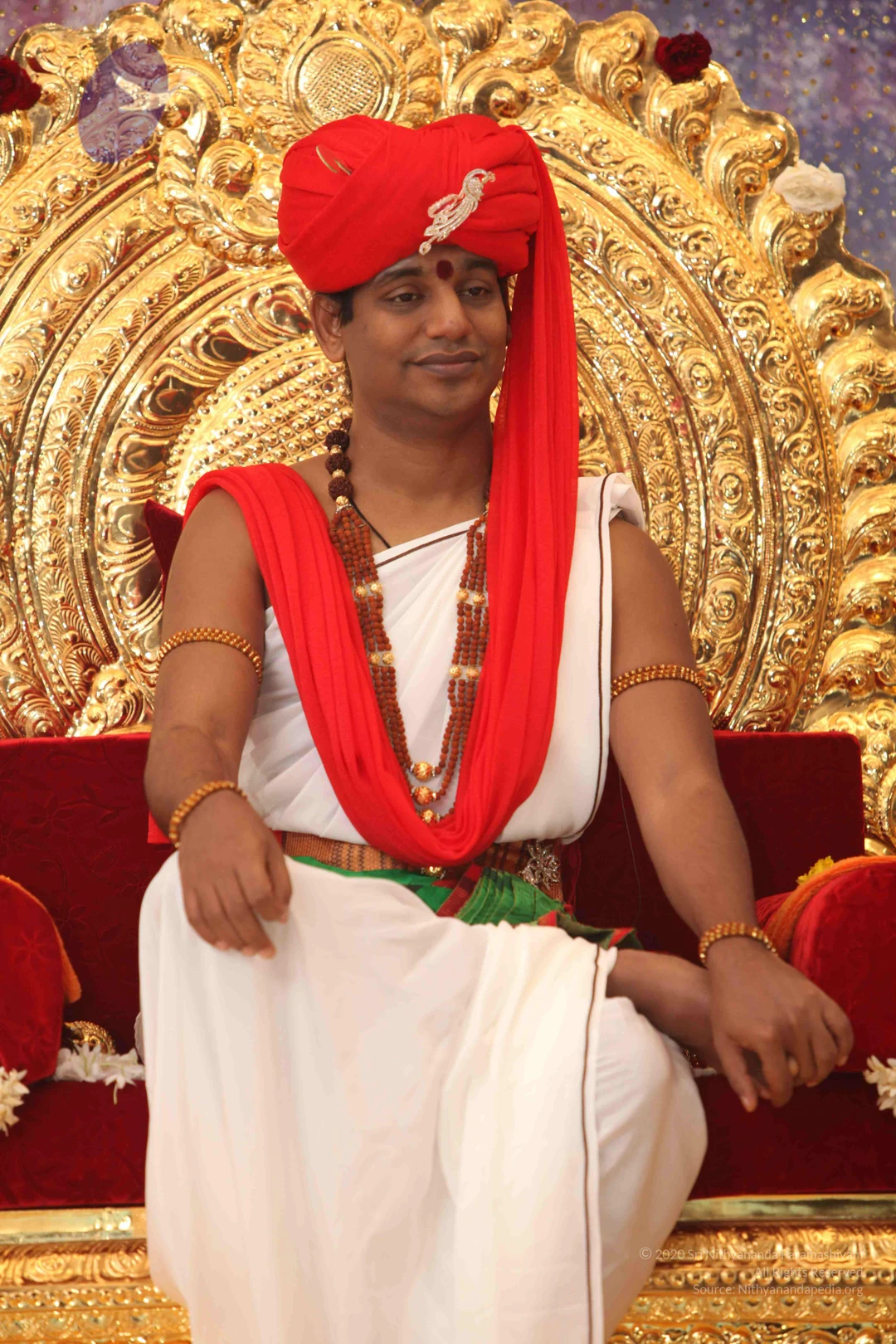
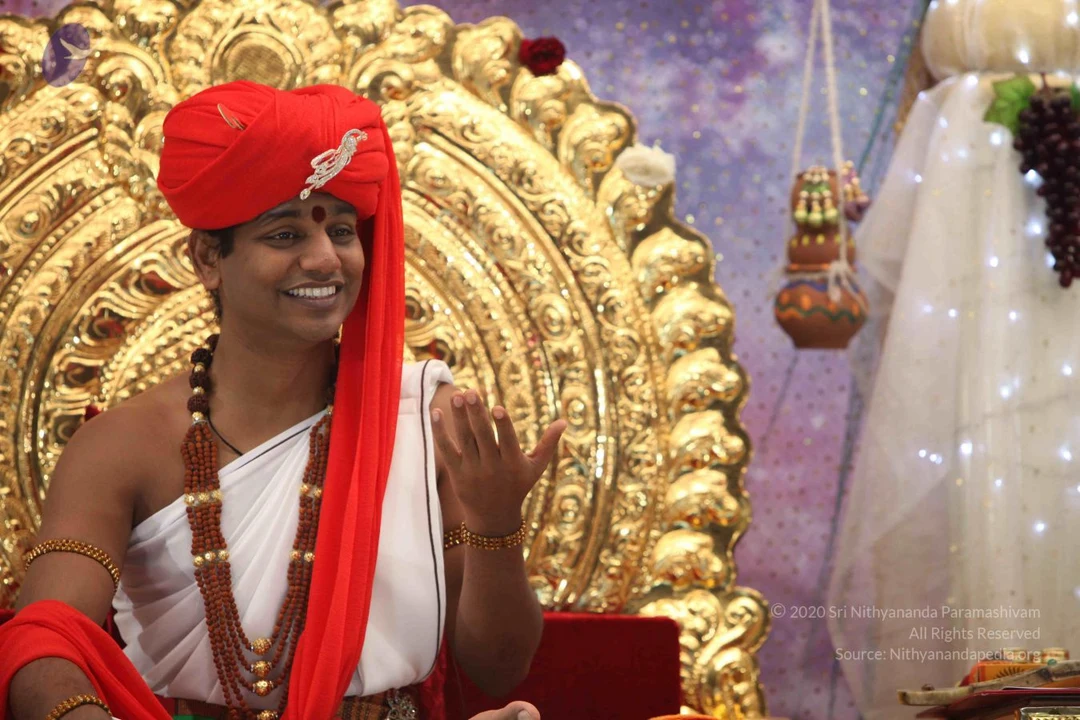
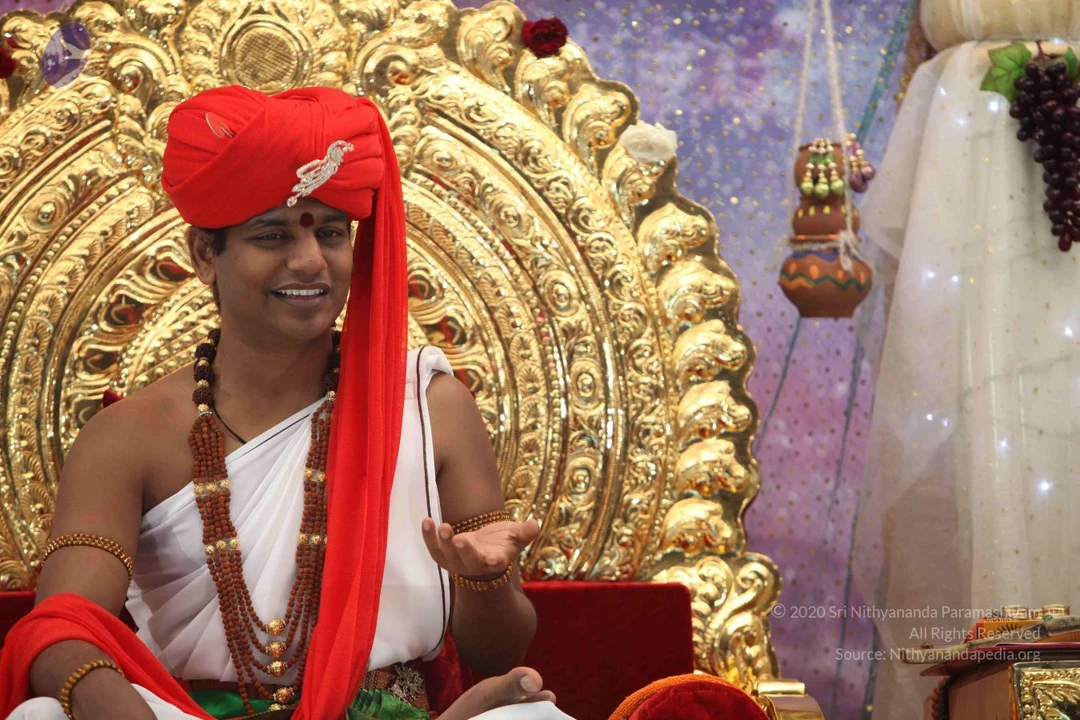
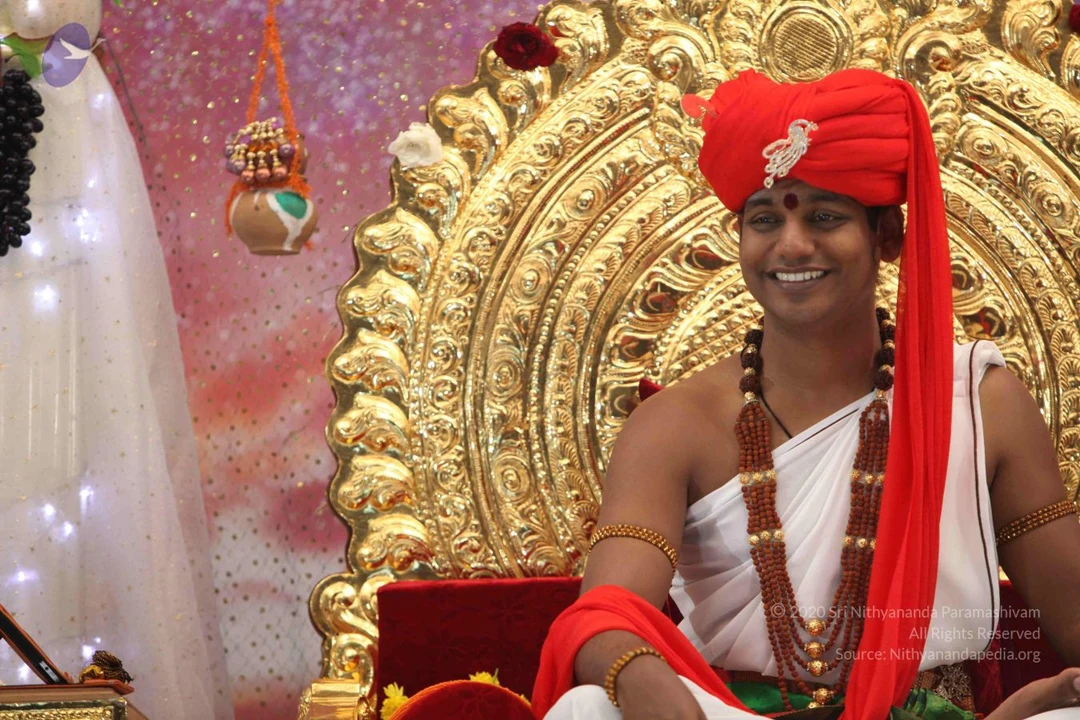
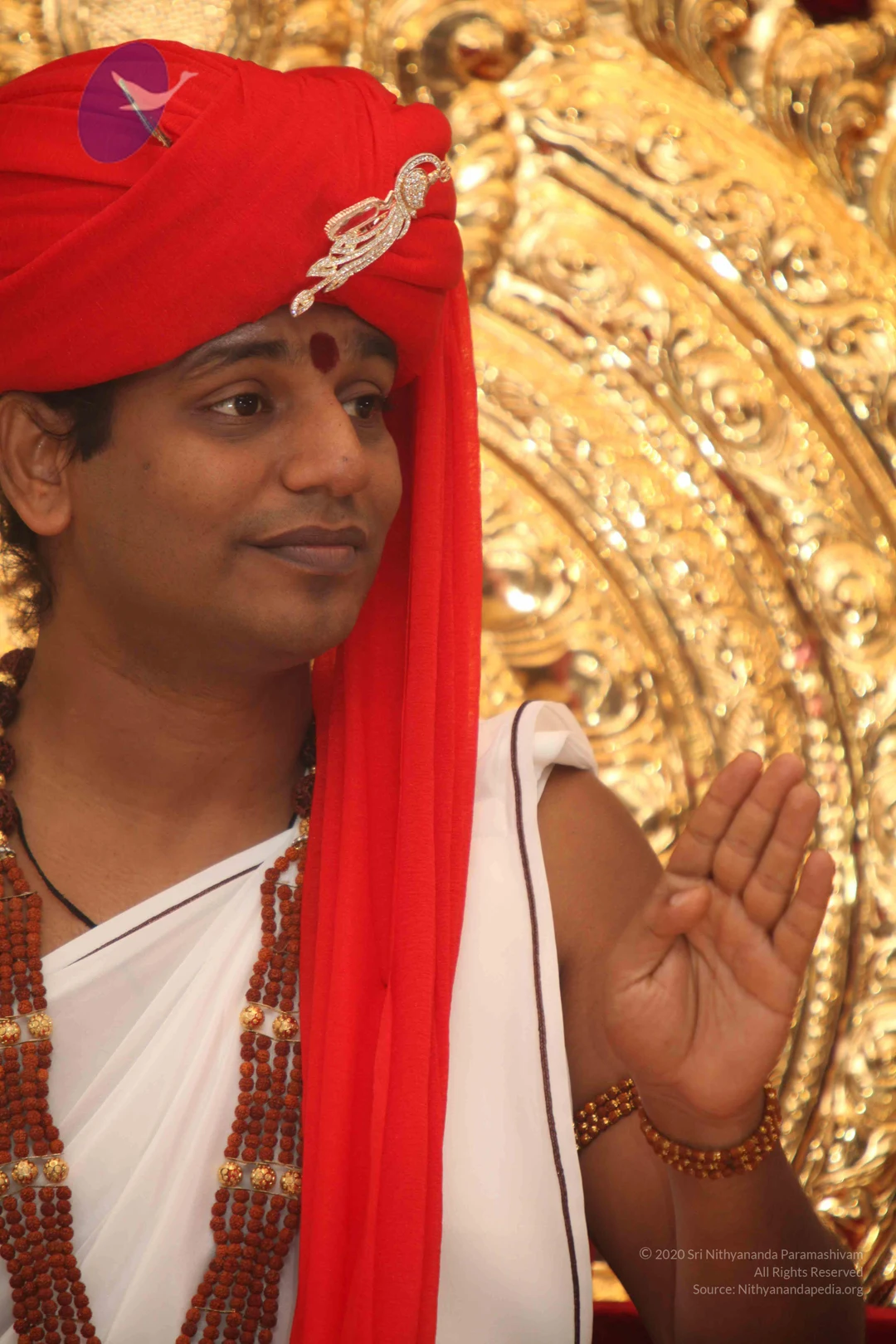
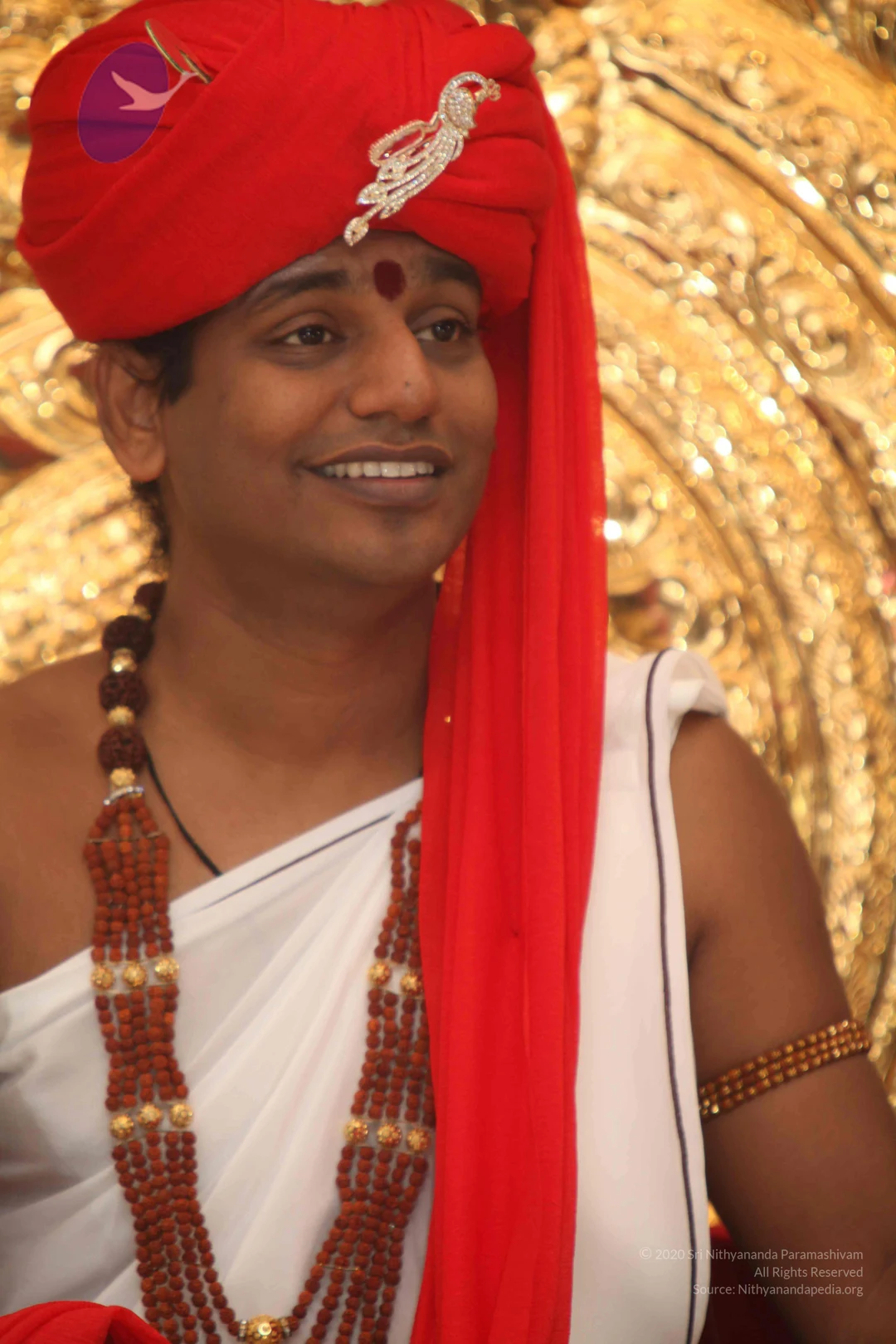
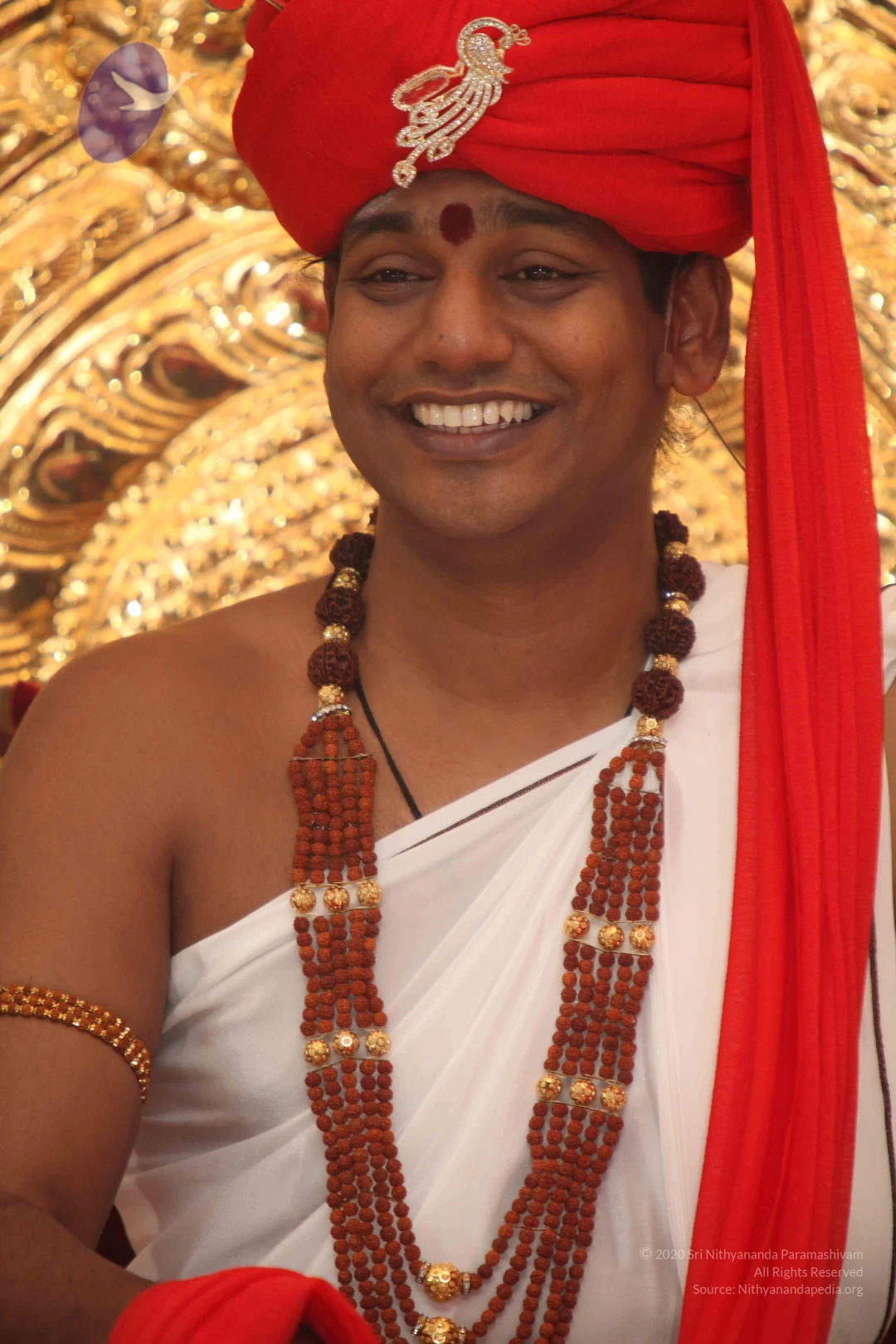
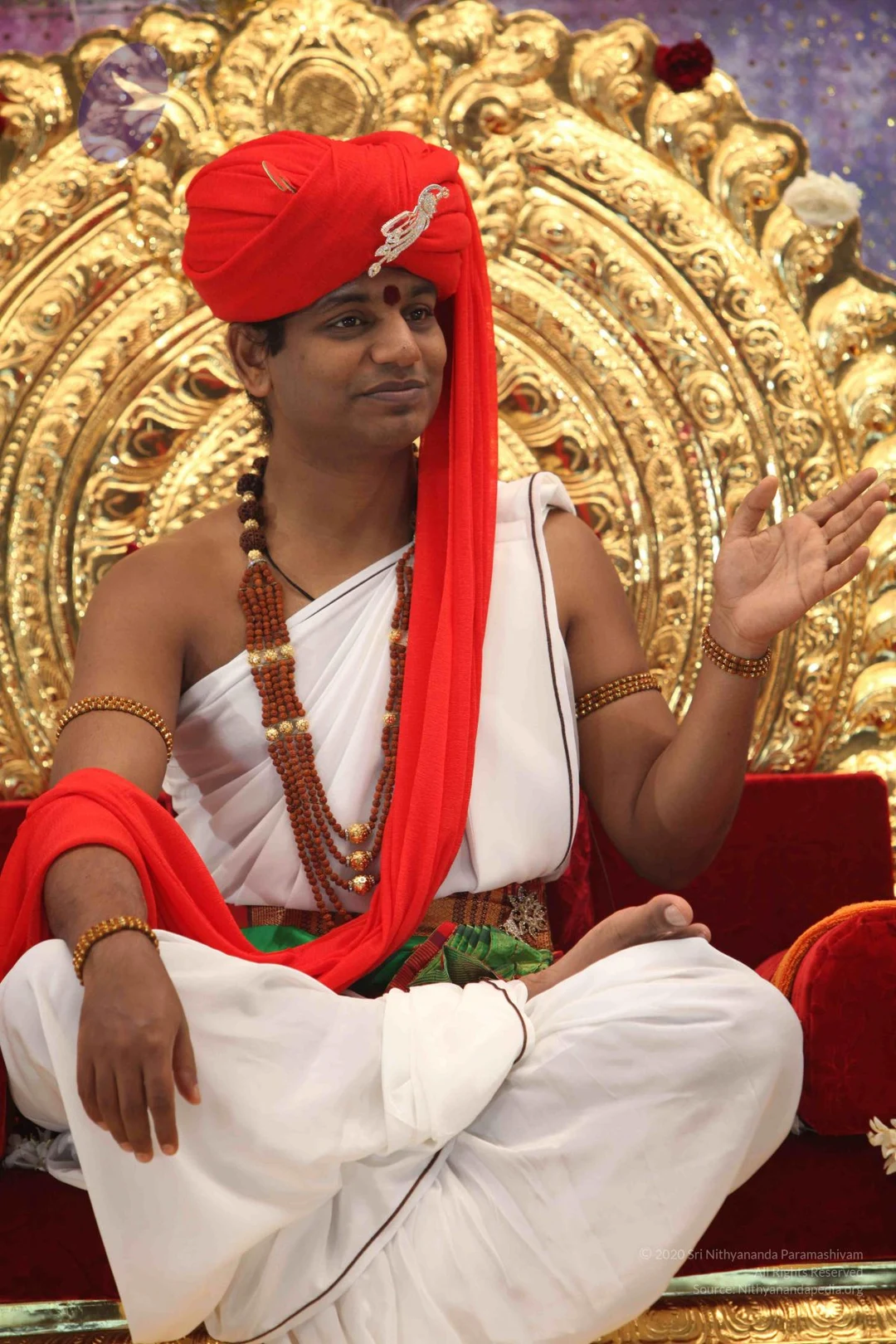
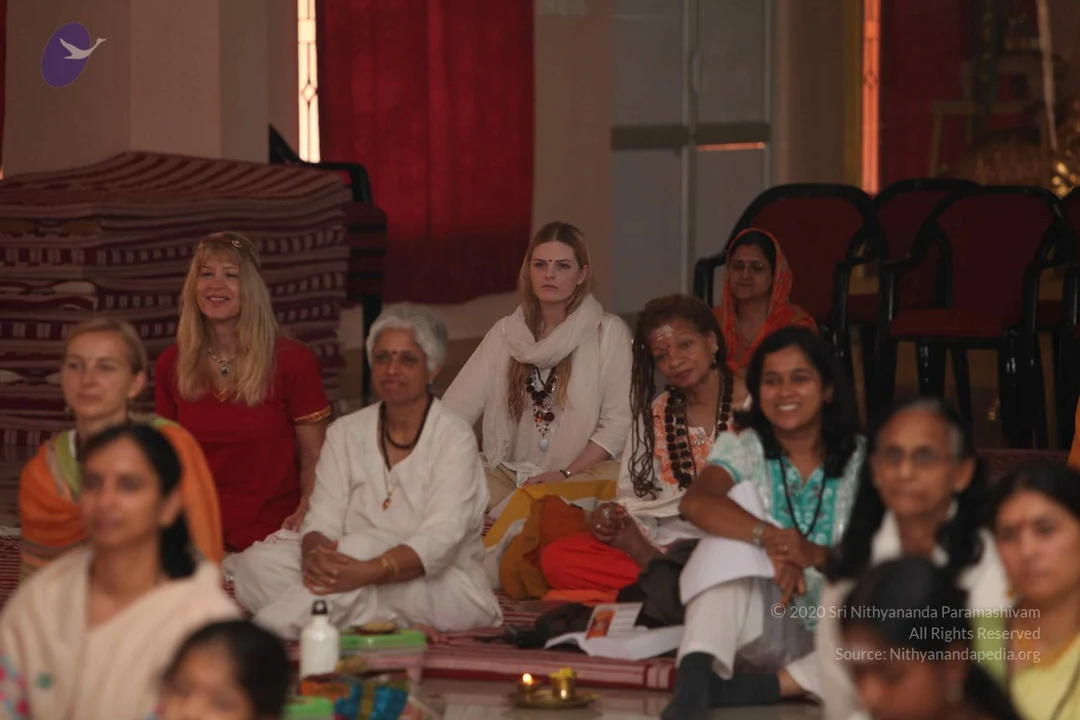
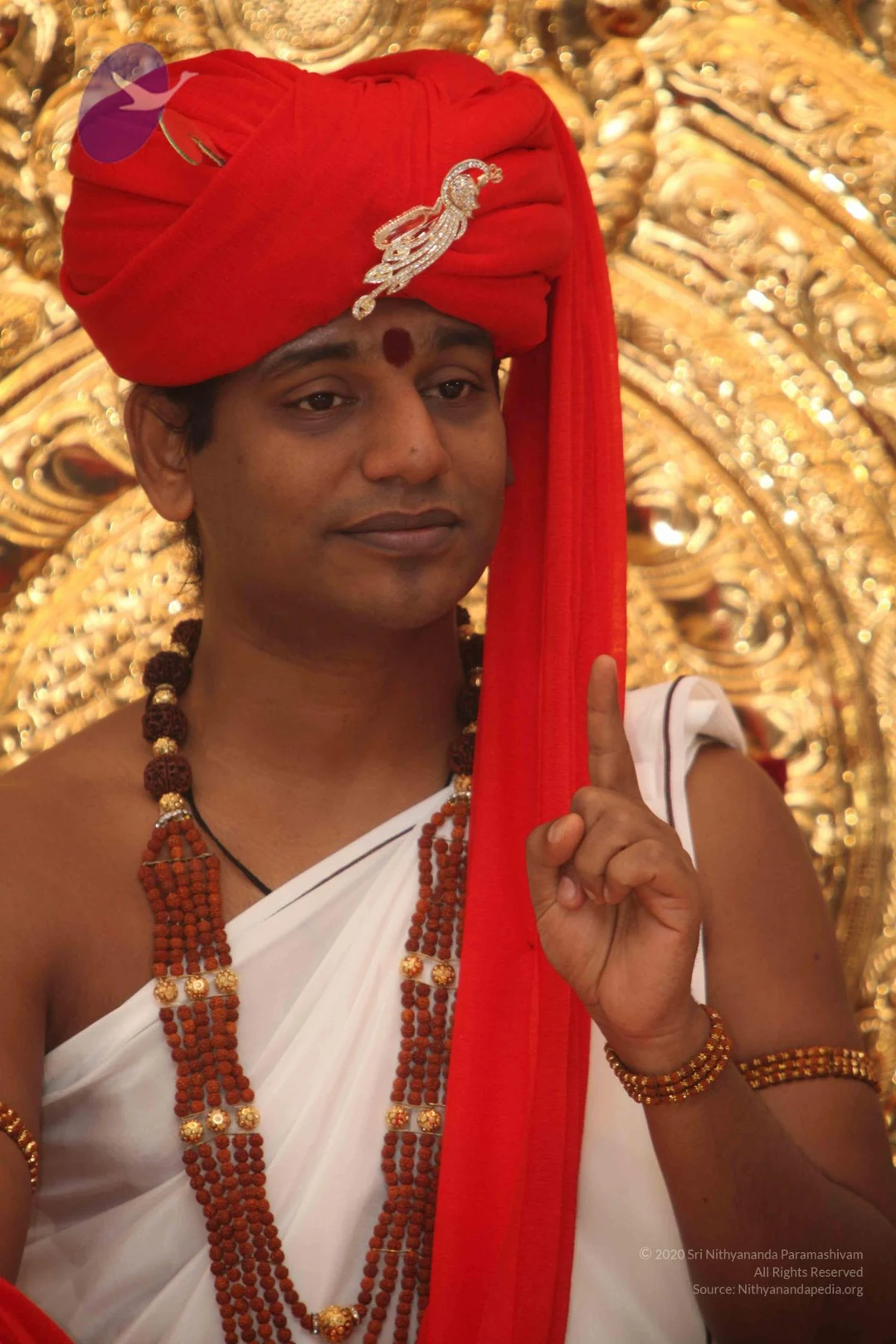
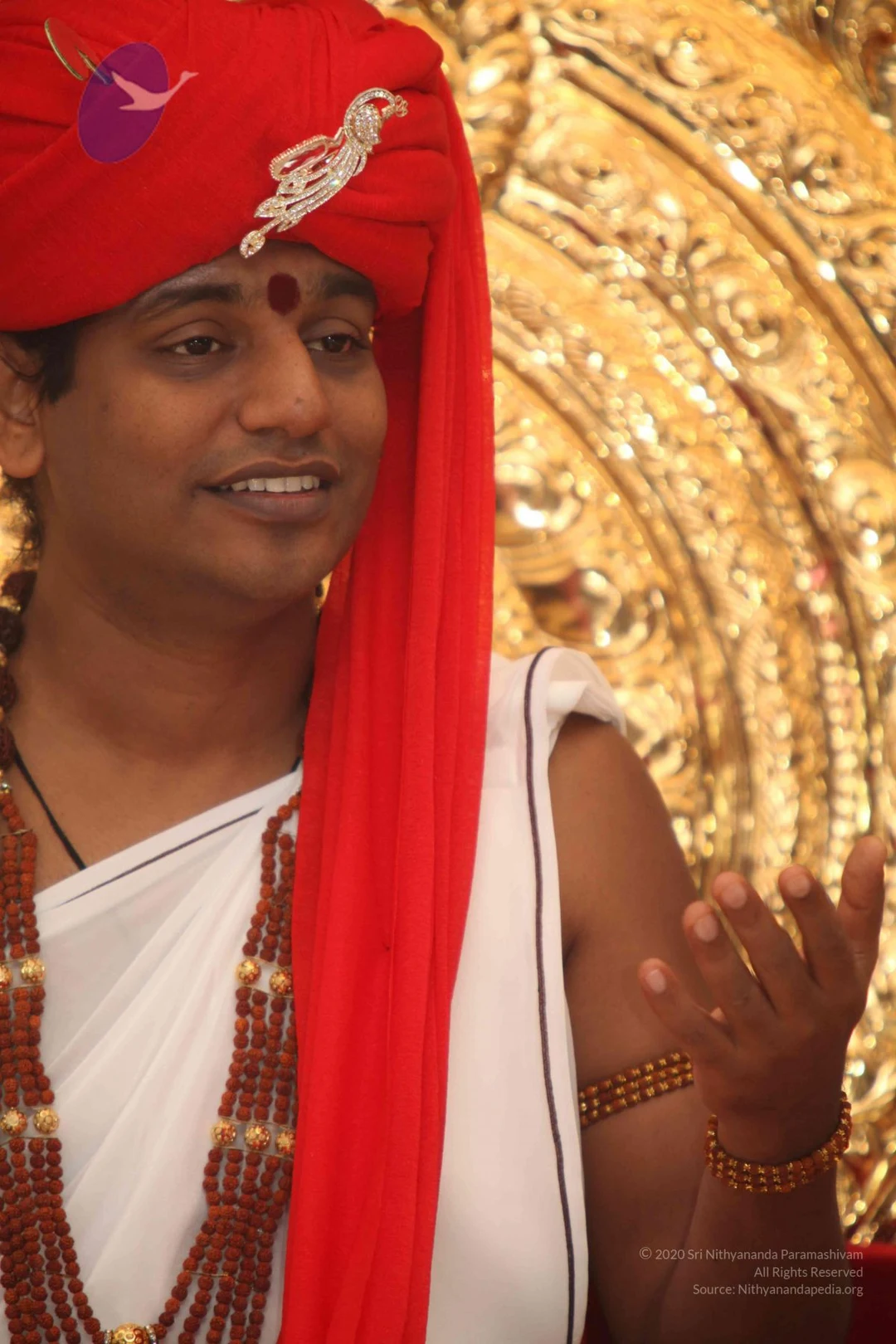
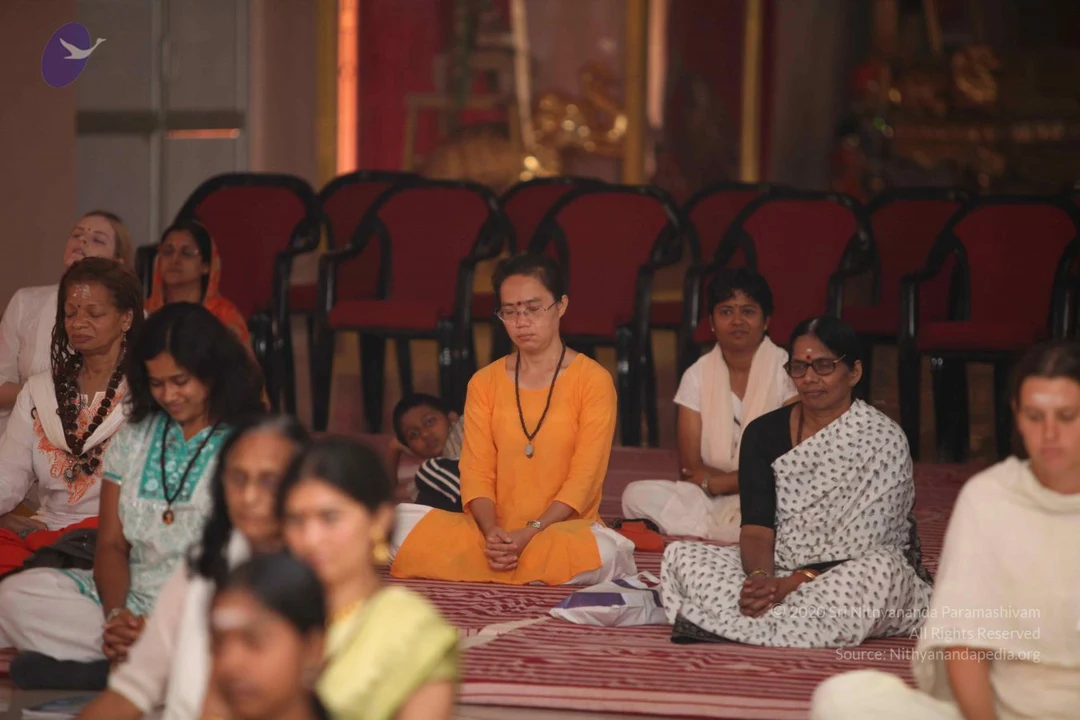
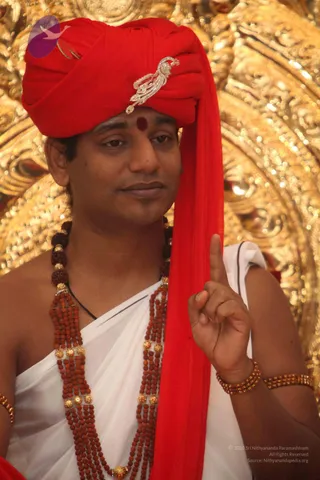
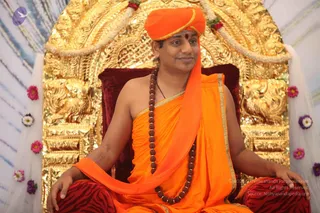
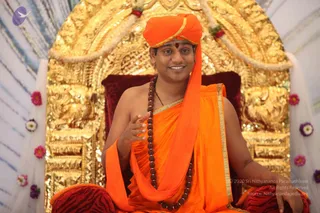
A seated man in a bright red turban with a silver ornament sits cross-legged on a red cushioned seat before an ornate gold-leaf backdrop. He wears a white dhoti-style garment with a red shawl draped over his shoulder and arm, multiple strands of rudraksha beads with gold accents, gold bangles on his wrists and an armlet. He has a red bindi on his forehead and raises one open hand while speaking, gazing to the side. a person is seated on the throne as the teacher during discourse; he wears the red turban, rudraksha malas and saffron-red shawl associated with the teacher in discourse, while the figure's identity is uncertain from appearance alone.A smiling man with closed eyes sits on an ornate gold throne with carved scalloped backrest. He wears a red turban with a silver brooch and a red vermilion dot on his forehead, a red shawl draped over his shoulder, a white dhoti-style garment, multiple strands of rudraksha beads, and gold bangles on his arms. Beside him stand hanging decorative pots with red and green patterns, a bunch of red grapes, and a white draped cloth against a purple starry backdrop.A seated man in a bright red turban with a silver peacock-shaped brooch and a small red bindi sits cross-legged on a red cushioned throne before an ornate gold repoussé backdrop. He wears a white dhoti-style garment with a red shawl draped over his shoulder and arm, multi-strand rudraksha malas with gold beads, and gold bangles on his arms. He smiles and looks to the side. The pale lilac background and red flowers frame the scene.A seated audience attends a satsang-style talk in a hall with red curtains and striped floor cushions. In the foreground, a woman in white with a red bindi sits cross-legged, and a woman in an orange and white sari sits beside a woman in a green and white outfit. Several women wear white, orange and red garments, and a woman in orange with white ash markings and rudraksha beads sits near the centre. A small oil lamp burns on the floor and a water bottle sits nearby. Background chairs and a deity murti are partly visible. No a person candidate is clearly identifiable.Close portrait of a man wearing a bright red turban with a silver peacock-shaped brooch and a red bindi on his forehead. He wears white draped clothing over his shoulders, multiple strands of rudraksha beads with gold accents around his neck, and gold bangles on his wrists. His right index finger is raised in a gesture of instruction. Behind him is an ornate gold-toned carved backdrop. A translucent purple logo sits in the upper left corner. The clothing and adornments are a rudraksha-and-turban presentation, but the appearance alone does not establish identity, so this is a devotee-style portrait of a single person with no confirmed identity.

BGSatsang-Tamil

8 photosSource gallery
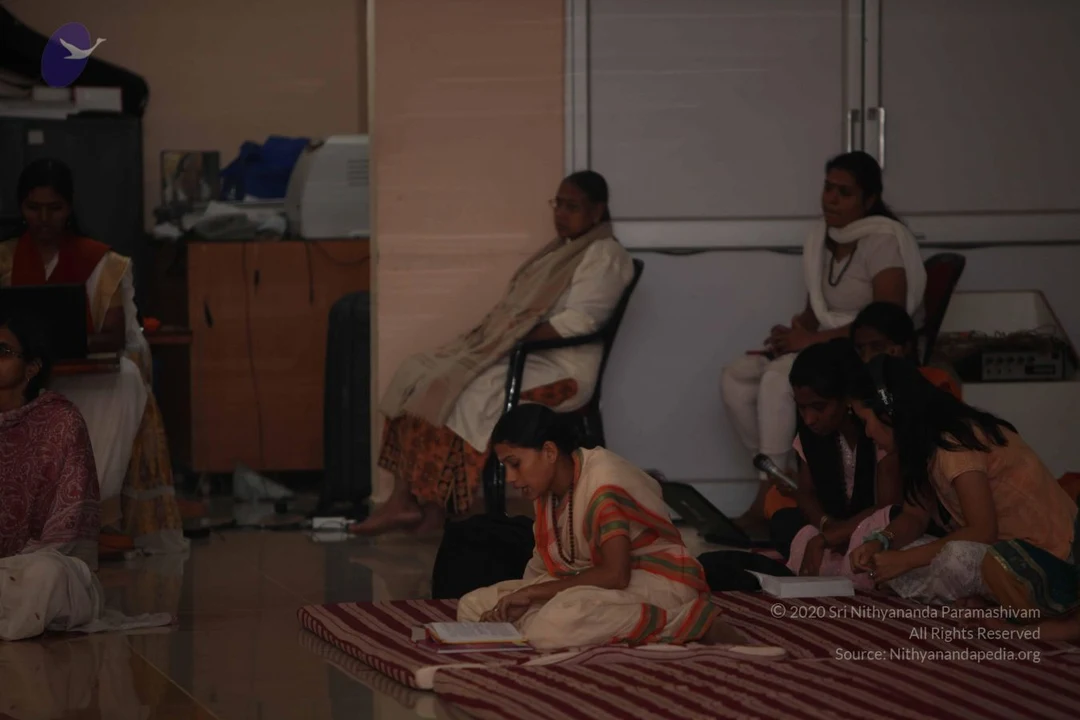
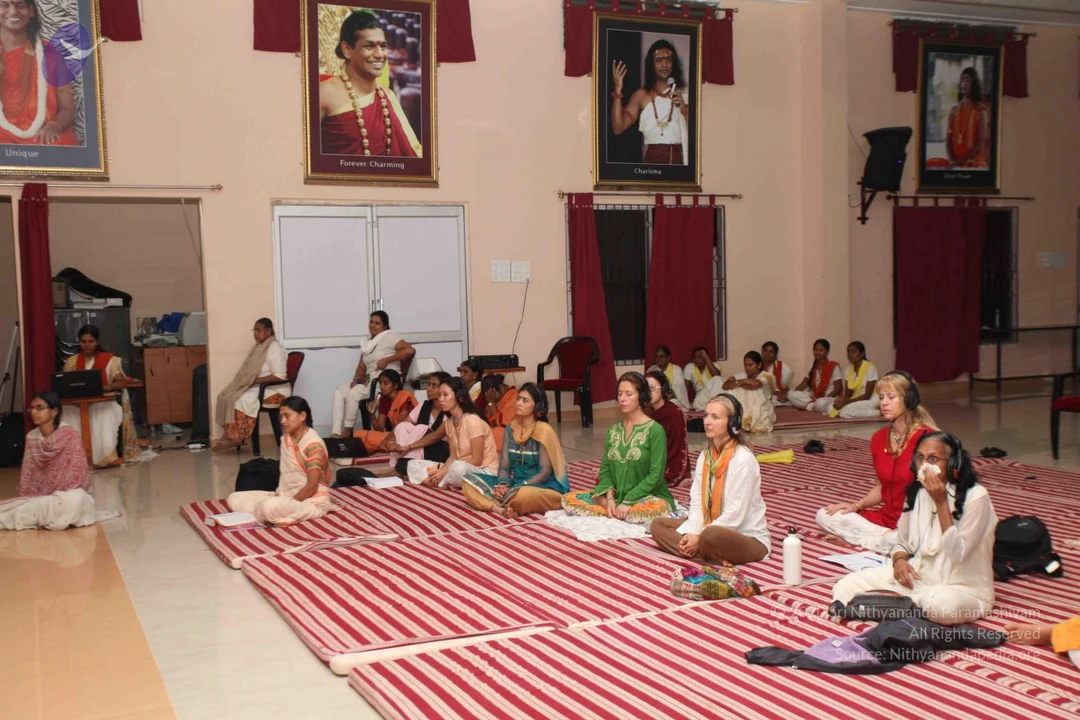
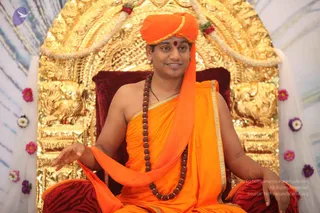
A seated man in an orange-saffron turban and matching orange robe with gold border sits on a red velvet throne with a red-and-black tiger-striped cushion. He wears a long rudraksha mala and a red bindi on his forehead, with both hands resting on his knees. Behind him is an ornate gold-leaf throne back with carved lion motifs, decorated with pink, white and purple flowers and white draped fabric.Indoor photo of a group study or satsang session in a dimly lit room with cream walls and a tiled floor. A young woman in a cream sari with red and green borders sits cross-legged on a red-and-white striped mat, reading an open book, with a rudraksha-style mala around her neck. To the left, a woman in a white sari with a red shawl sits at a desk with a laptop. A woman in a light beige shawl and white top sits on a chair in the centre, and another woman in white with a white shawl sits on a chair at the right. Several young women in orange and peach salwar-style clothing sit on the floor at right, one holding a small book. Cupboards, a printer and a blue bag are visible in the background.A seated man in saffron-orange clothing sits on a red velvet throne with a red zebra-striped cushion and gold-embroidered armrest. He wears an orange turban with a gold trim, a dark rudraksha mala around his neck, an orange wrap draped over one shoulder, and an orange wristband. A small tilak mark is on his forehead. He gazes to the side while his hands rest in his lap. Behind him hang dark navy curtains and a pale backdrop.A seated man in orange ritual dress sits on a richly carved gold throne with a deep red velvet cushion, framed by white drapes and pink, white and purple flowers. He wears an orange turban with a red tilak on his forehead, an orange shawl draped over one shoulder, a long rudraksha mala, and red patterned trousers. His hands rest on his knees in a calm seated posture as he gazes to the side. a person: the orange turban, rudraksha mala, saffron shawl and ornate throne setting match the cues for the a person candidate, presented as a seated teacher.A smiling man in saffron-orange robes and an orange turban with a red tilak sits on a red velvet cushioned seat before an ornate gold carved throne backdrop with lion figures. He wears a long rudraksha mala, a gold-trimmed orange shawl draped over one shoulder, and gestures with his right hand while speaking. Flower garlands in pink, purple and white decorate the frame. He appears to be a person, seated on the peetha in a teaching posture, with one visible person present.A seated man in saffron-orange robes and an orange turban with a red tilak on his forehead sits on a red velvet cushioned throne in front of an ornate gold-leaf backdrop carved with lions. A long rudraksha mala hangs over his chest and a thin dark cord rests at his neck. He smiles gently, his right hand extended palm-down over the armrest. Flower garlands in pink, white and purple decorate the throne's sides and white drapery frames the scene.