Skip to content
Tuesday

20 September 2011

THE SUPREME PONTIFF OF HINDUISM HDH BHAGAVAN NITHYANANDA PARAMASHIVAM

Dated photos
181
Source pages
1
Media
2
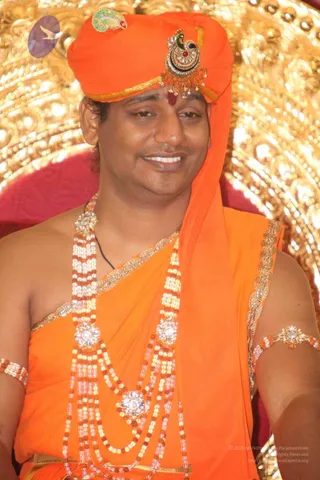
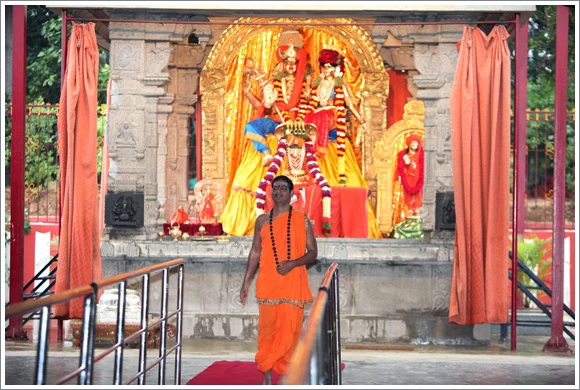
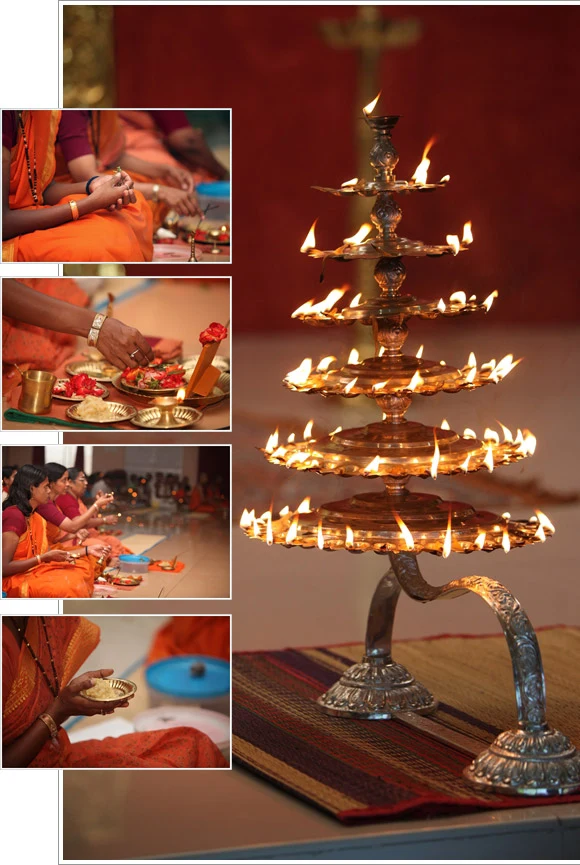
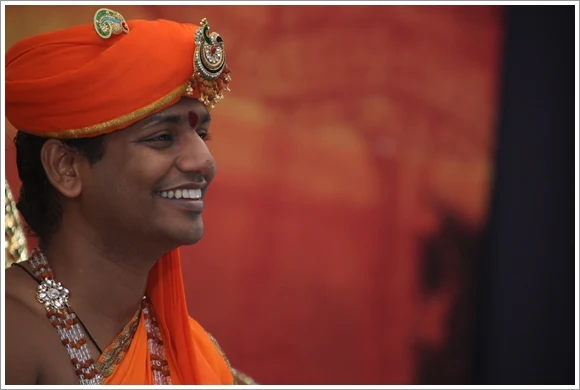
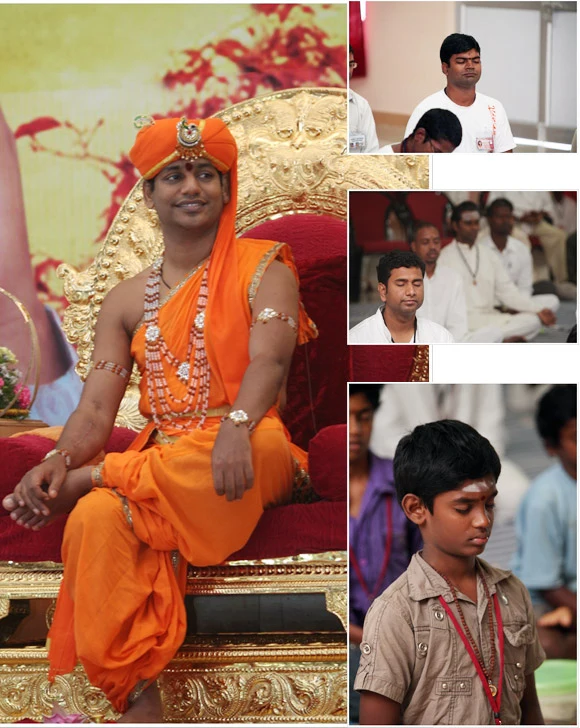
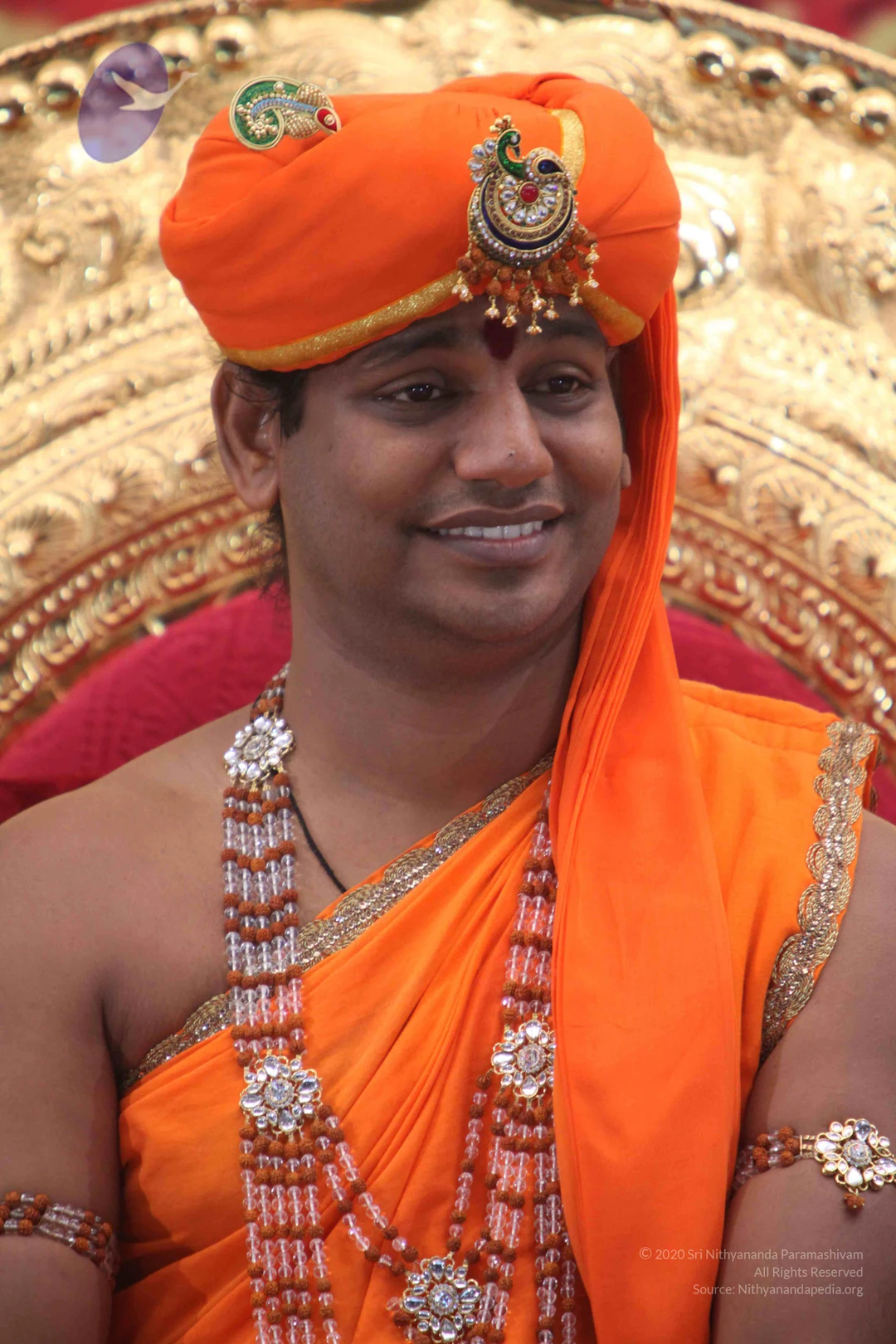
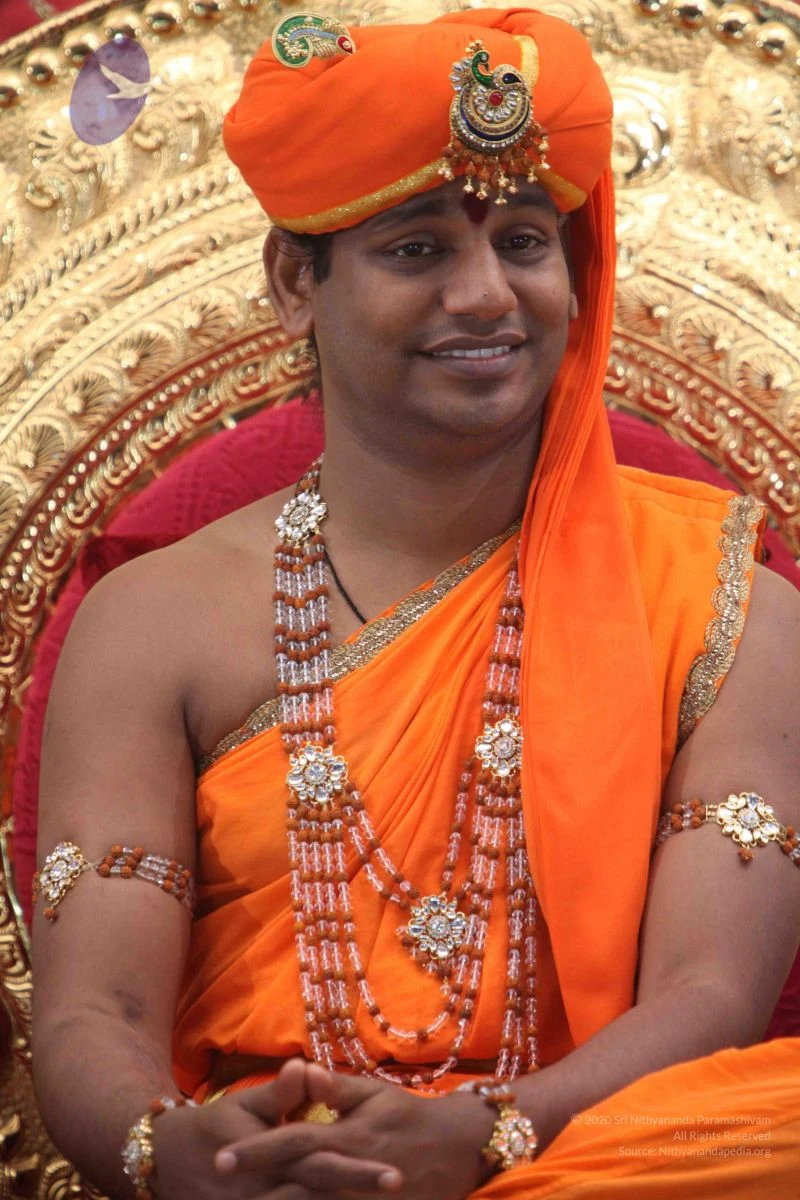
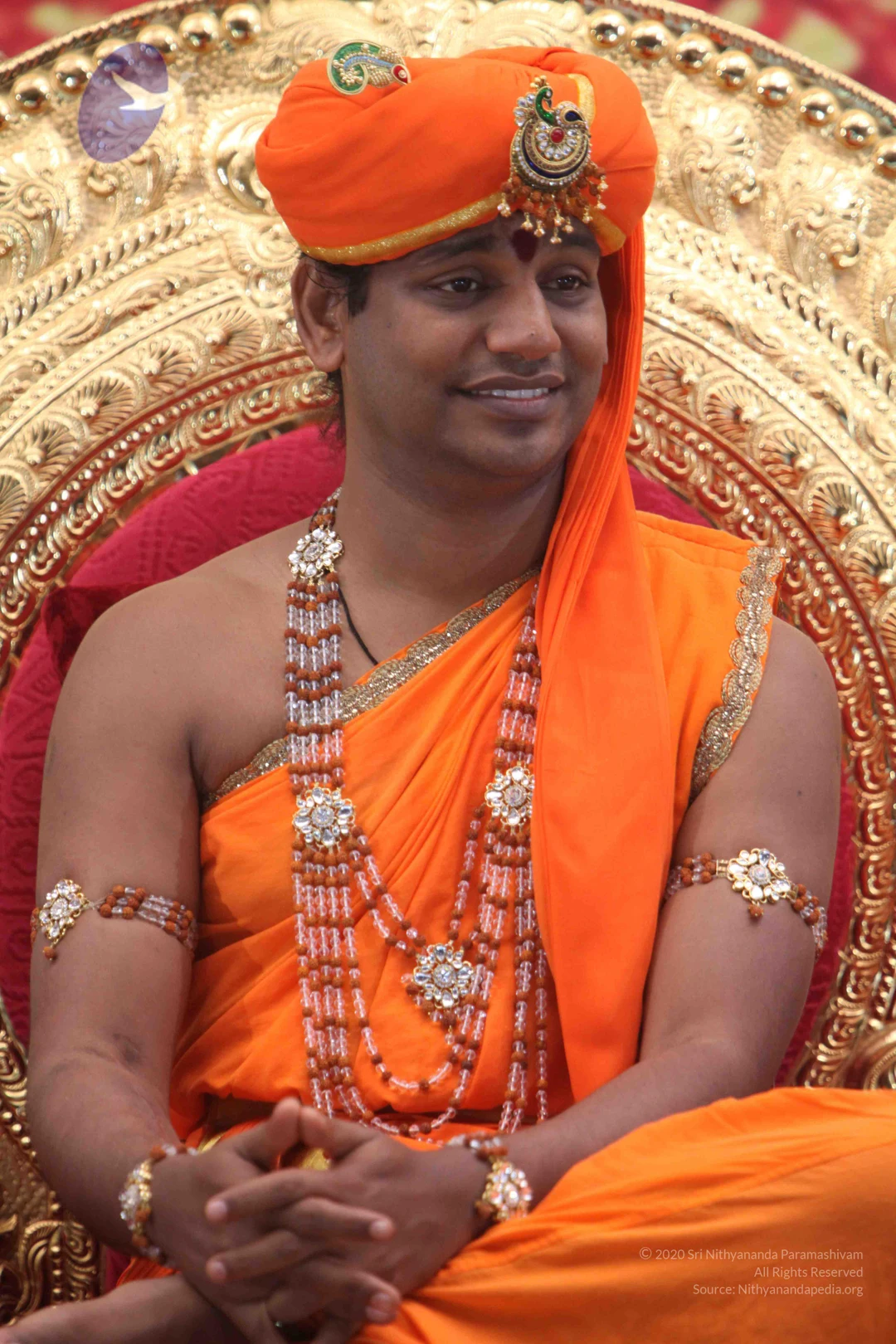
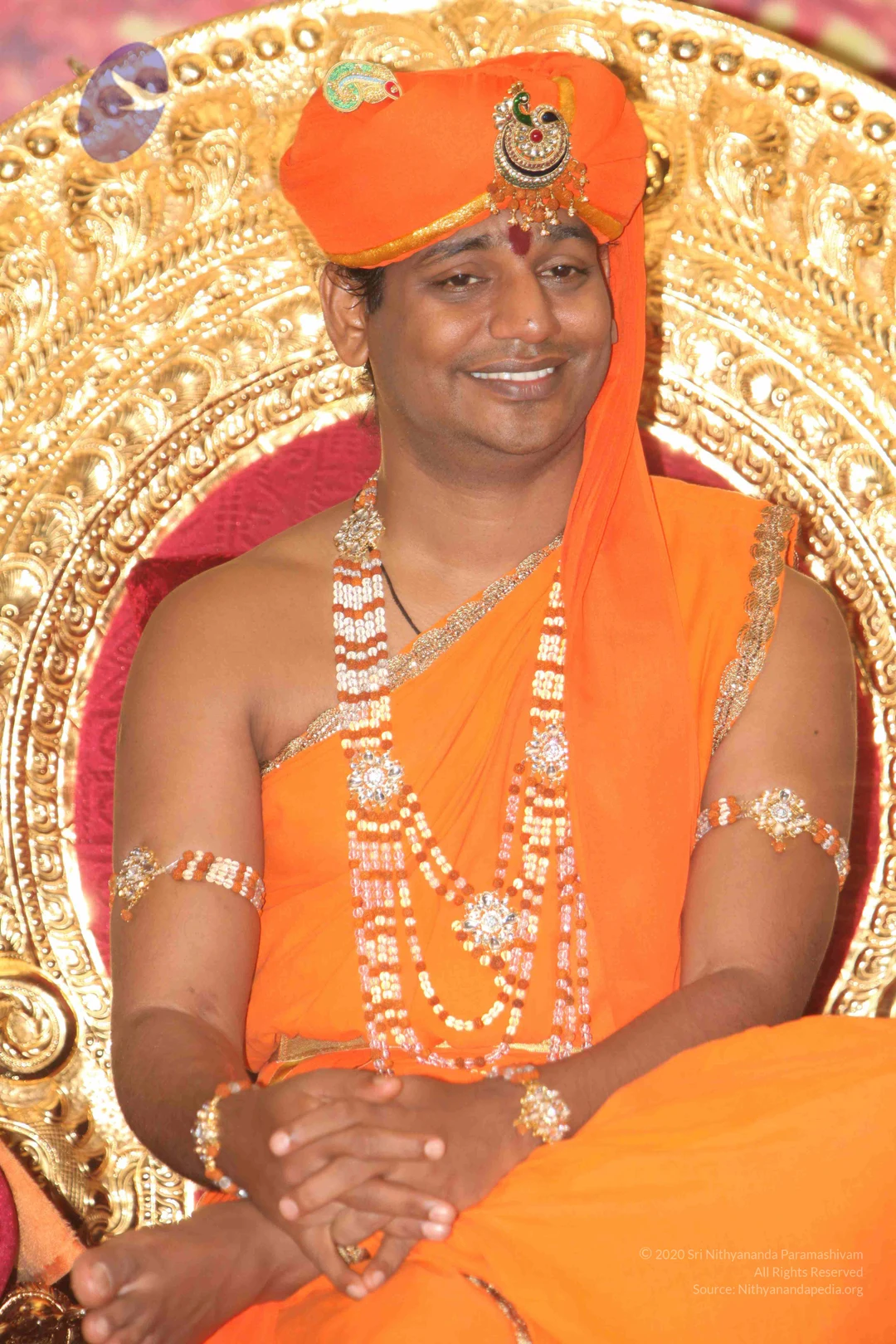
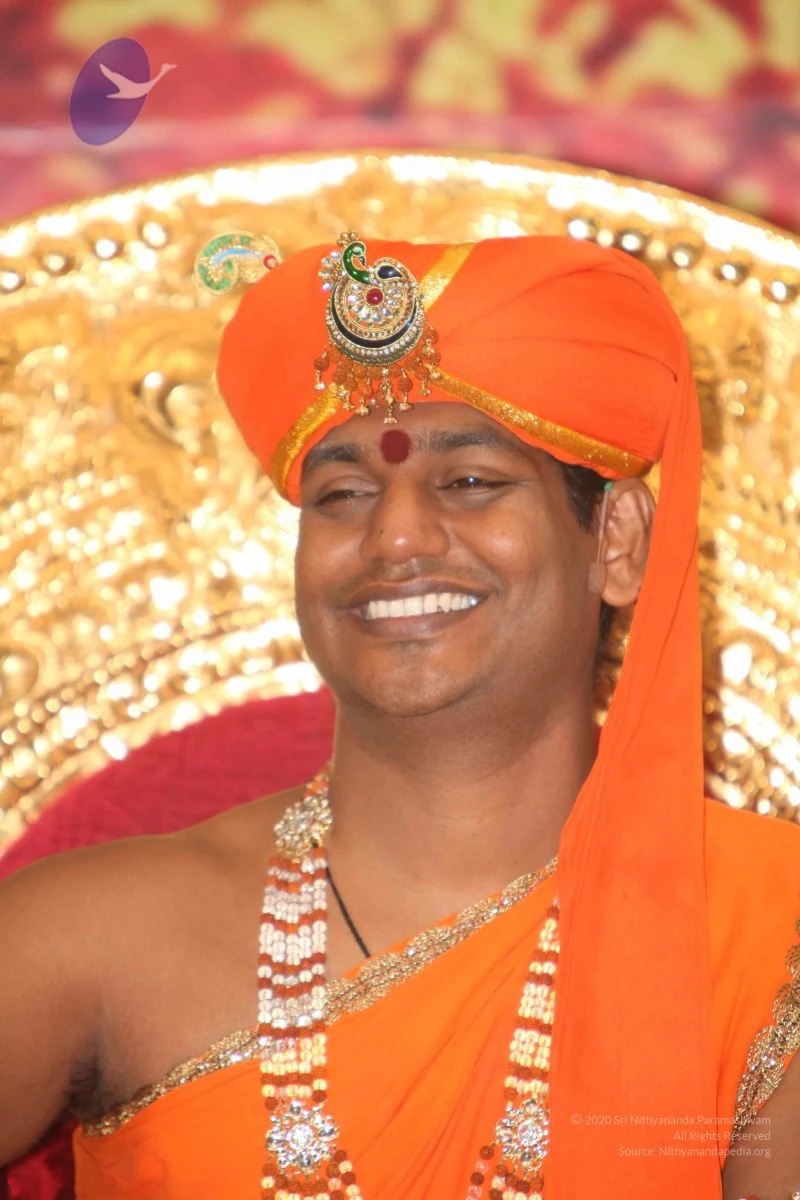
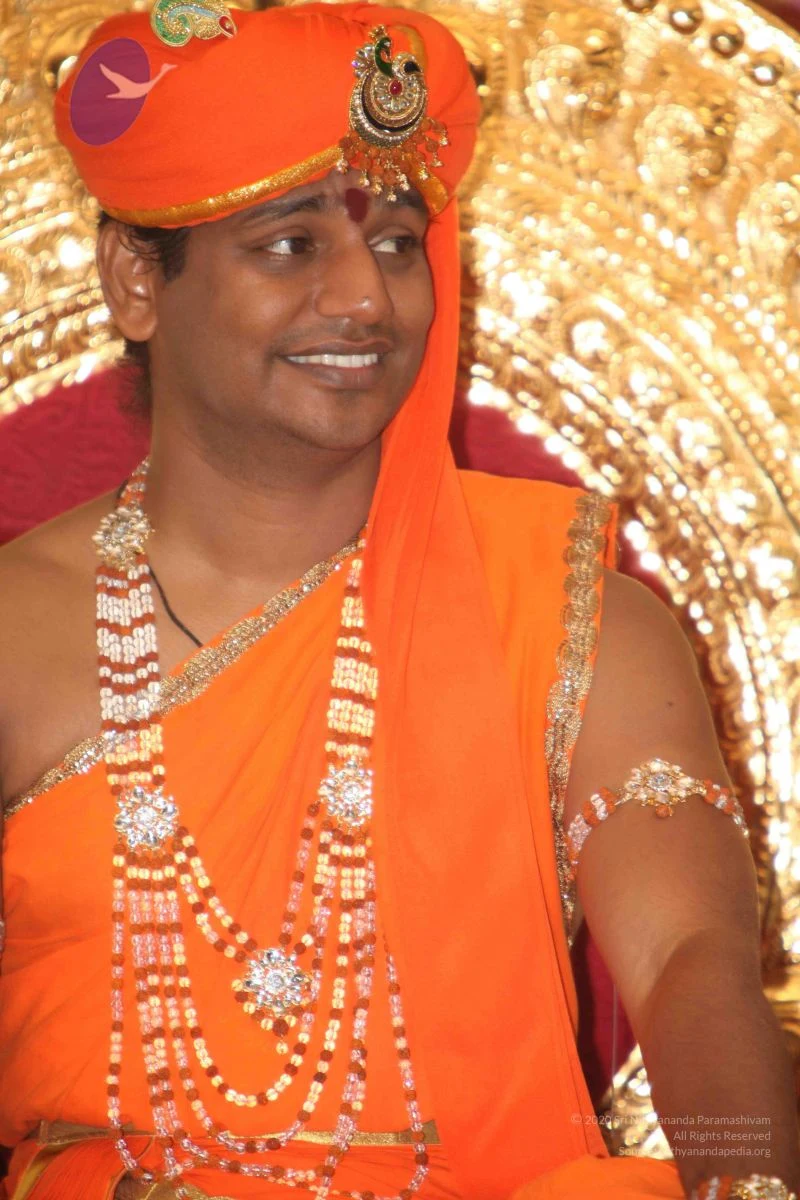
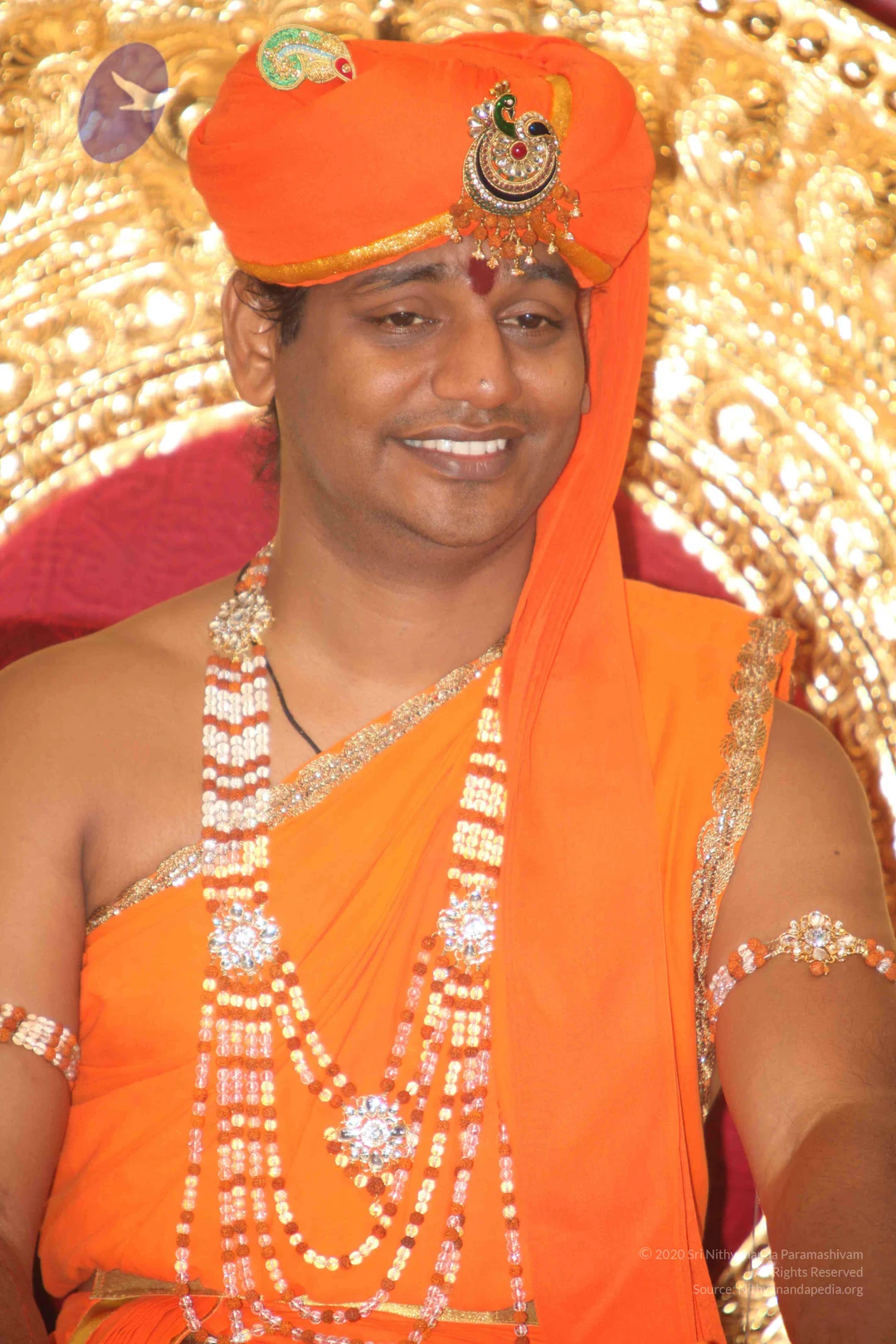
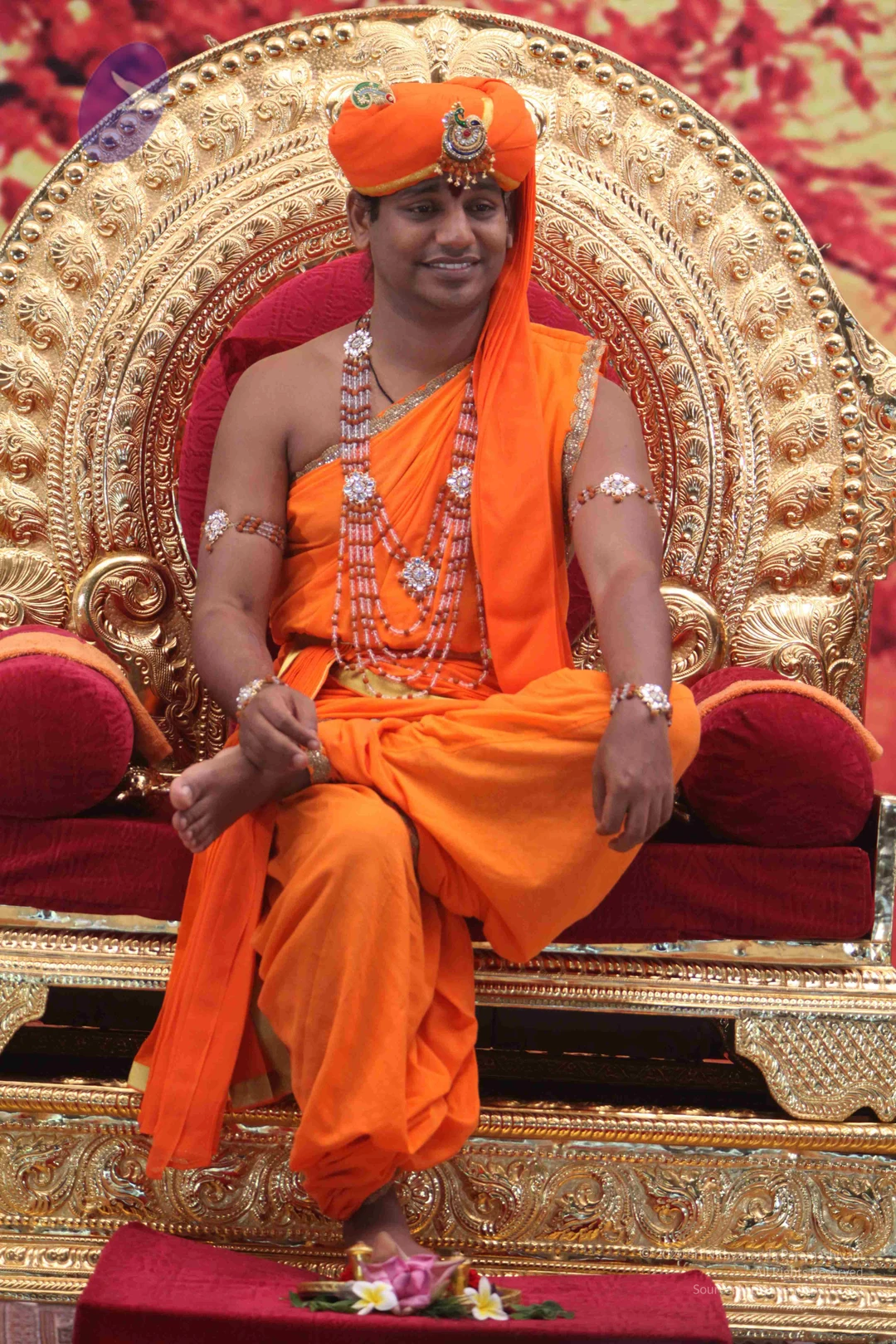
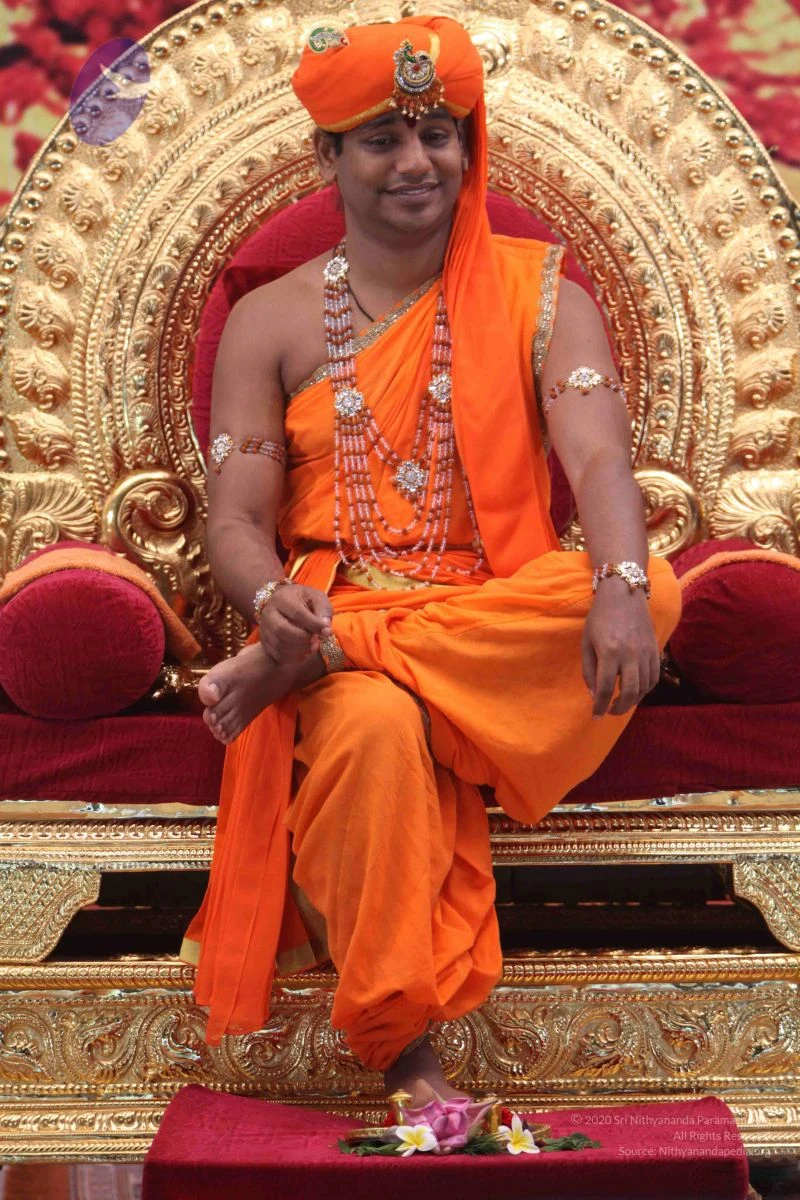
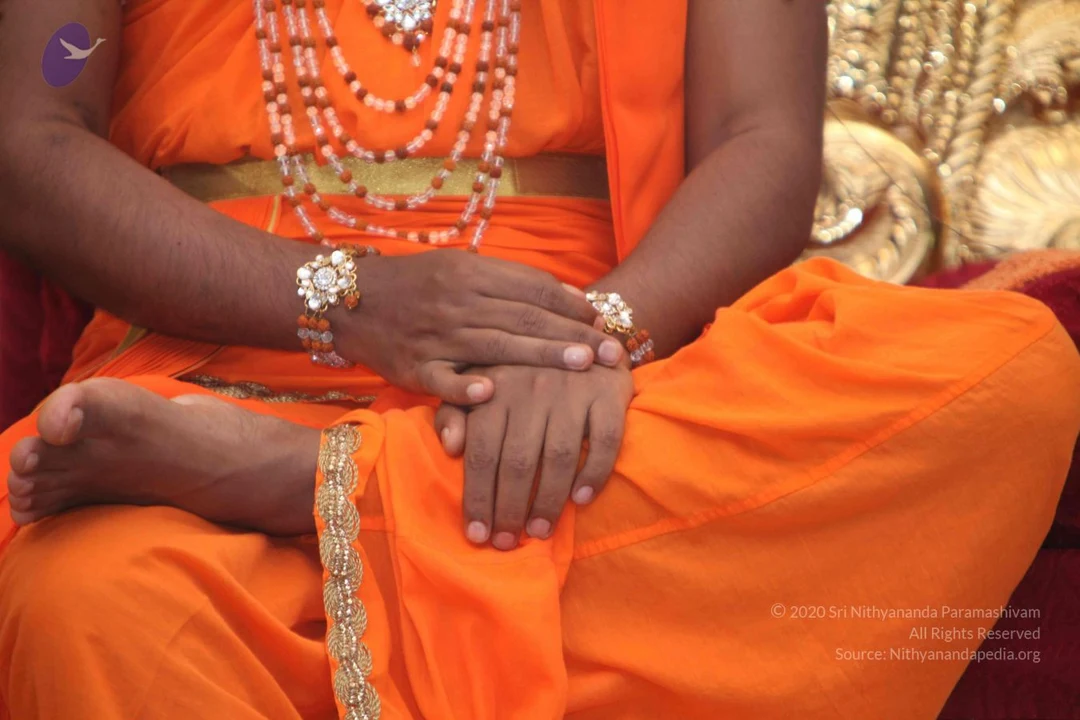
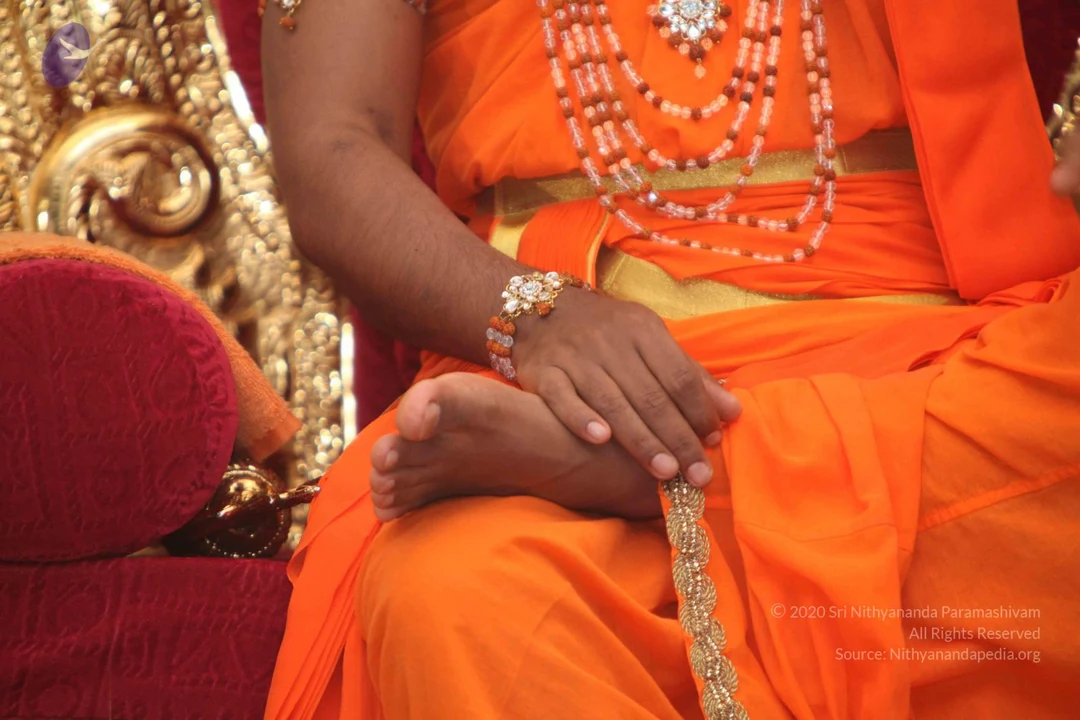
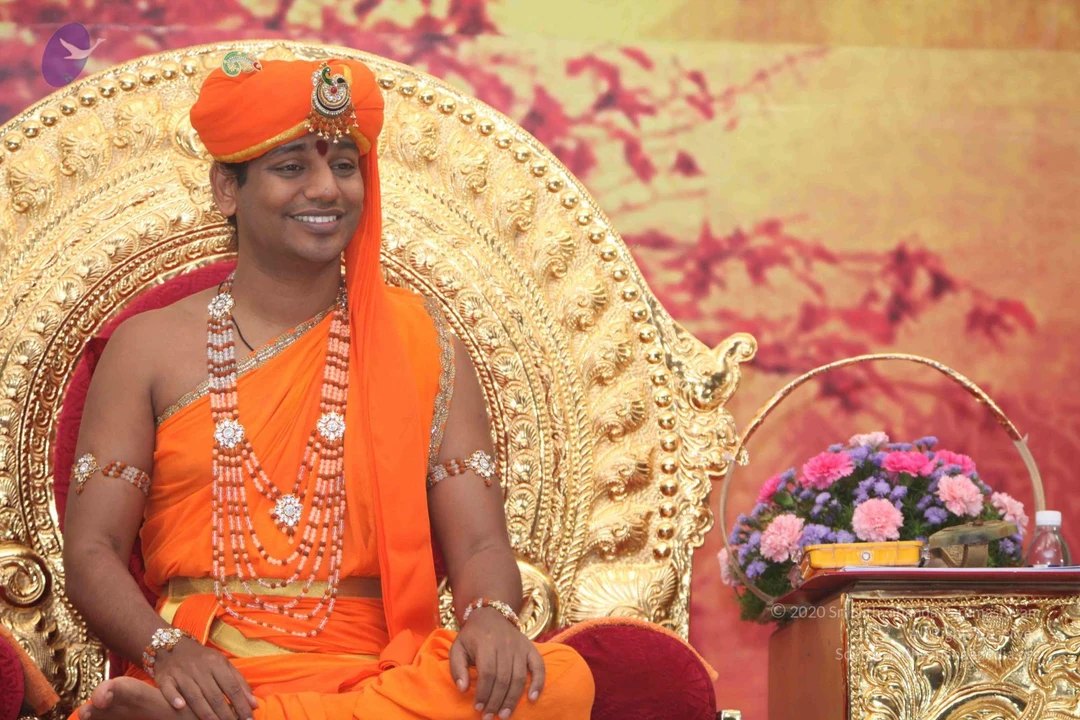
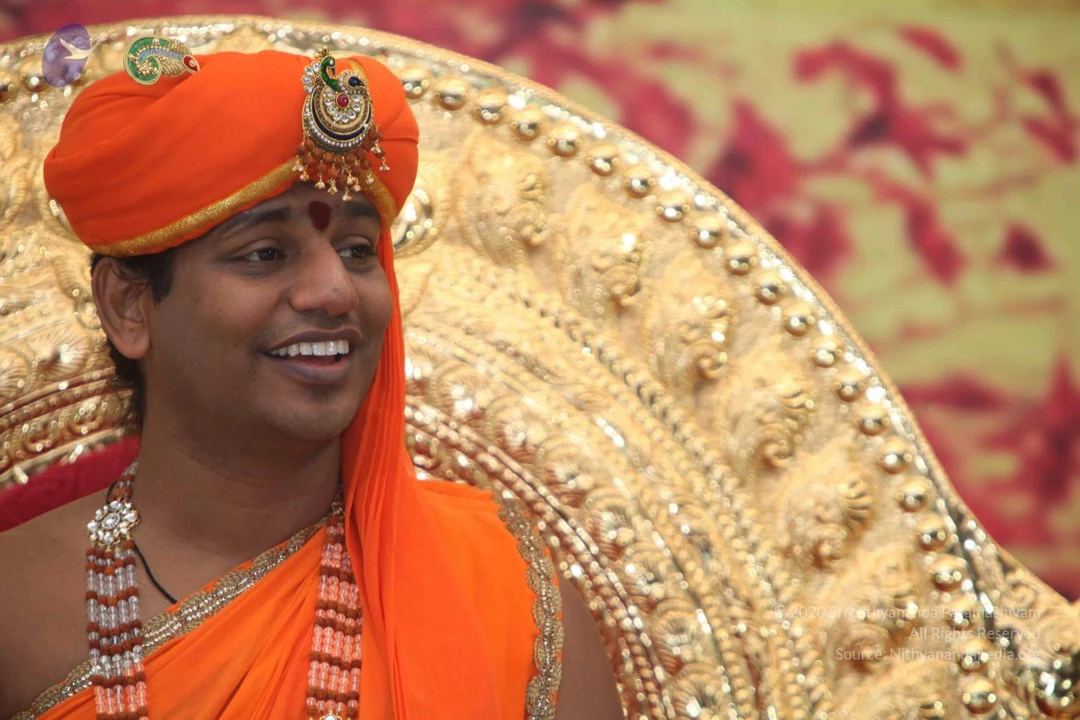
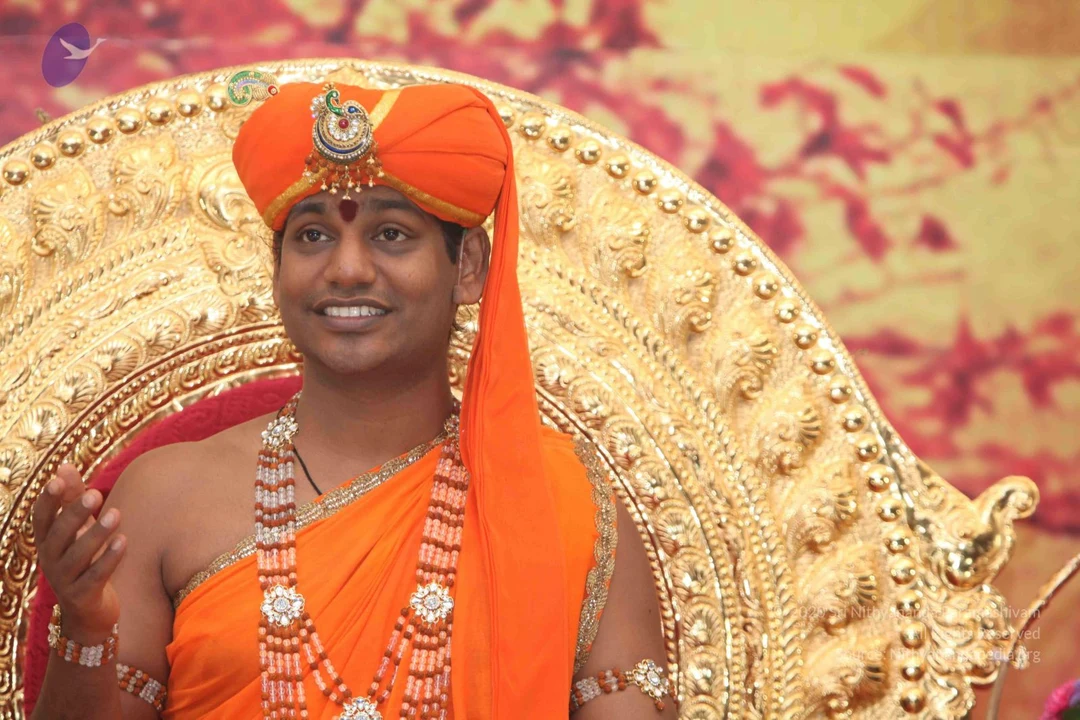
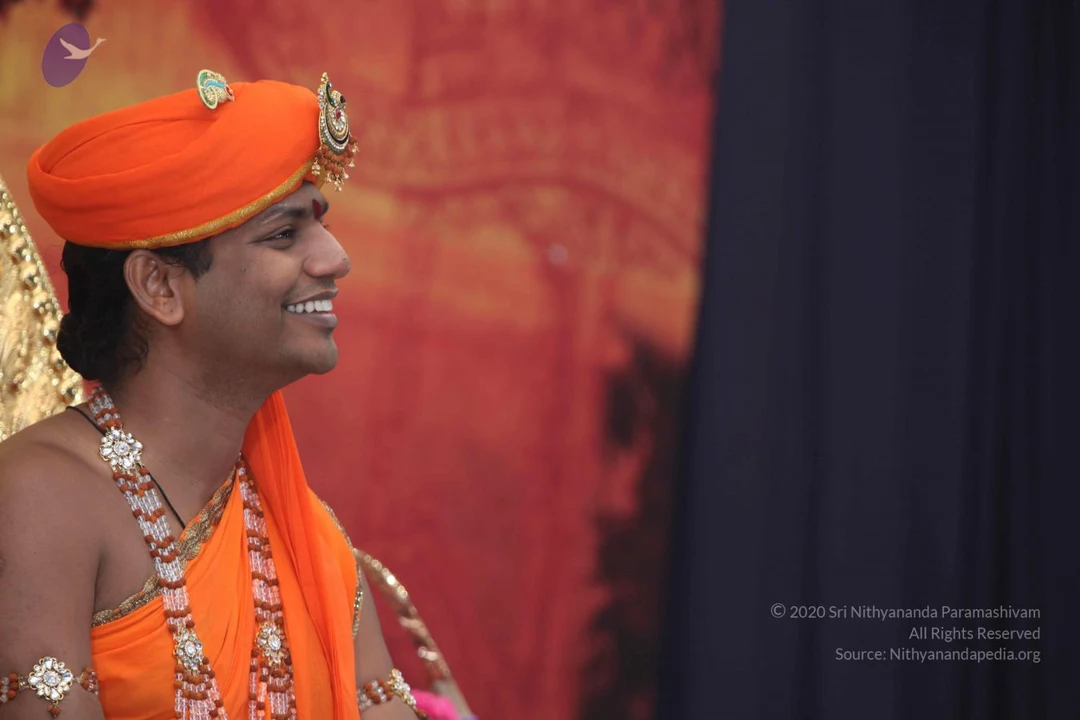
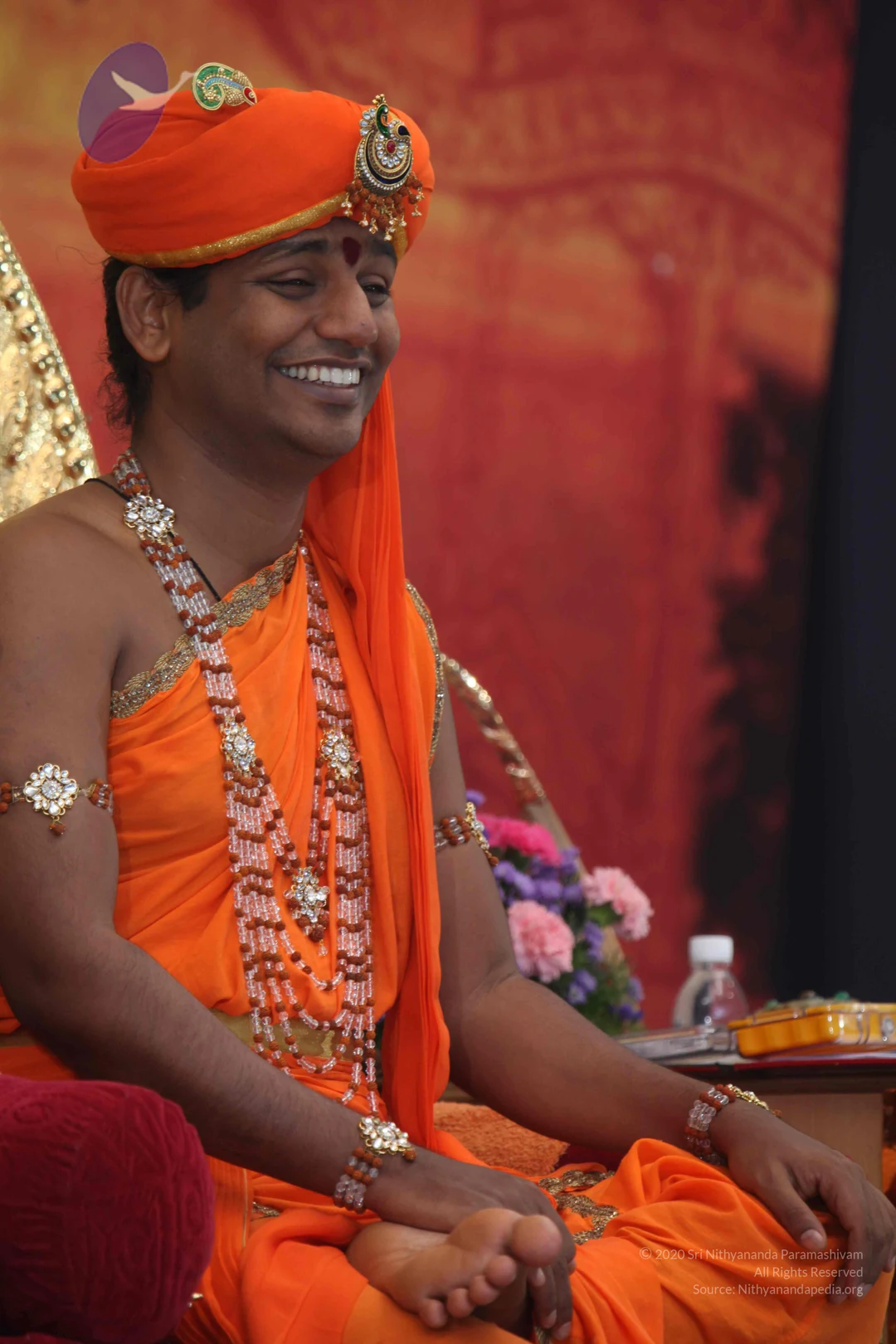
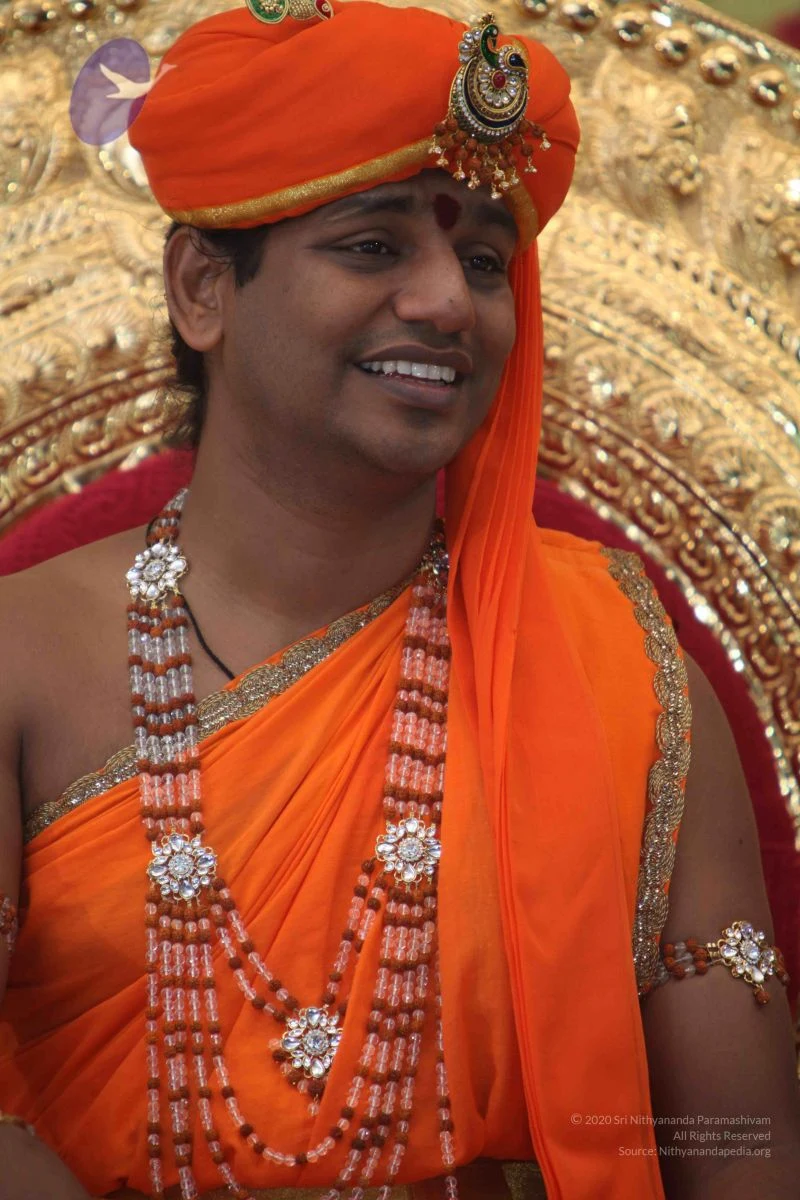
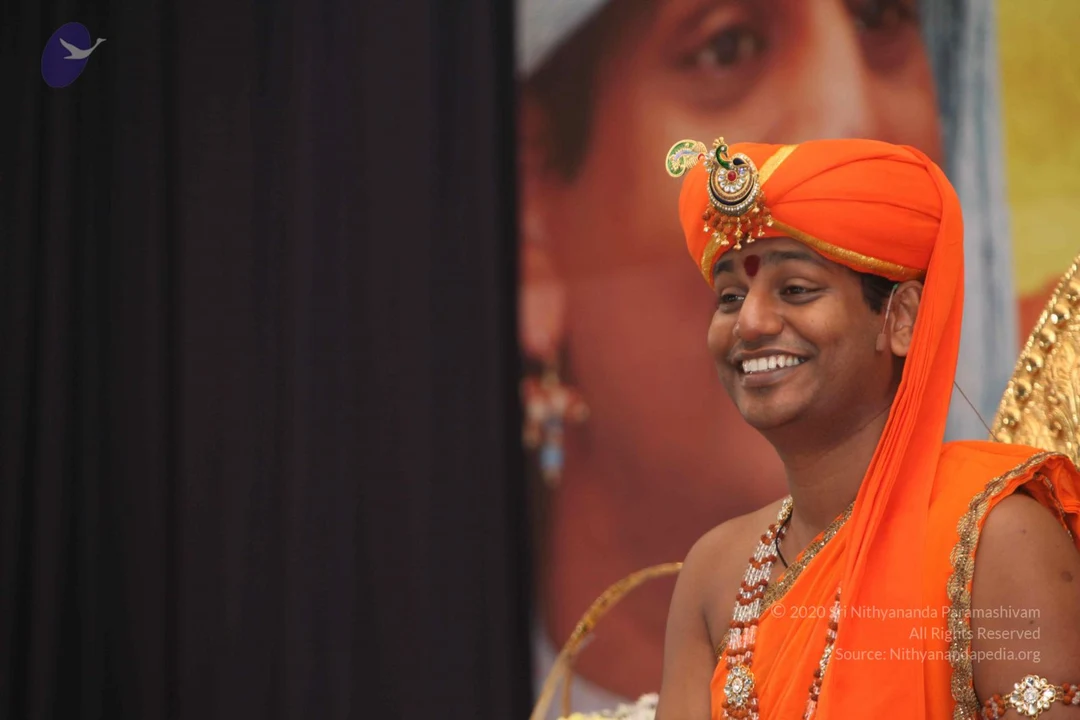
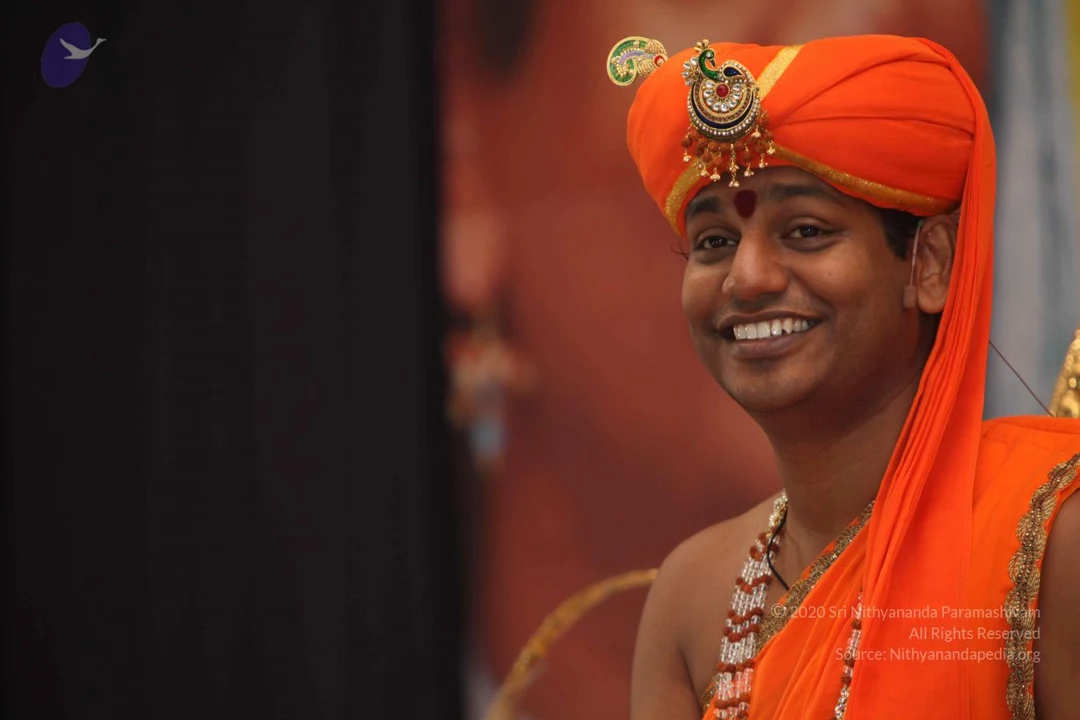
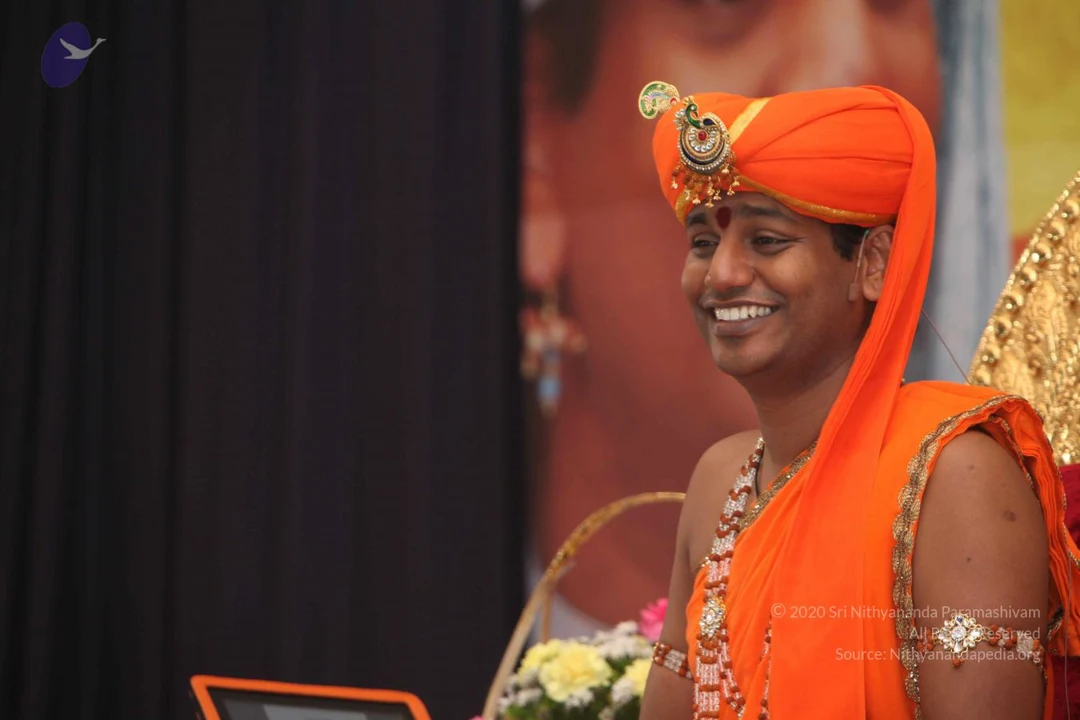
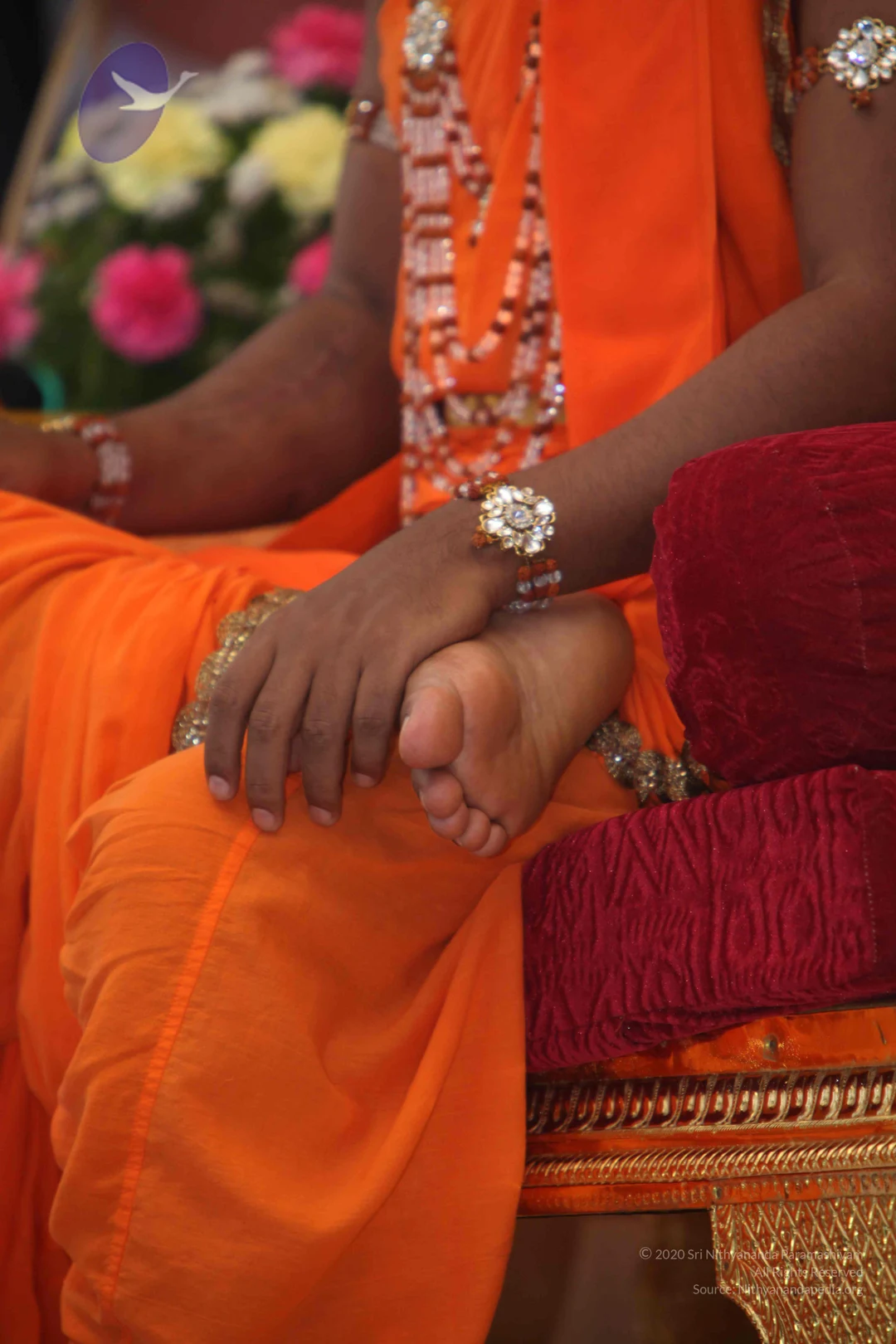
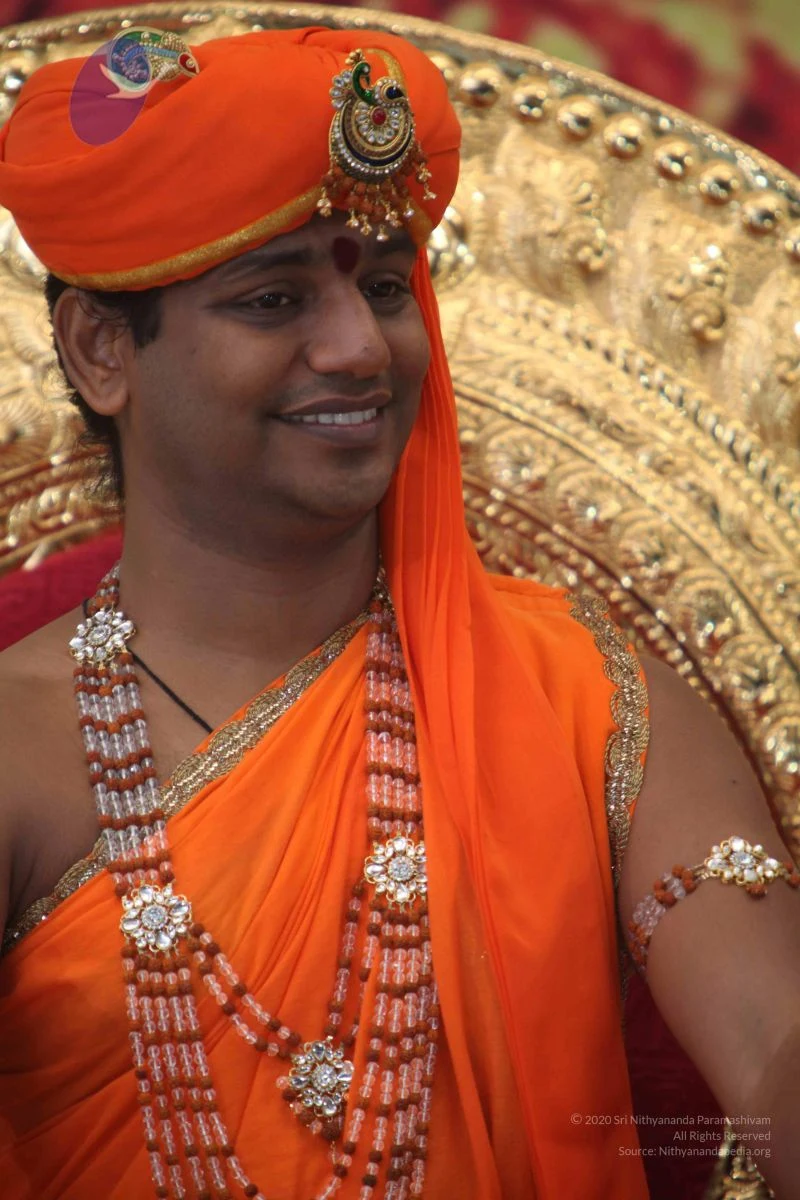
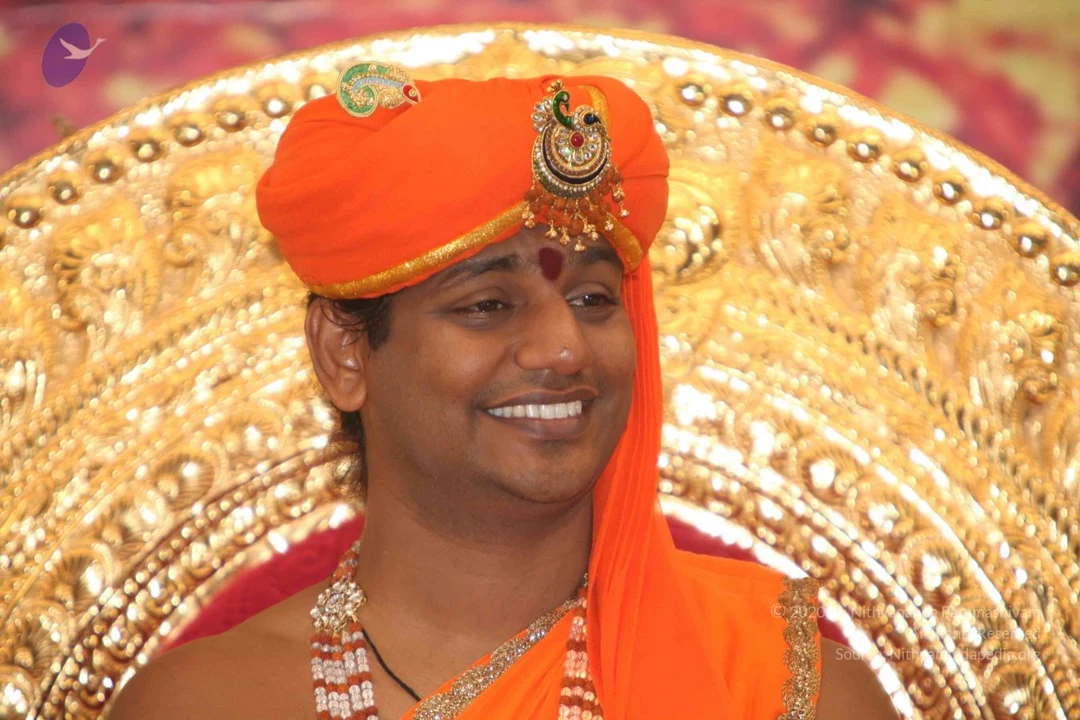
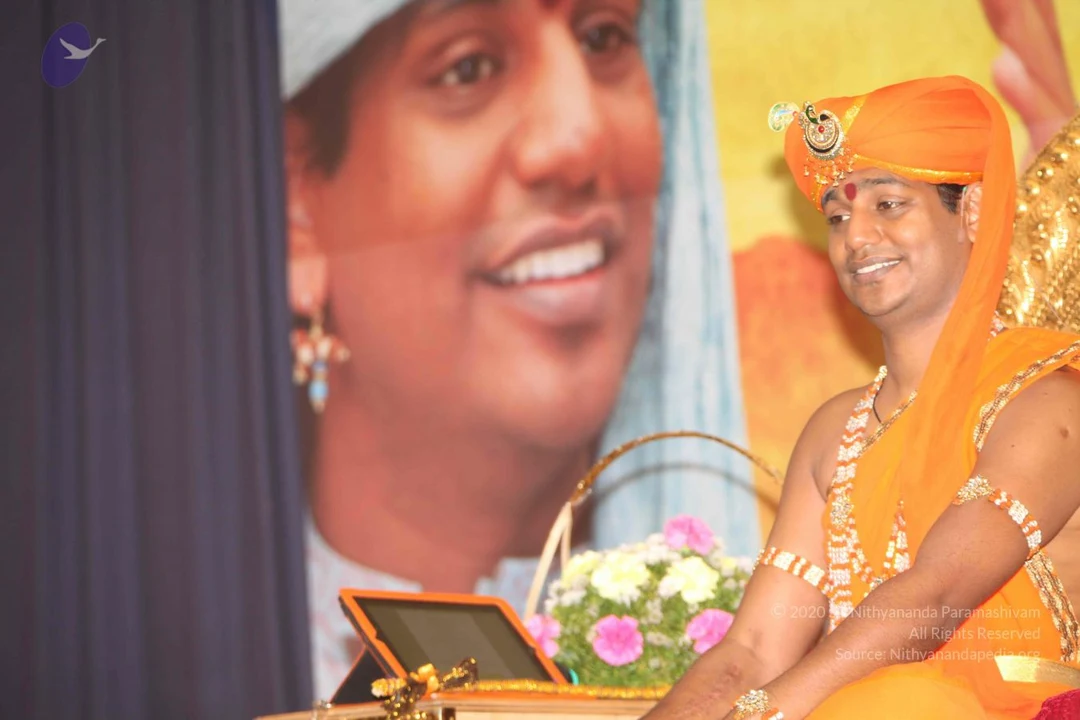
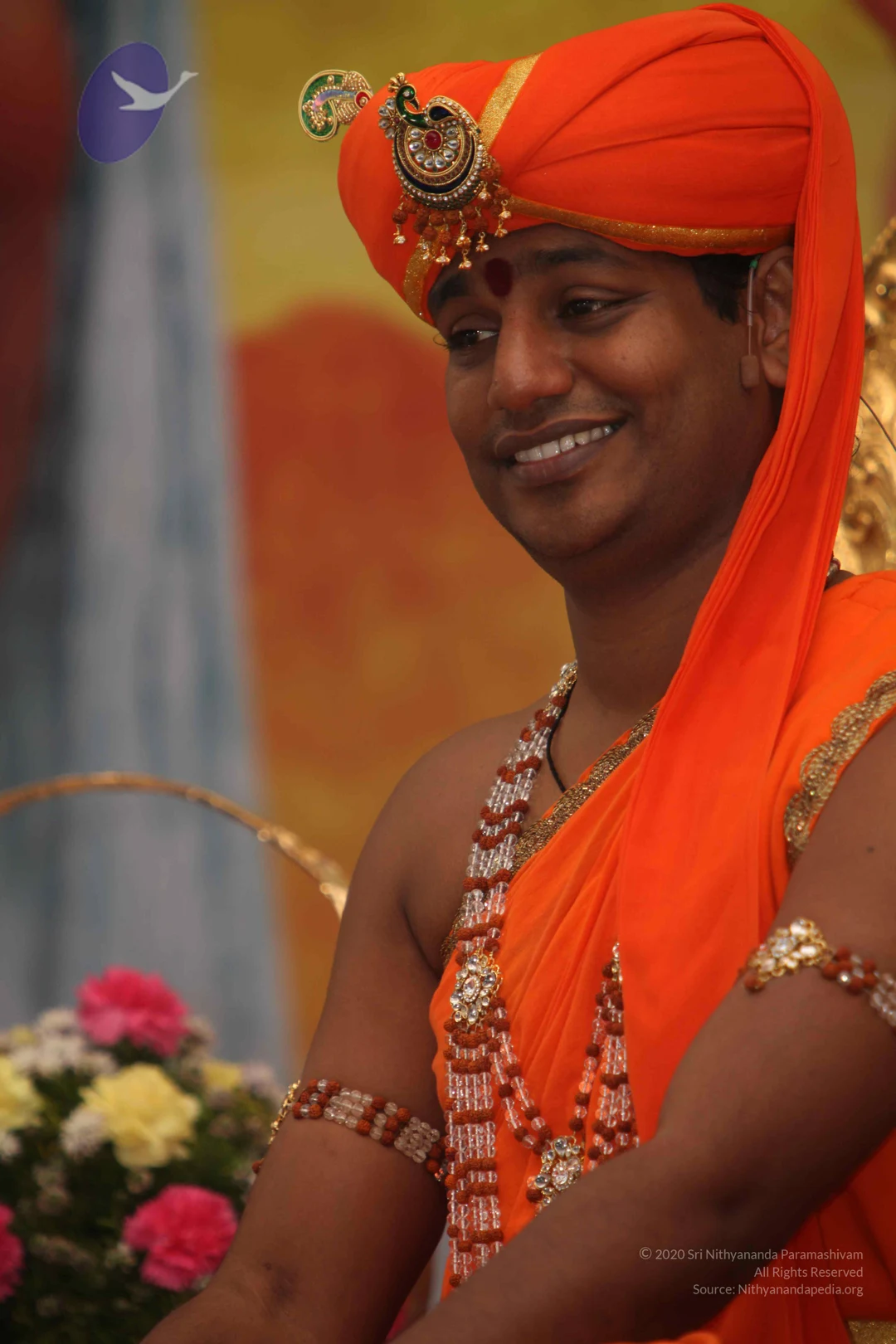
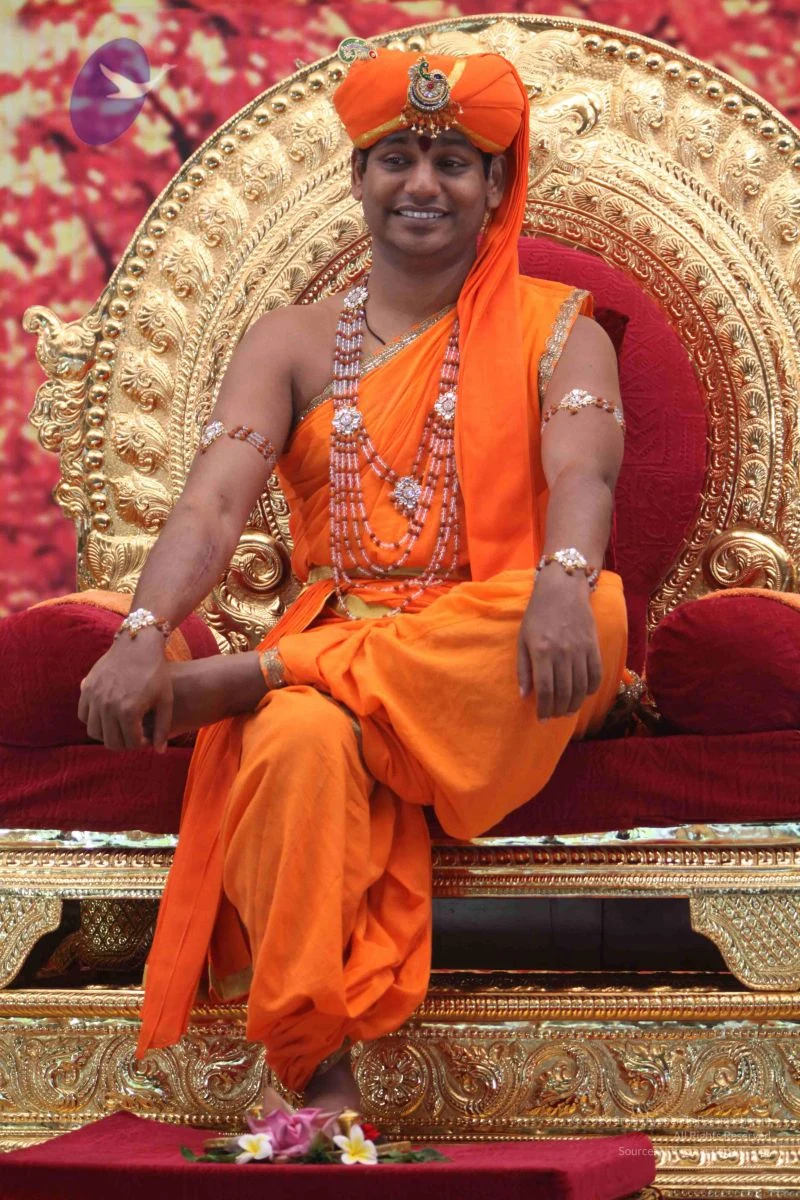
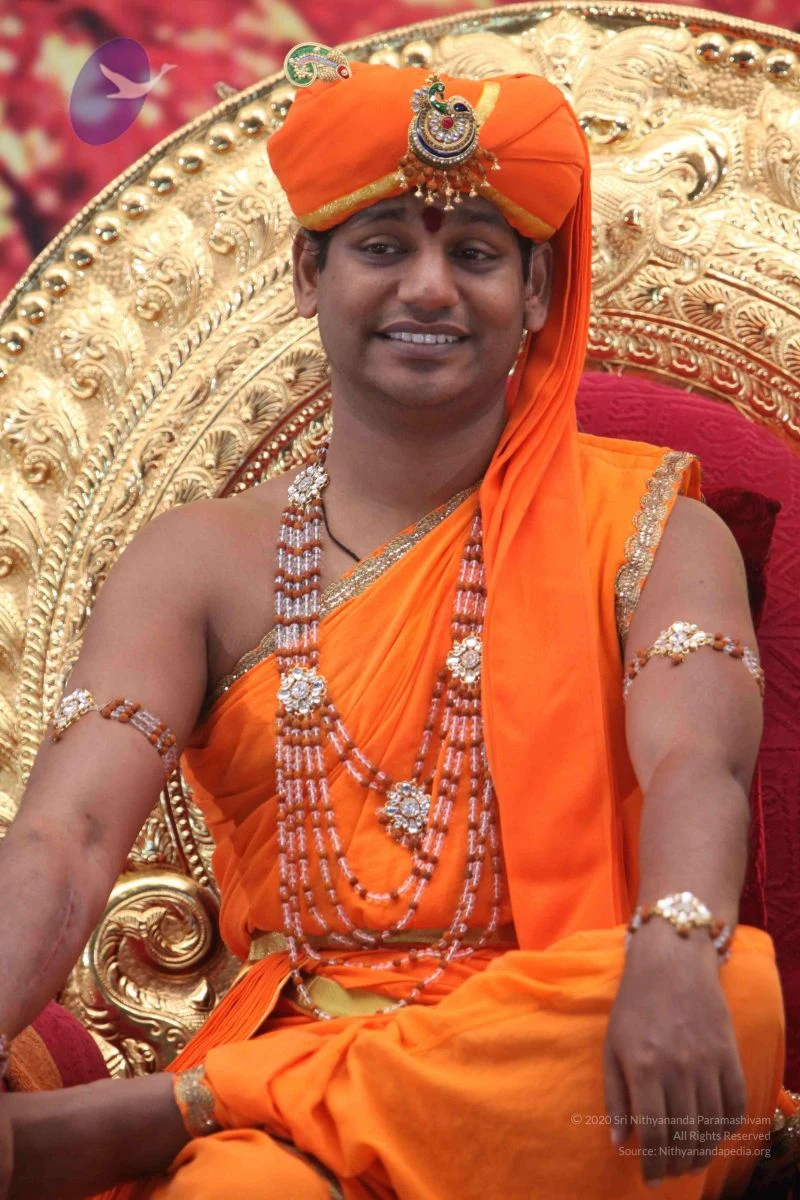
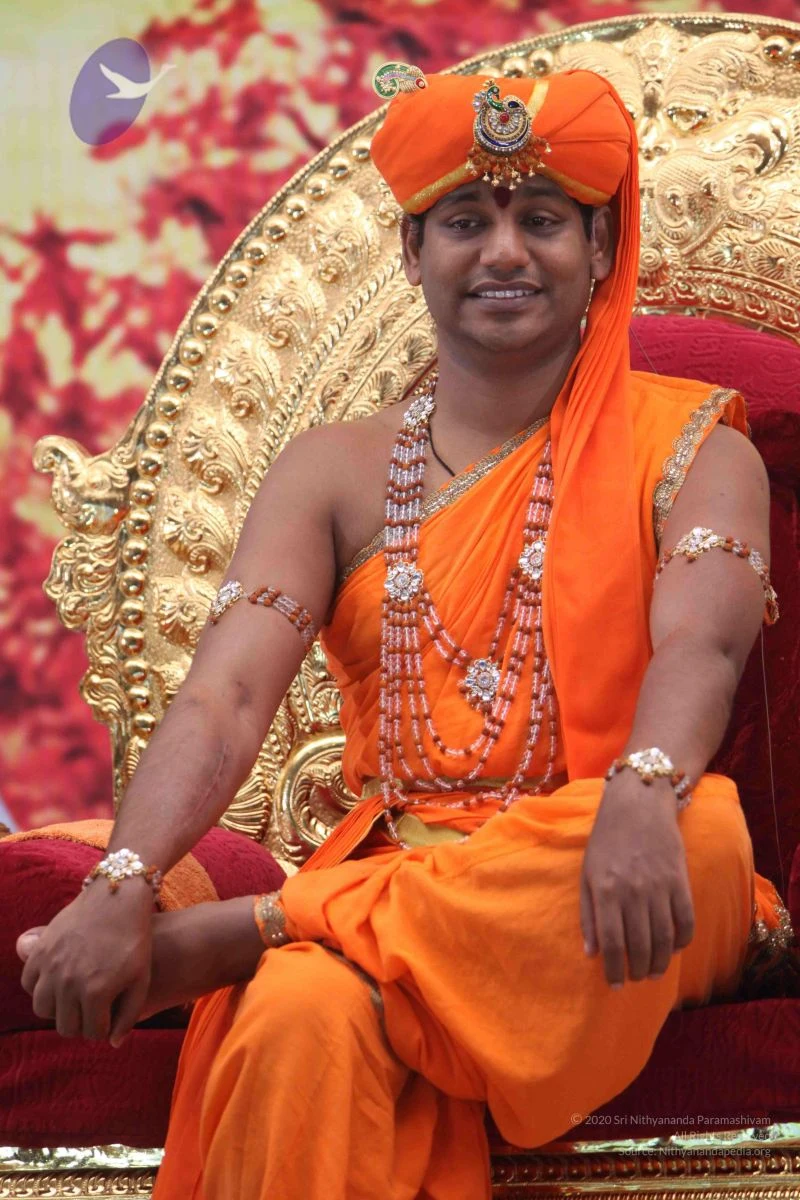
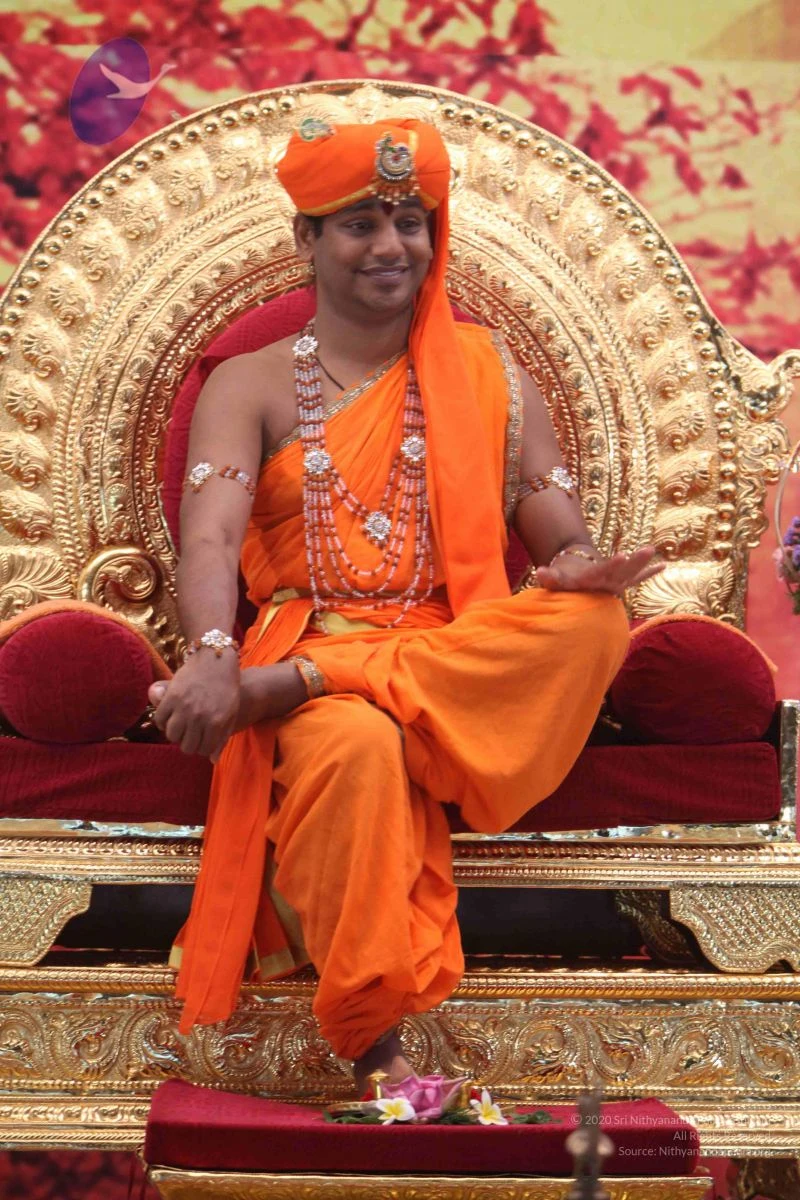
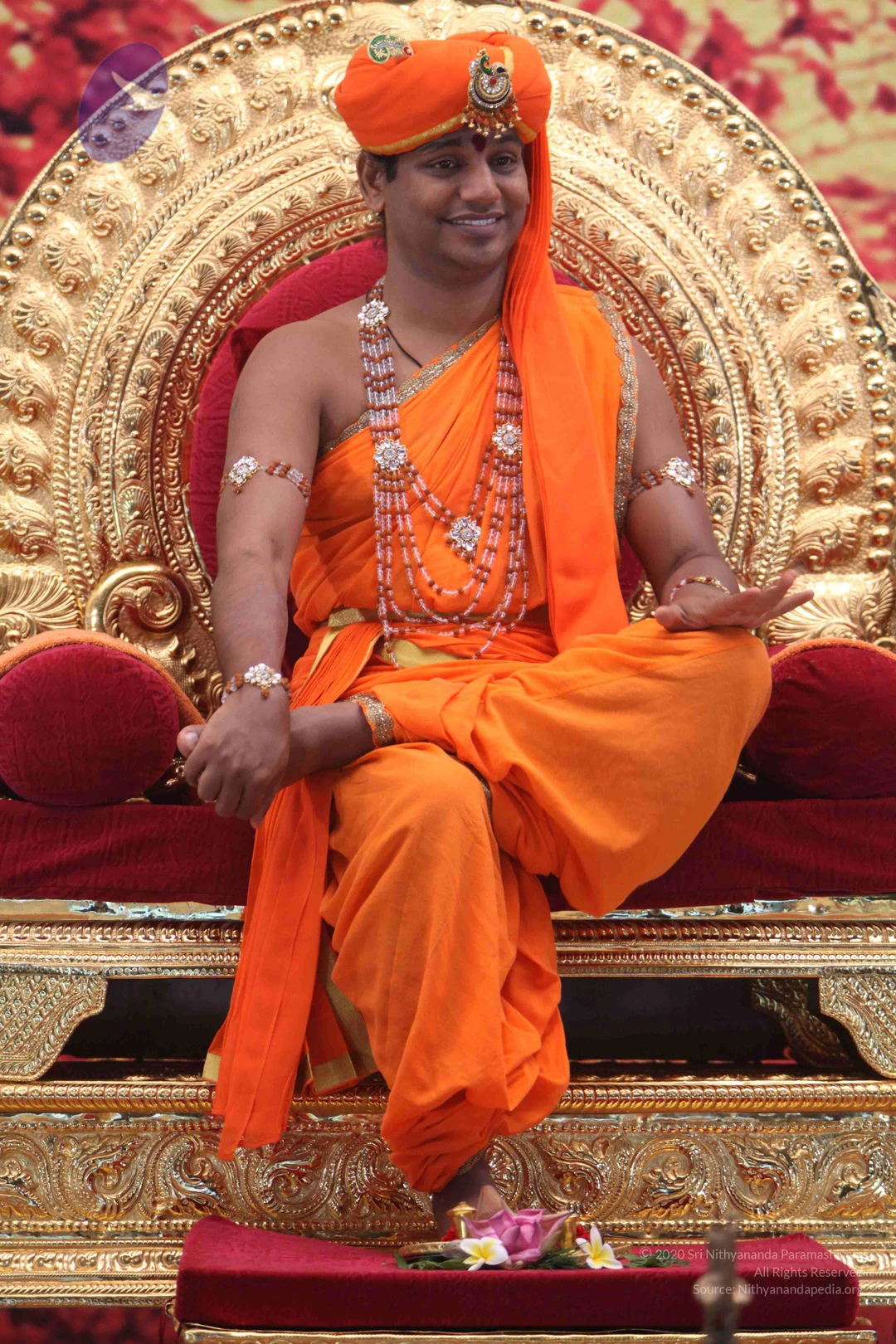
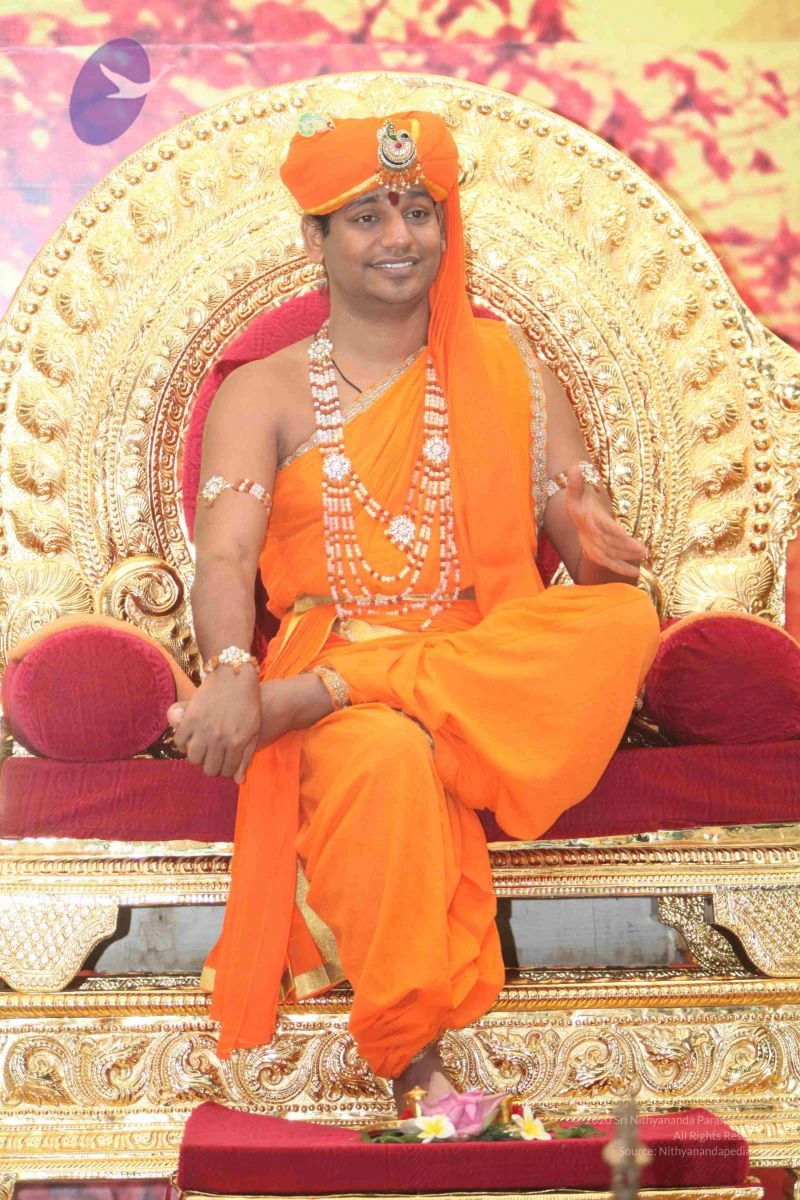
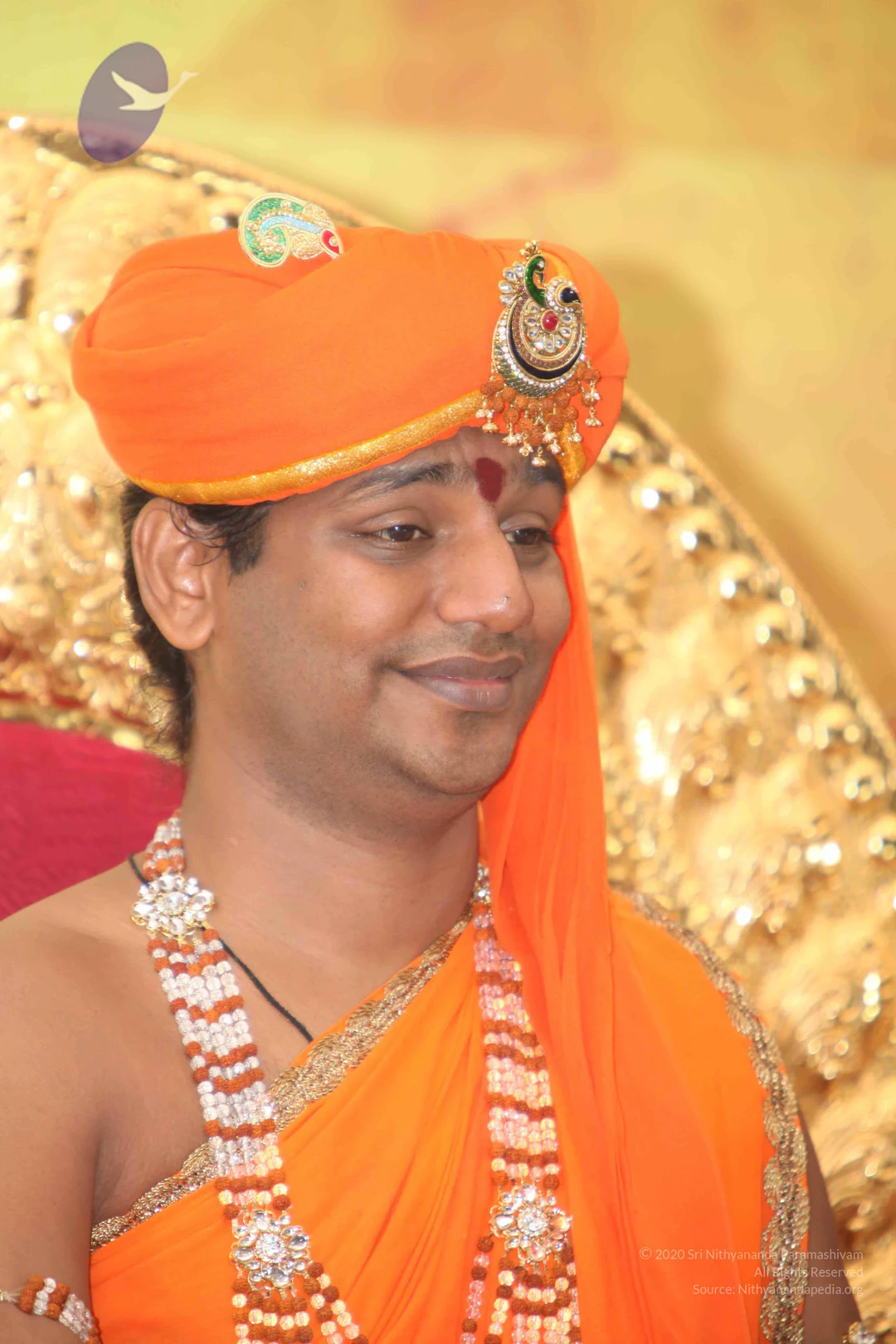
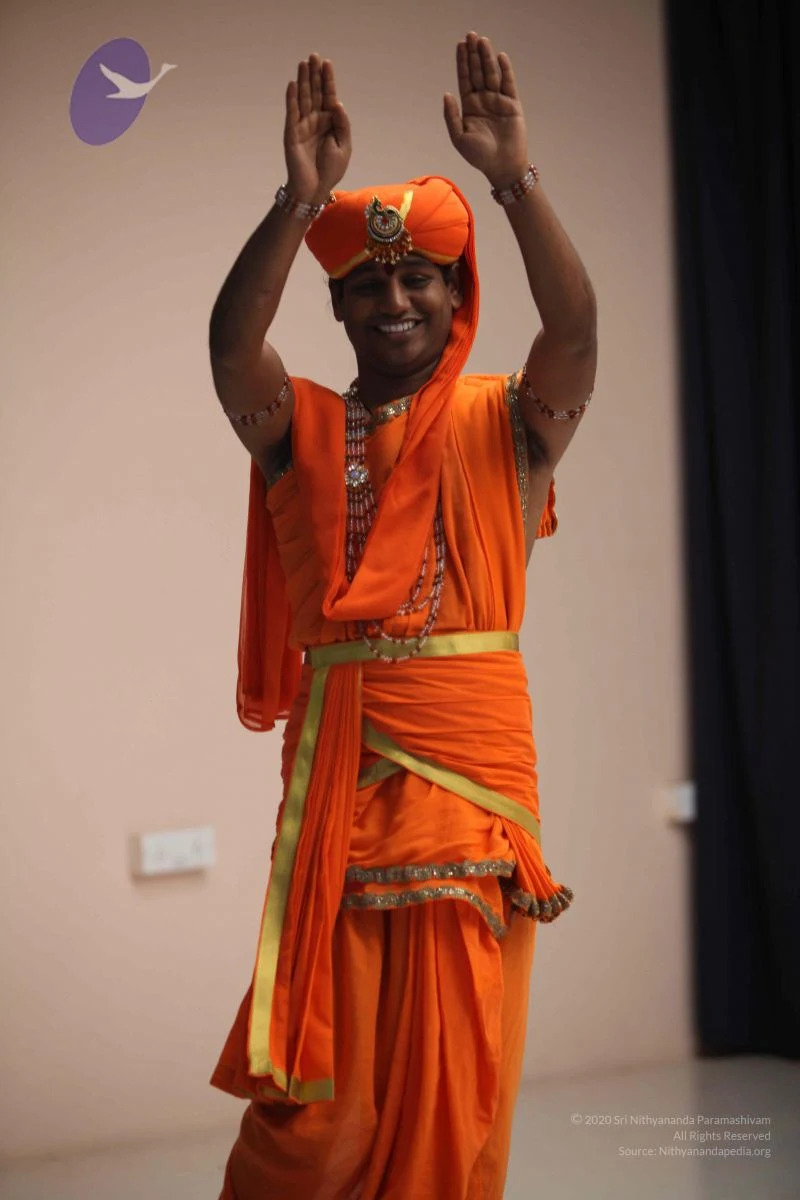
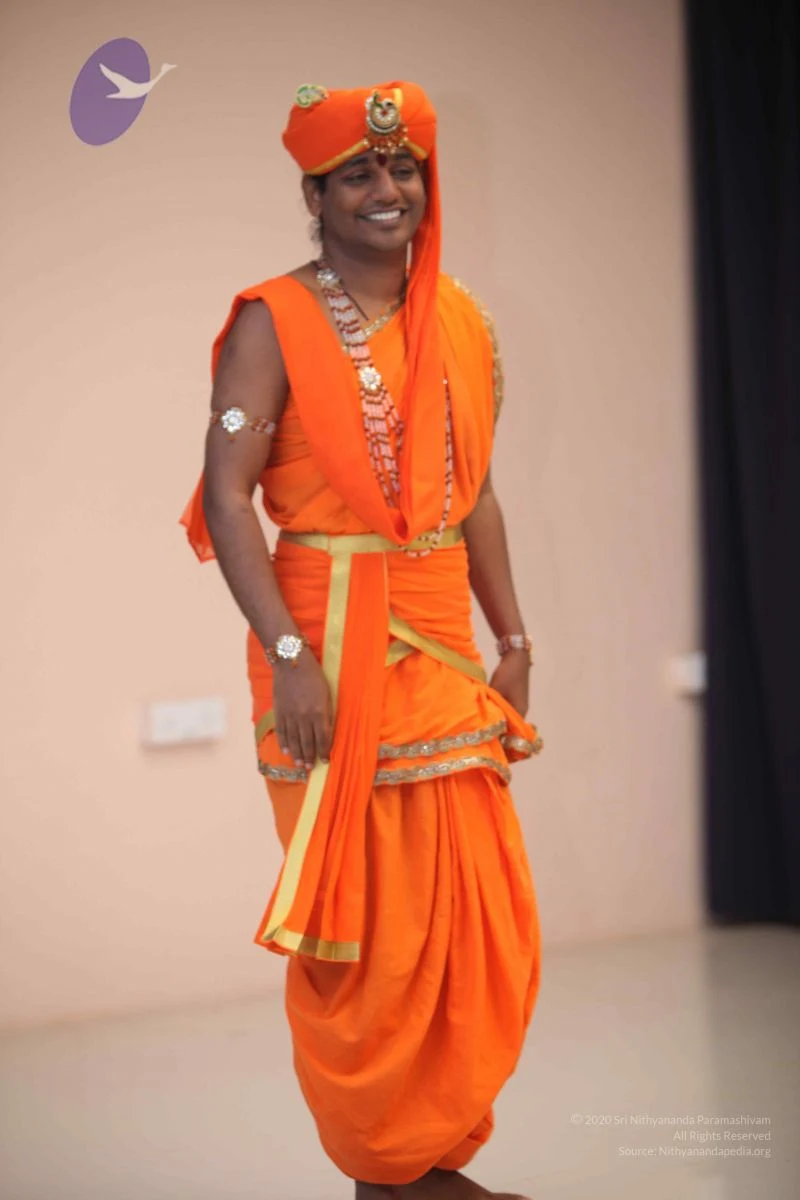
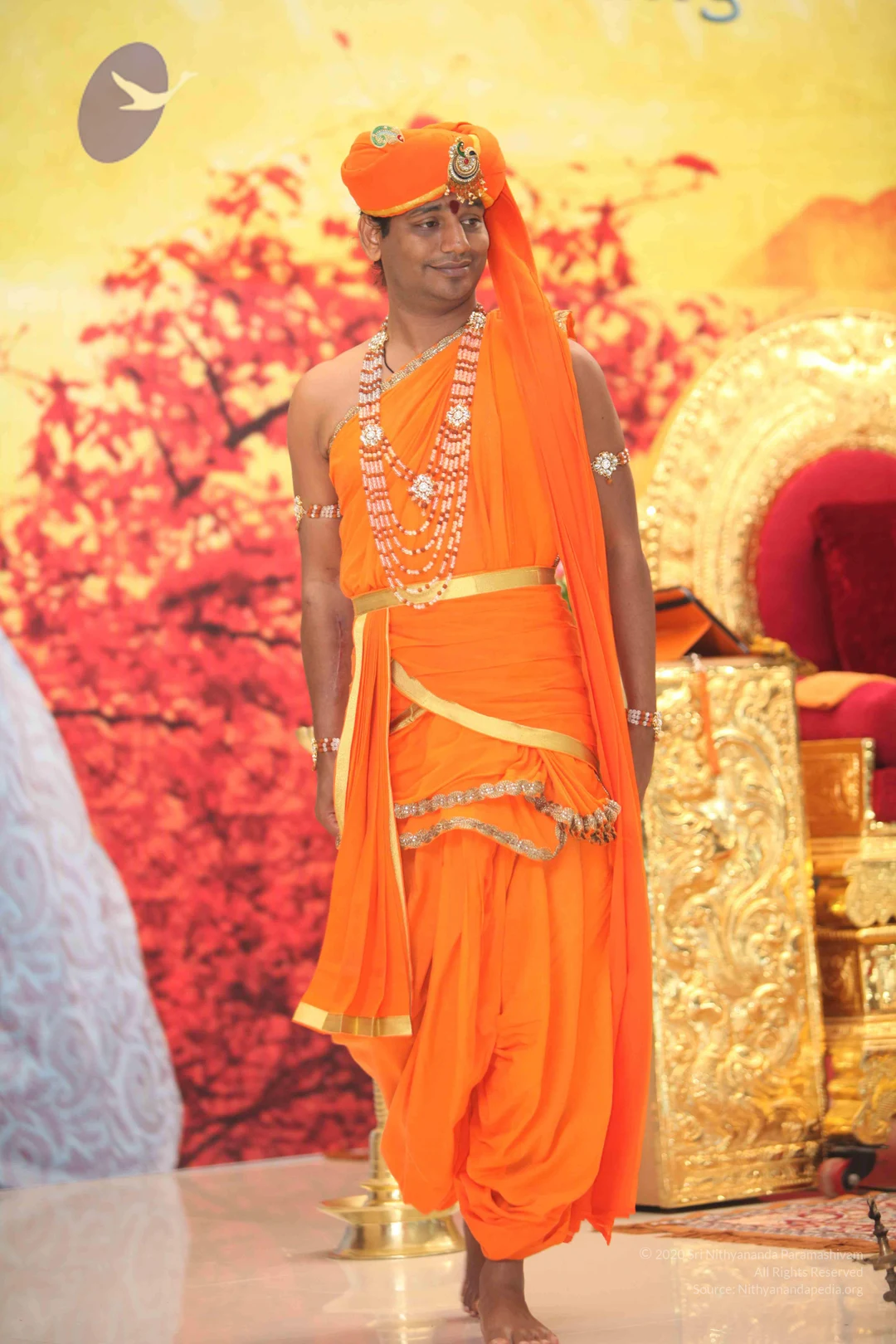
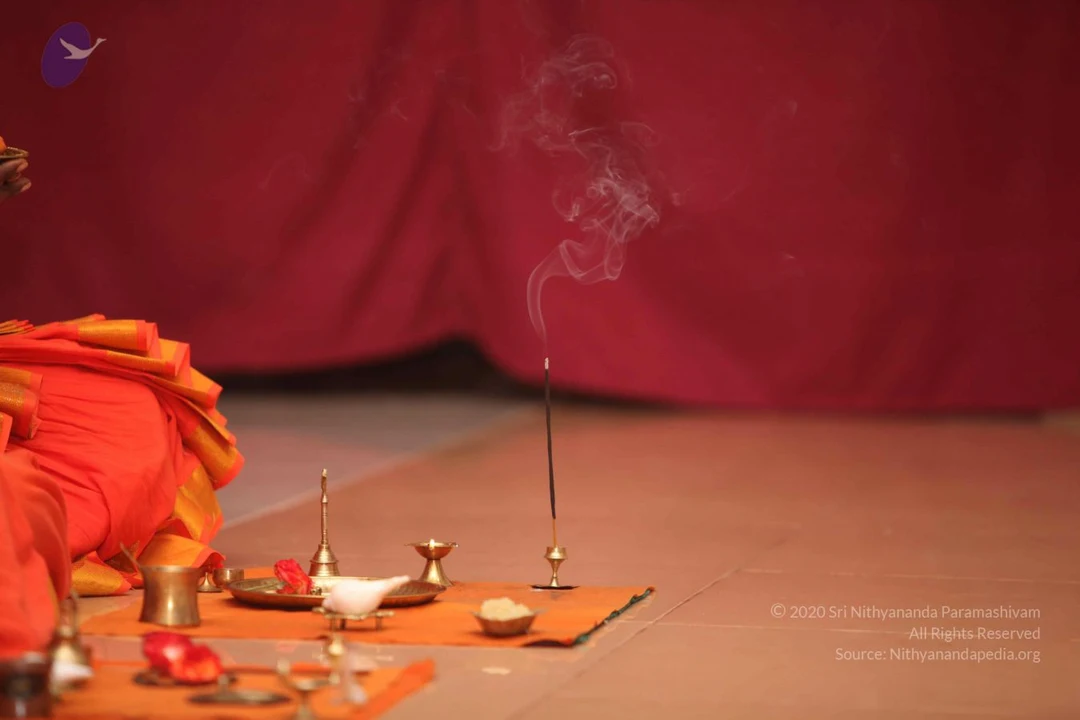
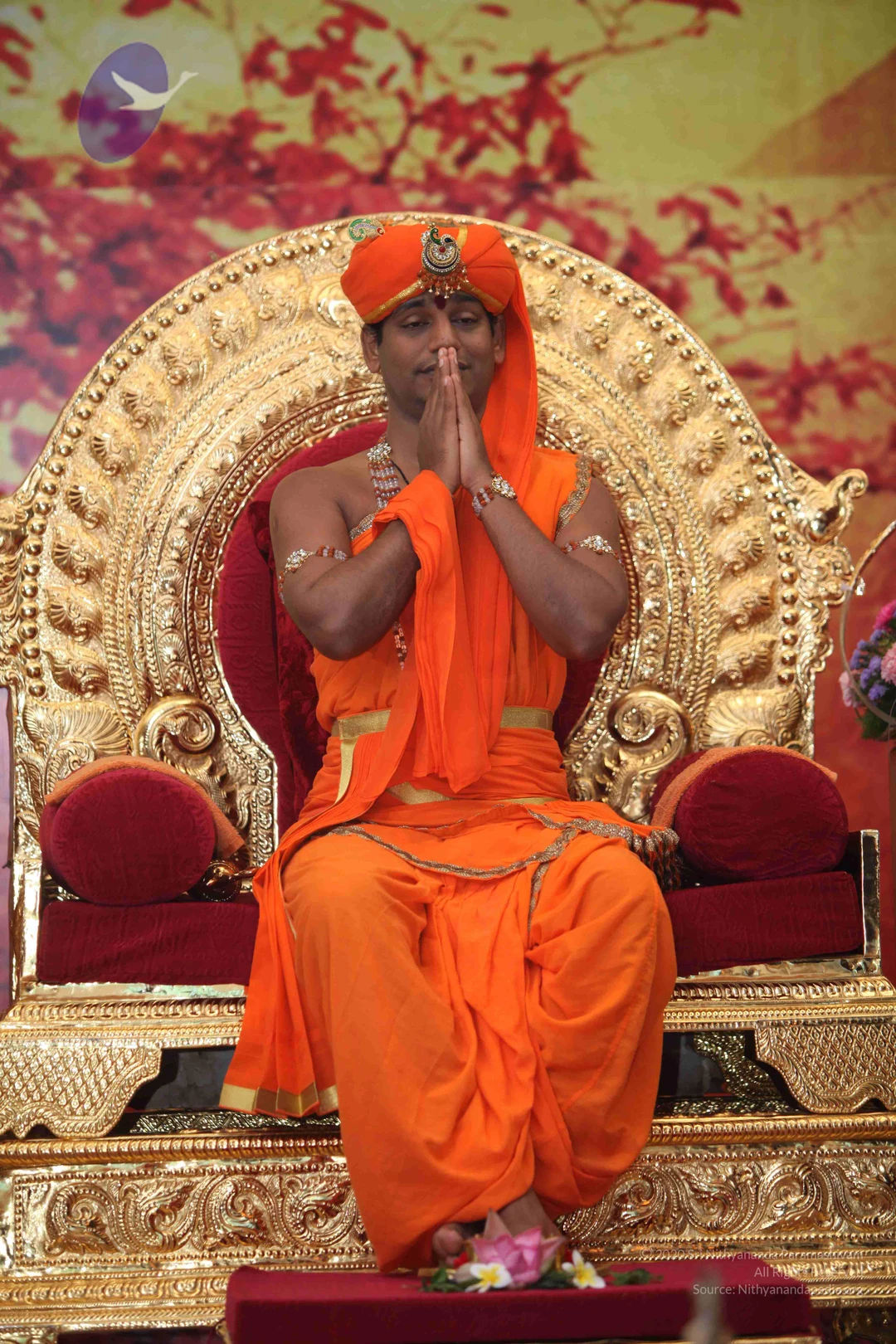
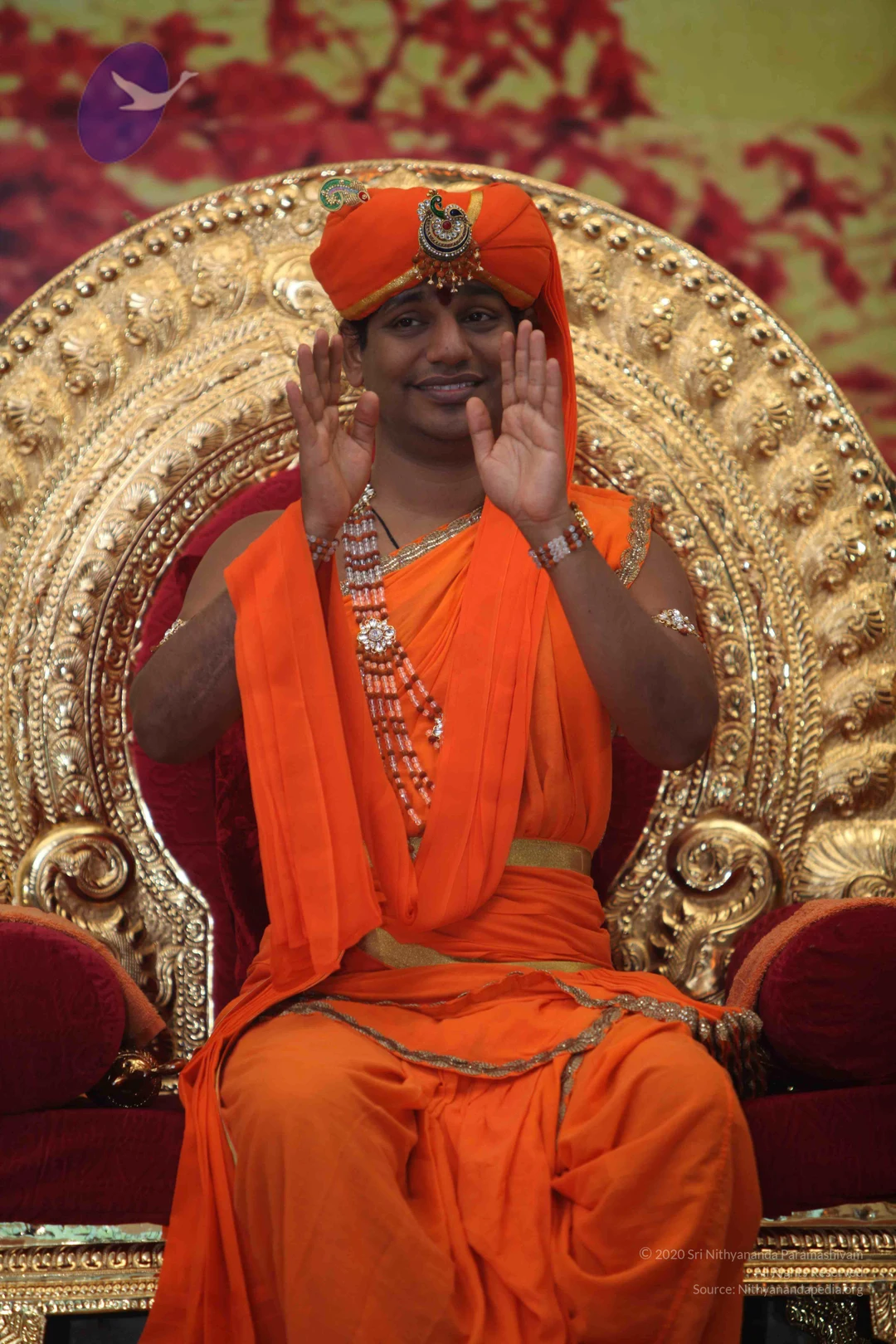
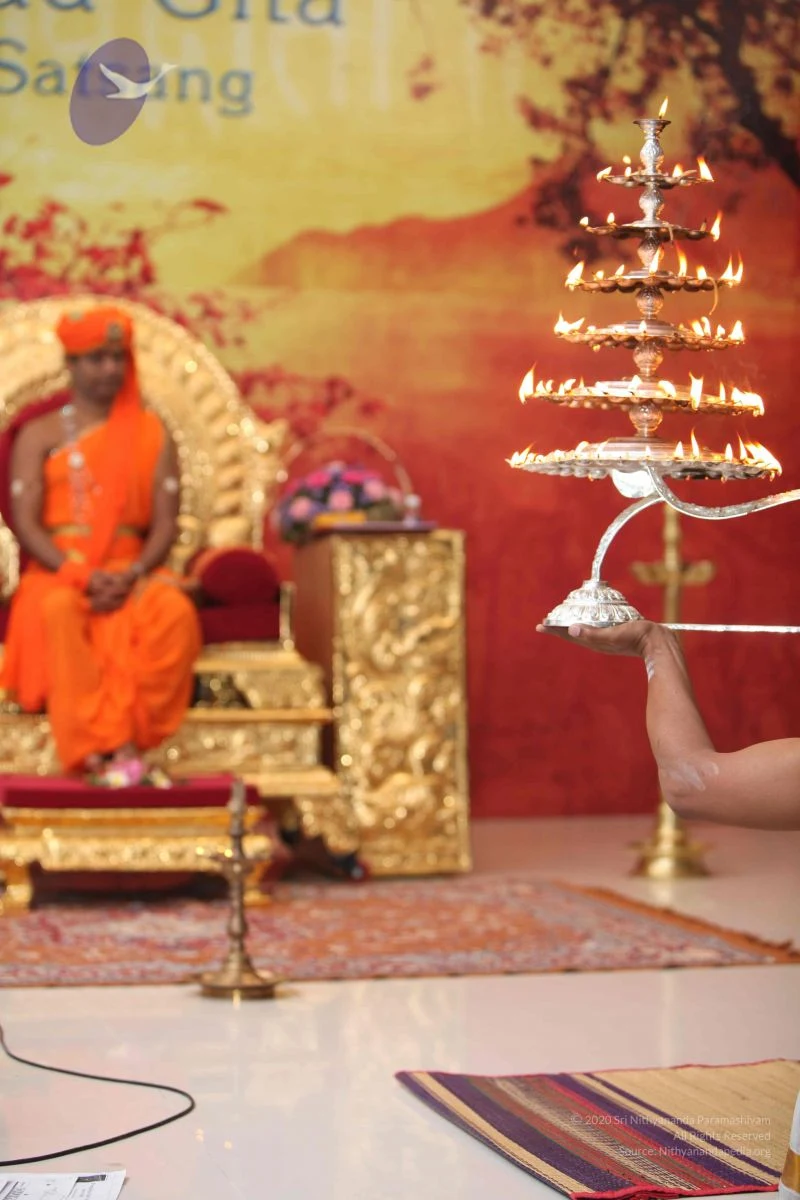
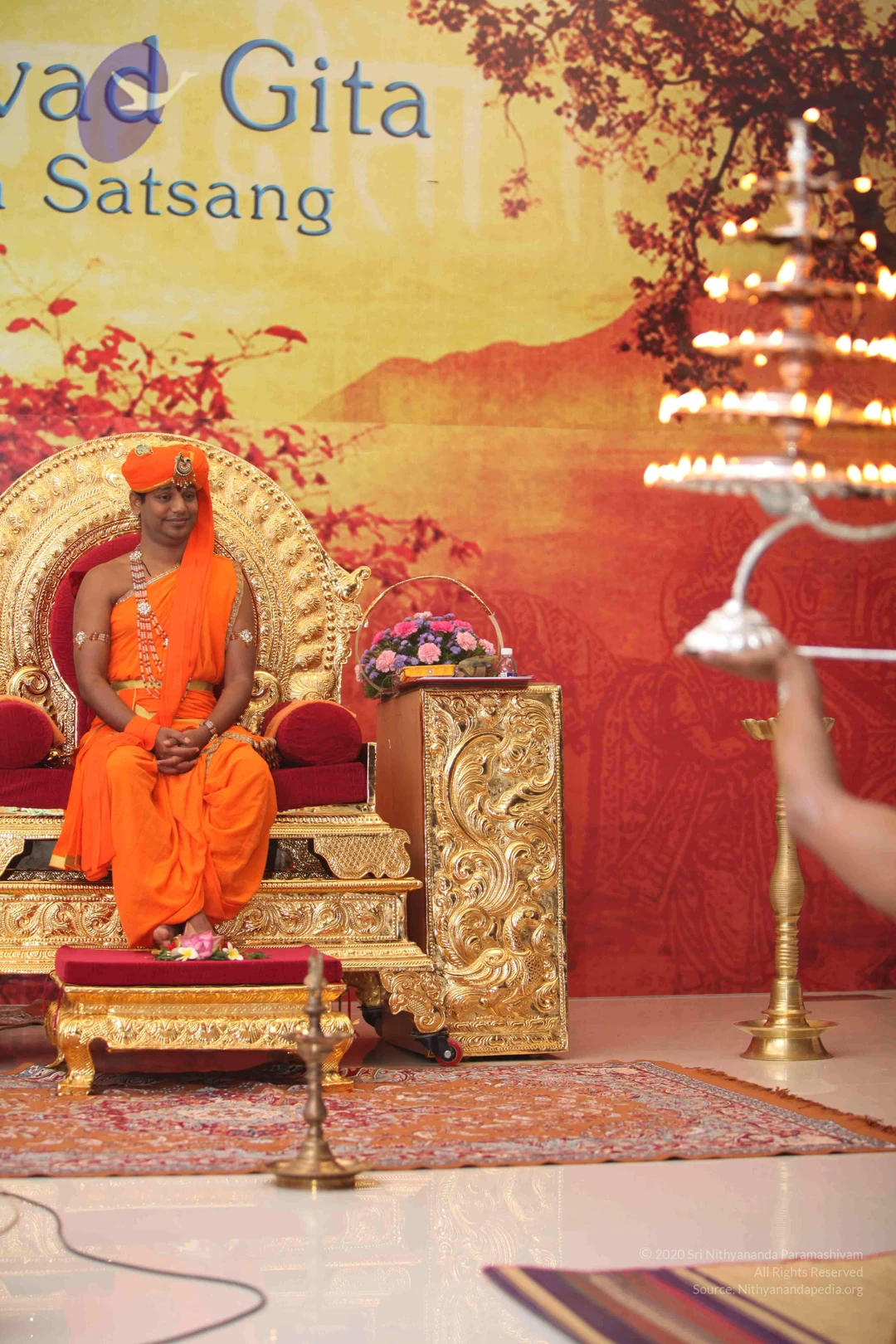
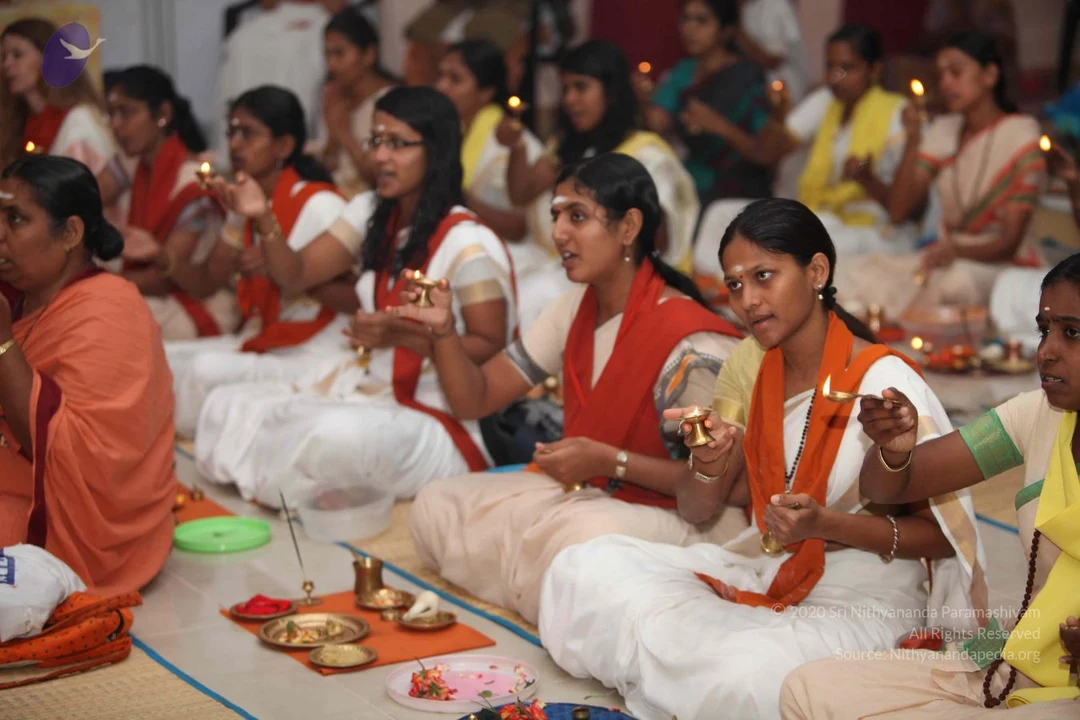
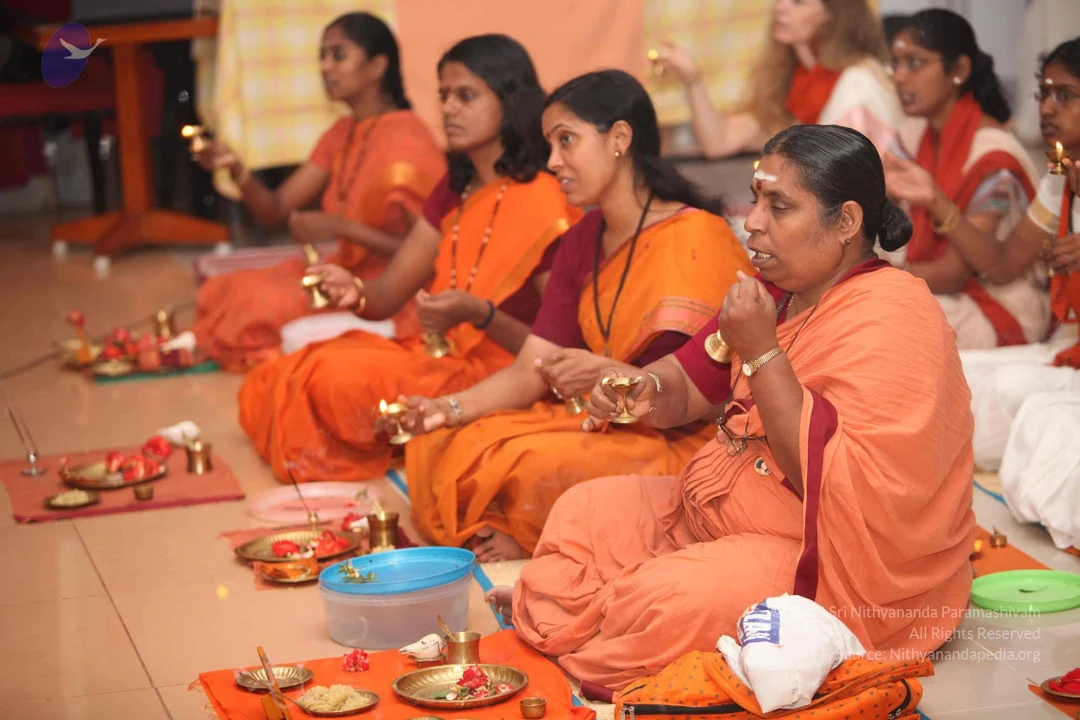
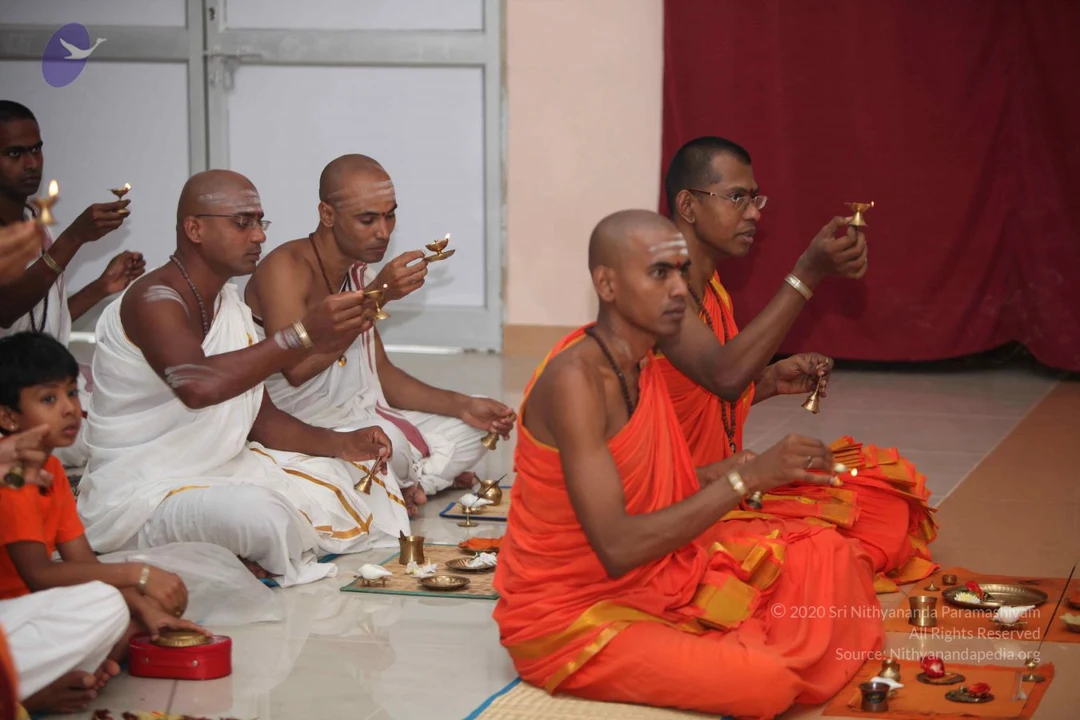
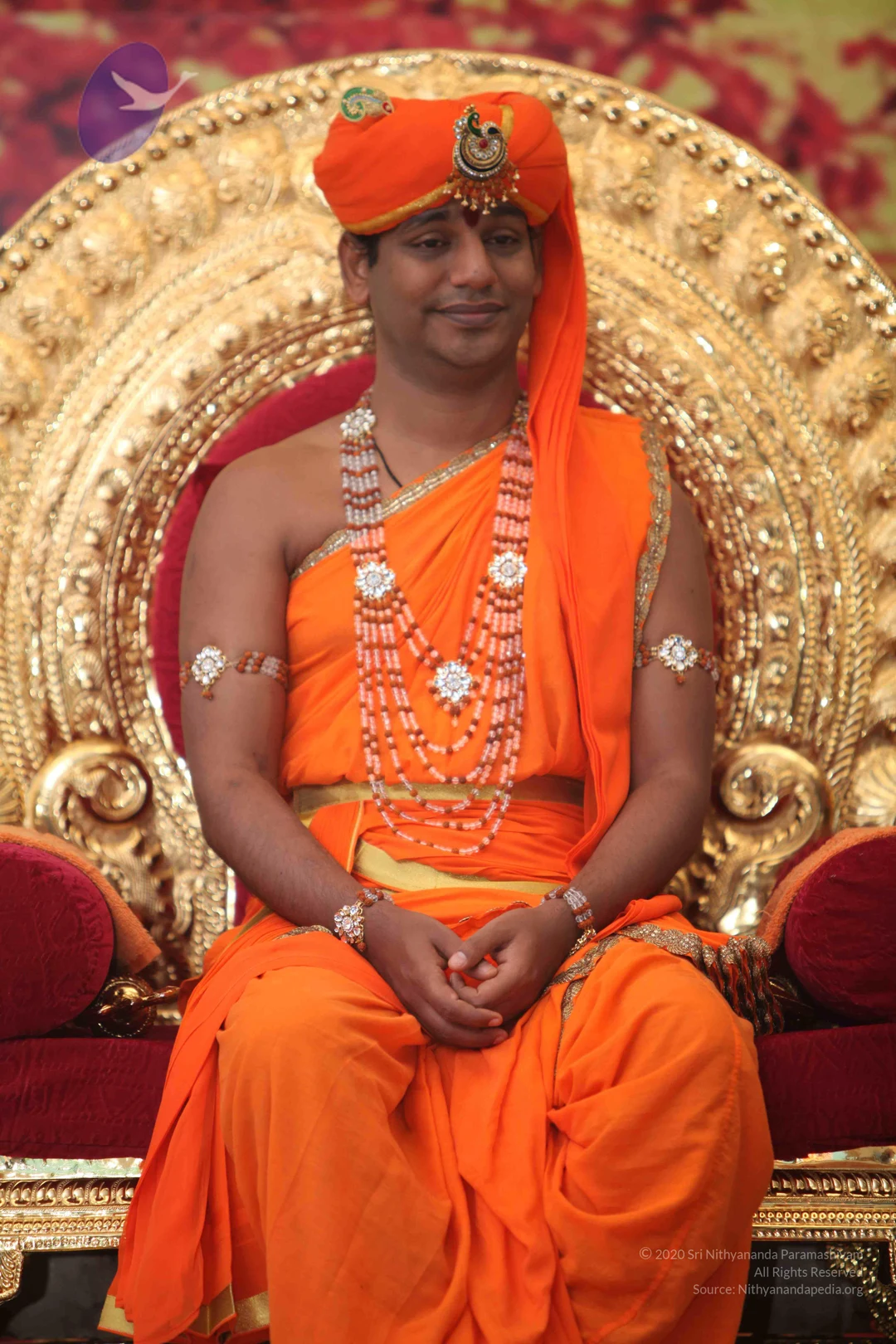
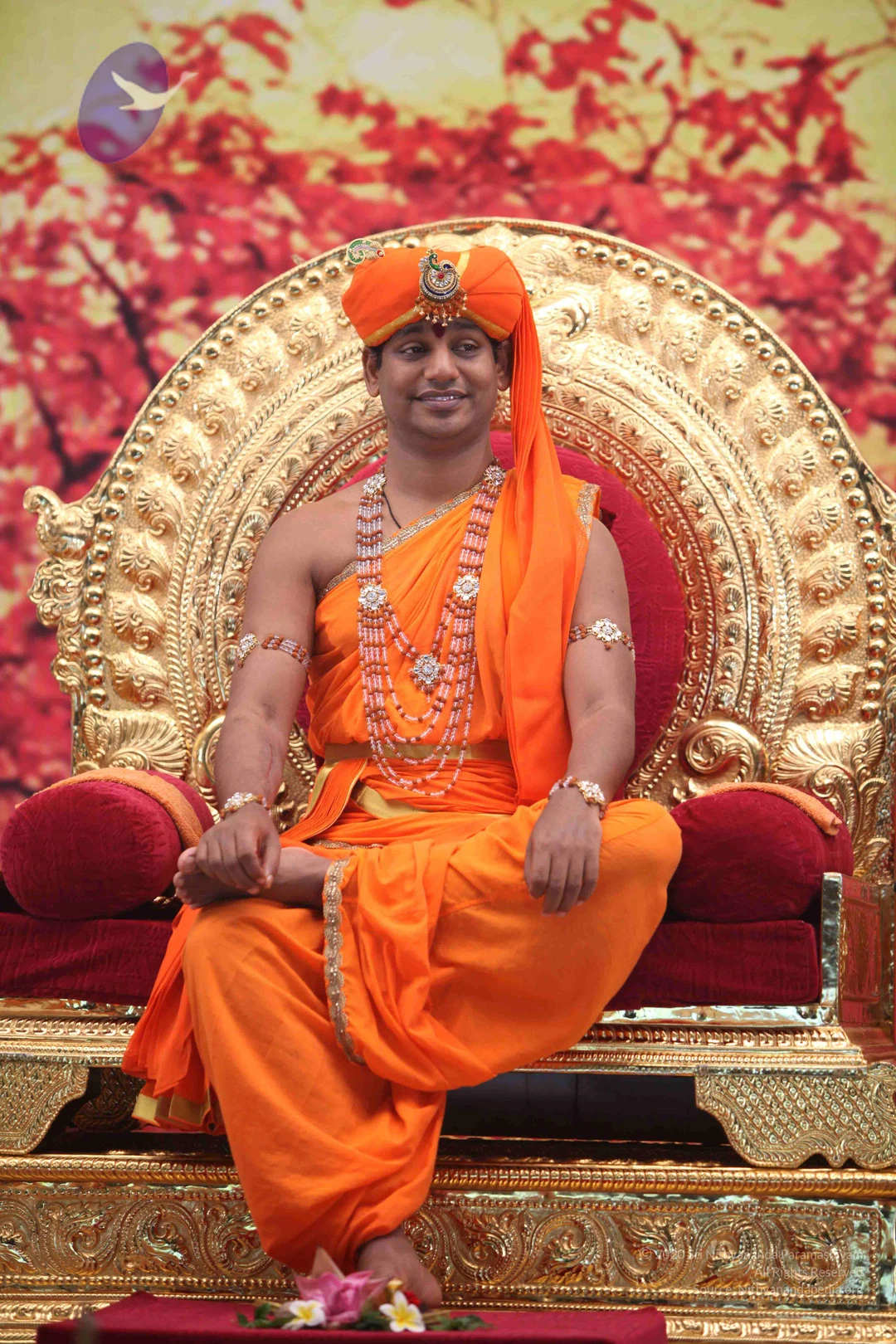
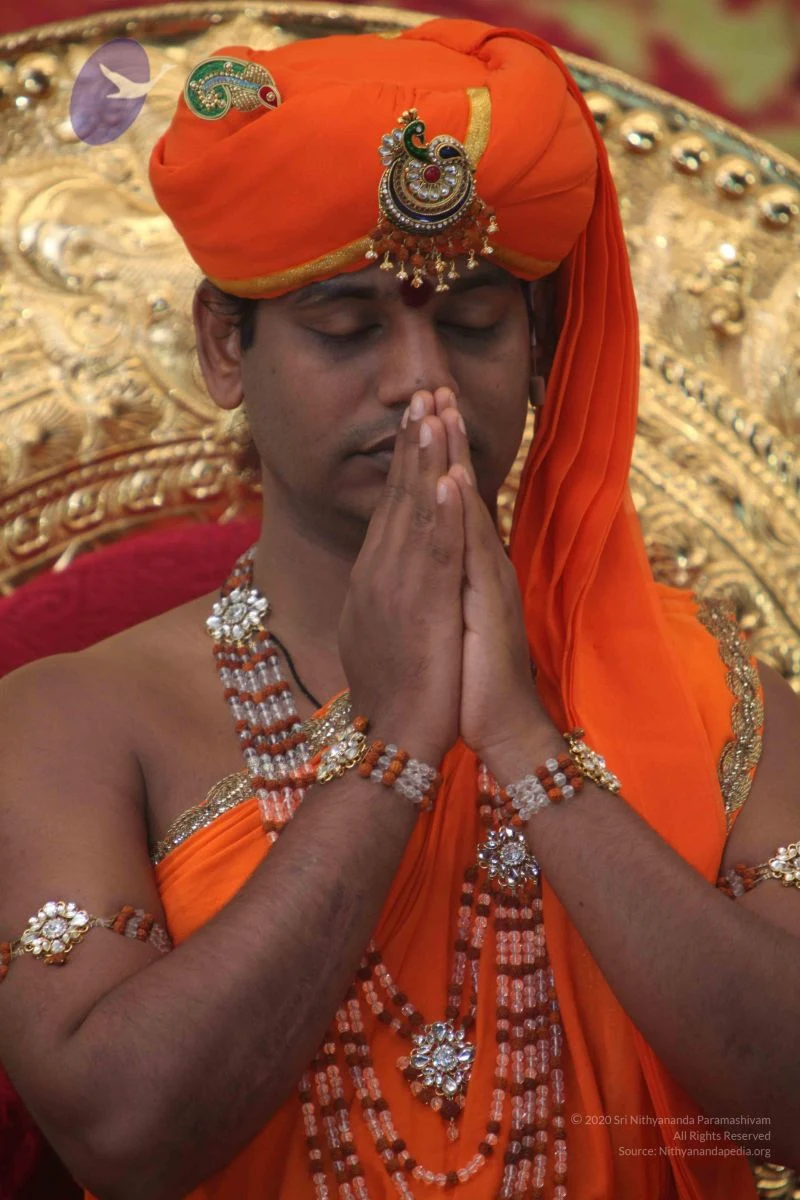
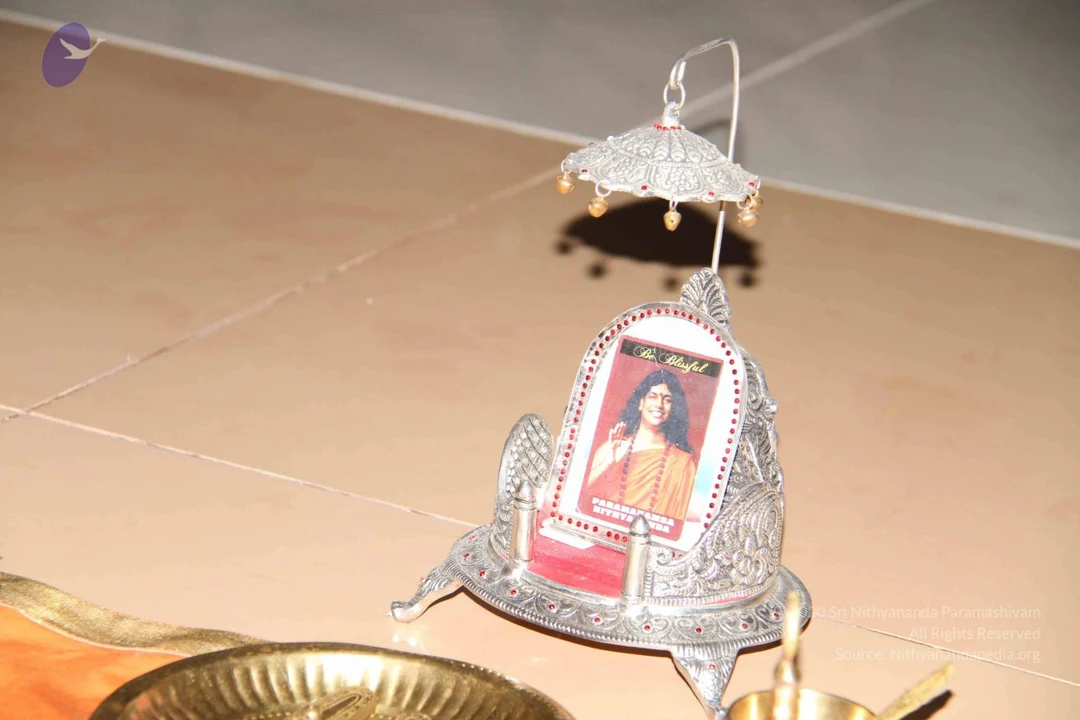
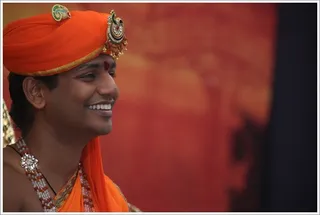
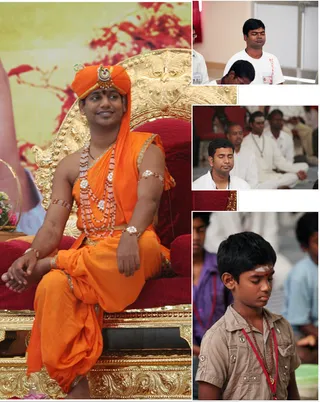
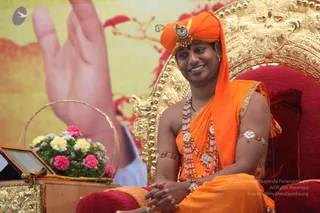
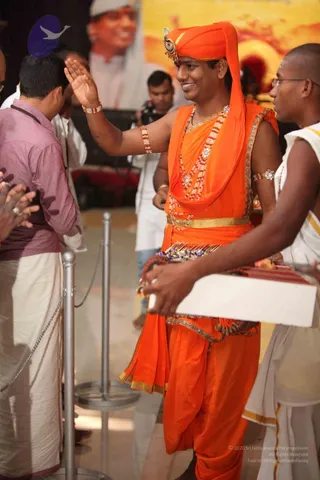
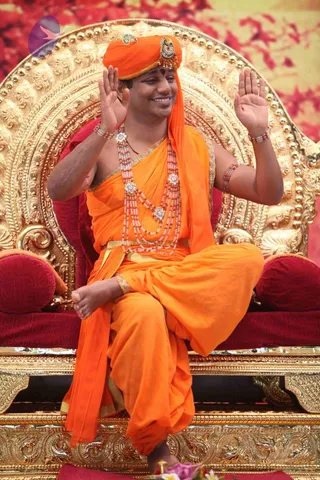
A smiling man in a bright orange turban decorated with a jewelled peacock brooch and a red tilak on his forehead. He wears an orange draped garment edged in gold trim, layered rudraksha and crystal bead malas, a crystal necklace and matching jewelled armlets. A gold ornate backdrop, possibly a throne or canopy, fills the background. Appearance-based label: a person, shown in person in ceremonial orange and bead adornment.Close crop of a seated figure in saffron-orange robes on an ornate gold-and-red throne. The figure's bare foot rests atop the other, one hand resting on the knee, wearing a beaded bracelet with a decorative clasp. Multiple strands of pink and rudraksha-style beads with a jewelled pendant hang over the chest, and a gold-bordered orange sash is at the waist. A red cushion and a small brass vessel sit at the left edge. Only partial body is visible; no face is shown. The figure's identity is not established from the image.A silver ornate stand with a small canopy holding a framed printed card on a pink-tiled floor. The card shows a smiling figure with long dark hair wearing an orange-saffron robe and a rudraksha mala, one hand raised in blessing. The card is labelled "Paramahamsa Nithyananda" and "Be Blissful". A brass plate with a saffron-orange cloth edge and a small brass lamp sit at the bottom edge of the frame.

September 20 2011

Original wiki page
Contents

Title:

THE SUPREME PONTIFF OF HINDUISM HDH BHAGAVAN NITHYANANDA PARAMASHIVAM

Link to Video:

VideoAudio

Transcript:

Bhagavad Gita

Life is a Psychodrama!

DATE: Day 29: Sep 20th 2011

He who considers the one to be the killer and he who considers the one to be the killed, both do not comprehend that the one does not kill nor is it destroyed.

Very beautifully Ramana Maharishi says: The man who thinks ‘I am sanyasi’ can never be sanyasi. The man who does not think I am sanyasi or grihastha or anything, even if he is in householder life married life he is beyond sanyasi; he is more than a sanyasi.

The person who thinks I am sanyasi can never be a sanyasi; that word is enough to make him a householder. The man who does not even feel he is a sanyasi or a grihasta he is the real sanyasi. That’s what exactly Krishna means here.

Arey understand the very idea you are a killer or one going to be killed, both are lies. Somebody imagines they are killers so they go on feeling that they are killing. Somebody imagines they will be killed and they will always experience being killed. It is just your simple decision. See in your life many time you will see…. take this verse as a technique not as a teaching…. technique.

When you are in upper hand in some situations of your life see how you feel/behave. When you are suppressed somebody else is in upper hand just see how your mind behaves. It is just your identification; when you feel somebody else having the upper hand you expect sympathy, when you are in upper hand you are not ready to show sympathy. You say what can be done; this is the way everything is. I am not saying change your way of working or thinking or attitude; No!

See Krishna is not saying change your way; because he is not asking Arjuna to run away from the war field. No! See after all now Arjuna is in the upper hand. He is not saying run away without killing, showing sympathy, no. He is saying understand this whole thing is a psychodrama; at one time you will be in lower mood at one time you will be in the upper hand. It is just flow of life. This is the way it is flowing. The self which is the source neither kills nor gets killed. He is just saying realize that you are beyond both; just realize you are beyond both.

ya enam vetti hantarm yas caiman manyate hatam |

Please understand just like the other day I was giving you a technique to decode pleasure and pain into heat and cold, now I am giving you a powerful process to decode ahankara mamakara. Ahankara is the one always makes you feel you are in the upper hand. mamakara is the one always makes you feel you are suppressed. Please understand you feeling you are on upper hand, you are in the higher position or you are in lower position has nothing to do with outer incident. Like you feeling pain or pleasure has nothing to do with outer incident outer happening. It is something to do with the heat or the cold you feel inside and the software with which you are functioning inside. It is just your coding.

If you are asked to do yoga, you feel all kinds of pain and suffering. But if you are climbing the hill on your own, trekking, that is much more difficult than this yoga, but you feel all pleasure; wow what a great thing. Pleasure and pain are nothing to do with the outer happenings. It has something to do with the way you are coded and the experience of heat and the cold. Same way feeling you are killed or you are killer, you are powerful or weak, you are going to destroy or going to be destroyed, is just something to do with your ahankara and mamakara.

Please understand you feeling you are powerful or you are the killer or you feeling you are weak and you are killed/you will be killed; this both has nothing to do with the outer situation. It has something to do with whether you are caught with ahankara or mamakara. If you are caught with mamakra even if you are killing everybody you will feel you are weak and some…. any moment you may be killed. Same way ahankara also - feeling that you are a killer; your whole army is killed still these fellows are feeling that they will be the killer - like Duryodhana. His whole army was killed. Even the last moment he is shouting eh eh eh. There are some Duryodhanas even when they are sinking they will say eh you are killed you are killed you are killed. This is just a psycho drama.

Understand just like how pain and pleasure has nothing to do with the objects coming in contact with your senses, it has more to do with your software programming - the coding with which you are functioning. Same way, feeling you are killing, you are a killer or getting killed both have nothing to do with the outer situation. It has something to do with your coding; the software with which you are programmed. Decode.

In your life many time when you are crushed by your boss you will feel you are being killed. Just code how you are feeling at that moment. Don’t try to respond to the outer world situation, I am not teaching you that. I am teaching you, how you are feeling…… try to decode. What is exactly your feeling? Same way when you are in the upper hand, your subordinate has done some big mistake and you caught it exactly and he tried to hide from you and you caught him red handed. Now you are in upper hand you are in mood of a killer. Just see how you are functioning, find the pattern of your functioning; the coding the software the programming with which you are functioning.

Understand both the patterns….. you will realize you are beyond both these patterns. That is what Krishna means in this verse. The sacred secret in this verse is you are neither the pattern of the killer nor the pattern of the killed. Both are just patterns. Step back from the patterns. Step back from the patterns. If you are trying to break or justify ‘the killer’ pattern with the philosophy it is not going to work. If you are trying to justify ‘being killed’ pattern with some philosophy it is not going to work. If you are trying to break the pattern of a killer - any logic it won’t work. If you try to break the pattern of the killed with any logic it won’t work; just step back.

A small story:

An eccentric philosophy professor gave a question in final exam. The whole class was seated ready to go when the professor picked up his chair plopped it on desk and wrote on the board - Use everything you have learnt in this semester, prove that this chair does not exist philosophically. And the argument started left and right, fingers flew, erasers erased, notebook were filled in furious fashion. Some students wrote fifty pages in two hours attempting to refute the existence of the chair in all possible way. One member of the class was up and finished in less than a minute. He just answered in just less than a minute.

One week later when the grades were posted, the rest of the group wondered how did this fellow who wrote the answer in one minute got ‘A’ grade. He had barely written anything at all. They all questioned the professor ‘how can you give ‘A’ grade for him?’ The professor said his answer was just two words – ‘What Chair?’ That’s all. Understand by philosophical argument you cannot break the pattern.

If you start philosophical argument over this sutra and say wah what do you mean you are neither killed nor a killer? Can I kill you now then? Then everybody can kill anybody. Then Krishna is promoting a violent immatured or ‘might is right’ kind of a culture or what. Anybody can kill anybody. Neither you are killed nor you are a killer. What is this? It’s almost like giving license to killing. It’s like a barbarous civilization.

Please understand no philosophical argument can make you understand this verse. This verse is not for creating any philosophical argument or theology. It’s a technique. Even Hindu gurus have struggled a lot to decode this sutra, this verse.

Photos
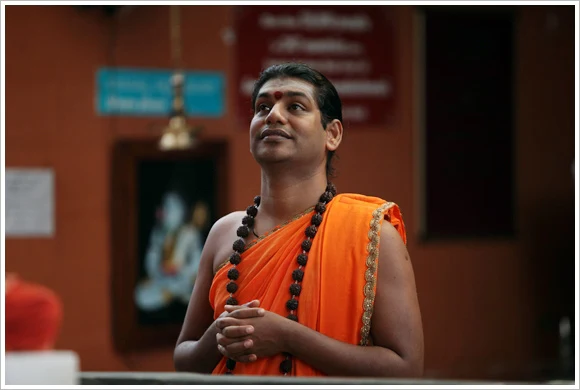
Photos Of The Day:

Temple
Bhagavat-Gita-Satsang
darshan

Pada-Puja

Sacred-arts

Photos Of The Day:

Sacred-Arts

Sub Category: Shiva

Photos from this day

View all 181 photos

Photos

7 photosSource gallery
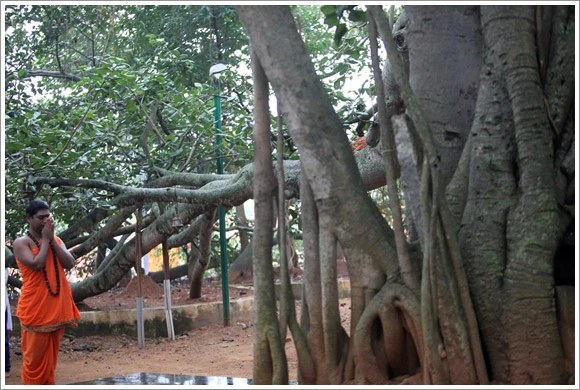
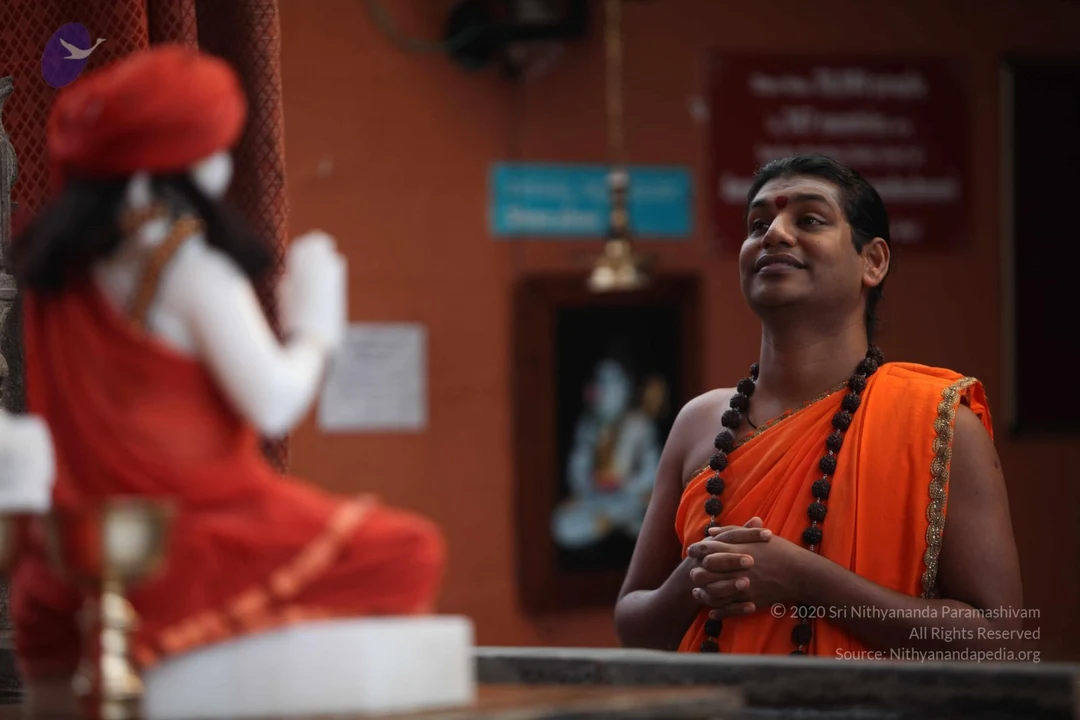
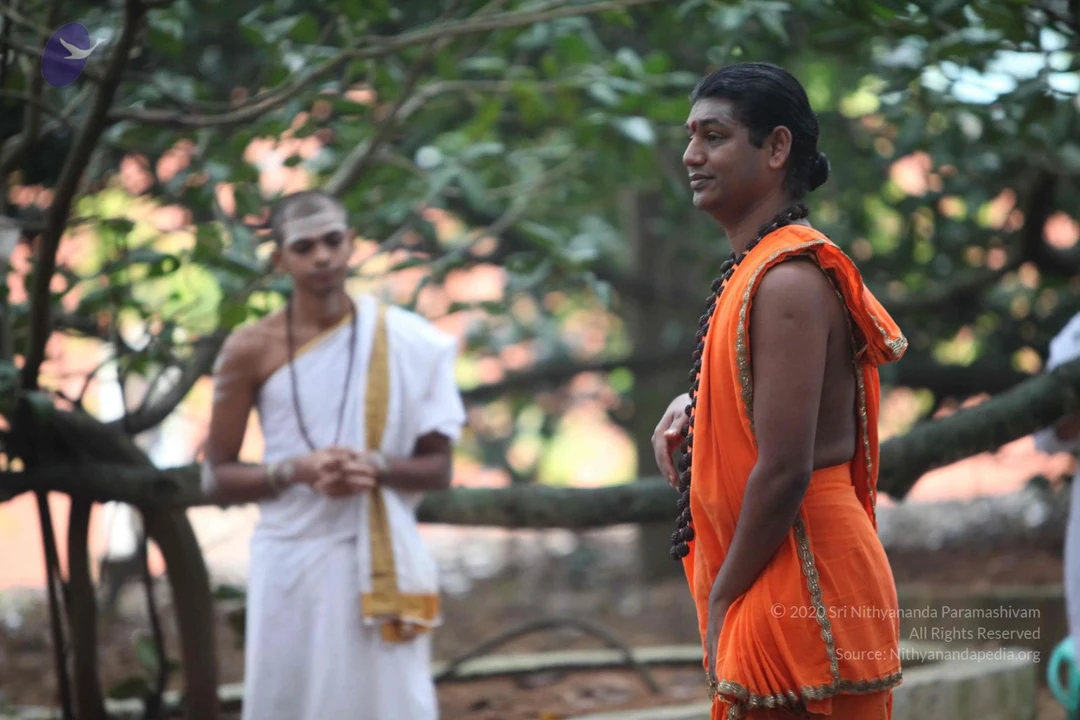
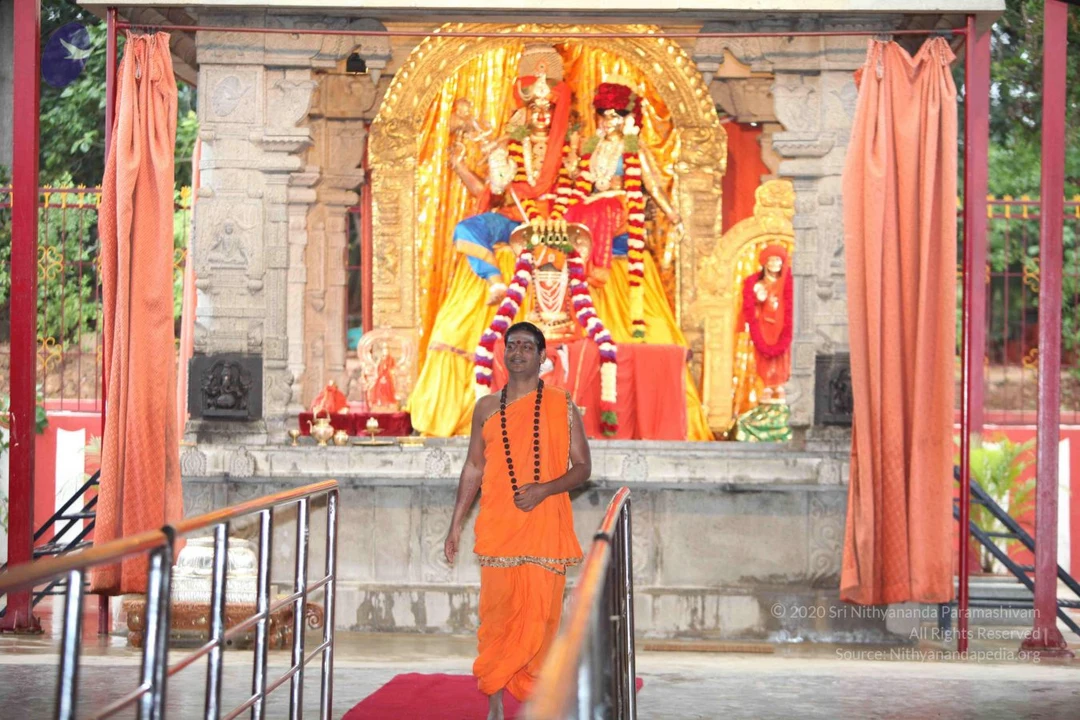
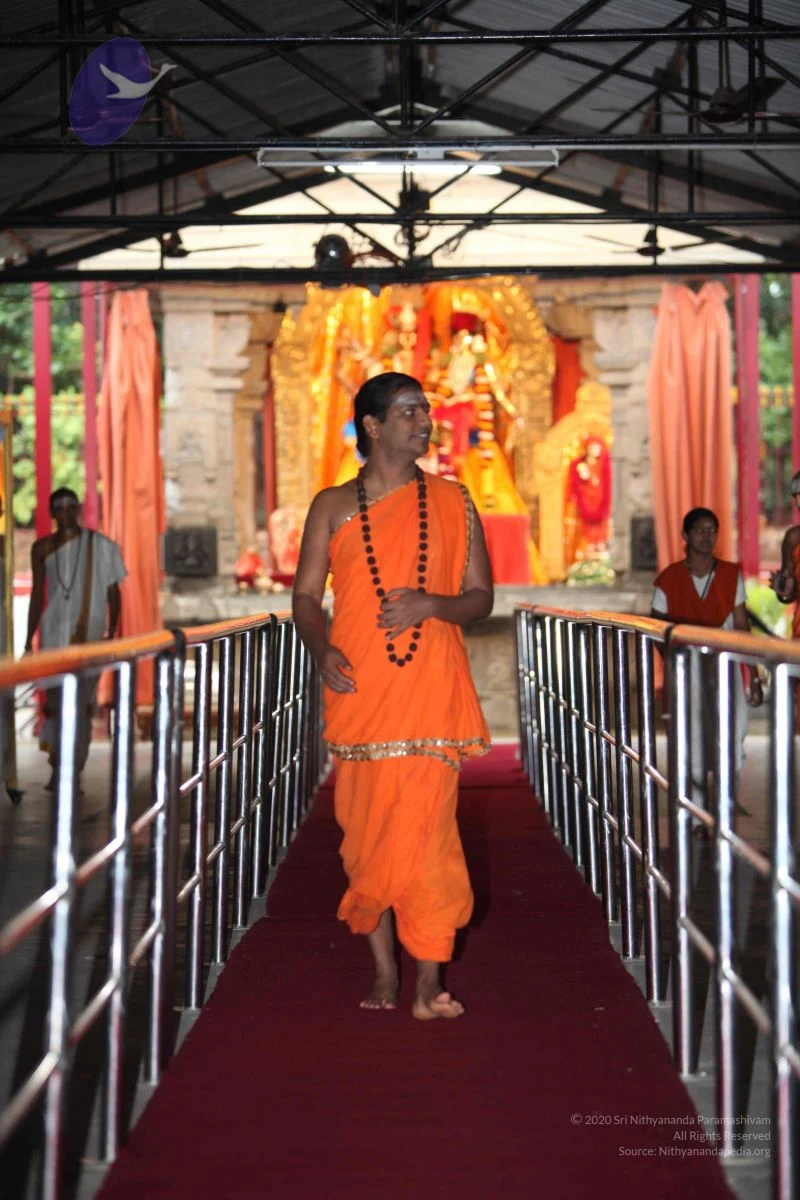
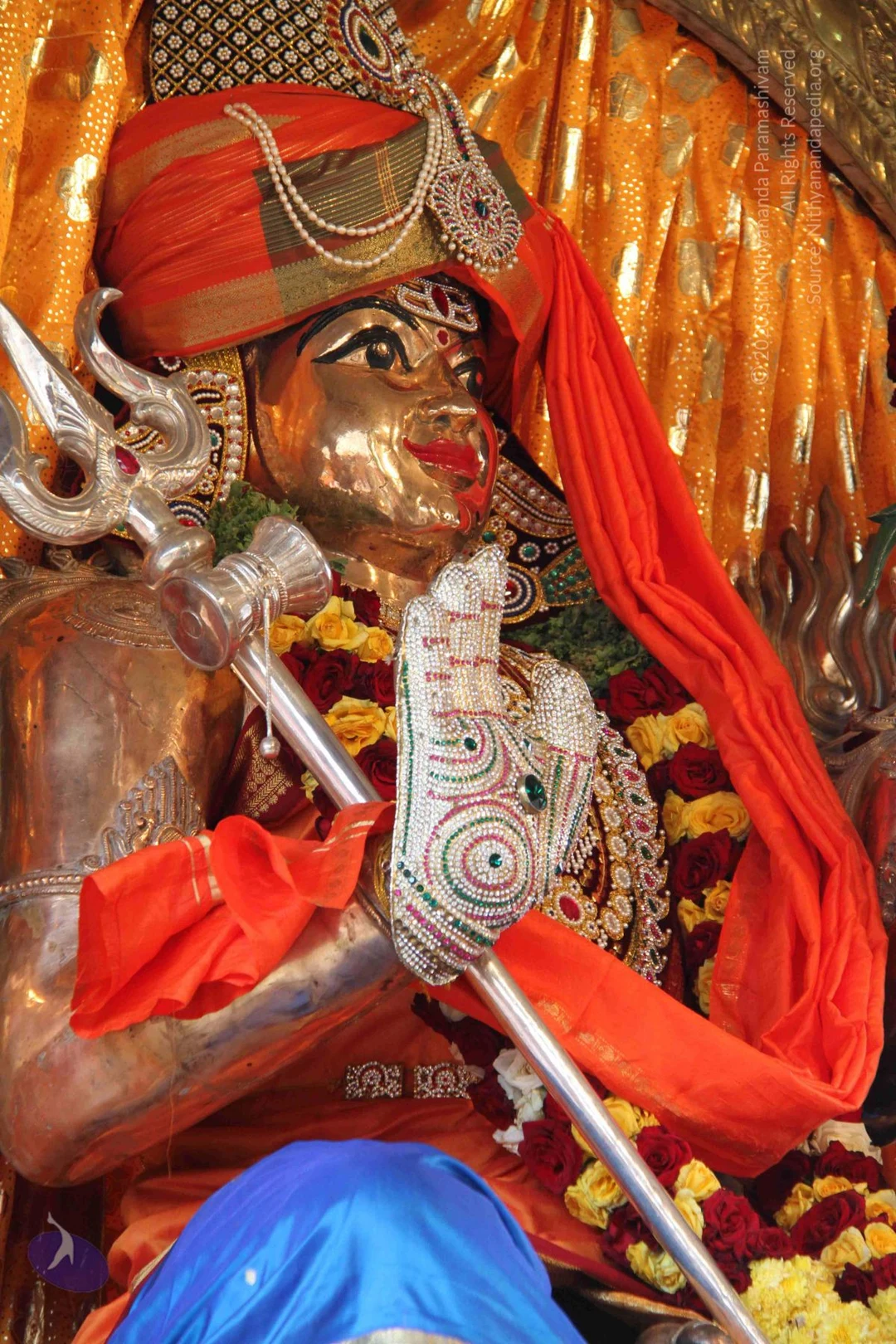
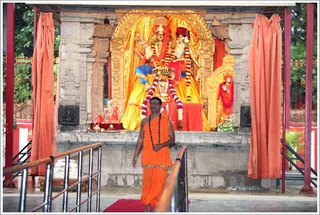
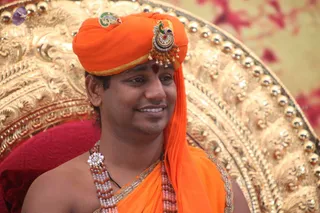
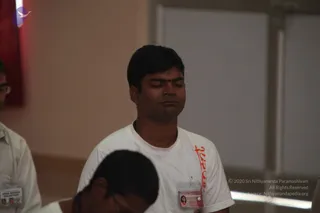
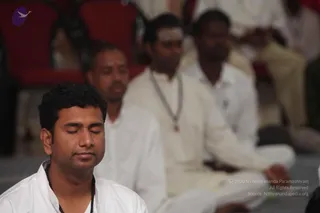
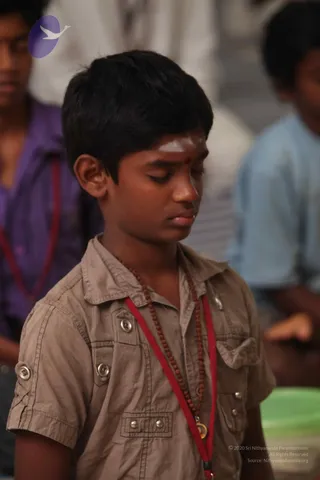
A man stands indoors in front of an orange-red wall, gazing upward with hands clasped at his chest. He wears an orange saffron wrap with gold-bordered edges over bare shoulders and a long rudraksha mala of dark beads around his neck, with a red bindi on his forehead and short dark hair swept back. Behind him hangs a framed picture of a deity, a brass hanging lamp is visible at left, and a red sign with white script is mounted high on the wall. The image looks like a devotional portrait of a sannyasi in a temple or ashram hall. a person appears in person by appearance cues of saffron wrap and rudraksha mala, matching the page's attribution.A photograph of a large old banyan tree with sprawling aerial roots and a long horizontal limb extending across a sandy-earthed clearing. On the left, a bare-chested man in saffron-orange cloth wrapped around his lower body, with a rudraksha mala around his neck, stands with palms pressed together in namaskar near the tree trunk. A thin green lamp post and a small metal sign stand nearby, with foliage and a dark pool of water at the bottom edge. The man has short hair and distinctive ceremonial adornments, but his face and appearance are not clear enough to confirm identity, so he is described only as a devotee in prayer.A man in orange-saffron robes walks down a red carpet toward the viewer, past a metal railing, in front of an ornate temple shrine. He wears a rudraksha mala around his neck and has a dark cloth or headwear. Behind him, a golden shrine houses large deity murtis draped in yellow and red garments with garlands of marigold and red flowers; a red-clothed figure and small devotional images stand to the sides. Red curtains frame the scene and a red carpet leads toward the shrine.A collage of photographs centred on a tall multi-tiered brass oil lamp with many lit wicks flaming on its five circular dishes, set on a woven mat. Smaller panels show women in saffron and orange saris with maroon blouses and rudraksha malas seated in rows, one holding a brass plate of offerings, another with a brass plate of red flowers, rice and yellow kumkum, and a brass pot in front. Behind them are a red wall and a cross-shaped gold ornament. Four small panels show physical people in the scene, all in orange saris.A smiling man in profile wears an orange turban with a gold jewelled ornament and a small red bindi on the forehead. He has an orange-saffron shawl draped over his shoulder and a multi-strand beaded necklace with a large ornate pendant. The warm orange background suggests a stage or ceremonial setting.Collage of four photographs from a satsang. The large left panel shows a man seated on an ornate gold-and-red throne, wearing an orange turban with a jewelled crest, orange robes, layered rudraksha and red-beaded malas, a ceremonial gold necklace, and armbands; the page-flag context matches a person. Upper right, a man in white shirt with an event badge stands with eyes closed beside a seated person in white. Middle right, a man in white sits in meditation among seated devotees in white clothing. Lower right, a boy in a khaki shirt with a vibhuti mark on his forehead and a red lanyard meditates with eyes closed, another person in purple beside him. Multi-panel graphic with no separate physical people counted.

Temple

23 photosSource gallery
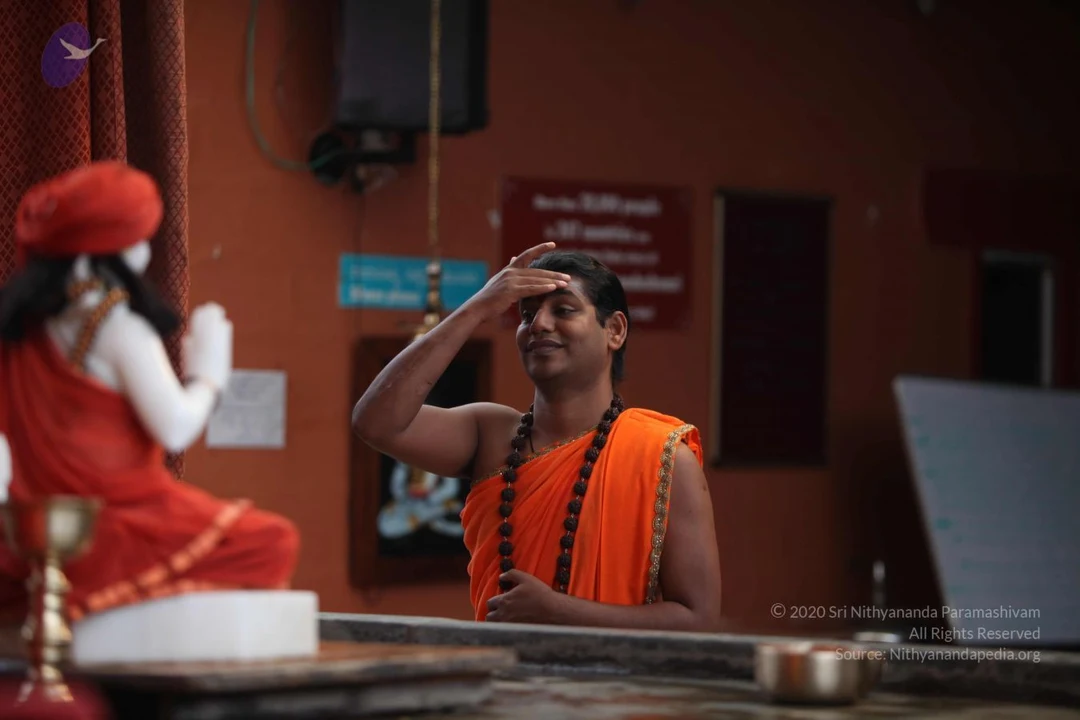
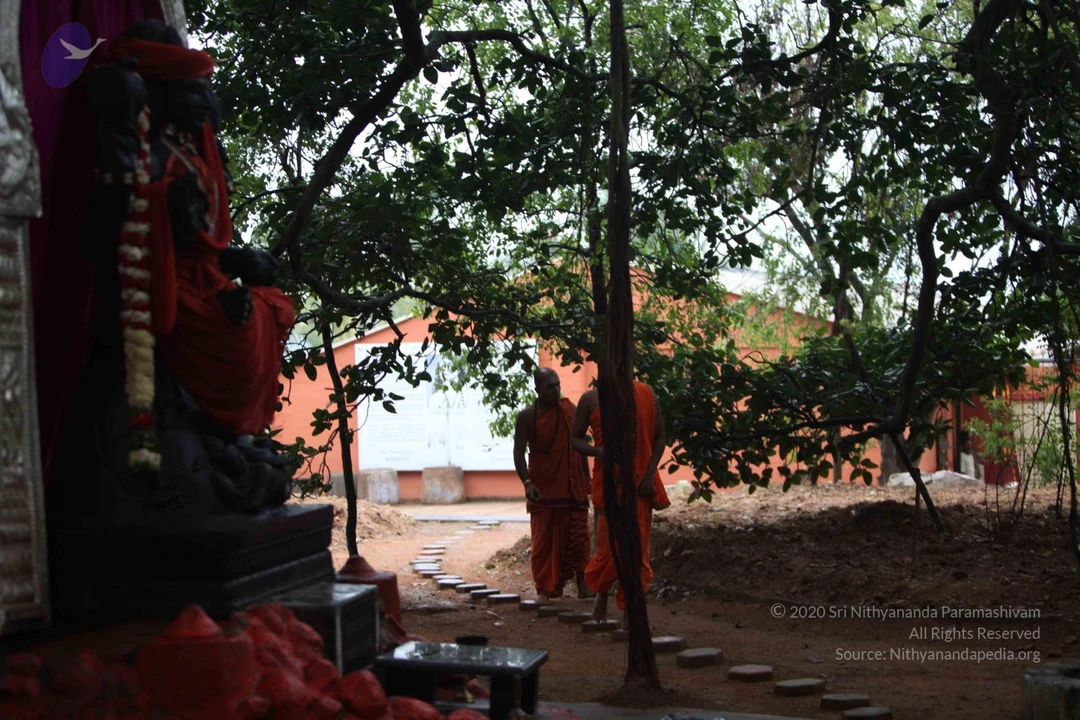
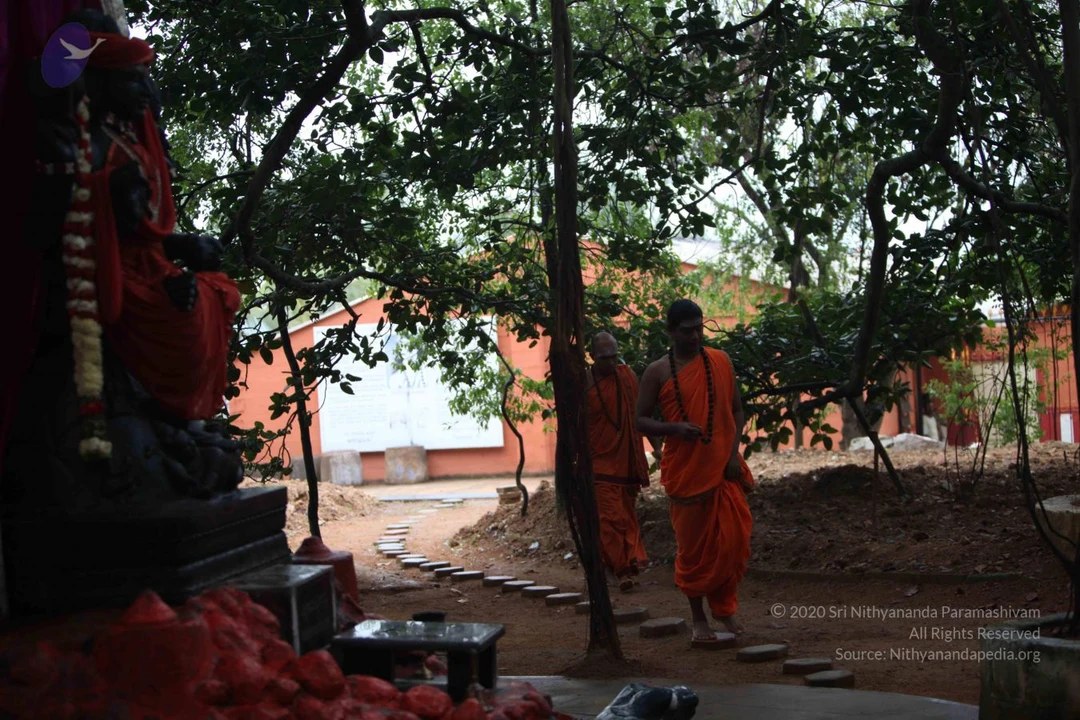
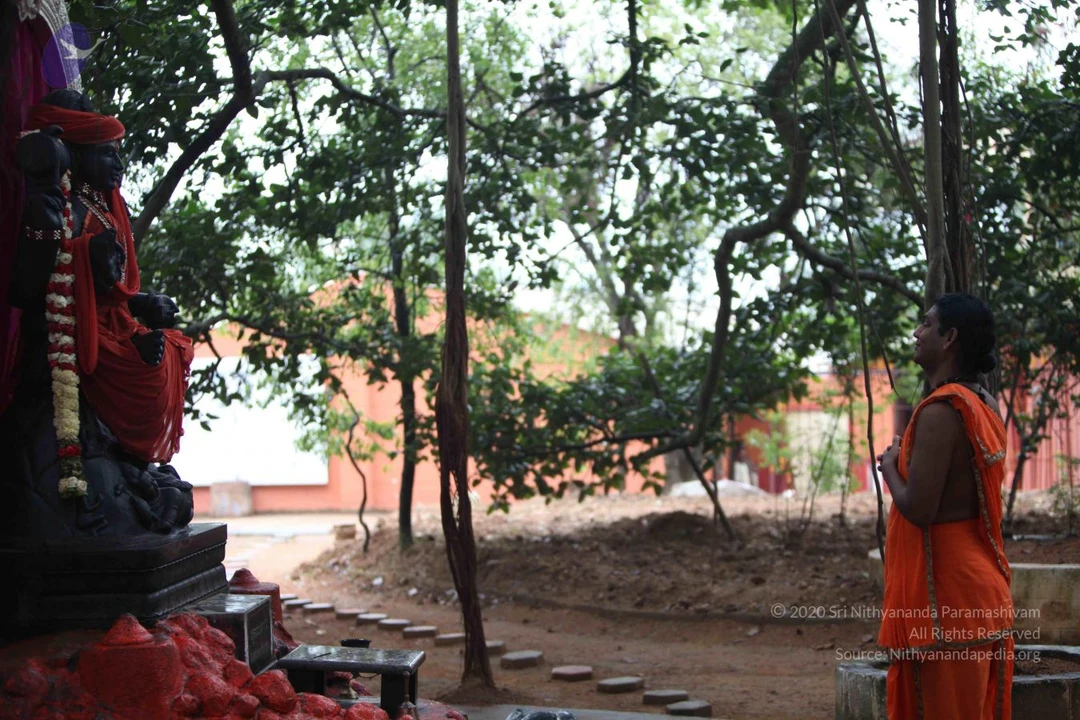
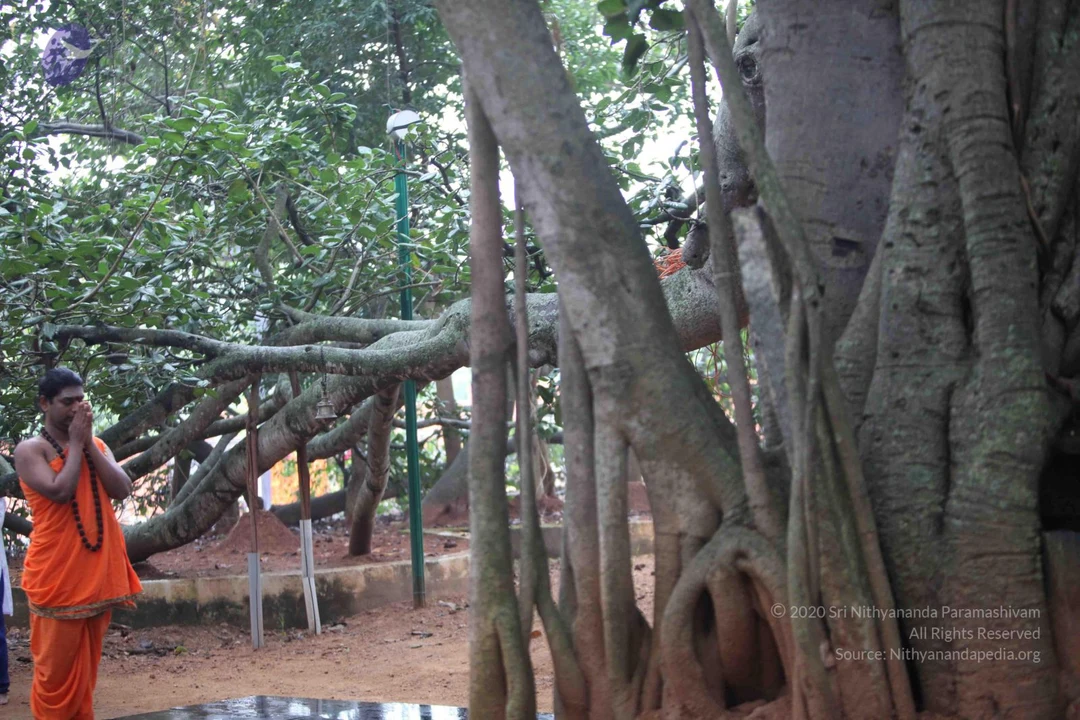
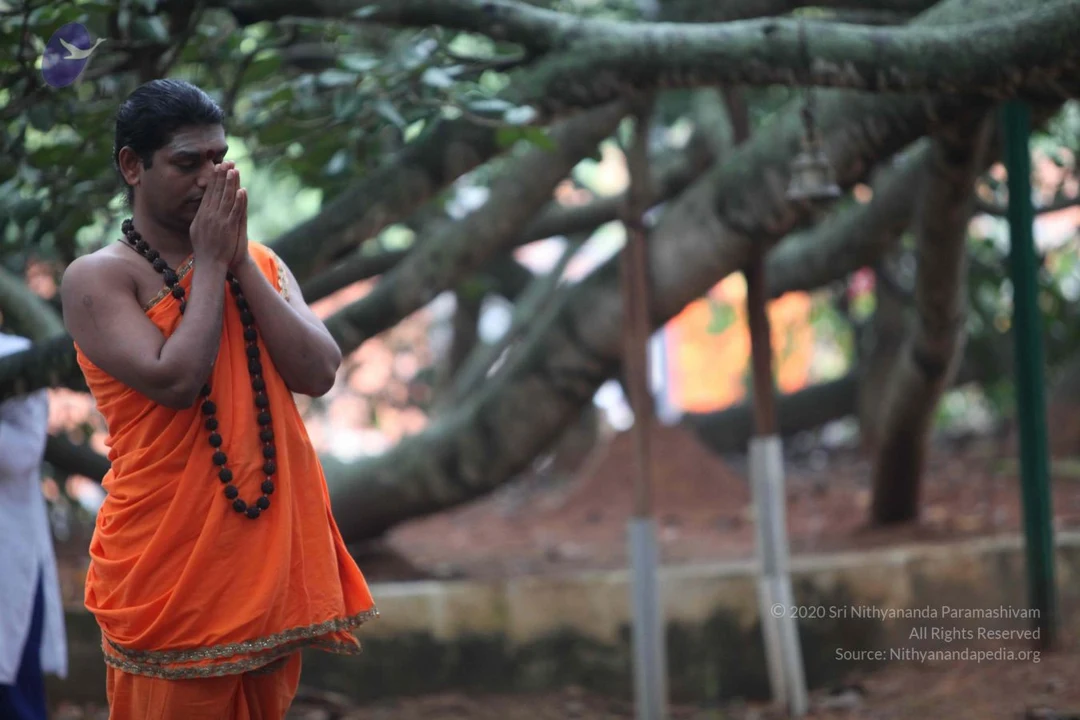
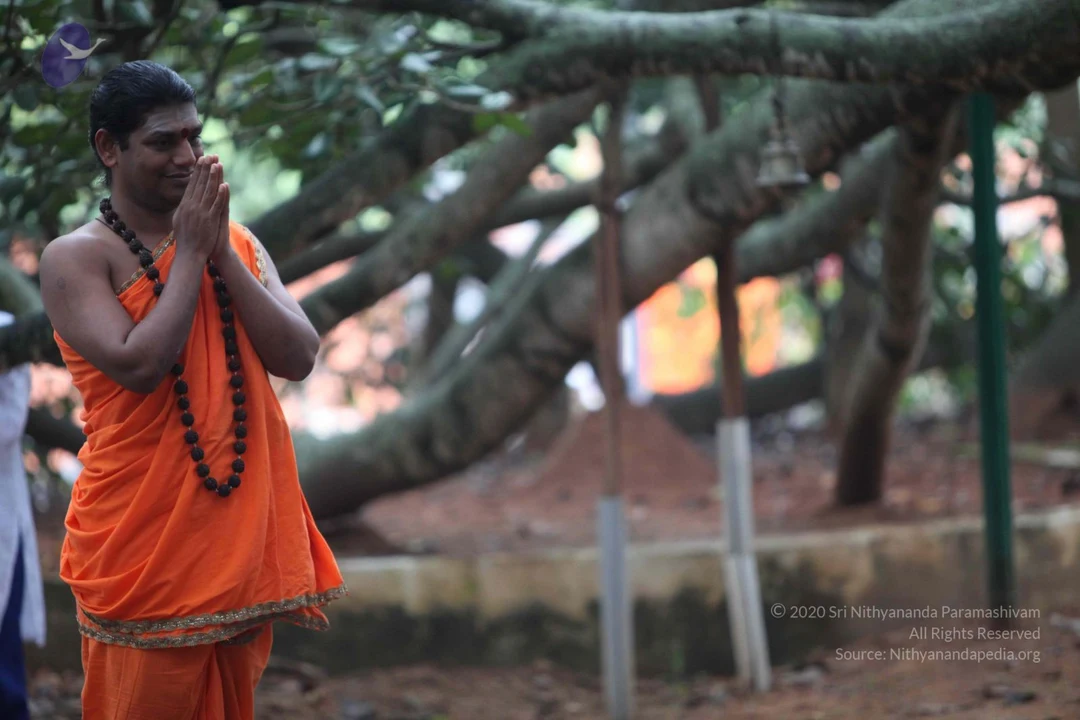
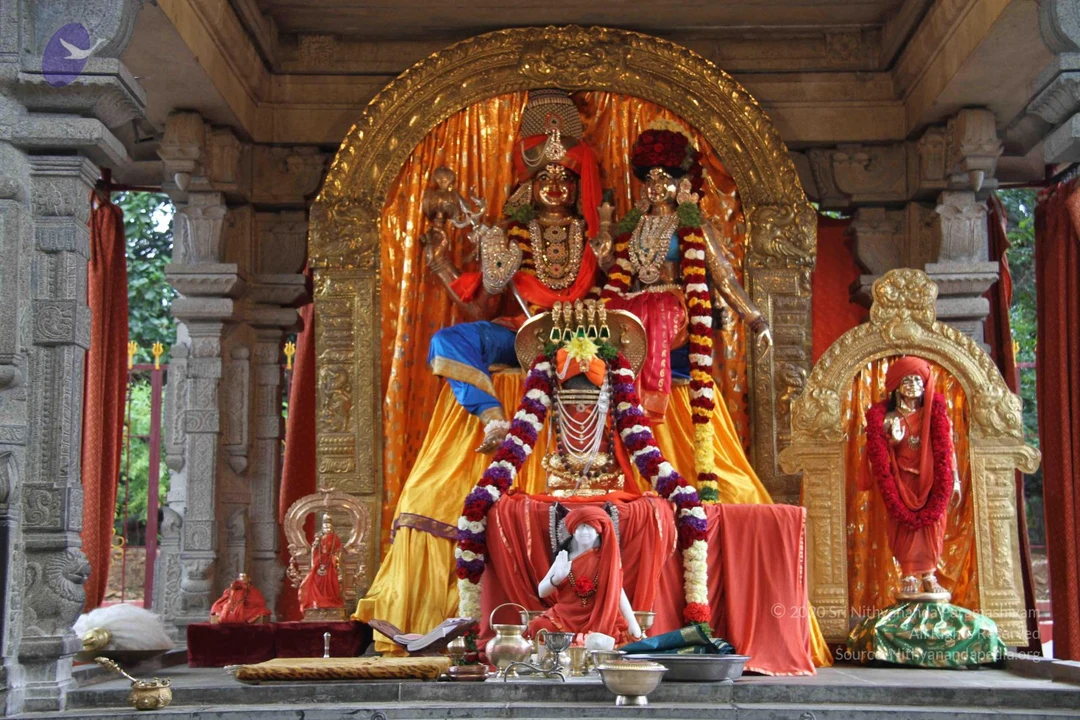
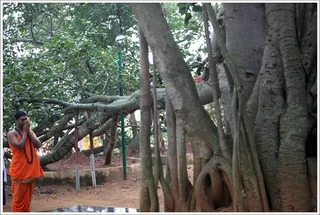
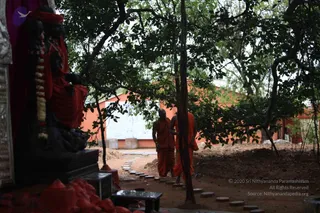
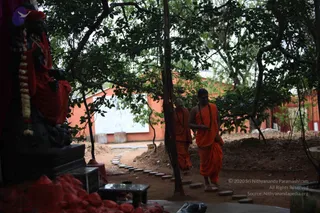
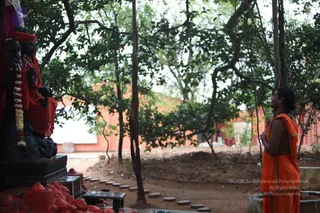
A person in an orange saffron garment with gold trim and a rudraksha mala around the neck bends forward with head lowered, hair tied in a topknot, bowing or prostrating at a stone basin or ledge. Two small brass bowls sit on the wet stone surface in front. Behind is a red curtain, an ornate carved stone pillar at left, and a framed picture of a deity on the right wall. The person's face is not visible. a person may apply via the saffron clothing and rudraksha mala, but the bowed pose and partial view leave the appearance uncertain; a devotee performing a reverent bow at a temple basin is the visible action.A man in an orange saffron shawl with a gold border and a rudraksha mala draped across his chest stands at a stone counter, touching his forehead with his right hand in a salutation gesture. Beside him on the left, a statue of a seated figure in red robes and a red turban has its hands folded in prayer. Behind them is a red-orange wall with a framed picture and a small brass oil lamp in the lower left foreground. Signage on the wall is partly visible, and a microphone stand is at the right edge.A photograph of a man in orange saffron robes and a rudraksha mala standing with palms pressed together in namaskar, smiling and gazing upward beside a seated white and red statue of a robed figure with clasped hands. He has a red bindi on his forehead and a gold-bordered orange shawl. Behind him are a framed deity picture, a hanging brass bell, and a red wall with printed signage. A brass lamp stands in the lower left foreground. The man is an appearance-based candidate for a person but the identification is uncertain, so he is described by role as a devotee in orange robes.Outdoor photograph of a shaded garden path beneath dense tree canopy. On the left, a dark stone deity murti wearing a red cloth and a white flower garland sits on a pedestal beside a red-and-purple altar cloth, with red offerings in the foreground. Two monks in orange-saffron robes walk along a row of stepping stones through the trees; one carries a bundle or cloth at his side. Behind them stands a terracotta-coloured building with a white signboard. No face is clearly visible, so no appearance-based identification is made.Outdoor ashram scene under dense green trees. Two monks in saffron-orange robes walk along a path of flat stepping stones through dirt ground. The foreground monk wears a rudraksha mala and carries a small item in his hands; the second monk, partly obscured, walks behind him. At left, a dark stone deity murti is draped in red cloth and a white flower garland, with red offerings heaped at its base and a small black stone table nearby. Behind them, an orange-painted building wall and a white board stand among the trees.A photograph in an outdoor shaded garden with tall trees and a terracotta-coloured wall behind. On the left, a dark stone deity murti is draped in red cloth and garlanded with white and yellow flowers, with red powder offerings (kumkum) piled at its base and a small brass lamp on a low stand. On the right, a standing person in a saffron-orange wrap, bare-shouldered, with hair tied up at the back, faces the murti with hands joined in prayer. Stepping stones lead across the sandy ground toward the shrine.

Bhagavat-Gita-Satsang
55 photosSource gallery
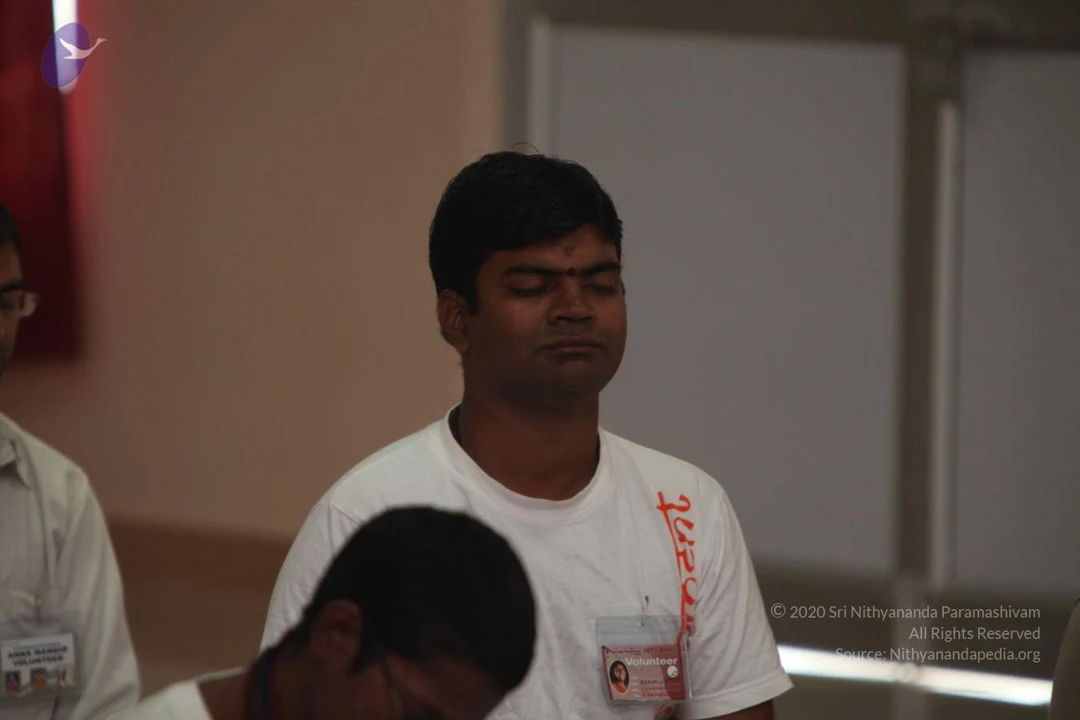
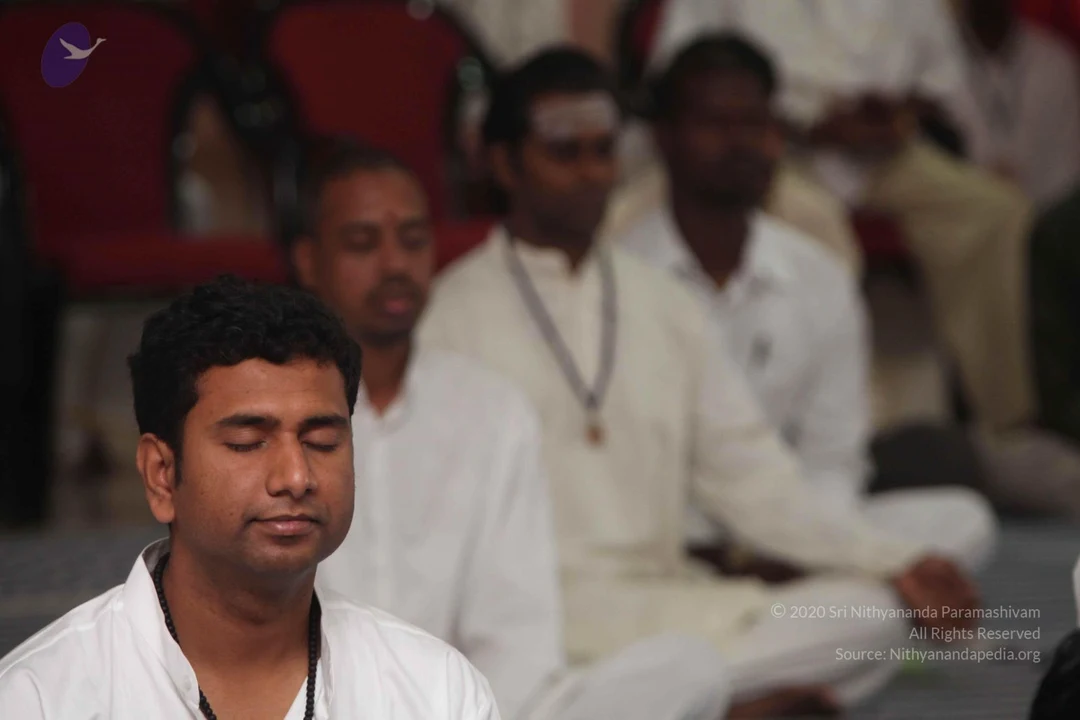
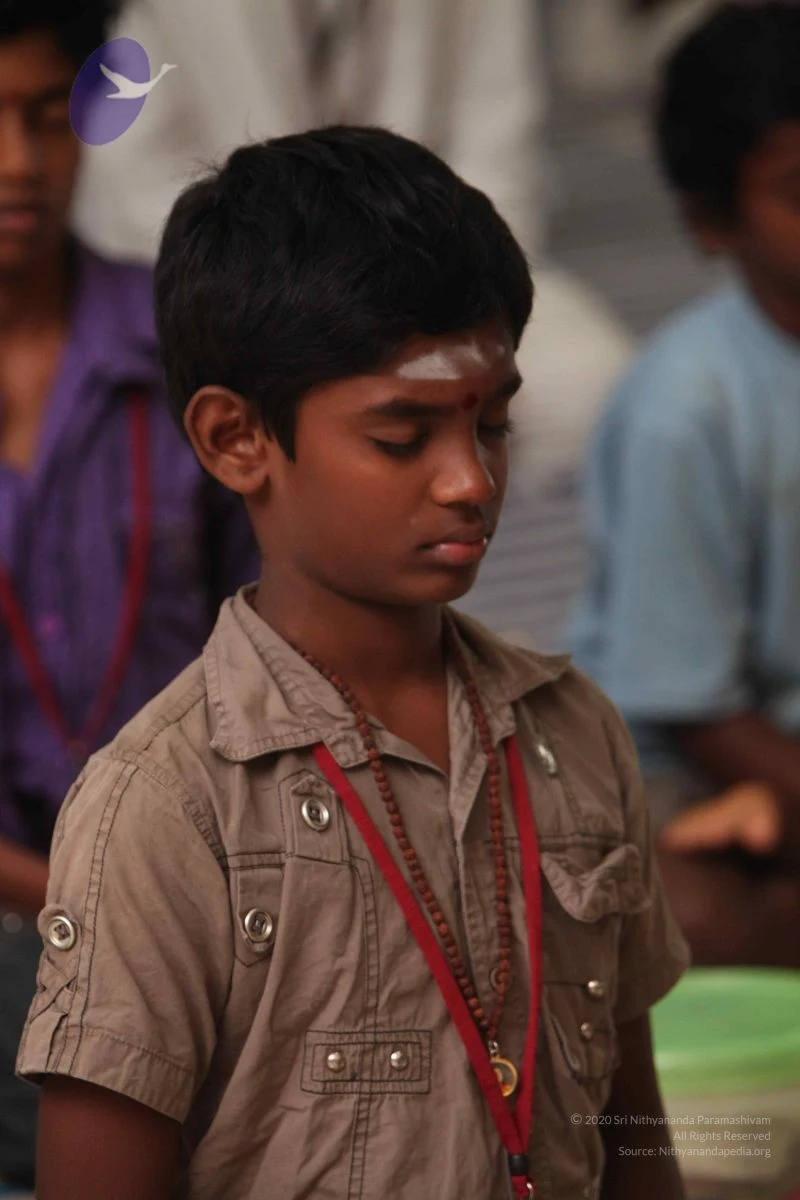
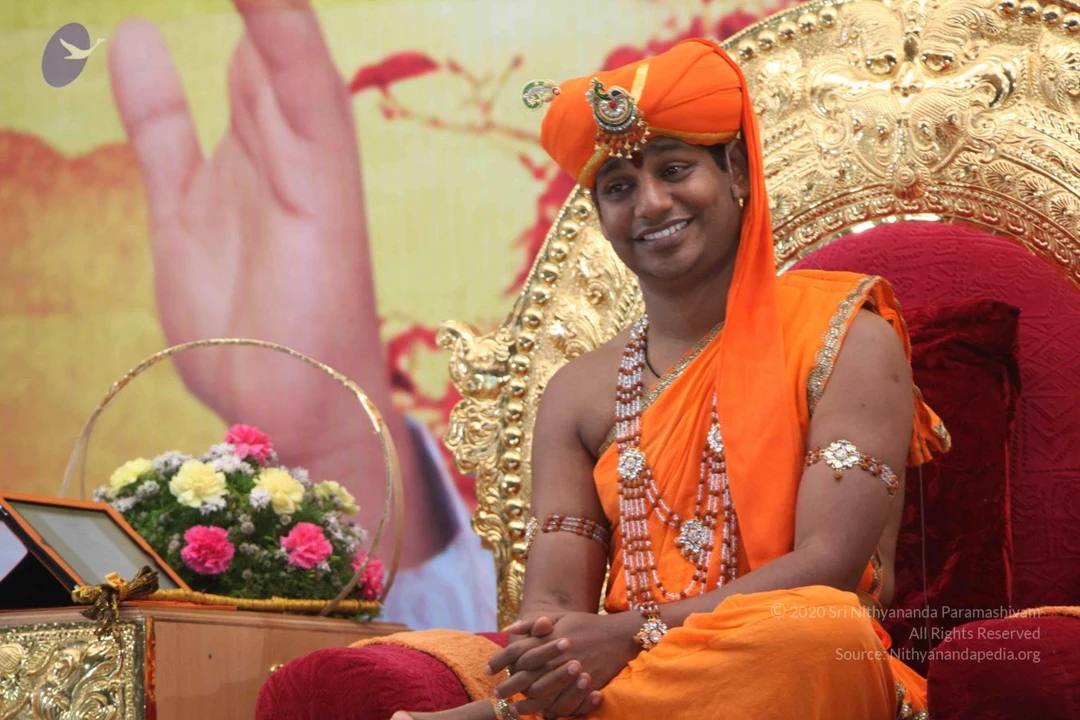
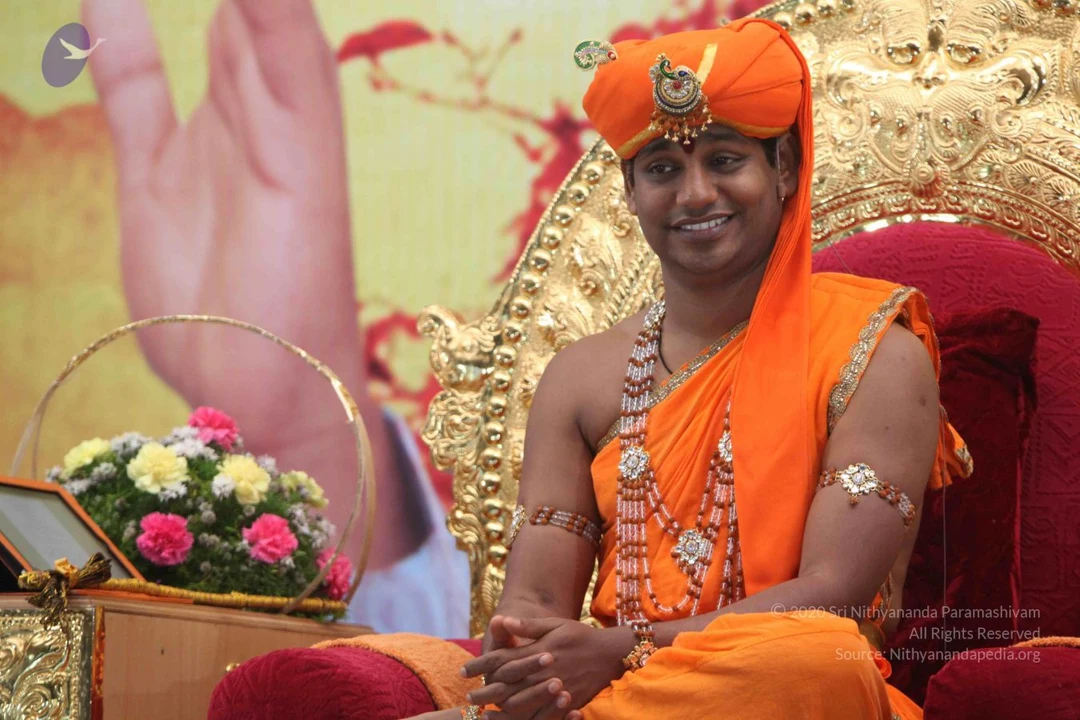
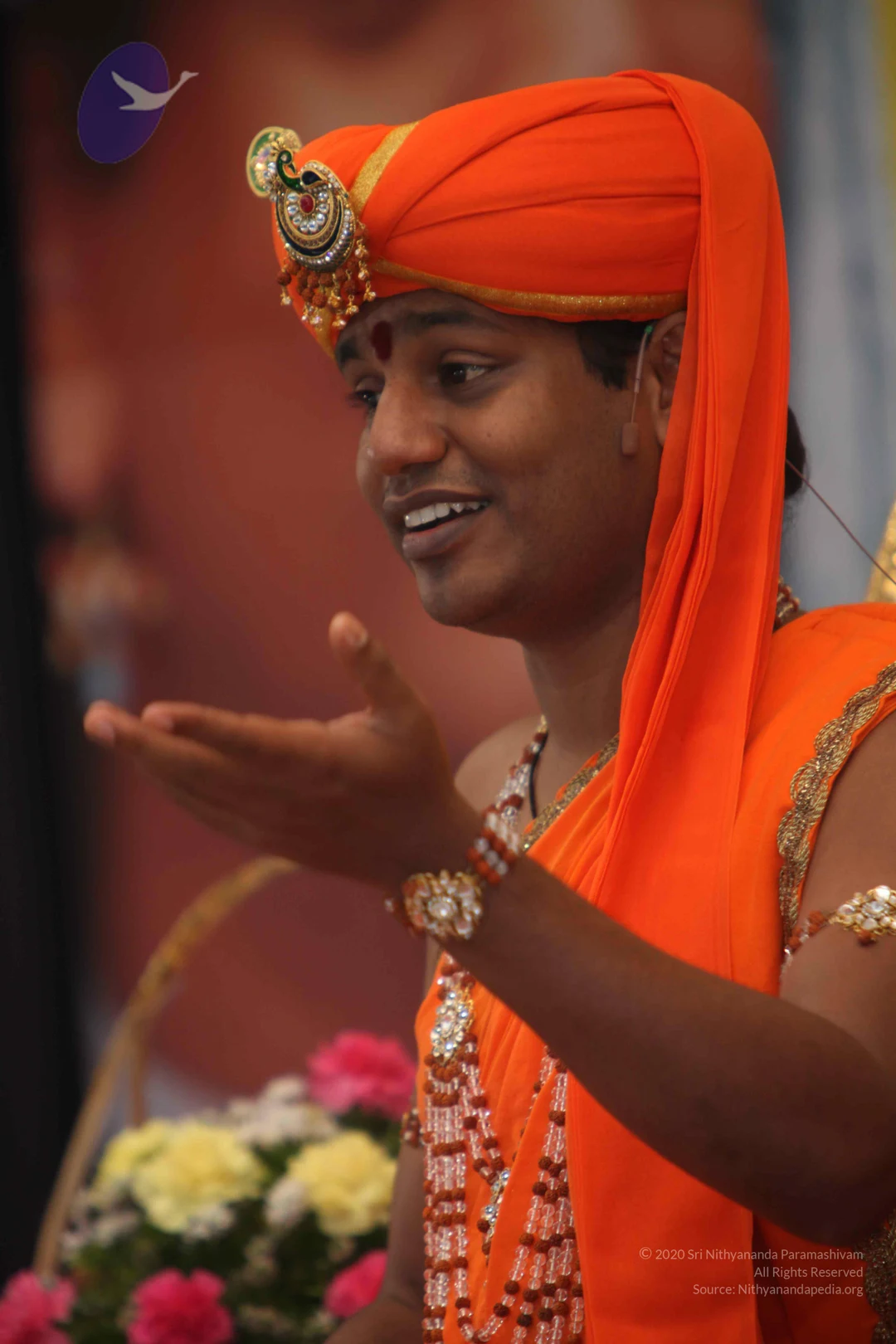
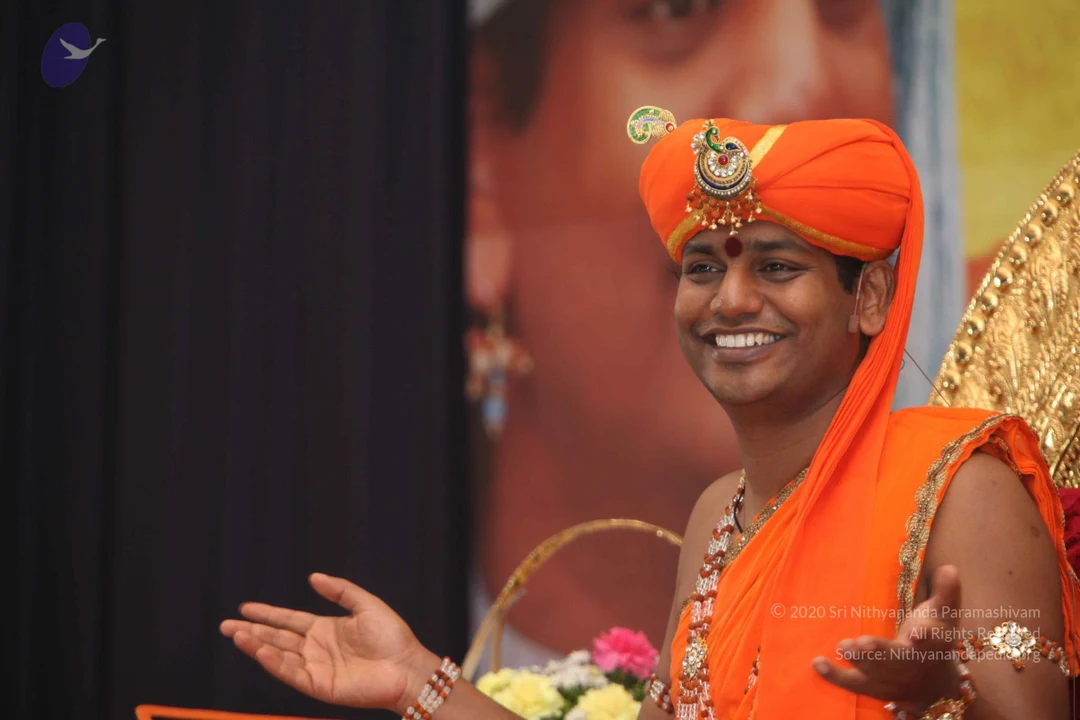
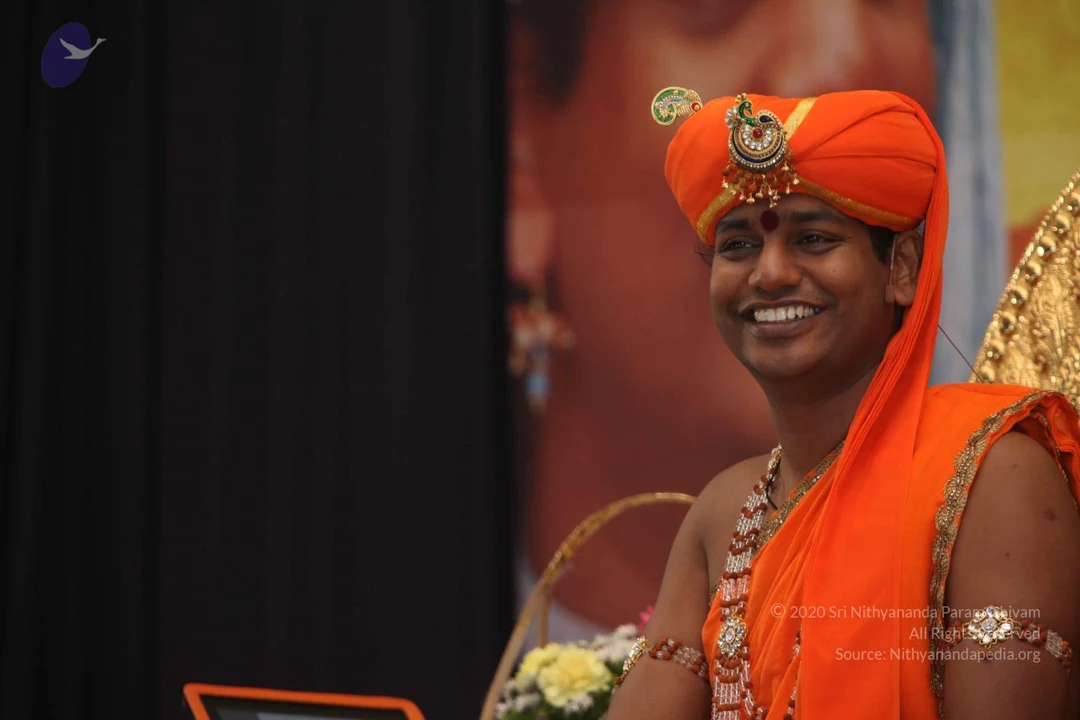
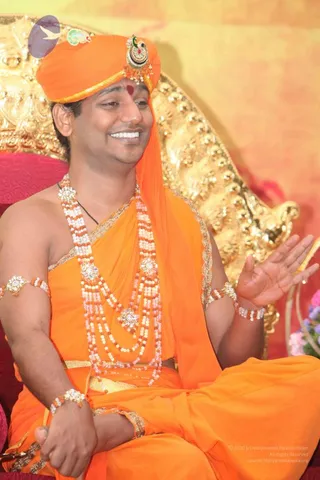
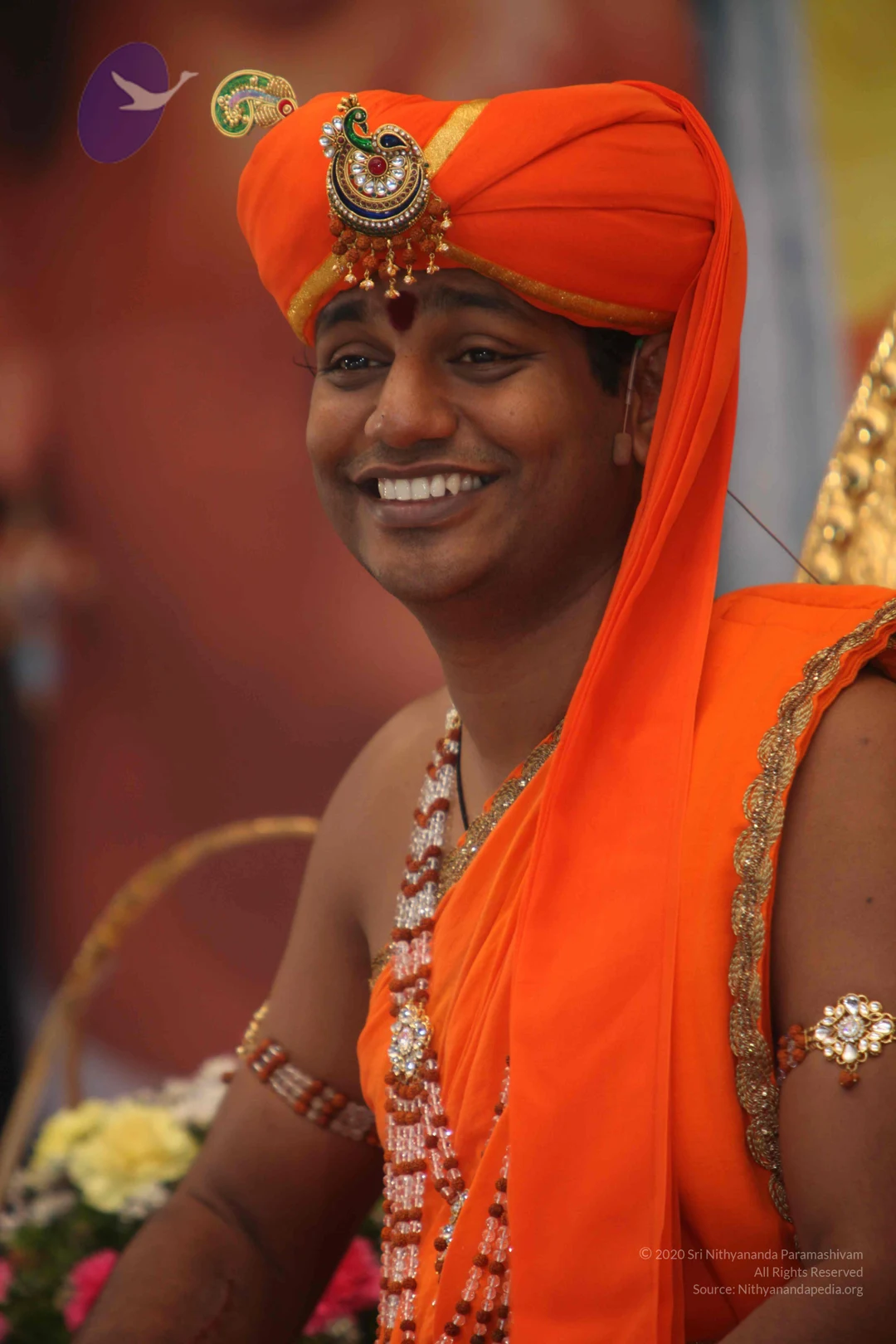
A man seated on an ornate gold throne with a red cushion, smiling and gesturing with one open hand while speaking. He wears an orange turban with a jeweled gold and green brooch at the front, a red bindi, an orange wrap draped over his shoulders with gold trim, and layered white and orange beaded garlands with silver-toned medallions. He also wears matching beaded armlets and wristbands. Behind him are pink and purple flowers. A copyright and source credit appears in the lower right corner.Photograph of a smiling man seated on an ornate gilded throne with carved floral detailing and a row of golden knobs. He wears a bright orange turban with a jewelled ornament, a red tilak on his forehead, an orange shawl draped over one shoulder, and layered red and white beaded necklaces with a flower-shaped pendant. A red cushion is visible at left and red blossoms appear in the blurred background. Appearance-based candidate, with a saffron turban and ornate ceremonial cues, seated as a seated honoured guest: a person.A photograph of a seated man with closed eyes and a small red tilak on his forehead, wearing a white t-shirt with red script and a volunteer lanyard badge. Another person's head is visible in the lower foreground, and a partly visible person in white shirt and glasses stands at the left edge. The room has pale walls and a whiteboard in the background. No a person candidate is visible in this image.Photograph of devotees seated cross-legged in meditation at a satsang hall with red chairs behind them. In the foreground a young man in a white kurta with a dark rudraksha mala has closed eyes and a calm expression. Behind him, several men in white and cream clothes sit with eyes closed; one wears white tilak marks on his forehead and a grey beaded necklace. The background is blurred, showing more seated attendees and red seating. No a person candidate is clearly identifiable by appearance.A young boy with short dark hair stands with eyes closed in a meditative posture, wearing a khaki short-sleeved button shirt, a red lanyard and a rudraksha mala. A white vibhuti line and a red kumkum dot mark his forehead. Behind him, blurred people in purple and light blue shirts sit nearby, and a green plastic plate is visible at the lower right.A man seated on an ornate gold-and-red throne smiles while speaking at a satsang-style event. He wears an orange turban with a jeweled ornament, an orange shawl over orange robes, multiple strands of beads and a rudraksha-style mala, jeweled armbands, and has his hands clasped in his lap. Beside him on a wooden table sits an arrangement of pink and white carnations and a small framed item. Behind him a large backdrop shows an enlarged hand and a red-and-yellow painted design. The man resembles the person described as a person, seated in a speaker's position.
darshan

7 photosSource gallery
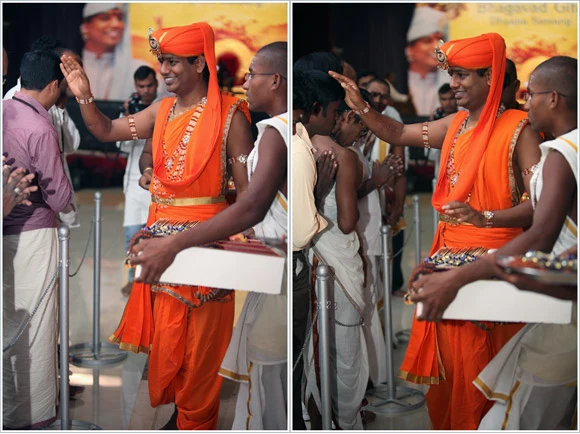
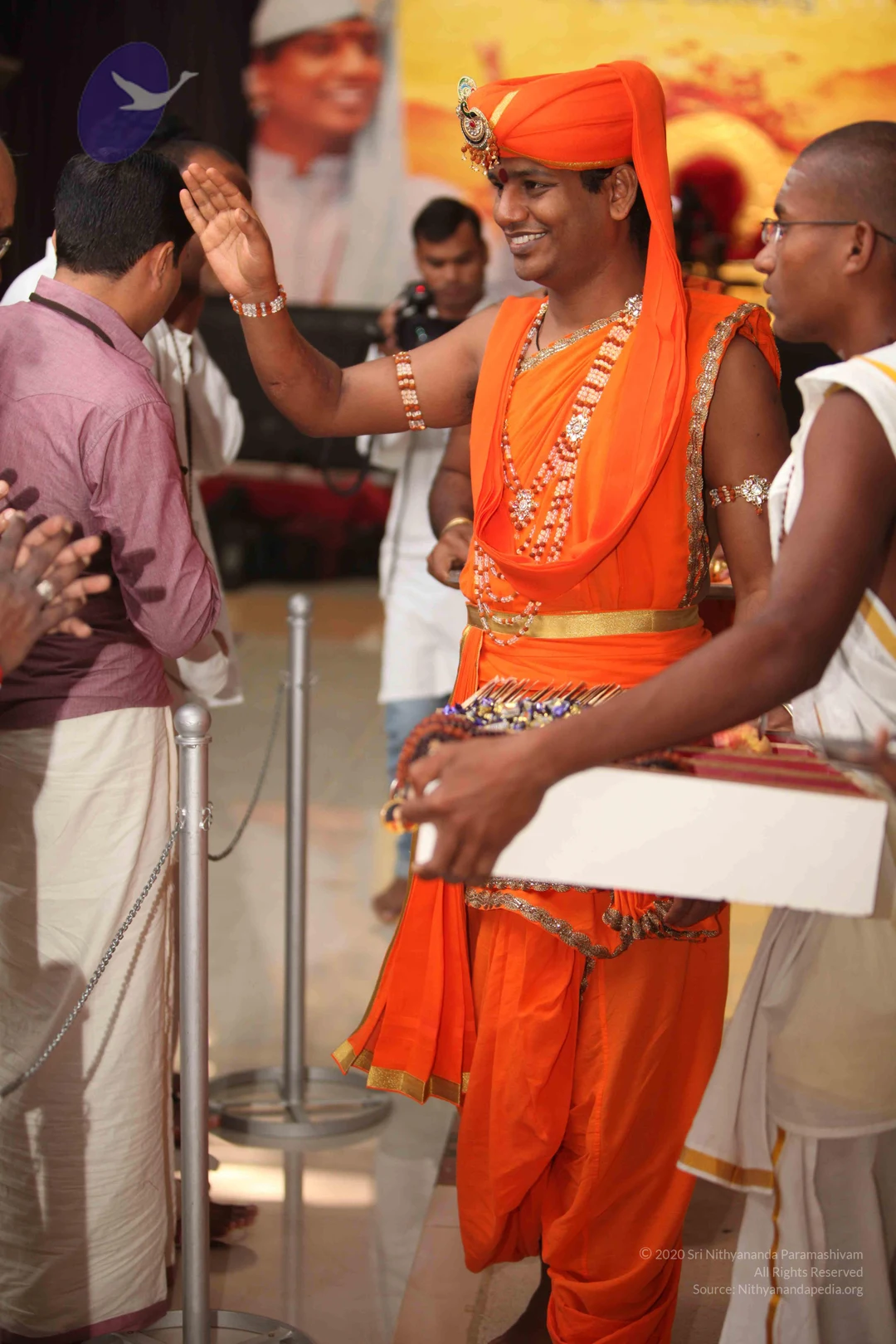
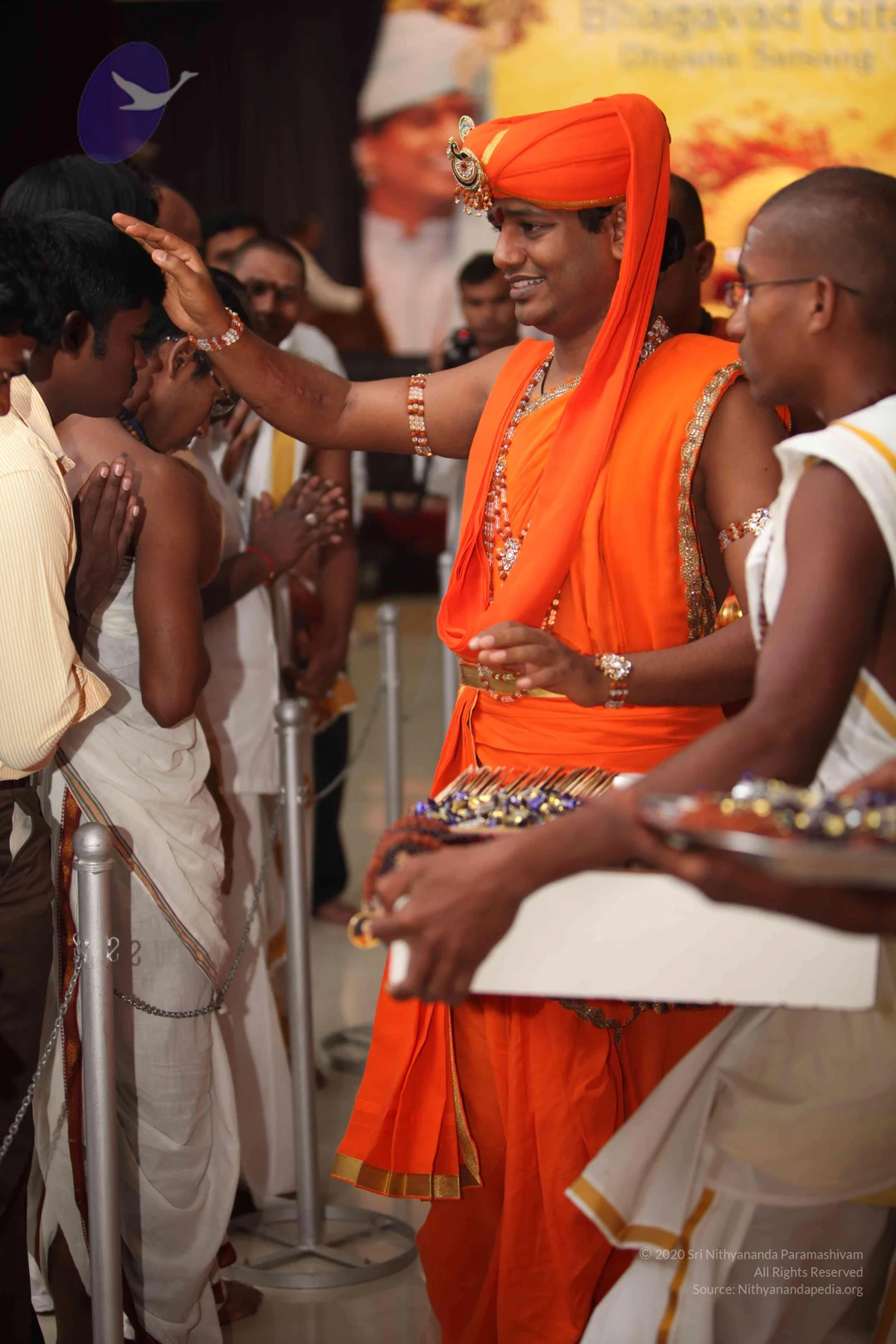
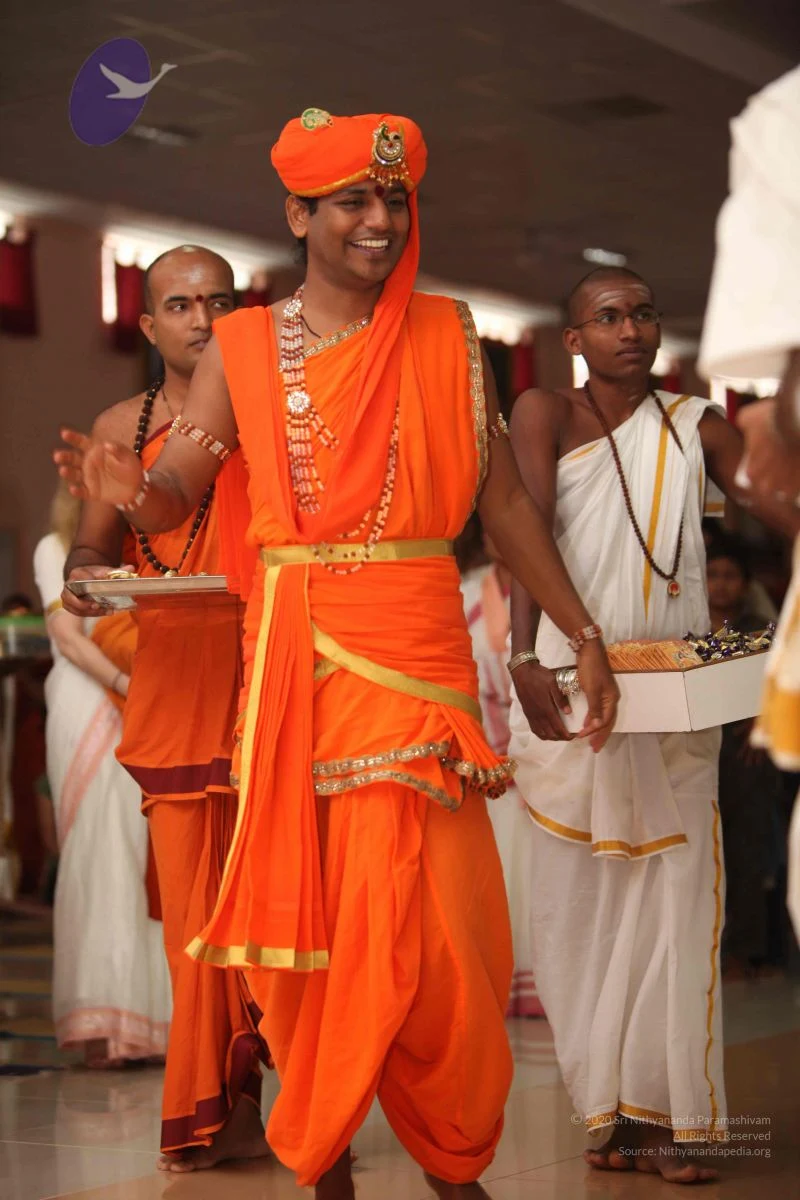
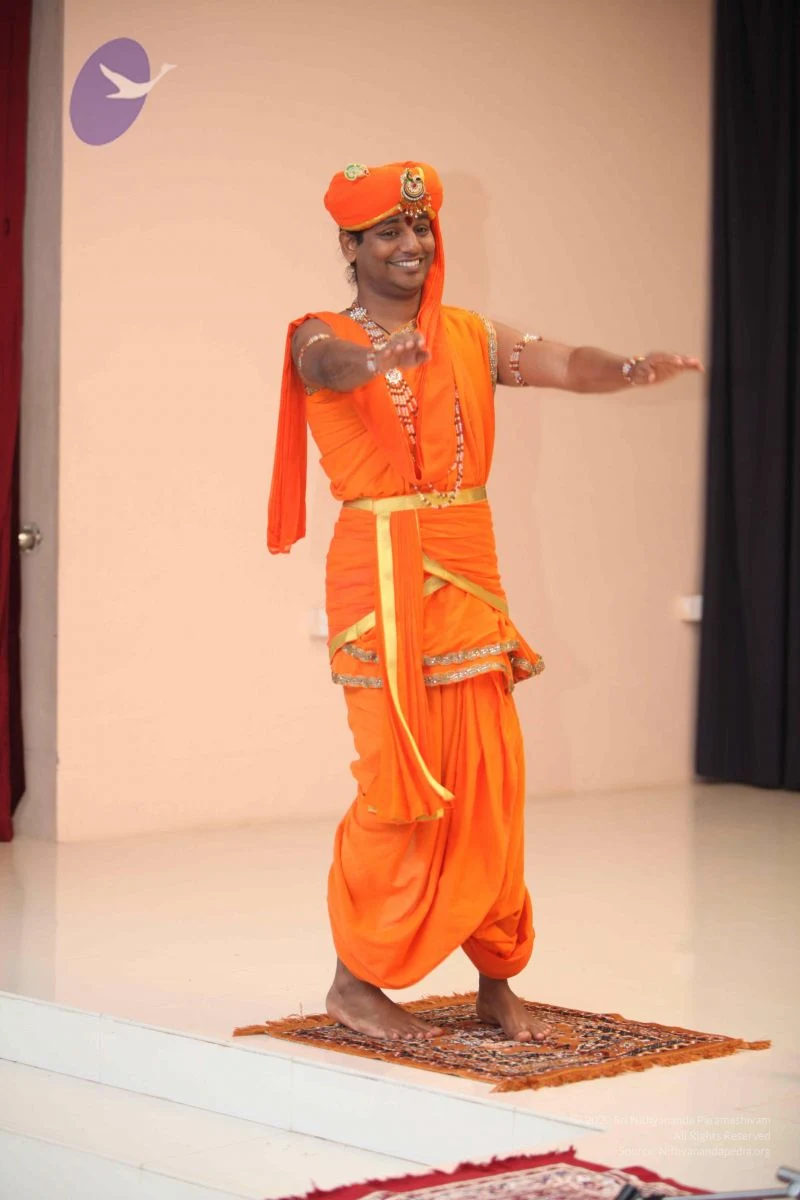
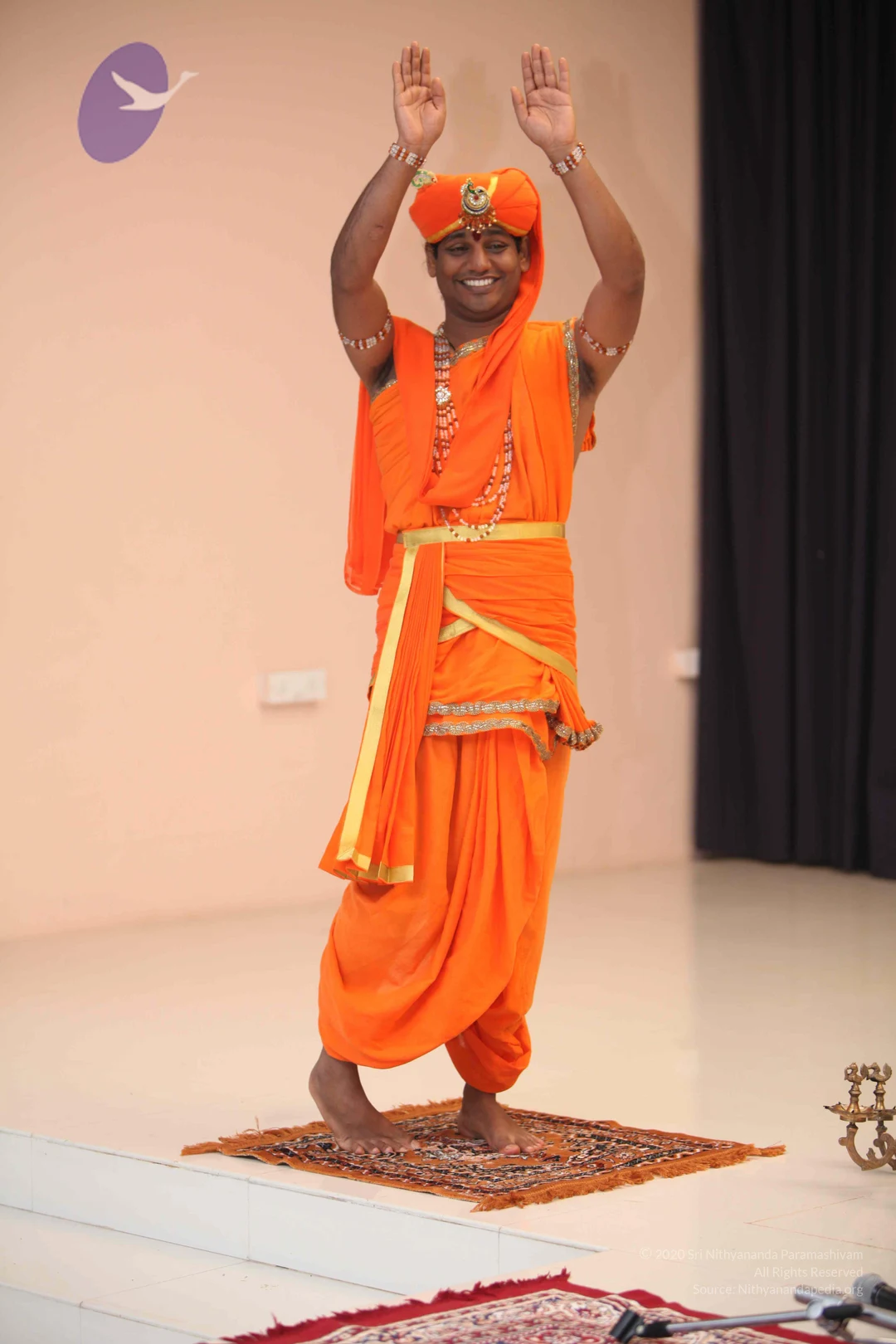
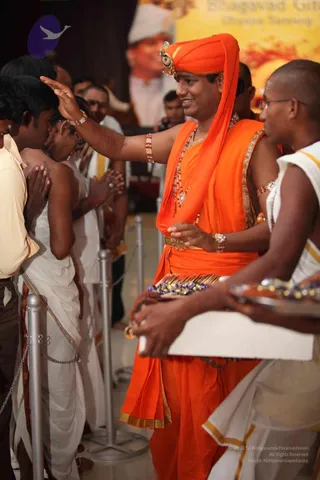
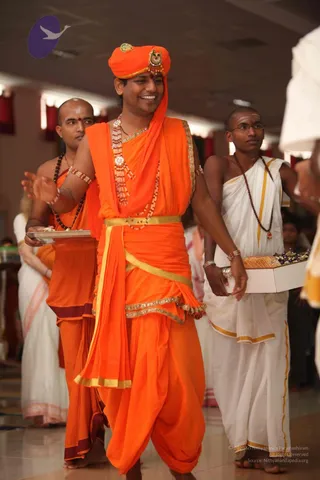
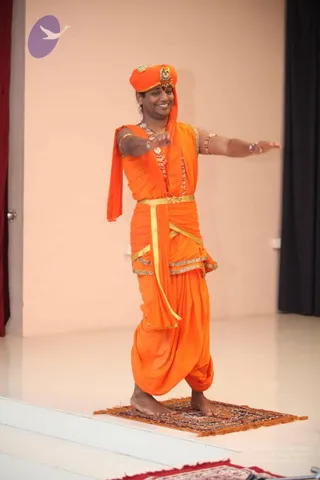
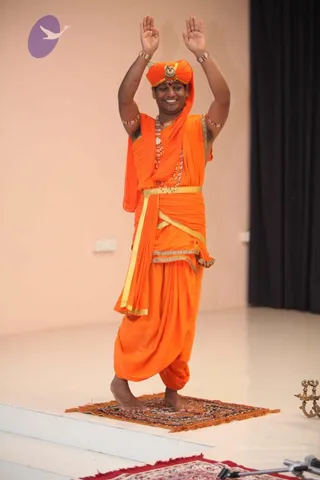
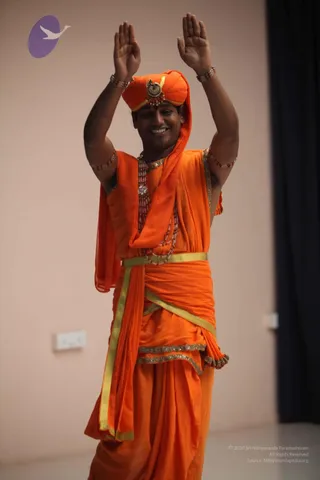
A smiling man in a bright orange turban with an ornate jewelled brooch and an orange draped robe edged in gold stands in a hall, raising one hand in blessing toward a man in a maroon shirt and cream dhoti whose head is bowed. The orange-robed man wears layered beaded necklaces, rudraksha-style beads, gold-bordered sash and jewelled armlets. Beside him a man in white dhoti and shawl holds a white box of marigold-free ceremonial items. Behind them a camera operator films, and a large banner shows a smiling man in a white cap. Metal stanchions and chains line the aisle.A man in saffron-orange robes and a matching orange turban with a jeweled brooch raises his right hand in blessing over the head of a devotee. He wears layered beaded necklaces, rudraksha-style malas and bangles, and a gold-bordered orange shawl draped over his shoulder. Beside him a younger attendant in white dhoti with a saffron-striped shawl and glasses holds a tray of ornaments. Devotees in white dhotis and pale shirts stand in a queue behind silver barrier posts with hands joined in prayer, while a blurred backdrop shows a yellow banner with partial lettering and a portrait.A photograph of a procession inside an indoor hall with a light tiled floor. In the centre, a smiling man in a saffron-orange turban with a gold and jewelled ornament and a long orange shawl, wearing an orange garment with gold border, a gold waist sash, layered pink and white beaded necklaces and bangles, walks forward with his right hand raised. Probable Swamiji by appearance: the turban, ornate saffron clothing, beaded necklaces and bangles are distinctive presentation cues. Behind him to the left, a shaved-headed man in orange holds a silver tray. To the right, a bespectacled man in white dhoti with gold border and rudraksha mala carries a white tray of flower petals. Two people partly visible at the right edge in white.A photograph of a smiling man standing barefoot on a small patterned rug on a light stage, performing a dance-like pose with both arms extended outward. He wears an orange turban with a jewelled brooch and an orange sleeveless tunic with a gold sash, a long orange shawl draped over one shoulder, orange dhoti-style trousers trimmed with gold braid, and a beaded necklace with a rudraksha-style mala. The backdrop is a peach wall with a black curtain at right. Appearance-based label: the man's presentation is an ornate saffron costume with a turban, shawl and beaded mala, but it is a costumed performance and the identity cannot be confirmed from appearance, so the a person field is unsure.A standing man on a small patterned rug on a raised white stage smiles and raises both palms overhead. He wears an orange turban with a gold peacock-style brooch and a red bindi, an orange draped garment with gold border and gold waist sash, and layered red and white beaded necklaces with matching beaded armlets and bracelets. A brass oil lamp stands at the right edge of the stage, and a black curtain hangs on the right. A purple dove logo appears at upper left.A smiling man in a stage performance stands with both arms raised and palms open above his head. He wears an orange turban with a jewelled ornament, an orange draped robe with gold-bordered edging, a gold waist sash, and layered beaded rudraksha-style necklaces. The plain pale wall and dark curtain suggest a performance or studio setting.

Pada-Puja

29 photosSource gallery
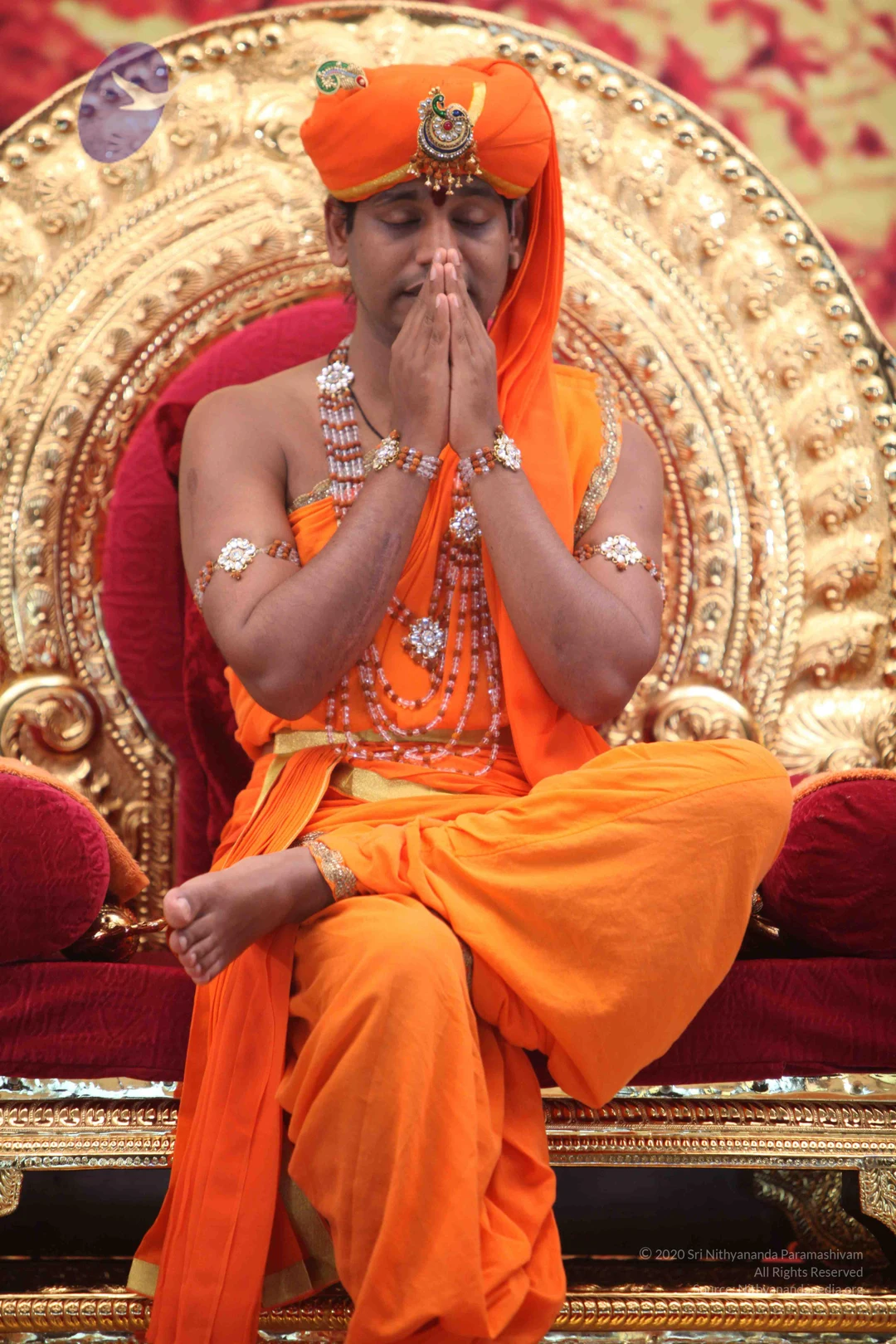
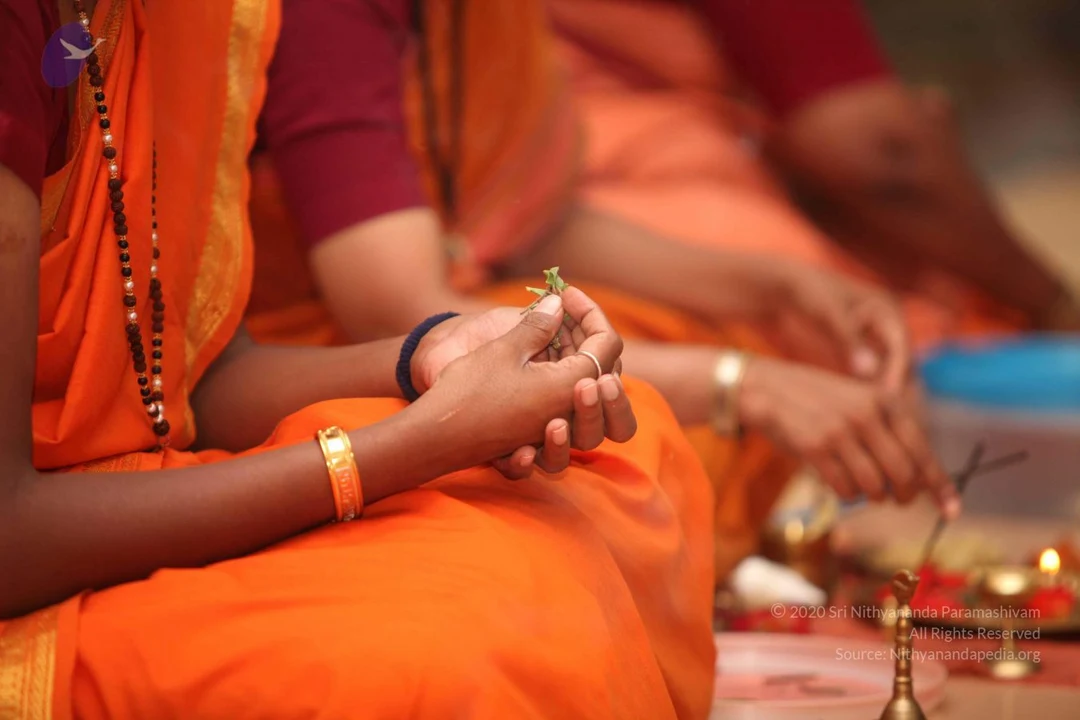
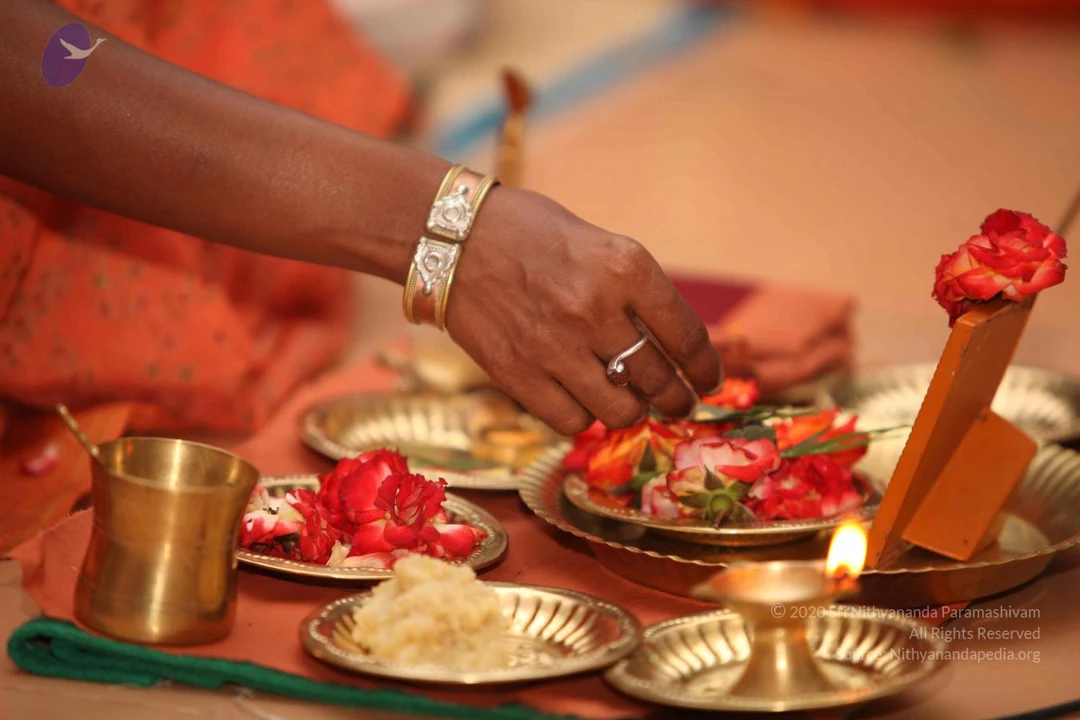
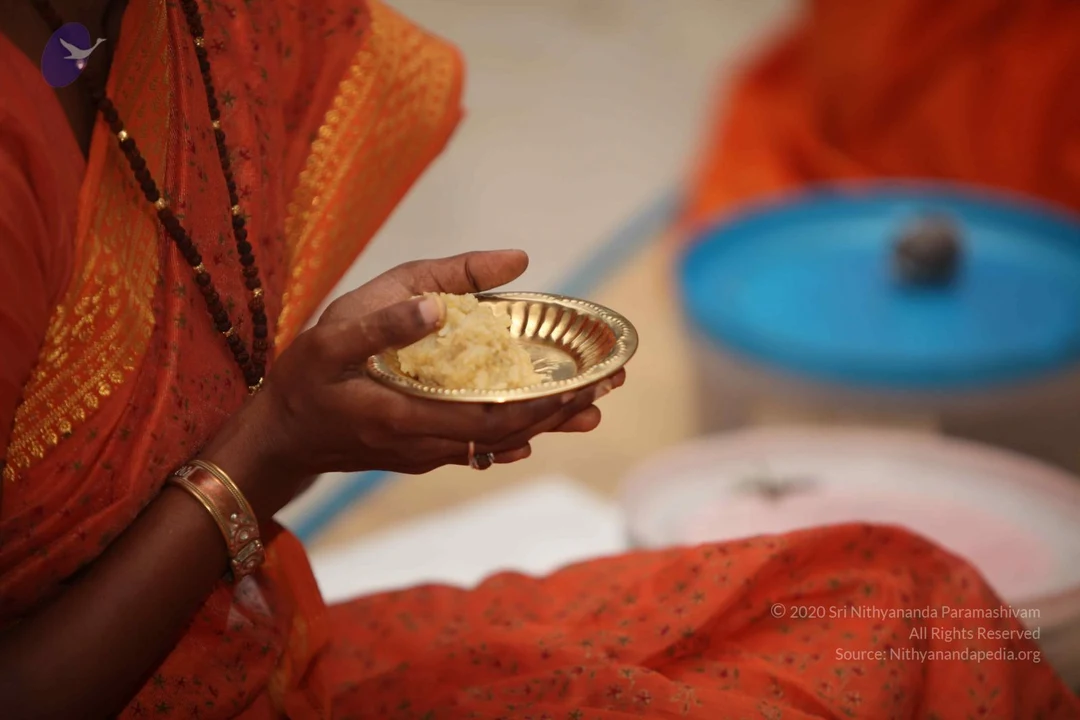
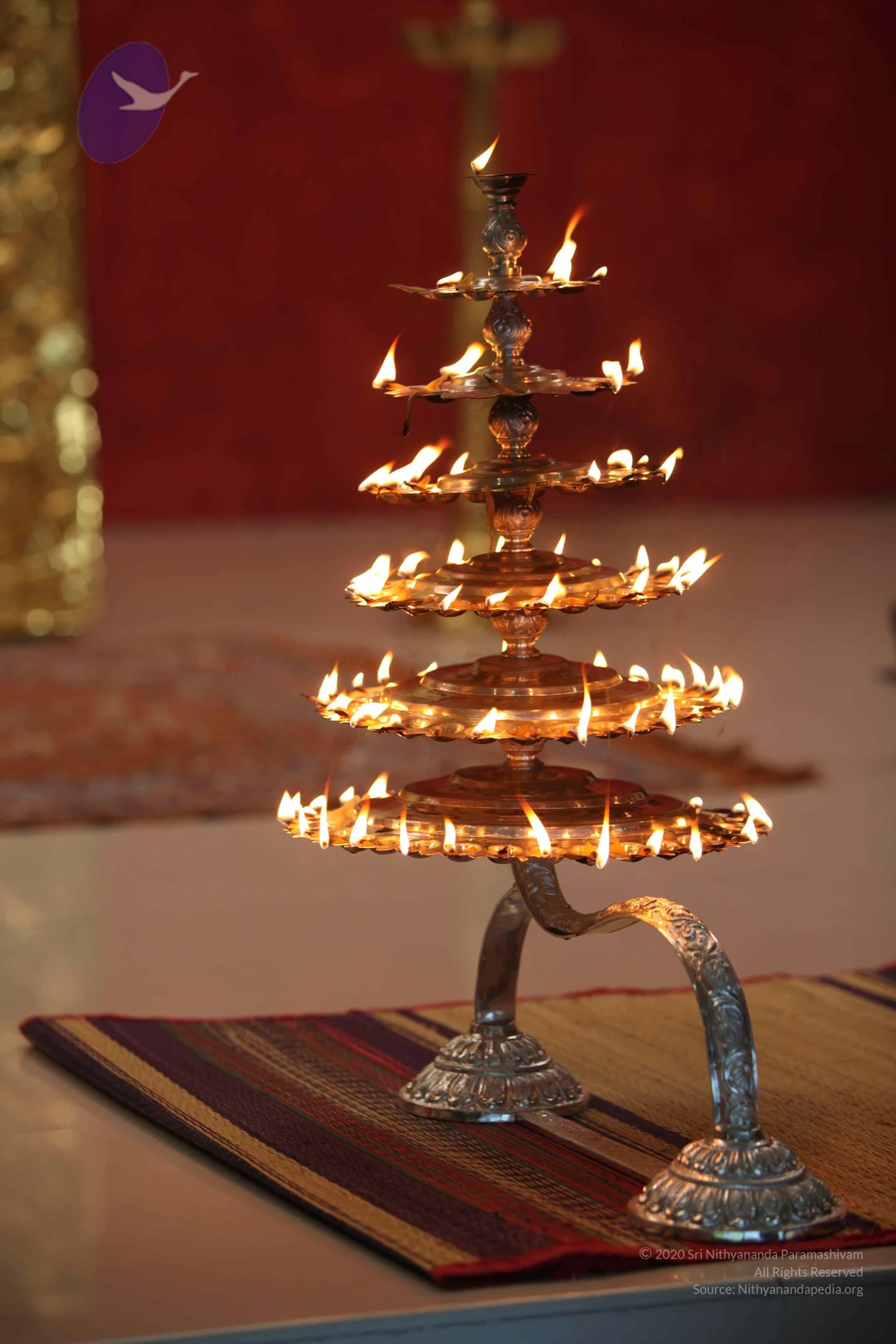
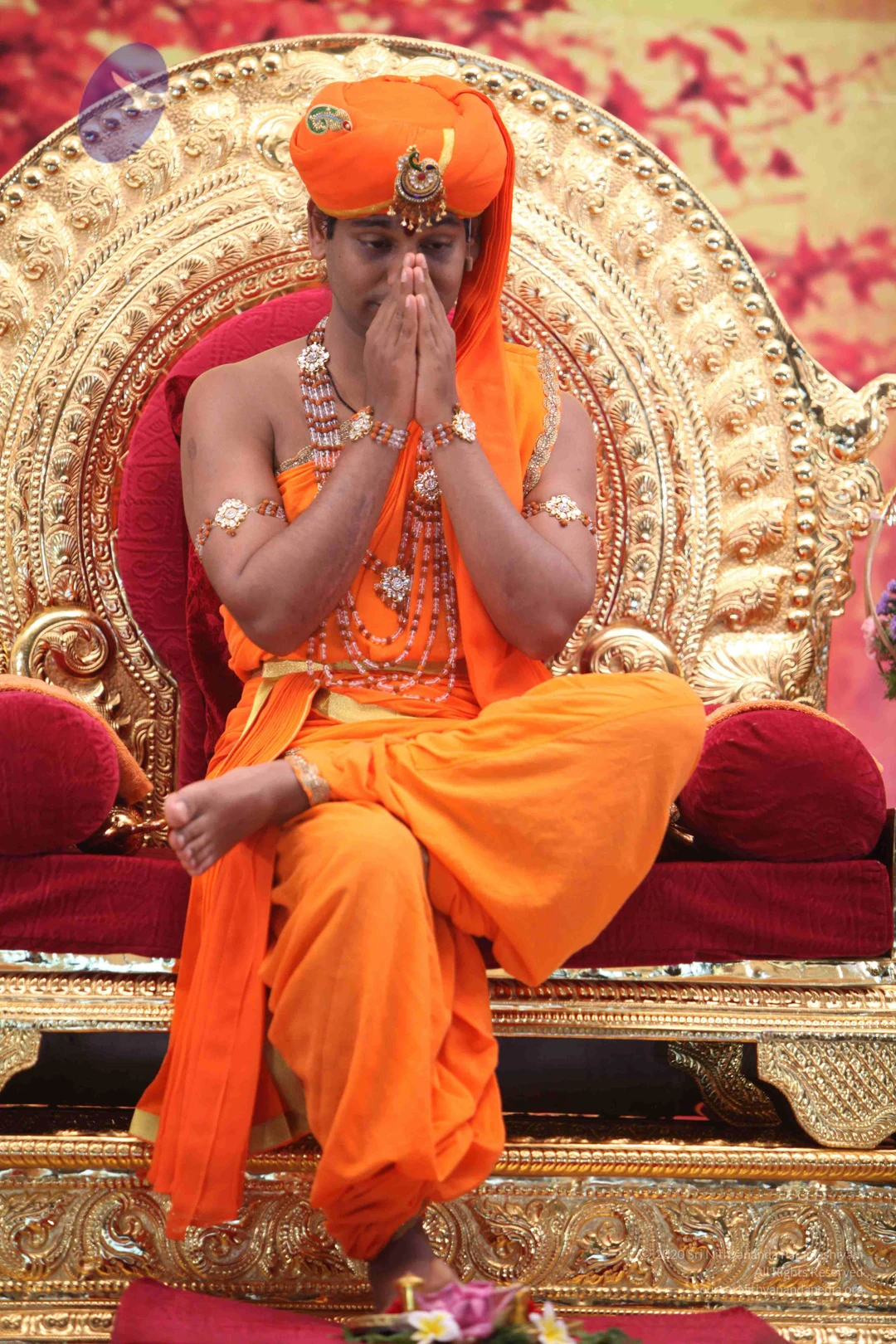
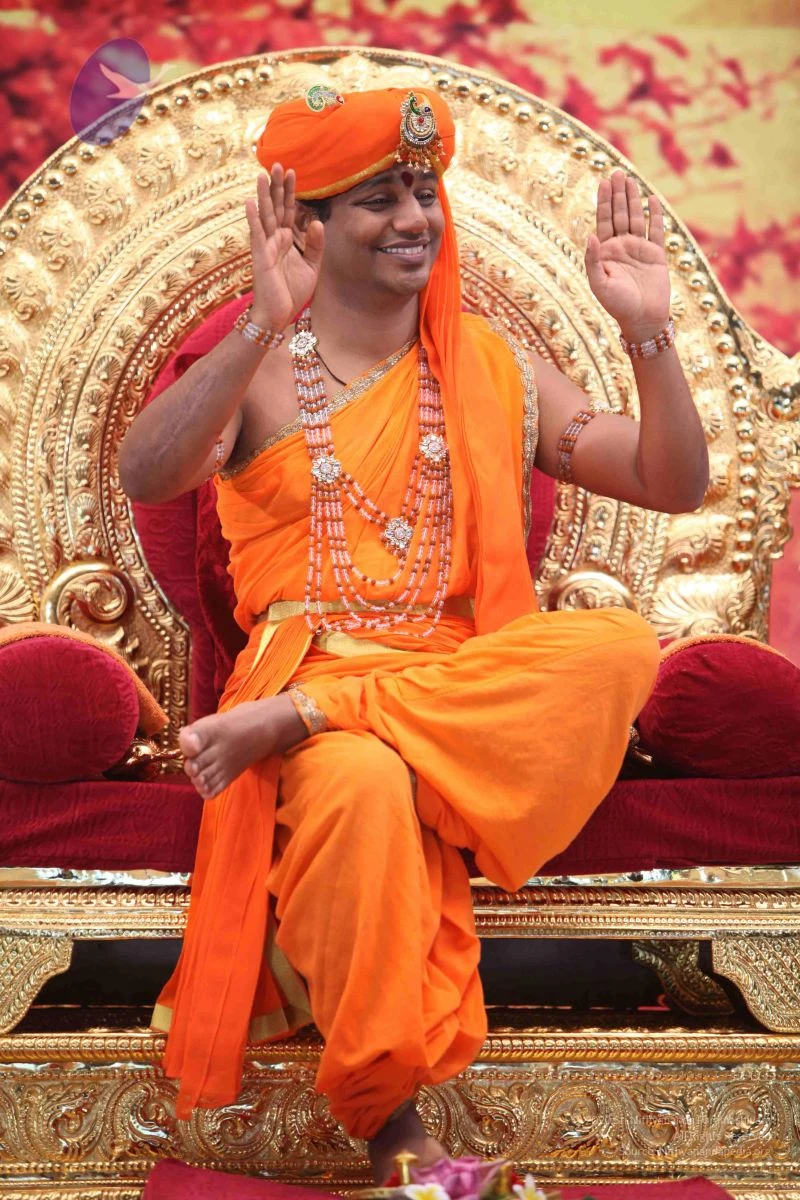
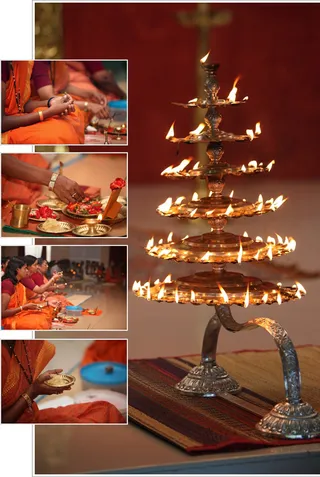
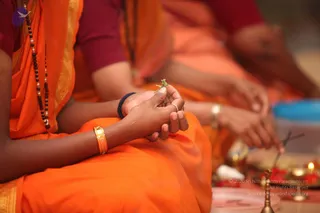
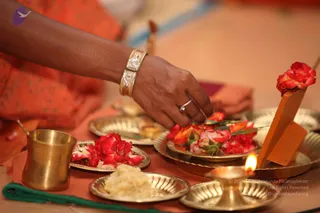
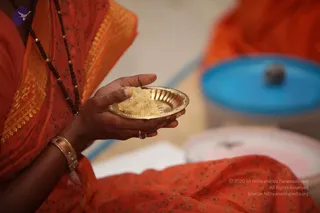
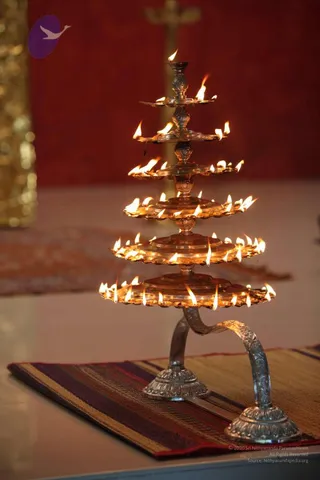
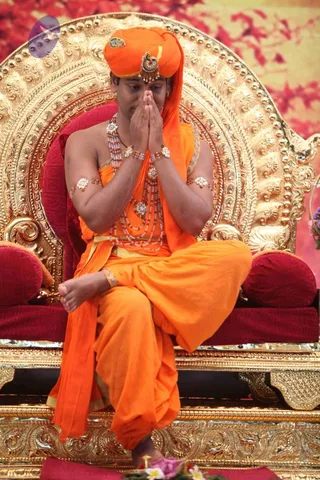
Close-up photograph of several people seated side by side in orange and saffron clothing. In the foreground a woman in an orange sari with gold border wears a rudraksha mala and gold bangles, holding a small green leaf between her palms. Beside her, another person in orange wears a blue bangle and holds leaves, and further right a seated figure in orange has their hands near brass ritual items, including a brass oil lamp with a flame, a brass bell and a tray with red flowers and offerings. The scene suggests a puja or ritual offering.A close photograph of a puja offering being prepared on brass plates. A person's bare arm, wearing silver and gold bangles and a silver ring, reaches over a brass plate of red and orange rose petals and flower stems. Nearby are a small brass cup, a brass plate of white grated or powdered offering, and a lit brass oil lamp with a flame. A tall orange wooden stand holds a red rose. The person's orange garment is visible at the left edge. Ritual offering setting.Close photograph of a woman's hands holding a small brass plate heaped with pale grains. She wears an orange sari with a fine dotted pattern and gold border, a dark beaded rudraksha-style mala, and gold bangles on her wrist. A blurred blue-topped vessel and another figure in orange robes sit in the background.A tiered brass lamp stand with five to six circular tiers, each ringed with many burning oil lamp wicks, rests on a striped woven mat against a red wall with a gold-textured panel at left. Ornate silver-toned curved legs with floral engraving support the stand. No people are visible, and no a person candidate appears in the scene.Swamiji (probable) sits cross-legged on an ornate gold throne with red velvet cushions, palms pressed together in namaste at the chest and eyes lowered. He wears a saffron-orange turban with a jewelled brooch, an orange shawl and dhoti, layered rudraksha-style beaded malas, a ceremonial gold necklace and gold armlets, and bare feet. Behind him is a red floral backdrop, and flowers and a brass vessel sit at the bottom edge of the frame.A man seated on an ornate gilded throne with a red cushioned back, smiling and raising both palms outward in a gesture of blessing. He wears a saffron-orange turban with a jewelled ornament, an orange draped shawl over a saffron-orange garment, layered coral-pink beaded malas with silver-toned medallions, and gold armbands and bangles. One leg is folded across the throne seat and he is barefoot. Floral offerings lie at the bottom edge and a pink blossom backdrop fills the background. Swamiji (probable): the saffron and orange robes, turban, layered beaded malas and ceremonial ornaments match the appearance cues for the presiding teacher, so the figure is labelled as a probable in-person Swamiji seated on a throne giving blessing.

Sacred-arts

46 photosSource gallery
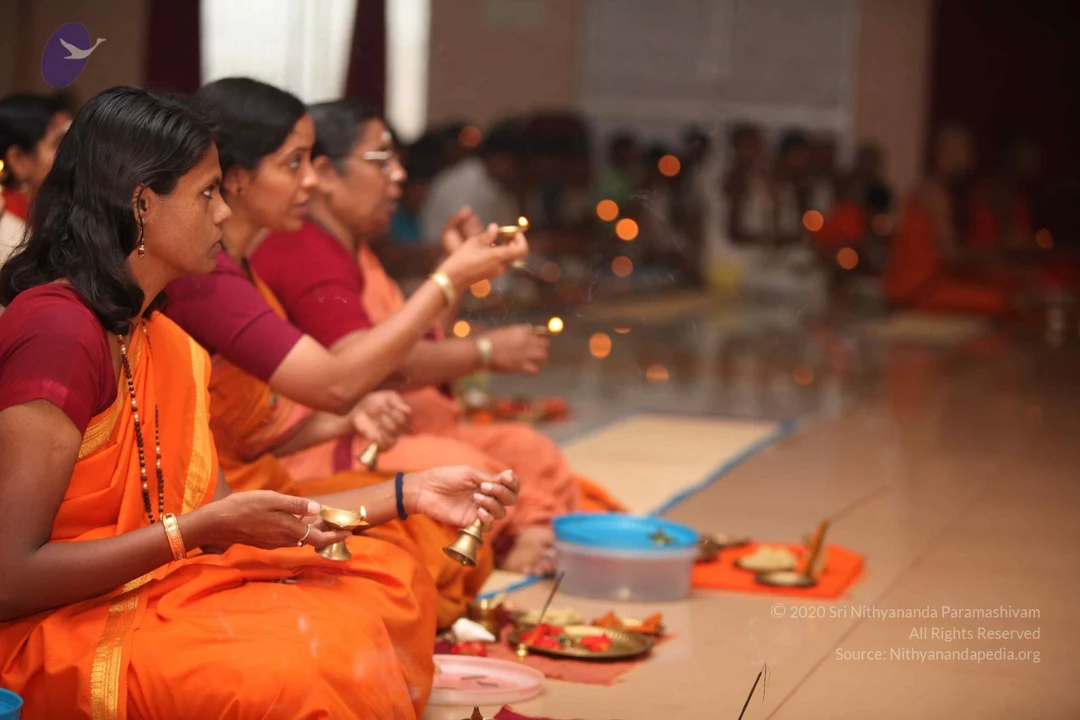
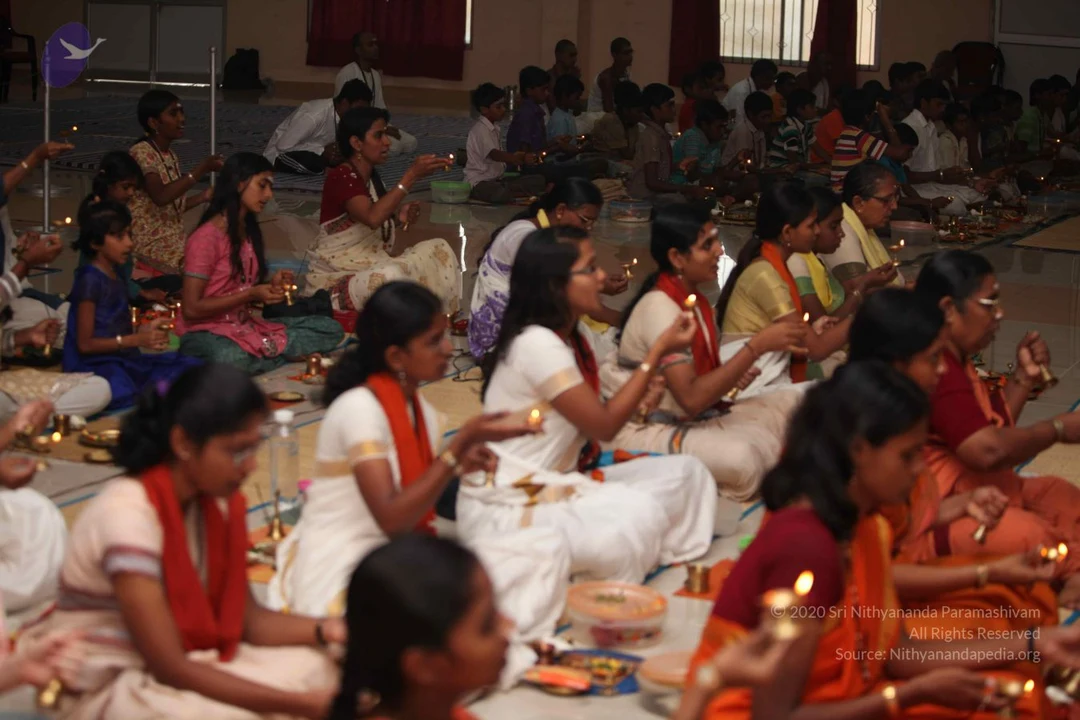
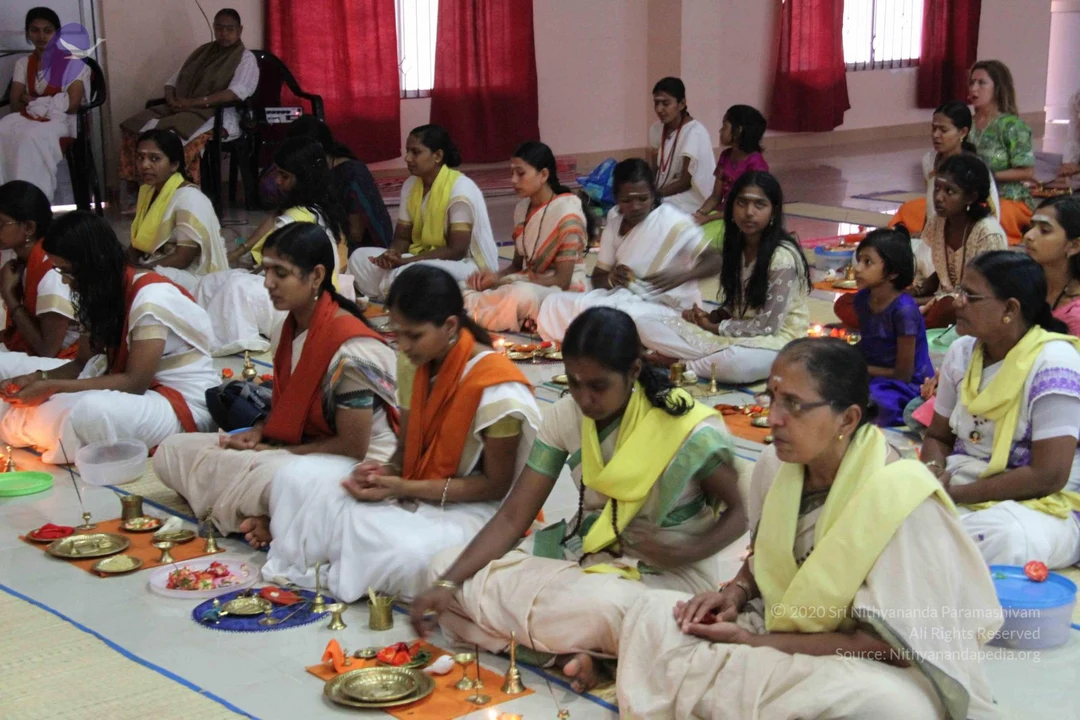
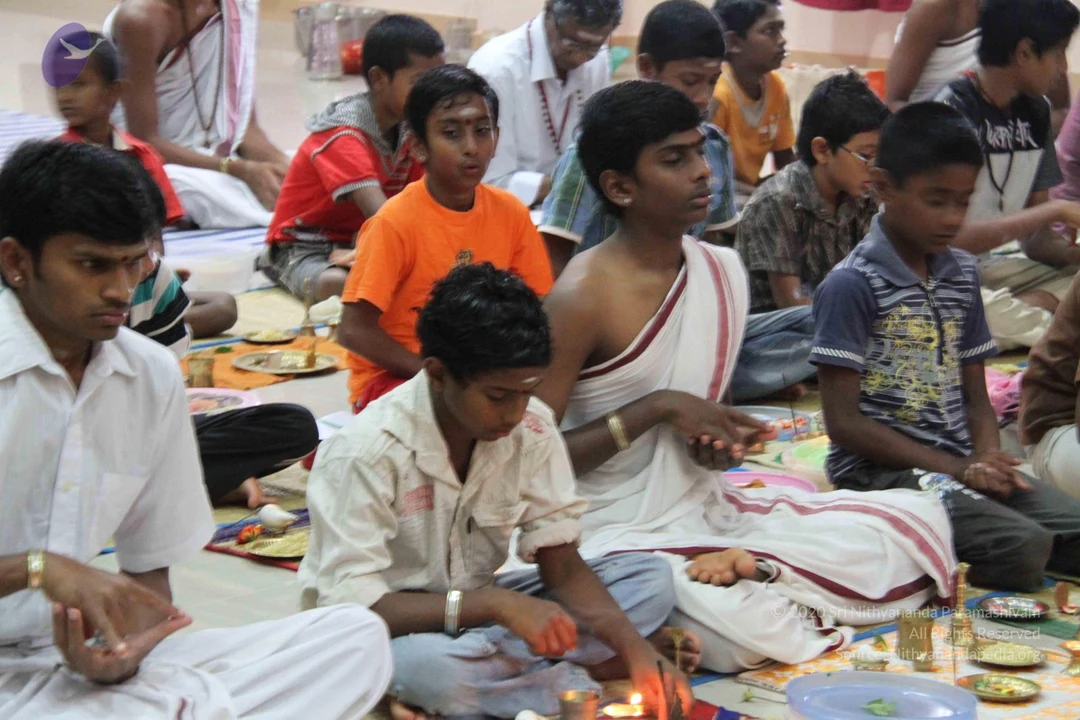
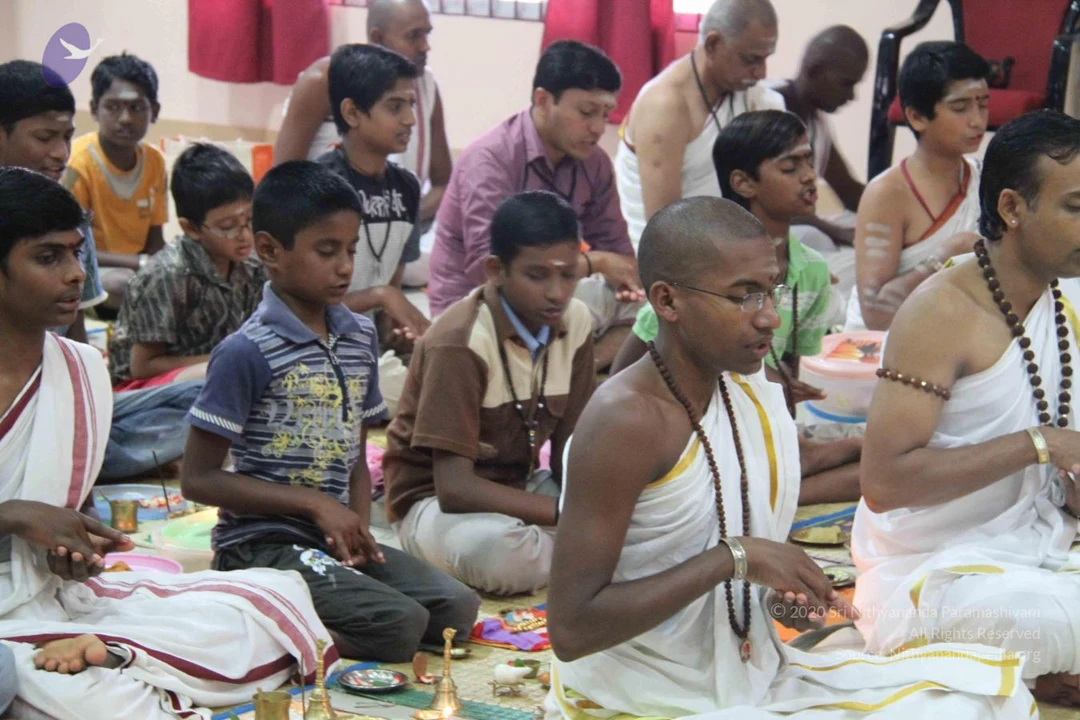
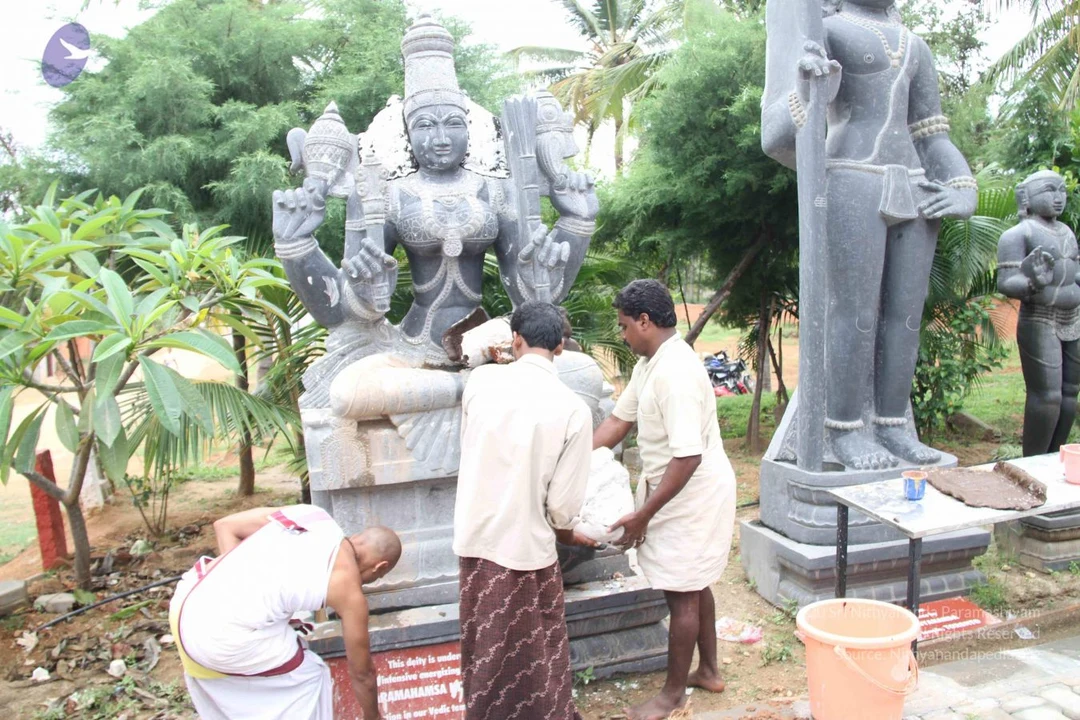
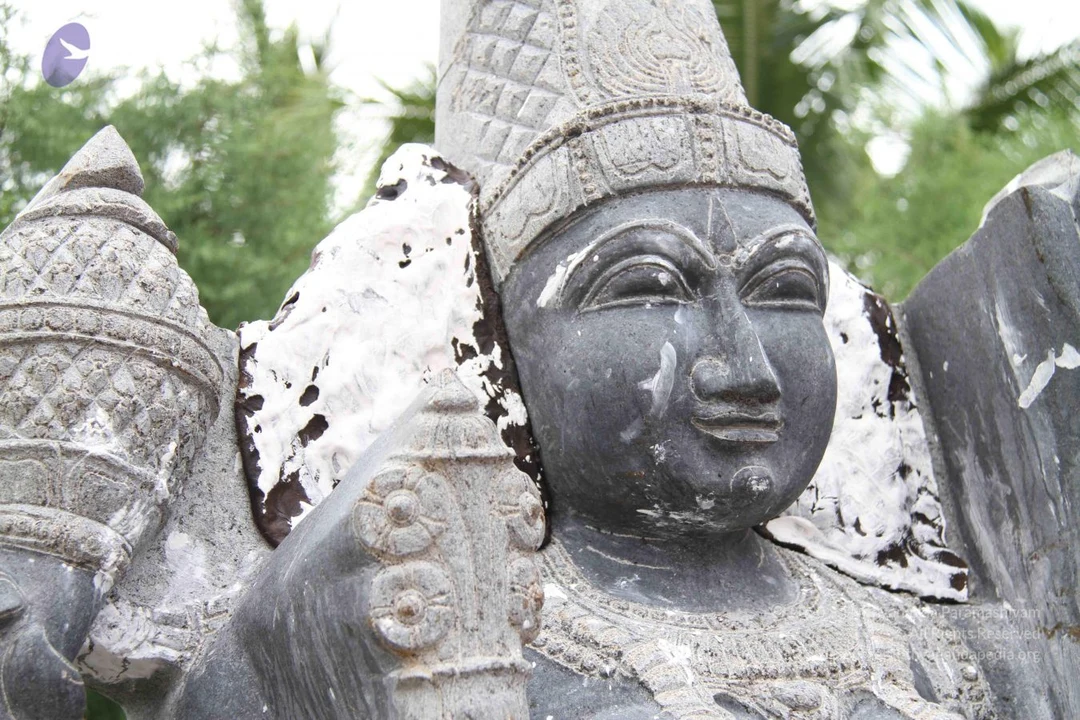
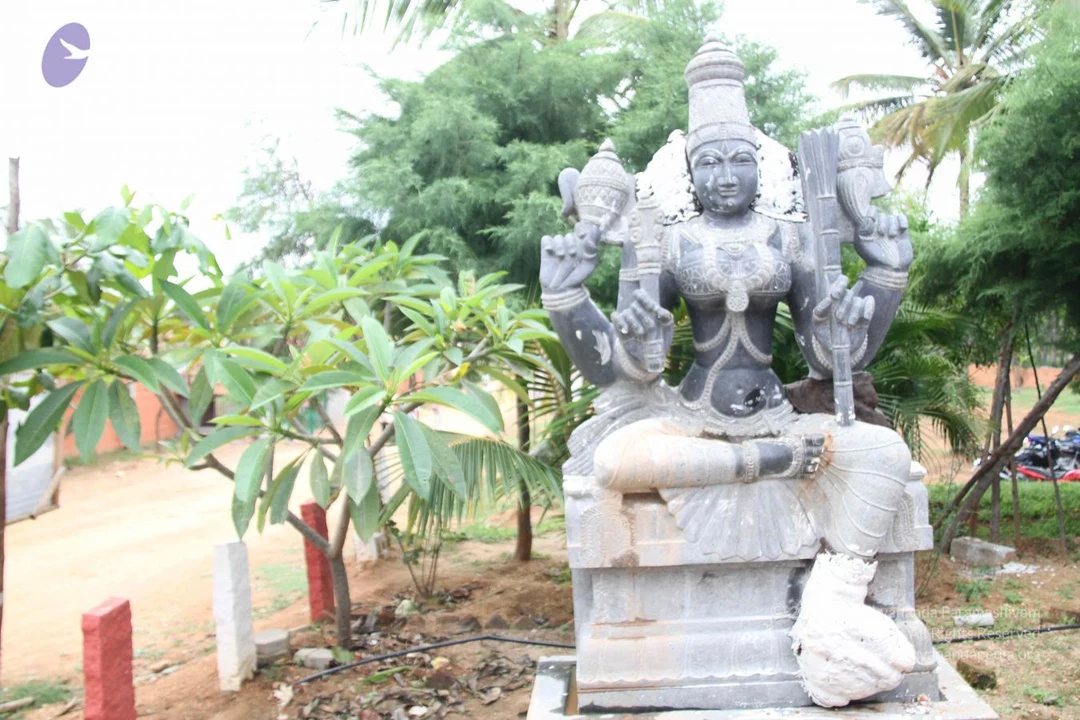
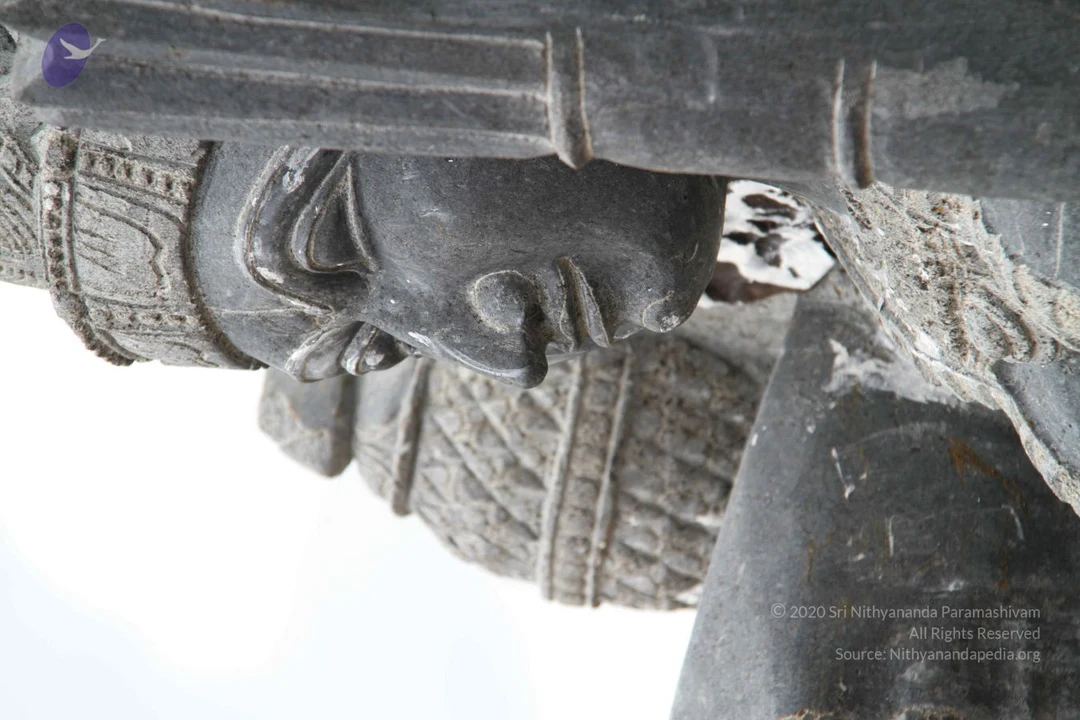
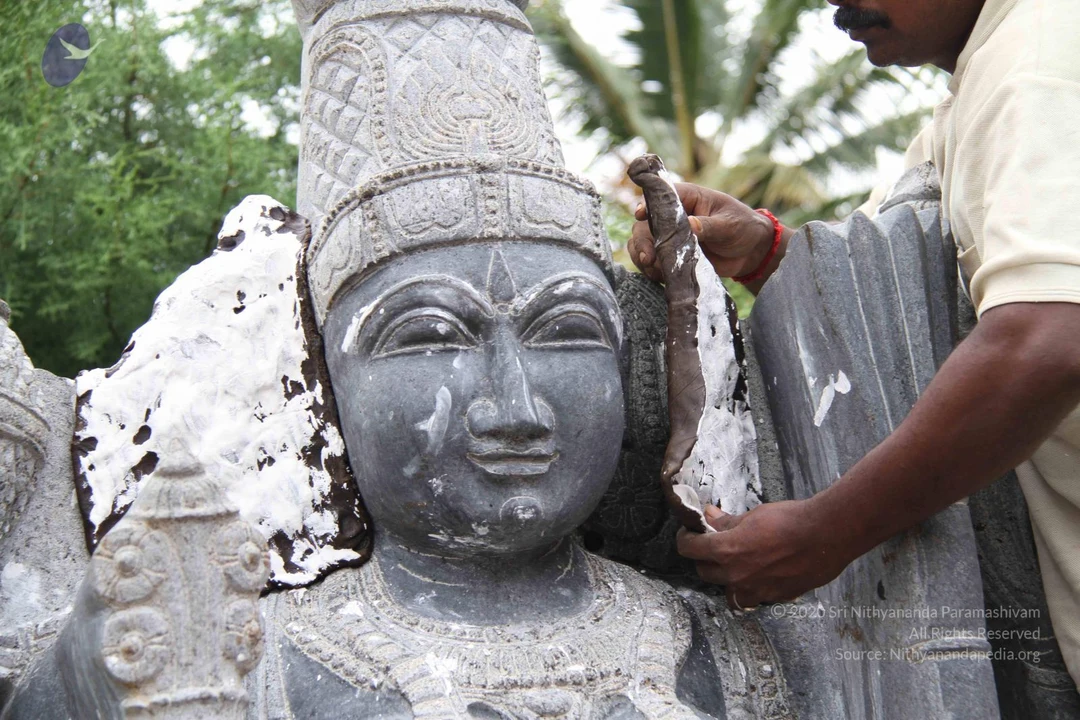
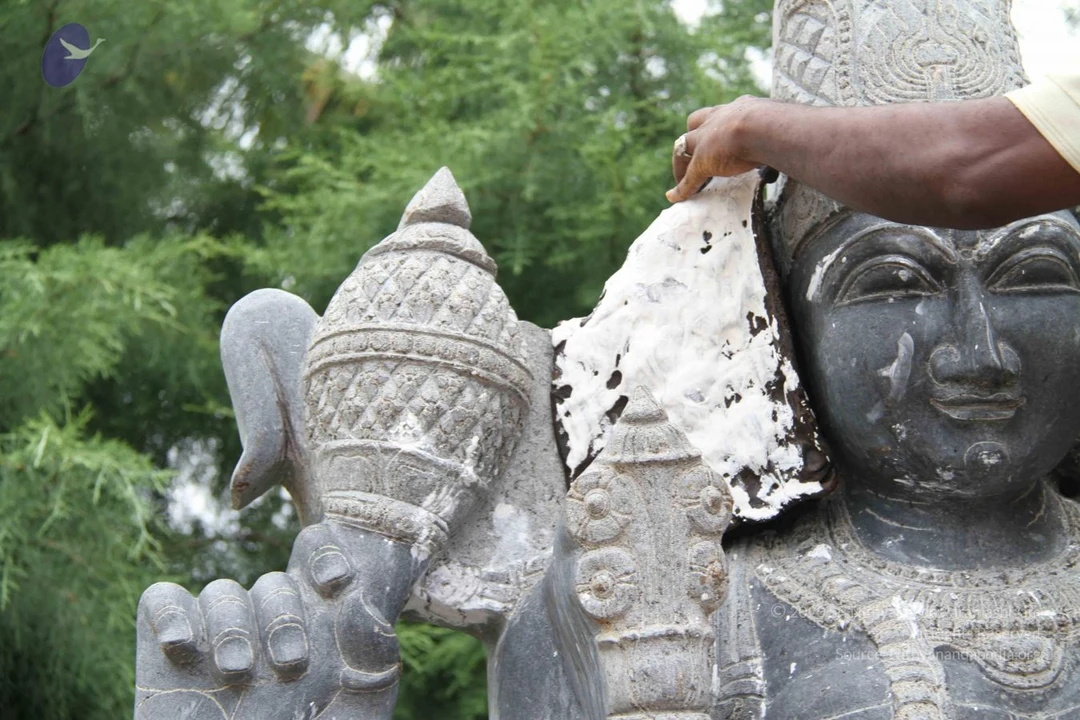
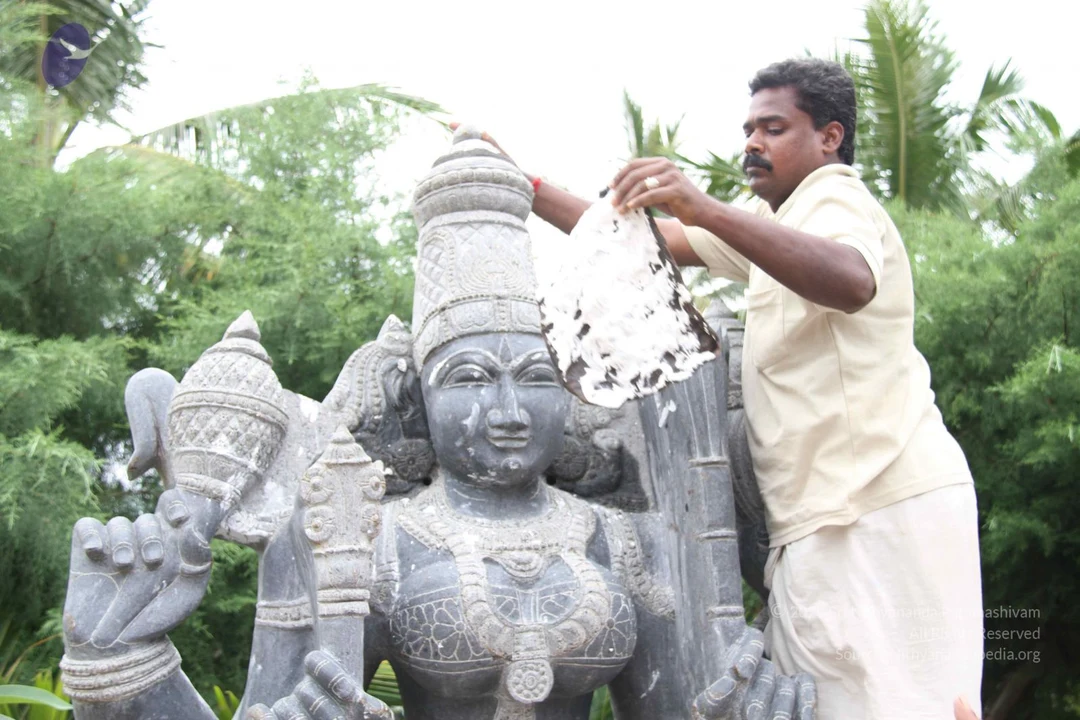
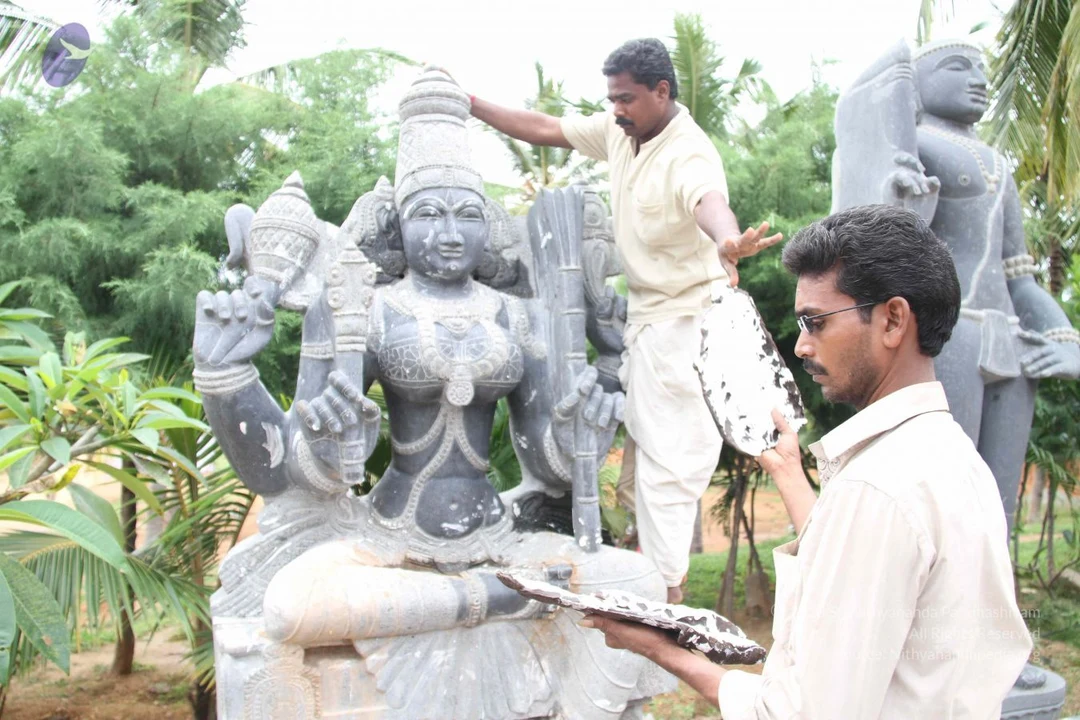
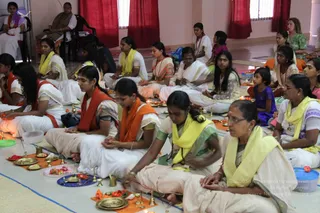
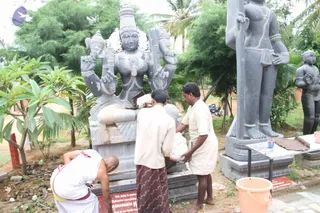
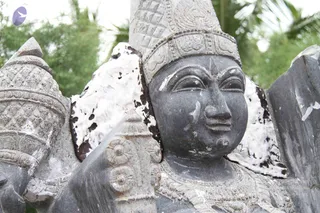
A silver ornate stand with a small canopy holding a framed printed card on a pink-tiled floor. The card shows a smiling figure with long dark hair wearing an orange-saffron robe and a rudraksha mala, one hand raised in blessing. The card is labelled "Paramahamsa Nithyananda" and "Be Blissful". A brass plate with a saffron-orange cloth edge and a small brass lamp sit at the bottom edge of the frame.A photograph of women seated cross-legged on a mat in a bright hall with red curtains, performing a group puja. Many women wear white and cream saris with yellow or orange shawls draped over their shoulders, and several have vibhuti or kumkum on their foreheads. In front of them are brass plates, small brass lamps and kalasha-style vessels with flowers and offerings arranged on mats. Two older women in the back row sit with eyes closed in meditation. No a person candidate is visibly present; the scene shows devotees in ritual sitting. Roughly twenty-five people are visible, several partially.A seated group of boys and young men on a cream floor during a ritual gathering. In the foreground, a boy in a white shirt and grey trousers leans forward over a small flame and brass lamp, while a young man in a white dhoti with maroon-bordered shawl sits beside him with hands extended over banana-leaf plates of offerings. Around them, boys in orange, red and striped shirts sit with eyes closed or watching, and an older man in white with a red-bordered cloth sits in the background. Plates of fruit, flowers and small vessels are arranged on colourful mats.A seated group of ritual participants in a room with red curtains performs a puja on a floor covered with mats. In the foreground, a bald young man in white dhoti with gold borders and a long rudraksha mala wears spectacles and presses his palms together. Beside him, a man in white with a rudraksha mala and gold bracelet sits with hands folded. Behind them, boys and men sit in rows, some in white dhotis with sacred ash marks on their foreheads and arms, others in colourful shirts. Brass oil lamps, a brass bell and small offering plates are arranged on the mats in front. A few cushions and a red chair are visible at the back. The mood is one of collective chanting and worship.Outdoor photo in a garden of tall grey granite deity statues among palms and frangipani. A multi-armed female deity murti with a crown and jewelled necklaces stands behind a worker in a white shirt and lungi who is handling a white cloth near its base. Beside it, a tall standing figure holds a staff, and a small statue sits to the right. A man in a cream shirt and dark patterned lungi stands in front, bent toward the base, while a bald man in a white dhoti bends over at the lower left. A plastic bucket and a small table with a cloth sit at the right edge.Close-up photograph of a weathered grey stone statue of a deity with a tall ornate crown, carved details, and a broad serene face with heavy-lidded eyes and a small chin. Chipped white paint flakes on the sides of the head and shoulders, and a carved ceremonial staff or mace with floral medallions rests in front. Green palm trees and foliage blur in the background under a bright sky. The statue is a deity murti; no living person is present.

Sacred-Arts

14 photosSource gallery
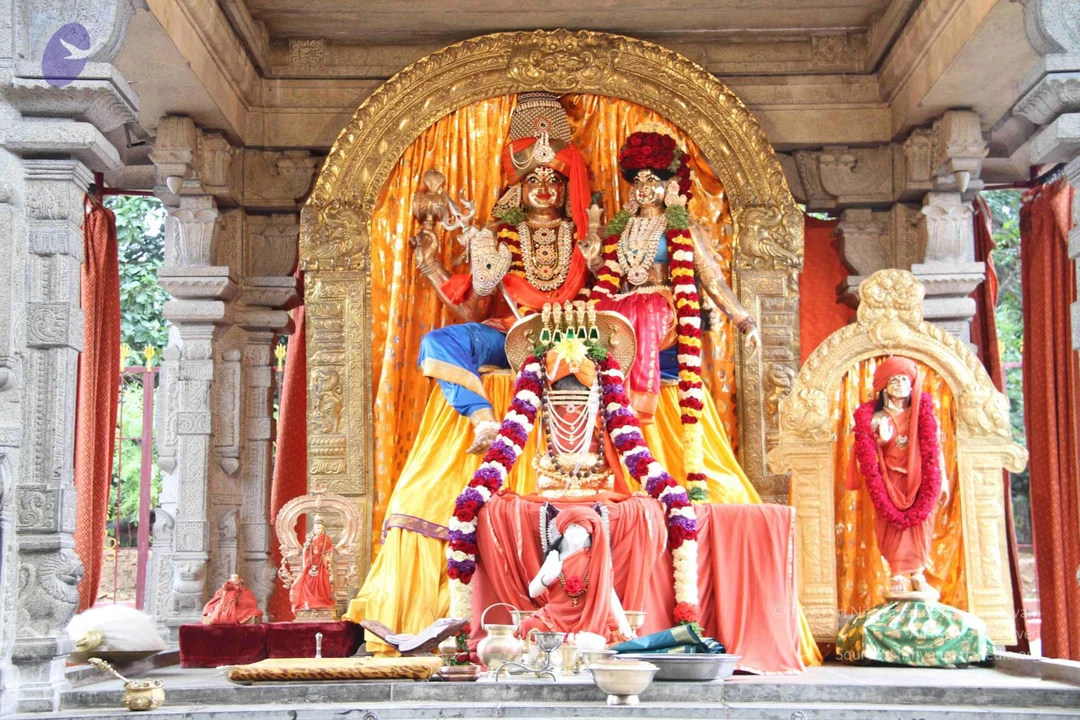
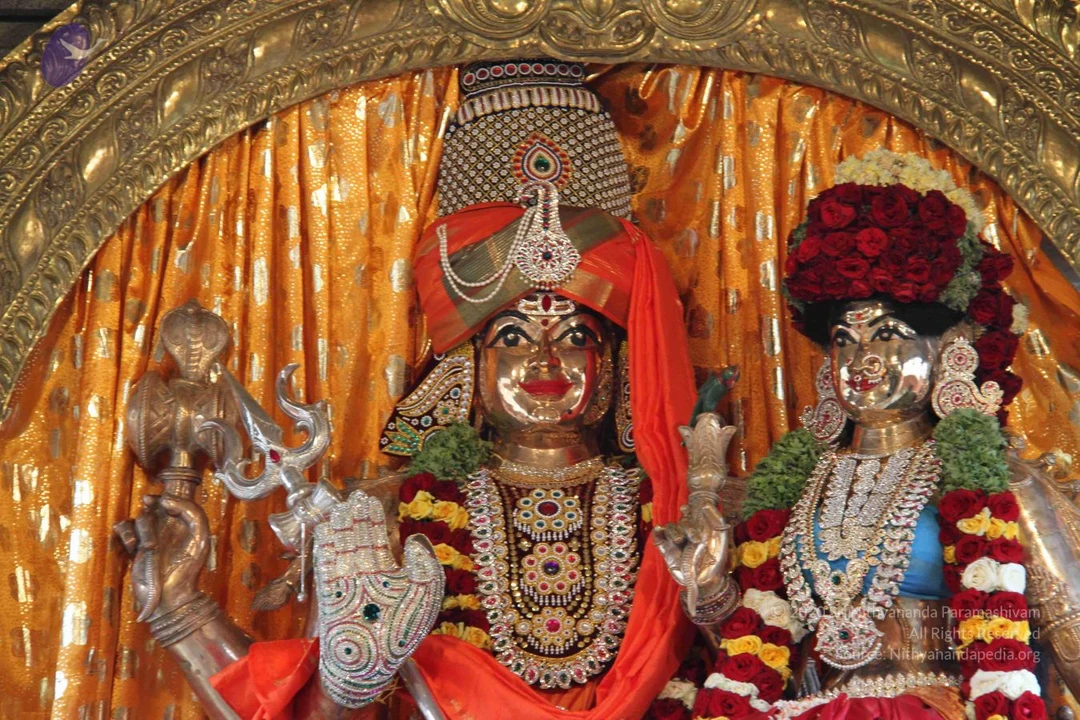
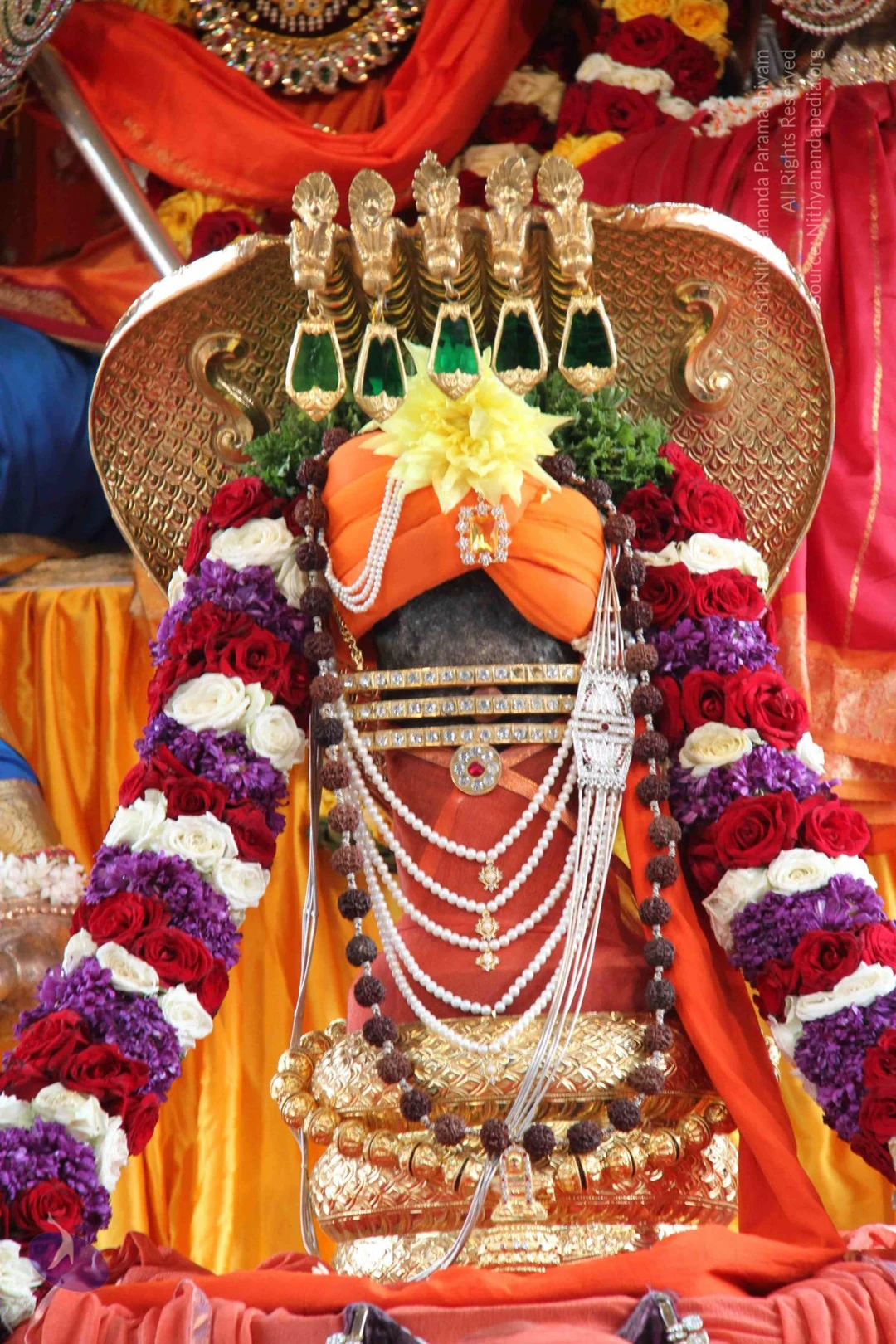
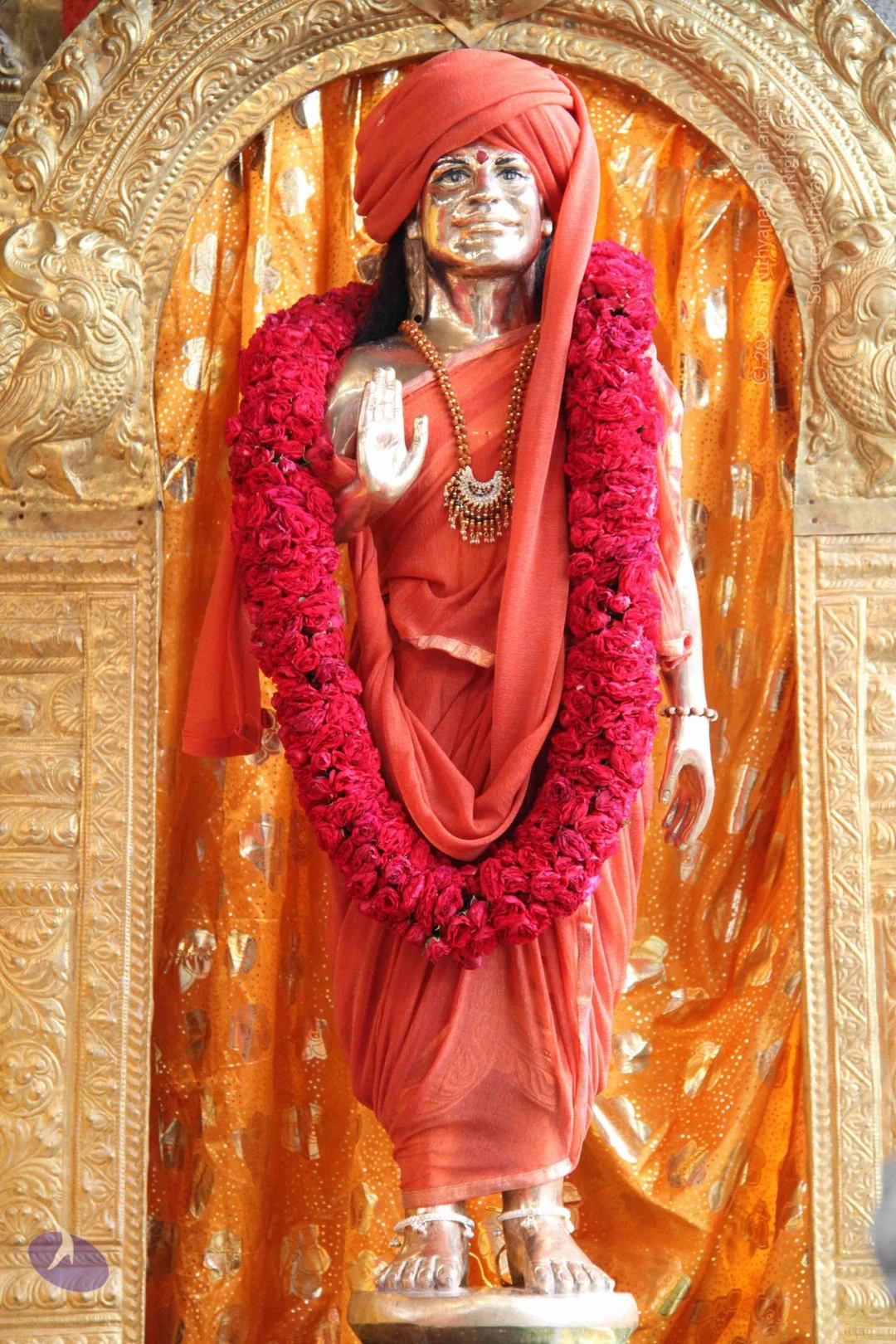
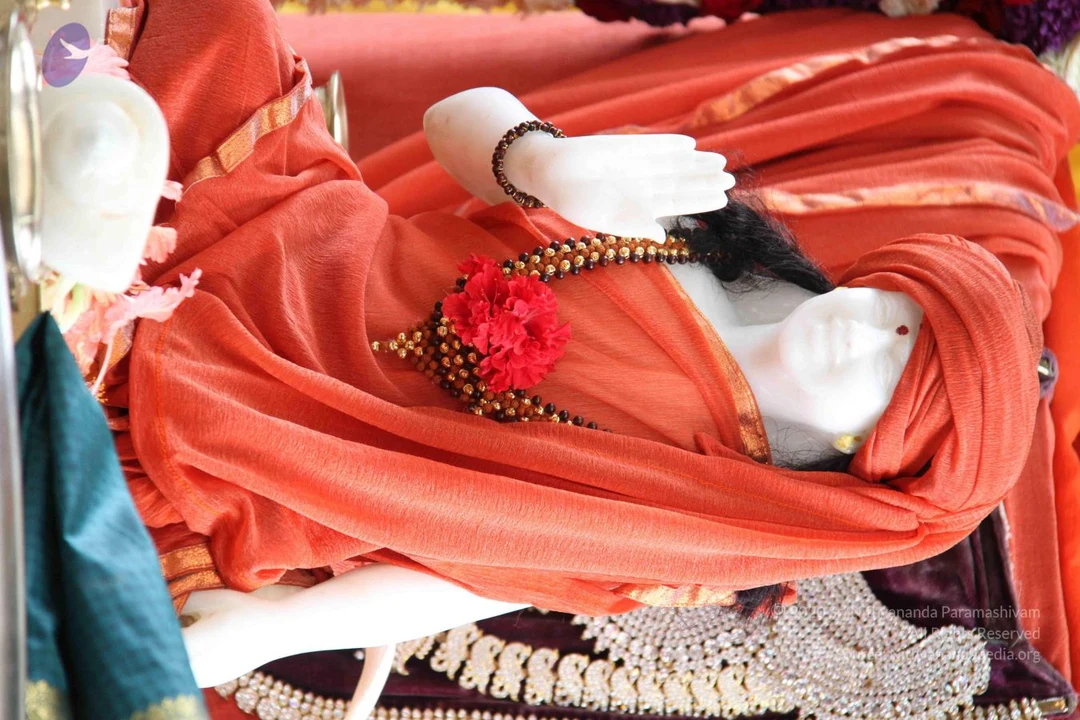
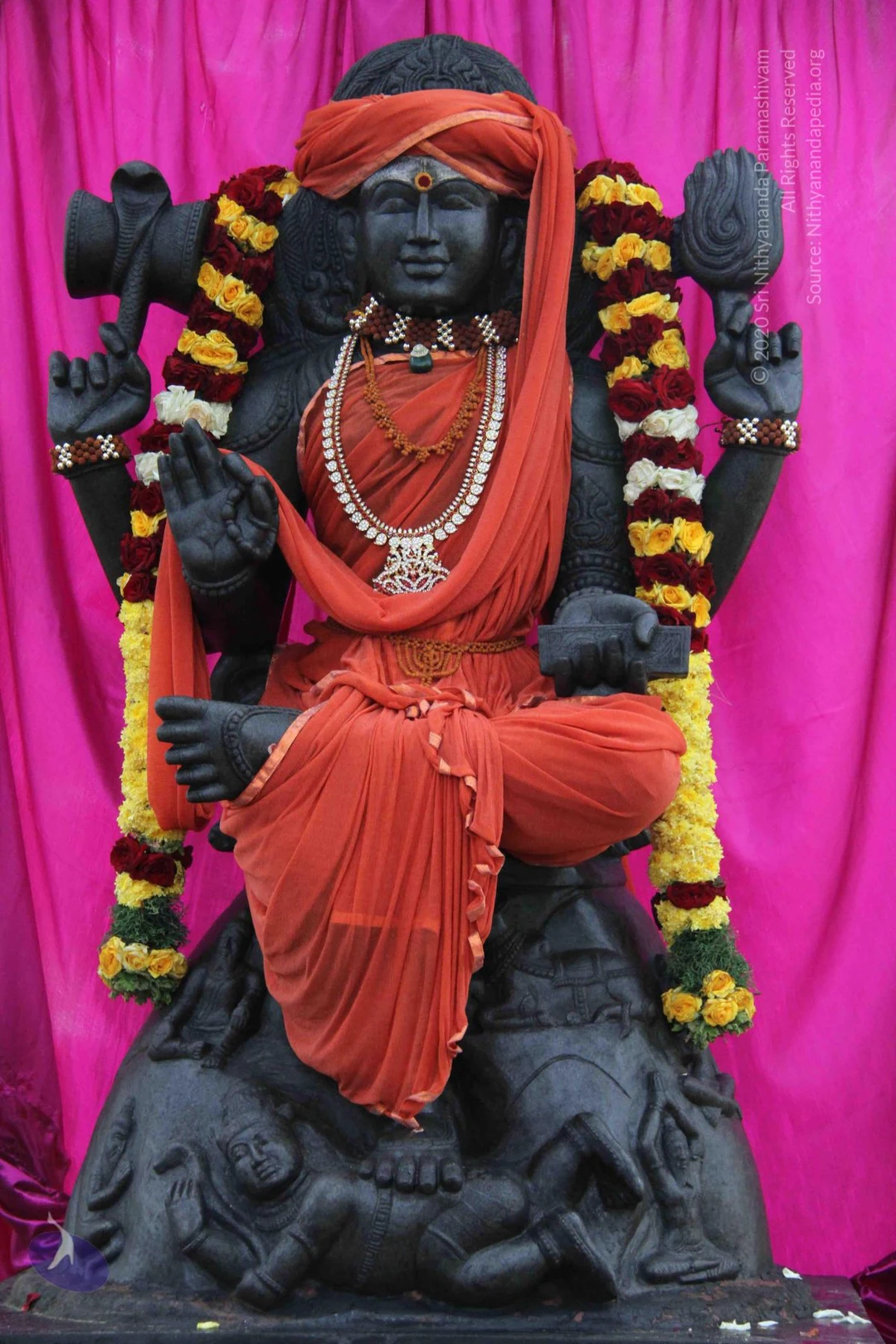
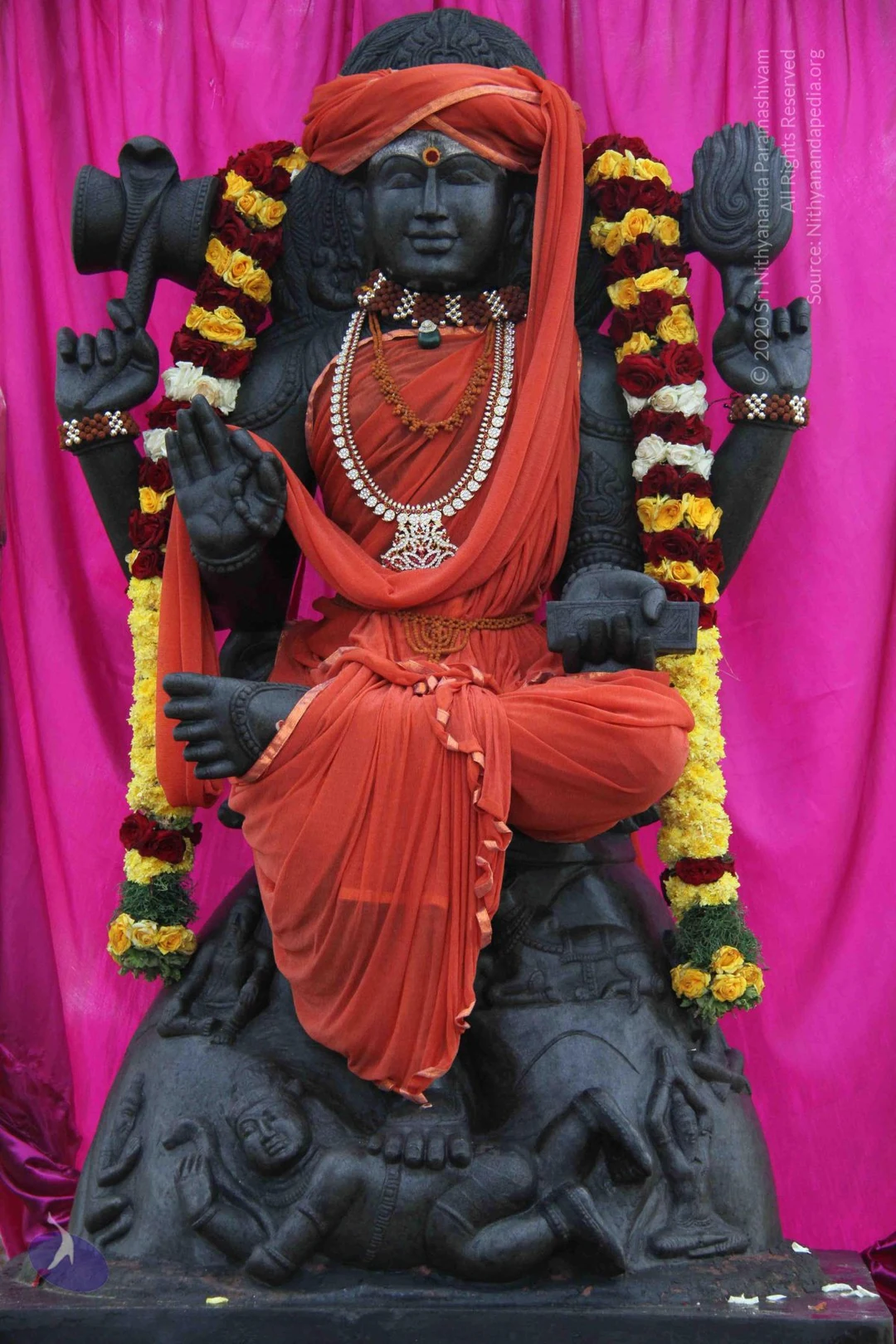
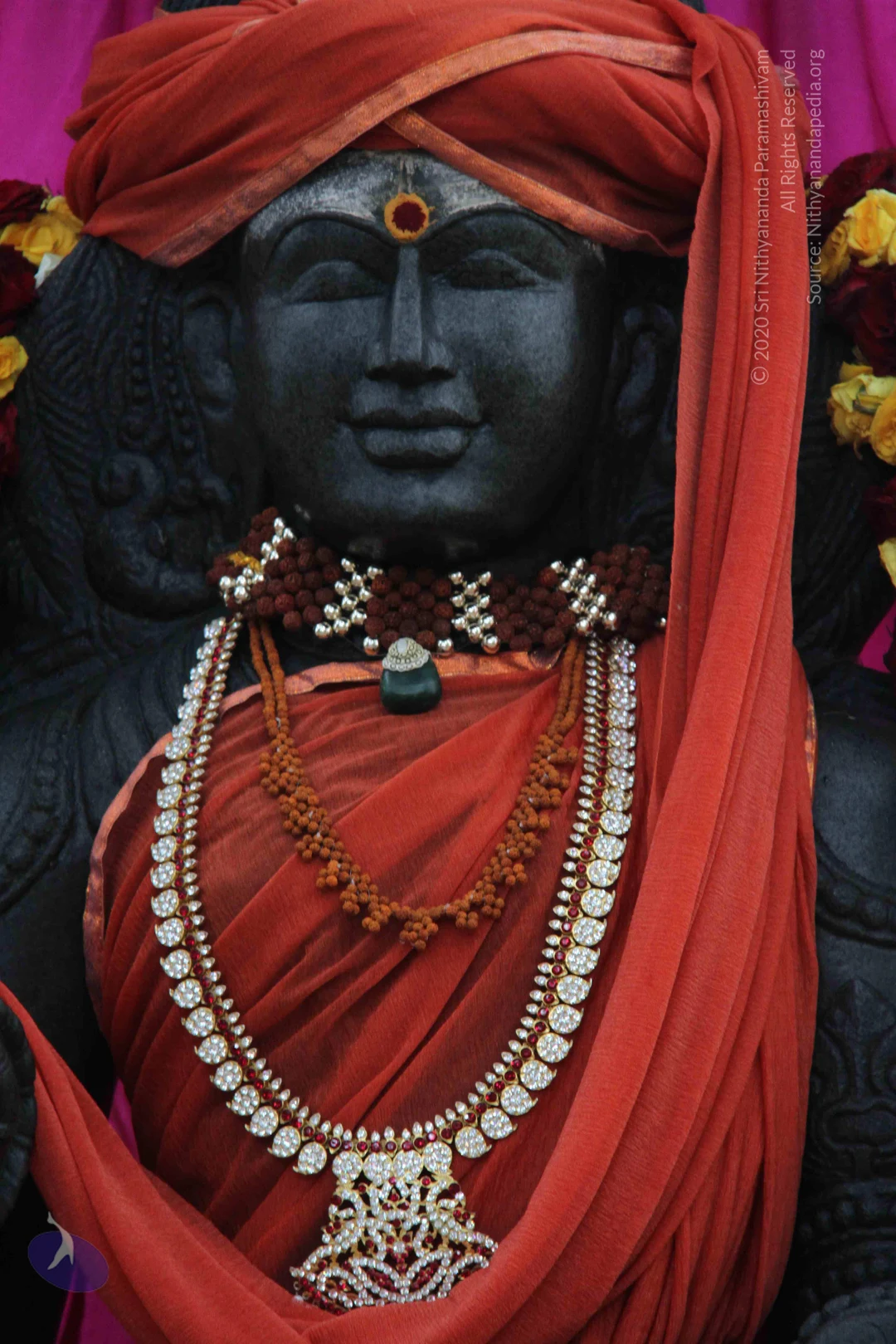
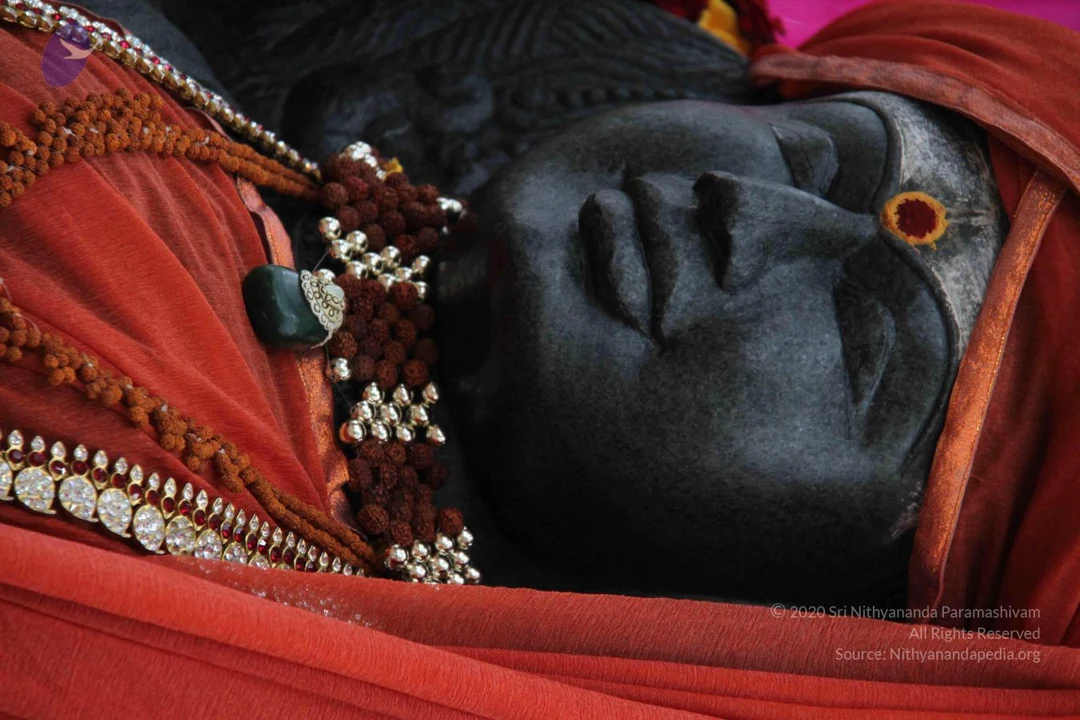
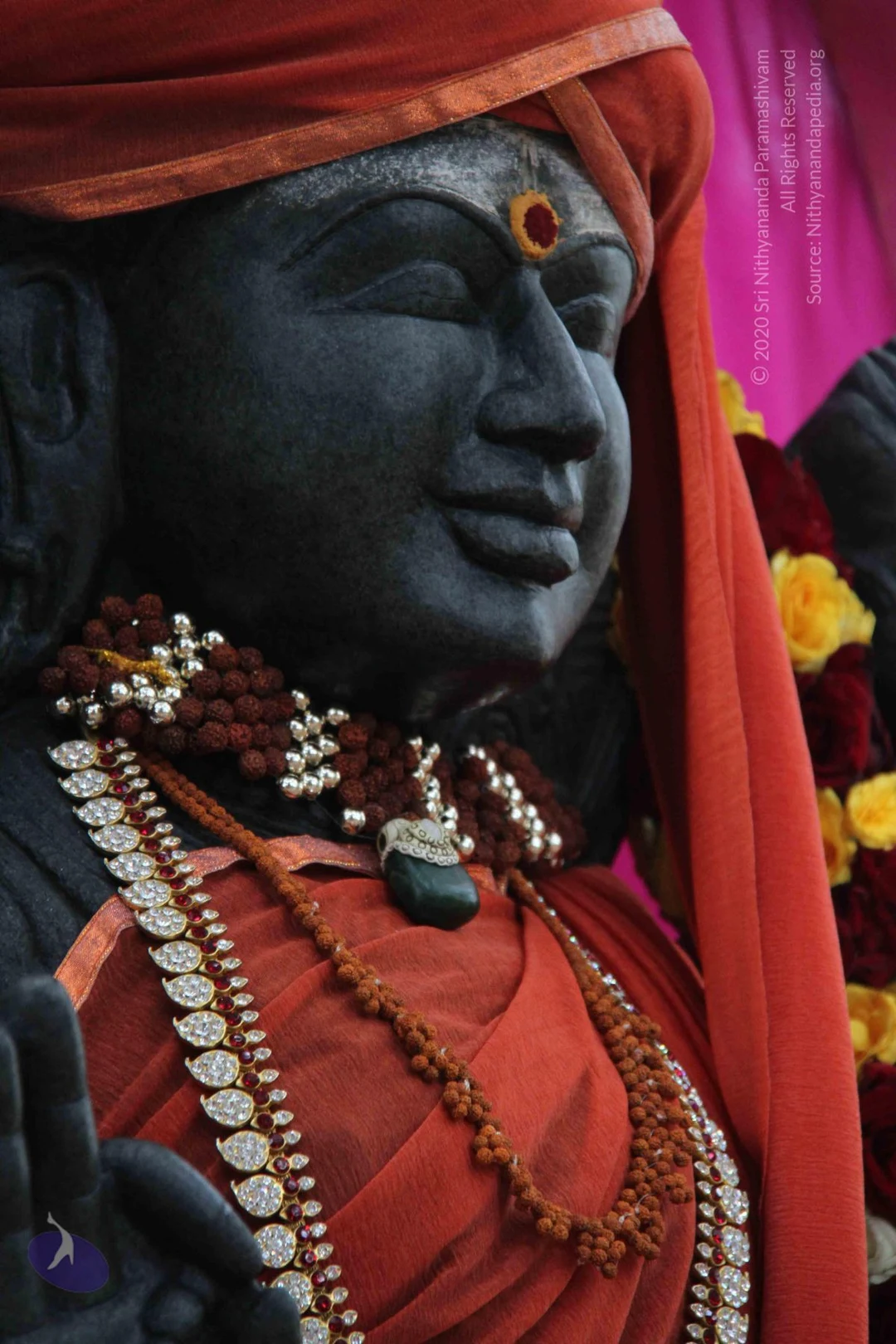
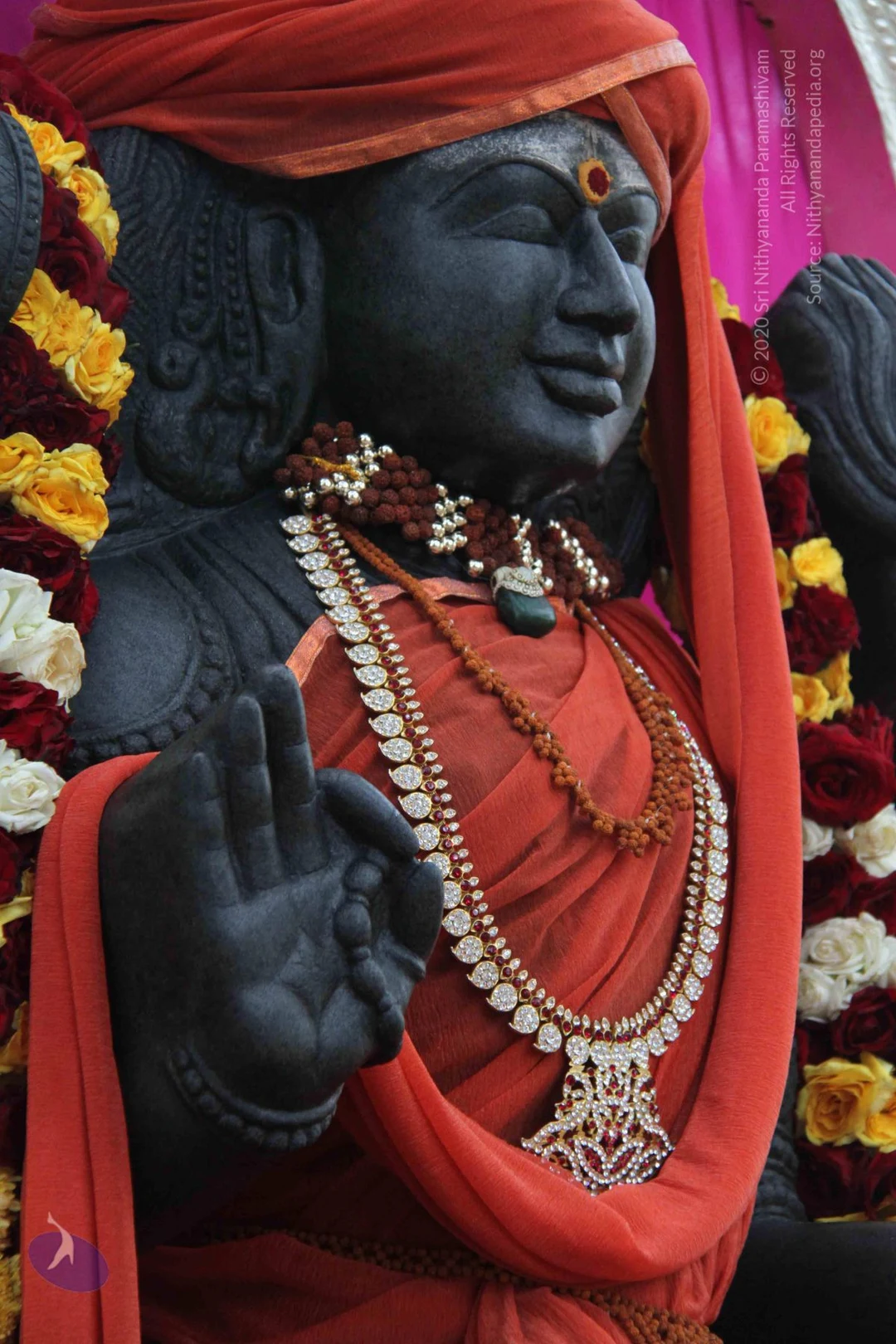
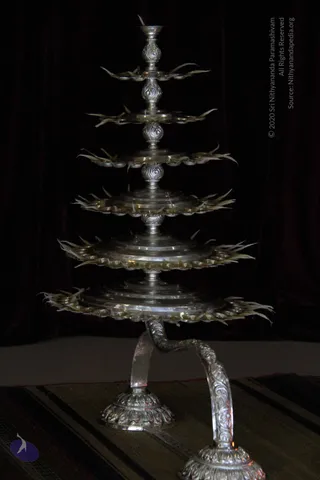
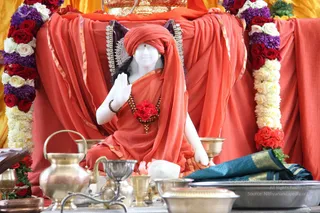
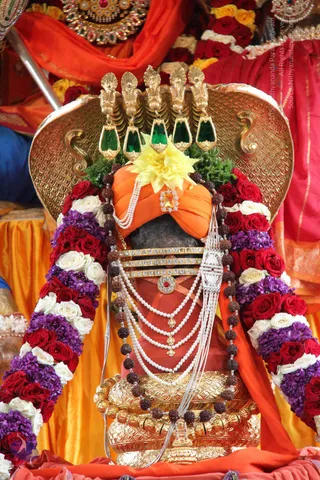
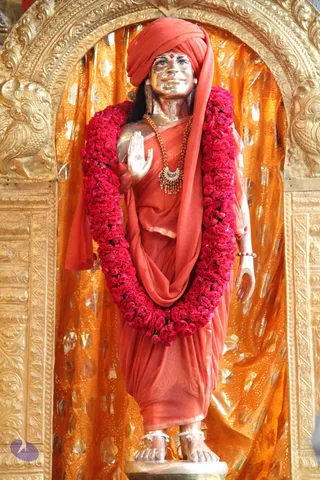
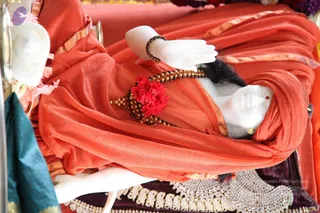
A photograph of an ornate silver multi-tiered lamp stand with several stacked circular trays, each rimmed with small oil lamp cups holding wicks, supported on a curved, embossed silver base with floral scrollwork. The stand is set against a dark background on a striped woven mat. No people are visible.A white marble murti of a seated saint in saffron-orange robes and a matching orange turban with a red bindi, right hand raised in abhaya mudra, sitting on a draped orange throne backed by a dark ornate panel. Garlands of red roses, white flowers and purple blooms frame the seat, and a red flower and rudraksha-style mala hang at the chest. In front, brass pots, a kalasha-like vessel, a silver bowl and offering dishes sit on a steel tray with a teal and gold cloth. The figure is a statue, not a living person, so no physical person is shown. Identity is not established from the statue's appearance.A decorated murti of a deity seated on an ornate golden throne with a five-hooded golden cobra canopy behind it. The murti wears an orange turban adorned with a yellow flower and a jewelled ornament, layered white pearl necklaces, a silver-and-gold sash studded with stones, and multiple rudraksha malas. A long garland of red roses, white roses and purple flowers drapes over both shoulders. Golden hooded serpent finials hold green gem pendants above the head. Behind, orange, red and gold fabrics and a red-and-gold embroidered backdrop frame the scene. No people are visible.A decorated deity murti, a dark stone figure dressed in an orange turban with a yellow flower and jewelled ornament, sits before a golden serpent-hood backdrop topped by five gold cobra heads with green gem drops. It wears layered pearl necklaces, rudraksha malas, a gold waist band set with stones, and a silver sash, and is framed by garlands of red roses, white roses and purple flowers. Orange and gold silks surround it. This is a photo of a statue, not a person, so no physical people are shown.A golden statue of a standing sannyasi in an ornate gold arched niche draped with orange and gold fabric. The figure wears an orange-red turban with a red bindi, an orange-red robe, and a gold beaded necklace with a pendant. Its right hand is raised in abhaya mudra while the left hand hangs at its side. A large garland of red roses hangs around the figure, and the feet rest on a gold pedestal. Because the subject is a statue, no physical people are present.A white marble statue of a reclining figure draped in orange-saffron cloth with gold-edged border, wearing a rudraksha mala with a red flower garland. The statue's head rests on a pillow near a dark pleated bolster, with decorative jewelled necklaces in the foreground and a teal cloth at left. The figure is a depiction in marble, not a living person, and no identity is asserted from the face.