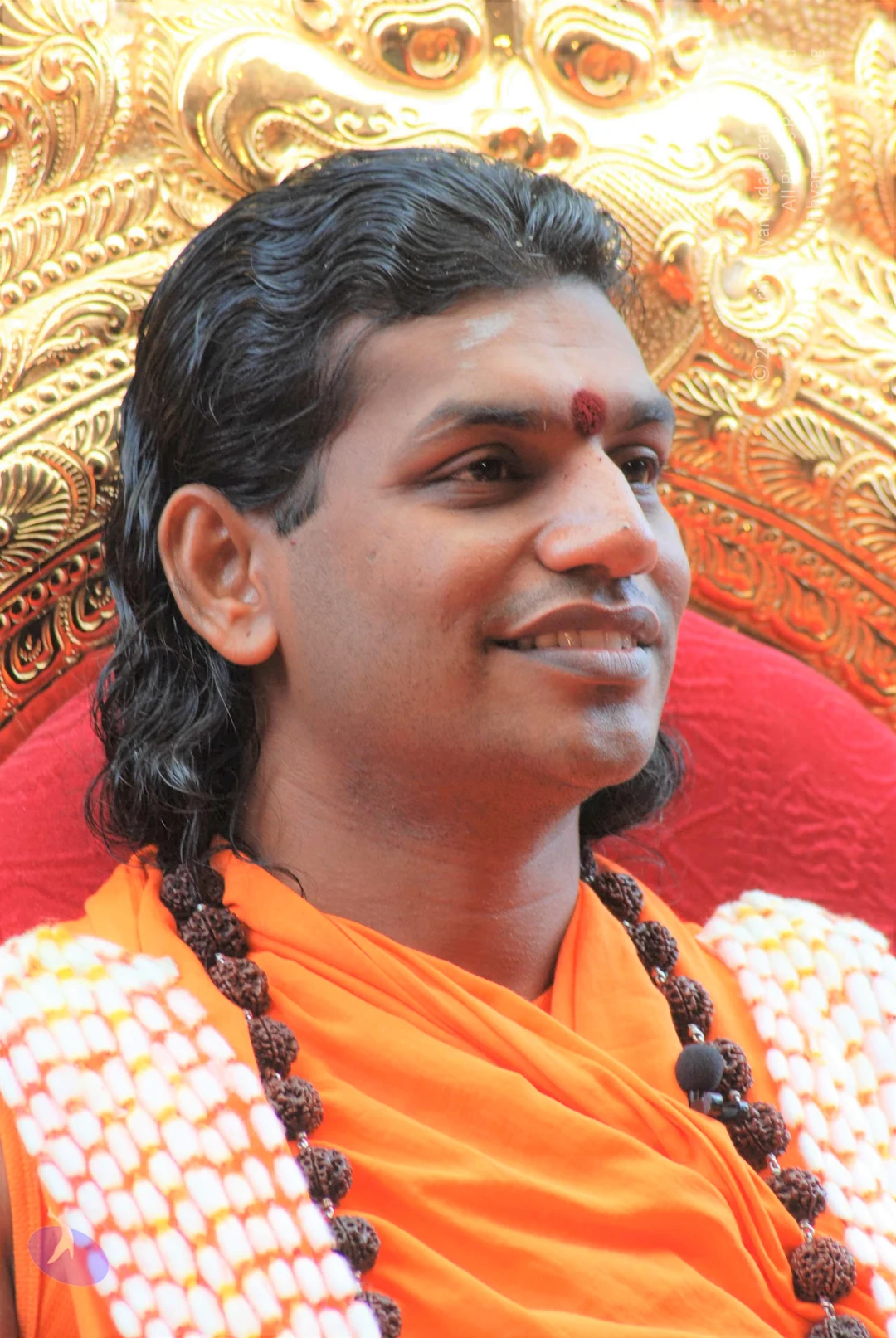
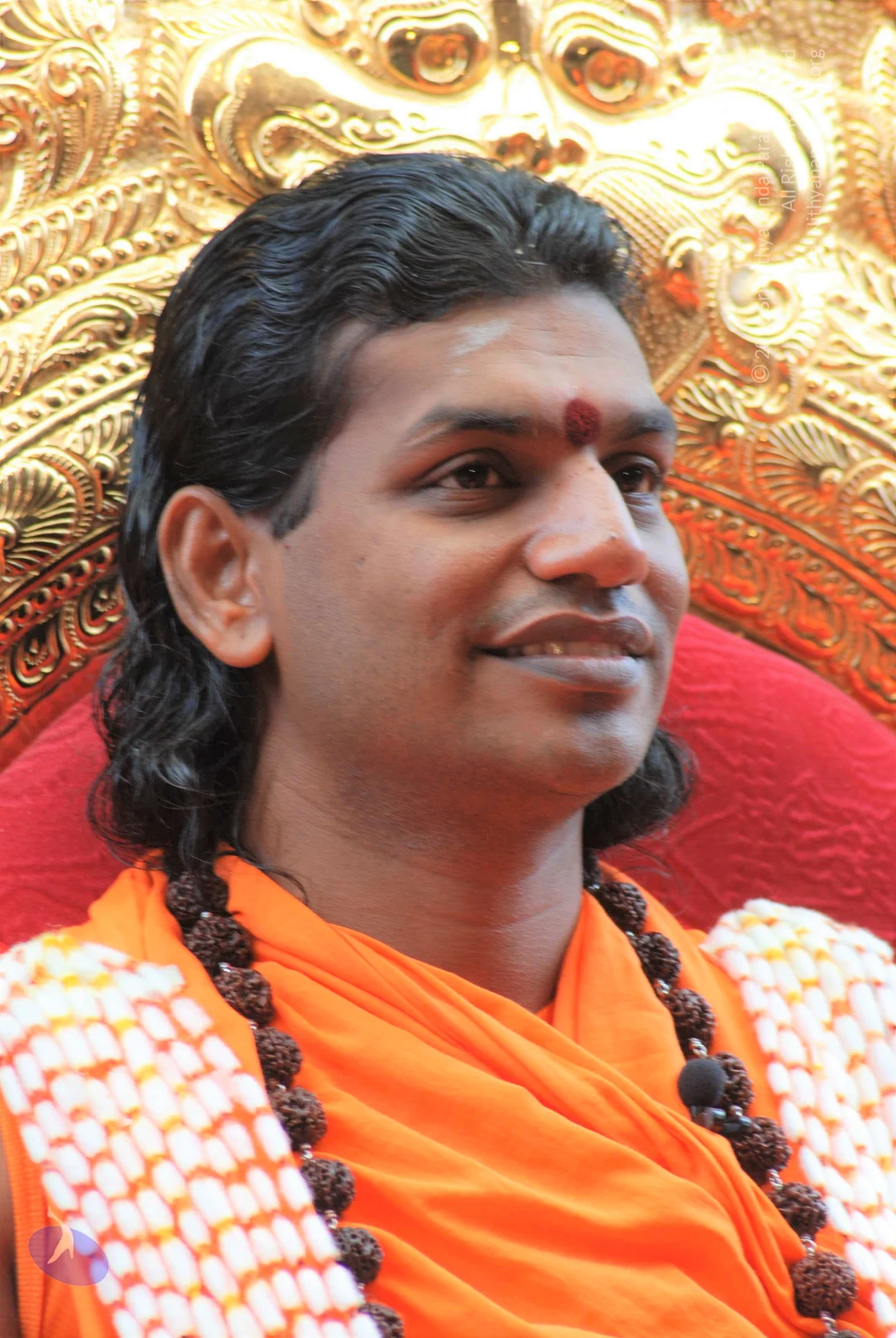
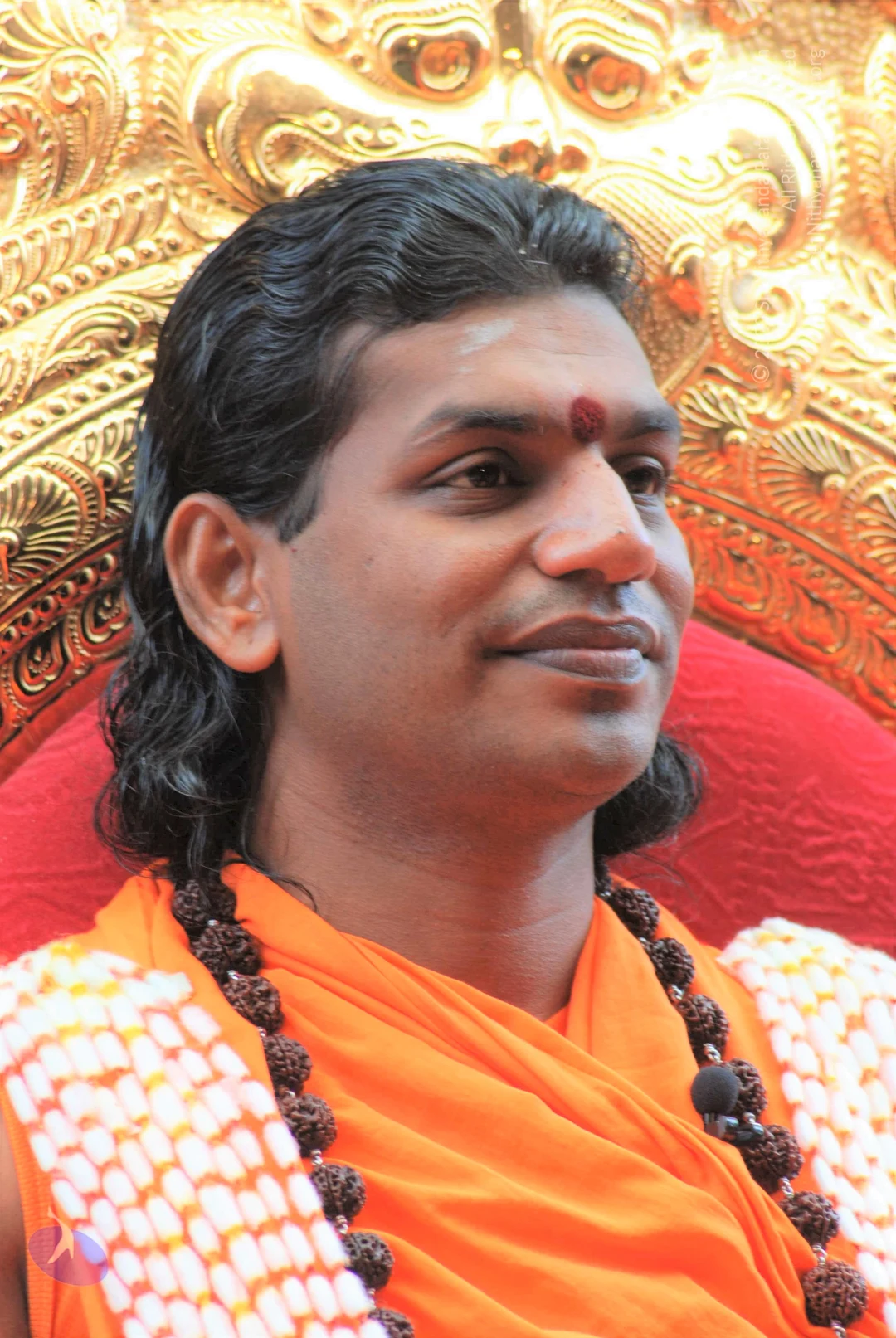
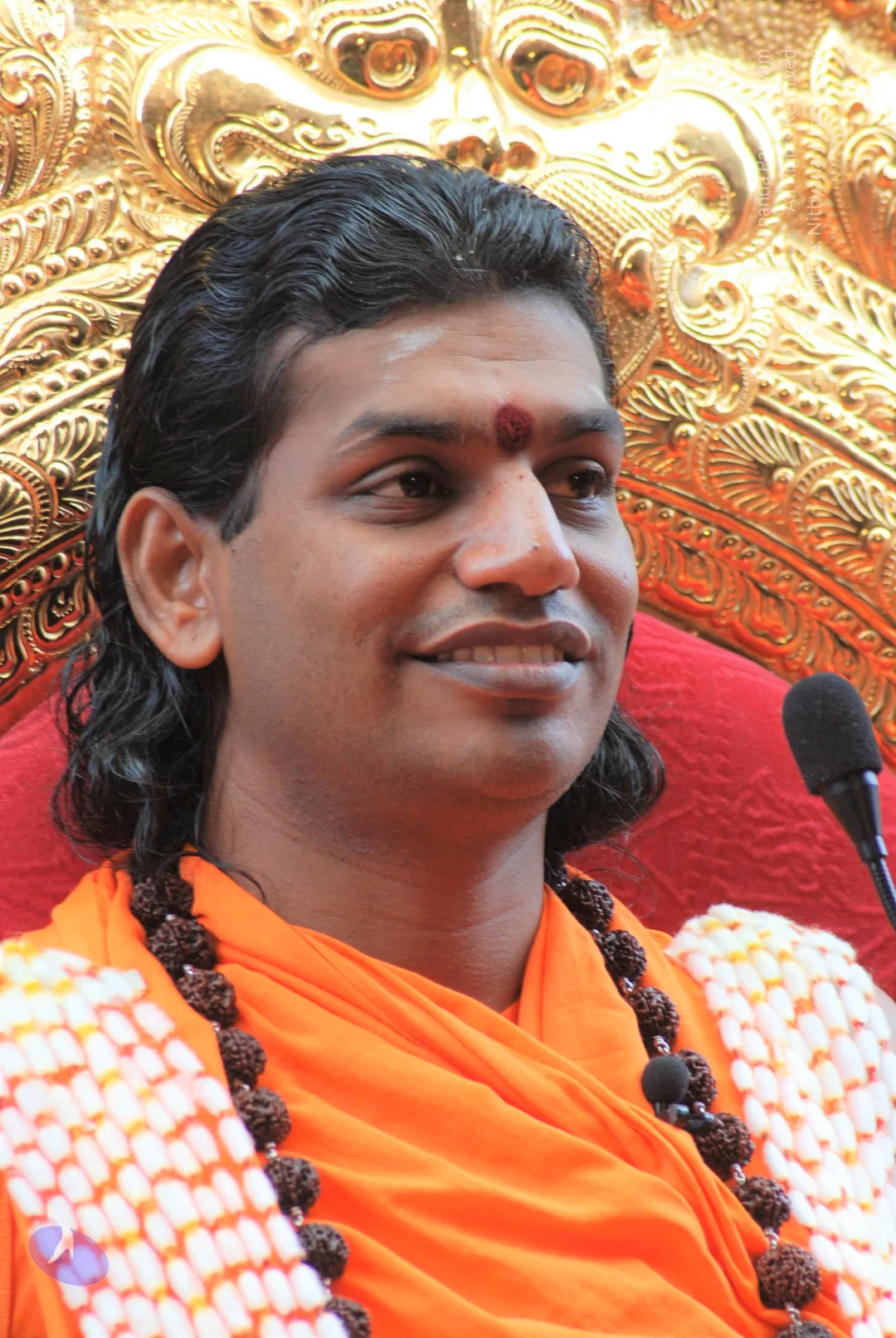
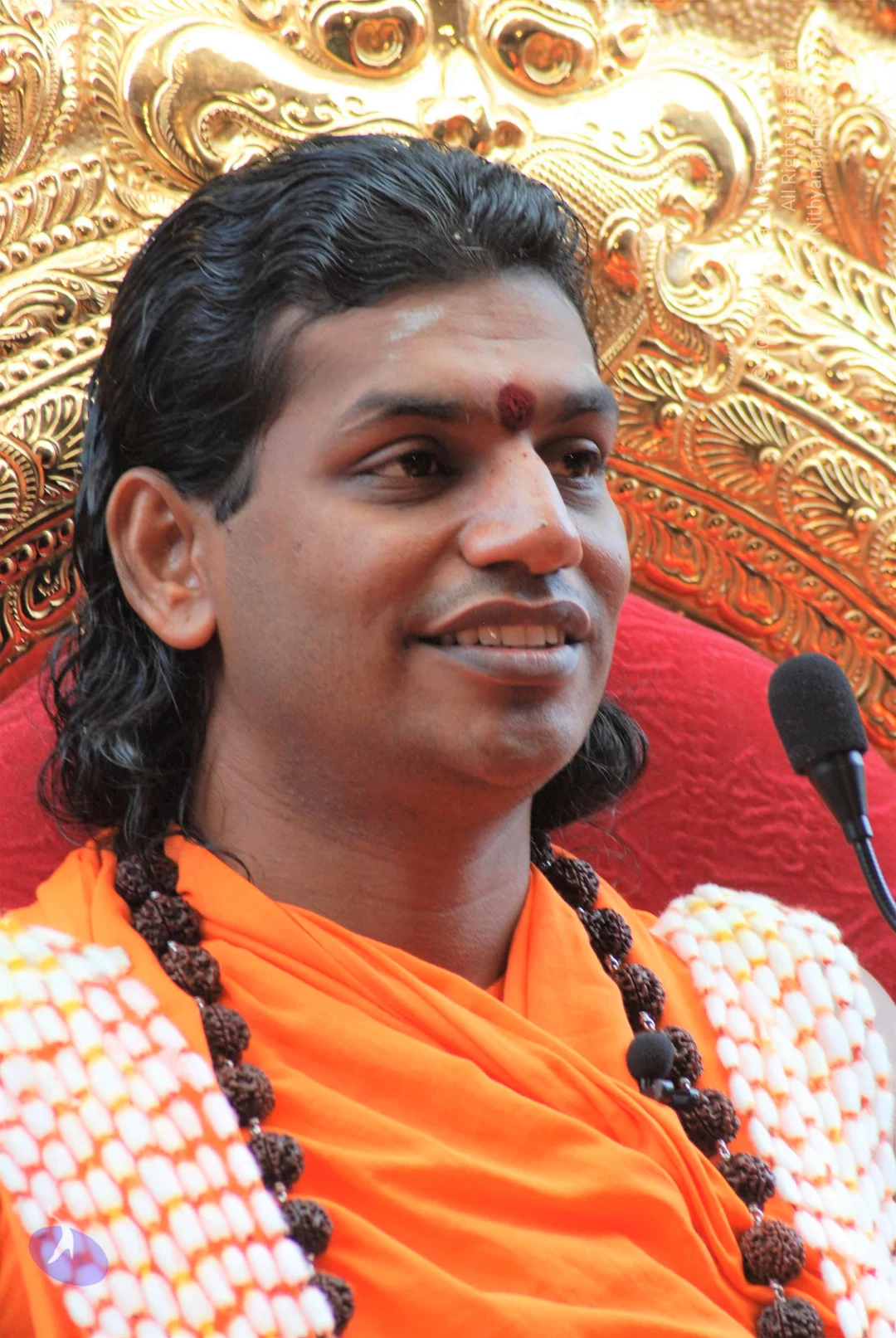
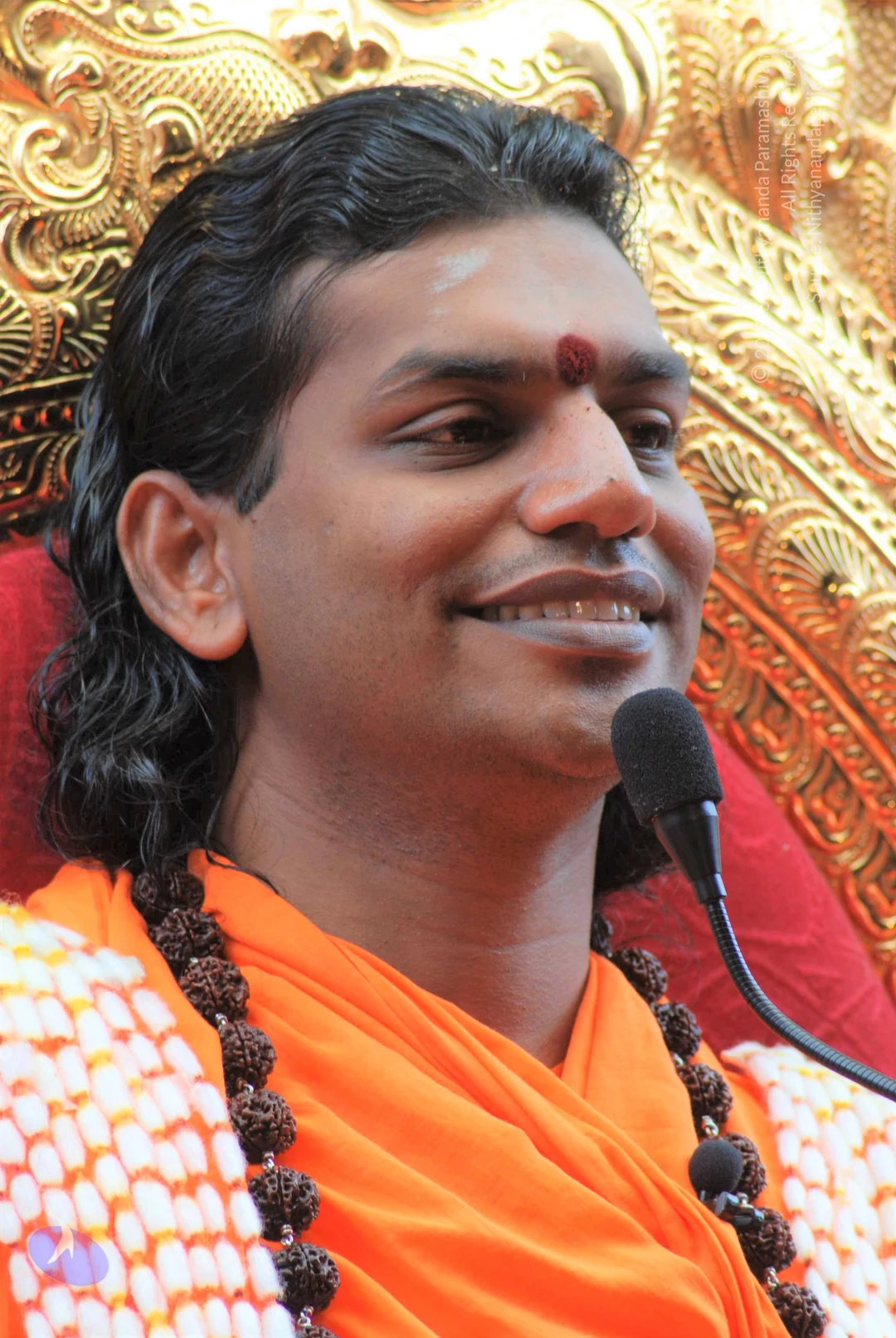
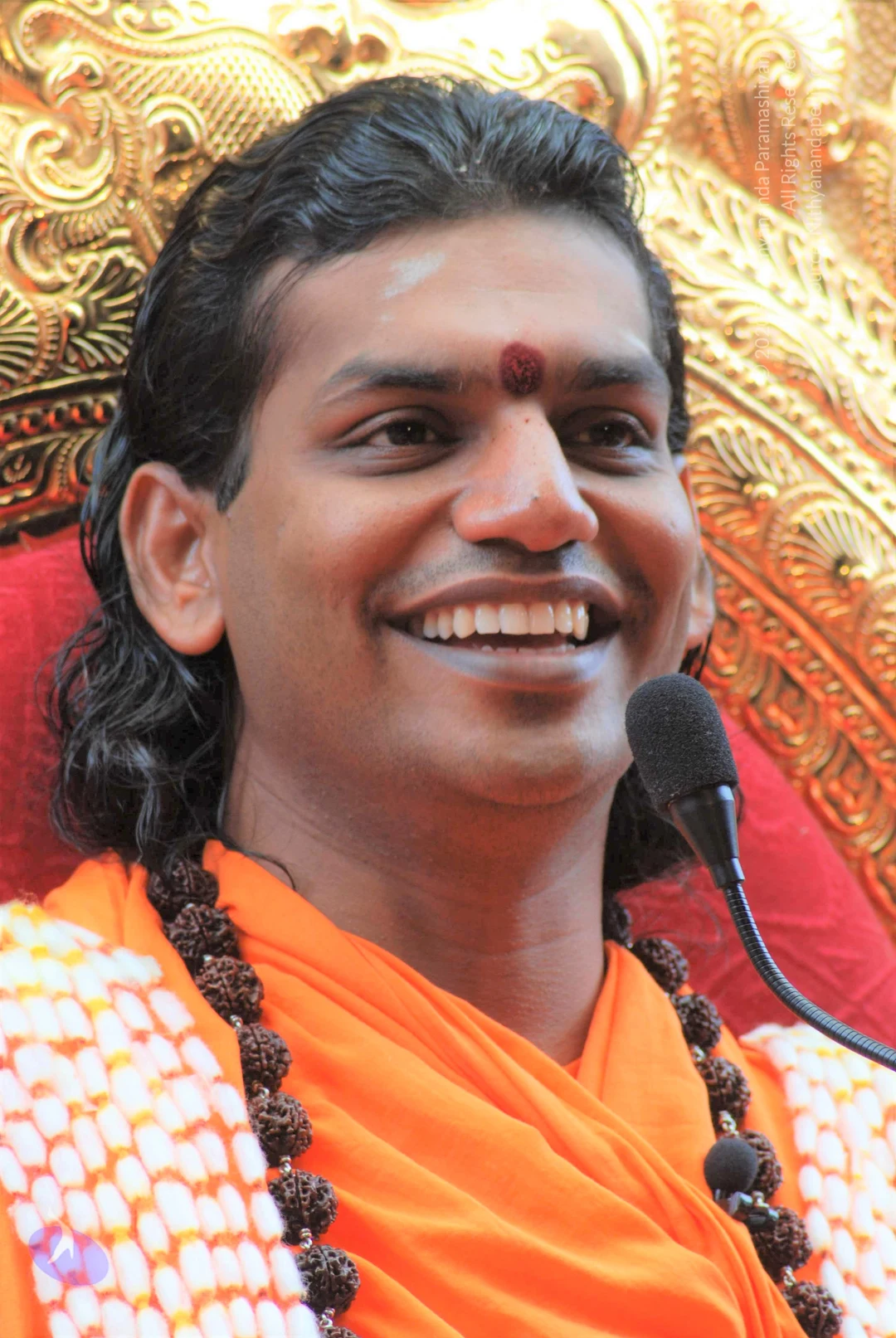
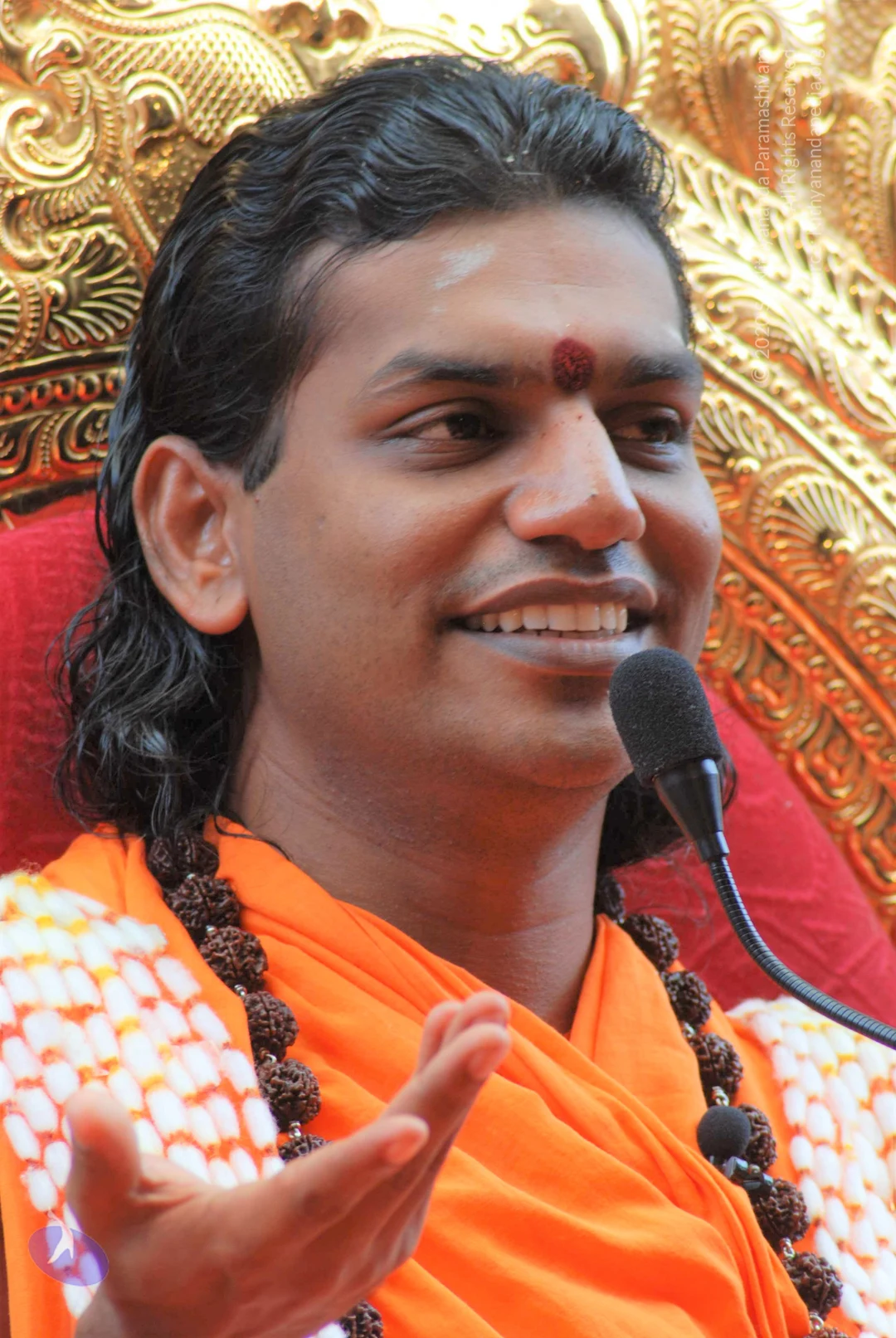
Skip to content
Wednesday

15 September 2010

Healing Through Mantras
499Dated photos
1Source pages
4Media embeds
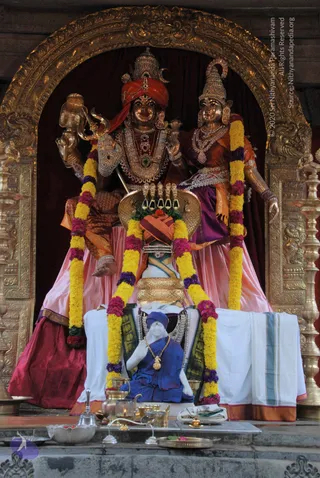
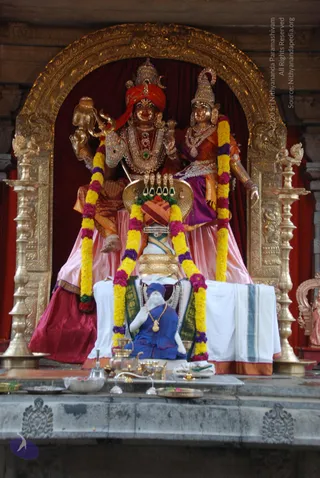
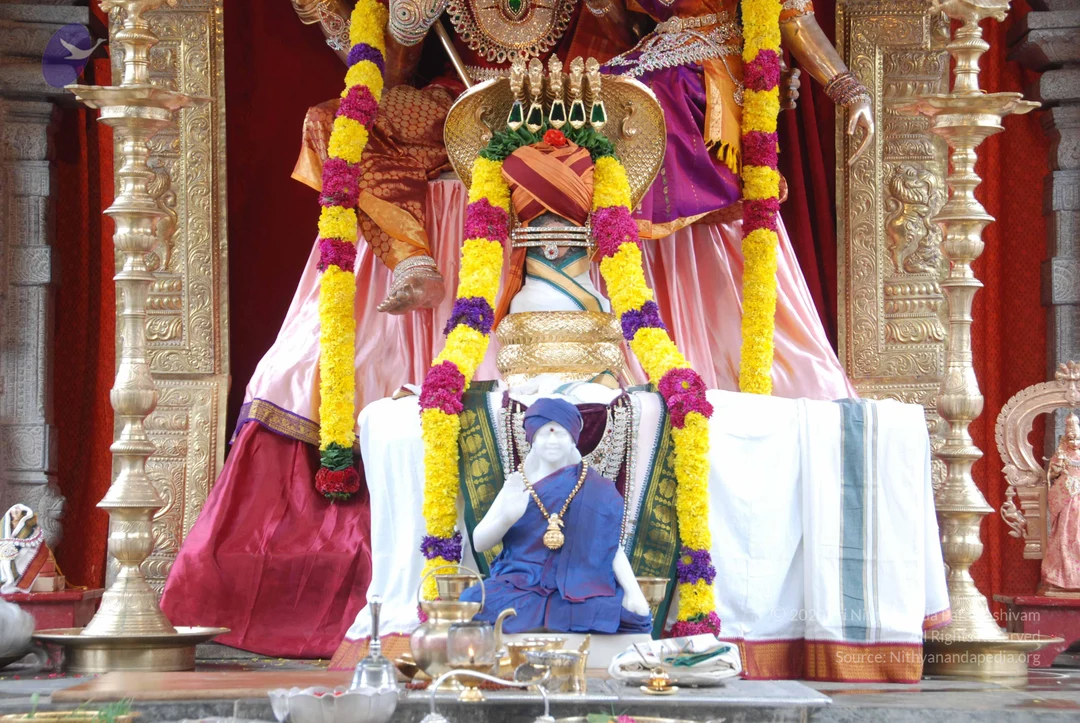
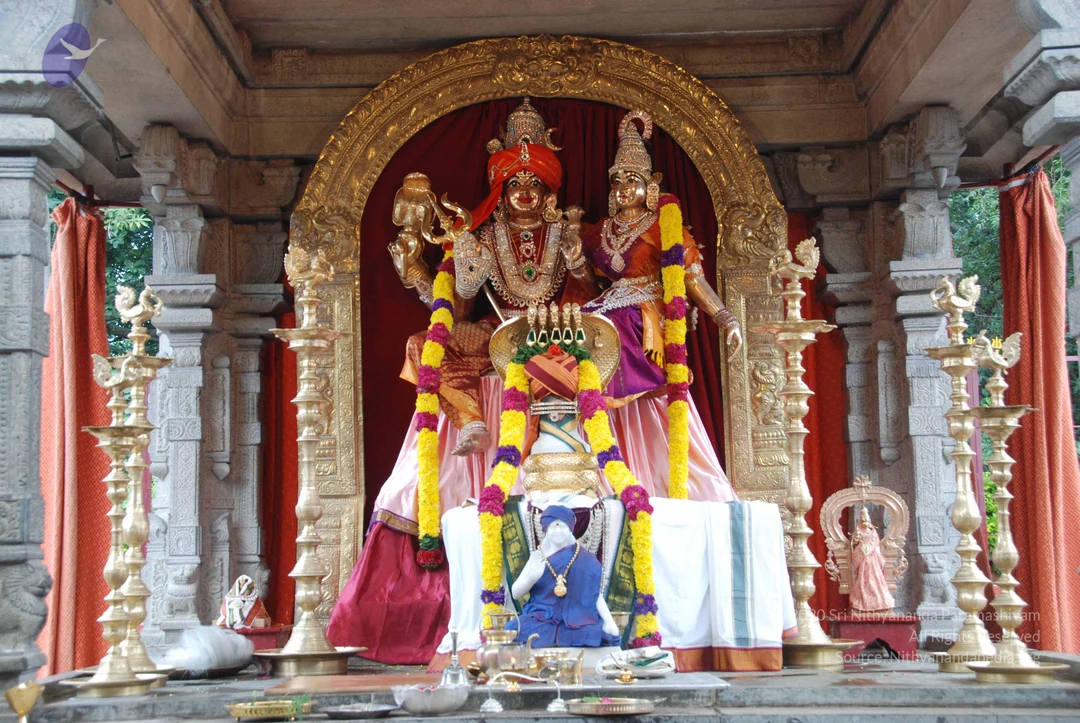
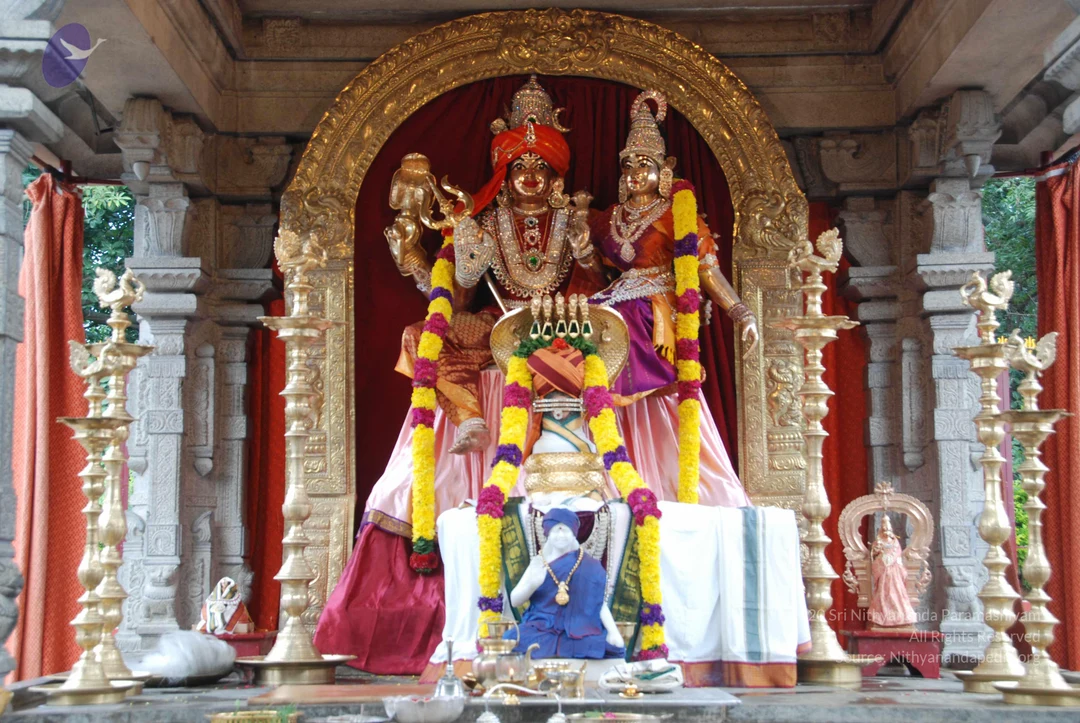
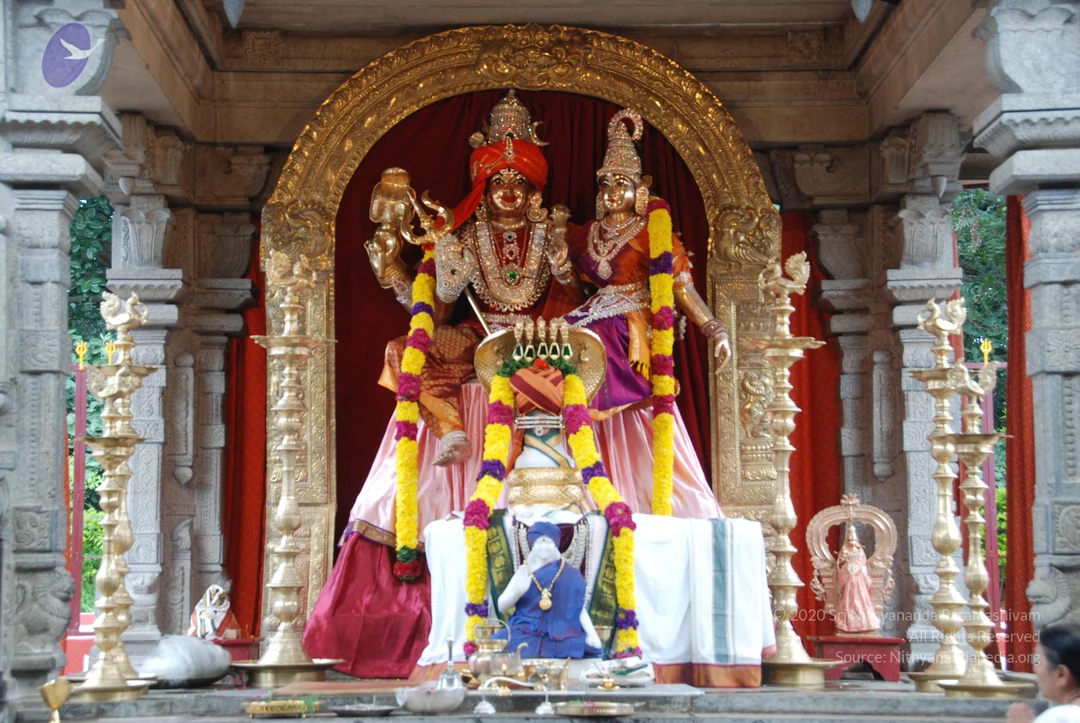
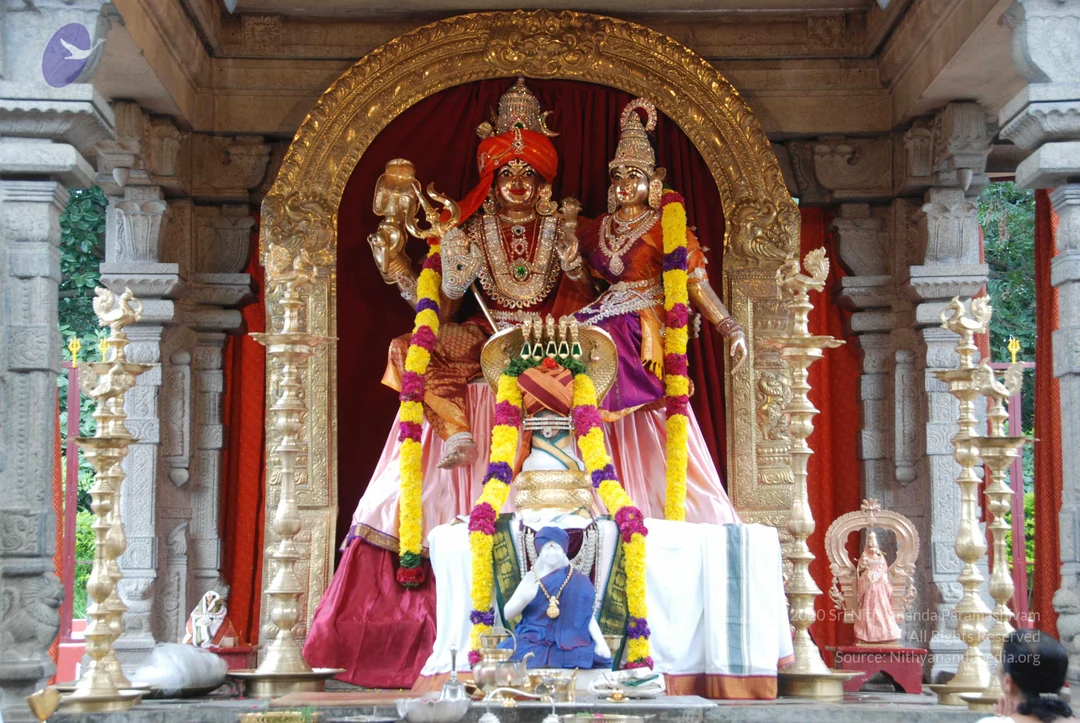
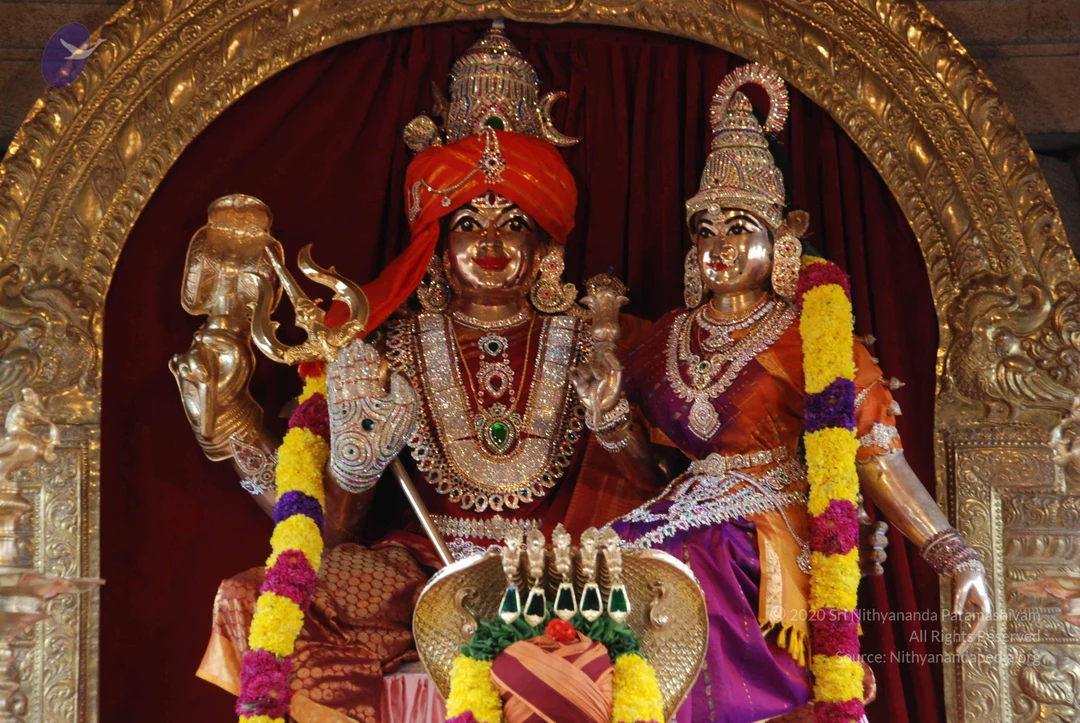
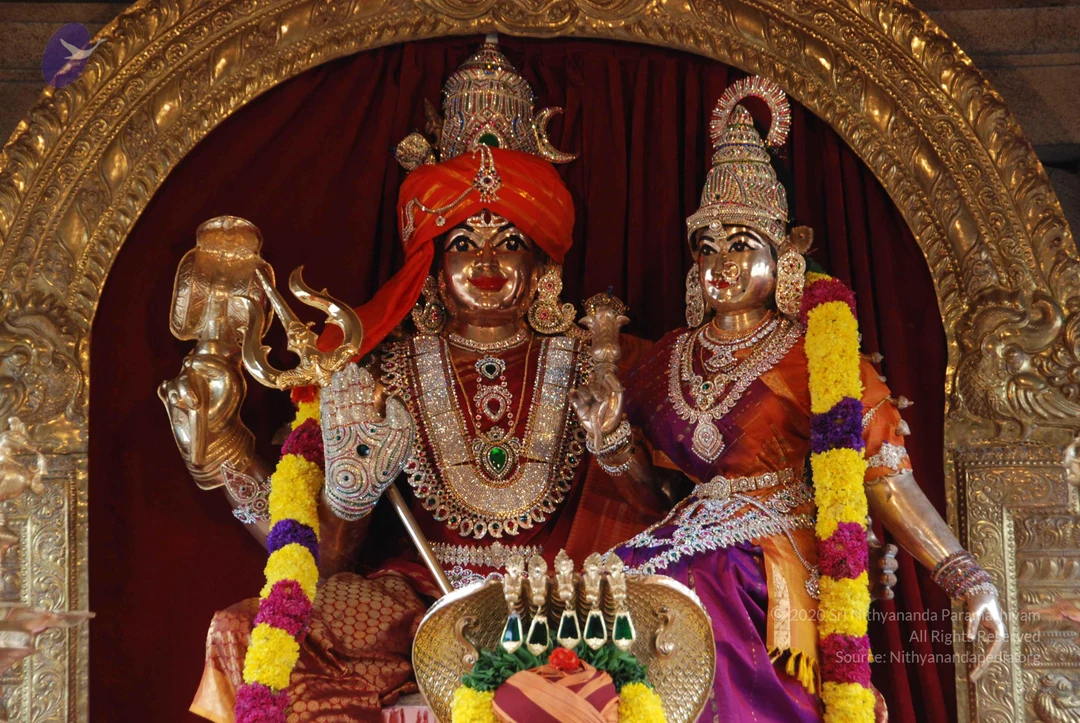
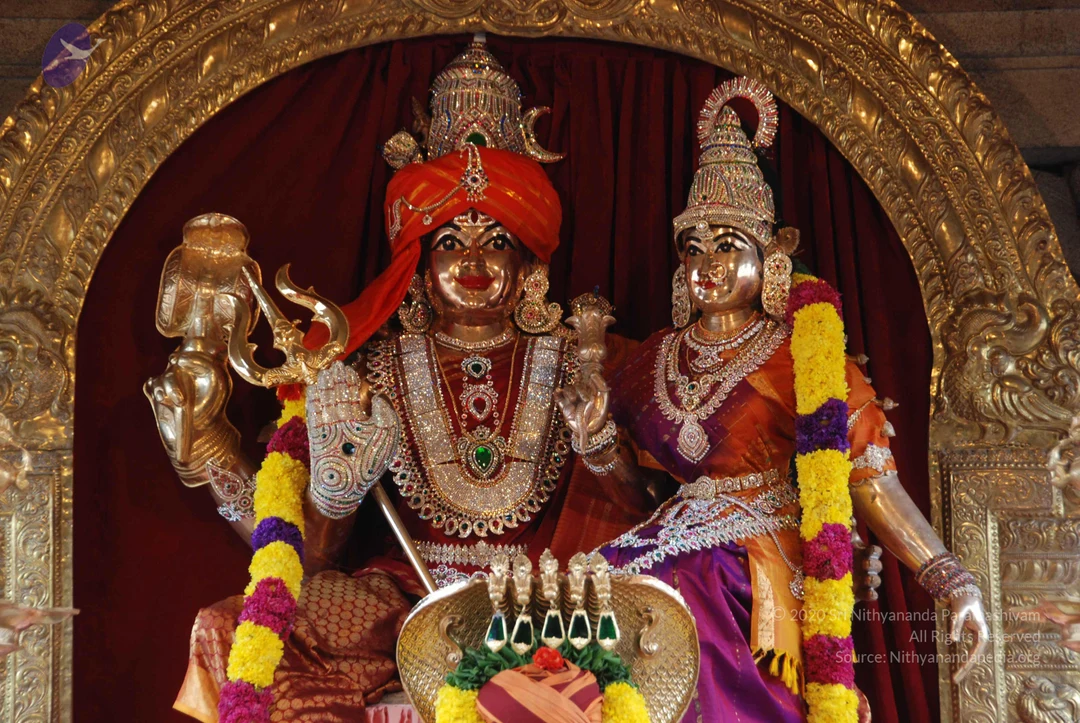
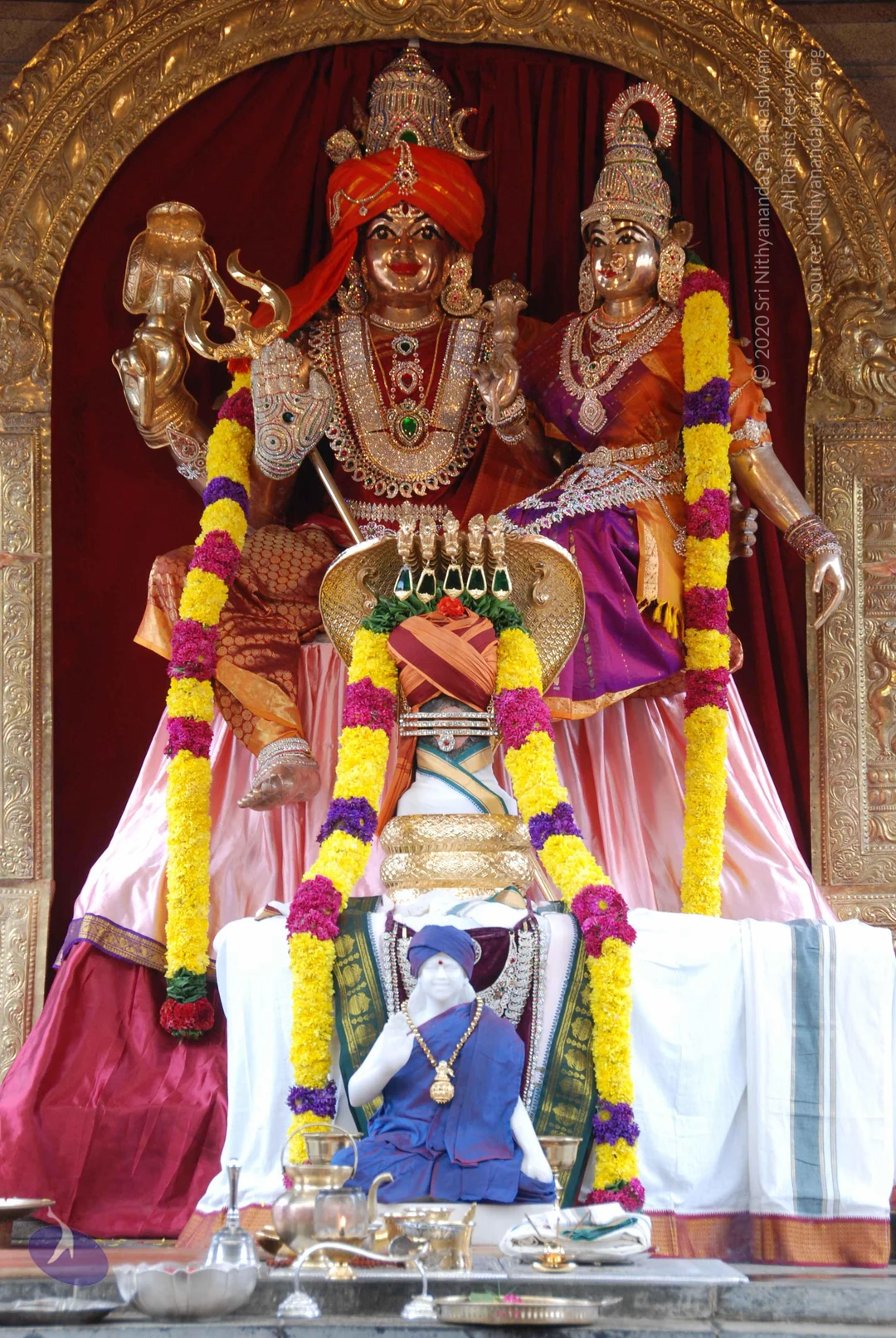
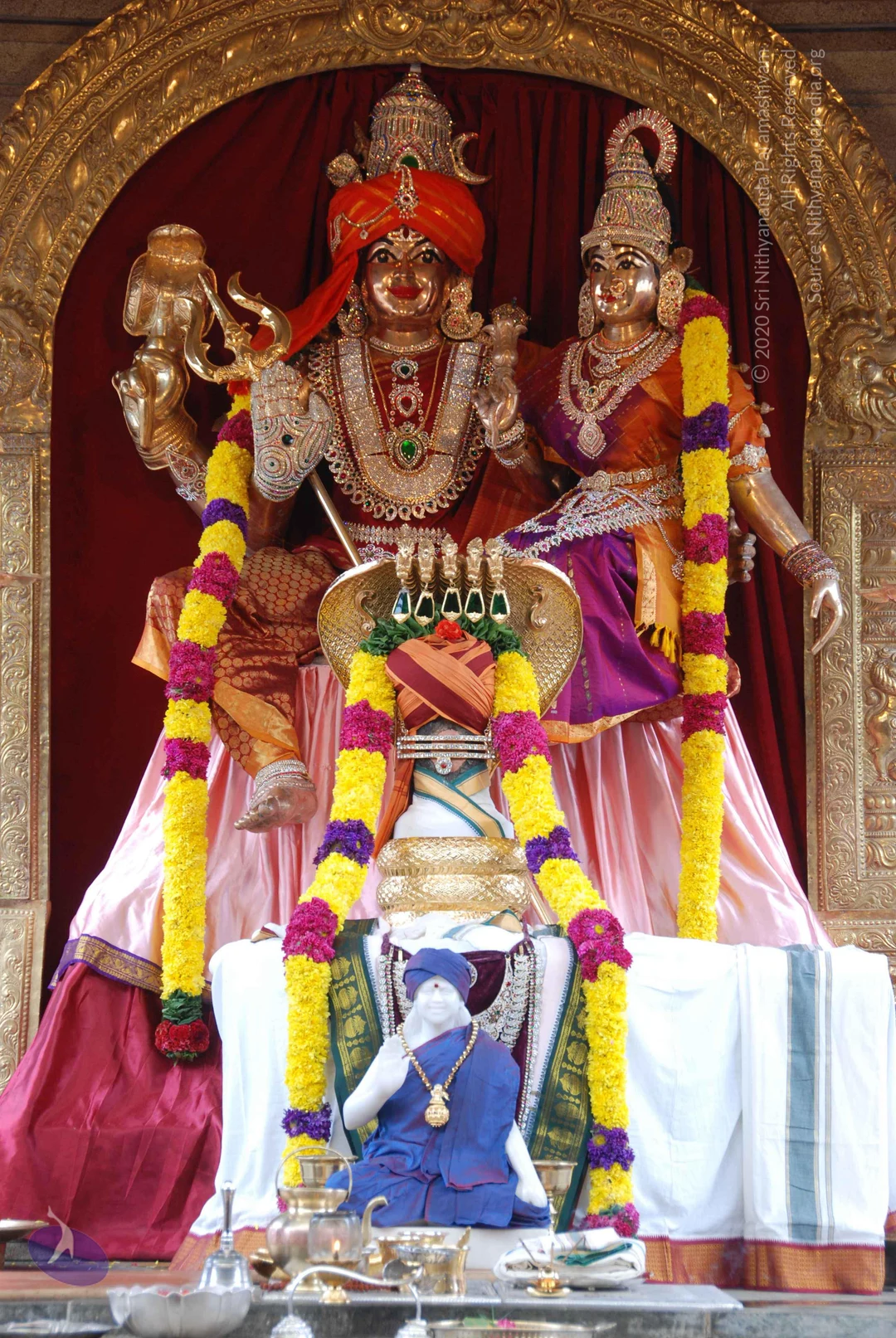
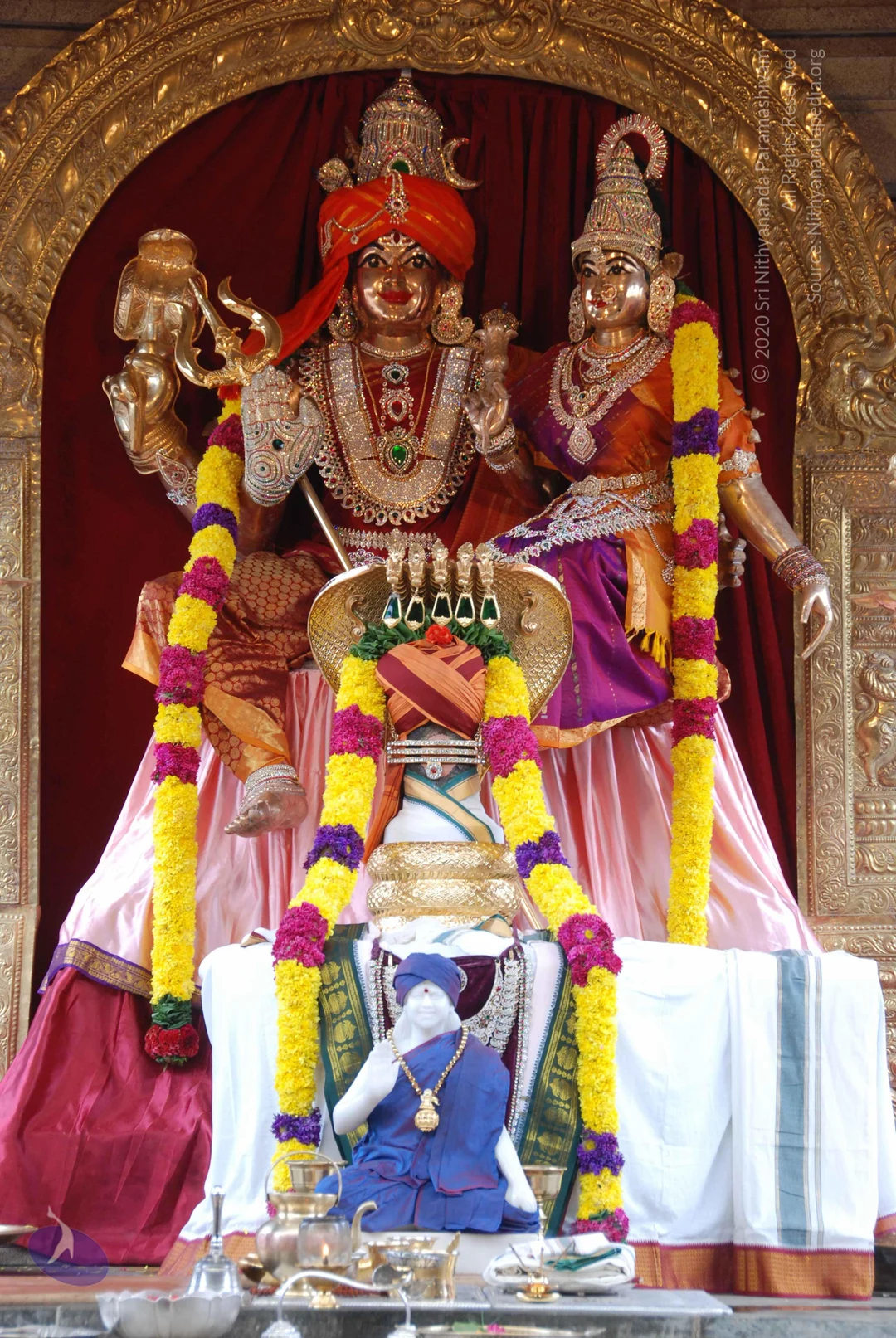
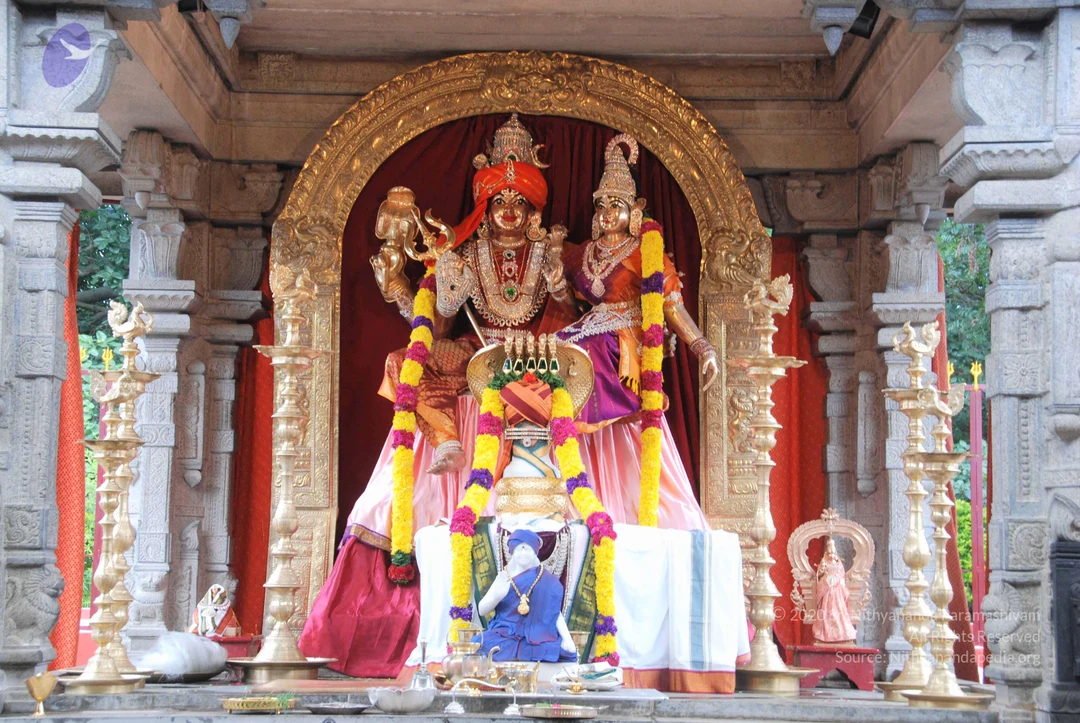
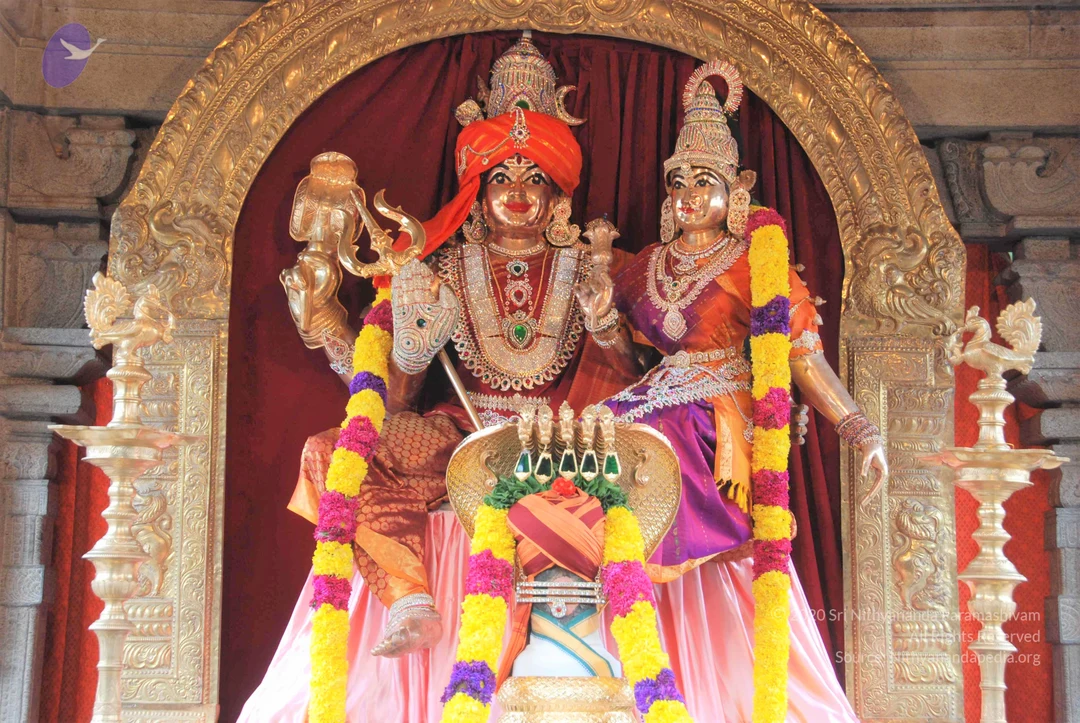
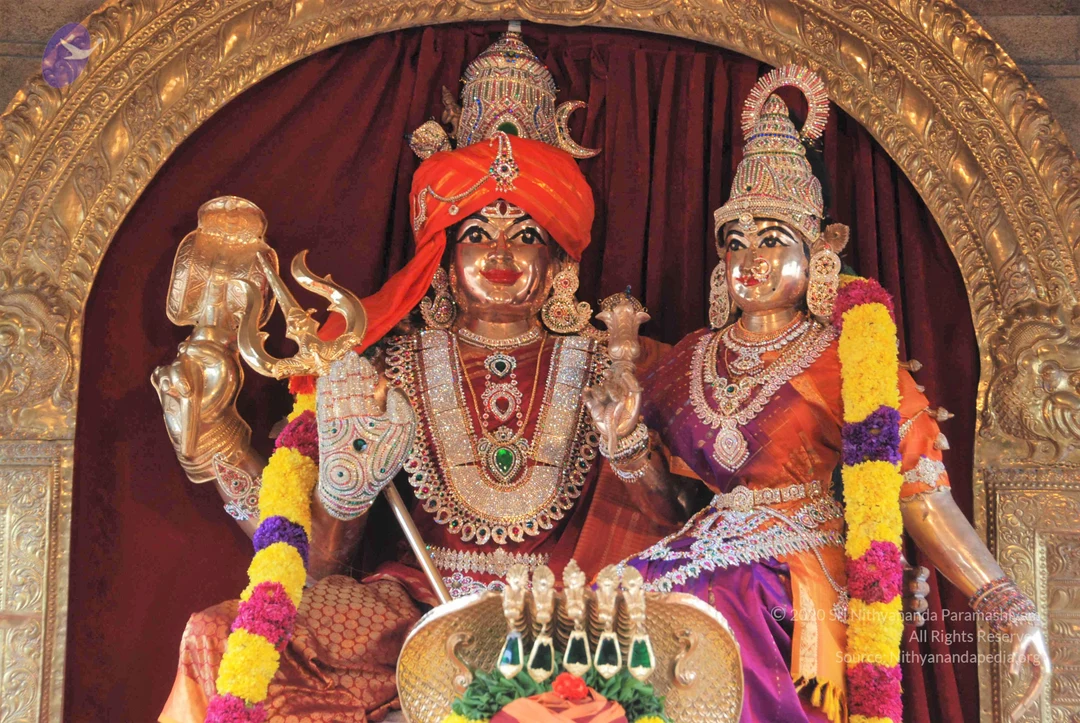
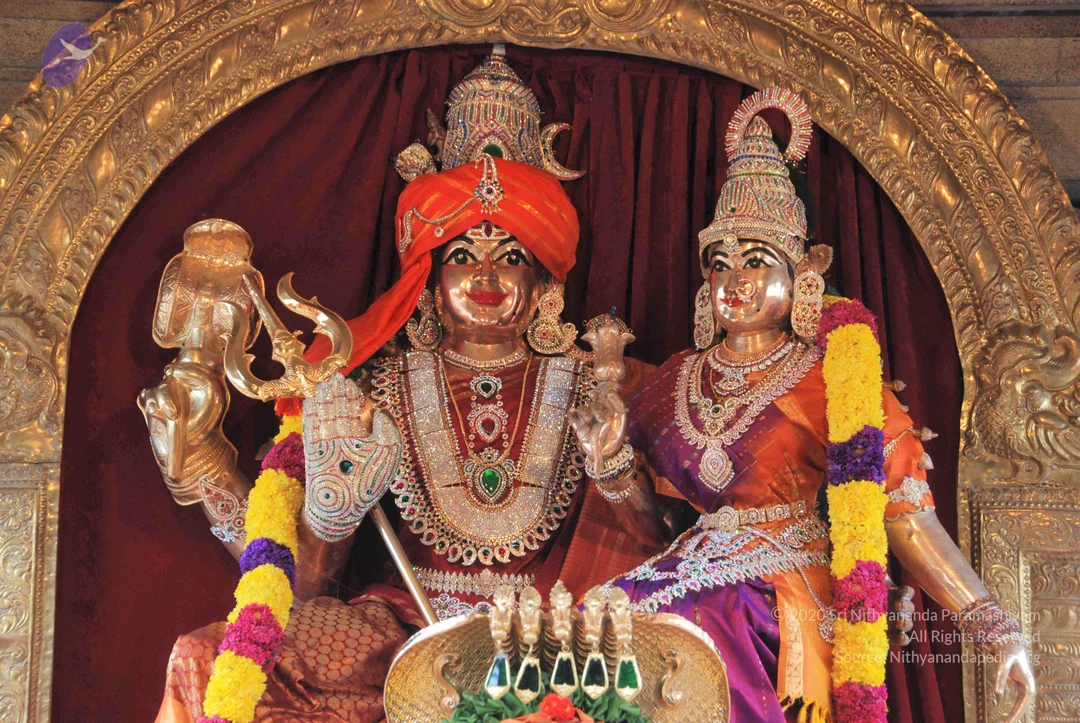
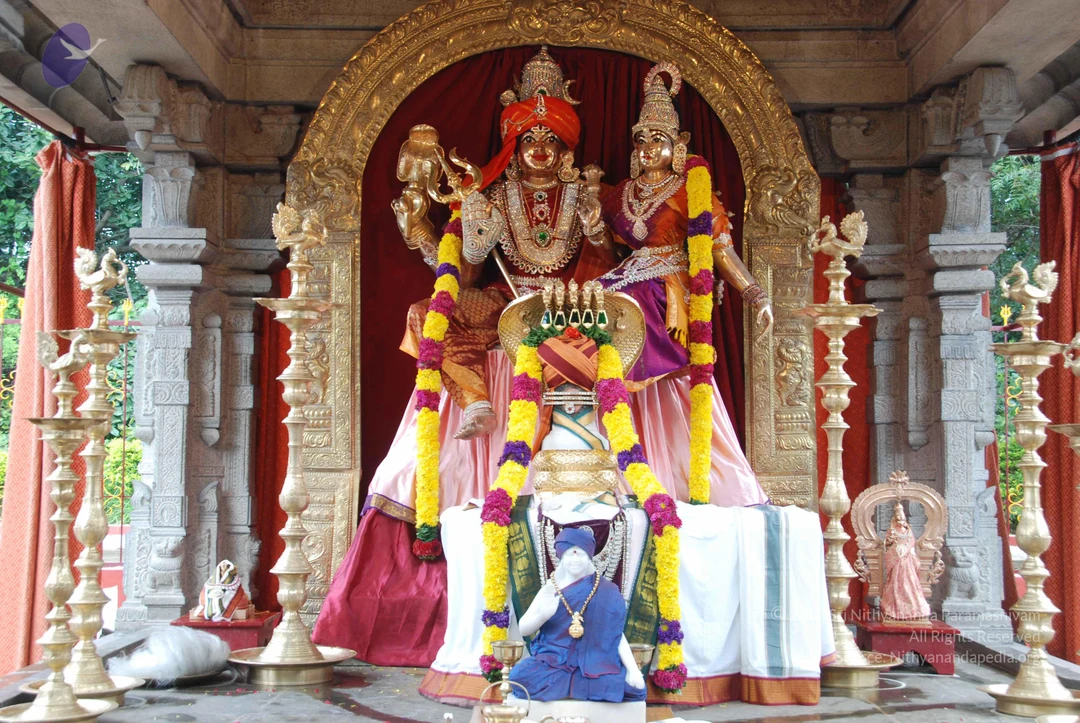
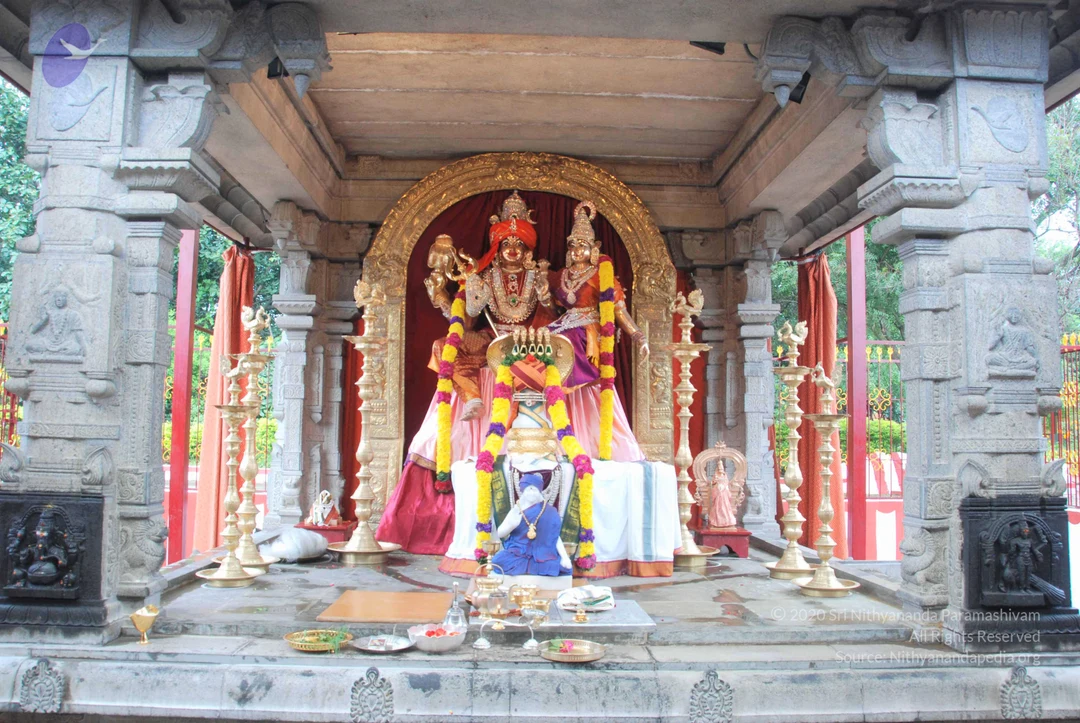
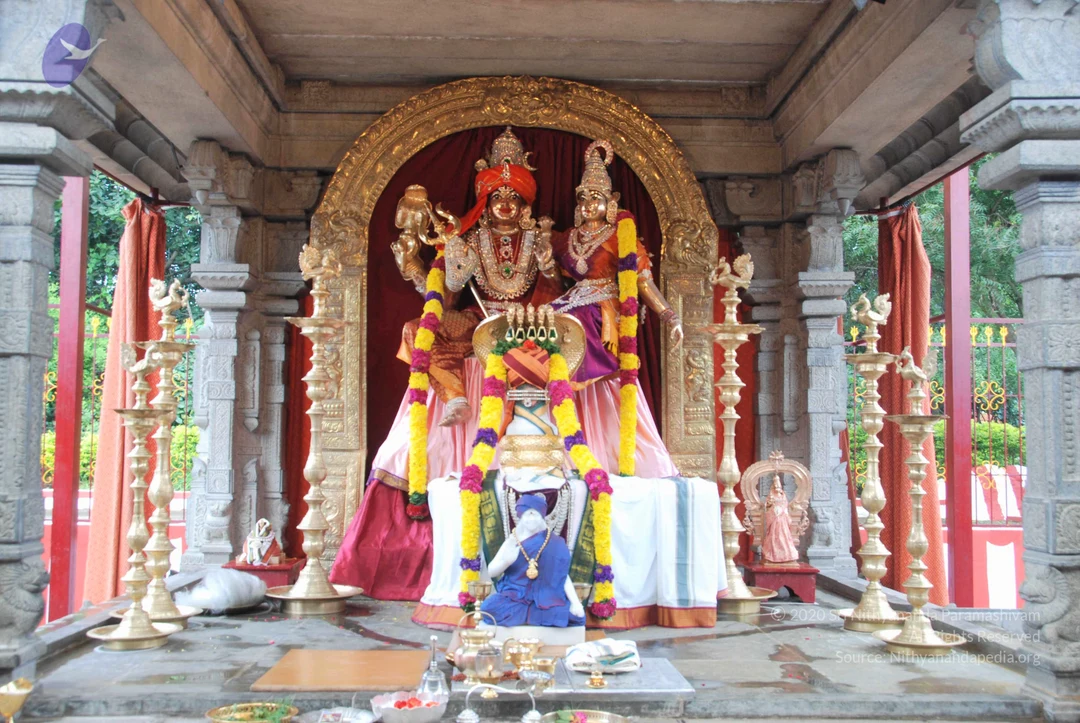
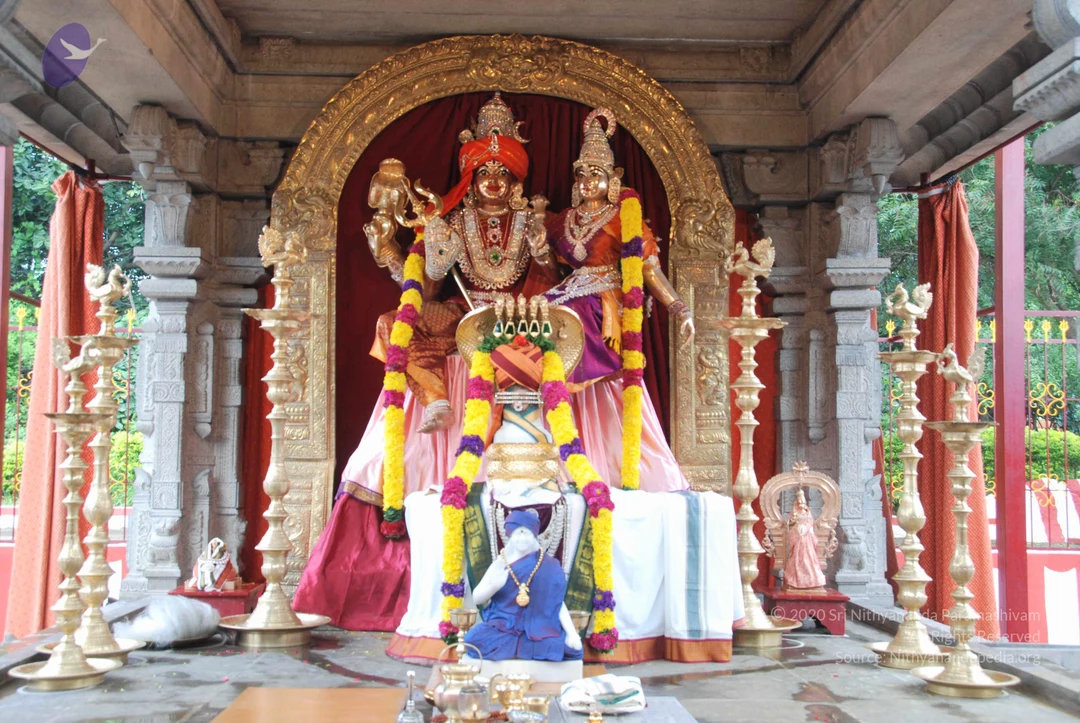
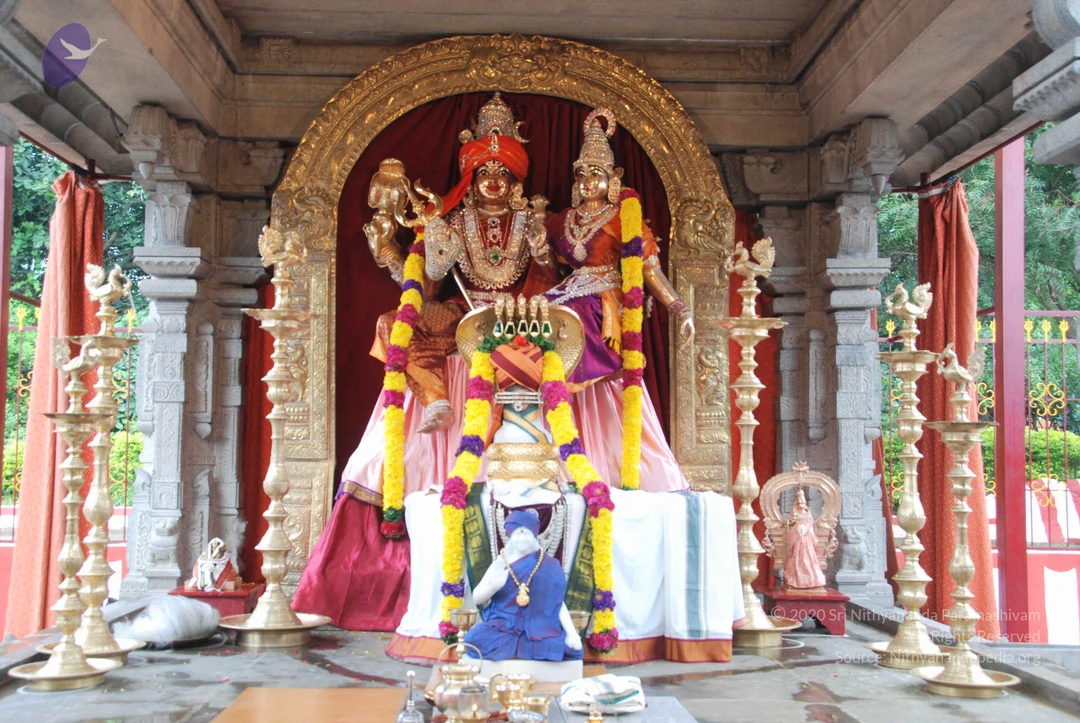
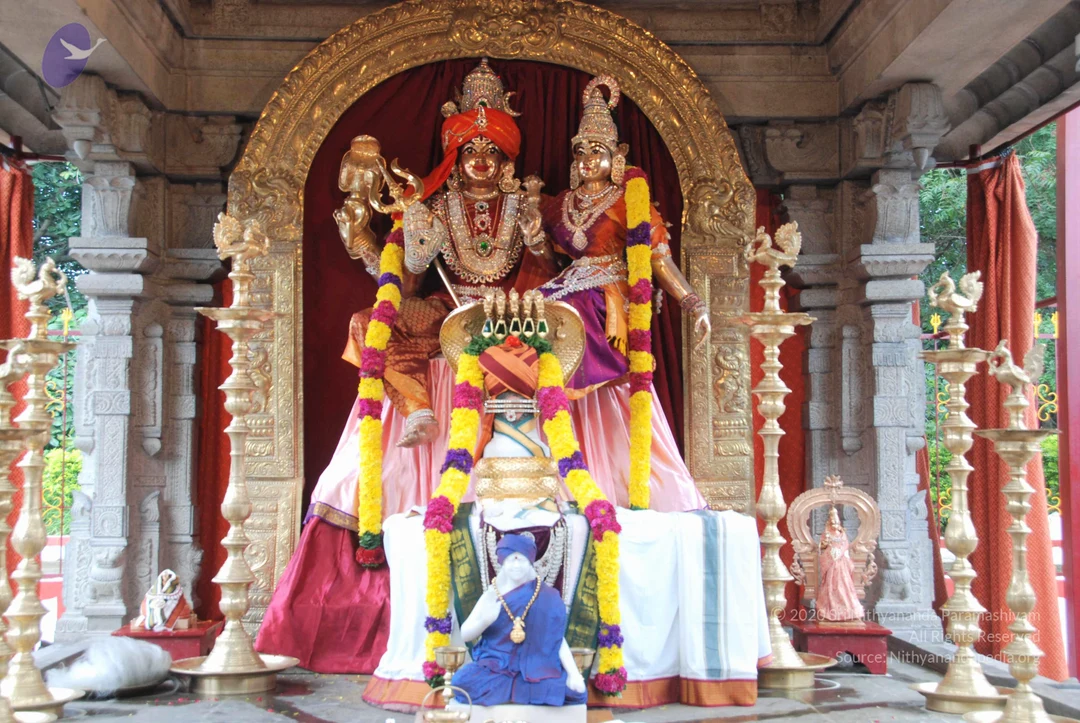
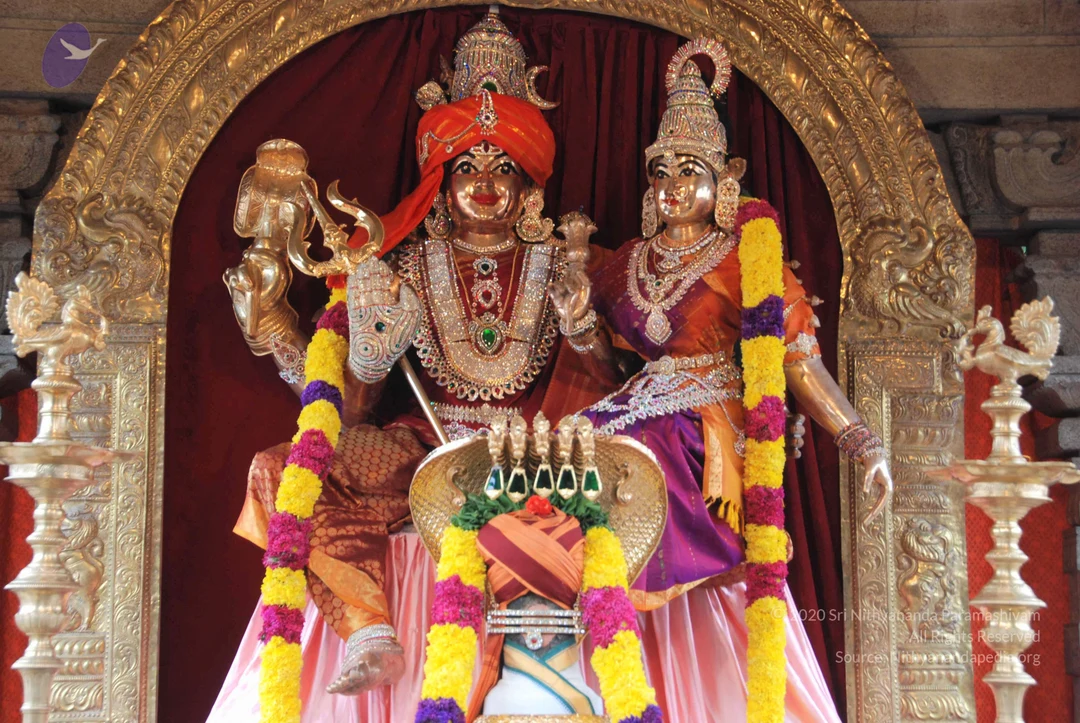
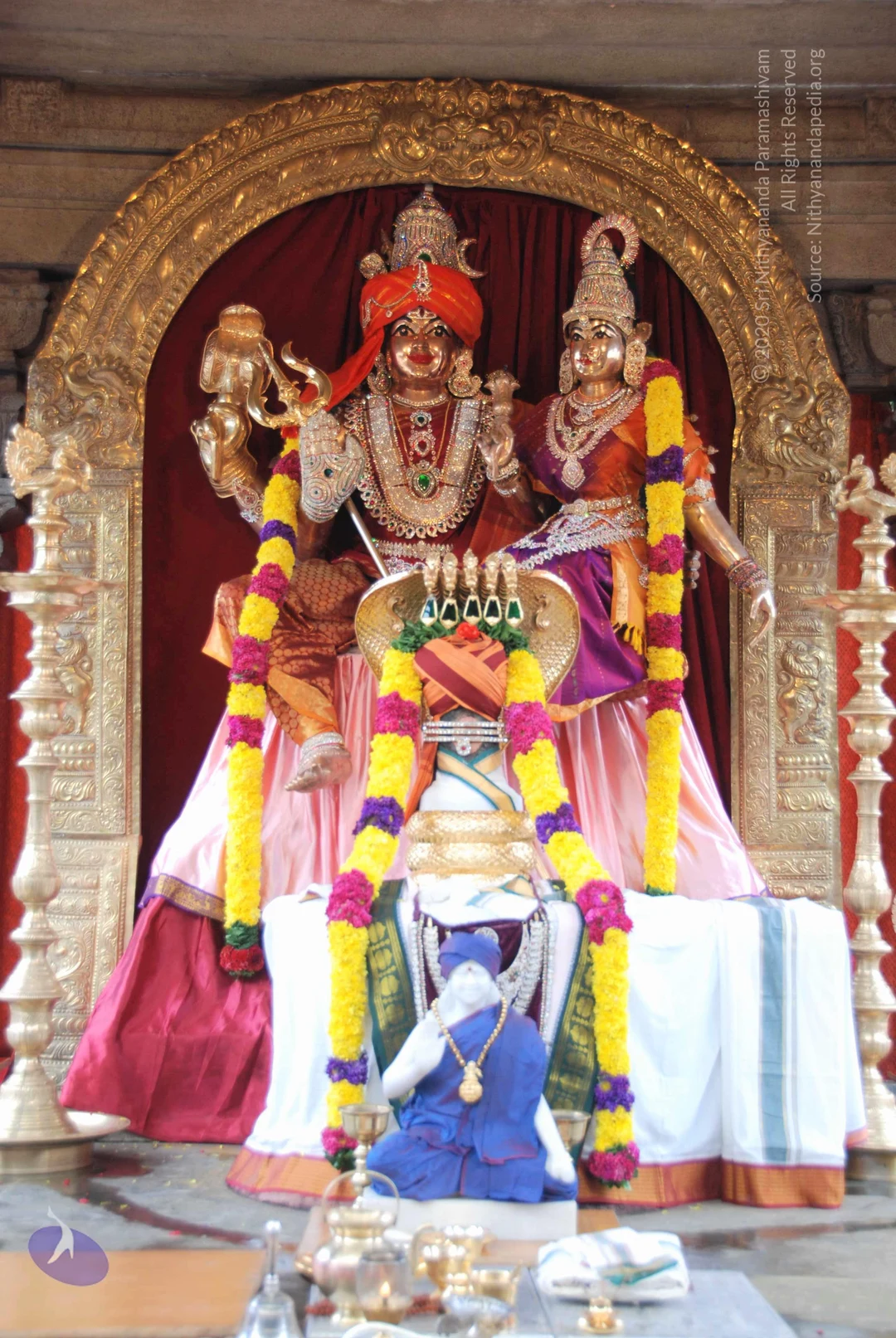
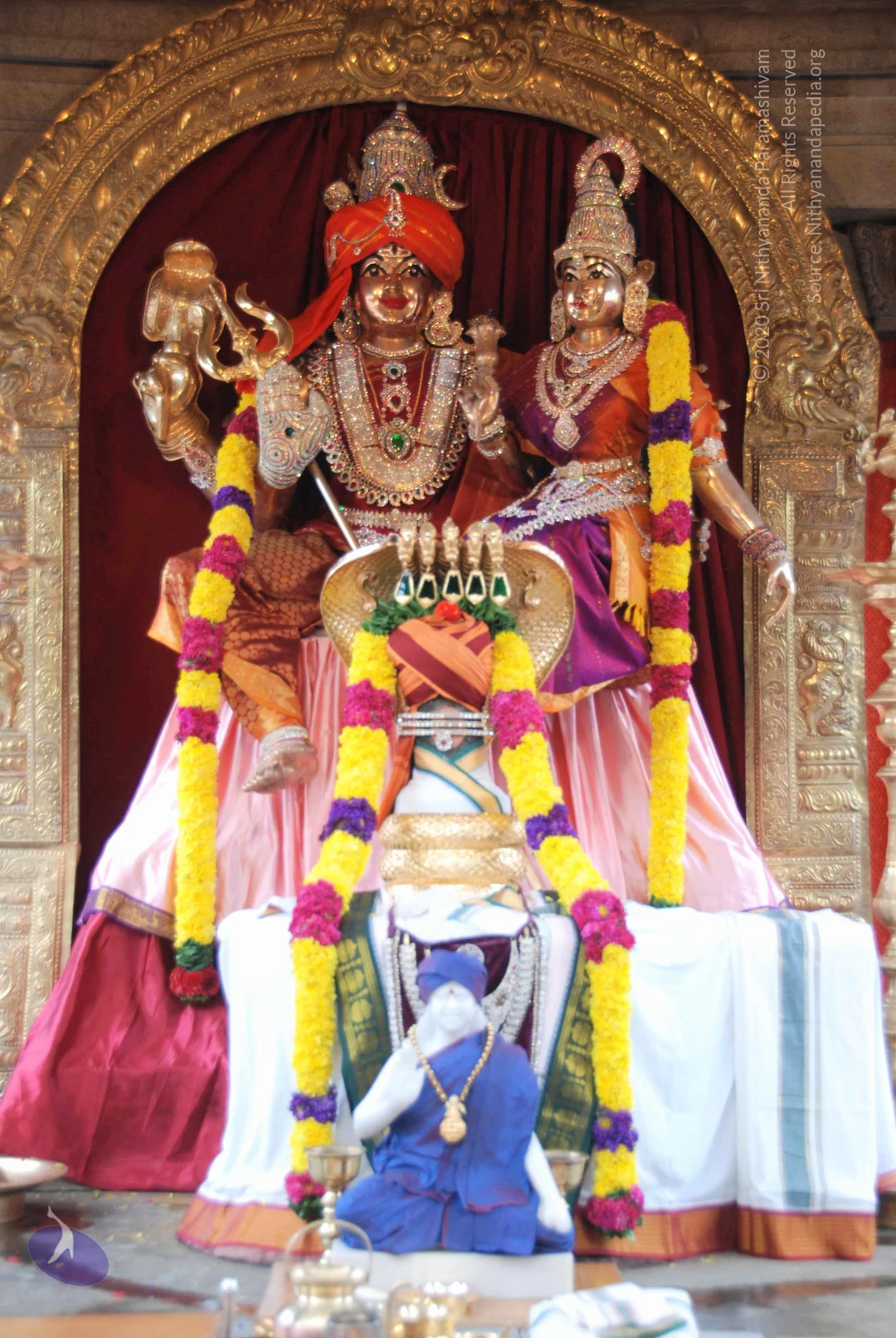
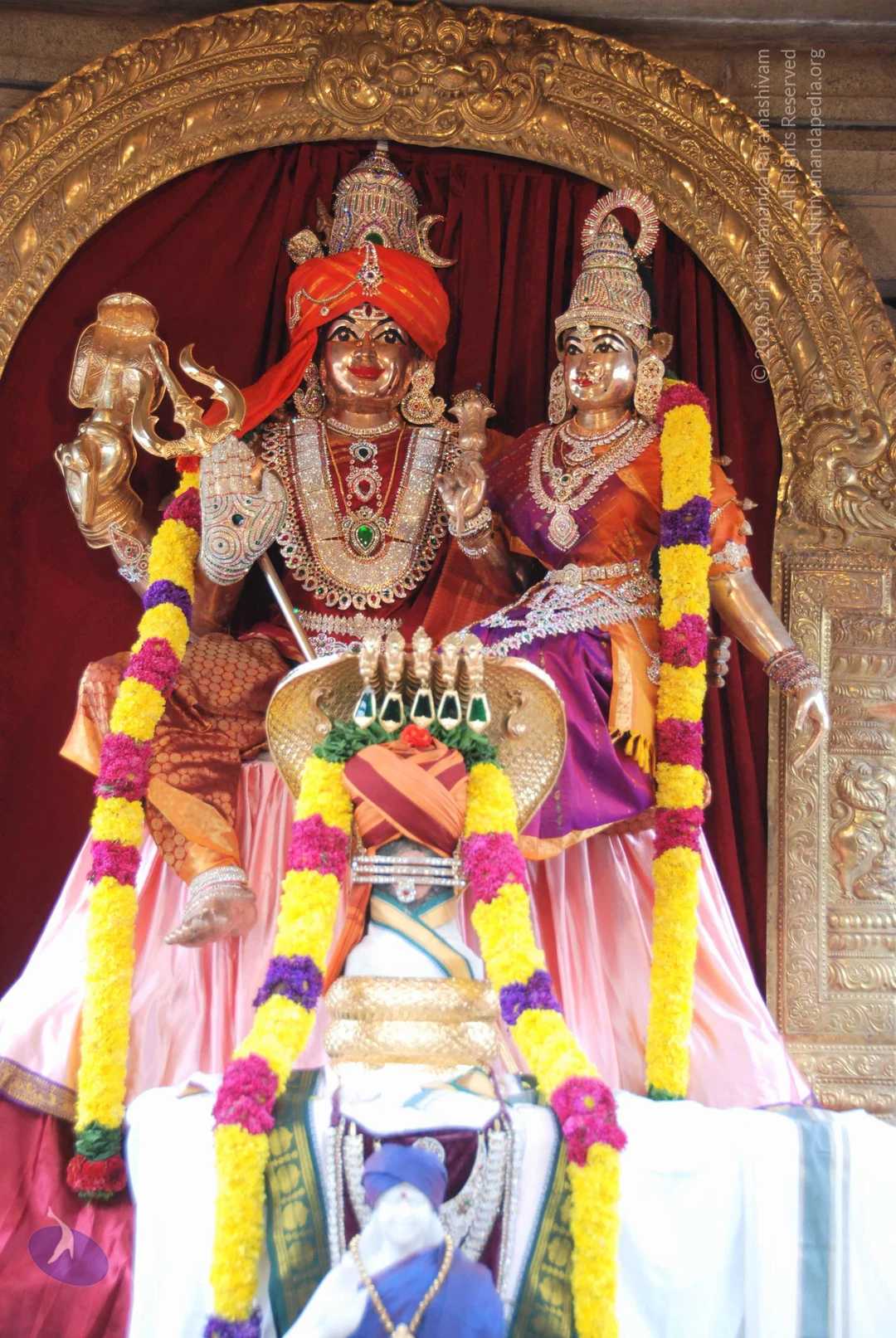
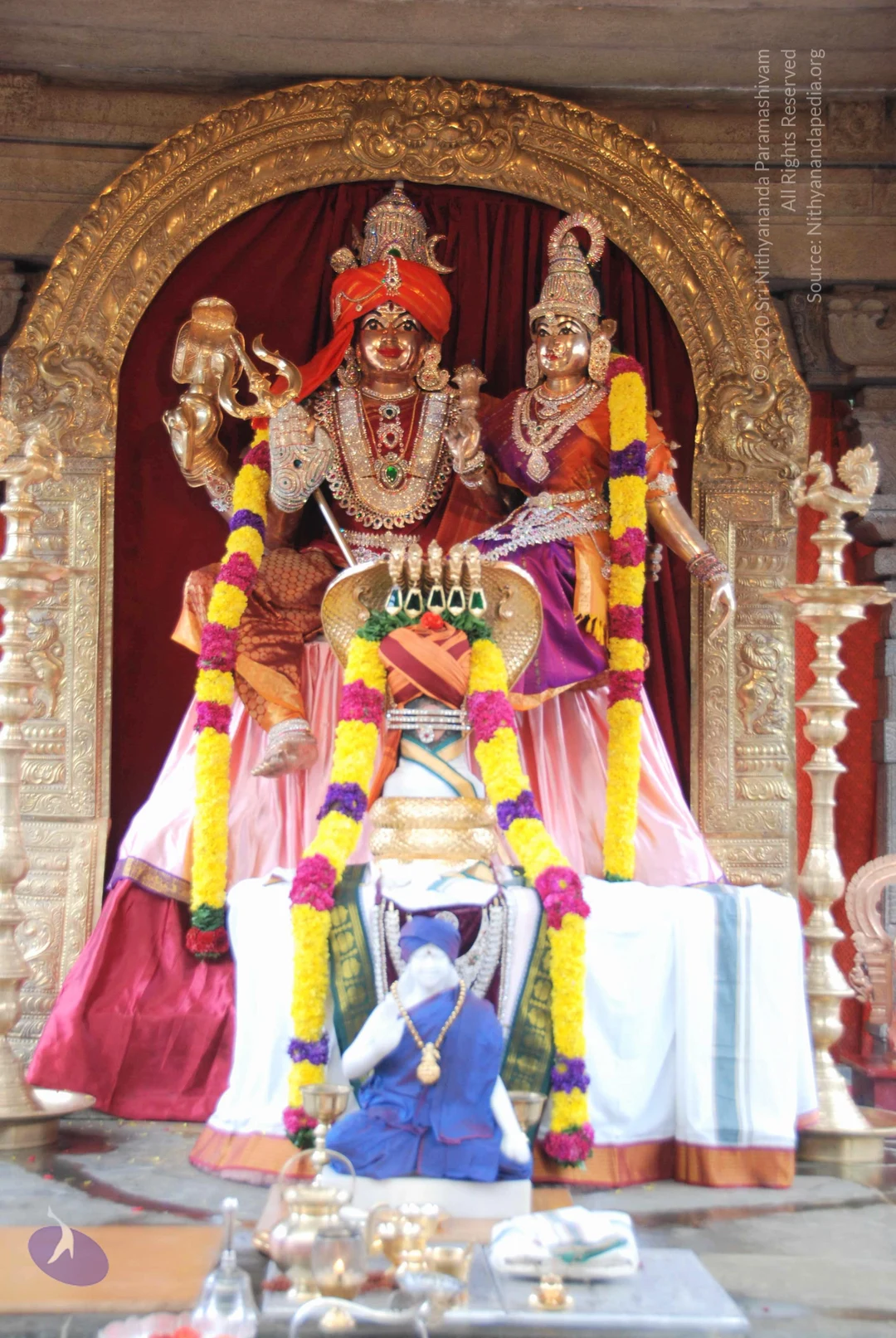
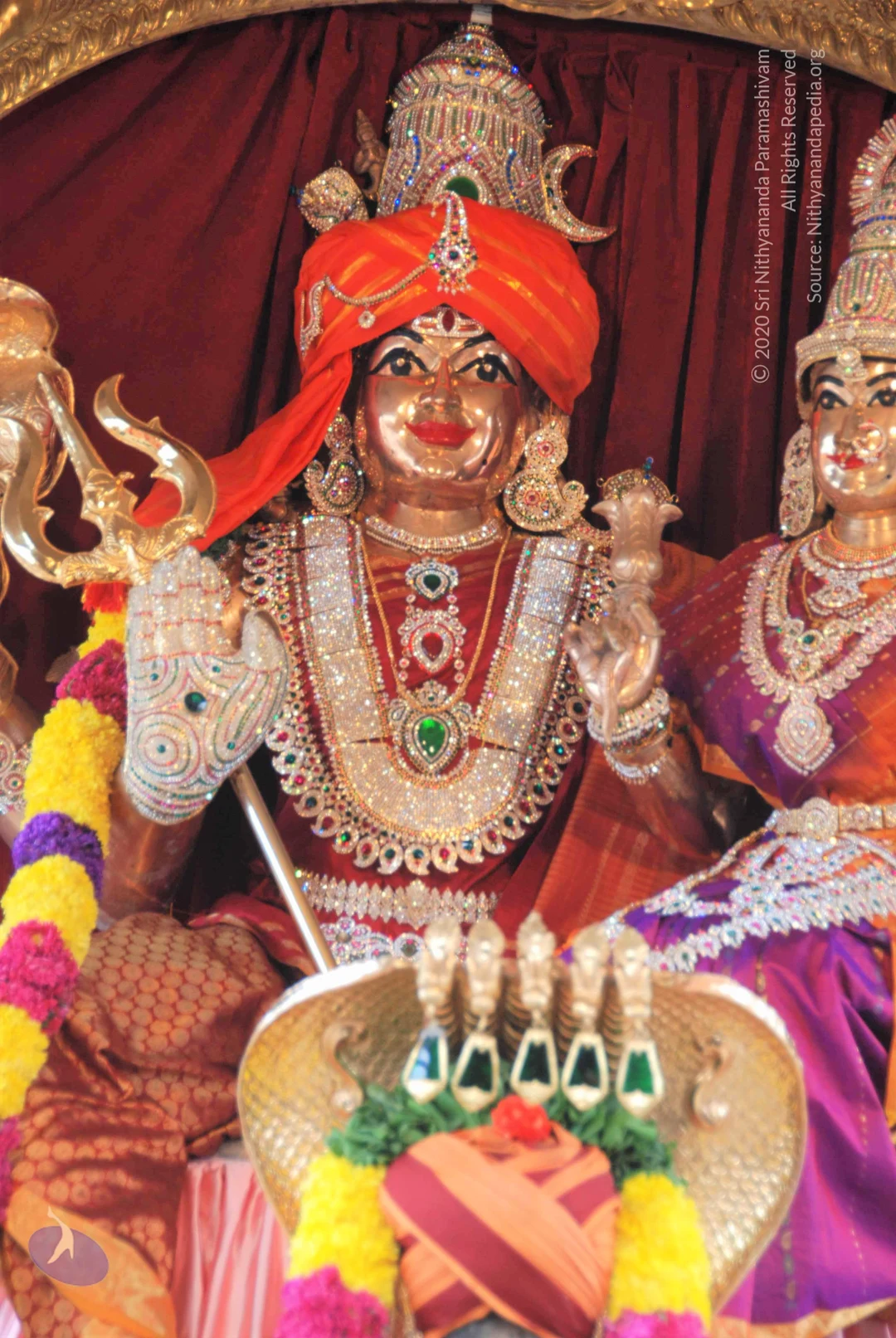
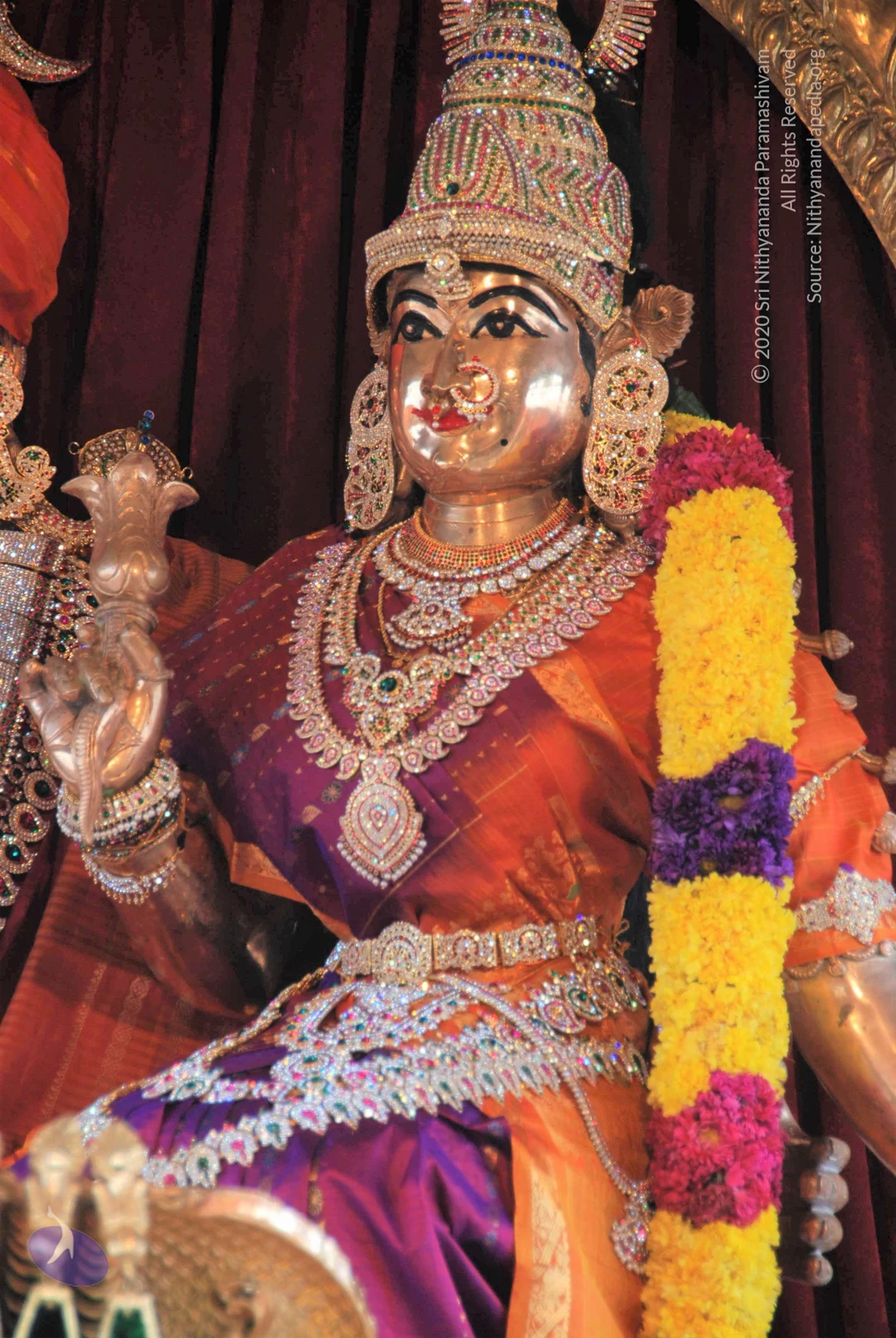
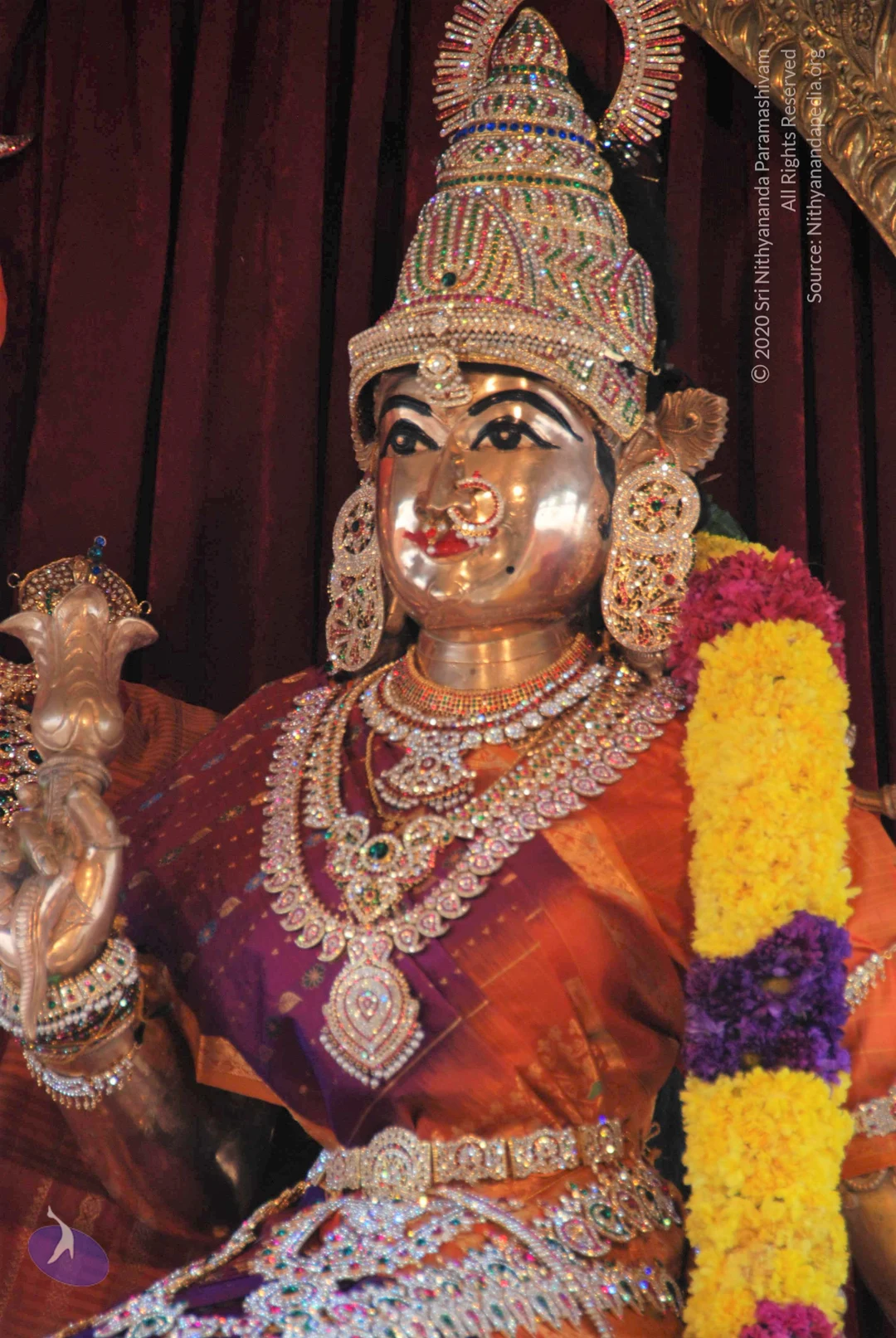
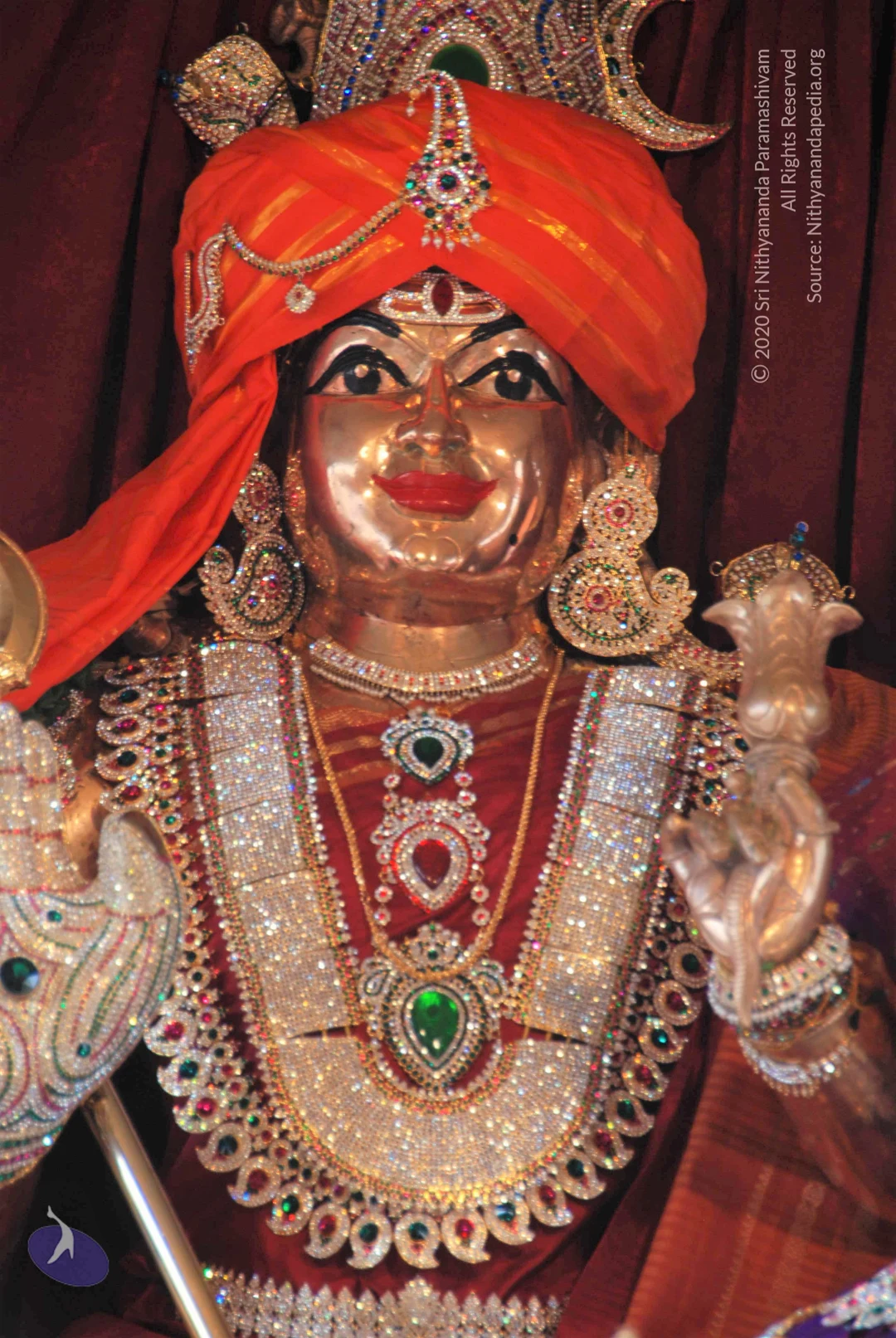
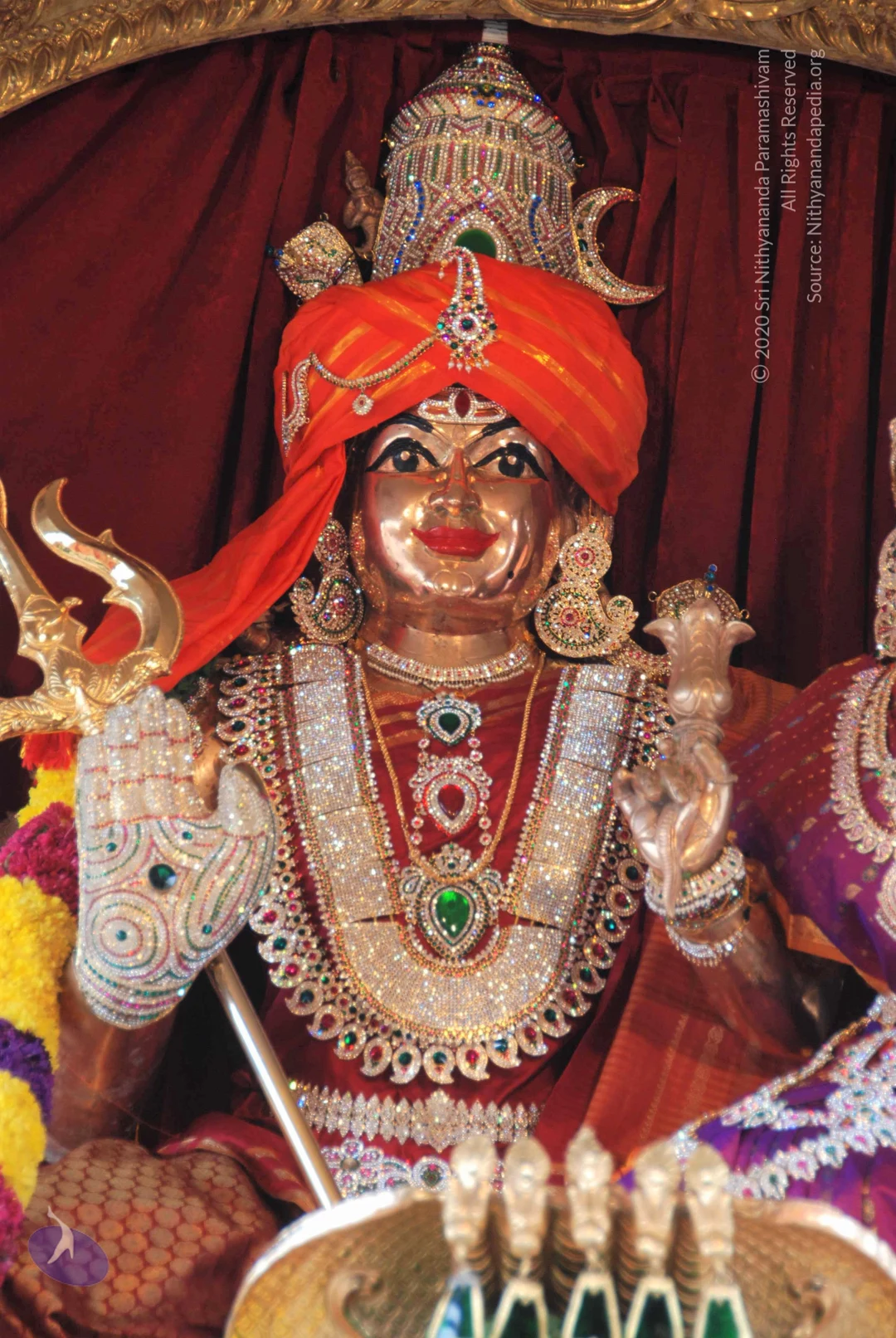
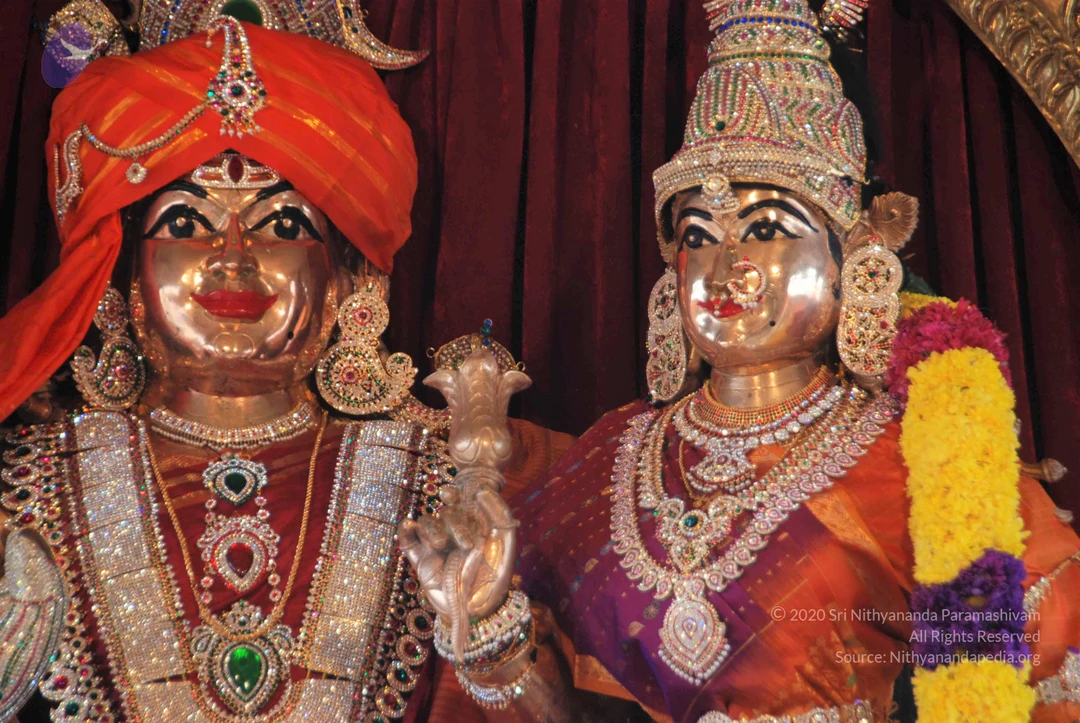
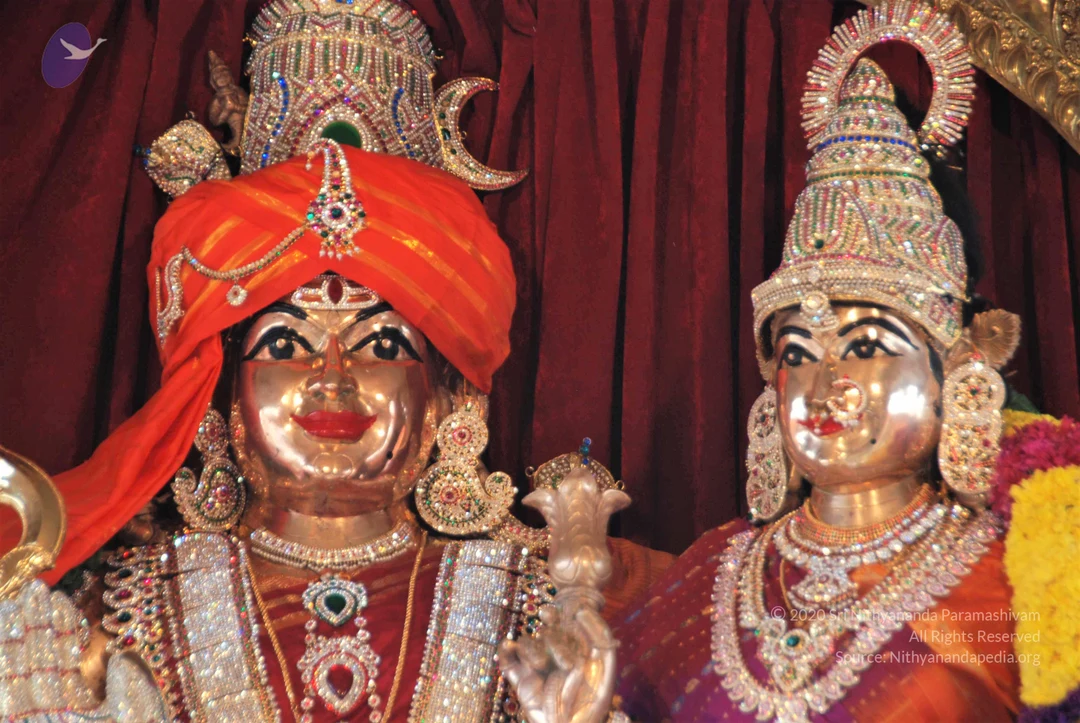
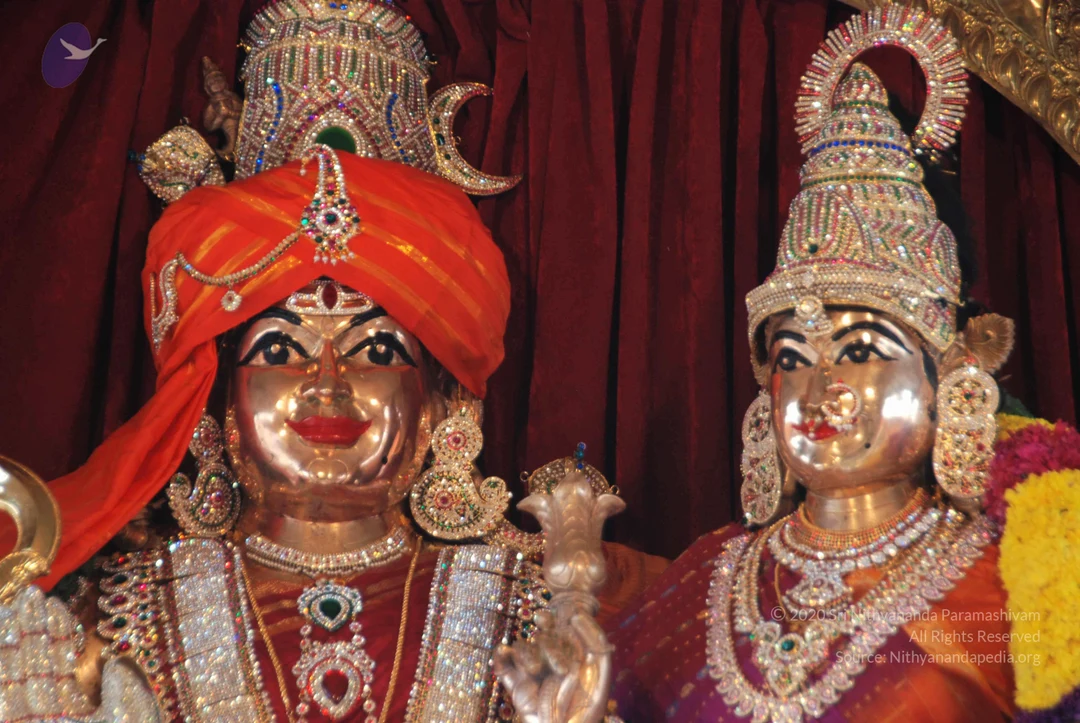
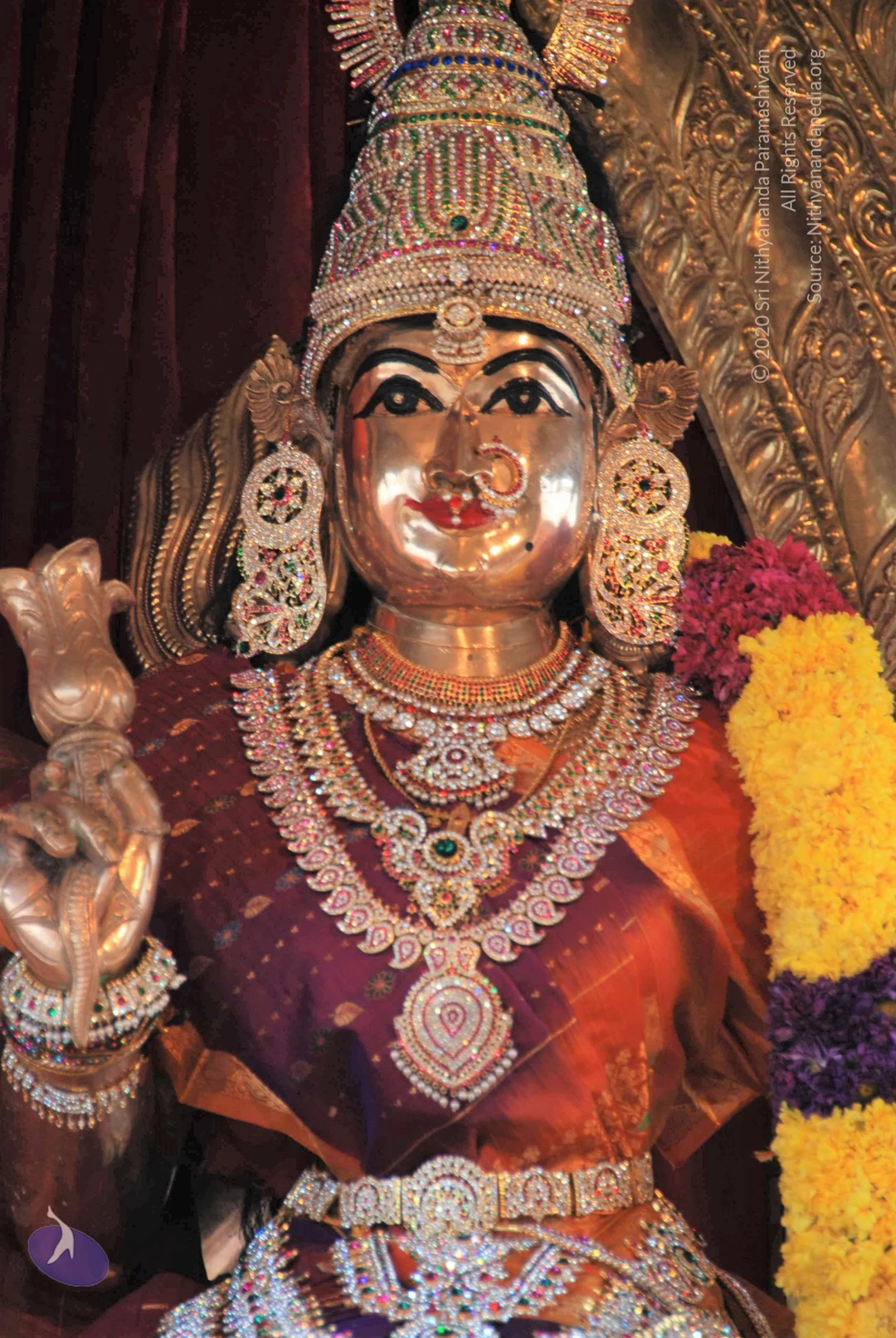
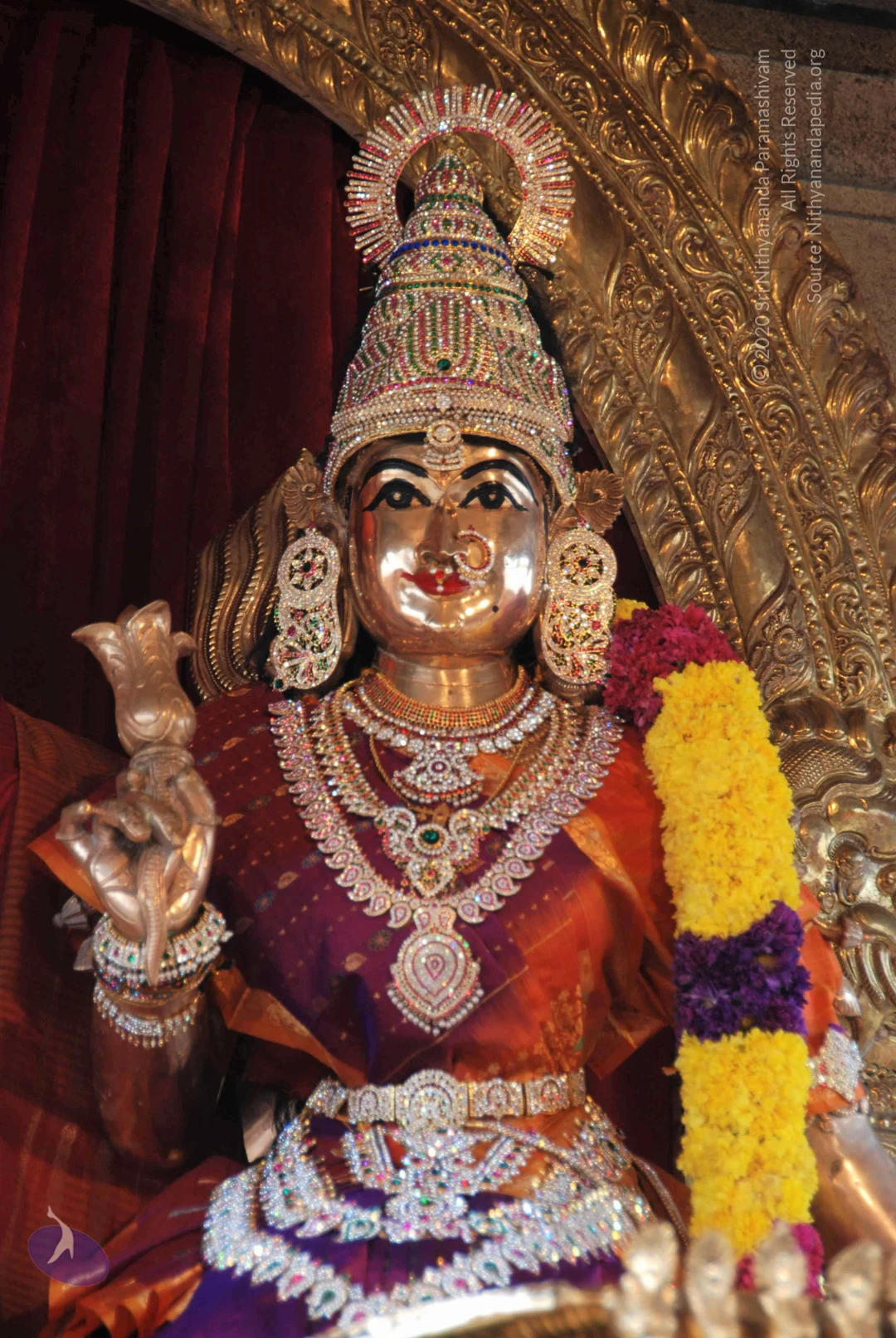
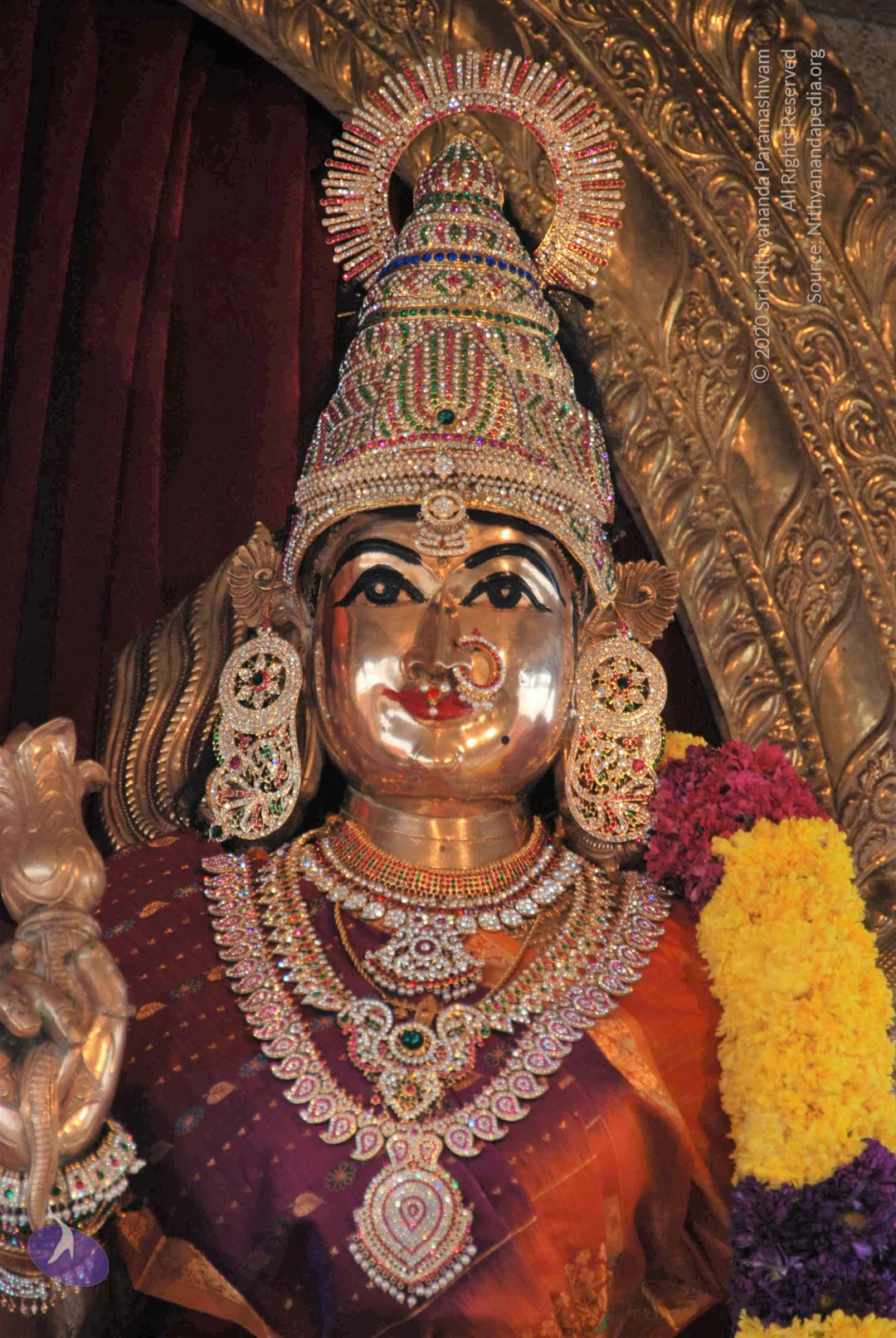
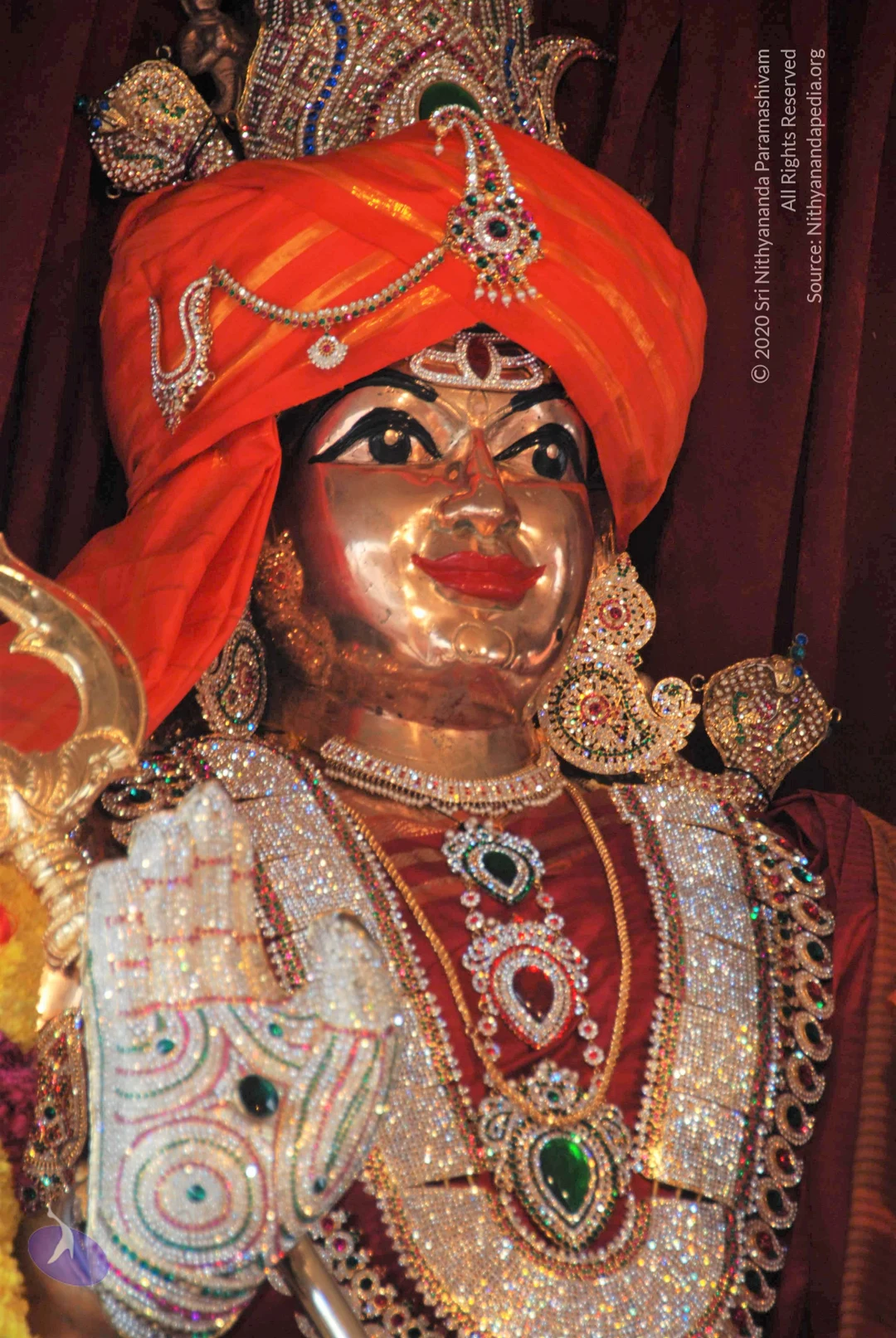
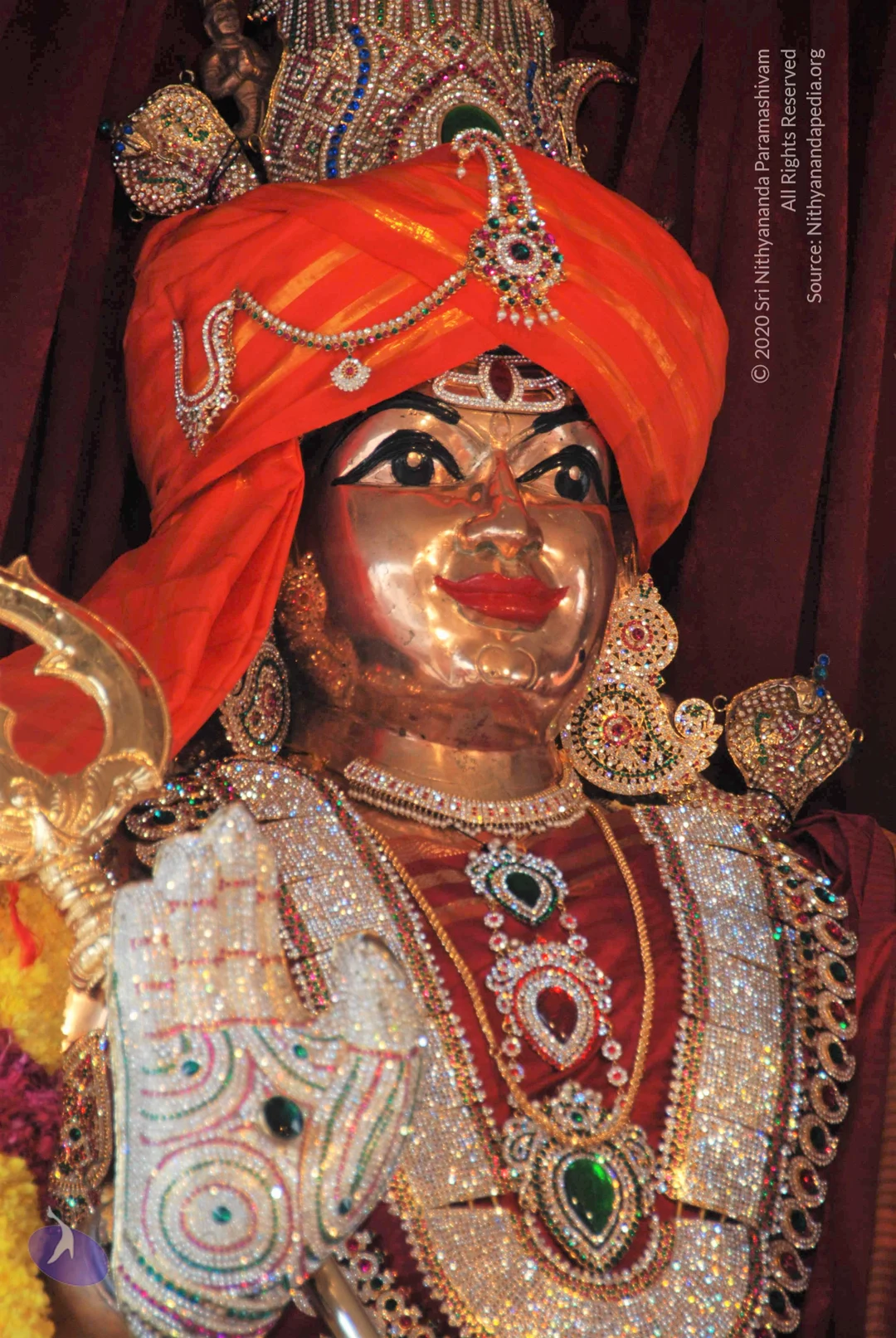
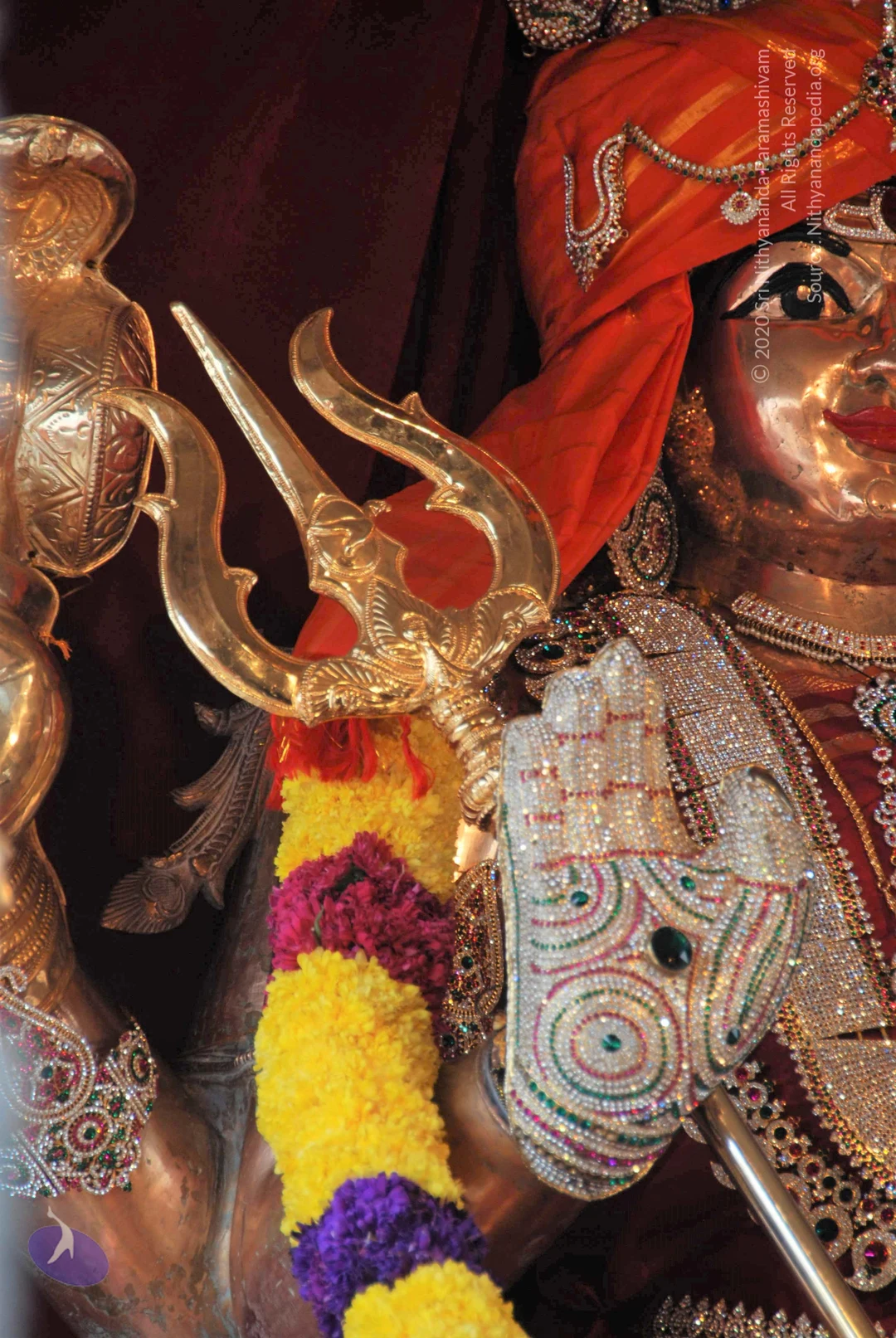
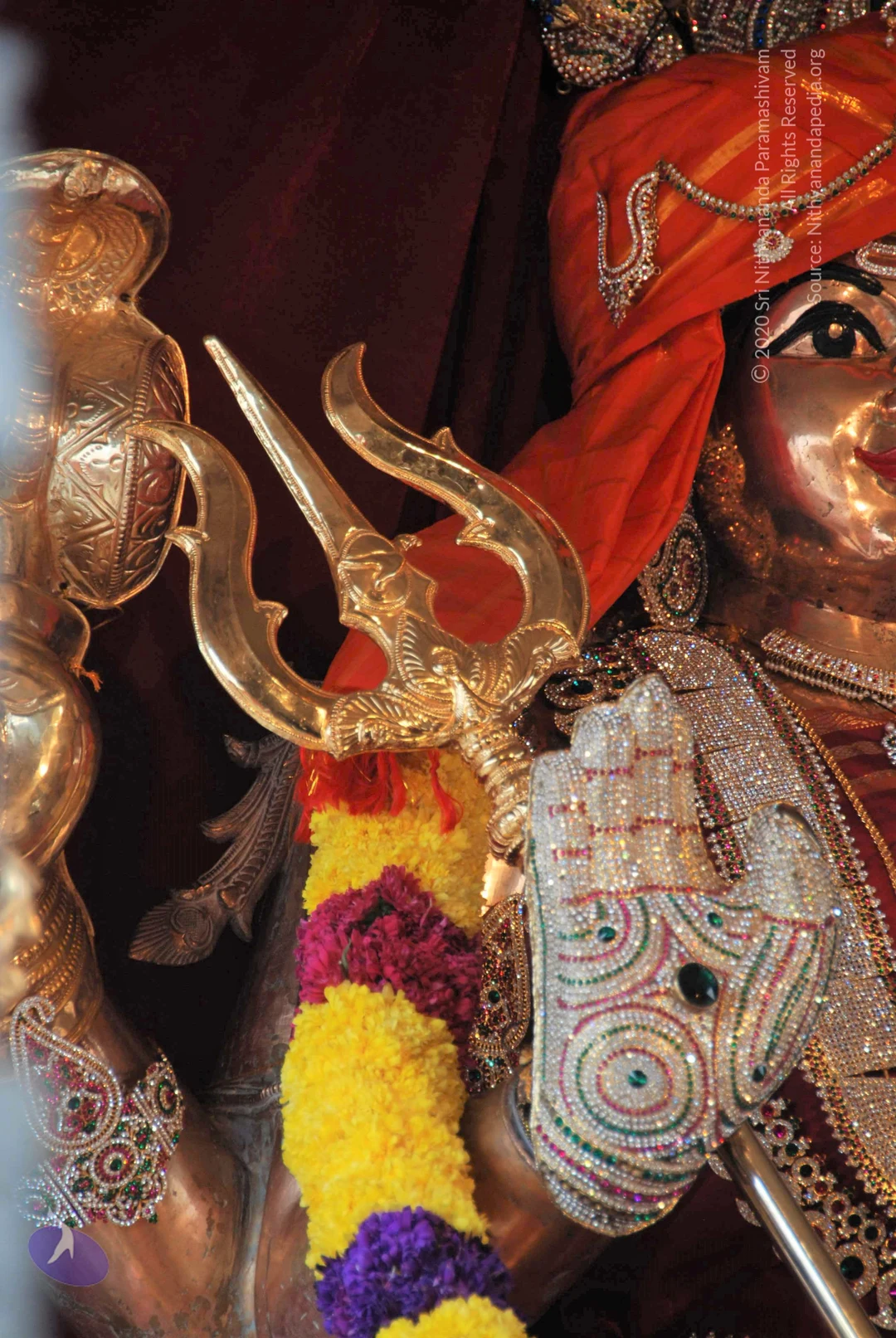
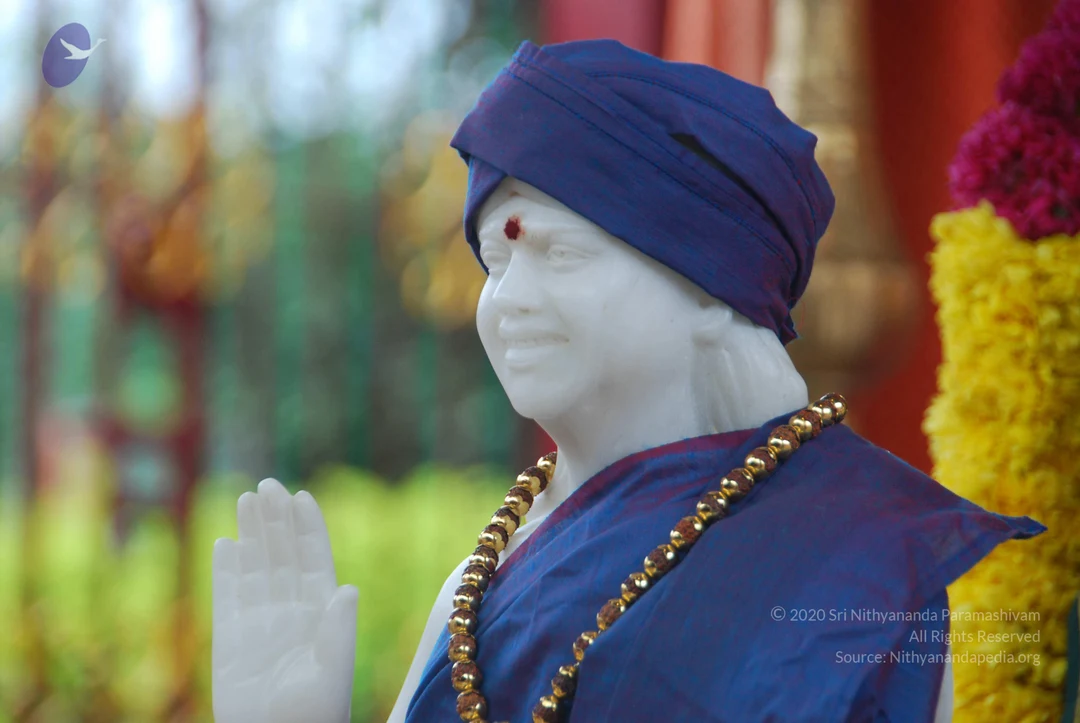
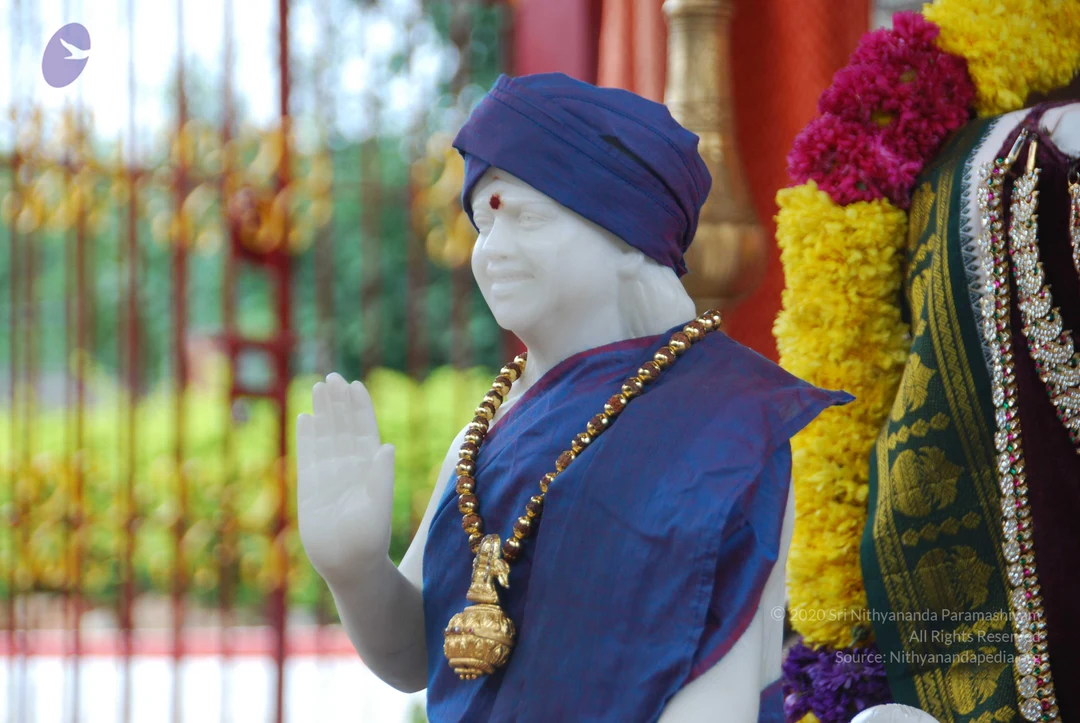
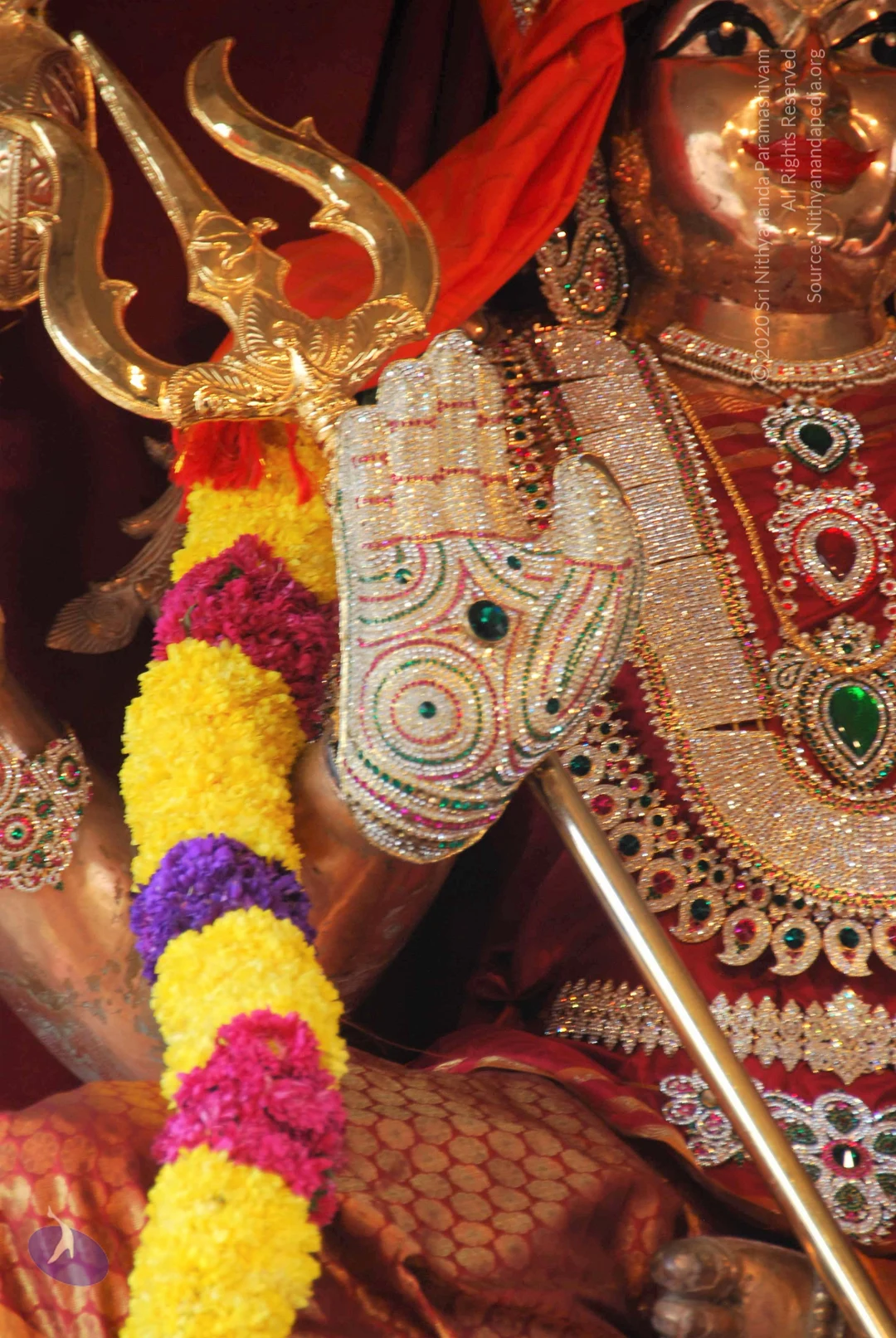
Close photograph of two orange-red roses in full bloom on a bush with dense dark green serrated leaves, set against a reddish-brown wall and gravel ground. No people are visible. A small purple and white logo appears in the upper left corner.A temple shrine photograph showing a large bronze-toned deity murti of Shiva and Parvati seated in a gold-framed arch with a dark red curtain behind. The male figure wears an orange turban, a crescent ornament, a jewelled necklace and carries a trident; the female figure wears a purple and orange sari, layered gold jewellery and a crown. Both are garlanded with yellow and purple flower strings. In front, a white marble figure in a blue robe and orange headwrap, with a gold necklace and vibhuti mark, is seated on a white cloth. Brass puja vessels, a lotus-shaped bowl, a bell, a kalasha-like pot and an aarti tray with flowers sit on the ledge below. No living people are visible.A gilded arched shrine houses a large couple of deity murtis, a male figure with an orange turban and trident and a female figure in a purple-and-orange sari, both adorned with jewelled necklaces and crowns, seated before a red drape. Yellow and purple flower garlands hang from the figures. In front, a small white and blue seated figure sits beneath a golden canopy on a white-draped seat, surrounded by brass lamps, a bell, a plate and ritual vessels on a stone platform.

Photos of the day

View all 499 photos

499 distinct dated photos. Source gallery sets may overlap.

01

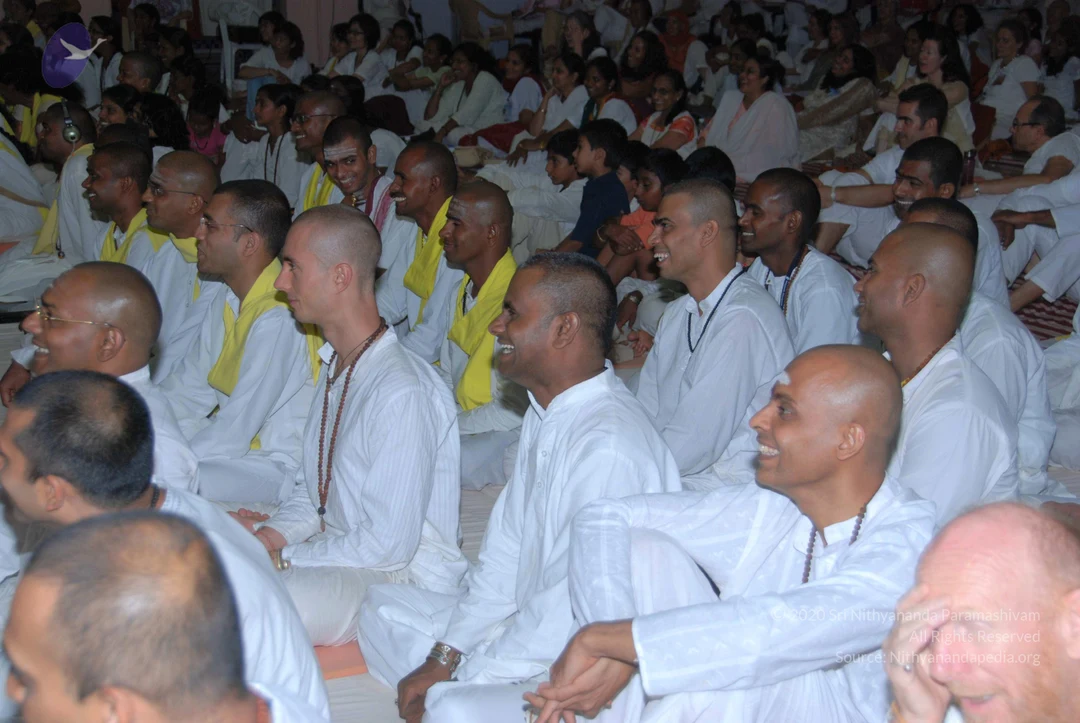
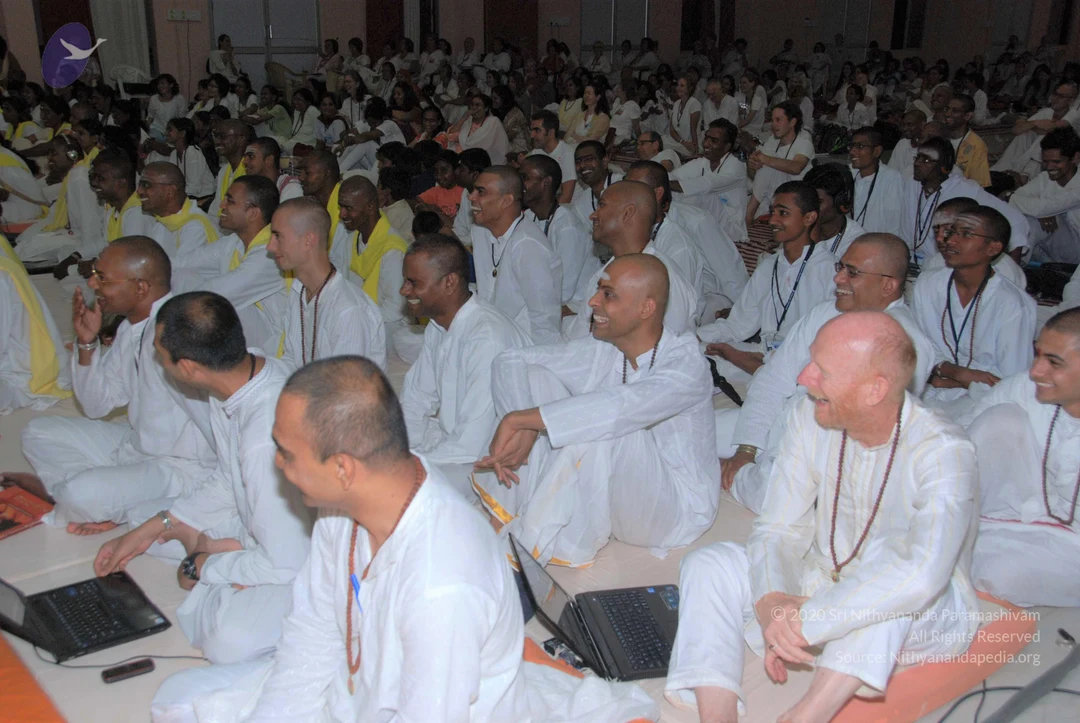
Yogasutras

69 dated photos in previewSource gallery
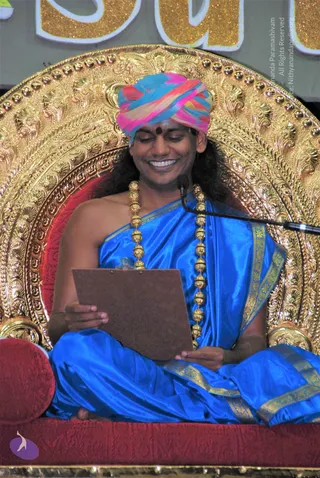
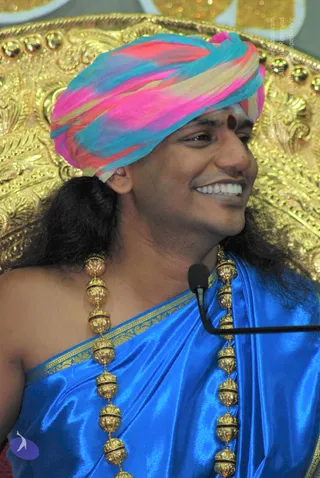
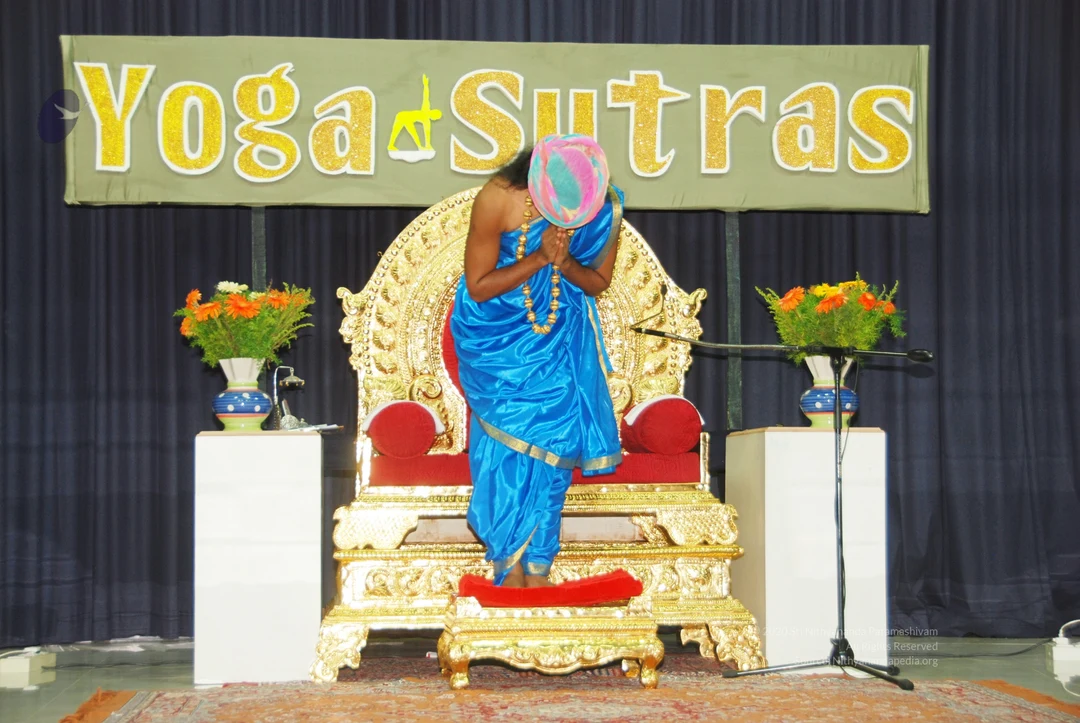
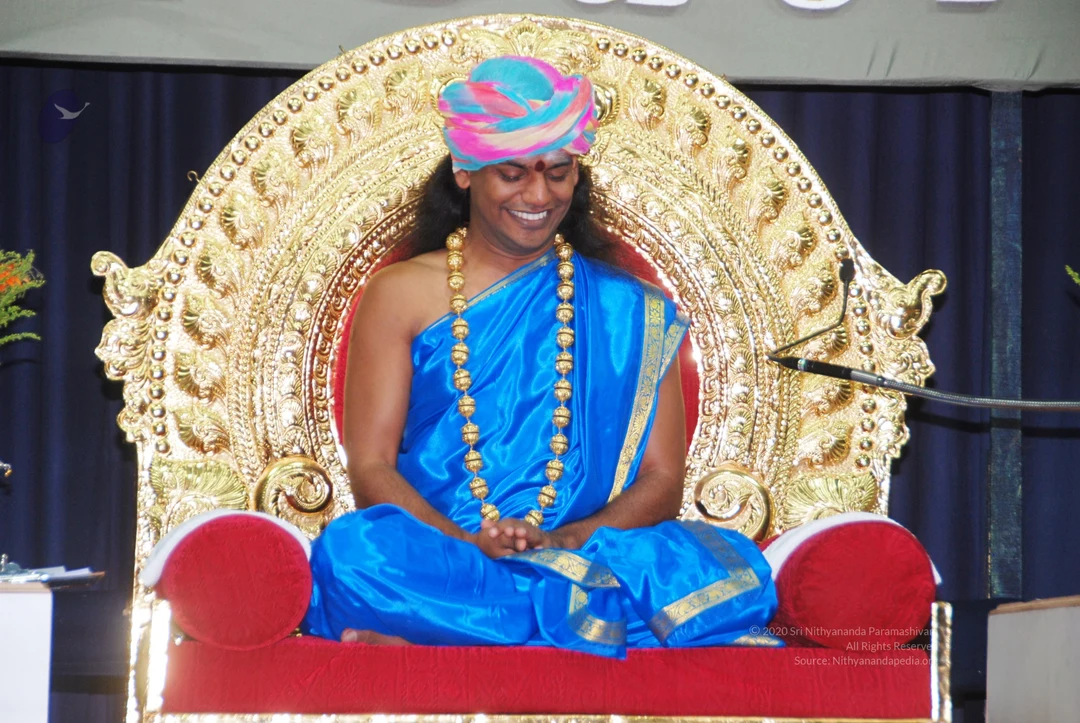
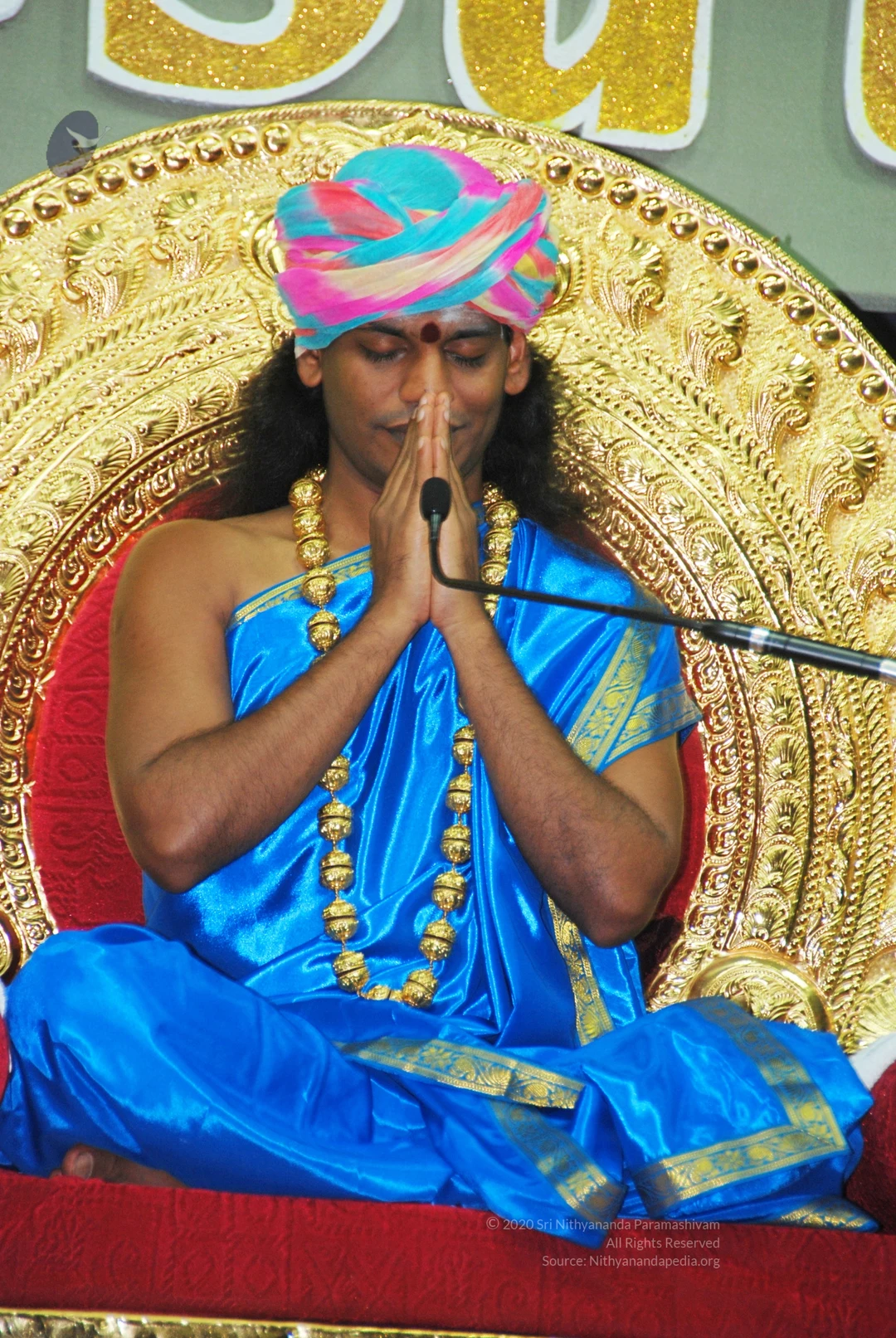
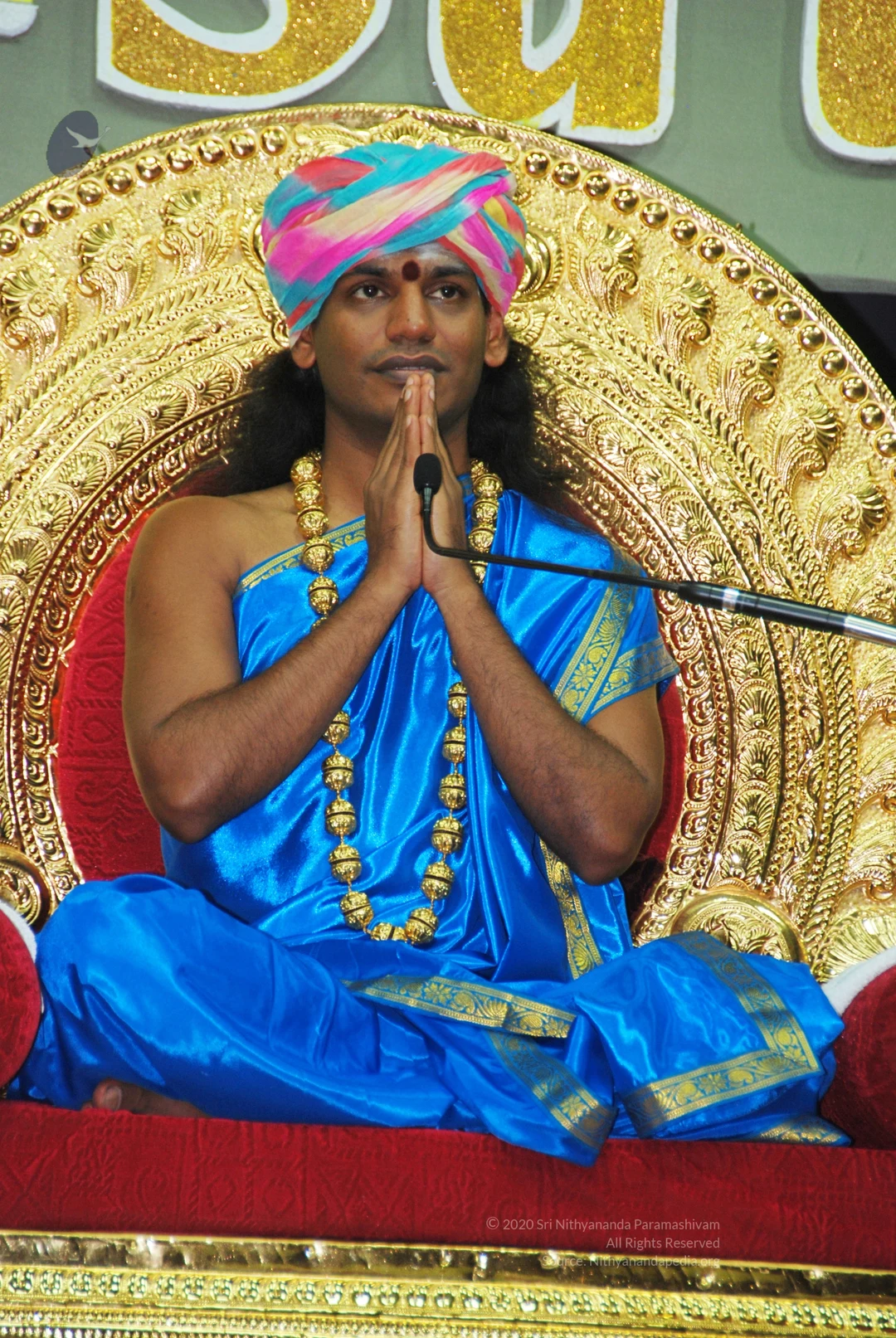
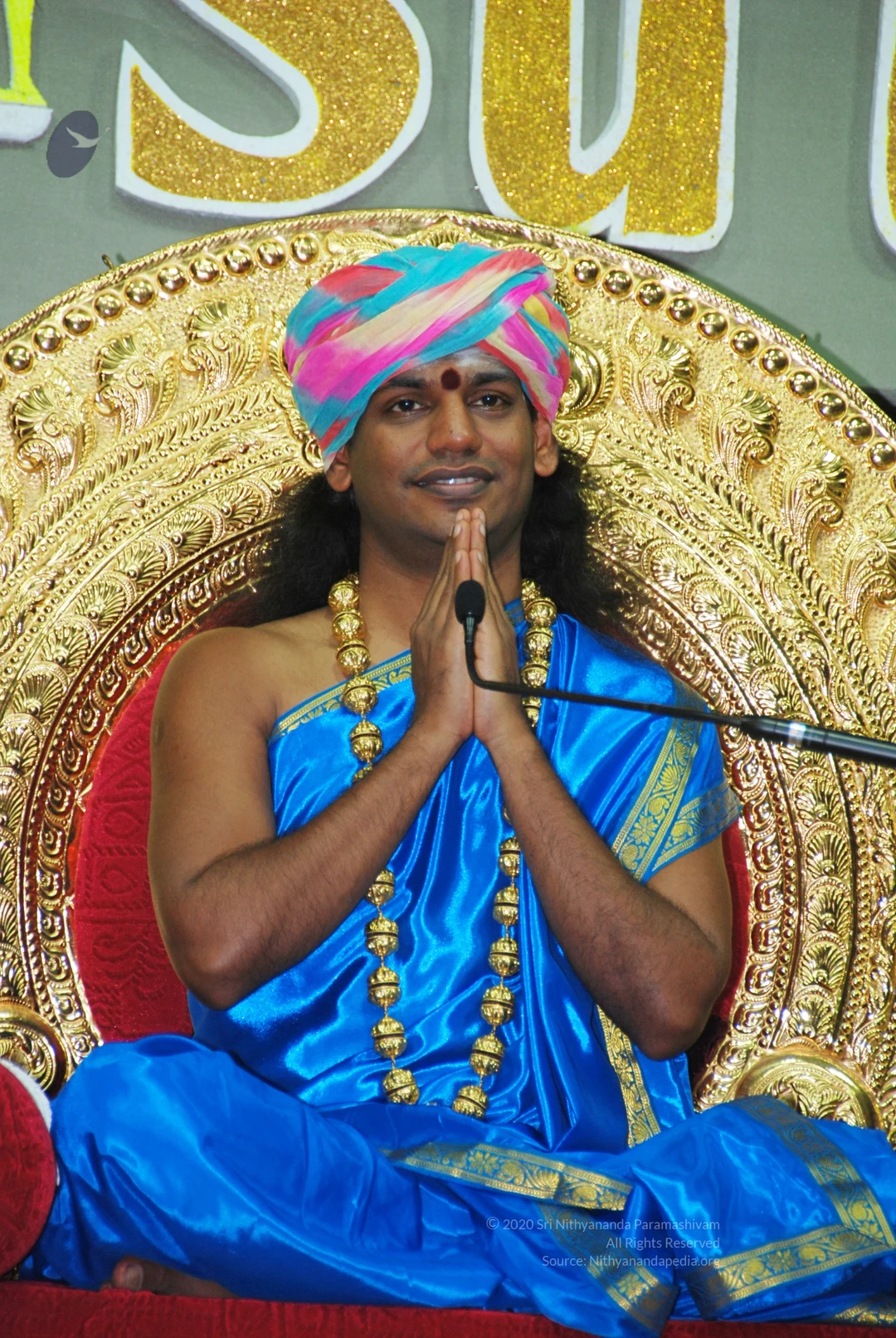
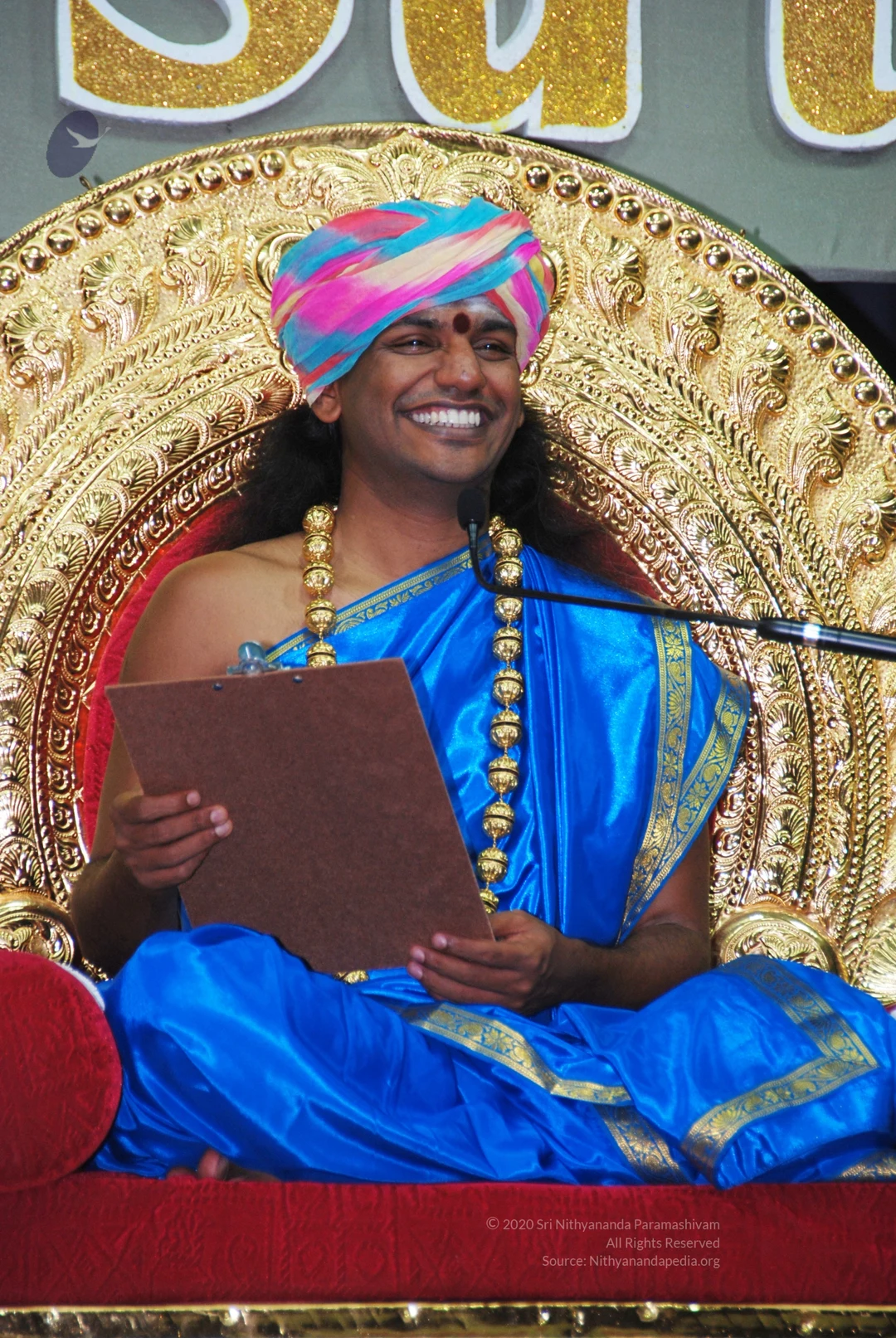
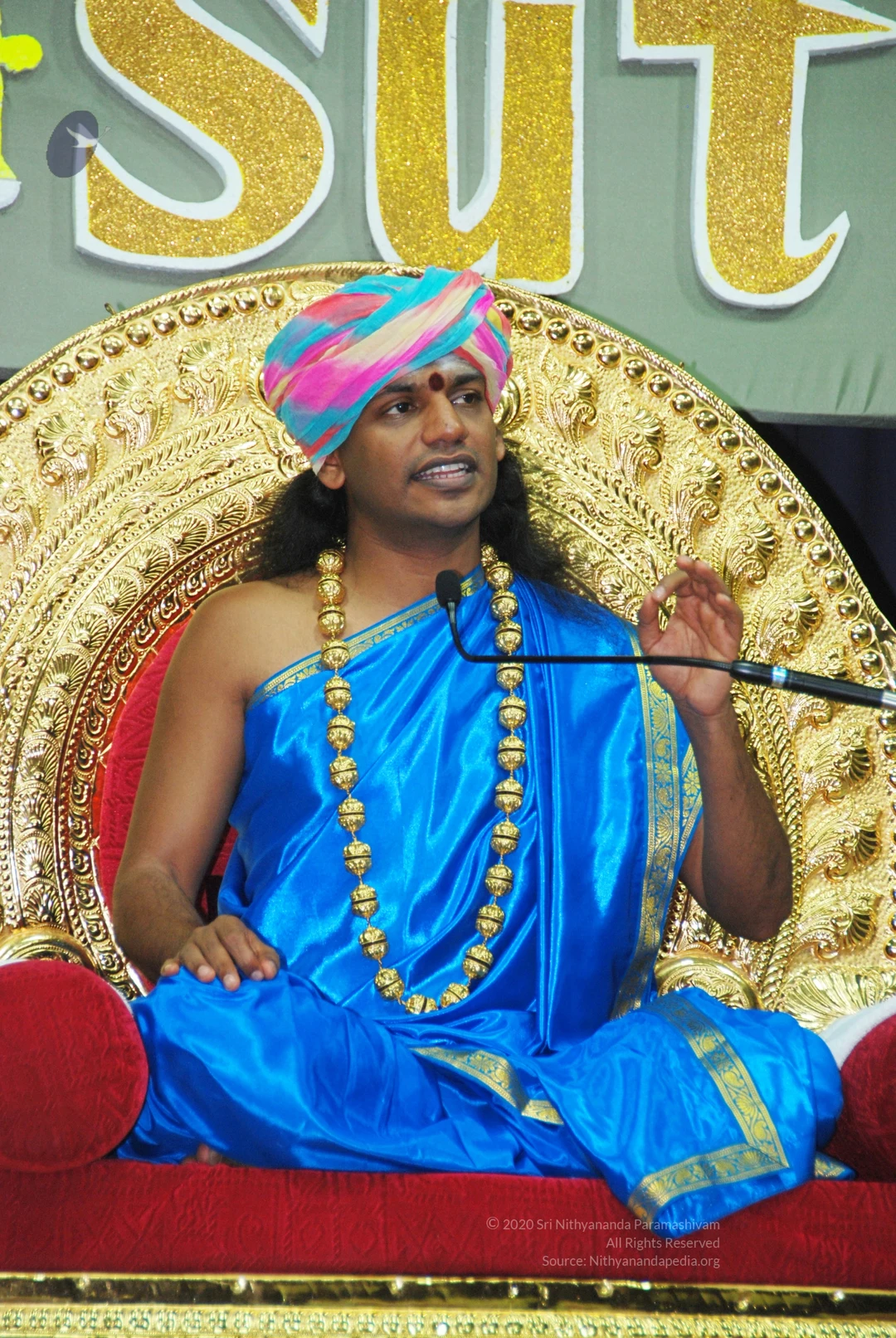
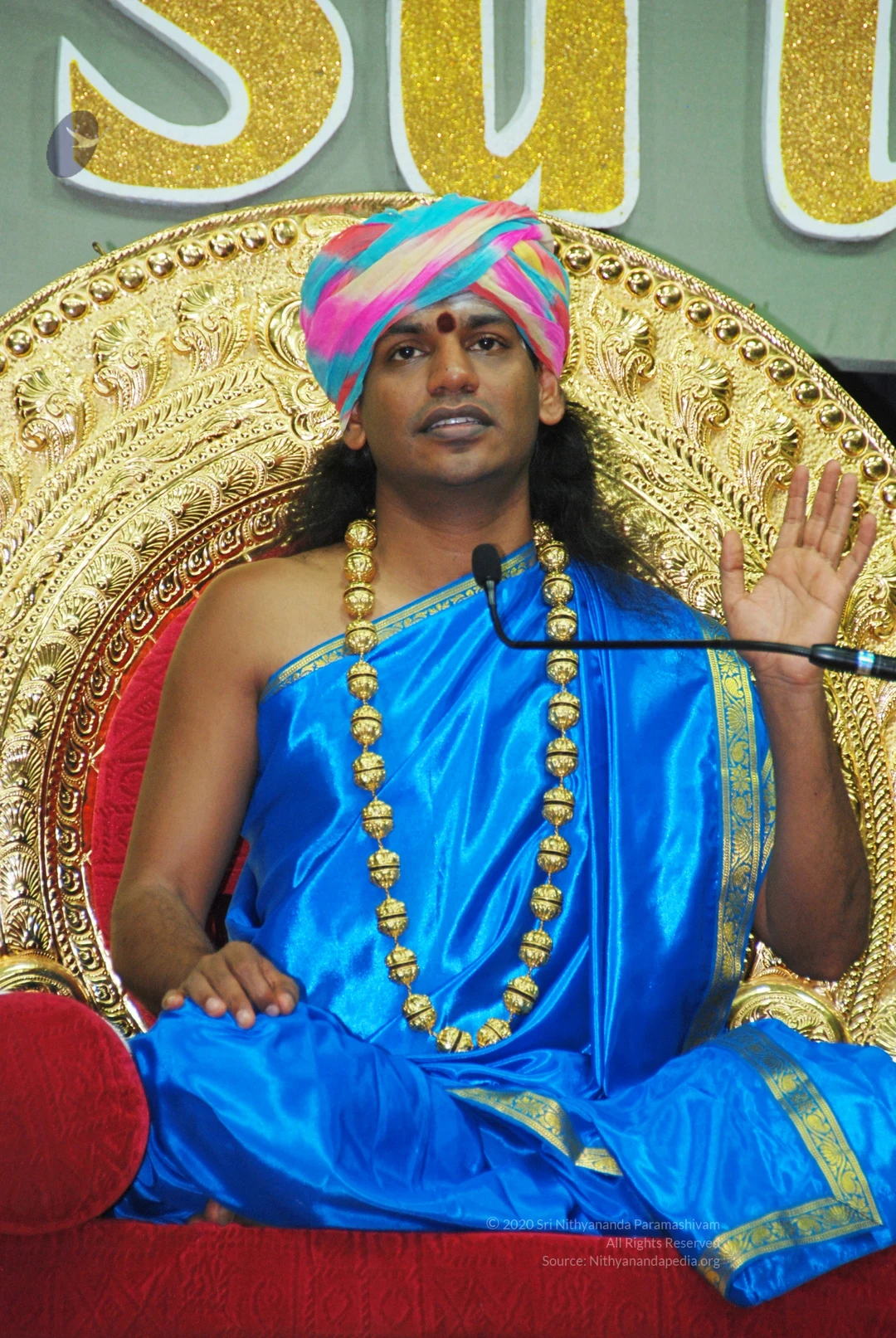
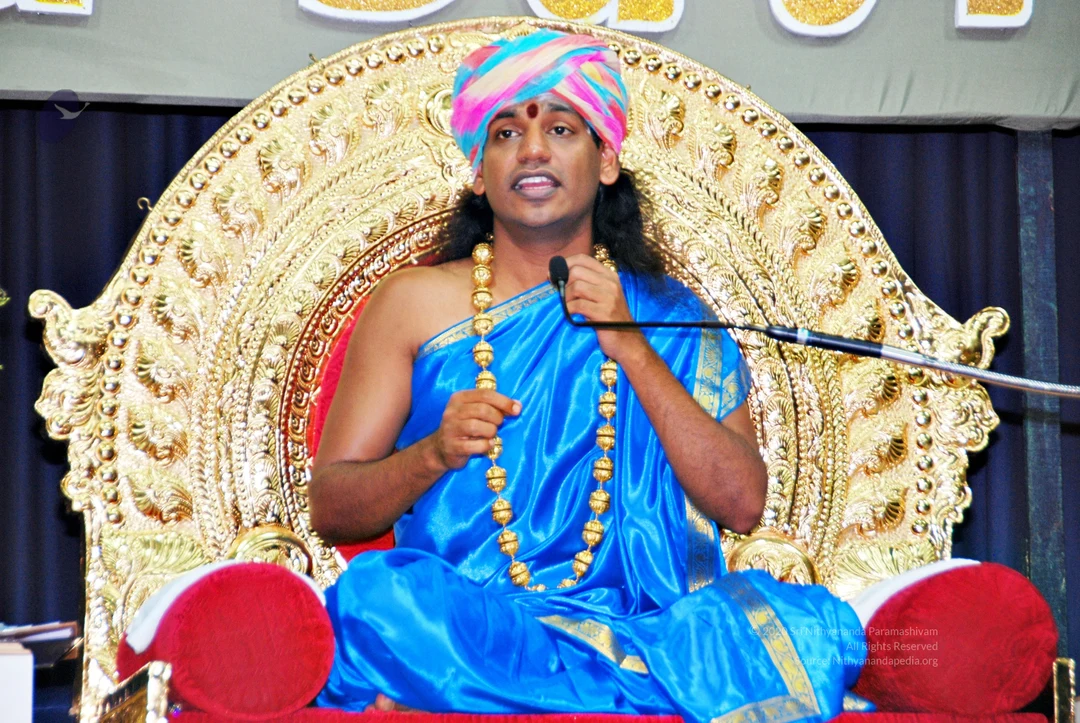
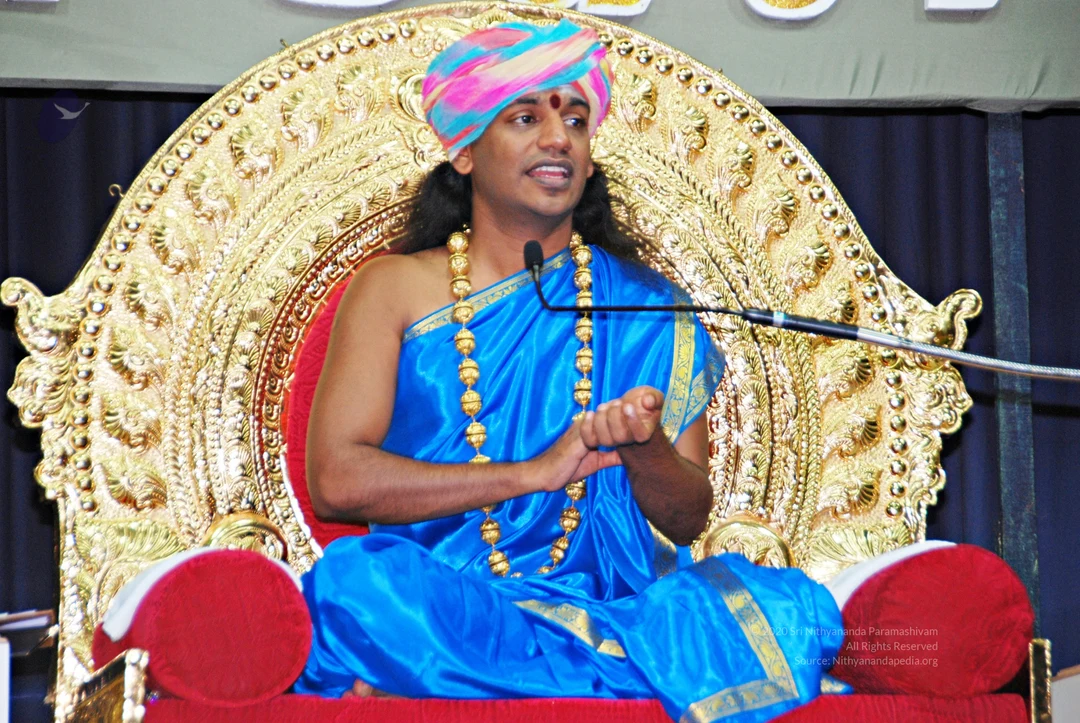
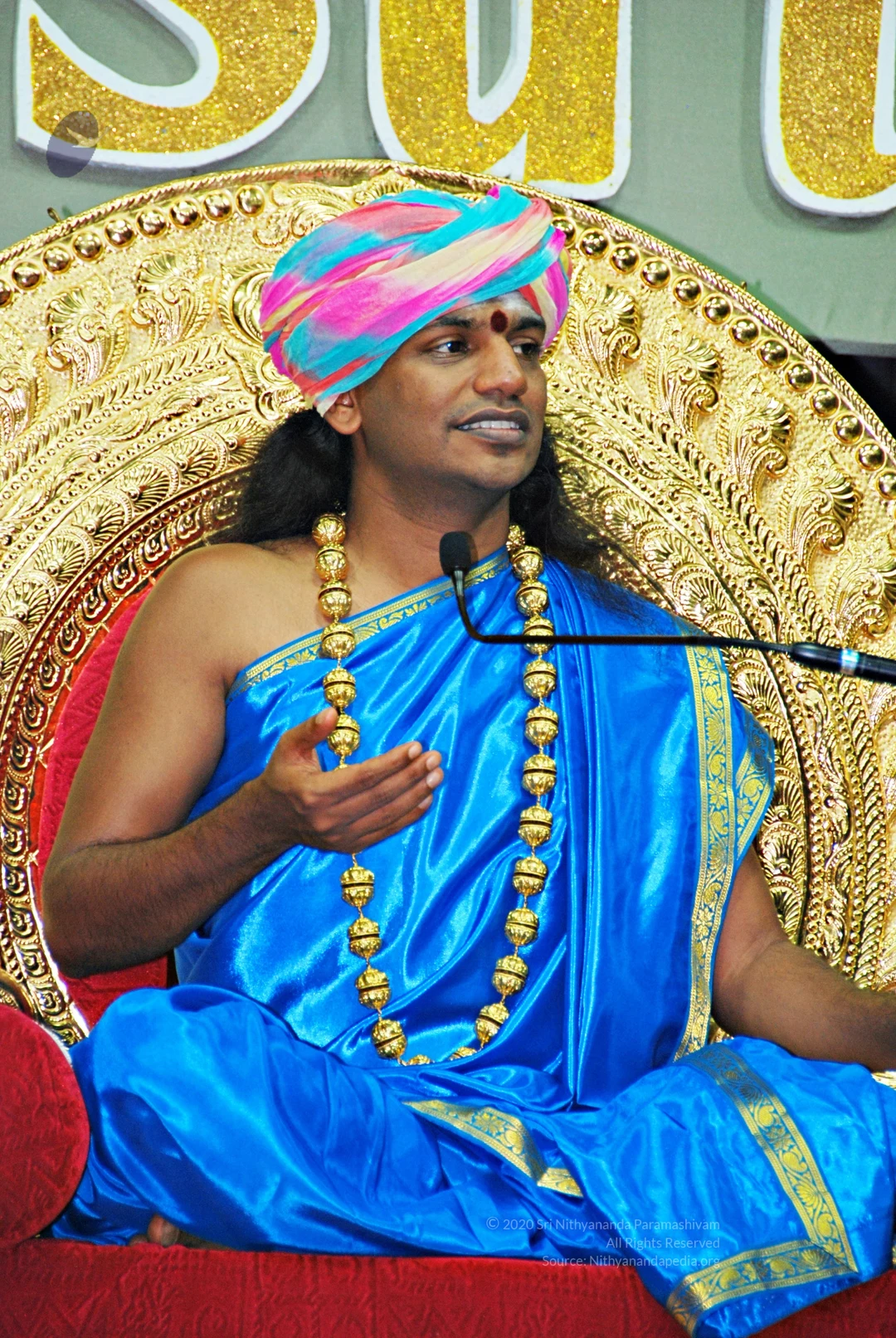
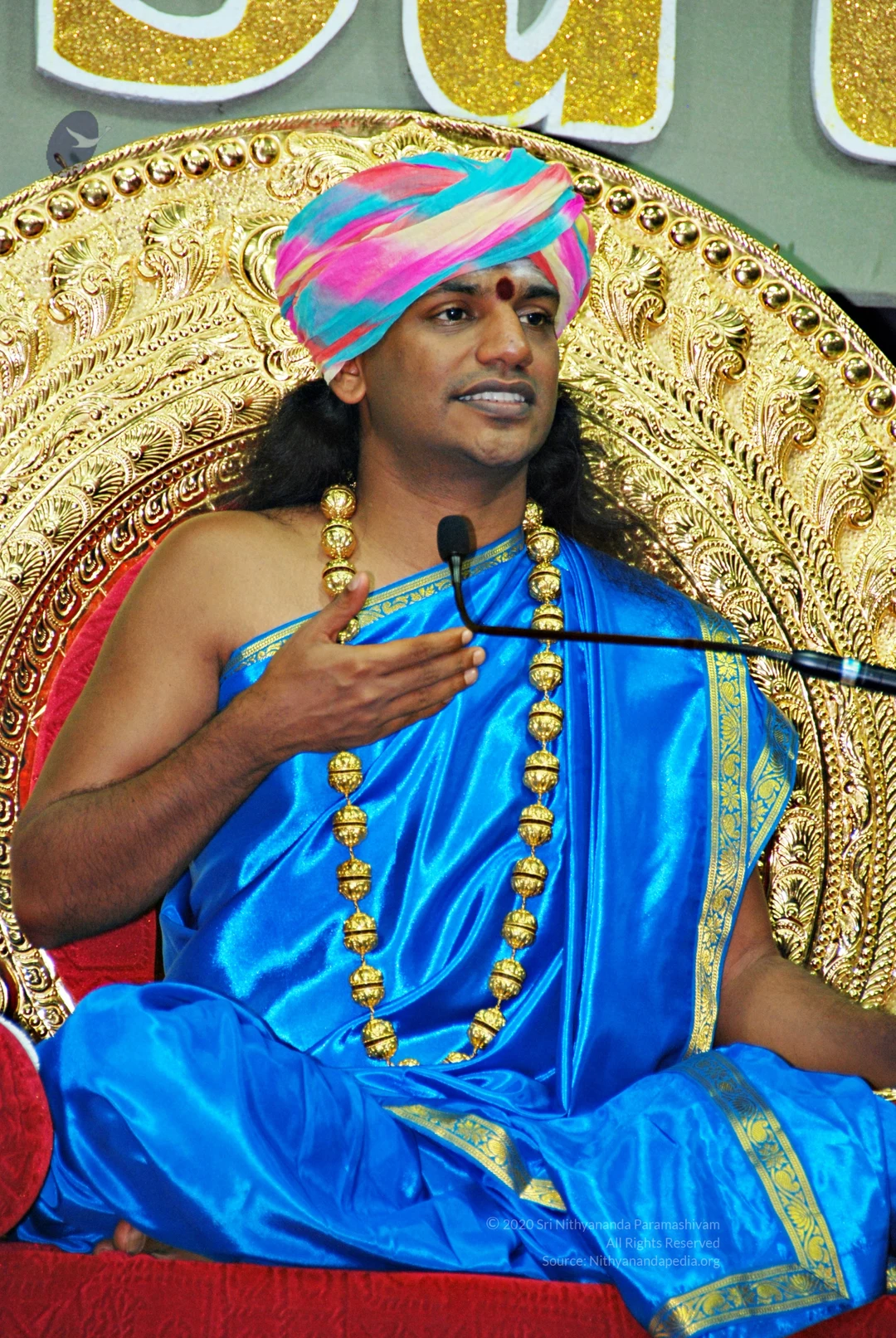
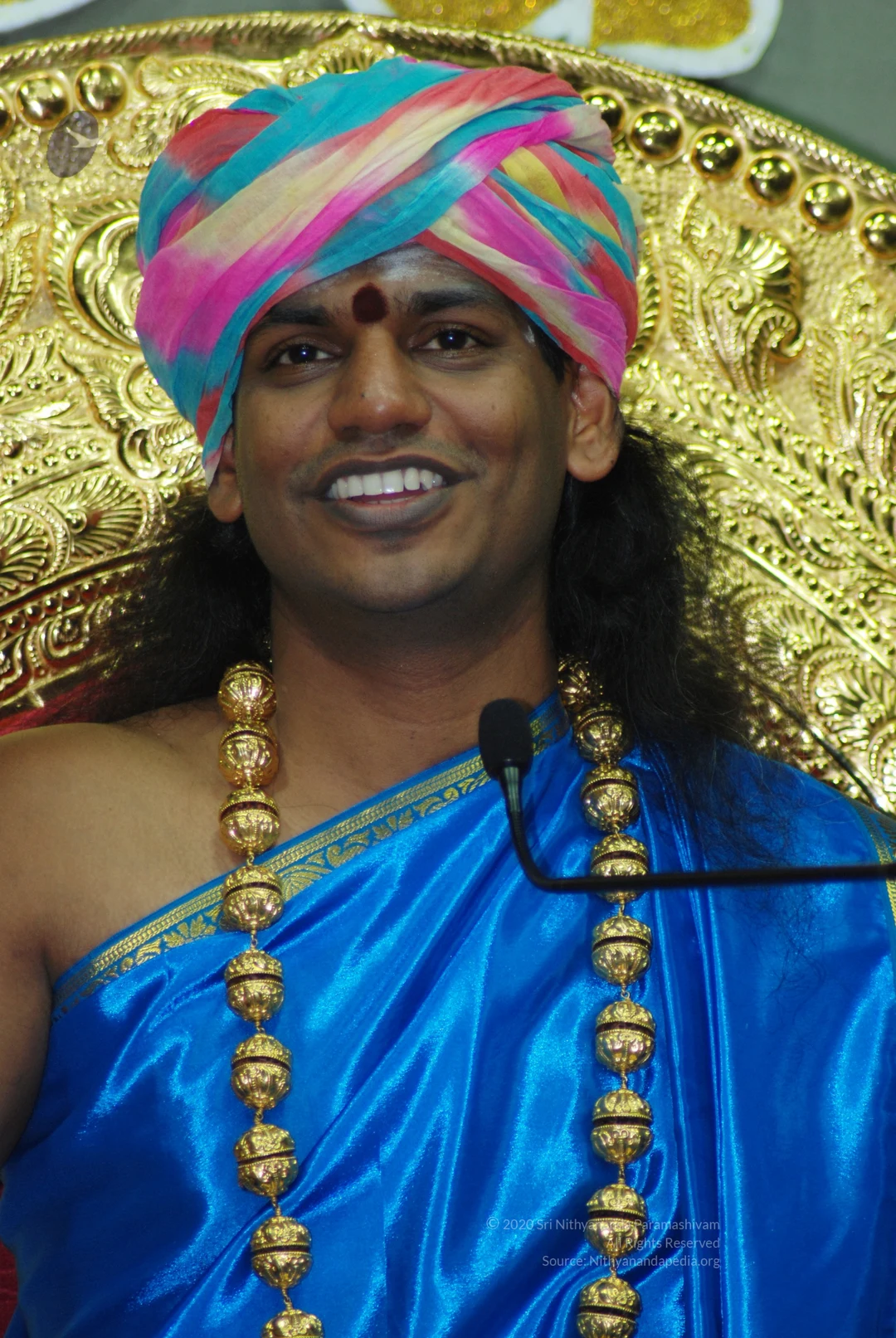
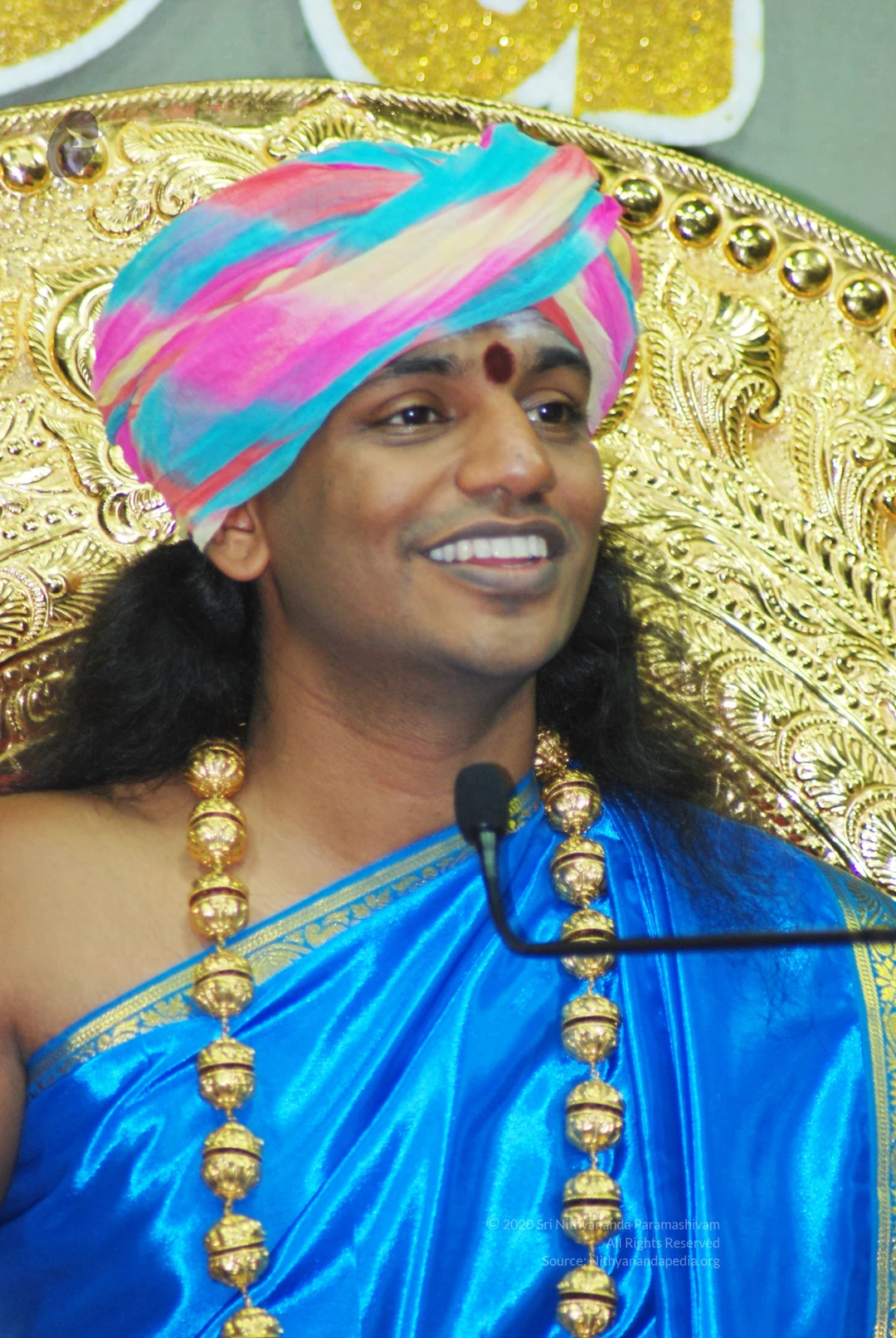
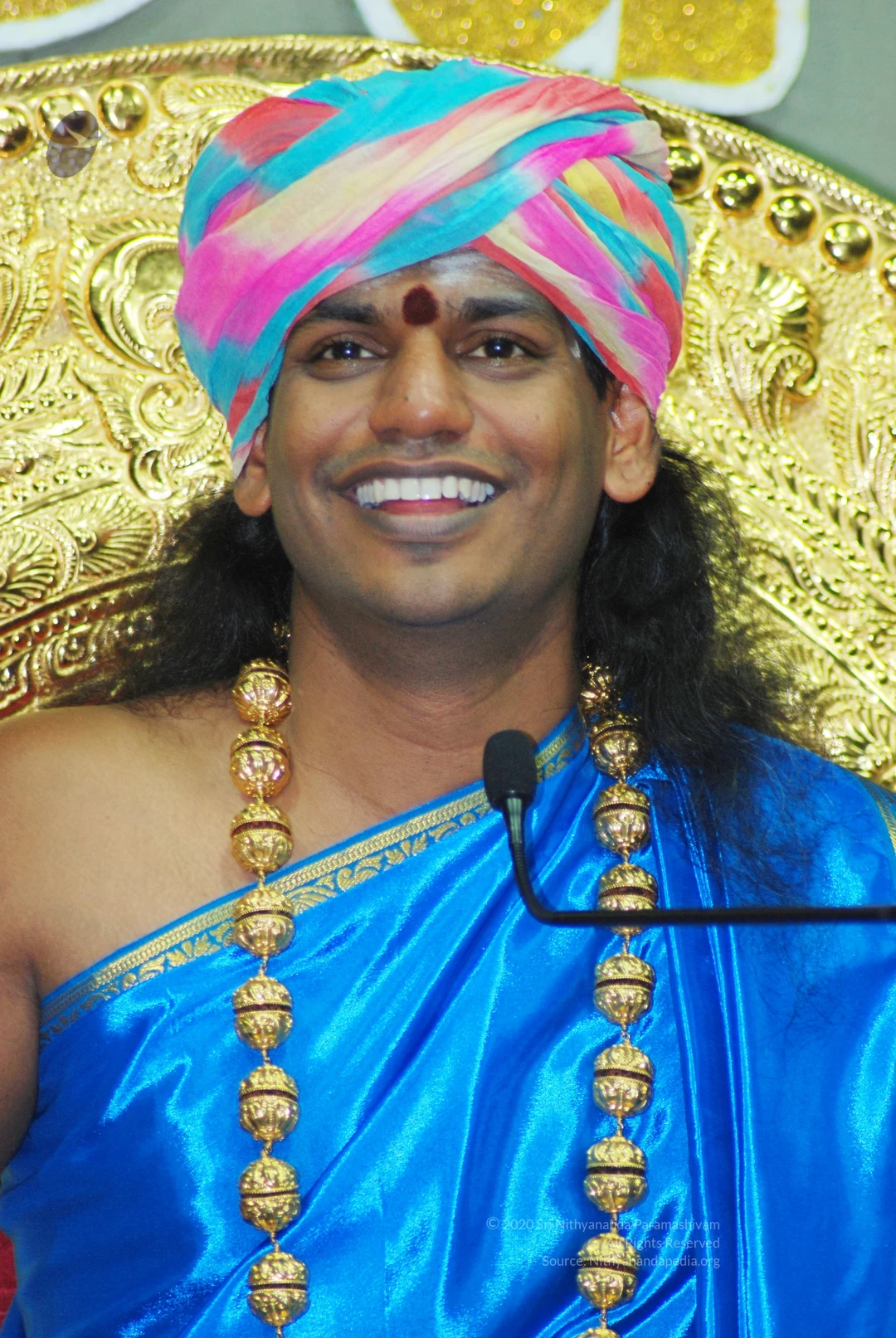
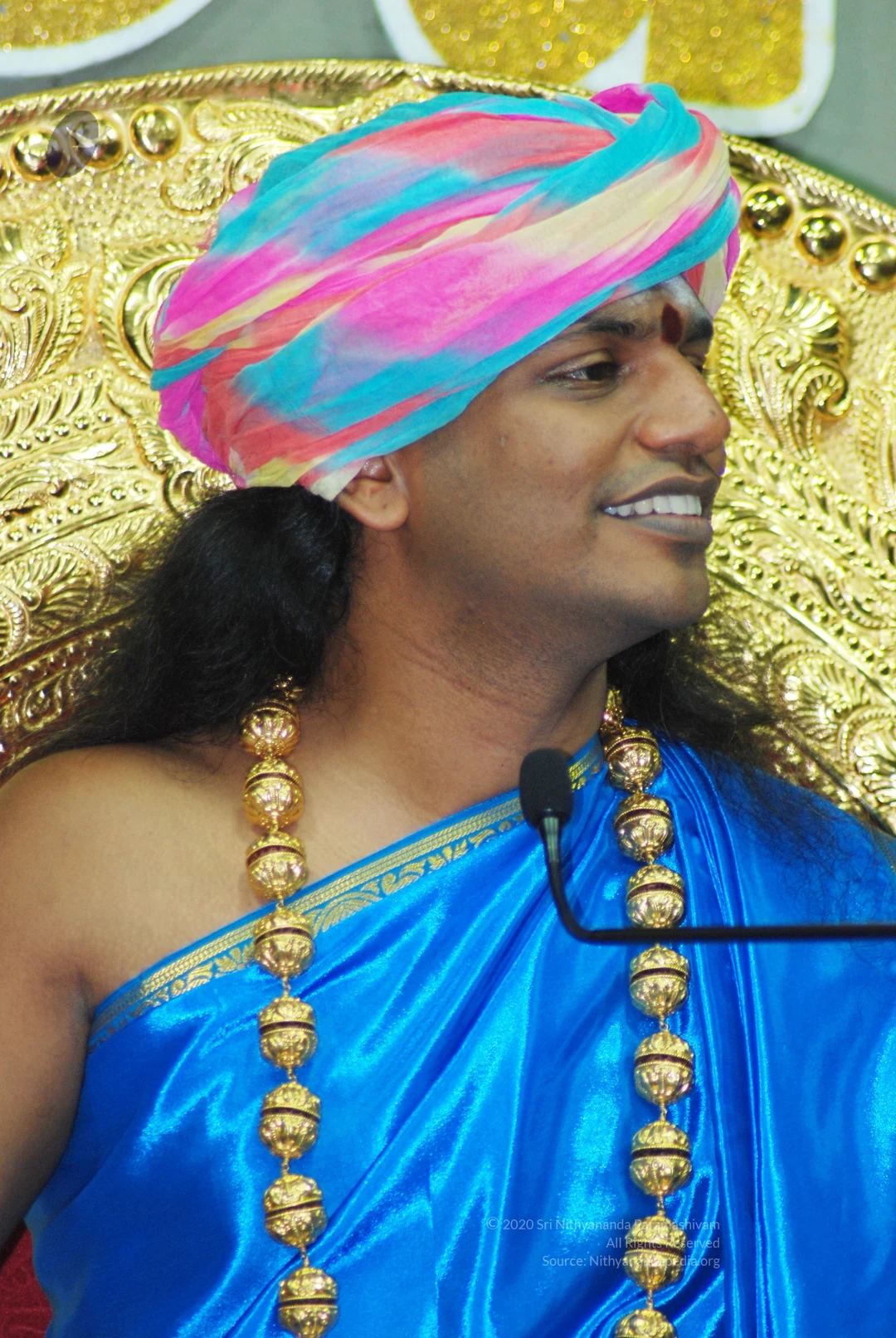
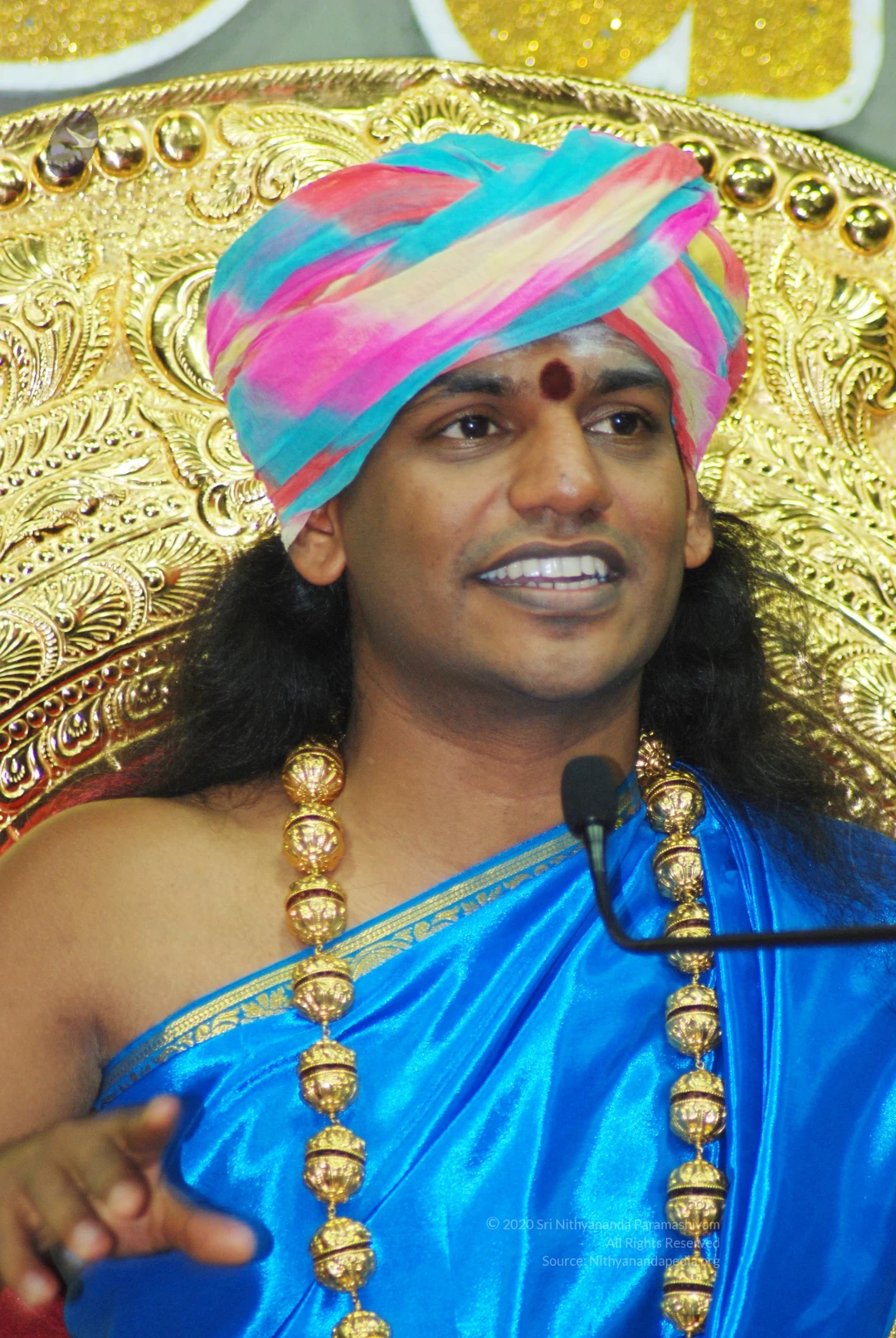
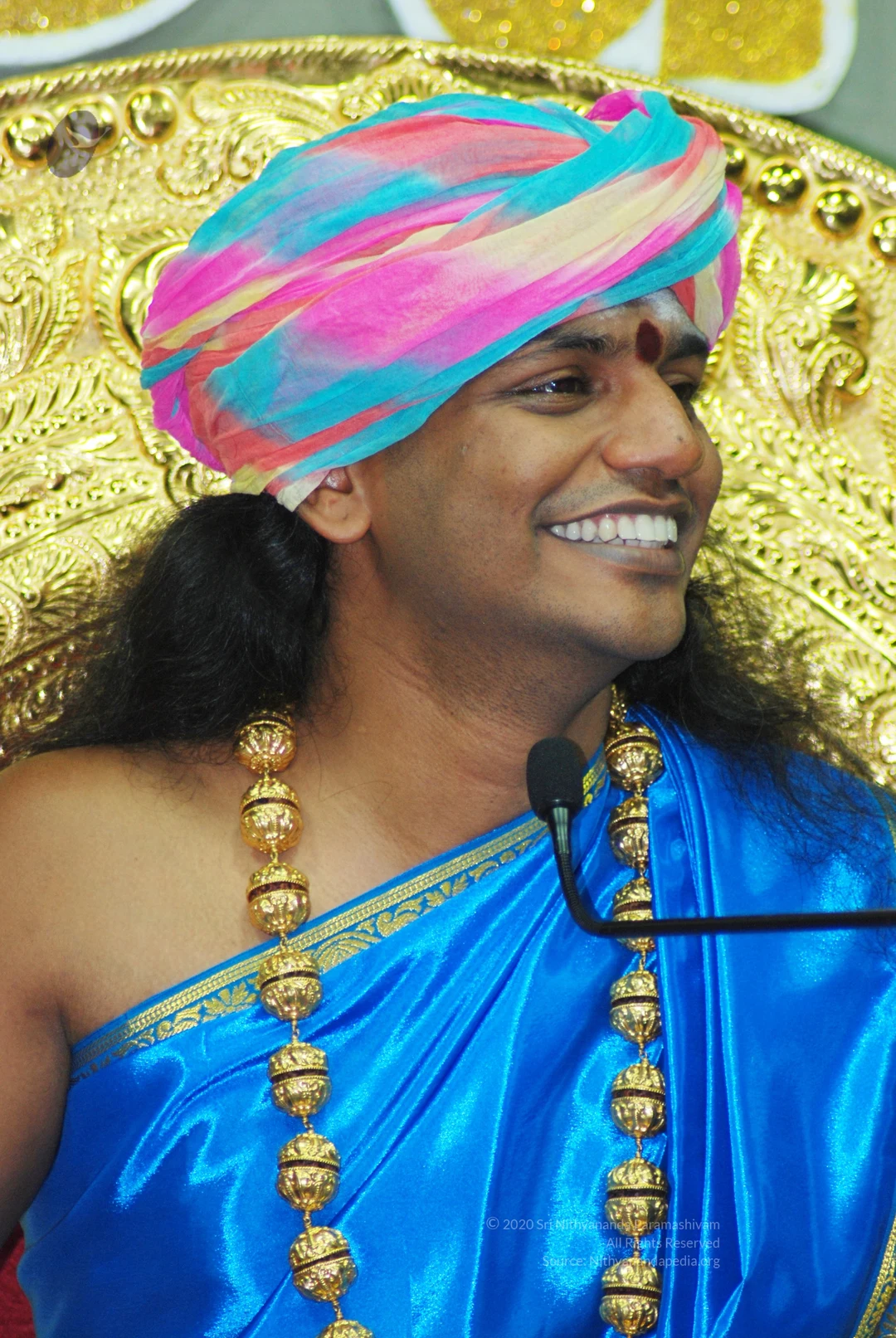
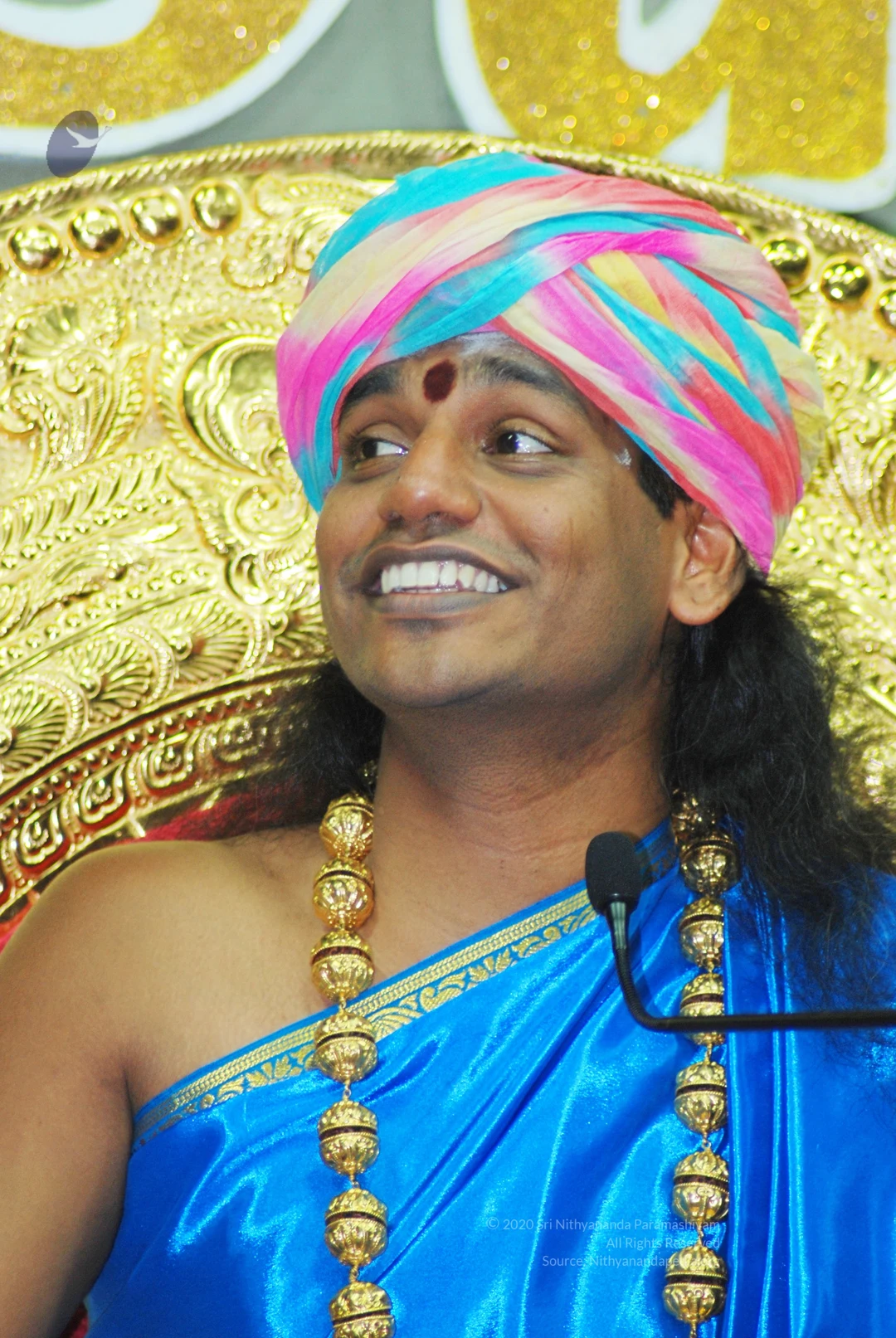
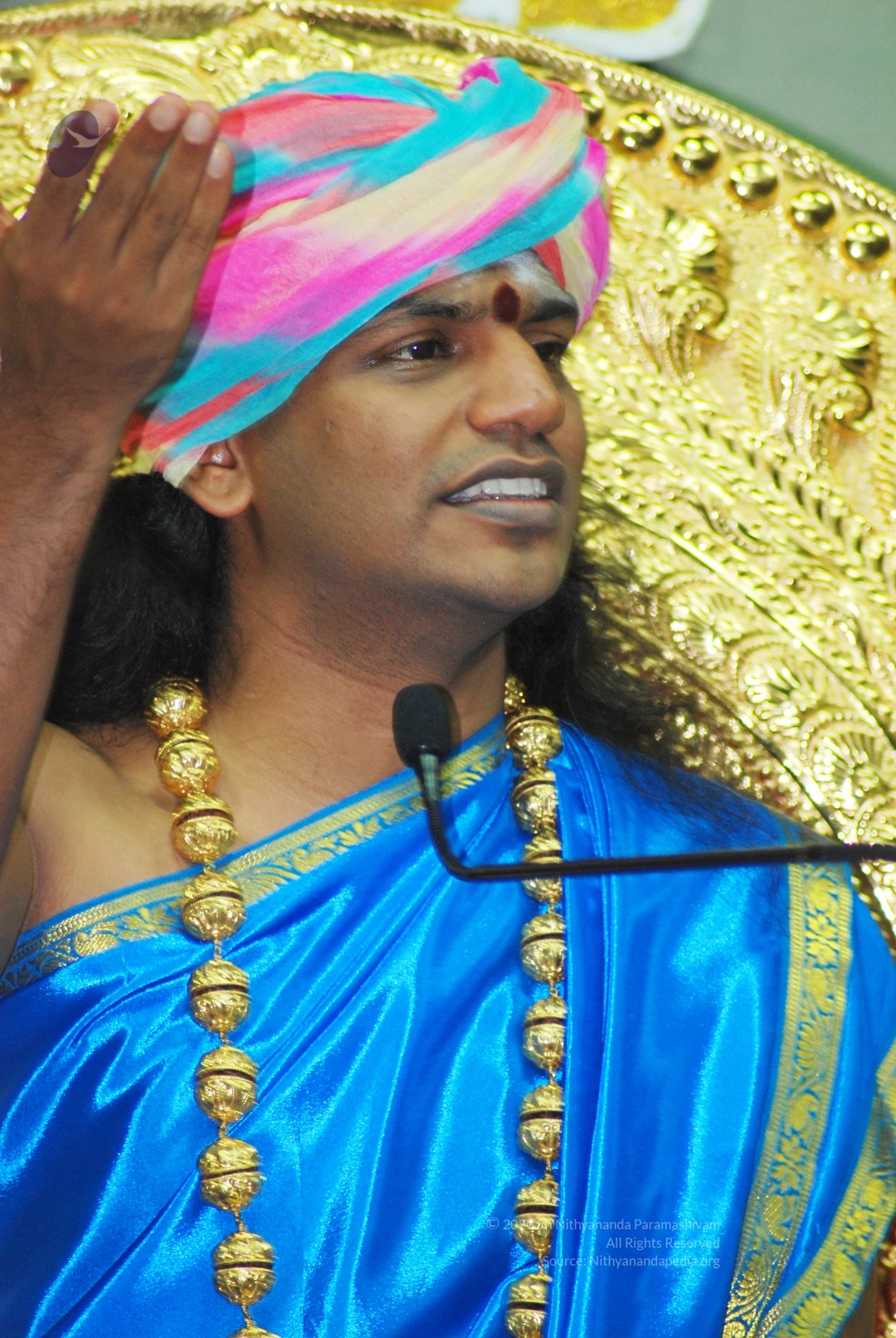
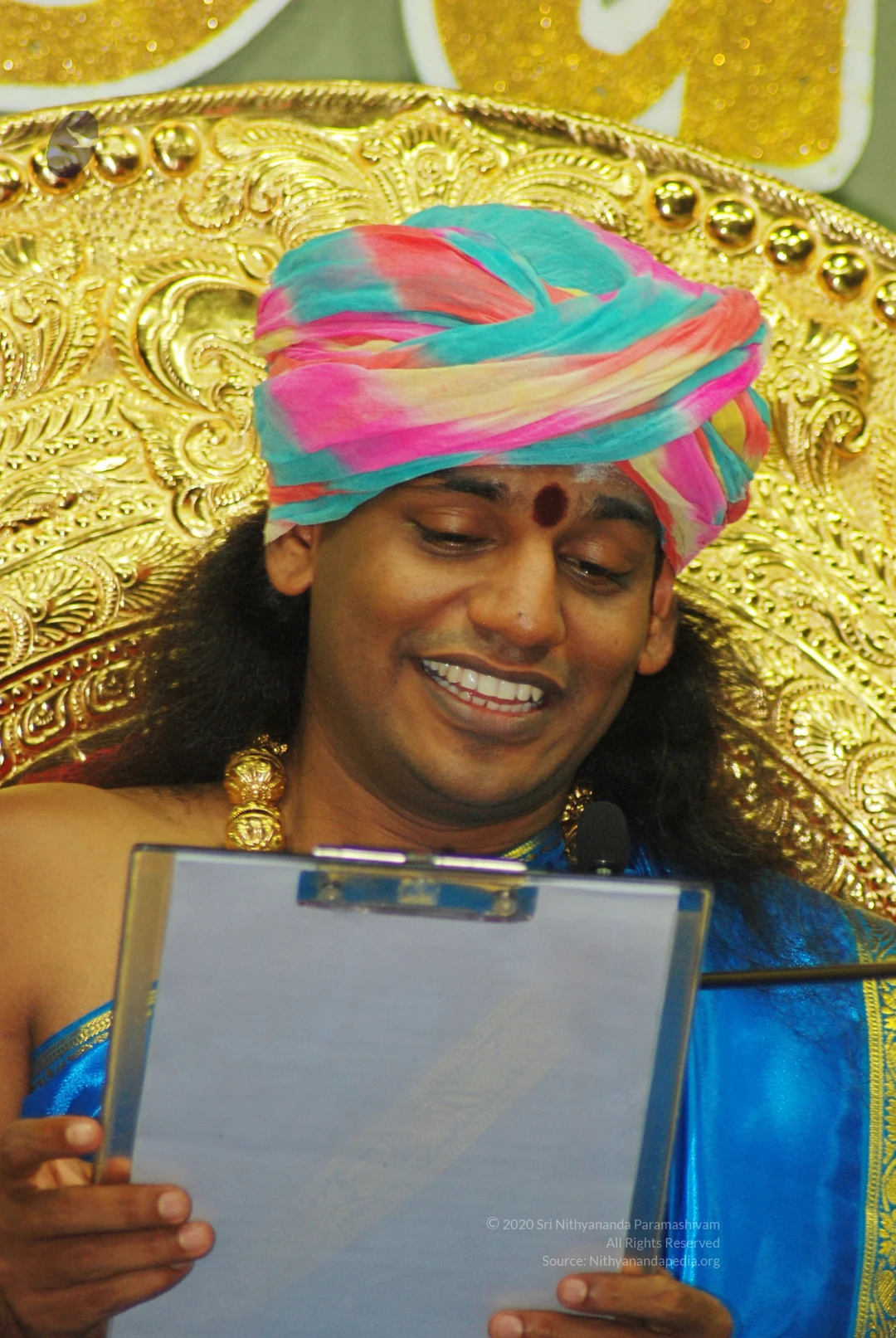
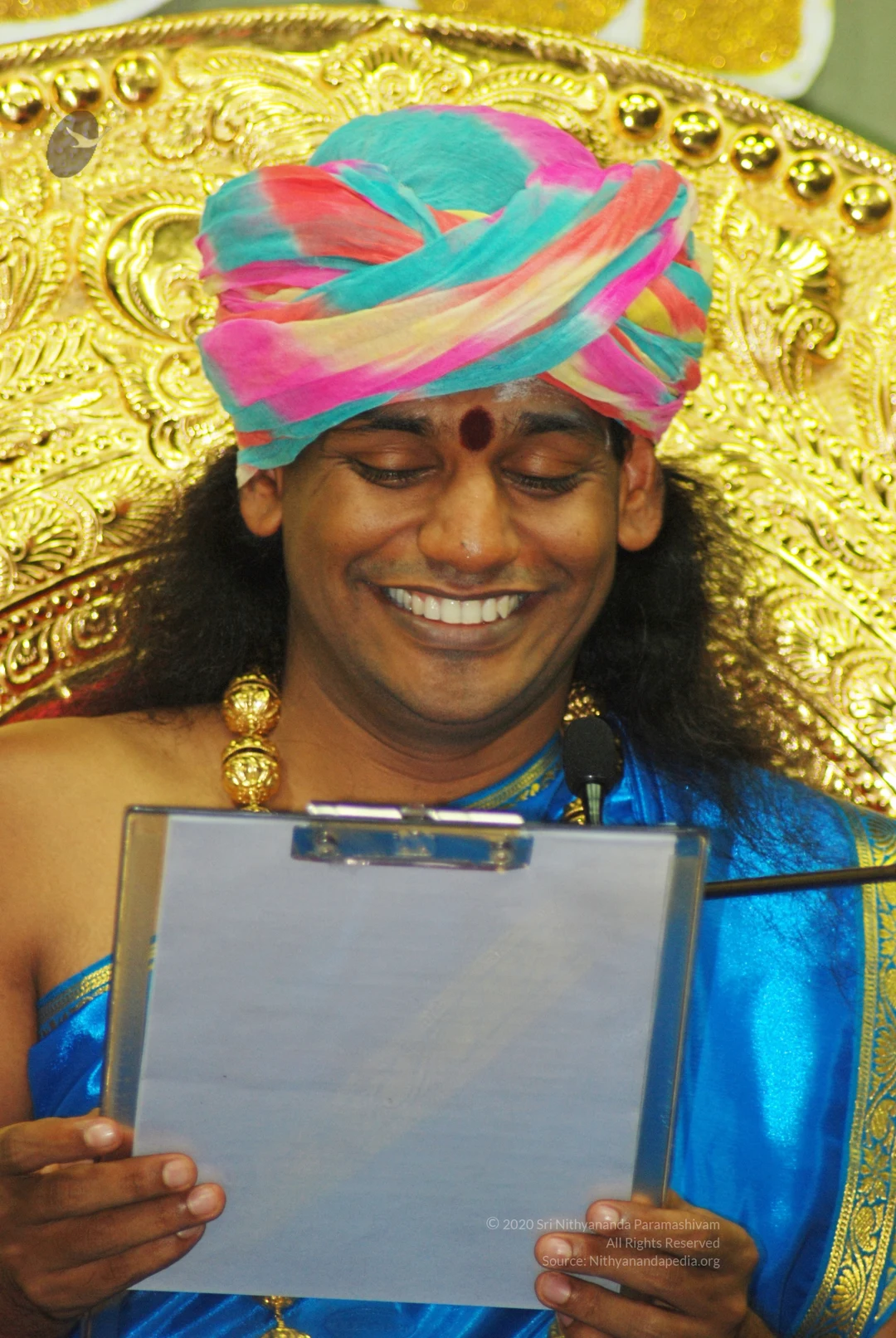
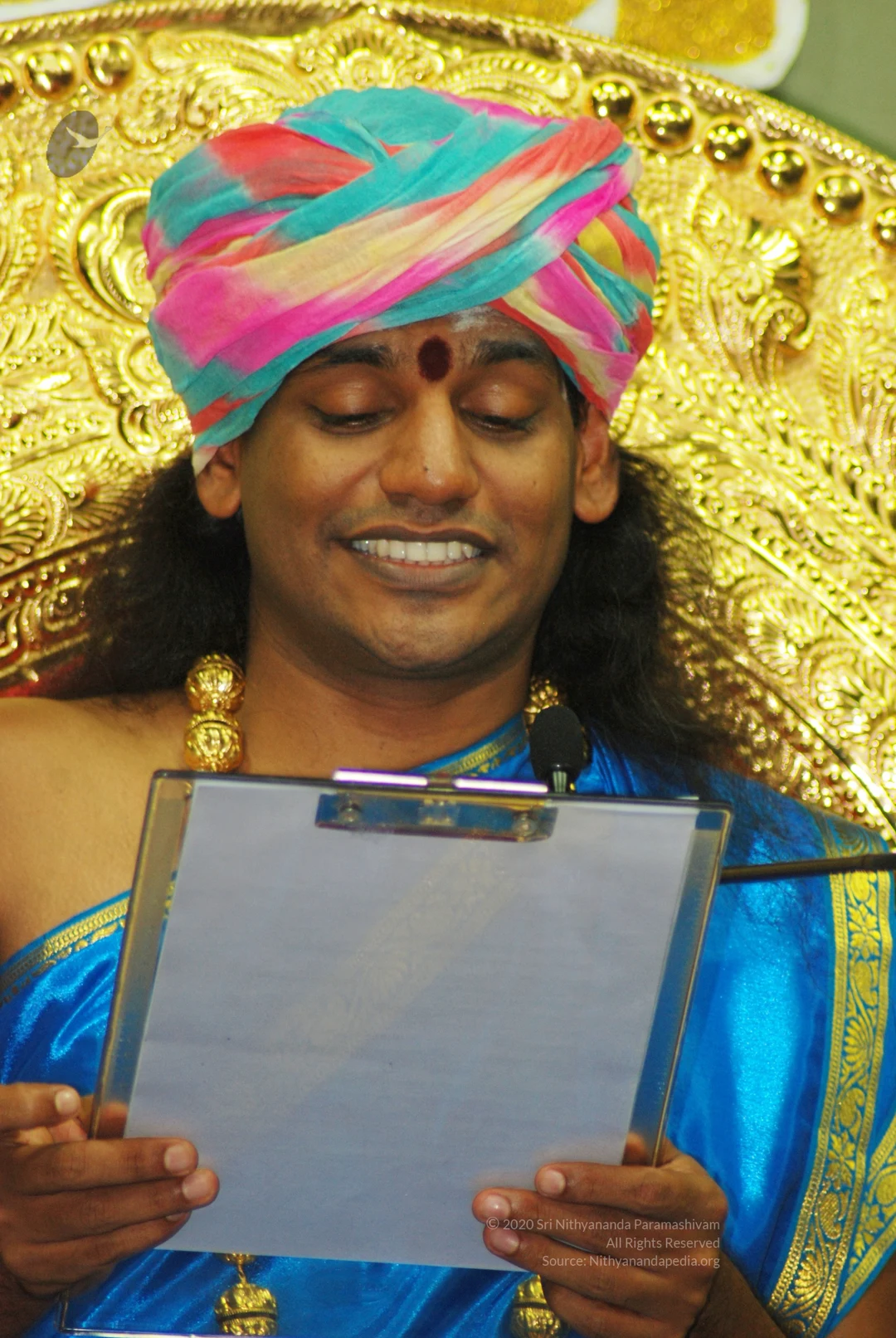
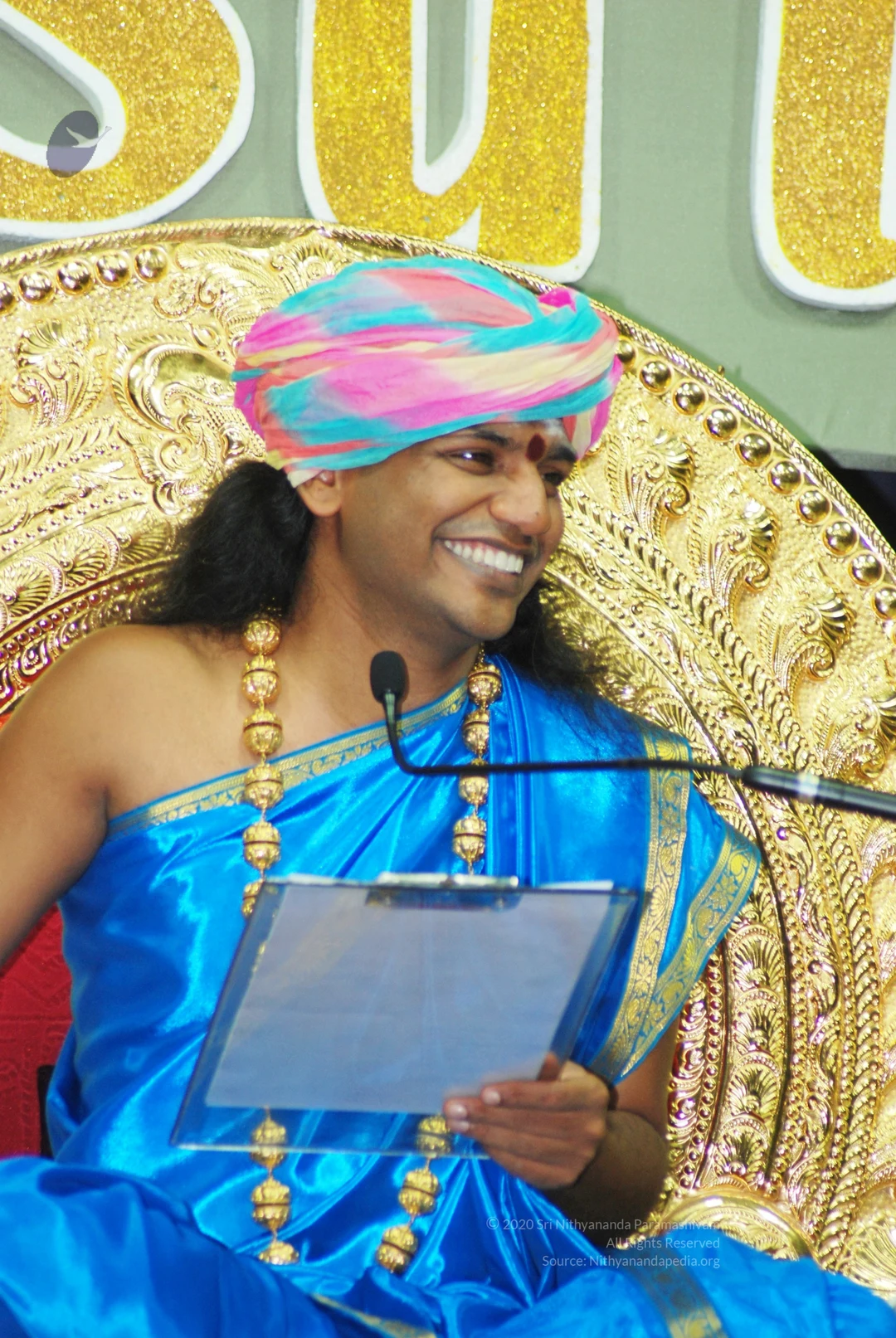
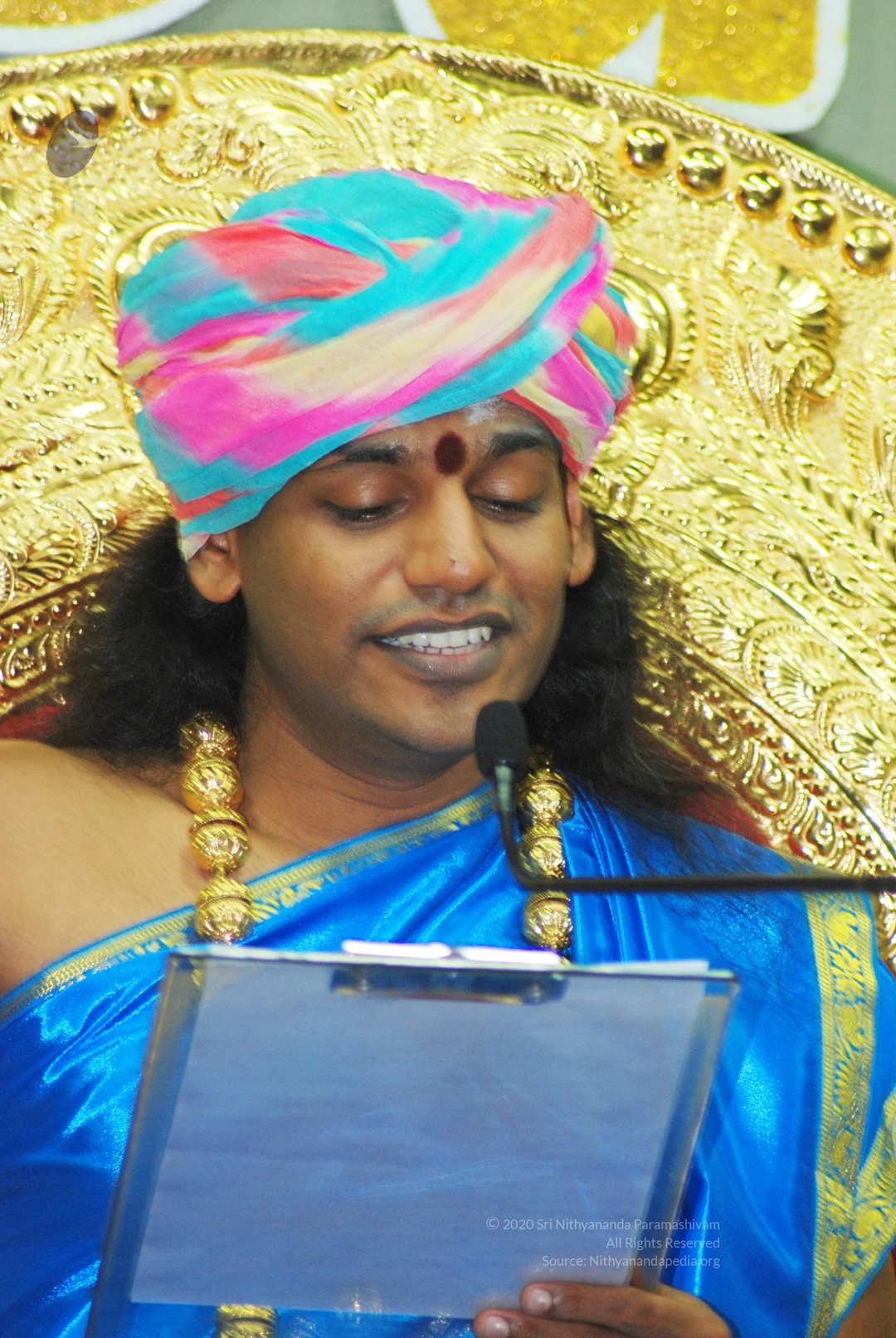
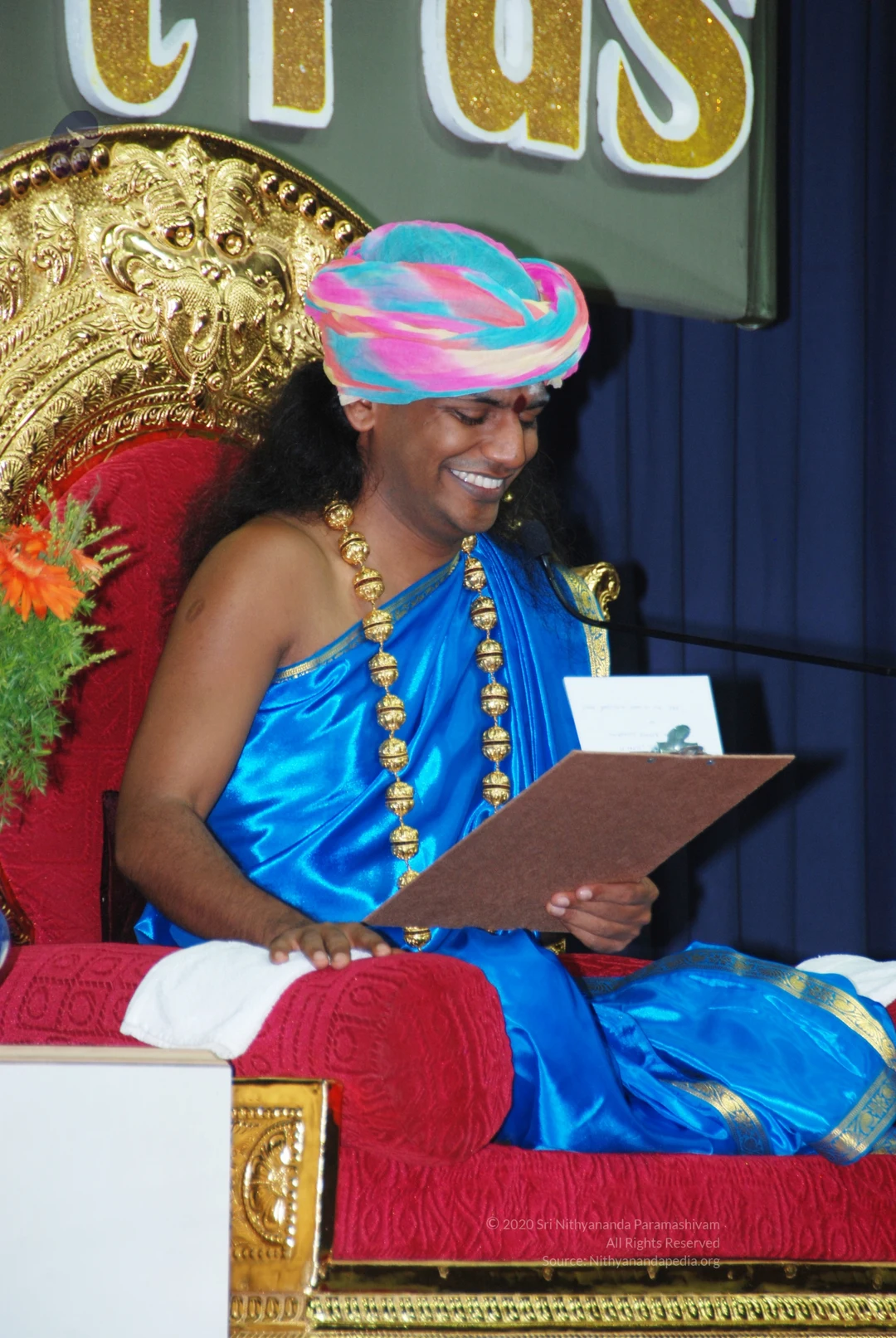
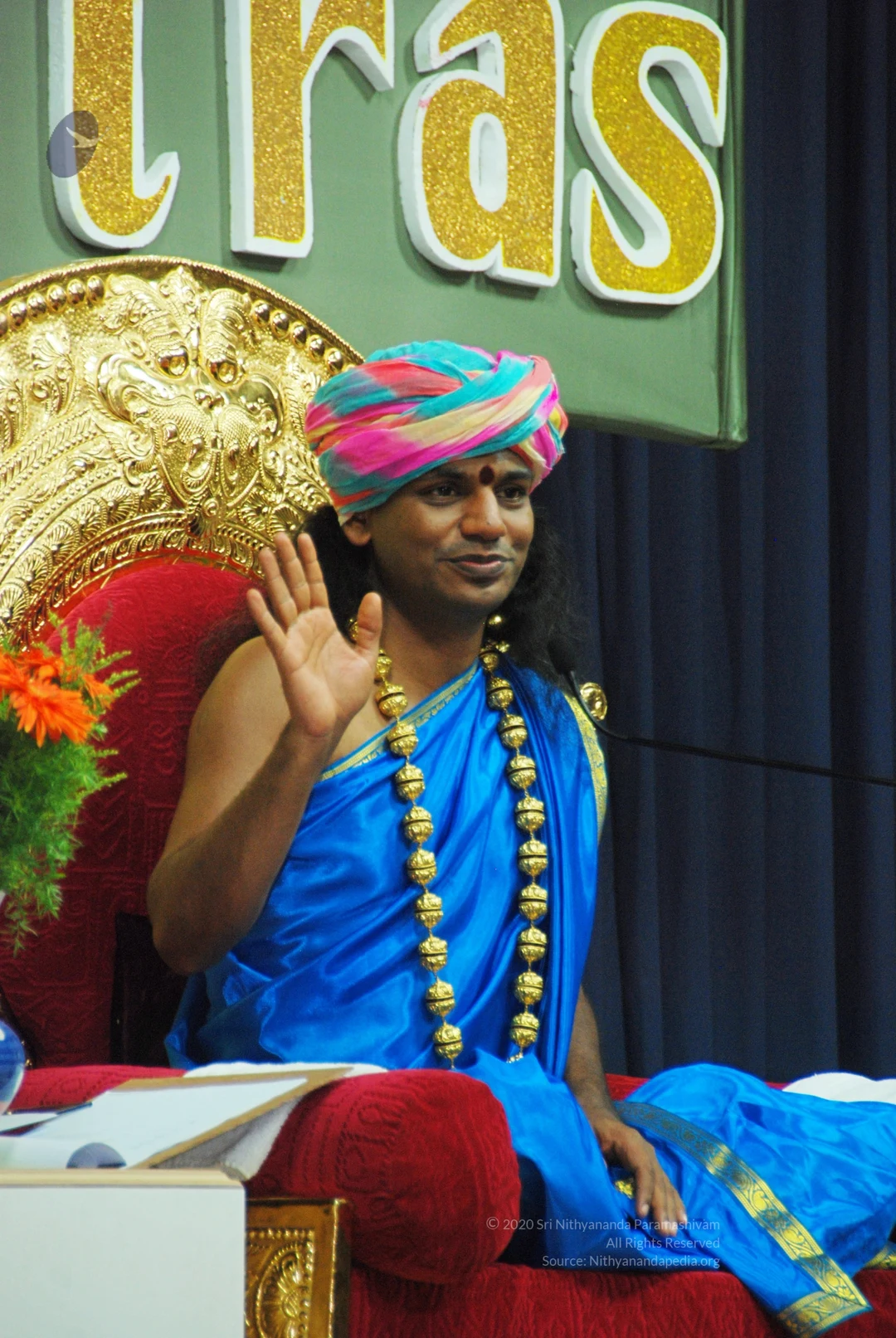
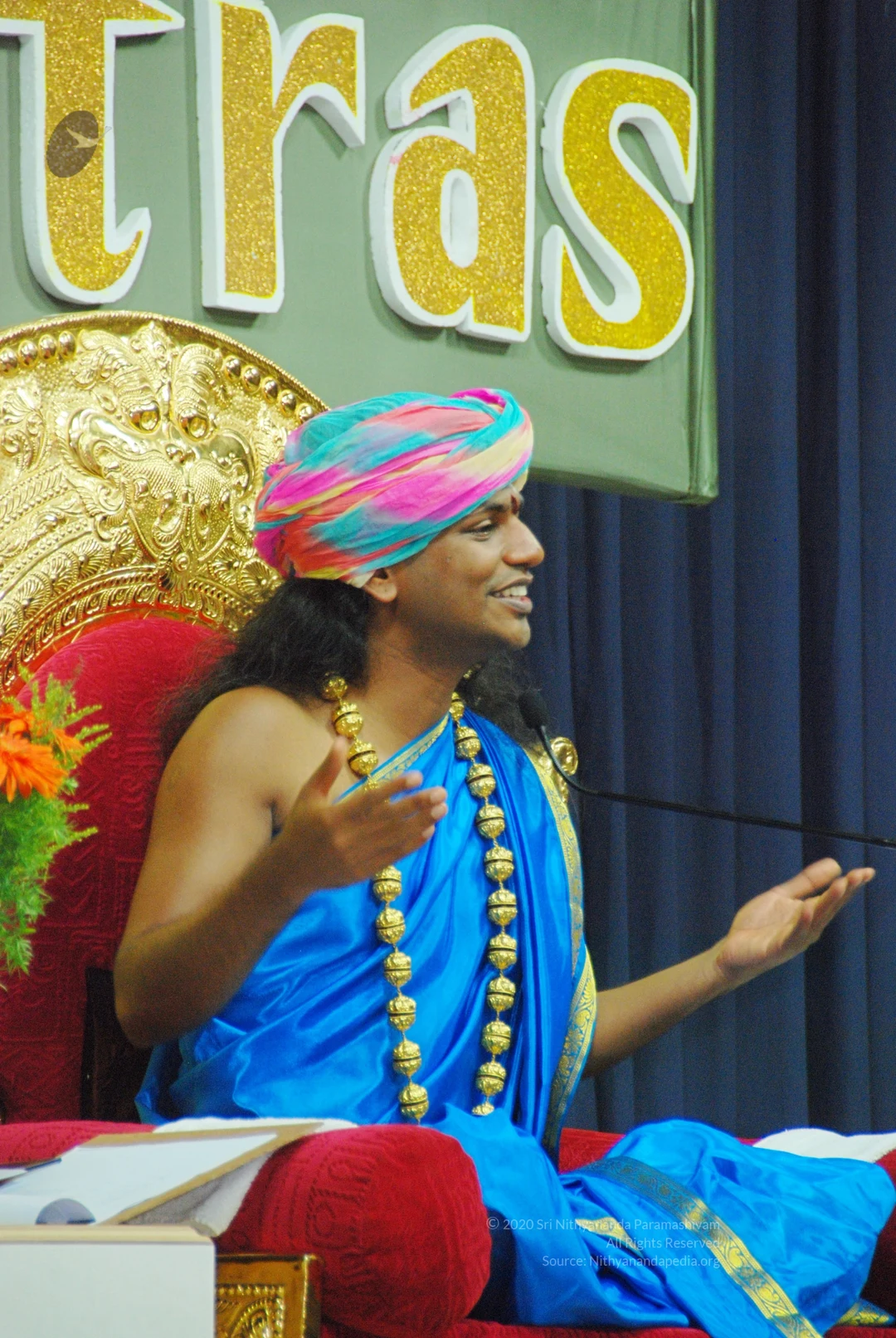
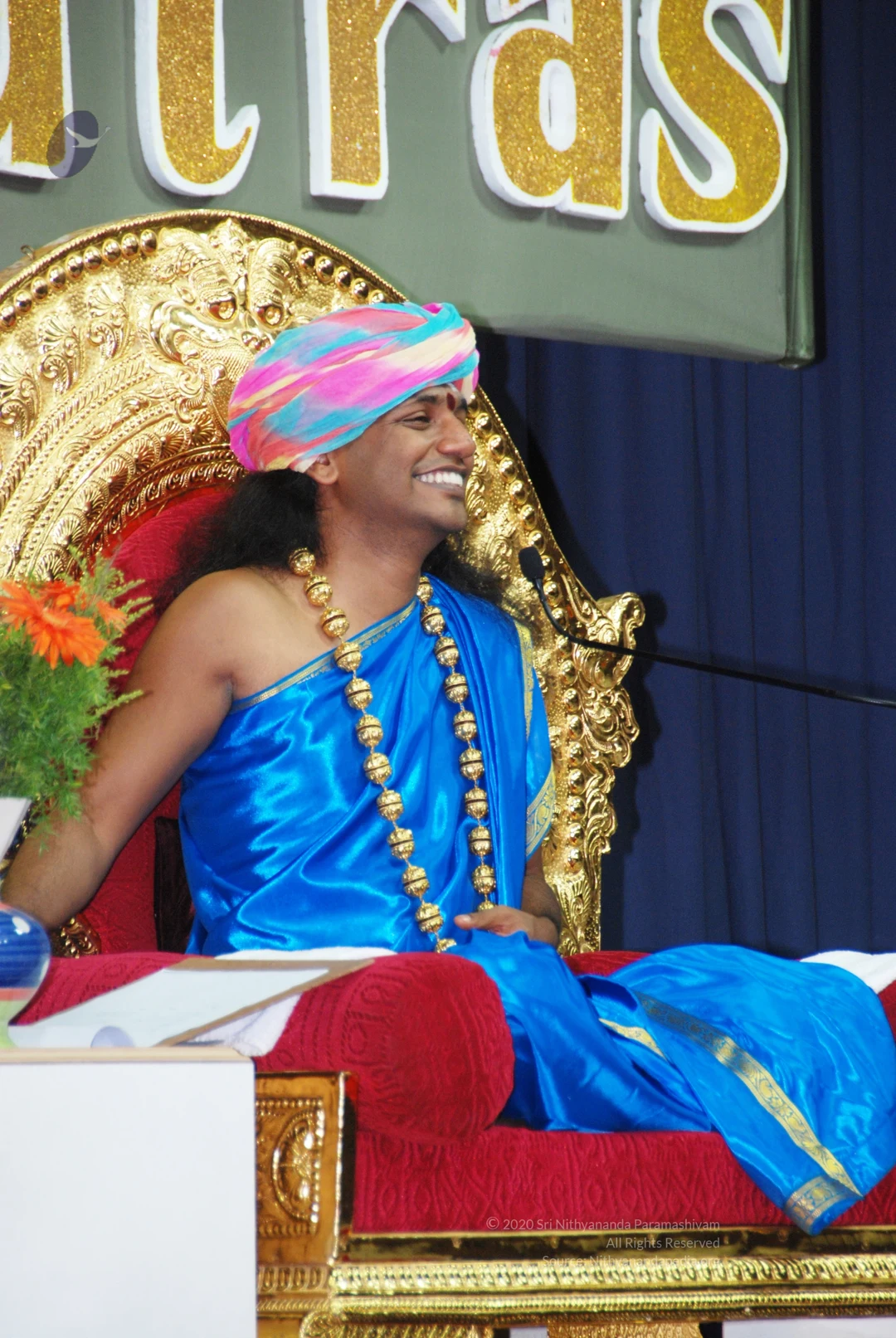
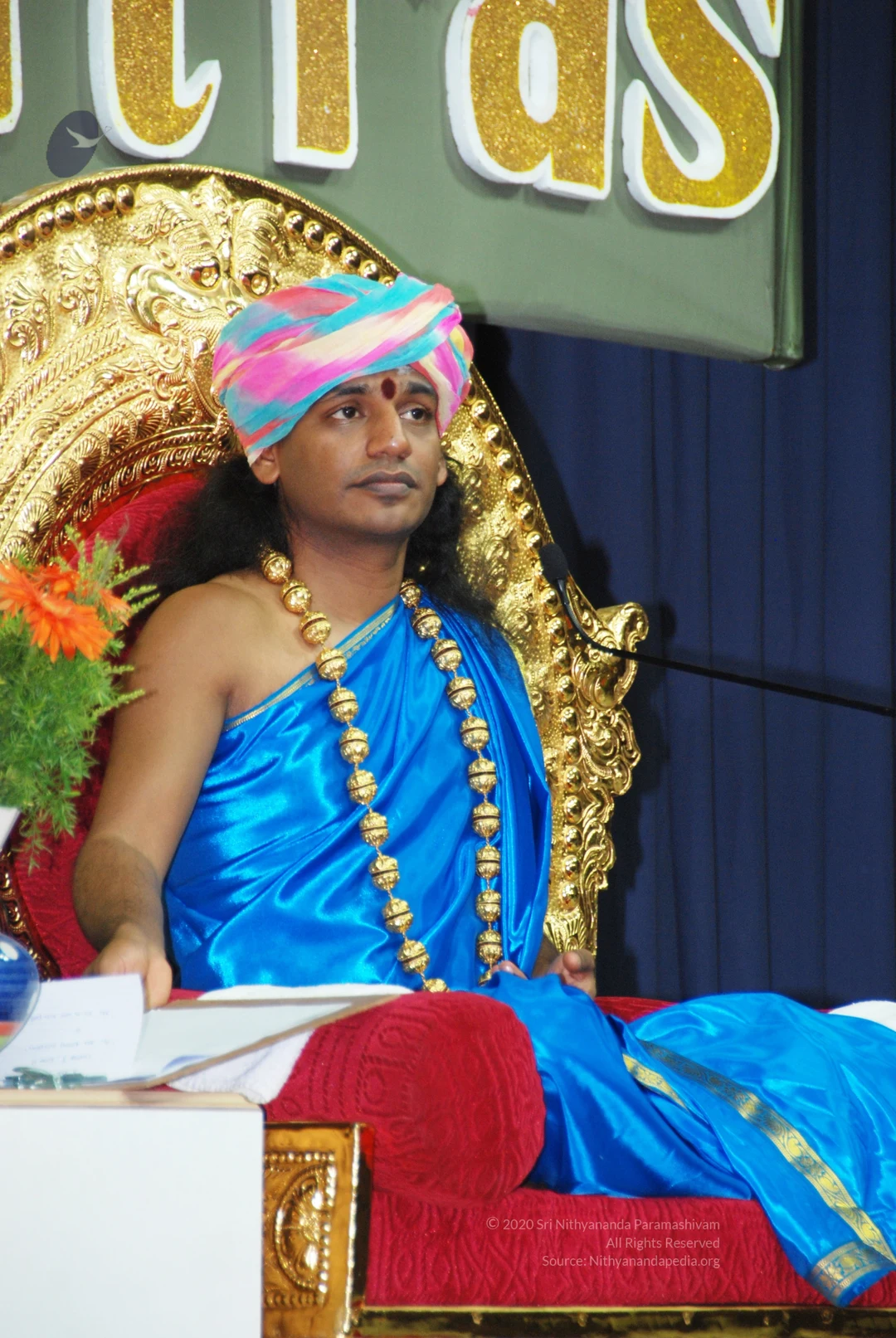
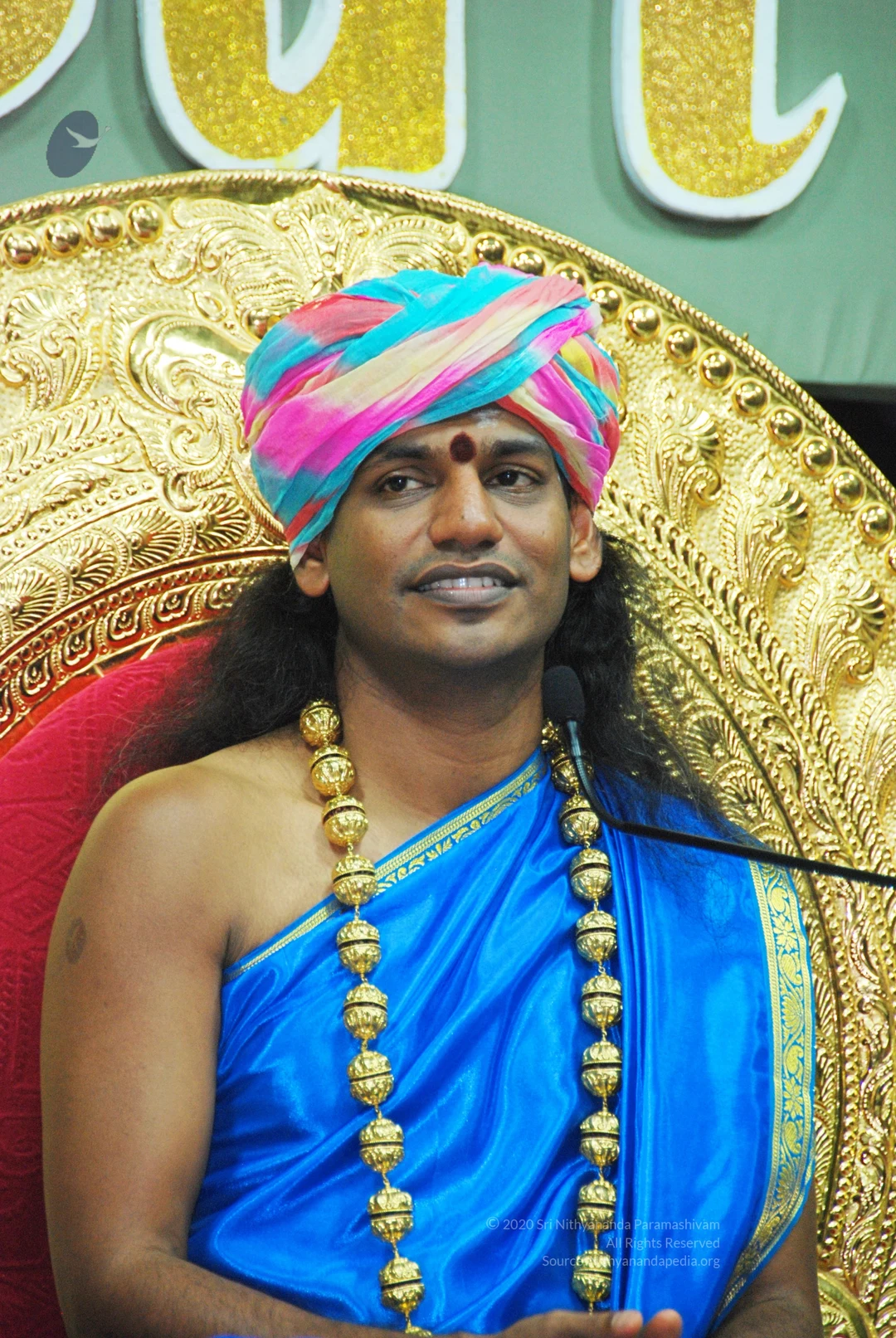
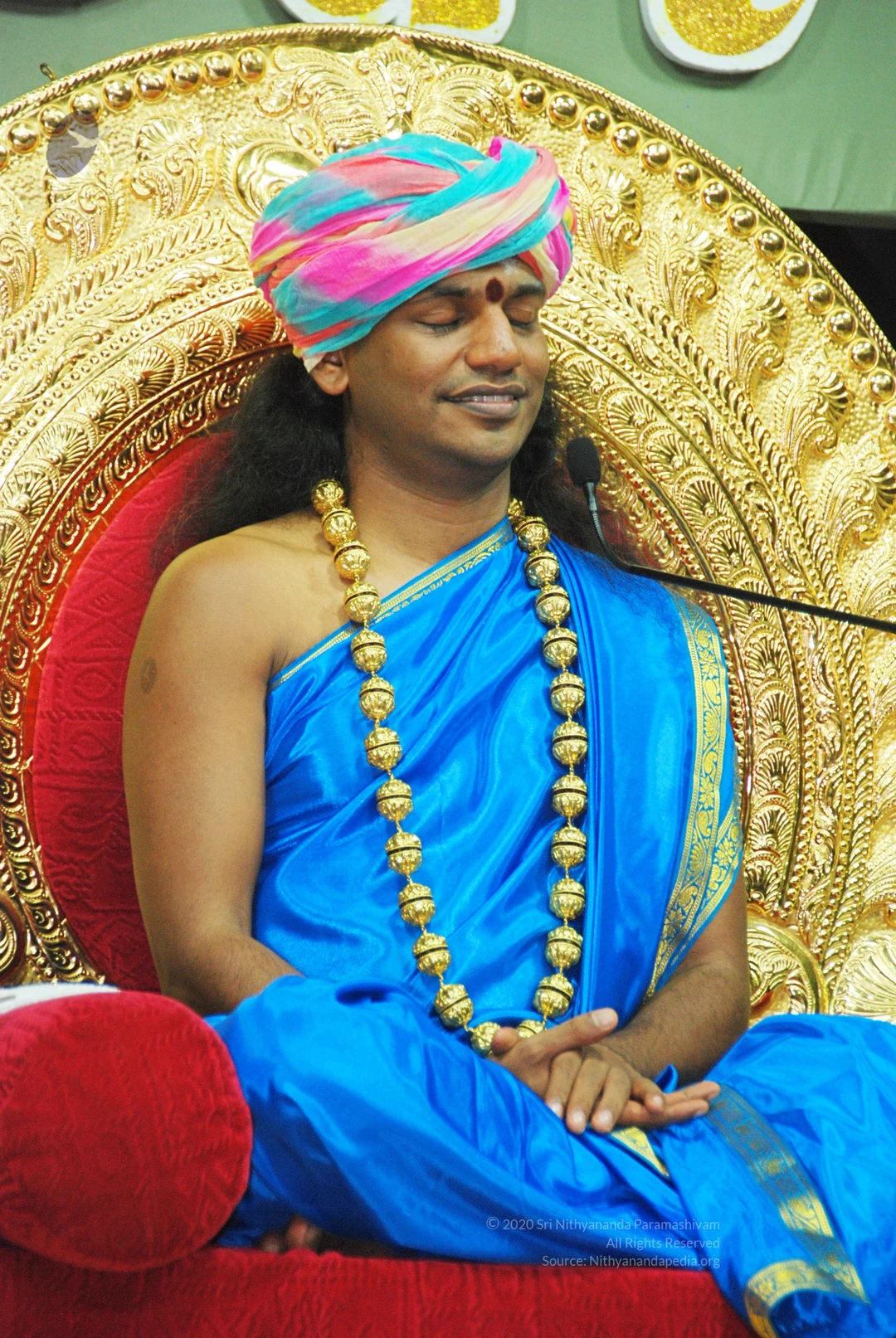
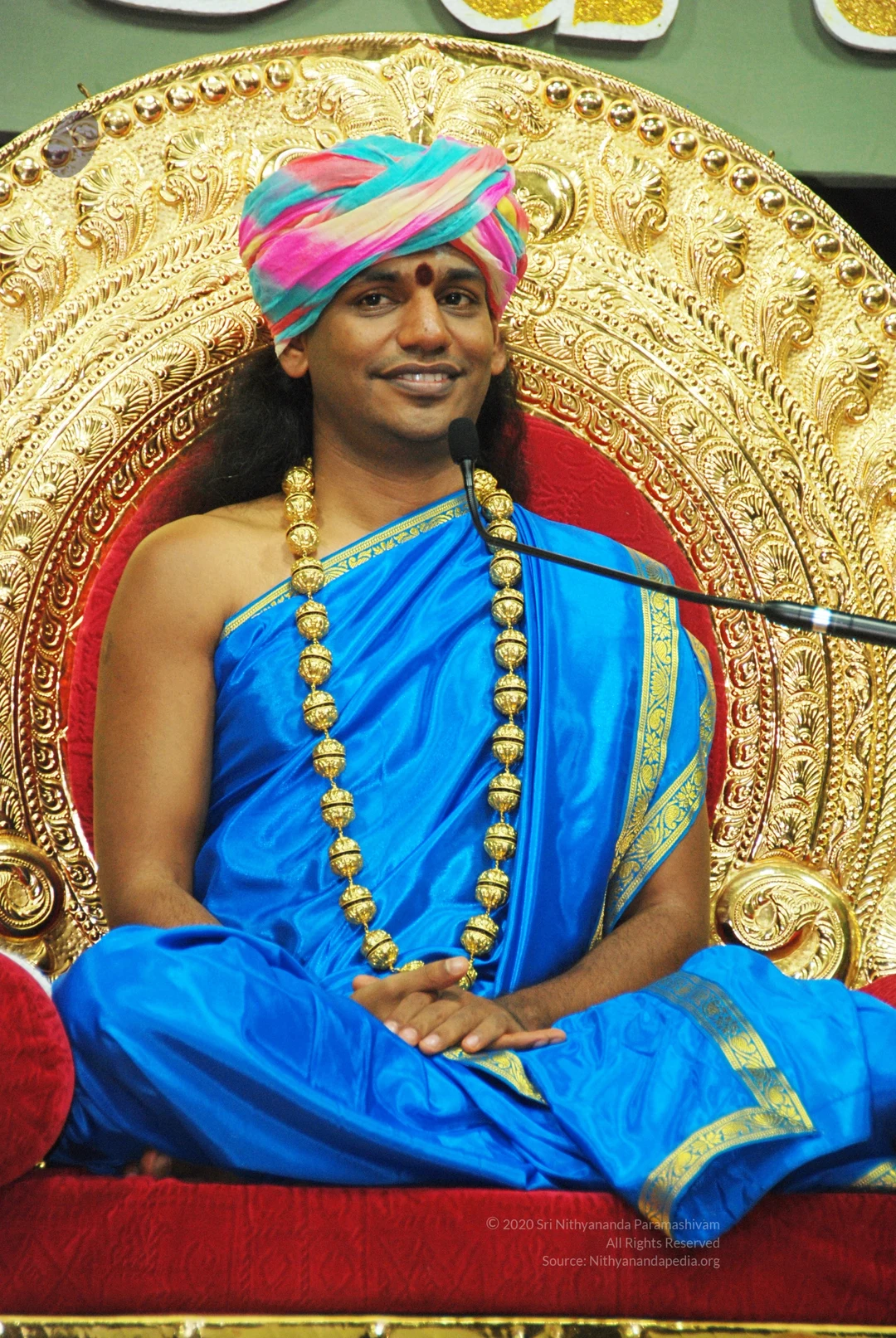
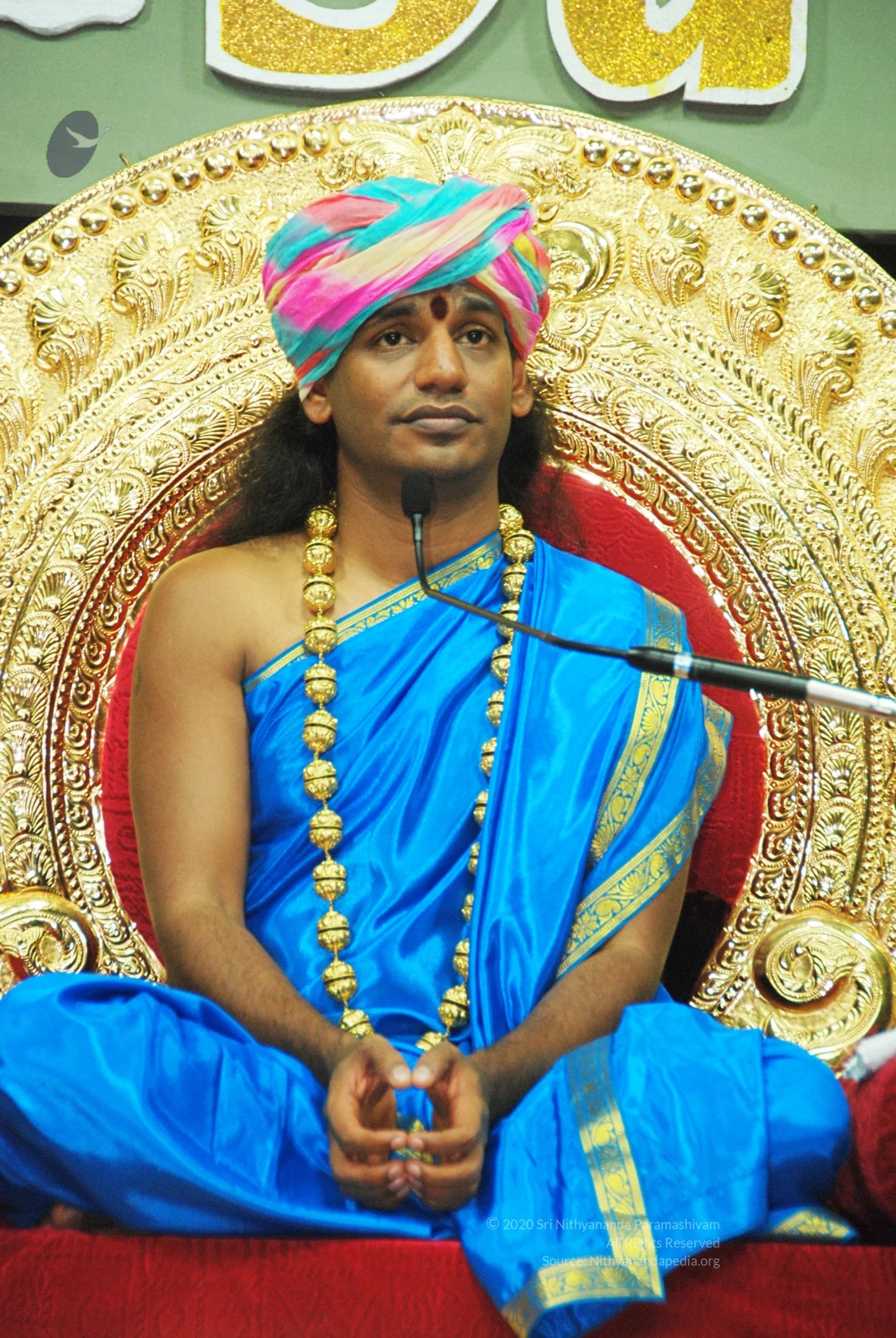
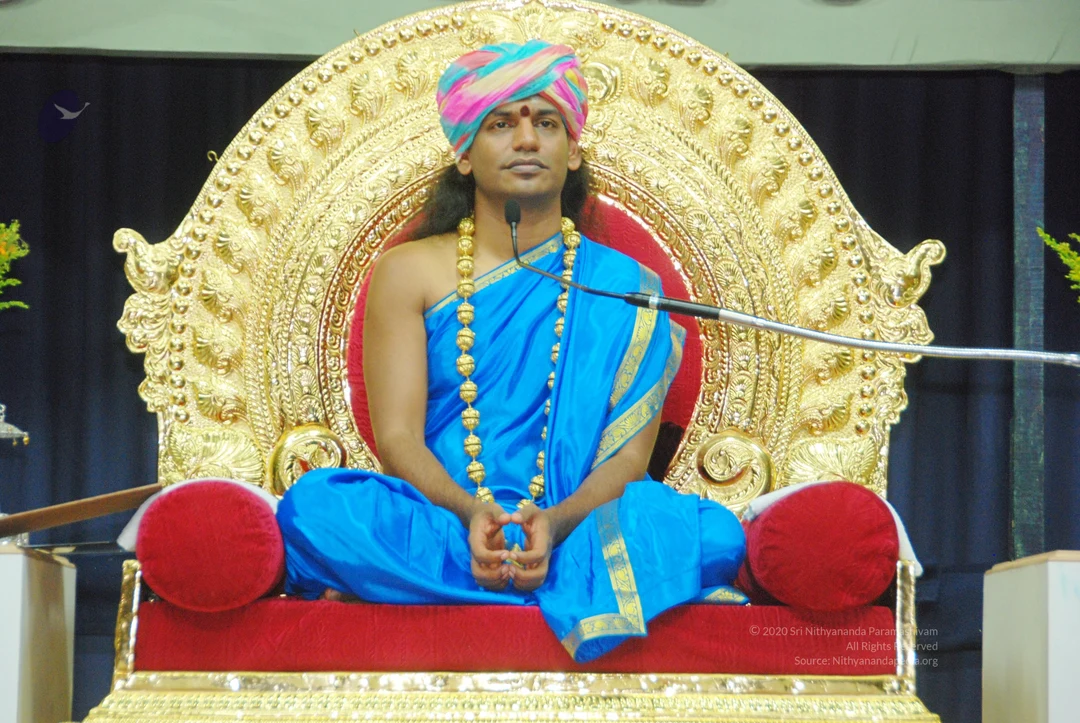
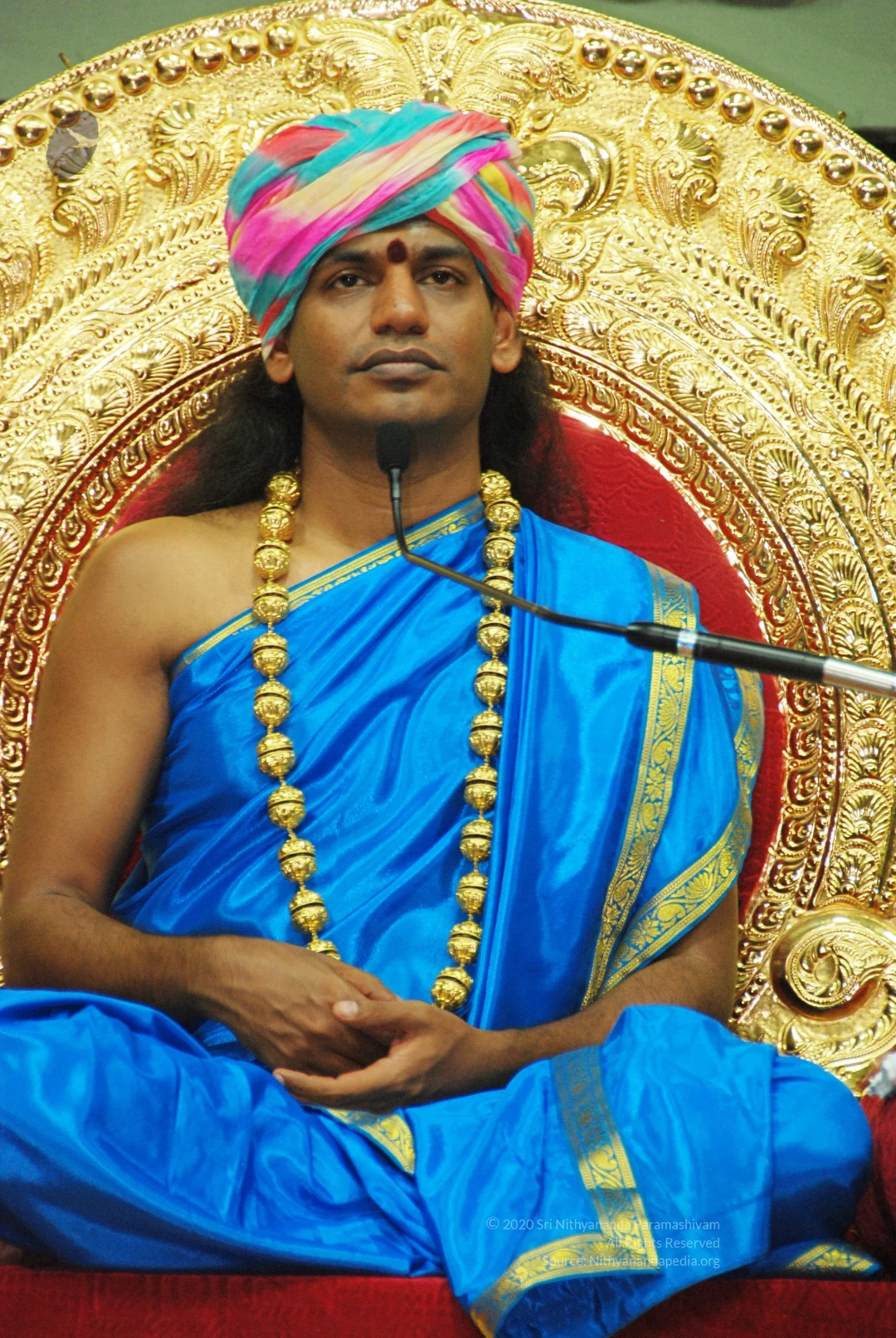
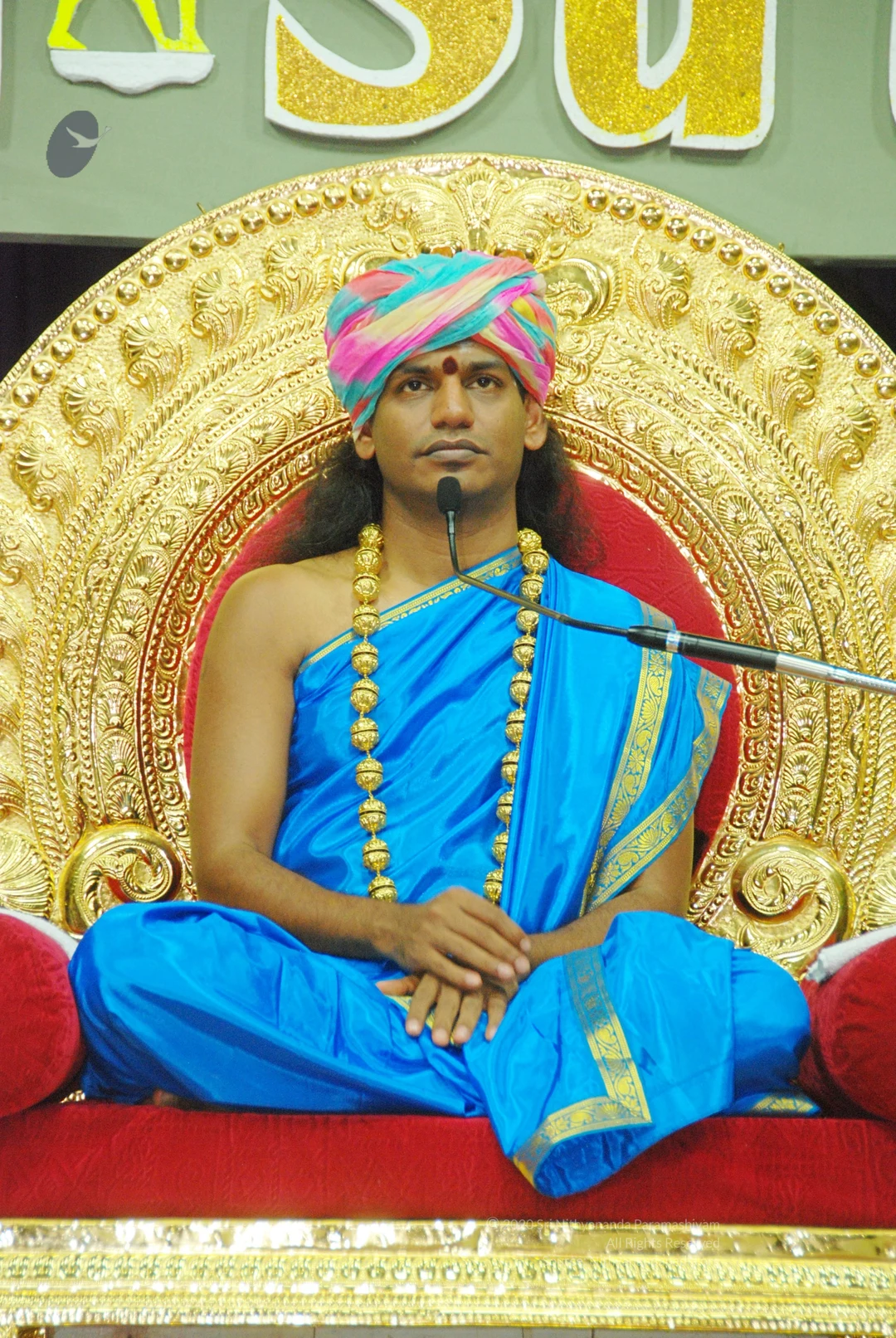
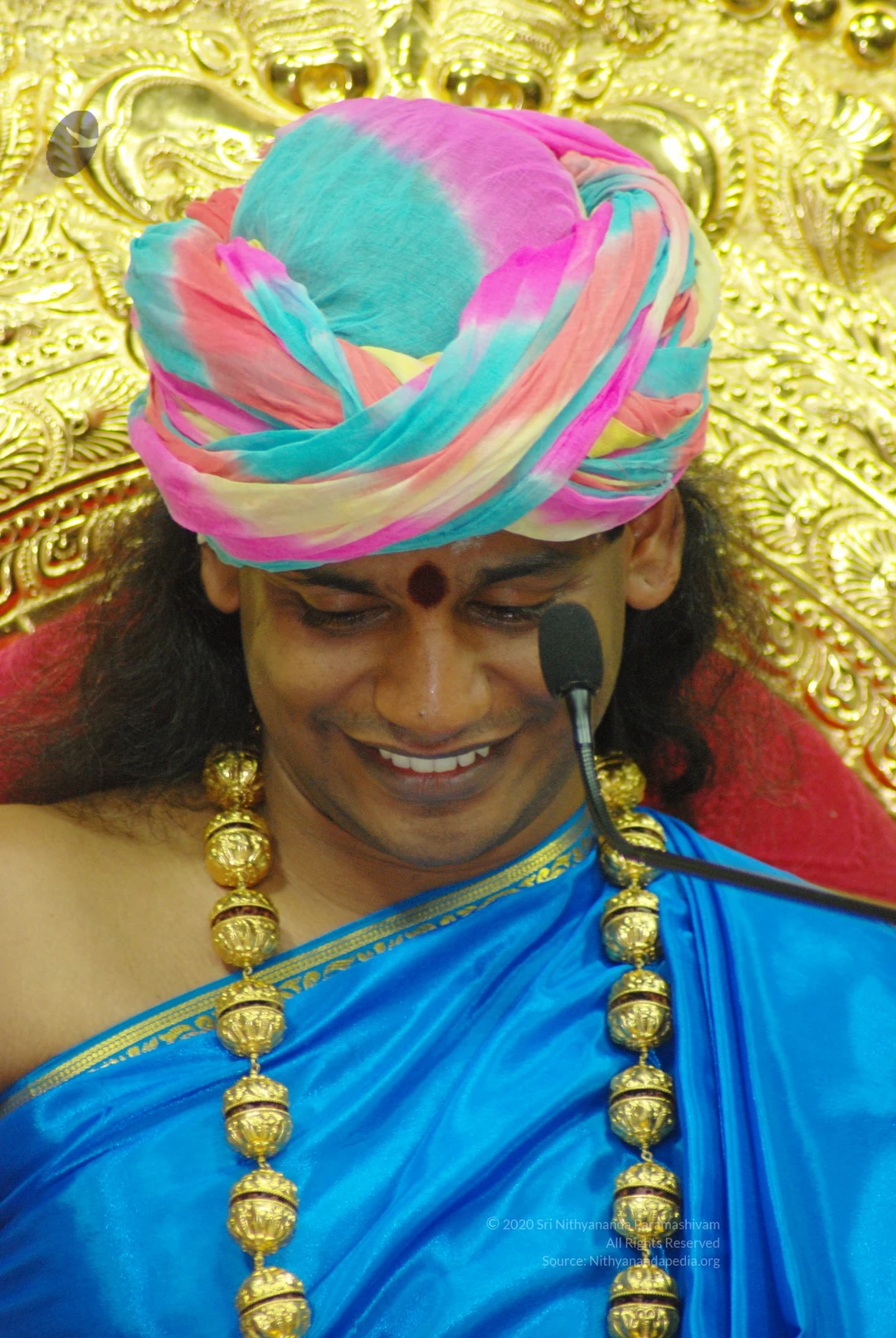
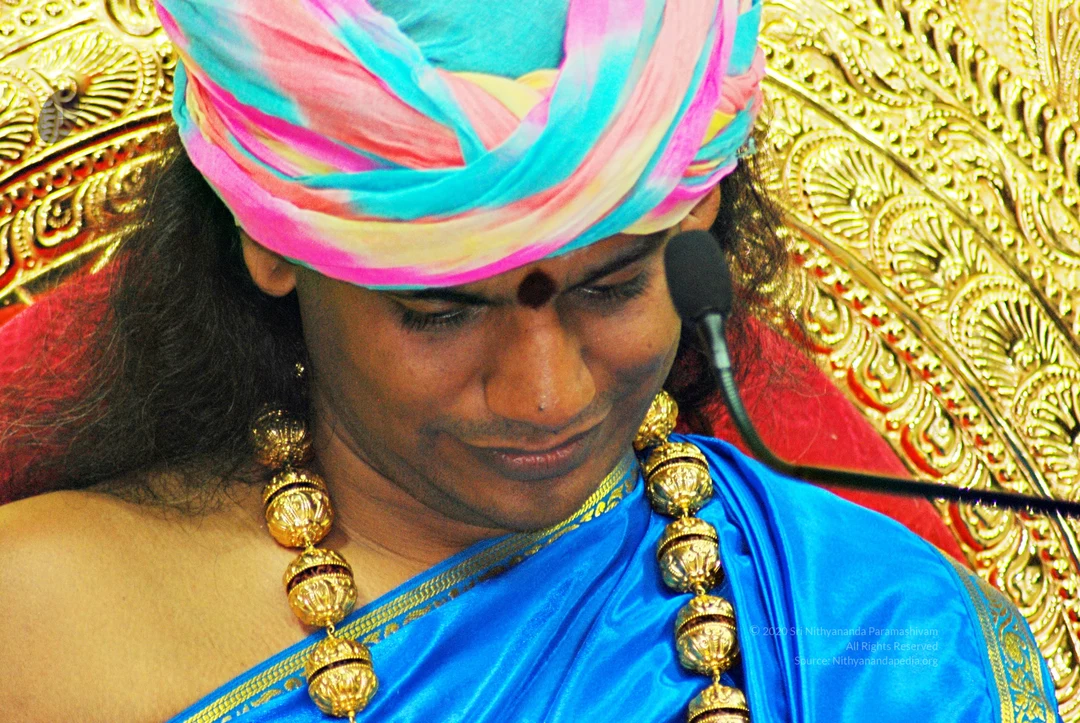
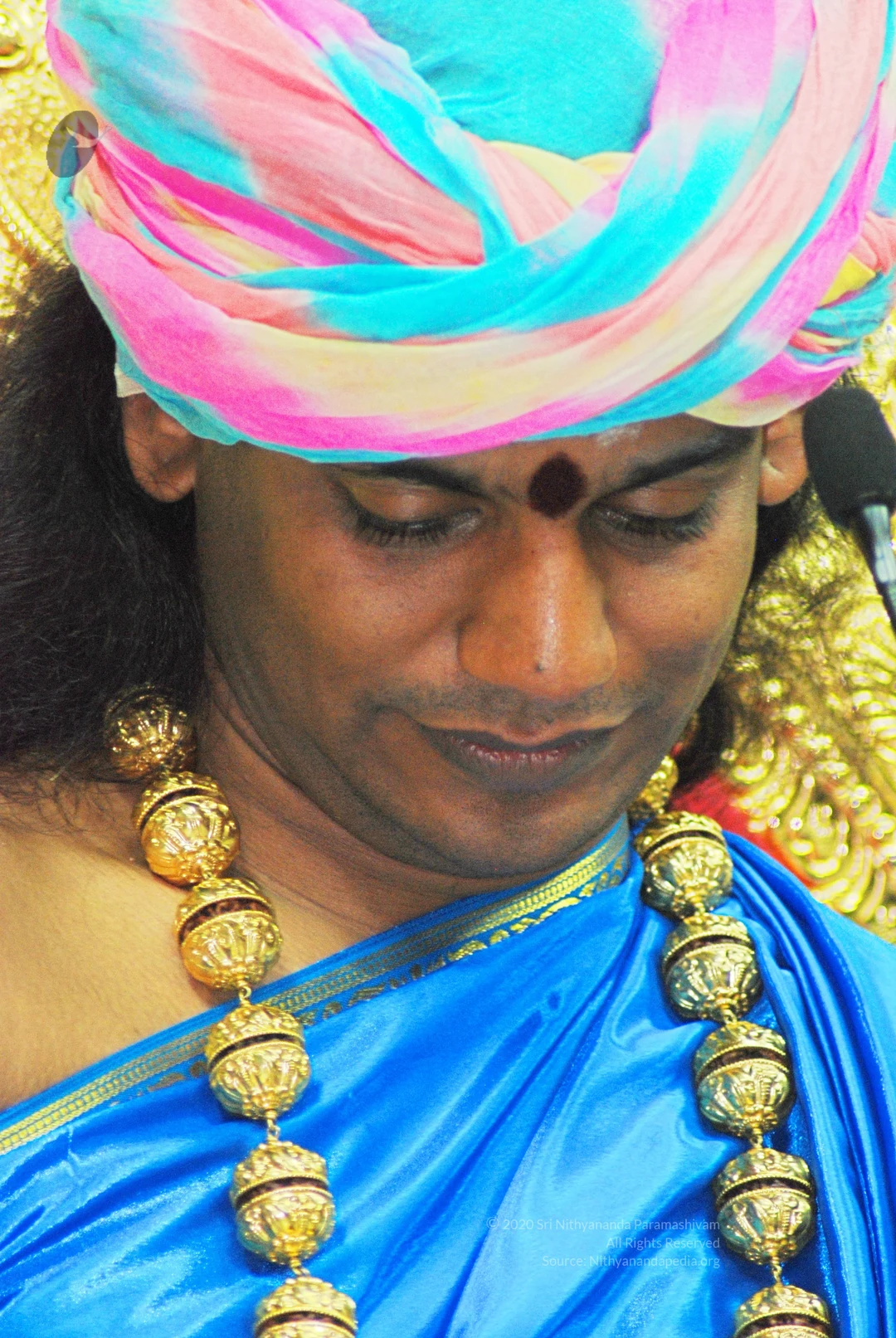
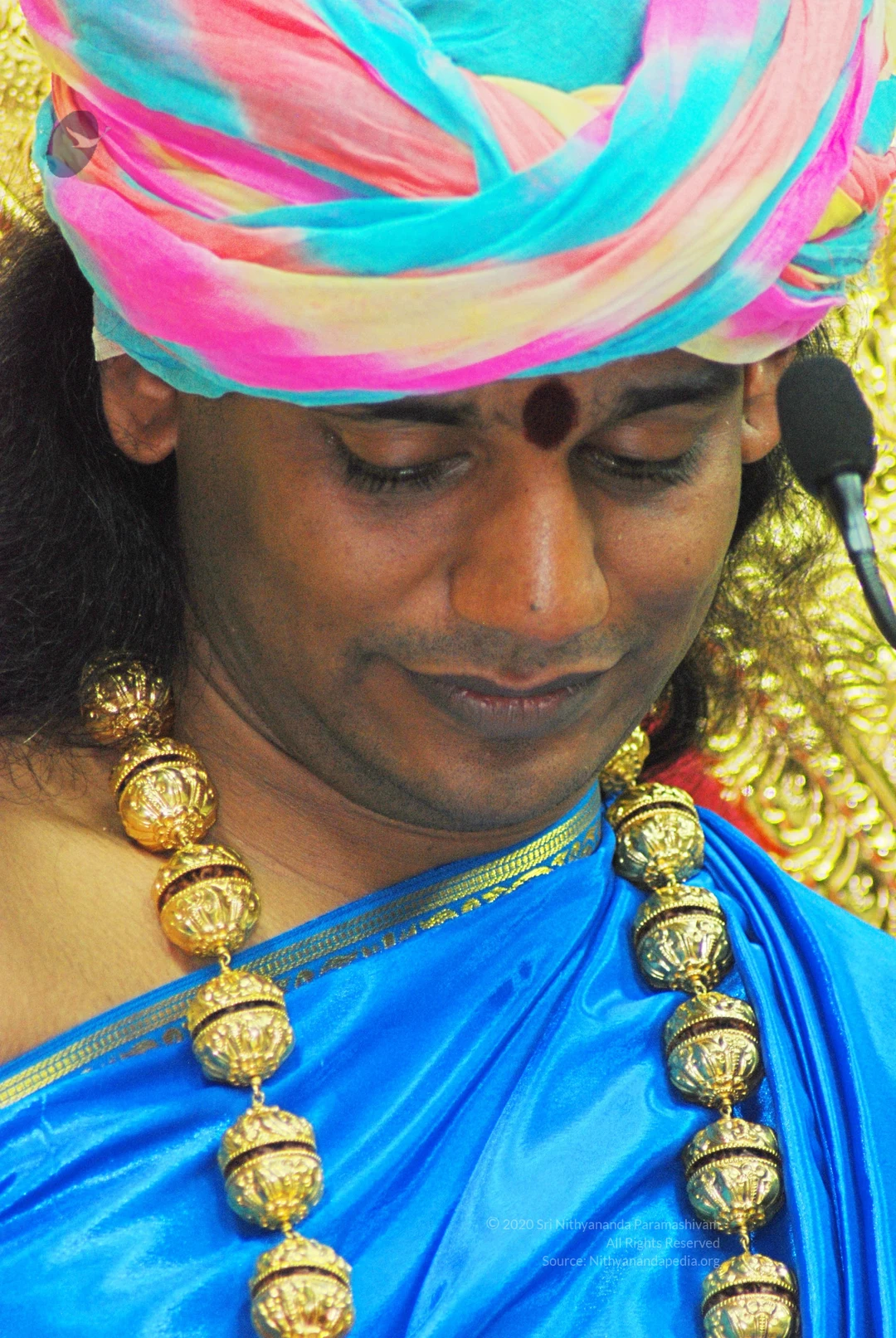
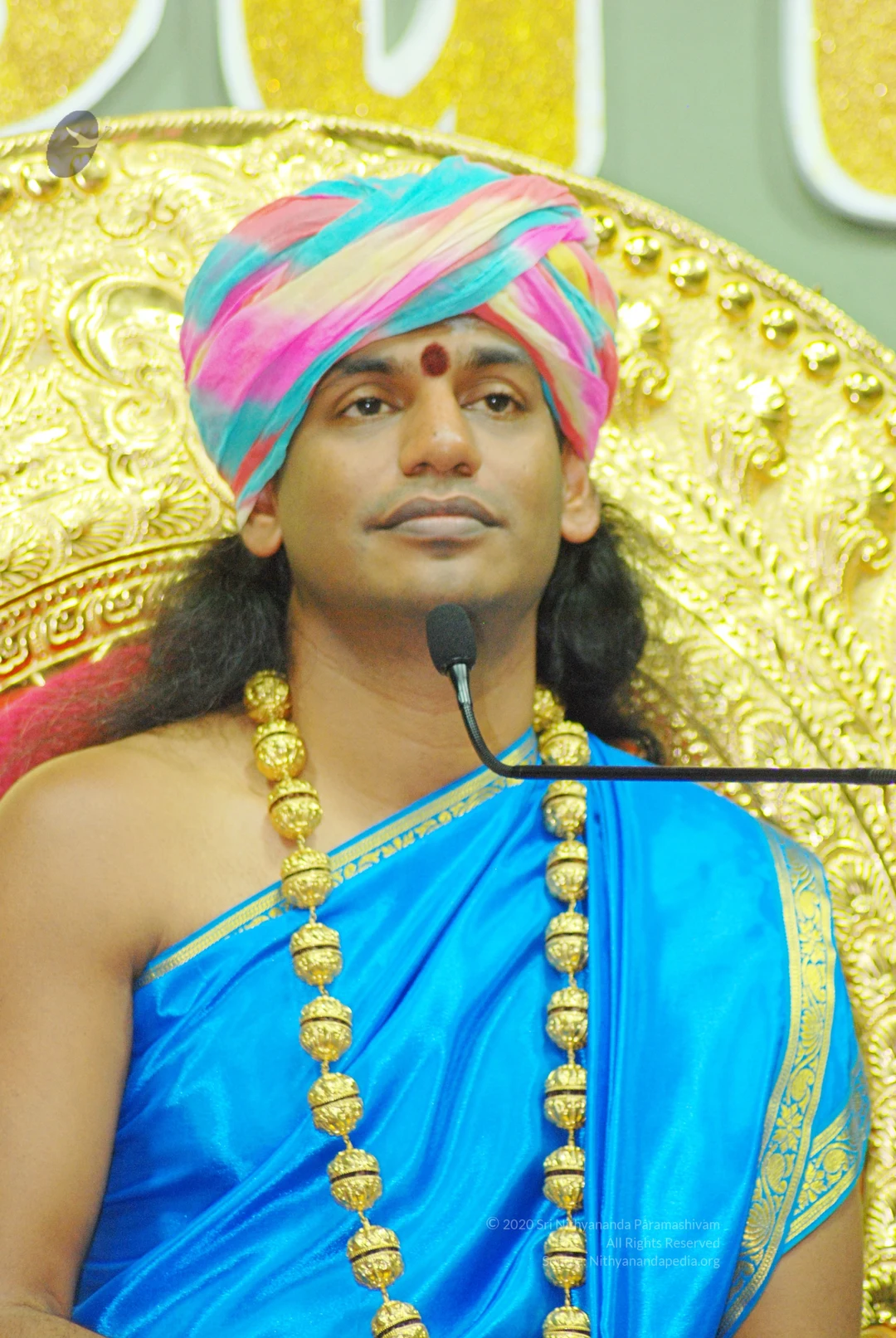
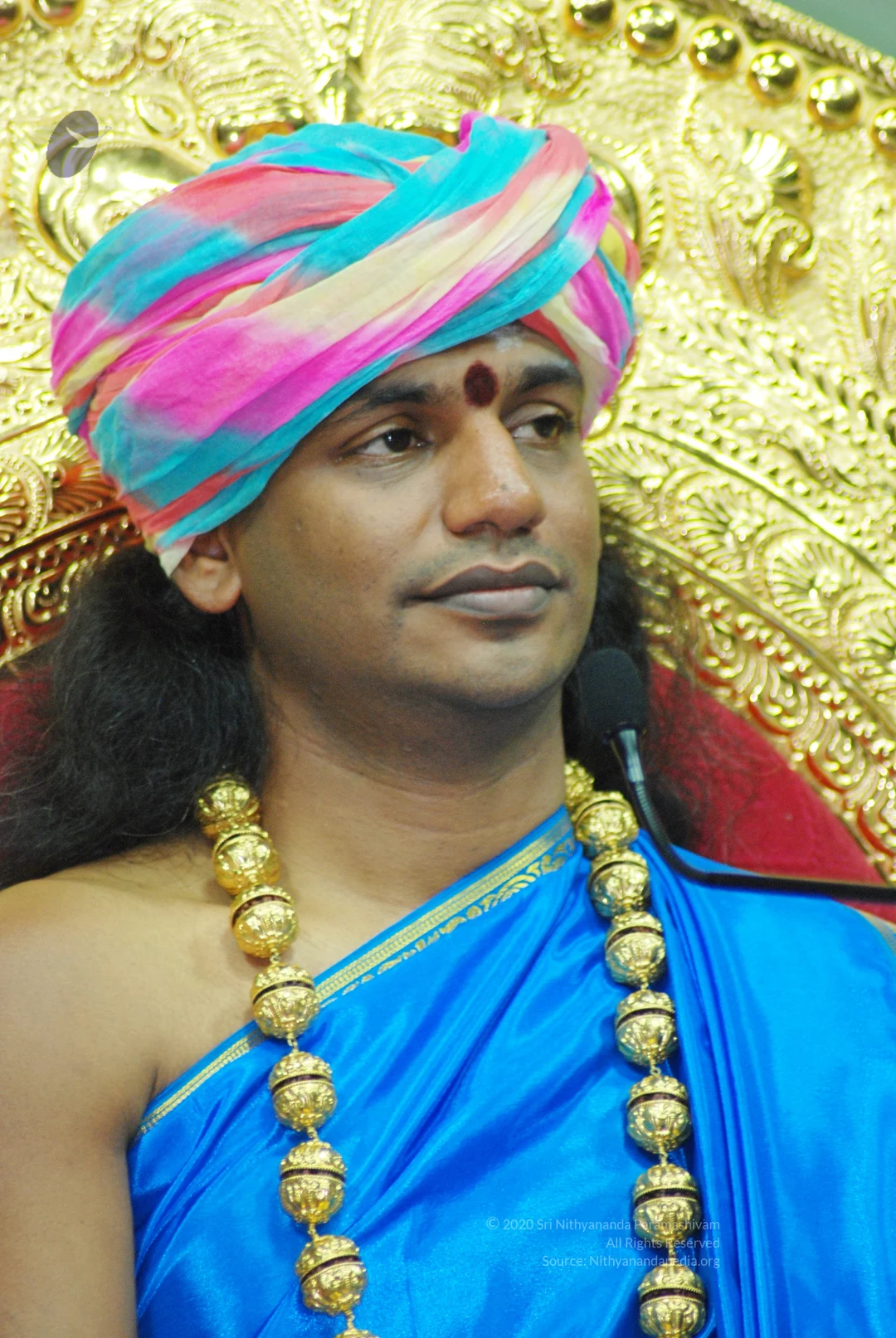
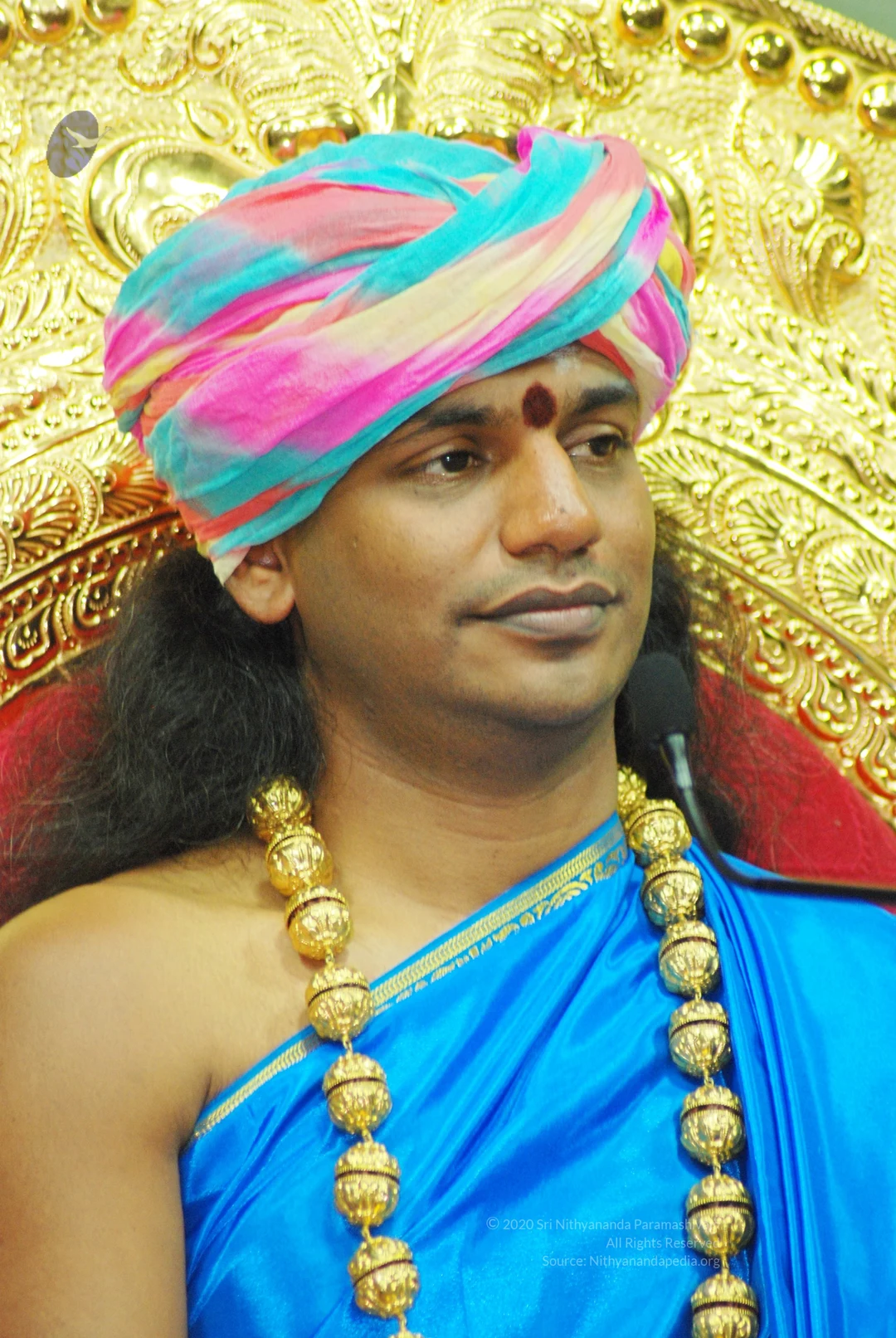
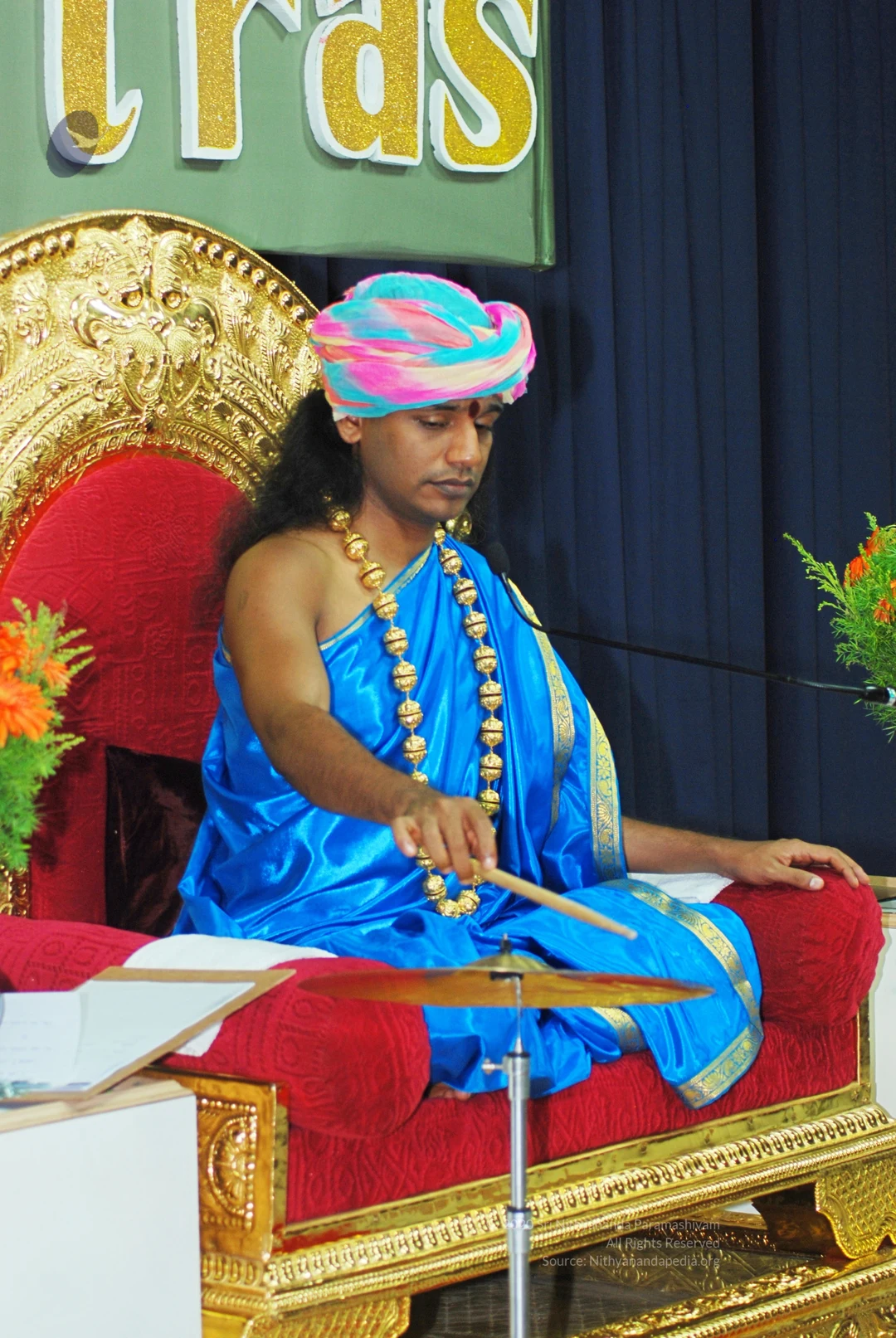
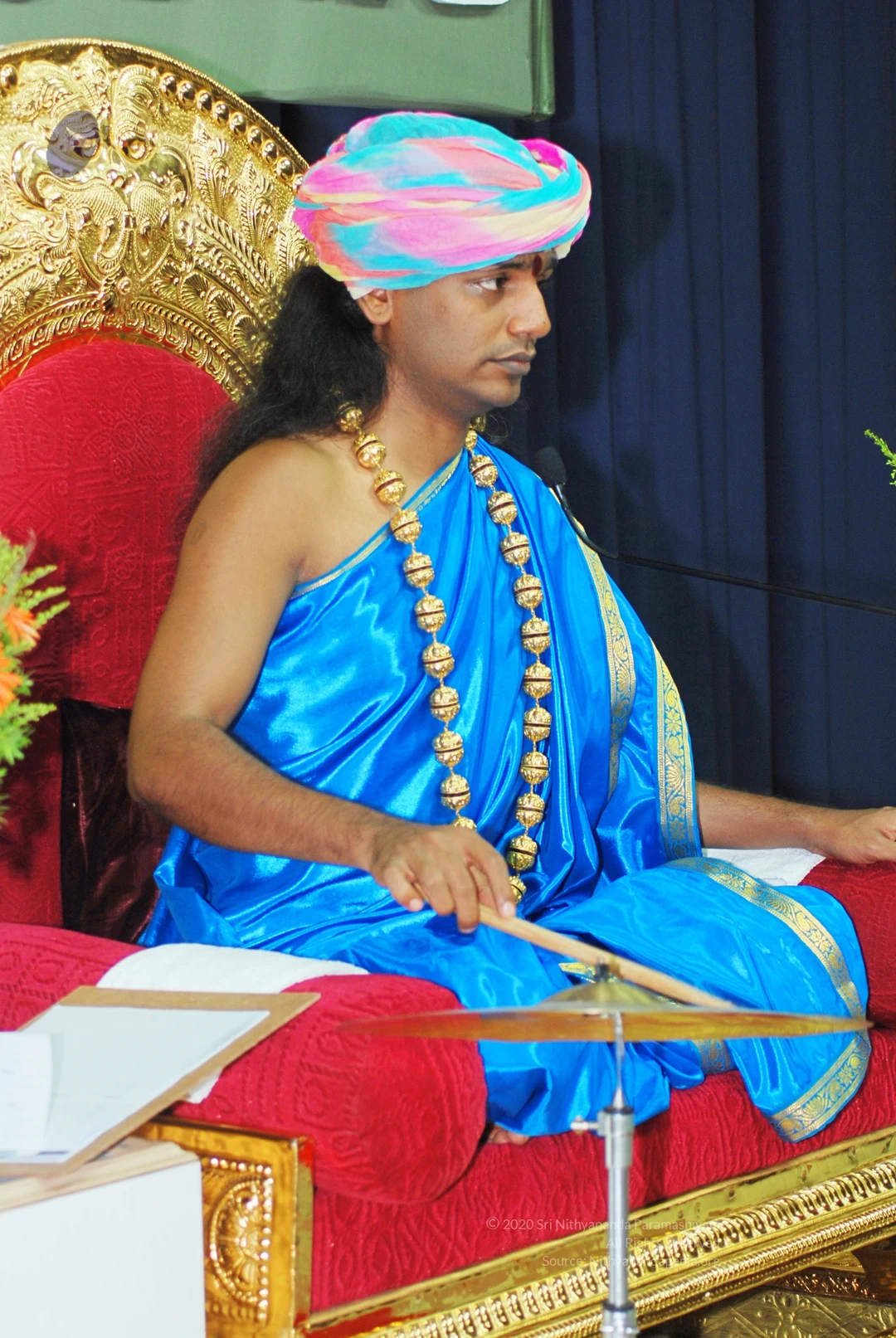
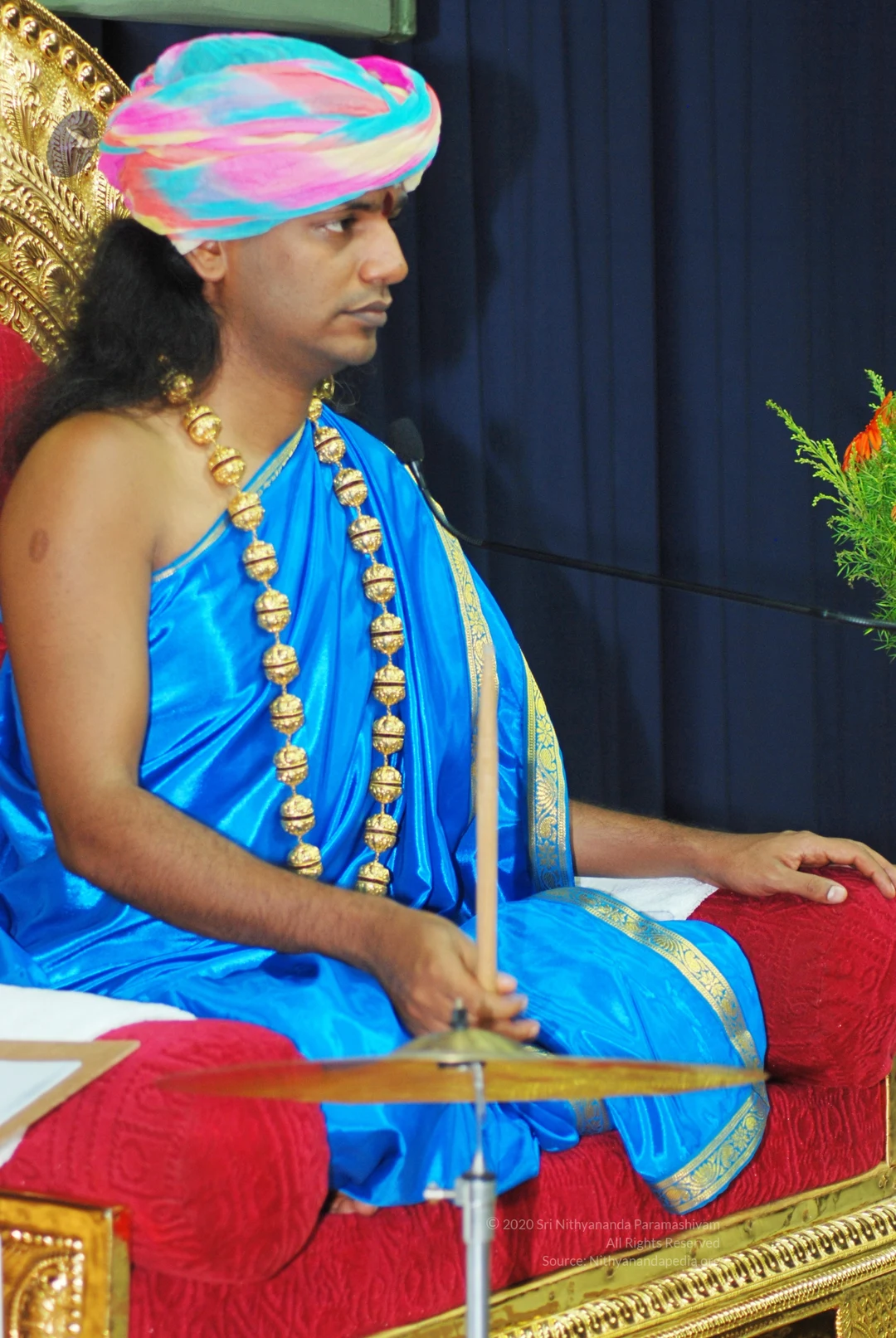
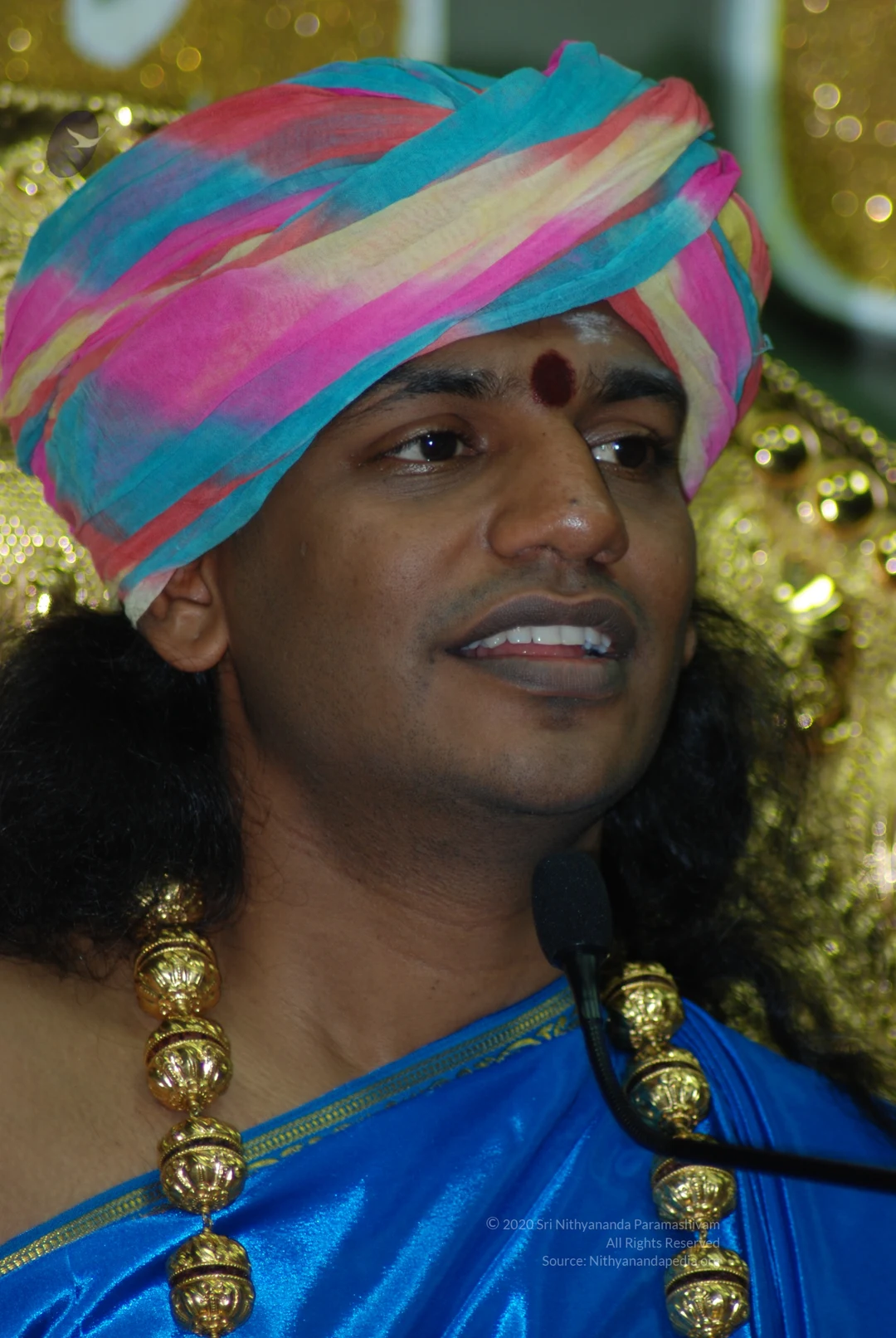
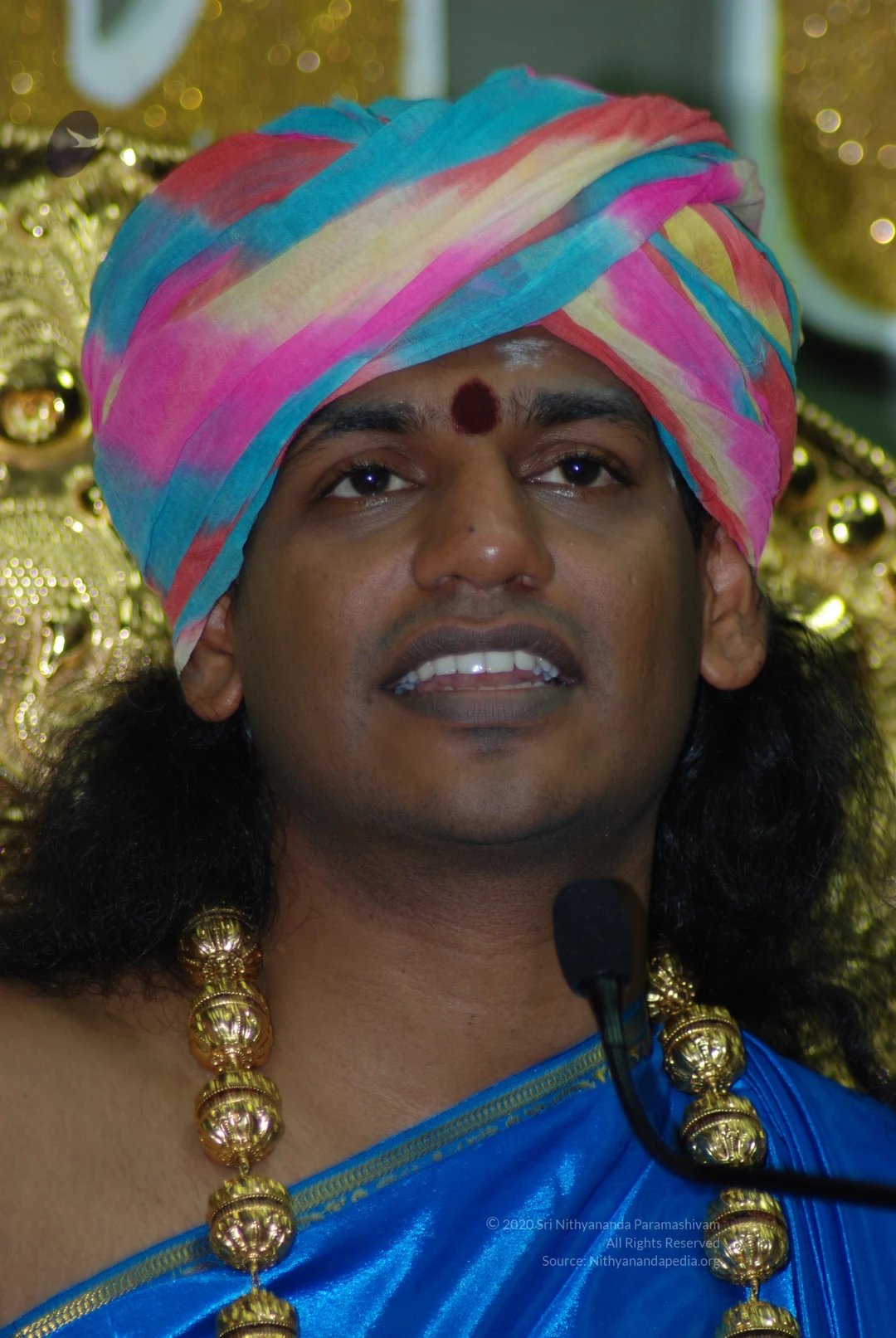
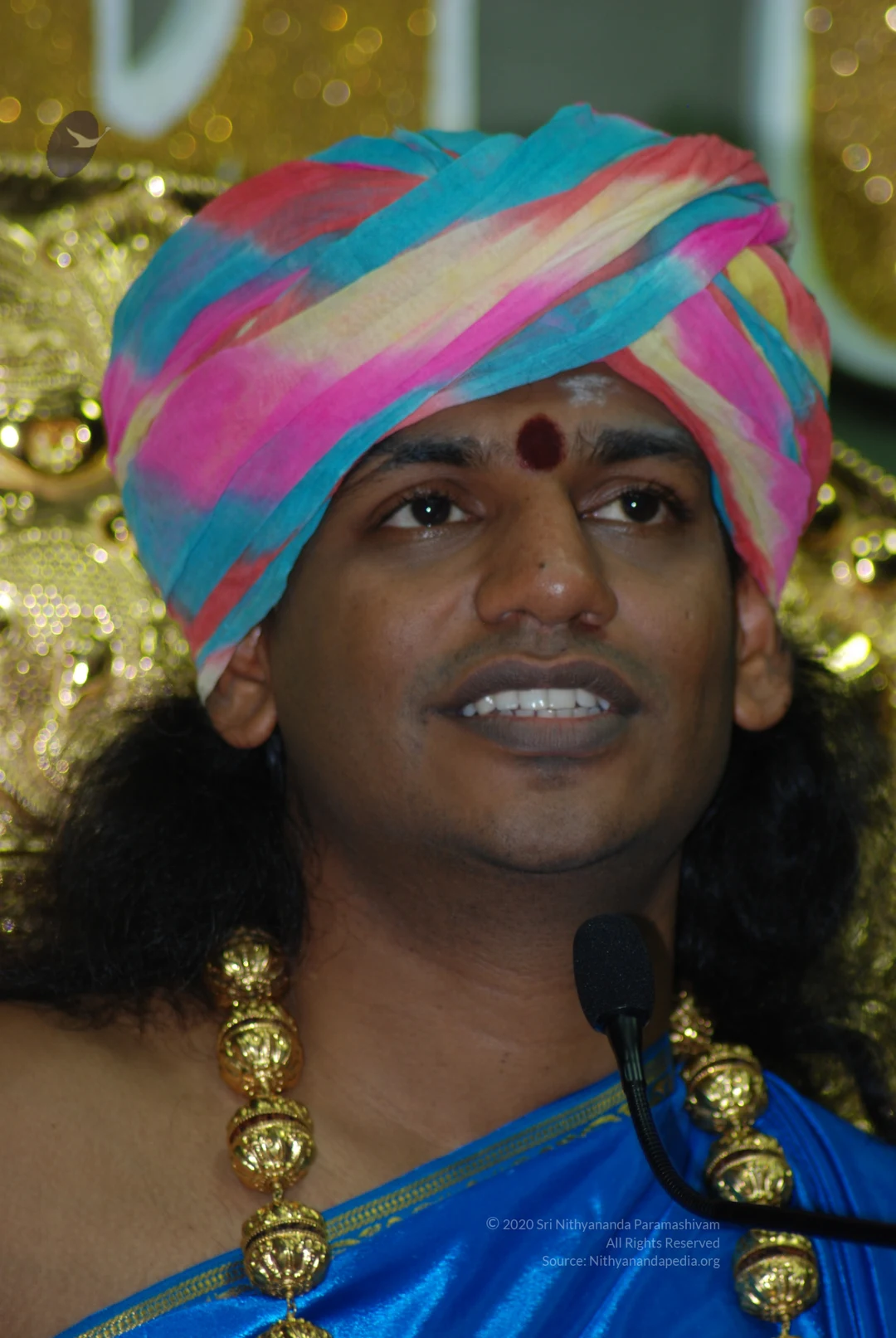
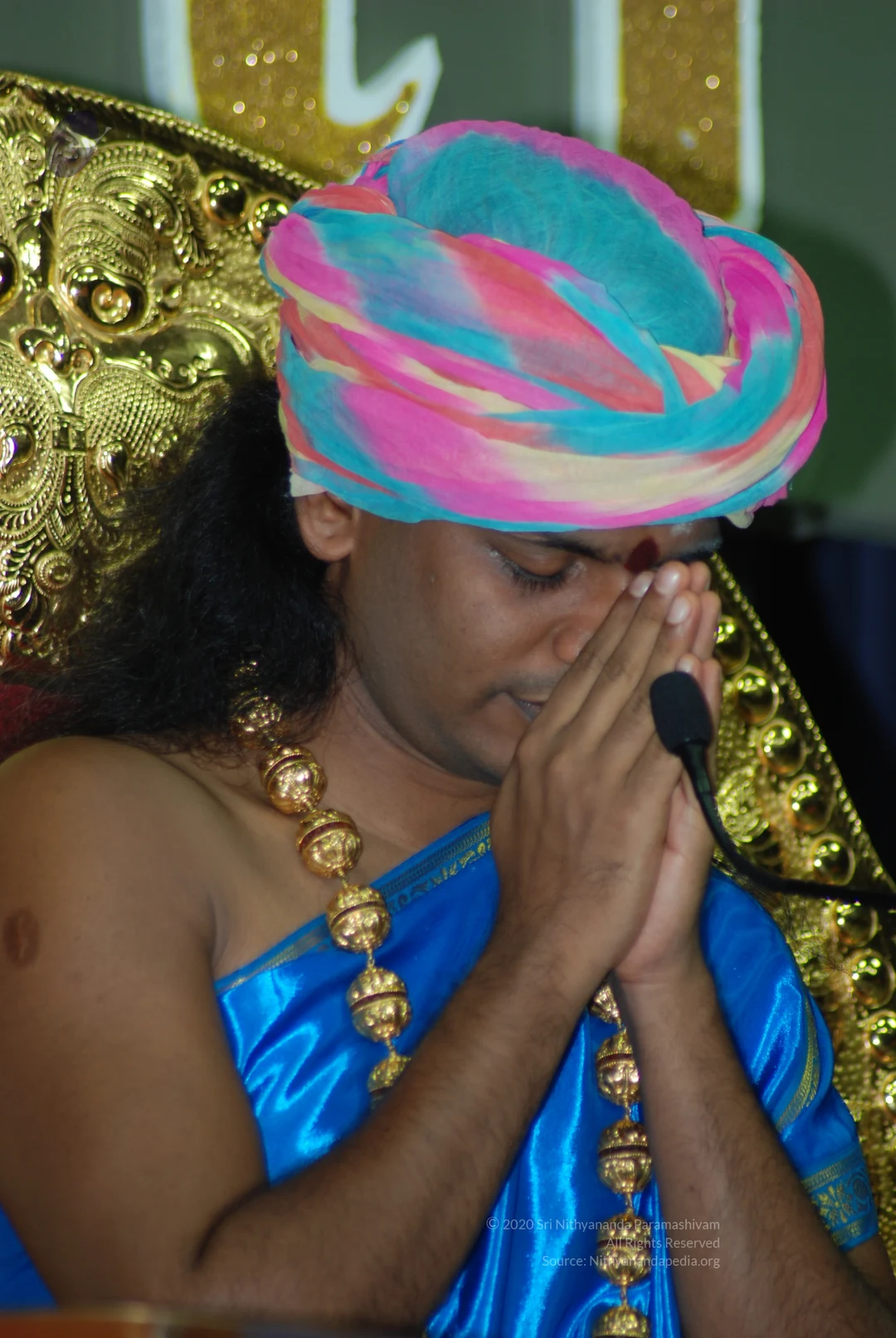
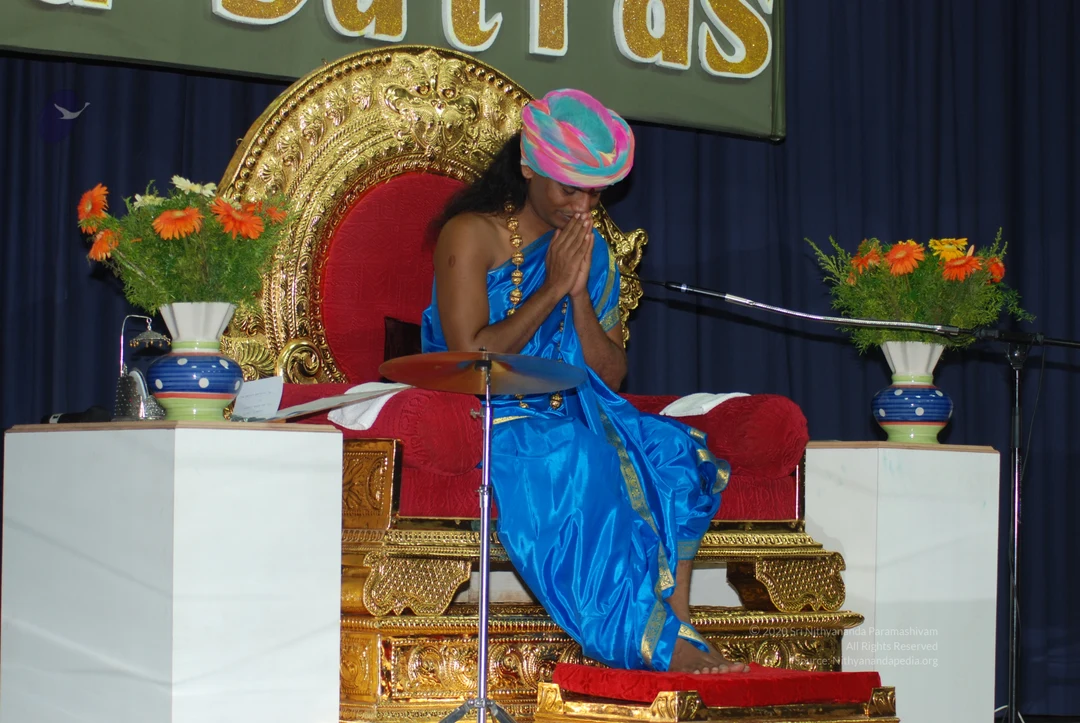
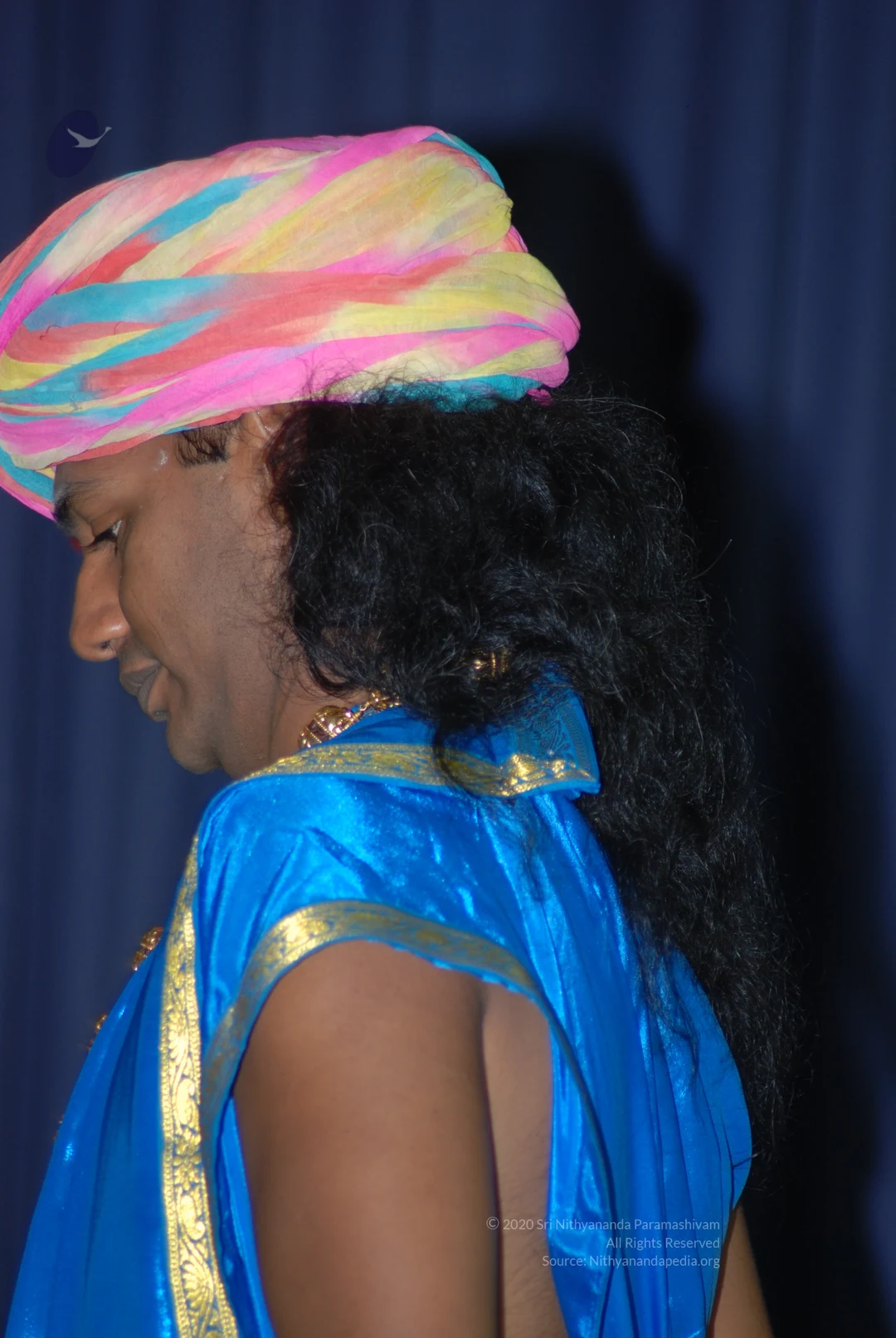
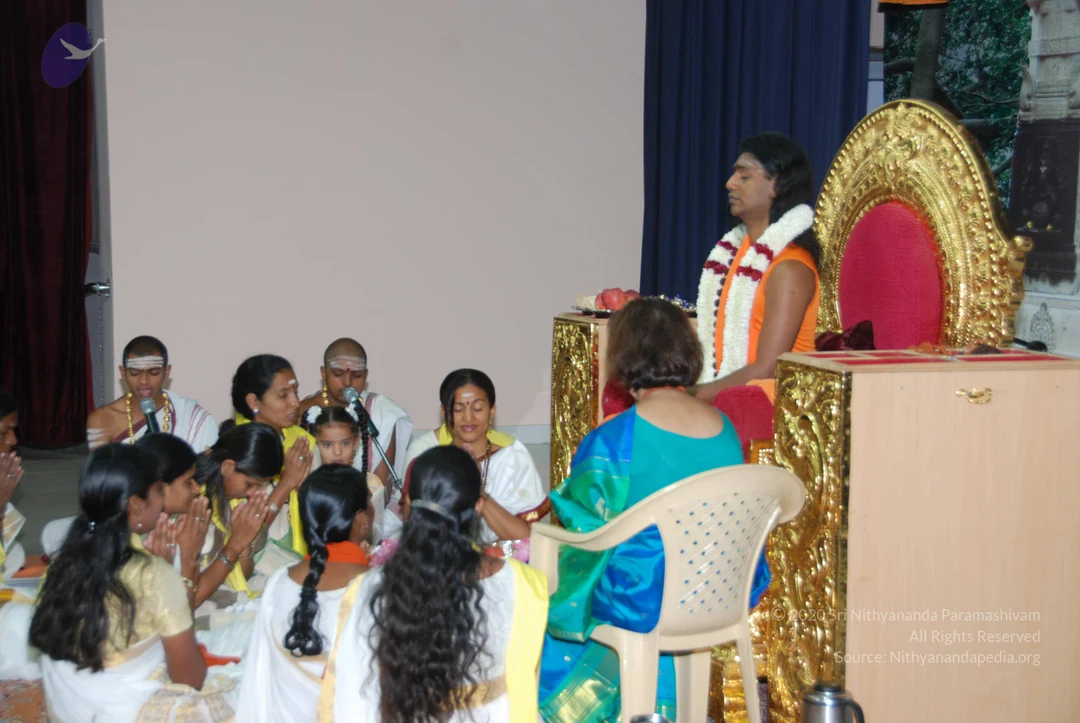
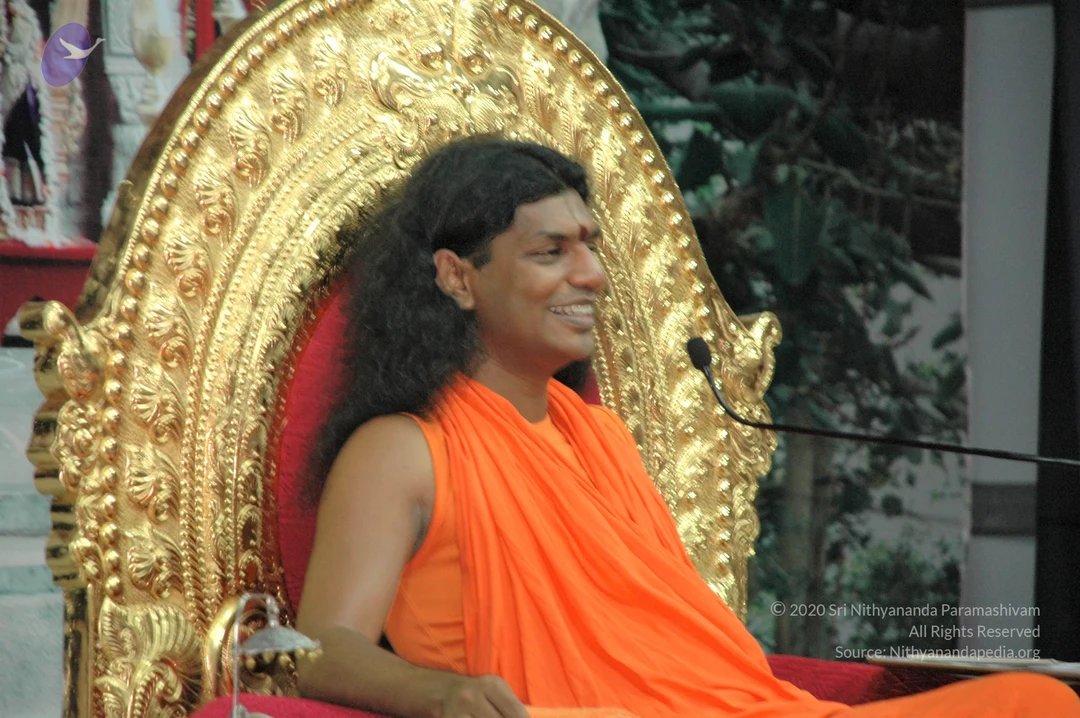
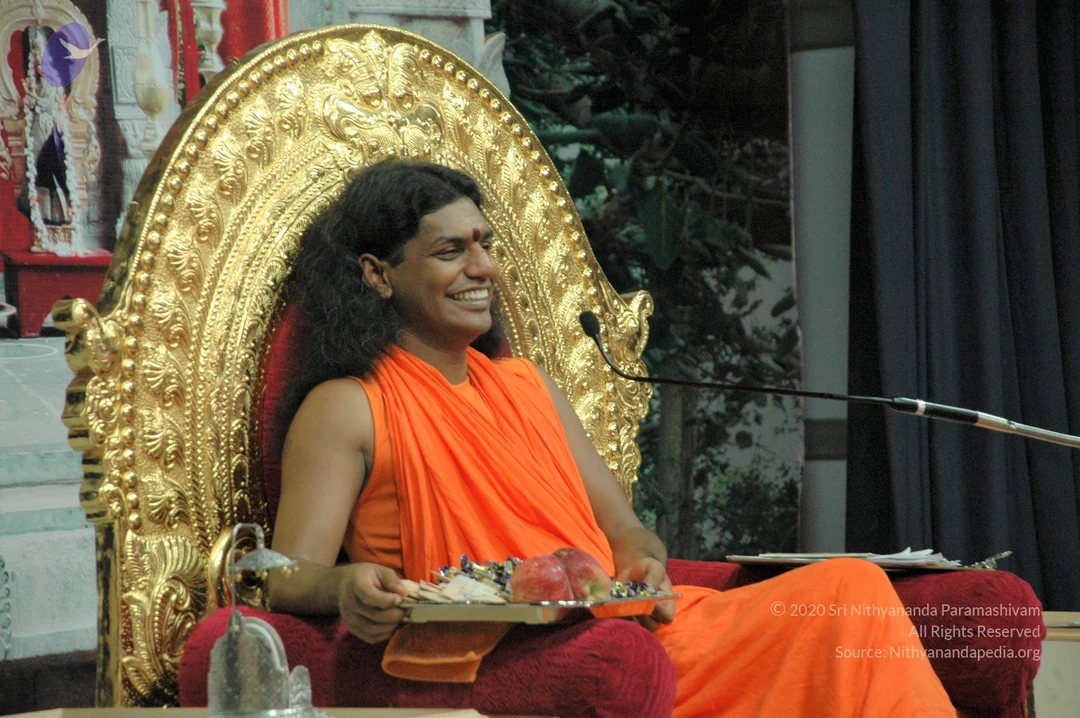
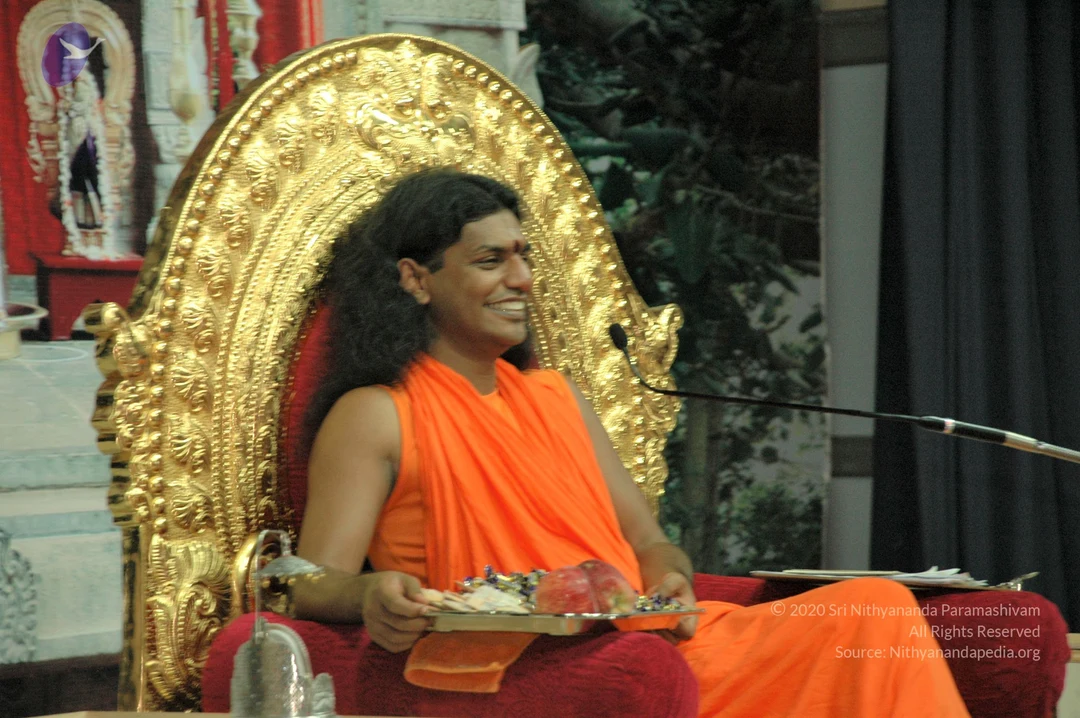
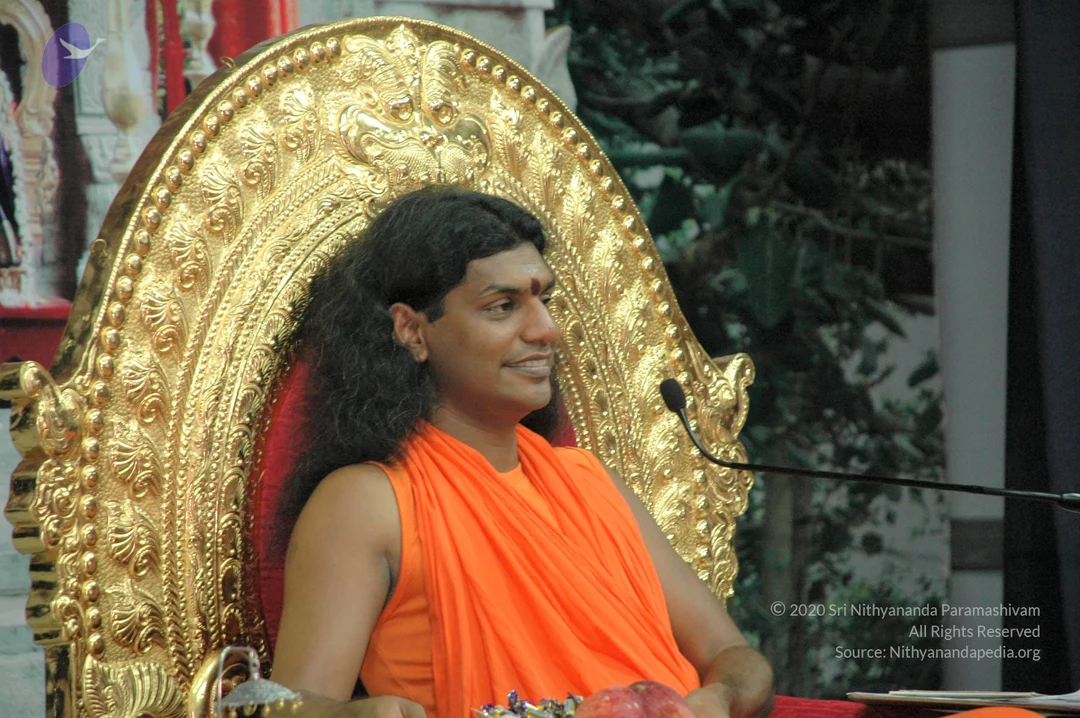
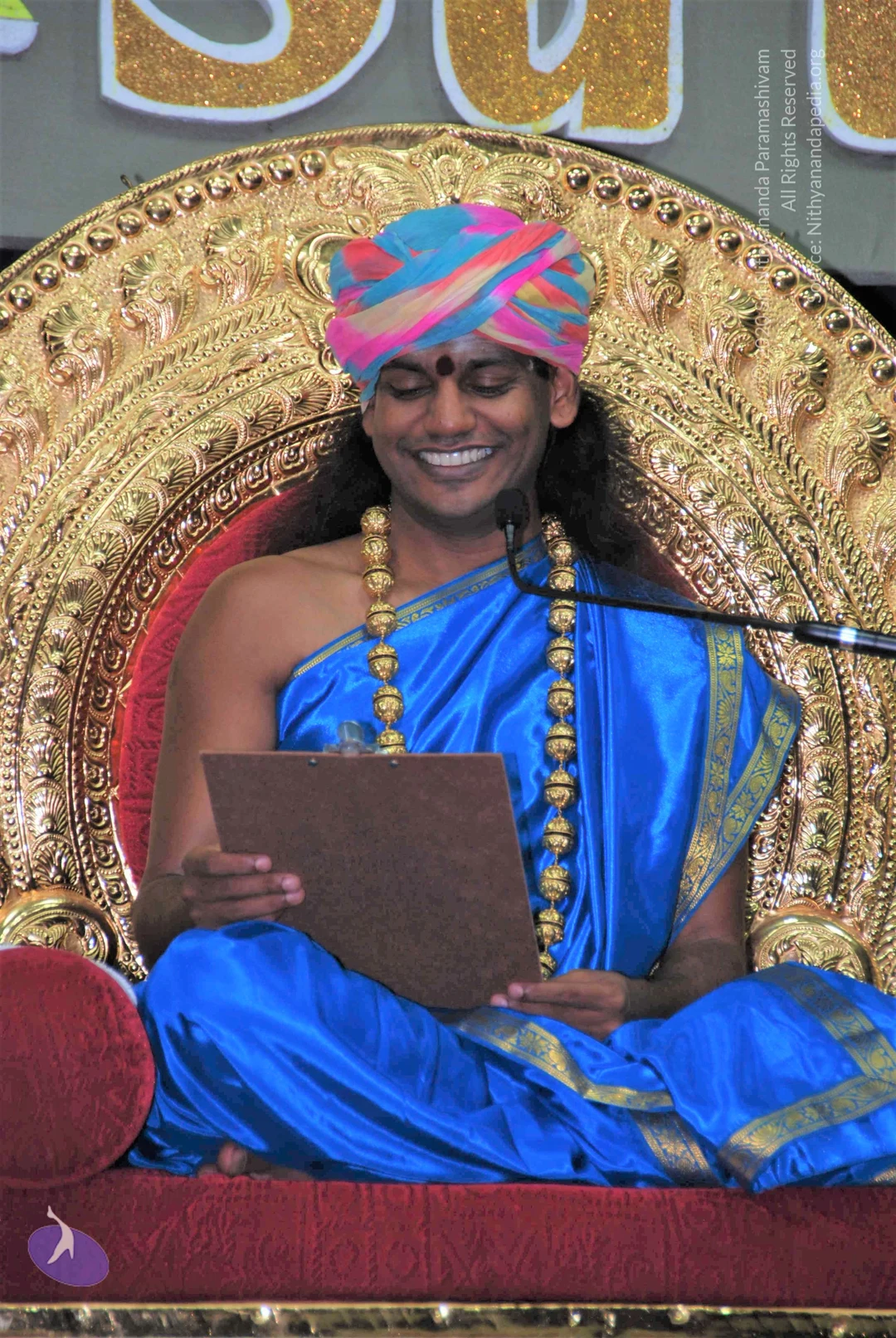
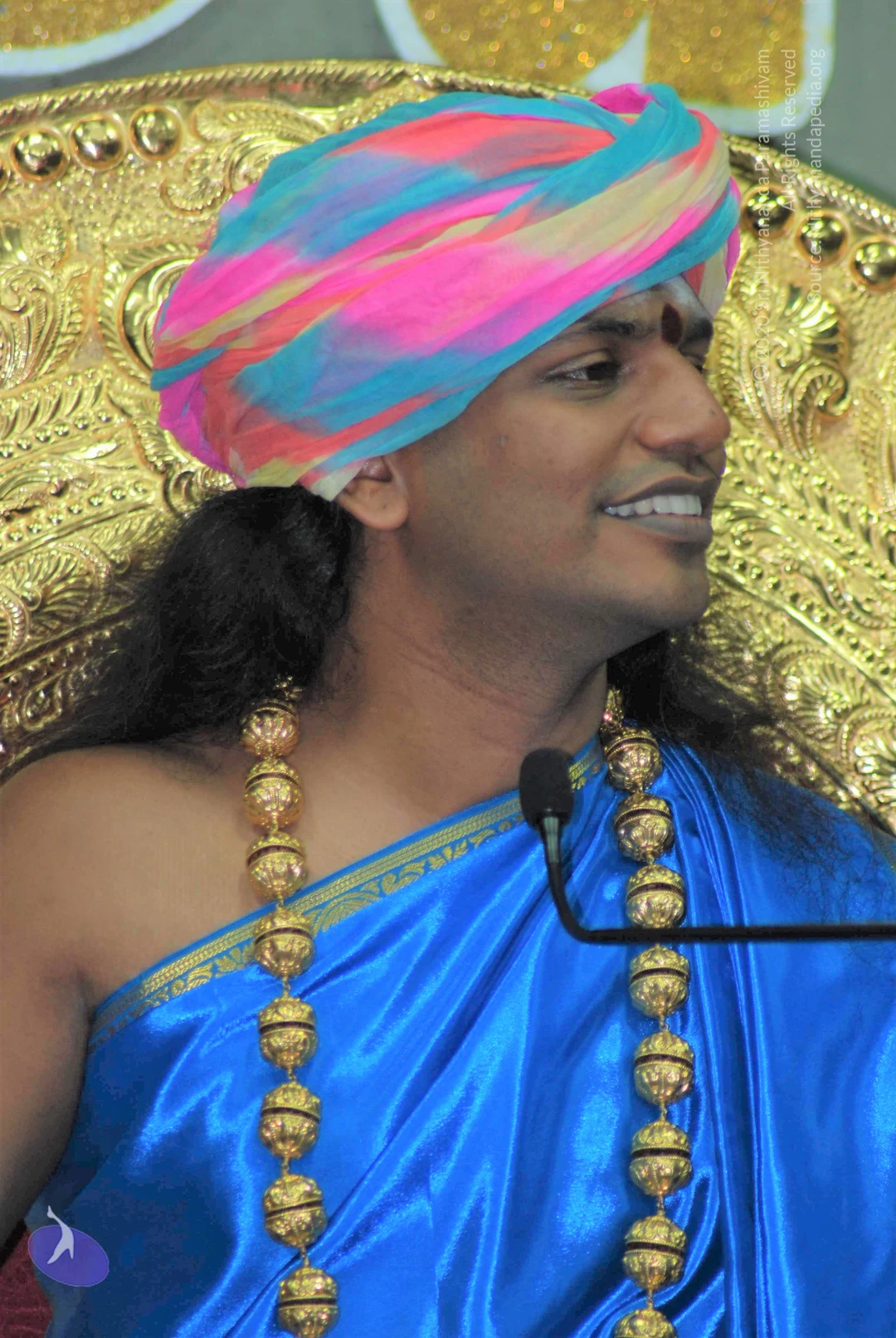
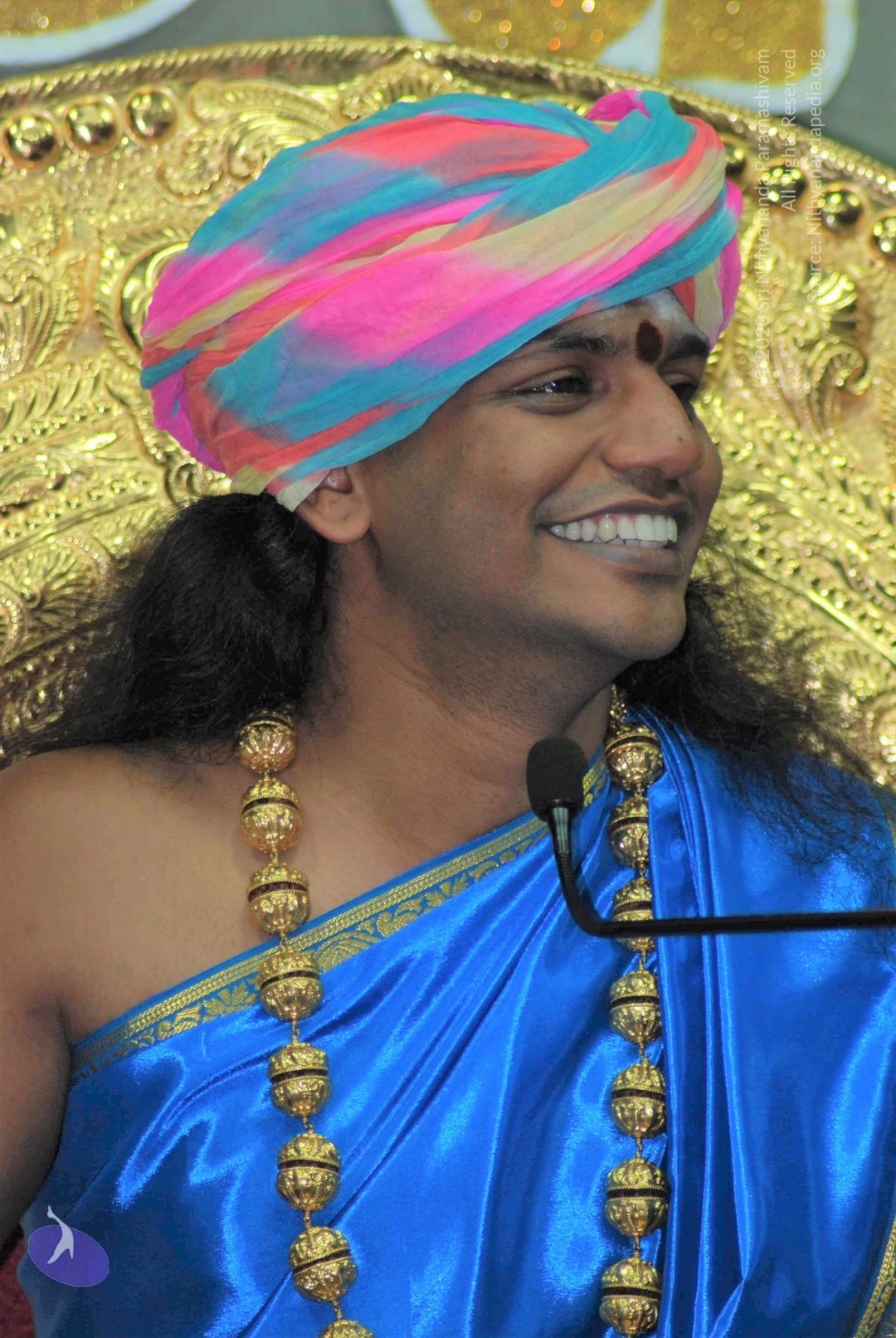
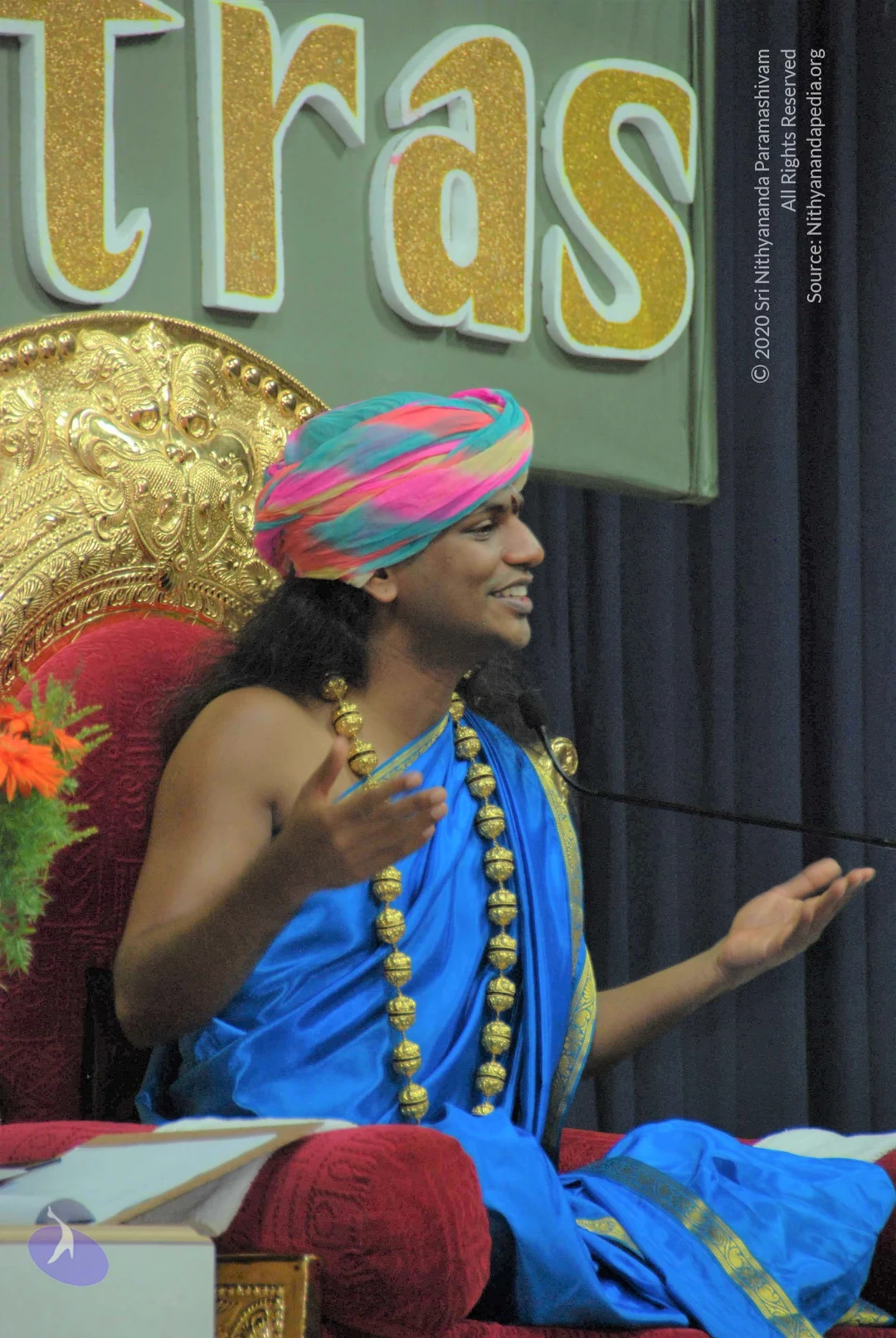
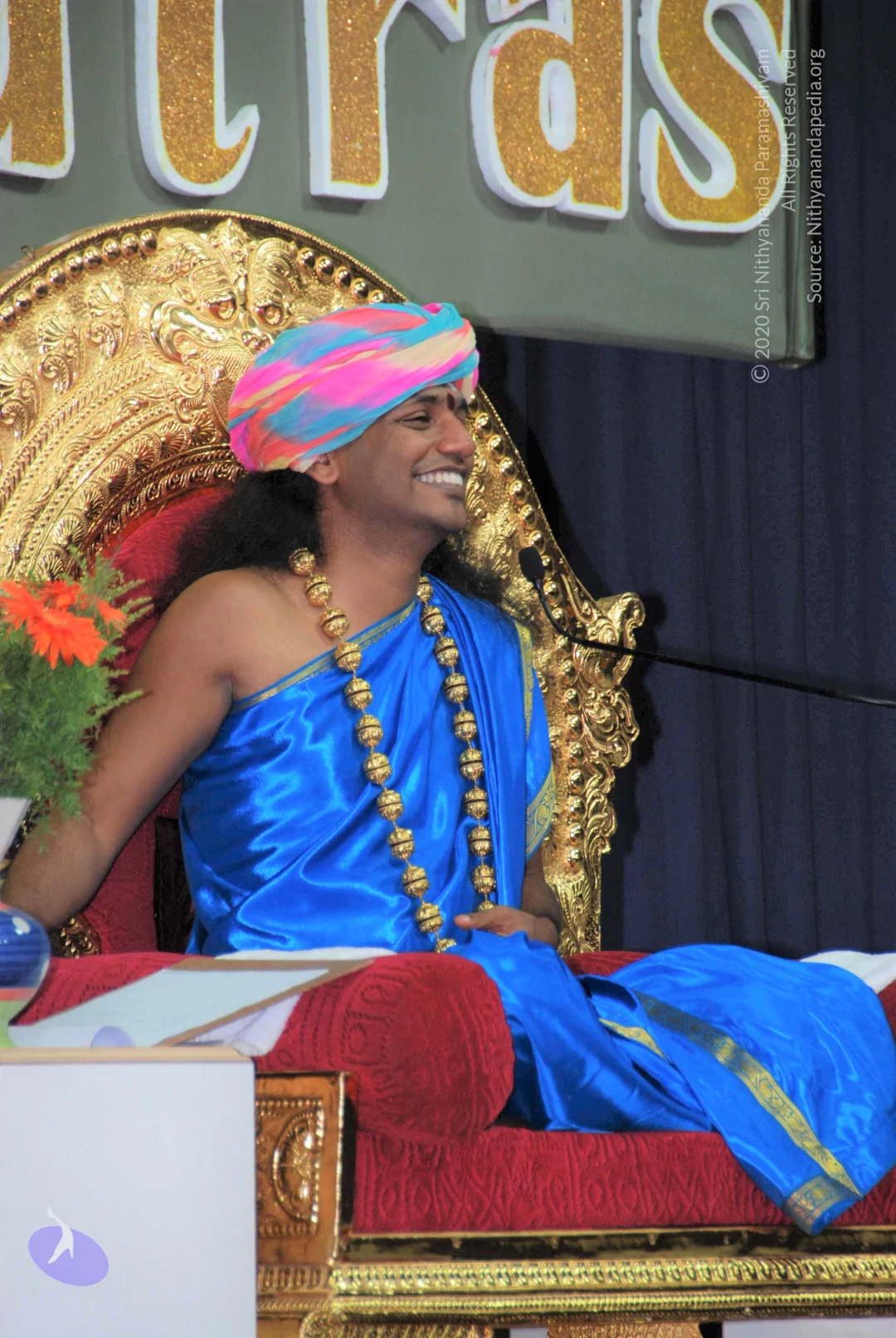
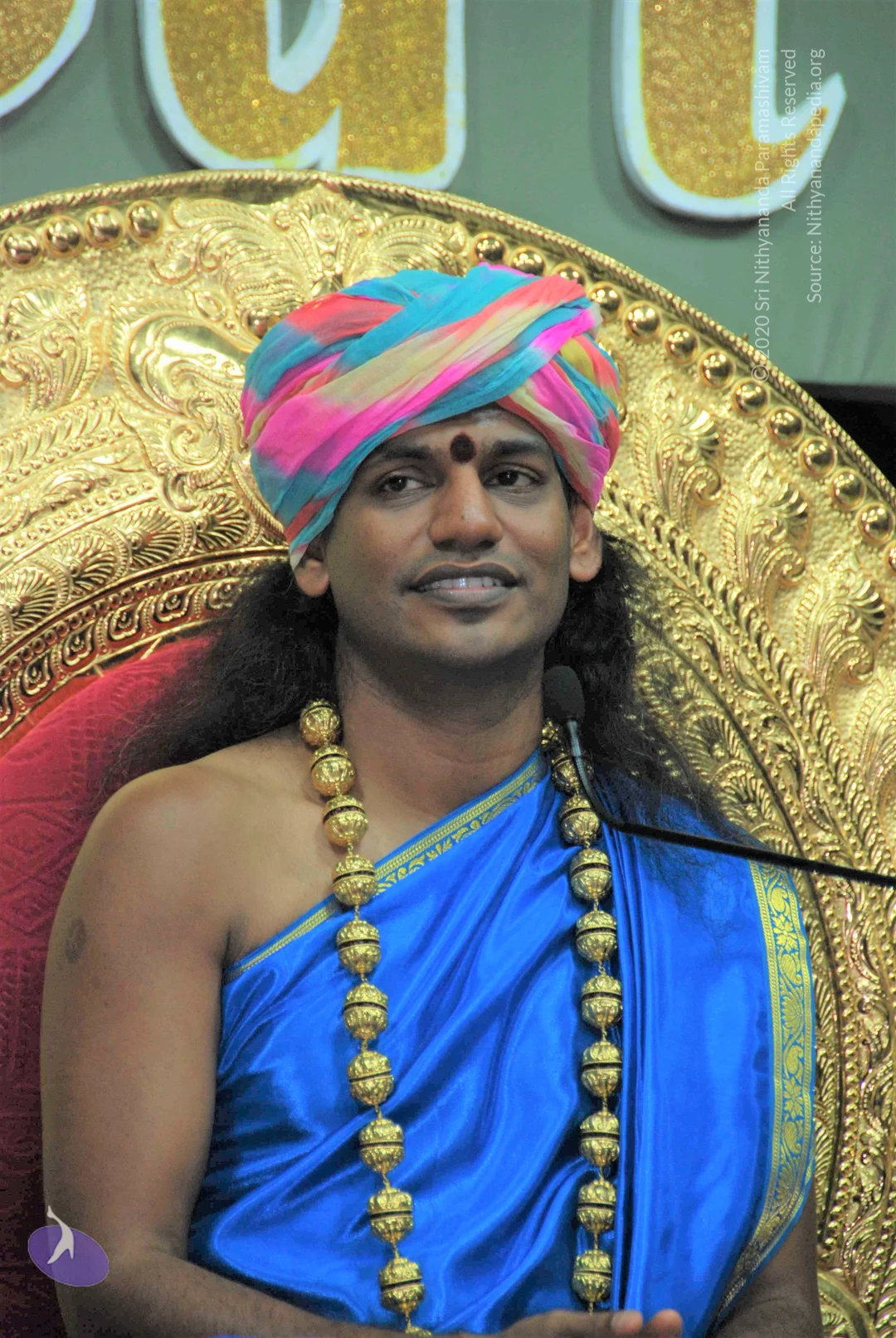
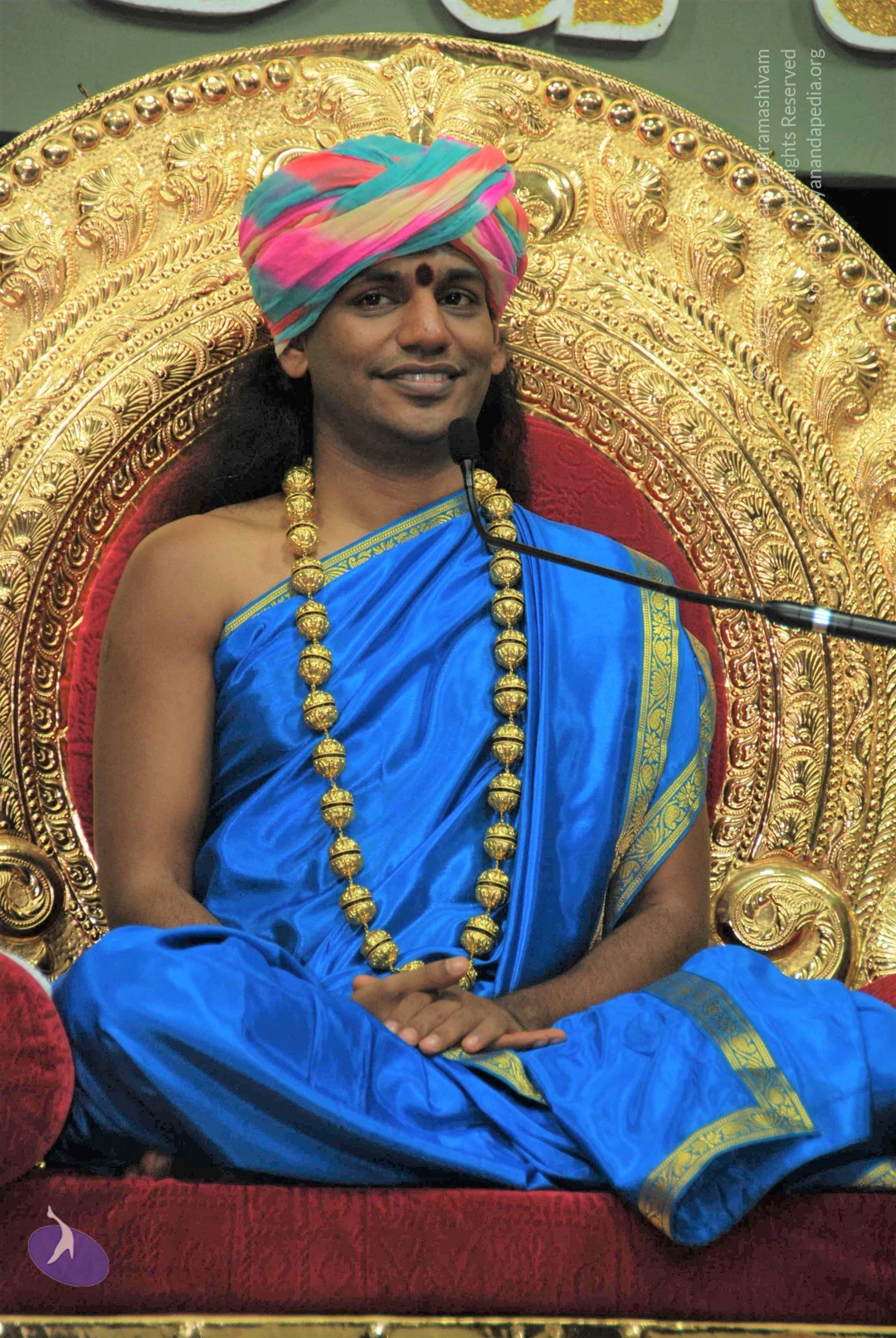
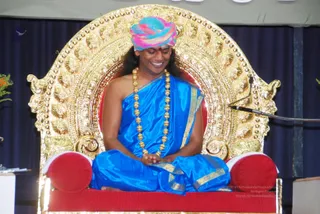
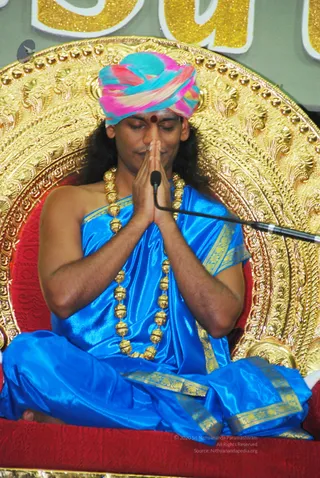
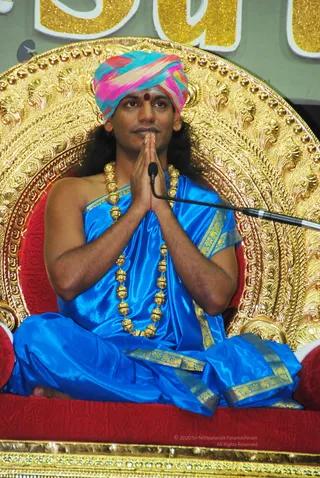
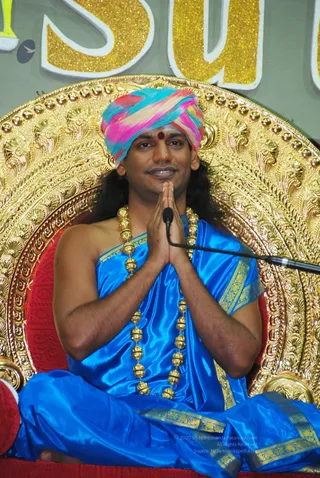
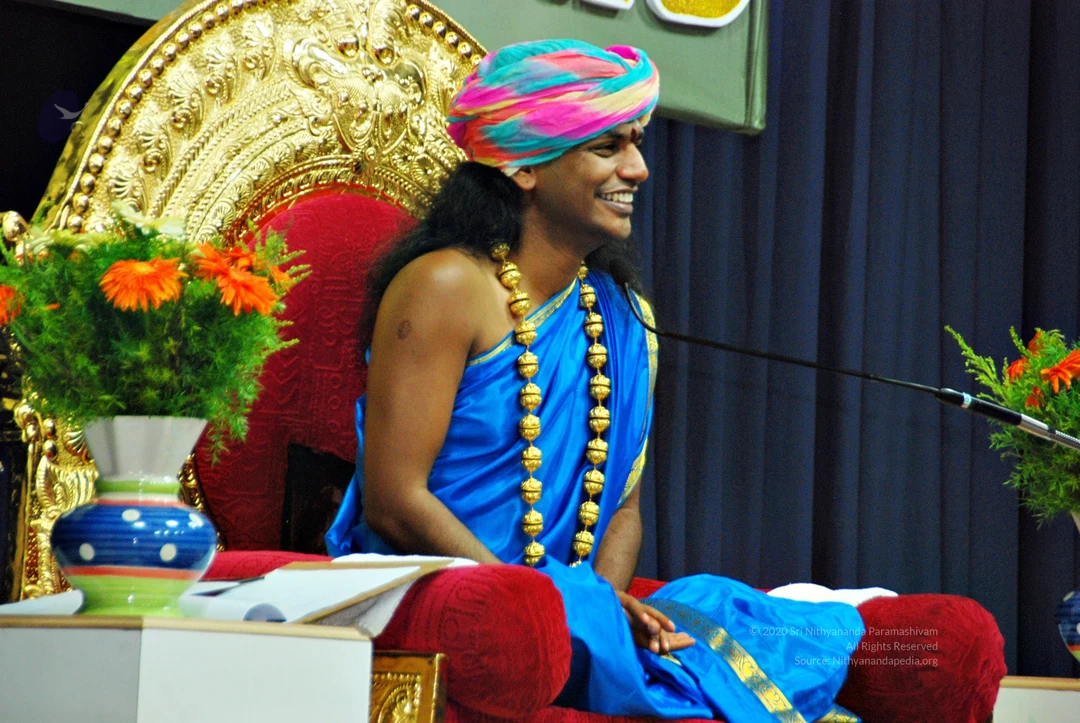
A smiling man sits cross-legged on an ornate gold throne with red cushioned armrests and a red seat. He wears a pink, turquoise and blue striped turban with a red tilak on his forehead, a blue silk garment with gold border, and a long gold bead necklace. His hands rest together in his lap, and a microphone stand is visible at the right beside the throne. Behind him hang navy blue drapes and green foliage appears at the edges. The scene suggests a seated discourse or satsang.A man seated cross-legged on a red cushioned throne with ornate gold filigree backrest, eyes closed and palms pressed together in namaste at the chest. He wears a multicoloured pink, turquoise and white turban with a red bindi on his forehead, a bright blue silk shawl and dhoti edged with gold border, and a long gold bead necklace. A microphone stand is at his side. Behind him is a gold-lettered banner.A man sits cross-legged on an ornate gold throne with a red cushion, pressing his palms together in namaste. He wears a pink, blue and yellow striped turban, a red bindi, a blue silk garment with gold border, and a long gold bead necklace. Long dark hair falls to his shoulders and a small microphone is positioned near his hands. Behind him a grey backdrop shows large gold glitter lettering. The style of the turban, long hair and gold ceremonial necklace are cues associated with Swamiji (probable), seated in a satsang discourse setting.
02

01-Temple

81 dated photos in previewSource gallery
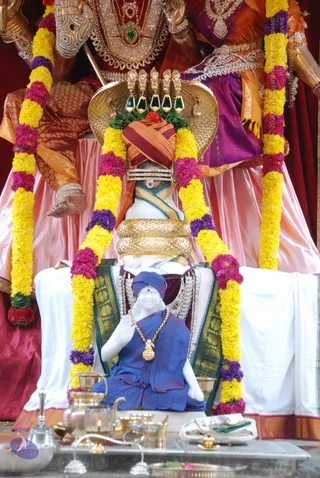
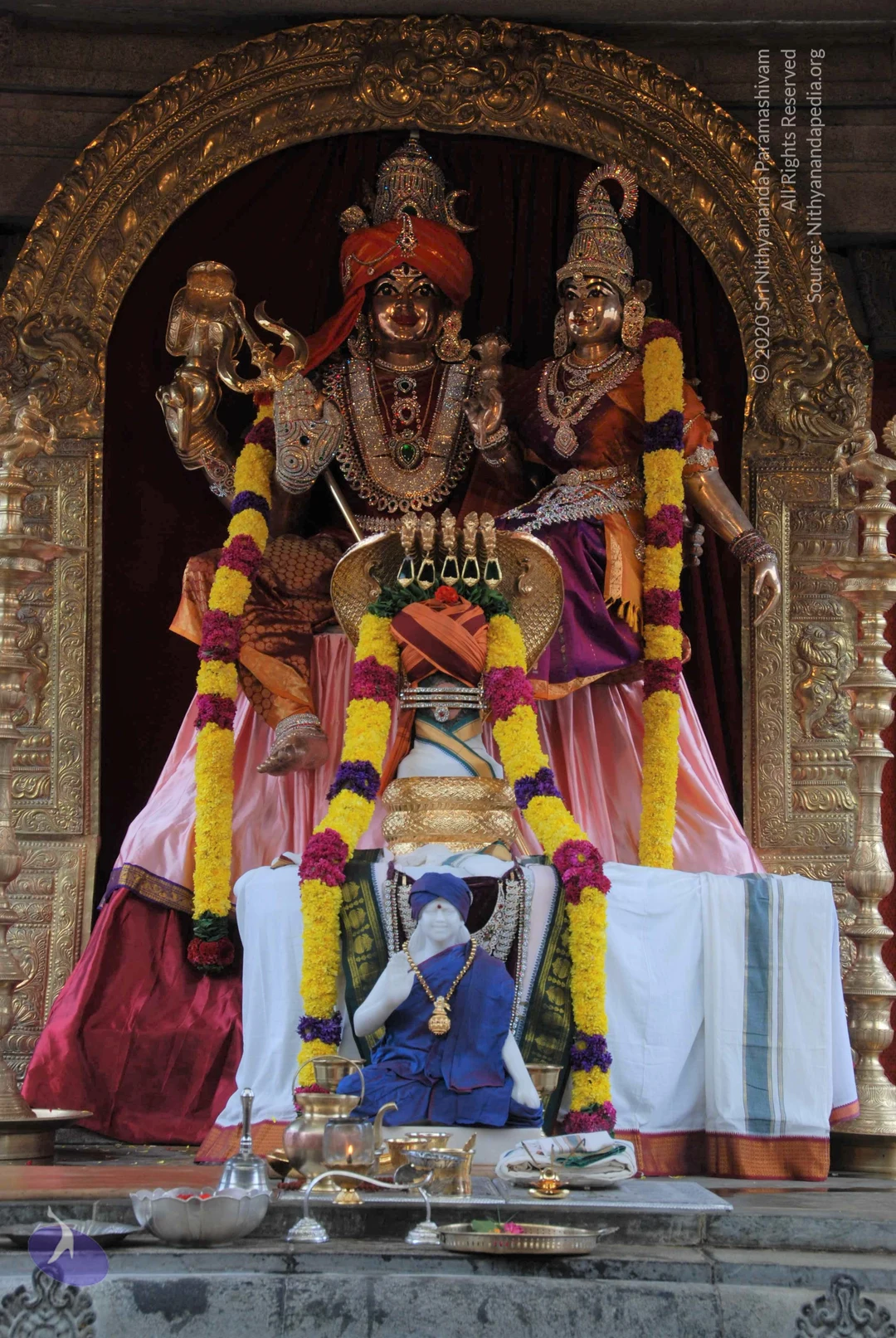
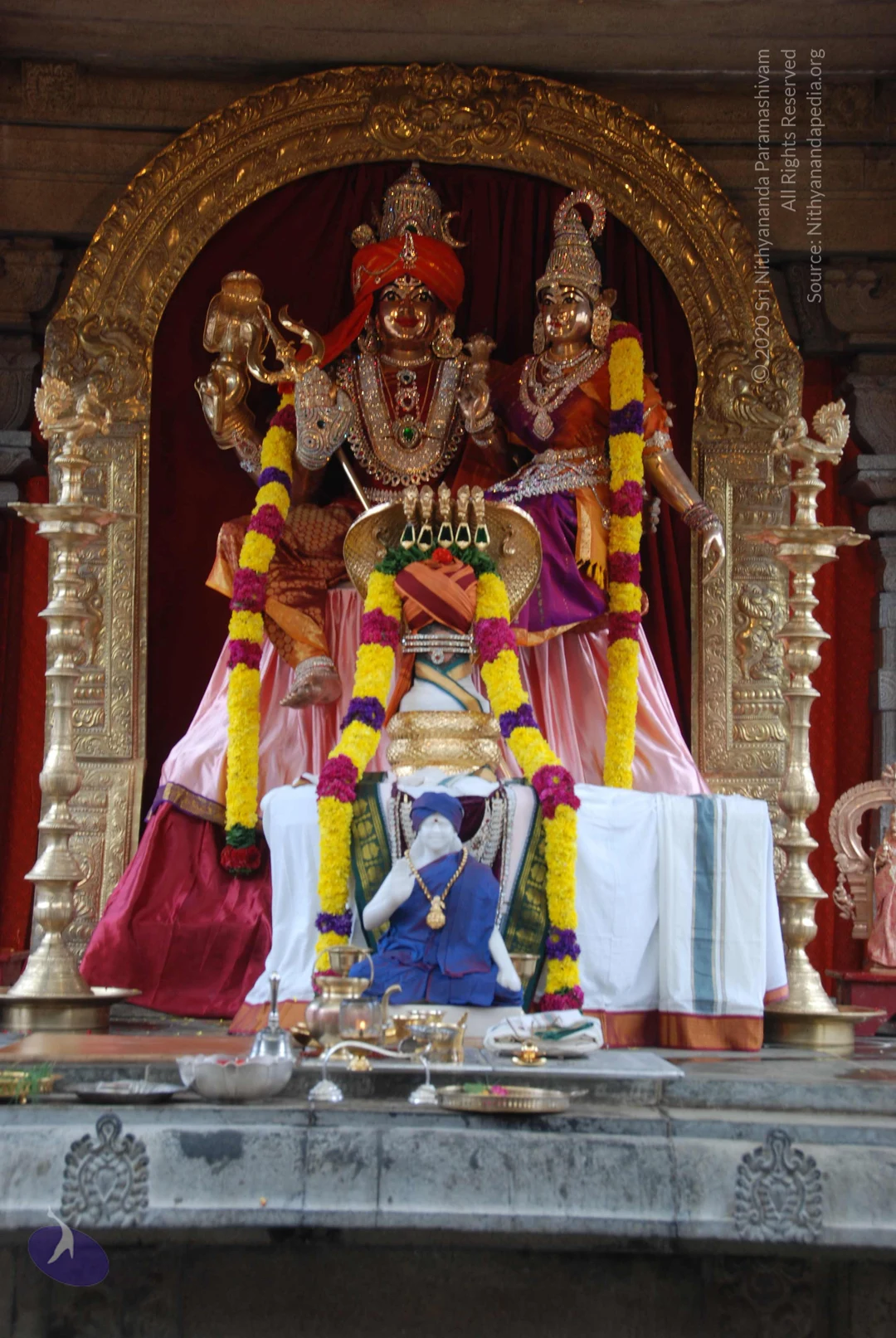
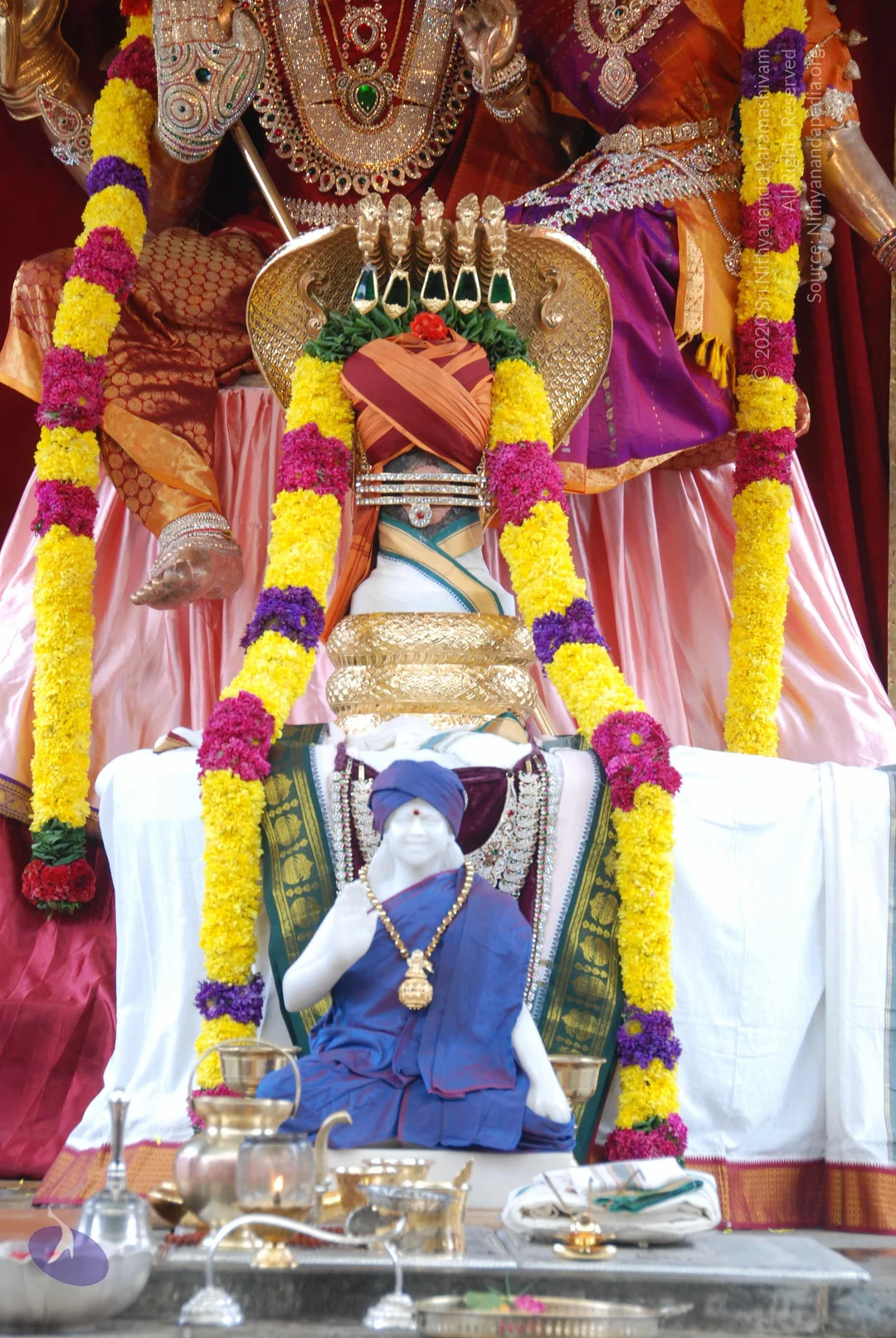
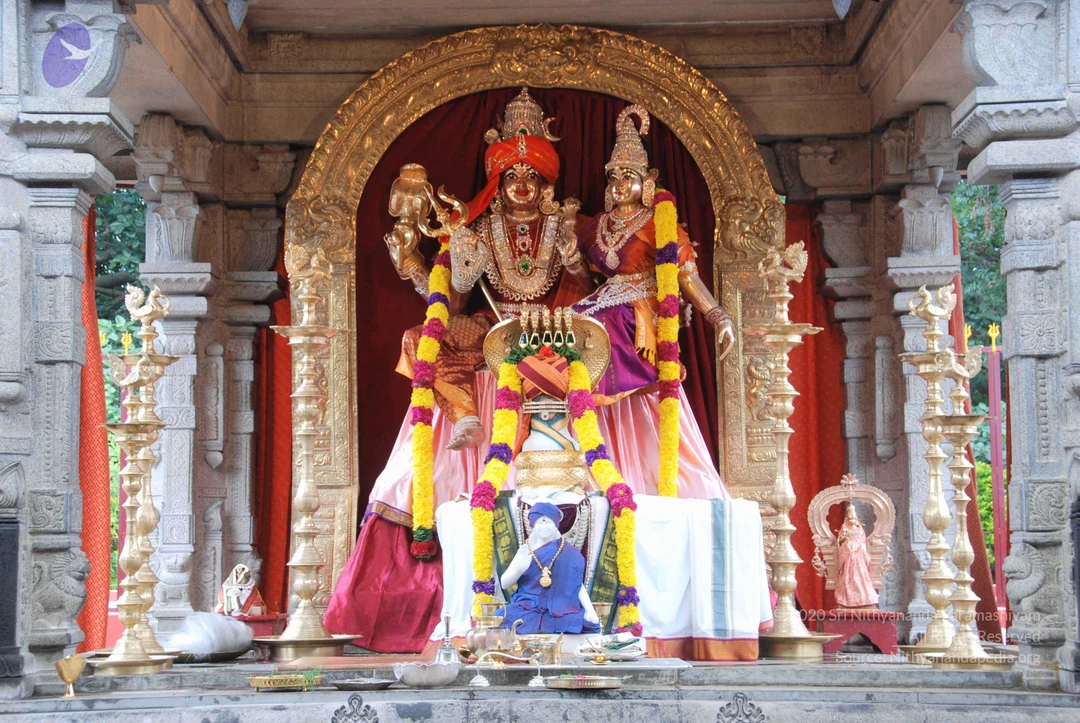
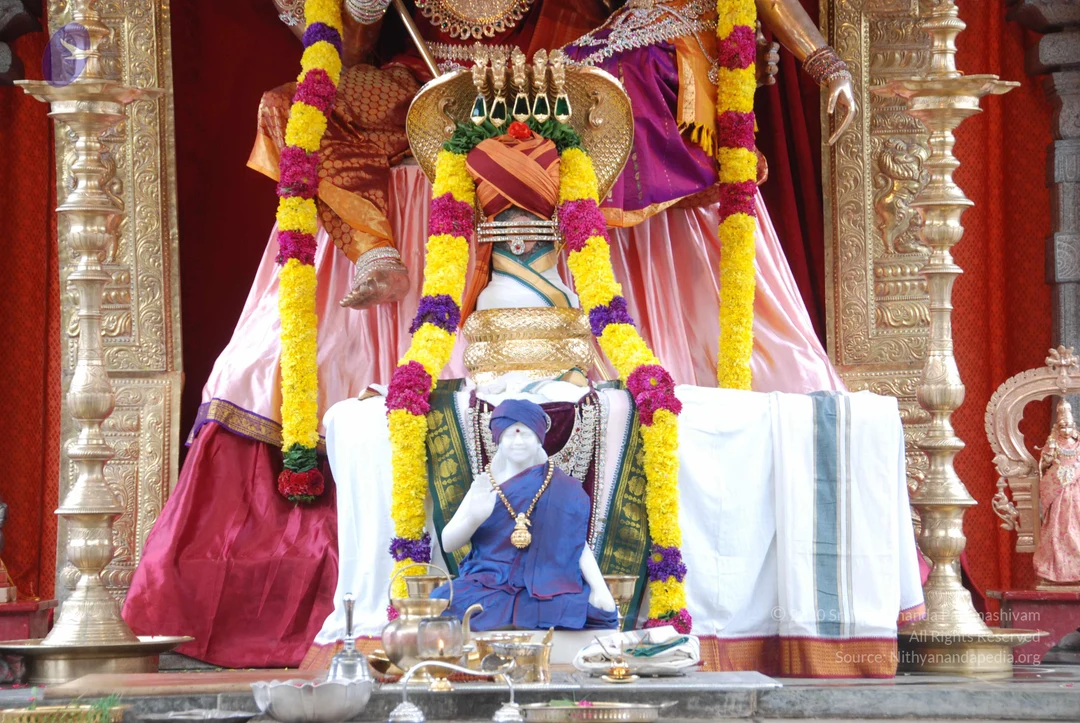
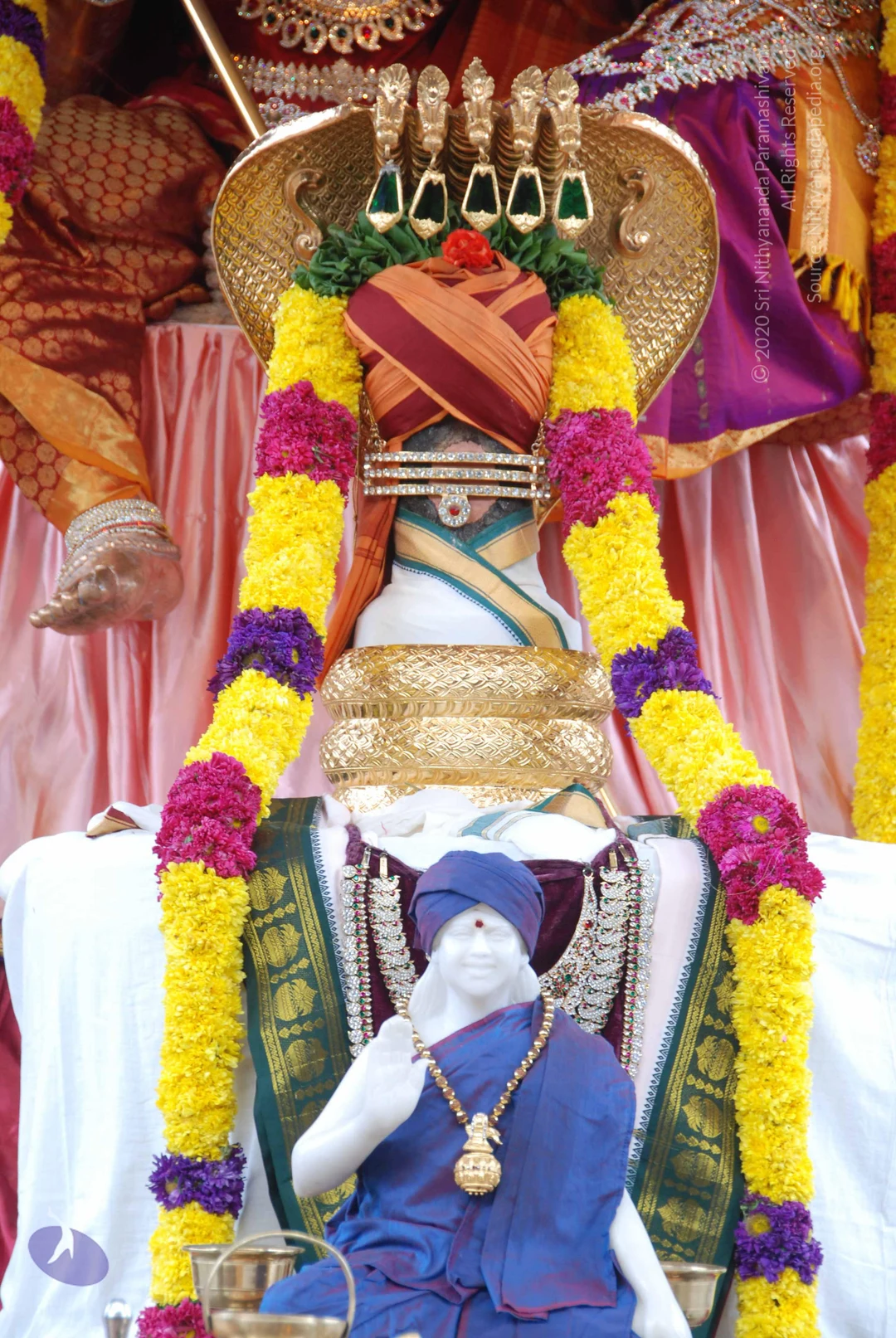
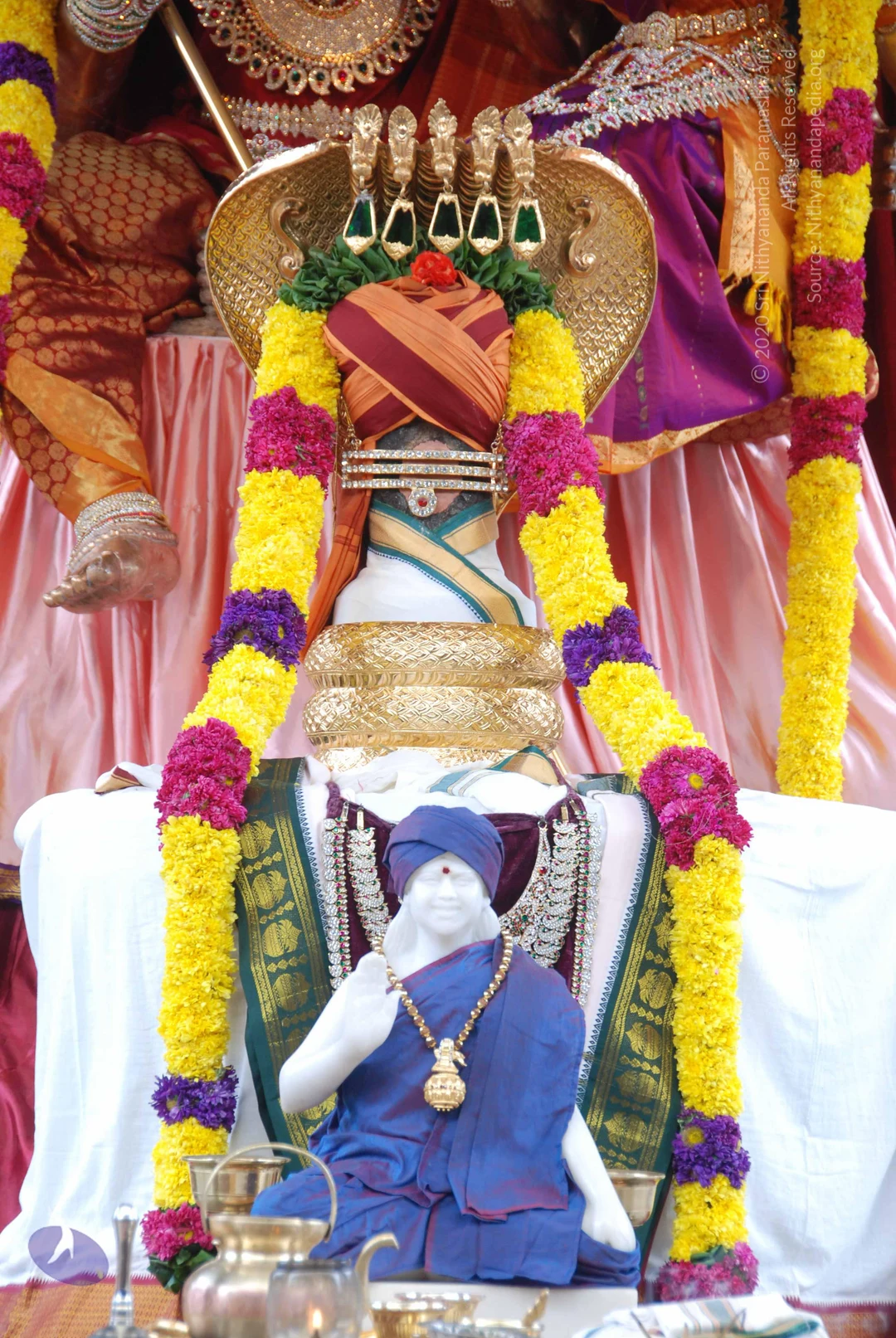
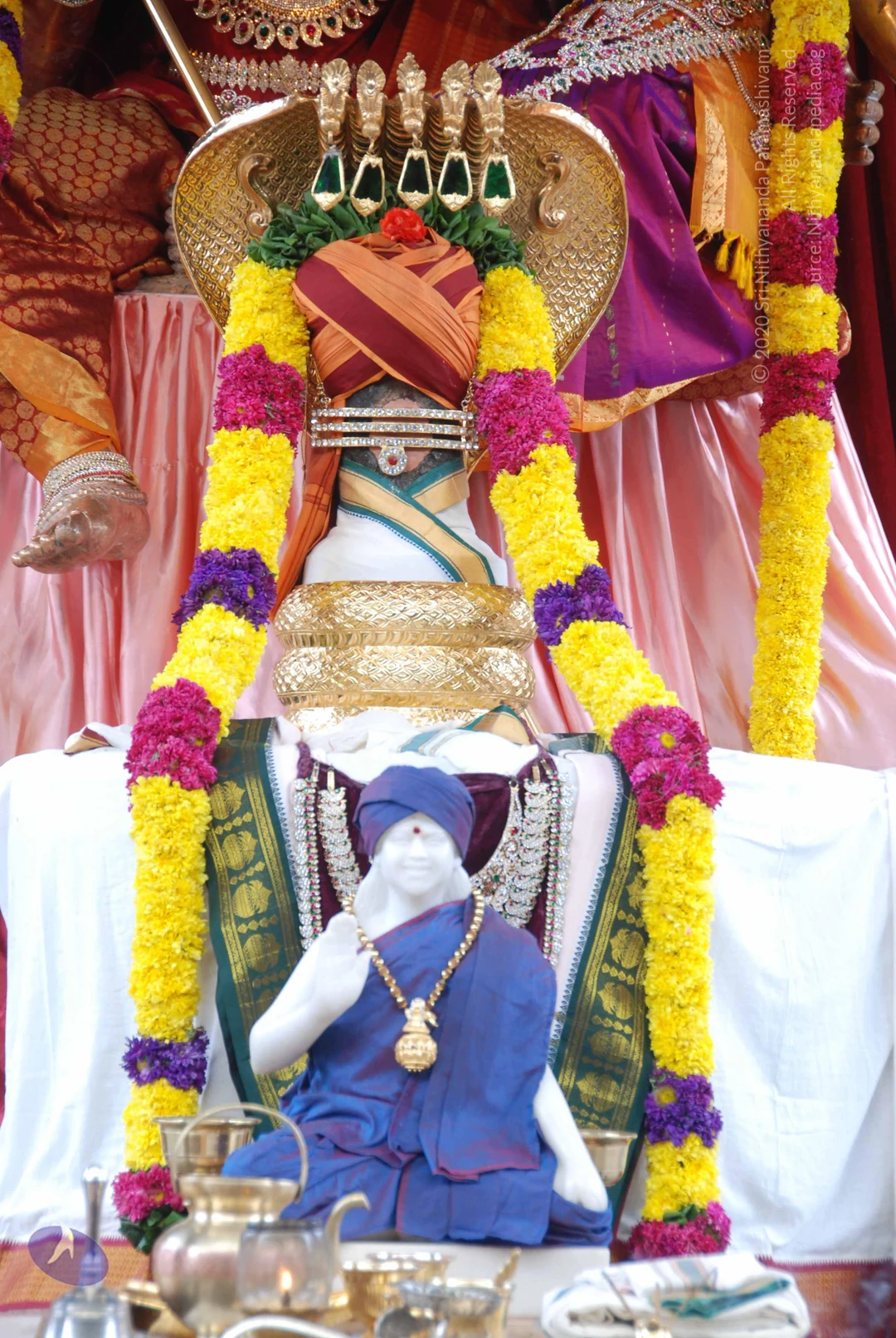
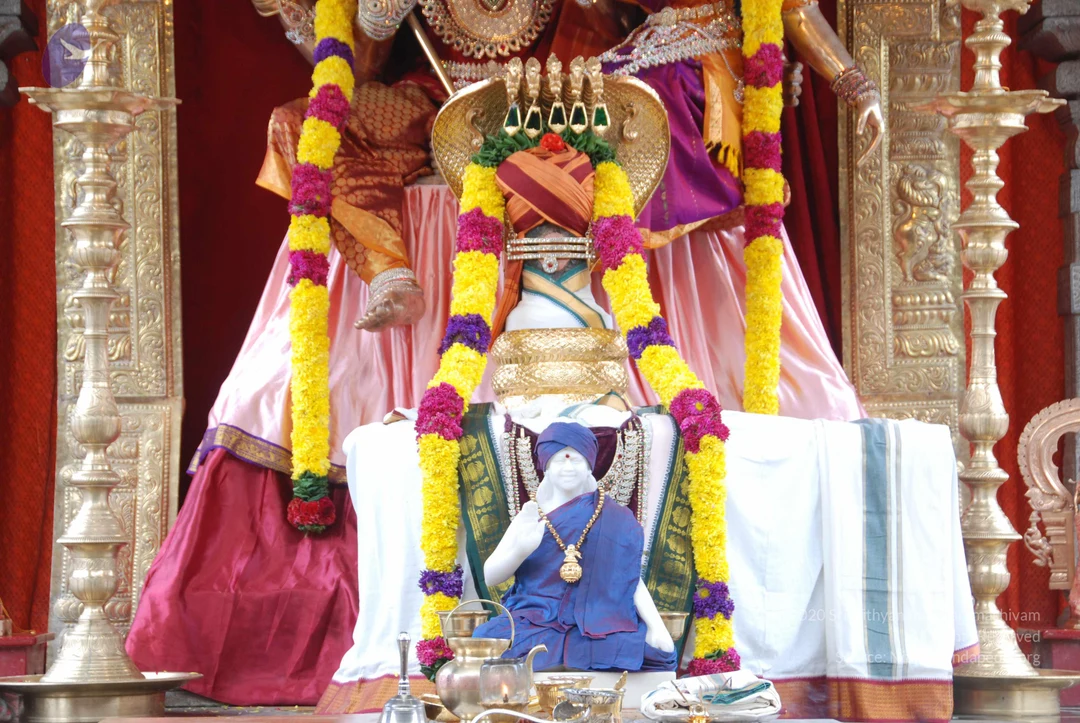
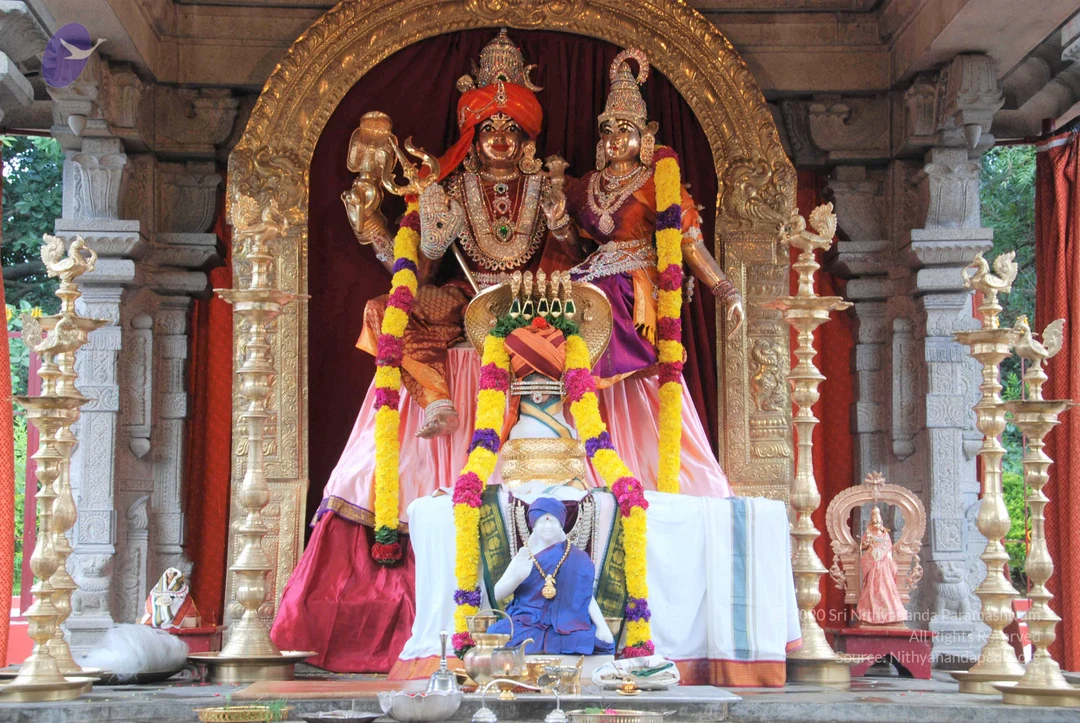
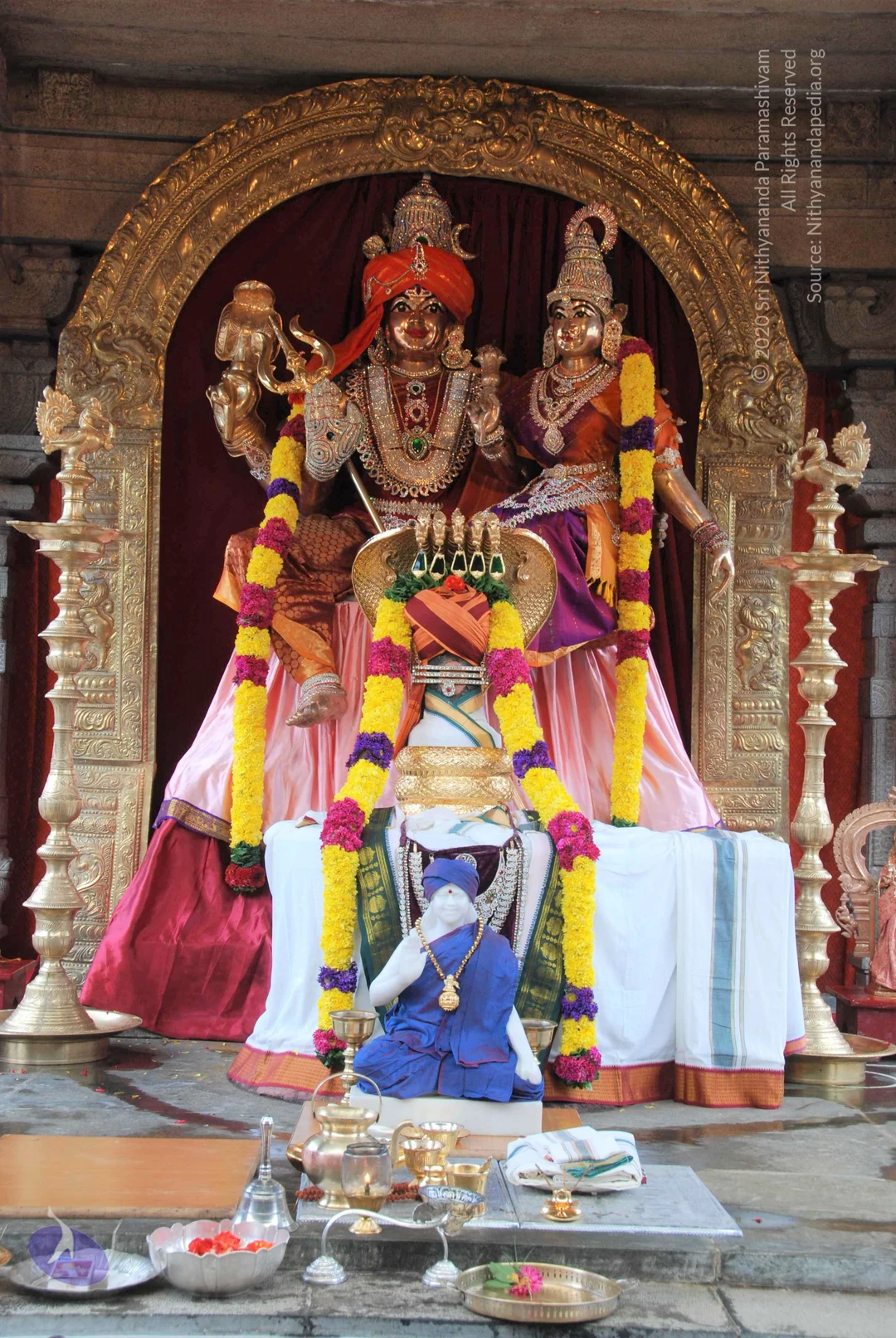
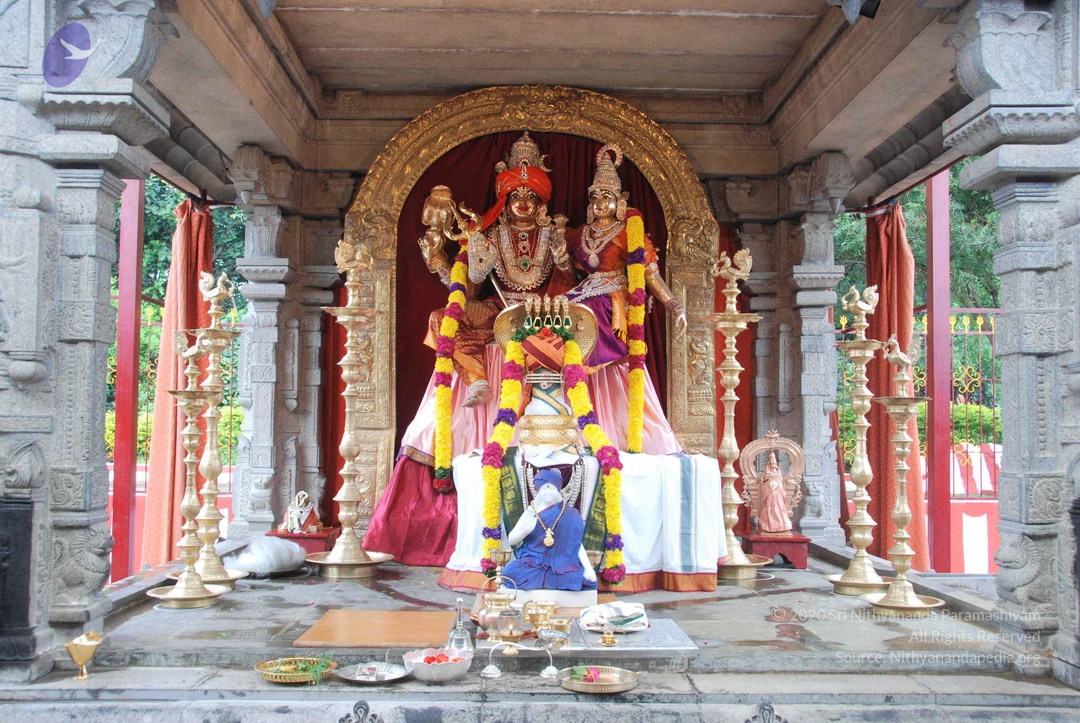
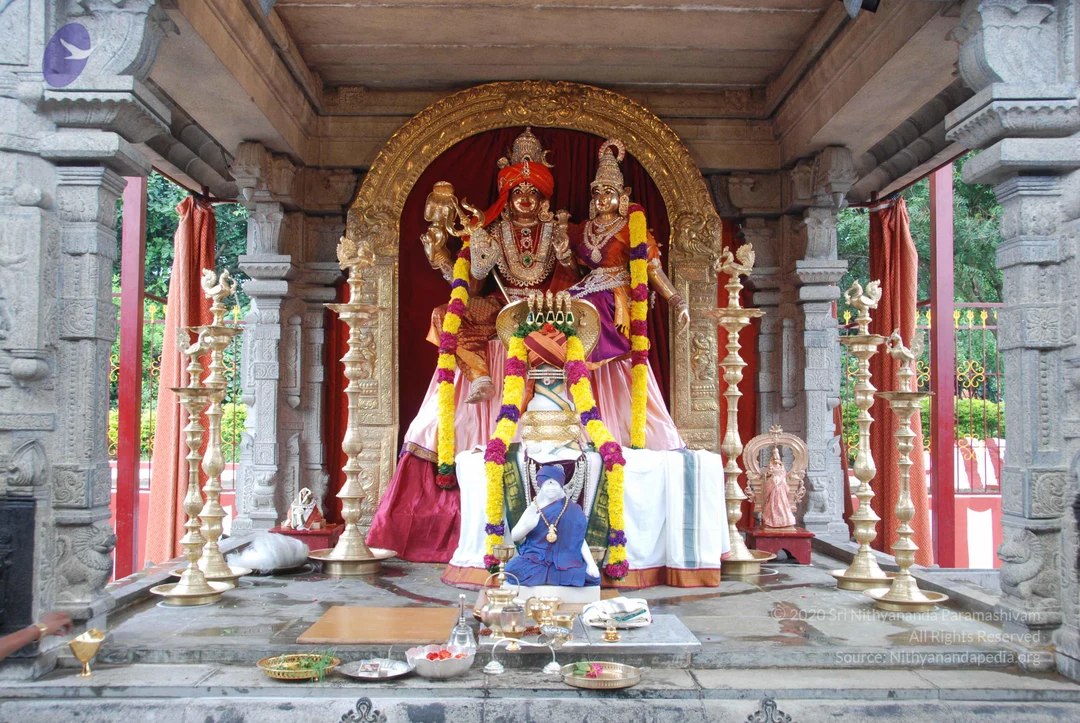
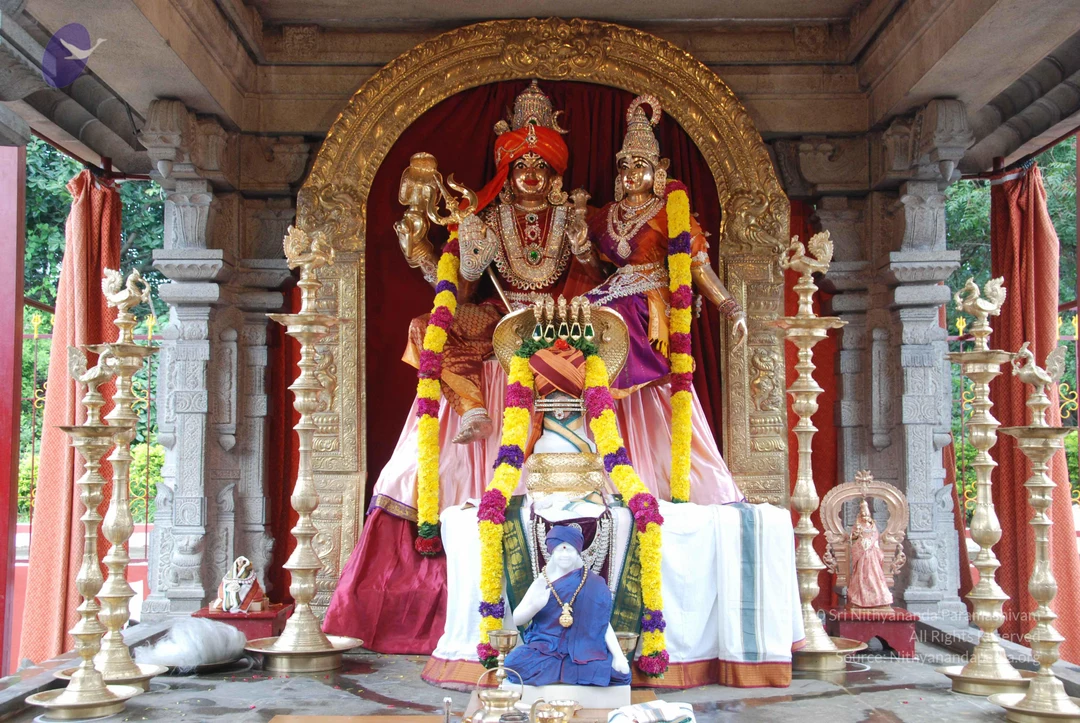
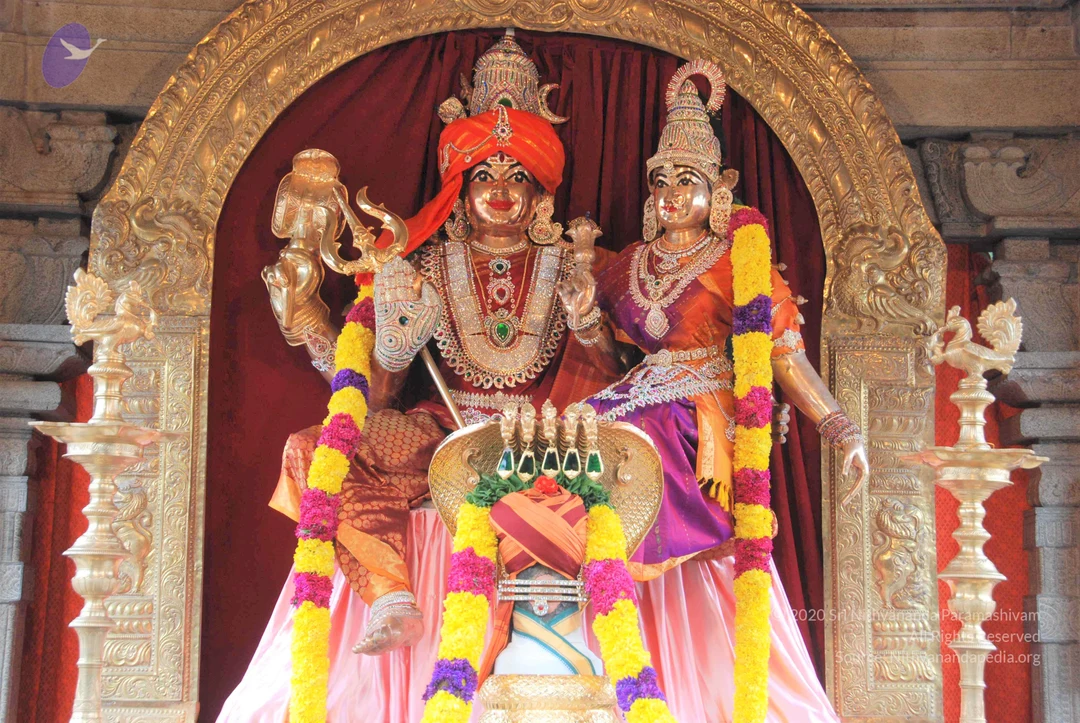
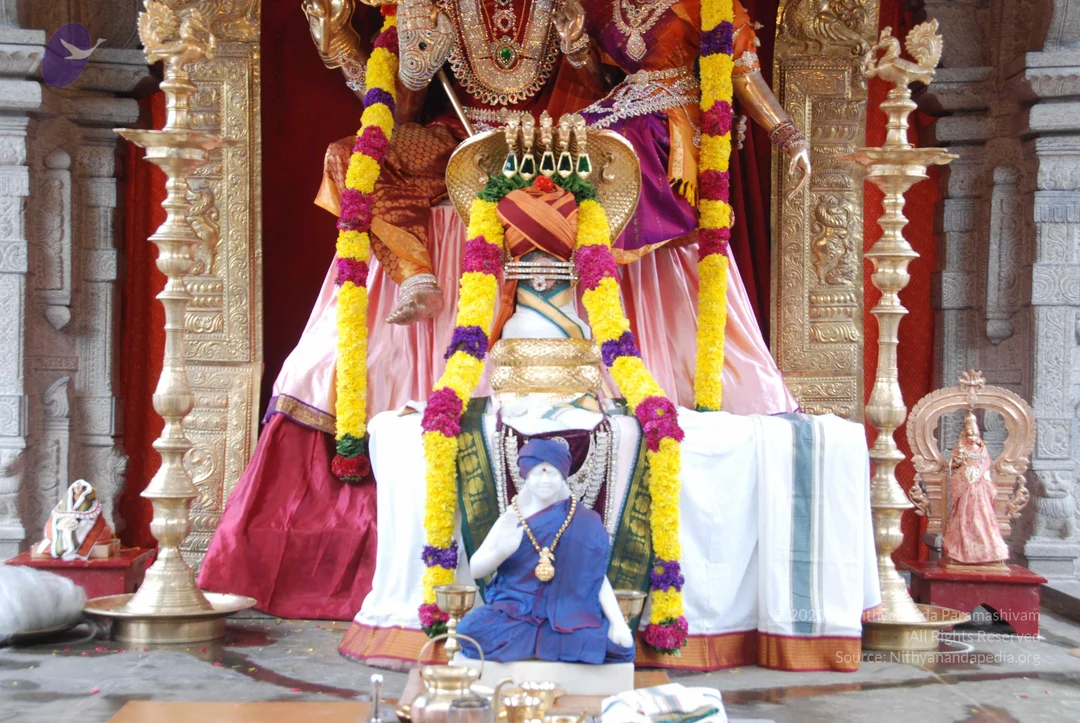
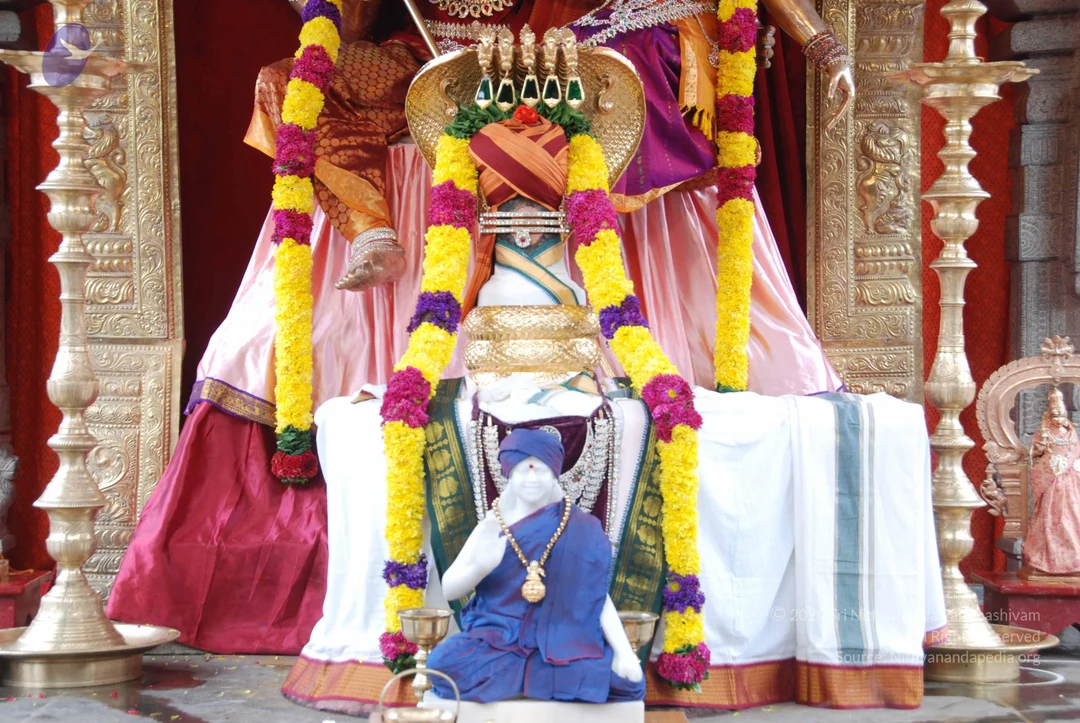
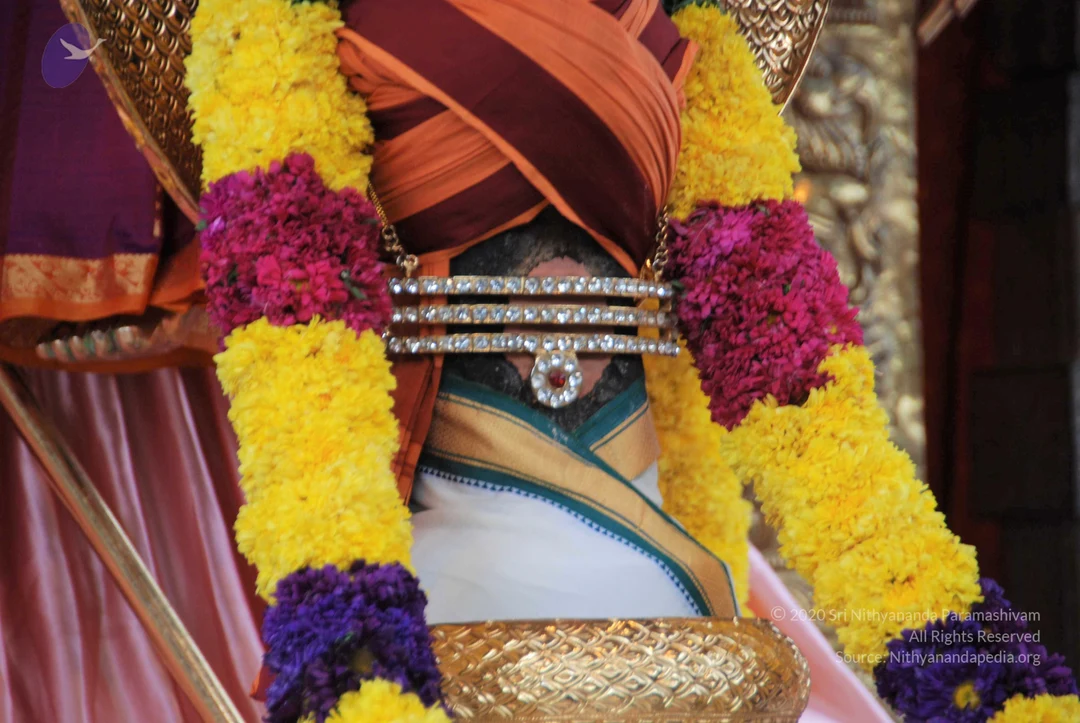
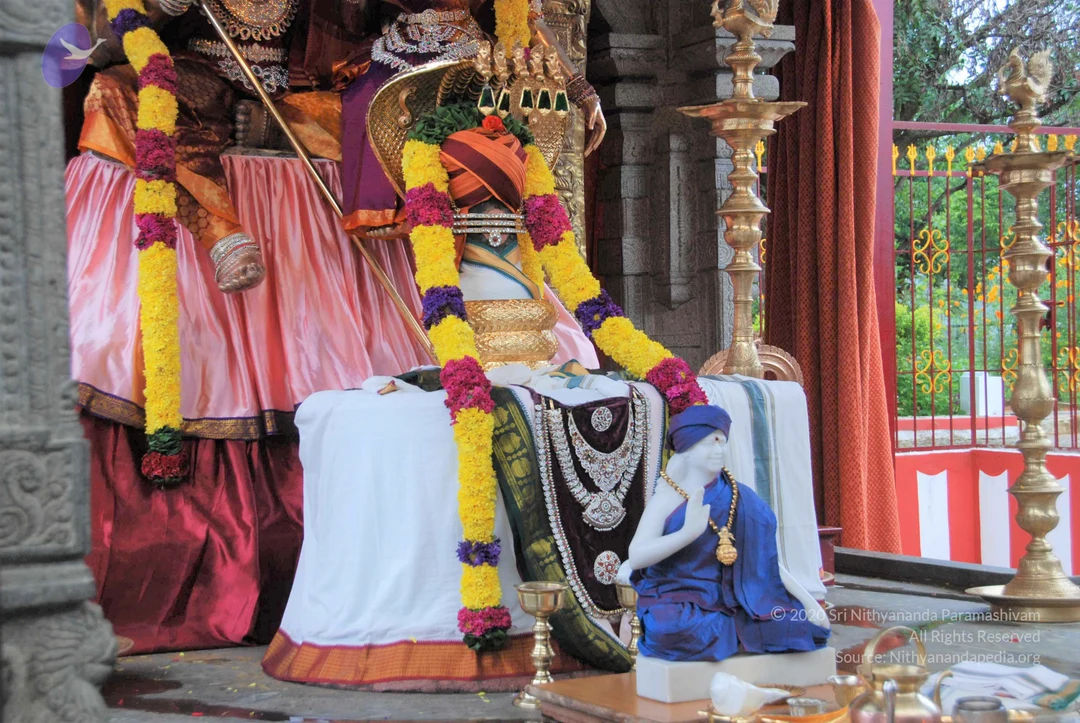
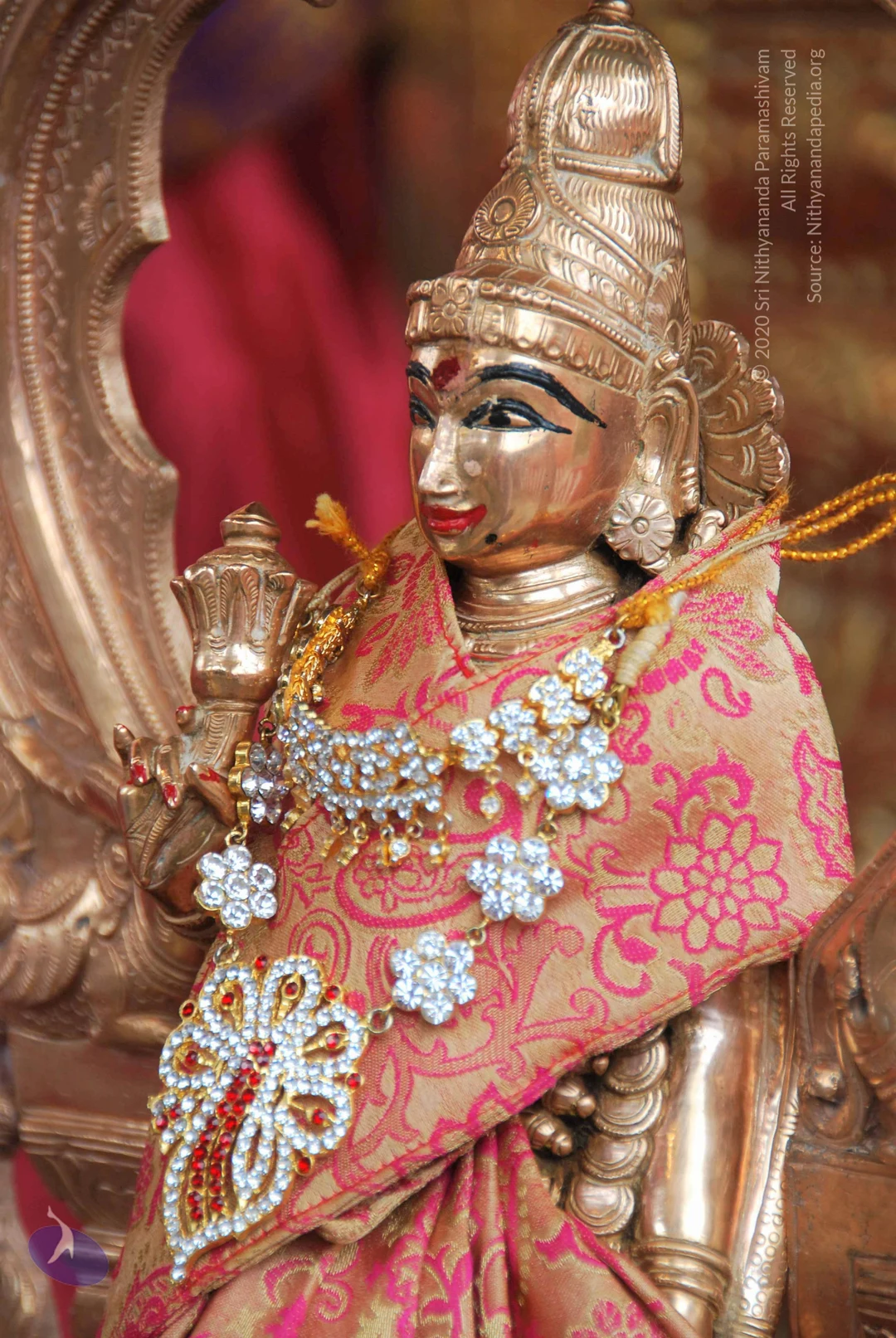
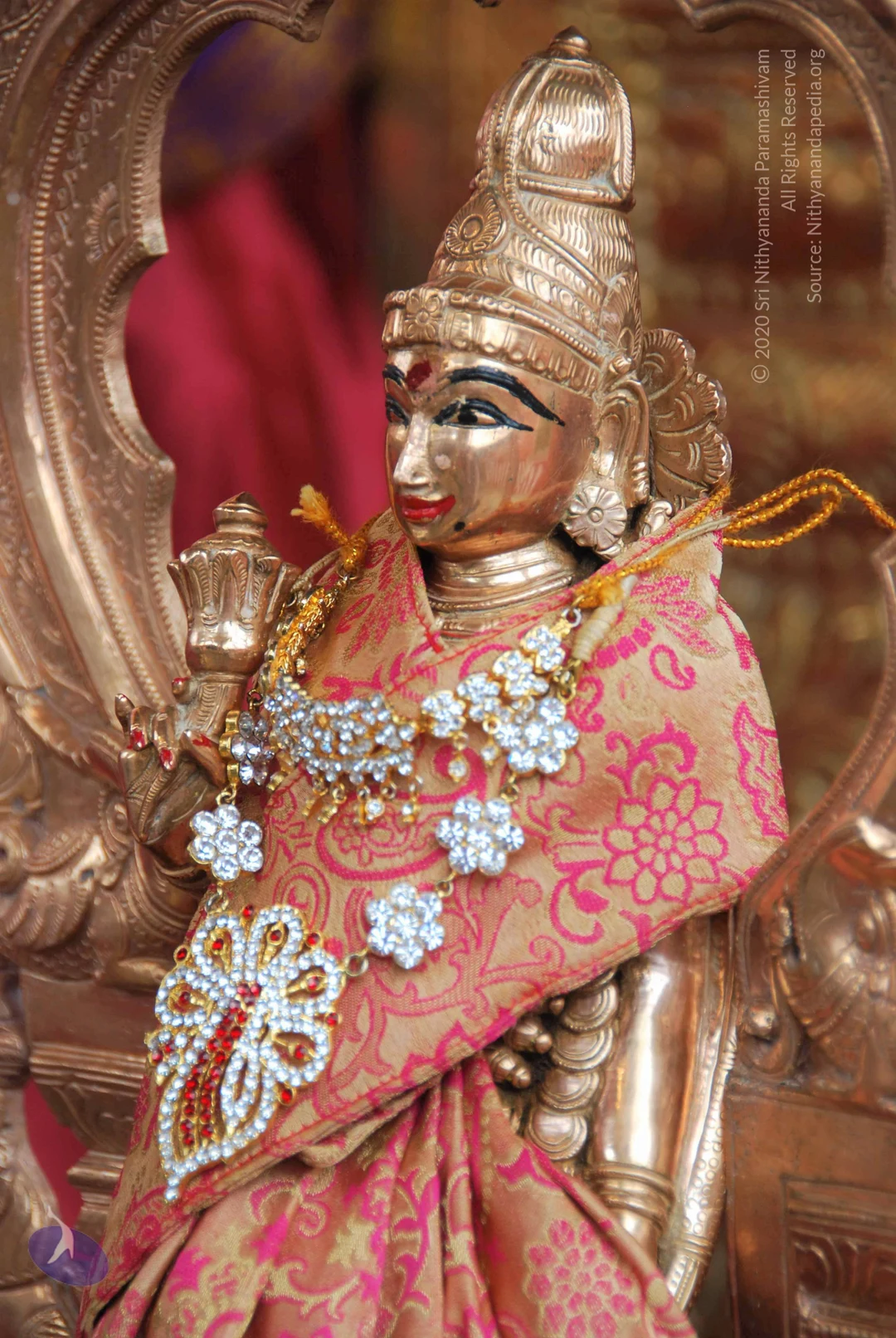
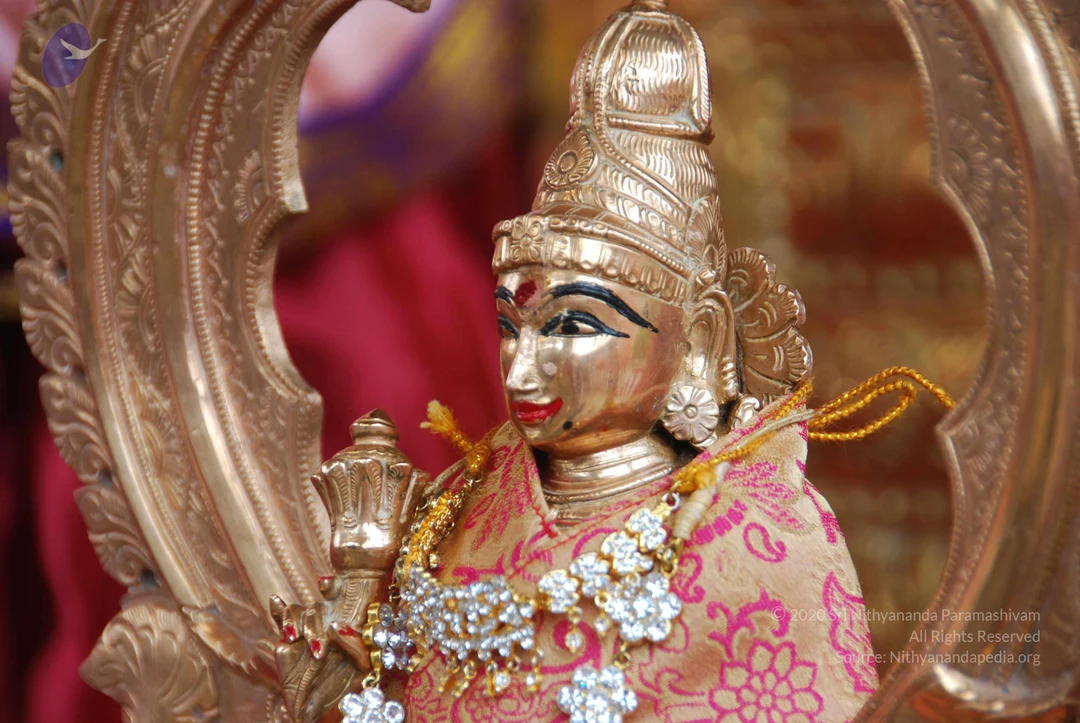
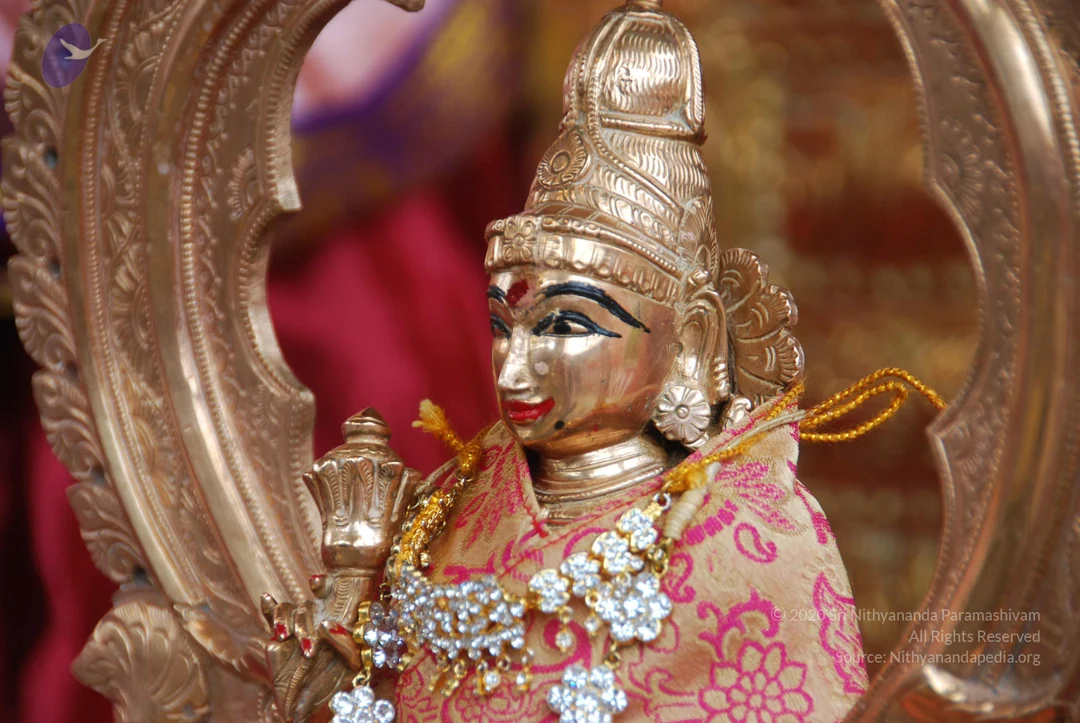
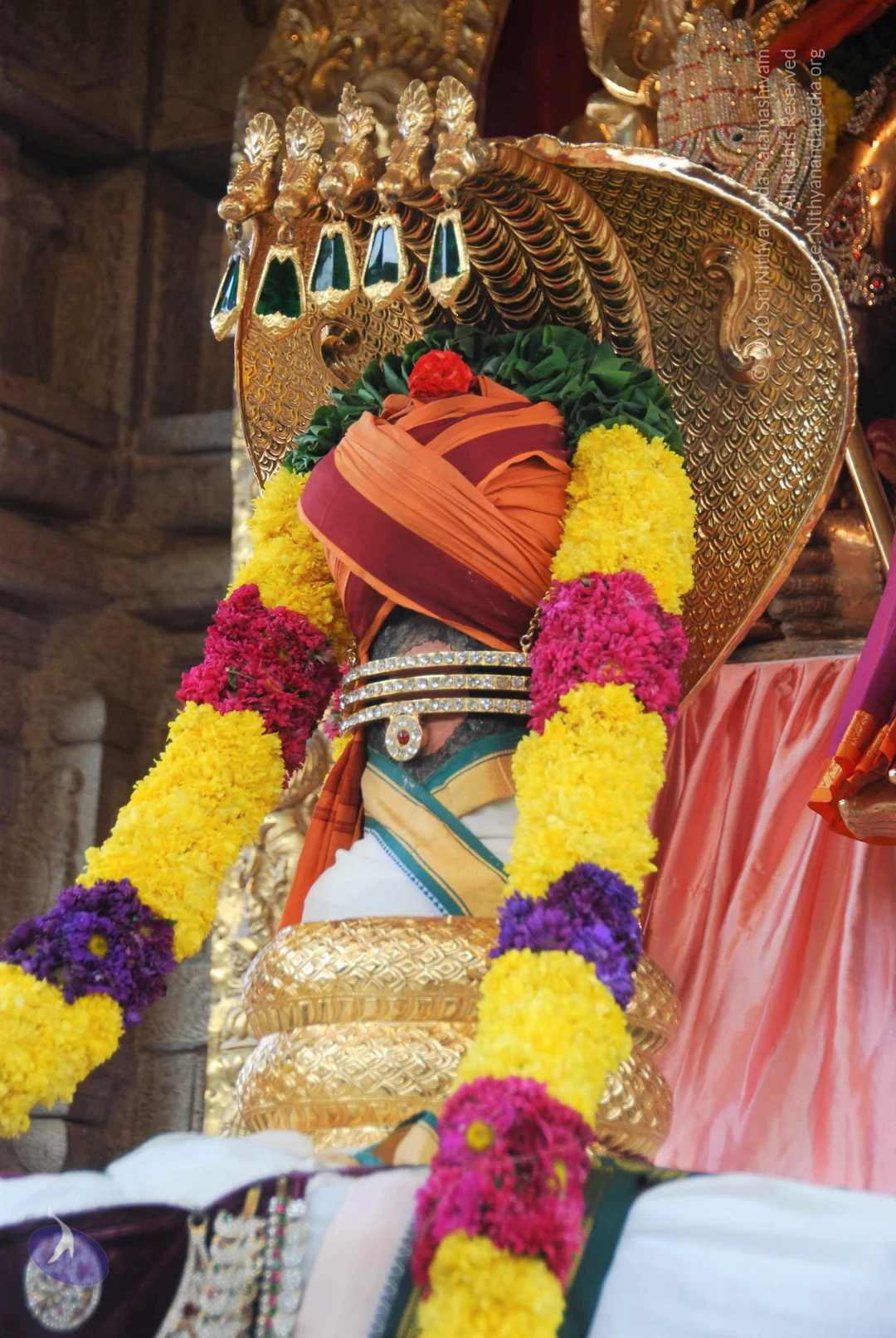
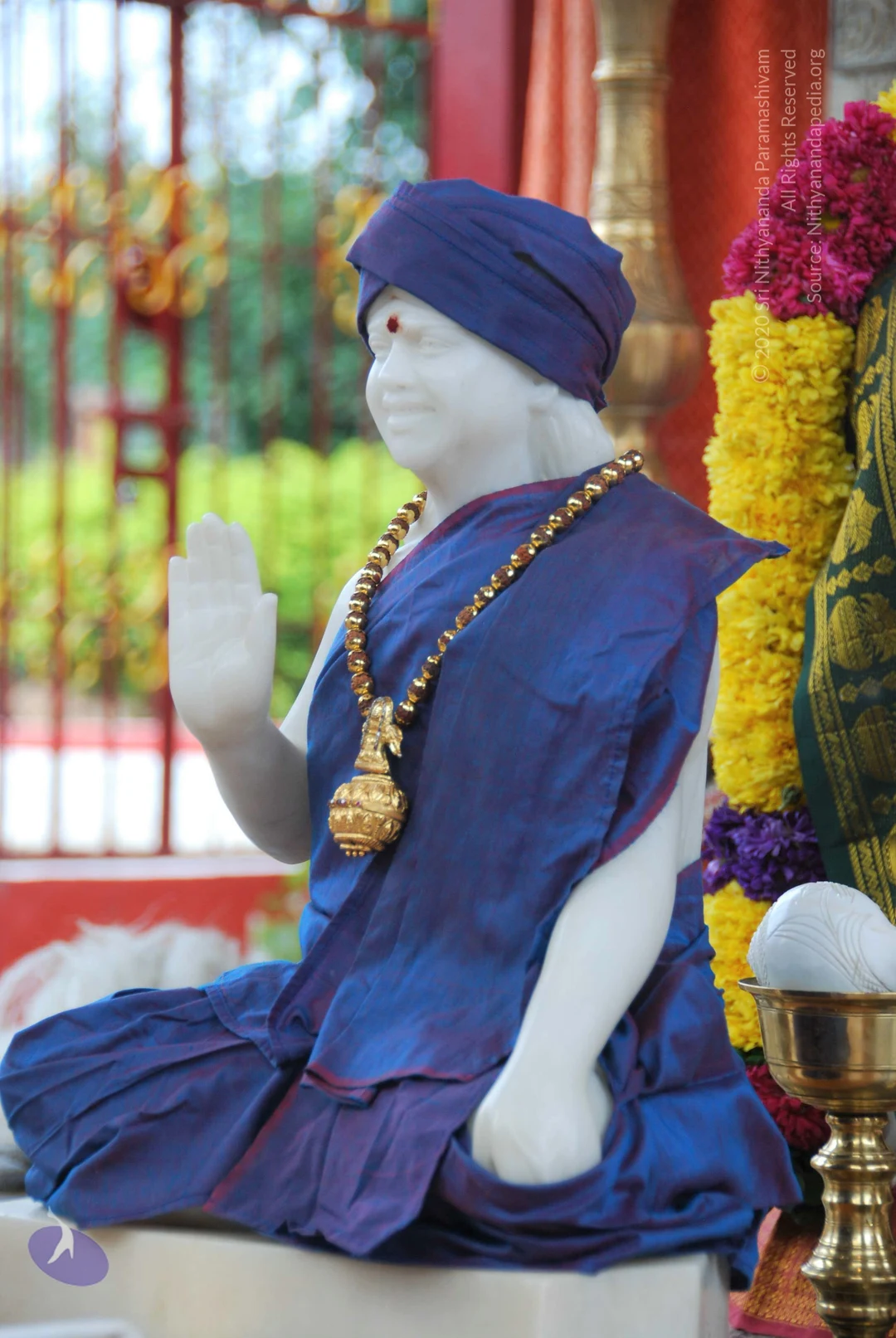
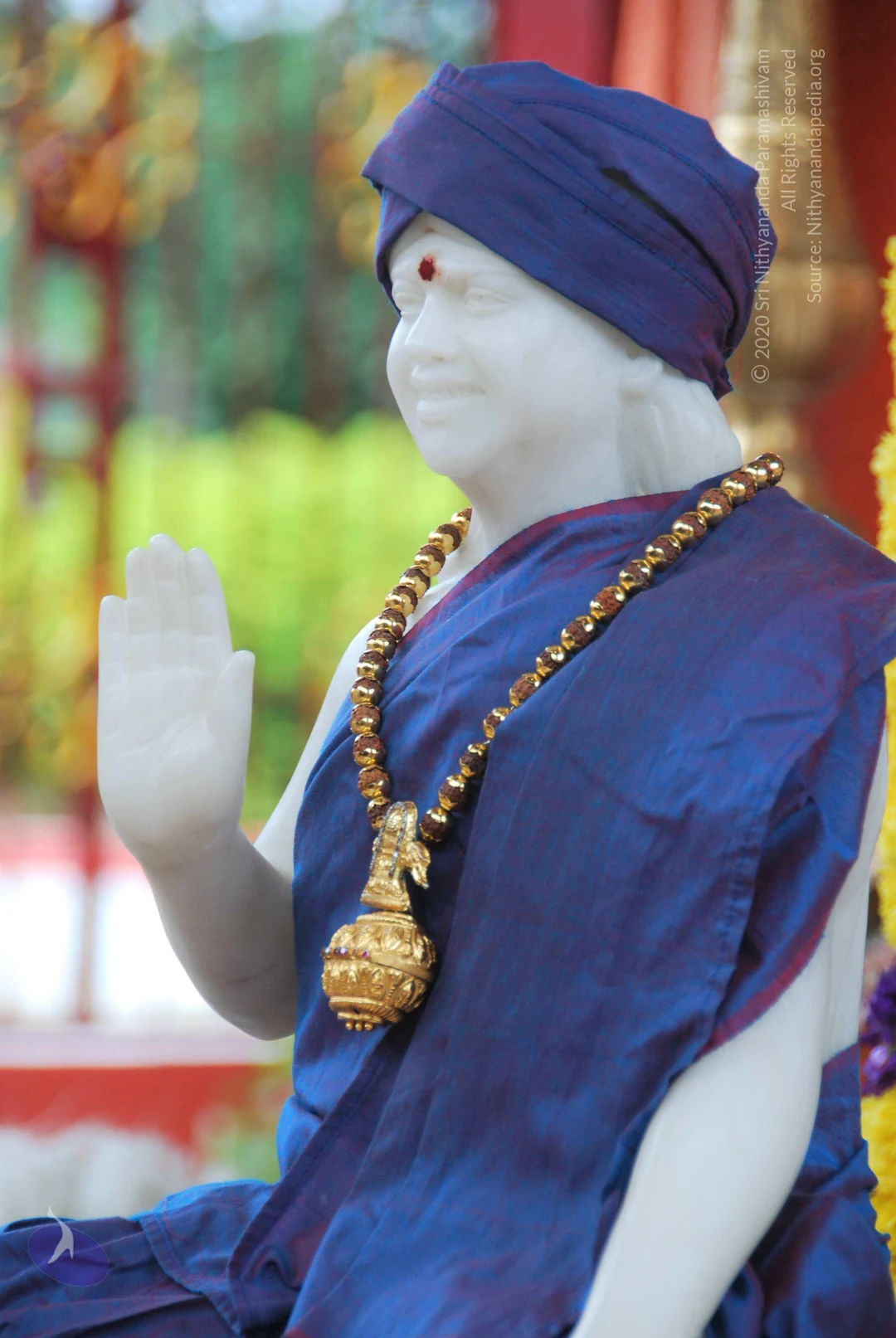
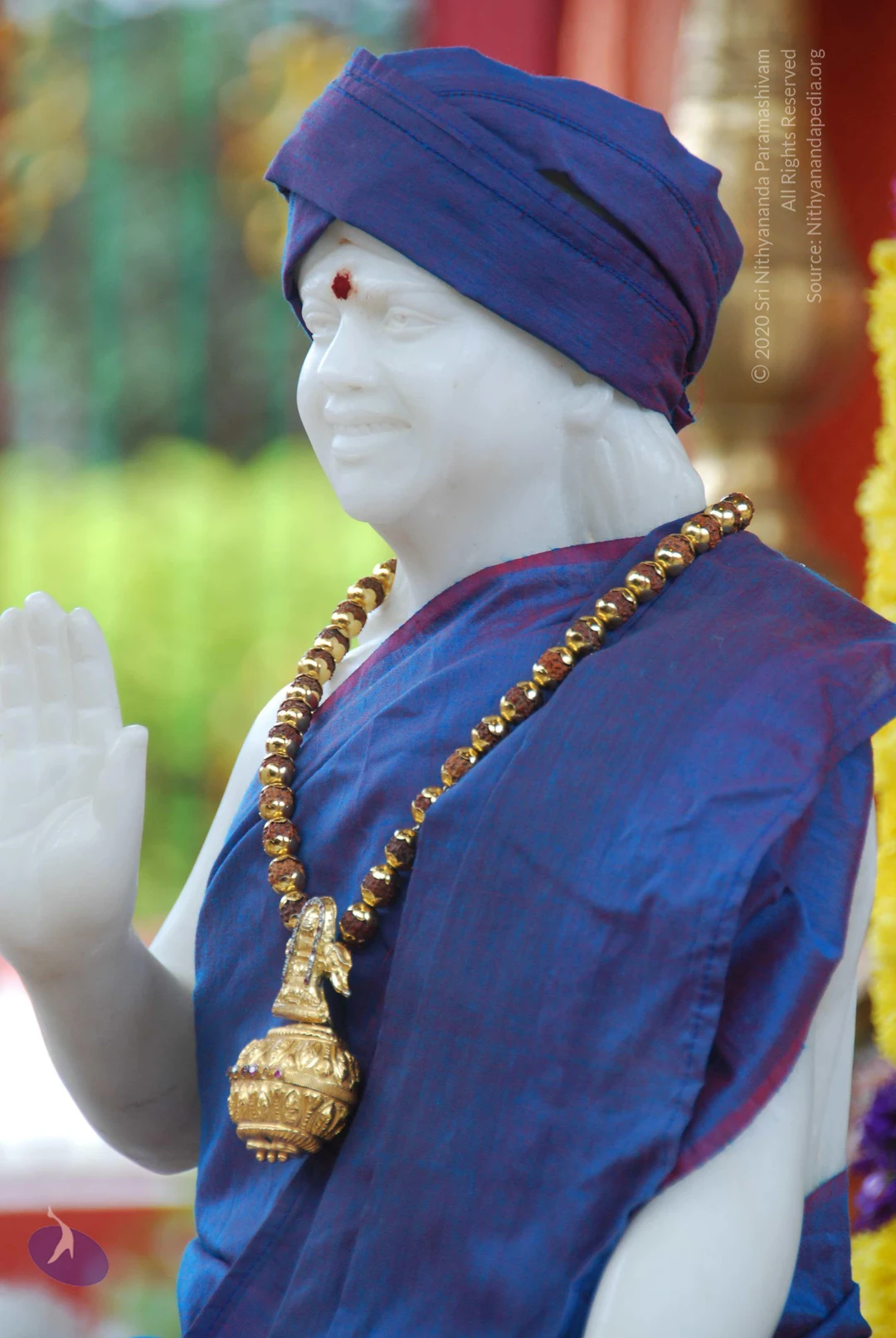
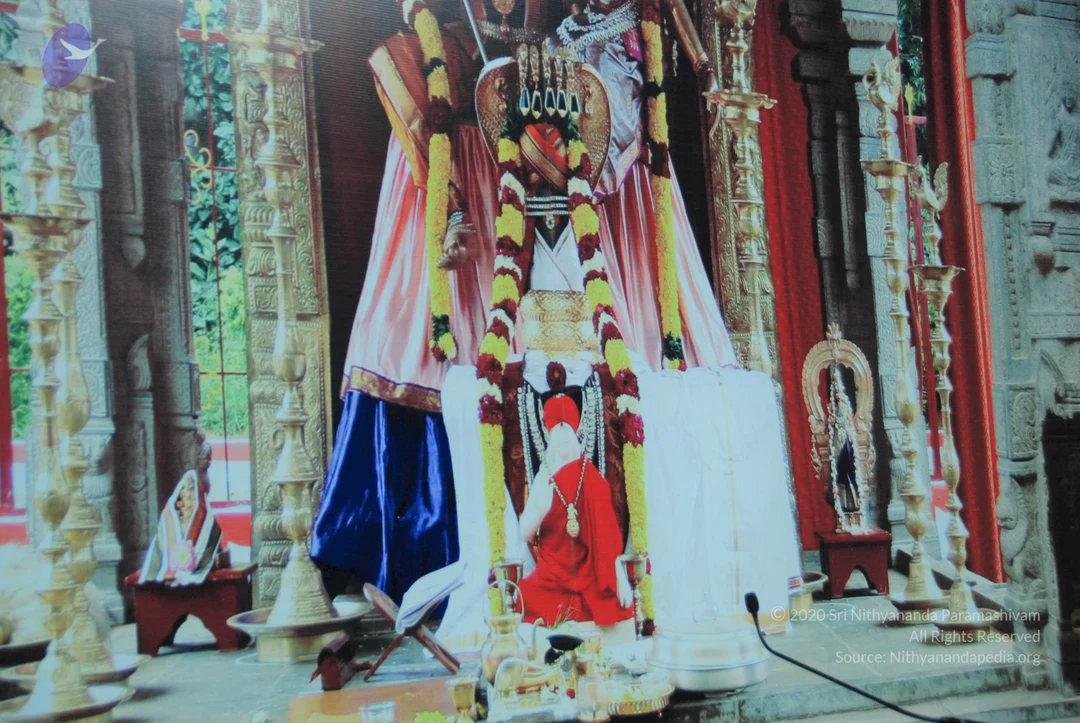
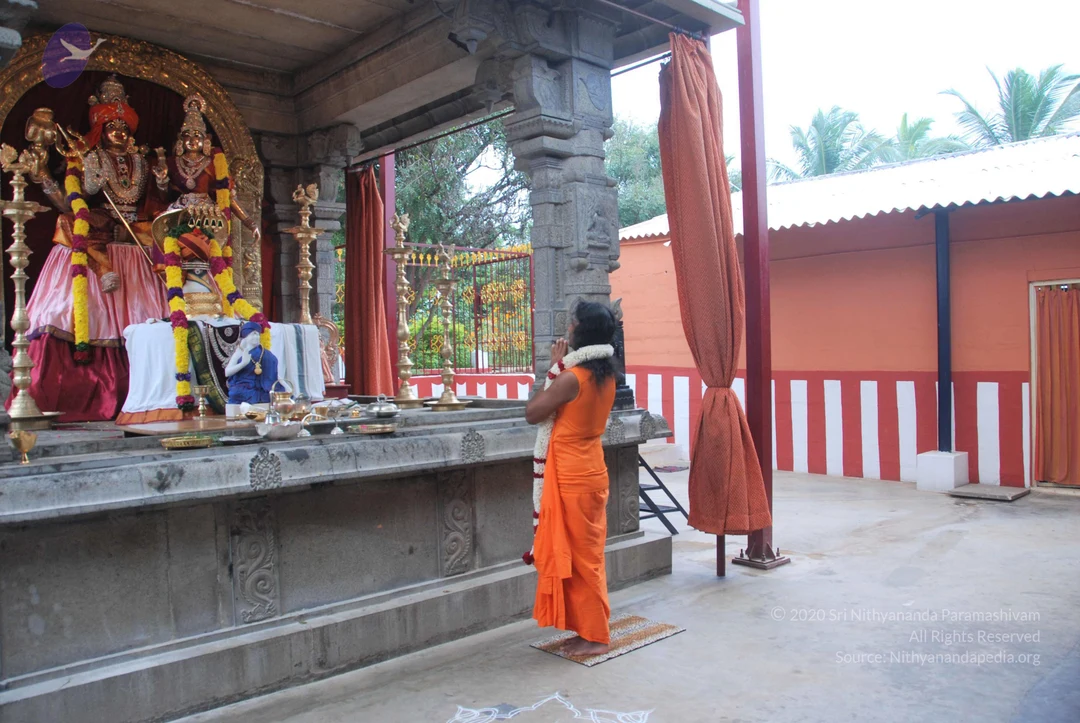
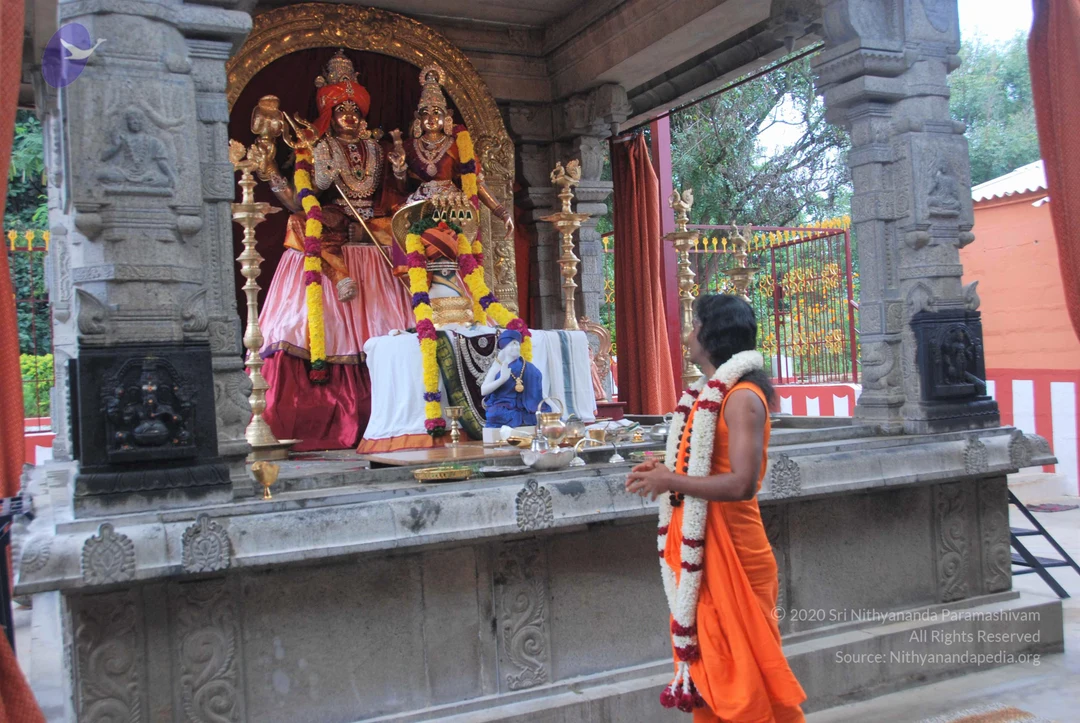
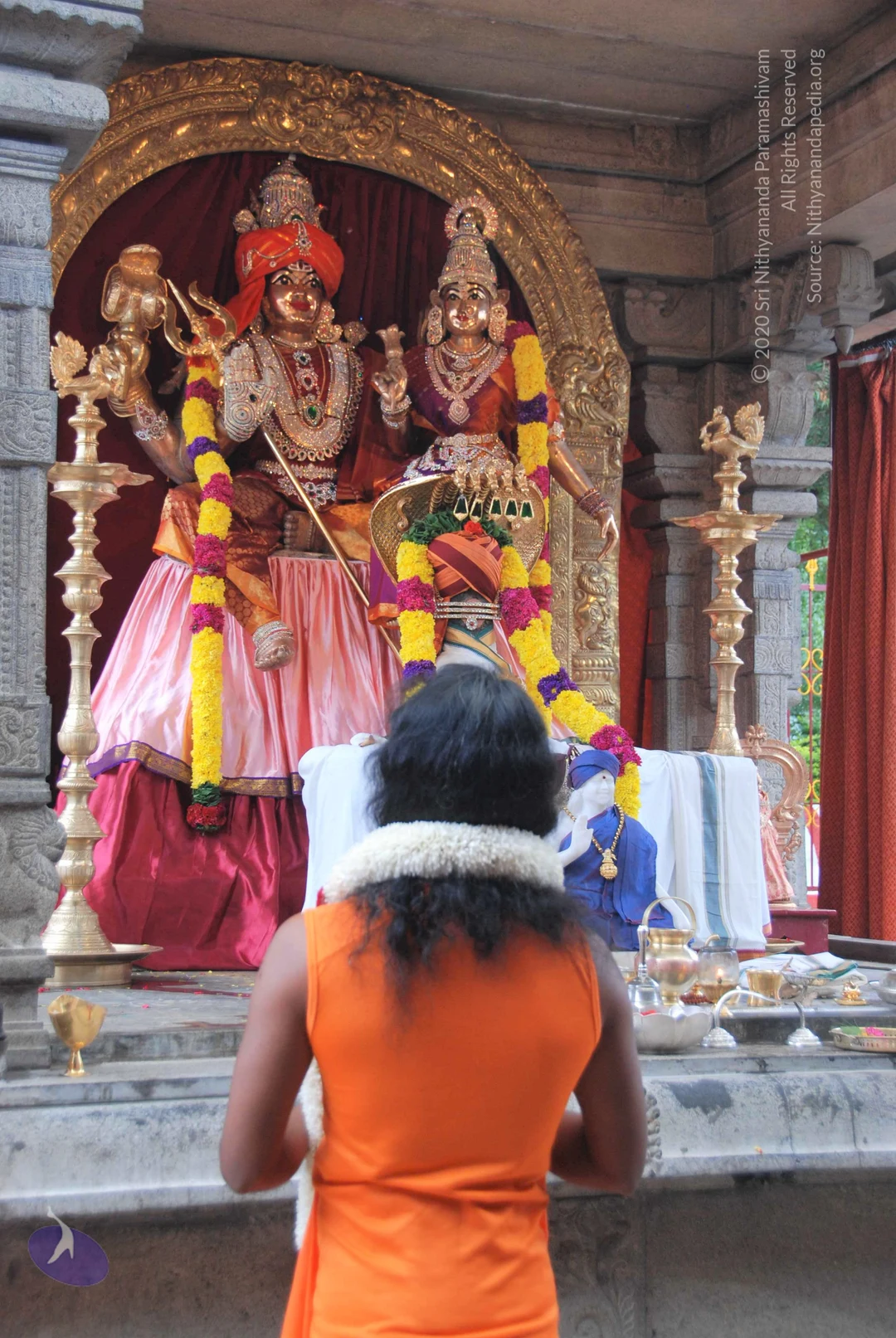
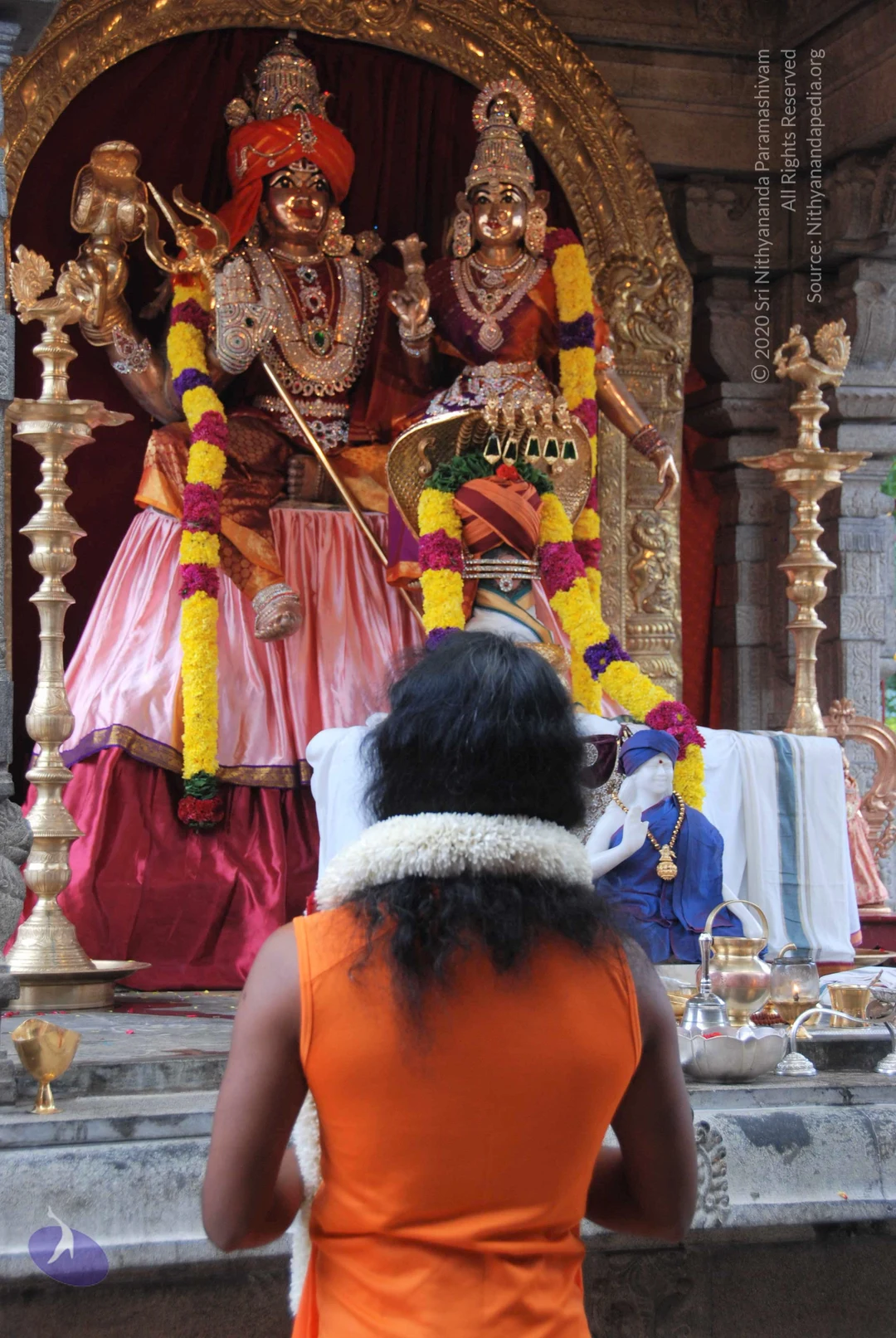
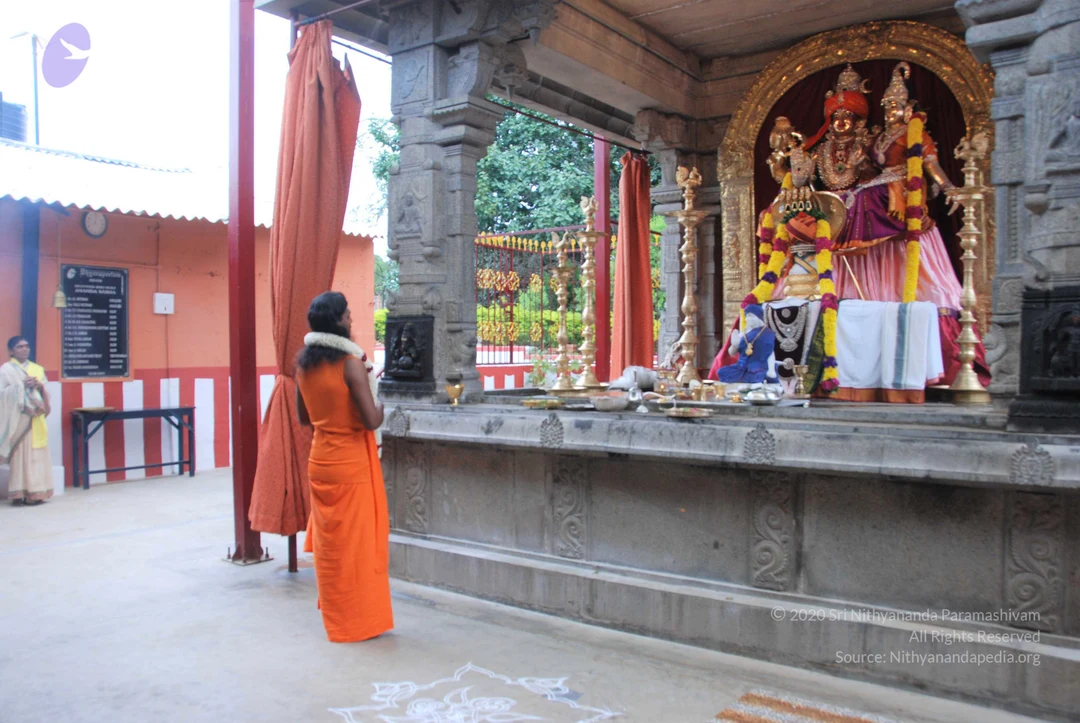
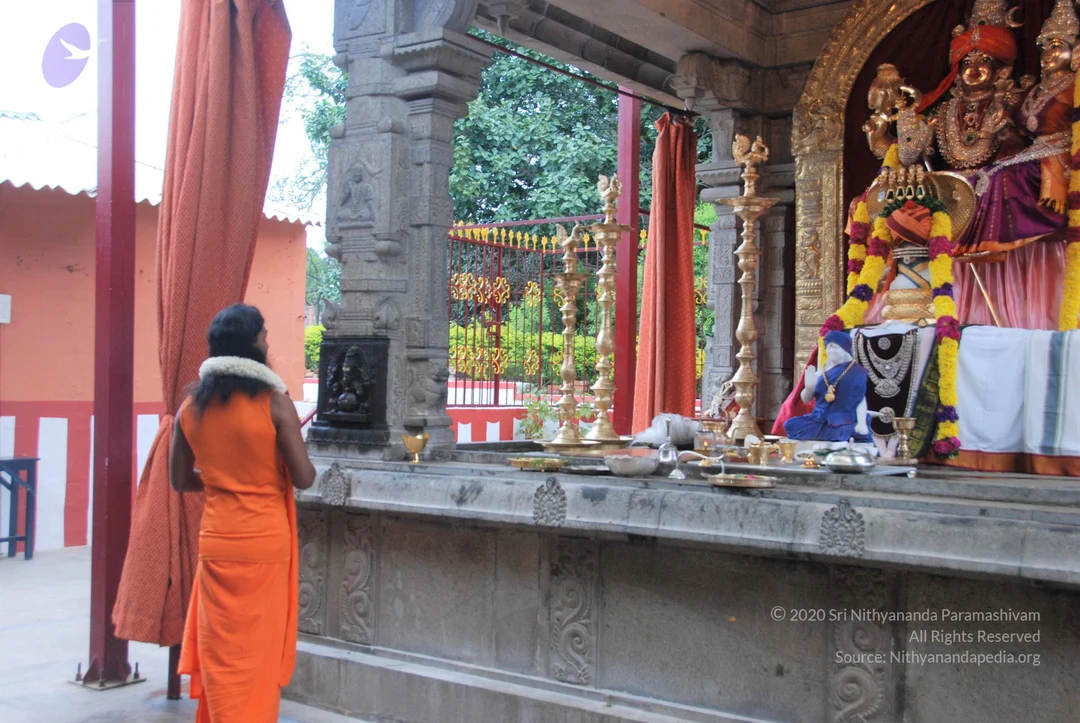
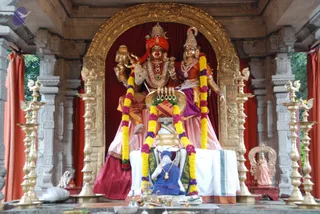
A temple shrine photograph showing a large bronze-toned deity murti of Shiva and Parvati seated in a gold-framed arch with a dark red curtain behind. The male figure wears an orange turban, a crescent ornament, a jewelled necklace and carries a trident; the female figure wears a purple and orange sari, layered gold jewellery and a crown. Both are garlanded with yellow and purple flower strings. In front, a white marble figure in a blue robe and orange headwrap, with a gold necklace and vibhuti mark, is seated on a white cloth. Brass puja vessels, a lotus-shaped bowl, a bell, a kalasha-like pot and an aarti tray with flowers sit on the ledge below. No living people are visible.A gilded arched shrine houses a large couple of deity murtis, a male figure with an orange turban and trident and a female figure in a purple-and-orange sari, both adorned with jewelled necklaces and crowns, seated before a red drape. Yellow and purple flower garlands hang from the figures. In front, a small white and blue seated figure sits beneath a golden canopy on a white-draped seat, surrounded by brass lamps, a bell, a plate and ritual vessels on a stone platform.A white marble statue of a seated sage in a blue silk robe and blue turban with a red tilak sits before a large deity murti adorned with gold and jewelled ornaments, a five-hooded serpent canopy and green-stone earrings. Yellow and magenta flower garlands drape down both sides. A gold-and-silver puja set with a brass kalasha-style vessel, a lamp, a bell and a tray of flowers sits in front. The statue wears a large gold rudraksha-style pendant and a multi-strand bead necklace, and its hands are shown in a blessing mudra. Pink and maroon silk draping forms the backdrop. No living people are visible.A photograph of a temple shrine centred on a seated white statue wearing a blue dhoti-style garment, a blue head wrap and a gold-coloured pendant necklace, with a raised hand in blessing. Long garlands of yellow and purple-magenta flowers hang from the figure. Behind it stands a large deity murti with a gold crown and ornate gold jewellery, draped in pink and magenta silks. Brass oil lamps flank the shrine, and silver and brass vessels with a kalasha-style pot sit on a white-draped platform in front. The statue is a statue, not a living person, and the scene holds no physical people.A photograph of a temple shrine with a large golden arched frame behind a deep red curtain. Two large deity murtis stand at the back: the figure on the left holds a trident-like staff and wears a red-orange turban and a jewelled necklace, while the figure on the right wears a crown, a pink-and-purple sari-style garment and a gold necklace. Both are garlanded with yellow and red-pink flower garlands. In front, a seated figure wears a white dhoti and a blue shawl with a gold chain, a red-orange turban, and hands folded near the chest, with a flower garland draped over the seat. Tall brass oil lamps stand on either side, and brass vessels and a small offering plate sit on the stone platform. Temple pillars and orange curtains frame the scene.A gilded temple shrine framed by a golden arch and red curtains holds two large deity murtis, one male with a red turban and a tall crown, the other female with a crown and pink-and-purple sari, both draped with yellow and purple marigold garlands. Their hands hold a drum and other objects. In front, a small seated figure in a blue garment and white cloth is covered with flower garlands, with a silver offering vessel and brass lamps arranged on both sides. The pictured figure is a statue, not a living person.
03

02-Pancha-Tapas

39 dated photos in previewSource gallery
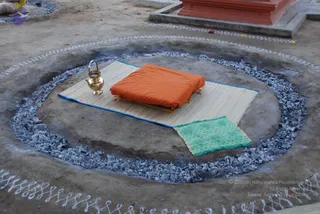
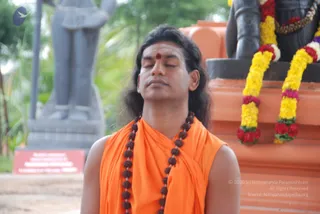
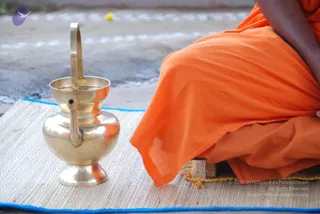
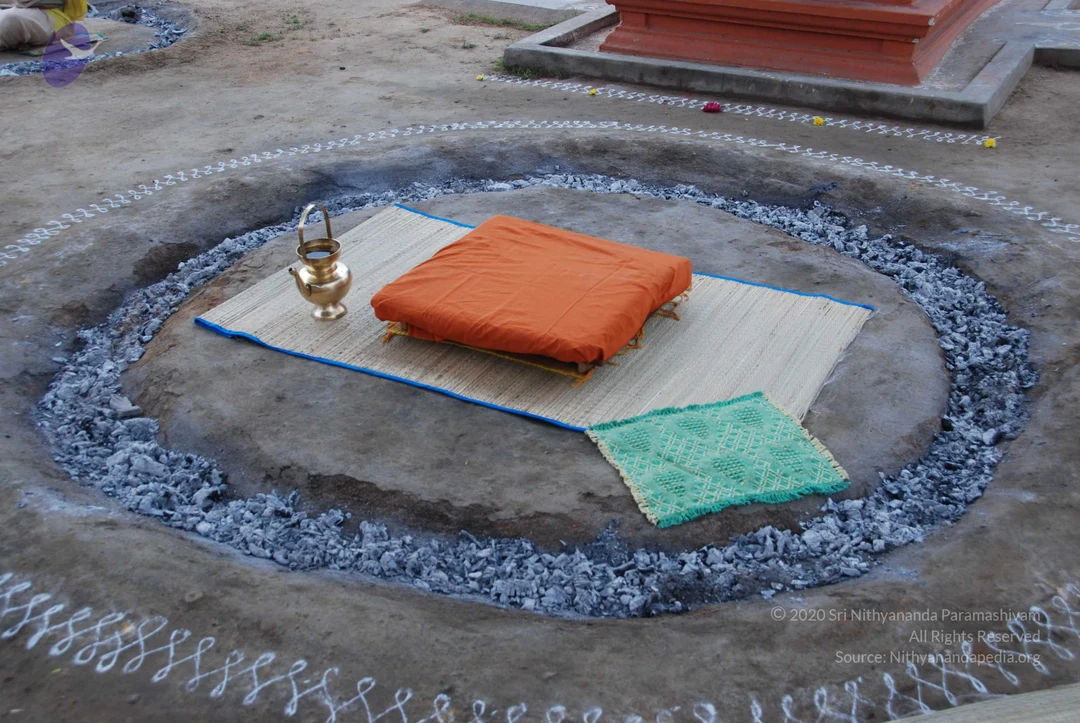
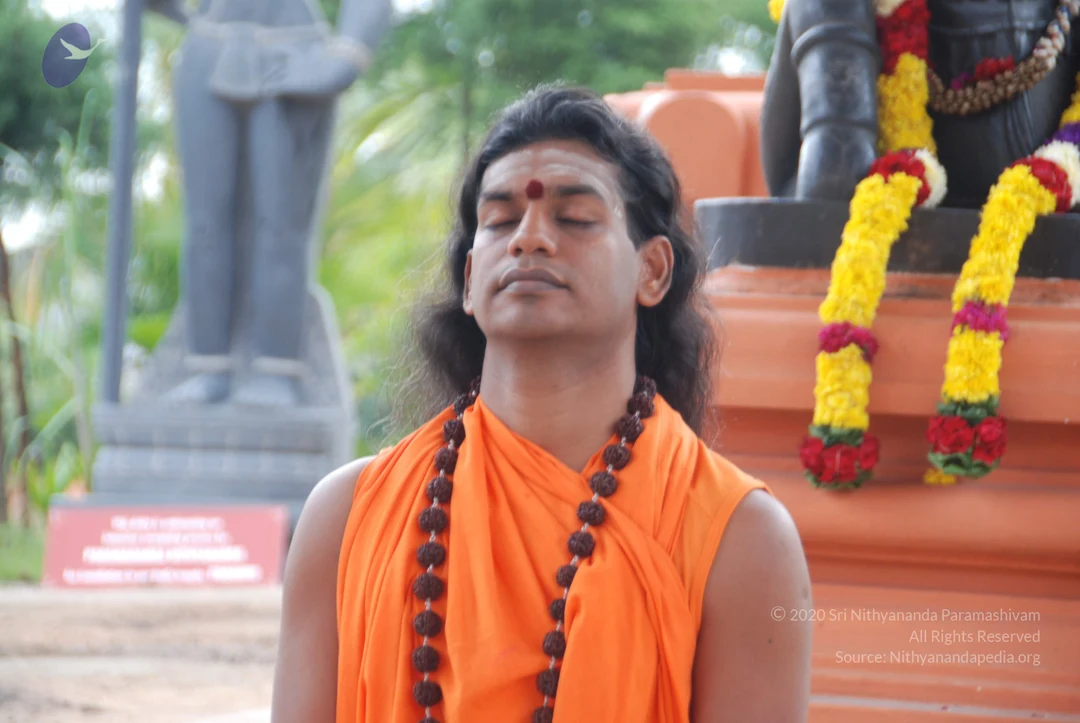
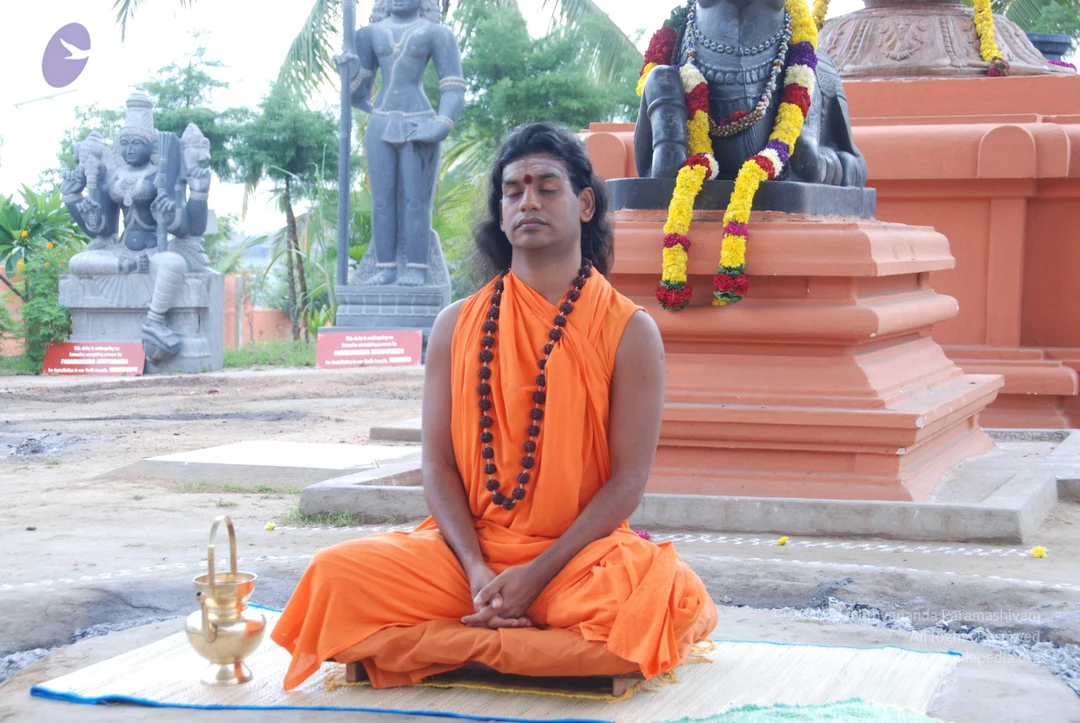
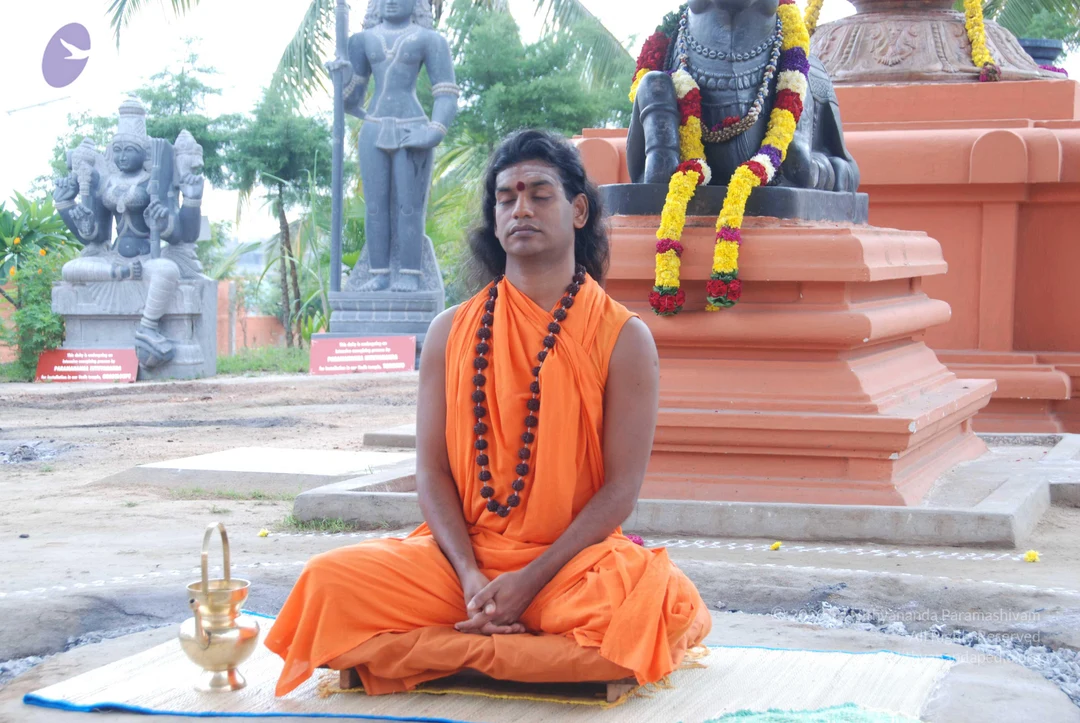
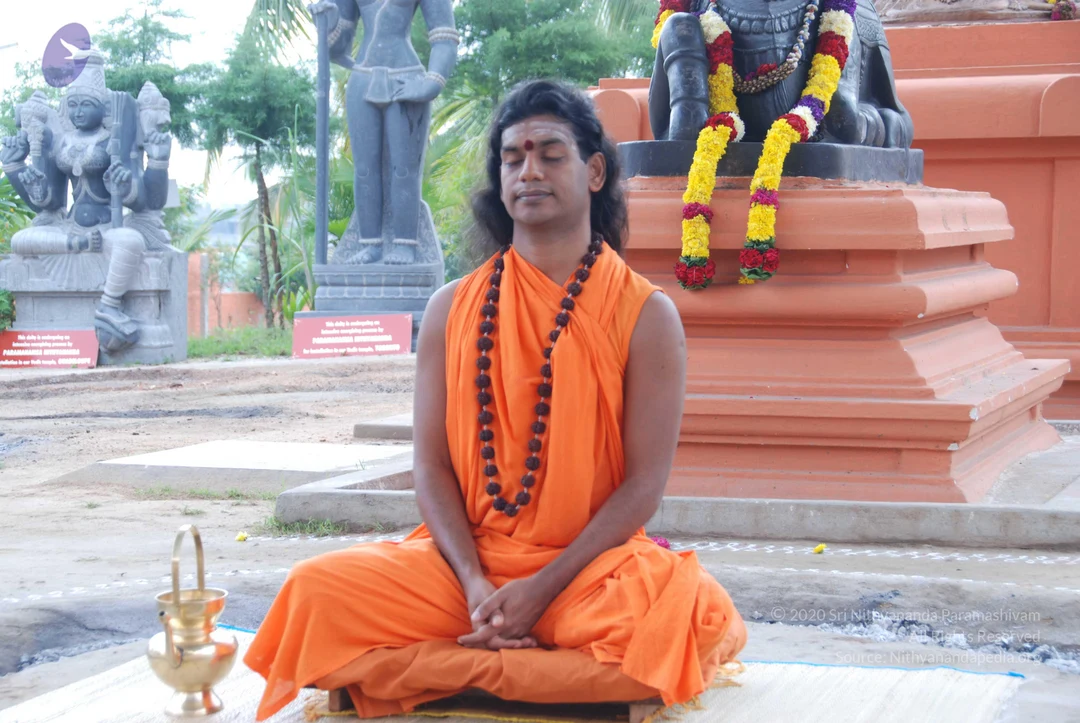
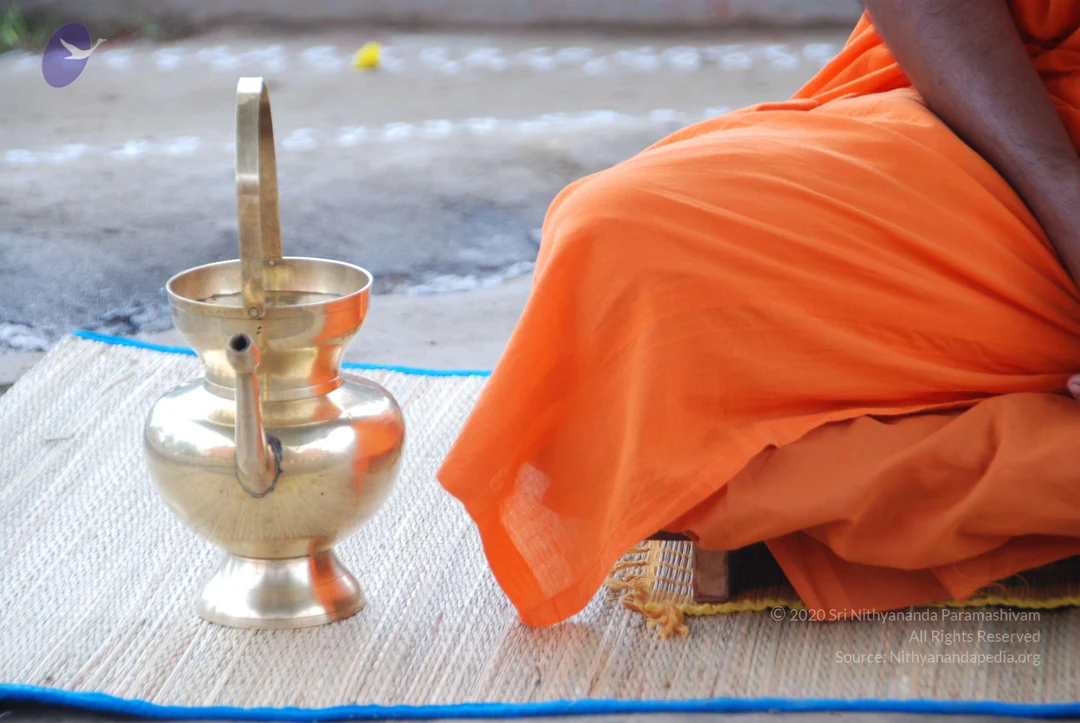
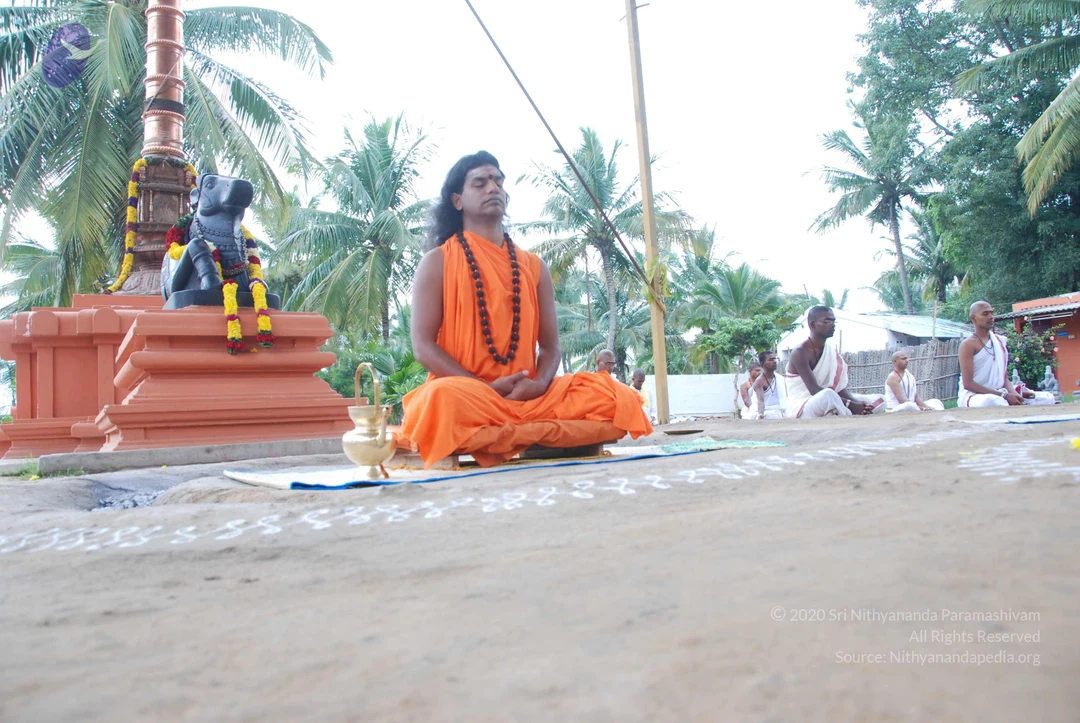
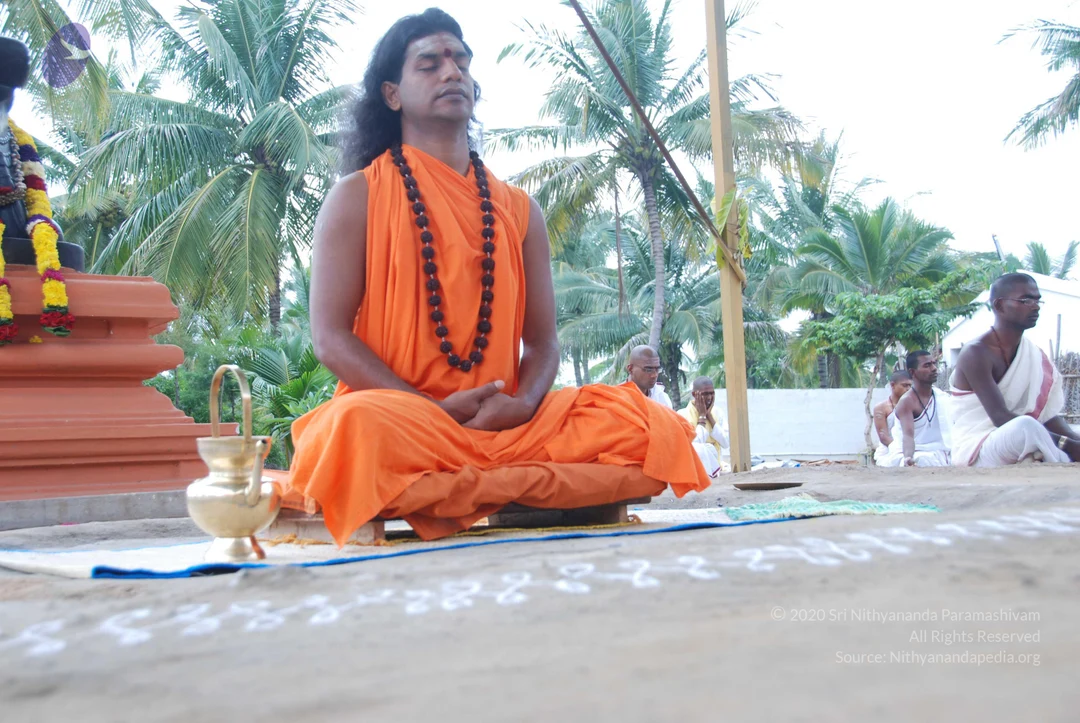
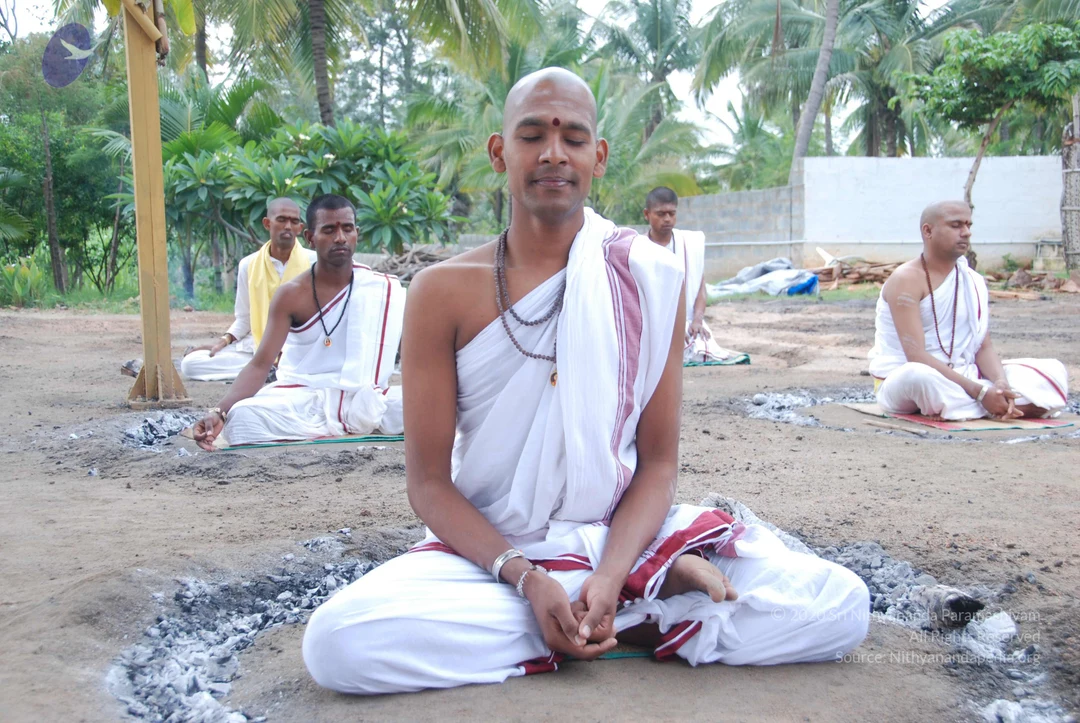
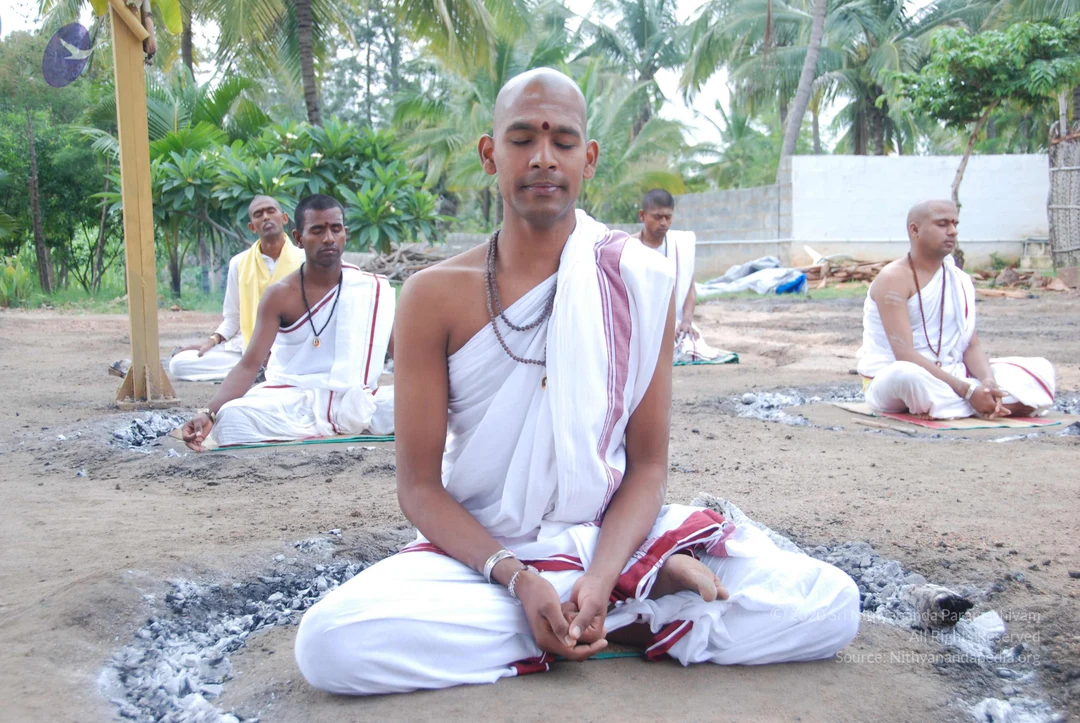
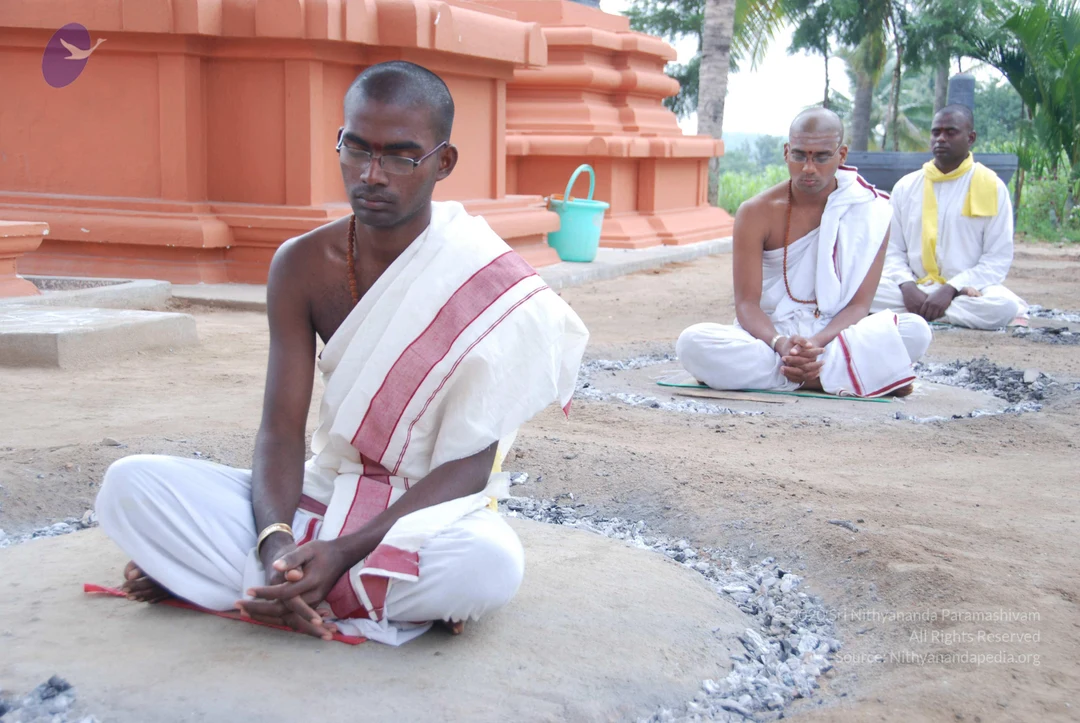
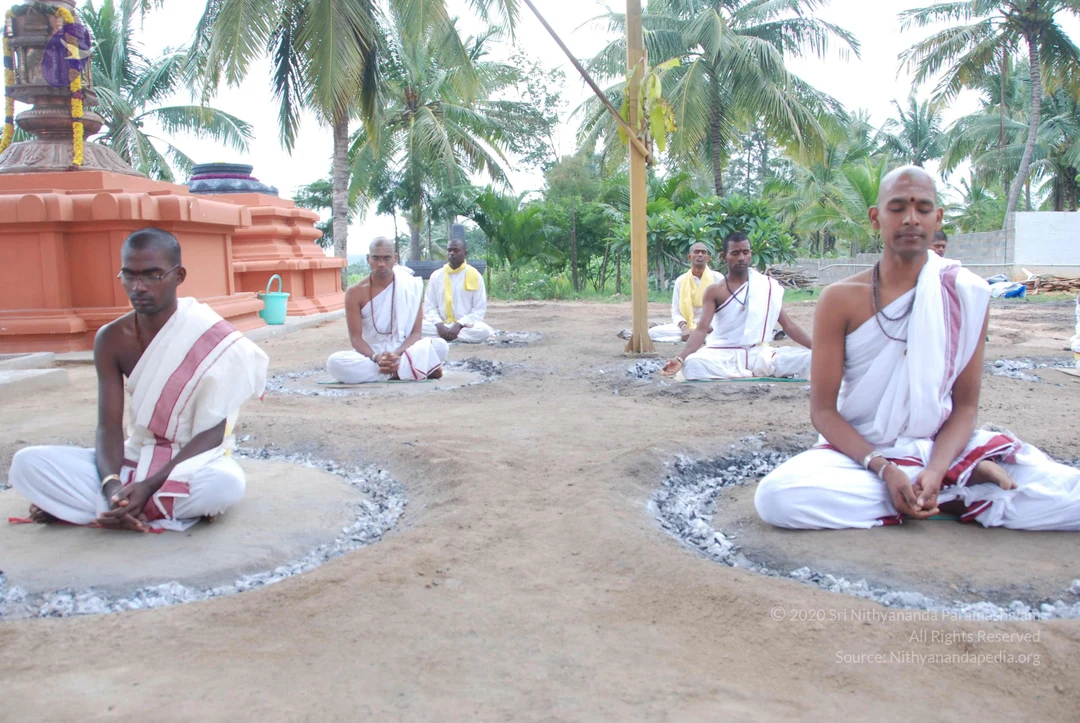
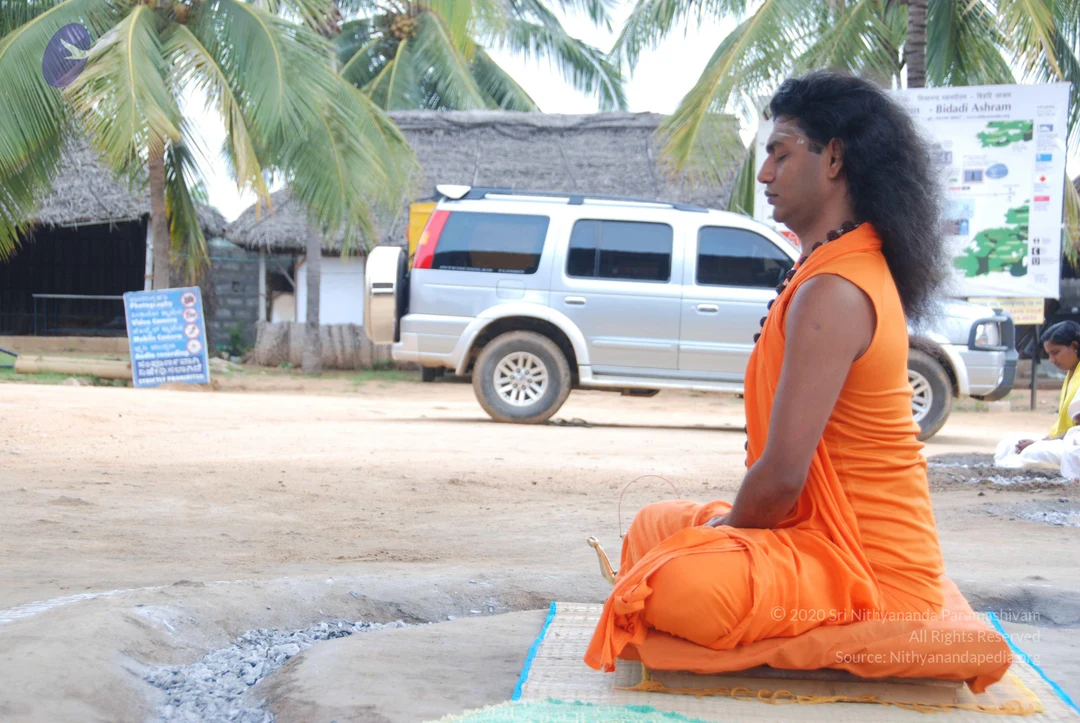
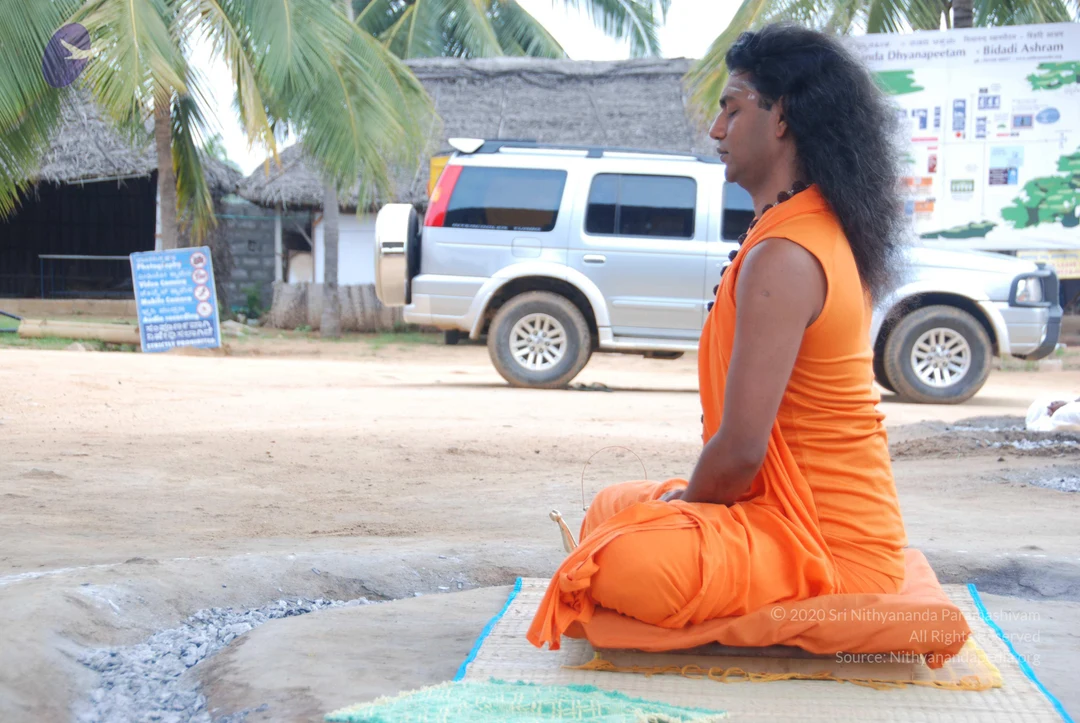
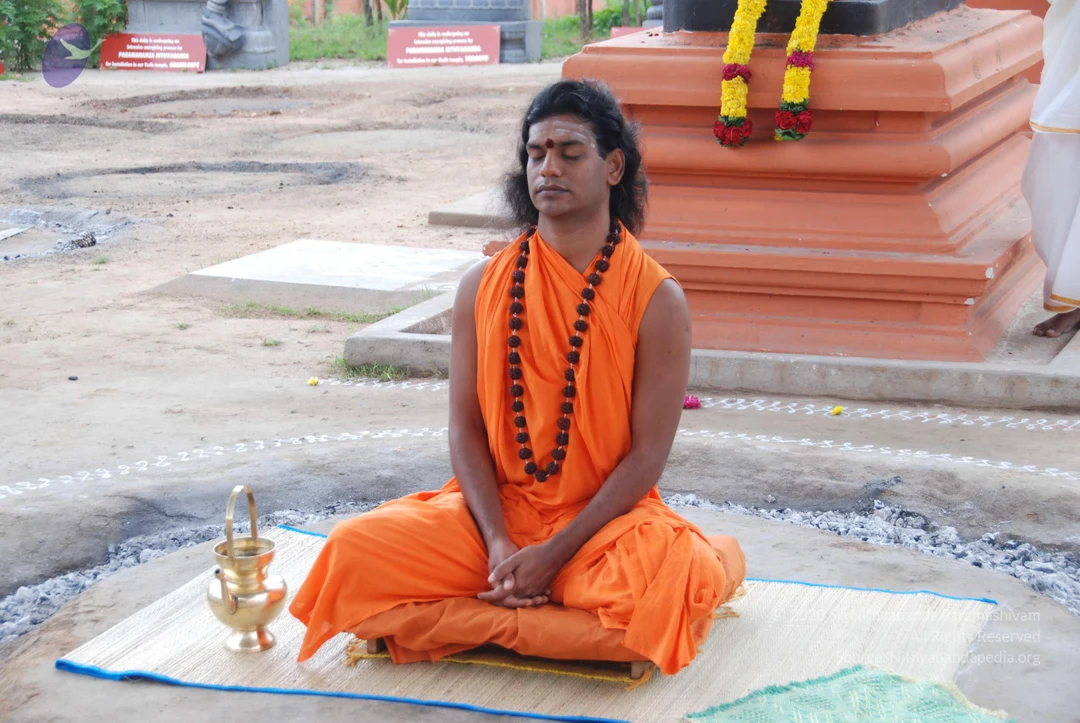
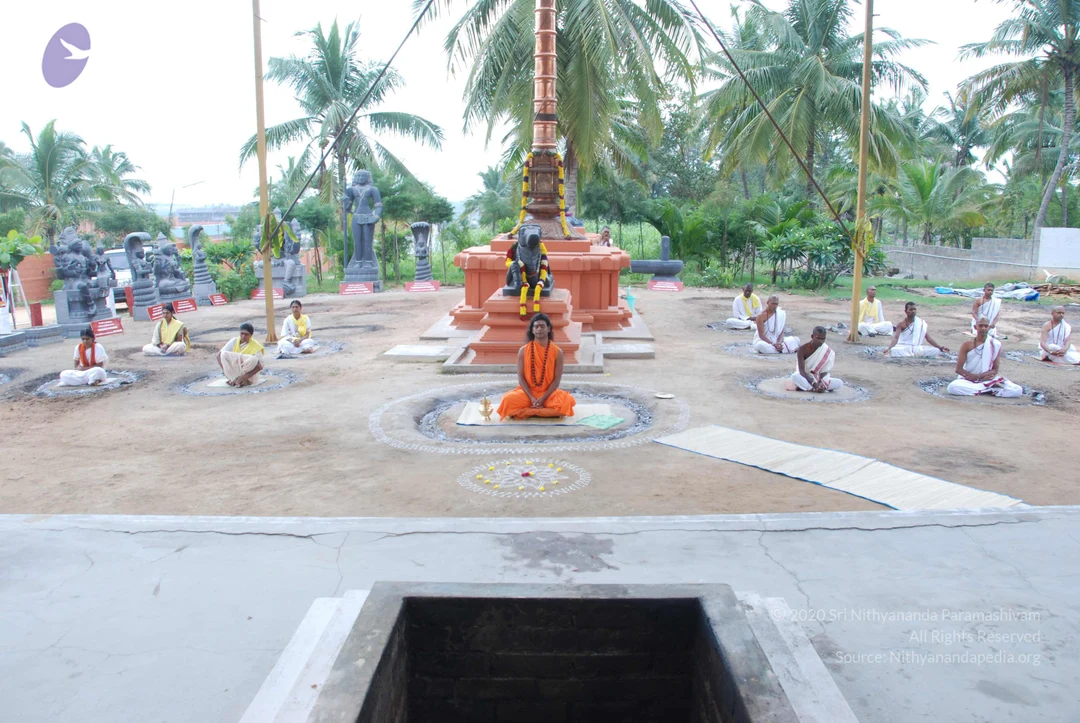
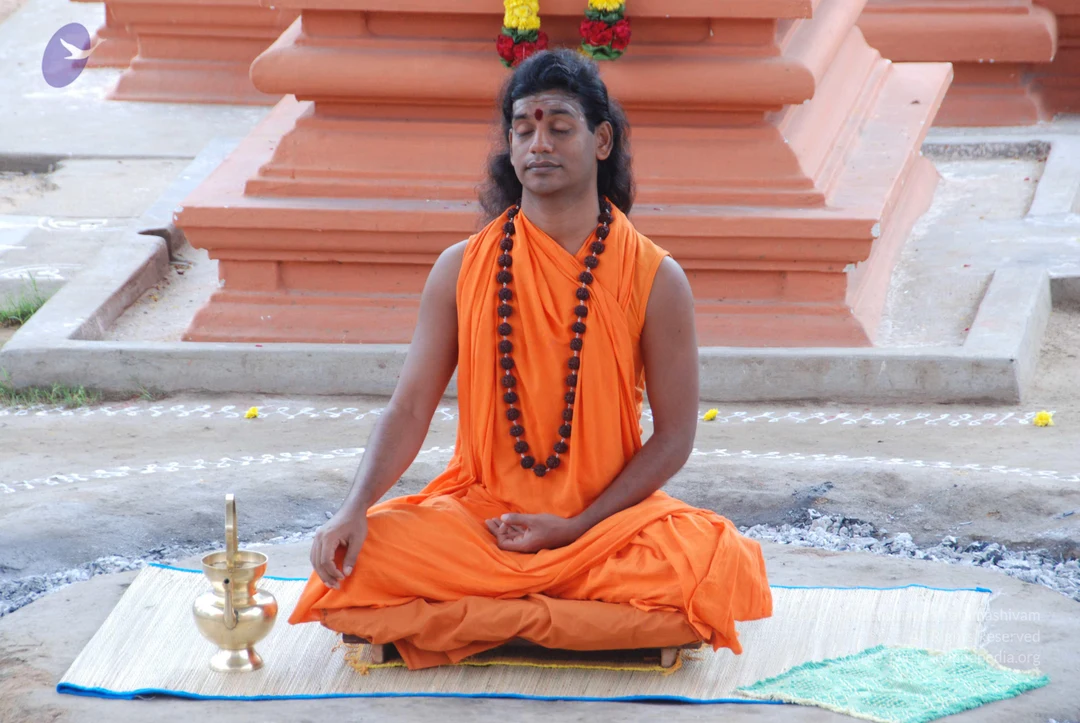
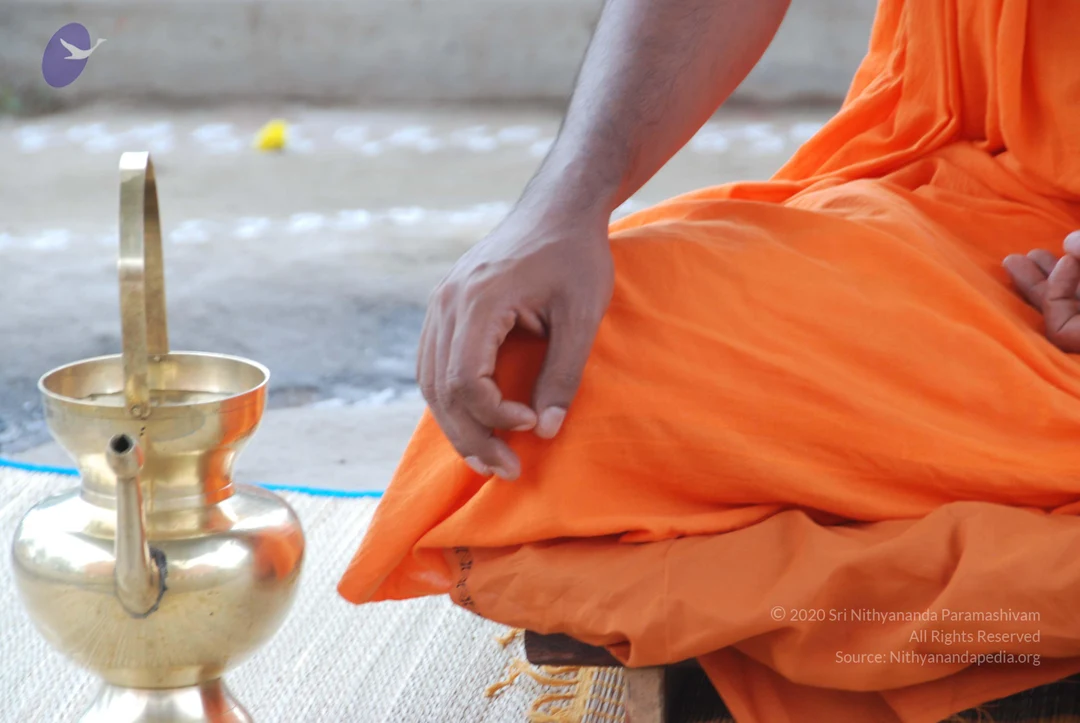
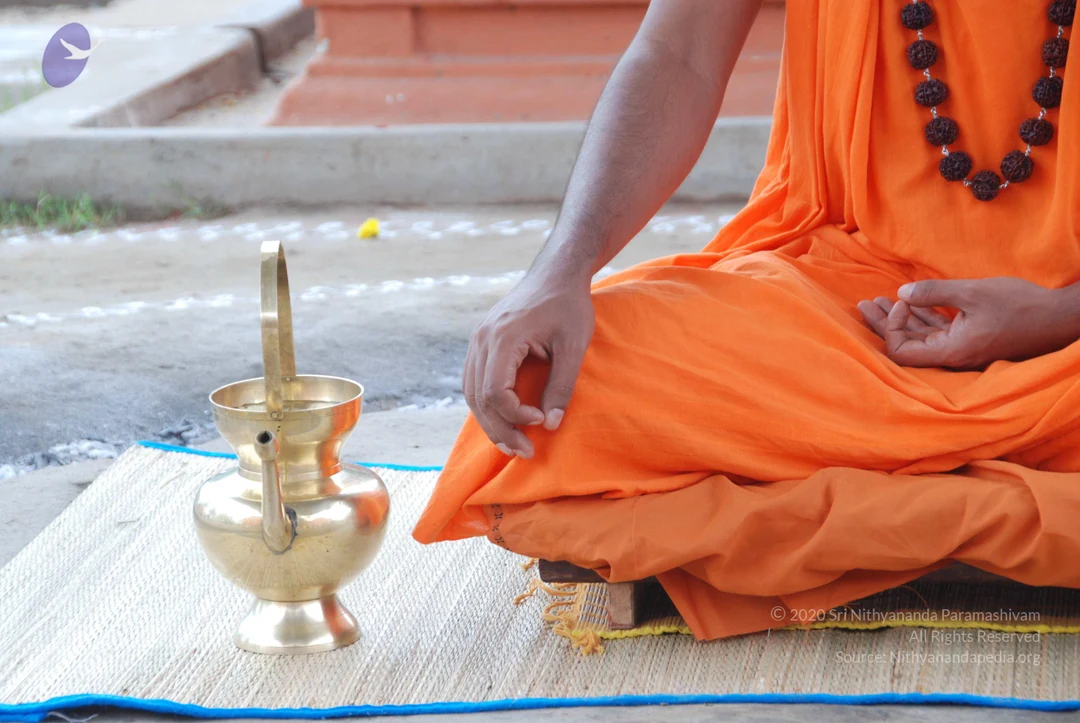
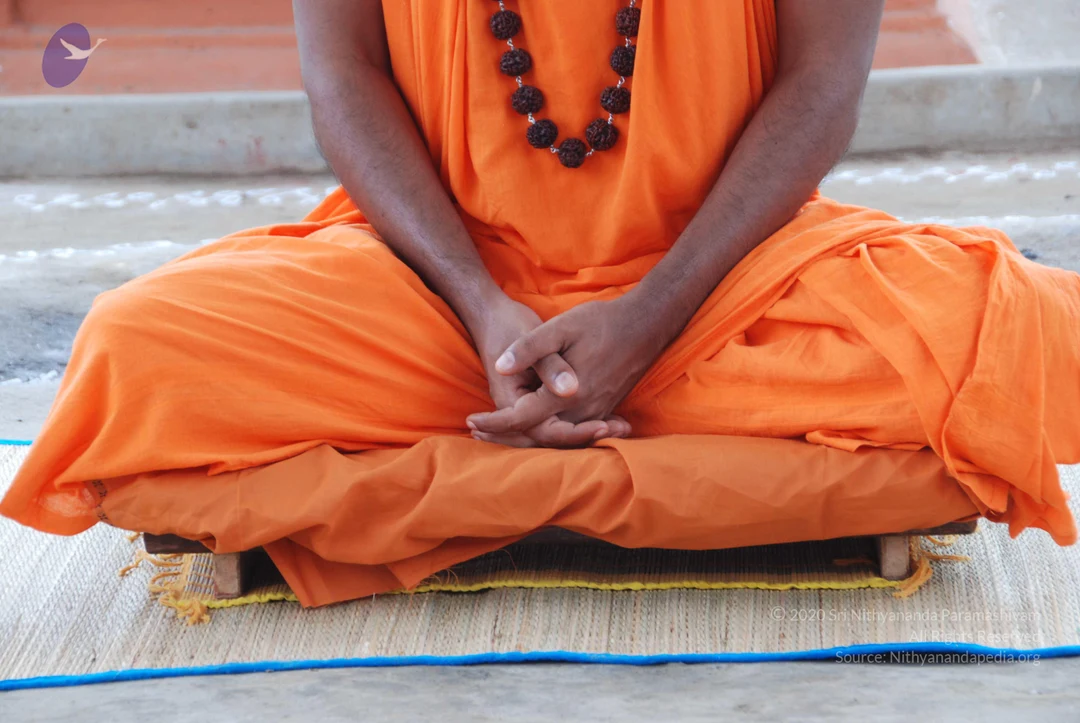
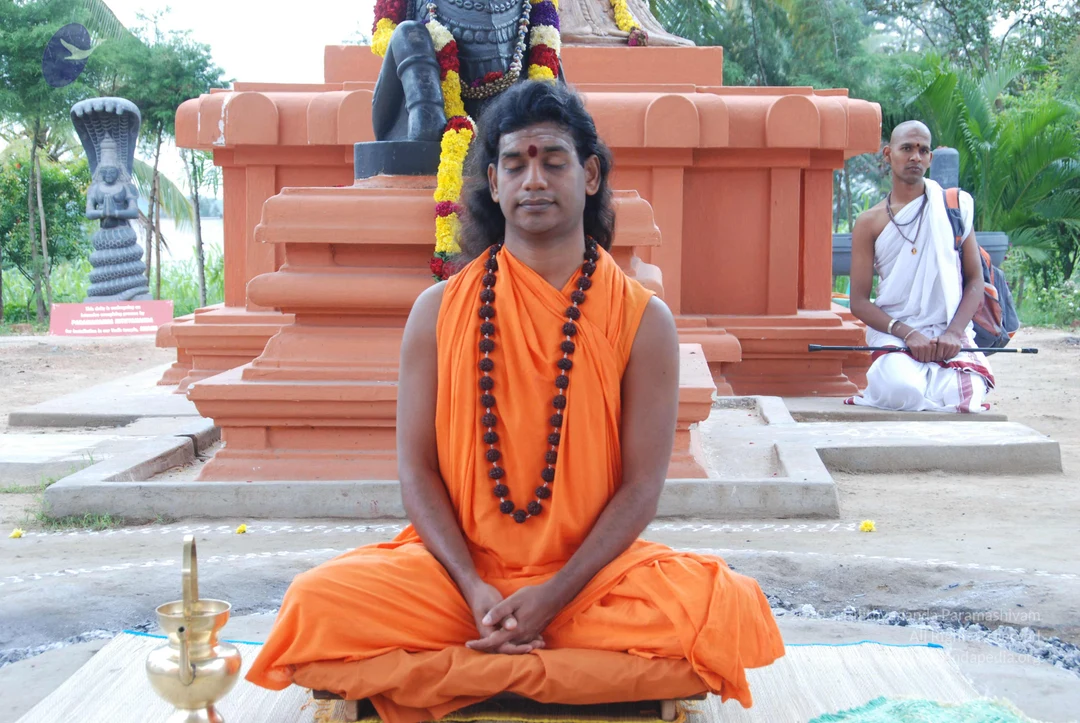
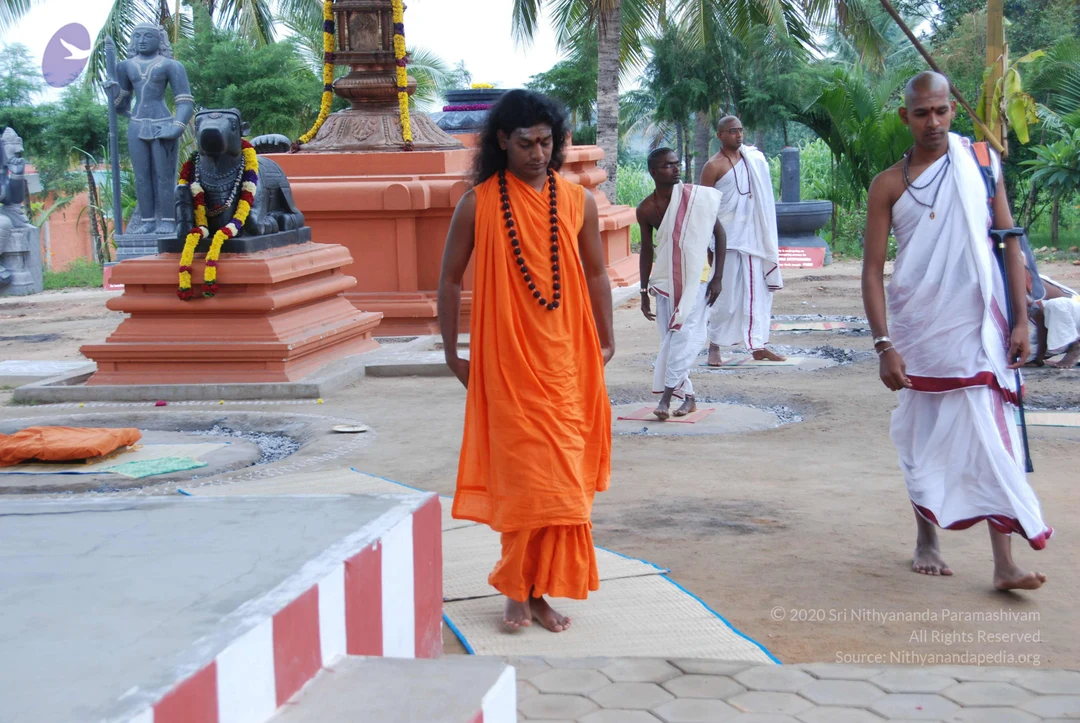
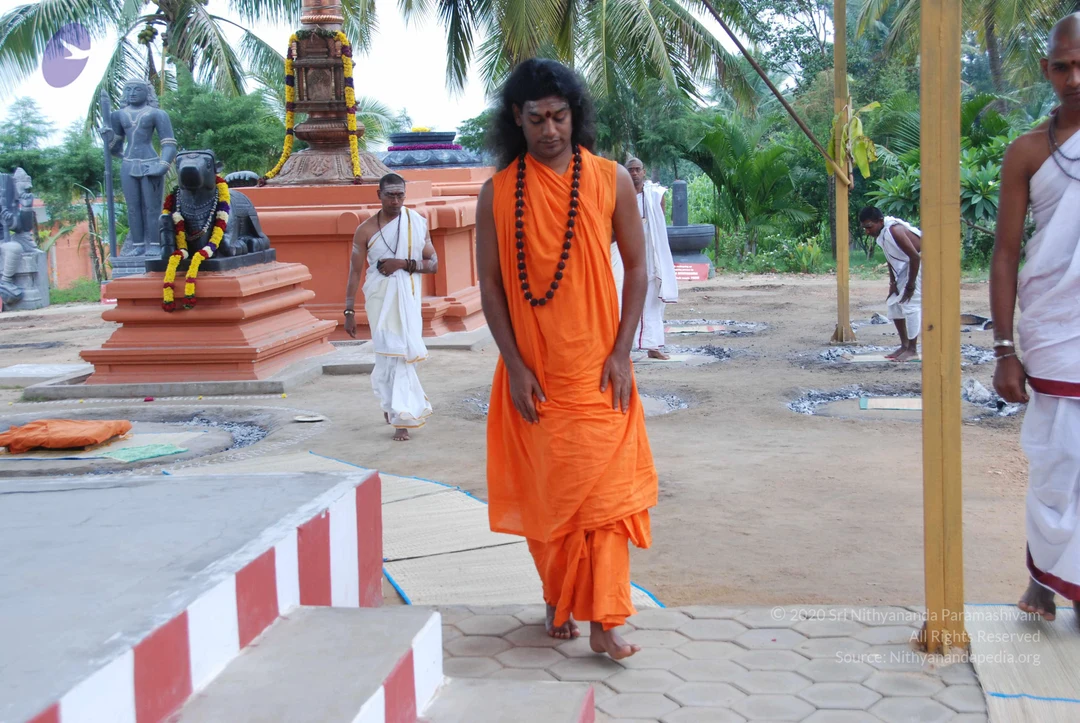
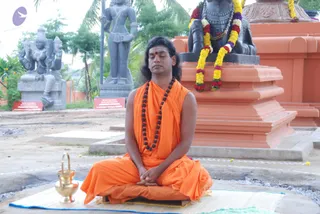
An outdoor ritual site on bare earth with a circular ring of grey-black ash or charcoal around a raised mound. On the mound sits a folded orange cushion on a cream woven mat with a blue border, with a smaller green patterned mat laid at its side. A brass kalasha-style vessel with a handle stands at the left edge of the mat. White lines of kolam or rangoli-style patterns decorate the ground around the ring, and a red-painted stepped pedestal or altar base is visible at the top right. No people are visible; a partial figure in yellow clothing appears at the far top left edge. The seat appears prepared for a teacher, with no one occupying it.A man with long dark hair sits with eyes closed in meditation, wearing a sleeveless saffron-orange garment over his shoulders and a long rudraksha mala of dark beads around his neck. A red bindi marks his forehead. Behind him stands a large dark stone deity murti, its base draped with garlands of yellow and red flowers. A grey stone statue of a standing figure and green foliage appear in the background, and a small red sign with white text sits near the bottom left. Outdoors, in daylight.A seated man in an orange-saffron robe sits cross-legged on a woven mat in an open outdoor courtyard, eyes closed, hands resting folded in his lap, wearing a dark rudraksha mala and a red bindi on his forehead. Behind him stands a large orange-red stone plinth draped with a garland of yellow, orange and red flowers, with a grey stone sculpture of a seated deity figure above it and a standing grey stone deity figure to the left, the figure on the left holding a trident-like staff. A brass kalasha-style pot sits on the mat beside him. This appears to be a meditation or satsang setting. The man is an appearance-based candidate for Swamiji (probable): long swept-back hair, saffron clothing and a rudraksha mala are visible cues.A man with long dark hair and a red bindi sits cross-legged in meditation with eyes closed and hands folded in his lap on a woven mat. He wears a sleeveless saffron-orange robe and a long rudraksha mala. A small brass oil lamp sits on the mat beside him. Behind him is a large orange stone plinth with a seated black stone deity murti draped in yellow and red marigold garlands, flanked by grey stone sculptures of deities and a tall standing figure holding a staff. Red signboards with white text stand on the ground at left and centre, and the sandy courtyard is scattered with yellow flower petals.A man in a seated meditation pose on a white cloth outdoors, eyes closed and hands resting in his lap. He wears a sleeveless saffron-orange robe draped over one shoulder, a dark rudraksha mala around his neck, and a red tilak on his forehead. Behind him stands a tall orange plinth draped with a garland of yellow, red and purple flowers, and a dark stone deity murti sits on top. To the left stand grey stone sculptures of deities and a brass kalasha-style oil lamp sits on the cloth in front of him. Probable Swamiji by his long swept-back hair, saffron robe and rudraksha mala, seated in meditation.A photograph of a seated figure in an orange saffron robe, cropped so only the lap, legs and forearm are visible. In the foreground is a polished brass kamandalu-style water vessel with a tall curved handle and a spout, placed on a woven straw mat with a blue edge. The background shows a grey concrete surface with white painted marks. The arrangement suggests a ritual or sitting-practice setting, with the water vessel used as a purification or offering object.
04

03-Pada-Puja

69 dated photos in previewSource gallery
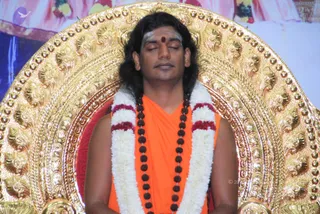
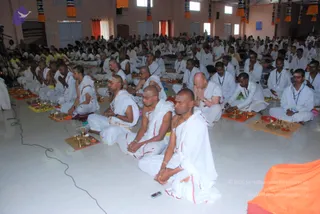
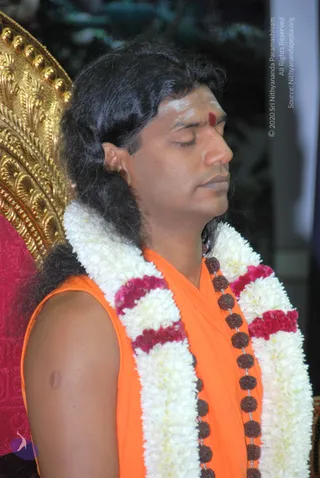
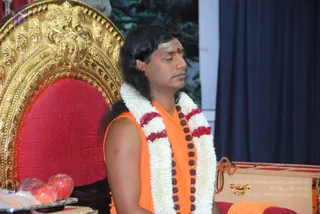
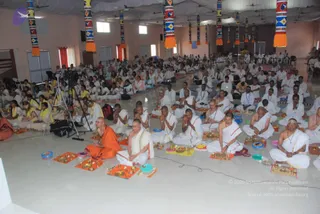
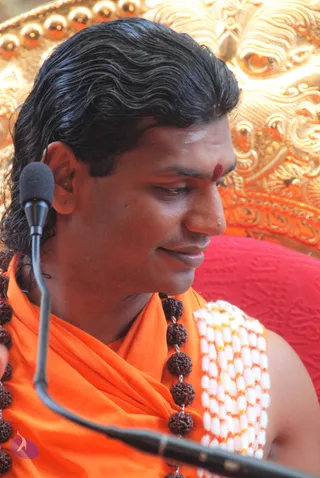
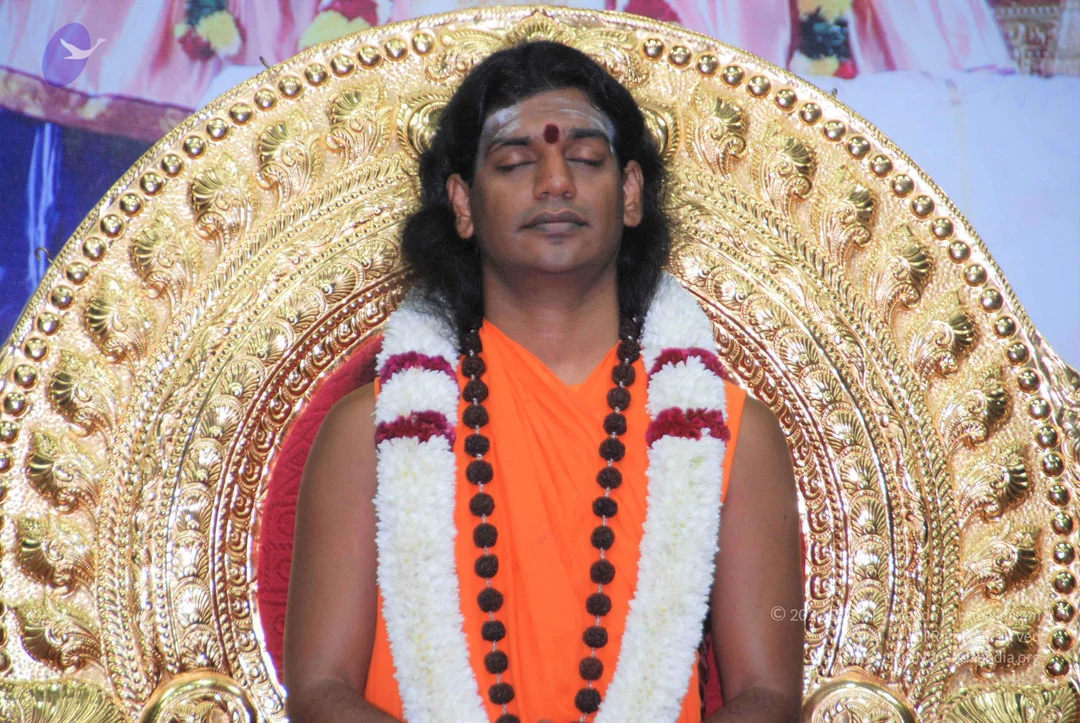
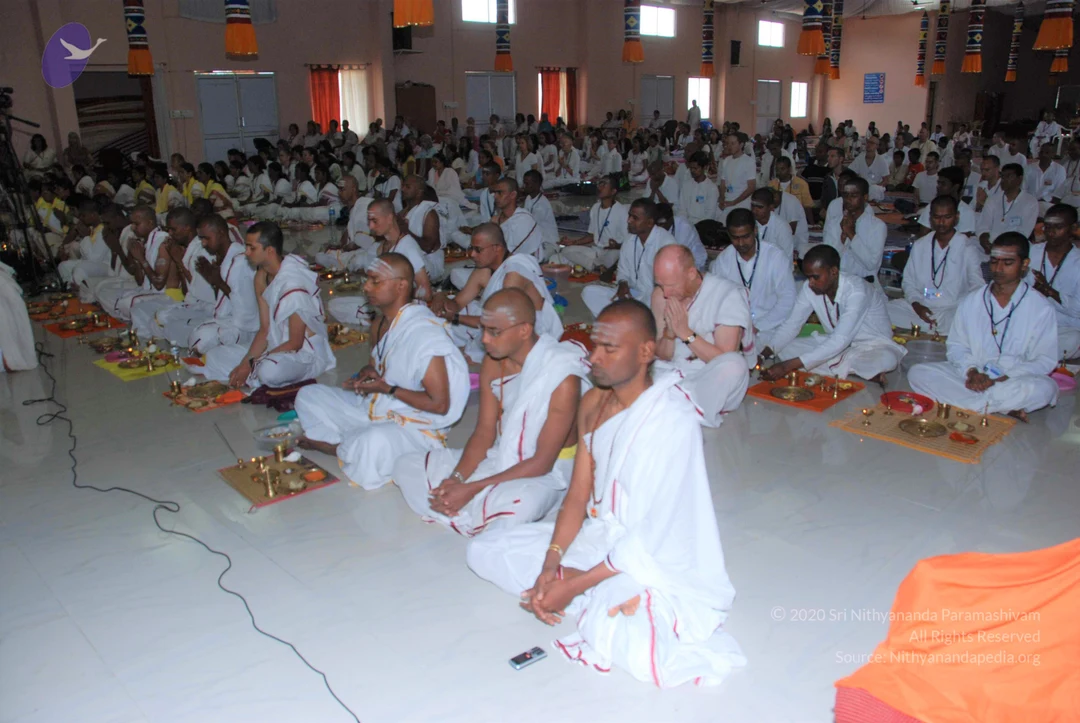
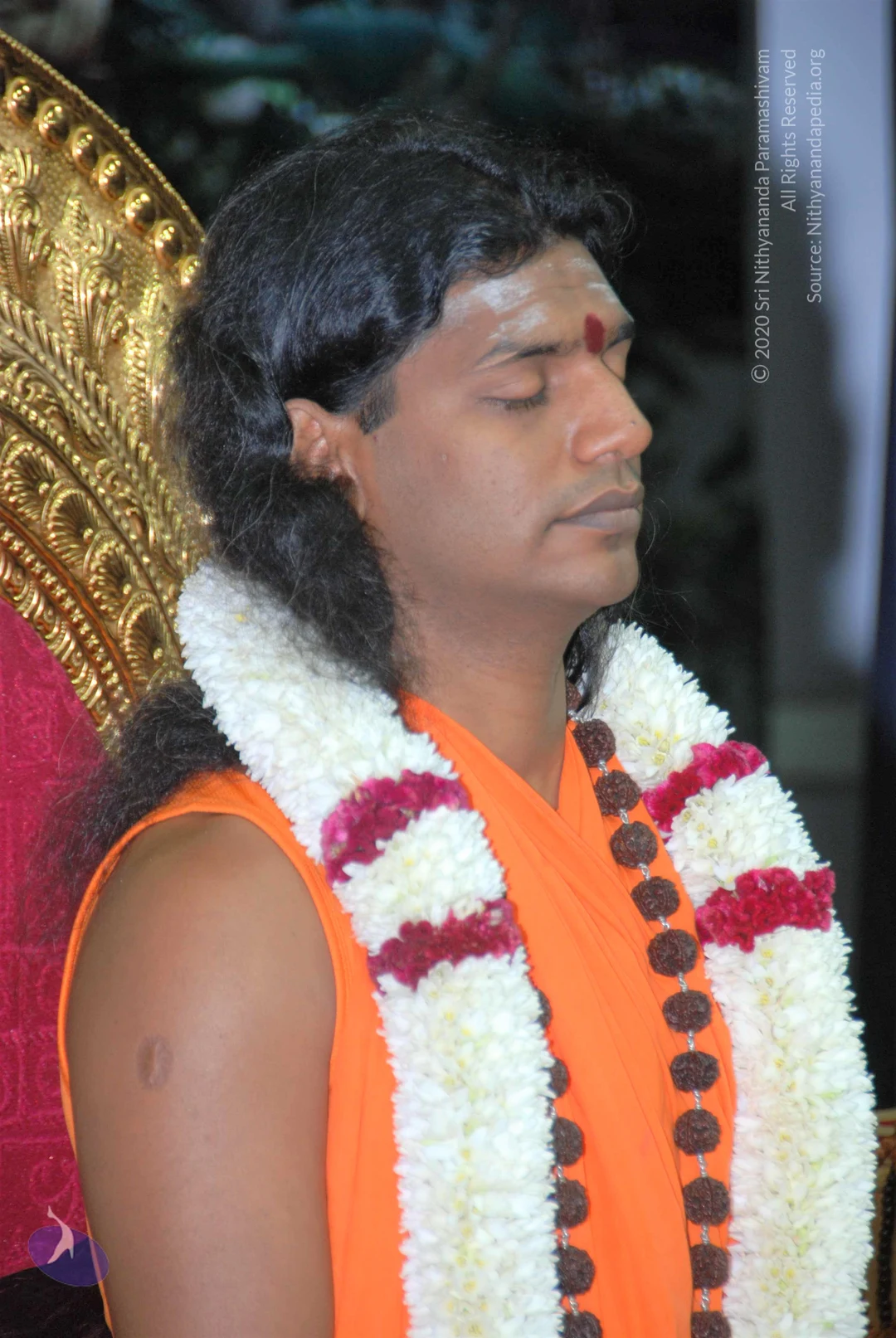
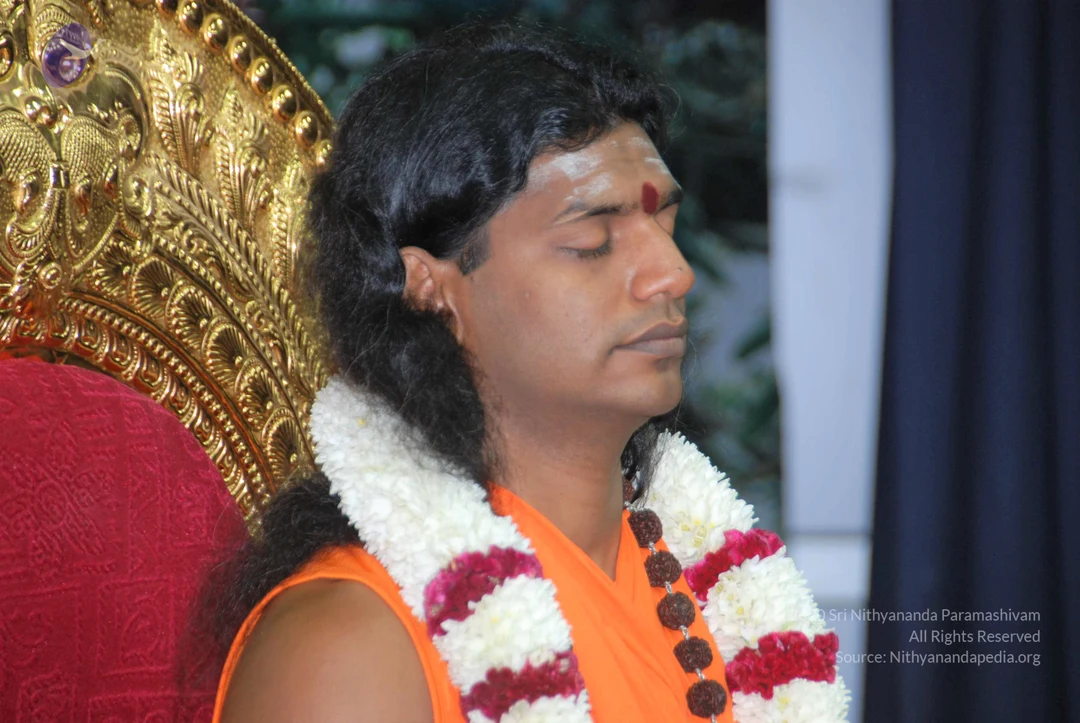
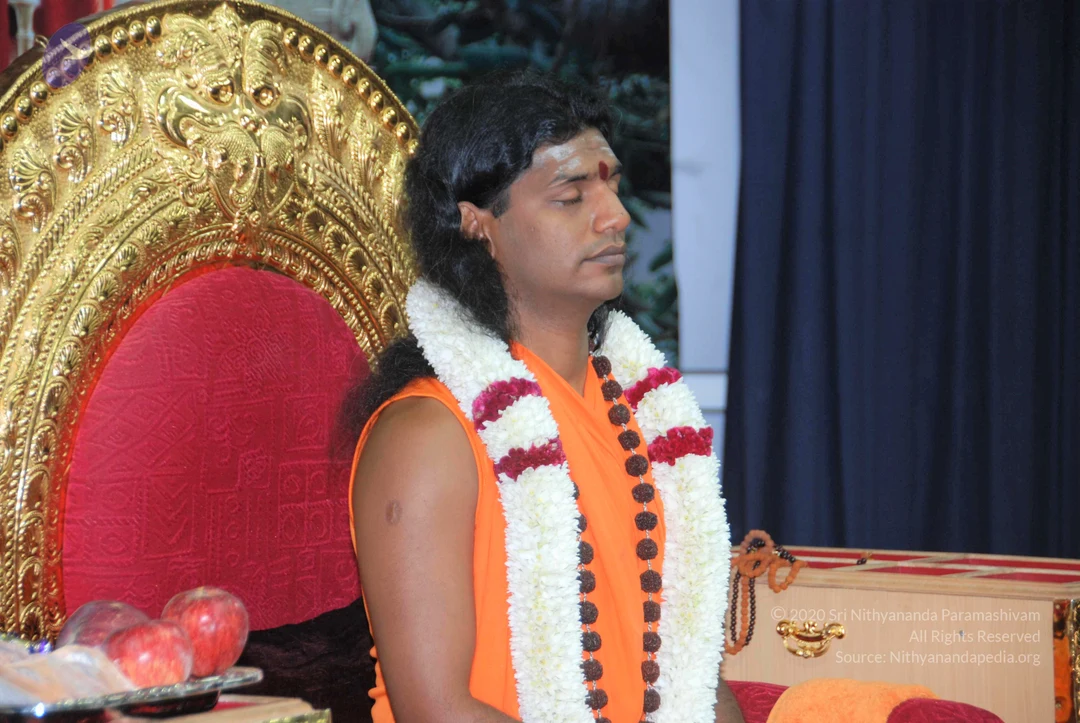
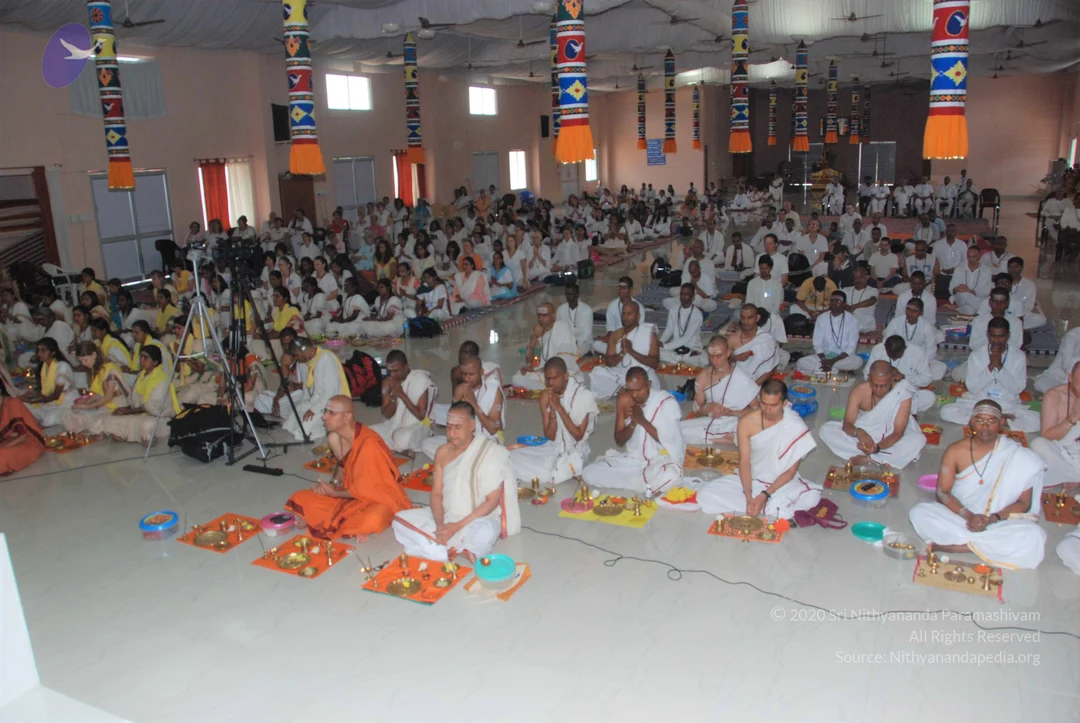
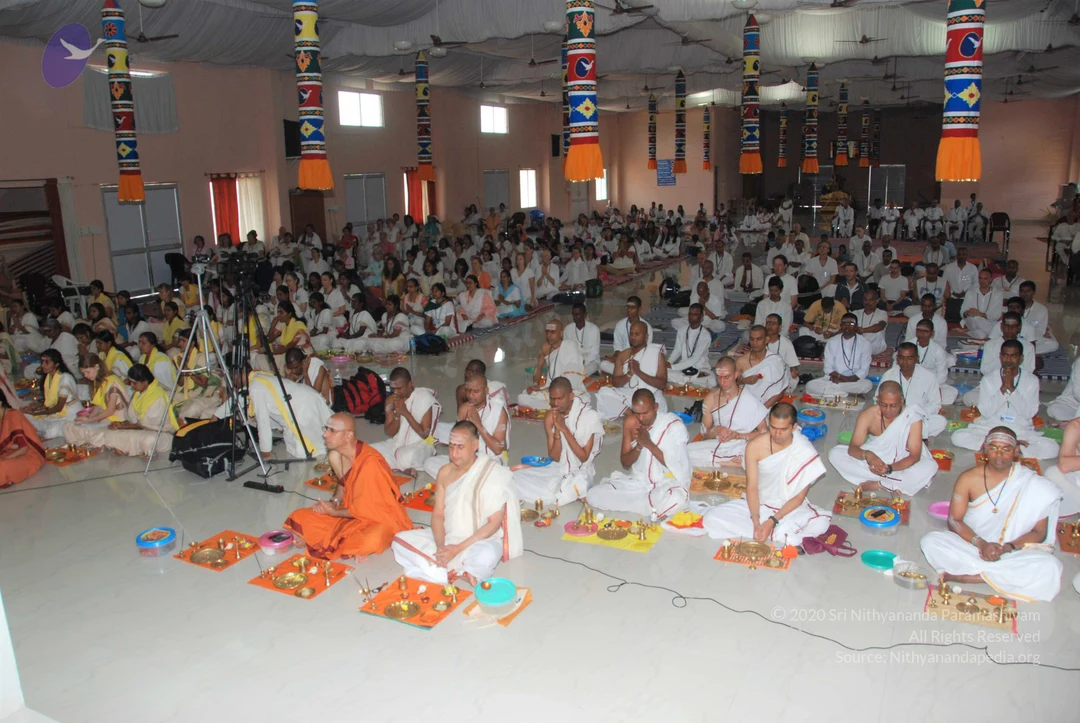
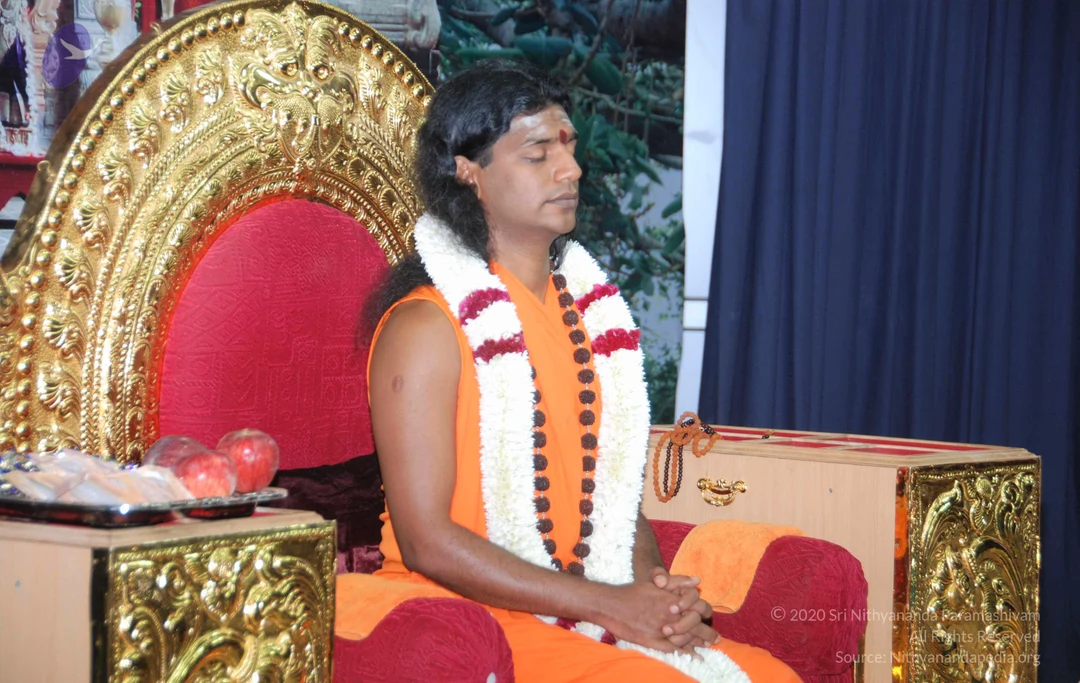
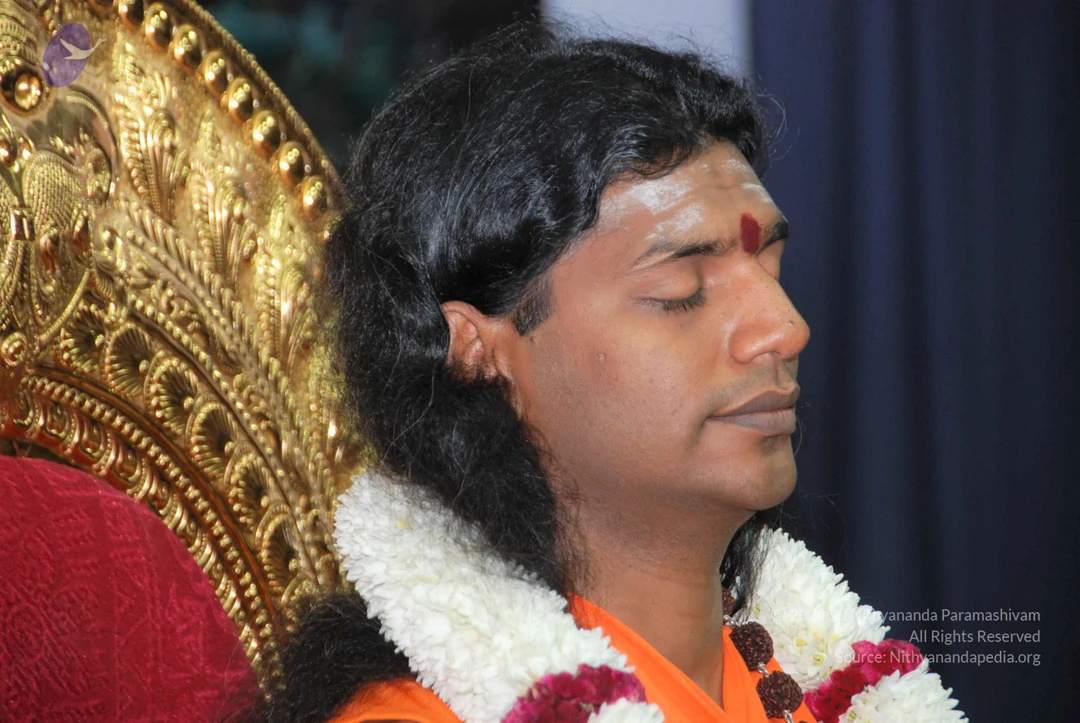
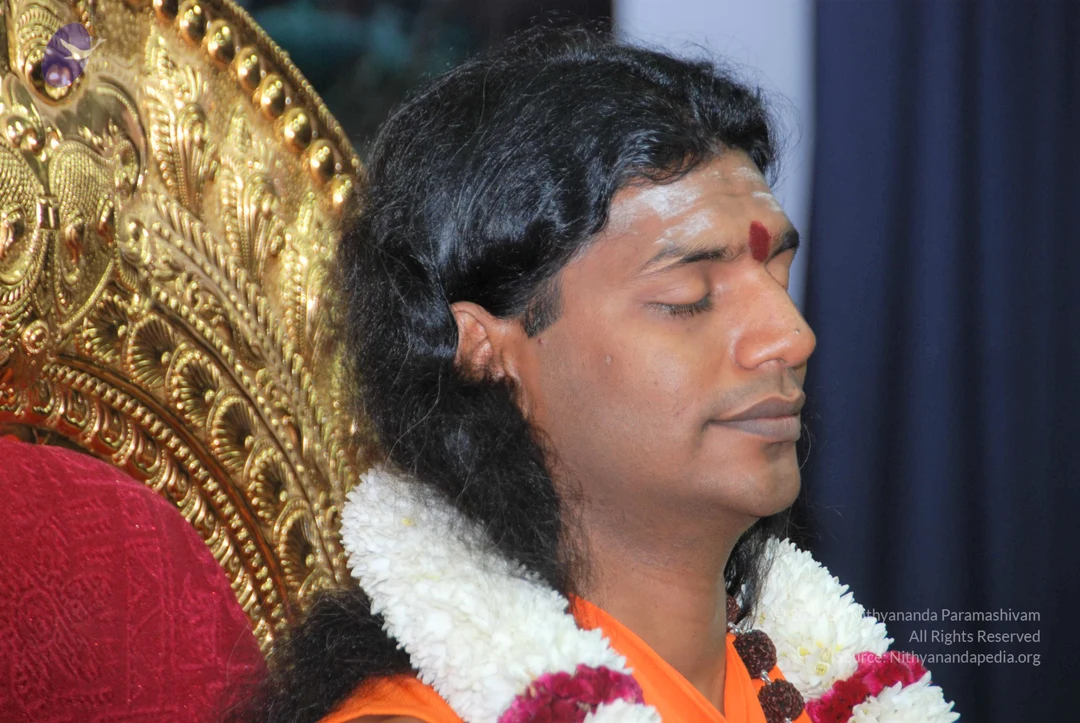
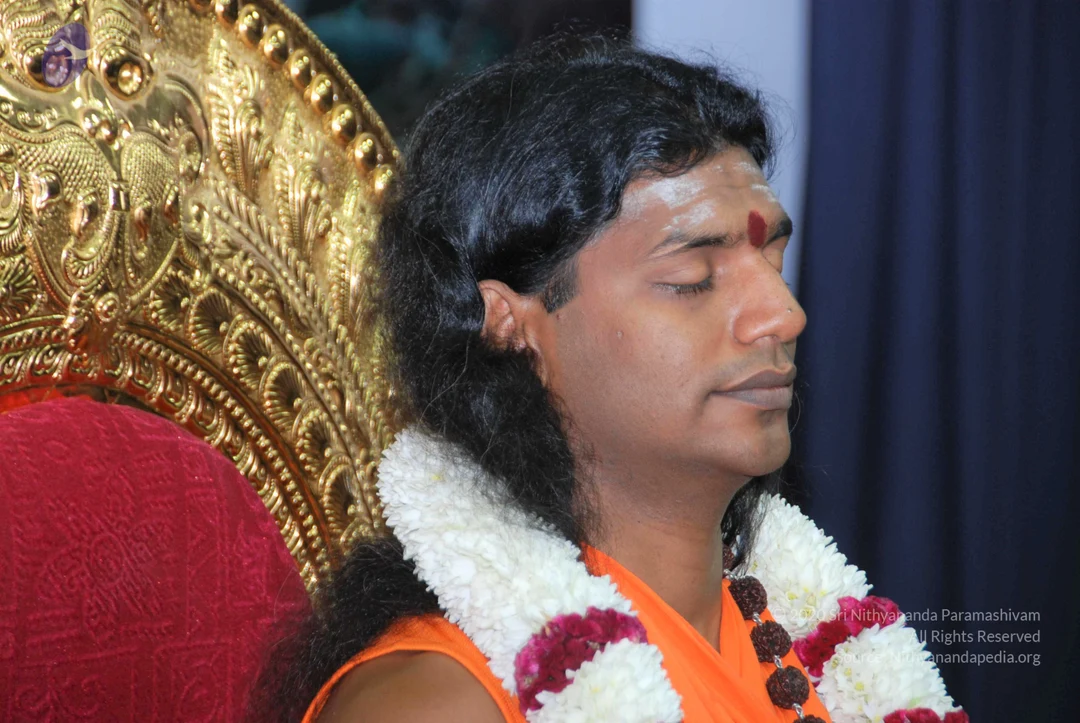
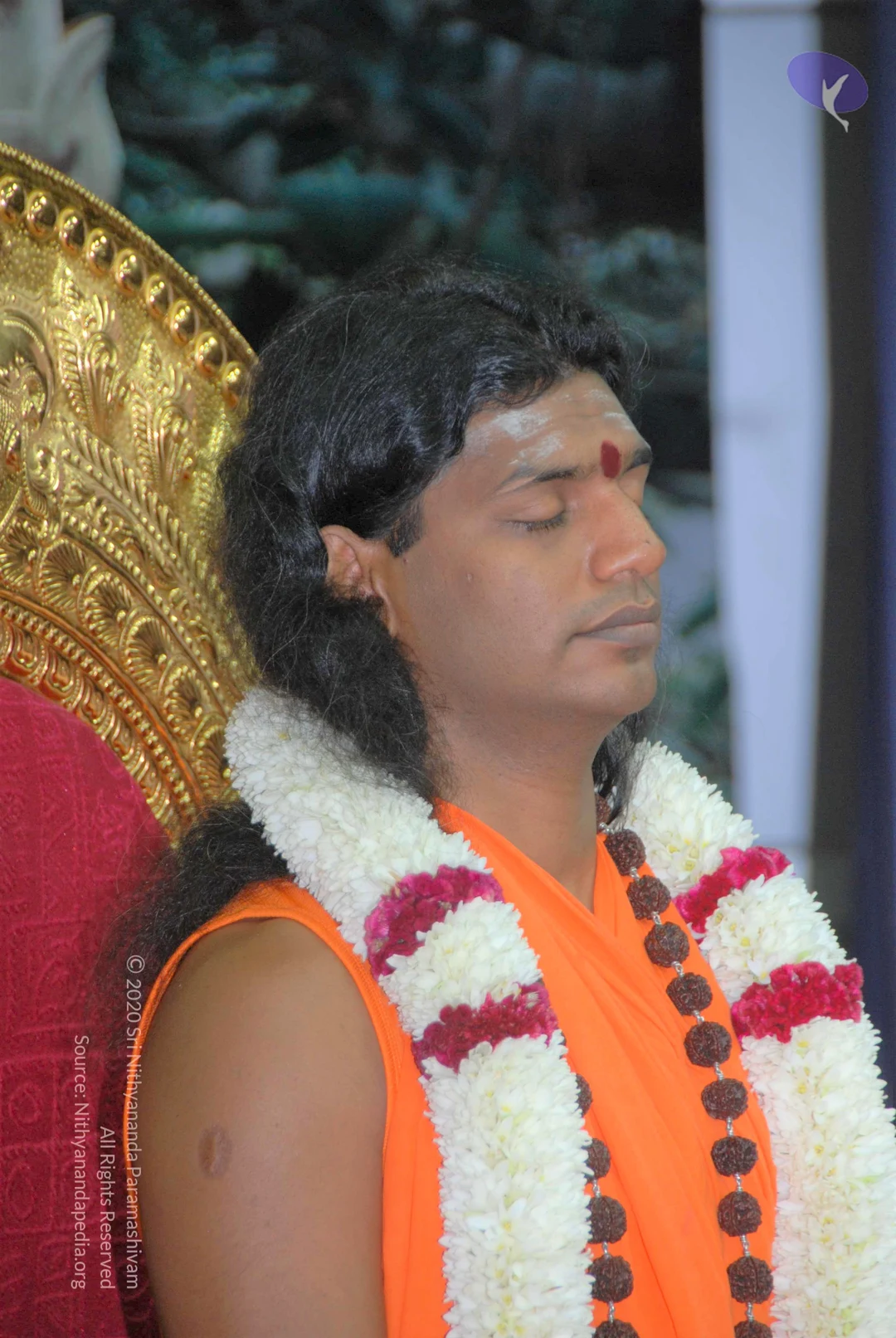
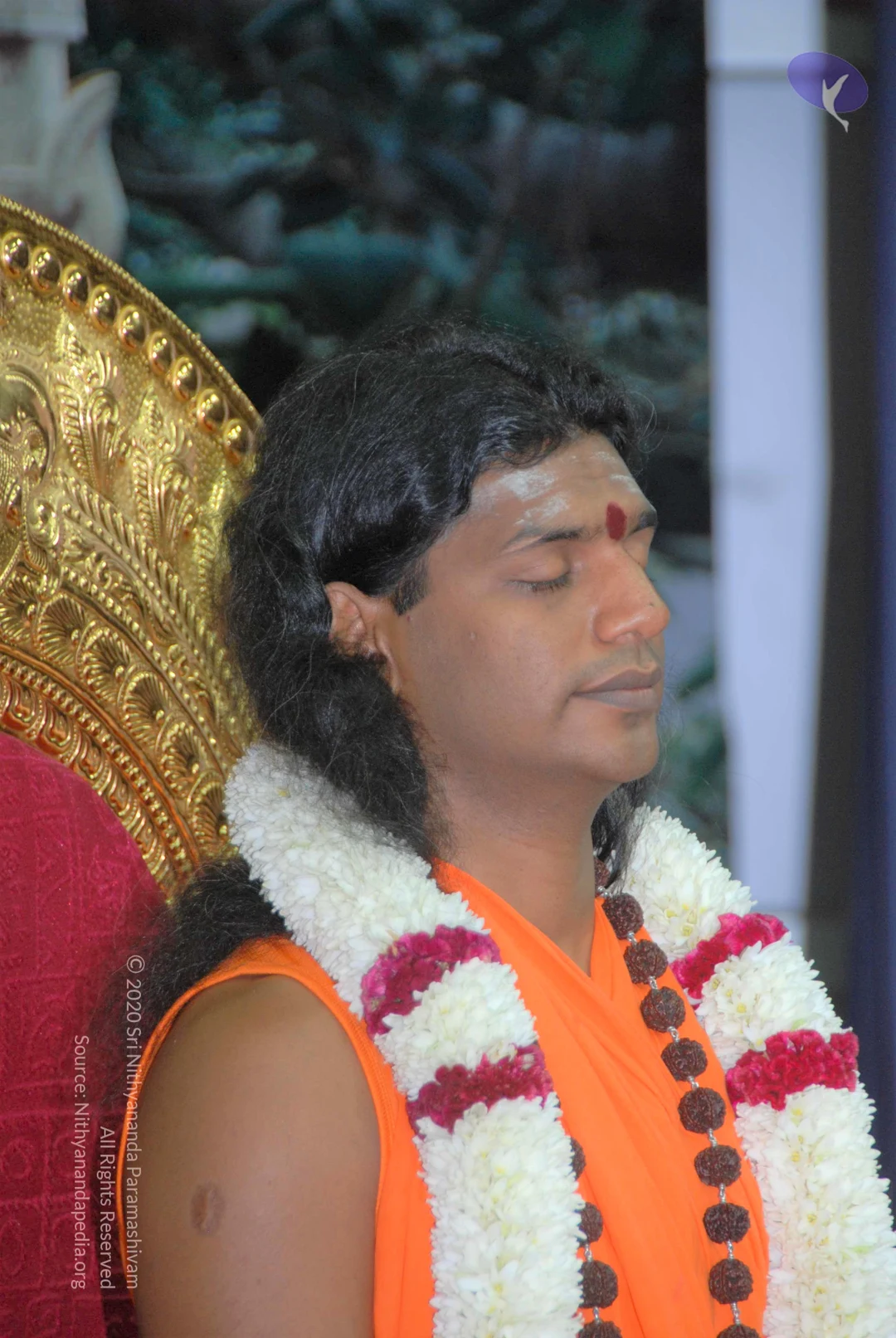
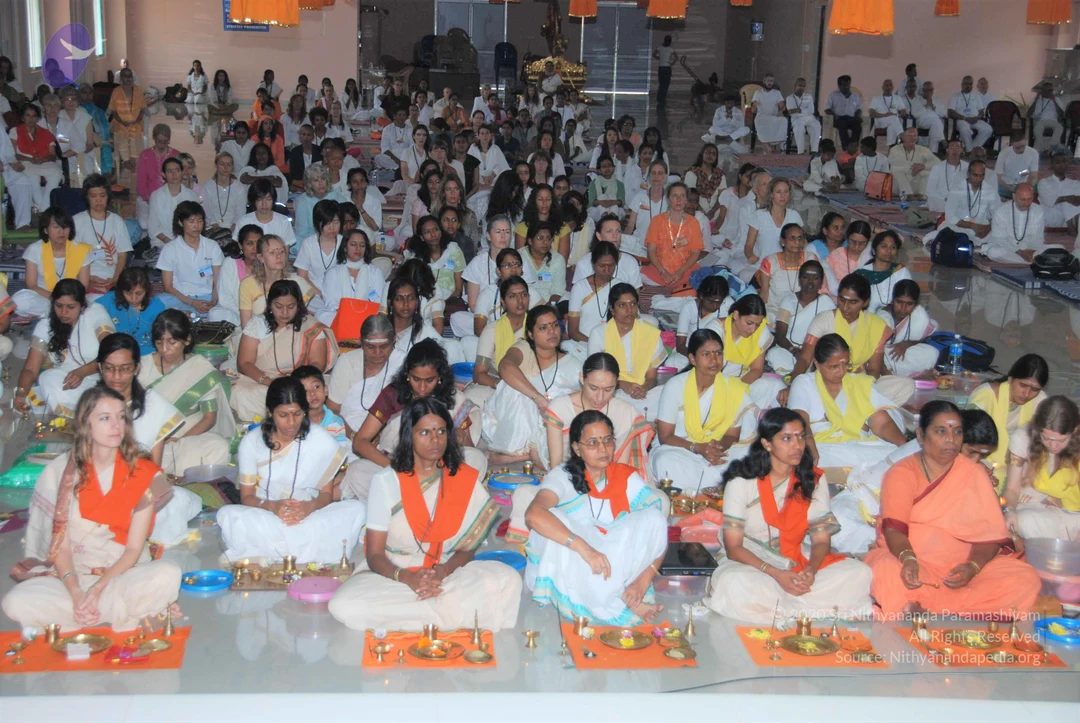
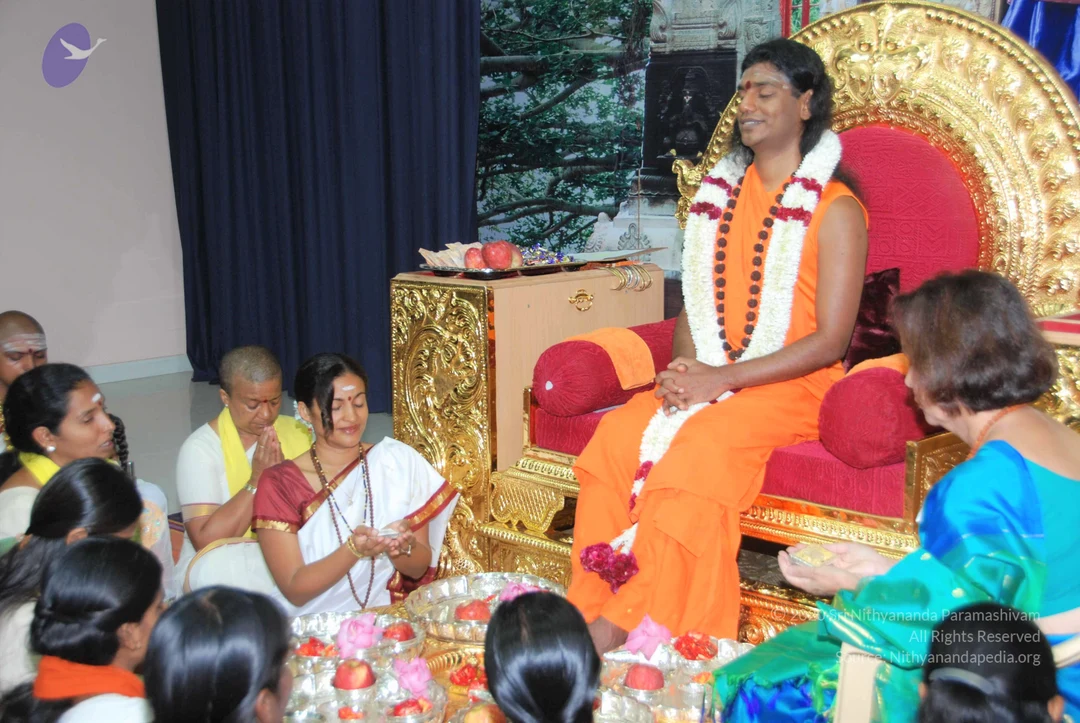
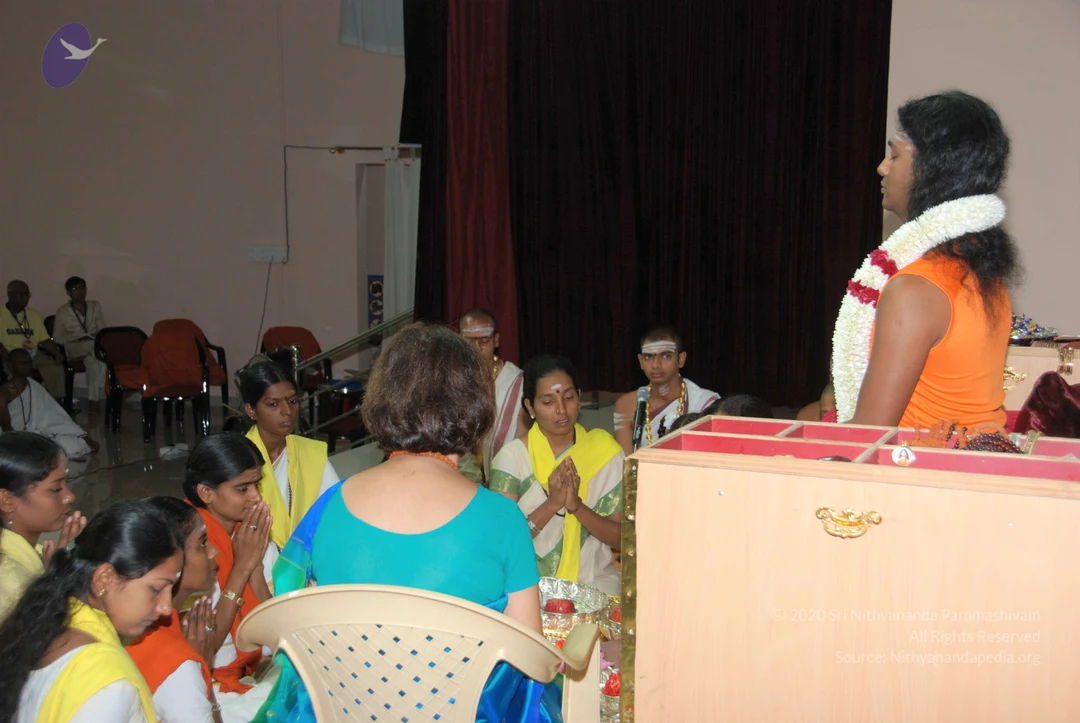
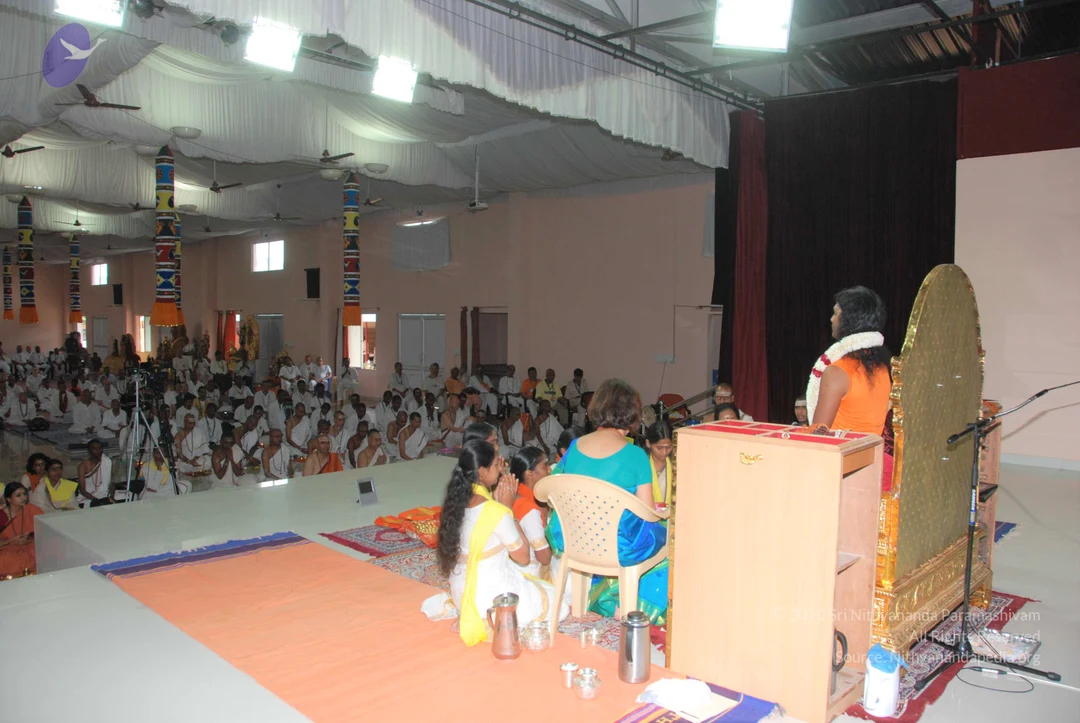
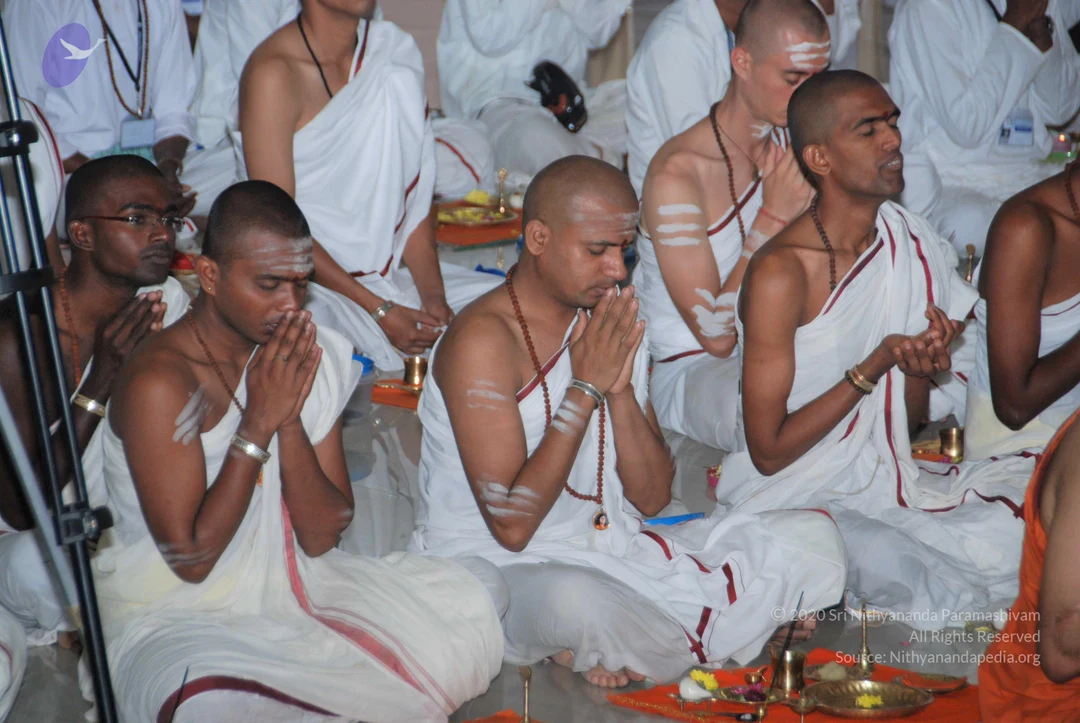
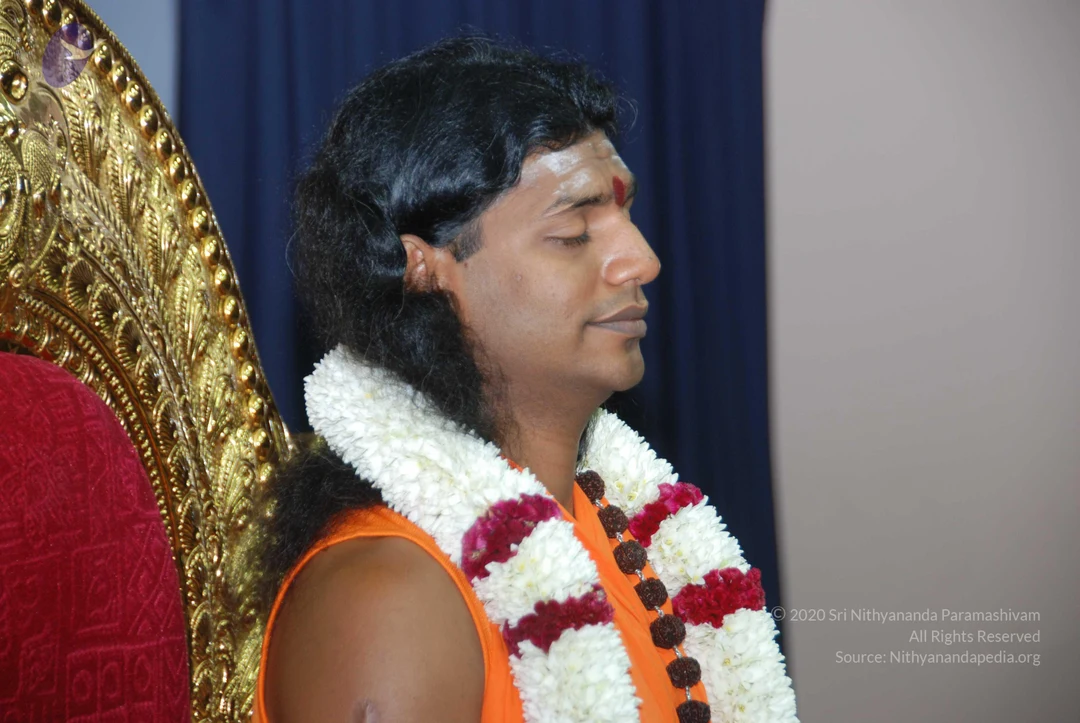
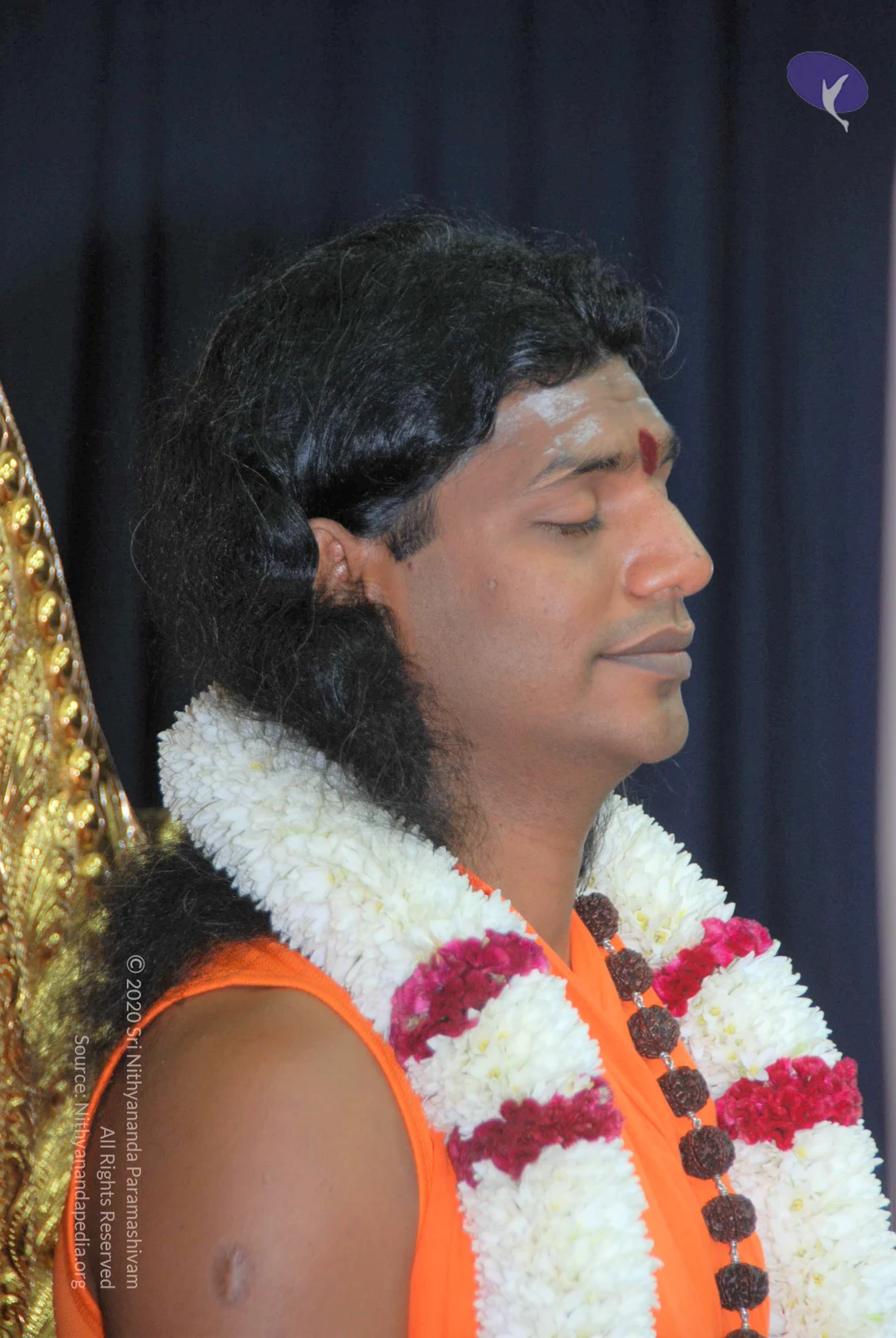
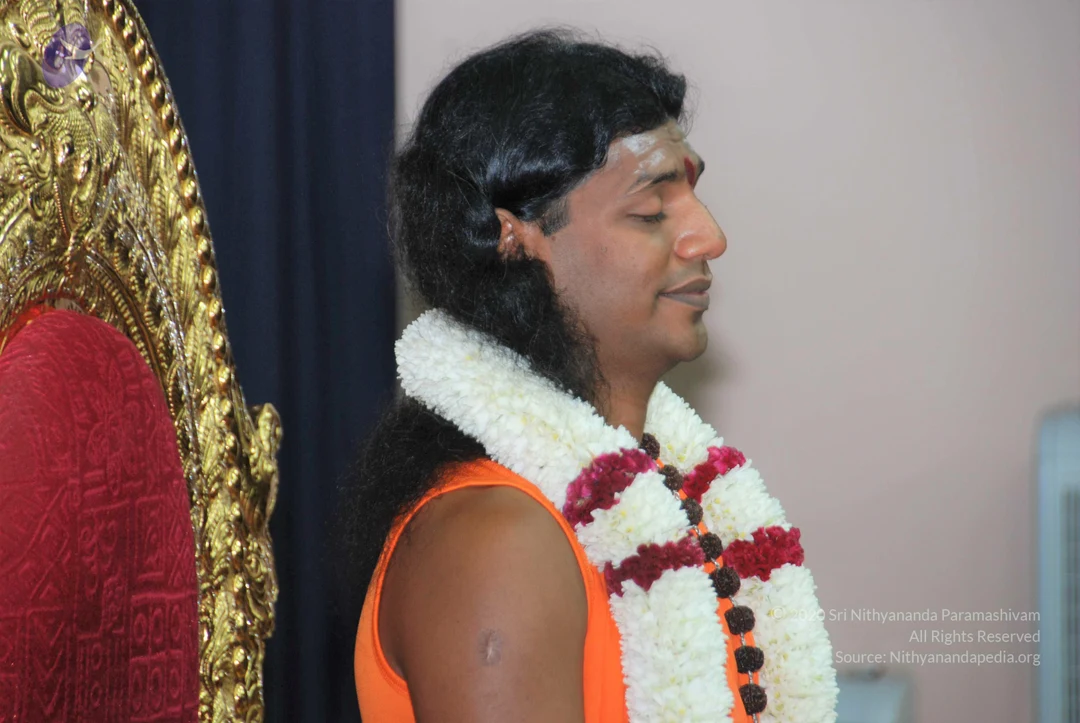
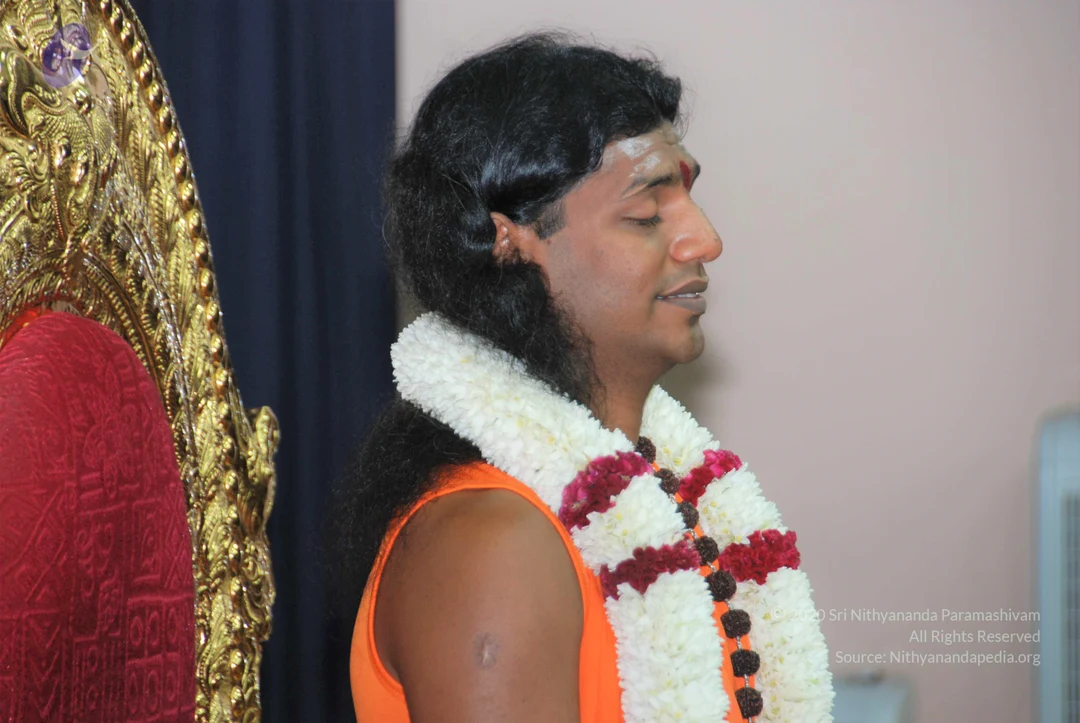
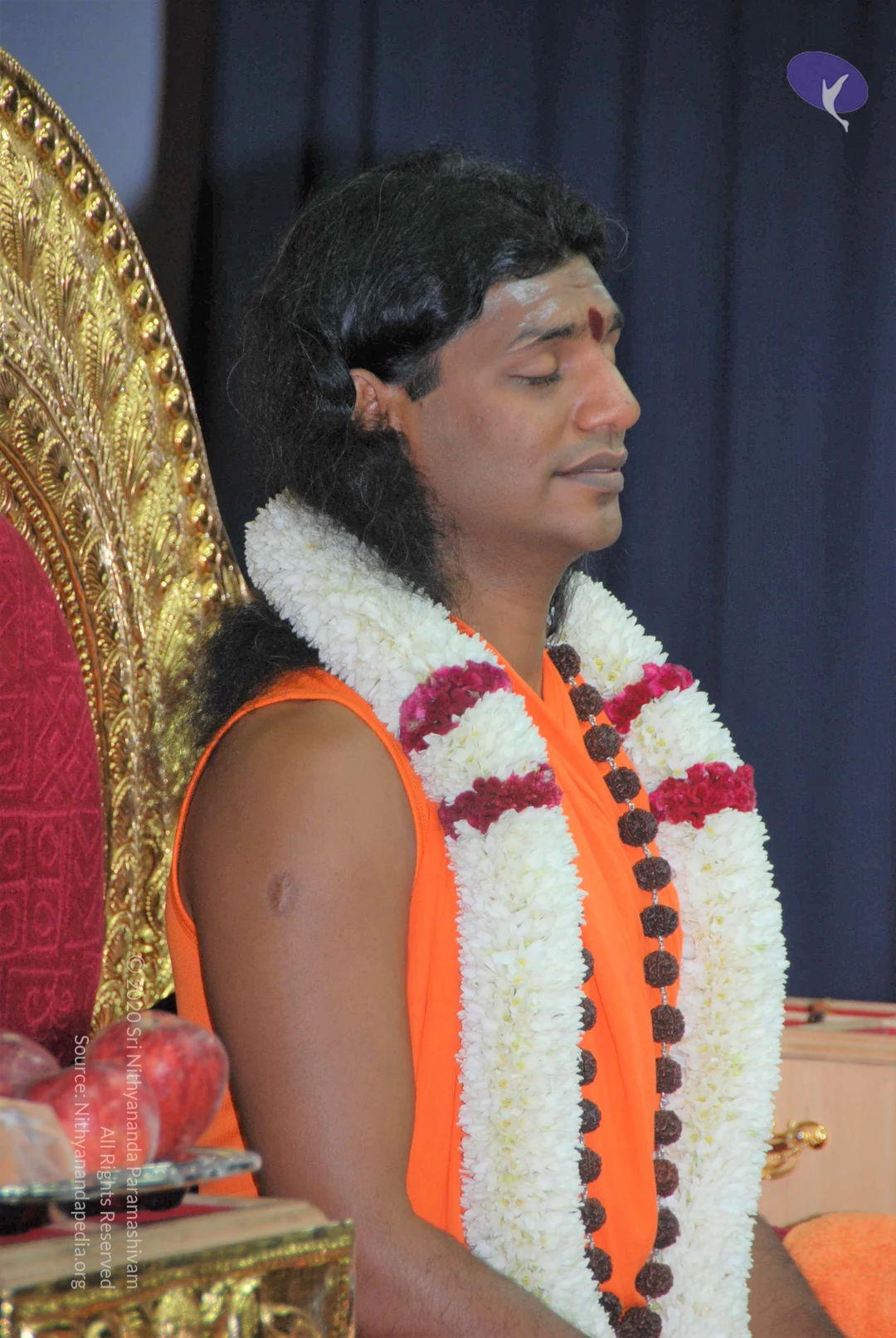
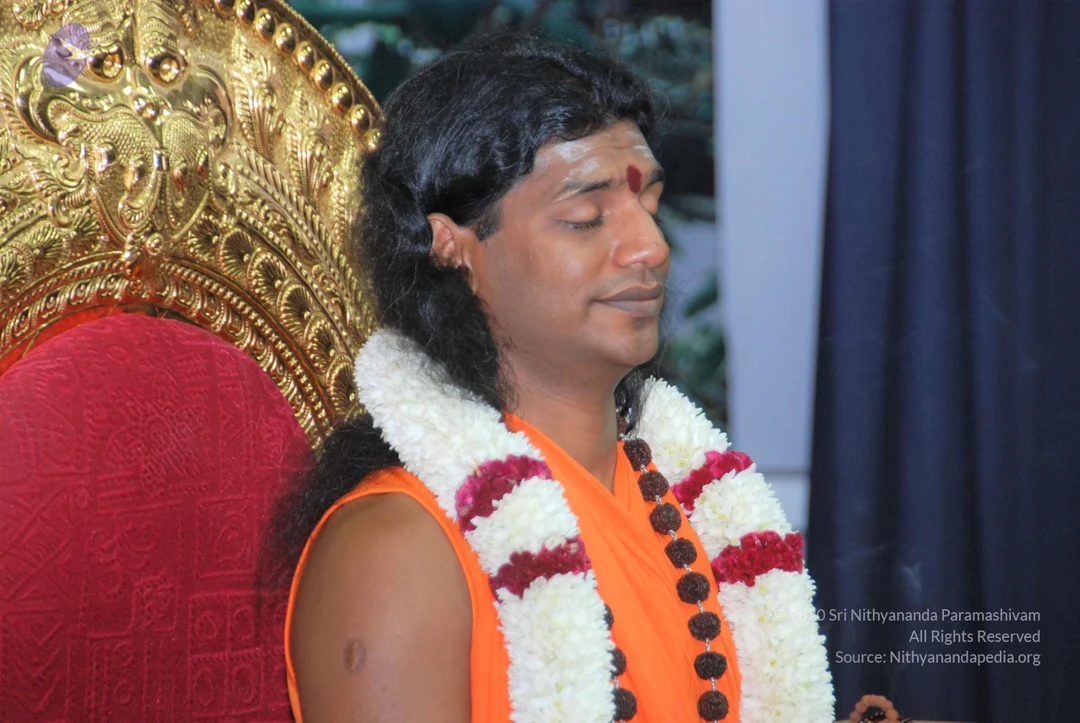
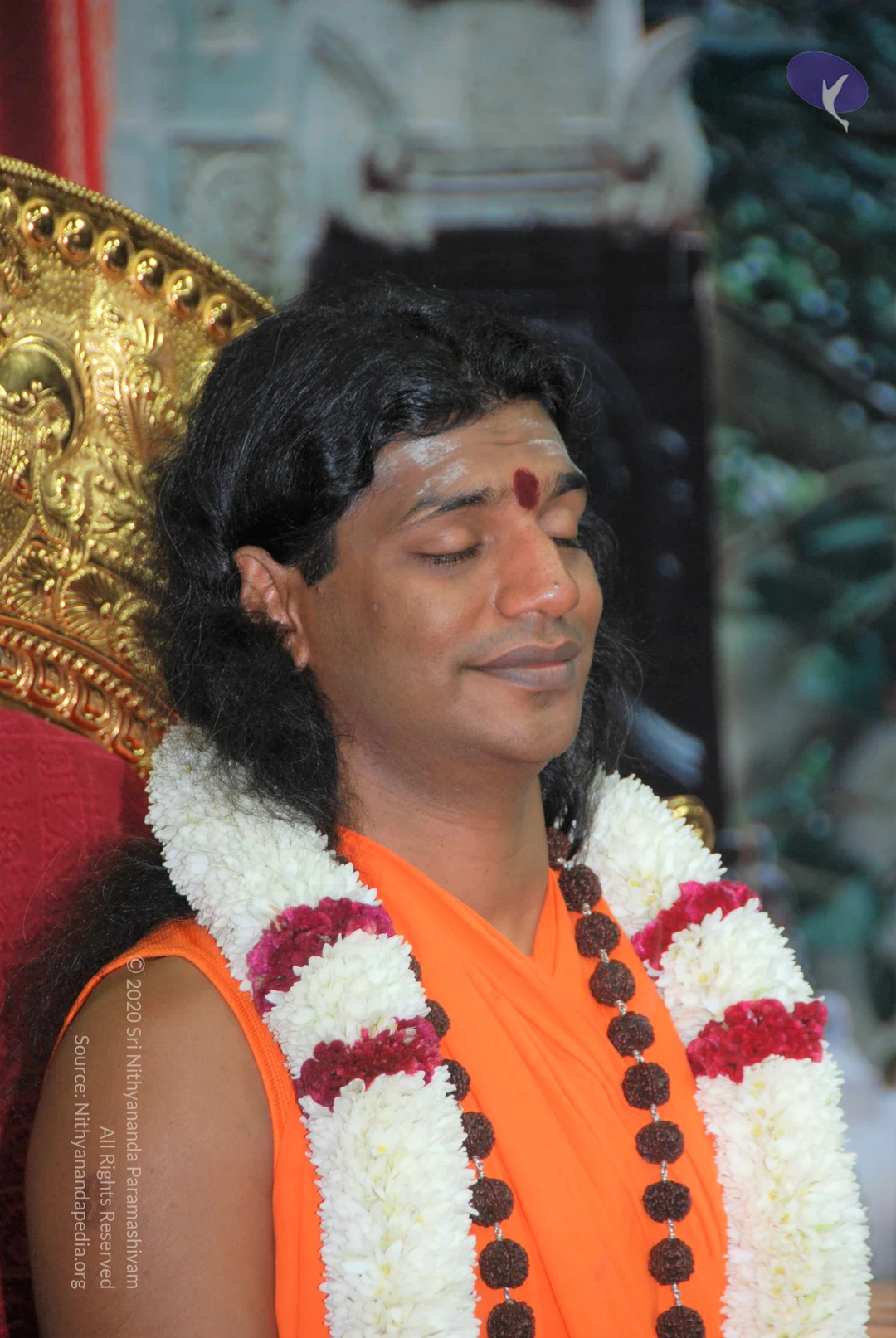
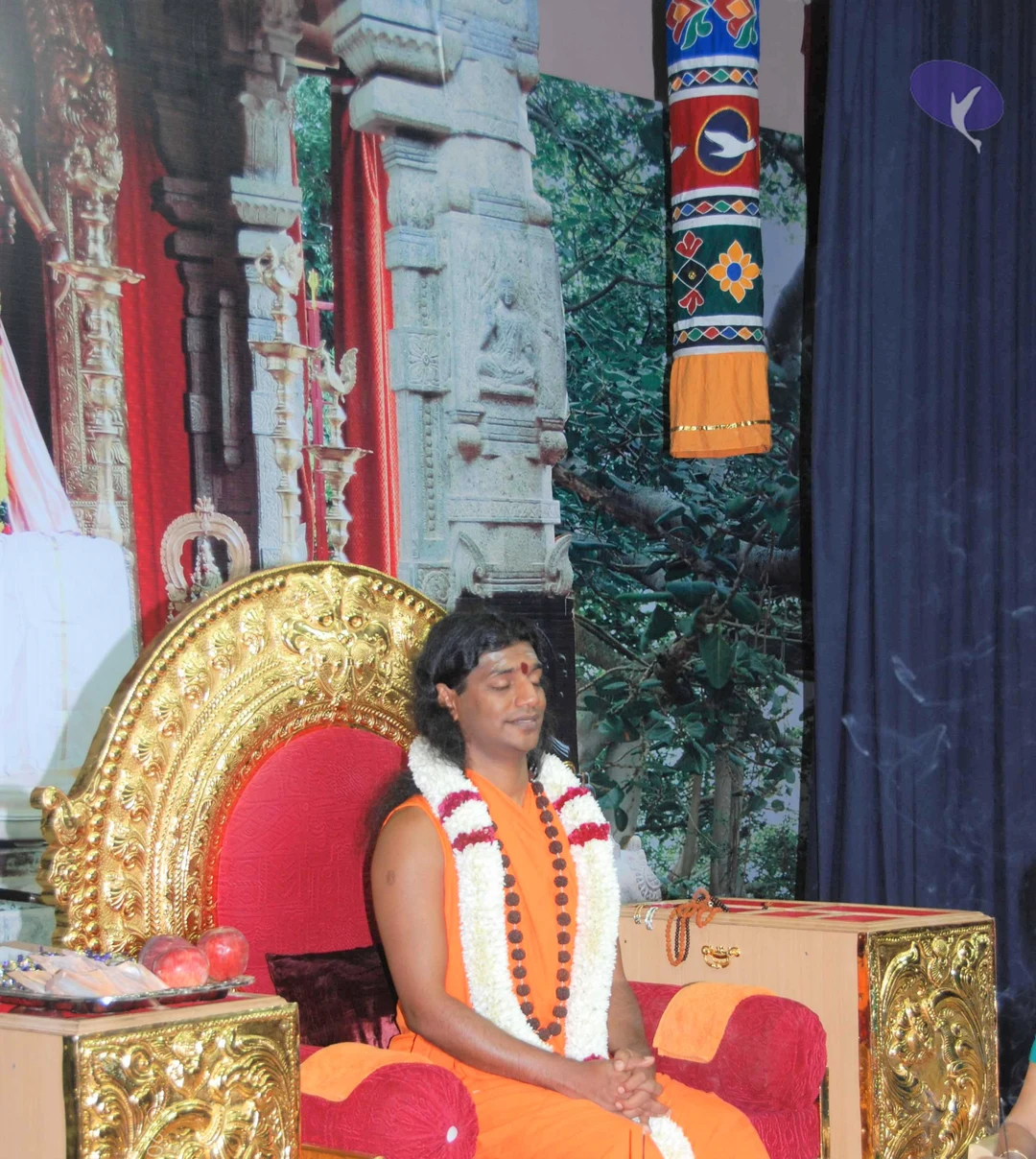
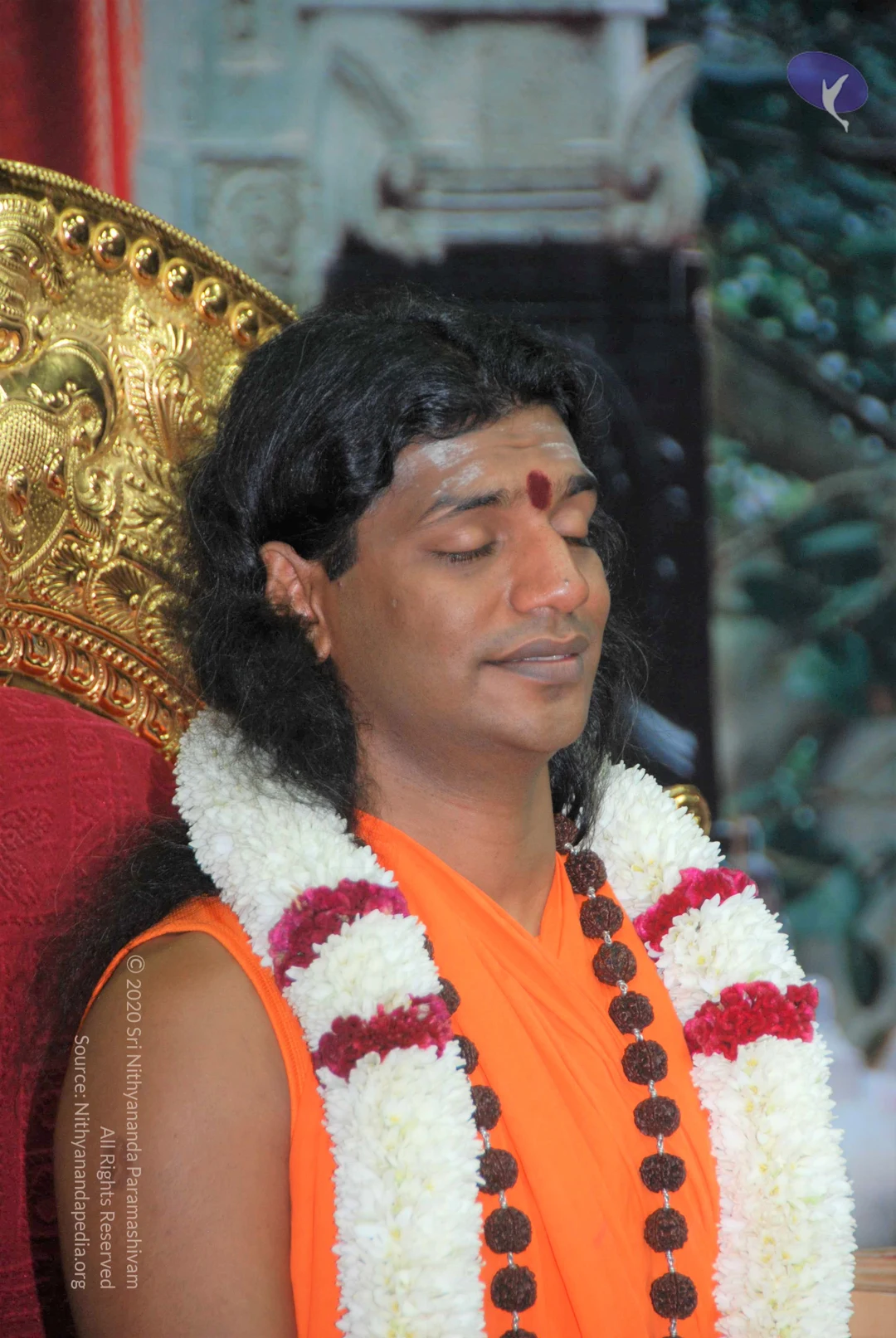
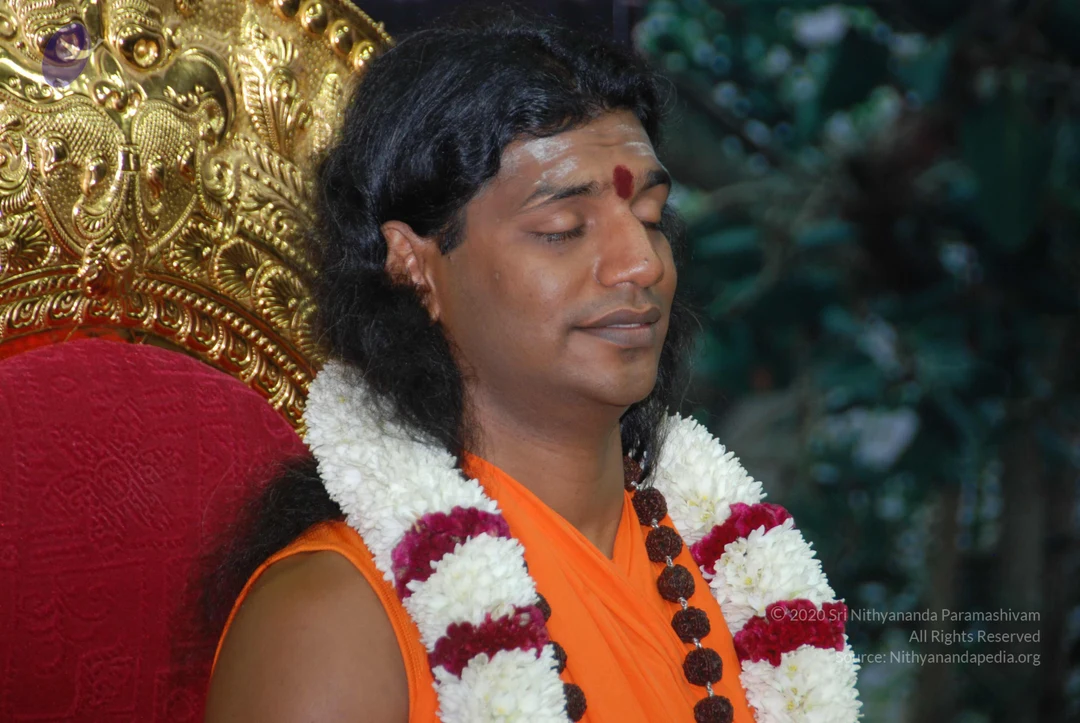
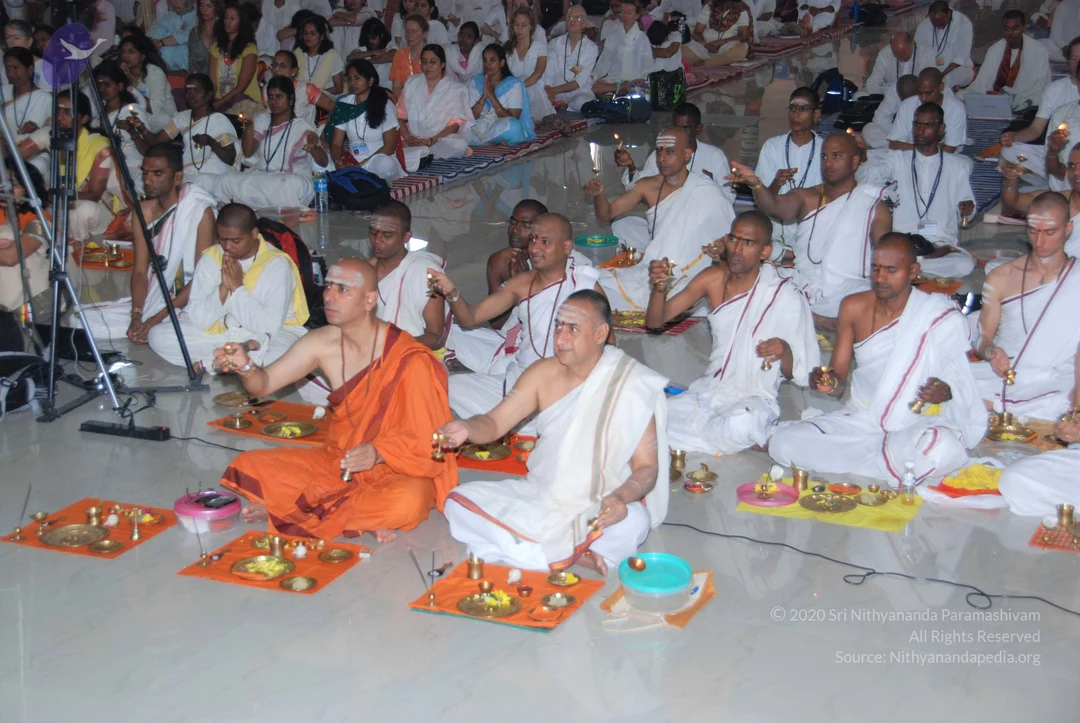
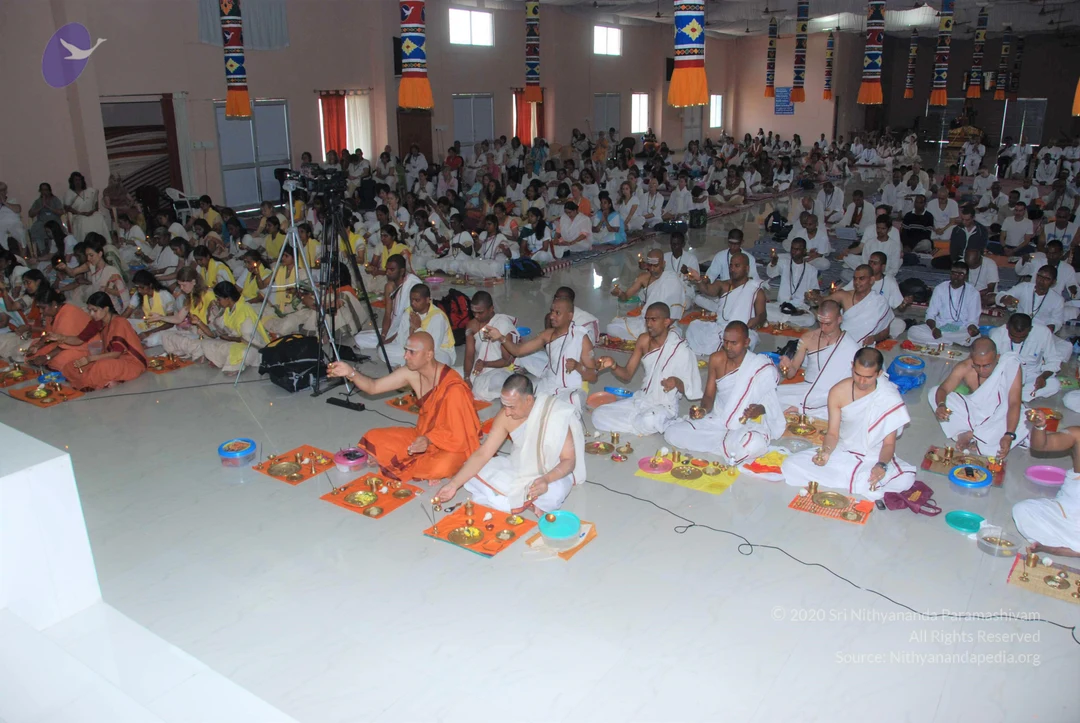
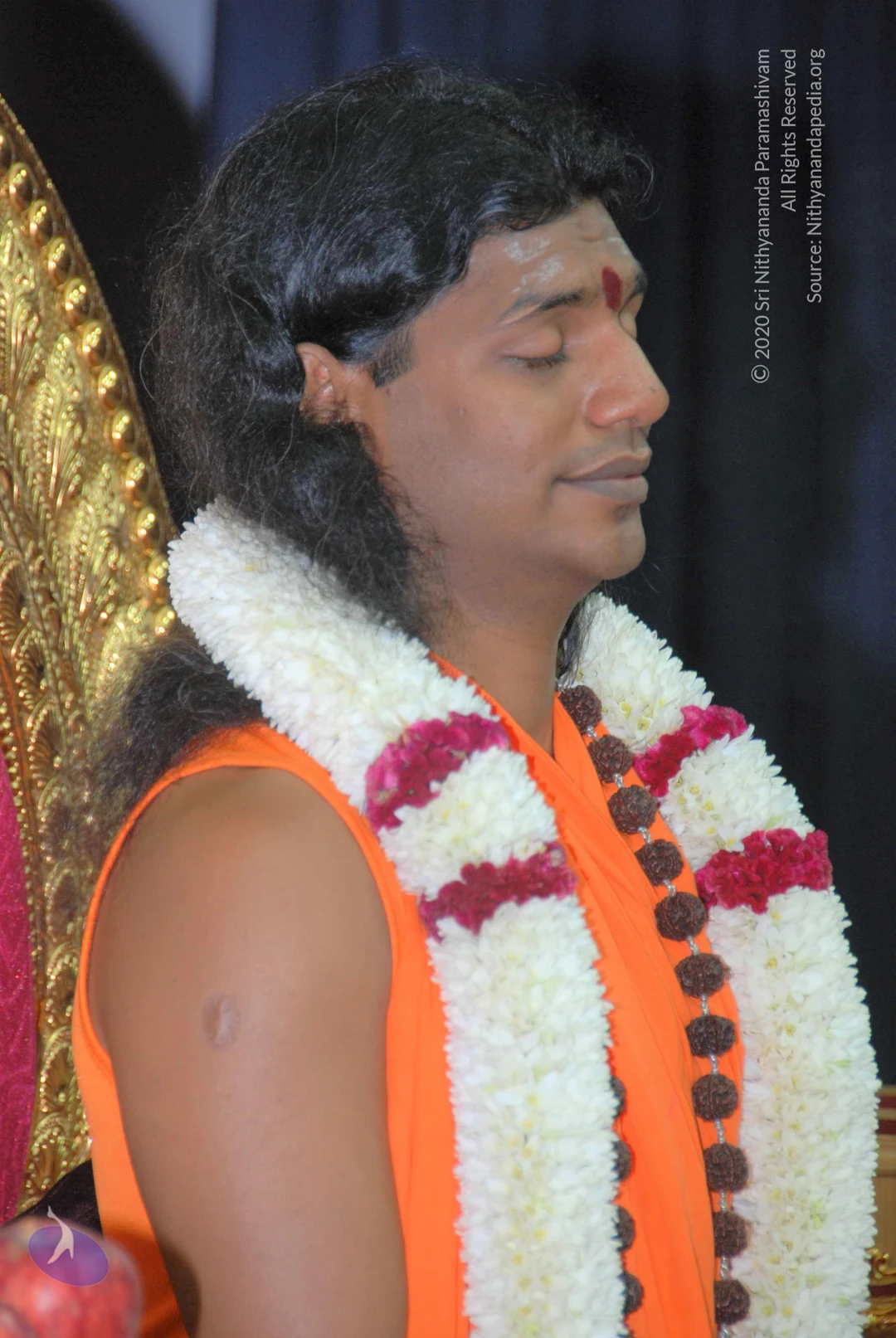
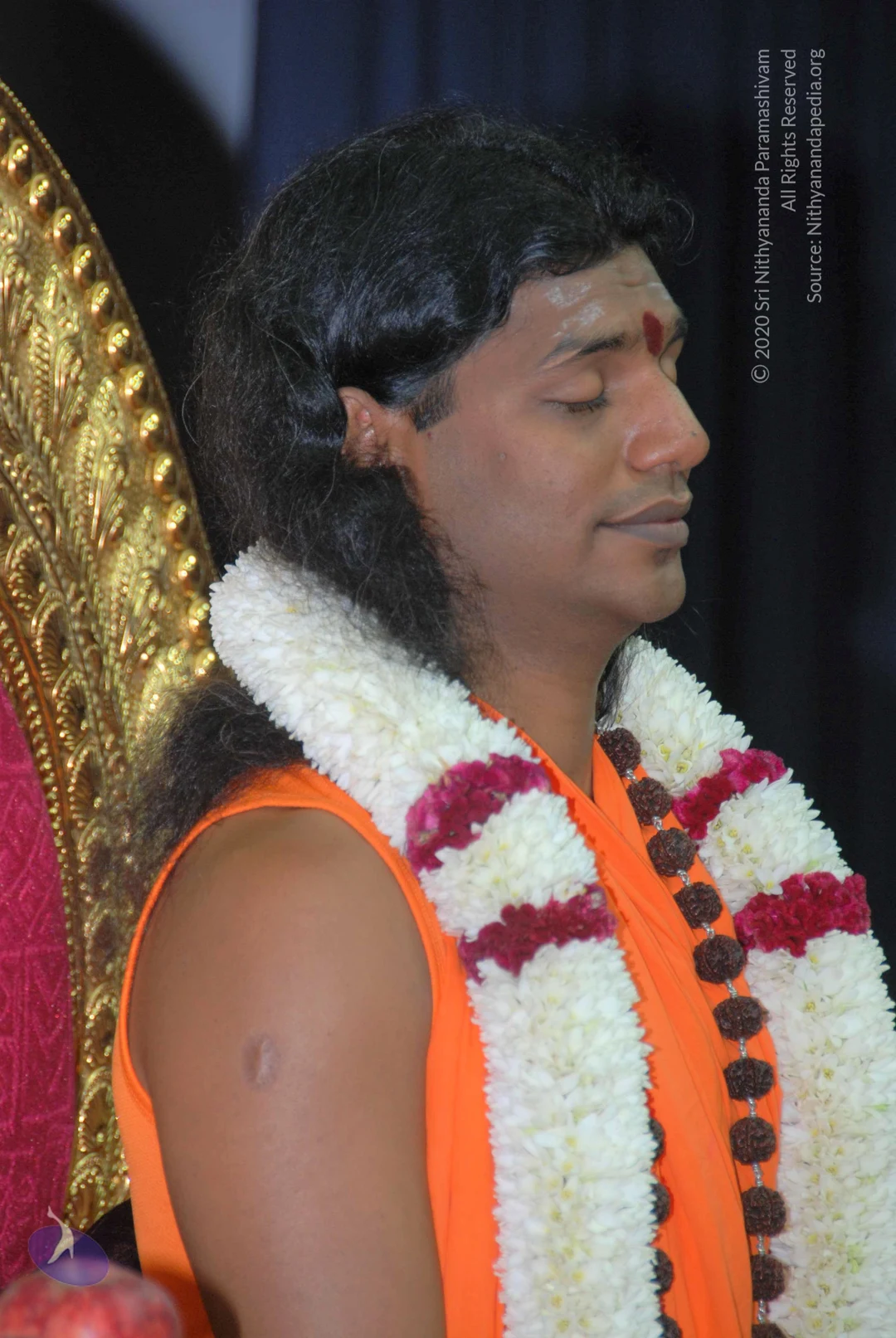
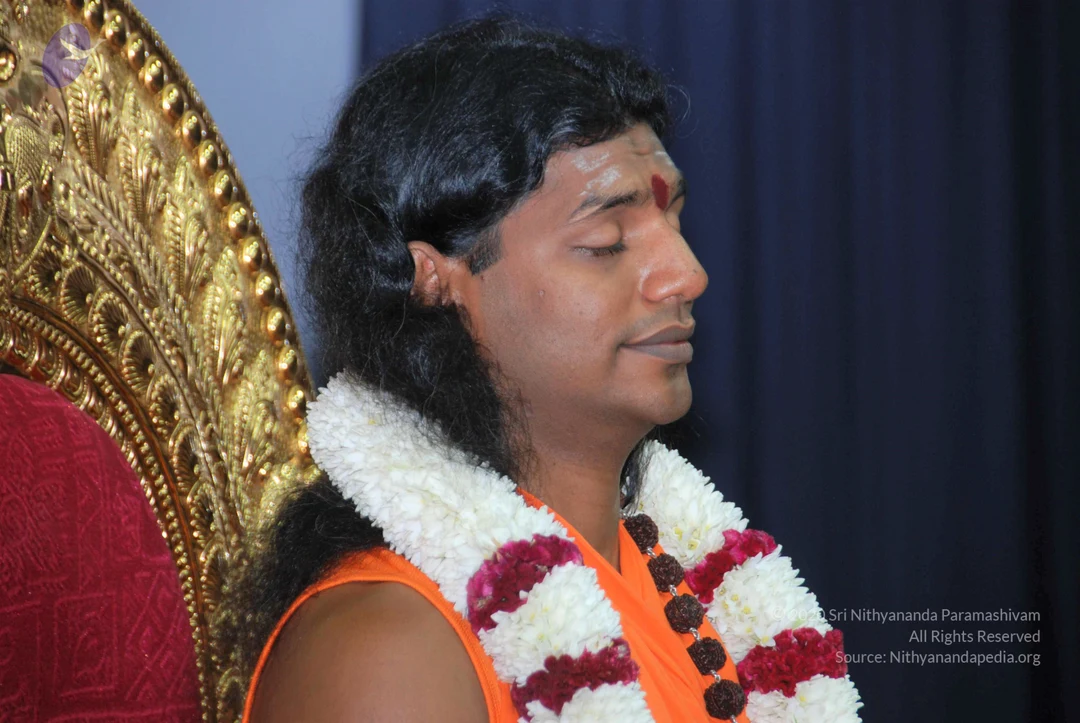
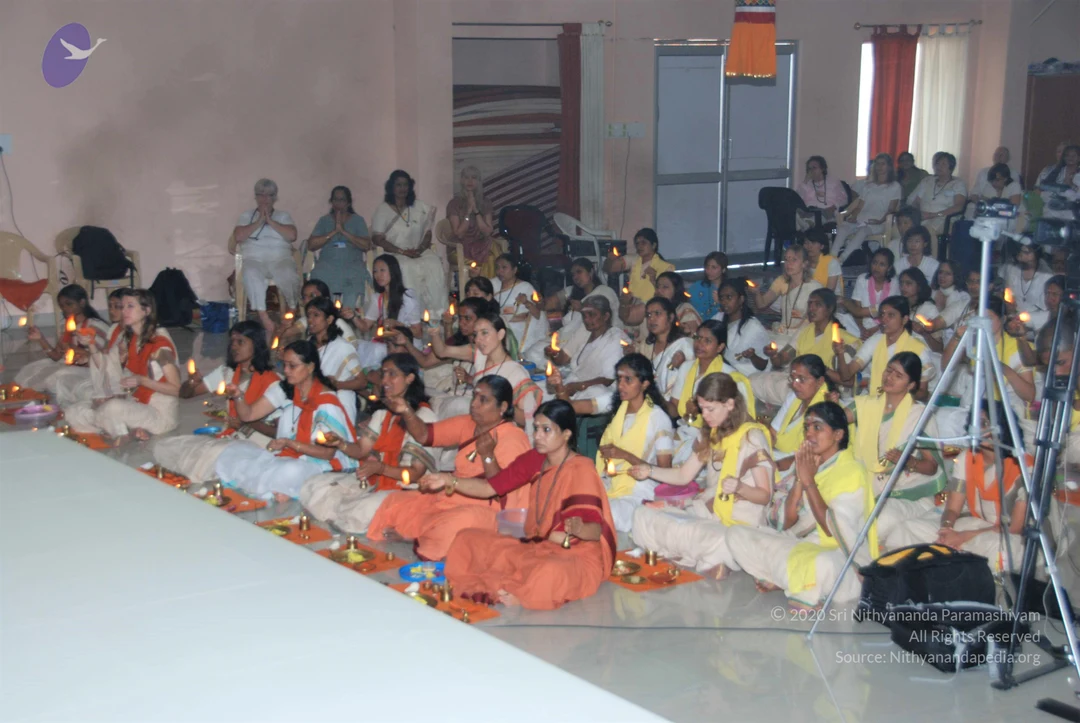
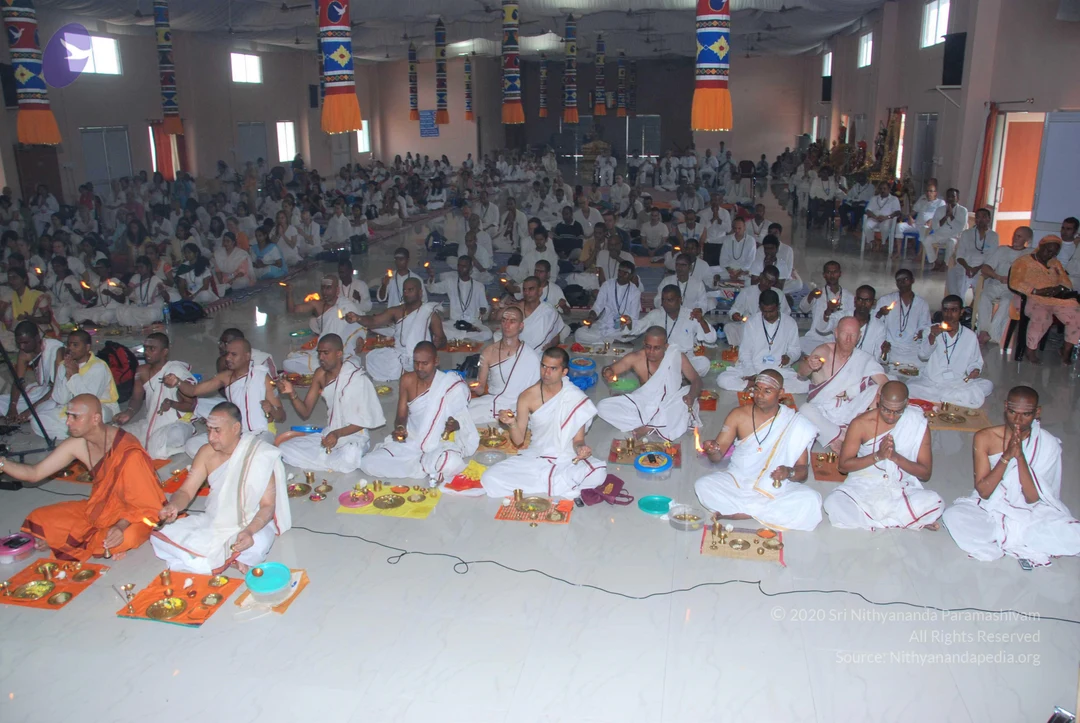
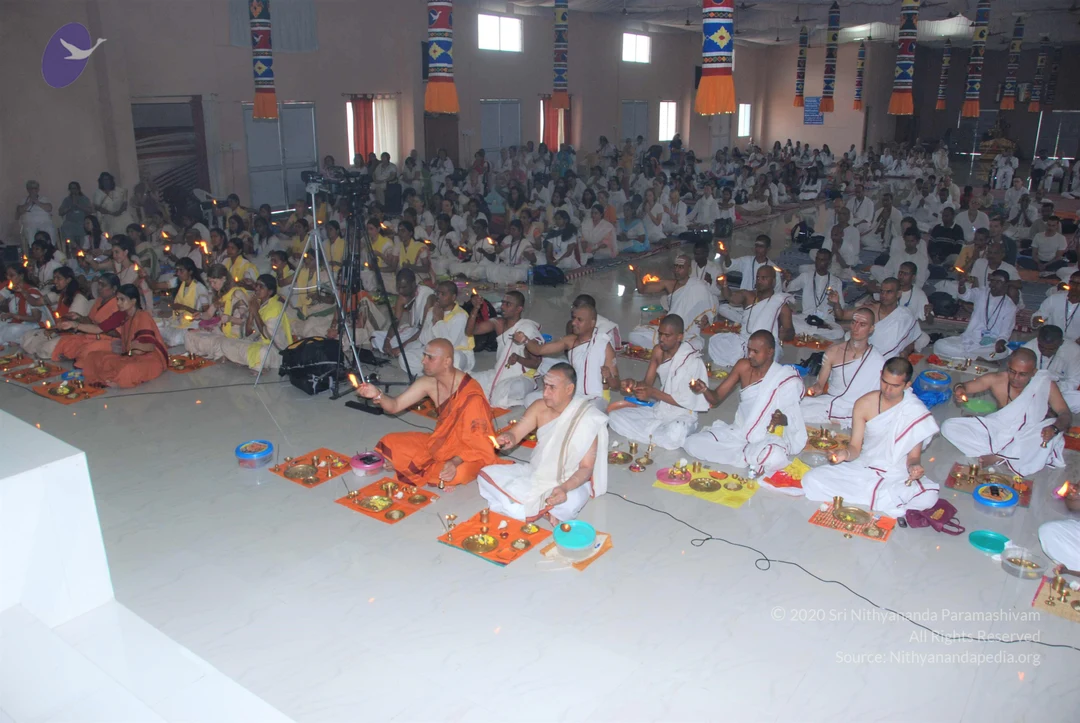
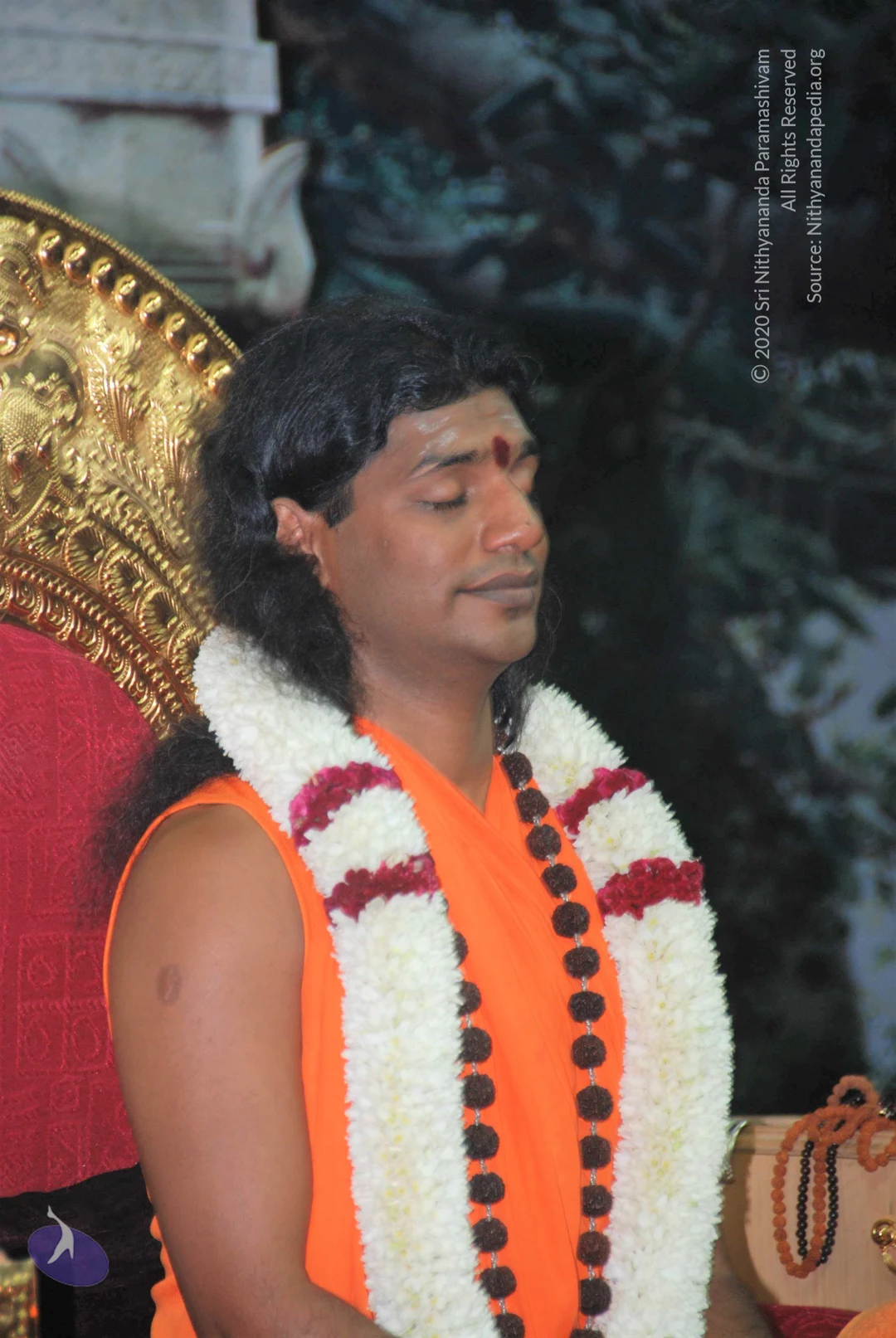
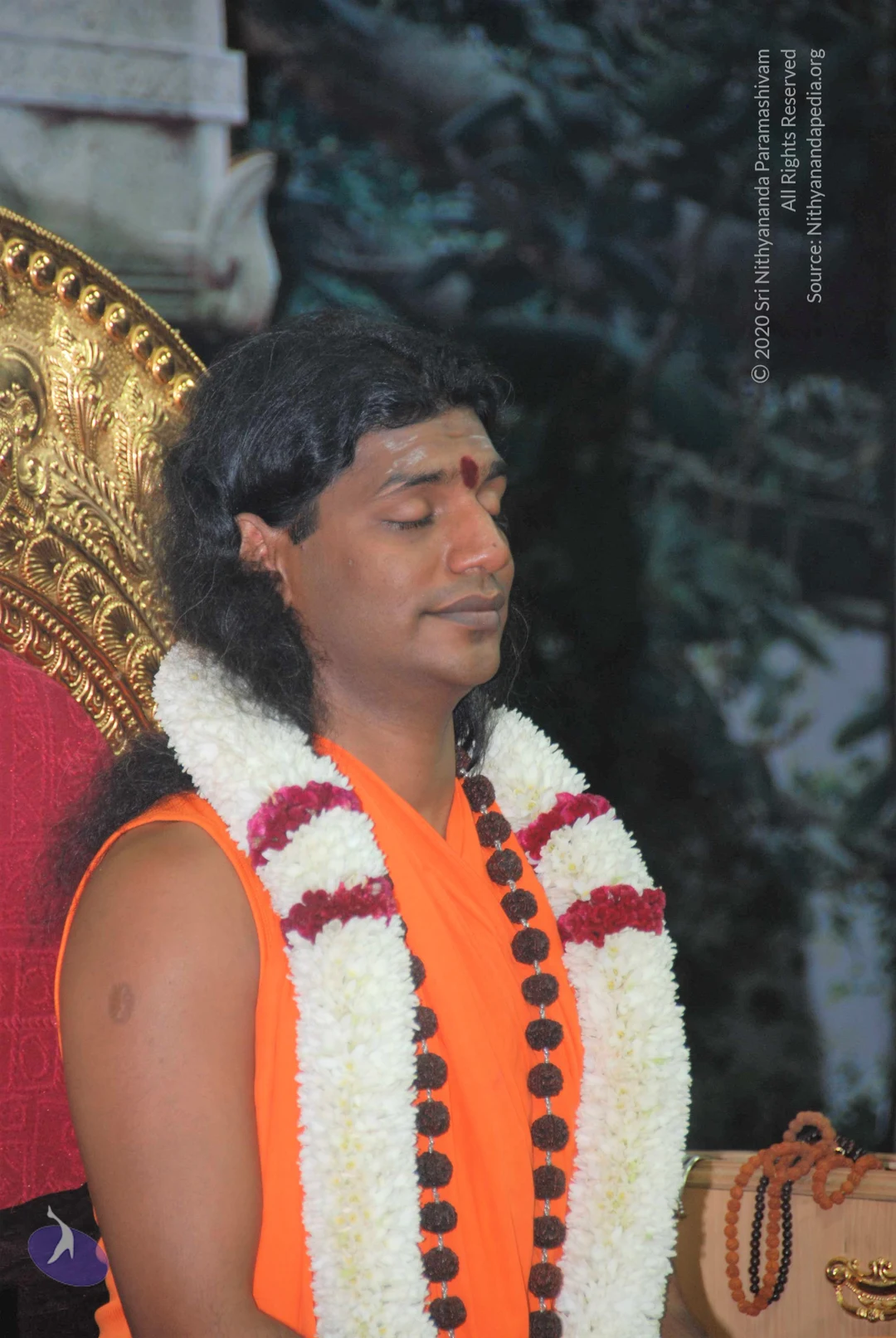
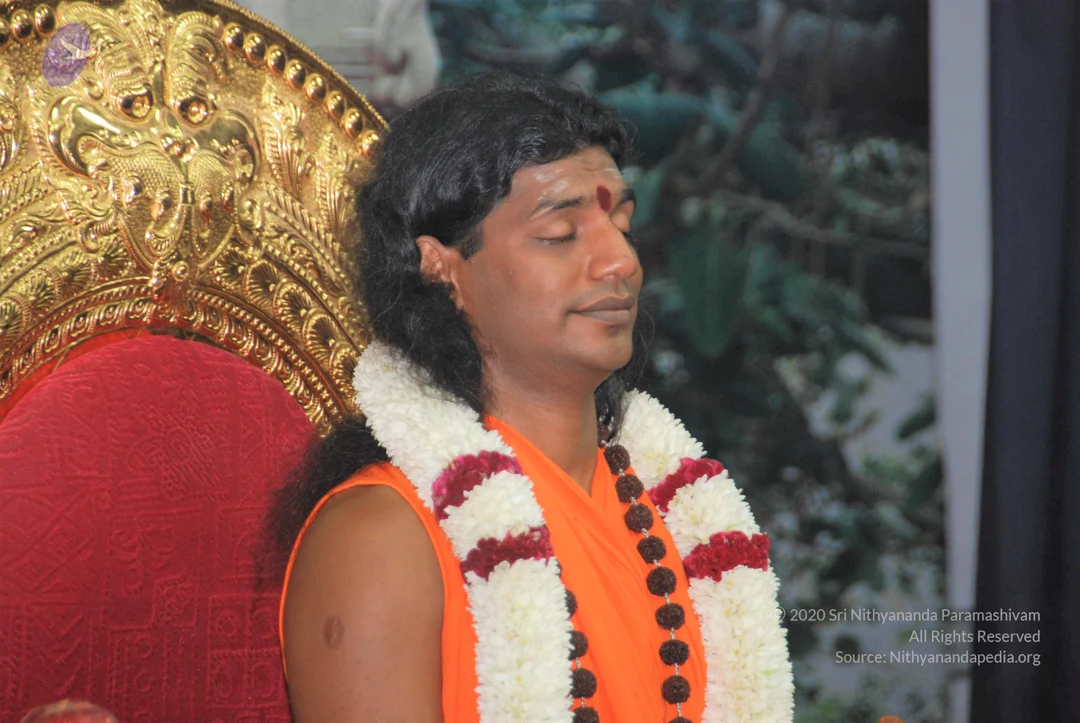
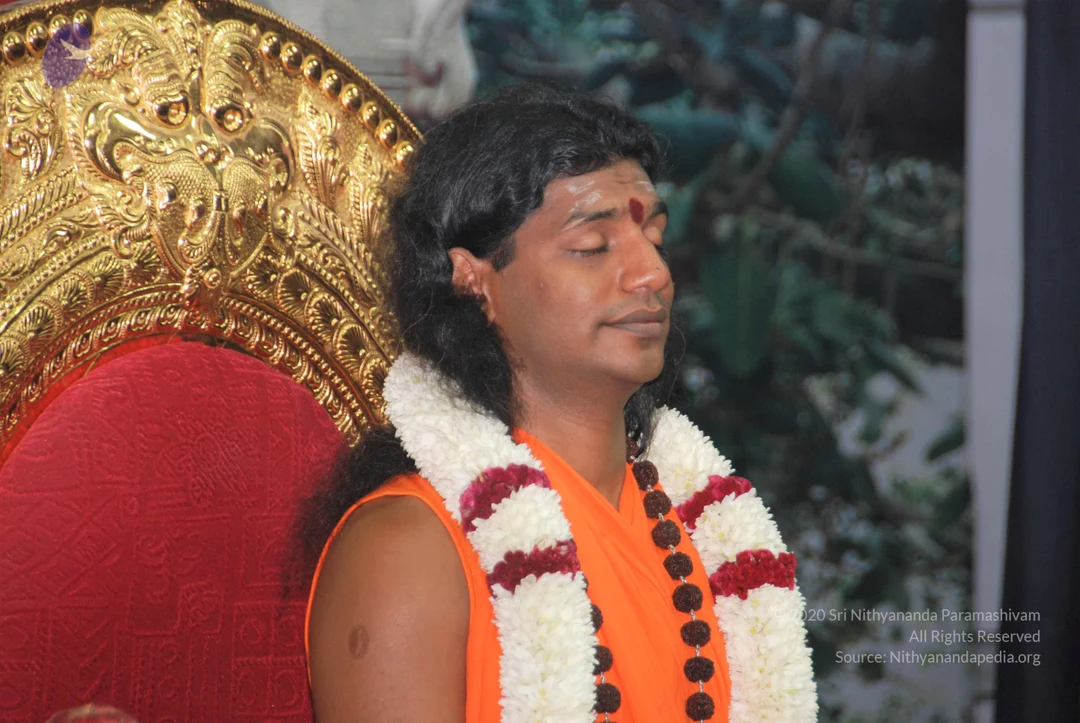
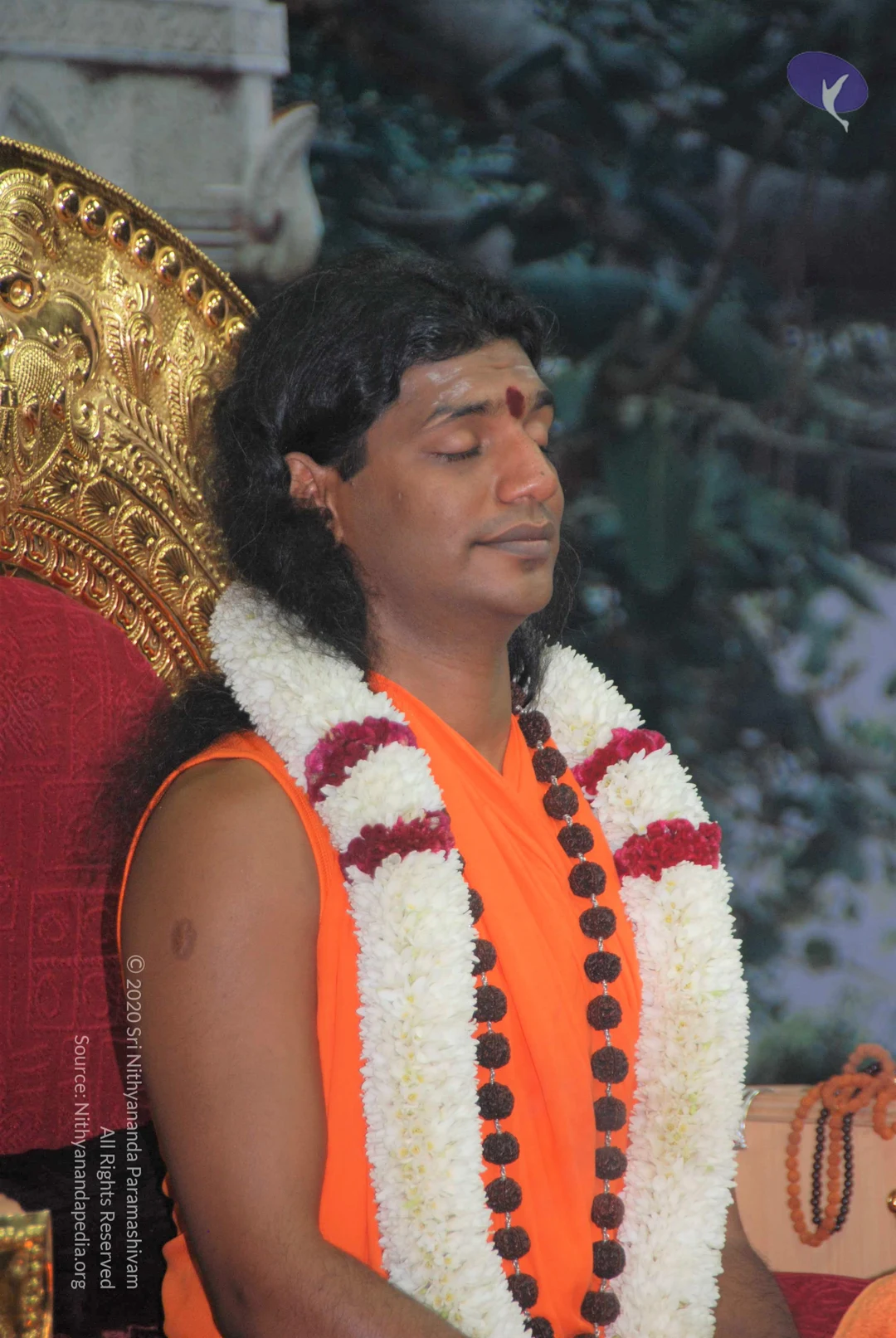
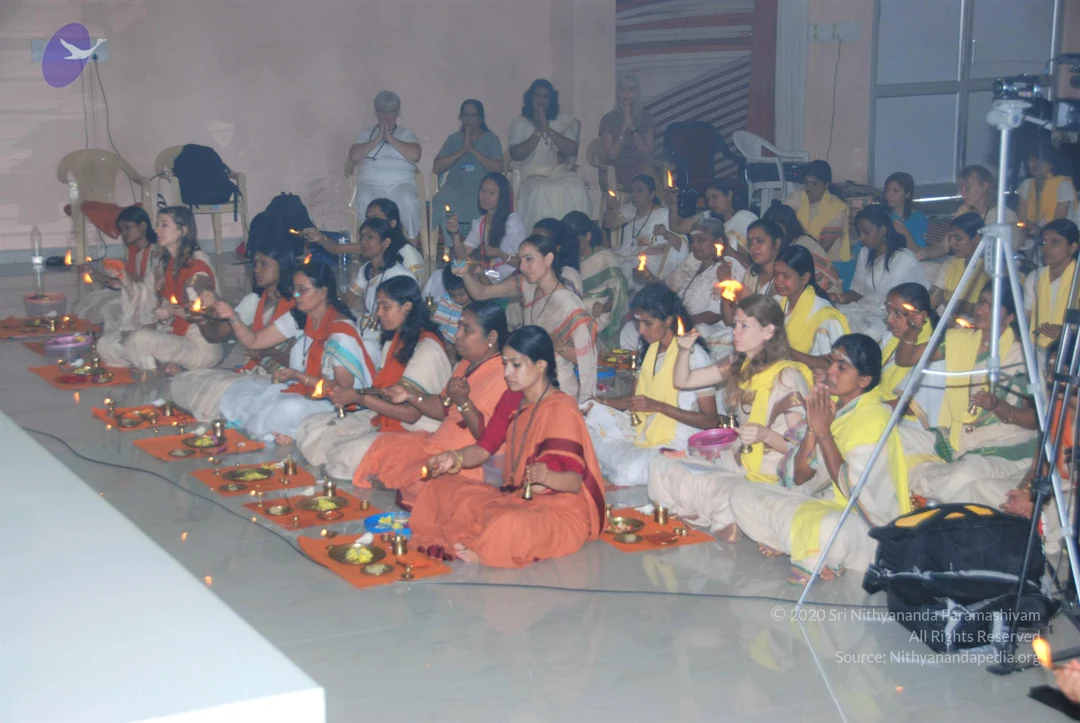
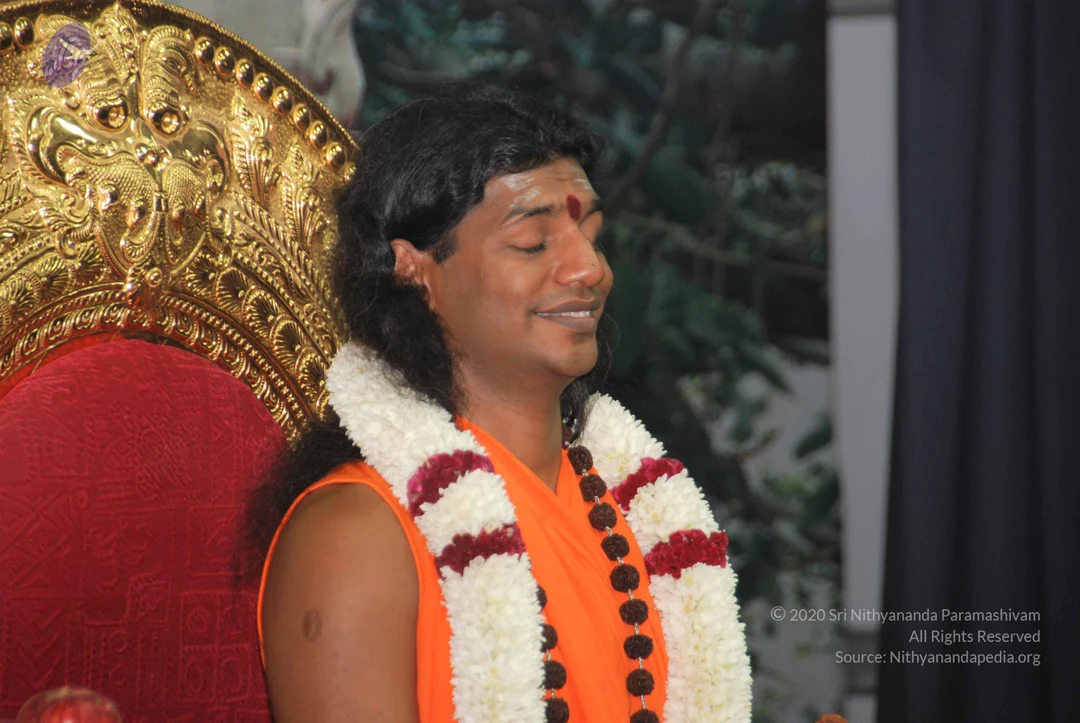
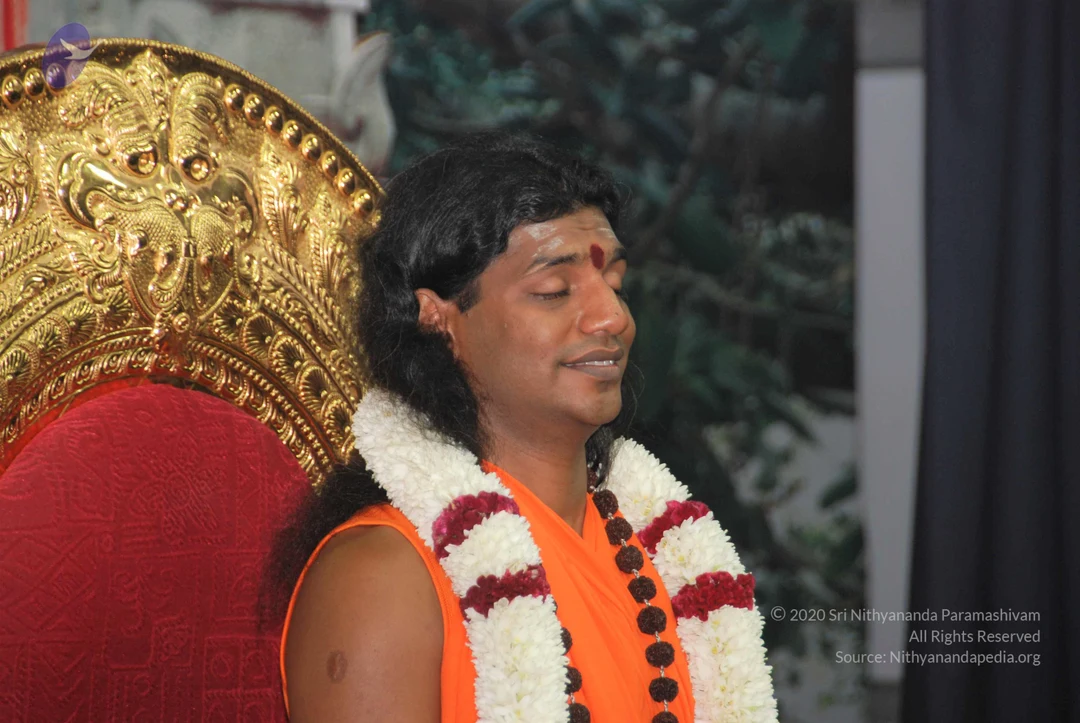
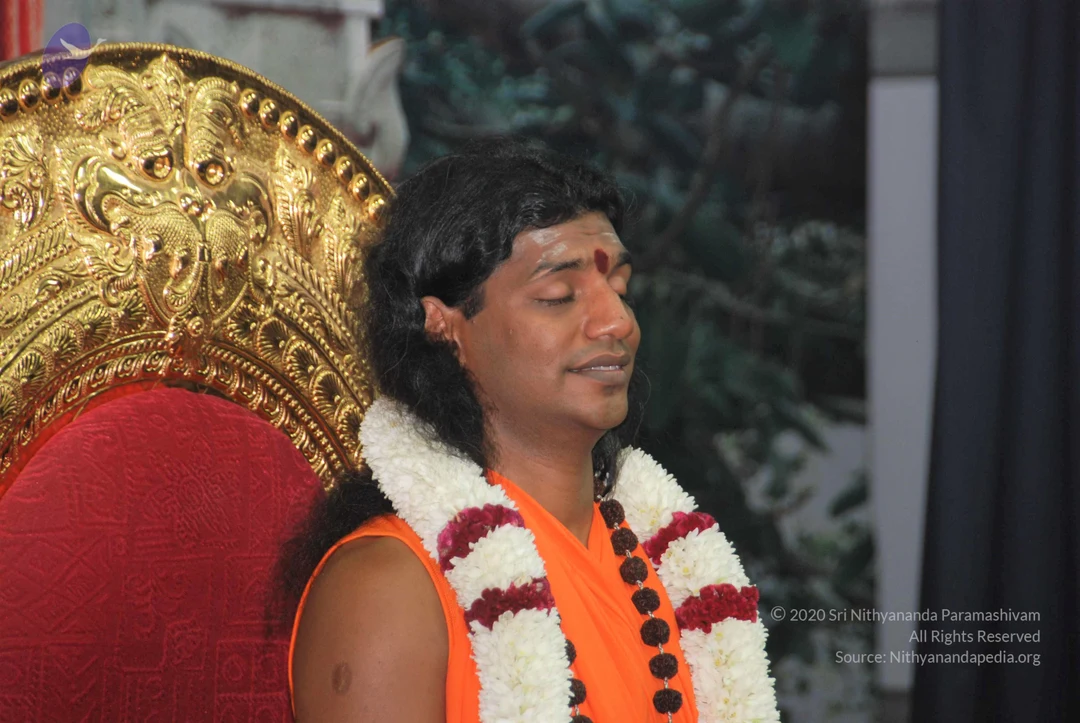
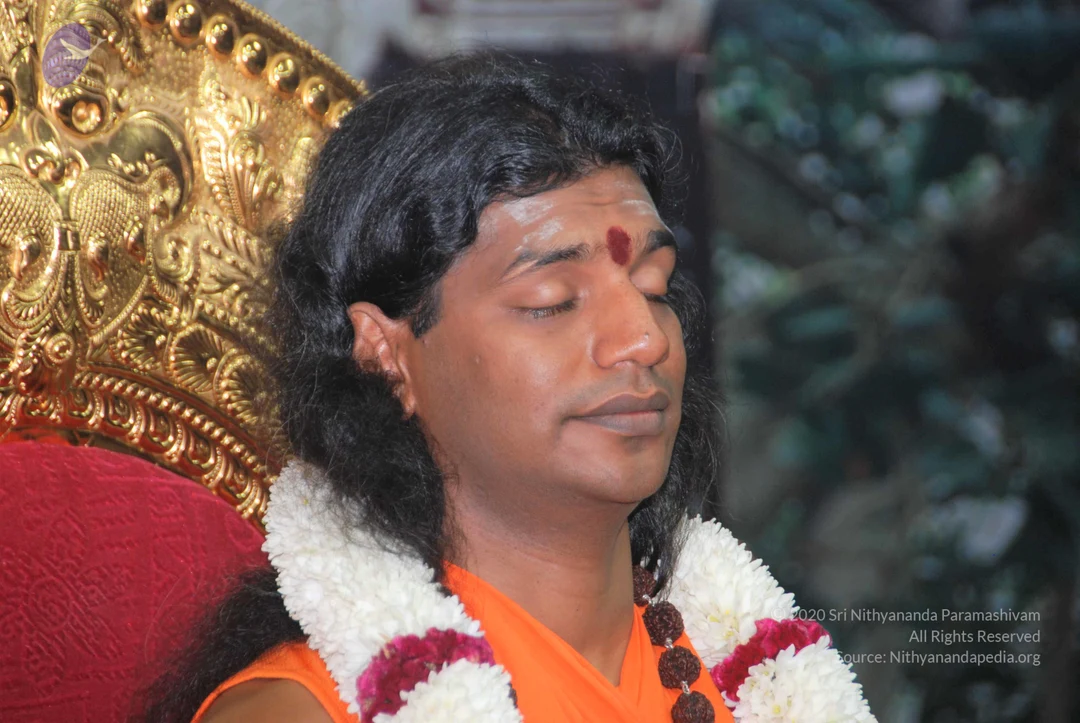
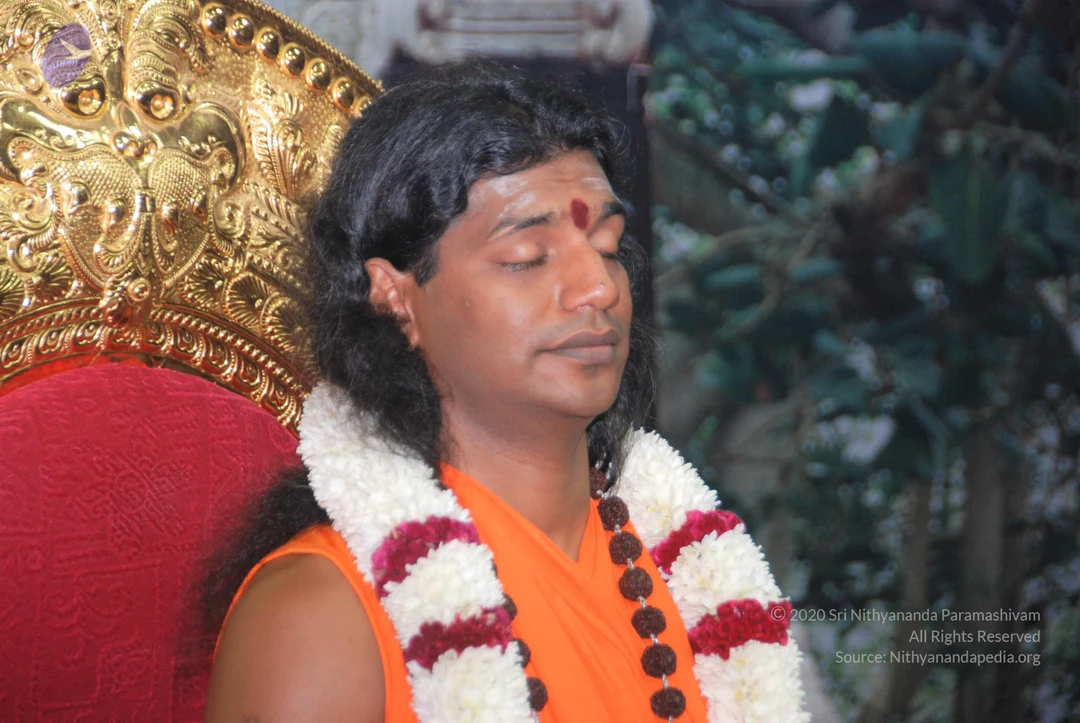
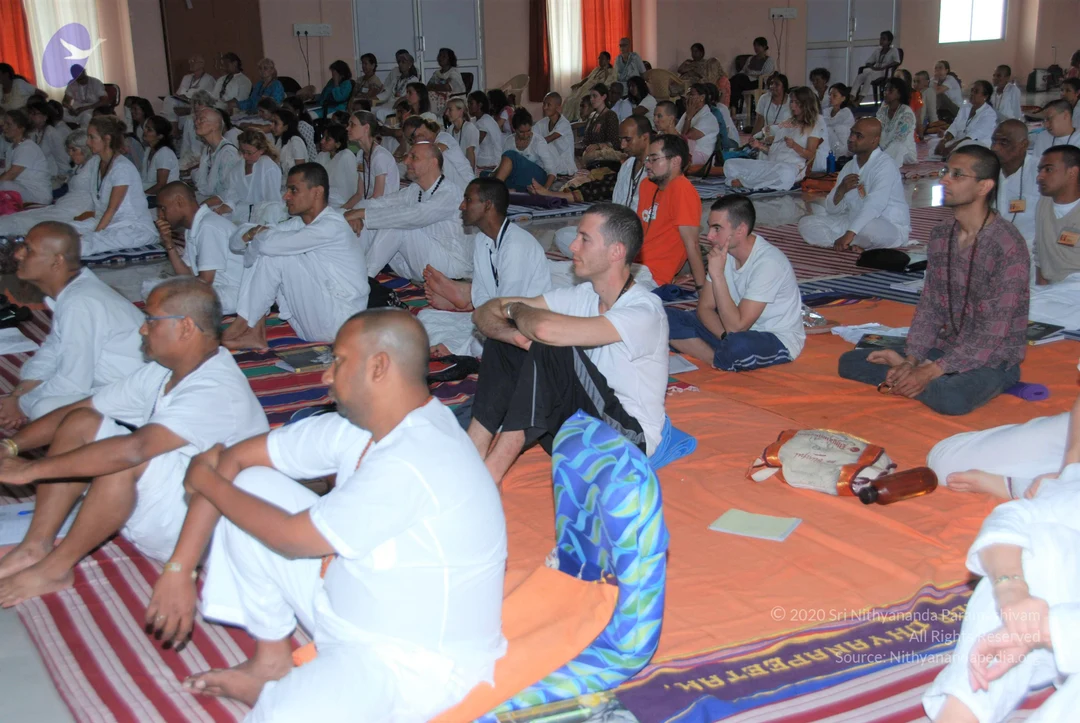
A man seated on an ornate golden throne with a large arched backrest of repoussé floral scrollwork and round bead-like studs. He has his eyes closed in meditation, wears an orange saffron robe, a long rudraksha mala hanging to his waist, and a white and maroon flower garland around his neck. He has a white vertical tilak with a red dot on his forehead and long dark hair. Behind him is a pink and white draped backdrop. In the upper left corner is a small blue logo, and a faint copyright line appears at the lower right. a person is seated in meditation on the throne with distinctive saffron robes and rudraksha malas.A large hall with a white marble floor where many people in white ritual clothes sit cross-legged in rows, eyes closed or hands folded in prayer. Each seated person has brass puja plates with small lamps, flowers and offerings set in front of them. In the foreground, several shaved-headed men in white dhotis and shawls with red borders sit with palms joined. Saffron and orange drapes hang on the walls, and the scene reads as a group pada puja or meditation session. No single figure is clearly identifiable as a person from appearance.Close side-profile photo of a man with eyes closed, seated in front of an ornate gold throne-back with carved floral panels and a red cushion. He wears a saffron-orange sleeveless garment with a draped orange cloth, a long necklace of white and magenta flower garlands, and a strand of brown rudraksha beads. He has long dark hair swept back, white tilak lines and a red dot on his forehead. Probable Swamiji: long swept-back hair, rudraksha mala and saffron clothing, seated in a throne-like setting in meditative stillness. Pada Puja album context on the page is not visible evidence.A photograph of a man seated with eyes closed in meditation, facing forward against a red cushioned seat with ornate gold carved panels behind him. He has long black hair swept back, a white sandalwood mark on his forehead with a red dot at the brow centre, and wears an orange sleeveless garment with a white and magenta flower garland and a strand of brown rudraksha beads across his chest. Dark blue drapery and greenery are visible at the right edge. The setting suggests a satsang or meditation session. Probable Swamiji in the distinctive saffron clothing, rudraksha mala and long swept-back hair, seated on a throne-like chair.A man with long dark hair and a red tilak on his forehead sits with eyes closed in meditation on a red-cushioned golden throne. He wears a saffron-orange sleeveless garment, a rudraksha mala hanging on his chest, and a white and magenta flower garland. Beside him on a wooden table are a tray of red apples and a wooden box with red cloth, and an orange cloth lies on the right. Behind him hangs a dark blue curtain. a person: appearance cues include long swept hair, saffron clothing and rudraksha mala, seated on a throne in meditation.A large hall filled with seated devotees during a puja. In the foreground, several shaved-headed priests in white dhotis sit on the floor before brass puja plates with oil lamps and offerings on orange and yellow cloths. One priest in a saffron-orange robe sits at the front left, with a camera tripod and video equipment nearby. Behind them, rows of people in white and yellow clothing sit on mats. Colourful woven bunting hangs from the pillars and ceiling. a person is not clearly identifiable from appearance, so no candidate is named.
05

04-Sarva-Darshan

20 dated photos in previewSource gallery
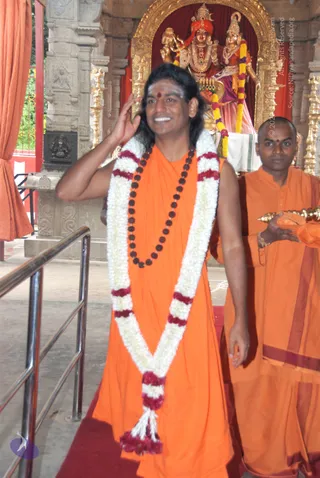
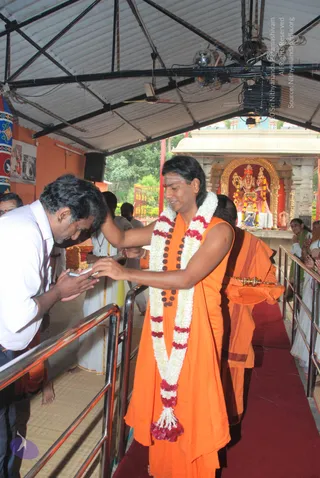
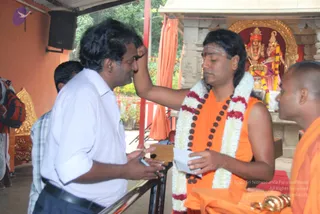
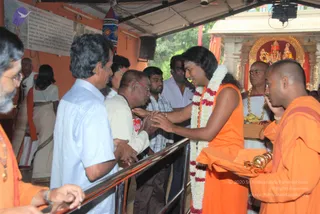
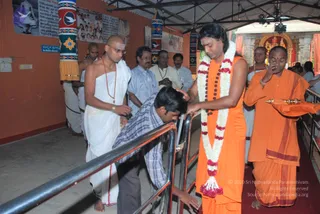
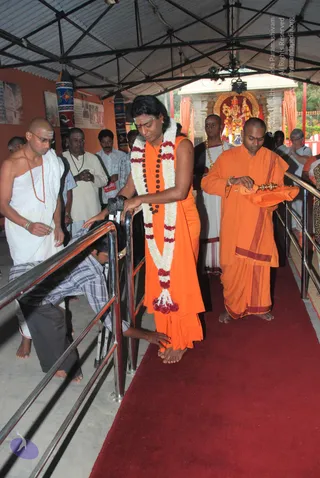
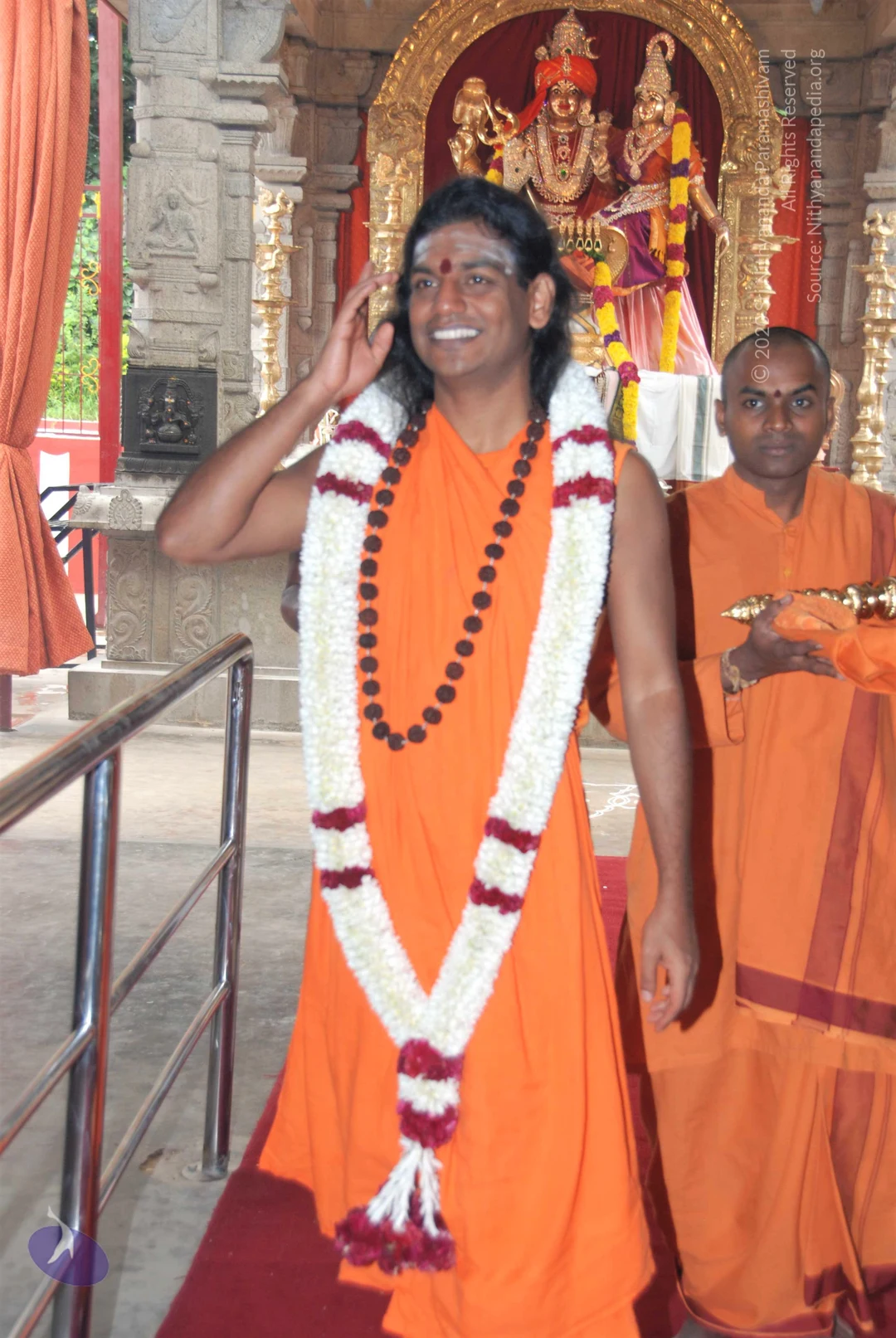
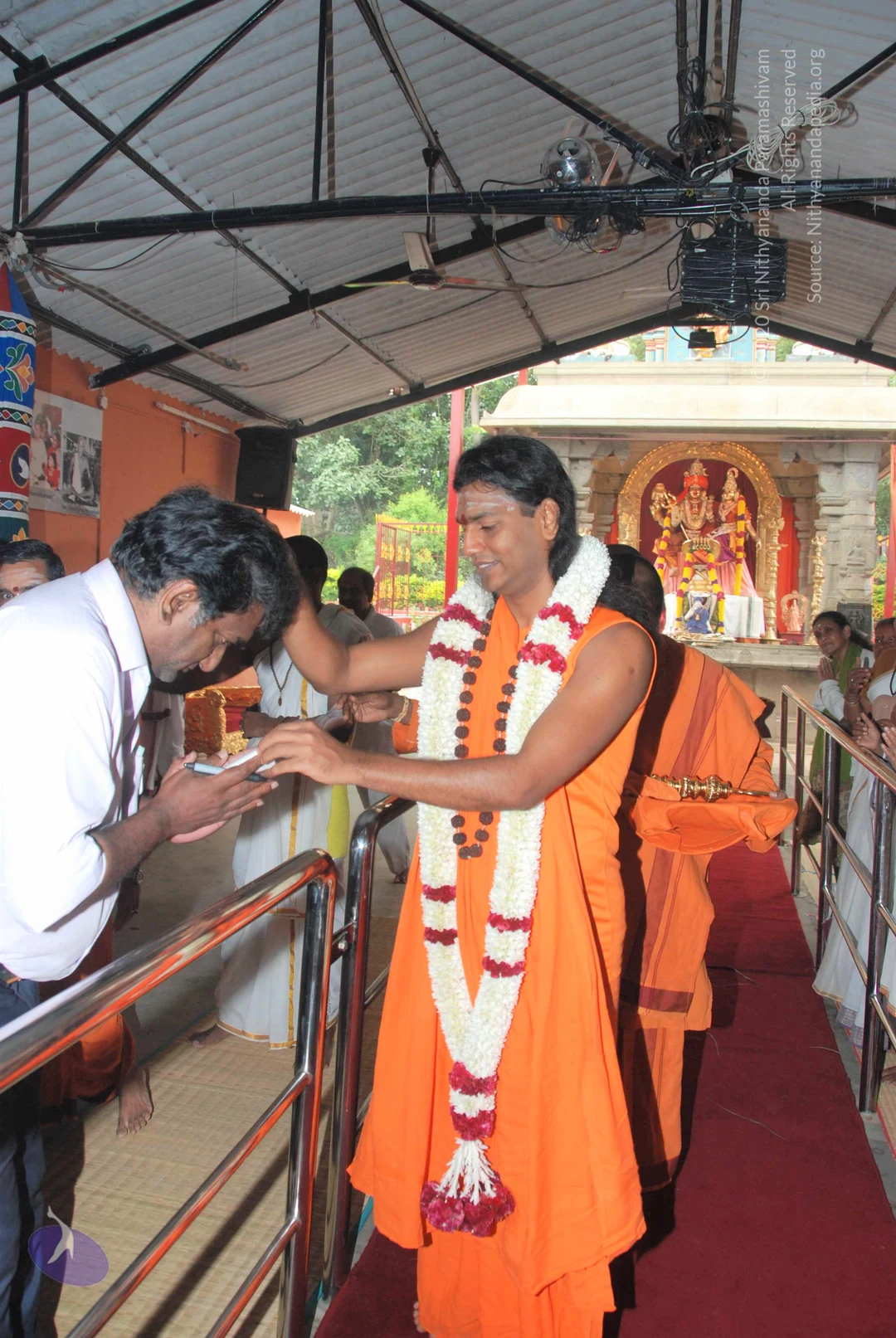
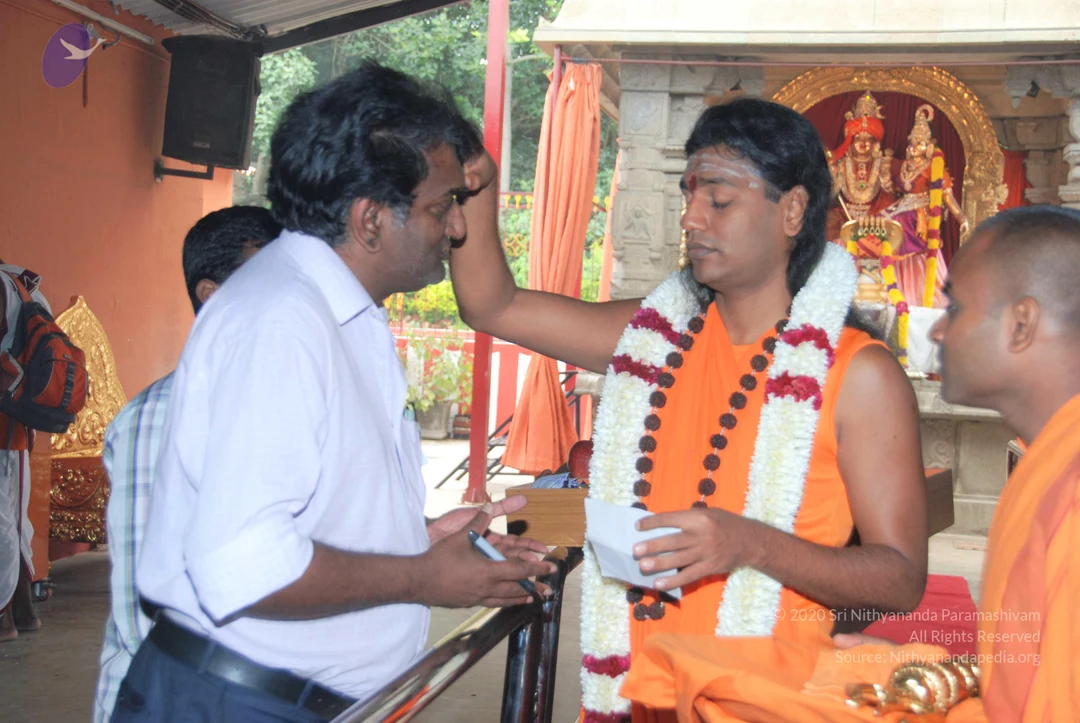
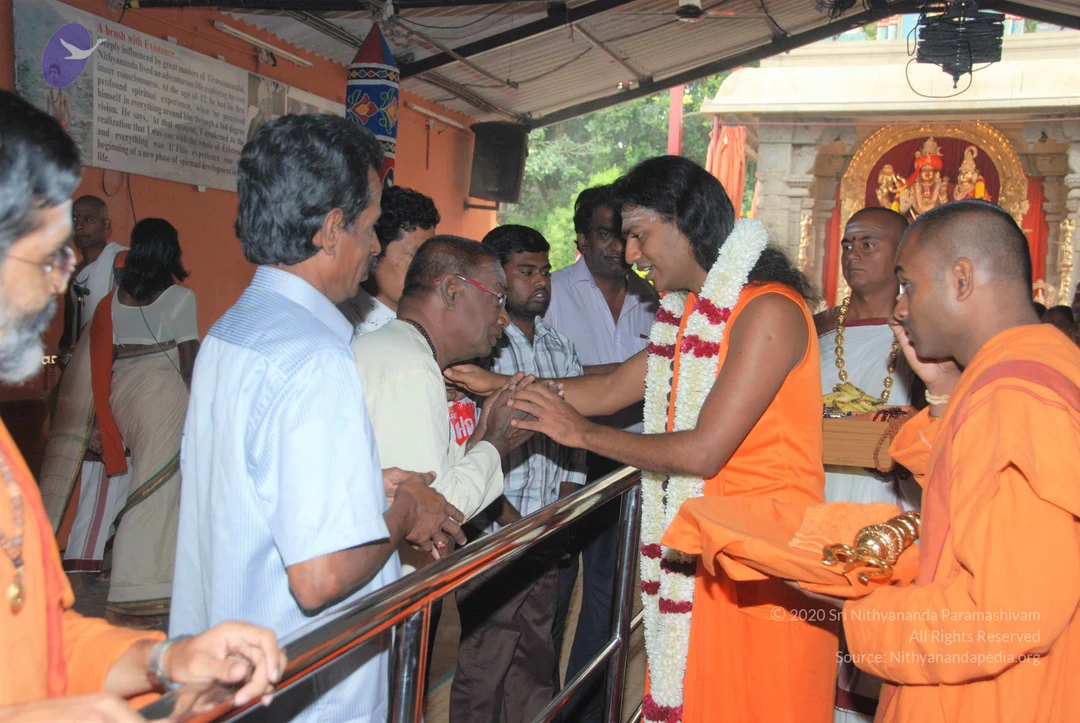
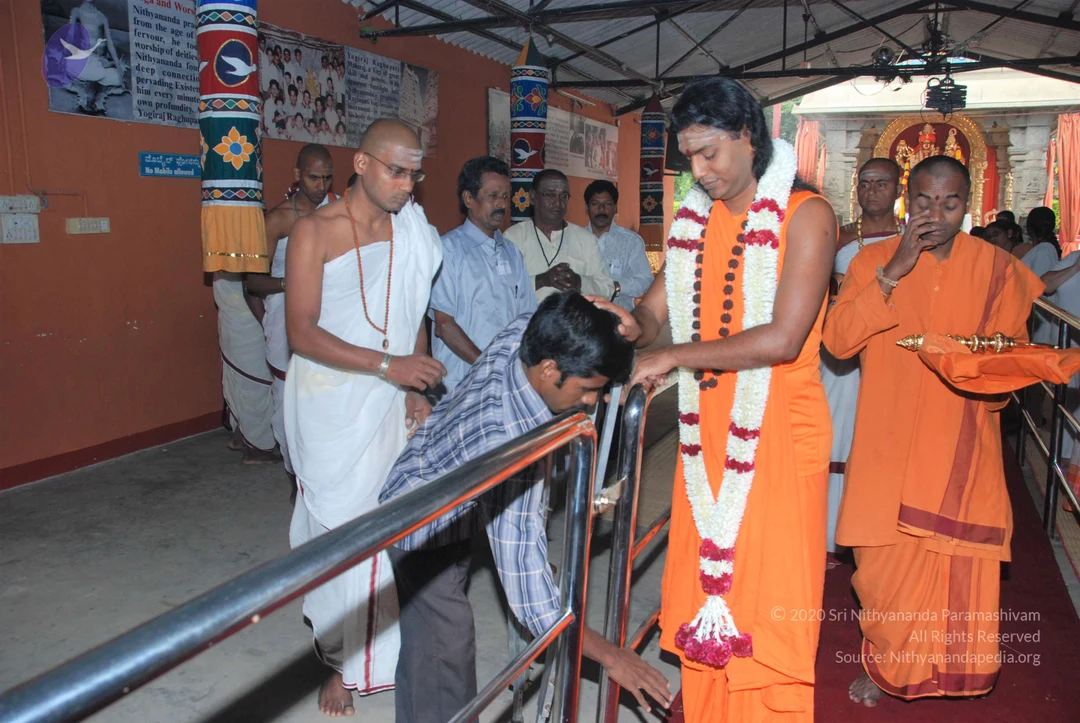
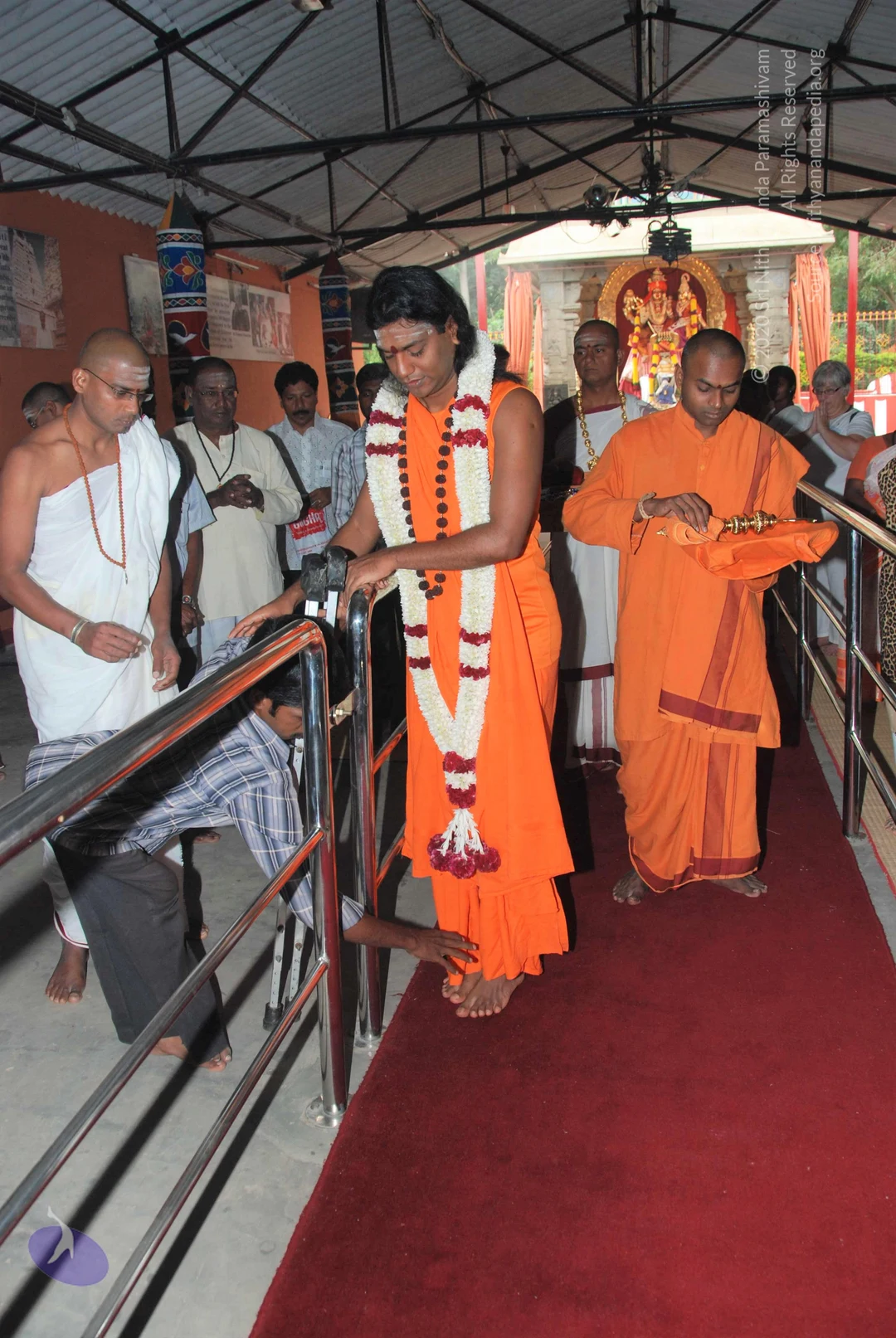
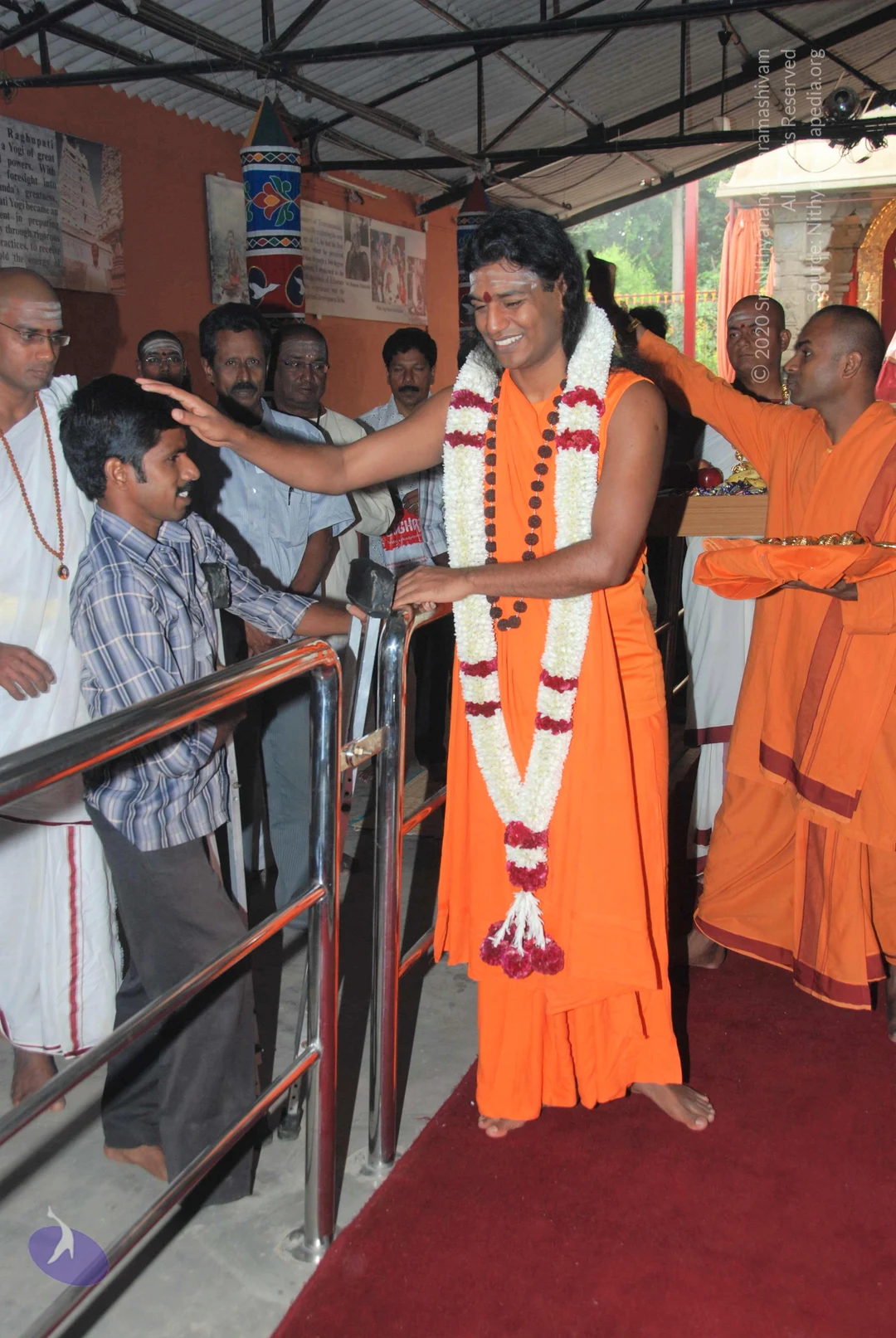
A smiling man in saffron-orange robes stands on a red carpet inside a temple, raising one hand to his head. He wears a long white and maroon jasmine garland and a dark rudraksha mala, with a red bindi and white tilak on his forehead; his hair is long and swept back. Behind him stands a second man in orange robes with a shaved head, holding a golden ritual vessel. Behind them, a golden arch frames a deity murti adorned with garlands and a gold-decorated shrine, with gold lamp stands and a red curtain at the left.A photograph at a temple-like outdoor hall under a corrugated roof. A man in an orange saffron robe wearing a white and red flower garland and a rudraksha mala walks along a red carpet, touching the hand of a man in a white shirt who bends forward and holds up a phone. Behind them, a golden-arched shrine holds a deity murti with garlands. Several people in white and orange clothing stand nearby, and a woman in a green sari presses her palms together at the rail. A man in an orange robe carries a gold-tipped staff at right.A photograph of a temple setting where a man in a white collared shirt and dark trousers reaches out to touch the forehead of a seated man in saffron-orange robes. The saffron-clad man wears a white and red flower garland, a long dark rudraksha mala, and white and red tilak marks on his forehead, and holds a small white box. Another saffron-robed person sits at the right edge. Behind them, an ornate golden shrine holds a deity murti with a red backdrop and marigold garlands. A small black speaker hangs on an orange pillar at the left. A partially visible person stands at the far left edge.A photograph inside a temple hall with an orange-painted wall and a corrugated roof. A long-haired figure in an orange robe wearing a white and red flower garland stands at the centre, holding the hands of an older man in a white shirt and glasses who bows forward to him. Behind, a man in a white dhoti offers a wooden tray with a small gold object, and an orange-robed attendant with a shaved head stands at right holding a brass vessel. To the left, another orange-robed figure and several men in shirts and dhotis stand by a metal railing. Behind them, a shrine shows a deity murti with gold ornaments and a red backdrop, under a hanging fan and speaker.A man in a checked blue-and-white shirt bends forward at a metal railing while a man in a saffron-orange robe with a long white flower garland and rudraksha mala places his hand on the bent man's head in blessing. The saffron-robed man has long swept-back dark hair and distinctive ornate adornments. Beside them a bald priest in white dhoti and shawl with a rudraksha mala watches, and a shaven-headed attendant in orange holds a brass ceremonial staff with a red cloth. Other men in pale shirts stand behind, and a deity murti sits in a decorated shrine at the right beneath an arched golden frame. Red carpet runs along the floor, and a banner on the orange-painted wall carries printed photographs and text. The setting appears to be a temple hall under a corrugated roof.Photograph of a temple entrance area under a corrugated metal roof with a red carpet runner. A central figure in saffron-orange robes wears a long white and red flower garland with rudraksha beads and a vibhuti/tilaka mark on the forehead; his long dark hair is swept back. He stands with hands on a steel railing while a man in a checked blue shirt bends low before him. To the right, an attendant in orange robes holds a folded orange cloth on a tray. A man in white dhoti with orange sacred thread and a shaved head stands at left, and other devotees and men in white stand behind. In the background, a deity murti with a golden arch and red drapes sits in a shrine.
06

05-Morning-Message

65 dated photos in previewSource gallery
07

06-Living-Enlightenment-Program-LEP

54 dated photos in previewSource gallery
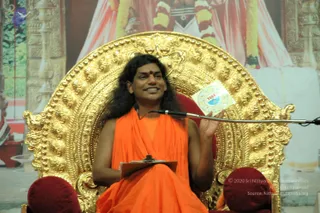
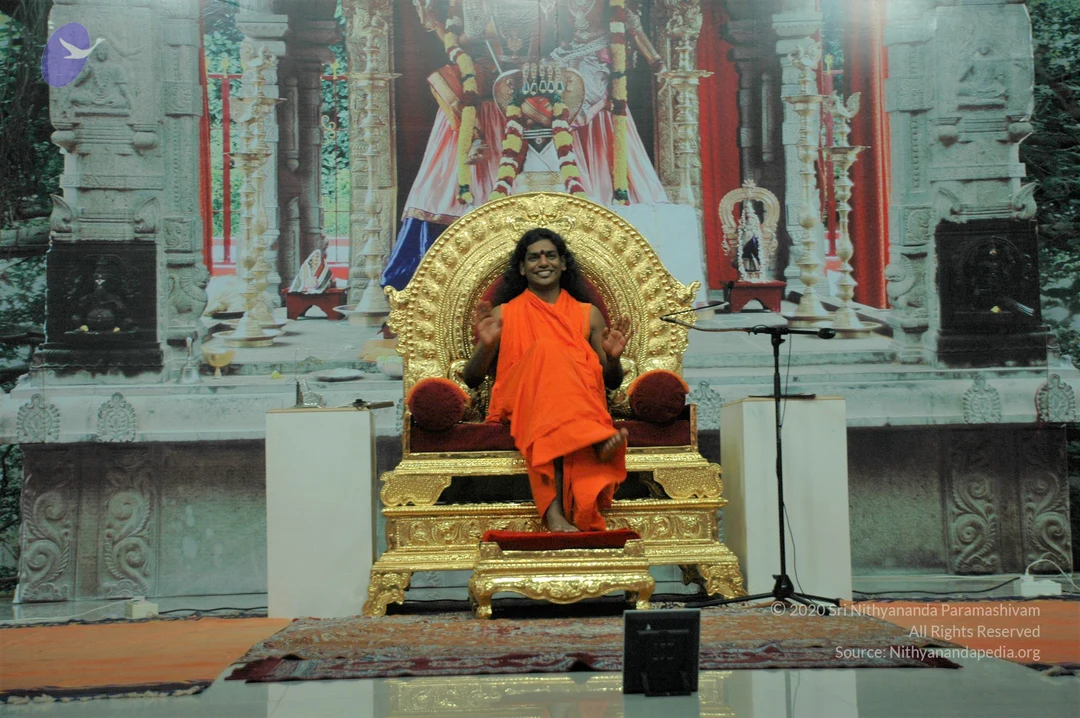
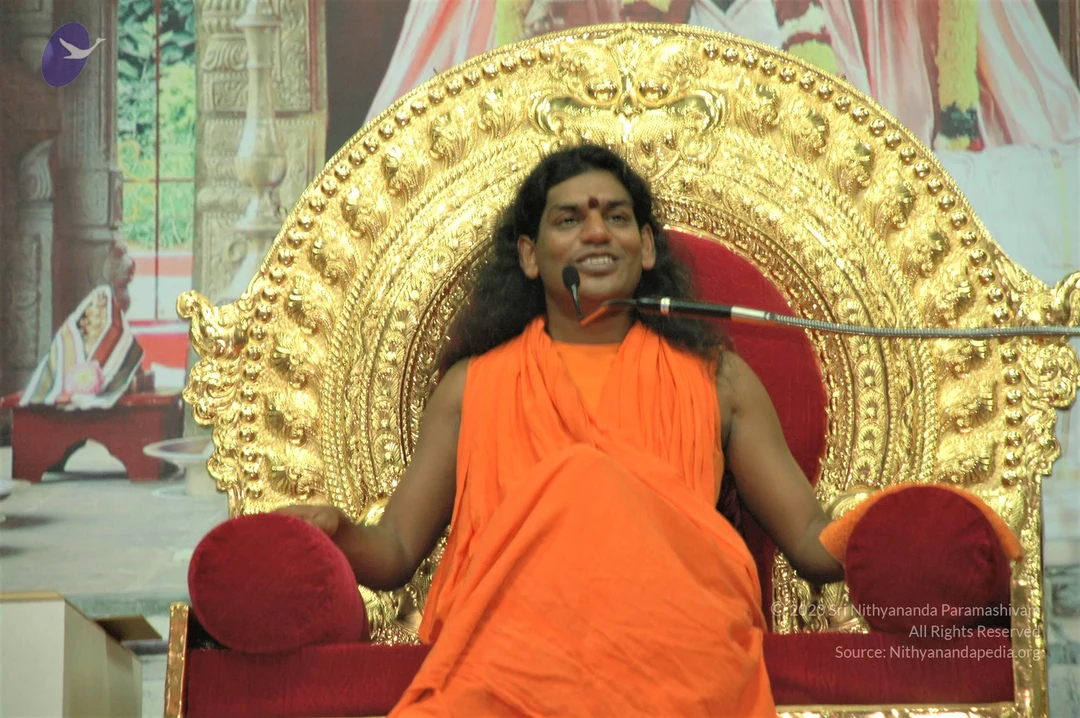
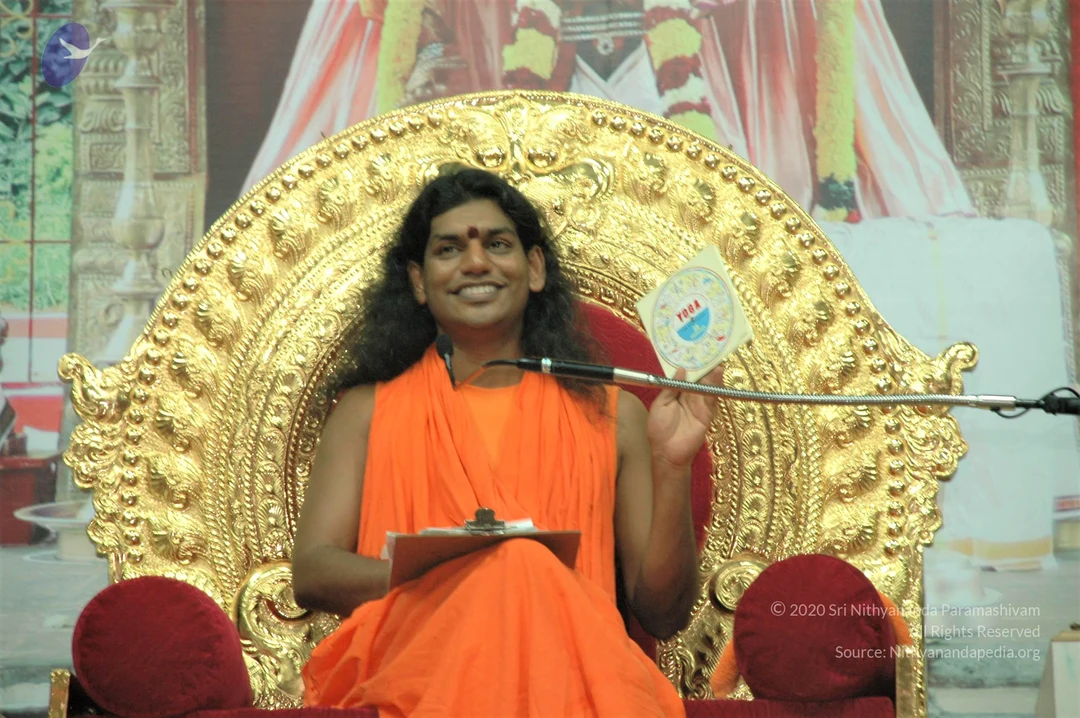
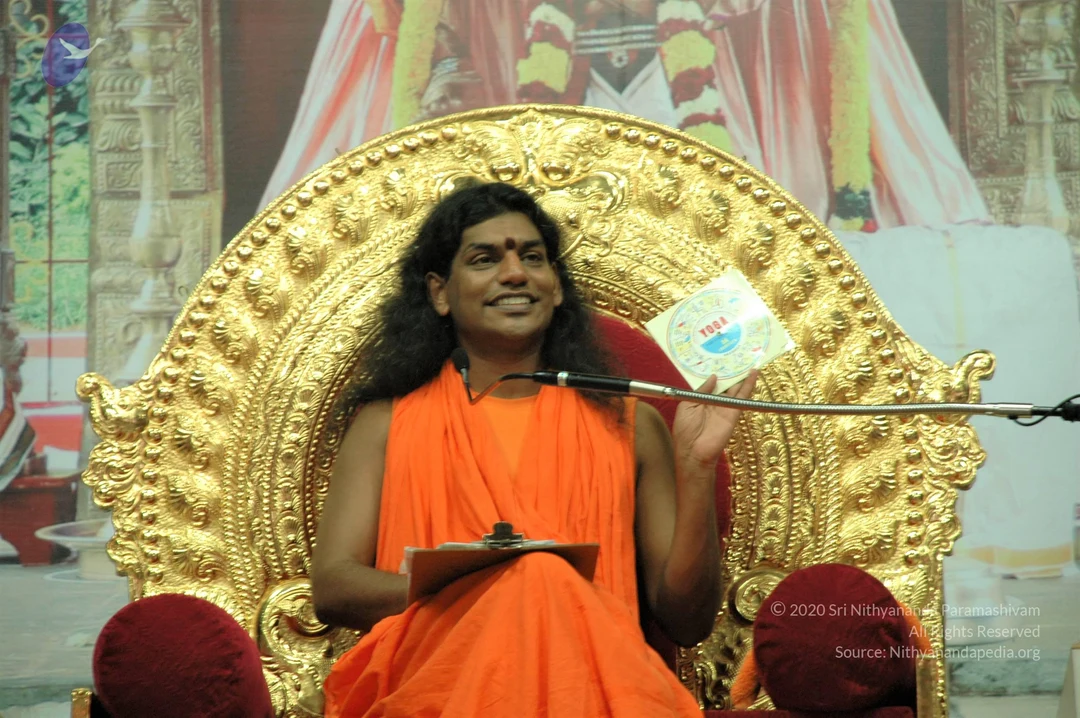
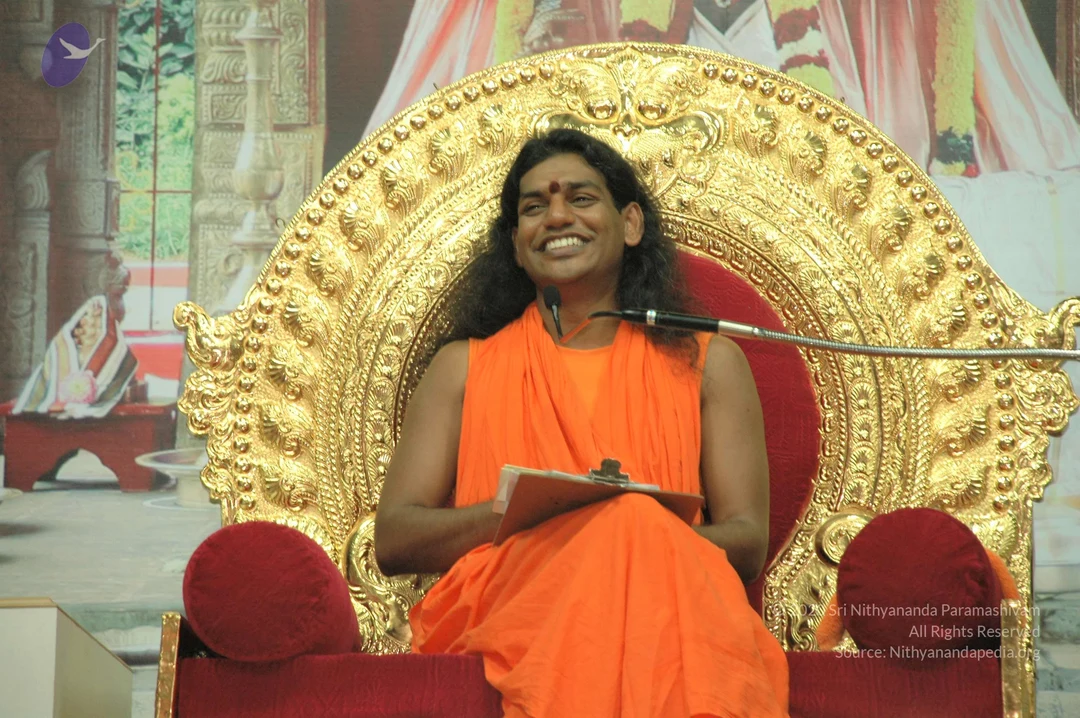
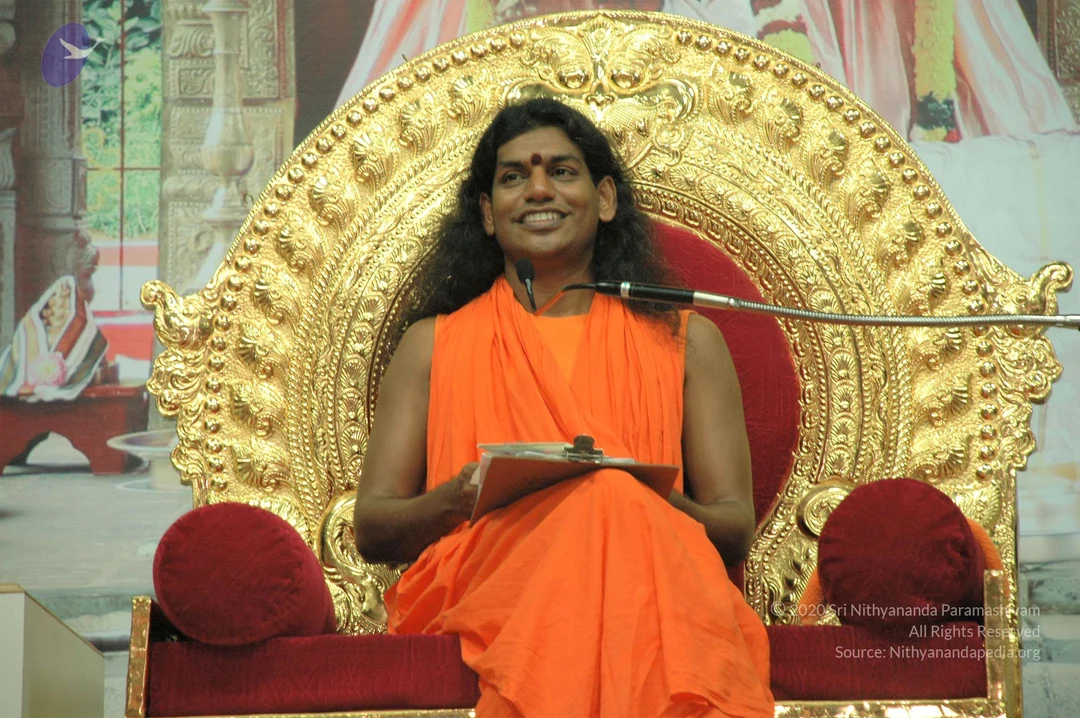
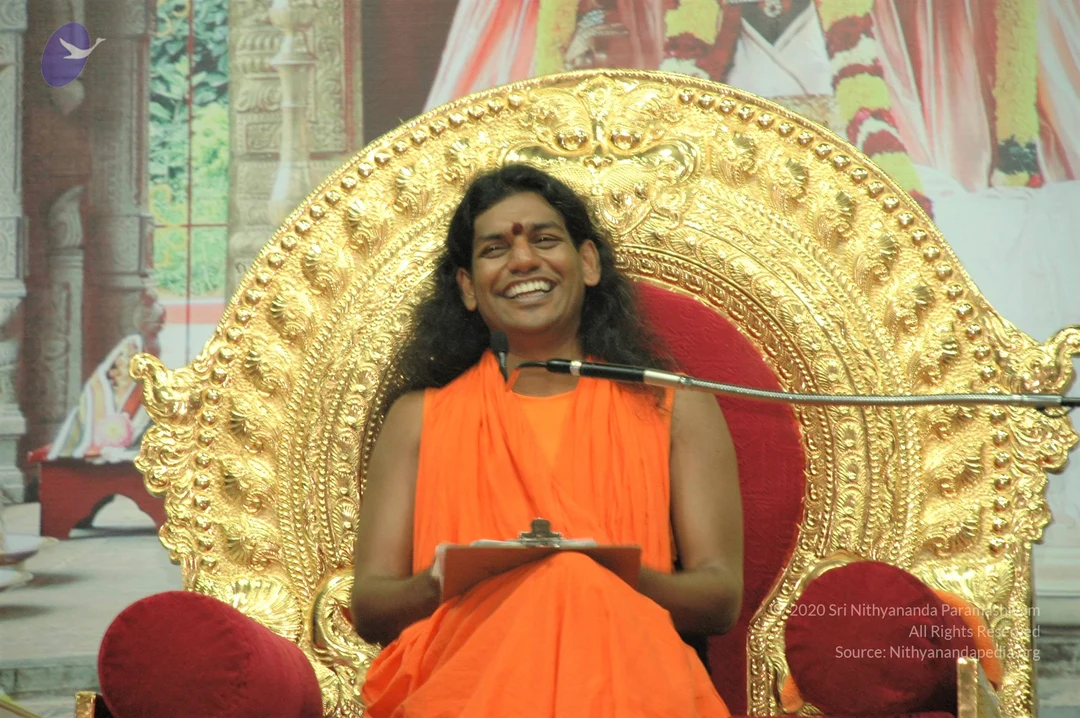
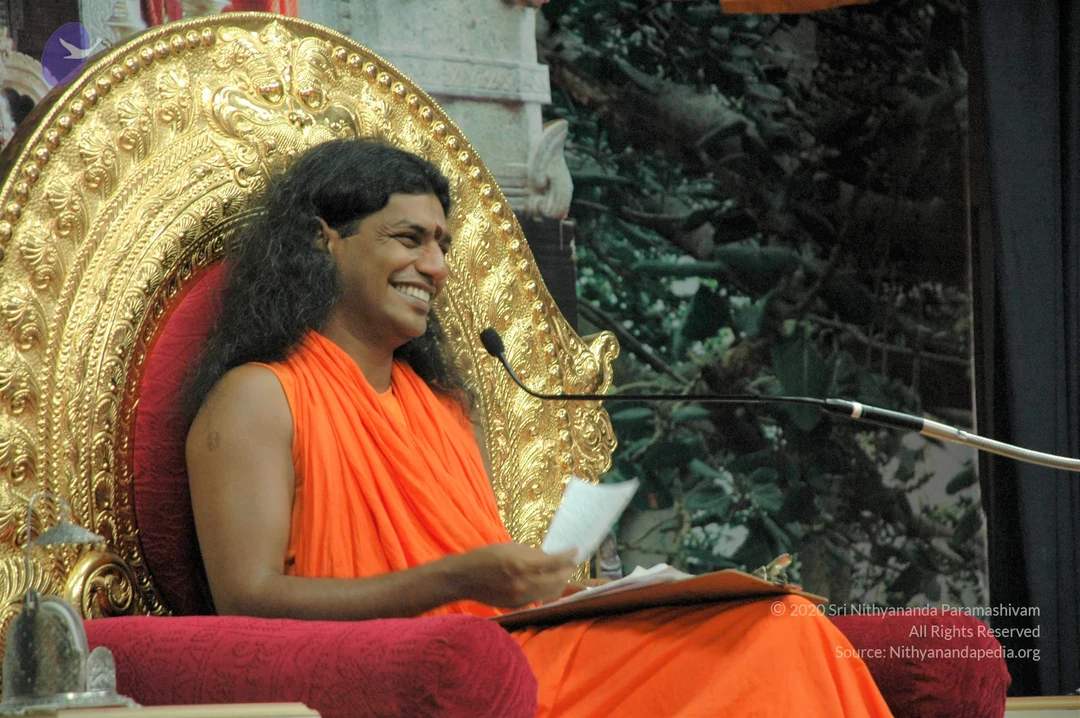
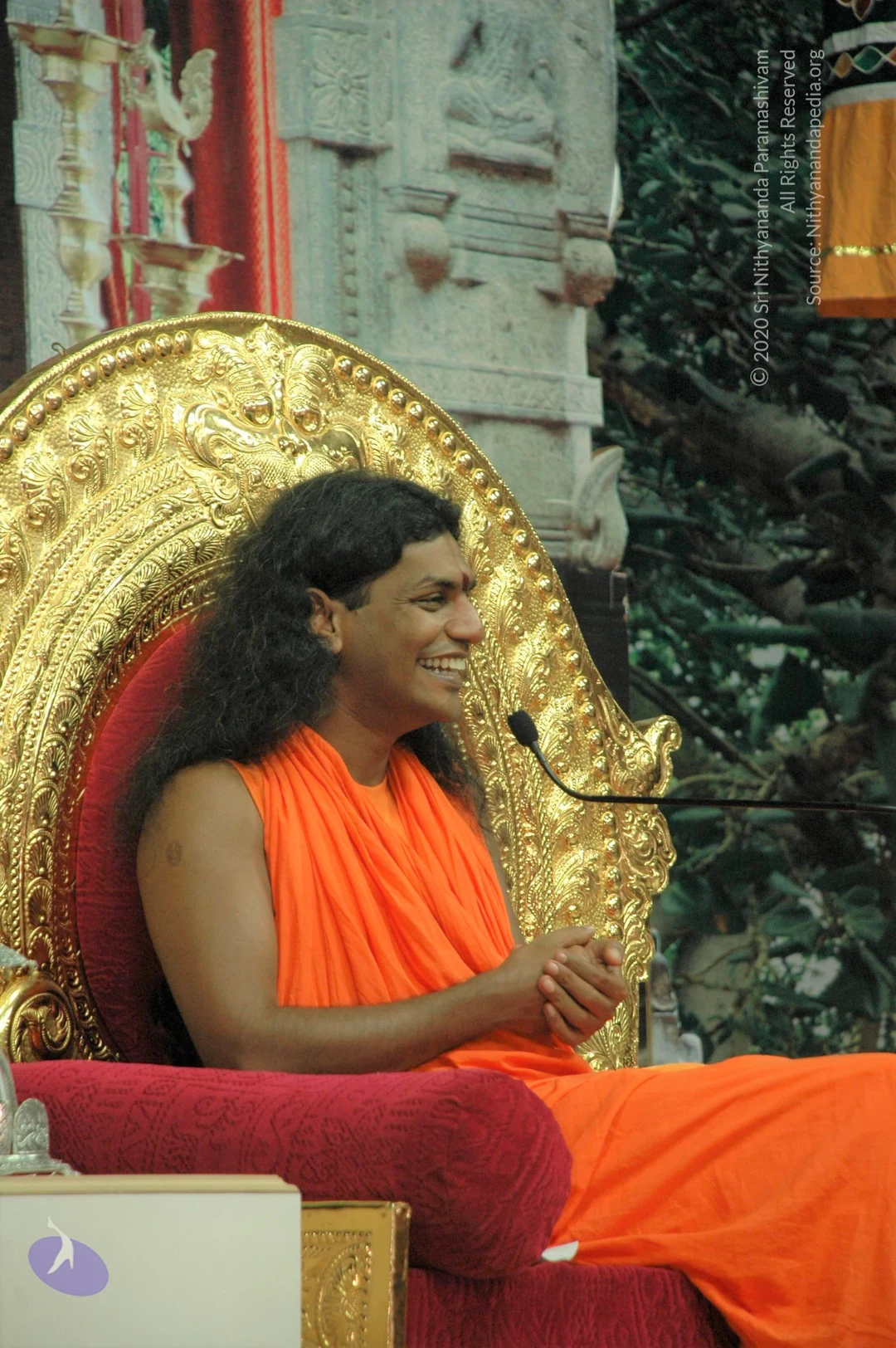
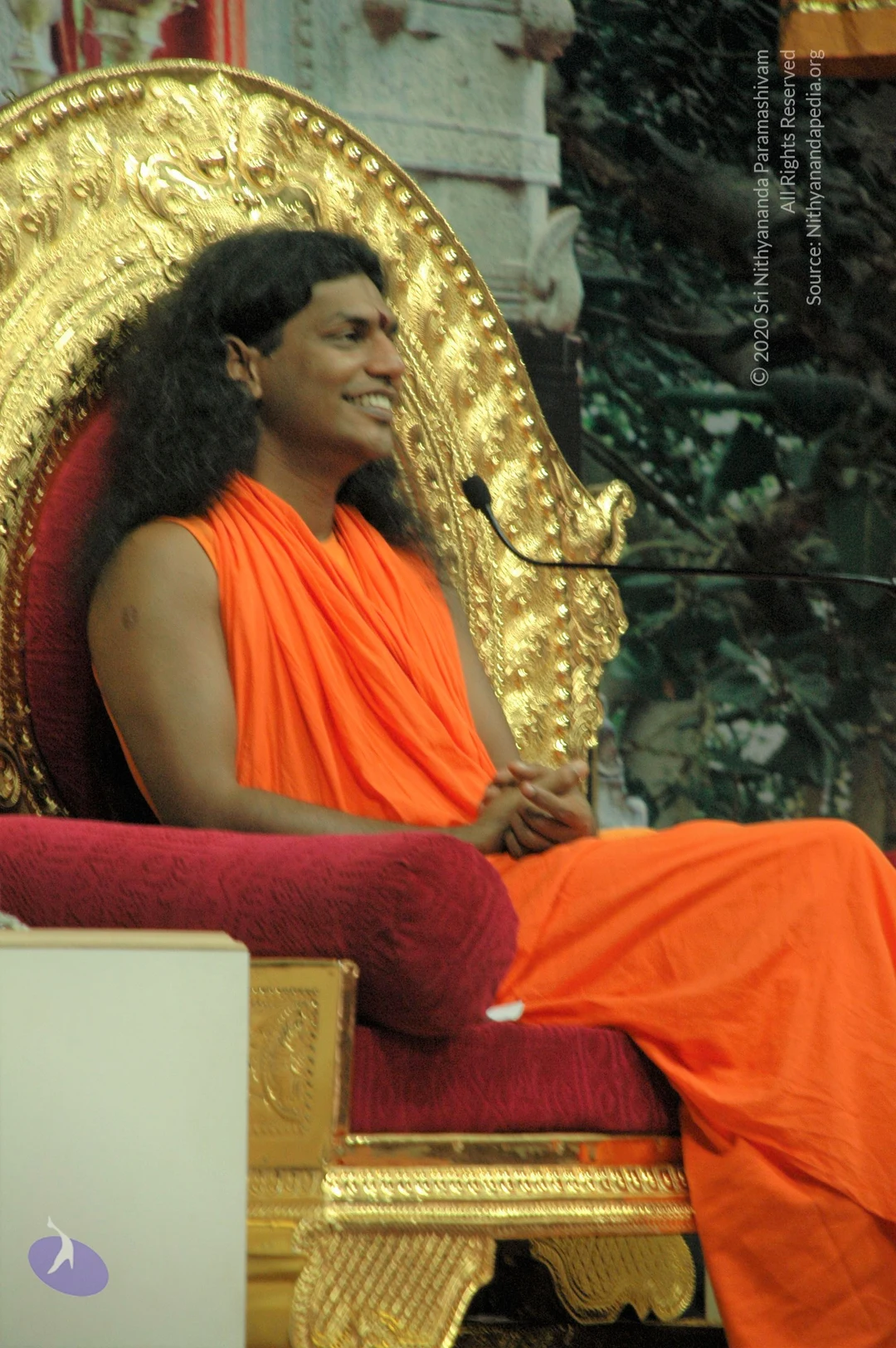
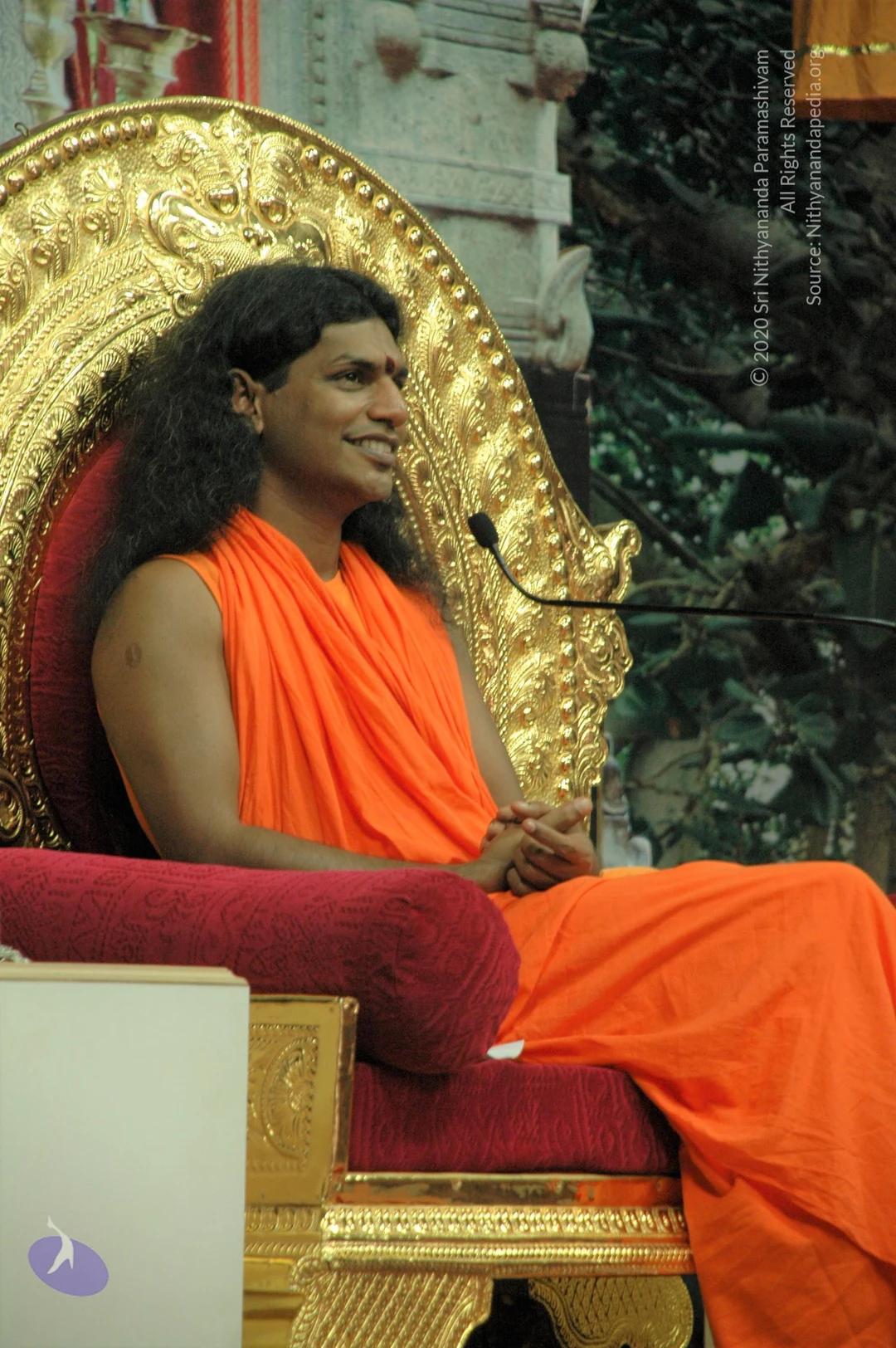
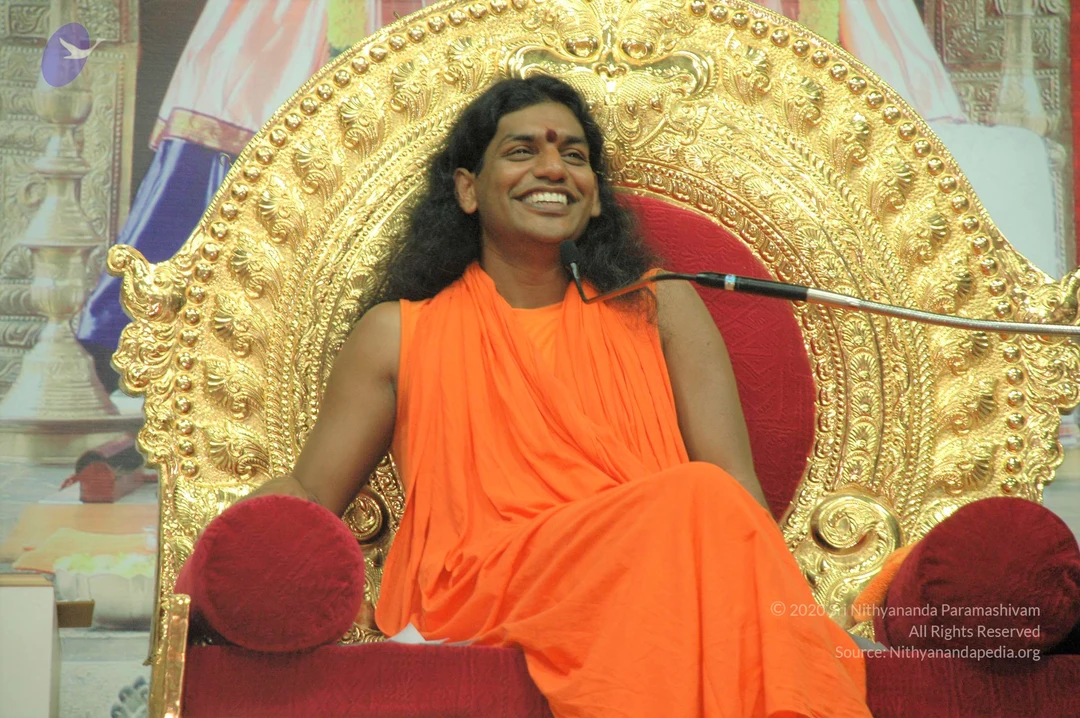
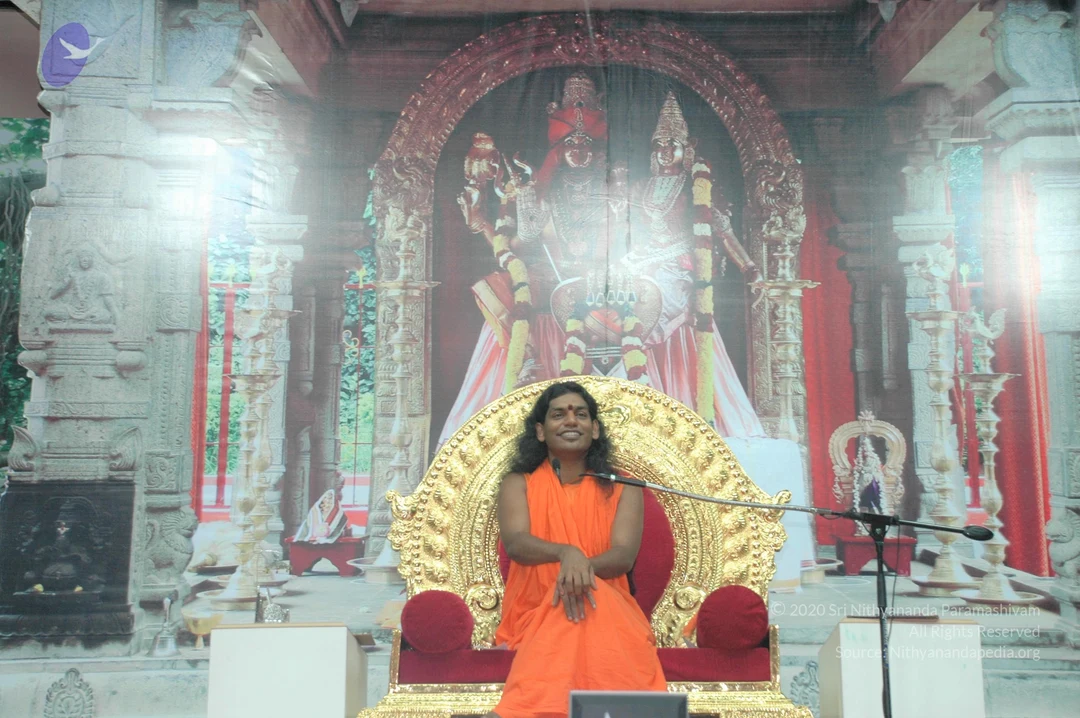
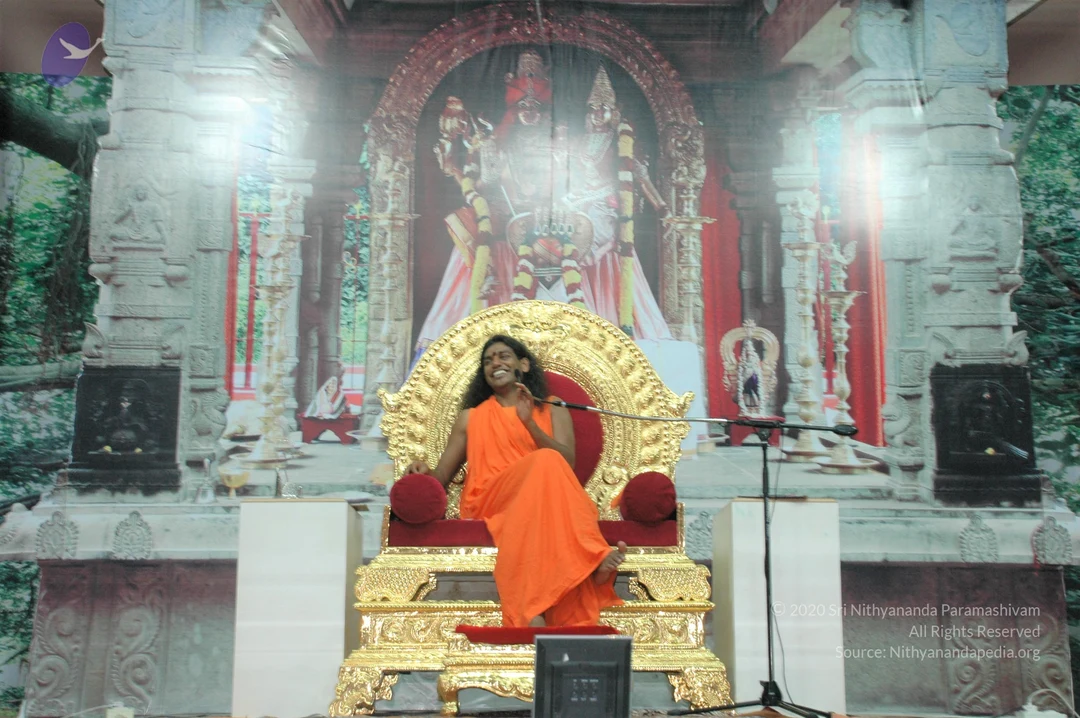
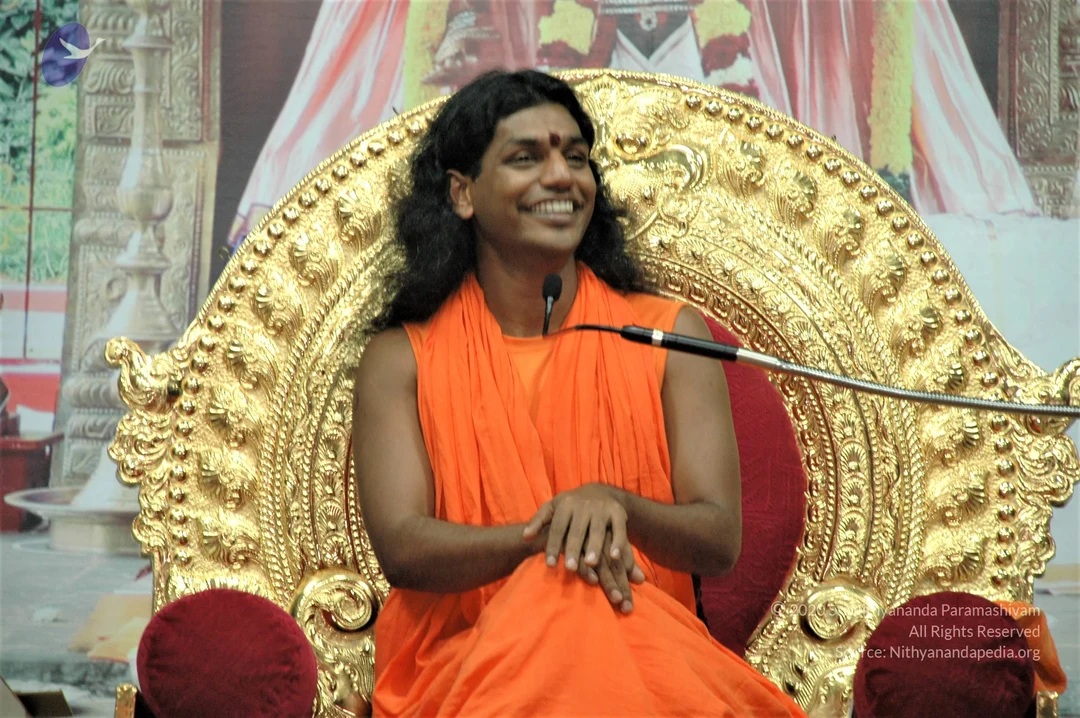
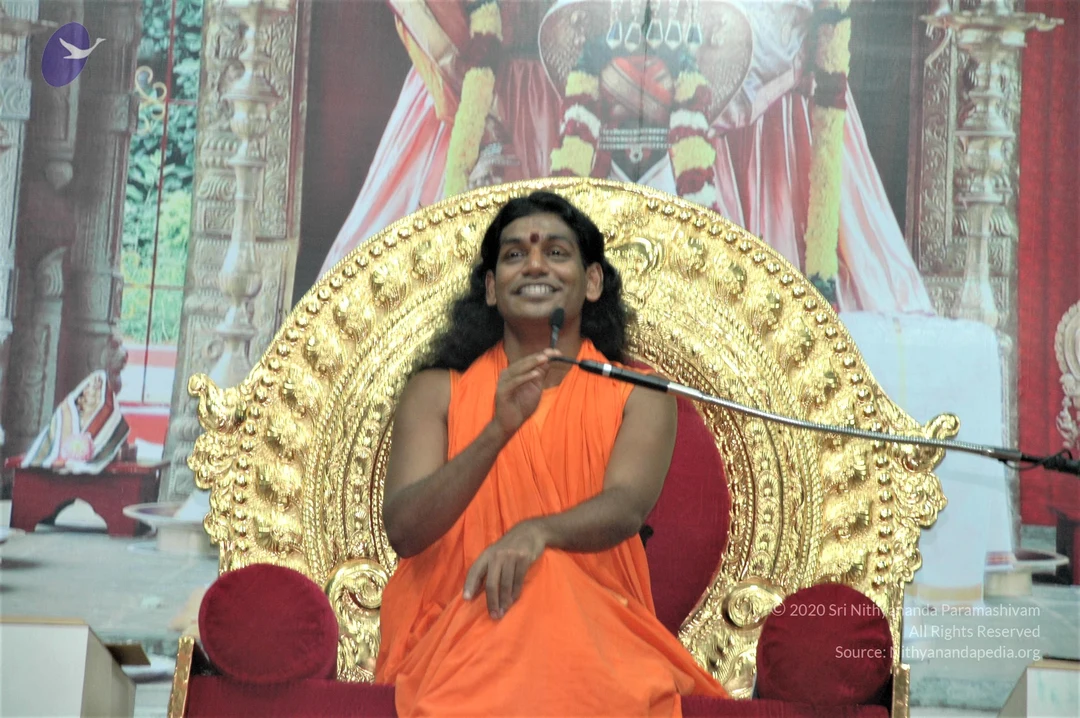
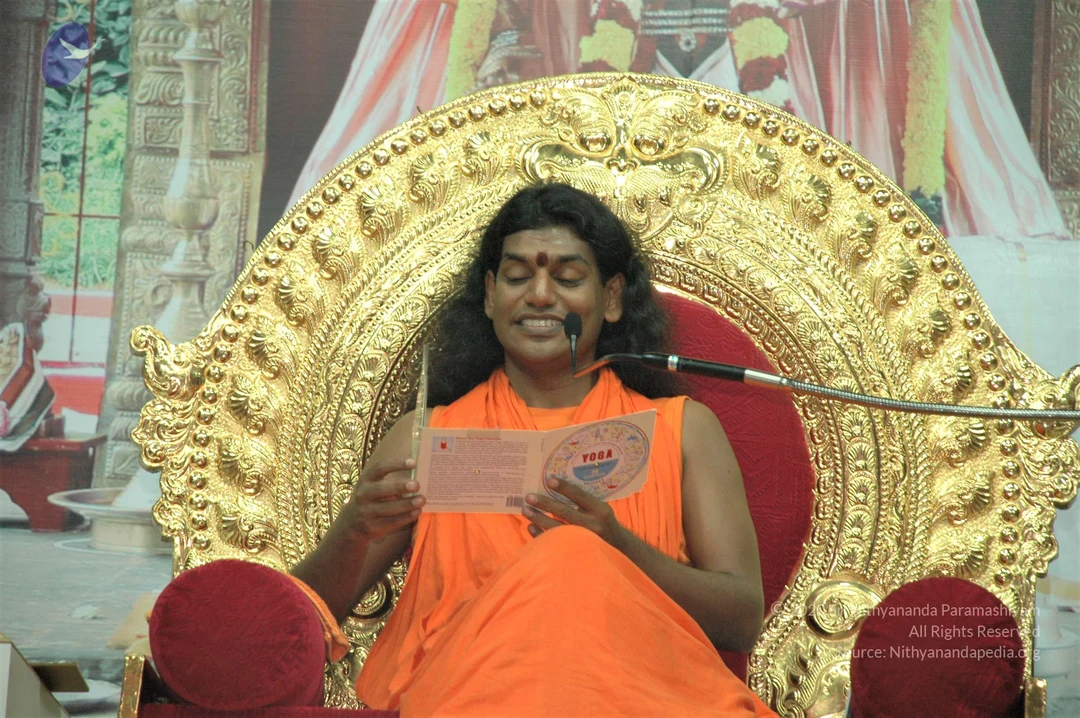
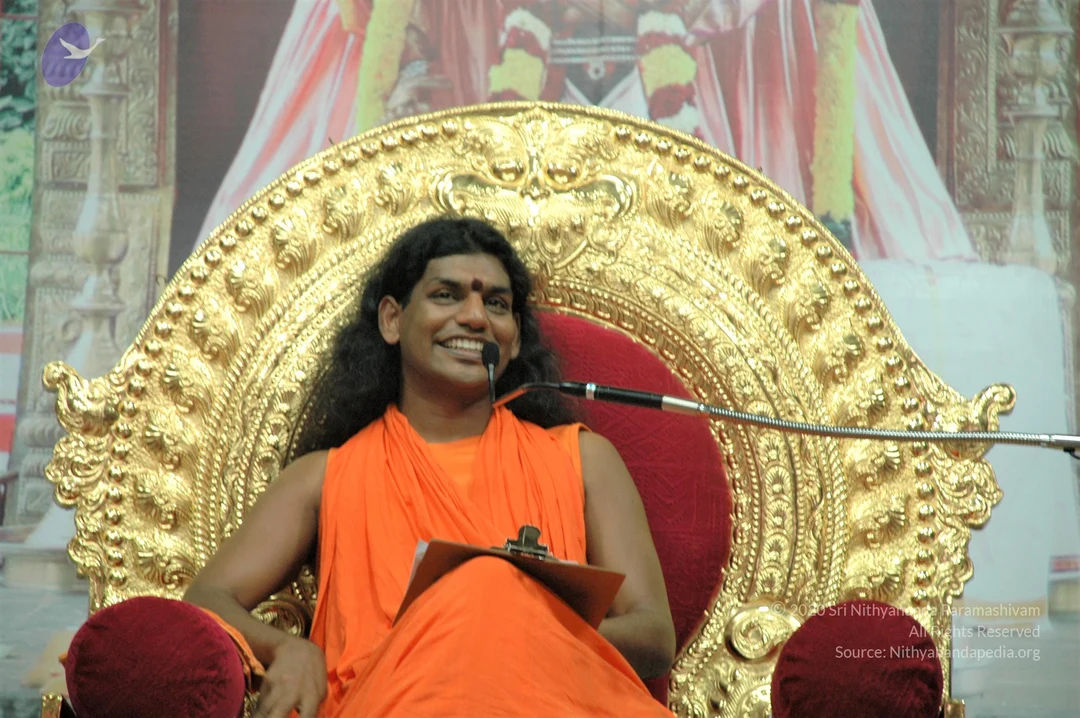
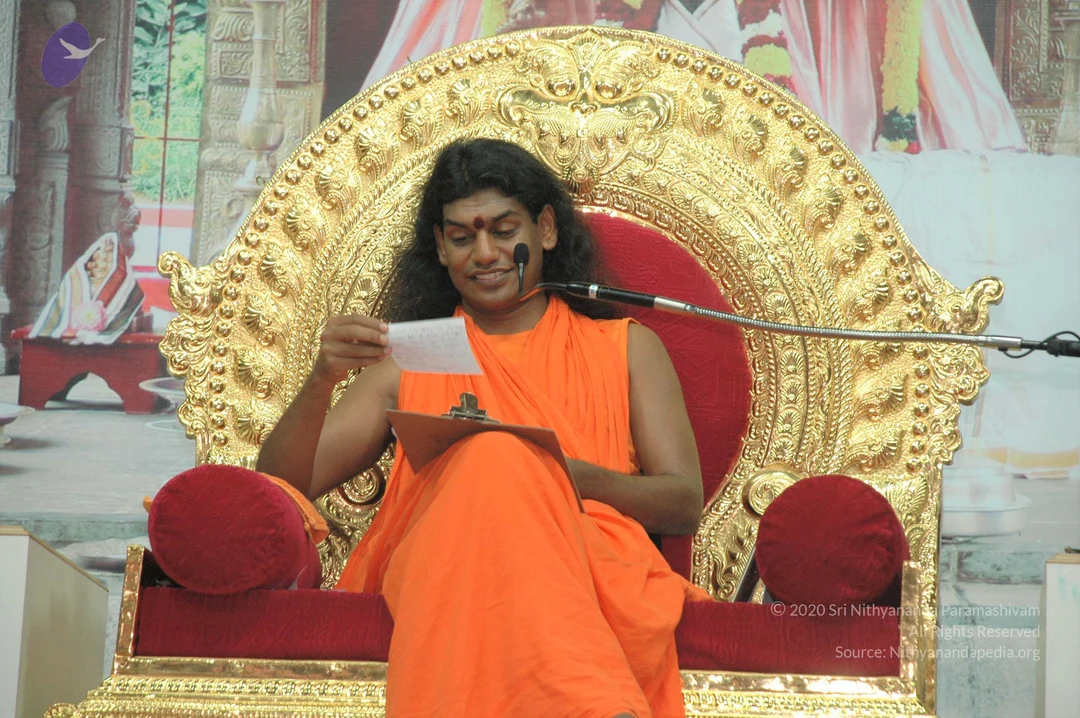
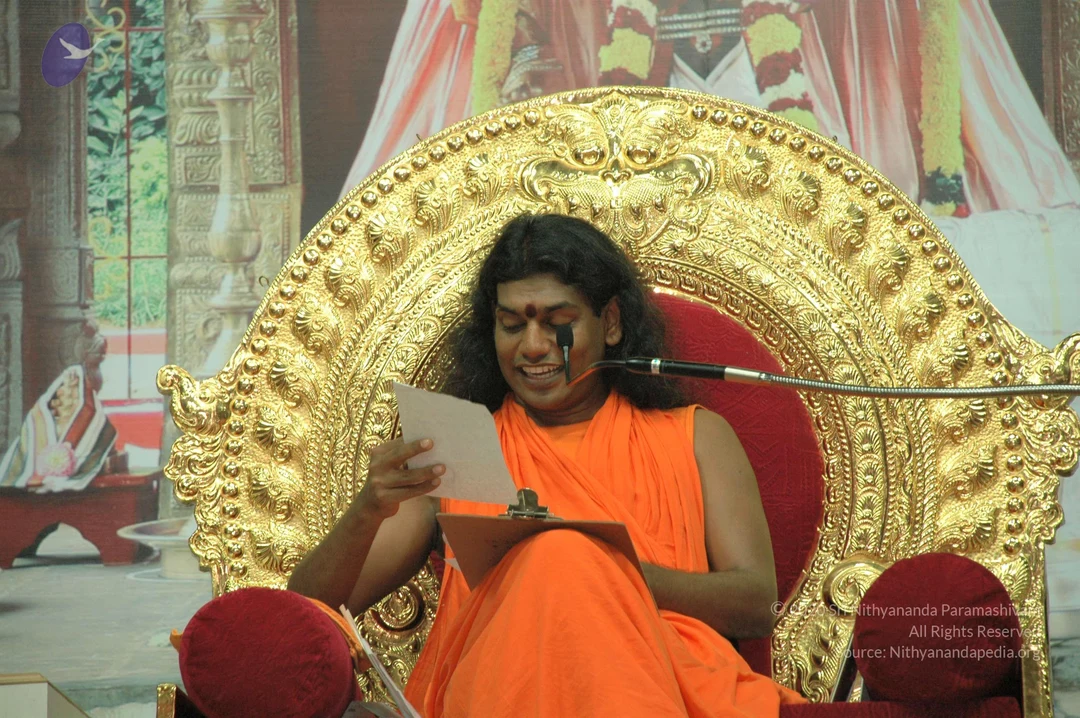
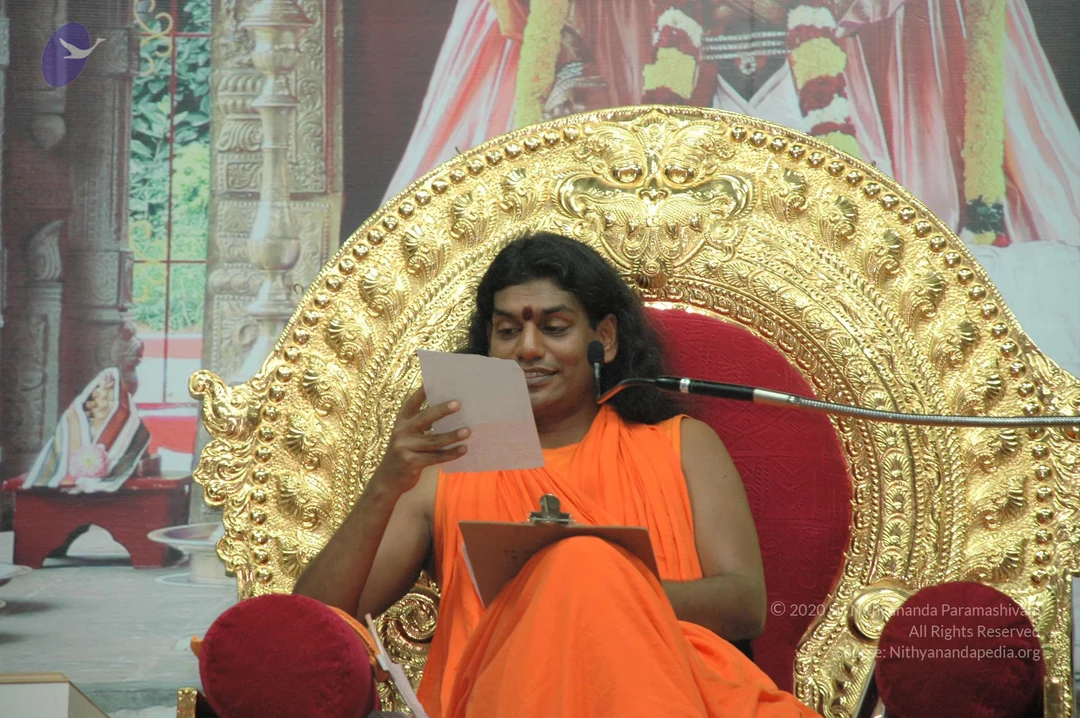
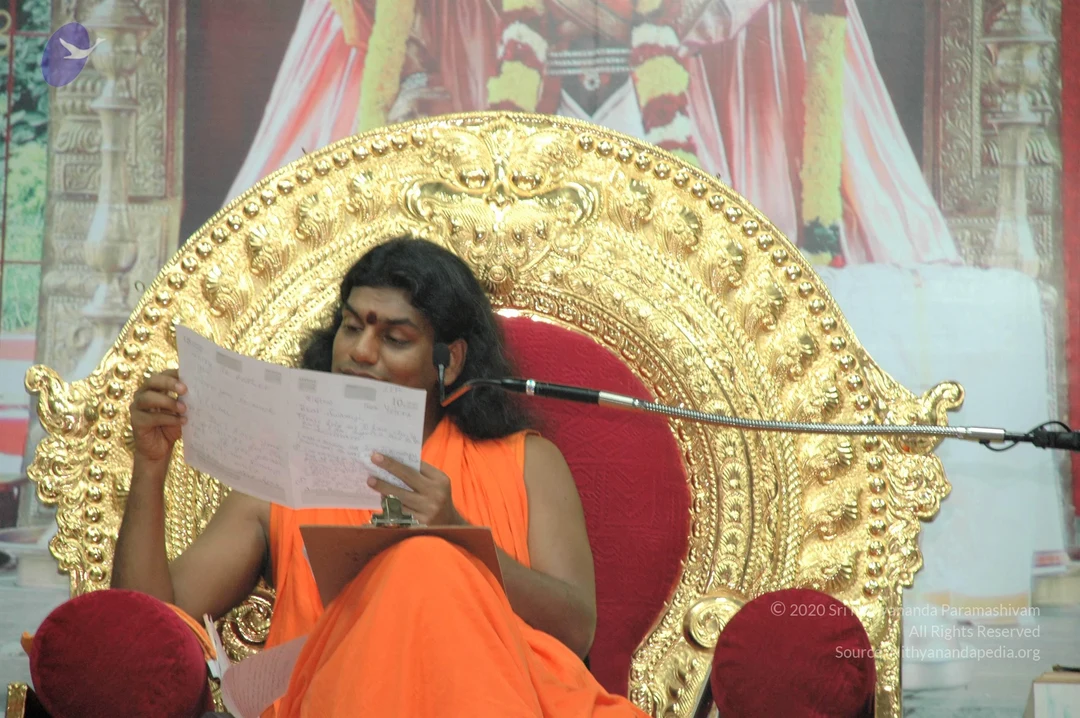
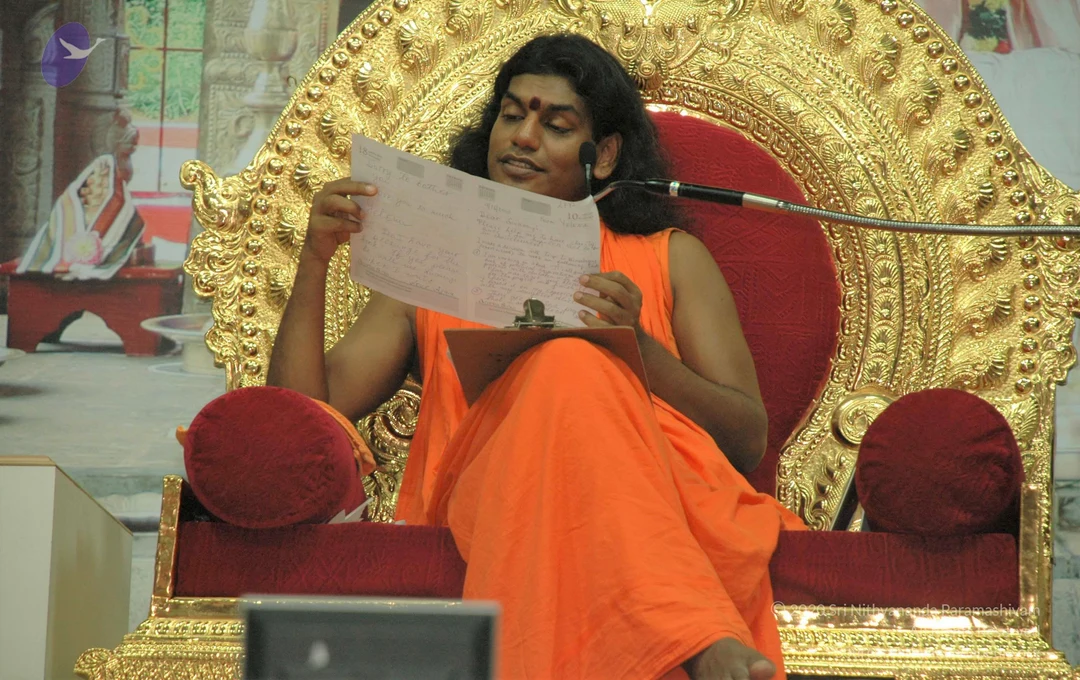
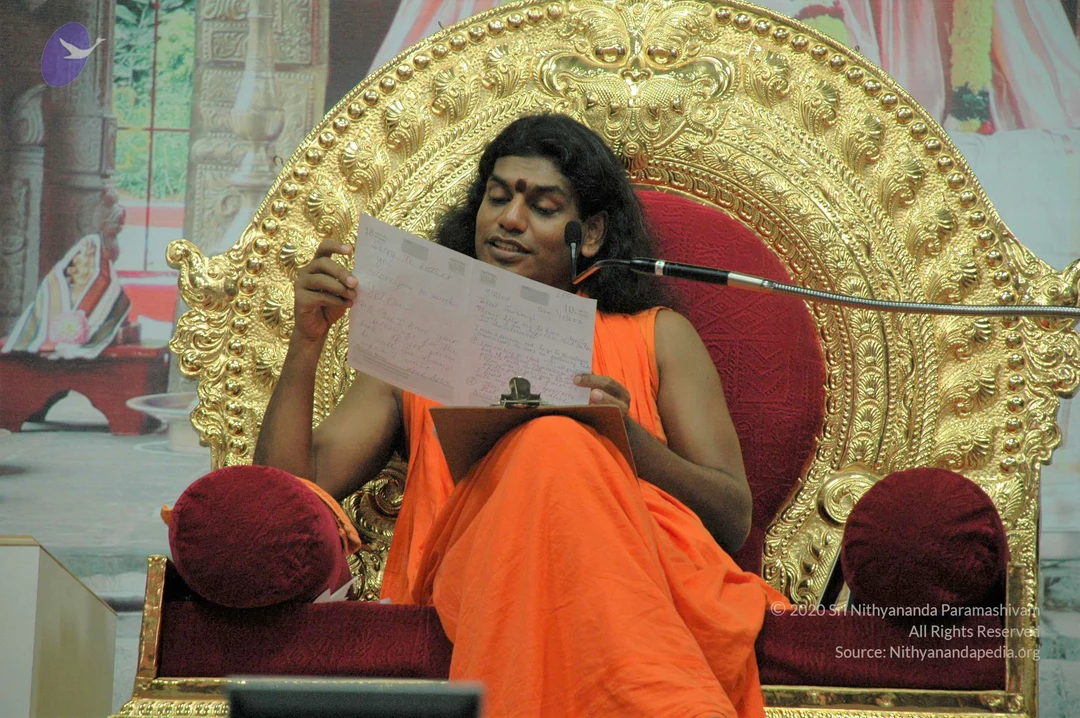
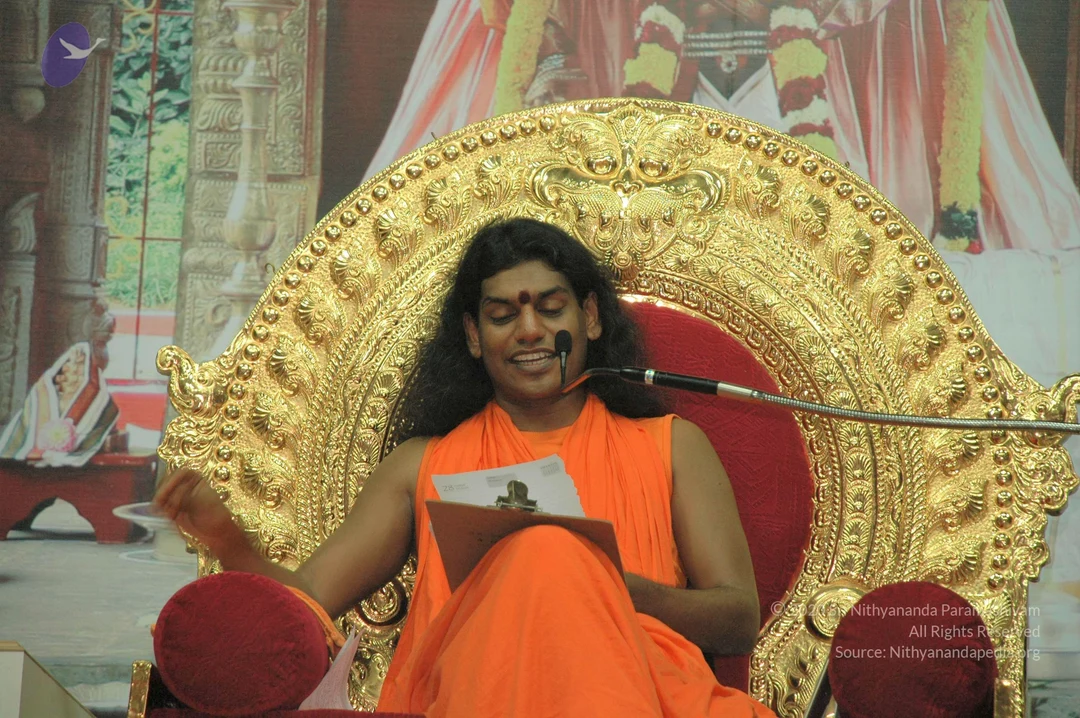
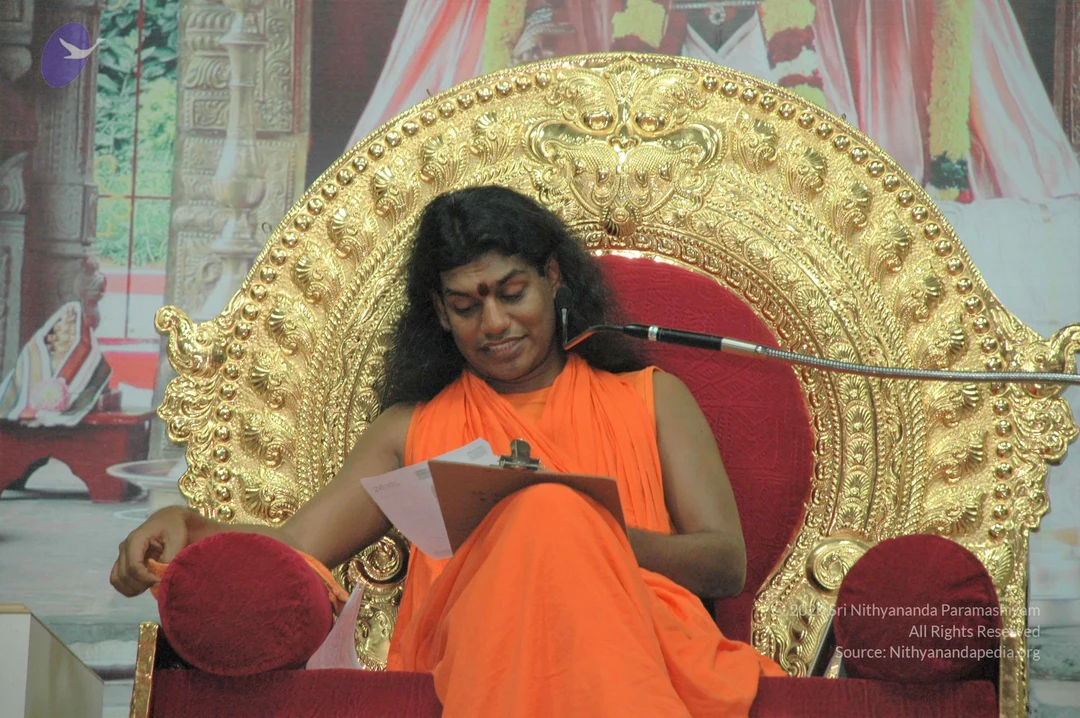
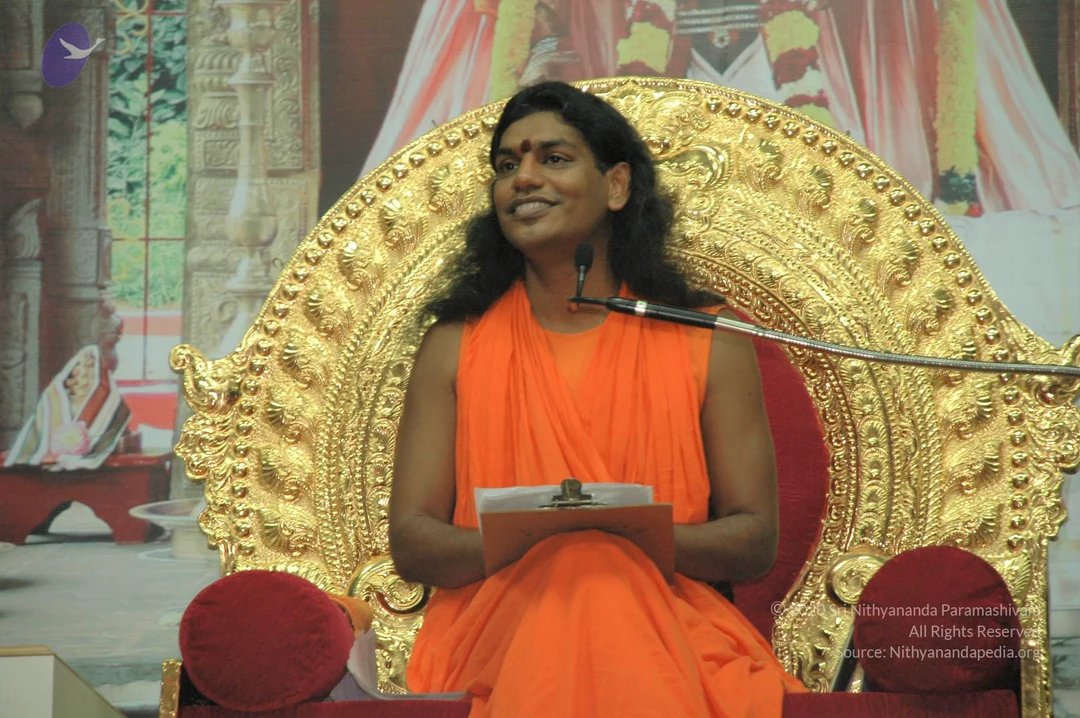
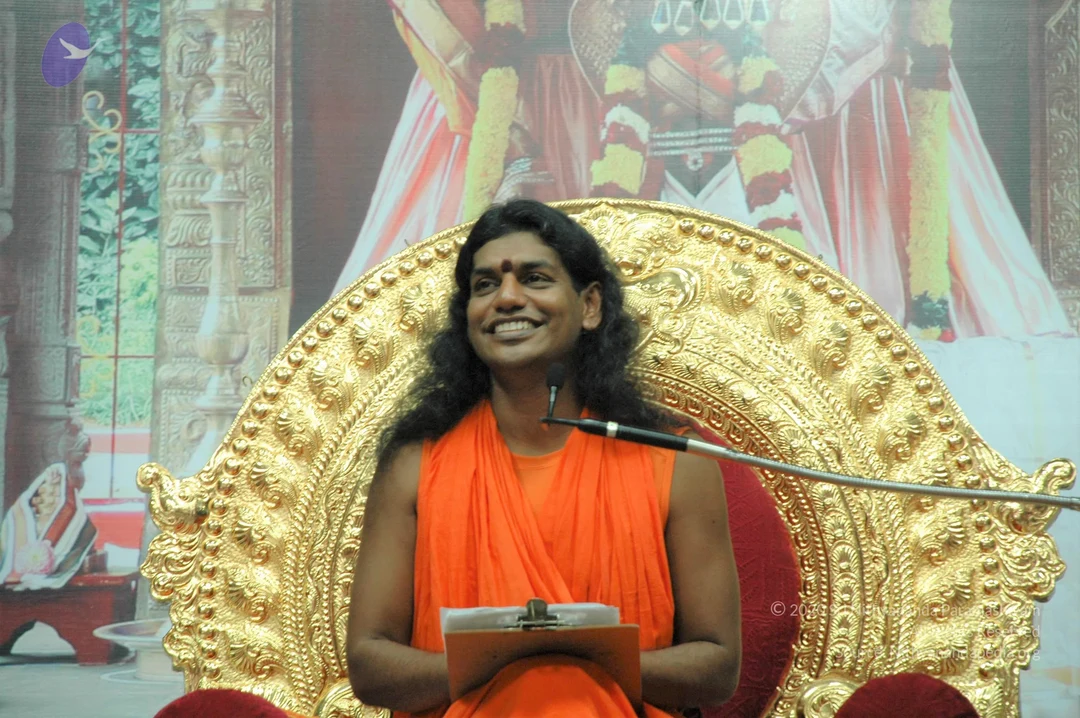
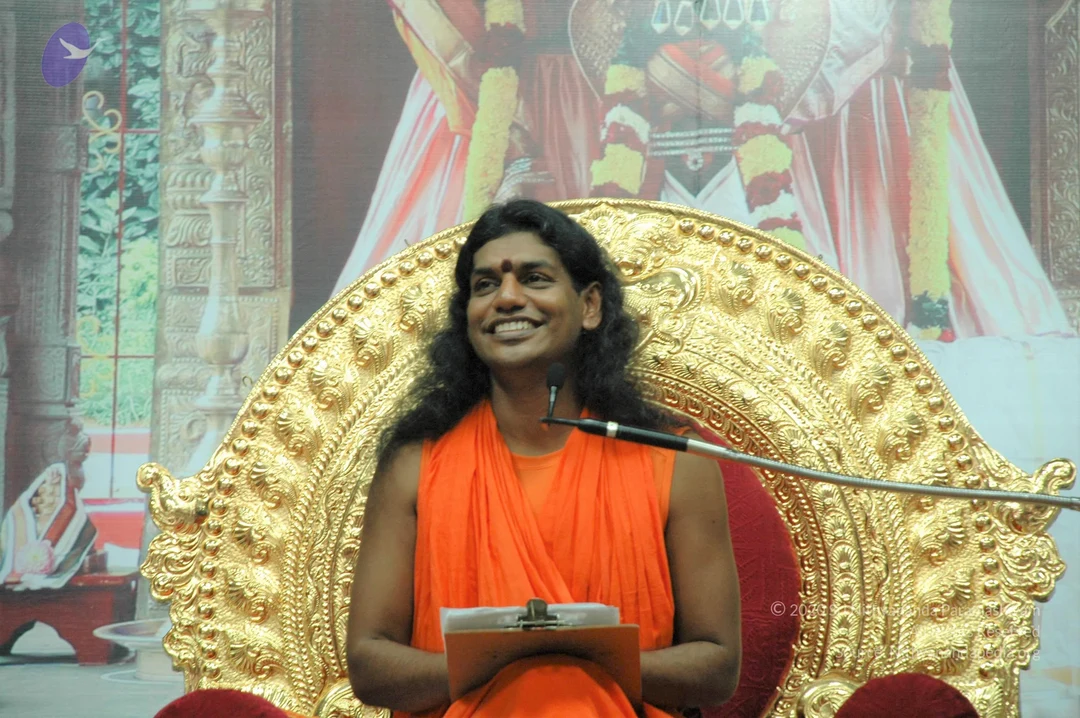
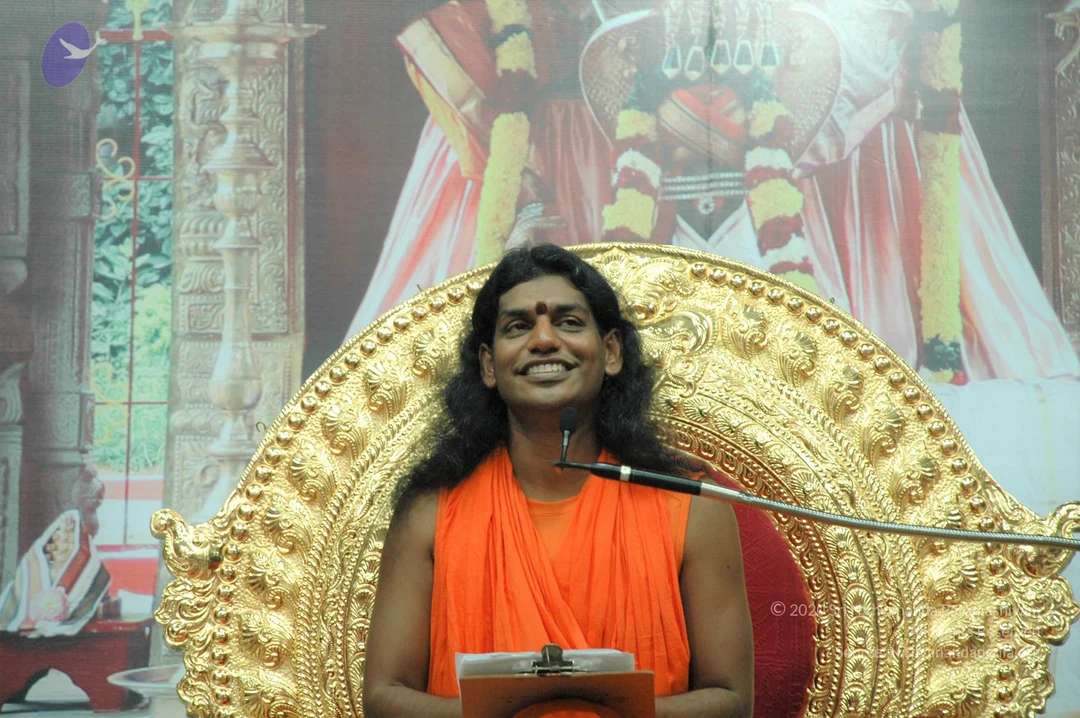
A photograph of a man with long dark hair seated on an ornate golden throne with a red cushioned seat and armrests, on a red-cushioned footstool. He wears a saffron-orange robe and is barefoot, with both hands raised in front of him as he speaks. A microphone stand stands to the right, and a small black speaker sits on the floor. Behind him is a large printed backdrop of a temple-like stone structure with columns and a deity figure in red and white draped with marigold garlands. A brass lamp stand and a small framed image stand on either side of the backdrop.A man with long dark hair and a red bindi sits on an ornate gold throne with red velvet cushions, speaking into a head-mounted microphone. He wears a flowing orange saffron robe draped over his shoulders and torso, with his arms resting on the armrests. Behind him hang pink and white draped fabrics with floral garlands, and a painted backdrop shows a decorated pillar and a seated figure in a white and red cloth at left. The image is a photograph of a speaker seated for a discourse.A man with long dark hair and a red bindi sits smiling on an ornate gold throne with carved scrollwork and red cushioned armrests. He wears a flowing orange saffron robe and holds a clipboard in one hand while raising a small round card printed with a colourful circular design. A microphone on a gooseneck stand is positioned beside him. Behind the throne hang red and white draped fabrics decorated with yellow and orange flower garlands. Swamiji (probable): the long swept-back hair, saffron robe and throne cues are present, so this appearance-based label applies to the seated man.A man with long, swept-back dark hair sits on an ornate gold throne with carved scrollwork and red cushions, speaking into a microphone on a gooseneck stand. He wears a saffron-orange robe draped over his shoulders and a red bindi-style mark on his forehead, and he smiles while holding up a small card with a circular yellow-and-blue graphic. He rests a clipboard on his lap. Behind him is a backdrop showing a deity murti draped in a white cloth and adorned with garlands of yellow and red flowers, with decorative pillars at the sides. Swamiji (probable): the long hair, saffron robe and gold throne fit the appearance-based cues, though this is a seated speaker at a discourse.A smiling man with long, swept-back dark hair and a red bindi sits on an ornate gold throne with red cushioned seats and armrests. He wears a flowing saffron-orange robe and holds a clipboard on his lap, with a microphone on a stand beside him. Behind him hang white and pink draped fabrics with floral garlands, and a painted backdrop shows a temple-like arch and columns. A tiny figure in a red and white sari sits at the left edge near a small red stand. A purple bird logo appears in the top-left corner. The figure is a probable Swamiji by his long swept-back hair, saffron robe and throne seating, presented as a seated teacher giving a talk.A smiling man with long, swept-back dark hair and a red tilak on his forehead sits on an ornate gold throne with red cushions. He wears a flowing saffron-orange robe and holds a clipboard, with a microphone on a stand before him. Behind him is a large backdrop showing a painted temple scene with pillars and draped pink and white fabric with floral garlands.
08

07-Gurukul

53 dated photos in previewSource gallery
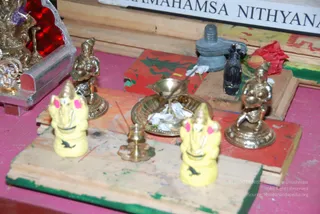
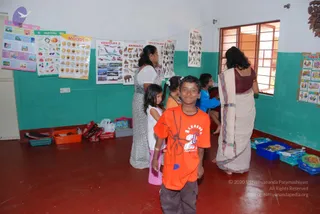
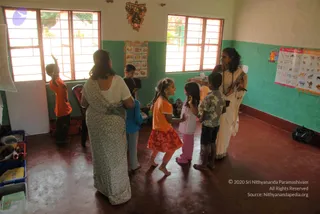
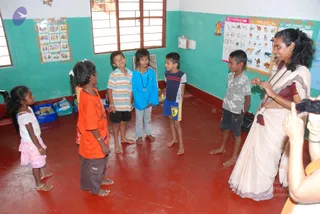
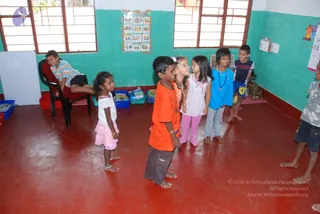
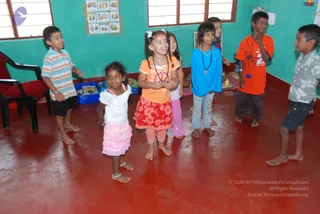
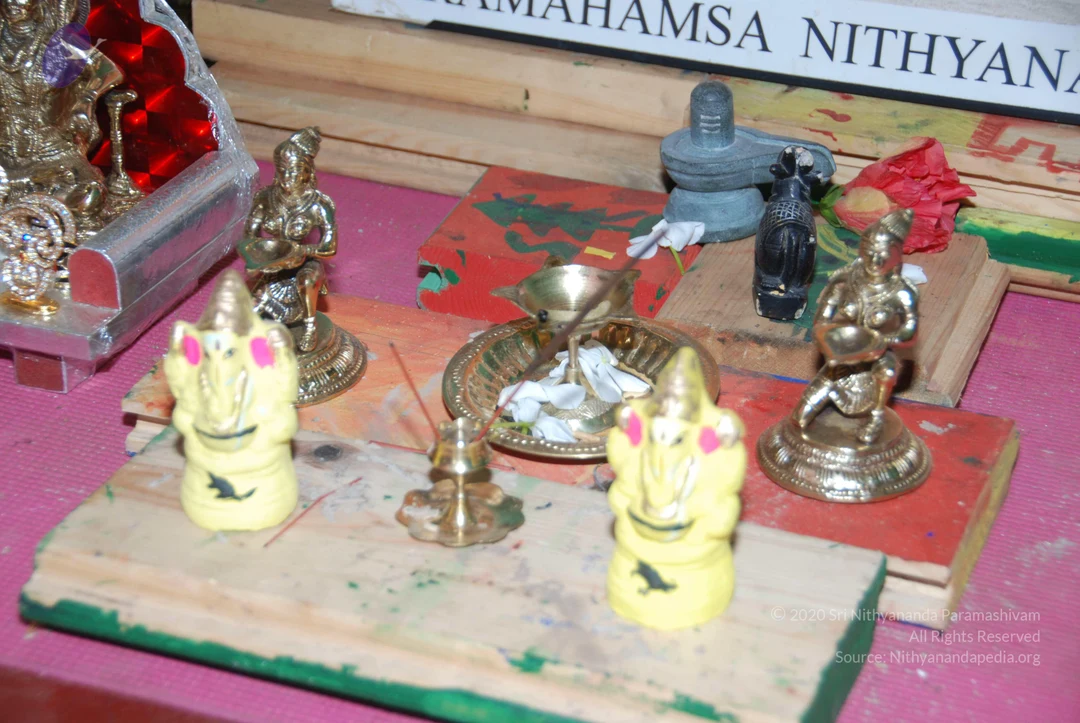
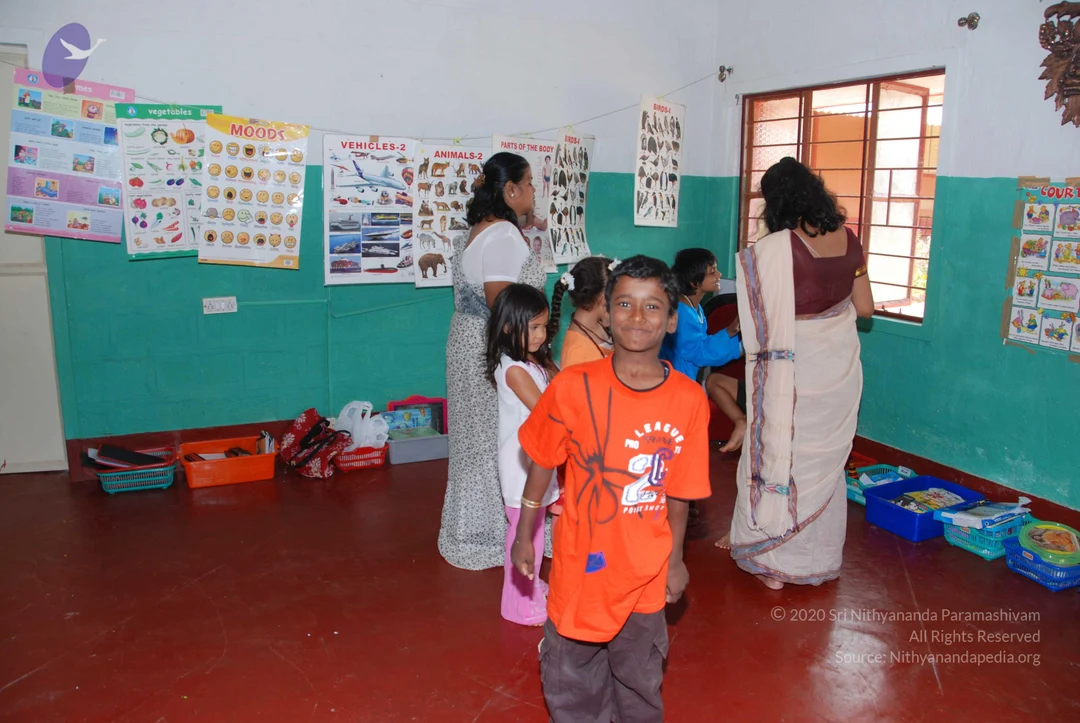
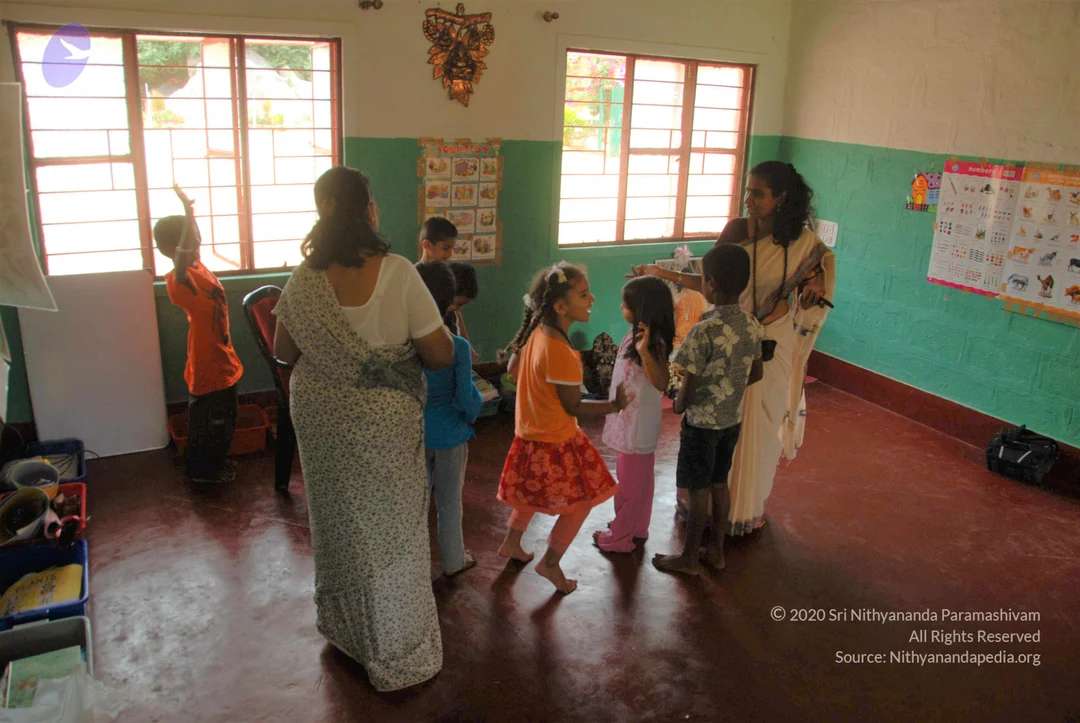
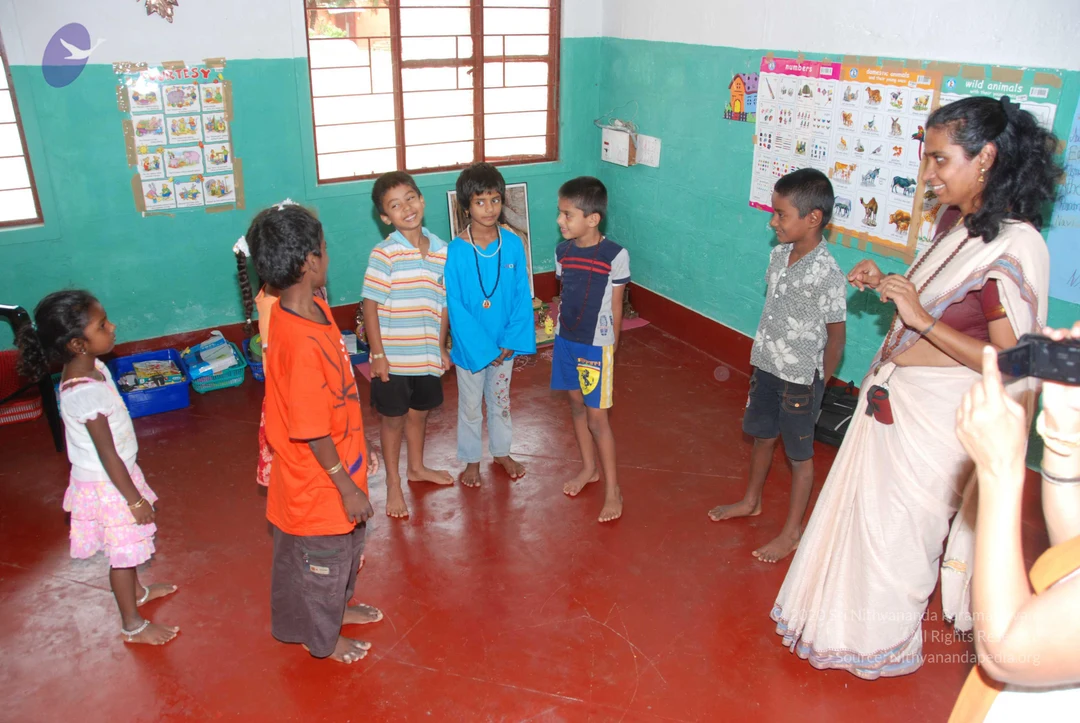
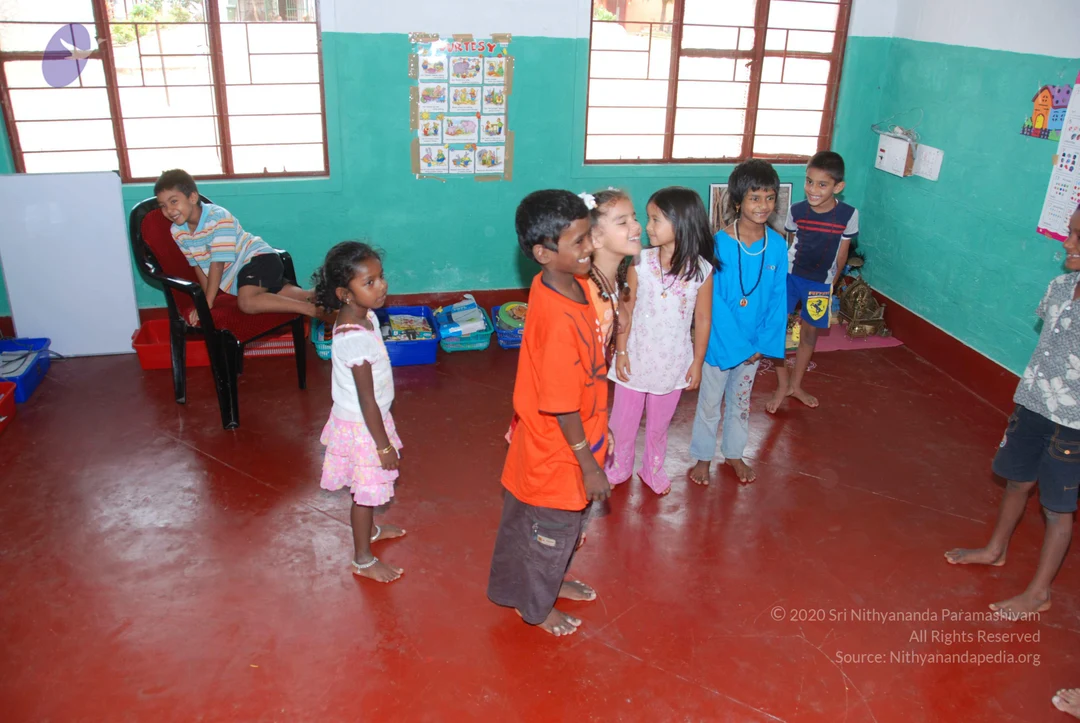
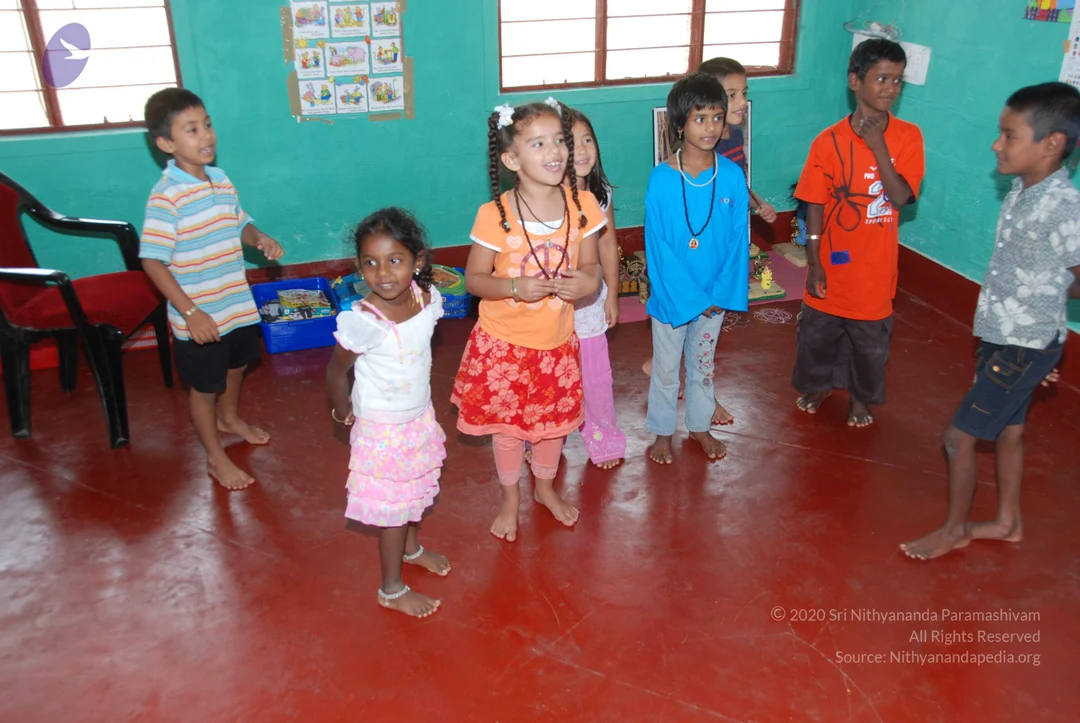
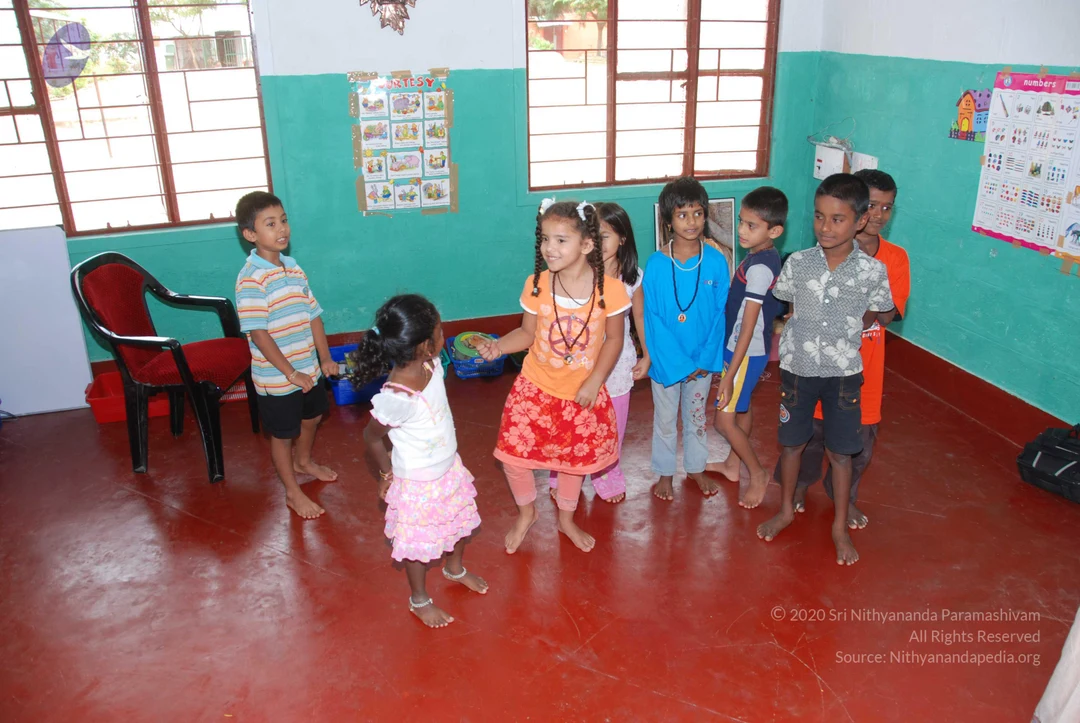
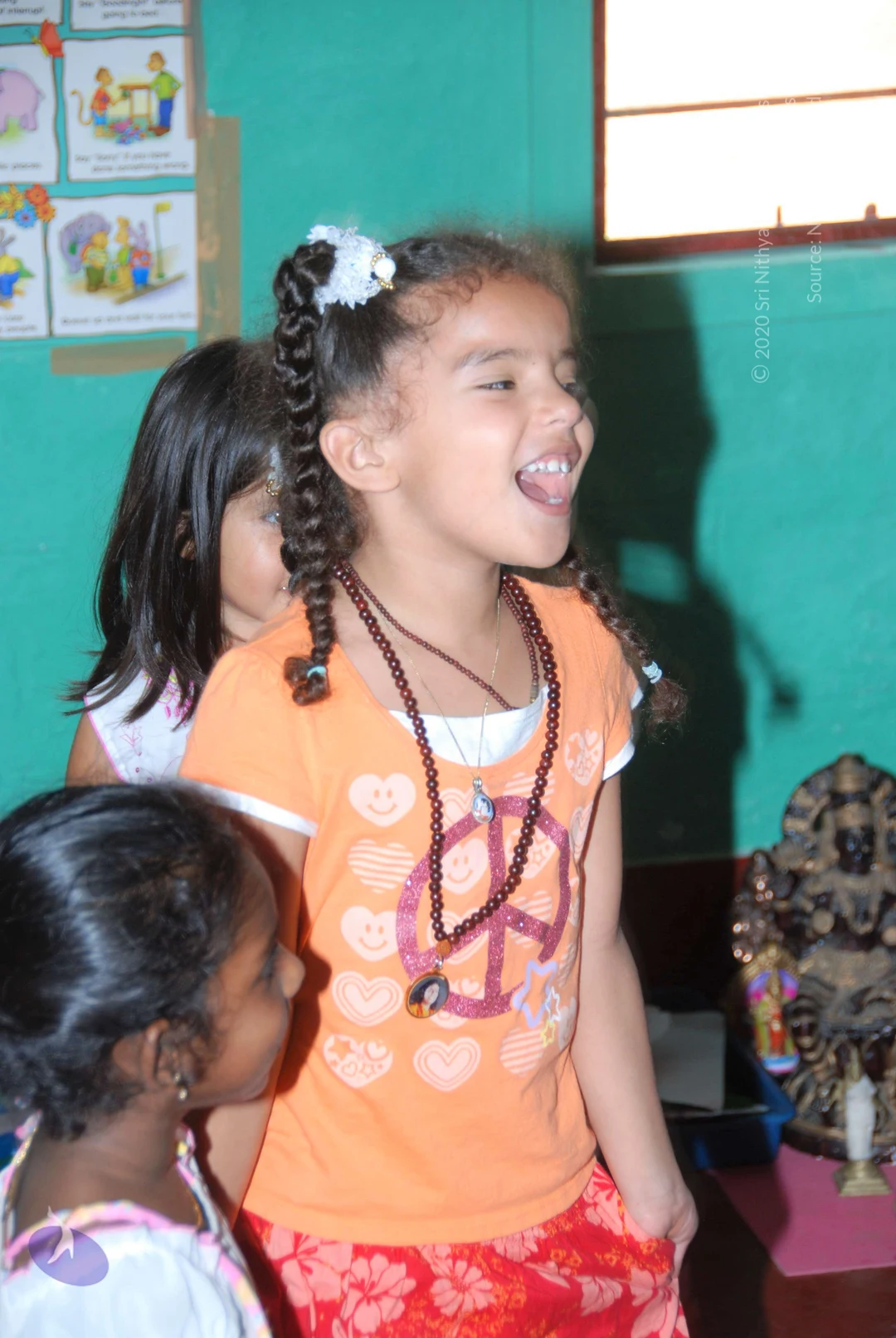
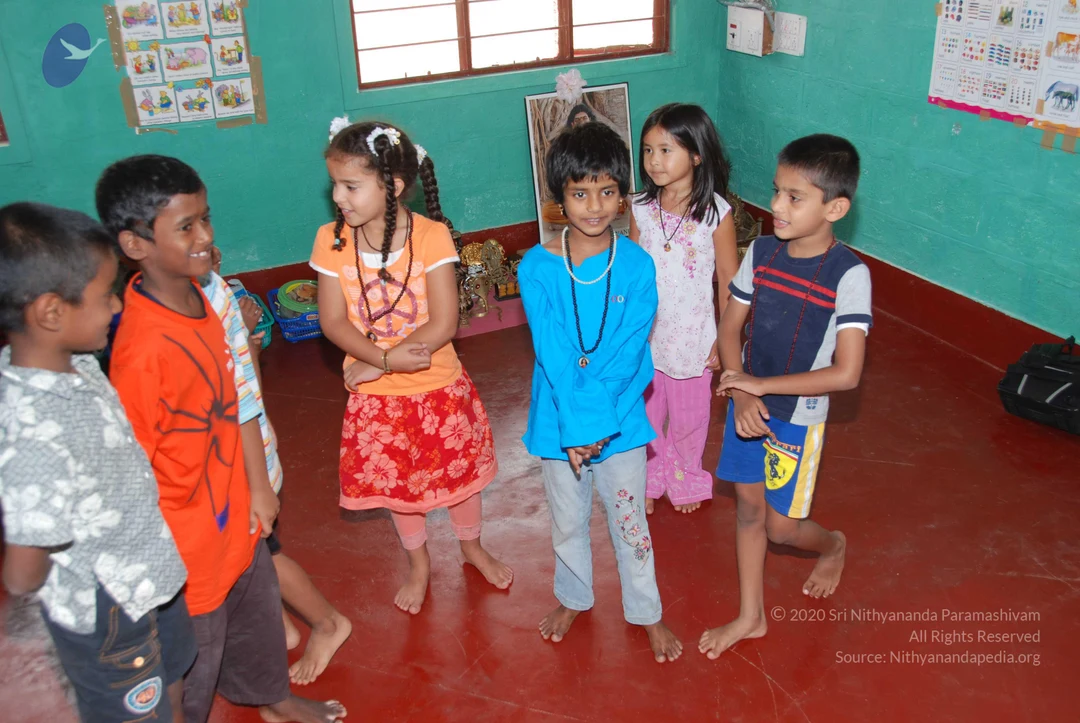
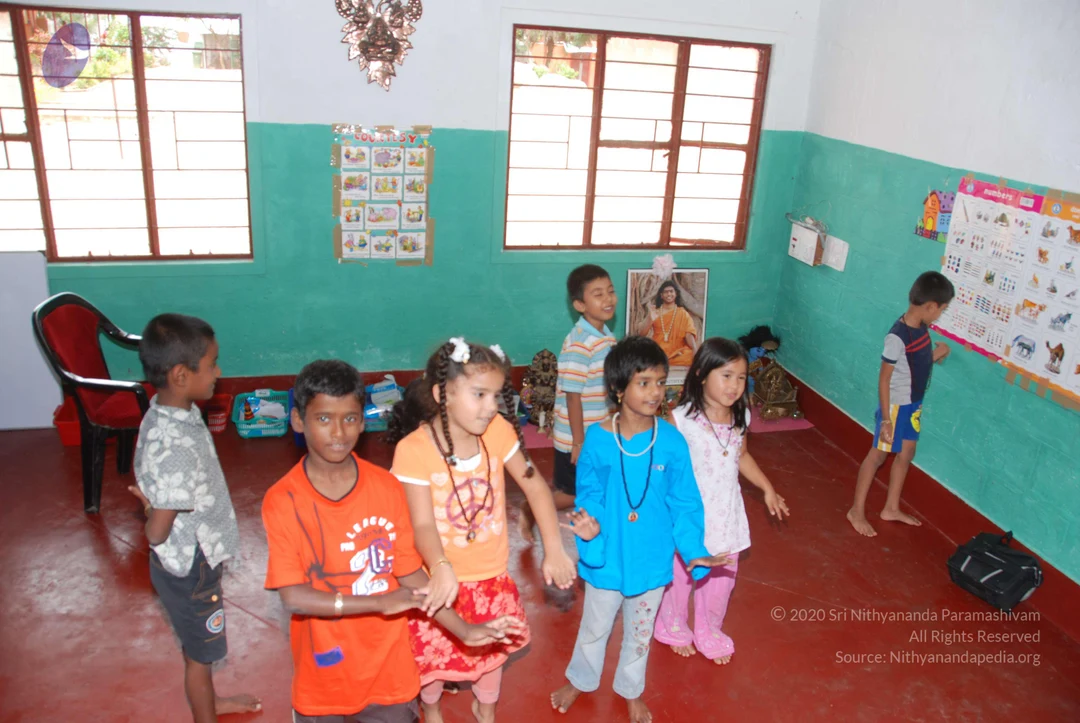
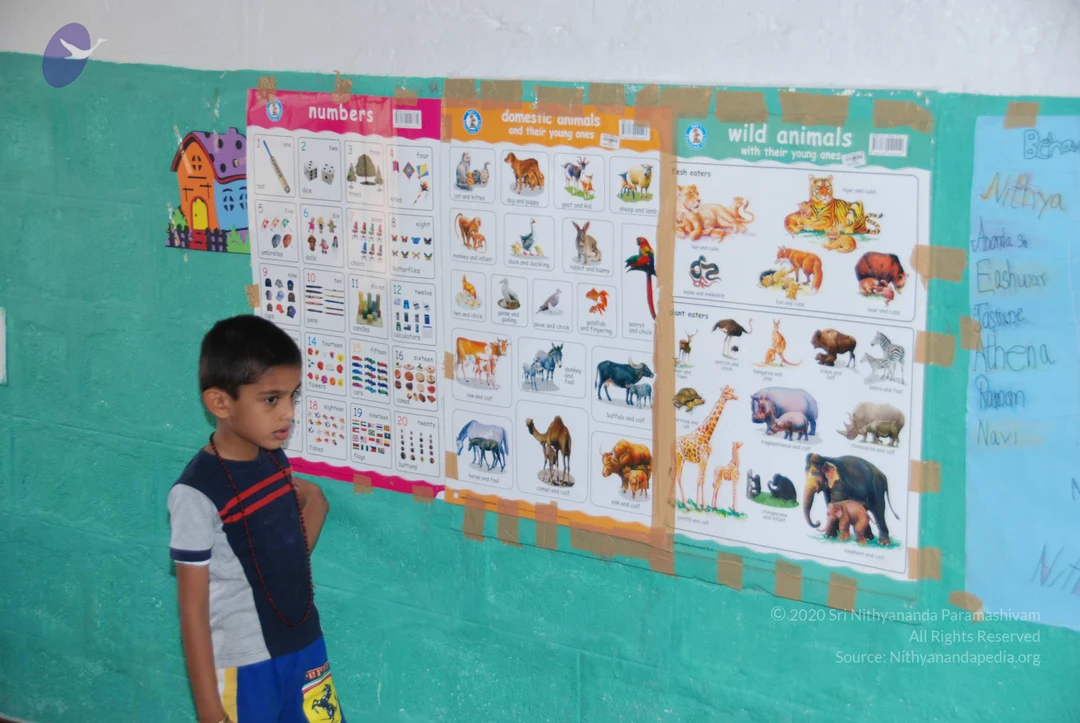
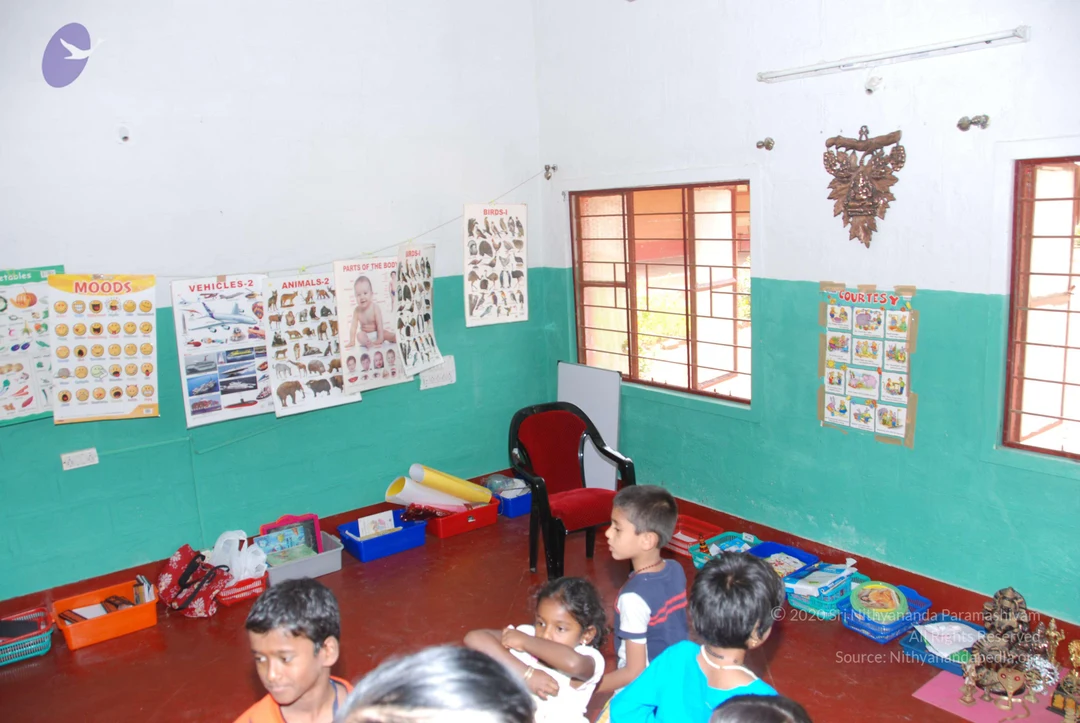
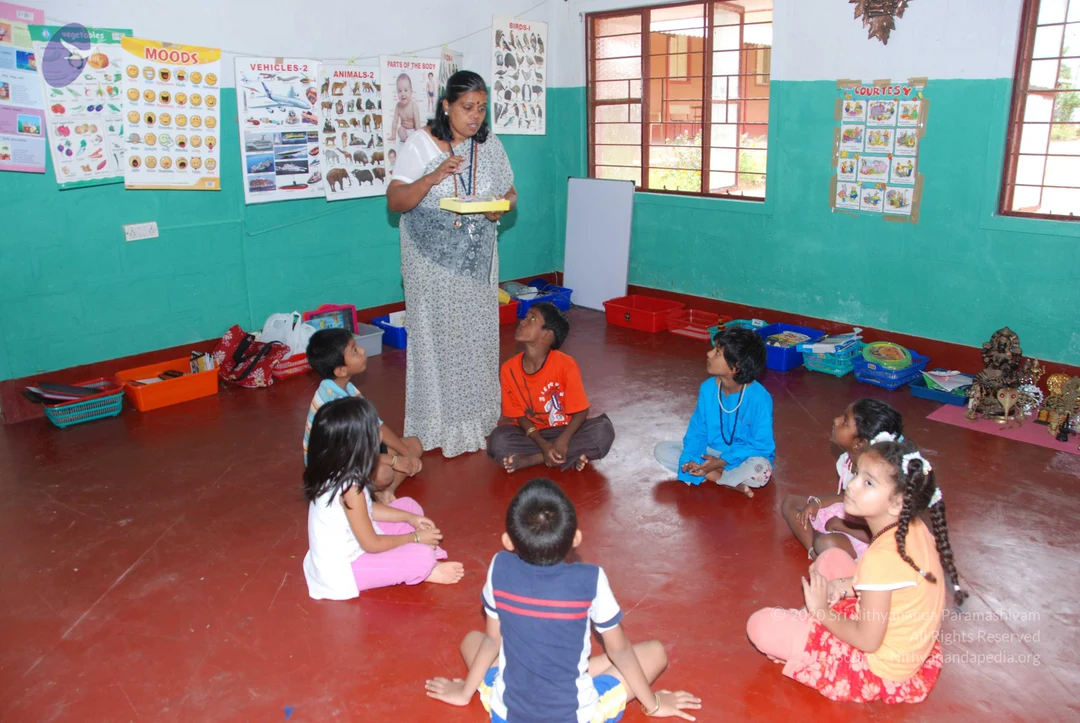
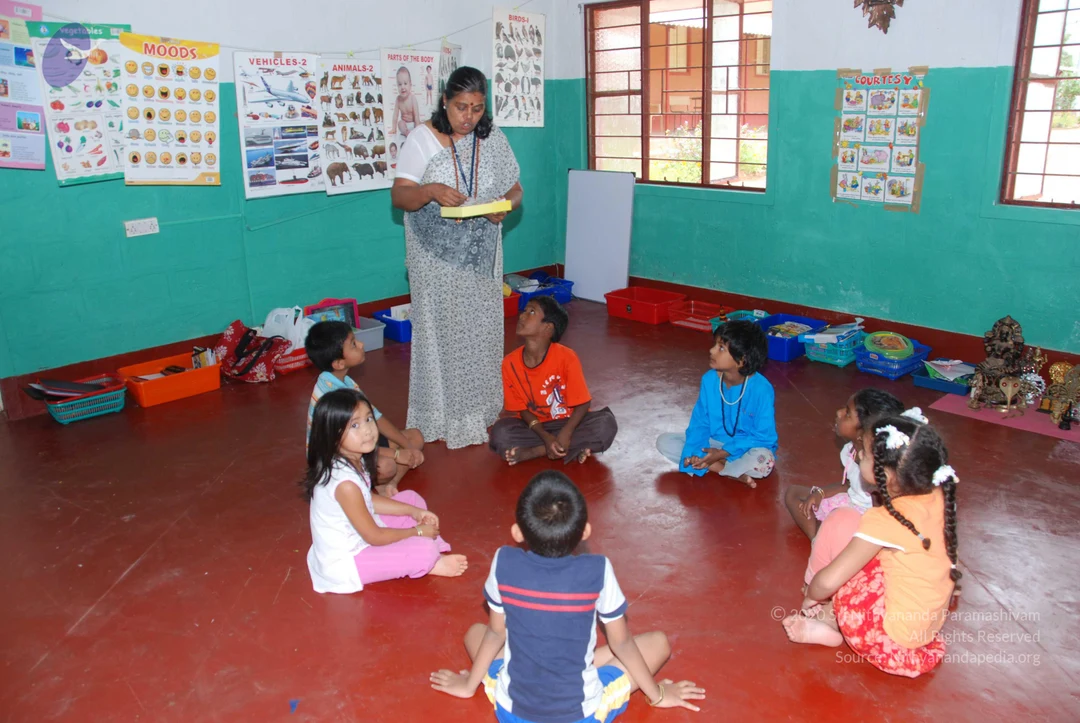
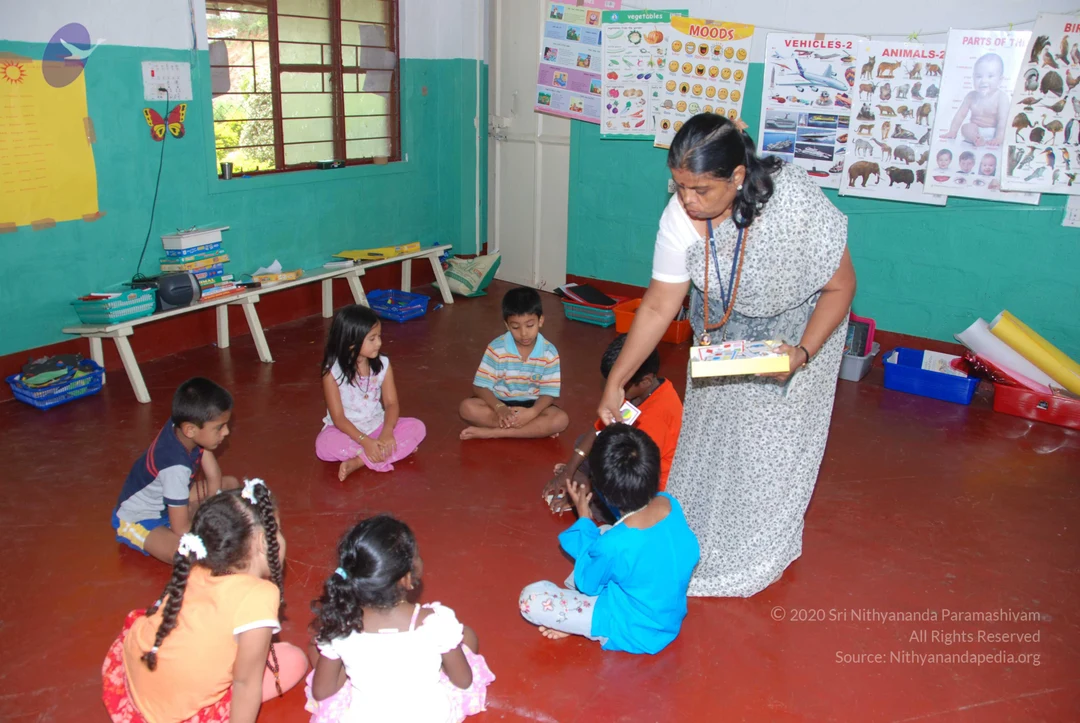
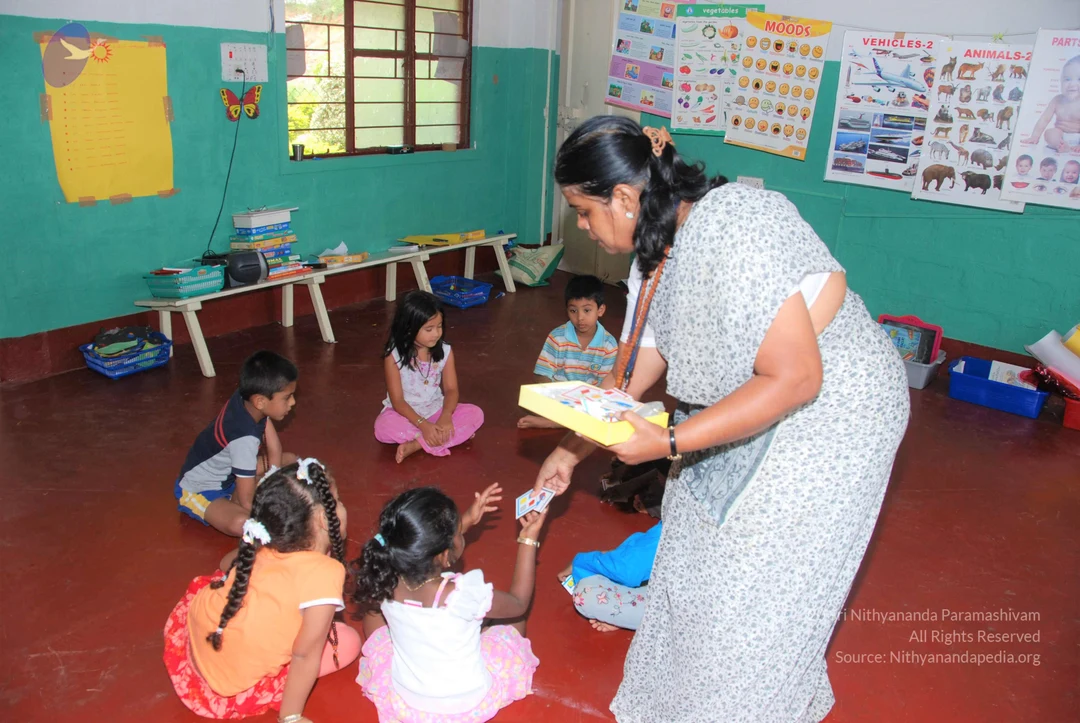
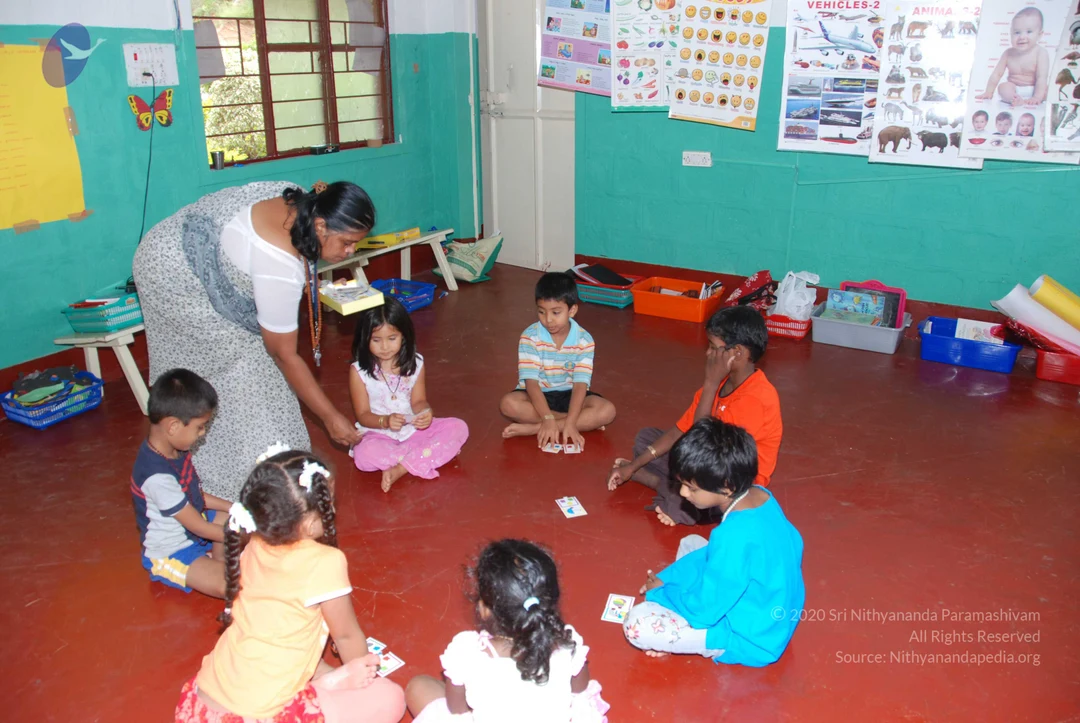
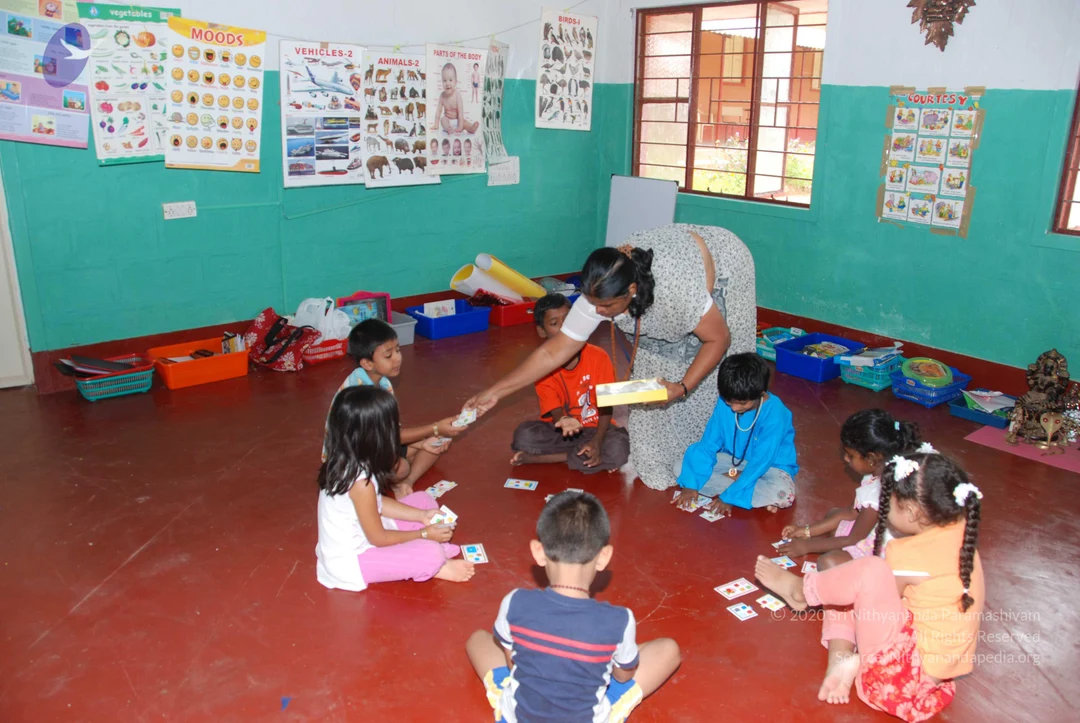
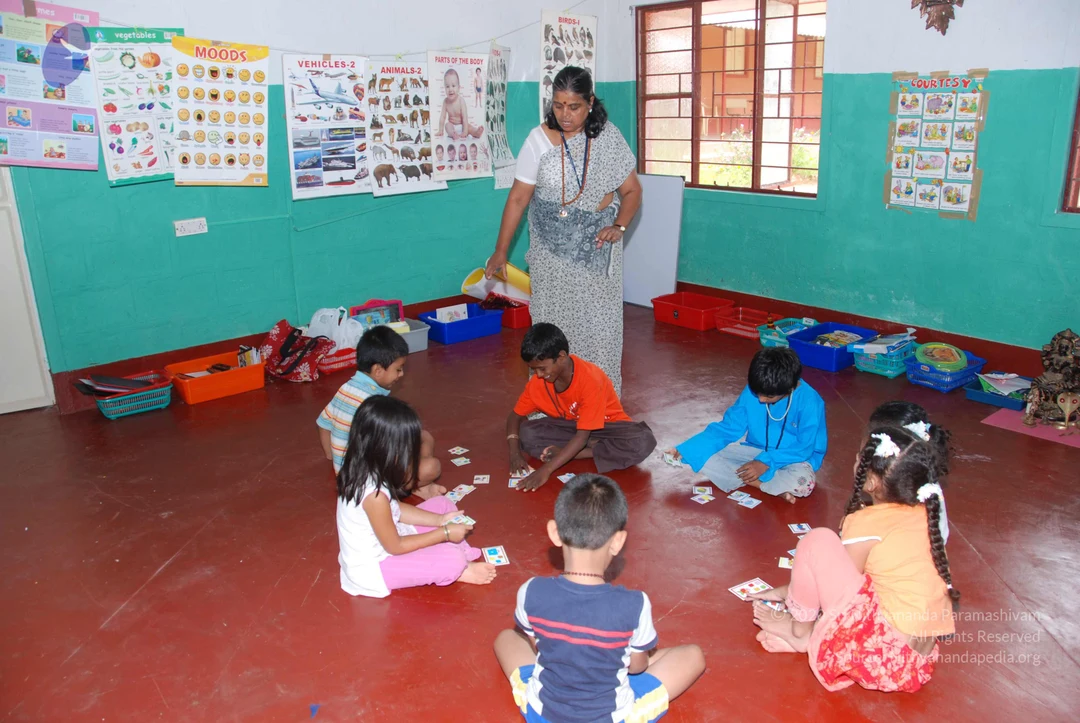
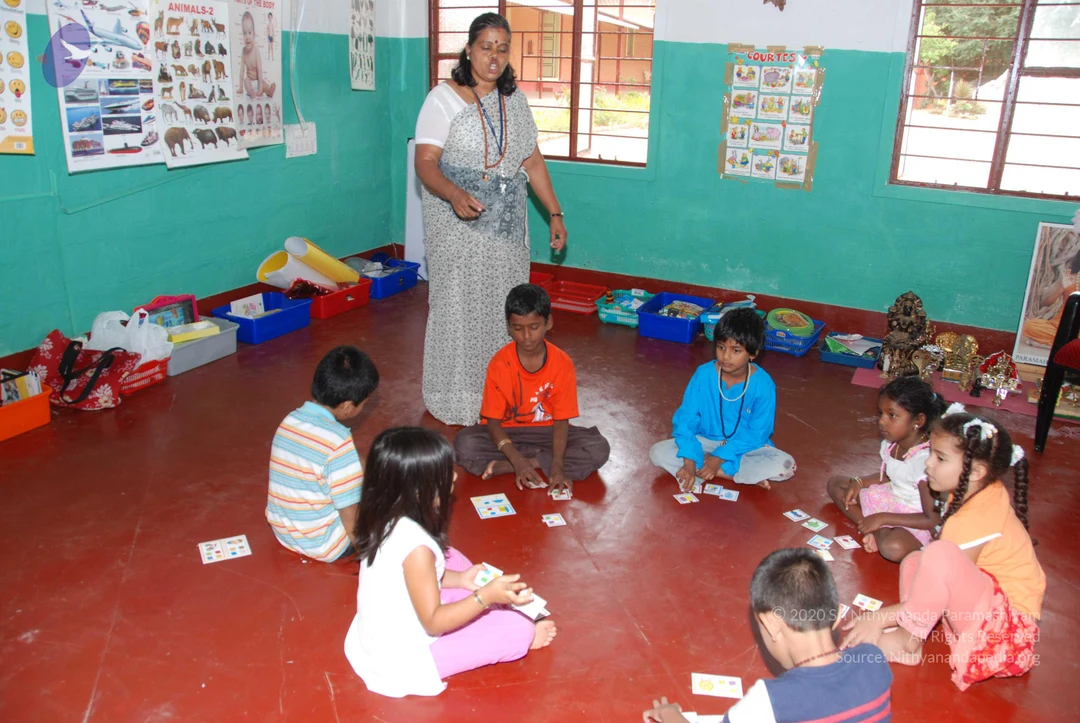
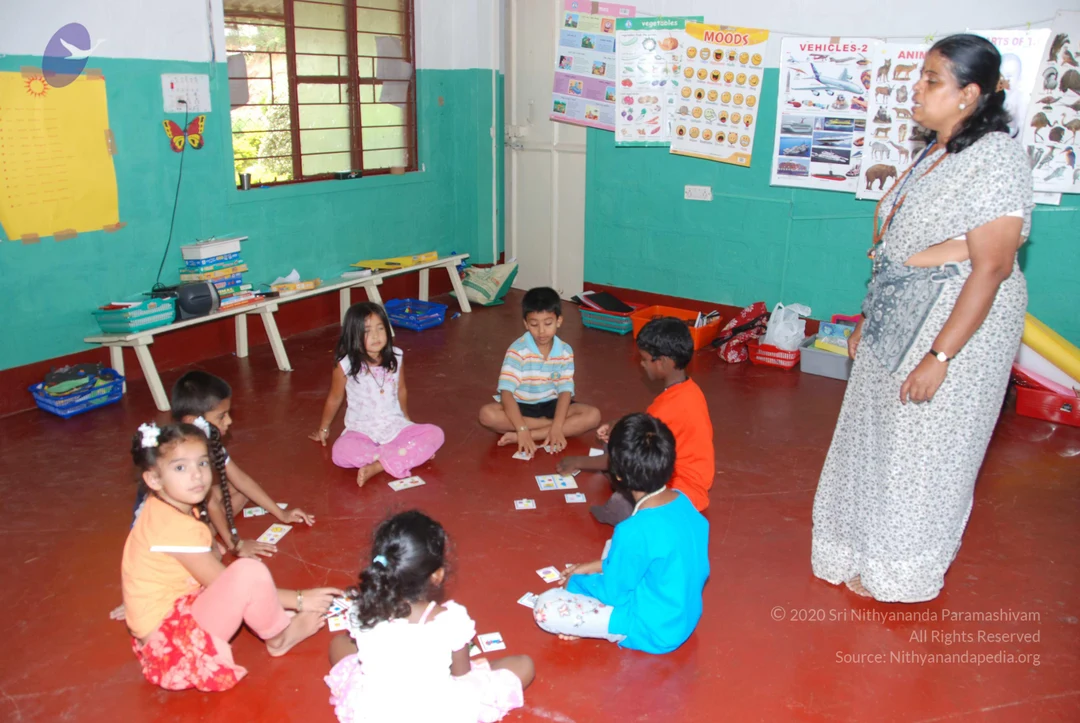
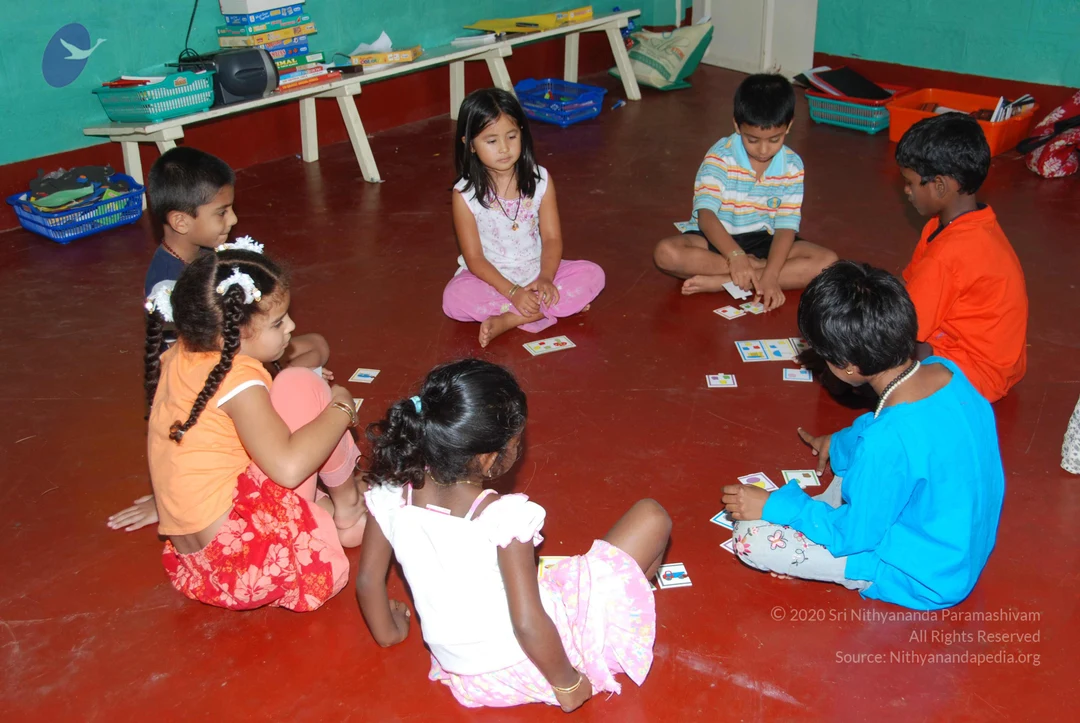
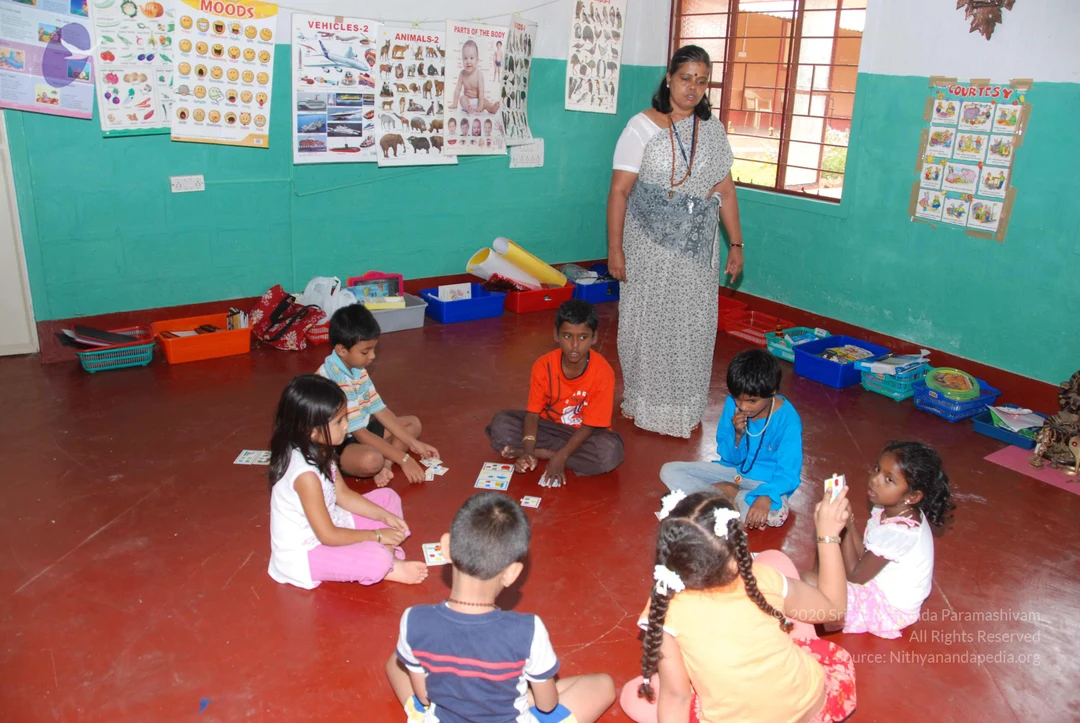
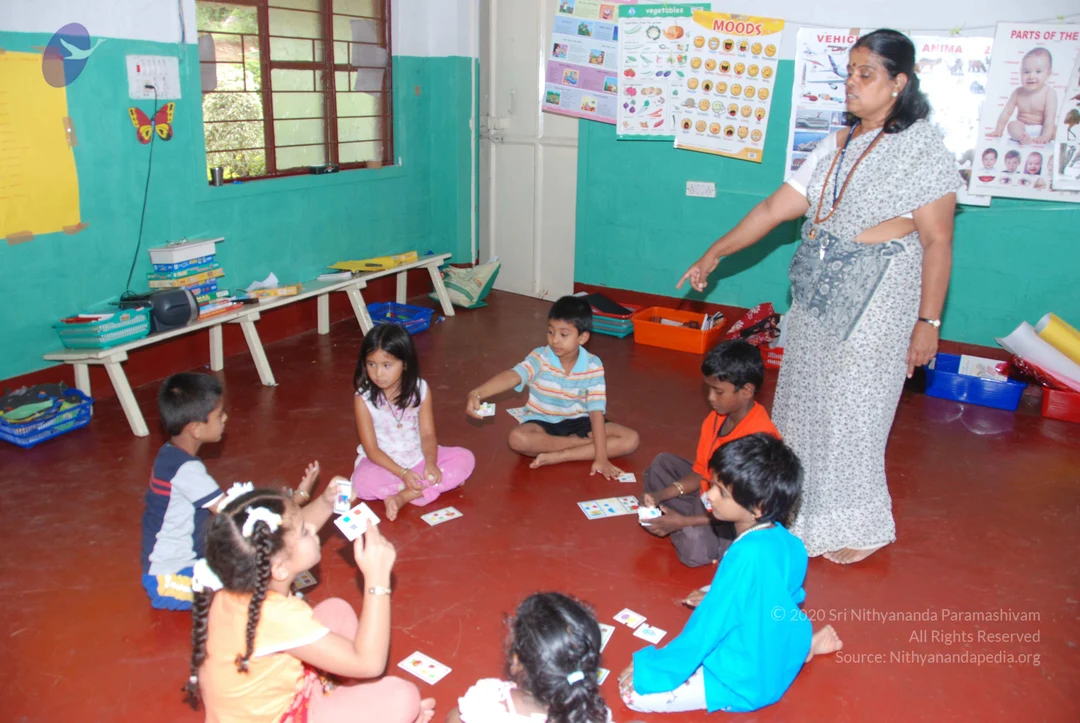
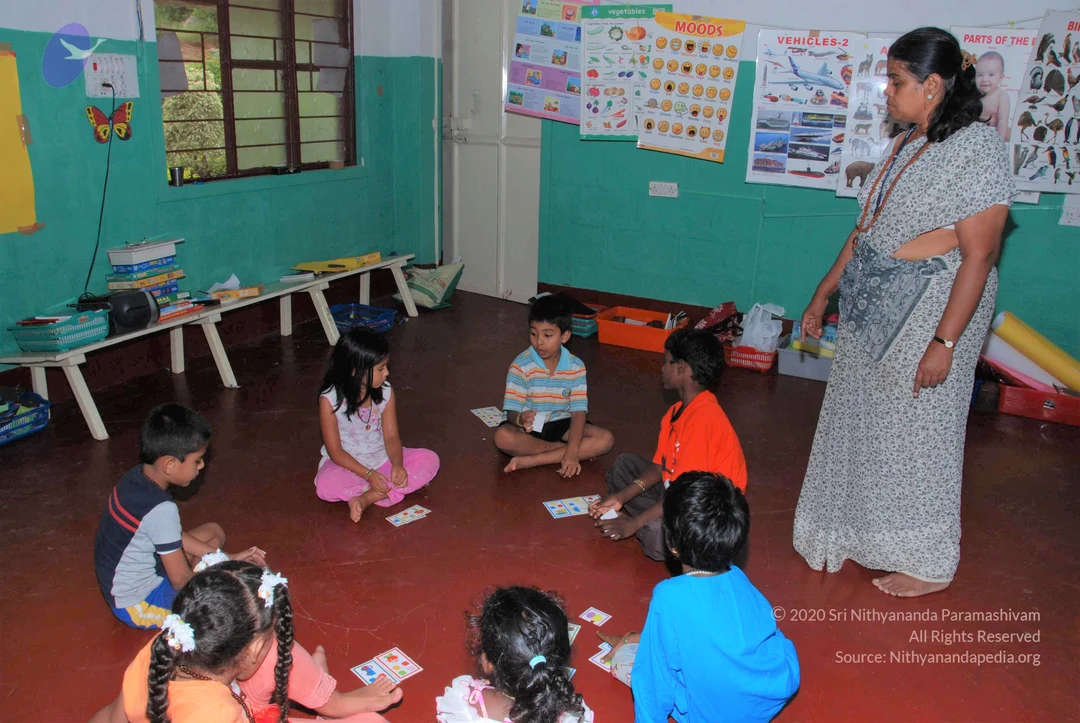
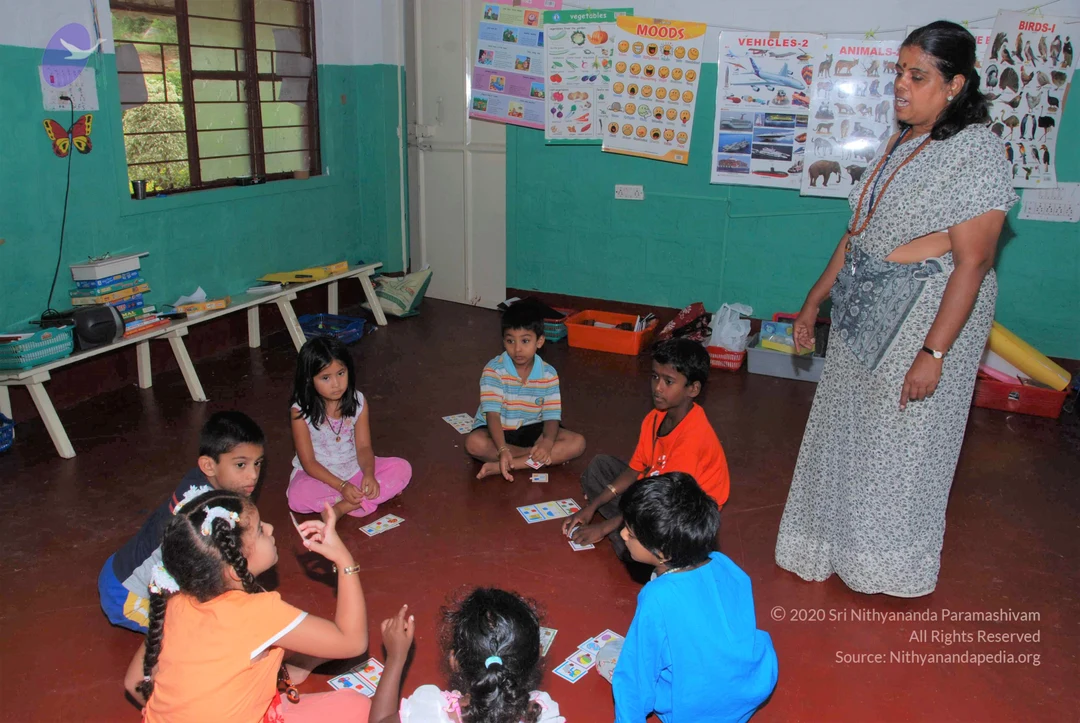
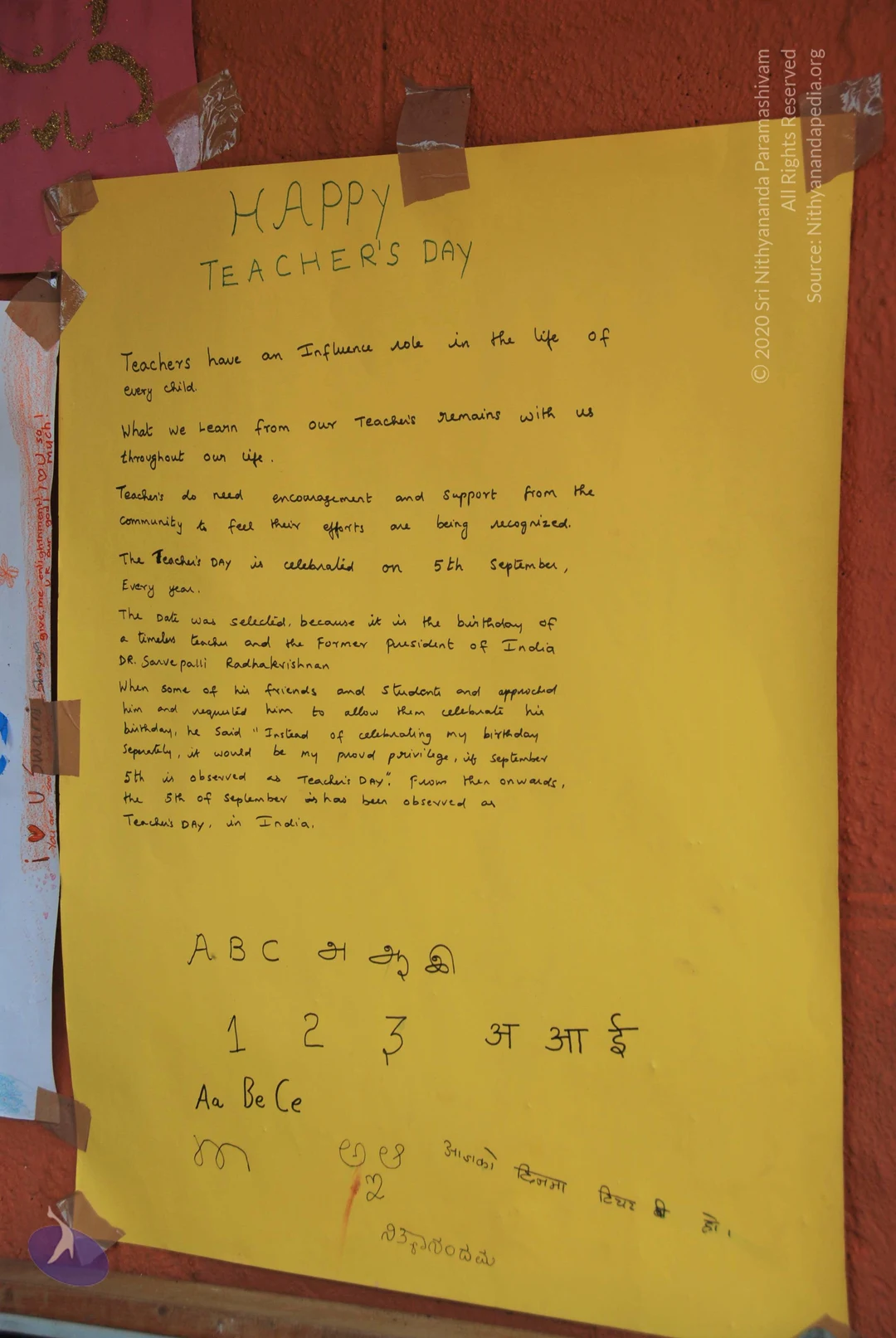
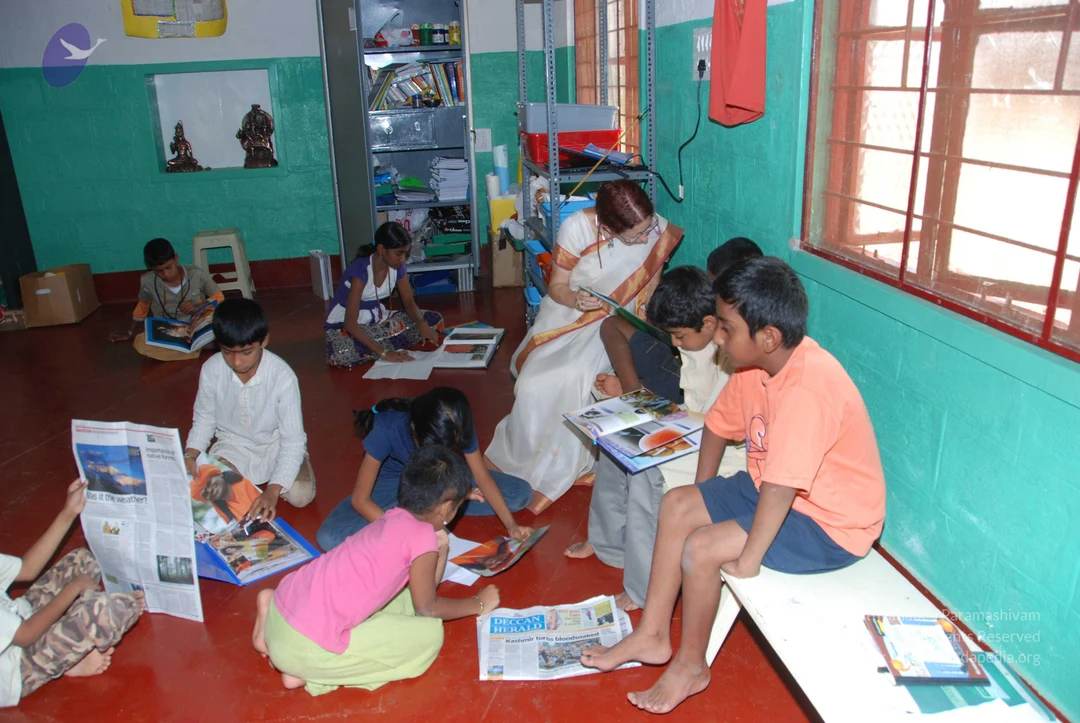
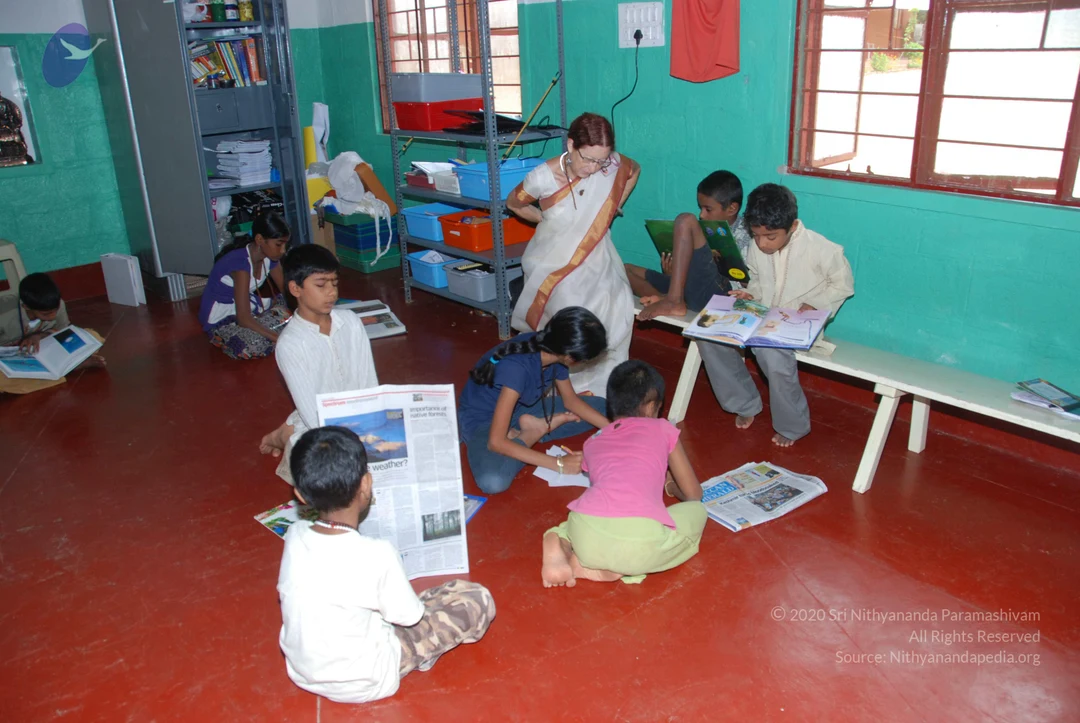
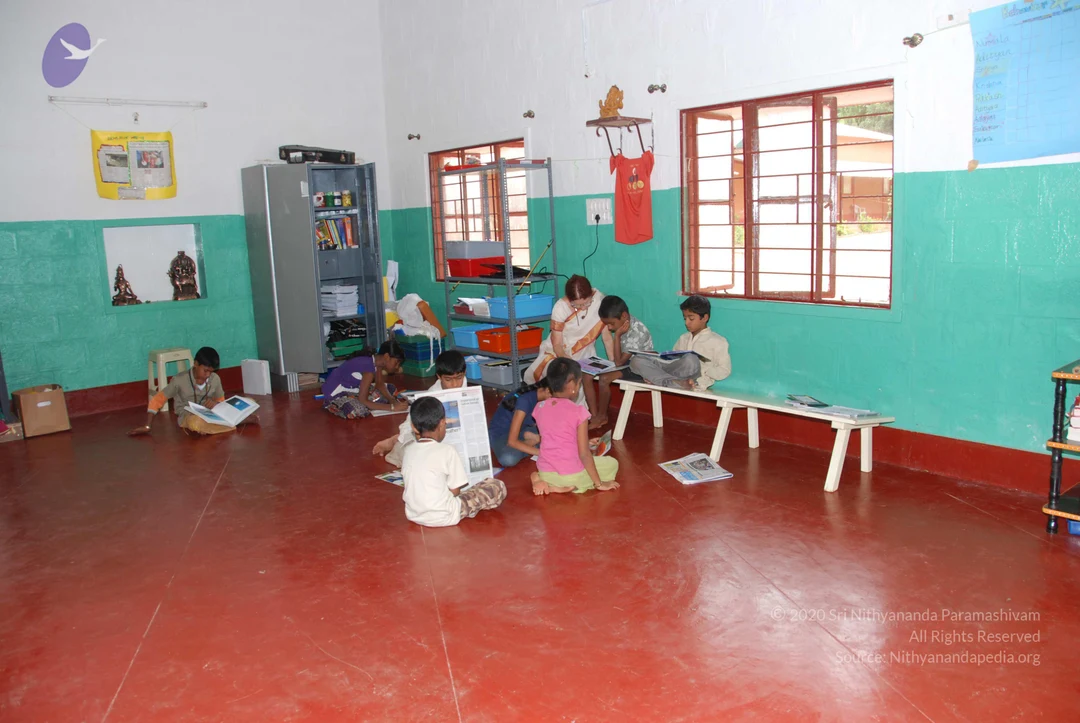
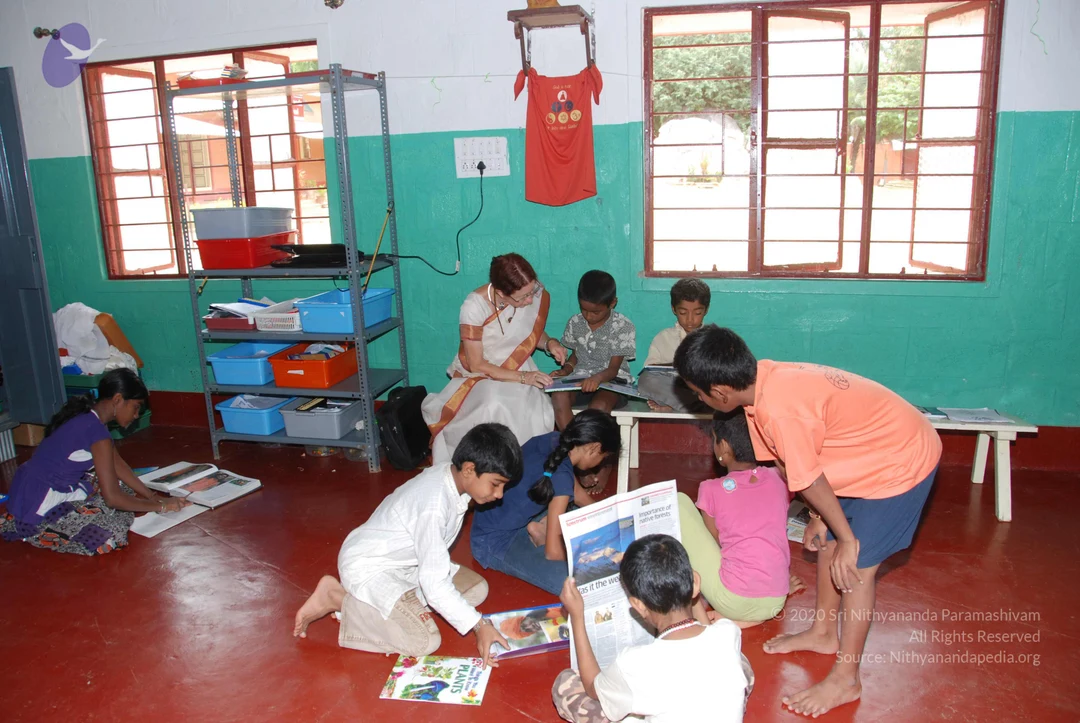
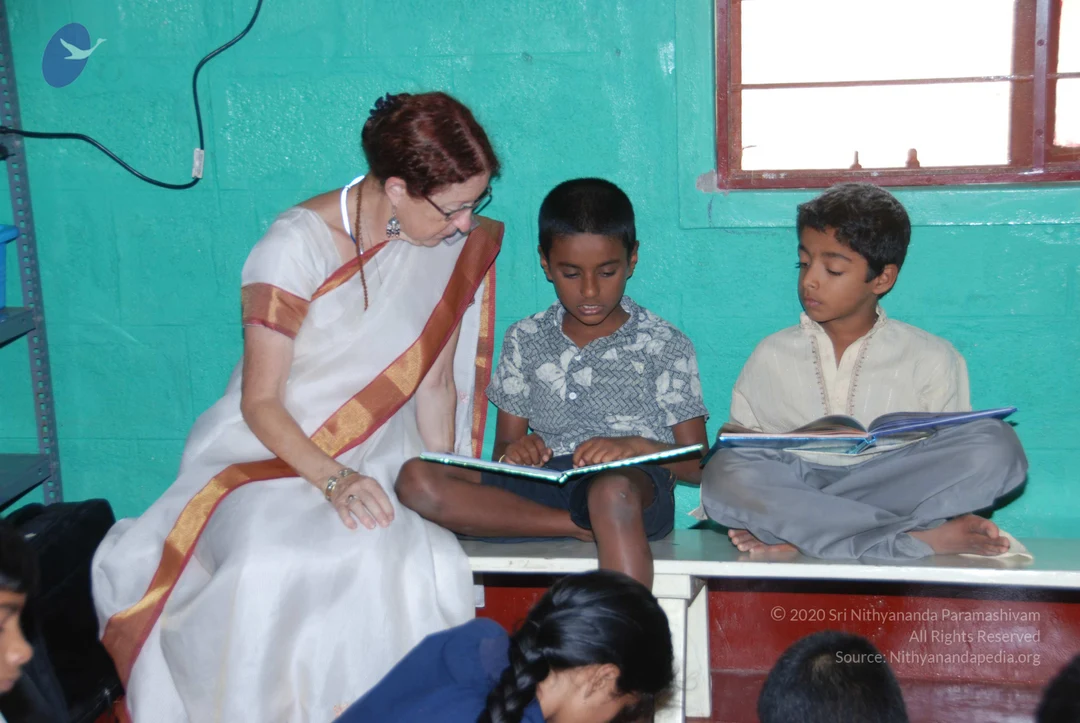
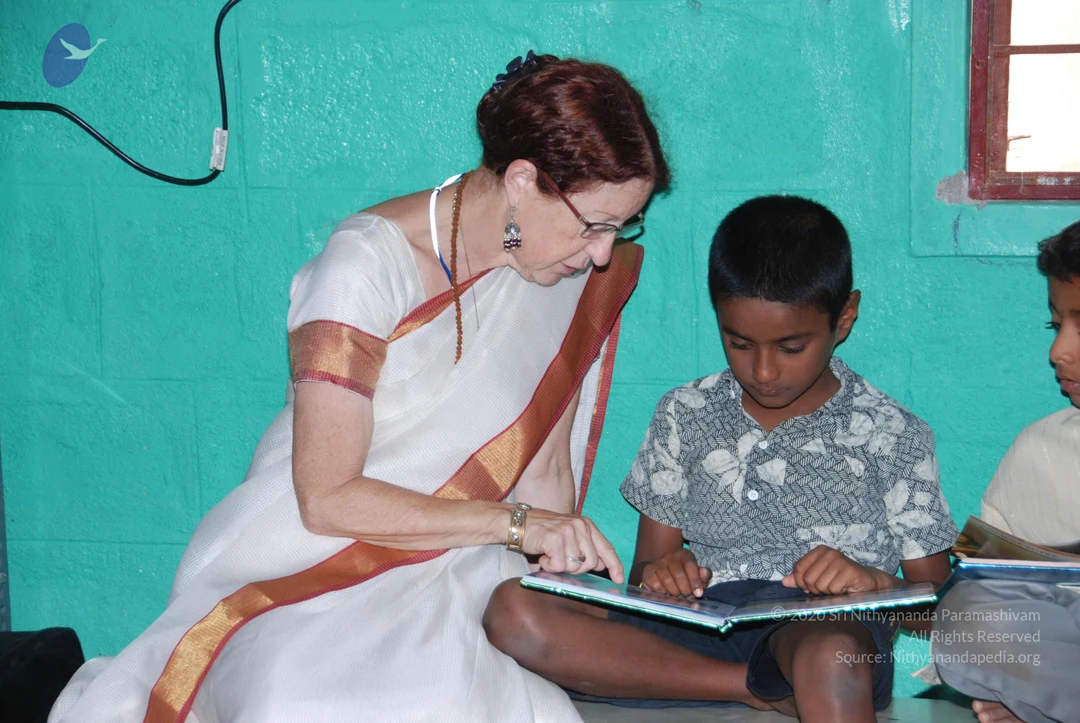
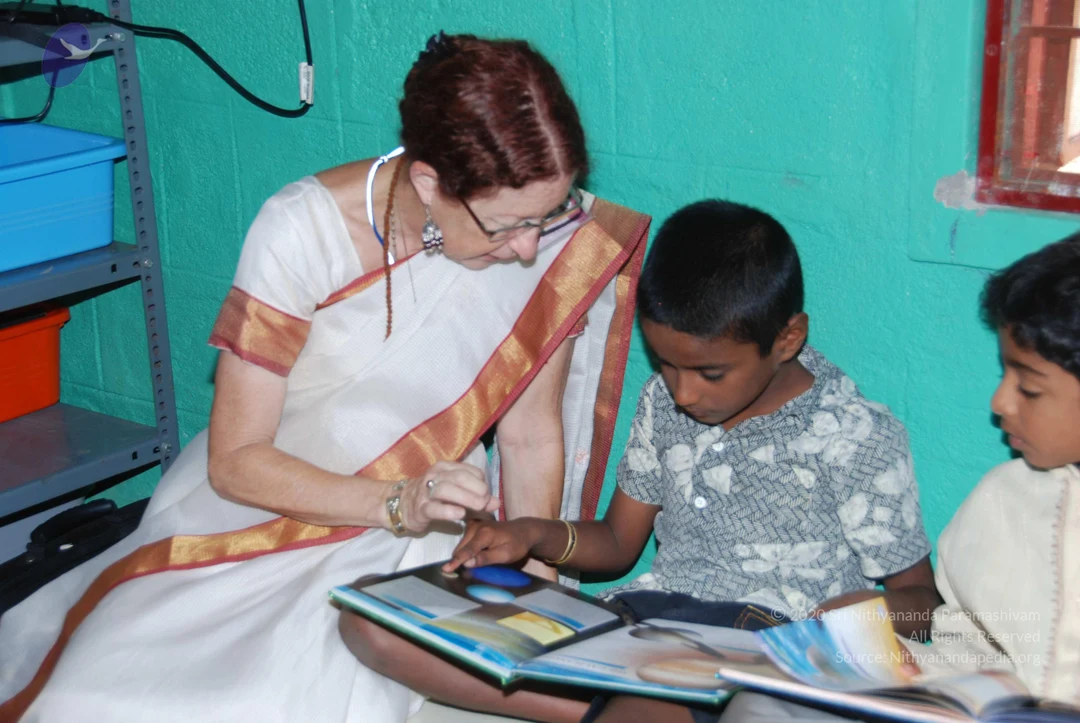
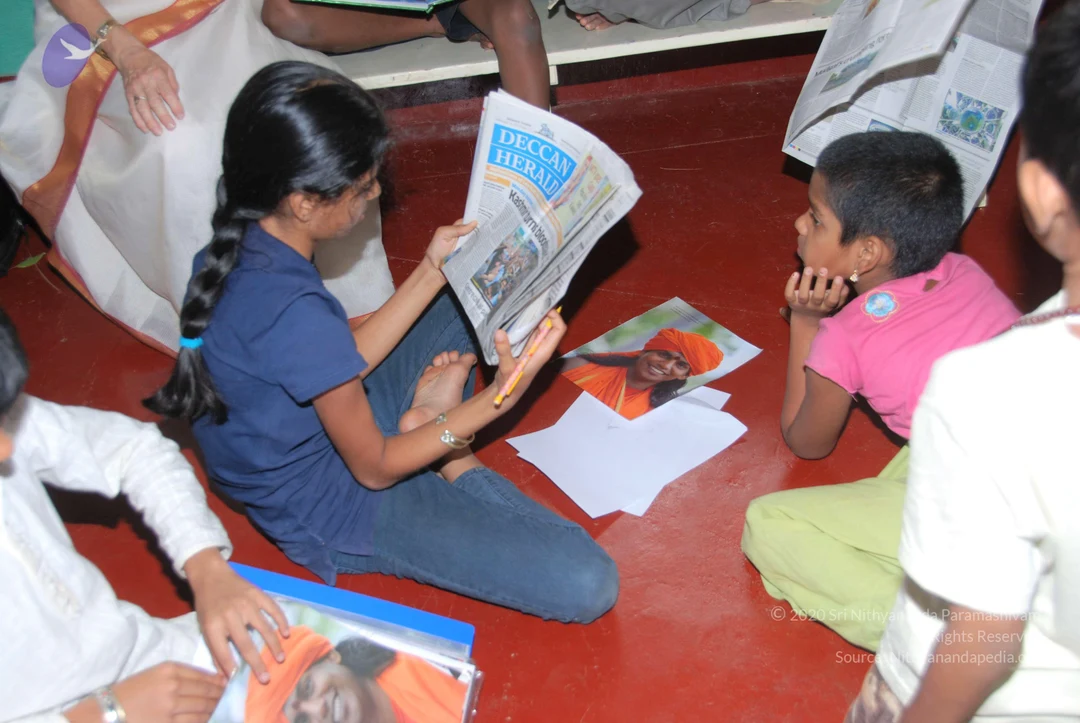
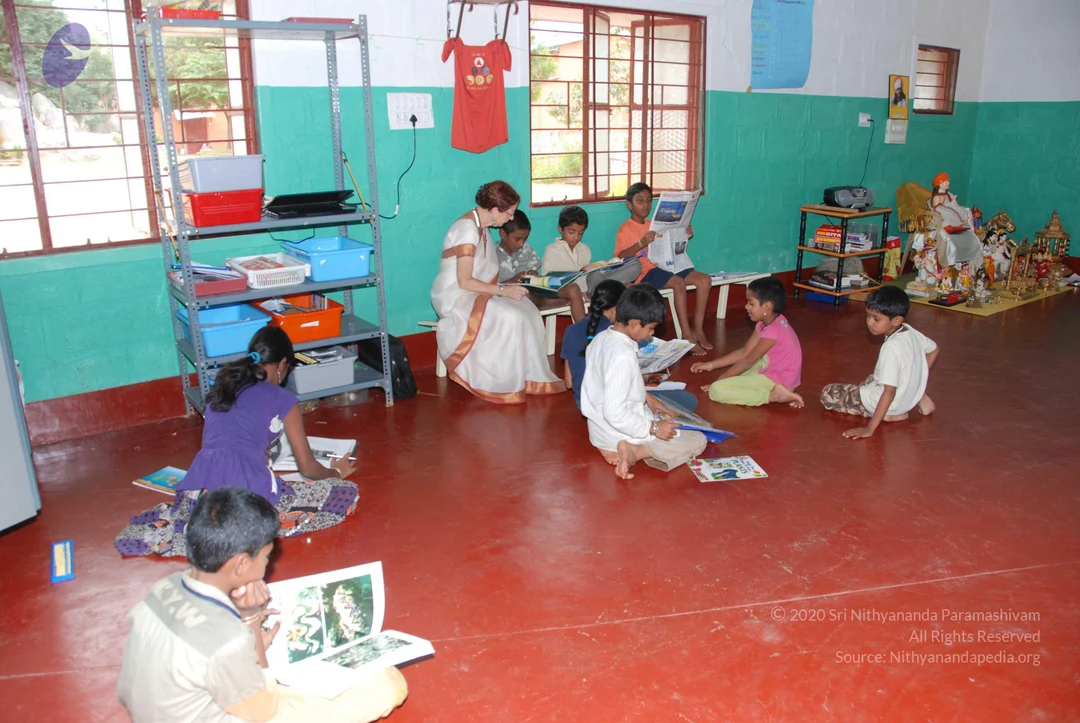
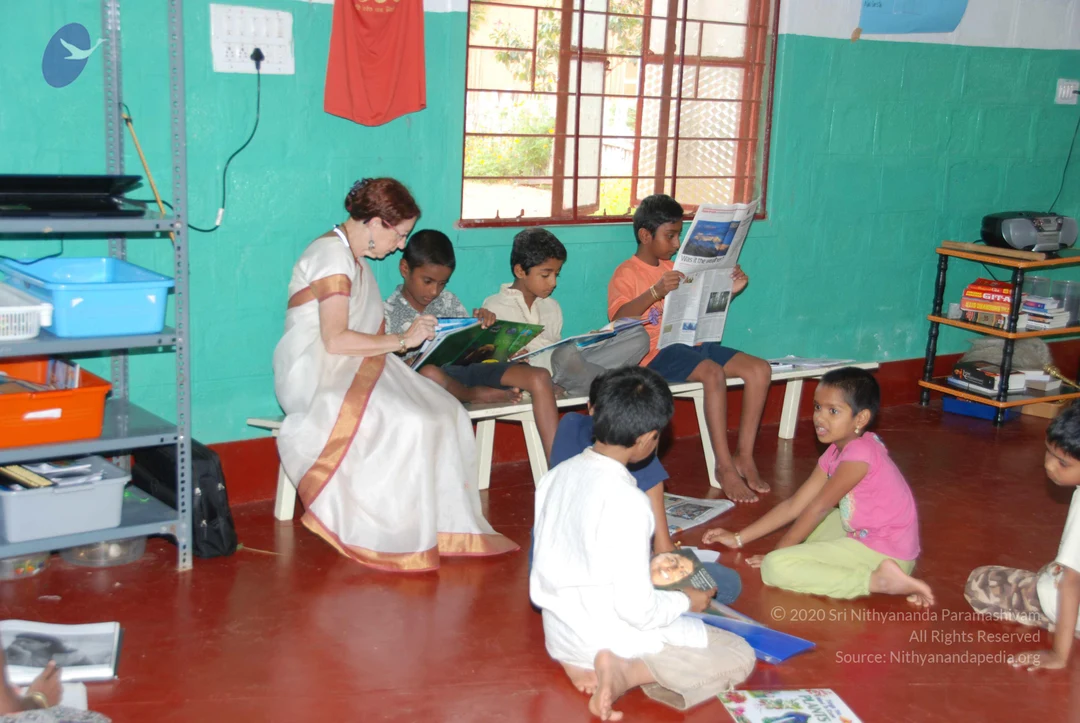
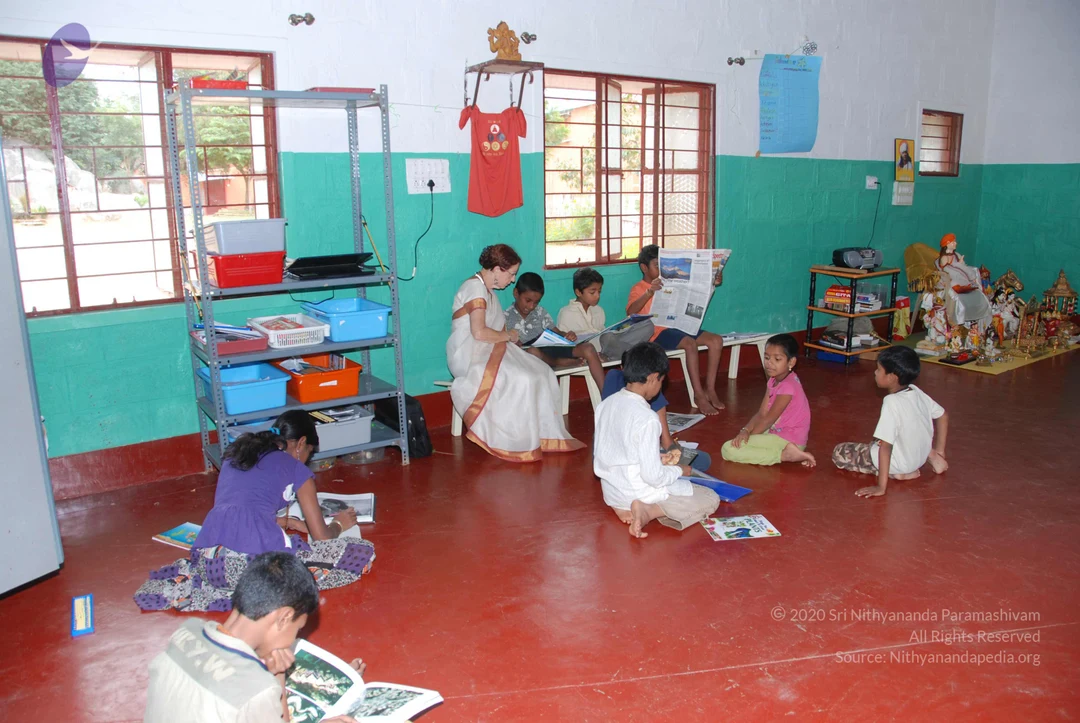
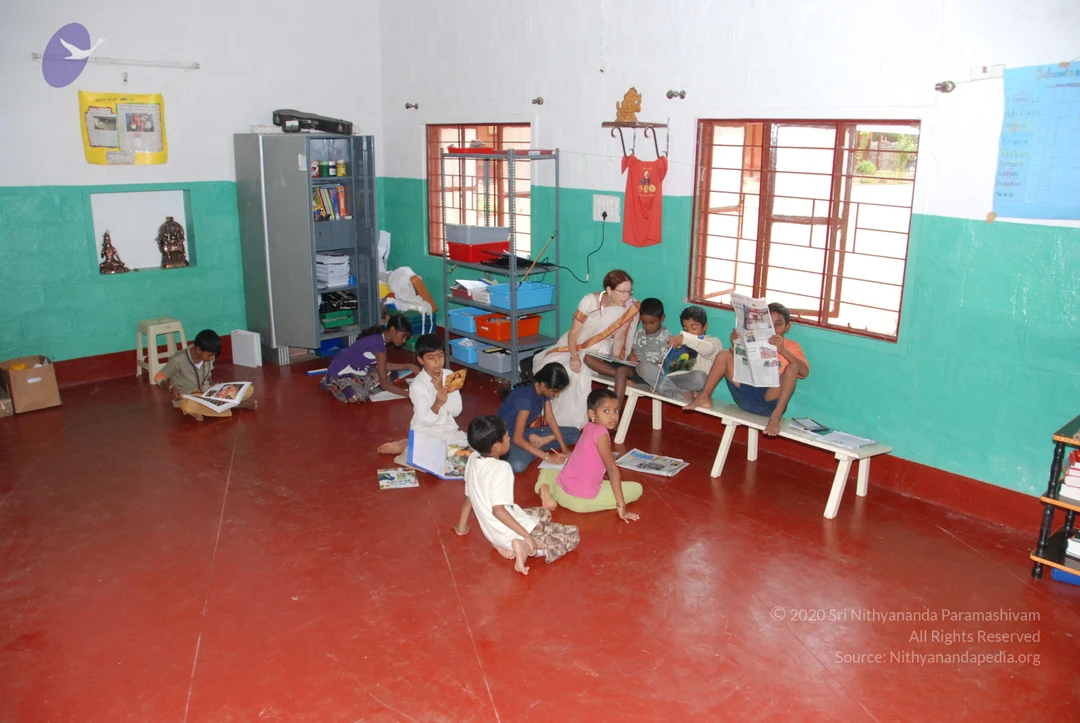
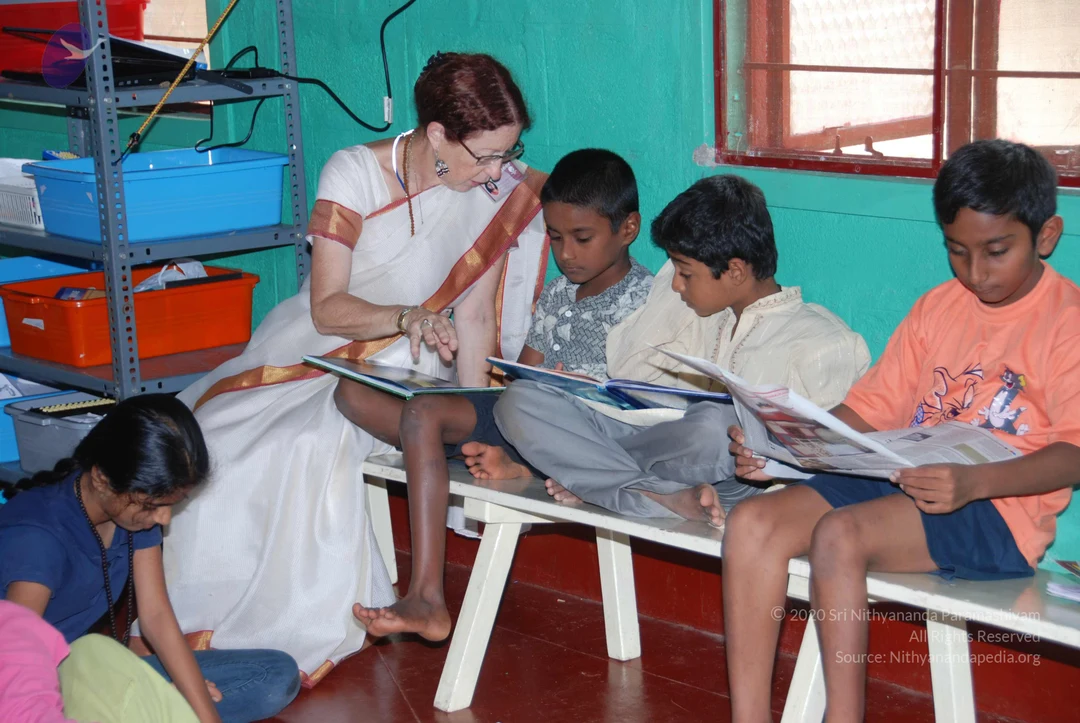
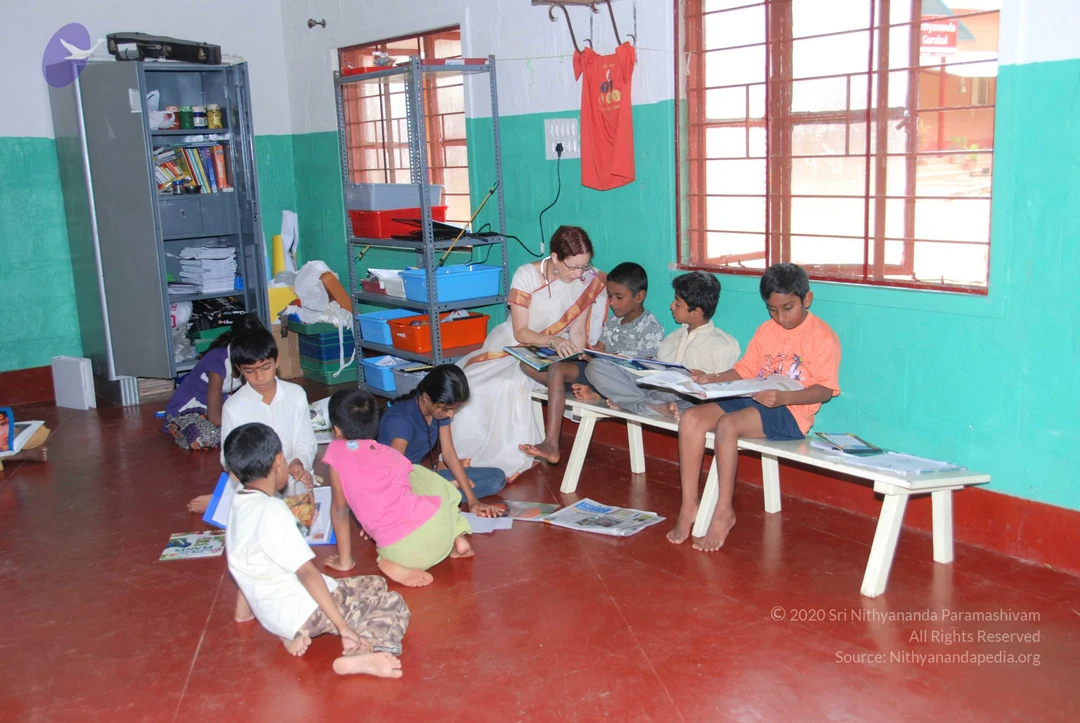
Close photo of a small household altar arranged on wooden boards with pink and green painted edges. Two yellow clay Ganesha figures with pink-tinted ears stand at the front. Behind them are brass figures of a seated figure holding a lamp and a kneeling figure, a grey stone shivalinga, a black stone nandi, a brass plate holding white flowers, a brass oil lamp and incense sticks, and a red flower. A printed sign reading PARAMAHAMSA NITHYANANDA is visible at top, with a brass and red shrine case at left. No people are present.A classroom with a red floor and teal lower walls, decorated with educational charts including vegetables, MOODS, VEHICLES-2, ANIMALS-2, PARTS OF THE BODY and a colourful COLOURS chart. A smiling boy in an orange T-shirt with a spider print stands in the foreground. Behind him, a girl in white and a woman in a white dress stand near the charts, while another girl in a blue top and a woman in a cream sari with maroon blouse stand near a window. Baskets of books and supplies sit on the floor. Six people are visible in total.Indoor classroom with red-brown floor and green-and-white walls, two barred windows and wall charts. A woman in a white sari with a dark shawl stands at right, facing children. In the centre, a woman in a floral print saree with a white top stands with her back to the camera. About six children move around the room: a girl in an orange top and red skirt, a girl in a pink top and pink pants, a boy in a floral shirt, and a boy in a blue top and a boy in orange raising an arm at left. No a person candidate is visible, so the figures are teachers and children in a gurukul-style class.A classroom photo with a red-painted floor and teal walls. A woman in a cream and beige sari with a dark bun stands at right, smiling, with a small dark bead necklace visible, facing a loose circle of six children standing barefoot. Children wear an orange tee, a blue long-sleeved top with a pendant, a striped shirt, a navy top with yellow shorts, a patterned grey shirt, a white top and pink skirt. A person holding a camera is partly visible at lower right. Wall charts show numbers, wild animals and alphabet letters, and a window is at top left.A photograph of children in a classroom with red-painted floor and turquoise walls. A boy in an orange shirt and grey shorts stands in the centre, with a girl in a white top and pink trousers beside him and another girl in a pale top. A boy in a blue shirt and a girl in a light dress stand nearby, and a boy in striped shirt sits sprawled on a black chair at left. A small girl in a white top and pink skirt stands at the left edge. Shelves with blue plastic bins, a whiteboard, and a colourful wall chart are visible, along with a partly visible adult at the far right.A photograph of a group of children standing and playing together on a red-painted floor in a room with teal walls and a window. A girl in a white top and pink-and-white skirt in the foreground smiles, while a girl in an orange top with a red floral skirt and a pendant necklace stands centre. A boy in an orange t-shirt with a spider graphic, a boy in a striped polo, a boy in a blue top with a white bead necklace and a boy in a grey patterned shirt stand nearby. A red plastic chair and a blue storage bin sit at the left, and a poster of colourful cartoon panels is pinned to the wall. No adult or a person candidate is visible.
09

08-Yoga-Sutras

14 dated photos in previewSource gallery
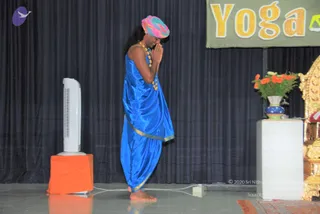
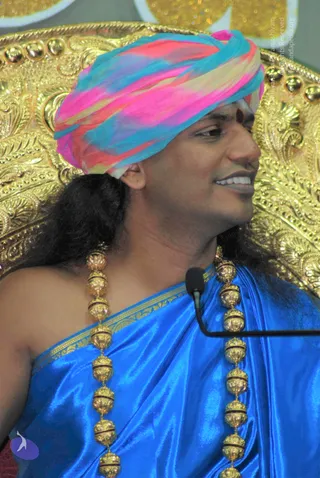
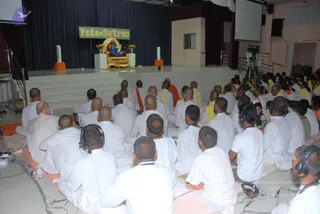
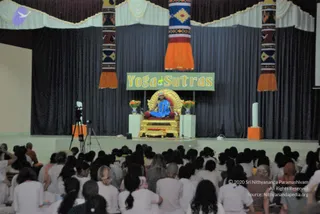
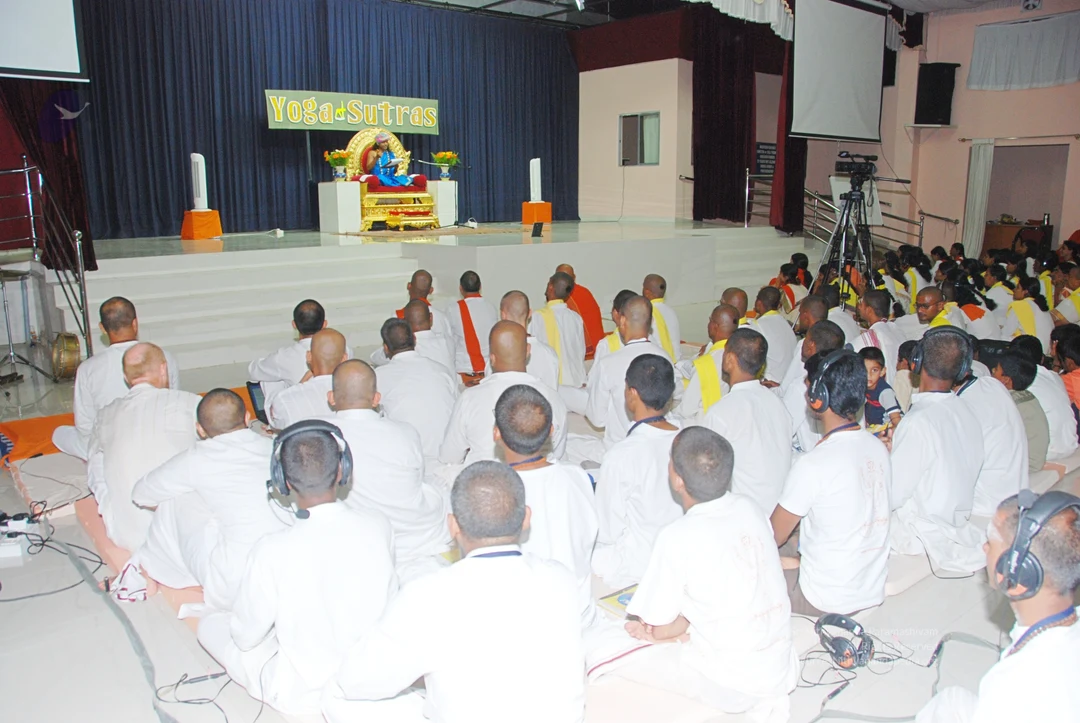
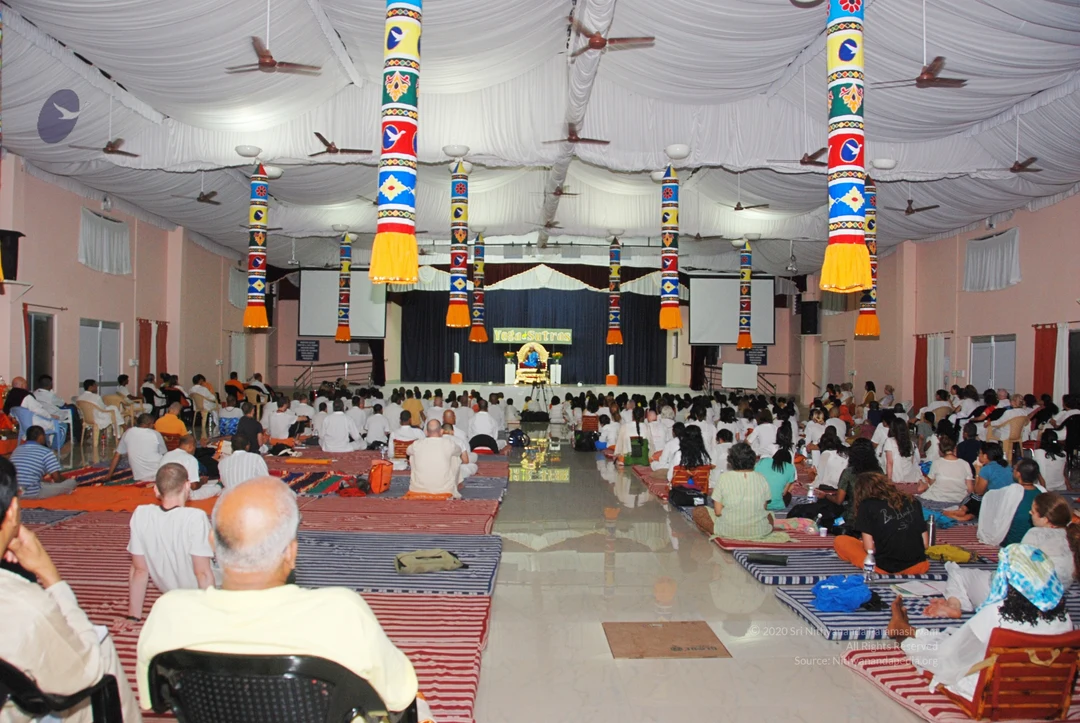
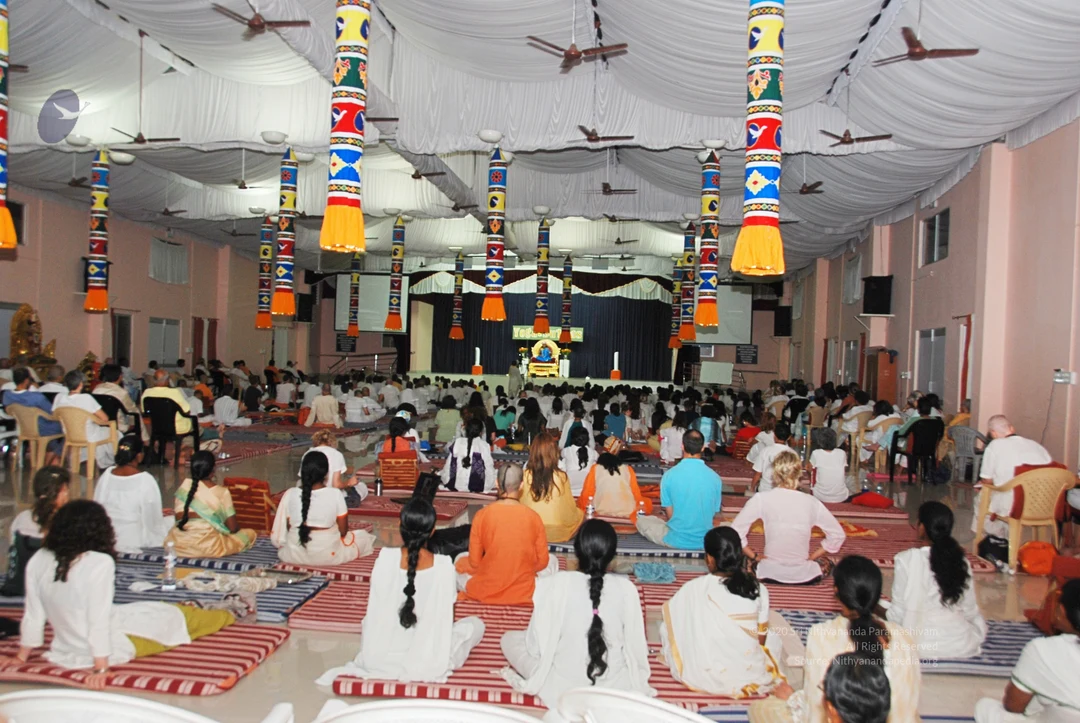
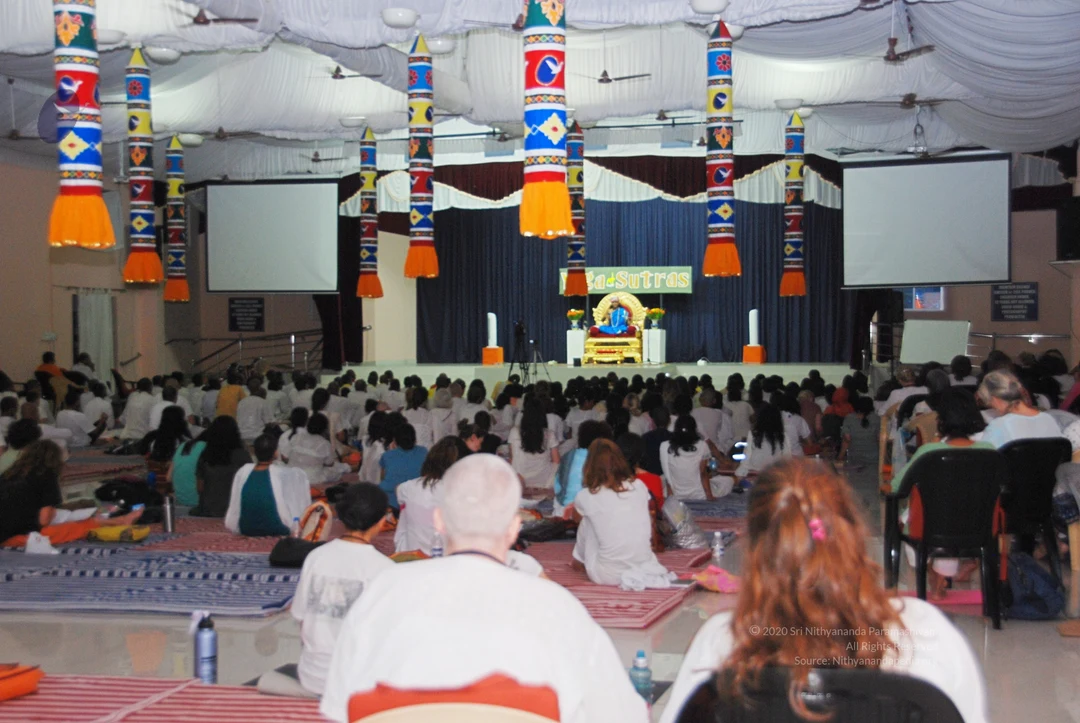
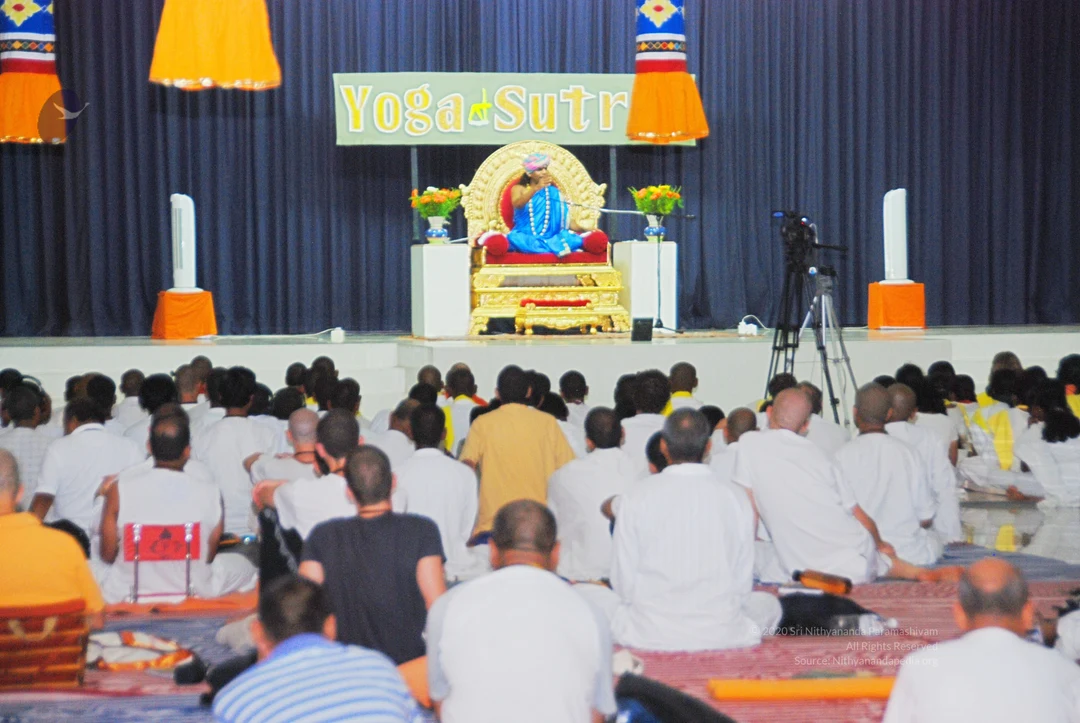
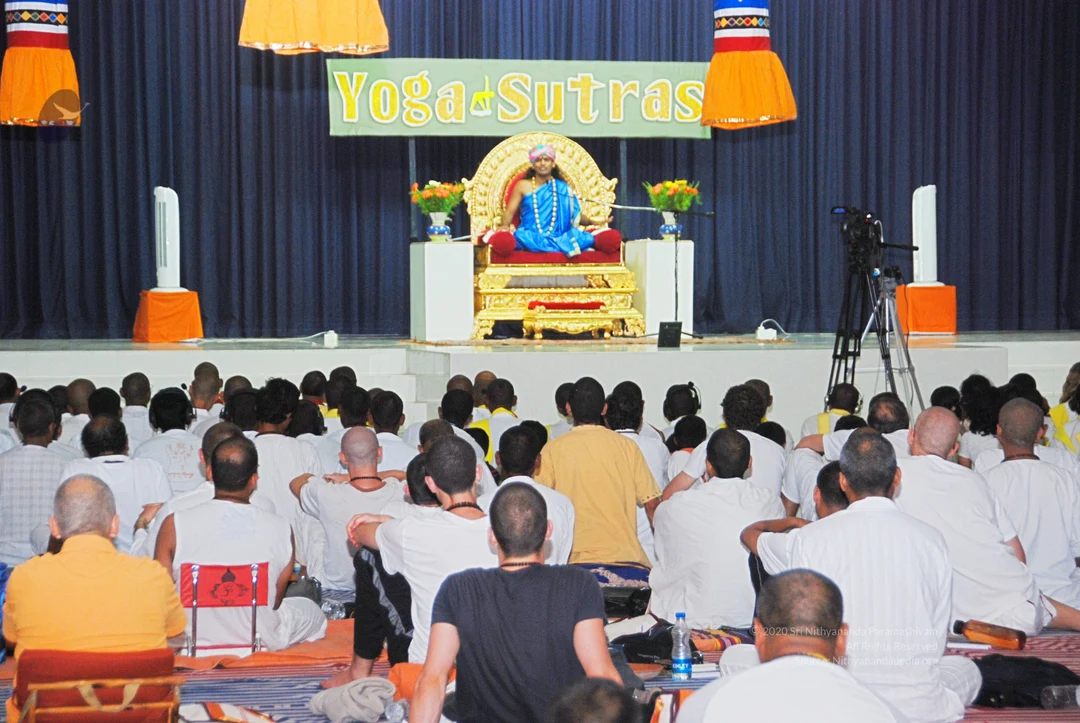
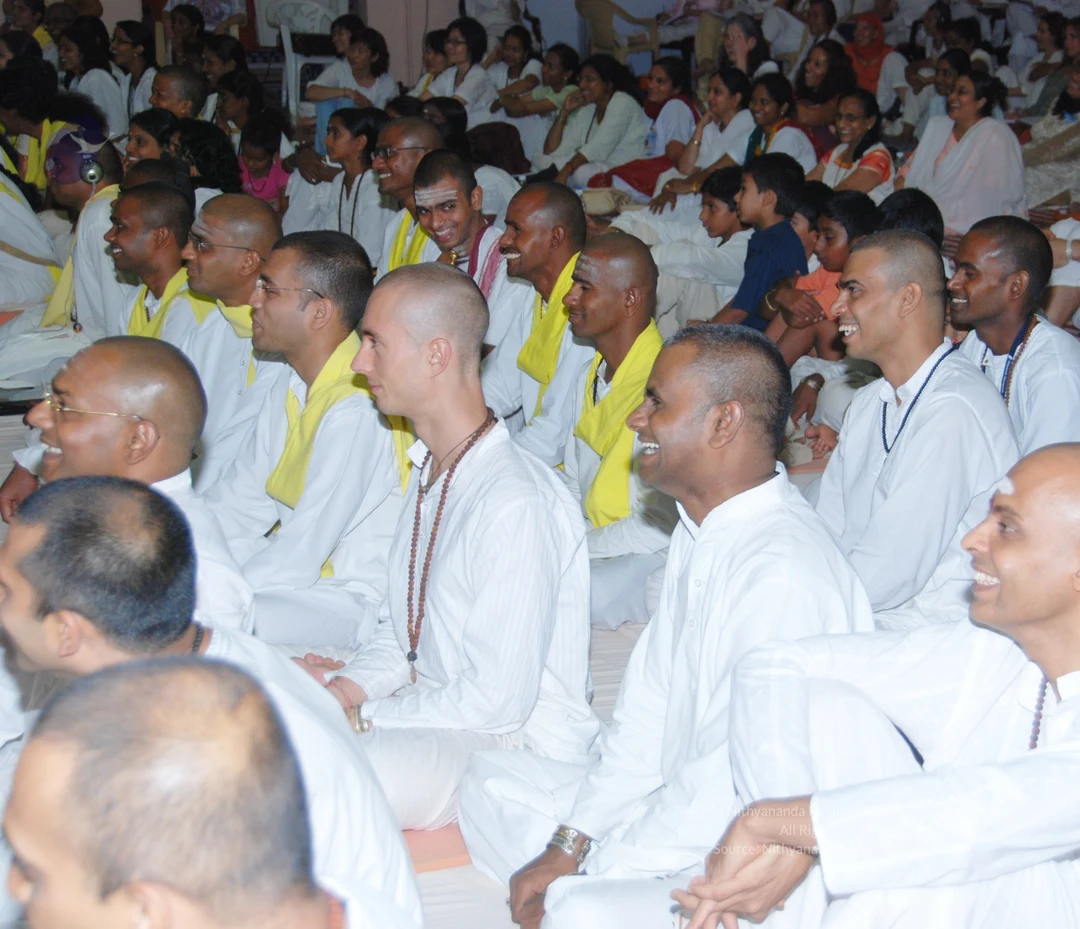
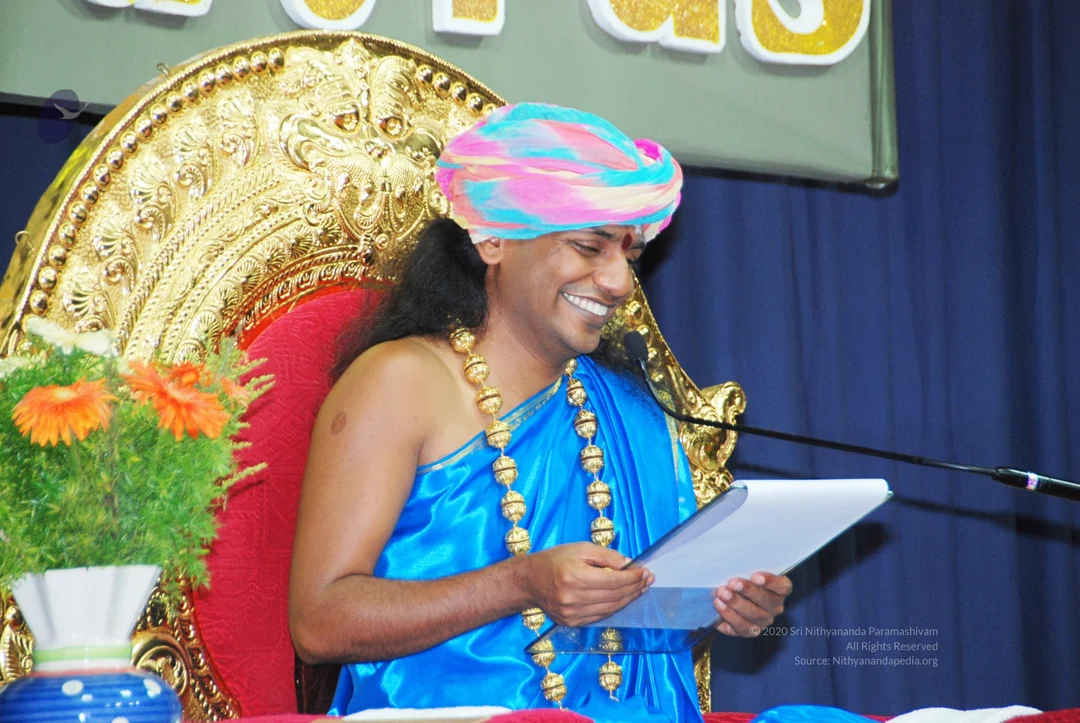
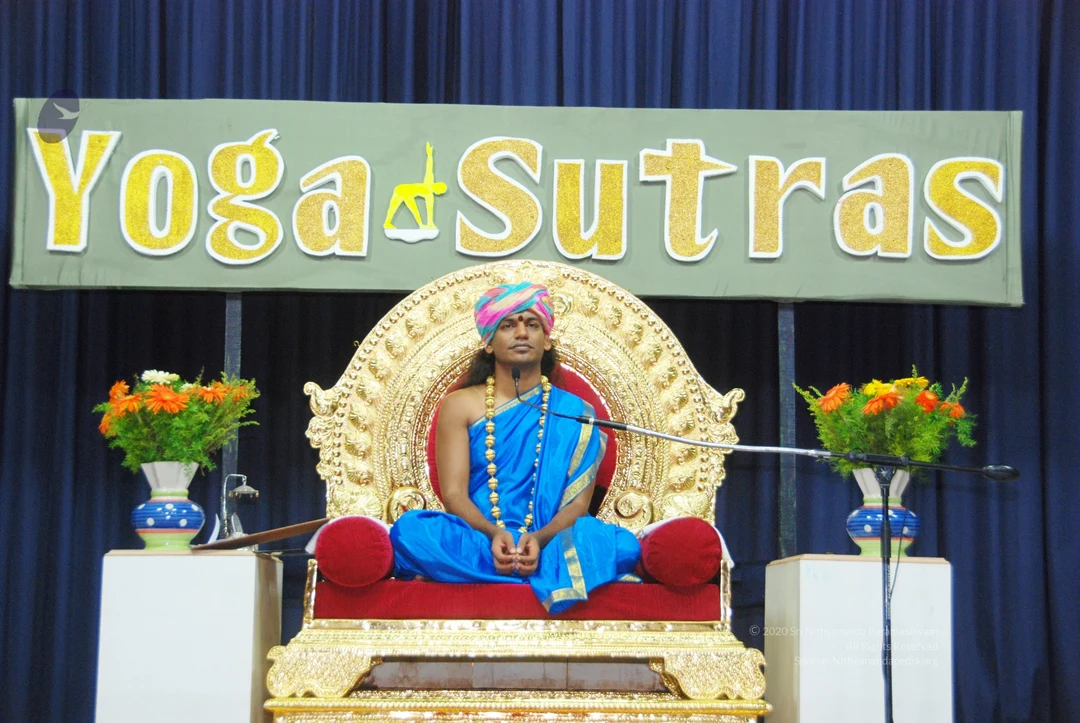
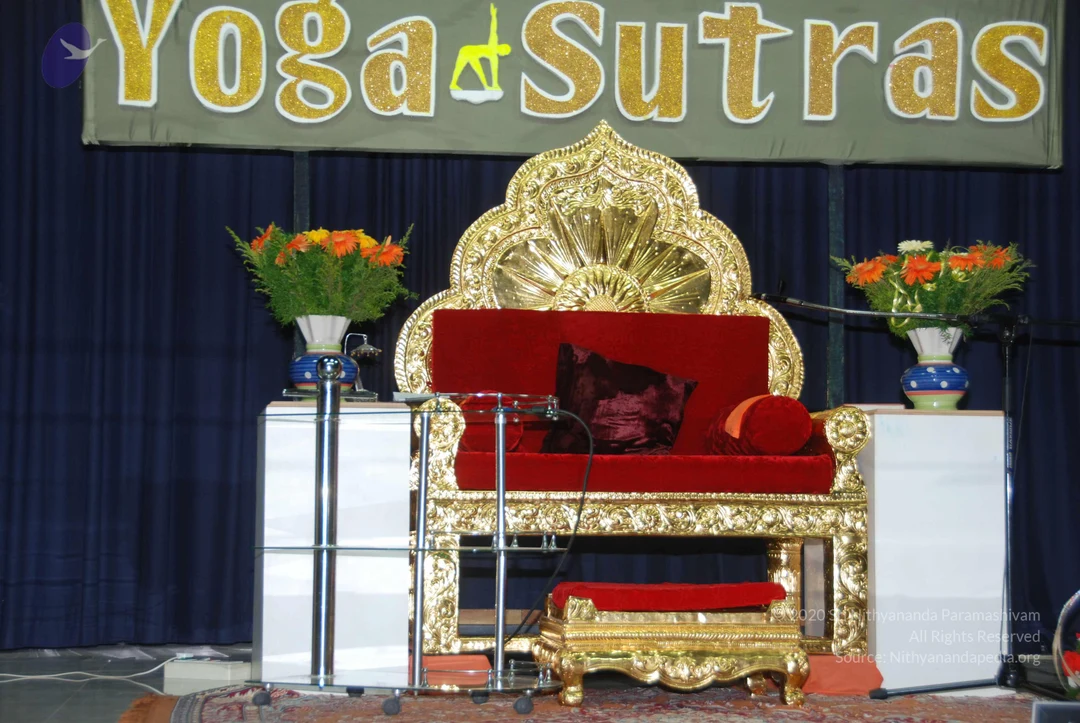
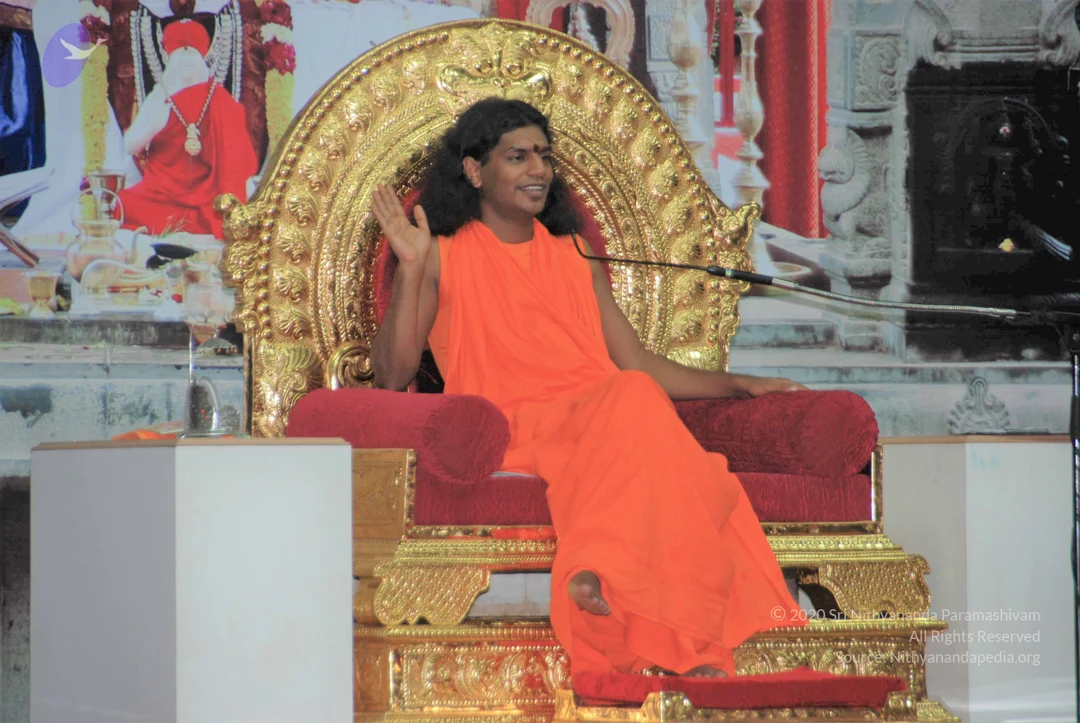
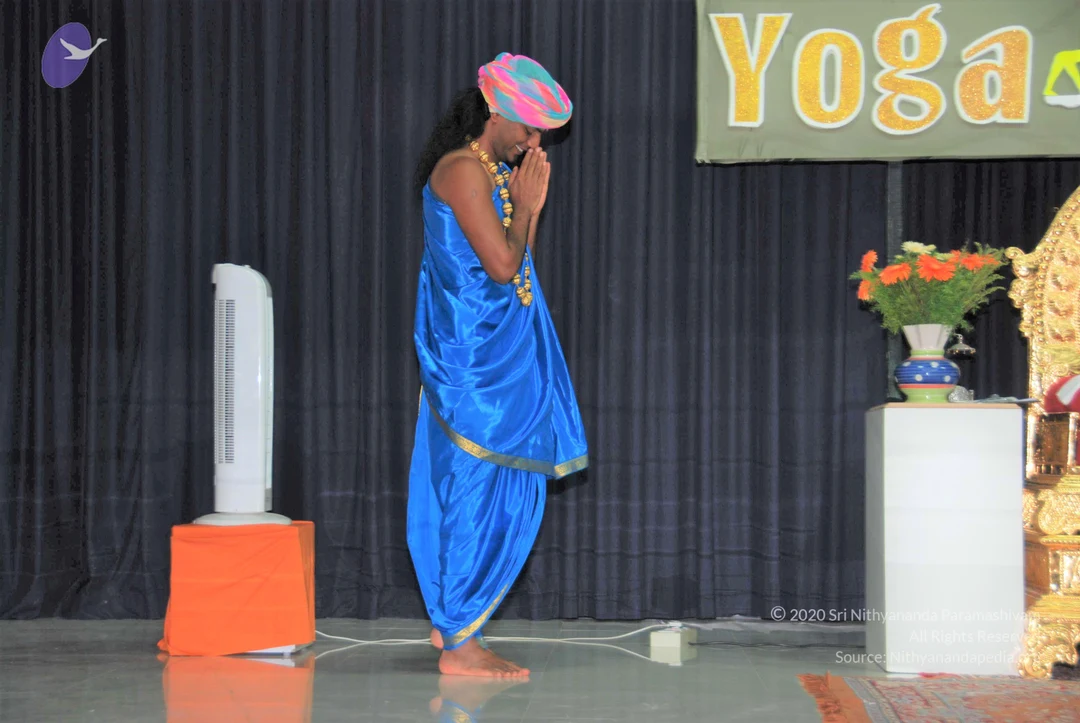
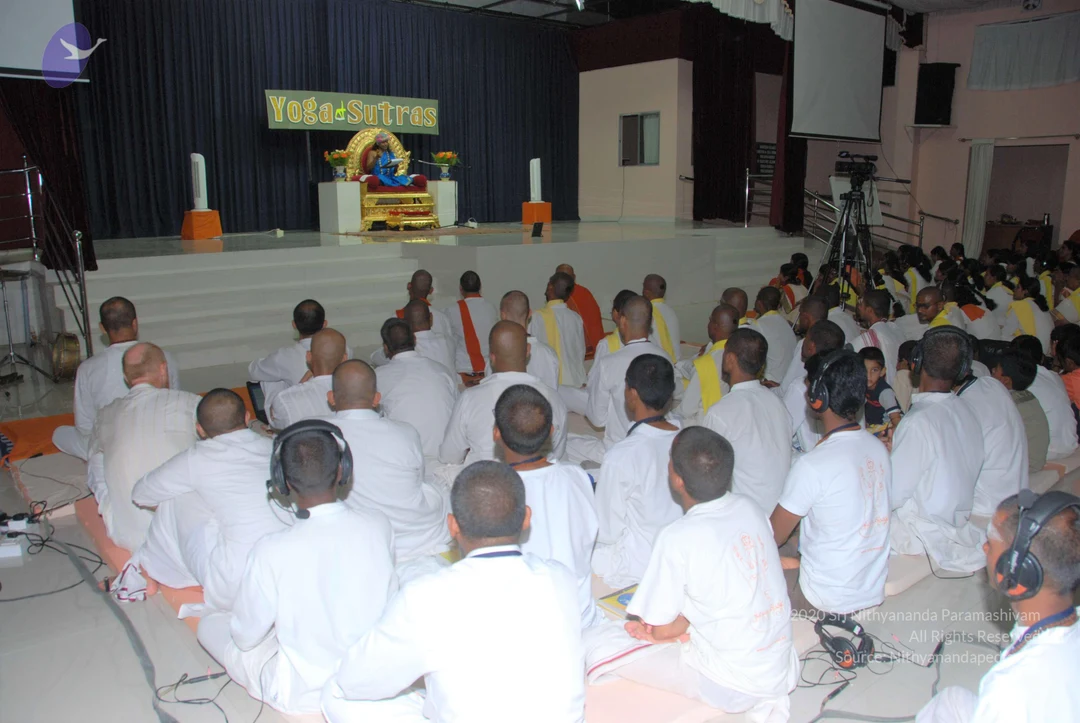
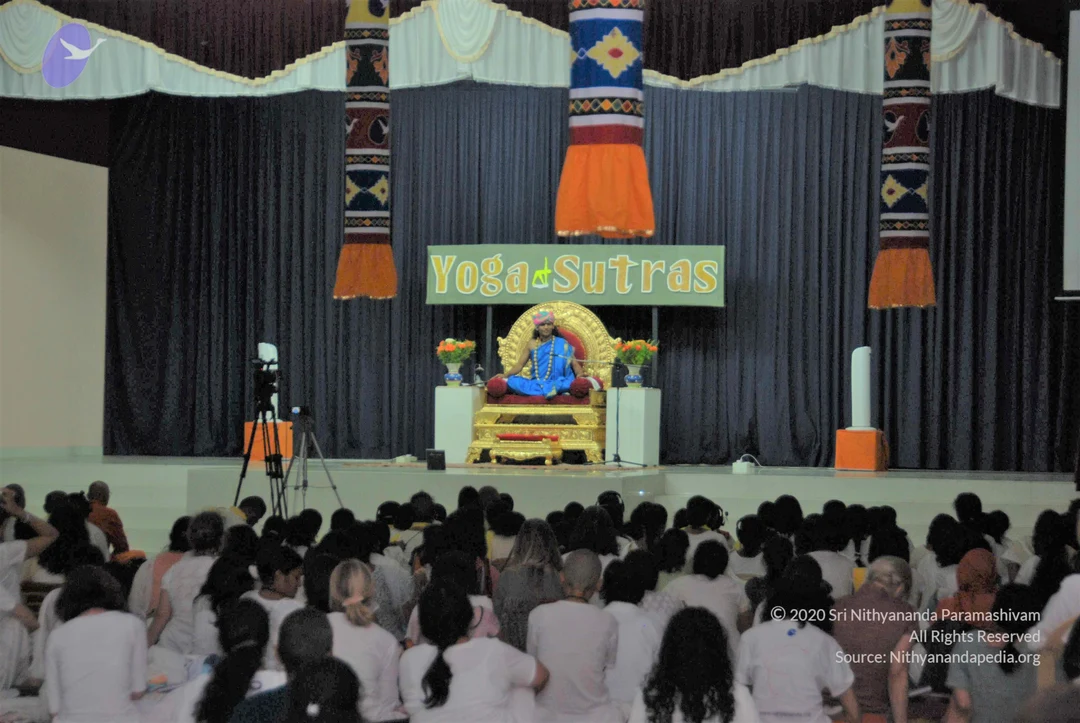
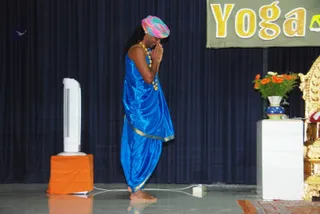
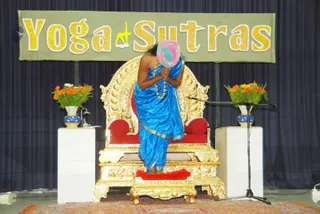
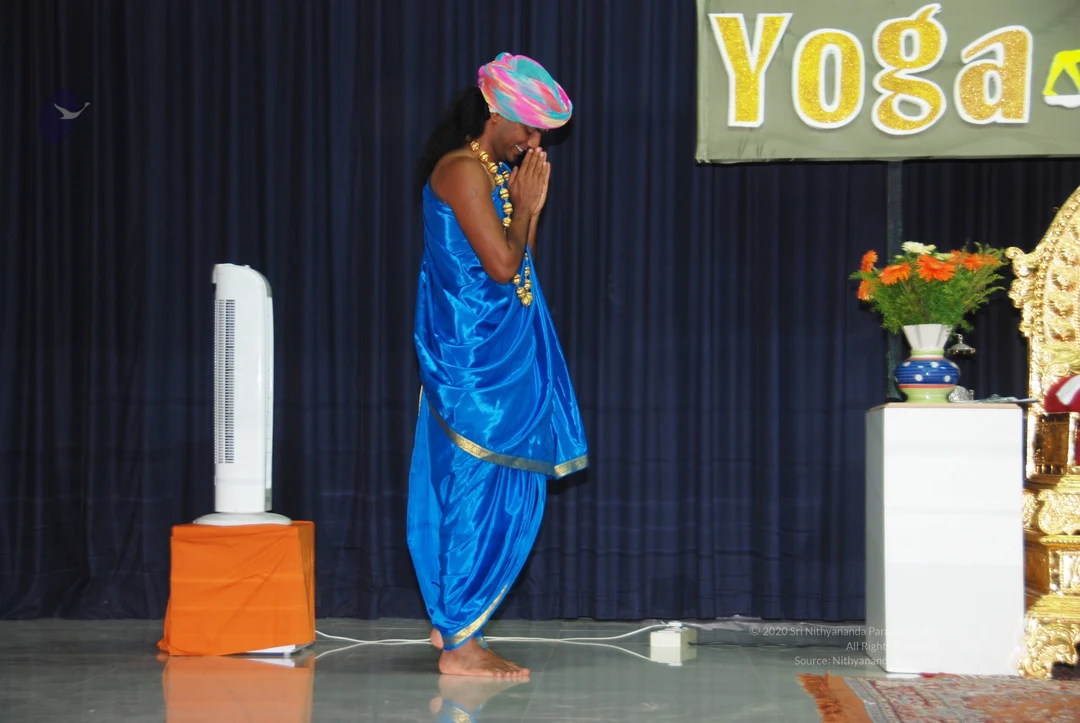
A person stands in profile on a stage with hands pressed together in anjali mudra at the chest, eyes lowered. They wear a multicoloured pink, teal and green turban, a royal blue draped silk garment with gold border, and layered gold and beaded necklaces. A white tower fan stands on an orange-draped box at left, a vase of orange gerbera flowers sits on a white pedestal at right, and a gold-carved throne edge is visible beside it. A dark curtain backs the stage, and a green banner reading Yoga with gold lettering hangs above. The stage is pale grey and reflective. Two text blocks are overlaid at lower right.A smiling man sits cross-legged on an ornate gold-and-red throne with a rounded gilded backrest, wearing a multicoloured pink, blue and yellow turban, a red tilak on his forehead, a royal blue silk shawl with gold border and a long gold bead mala. He holds a brown clipboard on his lap and looks down at it, a microphone stand beside him. Behind him is a glittering gold-lettered backdrop.A smiling man sits in front of an ornate gold throne-style chair, turned to his right toward a microphone on a stand. He wears a multicoloured pink, turquoise and cream turban, a blue satin garment with a gold border, and a long gold bead necklace with dark accents. Long dark hair falls behind his shoulders, and a small dark tilak mark is visible on his forehead.A smiling man in a multicoloured pink, turquoise and yellow turban sits before an ornate gold throne-like backrest. He wears a shiny royal-blue silk garment with gold border and long gold bead necklaces, and a red tilak mark on his forehead. A microphone stand is at his right. Long dark hair falls over his shoulder.A photograph of a seated audience in white clothes facing a raised stage at a satsang hall. Many people, seen from behind, sit cross-legged on a white floor, several wearing headphones and some with yellow or orange shawls. On the stage, a figure in blue and red clothing sits on an ornate gold and red throne flanked by flower arrangements and white pillars, beneath a green banner reading Yoga Sutras. A dark blue curtain backs the stage and a video camera on a tripod sits at the right. The seated figure on the throne cannot be identified from appearance with confidence here.A photograph of a large hall with a dark navy curtain backdrop and draped banners with orange fringe and geometric patterns. A green sign reads "Yoga Sutras" in yellow letters. On a raised stage a figure in a blue robe with blue and red garments and a colorful turban sits on an ornate gold and red throne, flanked by vases of orange flowers on white pedestals. Rows of seated devotees in white clothes, some with white head coverings, fill the floor in front of the stage, facing forward. A tripod-mounted camera stands at the left edge of the stage. The central figure matches the a person appearance cues of a turban and blue robe, but identity is uncertain.
10

09-Adhi-Kailash

23 dated photos in previewSource gallery
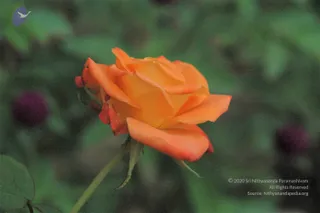
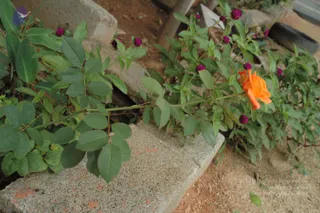
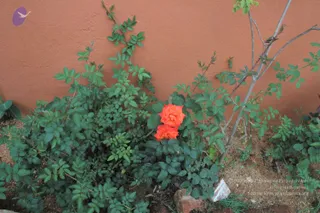
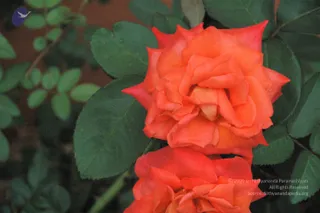
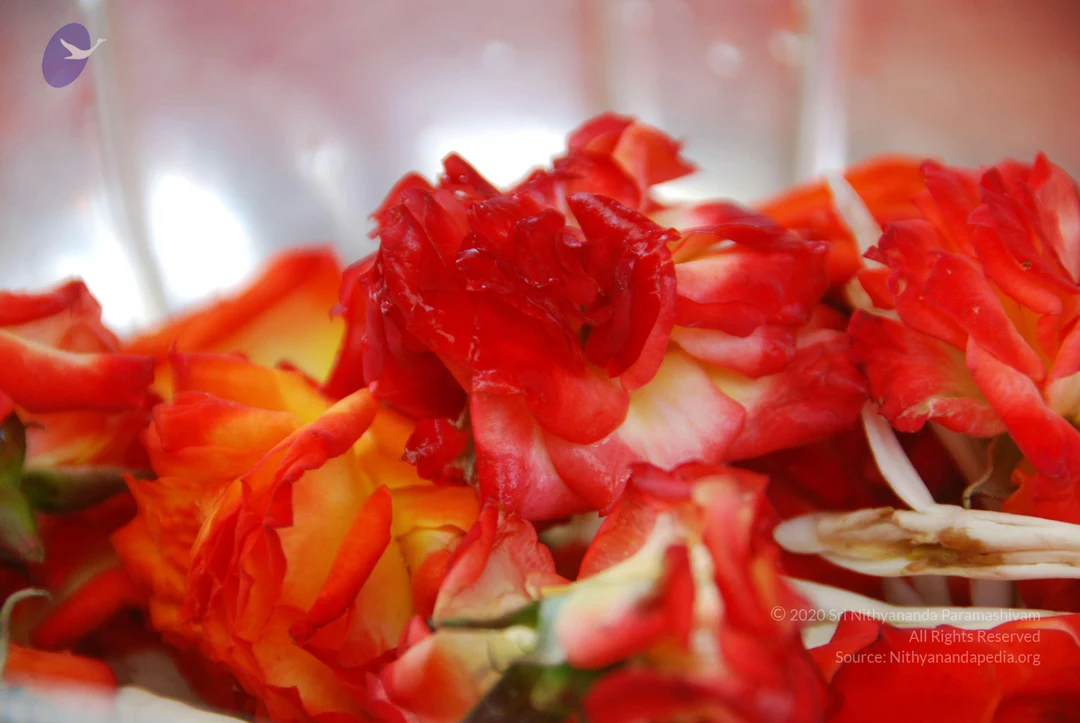
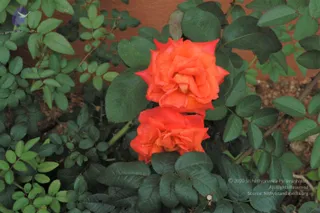
Photograph of a single orange rose in bloom among dark green leaves, growing from a garden bed beside grey concrete paving slabs with a crack between them. A small unopened reddish-purple bud appears at the top right. The soil is reddish-brown. No people are visible. Faint copyright text and a small bird logo appear in the image corners.Close-up photograph of a single orange rose in bloom, its layered petals shading from golden yellow at the centre to deeper orange-red at the edges. Its green stem and sepal extend down the left side. The blurred background is dark green foliage with out-of-focus purplish buds. No people or ritual setting is visible.A close outdoor photograph of a rose bush with glossy green serrated leaves and a single open orange-peach rose bloom at right. Several small magenta globe amaranth flowers sit among the foliage. The bush grows beside grey concrete blocks on reddish-brown earth, with a dark flat object at upper right. No people are visible.A close outdoor photograph of a garden bed against a terracotta-coloured wall. Two bright orange-red roses bloom among dense green rose bushes with small compound leaves and thin woody stems. Reddish-brown soil and a broken brick lie at the base of the plants, and a small patch of grass is visible at lower right. No people are present.Two orange-red roses bloom on a bush with dark green serrated leaves, the upper flower in sharp focus and the lower one partly cut off at the bottom edge. The soft, blurred background shows more green foliage and a warm reddish-brown wall. No people, deities or ritual objects are visible.Close photograph of two orange-red roses in full bloom on a bush with dense dark green serrated leaves, set against a reddish-brown wall and gravel ground. No people are visible. A small purple and white logo appears in the upper left corner.
11

September 15 2010

12 photosView all
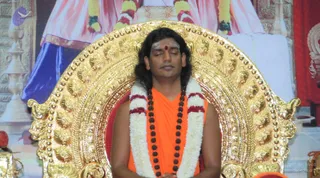
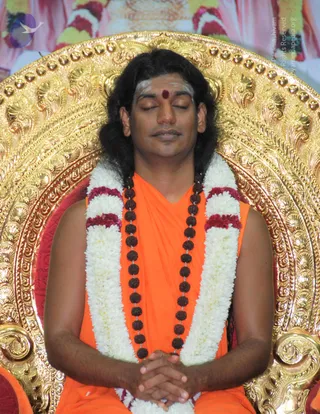
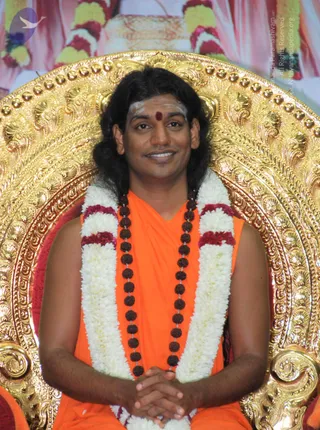
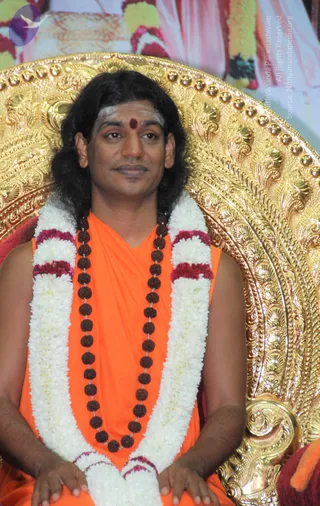
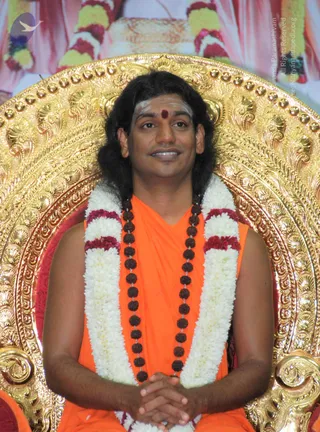
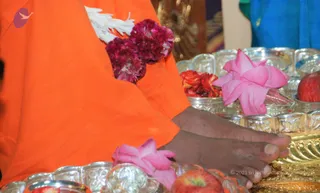
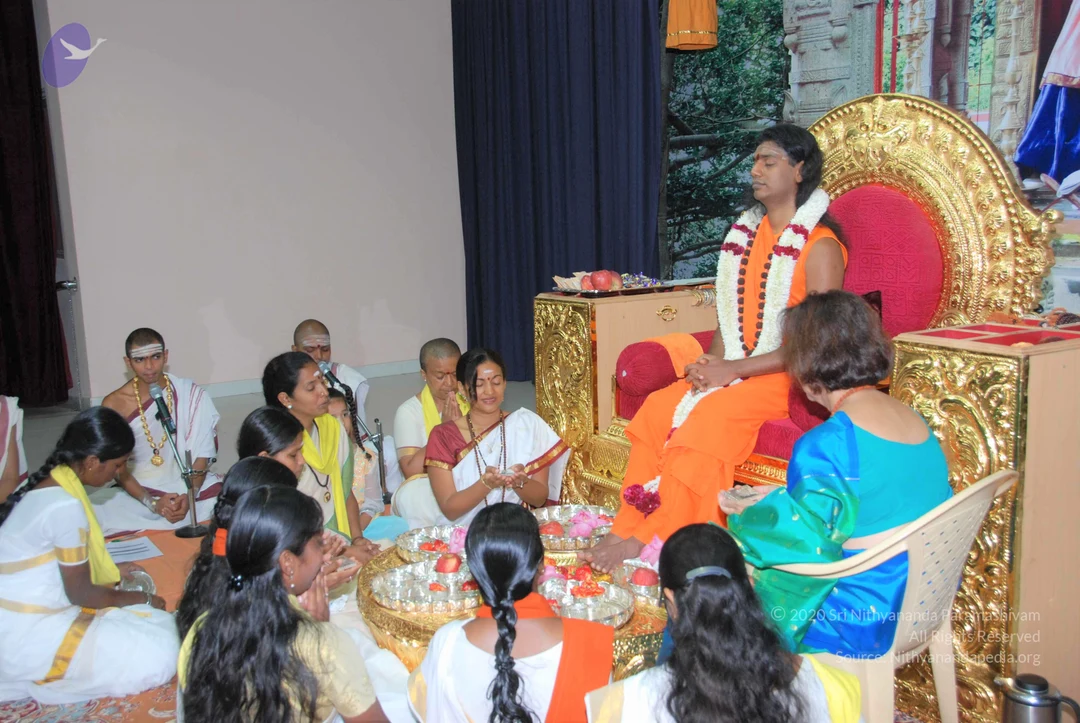
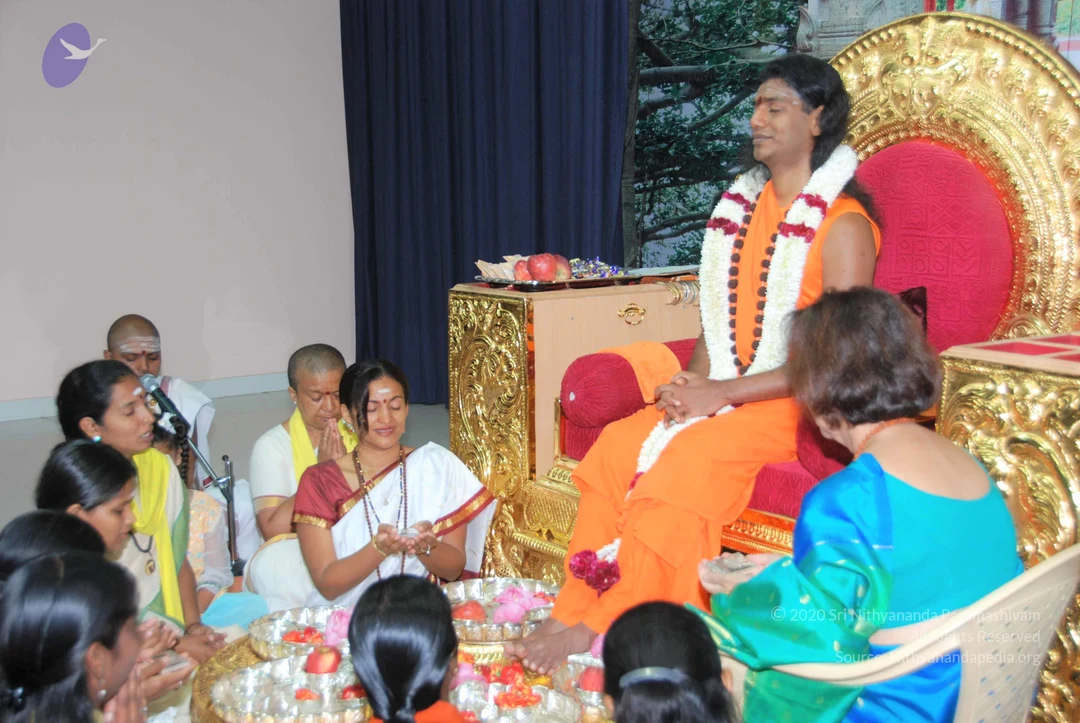
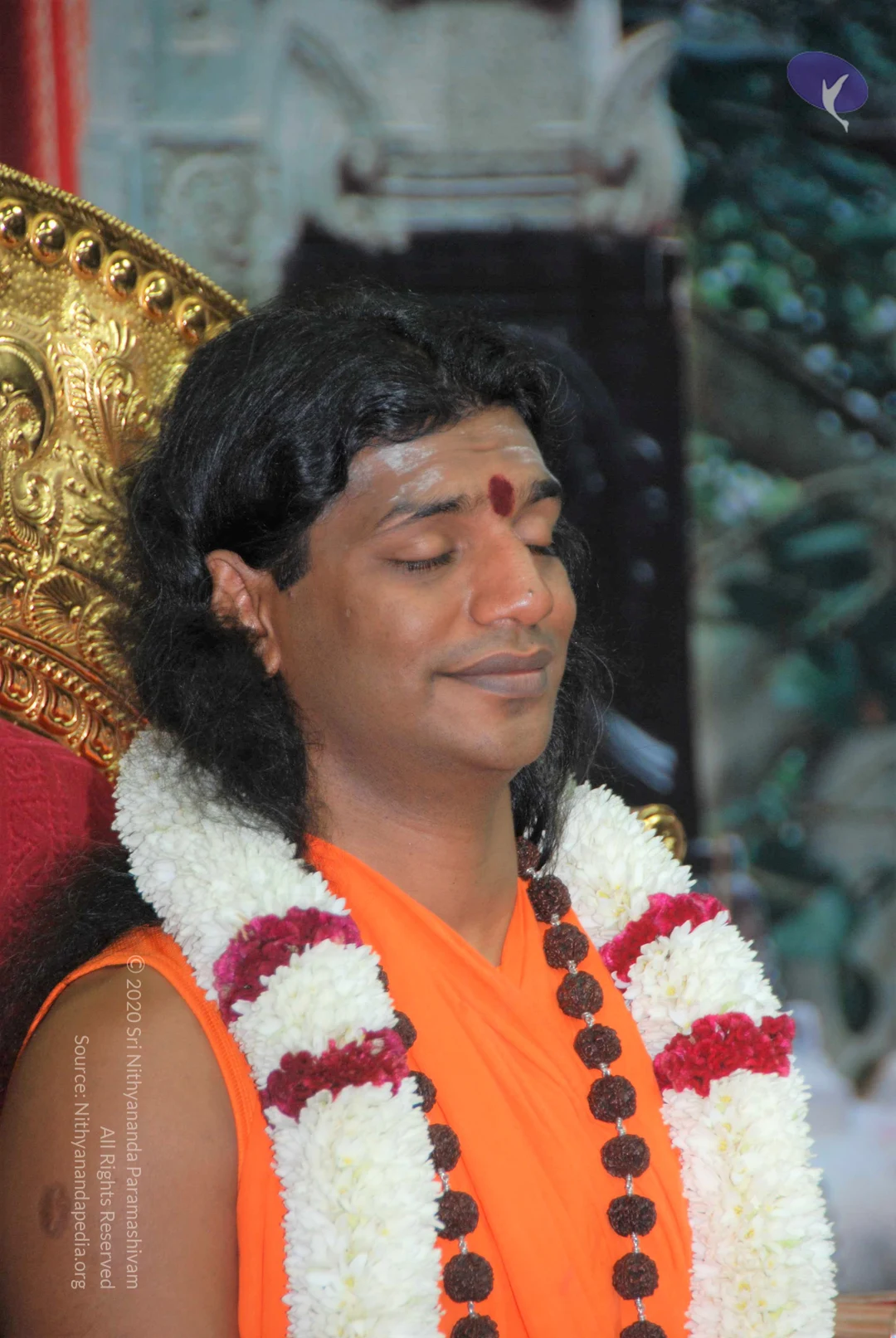
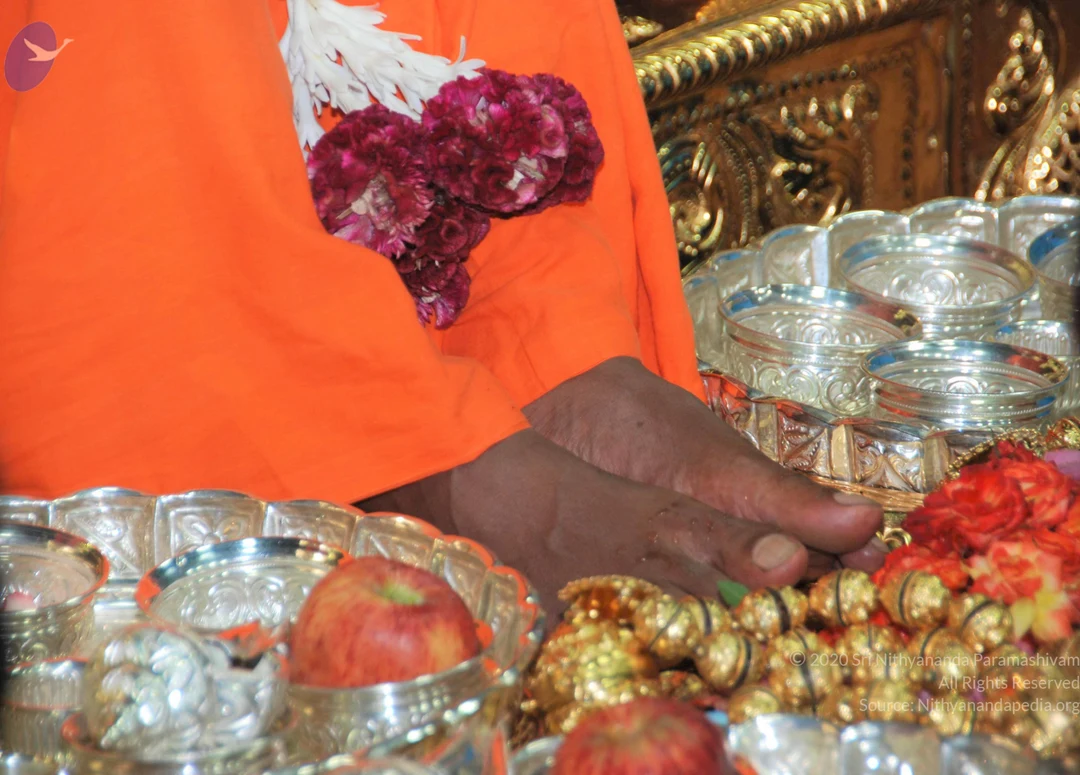
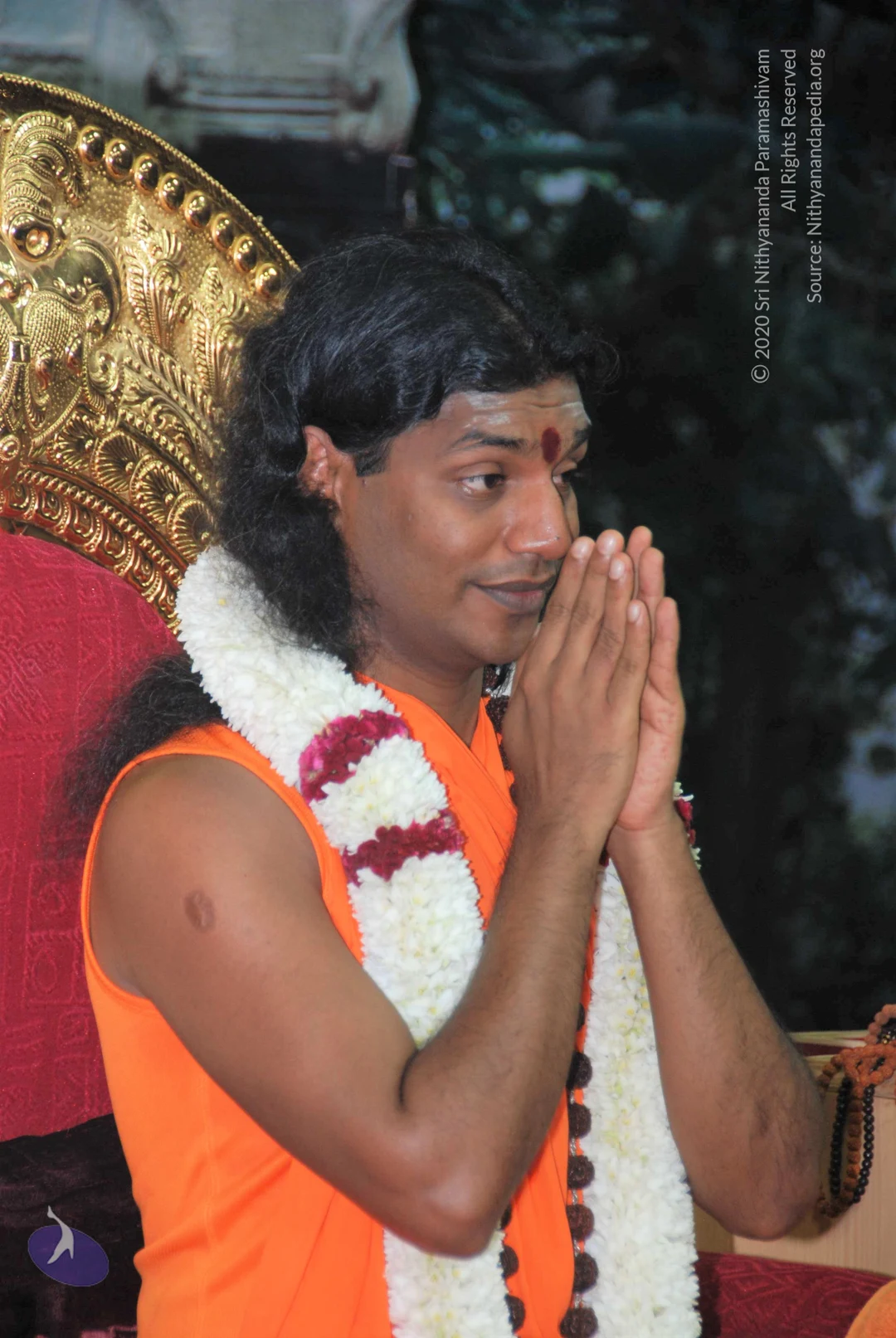
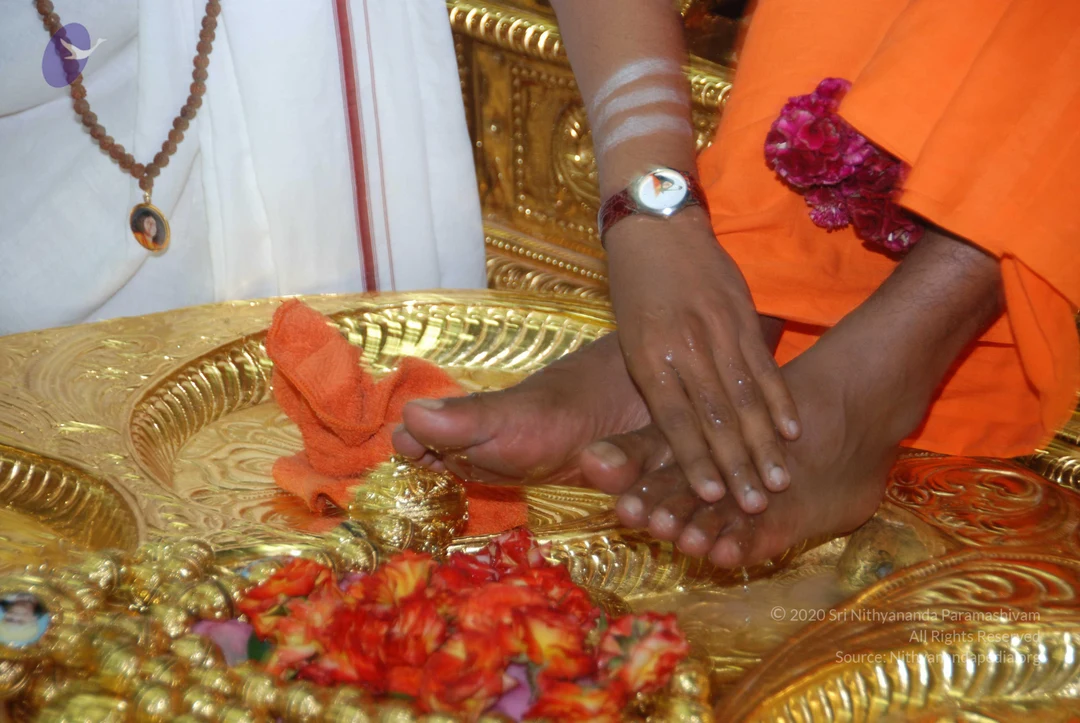
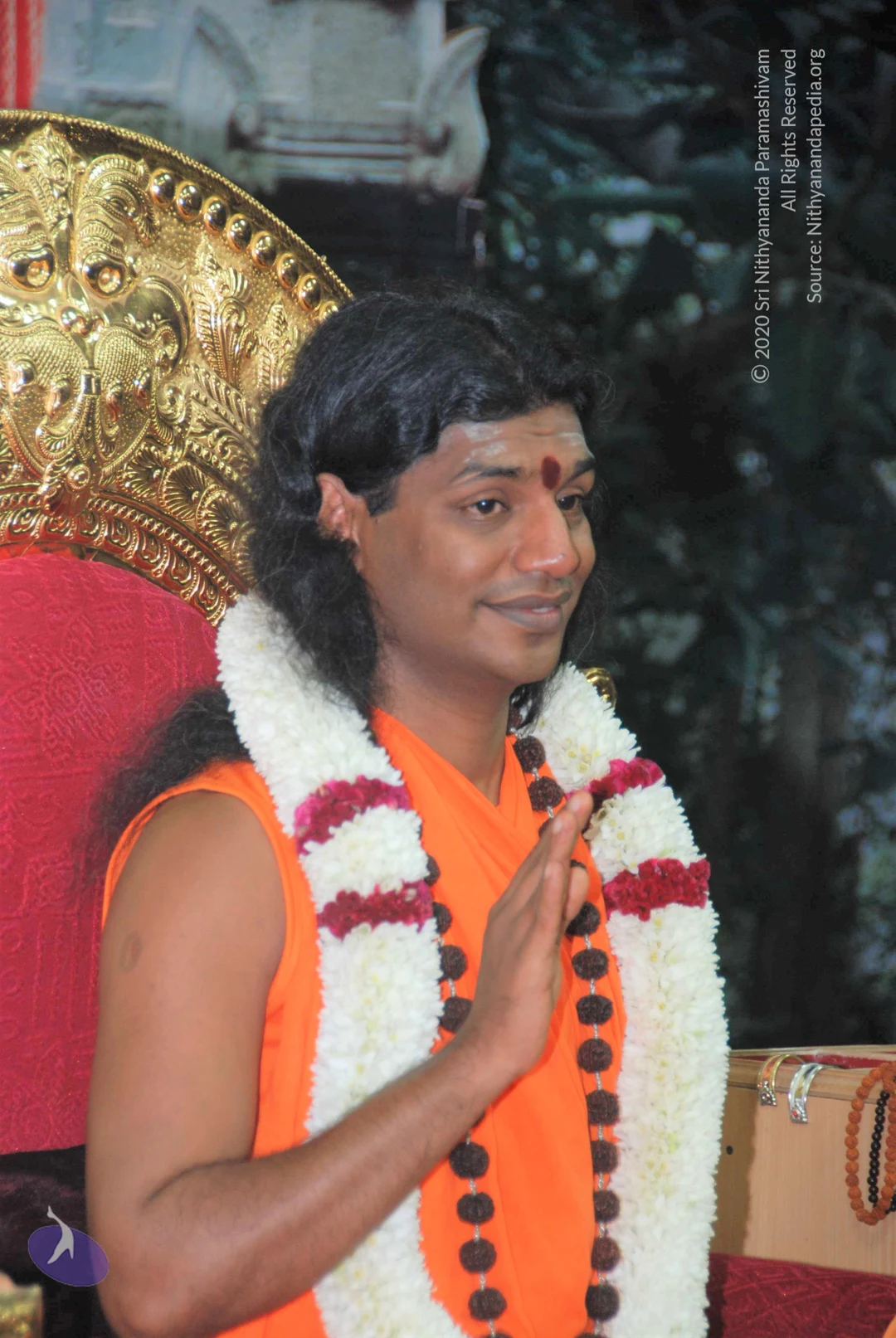
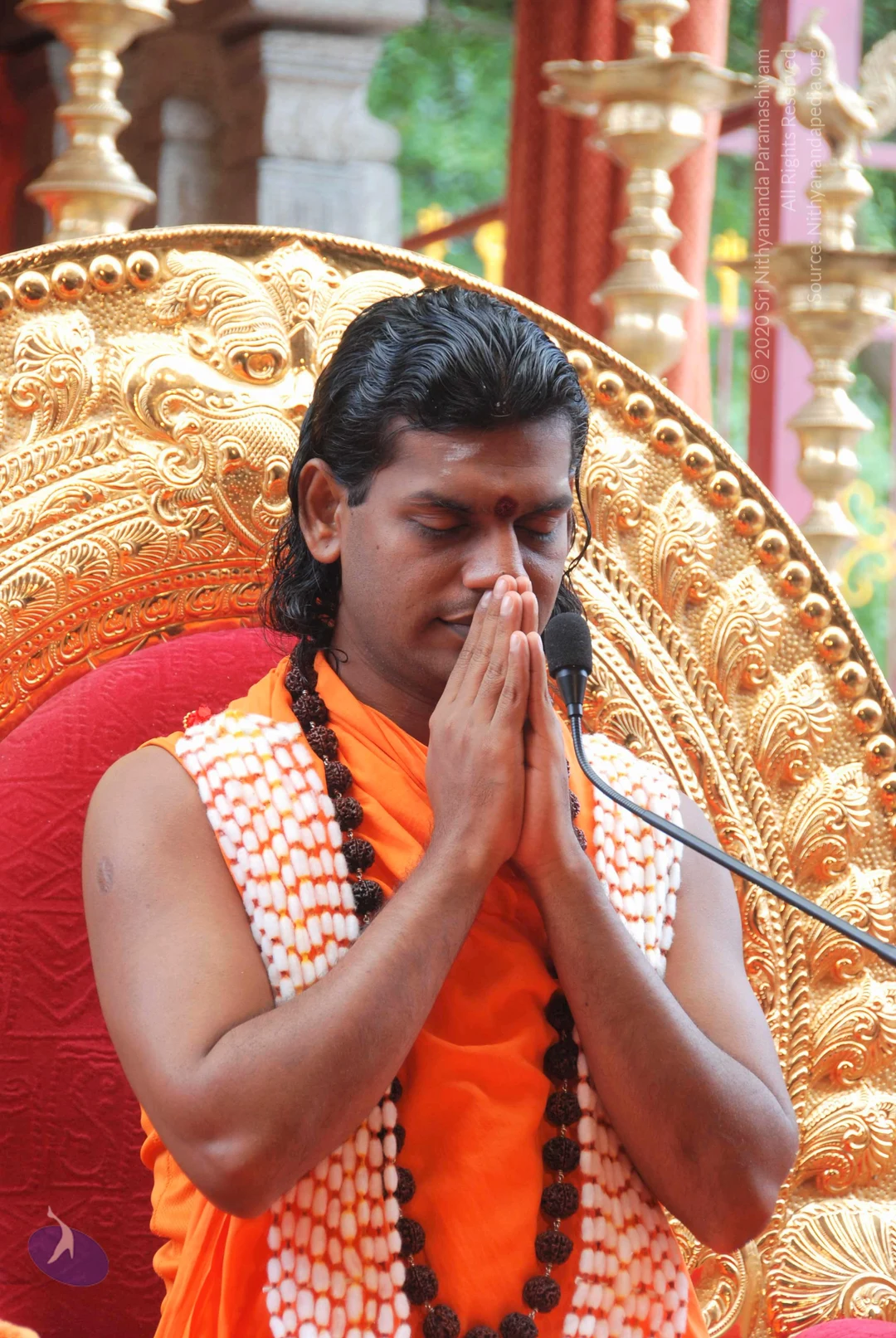
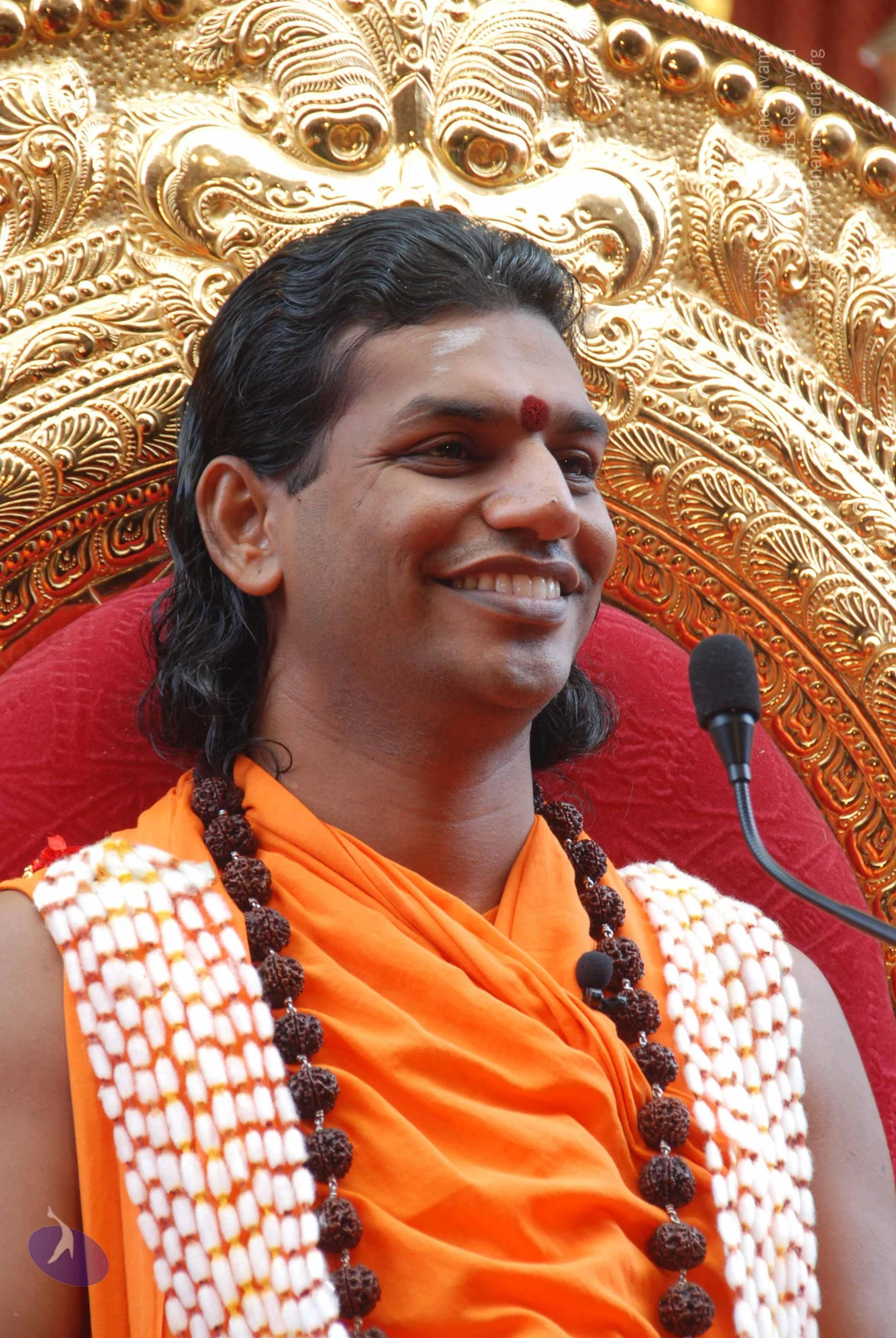
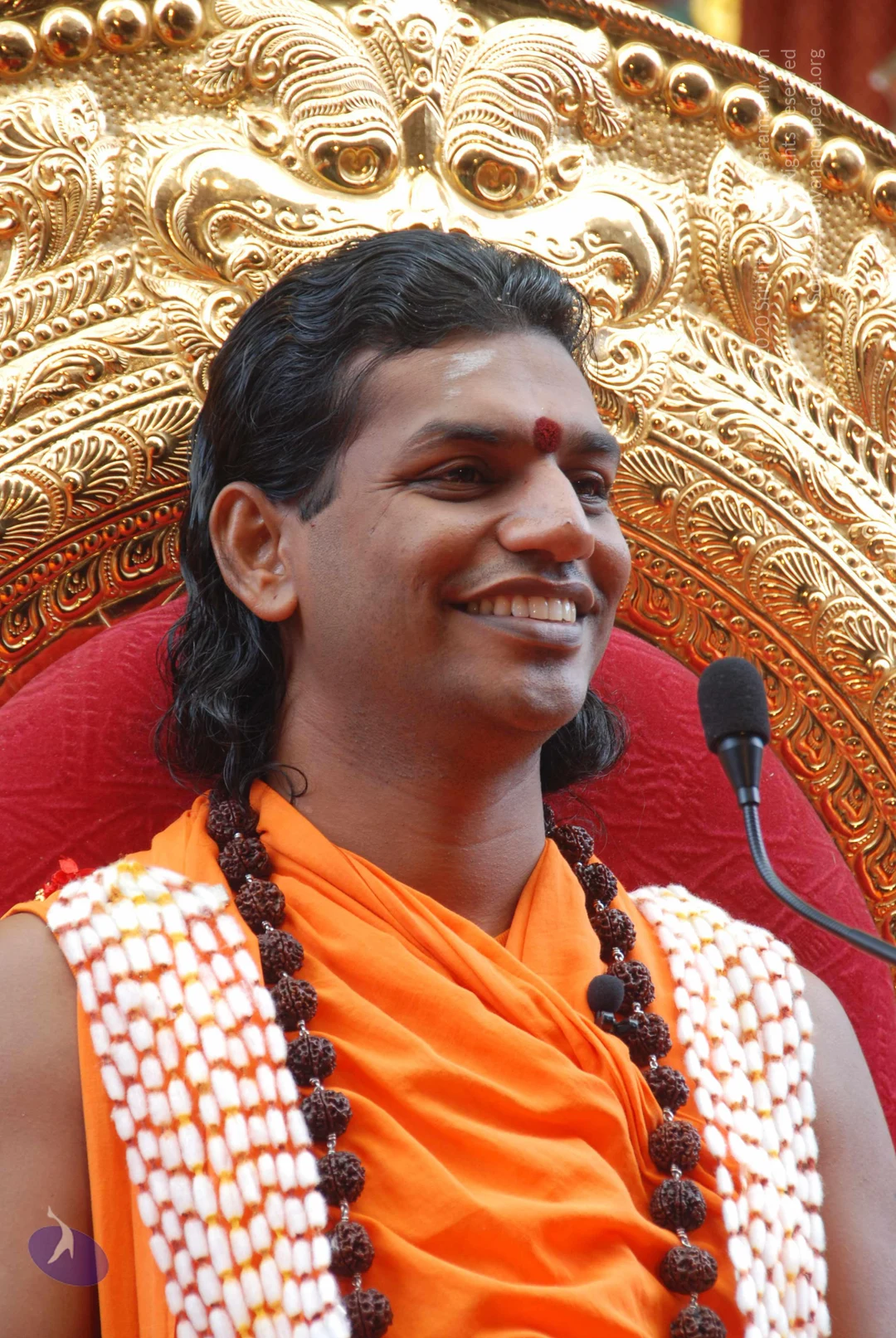
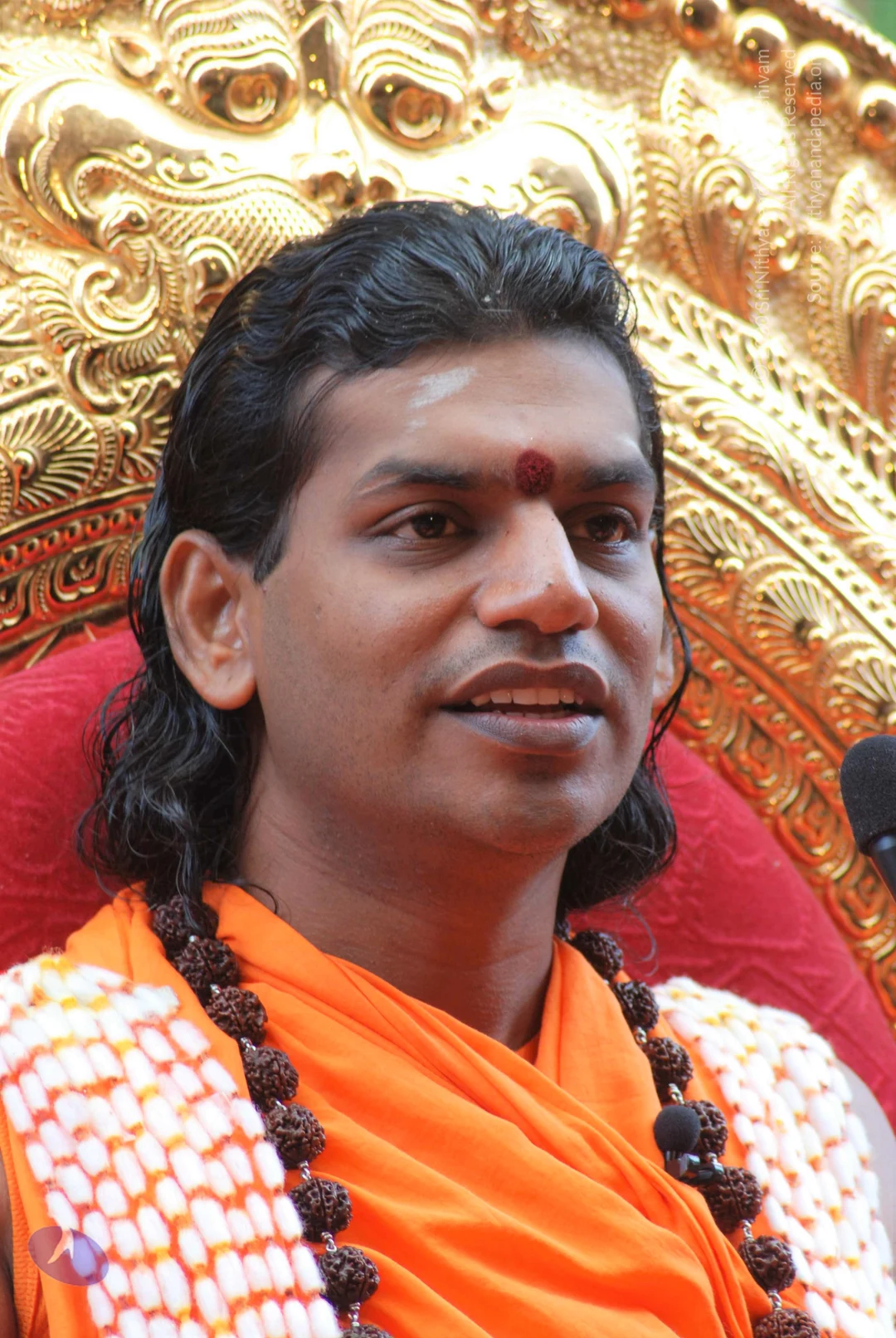
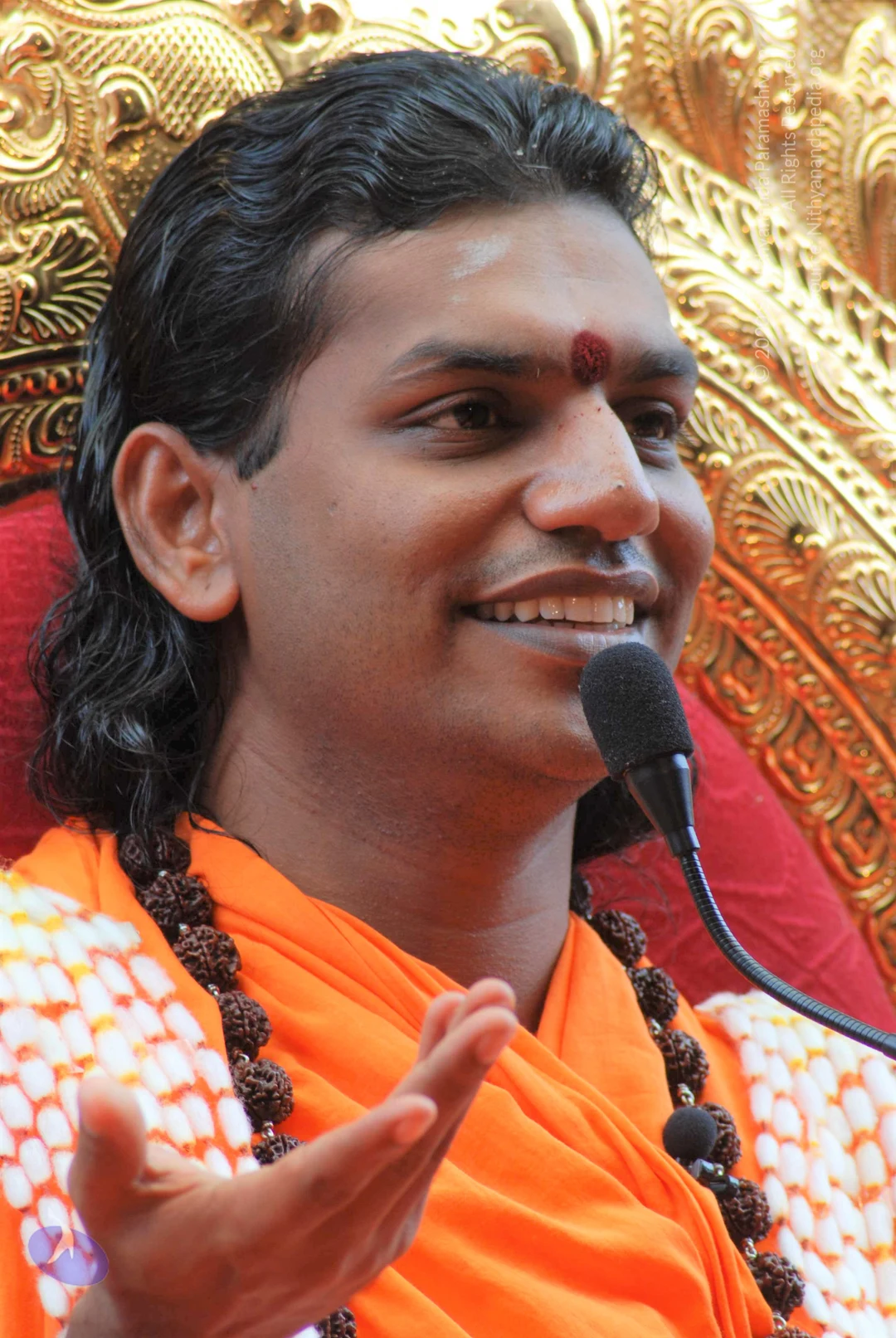
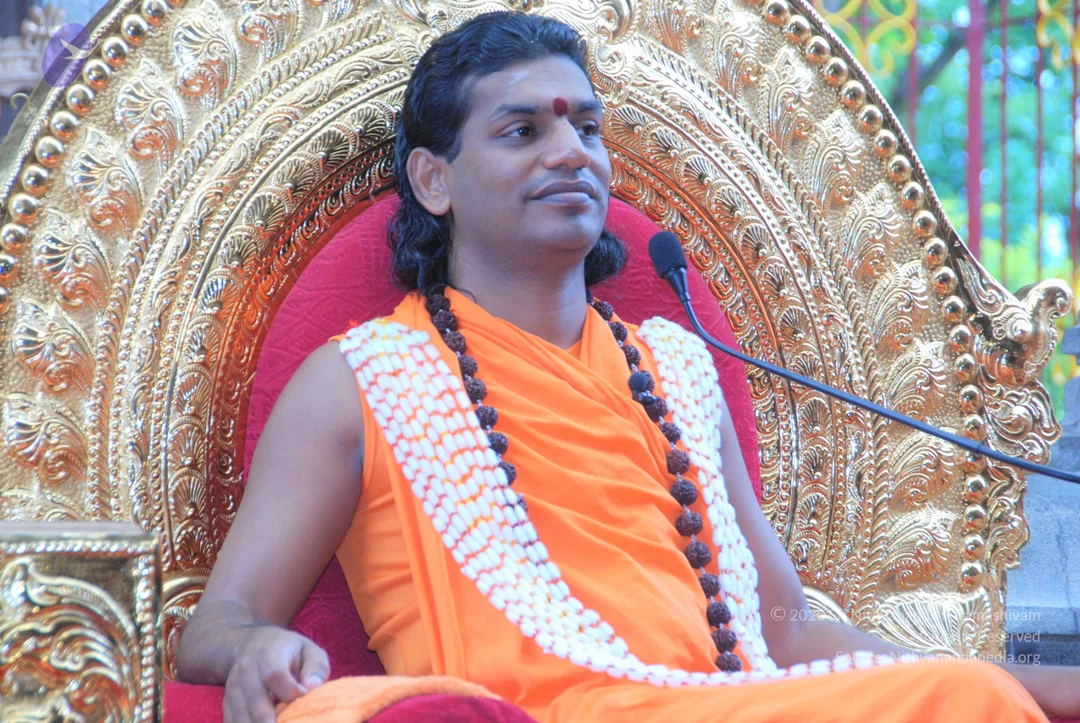
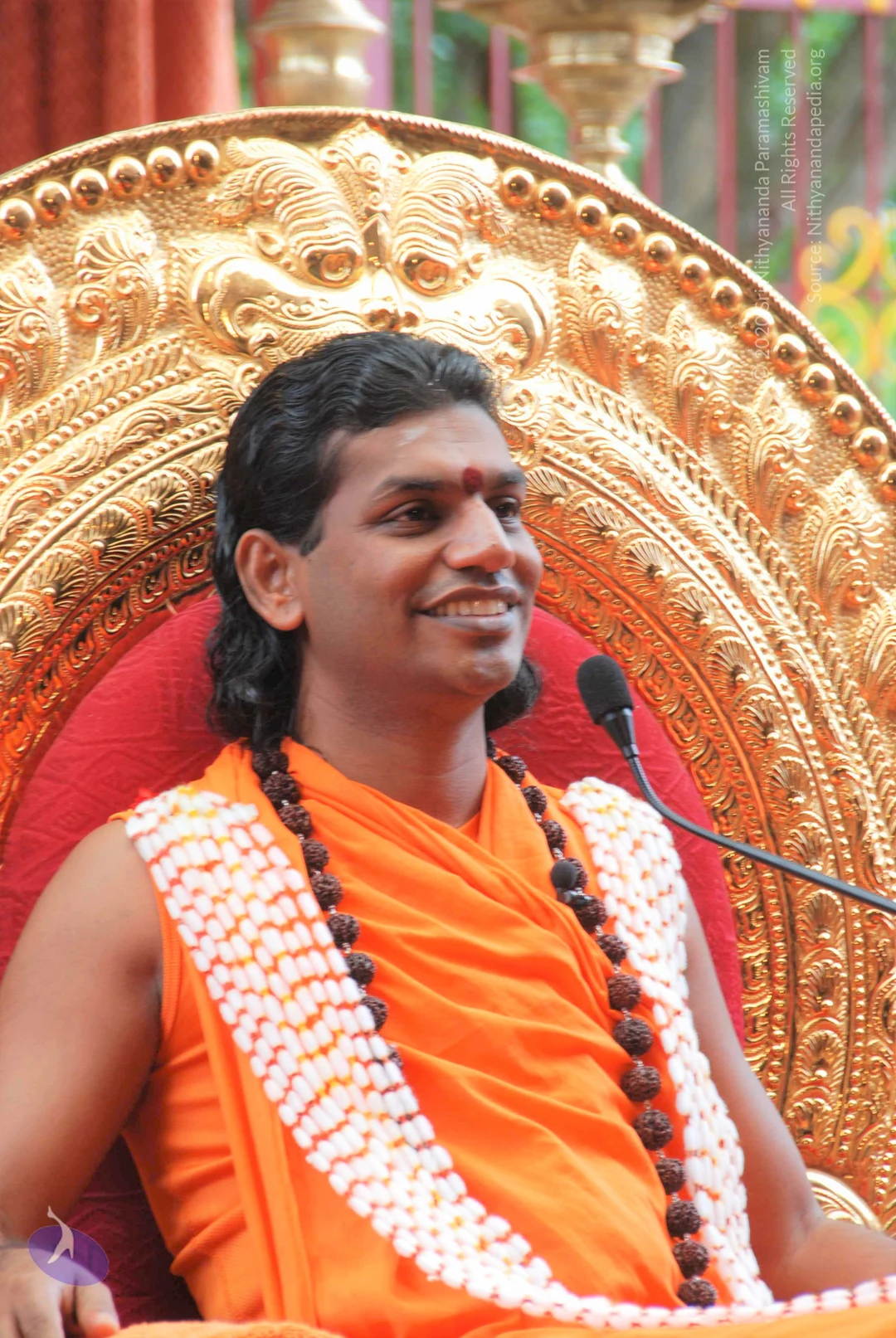
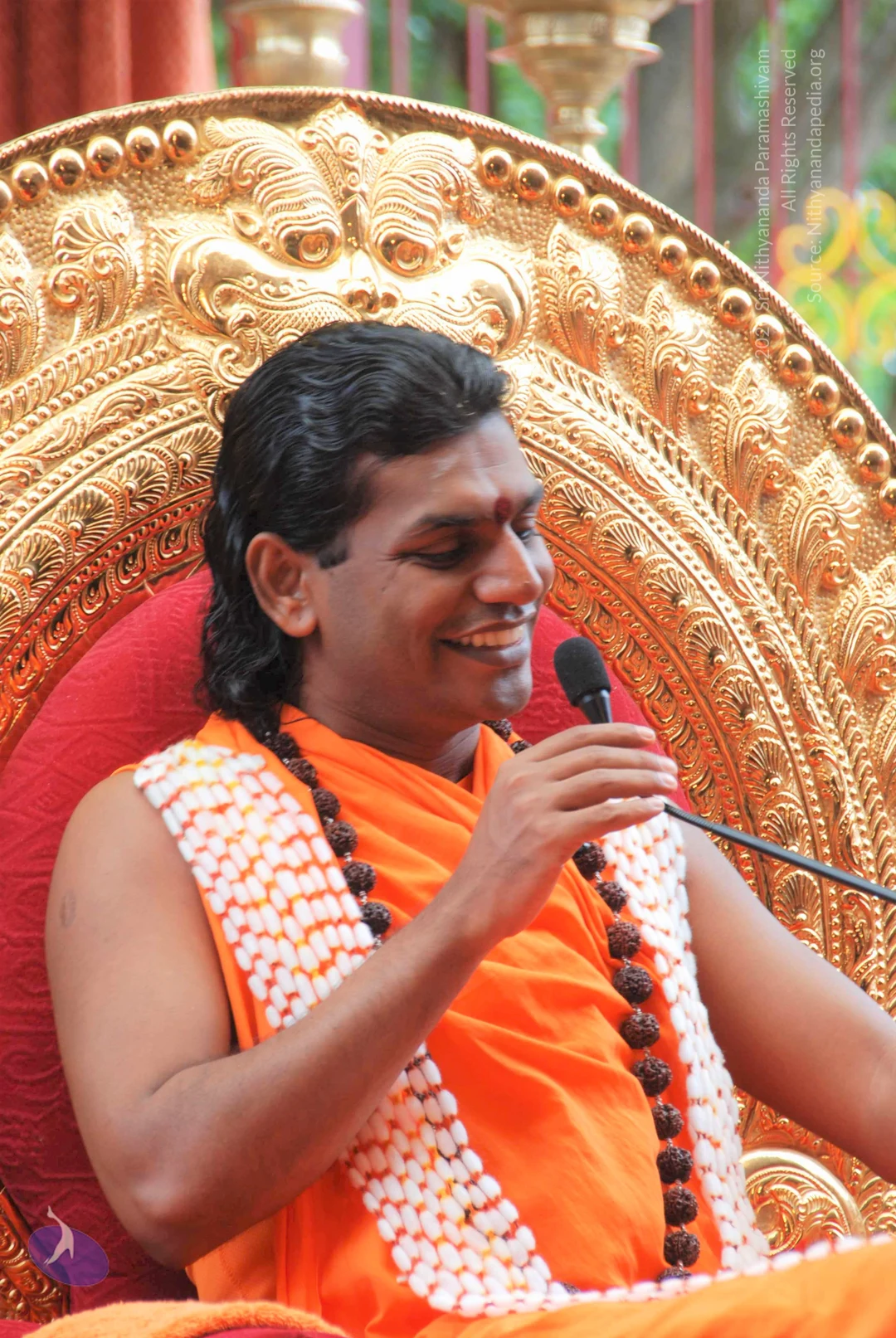
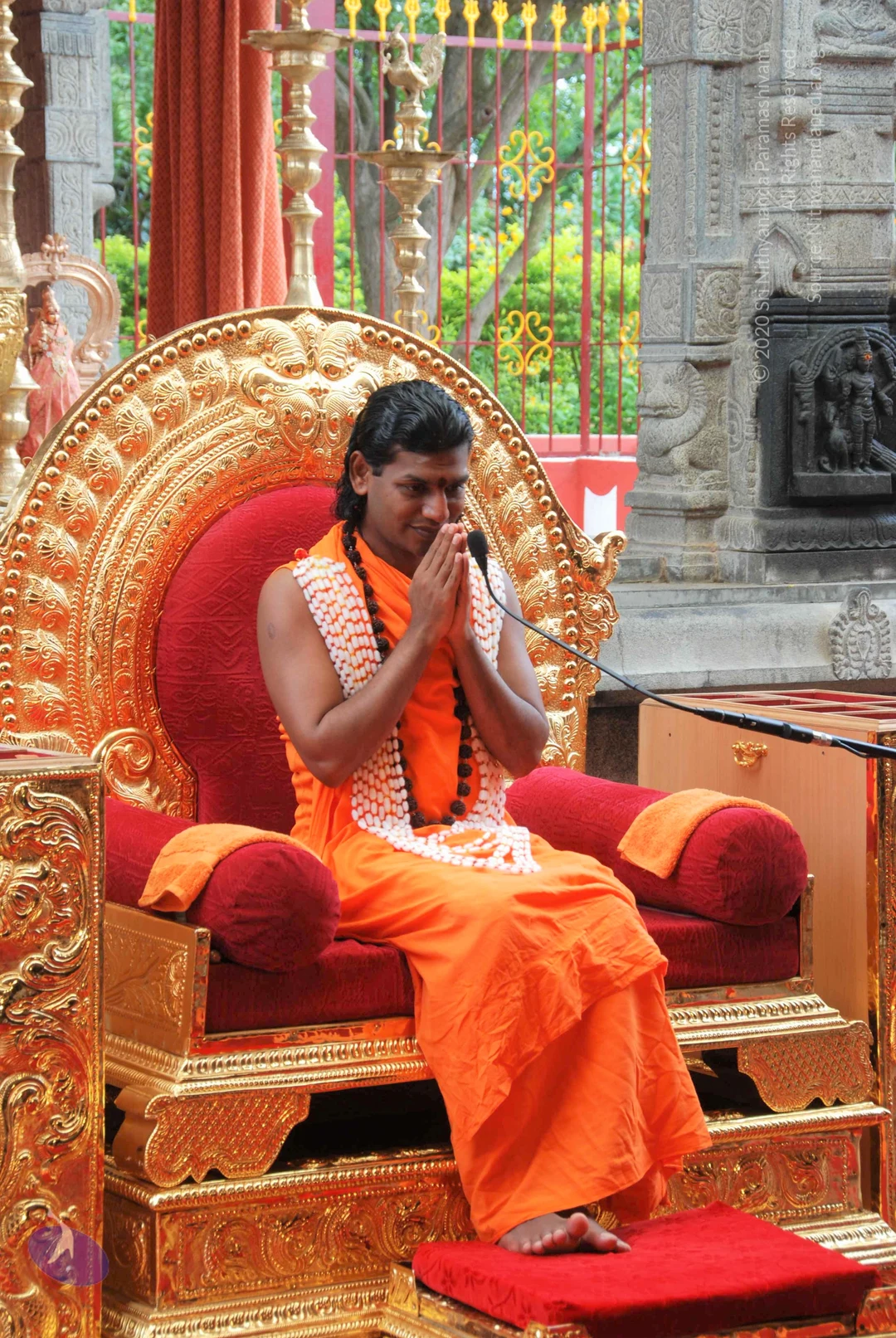
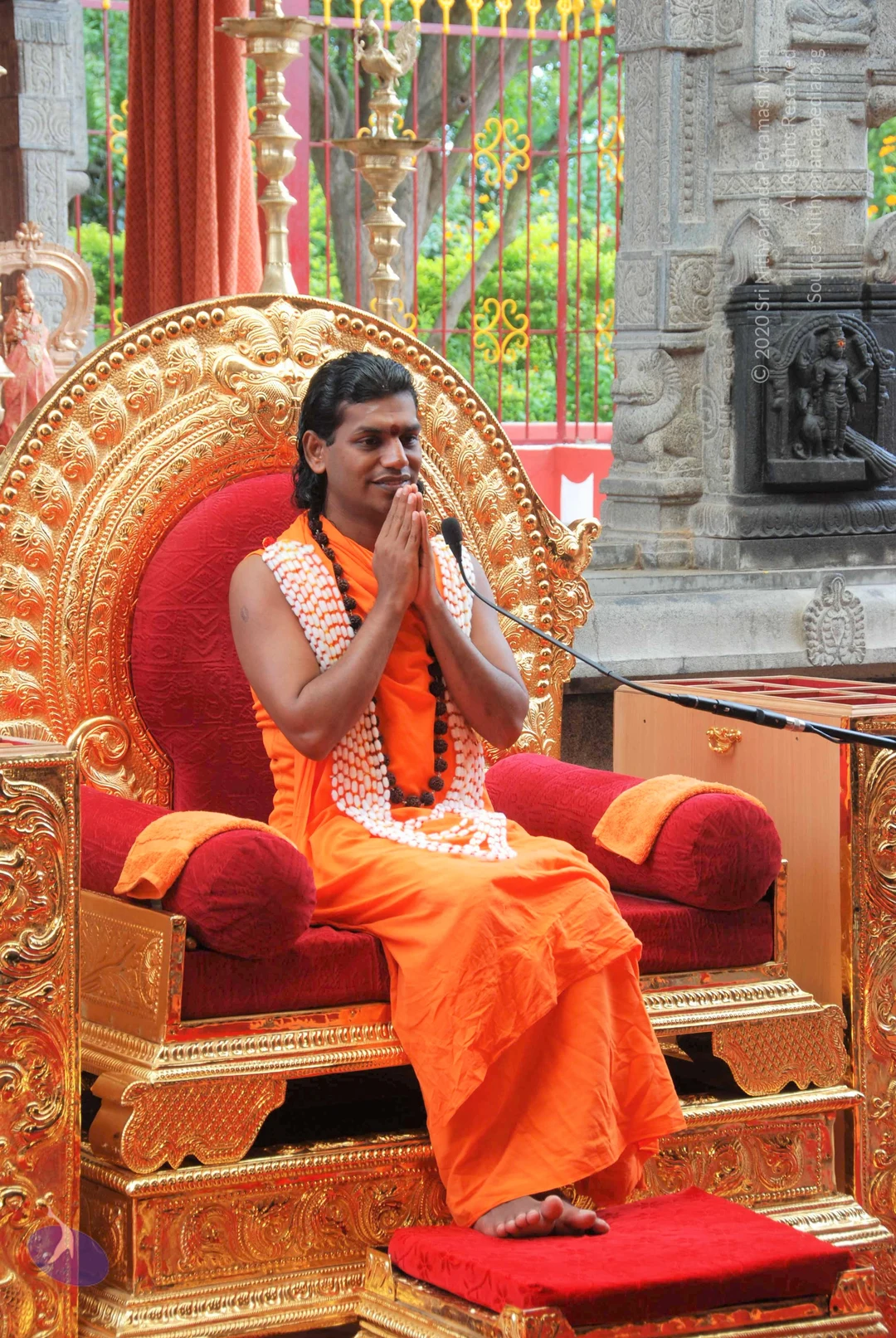
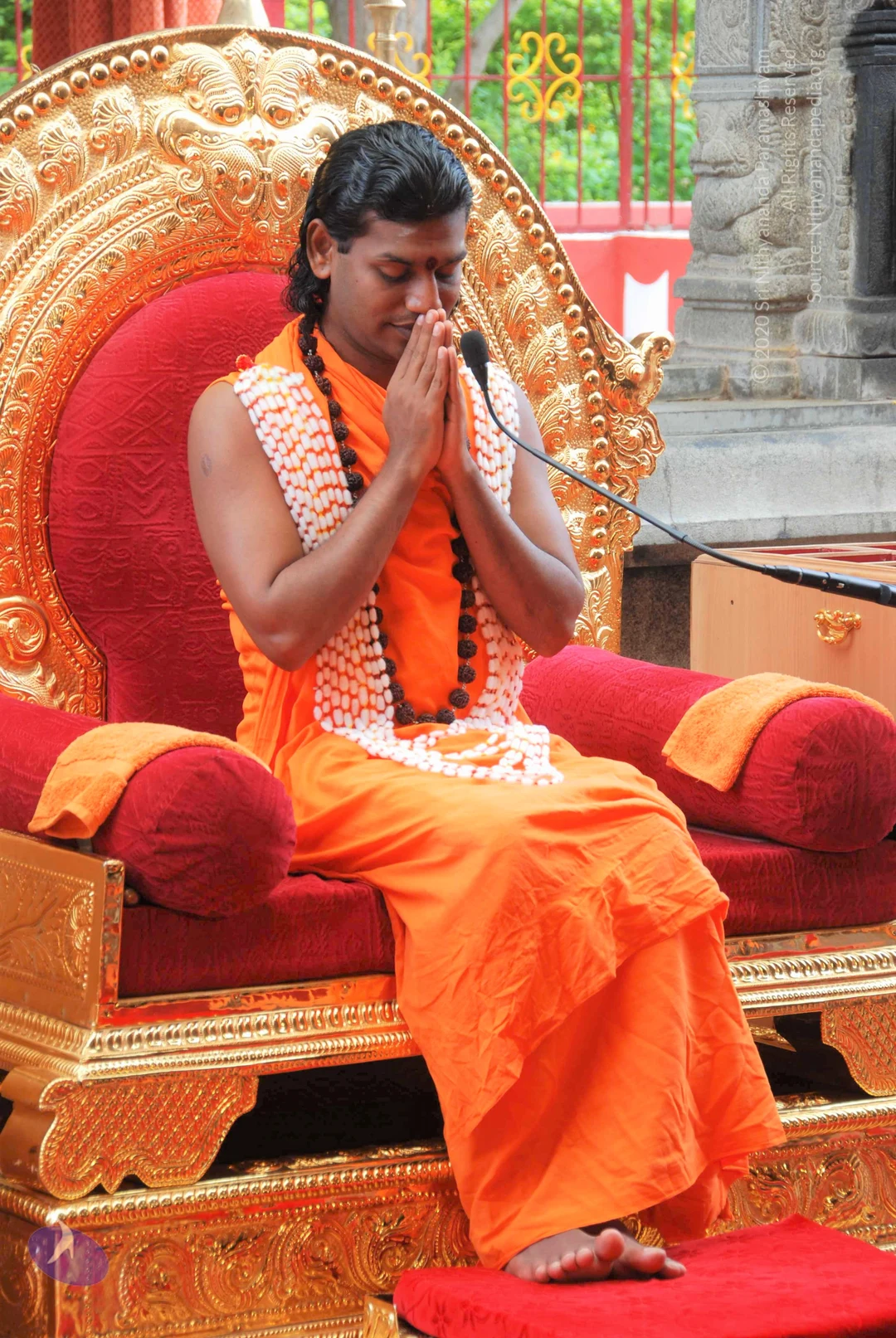
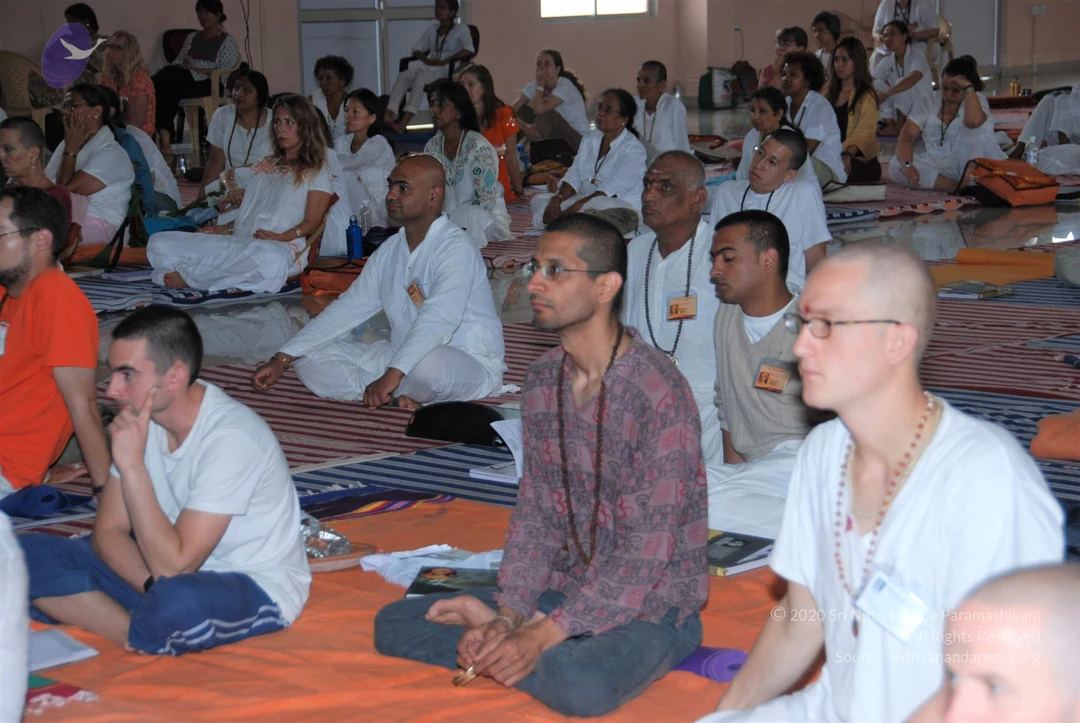
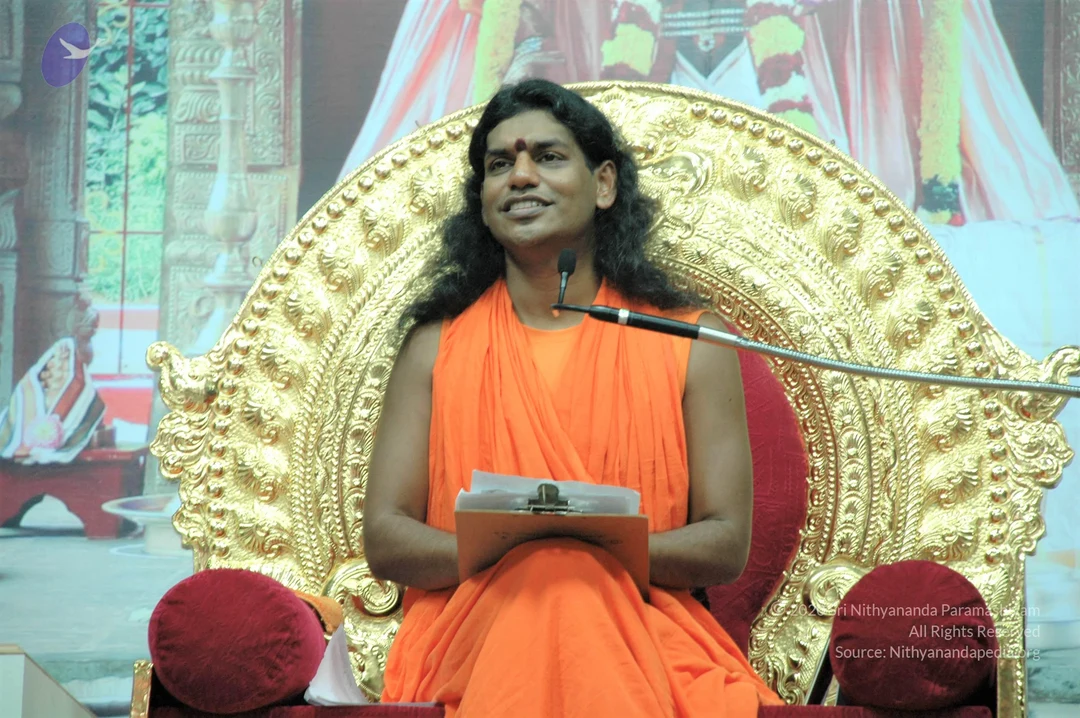
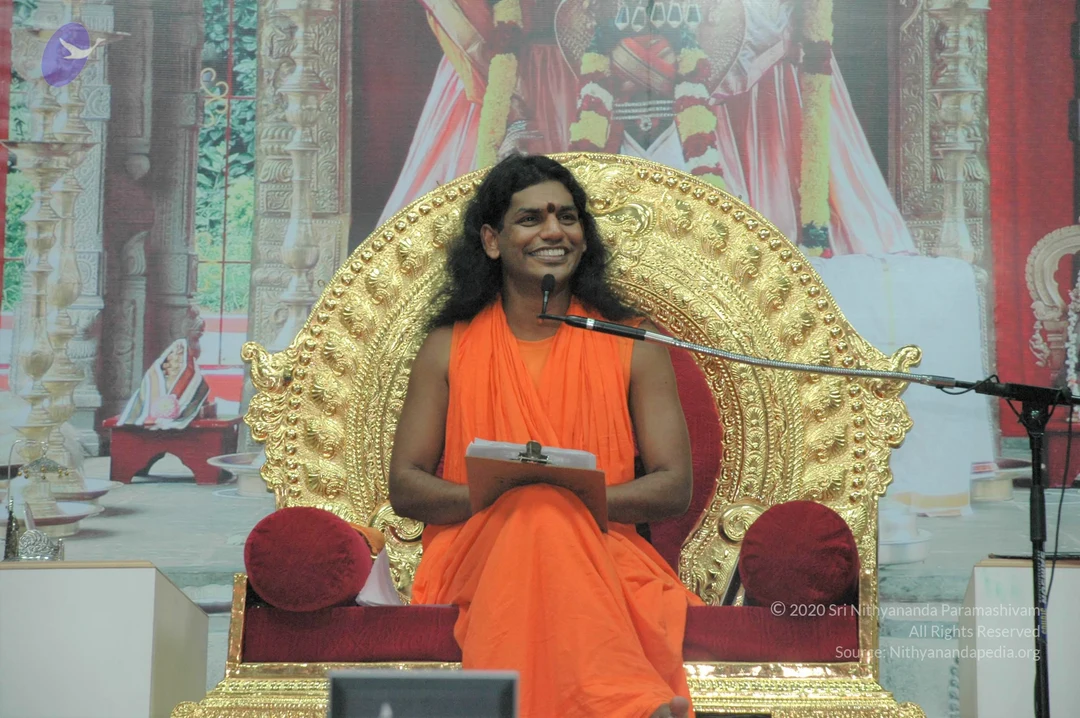
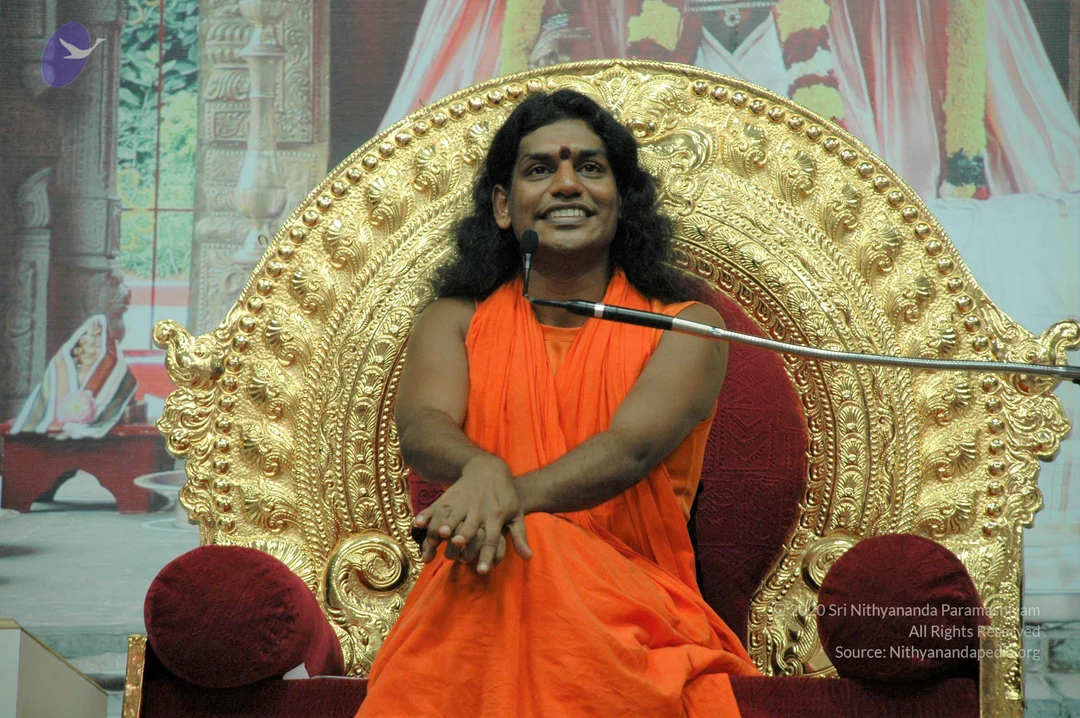
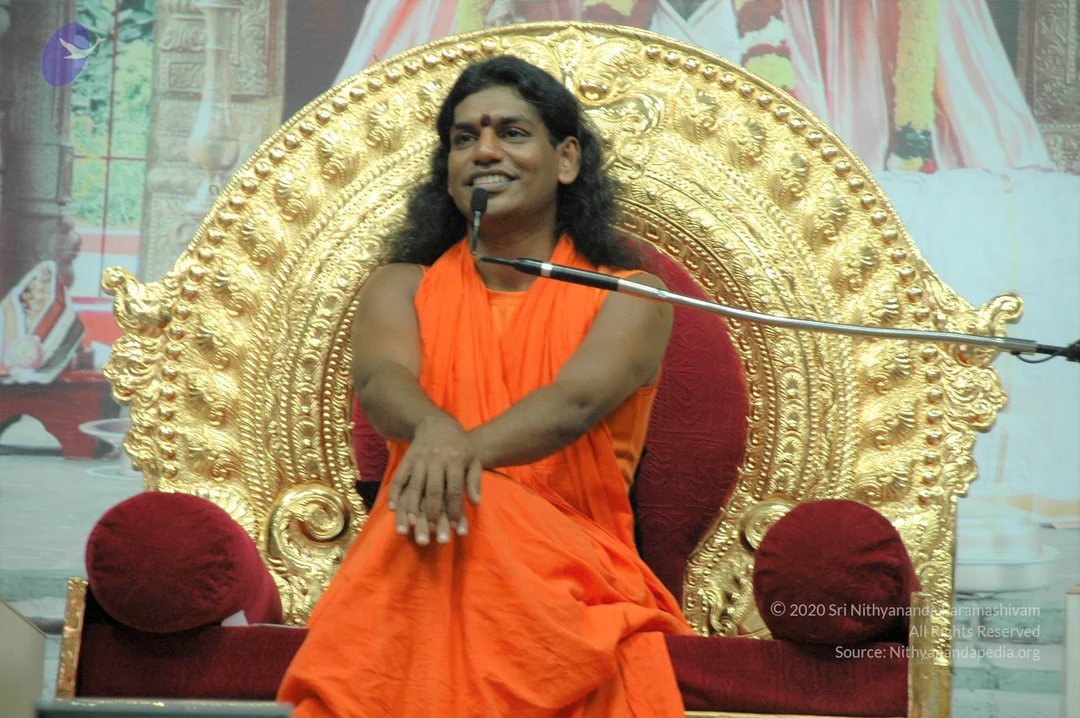
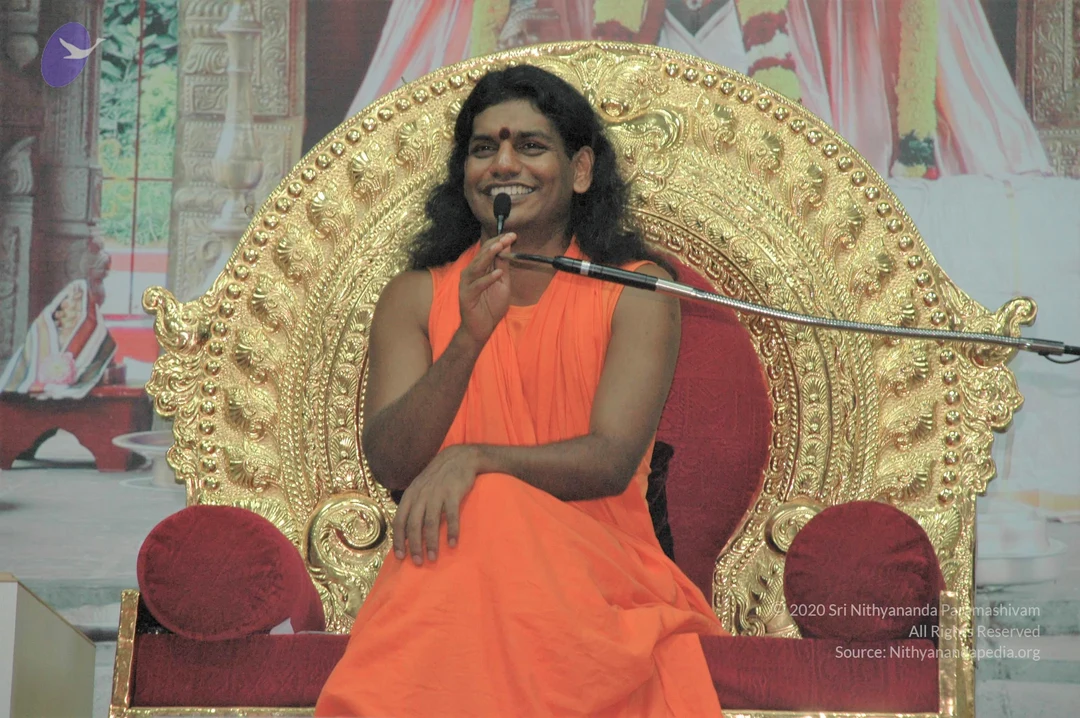
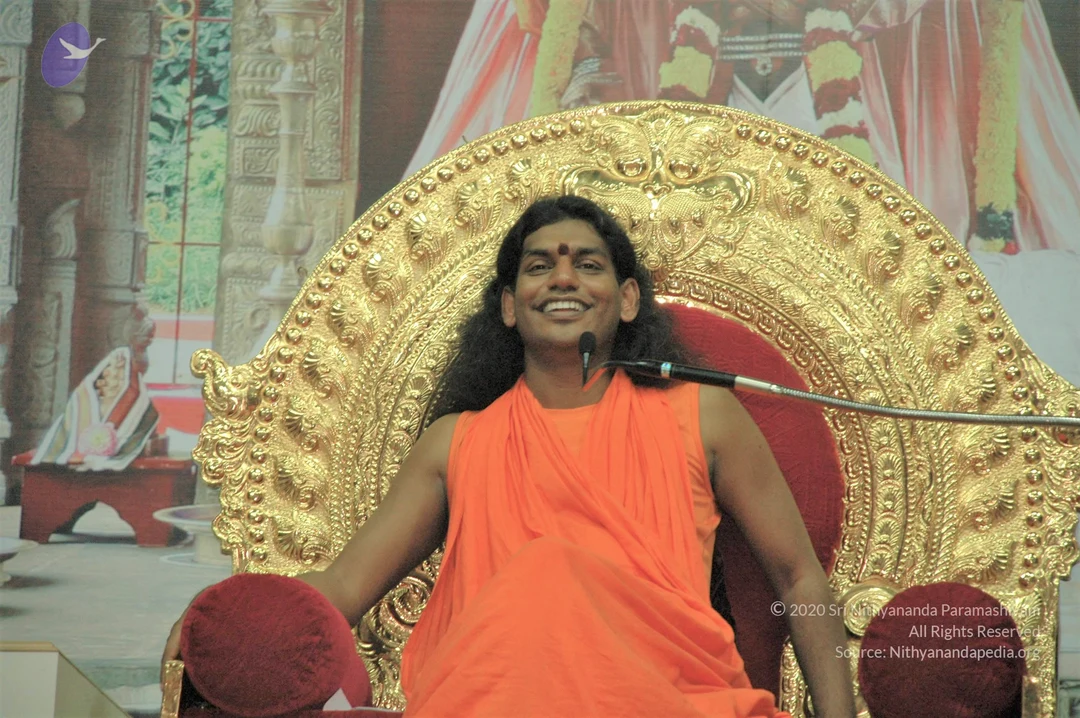
A man with shoulder-length dark hair sits with eyes closed on an ornate gold throne with a red cushion, hands folded before him. He wears an orange saffron robe, a white flower garland with red flower accents, and a long rudraksha mala of dark beads. A red bindi and white tilak mark his forehead. Behind him, a large backdrop shows a figure in pink and blue garments, with red and gold ritual decor at the sides. a person is seated in meditative stillness on the peetha. One person is visible.A seated man with eyes closed and hands clasped in his lap sits on an ornate gold throne with carved floral and scrollwork panels. He wears a saffron-orange sleeveless robe, a long rudraksha mala of dark beads, and a thick white garland with magenta flower bands. He has a white tilak and a red bindi on his forehead and long dark hair. Behind him, pink drapery and floral decorations frame the stage.A smiling man with long dark hair sits on an ornate gold throne with carved floral and scroll details. He wears a sleeveless saffron-orange robe, a long rudraksha mala with dark beads, and a white and pink garland of flowers. He has a white sacred mark on his forehead with a red bindi, and his hands are folded in his lap. Behind him are red and white drapes with flower garlands.A seated man in an orange saffron robe sits on an ornate gold throne with carved floral and scroll details. He wears a long white and magenta flower garland and a dark rudraksha mala that hangs to his waist, with a red bindi and white tilak on his forehead. His hands rest on his lap. A pink and red floral backdrop with garlands is behind the throne. Swamiji (probable): long swept-back hair, saffron clothing, rudraksha mala and a gold throne indicate the presiding teacher. Caption on the image reads Nithyananda ParamashivamA photograph of a seated man on an ornate gold throne with a red cushioned back. He wears an orange saffron robe, a rudraksha mala draped across his chest, and a white flower garland with magenta accents. His long dark hair is swept back, and he has white vibhuti stripes and a red kumkum dot on his forehead. His hands are folded in his lap and he smiles gently. Behind him are pink drapes and floral garlands. a person appears in person, seated on the throne during a satsang-style event.Close photo of a padapuja offering. An orange-robed figure's bare feet rest on a golden tray, with a pink lotus flower laid on it. Silver bowls holding red and pink flowers, sliced fruit and apples surround the tray. Pink and magenta flower garlands drape over the orange robe, and a blue garment appears at the top edge. Only the feet and forearm of the person are visible, so no face is shown. The scene suggests a padapuja ritual of washing or honouring a guru's feet with flowers and fruit offerings.

September 15 2010

Original wiki page
Contents

Title:

Healing Through Mantras

Description:

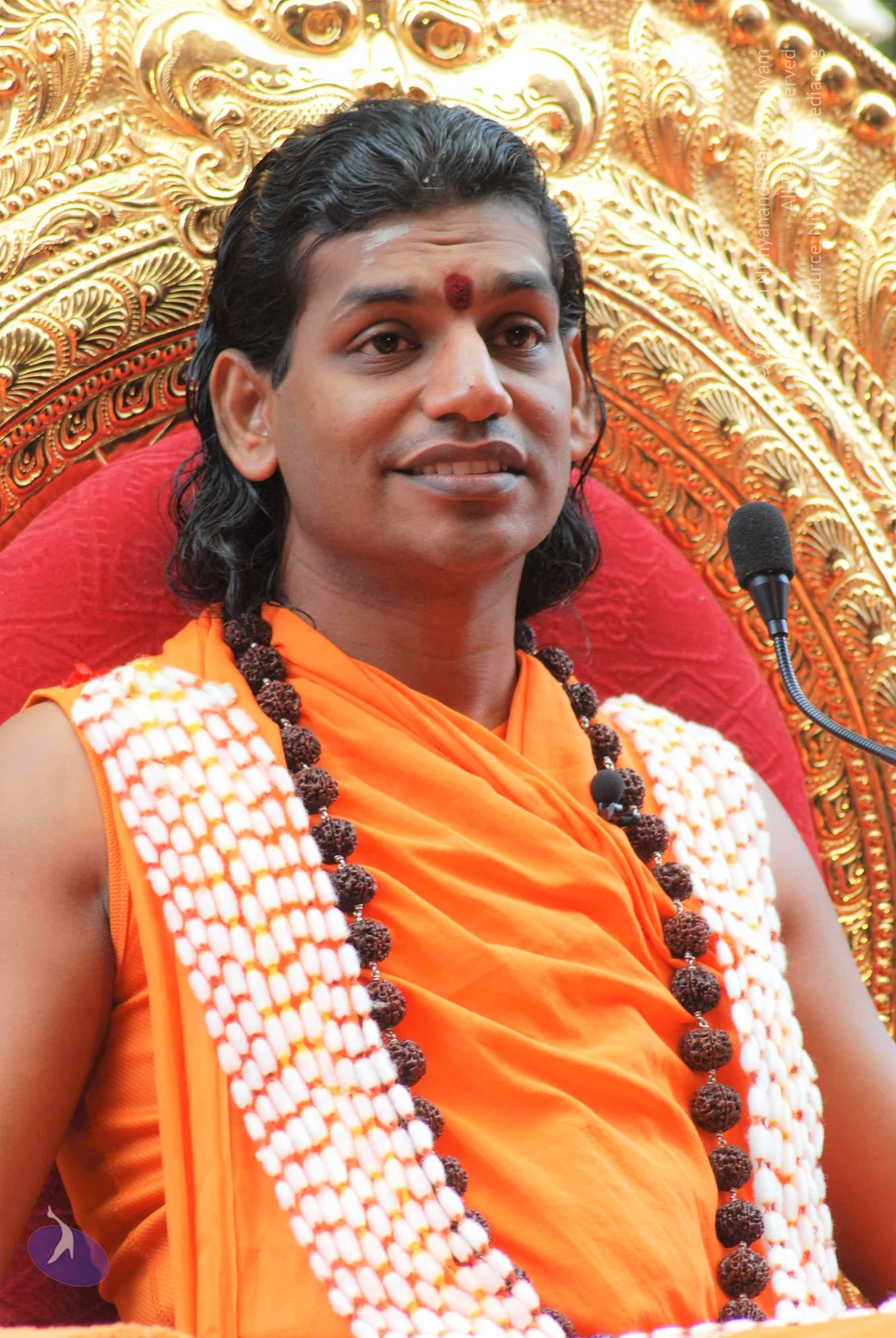
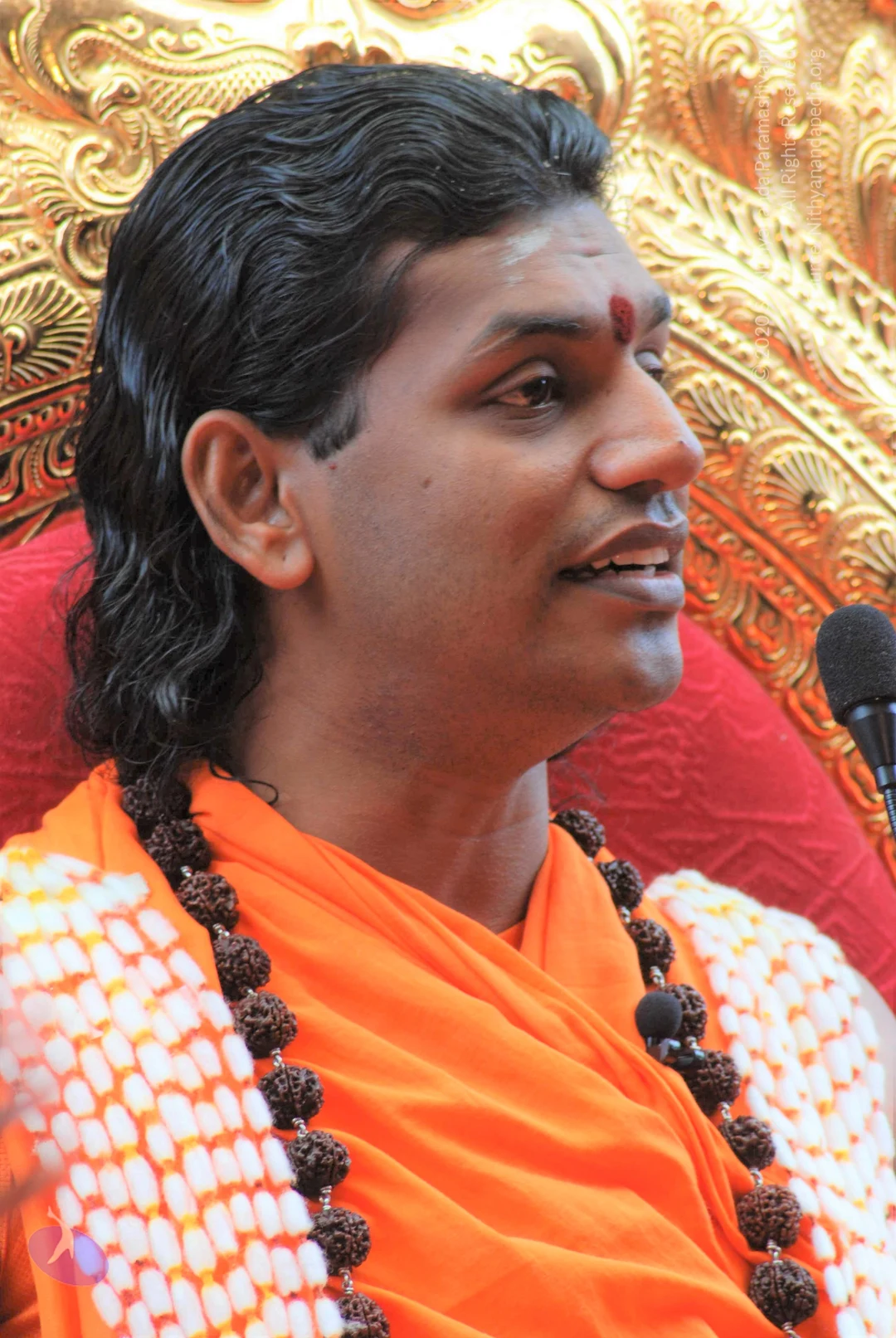
In this discourse, Paramahamsa Nithyananda describes in detail the healing process that happens through mantras (chants). The scientific explanation of what mantras are, how sound energy can be used effectively to heal are explained in this discourse. Paramahamsa Nithyananda also describes everything at the energy level and the difference between sound and light energy-based civilizations.

Video and Audio:

Healing Through Mantras: Nithyananda

VideoAudio

Transcript:

(00:20) Sadāshiva samārambām shankarācharya madhyamām Asmadācharya paryanthām vande guru paramparām. (00:56)

I welcome you all with My love and respects. Today’s subject is Healing through Mantras. Let’s get to the basics. Whatever exists, exists as sound. Again and again Upanishad says ‘Naada Brahman’. From the nada, the sound, the existence expresses itself. The other day I was telling, everything is made out of molecules. Molecules are made out of atoms. Atoms are made out of something called subatomic particles - quarks. It is the nada - sound, which acts as energy field which keeps the quarks together, which binds quarks together and retains the solid form, an object, matter. So nada is the ingredient which is responsible for mud to remain as pot. Whatever you see, the reason for it to remain in its shape, nada is responsible...

(03:13)

The sound, the vibration, when it comes from the pure Source, uncreated, it’s called anahata. In each one of us the ability to listen to anahata exists; uncreated sound. See if a sound is created by two things striking each other, if it happens because of two things hitting each other, it is called ahata. Anahata means the sound which is created by not two things striking each other, un-ahata. Two things, without two things hitting each other if the sound is created, it is called anahata dhvani. The pure source of sound, anahata dhvani, when that anahata gets mixed with these quarks, subatomic particles, it retains that quarks in different forms through its energy binding. So that is responsible for matter to exist, the solid to exist. So your body is made out of quarks and the nada. Nada is the energy food, energy field which keeps the quarks together so your body can exist as it exists now.

(05:02)

Very beautiful verse from a great saint from My native place, Arunagirinadar. He is a very great saint; few centuries before he lived. In his verses, he beautifully describes ‘nada bindu kalaateena maunam’. He describes Subrahmanya, the second son of Shiva. I can say the son is not the right word; the expression of Shiva as the lord of nada and bindu. Understand, the subatomic particle quarks, is the bindu, the life energy, and nada is the force which creates energy field.

(06:14)

He says, Arunagirinadar, he is a great master, he puts nada as first, bindu second, because bindu by its own existence is shava. Only when the nada is added to it, it becomes Shiva. That is what tantra shastra describes as Kaali lying on the ground; sorry Shiva lying on the ground and Kaali standing on it. She is nada, the binding force and the Shiva is bindu.

(06:55)

Unless the nada acts as a binding force, bindu has no action. Nothing is possible by the bindu. The sound is responsible for what you are. So sound is responsible for the sickness you carry, whether physically or mentally. If the energy field which binds the quarks is responsible for your disease and depression, if that energy field is altered, naturally the disease and depression will be cured, healed. Understand, by its very nature quarks has no disease. It is pure consciousness. Only nada is responsible for the disease or health, depression or expression. So it is nada is responsible. You can work only on nada. You cannot work on bindu. Bindu is beyond consumption, the pure consciousness. So, all healing systems works on nada. Of course, if it is real healing system. Any healing happens only when the work happens on nada. You can work only on nada. You cannot work on bindu. It’s a basic truth. So, all healings happens on the energy of nada.

(08:56)

So two ways you can work on nada. One, creating the right sound and repairing the wounded nada. That is what is done through mantra or taking your disturbed nada structure to a being where anahata is continuously happening. In that very silence, your wounded nada structure gets healed, realigned, reorganized, restructured. One important thing, if it happens through the right sound, only the physical healing and mental healing happens. Whatever vibrations, sounds were created, the effect of that happens in the system. If there is a wound, if there is a sound, that sounds heals the wound. The right sound does its job.

(10.05)

But if the wounded nada structure is brought near the anahata dhwani, the uncreated sound which constantly Master is radiating, which Sankara calls as very beautifully (Dakshinamurthy Stotram)

चित्रं वटतरोर्मूले वृद्धाः शिष्या गुरुर्युवा । गुरोस्तु मौनं व्याख्यानं शिष्यास्तुच्छिन्नसंशयाः ॥३॥ chitram vatta taror muule vrddhaah shishyaa gurur yuvaha gurosthu maunam vyaakhyaanam shishyaasthu chinna samshayaha

The word ‘maunam vyakhyanam’ means all his expressions and discourses are in and from anahata dhvani, the uncreated sound; in and expression of uncreated sound, the anahata dhwani. That is what Shankara calls maunam vyakhyanam.

(11:15)

When your, when your wounded nada structure goes near the anahata structure, not only your whole body and mind goes through complete restructuring and transformation, even your brain, your cognition goes through rewiring, and your consciousness gets awakened. That is why the Master’s presence, the intense soundless sound, the vibrant silence, the vibration of anahata dhwani, is considered as sarva roga nivarini. The healing method for all possible diseases. All possible diseases are healed just by the vibrant silence of a Living Master, the anahata dhvani... Intense sound or intense silence comes from anahata. The uncreated sound heals the body, heals the mind, rewires the brain, transforms consciousness.

(13:07)

All the sounds created from anahata dhvani is called mantra, and anahata dhvani as it is, called nada brahma. The word mantra means: there is a beautiful two explanations for mantra I have -

Manaha traayate iti mantraha Mananaat traayate iti mantraha

Two meaning, two explanations: Manaha traayate iti mantraha, Mananaat traayate iti mantraha. Mananaat traayate iti mantraha means “Mantra is that which protects those who reflect on it.” Second explanation: Manaha traayate iti mantraha means “That which helps to cross the mind is mantra.”

(14:28)

See one explanation, when you meditate on it, it helps you, is mantra. That is what I call the sounds created out of anahata dhvani. The second meaning: which helps you to cross the mind itself. That is what I call anahata dhvani itself. Not the sounds out of anahata dhvani, the very anahata dhvani. Mantra has two meaning: the sounds out of anahata dhvani and the very anahata dhvani. Nada, nada brahma… Everything, everything is possible by nada, by mantra.

(15:25)

Understand, in the world there were two traditions, the whole world is light and sound. Two traditions; The traditions which did whatever they want to do by manipulating the light particles. That is what is the electronic tradition. The tradition which did whatever they want through the sound particle - Nada Brahma; that is what is Vedic tradition. In the east they worked on sound and did whatever they want, and handled all the energies, intelligence, practically the whole cosmos. In the west new science has started evolving handling the light particles. All the whole base of the science is handling the light particles, using the light particles to do whatever you want and win over the nature.

(16:31)

One important thing, the science uses the electric particles, the light particles, and flies, floats, drives, does whatever it want, through the light particle and Vedic tradition was doing all these through the sound particle: flying, driving, floating, what not, even weapons! Everything was done in the Vedic tradition by the sound particle. Unfortunately, the mass destruction happened in Mahabharata war and other two three big calamities. The Sindhu, Saraswati River drying, the Saraswati River drying, these few calamities was responsible. Because of these few calamities, the science of handling sound and playing with extraordinary things got lost, did not get transmitted.

(17:54)

Please understand, when I read the Vedas I can very clearly understand how the pushpaka vimana - the Vedic flights were functioning. They will sit in the seat and just create particular vibrations and flight will take off. If they need to turn this side - particular vibration, turn this side - particular vibration, because the whole thing was handled just by the sound and vibration. Same way the weapons, used with sounds and vibrations. Unfortunately, many of these things are lost but I think it is time we revive the science based on sound.

(19:08)

One important thing you need to know, science based on light always is extrovert, gross. Science based on sound is always introvert, subtle. The subtle science is revived, we will not be hurting the planet earth so much. The resources will not be exploited, understand? The light based tradition and the sound based tradition, the sound science and the light science. Because the light science is by its nature gross, using all the resources which can be depleted, expired, exhausted. But the sound is by its nature subtle. It is inexhaustible resource. I tell you, any time and energy put in reviving the sound-based researches and discoveries and traditions will give a big breakthrough to the humanity because we are tapping into the inexhaustible resource.

(20:25)

We don’t even need sun to survive if we tap into the science of sound. As long as you are based on the science of light, you need sun to exist. If you tap into the source of sound, you don’t even need sun. The extinction of sun will not be a threat to planet earth and the human civilization. Vedic Masters are able to summon sun and moon and any energies just by sound. Just by sound they are able to summon anybody and achieve whatever they want. It is time we experience the soundless sound, anahata dhvani, and science of sound. Not only healing the body and mind, doing whatever we want through sound should be rediscovered, made to be available and should be transmitted. It should become the science available to humanity again.

(21:49)

One of the important activity, which we already took up, which we are going to strengthen now is the science of sound - the science of using the mantras for proper purposes and using the soundless sound, sound beyond sound, for transformation itself. Blessed are those who get the space where the soundless sound goes on vibrating; the maunam vyakhyanam goes on happening.

(22:50)

Very beautifully Shankara sings:

चित्रं वटतरोर्मूले वृद्धाः शिष्या गुरुर्युवा । गुरोस्तु मौनं व्याख्यानं शिष्यास्तुच्छिन्नसंशयाः ॥३॥ chitram vatta taror muule vrddhaah shishyaa gurur yuvaha gurosthu maunam vyaakhyaanam shishyaasthu chinna samshayaha

What a surprise, under this big banyan tree a youth, yuvaha, youngster is sitting as a Guru. Vrddhaah, all the old people are sitting as disciples and maunam vyakhyanam. His vibrant silence, the soundless sound, his expressions in silence, so powerful, shishyaastu chinna samshayah. All the doubts and negativities in the disciples just disappears. Chinna samshayaaha, destroyed... The soundless sound... Let us all sit in the soundless sound. You all heard enough sounds coming out of the soundless sound. Let you all hear the very soundless sound itself.

(25:39)

Title:

You are Beyond Suffering (PYS68): Nithyananda on Patanjali Yoga Sutras

Description:

In this discourse from Patanjali Yoga Sutras, Paramahamsa Nithyananda talks on "You are Beyond Suffering".

Video and Audio:

You are Beyond Suffering (PYS68): Nithyananda on Patanjali Yoga Sutras

VideoAudio

Transcript

Wednesday, September 15, 2010 Prayer. Welcome. Now let us listen to the discourses ☺(says this in the context of audience cheering his new attire!) Today’s subject you are beyond suffering. Understand when I say you are nothing but suffering, when I say you are beyond suffering, both are true. If you identify yourself as you are suffering that is you. If you identify yourself as I understand you, you are beyond suffering. But between these two is the problem. Today I was explaining an important process. Consciousness is lighter than anything in nature. It is lighter than the ether. So it always levitates, pulls you up. Matter, earth, pulls you down. Gravitation and levitation both are constantly happening in your body, the nervous system. The friction between your gravitation and levitation is thoughts. That friction is what is thoughts. If the friction is felt in mooladhara, little more thoughts gross thoughts, if felt in swadishtana, little less thoughts, if in manipuraka, little lesser thoughts, if anahata, you are more pure little more less thoughts. Where … Basically you are beyond suffering. Your nervous system may be anywhere in this friction but you are beyond suffering. You just need simple common sense which is most uncommon thing. Simple common sense to identify yourself with the truth. I am not even asking you should become enlightened only then you can understand. No. how much you know that much you understand. The levitation does not immd happen in sahasrara. No. it happens step by step. But unfortunately we have too much greed as I said other day. You don’t have too much suffering when you think of billionaire. But you have too much suffering if you see people happier than you. You think happiness is your birth right. There are so many people whose brain does not function. They all live on planet earth. They become lawyers ☺ all you need is just simple common sense. I can tell you, the Upanishad declares ‘prgnanam brahma’ intelligence is god. I can declare simple common sense is God. It can alter even the way your body behaves. I have never seen a cancer patient who has common sense. Pl und, I am not hurting, I really tell you. Whenever pople with cancer and depression come to me, somehow I see their energy their common sense is missing. Come on, be with life. If someone or something is not working out, just give them a farewell. That’s all and change your life! Pragnanam Brahma – Common sense is God. When I say common sense what I mean is simply be light, be liquid to change. This is the way it is, ok, what is there. When I was kept away from ashram because of threats by anti social elements, in a small road side Dhaba Bhakta got me food. I saw him crying. He said, I know how people take care of you, I am taking food from such a dhaba much better food is being put in front of your photos . I said fool just adapt to it. This is life! He was crying for atleast 5 days out of his love or devotion. But be liquid that’s all. I cannot say, oh my phots receive better food, what is this. I can also sit and cry with life. That will not sort the issue. Just be liquid. That’s all. Just have simple common sense. You will just flow with it. The most funny thing is in one hotel, that guy is not ready to give plate to the car. So I had to go there and sit and eat. There was a small internet café there. One guy is sitting and watching me in the news! I was in Kaavi only. Bhakta was in civilian dress. When I looked at that and told Bhakta, he said come on eat quickly we have to go. I said what is there, I am not a criminal so I want to run and hide. I am just away because these guys want me to go because people are threatening. I said what is there, I will chat with him and ask him what do you feel about the news. Just be liquid. I tell you in 33 years any other person was worshipped and loved so much by so many people. And no other person was hated and abused so much by so many people. I saw both ends. I have seen 1000s standing in queue and where I was hiding away from people. I tell you common sense is God. A simple liquid free flowing type. This is the way it is, let us be intelligent and adapt. The moment you understand common sense is God, you are beyond suffering. You should just sit and chant it as a mantra. Nothing else. Just think life is like that. Why do you bring big big ideas. I have few lines for you about law of common sense or common sense laws. The law of precaution – never accept a drink from urologist The law of reality – never get into fights with ugly ppl they have nothing to lose Motivation – creativity is great but plagiarism is faster Distribution – he who has most gets more Drunkenness – you cant fall off the floow Volunteering – ppl are always available till you need them Misfortune – for every spir teacher there is an equal and opp set of dics

Unfair exchange – u get the guru and guru gets you. Art of living sorry Artful living – if you cant make it, try to fake it, if you cant even fake it, try to take it from others. If you don’t manage to take it, then try to shake it. If you fail even to shake it, try to break it. If nothing works, hire somebody to shoot your dog so that you can be in the news. If you got it, enjoy it. Those who did not get it, ask those who are laughing! Coming back to laws, Seekers law -Law of artful living – I mean it! (repeat) now sky is laughing swith us Come on lets come back to the laws Seekers law – the more you are ready to lose the more you stand to gain Law of Enlightened ones – even if you imprison him, he will liberate you! You are beyond suffering. Come on lets get into the sutra The y’day’s sutra, I will just repeat (I am really becoming more & more Osho and less & less Ramakrishna and ramana.) Heyam dukham anahatam (y’day’s sutra) the moment you know the future suffering, suffering just ends. 2nd chapter, 17th sutra Drishta drishyayoho samyogaha heya hetuvu Vivek: the cause of the misery which is to be avoided is the junction of seer and seen Prabhava: This pain is caused by identification of experience with object of expre it may be avoided Satchit: The cause of the pain is union of seer and the seen. Purohit: the link between the seer and the seen creates misery is to be broken. Let me express what I feel with this sutra. The cause of suffering is because of the levitation and gravitation both ahppaening in your system. Means Chit and jata. The consc and matter both pulling you this side and that side in your nervious system. There are 2 ways the TPS can come down either if levit comes down, gravit becomes more – that is what is depression – dead rock. But there is another way, gravti coming down, more levit. Less TPS that is what is satva, engligh More grav less levit – tamas Levit , gravit fighting =- rajas Less gravit, more levit – satva. Suffering happens becosw chit and jata fighting each other. Seer and seen overlapping each other. The identification, mis identification of seer as seen and seen as seer is resp for all sufferings. That is why dcommon sense is god. What is seen and what is seer – be very clear. Always decide for life. Don’t decide for suffering. For eg. The food was brought to me by bhakta, I can choose suffering and say oh how I was taken care, one cooks, one brings, one gives water, see here what happened to me – then I am choosing suffering, no. just vote for life always. If I start a party I will tell this onlyl vote for life. Don’t worry I will not – I am telling this to all ppl who are afraid. Anyhow, vote, choose, pick up life. Either you pick up life or lie. Even if you pick up suffering, you will not pick up something which is there. When you pick suffering you are picking lies. That is why most lawyers are always creating pain. There are exemptions of course who are reducing pain. When you pick up pain, you really pick up a lie. That is what it means. That is why I am saying don’t pick up pain. One more thing, when you pick up pain you go on giving it to others. When you say u have head ache it means you are going to give to others. Dictionary for you guys – what is the meaning for diff words. What men say and what they really mean. What your mind says and what it really means I cant find it – it did not fall into my outstretched hands so I am completely clueless That is womans work – dirty diff and thankless Will you marry me – both my room mates have moved out, wm Can I help with dinner – why it is not on table alrdy I am getting more exercise lately – batteries in the remote are dead We are going to be late – legitimate excuse to drive like a manica Take a break dear, u ar working too hard – cant watch tv That intersetsin dear – are you still talking? Darling we don’t need any material things to prove our love – I forgot our anniversary again You expect too much of me – you want me to stay away Really a goo dmovie – it has got guns, kn, fast cars, naked women I do help in house – threw a dirty towel in basket What did I do this time – what did you catch me doing this time She is a terrible feminist – she refused to make my coffee I don’t need to read the instructions – I am perfectly capable of screwing it up without printed help. When your mind says what it really means find out. It is just putting u in suffering. There is no status or standard. Anything can be sacrificed for joyful lfie. For no reason you should ssacrifice joyful lfie. Basic law. That is what I mean the diff between the seer and seen. Krishna says beautifully anything you sacrife me, you will have me and that also, for anything you sacrifice me, not only me , you will not have that also. Efen I tell you (repeat) It is ultimate truth. Anything you sacrifice for life. I did nto even bother about this prestige and foolish non sense and life is there so beautiful. I did not utter a single word of curse through out about anybody about anything. A strong , clear understanding about life. Just simple common sense. So when your mind says it is protecting you, it means it is putting you in suffering. That is what it means. Understand this one word, patanj one word – heya hetuhu which can be avoided is caused by the samyoga, overlapping of the seen and the seer. Chit and jata – levit and gravit, the space you carry inside you when it is covered by time, it is gravitiona. The time which is there in you if it is covered by space, it is levitation – that’s all. If time overtakes it is gravitation, space overtakes it is levitation. That is why I say a small slight loose or reduction in gravitation is going to cause a huge change in the psycholo system of nervous system of human beings. The levitation will become more possible. The consc will become more alive. The chit is more shining. Choosing the pain can be stopped by itself. As I was explaining in session today, the astronauts, tibetians both are in space where gravity is little less. But tibetians are trained to be in less thot space, they celebrate the less thot space, when you cherish, enjoy and celebrate it, you will become enlightened. But if you feel heavy and down and think you are depressed because you don’t have thoughts in you, you will find out a reason Common thing between gereatest lawyer and guru – how ever mess you are in they will bring you out. What is the differ betweenthe two – lawyer can be bought, gurn can only b e yearned. Few lawyer lines – for the very few dedicated lawyers maybe my lawyers How can you tell when lawyer is lsying – his lips are moving Why should diapers and lawyers be changed as soon as possible – for same reason What do you get if you cross a lawyers and a crossing chicken – double crossing What do lawyers and sperm have in common – about one in million have chance to become human! Why wsont sharks attack lawyers – professional courtesy How do you save 5 drowning lawyers- who cares What do you if you run over a lawyer – do it again just to make sure Okay, what is wrong with the lawyer jokes – lawyers don’t think they are funny and nobody else thinks they are jokes Drashtra dushyayo – means when the seer is mistaken sas the seen or vice versa starts suffering. How to be a seer without having the samyoga means overlap, union, feeling associated, feeling connected with the seen – how. Just be a seer without seen that’s all. Now sit without seeing anything inside. If you see anything, drop it. Negate, negate, negate, anything seen is dangerous. So be in the space of seer not seeing anything. Just drop your eyelids don’t move the body. Close your eyes. Just close your eyes. No moving.any movement will create seen inside. Just close your eyes. Be a seer without seen. This is the process today. Be a seer without seen.

Photos

Yogasutras
Photos Of The Day:

01-Temple

02-Pancha-Tapas

03-Pada-Puja

04-Sarva-Darshan

05-Morning-Message

06-Living-Enlightenment-Program-LEP

07-Gurukul

08-Yoga-Sutras
09-Adhi-Kailash